An amendment to add a new section 101 to the bill.
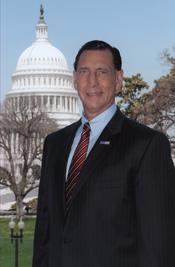 Rep. Frank A. LoBiondo (R-NJ)
Description
Amendment consists of the text contained on pages H10409-H10415 in the Congressional Record for Nov. 5, 2003.
Text
Offered
This amendment's own text couldn't be picked out of its Congressional Record passage, so the passage is shown in full.
COAST GUARD AND MARITIME TRANSPORTATION ACT OF 2003
The SPEAKER pro tempore (Mr. Young of Florida). Pursuant to House
Resolution 416 and rule XVIII, the Chair declares the House in the
Committee of the Whole House on the State of the Union for the
consideration of the bill, H.R. 2443.
{time} 1530
In the Committee of the Whole
Accordingly, the House resolved itself into the Committee of the
Whole House on the State of the Union for the consideration of the bill
(H.R. 2443) to authorize appropriations for the Coast Guard for fiscal
year 2004, to amend various laws administered by the Coast Guard, and
for other purposes, with Mr. Ose in the chair.
The Clerk read the title of the bill.
The CHAIRMAN. Pursuant to the rule, the bill is considered as having
been read the first time.
Under the rule, the gentleman from New Jersey (Mr. LoBiondo) and the
gentleman from Minnesota (Mr. Oberstar) each will control 30 minutes.
The Chair recognizes the gentleman from New Jersey (Mr. LoBiondo).
Mr. LoBIONDO. Mr. Chairman, I yield myself such times I may consume.
Mr. Chairman, I rise in strong support of H.R. 2443, the Coast Guard
Maritime Transportation Act of 2003. Before I discuss the bill or make
comments on it, I would first like to thank the gentleman from Alaska
(Mr. Young), the distinguished chairman of the full committee, for all
of his efforts on behalf of the Coast Guard and, in particular, for
this bill, also thank the gentleman from Minnesota (Mr. Oberstar), our
ranking member, who certainly has been a champion of the Coast Guard
and worked closely with us, and the gentleman from California (Mr.
Filner), the ranking member on the Coast Guard Maritime Transportation
Subcommittee, for their help and cooperation with this legislation.
This legislation was developed in a bipartisan manner and deserves
the support of all the Members of Congress. The primary purpose of this
bill is to authorize expenditures for the United States Coast Guard and
the Federal Maritime Commission for the fiscal year 2004.
Title I of the bill authorizes for fiscal year 2004 approximately
$7.1 billion for Coast Guard programs and operations. The bill also
authorizes the administration's request for 18.5 million for the
Federal Maritime Commission.
This legislation will increase funding for Coast Guard programs at a
level above the administration's request to ensure that the service can
meet its traditional missions and make meaningful progress toward
carrying out its homeland security responsibilities under the Maritime
Transportation Security Act of 2002.
The bill funds the Coast Guard at levels requested by the President
plus an additional $460 million. Of this amount, $70 million is for
conducting the mandated U.S. port security plan approvals, $202 million
to keep the Deepwater Capital Acquisition Program on track to meet its
original 20-year implementation plan, $80 million to install equipment
on already delivered C-130J aircraft, $39 million to establish a west
coast HITRON squadron, $50 million for
[[Page H10397]]
conducting foreign port security assessments and foreign vessel
security plan reviews, and, finally, $19 million is for making the
Truman-Hobbs bridge alterations.
I am particularly concerned about the funding shortfalls for the
critically important Deepwater recapitalization program designed to
replace the Coast Guard's aging fleet of vessels and aircraft. From the
start, Deepwater has been underfunded, jeopardizing on-time delivery of
important assets. The effective accomplishment of the Coast Guard's
national and homeland security missions, as well as its ability to
sustain the level of performance of its traditional missions, is
predicated upon having the required funding to recapitalize its aging
assets sooner than the appropriated 20-year plan.
As evidence of this, I attended on Saturday the return of the Coast
Guard cutter Dependable from a drug interdiction mission in the
Caribbean where it actually had confiscated a record Coast Guard bust.
The drug smugglers had dumped about 2,500 pounds overboard and the
Dependable and its crew had actually confiscated about the same amount.
DEA was there to take control of the substance, to destroy it, but when
listening to the discussion and listening to the account of how this
took place, it is remarkable that the Coast Guard cutter Dependable,
which was commissioned during the 1960s, with a top speed of only 17
knots and an aging frame, was able to counter the drugies with their
fast boat with only a rigid-hull inflatable that was like a Corvair
chasing a Corvette.
Operation Deepwater is critically needed. I strongly endorse
increasing the Coast Guard's overall funding level in order to support
a faster Deepwater recapitalization program commensurate with the
findings of the Deepwater acceleration plan submitted to the Congress
in March of 2003.
In addition to authorizing the Coast Guard's fiscal year 2004 budget
and personnel resources, the measure also provides parity between
certain Coast Guard and Department of Defense authorities, improves
personnel management, and includes provisions to allow the service to
better accomplish its traditional regulatory and law enforcement
missions.
The recent ferry accident in New York Harbor shows that the maritime
transportation will never be perfect. However, the Coast Guard's
constant and careful review of vessel and crew minimizes the number of
maritime accidents we see in the United States. The service's response
efforts also minimize the impact those incidents have in terms of loss
of life and damage to property.
I did hold a hearing in New York, on Tuesday of this week, to look
for ways in which we can further improve our prevention and response
system.
In preparing this bill, the Coast Guard and Maritime Transportation
Subcommittee held hearings on the Coast Guard's and the Federal
Maritime Commission's budget request and the legislative provisions in
the Coast Guard's proposal. The bill contains many of the Coast Guard's
legislative requests, as well as items of concern to Members of
Congress that were brought to our attention.
Mr. Chairman, I want to take this opportunity to commend the men and
women of the Coast Guard. They do an amazing and remarkable job. Their
ongoing traditional missions of illegal drug interdiction, of fisheries
law enforcement, search and rescue, is always making the news. But what
is really remarkable is the job that they are now doing on homeland and
port security which is something that is new, that has been added to
them since the terrible tragedy of September 11 of 2001.
America benefits from a strong Coast Guard that is equipped to stop
terrorists and drug smugglers, support the country's defense, protect
our natural resources, rescue mariners in distress, and respond to
national emergencies.
We must act now to put the Coast Guard on sound financial footing, to
be ready to respond to our increased homeland security demands, and
other critical duties that the Coast Guard carries out daily. And the
men and women of the Coast Guard are more than prepared to do their
mission if we will only give them enough resources, enough assets and
enough personnel to do the job. This bill will help ensure that that
happens.
Mr. Chairman, I urge all Members to support this piece of
legislation.
Mr. Chairman, I reserve the balance of my time.
Mr. OBERSTAR. Mr. Chairman, I yield myself such time as I may
consume.
Mr. Chairman, I appreciate the good words of the chairman of the
subcommittee. I note that our full committee chairman has arrived, and
I will curtail my remarks so that the chairman, the gentleman from
Alaska (Mr. Young) can speak. But I just want to say to what a
difference a week makes and how refreshing it is to be on the floor
under an open rule where issues that are of concern to Members can be
resolved in open fashion and that we can conduct the work of this
committee in its traditional fashion, working in a bipartisan manner.
I respect enormously the work of the gentleman from New Jersey (Mr.
LoBiondo), the chairman of the subcommittee, and our ranking member,
the gentleman from California (Mr. Filner), and particularly our
riverboat captain chairman, the gentleman from Alaska (Mr. Young), who
has not only firsthand experience on the water commanding a vessel, but
has enormous respect, as I have, for the United States Coast Guard.
The chairman and I served on the Merchant Marine and Fisheries
Committee from our very outset of service in the Congress, and through
that work, we both came to have a great respect and admiration for the
work of the Coast Guard, which started out, along with the Corps of
Engineers, as one of the two oldest agencies of the Federal Government
in its infancy in 1789. It was known as the Revenue Cutter Service and
provided the first revenue and source of funding for our infant
republic.
In the years since then, I have, in my observation and my work on the
Coast Guard subcommittee, I have observed that there is probably no
entity of the Federal Government from which the citizens of this
country get a greater return on their investment than from the United
States Coast Guard. As a former Commandant once observed, it takes a
special person to wear this color blue. And they are all special
people, men and women, of the United States Coast Guard.
What I regret about the Coast Guard is that in my 29 years of
service, I have seen some 27 new responsibilities added by the Congress
to the list of duties that the Coast Guard must perform. But that list
of new duties and responsibilities has not been accompanied by a
commensurate increase in personnel and in funding. And that has
happened under Democratic and Republican administrations and Democratic
and Republican Congresses.
Now, we bring to the floor a $7.1 billion bill to deal with the needs
of the Coast Guard, and unfortunately, in past Congresses, this bill
has not become law because of issues that the other body has wanted to
hang on to it and slow down its progress. This time, the authorization
has been done through the appropriation process. And I earnestly hope
that we are not engaged in yet another exercise in futility getting a
Coast Guard authorization passed and that indeed the other body will
act expeditiously and not try to tie in unrelated issues to this very
important authorization.
I further believe very strongly that although we have provided, I
think, a responsible funding for the Coast Guard, it is still
inadequate to the responsibilities that the Congress has saddled the
Coast Guard with and visited upon it because we felt they could carry
out all those responsibilities of drug interdiction and immigration
interdiction, and now the homeland security responsibilities. They
simply need more personnel and more funding to continue to carry out
the job and not stretch the human resources of the Coast Guard as thin
as has been done in the last few years.
Mr. Chairman, I reserve the balance of my time.
Mr. LoBIONDO. Mr. Chairman, I yield such time as he may consume to
the gentleman from Alaska (Mr. Young), the distinguished chairman of
the Committee on Transportation.
Mr. YOUNG of Alaska. Mr. Chairman, I rise in strong support of H.R.
2443, the Coast Guard and Maritime
[[Page H10398]]
Transportation Act of 2003. The bill is a result of a bipartisan
effort, and it deserves the support of all the Members. I especially
again want to thank the subcommittee chairman, the gentleman from New
Jersey (Mr. LoBiondo), and the full and subcommittee ranking members,
the gentleman from Minnesota (Mr. Oberstar) and the gentleman from
California (Mr. Filner), for their help and cooperation in developing
this bill.
I want to stress that, again, as the gentleman from Minnesota (Mr.
Oberstar) has mentioned, it has been a long time since this bill has
become a law, and it is time that the other body acts as we pass it
today.
I am pleased we are taking the action today to authorize funding for
the most important programs of the United States Coast Guard and
Federal Maritime Commission.
In addition to authorizing the fiscal year of 2004 FMC budget at the
level requested by the administration, this bill authorizes the fiscal
year 2004 Coast Guard budget at the level requested by the President,
plus an additional $460 million.
Of this amount, $70 million is authorized for the Coast Guard
domestic port security activities, $80 million is to equip four C-130J
aircraft for Coast Guard missions, and $202 million is for the Coast
Guard's Deepwater capital equipment modernization project.
We have also provided $39 million for an armed Coast Guard helicopter
squadron, $50 million for Coast Guard foreign port security activities,
and $19 million for the alteration of bridges which obstruct
navigation.
H.R. 2443 will result in improved operation of the Coast Guard and
the Federal Maritime Commission and safer, more efficient maritime
transportation.
However, nearly one-third of our exclusive economic zone lies off the
shores of Alaska. These waters include the Nation's largest fishery,
and sufficient cruise ship and oil tanker traffic. Therefore, I am
concerned about the ability of the Coast Guard to carry out its
traditional search and rescue, fisheries law enforcement, and vessel
inspection missions. There are concerns that some of these missions may
be suffering as a result of the new emphasis on homeland security.
I remain optimistic that this legislation will provide the Coast
Guard with the resources and legal authorities necessary to get the
service back to an acceptable state of mission balance.
Mr. Chairman, all of us recognize the exceptional work performed by
the Coast Guard, often under dangerous circumstances.
I urge all my colleagues to support this bill which authorizes
sufficient resources for the Coast Guard to carry out its many missions
and make necessary improvements of laws governing maritime
transportation.
Mr. Chairman, I again speak about the role of the Coast Guard in the
great State of Alaska. We have more coastline than all the United
States combined and more Coast Guard activities, not only in the
fisheries, but again in the oil tanker business, and in the
interception of all types of foreign vessels that occur.
{time} 1545
I can only compliment my Coast Guard contingency in Alaska for the
work they do in adverse conditions, flying in weather that you cannot
believe, rescuing people, fishermen, and, yes, even some tourists,
recovering them with helicopters and with ships themselves. They have
done yeoman's duty day after day in very adverse conditions.
I will again stress, as one of the authors of Homeland Security, and
I expressed at that time the Coast Guard be put at the top of the list
in homeland security and they were, not at the bottom, which they were
under the original proposal.
But I am still very concerned. There is a possibility that their
mission, which is actually navigation, safety, interdiction of drugs,
of doing duties which this Congress made them responsible for, now
there is sort of an emphasis on security purposes and that alone. We
must protect and make sure that does not occur, that they have their
mission. In fact, I will at the appropriate time, not in this
legislation but during the coming year, make a proposal that we take
Coast Guard out of Homeland Security, put it back where it belongs and
make sure it can do the missions that we have charged them with.
Mr. Chairman, I urge all of my colleagues to understand the
importance of this legislation. We will have some amendments offered.
We hope to work most of them out before they are offered. We will
debate those, and we will finally pass a very good piece of legislation
for the United States Coast Guard.
Mr. OBERSTAR. Mr. Chairman, I yield such time as he may consume to
the gentleman from California (Mr. Filner).
Mr. FILNER. Mr. Chairman, I thank the chairman of our subcommittee,
the gentleman from New Jersey (Mr. LoBiondo); the ranking member of our
committee, the gentleman from Minnesota (Mr. Oberstar); and the
chairman, the gentleman from Alaska (Mr. Young), for bringing us this
legislation--and that I was proud to work on it with them. It is a
culmination of our work this session examining the Coast Guard mission,
with particular emphasis on the funding for the Maritime Transportation
Security Act of 2002.
This bill, H.R. 2443, authorizes $7.1 billion, and we hope that this
will be sufficient funding for the Coast Guard to carry out the many
missions that Congress has given the Coast Guard, including homeland
security, search and rescue, marine safety, drug and migrant
interdiction and law enforcement.
H.R. 2443 authorizes $39 million for a squadron of what are called
HITRON armed helicopters for the west coast. The gentleman from
Minnesota (Mr. Oberstar) talked about return of investment on this
bill. Well, that is true, certainly, of this HITRON helicopter. Since
their establishment, the Jacksonville, Florida, HITRON squadron has
stopped over $1.5 billion in illegal drugs from entering the United
States.
Deployment of the HITRON squadron on the west coast will help stem
the flow of illegal narcotics through the eastern Pacific Ocean. If one
were to look at this using a cost-benefit analysis, $39 million is
spent for the armored HITRON squadron on the west coast, but drugs that
are stopped and interdicted are worth more than 20 times that amount.
It is my strong view that the Coast Guard must increase Airborne Use
of Forces assets for port security and drug interdiction. The lease
option for these aircraft is already in place. The lease provides
antiterrorist and antidrug coverage for the next 3 to 5 years while
providing flexibility for the Coast Guard to engage in competition to
select a permanent multimission cutter helicopter to meet our
challenges post-9/11. When these multimission helicopters are deployed,
the HITRON helicopters can be returned to their manufacturer at the
option of the Coast Guard.
There are a number of changes to existing law which the previous
speakers have spoken to. I would again like to thank the members of the
committee for their bipartisan effort to put this bill together and
look forward to working with them as we work with the Senate to reach
an agreement on the authorizing legislation.
Mr. Chairman, I urge my colleagues to support passage of the Coast
Guard and Maritime Transportation Act.
Mr. LoBIONDO. Mr. Chairman, I reserve the balance of my time.
Mr. OBERSTAR. Mr. Chairman, I yield 2 minutes to the gentlewoman from
Florida (Ms. Corrine Brown), former ranking member on the Subcommittee
on the Coast Guard and Maritime Transportation of the Committee on
Transportation and Infrastructure.
Ms. CORRINE BROWN of Florida. Mr. Chairman, I want to thank all of
the members on the Committee on Transportation and Infrastructure who
have worked to bring this bill to the floor.
The Coast Guard has been protecting our shores for more than 200
years, and they have done an outstanding job. The Coast Guard was the
first agency to react to the terrorist attack on September 11 and
within minutes was guarding our ports and bridges and directing
maritime traffic out of New York. This Nation's ports and waterways are
still very vulnerable to terrorist attacks, and the Coast Guard is the
first line of defense against those wishing to harm us.
[[Page H10399]]
This $7.1 billion authorization will go a long way in allowing the
Coast Guard to continue its mission while expanding its authority to
fight terrorists. This bill will increase the size of the Coast Guard,
improve benefits for those serving, increase the authority to inspect
foreign vessels, allow additional force against fleeing vessels, and
give them the authority to revoke the credentials of individuals that
pose a safety or security threat.
I have major concerns when they moved the Coast Guard to the
Department of Homeland Security because I fear that it would prevent
them from doing their core mission of drug interdiction, search and
rescue, enforcing maritime and fisheries laws, and protecting our
marine environment. This bill will allow them to accomplish everything
we ask of them, but we need to keep the Department's feet to the fire
so they can follow the law and not reduce the Coast Guard's traditional
mission.
I hope that Members of this body will do the right thing and fund the
Coast Guard at $7.1 billion. It is the right thing to do for America.
Mr. LoBIONDO. Mr. Chairman, I reserve the balance of my time.
Mr. OBERSTAR. Mr. Chairman, how much time remains on each side?
The CHAIRMAN. The gentleman from Minnesota (Mr. Oberstar) has 20
minutes remaining. The gentleman from New Jersey (Mr. LoBiondo) has 19
minutes remaining.
Mr. LoBIONDO. Mr. Chairman, we have no further speakers on general
debate. I reserve the balance of my time.
Mr. OBERSTAR. Mr. Chairman, I yield 6 minutes to the gentleman from
Michigan (Mr. Stupak).
(Mr. STUPAK asked and was given permission to revise and extend his
remarks.)
Mr. STUPAK. Mr. Chairman, I thank the gentleman for yielding me time.
I would like to enter into a colloquy with the ranking member from
Minnesota (Mr. Oberstar).
I thank the gentleman from Minnesota (Mr. Oberstar) for recognizing
the importance of implementing national maritime safety initiatives on
our Nation's waters. In a little over a year, carriage of electronic
technology for nonvoice chip communication that would exchange
navigation and ship data between ships or ship and coastal stations,
called the Automatic Identification System, will be required in certain
vessels that operate in vessel traffic service zones.
While I certainly understand the need to implement further navigation
safety and maritime security on our waters, the fact is that the Coast
Guard estimates that the cost of the AIS is over $9,300 per vessel.
This is a considerable amount of money for small passenger vessel
operators.
In Michigan's first district, small island ferries and the Soo Locks
Boat Tours operate small passenger vessels seasonally from May through
October that have a maximum capacity of under 300 passengers per
vessel. Although most tours and passenger services carry less than 100
passengers per trip, my concern is how are these small governmental
transit authorities and small mom and pop businesses in rural America
going to be able to bear the extraordinarily high cost of AIS.
Mr. OBERSTAR. Mr. Chairman, will the gentleman yield?
Mr. STUPAK. I yield to the gentleman from Minnesota.
Mr. OBERSTAR. Mr. Chairman, I thank the gentleman for raising this
issue. It is a matter of concern to just that very class of vessel
operator that the gentleman has described. The technology known as AIS,
automatic identification system, is very sophisticated. It probably has
too many bells and whistles for small operators, ones they do not need.
The Coast Guard has come back to reconsider this issue and is working
with the International Maritime Organization to adopt what is an
international standard that will be far less technologically
sophisticated, if you will, than the system they have required, which
will give the operator e-mail and other technology downloaded from the
signal. They do not need all of that stuff.
What they really need for the small vessels is name, GPS position and
bearing, where they are headed; and that is what the Coast Guard will
do. That will draw the cost from nearly $10,000 down to $2,000 or less
for the small vessels operators, and give them and the Coast Guard the
information that they really need without the bells and whistles. So I
think that this ruling will be completed by next spring, hopefully in
time for the boating season in the gentleman's district and in mine.
Mr. STUPAK. Mr. Chairman, I thank the gentleman for working with us
to ensure that the costs of this technology is more conducive to small
business. I look forward to working with him and the majority on this.
While I have the ranking member here, I would like to ask him, and
thank both him and the gentleman from Alaska (Mr. Young) for their
support, including my provision in the manager's amendment calling for
the timely review and adjustment of pilotage rates by the United States
Coast Guard.
I would ask the gentleman if he knows anything further on this issue
that we have raised.
Mr. OBERSTAR. Mr. Chairman, the issue of pilotage rates on the Great
Lakes is one of the most vexing matters that I have had to deal with
going back to my service with my predecessor as the administrative
assistant when we had so many problems with the Great Lakes Pilotage
Administration. We once had an administrator of that agency who would
go off to his farm in Northern Virginia over the weekends when he was
needed most. We could not find him. They needed regulations changed or
approvals to undertake certain activities; we could not find this guy.
It has just been a big headache over the years. We have shifted back
and forth between the Coast Guard and the pilotage administration and
who is going to administer it. I think it has now been on track.
Again, pilotage has sort of been a football kicked back and forth
between Coast Guard and DOT by the Office of Management and Budget; and
in the process, pilots have been stiffed, to be very honest with the
gentleman. Coast Guard first developed a rule for pilotage rates, sent
it to the Office of Management and Budget. They reviewed it. They sent
it back to the Coast Guard. The Coast Guard then sent it to the
Department of Transportation because that is where they used to live.
Now they live over in the Homeland Security Department.
So Secretary Mineta's staff got right on it, and they worked it over
and they said, well, we have these questions. And they asked the Coast
Guard to answer certain questions. The Coast Guard questions were then
sent to OMB. The OMB sent the questions back and now DOT has asked the
Coast Guard to respond.
Secretary Mineta has assured me that his office, his staff will clear
the way, hopefully get it done by the end of this week so that the
interim rate can be approved, at least on an interim basis, pending a
final rule.
It should not have to take this long, I assure the gentleman. I
appreciate his advocacy on this issue. Hopefully, this will all get
done within a week and pilots can apply their trade.
Mr. STUPAK. Mr. Chairman, I urge the Members to support the
legislation, and I urge this committee and this Congress to continue to
urge the Coast Guard to follow its own rules and regulation and adjust
those pilot rates as soon as possible on the Great Lakes. The season is
just about over. I appreciate the gentleman's concern.
Mr. OBERSTAR. Mr. Chairman, I yield 3 minutes to the gentleman from
Oregon (Mr. DeFazio), the former ranking member of the subcommittee.
Mr. DeFAZIO. Mr. Chairman, I thank the gentleman for yielding me
time. I am pleased we are taking up this bill today. For too many years
the needs of the Coast Guard were neglected as we failed year after
year to pass authorizing bills, and the amount of funds to the Coast
Guard for their mission were inadequate.
Their mission, of course, today, is even more difficult than it was
then; but I think that this bill is beginning to recognize the need for
more funds, the need for better housing allowances, the need of
fulfilling that expanded mission. So I am pleased to stand in general
support of the bill before the House.
{time} 1600
I mean, the Coast Guard is crucial to my District. I represent more
than half
[[Page H10400]]
the Oregon coast, difficult port entrances, still an active fishing
fleet and pleasure boats, and the Coast Guard is called upon many times
to conduct rescues at the risk of their own life and also to do
fisheries enforcement, drug interdiction and now, of course, the whole
new emphasis on homeland security and all the problems in that.
There are two issues where I would raise concerns. The first, I will
have an amendment on later, and that is the potential that the Coast
Guard museum, which I support the idea of a Coast Guard museum, could
be sited on property taken by eminent domain, and I think Congress
should speak clearly on that issue, and I will have an amendment on
that later.
The other is something I have raised with the Commandant in hearings,
and it is just a general note of concern to other Members of Congress.
I feel that the Coast Guard is doing an excellent job in its mission of
homeland security, but the one place where I would fault them is as our
lead negotiator with the International Maritime Organization.
The International Maritime Organization works by consensus, and often
I feel rather than us setting down a hard marker and saying, this is
where the rest of the world has to go on shipping, crew certification
and safety issues, the Coast Guard gets much too involved in
bargaining. We should lead by example with world standards. It is not
enough to say, well, we always have port/State control issues where we
can board these ships once they get here. No, we do not want those
ships on the ocean at all. We do not want ships out there where we do
not know who the owners are. We do not want ships out there where we do
not know who the crews are, and we do not want ships out there when we
do not know what the cargoes are.
Those are extraordinary threats both to the safety, the environment
as with the New Carissa incident in my district. We had a totally
incompetent foreign skipper, who did everything in defiance of good
practice and managed to put his ship on the beach, spilling a
tremendous amount of bunker fuel, causing an environmental disaster,
and the ship is still there. He skipped out of the country before we
could put him in jail unfortunately, but I do not think he will be
coming back, but there are other skippers like that out there, not to
say there are not many good ones.
But we need better crew certification requirements. We cannot have
these paper schools that issue certificates. That is what we have got
today. We are allowing to say, well, these schools exist in the
Philippines. There is no one that goes around to certify that the
schools exist, certify the curriculum, certify people have gone through
the curriculum. We do not know who the crew members are. We do not have
noncounterfeitable ID cards. We do not have a way of knowing better
what the cargo is.
The Coast Guard is just starting to work on these things, and they
are not taking the toughest position they could in the International
Maritime Organization to secure our borders, our security and our
safety, and I just want to urge them to redouble their efforts and set
a higher standard to protect the homeland of the United States of
America.
Mr. OBERSTAR. Madam Chairman, how much time, may I inquire, do we
have left?
The CHAIRMAN pro tempore (Mrs. Biggert). The gentleman from Minnesota
(Mr. Oberstar) has 11 minutes remaining.
Mr. OBERSTAR. Madam Chairman, I yield 5 minutes to the distinguished
gentleman from Mississippi (Mr. Taylor) guardian of the Jones Act.
Mr. TAYLOR of Mississippi. Madam Chairman, if I could, I would like
to engage in a colloquy with either the subcommittee or full committee
chairman.
Mr. YOUNG of Alaska. Madam Chairman, will the gentleman yield?
Mr. TAYLOR of Mississippi. I yield to the gentleman from Alaska.
Mr. YOUNG of Alaska. Madam Chairman, I gladly will accept a colloquy
with the good gentleman.
Mr. TAYLOR of Mississippi. Mr. Speaker, for the sake of the folks who
do not know it, I am pleased to mention that the full committee
chairman owns his own commercial license as a tugboat captain, so I
think he will appreciate this question.
In reading the synopsis, it says the measure requires foreign flagged
vessels that depart and return to the same U.S. port without stopping
at any other port in between to comply with the safety requirements of
the International Safety Management Code whenever any part of the
voyage occurs in international waters.
For the folks around here, that would be called a cruise to nowhere.
As the chairman knows better than most, there really is not a law that
allows cruises to nowhere. It is a Customs ruling going back to about
the 1950s, and it has been used by foreign-owned, foreign-manned and
foreign-built ships to operate in the U.S. trade. They merely go 12
miles out to sea, turn around and come back.
One of the few things that I thought we had protecting Americans from
this glaring loophole in the law was that the Coast Guard at least had
to inspect these vessels. If I understand this properly, and this is a
colloquy, and I am asking for an answer and, hopefully, something that
will stick up in law, I hope by doing this we are not taking a bad
Customs ruling and making it the law of the land. A bad Customs ruling
we can fix with good administration. I have not had one to do so in the
three that I have dealt with, but we could still fix with a good
administration.
If this becomes the law of the land, and that is why I am asking for
my colleague's opinion, then we have, in effect, taken a bad practice
and made it the law of the land.
Mr. YOUNG of Alaska. Madam Chairman, if the gentleman would yield, my
concern is that we were going to have another colloquy on something
else that is very dear to your heart.
Mr. TAYLOR of Mississippi. I am going to get to that one next.
Mr. YOUNG of Alaska. Madam Chairman, I cannot specifically answer the
gentleman's question at this time. It is my intent to make sure the
vessels, whatever vessels operate in these waters, will be under Coast
Guard jurisdiction, and I think that is what the intent of this is. It
is my intent, personally, as chairman.
The gentleman brings up a point about a Customs ruling that can be
changed. I do not intend to do anything. As my colleague knows, I
support the Jones Act equally as he does, and we will be reviewing
this, and I am willing to work with the gentleman as this legislation
goes forward to see if we cannot make sure that his and my ideas are
implemented because I am not going to get involved right now with the
trips to nowhere because I do not know the effect of this legislation
on those activities at this time.
Mr. TAYLOR of Mississippi. Madam Chairman, if I may ask this
question, is it the intent of this legislation to legalize cruises to
nowhere?
Mr. YOUNG of Alaska. To my knowledge, no, and if that is the case, we
will be taking care of that as time goes by. I was unaware of it. If
that does this, we will be looking at it very closely.
Mr. TAYLOR of Mississippi. Second question, again coming from the
synopsis, and I know it is not perfect, but it says the bill would
authorize two U.S.-built, -owned and -flagged vessels to enter into the
U.S. coastwise trades.
My question is, it has been highly publicized in the New York Times
and other publications that through the unintended consequences, and I
do mean unintended consequences, of the foreign lease provisions in the
1996 Coast Guard authorization bill that some of these U.S.-owned
corporations are actually chartering out of the Bahamas and, therefore,
totally avoiding their U.S. tax obligations for vessels that are
protected by the Coast Guard, for vessels that use channels that are
dredged by the Army Corps of Engineers and God forbid if the vessel is
seized by terrorists. That owner would never hesitate to call upon the
U.S. Navy Seals to go rescue his vessel.
My question is, do these two vessels fall into that category of being
owned by a corporation that has already inverted overseas in order to
avoid U.S. taxes?
Mr. YOUNG of Alaska. No, and I believe if the gentleman is talking
about the M/V Coastal, which vessels is the gentleman talking about?
Mr. TAYLOR of Mississippi. Again, the synopsis says two, does not
have the names, just says two U.S.-built, -owned and -flagged vessels.
Mr. YOUNG of Alaska. Madam Chairman, if the gentleman is referring to
[[Page H10401]]
page 35, the Bluefin and the M/V Coastal Merchant, I do believe this
applies as long as it is retroactive. We do not go back and disown
them. We have to probably allow them to continue to operate as
American-flagged vessels, these two vessels. There are only two vessels
mentioned in the bill.
Mr. TAYLOR of Mississippi. Again, my fear is this is an
interpretation that we might actually be putting into law, and I hate
to be doing that, and I do not think that is my colleague's intention
as well.
Mr. YOUNG of Alaska. Madam Chairman, I can assure the gentleman that
it is not my intent to do so at this time. That is why we will have the
committee to review it, but if these vessels were actually authorized
and they were done under a law of 1976 I believe it is, then we cannot
make it say, no, they are no longer eligible.
Mr. OBERSTAR. Madam Chairman, does the gentleman have further
speakers?
Mr. LoBIONDO. We are reserving the balance of our time.
Mr. OBERSTAR. Madam Chairman, I yield 2\1/2\ minutes to the gentleman
from New York (Mr. Engel).
Mr. ENGEL. Madam Chairman, I thank the gentleman, my friend from
Minnesota, for recognizing me, and I rise in support of the manager's
amendment that will be offered later, and I want to thank the gentleman
from Alaska (Chairman Young), the gentleman from Minnesota (Ranking
Member Oberstar), the gentleman from New Jersey (Subcommittee Chairman
LoBiondo) and the gentleman from California (Ranking Member Filner) for
their support of my amendment which they have included as part of the
manager's amendment.
I also rise in support of the overall bill. The Coast Guard is a
vital part of our national security. We must provide them with the
tools they need and the funding to successfully execute their mission.
I am especially pleased with the funding for the Integrated Deepwater
Systems program.
Madam Chairman, I offer my amendment because I continue to have grave
concerns about the safety of my constituents should the Indian Point
nuclear power plant be attacked. I am concerned about the safety and
security of the plant. I have even more concerns about the ability to
evacuate people safely, but that is for another debate.
This amendment is simple. It requires that the Coast Guard conduct a
vulnerability assessment of the facility. As of January 1, 2003, the
Coast Guard had established a permanent safety and security zone around
Indian Point. However, the Coast Guard's Hudson River cutter passes
Indian Point about twice a week, and its copter only about three times
a week.
Indian Point is located in Buchanan, New York, 35 miles north of
midtown Manhattan and just a few miles northeast of my district. Almost
all of my district is located within the 10-mile radius of the plant,
and approximately 20 million people live within the 50-mile emergency
planning zone or EPZ.
In addition, as we know, blueprints for American nuclear power plants
were found in al Qaeda caves in Afghanistan, and that point bears
repeating. Al Qaeda has the plans to some U.S. nuclear power plants.
A study conducted by the Marist Institute found that 82 percent of
people living within a 50-mile radius of the plant are concerned about
a potential terrorist attack on the facility, moreover, a majority of
residents in the 50-mile radius do not feel that the plant is secure
and protected against a terrorist attack.
I support closing Indian Point completely. Absent that solution, I am
working with my colleagues to ensure that it is the most safe and
secure nuclear power plant possible.
Therefore, I urge all my colleagues to support the manager's
amendment and the bill.
Mr. OBERSTAR. Madam Chairman, how much time do we have remaining?
The SPEAKER pro tempore. The gentleman from Minnesota (Mr. Oberstar)
has 3\1/2\ minutes remaining.
Mr. OBERSTAR. Madam Chairman, I yield myself 3 minutes.
Yesterday, the Subcommittee on Coast Guard and Maritime
Transportation conducted a hearing on the Staten Island ferry accident
in which 10 passengers were killed. Even at this date, the captain and
the pilot of the ferry claim to be too ill to testify before the
National Transportation Safety Board. The Coast Guard can take no
action against them because they are incompetent or a danger to the
safety of a vessel because of their statements and because of a
loophole in existing law.
The bill that the committee has reported includes a provision
recommended wisely and appropriately by the administration to close
that loophole. It does not give the Coast Guard authority to go on
fishing expeditions to look at the health records of a mariner, but it
does what I have long advocated, provide the Coast Guard authority that
the FAA has, to require all mariners that are on medication or have
illnesses that could affect their ability to operate a vessel safely,
to report those circumstances to the Coast Guard so they can determine
whether the individual can operate safely.
Enactment of this legislation is going to close a very troublesome
loophole in existing law and result in far better safety on the waters
as we have an obligation to provide and should undertake, and I thank
the chairman for recognizing that circumstance. I know the chairman has
been under enormous pressure, to put it mildly, advocacy, to do
something differently, but at the hearing yesterday it became apparent
why we need to proceed with the language in the bill, which I strongly
support.
Let me conclude by saying, we have an outstanding bill. We have an
excellent piece of work.
{time} 1615
I wish we were doing more in personnel and more in funding for the
Coast Guard, but I think we have done all we can under the
circumstances; and we will continue to work to improve those two areas,
personnel and funding, for the Coast Guard in the future.
Mr. PETRI. Madam Chairman, I applaud the vision of the Chairman of
the Subcommittee and the Ranking Minority Member in recommending
additional helicopter assets to be deployed on the West Coast for drug
interdiction and port security. Currently, there are eight leased,
armed helicopters based in Jacksonville, FL, which make up the entire
Coast Guard Airborne Use of Force capability. Pre 9-11, this Helicopter
Interdiction Tactical Squadron (or HITRON) was used solely for drug
interdiction, primarily in the Caribbean. Occasionally, some or all of
the fleet was sent to the West Coast since about 50 percent of the drug
interdiction has occurred in the eastern Pacific. Post 9-11, insofar as
possible, these same eight armed helicopters have also assumed port and
inland waterway security duties.
Lakes Michigan and Superior form part of the Wisconsin border.
Currently the air stations at Travers City, Michigan, and Detroit
monitor the Great Lakes from Niagara Falls through Lake Superior. They
are already stretched very thinly. To meet increased terrorist threats
wherever they occur, the Coast Guard must rob Peter to pay Paul. The
humanitarian aspect of the Coast Guard's mission is a constant, so it
is imperative that they obtain more assets--ships, fixed wing and
rotary wing aircraft.
Since their introduction into the Coast Guard Inventory many years
ago, the role of helicopters has expanded. They had primarily been used
for search and rescue missions at sea until the introduction of the
lighter, armed Sting Rays. Beginning with the introduction of the Sting
Rays in 2000, they have deployed as a cutter-based aircraft to pursue,
intercept and disable ``go-fast'' boats engaged in drug running. To
date, they have intercepted over 30 Tons of illegal drugs valued at
more than $2.1 billion. There are just not enough of them to go around!
The Coast Guard motto is Semper Paratus--Always Prepared. As stated
on their web site, they are The Shield of Freedom; The Defender of the
Homeland; The Port in the Storm and The Enforcer of the Sea. They are
indeed all those things and always have been. However, since 9-11, all
those things have taken on added significance. To accomplish these
missions, they need more assets to meet the increased burden.
Mr. STUPAK. Madam Chairman, I would like to thank Committee Chairman
Young and Ranking Member Oberstar for their support in including my
provision in the Managers amendment calling for the timely review and
adjustment of pilotage rates by the United States Coast Guard.
Every foreign vessel that enters the Great Lakes must secure the
services of a ship pilot, whose primary responsibility is the safe
navigation of the vessel. The rates that American
[[Page H10402]]
pilots charge shipping companies for pilotage services are set by the
Coast Guard.
The Great Lakes pilotage system performs a critical safety and
environmental protection function for the Great Lakes. It doesn't make
sense to underfund a pilotage system that is crucial to the largest
freshwater body in the world. Yet the Coast Guard failed to complete a
rate adjustment of any kind last year. At the beginning of this year it
announced that it intended to establish a new rate in time for the
beginning of the 2003 shipping season yet with the shipping season now
over, that still has not occurred.
The Coast Guard continues to set funding levels for key elements of
the pilotage system at 1997 and even 1995 levels. This is particularly
disturbing because the Coast Guard regulations require rates to be
reviewed and adjusted on an annual basis. Setting rates to 1997 or 1995
levels will inevitably result in the fraying of the Great Lakes
piloting system.
It has been reported that the delay of any rate adjustment is a
result of objections from foreign shipping companies, which pay for
pilot services. I have made the protection of the Great Lakes a crusade
throughout my years in Congress. My Congressional District is
surrounded by three Great Lakes. I would object in the strongest
possible terms if the Coast Guard is placing the bottom lines of
foreign shipping companies ahead of adequate funding for a pilotage
system that is designated to protect the Great Lakes. The Coast Guard
should not put the economic interests of a few foreign shipping
companies ahead of the safety of the Great Lakes.
I urge the Coast Guard to follow its own regulations and adjust
pilotage rates on the Great Lakes as soon as possible. Until they do so
it places the entire Great Lakes in jeopardy.
I urge all members to support.
Ms. MILLENDER-McDONALD. Madam Chairman, I rise to express my strong
support for the Coast Guard and Maritime Transportation Act (H.R.
2443).
Specifically, I want to thank the chairman and Ranking Member Filner
for including my amendment in the manager's amendment.
My amendment will provide the Department of Homeland Security the
authority to issue port security grants, by amending the Maritime
Transportation Security Act.
This is a simple act, but I believe it will go a long way in
clarifying the responsibility of issuing port security grants in a
timely, predictable and efficient manner.
In November 2002, when the Maritime Transportation Security Act
passed this House, the Department of Homeland Security had not yet been
created.
Since the beginning of the 108th Congress we have worked to iron out
the kinks that go with creating a new federal agency such as the
Department of Homeland Security. This is, yet, another wrinkle that I
hope has been ironed out.
As a representative from Long Beach, the home of the largest port
complex in the country and third largest port complex in the world, we
in southern California, as well as other port cities around the
country, want to know where the responsibility for issuing port
security grants lies.
By clarifying the authority of issuing port security grants it is my
hope that we can begin to define the federal role in port security.
Specifically, from this point on, we need to provide more funding for
port security and we need to establish a dedicated stream of funding
for port security.
Finally, I believe, for the large port security projects, we need to
provide the authority for multi-year grants so that our ports and local
governments can adequately plan to build their new projects.
In closing I want to reiterate my support for this bill and look
forward to continuing to work with my colleagues on the committee on
these very important issues.
Ms. HARMAN. Madam Chairman, I rise in support of the Coast Guard and
Maritime Transportation Act of 2004.
As the former representative of the Port of Los Angeles, and
currently the representative of the communities neighboring the Port, I
know the critical role the Coast Guard plays in protecting the nation's
ports and sea-borne commerce.
Indeed, even before the events of September 11, the women and men of
the Coast Guard worked tirelessly to ensure safe and secure operations
in and around the Port of Los Angeles and Santa Monica Bay. Since that
date, the role of the Coast Guard has increased in pace and intensity.
The bill before us recognizes the operational tempo of the Coast
Guard and helps ensure that it has the assets and personnel to do its
critical job.
I also want to point out the bill's endorsement of the Marine
Exchange of Los Angeles and Long Beach. Since 1923, the Marine Exchange
has maintained a continuous 24-hour operation providing detailed
records of all vessel arrivals and departures of the busiest habor
complex in America. Jointly with Coast Guard, the Marine Exchange
operates a Vessel Traffic Information Service. This program uses state
of the art electronic tracking equipment and radar and radio systems to
manage all commercial vessels that travel through San Pedro Bay. The
Marine Exchange VTS is the first public-private VTS partnership
operation in the country that is funded by industry.
This bill notes that it is a national model for other ports to study,
evaluate, and emulate and authorizes the Coast Guard to enter into
similar cooperative agreements elsewhere in the nation. The VTS keeps
the Ports of Los Angeles and Long Beach safe, more efficient, and
environmentally protected by assisting with the movement of over 35,000
vessel transits annually and I commend its executive director, Capt.
M.H.K. ``Manny'' Aschemeyer, and all those associated with the Marine
Exchange for a job well done.
Lastly, I want to express my gratitude to the Chairman and Ranking
Member for including in the manager's amendment a proposal first
suggested to me by the City Council of Torrance, California. That
proposal recognizes the linkage between the critically important roles
of both the Coast Guard and the nation's cities in the fight against
terrorism and recommends the Coast Guard name a class of vessels in its
Deepwater program in honor of specific U.S. cities.
It is my hope that the Coast Guard will respond favorably to the
sense of Congress language included in the bill and, in fact, name one
of its new ships in honor of the city of Torrance, which has been on
the forefront of honoring our Armed Forces and is strategically located
on the shore of the Pacific Ocean.
Madam Chairman, I urge passage of the Coast Guard and Maritime
Transportation Act.
Mr. HOEFFEL. Madam Chairman, I rise in support of H.R. 2443, the
Coast Guard and Marine Transportation Act of 2003.
This legislation highlights the need to expand our Coast Guard
aviation assets to fight the war against drugs. I strongly support the
provision in this measure which permits the Coast Guard to establish a
West Coast fleet of HITRON drug interdiction helicopters. This
provision will afford the Coast Guard the opportunity to select a new
state-of-the-art, multi-mission helicopter to assist in its drug
interdiction efforts.
The HITRON MH-68A Sting Ray was designed, built, and maintained by
the Agusta Aerospace facility in Philadelphia. Constructed on the frame
of an A109E Power civilian helicopter, the Sting Ray employs state-of-
the-art navigation, communication, and avionics equipment.
In 2000, eight Sting Rays were leased to the Coast Guard for the
purpose of establishing an armed HITRON Squadron in Jacksonville,
specifically for drug interdiction efforts. This Fleet has enjoyed a
fabulous success rate in its missions.
HITRON aircrews have interdicted 30 tons of illegal drugs on the high
seas valued at more than $2.1 billion. In addition, the Sting Ray is
the only Homeland Security helicopter authorized for airborne use of
force over civilian populations. Since September 11, the Sting Rays
have also been pressed into port security service for all U.S. ports
and associated waterways.
Therefore, I am pleased to support H.R. 2443 which accommodates the
leasing and stationing of six HITRON helicopters in Southern
California. The failure to establish a permanent West Coast Fleet will
result in a serious shortage of armed assets for drug interdiction and
homeland defense.
Thank you for your consideration of this important piece of
legislation.
Mr. OBERSTAR. Madam Chairman, I yield back the balance of my time.
Mr. LoBIONDO. Madam Chairman, I yield back the balance of my time.
The CHAIRMAN pro tempore (Mrs. Biggert). All time for general debate
has expired.
Pursuant to the rule, the committee amendment in the nature of a
substitute printed in the bill is considered as an original bill for
the purpose of amendment, and is considered read.
The text of the committee amendment in the nature of a substitute is
as follows:
H.R. 2443
Be it enacted by the Senate and House of Representatives of
the United States of America in Congress assembled,
SECTION 1. SHORT TITLE.
This Act may be referred to as the ``Coast Guard and
Maritime Transportation Act of 2003''.
SEC. 2. TABLE OF CONTENTS.
The table of contents for this Act is as follows:
Sec. 1. Short title.
Sec. 2. Table of contents.
TITLE I--AUTHORIZATION
Sec. 101. Authorization of appropriations.
Sec. 102. Authorized levels of military strength and training.
TITLE II--COAST GUARD MANAGEMENT
Sec. 201. Long-term leases.
[[Page H10403]]
Sec. 202. Nonappropriated fund instrumentalities.
Sec. 203. Term of enlistments.
Sec. 204. Enlisted member critical skill training bonus.
Sec. 205. Enhancement of Coast Guard authority to stop vessels liable
to seizure or examination.
Sec. 206. Administrative, collection, and enforcement costs for certain
fees and charges.
Sec. 207. Expansion of Coast Guard housing authorities.
Sec. 208. Requirement for constructive credit.
Sec. 209. Maximum age for retention in an active status.
Sec. 210. Payments.
Sec. 211. Coast Guard fellowship program.
Sec. 212. Air search and rescue facility in Muskegon County, Michigan.
Sec. 213. National Coast Guard Museum.
Sec. 214. Limitation on number of commissioned officers.
Sec. 215. Redistricting notification requirement.
TITLE III--NAVIGATION
Sec. 301. Marking of underwater wrecks.
Sec. 302. Use of electronic devices; cooperative agreements.
Sec. 303. Inland navigation rules promulgation authority.
TITLE IV--SHIPPING
Sec. 401. Reports from charterers.
Sec. 402. Suspension of documents in lieu of mandatory revocation for
proved drug convictions.
Sec. 403. Inspection of records of merchant mariners' documents.
Sec. 404. Exemption of unmanned barges from citizenship requirements
regarding command of vessel.
Sec. 405. Administrative, collection, and enforcement costs for certain
fees and charges.
Sec. 406. Compliance with International Safety Management Code.
Sec. 407. Civil penalties for failure to comply with recreational
vessel and associated equipment safety standards.
Sec. 408. Revision of temporary suspension criteria in document
suspension and revocation cases.
Sec. 409. Revision of bases for document suspension and revocation
cases.
Sec. 410. Hours of service on towing vessels.
Sec. 411. Automatic identification system electronic charts.
Sec. 412. Prevention of departure.
TITLE V--FEDERAL MARITIME COMMISSION
Sec. 501. Authorization of appropriations for Federal Maritime
Commission.
TITLE VI--MISCELLANEOUS
Sec. 601. Increase in civil penalties for violations of certain bridge
statutes.
Sec. 602. Conveyance of decommissioned Coast Guard Cutter SUNDEW.
Sec. 603. Tonnage measurement.
Sec. 604. Operation of vessel STAD AMSTERDAM.
Sec. 605. Great Lakes National Maritime Enhancement Institute.
Sec. 606. Agile Port and Intelligent Border Security National
Demonstration Project.
Sec. 607. Koss Cove.
Sec. 608. Miscellaneous certificates of documentation.
Sec. 609. Dredging study.
Sec. 610. Report regarding security inspection of vessels and vessel-
borne cargo containers entering the United States.
TITLE VII--AMENDMENTS RELATING TO OIL POLLUTION ACT OF 1990
Sec. 701. Vessel response plans for nontank vessels over 400 gross
tons.
Sec. 702. Requirements for tank level and pressure monitoring devices.
Sec. 703. Liability and cost recovery.
TITLE I--AUTHORIZATION
SEC. 101. AUTHORIZATION OF APPROPRIATIONS.
(a) Operations and Capital Acquisitions.--
(1) In general.--Funds are authorized to be appropriated
for fiscal year 2004 for necessary expenses of the Coast
Guard as follows:
(A) Operating expenses.--For the operating expenses of the
Coast Guard, $4,996,000,000, of which--
(i) $4,979,000,000 is for operation and maintenance of the
Coast Guard; and
(ii) $17,000,000 is for environmental compliance and
restoration at Coast Guard facilities (other than parts and
equipment associated with operations and maintenance).
(B) Capital acquisitions.--For the capital acquisitions of
the Coast Guard, $1,097,000,000, of which--
(i) $355,000,000 is for acquisition, construction,
rebuilding, and improvement of aids to navigation, shore and
offshore facilities, vessels, and aircraft, including
equipment related thereto;
(ii) $702,000,000 is for acquisition and construction of
shore and offshore facilities, vessels, and aircraft,
including equipment related thereto, and other activities
that constitute the Integrated Deepwater Systems program;
(iii) $22,000,000 is for research, development, test, and
evaluation of technologies, materials, and human factors
directly relating to improving the performance of the Coast
Guard's mission in support of search and rescue, aids to
navigation, marine safety, marine environmental
protection, enforcement of laws and treaties, ice
operations, oceanographic research, and defense readiness;
and
(iv) $18,000,000 is for the alteration or removal of
bridges over navigable waters of the United States
constituting obstructions to navigation, and for personnel
and administrative costs associated with the Bridge
Alteration Program.
(2) Source of funds.--
(A) Operating expenses.--Of the amount authorized in
paragraph (1)(A), $25,000,000 is authorized to be derived
from the Oil Spill Liability Trust Fund to carry out the
purposes of section 1012(a)(5) of the Oil Pollution Act of
1990.
(B) Capital acquisitions.--Of the amounts authorized by
paragraph (1)(B)--
(i) $20,000,000 is authorized to be derived from the Oil
Spill Liability Trust Fund to carry out the purposes of
section 1012(a)(5) of the Oil Pollution Act of 1990; and
(ii) $3,500,000 is authorized to be derived each fiscal
year from the Oil Spill Liability Trust Fund to carry out the
purposes of section 1012(a)(5) of the Oil Pollution Act of
1990.
(b) Retired Pay.--There is authorized to be appropriated
for Coast Guard retired pay (including the payment of
obligations otherwise chargeable to lapsed appropriations for
this purpose), payments with respect to the Coast Guard under
the Retired Serviceman's Family Protection and Survivor
Benefit Plans, and payments for medical care of retired Coast
Guard personnel and their dependents under chapter 55 of
title 10, United States Code, $1,020,000,000.
SEC. 102. AUTHORIZED LEVELS OF MILITARY STRENGTH AND
TRAINING.
(a) Active Duty Strength.--The Coast Guard is authorized an
end-of-year strength for active duty personnel of 45,500 as
of September 30, 2004.
(b) Military Training Student Loads.--The Coast Guard is
authorized average military training student loads as
follows:
(1) For recruit and special training for fiscal year 2004,
2,500 student years.
(2) For flight training for fiscal year 2004, 125 student
years.
(3) For professional training in military and civilian
institutions for fiscal year 2004, 350 student years.
(4) For officer acquisition for fiscal year 2004, 1,200
student years.
TITLE II--COAST GUARD MANAGEMENT
SEC. 201. LONG-TERM LEASES.
Section 93 of title 14, United States Code, is amended--
(1) by redesignating paragraphs (a) through (x) in order as
paragraphs (1) through (23);
(2) in paragraph (18) (as so redesignated) by striking the
comma at the end and inserting a semicolon;
(3) by inserting ``(a)'' before ``For the purpose''; and
(4) by adding at the end the following:
``(b)(1) Notwithstanding subsection (a)(14), a lease
described in paragraph (2) of this subsection may be for a
term of up to 20 years.
``(2) A lease referred to in paragraph (1) is a lease--
``(A) to the United States Coast Guard Academy Alumni
Association for the construction of an Alumni Center on the
grounds of the United States Coast Guard Academy; or
``(B) to an entity with which the Commandant has a
cooperative agreement under section 4(e) of the Ports and
Waterways Safety Act, and for which a term longer than 5
years is necessary to carry out the agreement.''.
SEC. 202. NONAPPROPRIATED FUND INSTRUMENTALITIES.
(a) In General.--Chapter 7 of title 14, United States Code,
is amended by adding at the end the following:
``Sec. 152. Nonappropriated fund instrumentalities: contracts
with other agencies and instrumentalities to provide or
obtain goods and services
``The Coast Guard Exchange System, or a morale, welfare,
and recreation system of the Coast Guard, may enter into a
contract or other agreement with any element or
instrumentality of the Coast Guard or with another Federal
department, agency, or instrumentality to provide or obtain
goods and services beneficial to the efficient management and
operation of the Coast Guard Exchange System or that morale,
welfare, and recreation system.''.
(b) Clerical Amendment.--The table of sections at the
beginning of chapter 7 of title 14, United States Code, is
amended by adding at the end the following:
``152. Nonappropriated fund instrumentalities: contracts with other
agencies and instrumentalities to provide or obtain goods
and services.''.
SEC. 203. TERM OF ENLISTMENTS.
Section 351(a) of title 14, United States Code, is amended
by striking ``terms of full years not exceeding six years.''
and inserting ``a period of at least two years but not more
than six years.''.
SEC. 204. ENLISTED MEMBER CRITICAL SKILL TRAINING BONUS.
(a) In General.--Chapter 11 of title 14, United States
Code, is amended by inserting after section 373 the
following:
``Sec. 374. Critical skill training bonus
``(a) The Secretary may provide a bonus, not to exceed
$20,000, to an enlisted member who completes training in a
skill designated as critical, if at least four years of
obligated active service remain on the member's enlistment at
the time the training is completed. A bonus under this
section may be paid in a single lump sum or in periodic
installments.
``(b) If an enlisted member voluntarily or because of
misconduct does not complete the member's term of obligated
active service, the Secretary may require the member to repay
the United States, on a pro rata basis, all sums paid
under this section. The Secretary may charge interest on
the amount repaid at a rate, to be determined quarterly,
equal to 150 percent of the average of the yields on the
91-day Treasury bills auctioned during the calendar
quarter preceding the date on which the amount to be
repaid is determined.''.
(b) Clerical Amendment.--The table of sections at the
beginning of chapter 11 of title 14,
[[Page H10404]]
United States Code, is amended by inserting the following
after the item relating to section 373:
``374. Critical skill training bonus.''.
SEC. 205. ENHANCEMENT OF COAST GUARD AUTHORITY TO STOP
VESSELS LIABLE TO SEIZURE OR EXAMINATION.
(a) Repeal of Requirement To Fire Warning Shot.--Subsection
(a) of section 637 of title 14, United States Code, is
amended--
(1) by inserting ``(1)'' after ``(a)'';
(2) by striking ``after a'' and all that follows through
``signal,'' and inserting ``subject to paragraph (2),''; and
(3) by adding at the end the following:
``(2) Before firing at or into a vessel as authorized in
paragraph (1), the person in command or in charge of the
authorized vessel or authorized aircraft shall fire a gun as
a warning signal, except that the prior firing of a gun as a
warning signal is not required if that person determines that
the firing of a warning signal would unreasonably endanger
persons or property in the vicinity of the vessel to be
stopped.''.
(b) Extension to Military Aircraft of Coast Guard
Interdiction Authority.--Subsection (c) of such section is
amended--
(1) in paragraph (1) by inserting ``or'' after the
semicolon; and
(2) in paragraph (2) by striking ``; or'' and all that
follows through paragraph (3) and inserting a period.
(c) Repeal of Termination of Applicability to Naval
Aircraft.--Subsection (d) of such section is repealed.
SEC. 206. ADMINISTRATIVE, COLLECTION, AND ENFORCEMENT COSTS
FOR CERTAIN FEES AND CHARGES.
Section 664 of title 14, United States Code, is amended--
(1) by redesignating subsection (c) as subsection (f);
(2) by inserting after subsection (b) the following:
``(c) In addition to the collection of fees and charges
established under this section, the Secretary may recover
from the person liable for the fee or charge the costs of
collecting delinquent payments of the fee or charge, and
enforcement costs associated with delinquent payments of the
fees and charges.
``(d)(1) The Secretary may employ any Federal, State, or
local agency or instrumentality, or any private enterprise or
business, to collect a fee or charge established under this
section.
``(2) A private enterprise or business employed by the
Secretary to collect fees or charges--
``(A) shall be subject to reasonable terms and conditions
agreed to by the Secretary and the enterprise or business;
``(B) shall provide appropriate accounting to the
Secretary; and
``(C) may not institute litigation as part of that
collection.
``(e) The Secretary shall account for the agency's costs of
collecting a fee or charge as a reimbursable expense, and the
costs shall be credited to the account from which
expended.''; and
(3) by adding at the end the following:
``(g) In this section the term `costs of collecting a fee
or charge' includes the reasonable administrative,
accounting, personnel, contract, equipment, supply, training,
and travel expenses of calculating, assessing, collecting,
enforcing, reviewing, adjusting, and reporting on a fee or
charge.''.
SEC. 207. EXPANSION OF COAST GUARD HOUSING AUTHORITIES.
(a) Eligible Entity Defined.--Section 680 of title 14,
United States Code, is amended--
(1) by redesignating paragraphs (3) and (4) in order as
paragraphs (4) and (5); and
(2) by inserting after paragraph (2) the following:
``(3) The term `eligible entity' means any private person,
corporation, firm, partnership, or company and any State or
local government or housing authority of a State or local
government.''.
(b) Direct Loans for Providing Housing.--Section 682 of
title 14, United States Code, is amended--
(1) in the section heading by striking ``Loan guarantees''
and inserting ``Direct loans and loan guarantees'';
(2) by redesignating subsections (a) and (b) as (b) and (c)
respectively;
(3) by inserting before subsection (b) (as so redesignated)
the following:
``(a) Direct Loans.--(1) Subject to subsection (c), the
Secretary may make direct loans to an eligible entity in
order to provide funds to the eligible entity for the
acquisition or construction of housing units that the
Secretary determines are suitable for use as military family
housing or as military unaccompanied housing.
``(2) The Secretary shall establish such terms and
conditions with respect to loans made under this subsection
as the Secretary considers appropriate to protect the
interests of the United States, including the period and
frequency for repayment of such loans and the obligations of
the obligors on such loans upon default.'';
(4) in subsection (b) (as so redesignated) by striking
``subsection (b),'' and inserting ``subsection (c),''; and
(5) in subsection (c) (as so redesignated)--
(A) in the heading by striking ``Guarantee''; and
(B) by striking ``Loan guarantees'' and inserting ``Direct
loans and loan guarantees''.
(c) Limited Partnerships With Eligible Entities.--Section
684 of title 14, United States Code, is amended--
(1) in the section heading by striking ``NONGOVERNMENTAL''
and inserting ``ELIGIBLE'';
(2) in subsection (a) by striking ``nongovernmental'' and
inserting ``eligible'';
(3) in subsection (b)(1) by striking ``a nongovernmental''
and inserting ``an eligible'';
(4) in subsection (b)(2) by striking ``a nongovernmental''
and inserting ``an eligible''; and
(5) in subsection (c) by striking ``nongovernmental'' and
inserting ``eligible''.
(d) Housing Demonstration Projects in Alaska.--Section
687(g) of title 14, United Sates Code, is amended--
(1) in the heading by striking ``Project'' and inserting
``Projects'';
(2) in paragraph (1) by striking ``a demonstration
project'' and inserting ``demonstration projects'';
(3) in paragraph (1) by striking ``Kodiak, Alaska;'' and
inserting ``Kodiak, Alaska, or any other Coast Guard
installation in Alaska;'';
(4) in paragraph (2) by striking ``the demonstration
project'' and inserting ``such a demonstration project''; and
(5) in paragraph (4) by striking ``the demonstration
project'' and inserting ``such demonstration projects''.
(e) Differential Lease Payments.--Chapter 18 of title 14,
United States Code, is amended by inserting after section 687
the following:
``Sec. 687a. Differential lease payments
``Pursuant to an agreement entered into by the Secretary
and a lessor of military family housing or military
unaccompanied housing to members of the armed forces, the
Secretary may pay the lessor an amount, in addition to the
rental payments for the housing made by the members, as the
Secretary determines appropriate to encourage the lessor to
make the housing available to members of the armed forces as
military family housing or as military unaccompanied
housing.''.
(f) Clerical Amendment.--The table of sections at the
beginning of chapter 18 of title 14, United States Code, is
amended--
(1) by striking the item related to section 682 and
inserting the following:
``682. Direct loans and loan guarantees.'';
(2) in the item related to section 684 by striking
``nongovernmental'' and inserting ``eligible''; and
(3) by inserting after the item related to section 687 the
following:
``687a. Differential lease payments.''.
SEC. 208. REQUIREMENT FOR CONSTRUCTIVE CREDIT.
Section 727 of title 14, United States Code, is amended in
the second sentence by striking ``three years'' and inserting
``one year''.
SEC. 209. MAXIMUM AGE FOR RETENTION IN AN ACTIVE STATUS.
Section 742 of title 14, United States Code, is amended--
(1) in subsection (a), by striking ``sixty-two'' and
inserting ``60''; and
(2) in subsection (c), by striking ``sixty-two'' and
inserting ``60''.
SEC. 210. PAYMENTS.
(a) In General.--Chapter 13 of title 14, United States
Code, is amended by adding at the end the following:
``Sec. 517. Payments
``(a) The Secretary may require that travel or
transportation allowances due a civilian employee or military
member of the Coast Guard be disbursed directly to the issuer
of a Federal contractor-issued travel charge card, but only
in an amount not to exceed the authorized travel expenses
charged by that Coast Guard member to that travel charge card
issued to that employee or member.
``(b) The Secretary may also establish requirements similar
to those established by the Secretary of Defense pursuant to
section 2784a of title 10 for deduction or withholding of pay
or retired pay from a Coast Guard employee, member, or
retired member who is delinquent in payment under the terms
of the contract under which the card was issued and does not
dispute the amount of the delinquency.''.
(b) Clerical Amendment.--The table of sections at the
beginning of chapter 13 of title 14, United States Code, is
amended by adding at the end the following:
``517. Payments.''.
SEC. 211. COAST GUARD FELLOWSHIP PROGRAM.
(a) Establishment.--Title 14, United States Code, is
amended by adding at the end of chapter 11 the following:
``Sec. 337. Coast Guard Congressional Fellowship Program
``(a) There is established in the Coast Guard a Coast Guard
Congressional Fellowship Program to broaden Coast Guard
officers' knowledge of the Congress.
``(b) The Commandant may appoint 4 mid-grade officers as
fellows under the program, subject to the following
limitations:
``(1) The maximum length of a fellowship is one year.
``(2) A fellow may be assigned to an office of the House of
Representatives or the Senate, including a committee, during
the period of the fellowship, or may rotate between such
offices.
``(3) To protect against abuses of separation of powers
principles and conflicts of interest, a fellow may not engage
in duties that will result in any direct or indirect benefit
to the Coast Guard, other than broadening the fellow's
knowledge.
``(c) An individual violating this section is subject to
appropriate discipline by the Commandant.''.
(b) Limitation on Application.--Section 337(b)(1) of title
14, United States Code, as amended by this section, does not
apply to an individual serving on June 10, 2003, as a Coast
Guard congressional fellow.
(c) Clerical Amendment.--The table of sections at the
beginning of chapter 11 of title 14, United States Code, is
amended by inserting after the item relating to section 336
the following:
``337. Coast Guard Congressional Fellowship Program.''.
SEC. 212. AIR SEARCH AND RESCUE FACILITY IN MUSKEGON COUNTY,
MICHIGAN.
(a) Lease Authority.--The Commandant may enter into a long-
term lease for a period of
[[Page H10405]]
up to 20 years with Muskegon County, Michigan, for use of a
facility constructed by the County at Muskegon County Airport
as an air search and rescue station, if such a facility that
meets criteria established under subsection (b) is
available.
(b) Criteria.--Any facility leased under subsection (a)
must meet criteria established by the Commandant.
SEC. 213. NATIONAL COAST GUARD MUSEUM.
(a) In General.--Chapter 5 of title 14, United States Code,
is amended by adding at the end the following:
``Sec. 98. National Coast Guard Museum
``(a) Establishment.--The Commandant of the Coast Guard
may, subject to subsections (b) and (c), establish a National
Coast Guard Museum on Federal lands that are administered by
the Coast Guard and specified by the Commandant.
``(b) Location.--The National Coast Guard Museum may be
located at, or in close proximity to, the Coast Guard Academy
in New London, Connecticut.
``(c) Limitation on Expenditures.--The Secretary of the
Department in which the Coast Guard is operating shall not
expend any Federal funds for the planning, engineering,
design, construction, operation, or maintenance of any museum
established under subsection (a).
``(d) Operation and Maintenance Plan.--Before the date on
which the Commandant establishes a museum under subsection
(a), the Commandant shall provide to the Committee on
Transportation and Infrastructure of the House of
Representatives a plan for operating and maintaining such a
museum, including--
``(1) estimated operation and maintenance costs;
``(2) proposed sources of operation and maintenance funds;
and
``(3) a certification by the Inspector General of the
Department in which the Coast Guard is operating that items
included in the plan pursuant to paragraph (1) and (2) are
reasonable and realistic.''.
(b) Clerical Amendment.--The table of sections at the
beginning of chapter 5 of title 14, United States Code, is
amended by adding at the end the following:
``98. National Coast Guard Museum.''.
SEC. 214. LIMITATION ON NUMBER OF COMMISSIONED OFFICERS.
Notwithstanding section 42(a) of title 14, United States
Code, the total number of commissioned officers, excluding
commissioned warrant officers, on active duty in the Coast
Guard shall not exceed 6,700 in fiscal year 2004.
SEC. 215. REDISTRICTING NOTIFICATION REQUIREMENT.
The Commandant shall notify the Committee on Transportation
and Infrastructure of the House of Representatives at least
180 days before--
(1) implementing any plan to reduce the number of, change
the location of, or change the geographic area covered by any
existing Coast Guard Districts; or
(2) shifting of more than 10 per cent of the personnel or
equipment from the station where such personnel or equipment
is based.
TITLE III--NAVIGATION
SEC. 301. MARKING OF UNDERWATER WRECKS.
Section 15 of the Act of March 3, 1899 (33 U.S.C. 409), is
amended--
(1) by striking ``day and'' and inserting ``day and, unless
otherwise authorized by the Commandant of the Coast Guard,'';
and
(2) by striking ``lighted lantern'' and inserting
``light''.
SEC. 302. USE OF ELECTRONIC DEVICES; COOPERATIVE AGREEMENTS.
Section 4(a) of the Ports and Waterways Safety Act of 1972
(33 U.S.C. 1223(a)) is amended by--
(1)(A) striking ``and'' after the semicolon at the end of
paragraph (4);
(B) striking the period at the end of paragraph (5) and
inserting ``; and''; and
(C) adding at the end the following:
``(6) may prohibit the use on the bridge of a vessel of
electronic or other devices that interfere with
communications and navigation equipment.''; and
(2) adding at the end the following:
``(e) Cooperative Agreements.--(1) The Secretary may enter
into cooperative agreements with public or private agencies,
authorities, associations, institutions, corporations,
organizations, or other persons to carry out the functions
under subsection (a)(1).
``(2) A nongovernmental entity may not under this
subsection carry out an inherently governmental function.
``(3) As used in this paragraph, the term `inherently
governmental function' means any activity that is so
intimately related to the public interest as to mandate
performance by an officer or employee of the Federal
Government, including an activity that requires either the
exercise of discretion in applying the authority of the
Government or the use of judgment in making a decision for
the Government.''.
SEC. 303. INLAND NAVIGATION RULES PROMULGATION AUTHORITY.
(a) Repeal of Inland Rules.--Section 2 of the Inland
Navigational Rules Act of 1980 (33 U.S.C. 2001-38) is
repealed.
(b) Authority To Issue Regulations.--Section 3 of the
Inland Navigational Rules Act of 1980 (33 U.S.C. 2001) is
amended to read as follows:
``SEC. 3. INLAND NAVIGATION RULES.
``The Secretary of the Department in which the Coast Guard
is operating may issue inland navigation regulations
applicable to all vessels upon the inland waters of the
United States and technical annexes that are as consistent as
possible with the respective annexes to the International
Regulations.''.
(c) Effective Date.--Subsection (a) is effective on the
effective date of final regulations prescribed by the
Secretary of the Department in which the Coast Guard is
operating under section 3 of the Inland Navigation Rules Act
of 1980 (33 U.S.C. 2001), as amended by this Act.
TITLE IV--SHIPPING
SEC. 401. REPORTS FROM CHARTERERS.
Section 12120 of title 46, United States Code, is amended
by striking ``owners and masters'' and inserting ``owners,
masters, and charterers''.
SEC. 402. SUSPENSION OF DOCUMENTS IN LIEU OF MANDATORY
REVOCATION FOR PROVED DRUG CONVICTIONS.
Section 7704(b) of title 46, United States Code, is amended
by inserting ``suspended or'' after ``shall be''.
SEC. 403. INSPECTION OF RECORDS OF MERCHANT MARINERS'
DOCUMENTS.
Section 7319 of title 46, United States Code, is amended by
striking ``The records are not open to general or public
inspection.''.
SEC. 404. EXEMPTION OF UNMANNED BARGES FROM CITIZENSHIP
REQUIREMENTS REGARDING COMMAND OF VESSEL.
(a) Exemption From Limitation on Command.--Section 12110(d)
of title 46, United States Code, is amended by inserting ``or
an unmanned barge not engaged on a coastwise voyage'' after
``recreational endorsement''.
(b) Exemption From Seizure and Forfeiture.--Section
12122(b)(6) of title 46, United States Code, is amended by
inserting ``or an unmanned barge not engaged on a coastwise
voyage'' after ``recreational endorsement''.
SEC. 405. ADMINISTRATIVE, COLLECTION, AND ENFORCEMENT COSTS
FOR CERTAIN FEES AND CHARGES.
Section 2110(d) of title 46, United States Code, is
amended--
(1) by inserting ``(A)'' after ``(2)''; and
(2) by adding at the end the following:
``(B) For purposes of subparagraph (A), costs of collecting
the fee or charge include the reasonable administrative,
accounting, personnel, contract, equipment, supply, training,
and travel expenses of calculating, assessing, collecting,
enforcing, reviewing, adjusting, and reporting on the fees
and charges.''.
SEC. 406. COMPLIANCE WITH INTERNATIONAL SAFETY MANAGEMENT
CODE.
(a) Application of Existing Law.--Section 3202(a) of title
46, United States Code, is amended to read as follows:
``(a) Mandatory Application.--This chapter applies to a
vessel that--
``(1)(A) is transporting more than 12 passengers described
in section 2101(21)(A) of this title; or
``(B) is of at least 500 gross tons as measured under
section 14502 of this title, or an alternate tonnage measured
under section 14302 of this title as prescribed by the
Secretary under section 14104 of this title, that is a
tanker, freight vessel, bulk freight vessel, high speed
freight vessel, or self-propelled mobile offshore drilling
unit; and
``(2)(A) is engaged on a foreign voyage; or
``(B) is a foreign vessel departing from a place under the
jurisdiction of the United States on a voyage, any part of
which is on the high seas.''.
(b) Compliance of Regulations With International Safety
Management Code.--Section 3203(b) of title 46, United States
Code, is amended by striking ``vessels engaged on a foreign
voyage.'' and inserting ``vessels to which this chapter
applies under section 3202(a) of this title.''.
SEC. 407. CIVIL PENALTIES FOR FAILURE TO COMPLY WITH
RECREATIONAL VESSEL AND ASSOCIATED EQUIPMENT
SAFETY STANDARDS.
Section 4311(b) of title 46, United States Code, is
amended--
(1) by striking the first sentence and inserting ``A person
violating section 4307(a) of this title is liable to the
United States Government for a civil penalty of not more than
$5,000, except that the maximum civil penalty may be not more
than $250,000 for a related series of violations.''; and
(2) in the second sentence, by striking ``4307(a)(1)'' and
inserting ``4307(a)''.
SEC. 408. REVISION OF TEMPORARY SUSPENSION CRITERIA IN
DOCUMENT SUSPENSION AND REVOCATION CASES.
Section 7702(d) of title 46, United States Code, is
amended--
(1) in paragraph (1) by striking ``if, when acting under
the authority of that license, certificate, or document--''
and inserting ``if--'';
(2) in paragraph (1)(B)(i), by inserting ``, while acting
under the authority of that license, certificate, or
document,'' after ``has'';
(3) by striking ``or'' after the semicolon at the end of
paragraph (1)(B)(ii);
(4) by striking the period at the end of paragraph
(1)(B)(iii) and inserting ``; or''; and
(5) by adding at the end of paragraph (1)(B) the following:
``(iv) is a threat to the safety or security of a vessel or
a public or commercial structure located within or adjacent
to the marine environment.''.
SEC. 409. REVISION OF BASES FOR DOCUMENT SUSPENSION AND
REVOCATION CASES.
Section 7703 of title 46, United States Code, is amended--
(1) in paragraph (1)(B)--
(A) by striking ``incompetence,''; and
(B) by striking the comma after ``misconduct'';
(2) by striking ``or'' after the semicolon at the end of
paragraph (2);
(3) by striking the period at the end of paragraph (3) and
inserting a semicolon; and
(4) by adding at the end the following:
``(4) has committed an act of incompetence; or
``(5) is a threat to the safety or security of a vessel or
a structure located within or adjacent to the marine
environment.''.
[[Page H10406]]
SEC. 410. HOURS OF SERVICE ON TOWING VESSELS.
(a) Regulations.--Section 8904 of title 46, United States
Code, is amended by adding at the end of the following:
``(c) The Secretary may prescribe by regulation
requirements for maximum hours of service (including
recording and record-keeping of that service) of individuals
engaged on a towing vessel that is at least 26 feet in length
measured from end to end over the deck (excluding the
sheer).''.
(b) Demonstration Project.--Prior to prescribing
regulations under this section the Secretary shall conduct
and report to the Congress on the results of a demonstration
project involving the implementation of Crew Endurance
Management Systems on towing vessels. The report shall
include a description of the public and private sector
resources needed to enable implementation of Crew Endurance
Management Systems on all United States-flag towing vessels.
SEC. 411. AUTOMATIC IDENTIFICATION SYSTEM ELECTRONIC CHARTS.
Section 70114(a)(1) of title 46, United States Code, is
amended by inserting ``, including an electronic chart and
related display,'' after ``automatic identification system''
the first place it appears.
SEC. 412. PREVENTION OF DEPARTURE.
(a) In General.--Section 3505 of title 46, United States
Code, is amended to read as follows:
``Sec. 3505. Prevention of departure
``Notwithstanding section 3303 of this title, a foreign
vessel carrying a citizen of the United States as a passenger
or that embarks passengers from a United States port may not
depart from a United States port if the Secretary finds that
the vessel does not comply with the standards stated in the
International Convention for the Safety of Life at Sea to
which the United States Government is currently a party.''.
(b) Conforming Amendment.--Section 3303 of title 46, United
States Code, is amended by inserting ``and section 3505''
after ``chapter 37''.
TITLE V--FEDERAL MARITIME COMMISSION
SEC. 501. AUTHORIZATION OF APPROPRIATIONS FOR FEDERAL
MARITIME COMMISSION.
There is authorized to be appropriated to the Federal
Maritime Commission $18,471,000 for Fiscal Year 2004.
TITLE VI--MISCELLANEOUS
SEC. 601. INCREASE IN CIVIL PENALTIES FOR VIOLATIONS OF
CERTAIN BRIDGE STATUTES.
(a) General Bridge Act of 1906.--Section 5(b) of Act of
March 23, 1906 (chapter 1130; 33 U.S.C. 495), popularly known
as the General Bridge Act, is amended by striking ``$1,000''
and inserting ``$5,000 for a violation occurring in 2004;
$10,000 for a violation occurring in 2005; $15,000 for a
violation occurring in 2006; $20,000 for a violation
occurring in 2007; and $25,000 for a violation occurring in
2008 and any year thereafter''.
(b) Drawbridges.--Section 5(c) of the Act entitled ``An Act
making appropriations for the construction, repair, and
preservation of certain public works on rivers and harbors,
and for other purposes'', approved August 18, 1894 (33 U.S.C.
499(c)), is amended by striking ``$1,000'' and inserting
``$5,000 for a violation occurring in 2004; $10,000 for a
violation occurring in 2005; $15,000 for a violation
occurring in 2006; $20,000 for a violation occurring in 2007;
and $25,000 for a violation occurring in 2008 and any year
thereafter''.
(c) Alteration, Removal, or Repair of Bridges.--Section
18(c) of the Act entitled ``An Act making appropriations for
the construction, repair, and preservation of certain public
works on rivers and harbors, and for other purposes'',
approved March 3, 1899 (33 U.S.C. 502(c)) is amended by
striking ``$1,000'' and inserting ``$5,000 for a violation
occurring in 2004; $10,000 for a violation occurring in 2005;
$15,000 for a violation occurring in 2006; $20,000 for a
violation occurring in 2007; and $25,000 for a violation
occurring in 2008 and any year thereafter''.
(d) General Bridge Act of 1946.--Section 510(b) of the
General Bridge Act of 1946 (33 U.S.C. 533(b)) is amended by
striking ``$1,000'' and inserting ``$5,000 for a violation
occurring in 2004; $10,000 for a violation occurring in 2005;
$15,000 for a violation occurring in 2006; $20,000 for a
violation occurring in 2007; and $25,000 for a violation
occurring in 2008 and any year thereafter''.
SEC. 602. CONVEYANCE OF DECOMMISSIONED COAST GUARD CUTTER
SUNDEW.
(a) In General.--Upon the scheduled decommissioning of the
Coast Guard Cutter SUNDEW, the Commandant of the Coast Guard
shall convey all right, title, and interest of the United
States in and to that vessel to Duluth Entertainment and
Convention Center Authority (a nonprofit corporation under
the laws of the State of Minnesota; in this section referred
to as the ``recipient''), located in Duluth, Minnesota,
without consideration, if--
(1) the recipient agrees--
(A) to use the vessel for purposes of education and
historical display;
(B) not to use the vessel for commercial transportation
purposes;
(C) to make the vessel available to the United States
Government if needed for use by the Commandant in time of war
or a national emergency; and
(D) to hold the Government harmless for any claims arising
from exposure to hazardous materials, including asbestos and
polychlorinated biphenyls (PCBs), after conveyance of the
vessel, except for claims arising from the use by the
Government under subparagraph (C);
(2) the recipient has funds available that will be
committed to operate and maintain the vessel conveyed in good
working condition, in the form of cash, liquid assets, or a
written loan commitment, and in an amount of at least
$700,000; and
(3) the recipient agrees to any other conditions the
Commandant considers appropriate.
(b) Maintenance and Delivery of Vessel.--Prior to
conveyance of the vessel under this section, the Commandant
shall, to the extent practical, and subject to other Coast
Guard mission requirements, make every effort to maintain the
integrity of the vessel and its equipment until the time of
delivery. If a conveyance is made under this section, the
Commandant shall deliver the vessel at the place where the
vessel is located, in its present condition, and without cost
to the Government. The conveyance of the vessel under this
section shall not be considered a distribution in commerce
for purposes of section 6(e) of Public Law 94-469 (15 U.S.C.
2605(e)).
(c) Other Excess Equipment.--The Commandant may convey to
the recipient any excess equipment or parts from other
decommissioned Coast Guard vessels for use to enhance the
vessel's operability and function as an historical display.
SEC. 603. TONNAGE MEASUREMENT.
(a) M/V BLUEFIN.--The gross tonnage of the M/V BLUEFIN
(United States official number 620431) as measured under
regulations prescribed under section 14502 of title 46,
United States Code, is deemed to be 488 tons.
(b) M/V COASTAL MERCHANT.--The gross tonnage of the M/V
COASTAL MERCHANT (United States official number 1038382) as
measured under regulations prescribed under section 14502 of
title 46, United States Code, is deemed to be 493 tons.
(c) Termination of Application.--Subsection (a) or (b)
shall not apply on and after any date on which the Secretary
of the Department in which the Coast Guard is operating
determines, respectively, that the vessel M/V BLUEFIN or the
vessel M/V COASTAL MERCHANT has undergone any major
modification.
SEC. 604. OPERATION OF VESSEL STAD AMSTERDAM.
(a) In General.--Notwithstanding section 8 of the Act of
June 19, 1886 (46 App. U.S.C. 289), and the ruling by the
Acting Director of the International Trade Compliance
Division of the Customs Service on May 17, 2002 (Customs
Bulletins and Decisions, Vol. 36, No. 23, June 5, 2002), the
vessel STAD AMSTERDAM (International Maritime Organization
number 9185554) shall be authorized to carry within United
States waters and between ports or places in the United
States individuals who are not directly and substantially
connected with the operation, navigation, ownership, or
business of the vessel, who are friends, guests, or employees
of the owner of the vessel, and who are not actual or
prospective customers for hire of the vessel.
(b) Limitation.--This section does not authorize the vessel
STAD AMSTERDAM to be used to carry individuals for a fare or
to be chartered on a for-hire basis in the coastwise trade.
SEC. 605. GREAT LAKES NATIONAL MARITIME ENHANCEMENT
INSTITUTE.
(a) Designation.--The Secretary of Transportation may
designate a National Maritime Enhancement Institute for the
Great Lakes Region.
(b) Authorized Activities.--In addition to the activities
that may be undertaken by that Institute under section 8(b)
of Public Law 101-115 (46 App. U.S.C. 1121-2), the Great
Lakes National Maritime Enhancement Institute may--
(1) conduct research and evaluate short sea shipping market
opportunities on the Great Lakes, including the expanded use
of freight ferries, improved mobility, and regional supply
chain efficiency;
(2) evaluate markets for foreign trade between ports on the
Great Lakes and draft-limited ports in Europe and Africa;
(3) evaluate the environmental benefits of waterborne
transportation in the Great Lakes region;
(4) analyze the effect of the Harbor Maintenance Tax on
Great Lakes shipping;
(5) study the state of shipbuilding and ship repair base on
the Great Lakes;
(6) evaluate opportunities for passenger vessel services on
the Great Lakes;
(7) analyze the origin to destination flow of freight cargo
in the Great Lakes region that may be transported on vessels
to relieve congestion in other modes of transportation;
(8) evaluate the economic viability establishing
transshipment facilities for oceangoing cargoes;
(9) evaluate the adequacy of the infrastructure in ports to
meet the needs of marine commerce; and
(10) study and develop new vessel designs for domestic and
international shipping on the Great Lakes.
(c) Authorization of Appropriations.--There is authorized
to be appropriated to the Secretary $5,000,000 for each of
fiscal years 2004 through 2008 for the activities described
in subsection (b).
SEC. 606. AGILE PORT AND INTELLIGENT BORDER SECURITY NATIONAL
DEMONSTRATION PROJECT.
(a) In General.--The Secretary of Transportation may carry
out an Agile Port and Intelligent Border Security National
Demonstration Project under the Center for the Commercial
Deployment of Transportation Technologies to develop and
deploy dual use transportation technologies for commercial
applications, including the following:
(1) Agile port facilities, including inland multi-modal
transportation facilities.
(2) Advanced cargo and passenger vessel hull design,
propulsion systems, and construction.
[[Page H10407]]
(3) Regional supply chain efficiency, improved mobility,
and air quality.
(4) Maritime, port, cargo, and supply chain security, and
total asset visibility.
(b) Authorization of Appropriations.--To carry out the
demonstration project under subsection (a) there is
authorized to be appropriated to the Secretary of
Transportation $5,000,000 for fiscal year 2004.
SEC. 607. KOSS COVE.
(a) In General.--Notwithstanding any other provision of law
or existing policy, the cove described in subsection (b)
shall be known and designated as ``Koss Cove'', in honor of
the late Able Bodied Seaman Eric Steiner Koss of the National
Oceanic and Atmospheric Administration vessel RAINER who died
in the performance of a nautical charting mission off the
coast of Alaska.
(b) Cove Described.--The cove referred to in subsection (a)
is--
(1) adjacent to and southeast of Point Elrington, Alaska,
and forms a portion of the southern coast of Elrington
Island;
(2) \3/4\ mile across the mouth;
(3) centered at 59 degrees 56.1 minutes North, 148 degrees
14 minutes West; and
(4) 45 miles from Seaward, Alaska.
(c) References.--Any reference in any law, regulation,
document, record, map, or other paper of the United States to
the cove described in subsection (b) is deemed to be a
reference to Koss Cove.
SEC. 608. MISCELLANEOUS CERTIFICATES OF DOCUMENTATION.
Notwithstanding section 27 of the Merchant Marine Act, 1920
(46 App. U.S.C. 883), section 8 of the Act of June 19, 1886
(24 Stat. 81, chapter 421; 46 App. U.S.C. 289), and section
12106 of title 46, United States Code, the Secretary of the
department in which the Coast Guard is operating may issue a
certificate of documentation with appropriate endorsement for
employment in the coastwise trade for the following vessels:
(1) OCEAN LEADER (United States official number 679511).
(2) REVELATION (United States official number 1137565).
SEC. 609. DREDGING STUDY.
(a) Study.--The Director of the Congressional Budget Office
shall study and report to the Committee on Transportation and
Infrastructure of the House of Representatives on the impacts
of chartering by foreign citizens of dredges documented under
the laws of the United States, on--
(1) the structure, conduct, and performance, of the United
States dredging market; and
(2) costs paid by Federal agencies for dredging projects.
(b) Foreign Citizen Defined.--In subsection (a), the term
``foreign citizen'' means any corporation, partnership, or
association that does not qualify as a citizen of the United
States under section 2 of the Shipping Act of 1916 (46 APP.
U.S.C. 802).
SEC. 610. REPORT REGARDING SECURITY INSPECTION OF VESSELS AND
VESSEL-BORNE CARGO CONTAINERS ENTERING THE
UNITED STATES.
(a) In General.--Not later than 90 days after the date of
the enactment of this Act, the Secretary of the Department in
which the Coast Guard is operating shall report to the
Congress regarding the numbers and types of vessels and
vessel-borne cargo containers that enter the United States in
a year.
(b) Contents.--The report under this section shall include
the following:
(1) A section regarding security inspection of vessels that
includes the following:
(A) A complete breakdown of the numbers and types of
vessels that entered the United States in the most recent 1-
year period for which information is available.
(B) The cost incurred by the Federal Government in
inspecting such vessels in such 1-year period, including
specification and comparison of such cost for each type of
vessel.
(C) An estimate of the per-vessel cost that would be
incurred by the Federal Government in inspecting in a foreign
port each type of vessel that enters the United States each
year, including costs for personnel, vessels, equipment, and
funds.
(D) An estimate of the annual total cost that would be
incurred by the Federal Government in inspecting in foreign
ports all vessels that enter the United States each year,
including costs for personnel, vessels, equipment, and funds.
(2) A section regarding security inspection of containers
that includes the following:
(A) A complete breakdown of the numbers and types of
vessel-borne cargo containers that entered the United States
in the most recent 1-year period for which information is
available, including specification of the number of 1 TEU
containers and the number of 2 TEU containers.
(B) The cost incurred by the Federal Government in
inspecting such containers in such 1-year period, including
specification and comparison of such cost for a 1 TEU
container and for a 2 TEU container.
(C) An estimate of the per-container cost that would be
incurred by the Federal Government in inspecting in a foreign
port each type of vessel-borne container that enters the
United States each year, including costs for personnel,
vessels, equipment, and funds.
(D) An estimate of the annual total cost that would be
incurred by the Federal Government in inspecting in foreign
ports all vessel-borne containers that enter the United
States each year, including costs for personnel, vessels,
equipment, and funds.
TITLE VII--AMENDMENTS RELATING TO OIL POLLUTION ACT OF 1990
SEC. 701. VESSEL RESPONSE PLANS FOR NONTANK VESSELS OVER 400
GROSS TONS.
(a) Nontank Vessel Defined.--Section 311(j) of the Federal
Water Pollution Control Act (33 U.S.C. 1321(j)) is amended by
adding at the end the following:
``(9) Nontank vessel defined.--In this subsection, the term
`nontank vessel' means a self-propelled vessel of 400 gross
tons (as measured under section 14502 of title 46, United
States Code, or an alternate tonnage measured under section
14302 of such title as prescribed by the Secretary under
section 14104 of such title) or greater, other than a tank
vessel, that carries oil of any kind as fuel for main
propulsion and that--
``(A) is a vessel of the United States; or
``(B) operates on the navigable waters of the United
States.''.
(b) Amendments To Require Response Plans.--Section 311(j)
of the Federal Water Pollution Control Act (33 U.S.C.
1321(j)) is amended--
(1) in paragraph (5) in the heading by inserting ``,
nontank vessel,'' after ``vessel'';
(2) in paragraph 5(A) by inserting ``, nontank vessel,''
after ``vessel'';
(3) in paragraph (5)(B), in the matter preceding clause
(i), by inserting ``, nontank vessels,'' after ``vessels'';
(4) in paragraph (5)(B), by redesignating clauses (ii) and
(iii) as clauses (iii) and (iv), respectively, and by
inserting after clause (i) the following:
``(ii) A nontank vessel.'';
(5) in paragraph (5)(D)--
(A) by inserting ``, nontank vessel,'' after ``vessel'';
(B) by striking ``and'' after the semicolon at the end of
clause (iii);
(C) by striking the period at the end of clause (iv) and
inserting ``; and''; and
(D) by adding after clause (iv) the following:
``(v) for nontank vessels, consider any applicable State-
mandated response plan and ensure consistency to the extent
practicable.'';
(6) in paragraph (5)(E), in the matter preceding clause
(i), by inserting ``nontank vessel,'' after ``vessel,'';
(7) in paragraph (5)(E)(i) by inserting ``nontank vessel,''
, after ``vessel,'';
(8) in paragraph (5)(F) by striking ``tank vessel or'' and
inserting ``vessel or'';
(9) in paragraph (5)(G) by inserting ``nontank vessel,''
after ``vessel,'';
(10) in paragraph (5)(H) by inserting ``and nontank
vessel'' after ``each tank vessel'';
(11) in paragraph (6) in the matter preceding subparagraph
(A) by striking ``Not later than 2 years after the date of
enactment of this section, the President shall require--''
and inserting ``The President may require--'';
(12) in paragraph (6)(B) by inserting ``, and nontank
vessels carrying oil of any kind as fuel for main
propulsion,'' after ``cargo''; and
(13) in paragraph (7) by inserting ``, nontank vessel,''
after ``vessel''.
(c) Implementation Date.--The President shall not require
the owner or operator of a nontank vessel (as defined section
311(j)(9) of the Federal Water Pollution Control Act (33
U.S.C. 1321(j)(9), as amended by this section) to prepare and
submit a vessel response plan for such vessel before the end
of the one-year period beginning on the date of the enactment
of this Act.
SEC. 702. REQUIREMENTS FOR TANK LEVEL AND PRESSURE MONITORING
DEVICES.
Section 4110 of the Oil Pollution Act of 1990 (46 U.S.C.
3703 note) is amended--
(1) in subsection (a), by striking ``Not later than 1 year
after the date of the enactment of this Act, the Secretary
shall'' and inserting ``The Secretary may'';
(2) in subsection (b)--
(A) by striking ``Not later than 1 year after the date of
the enactment of this Act, the Secretary shall'' and
inserting ``No sooner than 1 year after the Secretary
prescribes regulations under subsection (a), the Secretary
may''; and
(B) by striking ``the standards'' and inserting ``any
standards''.
SEC. 703. LIABILITY AND COST RECOVERY.
(a) Definition of Owner or Operator.--Section 1001(26) of
the Oil Pollution Act of 1990 (33 U.S.C. 2701(26)) is amended
to read as follows:
``(26) `owner or operator'--
``(A) means--
``(i) in the case of a vessel, any person owning,
operating, or chartering by demise, the vessel;
``(ii) in the case of an onshore or offshore facility, any
person owning or operating such facility;
``(iii) in the case of any abandoned offshore facility, the
person who owned or operated such facility immediately prior
to such abandonment;
``(iv) in the case of any facility, title or control of
which was conveyed due to bankruptcy, foreclosure, tax
delinquency, abandonment, or similar means to a unit of State
or local government, any person who owned, operated, or
otherwise controlled activities at such facility immediately
beforehand;
``(v) notwithstanding subparagraph (B)(i), any State or
local government that has caused or contributed to a
discharge or substantial threat of a discharge of oil from a
vessel or facility ownership or control of which was acquired
involuntarily through bankruptcy, tax delinquency,
abandonment, or other circumstances in which the government
involuntarily acquires title by virtue of its function as
sovereign; and
``(vi) notwithstanding subparagraph (B)(ii), a person that
is a lender and that holds indicia of ownership primarily to
protect a security interest in a vessel or facility if, while
the borrower is still in possession of the vessel or facility
encumbered by the security interest, the person--
``(I) exercises decisionmaking control over the
environmental compliance related to the vessel or facility,
such that the person has undertaken
[[Page H10408]]
responsibility for oil handling or disposal practices related
to the vessel or facility; or
``(II) exercises control at a level comparable to that of a
manager of the vessel or facility, such that the person has
assumed or manifested responsibility--
``(aa) for the overall management of the vessel or facility
encompassing day-to-day decisionmaking with respect to
environmental compliance; or
``(bb) over all or substantially all of the operational
functions (as distinguished from financial or administrative
functions) of the vessel or facility other than the function
of environmental compliance; and
``(B) does not include--
``(i) a unit of State or local government that acquired
ownership or control of a vessel or facility involuntarily
through bankruptcy, tax delinquency, abandonment, or other
circumstances in which the government involuntarily acquires
title by virtue of its function as sovereign;
``(ii) a person that is a lender that does not participate
in management of a vessel or facility, but holds indicia of
ownership primarily to protect the security interest of the
person in the vessel or facility;
``(iii) a person that is a lender that did not participate
in management of a vessel or facility prior to foreclosure,
notwithstanding that the person--
``(I) forecloses on the vessel or facility; and
``(II) after foreclosure, sells, re-leases (in the case of
a lease finance transaction), or liquidates the vessel or
facility, maintains business activities, winds up operations,
undertakes a removal action under 311(c) of the Federal Water
Pollution Control Act (33 U.S.C. 311(c)) or under the
direction of an on-scene coordinator appointed under the
National Contingency Plan, with respect to the vessel or
facility, or takes any other measure to preserve, protect, or
prepare the vessel or facility prior to sale or disposition,
if the person seeks to sell, re-lease (in the case of a lease
finance transaction), or otherwise divest the person of the
vessel or facility at the earliest practicable, commercially
reasonable time, on commercially reasonable terms, taking
into account market conditions and legal and regulatory
requirements;''.
(b) Other Definitions.--Section 1001 of the Oil Pollution
Act of 1990 (33 U.S.C. 2701) is amended by striking ``and''
after the semicolon at the end of paragraph (36), by striking
the period at the end of paragraph (37) and inserting a
semicolon, and by adding at the end the following:
``(38) `participate in management'--
``(A)(i) means actually participating in the management or
operational affairs of a vessel or facility; and
``(ii) does not include merely having the capacity to
influence, or the unexercised right to control, vessel or
facility operations; and
``(B) does not include--
``(i) performing an act or failing to act prior to the time
at which a security interest is created in a vessel or
facility;
``(ii) holding a security interest or abandoning or
releasing a security interest;
``(iii) including in the terms of an extension of credit,
or in a contract or security agreement relating to the
extension, a covenant, warranty, or other term or condition
that relates to environmental compliance;
``(iv) monitoring or enforcing the terms and conditions of
the extension of credit or security interest;
``(v) monitoring or undertaking one or more inspections of
the vessel or facility;
``(vi) requiring a removal action or other lawful means of
addressing a discharge or substantial threat of a discharge
of oil in connection with the vessel or facility prior to,
during, or on the expiration of the term of the extension of
credit;
``(vii) providing financial or other advice or counseling
in an effort to mitigate, prevent, or cure default or
diminution in the value of the vessel or facility;
``(viii) restructuring, renegotiating, or otherwise
agreeing to alter the terms and conditions of the extension
of credit or security interest, exercising forbearance;
``(ix) exercising other remedies that may be available
under applicable law for the breach of a term or condition of
the extension of credit or security agreement; or
``(x) conducting a removal action under 311(c) of the
Federal Water Pollution Control Act (33 U.S.C. 1321(c)) or
under the direction of an on-scene coordinator appointed
under the National Contingency Plan,
if such actions do not rise to the level of participating in
management under subparagraph (A) of this paragraph and
paragraph (26)(A)(vi);
``(39) `extension of credit' has the meaning provided in
section 101(20)(G)(i) of the Comprehensive Environmental
Response, Compensation and Liability Act of 1980 (42 U.S.C.
9601(20)(G)(i));
``(40) `financial or administrative function' has the
meaning provided in section 101(20)(G)(ii) of the
Comprehensive Environmental Response, Compensation and
Liability Act of 1980 (42 U.S.C. 9601(20)(G)(ii));
``(41) `foreclosure' and `foreclose' each has the meaning
provided in section 101(20)(G)(iii) of the Comprehensive
Environmental Response, Compensation and Liability Act of
1980 (42 U.S.C. 9601(20)(G)(iii));
``(42) `lender' has the meaning provided in section
101(20)(G)(iv) of the Comprehensive Environmental Response,
Compensation and Liability Act of 1980 (42 U.S.C.
9601(20)(G)(iv));
``(43) `operational function' has the meaning provided in
section 101(20)(G)(v) of the Comprehensive Environmental
Response, Compensation and Liability Act of 1980 (42 U.S.C.
9601(20)(G)(v)); and
``(44) `security interest' has the meaning provided in
section 101(20)(G)(vi) of the Comprehensive Environmental
Response, Compensation and Liability Act of 1980 (42 U.S.C.
9601(20)(G)(vi)).''.
(c) Definition of Contractual Relationship.--Section 1003
of the Oil Pollution Act of 1990 (33 U.S.C. 2703) is amended
by adding at the end the following:
``(d) Definition of Contractual Relationship.--
``(1) In general.--For purposes of subsection (a)(3) the
term `contractual relationship' includes, but is not limited
to, land contracts, deeds, easements, leases, or other
instruments transferring title or possession, unless--
``(A) the real property on which the facility concerned is
located was acquired by the responsible party after the
discharge of the oil on, in, or at the facility;
``(B) one or more of the circumstances described in
subparagraph (A), (B), or (C) of paragraph (2) is established
by the responsible party by a preponderance of the evidence;
and
``(C) the responsible party complies with paragraph (3).
``(2) required circumstance.--The circumstances referred to
in paragraph (1)(B) are the following:
``(A) At the time the responsible party acquired the real
property on which the facility is located the responsible
party did not know and had no reason to know that oil that is
the subject of the discharge or substantial threat of
discharge was placed on, in, or at the facility.
``(B) The responsible party is a government entity that
acquired the facility--
``(i) by escheat;
``(ii) through any other involuntary transfer or
acquisition; or
``(iii) through the exercise of eminent domain authority by
purchase or condemnation.
``(C) The responsible party acquired the facility by
inheritance or bequest.
``(3) Additional requirements.--For purposes of paragraph
(1)(C), the responsible party must establish by a
preponderance of the evidence that the responsible party--
``(A) has satisfied the requirements of section
1003(a)(3)(A) and (B);
``(B) has provided full cooperation, assistance, and
facility access to the persons that are authorized to conduct
removal actions, including the cooperation and access
necessary for the installation, integrity, operation, and
maintenance of any complete or partial removal action;
``(C) is in compliance with any land use restrictions
established or relied on in connection with the removal
action; and
``(D) has not impeded the effectiveness or integrity of any
institutional control employed in connection with the removal
action.
``(4) Reason to know.--
``(A) Appropriate inquiries.--To establish that the
responsible party had no reason to know of the matter
described in paragraph (2)(A), the responsible party must
demonstrate that--
``(i) on or before the date on which the responsible party
acquired the real property on which the facility is located,
the responsible party carried out all appropriate inquiries,
as provided in subparagraphs (B) and (D), into the previous
ownership and uses of the real property on which the facility
is located in accordance with generally accepted good
commercial and customary standards and practices; and
``(ii) the responsible party took reasonable steps to--
``(I) stop any continuing discharge;
``(II) prevent, minimize or mitigate any substantial threat
of discharge; and
``(III) prevent or limit any human, environmental, or
natural resource exposure to any discharged oil.
``(B) Regulations establishing standards and practices.--
Not later than 2 years after the date of the enactment of
this paragraph, the Secretary shall by regulation establish
standards and practices for the purpose of satisfying the
requirement to carry out all appropriate inquiries under
subparagraph (A).
``(C) Criteria.--In promulgating regulations that establish
the standards and practices referred to in subparagraph (B),
the Secretary shall include in such standards provisions
regarding each of the following:
``(i) The results of an inquiry by an environmental
professional.
``(ii) Interviews with past and present owners, operators,
and occupants of the facility and the real property on which
the facility is located for the purpose of gathering
information regarding the potential for oil at the facility
and on the real property on which the facility is located.
``(iii) Reviews of historical sources, including, to the
extent available, chain of title documents, aerial
photographs, building department records, and land use
records, to determine previous uses and occupancies of the
real property on which the facility is located since the
property was first developed.
``(iv) Searches for recorded environmental cleanup liens
against the facility and the real property on which the
facility is located that are filed under Federal, State, or
local law.
``(v) Reviews of Federal, State, and local government
records, waste disposal records, underground storage tank
records, and waste handling, generation, treatment, disposal,
and spill records, concerning oil at the facility and on the
real property on which the facility is located.
``(vi) Visual inspections of the facility, the real
property on which the facility is located, and adjoining
properties.
``(vii) Specialized knowledge or experience on the part of
the responsible party.
``(viii) The relationship of the purchase price to the
value of the facility and the real property on which the
facility is located, if oil was not at the facility or on the
real property.
``(ix) Commonly known or reasonably ascertainable
information about the facility and the real property on which
the facility is located.
[[Page H10409]]
``(x) The degree of obviousness of the presence or likely
presence of oil at the facility and on the real property on
which the facility is located, and the ability to detect the
oil by appropriate investigation.
``(D) Interim standards and practices.--
``(i) Real property purchased before may 31, 1997.--With
respect to real property purchased before May 31, 1997, in
making a determination with respect to a responsible party
described in subparagraph (A), a court or appropriate
official shall take into account--
``(I) any specialized knowledge or experience on the part
of the responsible party;
``(II) the relationship of the purchase price to the value
of the facility and the real property on which the facility
is located, if oil was not at the facility or on the real
property;
``(III) commonly known or reasonably ascertainable
information about the facility and the real property on which
the facility is located;
``(IV) the obviousness of the presence or likely presence
of oil at the facility and on the real property on which the
facility is located; and
``(V) the ability of the responsible party to detect the
oil by appropriate inspection.
``(ii) Real property purchased on or after may 31, 1997.--
With respect to real property purchased on or after May 31,
1997, until the Secretary promulgates the regulations
described in clause (ii), the procedures of the American
Society for Testing and Materials, including the document
known as `Standard E1527-97', entitled `Standard Practice for
Environmental Site Assessment: Phase I Environmental Site
Assessment Process', shall satisfy the requirements in
subparagraph (A).
``(E) Site inspection and title search.--In the case of
real property for residential use or other similar use
purchased by a nongovernmental or noncommercial entity,
inspection and title search of the facility and the real
property on which the facility is located that reveal no
basis for further investigation shall be considered to
satisfy the requirements of this paragraph.
``(5) Previous owner or operator.--Nothing in this
paragraph or in section 1003(a)(3) shall diminish the
liability of any previous owner or operator of such facility
who would otherwise be liable under this Act. Notwithstanding
this paragraph, if a responsible party obtained actual
knowledge of the discharge or substantial threat of discharge
of oil at such facility when the responsible party owned the
facility and then subsequently transferred ownership of the
facility or the real property on which the facility is
located to another person without disclosing such knowledge,
the responsible party shall be treated as liable under
1002(a) and no defense under section 1003(a) shall be
available to such responsible party.
``(6) Limitation on defense.--Nothing in this paragraph
shall affect the liability under this Act of a responsible
party who, by any act or omission, caused or contributed to
the discharge or substantial threat of discharge of oil which
is the subject of the action relating to the facility.''.
The CHAIRMAN pro tempore. During consideration of the bill for
amendment, the Chair may accord priority in recognition to a Member
offering an amendment that he has printed in the designated place in
the Congressional Record. Those amendments will be considered as read.
Are there any amendments to the bill?
Amendment Offered by Mr. Lo Biondo
Mr. LoBIONDO. Madam Chairman, I offer an amendment.
The Clerk read as follows:
Amendment offered by Mr. LoBiondo:
Strike section 101 (page 3, beginning at line 2) and insert
the following:
SEC. 101. AUTHORIZATION OF APPROPRIATIONS.
Funds are authorized to be appropriated for fiscal year
2004 for necessary expenses of the Coast Guard as follows:
(1) For the operation and maintenance of the Coast Guard,
$4,865,000,000, of which $25,000,000 is authorized to be
derived from the Oil Spill Liability Trust Fund to carry out
the purposes of section 1012(a)(5) of the Oil Pollution Act
of 1990.
(2) For the acquisition, construction, rebuilding, and
improvement of aids to navigation, shore and offshore
facilities, vessels, and aircraft, including equipment
related thereto, $1,147,000,000, of which--
(A) $23,500,000 is authorized to be derived from the Oil
Spill Liability Trust Fund to carry out the purposes of
section 1012(a)(5) of the Oil Pollution Act of 1990; and
(B) $702,000,000 is authorized for acquisition and
construction of shore and offshore facilities, vessels, and
aircraft, including equipment related thereto, and other
activities that constitute the Integrated Deepwater System
program.
(3) For research, development, test, and evaluation of
technologies, materials, and human factors directly relating
to improving the performance of the Coast Guard's mission in
search and rescue, aids to navigation, marine safety, marine
environmental protection, enforcement of laws and treaties,
ice operations, oceanographic research, and defense
readiness, $22,000,000, to remain available until expended,
of which $3,500,000 is authorized to be derived from the Oil
Spill Liability Trust Fund to carry out the purposes of
section 1012(a)(5) of the Oil Pollution Act of 1990.
(4) For retired pay (including payment of obligations
otherwise chargeable to lapsed appropriations for this
purpose), payments under the Retired Serviceman's Family
Protection and Survivor Benefit Plans, and payments for
medical care of retired personnel and their dependents under
chapter 55 of title 10, United States Code, $1,020,000,000.
(5) For alteration or removal of bridges over navigable
waters of the United States constituting obstructions to
navigation, and for personnel and administrative costs
associated with the Bridge Alteration Program, $19,250,000,
to remain available until expended.
(6) For environmental compliance and restoration at Coast
Guard facilities (other than parts and equipment associated
with operation and maintenance), $17,000,000, to remain
available until expended.
(7) For maintenance and operation of facilities, supplies,
equipment, and services necessary for the Coast Guard
Reserve, as authorized by law, $114,000,000.
Strike section 205 (page 10, beginning at line 12) and
insert the following:
SEC. 205. INDEMNIFICATION FOR DISABLING VESSELS LIABLE TO
SEIZURE OR EXAMINATION.
(a) Repeal of Requirement To Fire Warning Shot.--Subsection
(a) of section 637 of title 14, United States Code, is
amended--
(1) by inserting ``(1)'' after ``(a)'';
(2) by striking ``after a'' and all that follows through
``signal,'' and inserting ``subject to paragraph (2),''; and
(3) by adding at the end the following:
``(2) Before firing at or into a vessel as authorized in
paragraph (1), the person in command or in charge of the
authorized vessel or authorized aircraft shall fire a gun as
a warning signal, except that the prior firing of a gun as a
warning signal is not required if that person determines that
the firing of a warning signal would unreasonably endanger
persons or property in the vicinity of the vessel to be
stopped.''.
(b) Extension to Military Aircraft of Coast Guard
Interdiction Authority.--Subsection (c) of such section is
amended--
(1) in paragraph (1) by inserting ``or'' after the
semicolon; and
(2) in paragraph (2) by--
(A) inserting ``or military aircraft'' after ``surface
naval vessel''; and
(B) striking ``; or'' and all that follows through
paragraph (3) and inserting a period.
(c) Repeal of Termination of Applicability to Naval
Aircraft.--Subsection (d) of such section is repealed.
(d) Technical Correction.--
(1) Correction.--Section 637 of title 14, United States
Code, is amended in the section heading by striking
``immunity'' and inserting ``indemnification''.
(2) Clerical amendment.--The table of sections at the
beginning of chapter 17 of title 14, United States Code, is
amended by striking the item relating to section 637 and
inserting the following:
``637. Stopping vessels; indemnification for firing at or into
vessel.''.
Page 12, line 21, insert ``, subject to the availability of
appropriations,'' after ``expense, and''.
Strike section 209 (page 17, beginning at line 7) and
insert the following:
SEC. 209. MAXIMUM AGE FOR RETENTION IN AN ACTIVE STATUS.
Section 742 of title 14, United States Code, is amended to
read as follows:
``Sec. 742. Maximum age for retention in an active status
``(a) A Reserve officer, if qualified, shall be transferred
to the Retired Reserve on the day the officer becomes 60
years of age unless on active duty. If not qualified for
retirement, a Reserve officer shall be discharged effective
upon the day the officer becomes 60 years of age unless on
active duty.
``(b) A Reserve officer on active duty shall, if qualified,
be retired effective upon the day the officer become 62 years
of age. If not qualified for retirement, a Reserve officer on
active duty shall be discharged effective upon the day the
officer becomes 62 years of age.
``(c) Notwithstanding subsection (a)and (b), the Secretary
may authorize the retention of a Reserve rear admiral or rear
admiral (lower half) in an active status not longer than the
day on which the officer concerned becomes 64 years of age.
``(d) For purposes of this section, `active duty' does not
include active duty for training, duty on a board, or duty of
a limited or temporary nature if assigned to active duty from
an inactive duty status.''.
At the end of title II (page 22, after line 5) insert the
following:
SEC. 2__. ROTC DEMONSTRATION PROJECT.
(a) In General.--For the purpose of preparing selected
students for commissioned service in the Coast Guard, the
Secretary of the Department in which the Coast Guard is
operating (in this section referred to as the ``Secretary''),
in consultation with the Superintendent of the Coast Guard
Academy, may establish and maintain a Senior Reserve
Officers' Training Corps demonstration project at the
University of Alaska (in this section referred to as the
``University'').
(b) Obligations of University, Generally.--As part of any
demonstration project undertaken under this section, the
University shall--
(1) give the senior commissioned Coast Guard officer who is
assigned to the project the academic rank of professor;
(2) adopt, as a part of its curriculum, a 4-year course of
military instruction as prescribed by the Secretary; and
(3) provide advanced training to eligible members of the
project.
(c) Student Eligibility.--To be eligible for membership in
the project an individual must--
[[Page H10410]]
(1) be a student at the University;
(2) be a citizen of the United States;
(3) be selected for advanced training under procedures
prescribed by the Secretary;
(4) enlist in the Coast Guard for the period prescribed by
the Secretary;
(5) contract (with the consent of the individual's parent
or guardian if the individual is a minor) with the Secretary,
or a designated representative of the Secretary, to serve for
the period required by the program;
(6) agree in writing to accept an appointment, if offered,
as a commissioned officer in the Coast Guard and to serve for
the period prescribed by the Secretary;
(7) either--
(A) complete successfully--
(i) the first 2 years of the 4-year Senior Coast Guard
Reserve Officers' Training Corps course; or
(ii) field training or a practice cruise of a duration
prescribed by the Secretary as a preliminary requirement for
admission to the advanced course; or
(B) at the discretion of the Secretary concerned, agree in
writing to complete field training or a practice cruise, as
prescribed by the Secretary, within 2 years after admission
to the advanced course; and
(8) execute a certificate of loyalty in such form as the
Secretary prescribes or take a loyalty oath as prescribed by
the Secretary.
(d) Service Obligation.--A member of the project who is
selected for advanced training under subsection (c), and who
does not complete the course of instruction, or who completes
the course but declines to accept a commission when offered,
may be ordered to active duty by the Secretary to serve in
the member's enlisted grade or rating for such period of time
as the Secretary prescribes but not for more than 2 years.
(e) Appointment as Officer.--
(1) In general.--Upon satisfactorily completing the
academic and military requirements of the program of advanced
training under subsection (c), a member of the project who
was selected for advanced training under subsection (c) may
be appointed as a regular or reserve officer in the Coast
Guard in the grade of second lieutenant or ensign, even if
under 21 years of age.
(2) Date of rank.--The date of rank of officers appointed
under this subsection in May or June of any year is the date
of graduation of cadets from the Coast Guard Academy. The
Secretary shall establish the date of rank of all other
officers appointed under this subsection.
(3) Computation of length of service.--In computing length
of service for any purpose, an officer appointed under this
subsection may not be credited with enlisted service for the
period covered by advanced training under this section, other
than any period of enlisted service performed in the Coast
Guard.
(f) Appointment as Cadet.--
(1) In general.--The Secretary may appoint as a cadet in
the Coast Guard reserve any eligible member of the project
who will be under 31 years of age on December 31 of the
calendar year in which the member is eligible under this
section for appointment as an ensign in the Coast Guard.
(2) Eligibility requirements.--To be an eligible member of
the project for purposes of paragraph (1) a member must--
(A) be a citizen of the United States;
(B) be specially selected for the financial assistance
program under procedures prescribed by the Secretary;
(C) enlist in the Coast Guard reserve as a cadet for the
period prescribed by the Secretary;
(D) contract (with the consent of the member's parent or
guardian if the member is a minor) with the Secretary, or a
designated representative of the Secretary, to serve for the
period required by the project; and
(E) agree in writing that, at the discretion of the
Secretary, the member will--
(i)(I) accept an appointment, if offered, as a commissioned
officer in Coast Guard, and, if the member is commissioned as
a regular officer and the member's regular commission is
terminated before the sixth anniversary of the member's date
of rank, the member accept an appointment, if offered, in the
Coast Guard reserve and not resign before that anniversary or
before such other date, not beyond the eighth anniversary of
the member's date of rank, that the Secretary may prescribe;
and
(II) serve on active duty for 4 or more years;
(ii)(I) accept an appointment, if offered, as a
commissioned officer in the Coast Guard; and
(II) serve in the Coast Guard reserve until the eighth
anniversary of the receipt of such appointment, unless
otherwise extended under subsection (g)(4), under such terms
and conditions as shall be prescribed by the Secretary; or
(iii)(I) accept an appointment, if offered, as a
commissioned officer in the Coast Guard; and
(II) serve in the Coast Guard reserve until at least the
sixth anniversary and, at the discretion of the Secretary, up
to the eighth anniversary of the receipt of such appointment,
unless such appointment is otherwise extended under
subsection (g)(4), under such terms and conditions as may be
prescribed by the Secretary.
The performance of service under subparagraph (E)(ii) or
(E)(iii) may include periods of active duty, active duty for
training, and other service in an active or inactive status
in the Coast Guard reserve, except that performance of
service under subparagraph (E)(iii) shall include not less
than 2 years of active duty.
(3) Appointment as officer.--Upon satisfactorily completing
the academic and military requirements of the project, a
cadet may be appointed as a regular or reserve officer in the
grade of second lieutenant or ensign, even if under 21 years
of age.
(4) Date of rank.--The date of rank of officers appointed
under this subsection in May or June of any year is the date
of graduation of cadets from Coast Guard Academy in that
year. The Secretary shall establish the date of rank of all
other officers appointed under this subsection.
(5) Service obligation.--A cadet who does not complete the
4-year course of instruction, or who completes the course but
declines to accept a commission when offered, may be ordered
to active duty by the Secretary to serve in the member's
enlisted grade or rating for such period of time as the
Secretary prescribes but not for more than 4 years.
(g) Advanced Standing.--
(1) In general.--The Secretary may give to any enlisted
member of the Coast Guard, or any person who has served on
active duty in any armed force, such advanced standing in the
program as may be justified by the member's education and
training.
(2) Eligibility for advanced training.--In determining a
member's eligibility for advanced training, the Secretary may
credit the member with any military training that is
substantially equivalent in kind to that prescribed for
admission to advanced training and was received while the
member was taking a course of instruction in a program under
the jurisdiction of another armed force or while the member
was on active duty in the armed forces.
(3) Excuse from prescribed instruction.--The Secretary may
excuse from a portion of the prescribed course of military
instruction, including field training and practice cruises,
any member found qualified on the basis of the member's
previous education, military experience, or both.
(4) Participation following undergraduate studies.--An
individual may become, remain, or be readmitted as, a member
of the advanced training program after receiving a
baccalaureate degree or completing preprofessional studies if
the member has not completed the course of military
instruction or all field training or practice cruises
prescribed by the Secretary. If a member of the project has
been accepted for resident graduate or professional study,
the Secretary may delay the commencement of the member's
obligated period of active duty, and any obligated period of
active duty for training or other service in an active or
inactive status in the Coast Reserve, until the member has
completed that study.
(5) Release from project.--The Secretary, if the Secretary
determines that the interest of the service so requires, may
release any individual from the project and discharge the
member from the Coast Guard.
(h) Miscellaneous Authorities.--
(1) In general.--The Secretary may issue to the senior
commissioned Coast Guard officer who is assigned to the
project, or to the officers of the Coast Guard who are
designated as accountable or responsible for such property--
(A) supplies, means of transportation including aircraft,
arms and ammunition, and military textbooks and educational
materials; and
(B) uniform clothing, except that he may pay monetary
allowances for uniform clothing at such rate as he may
prescribe.
(2) Flight instruction.--The Secretary may provide, or
contract with civilian flying or aviation schools or
educational institutions to provide, the personnel, aircraft,
supplies, facilities, services, and instruction necessary for
flight instruction and orientation for properly designated
members of the project.
(3) Medical care.--The Secretary--
(A) may transport members of, and designated applicants for
membership in, the project to and from installations when it
is necessary for them to undergo medical or other
examinations or for the purposes of making visits of
observation; and
(B) may furnish to such members subsistence, quarters, and
necessary medical care, including hospitalization, while they
are at, or traveling to or from, such an installation.
(4) Participation in flights and cruises.--The Secretary
may authorize members of, and designated applicants for
membership in, the project to participate in aerial flights
in Coast Guard aircraft and in indoctrination cruises in
naval vessels.
(5) Financial assistance.--The Secretary may, to the extent
amounts are available, provide for the payment of financial
assistance to students participating in the project,
including for tuition, fees, books, and laboratory expenses.
(i) Detail of Reserve Officers.--The Secretary may detail
regular or reserve Coast Officers for instructional and
administrative duties related to the project.
SEC. 2__. SHOCK MITIGATION REQUIREMENTS.
(a) Requirements.--Chapter 17 of title 14, United Sates
Code, is amended by adding the end the following:
``Sec. 675. Shock mitigation requirements
``(a) The Secretary shall establish a shock standard for
Coast Guard vessels.
``(b) The Secretary shall include shock mitigation
requirements for boat decking in each procurement of a vessel
for the Coast Guard that does not meet the standard
established under subsection (a).
[[Page H10411]]
``(c) Requirements under subsection (a) shall specify the
weight and durability of decking material, effects on decking
material of repeated use and weather conditions, and the
capability of decking material to mitigate impacts.''.
(b) Clerical Amendment.--The table of sections at the
beginning of chapter 17, of title 14, United States Code, is
amended by adding at the end the following:
``675. Shock mitigation requirements.''.
SEC. 2__. COAST GUARD YARD.
(a) In General.--Section 648 of title 14, United States
Code, is amended by--
(1) amending the section heading to read as follows:
``Sec. 648. Industrial work'';
(2) inserting ``(a)'' before the existing text; and
(3) adding at the end the following:
``(b) The Commandant may enter into a contract or
cooperative agreement with any person for the performance of
work on a local, State, or Federal government vessel, or the
engine, ordnance, electronics, or other equipment related to
such a vessel.''.
(b) Clerical Amendment.--The table of sections at the
beginning of chapter 17 of title 14, United States Code, is
amended by amending the item relating to section 648 to read
as follows:
``648. Industrial work.''.
SEC. 2__. RECOMMENDATIONS TO CONGRESS BY COMMANDANT OF THE
COAST GUARD.
Section 93 of title 14, United States Code, is amended--
(1) in paragraph (w) by striking ``and'' after the
semicolon at the end;
(2) in paragraph (x) by striking the period at the end and
inserting ``; and''; and
(3) by adding at the end the following:
``(y) after informing the Secretary, make such
recommendations to the Congress relating to the Coast Guard
as the Commandant considers appropriate.''.
SEC. 2__. ASSIGNMENT OF OFFICER TO NATIONAL WAR COLLEGE.
(a) In General.--Chapter 7 of title 14, United States Code,
is amended by adding at the end the following:
``Sec. 152. Assignment of officer to National War College
``The Commandant shall assign an officer in the grade of
captain to serve as the Coast Guard's Service Chair at the
National War College.''.
(b) Clerical Amendment.--The table of contents at the
beginning of chapter 7 of title 14, United States Code, is
amended by adding at the end the following:
``152. Assignment of officer to National War College.''.
SEC. 2__. COAST GUARD EDUCATION LOAN REPAYMENT PROGRAM.
(a) Program Authorized.--Chapter 13 of title 14, United
States Code, is amended by inserting after section 471 the
following:
``Sec. 472. Education loan repayment program
``(a)(1) Subject to the provisions of this section, the
Secretary may repay--
``(A) any loan made, insured, or guaranteed under part B of
title IV of the Higher Education Act of 1965 (20 U.S.C. 1071
et seq.);
``(B) any loan made under part D of such title (the William
D. Ford Federal Direct Loan Program, 20 U.S.C. 1087a et
seq.); or
``(C) any loan made under part E of such title (20 U.S.C.
1087aa et seq.).
Repayment of any such loan shall be made on the basis of each
complete year of service performed by the borrower.
``(2) The Secretary may repay loans described in paragraph
(1) in the case of any person for service performed on active
duty as an enlisted member of the Coast Guard in a specialty
specified by the Secretary.
``(b) The portion or amount of a loan that may be repaid
under subsection (a) is 33\1/3\ percent or $1,500, whichever
is greater, for each year of service.
``(c) If a portion of a loan is repaid under this section
for any year, interest on the remainder of such loan shall
accrue and be paid in the same manner as is otherwise
required.
``(d) Nothing in this section shall be construed to
authorize refunding any repayment of a loan.
``(e) The Secretary shall, by regulation, prescribe a
schedule for the allocation of funds made available to carry
out this section during any year for which funds are not
sufficient to pay the sum of the amounts eligible for
repayment under subsection (a).''.
(b) Clerical Amendment.--The table of sections at the
beginning of chapter 13 of title 14, United States Code, is
amended by inserting after the item relating to section 471
the following:
``472. Education loan repayment program.''.
Strike section 405 (page 25, beginning at line 17).
At the end of title IV (page 30, after line 21) insert the
following:
SEC. 4__. SERVICE OF FOREIGN NATIONALS FOR MARITIME
EDUCATIONAL PURPOSES.
Section 8103(b)(1)(A) of title 46, United State Code, is
amended to read as follows:
``(A) each unlicensed seaman must be--
``(i) a citizen of the United States;
``(ii) an alien lawfully admitted to the United States for
permanent residence; or
``(iii) a foreign national who is enrolled in the United
States Merchant Marine Academy.''.
SEC. 4__. CLASSIFICATION SOCIETIES.
(a) In General.--Section 3316 of title 46, United States
Code, is amended by adding at the end the following:
``(c)(1) A person shall not operate in interstate or
foreign commerce as a classification society unless the
Secretary has reviewed and approved the person with respect
to the conduct of those operations.
``(2) The Secretary may approve a person for purposes of
paragraph (1) only if the Secretary determines that--
``(A) the vessels surveyed by the person while acting as a
classification society have an adequate safety record; and
``(B) the person has an adequate program to--
``(i) develop safety standards for vessels surveyed by the
person;
``(ii) make the safety records of the person available to
the Secretary in an electronic format;
``(iii) provide the safety records of a vessel surveyed by
the person to any other classification society that requests
those records for the purpose of conducting a survey of the
vessel; and
``(iv) request the safety records of a vessel the person
will survey from any classification society that previously
surveyed the vessel.
``(3) The Secretary shall issue regulations implementing
this subsection, including regulations describing activities
that constitute operation in interstate or foreign commerce
as a classification society.''.
(b) Application.--Section 3316(c)(1) of title 46, United
States Code, shall apply with respect to operation as a
classification society on or after January 1, 2005.
SEC. 4__. MEMBERSHIP OF AREA MARITIME SECURITY ADVISORY
COMMITTEES.
Section 70112(b) of title 46, United States Code, is
amended by adding at the end to following:
``(5) Membership of an Area Maritime Security Advisory
Committee shall include representatives of the port industry,
terminal operators, port labor organizations, and other users
of the port areas.''.
SEC. 4__. SECURITY PLANS.
Section 70103(c) of title 46, United States Code, is
amended--
(1) in paragraph (1)--
(A) by striking ``operator of a vessel or facility'' and
inserting ``operator of a vessel (including a foreign vessel)
or facility''; and
(B) by striking ``a security plan'' and inserting ``in
writing a detailed security plan'';
(2) in paragraph (5), by striking ``A vessel'' and
inserting ``A vessel (including a foreign vessel)'';
(3) in paragraph (6), by inserting ``(including a foreign
vessel)'' after ``authorize a vessel'' ; and
(4) in paragraph (7), by inserting ``(including a foreign
vessel)'' after ``operator of a vessel''.
Strike section 602 (page 32, beginning at line 21) and
insert the following:
SEC. 602. CONVEYANCE OF DECOMMISSIONED COAST GUARD CUTTERS.
(a) In General.--The Commandant of the Coast Guard shall
convey all right, title, and interest of the United States in
and to a vessel described in subsection (b) to the person
designated in subsection (b) with respect to the vessel (in
this section referred to as the ``recipient''), without
consideration, if the person complies with the conditions
under subsection (c).
(b) Vessels Described.--The vessels referred to in
subsection (a) are the following:
(1) The Coast Guard Cutter BRAMBLE, to be conveyed to the
Port Huron Museum of Arts and History (a nonprofit
corporation under the laws of the State of Michigan), located
in Port Huron, Michigan.
(2) The Coast Guard Cutter PLANETREE, to be conveyed to
Jewish Life (a nonprofit corporation under the laws of the
State of California), located in Sherman Oaks, California.
(3) The Coast Guard Cutter SUNDEW, to be conveyed to Duluth
Entertainment and Convention Center Authority (a nonprofit
corporation under the laws of the State of Minnesota),
located in Duluth, Minnesota.
(c) Conditions.--As a condition of any conveyance of a
vessel under subsection (a), the Commandant shall require the
recipient to--
(1) agree--
(A) to use the vessel for purposes of education and
historical display;
(B) not to use the vessel for commercial transportation
purposes;
(C) to make the vessel available to the United States
Government if needed for use by the Commandant in time of war
or a national emergency; and
(D) to hold the Government harmless for any claims arising
from exposure to hazardous materials, including asbestos and
polychlorinated biphenyls (PCBs), after conveyance of the
vessel, except for claims arising from use of the vessel by
the Government under subparagraph (C);
(2) have funds available that will be committed to operate
and maintain the vessel conveyed in good working condition--
(A) in the form of cash, liquid assets, or a written loan
commitment; and
(B) in an amount of at least $700,000; and
(3) agree to any other conditions the Commandant considers
appropriate.
(d) Maintenance and Delivery of Vessel.--Prior to
conveyance of a vessel under this section, the Commandant
shall, to the extent practical, and subject to other Coast
Guard mission requirements, make every effort to maintain the
integrity of the vessel and its equipment until the time of
delivery.
[[Page H10412]]
The Commandant shall deliver a vessel conveyed under this
section at the place where the vessel is located, in its
present condition, and without cost to the Government. The
conveyance of a vessel under this section shall not be
considered a distribution in commerce for purposes of section
6(e) of Public Law 94-469 (15 U.S.C. 2605(e)).
(e) Other Excess Equipment.--The Commandant may convey to
the recipient of a vessel under this section any excess
equipment or parts from other decommissioned Coast Guard
vessels for use to enhance the vessel's operability and
function as an historical display.
Strike section 607 (page 38, beginning at line 17) and
insert the following:
SEC. 607. KOSS COVE.
(a) In General.--Notwithstanding any other provision of law
or existing policy, the cove described in subsection (b)
shall be known and designated as ``Koss Cove'', in honor of
the late Able Bodied Seaman Eric Steiner Koss of the National
Oceanic and Atmospheric Administration vessel RAINIER who
died in the performance of a nautical charting mission off
the coast of Alaska.
(b) Cove Described.--The cove referred to in subsection (a)
is--
(1) adjacent to and southeast of Point Elrington, Alaska,
and forms a portion of the southern coast of Elrington
Island;
(2) 3/4 mile across the mouth;
(3) centered at 59 degrees 56.1 minutes North, 148 degrees
14 minutes West; and
(4) 45 miles from Seward, Alaska.
(c) References.--Any reference in any law, regulation,
document, record, map, or other paper of the United States to
the cove described in subsection (b) is deemed to be a
reference to Koss Cove.
Strike section 609 (page 40, beginning at line 3) and
insert the following:
SEC. 609. REGULATIONS.
No later than February 1, 2004, the Secretary of the
department in which the Coast Guard is operating shall
implement final regulations to carry out section 12106(e),
title 46, United States Code.
At the end of title VI (page 43, after line 2) insert the
following:
SEC. 6__. CONVEYANCE OF DECOMMISSIONED COAST GUARD VESSELS.
(a) In General.--Upon the scheduled decommissioning of a
Coast Guard vessel listed in subsection (d), the Commandant
of the Coast Guard shall convey all right, title, and
interest of the United States in and to that vessel to the
respective recipient listed in subsection (d) for that
vessel, if--
(1) the recipient agrees--
(A) to use the vessel for public safety activities;
(B) not to use the vessel for commercial transportation
purposes;
(C) to make the vessel available to the United States
Government if needed for use by the Commandant in time of war
or a national emergency; and
(D) to hold the Government harmless for any claims arising
from exposure to hazardous materials, including asbestos and
polychlorinated biphenyls (PCBs), after conveyance of the
vessel, except for claims arising from use by the Government
under subparagraph (C);
(2) the recipient has funds available that will be
committed to operate and maintain the vessel conveyed in good
working condition, in the form of cash, liquid assets, or a
written loan commitment; and
(3) the recipient agrees to any other conditions the
Commandant considers appropriate.
(b) Maintenance and Delivery of Vessel.--Prior to
conveyance of the vessel under this section, the Commandant
shall, to the extent practical, and subject to other Coast
Guard mission requirements, make every effort to maintain the
integrity of the vessel and its equipment until the time of
delivery. If a conveyance is made under this section, the
Commandant shall deliver the vessel at the place where the
vessel is located, in its present condition, and without cost
to the Government. The conveyance of the vessel under this
section shall not be considered a distribution in commerce
for purposes of section 6(e) of Public Law 94-469 (15 U.S.C.
2605(e)).
(c) Other Excess Equipment.--The Commandant may convey to
the recipient any excess equipment or parts from other
decommissioned Coast Guard vessels for use to enhance the
vessel's operability and function.
(d) Vessels and Recipients.--The vessels and recipients
referred to in subsection (a) are the following:
(1) A 21-foot rigid hull Coast Guard vessel, to the Berrien
County Sheriff's Department, Berrien County, Michigan.
(2) A 44-foot motor life boat, to the Port Norris Fire
Company, Commercial Township, New Jersey.
(3) A 44-foot motor life boat, to the City of Margate, New
Jersey.
(4) A 44-foot motor life boat, to the Lower Alloway Creek
Fire Company, Hancocks Bridge, New Jersey.
(5) A 44-foot motor life boat, to the Fortescue Fire Rescue
Company 1, Downe Township, New Jersey.
(6) A 21-foot rigid hull inflatable, to the Longport
Volunteer Fire Department, Longport, New Jersey.
(7) A 21-foot rigid hull inflatable, to West Wildwood Fire
Company, West Wildwood, New Jersey.
(8) A 21-foot rigid hull inflatable, to the San Diego
Unified Port District, California.
SEC. 6__. ASSATEAGUE LIGHTHOUSE LENS.
The Secretary of the department in which the Coast Guard is
operating shall convey to the Oyster and Maritime Museum,
located in Chincoteague, Virginia, without consideration, all
right, title, and interest of the United States in and to the
first order Fresnel lens formerly used in the Assateague
Lighthouse located on Assateague Island, Virginia.
SEC. 6__. STUDY OF THE ROLE OF COAST GUARD ICE BREAKERS IN
SUPPORTING UNITED STATES OPERATIONS IN THE
ANTARCTIC AND THE ARCTIC.
(a) In General.--The Commandant of the Coast Guard may
enter into an arrangement with the Polar Research Board and
the Marine Board of the National Academy of Sciences to--
(1) conduct a study of the role of Coast Guard icebreakers
in supporting United States operations in the Antarctic and
the Arctic, including--
(A) roles in logistics and material support and a general
inventory of contributions to science in both regions;
(B) alternative methods for staging, supporting, and
conducting Arctic and Antarctic activities other than by use
of Coast Guard icebreakers;
(C) the operational status of the POLAR STAR and POLAR SEA,
including the projected life expectancy of vessel systems,
and strategies for extending the service life of these
vessels; and
(D) key short-term and long-term functions provided by the
Coast Guard icebreaker fleet and how these functions might be
addressed under different service life extension and
replacement scenarios; and
(2) conduct a study of changes in the roles and missions of
Coast Guard icebreakers in the support of future marine
operations in the Arctic that may develop due to
environmental change, including--
(A) the amount and kind of icebreaking support that may be
required in the future to support marine operations in the
Northern Sea Route and the Northwest Passage;
(B) the suitability of the Polar Class icebreakers for
these new roles; and
(C) appropriate changes in existing laws governing Coast
Guard icebreaking operations and the potential for new
operating regimes.
(b) Report.--Not later than 18 months after the date of
enactment of the Act, the Commandant shall submit a report on
the studies required under subsection (a) to the Committee on
Transportation and Infrastructure of the House of
Representatives and the Committee on Commerce, Science, and
Transportation of the Senate.
(c) Charge for Icebreaking Services.--After the date on
which the Commandant submits the report under subsection (b),
and notwithstanding any other provision of law, the Secretary
of the department in which the Coast Guard is operating may
charge other Federal agencies for the Secretary's cost of
providing icebreaking and related transportation services to
those agencies.
SEC. 6__. CORRECTION OF REFERENCES TO NATIONAL DRIVER
REGISTER.
Title 46, United States Code, is amended--
(1) in section 7302--
(A) by striking ``section 206(b)(7) of the National Driver
Register Act of 1982 (23 U.S.C. 401 note)'' and inserting
``30305(b)(5) of title 49''; and
(B) by striking ``section 205(a)(3)(A) or (B) of that Act''
and inserting ``30304(a)(3)(A) or (B) of title 49'';
(2) in section 7702(d)(1)(B)(iii) by striking ``section
205(a)(3)(A) or (B) of the National Driver Register Act of
1982'' and inserting ``section 30304(a)(3)(A) or (B) of title
49''; and
(3) in section 7703(3) by striking ``section 205(a)(3)(A)
or (B) of the National Driver Register Act of 1982'' and
inserting ``section 30304(a)(3)(A) or (B) of title 49''.
SEC. 6__. WATEREE RIVER.
For purposes of bridge administration, the portion of the
Wateree River in the State of South Carolina, from a point
100 feet upstream of the railroad bridge located at
approximately mile marker 10.0 to a point 100 feet downstream
of such bridge, is declared to not be navigable waters of the
United States for purposes of the General Bridge Act of 1946
(33 U.S.C. 525 et seq.).
SEC. 6__. ALASKA MERCHANT MARINERS' DOCUMENTS PILOT PROGRAM.
(a) In General.--The Secretary of the department in which
the Coast Guard is operating shall conduct a pilot program in
the 17th Coast Guard District to demonstrate methods to
improve processing and procedures for issuing merchant
mariners' documents.
(b) Use of Existing Tools.--Before conducting the pilot
program authorized under subsection (a), the Secretary shall
consult with the Secretary of the Air Force regarding the
efficiency and effectiveness of the content management
technology and information management tools that are
currently used by the department of the Air Force in the Air
Force Publishing Directorate.
(c) Authorization of Appropriations.--There is authorized
to be appropriated to the Secretary of the department in
which the Coast Guard is operating $5,000,000 to carry out
the pilot program under subsection (a).
SEC. 6__. CONVEYANCE OF SENTINEL ISLAND LIGHT STATION,
ALASKA.
(a) Authority To Convey.--
(1) In general.--Notwithstanding any other provision of
law, the Secretary of the Department in which the Coast Guard
is operating shall convey, by an appropriate
[[Page H10413]]
means of conveyance, all right, title, and interest of the
United States in and to the Sentinel Island Light Station and
Sentinel Island, Alaska, to the Gastineau Channel Historical
Society.
(2) Identification of property.--The Secretary may
identify, describe, and determine the property to be conveyed
under this subsection.
(3) Limitation.--The Secretary may not under this section
convey--
(A) any historical artifact, including any lens or lantern,
located on property conveyed under this section at or before
the time of the conveyance; or
(B) any interest in submerged land.
(b) General Terms and Conditions.--
(1) In general.--Any conveyance of property under this
section shall be made--
(A) without payment of consideration; and
(B) subject to the terms and conditions required by this
section and other terms and conditions the Secretary may
consider appropriate, including the reservation of easements
and other rights on behalf of the United States.
(2) Reversionary interest.--In addition to any term or
condition established under this section, any conveyance of
property under this section shall be subject to the condition
that all right, title, and interest in the property, at the
option of the Secretary shall revert to the United States and
be placed under the administrative control of the Secretary,
if--
(A) the property, or any part of the property--
(i) ceases to be available and accessible to the public, on
a reasonable basis, for educational, park, recreational,
cultural, historic preservation, or other similar purposes
specified for the property in the terms of conveyance;
(ii) ceases to be maintained in a manner that is consistent
with its present or future use as a site for Coast Guard aids
to navigation or compliance with this section; or
(iii) ceases to be maintained in a manner consistent with
the conditions in paragraph (4) established by the Secretary
pursuant to the National Historic Preservation Act (16 U.S.C.
470 et seq.); or
(B) at least 30 days before that reversion, the Secretary
provides written notice to the owner that the property is
needed for national security purposes.
(3) Maintenance of navigation functions.--Any conveyance of
property under this section shall be made subject to the
conditions that the Secretary considers to be necessary to
assure that--
(A) the lights, antennas, and associated equipment located
on the property conveyed that are active aids to navigation
shall continue to be operated and maintained by the United
States for as long as they are needed for this purpose;
(B) the owner of the property may not interfere or allow
interference in any manner with aids to navigation without
express written permission from the Commandant of the Coast
Guard;
(C) there is reserved to the United States the right to
relocate, replace, or add any aids to navigation or make any
changes to the property conveyed as may be necessary for
navigational purposes;
(D) the United States shall have the right, at any time, to
enter the property without notice for the purpose of
operating, maintaining, and inspecting aids to navigation and
for the purpose of enforcing compliance with this subsection;
and
(E) the United States shall have an easement of access to
and across the property for the purpose of maintaining the
aids to navigation in use on the property.
(4) Maintenance of property.--
(A) In general.--Subject to subparagraph (B), the owner of
a property conveyed under this section shall maintain the
property in a proper, substantial, and workmanlike manner,
and in accordance with any conditions established by the
Secretary pursuant to the National Historic Preservation Act
(16 U.S.C. 470 et seq.) and other applicable laws.
(B) Limitation.--The owner of a property conveyed under
this section is not required to maintain any active aids to
navigation on the property, except private aids to navigation
authorized under section 83 of title 14, United States Code.
(c) Definitions.--In this section, the following
definitions apply:
(1) Aids to navigation.--The term ``aids to navigation''
means equipment used for navigation purposes, including a
light, antenna, radio, sound signal, electronic navigation
equipment, or other associated equipment that are operated or
maintained by the United States.
(2) Owner.--The term ``owner'' means, for property conveyed
under this section, the person to which property is conveyed
under subsection (a)(1), and any successor or assign of that
person.
SEC. 6__. MARITIME INTELLIGENCE AND LONG-RANGE VESSEL
TRACKING SYSTEM.
(a) Maritime Intelligence.--
(1) Authorization of appropriations.--There is authorized
to be appropriated to the Secretary of the department in
which the Coast Guard is operating $25,000,000 for fiscal
year 2004 to implement a system to carry out section 70113(a)
of title 46, United States Code.
(2) System requirement.--Any system implemented with
amounts made available under this subsection shall--
(A) include a vessel terrorism risk profiling system that
assigns incoming vessels a risk rating; and
(B) be based on independently verified intelligence data.
(b) Vessel Tracking System.--
(1) Authorization of appropriations.--There is authorized
to be appropriated to the Secretary of the Department in
which the Coast Guard is operating $12,000,000 for fiscal
year 2004 to carry out section 70115 of title 46, United
States Code.
(2) System requirements.--Any automated vessel tracking
system implemented with amounts made available under this
subsection shall be operated by an existing nonprofit
maritime organization that--
(A) operates satellite communications systems, and vessel
tracking software and hardware; and
(B) can have nationwide vessel tracking capability in
operation by no later than 90 days after the date the
organization enters into a contract with the Coast Guard to
establish and operate the system.
SEC. 6__. COLUMBIA SLOUGH.
Section 325 of Public Law 97-369 (96 Stat. 1785) is
repealed.
SEC. 6__. SENSE OF CONGRESS REGARDING CARBON MONOXIDE AND
WATERCRAFT.
It is the sense of the Congress that the Coast Guard should
continue--
(1) to place a high priority on addressing the safety risks
posed to boaters by elevated levels of carbon monoxide that
are unique to watercraft; and
(2) to work with vessel and engine manufacturers, the
American Boat & Yacht Council, other Federal agencies, and
the entire boating community in order to determine the best
ways to adequately address this public safety issue and
minimize the number of tragic carbon monoxide-related boating
deaths that occur each year.
SEC. 6__. SENSE OF CONGRESS REGARDING NAMING NEW VESSELS
UNDER THE DEEPWATER PROGRAM FOR CITIES OF THE
UNITED STATES.
It is the sense of the Congress that the Coast Guard should
consider including in its naming protocols for new vessels
constructed under the Deepwater Program the names of cities
of the United States and its territories and possessions.
SEC. 6__. PORT SECURITY GRANT AUTHORITY.
(a) In General.--Section 70107 of title 46, United States
Code, is amended--
(1) in subsection (a) by striking ``Secretary of
Transportation, acting through the Maritime Administrator,''
and inserting ``Secretary, acting through the Commandant of
the Coast Guard,'';
(2) by striking ``Secretary of Transportation'' each place
it appears and inserting ``Secretary, acting through the
Commandant of the Coast Guard,''; and
(3) by striking ``Department of Transportation'' each place
it appears and inserting ``department in which the Coast
Guard is operating''.
(b) Effective Date.--Subsection (a)--
(1) shall take effect October 1, 2004; and
(2) shall not affect any grant made before that date.
SEC. 6__. SECURITY ASSESSMENT OF INDIAN POINT ENERGY CENTER.
Not later than one year after the date of the enactment of
this Act, the Secretary of the department in which the Coast
Guard is operating shall--
(1) conduct a vulnerability assessment under section
70102(b) of title 46, United States Code, of the navigable
waters adjacent to Indian Point Energy Center, located in
Westchester County, New York; and
(2) submit a report on that assessment to the Committee on
Transportation and Infrastructure of the House of
Representatives and the Committee on Commerce, Science and
Transportation of the Senate.
SEC. 6__. MITIGATION OF PENALTY DUE TO AVOIDANCE OF A CERTAIN
HAZARDOUS CONDITION.
(a) Treatment of Violation.--For purposes of any
administrative proceeding to consider mitigation of any civil
penalty for a violation described in subsection (b), such
violation is deemed to have been committed by reason of a
safety concern.
(b) Violation Described.--A violation referred to in
subsection (a) is any violation of the Act of June 19, 1886
(chapter 421; 46 App. U.S.C. 289), occurring before August 1,
2003, and consisting of operation of a passenger vessel in
transporting passengers--
(1) between the Port of New Orleans and another port on the
Gulf of Mexico at a time when the power lines across the
Mississippi River at Chalmette, Louisiana, are a hazard to
the safe return transport of passengers on that vessel to the
Port of New Orleans; or
(2) in repositioning the vessel to the Port of New Orleans
after that hazard is temporarily resolved.
SEC. 6__. DESIGNATION OF EMPRESS OF THE NORTH AS A TOUR
VESSEL.
Notwithstanding any other law, the passenger vessel EMPRESS
OF THE NORTH (United States official number 1140867) is
deemed to be a tour vessel for the purpose of the regulations
promulgated by the Secretary of the Interior under section
3(h) of Public Law 91-383 (16 U.S.C. 1a-2(h)) and section 3
of the Act of August 25, 1916 (16 U.S.C. 3), with respect to
vessel operations in Glacier Bay National Park and Preserve,
Alaska.
SEC. 6__. SENSE OF CONGRESS REGARDING TIMELY REVIEW AND
ADJUSTMENT OF GREAT LAKES PILOTAGE RATES.
It is the sense of the Congress that the Secretary of the
department in which the
[[Page H10414]]
Coast Guard is operating should, on a timely basis, review
and adjust the rates payable under part 401 of title 46, Code
of Federal Regulations, for services performed by United
States registered pilots on the Great Lakes.
Strike section 703 (page 46, beginning at line 19) and
insert the following:
SEC. 703. LIABILITY AND COST RECOVERY.
(a) Definition of Owner or Operator.--Section 1001(26) of
the Oil Pollution Act of 1990 (33 U.S.C. 2701(26)) is amended
to read as follows:
``(26) `owner or operator'--
``(A) means--
``(i) in the case of a vessel, any person owning,
operating, or chartering by demise, the vessel;
``(ii) in the case of an onshore or offshore facility, any
person owning or operating such facility;
``(iii) in the case of any abandoned offshore facility, the
person who owned or operated such facility immediately prior
to such abandonment;
``(iv) in the case of any facility, title or control of
which was conveyed due to bankruptcy, foreclosure, tax
delinquency, abandonment, or similar means to a unit of State
or local government, any person who owned, operated, or
otherwise controlled activities at such facility immediately
beforehand;
``(v) notwithstanding subparagraph (B)(i), any State or
local government that has caused or contributed to a
discharge or substantial threat of a discharge of oil from a
vessel or facility ownership or control of which was acquired
involuntarily through bankruptcy, tax delinquency,
abandonment, or other circumstances in which the government
involuntarily acquires title by virtue of its function as
sovereign; and
``(vi) notwithstanding subparagraph (B)(ii), a person that
is a lender and that holds indicia of ownership primarily to
protect a security interest in a vessel or facility if, while
the borrower is still in possession of the vessel or facility
encumbered by the security interest, the person--
``(I) exercises decisionmaking control over the
environmental compliance related to the vessel or facility,
such that the person has undertaken responsibility for oil
handling or disposal practices related to the vessel or
facility; or
``(II) exercises control at a level comparable to that of a
manager of the vessel or facility, such that the person has
assumed or manifested responsibility--
``(aa) for the overall management of the vessel or facility
encompassing day-to-day decisionmaking with respect to
environmental compliance; or
``(bb) over all or substantially all of the operational
functions (as distinguished from financial or administrative
functions) of the vessel or facility other than the function
of environmental compliance; and
``(B) does not include--
``(i) a unit of State or local government that acquired
ownership or control of a vessel or facility involuntarily
through bankruptcy, tax delinquency, abandonment, or other
circumstances in which the government involuntarily acquires
title by virtue of its function as sovereign;
``(ii) a person that is a lender that does not participate
in management of a vessel or facility, but holds indicia of
ownership primarily to protect the security interest of the
person in the vessel or facility; or
``(iii) a person that is a lender that did not participate
in management of a vessel or facility prior to foreclosure,
notwithstanding that the person--
``(I) forecloses on the vessel or facility; and
``(II) after foreclosure, sells, re-leases (in the case of
a lease finance transaction), or liquidates the vessel or
facility, maintains business activities, winds up operations,
undertakes a removal action under 311(c) of the Federal Water
Pollution Control Act (33 U.S.C. 311(c)) or under the
direction of an on-scene coordinator appointed under the
National Contingency Plan, with respect to the vessel or
facility, or takes any other measure to preserve, protect, or
prepare the vessel or facility prior to sale or disposition,
if the person seeks to sell, re-lease (in the case of a lease
finance transaction), or otherwise divest the person of the
vessel or facility at the earliest practicable, commercially
reasonable time, on commercially reasonable terms, taking
into account market conditions and legal and regulatory
requirements;''.
(b) Other Definitions.--Section 1001 of the Oil Pollution
Act of 1990 (33 U.S.C. 2701) is amended by striking ``and''
after the semicolon at the end of paragraph (36), by striking
the period at the end of paragraph (37) and inserting a
semicolon, and by adding at the end the following:
``(38) `participate in management'--
``(A)(i) means actually participating in the management or
operational affairs of a vessel or facility; and
``(ii) does not include merely having the capacity to
influence, or the unexercised right to control, vessel or
facility operations; and
``(B) does not include--
``(i) performing an act or failing to act prior to the time
at which a security interest is created in a vessel or
facility;
``(ii) holding a security interest or abandoning or
releasing a security interest;
``(iii) including in the terms of an extension of credit,
or in a contract or security agreement relating to the
extension, a covenant, warranty, or other term or condition
that relates to environmental compliance;
``(iv) monitoring or enforcing the terms and conditions of
the extension of credit or security interest;
``(v) monitoring or undertaking one or more inspections of
the vessel or facility;
``(vi) requiring a removal action or other lawful means of
addressing a discharge or substantial threat of a discharge
of oil in connection with the vessel or facility prior to,
during, or on the expiration of the term of the extension of
credit;
``(vii) providing financial or other advice or counseling
in an effort to mitigate, prevent, or cure default or
diminution in the value of the vessel or facility;
``(viii) restructuring, renegotiating, or otherwise
agreeing to alter the terms and conditions of the extension
of credit or security interest, exercising forbearance;
``(ix) exercising other remedies that may be available
under applicable law for the breach of a term or condition of
the extension of credit or security agreement; or
``(x) conducting a removal action under 311(c) of the
Federal Water Pollution Control Act (33 U.S.C. 1321(c)) or
under the direction of an on-scene coordinator appointed
under the National Contingency Plan,
if such actions do not rise to the level of participating in
management under subparagraph (A) of this paragraph and
paragraph (26)(A)(vi);
``(39) `extension of credit' has the meaning provided in
section 101(20)(G)(i) of the Comprehensive Environmental
Response, Compensation and Liability Act of 1980 (42 U.S.C.
9601(20)(G)(i));
``(40) `financial or administrative function' has the
meaning provided in section 101(20)(G)(ii) of the
Comprehensive Environmental Response, Compensation and
Liability Act of 1980 (42 U.S.C. 9601(20)(G)(ii));
``(41) `foreclosure' and `foreclose' each has the meaning
provided in section 101(20)(G)(iii) of the Comprehensive
Environmental Response, Compensation and Liability Act of
1980 (42 U.S.C. 9601(20)(G)(iii));
``(42) `lender' has the meaning provided in section
101(20)(G)(iv) of the Comprehensive Environmental Response,
Compensation and Liability Act of 1980 (42 U.S.C.
9601(20)(G)(iv));
``(43) `operational function' has the meaning provided in
section 101(20)(G)(v) of the Comprehensive Environmental
Response, Compensation and Liability Act of 1980 (42 U.S.C.
9601(20)(G)(v)); and
``(44) `security interest' has the meaning provided in
section 101(20)(G)(vi) of the Comprehensive Environmental
Response, Compensation and Liability Act of 1980 (42 U.S.C.
9601(20)(G)(vi)).''.
(c) Definition of Contractual Relationship.--Section 1003
of the Oil Pollution Act of 1990 (33 U.S.C. 2703) is amended
by adding at the end the following:
``(d) Definition of Contractual Relationship.--
``(1) In general.--For purposes of subsection (a)(3) the
term `contractual relationship' includes, but is not limited
to, land contracts, deeds, easements, leases, or other
instruments transferring title or possession, unless--
``(A) the real property on which the facility concerned is
located was acquired by the responsible party after the
discharge of the oil on, in, or at the facility;
``(B) one or more of the circumstances described in
subparagraph (A), (B), or (C) of paragraph (2) is established
by the responsible party by a preponderance of the evidence;
and
``(C) the responsible party complies with paragraph (3).
``(2) required circumstance.--The circumstances referred to
in paragraph (1)(B) are the following:
``(A) At the time the responsible party acquired the real
property on which the facility is located the responsible
party did not know and had no reason to know that oil that is
the subject of the discharge or substantial threat of
discharge was located on, in, or at the facility.
``(B) The responsible party is a government entity that
acquired the facility--
``(i) by escheat;
``(ii) through any other involuntary transfer or
acquisition; or
``(iii) through the exercise of eminent domain authority by
purchase or condemnation.
``(C) The responsible party acquired the facility by
inheritance or bequest.
``(3) Additional requirements.--For purposes of paragraph
(1)(C), the responsible party must establish by a
preponderance of the evidence that the responsible party--
``(A) has satisfied the requirements of section
1003(a)(3)(A) and (B);
``(B) has provided full cooperation, assistance, and
facility access to the persons that are authorized to conduct
removal actions, including the cooperation and access
necessary for the installation, integrity, operation, and
maintenance of any complete or partial removal action;
``(C) is in compliance with any land use restrictions
established or relied on in connection with the removal
action; and
``(D) has not impeded the effectiveness or integrity of any
institutional control employed in connection with the removal
action.
``(4) Reason to know.--
``(A) Appropriate inquiries.--To establish that the
responsible party had no reason to know of the matter
described in paragraph (2)(A), the responsible party must
demonstrate that--
[[Page H10415]]
``(i) on or before the date on which the responsible party
acquired the real property on which the facility is located,
the responsible party carried out all appropriate inquiries,
as provided in subparagraphs (B) and (D), into the previous
ownership and uses of the real property on which the facility
is located in accordance with generally accepted good
commercial and customary standards and practices; and
``(ii) the responsible party took reasonable steps to--
``(I) stop any continuing discharge;
``(II) prevent, minimize or mitigate any substantial threat
of discharge; and
``(III) prevent or limit any human, environmental, or
natural resource exposure to any previously discharged oil.
``(B) Regulations establishing standards and practices.--
Not later than 2 years after the date of the enactment of
this paragraph, the Secretary, in consultation with the
Administrator of the Environmental Protection Agency, shall
by regulation establish standards and practices for the
purpose of satisfying the requirement to carry out all
appropriate inquiries under subparagraph (A).
``(C) Criteria.--In promulgating regulations that establish
the standards and practices referred to in subparagraph (B),
the Secretary shall include in such standards and practices
provisions regarding each of the following:
``(i) The results of an inquiry by an environmental
professional.
``(ii) Interviews with past and present owners, operators,
and occupants of the facility and the real property on which
the facility is located for the purpose of gathering
information regarding the potential for contamination at the
facility and on the real property on which the facility is
located.
``(iii) Reviews of historical sources, including, to the
extent available, chain of title documents, aerial
photographs, building department records, and land use
records, to determine previous uses and occupancies of the
real property on which the facility is located since the
property was first developed.
``(iv) Searches for recorded environmental cleanup liens
against the facility and the real property on which the
facility is located that are filed under Federal, State, or
local law.
``(v) Reviews of Federal, State, and local government
records, waste disposal records, underground storage tank
records, and waste handling, generation, treatment, disposal,
and spill records, concerning contamination at or near the
facility and on the real property on which the facility is
located.
``(vi) Visual inspections of the facility, the real
property on which the facility is located, and adjoining
properties.
``(vii) Specialized knowledge or experience on the part of
the responsible party.
``(viii) The relationship of the purchase price to the
value of the facility and the real property on which the
facility is located, if the facility or the real property was
not contaminated.
``(ix) Commonly known or reasonably ascertainable
information about the facility and the real property on which
the facility is located.
``(x) The degree of obviousness of the presence or likely
presence of contamination at the facility and on the real
property on which the facility is located, and the ability to
detect contamination by appropriate investigation.
``(D) Interim standards and practices.--
``(i) Real property purchased before may 31, 1997.--With
respect to real property purchased before May 31, 1997, in
making a determination with respect to a responsible party
described in subparagraph (A), a court or appropriate
official shall take into account--
``(I) any specialized knowledge or experience on the part
of the responsible party;
``(II) the relationship of the purchase price to the value
of the facility and the real property on which the facility
is located, if the facility or the real property was not
contaminated;
``(III) commonly known or reasonably ascertainable
information about the facility and the real property on which
the facility is located;
``(IV) the obviousness of the presence or likely presence
of contamination at the facility and on the real property on
which the facility is located; and
``(V) the ability of the responsible party to detect
contamination by appropriate inspection.
``(ii) Real property purchased on or after may 31, 1997.--
With respect to real property purchased on or after May 31,
1997, until the Secretary promulgates the regulations
described in clause (ii), the procedures of the American
Society for Testing and Materials, including the document
known as `Standard E1527-97', entitled `Standard Practice for
Environmental Site Assessment: Phase I Environmental Site
Assessment Process', shall satisfy the requirements in
subparagraph (A).
``(E) Site inspection and title search.--In the case of
real property for residential use or other similar use
purchased by a nongovernmental or noncommercial entity,
inspection and title search of the facility and the real
property on which the facility is located that reveal no
basis for further investigation shall be considered to
satisfy the requirements of this paragraph.
``(5) Previous owner or operator.--Nothing in this
paragraph or in section 1003(a)(3) shall diminish the
liability of any previous owner or operator of such facility
who would otherwise be liable under this Act. Notwithstanding
this paragraph, if a responsible party obtained actual
knowledge of the discharge or substantial threat of discharge
of oil at such facility when the responsible party owned the
facility and then subsequently transferred ownership of the
facility or the real property on which the facility is
located to another person without disclosing such knowledge,
the responsible party shall be treated as liable under
1002(a) and no defense under section 1003(a) shall be
available to such responsible party.
``(6) Limitation on defense.--Nothing in this paragraph
shall affect the liability under this Act of a responsible
party who, by any act or omission, caused or contributed to
the discharge or substantial threat of discharge of oil which
is the subject of the action relating to the facility.''.
SEC. 704. OIL SPILL RECOVERY INSTITUTE.
(a) Termination of Funding for Institute.--Section 5001(i)
of the Oil Pollution Act of 1990 (33 U.S.C. 2731(i)) is
amended by striking ``September 30, 2012'' and inserting
``one year after the Secretary of the department in which the
Coast Guard is operating, in consultation with the Secretary
of the Interior, determines that oil and gas exploration,
development, and production in Alaska have ceased''.
(b) Use of Funding for Section 1012 of OPA.--Subsection (c)
of section 5006 of the Oil Pollution Act of 1990, as added by
section 1102(b)(4) of Public Law 104-324 (110 Stat. 3965; 33
U.S.C. 2736(c)), is amended by striking ``with the eleventh
year following the date of enactment of the Coast Guard
Authorization Act of 1996,'' and inserting ``one year after
the Secretary of the department in which the Coast Guard is
operating, in consultation with the Secretary of the
Interior, determines that oil and gas exploration,
development, and production in Alaska have ceased,''.
SEC. 705. ALTERNATIVES.
Section 4115(e)(3) of the Oil Pollution Act of 1990 (46
U.S.C. 3703a note) is amended to read as follows:
``(3) No later than one year after the date of enactment of
the Coast Guard and Maritime Transportation Act of 2003, the
Secretary shall, taking into account the recommendations
contained in the report by the Marine Board of the National
Research Council entitled `Environmental Performance of
Tanker Design in Collision and Grounding' and dated 2001,
establish and publish an environmental equivalency evaluation
index (including the methodology to develop that index) to
assess overall outflow performance due to collisions and
groundings for double hull tank vessels and alternative hull
designs.''.
At the end of title VI (page 43, after line 2) insert the
following:
SEC. 6__. PRIORITY FOR PUBLIC TRANSPORTATION SYSTEMS IN
MAKING GRANTS FOR IMPLEMENTATION OF SECURITY
PLANS.
Section 70107(e) of title 46, United State Code, is amended
by adding at the end the following:
``(5) Priority for public transportation systems.--
``(A) Priority.--In making grants under subsection (a) the
Secretary of Transportation shall give priority to otherwise
eligible projects concerning implementation of security plans
with respect to public transportation systems.
``(B) Regulations.--The Secretary shall issue regulations
establishing procedures and requirements for awarding grants
pursuant to the priority required by this paragraph.''.
Mr. LoBIONDO (during the reading). Madam Chairman, I ask unanimous
consent that the amendment be considered as read and printed in the
Record.
The CHAIRMAN pro tempore. Is there objection to the request of the
gentleman from New Jersey?
There was no objection.
Mr. LoBIONDO. Madam Chairman, I rise to offer an amendment which has
been worked out with the minority to make changes from the reported
bill.
In addition to reaching an agreement with the full committee ranking
Democratic member, the gentleman from Minnesota (Mr. Oberstar), the
amendment includes provisions that have been proposed by the gentleman
from North Carolina (Mr. Jones), the gentleman from New York (Mr.
Engel), the gentleman from Michigan (Mr. Stupak), the gentlewoman from
California (Ms. Millender-McDonald), the gentleman from Indiana (Mr.
Hostettler), the gentleman from Virginia (Mr. Schrock), the gentleman
from Louisiana (Mr. Vitter), the gentleman from Maryland (Mr.
Gilchrest), the gentleman from Oregon (Mr. Blumenauer), the gentleman
from Colorado (Mr. McInnis), the gentlewoman from California (Ms.
Harman), the gentleman from South Carolina (Mr. Spratt), the gentleman
from Michigan (Mr. Upton), and the gentleman from Washington (Mr.
Inslee). I appreciate the interest of all of these Members in this
bill, and I look forward to their support today.
[[Page H10416]]
The amendment restructures the authorization to match the format used
in the appropriation measure which funds the Coast Guard. It also makes
changes to laws governing management of the Coast Guard. The amendment
protects the Coast Guardsmen while they are forced to use disabling
fire. It also authorizes a Coast Guard ROTC pilot program, allows the
Coast Guard yard to work with private firms on government ship repair
jobs, and allows the commandant to make recommendations directly to
Congress.
The amendment also makes changes to shipping laws. It sets standards
for vessel classification societies operating in the United States, and
specifies membership in maritime security advisory committees.
Finally, the amendment contains other numerous issues of interest to
members. It allows the Coast Guard to convey certain property it no
longer uses, requires long-overdue regulations to be published by
February 1, 2004, mandates a National Academy of Science study of
future polar icebreaking needs, establishes a pilot project for
improving the technology related to issuing merchant mariners'
documents. It also authorizes funds to implement an intelligence-based
vessel profiling system and a long-rang automated vessel tracking
system for vessels operating in U.S. waters, and expresses the sense of
Congress that Coast Guard should address safety risks posed by elevated
levels of carbon monoxide in recreational vessels.
Again, this amendment has been worked out on a bipartisan basis. It
incorporates numerous provisions sought by Members of both parties. It
also makes improvements to U.S. maritime policy and Coast Guard
management. I urge Members to vote in favor of this amendment.
Madam Chairman, I yield the balance of my time to the gentleman from
Alaska (Mr. Young).
Mr. YOUNG of Alaska. Madam Chairman, I think the gentleman made a
very good point about the bipartisan bill. As the gentleman read
Members' names off of amendments that were worked out, it shows we can
work together and that there is a good relationship between the
majority and the minority. In fact, some of those amendments, if there
was any hostility, I would not have accepted by some of the Members;
but because we tried to work out the differences, I believe we have
come out with a very good bill.
Again, I want to thank the subcommittee chairman and the ranking
member for their work on this legislation, understanding there will be
some discussion on other amendments. Overall, we have settled every
difficult amendment prior to coming to the floor. That is one thing I
pride this committee on, is working behind the scenes, in front of the
scenes, and making sure the scene is finally done. And this bill does
it, and I compliment the gentlemen. I also thank the staff who worked
very hard on this legislation over the past 6 to 8 months. We have come
out with a very good product.
Mr. OBERSTAR. Madam Chairman, I rise in support of the amendment.
The amendment addresses a number of issues. It is always a puzzle to
people, if we bring a bill to the floor, why do we have a manager's
amendment? Well, because from the time the bill leaves the committee
and gets to the floor, there are issues that either were fermenting and
developing or that arose from the time the committee reports a bill,
and that is the case here.
We first have the Reserve Officer Training Program for Coast Guard
officers that is established in the context of this manager's
amendment, requiring all of the classification societies, including
foreign classification societies, that want to do business in the
United States, directly or indirectly through agents, to be licensed by
the Coast Guard. We clarify that foreign flag vessels have to have
security plans submitted to the Coast Guard in writing and may not
operate after July 1, 2004, unless those plans have been reviewed and
approved by the Coast Guard. A provision from the gentlewoman from
California (Ms. Millender-McDonald) to transfer responsibility for port
security grants from DOT to Coast Guard in the Department of Homeland
Security, that is a procedural matter; and the matter raised by the
gentleman from New York (Mr. Engel), which he adequately discussed just
a moment ago on the Indian Point nuclear energy facility.
Finally, we will not have to deal with the issue of the authority in
the basic bill for the Coast Guard to suspend or revoke a license if
the mariner has been found to have operated a vessel in a negligent
manner, or to have interfered with the safe operation of a vessel,
endangering life or property. That has been discussed.
I think this manager's amendment does all of the right things and
does what a manager's amendment is supposed to do. I appreciate the
work of the gentleman from New Jersey (Mr. LoBiondo). And as he and the
gentleman from Alaska (Mr. Young) have noted, we have had full
participation and discussion between the majority and the minority on
this matter in the historic tradition of our committee.
Mrs. LOWEY. Madam Chairman, I rise in support of a provision authored
by my colleague and good friend from New York, Eliot Engel, and
included in the Manager's amendment. The provision would close a
critical security loophole by requiring the Coast Guard to conduct a
vulnerability assessment of the Indian Point Energy Center in Buchanan,
NY.
Since September 11, 2001, intelligence officials have amassed a
critical body of evidence suggesting terrorist intentions to strike our
nuclear infrastructure. Plans of U.S. nuclear facilities were
discovered in Al Qaeda caves during U.S. military operations in
Afghanistan. Most recently, reports of a terrorist plan to sabotage the
Palo Verde nuclear power plants in Arizona were sufficiently serious
that the National Guard was immediately deployed to secure the plant.
The public health and economic consequences of an attack on a nuclear
power plant are almost too chilling to contemplate. Congressman Engel
and I, whose districts abut Indian Point on the eastern banks of the
Hudson River in Buchanan, have been briefed in detail on these
scenarios. In 1982, the NRC commissioned a study which found that a
meltdown at Indian Point--which lies within 50 miles of 21 million
people--could lead to 123,000 short- and long-term deaths, over 300,000
injuries, and property damages conservatively estimated at over $1
trillion. Factoring the fourfold increase in property values in the New
York metropolitan area since the study, the damages for our region
could reach $2.3 trillion.
These devastating impacts justify the strongest possible security
posture. While the NRC has required power plants to erect road
barriers, increase the distance between security check points and the
plants, and add perimeter fencing, the Commission has neglected the
possibility of a waterborne attack. Cooperation and coordination
between the Coast Guard and private security teams at the plant is
lacking. Indeed, in July, 2003, the NRC aborted a force-on-force test
at the plants when Coast Guard personnel, who had not been previously
informed of the drill, threatened to use their live ammo against the
mock attackers.
In October, 2002, Riverkeeper, a local nuclear watchdog group,
approached Indian Point in a small boat. A Naval Militia cutter, manned
by two officers, stopped them well outside of the security buoys.
During the encounter, terrorists could have easily snuck behind the
distracted militia boat and struck the unprotected plants. Moreover,
neither of the militia officers carried weapons--only radios. Needless
to say, their poorly maintained boat, which actually broke down as they
returned to shore, would have been quickly overwhelmed by a well-armed
attacking force.
The Indian Point episode vividly illustrates the need for a thorough
assessment by the Coast Guard of the plant's security plans.
The NRC's casual dismissal of waterborne threats constitutes, in my
estimation, a glaring oversight. We underestimate terrorists'
capabilities at our own peril. In a recent article, maritime security
expert Vijay Sakhuja notes that Al Qaeda and other international
terrorist organizations possess ``substantial maritime capabilities''
and have developed the ``capacity to disrupt and even destroy regional
maritime infrastructure.'' The article discusses in detail Al Qaeda's
perfection of ``kamikaze'' tactics.
We can no longer afford to leave water approaches to nuclear reactors
unprotected. The Coast Guard must carefully review Indian Point's
security plans now to prevent a future terrorist attack.
I want to again thank my good friend Eliot Engel for his leadership
on this issue, and urge my colleagues to support the amendment.
The CHAIRMAN pro tempore. Is there any further debate on the
amendment?
The question is on the amendment offered by the gentleman from New
Jersey (Mr. LoBiondo).
The amendment was agreed to.
[[Page H10417]]
Amendment Offered by Mr. De Fazio
Mr. DeFAZIO. Madam Chairman, I offer an amendment.
The Clerk read as follows:
Amendment offered by Mr. DeFazio:
Page 21, line 9, strike the close quotation marks and the
following period.
Page 21, after line 9, insert the following:
``(e) Restriction on Location.--The museum established
under this section may not be located on any property that is
condemned or taken after December 31, 1999, by eminent domain
by the Federal Government, by a State or local government, or
by any other person acting under a delegation of authority
from a State or local government.''.
Mr. DeFAZIO. Madam Chairman, as was discussed earlier, there were
issues that arose. At least in my case I was contacted by an attorney
representing a number of homeowners, Mr. Scott Bullock of the Institute
for Justice, after the committee mark. I have discussed this with a
number of members of the committee.
This is a simple amendment, and there seems to be some consensus on
the objective. The problem is that the bill has no statement regarding
the issue of eminent domain. It is silent on that issue. In fact, that
was confirmed in a letter that I received today from the Chamber of
Commerce of Eastern Connecticut, which says the bill does not address
the issue of eminent domain and we believe it should be left to the
local judicial process.
Certainly condemnation of property in New London, Connecticut, should
be left to the local judicial process; but the issue of whether or not
a Federal facility, the Coast Guard Museum, might be sited on property
taken by eminent domain is the business of this Congress and this
committee.
I feel strongly about this issue. We have families that have lived
for generations on this site. I have letters from five people who are
affected homeowners, but this is from the son of one: ``My great-
grandmother's family moved to this neighborhood from northern Italy in
the 1890s. My mother was born in her house at 87 Wabach Street in 1918,
never lived anywhere else. She married my father, a merchant marine in
World War II in 1945. They have lived in the house for 56 years. She
has seen three of her four children die in this property, including her
first. These houses are not simply buildings on a plot of land, but
home for her with a lifetime of memories. I live with my wife, son, and
niece in a home right next door.'' The letter has other sections that
are pertinent.
I will just read one other letter: ``I hope all Members of Congress
will recognize that if the Coast Guard Museum is ultimately built on
property that has been taken through eminent domain, it will be forever
tainted. There is no honor in kicking my mother, an 85-year-old woman,
or my father, who fought for this country in World War II, out of the
only home she has ever known to make room for a museum that celebrates
the past, present, and future of the Coast Guard, a service whose
history is steeped in honor and integrity.''
That is the issue before this body. It is quite simple. The bill is
silent on this issue. A proceeding has begun locally, and that is up to
the local jurisdiction to take this property by eminent domain with the
idea that the museum would be sited there. The commandant of the Coast
Guard, I have been told, says they do not want to take property by
eminent domain. I would hope it would also mean that they do not want
the museum to ever be sited on property that was taken by eminent
domain with the intent of them moving there, and this would just make
that clear.
This amendment would say any property condemned or taken after
December 31, 1999, by eminent domain by the Federal Government, State
or local government, or any other person acting under a delegation of
authority. And that is what has happened in Connecticut; the local
government has delegated to a development group the authority to take
this property by eminent domain. It is pending in the courts of
Connecticut.
If we do not adopt this amendment, the museum could end up on
property that was taken from families who have lived there for
generations by a local corporation, if it is upheld by the State courts
to site the museum. There seems to be broad consensus on the objective.
I offered to the gentleman whose project this is, and it is a
meritorious project, and I congratulate him on that, to make this a
friendly amendment since he agrees he does not want eminent domain
used. I said I would be happy if we could do it as a friendly
amendment. The gentleman does not want to do that. I hope the gentleman
will explain why, and if he wants to contest that the bill somehow
restricts eminent domain, I hope he cites from a specific section of
the bill because I have read the only section that pertains to this.
There is no mention of restriction on siting this museum on property
taken by eminent domain, and it seems to me there is no good reason why
we should not adopt this amendment. I would hope the committee would
move forward and look at it as a friendly amendment and adopt it.
Mr. SIMMONS. Madam Chairman, I rise in opposition to the amendment.
Madam Chairman, I thank my colleagues for working with me to
establish a national Coast Guard Museum. This issue of eminent domain
came up at a business meeting of the subcommittee on June 12, 2003,
when I offered legislation to create a national Coast Guard Museum that
was designed to extend the curriculum of the cadets at the academy and
also for the leadership courses which take place in New London, which
is the location of the academy.
{time} 1630
Currently there is a one-room museum on academy grounds that is used
for this purpose. It is inadequate for this purpose, and for years we
have wanted to expand that facility into what we call the National
Coast Guard Museum. The distinguished ranking member of the committee
raised an objection at the time and stated that while he felt the
language was well-intentioned and a good idea, a number of problems
were brought to his attention by a homeowners association raising
concerns. This was the issue of the displacement of people under
eminent domain authority, an issue that I share his concern about.
In the context of the subcommittee meeting, I was asked by the
distinguished chairman of the subcommittee, the gentleman from New
Jersey, if I would be willing to withdraw my amendment and work with
the distinguished ranking member on language which addressed this
issue. In the intervening weeks, we did just that. On Wednesday, June
25, alternative language was introduced which is now in the bill, which
I believed and I think others believed address the issue. When it was
passed unanimously by the committee, I thanked the ranking member, I
thanked the chairman of the committee and the subcommittee for their
cooperation on this matter. It has only been in the last week that I
have discovered that another Member had concerns about this language.
It is true that the bill is silent on the issue of eminent domain.
That was the intent. Because issues of eminent domain, especially
issues that are in litigation, should not be affected one way or
another by legislative action. But what the language of subsection (d)
does which is so important and it does it in what I consider to be a
very elegant way, and I thank the ranking member and his staff for
coming up with this formulation. It says, before the date on which the
Commandant establishes a museum under subsection (a), the Commandant
shall provide to the committee, shall, he has no choice. He must do it.
He must provide to the Committee on Transportation and Infrastructure a
plan for operating and maintaining such a museum which gives us as
members of the committee the opportunity to say yes or to say no. That
is where the discussion of eminent domain from our standpoint should
take place, from my point of view, not legislating language that would
interfere with ongoing litigation involving the State, the municipality
and other instruments. I believe firmly that this is the solution that
we were looking for. This is the solution that very elegantly threads
the needle on this difficult issue. I was grateful to the ranking
member and to the other members of the committee for this assistance in
coming up with this language.
We all know that the Coast Guard has assumed new duties and a new
role since September 11. We all know that the Coast Guard is the only
uniformed service that currently does not have a
[[Page H10418]]
national-level museum. The Army, and I was proud to serve in the Army
for 37 years, has 46 museums. The Marine Corps has six. The Navy has
11, and so on and so on and so forth.
But let us take the discussion of eminent domain just one step
further. Following the action of the full committee on June 25, the New
London Day published an article the following day which says, Museum
Proposal Makes Progress. Congressional Panel Approves, et cetera, et
cetera.
The CHAIRMAN pro tempore (Mrs. Biggert). The time of the gentleman
from Connecticut (Mr. Simmons) has expired.
Mr. SIMMONS. Madam Chairman, I ask unanimous consent to proceed for 2
additional minutes.
The CHAIRMAN pro tempore. Is there objection to the request of the
gentleman from Connecticut?
Mr. DeFAZIO. Reserving the right to object, Madam Chairman, if the
gentleman will give me the courtesy of an additional 2 minutes to
respond, I would be happy not to object.
Madam Chairman, I withdraw my reservation of objection.
The CHAIRMAN pro tempore. Is there objection to the request of the
gentleman from Connecticut?
There was no objection.
Mr. SIMMONS. Madam Chairman, it states, very briefly, the oversight
provision, this is subsection (d), will enable Members of Congress to
continue to raise questions as the project proceeds and should make it
harder for backers of the museum to pursue the Fort Trumbull site,
according to Scott Bullock, attorney for the Institute for Justice.
Then it goes on to make several other statements in that line.
I think it is apparent, based on the reading of the Record and based
on the reading of that public news story, that in crafting the
oversight language, we met the objectives of dealing with the issue of
eminent domain without interfering with litigation that may be taking
place at a municipal or a State level. In that way, we have fulfilled
our obligations and any further amendments to this effect are not
helpful.
[From the New London Day, June 26, 2003]
Museum Proposal Makes Progress--Congressional Panel Approves NL as Host
for Coast Guard Plan
(By Judy Benson)
A Congressional subcommittee approved a measure Wednesday
that authorizes the establishment of a Coast Guard museum in
New London.
In addition, the measure, an amendment to a larger Coast
Guard authorization bill, gives Congress continued oversight
of the museum project, an addition that addresses concerns
about using property taken by eminent domain.
The original measure was introduced by U.S. Rep. Rob
Simmons, D-2nd District, with the oversight language added by
other members of the panel concerned that property in the
Fort Trumbull neighborhood in New London taken by eminent
domain would be used.
The oversight provision will enable members of Congress to
continue to raise questions as the project proceeds and
should make it harder for backers of the Coast Guard museum
to pursue the Fort Trumbull site, according to Scott Bullock,
attorney for the Institute for Justice, The institute is
representing property owners in the Fort Trumbull
neighborhood in a lawsuit to block the city and the New
London Development Corp. from taking the land by eminent
domain as part of a redevelopment project.
Simmons said the action Wednesday is an important step
toward the creation of the museum in New London, the home of
the Coast Guard Academy. Earlier this month, Simmons proposed
a similar amendment that he later withdrew when a ranking
committee member brought up the eminent domain issue.
``Today's action in the House Transportation and
Infrastructure Committee was a bipartisan stamp of approval
to move forward and designate a national museum for the U.S.
Coast Guard,'' Simmons said. ``Every other military service
has at least six museums to commemorate their histories and
service men and women. The Coast Guard deserves to have one.
``As the Coast Guard increases its responsibilities in a
post-September 11 world,'' he continued, ``now is the time to
honor the service and history of the many men and women in
the Coast Guard with a national museum.''
The bill containing the amendment next goes to the full
transportation committee for a vote and then to the full
House. Funds to build the museum are to come from private
groups.
Bullock said he considers Wednesday's action significant
because it enables the museum project to move forward, but
with the restriction of Congressional oversight even though
federal funds have not been allocated for the museum.
``This demonstrates the very real concern in Congress about
what is happening in New London and how eminent domain would
be used,'' Bullock said.
He noted that the amendment said that the preferred site
would be ``at or near the Coast Guard Academy,'' leaving the
door open for a location in New London other than Fort
Trumbull.
``There are ways to establish the museum in New London and
make all parties happy,'' he said.
Coast Guard leaders remain committed to locating the museum
near the academy, and are considering all options in New
London, according to Jolie Shifflet, spokeswomen for the
Coast Guard.
Mr. YOUNG of Alaska. Madam Chairman, will the gentleman yield?
Mr. SIMMONS. I yield to the gentleman from Alaska.
Mr. YOUNG of Alaska. Is this museum going to be in the gentleman's
district?
Mr. SIMMONS. The Coast Guard Academy is in my district.
Mr. YOUNG of Alaska. That is where the museum will be?
Mr. SIMMONS. That is where we hope the museum will be.
Mr. YOUNG of Alaska. This will not be built on Federal land?
Mr. SIMMONS. This will be built by an entity that was created to
build the museum without the expenditure of Federal funds.
Mr. YOUNG of Alaska. There will be no Federal funds and not on
Federal lands. It is not on Federal property as was just mentioned? I
think the point here, and I have, as the gentleman from Oregon knows,
some great interest in condemnation proceedings, which I do not approve
of, but I do think it is wrong, though, for this body to get involved
in a local government and in a State process in a condemnation deciding
which side it should be on. It should be left up to the local
governments to do this because there are no Federal lands involved and
no Federal funds. I think gentleman's presentation is correct.
Although, I do not like condemnation proceedings, I do think we have to
look at the local government's position as well as the State, and we
should butt out, frankly.
Mr. SIMMONS. I thank the chairman for those comments.
Mr. DeFAZIO. Madam Chairman, I ask unanimous consent to strike the
last word.
The CHAIRMAN pro tempore. Is there objection to the request of the
gentleman from Oregon?
There was no objection.
Mr. DeFAZIO. Madam Chairman, the point here is that this says that a
private entity will build this museum and then gift it to the Federal
Government for operation. This is ultimately going to be an official
museum of the United States Coast Guard, a Federal museum. This
amendment does not interfere in the litigation for a taking. If this
local development corporation indeed has the right under Connecticut
law and the United States Constitution to take the land and throw these
people off their property, they will have that right as determined by
the courts. All this amendment says is that this Coast Guard museum,
which is going to be a Coast Guard facility in the future after it is
built and gifted to the Federal Government and the Coast Guard, will
not be built on land that was condemned for that purpose, throwing
families out of their homes. It is very simple. That is the issue
before this Congress.
Mr. OBERSTAR. Madam Chairman, I move to strike the requisite number
of words.
Madam Chairman, the subject at hand here is a matter that the
gentleman from Connecticut and I did indeed discuss in the course of
the markup on the Coast Guard authorization bill. I raised two
questions. One was with respect to the funding the gentleman has
discussed and language that he has read accurately from the committee
bill. The second was the eminent domain issue. I recall how very
poignantly the gentleman, in fact, we met in the Democratic sitting
room off the committee floor, off the committee dias, told me how very
poignantly his family had been displaced by an eminent domain
proceeding and that he did not want to see anybody displaced by eminent
domain. I read to him the language that the gentleman from Oregon has
just a moment ago referred to from the Hartford newspaper. I was very
distressed by this. People had written to me about it, especially that
87-year-old Italian immigrant
[[Page H10419]]
woman. Half Italian myself, I deeply sympathized with it.
But in further reviewing the matter since the issue was before the
State supreme court, I said, I will desist from the eminent domain
issue. Let us watch and see whether the court can resolve this matter.
If not, we can revisit it again. So we bifurcated the issue and dealt
with the Federal funding issue.
Now, comes the gentleman from Oregon who has been approached by the
locals who very much are upset about this matter, and I understand his
concern. Representing a western State, the gentleman from Oregon as the
chairman of the full committee, frequently is crosscut by eminent
domain issues and has confronted this matter time and again in the
Committee on Resources. That is why, out of very deep personal
conviction, he brings this issue to the floor. I say that for the
Record. I want the Record to be clear. If the gentleman has any concern
or question, I will be glad to give him a moment.
Mr. DeFAZIO. Madam Chairman, will the gentleman yield?
Mr. OBERSTAR. I yield to the gentleman from Oregon.
Mr. DeFAZIO. I guess maybe we could establish at least one point
here.
I would ask the gentleman from Connecticut if he would agree that the
museum should not be placed on property that is condemned for that
purpose.
Mr. OBERSTAR. I yield to the gentleman from Connecticut (Mr. Simmons)
to respond.
Mr. SIMMONS. Madam Chairman, I thank the gentleman for his comments
and his recollections. I refer to a letter from the Coast Guard in June
of this year saying, the Coast Guard is not directly involved in the
acquisition process. The issue of eminent domain is not for the Coast
Guard to decide. We look forward to a resolution of these issues by the
community.
If I could further add to the Record, the amendment, as drafted,
would prevent any property that has been taken by eminent domain from
being used for this purpose. If the Coast Guard, for example, was to
decide to take the existing 3,500-square-foot facility and add a second
and a third floor to it and call it the national museum, they could not
because that property was taken by eminent domain back in the thirties.
Department of Homeland Security, U.S. Coast Guard,
Washington, DC, June 18, 2003.
Hon. Robert Simmons,
House of Representatives, Washington, DC.
Dear Representative Simmons: I am writing to you concerning
the establishment and siting of the National Coast Guard
Museum. The American public deserves a National Coast Guard
Museum to preserve the heroic and important heritage of the
Service.
For over 90 years, the Coast Guard has enjoyed a close,
warm, and productive relationship with the people of New
London and Connecticut. New London is already the home of the
Coast Guard Academy, our Leadership Development Center,
America's tall ship EAGLE, Coast Guard Station New London,
and Coast Guard Cutter CHINOOK. New London is also a city
where our roots are established and a center of maritime and
nautical tradition. Therefore, New London is the focus of
current efforts to acquire a suitable property.
We realize there is an energetic local dialogue and debate
over the merits of possible sites and methods of acquiring
property suitable for a National Coast Guard Museum. The
Coast Guard is not, however, directly involved in the
acquisition process. The issue of eminent domain is not for
the Coast Guard to decide. We look forward to a resolution of
these issues by the community.
We have recognized, and have signed an agreement that
establishes, the Coast Guard National Museum Association
(CGNMA) as the sole organization working to acquire land,
raise funds for the construction of a museum, and donate the
museum and land to the Coast Guard. We have no formal
relationship with New London Development Corporation (NLDC)
beyond informing them on the progress of the museum project.
I refer you to the President of the National Coast Guard
Museum Association to discuss the specifics about any
agreements between them and the NLDC.
Although there is an initial conceptual design, the final
design of the building will depend on the site chosen and the
finalization of plans for the museum style, exhibits, and
functions. It will be integrated into the overall plans for
development of the selected site through coordination with
appropriate local officials, agencies, and affected parties.
The Coast Guard has been part of the New London community
for over 90 years and has great ties with, and great feelings
for the people of New London. My House Liaison Office at
(202) 225-4775 would be pleased to respond to any further
questions you or your staff may have.
Sincerely,
T.J. Barrett,
Vice Admiral, U.S. Coast Guard,
Acting Commandant.
Mr. OBERSTAR. The gentleman's language limits to 1999. So it cannot
go back as far as the gentleman is suggesting.
I regret that this matter could not have been resolved at the
committee level. It is an issue raised out of deep conviction by the
gentleman from Oregon. I support his concern.
Mr. BAIRD. Madam Chairman, I move to strike the requisite number of
words.
I yield to the gentleman from Oregon (Mr. DeFazio).
Mr. DeFAZIO. Madam Chairman, in the previous exchange, I did not get
a definitive answer. He read from something from the Coast Guard that
says they are neutral on this. If someone else condemns the land and
the museum is built there, they will accept it. That is what that
letter says. That is the bottom line here. We are not protecting these
families who have lived on that land for nearly a century and do not
want to give it up. An 87-year-old woman and her husband, a merchant
mariner from World War II. I would just like a simple answer. I know
the gentleman does not generally support eminent domain, he added
something with his own family, but the question is simple. Would the
gentleman agree, will he stand up and say ``yes'' in response to the
question, will the gentleman say that this museum should not be built
on property taken from these families in New London, Connecticut, by
eminent domain, yes or no. It is a simple question.
Mr. BAIRD. I yield to the gentleman from Connecticut.
Mr. SIMMONS. Madam Chairman, unfortunately, it is not as simple as
that. Unfortunately, 90 acres of land that was disposed of by the Navy
as part of the BRAC process is now the focus of this development
activity in a distressed city in the State of Connecticut and nobody
can tell me with any assurance that this language that has been offered
will not make it impossible for the Coast Guard to accept any of that
Navy property, Customs property or even preexisting Coast Guard
property.
If I could just make one other point. The language addresses the
Coast Guard museum and places a burden on the Coast Guard, whether it
be looking at property in Connecticut or New York or New Jersey, but
nothing in the language prevents the New London Development Corporation
from proceeding with its condemnation activities which are currently in
the courts. Nothing in this amendment protects those families.
Mr. BAIRD. I appreciate the gentleman's clarification of that.
Mr. DeFAZIO. There we have it. As the gentleman said earlier in the
debate, it does not interfere in the legal proceedings, and certainly
we cannot do that. But what this amendment does, and this has nothing
to do with the BRAC process or Federal excess property, a museum
established under this section may not be located on any property that
is condemned or taken after December 31, 1999. The land that was
formerly a military base BRAC process does not meet that definition. By
eminent domain. That is the key here. There is a group of people who
are targeted. They are targeted. Families are targeted, living on this
property. They do not want to give up their homes. An elderly couple.
Their son and daughter-in-law and others who live on this property and
have lived there for years, they do not want to give it up. This is
simple. The Coast Guard has many options on where to put this museum
and many adjacent and in the city of New London. It does not have to be
on property that was condemned for that purpose.
I thank the gentleman for yielding.
{time} 1645
The CHAIRMAN pro tempore (Mrs. Biggert). The question is on the
amendment offered by the gentleman from Oregon (Mr. DeFazio).
The question was taken; and the Chairman pro tempore announced that
the noes appeared to have it.
Mr. DeFAZIO. Madam Chairman, I demand a recorded vote, and pending
that, I make the point of order that a quorum is not present.
The CHAIRMAN pro tempore. Pursuant to clause 6 of rule XVIII, further
[[Page H10420]]
proceedings on the amendment offered by the gentleman from Oregon (Mr.
DeFazio) will be postponed.
The point of no quorum is considered withdrawn.
Amendment No. 2 Offered by Mr. Manzullo
Mr. MANZULLO. Madam Chairman, I offer an amendment.
The CHAIRMAN pro tempore. The Clerk will designate the amendment.
The text of the amendment is as follows:
Amendment No. 2 offered by Mr. Manzullo:
Insert at the end of title VI the following new section:
SEC. 6__. LIMITATION ON BRIDGE ALTERATION PROJECTS.
The Coast Guard may conduct bridge alteration projects
using amounts authorized under section 101(1)(B)(iv) of this
Act only to the extent that the steel, iron, and manufactured
products used in such projects are produced in the United
States, unless the Commandant of the Coast Guard determines
such action to be inconsistent with the public interest or
the cost unreasonable.
Mr. MANZULLO. Madam Chairman, I rise to introduce this amendment to
close a loophole that is allowing Federal funding under this bill to
purchase foreign-made steel for bridge construction.
In 1940 Congress established the Alteration of Bridges program that
enabled the Coast Guard to ensure open navigation of waterways. Under
this program the Coast Guard can require bridge owners to alter bridges
that pose an unreasonable obstruction to navigation. The Coast Guard
contributes a portion of the bridge alteration costs based on
modifications or replacement related to ensuring improved navigation. I
cite two recent examples:
Even though 80 to 90 percent of the construction funds to alter a
railroad bridge over the Mississippi River in Burlington, Iowa, came
from the Coast Guard, the Coast Guard argued that the Buy American Act
did not apply because the bridge was owned by a non-Federal entity.
This project used 3,400 tons of steel.
The agency made the same argument for a $44 million railroad bridge
replacement project in the Port of New Orleans. The Coast Guard's share
of the project's cost came to 94 percent; yet they still determined the
Buy American Act did not apply.
The Buy American Act was intended to ensure that when the taxpayers'
money was spent on Federal projects that the materials and goods used
came from American production, to stimulate our production in the jobs-
producing aspect of the project. The Coast Guard's refusal to follow
the intention of the act because of its legalistic determination
circumvents the act's intent.
Let me illustrate the economic impact of this. It takes an average of
25 man-hours of labor to fabricate a ton of steel. The 3,400 tons
required for the Burlington bridge equals about 85,000 hours. That is
over 40 full-time jobs for 1 year. And these are exactly the kind of
high-wage jobs, averaging $17 an hour plus benefits that pay enough for
people to buy a home and support a decent standard of living.
The steel bridge industry fabricates on average about 500,000 tons of
steel a year. That is over 12 million man-hours of labor. Now we are
talking about 6,000 jobs. With an average price of steel at about
$2,000 a ton, this means a billion-dollar manufacturing industry. These
are the jobs directly related to fabricating the beams and girders.
When the Coast Guard circumvents the Buy American Act, it uses
taxpayer dollars to pay the steelworkers of Japan and Korea. The
problem here today is not with the Buy American Act, but with the
multiple efforts being used to get around it. This amendment closes one
of the loopholes and makes it clear that federally funded public works
will be expected to adhere to the intent of the act as Congress
envisioned.
The Coast Guard is our first line of defense in homeland security,
guarding our shores and waterways. We should not allow the Coast Guard
to undermine our economic security, the very jobs of our citizens that
pay the taxes that allow us to have a Coast Guard in the first place. A
similar amendment was adopted by the other body to the appropriations
for the Department of Homeland Security and passed into law.
I urge the adoption of the amendment to make this permanent law.
Mr. LoBIONDO. Madam Chairman, will the gentleman yield?
Mr. MANZULLO. I yield to the gentleman from New Jersey.
Mr. LoBIONDO. Madam Chairman, I thank the gentleman for his
amendment. We have looked it over, and we think it is a good amendment;
and we are prepared to accept it.
Mr. BAIRD. Madam Chairman, I move to strike the last word.
I appreciate the comments from my colleagues, and I thank the
chairman of the committee for his willingness to accept this.
I just want to briefly add my support for this. This is about jobs.
It is about national security, and it is about efficient
transportation. It is about jobs because we need to preserve the
fundamental principles of the Buy American Act. Steel fabricators,
steel producers in this country produce a high-quality product. They
employ thousands of Americans with family-wage jobs, and the Buy
American Act assures that they will continue to do so. It is about
national security because we must sustain the domestic steel
fabrication and manufacturing industry both for defense purposes and
for transportation purposes. And, finally, it is about transportation
efficiency. An efficient, quality, modern and economically sound steel
fabrication industry is absolutely essential to the viability of our
transportation system. I applaud the gentleman for his leadership, and
I thank the Chair for his willingness to support this.
Mr. OBERSTAR. Madam Chairman, I move to strike the requisite number
of words.
I appreciate the amendment offered by the gentleman from Illinois
(Mr. Manzullo). It fits in with the longstanding position of our
Committee on Transportation and Infrastructure on Buy America on steel
in our Federal aid highway and transit and Corps of Engineers programs.
It is only recently the committee has had jurisdiction over the Coast
Guard, and there too we need this vigilance over the Truman-Hobbs Act.
I authored in 1982 in the Surface Transportation Assistance Act of
that year a provision that requires American steel to be used in all
Federal-aid highway projects. The amendment accepted in committee and
approved in the House required 100 percent American steel on all
Federal-aid highway programs; and when we got to conference with the
Senate, we had a little dispute.
They wanted to be more supportive of international trade, and we
worked out language that I had a fallback position on, and it has
worked out well. It requires all steel in the Federal-aid highway
program to be American steel. What we see is every bridge, every
girder, every rebar, every guardrail, every fence post is American
steel. When I chaired the Subcommittee on Investigations and Oversight
in the mid-1980s, my good friend Bill Clinger, who was ranking
Republican on the subcommittee at the time, and I conducted extensive
inquiry into the application of the Buy American Act, and we found that
the Federal Highway Administration was administering that program
rigorously. Two million tons of steel a year that go into the Federal-
aid highway program is American steel.
It was not quite so good in the Federal Transit Administration. The
Corps of Engineers was not doing a very good job at all. When they put
in the caissons for the footings for bridges that the Corps of
Engineers built, they used foreign steel. They built the bridge with
American steel. I said wait a minute, how can they do this? Well, this
is a temporary structure. But I found that the corps leaves that steel
covering for the caisson in place afterward to help against scouring at
the time of flood. I said, so that is a permanent structure. So we
changed the law to toughen it up so the corps could not circumvent the
Buy America provision.
Now we come to the Coast Guard and the Truman-Hobbs bridge alteration
program. The language that the gentleman offers restates a provision
that is already in the Homeland Security Appropriations Act that
requires American steel to be used in these projects, but we ought to
put it in here. We ought to reinforce an already-established strongly
held principle. These are American dollars, taxpayer dollars.
[[Page H10421]]
In the Federal Highway Program, that is our highway trust fund dollars
that are to be used to buy American steel and put it in those
facilities.
What stimulated events in 1982 was we were building a bridge between
Duluth and Superior. The State of Wisconsin had a responsibility for
that bridge construction. They let a contract to Japanese steel, 10,000
tons of Japanese steel to build a center-arch span in that bridge. I
vowed that never again would we have this happen. That iron ore from
the Minnesota Iron Range would have to go under a bridge built with
Japanese steel? They have got to be kidding. Out of that came the Buy
American provisions.
By heavens, I am not going to let that slip away. We lost 890,000
jobs in the steel industry in the last 20 years to foreign steel,
subsidized overseas, dumped in America, driving American jobs out.
The gentleman offers a very fine amendment. We ought to toughen it,
but we ought to take an overview in our committee, I say to the
chairman of the subcommittee. We ought to have an in-depth review of
the Buy America provision as it applies not just to the Coast Guard,
and I say this to the chairman of the full committee, but as it applies
to all the issues under the jurisdiction of our committee. We provide
funding which averages about $80 billion a year for infrastructure
programs, and we ought to make sure that everything we are buying is
American steel, and American goods in other arenas as well. Cement that
goes into the concrete, asphalt, they all ought to be American product.
So I support the gentleman's amendment.
The CHAIRMAN pro tempore. The question is on the amendment offered by
the gentleman from Illinois (Mr. Manzullo).
The amendment was agreed to.
Amendment No. 13 Offered by Ms. Baldwin
Ms. BALDWIN. Madam Chairman, I offer an amendment.
The CHAIRMAN pro tempore. The Clerk will designate the amendment.
The text of the amendment is as follows:
Amendment No. 13 offered by Ms. Baldwin:
At the end of title VI (page 43, after line 2), add the
following:
SEC. . LIMITATION ON USE OF FUNDS TO ACQUIRE ENGINES FOR
INTEGRATED DEEP WATER SYSTEM.
None of the funds authorized in this Act may be used to
acquire any main propulsion diesel engine for the Coast
Guard's Integrated Deep Water System unless the engine is
manufactured in the United States.
Ms. BALDWIN. Madam Chairman, I offer this bipartisan amendment on
behalf of myself and the gentleman from Wisconsin (Mr. Ryan). Our
amendment is simple. It would prohibit funds authorized in this bill
from being used to acquire the main propulsion diesel engines for the
Coast Guard's new fleet of ships in the Integrated Deep Water System,
unless the engines are manufactured in the United States of America.
Earlier this year I offered a similar amendment to the Department of
Homeland Security Appropriations bill. At that time my amendment was
not in order; so it did not come up for a vote. But during
consideration of my prior amendment to the homeland security bill, a
lively debate ensued; and I believe that there was some confusion at
that time, and I wanted to take a moment right now to address those
misimpressions.
A colleague opposed my amendment, arguing that the diesel engines for
the new Coast Guard ships were being made in America and that my
amendment was not necessary. The gentleman was incorrect. While it is
true that there is a Michigan company that was selected to be the
vendor for the propulsion system, I have a letter received from the
Coast Guard 2 days after the conclusion of that debate that states
clearly that the diesel engines are foreign made. The Coast Guard
letter states that the components of the propulsion system ``include
MTU Diesels of German design and manufacture.'' So while Detroit Diesel
may be the vendor for the whole system, the diesel propulsion engines
are designed and made in Germany by German workers, not Michigan or
other American workers as the gentleman had claimed.
As we all know, Congress has made a commitment to overhaul the Coast
Guard's fleet, phasing out older and obsolete ships and building new
ones. It is a large taxpayer investment, one that I am proud to
support. But for goodness sake, let us build those ships and all of
their components in America.
Our amendment would require that the main propulsion diesel engines,
a critical component of this new fleet of large ships, are made in the
United States. There are several good U.S. firms with U.S. plants that
are ready, willing, and able to provide the diesel engines for the
Coast Guard at or below total operation cost of the German-made
engines. And in the interest of full disclosure, one of those companies
is in Wisconsin. But I also note that the Michigan vendor that I
referred to earlier would also qualify for the engine contract under
this amendment if it were to pass, if the engines were to be made in
Michigan or in other U.S. locations and not in Germany.
{time} 1700
Madam Chairman, we are bleeding well-paying, family-supporting
manufacturing jobs in this country. Since 2000, we have lost over 2.7
million manufacturing jobs. When manufacturing jobs go away, economic
history shows us that it is hard to get them back.
Let me remind Members that these are United States taxpayer dollars.
They should be supporting U.S. workers, and not just U.S. CEO's who are
contracting out with foreign sister corporations to take these good
jobs overseas. Our amendment would help keep some of those jobs here at
home, making vital products for vital parts of the defense of our
Nation.
Keep in mind, the Coast Guard is part of our homeland defense. Do we
want to be reliant on overseas suppliers for essential parts and
services for our defense infrastructure, or do we want to produce these
important components here at home? I urge Members to support this
amendment.
Mr. KNOLLENBERG. Madam Chairman, I rise to oppose this amendment.
I want to keep my remarks brief, because we have been down this road
before, but there is really no rational reason to support this
amendment. The competition to supply the main propulsion diesel engines
for the Coast Guard's Integrated Deepwater System is over. It was a
fair and open competition that was won by Detroit Diesel of Michigan.
It is history. Unfortunately, and we should name the other competitor
that the author of the amendment brings up, it is Fairbanks Morse of
Wisconsin, it is a good company, but they simply have not accepted the
results of that competition.
For the second time in a few months, I have come to the floor to
oppose an amendment, this particular amendment or one designed very
similarly. It does nothing more than reverse the outcome of the
competition and give Fairbanks Morse an unfair competitive advantage.
Now, these are both very good American companies that employ
thousands of Americans, thousands of Americans, both of them. However,
in this case, the proposal offered by Detroit Diesel was selected
because the company offered a low-cost, high-performance, low-risk
solution that was technically superior. The Coast Guard did not make
this decision lightly, and it is my understanding that they oppose the
amendment as well. It is time to accept the results of that
competition.
This is not about protecting American manufacturers, this is about
doing an end run around the procurement process. I encourage all my
colleagues to oppose this amendment, to ensure that open and fair
competition for government contracts are respected and maintained.
Mr. TOM DAVIS of Virginia. Madam Chairman, will the gentleman yield?
Mr. KNOLLENBERG. I yield to the gentleman from Virginia.
Mr. TOM DAVIS of Virginia. Madam Chairman, I join my friend from
Michigan in opposition to this amendment, which would apply a radical
domestic source restriction to the acquisition of main propulsion
diesel engines for use in Coast Guard vessels. This could have a
devastating effect on the Coast Guard's ability to buy the best
propulsion engines at reasonable costs to support its critical anti-
terror missions.
We talk about taxpayers. We are asking taxpayers to pay more money to
subsidize a private company. Despite the high sounding ``Buy America''
language, this is basically an earmark for a company. This goes against
everything we stand for.
[[Page H10422]]
What about the American companies that sell abroad? This invites
retaliation, so American companies selling abroad today would be
retaliated against and could lose those contracts. One has to remember
that 95 percent of the world's consumers live outside of the United
States.
Restrictive provisions such as these run counter to our efforts to
create an open, flexible, responsive and impartial competitive
acquisition system that will enable all government agencies, including
the Coast Guard, to acquire from the world markets, the best products
available at fair and reasonable prices for American taxpayers.
At the end of the day, this is about American taxpayers and getting
them the best deal. As the gentleman said, they went through a lengthy
procurement process where this was all analyzed, and the taxpayers won
out in this contract. It is trying to be reversed here on the House
floor.
I hope my colleagues with will join the gentleman from Michigan and
myself in opposing this amendment.
Mr. KNOLLENBERG. Madam Chairman, reclaiming my time, I thank the
gentleman for making those comments.
Mr. RYAN of Wisconsin. Mr. Chairman, I rise in support of this
amendment offered by my colleague from Wisconsin and would like to
comment on a few of the comments my colleague from Michigan said. He
basically said the procurement process is done. This is an end run
around the system.
It is very important that we note we have had Buy American provisions
in many, many Defense Department contracts. On issues of national
security and on issues of homeland security, this Congress has, time
over time over time, stipulated that we need to keep our U.S.
manufacturing base intact so that when it comes to these matters of
national and homeland security, we have the infrastructure and economy
in this country to produce these goods that we need.
This is simply being consistent with our Buy American language that
we have had in other bills. We have had provisions for these kinds of
purchases of these kinds of engines in the Defense Department
appropriations bill. So it is very consistent that this language be
included in this particular authorization bill, because this exact
language has been included in other bills, namely Defense
appropriations.
We are not asking for something that is new and novel and different.
The one thing we are asking for is we think it is important that this
Congress does make a statement, and that statement is that, especially
in areas of homeland and national security, we work to make sure we
still have a manufacturing base in this country that can produce the
kinds of goods and services we need to keep our country secure, to keep
our borders secure.
These engines that are going into these ships to protect our
homeland, it is very important that we keep this industry alive in this
country, because who knows what could happen down the road when we have
to rely on other countries to help us protect our own country? They may
not be there in the future. That is why this is important.
It is also important because we are losing manufacturing jobs in this
economy. Many areas of this economy are growing very well. We had 7.2
percent economic growth in the last quarter. That is the fastest in 19
years. But, and the big ``but'' is, we are still losing manufacturing
jobs. This provision would keep and maintain manufacturing jobs in
America, not in Germany.
We are not against manufacturing jobs in Germany, we are just more
for manufacturing jobs in America, especially in matters of homeland
and national security.
I urge adoption of this amendment. It is consistent with many other
policies this Congress has passed in the very recent past, and, because
of that, I urge its passage.
Mr. OBERSTAR. Mr. Chairman, I move to strike the last word.
Mr. Chairman, the exchange that we have just had between the Michigan
delegation, or its voice, and the Wisconsin delegation and the previous
amendment offered by the gentleman from Illinois, point up a problem
that we have to face and to which I alluded in my previous remarks, and
that is the Buy America provisions that affect activities under the
jurisdiction of our Committee on Transportation and Infrastructure need
to be revisited and thought through and refined.
We have two very differing views of the application of the Buy
American Act to the procurement at hand that the Coast Guard is
involved with. The Coast Guard is opposed to the amendment. They say
the Deepwater Program will comply with the Buy American Act. The Coast
Guard and the prime contractor on this procurement, Lockheed Martin,
have not, to the best of my knowledge, yet selected the engine to be
used, although it is widely known and supposed that it will be the
Detroit Diesel engine, with major parts made in Germany, assembled in
the United States.
That is where the refinements come in; products, parts of which are
made overseas, assembled in the United States. We have lost the whole
subway, locomotive and passenger car business to overseas producers. We
have lost virtually all light rail and heavy rail production to
overseas. Only just recently, Colorado Railcar has come in to produce a
very high quality commuter rail vehicle. We need to recapture all of
that back to the United States.
In the Transit Program, we have spent $36 billion over the last 6
years on buses and heavy rail, commuter rail, light rail, intercity
passenger rail, and a good deal of that is being produced overseas with
subassemblies brought back to the United States, largely because our
industry abandoned that field because we were not buying much of it,
because we were building a lot of highways.
Now, a lot more money is going into the transit system. We are
handling 1 million new transit riders a day in America. There is a new
market, so we are starting to recreate that market. Yet, big pieces of
it being be produced overseas.
Well, we need to recapture that business. We need to stimulate
American manufacturers. The Manzullo amendment deals with steel in
bridges under the Truman-Hobbs Act. The provision offered by the
gentlewoman from Wisconsin deals with equipment, vessels. There will be
others when we get into the Transit program that will deal with
railcars and locomotives and so on. We need a comprehensive approach to
this issue. We need to further refine how the Buy American Act applies.
While I sympathize fully and totally with the advocacy by the
gentlewoman and the gentleman from Wisconsin, I think we are in an
inadequate position right now, and I do not think that this language
adequately addresses the problem at hand.
So, I urge the chairman of the subcommittee, and I will yield to the
gentleman, to schedule hearings on this subject. Let us take a closer
in-depth look as we prepare for the next authorization for the Coast
Guard in the next session of this Congress.
Mr. LoBIONDO. Mr. Chairman, will the gentleman yield?
Mr. OBERSTAR. I yield to the gentleman from New Jersey.
Mr. LoBIONDO. Mr. Chairman, I thank the gentleman for raising some
very good points. We will certainly take a close look at this. It is an
issue that I think most Members in this body can agree that we want to
put a focus of attention on.
I strongly agree with the gentleman that, while I understand the
amendment offered by the gentlewoman from Wisconsin, that this is not
the right amendment, that this is the wrong time.
Mr. OBERSTAR. Mr. Chairman, reclaiming my time, I appreciate the
gentleman's response. I would say to the gentleman from Wisconsin, I
will insist, and I know we will have the cooperation at the full
committee level and subcommittee level, that we explore these matters
in the depth and detail to which they are entitled and which you and
your colleague from Wisconsin are entitled.
Mr. LoBIONDO. Mr. Chairman, I move to strike the requisite number of
words.
Mr. Chairman, as Chair of the Subcommittee for Coast Guard and
Maritime Transportation, I rise in very strong opposition to this
amendment, and I join with the gentleman from Alaska (Chairman Young),
the chairman of the full committee, in saying that, first and foremost,
this is a matter of national security.
[[Page H10423]]
This Deepwater Program that we are finally under way with and finally
gaining some momentum with is replacing the aged assets of the Coast
Guard that are desperately needed. Prior to September 11, it was an
issue that just related to Coast Guard traditional missions. Since
September 11, with the role that the Coast Guard has taken for homeland
and port security, it is essential that we replace these assets as
quickly as possible.
If in fact this amendment were to pass, the Coast Guard's National
Security Cutter would be delayed by 18 months. That is totally
unacceptable. The proposed amendment would also force the layoff of a
number of U.S. workers; not workers in Germany, not workers somewhere
else, workers right here in the United States of America. That is
unacceptable.
This proposal actually is an attempt to rewrite and to go beyond the
Buy America provisions that currently apply to the Coast Guard's
Deepwater Program and would cancel, I repeat, cancel the current task
force order that was awarded to another American company.
In addition to this, for those of my colleagues who are fiscally
minded, this amendment, if enacted, would cost the American taxpayers
in excess of $160 million. Unacceptable. Unacceptable on all fronts.
This was a bidding process that we entered into that we went through.
I understand that there is a regional dispute about how one company was
affected. But it was done fairly, it was done properly.
{time} 1715
For the sake of the Coast Guard, and I will say that the Coast Guard
has not taken a formal position because they have not had the
opportunity to see this amendment in writing and to respond, but I feel
very confident in saying that the Coast Guard would strongly oppose
this if they had the opportunity to respond in writing for all of the
reasons outlined above.
So I would urge my colleagues as strongly as I can to understand the
implications of the Deep Water program moving forward, not being
delayed, to understand the implications of national security, to
understand the implications of taxpayer dollars being spent wisely, and
vote against this amendment.
The CHAIRMAN pro tempore (Mr. Simpson). The question is on the
amendment offered by the gentlewoman from Wisconsin (Ms. Baldwin).
The amendment was rejected.
Amendment Offered by Mr. Bell
Mr. BELL. Mr. Chairman, I offer an amendment.
The Clerk read as follows:
Amendment offered by Mr. Bell:
At the end of title VI (page 43, after line 2) add the
following:
SEC. . AREA MARITIME TRANSPORTATION SECURITY PLAN FOR PORT
OF HOUSTON AND HOUSTON SHIP CHANNEL.
Section 70103(b) of title 46, United States Code, is
amended by adding at the end the following:
``(5) Any Area Maritime Transportation Security Plan for
the Port of Houston or the Houston Ship Channel shall include
the information required by this subsection for each
petrochemical facility located within 5 miles of navigable
waters with respect to which the plan applies.''.
Mr. BELL. Mr. Chairman, I rise today to offer this amendment to the
Coast Guard and Maritime Transportation Act. This amendment is vital to
the continued security of my hometown, Houston, Texas.
The amendment calls on the Coast Guard to include petrochemical
plants within 5 miles of the Port of Houston and the Houston Ship
Channel in their area maritime security plans.
The Maritime Transportation and Security Act requires the Coast Guard
to develop both an area maritime security plan and a vessel and
facilities plan.
There has been some reluctance by the Coast Guard to include things
like power plants in their plans because they do not consider power
plants to be transportation related. However, Mr. Chairman, Houston,
Texas, is the heart of America's energy industry and our coastline in
Texas, and particularly in the Houston area, is dotted with refineries
and petrochemical plants that are no doubt attractive targets to would-
be terrorists. In fact, in my district alone, we have over 100
refineries responsible for close to 40 percent of the entire country's
petroleum and petrochemical products, which are adjacent to the
navigable waterways of the Port of Houston and the Houston Ship
Channel. Some of these facilities are located right on the waterway and
some are a bit inland. But because of the chemicals they deal with, a
terrorist incident at an inland facility could produce a chain reaction
affecting plants located much further away from the port itself. A
terrorist incident at one of these plants could also cost thousands of
lives and could have a devastating impact on the Houston metropolitan
area, the fourth largest city in America.
We have a responsibility to look at this situation holistically, Mr.
Chairman. My amendment allows the Coast Guard to address the global
security concerns that impact this vital transportation corridor and
one of the biggest population centers in America. This amendment
provides for a creative security solution that will actually make
Houston, Texas, America's energy capital, much more secure.
Mr. OBERSTAR. Mr. Chairman, will the gentleman yield?
Mr. BELL. I yield to the gentleman from Minnesota.
Mr. OBERSTAR. Mr. Chairman, I appreciate very much the concern of the
gentleman. He presents a unique circumstance and that is that while the
Coast Guard has authority for anything on the water or immediately
adjacent to the water, the facilities the gentleman refers to are
inland, several miles inland. We need a little time to think this
through and to see whether the Coast Guard is the truly appropriate
entity to have this responsibility and, if so, how we can provide it.
I will assure the gentleman that, as the bill moves forward and as we
get into conference with the other body, there is always an opportunity
to make some adjustments, and I think we should respond, hopefully in
that context, but if not, certainly by the time the committee
researches the next Coast Guard reauthorization, which will be sometime
next spring. We should revisit this matter. I share the gentleman's
concern. Our Port Security Act does not deal with a matter of this
kind, and we ought to think of a way in which we can provide the
protection the gentleman legitimately has concerns about.
Mr. Chairman, I thank the gentleman for yielding.
Mr. BELL. Mr. Chairman, reclaiming my time, with that assurance, and
I very much appreciate the ranking member's commitment to this very
important issue that affects the Houston area, and with the assurance
that it can either be addressed in conference or at some point in the
near future, at this point.
Mr. Chairman, I ask unanimous consent to withdraw my amendment.
The CHAIRMAN pro tempore. Is there objection to the request of the
gentleman from Texas?
There was no objection.
Amendment Offered by Mr. DeFazio
The CHAIRMAN pro tempore. The pending business is the demand for a
recorded vote on the amendment offered by the gentleman from Oregon
(Mr. DeFazio) on which further proceedings were postponed and on which
the noes prevailed by voice vote.
The Clerk will designate the amendment.
The Clerk designated the amendment.
Recorded Vote
The CHAIRMAN pro tempore. A recorded vote has been demanded.
A recorded vote was ordered.
The vote was taken by electronic device, and there were--ayes 199,
noes 221, not voting 14, as follows:
[Roll No. 604]
AYES--199
Abercrombie
Ackerman
Andrews
Baca
Baird
Baldwin
Ballance
Barrett (SC)
Becerra
Bell
Berkley
Berman
Berry
Bishop (GA)
Bishop (NY)
Boswell
Boucher
Boyd
Brady (PA)
Brown (OH)
Brown, Corrine
Capps
Capuano
Cardin
Cardoza
Carson (IN)
Carson (OK)
Clay
Clyburn
Costello
Crowley
Cummings
Davis (AL)
Davis (CA)
Davis (FL)
Davis (IL)
Davis (TN)
Davis, Jo Ann
DeFazio
DeGette
DeLauro
Deutsch
Dingell
Doggett
Dooley (CA)
Doyle
Duncan
Edwards
Emanuel
Engel
Eshoo
Etheridge
Evans
Farr
Filner
Flake
Ford
Frank (MA)
Frost
Garrett (NJ)
Gonzalez
Goode
Gordon
Green (TX)
Grijalva
Gutierrez
Gutknecht
Harman
Hastings (FL)
Hastings (WA)
Hayworth
Hill
Hinchey
Hinojosa
Hoeffel
Holden
Holt
Honda
Hooley (OR)
Hoyer
Inslee
[[Page H10424]]
Israel
Jackson (IL)
Jefferson
Johnson, E. B.
Jones (NC)
Jones (OH)
Kanjorski
Kaptur
Kennedy (MN)
Kennedy (RI)
Kildee
Kilpatrick
Kind
Kleczka
Lampson
Lantos
Larsen (WA)
Larson (CT)
Lee
Levin
Lewis (GA)
Lipinski
Lofgren
Lowey
Lucas (KY)
Lynch
Majette
Maloney
Markey
Marshall
Matheson
Matsui
McCarthy (MO)
McCarthy (NY)
McCollum
McDermott
McGovern
McInnis
McNulty
Meehan
Meek (FL)
Meeks (NY)
Menendez
Michaud
Millender-McDonald
Miller (NC)
Miller, Gary
Miller, George
Mollohan
Moore
Moran (VA)
Myrick
Nadler
Napolitano
Neal (MA)
Oberstar
Obey
Olver
Ortiz
Otter
Owens
Pallone
Pascrell
Pastor
Paul
Payne
Pelosi
Peterson (MN)
Pombo
Price (NC)
Rahall
Ramstad
Rangel
Renzi
Rohrabacher
Rothman
Roybal-Allard
Ruppersberger
Rush
Ryan (OH)
Sabo
Sanchez, Linda T.
Sanchez, Loretta
Sandlin
Schiff
Scott (VA)
Serrano
Sherman
Skelton
Slaughter
Smith (WA)
Solis
Spratt
Stark
Strickland
Stupak
Tancredo
Tauscher
Taylor (MS)
Thompson (CA)
Thompson (MS)
Toomey
Towns
Udall (CO)
Udall (NM)
Van Hollen
Velazquez
Visclosky
Walden (OR)
Waters
Watson
Watt
Waxman
Weiner
Wexler
Woolsey
Wu
Wynn
NOES--221
Aderholt
Akin
Alexander
Allen
Bachus
Baker
Ballenger
Bartlett (MD)
Barton (TX)
Bass
Beauprez
Bereuter
Biggert
Bilirakis
Bishop (UT)
Blackburn
Blumenauer
Blunt
Boehner
Bonilla
Bonner
Bono
Boozman
Bradley (NH)
Brady (TX)
Brown (SC)
Brown-Waite, Ginny
Burgess
Burns
Burr
Burton (IN)
Buyer
Calvert
Camp
Cannon
Cantor
Capito
Carter
Case
Castle
Chabot
Chocola
Coble
Cole
Collins
Cooper
Cox
Cramer
Crane
Crenshaw
Culberson
Cunningham
Davis, Tom
Deal (GA)
Delahunt
DeLay
DeMint
Diaz-Balart, L.
Diaz-Balart, M.
Dicks
Doolittle
Dreier
Dunn
Ehlers
Emerson
English
Everett
Feeney
Ferguson
Foley
Forbes
Fossella
Franks (AZ)
Frelinghuysen
Gallegly
Gerlach
Gibbons
Gilchrest
Gillmor
Gingrey
Goodlatte
Goss
Granger
Graves
Green (WI)
Greenwood
Hall
Harris
Hart
Hayes
Hefley
Hensarling
Herger
Hobson
Hoekstra
Hostettler
Houghton
Hulshof
Hunter
Hyde
Isakson
Issa
Istook
Janklow
Jenkins
John
Johnson (CT)
Johnson (IL)
Johnson, Sam
Keller
Kelly
King (IA)
King (NY)
Kingston
Kirk
Kline
Knollenberg
Kolbe
LaHood
Langevin
Latham
Leach
Lewis (CA)
Lewis (KY)
Linder
LoBiondo
Lucas (OK)
Manzullo
McCotter
McCrery
McHugh
McIntyre
McKeon
Mica
Miller (FL)
Miller (MI)
Moran (KS)
Murphy
Murtha
Musgrave
Nethercutt
Neugebauer
Ney
Northup
Norwood
Nunes
Nussle
Osborne
Ose
Oxley
Pearce
Pence
Peterson (PA)
Petri
Pickering
Pitts
Platts
Pomeroy
Porter
Portman
Pryce (OH)
Putnam
Quinn
Radanovich
Regula
Rehberg
Reynolds
Rodriguez
Rogers (AL)
Rogers (KY)
Rogers (MI)
Ros-Lehtinen
Ross
Royce
Ryan (WI)
Ryun (KS)
Saxton
Schakowsky
Schrock
Scott (GA)
Sensenbrenner
Sessions
Shadegg
Shaw
Shays
Sherwood
Shimkus
Shuster
Simmons
Simpson
Smith (MI)
Smith (NJ)
Smith (TX)
Snyder
Souder
Stenholm
Sullivan
Sweeney
Tanner
Tauzin
Terry
Thomas
Thornberry
Tiahrt
Tiberi
Tierney
Turner (OH)
Upton
Vitter
Walsh
Wamp
Weldon (FL)
Weldon (PA)
Weller
Whitfield
Wicker
Wilson (NM)
Wilson (SC)
Wolf
Young (AK)
Young (FL)
NOT VOTING--14
Boehlert
Conyers
Cubin
Fattah
Fletcher
Gephardt
Jackson-Lee (TX)
Kucinich
LaTourette
Reyes
Sanders
Stearns
Taylor (NC)
Turner (TX)
Announcement by the Chairman Pro Tempore
The CHAIRMAN pro tempore (Mr. Simpson) (during the vote). Members are
advised that 2 minutes remain in this vote.
{time} 1744
Messrs. DeMINT, TIERNEY, SMITH of Texas, Mrs. EMERSON, and Mrs.
MUSGRAVE changed their vote from ``aye'' to ``no.''
Messrs. NADLER, JONES of North Carolina, ROHRABACHER, RAMSTAD,
McINNIS, and Mrs. JO ANN DAVIS of Virginia changed their vote from
``no'' to ``aye.''
So the amendment was rejected.
The result of the vote was announced as above recorded.
Stated against:
Mr. STEARNS. Mr. Chairman, on rollcall No. 604 I was unavoidably
detained. Had I been present, I would have voted ``no.''
The CHAIRMAN pro tempore. Are there other amendments?
The question is on the committee amendment in the nature of a
substitute, as amended.
The committee amendment in the nature of a substitute, as amended,
was agreed to.
The CHAIRMAN pro tempore. Under the rule, the Committee rises.
Accordingly the Committee rose; and the Speaker pro tempore (Mr.
Thornberry) having assumed the chair, Mr. Simpson, Chairman pro tempore
of the Committee of the Whole House on the State of the Union, reported
that that Committee, having had under consideration the bill (H.R.
2443) to authorize appropriations for the Coast Guard for fiscal year
2004, to amend various laws administered by the Coast Guard, and for
other purposes, pursuant to H. Res. 416, he reported the bill back to
the House with an amendment adopted by the Committee of the Whole.
The SPEAKER pro tempore. Under the rule, the previous question is
ordered.
Is a separate vote demanded on any amendment to the committee
amendment in the nature of a substitute adopted by the Committee of the
Whole? If not, the question is on the amendment.
The amendment was agreed to.
{time} 1745
The bill was ordered to be engrossed and read a third time, was read
the third time, and passed, and a motion to reconsider was laid on the
table.
____________________Legislative Activity
Stay on top of the latest movement without scrolling through every action
House amendment offered
November 5, 2003
View full timeline
House amendment offered
November 5, 2003
House amendment agreed to: On agreeing to the LoBiondo amendment (A001) Agreed to by voice vote.
November 5, 2003 • 4:21 PM
Amendment agreed to Committee of the Whole
November 5, 2003 • 4:21 PM
House amendment offered/reported by : Amendment (A001) offered by Mr. LoBiondo.(consideration: CR H10409-10416; text: CR H10409-10415)
November 5, 2003 • 4:14 PM
Amendment (A001) offered by Mr. LoBiondo. (consideration: CR H10409-10416; text: CR H10409-10415)
November 5, 2003 • 4:14 PM
On agreeing to the LoBiondo amendment (A001) Agreed to by voice vote.
November 5, 2003 • 4:21 PM