To strengthen protections for consumers against misleading direct-to-consumer drug advertising.
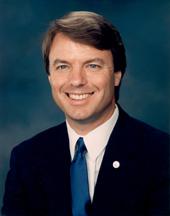 Sen. John Edwards (D-NC)
Legislative Activity
Stay on top of the latest movement without scrolling through every action
Senate amendment not agreed to: Amendment SA 1052 not agreed to in Senate by Yea-Nay Vote. 39 - 59. Record Vote Number: 248.
June 26, 2003
View full timeline
Senate amendment not agreed to: Amendment SA 1052 not agreed to in Senate by Yea-Nay Vote. 39 - 59. Record Vote Number: 248.
June 26, 2003
Roll call votes on amendments in Senate: Amendment SA 1052 not agreed to in Senate by Yea-Nay Vote. 39 - 59. Record Vote Number: 248.
June 26, 2003
Considered by Senate. (consideration: CR S8606, S8609-8610)
June 26, 2003
Amendment SA 1052 not agreed to in Senate by Yea-Nay Vote. 39 - 59. Record Vote Number: 248.
June 26, 2003
Senate amendment submitted
June 25, 2003
Senate amendment proposed (on the floor): Amendment SA 1052 proposed by Senator Edwards.(consideration: CR S8487; text: CR S8487)
June 25, 2003
Amendment SA 1052 proposed by Senator Edwards. (consideration: CR S8487; text: CR S8487) To strengthen protections for consumers against misleading direct-to-consumer drug advertising.
June 25, 2003
Votes
1 roll call on this amendment
Text
Proposed
PRESCRIPTION DRUG AND MEDICARE IMPROVEMENT ACT OF 2003

The PRESIDENT pro tempore. Under the previous order, the hour of 9:30
having arrived, the Senate will proceed to consideration of S. 1, which
the clerk will report.
The legislative clerk read as follows:

A bill (S. 1) to amend title XVIII of the Social Security
Act to make improvements in the medicare program, to provide
prescription drug coverage under the medicare program, and
for other purposes.

Pending:

Graham (FL) amendment No. 956, to provide that an eligible
beneficiary is not responsible for paying the applicable
percent of the monthly national average premium while the
beneficiary is in the coverage gap and to sunset the bill.
Kerry amendment No. 958, to increase the availability of
discounted prescription drugs.
Lincoln modified amendment No. 934, to ensure coverage for
syringes for the administration of insulin, and necessary
medical supplies associated with the administration of
insulin.
Lincoln amendment No. 935, to clarify the intent of
Congress regarding an exception to the initial residency
period for geriatric residency or fellowship programs.
Lincoln amendment No. 959, to establish a demonstration
project for direct access to physical therapy services under
the Medicare program.
Baucus (for Jeffords) amendment No. 964, to include
coverage for tobacco cessation products.
Baucus (for Jeffords) amendment No. 965, to establish a
Council for Technology and Innovation.
Nelson (FL) amendment No. 938, to provide for a study and
report on the propagation of concierge care.
Nelson (FL) amendment No. 936, to provide for an extension
of the demonstration for ESRD managed care.
Baucus (for Harkin) amendment No. 967, to provide improved
payment for certain mammography services.
Baucus (for Harkin) amendment No. 968, to restore
reimbursement for total body orthotic management for
nonambulatory, severely disabled nursing home residents.
Baucus (for Cantwell) amendment No. 942, to prohibit an
eligible entity offering a Medicare Prescription Drug plan, a
MedicareAdvantage Organization offering a MedicareAdvantage
plan, and other health plans from contracting with a pharmacy
benefit manager (PBM) unless the PBM satisfies certain
requirements.

[[Page S8480]]

Rockefeller amendment No. 975, to make all Medicare
beneficiaries eligible for Medicare prescription drug
coverage.
Akaka amendment No. 980, to expand assistance with coverage
for legal immigrants under the Medicaid program and SCHIP to
include citizens of the Freely Associated States.
Akaka amendment No. 979, to ensure that current
prescription drug benefits to Medicare-eligible enrollees in
the Federal Employees Health Benefits Program will not be
diminished.
Bingaman amendment No. 972, to provide reimbursement for
Federally qualified health centers participating in medicare
managed care.
Bingaman amendment No. 973, to amend title XVIII of the
Social Security Act to provide for the authorization of
reimbursement for all Medicare part B services furnished by
certain Indian hospitals and clinics.
Baucus (for Edwards) modified amendment No. 985, to
strengthen protections for consumers against misleading
direct-to-consumer drug advertising.
Baucus (for Lautenberg) amendment No. 986, to make
prescription drug coverage available beginning on July 1,
2004.
Murray amendment No. 990, to make improvements in the
MedicareAdvantage benchmark determinations.
Harkin amendment No. 991, to establish a demonstration
project under the Medicaid program to encourage the provision
of community-based services to individuals with disabilities.
Dayton amendment No. 960, to require a streamlining of the
Medicare regulations.
Dayton amendment No. 977, to require that benefits be made
available under part D on January 1, 2004.
Baucus (for Stabenow) amendment No. 992, to clarify that
the Medicaid statute does not prohibit a State from entering
into drug rebate agreements in order to make outpatient
prescription drugs accessible and affordable for residents of
the State who are not otherwise eligible for medical
assistance under the Medicaid program.
Baucus (for Dorgan) amendment No. 993, to amend title XVIII
of the Social Security Act to provide for coverage of
cardiovascular screening tests under the Medicare program.
Grassley amendment No. 974, to enhance competition for
prescription drugs by increasing the ability of the
Department of Justice and Federal Trade Commission to enforce
existing antitrust laws regarding brand name drugs and
generic drugs.
Durbin amendment No. 994, to deliver a meaningful benefit
and lower prescription drug prices.
Smith/Bingaman amendment No. 962, to provide reimbursement
for Federally qualified health centers participating in
Medicare managed care.
Hutchison amendment No. 1004, to amend title XVIII of the
Social Security Act to freeze the indirect medical education
adjustment percentage under the Medicare program at 6.5
percent.
Sessions amendment No. 1011, to express the sense of the
Senate that the Committee on Finance should hold hearings
regarding permitting States to provide health benefits to
legal immigrants under Medicaid and SCHIP as part of the
reauthorization of the temporary assistance for needy
families program.
Sununu amendment No. 1010, to improve outpatient Vision
services under part B of the Medicare program.
Conrad amendment No. 1019, to provide for coverage of self-
injected biologicals under part B of the Medicare program
until Medicare Prescription Drug plans are available.
Conrad amendment No. 1020, to permanently and fully
equalize the standardized payment rate beginning in fiscal
year 2004.
Conrad amendment No. 1021, to address Medicare payment
inequities.
Clinton amendment No. 1000, to study the comparative
effectiveness and safety of important Medicare covered drugs
to ensure that consumers can make meaningful comparisons
about the quality and efficacy.
Clinton amendment No. 999, to provide for the development
of quality indicators for the priority areas of the Institute
of Medicine, for the standardization of quality indicators
for Federal agencies, and for the establishment of a
demonstration program for the reporting of health care
quality data at the community level.
Clinton amendment No. 953, to provide training to long-term
care ombudsman.
Clinton amendment No. 954, to require the Secretary of
Health and Human Services to develop literacy standards for
informational materials, particularly drug information.
Reid (for Boxer) amendment No. 1036, to eliminate the
coverage gap for individuals with cancer.
Reid (for Corzine) amendment No. 1037, to permit Medicare
beneficiaries to use Federally qualified health centers to
fill their prescriptions.
Reid (for Jeffords) amendment No. 1038, to improve the
critical access hospital program.
Reid (for Inouye) amendment No. 1039, to amend title XIX of
the Social Security Act to provide 100 percent reimbursement
for medical assistance provided to a Native Hawaiian through
a Federally-qualified health center or a Native Hawaiian
health care system.

Amendment No. 988

Mr. THOMAS. I ask unanimous consent to lay aside the pending
amendments.
The PRESIDENT pro tempore. Without objection, it is so ordered.
Mr. THOMAS. I send an amendment to the desk.
The PRESIDENT pro tempore. The clerk will report.

The Senator from Wyoming [Mr. Thomas], for himself and Mrs.
Lincoln, proposes an amendment numbered 988.

Mr. THOMAS. Mr. President, I ask unanimous consent that the reading
of the amendment be dispensed with.
The PRESIDENT pro tempore. Without objection, it is so ordered.
The amendment is as follows:

(Purpose: To provide for the coverage of marriage and family therapist
services and mental health counselor services under part B of the
medicare program, and for other purposes)

At the end of subtitle B of title IV, add the following:

SEC. __. COVERAGE OF MARRIAGE AND FAMILY THERAPIST SERVICES
AND MENTAL HEALTH COUNSELOR SERVICES UNDER PART
B OF THE MEDICARE PROGRAM.

(a) Coverage of Services.--
(1) In general.--Section 1861(s)(2) (42 U.S.C. 1395x(s)(2))
is amended--
(A) in subparagraph (U), by striking ``and'' after the
semicolon at the end;
(B) in subparagraph (V)(iii), by inserting ``and'' after
the semicolon at the end; and
(C) by adding at the end the following new subparagraph:
``(W) marriage and family therapist services (as defined in
subsection (ww)(1)) and mental health counselor services (as
defined in subsection (ww)(3));''.
(2) Definitions.--Section 1861 (42 U.S.C. 1395x) is amended
by adding at the end the following new subsection:

``Marriage and Family Therapist Services; Marriage and Family
Therapist; Mental Health Counselor Services; Mental Health Counselor

``(ww)(1) The term `marriage and family therapist services'
means services performed by a marriage and family therapist
(as defined in paragraph (2)) for the diagnosis and treatment
of mental illnesses, which the marriage and family therapist
is legally authorized to perform under State law (or the
State regulatory mechanism provided by State law) of the
State in which such services are performed, as would
otherwise be covered if furnished by a physician or as an
incident to a physician's professional service, but only if
no facility or other provider charges or is paid any amounts
with respect to the furnishing of such services.
``(2) The term `marriage and family therapist' means an
individual who--
``(A) possesses a master's or doctoral degree which
qualifies for licensure or certification as a marriage and
family therapist pursuant to State law;
``(B) after obtaining such degree has performed at least 2
years of clinical supervised experience in marriage and
family therapy; and
``(C) in the case of an individual performing services in a
State that provides for licensure or certification of
marriage and family therapists, is licensed or certified as a
marriage and family therapist in such State.
``(3) The term `mental health counselor services' means
services performed by a mental health counselor (as defined
in paragraph (4)) for the diagnosis and treatment of mental
illnesses which the mental health counselor is legally
authorized to perform under State law (or the State
regulatory mechanism provided by the State law) of the State
in which such services are performed, as would otherwise be
covered if furnished by a physician or as incident to a
physician's professional service, but only if no facility or
other provider charges or is paid any amounts with respect to
the furnishing of such services.
``(4) The term `mental health counselor' means an
individual who--
``(A) possesses a master's or doctor's degree in mental
health counseling or a related field;
``(B) after obtaining such a degree has performed at least
2 years of supervised mental health counselor practice; and
``(C) in the case of an individual performing services in a
State that provides for licensure or certification of mental
health counselors or professional counselors, is licensed or
certified as a mental health counselor or professional
counselor in such State.''.
(3) Provision for payment under part b.--Section
1832(a)(2)(B) (42 U.S.C. 1395k(a)(2)(B)) is amended by adding
at the end the following new clause:
``(v) marriage and family therapist services and mental
health counselor services;''.
(4) Amount of payment.--Section 1833(a)(1) (42 U.S.C.
1395l(a)(1)) is amended--
(A) by striking ``and (U)'' and inserting ``(U)''; and
(B) by inserting before the semicolon at the end the
following: ``, and (V) with respect to marriage and family
therapist services and mental health counselor services under
section 1861(s)(2)(W), the amounts paid shall be 80 percent
of the lesser of the actual charge for the services or 75
percent of the amount determined for payment of a
psychologist under subparagraph (L)''.
(5) Exclusion of marriage and family therapist services and
mental health counselor services from skilled nursing

[[Page S8481]]

facility prospective payment system.--Section
1888(e)(2)(A)(ii) (42 U.S.C. 1395yy(e)(2)(A)(ii)), as amended
in section 301(a), is amended by inserting ``marriage and
family therapist services (as defined in subsection (ww)(1)),
mental health counselor services (as defined in section
1861(ww)(3)),'' after ``qualified psychologist services,''.
(6) Inclusion of marriage and family therapists and mental
health counselors as practitioners for assignment of
claims.--Section 1842(b)(18)(C) (42 U.S.C. 1395u(b)(18)(C))
is amended by adding at the end the following new clauses:
``(vii) A marriage and family therapist (as defined in
section 1861(ww)(2)).
``(viii) A mental health counselor (as defined in section
1861(ww)(4)).''.
(b) Coverage of Certain Mental Health Services Provided in
Certain Settings.--
(1) Rural health clinics and federally qualified health
centers.--Section 1861(aa)(1)(B) (42 U.S.C. 1395x(aa)(1)(B))
is amended by striking ``or by a clinical social worker (as
defined in subsection (hh)(1)),'' and inserting ``, by a
clinical social worker (as defined in subsection (hh)(1)), by
a marriage and family therapist (as defined in subsection
(ww)(2)), or by a mental health counselor (as defined in
subsection (ww)(4)),''.
(2) Hospice programs.--Section 1861(dd)(2)(B)(i)(III) (42
U.S.C. 1395x(dd)(2)(B)(i)(III)) is amended by inserting ``or
a marriage and family therapist (as defined in subsection
(ww)(2))'' after ``social worker''.
(c) Authorization of Marriage and Family Therapists To
Develop Discharge Plans for Post-Hospital Services.--Section
1861(ee)(2)(G) (42 U.S.C. 1395x(ee)(2)(G)) is amended by
inserting ``marriage and family therapist (as defined in
subsection (ww)(2)),'' after ``social worker,''.
(d) Effective Date.--The amendments made by this section
shall apply with respect to services furnished on or after
January 1, 2004.

Mr. THOMAS. This extends the opportunity to directly pay medical
health consultants. I will discuss it later. In the meantime, I will
set it aside for later discussion.
The PRESIDENT pro tempore. Without objection, it is so ordered.
The Senator from California.
Mrs. BOXER. Mr. President, I take a couple of minutes to explain an
amendment we will be voting on later that was introduced on my behalf
by Senator Reid and to let my colleagues know I think it is a stunning
situation when suddenly, after fighting back all the amendments that we
had to try to improve the benefits, that we are giving our seniors--
miraculously there is $12 billion found and it will start a whole new
experiment, which may be very interesting and may be just fine. It will
push some people out of Medicare and see if it works better in the
private sector. I hate to say we have tried it and it hasn't worked but
that is fine.
At the same time, we are going to allow Medicare to do more
prevention and do more pharmaceutical benefit. We will see what that
looks like when it comes to us.
The point I am making, yesterday the Senator from Pennsylvania was
railing against some Members who wanted to make this plan better
because there was no money. It was so expensive. But they found money
to do some experiment.
Today I have an amendment to give people a chance to decide if they
want to help people with cancer, if they want to help people who are
diagnosed with cancer.
I don't know if you have ever had the experience of having cancer in
your family, but surely we all know people who have had that
experience. Life in that family comes to a halt. People are reeling
from the diagnosis of cancer, whether it is breast cancer, lung cancer,
prostate cancer, colon cancer, stomach cancer, blood cancer which is
leukemia, lymphoma; millions of Americans are touched. And we have a
drug benefit that stops at $4,500 and then $1,300 later you start
getting help for your medication.
Yesterday, I gave the Senate a chance to close that benefit shutdown,
close that coverage gap, and the Senate refused to do it, mostly on a
party-line vote.
Today I offer an amendment to let people redeem themselves. What I
say is, if you are diagnosed with cancer, you should never have your
drug benefit shut down. You are reeling from this diagnosis. You are
sick with this disease. And you should not have to worry about whether
you can afford your medicine.
Later in the day we are going to have a chance to see if people are
willing to have enough compassion in their heart to stop the benefit
shutdown for families where there is a cancer diagnosis. Why do I
choose cancer? I could have chosen a number of other diseases. I chose
that one because it touches so many families. If it passes, I am going
to offer one where there is an Alzheimer's diagnosis. If that passes, I
will offer one where there is a Parkinson's diagnosis.
There are a couple of good things in this bill. It starts a
prescription drug benefit. That is a plus. We are going to have to fix
it. It is a mess. It is the only plan in the country I have found that
has such a benefit shutdown. The premiums can go up at any time. HMOs
and PPOs can drop out of the business and then you do not know what you
are going to do. The fact there is a benefit is important. And it is
generous to those who are very poor.
But I want it to be fair to those in the middle class and I want it
to be fair to those who need their pharmaceutical products the most. So
I am going to give my colleagues a chance to end the benefit shutdown
for people who have cancer. If you want to vote no, vote no. If you
want to tell people you had a chance to make sure they have those
pharmaceutical products through a period of their lives when they are
frightened, when they are fighting a disease, go ahead. Do it. Do it.
But I ask you to look inside your soul. You are about to vote on a
new program of $12 billion. Don't walk away from the people with cancer
just to give money to HMOs, because that vote will come back to haunt
you. That is how I feel.
I was very disappointed yesterday that we had a straight party-line
vote, pretty much, on my amendment to end the benefit shutdown. But
around here you have to be held accountable for what you do. So I am
going to give people a chance to come back and say, OK, in the case of
cancer, people are not going to have their benefits shut down. Just
imagine what it is like, going through chemotherapy, taking all kinds
of risks so you can live, because chemotherapy, as you know, basically
kills a lot of healthy cells, too.
And, if that is not enough, you are going to have to deal with the
accountants with their eyeshades in the HMOs, who will say, What have
you done? You really didn't get to $4,500. Why are you shutting down my
benefit? You will be begging them not to shut you out because your
doctor says if you miss this medicine you could reverse the progress
you are making on this disease.
I am going to stop discussing this amendment. I think it is pretty
clear. Senators will have a chance to help people with cancer. If you
do not want to do it, then you have to live with that vote.
Mr. President, I yield the floor and I look forward to this vote on
my amendment.
The PRESIDENT pro tempore. The Democratic leader.
Mr. DASCHLE. Mr. President, under the unanimous consent agreement we
reached last night, there was scheduled an amendment to be voted upon,
the so-called Grassley benchmark amendment, at 10 o'clock. We have not
yet had the opportunity to review the amendment. As I understand it, it
is still being negotiated. So we are not in a position, obviously, to
agree to the amendment at 10 o'clock. We look forward to consulting
with both managers of the bill. Certainly I will be talking to the
majority leader as we continue to work to bring the amendment to the
floor.
Given the fact we are not yet at a position to vote, it would not be
my expectation that there would be a vote at 10 o'clock.
I yield the floor and I suggest the absence of a quorum.
The PRESIDING OFFICER (Mr. Graham of South Carolina). The clerk will
call the roll.
The legislative clerk proceeded to call the roll.
Mr. BINGAMAN. Mr. President, I ask unanimous consent that the order
for the quorum call be rescinded.
The PRESIDING OFFICER. Without objection, it is so ordered.

Amendment No. 972

Mr. BINGAMAN. Mr. President, I ask unanimous consent to call up
amendment No. 972 on Medicare community health center payments.
The PRESIDING OFFICER. That amendment is pending before the Senate.

[[Page S8482]]

Mr. BINGAMAN. I ask unanimous consent to revise the list of sponsors
of the amendment to read: Senators Snowe, Bingaman, Smith, Hollings,
and Hatch.
The PRESIDING OFFICER. Without objection, it is so ordered.
Mr. BINGAMAN. Mr. President, I thank the chairman and ranking member
for agreeing to this very important amendment related to our Nation's
community health centers. I also thank Senator Snowe, with whom all who
are now cosponsoring this amendment introduced S. 654, the Medicare
Safety Net Access Act of 2003. Her leadership on the Nation's community
health centers has been unwavering and has made it possible to get to
the point where we can adopt this amendment.
I also thank Senator Smith, Senator Hollings, Senator Hatch, and
Senator Conrad for their longstanding advocacy support for community
health centers. Senator Smith and Senator Hollings need to be thanked
for their constant advocacy and push to see this amendment pass.
In addition, it should be noted that Senators Hatch and Conrad
spearheaded a very similar effort to protect community health centers
in the Medicaid Program back in 1997.
As we proceed with the passage of S. 1, we need to be careful not to
create potential unintended consequences as a result of our actions.
This amendment corrects an important unintended consequence that this
legislation could have had on our Nation's community health centers.
Community health centers have broad bipartisan support. The President
and the Congress have committed to doubling the funding for community
health centers over a 5-year period. The health centers provide care
for over 13 million people annually. Nearly one million of those are
low-income Medicare beneficiaries. They receive section 330 Federal
Public Health Service Act grant funds to support care for the uninsured
and for low-income patients. To ensure those grant funds are used
entirely for that purpose, Congress has specifically taken action to
ensure that both Medicare and Medicaid are fully reimbursing health
centers for the costs associated with the care provided for Medicare
and Medicaid beneficiaries.
Simply put, the funding intended for low-income and uninsured people
should not be diverted and instead used to subsidize Medicare
underpayments. Therefore, health centers are reimbursed by Medicare
under a cost-base system. This amendment would simply extend the same
requirement to the new Medicare Advantage programs by ensuring that
community health centers are provided with a wraparound or supplemental
payment equal to the difference between the payments they now receive
under Medicare generally and the payment they would receive from
Medicare Advantage plans. This is not a new concept.
In 1997, Congress allowed States to dramatically increase the number
of patients who were enrolled in Medicaid managed care. We recognized
the potential adverse impact on community health centers, and to deal
with that we required the Medicaid Program to provide a wraparound or
supplemental payment for the difference between the managed care
organizations payment and a health centers reasonable cost. Again,
Senators Hatch and Conrad were instrumental in that effort.
With this important amendment we are proposing today we would do the
same in the Medicare Program. According to testimony Tom Scully gave at
the Center for Medicare and Medicaid Services and testimony that the
Congressional Budget Office gave on the 13th of June, their estimates
for how many Medicare beneficiaries actually were enrolled in the
private health plans ranged all over the board. It went from 9 percent
in one estimate, the CBO estimate, to 43 percent, the estimate that Tom
Scully's actuaries developed. It was a fivefold difference in those
estimates.

In the words of Dr. Holtz-Eakin, the head of the CBO, these are
honest differences in trying to read a very uncertain future.
We do have clearly ahead of us a very uncertain future as to how many
people will choose to leave traditional Medicare and move into the
private plans. Mr. Scully is correct that health centers will lose
their guarantee of cost-base reimbursement to 43 percent of their
Medicare patients. Potentially, this could result in centers having to
dip into their Federal grant fund money intended to provide care to the
uninsured, and they would have to dip into those Federal grant funds in
order to make up for losses they were incurring trying to provide
services to Medicare patients.
Our Nation's safety net is already fragile. We need to take this
action to ensure we are not jeopardizing it through the passage of this
legislation.
Again, both the President and Congress have committed to double the
capacity of our Nation's health centers to deal with the growing number
of uninsured in this country. In light of this, the amendment we are
offering today would protect the vital role that health centers play.
It would ensure that health centers are not forced to decide either
between subsidizing the Medicare Program with their grant dollars or
refusing to provide services to some of the 1 million low-income
Medicare beneficiaries that currently depend upon them for services.
I thank the chairman and ranking member for agreeing to accept this
amendment. I thank all the chief sponsors, Senator Snowe, and all
cosponsors for their hard work. I believe it is a very important
amendment. I urge my colleagues to support it.
Ms. SNOWE. Mr. President, I rise today to speak on behalf of the
amendment that I am offering today with Senator Bingaman, a longtime
champion of community health centers and the original cosponsor of the
legislation that we introduced, S. 654, the Medicare Safety Net Access
Act, from which this provision has been taken. I also would like to
thank my colleagues, Senators Hatch and Smith for their help in moving
this important policy change forward. Chairman Grassley and Senator
Baucus also should be recognized for their work on behalf of Community
Health Centers. Their willingness to work with me has made adoption of
this policy possible.
This amendment will help ensure that Community Health Centers remain
a viable and integral part of the health care delivery system for
Medicare beneficiaries and rural communities at large. Community Health
Centers, also known as Federally qualified health centers, provide care
to millions of medically underserved Medicare beneficiaries. In many
cases, Community Health Centers are the only source of primary and
preventive services to which these beneficiaries have access. This is
especially true for people living in America's rural and inner-city
medically underserved areas.
As many of you know, under the traditional fee-for-service program
Community Health Centers currently are reimbursed by Medicare bases on
the cost to deliver care. However, because managed care plans, such as
those expected to be used under the new MedicareAdvantage program, use
capitated rates, which are negotiated rates based on patient volume and
often are lower than the fee-for-service cost-reimbursement rate,
Community Health Centers would likely experience substantial reductions
in payments.
If, as CMS predicts, over 40 percent of seniors enter the new
MedicareAdvantage program, Community Health Centers would experience a
substantial loss of revenue because their payment for almost half of
their clients would be based on a capitated rate. If this happens,
Community Health Centers would be unable to meet the growing demand of
serving the Medicare population.
This amendment ensures that doesn't happen. Starting in 2006, if the
capitated rate that a Community Health Center receives from a
participating MedicareAdvantage plan is less than the fee-for-service
cost reimbursement rate, the Medicare program will pay the difference
in the amount. This is done presently under the Medicaid program and it
should be no different under the Medicare program.
Community Health Centers are an invaluable component in the health
care delivery system in rural communities and I am pleased that this
amendment has been accepted into S. 1.
Mr. HATCH. Mr. President, I rise in strong support of the Bingaman-
Snowe-Hatch amendment. This amendment addresses an important issue for
both Medicare beneficiaries and community health centers by ensuring
that

[[Page S8483]]

Medicare beneficiaries, regardless of their Medicare health coverage
choice, would receive seamless coverage if they choose to receive
services from a community health center. And, it provides the Community
Health Centers the ability to give the Medicare beneficiaries that they
serve seamless health coverage as well.
I have been a strong supporter of community health centers for many
years. These health centers provide care to over 13 million people
annually; nearly one million are low-income Medicare beneficiaries.
These health centers receive funding under the Public Health Service
Act in order to provide quality care to their uninsured and low-income
patients. To ensure those dollars are used only to provide health care
to health center patients, Congress has taken action to ensure that
both the Medicare and Medicaid programs are reimbursing health centers
for the costs associated with care to Medicare and Medicaid
beneficiaries. Therefore, community health centers are reimbursed by
Medicare and Medicaid under a cost-based system.
In 1997, Congress allowed States to increase greatly the number of
patients enrolled in Medicaid managed care by requiring the Medicaid
program to provide a ``wrap-around' payments for the difference between
the managed care organization's payment and a health center's
reasonable costs.
This amendment ensures that we do the same thing for Medicare
beneficiaries in the MedicareAdvantage program. More specifically, the
amendment ensures that community health centers are provided with a
``wrap-around'' or supplemental payment equal to the difference between
the payments they now receive under Medicare through the cost-based
system and the payment they would receive from MedicareAdvantage plans.
Officials at the Centers for Medicare and Medicaid Services and the
Congressional Budget Office estimate that nine to 43 percent of
Medicare beneficiaries will enroll in private health plans offered
through the MedicareAdvantage program. If these estimates are accurate,
then health centers will lose their guarantee of cost-based
reimbursement for up to 43 percent of their Medicare patients. This
could result in centers having to dip into their Federal funding
received through the Public Health Service Act. This funding is
intended to provide care to the uninsured--not to fill in the gaps for
certain Medicare health center patients.
The Bingaman-Snowe-Hatch amendment would not only protect the vital
role of health centers but would also ensure that these health centers
would continue to provide seamless health coverage to one million low-
income Medicare beneficiaries. I urge my colleagues to support this
amendment.
I suggest the absence of a quorum.
The PRESIDING OFFICER. The clerk will call the roll.
The assistant legislative clerk proceeded to call the roll.
Mr. GRASSLEY. Mr. President, I ask unanimous consent that the order
for the quorum call be rescinded.
The PRESIDING OFFICER. Without objection, it is so ordered.
Mr. GRASSLEY. Mr. President, I ask unanimous consent that at 11
o'clock today, the Senate proceed to a vote in relation to amendment
No. 972 and that the amendment now be considered as being proposed by
Senators Snowe, Bingaman, and Hatch; further, that following that vote,
there be 2 minutes equally divided for further debate prior to a vote
in relation to the Edwards amendment, No. 985, to be followed by 2
minutes equally divided and a vote in relation to the Graham amendment,
No. 956, with no second-degree amendments in order prior to the vote.
Finally, I ask unanimous consent that the time until the votes be
equally divided between the two managers or their designees, and I
further modify the request to allow 4 minutes equally divided prior to
the Edwards vote.
The PRESIDING OFFICER. Is there objection?

Amendment No. 985, As Modified Further

Mr. EDWARDS. Mr. President, reserving the right to object, I have a
modification at the desk with additional modifications. I ask unanimous
consent, first, that the modification be accepted.
The PRESIDING OFFICER. The amendment is further modified.
The amendment (No. 985), as modified further, is as follows:

At the end, add the following:

TITLE __--DIRECT-TO-CONSUMER PRESCRIPTION DRUG ADVERTISING

SEC. __01. HEAD-TO-HEAD TESTING AND DIRECT-TO-CONSUMER
ADVERTISING.

(a) New Drug Application.--Section 505 of the Federal Food,
Drug, and Cosmetic Act (21 U.S.C. 355) is amended--
(1) in subparagraph (A) of the second sentence of
subsection (b)(1), by inserting before the semicolon at the
end the following ``(including, if the Secretary so requires,
whether the drug is safe and effective for use in comparison
with other drugs available for substantially the same
indications for use prescribed, recommended, or suggested in
the labeling proposed for the drug)''; and
(2) in subsection (d)(5)--
(A) by inserting ``(A)'' after ``will''; and
(B) by inserting after ``thereof'' the following: `` or (B)
if the Secretary has required information related to
comparative safety or effectiveness, offer a benefit with
respect to safety or effectiveness (including effectiveness
with respect to a subpopulation or condition) that is greater
than the benefit offered by other drugs available for
substantially the same indications for use prescribed,
recommended, or suggested in the labeling proposed for the
drug''.
(b) Misbranding.--Section 502(n)(3) of the Federal Food,
Drug, and Cosmetic Act (21 U.S.C. 352(n)(3)) is amended by
inserting after ``effectiveness'' the following: ``(including
effectiveness in comparison to similar drugs for
substantially the same condition or conditions)''.
(c) Regulations.--
(1) In general.--Not later than 180 days after the date of
enactment of this Act, the Secretary of Health and Human
Services shall promulgate amended regulations governing
prescription drug advertisements.
(2) Contents.--In addition to any other requirements, the
regulations under paragraph (1) shall require that--
(A) any advertisement present a fair balance, comparable in
depth and detail, between--
(i) information relating to effectiveness of the drug
(including effectiveness in comparison to other drugs for
substantially the same condition or conditions);
(ii) information relating to side effects and
contraindications; and
(B) any advertisement present a fair balance, comparable in
depth, between--
(i) aural and visual presentations relating to
effectiveness of the drug; and
(ii) aural and visual presentations relating to side
effects and contraindications, provided that, nothing in this
section shall require explicit images or sounds depicting
side effects and contraindication.
(C) prohibit false or misleading advertising that would
encourage a consumer to take the prescription drug for a use
other than a use for which the prescription drug is approved
under section 505 of the Federal Food, Drug, and Cosmetic Act
(21 U.S.C. 355); and
(D) require that any prescription drug that is the subject
of a direct-to-consumer advertisement include in the package
in which the prescription drug is sold to consumers a
medication guide explaining the benefits and risks of use of
the prescription drug in terms designed to be understandable
to the general public.

SEC. __02. CIVIL PENALTY.

Section 303 of the Federal Food, Drug, and Cosmetic Act (21
U.S.C. 333) is amended by adding at the end the following:
``(h) Direct-to-Consumer Prescription Drug Advertising.--
``(1) In general.--A person that commits a violation of
section 301 involving the misbranding of a prescription drug
(within the meaning of section 502(n)) in a direct-to-
consumer advertisement shall be assessed a civil penalty if--
``(A) the Secretary provides the person written notice of
the violation; and
``(B) the person fails to correct or cease the
advertisement so as to eliminate the violation not later than
180 days after the date of the notice.
``(2) Amount.--The amount of a civil penalty under
paragraph (1)--
``(A) shall not exceed $500,000 in the case of an
individual and $5,000,000 in the case of any other person;
and
``(B) shall not exceed $10,000,000 for all such violations
adjudicated in a single proceeding.
``(3) Procedure.--Paragraphs (3) through (5) of subsection
(g) apply with respect to a civil penalty under paragraph (1)
of this subsection to the same extent and in the same manner
as those paragraphs apply with respect to a civil penalty
under paragraph (1) or (2) of subsection (g).''.

SEC. __03. REPORTS.

The Secretary of Health and Human Services shall annually
submit to the Committee on Health, Education, Labor, and
Pensions of the Senate and the Committee on Energy and
Commerce of the House of Representatives a report that, for
the most recent 1-year period for which data are available--
(1) provides the total number of direct-to-consumer
prescription drug advertisements made by television, radio,
the Internet, written publication, or other media;
(2) identifies, for each such advertisement--
(A) the dates on which, the times at which, and the markets
in which the advertisement was made; and
(B) the type of advertisement (reminder, help-seeking, or
product-claim); and
(3)(A) identifies the advertisements that violated or
appeared to violate section 502(n)

[[Page S8484]]

of the Federal Food, Drug, and Cosmetic Act (21 U.S.C.
352(n)); and
(B) describes the actions taken by the Secretary in
response to the violations.

SEC. __04. REVIEW OF DIRECT-TO-CONSUMER DRUG ADVERTISEMENTS.

(a) In General.--The Secretary of Health and Human Services
shall expedite, to the maximum extent practicable, reviews of
the legality of direct-to-consumer drug advertisements.
(b) Policy.--The Secretary of Health and Human Services
shall not adopt or follow any policy that would have the
purpose or effect of delaying reviews of the legality of
direct-to-consumer drug advertisements except--
(1) as a result of notice-and-comment rulemaking; or
(2) as the Secretary determines to be necessary to protect
public health and safety.

The PRESIDING OFFICER. The Senator from Nevada.
Mr. REID. Mr. President, for the information of Senators, we are
going to have this block of votes. Then there is going to be a period
of time where the two leaders have agreed there would be no amendments
voted on. At about 2:30 or quarter to 3, we are going to try to line up
a batch of votes to take up time this afternoon.
So for the information of Senators, at 2:30 or quarter to 3, the two
managers and leaders are going to try to line up a bunch of votes.

Amendment No. 985, As Modified Further

Mr. EDWARDS. Mr. President, I rise today, together with my friend,
Senator Tom Harkin from Iowa, to introduce an amendment to bring down
the cost of prescription drugs. As everyone knows, the cost of
prescription drugs has been skyrocketing. We have to bring these costs
under control, not only to lower the drug costs for seniors but also to
lower drug costs for all Americans, including those who will not get a
prescription drug benefit under the Medicare Program.
There are lots of reasons drug costs are rising, and I have offered
several proposals to address that in the past. This amendment addresses
two particular concerns. The first is what is called the ``me too''
drugs that provide minimal benefits for people but large profits for
drug companies. The second is the massive growth in the direct-to-
consumer advertising that does not genuinely educate consumers.
This amendment, from Tom Harkin and me, would address these problems
with two steps. First, we call on the Secretary of HHS to require drug
manufacturers to prove that ``me too'' drugs actually provide benefits
before they are approved. Second, we would impose new requirements for
fairness and balance in drug advertising.
Drug companies provide a very important service to America and to the
sick. They deserve to make a profit for that, all of us agree on that.
But they should also fulfill their mission as businesses, to generate
innovative drugs that reduce pain, alleviate suffering, and cure
disease.
Unfortunately, many drug companies seem to be giving that mission
short shrift. We know they spend far more on marketing, advertising,
and administration than they spend on research and development. We also
know that instead of focusing on truly innovative breakthroughs, drug
companies are focusing on ``me-too'' drugs to compete against
blockbuster treatments for chronic conditions like allergies and high
cholesterol. I want to talk about that for a minute.
Me-too drugs can be good things. They can help a specific population,
or they can be safer and more effective. Of course those are good
things. But here is the problem. Companies should not be able to profit
off of a me-too drug just by misleading consumers about the benefits
compared to existing drugs. Consumers should know how exactly the new
drug stacks up against the existing drug.

Senator Clinton spoke of the same need last night, when she
introduced her very sound amendment. Consumers need to be given the
ability to make an informed choice about the best drug for them.
This amendment would give the Secretary of HHS the authority to
require drug companies to test drugs against their competitors. And if
the drug company is going to advertise its ``me-too'' drug, it should
tell the consumer how that drug compares to what they may already be
taking for that condition.
Now, I want to talk about the larger point, which is drug
advertising.
Some drug advertising is a good thing. Drug ads can let people know
about drugs about which they don't otherwise hear. The drug industry's
major trade group, PhRMA, says the purpose of direct-to-consumer
advertising is:

. . . to educate consumers about diseases, about the symptoms
that may help them identify diseases, and the available
therapies developed to treat them.

Those are good. Those are good goals. Here is the problem. Does
anyone think drug advertising today is genuinely about educating
consumers, as PhRMA says, rather than marketing? Does anyone believe
that?
Are drug companies educating consumers about allergy medicines by
showing this picture of a woman running through a field? I think all of
us know, when this kind of advertisement, as in this picture, is shown
on television, it is clearly about selling and about marketing. This is
not for the purpose of educating consumers, and the American people
know that. They know that without anyone telling them that.
Are they educating consumers about arthritis with images of a couple
dancing in their kitchen? If this were about education, would an
announcement read: ``Health warnings: Headache, nausea,'' and so on,
while the picture on the screen still shows happy pictures of a mom and
her kids? Absolutely not. These ads are not about education; they are
about marketing.
There is nothing wrong with marketing and persuasion in most
contexts. If they are selling paper towels or shaving cream, companies
should go ahead and market as aggressively as they can. But
prescription drugs are different. There is nothing more important in
our lives than our health, and there is nothing more important than
drugs for our health. These are matters of life and death for families,
for seniors, and for kids. Advertisements for these products should be
held to a much higher standard. They should educate, not just market.
That is not what these ads do. You don't have to take my word for it;
that is what Consumer Reports says, that is what doctors say, and, most
importantly, it is what common sense says. These ads make promises they
cannot keep. They overstate benefits and they understate risks. Let me
give just a couple of examples from recent research.
This is from a study from the magazine Consumer Reports. They studied
drug ads and they found:

. . . a broad and disconcerting range of misleading messages:
ads that minimize the product's risk, exaggerated its
efficacy, made false claims of superiority over competing
products; promoted unapproved uses for an approved drug; or
promoted use of a drug still in the experimental stage.

In a recent FDA survey of 500 general practitioners, family doctors,
7 out of 10 said advertisements about drugs confused patients about the
risks and benefits of medicines. In another study, 75 percent of
doctors said their patients came away with the impression that the
drugs they saw in advertisements work better than they actually do.
The Kaiser Family Foundation did a survey of nearly 2000 adults who
saw drug advertisements; 7 out of 10 said they learned little or
nothing about what the treated condition; 6 out of 10 said they learned
little or nothing about the drug. Here are comments from Arnold Relman
and Marcia Angell, two former editors-in-chief of the New England
Journal of Medicine. They said:

DTC ads mainly benefit the bottom line of the drug
industry, not the public. They mislead consumers more than
they inform them, and they pressure physicians to prescribe
new, expensive, and often marginally helpful drugs, although
a more conservative option might be better for the patient.

So this amendment is simple. It says that drug ads should be
balanced. They should include information about other drugs that may
address conditions better. And they should have a real balance between
the images selling the drug and the images questioning the drug.
Now, the Bush administration sees it differently. They think see it
as drug companies should be able to use whatever marketing gimmicks
they want to sell their drugs.
The FDA is supposed to stop ads that are misleading. But last year
the Bush administration's FDA instituted a new policy that slows down
the FDA's efforts. As a result, the FDA issued two-thirds fewer warning
letters last year

[[Page S8485]]

than the year before. The GAO looked into this and found that warning
letters are often ``not issued until after the advertising campaign has
run its course.''
This is a gift to the drug companies. Without the threat of a warning
letter, they can basically air whatever kind of ad they want and just
ask for forgiveness afterwards.
Take the case of an ad for the prescription drug Tamiflu that ran on
the radio last year. It featured Eric Bergoust, the Olympic gold-medal
skier, who said ``I felt better so soon that I didn't miss a single day
of training.'' The FDA told the drug maker Hoffmann-La Roche to stop
running the ad because Bergoust's words ``misleadingly overstated the
drug's efficacy.'' But the FDA's request came nearly three months after
the company had submitted the ad for review, a month after the flu
season had ended, and well after the company stopped running the ad.
Our amendment would make sure this kind of thing cannot happen. The
FDA should speed up the review process and use their authority to have
misleading ads pulled before millions of consumers have already seen
them. And drug companies need to be held accountable when they
repeatedly violate FDA regulations. In this amendment, Senator Harkin
and I call for stiff civil penalties for such offenders.
So, in short, this amendment would not bar all direct-to-consumer
advertising. It would simply require the advertising to educate, rather
than simply market. I urge my colleagues to support this amendment.
This amendment is for the purpose of doing something to control drug
advertising, to make sure that it is, in fact, about education, and to
make sure these ``me too'' drugs actually have a benefit before they
are approved by the FDA.
Thank you, Mr. President.

Vote On Amendment No. 972

The PRESIDING OFFICER. The hour of 11 a.m. having arrived, the
question is on agreeing to amendment No. 972, proposed by Senators
Snowe, Bingaman, and Hatch.
Mr. EDWARDS. Mr. President, I ask for the yeas and nays.
The PRESIDING OFFICER. Is there a sufficient second?
There appears to be a sufficient second.
The clerk will call the roll.
The assistant legislative clerk called the roll.
Mr. McCONNELL. I announce that the Senator from Colorado (Mr.
Campbell) and the Senator from Arizona (Mr. McCain) are necessarily
absent.
I further announce that if present and voting the Senator from
Arizona (Mr. McCain) would vote ``yea.''
Mr. REID. I announce that the Senator from Florida (Mr. Graham), the
Senator from Massachusetts (Mr. Kerry), and the Senator from
Connecticut (Mr. Lieberman) are necessarily absent.
I further announce that, if present and voting, the Senator from
Massachusetts (Mr. Kerry) would vote ``yea.''
The PRESIDING OFFICER. Are there any other Senators in the Chamber
desiring to vote?
The result was announced--yeas 94, nays 1, as follows:

[Rollcall Vote No. 242 Leg.]

YEAS--94

Akaka
Alexander
Allard
Allen
Baucus
Bayh
Bennett
Biden
Bingaman
Bond
Boxer
Breaux
Brownback
Bunning
Burns
Byrd
Cantwell
Carper
Chafee
Chambliss
Clinton
Cochran
Coleman
Collins
Conrad
Cornyn
Corzine
Craig
Crapo
Daschle
Dayton
DeWine
Dodd
Dole
Domenici
Dorgan
Durbin
Edwards
Ensign
Enzi
Feingold
Feinstein
Fitzgerald
Frist
Graham (SC)
Grassley
Hagel
Harkin
Hatch
Hollings
Hutchison
Inhofe
Inouye
Jeffords
Johnson
Kennedy
Kohl
Kyl
Landrieu
Lautenberg
Leahy
Levin
Lincoln
Lott
Lugar
McConnell
Mikulski
Miller
Murkowski
Murray
Nelson (FL)
Nelson (NE)
Nickles
Pryor
Reed
Reid
Roberts
Rockefeller
Santorum
Sarbanes
Schumer
Sessions
Shelby
Smith
Snowe
Specter
Stabenow
Stevens
Sununu
Talent
Thomas
Voinovich
Warner
Wyden

NAYS--1

Gregg

NOT VOTING--5

Campbell
Graham (FL)
Kerry
Lieberman
McCain
The amendment (No. 972) was agreed to.
Mr. GRASSLEY. Mr. President, I move to reconsider the vote.
Mr. BROWNBACK. I move to lay that motion on the table.
The motion to lay on the table was agreed to.
Mr. BAUCUS. Mr. President, I ask unanimous consent that the time for
the next two votes be limited to 10 minutes.
The PRESIDING OFFICER. Without objection, it is so ordered.

Amendment No. 985, As Modified Further

The PRESIDING OFFICER. There are 4 minutes equally divided on the
Edwards amendment prior to a vote.
Who yields time?
The Senator from North Carolina.
Mr. EDWARDS. Mr. President, the purpose of this amendment is to do
something about the skyrocketing costs of prescription drugs in this
country. Whatever we do to provide a real prescription drug benefit for
seniors under Medicare, both for the purpose of keeping the cost of
that plan down and for the purpose of doing something for all Americans
who have no prescription drug coverage, we have to bring the cost of
prescription drugs under control.
There are two abuses at which this amendment is aimed: First,
stopping the proliferation of ``me too'' drugs that have no meaningful
benefit; second, stopping the abuses in advertising.
Everyone has seen the ads: Couples dancing in the kitchen; people
running through fields. These are not for the purpose of education.
They are for the purpose of marketing. We are trying to bring this
under control by putting fairness, honesty, and accuracy in that
advertising.
The purpose of the amendment is to help control both those activities
and, in the process, bring down the cost of prescription drugs.
Mr. President, I ask my colleague, the coauthor of this amendment,
Senator Harkin from Iowa, what he believes we need to do to bring down
the cost of prescription drugs. I yield to Senator Harkin.
The PRESIDING OFFICER. The Senator from Iowa.
Mr. HARKIN. Mr. President, parliamentary inquiry: What type of time
agreement are we under now?
The PRESIDING OFFICER. Four minutes equally divided. The Senator has
31 seconds.
Mr. HARKIN. Mr. President, I thank my colleague from North Carolina
for offering his amendment of which I am a cosponsor. Every time I go
back to Iowa, I hear from consumers and others: Why do I get inundated
with all these ads, and I cannot buy them unless I go to the doctor?
Right now, the drug companies are spending more on advertising every
year than they are on research, and we wonder why the price of drugs
keeps going up.
This all changed a few years ago. If my colleagues will remember,
before 1997, we did not see all these ads. Now it is time to cut out
this massive advertising of drugs that we cannot even buy in the
marketplace.
The PRESIDING OFFICER. The Senator's time has expired.
Mr. GRASSLEY. Mr. President, I yield the 2 minutes on this side to
the Senator from Wyoming.
The PRESIDING OFFICER. The Senator from Wyoming.
Mr. ENZI. Mr. President, I ask the body to vote no on the Edwards
amendment to increase drug costs. This is a new drug approval. The
amendment masquerades as a direct-to-consumer advertising amendment
while sweeping away carefully calibrated FDA drug approval standards.
While the Edwards amendment masquerades as an amendment to
``strengthen protections against misleading direct-to-consumer
advertising,'' the amendment drastically changes the requirements for
drug approval in the United States.
We have a great system that is working. Under the current law,
pharmaceuticals must demonstrate they are safe and effective to be
approved by the Food and Drug Administration. Under the Edwards
amendment, the Secretary of Health and Human Services would be
authorized to vary this standard on a

[[Page S8486]]

drug-by-drug basis to create new hurdles to drug approvals.
These new hurdles include lengthy, costly comparative trials and a
showing that the drug is safer or more effective for a subpopulation or
condition than a previously approved drug.
These changes to fundamental, longstanding law could hurt patients by
delaying, and possibly denying, the approval of new drugs that patients
need; by dramatically adding to drug development costs, discouraging
companies from developing additional drugs to treat the same
conditions; and increasing drug spending by reducing brand-to-brand
competition.
We know far more about pharmaceuticals than many other medical
interventions since, unlike most other interventions, they must obtain
approval under FDA's safe and effective standard before they can be
used. We should reject this amendment as it would add another
regulatory hurdle to the already long and costly drug development and
approval process.
The PRESIDING OFFICER. All time has expired. The question is on
agreeing to amendment No. 985, as modified further.
Mr. EDWARDS. Mr. President, I ask for the yeas and nays.
The PRESIDING OFFICER. Is there a sufficient second?
There appears to be a sufficient second. The clerk will call the
roll.
The bill clerk called the roll.
Mr. McCONNELL. I announce that the Senator from Colorado (Mr.
Campbell) and the Senator from Arizona (Mr. McCain) are necessarily
absent.
I further announce that if present and voting the Senator from
Arizona (Mr. McCain) would vote ``yea.''
Mr. REID. I announce that the Senator from Florida (Mr. Graham), the
Senator from Massachusetts (Mr. Kerry), and the Senator from
Connecticut (Mr. Lieberman) are necessarily absent.
I further announce that, if present and voting, the Senator from
Massachusetts (Mr. Kerry) would vote ``yea.''
The PRESIDING OFFICER. Are there any other Senators in the Chamber
desiring to vote?
The result was announced--yeas 26, nays 69, as follows:

[Rollcall Vote No. 243 Leg.]

YEAS--26

Akaka
Boxer
Byrd
Cantwell
Clinton
Daschle
Dayton
Durbin
Edwards
Feingold
Feinstein
Harkin
Inouye
Johnson
Kohl
Leahy
Levin
Lincoln
Miller
Nelson (FL)
Pryor
Reed
Reid
Rockefeller
Schumer
Stabenow

NAYS--69

Alexander
Allard
Allen
Baucus
Bayh
Bennett
Biden
Bingaman
Bond
Breaux
Brownback
Bunning
Burns
Carper
Chafee
Chambliss
Cochran
Coleman
Collins
Conrad
Cornyn
Corzine
Craig
Crapo
DeWine
Dodd
Dole
Domenici
Dorgan
Ensign
Enzi
Fitzgerald
Frist
Graham (SC)
Grassley
Gregg
Hagel
Hatch
Hollings
Hutchison
Inhofe
Jeffords
Kennedy
Kyl
Landrieu
Lautenberg
Lott
Lugar
McConnell
Mikulski
Murkowski
Murray
Nelson (NE)
Nickles
Roberts
Santorum
Sarbanes
Sessions
Shelby
Smith
Snowe
Specter
Stevens
Sununu
Talent
Thomas
Voinovich
Warner
Wyden

NOT VOTING--5

Campbell
Graham (FL)
Kerry
Lieberman
McCain

The amendment (No. 985), as modified further, was rejected.
Mr. REID. I move to reconsider the vote and I move to lay that motion
on the table.
The motion to lay on the table was agreed to.

Amendment No. 956

The PRESIDING OFFICER (Ms. Murkowski). The order of business is
amendment numbered 956, the Graham of Florida amendment.
Mr. REID. Madam President, it is my understanding the next matter is
the Graham amendment.
The PRESIDING OFFICER. That is correct.
Mr. REID. Madam President, on behalf of Senators Graham, Feinstein,
Murkowski, Johnson, and this Senator, this is a tremendous piece of
work Senator Graham has done. It is good legislation. At least 12
percent of our seniors would be subject to a gap in coverage under this
bill. Standard coverage would require seniors to pay 100 percent of the
cost of prescriptions between $4,500 and $5,812 in total spending. At
the same time, they are paying 100 percent of each prescription, and
they are still required to pay a monthly premium.
Collecting a premium while a senior is in the gap is equivalent to
levying a tax on the sick. This amendment suspends the payment of
premium once the beneficiary hits the gap in coverage. This amendment
is endorsed by the National Committee to Preserve Social Security, the
Alliance of Retired Americans, and the National Council on Aging.
The amendment is offset by clarification of the Medicare secondary
payer provision. This noncontroversial offset, which yields $8.9
billion over 10 years, is fully supported by the Department of Justice
and is in the House Republican drug bill.
Mr. GRASSLEY. Madam President, I have to ask my colleagues to vote
against this amendment because it costs $200 billion. We are working
within a $400 billion package. I wish we could eliminate the gap, as
well. What we are trying to do is help the most people who have the
most need with the money we have. Most seniors will not be affected by
the gap in coverage. Most seniors will not have drug spending in a year
that exceeds the benefit limit.
According to the CBO, about 88 percent of the seniors will not even
have prescription drug spending that exceeds the $4,500 limit.
The Senator from Florida calls the benefit limit a ``sick tax''
because he believes that seniors should not pay a premium for coverage
for catastrophic costs. This is as if to say you should not pay for
fire insurance if your house is not going to be on fire. Of course,
that is not how insurance works. People purchase insurance to protect
them against an unfortunate accident.
The PRESIDING OFFICER. All time is expired.
Mr. REID. I ask for the yeas and nays.
The PRESIDING OFFICER. Is there a sufficient second?
There is a sufficient second.
The question is on agreeing to the amendment.
The clerk will call the roll.
The legislative clerk called the roll.
Mr. McCONNELL. I announce that the Senator from Colorado (Mr.
Campbell) and the Senator from Arizona (Mr. McCain) are necessarily
absent.
I further announce that if present and voting the Senator from
Arizona (Mr. McCain) would vote ``yea.''
Mr. REID. I announce that the Senator from Florida (Mr. Graham), the
Senator from Massachusetts (Mr. Kerry), and the Senator from
Connecticut (Mr. Lieberman) are necessarily absent.
I further announce that, if present and voting, the Senator from
Massachusetts (Mr. Kerry) would vote ``yea.''
The PRESIDING OFFICER. Are there any other Senators in the Chamber
desiring to vote?
The result was announced--yeas 39, nays 56, as follows:

[Rollcall Vote No. 244 Leg.]

YEAS--39

Akaka
Bayh
Biden
Bingaman
Boxer
Byrd
Cantwell
Carper
Clinton
Conrad
Corzine
Daschle
Dayton
Dodd
Dorgan
Durbin
Edwards
Feingold
Feinstein
Harkin
Hollings
Inouye
Johnson
Kohl
Lautenberg
Leahy
Levin
Lincoln
Mikulski
Murray
Nelson (FL)
Pryor
Reed
Reid
Rockefeller
Sarbanes
Schumer
Stabenow
Wyden

NAYS--56

Alexander
Allard
Allen
Baucus
Bennett
Bond
Breaux
Brownback
Bunning
Burns
Chafee
Chambliss
Cochran
Coleman
Collins
Cornyn
Craig
Crapo
DeWine
Dole
Domenici
Ensign
Enzi
Fitzgerald
Frist
Graham (SC)
Grassley
Gregg
Hagel
Hatch
Hutchison
Inhofe
Jeffords
Kennedy
Kyl
Landrieu
Lott
Lugar
McConnell
Miller
Murkowski
Nelson (NE)
Nickles
Roberts
Santorum
Sessions
Shelby
Smith
Snowe
Specter
Stevens
Sununu
Talent
Thomas
Voinovich
Warner

NOT VOTING--5

Campbell
Graham (FL)
Kerry
Lieberman
McCain
The amendment (No. 956) was rejected.

[[Page S8487]]

Mr. REID. I move to reconsider the vote.
Mr. ENSIGN. I move to lay that motion on the table.
The motion to lay on the table was agreed to.
The PRESIDING OFFICER. The Senator from Nevada.
Mr. REID. Madam President, I ask unanimous consent that Senator
Edwards be recognized to offer an amendment--and he will speak, if
necessary, at a later time--and, following the offering of his
amendment, Senator Enzi be recognized to offer two amendments; and
following that, Senator Durbin--we hope at 12:30 or 12:35--be
recognized to offer his amendment; that following the offering and the
speech by Senator Durbin, we ask that Senator Ensign be recognized to
offer an amendment--sometime around 1 o'clock this afternoon.
For the information of Senators, the two managers are working to get
a list of at least four amendments to vote on starting at 3 o'clock
this afternoon. I ask unanimous consent for what I asked previously
except for the voting at 3 o'clock.
The PRESIDING OFFICER. Is there objection?
Without objection, it is so ordered.
The Senator from North Carolina.
Mr. EDWARDS. Madam President, I ask unanimous consent to lay aside
the pending amendments.
The PRESIDING OFFICER. Without objection, it is so ordered.

Amendment No. 1052

Mr. EDWARDS. Madam President, I have an amendment I send to the desk.
The PRESIDING OFFICER. The clerk will report.
The legislative clerk read as follows:

The Senator from North Carolina [Mr. Edwards], for himself
and Mr. Harkin, proposes an amendment numbered 1052.

Mr. EDWARDS. Madam President, I ask unanimous consent that reading of
the amendment be dispensed with.
The PRESIDING OFFICER. Without objection, it is so ordered.
The amendment is as follows:

(Purpose: To strengthen protections for consumers against misleading
direct-to-consumer drug advertising)

At the end, add the following:

TITLE __--DIRECT-TO-CONSUMER PRESCRIPTION DRUG ADVERTISING

SEC. __01. DIRECT-TO-CONSUMER ADVERTISING.

Section 505 of the Federal Food, Drug, and Cosmetic Act (21
U.S.C. 355) is amended by inserting at the end of the
following:
Regulations.--
(1) In general.--Not later than 180 days after the date of
enactment of this Act, the Secretary of Health and Human
Services shall promulgate amended regulations governing
prescription drug advertisements.
(2) Contents.--In addition to any other requirements, the
regulations under paragraph (1) shall require that--
(A) any advertisement present a fair balance, comparable in
depth and detail, between--
(i) information relating to effectiveness of the drug
(including, if available, effectiveness in comparison to
other drugs for substantially the same condition or
conditions); and
(ii) information relating to side effects and
contraindications;
(B) any advertisement present a fair balance, comparable in
depth, between--
(i) aural and visual presentations relating to
effectiveness of the drug; and
(ii) aural and visual presentations relating to side
effects and contraindications, provided, that nothing in this
section shall require explicit images or sounds depicting
side effects and contraindications;
(C) prohibit false or misleading advertising that would
encourage a consumer to take the prescription drug for a use
other than a use for which the prescription drug is approved
under section 505 of the Federal Food, Drug, and Cosmetic Act
(21 U.S.C. 355); and
(D) require that any prescription drug that is the subject
of a direct-to-consumer advertisement include in the package
in which the prescription drug is sold to consumers a
medication guide explaining the benefits and risks of use of
the prescription drug in terms designed to be understandable
to the general public.

SEC. __ 02. CIVIL PENALTY.

Section 303 of the Federal Food, Drug, and Cosmetic Act (21
U.S.C. 333) is amended by adding at the end the following:
``(h) Direct-to-Consumer Prescription Drug Advertising.--
``(1) In general.--A person that commits a violation of
section 301 involving the misbranding of a prescription drug
(within the meaning of section 502(n)) in a direct-to-
consumer advertisement shall be assessed a civil penalty if--
``(A) the Secretary provides the person written notice of
the violation; and
``(B) the person fails to correct or cease the
advertisement so as to eliminate the violation not later than
180 days after the date of the notice.
``(2) Amount.--The amount of a civil penalty under
paragraph (1)--
``(A) shall not exceed $500,000 in the case of an
individual and $5,000,000 in the case of any other person;
and
``(B) shall not exceed $10,000,000 for all such violations
adjudicated in a single proceeding.
``(3) Procedure.--Paragraphs (3) through (5) of subsection
(g) apply with respect to a civil penalty under paragraph (1)
of this subsection to the same extent and in the same manner
as those paragraphs apply with respect to a civil penalty
under paragraph (1) or (2) of subsection (g).''.

SEC. __03. REPORTS.

The Secretary of Health and Human Services shall annually
submit to the Committee on Health, Education, Labor, and
Pensions of the Senate and the Committee on Energy and
Commerce of the House of Representatives a report that, for
the most recent 1-year period for which data are available--
(1) provides the total number of direct-to-consumer
prescription drug advertisements made by television, radio,
the Internet, written publication, or other media;
(2) identifies, for each such advertisement--
(A) the dates on which, the times at which, and the markets
in which the advertisement was made; and
(B) the type of advertisement (reminder, help-seeking, or
product-claim); and
(3)(A) identifies the advertisements that violated or
appeared to violate section 502(n) of the Federal Food, Drug,
and Cosmetic Act (21 U.S.C. 352(n)); and
(B) describes the actions taken by the Secretary in
response to the violations.

SEC. __04. REVIEW OF DIRECT-TO-CONSUMER DRUG ADVERTISEMENTS.

(a) In General.--The Secretary of Health and Human Services
shall expedite, to the maximum extent practicable, reviews of
the legality of direct-to-consumer drug advertisements.
(b) Policy.--The Secretary of Health and Human Services
shall not adopt or follow any policy that would have the
purpose or effect of delaying reviews of the legality of
direct-to-consumer drug advertisement except--
(1) as a result of notice-and-comment rulemaking; or
(2) as the Secretary determines to be necessary to protect
public health and safety.

Mr. EDWARDS. Madam President, I ask unanimous consent that the
amendment be laid aside.
The PRESIDING OFFICER. Without objection, it is so ordered.
Mr. EDWARDS. I suggest the absence of a quorum.
The PRESIDING OFFICER. Will the Senator withhold?
Mr. EDWARDS. Yes.
The PRESIDING OFFICER. The Senator from Wyoming.

Amendment No. 1051

Mr. ENZI. Madam President, I ask unanimous consent to set the pending
amendments aside and call up amendment No. 1051.
The PRESIDING OFFICER. Without objection, it is so ordered.
The clerk will report.
The bill clerk read as follows:

The Senator from Wyoming [Mr. Enzi], for himself and Mrs.
Lincoln, proposes an amendment numbered 1051.

Mr. ENZI. Madam President, I ask unanimous consent that reading of
the amendment be dispensed with.
The PRESIDING OFFICER. Without objection, it is so ordered.
The amendment is as follows:

(Purpose: To ensure convenient access to pharmacies and prohibit the
tying of contracts)

On page 37, between lines 20 and 21, insert the following:
(C) Convenient access to pharmacies.--In this section, the
term `convenient access' means access that is no less
favorable to enrollees than the rules for convenient access
to pharmacies of the Secretary of Defense established as of
June 1, 2003, for purposes of the TriCare retail pharmacy
program. Such rules shall include adequate emergency access
for enrolled beneficiaries.
On page 48, between lines 4 and 5, insert the following:
(4) Tying of contracts.--No eligible entity with a contract
under this part, or its agent, may require a pharmacy to
participate in a medicare prescription drug plan as a
condition of participating in nonmedicare programs or
networks, or require a pharmacy to participate in a
nonmedicare program or network as a condition of
participating in a medicare prescription drug plan.

Mr. ENZI. Madam President, I rise to offer an amendment that would
build upon the protections for seniors and pharmacists that the Senate
approved last week. I am pleased to be joined by my distinguished
colleague from Arkansas, Senator Lincoln, in offering this amendment.
This amendment would ensure that seniors have convenient access to
local pharmacies. The amendment would accomplish this in two ways.
First, there is language in the Finance Committee's bill that
requires

[[Page S8488]]

the Government to develop a standard for ensuring that seniors have
convenient access to local pharmacies. This amendment would further
define what we mean by ``convenient access.''
The amendment would ensure that access to retail pharmacies under
Medicare is ``no less favorable to enrollees'' than the access
standards under the TRICARE retail pharmacy program.
TRICARE is the health care program for active-duty and retired
members of the uniformed services, their families, and survivors.
TRICARE is a regionally managed program that offers eligible
beneficiaries three choices for their health care.
First, there is TRICARE Prime, where military facilities such as
Department of Defense hospitals are the principal source of health care
services. There is also TRICARE Extra, a preferred provider option.
Finally, there is a TRICARE Standard, the fee-for-service option that
used to be known as CHAMPUS.
For all three options, TRICARE offers pharmacy benefits that include
access to a retail pharmacy network. To win an award to manage TRICARE
benefits for the military, a contractor must maintain a retail pharmacy
network that ``minimizes the number of eligible beneficiaries who will
have to change pharmacies'' to use the contractor's network.
There are three minimum beneficiary access standards for the TRICARE
retail pharmacy network.
In urban areas, the contractor must have a network pharmacy within 2
miles of 90 percent of eligible beneficiaries. In suburban areas, the
standard is a pharmacy within 5 miles of 90 percent of the
beneficiaries. In rural areas, the standard is a pharmacy within 15
miles of 70 percent of the beneficiaries.
The Enzi-Lincoln amendment would not require Medicare drug plans to
meet these exact standards. It would only require that a Medicare drug
plan's network be ``no less favorable'' to seniors than the TRICARE
program is for active-duty military and retirees, including those who
participate in the new TRICARE Senior Pharmacy Program, provided by the
2001 National Defense Authorization Act. If the Administrator of the
new Center for Medicare Choices or a Medicare drug plan had a better
way of meeting or exceeding the TRICARE standard, they would not be
restrained from doing so.
As I mentioned earlier, there is another way this amendment would
ensure that seniors have convenient access to their local pharmacies.
The amendment includes a provision that prohibits a Medicare drug plan
operator from requiring pharmacies to accept non-Medicare business and
reimbursement rates as a condition of participating in the plan's
Medicare business, or vice versa.
I expect that health plans and pharmacy benefits managers that
operate in the commercial insurance market will be the same companies
that will compete to provide Medicare drug plans and Medicare Advantage
preferred provider options to seniors. If a plan wins a bid to provide
a Medicare drug benefit, they may offer reimbursement rates to retail
pharmacies that are better or worse than the rates they offer in their
private sector commercial business. That is fine with me.
What concerns me is the possibility of these large plans ``tying''
their Medicare and non-Medicare business together. A Medicare drug plan
should not be able to require a community pharmacist to accept an
unprofitable reimbursement rate for its private sector business as a
condition of participating in its Medicare network. Likewise, a
community pharmacist should not have to take a money-losing Medicare
reimbursement rate in order to keep its non-Medicare business from the
same large plan.
We should allow community pharmacists to refuse unprofitable private
sector business from a health insurer or a pharmacy benefits manager
yet participate in a Medicare drug plan run by the same entities. By
doing so, we will further ensure that seniors have convenient access to
local pharmacies based on fair reimbursement rates that should take
into account the added costs pharmacies incur in providing counseling
and advice to Medicare beneficiaries, especially since pharmacists are
rarely reimbursed directly for the time and effort it takes to provide
that counseling and advice.
I urge my colleagues to join with Senator Lincoln and me in
continuing to improve this Medicare bill by ensuring that seniors have
convenient access to their local pharmacists.
I yield the floor to my colleague on this amendment.
The PRESIDING OFFICER. The Senator from Arkansas.
Mrs. LINCOLN. Madam President, I thank my colleague from Wyoming. I
am extremely pleased to offer this amendment with him to help our
seniors by ensuring that local pharmacists can continue providing their
services under the new prescription drug program created under this
bill. I compliment him on his leadership--as well as the hard work of
his staff--in crafting a very plausible solution to many of our
problems.
I was proud to have supported another amendment offered by my friend
Senator Enzi and Senator Reed of Rhode Island which sought to ensure
that PBMs can't force seniors into mail order programs. For those of
us, such as the Presiding Officer and others, who represent large
tracts of rural areas in our States, it is important to know that all
seniors across this great Nation are going to get a fair shake when it
comes to a prescription drug package. We want to make sure that the
package we design and the law we produce are going to ensure that every
senior has the same quality of care, the same quality of product, and
the same quality of access through this prescription drug package.
Many Arkansas pharmacists, including Gene Boeckmann, owner of Wynne
Apothecary, have explained to me the many problems with mail order
pharmacy operations. For one, it weakens the personal contact between
customer and pharmacist, a vital connection when it comes to one's
health and particularly when you live in a rural area where medical
professionals may not be there full time. I know many of our
communities--the one just mentioned--have medical facilities that are
satellites of hospitals from larger communities. Consequently, many of
their medical professionals are not full-time residents. Oftentimes the
only medical professional they have happens to be the pharmacist,
someone they can call on a weekend or late at night if they run into
problems.
Mail order pharmacies that are owned by PBMs also take money out of
local communities. In many small towns across Arkansas, pharmacists
such as Mr. Boeckmann are the ones paying the taxes. They support the
local community baseball and softball teams. They donate money so the
school band can go to competitions. They are serving their communities.
They have the right and responsibility to do that and, through this
bill, we want them to continue. Our communities need leaders such as
Mr. Boeckmann. It is for this reason I am proud to support the Enzi-
Reed amendment.
As we began drafting the amendment, we attempted to include a
provision to prevent conflicts of interest. I hope we will be able to
address this issue in conference. Our original amendment would have
prohibited a PBM from favoring a mail order contractor it owns.
Regrettably, we could not work out language agreeable to everyone, but
I do hope we can continue to address the conflict of interest issue in
conference. I will be working diligently with others to see that we
can.
The amendment seeks to build on that effort by ensuring that seniors
have access to their community pharmacists. Over the many years of this
debate, I have heard from countless seniors who have told me how
important their community pharmacist is to their health care.
I have told them time and time again, they are preaching to the choir
with me. I can look back in my own life to when my grandmother was
diagnosed with cancer. She lived with us the last 2 years of her life
in the back of the house in the room next to mine. I can remember when
she would suffer from discomfort, she didn't want to talk to the
doctor. She knew what her ailment was. She wanted to talk to the
pharmacist.

She would call him. He would say: Mrs. Adne, you need to stop taking
your blue pill and keep your yellow pill, but remember it is going to
upset

[[Page S8489]]

your stomach if you don't take it with a glass of milk or a biscuit.
She found great relief in the knowledge that the pharmacist could
provide her. There was nothing more the doctors could do for her. Yet
the pharmacist could provide her that information.
I look back on the journey my family had with my own father when we
traveled down almost 10 years of a road through the disease of
Alzheimer's, recognizing very little could be done by the physicians.
Yet the pharmacist was the one we could call in our small community who
actually could tell us how we could provide relief, ways we could
enhance the quality of life for my father as he lived out those last
few years and then those last few days in his own home, in the very
woods he grew up in as a little boy.
These are the qualities of life we are talking about for our
families, for our loved ones in rural areas, to make it possible
essentially for them to be able to do that. What we are talking about
is really putting common sense into the bill and recognizing how
important it is to maintain that contact in rural areas. Seniors like
my late grandmother or my father don't need a mail order service with a
1-800 number and a recording. They need their local pharmacist to talk
to.
This amendment seeks to guarantee seniors convenient access to
pharmacists. ``Convenient access'' would be defined as access standards
that are at least as favorable as the Department of Defense's TRICARE
program, to which Senator Enzi referred. That should be the minimum
level of access. The TRICARE program requires that at least 90 percent
of beneficiaries in urban areas have access to a network pharmacy
within 2 miles, 90 percent of beneficiaries in suburban areas have
access to a network pharmacy within 5 miles, and 70 percent of
beneficiaries in rural areas have access to a network pharmacy within
15 miles.
Second, our amendment seeks to prevent PBMs from tying one contract
with a pharmacist to another contract. The practice of committing
pharmacists with one contract to another simply ties their hands from
being able to provide the kind of service they should be able to
provide.
As several of my colleagues have mentioned, PBMs play a major role in
the negotiating process between pharmacists and drug companies. Some
PBMs have the market power to require a pharmacy provider to accept one
contract rate as a condition of participating in a totally unrelated
program. This ``tying,'' as it is termed, of one contract to another is
an abuse of market power, and it should be prohibited in the Medicare
Program. Our amendment would prohibit tying.
I encourage my colleagues to join us by supporting this important
amendment that will make Medicare a better program for our seniors and
for our pharmacists. Let's make this easier for the seniors and keep
the pharmacists in the business.
As I urge my colleagues to support the amendment Senator Enzi and I
have offered, I also encourage them to think back to a circumstance,
perhaps, in which they found themselves or a story they have heard from
one of their rural constituents who can best describe to them in their
own words how vital it is to have these important health care providers
remain in our communities.
I thank my colleague from Wyoming for his great leadership and the
hard work of his staff. I am proud to join him in offering the
amendment. I do encourage all of our colleagues to support it and to
support rural America so that all seniors across the Nation will have a
benefit that will be equal in terms of access and for the information
they need in order to find quality of life through the prescription
drug package we believe they can.
The PRESIDING OFFICER. The Senator from Wyoming.
Mr. ENZI. Mr. President, I thank the Senator from Arkansas for her
diligent effort. I ask my colleagues to vote for it.
Ms. LINCOLN. I thank the Senator.

Amendment No. 1030

Mr. ENZI. Madam President, I ask unanimous consent to set aside the
pending amendment and call up amendment No. 1030.
The PRESIDING OFFICER. Without objection, it is so ordered.
The clerk will report.
The assistant legislative clerk read as follows:

The Senator from Wyoming [Mr. Enzi] proposes an amendment
numbered 1030.

Mr. ENZI. Madam President, I ask unanimous consent that further
reading of the amendment be dispensed with.
The PRESIDING OFFICER. Without objection, it is so ordered.
The amendment is as follows:

(Purpose: To encourage the availability of MedicareAdvantage benefits
in medically underserved areas)

On page 356, strike lines 8 through 11, and insert the
following:
(C) Construction.--Subparagraph (B) shall not be construed
as restricting--
(i) the persons from whom enrollees under such plan may
obtain covered benefits; or
(ii) the categories of licensed health professionals or
providers from whom enrollees under such a plan may obtain
covered benefits if the covered services are provided to
enrollees in a State where 25 percent or more of the
population resides in health professional shortage areas
designated pursuant to section 332 of the Public Health
Service Act.

Mr. ENZI. Madam President, this amendment would make the Medicare
Advantage preferred provider organization option more attractive to
people in areas of the country that have shortages of doctors and other
health care providers.
The proposed amendment would ensure that Medicare Advantage plans pay
for covered services provided by any properly licensed health
professionals to seniors in ``medically underserved States.''
In other words, if a MedicareAdvantage plan covers a service, then
the plan must pay for the service if it is provided by a licensed
provider in a medically underserved State, regardless of other plan
limitations on the types of health professionals that may provide the
service.
I assure my colleagues that this is nothing new. The law that governs
the Federal Employees Health Benefits Program provides special
consideration for enrollees of preferred-provider plans who live in
States with critical shortages of physicians and other health
professionals. Such States are designated as ``medically underserved
areas'' for purposes of the Federal employees program, and the law
requires preferred provider organizations to pay for services provided
by any qualified providers in these States.
As a result, in medically underserved areas, Federal employees'
health plans must treat any licensed health professional as a ``covered
provider'' for any covered services performed within the scope of that
State's licensure laws.
This amendment simply would require the same treatment by
MedicareAdvantage plans of seniors who live in medically underserved
States. If the plan says that a physician must provide a service, but a
nurse practitioner is permitted under State law to provide the service,
a senior in a medically underserved State could get that service from
his or her local nurse practitioner.
The amendment would define a ``medically underserved State'' in the
same way it is defined for the Federal Employees Health Benefits
Program. The Federal employees program law defines a ``medically
underserved State'' as one in which 25 percent or more of the
population lives in health professional shortage areas, as defined by
the Secretary of Health and Human Services. This amendment would
transfer that language to MedicareAdvantage.
In 2003, the following States were considered ``medically
underserved'' for purposes of the Federal employees health plan:
Alabama, Idaho, Kentucky, Louisiana, Maine, Mississippi, Missouri,
Montana, New Mexico, North Dakota, South Carolina, South Dakota, Texas,
Utah, West Virginia and Wyoming.
By the way, Louisiana, Maine, and West Virginia were added to the
list in 2003, which demonstrates that the list if flexible enough to
recognize States that may not have shortages of health professionals
right now, but may have a shortage in the future.
Here's an example of how this provision works in the Federal
employees program. The Rural Letter Carrier Benefit Plan allows
physical and occupational therapy services to be provided by qualified
and licensed physical therapists, occupational therapists, and
physicians.  However,  the  Govern-

[[Page S8490]]

ment Employees Hospital Association Benefit Plan, or the G-E-H-A plan,
does not generally allow qualified physicians to provide physical or
occupational therapy services. As a result, physicians who may have
special expertise in rehabilitation medicine, for example, cannot
provide such services to members of the G-E-H-A plan.
However, in medically underserved States, the G-E-H-A plan must allow
Federal employees to receive physical or occupational therapy services
from any physician who is qualified to do so and whose State license
permits him or her to do so.
As a result, Federal employees in medically underserved States who
live 50 miles from the nearest physical or occupational therapist don't
have to drive 50 miles to receive a service they could get from the
local physician.
Here's another example. The Rural Letter Carriers plan allows
chiropractors to perform manipulation of the spine and extremities, as
well as related procedures such as ultrasound and cold-pack
application. The G-E-H-A plan allows chiropractors to perform
manipulation of the spine and certain X-rays to detect and determine
nerve interferences, but it doesn't allow for chiropractors to perform
ultrasound or other related procedures like the Rural Letter Carriers
plan does. Both plans also reserve certain procedures for other types
of health professionals.
However, in medically underserved States, both plans must permit
chiropractors to perform any service that the plans cover--provided
that the services are within the scope of the chiropractor's State
license.
Now that I have explained what this amendment would accomplish, let
me be clear about what this amendment would not do.
First, the amendment would not require MedicareAdvantage plans to pay
for services that they would not ordinarily cover. It would only
require that plans pay for covered services in medically underserved
States without limiting the types of professionals who may provide the
service. Again, this provision only applies to services that the plan
has already decided to cover.
Second, this amendment is not an ``any willing provider'' amendment.
A number of States have ``any willing provider'' laws that require
health plans to permit all providers to participate in the network if
they agree to accept the plan's contract terms, especially their
payment rates.
This amendment, however, would not require MedicareAdvantage plans to
allow any health care provider to participate in the plan's network
just because he or she is willing to do so. Nor would this amendment
provide that a MedicareAdvantage plan could not pay a non-network
provider any less than whit it pays a network provider.
This amendment simply directs plans to pay either their in-network or
out-of-network for covered services that are provided by any type of
health professional who is licensed to provide the service in a
medically underserved State.
Finally, this amendment is not intended to favor physicians versus
physical therapists, nurse practitioners, or other health
professionals, or for that matter, to favor those other health
professionals versus physicians.
This amendment simply would recognize the reality of healthcare in
rural and frontier America--there simply aren't enough healthcare
providers to go around. In States like Wyoming, the problem is getting
worse, not better. Many of our doctors and other health professionals
are growing older and retiring, while others are leaving our State to
move to places with better medical liability laws.
In States with dire shortages of doctors and other healthcare
providers, seniors shouldn't have to get into the car in the heat of
summer or the cold of winter to drive to the nearest city to get
healthcare services that they could get in their own town, or the town
next door.
Even going to the town next door can be a challenge in Wyoming,
because the town next door may be many miles away!
I want seniors in Wyoming and other sparsely populated States to be
able to choose a MedicareAdvantage plan if they want comprehensive
health coverage. These plans will be competing to offer seniors an
integrated medical and drug benefit, innovative services like disease
management, and more complete preventive services to keep seniors
healthier.
For seniors in rural States to choose MedicareAdvantage, they need to
know that a plan's network provides real access. There's a big
difference between a network of health care providers being available,
and a network of health care providers being accessible.
This amendment would provide protection and peace-of-mind to seniors
who might consider joining a MedicareAdvantage plan. It's the same
safeguard enjoyed by other Federal employees, including the Members of
this Body. I ask my colleagues to join me in passing this amendment to
ensure that seniors in rural and frontier States receive the same
protection and piece-of-mind that we have in our own Federal health
plan.
I yield the floor.
The PRESIDING OFFICER. Under the previous order, the Senator from
Illinois is recognized.
Mr. DURBIN. I see my colleague from Nebraska. There as a unanimous
consent that I was to be recognized. I know the Senator has come to the
floor. I hope we can work out a time that the Senator from Nebraska
might be able to speak.
Mr. HAGEL. Senator Ensign and I are teaming up on a couple of
amendments. We will follow the distinguished Senator from Illinois.
Mr. DURBIN. I will finish at no later than 1 o'clock.
The PRESIDING OFFICER. The Senator from Illinois is recognized.
Mr. DURBIN. Madam President, understand what this debate is about. It
is the first time Congress has seriously considered offering help to
senior citizens to pay for prescription drugs. I have said to Senators
Grassley and Baucus, who bring S. 1, the bill that is before us, to the
floor, that I congratulate them for their good efforts. It is not an
easy achievement.
For the first time in American history, we will offer this kind of
assistance to seniors. But I have to say, having conceded their valiant
effort, this prescription drug plan they have brought to the floor
still has major deficiencies and major problems. I think it is going to
run into a firestorm of criticism, primarily from senior citizens and
their families, once they understand the specifics of S. 1.
For example, a lot has been said about a $35 monthly premium. This
bill, S. 1, doesn't guarantee a $35 monthly premium for prescription
drug coverage. It is a suggestion. It is not even worth the paper it is
printed on. What is guaranteed is a $275 deductible, which means you
really don't get any drug coverage until you have spent at least $275.
For some people, that is not a major outlay from their own personal
budget. For others, it could be.
There also is no assurance in terms of the amount of money that will
be paid for your prescription drugs by the Government. The goal is 50/
50--that you would split it with the Government. There is no assurance
that will happen.
There is also going to be a gap in coverage. In other words, if you
sign up for this voluntary program, if you pay your monthly premium of
$35 plus, and if you start receiving checks from the Government, you
may find a time, perhaps during the end of the year, when the
Government checks stop coming because there is a gap in coverage.

My friend, Senator Boxer of California, will offer an amendment later
to say what are we going to do about cancer victims--people who take
expensive drugs that are necessary to save their lives. Under the bill
before us, there will come a point in time each year when the
Government stops helping cancer victims pay for the prescription drugs
they need to stay alive. That gap in coverage is troubling, and it
should be.
Also, there is no allocation for money spent by employers on behalf
of retirees, that that be counted for the employee's benefit to qualify
for this plan, which means that some employers might be tempted not to
provide coverage at all to their retirees, and others won't see the
benefit of that coverage because it doesn't translate into help under
S. 1.
Those who push this plan believe in competition, so long as the
competition is limited to two HMOs that can offer private insurance
coverage for prescription drugs. That is the only

[[Page S8491]]

competition they are interested in. The interesting thing is, when you
go to the seniors of America and say what are you looking for in a
prescription drug plan, it is an amazing response.
Over 600 seniors were asked in a survey of a week or so ago: Which
should be a higher priority of Congress, passing prescription drug
coverage for seniors under Medicare or passing a bill to control
excessive prices for prescription drugs? The choice: S. 1, prescription
drug coverage for seniors under Medicare or passing a bill to control
the excessive, runaway, skyrocketing prices.
Look at what they said. Of all seniors--people over 55--25 percent
want Medicare drug coverage; 53 percent said control drug prices. Then
look as you go down here. That portion here, 55 to 64 years of age,
said 25 percent want Medicare drug coverage; 57 percent said control
drug prices. For seniors, 65 and older, 26 percent want Medicare drug
coverage and 50 percent said control drug prices.
In each instance, by a margin of more than 2-to-1, seniors--people
over the age of 55--have said to Congress: Don't miss the ball here.
The object has to be controlling the excessive cost of drugs. You can
offer a helping hand to us, and that is good--25 percent believe that
is good--but it won't mean anything if you don't do something about the
cost of prescription drugs.
I am sorry to report to you that S. 1--I always have to look to see
how many pages this is--with 654 pages doesn't dedicate a paragraph or
a page to bringing down the excessive cost of prescription drugs. So
the No. 1 issue, by a margin of 2-to-1, for people over 55 in America
is controlling excessive drug prices, and it is ignored by S. 1. So
here we are with this historic opportunity, and we are completely
missing what most seniors in America believe to be the highest
priority.

I went to my staff and said: Let's start from the beginning. What
kind of a prescription drug program would we create if we had a blank
slate? I said to them: Here is what I would like to see us come up
with. Let me give a comparison between what we are proposing as my
substitute amendment and the underlying bill.
The Grassley-Baucus bill has a $275 deductible. I said: Let's
eliminate that deductible, and we did. Under the MediSAVE amendment,
there is no deductible.
The premium under Grassley-Baucus is estimated to be $35, which means
it could be much higher. I said: Let's require that the premium for
this volunteer prescription drug plan be $35 defined in statute.
Cost sharing, under the best of circumstances, is 50/50 under the
Grassley-Baucus plan, and under the MediSAVE plan, which we propose, it
is 70/30, a substantially greater benefit for every senior covered by
this plan.
The coverage gap I mentioned earlier in Grassley-Baucus says if you
reach a point where you had $4,500 in prescription drugs in a given
year--not an outrageous possibility; that is a little more than $350,
$400 a month; a lot of seniors face that--that at some point during the
course of the year your benefits will stop. I said: Eliminate that gap.
I want full coverage all the way up to the catastrophic level of $5,000
in prescription drugs, which then kicks in at 90-percent reimbursement.
And we did.
Then we got to this issue: Will we have lower prescription drug
prices? Under Grassley-Baucus, no. That is why the pharmaceutical
companies love this bill. We have not heard a word from them. They
think this is great. Uncle Sam is going to provide some assistance to
seniors to pay for prescription drugs, and the drug companies can
continue to hike the prices of the drugs every single year without any
restraint in S. 1. But we know there is a better way, and the better
way is not socialism, as some of my critics might say.
The better way is the Veterans' Administration of the United States
of America. They look at their hospitals across America and the
millions of veterans they serve and they go to the drug companies and
say: If you want your drug used in our Veterans' Administration
hospitals, you have to give us a discount, and they do. The drug
companies give a 40- to 50-percent discount, and that should be part of
this Medicare plan as well.
Probably the most important single element in this MediSAVE plan I am
offering is we are going to have Health and Human Services negotiating
group purchasing. Drug companies are not going to like this.
Pharmaceutical companies do not like to see their profit margins come
down. But these are the most profitable corporations in America. I do
not believe it is the responsibility of the Senate to find ways to
reward the special interest groups, the pharmaceutical companies, and
the HMOs at the expense of senior citizens. That is exactly what this
bill does.
As I mentioned earlier, more benefits would count toward out-of-
pocket spending. Medicare would have a deliberate benefit available.
That is what I think is equally important. We say: Fine, competition in
choice. Private insurance companies can offer prescription drug
benefits but allow Medicare, the Government agency, to have a
prescription drug program available to every senior across the United
States.

Why is that important? Medicare, as an agency, has no profit motive.
Medicare, as an agency, has a lower administrative cost than health
insurance companies across America, and Medicare, an agency speaking
for tens of millions of seniors, can negotiate lower prices. They can
do what the Veterans' Administration has done, and that is why many of
the most conservative Members of this Chamber live in dread for fear
that Medicare would be able to compete with private insurance
companies. Put that competition in place. Give the seniors a choice.
MediSAVE does it. Grassley-Baucus does not.
We have an option for private coverage. Of course, it is in both
bills.
We have a fallback which says if a senior citizen wants to go to the
Medicare plan, they can always go to it, whether there is a private
insurance plan in their region.
The benefit begins, incidentally, under the Grassley-Baucus bill,
conveniently after the next Presidential election. So the White House
can go around crowing about S. 1, prescription drug coverage is on the
way, we delivered for seniors of America, and it is going to show up a
few days after the election. What is wrong with this picture?
Seniors need help right now. A discount card is nice, but let's put a
prescription drug policy in place that helps seniors right now. So we
call on the establishment of this program as soon as practicable.
How did we do this? How did we put together all these benefits, which
are much more generous than Grassley-Baucus, and still have CBO score
it at $400 billion? I learned a little trick from the Republican side
of the aisle when it came to tax cuts. When they could not get enough
money for tax cuts, they decided they would sunset them at some point
and reauthorize them. We did the same thing.
Grassley-Baucus costs $400 billion scored through 2013. Our MediSAVE
substitute costs $400 billion scored to sunset at 2010. At that point,
Congress can take a look at it. If we reach the point where we want to
reauthorize the program or change it, it is up to us. In the meantime,
we offer seniors in America a quality program, something they want,
something they can use, and something that will truly help them.
If we do not address the cost of prescription drugs as part of a
prescription drug program, we are going to fail. There is nothing we
can do offering a percentage helping hand to seniors that will keep up
with the dramatic increase in the cost of prescription drugs, which
happens every single year. This substitute I am offering will provide
that kind of competition.
Before I yield to my friend from Minnesota, who is a cosponsor of
this amendment, let me give a couple other items that I believe might
be of interest to my colleagues.
The Durbin MediSAVE amendment is cosponsored by Senator Dayton of
Minnesota, who is here, Senator Boxer, Senator Byrd, Senator Corzine,
Senator Harkin, Senator Landrieu, Senator Stabenow, and Senator
Johnson. It also has been endorsed by the AFL-CIO, United Auto Workers,
AFSME, Alliance for Retired Americans, the American Federation of
Teachers, and the National Committee to Preserve and Protect Social
Security.
At this point, I wish to yield, for the purpose of debate, to my
colleague

[[Page S8492]]

from Minnesota, Senator Dayton, without yielding the floor.
The PRESIDING OFFICER. Without objection, it is so ordered. The
Senator from Minnesota.
Mr. DAYTON. I thank the Chair.
Madam President, I thank Senator Durbin. I commend my distinguished
colleague from Illinois, Senator Durbin, who has spearheaded the
development of this amendment, and for the leadership he has shown in
this and so many other areas. I stand proudly with the Senator today.
The Durbin amendment is the essential test for this body. It is going
to be the measure of our commitment to seniors and to other Medicare
beneficiaries all over America. It is going to be a test of our
sincerity of what we said we intend to do for those people who are
either disabled, through no choice of their own and are required to be
on Medicare at an early age, or senior citizens who have worked
throughout this country who have served this country so well and now
are in their retirement years, the largest users by age of prescription
drug medicines. So they are the ones most dependent on the quality of
coverage we provide for them.
I heard again today from colleagues on the other side of the aisle,
as I have heard others say throughout this Chamber, and as I have said
many times in Minnesota, that our senior citizens deserve prescription
drug coverage that is as good as Members of Congress receive; that is
as good as the Federal employees receive through the plan of which we
are all part. Yes, we pay into that plan, but it is also very well
covered--``subsidized'' would be the right word--by our employer, the
Federal Government; the same in the case of Senator Durbin's amendment,
at a level of parity to our plan.
If we want to provide senior citizens and other Medicare
beneficiaries with the same level of coverage that we get in Congress,
then Senator Durbin's amendment is the way to do that.
S. 1, by contrast, provides half of those benefits overall--one-half
of what we get in Congress. That is not right, that is not fair, and
that is contrary to what I have heard most of my colleagues
rhetorically say over the last month, and even the last couple of
years, about the intent.
We cannot have it both ways. It is either going to be only half as
good under S. 1 for senior citizens as it is for Members of Congress or
it is going to be as good as Members of Congress receive under the
Durbin amendment.
Do we have the resources? Yes, we have the resources. We surely had
plenty of resources when I came to the Senate 2\1/2\ years ago,
surpluses for a decade, as far as the eye could see. Now that we have
been shifted into deficit mode, suddenly we are talking about a bill
that is inadequate.
It is not lack of money. It is a lack of priorities. It is a lack of
the right priorities for people in this country, and Senator Durbin's
amendment would say we are going to go back to the drawing board and do
what is right for seniors and Medicare, and then we are going to turn
around and do what we must to balance that equation.
As the Senator from Illinois also pointed out so well, if we want to
do anything to address the ravaging of budgets of people of all ages by
these prescription drug prices, it has to be through the kind of
structured program which the Senator has proposed; otherwise, it is
just a continued license to steal for the pharmaceutical industry.
S. 1 does nothing except say taxpayers are going to pay the costs of
these rapidly escalating drug prices. Seniors will have to pay for a
part of it as well. And then all of the taxpayers who are not senior
citizens who are paying for part of this program for seniors are going
to have to go to the drugstores for their families and themselves and
keep paying prices that go higher and higher.
I had a deck of cards made that I am handing out in Minnesota. They
compare the prices of these drugs now in Canada and the United States.
Aside from the exchange rates, they show a fair comparison of prices
for the same medicine, same manufacturer, same packaging, everything
exactly the same in Canada as the United States. The prices in Canada
are sometimes as low as 10 percent of what they are in the United
States, 20 percent quite common, a third--one can get the same medicine
in Canada for one-third the price in the United States.
Why? Because the Canadian Government stands up for its citizens. The
Canadian Government says: We are not going to allow you to charge these
exorbitant prices and make these excessive profits out of the pockets
of our people. Tragically, our Government does nothing of the sort.
This bill would continue that policy: Hands off; pharmaceutical
industry, take whatever you can get.
So I commend the Senator from Illinois. I am grateful to him for
putting this amendment together. I am proud to cosponsor it. I commend
it to my colleagues, and I ask the people of America to keep an eye on
this vote because it is going to determine whether we mean what we say.
The PRESIDING OFFICER. The Senator from Illinois.
Mr. DURBIN. Madam President, I thank the Senator from Minnesota, and
I think it really does come down to whether we are going to pass a
prescription drug plan in name only or something that seniors truly
want and can use and is fair for them.
The Senator from Minnesota led us yesterday in an amazing rollcall
vote, 93 to 3. We, as Members of the Senate, said we would live by the
prescription drug plan that is created by this bill. Well, stay tuned.
See if that amendment survives the conference committee or ever comes
back to us.
If it does not, if it is taken out, the Senator from Minnesota has
made a point. As Members of Congress, we will have a benefit twice as
generous as what we are now offering to seniors across America, and
what we are offering is not that generous to the seniors.
Look at what it is. We estimate over the next 10 years the cost of
prescription drugs for seniors in America will be $1.8 trillion. In
that period of time, we are going to spend $400 billion in this
prescription drug benefit. So that is less than one-fourth of the total
cost of prescription drugs.
How can that one-fourth, $400 billion, go further? If the overall
costs are reduced down from $1.8 trillion.
Let me give an idea of how that works. The Veterans' Administration
has cut drug prices for veterans by as much as 50 percent by
negotiating with drug companies. There is no provision in S. 1 that
requires the Federal Government or Medicare or anyone to negotiate with
the drug companies on behalf of senior citizens--none. At best, we hope
some private insurance companies will work out a formulary that gives
them an opportunity for a profit by reducing the cost of drugs. That is
as good as it gets. That is as close as this Senate will come to saying
to the drug companies that they have to do better.
When it came to our veterans, we stood up as a government and said:
We are going to stand behind them. When it comes to this situation for
prescription drugs for seniors, we do not.
Health and Human Services has a similar formulary of drugs available
across America for community health centers and the like. They bargain
down prices. But when it comes to seniors, the largest unprotected
group of prescription drug users across America, this bill is silent;
it does nothing. The alternative which I am proposing will do
something.
Medicare has 25 times the number of people as the Veterans'
Administration. It has bargaining power. It can reduce the cost of
drugs. At this point, we know the inspector general of HHS compared a
list of 24 drugs covered by both Medicare and VA and found that VA
spent 52 percent less for the same drugs. The inspector general
estimated that Medicare would have saved $760 million in 1 year on
those 24 drugs alone.
Let me say parenthetically, when we went to the Congressional Budget
Office to score this, incredibly, they refused to even concede that we
could get a discount on drugs. Now, I like the Congressional Budget
Office. I am sure they are the greatest people in the world. But to
whom are they listening? They are ignoring the reality of the Veterans'
Administration. There is real cost savings that we can anticipate.
Let me tell my colleagues what the savings are for seniors when we
move from the 50/50 split that is proposed by this bill to a 70/30
split, 70 percent paid by the Government for prescription

[[Page S8493]]

drugs, assuming a $35 monthly premium.

Take a look at it. If a senior in 1 year spent $1,000 for
prescription drugs, they would end up spending out of pocket $720 under
our proposal--that is under MediSAVE--but under the Grassley-Baucus
bill, they would actually spend over $1,000.
How is that possible? A thousand dollars of prescription drugs and it
costs more than $1,000? Do not forget the monthly premium. The monthly
premium has to be added in. That has to be paid. So if a senior signs
up for this voluntary prescription drug benefit under this plan, for
the first $1,000 in drugs they have spent, they are not going to get
anything back; they are still going to be out of pocket.
Now let's look at what happens with $2,300, which is the average that
seniors pay for prescription drugs. Under our MediSAVE plan, it says a
senior will spend out of pocket $1,110--that counts your monthly
premium. Under the Grassley-Baucus bill, it is $1,708. We are going to
save them about $600 if they are the average senior with the average
annual cost for prescription drugs of $2,300. Our bill will save
seniors $600 over the Grassley-Baucus plan.
As we go up to $4,000, $1,620 is what a senior would pay out of the
$4,000 prescription drug bill under our plan, $2,558 under the
Grassley-Baucus plan. For the $5,000 plan, the situation is a senior
would pay $1,920 under MediSAVE, $3,307 under the Grassley-Baucus bill.
And then for $10,000, here is a situation where a senior would have out
of pocket $2,420 for a $10,000 bill--and prescription drugs can reach
that cost; ask people on cancer therapies--$4,539 if they took the
Grassley-Baucus plan.
So by every single measure at every single stop along the road, the
plan I am proposing is going to offer much better and real savings for
seniors.
Some I have talked to on the Republican side of the aisle say:
Durbin, there you go again; this would be a price control. Well, the
Veterans' Administration bargains with drug companies. We do not call
it price control. When Canada stands up for its citizens to the same
American drug companies, I think they are standing up for a national
value and a family value. It is not a matter of corrupting the
marketplace. The marketplace now is being driven by a handful of
prescription drug companies that have little or no competition.
So unless and until some force such as the Government or the
Veterans' Administration or the Department of Health and Human Services
steps in, the average family, the average senior, does not have a
fighting chance.
Incidentally, we brought this other chart out so people can see that
even under this administration, we have had efforts by the Secretary of
Health and Human Services to bargain down the cost of drugs.
Remember the anthrax scare? They said perhaps everybody should be
prepared to buy Cipro. They took a look at Cipro market prices, and it
was $4.67 per tablet. People said: If we have an anthrax problem across
America, how will we afford this?
The Secretary of Health and Human Services, Tommy Thompson, went in
and bargained it down to 95 cents and ultimately to 75 cents a pill
from $4.67, and they made a profit at 75 cents. Do you want to know
what the markup is on your prescription drugs? Look at what he
achieved.

I will quote Secretary Thompson, who achieved this, and I commend him
for it:

Everyone said I wouldn't be able to reduce the price of
Cipro. I'm a tough negotiator.

He obviously was, but when it comes to tough negotiations, this bill
is silent. S. 1, the bill before us, is silent when it comes to these
negotiations. We need to have someone who will stand up for seniors,
families, and against the excessive prices charged by drug companies.
The reason the drug companies want this bill is that no one is standing
against them.
The bill I am offering, the MediSAVE substitute, will have exactly
the opposite impact. We will bring down the excessive costs of
prescription drugs. We will guarantee a $35 monthly premium, no
deductible. We will make certain there is no gap in coverage so the
private insurance companies cannot yank the chains of seniors across
America. We will always give you a Medicare option so, as a senior, you
can turn back to that agency and you can have a not-for-private low
administrative overhead cost formulary that is discounted always
available to you.
That is what seniors want. That is what they need. That is why so
many organizations endorsed this bill. This is the bill we should be
passing. We should send this to the House and say: What you are
offering is a pale alternative to the real thing; MediSAVE is the real
thing.
I commend it to my colleagues. I hope they join in voting for passage
of this amendment.
I yield the floor.
The PRESIDING OFFICER. The Senator from Nebraska.
Mr. HAGEL. Madam President, I ask unanimous consent the pending
unanimous consent be modified so I be allowed to offer an amendment in
the slot allocated to the Senator from Nevada, since we are cosponsor,
and I ask unanimous consent I be allowed to offer two amendments.
The PRESIDING OFFICER. Without objection, it is so ordered.

Amendment No. 1012

(Purpose: To provide medicare beneficiaries with an additional choice
of Medicare Prescription Drug plans under part D that consists of a
drug discount card and protection against high out-of-pocket drug
costs)

Mr. HAGEL. Madam President, I ask unanimous consent that the pending
amendment be laid aside and the Senate proceed to the consideration of
amendment No. 1012.
The PRESIDING OFFICER. The clerk will report.
The assistant legislative clerk read as follows:

The Senator from Nebraska [Mr. Hagel], for himself and Mr.
Ensign, proposes an amendment numbered 1012.

(The amendment is printed in today's Record under ``Text of
Amendments.'')

Amendment No. 1026

(Purpose: To provide medicare beneficiaries with a discount card that
ensures access to privately-negotiated discounts on drugs and
protection against high out-of-pocket drug costs)

Mr. HAGEL. Madam President, I ask unanimous consent that the pending
amendment be laid aside and the Senate proceed to the consideration of
amendment 1026.
The PRESIDING OFFICER. Without objection, it is so ordered.
The clerk will report.
The assistant legislative clerk read as follows:

The Senator from Nebraska [Mr. Hagel], for himself, Mr.
Ensign, Mr. Lott, and Mr. Inhofe, proposes amendment numbered
1026.

(The amendment is printed in today's Record under ``Text of
Amendments.'')
Mr. HAGEL. Madam President, I yield the floor.
The PRESIDING OFFICER. The Senator from Nevada.

Amendment No. 1012

Mr. ENSIGN. Madam President, I will speak on the pending amendment
that Senator Hagel and I have offered. This amendment is similar to the
bill we offered in last year's Medicare prescription drug debate. We
offered it as a complete substitute last year. I will describe this
legislation.
What we are proposing to do is substitute our piece of legislation
for the prescription drug portion of the pending legislation. It is
very important to have a prescription drug benefit for those seniors,
especially those who are low or middle income, who have serious
diseases and sometimes have to choose between prescription drugs and
rent or prescription drugs and maybe even the type of food they eat.
I have heard story after story around my State of seniors who
literally sometimes do not take their medications or maybe take half a
dose because they cannot afford the prescriptions their doctor has
recommended.
The Hagel-Ensign amendment has several advantages over the current
portion of the committee bill. First, it takes effect one full year
earlier than the committee bill. Second, we do not have monthly
premiums for our prescription drug benefit. Under the committee's mark,
seniors pay $35 a month; under ours, it is a one-time annual fee of
$25, that is all. They pay that once a year, unless they are low-
income, and then we waive that annual fee. Under the committee's mark,
it is $35 a month.
We have several other differences in the bill. In the committee's
mark, low-

[[Page S8494]]

income seniors have a very generous benefit for those above Medicaid
income but who are below 160 percent of poverty. We recognize it is
very generous. As a matter of fact, I submit it is overly generous and
we will see an overutilization by those senior citizens because they do
not have anything at stake. One to two dollar co-pays when you are
paying 97.5 percent of their out-of-pocket expenses is not enough to
discourage overutilization. We are going to see an explosion of
utilization of drugs, especially in the low-income market.
Let me explain the amendment. We offer a prescription drug benefit
with the seniors paying up to a certain percent depending on income, up
to a certain dollar figure, and after that the Government will pick up
90 percent of the cost. For people who are below 200 percent of
poverty, which is around $18,000 a year for an individual or $24,000
for a couple, they would be capped at an out-of-pocket expense of
$1,500, and after that the Government picks up 90 percent. Between 200
and 400 percent of poverty, incomes for an individual up to nearly
$36,000, and for a couple a little over $45,000, they would be capped
at an out-of-pocket expense once again of $3,500 a year, and the
Government pays 90 percent above that. Between 400 and 600 percent they
are capped at $5,500 out-of-pocket a year. For people above that, the
wealthier seniors, 20 percent of their income is their deductible under
this plan.
All of these people get a prescription drug discount card. That
prescription drug discount card can provide a discount of 25 to 40
percent on the drugs they purchase. Before these ever kick in they have
already saved money for every senior. This is a completely voluntary
plan. If seniors like the coverage they have today, they can stay in
the coverage they have today. If they want to try something guaranteed
to cap their out-of-pocket expenses, this is the plan for them.

We have several real-life examples to compare with the committee
mark. First, James Johnson is 68 years old with an income of around
$16,000. He is above 160 percent of poverty. He is being treated for
diabetes. These are typical medications of someone being treated for
diabetes: glucophage, glyburide, neurontin, lescol, zoloft. This totals
$5,736 a year that this person pays for prescription drugs.
Let's compare under the committee mark versus the Hagel-Ensign
approach. Under the committee mark, this person would have a total out-
of-pocket expense of $4,000. Under the Hagel-Ensign, this person would
have about $1,900. This person would do a little over $2,000 better
under Hagel-Ensign than under the committee mark. For those low-to-
middle income seniors who have a serious disease, they do better under
our approach.
Everyone wants to help the most those who need it the most. Under our
approach that is exactly what happens. Those people who are sick, who
need the most help, get the most help under our plan.
Here is another real life example. Doris Jones is 75 years old with
an income of around $17,000 per year and is being treated for diabetes,
hypertension, and high cholesterol. She takes lipitor, glucophage,
insulin, coumadin, with total drug costs around $3,600. To compare the
committee mark, the bill before us compared to Hagel-Ensign would spend
around $2,380 a year under the committee bill; under the Hagel-Ensign
approach she spends about $1,700. Although she did not have as much
out-of-pocket drug costs for the year, she saves almost $700 a year
under the Hagel-Ensign approach.
And the last real-life example, Betty Smith is 66 years old. She has
an income of around a little over $15,000 per year and is being treated
for breast cancer. She is still receiving low-dose radiation therapy
with nolvadex. Her medication profile is as follows: morphine, paxil,
dexamethasone, aciphex, and nolvadex, with total costs for drugs around
$8,000 a year. To compare Betty's costs between the Hagel-Ensign
approach and the committee mark: her total out-of-pocket expenses will
be $4,340 with the committee mark; under our bill, she will spend
around $2,100, which would be a savings to her of almost $2,200 a year.

Once again, comparing the two approaches, those middle- to low-income
seniors who have serious diseases are going to get much more help under
the Hagel-Ensign plan.
Our bill actually costs less money than the committee approach and
because of that we are going to be offering an amendment, which
subsidizes the costs for people with incomes 160 percent of poverty and
under; I will talk about that in just a minute. But the reason our bill
comes in at less money is because the seniors are paying the first
dollars out of pocket. After that, the Government kicks in to subsidize
their costs. So, by them paying the first dollars out of pocket, we
encourage people to be accountable in the system. The person who is
receiving the drugs is responsible for paying those first dollars.
Guess what: that causes them to go out and shop. They call the various
pharmacies and find out what the best price is. They ask their doctor,
Is there a generic drug available that is just as effective? If it is
something maybe not life-threatening and they want to take the generic
version of the drug, the doctor can say, Yes, I have had good
experience with patients with this. They can take the generic drug,
saving themselves money and saving the whole system money.
That is why our bill overall would cost less money. What Senator
Hagel and I have decided to do is, because there is $400 billion
available to spend under the budget, we have taken around $60 billion,
spread over 10 years, to put toward those people who are truly poor,
below 160 percent of poverty. Our plan would give them, in a
pharmaceutical benefit account, $700 to spend on prescription drugs. If
they do not use it, it rolls over to the next year. By the way, if it
rolls over 2 years in a row, and the third year they get another $700,
at the end of the year they get to keep anything above $1,500. So there
is an incentive; they have something at stake, so they will still shop
around for the best price for their drugs. So it keeps market forces at
play within our Medicare prescription drug system. That is one of the
strong points, we feel, about our plan.
There are several other advantages that we think are in our bill that
are not included in the committee mark. I asked this question
yesterday; I asked the administration, I asked Secretary Thompson, and
I asked the director who oversees Medicare, What will happen under the
committee's mark to the State plans? My State of Nevada and many other
States, New York, Massachusetts, West Virginia--have State plans that
help senior citizens with prescription drugs. What will happen to those
state low-income plans--above Medicaid level but below around 160
percent of poverty--if the committee mark is enacted?
The simple answer is: all of those plans will go away because, for
those seniors under this plan, there is no reason for the States to
pick them up anymore. The committee mark will pick them up completely.
Our plan works with the States, instead of substituting for the
States. Those plans in the States that are already working, and working
well, will continue. As a matter of fact, each State can learn from the
other. If they want to be a little more generous, a little less
generous, they can do that. But it doesn't supplant the States, like
the committee mark does.
The other big problem I have heard articulated with the committee's
prescription drug benefit is that private companies that currently have
plans are going to start dropping their plans left and right. Under our
bill, because we offer a higher deductible than most of the plans
offer, there is not going to be the incentive for them to drop their
plans. So it is not going to be a transfer from the private sector onto
the public sector. And when I say public sector, I mean the taxpayer--
younger people paying the taxes for older citizens.

There are many benefits to our plan, we think, over the committee
mark. Let me just quickly repeat those.
First, we help those seniors, especially in the middle- to low-
income, much more than the committee mark does, those who have serious
diseases.
Second, we have no monthly premiums. The committee mark has a $35-a-
month monthly premium.
Third, our plan does not replace State plans, it works with State
plans.
Fourth, our plan also does not encourage the replacement of private

[[Page S8495]]

plans that companies have set up for their retirees.
Fifth, I believe our bill will control drug costs into the future. I
applaud the committee. They have gotten together in a bipartisan way,
trying to come up with a fix to a serious problem. But the problem I
see is that it is right now scored by the Congressional Budget Office
at around $400 billion. I think there is going to be so much
overutilization in that, that it is going to end up being more like
$800 billion or a $1 trillion plan. Young people are going to have to
pay that.
That is just how much it is going to cost in the next 8 to 10 years.
When you start extending that out into the 10 years beyond that, you
start doubling and tripling those costs as we get the new, more
expensive drugs into the marketplace.
So I think we should do the responsible thing. That is why we are
encouraging our colleagues to take a look at this. We had the same bill
voted on last year. We got a bipartisan vote. We had 51 Senators vote
for this plan. If we got that for this amendment, this amendment would
be adopted as part of the bill.
I know there have been deals made: Let's just defeat all amendments.
I encourage people to say, If we can improve this bill, let's improve
this bill. Let's make it responsible to the next generation. But let's
also do what we say we all want to do, and that is to help those
seniors who truly need the help. Let's help those who are the sickest
and those who are in the lower-income categories, who end up having to
make those decisions I talked about: choosing between prescription
drugs and rent, between prescription drugs and food, or maybe only
taking one of their prescriptions or a half dose of their prescription
because they cannot afford the full dose.

In conclusion, I plead with my colleagues to study this issue. I know
this bill is being rushed through, so people have not had a chance to
take a look at all the options. This is so serious. This is the biggest
entitlement program that any Senator who is currently serving will ever
vote on. This has incredible implications for generations to come. We'd
better do it right the first time because coming back for a fix a
couple of years from now--we have seen how difficult it was to get to
this point--is going to be virtually impossible.
So we'd better do it right the first time--at least get as close to
right as we can. That is why we are encouraging our colleagues to take
a serious look at the Hagel-Ensign amendment and do something right for
the country.
I yield the floor.
The PRESIDING OFFICER (Mr. Hagel). The Senator from Montana.
Mr. BAUCUS. Mr. President, I ask unanimous consent that the pending
amendments be set aside.
The PRESIDING OFFICER. Without objection, it is so ordered.

Amendment No. 1060

(Purpose: To provide for an income-related increase in the part B
premium for individuals with income in excess of $75,000 and married
couples with income in excess of $150,000)

Mr. BAUCUS. Mr. President, on behalf of Senators Feinstein and
Nickles, I send an amendment to the desk regarding an income-related
increase in Part B premiums and ask for its immediate consideration.
The PRESIDING OFFICER. The clerk will report.
The assistant legislative clerk read as follows:

The Senator from Montana [Mr. Baucus], for Mrs. Feinstein,
for herself, Mr. Nickles, Mr. Chafee, and Mr. Graham of South
Carolina, proposes an amendment numbered 1060.

Mr. BAUCUS. Mr. President, I ask unanimous consent that reading of
the amendment be dispensed with.
The PRESIDING OFFICER. Without objection, it is so ordered.
(The amendment is printed in today's Record under ``Text of
Amendments.'')
Mr. BAUCUS. Mr. President, I ask unanimous consent that all pending
amendments be set aside.
The PRESIDING OFFICER. Without objection, it is so ordered.

Amendment No. 1061

Mr. BAUCUS. Mr. President, on behalf of Senator Akaka, I send an
amendment to the desk regarding the treatment of Hawaii as a low-DSH
State and ask for its immediate consideration.
The PRESIDING OFFICER. The clerk will report.
The assistant legislative clerk read as follows:

The Senator from Montana [Mr. Baucus], for Mr. Akaka,
proposes an amendment numbered 1061.

Mr. BAUCUS. Mr. President, I ask unanimous consent that reading of
the amendment be dispensed with.
The PRESIDING OFFICER. Without objection, it is so ordered.
The amendment is as follows:

(Purpose: To provide for treatment of Hawaii as a low-DSH State for
purposes of determining a medicaid DSH allotment for the State for
fiscal years 2004 and 2005)

On page 633, after line 21, add the following:
(3) Application to hawaii.--Section 1923(f) (42 U.S.C.
1396r-4(f)), as amended by paragraph (1), is amended--
(A) by redesignating paragraph (7) as paragraph (8); and
(B) by inserting after paragraph (6), the following:
``(7) Treatment of hawaii as a low-dsh state.--The
Secretary shall compute a DSH allotment for the State of
Hawaii for each of fiscal years 2004 and 2005 in the same
manner as DSH allotments are determined with respect to those
States to which paragraph (5) applies (but without regard to
the requirement under such paragraph that total expenditures
under the State plan for disproportionate share hospital
adjustments for any fiscal year exceeds 0).''.

Mr. AKAKA. Mr. President, I rise in support of my amendment to
restore a Medicaid disproportionate share hospital, DSH, allotment for
Hawaii. Medicaid DSH payments are designed to provide additional
support to hospitals that treat large numbers of Medicaid and uninsured
patients.
The Balanced Budget Act of 1997, BBA, created specific DSH allotments
for each State based on each their actual DSH expenditures for fiscal
year 1995. In 1994, the State of Hawaii implemented the QUEST
demonstration program that was designed to reduce the number of
uninsured and improve access to health care. The prior Medicaid DSH
program was incorporated into QUEST. As a result of the demonstration
program, Hawaii did not have DSH expenditures in 1995 and was not
provided a DSH allotment.
The Medicare, Medicaid, and SCHIP Benefits Improvement and Protection
Act of 2000 made further changes to the DSH program, which included the
establishment of a flood for DSH allotments. However, States without
allotments were again left out. Other States that have obtained waivers
similar to Hawaii's have retained their DSH allotments. Only two
States, Hawaii and Tennessee, do not have DSH allotments.
As currently drafted, S. 1 provides that States without DSH
allotments could obtain an allotment if their waiver was terminated or
removed. It is my understanding that while this language would permit
an allotment for Tennessee, it would prevent Hawaii from obtaining its
DSH allotment as long as the QUEST program remains in place.
My amendment would provide a DSH allotment to Hawaii and allow for my
home State to participate in the Medicaid DSH program. This amendment
is needed because many of our hospitals in Hawaii are struggling to
meet the elevated demands placed upon them by the increasing number of
uninsured people. DSH payments will help Hawaii hospitals meet the
rising health care needs of our communities and reinforce our health
care safety net. All 50 States need to have access to Medicaid DSH
support.
My amendment is similar to language included in the Senate passed
version of S. 2, the Jobs and Growth Tax Act of 2003, that would have
provided assistance to low DSH States and would have provided an
allotment for Hawaii. Unfortunately, the DSH provisions were not
retained in the conference report. A Hawaii specific provision is
necessary as we attempt to provide additional support for hospitals in
low DSH States in this legislation.
I appreciate all of the work done by my colleague from New Mexico,
Senator Bingaman, to provide additional support for low DSH States. I
urge that my colleagues support this amendment to allow the State of
Hawaii to be treated like other extremely low DSH States and finally
receive a Medicaid DSH allotment.
Mr. BAUCUS. Mr. President, I suggest the absence of a quorum.
The PRESIDING OFFICER. The clerk will call the roll.

[[Page S8496]]

The assistant legislative clerk proceeded to call the roll.
Mr. REID. Mr. President, I ask unanimous consent that the order for
the quorum call be rescinded.
The PRESIDING OFFICER. Without objection, it is so ordered.

Amendment No. 1062 To Amendment No. 974

Mr. REID. Mr. President, I call for the regular order with respect to
Grassley amendment No. 974 and send an amendment to the desk on behalf
of Senator Boxer.
The PRESIDING OFFICER. The clerk will report.
The assistant legislative clerk read as follows:

The Senator from Nevada [Mr. Reid], for Mrs. Boxer,
proposes an amendment numbered 1062 to amendment No. 974.

Mr. REID. Mr. President, I ask unanimous consent that reading of the
amendment be dispensed with.
The PRESIDING OFFICER. Without objection, it is so ordered.
The amendment is as follows:

(Purpose: To eliminate the coverage gap for individuals with cancer)

At the end of the amendment add the following:

SEC. __. NO COVERAGE GAP FOR ELIGIBLE BENEFICIARIES WITH
CANCER.--

``(A) In general.--In the case of an eligible beneficiary
with cancer, the following rules shall apply:
``(i) Paragraph (2) shall be applied by substituting `up to
the annual out-of-pocket limit under paragraph (4)' for `up
to the initial coverage limit under paragraph (3)'.
``(ii) The Administrator shall not apply paragraph (3),
subsection (d)(1)(C), or paragraph (1)(D), (2)(D), or
(3)(A)(iv) of section 1860D-19(a).
``(B) Procedures.--The Administrator shall establish
procedures to carry out this paragraph. Such procedures shall
provide for the adjustment of payments to eligible entities
under section 1860D-16 that are necessary because of the
rules under subparagraph (A).

Mr. REID. Mr. President, we on this side have been as cooperative as
we could be. We have done everything we can to move this legislation
along. And I have said publicly that I appreciate how Senator Frist has
handled legislation since he has become the Republican leader. He has
not tried to shut off debate. He has rarely filed cloture, and that is
commendable. And I have said, on more than one occasion, I appreciate
that.
But we are in a situation now where, as part of the regular process
of doing business here, we have a difficult amendment. It is a tough
vote for a lot of people. It is a Boxer amendment. In effect, it would
allow coverage--without exception--for prescription drugs for people
who are diagnosed as having cancer.
We have been told by various people on the side of the majority that
we are not going to have a vote on this. Well, my response to that is,
we are going to do nothing else on the bill. This is now the regular
order. And until there is an agreement made that we are going to vote
on this, we are going to do nothing else. This is it. We have a lot of
tough votes here, and this is one of them.
Now, Mr. President, we could have, if we had been mischievous, done
other things. Some said: Why don't we have Alzheimer's? Why don't we
have diabetes? Why not have juvenile diabetes? Why not have
Parkinson's? The Senator from California, acting in good faith,
recognizing the need to move this legislation, said she would limit her
amendment to cancer. And that is what has happened.
So, Mr. President, we are now at a point where there is going to have
to be a decision made by the majority when we are going to vote. We
want a vote. That is all we want. We want a vote. We will do it at any
time, but until there is an agreement, there will be an agreement on
nothing on this bill.
The PRESIDING OFFICER. The Senator from Montana.
Mr. BAUCUS. Mr. President, I would like to speak about the underlying
bill.
Mr. President, I think one of the greatest achievements of the
Medicare bill that has been reported out by the Senate Finance
Committee is the compromise Senator Grassley and I worked out on the
issue of private prescription drug plans.
Over the course of this 4-year debate over prescription drugs--and I
might add, it has been very frustrating for a lot of Senators. We have
been trying to find a way to get prescription drug benefits passed for
seniors but have been at loggerheads the last 4 years. Both sides
wanted their view and neither was willing to compromise. But I think,
finally, it is clear we have reached an agreement.
I commend the chairman of the committee, Senator Grassley, and all
those who helped to work to make this possible. Frankly, a lot of
people are to be complimented--everybody from Senator Breaux to Senator
Kennedy. And the list is just endless. Senator Snowe, for example, has
been a great advocate, tirelessly trying to get a compromise agreement
over the years.
We finally agreed private entities should administer a Medicare
prescription drug program. I know that is something that many,
particularly on the Republican side of the aisle, are very interested
in.
Both sides of the aisle envision these entities might include
pharmacy benefit managers, so-called PBMs. They could include insurance
companies, chain store pharmacies, or partnerships among these
entities. Any one of those groups would contract with HHS and be the
private entity or the contracting company that would contract out the
prescription drug benefits to beneficiaries.
The main disagreement was whether these private plans should be
required to bear insurance risk for the prescription drug benefit.
Without being too arcane, there is a question of performance risk and
insurance risk. Performance risk has traditionally been borne by the
pharmacy benefits manager. But the performance risk means the
administrative risk and the cost of doing a good job just
administratively; that is, without addressing the question of insurance
risk as to whether people are going to buy these prescription drugs and
how much the subsidy is or is not.
Now, some argue if plans are required to bear insurance risk in
addition to the performance risk, they will be more efficient and
prudent managers of prescription drug costs, the argument clearly being
if you are a company or a PBM, and you have to bear the entire cost,
the entire risk, including not only performance risk but insurance
risk, you are probably going to be more efficient and probably a more
prudent manager than you otherwise might be.
Plans will have stronger incentives, if they have that risk, to
negotiate better prices and implement cost-containment strategies to
minimize unnecessary utilization, the argument goes, if these plans
bear at least some level of insurance risk.
Now, there have been critics of this model. Those critics argue if
plans are required to bear insurance risk, they would structure their
benefit design to discourage high-cost patients from enrolling in their
plans; that is, they would cherry pick. We would be in the unfortunate
world of adverse selection, where some plans would model their program
they would offer to seniors in a way to discourage high-cost patients
and encourage lower cost patients, and they therefore would be more
profitable, leaving some of the higher cost patients, that is, those
who really need drugs, out in the cold.
The health insurance industry has not been exactly rushing to the
table to offer these benefits. The insurance industry does not seem
willing to offer prescription drug benefits to seniors, even with the
subsidies they would get if they are required to bear all of the risk.
Without a strong commitment from the health insurance industry, many
fear that the insurance risk structure would lead to an unstable
benefit. There would be a lot more instability because we don't know
whether companies would be participating by offering plans. After all,
this is something that is new. Plans would come in and out at will,
forcing seniors to switch plans and possibly their medication.
In writing this bill, one of the greatest challenges Senator Grassley
and I faced was how to find the right balance between efficiency and
plan stability. There have been several major prescription drug benefit
bills and approaches. One we hear a lot about is the tripartisan bill
of last year. Another one which explains this phenomenon was the so-
called Graham or Kennedy bill of last year. The tripartisan model, in
trying to resolve the dilemma between efficiency and stability, tilted
more toward efficiency and away from stability. It had many more
competitive components in it to

[[Page S8497]]

allow companies to be more efficient and cut costs and be more likely
to participate. On the other hand, it was more unstable from the point
of view of beneficiaries, probably more unstable from the point of view
of the company as well, and that was a problem that many on the
Democratic side had with that benefit design, particularly that model.
On the other hand, last year a major bill that was considered by the
Senate was the so-called Graham-Kennedy bill. That bill tilted much
more toward stability at the expense of efficiency. It was more
expensive. More than $400 billion had been allocated over 10 years, and
seniors would have had more predictability. They would know what they
were getting because there was more money for companies. On the other
hand, companies would not be able to compete among themselves, and
there was much less competition and, therefore, under that model, much
less efficiency.
One of the main merits of this bill is that it is in the middle. It
is between the so-called tripartisan bill and the Graham bill. In
trying to find the right balance between efficiency and stability, we
are pretty much in the middle. We have found that balance. We both
agreed that we needed to create strong incentives to keep prescription
drug prices low. We also agreed that we needed stronger assurances that
private plans would be ready and willing to enroll beneficiaries come
January 1, 2006, when the benefit begins.
We have found that balance in this bill. This bill was passed out of
the Finance Committee by a large bipartisan margin, which is some
indication that we found the balance.
There are several important elements of this compromise I would like
to highlight. First, our proposal would phase in insurance risk
carefully over time through the use of reinsurance payments and risk
corridors. Those are pretty big terms. What do they mean? Plans would
receive Federal reinsurance payments for 80 percent of their enrollees'
costs above the stop-loss level. These payments are intended to ensure
that plans have strong incentives to enroll high-cost beneficiaries.
That is, Federal reinsurance payments would cover 80 percent of the
enrollees' costs above the stop-loss levels contained in the bill.
In addition, our proposal added another component to moderate risk
through the use of what we call risk corridors. What in the world is a
risk corridor? Simply put, it would limit a plan's loss if the plan
sustained substantial financial losses. And by the same token, risk
corridors would limit a plan's gains if it earned potential profits. We
phase in risk over the first couple of years so that the private plans
would have a little cushion, a little better opportunity to know how
well their plan is working, and that errs a little bit more on
stability at the expense of efficiency. But after a couple years, the
tilt is a little more toward efficiency, having gained a couple years
of experience, hopefully, of more stability.
During the first couple years the bill would establish a narrow
corridor of risk. Over time the risk corridor would be expanded,
thereby shifting a greater share of the risk on to the health plan. By
phasing in risk over time, this bill addresses one of the biggest
concerns plans had in considering whether to participate in the new
program. That is, the uncertainty during the first couple years of the
benefit.
This uncertainty takes many forms. For example, who will sign up for
the benefit? That is a big question. Very few people know. Second, will
drug costs increase faster than Congressional Budget Office
projections? That is a big question. Moreover, will beneficiaries
consume more prescription drugs once the benefit has been implemented?
That is another big question. It is hard to know. That is why we
believe it is important to phase in risk rather than just cold turkey,
100 percent insurance risk the first day of the first year.
So during this period of uncertainty, we will ask the plans to bear a
minimal level of insurance risk. As plans develop more experience, we
will require them to assume more risk.
I am more confident than I was last year that private drug plans will
provide a stable delivery system for Medicare beneficiaries under this
new plan both in urban and rural areas. I remain concerned that not all
seniors will have a choice of two or more prescription drug plans in
the region. Plans may simply, given all the provisions we have added to
this bill to help give them a little bit of reassurance, not be willing
to participate in some parts of the country. After all, it is their
choice whether plans want to participate.
This concern is why I insisted that any private plan delivery system
must offer all beneficiaries the choice of at least two private plans,
and if any part of the country does not have at least two choices, the
Secretary would be required to contract with a plan that is a Federal
fallback or a backup plan that would offer the standard benefit at the
national average premium. Some might argue this delivery model does not
provide enough efficiency and cost management. Others might argue that
this will prove to be too unstable, too much efficiency, too much
instability, despite the changes we have made. Plans may come and go.
Worse, they may not even appear and seniors will be confused. That is a
concern, and it is a legitimate concern, believe me.
Nevertheless, I believe that given the competing forces of efficiency
on the one hand--competition and cost containment--and stability on the
other--making sure that seniors have the prescription drugs they want--
we have found a balance between these two fairly legitimate concerns.
I am not here to say it is the perfect balance. Clearly, others have
better ideas how to address the question of where the balance is. I do
believe the provisions of this bill are pretty close to it.
As we implement this benefit, we will have to carefully monitor the
new delivery system very closely to ensure that, in fact, it is fair to
our seniors and also fair to our taxpayers and to our private sector
partners.
There are a lot of concerns here. One surely is making sure the
senior citizens get the prescription drug benefit. But then equally
important is that the American taxpayers' concerns are respected, and
that we get savings, where we can honestly get savings, not at the
expense of beneficiaries. That is why I believe an inclusion of private
competition is important. It is very important.
Health care in our country is evolving, as you know, very quickly,
and into areas we can hardly even imagine. I believe that in the next
10 to 20 years, when we are also faced with the problem of the baby
boomers, there are going to be dramatic changes. What are the three
areas going to be?
First of all, with the massive computational power that is
developing, nanotechnology, married with the biotechnology, we will be
able to, in not too many years from now--10, 12, 15 years--predict,
with the human genome project, the interaction of systems in our bodies
and the effect of DNA and predict what maladies or illnesses people are
going to have in the future. We will develop machines that will detect
things at a molecular level, with thousands of tests, that will be able
to predict what will happen to each individual, or whether some of us
are more inclined to get cancer or to have coronary disease--you name
it. We are going to be able to predict very precisely in not too many
years from now.
In addition, we will then be able to take actions to prevent
illnesses with much greater certainty than we can today. We will be
able to prevent it, since we know better what will happen to each of us
with respect to our health, by deciding whether to take this pill or
that pill or that new medicine that addresses a potential coronary
disease that may occur with absolute certainty, or near certainty, 30
years later, or a cancer disease that may, with almost near certainty,
occur 20 years later. That is where we will be in Medicare. It is
changing so much.
Then, basically, health care will change from remedial care to
personal wellness care. That is, doctors and people in the health care
industry will be working with individuals to determine what illnesses
they may or may not get and things they can do right now to prevent
those illnesses from occurring. It will be a big shift from remedial
care, which is about 90 percent of today's health care, to wellness and
preventive care.
What else will happen? Seniors are going to live a lot longer. The
quality

[[Page S8498]]

of our lives will be a lot better. It will change the demographics of
the country and the health care in our country. The main point is that
there are going to be a lot of changes in health care in the not-too-
distant future.
What we are passing today on prescription drug benefits will also
change. It is almost impossible for us to predict what the legislation
should be in the years 2009, 2014, as this bill does. Yet we are doing
the very best we can.
My point is that, given where we are today, in June 2003, I think
this is a very good and aggressive attempt to try to find the right
balance given all the different considerations we face. We can be very
sure--and the chairman and I will give it utmost vigilance and
oversight to make sure--that this delivers what is being promised to
all our Medicare beneficiaries, the seniors of our country.
I respectfully urge my colleagues to closely evaluate the provisions
and the merits of this compromise proposal. I have mentioned components
that I think some Senators haven't had time to look at yet. I am
talking about the balance between efficiency and stability. I am
talking about phasing in risks, the risk corridors, as a good-faith
effort to try to help make competition work--if it does work. If it
does not work, we will know after a period of time. If it does not
work, the bill provides a safety backup plan so that seniors are
protected.

As I said, with all of the health care changes and the changes in the
medical care that will happen over the years, we will probably revisit
this in the not-too-distant future to address current conditions and
the provisions of this bill.
As Senators study it more closely, they will realize there is a
little more good in this bill than a lot of Senators originally
thought. A lot of people have just not had an opportunity to focus on
this.
I yield the floor.
The PRESIDING OFFICER. The Senator from Nevada is recognized.

Amendment No. 1062 Withdrawn

Mr. REID. Mr. President, we have had conversations while the manager
has been speaking. We have been assured by the majority that we will
have a vote on the Boxer amendment in the next 24 hours. Having said
that, I withdraw the Boxer amendment.
The PRESIDING OFFICER. The amendment is withdrawn.
Mr. REID. Mr. President, I suggest the absence of a quorum.
The PRESIDING OFFICER. The clerk will call the roll.
The bill clerk proceeded to call the roll.
Mr. BAUCUS. Mr. President, I ask unanimous consent that the order for
the quorum call be rescinded.
The PRESIDING OFFICER (Mr. Alexander). Without objection, it is so
ordered.
Mr. BAUCUS. Mr. President, I address an issue that many of my
colleagues have asked me about over the past 2 weeks. It is an issue of
great concern to many, particularly on my side of the aisle. That is,
if this bill is enacted, how much will premiums vary and what will the
actual effect of premium variation be for seniors?
Now, we have had a couple of votes already on this subject. I have
not had a chance to address it directly and I would like to do so at
this point. The issue again is the extent to which benefits and
premiums may vary under this new Medicare drug benefit.
My Democratic colleagues are concerned that if benefits and premiums
for participating drug plans are allowed to vary seniors will be
confused and they will be unable to make informed choices, that is, the
premiums seniors would pay, the monthly amounts they would pay for
prescription drug coverage, should they volunteer to participate--that
is, if they volunteer to participate, because it is an entirely
voluntary program. It is not mandatory like the old catastrophic
coverage bill was--in 1989 I think it was. This is voluntary. Seniors
have a choice of whether they want to sign up for this new prescription
drug benefit plan. If they do sign up, they pay a monthly premium of
$35 a month for participating in the prescription drug plan.
Then the question is: How much can premiums vary and how much
confusion might that cause among people trying to figure out the
various merits of the various plans?
I might say they will not be able to make an apples-to-apples
comparison between plans that are available in their own area. That is
their concern; they just will not be able to compare fairly. As I said,
these concerns are legitimate.
Certainly, those who believe in competition believe choice should be
based on price and on quality. It should not be based on a plan's
effort to select the healthiest beneficiaries and jettison the sickest.
It should also not be based on distortions in the market. That is, we
want fairness. We want equity. We do not want so-called cherry picking.
We do not want to have certain plans pick the healthiest seniors,
adjust premiums to get the healthiest, and leave out other seniors who
require more prescription drugs that are not as healthy. That would
just not be fair.
At the same time, we want to have some competition, and this bill
does provide for private plans to provide a drug delivery benefit. The
reason for relying on the competitive delivery system rather than the
Government-based program is to allow for innovation and benefit design,
to let companies look to try to find a better way of doing things, that
is, of containing costs, and be more efficient, without sacrificing
quality and stability to our seniors.
I think most of us believe that kind of innovation will lead to
efficiency. The attempt is to design it in a way that does not lead to
a risk in selection because that would be very unfair. So the question
is: How can we ensure that choice is in fact based on the right
factors, that is on price and on quality? How can we make sure there is
enough flexibility so plans can adapt to changing needs and to
a marketplace innovation, without providing so much flexibility that
seniors have a difficult time choosing among plans? That is the
challenge. That is what we are trying to resolve in this bill.

I think the proposal before us, the legislation reported out of the
Finance Committee that has come to the floor, does a pretty good job of
constructing that balance, and I will explain why I believe that is
true.
First, on benefit variation--that is different benefits seniors may
get because of different plans--the Grassley-Baucus bill limits
benefits variation at several levels. First, the $275 deductible and
the $3,700 out-of-pocket limit are fixed in the statute. Those two
figures cannot vary. So plans are permitted to improve the benefit, but
they cannot go higher than the deductible outlined in the law, and they
cannot raise the stop loss beyond the level specified in the law. So
that is one check. It does leave some potential variation on the
premium and copay, but at least two components--deductible and stop
loss--are fixed in the law.
All plans, whatever the benefit design is, whatever they offer, have
to have those two provisions as prescribed in the statute.
Now, a benefit variation is also constrained through various
limitations in what the Congressional Budget Office calls actuarial
value or expected cost of the benefit. In plain English, that means the
value of the benefit must be roughly equal to the standard benefit
package outlined in the legislation.
We have all heard about the standard benefit package, the deductible,
the stop loss, the premium, and what the copays are, so that the value
of the benefit of any plan any company offers must be roughly equal to
the standard benefit package outlined in the legislation.
As I understand from actuaries who spend their time thinking about
these things, the practical effect of these provisions combined is
there will not be significant variation in benefit packages. There just
cannot be. All companies are going to know pretty much what they can
charge. The actuaries do not predict much variation.
The bill also, however, attempts to minimize premium variation. How?
Well, the bill includes various provisions that are intended to control
variation in the premiums so beneficiaries will not be faced with
widely varying premiums within their own region or across different
parts of the country.
For example, if my mother learned her friends in Florida were paying
far less in monthly premiums than she was paying in Montana, I believe
I would get an earful. I would hear from my

[[Page S8499]]

mother. She would wonder whether the system we created is fair. And she
would be right; it probably would not be fair.
What do we try to do about this? It is not perfect, but I think it is
a major effort, and I think it is a good effort.
First, all Medicare beneficiaries who are enrolled in the new drug
program will be combined for purposes of calculating premiums and
payments to plans, regardless of whether those beneficiaries are in fee
for service, enrolled in a drug-only plan, or whether they are enrolled
in a private PPO or HMO. All senior citizens who are enrolled in
Medicare will be combined for the purposes of calculating premiums and
payments to plans, regardless.
Mr. ALLEN. Mr. President, will my good colleague from the State of
Montana please yield for the purpose of an introduction of an esteemed
guest? I know this is very important, but I ask if he will yield for a
moment.
Mr. BAUCUS. Mr. President, I yield 1 minute to the Senator from
Virginia.
The PRESIDING OFFICER. The Senator from Virginia.

____________________