To increase the funds for research and development related to transportation security, and for other purposes.
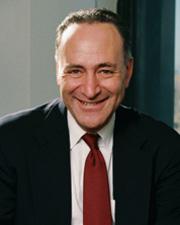 Sen. Charles E. Schumer (D-NY)
Legislative Activity
Stay on top of the latest movement without scrolling through every action
Senate amendment submitted
July 23, 2003
View full timeline
Senate amendment submitted
July 23, 2003
Senate amendment proposed (on the floor): Amendment SA 1343 proposed by Senator Schumer.(consideration: CR S9763-9767, S9774)
July 23, 2003
Roll call votes on amendments in Senate: Motion to waive the Budget Act with respect to amendment SA 1343 rejected in Senate by Yea-Nay Vote. 45 - 51. Record Vote Number: 295.
July 23, 2003
Amendment SA 1343 proposed by Senator Schumer. (consideration: CR S9763-9767, S9774) To increase the funds for research and development related to transportation security, and for other purposes.
July 23, 2003
Point of order raised in Senate with respect to amendment SA 1343.
July 23, 2003
Motion to waive the Budget Act with respect to amendment SA 1343 rejected in Senate by Yea-Nay Vote. 45 - 51. Record Vote Number: 295.
July 23, 2003
Amendment SA 1343 ruled out of order by the chair.
July 23, 2003
Votes
1 roll call on this amendment
Text
Submitted
TEXT OF AMENDMENTS

SA 1327. Mrs. MURRAY proposed an amendment to the bill H.R. 2555,
making appropriations for the Department of Homeland Security for the
fiscal year ending September 30, 2004, and for other purposes; as
follows:

On page 56, line 9, strike ``$165,000,000'' and insert
``$265,000,000''.
______

SA 1328. Mrs. BOXER (for herself and Mr. Schumer) proposed an
amendment to the bill H.R. 2555, making appropriations for the
Department of Homeland Security for the fiscal year ending September
30, 2004, and for other purposes; as follows:

At the appropriate place, add the following:
Sec.  . (a) Report.--Not later than March 1, 2004, the
Secretary of Homeland Security shall submit to Congress a
report that--
(1) details the progress made in developing countermeasures
for commercial aircraft against shoulder-fired missile
systems, including cost and time schedules for developing and
deploying such countermeasures, and
(2) in classified form and in conjunction with airports in
category X and category one, an assessment of the
vulnerability of such airports from the threat of shoulder-
fired missile systems and the interim measures being taken to
address the threat.
______

SA 1329. Mrs. FEINSTEIN (for herself and Mr. Kyl) submitted an
amendment intended to be proposed by her to the bill H.R. 2555, making
appropriations for the Department of Homeland Security for the fiscal
year ending September 30, 2004, and for other purposes; which was
ordered to lie on the table; as follows:

At the end of the bill, add the following:

TITLE ____--PORT ANTI-TERRORISM AND SECURITY ACT OF 2003

SEC. 1001. SHORT TITLE.

This title may be cited as the ``Port Anti-Terrorism and
Security Act of 2003''.

Subtitle A--Deterring and Punishing Terrorism and Crime at United
States Ports

SEC. 1101. DESTRUCTION OR INTERFERENCE WITH VESSELS OR
MARITIME FACILITIES.

(a) In General.--Title 18, United States Code, is amended
by inserting after chapter 65 the following:

``CHAPTER 66--MARITIME VESSELS

``Sec.
``1371. Jurisdiction and scope.
``1372. Destruction of vessel or maritime facility.
``1373. Imparting or conveying false information.

``Sec. 1371 Jurisdiction and scope

``(a) In General.--There is jurisdiction under section 3231
over an offense under this chapter if--
``(1) the prohibited activity takes place within the United
States, or in waters or submerged lands thereunder subject to
the jurisdiction of the United States; or
``(2) the prohibited activity takes place outside the
United States, and--
``(A) an offender or a victim of the prohibited activity is
a citizen of the United States;
``(B) a citizen of the United States was on board a vessel
to which this chapter applies; or
``(C) the prohibited activity involves a vessel of the
United States.
``(b) Applicability.--Nothing in this chapter shall apply
to otherwise lawful activities carried out by, or at the
direction of, the United States Government.

``Sec. 1372. Destruction of vessel or maritime facility

``(a) Offenses.--It shall be unlawful for any person--
``(1) to willfully--
``(A) set fire to, damage, destroy, disable, or wreck any
vessel; or
``(B) place or cause to be placed a destructive device or
destructive substance in, upon, or in proximity to, or
otherwise make or cause to be made an unworkable or unusable
or hazardous to work or use, any vessel (as defined in
section 3 of title 1), or any part or other materials used or
intended to be used in connection with the operation of a
vessel; or
``(C) set fire to, damage, destroy, disable, or displace a
destructive device or destructive substance in, upon, or in
proximity to, any maritime facility, including any aid to
navigation, lock, canal, or vessel traffic service facility
or equipment, or interfere by force or violence with the
operation of such maritime facility, if such action is likely
to endanger the safety of any vessel in navigation;
``(D) set fire to, damage, destroy, disable, or place a
destructive device or destructive

[[Page S9803]]

substance in, upon, or in proximity to any appliance,
structure, property, machine, apparatus, or any facility or
other material used or intended to be used in connection with
the operation, maintenance, loading, unloading, or storage of
any vessel or any passenger or cargo carried on, or intended
to be carried on, any vessel;
``(E) perform an act of violence against or incapacitate an
individual on a vessel, if such act of violence or
incapacitation is likely to endanger the safety of the vessel
or those on board;
``(F) perform an act of violence against a person that
causes or is likely to cause serious bodily injury in, upon,
or in proximity to any appliance, structure, property,
machine, apparatus, or any facility or other material used or
intended to be used in connection with the operation,
maintenance, loading, unloading, or storage of any vessel or
any passenger or cargo carried or intended to be carried on
any vessel; or
``(G) communicate information, knowing the information to
be false and under circumstances in which such information
may reasonably be believed, thereby endangering the safety of
any vessel in navigation; or
``(2) to attempt or conspire to do anything prohibited
under paragraph (1).
``(b) Penalty.--Any person who--
``(1) violates subparagraph (A) or (B) of subsection (a)(1)
shall be fined in accordance with this title or imprisoned
for a maximum life imprisonment term, or both, and if death
results, shall be subject to the death penalty; and
``(2) violates subsection (a)(2) or subparagraph (C), (D),
(E), (F), or (G) of subsection (a)(1) shall be fined in
accordance with this title or imprisoned not more than 20
years, or both.
``(c) Additional Penalties.--Any person who is fined or
imprisoned in accordance with subsection (b) for an offense
that involved a vessel that, at the time the violation
occurred, carried high-level radioactive waste or spent
nuclear fuel shall be fined in accordance with this title or
imprisoned for not less than 30 years, or for life.
``(d) Threatened Offense.--Any person who willfully imparts
or conveys any threat to do an act which would violate this
chapter, with an apparent determination and will to carry out
the threat, shall be--
``(1) fined in accordance with this title or imprisoned not
more than 5 years, or both; and
``(2) liable for all costs incurred as a result of such
threat.
``(e) Definitions.--For purposes of this section--
``(1) the term `destructive device' has the meaning as such
term in section 921(a)(4);
``(2) the term `destructive substance' has the meaning as
such term in section 31;
``(3) the term `high-level radioactive waste' has the
meaning as such term in section 2(12) of the Nuclear Waste
Policy Act of 1982 (42 U.S.C. 10101(12));
``(4) the term `serious bodily injury' has the meaning as
such term in section 1365(g); and
``(5) the term `spent nuclear fuel' has the meaning as such
term in section 2(23) of the Nuclear Waste Policy Act of 1982
(42 U.S.C. 10101(23)).

``Sec. 1373. Imparting or conveying false information

``(a) In General.--Any person who imparts or conveys, or
causes to be imparted or conveyed, false information, knowing
the information to be false, concerning an attempt or alleged
attempt being made or to be made, to do any act that is an
offense under this chapter or chapter 2, 97, or 111, shall be
subject to a civil penalty of not more than $5,000, which
shall be recoverable in a civil action brought in the name of
the United States.
``(b) Increased Penalty.--Any person who willfully and
maliciously, or with reckless disregard for the safety of
human life, imparts or conveys, or causes to be imparted or
conveyed, false information, knowing the information to be
false, concerning an attempt or alleged attempt being made by
or to be made, to do any act that is an offense under this
chapter or chapter 2, 97, or 111, shall be fined in
accordance with this title or imprisoned not more than 5
years, or both.''.
(b) Technical and Conforming Amendment.--The table of
chapters at the beginning of title 18, is amended by
inserting after the item relating to chapter 65 the
following:
``66. Maritime Vessels......................................1371''.....

SEC. 1102. CRIMINAL SANCTIONS FOR PLACEMENT OF DESTRUCTIVE
DEVICES OR SUBSTANCES IN UNITED STATES
JURISDICTIONAL WATERS.

(a) In General.--Chapter 111 of title 18, United States
Code, is amended by inserting after section 2280 the
following:

``Sec. 2280A. Devices or substances in waters of the United
States likely to destroy or damage ships

``(a) In General.--Any person who knowingly places or
causes to be placed in waters subject to the jurisdiction of
the United States, by any means, a device or substance that
is likely to destroy or cause damage to a ship or its cargo,
or cause interference with the safe navigation of vessels or
interference with maritime commerce, such as by damaging or
destroying marine terminals, facilities, and any other
maritime structure or entity used in maritime commerce, with
the intent of causing such destruction or damage--
``(1) shall be fined in accordance with this title and
imprisoned for any term of years or for life; and
``(2) if the death of any person results from conduct
prohibited under this section, may be punished by death.
``(b) Applicability.--Nothing in this section shall be
construed to apply to otherwise lawfully authorized and
conducted activities of the United States Government.''.
(b) Technical and Conforming Amendment.--The table of
sections for chapter 111 of title 18, United States Code, is
amended by inserting after the item relating to section 2280
the following:

``2280A. Devices or substances in waters of the United States likely to
destroy or damage ships.''.

SEC. 1103. PIRACY AND PRIVATEERING.

Chapter 81 of title 18, United States Code, is amended to
read as follows:

``CHAPTER 81--PIRACY AND PRIVATEERING

``Sec.
``1651. Piracy.
``1652. Crimes against United States persons or property on board a
ship or maritime structure.
``1653. Crimes against persons on board a ship or maritime structure
within the territorial jurisdiction of the United States.
``1654. Crimes by United States citizens or resident aliens.
``1655. Privateering.
``1656. Theft or conversion of vessel, maritime structure, cargo, or
effects.
``1657. Intentional wrecking or plunder of a vessel, maritime
structure, cargo, or effects.
``1658. Knowing receipt of an illegally acquired vessel, maritime
structure, cargo, or effects.
``1659. Attempts.
``1660. Accessories.
``1661. Inapplicability to United States Government activities.

``Sec. 1651. Piracy

``Any person who commits the crime of piracy and is
afterwards brought into, or found in, the United States shall
be imprisoned for life.

``Sec. 1652. Crimes against United States persons or property
on board a ship or maritime structure

``Any person who commits any illegal act of violence,
detention, or depredation against the United States,
including any vessel of the United States, citizen of the
United States, any commercial structure owned in whole or in
part by a United States citizen or resident alien, or any
United States citizen or resident alien, or the property of
that citizen or resident alien, on board a ship or maritime
structure and is afterwards brought into or found in the
United States, shall be fined in accordance with this title
or imprisoned not more than 20 years, or both.

``Sec. 1653. Crimes against persons on board a ship or
maritime structure within the territorial jurisdiction of
the United States

``Any person who commits any illegal act of violence,
detention, or depredation against an individual on board a
ship or maritime structure, or the property of that
individual, in waters or submerged lands thereunder, subject
to the jurisdiction of the United States, shall be fined in
accordance with this title or imprisoned not more than 20
years, or both.

``Sec. 1654. Crimes by United States citizens or resident
aliens

``Any person, being a United States citizen or resident
alien, or purporting to act under the authority of the United
States, who commits any illegal act of violence, detention,
or depredation against an individual on board a ship or
maritime structure, or the property of that individual, shall
be fined in accordance with this title or imprisoned not more
than 20 years, or both.

``Sec. 1655. Privateering

``(a) Offense.--It shall be unlawful for any person to
furnish, fit out, arm, or serve in a privateer or private
vessel used to commit any illegal act of violence, detention,
or depredation against an individual, or the property of that
individual, or any vessel or maritime structure without the
express authority of the United States Government when--
``(1) the perpetrator of the act is a United States citizen
or resident alien, or purports to act under authority of the
United States;
``(2) the individual against whom the act is committed is a
United States citizen or resident alien or the property,
vessel, or maritime structure involved is owned, in whole or
in part, by a United States citizen or resident alien; or
``(3) some element of the illegal act of violence,
detention, or depredation is committed in waters subject to
the jurisdiction of the United States.
``(b) Penalty.--Any person who violates subsection (a)
shall be fined in accordance with this title or imprisoned
not more than 20 years, or both.

``Sec. 1656. Theft or conversion of vessel, maritime
structure, cargo, or effects

``(a) Offense.--It shall be unlawful for any person who is
a captain, officer, crewman, or passenger of a vessel or
maritime structure to assist in the theft or conversion of
such vessel or maritime structure, or its cargo or effects
when--
``(1) the perpetrator is a United States citizen or
resident alien, or purports to act under the authority of the
United States;

[[Page S9804]]

``(2) the vessel, maritime structure, cargo, or effects is
owned in whole or in part by a United States citizen or
resident alien; or
``(3) some element of the theft or conversion is committed
in waters subject to the jurisdiction of the United States.
``(b) Penalty.--Any person who violates subsection (a)
shall be fined in accordance with this title or imprisoned
not more than 20 years, or both.

``Sec. 1657. Intentional wrecking or plunder of a vessel,
maritime structure, cargo, or effects

``(a) Offense.--It shall be unlawful for any person to--
``(1) intentionally cause the wrecking of a vessel or
maritime structure by act or omission, either directly such
as by intentional grounding, or indirectly by modification or
destruction of any navigational marker or safety device;
``(2) intentionally plunder, steal, or destroy a vessel,
maritime structure, cargo, or effects when such vessel or
maritime structure is in distress, wrecked, lost, stranded,
or cast away; or
``(3) intentionally obstruct or interfere with the rescue
of a person on board a vessel or maritime structure in
distress, wrecked, lost, stranded, or cast away, or the legal
salvage of such a vessel, maritime structure, cargo, or
effects, when--
``(A) the perpetrator is a United States citizen or
resident alien, or purports to act under authority of the
United States;
``(B) the vessel, maritime structure, cargo, or effects is
owned in whole or in part by a United States citizen or
resident alien; or
``(C) some element of the theft or conversion is committed
in waters subject to the jurisdiction of the United States.
``(b) Penalty.--Any person who violates subsection (a)
shall be fined in accordance with this title or imprisoned
not more than 20 years, or both.

``Sec. 1658. Knowing receipt of an illegally acquired vessel,
maritime structure, cargo, or effects

``Any person who knowingly receives or acquires a vessel,
maritime structure, cargo, or effects converted or obtained
by action falling under any section of this chapter shall be
fined in accordance with this title or imprisoned not more
than 20 years, or both.

``Sec. 1659. Attempts

Any person who attempts any act which, if committed, would
constitute an offense under this chapter shall be fined in
accordance with this title or imprisoned not more than 20
years, or both.

``Sec. 1660. Accessories

``(a) Commission of an Offense.--Any person who knowingly
assists any person in the commission of an act that
constitutes an offense under this chapter shall be fined in
accordance with this title or imprisoned not more than 20
years, or both.
``(b) Avoidance of Consequences.--Any person who knowingly
assists any person in avoiding the consequences of an act
that constitutes an offense under this chapter shall be fined
in accordance with this title or imprisoned not more than 20
years, or both.

``Sec. 1661. Inapplicability to United States Government
activities

``Nothing in this chapter shall apply to otherwise lawful
activities--
``(1) carried out by, or at the direction of, the United
States Government; or
``(2) undertaken under a letter or marque and reprisal
issued by the United States Government.''.

SEC. 1104. USE OF A DANGEROUS WEAPON OR EXPLOSIVE ON A
PASSENGER VESSEL.

(a) In General.--Chapter 39 of title 18, United States
Code, is amended by inserting after section 831 the
following:

``Sec. 832. Use of a dangerous weapon or explosive on a
passenger vessel

``(a) Offense.--It shall be unlawful for any person to
willfully--
``(1) commit an act, including the use of a dangerous
weapon, explosive, or incendiary device, with the intent to
cause death or serious bodily injury to a crew member or
passenger of a passenger vessel or any other person while on
board a passenger vessel; or
``(2) attempt, threaten, or conspire to do any act referred
to in paragraph (1).
``(b) Penalty.--An person who violates subsection (a) shall
be fined in accordance with this title or imprisoned not more
than 20 years, or both.
``(c) Aggravated Offense.--Any person who commits an
offense described in subsection (a) in a circumstance in
which--
``(1) the vessel was carrying a passenger at the time of
the offense; or
``(2) the offense has resulted in the death of any person;
shall be guilty of an aggravated offense and shall be fined
in accordance with this title or imprisoned for any term of
years or for life.
``(d) Applicability.--This section shall apply to vessels
that are subject to the jurisdiction of the United States,
and vessels carrying passengers who are United States
citizens or resident aliens, wherever located.
``(e) Definitions.--For purposes of this section--
``(1) the term `dangerous weapon' has the meaning given
such term in section 930(g);
``(2) the term `explosive or incendiary device' has the
meaning given such term in section 232(5);
``(3) the term `passenger' has the same meaning given such
term in section 2101(21) of title 46;
``(4) the term `passenger vessel' has the same meaning
given such term in section 2101(22) of title 46; and
``(5) the term `serious bodily injury' has the meaning
given such term in section 1365(g).''.
(b) Technical and Conforming Amendment.--The table of
sections for chapter 39 of title 18, United States Code, is
amended by inserting after the item relating to section 831
the following:

``832. Use of a dangerous weapon or explosive on a passenger vessel.''.

SEC. 1105. SANCTIONS FOR FAILURE TO HEAVE TO AND FOR
OBSTRUCTION OF BOARDING AND PROVIDING FALSE
INFORMATION.

(a) In General.--Chapter 109 of title 18, United States
Code, is amended by adding at the end the following:

``Sec. 2237. Sanctions for failure to heave to; sanctions for
obstruction of boarding or providing false information

``(a) Failure To Heave To.--It shall be unlawful for the
master, operator, or person in charge of a vessel of the
United States, or a vessel subject to the jurisdiction of the
United States, to knowingly fail to obey an order to heave to
on being ordered to do so by an authorized Federal law
enforcement officer.
``(b) Obstruction of Boarding and Providing False
Information.--It shall be unlawful for any person on board a
vessel of the United States or a vessel subject to the
jurisdiction of the United States to--
``(1) forcibly assault, resist, oppose, prevent, impede,
intimidate, or interfere with a boarding or other law
enforcement action authorized by any Federal law, or to
resist a lawful arrest; or
``(2) provide information to a Federal law enforcement
officer during a boarding of a vessel regarding the vessel's
destination, origin, ownership, registration, nationality,
cargo, or crew that the person knows is false.
``(c) Limitations.--This section shall not limit the
authority of--
``(1) an officer under section 581 of the Tariff Act of
1930 (19 U.S.C. 1581) or any other provision of law enforced
or administered by the Secretary of the Treasury or the Under
Secretary for Border and Transportation Security of the
Department of Homeland Security; or
``(2) a Federal law enforcement officer under any law of
the United States to order a vessel to stop or heave to.
``(d) Consent or Objection to Enforcement.--A foreign
nation may consent or waive objection to the enforcement of
United States law by the United States under this section by
radio, telephone, or similar oral or electronic means, which
consent or waiver may be proven by certification of the
Secretary of State or the Secretary's designee.
``(e) Penalty.--Any person who intentionally violates this
section shall be fined in accordance with this title and
imprisoned not more than 1 year.
``(f) Definitions.--For purposes of this section--
``(1) the terms `vessel of the United States' and `vessel
subject to the jurisdiction of the United States' have the
same meanings as such terms in section 3 of the Maritime Drug
Law Enforcement Act (46 U.S.C. App. 1903);
``(2) the term `heave to' means to cause a vessel to slow,
come to a stop, or adjust its course or speed to account for
the weather conditions and sea state to facilitate a law
enforcement boarding; and
``(3) the term `Federal law enforcement officer' has the
same meaning as such term in section 115.''.
(b) Technical and Conforming Amendment.--The table of
sections for chapter 109 of title 18, United States Code, is
amended by adding at the end the following:

``2237. Sanctions for failure to heave to; sanctions for obstruction of
boarding or providing false information.''.

SEC. 1106. CRIMINAL SANCTIONS FOR VIOLENCE AGAINST MARITIME
NAVIGATION.

Section 2280(a) of title 18, United States Code, is
amended--
(1) in paragraph (1)--
(A) by redesignating subparagraphs (F), (G), and (H) as
(G), (H), and (I), respectively;
(B) by inserting after subparagraph (E) the following:
``(F) destroys, damages, alters, moves, or tampers with any
aid to maritime navigation maintained by the Saint Lawrence
Seaway Development Corporation under the authority of section
4 of the Act of May 13, 1954, (33 U.S.C. 984) or the Coast
Guard pursuant to section 81 of title 14, or lawfully
maintained by the Coast Guard pursuant to section 83 of title
14, if such act endangers or is likely to endanger the safe
navigation of a ship;''; and
(C) in subparagraph (I), as so redesignated, by striking
``through (G)'' and inserting ``through (H)''; and
(2) in paragraph (2), by striking ``(C) or (E)'' and
inserting ``(C), (E), or (F)''.

SEC. 1107. CRIMINAL SANCTIONS FOR MALICIOUS DUMPING.

(a) In General.--Chapter 111 of title 18, United States
Code, is amended by adding at the end the following:

``Sec. 2282. Knowing discharge or release

``(a) Endangerment of Human Life.--Any person who knowingly
discharges or releases oil, a hazardous material, a noxious
liquid substance, or any other substance into the navigable
waters of the United States or the adjoining shoreline with
the intent to endanger human life, health, or welfare--
``(1) shall be fined in accordance with this title and
imprisoned for any term of years or for life; and

[[Page S9805]]

``(2) if the death of any person results from conduct
prohibited under this section, may be punished by death.
``(b) Endangerment of Marine Environment.--Any person who
knowingly discharges or releases oil, a hazardous material, a
noxious liquid substance, or any other substance into the
navigable waters of the United States or the adjacent
shoreline with the intent to endanger the marine environment
shall be fined in accordance with this title or imprisoned
not more than 30 years, or both.
``(c) Definitions.--For purposes of this section--
``(1) the term `discharge' means any spilling, leaking,
pumping, pouring, emitting, emptying, or dumping;
``(2) the term `hazardous material' has the same meaning
given such term in section 2101(14) of title 46;
``(3) the term `marine environment' has the same meaning
given such term in section 2101(15) of title 46;
``(4) the term `navigable waters' has the same meaning
given such term in section 502(7) of the Federal Water
Pollution Control Act (33 U.S.C. 1362(7)), and also includes
the territorial sea of the United States as described in
Presidential Proclamation 5928 of December 27, 1988; and
``(5) the term `noxious liquid substance' has the same
meaning given such term in the MARPOL Protocol as defined in
section 2(a)(3) of the Act to Prevent Pollution from Ships
(33 U.S.C. 1901(a)(3)).''.
(b) Technical and Conforming Amendment.--The table of
sections for chapter 111 of title 18, United States Code, is
amended by adding at the end the following:

``2282. Knowing discharge or release.''.

SEC. 1108. ATTORNEY GENERAL TO COORDINATE PORT-RELATED CRIME
DATA COLLECTION.

(a) Regulations.--The Attorney General shall issue
regulations to--
(1) require the reporting by a carrier that is the victim
of a cargo theft offense to the Attorney General of
information on the cargo theft offense (including offenses
occurring outside ports of entry and ports of shipment
origination) that identifies the port of entry, the port
where the shipment originated, where the theft occurred, and
any other information specified by the Attorney General;
(2) create a database to contain the reports described in
paragraph (1) and integrate those reports, to the extent
feasible, with other noncriminal justice and intelligence
data, such as insurer bill of lading, cargo contents and
value, point of origin, and lien holder filings; and
(3) prescribe procedures for access to the database created
in accordance with paragraph (2) by appropriate Federal,
State, and local governmental agencies and private companies
or organizations, while limiting access to privacy of the
information in accordance with other applicable Federal laws.
(b) Modification of Databases.--
(1) In general.--United States Government agencies with
significant regulatory or law enforcement responsibilities at
United States ports shall, to the extent feasible, modify
their information databases to ensure the collection and
retrievability of data relating to crime, terrorism, and
related activities at, or affecting, United States ports.
(2) Designation of agencies.--The Attorney General, after
consultation with the Secretary of Homeland Security, shall
designate the agencies referred to in paragraph (1).
(c) Outreach Program.--The Attorney General, in
consultation with the Secretary of Homeland Security, the
National Maritime Security Advisory Committee established
under section 70112 of title 46, United States Code, and the
appropriate Federal and State agencies, shall establish an
outreach program--
(1) to work with State and local law enforcement officials
to harmonize the reporting of data on cargo theft among
States and localities with the United States Government's
reports; and
(2) to work with local port security committees to
disseminate cargo theft information to appropriate law
enforcement officials.
(d) Annual Report.--The Attorney General shall report
annually to the Committee on the Judiciary of the Senate and
the House of Representatives on the implementation of this
section.
(e) Interstate or Foreign Shipments by Carrier; State
Prosecutions.--
(1) State prosecutions.--Section 659 of title 18, United
States Code, is amended--
(A) in the first undesignated paragraph--
(i) by striking ``Whoever embezzles'' and inserting the
following:
``(a) Offense; Penalty.--Whoever--
``(1) embezzles'';
(ii) by striking ``from any pipeline system'' and all that
follows through ``with intent to convert to his own use'';
and
(iii) by striking ``or'' at the end;
(B) in the second undesignated paragraph--
(i) by striking ``Whoever buys'' and inserting the
following:
``(2) buys''; and
(ii) by striking ``or'' at the end;
(C) in the third undesignated paragraph--
(i) by striking ``Whoever embezzles'' and inserting the
following''
``(3) embezzles''; and
(ii) by striking ``with intent to convert to his own use'';
(D) in the fourth undesignated paragraph, by striking
``Whoever embezzles'' and inserting the following:
``(4) embezzles'';
(E) in the fifth undesignated paragraph, by striking
``Shall in each case'' and inserting the following:
``shall in each case'';
(F) in the sixth undesignated paragraph, by striking
``The'' and inserting the following:
``(b) Location of Offense.--The'';
(G) in the seventh undesignated paragraph, by striking
``The'' and inserting the following''
``(c) Separate Offense.--The'';
(H) in the eighth undesignated paragraph, by striking
``To'' and inserting the following:
``(d) Prima Facie Evidence.--To'';
(I) in the ninth undesignated paragraph, by striking ``A''
and inserting the following:
``(e) Prosecution.--A''; and
(J) by adding at the end the following:
``(f) Civil Penalty.--
``(1) In general.--Notwithstanding any other provision of
law, and in addition to any penalties that may be available
under any other provision of law, a person who is found by
the Secretary of Homeland Security, after notice and an
opportunity for a hearing, to have violated this section or a
regulation issued under this section shall be liable to the
United States for a civil penalty not to exceed $25,000 for
each violation.
``(2) Separate violations.--Each day of a continuing
violation shall constitute a separate violation.
``(3) Amount of penalty.--
``(A) In general.--The amount of a civil penalty for a
violation of this section or a regulation issued under this
section shall be assessed by the Attorney General, or the
designee of the Attorney General, by written notice.
``(B) Considerations.--In determining the amount of a civil
penalty under this paragraph, the Attorney General shall take
into account--
``(i) the nature, circumstances, extent, and gravity of the
prohibited act committed; and
``(ii) with respect to the violator, the degree of
culpability, any history of prior offenses, ability to pay,
and such other matters as justice may require.
``(4) Modification of penalty.--The Secretary of Homeland
Security may compromise, modify, or remit, with or without
conditions, any civil penalty that is subject to imposition
or which has been imposed under this section.
``(5) Failure to pay.--If a person fails to pay an
assessment of a civil penalty after it has become final, the
Secretary of Homeland Security may refer the matter to the
Attorney General for collection in an appropriate district
court of the United States.
``(g) Definition.--For purposes of this section, the term
`goods or chattels' means to be moving as an interstate or
foreign shipment at all points between the point of origin
and the final destination (as evidenced by the waybill or
other shipping document of the shipment) regardless of any
temporary stop while awaiting transshipment or otherwise.''.
(2) Federal sentencing guidelines.--Pursuant to section 994
of title 28, United States Code, the United States Sentencing
Commission shall review the Federal Sentencing Guidelines to
determine whether sentencing enhancement is appropriate for
any offense under section 659 of title 18, United States
Code, as amended by this subsection.
(3) Annual report.--The Attorney General shall annually
submit to Congress a report that shall include an evaluation
of law enforcement activities relating to the investigation
and prosecution of offenses under section 659 of title 18,
United States Code.

Subtitle B--Protecting United States Ports Against Terrorism and Crime

SEC. 1201. DEFINITIONS.

In this subtitle:
(1) Aircraft.--The term ``aircraft'' has the meaning given
that term in section 40102 of title 49, United States Code.
(2) Captain-of-the-port.--The term ``Captain-of-the-Port'',
with respect to a United States seaport, means the individual
designated by the Commandant of the Coast Guard as the
Captain-of-the-Port at that seaport.
(3) Common carrier.--The term ``common carrier'' means any
person that holds itself out to the general public as a
provider for hire of a transportation by water, land, or air
of merchandise, whether or not the person actually operates
the vessel, vehicle, or aircraft by which the transportation
is provided, between a port or place and a port or place in
the United States.
(4) Container.--The term ``container'' means a container
that is used or designed for use for the international
transportation of merchandise by vessel, vehicle, or
aircraft.
(5) Directorate.--The term ``Directorate'' means the Border
and Transportation Security Directorate of the Department of
Homeland Security.
(6) Manufacturer.--The term ``manufacturer'' means a person
who fabricates or assembles merchandise for sale in commerce.
(7) Merchandise.--The term ``merchandise'' has the meaning
given that term in section 401 of the Tariff Act of 1930 (19
U.S.C. 1401).
(8) Shipment.--The term ``shipment'' means cargo traveling
in international commerce under a bill of lading.
(9) United states seaport.--The term ``United States
seaport'' means a place in the United States on a waterway
with shoreside facilities for the intermodal transfer of
cargo containers that are used in international trade.

[[Page S9806]]

(11) Vehicle.--The term ``vehicle'' has the meaning given
that term in section 401 of the Tariff Act of 1930 (19 U.S.C.
1401).
(12) Vessel.--The term ``vessel'' has the meaning given
that term in section 401 of the Tariff Act of 1930 (19 U.S.C.
1401).

SEC. 1202. DESIGNATED SECURITY AUTHORITY.

The Captain-of-the-Port of each United States seaport shall
be the primary authority responsible for security at the
United States seaport and shall--
(1) coordinate security at such seaport; and
(2) be the point of contact on seaport security issues for
civilian and commercial port entities at such seaport.

SEC. 1203. PENALTIES FOR INACCURATE MANIFEST.

(a) Falsity or Lack of Manifest.--Section 584 of the Tariff
Act of 1930 (19 U.S.C. 1584) is amended--
(1) in subsection (a)(1)--
(A) by striking ``$1,000'' each place it appears and
inserting ``$50,000''; and
(B) by striking ``$10,000'' and inserting ``$50,000''; and
(2) by adding at the end the following new subsection:
``(c) Criminal Penalties.--Any person who ships or prepares
for shipment any merchandise bound for the United States who
intentionally provides inaccurate or false information,
whether inside or outside the United States, with respect to
such merchandise for the purpose of introducing such
merchandise into the United States in violation of the laws
of the United States, shall be liable, upon conviction of a
violation of this subsection, for a fine of not more than
$50,000 or imprisonment for 1 year, or both; except that if
the importation of such merchandise into the United States is
prohibited, such person shall be liable for an additional
fine of not more than $50,000 or imprisonment for not more
than 5 years, or both.''.
(b) Penalties for Violations of the Arrival, Reporting,
Entry, and Clearance Requirements.--Subsections (b) and (c)
of section 436 of Tariff Act of 1930 (19 U.S.C. 1436) are
amended to read as follows:
``(b) Civil Penalty.--Any master, person in charge of a
vessel, vehicle, or aircraft pilot who commits any violation
listed in subsection (a) shall be liable for a civil penalty
of $25,000 for the first violation, and $50,000 for each
subsequent violation, and any conveyance used in connection
with any such violation is subject to seizure and forfeiture.
``(c) Criminal Penalty.--In addition to being liable for a
civil penalty under subsection (b), any master, person in
charge of a vessel, vehicle, or aircraft pilot who
intentionally commits or causes another to commit any
violation listed in subsection (a) shall be liable, upon
conviction, for a fine of not more than $50,000 or
imprisonment for 1 year, or both; except that if the
conveyance has, or is discovered to have had, on board any
merchandise (other than sea stores or the equivalent for
conveyances other than vessels) the importation of which into
the United States is prohibited, such individual shall be
liable for an additional fine of not more than $50,000 or
imprisonment for not more than 5 years, or both.''.

SEC. 1204. INSPECTION OF MERCHANDISE AT FOREIGN FACILITIES.

Not later than 180 days after the date of enactment of this
Act, the Secretary of Homeland Security shall submit to
Congress a plan to--
(1) station inspectors from the Directorate, other Federal
agencies, or the private sector at the foreign facilities of
manufacturers or common carriers to profile and inspect
merchandise and the containers or other means by which such
merchandise is transported as they are prepared for shipment
on a vessel that will arrive at any port or place in the
United States;
(2) develop procedures to ensure the security of
merchandise inspected as described in paragraph (1) until it
reaches the United States; and
(3) permit merchandise inspected as described in paragraph
(1) to receive expedited inspection upon arrival in the
United States.
______

SA 1330. Mrs. FEINSTEIN submitted an amendment intended to be
proposed by her to the bill H.R. 2555, making appropriations for the
Department of Homeland Security for the fiscal year ending September
30, 2004, and for other purposes; which was ordered to lie on the
table; as follows:

Insert after section 615 the following:
Sec. 616. (a) Increase in Amount for Office for Domestic
Preparedness.--The amount appropriated by title IV of this
Act under the heading ``Office for Domestic Preparedness'' is
hereby increased by $30,000,000.
(b) Availability for Interoperable Communications Grants.--
Of the amount appropriated by title IV of this Act under the
heading ``Office for Domestic Preparedness'', as increased by
subsection (a), up to $30,000,000 may be available for
interoperable communications grants.
(c) Offset.--The amount appropriated by title I of this Act
under the heading ``Office of the Under Secretary for
Management'' is hereby reduced by $30,000,000, with the
amount of the reduction to be allocated to amounts available
under that heading for the alteration and improvement of
facilities and for relocation costs necessary for the interim
housing of the Department's headquarters' operations and
organizations collocated therewith.
______

SA 1331. Mrs. BOXER proposed an amendment to the bill H.R. 2555,
making appropriations for the Department of Homeland Security for the
fiscal year ending September 30, 2004, and for other purposes; as
follows:

At the appropriate place, add the following:
Sec. ____. Not later than March 1, 2004, the Secretary of
Homeland Security shall issue a classified report to Congress
on the security costs incurred by state and local government
law enforcement personnel in each state in complying with
requests and requirements of the United States Secret Service
to provide protective services and transportation for foreign
and domestic officials.
______

SA 1332. Mr. LEVIN submitted an amendment intended to be proposed by
him to the bill H.R. 2555, making appropriations for the Department of
Homeland Security for the fiscal year ending September 30, 2004, and
for other purposes; which was ordered to lie on the table; as follows:

At the end, add the following:

TITLE ____--CLARIFICATION OF PROHIBITION ON CONTRACTING WITH CORPORATE
EXPATRIATES

SEC. ____. CLARIFICATION OF PROHIBITION ON CONTRACTING WITH
CORPORATE EXPATRIATES.

Section 835 of the Homeland Security Act of 2002 (Public
Law 107-296; 6 U.S.C. 395) is amended--
(1) in subsection (a), by inserting before the period ``,
or any subsidiary of such an entity'';
(2) in subsection (b)(1), by inserting ``before, on, or''
after ``completes''; and
(3) in subsection (c)(1)(B), by striking ``which is after
the date of enactment of this Act and''.
______

SA 1333. Mr. REED submitted an amendment intended to be proposed by
him to the bill H.R. 2555, making appropriations for the Department of
Homeland Security for the fiscal year ending September 30, 2004, and
for other purposes; which was ordered to lie on the table; as follows:

On page 75, between lines 5 and 6, insert the following:
Sec. 616. It is the sense of the Senate that--
(1) the Bureau of Immigration and Customs Enforcement faces
an increasing demand for Customs investigative work in Rhode
Island, particularly in the areas of drug smuggling and money
laundering; and
(2) the Bureau of Immigration and Customs Enforcement
should establish an Office of Customs Investigations in
Providence, Rhode Island, with an adequate number of special
agents and support staff.
______

SA 1334. Mr. FEINGOLD submitted an amendment intended to be proposed
by him to the bill H.R. 2555, making appropriations for the Department
of Homeland Security for the fiscal year ending September 30, 2004, and
for other purposes; which was ordered to lie on the table; as follows:

On page 75, between lines 5 and 6, insert the following:
Sec. 616. (a) The Secretary of Homeland Security, in close
consultation with State and local officials, shall conduct a
study of methods for improving the Nation's threat-alert
system.
(b) The study under subsection (a) shall include--
(1) a survey of alternative threat-alert systems, including
the feasibility of regional and threat-type alerts;
(2) best estimates of the costs incurred by Federal, State,
and local governments and the private sector each time threat
levels are adjusted within the current alert system; and
(3) a comparison of the costs described in paragraph (2)
with the projected costs of the alternatives explored under
paragraph (1).
(c) Not later than April 30, 2004, the Secretary of
Homeland Security shall submit to Congress a report
summarizing the results of the study conducted under this
section.
______

SA 1335. Mr. FEINGOLD submitted an amendment intended to be proposed
by him to the bill H.R. 2555, making appropriations for the Department
of Homeland Security for the fiscal year ending September 30, 2004, and
for other purposes; which was ordered to lie on the table; as follows:

On page 75, between lines 5 and 6, insert the following:
Sec. 616. (a) The Secretary of Homeland Security, in close
consultation with State and local officials and emergency
preparedness professional associations, shall conduct a study
of the feasibility of establishing a center within the
Department of Homeland Security to systematically collect,
coordinate, organize, and analyze best practices and other
information that could benefit emergency responders.
(b) The study under subsection (a) shall--
(1) explore ways in which the center described in
subsection (a) could efficiently

[[Page S9807]]

share best practices with emergency responders through a
website or other communication method;
(2) estimate the costs that would be occurred to establish
and maintain such a center; and
(3) estimate the potential efficiency gains or losses that
such a center would produce and their related financial
impact.
(c) Not later than January 30, 2004, the Secretary of
Homeland Security shall submit to Congress a report
summarizing the results of the study conducted under this
section.
______

SA 1336. Mr. DAYTON proposed an amendment to the bill H.R. 2555,
making appropriations for the Department of Homeland Security for the
fiscal year ending September 30, 2004, and for other purposes; as
follows:

On page 75, between lines 5 and 6, insert the following:
Sec. 616. None of the funds appropriated or otherwise made
available by this Act may be obligated or expended for the
procurement of any articles, materials, or supplies in
contravention of the Buy American Act (41 U.S.C. 10a et
seq.).
______

SA 1337. Mr. KYL submitted an amendment intended to be proposed by
him to the bill S. 14, to enhance the energy security of the United
States, and for other purposes; which was ordered to lie on the table;
as follows:

Beginning on page 4, strike line 1 and all that follows
through page 20, line 2.
______

SA 1338. Mr. KYL submitted an amendment intended to be proposed by
him to the bill S. 14, to enhance the energy security of the United
States, and for other purposes; which was ordered to lie on the table;
as follows:

On page 8, line 3, strike ``2007'' and insert ``2004''.
______

SA 1339. Mr. KYL submitted an amendment intended to be proposed by
him to the bill S. 14, to enhance the energy security of the United
States, and for other purposes; which was ordered to lie on the table;
as follows:

Beginning on page 20, strike line 3 and all that follows
through page 85, line 10.
______

SA 1340. Mr. KYL submitted an amendment intended to be proposed by
him to the bill S. 14, to enhance the energy security of the United
States, and for other purposes; which was ordered to lie on the table;
as follows:

At the end of title VII of division B, insert the
following:

SEC. ____. STUDY OF EFFECTIVENESS OF CREDIT FOR ELECTRICITY
PRODUCED FROM CERTAIN RENEWABLE RESOURCES.

(a) Study.--The Comptroller General of the United States
shall undertake a study of the effectiveness of the credit
for electricity produced from certain renewable resources
under section 45 of the Internal Revenue Code of 1986, as
amended by title I. Such study shall evaluate--
(1) whether the credit is necessary as a means of
encouraging the use of renewable resources,
(2) whether the credit is economically efficient,
(3) the amount of investment in renewable resource
technologies that would exist if no tax credit were
available, and
(4) when the credit should terminate.
(b) Report.--The Comptroller General of the United States
shall report the study required under subsection (a) to
Congress not later than 1 year after the date of the
enactment of this Act.
______

SA 1341. Mr. HOLLINGS (for himself and Mr. Graham of Florida)
proposed an amendment to the bill H.R. 2555, making appropriations for
the Department of Homeland Security for the fiscal year ending
September 30, 2004, and for other purposes; as follows:

On page 49, line 2, strike ``$150,000,000'' and insert
``$450,000,000''.
On page 66, line 9, strike ``$823,700,000'' and insert
``$523,700,000,''.
______

SA 1342. Mr. BIDEN submitted an amendment intended to be proposed by
him to the bill H.R. 2555, making appropriations for the Department of
Homeland Security for the fiscal year ending September 30, 2004, and
for other purposes; which was ordered to lie on the table; as follows:

On page 75, between lines 5 and 6, insert the following:
Sec. 616. Not later than March 1, 2004, the Secretary of
Homeland Security shall submit to Congress a report that
details the costs incurred by State and local governments as
a direct result of an increase in the threat level of the
Homeland Security Advisory System.
______

SA 1343. Mr. SCHUMER (for himself and Mr. Corzine) proposed an
amendment to the bill H.R. 2555, making appropriations for the
Department of Homeland Security for the fiscal year ending September
30, 2004, and for other purposes; as follows:

On page 49, beginning on line 14, strike all through line
19 and insert the following:
For necessary expenses for research and development related
to transportation security, $200,000,000, to remain available
until expended: Provided, That of the total amount provided
under this heading, $45,000,000 shall be available for the
research and development of explosive detection devices:
Provided further, That of the total amount provided under
this heading $70,000,000 shall be available for the Secretary
of Homeland Security to award grants under section 70107(i)
of title 46, United States Code, to national laboratories,
private nonprofit organizations, institutions of higher
education, and other entities for the support of research and
development of technologies that can be used to secure the
ports of the United States.
______

SA 1344. Mr. LAUTENBERG proposed an amendment to the bill H.R. 2555,
making appropriations for the Department of Homeland Security for the
fiscal year ending September 30, 2004, and for other purposes; as
follows:

On page 75, between lines 5 and 6, insert the following:
Sec. ____. Not later than 90 days after the date of
enactment of this Act, the Secretary of Homeland Security
shall submit a report in unclassified form to Congress on the
Homeland Security Advisory System, which shall include--
(1) an assessment of how the system is fulfilling its
missions to--
(A) provide a national framework for Federal, State, and
local governments, private industry and the public to gauge
threat levels;
(B) establish the integration of factors for assignment of
threat conditions;
(C) unify the system of public announcements, allowing
government officials and citizens to communicate the nature
and degree of terrorist threats; and
(D) provide a tool for combating terrorism by deterring
terrorist activity, notifying law enforcement and State and
local government officials of threats, informing the public
about government preparations, and providing such officials
and the public with information necessary to respond to the
threat;
(2) the average daily cost of elevating the Homeland
Security Advisory System by 1 threat level;
(3) an evaluation by the Inspector General of the
Department of Homeland Security of the responses to each of
the suggested protective measures to be taken at each threat
level; and
(4) a review of efforts taken by the Department of Homeland
Security to refine the Homeland Security Advisory System, and
the progress of tailoring the system so that threat alerts
are issued on a regional basis rather than nationally.
______

SA 1345. Mr. McCAIN submitted an amendment intended to be proposed by
him to the bill H.R. 2555, making appropriations for the Department of
Homeland Security for the fiscal year ending September 30, 2004, and
for other purposes; which was ordered to lie on the table, as follows:

At the end of the bill add the following:
Notwithstanding the preceding provisions of this Act, the
matter appropriating funds under the heading ``fire-fighters,
assistance grants'' in title IV under the heading ``Office
for Domestic Preparedness'' shall be deemed to appear in
title IV under the heading ``Office of the Under Secretary
for Emergency Preparedness and Response'' before the item
with the heading ``radiological emergency preparedness
program.
______

SA 1346. Ms. MIKULSKI (for herself, Mr. Dodd, Ms. Stabenow, Mr.
Sarbanes, Mrs. Clinton, Mr. Durbin, Mr. Biden, Mr. Lieberman, Mr.
Harkin, Mr. Levin, Mr. Byrd, Mr. Lautenberg, Mr. Rockefeller, Ms.
Landrieu, and Mr. Corzine) proposed an amendment to the bill H.R. 2555,
making appropriations for the Department of Homeland Security for the
fiscal year ending September 30, 2004, and for other purposes; as
follows:

On page 60, line 1, strike ``$750,000,000'' and insert
``$900,000,000''.
______

SA 1347. Mr. KYL (for himself, Mr. McCain, Mr. Brownback, Mr. Bayh,
and Mr. Bunning) submitted an amendment intended to be proposed by him
to the bill S. 14, to enhance the energy security of the United States,
and for other purposes; which was ordered to lie on the table; as
follows:

At the end of subtitle D of title IV, add the following:

SEC. 443. PROHIBITION ON NUCLEAR EXPORTS TO COUNTRIES THAT
SPONSOR TERRORISM.

(a) In General.--Section 129 of the Atomic Energy Act of
1954 (42 U.S.C. 2158) is amended--
(1) by inserting ``a.'' before ``No nuclear exports''; and
(2) by adding at the end the following new subsection:
``b. (1) Notwithstanding subsection a. and except as
provided in paragraphs (2), (3), and

[[Page S9808]]

(4), no nuclear materials and equipment or sensitive nuclear
technology, including items and assistance authorized by
section 57 b. of this Act and regulated under Part 810 of
title 10, Code of Federal Regulations, and nuclear-related
items on the Commerce Control List, shall be exported,
whether directly or indirectly, to any country that is on the
Department of State list of countries that sponsor terrorism.
``(2) This subsection shall not apply to Iraq.
``(3) This subsection shall not apply to items, services,
or information that are used for nuclear safeguards or
nonproliferation purposes, including but not limited to
surveillance equipment, seals, cameras, tamper-indication
devices, nuclear detectors, monitoring systems, or equipment
necessary to safely store, transport, or remove hazardous
materials, whether such items, services, or information are
regulated by the Department of Energy, the Department of
Commerce, or the Nuclear Regulatory Commission.
``(4) The President may waive the application of paragraph
(1) to a country if the President determines and certifies to
Congress that the waiver of that paragraph--
``(A) is in the vital national security interests of the
United States;
``(B) is essential to prevent or respond to a serious
radiological hazard in the country receiving the waiver that
may or does threaten public health and safety; and
``(C) will not result in any increased risk that the
country receiving the waiver will acquire nuclear weapons or
any materials or components of nuclear weapons.
``(5) Notwithstanding section 121 of this Act, this
subsection shall apply without regard to any international
arrangement made after the date of the enactment of this
subsection.''.
(b) Applicability to Exports Approved for Transfer But Not
Transferred.--Subsection b. of section 129 of the Atomic
Energy Act of 1954, as added by subsection (a) of this
section, shall apply with respect to exports that have been
approved for transfer as of the date of the enactment of this
Act but have not yet been transferred as of that date.
______

SA 1348. Mrs. CLINTON proposed an amendment to the bill H.R. 2555,
making appropriations for the Department of Homeland Security for the
fiscal year ending September 30, 2004, and for other purposes; as
follows:

On page 75, between lines 5 and 6, insert the following:
Sec. 616. (a) The Senate finds that--
(1) this Act is intended to provide critical homeland
security resources to State and local communities and first
responders to help them in their efforts to improve our
homeland defense at the National, State, and local levels;
(2) given the nature of the terrorist threats against our
Nation and the grave consequences of a terrorist attack, it
is in the best interest of our homeland defense that such
resources be disbursed and employed as effectively as
possible;
(3) the Secretary of Homeland Security has repeatedly
emphasized the need to use a threat-based formula, instead of
a per capita formula, to best allocate homeland security
block grant funds to States for use by States and local
communities;
(4) in the June 2003 report of the Homeland Security
Independent Task Force of the Council on Foreign Relations,
chaired by Senator Warren B. Rudman, entitled ``Emergency
Responders: Drastically Underfunded, Dangerously
Unprepared'', the Task Force--
(A) declared the ``existing systems for determining the
distribution of appropriated funds to states to be badly in
need of reform'';
(B) advised that ``Congress should establish a system for
allocating scarce [homeland security] resources based . . .
on addressing identified threats and vulnerabilities''; and
(C) stated that, in allocating Federal homeland security
funds, ``the Federal Government should consider such factors
as population density, vulnerability assessment, and presence
of critical infrastructure within each state'';
(5) the vulnerability assessment may cover a range of
considerations, including--
(A) the proximity of a community to nuclear and chemical
facilities, ports, and international borders;
(B) the presence of national icons that may be terrorist
targets;
(C) population (including tourist, military, and commuting
population), population density, the location, risk, or
vulnerability of critical infrastructure or key national
assets; and
(D) any other factor considered appropriate by the
Secretary of Homeland Security;
(6) our Nation's critical infrastructure consists of
systems and assets, whether physical or virtual, that are
vital to the United States, including infrastructure relating
to--
(A) agriculture;
(B) food;
(C) water;
(D) public health;
(E) emergency services;
(F) government;
(G) defense;
(H) energy;
(I) transportation;
(J) banking and finance;
(K) chemicals;
(L) postal service; and
(M) shipping;
(7) the Public Health Security and Bioterrorism
Preparedness and Response Act of 2002 (Public Law 107-188)
requires a threat analysis, an indication that Congress
recognizes the importance of threat-based formulas; and
(8) other national homeland security experts have also
called for the distribution of Federal, State, and local
homeland security grants using a threat-based formula in lieu
of a per capita formula.
(b) It is the sense of the Senate that homeland security
grants to State and local governments awarded pursuant to
section 1014 of the USA PATRIOT ACT of 2001 (42 U.S.C. 3711)
by the Office of Domestic Preparedness of the Department of
Homeland Security should, subject to minimum allocations for
small States, be allocated to States through a threat-based
formula in lieu of a per capita formula.
______

SA 1349. Mr. INHOFE submitted an amendment intended to be proposed by
him to the bill S. 14, to enhance the energy security of the United
States, and for other purposes; which was ordered to lie on the table;
as follows:

On page 96, after line 25, add the following:

SEC. ____. STATE INCENTIVES FOR USE OF CLEAN COAL TECHNOLOGY.

(a) Definitions.--In this section:
(1) Compliance facility.--The term ``compliance facility''
means any facility that--
(A)(i) is designed, constructed, or installed, and used, at
a coal-fired electric generation unit for the primary purpose
of complying with acid rain control requirements established
by title IV of the Clean Air Amendments of 1990 (42 U.S.C.
7651 et seq.); and
(ii) controls or limits emissions of sulfur or nitrogen
compounds resulting from the combustion of coal through the
removal or reduction of those compounds before, during, or
after the combustion of the coal, but before the combustion
products are emitted into the atmosphere;
(B)(i) removes sulfur compounds from coal before the
combustion of the coal; and
(ii) is located off the premises of the electric generation
facility at which the coal processed by the compliance
facility is burned;
(C) includes a flue gas desulfurization system connected to
a coal-fired electric generation unit; or
(D) includes facilities or equipment acquired, constructed,
or installed, and used, at a coal-fired electric generating
unit primarily for the purpose of handling--
(i) the byproducts produced by the compliance facility; or
(ii) other coal combustion byproducts produced by the
electric generation unit in or to which the compliance
facility is incorporated or connected.
(2) Electric utility.--The term ``electric utility'' means
any person (including any municipality) that generates,
transmits, or distributes electric energy through the use of
a coal-fired generating unit that contains, is attached to,
or is used in conjunction with a compliance facility.
(b) Credits.--A State may provide to an electric utility a
credit against any tax or fee owed to the State under a State
law, in an amount calculated under, and in accordance with, a
formula to be determined by the State, for the use of coal
mined from deposits in the State that is burned in a coal-
fired electric generation unit that is owned or operated by
the electric utility that receives the credit.
(c) Effect on Interstate Commerce.--Action taken by a State
in accordance with this section--
(1) shall be considered to be a reasonable regulation of
commerce as of the effective date of the action; and
(2) shall not be considered to impose an undue burden on
interstate commerce or to otherwise impair, restrain, or
discriminate against interstate commerce.
______

SA 1350. Mr. CORZINE (for Mr. Edwards, Mr. Lautenberg, and Mr. Biden)
proposed an amendment to the bill H.R. 2555, making appropriations for
the Department of Homeland Security for the fiscal year ending
September 30, 2004, and for other purposes; as follows:

On page 66, strike lines 9 and 10, and insert the
following: $903,700,000, to remain available until September
30, 2005; of which $80,000,000 shall be for chemical facility
security assessments.
______

SA 1351. Mr. SCHUMER (for Mr. Baucus, Ms. Cantwell, Mr. Leahy, Ms.
Stabenow, and Mr. Levin) proposed an amendment to the bill H.R. 2555,
making appropriations for the Department of Homeland Security for the
fiscal year ending September 30, 2004, and for other purposes; as
follows:

In title III under the heading ``salaries and expenses''
under the heading ``Customs and Border Protection'', strike
``$4,366,000,000,'' and insert ``$4,566,000,000, of which not
to exceed $200,000,000 shall be available to assist the
Department of Homeland Security in increasing the number of
border personnel at the northern border of the United States
by the end of fiscal year 2004 as authorized by section 402
of the Uniting and Strengthening America by Providing
Appropriate Tools Required to Intercept and Obstruct
Terrorism (USA PATRIOT Act) of

[[Page S9809]]

2001 (115 Stat. 342), and may be transferred by the Secretary
of Homeland Security to the salaries and expenses account of
the Bureau of Immigration and Customs Enforcement;''.
______

SA 1352. Mr. AKAKA submitted an amendment intended to be proposed by
him to the bill H.R. 2555, making appropriations for the Department of
Homeland Security for the fiscal year ending September 30, 2004, and
for other purposes; as follows:

On page 75, between lines 5 and 6, insert the following:

SEC. 6____. PRIORITY FOR FIRE BOATS.

Notwithstanding any other law, if the Homeland Security
Strategic Plan of a State or an Area Maritime Transportation
Security Plan under section 70103(b) of title 46, United
States Code, states that there is a need for fire boats in
the State, the United States Fire Administration shall
consider fire boats to be ranked as ``priority one'' for the
purposes of an application for a firefighter assistance grant
made by a fire department in that State.
______

SA 1353. Mr. BYRD (for Mr. Bingaman) proposed an amendment to the
bill H.R. 2555, making appropriations for the Department of Homeland
Security for the fiscal year ending September 30, 2004, and for other
purposes; as follows:

On page 46, line 17, insert before the period the
following:
``: Provided further, That not later than 180 days after
the date of enactment of this Act, the General Accounting
Office shall transmit to Congress a report on the
implementation of the Student and Exchange Visitor
Information System (SEVIS), including an assessment of the
technical problems faced by institutions of higher education
using the system, the need for the detailed information
collected, and an analysis of corrective action being taken
by the Department to resolve problems in SEVIS''.
______

SA 1354. Mr. BYRD (for Mr. Dodd) proposed an amendment to the bill
H.R. 2555, making appropriations for the Department of Homeland
Security for the fiscal year ending September 30, 2004, and for other
purposes; as follows:

On page 50, line 16, after ``United States:'', insert the
following: ``Provided further, That of the total amount
provided under this heading, funding to operate and maintain
the Coast Guard Research and Development Center shall
continue at the fiscal year 2003 level: Provided further,
That the Commandant of the Coast Guard shall conduct a study,
the cost of which is not to exceed $350,000, to be submitted
to the Committees on Appropriations of the Senate and the
House of Representatives, on the research and development
priorities of the Coast Guard and a design for a new research
and development organizational structure within the Coast
Guard that ensures that the Coast Guard has access to the
most advanced technology necessary to perform its missions
effectively: Provided further, That the Commandant may seek
an independent entity to conduct such a study:''.
On page 67, line 8, before the period at the end, insert
the following: ``: Provided further, That the Under Secretary
for Science and Technology shall work with the Coast Guard
Research and Development Center regarding research priorities
for the Coast Guard: Provided further, That there may be
credited to and used for the purposes of this appropriation
funds received from State and local governments, other public
authorities, private sources, and foreign countries, for
expenses incurred for research, development, testing, and
evaluation''.
______

SA 1355. Mr. BYRD proposed an amendment to the bill H.R. 2555, making
appropriations for the Department of Homeland Security for the fiscal
year ending September 30, 2004, and for other purposes; as follows:

On page 75, line 5 delete all beginning with ``after'' down
through and including ``Act'', and insert: ``the Secretary of
Homeland Security has published in the Federal Register the
Department's privacy notice for CAPPS II or no later than 60
days after enactment of this Act, whichever is later''
______

SA 1356. Mr. BYRD (for Mrs. Murray) proposed an amendment to the bill
H.R. 2555, making appropriations for the Department of Homeland
Security for the fiscal year ending September 30, 2004, and for other
purposes; as follows:

On page 51, line 24, after the word ``equipment'', insert:
``including $3,500,000 for defense message system
implementation and $1,000,000 for oil spill prevention
efforts under the Ports and Waterways Safety Systems (PAWSS)
program''
______

SA 1357. Mr. BYRD (for Mr. Reid (for himself and Mr. Ensign))
proposed an amendment to the bill H.R. 2555, making appropriations for
the Department of Homeland Security for the fiscal year ending
September 30, 2004, and for other purposes; as follows:

On page 75, between lines 5 and 6, insert the following:
Sec. 616(a) Congress finds that--
(1) emergency responders are the first line of defense in
protecting our Nation against terrorist attacks;
(2) the Department of Homeland Security uses population as
a factor when allocating grant funding to States and local
governments for emergency responders;
(3) population plays an important role in both formula and
discretionary grants, which are administered by the
Department of Homeland Security;
(4) the number of people in a any city or State often
differs from estimates by the Census Bureau;
(5) large groups of tourists regularly visit many American
cities and states, but are not included in the resident
population of these cities and states; and
(6) the monetary needs of emergency responders are directly
related to the amount of people they are responsible to
protect.
(b) It is the sense of the Senate that the Secretary of
Homeland Security should take into account tourist population
as a factor when determining resource needs and potential
vulnerabilities for the purpose of allocating funds for
discretionary and formula grants.
______

SA 1358. Mr. BYRD (for Mr. Conrad (for himself and Mr. Dorgan))
proposed an amendment to the bill H.R. 2555, making appropriations for
the Department of Homeland Security for the fiscal year ending
September 30, 2004, and for other purposes; as follows:

On page 75, between lines 5 and 6, insert the following:
Sec. 616. Not later than 30 days after the date of
enactment of this Act, the Under Secretary for Emergency
Preparedness and Response shall--
(1) review the damage survey reports and project worksheets
relating to the damages and costs incurred by the University
of North Dakota as a result of the April 1997 flooding in
North Dakota, which is classified Emergency Preparedness and
Response as DR-1174-ND; and
(2) submit a report on the efforts of the Directorate of
Emergency Preparedness and Response to resolve any
outstanding claims by the University of North Dakota relating
to the reports described in paragraph (1) to the Committees
on Appropriations of the Senate and House of Representatives.
______

SA 1359. Mr. BYRD (for Mr. Edwards) proposed an amendment to the bill
H.R. 2555, making appropriations for the Department of Homeland
Security for the fiscal year ending September 30, 2004, and for other
purposes; as follows:

On page 66, line 3, after ``Center'', insert:
: Provided, That no later than 120 days after enactment the
Under Secretary of Infrastructure Analysis and Infrastructure
Protection shall submit a report to the Committees on
Appropriations of the Senate and House of Representatives on
the vulnerability of the 250 largest sports and entertainment
facilities (based on seating capacity).''
______

SA 1360. Mr. DeWINE (for Mr. Gregg) proposed an amendment to the bill
S. 650, to amend the Federal Food, Drug and Cosmetic Act to authorize
the Food and Drug Administration to require certain research into drugs
used in pediatric patients; as follows:

On page 14, line 18, after ``misbranded'', insert ``solely
because of that failure''.

On page 19, strike lines 5 and 6 and insert the following:
(a) In General.--Subject to subsection (b), this Act and
the amendments made by this Act take effect on the date of
enactment of this Act.
(b) Applicability to New Drugs and Biological Products.--
(1) In general.--Subsection (a) of section 505B of the
Federal Food, Drug, and Cosmetic Act (as added by section 2)
shall apply to an application described in paragraph (1) of
that subsection submitted to the Secretary of Health and
Human Services on or after April 1, 1999.
(2) Waivers and deferrals.--
(A) Waiver or deferral granted.--If, with respect to an
application submitted to the Secretary of Health and Human
Services between April 1, 1999, and the date of enactment of
this Act, a waiver or deferral of pediatric assessments was
granted under regulations of the Secretary then in effect,
the waiver or deferral shall be a waiver or deferral under
subsection (a) of section 505B of the Federal Food, Drug, and
Cosmetic Act, except that any date specified in such a
deferral shall be extended by the number of days that is
equal to the number of days between October 17, 2002, and the
date of enactment of this Act.
(B) Waiver and deferral not granted.--If, with respect to
an application submitted to the Secretary of Health and Human
Services between April 1, 1999, and the date of enactment of
this Act, neither a waiver nor deferral of pediatric
assessments was granted under regulations of the Secretary
then in effect, the person that submitted the application
shall be required to submit assessments under subsection
(a)(2) of section 505B

[[Page S9810]]

of the Federal Food, Drug, and Cosmetic Act on the date that
is the later of--
(i) the date that is 1 year after the date of enactment of
this Act; or
(ii) such date as the Secretary may specify under
subsection (a)(3) of that section;

unless the Secretary grants a waiver under subsection (a)(4)
of that section.

On page 19, line 7, strike ``(b)'' and insert ``(c)''.
______

SA 1361. Mrs. HUTCHISON (for herself, Mr. Voinovich, Mr. DeWine, Mr.
Specter, Mr. Santorum, and Mr. Warner) submitted an amendment intended
to be proposed by her to the bill H.R. 2555, making appropriations for
the Department of Homeland Security for the fiscal year ending
September 30, 2004, and for other purposes; which was ordered to lie on
the table; as follows:

On page 75, between lines 5 and 6, insert the following:

SEC. 6____. PAYMENTS BASED ON POPULATION.

(a) Definitions.--In this section:
(1) Relative state population proportion.--The term
``relative State population proportion'' means, with respect
to a State, the amount that is equal to the quotient obtained
by dividing--
(A) the population of the State (as reported in the most
recent decennial census); by
(B) the total population of all States (as reported in the
most recent decennial census).
(2) Relative population proportion amount.--The term
``relative population proportion amount'' means the product
of--
(A) the appropriated amount described in subsection (b);
and
(B) the relative State population proportion for the State.
(3) State.--The term ``State'' means each of the 50 States,
the District of Columbia, the Commonwealth of Puerto Rico,
the United States Virgin Islands, Guam, the Commonwealth of
the Northern Mariana Islands, and American Samoa.
(b) Payments.--Subject to subsection (c), the amount
appropriated under paragraph (1) under the heading ``state
and local programs'' under the heading ``Office for Domestic
Preparedness'' in title IV shall be used to pay each State an
amount equal to the relative population proportion amount.
(c) Minimum Payment.--
(1) In general.--No State shall receive a payment under
this section for a fiscal year that is less than--
(A) in the case of 1 of the 50 States or the District of
Columbia, \1/2\ of 1 percent of the appropriated amount
described in subsection (b); and
(B) in the case of the Commonwealth of Puerto Rico, the
United States Virgin Islands, Guam, the Commonwealth of the
Northern Mariana Islands, or American Samoa, \1/10\ of 1
percent of the appropriated amount described in subsection
(b).
(2) Pro rata adjustments.--The Secretary of the Treasury
shall adjust, on a pro rata basis, the amount of the payments
to States determined under this section without regard to
this paragraph to the extent necessary to comply with the
requirements of paragraph (1).

____________________