To increase the funding for discretionary grants for use in high-threat urban areas.
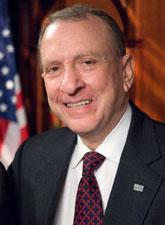 Sen. Arlen Specter (R-PA)
Legislative Activity
Stay on top of the latest movement without scrolling through every action
Senate amendment submitted
July 24, 2003
View full timeline
Senate amendment submitted
July 24, 2003
Senate amendment proposed (on the floor): Amendment SA 1368 proposed by Senator Specter.(consideration: CR S9851-9856; text: CR S9851)
July 24, 2003
Roll call votes on amendments in Senate: Motion to waive the Budget Act with respect to amendment SA 1368 rejected in Senate by Yea-Nay Vote. 50 - 46. Record Vote Number: 301.
July 24, 2003
Amendment SA 1368 proposed by Senator Specter. (consideration: CR S9851-9856; text: CR S9851) To increase the funding for discretionary grants for use in high-threat urban areas.
July 24, 2003
Point of order under the Budget Act raised in Senate with respect to amendment SA 1368.
July 24, 2003
Motion to waive the Budget Act with respect to amendment SA 1368 rejected in Senate by Yea-Nay Vote. 50 - 46. Record Vote Number: 301.
July 24, 2003
Amendment SA 1368 ruled out of order by the chair.
July 24, 2003
Votes
1 roll call on this amendment
Text
Proposed
DEPARTMENT OF HOMELAND SECURITY APPROPRIATIONS ACT, 2004

The PRESIDING OFFICER. Under the previous order, the Senate will
resume consideration of H.R. 2555, which the clerk will report.
The bill clerk read as follows:

A bill (H.R. 2555) making appropriations for the Department
of Homeland Security for fiscal year ending September 30,
2004, and for other purposes.

Pending:

Reid amendment No. 1318, to appropriate $20,000,000 to the
Office for Domestic Preparedness to be used for grants to
urban areas with large tourist populations.

The PRESIDING OFFICER. The Senator from North Dakota.
Mr. DORGAN. Madam President, I wanted to speak about an amendment I
wish to offer that I have reason to believe may or may not be accepted.
It

[[Page S9831]]

may be accepted, I am told. I was willing to do that in morning
business or on the bill. Since we are now on the bill, is there an
amendment pending?
The PRESIDING OFFICER. There is an amendment by Senator Reid which is
pending.
Mr. DORGAN. I ask unanimous consent that the amendment be set aside
so I might offer an amendment.
The PRESIDING OFFICER. Without objection, it is so ordered.

Amendment No. 1362

Mr. DORGAN. I send an amendment to the desk and ask for its immediate
consideration.
The PRESIDING OFFICER. The clerk will report the amendment.
The bill clerk read as follows:

The Senator from North Dakota [Mr. DORGAN] proposes an
amendment numbered 1362.

Mr. DORGAN. I ask unanimous consent that the reading of the amendment
be dispensed with.
The PRESIDING OFFICER. Without objection, it is so ordered.
The amendment is as follows:

(Purpose: To require a report on access by State and local law
enforcement agencies to the Tipoff database on potential terrorists)

Insert after section 615 the following:
Sec.  . Not later than 60 days after the date of the
enactment of this Act, the Secretary of Homeland Security, in
consultation with the Secretary of State and the Attorney
General, shall report to the Committee on Appropriations of
the Senate and the House of Representatives on the
feasibility of providing access to State and local law
enforcement agencies to the database of the Department of
State on potential terrorists known as the ``Tipoff''
database, including the process by which classified
information shall be secured from unauthorized disclosure.
Mr. DORGAN. Madam President, today we will hear the results of the
9/11 Commission, which will describe, after some study and hearings and
consideration, what we knew prior to 9/11, prior to the devastating
attack that occurred against this country that resulted in the murder
of thousands of innocent Americans.
There have been past suggestions that some of our law enforcement
agencies and others had information indicating a possible attack, and
that the information didn't get evaluated or moved up the chain of
command.
There are all sorts of discussions about what went wrong: What did we
know? What could we have done with the information we had in our
possession that might have foiled these attacks?
It is useful to evaluate all that. I hope this report, which I have
not yet read, will advance our knowledge of this situation.
Information sharing is essential in the war on terrorism and in
securing our country. But there is an alarming lack of information
sharing when it comes to our state and local law enforcement officials.
And that is the subject of my amendment here today.
On October 25 of last year, a task force headed by former Senators
Warren Rudman and Gary Hart released a report titled ``America Still
Unprepared, America Still In Danger.'' The bipartisan task force,
sponsored by the Council on Foreign Relations, included former
Secretaries of State Warren Christopher, George Shultz, retired Admiral
William Crowe, former Chairman of the Joint Chiefs of Staff, and
others.
What they found was that one year after the September 11 attacks,
America remained dangerously unprepared for another terrorist attack.
And at the top of the list of their concerns was this:

650,000 local and State Police officials continue to
operate in a virtual intelligence vacuum, without access to
the terrorist watch lists provided by the U.S. Department of
State to immigration and consular officials.

That was the top concern raised by the report. What do they mean by
that? They mean we do have a list of people who are known and suspected
terrorists and individuals who associate with those known or suspected
terrorists, and we use that list at the State Department to try to keep
those people from coming into our country. It is made available to
consulates across the world, to immigration officials across the world.
It is a list meant to protect our country by preventing those who are
known terrorist or those who associate with terrorists or suspected
terrorists from entering our country.

The problem is this. This list is not shared with the 650,000 law
enforcement officials in our country. We need 650,000 eyes and ears of
local law enforcement officials able to access that list to see whether
the car they pulled over on the interstate highway is filled with four
terrorists.
Let me give an example: 36 hours before the September 11 attacks, one
of the hijackers, the man who was at the controls of flight 93 that
crashed in Pennsylvania--one of the hijackers named Ziad Jarrah was a
26-year-old Lebanese national. He was driving 90 miles an hour on
Interstate 95, in Maryland. He was pulled over by the Maryland State
Police. He was driving a car rented in his own name.
This fellow shared a Hamburg apartment with Mohamed Atta. He was, we
think, at the controls of flight 93 that crashed in Pennsylvania and 36
hours before that attack he was pulled over for speeding on a Maryland
highway.
It turns out, for a number of reasons, his name was not on the watch
list. But had it been, and one would have expected it to be, that
Maryland State trooper would not have been able to know that. If this
afternoon, south of Drayton, ND, there is a highway patrol officer
pulling over a car with three individuals in it, and if those
individuals are known terrorists who have somehow come across the
border from Canada, that highway patrol officer will not be able to
access the terrorist watch list. So that highway patrol officer will be
in the dark. He or she will stop that vehicle, will evaluate the
occupants, search for information about their identity, but will not be
able to access the watch list.
The officer can access the NCIC data list, and determine whether the
person he has stopped has a criminal record, but the officer cannot
access the list that includes the names of the terrorists. That makes
no sense to me and it didn't make any sense to the commission headed by
Senator Rudman and Senator Hart. They said, as long ago as last
October, this needed to be fixed and it needed to be fixed now so that
650,000 additional pairs of eyes and ears belonging to law enforcement
officials, city police officers, highway patrol, and others are
available to help us look for terrorists who may be in this country.
Let me read in more detail excerpts from this Hart-Rudman report.
With just 56 field offices around the nation the burden of
identifying and intercepting terrorists in our midst is a task well
beyond the scope of the FBI. This burden could and should be shared by
650,000 local, county and State law enforcement officers. But clearly
they cannot lend a hand in a counterterrorism information void. When it
comes to combating terrorism, the police officers on the beat are
effectively operating deaf, dumb and blind. The terrorist watch lists
provided by the Department of State to immigration and consular
officials are still out of bounds for State and local police. In the
interim period as information sharing issues get worked out, known
terrorists will be free to move about to plan and execute their
attacks.
That is from the report issued last October, and nothing has been
done about it.
The Senate passed, at my urging, a provision in the supplemental
appropriations bill that effectively says to all the agencies to work
to get this done. That provision was dropped in conference.
I will now offer the same piece of legislation and hope it will be
attached to this appropriations bill. I hope it will be part of the
bill that is signed into law. I hope we don't have to continue to prod
executive agencies to do what they know we ought to do.
If, God forbid, there is another attack in this country by
terrorists, if that attack is perpetrated by someone who is picked up
by a highway patrol officer or a city police officer on a highway or a
street, and that person's name was on the watch list, and it was in the
bowels of the State Department available to all of the consular affairs
offices in the world but not available to that law enforcement officer
and, therefore, they let that known terrorist go because they did not
know this was a terrorist, and that terrorist then commits an act of
terror and murders thousands of Americans, then shame on this
Government for not doing what all of us in this Chamber

[[Page S9832]]

know needs to be done--not tomorrow, not next week, not next year,
right now, right this minute.
The report by the task force headed by Senators Hart and Rudman was
titled ``America Still Unprepared, America Still in Danger.'' Their top
recommendation of last October has still not been completed by the U.S.
Government.
In my judgment, the American people ought to ask the question, Why on
Earth is there foot dragging going on in making this watch list
available to law enforcement all across this country in order to better
prepare and better secure and better protect this country? It should
not take a year for this database to be shared.
Today, I resubmit this amendment and say we should not waste one
additional day.
I yield the floor.
Mr. COCHRAN. Madam President, we reviewed the amendment of the
Senator from North Dakota. The operative language of the amendment is
as follows:

The Secretary of Homeland Security . . . shall report to
the Committee on Appropriations . . . on the feasibility of
providing access to State and local law enforcement agencies
to the database of the Department of State on potential
terrorists . . . including the process by which classified
information shall be secured from unauthorized disclosure.

We discussed the amendment with the distinguished Senator and are
prepared to accept the amendment.
Mr. DORGAN. Madam President, I ask for its immediate consideration
and ask for a vote.
The PRESIDING OFFICER. The question is on agreeing to the amendment.
The amendment (No. 1362) was agreed to.
Mr. DORGAN. I move to reconsider the vote.
Mr. DODD. I move to lay that motion on the table.
The motion to lay on the table was agreed to.
The PRESIDING OFFICER. The Senator from Connecticut.

Amendment No. 1353

Mr. DODD. Madam President, I send an amendment to the desk.
The PRESIDING OFFICER. The clerk will report.
The bill clerk read as follows:

The Senator from Connecticut [Mr. Dodd], for himself, Ms.
Stabenow, and Mr. Lieberman, proposes an amendment numbered
1353.

Mr. DODD. Madam President, I ask unanimous consent that the reading
of the amendment be dispensed with.
The PRESIDING OFFICER. Without objection, it is so ordered.
The amendment is as follows:

(Purpose: To fund urgent priorities for our Nation's firefighters, law
enforcement personnel, and emergency medical personnel, and all
Americans by reducing the 2003 tax breaks for individuals with annual
income in excess of $1,000,000)

On page 56, line 2, strike ``$172,736,000'' and insert
``$690,944,000''.
On page 58, line 6, strike ``$2,888,000,000'' and insert
``$11,552,000,000''.
On page 60, line 1, strike ``$750,000,000'' and insert
``$3,000,000,000''.
On page 60, line 15, strike ``$826,801,000'' and insert
``$3,307,204,000''.
On page 65, line 9, strike ``$165,000,000'' and insert
``$660,000,000''.

Mr. DODD. Madam President, I am offering this amendment on behalf of
myself, my colleague from Michigan, Senator Stabenow, and my colleague
from Connecticut, Senator Lieberman.
The purpose of the amendment is very simply to take the report that
has been discussed here, which was prepared over the last number of
days by the Council on Foreign Relations, and identify and lay out in
significant detail the priorities and the urgency in dealing with
emergency responders. It is entitled ``Emergency Responders Drastically
Underfunded, Dangerously Unprepared.'' It is the report of an
independent task force sponsored by the Council on Foreign Relations
and chaired by Warren Rudman and Richard Clarke, senior adviser, and
Jamie Metzl, project director.
The purpose of the amendment reads:

To fund urgent priorities for our Nation's firefighters,
law enforcement personnel, and emergency medical personnel,
and all Americans by reducing the 2003 tax breaks for
individuals with annual incomes in excess of $1 million.

That is the purpose.
Just so my colleagues understand, the language of the purpose does
not mandate anything. The amendment would be subject to a point of
order which I am confident my colleague from Mississippi would make,
and there would be no vote on the amendment. I am setting out in the
purpose what I would like to see occur.
Other than that, of course, the language of the amendment does
specify some additional add-ons to meet the concerns raised by this
task force on emergency responders.
Over the last day or so, we have had a series of amendments that have
been offered to try to increase the funding in a number of areas.
I ask unanimous consent that this list be printed in the Record.
There being no objection, the material was ordered to be printed in
the Record, as follows:

U.S. SENATE ROLLCALL VOTES 108TH CONGRESS 1ST SESSION (2003)
--------------------------------------------------------------------------------------------------------------------------------------------------------
Vote No.                    Date                      Issue                  Question                 Result                  Description
--------------------------------------------------------------------------------------------------------------------------------------------------------
00298...................  July 23.................  H.R. 2555...............  On the Motion S.       Rejected 45-51..........  Motion to waive CBA
Amdt. 1351.                                      Schumer Amdt. No. 1351;
to make available an
additional $200,000,000
to increase the number
of border personnel at
the northern border of
the United States by the
end of fiscal year 2004.
00297...................  July 23.................  H.R. 2555...............  On the Motion S.       Rejected 43-52..........  Motion to waive CBA
Amdt. 1350.                                      Corzine Amdt. No. 1350;
to appropriate
$8,000,000 for the
Office of the Under
Secretary for
Information Analysis and
Infrastructure
Protection to conduct
chemical facility
security assessments.
00296...................  July 23.................  H.R. 2555...............  On the Motion S.       Rejected 48-49..........  Motion to waive CBA
Amdt. 1346.                                      Mikulski Amdt. No. 1346;
to increase the amount
of the appropriation for
firefighter assistance
grants by $150,000,000.
00295...................  July 23.................  H.R. 2555...............  On the Motion S.       Rejected 45-51..........  Motion to waive CBA
Amdt. 1343.                                      Schumer Amdt. No. 1343;
to increase the funds
for research and
development related to
transportation security,
and for other purposes.
00294...................  July 23.................  H.R. 2555...............  On the Motion to       Agreed to 50-48.........  Motion to table Hollings
table S. Amdt. 1341.                             Amdt. No. 1341; to
provide funds to
increase maritime
security.
00293...................  July 23.................  H.R. 2555...............  On the Motion S.       Rejected 45-53..........  Motion to waive CBA. re
Amdt. 1327.                                      Murray Amdt. No. 1327;
to increase funding for
emergency management
performance grants.
00292...................  July 23.................  H.R. 2555...............  On the Amendment S.    Agreed to 79-19.........  Boxer Amdt. No. 1331; to
Amdt. 1331.                                      require a classified
report to Congress on
the security costs
incurred by State and
local government law
enforcement personnel in
each state in complying
with requests and
requirements of the
United States Secret
Service to provide
protective services and
transportation for
foreign and domestic
officials.
00291...................  July 22.................  H.R. 2555...............  On the Motion S.       Rejected 43-50..........  Motion to waive CBA re
Amdt. 1317.                                      Byrd Amdt. No. 1317; To
fulfill Homeland
Security promises.
--------------------------------------------------------------------------------------------------------------------------------------------------------

Mr. DODD. Madam President, there were amendments to make available
additional dollars to increase the number of border personnel offered
by our colleagues; amendments to appropriate funds for the Office of
the Under Secretary of Information Analysis; amendments to increase the
amount of appropriations for fire fighter assistance grants--Senator
Mikulski and I offered that amendment--amendments to increase funds for
research and to provide funds to increase maritime security; and, funds
to increase emergency management performance grants. Senator Boxer
offered an amendment to require a classified report to Congress on the
security costs incurred by State and local governments, and so forth.
A number of amendments have been suggested. With very few exceptions,
these amendments have been rejected on points of order. They were in
violation of the Budget Act because they would break the caps.
I have great respect for those members who serve on the
Appropriations Committee. It is not an easy job. But I think what we
are faced with here is a problem that is far more significant than caps
on these budget requirements under the appropriations bills.
You need go no further than to read the report prepared by the
Council on

[[Page S9833]]

Foreign Relations that came out recently. It was begun in March and has
been around here for the last several weeks. All Members, I presume,
have received copies of it.
I want to read various passages of this to try to at least persuade
my colleagues about the sense of urgency we ought to have in light of a
survey and study done by those who are knowledgeable on the subject
matter of international terrorism and very knowledgeable about what
needs to be done to make this Nation more prepared.
Let me read the conclusion of this report. This was prepared by our
former colleague, Senator Rudman, along with a very distinguished task
force whose names I will share with the Members in a moment.

The terrible events of September 11 have shown the American
people how vulnerable they are because attacks on that scale
had never been carried out on U.S. soil. The United States
and the American people were caught underprotected and
unaware of the magnitude of the threat facing them.
In the wake of September 11, ignorance of the nature of the
threat or of what the United States must do to prepare for
future attacks can no longer explain America's continuing
failure to allocate sufficient resources in preparing local
emergency responders. It would be a terrible tragedy indeed
if it took another catastrophic attack to drive that point
home.

I do not think anything can be more clear than this language.
Listen further, if you will.
Listen further, if you will, in the foreword of this report by Les
Gelb, who was the President of the Council on Foreign Relations. I will
quote from his foreword. Les Gelb says:

As I sit to write this foreword, it is likely that a
terrorist group somewhere in the world is developing plans to
attack the United States and/or American interests abroad
using chemical, biological, radiological, nuclear or
catastrophic conventional means. At the same time, diplomats,
legislators, military and intelligence officers, police,
fire, and emergency medical personnel, and others in the
United States and across the globe are working feverishly to
prevent and prepare for such attacks. These two groups of
people are ultimately in a race with one another. This is a
race we cannot afford to lose.
In October 2002, the Council on Foreign Relations-sponsored
Independent Task Force on Homeland Security issued the report
``America--Still Unprepared, Still in Danger.'' The Task
Force, co-chaired by Senators Warren Rudman and Gary Hart,
came to the general conclusion that ``America remains
dangerously unprepared to prevent and respond to a
catastrophic terrorist attack on U.S. soil.'' The report
further warned that ``America's own ill-prepared response
could hurt its people to a much greater extent than any
single attack by a terrorist. . . . But the risk of self-
inflicted harm to America's liberties and way of life is
greatest during and immediately following a national
trauma.''

Les Gelb goes on to say:

Although progress continues to be made to the newly formed
Department of Homeland Security and other federal, state, and
local institutions, America remains dangerously unprepared
for another catastrophic terrorist attack.
In March 2003, the Council on Foreign Relations established
an Independent Task Force on Emergency Responders to follow
up on the specific recommendations of the Task Force on
Homeland Security and to examine the status of preparedness
and the adequacy of funding for emergency responders in the
United States. The Task Force on Emergency Responders
subsequently established an Emergency Responders Action
Group, consisting of representatives of emergency responder
professional associations, jurisdictional associations
representing state and local officials, and congressional and
budgetary experts, to provide expertise and advice to the
Task Force. The Task Force performed its analysis in
partnership with the Concord Coalition and the Center for
Strategic and Budgetary Assessments, two of the Nation's
leading budget analysis organizations. This represents the
first realistic effort to develop a budget range of the costs
necessary to protect the homeland [of the United States].
The preliminary analysis conducted by the Task Force
suggests that the United States may be spending only one-
third of what is required to adequately provide for America's
emergency responders.
Of its most important recommendations, I would like to
highlight the following--

Again, I am quoting Les Gelb--

Congress should require that the Department of Homeland
Security work with state and local agencies and officials and
emergency responder professional associations to establish
clearly defined standards and guidelines for emergency
preparedness.
Congress should work to establish a system for distributing
funds based less on politics and more on threat. To do this,
the federal government should consider such factors as
population, population density, vulnerability assessment, and
presence of critical infrastructure within each state. State
governments should be required to use the same criteria for
distributing funds within each state.

It goes on with these various recommendations. I will come back to
those in a minute.
Let me also say, this is not an amendment where I just came up with a
number. The number in the amendment I am offering is from the
recommendation of this report. It is a large number. I have never
offered, in all my years here, an amendment of this size. This
amendment is nearly $15 billion in 1 year. That is in addition to the
roughly $5 billion that is in this bill. This amendment is a little
less than $15 billion. But those are the numbers recommended by this
report. It is not a number I came up with or Senator Stabenow came up
with or my staff came up with.
This is the recommendation of serious people who spent time looking
at this problem, who have given us their best judgment of what we need
to be doing, and saying we are coming woefully short of what needs to
be done to keep this Nation prepared.
Let me share with you who these people are because it was not just
some nameless or faceless group of individuals who prepared this
report.
Charles Boyd is currently Chief Executive Officer and President of
Business Executives for National Security. Before retiring from the
U.S. Air Force, General Boyd served as Deputy Commander in Chief of the
U.S. European Command.
Richard Clarke is Senior Adviser to the Council on Foreign Relations.
Mr. Clarke served under the last three Presidents of the United States
in a senior White House position.
Admiral William Crowe previously served as Chairman of the Joint
Chiefs of Staff under President Ronald Reagan.
Margaret Hamburg is Vice President for Biological Weapons at the
Nuclear Threat Initiative. Before coming to NTI, Dr. Hamburg was
Assistant Secretary for Planning and Evaluation at the Department of
Health and Human Services.
James Kallstrom is senior executive vice president at MBNA American
Bank. Prior to that, he was on a leave of absence and served as the
Director of the Office of Public Security for the State of New York.
Joshua Lederberg is a Nobel laureate. He currently serves as the
president emeritus and Sackler Foundation Scholar at Rockefeller
University.
Donald Marron is chairman of UBS America. He previously served for 20
years as chairman and chief executive officer for the Paine Webber
Group.
James Metzl, I mentioned already. He served on the National Security
Council at the White House, in the Department of State, and as Deputy
Staff Director of the Senate Foreign Relations Committee.
Philip Odeen is former chairman of TRW. Previously he was president
of BDM International, and a vice chairman at Coopers & Lybrand.
Norman Ornstein is a resident scholar at the American Enterprise
Institute and senior counselor to the Continuity of Government
Commission.
Dennis Reimer is director of the National Memorial Institute for the
Prevention of Terrorism in Oklahoma City. Prior to that, he served in
the U.S. Army in a variety of joint and combined assignments, retiring
after 37 years as the Chief of Staff of the United States Army.

Warren Rudman, we all know, is our former colleague.
George Shultz is the Thomas W. and Susan B. Ford distinguished Fellow
at the Hoover Institution. He has served as Secretary of State,
Secretary of the Treasury, Secretary of Labor, and Director of the
Office of Management and Budget and, of course, is a member of this
task force.
Ann-Marie Slaughter is dean of the Woodrow Wilson School of Public
and International Affairs at Princeton University.
Harold Varmus is president and chief executive officer of the
Memorial Sloan-Kettering Cancer Center. He previously served as the
Director of the National Institutes of Health.
John Vessey is a former Chairman of the Joint Chiefs of Staff, as
well as Vice Chief of Staff of the United States Army.
William Webster previously was Director of the Central Intelligence

[[Page S9834]]

Agency from 1987 to 1991, and Director of the Federal Bureau of
Investigation from 1978 to 1987.
Steven Weinberg is the Director of the Theory Group of the University
of Texas, who is a Nobel laureate in physics and a recipient of the
National Medal of Science.
Mary Jo White formerly served as U.S. attorney for the Southern
District of New York from 1993 to 2002.
Madam President, these are the people who said we need to do what I
am recommending, not some people--with all due respect--you might not
meet or ever know who come up with a number.
Can you possibly imagine a more serious group of people who have
looked at the threat to the United States, and who have given us a
report only a few weeks ago? And here we are debating what needs to be
done in homeland security. With great respect to those who are charged
with living within the caps that are provided, they are saying to us,
in this report--and I will quote from it--you need to do a lot more.
America is vulnerable. America is in danger. What more serious group
could we listen to?
Can you imagine if this group came to us--or a similar group--and
said that our military was underfunded, that we didn't have the
resources to deal with the threats in Iraq and North Korea and
elsewhere around the globe? How long would we wait before responding to
that recommendation?
Yet here we are with a similar group of people--former Chairmen of
the Joint Chiefs of Staff, Directors of the CIA and the FBI, major
figures in our society--recommending that we do more to protect our
country, and we are not doing it.
I am stunned by it. I know we have caps in these budgets. But we just
passed, in the last 28 months--if you collectively add them up--almost
$3 trillion in tax cuts. And a sizable piece of those tax cuts have
gone to some of the most affluent Americans. This Congress, if it
wanted to, could find resources by paring back--not by blowing through
the caps, but by paring back--on some of the tax cuts we have given to
the most affluent Americans.
I represent a lot of affluent Americans in the State of Connecticut.
I do not think I could find one of them who would not be willing to
stand here and tell you: Roll back my tax cut if it means we can
provide the resources to make America secure.
I do not know of a single wealthy citizen who believes that their tax
cut is more important than keeping America secure.
What an indictment it will be. And we are told--in this report that
you heard from Les Gelb--it is not a matter of if this happens but when
it happens. When it happens, are we going to be prepared? Have we done
the things necessary to keep our country strong?

Here we are getting a clear message from those people who spent the
time looking at this saying we ought to do more. I apologize for
offering an amendment of $15 billion, but that is what it takes. We
have offered amendments for $15 million, $60 million, and $100 million
here and there for firefighters, reports, and studies and to put more
guards on the border. I said: Why not have an amendment that
encompasses what this report recommends? That is what Senator Stabenow
and I said. Let's put it on the line. Instead of nickel and diming
this, let's say whether or not we in this body think the
recommendations of these distinguished Americans deserve our support
and in the waning days before we take a month off in August to go out
and have a nice vacation for ourselves, whether or not we have the
intestinal fortitude to step up and do what needs to be done to put
this country on a more sound and secure footing.
That is the vote I will be asking our colleagues to make shortly on
this issue. There will be a point of order and a motion to waive, and
we can get confused. Let there be no doubt about what the vote is. The
vote is not a point of order. The vote is whether or not we are going
to have the resources to do what needs to be done, according to this
report.
Let me share some of its conclusions. I see my colleague from
Michigan. I want to give her the opportunity to be heard as well. But I
want my colleagues to understand what we are going to be rejecting,
having seen what has happened over the last several days. We will
reject this, I presume. I would love to be proven wrong, but I suspect
I will not. Just so the record is clear, I will ask unanimous consent
that this report be printed in the Record. I will exclude the
appendices and other materials. So every American who may not get a
copy of this report, it can be pulled up on their Web site and they can
read the report. I am not making it up. If you are interested in
knowing what is in this report, you can read about it in tomorrow's
Congressional Record.
I ask unanimous consent that the body of the report be printed in the
Record.
There being no objection, the material was ordered to be printed in
the Record, as follows:

Report Prepared by the council on Foreign Relations--Conclusions and
Recommendations

1. Define and Provide for Minimum Essential Capabilities

The Task Force found that there is no systematic national
standard that defines the essential minimum capabilities for
emergency responders that every jurisdiction of a given
population size should possess or be able to access. Because
of this, there are currently no comprehensive, systematic,
and consolidated principles or measures against which the
degree and quality of preparedness can be tracked nationwide.
Current efforts to develop such standards are inconsistent
and dispersed among various government agencies and
nongovernmental organizations. Additionally, existing
standards for minimum capabilities for emergency responders
are a patchwork with many missing pieces that lacks
systematic integration, are insufficient to address many
major challenges--including that of catastrophic terrorism
involving WMD--and are not harmonized across the many types
of emergency responders. While existing standards provide a
useful starting point, they do not constitute ``national
standards for emergency response training and preparedness,''
as called for in the National Strategy for Homeland Security.
(A selection from this document is included in Appendix B.)
At the end of five years of federal funding, therefore, some
metropolitan areas may still lack fundamental emergency
responder capabilities.
Congress should require DHS and HHS to work with other
federal agencies, state and local emergency responder
agencies and officials, and standard-setting bodies from the
emergency responder community to establish clearly defined
standards and guidelines for federal, state, and local
government emergency preparedness and response in such areas
as training, interoperable communication systems, and
response equipment. These standards must be sufficiently
flexible to allow local officials to set priorities based on
their needs, provided that they reach nationally determined
preparedness levels within a fixed time period. These
capabilities must be measurable and subject to federal audit.
Congress should require that the FY05 budget request for
DHS be accompanied by a minimum essential emergency responder
capability standard of WMD- and terrorism-related disaster
equipment and training per 100,000 persons in a metropolitan
region, and by separate standards for rural areas. Each
recipient state and metropolitan area should then be required
to submit a plan detailing how it intends to achieve that
standard, to incorporate it into all appropriate training
programs, and to regularly test its effectiveness.
National performance standards could be implemented through
an incentive grant system making federal funding conditional
and available to those localities that adopt federally
approved standards of preparedness.

2. develop requirements methodology

National capability standards for levels of preparedness
must drive an emergency preparedness requirements process.
This process must evolve into one similar to that currently
used by the U.S. military. Threats must be identified,
capabilities for addressing threats determined, and
requirements generated for establishing or otherwise gaining
access to necessary capabilities. The Task Force found that
the administration and Congress were funding emergency
preparedness without any agreement on methodology to
determine how much is enough or what the requirements are. It
is therefore extremely difficult, if not impossible, to
measure how well prepared the United States is.
Congress should include in the FY04 appropriations for DHS
and HHS a provision calling on each agency to accompany the
FY05 budget request with a detailed methodology for
determining the national requirements for emergency responder
capability and assistance.
Congress should require that DHS and HHS submit a
coordinated plan for meeting national preparedness standards
by the end of FY07.
Congress should require DHS and HHS to report annually on
the status of emergency preparedness across the United
States. This report should indicate the levels of federal,
state, and local expenditures for emergency
preparedness, evaluate how effectively that funding is
being used, and assess the status of preparedness in each
state based on national preparedness standards.

[[Page S9835]]

3. accept necessary burden-sharing

The Task Force found that there were no accepted national
guidelines for determining the nature of burden-sharing
between the federal government and state and local
jurisdictions. Although state and local jurisdictions should
maintain primary responsibility for funding normal levels of
public health and safety readiness, the Task Force found that
the federal government should be responsible for providing
the funds necessary to cover the incremental costs of
achieving essential standards in responding to the additional
national security threat posed by terrorism. In some
outstanding cases, federal funds may be required to enhance
state and local emergency responder infrastructure that has
been starved of resources if the deterioration of
capabilities is such that it poses a threat to national
security and state and local resources are not reasonably
sufficient for addressing this shortfall.

4. guarantee sustained multiyear funding

The Task Force found that many state and local governments
are unwilling or unable to accept federal funding for
programs that will generate long-term costs in the absence of
guarantees that the federal government will make funds
available for sustaining such programs. Stable and long-term
funding is critical for encouraging state and local
governments to develop the necessary emergency response
capabilities and, most critically, to sustain them over time.
Congress should accompany all authorizations for emergency
responder assistance grants in FY04 and thereafter with
budget authority for sustaining those grants through the
following two fiscal years.

5. refocus funding priorities

The Task Force found existing systems for determining the
distribution of appropriated funds to states to be badly in
need of reform. The federal government currently determines
levels for emergency preparedness funding to states
primarily on a formula that guarantees minimum funding
levels to all states and then determines additional
funding based on each state's population. All citizens of
the United States deserve a base level of protection
regardless of where they live. Nevertheless, the state and
population-drive approach has led to highly uneven funding
outcomes. Wyoming, for example, receives $10.00 per capita
from DHS for emergency preparedness while New York State
receives only $1.40 per capita. While this approach may
have political appeal, it unnecessarily diverts funding
from areas of highest priority. In addition, decision by
state officials regarding the allocation of funds in their
states have not sufficiently taken into account the
multitude of necessary factors.
Congress should establish a system for allocating scarce
resources based less on dividing the spoils and more on
addressing idenfitied threats and vulnerabilities. To do
this, the federal government should consider such factors as
population, population density, vulnerability assessment, and
presence of critical infrastructure within each state. State
governments should be required to use the same criteria for
distributing funds within each state.
Congress should also require each state receiving federal
emergency preparedness funds to provide an analysis based on
the same criteria to justify the distribution of funds in
that state.

6. rationalize congressional oversight

The Task Force found that the proliferation of committees
and subcommittees in Congress makes it hard to devise a
coherent homeland security policy and a focused homeland
defense system. Congress needs to have a lead committee, or
an effective joint committee, to shape overall policy.
Otherwise the system is likely to be fragmented and plagued
with pork.
The U.S. House of Representatives should transform the
House Select Committee on Homeland Security into a standing
committee and give it a formal, leading role in the
authorization of all emergency responder expenditures in
order to streamline the federal budgetary process.
The U.S. Senate should consolidate emergency preparedness
and response oversight into the Senate Government Affairs
Committee.

7. accelerate delivery of assistance

The Task Force found that many metropolitan areas and
states had actually received and spent only a small portion
of the funds for emergency responders that have been
appropriated by Congress since September 11. The current
inflexible structure of homeland security funding, along with
shifting federal requirements and increased amounts of
paperwork, places unnecessary burdens on state and local
governments as they attempt to provide badly needed funds to
emergency responders. While a balance should be maintained
between the need for the rapid allocation of emergency
preparedness funds and the maintenance of appropriate
oversight to ensure that such funds are well spent, the
current danger is too great to allow for business as usual.
According to the National Emergency Managers Association,
``appropriation cycles have been erratic causing extreme
burdens on state and local governments to continue
preparedness activities when there is no federal funding, and
then forcing them to thoughtfully and strategically apply
several years of federal funds and millions of dollars at one
time.'' (NEMA, State Spending and Homeland Security Funds,''
April 2, 2003) As a first step toward addressing this
problem, Congress instructed the DHS Office of Domestic
Preparedness in the FY03 consolidated appropriations measure
(P.L. 108-7) to distribute grant funds to states within 60
days of the enactment of the bill and required states to
distribute at least 80 percent of those funds to localities
within 45 days of receipt.
Congress should ensure that all future appropriations bills
funding emergency response include strict distribution
timeframes as exemplified by the FY03 consolidated
appropriations measure.
Congress should require states to submit data regarding the
speed of distribution of the federal funds for emergency
responders appropriated to states.
Congress should grant DHS the authority to allow states
greater flexibility in using past homeland security funding.
As a first step in this direction, Congress should authorize
greater flexibility in the federal guidelines laid out in the
FY03 Omnibus Appropriations Bill for the percentages of funds
that can be used for various emergency response activities
(e.g., 70 percent for equipment, 18 percent for exercises, 7
percent for planning, 5 percent for training) to make it
possible for states to better allocate resources according to
their most urgent needs. This authority should be granted on
a case by case basis by means of a waiver from the Secretary
of the Department of Homeland Security.

8. fix funding mechanisms

Many states have been mandated to develop more than five
separate homeland security plans. While the information
requested by each homeland security plan is similar, states
and communities are often required to reinvent the wheel from
one emergency plan to the next.
DHS should move the Office of Domestic Preparedness from
the Bureau of Border and Transportation Security to the
Office of State and Local Government Coordination in order to
consolidate oversight of grants to emergency responders
within the Office of the Secretary.
States should develop a prioritized list of requirements in
order to ensure that federal funding is allocated to achieve
the best return on investments.
Congress should require DHS to work with other federal
agencies to streamline homeland security grant programs in a
way that reduces unnecessary duplication and establishes
coordinated ``one-stop shopping'' for state and local
authorities seeking grant funds. Efforts to streamline the
grants process should not, however, be used as a
justification for eliminating existing block grant programs
that support day-to-day operations of emergency responder
entities. In many cases, such grants must be expanded.
Congress should create an interagency committee to
eliminate duplication in homeland security grants
requirements and simplify the application process for federal
grants.

9. disseminate best practices

Although emergency responders have consistently identified
as a high priority the need to systematically share best
practices and lessons learned, the Task Force found
insufficient national coordination of efforts to
systematically capture and disseminate best practices for
emergency responders. While various federal agencies,
professional associations, and educational institutions have
begun initiatives to develop and promulgate best practices
and lessons learned, these disparate efforts generally are
narrow and unsystematic and have not sufficiently reached
potential beneficiaries. Such information-sharing could be
one of the most effective ways to extract the greatest amount
of preparedness from a finite resource pool. Once centralized
and catalogued, such data will allow all emergency responders
to learn from past experiences and improve the quality of
their efforts, thereby assuring taxpayers the maximum return
on their investment in homeland security. Access to this
resource will provide the analytical foundation for future
decisions regarding priorities, planning, training, and
equipment.
Congress should establish within DHS a National Institute
for Best Practices in Emergency Preparedness to work with
state and local governments, emergency preparedness
professional associations, and other partners to establish
and promote a universal best practices/lessons learned
knowledge base. The National Institute should establish a
website for emergency preparedness information and should
coordinate closely with HHS to ensure that best practices for
responding to biological attack are sufficiently incorporated
into the knowledge base.

10. enhance coordination and planning

The Task Force found that although effective coordination
and planning are among the most important elements of
preparedness, jurisdictions across the country are
neither sufficiently coordinating emergency response
disciplines within their jurisdictions nor adequately
reaching across jurisdictional lines to coordinate their
efforts with neighboring communities. Although Title VI of
the Stafford Act (P.L. 106-390) authorizes the Director of
FEMA to coordinate federal and state emergency
preparedness plans, this authority has not been applied
sufficiently to ensure adequate levels of coordination and
planning between and among federal, state, and local
jurisdictions. In addition, state and local emergency
management agencies lack the resources to develop and
maintain critical emergency management capabilities. More
also needs to be

[[Page S9836]]

done to encourage and facilitate mutual aid and other
cross-jurisdictional agreements that pool resources,
minimize costs, and enhance national preparedness.
DHS should require that all states and territories submit
statewide mutual assistance plans, including cross-border
plans for all cities and counties adjoining state or
territorial borders. Reference to such plans should be
required in all homeland security grant applications for
federal funding. Wherever possible, grants should be
structured to reward the pooling of assets across
jurisdictional lines.
DHS should develop a comprehensive national program for
exercises that coordinates exercise activities involving
federal agencies, state and local governments, and
representatives from appropriate private sector entities
including hospitals, the media, telecommunications providers,
and others. These exercises should prepare emergency
responders for all types of hazards, with a specific focus on
WMD detection and response. When necessary, funds should be
provided to ensure that exercises do not interfere with the
day-to-day activities of emergency responders.
Congress should work with DHS to expand the capacity of
existing training facilities involved in the National
Domestic Preparedness Consortium and to identify any new
training facilities for emergency responders that may be
required.

Mr. DODD. Let me read some of the executive summary. I am quoting
directly.

The tragic events of September 11, 2001 brought home to the
American people the magnitude of the danger posed by
terrorism on U.S. soil. Now in the aftermath of the September
11th attacks, the United States must assume--

Remember who I told you wrote this report now--

that terrorists will strike again, possibly using chemical,
biological, radiological, or even nuclear materials. The
unthinkable has become the thinkable. But although in some
respects the American public is now better prepared to
address aspects of the terrorist threat than it was two years
ago, the United States remains dangerously ill-prepared to
handle a catastrophic attack on American soil.
On average fire departments across the country have only
enough radios to equip half the firefighters on a shift and
breathing apparatus for only one-third of our firefighters.
Only 10 percent of the departments in the United States have
the personnel and equipment to respond to a building
collapse. Police departments and cities across the country do
not have protective gear to safely secure a site following an
attack with weapons of mass destruction. Public health labs
in most states lack basic equipment and expertise to
adequately respond to a chemical, biological attack, and 75
percent of state laboratories report being overwhelmed by
testing requests. Most cities do not have necessary equipment
to determine what kind of hazardous materials emergency
responders may be facing.
If the nation does not take immediate steps to better
identify and address the urgent needs of emergency
responders, the next terrorist incident could have an even
more devastating impact than the September 11th attacks.
According to data provided to the Task Force by emergency
responder professional associations and leading emergency
response officials from around the country, America will fall
approximately $98.4 billion short of meeting critical
emergency responder needs over the next five years if current
funding levels are maintained.

That is my amendment. I can only put up a 1-year appropriation. We
have roughly 5 in the bill before us. I put up an additional 15. That
is 20. That gets you close to 98, if we did it each year over the next
5 years. The amendment is not made up out of whole cloth. It comes from
the recommendations of this task force I have cited.

Currently the Federal budget to fund emergency responders
is about $28 billion over five years.

It goes on, and I will not bore my colleagues. They can read it for
themselves. It goes through what States may or may not be spending. The
fact is, we know almost every State is facing huge deficits. The
deficit of the State of California is $38 billion alone. My State is
about $1.5 billion. In Michigan, it is around $4 billion. So you have
roughly $100 billion in deficits. We read the other day that colleges
and universities are going to raise tuition to make up for the
shortfalls. The idea that States will allocate more money in light of
their own fiscal difficulties is unrealistic. Candidly, the report
says, over the next number of years, we cannot rely on States to fill
in the gap. They are not going to be able to do it.
By the way, I want to repeat a point. I think it was tremendously
worthwhile that Pete Peterson, the leader of the Concord Coalition and
also the Center for Strategic and Budgetary Assessments, two of the
Nation's leading budget analyst organizations, worked on these numbers.
They say in the report that they are not claiming perfection, and there
is a need to do a far better assessment of overall needs. But they also
quickly say: You can't wait until you get all the assessments and
perfection. You have to be on a dual track. I am almost quoting the
report here, that you need to do a better assessment, but
simultaneously we have to get the resources out to support the efforts
being made to make us more secure.

We have had very strong organizations looking at what needs to be
done. The additional funds that we are talking about in this amendment
and some we have already voted on would allow for additional resources
to support homeland security.
We would extend the emergency 911 system nationally to foster
effective emergency data, to significantly enhance urban search and
rescue capabilities of major cities and the Federal Emergency
Management Agency in cases where buildings or large structures collapse
and trap individuals; to foster interoperable communications systems
for emergency responders across the country. This is a major area. I do
not know of a single colleague that has not heard from their police and
fire departments about the inability to communicate with each other.
On the interoperability of the telecommunications systems, there is a
real gap across the country and a tremendous demand. Some have
estimated the cost to be $400 or $500 million--and that may be low--to
get the ability of our first responders to be able to talk to one
another. That is a major item.
Again, citing from the report, to enhance public health preparedness
by strengthening laboratories' disease tracking communications by
training public health officials; to strengthen emergency operations
centers for local police, public safety coordination; to provide
protective gear and weapons of mass destruction remediation equipment
to firefighters; to support an extensive series of national exercises
that would allow responders to continually learn and improve on
effective response techniques; to enhance emergency agricultural and
veterinarian capabilities for effective response to national food
supply attacks; to develop surge capacity in the Nation's hospitals and
to help them better prepare for weapons of mass destruction attacks; to
enhance capacity for emergency medical technicians, paramedics, and
others to respond to mass casualty events.
This is just a list of the things they are talking about that they
think are necessary.
They point out the importance of coordinating. I will not read all of
that. I will put it in the record so Members who want to read the
report for themselves can get a better feel for what is necessary.
I mentioned already some of the tremendous shortcomings that occur.
Again I quote from the report:

It is impossible to overestimate the need to prepare for
this threat. One way of understanding America's urgent need
to prepare is to ask the question: If we knew that there was
going to be a terrorist attack sometime in the next 5 years,
but did not know what type of attack it would be, who would
carry it out, or where in the United States it would occur,
what actions would we now take and how would we allocate our
human and financial resources to prepare?
The American people must assume this is the situation this
Nation currently faces.

So we can anticipate an attack in the next 5 years. We don't know
where or when, but it is going to come. What better warning could you
have? What is history going to say about us? You had a report. You were
told by highly competent individuals what a shortcoming you face.
This is only $15 billion. We are spending $5 billion every month in
Iraq and Afghanistan--$1 billion a week in Iraq and $1 billion a month
in Afghanistan. That is $15 billion in 3 months to try to deal with the
threats there. I am asking for $15 billion for a whole year to make us
more secure.
I certainly understand the reasons why we have to do what we do in
Iraq and Afghanistan. I am not suggesting that is a bad idea. Don't
misunderstand me. But if it is good enough to keep us secure by doing
that there, and there is a report telling us we are not doing enough at
home, can't we at least do what we do in those two countries on a 3-
month basis in this country for a year to make us more secure?

[[Page S9837]]

Frankly, I don't understand why we are debating this. I would have
thought we would have been told this is what we have to do, based on
the best analysis of what needs to be done here. If we knew we were
going to face a terrorist attack and we didn't know what type it would
be, who would carry it out, where it would occur, what actions would we
take now? I suspect that I would be overwhelmed by people who would
want to be here to support an amendment to add these numbers.
As I said, we have not defined the national standards of
preparedness. This report points it out--the essential capabilities of
every jurisdiction, considering size, who would have immediate access
to it, and so forth. This report clearly says you cannot wait for those
reports to be done. I will quote again from the report. I think there
is stunning language here:

The United States must rapidly develop a sophisticated
requirement methodology to determine the country's most
critical needs and allow for the setting of priorities and
readiness training and procurement. The United States does
not, however, have the luxury of waiting until an
overreaching process is created to fund urgently needed
enhancements to current capabilities. In the nearly 2 years
since the September 11 attacks, Congress has dangerously
delayed the appropriation of funds for emergency responders,
Federal agencies have been slow getting funds to State and
local jurisdictions, and States have hampered the efficient
dissemination of much needed Federal funds to the local
level. The overall effectiveness of Federal funding has been
further diluted by a lack of process to determine the most
critical needs of the emergency responder community in order
to achieve the greatest return on investment. A dual-track
approach is therefore required while developing a reliable
systematic requirements methodology, and streamlining the
appropriations process must be a priority. The United States
must make its most educated guess based on incomplete
information about what emergency funds are needed
immediately.

So it says that Congress has dangerously delayed the appropriations
process. This is not a report prepared by a group of Democrats. I don't
think George Shultz and the others in this group--you can go back to
advisers who would associate themselves with some partisan report but
this is hardly partisan. It is a cold analysis of where we are and what
kind of trouble we are in. It is about what kind of trouble we are in.
Either we understand this and respond to it, or we will suffer the
consequences of a historical judgment that will indict us for not
having done what needed to be done in these days.

I will have more to say about this. I know some of my colleagues want
to be heard as well. I don't fault my good friend from Mississippi, who
has the unenviable task of chairing a subcommittee that has to grapple
with these issues. I don't fault him in this. He is faced with the
budget constraints we have adopted. I thank him for his commitment to
these issues.
As I say, with a great deal of reluctance I have offered this
amendment. It is a large amount--$15 billion--but I thought that
instead of trying to go through 25 different amendments of little
pieces here and there, we would lay out on the table this report and
its recommendations and suggest how we might do it.
It is painful, obviously, to roll back something you have already
adopted. But imagine what they would say about us historically--that we
didn't want to roll back a tax cut--not all of it but just for those in
the most affluent group of our citizens, and ask them to take a little
less for a while in order to let us fund homeland security. Can you
imagine what history may say 50 or 100 years from now, after we have
gone through a series of events, that Congress had a report that warned
otherwise in 2003 but they just could not find a way to do it, and we
didn't fund it properly, so our people faced a great threat?
I don't understand how we would allow ourselves the vulnerability of
that kind of historical judgment. So that is why I have put language in
here to suggest how this could be done. Yes, $3 trillion is a lot of
money. It is a thousand billion dollars. One thousand billion dollars
is a trillion dollars. A thousand million dollars is a billion dollars.
I am asking for $15 billion out of a thousand billion, or the three
thousand billion, in order to try to get this right. You cannot
convince me ever that there is not enough room in that tax cut, those
amounts, to find something here to make homeland security better for
the people of our Nation. They deserve nothing less. They will be
horrified to find out, if events occur, that we didn't do what we
should have and could have done.
I reserve the remainder of my time.
The PRESIDING OFFICER. The Senator from Mississippi is recognized.
Mr. COCHRAN. Madam President, the distinguished Senator from
Connecticut has offered an amendment to add exactly, according to my
addition, $14.408 billion to the total spending provided in this bill
that funds the Department of Homeland Security.
The statements that he makes regarding the Council on Foreign
Relations report are certainly to be considered seriously by the
Senate. They have done good work. Former Senators Warren Rudman and
Gary Hart have worked hard to bring the attention of the whole country
to the needs we have in this area.
I think one thing overlooked is that the Department of Homeland
Security's budget does not represent the total amount of spending being
undertaken by the Federal Government, nor State and local governments,
to do the things necessary to improve our capability not only to
respond to natural and manmade attacks, or terrorist acts, but to
prepare for them as well, and to improve our intelligence capability
and what we are doing to find out what the terrorists are up to, who
they are, and how they could pose threats to American citizens and our
homeland.
Much of the spending is done in other Departments that is not
included in this amount. So to focus on this budget for this Department
and say there is not enough money here to do what we need--of course
there is not. There is no money in here for the CIA or the FBI. There
is no money in here for doing things such as bioterrorism research on
how we can protect ourselves against bioterrorism threats. That is
being done by the Department of Health and Human Services, through the
Centers for Disease Control. They are funded in other bills.
This budget, and the budget request submitted by the President for
homeland security, represents only 58 percent of the total Federal
effort. So there is much more being done than is reflected in the
budget of this Department and this appropriations bill which,
incidentally, adds a billion dollars over the President's budget
request for these activities. Much of that money is going to the first
responders' effort this year and will next year.
We cannot measure what we have done in the last 2 years and project
it as to what we will do in the future. We cannot do it all in 1 year.
We are making progress, and more progress needs to be made.
It is not just a Federal program either, it is a national program. It
involves all governments, all agencies, and the American people
themselves. We are all more aware and more alert to the dangers and
what we can do personally to help improve the security of our homeland.
So the adding of $14.408 billion to this bill, with no corresponding
offset, will violate the Budget Act because we are only allocated a
certain amount of spending. When we go above that, then the bill
becomes subject to a point of order that any Senator can make and the
whole bill falls.
So with a great deal of respect for my friend from Connecticut, I
make a point of order under section 302(f) of the Congressional Budget
Act that the amendment provides spending in excess of the
subcommittee's 302(b) allocation.
The PRESIDING OFFICER. The Senator from Connecticut.
Mr. DODD. Pursuant to section 904 of the Congressional Budget Act of
1974, I move to waive the applicable sections of that act for purposes
of the pending bill and I ask for the yeas and nays.
The PRESIDING OFFICER. Is there a sufficient second?
There appears to be a sufficient second.
The yeas and nays were ordered.
The PRESIDING OFFICER. Does the Senator from Michigan desire to
speak?
Ms. STABENOW. I ask unanimous consent to speak concerning the motion
to waive the Budget Act on the Dodd-Stabenow amendment before
proceeding with the vote.

[[Page S9838]]

Mr. DODD. A motion to waive is a debatable motion.
The PRESIDING OFFICER (Mr. Ensign). The Senator from Michigan.
Ms. STABENOW. Mr. President, I rise to debate that motion and support
Senator Dodd in his motion. I am very proud to be joining with him in
the Dodd-Stabenow amendment concerning fully providing the resources
for our first responders in our communities all across America. I
appreciate the constraints our chairman is working under, but I cannot
imagine a more important issue for all of us today than this particular
amendment.
This is not a partisan amendment. The terrorists who come do not
decide who is a Republican or who is a Democrat, where one lives, their
age or ethnic background. This is an issue for all of us as Americans,
certainly for the people who work in this building who were directly in
the line of attack on September 11, certainly for all of those across
the country who understand that this is a new world since September 11,
2001.
When it comes to protecting our country from terrorists, we should do
whatever it takes, period, to make sure we are safe. We cannot live by
artificial limits, by bureaucratic budget procedures. Just as Congress
has come together, working with the President, and said whatever our
military needs, whatever it takes to prepare our men and women to be
successful overseas, to support our military, to support our Department
of Defense, we will do, period, to make sure our people are safe abroad
as well as at home. We should do no less.

I join with Senator Dodd in saying this should not even be an issue
that we are debating once we have seen this report--the emergency
responders are drastically underfunded and dangerously unprepared--a
report that does not just deal with one department; they look across
the range of issues that relate to our folks on the front lines being
able to respond, and they have a report about which every single
American should be concerned. We should take this as a blueprint and
immediately respond to it.
How do we determine what is the right amount to spend to protect our
country? I cannot think of a more objective or credible group than the
one which put this together. We should listen to the experts, and in
this case a bipartisan commission of experts, charged with this task,
who determined we need to spend an additional $98.4 billion over 5
years on top of what we are doing today. This is a shocking difference
between what the American people need, what we need, and what we are
providing as a Congress representing those American people.
This conclusion was reached by an impressive bipartisan commission.
As the Senator from Connecticut has already indicated, it is led by
former Republican Senator Warren Rudman, former White House
cybersecurity chief Richard Clarke, and just to mention a few of those
who have put these recommendations together for us and for the American
people, a highly respected list of Americans, including the former
Chairman of the Joint Chiefs of Staff, ADM William Crowe, former Reagan
Secretary of State George Shultz, and former FBI Director William
Webster.
When coming up with its conclusions, this distinguished panel
consulted with organizations such as the International Association of
Chiefs of Police, the International Association of Fire Chiefs, and the
International Association of Fire Fighters. After much deliberation,
this panel reached a dramatic conclusion, and the title of its press
release says it all:

Nearly 2 years after 9/11, the United States is still
dangerously unprepared, and underfunded, for a catastrophic
terrorist attack, warns New Council Task Force.

I read from the summary of this report:

Nearly 2 years after 9/11, the United States is drastically
underfunding local emergency responders--

Police, fire, emergency medical personnel, others--

and remains dangerously unprepared to handle a catastrophic
attack on American soil, particularly one involving chemical,
biological, radiological, nuclear, or high-impact
conventional weapons. If the Nation does not take immediate
steps to better identify and address the urgent needs of
emergency responders, the next terrorist incident could be
even more devastating than 9/11.

Further, the summary reads:

The task force met with emergency responder organizations
across the country and asked them what additional programs
they truly need--not a wish list--to establish a minimum
effective response to a catastrophic terrorist attack. These
presently unbudgeted needs total $9.84 billion, according to
the emergency responder community and budget experts.

Finally:

The . . . Task Force . . . based its analysis on data
provided by frontline emergency responders--firefighters,
policemen, emergency medical personnel, public health
providers and others--whose lives depend upon the adequacy of
their preparedness for a potential terrorist attack.

This report says our local communities need much more than we are
currently providing. This is not a critique from me, as the Senator
from Michigan, it is not a critique by the distinguished Senator from
Connecticut, it is not by any politician or any person right now who
would gain from some partisan advantage. This is a group of experts on
a bipartisan basis who come together as Americans to say we are not
doing enough.
This report reaches the same conclusion I have heard from my own
first responders in Michigan. I have spent a great deal of time
traveling across Michigan since last fall, and I have done over 11
different townhall meetings in Michigan with police departments, large
and small, fire departments, police chiefs, sheriffs--Republican
sheriffs, Democratic sheriffs--those at the health department, the
folks who run the emergency rooms at the hospitals, all of those
involved, and overwhelmingly they have said: We are working very hard.
We cannot do it alone. Please get beyond the ideological debate and
talk about what we need to prepare us to be safe.
It cannot be done just by asking the local city, township or county
to provide additional resources alone. This is a national attack on our
country. It needs a partnership from all of us, and they are speaking
loudly that they need our help. More importantly, we need to make sure
they are prepared and they are stepping up to the effort.
Unfortunately, they are receiving less from our State governments
that are uniformly in a budget crisis. In Michigan, we are seeing about
26 percent of their general fund budget lost through the economy,
through various decisions made at the State level. They need our help.

This amendment is much more than dollars. It is really not about the
dollars. It is about being safe. It is about being prepared. It is
about saying, We get it; we understand we have to do whatever it takes
to be able to say to our own families: We are prepared in case another
attack comes.
I heard from Michigan police and firefighters and emergency
responders that the issue of radios is not some theoretical debate. The
ability to communicate between the fire department and the police
department or the city and the county, to be able to communicate in a
way to respond most effectively if there is a message or an attack is
not happening because of the lack of radios. They do not have the
state-of-art radio technology, interoperability, to be able to
communicate with one another. Imagine how difficult it is to coordinate
a response after a terrorist attack if the department has only
antiquated radio equipment. How basic can you get than being able to
make sure people can communicate with each other?
This is not rocket science. We are talking about the ability to
communicate, so they can call someone; so when you call 9-1-1 you know
the folks on the other end can call the right people and talk to them
to give you the help you need, to get the response you need in the
community.
The Rudman report concluded, on average, fire departments across the
country only have enough radios to equip half the firefighters. Only 33
percent had proper breathing apparatus. So there is a one out of two
chance that the fire department will be able to communicate and only
one-third of the personnel in the community have breathing apparatus.
Furthermore, only 10 percent of United States fire departments have the
personnel and equipment to respond to a building collapse. The Rudman
report also stated that police departments in cities across

[[Page S9839]]

the country do not have the proper protective gear to safely secure a
site following a weapons-of-mass-destruction attack. This type of gear,
which we have as Senators and for staff, costs money to procure.
Tragically, the men and women on the front lines of the war on terror
do not have the equipment. They do not have the equipment I have in my
office. That does not make sense. That is not fair. It is not right.
There is not one American that would think we are doing the job when
they look at the facts in this report.
The Rudman report said public health labs in most States still lack
basic equipment and expertise to properly respond if there is a
chemical or biological attack. In fact, 75 percent of State labs say
they are overwhelmed with current testing loads. It is not that folks
do not want to be prepared. It is not that they cannot have the
expertise. These are competent people. It is a question of training. It
is a question of having the right kind of equipment and technology.
This is the United States of America. We can do better. We have to do
better.
There are many other concerns. I have heard from local safety
officials during my 11 town hall meetings. I heard from police chiefs
who say they need resources to provide training, not only to have the
trainer come in, but when you take an officer off the beat, off their
regular assignment, for a week or 2 weeks or longer, we have to replace
them or pay overtime to their replacement. That costs resources which
are very difficult to come up with. So training becomes a major
challenge for them--both in losing their staff to regular assignments,
answering those calls in the neighborhoods, as well as the costs of the
training and the equipment needed relating to the training. This
becomes a major issue.

I believe the U.S. Government needs the flexibility, as well, so we
are not tying their hands. We are saying these are the resources
available, you decide what you need in training and equipment and make
sure you have enough staff. You make those decisions. This is
important. This is front-line defense. I trust the men and women in the
State of Michigan and across the country to make the right decisions
about what they need to be prepared and to keep us safe.
We have a motion challenging this amendment because it costs dollars.
I reiterate, we spend resources and we make priorities every day based
on what is important, what are our values, what are the most important
things that affect Americans, that affect our families, that affect our
communities. I cannot imagine something more important than this issue.
I cannot imagine saying to families--and God forbid something happens--
we were not willing to commit what was needed to keep you safe.
As my colleague from Connecticut said, we are spending about $4
billion a month, in other words, $1 billion a week in Iraq, almost $50
billion a year. This amendment costs less than a third of that to keep
us safe at home. We know the tax cut passed earlier this year is much
more than this amendment. The 10-year cost of the tax cut was almost $1
trillion. The total price tag includes $400 billion in tax cuts for
those at the very top income bracket, and those with stock dividends
and capital gains. In the State of Michigan there is not one person
receiving another tax cut who is doing very well in the State of
Michigan who would not say to me: Make sure my family is safe, first. I
appreciate having another tax cut, but I want to make sure my family is
safe. I am willing to wait a little bit. I will delay that because
there is a higher value, a higher priority here. That is, making sure
we do not lose human life in America on our own soil through another
attack.
We can afford this amendment. All we need to do is slightly scale
back some of the tax relief--again, to those who do very well in our
country. We want everyone to do well in our country. We want everyone
to have the opportunity to succeed. But we want to make sure, first,
that they and their families are safe.
It does not matter how much you make in this country when it comes to
a terrorist attack; we are all the same. We all join in wanting to make
sure we are safe. God forbid there is another terrorist attack on our
country. I hope and pray there will not be. But we must be fully
prepared. We cannot be partially prepared. We cannot be half prepared.
We need to do whatever it takes to help our firefighters, police
officers, and first responders to protect us from terrorism.
As we watch the television news, we see a world in turmoil. There is
violence against our own soldiers in Iraq. We watch Iran and North
Korea develop nuclear weapons that could be sold to terrorists. We have
not yet found Osama bin Laden. We cringe when we hear about increased
nuclear tensions between Pakistan and India. And we are now witnessing
chaos in Liberia. Since September 11, we live in a new world. We can no
longer sit back and wait.
We must take action now to protect the American people. This
amendment will do that. This amendment is based on those who have
studied and have expertise and care deeply as Americans about keeping
us safe and secure. This is not a political amendment. This is not an
amendment designed in some way to split Democrats and Republicans. This
is an amendment designed to meet the needs of those who are charged
with protecting us.
The Homeland Security bill before the Senate provides the Department
of Homeland Security with $28.5 billion for the next fiscal year. While
it is a first step, this report makes it clear it is not enough to keep
us safe. Protecting our country is not something we should simply
squeeze into the normal appropriations limits. We are vulnerable. We
must act now, not later. Otherwise, I am concerned that we will be
sorry.

When my colleagues vote, I urge you to think of all those unmet needs
in your State, in your community. Think of all the critical
infrastructure that is barely protected, and consider what a biological
attack could do to you and your family and to the people you represent,
and then join with us in doing what the experts are telling us to do:
Provide what is needed, whatever it takes to keep us safe.
We can do better for the American people. We are America; we can do
what it takes to keep us safe. This amendment puts us in the direction
of doing that. I urge support for it and support for a motion to waive.
The PRESIDING OFFICER. The Senator from Alaska.
Mr. STEVENS. Mr. President, we are hearing a lot about the costs of
the war. I am not addressing the need for homeland security per se. But
I would point out, this bill before us now is over $29 billion for a
Department that did not even exist 6 months ago. During the period of
time of the blockade of Iraq following the Persian Gulf war, to carry
out the mandates of the United Nations we built a new airbase, Prince
Sultan Air Base in Saudi Arabia, the largest airbase in the world. We
built a new airbase in Aviano. We built a new Army base in Kuwait. For
12 years, we maintained forces to blockade Iraq and to enforce the no-
fly zones set forth by the agreement with Saddam Hussein after the
Persian Gulf war.
I have asked the staff to get me the figures of how much that cost,
how much did it cost to carry out the mandates of the United Nations
following the Persian Gulf war, primarily because he did not comply
with the agreement he made at the termination of that war. I believe it
goes into the hundreds of billions of dollars that we spent in 12
years.
It is costing us a great deal of money to keep our forces in the
field now. Hopefully, that will come to an end soon. But so has the
cost of the blockade of Iraq. So has the cost of Prince Sultan. So has
the cost of maintaining that Army base in Kuwait. Very soon we will be
able to stand down a considerable portion of the people who are at
Aviano in Italy. Those costs, by the way, were in addition to the costs
we spent in Bosnia during the same period, and in Kosovo during the
same period.
The American taxpayer has been bearing an enormous cost for many
years to deal with the deployment of forces overseas. Hopefully, what
we have done now will bring to an end, or at least to a very low
minimum, the cost of maintaining forces in that area.

I believe we have taken actions that were necessary but I also know
that we have done a lot to improve the morale of the Air Force. I
personally, along

[[Page S9840]]

with my good friend from Hawaii, talked with many of the pilots who
were flying what we call the CAP, the constant air patrol, over Iraq.
They were shot at almost daily by missiles fired by Saddam Hussein.
They lived in a period of constant terror, as they flew over those
areas, that they would be attacked by the ground-to-air missiles. Thank
God, they survived them. But it led to a period of time when our
reenlistment rate in the Air Force reversed itself from about 72
percent, down to about 28 percent of our people reenlisted to fly in
the Air Force, because of the strain of the constant air patrol over
Iraq.
But I do think people ought to keep in perspective, when they say we
can afford this, this amendment of the Senator from Connecticut,
because we are spending so much money in Iraq--we have been spending a
lot of money for a lot of years. The trouble is, we have to come back
and have some perspective.
The amendment before us exceeds the budget by an enormous amount. It
does not offset that, saying let's stop spending money somewhere else
because, in fact, we cannot do that. There is no offset.
Under the circumstances, I think we ought to start having some
discipline around here. That is what we are supposed to do because of
the Budget Act. The Budget Act was supposed to give us discipline.
We are facing now a constant parade of amendments that the authors
know is beyond the budget. The authors know we don't have the money.
The authors know we found as much money as we possibly can find to
allocate to homeland security for the fiscal year 2004.
I do hope Members will start thinking about the concept of
affordability. We will soon stop spending that money that we are
spending for the postwar security in Iraq and we will no longer have to
maintain the blockade. We have had part of our Coast Guard over there
for years, to try to stop the illegal exports and imports into Iraq. We
had about 40 percent of our Air Force over there in those two major
bases, Prince Sultan and Aviano, to maintain control of the air over
Bosnia, Kosovo, and Iraq.
I do think we ought to keep in perspective what we have done, in
terms of future expenses for our military. I hope we will not have a
justification that we can spend this money the Senator from Connecticut
wants to spend because we are spending too much money in Iraq. We are
spending a lot of money in Iraq but it is not too much money. It is
money well spent because it will terminate the expenses we have had to
incur over the last 12 years.
Mr. DODD. Mr. President, before my good friend from Alaska leaves,
and he is my good friend, the point I am making--I supported this. The
needed resources there make sense. I am not suggesting in any way that
the resources we are spending there somehow ought to be subtracted. I
was making the point that, while we were doing the right thing,
obviously, as part of our security--and no one knows these issues
better than the chairman of the appropriations subcommittee and his
colleague, Dan Inouye, when they go into matters of what we need for
our national security system. I respect them.
My point here is, we are being told, as we have been told by others,
we need to do more at home if we are going to meet the security needs
of the American people. Just as we are doing that, we merely pointed
out, my colleague from Michigan and I, what we are spending on a weekly
basis for reconstruction in Iraq and trying to get Afghanistan on its
feet. We accept the notion that is going to be critical. Our point
simply was, can you imagine someone coming in saying: ``We are not
doing enough; we need more to get the job done over there but, I'm
sorry, we can't afford to do what our men and women in the Armed Forces
need; there are budget caps and we just don't have the resources''?
That argument wouldn't find five supporters here. The point Senator
Stabenow and I are trying to make is we have men and women in uniform
here as well. They are called firefighters, police, emergency medical
personnel, hospital attendants and doctors and physicians and
scientists. They are coming to us, in this report, and saying we have
some real problems here at home. We are vulnerable. We are vulnerable.
What we are saying is, can we not find the resources? We have
identified a source, which this Congress, if it has the will to do it,
can come up and meet the challenge.
Ms. STABENOW. Will my colleague yield for a question?
Mr. DODD. I am happy to yield to my colleague.
Ms. STABENOW. I wonder if you might respond a little more on how we
will be able to find the dollars? Because, as both of us have
indicated--I know you have indicated in Connecticut; I have indicated
it in Michigan--there are those who are doing very well, certainly in
my State. They have the same concerns as everybody else about being
safe and secure. If we ask them to be willing to delay receiving a
little bit more back in their pockets, those who are doing very well,
in order to be able to put it into keeping their families safe, I think
they would be willing to do that.
Isn't that what the Senator is suggesting, that we look at our
priorities and decide what is most important in terms of safety and
security?
Mr. DODD. The Senator from Michigan is absolutely correct. I
represent one of the two most affluent--two or three most affluent
States in the United States. Always, each year when they list what is
the most affluent State in the country on the per capita, Alaska,
Connecticut, and New Jersey are always competing No. 1, No. 2, No. 3.
Of course, we also have some significant poverty in our State. But on a
per capita basis, Connecticut is one of the most affluent States. I am
confident, as I am standing before you, if you ask any of the people in
my State who are in the $1 million or more income category--and I have
a lot of them in my State and I know them; they are tremendously
patriotic, successful individuals--if you ask any one of them whether
they would be willing to forgo some of the tax cut we have provided
them over the last 2 years in exchange for getting resources to make
this country more secure at home, I guarantee every single one of my
affluent constituents would say: Absolutely. Absolutely.
They would be horrified to think that maybe they are being used as an
excuse on why we can't do this, why we can't provide the additional
resources.
I know we can't break the budget caps. I am not suggesting, nor is
the Senator from Michigan, we do that. What the Senator from Michigan
suggests is here is a source of revenue for us. Here is a case where
some $3 trillion, in 28 months--what is $3 trillion? Mr. President, $1
trillion is one thousand billion dollars. We are talking about $15
billion instead of three thousand billion, $15 billion of it to go to
make America more secure, not because the Senator from Michigan and I
sat down at some point and concocted a number together. We read, and I
now put it in the Record so all America can read it, a report put
together by a distinguished group of Americans, former Chairmen of the
Joint Chiefs of Staff, Director of the FBI, the CIA, and formerly
colleagues of ours who said, and I quote from the report, and it is
worth repeating again because it needs to be repeated:

Congress has dangerously delayed the appropriation of funds
for emergency responders.

Dangerously delayed. Listen to the conclusion of this report. I will
read it again. My colleague, I know, knows this but let me read it.

The terrible attacks of September 11 have shown the
American public how vulnerable they are. Because attacks on
that scale had never happened before, the United States and
the American people were caught underprotected, unaware of
the magnitude of the threat facing them. In the wake of
September 11, ignorance of the nature of the threat or of
what the United States must do to prepare for future attacks
can no longer explain America's continuing failure to
allocate sufficient resources to preparing local emergency
responders. It would be a terrible tragedy indeed if it took
another catastrophic attack to drive that point home.

That is the conclusion of George Shultz, of Admiral Crowe, of Les
Gelb, of Director Webster. I read the list of the people who make up
this report. These, with all due respect to congressional staffers, are
Nobel laureates, William Webster, high-ranking former

[[Page S9841]]

chiefs of staff of the Army, national security advisers, White House
employees over three administrations, Ronald Reagan appointees.

This isn't a partisan document. It is compiled by serious Americans
who know what they are talking about. And they are telling us we are
dangerously inadequate in understanding what needs to be done to make
America strong. Many wealthy Americans will be glad to forgo a part of
their tax dollars in order to make us more secure at home. I know many
of them in Connecticut--and I am confident my colleague from Michigan
would say the same thing about her constituents----
Mr. REID. Mr. President, will the Senator yield?
Mr. DODD. Yes.
Mr. REID. Is this the Rudman report?
Mr. DODD. This is the Warren Rudman report. He chaired it. The senior
adviser was Richard Clarke, who served for three American President's,
and Jamie Metzl, along with a task force. I have read all of the names.
I will put them in the Record.
Mr. REID. I ask my friend if he would agree with the statement I am
going to make.
I had the pleasure of serving in the Senate with Warren Rudman. I
want the Record to reflect that Warren Rudman is not some person who
just came upon the scene. He is a distinguished American. He is a
combat veteran from Korea, a marine, a veteran. He is very proud of
that. When he served in the Senate, he did a lot of very distinguished
things, not the least of which as chairman and as ranking member of the
Ethics Committee for a long period of time. He went into the private
sector. He retired from partisan politics and decided not to run for
reelection.
No one I know has ever in my presence criticized the former Senator
from New Hampshire, Warren Rudman, for being anything other than a
straight shooter. Any concern that people may have had was that
sometimes he was a little too direct.
Will the Senator agree with me that the distinguished American who
led this panel and affixed his name to it is a person who, for lack of
a better description, is a very patriotic American, who is, by the way,
a card-carrying proud Republican, and who has devoted a great deal of
his life to public service and has told us we need to do something to
protect the people in the States we represent?
Mr. DODD. In response to my colleague from Nevada, I served with
Warren Rudman, as my friend from Nevada did. In fact, I was the fourth
cosponsor of the Gramm-Rudman deficit reduction proposal and budget-
saving mechanism when it was first introduced and was the subject of
such heated debate in this body in the early 1980s.
I heard my colleague from Nevada yesterday talk about what a tight-
fisted Senator, Warren Rudman was as a Member of this body as well. He
was not someone who was known as a profligate spender. He believed very
strongly in budget discipline.
By the way, we are low-balling the numbers. We are offering a little
less than $15 billion. That is based on the assumption that States may
be doing more.
When you read this report, you will get into some of the details and
you will wonder why Senator Stabenow and I didn't offer an amendment
with more dollars based on its conclusions.
The Senator from Nevada is absolutely correct. Warren Rudman is an
individual who does serious work. This is the second report in which he
has been involved. He was involved in an earlier one which was prepared
along with another former colleague of ours, Senator Gary Hart, and got
rave reviews by all who examined it. This report follows on as a result
of that first report to determine where are we now after 2 years.
As I have said over and over again, and as my colleague from Michigan
has said over and over again, the conclusion of these serious people is
that we are way short of what we ought to be doing. They tell us what
needs to be done, and they lay out in fact where the shortcomings are.
Senator Rudman is once again owed a deep sense of gratitude.
It is sort of like the mythical figure Cassandra. For those who love
mythology as I do, Cassandra was doomed in mythology to always telling
the truth and never being believed. Senator Rudman is becoming sort of
the Cassandra in this debate, if this goes where I think it is going.
The Senator from Michigan and I have no illusions. She is a
professional person who understands politics. She served in her State
legislature for many years. We knew when we got up here that we
probably weren't going to get 60 votes on this. So I am not fooled by
what I face here with a waiver that we have to apply to a point of
order. But we want to be on record, and we want our colleagues to be on
record, to say when I was given a choice of where to be on this issue,
this is where I came down; this is the side of the ledger on which I
want to be recorded.
Maybe we will be surprised and 60 of our colleagues will join us in
voting for the waiver. But if that is not the case, let the American
public then judge where people were when the choices needed to be made.
I suspect we need to talk about this in more concrete terms.
I was impressed with the remarks of the Senator from Michigan about
the comments of the people in Michigan. I believe she held a number of
hearings or discussions with people in her State about first
responders. I wonder if she might share with us once again some of the
concerns she heard from her fire and police and emergency medical
personnel about whether or not they believe they are better prepared.
We have heard from our distinguished panel of people who analyze this
from more of a global perspective. But on the ground, in local
communities--that may not have the benefit of Nobel laureates to
examine all the laboratories in the country to look at this from a
distance--what are they saying? What are our average police officers
and firemen saying? What are our emergency medical personnel saying?
How well do they think they are prepared?
Ms. STABENOW. I thank my colleague again for his leadership on this
issue.
I have had 11 different meetings from Detroit--large urban areas--to
Macomb County, all the way up to Marquette in the upper peninsula, and
over to the west side of the State. This report talks about only 50
percent of our firefighters having the radio equipment they need.
I heard firsthand from the folks on the ground, and I am not sure it
is even 50 percent. They talked about in some cases the fire department
could not talk to the police department in the same city, that the city
could not talk to the county.
When we call 911, we expect that call is going to lead to a series of
other communications, that it is going to get the right people to us,
and that we are going to be able to respond quickly. In the case of a
bioterrorism attack, the public health department, of course, is very
concerned about the inability to communicate with the fire department.
And it is not that they do not have radios; it is that they do not have
interoperability. They do not have the same frequency. They do not have
the same technology. There is newer and newer technology that allows
them to communicate ideally all across the whole State.
We hope we will be developing communications equipment that will have
everybody in the county being able to talk to each other and able to
talk around the entire State. But the radios, the communications
systems were a major issue in those meetings.
The second major issue was training, the ability to have the newest
training, the newest equipment in case of a bioterrorism attack. And
then, of course, the whole question of added personnel.
I might just add, I believe the sense of urgency occurs here because
of the lag time it takes when we approve the dollars to do the
training, to get the equipment. I know last year, as a border State, in
Michigan, this was a major issue for us. In Detroit, we have the
largest border crossing of the northern border. We have over $1 billion
in goods that come across the border every day.
And when we put in place--thanks to the support of our colleagues on
both sides of the aisle--additional resources for Border Patrol and
Customs, it has taken almost a year to train those folks. We are just
now seeing the increased personnel at the border as a result of
decisions made a year ago to increase the dollars.

[[Page S9842]]

Even if we do this now, we are talking about months or a year before
the training can actually happen and take effect or that the
communications equipment can be purchased and put together. I think
there is even a greater sense of urgency as a result of the fact that
it takes time once we even make the decision.
Mr. DODD. I thank my colleague for her comments. Maybe there are some
who believe that terrorism is no longer a problem, that these
organizations are no longer viable. I hope there are very few people
who would embrace that belief. One needs only to read the papers every
day to learn that even in Iraq it is not just a question of those
members of the Baath Party who are apparently engaging in the
assassination of our U.S. men and women in uniform in the military.

We are now told there are terrorist organizations operating that have
gotten into Iraq from Yemen and Saudi Arabia and elsewhere. We know of
cell groups. There is hardly a day that does by that we don't read
about another group that has been identified or where contacts have
been made by organizations. This is a real threat and a growing one.
Again, the report points it out.
This is serious business. We should never again have to go through
what we went through on 9/11 and the wake of 9/11. We cannot guarantee
that, but there will be a tremendous indictment, in my view,
historically if we don't act.
Just look at some of these numbers that we have received on the
inadequacy. There are 1 million firefighters who put their lives on the
line every day. Yet we are told currently two-thirds of all fire
departments operate with inadequate staff--two-thirds of all fire
departments, first responders, with inadequate staff.
In fact, as pointed out in testimony before the Committee on Science
and Technology of the House of Representatives, on October 11, 2001:
Understaffing had caused or contributed to firefighter deaths in
Memphis TN; Worcester, MA; Iowa; Pittsburgh, PA; Chesapeake, VA;
Stockton, CA; Lexington, KY; Buffalo, NY. There is about a fireman a
day who loses their life or is seriously injured.
Now they are being asked to do that which they never would have
imagined, such as dealing with chemical materials. Imagine a major
terrorist attack with how we had our departments. Look what they had to
do on 9/11. Departments from Connecticut went into New York.
Departments from New Jersey went into New York. Other departments tried
to backfill to cover our departments that left. It was a nightmare.
As the Senator properly points out, they could not even talk to each
other. They did not have the proper interoperability of the phone
systems. I would like say to my colleague that the problem has been
corrected 2 years later, but it has not been. The fact is, it is still
an incredible fact that most of our local people cannot even talk to
each other, let alone talk across State lines where you have tremendous
densities of population.
Again, the budget shortfalls at the local and State level are huge.
Pick up your newspaper. Today it is California, $38 billion in deficit.
I mentioned earlier what the deficit is in Connecticut. I mentioned
what I thought was Michigan's number. My colleague may want to correct
me, but I believe it is bigger than $4 billion, as she pointed out. I
don't know what it is in Nevada or Alaska. But every State is facing
tremendous pressures to meet these obligations. So the numbers are
shrinking on the State and local levels.
By the way, while I have been critical about not doing more, I
commend the Appropriations Committee. They upped the number $1 billion
from what the President wanted. The Commander in Chief, in my view,
ought to be leading on this issue and saying to Congress: I will help
you get the money. We are going to provide the resources.
With all due respect, we need more help. And if the Commander in
Chief is even low-balling a number from what the committee did, below
what we are told we need by $15 billion a year, where is the leadership
on this issue? I will be happy to yield to my colleague.

Ms. STABENOW. The Senator makes such an important point. I was
thinking, as he was speaking about how we are losing a firefighter a
day--I believe he said as a result of not being prepared for the
challenges they face--we have people now, unfortunately on a daily
basis, who are losing their lives in Iraq. We are deeply concerned
about our troops.
But can you imagine if we said that only half of our military men and
women in Iraq could talk to each other through their radios, that only
half or maybe only 10 percent have the training they need, or that they
did not have the equipment they need. Our Commander in Chief, rightly
so--our President--has stepped forward and said: Whatever they need to
be prepared, we will make sure they have it.
As the Senator has indicated--and as I have as well--the folks on the
front lines at home, in their uniforms, should have no less
consideration. Why don't we say, whatever you need--if you are wearing
a firefighting uniform, a police officer's uniform; if you are
emergency medical personnel--you ought to have whatever you need on the
frontline fight because it is a war on terrorism. This should not even
be a debate. I think when we compare it, it is startling to think about
what we are saying to the men and women on the front lines at home.
Mr. DODD. My colleague again raises a very good point. Again, I am
told by staff that every one of our men and women in military uniform
in Iraq and Afghanistan have with them devices that allow them to
determine immediately if they have been affected by chemical or
biological weapons. There is a certain amount of equipment or type of
equipment they can have which will allow them to immediately know. And
they should have it.
The fact is, we have nothing like that available to our first
responders at home who may be asked to respond to those situations.
The Senator makes the point so well. Again, our discussion of what
our military needs to protect our country is not the subject of this
debate. The mere point we are trying to raise this issue is that we are
spending this amount in these places, and if someone were to come in
and say we need more--and they will, no doubt; I guarantee you, as I
stand here, there will be a request saying we need more--I suspect
there will not be just two or three Senators sitting here arguing about
whether or not we are going to get it, and if there are budget points
of order against an amendment, they will be defeated when they ask for
a waiver. I guarantee you, it will go through here like a hot knife
through butter when it comes.
The issue is, we are making a similar case for a similar set of
challenges.
Because I don't think my colleague was here when I started the
debate, let me just read the first lines of this report written by Les
Gelb, who is now stepping down and is being replaced by Richard Haass,
the new head of the Council on Foreign Relations. I think my colleague
from Nevada will appreciate this:

As I sit to write this forward, it is likely that a
terrorist group somewhere in the world is developing plans to
attack the United States or American interests abroad using
chemical, biological, radiological, nuclear, or catastrophic
conventional means. At the same time diplomats, legislators,
military intelligence officers, police, fire, and emergency
medical personnel, and others in the United States and across
the globe, are working feverishly to prevent and prepare for
such attacks. These two groups of people are ultimately in a
race with one another. This is a race we cannot afford to
lose.

Right now we are losing the race, according to the report of people
who tell us we are not meeting the requirements we should have. As we
stand here, I promise you there are people somewhere planning to attack
us. I know there are people in our Government working hard to stop it
at the local, State, and national level. The distinguished group of
people who compiled this report, led by a former colleague, says we are
dangerously, inadequately not funding what needs to be done. We are
losing the race.
All our amendment suggests is, let's find the means. We can do this.
This isn't brain surgery. This is not that hard. If we were faced with
a similar question about whether or not we need more resources to
protect our men and women in military uniform, we would do it, and we
should do it. We should do no less for those here at home trying to
protect us against a terrorist attack.
Mr. REID. Will the Senator yield?

[[Page S9843]]

Mr. DODD. I am happy to yield.
Mr. REID. I hesitated because I think the final statements you have
made here have so dramatically painted a picture of why we need to do
something, not next Congress but now. I say to my two friends, the
sponsors of this amendment, I personally very much appreciate the
offering of this amendment. I appreciate it because we have had some
other good amendments that have been defeated. But you have taken the
approach that there are a lot of things that need to be done, that
rifle shots won't work. We need to take into consideration the full
impact of the Rudman report and do something about it.
I am convinced, as the Senator has indicated, the amount the Senators
have suggested is really too small. But I say to everyone within the
sound of my voice, let's say the distinguished Americans who wrote that
report are 10 percent off and they are asking for 10 percent more than
is really needed. What harm will be done from that because we have too
much protection? We all know what can happen if we do not have enough
protection.
I know the people of the State of Nevada are scrambling. On any given
day in Las Vegas there are 300,000 tourists. People who are
firefighters, police officers, medical personnel, when something goes
wrong, have to take care of those tourists just as they do with someone
born there. I was born in the State of Nevada. But they have as much
responsibility to take care of the tourists from Connecticut as I do. I
want this Record to be spread with my admiration and respect for the
courage the Senators have shown in calling this really what it is. We
need more money. That is what it takes to make sure this country is
safe. Right now, according to some of the finest people in all America,
we are not safe.
Mr. DODD. I thank our colleague from Nevada for that observation. He
represents a unique State, he and the Presiding Officer. Literally
millions of people, not just from the United States but from all over
the world, visit Nevada. It is a special set of responsibilities that
people of Nevada assume by inviting the world to come. And obviously,
this could easily be a target. It is hard to imagine what the next
target could be, but I promise, there are people planning it. They are
planning it as we sit here today. Whether it is a nuclear powerplant,
whether it is a major office building, whether it is a recreational
facility, they are doing it.

I don't like saying that, but I can't say anything less to my
colleagues because that is the conclusion of people who have spent
hours and days and weeks examining all of this and telling us.
I thank my colleague from Michigan. I am grateful to her. She is a
remarkable Senator. In a short amount of time, she has made a
significant contribution to the public debate. I am very grateful to
her for joining me in this particular effort. It is a lot of money. I
have never offered an amendment of this magnitude.
I see the distinguished senior Senator from West Virginia, who has
been around many years.
This is almost $15 billion. I have never offered anything quite like
this. But I have never felt as concerned and as worried about a
situation as I am about this one.
Shortly there will be a vote. We will more than likely not prevail.
But there will be a record about those who believed we should do more.
I hope we get proven wrong. There is no desire that we would like to be
proven right. But I have a sense of foreboding that by not taking the
steps, we are leaving ourselves very vulnerable. The trauma of America
being hit again and being told we should have done more to prepare for
it and didn't could have an effect far beyond the damage done by the
attack itself, to know that a Congress was convened and was given
information that told it to do more and do a better job and was given a
chance to do so and turned it down. That is something I think history
will judge us very harshly on if we make that mistake.
I hope we don't. I hope the majority of my colleagues who may be
listening to this brief debate this morning will break ranks and come
over and say: We can do better. Let's go back to the drawing board and
come up with the resources, provide the support we need for our first
responders.
I have no further requests for time. I don't know if my colleague
from Michigan wishes to be heard further. I appreciate the generosity
and kindness of the distinguished Senator from Mississippi who has been
very patient listening to us make this case. I am very grateful to him
and Senator Stevens, as well as Senator Byrd, for taking as much time,
a couple of hours this morning, to express our views on the subject.
Again, the Senator from Nevada said it well. I had planned a whole
series of smaller amendments on all sorts of pieces of this. The
Senator from Michigan and I sat down and decided, instead of just
trying to do this item by item by item, we would ask our colleagues to
respond based on this report and come up with, in the Office of
Homeland Security, a set of priorities that they may determine
differently than what our amendment agenda might provide.
For those reasons we urge the adoption of the amendment. That can be
done by supporting the motion to waive the point of order. I yield the
floor.
Mr. SARBANES. Mr. President, I would like to express my strong
support for the amendment introduced by Senators Mikulski and Dodd, of
which I am a cosponsor, that would provide an additional $150 million
for the Assistance to Firefighters Grant Program--FIRE Grants.
As a co-chairman of the Congressional Fire Services Caucus, I am
proud to have been a strong supporter of the original legislation that
established and funded the FIRE Grant Program. Since that time, this
program has proven itself, by all accounts, a tremendous success.
Just this past May, the U.S. Department of Agriculture's Leadership
Development Academy released a comprehensive evaluation of the program,
noting that it was ``highly effective in improving the readiness and
the capabilities of firefighters across the country.'' Moreover, the
study found that 97 percent of those receiving grants reported that the
assistance had a positive impact on their abilities to handle fire
emergencies, and, of those receiving equipment through the FIRE Grant
program, 99 percent of departments indicated that the acquisitions made
with the funding had dramatically improved the safety of their
firefighters.
The need for this additional funding is abundantly clear. In December
of this past year, FEMA and the National Fire Protection Association
jointly released the Congressionally-authorized ``Needs Assessment of
the U.S. Fire Service.'' The results of this report were startling.
Among its findings, the report noted that an estimated 57,000
firefighters lack protective clothing, half of all fire engines are at
least fifteen years old, and approximately one-third of firefighters
are not equipped with essential self-contained breathing apparatus.
Furthermore, during this year's FIRE Grant application process,
record numbers of fire houses around the country have requested
assistance. By the April 11 application deadline, the Department of
Homeland Security reports having received approximately 19,950 FIRE
Grant applications, for a total request of over $2 billion in Federal
funding. Unfortunately, with an appropriation of only $745 million, the
Department expects to fund well under half of these requests. The
amount contained in the Homeland Security Appropriations measure
currently before the Senate barely exceeds this amount, at a level of
$750 million.
The Mikulski-Dodd amendment would merely fund the FIRE Act at its
fully-authorized level of $900 million. In light of the demonstrated
need and inadequacy of current funding levels, I would prefer a larger
amount. However, the Senate authorized $900 million for this program in
the Fiscal 2002 Defense Authorization Act, and I believe we must at
least meet this modest commitment.
I urge my colleagues to support this amendment.
(At the request of Mr. Daschle, the following statement was ordered
to be printed in the Record.)
<bullet> Mr. LIEBERMAN. Mr. President, I rise in strong support of the
amendment offered by my colleague Senator Dodd to add $15 billion in
funding for our first responders and first preventers. I commend my
friend for his strong leadership, and I am proud to be a cosponsor.

[[Page S9844]]

One of the Federal Government's primary responsibilities under the
Constitution is to provide for a common defense. Today, in the face of
the terrorist threat, that means more than building a mighty, well-
equipped and well-trained Army, Navy, Air Force, Marines, and Coast
Guard. It means strengthening the shared security of our 50 States and
their cities and towns, as well as our territories. Today, the
readiness of our firefighters and police officers and public health
professionals is every bit as important to our national security as the
readiness of our soldiers, sailors, and airmen.
Homeland security is expensive. It can't be accomplished on the
cheap. And because the war against terrorism is a national fight, a
substantial portion of the responsibility falls to the Federal
Government. It takes serious money to make the necessary changes to our
services and infrastructure. To employ, train and equip top-flight
first responders. To buy biometric security systems, hire more border
personnel, install information sharing networks and develop biological
and chemical testing and treatment capabilities. Securing the Nation's
ports, as well as chemical and nuclear plants must become a top
priority. In transportation, we must move beyond aviation and also
secure mass transit, rails, air cargo, pipelines, tunnels, and bridges.
These tough jobs and countless others can't be accomplished with
wishful thinking or a magic wand. And they cannot be accomplished by
placing an unfair share of the burden on State and local governments
who are already facing the worst fiscal crises in decades. Ever since
before we established the Department of Homeland Security, many of us
were asking this administration to provide adequate resources, to
provide them quickly and to target them more effectively. But
unfortunately, that hasn't happened.
Across the country, states and localities are being spread thinner
than ever at the moment they can least afford it. Homeland security and
healthcare costs are rising. Deficits are rising. But the economy
isn't. Only our firefighters can protect against chemical weapons or
rescue families trapped in buildings. But in some cities and States
around the country today, our first preventers and responders are
actually being laid off because of budget cutbacks. That is like
reducing your troop force in a time of conventional warfare. It is
crazy and it must stop and only more money from Washington can make it
stop. Yet this administration's indifference is undermining the men and
women who are our first line of defense in the war against terrorism.
The American people expect and believe that we are doing our utmost
to ensure that sufficient funds are provided, but in too many
communities, the reality is unlikely to meet the expectation. The
administration has failed to make sure that the necessary funds go to
those who need it most: the local firefighters, police officers,
emergency technicians, and public health workers who protect and serve
us every day.
In February, I proposed spending an additional $16 billion on
homeland security above the President's fiscal year 2004 budget--$7.5
billion of which was for first responders. In June, I offered an
amendment at the Governmental Affairs Committee markup to add $10
billion to Senator Collins' legislation authorizing grant programs for
our first responders, but my amendment was defeated on a party-line
vote.
During the markup, it was suggested that we should not authorize that
amount of funding without an independent assessment of what the real
needs are. Well, now that rationale, which I believe failed to consider
the testimony, public statements, and other assessments which already
existed, no longer can be made. That is because on June 29th a report
by an independent task force sponsored by the Council on Foreign
Relations--composed of distinguished former government officials,
including a director of the CIA and the FBI, our colleague Senator
Rudman, a White House terrorism adviser and a former chairman of the
Joint Chiefs of Staff--corroborated the conclusions I and others
reached months ago. The report, entitled, ``Drastically Underfunded,
Dangerously Unprepared,'' determined that ``the United States has not
reached a sufficient national level of emergency preparedness and
remains dangerously unprepared to handle a catastrophic attack on
American soil. . . . If the nation does not take immediate steps to
better identify and address the urgent needs of emergency responders,
the next terrorist incident could have an even more devastating impact
than the 9/11 attacks.'' Indeed, the task force report found that the
U.S. is on track to fall nearly $100 billion short of meeting critical
emergency responder needs over the next 5 years. This estimate does not
even include some known needs--such as detection or protection gear for
police--because the task force could not obtain reliable estimates for
those areas. The administration's response to the warning from this
respected commission? It brushed off the report's spending
recommendation as ``grossly inflated.''
The task force report listed a number of urgent needs left unmet due
to lack of funding. They point out that funds are urgently needed,
among other things, to: provide interoperable communications equipment
for all emergency responder groups across the country so that those on
the front lines can communicate with one another while on the scene of
an attack; enhance urban search and rescue capabilities of major
cities; extend the emergency 911 system nationally; provide protective
gear and weapons of mass destruction remediation equipment to first
responders; and increase public health preparedness and develop surge
capacity on the Nation's hospitals.
The report's findings are sobering. For example, the report noted:
``On average, fire departments across the country only have enough
radios to equip half the firefighters on a shift, and breathing
apparatus for only one third. Only 10 percent of fire departments in
the United States have the personnel and equipment to respond to a
building collapse.'' The report found cities without the means to
determine whether terrorists had struck with dangerous chemicals or
pathogens, and public health labs incapable of responding to a chemical
or biological attack.
Earlier today, yet another report was issued--this one by the
Progressive Policy Institute--which noted that the Bush administration
has failed to adequately address critical homeland security needs,
including: improving intelligence gathering and analysis; improving
security at the state and local level; controlling our national
borders; protecting against bio terror attacks; and protecting critical
facilities. The report graded the administration's overall efforts to
protect the homeland as ``D.'' It acknowledged that some progress has
been made in a few areas, but added ``we find that the Bush
administration has not brought the same energy and attention to
homeland security that it has brought to overseas military efforts. The
administration has failed to adequately fund a number of essential
homeland security functions. In the absence of presenting a compelling
vision of the changes necessary to protect the homeland, the Bush
administration has failed to push back on the government bureaucracies
that have resisted meaningful change. In short the President has failed
to make homeland security his top priority.''

The PPI report and the Independent Task Force of the Council on
Foreign Relations Report follow a series of assessments that have
raised serious questions about the extent and effectiveness of the
administration's homeland security efforts. The administration must
stop ignoring the evidence that, with respect to homeland security,
almost 2 years after the September 11, 2001 attacks, we remain
``drastically underfunded, dangerously unprepared.''
These reports have simply confirmed what we the Governmental Affairs
Committee and others in Congress have been told for many months: The
reality is that left without sufficient resources, State and local
governments and first responder organizations are struggling--and
failing--to keep up with their day-to-day critical services to their
communities as their homeland security obligations take an increasing
toll. At a hearing of the Governmental Affairs Committee this spring,
one police chief told us that he had to eliminate or cut back community
police, drug enforcement, traffic

[[Page S9845]]

enforcement and programs in schools in order to station most of his
force at the airport.
Even as they are forced to abandon more and more of their traditional
work to serve as the front line in the war on terrorism here at home,
these first responder groups are unable to work effectively because
they are lacking sufficient funds. Ed Plaugher, Fire Chief of
Arlington, VA told the Governmental Affairs Committee that the stress
of protecting the homeland without adequate resources is affecting the
morale of first responders. Captain Chauncey Bowers of the Prince
Georges County, MD Fire Department testified before the Governmental
Affairs Committee on behalf of the International Association of
Firefighters and told us that we need a national commitment to homeland
security preparedness; he urged us to work to ensure that every fire
department in America has the resources to protect our citizens.
First responders need equipment such as personal protective clothing,
respirators, and devices for detection of chemical, biological and
radiological hazards. They need training in using such equipment, and
training in how in general to respond in an attack. Nevertheless, local
fire and police officials at our hearings told us at the Governmental
Affairs Committee hearings they do not have the resources to pay for
training or equipment that they need to prepare for a possible attack.
Indeed, most emergency workers still do not have the training or the
equipment they require. The December 2002 needs assessment of the U.S.
Fire Service conducted by the Federal Emergency Management Agency
(FEMA) in conjunction with the National Fire Protection Association
found that about one-third of firefighters per shift are not equipped
with self-contained breathing apparatus, and nearly half of all fire
departments have no map coordinate system. And with respect to
training, another study by FEMA found that 27 percent of fire
department personnel involved in providing emergency medical services
lacked any formal training even in those duties, and incredibly, 73
percent of fire departments failed to meet regulations for hazardous
materials response training.
The administration's own budget documents estimate that only about
80,000 first responders were trained and equipped in 2002 with funding
at the Federal level of $750 million. Unless this administration
provides significantly more funding, it will take us decades to train
our first responders to cope with weapons of mass destruction. We do
not have that kind of time.
Even if we could supply training and equipment to all of our first
responders, there are simply not enough of them. A survey by the
Progressive Policy Institute of 44 of the largest police departments
found that 27 of them--nearly two-thirds--are experiencing personnel
shortfalls as a result of inadequate budgets and problems attracting
new recruits. According to the report, the city of Chicago, as a result
of increased overtime costs, has delayed hiring new officers and thus
has seen its ranks decline between 2000 and 2002. Detroit's experience
has been similar, with a 50 percent increase in overtime costs while
its ranks thinned by 5.3 percent between 2000 and 2002.
This report is shocking and sad at a time when we should be enhancing
our first line of defense. It highlights the need to provide adequate
funding to hire additional police officers and firefighters. Yet the
Bush administration has steadfastly opposed the efforts of the sponsor
of this amendment to support the SAFER Act, which would authorize over
$1 billion per year for 7 years to hire 10,0000 additional firefighters
per year. I am proud to be a cosponsor of that legislation and the
amendment to the DOD bill which would partially fund those
firefighters; and I was proud that the homeland security bill which I
authored last Congress included funding to hire firefighters, but that
provision was defeated by Republicans on the Senate floor.
The PPI survey also makes clear the need for adequate funding for
overtime related to training. Indeed, according to the Conference of
Mayors, cities across America spent $70 million per week when the
homeland security alert was raised to orange--much of it for overtime
expenses.
Finally, even if local police and fire departments had sufficient
personnel, they lack the ability to communicate effectively in a time
of emergency. In most areas of the U.S., the police, firefighters and
emergency technicians in the same jurisdiction have no way to
communicate in the field because their equipment is not compatible.
Lack of interoperability in communications systems has been cited as a
cause of the deaths of 343 firefighters in New York City on September
11, 2001, because police could not reach them prior to the collapse of
the World Trade Center towers.
Achieving this goal, however, will be expensive, and the
administration's funding commitment is wholly insufficient. The Public
Safety Wireless Network, a joint Treasury and Justice Department policy
group, estimates it could cost up to $18 billion. According to the
National Task Force on Interoperability, at the State level, replacing
basic radio systems for a single public safety agency can cost between
$100 million and $300 million. Meanwhile, Secretary Ridge testified
before the Governmental Affairs Committee on May 1, 2003 that $40
million had been appropriated to run ``some demonstrations projects
with regard to interoperable communications.'' This is an inadequate
response to a long-standing and expensive problem, and will leave our
first line of defense without the basic equipment they need.
Our police officers, firefighters, emergency management officials,
and public health officials--those we call first responders and first
preventers in the fight against terrorism--are struggling to protect us
from unprecedented dangers. Those funds must come from Washington
because this is a national fight, and budgets are tight and getting
tighter in state and local governments across our Nation.
Unfortunately, most of my pleas and those of my colleagues--along with
those of independent, bipartisan experts and State and local
governments--have fallen on deaf ears within this administration.
Senator Dodd has chosen the exact opposite route, and the route we
urgently need to pursue. His amendment embraces the recommendations of
the expert task force of the Council of Foreign Relations. I strongly
urge support of the amendment offered by my colleague Senator
Dodd.<bullet>
The PRESIDING OFFICER. The Senator from Nevada.
Mr. REID. Mr. President, we have submitted to the manager of the bill
a list of amendments that we have remaining on the bill. This has been
cleared with Senator Byrd. At any time the majority is ready to enter
an agreement that there would be only a certain number of amendments in
order, we are certainly ready to do that.
We have one Senator who can't offer an amendment because there is a
Senator on the other side who is unavailable to do that right now. So
we have people ready to offer other amendments. If the Senator from
Mississippi has completed debate on the last amendment, we are ready to
go on another amendment within a short period of time.
The PRESIDING OFFICER. The Senator from Mississippi.
Mr. COCHRAN. Mr. President, we appreciate the assistance of the
distinguished Senator from Nevada. We have tried to find out the number
of amendments that may remain to be offered to the bill so we can get
some idea of what we are looking at in terms of the time we have for
consideration. We hope to complete action on this bill later today. I
am confident we can do that.
We still have a number of amendments that have to be offered and
dealt with. We hope Senators who do have amendments will come to the
floor and offer them.
In just a couple of minutes, we are going to ask unanimous consent
that the list of amendments we know about be the only amendments in
order to the bill. We have several amendments on that list. Just
glancing at the list, it looks like about 12 in number at this point.
We hope Senators won't call and say they ``may'' have an amendment. If
they do have one, they have a right to offer it. We will respect the
right of any Senator to offer an amendment to the bill.
We have considered most of the amendments about which we have heard.
I am going to ask that Senators

[[Page S9846]]

who have an amendment let us know about it so we can clear the list on
both sides and limit the number of amendments that remain to be offered
to the bill.
The PRESIDING OFFICER. The Senator from West Virginia.
Mr. BYRD. Will the Senator yield for a question?
Mr. COCHRAN. I am happy to yield to the distinguished Senator from
West Virginia.
Mr. BYRD. Mr. President, I have three amendments. But I do not want
to vote on my amendments in a stack. For my amendments, I want to have
them voted on each after the debate on that particular amendment. I
think that is the better way. I think whatever debate we can have on an
amendment--I will say my amendment, and I have three--is fresh in the
minds of those Senators who have been listening, or those who will
listen, who are able to listen in their offices. I don't like stacked
votes, as far as any amendments I have are concerned. Stacked votes may
be for the convenience of Members, but, in my judgment, we are not here
necessarily for the convenience of Members. We are here in this forum
to debate and to act upon amendments that are in the interests of the
Nation, as we see them.
So for the information of the distinguished manager, I do have three
amendments, but I want to call them up whenever I can have votes on
them following the debate.
Mr. REID. Will the Senator from Mississippi yield?
Mr. COCHRAN. Yes.
Mr. REID. I have spoken to the two sponsors of this amendment and
they feel exactly as Senator Byrd does. They have spent all morning
debating their amendment, and they are not going to allow us to go to
another amendment until we vote on theirs. I suggest we vote on their
amendment. Otherwise, we are not going to go forward on this bill. We
asked them to come to the floor early this morning. They have been
here. The debate has taken more than 2 hours. I think it has been one
of the finest debates we have had in some time. I join with them, and I
will object to proceeding to another amendment.
Mr. BYRD. Mr. President, I say further, if I may, what I have said is
no reflection on the distinguished manager of the bill. He has been an
excellent chairman of this new subcommittee and this is the first time
we have appropriated on a full bill for this new Department.
The Senator from Mississippi could not have performed better. He has
been very fair with the members of his subcommittee. He has always been
very fair with me. What I have said is not to be taken as any
reflection or criticism of him whatever. His work is trying to get this
bill passed.
As the co-manager, I am interested in moving it along, too. But
speaking from a personal viewpoint--and I don't call up many amendments
of my own--I want to state to the Senator and to all Senators, while
they are thinking of stacking votes, I have three amendments that I
don't want in a stack. I want to vote on them when we have completed
our debate. I don't want any 2-minute summation between other
rollcalls. I think we have fallen into a kind of slipshod way of acting
in the Senate. This is no fault of the Senator from Mississippi. I am
voicing my sentiments with respect to my own amendments. I don't think
it is a very good way to legislate, to line up six or eight votes.
Sometimes we fall into a vote-arama, where we have a good many
amendments called up, debated, set aside, and voted on later in a
stack, when those Senators who perhaps listened during the debate have
gone on to other things and have lost their recollection of what was
said in the debate.

I think we ought to vote on amendments when we complete the debate.
Perhaps that is not always practicable. I can understand that, having
been a majority leader and having been a minority leader. I understand
the practicalities of these things. But the ideal way to proceed is as
I have suggested--with debate on an amendment and then a vote.
Mr. COCHRAN. Mr. President, I must say that I agree, as a general
rule, with the distinguished Senator from West Virginia and the Senator
from Nevada about the way the Senate should transact its business. I
agree completely.
There are situations, such as on the Budget Act, when we are limited
in the amount of time we have for the consideration of a measure and
necessarily we end up with one of these vote-aramas, as the Senator
points out.
I think, as a general rule, as we consider a bill, after the debate
on the amendment is complete, or whatever the issue is, such as a
motion to waive a point of order, we should vote on it. I agree.
For that reason, I advise Senators that we are about to have a vote
on the motion to waive by Senator Dodd on the point of order that was
previously made to the Dodd amendment. The yeas and nays have been
ordered on the motion to waive.
Mr. REID. Mr. President, will the Senator yield?
Mr. COCHRAN. Yes.
Mr. REID. If you have clearance on your side, I think it is
appropriate to propound the unanimous consent agreement.
Mr. COCHRAN. Mr. President, before we vote, I ask unanimous consent
that the following amendments be the only amendments in order to the
bill, H.R. 2555:
Senator Byrd, three amendments; Senator Levin, two amendments;
Senator Feingold, two amendments; Senator Rockefeller; Senator Reed;
Senator Schumer, three amendments; Senator Hutchison, two amendments;
Senator Daschle, two amendments; Senator Sarbanes has an amendment;
Senator Landrieu, two amendments; Senator Feinstein has an amendment;
Senator Bayh, two amendments; Senator Collins has an amendment; Senator
Frist, two amendments; Senator Specter has an amendment; Senator Talent
has an amendment; Senator McCain has an amendment; and Senator Warner
has an amendment.
Mr. REID. I ask the Senator to modify that to allow any possible
managers' amendments cleared by both managers.
Mr. COCHRAN. I agree to that addition to my unanimous consent
request.
The PRESIDING OFFICER (Mr. Graham of South Carolina). Is there
objection?
Without objection, it is so ordered.
Mr. COCHRAN. Mr. President, I thank the Senators sincerely for
assisting us in the identification of the outstanding amendments.
Mr. President, the yeas and nays have been ordered.
The PRESIDING OFFICER. The yeas and nays have been ordered on the
motion to waive.
If there is no further debate, the question is on agreeing to the
motion.
The clerk will call the roll.
The assistant legislative clerk called the roll.
Mr. McCONNELL. I announce that the Senator from Pennsylvania (Mr.
Santorum) and the Senator from Pennsylvania (Mr. Specter) are
necessarily absent.
Mr. REID. I announce that the Senator from Massachusetts (Mr. Kerry)
and the Senator from Connecticut (Mr. Lieberman) are necessarily
absent.
I also announce that the Senator from Minnesota (Mr. Dayton) is
absent attending a funeral.
I further announce that, if present and voting, the Senator from
Massachusetts (Mr. Kerry) would vote ``YEA.''
The PRESIDING OFFICER. Are there any other Senators in the Chamber
desiring to vote?
The yeas and nays resulted--yeas 41, nays 54, as follows:

[Rollcall Vote No. 299 Leg.]

YEAS--41

Akaka
Baucus
Bayh
Biden
Boxer
Breaux
Byrd
Cantwell
Carper
Clinton
Corzine
Daschle
Dodd
Durbin
Edwards
Feingold
Feinstein
Graham (FL)
Harkin
Hollings
Inouye
Jeffords
Johnson
Kennedy
Kohl
Landrieu
Lautenberg
Leahy
Levin
Lincoln
Mikulski
Murray
Nelson (FL)
Pryor
Reed
Reid
Rockefeller
Sarbanes
Schumer
Stabenow
Wyden

NAYS--54

Alexander
Allard
Allen
Bennett
Bingaman
Bond
Brownback
Bunning
Burns
Campbell
Chafee
Chambliss
Cochran
Coleman
Collins
Conrad
Cornyn
Craig
Crapo
DeWine
Dole
Domenici
Dorgan
Ensign

[[Page S9847]]

Enzi
Fitzgerald
Frist
Graham (SC)
Grassley
Gregg
Hagel
Hatch
Hutchison
Inhofe
Kyl
Lott
Lugar
McCain
McConnell
Miller
Murkowski
Nelson (NE)
Nickles
Roberts
Sessions
Shelby
Smith
Snowe
Stevens
Sununu
Talent
Thomas
Voinovich
Warner

NOT VOTING--5

Dayton
Kerry
Lieberman
Santorum
Specter
The PRESIDING OFFICER. On this vote, the yeas are 41, the nays are
54. Three-fifths of the Senators duly chosen and sworn not having voted
in the affirmative, the motion is rejected. The point of order is
sustained, and the amendment falls.
Mr. COCHRAN. I move to reconsider the vote, and I move to lay that
motion on the table.
The motion to lay on the table was agreed to.
Mr. REID. Mr. President, I have conferred with the two managers of
the bill. They have agreed that Senator Feinstein will offer the next
amendment. If the two leaders agree, then that amendment would be set
aside and Senator Byrd would offer the next amendment. We will have two
votes around 2 o'clock, give or take a little bit. I think all will
work out well in that regard. Senator Feinstein is outside the
corridor, and she will bring her amendment in within a matter of a few
minutes. Until she arrives, I suggest the absence of a quorum.
The PRESIDING OFFICER. The clerk will call the roll.
The bill clerk proceeded to call the roll.
Mrs. FEINSTEIN. Mr. President, I ask unanimous consent that the order
for the quorum call be rescinded.
The PRESIDING OFFICER. Without objection, it is so ordered.
Mrs. FEINSTEIN. Mr. President, first, I give my thanks to the
distinguished Senator from West Virginia for allowing me to offer this
amendment at this time, and also to the distinguished Senator from
Nevada.

Amendment No. 1365

(Purpose: To prevent and respond to terrorism and crime at
or through ports)

Mrs. FEINSTEIN. Mr. President, I send an amendment to the desk on
behalf of myself and Senator Kyl.
The PRESIDING OFFICER. Without objection, the pending amendment is
set aside.
The clerk will report.
The bill clerk read as follows:

The Senator from California [Mrs. FEINSTEIN], for herself
and Mr. Kyl, proposes an amendment numbered 1365.

Mrs. FEINSTEIN. Mr. President, I ask unanimous consent that reading
of the amendment be dispensed with.
The PRESIDING OFFICER. Without objection, it is so ordered.
The amendment is printed in today's Record under ``Text of
Amendments.'')
Mrs. FEINSTEIN. Mr. President, I rise today to offer an amendment
aimed at preventing and punishing a terrorist act at one or another of
our Nation's 361 seaports. This amendment is a stripped-down version of
S. 746, the legislation I introduced with Senators Kyl, Chambliss, and
Schumer.
The provisions of this amendment have a de minimis cost.
The Technology and Terrorism Subcommittee of Judiciary, both under
Senator Kyl's leadership and also under my leadership, held some of the
initial hearings on port security. Of course, we found very early on
what others have found; that is, our ports are really not equipped to,
A, handle the challenge of terrorism, and, B, to do so in a way to
protect the American people.
This legislation builds on amendments made to our laws in the past
year but goes further than those changes to ensure the security of our
seaports.
We have found that many of our criminal laws have major loopholes in
them and really do not take into consideration crimes that take place
aboard ships.
I have shown this amendment to the staff of Senator Hollings. We have
shown it to Senator McCain. Yesterday, I went through it with Senators
Grassley and Baucus of the Finance Committee, and none of them
indicated any objection or problem.
Specifically, this amendment would make it a crime for terrorists to
attack a port, or a cruise ship, or to deploy a weapon of mass
destruction at or through a seaport.
It would make it a crime to put devices in U.S. waters that can
destroy a ship, or cargo, or interfere with safe navigation or maritime
commerce.
It would update our Federal criminal piracy and privateering laws and
increase penalties.
It would make it a crime to use a dangerous weapon or explosive to
try to kill someone on board a passenger vessel.
It would make it a crime to fail to heave to--that is, to slow or
stop a vessel--at the direction of a Coast Guard or other authorized
Federal law enforcement official seeking to board that vessel, or to
interfere with boarding by such an officer.
It would make it a crime to destroy an aid to maritime navigation,
such as a buoy or a shoal breakwater light maintained by the Coast
Guard if this would endanger the safe navigation of the vessel.
It would make it a crime for a terrorist or a criminal to try to
attack U.S. citizens or U.S. marine life by putting poison in the
waters offshore.
It would require the Attorney General to issue regulations making it
easier to determine the extent of crime and terrorism at a seaport, and
improve communication between different law enforcement agencies
involved at ports.
In addition, this amendment would help improve physical security at
seaports by ensuring greater coordination.
In particular, and most importantly, it would designate the captain
of the port as the primary authority for seaport security at each port.
This would enable all parties involved in business at a port to
understand who has final say on all security matters.
The amendment would help ensure that we devote our limited cargo
inspection resources in the most efficient and effective manner. For
example, it would impose deep monetary sanctions for failure to comply
with information filing requirements, including filing incorrect
information. The current penalty is only a few thousand dollars.
The Interagency Commission on Crime and Security in U.S. Seaports
found that about half of the information on ship manifests is
inaccurate. Let me repeat that--half of the information on ship
manifests is inaccurate. This means that many manifests are sloppily
done. We cannot afford that.
Finally, the amendment would require Customs to come up with a plan
to expand its container security initiative and make better use of its
scarce inspection resources. This would help push U.S. authority beyond
our Nation's borders and improve our ability to monitor and inspect
cargo and containers before they arrive near American shores.
If a weapon of mass destruction arrives at a U.S. seaport, it is too
late.
Let me provide a couple of examples of why we need to pass this
legislation, and do it fast. Our whole bill is in the Commerce
Committee, and Senator McCain has agreed--I think in September--to
schedule a hearing on the remainder of the bill.
But, for purposes of this amendment, what we have done is strip out
those sections of our larger bill where we believe, first of all, there
is not much cost and, second of all, where we believe that it is
important to get started.
Today, if a person blows up an airplane, he commits a crime. However,
if he blows up an oil tanker, he does not commit a crime--unless he is
doing it to injure someone with a commercial interest in the vessel.
In addition, if a person distributes explosives to a non-U.S.
national, he commits a crime. But if the same person sows mines in the
San Francisco Harbor, he does not commit a crime.
The amendment we offer today will close these loopholes, ensuring
that our criminal laws are updated to deal with the current terrorist
threat.
Currently, our seaports are the gaping hole in our Nation's defense
against terrorism. According to the U.S. Bureau of Transportation
Statistics, 13 million containers--those are 20-foot equivalent units--
came into U.S. ports in 2002. However, the Government inspected only
about 2 or 3 percent of these containers. The rest were simply waived
through. In addition, in almost every case, these inspections occurred
after the containers arrived in the United States.

[[Page S9848]]

The problem is a single container could contain 60,000 pounds of
explosives. That is 10 to 15 times the amount in the Ryder truck used
to blow up the Murrah Federal Building in Oklahoma City. And a single
container ship can carry as many as 8,000 containers at one time.
So containers can and will be easily exploited to detonate a bomb
that could destroy a bridge, a seaport, or other critical
infrastructure, causing mass destruction and killing thousands.
Worse, a suitcase-sized nuclear device or radiological ``dirty bomb''
could also be installed in a container and shipped to the United
States. The odds are that the container would never be inspected. And
even if the container was inspected, it would be too late. The weapon
would already be in the United States, most likely near a major
population center.
In addition, any attack on or through a seaport could have
devastating economic consequences. Excluding trade with Mexico and
Canada, America's ports handle 95 percent of U.S. trade. Every year,
our ports handle over 800 million tons of cargo valued at approximately
$600 billion.
In its December 2002 report, the Hart-Rudman Terrorism Tack Force
said something interesting:

If an explosive device were loaded in a container and set
off in a port, it would almost automatically raise concern
about the integrity of the 21,000 containers that arrive in
U.S. ports each day and the many thousands more that arrive
by truck and rail across U.S. land borders. A three-to-four-
week closure of U.S. ports would bring the global container
industry to its knees. Megaports such as Rotterdam and
Singapore would have to close. . . . Trucks, trains, and
barges would be stranded outside the terminals with no way to
unload their boxes. Boxes bound for the United States would
have to be unloaded from their outbound ships. Service
contracts would need to be renegotiated. As the system became
gridlocked, so would much of global commerce.

We have worked on this bill with a large number of port people over a
substantial period of time. This has not been quickly put together. I
thank the Justice Department, the Coast Guard, Customs, the
Transportation Security Administration, and leaders of ports in my home
State for their assistance with this legislation.
I also thank the working group that helped put our full bill
together. This group includes Dick Steinke, executive director of the
Port of Long Beach; Rob Quartel, CEO of Freightdesk Technologies;
Charles Upchurch, president and CEO of SGS Global Trade Solutions;
Jason Clawson, president of JBC International; Stephen Flynn, Senior
Fellow, Council on Foreign Relations; Michael Nacht, dean of the
Goldman School of Public Policy; Kim Peterson, Executive Director of
the Maritime Security Council; and Amanda deBusk, a member of the
Interagency Commission on Crime and Security in U.S. Seaports and
former Assistant Secretary for Export Enforcement, the Department of
Commerce.
Mr. President, this has been vetted. We have passed it through all of
the applicable Federal agencies. We must close these loopholes. We must
tighten these criminal penalties. We must make one person in charge of
security at every port so every agency isn't stumbling over the next
agency there.
Senator Kyl has indicated that I speak for him as well. So I hope,
the managers of the bill on the floor will be able to accept this
amendment or, at the very least, allow us to vote for it and add it to
the bill.
Again, I thank the Senator from West Virginia. I know he was ahead of
me in line but he very graciously allowed me to proceed first.
I yield the floor.
The PRESIDING OFFICER. The Senator from Mississippi.
Mr. COCHRAN. Mr. President, I raise a point of order under rule XVI
that the amendment constitutes general legislation on an appropriations
measure and is not in order.
The PRESIDING OFFICER. A point of order has been made.
The point of order is not debatable. The amendment does constitute
legislation on an appropriations bill. The point of order is sustained
and the amendment falls.
Mr. COCHRAN. Mr. President, I suggest the absence of a quorum.
The PRESIDING OFFICER. The clerk will call the roll.
The bill clerk proceeded to call the roll.
Ms. LANDRIEU. Mr. President, I ask unanimous consent that the order
for the quorum call be rescinded.
The PRESIDING OFFICER (Mr. Bunning). Without objection, it is so
ordered.
Ms. LANDRIEU. Mr. President, I ask unanimous consent to speak as in
morning business for 5 minutes.
The PRESIDING OFFICER. Without objection, it is so ordered.
(The remarks of Ms. Landrieu are printed in today's Record under
``Morning Business.'')
Ms. LANDRIEU. I suggest the absence of a quorum.
The PRESIDING OFFICER. The clerk will call the roll.
The legislative clerk proceeded to call the roll.
Mr. BYRD. Mr. President, I ask unanimous consent that the order for
the quorum call be rescinded.
The PRESIDING OFFICER. Without objection, it is so ordered.

Amendment No. 1367

Mr. BYRD. Mr. President, this week the Senate has considered a number
of amendments to increase homeland security funding to address known
vulnerabilities in our Nation. These are vulnerabilities we know are
there. We have offered amendments to add funding for expanded homeland
security missions that have been authorized by Congress and signed into
law by the President since 9/11.
I believe these amendments have been defeated not on the merits but
because their adoption would have resulted in the bill exceeding limits
established in the budget resolution. These are meritorious amendments,
and I am confident some of the Senators who voted against them voted
against them because the bill would then exceed limits established in
the budget resolution. That is a compelling reason for many to
consider.
Therefore, today I offer an amendment that addresses these known
vulnerabilities to the extent possible within the limits of our 302(b)
allocation. I do so because the vulnerabilities are documented and the
needs are clear.
This bill includes $823 million, consistent with the President's
request for information, analysis, and infrastructure protection. Since
February, we have asked--now listen--the Department of Homeland
Security to identify for us what specific infrastructure in this
country is most vulnerable.
To whom should we go to find out the answers, if not the Department
of Homeland Security? That is the Department which should be able to
pinpoint, should be able to give to the Congress, a list of the most
vulnerable infrastructure and give us the priorities: Which is more
vulnerable, A or B or C? That is the agency that ought to be able to
answer the questions.
Have we gotten any answer to our questions? No, no answer. This is
the Department that should be held accountable and will be held
accountable, and the Department has not responded.
We have asked these questions more than once. So I shall offer an
amendment that addresses these known vulnerabilities, to the extent
possible, within the limits of our 302(b) allocation, and I do so
because the vulnerabilities are documented and the needs are clear.
This bill includes $823 million, consistent with the President's
request for information, analysis, and infrastructure protection. Since
February--let me say that again--since February, we have asked the
Department of Homeland Security to identify for us in the Congress, in
the Senate, what specific critical infrastructure in this country is
most vulnerable.
To date, the Department has provided no detail about how these funds
would be spent--no detail, none. We requested it, as I say, as early as
February and since February.

The President is asking us to buy a pig in a poke. The administration
wants us to give them $823 million of the taxpayers' money and they
have not told Congress how the funds will be spent or whether these
funds can be used effectively. Now why wouldn't they tell us? Why
wouldn't they tell us?
What we do know is that the Coast Guard has over $1.7 billion of
pending applications for port security grants in order to secure our
most vulnerable ports. We know that. What we do know is that the Coast
Guard has estimated

[[Page S9849]]

the cost of the ports implementing the Maritime Transportation Security
Act security standards is $5.4 billion over 10 years and $1.1 billion
in the first year. So when you add the funds in this bill to previously
appropriated funds, the Department would have only $518 million to help
the ports improve their security.
What we do know is that the Department of Homeland Security received
applications from over 20,000 of the Nation's local fire departments,
totaling $2.5 billion out of their desire to equip and to train
themselves to deal with weapons of mass destruction and to improve
their capacity to respond to other emergencies in their communities.
What we do know is that only 10 percent of our fire departments have
the capacity to deal with a major building collapse. What we do know is
that only 13 percent have the equipment and training to deal with
biological or chemical terrorist attacks.
What we do know is that the Coast Guard commandant has testified that
there is no funding in the budget for the Coast Guard to enforce the
new port security standards that are mandated by the Maritime
Transportation Security Act and that the Coast Guard imposed on the
port industry on July 1.
What we do know is that the General Accounting Office has concluded
that 123 chemical facilities across the country--some of them in the
great Kanawha Valley in West Virginia--has concluded that 123 chemical
facilities across the country, if attacked, could inflict serious
damage and expose millions of people to toxic chemicals and gasses.
There are 3,000 chemical facilities in 49 States that if attacked could
affect more than 10,000 people each. This is serious business. The
General Accounting Office found that the Federal Government has not
comprehensively assessed the chemical industry's vulnerabilities to
terrorist attack.
This amendment would address those issues by providing $100 million
for port security grants, $100 million for grants to fire departments,
$42 million for the Coast Guard to implement the port security
requirements of the Maritime Transportation Security Act, and $50
million for chemical security vulnerability assessment.
This amendment is fully offset for both budget authority and outlays
by reducing amounts in the infrastructure account by $292 million.
I say again that the amendment has fully offset both the budget
authority and outlays by reducing amounts in the infrastructure account
by $292 million. Even after this reduction, the infrastructure account
will have a funding level which is three times the level from fiscal
year 2003.
I urge the Senate adopt the amendment. The Senate should address
these known vulnerabilities now.
Mr. President, I send an amendment to the desk.
The PRESIDING OFFICER. The current amendment will be set aside and
the clerk will report.
The legislative clerk read as follows:

The Senator from West Virginia [Mr. Byrd] proposes an
amendment numbered 1367.

Mr. BYRD. Mr. President, I ask unanimous consent that the reading of
the amendment be dispensed with.
The PRESIDING OFFICER. Without objection, it is so ordered.
The amendment is as follows:

On page 785, line 6, insert the following:

TITLE VII--FULFILLING HOMELAND SECURITY PROMISES

Office of the Under Secretary for Border and Transportation Security

Transportaiton Security Administration Maritime and Land Security

For an additional amount for ``Maritime and Land
Security'', $100,000,000, to remain available until September
30, 2005, for port security grants, which shall be
distributed under the same terms and conditions as provided
under Public Law 107-117.

United States Coast Guard

operating expenses

For an additional amount for ``Operating Expenses'',
$42,000,000, to remain available until December 31, 2004,
shall be for costs pursuant to Public Law 107-295 for
implementing the Maritime Transportation Security Act
including those costs associated with the review of vessel
and facility security plans and the development of area
security plans.

Office for Domestic Preparedness

For an additional amount for ``Firefighter Assistance
Grants,'' $100,000,000, to remain available through September
30, 2005, for programs authorized by section 33 of the
Federal Fire Prevention and Control Act of 1974 (15 U.S.C.
2201 et seq.)

Office of the Under Secretary for Information Analysis and
Infrastructure Protection

Of the amounts made available for the ``Office of the Under
Secretary for Information Analysis and Infrastructure
Protection'', $50,000,000, to remain available until
September 30, 2005, shall be for chemical facility security
assessments.

Office of the Under Secretary for Information Analysis and
Infrastructure Protection

On page 66, line 9, strike ``$823,700,000,'' and insert
``$581,700,000,''.

The PRESIDING OFFICER. The Senator from Mississippi.
Mr. COCHRAN. Mr. President, it is my intention to review the
amendment, and when I have had an opportunity to reread it, I will be
in a better position to respond to it.
I am very hopeful the funding in this bill will enable the Secretary
of the Department of Homeland Security and the heads of the various
directorates and the other agencies that are funded in this bill--the
Coast Guard and others--to carry out their responsibilities to improve
the overall security of our homeland to protect against terrorist
attacks, to try to anticipate terrorists attacks, and to recover from
natural disasters.
We have within this Department a wide range of functions and
responsibilities, one of which has been identified in this amendment
as, I suppose, being funded at too high a level because the offset that
is contained is to take funds from one of these directorates and move
it to the function of port security.
It is a very difficult challenge to try to balance the competing
interests within this Department to make sure each area is not only
well staffed with people who know what they are doing, but that they
have the funds to carry out their mission.
The directorate that suffers if this amendment is adopted is the one
who helps bring together the intelligence information to assess the
vulnerabilities of various critical infrastructure areas such as
chemical facilities identified by the Senator from West Virginia. If
that money is taken away, it will be less likely they can carry out
their mission in the way we would all hope they could.
This is a very important area of activity for the Department of
Homeland Security. It is an area that, if limited in the way proposed
by this amendment, would reduce the capacity to obtain intelligence or
warnings and to carry out the threat analysis functions that are the
responsibility of this directorate, and $292 million would be taken
from the directorate responsible for information analysis and
infrastructure protection.
That is 35 percent of the funds that are made available in the bill
for this directorate. This is a drastic cut. It is a meat-ax approach
to one directorate, to shift funds to another area that we all
recognize is in need of funding, but it already is funded. It is funded
at a level that, in the judgment of our committee, would help ensure
that our ports are protected, that we are able to defend against not
only terrorist attacks but any other activity that would threaten or
undermine the security interests of the United States.
Just this week, an article was carried by the Washington Post talking
about inadequacies of the new intelligence unit at the Department of
Homeland Security and talking about the challenges it faced. I read the
article and am familiar with some of the charges made in the article.
But the conclusion was that they were not able to compete with the CIA,
the FBI, the other established intelligence-gathering agencies because
they were having a hard time attracting competent people and getting
the number of analysts they ought to have in this Department to carry
out their responsibilities. It pointed out, for example, that the
intelligence analysts don't have the computers they need that are
capable of receiving classified, top secret and above, documents.
If this amendment is adopted, it is going to make it even more
difficult. I can't imagine their being able to sustain the workforce
they have. People they tried to recruit to come aboard this Department
and help deal with these new challenges may have to be

[[Page S9850]]

dismissed. The ability of the Department to perform assessments of
critical infrastructure--drinking water supply systems, chemical
facilities, as I mentioned--and other areas where large numbers of
people may gather from time to time; arenas, stadium crowds, baseball
parks, and the Nation's seaports are just some that come to mind.
I am hopeful that the Senate will reject this amendment. It is clear
to me that there are a lot of Senators who would like to increase the
funding available for port security grants. If you are going to award a
grant to a port, you have to be able to evaluate the security needs of
these ports. All the ports in the United States are filing
applications. There is a backlog of applications. One of the reasons
for the backlog, in terms of assessing and approving and selecting the
ones to be funded, is lack of personnel to do the job.
It seems to me this amendment seeks to improve port security but at
the same time take away money that would be used to assess which ports
are in greater need, where should the grant money go, which ones of the
applications have the highest merit. You have to have people to do
that. This amendment takes away money for the people to make those
assessments.
Also affected by the offset would be the National Communications
System, which would be cut deeply if this amendment were accepted. The
priority telecommunications programs would not be able to be
implemented, programs which allow high-ranking officials to be able to
use cellular telecommunications in the event of a terrorist attack or
other catastrophic event. This was a major problem on September 11. We
talked about the breakdown in communications. One agency could not
communicate with the other. This has been a problem nationwide. The
adoption of this amendment would exacerbate that problem.
I think the amendment, while I know the distinguished Senator from
West Virginia is deeply concerned about the port security issue, would
undermine one of the most important activities and cripple an already
tight budget situation, make it more difficult for our intelligence
units to function effectively in the Department of Homeland Security.
At the appropriate time, it is my intention to move to table the
amendment of the Senator from West Virginia, but I do not intend to
make that motion until other Senators who may wish to be heard on the
amendment have a chance to speak.
The PRESIDING OFFICER. The Senator from Nevada.

Amendment No. 1318 Withdrawn

Mr. REID. Mr. President, I ask unanimous consent that I be allowed to
withdraw amendment No. 1318.
The PRESIDING OFFICER. Without objection, it is so ordered.

Amendment No. 1367

Mr. BYRD. Mr. President, the distinguished Senator from Mississippi
uses an old phrase that I cut my teeth on when I worked in a meat shop
back in the coal camps during the Great Depression. He speaks about
this ``meat-ax'' approach--meat-ax. Meat-ax, my foot. Is this
administration serious or is it not serious about homeland security? Is
it serious or is it not serious? We have heard all this talk--or is it
mere talk? Is it just rhetoric? Is it rhetoric without resources?
Let me say again, Congress, the Senate, has asked the administration,
the Department of Homeland Security, for a list of its vulnerabilities.
How would it spend the $823 million? We say to the Secretary of
Homeland Security: How are you going to expend the moneys? What are the
vulnerabilities? Tell us. The moneys have been sitting there unspent
for how long? Ten months? What are the vulnerabilities? Tell us. We are
the elected representatives of the people. The Secretary of the
Department of Homeland Security wasn't elected by anybody to the
current position he holds.
I have great respect for former Governor Ridge, but what are the
vulnerabilities? Let us see your list. To date, no list. The Department
has not responded. So we say: If you have $823 million sitting there,
and we know that this Nation and its people cry out for security, we
hear about al-Qaida being here and there, and about its being in Iran
and about all the threats, the level of threats, we know about the code
orange and code yellow and the code red--but no list. Where is the
list?

I think we have a right to say if you are not going to show us a
list, we know there are vulnerabilities, and we propose to spend some
money to meet those needs. The American people are busy. Those who have
jobs are busy trying to put a little bread and butter on the table.
They cannot read all of the news stories about budgetary problems and
302(b) allocations. They depend on us in the Senate. They depend on the
Senator from Mississippi. They are depending on the Senator from West
Virginia. They depend on the Senator from Kentucky who presides over
the Senate at the moment. They depend on the Senator from New York and
the Senator from Vermont. They think we ought to know.
They think the Department of Homeland Security, which has been handed
these responsibilities by the Congress, is taking care of everything.
They think the Department is on top of the problem.
They believe their homes are secure and their schools are secure.
They believe the vulnerabilities that have been talked about are being
taken care of.
The American people go to their jobs every day and work hard. They
return home in the evenings and read the newspapers. They watch the
television news and talk with their families over the supper table. We
still call it supper in West Virginia. They think all that is taken
care of. Many of them rest easy because they think we are on the job,
that we will do the job for them, and that we are looking out for them.
We are not looking out for them.
I say to you the Department will not respond to the Congress. Of
course, it is not a surprise to me anymore because this administration
looks upon the Congress with contempt--at least that is my perception--
with utter disdain. Those peons up there, they want to know what the
vulnerabilities are. We will tell them when we get ready.
Senator Stevens and I, upon more than one occasion in times gone by,
have sought to add moneys to appropriations bills to meet the needs of
the defense of this Nation and homeland security. The administration,
with some apparent contempt, wrote us back on more than one occasion
that the administration has everything well in hand. They don't need
the extra moneys that you are wanting to provide. The administration is
not ready for that. We will let you know. We on Mount Olympus from our
ethereal atmosphere will one day let you know how much money we need,
but not now.
That is the contemptuous attitude some of those people downtown have.
It is pretty clear from their letters and from the way they spurn the
Congress and turn the back of their hand to the Congress.
I say the American people ought not be misled. But they are being
misled if they perceive and believe they are being protected, that we
are on top of everything, and that the administration has its act
together. They are wrong.
Here is an amendment that would address the known vulnerabilities to
the extent possible.
I don't believe the American people ought to be misled. They ought to
have a right to believe that we are attending to the gaps in their
security.
The distinguished Senator from Mississippi speaks about this $823
million that is there, and if we do this little amendment we will be in
essence robbing the account or taking away from account moneys that the
Department knows better how to spend. Even with the reduction in this
amendment, the account is tripled over the fiscal year 2003 level.

The chairman has called this amendment a meat-ax cut--meat ax. I bear
a scar on my left thumb today put there by a meat ax. I know what a
meat-ax cut is. A meat-ax cut in spending. Yes. The account would grow
from approximately $180 million to $582 million. I don't see this as a
meat ax cut. I don't see this as a cut.
Securing our ports is important to our infrastructure by any
definition. It is important to our infrastructure. How could we better
spend that money? The money is lying there. It is not being spent. And
the Department won't even tell us in the Senate what

[[Page S9851]]

the priorities are, and how they would suggest those moneys be spent.
This amendment defines the infrastructure investments that we know
about and know must be made.
I hope Senators will support this amendment.
There is nothing political about this amendment. The money has been
appropriated for infrastructure. The Department in charge of the
expenditures of this money won't tell the Congress how the money should
be spent or what the priorities are or how the Department sees those
priorities or how the Department intends to spend the money or how the
Department would propose this money be spent or what the
vulnerabilities are. The Department won't tell us that.
What are we to do? The American people think they are being secured.
They are not.
I hope Senators will support this amendment and spend the money where
it will do the most good--on where we know there are vulnerabilities to
the Nation.
I yield the floor.
The PRESIDING OFFICER. The Senator from Vermont.
Mr. JEFFORDS. Mr. President, I rise today to express my strong
support for the good government amendments that my colleague, Senator
Byrd, shall be offering later today. The public is looking to the
Department of Homeland Security to ensure that our country is prepared
to the best of its ability for any future terrorist attack.
What must the public think when they see individuals who recently
worked for Secretary Ridge turning around and lobbying for a specific
special interest? What do they think when individuals who run companies
competing for government contracts from the Department of Homeland
Security are appointed to a special advisory council to that same
Department?
These events may not be hindering our preparations against another
terrorist attack, but they surely raise an appearance of am
impropriety.
To ensure that the public has full confidence in the Department of
Homeland Security and the actions that are taken to prepare the
country, the Senate should pass these important amendments.
I thank my colleague, Senator Byrd, for raising these important
issues. I urge my colleagues to support these good government
amendments.
I yield the floor.
The PRESIDING OFFICER (Ms. Murkowski). The Senator from Mississippi.
Mr. COCHRAN. Madam President, I move to table the Byrd amendment and
ask for the yeas and nays.
The PRESIDING OFFICER. Is there a sufficient second?
There appears to be a sufficient second.
The question is on agreeing to the motion to table amendment No.
1367.
The clerk will call the roll.
The legislative clerk called the roll.
Mr. REID. I announce that the Senator from North Carolina (Mr.
Edwards), the Senator from Massachusetts (Mr. Kerry), and the Senator
from Connecticut (Mr. Lieberman) are necessarily absent.
I also announce that the Senator from Minnesota (Mr. Dayton), is
absent attending a funeral.
I further announce that, if present and voting, the Senator from
Minnesota (Mr. Dayton), and the Senator from Massachusetts (Mr. Kerry)
would each vote ``no.''
The PRESIDING OFFICER (Mr. Crapo). Are there any other Senators in
the Chamber desiring to vote?
The result was announced--yeas 51, nays 45, as follows:

[Rollcall Vote No. 300 Leg.]

YEAS--51

Alexander
Allard
Allen
Bennett
Bond
Brownback
Bunning
Burns
Campbell
Chafee
Chambliss
Cochran
Coleman
Collins
Cornyn
Craig
Crapo
DeWine
Dole
Domenici
Ensign
Enzi
Fitzgerald
Frist
Graham (SC)
Grassley
Gregg
Hagel
Hatch
Hutchison
Inhofe
Kyl
Lott
Lugar
McCain
McConnell
Miller
Murkowski
Nickles
Roberts
Santorum
Sessions
Shelby
Smith
Specter
Stevens
Sununu
Talent
Thomas
Voinovich
Warner

NAYS--45

Akaka
Baucus
Bayh
Biden
Bingaman
Boxer
Breaux
Byrd
Cantwell
Carper
Clinton
Conrad
Corzine
Daschle
Dodd
Dorgan
Durbin
Feingold
Feinstein
Graham (FL)
Harkin
Hollings
Inouye
Jeffords
Johnson
Kennedy
Kohl
Landrieu
Lautenberg
Leahy
Levin
Lincoln
Mikulski
Murray
Nelson (FL)
Nelson (NE)
Pryor
Reed
Reid
Rockefeller
Sarbanes
Schumer
Snowe
Stabenow
Wyden

NOT VOTING--4

Dayton
Edwards
Kerry
Lieberman
The motion was agreed to.
Mr. COCHRAN. Mr. President, I move to reconsider the vote.
Mr. REID. I move to lay that motion on the table.
The motion to lay on the table was agreed to.
The PRESIDING OFFICER. The Senator from Nevada.
Mr. REID. Senators Specter and Schumer are now going to offer an
amendment. They have agreed to take 30 minutes for the two of them. I
ask unanimous consent that there be 1 hour of debate evenly divided
between the proponents and opponents of this amendment; that there be
no second-degree amendments in order prior to any vote on or in
relation to the amendment.
The PRESIDING OFFICER. Is there objection? Without objection, it is
so ordered.
The Senator from Pennsylvania.

Amendment No. 1368

(Purpose: To increase the funding for discretionary grants for use in
high-threat urban areas)

Mr. SPECTER. Mr. President, I send an amendment to the desk on behalf
of Senator Schumer, Senator Warner, Senator Clinton, Senator Mikulski,
Senator Corzine, Senator Kennedy, Senator Murray, Senator Lautenberg,
and myself and ask for its immediate consideration.
The PRESIDING OFFICER. The clerk will report.
The legislative clerk read as follows:

The Senator from Pennsylvania [Mr. Specter], for himself,
Mr. Schumer, Mr. Warner, Mrs. Clinton, Ms. Mikulski, Mr.
Corzine, Mr. Kennedy, Mrs. Murray, and Mr. Lautenberg,
proposes an amendment numbered 1368.
On page 58, line 6, strike ``$2,888,000,000'' and insert
``$3,138,000,000''.
On page 59, line 1, strike ``$750,000,000'' and insert
``$1,000,000,000''.

Mr. SPECTER. Mr. President, the purpose of this amendment is to
increase the funding for high threat urban areas from $750 million to
$1 billion for fiscal year 2004 of the Homeland Security bill. It is
well known that the threat of terrorism is with us on a daily basis,
and it is our hope that another terrorist attack such as the one on
September 11, 2001 can be avoided.
Our intelligence agencies are working at a high pitch to try to avoid
such a terrorist attack, but we know it is relatively easy to
infiltrate our borders, that we have vast areas where we are accessible
from the sea, land, and air, and that it is possible to bring in
explosives and dangerous items by way of bioterrorism or explosives.
There is no doubt that the high-risk areas, urban areas, are more
susceptible for these kinds of attacks because they pose a target where
terrorists could reach a large number of people, evidenced by September
11 when the Trade Towers were attacked, going after thousands of
people, the plane that went into the Pentagon, and the plane which was
most likely headed for the Capitol, doing a maximum amount of damage.
It is obviously necessary to be as prepared as we can be within
reason, and in order to avoid having the terrorists win, we have to set
a goal of concern but not being terrified, and a way not to be
terrified is to be prepared--hopefully, adequately prepared.
Candidly, it is very difficult to make a determination factually as
to how much money is adequate. Is $50 million adequate or is $1 billion
adequate? Nobody can say with absolute certainty. But we believe this
is a relatively modest increase in the appropriations for high-risk
areas and that it is well warranted by the facts.
Earlier today, Senator Santorum and I traveled with President Bush to
Philadelphia where he spoke. His path is illustrative of the kinds of
special risks that are present in an urban area such as the city of
Philadelphia. First,

[[Page S9852]]

we landed at the airport, which is a natural target. Next, we went
along the highways, another target. Then we traveled over an enormous
bridge spanning the Schuylkill River, then along the seaport.
At every step of the way, we were looking at high-risk areas, and the
number of policemen and security personnel, in addition to the Secret
Service and Federal personnel, was very substantial.
In addition to the kinds of areas traversed by the President--the
airport, the bridges, the seaport, and the highways--the major urban
areas have subways, tunnels, and railyards, all of which exposes them
to greater risks.
It is not only the major cities, the urban areas, which have the high
risks but there is risk really all across America. No one knows if the
terrorists will strike again, where the terrorists will strike again,
when the terrorists will strike again, but we have to be prepared.
During the July recess, I made it a point to travel through 14
Pennsylvania counties and visit first responders. I went to the city of
Pittsburgh--a big city, obviously--to take a look at what was being
done there, to take a look at the paraphernalia, the clothes worn by
the firefighters as first responders. They are very expensive. I looked
at the mechanical units that detect anthrax in the air, that detect
bioterrorism substances in the area.
I went to a series of small towns, including the Indiana Volunteer
Fire Association. I went to the Oil City Fire Department. In the
smaller communities there is great concern. They are worried a
terrorist attack on a small community would alarm smaller communities
all over the country. Whereas smaller communities might feel it is the
big cities that are the first lines, perhaps it will be the smaller
communities.
The funds are distributed to the smaller communities from the States.
If there is an increase in funding for a State such as Pennsylvania,
New York, New Jersey, or Maryland, for the high-risk areas, there will
obviously be more funds available for smaller communities. The big
cities are being called upon to spend a great deal of money when the
threat line is elevated.
In fiscal year 2002, the city of Philadelphia spent $21.2 million on
increased domestic security costs overtime by the police, fire, and
public health employees associated with rapid assessment teams. This
year, from February 7 to February 20, the threat level was increased
from yellow to orange in the city of Philadelphia, costing an
additional $1.3 million during that 2-week period alone for domestic
protection.
The city of Pittsburgh has also had to bear the costs of increased
protection resulting from September 11. In fiscal year 2002, the
Pittsburgh Department of Public Safety spent almost $7 million for
additional protection. I visited the Allegheny County Threat Center and
the first responders in Pittsburgh. The money spent so far is clearly
insufficient. I repeat, no one knows exactly what the costs would be to
make it sufficient, but there would be some reassurance in the high-
risk areas and also in the balance of the country where the smaller
communities will get increased funding as a result of a special
allocation to the high-risk areas which would enable State governments
to allocate more to the smaller communities with this additional
allocation, with this additional appropriation.
Other urban areas are similarly affected. For example, the increased
police protection in New York City costs approximately $5 million a
month; protection at the United Nations costs in the range of $8
million a month. This is just a thumbnail sketch. It could be amplified
with every city, every urban area, every high-risk area in the country.
It is our submission in putting forward this amendment that this is a
modest additional protection on a very serious threat which confronts
our Nation today.
How much time remains for the proponents?
The PRESIDING OFFICER. Twenty-two minutes.
Mr. SPECTER. I yield the floor.
The PRESIDING OFFICER. The Senator from New York.
Mr. SCHUMER. Mr. President, I ask for 8 minutes from my colleague
from Pennsylvania.
Mr. SPECTER. So done.
The PRESIDING OFFICER. The Senator from New York is given 8 minutes
from the proponents' time.
Mr. SCHUMER. Mr. President, I thank my colleague from Pennsylvania
for sponsoring this legislation along with me, Senator Warner, Senator
Clinton, and others. It is vital legislation.
In general, we have to make homeland security as large a national
priority as security overseas. I have been supportive of the President
in fighting the war on terror overseas, but I do not think we are doing
enough at home. I have had a series of amendments in that regard. This
amendment may be the most important of all amendments.
Senator Specter laid this out quite well. We have certain areas that
have high needs in terms of the threat to them. To take all the money
in an airplane and let it gradually disperse itself all over the United
States would not make sense.
My city of New York has tremendous problems. I live near the Brooklyn
Bridge. That is, obviously, a target. Our city has two police officers
at each end of that bridge 24 hours a day, 7 days a week. We could not
do less given the great needs of security. Just figure that out. Four
officers to fill a 24-hour a day, 7-day-a week shift. That is 20 just
for that bridge. Multiply it by the multiplicity of bridges, tunnels,
the airports and high buildings, and New York City is spending a
tremendous amount on security.
It is not just cities such as New York. Buffalo, at the other end of
my State, is one of the 30 cities wisely included in the high needs
formula last time by the Homeland Security Department.
Buffalo has a border with Canada, with bridges. They found a
terrorist cell in Lackawanna, a city on the border with Canada. All the
commerce with Canada creates special needs.
Our amendment says: Let everyone get a certain amount of money.
Everyone has a police department and a fire department. But understand
that there are certain areas that have high threat. We ought to do
something for them.
This is a modest amendment. First, it only raises the high-needs area
$250 million to $1 billion. Second--and I underscore this to my
colleagues because I have been asked--this does not have an offset. It
does not take money away from the smaller States, smaller cities. The
theory behind this amendment is we need to do more for our police and
our fire and our first responders. Therefore, we are not robbing Peter
to pay Paul. We are, rather, saying let the high-needs areas, the high-
threat areas, be funded.
Secretary Ridge, former Office of Management and Budget Chair
Daniels, and, in conversations on the phone, present OMB Chair Bolton
have all agreed we should improve the formula. We should make it better
to correspond with high-threat areas. This amendment tries to do that
by adding some money into the area that, in my opinion, this bill has
most underfunded: High threat.
I remind my colleagues of one other point. Last year, we allocated
$800 million to high threat. The needs are greater. We should be going
up. The House allocated $500 million in their bill. If we go to
conference with only the $750 million in the mark, we are virtually
certain to go backward in terms of the money that high-threat areas
need and that high-threat areas deserve.
I quote from a well-received report from the Council on Foreign
Relations, chaired by a former colleague, Warren Rudman. The Council
has estimated: The Federal, State, and local spending for homeland
security should increase by $19.7 billion a year for the next 5 years
and more targeted to the areas where the threats are.
If they think we need $19.7 billion more and we are only increasing
this by $250 million, it shows the modesty of the request compared to
the actual need.
To come out of conference and cut money to high-threat areas would be
just what many feared in the wake of September 11: that we were getting
complacent; that we are going back to the pre-September 11 days; that
because nothing has happened in the last year, year and a half, we can
relax.
The conditions that cause terrorism, the idea that small groups of
people

[[Page S9853]]

can use technology to do us terrible damage is with us as much today as
it was on 9/10/2001. The good news is we can do things to stop it. We
can do them at the Federal level, and we can do them at the local
level. But this does cost money.
Money is dear. Obviously, with the deficit we have and other
problems, it is dear. But life is even dearer. This is one area where
nobody disputes that the Federal Government has the lead role. This is
not something the private sector can do on its own. It is not something
the States and localities can do on their own.
I hope my colleagues will support this amendment. Again, it doesn't
take money from anything else. It does raise the overall amount by a
modest $250 million but probably in the area of the budget that is
least funded. Even the mark done by the chairman has less money for
high-threat areas than we actually allocated last year.
I yield the floor and return the remainder of my time back to my
colleague from Pennsylvania, but I hope we will support this amendment.
The PRESIDING OFFICER. The Senator from Mississippi.
Mr. COCHRAN. I make a point of order under section 302(f) of the
Congressional Budget Act that the amendment provides funding in excess
of the subcommittee's 302(b) allocation.
Mr. SPECTER. Mr. President, I move to waive the point of order
pursuant to the applicable provisions of law.
Mr. President, I yield 5 minutes to the Senator from Massachusetts.
The PRESIDING OFFICER. The Senator from Massachusetts is given 5
minutes of the proponents' time.
Mr. KENNEDY. Mr. President, two weeks ago, when Defense Secretary
Donald Rumsfeld testified before the Senate Armed Services Committee,
he told us that the current cost of maintaining our troops in Iraq is
$3.9 billion a month almost $1 billion a week.
The administration is prepared to meet that financial burden, even as
the American people are beginning to question the future direction of
the President's Iraq policies. Hopefully, the death of Saddam's sons
will reduce the intensity of the guerilla war being waged against our
troops. Hopefully, the administration will finally seek the support of
the United Nations and NATO to ease the burden on our troops.
We all agree that when it comes to homeland security, there is no
debate. Americans want our cities and our neighborhoods to be safe from
terrorists, and the expect their government to do what is needed to
accomplish that task.
Yet, while we are spending $3.9 billion each month in Iraq, this
legislation includes only $3.9 billion for the entire year for first
responders here at home--for the police and firefighters and emergency
personnel who are the first line of defense against terrorism in our
communities.
Perhaps the fact that we are spending more in Iraq each month than we
are in the United States on our first responders would only be an odd
coincidence if we were certain that we were doing all we can here at
home. Unfortunately, all the available evidence suggests otherwise.
Just last month, the Council on Foreign Relation's Independent Task
Force issued a report entitled ``Emergency Responders: Drastically
Underfunded, Dangerously Unprepared,'' and it points a very stark
picture.
According to the report, America faces a $98 billion shortfall in
first responder funding over the next 5 years and only 10 percent of
fire departments across the country have the personnel, training, and
equipment to respond to a building collapse. The report also asserts
that American cities with between 250,000 and 500,000 residents have
experienced a net 16 percent reduction in police personnel over the
past 2 years.
Since September 11th, mid-size American cities have had to reduce
police staffing by 16 percent. These figures are unacceptable, and they
are getting worse.
And yet, time and time again during this debate, we have stood here
and offered amendments to increase federal funding to help
municipalities and public agencies with these new homeland security
responsibilities. But the White House has put its foot down each time,
and demanded that our colleagues on the other side oppose this badly
needed funding.
Just this week we've offered eight critically important homeland
security funding amendments, each of which has been voted down with
little consternation about the magnitude of our pressing homeland
security needs. Each was rejected on the basis of budgetary concerns,
and with the belief that we are doing all we can. But clearly we are
not.
We have offered amendments like Senator Byrd's to add $1.8 billion
this year for a broad array of homeland security needs such as port
security, air cargo security, energy security, and transportation
security. It was rejected.
We have offered amendments like Senator Mikulski's to add $150
million to fully fund the firefighters grant programs. It was rejected.
We have offered amendments like Senator Murray's to add $100 million
to the National Emergency Management Performance Grants program, which
helps states develop and implement comprehensive security and emergency
response plans. It was rejected.
We have offered amendments like Senator Hollings' to add $300 million
to fund essential port security programs. It too was rejected, even
though the security of our nation's ports is widely considered the most
glaring vulnerability in our Nation's efforts to prevent terrorist
attacks.
And finally, we have offered amendments like Senator Dodd's that
would fund homeland security needs by reducing the recent tax cuts for
millionaires. It wasn't even close.
Prudence would dictate that we pause and make absolutely sure that we
are doing everything possible to provide for homeland security, and not
simply continue to vote down these amendments because the
administration doesn't want Federal spending to increase.
And we still have several more opportunities to do just that.
I strongly support the amendment offered by Senator Schumer and
Senator Specter, because it is one such opportunity to make sure that
our high-threat urban areas receive the assistance they so desperately
need. This amendment would add $250 million to protect our largest
cities, which face particularly daunting security challenges.
My own city of Boston feels this pressure immensely and feels it
acutely. Boston is the regional economic engine of New England, and the
center of the seventh-largest metropolitan area in the country.
Boston is also home to the Nation's oldest subway system, several
underground highway tunnels, a bustling cargo port, and the only urban
liquified natural gas facility in the country.
In short, protecting these pieces of critical infrastructure is a
task too herculean for the city to handle on its own, especially in the
current budget climate. It is also a Federal responsibility.
Additionally, as an international city, Boston is home to over 36
foreign embassies and tens of thousands of international students. It
attracts more than 10 million visitors a year from all over the world,
who come to learn about this ``cradle of liberty,'' where the American
Revolution began.
That history, and the numerous public monuments and structures that
recall it, make Boston a powerful symbol of the American struggle for
freedom, democracy, and liberty. Unfortunately, that symbolism also
makes Boston an attractive target.
Finally, Boston is home to the Nation's mutual fund industry, the
largest concentration of the world's leading hospitals, and more
institutions of higher learning than any other city in the United
States. An incident involving Boston would most certainly cripple the
nation's economy and dismantle the Nation's health care network.
I am grateful that Homeland Security Secretary Tom Ridge has
recognized Boston's unique needs and designated it as a high-threat
urban area, and I also greatly appreciate that he recently visited
Boston to see first-hand the challenges confronting Mayor Menino.
But while this assistance is welcome, it is simply not enough--in the
face of massive municipal and State budget cutbacks--to meet Boston's
extraordinary needs, which are only going to

[[Page S9854]]

become more severe during next year's political convention when some
35,000 delegates, journalists, and visitors come to town.
Mr. President, we have voted down a great many important homeland
security funding amendments in the past three days, and we are not
doing all we can to protect the American people at home.
We have a $98 billion shortfall for first responders, at the same
time we have approved a trillion in tax cuts for mostly millionaires
and at the same time we are sending $3.9 billion each month to Iraq. We
need to reassess our priorities, and this amendment provides us with
one more chance to do that before this debate concludes.
Mr. President, the 9/11 Commission released its report today, the
``Joint Inquiry, Intelligence Community Activities Before and After the
Terrorist Attacks of September 11.'' It is full, full of the missed
opportunities that endangered the security of American lives. It
catalogues missed opportunity after missed opportunity that contributed
to the suffering of the 177 Massachusetts families that lost loved ones
on that horrible day and thousands of other families across the
country.
The best answer we can have in response to this report that was made
available to the American people today is to make sure we are going to
provide the kind of support for homeland security that this amendment
provides.
I hope this Senate will accept the Schumer-Specter amendment because
it is an important downpayment for the security of our most vulnerable
American cities. If we are really interested in learning the lessons of
this report today, we will make sure that the necessary resources are
provided.
I yield the floor.
The PRESIDING OFFICER. Who yields time? Who yields time to the
Senator from New York?
Mr. SPECTER. Mr. President, how much time does the Senator from New
York wish?
The PRESIDING OFFICER. There are 11.5 minutes remaining.
Mrs. CLINTON. Five minutes.
Mr. SPECTER. Agreed to.
The PRESIDING OFFICER. The Senator from New York is recognized for 5
minutes.
Mrs. CLINTON. Mr. President, I thank the Senator from Pennsylvania
for this time to speak and I also thank him for cosponsoring this
amendment along with my colleagues Senator Schumer, Senator Warner, and
myself.
This money is critically important for high-threat urban areas. It is
also money that the Secretary of the Department of Homeland Security
has already made clear is needed in order to address the vulnerability
and threat and other intelligence information that comes in on an
hourly basis, not only to the Department of Homeland Security but to
all of our intelligence agencies.
The Secretary and the Department have identified so many communities
as high threat during the past few months that it is a little bit
daunting. But I agree with that assessment because, whether it is a
large city such as New York City, or a small community such as
Lackawanna, we have threats from one part of our country to the next.
Indeed, just last month Attorney General Ashcroft unsealed an
indictment against a 34-year-old Ohio truck driver who plotted with al-
Qaida to destroy the Brooklyn Bridge. What more impressive symbol of
New York and America could you imagine than the Brooklyn Bridge, that
gateway bridge that connects Manhattan and Brooklyn, which is traveled
over by thousands and thousands of pedestrians and motor vehicles every
single day. Faris pled guilty to delivering cash, cell phones, plane
tickets, and sleeping bags to al-Qaida leaders. We learned that he,
working with terrorists, was planning to sever the Brooklyn Bridge's
suspension cables.
After getting close enough to the bridge to conduct surveillance,
Faris decided to call off the terrorist attack because of the tight
security on and around the bridge, provided by the NYPD.
I am absolutely proud and confident in the activities of the NYPD.
There is not a better police force anywhere in the world than the New
York Police Department. They have been vigilant, providing the kind of
security that is needed. But the NYPD's Operation Atlas that provided
that security costs New York up to $700,000 a day.
Some people might say that is a lot of money. Yes, it is a lot of
money. But compared to destroying the Brooklyn Bridge it is nothing.
And the fact that the NYPD was on the job, there every single day,
scaring off terrorist scouts like this man from Ohio, saved how many
lives? We have no way of calculating.
In a guilty plea, Faris also admitted to conspiring to pinpoint
targets for simultaneous terrorist attacks on New York City and
Washington.
This indictment was unsealed. His surveillance was conducted, not on
September 12, 2001, but in recent months. These threats have not gone
away, and we need to make sure we do everything possible to provide
more funding to high-threat urban areas.
Unfortunately, the threat of acts of terrorism against our great
country and Americans is real. And it is especially so with respect to
high-threat urban areas like New York, like Buffalo, like Washington,
and many communities across the United States.
That's the kind of threat we are talking about, the resources the
NYPD used in Operation Atlas are the kind of resources that are needed
to thwart a terrorist threat.
The NYPD's outstanding efforts also demonstrate how being prepared
can not only help our first responders and communities be prepared to
respond to a terrorist attack, but, equally and arguably even more
important, it unequivocally demonstrates how being prepared--and how
the terrorists knowing we are prepared--serves to deter or prevent a
terrorist attack.
Back in January, I gave a speech at the John Jay College of Criminal
Justice in New York City to talk about how our country needed to renew
its commitment to strengthen our domestic defense.
I also released a report that showed how 70 percent of New York
cities and counties had not received any Federal homeland security
funding since September 11, underscoring the need for direct funding.
In that speech, I talked about the need to provide extra homeland
security attention to the most vulnerable communities in our country,
places that are more appealing to terrorists as targets because, for
example, of the American values they represent or because they are
densely populated.
After hearing more and more about the particular needs of high-threat
urban areas across the country, back in early March, I proposed the
idea of a Domestic Defense Fund, which had three components: $5 billion
in direct funding for local communities and States; a $1 billion
emergency reserve fund that Secretary Ridge could draw down from to
reimburse cities and States in times of heightened threat, or in the
event of a high-profile terrorist trial, discovery of a terrorist cell,
or similar emergency need; and $1 billion for high-threat urban areas
because, at the time, only $100 million, and more was needed.
Later than month, I offered an amendment to the budget resolution
that would have provided for funding for the Domestic Defense Fund,
including $1 billion for high-threat urban areas, for Fiscal Year 2003.
Though that amendment was narrowly defeated, I am pleased that I was
able to bring greater attention to the needs of high-threat urban
areas.
And in April during the Senate's consideration of the wartime
supplemental, I was pleased to join Senators Schumer and Mikulski in
offering an amendment to the supplemental that would have, among other
things, provided approximately $1 billion in high-threat urban area
funding.
Though that amendment was also narrowly defeated, I am glad, for the
sake of our country, that the supplemental did in fact include an
additional $700 million for high-threat urban areas.
This funding is critically important because of acute and urgent
homeland security needs that face certain communities in our nation.
Los Angeles City Councilman Jack Weiss noted that the city has
actually received little funding to guard against terrorist attack,
even though it is a high-threat area. Every time the Nation's terror
alert goes from yellow to orange, it costs Los Angeles $1.5 million a
week and another $1 million a

[[Page S9855]]

week to protect the Los Angeles International Airport.
Baltimore spent $17.5 million for homeland security and has received
very little help from Washington to date.
The New York City Police Department needs almost $10 million for air
filtration systems for sensitive police facilities and $27 million is
needed for additional vessels to patrol the Port of New York. Nearly 2
years after the September 11 terrorist attacks, New York City's first
responders--38,000 police officers and 15,000 fire fighters, and
thousands of EMS, health department and hospital workers--need nearly
$100 million to ensure that they are properly trained using personal
protective and detection equipment and in being prepared for a possible
terrorist attack.
The Department of Homeland Security has allocated high-threat funding
based on factors such as credible threat, vulnerability, population,
the identified needs of public agencies, and the existence of mutual
aid agreements.
I ask my colleagues to look at this chart.
Many communities, not just New York and Washington, have been
allocated high-threat funding this year, including Houston, Chicago,
Los Angeles, Denver, Detroit, Phoenix, Baltimore, Dallas, St. Louis,
Kansas City, Cincinnati, Honolulu, Pittsburgh, Portland, New Orleans,
Memphis, Cleveland, and Charleston, among others.
This funding will help all of our Nation's most vulnerable targets.
The decision is left to Secretary Ridge, but the bottom line is that in
disbursing these funds, he is recognizing that some communities face a
particularized threat and need extra assistance.
I have said this before, but I will say it again that regarding New
York, I would give anything for terrorists not to be targeting New York
or Buffalo, but, unfortunately, I can't. What I can do, and what I will
continue to do, is to try and ensure that these and other high-threat
urban areas receive the assistance they need and deserve.
I want to say again that, yes, we have made some progress since
September 11 in improving our homeland defense, but we have not done
nearly enough.
Expert after expert has said it, the Homeland Security Independent
Task Force of the Council on Foreign Relations--chaired by former
Senator Warren Rudman)--being the most recent example. It echoes what
our first responders have told us again and again. I hope, for the sake
of our country and the American people, that we heed their call.
This map should serve as a warning. I hope it serves as a reminder,
and hopefully a convincing display about why we need this extra money
in order to deal with the threats that we know exist and to make sure
we have the job done, not only by the Department of Homeland Security
but by our police officers, our firefighters, and our other homeland
frontline defenders who live in and protect high-threat urban areas
such as those on this map.
I yield the floor.
Mr. LAUTENBERG. Mr. President, I rise today to offer my strong
support for this high threat urban area amendment, which I have
cosponsored. This amendment is of particular interest to me because my
State is the most densely populated in the Nation and highly vulnerable
to terrorism.
New Jersey lost nearly 700 people on September 11 second only to New
York in the number of casualties. Tens of thousands of New Jerseyans
could literally see the Towers burning from their homes and offices.
Not only do these memories linger for my constituents, but the threat
lingers as well. And part of why I wanted to return to the Senate was
to work to reduce these threats and bolster homeland security.
That is why I am disappointed in the funding we have put forward for
Homeland Security. I believe this bill provides insufficient funding
for our country's vast and diverse homeland security needs.
I know the distinguished chairman of the subcommittee worked
extremely hard to put together a solid bill, but I believe the $28.5
billion in this bill does not provide enough resources to protect our
local communities this coming fiscal year.
The real problem is that there were not enough funds allocated by the
budget resolution earlier this year for our Nation's homeland security
needs. While the administration spent much of the winter eagerly
planning its tax cuts, the real needs of the American people--and the
needs of local firefighters, policemen and women and emergency room
staff--have been tragically neglected.
In addition to the overall spending level, I also want to address a
truism about homeland security: Whether we like it or not, when it
comes to which communities are most endangered by terrorism, all
American communities are not equal.
There are some parts of this country that are more in danger of a
possible terrorist attack, because of geographical location, population
density, number of major transportation hubs, etc. If we ignore this
reality, than we are failing to adequately address homeland security.
My state has many densely populated, urban areas that face major
threats. In addition, a large percentage of my constituents commute to
work in New York City and Philadelphia every work day. My State is
traversed by major transit and highway systems that carry not only
local traffic, but that also serve as major regional and national
thoroughfares.
Each of my State's counties, cities, townships and boroughs need
critical resources to enhance the security of their communities. They
need first responder equipment and training; resources for hospitals to
respond to potential attacks; communications equipment for police,
firefighters and EMTs just to name a few of our pressing needs.
I must say, currently, in New Jersey, there is a certain
desperation--a panic even--pervading the first responders who know that
the communities they are charged to protect might be the next targets.
For example, the Chief of Police in Jersey City, Jim Buonocore said
the following about his police department:

We were the lifeline to New York City during the 9/11
attacks. All the food and supplies came from Jersey City in
the days following the attacks. We know what it was like. New
York City suffered, but we lived through it and we suffered
too.

I am aware that smaller, less populated States across our great
Nation are also afraid of a possible attack and equally deserving of
Federal appropriations to prepare themselves for such an eventuality.
Each State deserves some share of the Federal pot. But the reality is
that high threat urban centers need a greater percentage, based on
their population and based on the likelihood that an attack will indeed
occur in their vicinity.
I ask my colleagues to consider what is best for the Nation, and the
best approach is to make sure our most vulnerable areas are protected.
I thank Senators Schumer and Specter for their leadership on this
issue, and urge support for this amendment.
Mr. COCHRAN. Mr. President, have the yeas and nays been ordered on
the motion to waive?
The PRESIDING OFFICER. They have not.
Mr. COCHRAN. I ask for the yeas and nays on the motion to waive.
The PRESIDING OFFICER. Is there a sufficient second?
There is a sufficient second.
The yeas and nays were ordered.
Mr. COCHRAN. Mr. President, I yield back the remainder of my time.
The PRESIDING OFFICER. The Senator from Pennsylvania has 6\1/2\
minutes remaining.
Mr. SPECTER. Mr. President, in the absence of any other Senator on
the floor seeking recognition, I will make a few additional comments
and then conclude.
The case in opposition to the proposed amendment has not been
compelling. The risks of terrorism are ever present. The urban areas
pose decisively high risks. Taking a look at airports, seaports,
bridges, tunnels, and rail lines in the overall picture of homeland
defense, the amendment calls for a relatively modest sum of money.
I can represent to my colleagues that there is enormous concern among
the mayors and officials in urban high-risk areas as to what is
happening. This extra consideration will be very warmly received
knowing that the Senate of the United States, and hopefully the

[[Page S9856]]

full Congress in conference, recognizes this sort of unique risk and is
prepared to back up their efforts.
I ask unanimous consent that Senator Durbin be added as an original
cosponsor.
The PRESIDING OFFICER. Without objection, it is so ordered.
Mr. SPECTER. Mr. President, in light of the tenor of the debate, as I
have noted the response that enough has been said, I yield back the
remainder of the proponents' time.
The PRESIDING OFFICER. All time has expired. The question occurs on
agreeing to the motion to waive the Congressional Budget Act in
relation to the Specter amendment No. 1368. The yeas and nays have been
ordered. The clerk will call the roll.
The bill clerk called the roll.
Mr. REID. I announce that the Senator from North Carolina (Mr.
Edwards), the Senator from Massachusetts (Mr. Kerry), and the Senator
from Connecticut (Mr. Lieberman) are necessarily absent.
I also announce that the Senator from Minnesota (Mr. Dayton) is
absent attending a funeral.
I further announce that, if present and voting, the Senator from
Massachusetts (Mr. Kerry) would vote ``yea''.
The PRESIDING OFFICER. Are there any other Senators in the Chamber
desiring to vote?
The yeas and nays resulted--yeas 50, nays 46, as follows:

[Rollcall Vote No. 301 Leg.]

YEAS--50

Akaka
Allen
Baucus
Bayh
Biden
Bingaman
Boxer
Breaux
Byrd
Cantwell
Carper
Clinton
Coleman
Conrad
Corzine
Daschle
DeWine
Dodd
Dorgan
Durbin
Feingold
Feinstein
Graham (FL)
Harkin
Hollings
Hutchison
Inouye
Jeffords
Johnson
Kennedy
Kohl
Landrieu
Lautenberg
Leahy
Levin
Lincoln
Mikulski
Murray
Nelson (FL)
Pryor
Reed
Reid
Rockefeller
Santorum
Sarbanes
Schumer
Specter
Stabenow
Warner
Wyden

NAYS--46

Alexander
Allard
Bennett
Bond
Brownback
Bunning
Burns
Campbell
Chafee
Chambliss
Cochran
Collins
Cornyn
Craig
Crapo
Dole
Domenici
Ensign
Enzi
Fitzgerald
Frist
Graham (SC)
Grassley
Gregg
Hagel
Hatch
Inhofe
Kyl
Lott
Lugar
McCain
McConnell
Miller
Murkowski
Nelson (NE)
Nickles
Roberts
Sessions
Shelby
Smith
Snowe
Stevens
Sununu
Talent
Thomas
Voinovich

NOT VOTING--4

Dayton
Edwards
Kerry
Lieberman
The PRESIDING OFFICER. On this vote, the yeas are 50, the nays are
46. Three-fifths of the Senators duly chosen and sworn not having voted
in the affirmative, the motion is rejected. The point of order is
sustained, and the amendment falls.
Mr. COCHRAN. Mr. President, I move to reconsider the vote by which
the motion was rejected.
Mr. REID. I move to lay that motion on the table.
The motion to lay on the table was agreed to.
Mr. REID. Mr. President, Senators Specter and Schumer have an
amendment. They can complete the debate in 10 minutes. That would be in
time to have the moment of silence for the two slain officers.
Following that, Senator Reed of Rhode Island will offer an amendment
and we will arrange with the leadership when the votes will take place.
Mr. COCHRAN. Mr. President, that is satisfactory with this side. We
appreciate the help of the Senator from Nevada in working out this time
arrangement.
Mr. REID. Mr. President, I ask unanimous consent that there be no
second-degree amendments with respect to the Specter-Schumer amendment
and there be a vote on or in relation to that amendment.
The PRESIDING OFFICER. Without objection, it is so ordered.

Amendment No. 1370

Mr. SPECTER. Mr. President, I send an amendment to the desk on behalf
of myself and Senators Schumer, Warner, and Clinton.
The PRESIDING OFFICER. The clerk will report.
The assistant legislative clerk read as follows:

The Senator from Pennsylvania [Mr. Specter], for himself,
Mr. Schumer, Mr. Warner, and Mrs. Clinton, proposes an
amendment numbered 1370.

Mr. SPECTER. Mr. President, I ask unanimous consent that the reading
of the amendment be dispensed with.
The PRESIDING OFFICER. Without objection, it is so ordered.
The amendment is as follows:

(Purpose: To increase the funding for discretionary grants for use in
high-threat urban areas and decrease funding for information analysis
and infrastructure protection, science and technology, and research and
development)

On page 58, line 6, strike ``$2,888,000,000'' and insert
``$3,138,000,000''.
On page 59, line 1, strike ``$750,000,000'' and insert
``$1,000,000,000''.
On page 66, line 9, strike ``$823,700,000'' and insert
``$636,340,000''.
On page 66, line 23, strike ``$866,000,000'' and insert
``$803,360,000''.

Mr. SPECTER. Mr. President, this amendment is very similar to the
last amendment, except that we have provided for an offset.
This amendment seeks to raise the allocation from $750 million to $1
billion for high-risk areas, and there is an offset of $62.640 million
from technology, research, development, and acquisition operations,
which would bring this figure to the precise amount that is requested
by the administration, so that this reduction should pose no real
problem. And there is a reduction of $187,360 from the information
analysis and infrastructure protection and operating expenses. This,
again, still leaves that account with considerable funding in the net
amount of $636.340 million. The last vote was 50-46, 50 for the motion
to waive the Budget Act. There were some seven Republican Senators who
voted in favor of waiving the Budget Act, which I think is a sign of
some substantial support on this side of the aisle. A number of my
colleagues in the well commented that had there been an offset, there
would have been a more favorable consideration.
The essence of this amendment is to more finely target where we are
spending the money for homeland defense. We really do not seek to take
advantage of the information analysis section or the science,
technology, research, and development section, but I think a fair
appraisal would be that taking a look at the risks on homeland
security, they are more profoundly present in the urban areas. Again, I
refer to the trip the President made earlier today to Philadelphia,
accompanied by Senator Santorum and myself, and that route is
illustrative--landing at Philadelphia National Airport, which is a
major target; going over an enormous bridge, which is a major target;
the Delaware River, which is a major target; and going through tunnels.
I compliment Senator Cochran for the work that has been done as
chairman of the subcommittee. I have worked with him as well. I do
believe that this sort of an increase--relatively modest--would be a
great encouragement to make the cities safer. I know from my
conversations with the mayors of Philadelphia and Pittsburgh, and the
mayor of New York, they are very much concerned about the tremendous
additional expenses. Earlier today, I made references to the high
additional costs of the cities, illustrated by the fact that in just a
2-week period, from February 7 to 20, when the threat went from yellow
to orange, the city of Philadelphia alone had an additional expense of
$1.3 million.
Mr. STEVENS. Parliamentary inquiry, Mr. President. Is there time in
the agreement for opposition to the amendment?
The PRESIDING OFFICER. There had been a discussion about 10 minutes,
but there was no specific time agreement reached. However, under the
previous order, the Senate, at 3:40, will go into a moment of silence
in honor of fallen Capitol Police officers.
Mr. SPECTER. Mr. President, I yield the floor.
The PRESIDING OFFICER. The Senator from New York is recognized.
Mr. SCHUMER. Mr. President, I want to reiterate what my colleague
from Pennsylvania said. It is the same amendment as last time, except
it has an offset because many colleagues wanted that. The offset
doesn't come from small States or from any part of the homeland
security distributional money. Rather, it comes from two categories
called information analysis and

[[Page S9857]]

infrastructure protection, which is reduced by $187 million. We reduced
it by adding up all the various specific amounts that were asked for in
the specific programs, and this was an overage after that. Second,
science and technology, research and development, where we went with
the President's commitment of $803 million, rather than the committee
number of $866 million. Our high-needs areas need help. This will do it
without breaking the budget by one nickel.
It does rearrange the priorities some, but it is the priorities we
think are fair. We are trying to accommodate many colleagues on the
other side who wished for an offset. This seems to be the right one. I
reiterate, our high-needs areas, wherever they may be, or high-threat
areas, need more help than they are given in the bill. The bill goes
down from the amount we did last year, despite promises by all that it
would go up. We don't break the budget, and we don't take it from small
States.
I urge support for this amendment, and I yield the floor as we
approach the time of 3:40.

____________________