To provide post-employment lobbying restrictions on employees of the Department of Homeland Security and the Office of Homeland Security within the Executive Office of the President.
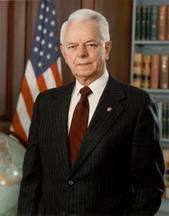 Sen. Robert C. Byrd (D-WV)
Legislative Activity
Stay on top of the latest movement without scrolling through every action
Senate amendment submitted
July 24, 2003
View full timeline
Senate amendment submitted
July 24, 2003
Roll call votes on amendments in Senate: Amendment SA 1383 not agreed to in Senate by Yea-Nay Vote. 46 - 46. Record Vote Number: 305.
July 24, 2003
Senate amendment not agreed to: Amendment SA 1383 not agreed to in Senate by Yea-Nay Vote. 46 - 46. Record Vote Number: 305.
July 24, 2003
Senate amendment proposed (on the floor): Amendment SA 1383 proposed by Senator Byrd.(consideration: CR S9872-9874; text: CR S9874)
July 24, 2003
Amendment SA 1383 proposed by Senator Byrd. (consideration: CR S9872-9874; text: CR S9874) To provide post-employment lobbying restrictions on employees of the Department of Homeland Security and the Office of Homeland Security within the Executive Office of the President.
July 24, 2003
Amendment SA 1383 not agreed to in Senate by Yea-Nay Vote. 46 - 46. Record Vote Number: 305.
July 24, 2003
Votes
1 roll call on this amendment
Text
Proposed
DEPARTMENT OF HOMELAND SECURITY APPROPRIATIONS ACT, 2004--Continued

The PRESIDING OFFICER. The Senator from Alaska.

Amendment No. 1370

Mr. STEVENS. I am bothered by the offset on this amendment. In the
2003 bill, we provided $850 million to high-threat urban grants. This
bill already contains another $750 million for high-threat urban
grants. That is a total of $1.6 billion for high-threat urban grants.
Every community in the country is affected by the alert system. Every
community in the country faces increased costs. These megalopolises of
the country, the large urban areas, are demanding that everybody pay
more for them, but the smaller cities, the smaller counties, the
smaller areas, have the same problem. On a per capita basis, it is a
higher cost to provide protection to small areas than the high-threat
urban areas.

I do not know why we should have New York City and Philadelphia, in
particular. They are the ones seeking this money. There is no question
there is a need. But there is a need in Peoria. There is a need in
Cincinnati. There is a need in Tucson. There is a need in New Orleans.
The money they have taken for this is money that deals with homeland
security nationally. One of the offsets

[[Page S9858]]

takes moneys from the small universities in the country. We had letters
from many Senators asking for money to assist in terms of research, the
research base of the country dealing with homeland security problems.
We ought to take a second look at what we are doing.
We created this Department of Homeland Security 8 months ago. They
already have in this bill and the bill we already enacted $1.6 billion
more than the rest of the country. Why should this happen now that we
have an offset against two of the most important accounts in Homeland
Security? I hope we can talk a little bit more about that before we
vote.
I will object to a time agreement until people understand what we are
doing. Part of this money is from information analysis and
infrastructure protection. It is a directorate, as they call it, in the
new Department of Homeland Security. This will limit the intelligence
warning and threat analysis functions of the Department we have just
created. These are just being set up. This is for the 2004 costs of the
Department we have just set up. Why should we take money from that?
These are assessments of critical infrastructure, including chemical
facilities, drinking water supply systems, arenas and stadiums, our
Nation's seaports. This is the money being offset. Do Members with
seaports want to put this money into an account that already has $1.6
billion? We ought to stop and think about this.
It would also be offset against the national communication system, as
I understand. I will have to study this more deeply. The priority
telecommunications programs could not be implemented. We have been
interested in a national alert system. In the past, the national alert
system went over the radio. Now, few people listen to the radio. They
are on cell phones, they are on computers, they watch the television,
cable. We are trying to get a national alert system. This offset goes
against that study, how to put back into place a national alert system
so the Nation will know, an area will know, if there is an extreme
threat about which everyone should know.
I understand the Senators from New York and Pennsylvania are trying
to increase the amount of money available to their high-threat urban
areas. I have a high-threat urban area in Anchorage, too, but we do not
have as large a population and we do not have the $1.6 billion either.
The Senate ought to think seriously about what we are doing. I intend
to speak further if I can find additional information regarding the
exact money that will be displaced by this amendment. The total amount
of money here is too much, too soon. We ought to think about what we
are doing. I hope others will come forward and take a look at what we
are doing.
For those who sent letters asking for money in these areas,
particularly in the national intelligence systems and threat analysis,
in the areas of chemical facilities, drinking water supplies, utility
protection, transportation protection, protection of bridges, this is
what the money is. Why should that go to New York and Pennsylvania
because they have a problem? Everyone else has, but they have a lot
more people. On a per capita basis, we have already given them more
money. To give them this additional $250 million is going too far.
I hope the Senate will listen and not adopt this amendment.
I will return with greater details in the future.
I yield the floor.
The PRESIDING OFFICER. The Senator from New Jersey.
Mr. LAUTENBERG. Mr. President, we are listening to quite a tirade
against giving money to the high-threat areas. The question is raised,
Why? When you go to a hospital and you have a sick patient, someone who
is really in trouble, he or she will be among the first to receive the
medication. That is the situation about which we are talking.
We lost 3,000 people on September 11, 2001 most of them in New York.
This is the focal point for economic activity--probably the most
important financial center in the entire world. We look at the cities
of Philadelphia and New York and there is New Jersey, right in the
middle, with lots of commuters. We lost 700 innocent citizens on that
day.
We have $29 billion going into homeland security but we need more. I
know where to take it from: Take it from the huge tax cut that was
given to those who do not need it.
For goodness' sake, the first round of emergency response grants had
New Jersey and New York among the least compensated on a per capita
basis. Our populations are squeezed together. New Jersey has the
highest population density of all the States in the country. We have
all kinds of important facilities, beside harbors and the financial
center, that affect the way our country functions.
To say, you got enough money, that's just not right. I repeat: when
the Department of Homeland Security gave out the first round of grants,
New Jersey and New York were among the States most poorly treated on a
per capita basis and yet our two States paid the biggest price on 9-11
when it comes to what constitutes a terrorist threat.
We may be threatened here with repercussions because we want money
for the ports, we want money for transportation, or otherwise. Threaten
all you want, but you cannot idly threaten the citizens of New York and
New Jersey and Pennsylvania and other high-threat urban areas, walk
away, and say: You got enough money.
I hope everyone is listening. What we need to do is recognize our
areas of susceptibility and help those areas first. When it comes to
toxic air or toxic water, we distribute the funds based on where the
problem exists, where there are Superfund sites, and we try to give
those areas more money so they can fix their problems.
The whole country wept on September 11, 2001. Everyone was weeping.
And they all felt susceptible. But some know, many know, there are
areas that are more susceptible than others. Those places are
Pennsylvania, New Jersey, New York, and other high-density urban areas.
Mr. SCHUMER. Will the Senator yield?
Mr. LAUTENBERG. I yield.
Mr. SCHUMER. I know my colleague is aware the high-threat areas were
not just New York, New Jersey, and Pennsylvania when the last round of
money was given out. I know my colleague is aware that 30 cities got
special money because the cities had special needs, including Boston,
Denver, Philadelphia, Miami, Detroit, Newark, San Diego, Phoenix,
Baltimore, Dallas, Buffalo, St. Louis, Kansas City, Cincinnati,
Sacramento, Honolulu, Pittsburgh, Long Beach, New Orleans, Memphis,
Cleveland, Tampa, Seattle, New York, Washington, Chicago, Houston, Los
Angeles, and San Francisco. The high-needs areas are not simply in
three States, they are in special areas.
I ask my colleague two questions. Was he aware that 30 cities got
this money? And this year we are putting less money into high needs
than last year.
Mr. LAUTENBERG. I was not aware of the specifics. I just know that in
the areas already hit very hard--New York, New Jersey--a very serious
threat remains. There are port facilities that are not protected at
all. There are rail facilities. There are all kinds of things that
could be destroyed or disrupted in a flash with the right kind of
weapon or terrorist plan.

Whoever thought the Trade Center would come down--110 stories, just
crash to the ground, melted into nothingness? No.
Mr. SCHUMER. Will my colleague yield for another question?
Mr. LAUTENBERG. I sure will.
Mr. SCHUMER. Our good friend from Alaska said we have needs on a per
capita basis. But is my colleague aware that on a per capita basis the
high-need States get less money? It is not the same. This is not evenly
distributed on a per capita basis, because the formula here has .75 for
every State--much higher.
I believe in helping all the States but this is higher than we have
ever seen in a formula distributing money to every State. As a result,
a State such as Wyoming or Alaska, for instance, would get far more
money on a per capita basis----
Mr. STEVENS. Will the Senator yield?
Mr. SCHUMER. It is the time of the Senator from New Jersey.
Mr. STEVENS. I ask for the floor.
Mr. SCHUMER. Who has the floor, Mr. President?

[[Page S9859]]

Mr. LAUTENBERG. I have the floor.
The PRESIDING OFFICER. The Senator from New Jersey has the floor.
Mr. SCHUMER. On a per capita basis than even a larger, high-threat
State. Is my colleague aware of that?
Mr. LAUTENBERG. I am absolutely aware of that. That is why I am
surprised when I hear the distinguished Senator from Alaska, who knows
this place better than anybody, who knows how desperately grants are
sought and fought for, as he has so many times for his own State of
Alaska, as he should, and how many times he has been successful, and
how many times grants have been given to Alaska because his
constituents needed the help.
But what goes around comes around, as they say. Now its New Jersey
and New York that need that kind of help and we shouldn't be turned
away.
With regard to the offsets for this amendment, I would prefer that we
not take the money from communications and from science and technology.
I would submit that there are other offsets, including the one I
suggested a moment ago--one I would be most willing to forego--and that
is the tax break that has come along. Take some of that money, the
hundreds of millions of dollars that are involved, the billions of
dollars over the next several year years, and put that money back where
it belongs, to protect our society.
I yield the floor.
The PRESIDING OFFICER. The Senator from Alaska.
Mr. STEVENS. Mr. President, I hope the distinguished Senator from New
Jersey will reserve the word ``tirade'' with reference to me. I might
have a tirade sometime on the floor. I have not so far. And it will not
be because of an amendment like this.
But I call the Senate's attention to pages 58 and 59 in the committee
report. I will state to the Senator from New York that he is in error.
The .7 applies to the basic grants; it does not apply to this program
at all. The .7 does not apply to this concept we are talking about now,
nor the money to which he is referring.
If you look at page 58, it shows the committee recommendations for
the information analysis and infrastructure protection system. It is a
national system.
I call your attention to page 59:

The General Accounting Office has reported that chemical
facilities present an attractive target for terrorist
activity. The Congressional Budget Office estimates that it
would cost $80,000,000 over 5 years for vulnerability
assessments at nearly 15,000 chemical facilities across the
United States. Therefore, the Committee [is directing this
money to be spent for that.]

We make a direct request for a report on the matter. The systems we
are dealing with here are systems that deal with the Nation. But, in
particular, it is:

. . . the creation of the National Cyber Security Division
within Information Analysis and Infrastructure Protection and
recommends $32,800,000 for the integration of physical and
cyber infrastructure monitoring and coordination from the
funds made available for information and warning advisories,
and $65,700,000 for cyberspace security from the funds made
available for remediation and protective actions.

We expect to move into this whole concept of critical infrastructure
protection. That needs:

. . . key asset identification, field assessments of
critical infrastructures, and key asset protection
implementation to help guide the development of protective
measures to harden facilities and assets.

It is a national program from which this money is being taken. The
inference here is this is surplus money. This is not enough. We don't
have enough for this system. We don't have enough money for what the
Senators from Pennsylvania and New York want. But the point is, some of
this protection starts at home. Some of it starts at home. Some basic
concept of protection is the responsibility of every government in the
United States. But the one responsibility we have here is the national
system of identification of those facilities and assets that are
critical, and also the establishment of a national alert system. This
money is not enough for either one. But the Senators from New York and
Pennsylvania want to take $250 million from a fund that is already
insufficient, based upon the General Accounting Office report.
I do hope Senators will take a look at how this money is allocated:

Intelligence and Warning: Threat determination and
assessment, Information and warning advisories, Protecting
Critical Infrastructure and Key Assets: Infrastructure
vulnerability and risk assessment, Remediation and protective
actions, National Communication System.

That gets the bulk of it, the national communication system, finding
some way to put an alert system back in place that will notify
everybody if there is a national disaster. That does not exist any
longer. It did, back in the days, as I said, when we all relied on
radio. That got tested once a week, in fact, or once a month--whatever
it was. But how long has it been since you had a test on a system?
There is no test possible coming through cell phones, through
computers, through the cable systems, through the satellite systems.
They are not coordinated at all. We need a national system of alert and
this is going to go toward that, starting it up.

The bulk of the money that they are taking is in protecting critical
infrastructure and key assets. That is where $95 million is for the
infrastructure vulnerability and risk assessment; $383.9 million for
remediation for protective actions nationally. This is protecting the
ports of New Jersey, of New York, of California, Florida, and even
Alaska. But identifying the need for protection.
Why take that money out when we are just setting up the Department of
Homeland Security and this is the basic money we need now? We need it
now.
The Senators from New York and Pennsylvania want money to be there in
case they need it if there is another national alert. There may not be
one. But there is a need for this. The General Accounting Office
insists the No. 1 responsibility of Congress is to deal with the
vulnerability assessments of 15,000 chemical facilities and other
similar assets around the country. Chemical facilities in particular,
and the costs associated with protecting those chemical facilities, are
essential to this homeland security.
I urge the Senate not to take this action. It will also go into the
Science and Technology Directorate, taking money from the research and
development capabilities of the entire Department of Homeland Security.
The reduction would severely limit the university-based centers
program.
As I said before, nearly every Senator has made a request. I have the
list here, by the way. Here it is. These pages, 1, 2, 3, 4, 5--6 pages,
single spaced, from Senators addressing this one particular account.
Senators, if you ask for this money and you expect to get it--we have
not earmarked any money; isn't that correct?
Mr. COCHRAN. That is right.
Mr. STEVENS. There is no money earmarked. But money, as much as we
could possibly put, is in the discretionary fund--and I think almost
every Senator has asked for money in this area: Vulnerability
protection, disaster assistance programs, homeland security initiative
at the University of Washington, University of Nebraska. Maybe I should
read them all, when we look at it: College of William and Mary, George
Mason, VMI, Utah, LSU, Wichita, Montana State, Colorado, University of
Delaware, Brown University, University of Rhode Island, University of
Georgia, University of New York, SUNI Maritime College.
I could go on and on. Almost every college that has a capability of
being involved in this assessment and determination of how to protect
these facilities has asked to get involved. We could not do that. So we
set up a fund and the Department will determine how many of these
universities can lock together and give us the assessment that the
General Accounting Office says is absolutely essential.
If you take the money for something that might happen, how are you
going to know when it does happen?
This is the beginning of the homeland security assessment of threats
and establishing an alert system. This amendment takes from both. I
think that is absolutely wrong. I hope we will get other people to
comment on this amendment. I understand the need. There is overwhelming
need throughout the country for homeland security money.
I congratulate the chairman of the subcommittee, the distinguished
Senator from Mississippi, for what he has done, along with his staff.
They have

[[Page S9860]]

allocated it in a way that is really fair. These other amendments so
far have been to add money beyond what we have available. This is
taking money that has already been assigned by the committee and the
subcommittee to a specific account and putting it in another account
and saying it was shortchanged. But there is already money in that
account. The account they are adding to already has in this bill $750
million. It had $850 million in the bill we passed earlier this year.
That is enough. Compared to the rest of the demands in this country,
that is enough for that fund.
I urge the Senate to disapprove this amendment.
Mr. COCHRAN. Mr. President, I thank the Senator from Alaska for his
comments. He has put this matter in perspective. We appreciate his
comments and his statements about the effect of this amendment on those
parts of the bill that will have funds transferred from them to this
so-called high-threat urban area account.
When we started talking about this bill yesterday, we had Senator
after Senator talking about adding money for new technologies and
making sure that we develop and deploy new kinds of the most modern
defensive systems we can have to defeat and detect terrorist attacks
and to make our country share in security. One of those was an
antimissile system for commercial aircraft. You may remember Senator
Boxer was on the floor talking about immediately putting those
capabilities in the domestic commercial airline industry. We have funds
in the bill to do just that. But guess what. This amendment cuts those
funds. This amendment would take money away from the antimissile
defense capability fund where we are developing and will deploy the
capability as soon as it is ready.
Funds for universities throughout the country that are now eligible
for grants for research into new technologies which will improve our
capability to defend ourselves across a wide range of areas that we
need to explore, develop, and deploy will be undermined by this
amendment. The funds will be cut if this amendment is agreed to.
We have had Members offering amendments for money for chemical
industry infrastructure protection--special money going to the chemical
industry. The money we have in this bill now for the chemical industry
will be cut if this amendment is agreed to.
The last vote we took on this was on the subject of waiving the
Budget Act. Some Senators came up, and I heard them say, You are going
to need 60 votes. They will need 60 votes to prevail to waive the
Budget Act. So my vote really won't matter, since you already have 40
votes to defeat this. I can vote for the amendment to add money, since
it won't come from any other account.
Some other Senators were concerned because we were going to violate
the Budget Act. I heard some Senators say, If you could find an offset,
I would vote for your amendment. Now we have an offset, and Senators
are going to have to take a new look at this.
This is not an automatic decision that can be made. But to think
about its effect on those accounts and those activities which are going
to be cut by this amendment, these are real cuts that are going to be
made.
I hope Senators will look carefully and balance their judgment
against the need to add money for this account that is now in the $750
million area.
Think about this: We also put $750 million into this account when we
passed the supplemental just a few weeks ago. We passed a supplemental
for the remainder of this fiscal year and added $750 million for these
same urban areas for which they now want to increase money. To me, that
is not fair. That is not fair.
People throughout the country have an equal interest. Whether you are
in an urban area or a rural area, you have an equal interest in this
being a balanced bill that treats all areas of the country the same in
terms of the quality of the response we are going to make in our
individual communities. You can't just channel the money to the big
cities and expect it is going to solve our national problem. This is
not a problem just for the big cities to solve. It is a problem for our
country to solve. It is a national problem. It is not just a Federal
Government problem. Every town and every city and every State ought to
be able to share equally and fairly in the funds that are made
available in this bill. If this amendment is agreed to, the fairness
doctrine will go out the window.
I urge Members to vote against this amendment.
Mr. SPECTER. Mr. President, at the outset, I agree with the
distinguished Senator from Alaska. His presentation was not a tirade.
For those of us who have heard the Senator from Alaska speak on many
occasions, there was nowhere near a tirade from the Senator from
Alaska. That was a reasoned analysis of the substitution of funds.
When the distinguished Senator from Mississippi, the chairman of the
subcommittee, presents his argument, it has great weight. The
subcommittee has very carefully considered the allocations. But this
amendment seeks to make a rather modest change. We have here a $29
billion appropriations bill.
When you talk about high-risk areas, it is my view that $1 billion is
a minimum. The figure might realistically be appraised for much more
than $1 billion.
It is true that during the course of the last vote there were many
Senators in the well who voted against waiving the Budget Act and who
said had there been an offset they would be favorably disposed. That is
not a carte blanche commitment. It depends upon what the offset is.
We are talking about two accounts. The information analysis,
infrastructure protection, operating expenses still has a very
considerable sum of money, $636.340 million. The science and technology
research, development, acquisition and operations, where we have taken
$62.640 million, still has more than $800 million.
What we are looking at here really is an analysis of what the highest
risk area is.
Again, I come back to the activities of President Bush today. Where
was President Bush today? He made a trip to Philadelphia. In
Philadelphia, he went to the airport, which is high risk. Then he was
on a long bridge which spans the Schuylkill River, which is high risk.
Then he went along a highway again where there is very heavy congestion
and high risk. Then he was at the seaport, again an area which is high
risk. It is a matter of making an analysis.
I have great respect for what the Senator from Mississippi has done
on this subcommittee. Perhaps the total figure of $29 billion is not
sufficient. Perhaps it ought to be slightly more--not to take an offset
from these two accounts.
But I supported the Senator from Mississippi on every one of his
tabling motions. Other Senators have offered much greater amendments,
one in the range of $1.8 billion. It is true that on one of the motions
to table by the Senator from Mississippi on firefighters, I deviated on
a motion to waive the Budget Act, which was nowhere near successful
because of giving a little spiritual support to the firefighters who I
think have done such an outstanding job. But I believe a careful
analysis of the $250 million for high-risk areas contrasted with the
funds that would have been taken from these other accounts which are
still very well funded is appropriate.
I urge my colleagues to support this amendment.
The PRESIDING OFFICER. The Senator from New Jersey.
Mr. LAUTENBERG. Mr. President, before we vote on this amendment, I am
reminded that attacks have been thwarted in three locations. And if
attacks have been thwarted, that suggests there is a certain risk
attached to those locations. One is the World Trade Center, another is
LAX Airport, and the third is the Space Needle in Seattle. As far as I
know, there were no attacks threatened in Wyoming and many other places
around the country. So when we look at this issue, I think we ought to
get focused.
First of all, Secretary Ridge is the arbiter of the discretionary
fund. He is the expert. He gives out this additional money. We, the
Senate--Democrats and Republicans--nominated him to make these
decisions. If the nondiscretionary part of the budget runs about $28
billion, I don't know that these particular accounts are the places
where we have to go to get the funding. And we can ask Secretary Ridge
to be aware that we are most

[[Page S9861]]

concerned because of the high-risk nature of the New York/New Jersey
region.
I hope in this case we will take seriously what we talk about so
much: That we cannot be secure, no matter how good we are in
Afghanistan, no matter how good we are in Iraq--and we have been
terrific. Our people have fought valiantly. They have done what is
asked of them. There are not enough of them. And when someone suggested
there were not enough of them, such as General Shinseki, he was kind of
kicked out of the Corps.
So we have to look at this and ask, what constitutes security? It is
not having enough bombs and planes. It is making sure that bombs and
planes don't come our way, don't come to our soil.
You may have heard the prediction that was leveled by the former
Secretary of Defense when he said, within a decade, if things go along
as they are, we could be looking at a nuclear explosion on American
soil.
I think we ought to step up to the idea and express our interest in
preventing any kind of a terrorist attack. We have had a couple, and
they were devastating, not only to the lives and families who were hurt
but to the morale of this country.
I think we ought to say: Look, these are areas that are constantly
under concern for a terrorist attack. Let's put the money there to make
sure we are taking special care of them, just as we would a patient who
is especially sick and we have a limited amount of medication. We give
it to that patient, not to those who might get sick.
That is the situation we face. I hope we will get enough support to
carry this through. The message is important. And I leave it to
Secretary Ridge to deal with his discretionary responsibility to
allocate the funds.
I yield the floor.
The PRESIDING OFFICER. The Senator from Mississippi.
Mr. COCHRAN. Mr. President, I know of no Senators who want to speak
on this issue who have not already spoken. I think we are ready for the
vote. Have the yeas and nays been ordered?
The PRESIDING OFFICER. They have not been ordered.
Mr. COCHRAN. Mr. President, I ask for the yeas and nays on the
amendment.
The PRESIDING OFFICER. Is there a sufficient second?
There is a sufficient second.
The question is on agreeing to amendment No. 1370.
The clerk will call the roll.
The assistant legislative clerk called the roll.
Mr. REID. I announce that the Senator from North Carolina (Mr.
Edwards), the Senator from Massachusetts (Mr. Kerry), and the Senator
from Connecticut (Mr. Lieberman) are necessarily absent.
I also announce that the Senator from Minnesota (Mr. Dayton) is
absent attending a funeral.
I further announce that, if present and voting, the Senator from
Minnesota (Mr. Dayton) and the Senator from Massachusetts (Mr. Kerry)
would each vote ``yea.''
The PRESIDING OFFICER (Mr. Cornyn). Are there any other Senators in
the Chamber desiring to vote?
The result was announced--yeas 48, nays 48, as follows:

[Rollcall Vote No. 302 Leg.]

YEAS--48

Akaka
Baucus
Bayh
Biden
Boxer
Breaux
Byrd
Cantwell
Carper
Clinton
Coleman
Conrad
Corzine
Daschle
Dodd
Dorgan
Durbin
Feingold
Feinstein
Fitzgerald
Graham (FL)
Harkin
Hollings
Inouye
Jeffords
Johnson
Kennedy
Kohl
Landrieu
Lautenberg
Leahy
Levin
Lincoln
Mikulski
Murray
Nelson (FL)
Nelson (NE)
Pryor
Reed
Reid
Rockefeller
Santorum
Sarbanes
Schumer
Specter
Stabenow
Voinovich
Wyden

NAYS--48

Alexander
Allard
Allen
Bennett
Bingaman
Bond
Brownback
Bunning
Burns
Campbell
Chafee
Chambliss
Cochran
Collins
Cornyn
Craig
Crapo
DeWine
Dole
Domenici
Ensign
Enzi
Frist
Graham (SC)
Grassley
Gregg
Hagel
Hatch
Hutchison
Inhofe
Kyl
Lott
Lugar
McCain
McConnell
Miller
Murkowski
Nickles
Roberts
Sessions
Shelby
Smith
Snowe
Stevens
Sununu
Talent
Thomas
Warner

NOT VOTING--4

Dayton
Edwards
Kerry
Lieberman
The amendment (No. 1370) was rejected.
Mr. FRIST. Mr. President, I move to reconsider the vote.
Mr. STEVENS. I move to lay that motion on the table.
The motion to lay on the table was agreed to.
The PRESIDING OFFICER. The Democratic whip.
Mr. REID. I have spoken to the two managers. The next amendment that
we will offer will be the Reed of Rhode Island amendment. The Senator
from Rhode Island has agreed to 30 minutes on his side. Following that
amendment, Senator Byrd wishes to offer an amendment. Following the
debating on those two amendments, I ask that there be a vote on those
two amendments with Senator Byrd's vote coming first and the vote on
Senator Reed coming next. Those votes would be on or in relation to
those two amendments with no second-degree amendments in order.
Mr. COCHRAN. I ask unanimous consent that be the order.
The PRESIDING OFFICER. Without objection, it is so ordered.
Mr. REID. Mr. President, I ask that the unanimous consent agreement
be amended to allow the Senator from Mississippi whatever time he shall
consume in opposition to the Reed amendment.
Mr. COCHRAN. I agree to that amendment, and I thank the Senator from
Nevada.
The PRESIDING OFFICER. Without objection, it is so ordered.
The Senator from Rhode Island.

Amendment No. 1372

Mr. REED. Mr. President, I send an amendment to the desk.
The PRESIDING OFFICER. The clerk will report.
The bill clerk read as follows:

The Senator from Rhode Island [Mr. Reed], for himself and
Mr. Sarbanes, proposes an amendment numbered 1372.

Mr. REED. Mr. President, I ask unanimous consent that the reading of
the amendment be dispensed with.
The PRESIDING OFFICER. Without objection, it is so ordered.
The amendment is as follows:

(Purpose: To appropriate $100,000,000 for grants to public transit
agencies to enhance public transportation security against terrorist
threats)

On page 49, between lines 7 and 8, insert the following:

Transit Security

For necessary expenses of the Transportation Security
Administration related to land transportation security
services pursuant to the Aviation and Transportation Security
Act (49 U.S.C. 40101 note) and for other purposes,
$100,000,000, to remain available until December 31, 2004,
which shall be available for grants to public transit
agencies for enhancing the security of transit facilities
against chemical, biological and other terrorist threats:
Provided, That the Secretary of Homeland Security shall make
such grants pursuant to threat assessments previously
conducted by the Transportation Security Administration and
the Federal Transit Administration: Provided further, That
the Secretary of Homeland Security and the Secretary of
Transportation shall enter into a memorandum of understanding
regarding transit security. Provided further, That not later
than 60 days after the date of enactment of this Act, the
Secretary of Homeland Security shall submit a report to
Congress that includes--
(1) the amount of funds appropriated to the Transportation
Security Administration (TSA) that have been allocated for
activities designed to improve public transportation
security;
(2) the number of full-time TSA personnel engaged in
activities designed to improve public transportation
security;
(3) the strategic plan of the TSA for improving the
security of our Nation's public transportation systems; and
(4) recommendations from the TSA for any policy changes
needed to ensure that the TSA, in coordination with other
agencies within the Department of Homeland Security, will
effectively improve public transportation security for our
Nation's transit riders.

Mr. REED. Mr. President, earlier this week, the Senate debated a
comprehensive amendment by Senator Byrd with respect to deficiencies in
this bill regarding resources for homeland security. Essentially, what
Senator Byrd was trying to do was to match the resources we need with
the rhetoric we have heard about protecting the homeland of the United
States.
I am disappointed Senator Byrd's amendment did not prevail. Within

[[Page S9862]]

that amendment, there were resources devoted to transit security.
Today, I offer an amendment on behalf of myself and Senator Sarbanes to
address what I think is an amazing and unacceptable lack of resources
and investment for securing and protecting our Nation's trains, buses,
and ferries. Indeed, these vehicles and these transportation modes
provide transportation for millions of Americans each day, and they
require protection.
I want to be clear. This is not the fault of the committee, and
certainly not the fault of the chairman who has done an extraordinary
job in securing an additional $1 billion for the subcommittee's
allocation. But the fact is that the administration has not asked for
sufficient resources to protect the transit systems in the United
States. Again, this is why, together with Senator Sarbanes, I am
offering this amendment to add $100 million for the protection of our
public transit systems.
Each day, millions of Americans, old and young, rich and poor, every
kind of American, board a bus or a train to go to work, school, or a
doctor's appointment. Each year the Federal Government spends billions
of dollars to build and maintain these systems. Yet to date,
shockingly, the Federal Government has only invested below $90 million
in fiscal years 2002 and 2003 for transit security if we exclude the
very special circumstances of rebuilding transit systems that were
attacked and severely damaged during the September 11 attack.
We have recognized the need to protect our airlines and we have spent
billions of dollars to do so, but there is the same compelling need to
protect the transit systems of the United States.
There are two major reasons we must protect these transit systems:
First, we want to avoid, preempt, and prevent, a terrorist event
involving a transit system; second, we need transit systems that have
interoperable communications, trained personnel, and additional
equipment to mitigate the consequences of any type of terrorist event
in the United States.
It is quite clear transit systems are a target of terrorists.
According to a report in 1994 by John P. Sullivan and Henry I.
DeGeneste: ``Transit systems are attractive targets for a number of
reasons. They carry large numbers of people within concentrated,
predictable areas and timeframes. They are accessible since they
provide easy user access. Finally, their target-rich infrastructure
which often covers extensive geographic areas frequently renders
countermeasures impractical.''
So we know this. Indeed, the Federal Transit Administration knows it.
To their credit, they have taken meager resources to provide transit
assessment assistance to any transit system that is required or
requested. They have been able to advise these transit systems. But
advice is not dollars. Advice does not build or buy equipment that will
protect commuters in our transit systems.
We already know transit systems are a target, in many cases targets
of choice. The Mineta Institute indicates that between 1997 to 2000
there were 195 terrorist attacks against transit systems worldwide.
Most of these attacks were against buses. I should point out, 90
percent of these attacks occurred against buses. In the Middle East, we
have seen the horrific pictures of buses blown up by suicide bombers.
No one wants to see such pictures in the United States.
Of course, the most horrific example of a terrorist attack against
transit was the 1995 sarin gas attack in Japan where 11 people were
killed and 5,500 innocent people were injured due to the work of a
small band of crazed individuals.
We understand there is a great potential for terror attacks against
transit systems. Given the increasing danger of proliferation of
weapons of mass destruction, these transit attacks could be horrific in
the future.
I also mention that not only do we need to avoid attacks against
transit, we need to be prepared in the case of another terrorist attack
in the United States. I refer to testimony before my subcommittee last
year, as I chaired the subcommittee with respect to transit's role in
September 11. The first is a statement by Jenna Dorn, the Administrator
on the Federal Transit Administration.
At 8:52 a.m. on September 11th, minutes after the first
hijacked jet plowed into One World Trade Center, a Port
Authority Trans-Hudson (PATH) train master gave life-saving
instructions to conductors and operators.
A train from Newark, carrying about 1,000 passengers, had
just pulled into the station below the World Trade Center.
The train master told the crew to keep everyone on the train,
board everyone in the station, and immediately depart for the
Exchange Place stop in Jersey City. Public transportation
employees immediately evacuated passengers who mistakenly
left the train.
A train from Hoboken carrying another 1,000 people was just
behind the Newark train. The train master told that crew to
keep the doors closed at the Trade Center and head
immediately to Jersey City.
The train master then told another train in Jersey City to
discharge all passengers and head back to the World Trade
Center to evacuate remaining travelers and transit personnel.
That train departed with its precious cargo at 9:10 a.m., 40
minutes before the first building collapsed.
That train master, Richie Moran, and PATH's emergency
response plan, saved thousands of lives. As we watched the
death toll climb in New York, it is astounding to realize
that no one riding the PATH or New York City subway lines
that morning was injured.
That is not an accident. That is the result of good communications,
planning, training, all the issues that they showed in New York City.
But let me suggest the level of planning, training, and equipment in
New York City is not duplicated in many cities around this country--and
it should be.
Also, I ask unanimous consent to have printed in the Record excerpts
from the statement by Richard A. White, the general manager of the
Washington Metropolitan Area Transit Authority, who talks of the
integral role of that system in evacuating personnel during the attack
on the Pentagon.
There being no objection, the material was ordered to be printed in
the Record, as follows:

On September 11, when WMATA was needed most, and in the
midst of regional chaos, Metrorail and Metrobus were ready,
and delivered for the National Capital Region. We operated
the equivalent of back-to-back rush hours virtually without
incident, after the Federal Government and other regional
employers sent hundreds of thousands of workers home around
mid-morning. We were operating the entire day. We did what we
do best. We moved large numbers of people safely and
efficiently.
Throughout the day, the WMATA workforce performed
extraordinarily. Not once did an employee put their own
individual concerns ahead of their sense of duty to the
customers. The transit police, the bus and rail operators,
the station personnel, the customer service representatives--
everyone--demonstrated their dedication to our mission of
moving people safely and securely.
Further, we never lost communications throughout the day.
We established and maintained contact with local State, and
Federal authorities, and we communicated with our riders
through in-system messages, our phone system and over the
internet through the website.
WMATA, blessedly, suffered no property damage, no loss of
life, and no injury to any of its employees nor to any of our
customers on that terrible day.

Mr. REED. Senator Sarbanes and I asked for a GAO report on transit
security. The GAO visited 10 transit properties all over the country of
varying sizes and characteristics. They surveyed 200 of the 6,000
transit operators of the Nation. Their report clearly indicates the
compelling need for Federal assistance.
In addition to that, it clearly indicates the scope of that system.
Of just eight of the transit systems that had conducted professional
security assessments and asked professionals to come in and review
procedures, equipment, personnel, the cost to upgrade these systems,
for just 8 out of 6,000, was $700 million. If we were to upgrade all of
our transit systems in this country, it would be on the order of
billions of dollars. Yet, those costs have not been met by the
administration for this compelling need.
The administration has barely funded transit security, about $88
million. Some of this, frankly, was discretionary funding from the
Department of Homeland Security which they, to their credit, decided to
commit to the issue of transit security.
We have to provide the resources. In addition, we have to also ensure
that there is appropriate responsibility and oversight. That is why our
amendment also calls on the Department of Homeland Security and the
Department of Transportation to sign a memorandum of agreement to
ensure that the two

[[Page S9863]]

agencies, as well as the Federal Transit Administration and the
Transportation Security Administration, have in place strong linkages,
coordination, and understanding of their mutual and separate roles. We
have been repeatedly assured that this agreement was imminent. It has
yet to be produced, yet to be issued. Our amendment asks that this be
done expeditiously. My colleague, Senator Sarbanes, will address these
points also.
Our position today is not to cause panic but to prevent panic by
having the resources so that our transit systems are not targets of
terrorists and that our transit systems can, in fact, provide value to
the support in the wake of any type of attack on a major urban area in
the United States by terrorists. This is a well-crafted amendment.
Certainly the need is there. I urge support of the amendment.
I recognize at some point the chairman may raise a budget point of
order against my amendment, and at the appropriate time either I or
Senator Reid of Nevada will move to waive the point of order. I urge my
colleagues to support my motion to waive.
I yield the floor.
The PRESIDING OFFICER. The Senator from Maryland.
Mr. SARBANES. What is the parliamentary situation?
The PRESIDING OFFICER. There are 19 minutes allocated to the Senator
from Rhode Island.
Mr. SARBANES. Will the Senator from Rhode Island yield me 8 minutes?
Mr. REED. I am happy to yield 8 minutes.
Mr. SARBANES. Mr. President, I am very pleased to cosponsor the
amendment offered by my able and distinguished colleague from Rhode
Island, Senator Reed. I commend him for his very strong leadership on
the important issue of enhancing the security of our Nation's public
transit systems. By allocating $100 million for transit security, this
amendment would enhance the safety of millions of Americans.
Every workday, 14 million Americans ride buses, subways, light rail,
and ferries in cities and towns all across America. Transit systems
throughout our Nation link people to jobs, to medical care, to
shopping, to school, and to other essential services.
More and more, Americans are recognizing the benefits that transit
has to offer. Over the last 6 years, transit ridership has grown faster
than any other mode of transportation.
These riders expect and deserve transit systems that are reliable,
that are safe, and that are secure.
As chairman of the Banking Committee's Subcommittee on Housing and
Transportation, Senator Reed, during the last Congress, convened six
hearings to examine our Nation's public transit systems, with two of
those hearings fully devoted to the security question. One hearing took
place just a few weeks after the attacks on September 11, and the
second shortly after the first anniversary of those attacks.
The witnesses at those hearings included the Federal Transit
Administrator, representatives of transit agencies, including Richard
White, the general manager of the Washington Metropolitan Area Transit
Authority, and representatives of transit labor.
I commend the record of those hearings to all of my colleagues. They
were extremely well done.
The witnesses testified about the contribution transit made to the
Nation on September 11, something my colleague already made reference
to. That morning, transit agencies across the country ran extra trains
and buses as long as needed to move people safely out of city centers.
Transit played a particularly vital role in New York and Washington,
the two cities directly under attack that day. Without the vibrant
transit systems in place in those cities, timely movement of our people
would have been impossible.
As more and more Americans are using public transportation, it is
clear that transit must be a vital component of any city's emergency
response plan.
As my colleague indicated, according to the Mineta Transportation
Institute in San Jose, CA, surface transportation was the target of
more than 195 terrorist attacks from 1997 to 2000, and transit systems
are the mode most commonly attacked.
The witnesses before Senator Reed's subcommittee explained that
public transportation faces unique security challenges.
By its nature, transit must be easily accessible. It runs on
identified routes and at published times, and it uses an extensive
network of roads and rails spanning a wide geographic area.
It obviously is not feasible to screen all passengers and baggage
before boarding, as is done in airports, or to check the identity of
all who wish to use the system.
But, according to the witnesses who appeared before Senator Reed at
those hearings, there are measures that transit agencies can take to
improve their security, such as conducting vulnerability assessments,
developing emergency plans, investing in security equipment, and
training employees--which was repeatedly emphasized to us as something
that would improve the security of our systems.

But these improvements do not come without cost, and the lack of
available funding was identified as a major impediment to making
transit systems more secure.
Early last year, Senator Reed and I joined in asking the General
Accounting Office to review transit agencies' response to the threat of
terrorism, and to identify the challenges they face in enhancing the
security of their systems.
The GAO report, released last December--and I commend this report to
my colleagues--found that transit agencies have taken a number of
steps, particularly since September 11, to improve security.
At the same time, the report identified significant remaining
security needs. Consistent with the testimony of our witnesses, the
report found that insufficient funding--insufficient funding--is ``the
most significant challenge in making transit systems as safe and secure
as possible.''
In fact, at the 10 transit agencies they visited, the GAO found
hundreds of millions of dollars in identified security needs.
Our Nation's transit agencies have made good use of the limited
resources they have had available, but this report demonstrates that
new resources will be needed in the future to safeguard the security of
our Nation's transit systems.
The pending legislation does not demonstrate the commitment necessary
to help transit systems become more secure.
I believe we owe it to our Nation's transit riders to do more.
This amendment takes a critical step in the right direction by making
$100 million available for transit security, to be allocated by the
Department of Homeland Security according to threat assessments that
have already been conducted by the Transportation Security
Administration and the Federal Transit Administration.
Assessments have been conducted. The priorities are there. We can
move these funds quickly out into the field in order to enhance
security.
Transit agencies could quickly put this money to use, investing in
security equipment, conducting training exercises for transit
personnel, and otherwise enhancing their systems' ability to resist
attack.
This is an investment that we cannot afford not to make--an
investment we cannot afford not to make.
I urge my colleagues to support the amendment of the able and
distinguished Senator from Rhode Island.
The PRESIDING OFFICER. The Senator from Mississippi.
Mr. COCHRAN. Mr. President, this amendment provides $100 million in
additional spending for grants for public transit agencies to enhance
security of transit facilities against chemical and biological attacks.
The bill already provides $71 million for the Science and Technology
Directorate to develop and deploy chemical, biological, and nuclear
sensor networks. Public transit facilities are in line to benefit from
this appropriation.
The Science and Technology Directorate is piloting chemical and
biological sensors in subways that will demonstrate an integrated
chemical detection and response system for six subway stations by
September of this year.
The amendment would place the Transportation Security Administration
in charge of deployment of detectors prematurely, before the research
and development has determined the best technology to accomplish the
goal. The bill before the Senate which

[[Page S9864]]

the subcommittee and the full committee have approved also includes $25
million for the Department to develop standards nationwide for
detection sensors.
There is no offset for this additional spending in the amendment, and
it would, therefore, cause us to exceed the limitations of the budget
resolution. Therefore, I make a point of order under section 302(f) of
the Congressional Budget Act that the amendment provides spending in
excess of the subcommittee's 302(b) allocation.
The PRESIDING OFFICER. The point of order is not timely at this time.
Time remains for the sponsor.
Mr. COCHRAN. Mr. President, is it not correct that a motion to waive
the Budget Act would be debatable and would be debatable under the
unanimous consent agreement? My purpose is not to cut off anyone's
right to debate under the rules of the Senate or under the terms of the
unanimous consent agreement.
The PRESIDING OFFICER. The motion to waive would be debatable. Under
precedent, the point of order should not be made until all time has
expired.
Mr. COCHRAN. I withdraw my point of order.
The PRESIDING OFFICER. The Senator from Rhode Island.
Mr. REED. Mr. President, the purpose of our amendment is not
necessarily to impede any deployment of technology. It simply
recognizes that even if this technology is deployed, tested, or
evaluated in 6 stations or 100 stations, the cost of implementing this
system and other systems--the amendment talks about protecting
transportation facilities, not just subway lines, but buses and
interurban transportation, all types and modes of transportation--even
if you could deploy, the cost would be significant.
Our amendment asks that this budget recognize those significant
costs.
Again, there is no question that the chairman has tried his best to
come up with the resources to try to meet this need. But the need is so
staggering--billions and billions of dollars. The funds in this bill
devoted to transit security is so meager that our amendment simply
tries to strike a balance. The $100 million would go to help systems
buy equipment and train personnel. All of that is necessary.
We also would ask that the Department of Homeland Security issue the
plans they have long said they were going to do between the proper
transportation and the proper homeland security to coordinate their
activities with respect to transit security.
I urge the amendment be adopted.
I further point out that even if we were to adopt this amendment--I
understand at the appropriate moment the Senator from Mississippi will
make a budget point of order--this is truly a very modest downpayment
on the cost of ensuring that all of our transit systems, our buses, and
our subway systems have the same degree of preparedness as we are
trying to develop for our airlines and for other modes of
transportation.
If we reject this amendment, we will simply be in a situation where
we might be able to demonstrate a few projects, and we might be able to
test the system, but we will never deploy those systems across the
Nation in transit systems. There are 6,000 transit systems.
Again, it is $100 million, just a meager downpayment for what is
really a multibillion-dollar requirement for the United States.
I recognize that the Senator has said he is proposing to make a point
of order.
At this point, I yield my time in anticipation of such a point of
order.
Mr. COCHRAN. Mr. President, I yield whatever time remains on this
side.
The PRESIDING OFFICER. All time is yielded.
Mr. COCHRAN. Mr. President, I make a point of order under section
302(f) of the Congressional Budget Act that the amendment provides
spending in excess of the subcommittee's 302(b) allocation.
Mr. REED. Mr. President, pursuant to section 904 of the Congressional
Budget Act of 1974, I move to waive the applicable sections of that act
for purposes of the pending amendment, and I ask for the yeas and nays.
The PRESIDING OFFICER. Is there a sufficient second?
There is a sufficient second.
The yeas and nays were ordered.
The PRESIDING OFFICER. The Senator from West Virginia.

Amendment No. 1373

Mr. BYRD. Mr. President, last November Congress enacted the largest
reorganization of the Federal Government in half a century. At that
time, the Senate was under extraordinary pressure to pass a bill
quickly. The President traveled the country giving campaign speeches
accusing the Senate of not caring about homeland security. The Senate
responded by hastily approving the massive reorganization before
Members had a chance to study the contents of the 484 pages that were
dropped into our laps just a few days before the vote.
There were a lot of items in that legislation that would not have
survived scrutiny had the Senate spent more time debating the bill. A
number of Senators objected to certain provisions in the bill and
introduced amendments. But those amendments were never considered
because the Senate voted to shut off debate.
A good many Senators wanted to put the bill behind us even if it
meant settling for a bill that needed more scrutiny. One of the
imperfections that the Senate was willing to accept was the
unprecedented secrecy that was given to the new Department of Homeland
Security.
Although the original version of the bill took a responsible,
moderate approach to ensure public accountability, the final version
that was dumped on the Senate gave the Department carte blanche to
conduct its operations in secret.
I filed amendments to scale back this excessive secrecy, as did
several other Senators. But those amendments were never considered
because, as I have already indicated, debate was shut off by cloture.
Now we read in the papers that full advantage is being taken of the
secrecy in the Department. Their friends and contributors in the
private sector have a seat at the homeland security table. Corporate
leaders and campaign contributors have been awarded coveted seats on
the advisory committees that make policy recommendations to Secretary
Ridge and to others in the Department.
Consequently, not only do these companies have a direct role in
shaping our homeland security policy, but they also have direct access
to Department officials who award the private sector contracts for
implementing those policies.
Last month, for the first time, the Homeland Security Advisory
Council met to provide advice and recommendations to the Homeland
Security Secretary about this Nation's homeland security needs.
It is my understanding Secretary Ridge took the opportunity to remind
the council that the Homeland Security Department was soliciting a wide
array of innovative counterterrorism technologies. ``There are several
million dollars available to the private sector,'' Secretary Ridge
said. That information no doubt would have been more than just passing
interest to the members of the advisory council. With six CEOs and a
member of the board of directors from three top companies, the Homeland
Security Advisory Council represents some of the top business interests
that are in competition for government contracts related to homeland
security.
It is worth noting that, according to the New York Daily News, of the
818 members chosen to sit on the advisory committee, 11 members have
collectively given more than $200,000 in direct contributions to the
Republican Party at a time when questions are already being raised
about the propriety of former aides to Secretary Ridge lobbying a
Homeland Security Department for Government grants. It is troubling
that the Homeland Security Secretary would risk further damage to the
Department's credibility by naming to advisory council representatives
of top companies that are vying for homeland security contracts and
grants.
At a time when questions are being asked or raised about the
preferential treatment given to major corporate campaign contributors
in bidding on Government contracts, it is disconcerting that companies
such as Dow Chemical, Eli Lilly, Conoco-Phillips,

[[Page S9865]]

Black & Decker, Procter and Gamble, and Lockheed Martin are
representatives serving on the advisory council.
This volunteering by these companies of their CEOs and board members
to serve on the advisory council may well be a selfless act of
patriotism, but that does not stop them from profiting from the
contracts and grants awarded by the Department.
Eli Lilly used its connections to use a provision in the Homeland
Security Act to shield vaccine makers from lawsuits relative to the use
of thimerosal, a mercury-containing preservative once added to
childhood vaccines.
Dow Chemical received $1.4 million in port security grants from the
Homeland Security Department last spring.
Lockheed Martin won a long-term contract to help modernize the Coast
Guard, a contract that could be worth up to $17 billion. It also
contracted to assist the Transportation Security Administration in
developing CAPPS II, a controversial data tracking system that will
reportedly collect information about nearly every adult American who
buys an airline ticket.
Despite the specter of the conflict of interest, and despite numerous
warnings from Government watchdog groups, the advisory council has been
exempted from public disclosure laws. The American people have no way
of knowing what is being discussed or what advice is being recommended.
There is no way to identify the financial interests of these council
members in any advice or recommendations they may make to Secretary
Ridge.
With a $40 billion homeland security budget and the expectation that
the Federal Government will spend hundreds of billions of dollars in
the coming years on homeland defenses, corporate America is salivating
over the money that is to be made from the grants and contracts being
doled out by the Homeland Security Department.
Also, being at the table when advice is given to the Homeland
Security Secretary can be a very powerful tool. That is all the more
reason the Congress should provide the American public with some kind
of check to ensure that the advice being given to the Secretary is in
the best interests of the Nation's defenses and not just in the best
interests of companies soliciting a Government contract.
I am concerned about the makeup of these advisory committees and how
they are being used. We have no way of knowing what kind of
recommendations these corporate CEOs are making to Secretary Ridge or
what actions this Department is taking in response to those
recommendations. We have no way of knowing whether there are real
conflicts of interest when contracts are awarded to the same people who
recommended the contracts in the first place.
By requiring that the Department of Homeland Security comply with the
Federal Advisory Committee Act, my amendment will ensure that Congress
and the American people know how these advisory committees are being
used. This law has served us well for over 30 years for advisory
committees throughout the Federal Government. It includes long-accepted
protections for sensitive information relating to law enforcement and
national security, so there is no danger of disclosing information that
would make our Nation more vulnerable.
My amendment will require that the Department disclose basic facts
about who is participating in these advisory committees and what kinds
of recommendations are being made. The American people have a right to
know that the Department of Homeland Security is acting in their best
interests, not simply in the interests of any administration's friends
in the private sector. This knowledge will strengthen our homeland
security efforts, not weaken them, and will ensure public confidence in
the policies that any administration--not only this one, but any future
administration--chooses to follow.
The safety of the American people is at stake. I believe the
amendment will make the people safer and better informed.
I urge the Senate to adopt this amendment.
Mr. President, I call attention to the fact that the amendment is
proposed by Mr. Byrd, for himself, Mr. Lieberman, and Mr. Levin.
I ask unanimous consent that Senator Clinton's name be added as a
cosponsor.
The PRESIDING OFFICER. Without objection, it is so ordered.
Mr. BYRD. I send the amendment to the desk.
The PRESIDING OFFICER. The clerk will report.
Mr. BYRD. I ask unanimous consent that the reading of the amendment
be dispensed with.
The PRESIDING OFFICER. Without objection, it is so ordered.
The legislative clerk read as follows:

The Senator from West Virginia [Mr. Byrd], for himself, Mr.
Lieberman, Mr. Levin, and Mrs. Clinton, proposes an amendment
numbered 1373.

The amendment is as follows:

(Purpose: To prohibit funds appropriated under this Act from being used
by any advisory committee that has been exempted from the Federal
Advisory Committee Act)

At the appropriate place, insert the following:
Sec. 616. None of the funds appropriated by this Act may be
used to fund the activities of any advisory committee (as
defined in section 3 of the Federal Advisory Committee Act)
that has been exempted from the Federal Advisory Committee
Act (5 U.S.C. App.) pursuant to section 871 of the Homeland
Security Act of 2002 (6 U.S.C. 451).

The PRESIDING OFFICER. The Senator from Mississippi.
Mr. COCHRAN. Mr. President, section 871 of the Homeland Security Act
allows for an exemption to the Federal Advisory Committee Act so that
meetings of advisory committees at the Department of Homeland Security
could go forward in emergency and other unforeseen situations.
To form an advisory committee, the Federal Advisory Committee Act
requires notice of meetings, publication of meetings in the Federal
Register, timely public release of documents associated with the
advisory committee meetings, and so forth, including making reading
rooms available for members of the public to read the documents that
are being discussed by the advisory committee.
The Department of Homeland Security and its representatives, when
this legislation was being developed, convinced the committee and the
Congress to grant a narrow exemption to the Department to permit it to
do its job in emergencies to protect and respond to threats to protect
the homeland.
For example, it was suggested if we had another attack, such as we
experienced on September 11, and damages were caused to the
telecommunications systems of the east coast, the Department would need
to convene a committee of experts and people who understood things that
needed to be done to put the telecommunications systems back in running
order. And they may not have time to put a notice of an advisory
committee meeting in the Federal Register, or to give publication or
notice of the meeting, or to have what the act requires: timely public
release of documents associated with the meeting to be held.
It was the view of the Congress, at the time the act was written
creating the Department of Homeland Security, that there were emergency
situations that could develop that would require such an exemption.
Also, the Department suggests that it requires the ability to meet
with private sector officials in private from time to time, as
necessity might require.
The Department, as I understand it, has not invoked this exemption up
to this time, so there is no indication that they are abusing the
exemption that has been granted them. They are following the provisions
of the Federal Advisory Committee Act, I assume, in every other
respect. We have received no notice. I have no information personally
that any violations of the act have occurred.
The Senate passed the Homeland Security Act just months ago, and the
Department has been operational only since March, I think, of this
year. So to repeal a part of the Homeland Security Act in an
appropriations bill that passed the Senate overwhelmingly, and where
there has been no indication of abuse, seems to be unnecessary.
So I hope the Senate will reject the amendment that is offered by the
Senator from West Virginia.
Mr. BYRD. Mr. President, the Secretary can, under the Federal
Advisory Committee Act, exempt committees from notice rules in an
emergency

[[Page S9866]]

under existing law, whenever he determines it is necessary for national
security.
It is important that this amendment be adopted. We are not just
talking about this administration. We are not just talking about this
Secretary of the Department. We are saying that there should not be a
blanket exemption available to any Secretary of this Department, when
we keep in mind that from a national security standpoint, the
Department is exempted, the President can exempt it, the Department
head in this case can exempt it.
But there are matters other than national security which are
important and which are discussed by this Department. For the
protection of the American people not only under this administration
but also under other administrations that may come and may go, this
amendment should be adopted. It is in the interest of the American
people that they be protected and that we know that the American people
know who is being asked to make recommendations, what recommendations
are being made and whether those recommendations are in the interest of
the American people.
I hope the amendment will be adopted. I urge my colleagues to vote in
support of it.
Mr. COCHRAN. Mr. President, I ask for the yeas and nays on the
amendment of the Senator from West Virginia.
The PRESIDING OFFICER. Is there a sufficient second?
There appears to be a sufficient second.
The yeas and nays were ordered.

Amendment No. 1374

Mr. BYRD. Mr. President, I send to the desk an amendment by Mr.
Durbin. I believe it has been cleared on the other side of the aisle.
The manager will speak to that. I send to the desk the amendment.
The PRESIDING OFFICER. Without objection, the pending amendment is
set aside. The clerk will report.
The legislative clerk read as follows:

The Senator from West Virginia [Mr. Byrd], for Mr. Durbin,
proposes an amendment numbered 1374.

Mr. BYRD. Mr. President, I ask unanimous consent that reading of the
amendment be dispensed with.
The PRESIDING OFFICER. Without objection, it is so ordered.
The amendment is as follows:

(Purpose: To provide for a report to Congress on information systems
interoperability, and for other purposes)

At the appropriate place, insert the following:
Not later than 60 days after the date of enactment of this
Act, the Secretary of Homeland Security, in collaboration
with the Director of the Office of Management and Budget,
shall submit a report to the Committee on Appropriations of
the Senate, the Committee on Appropriations of the House of
Representatives, the Committee on Governmental Affairs of the
Senate, the Committee on Government Reform of the House of
Representatives, and the Select Committee on Homeland
Security of the House of Representatives on the status of the
Department's efforts to--
(1) complete an inventory of the Department's entire
information technology infrastructure;
(2) devise and deploy a secure comprehensive enterprise
architecture that--
(A) promotes interoperability of homeland security
information systems, including communications systems, for
agencies within and outside the Department;
(B) avoids unnecessary duplication; and
(C) aids rapid and appropriate information exchange,
retrieval, and collaboration at all levels of government;
(3) consolidate multiple overlapping and inconsistent
terrorist watch lists, reconcile different policies and
procedures governing whether and how terrorist watch list
data are shared with other agencies and organizations, and
resolve fundamental differences in the design of the systems
that house the watch lists so as to achieve consistency and
expeditious access to accurate, complete, and current
information;
(4) ensure that the Department's enterprise architecture
and the information systems leveraged, developed, managed,
and acquired under such enterprise architecture are capable
of rapid deployment, limit data access only to authorized
users in a highly secure environment, and are capable of
continuous system upgrades to benefit from advances in
technology while preserving the integrity of stored data; and
(5) align common information technology investments within
the Department and between the Department and other Federal,
State, and local agencies responsible for homeland security
to minimize inconsistent and duplicate acquisitions and
expenditures.

Mr. COCHRAN. Mr. President, I have no objection to the approval of
this amendment.
The PRESIDING OFFICER. If there is no further debate, without
objection, the amendment is agreed to.
The amendment (No. 1374) was agreed to.
Mr. BYRD. Mr. President, I move that the vote by which the amendment
was agreed to be reconsidered.
Mr. COCHRAN. I move to lay that motion on the table.
The motion to lay on the table was agreed to.

Amendment No. 1375

Mr. BYRD. Mr. President, I send an amendment to the desk on behalf of
Senator Feingold. This, too, has been discussed with the manager of the
bill who will speak to it himself. I send the amendment to the desk and
ask that in the reporting of the amendment, that further reading be
dispensed with.
The PRESIDING OFFICER. Without objection, the pending amendment is
set aside. The amendment will be reported by number.
The legislative clerk read as follows:

The Senator from West Virginia [Mr. Byrd], for Mr.
Feingold, proposes an amendment numbered 1375.

The amendment is as follows:

(Purpose: To require a report on the activities of the Department of
Homeland Security with respect to the development of best practices for
emergency responders, and for other purposes)

On page 59, at the end of line 23, after heading insert the
following:
: Provided further, That not later than January 1, 2004,
the Office of Domestic Preparedness shall submit to the
Committees on Appropriations of the Senate and House of
Representatives a report detailing efforts to assess and
disseminate best practices to emergency responders which, at
a minimum, shall discuss (1) efforts to coordinate and share
information with State and local officials and emergency
preparedness organizations; and (2) steps the Department
purposes to improve the coordination and sharing of such
information, if any.
Mr. COCHRAN. Mr. President, I have no objection to the adoption of
this amendment.
The PRESIDING OFFICER. If there is no further debate on the
amendment, the question is on agreeing to the amendment. Without
objection, the amendment is agreed to.
The amendment (No. 1375) was agreed to.
Mr. BYRD. Mr. President, I move to reconsider the vote by which the
amendment was agreed to.
Mr. COCHRAN. I move to lay that motion on the table.
The motion to lay on the table was agreed to.

Amendment No. 1373

Mr. COCHRAN. Mr. President, if under the order it is permitted, we
are ready to proceed to a vote on the Byrd amendment on which we just
debated.
The PRESIDING OFFICER. The Senator is correct. The question is on
agreeing to amendment No. 1373. The yeas and nays have been ordered.
The clerk will call the roll.
The legislative clerk called the roll.
Mr. Reid I announce that the Senator from North Carolina (Mr.
Edwards), the Senator from Massachusetts (Mr. Kerry), and the Senator
from Connecticut (Mr. Lieberman), are necessarily absent.
I also announce that the Senator from Minnesota (Mr. Dayton) is
attending a funeral.
I further announce that, if present and voting, the Senator from
Minnesota (Mr. Dayton) and the Senator from Massachusetts (Mr. Kerry)
would each vote ``yea''.
The PRESIDING OFFICER (Mr. Alexander). Are there any other Senators
in the Chamber desiring to vote?
The result was announced--yeas 46, nays 50, as follows:

[Rollcall Vote No. 303 Leg.]

YEAS--46

Akaka
Baucus
Bayh
Biden
Bingaman
Boxer
Breaux
Byrd
Cantwell
Carper
Chafee
Clinton
Conrad
Corzine
Daschle
Dodd
Dorgan
Durbin
Feingold
Feinstein
Graham (FL)
Harkin
Hollings
Inouye
Jeffords
Johnson
Kennedy
Kohl
Landrieu
Lautenberg
Leahy
Levin
Lincoln
Mikulski
Murray
Nelson (FL)
Nelson (NE)
Pryor
Reed
Reid
Rockefeller
Sarbanes
Schumer
Snowe
Stabenow
Wyden

NAYS--50

Alexander
Allard
Allen
Bennett
Bond
Brownback

[[Page S9867]]

Bunning
Burns
Campbell
Chambliss
Cochran
Coleman
Collins
Cornyn
Craig
Crapo
DeWine
Dole
Domenici
Ensign
Enzi
Fitzgerald
Frist
Graham (SC)
Grassley
Gregg
Hagel
Hatch
Hutchison
Inhofe
Kyl
Lott
Lugar
McCain
McConnell
Miller
Murkowski
Nickles
Roberts
Santorum
Sessions
Shelby
Smith
Specter
Stevens
Sununu
Talent
Thomas
Voinovich
Warner

NOT VOTING--4

Dayton
Edwards
Kerry
Lieberman
The amendment (No. 1373) was rejected.
Mr. COCHRAN. I move to reconsider the vote.
Mr. NICKLES. I move to lay that motion on the table.
The motion to lay on the table was agreed to.

Amendment No. 1372

The PRESIDING OFFICER. The question is on the motion to waive the
Budget Act with respect to the amendment of the Senator from Rhode
Island.
Mr. REED. I ask unanimous consent for 2 minutes equally divided.
The PRESIDING OFFICER. Without objection, it is so ordered.
Mr. REED. I ask unanimous consent that Senator Clinton be added as a
cosponsor.
The PRESIDING OFFICER. Without objection, it is so ordered.
Mr. REED. Mr. President, there are 6,000 transit systems throughout
the United States in every State in the Union. All of them need
additional resources to improve their security. We know they are
targets. Worldwide, there already have been 195 attacks against transit
systems from buses in Israel to a sarin gas attack against the subway
system of Tokyo which killed 11 and injured over 5,000 individuals.
To fully protect all of these systems, the GAO has estimated we would
need billions of dollars. The Reed-Sarbanes-Clinton amendment is a
modest first step to authorize the appropriation of $100 million for
grants to transit systems for equipment, training, and other security
needs. The need is clear. The threat is obvious.
I urge support for this amendment and retain the remainder of my
time.
The PRESIDING OFFICER. The Senator's 1 minute has expired.
Mr. COCHRAN. Mr. President, the funding in this amendment is not
offset. It adds $100 million to the spending in the bill. It therefore
violates the Budget Act.
I made a point of order under section 302(f) of the Congressional
Budget Act; that the amendment provides spending in excess of the
subcommittee 302(b) allocation. The yeas and nays have been ordered on
the motion to waive the Budget Act. That is the vote.
I urge Senators to vote no on the motion to waive the Budget Act.
The PRESIDING OFFICER. The question is on agreeing to the motion to
waive the Budget Act. The yeas and nays have been ordered.
The clerk will call the roll.
The assistant legislative clerk called the roll.
Mr. McCONNELL. I announce that the Senator from Utah (Mr. Bennett) is
necessarily absent.
Mr. REID. I announce that the Senator from North Carolina (Mr.
Edwards), the Senator from Massachusetts (Mr. Kerry), the Senator from
Connecticut (Mr. Lieberman), and the Senator from Georgia (Mr. Miller)
are necessarily absent.
I also announce that the Senator from Minnesota (Mr. Dayton) is
absent attending a funeral.
I further announce that, if present and voting, the Senator from
Minnesota (Mr. Dayton) and the Senator from Massachusetts (Mr. Kerry)
would each vote ``yea''.
The PRESIDING OFFICER. Are there any other Senators in the Chamber
desiring to vote?
The yeas and nays resulted--yeas 44, nays 50, as follows:

[Rollcall Vote No. 304 Leg.]

YEAS--44

Akaka
Baucus
Bayh
Biden
Bingaman
Boxer
Breaux
Byrd
Cantwell
Carper
Clinton
Conrad
Corzine
Daschle
Dodd
Dorgan
Durbin
Feingold
Feinstein
Graham (FL)
Harkin
Hollings
Inouye
Jeffords
Johnson
Kennedy
Kohl
Landrieu
Lautenberg
Leahy
Levin
Lincoln
Mikulski
Murray
Nelson (FL)
Nelson (NE)
Pryor
Reed
Reid
Rockefeller
Sarbanes
Schumer
Stabenow
Wyden

NAYS--50

Alexander
Allard
Allen
Bond
Brownback
Bunning
Burns
Campbell
Chafee
Chambliss
Cochran
Coleman
Collins
Cornyn
Craig
Crapo
DeWine
Dole
Domenici
Ensign
Enzi
Fitzgerald
Frist
Graham (SC)
Grassley
Gregg
Hagel
Hatch
Hutchison
Inhofe
Kyl
Lott
Lugar
McCain
McConnell
Murkowski
Nickles
Roberts
Santorum
Sessions
Shelby
Smith
Snowe
Specter
Stevens
Sununu
Talent
Thomas
Voinovich
Warner

NOT VOTING--6

Bennett
Dayton
Edwards
Kerry
Lieberman
Miller
The PRESIDING OFFICER. On this vote, the yeas are 44, the nays are
50. Three-fifths of the Senators duly chosen and sworn not having voted
in the affirmative, the motion is rejected. The point of order is
sustained, and the amendment falls.
The Senator from Missouri.
Mr. TALENT. Mr. President, I rise in support of the bill in general.
Secondly, I thank the chairman and ask unanimous consent for the two of
us to engage in a bit of a colloquy. I also thank the Senator from West
Virginia for allowing me to go forward first with this very brief
colloquy.
The PRESIDING OFFICER. Is there objection?
Without objection, it is so ordered.
Mr. TALENT. Mr. President, within the larger discussion of how
homeland security funds are allocated, there is a very clear need for
some limited discretionary authority for State officials to reallocate
homeland security funds to needs not foreseen months earlier and which
may arise due to increased threat assessments.
During my discussions across the State of Missouri about homeland
security, nearly every police chief and every first responder tells me
the same thing: Look, don't tie our hands on how we are going to use
money you give us. Leave us some discretion on how to use those funds.
My colleague and friend, Senator Kit Bond, has heard the same message
all over Missouri.
On the other hand, the Department of Homeland Security asserts it
must tightly control how every dollar is spent.
I appreciate the need for accountability given the Department's
mission. I also appreciate that in many instances our first responders
know best how to allocate these funds and that sometimes very
legitimate concerns fall outside the narrow spending guidelines of the
Department.
Accordingly, the amendment I would have offered--and I am not going
to offer it--would have expressed the sense of the Senate that:

Five percent of State grants may go to provide security
costs as identified by the Office of Domestic Preparedness
for ``non-national security special events'' as approved by
the Department of Homeland Security.

In closing, I will give a very brief illustration of my point for the
chairman and the Senate. In August, St. Louis is going to host a Jewish
Youth Olympics called the Maccabi Games. It is a great event. It is
going to draw over 5,000 Jewish youth from around the globe. The
State's own Homeland Security Office threat assessment team stressed
the need for greater security, but there is no latitude to reallocate
even a modest sum from the monies awarded to the State.
Clearly there are instances where greater latitude is needed, and I
appreciate the chairman's willingness to work with me and with Senator
Bond to address this issue.
The PRESIDING OFFICER. The Senator from Mississippi.
Mr. COCHRAN. Mr. President, I appreciate the advocacy of the
distinguished Senator from Missouri for increased latitude in spending
authority by State officials. I agree that greater flexibility is
needed to use homeland security funds to meet special security needs
such as this.
I hope the committee of jurisdiction will consider a mechanism to
allow spending a limited amount of State grant funds as my colleague,
Mr. Talent, suggests for ``non-national security special events'' which
may present particular security concerns. Certainly, the Maccabi Games,
which he

[[Page S9868]]

cites as an example, would fall within this category.
I look forward to working with the Senators from Missouri on this
important issue.
The PRESIDING OFFICER. The Senator from Missouri.
Mr. TALENT. Mr. President, I close by thanking the chairman and the
Senator from West Virginia and look forward to working with the
chairman and the committee to establish a means for greater latitude in
how Federal homeland security funds are expended.
I yield the floor.

Amendment No. 1376

The PRESIDING OFFICER. The Senator from Michigan.
Mr. LEVIN. Mr. President, I send an amendment to the desk and ask for
its immediate consideration.
The PRESIDING OFFICER. The clerk will report.
The assistant legislative clerk read as follows:

The Senator from Michigan [Mr. Levin] proposes an amendment
numbered 1376.

Mr. LEVIN. Mr. President, I ask unanimous consent that the reading of
the amendment be dispensed with.
The PRESIDING OFFICER. Without objection, it is so ordered.
The amendment is as follows:

(Purpose: To clarify the prohibition on contracting with corporate
expatriates)

At the end, add the following:

SEC. ____. PROHIBITION ON APPROPRIATIONS AVAILABILITY TO
CORPORATE EXPATRIATES.

No funds in this Act shall be available for any contract
entered into after the date of enactment of this Act by the
Department of Homeland Security with--
(1) an inverted domestic corporation (as defined in section
835 of the Homeland Security Act of 2002 (Public Law 107-296;
6 U.S.C. 395)),
(2) any corporation which completed a plan (or series of
transactions) described in such section before, on, or after
the date of enactment of the Homeland Security Act of 2002
(Public Law 107-296; 6 U.S.C. 395), or
(3) any subsidiary of a corporation described in paragraph
(1) or (2).

Mr. LEVIN. Mr. President, I ask unanimous consent that Senator Reid
of Nevada be added as a cosponsor of the amendment.
The PRESIDING OFFICER. Without objection, it is so ordered.
Mr. LEVIN. Mr. President, it is truly appropriate that Senator Reid
be the principal cosponsor of this amendment because this is an issue
which he has raised over the years with great passion, great feeling.
This would just as appropriately be a Reid-Levin, et al., amendment as
well as my offering it on our behalf.
Young men and women are putting their lives on the line for us and
our country while some corporations have stiffed our country,
renouncing their citizenship, going through phony reincorporations in
Bermuda or other tax-haven countries to avoid paying taxes. This
process is called corporate inversion. It is one of the abuses about
which we all know as a shell headquarters being opened up in a tax
haven, while all the benefits of living in America remain, all the
benefits we would hope to provide in this bill--for instance,
protection, homeland security, police, fire, port security. They take
advantage of all the other services which are provided to these
particular corporations. But because a shell headquarters has been
opened up for a few of these corporations in Bermuda, they have avoided
paying taxes.
They continue to use our roads and our law enforcement, our education
system. They use our free trade laws. But then they avoid paying taxes
by opening up a post office box and a computer in a tax haven.
One of the colleagues of ours who was most deeply involved in trying
to correct this was Paul Wellstone. He said: If they want to make that
decision, we haven't yet stopped them from gaining the tax benefits,
but at least let's not give them government contracts while they are
doing this type of activity. And when he was alive, our dear friend and
colleague Paul Wellstone offered an amendment such as the one Senator
Reid and I are offering today that was adopted. It was modified in
conference so that it came back in such a weakened state that there are
still some loopholes in it which need to be closed.
That is what this amendment does. Basically what this amendment does
is provide that the language of the amendment will apply to the
subsidiaries of the fake corporations in Bermuda or elsewhere so that
we get to the actual corporation which has remained in America and that
we also apply this to new contracts to corporations which have already
inverted, as the word goes. We obviously would not in any way attempt
to affect existing contracts. We don't intend to do that. We don't do
that. In fact, we can't do that in any event under the Constitution.
What we do believe, as Paul Wellstone passionately believed, is we
don't have to provide advantages through contracting with these
companies, if they have chosen to abandon this country and to take the
unpatriotic course of creating these phony headquarters and a tax haven
while they are still here, in fact, enjoying all of the services of
this country.
To reiterate, while young men and women are putting their lives on
the line for us and for our country, some corporations are stiffing our
country, renouncing their citizenship, and going through phony
reincorporations in Bermuda or other tax haven countries to avoid
paying taxes. This process, called a corporate inversion, is one of the
most egregious of all of the tax haven abuses that we know about--just
a shell headquarters being opened up in a tax haven, but all of the
benefits of living in America continue. These corporations continue to
use our roads, use our law enforcement, use our education system, use
our markets and use our free trade laws, among other things, but they
avoid paying billions in taxes by setting up a post office box and a
computer in a tax haven. One of the architects of these inversions
warned that for companies planning on doing this, patriotism was going
to have to take a backseat to profits--boy did she have that right.
Inversions are unfair to the taxpayers who are left holding the bag
and unfair to the U.S. companies that are doing the right thing by not
inverting but who nevertheless are at a competitive disadvantage
because of these sham moves. Last year, Senator Wellstone tried to do
something about this problem, and we in the Senate agreed with him.
Senator Wellstone introduced an amendment to the Homeland Security Act
which prohibited inverters and their subsidiaries from entering into
homeland security contracts with the government. We adopted the
amendment. Why, Senator Wellstone wondered, should those that renounce
their citizenship to avoid paying taxes--and who nonetheless receive
all of the benefits of being U.S. citizens--get rewarded further
through homeland security contracts? Why would we continue to permit
inverters to take advantage of the competitive edge their sham moves
have provided them for as long as they've been inverted? Why should
good corporate citizens that do not engage in this egregious behavior
continue to be penalized for doing the right thing and staying in the
U.S.? There were no good answers to these questions last year when we
passed the Wellstone amendment, and there are no good answers to these
questions today.
Unfortunately, the Wellstone provision came back from conference so
watered down that, when it was passed as part of the Homeland Security
Act, it actually did nothing. All of those who engaged in these
specious inversion transactions in past years can still enter into
homeland security contracts--the current prohibition in the law only
applies to future inverters, not those that did so previously. This in
reality means that the law applies to no one, because no one is going
to invert in the future in light of Senator Grassley's statements that
the tax benefits sought from future inversions won't be recognized. The
competitive advantage these inverters enjoy vis-a-vis every other U.S.
company therefore remains undisturbed.
The gutted version of the prohibition also only prevents the foreign
``parent'' corporations, i.e., the paper Bermuda companies, from
entering into homeland security contracts with the government. This,
too, does nothing, because the U.S. ``subsidiaries,'' actually the main
company but because of the inversions called subsidiaries, are actually
the ones entering into the contracts with the government. Prohibiting
the shell parents from entering into homeland security contracts
therefore has no impact whatsoever on

[[Page S9869]]

inverted companies or the homeland security contracts they wish to
receive.
My amendment would correct these two glaring loopholes in the current
law, neither of which would exist had we stuck with the Wellstone
amendment which we passed last year.
First, this amendment would prohibit those that inverted in the past
from receiving future--and I stress the word future--homeland security
contracts in fiscal year 2004. The existing law lets inverters continue
to take advantage of the competitive edge they enjoy over other U.S.
companies by letting them enter into future homeland security
contracts. We therefore continue to reward these companies for their
decisions to invert on paper to a tax haven.

Second, this amendment, consistent with the Wellstone amendment,
would apply the prohibition on fiscal year 2004 homeland security
contracts to the subsidiaries of the foreign ``parent'' corporations.
As I mentioned, the current law prohibits only the foreign parent from
entering into homeland security contracts. This does nothing because
the U.S. ``subsidiaries'' are actually the ones entering into the
contracts with the government. This amendment would correct that
obvious problem.
That is the entire amendment. There is nothing new here: Both of
these changes are identical to what we all agreed was the right
solution just last year. Those that have engaged in these inversion
pretenses should not continue to be rewarded for their egregious
conduct to the detriment of their U.S. competitors and the U.S. public
at large.
This provision is not retroactive. It does not affect existing
contracts. It refers exclusively to future homeland security contracts,
i.e., to contracts entered into in the future. We are not asking
companies to provide any refunds for past contracts or to break
existing homeland security contracts. It is solely meant to apply to
contracts in the future, on a going forward basis, not those in the
past.
Failure to correct this problem will continue to give companies that
entered into these sham deals a significant competitive edge over the
other U.S. companies out there. Listen to what some U.S. companies who
compete with inverters have said. Stanley Tools of New Britain, CT, a
tool manufacturer that itself contemplated inverting prior to changing
its mind and doing the right thing, stated: ``Not only are we
disadvantaged against our foreign competitors, but two of our major
U.S. competitors have a significant advantage over Stanley Works
because they have already reincorporated [in Bermuda].'' Conair
Corporation of East Windsor, NJ, a personal and healthcare products
manufacturer, stated: ``Our competitors have registered in Bermuda and
evade paying a great deal of American taxes which makes it very
difficult and unfair for Conair to operate in an environment where
people are price-conscious of the products they are buying.''
It is a fact that U.S. companies that compete with these inverters
are at a competitive disadvantage because of the tax and other benefits
that inversions provide. Failure to act now will continue to skew the
playing field against the U.S. companies who have chosen to remain in
the U.S. and pay their taxes like the rest of us.
Inverted companies have received unjustified benefits of moving their
P.O. box to Bermuda. These ill-begotten gains have meant years of lower
U.S. taxes while competitors pay taxes, giving inverters a competitive
edge over other U.S. companies. As a result of their fake move to a tax
haven, these companies have had the best of all worlds for far too
long, all to the detriment of their U.S. competitors, the U.S., and the
public as a whole.
The solution for these companies is easy--come back home. No
headquarters, jobs or operations would need to be moved since it was
all a paper transaction in the first place. That is their decision but
it is ours as to whether we will give them more contracts.
Companies that entered into these transactions knew this could
happen. Laws change all the time, and these inverters knew that some
may not be pleased with their decision to put profits ahead of
patriotism. They weighed the risks at the time and decided that
renouncing their U.S. citizenship was the way they wanted to go. That
was their choice, and they made it. The choice we have now is whether
we want to continue to reward unpatriotic companies that enjoy all the
benefits of being in the U.S.--our police, roads, security provided in
this bill but don't pay their share of the countless benefits they
receive year in and year out.
We should not continue to reward the inversion pretense. It is unfair
to the U.S. companies forced to operate on an uneven playing field, and
it is unfair to the rest of our taxpayers who pay their fair share.
Let's do what we intended to do when we passed Senator Wellstone's
amendment last year.
I understand this amendment may be accepted. I haven't had a chance
to talk to our good friend from Mississippi. I don't know that for
sure. I ask him at this time whether or not the rumor mill is correct
that, in fact, this might be accepted.
The PRESIDING OFFICER. The Senator from Mississippi.
Mr. COCHRAN. Mr. President, I am pleased to be able to advise my good
friend from Michigan that I am prepared to accept the amendment and
recommend it be approved.
Mr. LEVIN. Mr. President, I greatly appreciate my good friend's
words, as always, and his counsel.
The PRESIDING OFFICER. Is there further debate on the amendment? The
question is on agreeing to amendment No. 1376. Without objection, the
amendment is agreed to.
The amendment (No. 1376) was agreed to.
Mr. LEVIN. Mr. President, I move to reconsider the vote.
Mr. REID. I move to lay that motion on the table.
The motion to lay on the table was agreed to.
The PRESIDING OFFICER. The Senator from Michigan.
Mr. LEVIN. Mr. President, on another matter, this is an amendment
which I had intended to offer but will not. I want to spend about 2
minutes discussing the formula which is in the bill before us relative
to the distribution of the homeland security first responder grant
funds. Typically bills have what is called a small State guarantee.
That is not unusual. What is unusual in this bill is that the
guarantee, the set-aside for small States, is so unusually high. That
means other States with larger populations have less funds available to
them because of the small State guarantee. It is deeply troubling to
those of us who are from larger States, be it California, New York,
Ohio, Illinois, or many others. Due to this small state minimum, many
other States do not receive what we consider to be an equitable or fair
portion of the funds that are in here.
There has been great debate over the level of funding because of this
small State guarantee. The leading organization that analyzes Federal
grants, the Federal Funds Information for States, FFIS, has stated the
structure ``of the three quarters of 1 percent guaranteed minimum as a
base represents a departure from traditional small State minimums which
are typically half of 1 percent or less.''
There is an authorization bill moving along, which has come out of
the Governmental Affairs Committee, which is the Homeland Security
first responder grant authorization bill. It also has the same formula
in it, three quarters of 1 percent. Again, this is a rare and unusual
formula. But this is not the time, in my judgment, to force the
resolution of this issue. Better it be resolved on the authorization
bill, which is on the calendar, so we will address it at that time. I
know feelings run deep in all of our States on this issue. Those of us,
however, who represent more populous States really believe this
particular formula is overreaching. It is almost unprecedented, prior
to the Homeland Security agency coming into effect.

We will save the debate on my amendment or other amendments similar
to it for a different day. I thank those Members of the Senate who have
worked so closely with me on this amendment. Senators from many of the
populous States who believe very strongly about the issue have worked
closely with me on it. I simply tell them I hope this decision meets
with their approval. It seems to me the wiser course, rather than on an
appropriations bill where there are some

[[Page S9870]]

technical problems with this, is to raise it instead on an
authorization bill. Hopefully by then all of us can come together and
figure out a more traditional way of protecting the small States with
some kind of a minimum guarantee. I will not offer the amendment
tonight.
I thank my cosponsors, including Senators Boxer, Feinstein, New York
Senators, my colleague from Michigan, Senator Stabenow, and other
Senators who have been very supportive. Senator Voinovich and I, for
instance, in the Governmental Affairs Committee, worked on an approach
to this that is somewhat different than the amendment I was going to
offer. I know how deeply Senator Voinovich feels about this formula,
and I welcome his support on a related amendment.
I see the good Senator from Texas on the floor. I will yield to her
because she has been very deeply involved as well. She and I have had
some very productive conversations about the subject. She and many
other States believe very strongly as I do about it. I thank her and
all others who have been supportive of trying to resolve this in a fair
way.
I yield the floor.
The PRESIDING OFFICER. The Senator from Texas is recognized.
Mrs. HUTCHISON. Mr. President, in answer to the Senator from
Michigan, it is my intention to talk a little bit later in this process
about this same formula issue. We have a problem with the formula not
fairly representing the needs of the large States. It is my hope--and I
do have a commitment from all of those involved--that we will get the
authorization bill that will allow us to address this inequity in the
formula because right now, the high-risk areas do not include one of my
cities that is one of the top 10 largest cities in America, and it is
not considered high risk. What are we thinking? So I want to talk about
that later.
I appreciate the leadership of the Senator from Michigan.
Mr. LEVIN. I thank the Senator.

Amendment No. 1364

Mrs. HUTCHISON. Mr. President, I send amendment No. 1364 to the desk.
The PRESIDING OFFICER. The clerk will report.
The assistant legislative clerk read as follows:

The Senator from Texas [Mrs. Hutchison] proposes an
amendment numbered 1364.

Mrs. HUTCHISON. Mr. President, I ask unanimous consent that the
reading of the amendment be dispensed with.
The PRESIDING OFFICER. Without objection, it is so ordered.
The amendment is as follows:
On page 62 of the bill, line 12, after ``investigations''
insert the following:

``: Provided, That the Under Secretary for Emergency
Preparedness and Response may provide advanced funding to
authorized entities performing duties under the Robert T.
Stafford Disaster Relief and Emergency Assistance Act (42
U.S.C. 5131 et seq.) who respond to disasters declared by the
President''

Mrs. HUTCHISON. Mr. President, this is an amendment that would allow
the Under Secretary for Emergency Preparedness and Response--basically
the disaster relief part of the homeland defense agency--to provide
advance funding for nonprofit entities performing duties they are asked
to perform in major disasters.
Organizations such as the Red Cross have been unable to bring their
coffers back up because of the many disasters we have had in our
country over the last few weeks. It is essential that they be able to
be called by the Under Secretary to go to a disaster and to provide
immediate help to people. The Red Cross is often first to arrive with
real help, such as medical help and help for people because their homes
are flooded, or they have been in a hurricane. They went to Guam in the
last few months when Guam had this terrible hurricane that wiped out so
much of the island, and they spent about $17 million. They were able to
recoup some, but not all, of those funds. So their coffers are low.
This amendment allows them to have advance funding when they are
called to respond to a disaster and they are not able to provide that
funding up front, as you would hope you would be able to do in the
future. I think this amendment is acceptable. It will certainly help
the Red Cross and other nonprofit agencies that just don't have the
capability to run to the bank and borrow, in 24 hours, money for their
disaster needs.
Until they can get their coffers built back up, I hope we can help
them with this problem because we are asking a lot of them in return.
They do a great job, and we want to provide the help for them to do
that job for the disasters they are called to serve.
Mr. President, I offer this amendment.
Mr. COCHRAN. Mr. President, we have reviewed the amendment offered by
the Senator from Texas, and we are prepared to accept it. I recommend
that it be approved.
The PRESIDING OFFICER. If there is no further debate, without
objection, the amendment is agreed to.
The amendment (No. 1364) was agreed to.
Mrs. HUTCHISON. Mr. President, Senator Dole worked very hard with me
on this amendment. It was a joint effort. I particularly thank Senator
Cochran and Senator Byrd, along with Senator Inhofe and Senator
Jeffords and Senator Reid, for helping us work out the language on this
bill. A lot of people had jurisdictions and everyone agreed that this
was necessary. I appreciate the cooperation of all of the Senators who
helped work this out.
I yield the floor.
The PRESIDING OFFICER. The Senator from Mississippi is recognized.

Amendment No. 1378

Mr. COCHRAN. Mr. President, I send to the desk an amendment on behalf
of the Senator from Louisiana, Ms. Landrieu, and ask that it be stated.
The PRESIDING OFFICER. The clerk will report.
The assistant legislative clerk read as follows:

The Senator from Mississippi [Mr. Cochran], for Ms.
Landrieu, proposes an amendment numbered 1378.

Mr. COCHRAN. Mr. President, I ask unanimous consent that the reading
of the amendment be dispensed with.
The PRESIDING OFFICER. Without objection, it is so ordered.
The amendment is as follows:

(Purpose: To express the sense of the Senate that the Department of
Homeland Security's Undersecretary for Science and Technology should
take all appropriate steps to ensure the active participation of
historically black colleges and universities, tribal colleges,
Hispanic-serving institutions, and Alaskan Native serving institutions
in Department sponsored university research)

At the appropriate place insert the following:
Sec. ____. It is the sense of the Senate that the
Department of Homeland Security's Undersecretary for Science
and Technology should take all appropriate steps to ensure
the active participation of historically black colleges and
universities, tribal colleges, Hispanic-serving institutions,
and Alaskan Native serving institutions in Department
sponsored university research.

Mr. COCHRAN. Mr. President, this is a sense-of-the-Senate amendment
suggesting that historically black colleges and universities be
considered as appropriate recipients of certain funds under the
Homeland Security Department.
The amendment has been cleared on this side of the aisle, as well as
on the other side.
Mr. BYRD. It has been cleared on this side, may I say to the Senator
from Mississippi.
The PRESIDING OFFICER. If there is no further debate, without
objection, the amendment is agreed to.
The amendment (No. 1378) was agreed to.
Mr. COCHRAN. Mr. President, I move to reconsider the vote.
Mr. BYRD. I move to lay that motion on the table.
The motion to lay on the table was agreed to.

Amendment No. 1379

Mr. COCHRAN. Mr. President, on behalf of the Senator from Indiana, I
send an amendment to the desk and ask for its immediate consideration.
The PRESIDING OFFICER. The clerk will report.
The assistant legislative clerk read as follows:

The Senator from Mississippi [Mr. Cochran], for Mr. Bayh,
for himself, Mr. Akaka, Mr. Nelson of Nebraska, Mr. McCain,
Mrs. Feinstein, Ms. Mikulski, and Mrs. Clinton, proposes an
amendment numbered 1379.

Mr. COCHRAN. Mr. President, I ask unanimous consent that the reading
of the amendment be dispensed with.
The PRESIDING OFFICER. Without objection, it is so ordered.
The amendment is as follows:

[[Page S9871]]

(Purpose: To require a plan for the enhancement of the operations of
the Office of Information Analysis and Infrastructure Protection)

At the appropriate place, insert the following:
Sec. ____. (a) Not later than 120 days after the date of
the enactment of this Act, the Secretary shall submit to the
Committees on Appropriations of the Senate and the House of
Representatives a plan for enhancements of the operations of
the Information Analysis and Infrastructure Protection
Directorate in order to--
(1) meet the personnel requirements of the Directorate;
(2) improve communications between the Directorate and the
intelligence community; and
(3) improve coordination between the Directorate and State
and local counterterrorism and law enforcement officials.
(b) In addition to the matters specified in subsection (a),
the plan shall include a description of the current assets
and capabilities of the Information Analysis and
Infrastructure Protection Directorate, a strategy for the
Directorate for the coordination and dissemination of
intelligence and other information, and a schedule for the
implementation of the plan required under subsection (a).

Mr. COCHRAN. Mr. President, this amendment deals with funding in the
Office of Information Analysis. We have reviewed it and recommend that
it be approved.
The PRESIDING OFFICER. Is there further debate?
Without objection, the amendment is agreed to.
The amendment (No. 1379) was agreed to.
Mr. COCHRAN. Mr. President, I move to reconsider the vote.
Mr. BYRD. I move to lay that motion on the table.
The motion to lay on the table was agreed to.

Amendment No. 1380

Mr. BYRD. Mr. President, on behalf of Senator Feingold, I send an
amendment to the desk.
The PRESIDING OFFICER. The clerk will report.
The assistant legislative clerk read as follows:

The Senator from West Virginia [Mr. Byrd], for Mr.
Feingold, proposes an amendment numbered 1380.

Mr. Byrd. Mr. President, I ask unanimous consent that the reading of
the amendment be dispensed with.
The PRESIDING OFFICER. Without objection, it is so ordered.
The amendment is as follows:

(Purpose: To require the Comptroller General to conduct a review and to
report to Congress on all of the data-mining programs relating to law
enforcement and terrorism currently under development and in use in the
Department of Homeland Security)

At the appropriate place, insert the following:
Sec.   . Not later than 90 days after the date of enactment
of this Act, the Comptroller General shall conduct a review
and report to Congress on all of the data-mining programs
relating to law enforcement and terrorism currently under
development and in use in the Department of Homeland
Security.
Mr. BYRD. Mr. President, this amendment has been cleared with the
managers on both sides of the aisle. It provides for a report from the
General Accounting Office on the data-mining programs from the
Department of Homeland Security. I ask unanimous consent that the
amendment be adopted.
Mr. COCHRAN. Mr. President, I join in the request of the Senator from
West Virginia.
The PRESIDING OFFICER. Without objection, the amendment is agreed to.
The amendment (No. 1380) was agreed to.

Amendment No. 1381

Mr. Byrd. Mr. President, on behalf of Mr. Akaka, I send an amendment
to the desk.
The PRESIDING OFFICER. The clerk will report.
The assistant legislative clerk read as follows:

The Senator from West Virginia [Mr. Byrd], for Mr. Akaka,
proposes an amendment numbered 1381.

Mr. BYRD. Mr. President, I ask unanimous consent that further reading
of the amendment be dispensed with.
The PRESIDING OFFICER. Without objection, it is so ordered.
The amendment is as follows: 0

(Purpose: To allow the Secretary flexibility in determining priorities
for firefighting vehicles)

At the appropriate place insert the following:
Sec. 6. When establishing priorities for firefighting
vehicles in the Firefighter Assistance Grants program, the
Secretary shall take into consideration the unique
geographical needs of individual fire departments.

Mr. AKAKA. Mr. President, I rise today to offer an amendment to the
Homeland Security Appropriations bill to help protect our ports and
coasts from fire by making a small change to criteria for spending the
appropriations for the Firefighters Assistance Grants program. I thank
the floor managers for their assistance and their support.
The amendment has the support of the Federal Emergency Management
Agency. The language will permit FEMA the flexibility to give fire
boats equal consideration to fire trucks when awarding grants for
purchases of fire vehicles under the Firefighter Assistance Grants
program.
Ports security is critically important for Hawaii which imports 80
percent of its products. Ninety-eight percent of these products are
brought to Hawaii by ship, and about half of these products come
through Honolulu Harbor alone.
Many of the Nation's largest cities are located on the water, whether
an ocean, a harbor, or a major river or lake, where thousands of people
may live or visit. Suburban areas spreading out from a city can also be
on the water, having marinas or piers. Commercial ports are essential
to our economy. Ninety-five percent of all U.S. trade flows through the
Nation's more than 400 ports.
In a major industrial port area having the necessary marine
firefighting equipment could prevent serious consequences for the port,
a State, or even the national economy. My state of Hawaii is only one
example. Eighty-five percent of all refined fuel products for the North
East come from Delaware River ports. If a ship were to burn and sink in
the single channel serving the ports the price and distribution of
petroleum products in the North East could be seriously affected.
The Firefighters Assistance Grants program under the U.S. Fire
Administration is a major source of federal assistance to local fire
departments around the Nation. It is a necessary and popular program
that has distributed hundreds of millions of needed dollars to fire
department nationwide.
Purchases of firefighting vehicles are authorized under the
Firefighter Assistance Grant program. However, the U.S. Fire
Administration 2003 program guidance does not encourage fire
departments to submit grants for fire boats. Fire trucks are given a
priority one and fire boats a priority three in the Vehicle Acquisition
Program priorities for urban areas. In suburban and rural areas, fire
boats are a priority four. Due to funding constraints, the program
guidance notes that it is unlikely that vehicles that are not listed as
priority one or priority two would be funded.
The Nation's fire boat resources are old and underfunded--a number of
fire boats are more than 60 years old. If a fire department decides it
wants a fire boat rather than a fire truck to meet its particular fire
and disaster response needs it should be able to submit an application
to that effect. Such an application should receive equal consideration
to an application for a fire truck.
My amendment is revenue neutral. It does not seek to add to the $750
million appropriated for the firefighter assistance grants' program in
FY 2004, although the efforts by Senator Byrd and other Senators to
increase the appropriations are timely and worthwhile. Rather, the
intent of my amendment to put fire boats on equal footing with fire
trucks in the firefighter assistance grants program if the geograhic of
a local fire department makes the acquisition of a fire boat important
to their fire fighting capabilities.
I thank my colleagues for the time, and I look forward to the
Senator's support for their amendment.
Mr. BYRD. Mr. President, this amendment has been cleared by the
managers on both sides. It provides the Secretary of Homeland Security
with flexibility in determining priorities for firefighting vehicles.
I ask unanimous consent that Senator Stevens of Alaska be added as a
cosponsor.
The PRESIDING OFFICER. Without objection, it is so ordered.

[[Page S9872]]

Mr. BYRD. Mr. President, I ask unanimous consent that the amendment
be agreed to.
The PRESIDING OFFICER. Without objection, the amendment is agreed to.
The amendment (No. 1381) was agreed to.
Mr. BYRD. Mr. President, I move to reconsider the vote.
Mr. COCHRAN. I move to lay that motion on the table.
The motion to lay on the table was agreed to.

Amendment No. 1382

Mr. BYRD. Mr. President, on behalf of Senator Landrieu, I send an
amendment to the desk.
The PRESIDING OFFICER. The clerk will report.
The assistant legislative clerk read as follows:

The Senator from West Virginia [Mr. Byrd], for Ms.
Landrieu, proposes an amendment numbered 1382.

Mr. BYRD. Mr. President, I ask unanimous consent that the reading of
the amendment be dispensed with.
The PRESIDING OFFICER. Without objection, it is so ordered.
The amendment is as follows:

(Purpose: To require the Secretary of Homeland Security to submit a
report on the air traffic control communications void over the Gulf of
Mexico)

On page 75, between lines 5 and 6, insert the following:
Sec. 616. Not later than 90 days after the date of the
enactment of this Act, the Secretary of Homeland Security
shall conduct a study and submit a report with
recommendations to the Committee on Appropriations of the
House of Representatives and the Committee on Appropriations
of the Senate regarding the status of the air traffic control
communications voids and gaps in tethered aerostat coverage
around the United States, such as those existing in the
central Gulf of Mexico.
Mr. BYRD. Mr. President, the amendment has been cleared on both sides
of the aisle. The amendment provides for a report from the Department
of Homeland Security regarding radar coverage gaps at our Nation's
borders.
I ask unanimous consent that the amendment be agreed to.
The PRESIDING OFFICER. Without objection, it is so ordered. The
question is on agreeing to amendment No. 1382.
The amendment (No. 1382) was agreed to.
Mr. BYRD. Mr. President, I move to reconsider the vote.
Mr. COCHRAN. I move to lay that motion on the table.
The motion to lay on the table was agreed to.

Amendment No. 1383

Mr. BYRD. Mr. President, it was just 1 year ago that the Senate was
preparing to begin debate on the creation of a Department of Homeland
Security. The September 11 attacks had occurred just 9 months earlier,
and fear that more had to be done to protect the homeland pervaded.
In that atmosphere, at a time when few wanted to look too closely at
the fine print for fear of being labeled a stumbling block to the
enhanced security of the American people, the administration pushed
through a bill to create a huge new Federal department, the Department
of Homeland Security.
The budget for the Department of Homeland Security is $28.5 billion,
a level well below that needed to meet the Nation's true and pervasive
homeland security challenges. Billions of those dollars are up for
grabs in that budget for entities outside the Department, and outside
the Government.
The administration repeatedly reminds the American people that the
next terrorist attack could come any day, any time, anywhere. Do not
think that companies have not noticed. The Department's budget is being
eyed like a huge honey pot. Thousands of U.S. companies are reinventing
themselves, repackaging products, rearranging priorities, renaming
operations, and just plain salivating to cash in on what they hope will
be hundreds of billions of dollars in new spending on domestic defense.
Some companies would like to sell their wireless communications
systems to Government emergency response agencies. Others are hoping to
win a Government contract to produce an antidote for anthrax. Still
others are pitching their software as an ideal tool for integrating
sensitive computer systems in the defense community. One company is
trying to persuade the Federal Government to buy its dial-up video
technology to install onboard thousands of airplanes to monitor cabin
security. One software giant has already sold its financial management
software to the Transportation Security Administration.

Go to the Washington Convention Center and one will find vice
presidents of homeland security divisions standing in promotional
booths describing homeland security technology that would be ideal for
the Homeland Security Department. Publicly, the Homeland Security
Department says it will judge businesses upon merit, but that is not
stopping the more experienced insiders from quietly gobbling up
contracts with the help of Washington's lobbying corps.
The campaign finance research group PoliticalMoneyLine reported last
spring that in early 2002 there were 157 companies registered to lobby
on homeland security issues. By April 2003, the number had more than
tripled to 569, and this month the New York Times reported that the
number had grown to 799. A New York Times editorial read, in part, the
big boom in lobbying in Washington in the past 18 months has been in
the lucrative world of homeland security where the role of new
registrants intent on selling the Government antiterror products and
services has grown fivefold to 799 and counting.
So lobbying firms are creating whole new departments for the sole
purpose of lobbying for homeland security contracts. In fact, the
homeland security lobbying industry has blossomed full flower. The
spring rains have not had any impact on them. I failed to set out my
tomato plants this year because of the heavy rains, but the rains have
not stymied the growth of these lobbying activities.
The Federal Homeland Security Department is still being stitched
together while the homeland security lobbying industry has blossomed
full flower. Among these lobbyists are a number of former aides to
Homeland Security Secretary Tom Ridge who are lobbying on behalf of
companies seeking contracts with the new Department of Homeland
Security.
Last April, the New York Times reported that at least four of
Secretary Ridge's senior deputies at the White House are working as
homeland security lobbyists, as is his chief of staff from his days as
the Governor of Pennsylvania.
I ask unanimous consent that this article from the New York Times
news service be printed in the Record at the end of my remarks.
The PRESIDING OFFICER. Without objection, it is so ordered.
(See exhibit 1.)
Mr. BYRD. The Times article is dated April 29, 2003.
I also ask unanimous consent that the New York Times editorial to
which I earlier referred, dated July 8, 2003, be printed in the Record
at the close of my remarks.
The PRESIDING OFFICER. Without objection, it is so ordered.
(See exhibit 2.)
Mr. BYRD. Many Senators may not be surprised by these revelations. It
is a well-established practice for former Government workers to lobby
their old colleagues. What is alarming about this situation is how
quickly Secretary Ridge's former aides stepped into new careers as
domestic security lobbyists. Those very people responsible for setting
up the Homeland Security Department are the first people standing in
line with their hands out. These are the same people who argued so
vociferously in favor of rolling back the civil service laws to allow
contractors more access to Government work. They said that the new
Secretary must have the flexibility to run the new Department, to hire
and fire public servants, and now some of those same people are working
for the very companies that are competing for homeland security
contracts.
The Homeland Security Secretary has promised to put into place strict
ethical standards to make sure the agency's decisions are based on
merit. I commend him for the promise but I am impatient for the follow-
through. Chairman Cochran has taken the bold step of not earmarking
first responder, science and technology and infrastructure funds for
specific communities or specific technologies. This action places a
great deal of discretion in the hands of the Secretary and his staff.
We must make sure that in allocating

[[Page S9873]]

the funds contained in this bill, that the decision making process is
fair, even-handed and free of improper outside influence.
So, I am offering an amendment to apply the same ethical post
employment standards that apply to Senators and their senior staff to
employees of the Department of Homeland Security and the Office of
Homeland Security within the White House. All employees who have an
income of 75 percent or more of a level II of the Executive Schedule,
which is comparable to a Senator's pay, would be prohibited from
lobbying the Department of Homeland Security or the Office of Homeland
Security for one year. An individual who violates this restriction
would pay a civil penalty equal to 100 percent of all gross receipts
received by the individual from the conduct that violated the
restriction.
The appearance of impropriety is enough to suggest that we cannot
wait for Secretary Ridge to issue new ethics rules for his sprawling,
young department. The administration has pinned the hopes of the
American public on this new department being able to protect them from
another terrorist attack, and even the appearance of a conflict of
interest undermines the department's mission.
We cannot afford to handicap this new department. I urge the adoption
of my amendment.

Exhibit 1

[From the New York Times News Service, Apr. 29, 2003]

From Ridge Aide to Security Lobbyist

(By Philip Shenon)

When Tom Ridge arrived here after the Sept. 11 attacks and
opened the White House Office of Homeland Security, he
quickly surrounded himself with a group of trusted deputies,
many of them drawn from the staff he had assembled when he
was governor of Pennsylvania.
But when Ridge was sworn in this year as the first
secretary of the Department of Homeland Security, many of his
inner circle did not follow. They took a spin through
Washington's revolving door, emerging as lobbyists whose
corporate clients want contracts from Ridge's multibillion-
dollar agency.
Lobbying disclosure forms filed in Congress show that at
least four of Ridge's deputies at the White House office are
now working as ``homeland security'' lobbyists, as is a chief
of staff from his days as Pennsylvania governor.
They are a small part of a booming new lobbying business in
Washington that is focused on helping large corporations get
a share of the billions of dollars that will be spent by the
vast domestic-security bureaucracy that Ridge oversees.
Ridge and the Homeland Security Department, with a budget
of about $40 billion this year, are obvious targets for an
array of industries and their lobbyists in the capital.
``My one year is up, so I can lobby him and lobby the White
House and lobby the Hill,'' said Rebecca Halkias, who was
Ridge's legislative affairs director in the White House,
referring to the one-year ban on contacts between former
senior government officials and their colleagues.
Halkias, who also managed Ridge's Washington office when he
was governor, is now a partner in a lobbying company, C2
Group, and congressional filings show that her clients
include Tyco electronics, which is eager to sell its wireless
communications systems to government emergency-response
agencies.
``I'm not really comfortable talking about homeland
security lobbying,'' Halkias said in a brief telephone
interview, declining to answer most questions. Asked if she
was concerned about any conflict of interest in lobbying
Ridge, she said, ``This conversation is over,'' and hung up.
There is nothing unusual about former government workers
lobbying their old colleagues. The surprising thing about
Ridge's former aides is how quickly they chose to take up new
careers as domestic-security lobbyists.
Ridge's spokesmen at the Homeland Security Department said
that he was giving no special attention to products that were
being promoted by lobbyists who had worked for him at the
White House or in Pennsylvania.
The boom in domestic-security lobbying is viewed
skeptically by government watchdog groups, which say they
intend to monitor closely how the department spends its money
and how Congress appropriates money to Ridge.
``Homeland Security appears to be viewed by the lobbying
firms as a huge honey pot,'' said Fred Wertheimer, president
of Democracy 21, a group that advocates restrictions on
corporate lobbying.
____

Exhibit 2

[From the New York Times, July 8, 2003]

Opinion: Security Against Pork

The big boom in lobbying in Washington in the past 18
months has been in the lucrative world of homeland security,
where the roll of new registrants intent on selling the
government antiterror products and services has grown
fivefold, to 799 and counting. That is a whole new level of
competitive importuning, contact wooing and just plain
salivating after this year's $30 billion budget at the new
Department of Homeland Security. The more polished capital
lobbyists usually work with some subtlety. Still, as The New
York Times' Philip Shenon has reported, some of the pioneers
in this burgeoning field talk candidly to potential clients
of securing your piece of the homeland security pie, and of
offering expertise to avoid the land mines and find the gold
mines in homeland security.
Among these post-Sept. 11 lobbyists are several former
aides to Tom Ridge, the homeland security secretary. Ridge
has assured Congress that these are proven public servants
who will have no inside track on reaching and profiting from
his agency. The secretary also promised lawmakers two months
ago that there would be strict ethical standards to make sure
that his agency's contract decisions were based on merit, not
political favoritism. Interim rules are in place, the agency
emphasizes. The new standards, not yet announced, cannot come
a moment too soon for Tim Hutchinson, a former Republican
senator from Arkansas who is now a lobbyist. The other day,
he sent out an e-mail message inadvertently, by his account
about a client, an Arkansas maker of antidotes to germ
warfare. The client's Washington schedule includes a meeting
with Asa Hutchinson, the lobbyist's brother, who also happens
to be an undersecretary of homeland security. The e-mail
wound up in the hands of rival lobbyists and, soon after, The
Washington Post. Both brothers stress that the meeting will
be social, not business. We do not doubt this, thanks to the
disclosure of the e-mail note. But we avidly await the tough
lobbying standards promised by Ridge to see security from
politics established as one of the hallmarks of homeland
security.

The PRESIDING OFFICER. The Senator from Mississippi.
Mr. COCHRAN. Mr. President, as I read it, this amendment would single
out employees of the new Department of Homeland Security and have
different standards for them compared with other executive branch
employees.
We have come to appreciate the government-wide ethics standards as
representing a level playing field that has been the foundation of
other Federal ethic laws as well; a single government-wide system of
public financial disclosure requirements where officials, officers, and
employees of the Federal Government has been in place for the last 14
years. The government-wide Ethics Act of 1989 created a level playing
field for all three branches of Government. This act was a successful
bipartisan effort to reform and strengthen Federal ethics standards.
The goal of uniformity is a recurring theme in the legislative history
of that act.
This amendment would break the equanimity of the current system. When
we start treating one Department or Agency different from another, we
could end up with a patchwork of different standards, unworkable and
unfair, as employees transfer from one Department to another in the
Federal Government.
I must oppose the amendment that singles out the new Department of
Homeland Security for different treatment than other executive branch
agencies and departments.
Mr. BYRD. Mr. President, the able Senator from Mississippi is correct
in stating that this provision would apply postemployment standards to
more employees at the Department of Homeland Security than other
executive departments. The amendment applies the same standard, as I
indicated, as is applied to Senators and their senior staffs.
The reason I believe this amendment is appropriate is that the
legislation creating the Department gave the Department extraordinary
authorities. For example, the Department has extraordinary flexibility
with regard to civil service rules and procurement standards. Secretary
Ridge and his staff were given unusual discretion and perhaps that is
why lobbyists are swarming all over the Department.
I believe my amendment is appropriate. I think it is in the interests
of the American people that we adopt this amendment. Congress should do
no less. I urge my colleagues to join in voting for the amendment.
Mr. BYRD. I send the amendment to the desk.
The PRESIDING OFFICER. The clerk will report.
The legislative clerk read as follows:

The Senator from West Virginia [Mr. Byrd] proposes an
amendment numbered 1383.

[[Page S9874]]

Mr. BYRD. Mr. President, I ask unanimous consent that the reading of
the amendment be dispensed with.
The PRESIDING OFFICER. Without objection, it is so ordered.
The amendment is as follows:

(Purpose: To provide post-employment lobbying restrictions on employees
of the Department of Homeland Security and the Office of Homeland
Security within the Executive Office of the President)

At the appropriate place, insert the following:

SEC. ____. RESTRICTION OF FUNDING.

None of the funds made available under this Act or any
other Act may be used to pay the salary of an individual who
is employed by the Department of Homeland Security or the
Office of Homeland Security within the Executive Office of
the President at a rate of pay that is equal to or greater
than 75 percent of level II of the Executive Schedule, unless
that individual signs a contract with the applicable
employing department or office under which--
(1) the individual agrees to the restrictions described
under section 207(c)(1) of title 18, United States Code; and
(2) in the event that the individual violates such
restrictions, the individual agrees to pay a civil penalty
equal to 100 percent of all gross receipts received by the
individual from conduct that violated the restrictions.

Mr. COCHRAN. I ask for the yeas and nays on the amendment.
The PRESIDING OFFICER. Is there a sufficient second? There is a
sufficient second.
The question is on agreeing to amendment No. 1383. The clerk will
call the roll.
The legislative clerk called the roll.
Mr. McCONNELL. I announce that the Senator from Utah (Mr. Bennett) is
necessarily absent.
Mr. REID. I announce that the Senator from North Carolina (Mr.
Edwards), the Senator from Massachusetts (Mr. Kerry), the Senator from
Connecticut (Mr. Lieberman), the Senator from Georgia (Mr. Miller), and
the Senator from Arizona (Mr. Pryor) are necessarily absent.
I also announce that the Senator from Minnesota (Mr. Dayton) is
absent attending a funeral.
I further announce that, if present and voting, the Senator from
Minnesota (Mr. Dayton) and the Senator from Massachusetts (Mr. Kerry)
would each vote ``yea.''
The PRESIDING OFFICER. Are there any other Senators in the Chamber
desiring to vote?
The result was announced--yeas 46, nays 46, as follows:

[Rollcall Vote No. 305 Leg.]

YEAS--46

Akaka
Baucus
Bayh
Biden
Bingaman
Boxer
Breaux
Byrd
Cantwell
Carper
Clinton
Conrad
Corzine
Daschle
Dodd
Dorgan
Durbin
Feingold
Feinstein
Fitzgerald
Graham (FL)
Harkin
Hollings
Inouye
Jeffords
Johnson
Kennedy
Kohl
Landrieu
Lautenberg
Leahy
Levin
Lincoln
McCain
Mikulski
Murray
Nelson (FL)
Nelson (NE)
Reed
Reid
Rockefeller
Sarbanes
Schumer
Snowe
Stabenow
Wyden

NAYS--46

Alexander
Allard
Allen
Bond
Brownback
Bunning
Burns
Campbell
Chafee
Chambliss
Cochran
Coleman
Collins
Cornyn
Craig
Crapo
DeWine
Dole
Domenici
Ensign
Enzi
Frist
Graham (SC)
Grassley
Gregg
Hagel
Hatch
Hutchison
Kyl
Lott
Lugar
McConnell
Murkowski
Nickles
Roberts
Santorum
Sessions
Shelby
Smith
Specter
Stevens
Sununu
Talent
Thomas
Voinovich
Warner

NOT VOTING--8

Bennett
Dayton
Edwards
Inhofe
Kerry
Lieberman
Miller
Pryor
The amendment (No. 1383) was rejected.
Mr. COCHRAN. Mr. President, I move to reconsider the vote by which
the amendment was rejected.
Mr. BOND. I move to lay that motion on the table.
The motion to lay on the table was agreed to.
The PRESIDING OFFICER. The Senator from Oklahoma is recognized.

Vote Explanation

Mr. INHOFE. Mr. President, on the Byrd amendment, I voted ``no,'' but
it was not recorded. Had they recorded my vote, my vote would have been
``no.''
The PRESIDING OFFICER. Without objection, it is so ordered.
Mr. COCHRAN. Mr. President, my understanding is the Senator from
Texas has an amendment.
The Senator from Texas has indicated she is not going to offer the
amendment. I told several Senators she was, but she is going to speak
after the vote.

federal law enforcement training centers

Mr. DOMENICI. Mr. President, I want to make sure that the chairman of
the Governmental Affairs Committee is aware of an issue of the utmost
importance to the security of our Nation's homeland, namely the
training of our Federal law enforcement officers who are charged with
preventing, mitigating and investigating attacks on America.
We have hired a number of federal law enforcement officers since the
events of September 11, and we, quite appropriately, continue to hire
more. We fail the American people, however, if we don't give these men
and women the training necessary to do the job we have asked of them.
Our responsibility does not stop there. We must retrain Federal law
enforcement officers whose mission has changed since that fateful day.
We must also commit to providing advanced training so these officers
will have the most current knowledge and abilities as they take on this
Herculean challenge.
We are fortunate to have state-of-the-art facilities for just these
purposes located on Glynco, GA and Artesia, NM. The Federal Law
Enforcement Training Center is charged with providing basic and
advanced training to the law enforcement officers working for the
Federal Government. Unfortunately, these facilities are not always
efficiently used because there is no centralized authority responsible
for the scheduling of training. I believe this problem is easily solved
by placing this authority in the hands of the Director of the Federal
Law Enforcement Training Center. Would the chairman be amenable to this
idea and commit to working toward this goal?
Ms. COLLINS. I agree with the assessment of the Senator from New
Mexico of the situation with respect to the training of our Federal law
enforcement officers and I am pleased to pledge to work with the
Senator to address the problem he has presented. In fact, I believe S.
1245, which was recently reported unanimously out of the Governmental
Affairs Committee, may provide the appropriate vehicle for making this
change.
Mr. DOMENICI. I thank the distinguished Chairman for her
consideration and support for our Federal law enforcement officers. I
look forward to working with her to continue to strengthen our homeland
security.

virginia military institute contribution to homeland security

Mr. WARNER. Mr. President, I rise today to speak on behalf of the
great capabilities that one of the institutions of my State can offer
to our Nation in homeland security, and ask my distinguished colleague
from Mississippi to consider it as he proceeds through the budget
cycle. That institution, the Virginia Military Institute, has for over
163 years provided a unique environment to develop young men and women
into citizen-soldiers--leaders with the broad skills necessary to keep
America and its values secure regardless of the threats we may face.
In the wake of September 11, 2001, new challenges have arisen for our
Nation, not only to our physical well-being but also to the social and
moral fabric of our society. As in the past, VMI is responding to help
safeguard our country, by preparing civilian, government, and corporate
leaders to succeed on the new domestic battlefields of the 21st
century. To do so, VMI and the Commonwealth of Virginia are undertaking
the establishment of the Center for Preparedness and Homeland Security,
which will bring together Federal, State, military, business, and
community leaders to undertake research, and develop new policy and
response mechanisms to secure our homeland. It will engage in
educational curriculum development, training and outreach programs, and
national conferences to disseminate policy best-practices as widely as
possible. In addition, VMI has already been asked to join one of the
handful of distinguished educational institutions compromising the
National Domestic

[[Page S9875]]

Preparedness Consortium, one of this country's most important assets
for training and policy development in the first-responder communities.
Although no additional funding will be available for individual
projects through this bill, I have been informed by the Appropriations
committee that a new program will be established under the Office of
Domestic Preparedness in FY04 for Emergency Training Grants, providing
a sum of $60 million in peer-reviewed competitive grants to develop new
capabilities for first-responders and disaster planning. I can offhand
think of no educational program which would fit more appropriately into
this mission area, and I will strongly encourage VMI to apply for a
share of this funding. I would also ask my distinguished colleague from
Mississippi to look at the valuable contributions VMI can make in this
area and give every consideration appropriate to provide an opportunity
for this great institution to secure reasonable resources.
Mr. COCHRAN. Mr. President, I am very familiar with the institution
my friend from Virginia speaks of, VMI, and I assure my colleague that
I will work with him to ensure that the necessary resources are
provided to it.

Letters of Intent

Mr. REED. Mr. President, I rise to engage the chairman and ranking
member in a colloquy regarding letters of intent for the installation
of airport security equipment.
The bill before us includes $309 million for the installation of
Electronic Detection Systems, also known as EDS, at our Nation's
airports, which is an increase of $309 million over the President's
request.
I applaud the inclusion of these funds as our Nation's airports face
increased security demands and limited growth in passenger traffic
revenues in the wake of September 11. My State's airport authority, the
Rhode Island Airport Corporation, RIAC, was amongst the first airports
to have EDS screening of all passenger bags. However, RIAC was forced
to place these large machines in the terminal waiting area at my
State's main airport, T.F. Green, causing significant disruption. Since
that time, RIAC and my office have worked to make sure that the TSA and
FAA are aware of this situation and the need for Federal assistance to
modify the terminal at T.F. Green to increase the efficiency of the
facility, the security of the EDS machines, and ease of passenger
movement.
I would ask my colleagues, the Senators from Mississippi and West
Virginia, if it is their understanding from the Transportation Security
Administration that the level of funding included in this bill is
sufficient to meet the needs of airports such as T.F. Green which are
far along in the planning process and that the TSA believes that it
cannot expend more than the $309 million in fiscal year 2004?
Mr. COCHRAN. It is my understanding from the TSA that the $309
million for LOI's in our bill is sufficient to meet the expected
demands of airports that are ready to begin formal design and
construction.
Mr. BYRD. I concur with the distinguished Chairman's assessment and
support the Senator from Rhode Island's efforts to assist his State's
airport.
Mr. REED. I thank my colleagues for providing this level of funding,
and I look forward to working with them to ensure that our Nation's
airports can successfully meet their security needs.

Bureau of Immigration and Customs Enforcement

Mr. REED. Mr. President, I rise to engage the chairman and ranking
member in a colloquy regarding the increasing demand for investigative
work by the Bureau of Immigration and Customs Enforcement in Rhode
Island.
Neither the Bureau nor its predecessor, the U.S. Customs Service, has
stationed a permanent investigator or special agent in Rhode Island.
Several years ago, two special agents were designated to serve my State
but were stationed in Boston, where they have frequently been pulled
away to other duties.
Without a permanent investigative presence in Rhode Island, serious
and growing challenges remain unaddressed, including financial crimes,
money laundering, and the smuggling of narcotics and other contraband
that enter by marine vessels and on international flights at Rhode
Island's T.F. Green Airport.
The legislation before us includes an additional $20,300,000 to
increase investigations staffing for the Bureau of Immigration and
Customs Enforcement. I applaud the chairman and ranking member for
providing these funds and for including language in the committee
report recognizing the need to devote additional resources to the core
investigative missions of the Bureau. I would ask my colleagues, the
Senators from Mississippi and West Virginia, to join me in urging the
Bureau to ensure that Rhode Island and other underserved States receive
a permanent investigative presence to meet these growing challenges.
Mr. COCHRAN. Mr. President, I thank the Senator from Rhode Island for
bringing this important issue before the Senate today. The committee
report that accompanies this Homeland Security appropriations bill
calls on the Bureau to review staffing nationwide and to submit a
comprehensive deployment plan, to include existing and newly funded
positions. We expect the Bureau to use these additional staffing
resources to address any pressing needs.
Mr. BYRD. I concur with the remarks of the distinguished chairman and
I support the interest of the Senator from Rhode Island in establishing
an investigative presence in his State. There is no substitute for
having investigators and special agents on the ground who are closely
familiar with the ports of entry and organizations they are required to
monitor.
Mr. REED. I thank my colleagues for their support, and I look forward
to working with them to ensure that the Bureau of Immigration and
Customs Enforcement can successfully meet its investigative
responsibilities in Rhode Island and throughout the Nation.
(At the request of Mr. Daschle, the following statement was ordered
to be printed in the Record.)
<bullet> Mr. LIEBERMAN. Mr. President, this first appropriations bill
for the Department of Homeland Security should have been a highpoint in
our shared quest to secure the homeland. In the anguished days after
September 11, Members of both parties were able to unite around our
commitment to fight for a different, more secure future. The new
Department of Homeland Security, DHS, should be a monument to that
commitment. But the Department and its partners cannot make a
difference without real resources to fight terrorism here at home. This
bill does not provide those resources, and it does not provide them
because the President has refused to lead on this issue.
We are fighting a war on terrorism that demands our full energy and
determination. It must be waged not only overseas, but also at home.
Yet President Bush has repeatedly balked at carrying out a serious
effort at homeland defense. In the face of numerous expert reports
chronicling the terrorist threat to U.S. citizens and property here at
home--and the need for a dramatic infusion of new Federal funds--
President Bush has consistently failed to embrace the challenge of
homeland security with vision or resources.
Recall that President Bush had to be dragged to the table to consider
a Department of Homeland Security. For months, President Bush rejected
calls by myself and others to create a Cabinet-level department that
could robustly tackle the daunting challenge of homeland security.
Critical time was lost as the administration continued to insist that
the monumental task of securing our homeland could be handled by a
policy advisor in the White House without budget or line authority over
any of the Federal workers tasked with our homeland security. But when
the administration changed tacks and signed onto the idea of a new
department last summer, I welcomed them to the cause. And when the
legislation was passed to create the department, I held out hope that
the administration would now vigorously address the vulnerabilities in
our homeland defenses.
Sadly, that trust was misplaced. Having belatedly agreed to create
the Department of Homeland Security, the President now refuses to seek
the resources DHS--and its partners at the State and local level--must
have in order to succeed. Even before the legislation to create the
department went through, I had urged the White House

[[Page S9876]]

to boost spending on critical homeland security programs. Yet
throughout the last appropriations cycle, the administration resisted
repeated Democratic attempts to obtain more resources for first
responders and other critical homeland security accounts. Whether the
question was equipping our first responders, bolstering our border
personnel or money for transit security--to cite just a few items--the
administration kept saying no.
Then, in February, with the Department of Homeland Security nearly
launched, the President sent the Congress a status quo budget for
homeland security for fiscal year 2004--requesting only $300 million
more than it planned to spend on homeland defense activities in the
preceding year. Incredibly, the President's request included no new
money for first responders, no new money to equip our hospitals and
public health clinics to combat bioterrorism, and no money at all for
port security grants. The President's proposed budget actually cut
funds for the Transportation Security Administration, TSA, an agency
whose urgent work is just beginning. It provided almost no money to
assess and help protect our Nation's critical infrastructure. It was a
business-as-usual budget, when we needed a call to arms to address the
dire new threats confronting us. And that timid request drove the
budget debate this spring and shaped the broad contours of the
appropriations bill before us.
I can hardly overstate the gravity of this failure to lead. The
Federal Government may have no more fundamental obligation than to
provide for the common defense. Today, as September 11 so painfully
showed us, that means more than building a strong military and
deploying our outstanding servicemen and women in hot spots around the
world. Now, it also means securing our borders and, within the country,
building a network of shared security with our State and local
governments. We must equip and empower our frontline homeland defense
workers--be they Customs inspectors, baggage screeners, local police
and firefighters or public health professionals--just as robustly as we
have readied our soldiers, sailors, and airmen for combat overseas.
Homeland security is expensive. We must invest in the people and the
technologies that can prevent or help respond to terrorism, and that
means making substantial new investments in our services and
infrastructure. We must employ, train and equip top-flight first
responders. We must hire more border personnel, create biometric
security systems, install information sharing networks and develop
biological and chemical testing and treatment capabilities. Securing
the Nation's ports, as well as chemical and nuclear plants, must become
a top priority. In transportation, we must move beyond aviation and
also secure mass transit, highways, rails, air cargo, container
shipments, pipelines, tunnels, and bridges. Dollars alone will not
solve these challenges, but they certainly cannot be conquered without
more resources. Nor should we ask State and local governments, who are
already facing the worst fiscal crises in decades, to shoulder an
unfair portion of the burden. The war against terrorism is a national
fight, and a substantial portion of the financial responsibility falls
to the Federal Government.

That is why, in February, I called for an additional $16 billion for
homeland security in fiscal year 2004, including an additional $7.5
billion for grants for first responders. My proposal advocated
significant new resources for port security grants, public health
preparedness, heightened security in all modes of transportation,
critical infrastructure protection, and more. I argued that we must
approach homeland security with the same urgency, and resources, that
we would deploy against terrorists overseas. In the same vein, last
month I sought to authorize $10 billion for first responders in fiscal
year 2004 during consideration of S. 1245, a bill to improve the
process for distributing first responder grants to State and local
governments, in the Governmental Affairs Committee. Unfortunately, my
amendment was rejected on a party-line vote.
An expert task force has recently delivered the same message about
the urgent needs of our first responders. An Independent Task Force of
the Council on Foreign Relations, led by former Senator Warren Rudman
and former White House terrorism adviser Richard Clarke, called for
billions more to equip and train the Nation's first responders. The
report's title says it all: ``Drastically Underfunded, Dangerously
Unprepared.'' The task force, which included a former Director of the
FBI and CIA as well as a former Chairman of the Joint Chiefs of Staff,
found a nation still ``dangerously ill-prepared to handle catastrophic
attack on U.S. soil.'' It found fire departments without proper
breathing apparatuses and interoperable radios, cities without the
means to determine whether terrorists had struck with dangerous
chemicals or other hazardous materials, and public health labs
incapable of responding to a chemical or biological attack. This expert
task force concluded that government would need to spend an additional
$98.4 billion over 5 years to prepare the Nation's first responders.
The administration's response to the warning from this respected
commission? The administration brushed off the report's spending
recommendation as ``grossly inflated.''
The administration simply cannot be listening to our first
responders. Far from seeming inflated, the funding recommendations of
the task force report only corroborated what I have heard from first
responders around the country, including testimony before the
Governmental Affairs Committee. First responders need equipment such as
personal protective clothing, respirators, and devices for detection of
chemical, biological, and radiological hazards. They need training to
use such equipment effectively and to learn how to respond to a serious
terrorist attack. However, local fire and police officials at our
hearings told the committee that they do not have the resources to pay
for training or equipment that they need to prepare for a possible
attack.
For instance, Captain Bowers of Prince Georges County, MD, told the
Governmental Affairs Committee that approximately 57,000 firefighters
lack personal protective clothing and many fire departments do not have
enough portable radios to equip more than half of the firefighters on
shift. Indeed, most emergency workers still do not have the training or
the equipment they require. State and local governments and first
responder organizations cannot train and equip these personnel on their
own, and they are not getting the help they need from the Federal
Government. The administration's own budget documents estimate that
only about 80,000 first responders were trained and equipped in 2002
with funding at the Federal level of $750 million.
Unless this administration provides significantly more funding, it
will take us decades to train our first responders to cope with weapons
of mass destruction. That is time we do not have.
First responders are not the only homeland workers left in the lurch
by this administration. Independent experts and the General Accounting
Office, GAO, have cited substantial shortfalls in other areas of
homeland security as well. Transportation security is one glaring
example. By law, the Transportation Security Administration is
responsible for security in all modes of transportation. But TSA has
thus far focused almost exclusively on commercial aviation, leaving
treacherous weaknesses in other transportation systems--a problem I
outlined in a July 9 letter to Secretary Ridge. With respect to
maritime transportation, the Coast Guard has identified billions of
dollars worth of necessary improvements--and Congress has mandated
greater security--yet the administration requested no money for port
security grants to help make the changes. This even as expert upon
expert has identified the Nation's 360 commercial ports as a leading
cause for concern on the homeland front--in large part because of the
valuable goods and energy imports channeled through these ports and
because the millions of containers that enter this country by sea can
hide untold dangers.
Stephen Flynn, a homeland security specialist at the Council on
Foreign Relations, summed it up this way in the June 21 Boston Globe:

A government that is wringing its hands over 1 or 2
million-dollar grants is still a nation that hasn't come to
grips with the fact

[[Page S9877]]

that the threat has changed. I was more forgiving in the
first 18 months, but when you pass an act and you make sure
there is no money to execute it, that goes beyond being slow
to not taking this seriously.

Mass transit systems are another grave source of concern. According
to a December 2002 GAO report, mass transit systems are frequent
targets for terrorists. We all remember the 1995 attack on the Tokyo
subway, when members of a Japanese cult released sarin, a lethal
chemical nerve gas, on five subway trains during rush hour. Twelve
people were killed and thousands injured. Only mistakes by the
terrorists kept the death toll from being far higher.
Here in the United States, our transit systems remain vulnerable to
such an attack. The GAO report concluded that ``insufficient funding is
the most significant challenge in making . . . transit systems as safe
and secure as possible.'' Yet the administration is not seeking any
significant resources to secure our Nation's transit systems--a project
that could run into billions of dollars. Nor do we see a commitment to
improve rail security, although vast quantities of hazardous materials
are shipped by rail. Even in the area of passenger aviation, where TSA
has focused virtually all its resources, troubling gaps remain.
Officials have made strides in screening passengers themselves and
their baggage, yet they have not developed a reliable system to screen
commercial cargo loaded onto the very same planes.
Look in almost any direction, and you will find pressing, unmet
security needs. The administration's budget will not fulfill existing
congressional mandates to secure the borders with more personnel and
better, biometric identification systems. Our Nation's critical
infrastructure--chemical and nuclear plants, energy grids, water
systems and more--remain dangerously exposed, yet the administration
seems content to continue studying these vulnerabilities rather than
move aggressively towards creating greater protections.
In March, I wrote to Secretary Ridge seeking firm timetables for
completing inventories, risk assessments and protective measures for a
wide array of critical infrastructure segments. The Secretary has yet
to provide these timetables.
These shortfalls are disturbing enough when taken in isolation. Seen
together, they form a shockingly dismal picture of our homeland
security. That is why former Senators Gary Hart and Warren Rudman, who
were the first to call for a Department of Homeland Security and who
warned of terrorist attacks within the United States even before the
September 11 tragedy, last fall issued a new report warning that:
``America remains dangerously unprepared to prevent and respond to a
catastrophic terrorist attack on U.S. soil.'' They concluded the
Federal Government must invest more to equip and train first
responders, to boost the health community's capacity to prepare for and
respond to chemical or biological attacks, and to improve
transportation security beyond commercial aviation. Several months
later, an expert study by the Brookings Institute came to a similar
conclusion: The Administration was shortchanging key homeland security
accounts such as port security and critical infrastructure protection.
Even Republicans here in Congress have called for more. Indeed, this
bill does go beyond the President's request to provide some additional
funds for certain homeland security accounts. But the appropriators do
not go nearly far enough. So, as our firefighters and police officers
face layoffs due to tight budgets, this bill would offer even less
assistance to first responders than in fiscal year 2003. And as the
Coast Guard predicts it will cost $1 billion this year to conduct the
most basic port security assessments and improvements, this bill
provides only $150 million for port security grants and would not give
Coast Guard the personnel it needs to carry out its statutory mandate
to review port security plans. It makes no sense to me that the Bush
administration is willing to shortchange homeland security. This is a
profound failure of leadership that threatens to undermine our promise
to the American people to do all we can to ensure this country never
again suffers the tragic loss and disruption experienced on September
11 and its aftermath.<bullet>
Mr. AKAKA. Mr. President, I rise today to speak in favor of the
disaster mitigation programs as funded in the fiscal year 2004 Homeland
Security appropriations bill.
The Federal Emergency Management Agency, FEMA, currently has two
programs for disaster mitigation, a pre- and postdisaster program.
Since 2001, the administration has sought to combine these two programs
into one predisaster program. In response to the administration's
initiatives, I asked the General Accounting Office, GAO, to examine the
administration's proposed changes. The GAO report, released in 2002,
concluded that FEMA's mitigation programs, ``differ substantially in
how they have sought to reduce the risks from hazards but each has
features that the State emergency management community believes has
been successful for mitigation.''
Congress funded both programs in fiscal year 2002 and fiscal year
2003. In addition, the Senate and House Homeland Security
appropriations reports for the fiscal year 2004 Homeland Security
appropriations speak highly of both programs. The Senate report noted
that the committee thought the post-disaster program had been ``very
successful and will continue to be a valuable tool in the disaster
relief process.'' The report goes on to say the committee ``has also
continued funding for the national pre-disaster mitigation fund,
believing that a balance in pre- and post-disaster mitigation funds
allows for greater flexibility in emergency management at the local
level.''
The House Appropriations Committee also reviewed the two programs
favorably. The House committee report said the ``postdisaster hazard
mitigation grant program is an effective mechanism to ensure mitigation
activities are undertaken when the need is most apparent, which is
immediately after a disaster strikes. When used in conjunction with the
pre-disaster mitigation grant program, a comprehensive mitigation
strategy can be accomplished.''
I look forward to Congress's continued support for these two
important programs.
Mr. DODD. Mr. President, I thank the chairman and ranking member as
well as Senator Stevens for working with me on my amendment that was
approved unanimously last night by this body. This amendment had two
parts: first, it would allow the Coast Guard Research and Development
Center to maintain the funding level necessary to keep it functioning
at current capacity; and second, it would mandate a comprehensive
review of the Coast Guard's system for developing new technologies to
meet the fleet's needs.
This legislation is critically important because without it, the
Coast Guard R&D Center's exceptional scientists, researchers, and other
employees, who work under the excellent leadership of CPT Francis
Dutch, would not receive paychecks for the work they do in 2004. Basic
operations and maintenance would be left unfunded and might cease in
the coming fiscal year. The work that is done at this facility is first
rate. With a minimal $13 million budget for operations and maintenance,
our Coast Guard tracks down cutting-edge technologies to support its
various missions for maritime safety, search and rescue operations,
drug interdiction, and even new homeland security missions.
I am pleased that Senators Stevens, Cochran, and Byrd have supported
my amendment which also calls for a study to explore the Coast Guard's
ability to gain access to the most advanced technology necessary to
perform its mission effectively. The GAO and several independent policy
institutes are joining a growing chorus of experts suggesting that more
needs to be done to protect our Nation's ports. Among some of their
findings is that the Coast Guard may currently be inadequately prepared
to keep pace with its expanding missions. This is a significant
conclusion given that our ports are principal access points for the
Nation's commercial shipping and import/export traffic.
My amendment will mandate indepth study of the Coast Guard's
processes for developing new technologies and will require
recommendations to address shortfalls in the Coast Guard's current
science and technology apparatus. It is critical that an independent

[[Page S9878]]

policy institute provide such comprehensive analysis to improve the
Coast Guard's approach to innovative research and development. With
this information, we can assure that the Coast Guard remains on the
cutting edge of crucial technology development and make certain it
takes a proactive approach to addressing our nation's many port
security challenges.
I ask unanimous consent that two letters be printed into the Record
at this time.
There being no objection, the material was ordered to be printed in
the Record, as follows:

U.S. Senate,

Washington, DC, June 10, 2003.
Dr. Dennis McBride, President,
Potomac Institute for Policy Studies, Arlington, VA.
Dear Dr. McBride: As the nation seeks to secure its
homeland from both traditional and emerging threats, the
importance of the U.S. Coast Guard's mission will certainly
grow and evolve. As one result of this maturation process,
the Coast Guard must examine new ways to increase its
research and development (R&D) and enhance its abilities to
transition effective technologies to the fleet.
I am concerned about the Coast Guard's ability to develop
new technologies that will keep pace with the service's
expanding missions. But perhaps more importantly, I am
concerned about the potential requirements of the Coast Guard
vis-a-vis the new Department of Homeland Security (DHS), and
its relationship with the Department's Homeland Security
Advanced Research Projects Agency (HSARPA).
As I understand it, up until last year, discretionary
spending for Coast Guard R&D averaged a yearly budget of $10
million, compared to its counterpart in the Navy, the Office
of Naval Research, whose annual discretionary budget totals
approximately $1 billion. The scarcity of resources forced
the Coast Guard to develop an R&D architecture that
emphasized adaptations of commercial-off-the-shelf (COTS)
technologies or ad hoc relationships with other government
agencies to find Coast Guard applications for already
existing equipment. While resourceful, this way of thinking
is certainly not indicative of the government's new mindset
for providing a comprehensive homeland defense. For example,
the challenges posed by vulnerabilities in our nation's ports
necessitates that the Coast Guard replace its apparently
reactive approach to R&D with a more proactive methodology.
It is urgent that the Coast Guard R&D system undergo a
comprehensive evaluation of its current structure. I am
writing to request the assistance of the Potomac Institute
for Policy Studies in examining the evolving management of
science and technology development for the USCG, and to help
develop an architecture for its future. The Institute's track
record and its unique, demonstrated ability to address these
issues are very clear. I strongly encourage you to bring to
bear the necessary skills that are required to pursue such a
study in the immediate term, and to work with the appropriate
components of the Administration in doing so. I look forward
to working with you on this important endeavor, and to
securing support for the Institute on this effort.
Sincerely,
Christopher Dodd,
U.S. Senator.
____

Potomac Institute for

Policy Studies,

Arlington, VA, June 26, 2003.
Hon. Christopher Dodd,
U.S. Senate, Washington, DC.
Dear Senator Dodd: The Potomac Institute for Policy
Studies, a not-for-profit think-and-do organization,
appreciates your request for assistance and gratefully
accepts the challenge. Examining the evolving management of
science and technology (S&T) development for the U.S. Coast
Guard (USCG) is a matter of serious importance, one that the
Institute has considered at great length. There has never
been a more appropriate time to undertake such a study, and
the Institute's track record and unique ability make it a
logical home for such a project.
Potomac understands the need for an appropriate and
comprehensive set of technologies to counter emerging threats
and new missions. Our work with the New York Police
Department (NYPD) and other first responder organizations
enables us to understand the role of the Coast Guard as law
enforcement entity, while our ongoing, extensive work with
the Services gives us insight into the USCG's role as a
military organization. It is of fundamental importance, as
you clearly recognize Senator, that the Coast Guard is
nationally unique as a law enforcement as well as a naval/
military organization. This unique combination is of vital
importance for our future; and the Coast Guard must establish
and sustain a clear and decisive technological edge.
The Institute has examined ways to increase effective
research and development yield and technology transition for
many of this nation's top S&T organizations including the
Defense Advanced Research Projects Agency (DARPA), the Office
of Naval Research (ONR), and NASA, and we will bring such
knowledge and experience to bear on this project. Our
endeavors have ranged from leading extremely important
science efforts for the National Academy of Sciences (NAS),
the National Research Council (NRC), and the National Science
Foundation (NSF), to conducting highly visible Congressional
policy studies, as with our examination of the nation's
competitive status in shipbuilding. We are proud to have been
awarded for example, the editorship of the Review of Policy
Research, a testimony to our fierce objectivity and
pragmatic-oriented scholarship.
The most appropriate time for this comprehensive,
organizational thought process is now. The future entails
more than technology transition to Service field-use as we
have learned it and practiced it so well over the years.
Defense of the homeland requires very sensitive consideration
of myriad domestic and international variables that are
specific to our homeland as well as those that are
traditional to the military services. The technologies and
their deployment in so many ways will imply ``business that
is not at all as usual.''
Thank you for your support and your interest in this timely
topic. We look forward to working with you, the Coast Guard,
and your staff on this extremely important endeavor.
Very respectfully,
Dennis K. McBride,
President.

Amendment No. 1318

Mr. AKAKA. Mr. President, I rise today in strong support of the
Senator from Nevada, Mr. Reid, who is offering an amendment to
establish $20 million in grants to protect tourist populations. This
amendment will ensure that homeland security funding allocations
properly reflect a State's population, including its tourist
population.
Currently, Federal first responder funding is based on a State's
permanent population. States with large tourist populations are left
with the responsibility for protecting a larger number of individuals
than is reflected by the funding they receive from the Federal
Government. As a result, first responders in these States face severe
funding shortfalls. We need to ensure that methods for allocating
Federal assistance for homeland security, especially first responder
funding, considers the resources needed to protect each and every
individual in a State.
Tourists represent a significant proportion of the population in many
States. This is especially true for Hawaii, where, at any given time,
there are over 160,000 tourists in the State.
Since the current first responder grant formula does not account for
tourist populations, Hawaii is responsible for protecting 13 percent of
its total population without Federal assistance.
This funding is critical for all States with significant tourist
populations. For this reason, I am pleased to have worked with Senator
Collins, chairman of the Governmental Affairs Committee, to include
language in S. 1245, the Homeland Security Grant Enhancement Act of
2003, to ensure that tourist populations are fully addressed in first
responder funding. This bill favorably passed out of committee
unanimously. The Reid amendment builds on S. 1245 by providing the
additional funding needed to protect tourist populations in Federal
first responder funding.
Federal funding for homeland security should fully account for the
total population in a State, including tourist populations. I urge my
colleagues to support this amendment.
Mr. McCAIN. Mr. President, as with every appropriations bill, I come
to the floor of the Senate to speak about the objectionable provisions
that are often hidden in the text of the legislation. Just last week, I
spoke at length about all the wasteful spending in this year's Defense
Appropriations Act. However, I must commend the Appropriations
Committee--especially the distinguished Senator from Mississippi--for
their efforts in reporting out of committee a Homeland Security bill
with minimal earmarks or unrequested spending. Seeing as this is the
first ever Homeland Security appropriations bill, I am very encouraged
that my friends on the Appropriations Committee resisted the urge to
load this legislation with unrequested spending. I urge my colleagues
to ensure the bill remains this way as it progresses through
conference.
The Department of Homeland Security plays a crucial role in our
Nation's defense. In no place is the role of our Department of Homeland
Security more vital than in protecting our Nation's borders.

[[Page S9879]]

Waves of undocumented immigrants still cross the border daily,
leaving a trail of death and destruction in their wake. Those who
survive the journey place enormous strains on the residents of Arizona
and other border States. All aspects of life for the residents of
Arizona are affected by costs of illegal immigration. The situation has
gotten so desperate along the border, a group of citizens has resorted
to vigilante actions to defend the borders because they believe the
Federal Government has failed them. While I believe the actions of
these groups are dangerous, they illustrate the dire situation faced by
the residents of Arizona. It is vital that we continue to increase
resources, particularly manpower and improve the technology along our
borders. I am particularly encouraged by the development of new
technologies such as Unmanned Aerial Vehicles, UAVs, which may prove
extremely useful in patrolling the areas between our ports of entry.
This bill provides much-needed funding for our Nation's borders.
However, money alone will not solve this problem. The militarization of
our borders is not the answer. As long as there are better paying jobs
in the United States, there will be a steady supply of people coming
into this Nation looking for work. Legal immigration plays an important
role in contributing to the economic growth and prosperity of our
Nation. Our Nation's tradition of legal immigration must be respected
while the Federal Government works to solve the problems along the
border. One solution to the problem that will address our Nation's
national security needs and prevent further deaths in the Arizona
desert is to enact comprehensive immigration reform. This is not just
an issue that affects those residing in border States, it affects all
Americans. We must work together to address this situation.
Despite the overall lack of objectionable provisions in this
legislation, I would like to express my concern about the committee's
decision to move funding for the Assistance to Firefighters Grant, FIRE
grant program, from the Department of Homeland Security's Emergency
Preparedness and Response Directorate to the Office for Domestic
Preparedness. As the chairman of the authorizing committee of
jurisdiction, I am familiar with the success of the Assistance to
Firefighters Grant Program. FIRE grants are made directly to local
jurisdictions after their applications undergo a competitive, merit-
based process. FIRE grant recipients use such funds to help meet their
basic needs for equipment and training to respond to ``all-hazards,''
including wildfires, tornadoes, floods, and structural fires--not just
antiterrorism efforts. I am concerned that the Office for Domestic
Preparedness, ODP, has no experience with the basic needs of
firefighters or administering a program like the FIRE grant program.
I wish to acknowledge that the administration's budget submission
seeks to move this grant program over to ODP, while promising to
administer the grant program in a manner similar to that which is done
now, with an interest in ensuring that there is one-stop shopping and
better coordination for emergency preparedness grants. I understand
that goal and am more than willing to work with my colleagues to ensure
better coordination of our emergency preparedness efforts. In fact,
just last month, the Commerce Committee reported legislation to
reauthorize the U.S. Fire Administration and improve coordination and
training for first responders. That legislation is the appropriate
vehicle to consider any programmatic changes, instead of this or any
other appropriations bill.
I am also disappointed that the Senate choose to accept a ``Buy
America'' provision by voice vote. I firmly object to all ``Buy
America'' restrictions, as represent prime examples of protectionist
trade policy. I continue to be very concerned about the potential
impact of our restrictive trade policies with our allies. From a
philosophical point of view, I oppose these types of protectionist
policies. I believe free trade is an important element in improving
relations among all nations and essential to economic growth. From a
practical standpoint, ``Buy America'' restrictions could seriously
impair our ability to compete freely in international markets and also
could result in the loss of existing business from long-standing trade
partners. Buy America'' provisions cost our Department of Defense over
$5.5 billion each year, I do not want to see the same problems arise
with the Department of Homeland Security. I urge the removal of this
provision during the House-Senate conference.
Once again, I thank the appropriators for their diligence in passing
a relatively clean homeland security appropriations bill. I ask
unanimous consent that a copy of the objectionable provisions I have
found in this legislation be printed in the Record. I hope that this
continues with future appropriations.
There being no objection, the material was ordered to be printed in
the Record, as follows:

2004 Homeland Security Appropriations Bill

Objectionable Provisions in the Bill

Transportation Security Administration

$210 million for Maritime and Land Security.--
Explanation: The bill would provide $295 million for
Maritime and Land Security which is $210 million above the
President's FY2004 request. Within this amount the bill would
provide $150 million for port security grants not requested
by the Administration. In addition, the bill would provide
$30 million for Operation Safe Commerce, an increase of $27.5
million over the President's request. The accompanying report
further describes the appropriators' intentions for the
Operation Safe Commerce funds.
Explanation: Provides money for port security grants and
for Operation Safe Commerce. Operation Safe Commerce is a
program intended to serve as a test-bed for new techniques to
increase the security of container shipments--from the point
of destination through the supply chain to the point of
origin. Operation Safe Commerce is not, and has never been,
authorized. Report language would expand the program beyond
the original pilot program ports--the ports of Seattle and
Tacoma, Los Angeles and Long Beach, and the Port Authority of
New York/New Jersey. This is objectionable because it is a
policy change that has not been reviewed by the authorizing
committee.
$10,000,000 for Intercity Bus Security. Explanation: This
money was not requested by the President.
$25,000,000 for Trucking Industry Grants. Explanation: This
money was not requested by the President.
$13,000,000 for Hazardous materials permit program/truck
tracking. Explanation: This money was not requested by the
President.
$4,000,000 for nuclear detection and monitoring.
Explanation: This money was not requested by the President.

U.S. Coast Guard

The bill provides $18 million to repair bridges under the
Truman-Hobbs Act and the report further earmarks these funds
to the following specific bridge projects: $5 million for the
Florida Avenue Railway/Highway bridge in New Orleans, LA;
$1.5 million for the EJ&E railroad bridge in Morris, IL; $2
million for the John F. Limehouse bridge in Charleston, SC;
$2.5 million for the Chelsea Street Bridge in Boston, MA;
$2,500,000 for the Sidney Lanier Highway Bridge in Brunswick,
GA; and $7 million for the Fourteen Mile CSX Railroad Bridge,
Mobile, AL. Explanation: The Administration did not request
this funding and the bridges earmarked are not necessarily
the bridges with the greatest need to be altered under the
Truman-Hobbs Act. These earmarks continue a trend where only
bridges in select states annually are funded without
undergoing a need or risk-management based process.
The bill states that funds for bridge alteration projects
conducted pursuant to the Truman-Hobbs Act shall be available
for such projects only to the extent that the steel, iron,
and manufactured products used in such projects are produced
in the United States, unless contrary to law or international
agreement, or unless the Commandant of the Coast Guard
determines such action to be inconsistent with the public
interest or the cost unreasonable.
The report earmarks $4 million to assist the Coast Guard in
transitioning its voluntary ballast water management program
to mandatory enforcement. Explanation: This money was not
requested by the Administration, and the Coast Guard
currently is in the process of drafting regulations to
transition its ballast water management program from a
voluntary program to one that is mandatory.
The report contains language adding $12 million in funding
for the Coast Guard's 17th District in Alaska and contains
language directing the Coast Guard to fund a total of seven
Marine Safety and Security Teams (MSSTs) while the
Administration only requested funding for six. Explanation:
The Administration requested six new Marine Safety and
Security Teams (MSSTs) in its budget request for Boston, San
Francisco, Honolulu, San Juan, San Diego, and New Orleans. It
appears this additional funding will create a seventh
unrequested MSST for Alaska.
The report adds $202 million for the Coast Guard's
Integrated Deepwater system project. Explanation: The
Administration requested $500 million for the Coast Guard's
Integrated Deepwater system project which is

[[Page S9880]]

approximately $50 million less than the national Deepwater
plan requires. The General Accounting Office (GAO) reported
in March 2003 that if the Administration's FY04 Deepwater
request is enacted, the Deepwater project will have a
cumulative $202 million shortfall. This additional $202
million increase would erase this shortfall and get the
Deepwater project back on schedule.
The report earmarks $40 million to acquire and install a
shore-based universal Automatic Identification System (AIS)
coverage system in ports nationwide. Explanation: The
Administration did not request this funding. While the
Maritime Transportation Security Act (MTSA) of 2003 requires
the Automatic Identification System (AIS) carriage by vessels
to be phased in beginning in 2003, the Coast Guard is in the
process of analyzing its shore-based coverage requirements
and has not determined what the system design or calculated
its costs. This $40 million is not based on any in-depth
analysis and is simply a guess.

TITLE IV--ASSESSMENTS, PREPAREDNESS, AND RECOVERY

Federal Law Enforcement Training Center (FLETC)

Salaries and Expenses. Explanation: $50,357,000 above the
President's request to cover additional student weeks of
basic training.
Acquisition, Construction, Improvements, and Related
Expenses. Explanation: $5,029,000 above the President's
request to construct an indoor/outdoor firearms range at
FLETC's Artesia, New Mexico, location
Office for Domestic Preparedness. Explanation: $15,000,000
above the President's request for emergency management
performance grants.
Cerro Grande Fire Claims. Explanation: $38,062,000 above
the President's request for Cerro Grande fire claims
settlement.

Directive Language found in the FY 2004 Department of Homeland Security
Appropriations Act

The Under Secretary of Transportation and Border Security
is directed to provide a comprehensive report to the
Committee describing the specific measures taken by the
Department and its legacy agencies since September 11, 2001,
to enhance security at the northern border. The report should
include a discussion of (1) increased personnel deployment,
technological improvements, and enhancements in interagency
coordination; (2) measures for improvement of northern border
security authorized by the Congress that the Department has
not yet undertaken; and (3) aspects of northern border
security requiring additional resources and focus. Because of
the sensitive nature of many aspects of this report, the
Department should provide both an unclassified and, if
necessary, classified version of the report.
The Department is expected to submit a plan that explains
the privacy policies that will be put in place to protect the
information that is housed in the U.S. VISIT system. Both the
expenditure plan and the privacy plan shall be submitted to
the Committee no later than 45 days after the enactment of
this Act.
The Committee directs BCBP to review staffing nationwide,
and to submit a comprehensive deployment plan to include
existing (direct and fee funded) and newly funded positions.
Included in the amount recommended by the Committee is
continued funding at the fiscal year 2003 level for part-time
and temporary positions in the Honolulu Customs District.
The Committee directs BCBP to submit a deployment plan to
the Committee for the new agents provided, and to ensure that
this plan is coordinated with construction projects.
The Committee directs BCBP to quickly implement deployment
of the systems as planned and to submit a report to the
Committee no later than October 1, 2003, on the progress made
in meeting this goal.
The Committee directs the Department to work with the
General Services Administration to develop a nationwide
strategy to prioritize and address the infrastructure needs
at the land ports-of-entry and to comply with the
requirements of the Public Buildings Act of 1959 to seek
necessary funding.
In addition, BCBP should review the priority funding list
for construction projects for the Border Patrol, and submit
to the Committee an updated plan no later than July 1, 2004.
The Committee expects BICE to review staffing nationwide,
and to submit a comprehensive deployment plan, to include
existing and newly funded positions.
The Department is directed to submit to the Committee an
annual review of the program. This review should include a
discussion of its effectiveness, compliance by certified
schools, status of compliance reviews, the rate of student
non-compliance, and the results of investigations. The first
report is to be submitted by December 31, 2003.
The PRESIDING OFFICER. The Senator from Texas.
Mrs. HUTCHISON. Mr. President, I will speak for a couple of minutes
about the big State formula in the Department of Homeland Security. I
am not going to take long. It is very important we address the issue of
the formula in the bill just passed.
The formula is not fair to the large States where the greatest risk
is. The large States generally have the larger population centers which
generally have the highest risk for homeland security. Yet the formula
under which we are proceeding is a formula that takes away from our 13
largest States because of a floor put in for the smaller States. I
don't think any of the large States want to be totally whole but the
large States would like to have more of a fair shake than the formula
underlying in this bill.
I hope the Senate will agree to hear the bill that has come out of
the Committee on Governmental Affairs which does authorize new formulas
and will seek to change the formulas in a way that is more fair. To
give a couple of examples, the State of California on a strict
population basis would get $216 million; the State of California has a
long coastline, they have major cities, they certainly have a high-risk
designation. Under the bill, they will get $146 million for a deficit
to California of $64 million. Georgia should get $53 million; it would
get $46 million for a deficit of $5 million. New York should get $118
million; it will get $86 million for a deficit of $28 million. My home
State of Texas should get $134 million; it will get $96 million for a
deficit of $34 million.
This does not make sense. It does not pass the fairness test. The
large States do not ask for complete parity but we do ask for fairness.
There is a formula we used in the State aid package in the most recent
tax cut legislation that does not give the big States full parity but
it does give them a much more fair formula.
That is what I intended to offer in the bill. It would have been
subject to a point of order, so I withheld. But I am serving notice
that I, along with Senators Voinovich, Specter, DeWine, Santorum,
Warner, Chambliss, Cornyn, and Levin, am going to readdress this issue
and hope that everyone will come together, small States and large, for
something that is fair to the States that are at the highest risk.
That is a very important component of securing our homeland. If we
are going to leave our biggest States and biggest cities vulnerable,
that is not protecting the part of our country that is most at risk.
I thank you, Mr. President. I am serving notice we will try to
address this issue in the bill. I ask the majority leader and minority
leader to please assure that we will address this issue in the bill
that has come out of the Governmental Affairs Committee so that we can
correct this inequity.
I yield the floor.
Ms. COLLINS. Mr. President, I would oppose the amendment of my friend
from Texas. I understand that she has agreed not to offer the
amendment, and instead to just debate the issue at this time. As I
noted yesterday, when a similar amendment was offered by the Senator
from New York, formula fights are never easy. But they deserve careful
deliberation and consideration.
An appropriations bill is where Congress spends money once it has
settled on a formula in authorizing legislation. An appropriations bill
is not the right place to have a formula fight.
My friend from Texas has raised an issue that falls squarely within
the jurisdiction of the Government Affairs Committee, which has held
three hearings on this topic this year. We have heard from
firefighters, police officers, mayors, governors, State emergency
management directors, county officials, and Secretary Ridge.
As a result of these hearings, I have developed legislation, on a
bipartisan basis, with Senator Carper and 15 other cosponsors.
Just last month, the Governmental Affairs Committee approved this
legislation by a unanimous vote. My legislation would address the very
issue that the amendment of the Senator from Texas seeks to address on
this appropriations bill.
I cannot support the amendment of the Senator from Texas because it
would pre-empt a debate that we began in the Governmental Affairs
Committee, and that should continue when our legislation reaches the
Senate floor.
But I also oppose this amendment because it is bad for Maine--and
States across the country. And because I believe it could compromise
the security of this great Nation.
This amendment would not only reduce the small State minimum from .75

[[Page S9881]]

to .5 percent of the amount appropriated, but it would also make the
small State minimum a ceiling, rather than a floor, which it is in
current law, and should remain.
Moreover, big States already get plenty under the bill that Chairman
Cochran and Ranking Member Byrd have so ably crafted.
The bill distributes $1.75 billion to all 50 States, territories, and
the District of Columbia. Of this amount, $1.05 billion, or 60 percent,
will be distributed strictly based on population, meaning more populous
states do well.
In addition, however, the bill sets aside $750 million just for big
cities. That means states such as Maine, Mississippi, West Virginia,
and Alaska will not see a dime of this money--$750 million just for the
country's biggest cities--$250 million more than the House
appropriated. And yet big States want more.
The Senate should not be considering these kinds of authorizing
changes to an appropriations bill.
I know it is tempting to offer amendments like this to appropriations
measures--I considered offering my grants bill, or parts of it, as
amendments--but the practice must be resisted. It does an end-run
around authorizing committees, which are set up to address matters such
as these in a deliberate, thorough manner.
Any modifications to ODP's formula should be considered in a
comprehensive manner, not as piecemeal amendments. By changing the
formula on an ad-hoc basis, we may produce unintended consequences,
where a State may end up with insufficient homeland security resources.
For all these reasons, I urge my colleagues to oppose changes to the
existing funding formula on this bill.
At the same time, I pledge to work with my friend from Texas to
accommodate her legitimate concerns. Big States have big homeland
security needs, and the Federal Government has an obligation to help
them.
Mrs. FEINSTEIN. Mr. President, I rise to urge my colleagues to
support the efforts of Senators Levin, Voinovich, Hutchison, myself,
and others to modify the USA PATRIOT Act formula for homeland security
grants. This formula, as currently interpreted by the Department of
Homeland Security, DHS, greatly disadvantages larger States.
Unfortunately, as Senator Levin stated earlier, it looks as though we
will not be able to use the Homeland Security Appropriations bill to
make such a modification. Any such amendment would face a point of
order and fail.
However, we will be back. I intend to continue to raise this issue in
the Senate until we finally change existing law to ensure that the DHS
has the authority to distribute homeland security money fairly to all
States.
In my view, the Department should distribute homeland security funds
according to population or, at a minimum, according to threat and
vulnerability assessments, location of critical infrastructure, and
population density.
On March 7, 2003, DHS released their State-by-State allocations for
the $566 million State Homeland Security Grant Program.
Although this program is described as being distributed on the basis
of population, smaller States received a higher level of funding on a
per capita basis than larger States.
For instance, California received $1.33 per capita while Wyoming
received $9.78 per capita. This means that residents of Wyoming
received more than five times what residents of California received.
The national average was $1.98 per capita.
However, if you look at all the homeland security grants awarded by
the DHS Office of Domestic Preparedness, ODP, for FY 2003, the numbers
are even worse. This fiscal year, California received $4.85 per capita
in ODP homeland security grants and Wyoming received $35.67 per capita.
In other words, residents of Wyoming received more than seven times
what residents of California received.
I do not want to pick on Wyoming or focus inordinately on California.
The issue is not about any State in particular. It is about the fact
that States with large populations and large amounts of critical
infrastructure are more vulnerable to terrorism and also generally
subject to more credible terrorist threats.
However, since I represent California in this distinguished body, I
do want to explain why I believe that California--as other populous
States has been shortchanged on homeland security grants.
California is what people in the counterterrorism field called a
``target-rich'' environment. We have two of the biggest seaports in the
country, Disneyland, the Golden Gate Bridge, two of the biggest ports
in the country, some of the busiest airports in the country, and much
else as well.
Moreover, with the release of a congressional report today on
intelligence failures by the FBI and CIA, the American people now know
that at least several of the September 11 hijackers had numerous links
with California. And, as a member of the Senate Intelligence Committee,
I can assure you that terrorists and their sympathizers continue to
operate in California.
Finally, we have all heard about credible threats to important
tourism and commercial sites in California--and those are just the ones
that have become public.
However, in spite of all this, my State received this fiscal year
less than one-seventh per capita of ODP homeland security grants than
the least populous State--a State that is not a target-rich
environment, has little if any connection with any terrorists, and has
been subject to few if any terrorist threats.
In my view, that is absurd.
Americans in every State should be more afraid knowing that a
disproportionate amount of homeland security money is flowing into
States that may not need that money.
The reason that homeland security grant allocations favor small
States is because of the way that ODP applies Sec. 1014 of the PATRIOT
Act.
Under the USA PATRIOT Act, ODP gives each State .75 percent and each
territory .25 percent of the appropriation for homeland security
grants.
For the 50 States and five territories, these amounts total
approximately 40 percent of the total appropriation.
However, the USA PATRIOT Act is silent on how ODP should distribute
the remaining 60 percent. ODP has opted to distribute the remaining 60
percent based on population.
It is worth pointing out that the USA PATRIOT Act does not require
that the .75 minimums be allocated first and then the remainder
distributed according to population. ODP could, under the USA PATRIOT
Act, distribute all the money according to population and then bump up
any State that has not received .75 percent.
If ODP followed this method, it would mean millions of additional
dollars for more populous States. I would urge ODP to look into using
such a method.
In any event, because of the USA PATRIOT Act formula, California only
received $149 million of the $1.87 billion appropriated in FY 2003 for
the ODP State homeland security grant program about 8 percent of the
total.
However, California has over 12 percent of the population and a
disproportionate amount of the country's critical infrastructure--all
terrorist targets of opportunity.
If this money had been allocated according to population, California
would have received $76 million more for homeland security just this
fiscal year.
There is no question that the USA PATRIOT Act formula greatly
disadvantages California and other States with high threat potential.
These are States that possess densely populated areas and critical
infrastructure such as landmark buildings, large gathering places,
stadiums, amusement parks, tall buildings, underground transit,
bridges, and ports.
Secretary of Homeland Security Tom Ridge has made this very point
over and over. For example, in a hearing before the Senate Commerce
Committee, he expressed frustration with the USA PATRIOT Act formula
and urged that Congress enact legislation that would require such money
to be distributed based on the likely terrorist theat and vulnerability
of a given area.
Most reasonable observers agree. It is ludicrous to pour homeland
security money into small, rural States that are at little risk of
terrorist attack and shortchange States that have densely populated
centers and/or have critical infrastructure.

[[Page S9882]]

It is also worth noting that the .75 small State minimums are not
applied to other grant programs. In an exhaustive survey of Federal
grant programs, we could find only two grant programs that used such a
high percentage for State minimums: State homeland security grants and
sport fish restoration grants.
While an argument could be made that perhaps less populous States
deserve more sport fish restoration money, that argument fails with
regard to homeland security. The fact remains that the areas most
vulnerable to terrorist attack are large cities and those with critical
infrastructure, which tend to be in more populous States.
Grant programs other than for homeland security or sport fishing
restoration have either no small State minimums, percentages ranging
from .25 percent to .50 percent, or minimum dollar figures.
The current formula for allocating homeland security grants is unfair
and illogical. And, to be brutally honest, it wastes taxpayers' money
by sending to it to areas where it may not be needed. I urge my
colleagues to support efforts to modify this formula.
I ask unanimous consent to have printed in the Record a chart listing
Homeland Security grants per capita.
There being no objection, the material was ordered to be printed in
the Record, as follows:

FISCAL YEAR 2003 ODP HOMELAND SECURITY GRANTS PER CAPITA
[Grant dollars in thousands]
------------------------------------------------------------------------
Per capita
Rank and state           ODP grants    2000 Census    spending
------------------------------------------------------------------------
1. Wyoming....................        17,611       493,782        $35.67
2. District of Columbia.......        17,917       572,059         31.32
3. Vermont....................        18,110       608,827         29.75
4. Alaska.....................        18,225       626,932         29.07
5. North Dakota...............        18,183       642,200         28.31
6. South Dakota...............        18,723       754,844         24.80
7. Delaware...................        18,917       783,600         24.14
8. Montana....................        19,352       902,195         21.45
9. Rhode Island...............        20,029     1,048,319         19.11
10. Hawaii....................        20,772     1,211,537         17.15
11. New Hampshire.............        20,897     1,235,786         16.91
12. Maine.....................        20,981     1,274,923         16.46
13. Idaho.....................        21,177     1,293,953         16.37
14. Nebraska..................        22,823     1,711,263         13.34
15. New Mexico................        23,356     1,819,046         12.84
16. West Virginia.............        23,133     1,808,344         12.79
17. Nevada....................        24,708     1,998,257         12.36
18. Utah......................        25,311     2,233,169         11.33
19. Arkansas..................        26,980     2,673,400         10.09
20. Kansas....................        27,006     2,688,418         10.05
21. Mississippi...............        27,666     2,844,658          9.73
22. Iowa......................        27,989     2,926,324          9.55
23. Oregon....................        30,417     3,421,399          8.89
24. Connecticut...............        30,157     3,405,565          8.86
25. Oklahoma..................        30,298     3,450,654          8.78
26. Puerto Rico...............        31,846     3,858,806          8.25
27. South Carolina............        32,898     4,012,012          8.20
28. Kentucky..................        32,841     4,041,769          8.13
29. Colorado..................        34,592     4,301,261          8.04
30. Alabama...................        34,505     4,447,100          7.76
31. Louisiana.................        34,487     4,468,976          7.72
32. Arizona...................        38,617     5,130,632          7.53
33. Minnesota.................        36,766     4,919.479          7.47
34. Maryland..................        38,622     5,296,486          7.29
35. Wisconsin.................        38,549     5,363,675          7.19
36. Missouri..................        39,532     5,595,211          7.07
37. Tennessee.................        40,057     5,689,283          7.04
38. Washington................        41,211     5,894,121          6.99
39. Indiana...................        41,592     6,080,485          6.84
40. Massachusetts.............        42,730     6,349,097          6.73
41. Virginia..................        46,400     7,078,515          6.56
42. Georgia...................        51,767     8,186,453          6.32
43. North Carolina............        50,747     8,049,313          6.30
44. New Jersey................        51,892     8,414,350          6.17
45. Michigan..................        58,080     9,938,444          5.84
46. Ohio......................        63,888    11,353,140          5.63
47. Illinois..................        68,884    12,410,293          5.55
48. Pennsylvania..............        67,760    12,281,054          5.52
49. Florida...................        86,307    15,982,378          5.40
50. Texas.....................       107,777    20,851,820          5.17
51. New York..................        96,664    18,976,457          5.09
52. California................       164,279    33,871,648          4.85
-----------------------------------------
Total...................     2,043,979   285,280,712          7.16
------------------------------------------------------------------------
Copyright 2003 FFIS Federal Funds Information for States.

Mr. HARKIN. Mr. President, I thank the subcommittee chair and ranking
member for their work on this bill. A difficult task was set before
them in marking up this first appropriations measure for the new
Department of Homeland Security. September 11 changed much about how
Americans view the role of the Federal Government and its most basic
function--providing physical security for American citizens.
We cannot protect the nation completely from every conceivable
threat. We have to devote available resources to those threats we judge
to be the likeliest and most serious. This poses difficult choices for
Congress and the administration, as well as for local communities who
face similar decisions. Deciding which threats to public safety it is
most important to prepare for is perhaps most difficult for first
responders, those men and women most directly tasked with the job--men
and women whose bodies and even lives are regularly on the line.
One of my first goals upon being appointed to the Homeland Security
Appropriations Subcommittee has been to attempt to address directly the
needs of these people in Iowa who are on the front lines, the people
who are most responsible for public safety throughout the State. My
staff and I have had a number of conversations with the Governor of
Iowa, his staff and with others in State government. I also asked
members of my Iowa staff to visit each of the State's 99 officials. I
asked my staff to check in with people in each of these local
communities to find out what they think is most important when it comes
to homeland security, what they think is working and what is not.
I think the meetings have been a big success. Not surprisingly,
Iowans were pleased to be asked what they think are the top priorities
in this area of policy. Security is on people's minds, and the
communities that my staff visited have provided me with great insight
about how to approach homeland security issues here in Washington. Mr.
President, I ask consent that two items be printed in the Record at the
end of my statement: first is a letter I have sent today to Homeland
Security Secretary Ridge regarding the findings of my staff from their
meetings around Iowa; second is the list of the locations in Iowa for
those meetings, along with the dates they occurred.
The PRESIDING OFFICER. Without objection, it is so ordered.
(See exhibit 1.)
Mr. HARKIN. When Senator Lieberman first proposed creation of a new
Department of Homeland Security, in his role at that time of chairman
of the Government Affairs Committee, I supported his effort. We knew
then that balancing, and probably shifting, among competing priorities
would be a challenge. We must do all we can to safeguard the vital
interests of the Nation form the threat of terrorism. But it remains
essential that we don't disregard the need to protect people from
other, more likely hazards, especially in areas away from large towns
and critical assets.
We must not merely redirect funds badly needed current programs,
creating new holes in our security infrastructure. In fact, we should
seek wherever it is possible to expand and strengthen existing
emergency response mechanisms. We should increase their capacity in
ways that allow local authorities to prevent or respond to terrorist
threats while also helping them to deal better with the much more
common threats and emergencies they face. I believe this is possible.

Iowans told my staff that the biggest challenges Iowans face today
include many of the same problems they faced in June of 2000: crime,
the methamphetamine scourge, natural disasters.
Over the past several years, FEMA, now part of Homeland Security, has
become a truly remarkable and world-class organization for dealing with
fires, floods, tornadoes and earthquakes. These occur every year,
regardless of other threats, and they continue to take away lives and
livelihoods. Earlier this week, a tornado hit Cedar Rapids, IA, and
caused damage to 25 homes. We cannot back away from our commitment to
help people in need due to these natural disasters. One example of
making sure we continue that commitment is the successful fight that I
and others have undertaken to ensure that the fire grant program is
retained.
There is also no question that many Iowans feel that their world
changed on 9/11. People want their families to be safe from terrorist
threats. Larry Hurst is County Emergency Management Director in
Glenwood, IA, which is in Southwest Iowa. He is afraid that Iowa could
be comparatively neglected in this regard, that we might ``find it easy
to cut public safety, defense and health funding, betting that nothing
will happen here.'' Of course, we hope that no terrorist incidents do
occur in Iowa. But, we are only as strong as the network of first
responders throughout the Nation.
First responders in my State tell me that they are frustrated. When
the alert level changes, they learn about it from CNN, not from the
Department of Homeland Security. They don't know why the alert level is
raised, or which kinds of threats they ought to look for. Mahala Cox,
the Emergency Manager in my home county. Warren County, says that ``we
cannot afford to be behind the curve and reacting to a media

[[Page S9883]]

message.'' People like Ms. Cox must respond to vague mandates they
don't fully understand, taking time away from other pursuits. Mandates
are unclear, and can be costly. While some money is flowing,
communities are unsure how exactly they should be spending it, and they
fear spending it in a way that might not meet a later mandate.
At the same time, some current reporting requirements are onerous and
illogical. One county emergency manager in Iowa relayed to my staff
that they are required to report on contingency plans in case there is
a tidal wave, and they understand they are not allowed to answer ``not
applicable.'' I suspect if a tidal wave big enough to cause damage in
Iowa were to hit the U.S. our least concern would be what a given
county emergency manager plans to do about it. These increased burdens
are coming at a time when State and local governments are hurting. Many
already are laying off police, fire, and emergency management
personnel. The vast majority of firefighters in the United States are
volunteer, increased training requirements for these personnel, while
useful, might be very burdensome at a time when we are already losing
firefighters in Iowa. If we at the Federal level are to create
mandates, funds must follow those, mandates.
Walter ``Ned'' Wright is the Emergency Management Director in Linn
County, IA, which is home to Cedar Rapids, one of the State's larger
cities. He spoke to my staff about reporting requirements. He talked
about ``analysis paralysis,'' which he described as ``assessment after
assessment, and blue ribbon panel assessments, but no real results.
Law enforcement and first responders are being watchful of Government
waste. They are worried that we are reinventing the wheel. I share
their concern. I was concerned to hear of the great costs incurred by
certain communities in my State to protect critical asset bridges. I
want to make sure that communities are made whole for necessary
expenses, but I also want to make sure that The Department spends its
money in a way that isn't wasteful. The security of our homeland is so
critical that we can't afford to waste a single penny. I would be happy
to work with my colleagues and the Department to help to identify ways
to be more efficient.
I am pleased with language in the report requiring the Department to
establish clearly defined standards for all levels of government
emergency preparedness, and detailing the costs of meeting these
standards, and to take into account heir opinions.
I think the committee has done a commendable job at trying to
maintain funding for the kinds of programs I was most concerned with,
particularly three emergency programs that are close to my heart--
Emergency Management Performance Grants, Firefighter Assistance Grants,
and Hazard Mitigation Grants, through I was disappointed with the cuts
to the Hazard Mitigation Grants last year from 15 percent of public and
individual assistance to only 7.5 percent for post-disaster mitigation
and $150 million for pre-disaster mitigation. I would like to see this
returned to the 15 percentage level. In Iowa, this program has been
successfully used to reduce the damage from future disasters. In many
cases, it saves the Government money in the long run by avoiding the
costs of repairing dangerously placed structures that are repeated
damaged.
Finally, I would like to mention the subject of agri-terrorism. As my
colleagues know, a major agri-terrorism event could easily cause
billions of dollars in losses. Anyone who has spent time in rural
America knows the difficulty in trying to guard against every avenue
through which agriculture could be attacked. It is impossible. The key
for protecting U.S. agriculture is making sure our intelligence and
response capacities are in place to both prevent acts of terrorism in
the first place, and respond quickly, should an attack occur, to limit
the damage. I think we are still falling short on response. I am very
disappointed not to see more resources directed to building the
capacity of our agricultural first response system. I think we really
need to take a hard look, and make sure we are doing all we can to
protect U.S. agriculture and rural communities.
I have been working closely with the State of Iowa, particularly with
the state Homeland Security director, Ellen Gordon, on appropriate
State and Federal responses to agi-terror. The State has been working
overtime trying to map out a comprehensive plan to deal with this very
difficult issue. I applaud their work, and look forward to working with
them and with my colleagues as we move forward to improving our
capability to respond to this very serious and very real threat.

Exhibit 1

U.S. Senate,

Washington, DC, July 21, 2003.
Secretary Tom Ridge,
U.S. Department of Homeland Security,
Washington, DC.
Dear Secretary Ridge: This June and July, members of my
staff traveled to every county in Iowa to better understand
the needs of local first responders and emergency management
officials. Please find enclosed a more thorough summary of
the comments provided to me by those public officials. I hope
that you find it as helpful as I have.
I would appreciate it if the Department could comment on
some of the broader recurring themes of their reports,
including, but not limited to, those items I will discuss in
this letter. As a member of the Homeland Security
Appropriations Subcommittee in the Senate, I understand some
of the difficulties inherent in pulling together a broad
agency with a unified mission.
I fully supported legislation creating this agency. We knew
then that balancing, and probably shifting, among competing
priorities would be a challenge. We must do all we can to
safeguard the vital interests of the nation from the threat
of terrorism. But it remains essential that we don't
disregard the need to protect people from other, more likely
hazards, especially in areas away from large towns and assets
that have been identified by the Department as critical. As
evidenced by the Oklahoma City bombing, anyone could be
targeted. Also, it is critical to maintain the ability local
departments currently have to respond to the things they
always have; fires, floods, tornadoes, and crime. In order to
do so, I think it is critical to make sure that we keep the
lines of communication open between the rule makers and
public safety officials.
To that end, allow me to summarize the administrative
issues that seemed to arise most often. Topping almost
everyone's list was the desire for more information about
terror alert level elevation. Public officials have
complained that they learn of the increased alert level from
CNN before they hear from DHS. Upon receipt of this
information, they are not sure how they should alter their
current behavior, if at all. It was suggested in these
meetings between my staff and local officials that better
intelligence from DHS as to specific threats could eliminate
unnecessary cost to departments and limit complacency among
citizens.
Another near-universal concern is the relationship of
mandates to funding. The time and manpower needed to complete
various emergency management plans come out of local budgets
that are already stretched. One county emergency manager in
Iowa relayed to my staff that they are required to report on
contingency plans in case there is a tidal wave, and they
understand that they are not allowed to answer ``not
applicable.'' At the same time, these communities are laying
off firefighters and police officers due to budget
constraints.
Training requirements are also difficult to cover for many
small departments. While they may be reimbursed for the
training itself, they may also have to pay overtime to cover
for the missing staff. The vast majority of fire departments
in Iowa are volunteer, so leaving a duty station for training
means using vacation time from a paying job. This costs many
departments valuable personnel.
On the other hand, there are funds flowing for equipment,
but localities claim that guidance on how those funds could
be best spent is not available from the federal level. If
that is the case, is guidance planned in the near future, and
if so, would that guidance require further equipment
expenditures? I understand that many communities still have
cold war era siren alert systems. What is the feasibility of
more advanced equipment, like radios, or more advanced siren
technology?
There is broad support for many of the grant formulae, such
as Fire Grants, that go straight to local departments from
the federal level. I have been a long time supporter of the
program, first in the authorization, then as a member of VA/
HUD and Independent Agencies Appropriations Subcommittee, and
now as a member of Homeland Security. It is my hope that DHS
will list programs like Assistance to Firefighters, Hazard
Mitigation Grants, and Emergency Management Performance
Grants individually in its budget request to Congress, and
will request increased funding for these accounts in future
years as needs grow.
Law enforcement and first responders are being watchful of
government waste. They are worried that we are ``reinventing
the wheel.'' It is my hope to work with you to make sure that
we do our best to weed out duplicative and overly burdensome
requirements so that we may find best practices to

[[Page S9884]]

more effectively strengthen the nationwide network of first
responders.
Sincerely,
Tom Harkin,
U.S. Senator.

Summary of Comments From Counties

Homeland Security Alerts are received via CNN instead of
through formal Homeland Security Channels.
Homeland Security staff at the federal and state level is
increasing, but stagnant at the local level. All
coordination, reporting, and emergency response is being done
at the lowest level, which receives the least funding.
In order to qualify for grant funds, a great deal of
planning efforts and reports are required, but local
emergency management cannot spare resources to do this work.
Each country needs a full time emergency management staff
person.
All counties have the same requirements regardless of
county size or the number of paid employees.
Many rural communities do not have the means for protecting
the community well or sanitary lift station.
Funds should be used to fix security problems rather than
study them.
More decision making should be local, to respond to the
unique needs of the community.
More funds are needed for training and to cover overtime
for replacement workers when others are away at training.
Grants are increasingly important with dwindling state and
local budget capacity.
The feasibility of developing regional capabilities for
training, planning, exercising and equipment should be
explored.
State, county, and city fiscal restraints, combined with
certain other unfunded mandates to local jurisdictions, limit
growth of public safety and emergency management budgets.
Administrative burden of regionalization will be huge and
cannot be borne by local jurisdictions without funds or
staff.
Local jurisdictions are just now beginning work on
bioterrorism, and have not started work on agriterrorism.
Due to the specific work that the public health agencies
have to accomplish in this federal fiscal year, they are
finding it difficult to become leaders in pulling the
community resources together for multi-agency planning and
are depending upon emergency management to assist in this
endeavor.
Instead of a nationwide security upgrade to level orange, a
state by state, or region by region analysis of the situation
would be better.
There is a need to update the sirens or early alert system.
Most are 30-40 years old and there is no longer funding
available to replace them.
Food processing sites want to be notified of threats
directly when relevant intelligence is received by the
Department. The rapid production in many food processing
plants require this because of the length of time between
processing and distribution.
Farm Service Agencies and veterinarians expressed concern
about the easily spread hoof and mouth disease. The plan for
quarantining a contaminated herd is critical. There is no
known action plan in the event of this or any other
infection. There is talk that the State's Department of
Emergency Management is working to compile a plan, but many
fear not fast enough.
Regional storage facilities for equipment would be useful
for communities to share equipment they otherwise could not
afford.
Forms are confusing with requirements that don't apply to
the state. Some forms require an explanation of country plans
in case of tidal wave. The applicant may not answer ``not
applicable.''
Hazmat teams need more funding.
Interoperability should apply to training as well as
equipment.
Information technology funding is needed.
Pre-Disaster Mitigation Act of 2000 hazard mitigation plans
require a rework of every community's plan with new standards
that are very difficult to meet.
Training requirements are difficult. There is no
compensation to cover overtime to fill in for those away at
training. Most fire departments are volunteer, and training
requires that firefighters take vacation from paying jobs.
More training should be available over the internet or the
fiber-optics Iowa Communications Network.
Communities need more education on the nature of possible
agriterrorism threats, and how to respond.
Grants that require a local match can be difficult for
small communities to obtain, due to budget constraints.

Schedule of Staff Meetings with Local Emergency Management and First
Responders--Senator Tom Harkin--Summer, 2003

June 9--Muscatine, Wapello, Mount Pleasant, Burlington,
Fort Madison, Keosauqua.
June 12--Bloomfield, Centerville, Corydon, Chariton, Albia,
Ottumwa.
June 13--Fairfield, Washington, Sigourney, Oskaloosa,
Montezuma, Marengo.
June 16--Iowa City, Tipton, Anamosa.
June 17--Waverly, Allison, Charles City, Cresco, New
Hampton.
June 18--Osage, Northwood, Mason City, Hampton, Eldora.
June 19--Waterloo, Independence, Cedar Rapids.
June 24--Webster City, Fort Dodge, Dakota City, Algona.
June 25--Forest City, Garner, Clarion.
June 26--Vinton, Toledo, Grundy Center.
July 1--Elkader, Waukon, Decorah, West Union.
July 2--Manchester, Dubuque, Maquoketa.
July 7--Boone, Jefferson, Guthrie Center, Adel.
July 8--Nevada, Marshalltown, Newton, Knoxville, Indianola.
July 10--Bedford, Corning, Atlantic, Greenfield.
July 11--Clarina, Sidney, Glenwood, Red Oak.
July 15--Ida Grove, Sac City, Rockwell City, Pocahontas.
July 16--Logan, Council Bluffs, Audubon, Harlan.
July 18--Cherokee, Primghar, Sibley, Rock Rapids, Orange
City.
July 21--Spencer, Spirit Lake, Estherville, Emmetsburg.
July 23--Sioux City, LeMars.
July 24--Onawa, Denison, Carroll, Winterset, Creston, Mount
Ayr, Leon, Osceola.
July 30--Storm Lake.

Mr. AKAKA. Mr. President, I rise today to discuss the committee
report to H.R. 2555, the Department of Homeland Security Appropriations
Act of 2004, to ensure that the Department of Homeland Security
fulfills it non-homeland security missions.
I am pleased that the committee report includes many of the same
reporting requirements of non-homeland security missions at S. 910, the
Non-Homeland Security Mission Performance Act of 2003, which I
introduced on April 11, 2003. My bill, which is cosponsored by Senators
Carper, Lautenberg, and Durbin, will guarantee the fulfillment of non-
homeland security functions that Americans rely on daily. S. 910 was
reported out of the Government Affairs Committee unanimously on June
13, 2003.
In my view, the reporting requirements in the committee report to
H.R. 2555 and those in S. 910 achieve similar goals. However, I believe
the reporting requirements in H.R. 2555 could be improved by including
the reporting requirements in S. 910.
The Department of Homeland Security should indicate the management
flexibilities and personnel used to carry out non-homeland security
functions; clarify whether any changes are required to the department's
roles, responsibilities, and organizational structure to enable it to
fully accomplish its non homeland security functions; and describe the
management strategy the department will use to fulfill its non-homeland
security missions.
Moreover, the report should complement, not duplicate, existing
reporting requirements the U.S. Coast Guard already provides the
Department of Homeland Security Inspector General. The department
should fully describe and evaluate how homeland security and non-
homeland security functions will be fulfilled in government-wide
performance reports to Congress, and the General Accounting Office
should evaluate the extent to which the department is implementing the
provisions in this bill and its non-homeland security missions
generally.
This report should be provided annually over a five year period, and
submitted to the appropriations Committees, Governmental Affairs
Committee, and the Government Reform Committee.
The cost of creating a Department of Homeland Security should not
come at the expense of essential non-homeland security missions.
I urge that these provisions be included to complement those in the
Committee Report to H.R. 2555.
Mr. DASCHLE. Mr. President, since September 11, 2000, Congress has
provided the President, our military, our intelligence agencies, and
our Federal law enforcement officials with the resources and tools
needed to hunt down members of al-Qaida and to break up their
activities and the activities of other terrorist organizations. In
addition to the regular appropriations bills that provide funding to
our troops and our intelligence and law enforcement agencies, we have
passed several supplemental appropriations bills totaling close to $100
billion to cover the unanticipated costs of these operations.
Regrettably, the record is not as good when it comes to making our
homeland and home towns more secure. Within weeks of the 9/11 tragedy,
Senate Democrats, led by Senator Byrd, launched an effort to begin
addressing the major gaps in our Nation's efforts to defend itself from
future attacks. Senator Byrd proposed that we provide $15 billion for
first responders

[[Page S9885]]

and to address the vulnerabilities of our Nation's transportation
system, chemical and nuclear facilities, public health system, and
borders.
Sadly, the administration adopted a view that we did not need
additional resources for homeland defense. Hundreds of billions of
additional resources for the Pentagon? The administration stated, and I
agreed, that we must give our troops what they need to wage the war on
terrorism. Billions in additional resources for intelligence? The
administration stated, and I agreed, that we needed to strengthen our
intelligence capabilities. Billions more for Federal law enforcement?
The administration stated, and I agreed, that Federal law enforcement
officials needed more resources to tackle the terrorist threat. But for
some reason, in the immediate aftermath of the 9/11 attacks, the
administration decided to draw the line on providing additional
resources to protect America and Americans. In a November 28, 2001,
letter to Senator Byrd, Tom Ridge, then the President's Homeland
Security Director, said, ``No additional resources to protect the
homeland beyond what the President has already requested are needed at
this time.'' No additional resources were needed beyond what the
President requested before the 9/11 tragedy had exposed to America and
the world how vulnerable we were to terrorist attack.
And what has happened since then? Study after study has affirmed this
country's vulnerability to terrorist attack and the need for additional
resources. According to America--Still Unprepared, Still In Danger, a
bipartisan study by former Senators Warren Rudman and Gary Hart
published in October, 2002, ``America remains dangerously unprepared to
prevent and respond to a catastrophic terrorist attack.''
Our newspapers are filled almost daily with reports about the
vulnerability of various aspects of our economy, our infrastructure,
and our communities to terrorist attacks. In a follow-up report
entitled ``Drastically Underfunded, Dangerously Unprepared,'' the
authors concluded, ``Nearly two years after 9/11, the United States is
drastically underfunding local emergency responders and remains
dangerously unprepared to handle a catastrophic attack on American
soil.'' In the words of Warren Rudman, former Republican Senator and
one of the principal authors, ``There isn't a place in America today,
that if we had a nuclear, biological, or a chemical attack, that the
fire and police departments could respond to it and survive the
response.''
Only a small percentage of the 21,000 containers that arrive in our
ports every day are inspected. Little has been done to enhance the
security of our Nation's 103 nuclear plants and scores of chemical
facilities, despite the fact that many of them are located near
populated areas. According to the EPA, there are 123 chemical
facilities in 24 States where an attack could expose more than 1
million people to highly toxic chemicals. Our rail lines carry more
than 23 million passengers and 40 percent of the Nation's freight. Yet
the administration has done very little to improve rail security.
This is only a sample of the many challenges we must confront before
we can look the American people in the eye and say we have done
everything we can to make them and their families more secure. Time and
again, Senate Democrats led by Senator Byrd have led the charge to
begin addressing these vulnerabilities only to be rebuffed by the
administration and Senate Republicans.
By their words and their votes on this bill, Republicans have
confirmed that the position espoused by Secretary Ridge in the days
after 9/11 is a position they remain largely committed to today. On the
bill before us, they defeated Democratic efforts to add resources for
States and local communities to hire, equip, and train thousands of
additional police, firefighters, and emergency medical technicians.
They have opposed Democratic efforts to provide resources to hire,
equip, and train more than 1,000 Border and Customs personnel to police
our porous borders. They voted against Democratic attempts to hire
1,500 port security personnel to enhance port security. Republicans
defeated a Democratic effort to provide funds to mass transit agencies
and our railways. And they opposed a Democratic proposal to provide an
assessment of the vulnerability of our nuclear and chemical plants to
terrorist attack.
Democrats will not give up in our attempts to protect the American
people. We will return again and again in the days and months ahead to
see that we provide the resources needed to make our homeland and our
home towns more secure.
Finally, before leaving the floor, I would like to say a few words
about Senator Byrd's latest homeland security effort his amendment to
help ensure that the homeland security funds we do appropriate are
spent on the proper priorities and for the proper reasons.
Hundreds of billions of taxpayers' dollars will be dedicated to
homeland security in the coming years. The ethical standing of the
Federal employees making these life-and-death decisions that affect the
security of all Americans must be above reproach. Even the appearance
of impropriety could be damaging.
Yet news reports indicate at least four of Secretary Ridge's senior
aides have left government service and are working as homeland security
lobbyists trying to influence the decisions of their former colleagues.
Trying to deliver millions of dollars in contracts to their new
employers.
Senator Byrd's important amendment merely says we should employ the
same post-employment ethical standards to homeland security employees
as we do to Senators and their senior staff. Based on the critical
nature of their work, we should ask no less of these employees and I
hope all of my colleagues join me in supporting Senator Byrd's
amendment.
Mr. COCHRAN. Mr. President, I know of no other amendments that will
be offered. I think we are ready for third reading.
The PRESIDING OFFICER. Is there further debate?
The Senator from West Virginia.
Mr. BYRD. Mr. President, last week, the Senate approved a bill making
appropriations for the Department of Defense. That bill totaled some
$368.6 billion. It is an important bill, both in size and in
importance. That $368.6 billion bill pays our men and women in uniform.
It pays for all the advanced weapons and technology that make the Armed
Forces of the United States second to none on the planet. The
Department of Defense appropriations bill funds the forces and
activities that keep the United States at the forefront of military
activities around the globe, protecting American interests and lives as
well as responding to humanitarian and security crises in distant
lands.
That $368.6 billion does not include, mind you, the actual costs of
the war on terrorism. Our activities in Iraq and Afghanistan, aside
from salaries paid to military personnel, are funded through
supplemental appropriations--over $60 billion thus far. But that $368.6
billion does provide the weapons, the forces, the training, and the
infrastructure that allow the Armed Forces to provide a very high level
of preparedness, a very high level of readiness, and a very high level
of security. It provides the means to keep U.S. troops stationed in
Korea, Japan, and Europe as a uniformed tripwire and global 911
emergency service. In its unanimous vote in favor of the bill, the
Senate has indicated its support for that level of funding and for
fully supporting the men and women serving in our military.
This week, the Senate has debated an equally important appropriations
bill. The bill under consideration this week funds the Department of
Homeland Security. It pays the salaries of the men and women whose job
it is to keep safe the people of the United States here at home. It
pays for the advanced technology needed to prepare American communities
to defend against and respond to attacks against Americans on U.S. soil
and in U.S. airspace. It pays for the forces, border patrol and
inspectors strung out along America's vast land and sea borders,
striving to keep dangerous people and materials out of our vulnerable
heartland. It pays for America's infrastructure security, America's
traveling public. In every way and by every measure, the activities
funded in the homeland security appropriations bill are as important as
those funded in the Department of Defense appropriations bill.

[[Page S9886]]

So how much money will we spend on protecting Americans here at home
in fiscal year 2004? Well, it is not $368.6 billion. Mr. President, it
is nowhere close to $368.6 billion. It is not half that amount, or even
a quarter of that amount. It is just $28.5 billion. In fiscal year
2004, this bill funds the Department of Homeland Security at $28.5
billion, almost 13 times less than the amount approved for the
Department of Defense.
Do we care about the world outside our borders 13 times more than we
care about Americans at home? I do not think so. Do we care about
guarding Baghdad 13 times more than we care about guarding our own
borders? I do not think so. Do we care about patrolling the skies over
Afghanistan and Iraq 13 times more than patrolling the thousands of
commercial airliners streaking over our heads right now? I do not think
so.
I do not believe that this amount is adequate. Over the last year, we
have all read the press reports about security lapses at our airports,
border checkpoints, and elsewhere. Things are improving, but not nearly
fast enough. This bill does not do enough or go far enough to provide
the Federal resources necessary to assist a community that falls victim
to a terrorist attack, and it is woefully inadequate to provide
individual States and communities the resources to prepare themselves
to respond to such an attack. Indeed, given the number of reservists
and National Guard troops who have been called into active service, our
Federal Government is robbing States and communities of critical
core defenders. If an attack does come, state governors may not have
the resources on hand to respond effectively, and Federal support may
or may not materialize in a timely manner, especially if attacks occur
at a number of places simultaneously. The so-called war on terrorism
has put troops bristling with arms across the globe, but it is leaving
America with a hollow core, its towns and communities undefended.

I know, as does everyone who reads the paper or watches the news,
what a difficult State the economy is in. I, too, have shaken my head
at the latest forecast on the size of the deficit. At an estimated $455
billion, this year's deficit surpasses even the Department of Defense
budget. We have had a very difficult year in the Appropriations
Committee, trying to craft bills under these circumstances. But just as
we should not and will not shortchange the men and women in uniform who
put their lives on the line every day in Baghdad, Kabul, Seoul, and
elsewhere, we should not shortchange the families they leave behind and
the men and women in uniform who patrol our coast, our borders, our
airports, and our streets, and who prepare every day to face the
unthinkable of a deadly biological, chemical, or nuclear attack here at
home.
These defenders of American security here at home need all the help
that we can give them. They, too, need new tools to help them face and
defeat their enemies. They need sensors that can detect toxins and
pathogens in near real time, so that contaminated areas can be cordoned
off and proper decontamination procedures initiated. They need
communications systems that let doctors and epidemiologists track and
contain disease outbreaks, be they from infected prairie dogs,
mosquitos, or more nefarious vectors. They need scanners to rapidly and
effectively check the million of tons of cargo that enter the United
States every day. They need better ways to protect the free and open
commerce that will return the United States to a vibrant and growing
economy. These tools and technologies may not be as sexy and high tech
as antiballistic missile technology, or as imposing as an Aegis
cruiser, but they are just as necessary for creating and maintaining
the security and well-being of our Nation.

We must not forget that it is the individual communities and their
State governments that will bear the brunt of any response to a
terrorist event, just as they bear the brunt of responding to other
natural and manmade disasters.
On September 11, 2001, the United States was attacked on two fronts,
in New York and in Washington, DC. Both locations were well served by
their large emergency response teams of police, firefighters, and
rescue crews.
The fact is, every State and every community must be prepared to
respond, or to assist neighboring communities should multiple attacks
occur--whether it be Fairmount, WV, or Fairbanks, AK, Chicago, IL, or
St. Paul, MN. Many communities are not ready. The first line of
prevention--and defense--is the local and state leadership, not the
Federal Department of Homeland Security. While the Department of
Homeland Security fiddles with selecting a common computer operating
system, the towns around Rome may burn. These communities need
guidance, and funding, and they need it now. The Department of Homeland
Security needs to get its game face on and get moving, both to do its
many jobs better, and to fulfill its role in helping States and local
governments to prepare for the unthinkable.
The PRESIDING OFFICER. Is there further debate?
If not, the question is on the engrossment of the amendments and
third reading of the bill.
The amendments were ordered to be engrossed, and the bill to be read
a third time.
The bill was read a third time.
The PRESIDING OFFICER. The bill having been read the third time, the
question is, Shall the bill, as amended, pass?
Mr. ENSIGN. Mr. President, I ask for the yeas and nays on the bill.
The PRESIDING OFFICER. Is there a sufficient second?
There appears to be a sufficient second.
The clerk will call the roll.
The assistant legislative clerk called the roll.
Mr. McCONNELL. I announce that the Senator from Utah (Mr. Bennett) is
necessarily absent.
Mr. REID. I announce that the Senator from North Carolina (Mr.
Edwards), the Senator from Massachusetts (Mr. Kerry), the Senator from
Connecticut (Mr. Lieberman), and the Senator from Georgia (Mr. Miller)
are necessarily absent.
I also announce that the Senator from Minnesota (Mr. Dayton) is
absent attending a funeral.
I further announce that, if present and voting, the Senator from
Minnesota (Mr. Dayton) and the Senator from Massachusetts (Mr. Kerry)
would each vote ``aye.''
The PRESIDING OFFICER. Are there any other Senators in the Chamber
desiring to vote?
The result was announced--yeas 93, nays 1, as follows:

[Rollcall Vote No. 306 Leg.]

YEAS--93

Akaka
Alexander
Allard
Allen
Baucus
Bayh
Biden
Bingaman
Bond
Boxer
Breaux
Brownback
Bunning
Burns
Byrd
Campbell
Cantwell
Carper
Chafee
Chambliss
Clinton
Cochran
Coleman
Collins
Conrad
Cornyn
Corzine
Craig
Crapo
Daschle
DeWine
Dodd
Dole
Domenici
Dorgan
Durbin
Ensign
Enzi
Feingold
Feinstein
Fitzgerald
Frist
Graham (FL)
Graham (SC)
Grassley
Gregg
Hagel
Harkin
Hatch
Hutchison
Inhofe
Inouye
Jeffords
Johnson
Kennedy
Kohl
Kyl
Landrieu
Lautenberg
Leahy
Levin
Lincoln
Lott
Lugar
McCain
McConnell
Mikulski
Murkowski
Murray
Nelson (FL)
Nelson (NE)
Nickles
Pryor
Reed
Reid
Roberts
Rockefeller
Santorum
Sarbanes
Schumer
Sessions
Shelby
Smith
Snowe
Specter
Stabenow
Stevens
Sununu
Talent
Thomas
Voinovich
Warner
Wyden

NAYS--1

Hollings

NOT VOTING--6

Bennett
Dayton
Edwards
Kerry
Lieberman
Miller
The bill (H.R. 2555), as amended, was passed.
(The bill will be printed in a future edition of the Record.)
Mr. COCHRAN. Mr. President, I move to reconsider the vote by which
the bill was passed.
Mr. STEVENS. I move to lay that motion on the table.
The motion to lay on the table was agreed to.
Mr. COCHRAN. Mr. President, I move that the Senate insist on its
amendments and request a conference with the House and the Chair be
authorized to appoint conferees on the part of the Senate.
The motion was agreed to, and the Presiding Officer appointed Mr.
Cochran, Mr. Stevens, Mr. Specter, Mr.

[[Page S9887]]

Domenici, Mr. McConnell, Mr. Shelby, Mr. Gregg, Mr. Campbell, Mr.
Craig, Mr. Byrd, Mr. Inouye, Mr. Hollings, Mr. Leahy, Mr. Harkin, Ms.
Mikulski, Mr. Kohl, and Mrs. Murray conferees on the part of the
Senate.
The PRESIDING OFFICER. The Senator from Florida is recognized.

____________________