To provide funding for statewide, longitudinal data systems under section 208 of the Education Sciences Reform Act of 2002.
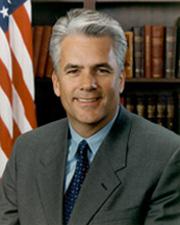 Sen. John Ensign (R-NV)
Legislative Activity
Stay on top of the latest movement without scrolling through every action
Senate amendment submitted
September 10, 2003
View full timeline
Senate amendment submitted
September 10, 2003
Senate amendment proposed (on the floor): Amendment SA 1621 proposed by Senator Ensign to Amendment SA 1542.(consideration: CR S11309, S11311; text: CR S11309)
September 10, 2003
Senate amendment agreed to: Amendment SA 1621 agreed to in Senate by Voice Vote.
September 10, 2003
Amendment SA 1621 proposed by Senator Ensign to Amendment SA 1542. (consideration: CR S11309, S11311; text: CR S11309) To provide funding for statewide, longitudinal data systems under section 208 of the Education Sciences Reform Act of 2002.
September 10, 2003
Amendment SA 1621 agreed to in Senate by Voice Vote.
September 10, 2003
Text
Proposed
CANCER

Mr. STEVENS. Mr. President, increasing scientific evidence indicates
that what a person includes in his or her diet may be as important as
what a person excludes. Scientists estimate that at least 30 to 40
percent of all cancers are linked to diet and related lifestyle
factors.
Some foods contain substances known to increase the risk of cancer,
including saturated fat, cholesterol, and oxidants.
Avoiding these foods may reduce the risk of many of the most common
forms of cancer, including prostate cancer, breast cancer, and colon
cancer. I happen to have an extreme interest in that because I am a
prostate cancer survivor. I am now told other foods

[[Page S11307]]

contain substances that help protect against cancer and heart disease.
A growing number of compounds in fruits, vegetables, and cereal
grains have been found to interfere with the process of cancer
development in laboratory research.
Epidemiologists have found that populations that consume large
amounts of plant-derived foods have lower incidence rates of some types
of cancer.
According to a study conducted by Stephanie London, a doctor and
epidemiologist at the National Institutes of Environmental Health
Sciences and Research Triangle Park, North Carolina, broccoli and other
members of the cruciferous vegetable family, including cabbage and bok
choy, appear to protect humans from lung cancer.
Several other studies have pointed to the cancer-prevention
properties of phytochemicals found in these vegetables. According to
Hien T. Le, Ph.D., a molecular biologist with the University of
California Berkeley, consumption of these cruciferous vegetables has
been linked with prevention of cancers of the breast, endometrium,
colon, and prostate cancer.
One study further found these chemicals are ``novel,'' naturally
occurring and could have potential in cancer prevention or treatment.
Broccoli and related vegetables contain the chemical that kills the
bacteria responsible for most stomach cancers, say researchers,
confirming the dietary advice that moms have been handing out for
years. Dr. Paul Talalay, a coresearcher at Johns Hopkins University,
found the chemical sulforaphane even killed H. pylori, a bacteria that
causes stomach ulcers and often fatal stomach cancers. Researchers
stated:

If clinical studies show that a food can relieve or prevent
disease associated with this bacterium in people, it could
have a significant public health implication in the United
States and around the world.

The good news is there appears to be enough of this chemical in
broccoli sprouts and some varieties of broccoli to significantly
benefit people who eat them. However, researchers cannot now say how
much broccoli one should eat for there to be such an impact. The actual
amounts would need to be determined with long-term tests involving
human trials. ``The levels at which we test it . . . is such that those
could be achieved by eating broccoli or broccoli sprouts. It's a
reasonable level that we think would be reached in the stomach,'' said
Jed W. Fahey, of the Johns Hopkins University School of Medicine.
Researchers have created a synthetic version of the compound found in
broccoli and other vegetables. ``It may be easier to take a cancer
prevention pill once a day rather than rely on massive quantities of
fruits and vegetables,'' says the study author, Jerome Kosmeder,
another Ph.D. research assistant professor at the University of
Illinois at Chicago. However, such drug development is several years
away, I am informed.
The reason for my statement today is that I recently met with Dean
Ornish, a great friend, a medical doctor, founder and president of the
Preventive Medicine Research Institute, and clinical professor of
medicine at the University of California, San Francisco. According to
Dr. Ornish, ``We often have had a hard time believing that the simple
choices we make in our life each day--what we eat, how we respond to
stress, how much exercise we get, whether or not we smoke, and the
quality of our relationships--have such a powerful impact on our health
and well-being.''
With Dr. Ornish was Dr. S. Ward Casscells, a medical doctor who is
the John Edward Tyson Distinguished Professor of Medicine and Public
Health and vice president for biotechnology at the University of Texas
Health Center in Houston.
Dr. Casscells was diagnosed with very aggressive metastatic prostate
cancer in July of 2001. He began utilizing diet and a lifestyle program
that Dr. Ornish and his colleagues had developed, along with
conventional drug treatment. Today, Dr. Casscells shows no sign of
cancer. He shows no sign at all of a cancer that had metastasized.
Meanwhile, researchers say populations should continue to eat healthy
amounts of fruits and vegetables, enabling them to take advantage of
cancer-fighting properties. Several other studies have pointed to the
cancer prevention properties of the phytochemicals found in vegetables,
according to several other people.
Mr. President, I emphasize, because of the nature of some of the
moneys in this bill--I do believe we have spent a lot of Federal-tax
payers' money on various approaches to cancer--I think we should
concentrate more of the money we have available on these methods of
prevention and methods of retarding the development of cancer once
discovered.
I yield the floor.
The PRESIDING OFFICER. The question is on agreeing to the amendment.
Is there a request for the yeas and nays?
Mr. HATCH. I ask for the yeas and nays.
The PRESIDING OFFICER. Is there a sufficient second?
There is a sufficient second. The clerk will call the roll.
The assistant legislative clerk called the roll.
Mr. REID. I announce that the Senator from North Carolina (Mr.
Edwards), Senator from Florida (Mr. Graham), Senator from Massachusetts
(Mr. Kerry), and the Senator from Connecticut (Mr. Lieberman) are
necessarily absent.
I further announce that, if present and voting, the Senator from
Massachusetts (Mr. Kerry) would vote ``nay.''
The PRESIDING OFFICER. Are there any other Senators in the Chamber
desiring to vote?
The result was announced--yeas 7, nays 87, as follows:

[Rollcall Vote No. 344 Leg.]

YEAS--7

Bunning
Coleman
Collins
Ensign
Gregg
Murkowski
Santorum

NAYS--87

Akaka
Alexander
Allen
Baucus
Bayh
Bennett
Biden
Bingaman
Bond
Boxer
Breaux
Brownback
Burns
Byrd
Campbell
Cantwell
Carper
Chafee
Chambliss
Clinton
Cochran
Conrad
Cornyn
Corzine
Craig
Crapo
Daschle
Dayton
DeWine
Dodd
Dole
Domenici
Dorgan
Durbin
Enzi
Feingold
Feinstein
Fitzgerald
Frist
Graham (SC)
Grassley
Hagel
Harkin
Hatch
Hollings
Hutchison
Inhofe
Inouye
Jeffords
Johnson
Kennedy
Kohl
Kyl
Landrieu
Lautenberg
Leahy
Levin
Lincoln
Lott
Lugar
McCain
McConnell
Mikulski
Miller
Murray
Nelson (FL)
Nelson (NE)
Nickles
Pryor
Reed
Reid
Roberts
Rockefeller
Sarbanes
Schumer
Sessions
Shelby
Snowe
Specter
Stabenow
Stevens
Sununu
Talent
Thomas
Voinovich
Warner
Wyden

NOT VOTING--6

Allard
Edwards
Graham (FL)
Kerry
Lieberman
Smith
The amendment (No. 1585) was rejected.
The PRESIDING OFFICER (Mr. Alexander). The Senator from Pennsylvania.
Mr. SPECTER. Mr. President, I alert all Senators as to our schedule.
I have had a number of inquiries as to what we will be doing. There are
very few amendments remaining to be voted upon. Unless we are going to
have a series of rollcall votes on amendments which the managers have
agreed to, the senior Senator from Arizona has notified this manager
there are objections to amendments.
At this time I ask unanimous consent to offer an amendment by Senator
Sessions regarding the Centers for Disease Control on a plan related to
blood safety and ask for its immediate adoption. The provision of the
amendment is ``not later than 90 days after the date of enactment of
this act, the director of the Centers for Disease Control and
Prevention shall prepare a plan to comprehensively address blood safety
and injection safety in Africa under the global AIDS program.''
The area of disagreement, if I may inform my colleagues, is whether
the word ``shall'' will be in the amendment, which is what Senator
Sessions insists upon, or whether it will be ``may,'' which would leave
it up to the discretion of the executive branch as to whether they will
carry out the study.
If the yeas and nays are requested, I intend to ask my colleagues to
deny a sufficient second. I have consulted with the Parliamentarian who
advises that the rule is, to have a sufficient second, there must be
one-fifth of those who

[[Page S11308]]

previously voted, which would be 19 out of 95. If this will require a
rollcall vote, I cannot predict how many rollcall votes we will have
this evening, but I would not make dinner plans.
Mr. INHOFE. Regular order.
Mr. SPECTER. Mr. President, I ask unanimous consent for the adoption
of the Sessions amendment.
The PRESIDING OFFICER. Is there objection?
Mr. McCAIN. I object.
The PRESIDING OFFICER. Objection is heard.
Mr. McCAIN. I suggest the absence of a quorum.
Mr. INHOFE. Regular order.
Mr. HARKIN. Regular order.
The PRESIDING OFFICER. The clerk will call the roll to ascertain the
presence of a quorum.
The legislative clerk proceeded to call the roll.
Mr. HARKIN. Mr. President, I ask unanimous consent that the order for
the quorum call be rescinded.
The PRESIDING OFFICER. Is there objection?
Without objection, it is so ordered.
Mr. HARKIN addressed the Chair.
Mr. BREAUX. Regular order.
The PRESIDING OFFICER. The Senator from Iowa has the floor.

Amendment No. 1614

Mr. HARKIN. Regular order, Mr. President.
Mr. McCAIN. Is the amendment debateable?
The PRESIDING OFFICER. The regular order is there are 2 minutes
evenly divided prior to a vote with respect to the Landrieu amendment
No. 1614.
Who yields time?
The Senator from Louisiana.
Ms. LANDRIEU. Madam President, I am glad to have a quorum. This is a
very important amendment. I need my colleagues' help, if they would
direct their attention to this chart I have in the Chamber.
This amendment is called the MASH amendment. It is a very serious
amendment: mosquito abatement, safety, and health.
We are fighting multiple wars--one in Iraq, which is very serious,
with far-reaching consequences.
I know my colleagues are interested in knowing about how many people
have lost their lives in their own States in this last year. It has
been quite a few from this new and very deadly disease.
We have lost 286 men and women in Iraq, which is very serious, and we
are spending a great deal of time, energy, money, and treasure, but we
have also lost 246 individuals in the United States. The highest
instances have been in Louisiana, South Dakota, Michigan, and Ohio.
This amendment will provide the only Federal funds available to help
our States combat this deadly disease. I ask for your support. I ask
unanimous consent to have printed in the Record data on the number of
confirmed cases of people who have contracted this deadly disease and
the number of people who have died from it.
There being no objection, the material was ordered to be printed in
the Record, as follows:

WEST NILE VIRUS CURRENT CASE COUNT
[Data currently listed shows case counts for 2002 only]
------------------------------------------------------------------------
Laboratory-
State                         positive     Deaths
human cases
------------------------------------------------------------------------
Alabama.........................................           49          3
Arkansas........................................           43          3
California......................................            1
Colorado........................................           14
Connecticut.....................................           17
Delaware........................................            1
District of Columbia............................           34          1
Florida.........................................           28          2
Georgia.........................................           44          7
Illinois........................................          884         64
Indiana.........................................          293         11
Iowa............................................           54          2
Kansas..........................................           22
Kentucky........................................           75          5
Louisiana.......................................          329         25
Maryland........................................           36          7
Massachusetts...................................           23          3
Michigan........................................          614         51
Minnesota.......................................           48
Mississippi.....................................          192         12
Missouri........................................          168          7
Montana.........................................            2
Nebraska........................................          152          7
New Jersey......................................           24
New York........................................           82          5
North Carolina..................................            2
North Dakota....................................           17          2
Ohio............................................          441         31
Oklahoma........................................           21          2
Pennsylvania....................................           62          7
Rhode Island....................................            1
South Carolina..................................            1
South Dakota....................................           37
Tennessee.......................................           56          7
Texas...........................................          202         13
Vermont.........................................            1
Virginia........................................           29          2
West Virginia...................................            3          2
Wisconsin.......................................           52          3
Wyoming.........................................            2
-----------------------
Totals....................................        4,156        284
------------------------------------------------------------------------
\1\ Data currently listed shows case counts for 2002 only. As of April
15, 2003 these are the human case totals that have been reported to
ArboNet. ArboNet is the national, electronic surveillance system
established by CDC to assist states in tracking West Nile and other
mosquito-borne viruses.

WEST NILE VIRUS 2003 HUMAN CASES AS OF SEPTEMBER 9, 2003
------------------------------------------------------------------------
Human cases
\1\
State                       reported to    Deaths
CDC
------------------------------------------------------------------------
Alabama.........................................           20          2
Arizona.........................................            1
Arkansas........................................            5
Colorado........................................          973         13
Connecticut.....................................            1
Florida.........................................           22
Georgia.........................................            7          1
Illinois........................................            5
Indiana.........................................            6
Iowa............................................           20          2
Kansas..........................................           18          1
Kentucky........................................            4
Louisiana.......................................           42
Maryland........................................            8
Massachusetts...................................            1
Minnesota.......................................           30
Mississippi.....................................           43          1
Missouri........................................            6          1
Montana.........................................          116          1
Nebraska........................................          436         10
New Jersey......................................            3
New Mexico......................................           83          4
New York........................................            6          1
North Carolina..................................            9
North Dakota....................................           91
Ohio............................................           18          1
Oklahoma........................................           20
Pennsylvania....................................           38
South Carolina..................................            1
South Dakota....................................          407          5
Tennessee.......................................            6
Texas...........................................          190          6
Virginia........................................            4
Wisconsin.......................................            5
Wyoming.........................................          229          4
-----------------------
Total.....................................        2,874         53
------------------------------------------------------------------------
\1\ These numbers reflect both mild and severe human disease cases that
have been reported to ArboNet by state and local health departments
during 2003. ArboNet is the national, electronic surveillance system
established by CDC to assist states in tracking West Nile virus and
other mosquito-borne viruses.

Note: As of the above date, detailed information is available for 2,752
cases: 1,595 cases (58%) were reported as West Nile Fever (milder
disease), 843 (31%) were reported as West Nile meningitis or
encephalitis (severe disease) and 314 (11%) were clinically
unspecified.

Ms. LANDRIEU. I ask for my colleagues' support on this amendment.
The PRESIDING OFFICER. The Senator's time has expired.
Who yields time in opposition?
Mr. SPECTER. Mr. President, there is no doubt about the seriousness
of the West Nile virus. But we have, at the present time, some $76
million at the Centers for Disease Control.
This past Saturday, I visited the Centers for Disease Control. I took
a look at their maps and saw the incidence of West Nile and have no
request from the Centers for Disease Control that there ought to be any
additional funding.
Mr. President, I raise a point of order under section 504 of the
concurrent resolution on the budget for fiscal year 2004 that the
amendment is not in order because it exceeds discretionary spending
limits.
Ms. LANDRIEU. Mr. President, pursuant to section 504(b)(2) of H. Con.
Res. 95, I move to waive section 504 of that concurrent resolution for
purposes of the pending amendment, and I ask for the yeas and nays.
The PRESIDING OFFICER. Is there a sufficient second?
There appears to be a sufficient second.
The question is on agreeing to the motion.
The clerk will call the roll.
The legislative clerk called the roll.
Mr. McCONNELL. I announce that the Senator from Oregon (Mr. Smith) is
absent because of a death in the family.
Mr. REID. I announce that the Senator from North Carolina (Mr.
Edwards), the Senator from Florida (Mr. Graham), the Senator from
Massachusetts (Mr. Kerry), and the Senator from Connecticut (Mr.
Lieberman) are necessarily absent.
I further announce that, if present and voting, the Senator from
Massachusetts (Mr. Kerry) would vote ``yea.''
The PRESIDING OFFICER. Are there any other Senators in the Chamber
desiring to vote?
The yeas and nays resulted--yeas 46, nays 49, as follows:

[Rollcall Vote No. 345 Leg.]

YEAS--46

Akaka
Allard
Baucus
Bayh
Biden
Bingaman
Boxer
Breaux
Byrd
Campbell
Cantwell
Clinton
Coleman
Conrad
Corzine
Daschle
Dayton
Dodd
Dorgan
Durbin
Feingold
Feinstein
Harkin
Hollings
Inouye
Jeffords
Johnson
Kennedy
Kohl
Landrieu
Lautenberg
Leahy
Levin
Lincoln
Mikulski
Murray
Nelson (FL)
Nelson (NE)
Pryor
Reed
Reid
Rockefeller
Sarbanes
Schumer
Stabenow
Wyden

NAYS--49

Alexander
Allen
Bennett
Bond
Brownback
Bunning

[[Page S11309]]

Burns
Carper
Chafee
Chambliss
Cochran
Collins
Cornyn
Craig
Crapo
DeWine
Dole
Domenici
Ensign
Enzi
Fitzgerald
Frist
Graham (SC)
Grassley
Gregg
Hagel
Hatch
Hutchison
Inhofe
Kyl
Lott
Lugar
McCain
McConnell
Miller
Murkowski
Nickles
Roberts
Santorum
Sessions
Shelby
Snowe
Specter
Stevens
Sununu
Talent
Thomas
Voinovich
Warner

NOT VOTING--5

Edwards
Graham (FL)
Kerry
Lieberman
Smith
The PRESIDING OFFICER. On this vote, the yeas are 46, the nays are
49. Three-fifths of the Senators duly chosen and sworn not having voted
in the affirmative, the motion is rejected. The point of order is
sustained and the amendment falls.
The Senator from Pennsylvania.
Mr. SPECTER. Mr. President, I believe we are ready to go to the
amendment of the Senator from Nevada, Mr. Ensign. He was in the Chamber
a moment ago. Let me advise all Senators that it appears at this time
that we will have four more rollcall votes, plus final passage.
The leader has authorized me to say that the 15-minute votes will be
held sharp to 20 minutes, 15 and 5 grace, cut off after 20 minutes. The
10-minute votes will be 10 plus 5 minutes grace for a total of 15
minutes. We will try to proceed to conclude this bill. It is too late
to complete it early, but we will do it as soon as we can.
Is the Senator from Nevada prepared to offer his amendment.
Mr. ENSIGN. Very soon.
Mr. REID. Mr. President, I suggest the absence of a quorum.
The PRESIDING OFFICER. The clerk will call the roll.
The assistant legislative clerk proceeded to call the roll.
Mr. ENSIGN. Mr. President, I ask unanimous consent that the order for
the quorum call be rescinded.
The PRESIDING OFFICER. Without objection, it is so ordered.

Amendment No. 1621 To Amendment No. 1542

Mr. ENSIGN. Mr. President, I have an amendment at the desk and ask
for its immediate consideration.
The PRESIDING OFFICER. Without objection, the pending amendments are
set aside.
The clerk will report the amendment.
The assistant legislative clerk read as follows:

The Senator from Nevada [Mr. Ensign], for himself, Mrs.
Murray, and Mr. Gregg, proposes an amendment numbered 1621 to
amendment No. 1542.

Mr. ENSIGN. Mr. President, I ask unanimous consent that further
reading of the amendment be dispensed with.
The PRESIDING OFFICER. Without objection, it is so ordered.
The amendment is as follows:

(Purpose: To provide funding for statewide, longitudinal data systems
under section 208 of the Education Sciences Reform Act of 2002)

At the end of title III, insert the following:
Sec. 306. There are appropriated, out of any money in the
Treasury not otherwise appropriated, to carry out section 208
of the Education Sciences Reform Act of 2002, $80,000,000.
All amounts in this Act for management and administration at
the Department of Education are reduced on a pro rata basis
by an amount required to offset the $80,000,000 appropriation
made by this section.

Mr. ENSIGN. Mr. President, I will take a very short time on this
amendment. I am proposing this amendment for myself, Senator Murray,
and Senator Gregg. This amendment is to address a problem we hear about
back home on the No Child Left Behind Act. When you go home and talk to
educators, they talk about not having adequate money to get the
technology to transfer the data to comply with the No Child Left Behind
Act for the local school districts. It is the No. 1 complaint we have
heard from all of the school districts back home.
This amendment appropriates $80 million to basically fund that
shortfall, and it takes the money out of administrative costs in the
Department of Education. We think it is a very reasonable amendment. We
hope our colleagues will support the amendment. Hearing from educators
across the country, this will address one of the most pressing concerns
they have in complying with the No Child Left Behind Act.
I just spoke to the new teachers in Clark County. They had to break
it down into 2 days, with 700 one day and 700 the next for new teacher
orientation. During that time, there were a lot of administrators
around, and this was by far the biggest question they had--making sure
they had adequate funds to comply with the No Child Left Behind Act. We
think this amendment goes a long way toward complying with the No Child
Left Behind Act.
I will yield to my friend from New Hampshire to make some remarks.
The PRESIDING OFFICER. The Senator from New Hampshire is recognized.
Mr. GREGG. Mr. President, I rise in support of this amendment. It is
paid for, which is a critical element of any amendment. More important
than that, it does fund the data-tracking capabilities of the States.
That is part of the No Child Left Behind initiative.
Last year, we passed the legislation, basically creating this
opportunity for States to set up these databases. Unfortunately, we
never funded it. So this would allow us to fund that new piece of
legislation. I think it was a separate freestanding piece of
legislation.
In any event, it funds the effort of the States to set up the data
tracking within the States that is necessary for them to determine how
they are doing in obtaining their achievement goals under No Child Left
Behind. It is reasonable that this money be appropriated, and I am
hopeful that it will be accepted. If it cannot be accepted, I hope we
can do it by the offsets presented in this amendment.
Mr. ENSIGN. Mr. President, if no one else seeks recognition, I just
add a couple of comments about the amendment. It has the support of the
Council of Chief State School Officers. The reason, as I mentioned
before, is because no matter how small or large the school district is,
they are all facing the same problems this amendment attempts to
correct.
They just do not have the infrastructure that is necessary to
capture, analyze, and disseminate the data required by the No Child
Left Behind Act.
Several States have not even done the planning to implement this
because they don't have the resources. This amendment is going to give
those resources necessary to comply with the No Child Left Behind Act.
The PRESIDING OFFICER. The Senator from Pennsylvania.
Mr. SPECTER. Mr. President, this amendment provides $80 million for
data collection for student achievement. While it would be desirable to
have more funds in this appropriations bill, we don't have them, and
the offset is a cut in the program out of the Department of Education
which would be very burdensome, really intolerable for the Department
of Education.
For that reason, I reluctantly oppose the amendment by the Senator
from Nevada.
The PRESIDING OFFICER. Is there further debate?
Mr. ENSIGN. Mr. President, I ask for the yeas and nays.
The PRESIDING OFFICER. Is there a sufficient second?
There appears to be a sufficient second.
The yeas and nays were ordered.
Mr. REID. Mr. President, the Senator from Washington, Mrs. Murray,
wishes to speak on the amendment, so I ask that the vote not occur at
this time. She is on her way over to the Chamber.
The PRESIDING OFFICER. The Senator from Pennsylvania.
Mr. SPECTER. Mr. President, I ask unanimous consent that the pending
amendment be set aside until Senator Murray arrives.
The PRESIDING OFFICER. Without objection, it is so ordered.

Amendment No. 1622 to Amendment No. 1542

Mr. SPECTER. Mr. President, I send an amendment to the desk.
The PRESIDING OFFICER. The clerk will report.
The legislative clerk read as follows:

The Senator from Pennsylvania [Mr. Specter], for himself,
Mr. Harkin, Mrs. Feinstein, and Ms. Collins, proposes an
amendment numbered 1622 to amendment No. 1542.

The amendment is as follows:

(Purpose: To increase funding for the National Institutes of Health)

On page 61, between lines 14 and 15, insert the following:
Sec. __. In addition to any amounts otherwise appropriated
under this Act under the heading of National Institutes of
Health--office of the director, there are appropriated an
additional $1,500,000,000 for programs and activities under
the discretion of the Office of the Director of the National
Institutes of Health. Such additional amount shall be
designated as emergency spending

[[Page S11310]]

pursuant to section 502(c) of House Concurrent Resolution 95
(108th Congress).

Mr. SPECTER. Mr. President, the amendment provides for an additional
$1.5 billion for the National Institutes of Health. This is one of the
most important functions of the Federal Government. I don't think we
have anything in our budget on the domestic side which is more
important, perhaps not as important, as funding for the National
Institutes of Health. That is the crown jewel of the Federal
Government.
We are asking that this be classified as an emergency because the
budget resolution provides for an emergency classification if it meets
the following criteria: No. 1, vital; No. 2, urgent and compelling; No.
3, unpredictable; and No. 4, temporary.
It is vital because the lives and health of Americans are at stake.
It is a life-and-death matter in the way NIH funding has saved lives,
moving forward the cures of so many dreadful maladies.
It is urgent and compelling because Americans who have family members
with muscular dystrophy, Parkinson's, Alzheimer's, or a host of other
ailments will tell you that with each passing day, the hope that their
loved one will be saved grows dimmer.
It is unpredictable and unanticipated because the nature of the
scientific enterprise is unpredictable. The potential cures for disease
have grown through research at NIH.
It is temporary because a disease such as cancer or Alzheimer's costs
our economy billions of dollars a year.
As the diseases that afflict Americans are cured, they are able to
return to productive lives, and these investments in the health of
Americans will more than pay for themselves.
I offer this amendment on behalf of Senator Harkin, Senator
Feinstein, Senator Collins, and myself. I know there are objections to
the classification as an emergency. So I invite whoever seeks to object
to come to the floor.
Mr. HARKIN. Does the Senator yield the floor?
Mr. SPECTER. I do.
The PRESIDING OFFICER. The Senator from Iowa.
Mr. HARKIN. Mr. President, again I commend Senator Specter for his
many years of hard work, his efforts, and his success in increasing the
funding for the crown jewel of the Federal Government, and that is the
National Institutes of Health. Certainly, no one has fought harder and
longer to ensure that our National Institutes of Health get the funding
they need for the cutting-edge research that is saving so many lives.
It was under Senator Specter's leadership that we embarked upon a
program to double the NIH funding over 5 years. People said it could
not be done, but we did it.
Now we are up there and there seems to be some idea that somehow
since we did that--the reason we did that was that NIH had fallen so
far behind in the number of peer-reviewed grants that were being
approved and funded. So we got them back up to where they were at least
20 years ago. Some think now we have them up there, we do not have to
fund them anymore and we can start falling back again. The purpose of
the Specter amendment is to bring the NIH up and keep them on a track
that will not allow them to fall back again.
The Senate bill will increase funding for NIH by $1 billion; that is
3.7 percent. It will be the smallest percentage increase for NIH since
1995. This is the wrong time to put the squeeze on NIH funding. Doing
so will severely impact NIH's ability to award new research grants at
the very time when scientists should be taking full advantage of
everything they have learned over the past 5 years to translate that
research into treatments and cures.
Under the Senate bill, the number of new and competing nonbiodefense
research grants would actually drop from 9,902 in fiscal year 2003 to
9,827 in fiscal year 2004. That is why Senator Specter, Senator
Feinstein, Senator Collins, and I are offering an amendment to add $1.5
billion more for NIH.
This additional funding is critical to ensuring that researchers can
continue the remarkable pace of medical advances during the past 5
years, as I said, when we doubled the funding for NIH. Perhaps most
importantly, the doubling of the funding helped result in the
completion of the final DNA sequence of the human genome. That was done
during that period of time.
In the past 5 years, NIH research has led directly to new knowledge
about the dangers of hormone replacement therapy for millions of
American women, contradicting commonly accepted medical practice.
NIH research supported the development of new techniques for bone
marrow transplantation.
NIH research demonstrated that intense therapy of type 1 diabetes can
reduce long-term diabetes complications by at least 75 percent.
NIH research has now enabled scientists to identify several genes
that increase vulnerability to schizophrenia.
I guess what I am saying is we are truly on the brink of a golden age
in medical research with the mapping and sequencing of the human genes
and other measures funded by NIH. But those opportunities are
threatened if we don't maintain NIH funding at a reasonable level.
The impact of the bill's dramatic slowing in the growth of the NIH
budget will be particularly devastating in the areas of clinical
research where, again, the fruits of our investment in medical research
are applied to improving the health of the American people.
A crash landing in NIH funding sends a chilling message to young
scientists in training and those just entering the research field.
Scientific competition will always be fierce, but young scientists must
be sure that sufficient funding will be available or exceptionally
talented young people will begin to pursue other careers.
So again I rise in strong support of Senator Specter's amendment,
along with Senator Feinstein, and I hope the Senate will adopt this
very modest but very meaningful increase in funding for the National
Institutes of Health.
Ms. MIKULSKI. Mr. President, I rise as a cosponsor of the Specter-
Harkin-Feinstein amendment to increase funding for the National
Institutes of Health, NIH. I fought hard to make sure that Congress
kept the commitment it made 5 years ago to double Federal spending for
the NIH. I am proud that Congress kept its promise. I strongly support
the NIH. I believe that it is an investment that saves lives and that
Congress must continue this valuable investment.
The underlying Senate bill that funds health programs would increase
funding for NIH by $1 billion, or just 3.7 percent in 2004. This would
be the smallest percentage increase for NIH since 1995. The Specter-
Harkins-Feinstein amendment would increase funding by $1.5 billion, for
a total of $29.5 billion. this is the wrong time to cut the Federal
investment in NIH. Congress and the American people have invested in
the NIH. We must allow scientists to continue the great work they are
doing and translate the research they have been working on over the
past 5 years into treatments and cures.
If this amendment fails there would be in increase of only 26 new and
competing research grants in fiscal year 2004. That is approximately
one grant for each NIH Institute and Center. Also, nonbiodefense grants
would actually drop, from 9,902 in fiscal year 2003 to 9,607 in fiscal
year 2004. This means that more promising research on cancer, diabetes,
or other devastating diseases may go unfunded.
The research conducted at NIH today can help lead to longer, more
productive lives for people struck with countless conditions and
diseases. Whether it is Alzheimer's, cancer, cardiovascular disease,
autoimmune diseases, or diabetes, this research can help lead to a
higher quality of life for Americans.
I am proud to have NIH in Maryland. NIH's impact in Maryland is quite
profound. We have excellent research centers and private companies that
exist and grow because of the unique synergy between the Federal labs
in Maryland, like NIH, and the ingenuity of the private sector. Yet the
benefits of investing in NIH are not limited to Maryland. NIH funds
research at universities across the country. Patients across the
country, their loved ones, and those who someday may be diagnosed with
diseases all benefit from these critical investments.
We cannot afford to lessen our commitment to medical research. I
thank Senator Specter, Senator Harkin and

[[Page S11311]]

Senator Feinstein for their leadership on this critical issue. I urge
my colleagues to join me in supporting this important bipartisan
amendment.
The PRESIDING OFFICER. The Senator from Pennsylvania.
Mr. SPECTER. Mr. President, we have two more amendments to be offered
by the Senator from Pennsylvania, Senator Santorum, and the Senator
from Ohio, Senator DeWine. We ask they come to the floor now. If there
are objections to the amendment which has just been offered on the
National Institutes of Health, we ask Senators to come to the floor so
we can wrap up the debate, move on these votes, and move to final
passage.
We are within the very short distance of the goal line, but we need
those other Senators to come to the floor. Last Wednesday we were
talking about going to third reading. That might be a subject to
revisit.
I suggest the absence of a quorum.
The PRESIDING OFFICER. The clerk will call the roll.
The assistant legislative clerk proceeded to call the roll.
Mr. ENSIGN. Mr. President, I ask unanimous consent that the order for
the quorum call be rescinded.
The PRESIDING OFFICER (Mr. Coleman). Without objection, it is so
ordered.
Mr. ENSIGN. I ask unanimous consent that Senator Collins be added as
a cosponsor to amendment No. 1621.
The PRESIDING OFFICER. Without objection, it is so ordered.
Mr. ENSIGN. I suggest the absence of a quorum.
The PRESIDING OFFICER. The clerk will call the roll.
The assistant legislative clerk proceeded to call the roll.
Mr. SPECTER. Mr. President, I ask unanimous consent that the order
for the quorum call be rescinded.
The PRESIDING OFFICER. Without objection, it is so ordered.
Mr. SPECTER. Mr. President, we have decided to accept the amendment
of the Senator from Nevada, Mr. Ensign. Does the ranking member concur
in that?
Mr. HARKIN. We have no objections on this side.
Mr. SPECTER. I urge the adoption of the amendment.
The PRESIDING OFFICER. The yeas and nays have been ordered.
Mr. ENSIGN. I ask unanimous consent that the yeas and nays be
vitiated.
The PRESIDING OFFICER. Without objection, it is so ordered.
The question is on agreeing to amendment No. 1621.
The amendment (No. 1621) was agreed to.
Mr. HARKIN. Mr. President, I move to reconsider the vote.
Mr. SPECTER. I move to lay that motion on the table.
The motion to lay on the table was agreed to.
The PRESIDING OFFICER. The Senator from Alaska.
Mr. STEVENS. While we are waiting momentarily, I want to take this
opportunity to recognize the staff of the Labor, Health and Human
Services, and Education Subcommittee for all their efforts, hard work,
and dedication on this very difficult bill.
First let me thank Senator Harkin's staff: Ellen Murray, Erik Fatemi,
and Adrienne Hallet. They have worked shoulder to shoulder in a
bipartisan fashion with our staff to put together this fine bill. It is
a testament to their hard work, skill, dedication, and partnership.
I also commend and thank our subcommittee staff: Jim Sourwine, Mark
Laisch, Sudip Parikh, Candice Rogers, and Carol Geagley. The staff
deserves our gratitude for working diligently for many months, late
nights, and weekends to put together this very important bill. I know
every year both of these staffs reach across the aisle to work together
to forge compromises on many contentious issues. I think we should all
thank them and salute them.
Lastly, I will take a moment to give special praise to our
subcommittee staff director Bettilou Taylor. Senator Specter and I
often refer to Bettilou as ``Senator Taylor.'' She has one of the
toughest jobs in the Senate. This is the largest bill this year. It
probably is the largest domestic appropriations bill in the history of
the United States to appropriate taxpayer money for Federal purposes.
This is a very complex bill with difficult issues. Bettilou does it
with a great deal of skill and grace. She is, in every sense of the
word, a consummate professional. I thank her and I hope all Members
will thank her for her outstanding work for the Senate and for the
American people.
The PRESIDING OFFICER. The Senator from Pennsylvania.
Mr. SPECTER. Mr. President, I thank the distinguished President pro
tempore and chairman of the full committee for those comments. I
associate myself with them. It has been an outstanding and
extraordinary staff. Ellen Murray for Senator Harkin and Bettilou
Taylor on the majority side are--exemplary is not a high enough
characterization.
While I am at it, I thank my distinguished ranking member, Senator
Harkin, for his extraordinary contribution to the public good. He and I
have worked as the chairman and ranking and reversed the roles, and we
call it a seamless transfer of the gavel. I take this occasion to thank
him for his work.
I note Senator Nickles is in Chamber now, so I yield for a moment to
my colleague, Senator Harkin.
The PRESIDING OFFICER. The Senator from Iowa.
Mr. HARKIN. I thank the chairman for yielding and I, too, thank
Senator Stevens for his kind and generous remarks regarding the
subcommittee and especially applaud him for all the glowing terms he
used about our staff on both sides of the aisle. They are just
outstanding staff. They work very hard on this bill every year. But
they have not worked any harder in any year than this year because, as
Chairman Stevens said, this is a very large bill and a very complicated
bill. It covers just about everything from soup to nuts in our society.
They have done a great job. I, too, compliment our respective staffs
and thank them for all their hard work. I want to repay in kind the
kind words Senator Specter just said. We have had a back and forth
chairmanship/ranking member now going back 13 years. It has been a
seamless transfer of the gavel. We worked very closely together all
these years to increase funding for NIH, to meet our commitments in
education, to meet our commitments in health care.
This bill, I have often said, is the bill that really defines
America. I have often said that we always have a Defense Appropriations
Committee bill. The Defense Appropriations Committee bill is the bill
that defends America. This bill that funds the Department of Education
that our colleague from Tennessee headed--I remember when he was
Secretary of Education--and the Department of Health and Human
Services, the Department of Labor, NIH, libraries--everything, I always
said this is the bill that defines America. It defines who we are as a
people and how much we are going to invest in our human resources in
this country.
So I thank Senator Specter for his dynamic leadership of this
subcommittee, for his vision, for his hard work in making sure we have
a bill that is--not perfect. Obviously, I don't think anyone here has
gotten everything they want out of this bill; that is true. But it is a
true compromise, and that is what should define what we do here in the
Senate, is compromise between the various interests we represent and
the various States. I think that is truly what this bill does this
year, and I thank Senator Specter for his great leadership getting this
bill together.
I yield the floor.
The PRESIDING OFFICER. The Senator from Oklahoma.
Mr. NICKLES. Mr. President, I regret I am going to make a budget
point of order because the amendment that is pending busts the budget,
and it busts the budget by $1.5 billion.
First, I congratulate Senator Specter for the work he has done up to
this point. He saved the taxpayers a lot of money. There have been a
lot of amendments. I will just mention those. We have totaled those,
the total for 2004. Senator Specter has made points of order, all of
which were sustained, that saved $24.481 billion in 2004--over a 10-
year period, $352 billion--by basically staying with the budget.
This amendment breaks the budget. This amendment breaks the budget
deal that the chairman of the Appropriations Committee negotiated with
the President of the United States. It

[[Page S11312]]

breaks the budget that we passed overwhelmingly--that we passed after a
lot of hard work.
Are we going to have a budget or not have a budget? This amendment
says we are going to add $1.5 billion for NIH and declare it an
emergency; i.e., we don't expect it to count on the budget. In other
words, we don't want the budget to apply.
If we follow that analogy, it is like some of the other amendments
that were offered. Several people offered amendments that just said
let's take money from 2004 and put it in 2003 and therefore we will
have money for 2004. It was a sham. We defeated all those. If we do not
defeat this amendment, the budget is a sham. We will just say something
is an emergency that is not an emergency.
We appropriate money to NIH. We have done so. I happen to be a
supporter of NIH. I have supported increasing money substantially to
NIH over the years.
Looking back, in 1990 we spent actually $7.5 billion on NIH. In 2004,
under the budget that we have, without this amendment we are spending
right at $28 billion. That is three and a half times what we spent in
1990.
In 1998, when we said we were going to double it, we did. In 1998, we
were spending $13.6 billion for NIH, and the budget we have before us
is almost $28 billion--more than double since 1998. Those are enormous
growth rates, maybe exceeding almost any other Government program.
Maybe we need to slow that rate of growth down just a little bit
because now we don't have big surpluses. When we were doubling the
program, we had some surpluses. Now we have a big deficit. Maybe we
should do a little bit better job of oversight.
I noticed there was a report. I remember, on ``CBS News'' the
headline was ``NIH Microbiologist Gets Paid $100,000 By Taxpayers To Do
Nothing.''
It was reported in the Washington Post. I ask unanimous consent to
have that printed in the Record, an article that was in the Post on
July 4.
There being no objection, the material was ordered to be printed in
the Record, as follows:

[From the Washington Post, July 4, 2003]

NIH Scientist Says He's Paid To Do Nothing; Agency Denies
Administrator's ``Surreal Situation'' of Collecting $100,000 Salary for
No Work

(By Tania Branigan)

Every weekday at 6:30 a.m., Edward McSweegan climbs into
his Volkswagen Passat for the hour-long commute to the
National Institutes of Health. He has an office in Bethesda,
a job title--health scientist administrator--and an annual
salary of about $100,000.
What McSweegan says he does not have--and has not had for
the last seven years--is any real work. He was hired by the
National Institute of Allergy and Infectious Diseases in
1988, but says his bosses transferred the research grants he
administered to other workers eight years later, leaving him
with occasional tasks more suitable for a typist or
``gofer.''
NIH officials denied the allegations earlier this week, but
said they would reexamine the issue after Sen. Charles E.
Grassley (R-Iowa) raised the issue in a letter to Health and
Human Services Secretary Tommy G. Thompson.
Grassley, who as chairman of the Senate Finance Committee
has supported budget increases for the NIH, learned of
McSweegan's case when CBS News contacted him for a story on
the scientist. In the report that aired on ``CBS Evening
News'' on June 26, McSweegan said he had been paid to do
nothing for the past seven years.
McSweegan used to be NIH's program officer for Lyme disease
but was removed from the post in June 1995 after a dispute
over his repeated criticism of a politically influential
support group for sufferers and his allegations that NIH had
been too accommodating of the group. He had publicly
described the Lyme Disease Foundation as ``wacko'' because he
disagreed with its theories about the disease. The dispute
led to his suspension without pay for two weeks for
insubordination and conduct unbecoming of a federal employee.
In spring 1996, his responsibilities for an unrelated
program were also removed. He maintains they have never been
replaced.
In an interview Monday, Grassley accused NIH of ``an
absolute management vacuum'' and said it is ``ludicrous''
that the administrator is being paid to do nothing.
``We want to make sure we get the most bang for our buck,
the most research for our dollars,'' the senator added.
John Burklow, a spokesman for NIH, said McSweegan has
always been assigned duties appropriate to his position and
pay level.
``The claim that he is being compensated for doing nothing
is completely inaccurate,'' Burklow said.
According to NIH, McSweegan is director of the U.S.-Indo
Vaccine Action Program, and has traveled to countries such as
Russia representing the agency. He has also ``produced
reports and other work products.''
But McSweegan said he has never been told he was director
of the program and knew of no such title. Three other people
ran the project, and his work for it--such as arranging
coffee for lunches and forwarding messages--was ``the kind of
work you would get an . . . to do.''
He added that the Office of Global Health Affairs had
organized and paid for his trip to Russia, and that his only
reports had been brief accounts of meetings.
McSweegan said he struggles to fill his eight-hour workdays
by reading, exercising and writing fiction. He has self-
published a bioterrorism thriller and a science fiction oval,
and is working on a third book.
But he says his six-page job description is the ultimate
work of creating writing and describes his position as ``a
bizarre, surreal situation--part Orwell, part Kafka and part
Dilbert.''
``It's not my idea, said McSweegan, 47. ``I have pointed it
out repeatedly over the years. I suppose they are just
waiting for me to get bored and frustrated and quit. But I
haven't been inclined to do that, because my wife has a real
job and we have compelling family reasons for staying in the
area.
``I just expect to do this for maybe four more years until
my wife retires,'' he said. ``It would be nice to get a real
job doing real work.''

Mr. NICKLES. Basically, the headline is ``NIH Scientist Says He's
Paid To Do Nothing; Agency Denies Administrator's `Surreal Situation'
Of Collecting $100,000 Salary For No Work.'' The story goes on. I
remember reading it, and I thought, whoa, somebody is not paying
attention.
Please don't get me wrong. I know NIH does a lot of great work and I
am supportive of that. But right now we have to live within a budget.
If the committee wanted to--the committee has $127 billion in
discretionary spending--they could have given NIH more money. They had
control over that $127 billion. They could have shifted it around to
where NIH would get more.
What the committee elected to do was: We will short fund NIH and we
will give a lot more money for a lot of other things, and then we will
try to run the gamut because we know NIH has a lot of support.
I think the committee needs to go back and say: Wait a minute, the
budget is $127 billion. It happens to be the largest budget of any that
we have before any committee, with the exception of Defense. If you
added all the mandatories to it, it is bigger than Defense. It is a
total of $460-some billion.
I urge my colleagues, if they want to get more money for NIH, let's
have the committee go back and reallocate out of the $127 billion they
have under the budget. But let's live with the budget. Let's not
declare something that is funded every year by appropriations an
emergency; i.e., when we declare an emergency, it doesn't count on the
budget. If we are going to use the emergency game as a way of violating
the budget, let's just not have a budget.
We passed the budget through both Houses. We said you had to have 60
votes in the Senate to declare an emergency. Our colleagues who are
supporting this amendment I have great belief sincerely support NIH,
but they underfunded it in their committee in relationship to other
things and now they want to say let's just declare an emergency and get
around it so we will have more money.
I don't think they should get away with that. That is violating the
agreement, the budget we passed. It violates the agreement we made with
the President of the United States. So I urge my colleagues to support
me in my effort to sustain the budget.
Mr. President, I will be making a budget point of order.
Mr. CONRAD. Will the Senator yield?
Mr. NICKLES. I will be happy to yield to my colleague, but I am not
quite finished.
Pursuant to section 502(c)(5) of House Concurrent Resolution 95, the
fiscal year 2004 budget resolution, I raise a point of order against
the emergency designation provision contained in the amendment.
The PRESIDING OFFICER. The Senator from Alaska.
Mr. STEVENS. Part of what the Senator said I agree with. We should
have been able to assign more money under our allocation process to
this subcommittee. We are not able to do so. However, the Senator from
Oklahoma was incorrect when he said we did not give them more money.
Through the agreement with the administration, we did bring back money
from the allocation process for education. We increased that amount, by
virtue of what

[[Page S11313]]

we did, by $2.2 billion. We took $3 billion out of Defense and
allocated it to several subcommittees, including $800 million to this
subcommittee. But very clearly, this subcommittee is short of money.
There are a great many problems that we face. This bill is going to
conference, and we don't know how we are going to work out some of the
items in this bill. There are several allocations we have made under
our process that the House has not made. I take the position that this
emergency is necessary to get this item to conference to see how we can
allocate it. Obviously, we are not going to bring a bill out of
conference that the President will veto. If the President tells us he
is going to veto it because of these emergency designations, assuming
the House would agree to it--we don't know if the House will agree to
it--but I do know this bill is very short of money.
The demands on our society are now so great that all of the things
from SARS, to the things the CDC is doing, and all the things NIH is
doing--this is a bill that just absolutely demands funding.
I take the position that it is not inconsistent with the comments I
made to the President--that I would not support emergencies unless
there was a true emergency. I think this is a true emergency.
But in any event, if the Senate will vote as the managers of this
bill have requested, we will take the bill to conference at $1.5
billion more than the maximum amount I could possibly allocate and meet
the other demands of our other 12 subcommittees.
I say to the Senator from Oklahoma that I don't think I am breaking
my word at all. I hope the Senate will support us in taking this bill
to conference with the most money we can possibly find to put in it and
go to conference with the House.
There are a series of items in here to which we know the House will
object. I believe by the time we come out, this emergency will not be
needed. If it is needed, I will personally visit with the President of
the United States about it, and we will see what he decides. If the
President still takes the position that we should not include the money
on an emergency basis, I will at that time oppose it.
But right now, I urge the Senate to waive this point of order. If it
is the first one waived this year, this is the one to waive. This is
the one necessary to do so.
I don't think it is inconsistent with my position.
I will tell Senator Nickles, the chairman of the Budget Committee,
that I think with the constraints we are operating under this year in
view of the problems we have, being at war, and at the same time
conducting all of these enormous projects that we are facing in terms
of the health and welfare of our country, including education--this, as
I said before, is the largest bill we have--this bill is underfunded.
But it is not underfunded because of what we did; it is underfunded
because of what the Budget Committee did.
This is the one chance to overrule the Budget Committee. I intend to
support Senator Specter, and I intend to support this emergency
declaration.
The PRESIDING OFFICER. The Senator from Oklahoma.
Mr. NICKLES. Mr. President, I remind my friend and colleague from
Alaska--he is my friend--we had an agreement on $784 billion. The
Senator from Alaska has an initial $5 billion on top of that. The
agreement was $784 billion. The Senator from Alaska got $3 billion from
defense for other items; then an additional $2.2 billion on top of
that. A deal is a deal. If people do not want to waive the Budget Act,
we don't have to have a budget.
I tell my colleagues that if the VA-HUD bill wants to bust the budget
by declaring an emergency, we can bust the budget all day long. Why
have a budget? They want to bust the budget by another $1.5 billion. I
am sure every other committee would love to. Why have a budget if you
are just going to say: Wait a minute; for an appropriated item we don't
have enough money. We want more, and we will declare an emergency. It
doesn't count. Now this year you will go to conference with the House
with different figures.
We are going to have the same figures so we can finish the bills on
time.
I am just disappointed in the statement of my colleague from Alaska.
I believe a deal is a deal and a budget is a budget. It takes 60 votes
to waive the budget. If our colleagues elect to waive it, I guess that
will be their choice.
This Senator hopes that we will not do it. The NIH gets an additional
$1 billion this year. Maybe that is not enough, as some would like, but
the committee had $127 billion to allocate. They could have allocated
that in any way they wanted. They had great discretion. We give great
discretion to the chairman of the subcommittee and the ranking member
of the subcommittee to allocate the $127 billion. Yet it looks as if,
well, the NIH didn't do as well as many other accounts. Maybe that was
on purpose. I don't know. I do know the total exceeds the budget that
we passed. It exceeds the agreement we made with the President of the
United States. It would say that $1.5 billion is an emergency for NIH.
This is normally an appropriated item. There is nothing emergency
whatsoever.
I urge my colleagues to sustain the budget point of order and not to
waive the budget.
The PRESIDING OFFICER. The Senator from Alaska.
Mr. STEVENS. Mr. President, I appreciate the comments of the Senator
from Oklahoma. Up my way, we say, ``Wait until the last dog is hung.''
The agreement we made with the President will be kept. In the final
analysis, it was not based on the allocations we made under our
allocation process. It was based on the total.
We have 13 bills to consider. We will see to it that we keep our
agreement with the President. As a matter of fact, he has the veto pen.
He will see to it that we keep it.
But there is a problem of getting bills done and taking to the
conference the things that the Senate wants considered in conference.
I join with the Senator from Pennsylvania and the Senator from Iowa
in wanting this money considered in conference. If it is not approved
in conference, then we will not have approval.
I think there will be other items that the Senate will want to take
out, and part of this money will come back in the final bill.
The PRESIDING OFFICER. The Senator from Pennsylvania.
Mr. SPECTER. Mr. President, I yield to the Senator from North Dakota.
The PRESIDING OFFICER. The Senator from North Dakota.
Mr. CONRAD. Mr. President, I rise to support the position of the
chairman of the Budget Committee.
The deficit for next year is now calculated to be over $530 billion.
That does not count the $160 billion that is going to be taken--every
penny--from the Social Security trust fund surplus. Now we are talking
about an operating deficit of $697 billion. And we are acting as though
nothing has changed. Something has changed. This country is digging a
deep hole.
I agree that NIH is underfunded. I would love to support additional
money for NIH. But it is not there. It is not in this budget. It wasn't
in the budget which I offered my colleagues and which the vast majority
of Members on our side voted for. If we are going to be declaring
emergencies on appropriated accounts where there is nothing that wasn't
intended, there was nothing unanticipated, then we could just take the
whole budget process and throw it out the window and abandon all
discipline.
This is a mistake, I say to my colleagues. It is a mistake tonight to
declare an emergency where no emergency exists.
I urge my colleagues to support the chairman of the Budget Committee.
The PRESIDING OFFICER. A point of order has been made.
The Senator from Pennsylvania.
Mr. SPECTER. Mr. President, this is the most spirited debate of the
entire bill, and we have had some spirited debates.
I thank the Senator from Oklahoma for his compliments.
I haven't gotten around to totaling the savings. But I was pleased to
hear that we saved some $24-plus billion. Over a 10-year period, it is
in the high of $300 billion.
I am pleased to note that I believe there is a very big difference
between the National Institutes of Health and anybody else who wants to
declare an emergency. Simply stated, NIH deals with life and death.

[[Page S11314]]

At any rate, we have saved more than $24 billion this year--a vast
sum over 10 years.
I ask my colleagues to support this amendment, and I move to waive
the Budget Act.
The PRESIDING OFFICER. The majority leader.
Mr. FRIST. Mr. President, I rise in support of the Senator from
Oklahoma. And this is a spirited debate.
I guess I rise in large part because of the agreement, as I
understand it, that has gotten us to the point we are today; that is,
to be able to progress on the appropriations bills with an overall sum
that was set with a budget that was specifically designed and agreed
to, which this amendment, as I interpret it, blows away.
Although I, as a physician and as someone who values what the NIH
does tremendously--indeed, it is my life, or has been my life--the idea
that we add $1 billion as an emergency at this point in time is
inconsistent with the agreements we made up to this date.
Again, I would like to see that money invested and the NIH properly
use that money well. If $1 billion is not put in, the NIH will be able
to continue to do its responsible role, and fulfill that role, in a way
that, to me, means this is not emergency money.
Thus, I will support the chairman of the Budget Committee, the
Senator from Oklahoma, in the vote which we are about to take.
Mr. STEVENS. Will the Senator yield?
The PRESIDING OFFICER. Is there a sufficient second to the request
for the yeas and nays?
There is a sufficient second.
The Senator from Alaska.
Mr. STEVENS. Leader, I state categorically I did not make an
agreement on any particular bill. We made an agreement that the bottom
line would not exceed the amount that the Senator from Oklahoma stated.
We have a series of bills going to conference and we will keep that
commitment.
But with due respect, I made no commitment on any particular bill, to
the President or to anyone else.
Mr. FRIST. Mr. President, to reach this total sum, we established a
budget that we have been able to adhere to today, to which we have all
agreed. My interpretation of this amendment, describing it as an
emergency, blows away that budget which leads to the total.
The PRESIDING OFFICER. The Senator from Iowa.
Mr. HARKIN. Mr. President, emergency, like beauty, sometimes is in
the eye of the beholder. Quite frankly, to this Senator, every single
penny we put into NIH is an emergency. If you do not believe me, go out
and talk to a family with a child that just came down with juvenile
diabetes and see if you do not think what we spend at NIH is an
emergency.
Talk to a woman who has just discovered she has breast cancer and is
facing an uncertain future. Tell her that funding of NIH is not an
emergency. Talk to someone who has suffered an injury who is now
quadriplegic. They are looking for help to once again be whole again
through some of the great research being done through NIH. Tell them
this is not an emergency. Go out and talk to a family who has a loved
one who has just come down with Alzheimer's disease not knowing what
the future is going to be. A mother, father, grandparents, looking
forward to the debilitating effects of Alzheimer's disease. Tell them
that funding for NIH is not an emergency.
Whether or not this is an emergency is in the eye of the beholder.
Think of the millions of Americans who have been afflicted with
illness, disease, and injury who look to NIH for the treatments and
cures; think about whether or not every single penny we spend on NIH is
an emergency.
I yield the floor.
The PRESIDING OFFICER. The Senator from California.
Mrs. FEINSTEIN. Mr. President, I wanted an opportunity as a cosponsor
of the amendment to say a few words and to add my support to that of
the chairman of the Appropriations Committee and the chairman and
ranking member of the subcommittee.
We stand at a very unusual time. Because of the human genome and the
advances in molecular biology, it is now possible to develop and target
drugs to specific ailments and therefore to break frontiers, to cross
barriers and make uncharted progress. What we began exactly 5 years ago
under the leadership of the Senator from Pennsylvania and the Senator
from Iowa was essentially to double the funding of NIH over 5 years, to
be able to take advantage of the new horizon in front of us.
I serve with President and Mrs. Bush, senior, as vice chairman of the
National Dialogue on Cancer. Senator Sam Brownback has just come
aboard. And in the Senate Cancer Coalition which Senator Brownback and
I co-chair, we have heard miraculous testimony, for example, from Dr.
Brian Drucker, the inventor of the drug Gleevec which is used to treat
patients with chronic myeloid leukemia. Gleevec is one of a new
generation of targeted cancer drugs that just kill bad cancer cells,
leaving good cells unaffected. There is much less toxicity with this
drug. Individuals do not lose their hair, they are not nauseated, and
it has been shown to produce a 90-percent remission rate. That is where
we are at this point in time. The sponsors of this amendment want to
continue that advance.
I say to my colleagues on this side, we all voted for a host of
amendments. They all cost money. This is the big one. This is the one
that will really make a difference for the health of Americans. If this
amount is not added to the budget, the number of new and competing non-
biodefense research grants will drop, from 9,902 in fiscal year 2003 to
9,827 in fiscal year 2004.
NIH says the optimum number percent of approval for these research
grants is about 40 percent. Through the increases we have made over the
last 5 years, the grant approval rate is now about 30 percent. All this
amendment does is allow us to keep even with that rate. Unfortunately,
it takes $1.5 billion to do that.
The suffering out there is enormous. Because of advances, we can find
new cures and new drugs with better prevention and better
rehabilitation. That is what I believe the American people want to
spend these dollars on.
I have faith in what the chairman of the Appropriations Committee
said. Actually, I have never in the 10 years I have been here on a
dollar matter heard him make a misstatement. I have no reason not to
believe what he is saying. It may be true in absolute terms that this
is not an emergency and the original plans were to take this money in a
different way. For some reason that changed. The need is there. And the
results will be there. I am absolutely convinced of it.
Senator Brownback and I, as cochairs of the Senate Cancer Coalition,
hold hearings. We hear from people. We hear from scientists. We hear
from advocates. Yet more than 575 health, research, and disease
advocacy organizations support this amendment. That is no coincidence.
It is because people know now that because of the advances in molecular
biology, because of the human genome, we are on the brink of new
discoveries. We want those discoveries to continue.
This is not pie in the sky. This is real. Every dollar spent will
yield health dividends for people. I hope we will pass this amendment.
I yield the floor.
The PRESIDING OFFICER. The question is on agreeing to the motion. The
yeas and nays have been ordered. The clerk will call the roll.
The assistant legislative clerk called the roll.
Mr. McCONNELL. I announce that the Senator from Oregon (Mr. Smith) is
absent because of a death in the family.
Mr. REID. I announce that the Senator from North Carolina (Mr.
Edwards), the Senator from Florida (Mr. Graham), the Senator from
Massachusetts (Mr. Kerry), and the Senator from Connecticut (Mr.
Lieberman) are necessarily absent.
I further announce that, if present and voting, the Senator from
Massachusetts (Mr. Kerry) would vote ``yea.''
The PRESIDING OFFICER. Are there any other Senators in the Chamber
desiring to vote?
The yeas and nays resulted--yeas 52, nays 43, as follows:

[[Page S11315]]

[Rollcall Vote No. 346 Leg.]

YEAS--52

Akaka
Bennett
Biden
Boxer
Brownback
Campbell
Cantwell
Clinton
Coleman
Collins
Corzine
Daschle
Dayton
DeWine
Dole
Domenici
Dorgan
Durbin
Feingold
Feinstein
Harkin
Hatch
Hollings
Hutchison
Inouye
Jeffords
Johnson
Kennedy
Kohl
Landrieu
Lautenberg
Leahy
Levin
Lincoln
Mikulski
Miller
Murkowski
Murray
Nelson (FL)
Nelson (NE)
Reed
Reid
Roberts
Rockefeller
Sarbanes
Schumer
Shelby
Snowe
Specter
Stabenow
Stevens
Wyden

NAYS--43

Alexander
Allard
Allen
Baucus
Bayh
Bingaman
Bond
Breaux
Bunning
Burns
Byrd
Carper
Chafee
Chambliss
Cochran
Conrad
Cornyn
Craig
Crapo
Dodd
Ensign
Enzi
Fitzgerald
Frist
Graham (SC)
Grassley
Gregg
Hagel
Inhofe
Kyl
Lott
Lugar
McCain
McConnell
Nickles
Pryor
Santorum
Sessions
Sununu
Talent
Thomas
Voinovich
Warner

NOT VOTING--5

Edwards
Graham (FL)
Kerry
Lieberman
Smith
The PRESIDING OFFICER. On this vote, the yeas are 52, the nays are
43. Three-fifths of the Senators duly chosen and sworn not having voted
in the affirmative, the motion is rejected. The emergency designation
is stricken.
The question is on agreeing to the amendment.
The Senator from Oklahoma.
Mr. NICKLES. Amendment No. 1522 by the Senator from Pennsylvania
increases spending by $1.5 billion. This additional spending would
cause the underlying bill to exceed the subcommittee's section 302(b)
allocation. Therefore, I raise a point of order against the amendment
pursuant to section 302 of the Budget Act.
The PRESIDING OFFICER. The Senator has raised a point of order.
Mr. REID. Mr. President, I suggest the absence of a quorum.
The PRESIDING OFFICER. The clerk will call the roll.
The legislative clerk proceeded to call the roll.
Mr. REID. Mr. President, I ask unanimous consent that the order for
the quorum call be rescinded.
The PRESIDING OFFICER. Without objection, it is so ordered.
The Senator from Pennsylvania.
Mr. SPECTER. Mr. President, I now send a series--
The PRESIDING OFFICER. If the Senator will suspend, a point of order
was raised against the amendment. The point of order is sustained. The
amendment falls.

____________________