To propose a substitute.
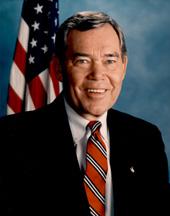 Sen. Craig Thomas (R-WY)
Legislative Activity
Stay on top of the latest movement without scrolling through every action
Senate amendment submitted
January 23, 2003
View full timeline
Senate amendment submitted
January 23, 2003
Senate amendment proposed (on the floor): Amendment SA 246 proposed by Senator Thomas to Amendment SA 61.(consideration: CR S1421-1423; text: CR S1421)
January 23, 2003
Senate amendment agreed to: Amendment SA 246 agreed to in Senate by Yea-Nay Vote. 50 - 48. Record Vote Number: 25.
January 23, 2003
Roll call votes on amendments in Senate: Amendment SA 246 agreed to in Senate by Yea-Nay Vote. 50 - 48. Record Vote Number: 25.
January 23, 2003
Amendment SA 246 proposed by Senator Thomas to Amendment SA 61. (consideration: CR S1421-1423; text: CR S1421) To propose a substitute.
January 23, 2003
Amendment SA 246 agreed to in Senate by Yea-Nay Vote. 50 - 48. Record Vote Number: 25.
January 23, 2003
Votes
1 roll call on this amendment
Text
Proposed
[[Page S1421]]

-----------------------------------------------------------------------

House of Representatives

The House was not in session today. Its next meeting will be held on
Monday, January 27, 2003, at 2 p.m.

-----------------------------------------------------------------------

Senate

Thursday, January 23, 2003

MAKING FURTHER CONTINUING APPROPRIATIONS FOR FISCAL YEAR 2003

(Continued)

Amendment No. 246 To Amendment No. 61

Mr. THOMAS. Mr. President, the amendment is at the desk.
The PRESIDING OFFICER. The clerk will report the second-degree
amendment.
The legislative clerk read as follows:

The Senator from Wyoming (Mr. Thomas) proposes an amendment
numbered No. 246 to amendment No. 61.

Mr. THOMAS. I ask unanimous consent that the reading of the amendment
be dispensed with.
The PRESIDING OFFICER. Without objection, it is so ordered.
The amendment is as follows:

Strike all after the first word and insert the following:
While nothing in this section shall prevent any agency of
the executive branch from subjecting work performed by
Federal Government employees or private contractors to
public-private competition or conversions, none of the funds
made available in this Act may be used by an agency of the
executive branch to establish, apply, or enforce any
numerical goal, target, or quota for subjecting the employees
of the executive agency to public-private competitions or for
converting such employees or the work performed by such
employees to private contractor performance under the Office
of Management and Budget Circular A-76 or any other
administrative regulation, directive, or policy unless the
goal, target, or quota is based on considered research and
sound analysis of past activities and is consistent with the
stated mission of the executive agency. Nothing in this
section shall limit the use of such funds for the
administration of the Government Performance and Results Act
of 1993 or for the administration of any other provision of
law.

Mr. THOMAS. Mr. President, this is a second-degree amendment to the
underlying amendment. We discussed this amendment this morning and
delayed a vote in hopes of coming to a compromise over some of the
concerns that were raised. For nearly 2 hours the administration
officials, my staff, Senator Collins' staff, Senator Brownback, and
Senator Mikulski worked to find a way to address these concerns.
Unfortunately, the Senator from Maryland did not agree with that.
So I am offering this amendment. The compromise was reached that the
administration believes allows the Government, the President, to
continue setting important management goals for the public-private
competition. What this is, of course, is allowing for the FAIR Act,
which was passed in 1998, to continue to be effective, where we can go
through and list those items that are not inherently governmental and
have some competition for those items in the private sector so we can
have certainly a more efficient Government. This is the way we think we
ought to do it.
This amendment would allow for the restrictions on the quotas. But
when there has been study, when there has been a real approach to what
can be done and the kinds of activities that fit, then we can move
forward.
The complaint here on the amendment has simply been because of
setting quotas. Quotas does not mean that people will be replaced by
private enterprise, but, rather, areas that are not inherently
governmental will be used.
I turn now to the Senator from Maine for her comments.
The PRESIDING OFFICER. The Senator from Maine.
Ms. COLLINS. Mr. President, I think the Senator from Maryland has
raised a very legitimate point about the use of arbitrary quotas or
numerical targets to guide the contracting-out activities of Federal
agencies. It seems to me that having one target for every agency may
well be counterproductive and not result in the greatest efficiencies.
On the other hand, I am concerned that the amendment of the Senator
from Maryland may have some unintended consequences. It could be read
as rejecting the notion of ever having competitive contracting, to see
whether a specific function is best performed in-house or contracted
out to the private sector.
I am also concerned that it could have an impact on other laws,
although I know that is not the intent of the Senator from Maryland.
We have consulted with the General Accounting Office and have come up
with some language to try to deal with this. I do want to assure the
Senator from Maryland, as the new chairman of the Governmental Affairs
Committee, I want to work with her to try to resolve this issue because
the issue she has brought to our attention is a legitimate one. So I
hope to continue, in my new capacity, to work with her, to work with
the Senator from Wyoming,

[[Page S1422]]

to work with the Senators from Virginia who have also expressed
concerns about this issue.
Mr. THOMAS. Mr. President, I yield now to the Senator from Ohio.
The PRESIDING OFFICER. The Senator from Ohio.
Mr. VOINOVICH. Mr. President, I----
Ms. MIKULSKI. Parliamentary inquiry.
The PRESIDING OFFICER. The Senator from Maryland.
Ms. MIKULSKI. Mr. President, parliamentary inquiry: First, I
recognize that the Senator has time. But I didn't know if we were going
to alternate speakers. Does the Senator from Wyoming intend to use all
of his 15 minutes and then turn it over to me?
I am sorry. I don't want to in any way deny the Senator from Ohio his
right to speak. Usually one side makes an argument, and then the other
replies, and then go back. Are we not doing that?
Mr. THOMAS. I understood we had 15 minutes to present our point of
view and that the others would present their point of view.
Ms. MIKULSKI. This discussion will be on my time. But usually when we
have a time allocation we go back and forth. Is the Senator from
Wyoming going to take all of his 15 minutes and then give me all of
mine? Is that the way we are going to do it?
Mr. THOMAS. That was my understanding.
The PRESIDING OFFICER. The Chair will say that there is no agreement
to go back and forth. The Senator from Ohio has the floor at the
moment.
Ms. MIKULSKI. Mr. President, the Senator from Ohio has the right to
speak, but it was not part of the agreement. I was just referring to
the usual and customary behavior in the Senate.
Mr. REID. Mr. President, parliamentary inquiry.
The PRESIDING OFFICER. The Chair would also announce that the 15
minutes was to be evenly divided----
Ms. MIKULSKI. No. We didn't.
The PRESIDING OFFICER. On each amendment.
Ms. MIKULSKI. When do I get my time? There are 15 minutes on each
amendment?
The PRESIDING OFFICER. That is correct--evenly divided on each
amendment by 7\1/2\ minutes.
The Senator from Ohio.
Mr. VOINOVICH. Mr. President, how much time do we have on this side?
The PRESIDING OFFICER. Three minutes twenty seconds remain.
Mr. VOINOVICH. I thank the Chair.
First, I share the concerns of the Senator from Maryland about this
problem, and I want to do everything in my power as chairman of the
subcommittee on Government oversight and work toward dealing with the
solution to the problem that is being presented.
According to the best information I have, this amendment would
circumvent the administration's prerogative in the executive branch by
prohibiting the administration from managing the Federal Government's
competitive sourcing process. It would repeal initiatives passed on a
bipartisan basis over the past 10 years, including the Government
Performance Act.
The amendment would prohibit agencies from developing and
implementing strategic plans allowing Federal employees to focus on
high-priority activities, and it would prevent agencies from increasing
efficiencies, lowering costs, implementing innovation and technology,
and it would prevent agencies to meet their agency missions.
Additionally, the President has said that if this provision were in
the Treasury-Postal appropriations, he would veto the bill.
We tried to work out a compromise based on some of these concerns
that he had. We thought that it met the concerns of the Senator from
Maryland. Unfortunately, it did not.
I urge that we vote no on her amendment and yes on the amendment we
are proposing today--understanding this will not solve the problem and
that we will need to deal with it throughout the remainder of the year.
Mr. THOMAS. Mr. President, do I have time remaining?
The PRESIDING OFFICER. The Senator from Wyoming has 1\1/2\ minutes.
Mr. THOMAS. I would like to turn to the Senator from Virginia.
The PRESIDING OFFICER. The Senator from Virginia.
Mr. ALLEN. Mr. President, I thank the Senator from Wyoming for his
leadership. I rise in support of his amendment, and, as the Senator
from Ohio said, in opposition to the amendment of the Senator from
Maryland.
My friends and colleagues, we need to always, as a government, be
looking at new ways of adopting innovation and have improvements--
whether it is our national security or homeland defense. There are many
ideas, many systems, and many programs in the private sector that can
perform more efficiently and better for the American people. We need to
examine those.
I think the Bush administration's proposal is very modest and
reasonable, and it is supported by a variety of private sector groups.
The Mikulski amendment is opposed by a broad range of organizations,
such as the Northern Virginia Technology Council, the U.S. Chamber of
Commerce, the Professional Services Council, the Contract Services
Association, and many others.
For small businesses, large businesses, disadvantaged businesses,
minority-owned businesses, let us care about the jobs in the private
sector. Let us also care about those governmental services that are
essential for our security, but let us make what we are procuring the
best for all Americans.
I ask my colleagues to support the amendment of Senator Thomas and
oppose the amendment of the Senator from Maryland.
The PRESIDING OFFICER. The Senator's time has expired.
The Senator from Maryland is recognized for 7\1/2\ minutes.
Ms. MIKULSKI. Mr. President, I rise with vigor to unabashedly oppose
the amendment of the Senator from Wyoming. The reason I do is that he
reintroduces the words ``quota'' and ``target.''
The amendment of the Senator from Wyoming essentially says that a
``target'' or a ``goal'' is to be considered--``target, target, quota,
quota.'' I thought we didn't like targets and quotas. I am surprised
that the Senator from Wyoming is so enthusiastic about them.
Under the Thomas amendment, Federal managers will still be forced to
meet arbitrary quotas for privatization without real criteria,
rationales, or consideration. Under the Thomas amendment, the goal is
to get a quota or a target--not better government.
Let us be very clear. My original amendment never did seek the end to
privatization. Privatization must be based on thoughtful criteria as
established by the Congress in the FAIR Act.
Let us privatize Federal jobs where appropriate, but let us keep a
strong, independent Federal workforce.
I want to deal with the very valid issues raised by the Senator from
Maine. I agree. I wanted to modify my amendment. I wanted to modify my
amendment by adding what is now in the first paragraph in the Thomas
amendment, which I agree to--that nothing in this section would prevent
any agency of the executive branch from subjecting work performed by
the Federal Government employees to be contracted out to public or
private competition.
I wanted to do that this morning. The Senator from Wyoming would not
agree to that modification. We went into a dialog. In the dialog, the
Senator from Maine, again, offered a very constructive recommendation--
that nothing in this section would limit the use of such funds under
the Government Performance Act.

I was willing to go with that. If we had agreed to that, we could
have agreed to that modification this morning and Senators could be
heading home tonight. But, no, OMB had to get into the act. They
insisted that this paragraph say, unless there has to be a target or
quota. Sure. They say based on research and sound analysis.
Let me tell you. When the fox is guarding the hen house, I don't care
what accounting system they have. They are still going after targets
and they are still going after quotas. That is why I object to the
amendment of the Senator from Wyoming.
I would love to have agreed to the original two paragraphs that I
think would have met the very valid concern of the other side.

[[Page S1423]]

I salute those on the other side who are reformers. But, no, we
didn't go that route.
I am still opposing it. Anything with the word ``target'' in it and
anything with the word ``quota'' in it. I am fighting today. I am
fighting all night, if I have to. I will fight tomorrow, and I will
fight on until the end of the 108th Congress.
I am not going to destroy the integrity of the civil service system
with arbitrary quotas and with arbitrary and capricious targets. We are
going to do this right. We are going to do it under the law. We are not
going to turn Federal managers into bounty hunters.
How much time do I have?
The PRESIDING OFFICER. The Senator from Maryland has 3\1/2\ minutes.
Mr. SPECTER. Mr. President, I am voting in favor of Senator
Mikulski's amendment and against Senator Thomas' amendment because the
Thomas amendment provides for quotas. I favor contracting out where
there is an individual analysis that saves the Federal Government money
and maintains appropriate quality. I have consistently opposed quotas
in school admissions and employment and I similarly oppose quotas in
this situation.
Ms. MIKULSKI. Mr. President, I hope when we do another process such
as this and enter into negotiations and when the negotiation is over we
don't come back and offer something that had been rejected as an
amendment.
I am disappointed that this amendment is being offered. That is
politics. Everyone has a right to offer their amendments. I accept the
offer of the Senator from Maine and the Senator from Ohio for the long
haul and for discussion.

This is very serious. We do know we need a modernized civil service.
We do know we need to reform. But we do not need targets and quotas
where OMB has said itself, get rid of 127,000, 500,000 jobs this year.
So 127,000 people? Who are we going to get rid of? Let's start with the
Nobel prize winners at NIH. Who needs them? They can go off to the
private sector. Good-bye. Who needs a Nobel prize winner for finding
the cure for Alzheimer's? Maybe we could contract out Customs officers.
Maybe we could go to rent-a-cop agencies.
Or what about those secretaries who keep the agencies going--like the
one who went to my high school who has worked for the FBI for nearly 50
years in Baltimore, who has helped keep the FBI going, such as when the
FBI was out trying to find the sniper who killed several Marylanders
and people from Northern Virginia.
I don't know what is so hostile about Federal employees. If we want
to save money in pensions, and if we want to save money in health care,
that is another issue. But bounty hunters? No. Maybe bounty hunters are
OK when you go after predators, but I don't think the Federal employees
should be subjected to bounty hunters.
Guess who else is opposed to this amendment. Federal managers,
because they say all they are going to be doing is paperwork to be able
to justify this.
I could elaborate. Everybody knows I am opposed to the Thomas
amendment because it is just a dressed-up version of going after
quotas, which I tried to stop in the first place.
Mr. President, I know that it is getting late. I think we ought to
have a vote on this. If I prevail, by defeating the Thomas amendment,
we are done. If not, I am going to come back and have another say.
Mr. President, I yield all of my time back.
The PRESIDING OFFICER. The question is on agreeing to the amendment.
Mr. THOMAS. Mr. President, I ask for the yeas and nays.
The PRESIDING OFFICER. Is there a sufficient second?
There is a sufficient second.
The clerk will call the roll.
The assistant legislative clerk called the roll.
Mr. REID. I announce that the Senator from Iowa (Mr. Harkin) and the
Senator from Hawaii (Mr. Inouye) are necessarily absent.
The PRESIDING OFFICER. Are there any other Senators in the Chamber
desiring to vote?
The result was announced--yeas 50, nays 48, as follows:

[Rollcall Vote No. 25 Leg.]

YEAS--50

Alexander
Allard
Allen
Bennett
Bond
Brownback
Bunning
Burns
Campbell
Chafee
Chambliss
Cochran
Coleman
Collins
Cornyn
Craig
Crapo
DeWine
Dole
Domenici
Ensign
Enzi
Fitzgerald
Frist
Graham (SC)
Grassley
Gregg
Hagel
Hatch
Hutchison
Inhofe
Kyl
Lott
Lugar
McCain
McConnell
Miller
Murkowski
Nickles
Roberts
Santorum
Sessions
Shelby
Smith
Stevens
Sununu
Talent
Thomas
Voinovich
Warner

NAYS--48

Akaka
Baucus
Bayh
Biden
Bingaman
Boxer
Breaux
Byrd
Cantwell
Carper
Clinton
Conrad
Corzine
Daschle
Dayton
Dodd
Dorgan
Durbin
Edwards
Feingold
Feinstein
Graham (FL)
Hollings
Jeffords
Johnson
Kennedy
Kerry
Kohl
Landrieu
Lautenberg
Leahy
Levin
Lieberman
Lincoln
Mikulski
Murray
Nelson (FL)
Nelson (NE)
Pryor
Reed
Reid
Rockefeller
Sarbanes
Schumer
Snowe
Specter
Stabenow
Wyden

NOT VOTING--2

Harkin
Inouye
The amendment (No. 246) was agreed to.
Mr. ALLEN. Mr. President, I move to reconsider the vote.
Mr. STEVENS. I move to lay that motion on the table.
The motion to lay on the table was agreed to.
The PRESIDING OFFICER. Under the previous order, the Senator from
Maryland is recognized.

Amendment No. 247

Ms. MIKULSKI. Mr. President, I send an amendment to the desk, which
is provided for under the unanimous consent agreement.
The PRESIDING OFFICER. The clerk will report.
The legislative clerk read as follows:

The Senator from Maryland (Ms. Mikulski) proposes an
amendment numbered 247.

Ms. MIKULSKI. Mr. President, I ask unanimous consent that further
reading of the amendment be dispensed with.
The PRESIDING OFFICER. Without objection, it is so ordered.
The amendment is as follows:

(Purpose: To prohibit funds to be used to establish, apply, or enforce
certain goals relating to Federal employees and public-private
competitions or work force conversions, and for other purposes)

In lieu of the language proposed to be inserted insert the
following:
Sec.   . None of the funds made available in this Act may
be used by an Executive agency to establish, apply, or
enforce any numerical goal, target, or quota for subjecting
the employees of the agency to public-private competitions or
converting such employees or the work performed by such
employees to private contractor performance under the Office
of Management and Budget Circular A-76 or any other
Administrative regulation, directive, or policy. This section
shall take effect one day after the date of this bill's
enactment.
Ms. MIKULSKI. Mr. President, I believe we can move expeditiously
along on this debate. Might I inquire from the Presiding Officer the
amount of time we have to debate this amendment?
The PRESIDING OFFICER. The Senator from Maryland has 7\1/2\ minutes,
and the Senator from Wyoming has 7\1/2\ minutes.
Ms. MIKULSKI. I thank the Chair.
Mr. President, my amendment is the original amendment that I had
pending this morning. It seeks to maintain the integrity of the civil
service system by making sure that civil service is never subjected to
bounty hunters looking to get rid of their jobs through arbitrary and
capricious targets and quotas. It makes sure that the civil service
never lapses into cronyism or political patronage.
My amendment prevents Federal agencies from establishing or applying
arbitrary targets or quotas for the contracting out of Federal jobs.
I want to be clear that my amendment does not prohibit privatization.
Privatization can continue to go forth as established by Congress in
the FAIR Act of 1998. It allows contracting out. I don't object to
that. What I object to is targets, quotas, and bounty hunters. Firstly,
this is the smallest Federal workforce since the 1960s. Next, we are at
war. We are fighting a war against terrorism. We also created a new
agency called Homeland Security. Lastly, we are facing the largest
number of potential retirees from civil service in over 30 years.

[[Page S1424]]

Don't we want a civil service? I am proud of the civil service.
Members of my family have been part of the Federal civil service. My
brother-in-law was a librarian, I have a sister who was a secretary,
and I am a Senator. I believe if we are going to recruit and retain the
people we need, we need to make sure we do not embark upon this
arbitrary, capricious, hostile, and predatory behavior. That is not the
way to govern. That is not the way to inspire. That is not the way to
recruit, and it is certainly not the way to retain.
It is not that Barbara Mikulski is opposed to this; Federal managers
are opposed to this amendment. They are concerned that they are going
to be writing lots of justifications on how to retain jobs. They want
to fight for America. They want to fight for or perform the missions of
their agencies. We went from an era of patronage politics. Now we are
embroiled in an atmosphere of partisan politics. I wish we could get
back to performance-based politics, sound civil service, good reform,
some of the ideas being proposed by the other side of the aisle,
looking at what should be contracted out, which would maintain the
mission of the agency, give value to the taxpayer but dignity to the
Federal employee.
So what is wrong with that? I will tell you why the amendment is
being opposed. What we want to be able to do is allow the privatization
to occur under the laws that now exist.
The FAIR Act of 1998 and the 76-OMB circular that was established in
the 1960s in the Kennedy-Johnson era is what I want.
My amendment simply prohibits the arbitrary and capricious
contracting out by saying:

None of the funds made available in this act may be used by
an executive agency to establish, apply, or enforce numerical
targets or quotas.

That is all it says.
If you are for quotas, vote for this. If you are for targets, vote
for this. If you are for arbitrary and capricious decisionmaking, go
ahead and do it. Who is going to hire these people? Are we going to
create new corporations?
What about all those guys who worked for Enron? Maybe they could get
into ``let's hire a public employee and privatize.'' And all the guys
from WorldCom, maybe when they get out on parole they could start a new
agency to pick up these Federal employees.
I do not know for the life of me why we are so hostile to Federal
employees. We have less of a workforce now, and we are asking them to
fight for America; we are asking them to work for missions, the
agencies. We took away their privileges in homeland security, and now
we are going to take away their jobs.
Mr. REID. I ask to be made a cosponsor.
Ms. MIKULSKI. I thank the Senator from Nevada for asking to be a
cosponsor. I reserve such time as I may have.
The PRESIDING OFFICER. Who yields time? The Senator from Wyoming.
Mr. THOMAS. Mr. President I remind my colleagues that the amendment
this body just agreed to contains word for word the amendment of the
Senator from Maryland. However, it goes on to explain that as we go
through the 76 process; it is not the quotas that matter. That is what
gives some guidance to management. What you have to do is study the
issue and make sure that is the appropriate place.
It seems to me we ought to be looking a little bit ahead instead of
being defensive about big Government and everyone working in the big
Government. We all like Government. We like the employees. They do a
good job. The point is, do you want an efficient Government or one that
continues to grow and pays no attention to efficiency and has no
competition? What we are talking about is a bill that was passed in
1998 which said we are going to list those functions within the Federal
Government that are not specifically governmental, that could be done
outside the Government, and compete.
I cannot imagine what is wrong with the idea of having competition,
what is wrong with the idea of being more efficient. They are still
jobs. We are not taking away jobs. They may be moving to the private
sector where they can compete and do that particular function of
Government more efficiently.
The idea that we just sit here and defend civil service because they
are working--it disturbs me when we talk about secretaries. This does
not have anything to do with secretaries. This has to do with those
functions in Government that can be done by contracting with the
private sector. There are a lot of those functions, and there are a lot
of those functions that are already in place.
We need to go ahead with what we have done. I suppose it is somewhat
philosophical: If you do not like the private sector, if you do not
like competition or like to create opportunities for people to compete,
then I suppose that is the way you feel.
There are a number of reasons to oppose the amendment.
The administration worked at this compromise. The administration and
OMB said they are going to suggest to the President that if this
provision passes, that the bill be vetoed. Senior advisers are
recommending the President veto any legislation that challenges a
management agenda to be more efficient.
By the way, before this appropriations bill was passed, this
amendment was taken out. It was in there, and it was defeated last
year. This is not the first time we have dealt with this issue, and
each time it has been defeated because most of us think competition is
a good idea. Most of us think efficiency is a good idea. Most of us
think we ought to keep Government as small as we can and get the job
done that way.
Therefore, I urge we defeat this amendment that is before us and
continue to move ahead with the opportunity for the Federal Government
to carry out a plan of more efficiency and a plan that passed in the
Congress to do that.
I yield back my time.
The PRESIDING OFFICER. Who yields time?
Ms. MIKULSKI. Is the Senator yielding back all his time?
Mr. THOMAS. I am yielding back.
Ms. MIKULSKI. Excuse me?
Mr. THOMAS. I yield back my time. I am sorry.
The PRESIDING OFFICER. Does the Senator wish to be recognized?
Mr. ALLEN. Mr. President, how much time is remaining?
The PRESIDING OFFICER. The Senator from Maryland has 2 minutes 28
seconds. The Senator from Wyoming has 4 minutes 44 seconds.
The Senator from Virginia.
Mr. ALLEN. Mr. President, I rise in opposition to the Mikulski
amendment. As we focus on this after having previously accepted the
amendment of the Senator from Wyoming, let me share with my colleagues
the views of people who would be affected by this in the private
sector.
The Information Technology Association of America recognizes that as
a result of this amendment, rather than promote competition and better
management of the Federal Government, the Bush administration would
face restrictions. There are many companies in the ITAA. There are
large companies, some small startups, as well as industry leaders in
software and the Internet. All of these companies would be denied
opportunities or hampered by this amendment and therefore urge us to
vote no.
Other associations, such as the Northern Virginia Technology Council,
which consists of 1,600 members and 180,000 employees, urge us to vote
no as well. Bobbie Kilberg, the president, says this amendment would
significantly limit private sector involvement and discourage
competition vital to the technology community.
The Contract Services Association of America, an industry
representative for private sector companies that provide services to
the Federal, State, and local governments--they include small
disadvantaged businesses, Native American-owned businesses, section
8(a)-certified companies--wants to have those folks working for the
public good.
The Professional Services Council recognizes that we want to hold the
executive branch responsible for efficient management of services and
looks at this amendment as one that would harm the ability of the
administration to do so.
The Chamber of Commerce of the United States looks at this issue in a
way with which I agree, and that is, that this is the time to create
more efficient and effective partnerships between the public and
private sectors, not to restrict policies that limit funding or
flexibility in sourcing and decisionmaking processes.

[[Page S1425]]

We talk about homeland security. It is very important. Many wonderful
public servants will be involved in homeland security, but what is
really going to help homeland security is the adaptation, the
utilization of technologies from enterprise services that allow them to
analyze the volumes of information, share it within those agencies,
also with other agencies in a secure way, and with State and local
governments.
It is important that in this time when we are worrying about the cost
of Government and worrying about the taxpayers, we should not be
limiting the ability of our Government to respond to changing economic
and security needs of the American people.
While I understand the heartfelt sincerity of the Senator from
Maryland, I think there are a lot of people we need to be worried
about, and let's make sure we are providing the very best of services
to the people of this country.
Competition has always been good. It has made it better. Let's adapt,
let's innovate, and let's move forward in a principled way. I ask my
colleagues to defeat this amendment. I thank the Chair.
Mr. President, I yield the floor.
The PRESIDING OFFICER. Who yields time? The Senator from Wyoming.
Mr. THOMAS. I guess we are going to use this time. I might as well
join in.
I want to read a part of a communication from OMB:

Now is the wrong time to short-circuit implementation of
the common sense principle of competition--a proven
prescription for reaping significant cost savings and
performance enhancements--especially since numerous agencies
are starting to make real progress. The principle of
competition was unanimously adopted by the recent
congressionally-mandated Commercial Activities Panel.
Prohibiting the funding for public-private competitions is
akin to mandating a monopoly regardless of the impact on
services to citizens and the added costs to taxpayers. If the
final version of the bill would contain such a provision--

Talking about this amendment--

the President's senior advisers would recommend that he veto
the bill.

The PRESIDING OFFICER. The time controlled by the Senator from
Wyoming has expired.
Mr. SARBANES. Mr. President, I rise today in support of an amendment
offered by Senator Mikulski regarding the use of quotas in contracting
out Government jobs. The administration has put forth proposals
requiring that a specified number of jobs usually performed by Federal
employees be contracted out to private companies each year. Senator
Mikulski's amendment would prevent any of the funding in the omnibus
appropriations bill to be used in the enforcement of these quotas.
The administration states that this is an issue of efficiency. I
disagree. There is no evidence that contracting out Federal Government
jobs saves the Government time or money. In fact, the opposite is often
true, the Federal Government is overcharged for less efficient work by
private companies, work that could be done more efficiently and more
effectively by Federal employees. Too often, jobs are simply contracted
out without a proper public-private competition, and without continued
monitoring of whether any cost savings actually results. Furthermore,
by requiring that a set number of Federal jobs be contracted out each
year, the jobs may be contracted out without any regard to cost
savings.
In addition, national security is now of vital importance to our
Nation. We must take a close look at the implications of contracting
out to ensure that our national interests are being protected. We need
Federal employees to do these jobs, jobs that are not suited to the
private sector. Indeed, Federal employees are now screening baggage at
our Nation's airports, one of the most vital roles in this
unprecedented time. Requiring that a certain number of Federal jobs be
contracted out each year could result in the contracting out of jobs
vital to our national security.
I firmly believe that the United States Government should not
contract out jobs merely for the sake of ``reducing'' the Federal
workforce. Nor should we show a preference to contract employees over
our dedicated public servants who have demonstrated such determination
and commitment in this difficult time. I urge my colleagues to support
Senator Mikulski's amendment and oppose the use of quotas in the
contracting out of jobs already ably performed by our Federal
employees.
Mr. KENNEDY. Mr. President, I strongly support Senator Mikulski's
amendment to prohibit arbitrary, ``one-size-fits-all'' privatization
quotas for Federal agencies. Under the amendment, agencies would still
be able to compete, convert, and contract out Federal activities, but
on a case-by-case basis, with the goal of maximizing quality and cost-
efficiency.
Under the OMB quotas, Federal departments and agencies are encouraged
to privatize five percent of their jobs now, and 50 percent by next
year. The administration's current policy will lead to the
privatization of 850,000 jobs, nearly half the Federal workforce.
Fair competition and contracting out can be effective when used in
the right way. But, this quota system imposes a blanket mandate on all
Federal agencies, without taking into account individual agency needs.
Agencies are not all alike. It may be appropriate to contract out the
construction of military equipment or the mowing the lawn. But, many
Americans will have serious concerns about contracting out the food
inspections conducted by the Department of Agriculture, or the tax
audits performed by the Internal Revenue Service. It makes no sense to
impose the same privatization policy on every agency.
The Government has a responsibility to provide its services
efficiently and effectively and with accountability. Under the
administration's quota system, a broad range of sensitive and critical
activities could be privatized without accountability, including some
that could put our national security at risk. Those who safeguard our
borders and those who repair our planes, ships, and tanks should be
held accountable for their work.
Despite the growing reliance on private contractors, Federal agencies
today do not have a method in place to hold contractors accountable.
Many of us have deep concerns about privatizing so much of the Federal
workforce in the absence of reliable and comprehensive measures to
determine the quality of the tens of billions of dollars of work
performed by private contractors. There are no mechanisms to track the
quality of service contracting. Some agencies served by contractors
today do not even know which services are being provided by
contractors.
In addition, privatization under the administration's current quota
system can occur without competition. Many Federal jobs will be lost,
with no opportunity for the Federal employees to compete and
demonstrate their efficiency. Currently, when Federal jobs are opened
to competition, Federal workers are hired more than half the time. It
makes no sense to privatize work that Federal workers can do more
efficiently. The administration's proposal gives an unacceptable
preference for private contractors over public workers.
The administration's proposal will reduce the standard of living for
large numbers of Federal workers, since contractors have incentives to
reduce costs by offering inferior compensation. According to the
Economic Policy Institute, one in ten contractor employees earns less
than a living wage. When work is privatized, displaced Federal workers
are likely to lose their health benefits and their security for the
future.
Several groups have voiced their opposition to the administration's
plan. The Federal Managers Association, which represents the
executives, managers, and supervisors in the Federal government, has
stated its support for the Mikulski amendment. As the association
states, the amendment will ``provide Federal agencies and departments
with the ability to use competition to truly benefit the American
people and not require competition for the sake of fulfilling quotas.''
Even the Commercial Activities Panel, comprised largely of contractors,
opposes the privatization plan because it believes that such decisions
require informed judgements and analyses that consider the specific
needs of each agency.
The Mikulski amendment will preserve the high standards which make
Government responsive to the needs of our citizens, and I urge the
Senate to support it.

[[Page S1426]]

Mr. KERRY. Mr. President, I strongly support the amendment offered by
Senator Mikulski that would prevent Federal agencies from establishing,
applying, or enforcing any numerical goal, target, or quota for the
contracting out of Federal jobs. The Mikulski amendment is identical to
language that passed the House by a large, bipartisan margin and was
included in the House fiscal year 2003 Treasury appropriations.
I was very troubled by the Office of Management and Budget's
directive to contract out 850,000 jobs over the next 3 years. I was
concerned because the OMB privatization quotas encourage agencies to
privatize Federal employee jobs without public-private competition,
which is unfair both to the affected employees as well as the
taxpayers. In fact the OMB quotas force agencies to privatize Federal
employee jobs that even Federal managers believe should continue to be
performed by reliable Federal employees.
Senator Mikulski's amendment is reasonable and fair. It allows for
the contracting out of Federal employee jobs, but it prevents jobs from
arbitrarily being privatized. Instead it will ensure that thoughtful
criteria are established before Federal employee jobs are given away.
This is an issue of fundamental fairness, and about establishing a fair
and reasonable process.
I strongly support Senator Mikulski's amendment and I urge my
colleagues to vote for it.
Ms. MIKULSKI. Mr. President, I want to make a few quick points.
First, my amendment, word for word, was voted for in the House of
Representatives. I say to my friends on the other side of the aisle and
to my very good friend, the Senator from Virginia, that this amendment
was offered by two Congressmen from Virginia, Moran and Wolf. This
amendment passed the House 261 to 166. Tom Davis, Jo Ann Davis, and
Frank Wolf voted for this. I might also note that the Presiding Officer
voted for it when he was in the House. So it had bipartisan support.
I wish we had that bipartisan support. I wish the people who voted
for it in the House would vote for it now that they are in the Senate.
That is No. 1.
No. 2, who would be contracted out? OMB has told the agencies,
127,500 people by the end of 2003. They are going to go for the largest
numbers in the quickest way. It is going to be clerical. It is going to
be support. It is going to be the mail. It is going to have a
tremendous impact on people of color who have worked their way into
Federal civil service.
If one reads the Federal Managers Magazine, they have said the VA has
said it is going to have a tremendous impact, they fear, on their
diversity. The same has also been said by other agencies.
Again, I am not looking for quotas in diversity anymore than I am
looking for quotas in contracting out, but I want us to know who is
going to be affected. It is not going to be that high-tech software
engineer.
I believe that just as the Northern Virginia High Tech Council has
offered great ideas and ingenuity through their members, so has
Maryland. We understand that.
Let's look at NIH. Let's look at FDA. Who is going to be contracted
out there? Is it really going to be the Nobel prize winner? No. It is
going to be a lot of folks who do the thankless day to day work who are
going to be contracted out.
Now, my colleagues also need to know, I fear for national security.
In many of these agencies, it is going to be the blue-collar jobs, such
as the electricians, the people who are the facility managers, and
others.
The PRESIDING OFFICER. The time of the Senator from Maryland has
expired.
Ms. MIKULSKI. Vote yes on Mikulski.
Mr. REID. Have the yeas and nays been ordered?
The PRESIDING OFFICER. They have not.
Mr. REID. I ask for the yeas and nays.
The PRESIDING OFFICER. Is there a sufficient second? There appears to
be a sufficient second.
The question is on agreeing to amendment No. 247. The clerk will call
the roll.
The legislative clerk called the roll.
Mr. REID. I announce that the Senator from Iowa (Mr. Harkin), the
Senator from Hawaii, (Mr. Inouye), and the Senator from Massachusetts,
(Mr. Kerry) are necessarily absent.
The PRESIDING OFFICER. Are there any other Senators in the Chamber
desiring to vote?
The result was announced--yeas 47, nays 50, as follows:

[Rollcall Vote No. 26 Leg.]

YEAS--47

Akaka
Baucus
Bayh
Biden
Bingaman
Boxer
Breaux
Byrd
Cantwell
Carper
Clinton
Conrad
Corzine
Daschle
Dayton
Dodd
Dorgan
Durbin
Edwards
Feingold
Feinstein
Graham (FL)
Hollings
Jeffords
Johnson
Kennedy
Kohl
Landrieu
Lautenberg
Leahy
Levin
Lieberman
Lincoln
Mikulski
Murray
Nelson (FL)
Nelson (NE)
Pryor
Reed
Reid
Rockefeller
Sarbanes
Schumer
Snowe
Specter
Stabenow
Wyden

NAYS--50

Alexander
Allard
Allen
Bennett
Bond
Brownback
Bunning
Burns
Campbell
Chafee
Chambliss
Cochran
Coleman
Collins
Cornyn
Craig
Crapo
DeWine
Dole
Domenici
Ensign
Enzi
Fitzgerald
Frist
Graham (SC)
Grassley
Gregg
Hagel
Hatch
Hutchison
Inhofe
Kyl
Lott
Lugar
McCain
McConnell
Miller
Murkowski
Nickles
Roberts
Santorum
Sessions
Shelby
Smith
Stevens
Sununu
Talent
Thomas
Voinovich
Warner

NOT VOTING--3

Harkin
Inouye
Kerry
The amendment (No. 247) was rejected.
Mr. STEVENS. Mr. President, I move to reconsider the vote, and I move
to lay that motion on the table.
The motion to lay on the table was agreed to.
The PRESIDING OFFICER. Without objection, the underlying amendment is
agreed to.
Mr. STEVENS. Mr. President, I move to reconsider the vote.
Mr. REID. I move to lay that motion on the table.
The motion to lay on the table was agreed to.
Mr. STEVENS. Mr. President, I wish to present to the Senate a series
of amendments that have been modified since they have been introduced.
After that, the Senator from New Jersey has an amendment to offer on
which there will be a 15-minute time limitation equally divided. I ask
unanimous consent that there be 15 minutes equally divided on the
amendment of the Senator from New Jersey with no other amendments in
order.
The PRESIDING OFFICER. Is there objection? Without objection, it is
so ordered.
Mr. STEVENS. After the Senator's amendment is presented, we will have
a vote in relation to that. I will probably move to table it. We, then,
will have a series of amendments from the agriculture subcommittee and
from the interior subcommittee that have been worked out. Following
that, Senator Stabenow wishes to offer a sense-of-the-Senate resolution
and speak briefly.
We will then go to third reading. We have, I believe, two Members who
wish to speak briefly before third reading. If Senators will stay with
us, we will probably have about 45 minutes to an hour of time ahead of
us.
Does the Senator from Nevada have any comment about that?
Mr. REID. No. On our side, prior to third reading, we have Senator
Stabenow who wants to make a brief statement on her sense-of-the-Senate
amendment. And Senator Dayton is going to ask for up to 5 minutes
before final passage.
Mr. STEVENS. I think I misspoke. I think Senator Stabenow wishes to
have a sense-of-the-Senate regarding conferees. Am I correct?
Ms. STABENOW. That is correct.
Mr. LAUTENBERG. Mr. President, if the Senator from Alaska will yield,
I think there is an understanding that I am going to modify the
amendment I have at the desk.
Mr. STEVENS. I have not said that. The Senator has that right. But I
am offering modified amendments before we take up the Senator's
amendment.
Mr. LAUTENBERG. I thank the manager.

[[Page S1427]]

Amendments Nos. 6, 83, 85, 131, 136, 144, 156, 172, 150, 199, 186, 142,
178, 57, 167, 166, and 188, As Modified

Mr. STEVENS. Mr. President, I now offer a series of amendments, and
after I name them I will ask that they be considered en bloc: Amendment
No. 112 offered by Senator Bunning and Senator Santorum--these are
modifications at the desk that have been cleared on both sides--
amendment No. 6 by Senator Coleman; amendment No. 83 by Senator Reid;
amendment No. 85 by Senator Reid; amendment No. 131 by Senators Harkin,
Durbin, and Landrieu; amendment No. 136 by Senator Mikulski and others;
amendment No. 144 by Senator Santorum; amendment No. 156 by Senator
Domenici; amendment No. 172 by Senators Landrieu and Snowe; amendment
No. 150 by Senator Murkowski and myself; amendment No. 199 by Senators
Durbin and Hutchison; amendment No. 186, which is a sense-of-the-Senate
resolution by Senator Bond; amendment No. 142 by Senator Reid;
amendment No. 178 by Senator Nelson of Florida; amendment No. 57 by
Senator McCain--that is the Korea sense-of-the-Senate resolution--
amendment No. 167 by Senator Byrd; amendment No. 166 by Senator Byrd--
that is the China commission--and amendment No. 188 by Senator Dodd.
To my knowledge, we have no objections to any of those.
Mr. REID. Mr. President, 112 has not been cleared on this side.
Mr. STEVENS. No. 112 was cleared. We showed that to you. It was the
one modified by your subcommittee.
Mr. KYL. Mr. President, I think the Korea resolution sense of the
Senate was in that list that the chairman read.
Mr. STEVENS. It was.
Mr. KYL. I wanted to speak for 5 minutes on that.
Mr. STEVENS. Will the Senator make the statement after we adopt this
package?
Mr. KYL. Sure.
The PRESIDING OFFICER. The Senator from New Mexico.
Mr. BINGAMAN. Mr. President, could I just ask----
Mr. STEVENS. I still have the floor, Mr. President.
The PRESIDING OFFICER. The Senator from Alaska has the floor.
Mr. BINGAMAN. Not wishing to object, I ask if any disposition has
been made on amendment 126.
Mr. STEVENS. We have not been able to clear that one yet. It is not
in this package. We have another series in a package. There is another
package coming later.
Mr. BINGAMAN. I will wait for the remaining package. If not, I will
ask for a vote on it.
Mr. STEVENS. We will confer with the Senator.
I now ask unanimous consent that the series of amendments that I have
referred to be modified in accordance with the submissions that are at
the desk.
The PRESIDING OFFICER. Is there objection?
Mr. REID. Mr. President, what is the consent request?
The PRESIDING OFFICER. There is a unanimous consent request that the
amendments as presented at the desk be agreed to.
Mr. STEVENS. Modified in accordance with the way we presented them to
the desk. I, first, want to modify them.
The PRESIDING OFFICER. Is there objection?
Mr. STEVENS. Mr. President, I ask unanimous consent they be
considered en bloc.
The PRESIDING OFFICER. Is there objection?
Without objection, it is so ordered.
Mr. REID. Mr. President, before they are agreed to, I have to work
out a situation on amendment No. 112.
Mr. STEVENS. I ask, then, that No. 112 be taken out of this package.
The PRESIDING OFFICER. Is there objection? Without objection, it is
so ordered.
Mr. STEVENS. It will be at the desk, and we will consider it later.
I ask unanimous consent that these amendments be considered en bloc
and agreed to en bloc.
The PRESIDING OFFICER. Without objection, it is so ordered.
The amendments were agreed to en bloc, as follows:

amendment no. 6, as modified

(Purpose: To increase funding for the Paul and Sheila Wellstone Center
for Community Building)

On page 928, line 24, strike ``$3,000,000'' and insert in
lieu thereof ``$5,000,000''.

amendment no. 83, as modified

Sec.  . Notwithstanding any other provision of law, the
National Nuclear Security Administration is prohibited from
taking any actions adversely affecting employment at its
Nevada Operations Office for a period of not less than 365
days.

amendment no. 85, as modified

At the appropriate place, insert the following:
Sec.  . The Secretary of the Interior, and the heads of the
other participating Federal agencies, may participate in the
CALFED Bay-Delta Authority established by the California Bay-
Delta Act (2002 Cal. Stat. Chap. 812), to the extent not
inconsistent with other law. The Secretary of the Interior,
in carrying out CALFED activities, may undertake feasibility
studies for Sites Reservoir, Los Vaqueros Enlargement, In-
Delta Storage, and Upper San Joaquin Storage projects. These
storage studies should be pursued along with on-going
environmental and other projects in a balanced manner.

amendment no. 131 as modified

(Purpose: To increase appropriations for the Legal Services Corporation
by $19,000,000 to ensure that no service area (including a merged or
reconfigured service area) receives less funding under the Legal
Services Corporation Act for fiscal year 2003 than the area received
for fiscal year 2002, due to use of data from the 2000 Census, and to
offset the increased appropriations by reducing funds for travel,
supplies, and printing expenses)

On page 170, line 1, strike ``$329,397,000,'' and insert
``$348,397,000, of which $19,000,000 (referred to in this
title as the `supplemental legal assistance amount') is to
provide supplemental funding for basic field programs, and
related administration, to ensure that no service area
(including a merged or reconfigured service area) receives
less funding under the Legal Services Corporation Act for
fiscal year 2003 than the area received for fiscal year 2002,
due to use of data from the 2000 Census, and''.
On page 111, line 25, strike ``$50,000,000,'' and insert
$31,000,000.''

amendment no. 136 as modified

(Purpose: To increase funding for certain nursing programs as
authorized under the Nurse Reinvestment Act, and increase funding for
International Mother and Child HIV Prevention)

At the appropriate place in title II of division G, insert
the following:
Sec.   . (a) In General.--In addition to amounts otherwise
appropriated under this Act to carry out programs and
activities under title VIII of the Public Health Service Act,
there are appropriated an additional $20,000,000, to remain
available until expended, to carry out programs and
activities authorized under sections 831, 846, 846A, 851,
852, and 855 of such Act (as amended by the Nurse
Reinvestment Act (Public Law 107-205)).
On page 571, line 24, strike ``$4,302,749,000'' and insert
``$4,317,749,000'' in lieu thereof.
On page 572, line 1, strike ``$168,763,000'' and insert
``$183,763,000'' in lieu thereof.
On page 572, line 18 after the colon, insert the following:
``Provided further, That of the amounts provided herein for
international HIV/AIDS, $40,000,000 shall be for the
International Mother and Child HIV Prevention Initiative.''.
On page 640, increase the amount on line 2 by $35,000,000.

amendment no. 144 as modified

(Purpose: To make funds available for the treatment and prevention of
HIV/AIDS include family preservation efforts)

On page 311, line 7, before the period at the end insert
the following: ``Provided further, That the funds under this
heading that are available for the treatment and prevention
of HIV/AIDS should also include programs and activities that
are designed to maintain and preserve the families of those
persons afflicted with HIV/AIDS and to reduce the numbers of
orphans created by HIV/AIDS''

amendment no. 156 as modified

(Purpose: To clarify the use of funding under the National Fire Plan)

On page 489, line 8, after ``Service;'' add the following
new proviso: Provided further, That funds for hazardous fuel
treatment under this heading may be used for the County
Partnership Restoration Program for forest restoration on the
Apache-Sitgreaves National Forest in Arizona, the Lincoln
National Forest in New Mexico, and the Grand Mesa,
Uncompahgre and Gunnison National Forest in Colorado;''

AMENDMENT NO. 172 AS MODIFIED

(Purpose: To provide for the protection of the rights of women in
Afghanistan, and to improve the conditions for women in Afghanistan)

On page 397, line 12, delete all after ``fund'','' through
``opportunities'' on line 17, and insert in lieu thereof:
, not less than $8,000,000 may be made available for
programs to support women's development in Afghanistan,
including girl's and women's education, health, legal and
social rights, economic opportunities, and political
participation: Provided further, That of the funds provided
in the previous proviso, $5,000,000 may be made available to
support

[[Page S1428]]

activities directed by the Afghan Ministry of Women's Affairs
including the establishment of women's resource centers in
Afghanistan, and not less than $1,500,000 should be made
available to support activities of the National Human Rights
Commission of Afghanistan: Provided further, That one year
after the date of enactment of this Act, the Secretary of
State shall submit a report to the appropriate congressional
committees that details women's development programs in
Afghanistan supported by the United States Government, and
barriers that impede women's development in Afghanistan.

AMENDMENT NO. 199 AS MODIFIED

On page 257, strike lines 9 through 15 and insert the
following in lieu thereof:
``None of the funds contained in this Act may be made
available to pay:
(a) the fees of an attorney who represents a party in an
action or an attorney who defends any action, including an
administrative proceeding, brought against the District of
Columbia Public Schools under the Individuals with
Disabilities Education Act (20 U.S.C. 1400 et seq.) in excess
of $4,000 for that action; or
(b) the fees of an attorney or firm whom the Chief
Financial Officer of the District of Columbia determines to
have a pecuniary interest, either through an attorney,
officer or employee of the firm, in any special education
diagnostic services, schools, or other special education
service providers.''

AMENDMENT NO. 150 AS MODIFIED

Sec.  . The document entitled ``Final Environmental Impact
Statement for the Renewal of the Federal Grant for the Trans-
Alaska Pipeline System Right-of-Way (FEIS)'' dated November
2002, shall be deemed sufficient to meet the requirements of
section 102(2)(C) of the National environmental Policy Act
(42 U.S.C. 4332(2)(C)) with respect to the determination
contained in the Record of Decision dated January 8, 2003
relating to the renewal of the Federal right-of-way for the
Trans-Alaska Pipeline and related facilities.

amendment no. 186, as modified

(Purpose: To prohibit the use of funds by the United States Fish and
Wildlife Service to impose on the Corps of Engineers certain
requirements relating to the Missouri River)

On page 486, between lines 8 and 9, insert the following:

SEC. 1----. MISSOURI RIVER.

None of the funds made available by this Act may be used by
the United States Fish and Wildlife Service--
(1) to require the Corps of Engineers to implement a steady
release flow schedule for the Missouri River; or
It is the sense of the Congress that the member States and
Tribes of the Missouri River Basin Association are strongly
encouraged to reach agreement on a flow schedule for the
Missouri River as soon as practicable for 2003.

amendment no. 142, as modified

(Purpose: To protect, restore, and enhance fish, wildlife, and
associated habitats of certain lakes and rivers)

On page 80, between lines 3 and 4, insert the following:

SEC. 7----. RESTORATION OF FISH, WILDLIFE, AND ASSOCIATED
HABITATS IN WATERSHEDS OF CERTAIN LAKES.

(a) In General.--In carrying out section 2507 of Public Law
107-171, the Secretary of the Interior, acting through the
Commissioner of Reclamation, shall--
(1) subject to paragraph (3), provide water and assistance
under that section only for the Pyramid, Summit, and Walker
Lakes in the State of Nevada;
(2) use $1,000,000 for the creation of a fish hatchery at
Walker Lake to benefit the Walker River Paiute Tribe; and

(3) use $2,000,000 to provide grants, to be divided
equally, to the State of Nevada, the State of California, the
Truckee Meadows Water Authority, and the Pyramid Lake Paiute
Tribe, to implement the Truckee River settlement Act, P.L.
101-618.
(c) Administration.--The Secretary of the Interior, acting
through the Commissioner of Reclamation, may provide
financial assistance to State and local public agencies,
Indian tribes, nonprofit organizations, and individuals to
carry out this section and section 2507 of Public Law 107-
171.

amendment no. 178, as modified

(Purpose: To make additional appropriations for emergency relief
activities)

At the appropriate place, insert the following:
Sec.    . In addition to amounts appropriated by this Act
under the heading ``Public Law 480 Title II Grants'', there
is appropriated, out of funds in the Treasury not otherwise
appropriated, $500,000,000 for assistance for emergency
relief activities: Provided, That the amount appropriated
under this section shall remain available through September
30, 2004.

AMENDMENT NO. 57 AS MODIFIED

(Purpose: To express the sense of the Senate with respect to North
Korea)

At the appropriate place, insert the following:

SEC. ____. SENSE OF THE SENATE WITH RESPECT TO NORTH KOREA.

It is the sense of the Senate that--
(1) North Korea has violated the basic terms of the Agreed
Framework Between the United States of America and the
Democratic People's Republic of Korea, signed in Geneva on
October 21, 1994 (and the Confidential Minute to that
agreement), and the North-South Joint Declaration on the
Denuclearization of the Korean Peninsula by pursuing the
enrichment of uranium for the purpose of building a nuclear
weapon and by ``nuclearizing'' the Korean peninsula;
(2) North Korea has announced its intention to restart the
5-megawatt reactor and related reprocessing facility at
Yongbyon, which were frozen under the Agreed Framework, and
has expelled the International Atomic Energy Agency personnel
monitoring the freeze;
(3) North Korea has announced its intention to withdraw
from the Treaty on the Non-Proliferation of Nuclear Weapons,
done at Washington, London, and Moscow on July 1, 1968 (21
UST 483);
(4) the Agreed Framework is, as a result of North Korea's
own actions over several years and recent declaration, null
and void;
(5) North Korea's pursuit and development of nuclear
weapons is of grave concern and represents a serious threat
to the security of the United States, its regional allies,
and friends;
(6) North Korea must immediately come into compliance with
its obligations under the Treaty on the Non-Proliferation of
Nuclear Weapons and other commitments to the international
community;
(7) any diplomatic solution to the North Korean crisis must
achieve the total dismantlement of North Korea's nuclear
weapons and nuclear production capability, including
effective and comprehensive verification requirements, on-
site monitoring, and free access for the investigation of all
sites of concern;
(8) the United States, in conjunction with the Republic of
Korea and other allies in the Pacific region, should take
measures to ensure the highest possible level of deterrence
and military readiness against the multiple threats that
North Korea poses;
(9) since 1995, the United States has been the single
largest food donor to North Korea, providing $620,000,000 in
food aid assistance over that time;
(10) North Korea does not allow full verification of the
use of food aid assistance, as shown by the failure of North
Korea to permit the World Food Program to introduce a system
of random access monitoring of such use in North Korea and
the failure of North Korea to provide the World Food Program
with a list of institutions through which World Food Program
food is provided to beneficiaries;
(11) the failures described in paragraph (10) fall short of
humanitarian practice in emergency operations in other parts
of the world; and
(12) North Korea should allow full verification of the use
of food aid assistance by--
(A) providing the World Food Program with a list of
institutions through which World Food Program food is
provided to beneficiaries;
(B) permitting the World Food Program to introduce a system
of random access monitoring in North Korea; and
(C) providing access for the World Food Program in all
counties in North Korea.

amendment no. 167 as modified

(Purpose: To modify the requirements relating to the allocation of
interest of the Abandoned Mine Reclamation Fund)

At the appropriate place insert the following:

SEC.    . TREATMENT OF ABANDONED MINE RECLAMATION FUND
INTEREST.

(a) In General.--Notwithstanding any other provision of
law, any interest credited to the fund established by section
401 of the Surface Mining Control and Reclamation Act of 1977
(30 U.S.C. 1231) shall be transferred to the Combined Fund
identified in section 402(h)(2) of such Act (30 U.S.C.
1232(h)(2)), up to such amount as is estimated by the
trustees of such Combined Fund to offset the amount of any
deficit in net assets in the Combined Fund. No transfers made
pursuant to this section shall exceed $24,000,000.
(b) Prohibition on Other Transfers.--Except as provided in
subsection (a), no principal amounts in or credited to the
fund established by section 401 of the Surface Mining Control
and Reclamation Act of 1977 (30 U.S.C. 1231) may be
transferred to the Combine Fund identified in section
402(h)(2) of such Act (30 U.S.C. 1232(h)(2)).
(c) Limitation.--This section shall cease to have any force
and effect after September 30, 2004.

amendment no. 166, as modified

(Purpose: To rename the United States-China Security Review Commission
as the United States-China Economic and Security Review Commission, and
for other purposes)

On page 713, strike line 23 and all that follows through
page 714, line 3, and insert the following:

SEC. 209. UNITED STATES-CHINA ECONOMIC AND SECURITY REVIEW
COMMISSION.

(a) Appropriations.--There are appropriated, out of any
funds in the Treasury not otherwise appropriated, $1,800,000,
to remain available until expended, to the United States-
China Economic and Security Review Commission.
(b) Name Change.--
(1) In general.--Section 1238 of the Floyd D. Spence
National Defense Authorization Act of 2001 (22 U.S.C. 7002)
is amended--
(A) in the section heading by inserting ``ECONOMIC AND''
before ``SECURITY'';

[[Page S1429]]

(B) in subsection (a)--
(i) in paragraph (1), by inserting ``Economic and'' before
``Security''; and
(ii) in paragraph (2), by inserting ``Economic and ''
before ``Security'';
(C) in subsection (b)--
(i) in the subsection heading, by inserting ``Economic
and'' before ``Security'';
(ii) in paragraph (1), by inserting ``Economic and'' before
``Security'';
(iii) in paragraph (3)--
(I) in the matter preceding subparagraph (A), by inserting
``Economic and'' before ``Security''; and
(II) in subparagraph (H), by inserting ``Economic and''
before ``Security''; and
(iv) in paragraph (4), by inserting ``Economic and'' before
``Security'' each place it appears; and
(D) in subsection (e)--
(i) in paragraph (1), by inserting ``Economic and'' before
``Security'';
(ii) in paragraph (2), by inserting ``Economic and'' before
``Security'';
(iii) in paragraph (3)--
(I) in the first sentence, by inserting ``Economic and''
before ``Security''; and
(II) in the second sentence, by inserting ``Economic and''
before ``Security'';
(iv) in paragraph (4), by inserting ``Economic and'' before
``Security''; and
(v) in paragraph (6), by inserting ``Economic and'' before
``Security'' each place it appears.
(2) References.--Any reference in any Federal law,
Executive order, rule, regulation, or delegation of
authority, or any document of or relating to the United
States-China Economic and Security Review Commission shall be
deemed to refer to the United States-China Economic and
Security Review Commission.
(c) Membership, Responsibilities, and Terms.--
(1) In general.--Section 1238(b)(3) of the Floyd D. Spencer
National Defense Authorization Act of 2001 (22 U.S.C. 7002)
is amended--
(A) by striking subparagraph (F) and inserting the
following:
``(F) each appointing authority referred to under
subparagraphs (A) through (D) of this paragraph shall--
``(i) appoint 3 members to the Commission;
``(ii) make the appointments on a staggered term basis,
such that--
``(I) 1 appointment shall be for a term expiring on
December 31, 2003; and
``(II) 1 appointment shall be for a term expiring on
December 31, 2004; and
``(III) 1 appointment shall be for a term expiring on
December 31, 2005;
``(iii) make all subsequent appointments on an approximate
2-year term basis to expire on December 31 of the applicable
year; and
``(iv) make appointments not later than 30 days after the
date on which each new Congress convenes;''.
(2) Responsibilities of the commission.--The U.S.-China
Commission shall focus on the following nine areas when
conducting its work during fiscal year 2003 and beyond:
A. Proliferation practices.--The Commission shall analyze
and assess the Chinese role in the proliferation of weapons
of mass destruction and other weapons (including dual use
technologies) to terrorist-sponsoring states, and suggest
possible steps which the U.S. might take, including economic
sanctions, to encourage the Chinese to stop such practices;
B. Economic reforms and united states economic transfers.--
The Commission shall--analyze and assess the qualitative and
quantitative nature of the shift of United States production
activities to China, including the relocation of high-
technology, manufacturing, and R&D facilities; the impact of
these transfers on United States national security, including
political influence by the Chinese Government over American
firms, dependence of the United States national security
industrial base on Chinese imports, the adequacy of United
States export control laws, and the effect of these transfers
on U.S. economic security, employment, and the standard of
living of the American people; analyze China's national
budget and assess China's fiscal strength to address internal
instability problems and assess the likelihood of
externalization of such problems;
(C) Energy.--The Commission shall evaluate and assess how
China's large and growing economy will impact upon world
energy supplies and the role the U.S. can play, including
joint R&D efforts and technological assistance, in
influencing China's energy policy;
(D) United states capital markets.--The Commission shall
evaluate the extent of Chinese access to, and use of, United
States capital markets, and whether the existing disclosure
and transparency rules are adequate to identify Chinese
companies which are active in United States markets and are
also engaged in proliferation activities;
(E) Corporate reporting.--The Commissions shall assess
United States trade and investment relationship with China,
including the need for corporate reporting on United States
investments in China and incentives that China may be
offering to United States corporations to relocate production
and R&D to China.
(F) Regional economic and security impacts.--The Commission
shall assess the extent of China's ``hollowing-out'' of Asian
manufacturing economies, and the impact on United States
economic and security interests in the region; review the
triangular economic and security relationship among the
United States, Taipei and Beijing, including Beijing's
military modernization and force deployments aimed at Taipei,
and the adequacy of United States executive branch
coordination and consultation with Congress on United States
arms sales and defense relationship with Taipei;
(G) United states-china bilateral programs.--The Commission
shall assess science and technology programs to evaluate if
the United States is developing an adequate coordinating
mechanism with appropriate review by the intelligence
community and Congress; assess the degree of non-compliance
by China and United States-China agreements on prison labor
imports and intellectual property rights; evaluate U.S.
enforcement policies; and recommend what new measures the
United States Government might take to strengthen our laws
and enforcement activities and to encourage compliance by the
Chinese;
(H) World trade organization compliance.--The Commission
shall review China's record of compliance to date with its
accession agreement to the WTO, and explore what incentives
and policy initiatives should be pursued to promote further
compliance by China;
(I) Media control.--The Commission shall evaluate Chinese
government efforts to influence and control perceptions of
the United States and its policies through the internet, the
Chinese print and electronic media, and Chinese internal
propaganda.
(3) Effective date.--This subsection shall take effect on
the date of enactment of this Act.

amendment no. 188, as modified

(Purpose: To exempt Head Start programs from across the board
rescissions)

Notwithstanding any other provisions of this Act, the
$6,667,533,000 provided for the Head Start Act shall be
exempt from the across-the-board rescission under Section 601
of Discussion.

Mr. STEVENS. Mr. President, I move to reconsider the vote, and I move
to lay that motion on the table.
The motion to lay on the table was agreed to.
Mr. STEVENS. Mr. President, Senator Lautenberg has 5 minutes on his
amendment on the Superfund.
Mr. REID. Mr. President, if the Senator wants to call up amendment
No. 112 now, he can.
Mr. STEVENS. Very well.

Amendment No. 112, As Modified

Mr. STEVENS. Mr. President, I call up amendment No. 112.
The PRESIDING OFFICER. The clerk will report.
The legislative clerk read as follows:

The Senator from Kentucky [Mr. Bunning] proposes an
amendment numbered 112, as modified.

Mr. STEVENS. Mr. President, I ask unanimous consent that reading of
the amendment be dispensed with.
The PRESIDING OFFICER. Without objection, it is so ordered.
The amendment is as follows:

amendment no. 112 as modified

(Purpose: The Secretary of HHS may make grants to purchase ultrasound
equipment)

At the end of the general provisions relating to the
Department of Health and Human Services, insert the
following:

SEC. ____. GRANTS FOR PURCHASE OF ULTRASOUND EQUIPMENT.

(a) In General.--The Secretary of Health and Human Services
may make grants for the purchase of ultrasound equipment.
Such ultrasound equipment shall be used by the recipients of
such grants to provide, under the direction and supervision
of a licensed physician, free ultrasound examinations to
pregnant woman needing medical services: Provided, That: the
Secretary shall give priority in awarding grants to those
organizations that agree to adhere to professional guidelines
for counseling pregnant women. Whereby a pregnant woman is
fully informed in a non-biased manner about all options.
Mr. STEVENS. Mr. President, I ask for the immediate adoption of the
modified amendment.
The PRESIDING OFFICER. Without objection, the amendment, as modified,
is agreed to.
The amendment (No. 112), as modified, was agreed to.
Mr. STEVENS. Mr. President, I move to reconsider the vote, and I move
to lay that motion on the table.
The motion to lay on the table was agreed to.
The PRESIDING OFFICER. The Senator from New Jersey is recognized.
Mr. LAUTENBERG. I thank the manager.

Amendment No. 192, As Modified

Mr. LAUTENBERG. Mr. President, I call up my amendment, which is at
the desk.
The PRESIDING OFFICER. The clerk will report.
The legislative clerk read as follows:

The Senator from New Jersey [Mr. Lautenberg] proposes an
amendment numbered 192.

[[Page S1430]]

Mr. President, I ask unanimous consent to modify the amendment that
is at the desk.
The PRESIDING OFFICER. Is there objection to the modification?
Mr. STEVENS. Mr. President, reserving the right to object, we have
not seen the modification.
I remove that objection.
The PRESIDING OFFICER. Without objection, the amendment is modified.
The amendment (No. 192), as modified, is as follows:

amendment no. 192 as modified

(Purpose: To increase the appropriation for the Hazardous Substance
Superfund)

On page 982, strike lines 21 through 25 and insert the
following:

per project; $1,372,888,000, to remain available until
expended, consisting of $736,444,000, as authorized by
section 517(a) of the Superfund Amendments and
Reauthorization Act of 1986 (Public Law 99-499; 100 Stat.
1613), and $636,444,000 as a payment from general

The PRESIDING OFFICER. The Senator from New Jersey is recognized for
7\1/2\ minutes.
Mr. LAUTENBERG. I thank the Chair.
The authorization level under the Superfund law for this year is
$11.5 billion. The bill before us provides $1.27 billion. Of that
amount, 50 percent comes from the Superfund trust fund and the rest
comes from general revenues.
There is now about $120 million in unobligated funds left in the
Superfund trust fund. My amendment takes $100 million of that and adds
it to the $1.27 billion so that we can increase the number of
contaminated sites we will be cleaning up, but also to give some
encouragement to a group of highly trained professionals so they can
look to a continuation of a career that has been devoted to getting
these sites cleaned up.
My amendment doesn't fully fund the program, but because the average
cost of cleanup in a normal Superfund site is $12 million, this $100
million could help protect eight more communities from contaminated
ground water and toxic soil in their neighborhoods.
From the beginning, an important principle of Superfund has been that
those responsible for the contamination should pay for the cleanup. The
polluters--not the general public--should pay.
In keeping with this principle, my amendment draws only from the
trust fund, not from general revenues.
Unfortunately, it seems that some have lost sight of the ``polluter
pays'' principle at the heart of the Superfund program.
In the appropriations bill before us, taxpayers, not polluters, would
pay for 50 percent of the cleanup program. This simply isn't fair to
our Nation's taxpayers.
But the ``polluter pays'' principle is fair. It has worked, and it
should be preserved. Yet the tax on petroleum and chemical products--
the sources of contamination at most Superfund sites--has been allowed
to lapse. We need to reauthorize the funding source and reinstate a
dependable revenue stream for the program, but that is a debate for
another day. In the interim, we have to do more with what we have.
In the 4 years leading up to the year 2000, an average of 87
Superfund were being cleaned up each year. Since then, the number has
dropped by half: 42 sites cleaned up in 2001 and 47 sites cleaned up in
2002. This isn't acceptable nor is it responsible.
Adequate funding for Superfund is a very serious matter for the
people of my home State of New Jersey. My State has 113 hazardous waste
sites on the National Priority List (NPL)--more than any other State.
But I would quickly point out this isn't simply an urban-State
problem. The largest Superfund site in the country right now is in
Coeur d'Alene, ID, one of the most beautiful States in our country. And
yet there is this blight in their midst. And we see the same thing in
Montana, another rural mountain State, so beautiful with nature's
blessing.
Mrs. BOXER. Will the Senator yield?
Mr. LAUTENBERG. Sure.
Mrs. BOXER. Mr. President, I want to take a moment to thank the
Senator from New Jersey and say how wonderful it is, for anyone who
cares about the environment and of cleaning up the environment, to have
him back.
This is a very important amendment. Superfund sites are all over the
country in almost every single State. They hurt our people. They are
dangerous to our children. They have to be cleaned up.
The Senator is right. Polluter pays is the way we ought to go with
these funds. So I just wanted to rise to thank my friend.
Mr. LAUTENBERG. Mr. President, I thank the Senator from California.
We have worked diligently together to try to turn these Superfund sites
from environmental and health hazards into productive properties for
the affected communities.
I yield to the Senator from Vermont.
Mr. JEFFORDS. Mr. President, I commend the Senator for the amendment.
It is a crime that we have not been utilizing the Superfund the way it
should be utilized. The Senator is putting it back on track. I commend
the Senator for his efforts.
Mr. LAUTENBERG. I thank the Senator from Vermont.
Mr. CORZINE. Will my colleague from New Jersey yield?
Mr. LAUTENBERG. Yes. I yield to my colleague.
Mr. CORZINE. I just want to reinforce and reemphasize how important
this is in our State of New Jersey with the 113 sites. By the way,
there is an increasing sense--scientific sense, data sense--that we are
having a high incidence of cancer in areas that surround these sites.

This is a health problem. It really is something that needs to be
addressed. I think my colleague from New Jersey is doing exactly the
right thing to bring this issue forward.
Mr. LAUTENBERG. I thank my distinguished colleague.
Mr. President, nationally, one in four Americans lives within 4 miles
of an NPL site. That is unacceptable. Contaminated sites endanger our
environment, they endanger our health, they endanger our economy.
We have money in the trust fund. We should use it. We desperately
need to clean up these sites and make them safe and productive again,
especially for the sake of the communities that surround them. Having
these blighted locations throughout our country is simply that; it is a
plague on these communities. We ought to get on with transforming them
from wastelands into industrial, commercial, and residential sites that
benefit everybody.
This amendment is cosponsored by several of my colleagues, including
Senator Corzine, Senator Boxer, Senator Kennedy, Senator Biden, Senator
Clinton, Senator Nelson of Florida, Senator Jeffords of Vermont,
Senator Kerry, and Senator Schumer.
Mr. President, I hope we will be able to use these funds for the
purpose intended: cleaning up more Superfund sites faster in the coming
year. I urge adoption of the amendment.
I yield the floor.
The PRESIDING OFFICER. The Senator from Oklahoma.
Mr. INHOFE. Mr. President, I rise in opposition to the Lautenberg
amendment. I look over and see both Senators from Louisiana here. I can
assure you that money is not just the answer. I remember at Bossier
City there was a site that the Federal Government was going to clean
up. It was going to cost X dollars. I don't remember the exact amount,
but I didn't know this amendment was going to come up. After we spent
quite a bit of time, we found that the responsible parties were willing
to do it under State supervision. All of the parishes agreed to it. All
of the citizens, neighborhood groups, agreed to it. Yet they were still
going to do it. We ended up forcing this through and cleaning it up for
one-half the amount of money and in one-half of the time.
We need to reform the Superfund system. I would argue with my good
friend from Idaho, I think we have the largest Superfund problem in Tar
Creek in the State of Oklahoma.
I will not yield to my friend because I think I need my time.
But I would say this: We have spent about $100 million on it over the
last 15 years, and it has not resolved the problem. We want to reform
the system. We need to reform the system. And, of course, there are no
offsets. So I know that will mean something to some of the people.
But let's go ahead, give our committee a chance, give Senator Chafee,
whose subcommittee has the jurisdiction, a chance to go in here and do
a better job rather than pouring money on a system that is not working
today.

[[Page S1431]]

Now I will yield----
Mr. CRAIG. One minute.
Mr. INHOFE. One minute to the Senator from Idaho.
Mr. CRAIG. The superfund site in Coeur d'Alene, ID, that the Senator
from New Jersey referred to, 3 years ago was touted to cost $1 billion
to clean up. As a result of a cooperative State plan, in conjunction
with EPA--the first unique plan of this kind, designed under a new
State commission; and our new Director Whitman has signed off on it--
that same area can be cleaned up and meet all of the standards for less
than $300 million over a 12-year to 15-year period.
Now, $300 million versus $1 billion is a heck of a lot of money.
Because of these new cooperative relationships and State plans--that
past EPAs refused to negotiate and bring States into the process--but
because we are now doing that, I agree with the Senator from Oklahoma,
there is great opportunity for reform. You just don't throw money at
these problems. You resolve them in new, creative ways, and still meet
standards for clean water and clean air.
Mr. INHOFE. I appreciate the comments of the Senator from Idaho
because we do have two of those devastating sites.
I yield whatever time I have to the Senator from Missouri.
The PRESIDING OFFICER. The Senator from Missouri.
Mr. BOND. Mr. President, in addition to the arguments that the
distinguished Senators from Oklahoma and Idaho made about the need to
revise the Superfund law, let me simply point out that this amendment
would add $100 million more to Superfund spending. You can call it
coming from the Superfund trust fund, but it is still spending, and it
still scores against the budget. It goes over the agreement that we had
with the President.
The current bill funds Superfund activities and cleanup at $1.273
billion for fiscal year 2003. This is what the administration
requested, and that is what is needed.
The Superfund cleanups are adequately funded.
Does my colleague from Oklahoma wish to add anything further?
Mr. INHOFE. Yes. We are in the process of making some major changes.
You heard from the Senator from Idaho the improvements that have been
made there. And this is one of the main agenda items.
So I urge the defeat of the Lautenberg amendment and yield to the
Senator from Missouri.
Mr. DOMENICI. Will you give me 1 minute?
Mr. INHOFE. Sure.
Mr. DOMENICI. I want to tell the Senate, 10 years ago I made a speech
downtown to 350 people. They were anxiously paying attention. I said:
It is this year we are going to reform that crazy fund where we can't
get anything done. The money is piling up and chemicals don't get
cleaned up--the Superfund. I am looking to make sure I never go back to
that group because it has been 10 years, and I don't want them to ask
me what happened. Maybe it will happen next year.

The PRESIDING OFFICER. The Senator from New Jersey.
Mr. LAUTENBERG. Mr. President, I listened with interest to the
comments of my colleagues.
The PRESIDING OFFICER. The Senator from Oklahoma.
Mr. INHOFE. Mr. President, parliamentary inquiry: How much time does
the Senator from New Jersey have remaining?
The PRESIDING OFFICER. The Senator from New Jersey has 52 seconds
remaining. The Senator from Oklahoma has 2 minutes 30 seconds.
The Senator from New Jersey.
Mr. LAUTENBERG. Mr. President, no one would suggest that we shouldn't
look for more efficient ways to do things with regard to the Superfund
program. And there is always redress, unfortunately, to the court if
one wants it. But the Superfund Program has been working: 87 sites a
year, on average, were being cleaned up, up until the year 2000; over
800 sites in all. That is pretty darn good. We learned how to do it.
The program is working. To deprive it now is really not what ought to
be happening. I am sure citizens across this country would agree with
us: More money, more cleanups. That is what we want out of the
Superfund Program.
I yield back whatever time remains.
The PRESIDING OFFICER. The Senator from Oklahoma.
Mr. INHOFE. Mr. President, I have to argue with my good friend from
New Jersey. If he wants to use the Superfund Program as an example of a
program that has been working, then we don't have any problems around
here because it hasn't been working. We have been working on making
major changes. We are going to make major changes.
I yield back the time and move to table the Lautenberg amendment. I
ask for the yeas and nays.
The PRESIDING OFFICER. Is there a sufficient second?
There appears to be a sufficient second.
The question is on agreeing to the motion.
The clerk will call the roll.
Mr. REID. I announce that the Senator from Iowa (Mr. Harkin) and the
Senator from Hawaii (Mr. Inouye) are necessarily absent.
The PRESIDING OFFICER. Are there any other Senators in the Chamber
desiring to vote?
The result was announced--yeas 53, nays 45, as follows:

[Rollcall Vote No. 27 Leg.]

YEAS--53

Alexander
Allard
Allen
Bennett
Bond
Breaux
Brownback
Bunning
Burns
Campbell
Chafee
Chambliss
Cochran
Coleman
Cornyn
Craig
Crapo
DeWine
Dole
Domenici
Ensign
Enzi
Fitzgerald
Frist
Graham (SC)
Grassley
Gregg
Hagel
Hatch
Hutchison
Inhofe
Kyl
Lott
Lugar
McCain
McConnell
Miller
Murkowski
Nelson (NE)
Nickles
Roberts
Santorum
Sessions
Shelby
Smith
Snowe
Specter
Stevens
Sununu
Talent
Thomas
Voinovich
Warner

NAYS--45

Akaka
Baucus
Bayh
Biden
Bingaman
Boxer
Byrd
Cantwell
Carper
Clinton
Collins
Conrad
Corzine
Daschle
Dayton
Dodd
Dorgan
Durbin
Edwards
Feingold
Feinstein
Graham (FL)
Hollings
Jeffords
Johnson
Kennedy
Kerry
Kohl
Landrieu
Lautenberg
Leahy
Levin
Lieberman
Lincoln
Mikulski
Murray
Nelson (FL)
Pryor
Reed
Reid
Rockefeller
Sarbanes
Schumer
Stabenow
Wyden

NOT VOTING--2

Harkin
Inouye

The motion was agreed to.
Mr. STEVENS. I move to reconsider the vote, and I move to lay that
motion on the table.
The motion to lay on the table was agreed to.

Amendments Nos. 10, 28, 47, 65, As Modified; 88, 110, 139, As Modified;
155, 201, 218, 151, 50, 34, 126, 158, En Bloc

Mr. STEVENS. Mr. President, if I may have the attention of the
Senate, I have two more amendments that have been cleared. I will make
a request after I recite the amendments.
Amendment No. 10, Senator Nelson of Florida; amendment No. 28,
Senator Kennedy; amendment No. 47, Senator Feinstein; amendment No. 65,
as modified, Senator Kyl; amendment No. 88, Senator Warner; amendment
No. 110, Senators Boxer and Feinstein; amendment No. 139, as modified,
Senators Graham, Nelson, and Voinovich; amendment No. 155, Senator
Domenici; amendment No. 201, Senator Feingold; amendment No. 218,
Senator Hatch; amendment No. 151, Senator Murkowski and myself;
amendment No. 50, Senator Sarbanes; amendment No. 34, Senator Craig;
amendment No. 126, Senators Bingaman and Domenici; and amendment No.
158, Senators Bingaman and Domenici.
Mr. President, I ask unanimous consent that these amendments be
considered en bloc.
The PRESIDING OFFICER. Is there objection?
Mr. STEVENS. Is that agreeable?
The PRESIDING OFFICER. Without objection, the amendments are
considered en bloc.
Mr. STEVENS. I urge they be adopted en bloc.
The PRESIDING OFFICER. Without objection, the amendments are agreed
to.
The amendments were agreed to, en bloc, as follows:

[[Page S1432]]

AMENDMENT NO. 10

(Purpose: To transfer the building at 5401 NW Broken Sound Boulevard,
Boca Raton, Florida and all improvements thereon to the Administrator
of the General Services Administration)

At the appropriate place, insert the following:
(a) The Administrator of General Services shall accept all
right, title and interest in the property described in
subsection (b), if written offer therefore (accompanied by
such proof of title, property descriptions and other
information as the Administration may require) is received by
the Administrator from the owner of such property within 12
months after the date of the enactment of this Act.
(b) The property described in this subsection is the
property located at 5401 NW Broken Sound Boulevard, Boca
Raton, Florida and all improvements thereon.
(c) The United States shall pay an amount that does not
exceed $1 in consideration of any right, title, or interest
received by the United States under this section.

amendment no. 28

(Purpose: To permit the National Park Service to rehabilitate historic
buildings in the New Bedford Whaling National Historical Park that were
severely damaged by fire)

At the appropriate place, insert the following:
Section XXX. Section 511(g)(2)(A) of the Omnibus Parks and
Public Lands Management Act of 1996 (16 U.S.C.
410ddd(g)(2)(A)) is amended by striking ``$2,000,000'' and
inserting ``$5,000,000''.

amendment no. 47

(Purpose: To extend the expiration of the Herger-Feinstein Quincy
Library Group Act of 1998)

On page 486, line 9, insert the following:
Sec.  . Congress reaffirms its original intent that the
Herger-Feinstein Qunicy Library Group Forest Recovery Act of
1998 be implemented, and hereby extends the expiration of the
Quincy Library Group Act by five years.

AMENDMENT NO. 65, AS MODIFIED

(Purpose: Fund rehabilitation on the Apache-Sitgreaves National Forest)

On page 488, line 10, strike ``1,349,291,000'' and insert
``$1,351,791,000.''
On page 489, line 9, strike ``$3,624,000'' and insert
``$6,124,000.''
On page 489, line 10, following ``restoration,'' insert
``of which $2,500,000 may be for rehabilitation and
restoration on the Apache-Sitgreaves National Forest.''
On page 493, line 17, strike ``$148,263,000'', and insert
``$145,763,000.''

amendment no. 88

(Purpose: To clarify the boundaries of the Plum Island Unit of the
Coastal Barrier Resources System)

On page 486, between lines 8 and 9, insert the following:

SEC. ____. REPLACEMENT OF COASTAL BARRIER RESOURCES SYSTEM
MAP.

(a) In General.--The map described in subsection (b) is
replaced, in the maps depicting the Coastal Barrier Resources
System that are referred to in section 4(a) of the Coastal
Barrier Resources Act (16 U.S.C. 3503(a)), by the map
entitled ``Plum Tree Island Unit VA-59P, Long Creek Unit VA-
60/VA-60P'' and dated May 1, 2002.
(b) Description of Replaced Map.--The map referred to in
subsection (a) is the map that--
(1) relates to Plum Island Unit VA-59P and Long Creek Unit
VA-60/VA-60P located in Poquoson and Hampton, Virginia; and
(2) is included in a set of maps entitled `Coastal Barrier
Resources System'', dated October 24, 1990, revised on
October 23, 1992, and referred to in section 4(a) of the
Coastal Barrier Resources Act (16 U.S.C. 3503(a)).
(c) Availability.--The Secretary of the Interior shall keep
the replacement map described in subsection (b) on file and
available for inspection in accordance with section 4(b) of
the Coastal Barrier Resources Act (16 U.S.C. 3503(b)).

amendment no. 110

(Purpose: To express the sense of the Senate regarding prohibiting the
use of funds to approve any exploration, development, or production
plan for, or application for a permit to drill on, land in the southern
California planning area of the outer Continental Shelf that is subject
to certain leases)

On page 486, between lines 8 and 9, insert the following:

SEC. ____. SENSE OF THE SENATE REGARDING SOUTHERN CALIFORNIA
OFFSHORE OIL LEASES.

(a) Findings.--Congress finds that--
(1) there are 36 undeveloped oil leases on land in the
southern California planning area of the outer Continental
Shelf that--
(A) have been under review by the Secretary of the Interior
for an extended period of time, including some leases that
have been under review for over 30 years; and
(B) have not been approved for development under the Outer
Continental Shelf Lands Act (43 U.S.C. 1331 et seq.);
(2) the oil companies that hold the 36 leases--
(A) have expressed an interest in retiring the leases in
exchange for equitable compensation; and
(B) are engaged in settlement negotiations with the
Secretary of the Interior for the retirement of the leases;
and
(3) it would be a waste of the taxpayer's money to continue
the process for approval or permitting of the 36 leases while
the Secretary of the Interior and the lessees are negotiating
to retire the leases.
(b) Sense of the Senate.--It is the sense of the Senate
that no funds made available by this Act or any other Act for
any fiscal year should be used by the Secretary of the
Interior to approve any exploration, development, or
production plan for, or application for a permit to drill on,
the 36 undeveloped leases in the southern California planning
area of the outer Continental Shelf during any period in
which the lessees are engaged in settlement negotiations with
the Secretary of the Interior for the retirement of the
leases.

amendment no. 139

(Purpose: To direct the Corps of Engineers to construct a portion of
the modified water delivery project in the State of Florida)

On page 271, between lines 10 and 11, insert the following:

SEC. 1____. MODIFIED WATER DELIVERY PROJECT IN THE STATE OF
FLORIDA.

The Corps of Engineers, using funds made available for
modifications authorized by section 104 of the Everglades
National Park Protection and Expansion Act of 1989 (16 U.S.C.
410r-8), shall immediately carry out alternative 6D
(including paying 100 percent of the cost of acquiring land
or an interest in land) for the purpose of providing a flood
protection system for the 8.5 square mile area described in
the report entitled ``Central and South Florida Project,
Modified Water Deliveries to Everglades National Park,
Florida, 8.5 Square Mile Area, General Reevaluation Report
and Final Supplemental Environmental Impact Statement'' and
dated July 2000.

amendment no. 155

(Purpose: To extend certain authority relating to the Board of Trustees
of the Valles Caldera Trust)

On page 488, on line 2, strike the period after the word
``accomplishment'' and insert the following:
``: Provided further, That within funds available for the
purpose of implementing the Valles Caldera Preservation Act,
notwithstanding the limitations of 107(d)(2) of the Valles
Caldera Preservation Act (Public Law 106-248), for fiscal
year 2003, the members of the Board of Trustees of the Valles
Caldera Trust may receive, upon request, compensation for
each day (including travel time) that they are engaged in the
performance of the functions of the Board, except that
compensation shall not exceed the daily equivalent of the
annual rate in effect for members of the Senior Executive
Service at the ES-1 level, and shall be in addition to any
reimbursement for travel, subsistence and other necessary
expenses incurred by them in the performance of their duties,
and except that Members of the Board who are officers or
employees of the United States shall not receive any
additional compensation by reason of service on the Board.''

amendment no. 201

(Purpose: To require the release of a Department of the Interior
strategy to address chronic wasting disease)

On page 450, line 2, strike ``restoration:'' and insert the
following:
``restoration; and with the funds provided in this title,
the Secretary shall release a plan for assisting states,
federal agencies and tribes in managing chronic wasting
disease in wild and captive cervids within 90 days of
enactment of this Act:''.

amendment no. 218

(Purpose: To extend the availability of funds for the Four Corners
Interpretive Center)

At the appropriate place, insert the following:
Sec. 7(c) of PL 106-143 is amended by striking ``2001'',
and inserting 2004.

amendment no. 151

At the appropriate place in the bill insert the following
new section:
``Sec. ____ Clarification of Alaska Native Settlement
Trusts.
``(A) Section ______ of P.L. __ (43 U.S.C. 1629b) is
amended:
``(1) at subsection (d)(1) by striking ``An'' and inserting
in its place ``Except as otherwise set forth in subsection
(d)(3) of this section, an'';
``(2) by creating the following new subsection:
``(d)(3) A resolution described in subsection (a)93) of
this section shall be considered to be approved by the
shareholders of a Native Corporation if it receives the
affirmative vote of shares representing--
``(A) a majority of the shares present or represented by
proxy at the meeting relating to such resolution, or ``(B) an
amount of shares greater than a majority of the shares
present or represented by proxy at the meeting relating to
such resolution (but not greater than two-thirds of the total
voting power of the corporation) if the corporation
establishes such a level by an amendment to its articles of
incorporation.'';
``(3) by creating the following new subsection:
``(f) Substantially all of the assets. For purposes of this
section and section 1629e of this title, a Native Corporation
shall be considered to be transferring all or substantially
all of its assets to a settlement Trust only if such assets
represent two-thirds or more of the fair market value of the
Native Corporation's total assets.

[[Page S1433]]

``(B) Section ______ of P.L. __ (43 U.S.C. 1629e) is
amended by striking subsection (B) and inserting in its place
the following:
``(B) shall give rise to dissenters rights to the extend
provided under the laws of the State only if:
``(i) the rights of beneficiaries in the settlement Trust
receiving a conveyance are inalienable; and ``(ii) a
shareholder vote on such transfer is required by (a)(4) of
section 1629b of this title.''

amendment no. 50

(Purpose: To direct the Director of the United States Fish and Wildlife
Service to submit a report on avian mortality at communication towers)

On page 486, between lines 8 and 9, insert the following:

SEC. ____. REPORT ON AVIAN MORTAILITY AT COMMUNICATIONS
TOWERS.

(a) In General.--Not later than 180 days after the date of
enactment of this Act, the Director of the United States Fish
and Wildlife Service, in cooperation with the Chairman of the
Federal Communications Commission and the Administrator of
the Federal Aviation Administration, shall submit to the
Committee on Appropriations, the Committee on Environment and
Public Works, and the Committee on Commerce, Science, and
Transportation of the Senate a report on avian mortality at
communications towers in the United States.
(b) Contents.--The report submitted under subsection (a)
shall include--
(1) an estimate of the number of birds that collide with
communication towers;
(2) a description of the causes of those collisions; and
(3) recommendations on how to prevent those collisions.

amendment no. 34

(Purpose: To modify the provision relating to the Bonneville Power
Administration Fund)

On page 286, between lines 15 and 16, insert the following:
For the purposes of providing funds to assist in financing
the construction, acquisition, and replacement of the
transmission system of the Bonneville Power Administration
and to implement the authority of the Administrator under the
Pacific Northwest Electric Power Planning and Conservation
Act (16 U.S.C. 839 et seq.), an additional $700,000,000 in
borrowing authority is made available under the Federal
Columbia River Transmission System Act (16 U.S.C. 838 et
seq.), to remain outstanding at any time: Provided, That the
Bonneville Power Administration shall not use more than
$531,000,000 of its permanent borrowing authority in fiscal
year 2003.

amendment no. 126

``SEC.____. PERMANENT AUTHORITY TO OPERATE THE STRATEGIC
PETROLEUM RESERVE AND OTHER ENERGY PROGRAMS.

(a) Amendment to Title I of the Energy Policy and
Conservation Act.--Title I of the Energy Policy and
Conservation Act (42 U.S.C. 6211 et seq.) is amended--
(1) by striking section 166 (42 U.S.C. 6246) and
inserting--

``authorization of appropriations

``Sec. 166. There are authorized to be appropriated to the
secretary such sums was may be necessary to carry out this
part and part D, to remain available until expended.'';
(2) by striking section 186 (42 U.S.C. 6250e); and
(3) by striking part E (42 U.S.C. 6251; relating to the
expiration of title I of the Act).
(b) Amendment to Title II of the Energy Policy and
Conservation Act.--Title II of the Energy Policy and
Conservation Act (42 U.S.C. 6271 et seq.) is amended--
(1) by striking section 256(h) (42 U.S.C. 6276(h)) and
inserting--
``(g) Authorization of Appropriations.--There are
authorized to be appropriated to the Secretary such sums as
may be necessary to carry out this part, to remain available
until expended.'';
(2) by inserting before section 273 (42 U.S.C. 6283) the
following:

`` Part C--Summer Fill and Fuel Budgeting Programs''

(3) by striking section 273(e) (42 U.S.C. 6283(e); relating
to the expiration of summer fill and fuel budgeting
programs); and
(4) by striking part D (42 U.S.C. 6285; relating to the
expiration of title II of the Act).
(c) Technical Amendments.--The table of contents for the
Energy Policy and Conservation Act is amended--
(1) by amending the items relating to part D of title I to
read as follows:

``Part D--Northeast Home Heating Oil Reserve

``Sec. 181. Establishment.
``Sec. 182. Authority.
``Sec. 183. Conditions for releas; plan.
``Sec. 184. Northeast Home Heating Oil Reserve Account.
``Sec. 185. Exemptions.'';
(2) by amending the items relating to part C of title II to
read as follows:

``Part C--Summer Fill and Fuel Budgeting Programs

``Sec. 273. Summer fill and fuel budgeting programs.''; and

(3) by striking the items relating to part D of title II.
(d) Section 183(b)(1) of the Energy Policy and Conservation
Act (42 U.S.C. 6250b(b)(1)) is amended by inserting
``(considered as a heating season average)'' after ``mid-
October through March''.
(e) Full Capacity.--The President shall--
(1) fill the Strategic Petroleum Reserve established
pursuant to part B of title I of the Energy Policy and
Conservation Act (42 U.S.C. 6231 et seq.) to full capacity as
soon as practicable;
(2) acquire petroleum for the Strategic Petroleum Reserve
by the most practicable and cost-effective means, including
the acquisition of crude oil the Untied States is entitled to
receive in kind as royalties from production on Federal
lands; and
(3) ensure that the fill rate minimizes impact on petroleum
markets.
(f) Recommendations.--Not later than 180 days after the
date of enactment of this Act, the Secretary of Energy shall
submit to the Congress a plan to--
(1) eliminate any infrastructure impediments that may limit
maximum drawdown capability; and
(2) determine whether the capacity of the Strategic
Petroleum Reserve on the date of enactment of this section is
adequate in light of the increasing consumption of petroleum
and the reliance on imported petroleum.

amendment no. 158

(The amendment is printed in the Record of Tuesday, January 21 under
Text of Amendments.'')

amendment no. 158

Mr. BINGAMAN: Mr. President, the amendment being offered jointly by
the senior Senator from New Mexico and myself represents a consensus
solution in New Mexico to a thorny land dispute in and around
Albuquerque. The text of this amendment passed the Senate unanimously
as part of a package of public land bills at the very end of the last
Congress. Because of the urgency of resolving this dispute, we are
offering this Senate-passed language on this bill. I thank my colleague
from New Mexico and my colleagues in the Senate for their help in
passing this amendment.
Mr. STEVENS. I move to reconsider the vote.
Mr. DOMENICI. I move to lay that motion on the table.
The motion to lay on the table was agreed to.

Amendments Nos. 33, 102, As Modified; 205, 236, 243, 135, As Modified;
116, As Modified; 226, As Modified; 163, As Modified; 187, As Modified;
62, As Modified; 238, and 129, En Bloc

Mr. STEVENS. I have another list. I will similarly make a request
that they be considered en bloc: Amendment No. 33, Senator Craig and
Senator Durbin; amendment No. 102, Senator Leahy. It should be modified
so that ``shall'' reads ``may.'' I ask for that modification now.
The PRESIDING OFFICER. Without objection, it is so ordered. The
amendment is so modified.
Mr. STEVENS. Amendment No. 205, Senator McConnell; amendment No. 236,
Senator Harkin; amendment No. 243, Senator Edwards. Further, at the
desk are modifications for amendment No. 135, Senator Talent; amendment
No. 116, Senator Leahy; amendment No. 226, Senator Kohl; amendment No.
163, Senator Fitzgerald and Senator Harkin. I ask that those amendments
be so modified according to the items at the desk.
The PRESIDING OFFICER. Without objection, it is so ordered.
Mr. STEVENS. On amendment No. 187, there is a substitute at the desk.
On behalf of Senator Leahy, I ask that the substitute be considered as
part of this package in lieu of the original version of this amendment.
The PRESIDING OFFICER. Without objection, the amendment will be so
modified.
Mr. STEVENS. Amendment No. 62, as modified, Senator McConnell;
amendment No. 238, Senator Dodd; and amendment No. 129, Senator Kerry
and Senator Snowe. Mr. President, amendment No. 62 is a modification. I
did not read that. I ask that that original amendment be modified
according to the papers that are at the desk.
The PRESIDING OFFICER. Without objection, it is so ordered.
Mr. STEVENS. Mr. President, I ask unanimous consent that these
amendments be considered en bloc.
The PRESIDING OFFICER. Without objection, it is so ordered.
Mr. STEVENS. I ask that they be adopted en bloc.
The PRESIDING OFFICER. Without objection, it is so ordered.
The amendments were agreed to en bloc, as follows:

[[Page S1434]]

Amendment No. 33

(To clarify the rates applicable to marketing assistance loans and loan
deficiency payments for other oilseeds, dry peas, lentils, and small
chickpeas)

At the appropriate place in Division A, insert the
following:

SEC. ____. MARKETING ASSISTANCE LOANS AND LOAN DEFICIENCY
PAYMENTS FOR OTHER OILSEEDS, DRY PEAS, LENTILS,
AND SMALL CHICKPEAS.

(a) Definition of Other Oilseed.--Section 1001(9) of the
Farm Security and Rural Investment Act of 2002 (7 U.S.C.
7901(9)) is amended by inserting ``crambe, sesame seed,''
after ``mustard seed,''.
(b) Loan Rates for Nonrecourse Marketing Assistance
Loans.--Section 1202 of the Farm Security and Rural
Investment Act of 2002 (7 U.S.C. 7932) is amended--
(1) in subsection (a), by striking paragraph (10) and
inserting the following:
``(10) In the case of other oilseeds, $.0960 per pound for
each of the following kinds of oilseeds:
``(A) Sunflower seed.
``(B) Rapeseed.
``(C) Canola.
``(D) Safflower.
``(E) Flaxseed.
``(F) Mustard seed.
``(G) Crambe.
``(H) Sesame seed.
``(I) Other oilseeds designated by the Secretary.'';
(2) in subsection (b), by striking paragraph (10) and
inserting the following:
``(10) In the case of other oilseeds, $.0930 per pound for
each of the following kinds of oilseeds:
``(A) Sunflower seed.
``(B) Rapeseed.
``(C) Canola.
``(D) Safflower.
``(E) Flaxseed.
``(F) Mustard seed.
``(G) Crambe.
``(H) Sesame seed.
``(I) Other oilseeds designated by the Secretary.'';
(3) by adding at the end the following:
``(c) Single County Loan Rate for Other Oilseeds.--The
Secretary shall establish a single loan rate in each county
for each kind of other oilseeds described in subsections
(a)(10) and (b)(10).
``(d) Quality Grades for Dry Peas, Lentils, and Small
Chickpeas.--The loan rate for dry peas, lentils, and small
chickpeas shall be based on--
``(1) in the case of dry peas, United States feed peas;
``(2) in the case of lentils, United States number 3
lentils; and
``(3) in the case of small chickpeas, United States number
3 small chickpeas that drop below a 20/64 screen.''.
(c) Repayment of Loans.--Section 1204 of the Farm Security
and Rural Investment Act of 2002 (7 U.S.C. 7934) is amended--
(1) in subsection (a), by striking ``and extra long staple
cotton'' and inserting ``extra long staple cotton, and
confectionery and each other kind of sunflower seed (other
than oil sunflower seed)'';
(2) by redesignating subsection (f) as subsection (h); and
(3) by inserting after subsection (e) the following:
``(f) Repayment Rates for Confectionery and Other Kinds of
Sunflower Seeds.--The Secretary shall permit the producers on
a farm to repay a marketing assistance loan under section
1201 for confectionery and each other kind of sunflower seed
(other than oil sunflower seed) at a rate that is the lesser
of--
``(1) the loan rate established for the commodity under
section 1202, plus interest (determined in accordance with
section 163 of the Federal Agriculture Improvement and Reform
Act of 1996 (7 U.S.C. 7283)); or
``(2) the repayment rate established for oil sunflower
seed.
``(g) Quality Grades for Dry Peas, Lentils, and Small
Chickpeas.--The loan repayment rate for dry peas, lentils,
and small chickpeas shall be based on the quality grades for
the applicable commodity specified in section 1202(d).''.
(d) Applicability.--This section and the amendments made by
this section apply beginning with the 2003 crop of other
oilseeds (as defined in section 1001 of the Farm Security and
Rural Investment Act of 2002 (7 U.S.C. 7901)), dry peas,
lentils, and small chickpeas.
____

Amendment No. 102, as modified

(Purpose: To provide funds for value-added projects for agricultural
diversification)

On page 80, between lines 3 and 4, insert the following:

SEC. 7____. VALUE-ADDED PROJECTS FOR AGRICULTURAL
DIVERSIFICATION.

Of the amount of funds that are made available to producers
in the State of Vermont under section 524 of the Federal Crop
Insurance Act (7 U.S.C. 1524) for fiscal year 2003, the
Secretary of Agriculture shall make a grant of $200,000 to
the Northeast Center for Food Entrepreneurship at the
University of Vermont to support value-added projects that
contribute to agricultural diversification in the State, to
remain available until expended.
____

Amendment No. 205

(Purpose: to improve the administration of price supports)

On page 80, between lines 3 and 4, insert the following:

SEC. 7____. PRICE SUPPORT ADJUSTMENTS.

(a) Carry Forward Adjustment.--Section 319(e) of the
Agricultural Adjustment Act of 1938 (7 U.S.C. 1314e(e)) is
amended in the fifth sentence--
(1) by striking ``: Provided, That'' and inserting ``,
except that (1)''; and
(2) by inserting before the period at the end the
following: ``, (2) the total quantity of all adjustments
under this sentence for all farms for any crop year may not
exceed 10 percent of the national basic quota for the
preceding crop year, and (3) this sentence shall not apply to
the establishment of a marketing quota for the 2003 marketing
year''.
(b) Special Requirements.--During the period beginning on
the date of enactment of this Act and ending on the last day
of the 2002 marketing year for the kind of tobacco involved,
the Secretary of Agriculture may waive the application of
section 1464.2(b)(2) of title 7, Code of Federal Regulations.
(c) Regulations.--
(1) In general.--The Secretary of Agriculture may
promulgate such regulations as are necessary to implement
this section and the amendments made by this section.
(2) Procedure.--The promulgation of the regulations and
administration of this section and the amendments made by
this section shall be made without regard to--
(A) the notice and comment provisions of section 553 of
title 5, United States Code;
(B) the Statement of Policy of the Secretary of Agriculture
effective July 24, 1971 (36 Fed. Reg. 13804), relating to
notices of proposed rulemaking and public participation in
rulemaking; and
(C) chapter 35 of title 44, United States Code (commonly
known as the ``Paperwork Reduction Act'').
(3) Congressional review of agency rulemaking.--In carrying
out this subsection, the Secretary shall use the authority
provided under section 808 of title 5, United States Code.

amendment no. 236

(Purpose: To express the sense of the Senate concerning use of certain
funds to provide technical assistance for mandatory conservation
programs under the Farm Security and Rural Investment Act of 2002)

On page 80, between lines 3 and 4, insert the following:

SEC. 7____. SENSE OF THE SENATE CONCERNING CERTAIN FUNDS FOR
TECHNICAL ASSISTANCE FOR MANDATORY CONSERVATION
PROGRAMS.

(a) Findings.--The Senate finds that--
(1) conservation technical assistance provided through the
Department of Agriculture is essential to help the farmers,
ranchers, and landowners of the United States to implement
and maintain critical conservation practices;
(2) Congress provided a historic increase in mandatory
funding for voluntary conservation efforts in the Farm
Security and Rural Investment Act of 2002 (Public Law 107-
171);
(3) in that Act, Congress provided mandatory funding
sufficient to cover all conservation technical assistance
needed to carry out conservation programs;
(4) under that Act, conservation technical assistance is
provided to carry out conservation programs;
(5) the General Accounting Office has determined that,
under the Farm Security and Rural Investment Act of 2002,
funding for conservation technical assistance--
(A) is provided directly for conservation programs; and
(B) is not subject to the limitation specified in section
11 of the Commodity Credit Corporation Charter Act (15 U.S.C.
714i); and
(6) the General Accounting Office has determined that funds
in the Conservation Operations account cannot be used to fund
conservation technical assistance for conservation programs
under the Farm Security and Rural Investment Act of 2002.
(b) Sense of the Senate.--It is the sense of the Senate
that--
(1) the President should provide full funding for
conservation technical assistance in order to implement
conservation programs under title XII of the Food Security
Act of 1985 (16 U.S.C. 3801 et seq.); and
(2) the President should not use funds from the
Conservation Operations account to provide conservation
technical assistance for carrying out conservation programs
directly funded by that title.

amendment no. 243

(Purpose: To broaden the purpose for which certain funds for rural
housing may be used)

On page 80, between lines 3 and 4, insert the following:

SEC. 7____. RURAL HOUSING SERVICE.

Title III of the Agriculture, Rural Development, Food and
Drug Administration, and Related Agencies Appropriations Act,
2001, is amended in the first paragraph under the heading
``rural housing insurance fund program account (including
transfer of funds)'' under the heading ``Rural Housing
Service'' (114 Stat. 1549, 1549A-19) by inserting before the
period at the end the following: ``: Provided further, That
after September 30, 2002, any funds remaining for the
demonstration program may be used, within the State in which
the demonstration program is carried out, for fiscal year
2003 and subsequent fiscal years to make grants, and to cover
the costs (as defined in section 502 of the Congressional
Budget and Impoundment Control Act of 1974 (2 U.S.C. 661a))
of

[[Page S1435]]

loans authorized, under section 504 of the Housing Act of
1949 (42 U.S.C. 1474)''.

amendment no. 135, as modified

(Purpose: To improve the administration of certain programs relating to
corn)

At the appropriate place, insert the following:

SEC. ____. CORN.

(a) In General.--Notwithstanding any other provision of
law, the Secretary of Agriculture shall consider the
planting, prevented planting, and production of corn used to
produce popcorn as the planting, prevented planting, and
production of corn for the purposes of determining base acres
and payment yields for direct and counter-cyclical payments
under subtitle A of title I of Public Law 107-171.
(b) Effective Date.--This section takes effect on October
1, 2003.

amendment no. 116, as modified

(Purpose: Expressing the sense of the senate that the United States
should use the authorities of the Commodity Credit Corporation to
provide additional international food aid)

At the appropriate place insert:
Whereas there are immediate needs for additional food aid
in the Sub-Saharan Africa where more than 38 million people
are at risk of starvation;
Whereas there are serious shortfalls of food aid in other
parts of the world, including Afghanistan a key nation in the
war on terror, that have put millions at risk of starvation;
Whereas other potential emergencies in Iraq, North Korea,
and other regions could place millions more at risk of
starvation;
Whereas prices have increased by 30 percent over the course
of the past year for certain staple commodities;
Whereas additional food aid helps build goodwill towards
the United States, is consistent with the National Security
Strategy of the United States, dated September 17, 2002, and
reduces the conditions that can contribute to international
terrorism;
Resolved, That it is the sense of the Senate that:
(1) the Secretary of Agriculture should immediately use the
funds, facilities, and authorities of the Commodity Credit
Corporation to ensure that United States contributions for
international humanitarian food assistance for each fiscal
year 2003 through 2007 shall be no less than the previous
five year average beginning on the date of enactment of this
Act.
(2) The President should immediately submit an emergency
supplemental request to meet any additional shortfalls in
fiscal year 2003 for food and to vulnerable populations
living in sub-Saharan Africa that are not met by actions
undertaken in paragraph (1) or by any other provision in this
Act.

Amendment No. 226, As Modified

(Purpose: To provide funding for Grants for Youth Organizations
Program)

Strike the text of the amendment and insert the following:
On page 17, line 5, after ``tuition shall receive no less
than $1,000,000;'' insert the following: ``for grants to
youth organizations pursuant to 7 U.S.C. 7630, $3,000,000;''
On page 16, line 1, strike ``$284,218,000'' and insert
``$281,218,000''.

Amendment No. 163, As Modified

(Purpose: To provide funding for bioenergy program)

Strike the text of the amendment and insert the following:
On page 75, strike lines 17-20 and insert the following:
Sec. 741. None of the funds appropriated or made available
by this Act may be used to pay the salaries and expenses of
personnel to carry out section 9010 of Public Law 107-171
that exceed 77 percent of the payment that would otherwise be
paid to eligible producers (7 U.S.C. 8108).

Amendment No. 187, As Modified

(Purpose: To provide funding for international family planning programs
and for other purposes)

On page 347, line 4, after the colon, insert:
Provided further, That of the funds appropriated under this
heading, not less than $35,000,000 shall be made available
for the United Nations Populations Fund:
On page 306, line 25, strike ``$368,500,000'' and insert in
lieu thereof ``$385,000,000''
On page 365, line 4, before the period insert the
following:
: Provided further, That of the funds appropriated under
title II of this Act, not less than $435,000,000 shall be
made available for family planning/reproductive health
On page 347, line 7, strike ``Secretary of State'' and
insert in lieu thereof:
President

Amendment No. 62, As Modified

On page 318, line 21 after ``ethics:'' insert the
following:
Provided further, That not to exceed $200,000,000 of the
funds appropriated under this heading in this Act may be made
available for the costs, as defined in section 502 of the
Congressional Budget Act of 1974, of modifying direct loans
and guarantees for Pakistan: Provided further, That not to
exceed $15,000,000 of the funds appropriated under this
heading in Public Law 107-206, the Supplemental
Appropriations Act for Further Recovery From and Response To
Terrorist Attacks on the United States, FY 2002, may be made
available for the costs, as defined in section 502 of the
Congressional Budget Act of 1974, of modifying direct loans
and guarantees for Jordan:

amendment no. 238

(Purpose: To clarify the effect of the appropriation relating to
election reform)

Beginning on page 111, line 25, strike ``: Provided, That''
and all that follows before the period on page 112, line 4.

amendment no. 129

(Purpose: To authorize the use of certain funds previously appropriated
to the Small Business Administration for loan guarantee subsidies under
section 7(a) of the Small Business Act)

At the appropriate place, insert the following:

SEC. ____. USE OF EMERGENCY FUNDS FOR SMALL BUSINESS LOANS.

The matter under the heading ``business loans program
account'' in chapter 2 of division B of the Department of
Defense and Emergency Supplemental Appropriations for
Recovery from and Response to Terrorist Attacks on the United
States Act, 2002 (Public Law 107-117) is amended by striking
``For emergency expenses'' and inserting the following: ``For
loan guarantee subsidies under section 7(a) of the Small
Business Act (15 U.S.C. 636(a)) or for emergency expenses''.

amendment no. 129

Mr. KERRY. Mr. President, today I offer, on behalf of myself and
Senators Snowe, Landrieu, Lieberman, and Levin, an amendment to H.J.
Res. 2, the fiscal year 2003 Omnibus Appropriations resolution. The
purpose of the amendment is to reverse severe budget cuts to the SBA's
largest small business lending program, commonly referred to as the
7(a) loan program. As part of the administration's fiscal year 2003
budget request, the President under-funded the program by 56 percent,
leaving small businesses short than $6 billion in critical loan
dollars.
In order to restore over a billion dollars of that short-fall, this
amendment would transfer unused funds from SBA's STAR loan program to
the 7(a) loan program. As my colleagues may recall, the STAR program
was a temporary loan program that I established with Senator Bond to
help small businesses across the Nation hurt by terrorist attacks of
September 11, 2001. Thousands of small businesses nationwide were
helped by the $3.6 billion in loans already made available through the
STAR program, and I thank Senators Hollings and Byrd for helping me to
secure the funding.
The authorization for the STAR loans has expired and rather than let
the remaining money lapse, we should re-allocate it to help small
businesses have access to regular 7(a) loans. Just as we took care of
small businesses hurt by 9/11, it is time to turn our attention to
those who need financing in this down economy when banks are
restricting capital to small businesses. Not only is the 7(a) loan
program SBA's largest lending program to small businesses, but it is
also the single, largest source of long-term capital available to small
businesses in this country. As banks have cut back on lending to small
businesses, demand for SBA's loan programs have grown by more than 16
percent, and this is one of the few sources for working capital loans.
As I said a few minutes ago, by reprogramming this money, we will be
able to leverage over a billion dollars in loans to small businesses,
thereby stimulating the economy and creating and preserving jobs.
Further, transferring this money would be budget neutral and has the
support of OMB.
There is much at stake for small businesses in all of our States. In
my home State of Massachusetts, if we implement the President's budget
as requested, small businesses stand to lose $121 million in loan
dollars and almost 3,700 jobs. As a nation, we would lose $6.2 billion
in loans, which translates into 189,000 jobs either lost or not
created. In this economy, we can not afford to lose any more jobs or
hinder job creation.
This amendment was part of a more comprehensive proposal that Senator
Bond and I put forth last Congress. One part was to use more accurate
data and a more predictive cost model, and the other was to transfer
money from the STAR program to the 7(a) loan program. That legislation
had the bipartisan support of then-Budget Committee Chairman Conrad,
then-ranking Member Domenici and Senators Landrieu, Snowe, Harkin,
Hollings and Byrd. It was approved by the Office of Management and
Budget and voted out of the Senate by unanimous consent. Unfortunately,
politics kept it from passing the House. This Congress, our incoming
Chair, Senator Snowe,

[[Page S1436]]

has quickly taken up where Senator Bond left off, re-introducing last
year's bill, now S. 141, to correct the program's subsidy rate model. I
thank her for her swift work and for joining me today in offering this
amendment. I ask all my colleagues to vote in favor of this amendment.
In closing, I want to thank Chairwoman Snowe, Senator Bond, Senator
Conrad, Senator Domenici, Congressman Manzullo, and Congresswoman
Velazquez for their previous and continued efforts in this fight for
small businesses. In addition, I would like to thank the countless
small business groups, from NAGGL and NADCO to the small business
coalition lead by the U.S. Chamber of Commerce, which included among
many others, the National Black Chamber of Commerce, National Small
Business United, and the American Bankers Association, for their hard
work and support with regard to this matter.
Mr. STEVENS. I move to reconsider the vote, and I move to lay that
motion on the table.
The motion to lay on the table was agreed to.

amendment no. 226, as modified

Mr. KOHL. Mr. President, the 2002 farm bill authorized the Grants for
Youth Program, an initiative to develop pilot programs and expand
outreach to youth in rural communities and small towns across the
Nation. The Girl Scouts of the USA, Boy Scouts of America, National FFA
Organization, and National 4-H Council will be key players in this
initiative. The original Senate version of the fiscal year 2003
Agriculture appropriations bill included $6 million in funding for this
new program. That funding was removed in the version before us.
I am offering an amendment to restore $3 million in funding for the
Grants for Youth program. This program will be funded through the USDA
Extension Service. In view of enhanced need for funds for education and
other Federal initiatives for our children, we should also support
private efforts to bring programs like Girl scouts, Boy Scouts, 4-H and
Future Farmers of America to our underserved rural youth. It would be a
mistake to keep these marvelous--and proven--youth programs from
expanding to our rural areas.

provo airport control tower funding

Mr. HATCH. Mr. President, will the distinguished chairman of the
Transportation Subcommittee, my good friend, the Senator from Alabama,
yield for a question?
Mr. SHELBY. I will be glad to.
Mr. HATCH. My office was recently visited by the mayor of Provo, in
my home State of Utah. He reiterated to me the importance of erecting a
control tower to handle an unusually large volume of air traffic coming
into and out of the airport.
My colleagues may not be aware of this, but Provo's airport currently
does not have a tower--even though it is the second most used airport
in the state, providing a much needed training ground for new pilots
and a landing area for corporate jets that keeps them out of the Salt
Lake City International Airport traffic flow.
It is my understanding there are 143,000 operations at this airport
per year. I share the concern of Mayor Lewis Billings and the citizens
of Provo that this type of airport traffic with no control tower is
very unsafe and, in the past, has led to a crash and a number of near
misses.
Mr. SHELBY. I note for the Senator from Utah that the Transportation
Appropriations Subcommittee has already allotted $666,000 for this
project in the Fiscal Year 2003 appropriations bill.
Mr. HATCH. I am very appreciative to the Senator from Alabama and the
other Appropriations Committee members for this, and I know it will be
very helpful to the effort. However, I understand the House
appropriation for this same project currently stands at $1 million
which would really help the city of Provo get this project underway. I
am also very appreciative for the Appropriations Committee's vigilance
in keeping the budget to an absolute minimum and restraining
superfluous spending. I only ask that the good Senator from Alabama try
to work in conference to recede to the House number.
Mr. SHELBY. I thank my colleague for making me aware of his interest
in this project. I know you recognize that we have a great many
requests for funding, and we are working hard to provide the
appropriate levels for each one within budget constraints. I will be
mindful of the Senator's interest in this project during conference
deliberations with the House.

summer food service program

Mr. KOHL. Mr. President, I have long supported programs important to
improving the lives of children and, last year, I had included in the
fiscal year 2003 Agriculture appropriations bill a provision to expand
an ongoing pilot related to the USDA Summer Food Services Program. This
increase would have expanded to all 50 States a successful 13-State
pilot program to streamline the process of setting up a summer feeding
site. A report released last summer by the Food Research and Action
Center found that the 13 pilot States increased their participation in
the SFSP by 8.9 percent between July 2000 and July 2001. Participation
in the rest of the Nation decreased by approximately 3.3 percent during
the same time period.
Mr. COCHRAN. I appreciate the efforts of my friend from Wisconsin. I
agree that the Summer Food Service Program is important for several
reasons. Not only does it provide children with a healthy meal, but
many of the approved sites that administer the SFSP also provide
educational and recreational opportunities that foster learning
throughout the summer months while parents are working.
Mr. KOHL. While I understand the fiscal constraints we were facing
during this budget year, I believe that it is important that we
continue to work to find ways to increase the number of low-income
children who receive healthy meals over the summer. I believe the
expansion of the SFSP is an excellent way to do that, and I look
forward to working with the chairman of the Agriculture Committee to
make such an expansion permanent during the reauthorization of the
Child Nutrition Act.
Mr. COCHRAN. Again, I thank the senior Senator from Wisconsin, and I
appreciate his commitment to this important issue. I look forward to
working with him on this program during the upcoming reauthorization of
the Child Nutrition Act.

Section 32

Mr. LEAHY. Mr. President, I have two amendments at the desk that are
intended to address a critical shortage in nutrition funding for
schools, food banks and soup kitchens brought about by the Bush
administration's decision to pay for Federal farm disaster assistance
using funds available to the Secretary of Agriculture under Section 32
of the Act of August 24, 1935.
Since 1935, the so-called Section 32 program has provided the means
for the Secretary of Agriculture to assist farmers and ranchers by
purchasing surplus commodities, which are then used to help poor
Americans by providing emergency food assistance to those in need. It
creates a ``win-win'' situation allowing us to help our farmers while
feeding the hungry.
Section 32 is the primary source of federal funding for purchases of
food distributed to the needy through schools, state and tribal
governments, food banks, soup kitchens, and other charitable
institutions. Last year, USDA surplus food donations to the needy
through Section 32 totaled more than $250 million. And the President's
budget for 2003 called for $215 million in Section 32 surplus food
donations this fiscal year.
On October 10 of last year, Senator Tom Harkin and I wrote to
Secretary of Agriculture Ann Veneman seeking assurances that federal
funding for these programs would not be diminished this fiscal year due
to the Bush Administration's use of Section 32 to pay for the Livestock
Compensation Program. We were concerned that this maneuver--taking some
$752 million out of Section 32--would constrain the Secretary's ability
to provide the needed and historic levels of funding for federal
emergency food assistance programs.
The Secretary never responded to our letter, but White House and USDA
officials met with hunger program advocates and assured them there
would not be cuts in federal emergency food assistance. Senator Harkin
and I found this quite remarkable, because it appeared evident from the
beginning that the Bush Administration had over-

[[Page S1437]]

committed its Section 32 funds. According to the President's own budget
figures, it was clear that Section 32 funds would be depleted once the
Livestock Compensation Program (LCP) was implemented and that was
before a $185 million cost over-run was reported by USDA in early
December, bringing the cost of the LCP program to $937 million.
According to the President's budget submissions and information
provided by USDA, an estimated $5.9 billion in funding will be
available for Section 32 during fiscal year 2003. This includes
approximately $5.8 billion in new appropriations and approximately $92
million in carryover funds. Taking the original estimate of $752
million out of Section 32 to fund the Livestock Compensation Program
leaves only $5.148 billion to meet the Department's other obligations
under Section 32. That amount is not enough to fully-fund the child
nutrition programs and meet the Department's other obligations under
Section 32.
In fiscal year 2003, to meet requirements of the Richard B. Russell
School Lunch Act $4.746 billion was scheduled to be transferred from
Section 32 directly into the child nutrition programs' cash account and
$400 million was budgeted to purchase commodities for the child
nutrition programs. In addition, $75 million was budgeted to be
transferred to the Commerce Department for fisheries activities; and
$25 million is needed for Agriculture Marketing Service administrative
expenses. These expenditures alone exceed the level of funding
available in Section 32 after the LCP program is implemented, leaving
no funding food banks, soup kitchens and the like.
I understand that the Administration has since shifted monies among
various accounts, and was able to alleviate some of the pressure on
Section 32 by tapping the Commodity Credit Corporation to pay for a
portion of the commodity purchases for the School Lunch Program. This
allowed USDA to come closer to balancing its books and freed up some
money for emergency food assistance, but a gap still remains.
In a December 3 letter to the Chairman and Ranking Member of the
Senate Appropriations Subcommittee on Agriculture, Nutrition, and
Forestry, Secretary Veneman acknowledged that even after shifting funds
among various accounts, USDA would be able to donate no more than $125
million worth of surplus commodities to food banks, soup kitchens, etc.
this year.
That is half of last year's level and roughly $90 million less than
budgeted for by the President.
It is a sad fact that this food is sorely needed. According to USDA,
in 2002 more than 33.6 million Americans were food insecure--at risk of
hunger. Nearly 25 million of them turned to charities that operate food
banks or soup kitchens for food. Sixty-two percent of the people
requesting emergency food assistance were members of families--children
and their parents. Thirty-two percent of the adults requesting food
assistance were employed. Of those people seeking emergency food
relief, more than one-third (36 percent) had to choose between buying
food or paying for housing. Many seniors have to choose between
purchasing food or purchasing prescription drugs. For many Americans,
wages and pensions have simply not risen enough in the last years to
cover the increased cost of living, and food has become unaffordable.
These cuts couldn't have come at a worse time. With the weak economy
and increased joblessness, demand for emergency food assistance is
rising. A recent survey by U.S. Conference of Mayors found that during
the past year requests for emergency food assistance in our nation's
cities increased by an average of 17 percent-the sharpest increase in
10 years--with 83 percent of the cities registering an increase.
Now is not the time to reduce federal emergency food assistance
funding. Now is the time to increase federal emergency food donations,
not decrease them.
In his amendment, Senator Cochran provided an additional $250 million
for surplus commodity purchases, largely addressing this year's
shortfall. If these funds are fully utilized to provide emergency food
assistance this fiscal year, then I would agree that at least this
year's problem has been adequately addressed. However, I am concerned
that the Administration might elect not to use these funds this year.
And so I ask Senator Cochran and Senator Kohl whether they will
entertain a question regarding the intended use of these funds.
Is it the Senators' intention and understanding that the $250 million
made available in the Cochran amendment for the Section 32 program be
used to provide emergency food assistance to those in need this fiscal
year?
Mr. COCHRAN. As the language in section 205 of my amendment that was
adopted by the Senate yesterday states, these funds would only be
available for surplus removals and would restore funds in the Section
32 account that were used for other purposes this fiscal year.
Mr. KOHL. That is my understanding. I share your concern that the
Administration might elect not make these purchases, and it would be my
hope that the House and Senate conferees agree on language ensuring
that these purchases are made this fiscal year.
Mr. COCHRAN. I will be glad to work with the Senator from Wisconsin
and the Senator from Vermont to address their concerns during the
Conference.
Mr. LEAHY. I thank the Senators for their assurances. In light of
this, I will withdraw my amendments.
<bullet> Mr. HARKIN. I would like to associate myself with the remarks
of Senator Leahy regarding the restoration of Section 32 funds that
were depleted to finance the Administration's ad-hoc program to provide
emergency aid to livestock producers.
On two separate occasions last year, the Senate passed provisions on
strongly bipartisan votes to provide disaster assistance for our
Nation's farmers and ranchers. Rather than acknowledging the need for
this emergency disaster assistance legislation, the Administration
devised a program of limited help to livestock producers and thereby
put in jeopardy Federal assistance for the school lunch and other
domestic nutrition and hunger relief programs this fiscal year and
possibly next.
The Administration funded the Livestock Compensation Program through
the use of Section 32 funds. Section 32 provides funds for school lunch
and other domestic nutrition and hunger relief programs. Further,
through Section 32 purchases of surplus commodities--such as fruits,
vegetables and portk--USDA is able to support producers and provide
food to child nutrition programs, soup kitchens and food banks, and
Indian reservations.
When the LCP was announced, the Administration estimated the program
would use $752 million from Section 32. However, due to the ``open
ended'' nature of the LCP and an under-estimate of its projected cost,
as of December 3 the program had drained an additional $185 million--
for a total of $937 million--from Section 32. Even at the $752 million
level, it was apparent that the Administration had over-committed the
resources of the Section 32 account by several hundred million dollars.
Use of such a large amount of Section 32 funds diverted resources
away from other agricultural producers who benefit from use of Section
32 for the traditional purpose of removing surpluses from the market.
The shortfall in Section 32 funds also jeopardizes child nutrition
programs that depend on bonus commodities as well as The Emergency Food
Assistance Program which relies on surplus commodities to supply soup
kitchens and food banks and the Food Distribution Program on Indian
Reservations.
As a result of the current economic downturn, State, local and
private contributions to food banks and other emergency nutrition
facilities are declining while demand for emergency food assistance is
on the rise. In fact, a recent U.S. Conference of Mayors report shows
that the need for emergency food assistance has increased by a sharp 19
percent this year. Pulling back on the Federal commitment to domestic
food assistance programs run by faith-based and other institutions at
this time would be unjustified and irresponsible.
I therefore commend Senator Cochran for including an additional $250
million in Section 32 funds in his disaster assistance amendment. If
used carefully, this amount should be sufficient, although a larger
amount would have been justified. It is essential that Senate and House
conferees protect the intended use of these funds. I join my

[[Page S1438]]

colleague, Senator Leahy, in requesting that the Administration be
directed to use these funds for surplus removals and restoration of
funds in the Section 32 account that were diverted to other purposes
this fiscal year.<bullet>

the importance of assisting Fox Islands Electric Cooperative in
providing affordable and reliable electricity to the residents of north
haven and vinalhaven

Ms. SNOWE. Mr. President, I rise today to engage in a colloquy with
the distinguished junior Senator from Maine, the distinguished junior
Senator from Maine, the distinguished ranking member of the Agriculture
Appropriations Subcommittee. As the chairman and ranking member are
aware, the U.S. Department of Agriculture's Rural Utilities Service
administers the electric programs that provide funding and support
services for utilities that serve rural communities in order to assist
in modernizing local infrastructure. I ask the chairman and ranking
members to give consideration to the extraordinary electricity costs
faced by the island communities of North Haven and Vinalhaven, and work
to have the Rural Utilities Service assist Fox Islands Electric
Cooperative in providing reliable and affordable electricity to these
communities.
The 1,770 households in North Haven and Vinalhaven obtain electricity
from four undersea electric cables that run twelve miles to the
mainland. These cables, which are maintained by Fox Island Electric
Cooperative and serve as the islands' only source of electricity, were
originally installed back in 1978 and have now reached the end of their
manufacturing life expectancy. Over the past five years the cables have
been failing with ever-increasing frequency and since February,
electric service has been interrupted four times.
I have been in touch with the Fox Islands Electric Cooperative and
the communities of Vinalhaven and North Haven about this situation, and
it has become clear that the escalating nature of this problem deserves
attention. With that said, Fox Islands Electric Cooperative is
confronted with the difficult decision of taking on significant debt to
replace the submarine cables or continue operating the outmodeled
transmission system. Unfortunately, both alternatives will continue to
impose high electric costs on the townspeople. Each household on the
island currently pay 15.5 cent per kilowatt hour, a rate almost triple
the national average. Without assistance in replacing these cables
electricity rates would rise to 23 cents per kilowatt hour.
As the chairman and ranking member are aware, the fiscal year 2003
Omnibus Appropriations bill provides $30 million for the Rural
Utilities High Energy Cost Project to assist communities with extremely
high energy costs. If the communities of North Haven and Vinalhaven
quality for the High Energy Cost Program, this could provide much
needed assistance to the citizens who pay an extraordiarily high rate
for their electric utilities. Any consideration that the distinguished
chairman and ranking member can provide is much appreciated.
Ms. COLLINS. I join the distinguished senior Senator from Maine in
asking the distinguished chairman and distinguished ranking member to
give this unique situation consideration in conference. While many
Americans have experienced the inconvenience of a temporary blackout or
brownout, frequent power outages and high energy prices for the
citizens of North Haven and Vinalhaven have imposed significant
financial burden and uncertainty on the community.
The placement of the cables on the sea floor, in combination with
their old age, means that the lines are susceptible to damage from
rough seas and fishing activity. Blackouts resulting from a severed or
damaged cable not only incapacitate local businesses, but also disable
the Water Districts, hampering their ability to maintain adequate water
supplies to the towns' residents.
Due to the complex nature of working underwater, repairing the
undersea cables is both expensive and time consuming. Fox Islands
Electric Cooperative currently carries $2.7 million in debt owed to the
Rural Utilities Service and estimates that replacement of the submarine
cables will cost $7 million dollars. While the islands' electricity
costs have always been above average due to its remoteness and small
population, frequent disruptions and repairs have raised electric rates
even further for the citizens of North Haven and Vinalhaven. As the
distinguished chairmen and distinguished ranking member continue their
work on the fiscal year 2003 Omnibus Appropriations bill in conference,
I would greatly appreciate consideration that may be given to Fox
Islands Electric Cooperative.
Mr. COCHRAN. I thank the distinguished Senators from Maine, and I
will be happy to work with them in conference on this important
electric project, which will provide affordable and reliable
electricity to the islands.
Mr. KOHL. I look forward to the opportunity to work with the
distinguished Senators from Maine on this important project to provide
a reliable and affordable source of electricity to these communities,
and I will work with Senator Cochran in conference to remedy this
problem.
Mr. STEVENS. Mr. President, I ask unanimous consent that when we
reach third reading, Senators Kyl, McCain, Dayton, and Stabenow be
recognized for 5 minutes.
Mr. REID. Reserving the right to object.
The PRESIDING OFFICER. The Senator from Nevada.
Mr. REID. Mr. President, there are still two amendments. On one we
are waiting for the papers, and on the other we are waiting for
clearance. One is amendment No. 207; the other is amendment No. 143. It
is my understanding we worked out language so that these two are
acceptable, but I do not have the language yet. We should have it
momentarily.
Mr. STEVENS. The Senator is correct, but we do not have the
modifications yet at the desk.
Mr. REID. I ask if the four Senators can speak after the vote. The
reason I say that is the ranking member of the Foreign Relations
Committee and the former chairman of the Intelligence Committee and
present chairman of the Banking Committee are scheduled to leave on a
plane immediately. They both have very important speeches to give. If
they do not leave quickly, the speeches will not be given.
I am wondering if it is possible to do those speeches after third
reading, but that does not work because we have amendment No. 143 and
amendment No. 207 still awaiting action.
Mr. STEVENS. I inquire of the Senators mentioned if those four
Senators will be willing to speak after final passage.
I ask unanimous consent that Senators Kyl, McCain, Dayton, and
Stabenow each have their time after final passage and that Senator
Coleman be added for 5 minutes.
Mr. REID. Senator Stabenow has a sense-of-the-Senate amendment that
has to be part of the package, so I ask that she be allowed to do hers
right now.
Mr. STEVENS. Senator Stabenow may proceed now.
Mr. REID. Five minutes is what she has agreed to.
Mr. STEVENS. Mr. President, Senator Stabenow seeks 5 minutes on a
matter of the sense of the Senate regarding instructions to conferees.
Mr. REID. It has been cleared on both sides.
Mr. STEVENS. I ask unanimous consent that the Senator be recognized
for 5 minutes at this time and I regain control of the floor after
that.
The PRESIDING OFFICER. Is there objection?
Does the Senator from Minnesota object?
Mr. DAYTON. May I inquire, I was not clear on the sequence. Will we
have the opportunity to make our remarks before the vote on final
passage?
Mr. STEVENS. The request is that the other Senators speak after final
passage. Two Senators have a plane to catch to go on a very important
mission for the Senate and they need to leave.
Mr. DAYTON. I object.
The PRESIDING OFFICER. The objection is heard.
The Senator from Michigan.

Amendment No. 248

Ms. STABENOW. Mr. President, I send an amendment to the desk, and I
ask unanimous consent that it be considered in lieu of my motion to
instruct the conferees that is already at the desk.

[[Page S1439]]

The PRESIDING OFFICER. Is there objection? Without objection, it is
so ordered.
The clerk will report.
The legislative clerk read as follows:

The Senator from Michigan [Ms. Stabenow] proposes an
amendment numbered 248.

Ms. STABENOW. Mr. President, I ask unanimous consent that the reading
of the amendment be dispensed with.
The PRESIDING OFFICER. Without objection, it is so ordered.
The amendment is as follows:

amendment no. 248

(Purpose: To express the sense of the Senate that the conferees on the
part of the Senate for H.J. Res. 2 should insist that certain
amendments to the Homeland Security Act of 2002 be included in the
conference report)

SEC.   . SENSE OF THE SENATE.

It is the sense of the Senate that the conferees on the
part of the Senate on the disagreeing votes of the two Houses
on this joint resolution should insist that the committee of
conference ensure that the joint resolution as reported from
the committee includes section 102 of division I, relating to
Homeland Security Act of 2002 Amendments, as passed by the
Senate, (relating to amendments to sections 1714 through 1717
of the Homeland Security Act of 2002 (Public Law 107-296)).
Ms. STABENOW. Mr. President, as I indicated, my amendment is a sense
of the Senate that insists that the conference report for the Omnibus
Appropriations Act retain the Senate provisions that repeal the special
interest vaccine component provisions that were originally included in
the Homeland Security Act.
The purpose of this amendment is to send a very strong message to the
Senate conferees who will represent our interests in the conference,
and to the House, that we stand firmly behind the repeal of the vaccine
component provisions that were contained in last year's Homeland
Security Act. We need a strong show of support in favor of this
amendment to demonstrate our commitment to public interest over special
interests. We also need to ensure that the conference report of this
bill maintains a full repeal of that language. Anything less is
absolutely unacceptable.
Last November, Speaker Hastert and Representative DeLay gave only
vague assurances they would strike the special interest provisions from
the Homeland Security Act, and since then I have seen signs that their
commitment to this process may have continued to slip, and we certainly
do not wish that to happen after the hard work of putting this language
into the bill.
Again, we need to send a very strong message to all the Members of
the House and the Senate that we must have full repeal of this special
interest provision, commonly referred to as the ``thimerosal
provision.''
I thank my colleagues Senators Snowe, Collins, and Chafee, who worked
to incorporate the spirit of the bill, S. 105, that I introduced at the
beginning of the year that proposed a full repeal into the final
version of this Omnibus Act. I also thank the cosponsors of my bill.
Most importantly, though, I thank the families of children with
autism for working so hard to repeal the special interest provisions.
They are the ones who have been successful in this effort, and I
congratulate them. I joined them in a capital rally a few weeks ago
where we praised them for their courage, hard work, and commitment.
They traveled of their own accord and paid their own costs, which is
very difficult and burdensome for a family of a special needs child.
They came to Washington, DC, to fight to repeal this provision.
I promised those parents I would fight to remove it and that we would
fight that it be repealed in total in conference and signed by the
President. So I thank my colleagues who have been involved in this
issue, and I ask that they join in keeping the promise to these very
special families by supporting my amendment.
I yield the floor.
The PRESIDING OFFICER. The Senator from Alaska.
Mr. STEVENS. Mr. President, this amendment is a sense-of-the-Senate
resolution concerning instruction to conferees, and I am pleased to
consider the Senator's suggestion. I ask that the sense-of-the-Senate
amendment be agreed to.
The PRESIDING OFFICER. Without objection, it is so ordered. The
amendment is agreed to.
The amendment (No. 248) was agreed to.
Amendments Nos. 207 and 143, As Modified
Mr. STEVENS. Mr. President, there are two remaining amendments. No.
207 is at the desk as well as No. 143, as modified. This is the
modification for No. 143. I send it to the desk.
The PRESIDING OFFICER. Is there objection to modifying the amendment?
Without objection, it is so ordered. The amendment is modified.
Mr. STEVENS. I ask that the amendments be adopted en bloc.
Mr. REID. No objection.
The PRESIDING OFFICER. Without objection, it is so ordered. The
amendments are agreed to.
The amendments were agreed to, as follows:

AMENDMENT NO. 207

(Purpose: To expand the boundaries of the Ottawa National Wildlife
Refuge Complex and the Detroit River International Wildlife Refuge)

On page 547, between lines 4 and 5, insert the following:

TITLE ____--OTTAWA NATIONAL WILDLIFE REFUGE COMPLEX

SEC. ____01. SHORT TITLE.

This title may be cited as the ``Ottawa National Wildlife
Refuge Complex Expansion and Detroit River International
Wildlife Refuge Expansion Act''.

SEC. ____02. DEFINITIONS.

In this title:
(1) International refuge.--The term ``International
Refuge'' means the Detroit River International Wildlife
Refuge established by section 5(a) of the Detroit River
International Wildlife Refuge Establishment Act (16 U.S.C.
668dd note; 115 Stat. 894).
(2) Refuge complex.--The term ``Refuge Complex'' means the
Ottawa National Wildlife Refuge Complex and the lands and
waters in the complex, as described in the document entitled
``The Comprehensive Conservation Plan for the Ottawa National
Wildlife Refuge Complex'' and dated September 22, 2000,
including--
(A) the Ottawa National Wildlife Refuge, established by the
Secretary in accordance with the Migratory Bird Conservation
Act (16 U.S.C. 715 et seq.);
(B) the West Sister Island National Wildlife Refuge
established by Executive Order No. 7937, dated August 2,
1937; and
(C) the Cedar Point National Wildlife Refuge established by
the Secretary in accordance with the Migratory Bird
Conservation Act (16 U.S.C. 715 et seq.).
(3) Secretary.--The term ``Secretary'' means the Secretary
of the Interior.
(4) Western basin.--
(A) In general.--The term ``western basin'' means the
western basin of Lake Erie, consisting of the land and water
in the watersheds of Lake Erie extending from the watershed
of the Lower Detroit River in the State of Michigan to and
including Sandusky Bay and the watershed of Sandusky Bay in
the State of Ohio.
(B) Inclusion.--The term `western basin' includes the Bass
Island archipelago in the State of Ohio.

SEC. ____03. EXPANSION OF BOUNDARIES.

(a) Refuge Complex Boundaries.--
(1) Expansion.--The boundaries of the Refuge Complex are
expanded to include land and water in the State of Ohio from
the eastern boundary of Maumee Bay State Park to the eastern
boundary of the Darby Unit (including the Bass Island
archipelago), as depicted on the map entitled ``Ottawa
National Wildlife Refuge Complex Expansion and Detroit River
International Wildlife Refuge Expansion Act'' and dated
September 6, 2002.
(2) Availability of map.--The map referred to in paragraph
(1) shall be available for inspection in appropriate offices
of the United States Fish and Wildlife Service.
(b) Boundary Revisions.--The Secretary may make such
revisions of the boundaries of the Refuge Complex as the
Secretary determines to be appropriate--
(1) to facilitate the acquisition of property within the
Refuge Complex; or
(2) to carry out this title.
(c) Acquisition.--
(1) In general.--Subject to paragraph (2), the Secretary
may acquire by donation, purchase with donated or
appropriated funds, or exchange the land and water, and
interests in land and water (including conservation
easements), within the boundaries of the Refuge Complex.
(2) Consent.--No land, water, or interest in land or water
described in paragraph (1) may be acquired by the Secretary
without the consent of the owner of the land, water, or
interest.
(d) Transfers From Other Agencies.--Administrative
jurisdiction over any Federal property that is located within
the boundaries of the Refuge Complex and under the
administrative jurisdiction of an agency of the United States
other than the Department of the Interior may, with the
concurrence of the head of the administering agency, be
transferred without consideration to the Secretary for the
purpose of this title.
(e) Study of Associated Area.--
(1) In general.--The Secretary, acting through the Director
of the United States

[[Page S1440]]

Fish and Wildlife Service, shall conduct a study of fish and
wildlife habitat and aquatic and terrestrial communities in
and around the 2 dredge spoil disposal sites that are--
(A) referred to by the Toledo-Lucas County Port Authority
as ``Port Authority Facility Number Three'' and ``Grassy
Island'', respectively; and
(B) located within Toledo Harbor near the mouth of the
Maumee River.
(2) Report.--Not later than 18 months after the date of
enactment of this Act, the Secretary shall--
(A) complete the study under paragraph (1); and
(B) submit to Congress a report on the results of the
study.

SEC. ____04. EXPANSION OF INTERNATIONAL REFUGE BOUNDARIES.

The southern boundary of the International Refuge is
extended south to include additional land and water in the
State of Michigan located east of Interstate Route 75,
extending from the southern boundary of Sterling State Park
to the Ohio State boundary, as depicted on the map referred
to in section ____03(a)(1).

SEC. ____05. ADMINISTRATION.

(a) Refuge Complex.--
(1) In general.--The Secretary shall administer all
federally owned land, water, and interests in land and water
that are located within the boundaries of the Refuge Complex
in accordance with--
(A) the National Wildlife Refuge System Administration Act
of 1966 (16 U.S.C. 668dd et seq.); and
(B) this title.
(2) Additional authority.--The Secretary may use such
additional statutory authority available to the Secretary for
the conservation of fish and wildlife, and the provision of
opportunities for fish- and wildlife-dependent recreation, as
the Secretary determines to be appropriate to carry out this
title.
(b) Additional Purposes.--In addition to the purposes of
the Refuge Complex under other laws, regulations, executive
orders, and comprehensive conservation plans, the Refuge
Complex shall be managed--
(1) to strengthen and complement existing resource
management, conservation, and education programs and
activities at the Refuge Complex in a manner consistent with
the primary purposes of the Refuge Complex--
(A) to provide major resting, feeding, and wintering
habitats for migratory birds and other wildlife; and
(B) to enhance national resource conservation and
management in the western basin;
(2) in partnership with nongovernmental and private
organizations and private individuals dedicated to habitat
enhancement, to conserve, enhance, and restore the native
aquatic and terrestrial community characteristics of the
western basin (including associated fish, wildlife, and plant
species);
(3) to facilitate partnerships among the United States Fish
and Wildlife Service, Canadian national and provincial
authorities, State and local governments, local communities
in the United States and Canada, conservation organizations,
and other non-Federal entities to promote public awareness of
the resources of the western basin; and
(4) to advance the collective goals and priorities that--
(A) were established in the report entitled ``Great Lakes
Strategy 2002--A Plan for the New Millennium'', developed by
the United States Policy Committee, comprised of Federal
agencies (including the United States Fish and Wildlife
Service, the National Oceanic and Atmospheric Administration,
the United States Geological Survey, the Forest Service, and
the Great Lakes Fishery Commission) and State governments and
tribal governments in the Great Lakes basin; and
(B) include the goals of cooperating to protect and restore
the chemical, physical, and biological integrity of the Great
Lakes basin ecosystem.
(c) Priority Uses.--In providing opportunities for
compatible fish- and wildlife-dependent recreation, the
Secretary, in accordance with paragraphs (3) and (4) of
section 4(a) of the National Wildlife Refuge System
Administration Act of 1966 (16 U.S.C. 668dd(a)), shall
ensure, to the maximum extent practicable, that hunting,
trapping, fishing, wildlife observation and photography, and
environmental education and interpretation are the priority
public uses of the Refuge Complex.
(d) Cooperative Agreements Regarding Non-Federal Land.--To
promote public awareness of the resources of the western
basin and encourage public participation in the conservation
of those resources, the Secretary may enter into cooperative
agreements with the State of Ohio or Michigan, any political
subdivision of the State, or any person for the management,
in a manner consistent with this title, of land that--
(1) is owned by the State, political subdivision, or
person; and
(2) is located within the boundaries of the Refuge Complex.
(e) Use of Existing Greenway Authority.--The Secretary
shall encourage the State of Ohio to use authority under the
recreational trails program under section 206 of title 23,
United States Code, to provide funding for acquisition and
development of trails within the boundaries of the Refuge
Complex.

SEC. ____06. AUTHORIZATION OF APPROPRIATIONS.

There are authorized to be appropriated such sums as are
necessary--
(1) to acquire land and water within the Refuge Complex
under section ____03(c);
(2) to carry out the study under section ____03(e); and
(3) to develop, operate, and maintain the Refuge Complex.

AMENDMENT NO. 143

(Purpose: To clarify the obligation of certain producers and handlers
of milk to Federal order pools, to apply minimum milk price
requirements to certain handlers of Class I milk products in the
Arizona-Las Vegas marketing area under certain circumstances, and to
exclude Nevada from Federal milk marketing orders)

On page 80, between lines 3 and 4, insert the following:
(a) Study on the Sale of Milk Into California.--Within 90
days, the Secretary shall report to Congress on the economic
impacts to California dairy farmers from handlers or
processors of Class I milk products in the Las Vegas-Nevada-
Arizona region selling milk or milk products into the
California state order.
(b) Exemption of Milk Handlers From Minimum Price
Requirements.--Section 8c(5) of the Agricultural Adjustment
Act (7 U.S.C. 608c(5)), reenacted with amendments by the
Agricultural Marketing Agreement Act of 1937 (as amended by
subsection (a)), is amended by adding at the end the
following:
``(N) Exemption of milk handlers from minimum price
requirements.--Notwithstanding any other provision of this
subsection, prior to January 1, 2005 no handler with
distribution of Class I milk products in the Arizona-Las
Vegas marketing area (Order No. 131) or Pacific Northwest
Marketing Order (Order No. 124) shall be exempt during any
month from any minimum milk price requirement established by
the Secretary under this subsection if the total distribution
of Class I products within the Arizona-Las Vegas marketing
area or the Pacific Northwest Marketing area of any handler's
own farm production exceeds the lesser of--
``(i) 3 percent of the total quantity of Class I products
distributed in the Arizona-Las Vegas marketing area (Order
No. 131); or the Pacific Northwest Marketing area (Order No.
124); or
``(ii) 5,000,000 pounds.''.
(c) Exclusion of Clark County, Nevada From Federal Milk
Marketing Orders.--
(1) In general.--Section 8c(11)(C) the Agricultural
Adjustment Act (7 U.S.C. 608c(11)(C)), reenacted with
amendments by the Agricultural Marketing Agreement Act of
1937, is amended by striking the last sentence and inserting
the following: ``In the case of milk and its products, Clark
County, Nevada shall not be within a marketing area defined
in any order issued under this section.''.
(2) Informal rulemaking.--The Secretary of Agriculture may
modify an order issued under section 8c of the Agricultural
Adjustment Act (7 U.S.C. 608c), reenacted with amendments by
the Agricultural Marketing Agreement Act of 1937, to
implement the amendment made by paragraph (1) by promulgating
regulations, without regard to sections 556 and 557 of title
5, United States Code.
Mr. REID. Mr. President, I move to reconsider the vote.
Mr. STEVENS. I move to lay that motion on the table.
The motion on to lay on the table was agreed to.
Mr. BINGAMAN. Mr. President, I would like to pose a question to my
esteemed colleague from Montana. It is my understanding that the fiscal
year 2003 Senate Appropriations Interior Subcommittee report contains 4
million dollars allocated for the Next Generation Lighting Initiative.
Is that correct?
Mr. BURNS. You are correct Senator. Four million dollars is in the
report for this purpose which originated from a request to the Interior
Appropriation Subcommittee in the form of a Dear Colleague letter dated
April 23, 2002, initiated by both Senator DeWine and yourself, which
contains 22 bipartisan signatures.
Mr. DeWINE. Senator Bingaman, as you know my state of Ohio is
considered the home to the lighting industry, and from the start, I
have been a strong supporter of the Next Generation Lighting
Initiative. I feel it is important that for the record, there is a good
understanding by the executive branch on the legislative history of the
Next Generation Lighting Initiative. Would you please be so kind as to
share with us its history?
Mr. BINGAMAN. I would be glad to. The Next Generation Lighting
Initiative was first introduced as S. 166 in the 107th Congress. It was
then included in H.R. 4, the Comprehensive Energy Bill, as amended by
the Senate, which then went into conference with the House.
Unfortunately, the energy bill failed in conference, but the Next
Generation Lighting Initiative, and nearly the entire R&D authorization
title were conferenced with the House. This agreed upon R&D
authorization

[[Page S1441]]

title, with the Next Generation Lighting Initiative, is now found in
H.R. 238, as introduced by the House Science Committee in the 108th
Congress.
Mr. DeWINE. Senator Bingaman, did we not introduce this conference
language as a bill this Congress?
Mr. BINGAMAN. Yes, it is now S. 167.
Mr. BURNS. My esteemed colleagues, Senators Bingaman and DeWine, I
wish to thank you both for sharing with me the legislative history of
the Next Generation Lighting Initiative, and I hope this is of aid to
the Department of Energy as it manages this project. It will be useful
background to my subcommittee as it performs its oversight duties in
the upcoming year.

clean water partnership for the americas

Mr. CHAFEE. Included within Senate Report 107-219, and repeated in
Chairman Stevens' Overview and Summary of his amendment to H.J. Res. 2,
the Omnibus Appropriations Bill, is report language stating the
Appropriations Committee's strong support for the Clean Water for the
Americas Partnership. Does the Chairman of the Foreign Operations
Subcommittee share my expectation that the United States Agency for
International Development (USAID) will fund the Clean Water for the
Americas Partnership at $10 million for fiscal year 2003?
Mr. McCONNELL. It is my expectation that it will be funded, and I
expect USAID to communicate with you and your office in a timely manner
to discuss funding for this program.
Mr. LEAHY. Let me add that the subcommittee would appreciate being
informed of these discussions. There are millions of impoverished
people in Latin America who lack access to clean, safe water, which is
a cause of chronic disease and environmental pollution. The Senator
from Rhode Island's initiative, the Clean Water for the Americas
Partnership, could help address these problems, and I would hope that
USAID would work with him and the Subcommittee to support it.

sawtooth nat. recreation area

Mr. CRAPO. Mr. President, would the distinguished Chairman of the
Subcommittee yield for a colloquy regarding Land and Water Conservation
Funds for Idaho?
Mr. BURNS. I would be pleased to yield to the Senator to discuss this
important issue.
Mr. CRAPO. First allow me to commend the Chairman and Ranking Member
of the Subcommittee for their leadership and hard work on this bill.
The Committee has had to make difficult decisions with scarce resources
and have worked hard to do so in a fair manner. I appreciate Chairman
Burns and Ranking Member Byrd's effort and diligence.
Idaho is a state of spectacular natural beauty and wildlife habitat.
One jewel within the Gem State is the Sawtooth National Recreation
Area, SNRA. The SNRA is a national treasure enjoyed by locals and
visitors to Idaho alike. The opportunity to preserve important parts of
its pristine beauty is available through the purchase of scenic
easements. Further, when the SNRA was established nearly thirty years
ago, a commitment was made to private property owners to secure
easements.
In the past, funding has been inadequate to complete the easement
purchases. However, in recent years, with the support of the Chairman
and Ranking Member, we have been a renewed interest in completing the
purchase of relevant easements within the SNRA. Idaho is grateful for
the committee's support in obtaining these easements.
It is expected that $3 million in Fiscal Year 2003 will fulfill the
easement needs in the SNRA. Unfortunately, funding for easements in the
SNRA was not included in the committee-passed bill. I recognize the
subcommittee is operating under significant financial restraints and
not all worthy projects can be funded. Yet, it is my hope the Chairman
and ranking member can revisit their important project in the
conference.

Again, I am grateful the committee has previously responded to the
opportunities to use land and water conservation funds to acquire
easements in the SNRA to protect the valuable habitats and scenic
values. Support for easements in the SNRA are locally-driven, with
wide-spread support and anxious willing-sellers. Completion of this
project will address the concerns of private property owners and
protect this wonderful resource for all Americans to enjoy.
I would ask the Chairman and ranking member if they would work with
me in conference to evaluate this request, with an eye toward inclusion
in the conference report.
Mr. BURNS. I appreciate Senator Crapo's interest in the Sawtooth
National Recreation Area. I understand this is an important issue to
the Senator and would be happy to work with him so that the acquisition
of these easements will be considered in conference.
Mr. BYRD. I too appreciate Senator Crapo's devotion to the SNRA. I am
pleased we have been able to provide funding for this worthy project in
the past and are near completion.
I look forward to working with the Senator during the conference.
Mr. CRAPO. I thank the Chairman and Ranking Member.
Mr. BENNETT. The chairman may be aware that drought in the west has
caused record low water levels in Lake Powell at Glen Canyon National
Recreation Area. Does the chairman agree that the National Park Service
should use funds available in its repair and rehabilitation account to
address the recreation infrastructure needs that have arisen because of
these low water levels?
Mr. BURNS. I agree with the Senator that the service should make
every effort to address these recreation infrastructure needs,
including boat ramp extensions and intermediate pump stations, using
resources in the repair and rehabilitation account or other appropriate
funding sources.
Mr. BENNETT. I thank the chairman.

ergonomics regulation

Mr. GREGG. Mr. President, I would like to ask the chairman of the
Labor, HHS, Education Subcommittee of the Appropriations Committee,
Senator Spector, to engage in a colloquy on certain appropriations
within his subcommittee's jurisdiction.
There is a $2 million appropriation for the Department of Labor that
indicates that the Secretary may use it if she decides to issue new
ergonomic standards. It is my understanding that the appropriation is
not a mandate or a direction to the Secretary to issue any such
standard, but it is only available in case there is a decision made to
issue those standards. Is that correct?
Mr. SPECTER. I would report that the language does not require the
Secretary of Labor to re-issue ergonomics regulation, but simply make
sure that funding is available for work within the $18 million
recommended for safety and health standards activities of OSHA.

wildlife management

Mr. WARNER. Mr. President, I would like to engage the distinguished
managers of the bill in a brief colloquy, and commend them, along with
the distinguished junior Senator from Montana, for providing
substantial la mounts of funding in recent years for wildlife
conservation efforts at the State level. As you know, United States
laws and policies place the primary responsibility for implementing
wildlife management programs in the hands of the 50 States, but
effective implementation depends on Congress providing consistent and
adequate funding to the States. For decades, such Federal funding has
focused primarily on- and been largely responsible for- enormously
successful programs ensuring conservation and sustainable use of
important wildlife species hunted or fished by the millions of
sportsmen across America. At the same time, the population of many non-
game species has fallen dramatically over the past thirty years due in
great measure to the lack of focus of Federal resources on the
conservation of these species prior to their decline.
The bottom line it that it is in the Federal interest to continue our
partnership with the States and provide adequate funding so we can
maintain the population of these non-game species of wildlife before
they near endangered status, which is far more costly to correct.
Funding for the Fish and Wildlife Service State and Tribal Wildlife
Grants Program for Fiscal Year 2003 has fallen to dangerously low
levels in the current bill. I ask the managers of the bill to give
every consideration to addressing this issue to the best of their
ability when this important program is considered in conference with

[[Page S1442]]

the House of Representatives. I yield the floor to my distinguished
colleague from Arkansas.
Mr. LINCOLN. Mr. President, I strongly support the remarks of my
friend from Virginia. The State and Tribal Wildlife Grants Program
provides States with the resources critically needed for foresighted
and cost effective wildlife conservation and restoration efforts. These
funds will enable the States to probatively plan and implement their
wildlife management strategies for game and non-game species in
cooperation with landowners to their mutual benefit. I, too, would ask
the managers of the bill to give serious consideration to significantly
increase the funding for this critical program as it is considered in
conference.
Mr. BURNS. Mr. President, I thank the distinguished Senators from
Virginia and Arkansas for their support of this important program to
assist States in implementing effective programs to ensure conservation
and sustainable use of game and non-game species. As this program is
considered in conference, I will give every consideration to the
request of the Senators from Virginia and Arkansas, and keep their
views in mind as we negotiate a final omnibus appropriations bill.
Mr. BYRD. Mr. president, I, too, thank the Senators from Virginia and
Arkansas for raising this issue and for their strong support of State
wildlife conservation efforts, I will give every consideration to this
request as we discuss this program during a conference with the House
of Representatives.
Mr. HOLLINGS. Mr. President, I rise today to thank chairman Burns and
Ranking Member Byrd for their support of the National Park Service
Rivers and Trails Conservation Assistance Program. I see the Chairman's
Committee report has included language requiring the Park Service to
give careful consideration to applications for assistance for the Ohio
River Trail, the Fanno Creek Greenway Trail and the Tuscaloosa Nature
Preserve and Hiking Trail. I would like to also bring the trail
redevelopment project at Charles Towne Landing to your attention.
Charles Towne Landing in Charleston, SC, was the first successful
European/African settlement in South Carolina between 1670 and 1680. It
is one of four original settlement sites remaining in the United
States. In 1971, the State of South Carolina designated the site as a
State Park comprised of 663 acres, of which 196 acres are high ground
and 467 acres are salt marsh and freshwater lagoons. Three trails make
up over 6 miles of paths which edge freshwater lagoons and wetlands.
When these trails were originally constructed in 1970 no consideration
was given to disability access, erosion control or archaeological
cultural resources. Today, the trails are in a serious state of
disrepair. Would the Chairman and Ranking Member agree that the Rivers
and Trails Program is ideally suited to provide technical assistance to
Charles Towne Landing in their trail redevelopment efforts?
Mr. BYRD. The Senator from South Carolina is correct. The Rivers and
Trails Program provides significant benefits to local governments and
organizations for river restoration, the preservation of open space,
and the development of trail and greenway networks. Certainly, the
staff's technical expertise in ecologically sensitive trail
construction would be appropriate for the Charles Towne Landing
project.
Mr. BURNS. I concur. The National Park Service should give careful
consideration to the Charles Towne Landing application as well as the
others.
Mr. HOLLINGS. I thank the distinguished Chairman and Ranking Member
of the Subcommittee for their attention to this matter and, again,
appreciate their support.

BYRNE GRANTS

Mr. GRASSLEY. Senator Stevens, I would like to speak with you for a
moment about the recent vote on Senator Harkin's Byrne Grant Program
amendment. While I agree with you that it is vitally important that
this Omnibus Appropriations bill adheres to principles of fiscal
responsibility, I must stress that the continuation of the Byrne
Formula Grants is absolutely critical to local law enforcement,
especially in rural States like Iowa. I voted on the procedural motion
to table the Harkin amendment, because of our need for fiscal
responsibility. However, I would not have done so, if you had not made
a personal commitment to me that the funds for the Byrne Formula Grants
would be fully restored in conference. Because the availability of
these funds makes such a difference to Iowa, I want to once again get
an assurance from you that when we take the final vote on this bill the
full funding for the Byrne Grants will be included in the bill.
Mr. STEVENS. Senator Grassley, I appreciate your concern about the
Byrne Grant Program. I agree with you completely. I will commit to you
that when the conference report comes back here for a final vote, we
will have the Bryne Formula Grants in there at the House level of $500
million. I appreciate your understanding and help on this important
matter.

hydrogen economy

Mr. WYDEN. Senator Gordon Smith and I would like to discuss an
important element of the Department of Energy's Hydrogen Fuel Cells and
Infrastructure Program. This program is preparing the country for the
next energy revolution--what many refer to as the ``hydrogen economy.''
It will establish an energy infrastructure for America based on
abundant and domestically produced hydrogen, which will be used to fuel
our powerplants, our homes, and our automobiles. The Senator's
leadership, and that of the Congress as a whole, has strengthened the
program over the past few years. However, there is one area on which
the House and Senate have not yet achieved a consensus, an area that
Senator Smith and I believe is important for establishing one early
element of the hydrogen economy.
I am referring to fuel cells, and specifically the Proton Exchange
Membrane, or P-E-M fuel cell. Is the Senator aware that this technology
is being developed by American companies for widespread applications,
including homes and automobiles, but that before it may be used broadly
in these applications, the fuel cell must be greatly improved and made
affordable?
Mr. REID. That is my understanding. Would you please explain further?
Mr. SMITH. The Congress and the DOE have partnered with the U.S. fuel
cell industry, beginning with the space program and continuing today,
to develop and demonstrate fuel cells. Early commercial fuel processors
that generate the hydrogen for fuel cells are being marketed tested by
our industrial partners, as are P-E-M fuel cell powerplants. They need
to be improved and demonstrated in niche markets. Then their costs will
reduce substantially. As this scenario plays out, as it has so many
times with the introduction of revolutionary new technology supported
by the Federal Government, the very large residential and automotive
markets will adopt fuel cells. It is then that America will achieve a
significant level of independence from overseas sources.
Mr. REID. That is very helpful. Is it possible that there will be
near-term niche markets such as hospitals, aircraft control centers, or
other buildings that cannot tolerate power failure?
Mr. WYDEN. That is correct. However, at the current pace of
development it will be at least a decade before fuel cell systems are
available in any significant numbers for large markets. Meanwhile,
Japan and the European countries are investing more in fuel cell
development than the U.S. is investing, and we are losing our
leadership in this area. Japan's investment last year alone was three
times that of the DOE.
Senator Smith and I agree that U.S. fuel cell companies are ready to
demonstrate P-E-M fuel cell powerplants that will serve the niche
markets, and can accelerate the introduction of fuel cells to markets
in the near term and the larger markets in the mid term. Would the
Senator agree that there is an exciting opportunity here?
Mr. REID. Yes, and what does the Senator recommend be done?
Mr. WYDEN. We suggest that the Congress approve $4 million for
continued development and validation of advanced P-E-M fuel cells and
metal membrane fuel purification technologies in the Energy & Water
appropriations measure.
Mr. REID. Do other funding communities support an acceleration of
these technologies?
Mr. SMITH. Yes. The Interior Appropriations Conference, directed DOE
to

[[Page S1443]]

provide the plan and rationale for increasing the pace of fuel cell
public-private partnerships in the fiscal year 2002 report.
Mr. WYDEN. Senator Smith and I appreciate the Senator's consideration
of our request. We thank him for the opportunity for this exchange, and
his continued leadership for the advancement of energy technologies
important to our Nation.

southeast louisiana flood control project

Ms. LANDREIU. Mr. President, I rise to request a colloquy with my
fellow Senator from Louisiana and the Chairman of Appropriations
Committee, the distinguished Senator from Alaska, regarding Amendment
No. 225 to provide additional funding for the Southeast Louisiana Flood
Control Project.
Mr. BREAUX. Mr. President, the Southeast Louisiana Flood Control
Project is of extreme importance to me and Louisiana, so I will gladly
engage in a colloquy with the junior Senator from Louisiana.
Mr. STEVENS. Mr. President, I also agree that the Southeast Louisiana
Flood Control Project is critical to protecting the citizens of
southeast Louisiana and wish to engage in a colloquy with my
distinguished colleagues from Louisiana.
Ms. LANDRIEU. Mr. President, on July 24, 2003, the Senate
Appropriations Committee unanimously approved the fiscal year 2003
Energy and Water Appropriations bill, which included $55 million for
the Southeast Louisiana Flood Control Project. However, the current
omnibus bill that we are debating regarding fiscal year 2003
appropriations only provides $40 million for this worthy project.
Accordingly, Senator Breaux and I have offered an amendment which will
restore funding to $55 million for this critical flood control project
in the New Orleans metropolitan area.
Although Senator Breaux and I have decided to withdraw our amendment
from consideration by the full Senate at this time, we wish to inform
the Senate of this project and emphasize its importance.
The Southeast Louisiana Flood Control Project is commonly referred to
as SELA. Its purpose is to provide flood protection to handle a 10-year
rainfall event and reduce damages arising from larger rainfall events
in the New Orleans metropolitan area. In 1996, Congress authorized
construction of this project.
The SELA project is currently under construction and essentially
involves adding pumps and increasing the number and size of drainage
channels in the New Orleans metropolitan area. The total cost of this
project is $647 million with a non-federal cost share of approximately
25 percent or $166 million. To date, $308 million in Federal funds have
already been expended on SELA.
Mr. BREAUX. Louisiana annually experiences an enormous amount of
rainfall. One example of this occurred in May 1995 when the New Orleans
metropolitan area received more than 24 inches of rainfall in less than
24 hours. This area is particularly vulnerable to large rainfalls
because the rainwater is trapped within the developed areas by the
levees at the edges of the Mississippi River which were built to
prevent river flooding.
When complete, SELA will protect approximately 30 percent of
Louisiana's population and 40 percent of Louisiana's economy.
Furthermore, when complete, its average annual flood control benefits
are estimated at $53.4 million.
Ms. LANDRIEU. Mr. President, the SELA flood control project is a
smart investment. By investing in these flood control projects, we
could prevent the expenditures of hundreds of millions of dollars that
will otherwise be spent in Federal flood insurance claims and other
disaster assistance programs.
Mr. BREAUX. Mr. President, for all of these reasons, my distinguished
colleague from Louisiana and I respectfully request that SELA funding
for fiscal year 2003 be increased beyond the $40 million currently
proposed in the omnibus bill and, further, that funding be restored to
$55 million as was approved by the Senate Appropriations Committee in
July.
Mr. STEVENS. Mr. President, I will work with my distinguished
colleagues from Louisiana, my ranking member, and the entire Senate in
our continued deliberation of the appropriations legislation so that
the construction of the vital SELA project can continue.

Provo Airport Control Tower Funding

Mr. HATCH. Would the distinguished Chairman of the Transportation
Subcommittee, my good friend, the Senator from Alabama, yield for a
question?
Mr. SHELBY. I would be glad to.
Mr. HATCH. My office was recently visited by the mayor of Provo in my
home state of Utah. He reiterated to me the importance of erecting a
control tower to handle an unusually large volume of air traffic coming
into and out of the airport.
My colleagues may not be aware of this, but Provo's airport currently
does not have a tower--even though it is the second most used airport
in the state, providing a much needed training ground for new pilots
and a landing area for corporate jets that keeps them out of the Salt
Lake City International Airport traffic flow.
It is my understanding that there are 143,000 operations at this
airport per year. I share the concern of Mayor Lewis Billings and the
citizens of Provo that this type of airport traffic with no control
tower is very unsafe and, in the past, has led to a crash and a number
of near misses.
Mr. SHELBY. I would just note for the Senator from Utah that the
Transportation Appropriations Subcommittee has already allotted
$666,000 for this project in the fiscal year 2003 appropriations bill.
Mr. HATCH. I am very appreciative to the Senator from Alabama and the
other Appropriations Committee members for this and I know it will be
very helpful to the effort. However, I understand the House
appropriation for this same project currently stands at $1 million
which would really help the City of Provo get this project underway. I
am also very appreciative for the Appropriations Committee's vigilance
in keeping the budget to an absolute minimum and restraining
superfluous spending. I only ask that the good Senator from Alabama try
to work in conference to recede to the House number.
Mr. SHELBY. I thank my colleague for making me aware of his interest
in this project. I know you recognize that we have a great many
requests for funding and we are working hard to provide the appropriate
levels for each one within budget constraints. I will be mindful of the
Senator's interest in this project during conference deliberations with
the House.

BIA SCHOOL OPERATIONS FUNDING

Mr. DORGAN. Mr. President, as the Senate considers the fiscal year
2003 omnibus appropriations bill, Interior Chapter, I would like to
engage the distinguished Senator from West Virginia in a colloquy
regarding the School Operations Budget for the Bureau of Indian
Affairs. As the Chairman knows, the current language of the Senate
omnibus appropriations bill for fiscal year 2003 eliminates $11.9
million in increased funding the administration requested for these
schools.
As a member of the Appropriations Committee, I understand very well
the difficult task the Chairman faced in putting the Interior bill
together under the difficult budget constraints we are operating under
for the upcoming fiscal year. However, the 185 Bureau-funded schools
rely solely on the Federal Government for funds to provide an education
to about 50,000 Indian children.
I suspect that the funding level for school operations in the Senate
bill reflects the Chairman's wise desire to reject the administration's
ill-advised ``School Privatization Initiative.'' I commend him for
rejecting the School privatization Initiative, but I hope we might find
a way to still retain the programmatic increases requested by the
administration for Student Transportation, Administrative Cost Grants
and facility operations, as well as to restore the $2 million reduction
proposed by the administration for instructional programs through the
Indian School Equalization Program.
The House bill uses the funds targeted for the privatization
initiative to make the increases outlined above. I respectfully request
the Chairman's assurance that he will do his best to accept the House
bill's level of funding for the School Operations budget of the Bureau
of Indian Affairs when we go to conference, and I will be as helpful as
I can as a conferee on this matter.
Mr. BYRD. I understand the concern of my colleague regarding this
matter

[[Page S1444]]

and thank you for raising it. The Committee realizes the importance of
funding for these schools that rely on the Federal Government for 100
percent of their funding. I can assure the Senator that the Committee
is supportive of the Bureau of Indian Affairs school system, and I will
do what I can to see that higher levels of funding for School
Operations are provided during conference with the House.

TRIBAL SCHOOL CONSTRUCTION DEMONSTRATION PROGRAM

Ms. STABENOW. Mr. President, I would like to take this opportunity to
commend my colleagues on the Senate Interior Appropriations
Subcommittee for their continued support and commitment to the Tribal
School Construction Demonstration Program administered by the Bureau of
Indian affairs. I also rise to engage in a colloquy with the
distinguished Chairman of the Interior Appropriations Subcommittee, Mr.
Burns.
My distinguished colleagues, the chairman and ranking member of the
Interior Appropriations Subcommittee, Mr. Burns and Mr. Byrd
respectively, worked to make sure that this important program received
funding this year. A tribe in my home State of Michigan, the Saginaw
Chippewa Tribe of Michigan, met with me and the subcommittee early in
this process regarding their intention to utilize the demonstration
program. Thank you for all of your cooperation and hard work on this
legislation.
Over the last 25 years, the Saginaw Tribe has worked hard to create a
tribal economy to provide education, health care, and other
governmental services to its members. The tribe has made many
constructive steps towards self-sufficiency and is dedicated to
providing every educational opportunity to its tribal youth. The
dilapidated condition of their current school facility has been a
roadblock to further advancement. The temporary, modular housing
facility where Saginaw Chippewa children attend classes is inadequate.
It is a dismal learning environment, anything but conducive to the
positive development and education of young minds.
Although the current language in the Interior appropriation bill only
allocates $3 million to the program, a sum nearly $2 million short of
what the Tribe is seeking in a Federal match, the Tribe would still
like to partner with the Department this funding cycle in order to
begin immediate construction of the Saginaw Chippewa Academy. The Tribe
is willing to assume a cost-share greater than 50 percent to complete
construction. In addition, the Tribe is also willing to forgo any
future Federal dollars to fund operation and maintenance costs in order
to receive the highest priority for a Federal matching grant as set
forth in the authorizing language under the program. Given all of these
commitments, don't you think the tribe should be given high
consideration from the Department of Interior for this grant during the
fiscal year 2003 year?
Mr. BURNS. Yes, I agree with the distinguished Senator from Michigan.
The Senate did include funding in the amount of $3 million for the
Tribal School Construction Demonstration Program. The legislation also
authorizes the Department of Interior to continue administering the
program from fiscal year 2003 to 2007. Future years funding will be
subject to appropriations. In addition, the authorizing language
provides that the Secretary of Interior shall ensure that a tribe that
agrees to fund all future operations and maintenance costs receives the
highest priority for a grant under the program.
The program was first authorized and funded in fiscal year 2001. The
Program was reauthorized in fiscal year 2002, but the subcommittee did
not provide funds to the Department of Interior because there were no
eligible tribes capably of sharing the construction costs. The
subcommittee was pleased to learn that the Saginaw Chippewa Tribe of
Michigan is eligible, willing, and capable to take advantage of this
innovative program during the fiscal year 2003 funding cycle.
The subcommittee believes that the Tribal Construction Demonstration
Program will continue to prove to be one of the most beneficial and
successful programs of its kind for the improvement of Native American
education facilities.
Ms. STABENOW. Mr. Chairman, thank you for clarifying this issue and
for your support of this critical project. The Saginaw Tribe is eager
to partner with the Department of interior to ensure that the
educational needs of its people are met.

Advanced Housing Research Consortium

Mr. DORGAN. Mr. President, I request the Senate's support and
assistance on a funding item of importance to the University of North
Dakota and other universities involved in the consortium for advanced
housing research.
Several years ago, my state experienced extreme flooding in the Red
River Valley. These floods destroyed thousands of homes in my state.
After the flood waters receded, the University of North Dakota, UND,
recognized the need for research that could increase the survivability
of wood structures during natural disasters. To meet this need, the UND
chemistry department began working with the Housing Research Consortium
for Natural Disasters to improve the durability of wood and to increase
the effectiveness of assessment and recovery technologies.
Although it has taken several years, I am pleased that this research
initiative has finally been identified for funding through the U.S.
Forest Service. The House fiscal year 2003 Interior Appropriations Bill
contains $1.7 million for this research through the advanced housing
research consortium. While the initial request was substantially higher
than what was contained in the House bill, I think that this funding is
a good start and I urge my colleagues who will serve with me on the
Conference Committee to recede to the House position on this item.
Mr. BURNS. I understand the importance of this item to the Senator
from North Dakota, and I will work with him on this item when this bill
moves to conference.
Mr. BYRD. I thank the Senator from North Dakota, a Member of our
Subcommittee, for bringing this item to the attention of the Senate.
Mr. DORGAN. I thank the distinguished managers of this chapter of
this bill.

next generation lighting initiative

Mr. BINGAMAN. Mr. President, I would like to pose a question to my
esteemed colleague from Montana. It is my understanding that the fiscal
year 2003 Senate Appropriations Interior Subcommittee report contains
$4 million allocated for the next generation lighting initiative? Is
that correct?
Mr. BURNS. You are correct, Senator. Four million dollars is in the
report for this purpose which originated from a request to the Interior
Appropriations Subcommittee in the form of a dear colleague letter
dated April 23, 2002, initiated by both Senator DeWine and yourself,
which contains 22 bipartisan signatures.
Mr. DeWINE. Senator Bingaman, as you know my State of Ohio is
considered the home to the lighting industry, and from the start, I
have been a strong supporter of the next generation lighting
initiative. I feel it is important that for the record, there is a good
understanding by the executive branch on the legislative history of the
next generation lighting initiative. Would you please be so kind as to
share with us its history?
Mr. BINGAMAN. I would be glad to. The next generation lighting
initiative was first introduced as S. 1166 in the 107th Congress. It
was then included in H.R. 4, the comprehensive energy bill, as amended
by the Senate, which then went into conference with the House.
Unfortunately, the energy bill failed in conference, but the next
generation lighting initiative, and nearly the entire R&D authorization
title were conferenced with the House. This agreed upon R&D
authorization title, with the next generation lighting initiative, is
now found in H.R. 238, as introduced by the House Science Committee in
the 108th Congress.
Mr. DeWINE. Senator Bingaman, did we not introduce this conference
language as a bill this Congress?
Mr. BINGAMAN. Yes, it is now Senate Bill 167.
Mr. BURNS. My esteemed colleagues, Senators Bingaman and DeWine, I
wish to thank you both for sharing with me the legislative history of
the next generation lighting initiative, and I hope this is of aid to
the Department of Energy as it manages this project. It will be useful
background to my subcommittee as it performs its oversight duties in
the upcoming year.

[[Page S1445]]

Mr. LEAHY. Mr. President, while I appreciate the desire of my
colleagues to complete the omnibus fiscal year 2003 appropriations bill
early in the session of this Congress, this rush to complete the bill,
unfortunately, allows for the addition of certain riders that should
have greater scrutiny prior to being added under the cover of darkness.
Of particular concern to me is section 329, which would eliminate
consideration of the record of decision for the 2002 Supplemental
Environmental Impact Statement for the 1997 Tongass Land Management
Plan, forest plan, from the Forest Service's administrative appeal
process and judicial review.
The inherent values of the Tongass National Forest to the American
public cannot be understated. As the Nation's largest national forest,
17 million acres, located in southeast Alaska, it contains large tracts
of pristine lands that are presently unprotected from future management
activities. This is the last vestige for species that once roamed the
Lower 48 States uninterrupted by the designs of humans. The Tongass is
home to the American eagle, grizzly bears, a variety of fish species,
including the Chinook, Coho, and Sockeye salmon to name a few, that
once flourished in the rivers throughout the United States and numerous
plant and wildlife species both common and unique.
Section 329 is opposed by many Alaska and national environmental
organizations. Over 170,000 Americans commented on the agency's 2002
Draft EIS, which recommended no new wilderness on any of the 9.7
million acres of Tongass roadless areas. Over 95 percent of those
commenting urged the agency to recommend more wilderness protection for
the Tongass.
While there is a time and place for the appropriate management of any
national forest, making that determination of when and where needs to
include the public in the decisionmaking process. Whereas,
collaboration and public involvement play an integral role in the
development of any forest plan, at times there is the need for an
objective review to ensure that the public's concerns have been
addressed. Removing these reviews, either through the agency's
established appeals process or by the court, undermines the basic
intent of allowing for public involvement in the management of the
public's lands.
It has taken numerous years to develop the Tongass Forest Plan; this
should not be viewed negatively, but as a reflection of the public's
passion for this national treasure. The court told the Forest Service
in a previous order to go back to the drawing board. This determination
was due to the lack of additional lands into the National Wilderness
Preservation System. This court decision resulted in the 2002
Supplemental EIS, which now my colleague proposes to bypass both the
agency's internal review process and the judicial system. It is as
though he is saying ``trust us, we will get it right this time.'' It is
not a matter of right or wrong, but a matter of due process that we
need to ensure has been adhered to, to ensure that the American
public's concerns have been heard on the management of their national
lands.
This amendment would set a dangerous precedent for the entire
national forest system by essentially giving the Forest Service a free
pass to write the record of decision however they like because it
cannot be reviewed. I urge my colleagues to remove the language and
instead let the review process work as it is intended to occur.
Mrs. CLINTON. Mr. President, I am extremely disappointed that this
bill contains a 15-year reauthorization of the Price-Anderson Act,
which indemnifies the commercial nuclear power industry and limits the
industry's liability in the event of an accident. This act, which has
provided such protections for the nuclear power industry for some 45
years, needs to be revisited and seriously reconsidered--particularly
in the wake of the events of September 11, 2001. It is my hope that
such consideration will still be given by the Senate Committee on
Environment and Public Works, the Committee of jurisdiction of which I
am proud to be a member, despite the reauthorization of the Act on page
1027 of this 1052-page bill--a reauthorization which has not been
debated at all of the floor or in Committee this Congress.
In addition to increased security concerns at nuclear powerplants as
a result of the terrorist attacks of September 11, 2001, there are
additional issues that warrant further debate before this act is
reauthorized. Recently, the General Accounting Office found that
liability limits under the Price-Anderson Act are not adequate to
provide for compensation of victims in all nuclear accident scenarios--
not to mention the kind of event we experienced in New York on
September 11, 2001. Also, questions have been raised as to whether the
Price-Anderson Act includes sufficient protections to deal with the
currently deregulated energy industry--whether the act would operate as
intended and ensure that nuclear powerplant operators are able to
provide compensation in the event of an accident up to the act's
limits.
A recent study has concluded that under the act, limited liability
corporations and multi-tiered holding companies that own nuclear
powerplants may be able to effectively shield their intermediate and or
parent corporations from financial responsibilities under the Price-
Anderson Act and thereby walk away from Price-Anderson obligations
without jeopardizing other assets. The use of these relatively new
corporate structures for ownership of nuclear powerplants raises
questions about the respective obligations of subsidiary, intermediate,
and parent corporations to make the payments required under the
provisions of the Price-Anderson Act--questions that should be resolved
before the act is reauthorized for a 15-year period.
In addition, there is increasing cause for concern regarding the
general safety and security of our Nation's nuclear powerplants. A
recent report by the Nuclear Regulatory Commission's (NRC's) Inspector
General found that ``NRC appears to have informally established an
unreasonably high burden of requiring absolute proof of a safety
problem . . . before it will act to shut down a power plant.'' In
addition, the NRC recently ruled that the risk of terrorism is too
speculative to be considered when making nuclear reactor licensing
decisions. And a recent survey of NRC employees shows that a third of
employees question the Commission's commitment to safety, and almost
half say that they do not feel safe speaking up in the NRC. While
almost 90 percent of the agency's executive-level employees answered
favorably to questions regarding the Commission's commitment to safety,
less than two-thirds of those in the mid-level ranks answered
similarly, according to recent press reports about the employee survey.
In addition, reports have been issued that show security guards at
nuclear powerplants are over-worked and under-trained, that the guards
themselves do not feel that they are getting the support they need to
do their jobs right. In fact, a January 2002 report commissioned by
Entergy, the owner of the Indian Point nuclear power plant in New York,
found that only 19 percent of security guards at Indian Point 2 stated
that they could ``adequately defend the plant after the terrorist event
of September 11th.''
For these and other reasons, I strongly oppose the inclusion of this
15-year reauthorization of the Price-Anderson Act in this legislation.
I remain committed to a thoughtful reconsideration and debate of this
act as it pertains to the commercial nuclear power industry, and look
forward to addressing this and other issues related to nuclear
powerplants, including the important issue of nuclear powerplant
security, in the Senate Environment and Public Works Committee this
Congress.
Mr. DURBIN. Mr. President, I intended to offer an amendment to
address fundamental concerns that a provision in this bill
discriminates against children in need of special education services
because they happen to live in the District of Columbia. That provision
imposes a limitation of $3,000 on how much the District of Columbia may
pay per case in attorney's fees to plaintiffs who prevail in litigation
brought against the District of Columbia public schools under the
Individuals with Disabilities Education Act, IDEA, in order to enroll
their children in special education services.
I would prefer that we eliminate section 135 from the bill entirely.
Congress should not impose restrictions on the District of Columbia's
use of local funds. If someone is raising a child

[[Page S1446]]

with a serious learning disability and wants that child evaluated for
enrollment in a special education program, we have provisions in the
law across America governing access to services. This law provides for
the awarding of reasonable attorney's fees at prevailing community
rates to parties who prevail in their due process proceedings. It is
only in the District of Columbia that some Members of Congress want to
unfairly limit the amount paid to those attorneys. These same
Congressmen and Senators would never impose such limitations on their
own States and districts. In last year's Senate appropriations bill for
the District of Columbia, the Senate overwhelmingly supported an
amendment I offered to soften the impact of a $2,500 attorney fee
limitation by designating certain situations in which such a cap would
not apply.
I have been engaged in extensive discussions with my colleague,
Senator Hutchison, the chief proponent of section 135, which have led
to a modification of that provision. The nature and amount of attorney
fees in special education cases brought under IDEA raise serious
questions about both the adequacy of in-school programs to serve
special education students and some aggressive activities of certain
attorneys and firms. The modification raises the limit on the amounts
which may be paid to $4,000 per action. It also precludes the payment
of the fees of any attorney or firm whom the chief financial officer of
the District of Columbia determines to have a pecuniary interest,
either through an attorney, officer, or employee of the firm, in any
special education diagnostic services, schools, or other special
education service providers.
I note that this bill mandates that the chief financial officer of
the District of Columbia require disclosure by attorneys in IDEA cases
of any financial, corporate, legal, board memberships, or other
relationships with special education diagnostic services, schools, or
other special education service providers before paying any attorney's
fees. The chief financial officer may also require attorneys in special
education cases to certify that all services billed in special
education were rendered. The bill also directs that the chief financial
officer will prepare and submit quarterly reports to the Committees on
Appropriations of the Senate and the House of Representatives on the
certifications and the amount paid by the government of the District of
Columbia, including the District of Columbia public schools, to
attorneys in cases brought under IDEA. The bill further allows the
inspector general of the District of Columbia to conduct audits of the
certification to ensure attorney compliance.
I endorse the committee report's strong recommendation that the
council of the District of Columbia, in cooperation with the Mayor of
the District of Columbia and the District of Columbia school board,
develop legislation to address conflicts of interest in special
education cases.
I hope these provisions will produce needed accountability. I hope
these provisions will help prevent manipulative practices by a few
which unfortunately denigrate the honest, dedicated work of the vast
majority of the attorneys who devote their careers to serving
vulnerable families and children through legal representation in
special education placement cases.
It is my expectation that the reauthorization of the Individuals with
Disabilities Education Act and reform efforts by the District of
Columbia Public Schools will make the imposition of caps on how much
the District of Columbia may pay in attorney's fees in IDEA cases
unnecessary in subsequent appropriations bills.
Mr. McCAIN. Mr. President, I voted in support of the Edwards
amendment to delay the implementation of the EPA's final rule on New
Source Review for six months for the purpose of ascertaining the impact
on air quality and human health. There has been significant controversy
and uncertainty about the effects of this rule. I believe in this case
we need to have an independent assessment in order to assure the public
that this regulatory change will not jeopardize existing air quality or
human health.
Given that the rule represents a significant change in national clean
air policy, we should have this essential information in hand at this
final phase of the rule-making process. However, we haven't seen any
thorough or independent analysis of the pertinent data or a definitive
assessment of impacts.
I have stated my strong view on the issue of global climate change
that we have sufficient information to move forward to define effective
measures to address this most serious environmental problem. In order
to move forward responsibly with this significant change of air
emissions regulation, we apparently need additional scientific
information.
I am struck by the extent of disagreement over the effects of this
change amongst air quality experts, members of the regulated community,
air quality regulators on the federal, state, and local levels, and
environmental groups. I believe the federal taxpayers who pay for this
regulatory program, in terms of both dollars and health impacts, would
want Congress to approve the implementation of this new regulatory
regime only if we are certain the costs are commensurate with the
benefits.
At this point, there is significant confusion on this score. The EPA
has testified that 50 percent of the facilities that are now subject to
the Clean Air Act's technology requirements would fall out of those
requirements under the rule changes. A number of reputable studies
indicate that emissions will increase as a result. The argument has
also been made by the Administration and others that air quality will
improve because facilities would be encouraged to install new, more
energy-efficient technology.
This amendment provides a six month period for an independent panel
of scientific experts to give us the information that we need in order
to assert that this policy change will benefit the public and the
environment, as well as the regulated community. Once we have this
information, we should move forward decisively to either put the final
rule in place or reject this approach.
Mr. GRASSLEY. I ask unanimous consent that this letter be printed in
the Record.
There being no objection, the material was ordered to be printed in
the Record, as follows:

U.S. Congress,

Washington, DC, January 23, 2003.
The Hon. Ted Stevens,
Chairman, Subcommittee on Defense, Committee on
Appropriations, U.S. Senate, Washington, DC.
The Hon. Daniel K. Inouye,
Ranking Member, Subcommittee on Defense, Committee on
Appropriations, U.S. Senate Washington, DC.
Dear Chairman Stevens and Ranking Member Inouye: We very
much appreciate your efforts on behalf of including in the
FY03 Omnibus Appropriations bill an amendment we have worked
on relating to the Department of Defense Total Information
Awareness Program.
We wish to let you know that as the Senate moved toward
final passage of the Omnibus Appropriations bill this
afternoon, our office continued to be engaged in a discussion
with other interested offices about the wording of the
language in Sec. 111(c)(2)(B) of Amendment No. 59 affecting
the scope of the Office of Total Information Awareness.
Questions have been raised that the wording of this
subsection of the amendment, as adopted, could be interpreted
to inhibit lawful foreign intelligence activities. That is
not the intent of the amendment, and to correct the problem
we propose to strike in that subsection (B) all after the
word ``activities.'' We are committed to working jointly with
you to address this concern through enactment of this change
in conference.
Again, we appreciate your willingness to include a
provision establishing strong Congressional oversight over
this program, and look forward to working with you to correct
the language to reflect our intent more accurately.
Sincerely,
Charles E. Grassley.
Ron Wyden.
Mr. McCAIN. Mr. President, after six continuing resolutions to keep
the Federal Government operating and more than 3 months into the new
fiscal year, the appropriations process for fiscal year 2003 is finally
coming to an end. Of the 13 appropriations bills that were required to
be passed and enacted into law last year to fully fund programs for
fiscal year 2003, only two were passed and enacted. The 11 remaining
bills have been bundled up in this so-called ``omnibus'' appropriations
legislation.
And once again, as in past years, we are faced with voting on a
massive legislative package without adequate time for thorough review
and debate. The 1,052-page bill before us, which appropriates
approximately $400 billion,

[[Page S1447]]

was not made available for review at 9:00 p.m. on the night before the
first full day of debate on the bill. The managers submitted for the
Record what would have been the committee reports for the 11 bills
encompassed in this omnibus, but it was not available for review until
debate on this bill was well under way. Have members and their staffs
even spent the time to learn what is contained in this monstrous
vehicle?
When will we ever learn? I hope that the 108th Congress brings with
it a renewed spirit of bipartisan cooperation. In the last Congress,
such cooperation took a backseat to election year politics, partisan
bickering, and ill-advised parliamentary tactics that had the effect of
further polarizing this body. If we continue on this troubled path, we
will be in the same situation 1 year from now. And again, this will be
at the cost of the American taxpayer.
During times of threats to our national security, it has been common
practice to ask Americans to sacrifice to protect our homeland.
However, today some believe it appropriate to merely craft this
appropriations bill with little regard for the severe security and
fiscal challenges confronting our Nation. We are on the verge of a
possible war, and our economy is in distress. So what are we
appropriating scarce resources for? Orangutans, pig waste, and sea
otter commissions.
There is approximately $11 billion in pork-barrel spending and a
number of legislative riders that are riddled throughout this bill. In
fact, Congressional earmarks reached their highest level during the
last fiscal year, increasing 32 percent from the previous year. The
multitude of unrequested funding earmarks buried in this 1,052-page
bill will undoubtedly further burden American taxpayers. While the
amounts associated with each individual earmark may not seem
extravagant, taken together, they represent a serious diversion away
from Federal programs that have undergone the appropriate merit-based
selection process.
As I discussed earlier today, one of the most egregious riders we
consistently see in appropriation bills are the Army Corps of
Engineers's water projects. Water projects have become synonymous with
pork because of the habitual authorization of these projects in
appropriation bills. These water projects continue to be slipped into
appropriation bills without congressional consideration as to their
effects on the environment and without going through established
project evaluation procedures.
Today's Washington Post reports that the Yazoo Pump project in
central Mississippi--which would involve building the world's largest
hydraulic pumping plant--would authorize $15 million to drain 200,000
acres of wetlands that is home to both waterfowl and rare plants. The
sole purpose of this project is to drain environmentally sensitive
wetlands for agricultural production. Touted as a ``flood control
project,'' the Yazoo pump is not designed to save homes or land but to
drain the wetlands for soybean and cotton production. More importantly,
$30,000 of federal taxpayer money has already been spent to preserve
these wetlands because of their unique features as a bird sanctuary. At
a minimum, we should allow the EPA to complete its study of this
project--environment review is still ongoing. In fact, in the draft
environmental review, the EPA gave the Yazoo the lowest possible rating
calling the project ``flawed and inadequate.'' If this project could
not proceed forward on the merits, why should Congress give its
blessing to it in a rider to an omnibus appropriation bill?
The next project, located in Devil's Lake, North Dakota not only
authorizes a wasteful and highly controversial project but the rider
also exempts the project from standard evaluation procedures. Today's
Minneapolis Star Tribune reports that the rider provides $100 million
for pipeline into the Sheyenne River, which flows into the Hudson Bay.
Because of widespread water quality concerns on connecting rivers and
lakes, there is strong opposition to this project from the Canadian
government, the States of Missouri and Minnesota, and U.S. Fish and
Wildlife Service, the EPA, national conservation organizations and
environmental groups in North Dakota. Despite this opposition and the
complex ecological issues raised by this project, funding has been
authorized and standard language requiring the Corps to evaluate the
merits of the project has been omitted. The bottom line: If this
project was ever assessed on its merits, it would likely never survive.
The report language for this bill directs the Agency for
International Development to provide at least $2.5 million to the
Orangutan Foundation located in Indonesia. The foundation likes to call
the orangutan ``the neglected ape.'' Luckily for them, they are not
being neglected by the Appropriations Committee. And, the appropriators
not only like orangutans, they also are fond of gorillas. The Committee
gave $1.5 million to groups like the Dian Fossey Gorilla Fund. Mr.
President, why stop at giving special preference to these two primates?
What about the other members of the animal kingdom? Which brings us to
the lowly catfish and its heretofore unknown relation to the cow. In
the emergency disaster relief section of this bill, a provision was
included that would qualify catfish farmers for livestock compensation
payments. As my colleagues know, the livestock compensation program is
a Federal farm program that compensate eligible livestock producers--
such as owners of beef and dairy cattle, sheep, goats, or certain
breeds of buffalo--who have suffered losses or damages as a result of a
severe drought.

While I often take issue with various farm policies that
disproportionately benefit large agribusiness of farms at the expense
of small farmers and taxpayers, or those that compromise American
agricultural trade commitments, this effort to compensate catfish
farmers from a farm program that is intended for livestock stands out.
I am certain that catfish proponents will offer a dozen different
explanations to justify this provision. However, not even hog, poultry,
or horse producers are eligible under the livestock compensation
program. Why should catfish then get livestock payments? Mr. President,
when did a catfish become analogous to a cow?
Catfish farmers are hardly left out in it the cold--they are eligible
for other types of emergency assistance from USDA. Also, in the recent
2002 farm bill, domestic catfish proponents were successful in banning
all catfish imports by requiring that foreign catfish be labeled as
something other than catfish. It seems very clear to me that catfish
farmers do not want to compete on a fair basis, domestically or abroad,
and are willing to double-dip into disaster-relief funding intended for
other farmers in need. Mr. President, let's remove this extraneous
provision and let livestock be livestock, not catfish.
Other interesting earmarks include: $200,000 for the Anchorage People
Mover in Alaska; $250,000 for the Mary Baldwin College in Staunton,
Virginia for the Center for the Exceptionally Gifted; now they really
are exceptionally gifted; $1.5 million for WestStart's Vehicular
Flywheel Project in the State of Washington; an extra $1 million for
the National Center for the Ecologically-based Noxious Weed Management
at Montana State University; $600,000 to treat waste on small swine
farms in South Carolina; $1 million for a DNA bear sampling study in
Montana; $100,000 for the Alaska Sea Otter Commission; $300,000 to the
Southern Regional Research Center at New Orleans, LA, for termite
detection systems, evaluation of wood products for protecting building
materials, and bait technology; $200,000 to study seafood waste at the
University of Alaska; $300,000 for Old Stoney feasibility study in
Wyoming; $650,000 for grasshopper and Mormon cricket activities in the
State of Utah;
I am pleased to see that $1.5 billion was added to this legislation
to supplement the $50 million that was originally appropriated to fund
the recently-passed ``Help America Vote Act.'' However, I am concerned
that this funding has only been added as a common pool and not
designated according to the legislation that Congress passed last year.
For example, the bill would not explicitly fund the program to improve
accessibility for disabled voters at the poling places. I urge my
colleagues to address this discrepancy in the House-Senate Conference.
I believe it is beneficial that the Senate address physician and
hospital fee

[[Page S1448]]

schedules under Medicare. Recent Medicare physician fee reductions have
forced many doctors across the Nation to reduce Medicare patients,
leaving seniors without access to the care they need. Similarly, rural
hospitals, particularly in my home State of Arizona, have experienced
an unfair imbalance in payment schedules compared to their urban
counterparts. Although our Nation's health care providers would benefit
from provisions under this bill, I do not believe that appropriations
bills are the venue for such legislative language. I am also concerned
about giving hospitals and doctors well over $1 billion in additional
funds from Medicare, without providing seniors with a much needed
prescription drug benefit.
There are numerous provisions in this bill that circumvent the clear
jurisdiction of the Commerce Committee. Perhaps the most egregious
example is section 211 of Division B, which would grant new life to an
already failed shipbuilding project that has cost the American taxpayer
over $185 million, and give it to a foreign-owned corporation. I've
already expressed my opposition to this special interest provision. But
there are a host of other items that I wish to discuss.
Another section of the bill would allow a narrow class of airports to
exclude air carriers that may want to provide scheduled air service. It
is my understanding that this is so narrowly tailored that it benefits
just one airport--Centennial Airport in Colorado.
Another provision would allow an airport to give Airport Improvement
Program money back to the FAA enabling the agency to hire staff to
speed up environmental reviews of that airport's projects. This is an
area in which the Commerce Committee took action last year, and we will
continue to monitor and pursue further action this year, should it be
necessary. Appropriations bills are not the proper nor the traditional
vehicles that should be used to address the AIP.
This bill also earmarks $1.2 billion for New Starts under the transit
program. I find this set of earmarks to be particularly egregious. The
earmarks do not just direct the Federal Transit Administration (FTA) to
spend the appropriated funds on pet projects in certain States, they
also actually change the recommendations that FTA has made regarding
which projects should be funded and the level of funding each project
should receive in fiscal year 2003. Mr. President, when are we going to
allow the FTA to do its job? The FTA, not the appropriators, should
determine which projects have merit and should be funded.
This bill also would limit funding for the number of Coast Guard flag
officers to 37. While the Coast Guard is authorized under title 14 to
have 48 flag officers, it currently has 37 on active duty. But as the
Coast Guard grows in size to meet its new homeland security missions,
its authorized flexibility to promote additional flag officers would be
severely restrained under this bill. If there is a concern that the
Coast Guard has too many flag officers, then that concern should be
addressed through the committee of jurisdiction--the Commerce
Committee.
The bill provides $48.7 million for the Corporation for Public
Broadcasting for costs related to digital program developed associated
with the transition of public broadcasting to digital broadcasting.
This is $23.7 million more than the President's request, and it was not
considered by the Commerce Committee, which is the authorizing
committee. More importantly, I don't believe that Congress is
exercising sound fiscal policy when we make a decision to appropriate
millions of dollars to publicly funded television stations so that they
may purchase the latest in digital technology. Rather the Corporation
for Public Broadcasting should come before the authorizing committee to
have a discussion with members on how to best achieve the goals of
public broadcasters and ensure that taxpayer dollars are being spent
wisely.
The bill appropriates $100 million for fisheries disaster assistance.
Of this, $35 million is for direct assistance to the State of Alaska,
for any person, business, or town that has experienced an economic
hardship even remotely relating to fishing. This money is in addition
to the $20 million for developing an Alaskan seafood marketing program.
Of the remainder, $35 million is for the shrimp industries of the
Gulf of Mexico and South Atlantic, to provide far-reaching assistance
to these fisheries. $20 million is provided for voluntary capacity
reduction programs in the Northeast and West Coast groundfish
fisheries. $5 million is for Hawaiian fishermen affected by fishing
area closures. And, 5 million for the blue crab fisheries affected by
low harvest.
The bill provides these handouts without requiring any accountability
on how the money is actually spent. Moreover, the allocations were made
without offering any form of justification. How much federal money do
these regions really need, if any? If these needs are legitimate, how
do they compare to the needs of other regions? We may never know,
because these appropriations circumvented every stage of committee
review. We have no basis for determining how necessary this is or
whether or not this is sound policy.
Another provision authorized the Secretary of Commerce to award
grants to encourage individuals to travel to the United States and
establishes the United States Travel and Tourism Promotion Advisory
Board; $50 million is appropriated to implement this section. This is
yet another example of inserting authorizing language in an
appropriations bill, and providing an enormous amount of money for an
initiative that has not yet been fully examined and discussed by the
Senate Commerce Committee.
The Congressional Budget Office recently estimated that the Federal
Government had a budget deficit of about $109 billion during the first
quarter of fiscal year 2003. That is significantly more than the $35
billion shortfall recorded over the same period last year. And all
forecasts project growing deficits for as far as the eye can see.
Our current economic situation and our vital national security
concerns illustrate that we need more than ever to prioritize our
Federal spending. While I commend members of the Appropriations
Committee for holding down spending to the level recommended by the
President, some of these provisions, as is the case in virtually all
appropriations legislation, serve no national priority. My friends on
the committee are no doubt tired of hearing me say this, but I am
obliged to do so; we can and we must do better.
Mr. KERRY. Mr. President, I strongly support the amendment offered
yesterday by Senator Bill Nelson and several others to increase funding
for emergency relief in Africa by $600 million in fiscal year 2003. I
could not be present for the vote on this amendment, but I would have
voted for it if I were able to. This additional funding is urgently
needed to address a mounting famine that has put an estimated 38
million people at risk for starvation in Ethiopia, Eritrea, and six
southern African countries.
Because the President submitted his fiscal year 2003 budget request
nearly a year ago--before the famine reached its current magnitude--the
omnibus appropriations bill we are now debating does not provide
adequate resources both to counter this humanitarian crisis and to fund
ongoing programs in Africa to assist poor and displaced persons. The
United States has generally provided more than half of the food aid
required to address this kind of crisis. The proposed $600 million in
additional funding is needed to reach the one-half mark and forestall
further destruction in southern and eastern Africa.
The ripple effects of this kind of famine go far beyond the millions
of Africans who are directly affected. Because severe famine can force
families to leave their homes--sometimes even their countries--in
search of better conditions and to resort to other desperate measures,
it can cripple economic progress and threaten political stability
throughout the affected regions. Ultimately, a crisis of this magnitude
can imperil even our own security. We have an obligation to the people
of Africa and to our own citizens to provide the resources necessary to
address this emergency.

emerald ash borer infestation

Mr. LEVIN. Mr. President, we have before the Senate the Omnibus
Appropriations bill. This bill funds a wide array of vital programs,
but this bill does not address a relatively new problem that is
affecting the ash tree population in Southeast Michigan.
I am talking about the Emerald Ash Borer, an Asian beetle that most
likely

[[Page S1449]]

traveled to Michigan on wooden shipping pallets. An invasive species,
the Ash Borer is rapidly destroying ash trees in southeastern Michigan
and as it spreads will do so nationwide. In the time that it has been
in Michigan, the Ash Borer has already killed 6 million trees.
Ironically, this invasive pest has the potential to wipe out the very
tree that was planted to replace the elm trees that succumbed to Dutch
Elm Disease.
Ms. STABENOW. My good friend and fellow Senator from Michigan is
correct; the Emerald Ash Borer has the ability to destroy our nation's
urban forests. The threat is so great that the Departments of
Agriculture for Indiana and Ohio as well as the Province of Ontario,
all of which border Michigan, have published warnings about the Ash
Borer even though it is not known to have spread from Michigan, yet.
Currently, an Interagency Invasive Species Task Force including the
U.S. Department of Agriculture. Michigan State University, Michigan
Technological University, and the Michigan Department of Agriculture is
working to analyze this problem. As such the task force has placed a
quarantine on 13 counties in southeastern Michigan.
Mr. KOHL. I thank my friends from Michigan for bringing this problem
to the Senate's attention. I understand that the Emerald Ash Borer may
pose a very real threat to the health of our Nation's urban forests.
Mr. LEVIN. It is imperative that the Animal Plant Health Inspection
Service (APHIS) take a vital role addressing this problem. It is my
expectation that APHIS will conducted surveillance into this problem
and develop a containment strategy that will lay the groundwork for the
eradication of this invasive species.
Ms. STABENOW. Having APHIS report on these efforts to Congress would
greatly assist us as we seek to assist with the eradication of this
pest and as we seek funds to help contain and eradicate the Emerald ash
borer.
Mr. COCHRAN. I appreciate the concerns expressed by my colleagues,
and I assure them that this subcommittee recognizes the horrible
effects that the Emerald Ash Borer has had on Southeastern Michigan and
the potential it has to devastate our nation's Ash tree population. We
will work with them to address this problem.
Mr. DORGAN. Mr. President, the Committee Report to the fiscal year
2003 Interior Appropriations bill recommends a $2 million increase in
technology deployment for the Clean Cities program and recognizes the
work of the National Ethanol Vehicle Coalition to increase E-85 fueling
capacity.
I appreciate the Subcommittee's recognition of the important
environmental, energy, and economic security benefits that would result
from expanding our nation's E-85 fueling capacity. I would also like to
thank Senator Byrd for the Subcommittee's recognition of the work being
done by the National Ethanol Vehicle Coalition to increase E-85 fueling
capacity. E-85 is a form of alternative transportation fuel consisting
of 85 percent ethanol and 15 percent gasoline. It will help reduce
America's dependence on foreign oil.
Currently, there are over 2 million vehicles in the national vehicle
fleet that are capable of using E-85 fuel. The use of E-85 in these
vehicles has the potential to reduce foreign oil imports by 34 million
barrels a year, while adding $3 billion to total farm income and
reducing greenhouse gas emissions.
On March 18, 2002, 10 colleagues and I sent a letter to the chairman
and ranking member requesting that $2 million be designated to install
additional E-85 fueling capacity across the country and to begin an E-
85 educational awareness effort in cooperation with the Nation's
automakers.
It is my hope that, as this bill goes to conference with the House,
the Subcommittee would work to provide funding to expand the deployment
of E-85 fueling capacity, which is important for my State and the
Nation.
Mr. KENNEDY. Mr. President, on Christmas Eve, the Department of Labor
quietly announced that it would discontinue the Mass Layoff Statistics
program, which collects data and reports on large layoffs involving 50
or more employees. It's obvious from the timing of the announcement
that the administration hoped few would notice this embarrassing
attempt to conceal bad news about the economy.
Since President Bush took office two years ago, the economic well-
being of America's families has dramatically deteriorated. Yet the
administration continues to support economic policies that neglect the
basic needs of working men and women, and lavish excessive tax breaks
on the wealthiest taxpayers.
The unemployment rate has risen, while wages have stagnated. Income
inequality has increased, while stock portfolios and 401(k)s have
declined.
The poverty rate has increased to its highest level in nearly a
decade, while household incomes have fallen and home foreclosures have
reached their highest rate in 30 years.
Hard-working families are suffering. Nearly 8.6 million workers are
now unemployed, 2.6 million more than when President Bush took office.
Companies are more likely to continue to layoff workers than create new
jobs. Now is not the time to conceal information about layoffs and
other important economic data from the public.
The mass layoff statistics are one of the best measures we have to
understand the impact on workers of changes in the economy. In the wake
of the September 11 tragedies, the mass layoff statistics were used to
give us a clear picture of the economic damage that resulted from
terrorist attacks. Many businesses, particularly those in downtown
Manhattan, were directly affected by the horrific attacks and were
forced to layoff many workers.
The Bureau of Labor Statistics added non-natural disasters as a
reason for mass layoffs in its report, and these layoffs became one of
the few available figures on individuals hurt economically by the
attacks.
Similarly, in the wake of the Enron, WorldCom and other corporate
scandals, the statistics revealed the tens of thousands of layoffs that
followed. WorldCom had 20,000 layoffs. At Arthur Andersen, 7,000
workers were laid off. At Global Crossing, 9,000 workers were laid off,
and Enron laid off 4,000 workers.
The Mass Layoff Statistics program is respected as one of the most
accurate signs of the industries has been described as the best, easy-
to-understand overview of which industries in the greatest distress and
the workers bearing the burden.
Unfortunately, history is repeating itself. In 1992, in a time of an
earlier economic downturn, the first President Bush also canceled the
Mass-Layoffs Statistics program.
It was reinstated by President Clinton, and has continued to provide
important information. Economic policy officials, state and local
workforce investment boards, state unemployment insurance directors,
job training agencies, job placement organizations, and researchers
rely on this data, and they deserve to have it.
The National Association of State Workforce Agencies has sent a
letter to Secretary Chao urging the Department of Labor to reinstate
the program. As the letter says: ``The states have come to rely on this
information as an economic indicator and a tool for operational
decisions on service delivery and funding allocations for dislocated
worker programs.''
The Mass Layoff Statistics program provides accurate, timely
information about the industries that are involved in large layoffs. It
provides clear guidance on how to allocate resources, set economic
priorities, and respond to the urgent needs of the local communities
affected.
I am pleased that the Senate has accepted my amendment to restore the
$6.6 million in funding needed by this program. This is great news for
the State and local governments that rely on this information, the
economists who use this data and the American public, which has a right
to know the truth about our economy.
Mr. DORGAN. Mr. President, I rise to express my disappointment that
the funding level for the State Wildlife Grants Program has been
decreased dramatically. This program is essential in our Nation's
efforts to conserve fish and wildlife, because it focuses on preventing
species from becoming threatened or endangered. Due to constraints in
this bill, the Senate had funded this important program at $40 million
less than the House level of $100 million. Now, in the omnibus, this
program is funded at an even lower level of $45 million. This is quite
disappointing. And there will be additional across-the-board cuts which
will hurt programs such as this one even more.

[[Page S1450]]

Today, more than 1000 species are listed as federally threatened or
endangered. The State Wildlife Grant Program helps provide resources to
State agencies like the North Dakota Game and Fish Department to
prevent further decline in fish and wildlife.
In this time of fiscal constraints it is important to recognize that
this program will actually save taxpayer dollars. Efforts to bring a
species back from the brink of extinction are quite difficult and
expensive. The old adage ``an ounce of prevention is worth a pound of
cure'' is most appropriate in this case. These funds allow States to
address such conservation problems before they become even more costly.
Thus, these funds simultaneously save both wildlife and taxpayer
dollars.
There is growing recognition of North Dakota's national importance as
a key breeding area for migratory birds, especially grassland species.
Baird's sparrow and Sprague's pipit are two priority species that are
found in my State in greater abundance than most other places. If we
can work now to maintain healthy grasslands, we can ensure that
ranchers can continue to work this land, as well as ensure the survival
of these birds. This is possible when we work early to prevent problems
rather than waiting for a species to become listed and endangered.
The State Wildlife Grants program has the support of our Nation's
leading sportsmen and environmental organizations as evidenced by a
letter delivered to each Senator earlier this year. This includes a
broad range of conservation interests such as Pheasants Forever,
Audubon, Defenders of Wildlife, National Wildlife Federation, and the
International Association of Fish and Wildlife Agencies. Notably, all
50 state fish and wildlife agencies, including the North Dakota Game
and Fish Department, support this program.
Because of this nationwide support, and our own understanding of the
program's commonsense approach to conservation, 28 Senators--myself
included--signed a letter requesting an increase from the fiscal year
2002 base of $85 million.
I hope we will be able to increase the funding for this important
program in conference and that we will be able to work across the aisle
to restore much needed funding for this program. In fact, I hope we
will be able to restore this funding to the $100 million level that was
previously provided by the House.
The funding provided for the State Wildlife Grants program in this
bill will significantly help conserve declining wildlife, but a
significantly stronger commitment from the Federal Government is
essential to address mounting conservation needs and, therefore, I am
extremely disappointed that this funding has been cut even below the
previous Senate level. Instead, I support the House position that
provides greater funding for this critical program.

smallpox

Mr. KENNEDY. Mr. President, I commend the distinguished majority
leader and chairman for their commitment to enhancing America's
preparedness for bioterrorism. We have worked together successfully for
many years to help America prepare more effectively for the threat of
biological attack. The Nation is embarking on a program to vaccinate
millions of health care and emergency workers against the threat of a
potential biological attack using smallpox, and I look forward to
working with the distinguished majority leader and chairman to ensure
that this program is conducted in a way that properly protects the
health and safety of those receiving the vaccine.
Mr. FRIST. I appreciate the Senator's comments. I believe that we are
all in agreement on the importance of a smallpox immunization program
to our national security, and I look forward to working with the
Senator and with Chairman Gregg to ensure the success of a smallpox
immunization program.
Mr. KENNEDY. I have offered an amendment to the current legislation
that would provide funding for a program to compensate those who suffer
injuries from the smallpox vaccine, and to provide States, localities
and cities with funding to implement the vaccination program. I
understand from my colleagues that, while they are unable to support
this amendment, they are willing to work with me on legislation that
would provide appropriate compensation for those who may be injured by
the vaccine.
Mr. GREGG. I appreciate the Senators' interest in this area, and I
believe we should work to pass legislation to provide appropriate
compensation. I have scheduled a hearing in the Health, Education,
Labor and Pensions Committee for next week that I hope will delve into
many of the questions we must address in crafting the appropriate
policy in this area. We are all in agreement that we should work to
address this issue in a timely manner, and I will work with the Senator
and leaders to ensure prompt consideration in the committee and on the
floor of the Senate of such legislation.
Mr. KENNEDY. I am sure that my colleagues appreciate that
implementing the smallpox plan will impose significant costs on many
communities. We should provide additional resources to allow
communities to implement the plan without having to curtail other
important health priorities.
Mr. GREGG. I will do my best to see that appropriate funding is
provided later in the year.
Mr. FRIST. I join my colleagues in their comments, and I am committed
to bringing legislation to provide appropriate compensation to the
floor promptly and to address legitimate funding needs.
Mr. KENNEDY. I thank my colleagues for their commitment to address
these issues.
Ms. MIKULSKI. Mr. President, I wish to speak about an amendment that
I have offered to get behind the nurses and patients in this country.
My amendment would provide $20 million in this bill to fund programs
created by last year's bipartisan Nurse Reinvestment Act to recruit and
retain nurses. I'm pleased that my amendment has been accepted by the
managers of this appropriations bill. I thank Senators Stevens, Byrd,
Specter, and Harkin for working with me to include my amendment in the
Senate fiscal year 2003 appropriations bill.
My amendment is a down payment. It has the support of 17 bipartisan
cosponsors. The Nurse Reinvestment Act is an important bipartisan
accomplishment from the last Congress. Republicans and Democrats came
together to make this down payment to address the nursing shortage, a
crisis that impacts patient care across the country. Now Congress must
provide the funds to make these nurse recruitment and retention efforts
a reality.
America is facing a nursing shortage and it will only get worse.
Today, there are about 126,000 nurse vacancies in hospitals alone
nationwide. This number does not even include the nurses needed in
nursing homes, home health agencies, schools and other sites. In my
home state of Maryland, about 15.6 percent of the nursing jobs are
vacant in hospitals. More than 2,000 full-time nurses are desperately
needed.
In 2000, there was a shortage of 110,000 registered nurses in this
country. According to the Department of Health and Human Services, this
number will: more than double by 2010 to 275,000; more than quadruple
in 2015 to 507,000; and reach 808,000 in 2020.
The demand for nurses will increase as the 78 million baby boomers
get older and start to need more health care. The nursing shortage
comes at a time when nurses are being asked to do more: hospitals
caring for more critically ill patients; nurses receiving small pox
vaccinations and giving small pox vaccinations to patients; and the
nurses in military reserves called into active duty.
Most importantly, this nursing shortage affects patient care. Nurses
are on the front lines of health care everyday in hospitals, nursing
homes, and home health agencies. A study published last year in the New
England Journal of Medicine found that nursing shortages in hospitals
are associated with a higher risk of complications and even death for
patients.
Last year, Congress passed the bipartisan Nurse Reinvestment Act as a
down payment to help recruit and retain nurses, a first step to help
address the nursing shortage. This bill alone will not solve the
nursing shortage. It does not address the fact that nurses are
underpaid, overworked, and undervalued.
The Nurse Reinvestment Act does three things. First, it helps bring
men and women into the nursing profession

[[Page S1451]]

by making nursing education more affordable. It provides scholarships
and loan repayments in exchange for two years of service in areas that
need nurses the most.
Second, the Nurse Reinvestment Act helps keep nurses in the
profession by providing additional education and training opportunities
and programs to empower nurses. It provides financial assistance to
pursue advanced degrees and training such as fostering mentoring
programs, internships and residencies, as well as specialized geriatric
care training. It also supports programs to encourage collaboration
with other health care professionals and promote nurse involvement in
decision-making. Finally, it increases the number of faculty in nursing
education programs by forgiving loans in exchange for a commitment to
teach in a nursing school.
Last year, Congress put nursing recruitment and retention as a
priority in our federal lawbooks. But this will be a hollow opportunity
if Congress does not fund the Nurse Reinvestment Act this year.
Congress must now put the Nurse Reinvestment Act as a priority in the
federal checkbook. Funding the Nurse Reinvestment Act in 2003 has
bipartisan support from 37 Senators. I also want to thank Senators
Kennedy, Kerry, Jeffords, Clinton, Murray, Rockefeller, Corzine,
Lieberman, Collins, Sarbanes, Lautenberg, Johnson, Biden, Cantwell,
Smith, Roberts, and Landrieu for cosponsoring my amendment.
My amendment is endorsed by the American Nurses Association, American
Association of Colleges of Nursing, National League for Nursing,
Emergency Nurses Association, American Association of Community
Colleges, American College of Nurse Practitioners, National Association
of Pediatric Nurse Practitioners, Oncology Nursing Society, and the
Maryland Nurses Association. Numerous other groups support funding the
Nurse Reinvestment Act in 2003 including the American Hospital
Association, American Health Care Association, and the Federation of
American Hospitals. But most importantly, this amendment has the
support of patients who want to have nurses when they need them.
Patients across the country are depending on the Congress to help them.
This is my third nursing shortage as a United States Senator. I want
to help find solutions so that it is the last nursing shortage. I thank
my colleagues for their support. I strongly urge the House and Senate
conferees on this bill to keep this $20 million to fund the Nurse
Reinvestment Act in the conference report. Patients, nurses, and health
care facilities across the country are depending on your support.
Ms. CANTWELL. Mr. President, I support the amendment offered by my
colleague, Senator Larry Craig, which I am proud to cosponsor along
with the entire Northwest delegation. This amendment would provide an
additional $700 million in borrowing authority for the Bonneville Power
Administration, BPA, which will allow the agency to make much-needed
improvements in our region's transmission grid, modernizing lines and
reducing bottlenecks. The borrowing authority will also allow BPA to
fund new conservation and renewable energy initiatives and make
improvements at existing hydroelectric facilities, to make them more
efficient and fish friendly.
This amendment is consistent with current law, advances many of our
shared, bipartisan energy policy goals, and represents a sound
investment for U.S. taxpayers. I would also point out to my colleagues
that this amendment is similar to legislation passed as part of the
Senate energy bill last spring, which contained $1.3 billion in
additional BPA borrowing authority. Further, it is consistent with the
President's budget request for Fiscal Year 2003, which provided $700
million for this purpose.
The Bonneville Power Administration--created in 1937 under the
Bonneville Project Act--has historically been one of the primary
economic engines of the Pacific Northwest. Today, BPA owns and operates
75 percent of the high-voltage transmission system in the region,
consistent with principles of non-discriminatory open access. My
colleagues may be interested to learn that among BPA's various
statutory responsibilities included in the Pacific Northwest Power
Planning and Conservation Act of 1980 is that the agency must ``assure
the Pacific Northwest of an adequate, efficient, economical and
reliable power supply.''
Even more specifically, the Federal Columbia River Transmission
System Act of 1974 stipulates that the BPA Administrator ``shall
operate and maintain the Federal transmission system within the Pacific
Northwest and shall construct improvements, betterments, and additions
and replacements of such system within the Pacific Northwest as he
determines are appropriate and required to: . . . maintain the
electrical stability and electrical reliability of the Federal system .
. .''
The additional borrowing authority provided in this amendment will
enable Bonneville to uphold these crucial responsibilities. It is also
important to note that this infrastructure investment is one for which
U.S. taxpayers would be repayed, with interest. As my colleagues may
know, BPA makes payment to the U.S. Treasury on an annual basis--from
revenues it collects from northwest ratepayers. BPA expenditures thus
do not place any long-term burden on appropriated or trust fund
activities. Indeed, the principal on all BPA capital-borrowing costs is
fully repaid, with legally-required, market-determined interest.
Like most of the country, transmission investment in the northwest
has lagged behind demand. No major new transmission lines have been
constructed in our region since 1987. In the meantime, Northwest loads
have been growing steadily at a rate of 1.8 percent per year. This load
growth, combined with deregulation of wholesale power markets, has
given rise to a 2 percent per year rise in traffic on the transmission
system.
In addition, the Northwest Power Pool has estimated that winter peak
load will have grown from 59,972 megawatts in 1998 to 66,952 megawatts
by 2008 or, by 12 percent. But at the present rate of transmission
investment--without the improvements this amendment will allow--the
system will have grown from only 61,415 circuit miles in 1998 to 62,325
circuit miles in 2008--or, by 2 percent. In short, regional
transmission is not keeping up with load growth.
To remedy this situation--and in keeping with its statutory
obligations--BPA has identified 26 groups of needed transmission
projects, for construction and energization over the next 5 to 6 years.
The first nine, some of which are already underway, would address the
most critically constrained pathways in our area.
The construction of additional transmission will reduce existing
bottlenecks, reinforce the system to assure minimal conformance with
reliability standards for major load centers such as Seattle, Portland
and Spokane, and ultimately allow the integration of more than 5,000
megawatts of new generation. I would also like to point out that this
amendment will aid in the acquisition of new conservation and renewable
energy sources, as well as make capital improvements on the 31-project
federal hydroelectric system--all of which are extremely important
components of BPA's multi-faceted public purposes.
This amendment will enhance the reliability of the northwest
electricity grid--and, by extension, the western transmission system as
a whole. It is consistent with the missions this body set out for the
Bonneville Power Administration, dating back to 1937 and in the
legislative history spanning the 66 intervening years. And it
represents good energy policy today, which is why FERC Chairman Pat
Wood--in hearings before the Senate Energy Committee last year--voiced
his strong support for an increase in BPA borrowing authority.
I thank Senator Craig for bringing this amendment to the floor today,
as well as all of my Northwest colleagues. I believe it has been a
tremendous team effort that has spanned both a couple of years and the
jurisdictions of the Senate Energy, Budget and of course Appropriations
Committees. I would also like to thank the Chairmen and Ranking Members
of those Committees for their support today.
Again, I urge my colleagues to support this amendment.
Mr. DORGAN. Mr. President, I discussed an item in the Energy
Conservation account with the distinguished

[[Page S1452]]

managers of the Interior Appropriations chapter of this bill. I believe
that the reliable, efficient, and clean generation of electricity is
vital to the American economy. The Congress has made important
investments in fossil energy research to improve the efficiency and
reduce emissions of large, central power generation technologies. In
recent years the Appropriations Committee has recommended increases in
what, I believe, are complementary and equally important technologies
that generate power on a smaller, distributed generation scale.
These smaller technologies, including microtubines, fuel cells,
reciprocating engines and industrial turbines, range in size from only
a few hundreds of kilowatts up to 30 megawatts and offer many benefits.
For example, fuel cells and microturbines can be deployed in urban
areas to provide power where the construction of additional
transmission and distribution lines is not practical because of the
crowded conditions. Ironically, these same systems are well suited for
use in rural areas, as well, where the cost of constructing electric
lines to serve only a few customers may be prohibitive.
These onsite power generation systems are highly reliable. They are
not vulnerable to power line failures caused by weather or manmade
circumstances. Moreover, their smaller scale often allows distributed
energy technologies to be located in areas where exhaust heat from the
generators can be utilized rather than released into the atmosphere.
When used in a combined heating and or cooling mode, distributed energy
devices can attain efficiencies in excess of 80 percent.
The wise research investments recommended by the Committee will help
conserve our important domestic energy resources, reduce environmental
emissions, and help American companies and their employees maintain
U.S. leadership in global markets for these technologies. I compliment
the Senators from Montana and West Virginia for their leadership in
this allocation of scarce resources available to the Committee.
Through the National Accounts Energy Alliance, the natural gas
industry has worked closely with leading commercial and industrial
companies who are logical candidates to use these distributed energy
technologies as they become ready for testing in the market place. This
is a partnership between government and the private sector. It marries
the technology developers with the technology users such as major
grocery stores, restaurant chains, and building developers. Most
important, the Alliance serves to ensure that market requirements are
fully understood by those who develop the technologies and that field
testing in specific applications, which is essential to market
acceptance and technology improvement, is an integral part of the
development process.
Mr. President, I understand that the House-passed version of the
Fiscal Year 2003 Department of the Interior and Related Agencies
Appropriations bill included $3 million for this ``applications
integration.'' The Senate Committee report passed last summer is not
specific about how the Department should allocate funds to the National
Accounts Energy Alliance. I would hope that in conference we could
accept the specific funding level provided in the House report for
applications integration including the National Accounts Energy
Alliance.
Mr. BURNS. Mr. President, I thank the Senator from North Dakota for
his kind words as a member of the Interior subcommittee.
The Senator is correct. The House has recommended $3 million for
``applications integration.'' I say to the Senator that he is always a
strong and compelling advocate and that I will endeavor to give his
request every favorable consideration within the limitations that will
confront the conferees on this bill.
Mr. BYRD. Mr. President, I appreciate the Senator from North Dakota
for bringing this matter to our attention. I, too, will work with him
during the conference in support of his request.
Mr. DORGAN. Mr. President, I thank the Senators.
Mrs. BOXER. Mr. President, I had planned to offer an amendment to
eliminate a dangerous anti-environmental rider that was slipped into
this bill. I am not going to offer that amendment today because I
believe the best strategy is to strip it in conference.
However, I want to take just a couple of minutes to let my colleagues
know about this rider and to explain the bad precedent we would be
setting.
In the National Forest Management Act, Congress requires a review of
roadless areas for possible designation as wilderness areas. Under the
National Environmental Protection Act we also require that this process
involve the public and the right to appeal those decisions.
In 1997 a management plan for the Tongass National Forest was
proposed that did not adequately address the question of wilderness
designations. In response, a federal district court in Alaska ordered
the Forest Service to complete a supplemental evaluation of possible
wilderness areas. The Draft was released in May of 2002, with 8
alternatives. The administration's preferred alternative was no
additional wilderness areas. A final recommendation is due to be
released in February. At that point, the public has the opportunity to
appeal the agency's decisions through the administrative process, and
if necessary to make use of the courts.
Section 329 of the Interior Appropriations section of this bill would
eliminate judicial and public oversight of U.S. Forest Service
wilderness recommendations in the Tongass National Forest. In doing so,
it waives two key environmental laws--laws that protect the right of
the public to be involved in decision-making--the National
Environmental Protection Act and the National Forest Management Act.
This language will prevent the public, the states and the localities of
their right to participate in the decision-making process.
Even more egregious, section 329 prohibits any judicial review or
appeal of a decision on the Tongass Land Management Plan--a decision
that has not even been made. So, before we know what the decision is,
this section says there can be no more public input and no judicial
review. This is a very bad precedent.
Judicial and public oversight are an intrinsic part of the process of
environmental decision-making. In fact, the laws that govern management
of our public lands are built on these principles of judicial and
public oversight. These are our public lands, and we all have a right
to take part in deciding how they are managed, how they are protected,
and how they are exploited. Stripping away the ability of the American
people to take part in the process is contrary to the spirit of our
laws.
One hundred years ago, Republican President Teddy Roosevelt
established the Tongass National Forest in Alaska with the support of
the Alaskan people. For the last hundred years we have managed the
Tongass in concert with the wishes of the public because we have had
public participation.
This rider ignores history, it ignores our environmental laws and it
creates dangerous precedent.
It is dangerous because it is a back door attempt to silence the
public. It is dangerous because it is a back door attempt to override
our laws, laws passed by this Congress after extensive debate. It is
dangerous because it is a backdoor attempt to eliminate the normal
checks and balances that are inherent in our system. And it is a
dangerous thing for those of us who have pristine lands in our states.
Mr. GREGG. Mr. President, I rise to express opposition to a provision
in the bill that syphons off critically needed enforcement funds in
order to create an unnecessary bureaucracy.
The bill instructs the Secretary of Labor to create an Office of
Pension Participant Advocacy. Committee language indicates that this
office is to serve as a career ombudsman in the Department to advise
Congress and the administration on necessary changes in policies to
address problems affecting pension participants. It would also be
charged with coordinating public and private efforts to assist
participants and provide meaningful information.
At this time of heightened concern for pension plan stability, it
makes no sense to curtail the enforcement budget of the Pension &
Welfare Benefits Administration (PWBA). President

[[Page S1453]]

Bush had requested an additional $3 million for enforcement and
compliance activities. This bill takes that $3 million and puts it
instead in the separate Management account to create a new, unnecessary
office.
With every new corporate scandal, pension plan stability is put in
doubt, and the PWBA is called into action. There is every reason to
believe that Fiscal Year 2003 will be one of the agency's busiest
every. Yet the money needed for enforcement has been diverted to create
a new bureaucracy that duplicates current functions.
Since the collapse of Enron, more Americans than ever have learned of
the important and effective work of the PWBA. We all hailed the
agency's action in ousting the Enron pension plan board of trustees,
and putting outside experts in their place. The PWBA's profile has
never been higher, and its needs have never been greater. Now is the
time to fund pension plan enforcement.
If this provision in the appropriations bill is allowed to become
law, pension plan participants will be the losers. Enforcement efforts
by the Department of Labor in their behalf will be curtailed. The money
for enforcing their claims will have been diverted to decorate new
offices for bureaucrats.
As the chairman of the authorizing Committee for the Department of
Labor, I am strongly opposed to efforts to restructure an important
function of the Department. Likewise, I object to efforts to divert
resources away from needed investigations, compliance efforts, and
participant education. I oppose the creation of an Office of Pension
Participant Advocacy at this time and in this manner.
It must be recognized that the creation of such an Office is already
within the management prerogative of the Secretary of Labor. She could
create a separate office under current authority and resources. The
proposal in the committee report language in essence micro-manages the
Department.
The proposed functions of the Office of Pension Participant Advocacy
are duplicative of the ongoing functions of Pension and Welfare
Benefits Administration (PWBA) of the Department of Labor.
Today there are more than 100 highly trained and dedicated Benefits
Advisors working out of PWBA's national office and 15 field offices
located throughout the country. In 1996, PWBA had only 12 Benefits
Advisors all located in the national office.
The creation of this team of Benefits Advisors represents a serious
commitment on the part of the Department to protecting the rights of
and helping workers obtain the benefits to which they are entitled.
The Benefits Advisors handled 170,000 inquiries in 2001 and recovered
over $64 million in benefits for participants and beneficiaries through
informed individual dispute resolution. Over $250 million have been
obtained through this informal process over the last five years. These
dollars are separate from any amounts recovered through the formal
investigative process.
Complaint referrals from PWBA's benefits advisors have become the
best source of investigative case leads. If a complaint from an
individual appears to indicate a fiduciary violation by the plan or a
matter that impacts several participants and not just one individual,
then that inquiry is referred to an investigator.
According to statistics from the PWBA, last year 1,263 investigations
were opened as a result of referrals from the Benefits Advisors; 1,238
investigations were closed with over $111 million in monetary results.
The proposed research functions of the Office of Pension Participant
Advocate also duplicate important research of the General Accounting
Office and investigations of the Department's Inspector General.
It is premature to establish an Office of Pension Participant
Advocacy since it is the subject of ongoing legislative debate. Last
year, the Health, Education, Labor and Pensions Committee narrowly
reported out a pension reform bill that included a section creating an
office of Pension Participant Advocacy with wider scope than is
included in this appropriations bill. This year, the Democrat pension
bill, S. 9, fails to include this controversial and unnecessary
bureaucracy.
The ERISA Industry Committee makes the point quite succinctly in a
letter to every Senator: ``the creation of a new office in the federal
government should be subject of full debate in the light of day. New
government bureaucracy should not be established by adding provisions
to appropriations bills, the language of which is unavailable to the
public until after Committee consideration.'' I share their concerns.

Therefore, it is inappropriate through this bill to divert and
restructure the important work of the Department of Labor in protecting
workers' pensions. I regret the manner in which this provision was
added to this legislation and I will work to oppose it at every turn.
Mr. BINGAMAN. Mr. President, I submitted an amendment to extend the
authority for the Strategic Petroleum Reserve. The Strategic Petroleum
Reserve, SPR, is the major tool the United States has to deal with the
impact of a significant disruption in oil supplies. Current
authorizations to the President to release or drawdown oil from the SPR
will expire on September 30, 2003.
Release of oil from the SPR, in coordination with stock drawdowns
with other consumer nations is done pursuant to the International
Energy Agency's International Energy Program, IEP, Agreement. Actions
taken under this agreement seek to add more supply to a tight market,
reducing the possibility of price spikes and economic havoc that oil
markets experienced during such incidents as the Arab oil embargo.
Decisions to withdraw crude oil from the SPR during an energy emergency
are made by the President under the authorities of the Energy Policy
and Conservation Act.
It is important to extend the SPR authority on this legislation.
While it may be possible to move legislation through the Energy
Committee, there is no guarantee that a separate bill would be
completed and on the President's desk before September 30. Therefore,
the prudent thing for the Senate to do is to add this language to the
Omnibus Appropriation bill. Such precautionary action has already been
taken with regard to Price Anderson authority which does not expire
until the end in 2004.
My amendment incorporates the exact language that was agreed to last
fall by the House and Senate conferees on H.R. 4, the comprehensive
energy bill.
The amendment:
Permanently authorizes the Strategic Petroleum Reserve and our
participation in the International Energy program.
Codifies current Administration policy that the reserve be filled to
700 million barrels which is its current capacity. This does not affect
the Administration's discretion to adjust the timing and extent of fill
in light of market conditions.
Permanently authorizes the Northeast Heating Oil Reserve program.
Current market disruptions such as political unrest in Venezuela and
the potential threat of a war with Iraq have already led to unusually
high oil prices and talk of potentially tapping the SPR. In the current
market context, operation of the SPR should be a top concern to all
Senators.

For the benefit of my colleagues, I thought I would talk a little
about the current situation regarding oil production in two important
oil producing states--Venezuela & Iraq. The current uncertainty over
production in Venezuela and the possibility of war with Iraq has
contributed to the high oil prices we see today.
On December 2, oil workers opposed to Venezuelan President Chavez,
initiated a general strike, now in its 53rd day. The strike has nearly
shut down the government-owned oil company PdVSA. Production has
dropped from 2.7 million barrels per day to less than half a million.
At the same time, world oil prices, currently at a 2 year high, have
risen more than $8 per barrel, or 30 percent since the strike began.
Oil market experts attribute half of the price increase to the
political unrest and production uncertainty in Venezuela.
The U.S. imports a significant amount of Venezuelan crude. Roughly 16
percent of U.S. imports come from Venezuela, or what on average amounts
to more than a million barrels per day, according to the EIA. In the

[[Page S1454]]

absence of Venezuelan imports, U.S. refiners have had to dip into their
own inventory stocks and resort to using other crudes. Absent
Venezuelan imports, the U.S. has increased its import of Iraqi crude in
the last month.
Even though OPEC overproduction helped cushion the strike's impact at
the outset, U.S. refiners had to turn to their own inventories and to
Iraqi crude to make up for lost imports. Those inventories are already
below normal operational inventory level. Even if the strike were to
end today, experts are unsure how long it will take to bring Venezuelan
crude production back to its pre-strike level of three million barrels
per day. It is unclear how carefully the oil wells in PdVSA's fields
were shut down improperly, it may take more than six months to bring
them back online.
Although some strikers have returned to work and the government
succeeded in pumping up light crude production, Venezuela has not been
able to restart production of its trademark heavy crude. To add to the
uncertainty, Venezuela's Central Bank closed the country's foreign
exchange market on Wednesday frustrating oil operators' ability to
convert currency. The reliability of Iraqi crude supplies going forward
is also uncertain.

The threat of war with Iraq has contributed to unusually high oil
prices and talk of potentially tapping into the SPR. This region's
importance to the stability of not only U.S. but also world markets
cannot be understated.
Iraq represents 6 percent of U.S. petroleum imports and the Persian
Gulf region represents 25 percent. If military conflict disrupts oil
imports from Iraq or other gulf states, the larger shortfall may exceed
OPEC's leftover capacity. Even under a benign war scenario, panicked
buying and a rise in crude prices would still occur at the outset of
the conflict. Price estimates from oil analysts at the Center for
Strategic and International Studies range up to $80 barrel oil for the
worst case scenario.
In addition to the impact of a war on oil from Iraq, we cannot be
certain about Iraqi production after a conflict is concluded. If Iraqi
oil fields are damaged during the war, Iraqi production could be
reduced for a longer period of time.
In this period of very tight oil markets and continuing uncertainty
about both Venezuelan and Iraqi production, we may have to look very
seriously at releasing oil from the Strategic Petroleum Reserve this
year. We should not take the risk that our authority to use the SPR
will expire in September. I urge my colleagues to vote for my amendment
and re-authorize SPR authority now.
Ms. LANDRIEU. Mr. President, as Abigail Scott Duniway, a leader in
the women's suffrage movement, once said, ``the young women of today,
free to study, to speak, to write, to choose their occupation, should
remember that every inch of this freedom was bought for them at a great
price. It is for them to show their gratitude by helping onward the
reforms of their own times, by spreading the light of freedom and of
truth still wider. The debt that each generation owes to the past it
must pay to the future.'' If I think about my own life and the many
blessings and freedoms that have been bestowed on me by my foremothers,
I am mindful of the awesome responsibility I bear to ``onward the
reform of my times.'' It occurs to me that when Ms. Duniway made this
statement she did not mean to infer that this responsibility went only
as far as the American border, but rather to the women of the world.
With this in mind, I rise in support of an amendment offered by
Senator Snowe and myself which attempts to help ensure that the women
of Afghanistan go to sleep at night covered by the same security
blanket of freedom and democracy that the women of America enjoy. As
you well know, Mr. President, it has been a long time since the people
of Afghanistan have enjoyed such freedoms. For years, they suffered
under one of the most brutal regimes in modern history. Instead of
listing for my colleagues the rules imposed and the rights denied to
women, I would like to read two excerpts from an article by Jan Goodwin
published in 1998, entitled, ``Buried Alive: Afghan Women Under the
Taliban.''

Thirty thousand men and boys poured into the dilapidated
Olympic sports stadium in Kabul. Street hawkers peddled nuts,
biscuits and tea to the waiting crowd. The scheduled
entertainment? They were waiting to see a young woman,
Sohaila, receive 100 lashes for walking with a man who was
not a relative . . . Since she was single it was punishable
by flogging; had she been married, she would have been stoned
to death.
Not so long ago, a young mother, Torpeka, was shot
repeatedly by the Taliban while rushing her seriously ill
toddler to the doctor. Veiled as the law requires, she was
spotted by a teenage Taliban guard, authorized to use weapons
against women if they decide they are breaking the law, tried
to stop her because women are not supposed to leave their
homes. Afraid her child would die if she were delayed, she
continued. The guard aimed his machine gun and fired several
rounds.

Now, one may think that was yesterday and this is today. Yet, I am
here to tell you that while the Taliban may no longer be in power,
their legacy remains. For instance, a September 26, 2002 Washington
Post article detailed what it is like for a woman to give birth to a
baby in a ``Taliban-free'' Afghanistan. Even now, women continue to be
banned by their husbands and fathers from giving birth in hospitals or
receiving medical care during labor. Even if they are able to access
care, there is often no care to be had. As a result, women are forced
to have babies on a dirt floor with no help from anyone but their
untrained female relatives.
Young girls traveling to schools on country roads are systematically
beaten and raped by roadside bandits. Only 11 percent of girls can read
and write and only 16 percent of women over 16 years old are literate
and yet young girls are prevented by violence from getting the
education they need. This cannot continue. If we hope to see the roots
of democracy take hold and flourish in Afghanistan, then we must be
willing to make a long term commitment to restoring justice and
equality for all.
I am sad to report that a lot has been said about our level of
commitment to the Afghan people, but so far, there has been more talk
than action. On October 4, 2001, President Bush pledged that ``America
will stand strong and oppose the sponsors of terror. And America will
stand strong and help those who are hurt by those regimes.'' Three
months later, he confirmed this commitment in saying, ``Thanks to our
military and our allies and the brave fighters of Afghanistan, the
Taliban regime has come to an end. Yet our responsibilities to the
people of Afghanistan have not ended.'' Two months later, he sent a
budget to Congress that did not have one red penny for aid to
Afghanistan.
I am glad that my colleagues in the Senate, on both sides of the
aisle, understand that actions speak louder than words. In July, the
Senate Appropriations Committee passed a bill that included $150
million in military and humanitarian aid to Afghanistan. The bill
before us now goes even farther, including a total of $220 million in
aid. I would like to thank the Chair and ranking member of the
subcommittee, Senators McConnell and Leahy for their leadership in this
regard. In offering this amendment, Senator Snowe and I propose that we
go even one step further. What it does is proposes that while the
amount of money appropriated is, of course, important to the overall
success of our efforts in Afghanistan, so is the way in which it is
spent.
Its purpose is twofold. First, it reserves $8 million, approximately
10 percent of the total funds appropriated for humanitarian aid, for
programs to support women's development in Afghanistan, including
girls' and women's education, health, legal and social rights, economic
opportunities, and political participation. These programs should be
long term in nature and invest in infrastructure development in
Afghanistan. What I mean by this is, there are two ways to address the
lack of women's health in this country, you can set up temporary
immunization and nutrition centers or you can help build a women's
health center and train physicians to work there. I am certain that
USAID is doing the former, but I would like to suggest that we need to
do more of the latter. This amendment is designed to move us in that
direction.
Secondly, this amendment is structured in such a way to ensure that
these funds are channeled through

[[Page S1455]]

women-focused, women-run governmental and nongovernmental
organizations. As you can imagine, the women of Afghanistan are more
likely to access the services and support necessary to ensure their
long-term economic independence and health if they trust that the
person providing the service is not the enemy. Even during the Taliban
regime, it was women's organizations, run by extremely brave Afghani
women, who were fighting to protect women from violence and death. It
will take time before the women there are able to trust in their
government to protect and provide for their needs.
I am proud of this amendment. It is the first step in a road with
many steps. I thank the Chair and the ranking member for their
leadership and foresight in agreeing to accept it. I look forward to
working with committee and with USAID to ensure that we use this money
to ``onward the reform of our times.''
Mr. KERRY. Mr. President, I oppose the passage of H.J. Res. 2, the
Omnibus Appropriations Resolution, because it does not provide
appropriate levels of funding for the important priorities facing our
Nation. First, the Republican majority and the Bush administration have
set an arbitrary cap on spending that is inadequate to meet the needs
of our Nation with respect to homeland security, education, veteran's
health care, housing, highway funding, Amtrak, and other important
domestic priorities. Second, the Republican majority forced a $9.8
billion reduction in domestic spending made available in the Senate
Appropriations Committee-passed bills last year. Finally, this
legislation includes a provision which would impose a 1.6 percent
across-the-board reduction on all domestic spending and Senator Gregg's
amendment increased that across-the-board cut to 2.9 percent. Together,
these actions will dramatically reduce domestic spending and will force
punitive cuts in many programs crucial to the future of our low- and
moderate-income families, our children, and our economy. It is obvious
that the Republican majority has been forced to impose these dramatic
spending cuts in order to hide the huge costs of the tax legislation
enacted in the 107th Congress--the benefits of which will accrue
primarily to the wealthiest in our society.
I strongly believe that the level of funding included in the omnibus
appropriations resolution to improve our homeland security is not
sufficient and that additional funding is necessary for several
critical initiatives aimed at strengthening our efforts to protect
America and its interests. It is unbelievable to me that the President
can propose an additional $674 billion tax cut, but can't make a
sufficient investment in homeland security, which should be our first
priority. Vulnerabilities exist in our homeland security infrastructure
and we should not squander a single day addressing them. An independent
task force, chaired by former Senators Gary Hart and Warren Rudman,
recently advised that ``America remains dangerously unprepared to
prevent and respond to a catastrophic attack on U.S. soil.'' We must
act to ensure that the functions needed to better protect our borders,
coasts, cities, and towns have sufficient resources to do so.
Specifically, I believe this bill should have provided more money to
states and localities to implement President Bush's smallpox
vaccination plan, to make the radio equipment of first responders
interoperable, and provide emergency planning and training for
terrorist attacks. This bill should have made critical investments in
our preparedness for biological attack. It should have included more
funding to fortify our borders by funding such things as additional
Coast Guard patrol boats and improvements to the INS entry and exit
system.
Last year I was very involved in the development of the new port
security law, which included new rigorous security requirements for our
ports. I also worked hard to enact the Aviation Security Act to provide
increased security at our airports. Given the vulnerabilities that we
know exist in our port and airport security, I am deeply disappointed
that the Senate would opt to provide insufficient funding to address
these problems. The need to fully fund the TSA cannot be overstated;
installing baggage screening equipment in the top 40 U.S. airports
alone is expected to cost billions, and to date only one major airport
has installed the necessary equipment mandated by the Aviation Security
Act. We cannot hope to maintain the confidence of the American people
in our ability to secure the nation's transportation system if we fail
to adequately fund the legislation we've passed to achieve that goal.
These investments are essential if we are to be fully protected from
those who threaten our freedom.
I am also concerned that the omnibus appropriations resolution
eviscerates the Byrne program. The Byrne program provides a flexible
source of funding to state and local law enforcement agencies to help
fight crime by funding drug enforcement task forces, more cops on the
street, improved technology, and other anti-crime efforts.
Massachusetts received over $11.5 million in Byrne funding last year.
On countless occasions I have heard from law enforcement officers from
Massachusetts about the value of the Byrne program to their crime
fighting efforts.
The war against terror has placed unprecedented demands on State and
local law enforcement to prevent terrorist attacks and to respond to an
attack should one occur. But fighting the war on terror is not the only
job that we expect police officers to do. We also expect them to combat
the prevalence of drugs in our cities and rural communities, we expect
them to keep our homes and families safe from thieves, and we expect
them to make us feel secure when we walk through our neighborhoods.
We're well aware that the States are facing a severe fiscal crisis--
some $75 billion collectively--what priority does it reflect to cut
back on support to local law enforcement in this budget and security
environment? A wrong-headed one, in my estimation.
The increased accountability and teacher quality requirements of the
No Child Left Behind Act necessitate a significant investment in our
schools, but the omnibus appropriations bill before the Senate falls
short of the needed investment. We must do everything possible to
ensure that all children can learn to high standards, which is the goal
of the No Child Left Behind Act. States, districts, schools, and
teachers are diligently working to meet the stringent requirements of
the new law at a time when they are facing shrinking education budgets
due to the state fiscal crisis. Twelve states cut K-12 education
spending last year and another eleven are poised to do so this year.
The omnibus appropriations bill includes an increase of only $1
billion for the Title I program--the education program that provides
resources for the most economically disadvantaged students in the
country. This amount is $4.65 billion short of the level authorized by
the No Child Left Behind Act. The Department of Education announced
that 8,652 schools will begin the 2002-2003 school year ``in need of
improvement.'' How will these schools be able to perform if they are
not provided with the resources to attract and retain high-quality
teachers and to implement reforms that will ensure all children can
learn to high standards? As I stated many times during debates on the
No Child Left Behind Act, tough accountability requirements without
sufficient resources to meet the requirements is cruel to students,
teachers, administrators, and parents. Ultimately it will undermine the
success of this education law.
I strongly believe we must include additional funding in the omnibus
appropriations resolution to increase the maximum Pell grant award from
$4,100 to $4,500. Pell grants are extremely important in helping
financially needy students enroll and stay in college, many of whom
would not otherwise have the opportunity to attend college. According
to ``Empty Promises'', a report released in June 2002 by the
congressionally mandated Advisory Committee on Student Financial
Assistance:

. . . this year alone due to record-high financial
barriers, nearly one-half of all college-qualified, low- and
moderate-income high school graduates--over 400,000 students
fully prepared to attend a four-year college--will be unable
to do so, and 170,000 of these students will attend no
college at all.

If we are to reduce income inequality in this country, then we must
support

[[Page S1456]]

students who are academically prepared to attend college, but do not
have the financial means to do so on their own. Unfortunately, this
funding was not included in the spending bill we are considering today.
Our Nation's schools and our children deserve better.
Today, we are not meeting our promises to our veterans. The
Department of Veterans Affairs--VA--has consistently received
inadequate resources to meet rising medical costs and a growing demand
for its health services. In November 2001, Secretary of Veterans
Affairs Principi identified a $400 million funding shortfall for fiscal
year 2002. As a result of this shortfall, more than 300,000 veterans
throughout the country are on waiting lists for medical care, and many
must wait 6 months or longer for an appointment to see medical staff.
Although Congress provided $417 million for veterans health care as
part of the FY 2002 emergency supplemental spending bill, passed in
July 2002, the President agreed to spend only $142 million of the
approved funds. In addition to the fact that the VA health system must
now overcome the severely inadequate amount provided in fiscal year
2002, the VA has also been operating at last year's funding level since
the onset of the 2003 fiscal year in October.
This funding crisis has forced the VA health system to resort to
short-term fixes, such as discontinuing outreach activities in an
effort to reduce enrollment, instituting new regulations that require
the rationing of health care, and most recently excluding priority
eight veterans from care. Moreover, the VA has already reduced services
at a number of facilities throughout the country and has closed some
facilities altogether. It is crucial for the VA to receive an
appropriate increase in fiscal year 2003 medical care funding. For this
reason I circulated a letter co-signed by 39 of my colleagues, urging
the appropriations committee to assure that the $23.9 billion
previously provided in both the Senate and the House Appropriations
Committee bills--a $1.2 billion increase over the President's request--
was not decreased. Instead, the Republican majority has decided to
impose a 2.9 percent reduction to this funding level. Our nation's
veterans deserve better.
Today, our nation is also facing an affordable housing crisis. For
thousands upon thousands of low-income families with children, the
disabled, and the elderly, privately owned affordable housing is simply
out of reach. Recent changes in the housing market have further limited
the availability of affordable housing across the country, while the
growth in our economy in the last decade has dramatically increased the
cost of the housing that remains.
The Department of Housing and Urban Development, HUD, estimates that
more than 5 million American households have what is considered ``worst
case'' housing needs. Since 1990, the number of families that have
worst case housing needs has increased by 12 percent--that's 600,000
more American families that cannot afford a decent and safe place to
live.
Earlier this month, HUD also announced plans to dramatically reduce
the amount of funding available for the operation of public housing by
up to 30 percent. This would cost the city of Boston approximately $13
million in housing funding during fiscal year 2003. This additional
across-the-board cut would impose even further cuts in the operation of
public housing. This is simply unacceptable to those who depend upon
housing assistance.
I am also very disappointed at the inclusion of Section 213 in VA-HUD
and Independent Agencies section of the omnibus appropriations
resolution. This provision repeals of Section 9(n)(1) of the United
States Housing Act and Section 226 of the Department of Veterans
Affairs and Housing and Urban Development, and Independent Agencies
Appropriations Act, 1999. Repealing this important law will stop 7,000
locally developed housing units in the State of New York and 5,000
housing units in the Commonwealth of Massachusetts from being eligible
for public housing operating and capital funds from HUD. Those who
receive public housing assistance in Massachusetts and around the
Nation deserve better.
Above and beyond those issues, I have significant concerns about the
anti-environmental riders in this package. The Tongass Rider, a prime
example, locks citizens out of the courts, thwarting legal challenges
to the Bush administration's rewrite of the Tongass' land management
plan and its failure to recommend any new wilderness in the nation's
largest intact temperate rainforest. The Yazoo Pumps rider expedites
construction of the largest water pump project in the world right on
the Lower Mississippi River Basin, destroying as much as 200,000 acres
of ecologically rich wetlands--not even the administration recommended
funding for the Yazoo Pumps in its fiscal year 2003 budget. These are
serious riders affecting our Nation's wild lands in serious ways and
they do not belong in any legislation passed by the Senate, much less
tacked on in a sneaky manner as riders to this omnibus bill.
The funding levels included by the Republican majority in the omnibus
appropriations resolution and supported by the Bush administration are
simply inadequate to meet our Nation's education, homeland security,
veterans and housing needs. Our Nation deserves better. That is why I
will oppose this legislation and I ask all of my colleagues to oppose
this bill as well.
Mrs. BOXER. Mr. President, I will vote against the omnibus
appropriations bill.
I agree that it is important to complete work on the fiscal year 2003
appropriations bills. But, while it is important to pass a bill, that
does not mean we should pass this bill.
Last year, the Democratic-led Appropriations Committee completed its
work on all 13 appropriations bills. The new Republican majority took
those bills and had one mission: cut, cut, cut.
The FBI was cut $388 million, eliminating over 1000 FBI agents and
surveillance aircraft used to respond to terrorist attacks.
The Food Safety Inspection Service was cut $28 million, eliminating
over 600 food safety inspectors.
The National Institutes of Health was cut $809 million, reducing the
budget for biodefense by 46 percent and abandoning the plan to double
the health research budget over five years--a goal that I worked to
establish when I was a member of the Senate Budget Committee.
The Veterans Administration was cut $692 million, meaning that over
200,000 veterans will go without medical services and another 200,000
will remain on the waiting list for care.
Head Start was cut over $395 million, depriving over 21,000 children
of early education.
And the funding for After-School programs--the provision of the No
Child Left Behind Act that I authored with Senator Ensign--was cut $90
million, meaning that 130,000 additional kids will not be able to
participate in after-school programs and will be left alone on the
streets after school gets out.
These cuts are not acceptable. Yes, we need to pass the
appropriations bills, but not this way. We should go back to the
drawing board and do it right.
Mr. McCAIN. Mr. President, like many of my colleagues, I am very
concerned about the growing number of uninsured Americans. This
vulnerable population reached an estimated 41.2 million in 2001 and has
surely grown during the recent economic down turn. I believe this is a
serious problem facing our Nation and I am committed to working with my
colleagues to reduce the number of uninsured Americans, to address
their needs and to help all Americans access affordable health care. It
is because of this commitment that I strongly support the Community
Access Program (CAP) and I am pleased to see that it has been fully
funded for fiscal year 2003 in the Senate-passed bill.
In my home State of Arizona and across the country, the CAP program
has helped many hardworking Americans, who are neither eligible for
State assistance or employer-based insurance, obtain access to health
care. Five CAP programs currently operate in Arizona. All of them
function differently, but together the programs help thousands of
Arizonans access affordable health care. These programs are
particularly critical in the southern border region of and in the
northern rural areas of my State, where the programs

[[Page S1457]]

provide outreach services to low-income and non-English speaking
patients. One program, the Pima Community Access Program (PCAP) works
with doctors and hospitals to negotiate reduced rates for its members,
and in some cases has successfully reduced the cost below that of our
state Medicaid program.
The simple fact is that these programs are providing an invaluable
service for the people of my State and across the country. CAP is one
of several federally funded programs that exist to provide assistance
to the uninsured. It is a merit-based grant program that allows local
communities to develop plans that will best provide assistance to their
uninsured populations. I believe that not only do we need to ensure
funding for this important program, but we must also look towards
expanding other successful programs and creating new innovative
programs, like CAP, to address the needs of this vulnerable population.
Mr. STEVENS. Mr. President, third reading.
The PRESIDING OFFICER. The question is on the engrossment of the
amendments and third reading of the bill.
The amendments were ordered to be engrossed, and the bill to be read
the third time.
The bill was read the third time.
Mr. STEVENS. Mr. President, I yield to the majority leader.
The PRESIDING OFFICER. The majority leader is recognized.
Mr. FRIST. Mr. President, shortly we will be having our last vote of
the evening on passage of the appropriations bill. I congratulate our
two managers, and I thank all of our Members for their cooperation.
I will outline what our schedule will be so Members can plan. The
Senate will be in a pro forma session on Friday. No business will be
conducted tomorrow. The Senate will not be in session on Monday. We
will next convene on Tuesday.
As a reminder, the President will deliver his State of the Union
Address on Tuesday evening and Senators are asked to be in the Chamber
beginning at 8:30 that evening. I expect there will be several
important nominations available for consideration next week.
In addition, there may be other legislative matters and therefore
rollcall votes are possible during next week's session. I do not
anticipate any rollcall votes prior to Wednesday of next week. There
will be further announcements as scheduling of those votes becomes more
clear.
Mr. STEVENS. Mr. President, I ask for the yeas and nays.
The PRESIDING OFFICER. Is there a sufficient second?
There appears to be a sufficient second.
The bill having been read the third time, the question is, Shall the
bill pass?
The clerk will call the roll.
The legislative clerk called the roll.
Mr. REID. I announce that the Senator from Iowa (Mr. Harkin) and the
Senator from Hawaii (Mr. Inouye) are necessarily absent.
The PRESIDING OFFICER. Are there any other Senators in the Chamber
desiring to vote?
The result was announced--yeas 69, nays 29, as follows:

[Rollcall Vote No. 28 Leg.]

YEAS--69

Alexander
Allard
Allen
Baucus
Bayh
Bennett
Bingaman
Bond
Breaux
Brownback
Bunning
Burns
Byrd
Campbell
Cantwell
Carper
Chafee
Chambliss
Cochran
Coleman
Collins
Conrad
Cornyn
Craig
Crapo
DeWine
Dole
Domenici
Dorgan
Ensign
Enzi
Frist
Graham (SC)
Grassley
Gregg
Hagel
Hatch
Hollings
Hutchison
Inhofe
Kyl
Landrieu
Lincoln
Lott
Lugar
McCain
McConnell
Mikulski
Miller
Murkowski
Murray
Nelson (FL)
Nelson (NE)
Nickles
Pryor
Roberts
Santorum
Sessions
Shelby
Smith
Snowe
Specter
Stevens
Sununu
Talent
Thomas
Voinovich
Warner
Wyden

NAYS--29

Akaka
Biden
Boxer
Clinton
Corzine
Daschle
Dayton
Dodd
Durbin
Edwards
Feingold
Feinstein
Fitzgerald
Graham (FL)
Jeffords
Johnson
Kennedy
Kerry
Kohl
Lautenberg
Leahy
Levin
Lieberman
Reed
Reid
Rockefeller
Sarbanes
Schumer
Stabenow

NOT VOTING--2

Harkin
Inouye

So the bill (H.J. Res. 2), as amended, was passed.
(The bill will be printed in a future edition of the Record.)
Mr. STEVENS. Mr. President, I move to reconsider the vote.
Mrs. HUTCHISON. I move to lay that motion on the table.
The motion to lay on the table was agreed to.
The PRESIDING OFFICER. Under the previous order, the Senate insists
on its amendments and requests a conference with the House on the
disagreeing votes of the two Houses and the Chair appoints 29 members
of the Appropriations Committee as conferees on the part of the Senate.
The Presiding Officer appointed Senators Stevens, Cochran, Specter,
Domenici, Bond, McConnell, Burns, Shelby, Gregg, Bennett, Campbell,
Craig, Hutchison, DeWine, Brownback, Byrd, Inouye, Hollings, Leahy,
Harkin, Mikulski, Reid, Kohl, Murray, Dorgan, Feinstein, Durbin,
Johnson, and Landrieu conferees on the part of the Senate.
Mr. STEVENS. Mr. President, I ask unanimous consent that Senator
Specter be added as an original cosponsor of Senate amendment No. 167.
It was our error.
The PRESIDING OFFICER. Without objection, it is so ordered.
The PRESIDING OFFICER. The majority leader.
Mr. FRIST. Mr. President, I want to express my deep appreciation to
the chairman of the Appropriations Committee, to the distinguished
ranking member, Senator Byrd, and to their staffs who very patiently
for the last week have been working on this literally 24 hours a day.
Terry Sauvain and Steven Cortese have really showed great leadership
throughout on the completion of a very critical bill. I especially
thank the staffs very much but also the chairman and the ranking
member.
Mr. McCAIN. Mr. President, I have a long statement concerning the
bill. There are colleagues of mine waiting. Senator Kyl, my friend and
colleague from Arizona, would like to talk about Korea. But I want to
talk about the sense-of-the-Senate amendment on Korea.
First, I would like to make a few comments about the bill that just
passed. This is a very massive piece of legislation. Obviously, there
were many legislative authorizations about which I was pleased to hear
the distinguished chairman of the Appropriations Committee complain.
But there are several in the area of water projects--the Yazoo Pump
project in central Mississippi and Devils Lake in North Dakota.
I would like to point out a couple of items of interest.
Report language directs the Agency for International Development to
provide at least $2.5 million to the Orangutan Foundation located in
Indonesia. The foundation likes to call the orangutan ``the neglected
ap.'' Luckily for them, they are not being neglected by the
Appropriations Committee. The appropriators not only like orangutan,
they are also fond of gorillas. The committee gave $1.5 million to
groups such as the Dian Fossey Gorilla Fund.
I do not know why we stop at gorillas. What about man's best friend?
What about other species around the world that are endangered? I am
sure that animal lovers throughout the world would be pleased to know
that we are not just selecting orangutans and gorillas for millions of
the taxpayers' dollars, which brings us to the lowly catfish.
Many of my colleagues will remember that last year the lowly catfish
was designated as not a catfish but basa, depending on where it was
raised. If it was raised in a pond in Vietnam, it was called basa. If
it was raised in Arkansas, Mississippi, or other Southern States, it
was called a catfish--a very interesting interpretation of species of
animals.
Now the Appropriations Committee has done another marvelous feat;
that is, we have now concluded that the lowly catfish, heretofore
unknown, is related to the cow. In the emergency disaster relief
section of this bill a provision was included that would qualify
catfish farmers for livestock compensation payments. Perhaps the
livestock

[[Page S1458]]

compensation program is a Federal farm program that compensates
eligible livestock producers such as owners of beef, dairy cattle,
sheep, goats or certain breeds of buffalo that have suffered losses or
damages as a result of the severe drought.
I discussed this issue with some of my colleagues. The distinguished
President informed me that catfish in Tennessee many times walk on land
and are seen to be moving about the countryside foraging in various
places. That helps me understand the logic of designating the catfish
as livestock.
My friend, Mr. Enzi of Wyoming, said he heard that trout can easily
die in certain conditions. Trout can easily die. Certainly the same
could be said about catfish. That could take place with catfish as
well.
I often take issue with various farm policies that disproportionately
benefit large agribusinesses or farms at the expense of small farmers
and taxpayers or those who compromise American agricultural trade
commitments. This effort to compensate catfish farmers from a farm
program intended for livestock stands out. I am certain that catfish
proponents will offer a dozen different explanations to justify this
provision. But hogs, poultry, and horse producers are not eligible
under the livestock compensation program. I wonder why catfish should
get livestock payments when those worthy animals are excluded, such as
hogs, poultry, or horses.

I think it is important for us to recognize that we have now a new
category of livestock; and that is catfish. Catfish lovers, and I count
myself as one, all over America will be very grateful to know not only
are they a tasty treat, but they are eligible for disaster payments so
that we can keep Americans supplied with catfish under any
circumstances, drought or no drought.
Also, in the recent 2002 farm bill, domestic catfish proponents were
successful, as I mentioned, in banning all catfish imports by requiring
foreign catfish be labeled as something other than catfish.
I want to mention a few others and make a couple of comments about
them.
Included in the bill are earmarks, among many others, such as
$200,000 for the Anchorage People Mover in Alaska. Strangely, as I have
mentioned in the past on numerous occasions, you will find many
earmarks that are designated for the great state of Alaska; $250,000
for the Mary Baldwin College in Staunton, VA, for the Center for the
Exceptionally Gifted. Now, my dear friends, they are exceptionally
gifted because they have just received $250,000 for the exceptionally
gifted. Not many colleges around the country are as lucky and
exceptionally gifted as the young men and women at the Mary Baldwin
College in Staunton, VA. And $1.5 million for WestStart's Vehicular
Flywheel Project in the State of Washington.
One of the unfortunate aspects about an appropriations bill is that
quite often, or most of the time, there is not an explanation. As I
remember flywheel projects, it seems to me that was a perpetual motion
machine. But it is something on which I think we should continue to
make an effort. So we have decided to gift WestStart's--I don't know
who WestStart's is. I know they are located in the State of
Washington--$1.5 million to continue that effort. And $1 million for
the National Center for the Ecologically Based Noxious Weed Management
at Montana State University.
I think families all over America that have noxious weeds in their
yards would be pleased to know that we are continuing a multimillion-
dollar effort over a many-year period of time at the uniquely qualified
Montana State University to try to get rid of these noxious weeds, or
at least manage them, because I don't think they claim to remove
noxious weeds. It is just a management program.

There is $600,000 to treat waste on small swine farms in South
Carolina. I don't know if that means for small animals or small farms;
that was not designated--perhaps both. It is in South Carolina. Since
it is only $600,000, we all know it is chicken feed.
But my favorite--I will get to my favorite--again, strangely enough,
$100,000 for the Alaska Sea Otter Commission.
There is $300,000 to the Southern Regional Research Center at New
Orleans, LA, for termite detection systems, evaluation of wood products
for protecting building materials, and bait technology.
Bait technology is something that all of us who love to fish will be
very interested in hearing about. As we all know, for those of us who
love to fish, bait technology is an intricate and very difficult
challenge. So I can certainly see why the Southern Regional Research
Center in New Orleans, LA, would be qualified.
There is $200,000 to study seafood waste at the University of Alaska.
``Seafood waste''--I am not exactly sure what that means, but I am sure
it is an important study.
There is $300,000 for the Old Stoney feasibility study in Wyoming.
Old Stoney, he has been in there before--Old Stoney. And, again, I am
not sure exactly what Old Stoney is. I think he is a building, but I am
not sure. And I don't know what the feasibility or nonfeasibility is of
Old Stoney.
There is $650,000 for grasshopper and Mormon cricket activities in
the State of Utah. I don't know exactly what activities the Mormon
crickets engage in and grasshoppers, but they are going to have
$650,000 to engage in their activities.
Finally, because my colleagues are waiting to speak, there is $1
million for a DNA bear sampling study in Montana. I have to repeat
that: $1 million for a DNA bear sampling study in Montana.
Up to this time, in my limited knowledge and experience, I had only
known that DNA studies were to determine paternity in the commission or
noncommission of a crime. But perhaps there are other uses. And I am
not really familiar with a lot of the bears that live up in Montana.
But this is really quite a remarkable study--a remarkable study--$1
million.
And I don't know how many bears there are in Montana, but I wonder if
probably that amount of money is very significant, because I think it
would be very hard to hire people who are eager to go out and get a DNA
sample from a grizzly bear. In fact, I would be very interested in
knowing the methodology as to how this DNA sampling is obtained from
these grizzly bears.
So I wish them all luck up there in Montana. We will eagerly await
the results of the DNAs of these bears. And any of them that have been
guilty of the commission of some serious crime, I am certain it will
help us in identifying them. I do agree that it is very difficult to
tell one from another. So that is probably why the DNA is warranted
here, as I am sure the Senator from Alaska would allege and the good
folks up in Montana who have been plagued with a lack of ability to
identify the bears according to their DNA now for several generations.
So I do believe, in a moment of seriousness, we really need to
scrutinize some of these appropriations items more carefully. They do
amount to a great deal of money. Again, I see this legislating on
appropriations continuing, which I think is an unfortunate practice.
I congratulate the distinguished manager of the bill with the
efficiency and dispatch in which he handled the legislation today. I
congratulate him for his hard work in providing much needed funding so
we can now begin next year's efforts. And I look forward to being able
to do this 13 times in the coming year rather than just once or twice.
Mr. President, I ask unanimous consent to yield to the Senator from
Arizona concerning a sense-of-the-Senate amendment.
Mr. BOND. Mr. President, reserving the right to object.
The PRESIDING OFFICER. The Senator from Missouri.
Mr. BOND. Mr. President, that was a very enlightening speech, but I
wonder how long the Senator wishes to speak. There are several others
who want to speak. I understand it is only for 3 minutes; therefore, I
will not object.
The PRESIDING OFFICER. Is there objection?
Without objection, it is so ordered.

Amendment No. 57, As Modified

Mr. KYL. Mr. President, obviously, the subject which I will speak to
is a very serious one and requires a lot more discussion than we are
going to give it this evening. But the reason Senator McCain and I
offered the sense-of-the-Senate resolution on

[[Page S1459]]

North Korea was to begin to shed light on this most difficult problem
and to give voice to the Senate feelings so that everyone could
appreciate the fact that the Senate views this as an incredibly
important problem that requires us to pay a lot more attention to it
and that requires the President to have additional tools to deal with
it.
Mr. President, I ask unanimous consent that Senator Brownback of
Kansas be added as a cosponsor of the amendment.
The PRESIDING OFFICER. Without objection, it is so ordered.
Mr. KYL. Mr. President, one of the primary reasons that Senator
Brownback is interested in this matter is because the last portion of
this amendment talks about the fact that North Korea, alone among
nations in the world, does not participate appropriately in the
distribution of food aid assistance under the World Food Program.
The United States is the largest provider of food aid to North Korea,
some $620 million since 1995. Yet North Korea does not comply with the
World Food Program requirements to ensure that the food we provide
actually gets to its intended beneficiaries. They, instead, divert
much, if not most, of that food aid--that we desire for humanitarian
reasons, to keep the people of North Korea fed, at least in a modest
way--to its military industrial complex.
What this sense of the Senate does is to make it clear that the
Senate believes that North Korea is in violation of agreements that it
has signed not to develop nuclear weapons, that it is in violation of
the agreed framework--by its own actions it has been declared null and
void--that a diplomatic solution desirable in this situation must
achieve the total disarmament of North Korea's nuclear weapons and
their production capability, and that the United States and other
allies in the region must take measures to ensure the highest possible
level of deterrence and military readiness in the event that something
there should occur.
So what we want to do by this sense of the Senate--as I said, the
subject is far too serious to be dealt with in just a perfunctory way,
but at least we hope this sense-of-the-Senate resolution, which was
adopted earlier this evening, will begin the debate in the Senate, will
enable us to make clear to the rest of the world that we view this
situation seriously, that we support the President's efforts to try to
achieve a resolution of it in a way that will result in the
dismantlement of the nuclear program in North Korea and, frankly, will
expose its horrendous practice of taking food aid with which the rest
of us intend to keep the people of North Korea alive and diverting that
for the military in North Korea. It will expose that problem to the
light of day so we can begin to get that food to the people who deserve
it.
Mr. McCAIN. Mr. President, the amendment Senators Bayh, Kyl,
Sessions, and I offered expresses the sense of the Senate that North
Korea must immediately comply with its international obligations to
abandon and dismantle its nuclear weapons programs. As the
administration explores a diplomatic solution to the crisis with North
Korea, we believe it is important for the Senate to send Pyongyang a
clear message that flagrant for its commitments to the United States
and the international community remains unacceptable.
Our amendment highlights North Korea's violation of both the Agreed
Framework and the North-South Joint Declaration on the Denuclearization
of the Korean Peninsula. It expresses the Sense of the Senate that the
Agreed Framework, as a result of North Korea's own actions, is own
actions, is null and void, and that North Korea must immediately come
into compliance with its obligations under the Non-Proliferation Treaty
and other commitments to the international community.
Our amendment states that North Korea's pursuit and development of
nuclear weapons represent a serious threat to the security of the
United States and our allies; that any diplomatic solution to this
crisis must achieve the total dismantlement of North Korea's nuclear
weapons and nuclear production capability, backed by intrusive
inspections; and that the United States and our regional allies should
take measures to ensure the highest possible levels of deterrence and
military readiness in the face of the North Korean threat.
We have also worked with Senator Lugar to craft language calling on
North Korea to allow full verification of food aid assistance by
providing the World Food Program access to all areas of North Korea and
permitting the WFP to undertake random inspections. Since 1995, the
United States has been the single largest food donor to North Korea,
providing $620 million in food aid assistance. We must have confidence
that this assistance is going to hungry North Koreans, not the
country's political and military elite. I thank the Senator from
Indiana for his contribution.
North Korea's pursuit of a nuclear arsenal directly threatens the
security of the American people. Those who counsel a return to the
status quo fail to grasp the danger of rewarding threats and retreat
and concession.
We all hope for a diplomatic solution to the current crisis. But as
we have seen in the debate over Iraq and in our previous dealings with
Pyongyang, our desire for peaceful outcomes cannot blind us to the
dangers of policy drift or diplomatic accommodation in the face of
compelling threats to our security.
North Korea and Iraq present different faces of the same danger. I
believe North Korea poses a greater danger than Iraq, and confronting
it presents a more difficult challenge. That is all the more reason to
take whatever action necessary to prevent Saddam Hussein from becoming
a threat of equal magnitude, and just as difficult to confront.
But the greater difficulty of resolving the Korean crisis is not the
central concern. The greater danger it poses is. This doesn't absolve
us of the responsibility to meet and overcome the threat any more than
it replaces the necessity of overcoming the threat from Iraq. Nine
years ago we faced a difficult set of options in dealing with North
Korea. We chose to avoid them, and our irresolution has placed us in
even greater danger. I hope we don't make the same mistake again.
Our security depends on preventing North Korea from possessing a
nuclear arsenal. That must be the primary object of our diplomacy.
Freezing Pyongyang's nuclear program in place while we and our allies
prolong the reign of the world's last Stalinist regime does not
accomplish that objective, but merely encourages future attempts at
nuclear blackmail. In my view, only if North Korea is prepared to
surrender the enriched uranium it secretly attained, the spent fuel
rods that would yield enough plutonium for three to five nuclear
weapons, as well as dismantle the reactor and reprocessing plant it now
threatens to restart, should we or any other country consider any
assistance that might help North Korea escape the certain destiny of a
failed state.
I am pleased the Senate is going on record in its clear support for
North Korea's nuclear disarmament, a rigorous inspection regime in any
diplomatic agreement that is reached, the highest possible level of
military readiness against the threat North Korea poses, and full and
effective monitoring of food aid assistance. The burden is on North
Korea to comply with its obligations, not on the United States to
refrain from telling the truth about this rogue regime, or facing the
consequences of the grave threat it poses to our people and our
interests.
The PRESIDING OFFICER. The Senator from Minnesota.

Amendment No. 6, As Modified

Mr. COLEMAN. Mr. President, I know it is late, but I did want to say
a few words about Paul and Sheila Wellstone before we left today.
I am deeply gratified one of the first subjects that brings me to my
feet in this Chamber is the memory of Paul and Sheila Wellstone.
I knew them both well. I was their mayor. I campaigned for them. I
campaigned against them. At times I agreed with them, and at times I
strongly disagreed with them. It is a measure of the humanity and
integrity of Paul and Sheila Wellstone that even those who disagreed
with them always respected and admired the enthusiasm, the passion, and
the courage with which they pursued their vision.

[[Page S1460]]

This fall I had planned to contest an election against the Senator. I
never dreamed I would be mourning his death. I was his political
opponent. And, as two fighters at the end of a boxing match who embrace
each other after the final bell has rung, I am sad for myself we never
had that moment.
This body began the good work of providing a living memorial to Paul
and Sheila and the others who died. We are proud that it will be in St.
Paul, the city I served as mayor. It is a Paul and Sheila Wellstone
kind of place. It is literally where the East meets the West. Since
Paul came from the East, as I did, he probably felt very much at home
in our ethnic neighborhoods, filled with middle-class working families.
It has been a destination for immigrants, as were the Wellstones a
generation back. It is a city of hard work and big dreams, the soul of
who Paul and Sheila were.
We have the opportunity to retain that spirit; and that is the Paul
and Sheila Wellstone Center for Community Building.
It will be a 93,000-square-foot building. A community center is a
poor substitute for the real thing--Paul and Sheila themselves--but it
is worth doing, providing a safe place where kids can play and learn,
where families can receive training and support and community members
can be organized to fight injustice and partake in the American dream.
In the spirit of Paul Wellstone, I should probably be out here trying
to triple the funding because he was always pushing the edge, but I was
sent here by my constituents with a more conservative vision. I simply
urge my colleagues to support the funding level for the Paul and Sheila
Wellstone Center authorized last year. I honor Paul and Sheila's memory
today and will strive to be worthy of the example they set throughout
the time I am in this place.
I had introduced an amendment and intended to offer it today to
increase the appropriations amount for the Paul and Sheila Wellstone
Center from $3 million currently in the bill to the full funding level
of $10 million. However, I understand and very much appreciate the fact
that my good friend, the chairman of the VA-HUD appropriations
subcommittee, along with other distinguished managers of this bill, has
agreed to increase the amount to $5 million and to ultimately provide
full funding at $10 million in the conference report to accompany this
legislation.
Mr. BOND. Mr. President, if the Senator from Minnesota will yield.
Mr. COLEMAN. I am happy to yield to my friend, the distinguished
chairman of the VA-HUD appropriations subcommittee.
Mr. BOND. I commend the Senators from Minnesota for their tribute to
our colleague, to Paul Wellstone and to Sheila Wellstone, Senator and
Mrs. Wellstone.
We know what a priority this is for them and for the people of
Minnesota. We commend their devotion. I know I speak for my colleagues
in the Chamber when I say we want to do everything we can to help
ensure that the Paul and Sheila Wellstone Center for Community Building
serves as a successful living memorial to the two fine friends we have
lost.
In order to do this, we have, working with my distinguished ranking
member, the Senator from Maryland, increased the appropriations in this
bill from $3 million to $5 million. I assure the Senators that Senator
Mikulski and I will work together with our counterparts in the House to
achieve full funding, $10 million, for the Paul and Sheila Wellstone
Center. This is something which we understand is very important, and
they have our commitment to work very hard to see that those dollars
are made available.
I thank the Chair and my colleague from Minnesota.
Mr. COLEMAN. Mr. President, I thank the distinguished chairman for
his assistance on this matter that is so important to me and all the
people of the State of Minnesota. I know Senator Wellstone and his wife
will be honored by the tribute we pay them today.
I yield the floor.
The PRESIDING OFFICER. The Senator from Minnesota.
Mr. DAYTON. Mr. President, I appreciate the words of the chairman of
the subcommittee, the Senator from Missouri. I appreciate the Senator
staying here to engage my colleague from Minnesota and myself in this
colloquy.
I accept as a matter of good faith the sincerity of the words
expressed on the floor and also in conversation with the chairman of
the full Appropriations Committee, Senator Stevens from Alaska, that
this full funding will be sought in conference with the House. In a
moment now of suspension of disbelief and cynicism, I will trust and
believe that actually will occur.
I must say, nothing I have seen so far in this process has persuaded
me that this result is going to occur. Obviously, what happens here is
decided by the actions of the 100 of us, and the House the same. Before
my distinguished colleague from Minnesota was sworn in last November,
Senator Wellstone's immediate successor, Senator Dean Barkley, in his 2
months as a Senator from Minnesota, distinguished himself in a number
of ways. One of them was getting the support of the administration and
the House-Senate Democratic and Republican caucuses and leaderships to
a $10 million authorization for this center that will be named after
and honor the memory of Paul and Sheila Wellstone.
Ten million dollars is certainly real money, but in the scheme of a
$690 billion bill, it is a tiny speck. As we heard from Senator McCain
earlier, there are projects of far less merit that have been funded at
significantly higher amounts than this particular project. It is hard
to listen to all of that and see how some of these projects that are
not supported get in because a certain somebody is in favor of them. On
a project such as this, which the entire Senate, only 2 months ago,
voted unanimously to authorize at $10 million, I understand full well
that is not an appropriation, but it was certainly the expectation when
this vote was taken that $10 million was going to be needed and
provided in a way that the memory of Paul and Sheila Wellstone could be
recognized and acted upon and, in the spirit in which this project was
passed, with unanimous, bipartisan support, that amount would be
realized. Then we come back and hear at the beginning of this week
that, in fact, only $3 million out of the $10 million was appropriated.
Senator Coleman, to his credit, worked very hard this week within his
caucus to raise that amount, I am told, to a commitment to $5 million.
I know how difficult it is for a freshman Senator in the first 2
years to get $2 million in this process. So I give the Senator from
Minnesota high praise for getting $2 million in his first month.
Nevertheless, that is only half of the commitment.
To me, it is shameful that we are quibbling over this kind of funding
for something that the entire Senate ought to be doing because they
said they would do it, because it is the right thing to do.
Paul Wellstone was my friend of 22 years and colleague for the last 2
years. I would feel the same way if it were a member of the other
caucus and if it were somebody whose ideological views were totally the
opposite of mine. This man gave his life in the service of his country.
His wife lost her life, and his daughter lost her life. There but for
the grace of God go any one of us who get on these planes and fly
around.
For the Senate to have made a commitment and then failed to honor
that commitment in full without any of this finagling is disgraceful.
To pretend that 5 is really 10 and half is really whole and we will get
it next time or the next round in the process when, with our own
opportunity right here in front of us, we failed to do so--again, I
will trust, but as President Reagan said: Trust, but verify.
The State of Minnesota will be watching this process in conference to
see if in fact we can count on the words that have been expressed here
tonight.
I thank the Chair.
I suggest the absence of a quorum.
The PRESIDING OFFICER. The clerk will call the roll.
The legislative clerk proceeded to call the roll.
Mr. COLEMAN. Mr. President, I ask unanimous consent that the order
for the quorum call be rescinded.
The PRESIDING OFFICER. Without objection, it is so ordered.

____________________