To express the sense of the Senate concerning the American Red Cross and Critical Biomedical Systems.
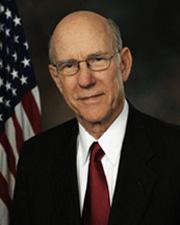 Sen. Pat Roberts (R-KS)
Legislative Activity
Stay on top of the latest movement without scrolling through every action
Senate amendment submitted
September 14, 2004
View full timeline
Senate amendment submitted
September 14, 2004
Senate amendment proposed (on the floor): Amendment SA 3643 proposed by Senator Cochran for Senator Roberts.(consideration: CR S9208-9209; text: CR S9209)
September 14, 2004
Senate amendment agreed to: Amendment SA 3643 agreed to in Senate by Unanimous Consent.
September 14, 2004
Amendment SA 3643 proposed by Senator Cochran for Senator Roberts. (consideration: CR S9208-9209; text: CR S9209) To express the sense of the Senate concerning the American Red Cross and Critical Biomedical Systems.
September 14, 2004
Amendment SA 3643 agreed to in Senate by Unanimous Consent.
September 14, 2004
Text
Proposed
DEPARTMENT OF HOMELAND SECURITY APPROPRIATIONS ACT, 2005--Continued

Amendment No. 3624

The PRESIDING OFFICER. There is 2 minutes evenly divided before
proceeding to the vote on the amendment.
The Senator from Mississippi.
Mr. COCHRAN. Mr. President, at the appropriate time it will be my
intention to make the point of order against the amendment, in that it
violates the Budget Act because it provides for the appropriation of
additional funds above the allocation of the amount available to this
subcommittee and there is no offset provided in the amendment. So for
the information of Senators, that is the intention of the managers of
the bill.
Under the previous order, as I understand it, a vote is scheduled to
occur at 2:20. Is that the order?
The PRESIDING OFFICER. The Senator is correct.
Mr. COCHRAN. I thank the Chair and yield the floor.
Ms. MIKULSKI. Mr. President, what is the pending business before the
Senate? Is it my amendment increasing firefighters funds?
The PRESIDING OFFICER. Pending before the Senate is the Senator's
amendment.
Ms. MIKULSKI. As I understand it, I have 1 minute and then there will
be a subsequent comment by the chairman of the subcommittee; is that
correct?
The PRESIDING OFFICER. That is correct. The Senator from Maryland.
Ms. MIKULSKI. My amendment which is pending adds $150 million to the
Fire Grant Program, bringing it to the authorized level of $900
million. This Fire Grant Program is peer-reviewed and merit based with
no pork in it. It provides grants to local fire departments. The
President requested $500 million, the chairman added another $200
million, then Senator Frist added another $50 million on Friday, but I
want to bring it up to the full $900 million. Why? This Fire Grant
Program is the only program that really helps our firefighters have the
equipment they need to protect themselves, as well as modern equipment.
Last year, the Fire Grant Program received $2.5 billion for its
requests--20,000 worthy applications. I know we can't fund it at $2.5
billion, but we can fund it at the authorized level. Therefore, I urge
adoption of my amendment. Let us protect the first responders so they
can protect us.
I ask unanimous consent that letters of support from the National
Volunteers Fire Council and the Congressional Fire Services Institute
be printed in the Record.
There being no objection, the material was ordered to be printed in
the Record, as follows:

National Volunteer Fire Council,

Washington, DC, September 8, 2004.
Hon. Barbara A. Mikulski,
Hart Senate Office Building, Washington, DC
Dear Senator Mikulski: The National Volunteer Fire Council
(NVFC) is a non-profit membership association representing
the interests of the more than 800,000 members of America's
volunteer fire, EMS, and rescue services. On behalf of our
membership, I am writing to lend our full support for your
amendment to the FY 2005 Homeland Security Appropriations
Bill to fully fund the Assistance to Firefighters Grant
program at the $900 million level.
As you know, the Assistance to Firefighters Grant program
provides critical funding to our nation's 1.1 million
firefighters, 75% of which are volunteers. The purpose of the
program is to bring every fire department up to a base-line
level of readiness--and keep them there. The program has
proven to be the most effective program to date in directly
providing local volunteer and career fire departments not
only with the tools they need to perform their day-to-day
duties, but it has also enhanced their ability to respond to
large disasters as well. As we move to prepare for terrorist
incidents at home, we must first ensure that local fire
departments have the basic tools they need to do their jobs
on a daily basis.
The program benefits our entire nation by providing local
fire departments with much-needed training and equipment to
respond to 21 million calls annually. These calls include
structural fire suppression, emergency medical response,
hazardous materials incidents, technical rescues, wildland
fire protection, natural disasters and events of terrorism.
Once again, we strongly support your amendment to the FY
2005 Homeland Security Appropriations Bill and we thank you
for your continued leadership and support of America's fire
service. If you or your staff have any questions please feel
free to contact Craig Sharman, NVFC Director of Government
Relations.
Sincerely,
Philip C. Stittleburg,
Chairman.
____

Congressional Fire

Services Institute,

Washington, DC, September 7, 2004.
Hon. Barbara Mikulski,
Hart Senate Office Building, Washington, DC.
Dear Senator Mikulski: On behalf of the Congressional Fire
Services Institute's National Advisory Committee comprised of
42 national fire and emergency organizations, I am writing to
thank you for all your efforts, past and present, to preserve
the Assistance to Firefighters Grant Program (AFGP), also
known as the FIRE Act. As you know, the FIRE Act has been a
critical program in our efforts to prepare America's
firefighters to effectively respond to all emergencies. It is
for this reason that I would like to commend you on your
efforts to increase the funding allocation for the AFGP in
the FY05 Homeland Security Appropriations Act to $900
million, the full amount authorized by Congress.
The purpose of the FIRE Act is to bring every fire
department up to a base-line level of readiness--and keep
them there. Too many fire departments in this country lack

[[Page S9177]]

even the most basic needs, including proper turn-out gear,
communication systems, training, prevention, and public
education programs. These facts are contained in the Needs
Assessment of the U.S. Fire Service published by the United
States Fire Administration in cooperation with the National
Fire Protection Association. It revealed that many
departments lack the basic tools and training they need to
respond to over 21 million calls, annually--from daily
incidents to major disasters, both deliberate acts and
natural events. The all-hazards response enhancement provided
by the FIRE Act ensures the most efficient and effective use
of federal funding. It not only prepares departments to
respond to acts of terrorism, it enhances the department's
ability to respond to all other emergencies that occur
thousands of times each day across our country.
The FIRE Act addresses another important mission of every
fire department, one that often does not command the
attention it deserves because of budgetary constraints:
prevention and education. Over 3,000 people die in fires
every year and over 20,000 people suffer injuries. We can
reduce these figures with additional funds targeted at
prevention and education programs. This would allow
firefighters to spend time in their communities teaching
children and others about fire prevention or conducting
inspections of both occupied and abandoned buildings.
A growing challenge facing the fire service is urban
sprawl. As construction increases in wildland/urban
interface, fire departments face new challenges requiring
additional resources and personnel. During the Southern
California fires last October, the media reported the number
of homes destroyed. Largely overlooked were the number of
lives saved and homes protected because of the heroic actions
taken by the fire service. Yet we cannot expect the fire
service assigned to these areas to meet the public's
expectations to safeguard their lives and property without
adequate resources.
When reviewing the totality of a fire department's
responsibilities, it is important to recognize that every
function serves a vital role in fulfilling a fire
department's mission, protecting lives and property. By
design, the FIRE Act addresses the entire spectrum of
education, prevention and response.
The FIRE Act is not about supplanting local fiduciary
responsibilities; it's about supplementing efforts to protect
this country's people, property, and economy. And because the
fire service provides protection to so much of our nation's
infrastructure, the federal government does indeed have a
responsibility to support the mission of our first
responders.
In the three years the FIRE Act has been in existence, it
has become one of the most effective programs administered by
the federal government. In January of 2003, officials from
the U.S. Department of Agriculture selected the Fire Grant
Program for a study they were conducting as part of a
management training course. Summarizing the programs, they
said that the grant program has been ``highly effective in
increasing the safety and effectiveness of grant
recipients.'' Their study found:
97% of program participants reported positive impact on
their ability to handle fire and fire-related incidents.
Of those recipients receiving firefighting equipment, 99%
indicated improvements in the safety of firefighters and 98%
indicated improvements in operation capacity.
90% of the participants indicated that their department
operated more efficiently and safely as a result of the
training provided by the grant program.
Over 88% of the participants who were able to measure
change at the time the survey was distributed reported
improvement in the fitness and health of their firefighters
as a result of the program and 86% indicated reduced
injuries.
The FIRE Act plays a critical role in addressing the needs
of over 30,000 fire departments and one million fire and
rescue personnel. We thank you for your commitment to our
nation's firefighters and this important program.
Sincerely,
Steve Edwards,
Chairman, CFSI National Advisory Committee.
Mr. DORGAN. Mr. President, I support the Mikulski amendment because I
think that it includes important funding for firefighter grants. The
amendment includes $200 million for firefighter grants--the authorized
level--so that we can increase the resources available for our first
responders.
In its current form, this amendment does not include any offsetting
reductions to pay for the new investments. If this amendment is adopted
today--and I hope that it will be--I intend to work with the conferees
to offset these increases by reducing funds that have been earmarked
for Iraqi reconstruction. I believe these expenditures should be offset
with these other spending cuts.
Iraq is a nation that sits on some of the largest oil reserves in the
world. My view is that Iraq should pay for its own reconstruction.
Last year, this Congress acted in an expedited way to appropriate
$18.4 billion for Iraqi reconstruction. And yet, 10 months later, most
of that money is still unspent. Less than $1 billion has been actually
expended and only about $7 billion has been obligated.
Therefore, I support Senator Mikulski's amendment. But my intention
is to push for the rescission of those unobligated Iraqi reconstruction
funds and use them to offset these needed security investments.
Mr. COCHRAN. Mr. President, the bill provides adequate funds--
generous funding--for this program.
I make a point of order under section 302(f) that the amendment
exceeds the subcommittee's allocation under section 302(b) of the
Budget Act.
The PRESIDING OFFICER. A point of order has been raised.
Ms. MIKULSKI. I move to waive the point of order.
Mr. COCHRAN. Mr. President, I ask for the yeas and nays on the motion
to waive.
The PRESIDING OFFICER. Is there a sufficient second?
There is a sufficient second.
The question is on agreeing to the motion. The yeas and nays have
been ordered. The clerk will call the roll.
The assistant legislative clerk called the roll.
Mr. McCONNELL. I announce that the Senator from Kentucky (Mr.
Bunning) and the Senator from Colorado (Mr. Campbell) are necessarily
absent.
I further announce that if present and voting the Senator from
Kentucky (Mr. Bunning) would vote ``no''.
Mr. REID. I announce that the Senator from Hawaii (Mr. Akaka), the
Senator from North Carolina (Mr. Edwards), and the Senator from
Massachusetts (Mr. Kerry) are necessarily absent.
The PRESIDING OFFICER. Are there any other Senators in the Chamber
desiring to vote?
The yeas and nays resulted--yeas 50, nays 45, as follows:

[Rollcall Vote No. 175 Leg.]

YEAS--50

Baucus
Bayh
Biden
Bingaman
Bond
Boxer
Breaux
Byrd
Cantwell
Carper
Clinton
Collins
Conrad
Corzine
Daschle
Dayton
Dodd
Dorgan
Durbin
Feingold
Feinstein
Graham (FL)
Harkin
Hollings
Inouye
Jeffords
Johnson
Kennedy
Kohl
Landrieu
Lautenberg
Leahy
Levin
Lieberman
Lincoln
Mikulski
Murkowski
Murray
Nelson (FL)
Nelson (NE)
Pryor
Reed
Reid
Rockefeller
Sarbanes
Schumer
Specter
Stabenow
Talent
Wyden

NAYS--45

Alexander
Allard
Allen
Bennett
Brownback
Burns
Chafee
Chambliss
Cochran
Coleman
Cornyn
Craig
Crapo
DeWine
Dole
Domenici
Ensign
Enzi
Fitzgerald
Frist
Graham (SC)
Grassley
Gregg
Hagel
Hatch
Hutchison
Inhofe
Kyl
Lott
Lugar
McCain
McConnell
Miller
Nickles
Roberts
Santorum
Sessions
Shelby
Smith
Snowe
Stevens
Sununu
Thomas
Voinovich
Warner

NOT VOTING--5

Akaka
Bunning
Campbell
Edwards
Kerry
The PRESIDING OFFICER. On this vote, the yeas are 50, the nays are
45. Three-fifths of the Senators duly chosen and sworn not having voted
in the affirmative, the motion is rejected. The point of order is
sustained, and the amendment falls.
Mr. COCHRAN. Mr. President, I move to reconsider the vote by which
the point of order was sustained.
Ms. MIKULSKI. I move to lay that motion on the table.
The motion to lay on the table was agreed to.
Mr. COCHRAN. Mr. President, we are at a point now where we are
hopeful we can begin disposing of amendments that have previously been
offered and on which debate has occurred. They have been set aside so
Senators can offer amendments on other subjects. We have at this time
nine amendments that are in that situation: amendments offered by
Senators Nelson, Corzine, Kennedy, Dayton, Dodd, Clinton, and one by
Clinton and Schumer.
We are hopeful we can reach some understanding about a time to begin
voting on these amendments. We do know there are a couple meetings that
require Senators' attendance off the floor at this time, and that might
be the situation until about 3:30. But I am hopeful the leaders on the
other side

[[Page S9178]]

can consider entering into an understanding or an agreement that we
will begin voting on these amendments at 3:30. So I say that for the
information of Senators.
There is a markup session going on by the Senate Appropriations
Committee. That may start at 3 o'clock. That is going to require the
attendance of a good number of Senators. So for the information of
Senators, we are hopeful we can begin a series of votes at about 3:30,
dispose of the pending amendments, and then proceed to consider other
amendments that Senators may wish to offer.
Mr. NELSON of Florida. Will the Senator yield?
Mr. COCHRAN. I am happy to yield to my friend from Florida.
Mr. NELSON of Florida. Perhaps the distinguished Senator from
Mississippi--by the way, the third hurricane has a track that keeps
getting closer and closer to the Mississippi gulf coast. But as the
distinguished Senator, the chairman of the committee, and I have been
talking about the emergency supplemental appropriations for hurricane
damage, I have been provided with a copy of what will be the
President's request for the new supplemental.
I note that it does include a lot of the agencies of Government about
which this Senator has spoken that have desperate needs as a result of
two hurricanes hitting back to back in Florida. I noticed there is
nothing in here for the agricultural losses, including crop losses as
well as equipment losses, of which the Florida commissioner of
agriculture has written to the White House, to OMB, and said those
losses are $2 billion. What would the advice of the chairman of the
committee to this Florida Senator be of how we want to address that,
since the President is not requesting in his new supplemental any money
for agricultural losses?
Mr. COCHRAN. Mr. President, I appreciate the inquiry of the Senator
from Florida. It is my understanding that the Department of Agriculture
has existing authority under current law to provide assistance for
agricultural purposes in areas where people have suffered disasters. It
provides opportunities for haying and grazing on conservation lands.
There are a wide range of emergency activities that can be undertaken
under existing law.
When we reach a point at which there is a determination of exact
dollar amounts of damage incurred by citrus growers or others who have
been hurt by the storms in Florida, that may be a possible reason for
an additional supplemental to be submitted whose benefits were not
described in the submission that was received today. This is considered
an emergency for the Federal Emergency Management Agency and others who
are on the frontline of recovery, providing shelter, providing food,
emergency items to protect life, debris removal, particularly areas
where the debris poses a danger to life and limb.
This is the kind of supplemental, as I understand it, the President
has submitted. We hope to be able to approve that and call it up. The
Appropriations Committee is meeting this afternoon. Senator Stevens,
chairman of the committee, wants to take action on it as soon as
possible. The House has to act on it as well. It may very well be that
we will have a vehicle on which to go to conference with the House this
week.
I am hopeful we can keep the President's request clean and approve
the request, get the money to the agencies that need the funds, and
look to these other issues as they mature in time, in the sense that
there has been time to assess the damages and we know what they are and
who is entitled to the benefits and what kind of benefits there are in
agriculture.
But there is no doubt in my mind there will be a need for sensitive
and generous assistance for agricultural producers which do not have
any other benefits. We do have crop insurance. There are other things
available to farmers under current law, and they will be able to
receive these and be provided with deserved and well-needed benefits.
Mr. NELSON of Florida. Mr. President, if the distinguished Senator
will yield for a further question.
Mr. COCHRAN. I am happy to yield to my friend.
Mr. NELSON of Florida. Indeed, I understand what the Senator is
referring to. There are section 32 discretionary funds that would be,
for example, available for Florida citrus growers. But it comes nowhere
close to the estimated amount of losses in these two hurricanes for the
citrus crop and equipment which is going to exceed $\1/2\ billion, just
in itself. That is not even to speak of all the other kinds of crops--
vegetables, sod, timber, milk that was dumped as a result of the
dairies, all kinds of vegetables, tropical fruit, clams, oysters,
poultry. Nurseries, Florida's top cash crop, has suffered $\1/2\
billion in losses.

My question is, there is buzzing out here an amendment that is being
put together by midwestern Senators, Republican and Democratic, to take
care of their agricultural problems. Yet they do not address the full
need of Florida which has suffered back-to-back hurricane losses that
have affected its agriculture.
What would be the advice of the Senator from Mississippi to the
Florida Senators, when others are coming forth, and yet Florida's
agricultural needs, after two disastrous hurricanes, are not being met?
Mr. COCHRAN. Mr. President, my advice to all Senators, including my
good friend from Florida, is to try to work with the Appropriations
Committee leadership. Senator Stevens is chairing a meeting marking up
individual appropriations bills this afternoon. The committee will be
considering the request for supplemental appropriations submitted by
the President that we just talked about. At that time, when we are
considering the supplemental for disaster assistance, would be the
time, in my view, when we could consider other hurricane damage that
the Senator is discussing now. In my mind that would be a more
appropriate vehicle for the Senators who are talking about midwestern
agricultural needs as well.
I hope this annual appropriations bill for the Department of Homeland
Security won't get held up with a debate over disaster assistance
because of drought or other problems in other parts of the country. It
is hard to say yes, let's have some funds included in the bill for
those purposes, and then say no to those in our part of the country
where we do know the needs are real. They are just as expensive, maybe
much more so in reality, than the Midwestern problems.
I am hopeful that we can protect the integrity of the appropriations
process and the integrity of the Homeland Security appropriations bill.
Let's move this to completion, go to conference with the House, and, in
an orderly, coherent way, fund the needs of the Department of Homeland
Security to protect us from terrorist threats, other natural disasters
such as the ones that are being addressed by the Federal Emergency
Management Agency. Then in a separate action, let's consider disaster
assistance for hurricane victims and drought victims and others in
agriculture who have otherwise suffered serious losses this year.
Mr. NELSON of Florida. Did this Senator misunderstand the
distinguished Senator from Mississippi in that the President's request
for this hurricane relief that has happened on those two hurricanes was
going to be or not going to be attached as an amendment to the
Department of Homeland Security appropriations bill?
Mr. COCHRAN. I don't think that is a decision that has been made.
Mr. NELSON of Florida. I see.
Mr. COCHRAN. My expectation is that the committee leadership, in
consultation with the leaders of the Senate, will make that decision at
a later time. Today they are trying to mark up individual
appropriations bills, and in due course they will take up the
supplemental as well.
Mr. NELSON of Florida. Then I would say to the distinguished Senator
from Mississippi, I was given to believe that, in fact, was a decision
that was made, that this hurricane relief was going to be attached to
this Homeland Security bill. I got that impression from the majority
leader, Senator Frist. If that decision has not been made then, fine.
Mr. COCHRAN. It may have been made and I just haven't heard about it.
The Senator from Florida may be more up to date than I am. But I knew
it was an option that was being considered and being discussed. I was
not aware that the decision had definitely been made to do that.

[[Page S9179]]

Mr. NELSON of Florida. Then this Senator certainly would not have to
encourage the quickening of the interests in all of this hurricane
disaster assistance relief as this Senator speaks with the Senator from
Mississippi, because right now Hurricane Ivan, a category 5 hurricane,
is bearing down on the Mississippi coast. It could well be that we are
looking at an additional hurricane emergency disaster relief
supplemental that would directly affect the State represented by the
distinguished Senator who is the chairman of the committee.
Mr. COCHRAN. Mr. President, the Senator is absolutely correct. It
poses a real danger, not only to the people in that area but also to
property. It is clear that the disaster relief fund of the Federal
Emergency Management Agency, which we replenished just a few days ago
to the tune of $2 billion, could run out of money again. I know the
tendencies of this Congress to be that where there are needs like that,
we will act to address them. At a time when that relief fund or any
other account is depleted and hurricane victims need the attention of
these agencies and the benefits to which they are entitled, we will
act. I believe we will act promptly and with dispatch and with
generosity to the fullest extent allowed under the law.

Mr. NELSON of Florida. Mr. President, is FEMA appropriated under the
Appropriations subcommittee the Senator chairs?
Mr. COCHRAN. It is one of the agencies under the Department of
Homeland Security, and it is covered in this annual appropriations
bill.
Mr. NELSON of Florida. Then this Senator simply makes a
recommendation that we should never be in an emergency posture like we
were last week, where FEMA is not carrying the adequate reserves. On
Thursday, they ran out of money and were, in fact, not spending the
money that was desperately needed in the previous 5 days for hurricane
relief. This Senator is merely making the recommendation that, as we
look to FEMA appropriations in the future, there should be a cushion of
reserves in FEMA because this country can face all kinds of disasters,
as we know, and this year FEMA's budget was too lean to be able to
respond.
Mr. COCHRAN. The Senator makes a point we should consider. I agree
with that. It is awfully difficult for us to know the future or to be
able to predict it and the needs of every agency of the Government,
even FEMA. But we do the best we can and we will continue to work hard.
Any advice or suggestions the Senators might have for the appropriate
level of funding on an annual basis would be welcome.
Mr. President, I suggest the absence of a quorum.
The PRESIDING OFFICER (Mr. Crapo). The clerk will call the roll.
The assistant legislative clerk proceeded to call the roll.
Mr. CORZINE. Mr. President, I ask unanimous consent that the order
for the quorum call be rescinded.
The PRESIDING OFFICER. Without objection, it is so ordered.

Amendment No. 3619, as Modified

Mr. CORZINE. I ask unanimous consent that I be allowed to modify
amendment No. 3619 at the desk. The change is to allow for funding of
the offset of the proposed amendment, regarding chemical security
plants.
The PRESIDING OFFICER. Is the Senator asking that amendment be made
pending at this time?
Mr. CORZINE. Yes.
The PRESIDING OFFICER. Is there objection?
Without objection, it is so ordered.
Mr. CORZINE. Mr. President, I send the modified amendment to the
desk.
The PRESIDING OFFICER. The amendment will be so modified, and it is
now pending.
The amendment (No. 3619), as modified, is as follows:

On page 19, line 17, strike ``$2,845,081,000'' and all that
follows through ``grants'' on page 20, line 11, and insert
the following: ``$2,915,081,000, which shall be allocated as
follows:
``(1) $970,000,000 for formula-based grants and
$400,000,000 for law enforcement terrorism prevention grants
pursuant to section 1014 of the USA PATRIOT Act (42 U.S.C.
3714): Provided, That the application for grants shall be
made available to States within 45 days after the date of
enactment of this Act; that States shall submit applications
within 45 days after the grant announcement; and that the
Office of State and Local Government Coordination and
Preparedness shall act within 15 days after receipt of an
application: Provided further, That each State shall obligate
not less than 80 percent of the total amount of the grant to
local governments within 60 days after the grant award; and
``(2) $1,270,000,000 for discretionary grants for use in
high-threat, high-density urban areas, as determined by the
Secretary of Homeland Security: Provided, That the amount
under title I for the Human Resources Account of the Office
of the Under Secretary for Management shall be reduced by
$70,000,000: Provided further, That $150,000,000 shall be for
port security grants; $15,000,000 shall be for trucking
industry security grants; $10,000,000 shall be for intercity
bus security grants; $150,000,000 shall be for rail and
transit security grants; $70,000,000 shall be for enhancing
the security of chemical plants''.

Mr. CORZINE. Mr. President, this amendment addresses one of the most
serious security threats facing our Nation: the threat of terrorist
attacks on chemical facilities. It is a subject I have worked on with a
number of colleagues on both sides of the aisle over the last 3 years.
It addresses an issue where there are literally thousands of chemical
facilities across the country where a chemical release could expose
tens of thousands of Americans to highly toxic gases.
I have tried to stress that there are 123 of these where more than a
million people could be exposed. About eight of those are in New
Jersey, so this is an intensely important subject matter for the
community I represent. We need to change this.
While we are working today on the Department of Homeland Security
appropriations, there is authorizing legislation working through the
Environment and Public Works Committee that would deal with this
problem. I want to be a constructive element in bringing that to a
conclusion. We have a security problem now with our chemical plants. My
modified amendment would provide $70 million to State and local
governments in order to enhance the security of those chemical plants.
Also, it includes that offset I mentioned, which is changed from the
original version of the amendment.
This amendment only takes a modest first step by appropriating that
money to these State and local efforts. Funds could be used, for
example, to strengthen law enforcement's presence around chemical
plants. When we go to Code Orange, the Department of Homeland Security
requests that our local law enforcement provide additional security for
these plants. It is not like they are not doing this already. That is
overtime for additional individuals. Also, this money would go to train
and prepare officials to respond to a terrorist attack. The release of
a chemical toxic cloud is not like fighting a fire; it takes different
kinds of actions. This amendment would provide some of that support. It
would also provide guidance and assistance to plant managers. It would
have the proper interface with State and local officials on how to
respond and maybe even prevent attacks on chemical security plants.
As I said, the funds will be offset by eliminating funds for a new
Department of Homeland Security performance pay system, and we will
provide the resources that I think--at least looking at a tradeoff of
how I see it in New Jersey, and I think it is the case across the
country, since 123 plants expose more than a million people, it is a
good tradeoff. It may be an important issue to get on with pay systems,
but I don't understand how we trade that off versus the security of the
individuals who surround the plants.
Remember, these plants were built in a different era, at a different
time. They are very prominently located in densely populated areas in
the country. We ought to do what we can to protect them. One of the
ways is to provide these funds. That is what this amendment is about. I
spoke about it at length the other day on the Senate floor. I believe
very strongly that there are real reasons for us to pay attention to
chemical plant security in this country. Every time the Department of
Homeland Security raises the code level, they mention chemical plant
security. It is in the Hart-Rudman report. It is in studies of the
vulnerabilities of the critical infrastructure in this country. We
ought to take special steps to make sure there is security at these
plants. We would not tolerate the kind of security arrangement we have
in chemical plants if

[[Page S9180]]

they were nuclear powerplants, and there are as many people exposed to
these toxic exposures, if there were to be a terrorist attack, as there
would be in many, if not most, nuclear powerplants, which are located
in many different areas.
I hope my colleagues will realize this is an important consideration,
a modest first step. It is paid for, and I believe we can make the
American people a little bit more secure by adjusting where we are
spending $70 million to provide for chemical plant security. I
appreciate it, and I hope that it will be favorably considered by my
colleagues.
Mr. President, I suggest the absence of a quorum.
The PRESIDING OFFICER. The clerk will call the roll.
The legislative clerk proceeded to call the roll.
Mr. COCHRAN. Mr. President, I ask unanimous consent that the order
for the quorum call be rescinded.
The PRESIDING OFFICER. Without objection, it is so ordered.
Mr. COCHRAN. Mr. President, we are at a point now where we can
announce to Senators our intention to proceed to votes on some of the
amendments that are pending now. The amendment of the Senator from New
Jersey, which he has modified, would be the first amendment we would
consider. It would be the intention of this manager to move to table
the Corzine amendment and get the yeas and nays, and then have a
similar motion against the Dayton amendment No. 3629 and the Clinton/
Schumer amendment No. 3632. We are advised that the Appropriations
Committee is in meeting now and members may not be available until
close to 4, but we could begin these votes at 3:45.
The distinguished assistant leader has assured us that is an
agreement that is OK with the Democratic side of the aisle, and with
that understanding, I will propound this unanimous consent request.
I ask unanimous consent that at 3:45 p.m. today, the Senate vote in
relation to the following amendments in the order mentioned: Corzine
No. 3619, as modified; Dayton No. 3629; Clinton No. 3632. I further ask
unanimous consent that no amendments be in order to the amendments
prior to those votes and that there be 2 minutes equally divided for
debate prior to each of the votes, and finally that the second and
third votes in the series be limited to 10 minutes each.
Mr. REID. No objection.
The PRESIDING OFFICER. Without objection, it is so ordered.
Mr. COCHRAN. I thank the distinguished leader and I thank all
Senators for that agreement.
The PRESIDING OFFICER. The Senator from Nevada.
Mr. REID. Mr. President, I direct a question through the Chair to the
distinguished manager of the bill. On this side, we still have every
intention to try to finish this bill tonight. Unless something comes up
we do not know about, it is my understanding that the manager also
feels the same way. So if people have amendments--for example, I talked
to a couple of my Senators this afternoon and they said, well, we will
do it later. Everyone should know later is here. We are now at that
time. Later is right now. This would be an appropriate time for someone
to come over and offer an amendment as we speak. We would set what is
pending aside, lay that down. It is my understanding the manager of the
bill wants to move through these pending amendments as quickly as
possible. We have several amendments after we finish this block of
votes that are still outstanding. That is going to get us into the
evening time. So if people still have amendments they want to offer,
they should get over here and do that.
The PRESIDING OFFICER. The Senator from Mississippi.
Mr. COCHRAN. Mr. President, I thank the distinguished Senator very
much for his suggestions. He is absolutely right. We do intend to press
on and try to complete action on this bill tonight. We would appreciate
the cooperation of all Senators in that regard. We are going to try to
get to the point where we can announce that we are definitely going to
finish the bill tonight. That is our intention. We hope we can move
forward with dispatch and determination to achieve that goal. We thank
the distinguished Senator for his good assistance in that regard.
I suggest the absence of a quorum.
The PRESIDING OFFICER. The clerk will call the roll.
The legislative clerk proceeded to call the roll.
Mr. DeWINE. Mr. President, I ask unanimous consent that the order for
the quorum call be rescinded.
The PRESIDING OFFICER. Without objection, it is so ordered.

Amendment No. 3619, as Modified

Under the previous order, there are now 2 minutes equally divided on
the Corzine amendment.
Mr. JEFFORDS. Mr. President, homeland security experts refer to
chemical plants as ``pre-positioned weapons of mass destruction.'' Yet
more than 3 years after the September 11 attacks, the Bush
administration has done almost nothing to enhance the security of the
estimated 15,000 chemical facilities in the United States.
I therefore support the amendment of Senator Corzine to provide $100
million for State and local efforts to enhance the safety of
communities around chemical plants. These funds are needed to allow for
expanded law enforcement presence around plants, better training and
preparation for first responders and local officials, and additional
guidance for plant managers.
This is just a first step, however. Communities cannot do it alone.
To truly enhance security, chemical sources must implement security
plans that address their unique vulnerabilities. Some facilities have
already made considerable improvements, such as repositioning storage
tanks away from public roads and hiring more guards. Here in
Washington, DC, the Blue Plains water treatment plant went one step
further by switching from chlorine to bleach, thereby reducing the
inherent hazards posed by their operations. Notwithstanding these
improvements, numerous media and government reports continue to
document significant security gaps at many facilities.
National legislation mandating federally enforceable minimum
standards is long overdue. When I was chairman of the Environment and
Public Works Committee, we unanimously passed Senator Corzine's
legislation out of committee. Bowing to pressure from the petroleum and
chemical industries, the Bush administration put the brakes on this
legislation. Now, almost 2 years later, we are still debating the
issue.
We cannot afford to ignore the risks posed by chemical plants any
longer. A terrorist attack at any one of the 15,000 chemical facilities
nationwide would likely cause death or injury to the people in the
surrounding communities. The chemical industry's own data indicates
that, in a worst case release, toxic chemicals could threaten more than
1 million people at each of 123 facilities spread across 24 States.
There are also more than 700 facilities from which a chemical release
could threaten more than 100,000 residential neighbors.
This issue is too important to ignore or add at the last minute to
another bill without adequate time for proper consideration. I have
asked my staff to continue working in a tri-partisan fashion to develop
legislation that can be adopted unanimously by the Senate. If such an
agreement cannot be reached quickly, however, we should move stand-
alone legislation to the floor for a full debate.
In the meantime, I urge my colleagues to support the amendment of
Senator Corzine to help communities surrounding chemical plants address
the added security risks that these facilities pose. We should then
quickly enact comprehensive chemical security legislation to supplement
these community efforts and ensure that the chemical facilities
themselves do their part to ensure the safety of our home towns.
Mr. COCHRAN. Has a motion to table the Corzine amendment been made?
The PRESIDING OFFICER. It cannot be made until the time is expired.
Mr. COCHRAN. Mr. President, the committee has recommended in this
bill $193,673,000 for protective action activities, for developing and
implementing protective programs for the Nation's critical
infrastructures, including chemical facilities, Federal, State and
local, and private sector activities and programs and best practices.
Nationwide, we have seen 2,040 chemical facilities complete
vulnerability

[[Page S9181]]

assessments as developed by Sandia National Laboratories and the Center
for Chemical Process Safety. The Department of Homeland Security has
made considerable progress in increasing the security of chemical
facilities across the country. Site visits are conducted at chemical
facilities as part of a buffer zone protection plan. These plans reduce
specific vulnerabilities and build a general protection capacity of
communities. As part of the protective buffer zone effort, the
protective security division has developed plans to install cameras to
detect and deter surveillance and other threatening activities.
The Department has provided protective measures and risk management
efforts on the sites of greatest concern. We are confident these are
working to improve the safety and security of chemical facilities.
We urge the Senate to support the committee and vote to approve the
motion to table the Corzine amendment.
The PRESIDING OFFICER. The Senator from New Jersey.
Mr. CORZINE. Mr. President, this amendment addresses one of the most
serious security threats we have in the Nation, the threat of terrorist
attack on our chemical plants. There are literally thousands--not 230
but literally thousands--of plants that are exposed to more than 10,000
folks in the country; 123 plants expose a million people or more.
My amendment provides $70 million to State and local governments,
particularly to focus on this issue of security of chemical plants. It
includes an offset, as I mentioned a few minutes ago.
The facts speak loudly: We need to address chemical plants. Time and
time again, there are reports where people can walk on to
plants without there being any kind of protection and actually
following through on a lot of the security plans that were talked about
before.

There is a whole further authorization bill working its way through
the Environment and Public Works Committee right now, which is a very
bipartisan effort to try to get at this issue, but we need to do
something now.
There are, as I said, literally thousands of plants across this
country. We need to provide the support to State and local officials to
be able to provide the security, the overtime, needed at these plants,
and particularly when we raise our code levels. The lack of security at
our chemical plants has been cited as one of the greatest threats to
our infrastructure. We need to provide for training. We need to provide
funds for guidance and assistance to plant managers and for other steps
that State and local officials can take to prevent and respond to
attacks on chemical plants.
I hope my colleagues will recognize we have a problem. We ought to be
doing everything we can to support and protect the American people.
Mr. COCHRAN. Mr. President, I move to table the Corzine amendment and
ask for the yeas and nays.
The PRESIDING OFFICER. Is there a sufficient second?
There appears to be a sufficient second.
The question is on agreeing to the motion.
The clerk will call the roll.
The bill clerk called the roll.
Mr. McCONNELL. I announce that the Senator from Kentucky (Mr.
Bunning) and the Senator from Colorado (Mr. Campbell) are necessarily
absent.
I further announce that if present and voting the Senator from
Kentucky (Mr. Bunning) would vote ``yes''.
Mr. REID. I announce that the Senator from Hawaii (Mr. Akaka), the
Senator from North Carolina (Mr. Edwards), and the Senator from
Massachusetts (Mr. Kerry) are necessarily absent.
The ACTING PRESIDENT pro tempore. Are there any other Senators in the
Chamber desiring to vote?
The result was announced--yeas 48, nays 47, as follows:

[Rollcall Vote No. 176 Leg.]

YEAS--48

Alexander
Allard
Allen
Bennett
Bond
Brownback
Burns
Chafee
Chambliss
Cochran
Coleman
Collins
Cornyn
Craig
Crapo
DeWine
Dole
Domenici
Ensign
Enzi
Fitzgerald
Frist
Graham (SC)
Grassley
Gregg
Hagel
Hatch
Inhofe
Kyl
Lott
Lugar
McCain
McConnell
Miller
Murkowski
Nickles
Roberts
Santorum
Sessions
Shelby
Smith
Snowe
Stevens
Sununu
Talent
Thomas
Voinovich
Warner

NAYS--47

Baucus
Bayh
Biden
Bingaman
Boxer
Breaux
Byrd
Cantwell
Carper
Clinton
Conrad
Corzine
Daschle
Dayton
Dodd
Dorgan
Durbin
Feingold
Feinstein
Graham (FL)
Harkin
Hollings
Hutchison
Inouye
Jeffords
Johnson
Kennedy
Kohl
Landrieu
Lautenberg
Leahy
Levin
Lieberman
Lincoln
Mikulski
Murray
Nelson (FL)
Nelson (NE)
Pryor
Reed
Reid
Rockefeller
Sarbanes
Schumer
Specter
Stabenow
Wyden

NOT VOTING--5

Akaka
Bunning
Campbell
Edwards
Kerry
The motion was agreed to.
Mr. COCHRAN. Mr. President, I move to reconsider the vote.
Mr. REID. I move to lay that motion on the table.
The motion to lay on the table was agreed to.

Amendment No. 3629

The ACTING PRESIDENT pro tempore. There are 2 minutes evenly divided
on Dayton amendment No. 3629.
Mr. COCHRAN. Mr. President, the Senator from Minnesota has offered an
amendment dealing with the Federal protective service. It is my
intention as a manager of the bill to urge my colleagues to vote
against it. First, it is the intention of the manager to move to table
this amendment and ask for the yeas and nays, and I do so now.
The ACTING PRESIDENT pro tempore. There is still time remaining. The
motion is not in order at this time.
The Senator from Minnesota is recognized.
Mr. DAYTON. Mr. President, this amendment is necessary to protect the
health care benefits of security guards who are protecting our security
at Federal buildings in Minnesota and in other States.
In this instance, private contractors have low-bid these security
contracts, and they unilaterally have shifted the employees' health
payments to 401(k) contributions. The company thereby increases its
profits by not paying taxes at the expense of their own employees, with
no consultation, no negotiation, just cold-blooded profiteering. No
wonder a company like this can underbid its competitors. The bids can
go lower and lower every time they cut wages or benefits. That is why
there should be employee protections--protections that were eliminated,
unfortunately, over the objections of many of us when this Department
of Homeland Security was created just 2 years ago.
This amendment simply requires that if a company takes over a
contract, it must negotiate changes in health benefits with its
employees. I think that is the least we can do on behalf of those who
are risking their lives to protect our lives.
I yield the remainder of my time.
The ACTING PRESIDENT pro tempore. The Senator from Mississippi.
Mr. COCHRAN. Mr. President, this amendment seeks to define the
responsibilities of the Federal Protective Service to negotiate
employment contracts with other agencies or individuals who seek to
work for the Federal Protective Service. This is actually a Department
of Labor Fair Labor Standards Act issue. It is not a Homeland Security
issue. It should not be offered as an amendment to this bill but,
rather, the issue should be presented to the Department of Labor which
is responsible for overseeing employee and employer relationships.
This amendment would have a very serious adverse effect on the
Federal Protective Service's ability to carry out protective services
and ensure the security of Federal buildings throughout the country. It
could bring the efforts to a standstill.
I move to table the amendment and I ask for the yeas and nays.
The ACTING PRESIDENT pro tempore. Is there a sufficient second? There
appears to be a sufficient second.
The question is on agreeing to the motion. The clerk will call the
roll.
The legislative clerk called the roll.
Mr. McConnell. I announce that the Senator from Kentucky (Mr.
Bunning), the Senator from Colorado (Mr. Campbell), and the Senator
from Alabama (Mr. Sessions) are necessarily absent.

[[Page S9182]]

I further announce that if present and voting the Senator from
Kentucky (Mr. Bunning) would vote ``yes.''
Mr. REID. I announce that the Senator from Hawaii (Mr. Akaka), the
Senator from North Carolina (Mr. Edwards), and the Senator from
Massachusetts (Mr. Kerry) are necessarily absent.
The ACTING PRESIDENT Pro Tempore. Are there any other Senators in the
Chamber desiring to vote?
The result was announced--yeas 49, nays 45, as follows:

[Rollcall Vote No. 177 Leg.]

YEAS--49

Alexander
Allard
Allen
Bennett
Bond
Brownback
Burns
Chafee
Chambliss
Cochran
Coleman
Collins
Cornyn
Craig
Crapo
DeWine
Dole
Domenici
Ensign
Enzi
Fitzgerald
Frist
Graham (SC)
Grassley
Gregg
Hagel
Hatch
Hutchison
Inhofe
Kyl
Lott
Lugar
McCain
McConnell
Miller
Murkowski
Nickles
Roberts
Santorum
Shelby
Smith
Snowe
Specter
Stevens
Sununu
Talent
Thomas
Voinovich
Warner

NAYS--45

Baucus
Bayh
Biden
Bingaman
Boxer
Breaux
Byrd
Cantwell
Carper
Clinton
Conrad
Corzine
Daschle
Dayton
Dodd
Dorgan
Durbin
Feingold
Feinstein
Graham (FL)
Harkin
Hollings
Inouye
Jeffords
Johnson
Kennedy
Kohl
Landrieu
Lautenberg
Leahy
Levin
Lieberman
Lincoln
Mikulski
Murray
Nelson (FL)
Nelson (NE)
Pryor
Reed
Reid
Rockefeller
Sarbanes
Schumer
Stabenow
Wyden

NOT VOTING--6

Akaka
Bunning
Campbell
Edwards
Kerry
Sessions
The motion was agreed to.
Mr. COCHRAN. Mr. President, I move to reconsider the vote.
Mr. BREAUX. I move to lay that motion on the table.
The motion to lay on the table was agreed to.

Amendment No. 3632

The ACTING PRESIDENT pro tempore. There are 2 minutes equally divided
on the amendment of the Senator from New York.
Mr. COCHRAN. Mr. President, this is the amendment offered by the
distinguished Senator from New York.
Mrs. CLINTON. Mr. President, are there 2 minutes available equally
divided?
The ACTING PRESIDENT pro tempore. That is correct.
Mrs. CLINTON. Mr. President, I ask unanimous consent to add Senators
Kennedy and Corzine as cosponsors of this high-threat amendment.
The ACTING PRESIDENT pro tempore. Without objection, it is so
ordered.
Mrs. CLINTON. Mr. President, this amendment would add $625 million to
the high-threat urban area category of Homeland Security funding. This
would bring the amount close to what the President asked in his budget
where he asked for $1.5 billion for the high-threat category.
What has been happening over the last several years is that the
Department of Homeland Security has added the number of cities and
localities with critical infrastructure to this category, which I
support and agree with. But as a result, the amount of money is not
sufficient in order to meet the needs of the number of places that the
Secretary deems appropriate for high-threat urban funding. So I ask
that we support this increase. It brings us close to the President's
requested amount in the 2005 budget, and it enables the Secretary to
provide the funding to a number of places that have high-threat needs.
Mr. DORGAN. Mr. President, I support the Clinton amendment because I
think that it includes important funding for high risk areas. The
amendment provides additional funds for those areas that are under the
highest threat alert.
In its current form, this amendment does not include any offsetting
reductions to pay for the new investments. If this amendment is adopted
today--and I hope that it will be--I intend to work with the conferees
to offset these increases by reducing funds that have been earmarked
for Iraqi reconstruction. I believe these expenditures should be offset
with these other spending cuts.
Iraq is a nation that sits on some of the largest oil reserves in the
world. My view is that Iraq should pay for its own reconstruction.
Last year, this Congress acted in an expedited way to appropriate
$18.4 billion Iraqi reconstruction. And yet, 10 months later, most of
that money is still unspent. Less than $1 billion has been actually
expended and only about $7 billion has been obligated.
Therefore, I support Senator Clinton's amendment. But my intention is
to push for the rescission of those unobligated Iraqi reconstruction
funds and use them to offset these needed security investments.
Mr. COCHRAN. Mr. President, I appreciate very much the suggestion of
the Senator from New York. The fact is, we have already identified an
appropriate amount of funding for this area of concern in the bill. The
committee has reviewed the request very carefully. Because the
committee has exhausted its allocation of funds available to it under
the allocation of the full committee on appropriations, we have
identified what we think is an appropriate amount of funding for this
area of concern and activity of the Department of Homeland Security. I
make a point of order under section 302(f) of the Congressional Budget
Act that the amendment provides spending in excess of the
subcommittee's 302(b) allocation.
Mrs. CLINTON. Mr. President, I move to waive the applicable sections
of the Congressional Budget Act and ask for the yeas and nays.
The ACTING PRESIDENT pro tempore. Is there a sufficient second?
There is a sufficient second.
The question is on agreeing to the motion. The yeas and nays have
been ordered. The clerk will call the roll.
The assistant legislative clerk called the roll.
Mr. McCONNELL. I announce that the Senator from Kentucky (Mr.
Bunning) and the Senator from Colorado (Mr. Campbell) are necessarily
absent.
I further announce that if present and voting the Senator from
Kentucky (Mr. Bunning) would vote ``no''.
Mr. REID. I announce that the Senator from Hawaii (Mr. Akaka), the
Senator from North Carolina (Mr. Edwards), the Senator from
Massachusetts (Mr. Kerry), and the Senator from Florida (Mr. Nelson)
are necessarily absent.
The ACTING PRESIDENT pro tempore. Are there any other Senators in the
Chamber desiring to vote?
The yeas and nays resulted--yeas 44, nays 50, as follows:

[Rollcall Vote No. 178 Leg.]

YEAS--44

Baucus
Bayh
Biden
Bingaman
Boxer
Breaux
Byrd
Cantwell
Clinton
Corzine
Daschle
Dayton
Dodd
Dorgan
Durbin
Feingold
Feinstein
Graham (FL)
Harkin
Hollings
Hutchison
Inouye
Jeffords
Johnson
Kennedy
Kohl
Landrieu
Lautenberg
Leahy
Levin
Lieberman
Lincoln
Mikulski
Murray
Nelson (NE)
Pryor
Reed
Reid
Rockefeller
Sarbanes
Schumer
Specter
Stabenow
Wyden

NAYS--50

Alexander
Allard
Allen
Bennett
Bond
Brownback
Burns
Carper
Chafee
Chambliss
Cochran
Coleman
Collins
Conrad
Cornyn
Craig
Crapo
DeWine
Dole
Domenici
Ensign
Enzi
Fitzgerald
Frist
Graham (SC)
Grassley
Gregg
Hagel
Hatch
Inhofe
Kyl
Lott
Lugar
McCain
McConnell
Miller
Murkowski
Nickles
Roberts
Santorum
Sessions
Shelby
Smith
Snowe
Stevens
Sununu
Talent
Thomas
Voinovich
Warner

NOT VOTING--6

Akaka
Bunning
Campbell
Edwards
Kerry
Nelson (FL)
The ACTING PRESIDENT pro tempore. On this vote, the yeas are 44, the
nays are 50. Three-fifths of the Senators duly chosen and sworn not
having voted in the affirmative, the motion is rejected. The point of
order is sustained and the amendment falls.
The Senator from Hawaii.

Vote Correction

Mr. INOUYE. Mr. President, on rollcall No. 178, I was present and
voted aye. The Official record has me listed as absent. Therefore, I
ask unanimous consent that the official record be corrected to
accurately reflect my vote.

[[Page S9183]]

This will in no way change the outcome of the vote.
The ACTING PRESIDING pro tempore. Is there objection? Without
objection, it is so ordered.
(The foregoing tally has been changed to reflect the above order.)
The ACTING PRESIDENT pro tempore. The Senator from Nevada.

Amendment No. 3598

Mr. ENSIGN. Mr. President, I ask unanimous consent to set aside the
pending amendment to call up amendment No. 3598.
The ACTING PRESIDENT pro tempore. Is there objection?
Without objection, it is so ordered.
The clerk will report the amendment.
The assistant legislative clerk read as follows:

The Senator from Nevada [Mr. Ensign], for himself, Mr.
Bond, Mr. Reid, Mr. Kyl, Mr. Cornyn, Mrs. Hutchison, Mr.
Corzine, Mr. Nelson of Florida, Mr. Chambliss, Mr. Miller,
Mr. Graham of Florida, Mr. Burns, Mr. Roberts, Mrs.
Feinstein, Mrs. Boxer, Mrs. Clinton, Mr. Warner, Mr. Durbin,
Ms. Landrieu, Mr. Campbell, and Mr. Allen, proposes an
amendment numbered 3598.

Mr. ENSIGN. Mr. President, I ask unanimous consent that reading of
the amendment be dispensed with.
The ACTING PRESIDENT pro tempore. Without objection, it is so
ordered.
The amendment is as follows:

(Purpose: To increase the amount appropriated for baggage screening
activities, and for other purposes)

Beginning on page 10, line 25, strike ``$1,437,460,000''
and all that follows through ``presence'' on page 11, line 3,
and insert the following: ``$1,512,460,000 shall be for
baggage screening activities, of which $210,000,000 shall be
available only for procurement of checked baggage explosive
detection systems and $75,000,000 shall be available only for
installation of checked baggage explosive detection systems;
and not to exceed $796,890,000 shall be for airport security
direction and enforcement presence, of which $217,890,000
shall be available for airport information technology''.

Mr. ENSIGN. Mr. President, I thank Chairman Cochran and Senator Byrd
and their staffs for working with me to draft the Ensign-Bond
amendment, which has 20 cosponsors from both sides of the aisle.
This amendment addresses a shortfall in the Transportation Security
Administration's budget for our airports' in-line baggage screening
systems, or Explosive Detection Systems, for all checked baggage.
My amendment adds $75 million to the TSA's budget request of $250
million, for a total of $325 million. It is fully offset through a
reduction in TSA's airport information technology and support.
TSA has asked for a $154 million increase in airport information
technology, so we will still be giving them half of that increase.
Still, even with this offset, this technology account is left with $218
million, and the reduction will not damage TSA's mission.
The reason I am offering this amendment is clear: One of the major
threats of terrorism we face today is crowded airport lobbies. The huge
explosive detection devices in the lobbies of airports makes the
packed-in crowds an inviting target for terrorists. They could harm and
kill more people in an airport lobby than they could on an entire
airplane these days.
The amount that TSA requested in fiscal year 2005 for in-line baggage
screening is not enough to fully fund the eight airports that are
currently constructing their baggage systems, let alone the 21 airports
that are waiting for money to become available so they can start their
own.
It is estimated that $5 billion is needed to fully install the
baggage screening systems. At $250 million a year, we are not going to
get there any time soon. We need to live up to our obligation to our
airports by clearing the backlog of airports that need to get these
monster machines out of their lobbies. It is a huge unfunded mandate
for airports that have to operate on tight budgets.
Our airports will be safer as a result. In fact, one of the
recommendations of the 9/11 Commission is to expedite the installation
of in-line baggage screening equipment. We will never get there if TSA
cannot request enough funding for eight airports, let alone for all the
airports in America that need these baggage screening systems.
In summary, my amendment is offset and will help 30 airports in our
country speed up the installation of their in-line baggage screening
systems. We have a huge vulnerability on our hands, and we need to act
quickly.
The ACTING PRESIDENT pro tempore. Is there further debate on the
amendment?
Mr. COCHRAN. Mr. President, we reviewed the amendment of the
distinguished Senator from Nevada. We think it should be accepted by
the Senate, so we hope it will be adopted on a voice vote.
The ACTING PRESIDENT pro tempore. Is there further debate? If not,
the question is on agreeing to the amendment.
The amendment (No. 3598) was agreed to.
Mr. COCHRAN. I move to reconsider the vote by which the amendment was
agreed to.
Mr. BAUCUS. I move to lay that motion on the table.
The motion to lay on the table was agreed to.

Amendment No. 3630

The ACTING PRESIDENT pro tempore. The Senator from Connecticut.
Mr. DODD. Mr. President, in my conversations with the distinguished
chairman of the committee, the Senator from Mississippi, it is my
understanding the bipartisan amendment I offered earlier today--on
behalf of myself and Senator Specter, along with several other
colleagues, including Senators Stabenow, Snowe, Biden, Mikulski,
Corzine, and Clinton--to provide funds to fire departments to hire
firefighters, will be accepted by the committee. That being the case, I
see no reason for us to ask for a rollcall vote.
I ask unanimous consent that a letter from the National Volunteer
Fire Council be printed in the Record.
There being no objection, the material was ordered to be printed in
the Record, as follows:

National Volunteer Fire Council,

Washington, DC, September 13, 2004.
Hon. Christopher Dodd,
Russell Senate Office Building,
Washington, DC.
Dear Senator Dodd: The National Volunteer Fire Council
(NVFC) is a non-profit membership association representing
the interests of the more than 800,000 members of America's
volunteer fire, EMS, and rescue services. On behalf of our
membership, I am writing to lend our full support for your
amendment to the FY 2005 Homeland Security Appropriations
Bill to fund the SAFER program at the $100 million level.
The Staffing for Adequate Fire and Emergency Response
(SAFER) Firefighters Act, which was passed as part of the FY
2004 Defense Authorization bill, would not only provide
grants to local fire departments to hire additional
personnel, but also includes a component to provide grants to
volunteer and combination departments to implement
recruitment and retention programs. In addition, the
amendment includes language that ensures that firefighters
hired under the SAFER Bill are guaranteed the right to
continue to volunteer in other jurisdictions during their
off-duty hours.
As you know, recruitment and retention is often cited as
the number one challenge facing America's volunteer fire and
EMS departments. The SAFER program would not only help to
address staffing shortages in career departments, but would
go a long way to reverse the national trend in the volunteer
fire service that has resulted in a loss of nearly 15% of the
volunteer ranks in the last 20 years.
Once again, we strongly support your amendment to the FY
2005 Homeland Security Appropriations Bill and we thank you
for your continued leadership and support of America's fire
service. If you or your staff have any questions please feel
free to contact Craig Sharman, NVFC Director of Government
Relations at (202) 887-5700.
Sincerely,
Philip C. Stittleburg,
Chairman.

Mr. DODD. I appreciate immensely the support of the Senator from
Mississippi and others who are willing to accept the amendment. I want
to commend Senator Byrd, Senator Specter, as well as their staffs, for
the tremendous efforts they have made on behalf of the amendment. We
were able to work out an offset that will not do any significant damage
to the management and administrative functions of the Homeland Security
Department. We still would have a 35-percent increase in title I, and
roughly the status quo when it comes to title IV.
Firefighter staffing is the No. 1 issue for firefighters all across
America. By agreeing to this amendment, we are fulfilling our pledge to
these heroes to do everything we can to not only provide them with the
materials, training, and equipment they need, but also the necessary
personnel these departments

[[Page S9184]]

must have if they are going to complete their jobs.
Again, I thank the Senator from Mississippi and his staff for their
outstanding efforts.
The ACTING PRESIDENT pro tempore. The Senator from Mississippi.
Mr. COCHRAN. Mr. President, we thank the Senator from Connecticut for
his good advice and suggestions in the handling of this bill. We
recommend we proceed to a voice vote on his amendment.
The ACTING PRESIDENT pro tempore. The question is on agreeing to
amendment No. 3630.
The amendment (No. 3630) was agreed to.
Mr. DODD. Mr. President, I move to reconsider the vote.
Mr. COCHRAN. I move to lay that motion on the table.
The motion to lay on the table was agreed to.

Amendment No. 3639

The ACTING PRESIDENT pro tempore. The Senator from New Mexico.
Mr. Bingaman. Mr. President, I send an amendment to the desk and ask
for its immediate consideration.
The ACTING PRESIDENT pro tempore. Is there objection to laying aside
the pending amendment? Without objection, it is so ordered.
The clerk will report.
The assistant legislative clerk read as follows:

The Senator from New Mexico [Mr. Bingaman], for himself and
Mr. Domenici, proposes an amendment numbered 3639.

Mr. BINGAMAN. Mr. President, I ask unanimous consent the reading of
the amendment be dispensed with.
The ACTING PRESIDENT pro tempore. Without objection, it is so
ordered.
The amendment is as follows:

(Purpose: To provide for continued support by the New Mexico National
Guard for the performance of the vehicle and cargo inspection
activities of the Department of Homeland Security)

On page 39, between lines 5 and 6, insert the following:
Sec. 515. During fiscal year 2005 the Secretary of Homeland
Security and the Secretary of Defense shall permit the New
Mexico Army National Guard to continue performing vehicle and
cargo inspection activities in support of the Bureau of
Customs and Border Protection and the Bureau of Immigration
and Customs Enforcement under the authority of the Secretary
of Defense to support counterdrug activities of law
enforcement agencies.

Mr. BINGAMAN. Mr. President, this is an amendment which simply
provides that during fiscal year 2005, the Secretary of Defense shall
permit the New Mexico Army National Guard personnel to continue
performing vehicle and cargo inspection activities in support of
Customs and Border Protection and immigration enforcement agencies
along the border.
This is work our New Mexico National Guard has been doing now for
some time. They do an excellent job. We have 17 full-time guardsmen who
are involved with this inspection. They are well trained to accomplish
this work. This is work which will be very difficult for the other
Federal agencies involved to try to take over themselves. It is
important that the National Guard be allowed to continue doing the
work. The amendment would accomplish that. It is a very meritorious
amendment, and I urge my colleagues to support it.
The ACTING PRESIDENT pro tempore. The Senator from Mississippi.
Mr. COCHRAN. Mr. President, we understand the Senator from New
Mexico, Mr. Domenici, is a cosponsor of the amendment. We appreciate
Senator Bingaman's bringing this issue to the attention of the Senate.
We recommend that we proceed to a voice vote on the Senator's
amendment.
The ACTING PRESIDENT pro tempore. The question is on agreeing to
amendment No. 3639.
The amendment (No. 3639) was agreed to.
Mr. BINGAMAN. Mr. President, I move to reconsider the vote.
Mr. COCHRAN. I move to lay that motion on the table.
The motion to lay on the table was agreed to.

Amendment No. 3636

Mr. BAUCUS. Mr. President, I rise to speak on an issue that is
vitally important. If there are any pending amendments, I ask unanimous
consent that they be set aside.
The ACTING PRESIDENT pro tempore. Without objection, it is so
ordered.
Mr. BAUCUS. I call up amendment No. 3636.
The ACTING PRESIDENT pro tempore. The clerk will report.
The assistant legislative clerk read as follows:

The Senator from Montana [Mr. Baucus], for himself, Mr.
Burns, Mr. Conrad, Mr. Roberts, Mr. Dorgan, Mr. Brownback,
Mr. Nelson of Nebraska, and Mr. Hagel, proposes an amendment
numbered 3636.

Mr. BAUCUS. Mr. President, I ask unanimous consent that reading of
the amendment be dispensed with.
The ACTING PRESIDENT pro tempore. Without objection, it is so
ordered.
The amendment is as follows:

(Purpose: To provide emergency disaster assistance to agricultural
producers in Florida and other States due to losses from hurricanes,
droughts, freezes, floods, and other natural disasters)

At the appropriate place, insert the following:

TITLE __--EMERGENCY AGRICULTURAL DISASTER ASSISTANCE

SEC. __01. CROP DISASTER ASSISTANCE.

(a) Definitions.--In this section:
(1) Additional coverage.--The term ``additional coverage''
has the meaning given the term in section 502(b) of the
Federal Crop Insurance Act (7 U.S.C. 1502(b)).
(2) Insurable commodity.--The term ``insurable commodity''
means an agricultural commodity (excluding livestock) for
which the producers on a farm are eligible to obtain a policy
or plan of insurance under the Federal Crop Insurance Act (7
U.S.C. 1501 et seq.).
(3) Noninsurable commodity.--The term ``noninsurable
commodity'' means an eligible crop for which the producers on
a farm are eligible to obtain assistance under section 196 of
the Federal Agriculture Improvement and Reform Act of 1996 (7
U.S.C. 7333).
(b) Emergency Financial Assistance.--Notwithstanding
section 508(b)(7) of the Federal Crop Insurance Act (7 U.S.C.
1508(b)(7)), the Secretary of Agriculture (referred to in
this title as the ``Secretary'') shall use such sums as are
necessary of funds of the Commodity Credit Corporation to
make emergency financial assistance authorized under this
section available to producers on a farm that have incurred
qualifying crop or quality losses for the 2003 or 2004 crop
(as elected by a producer), but not both, due to damaging
weather or related condition, as determined by the Secretary.
(c) Administration.--The Secretary shall make assistance
available under this section in the same manner as provided
under section 815 of the Agriculture, Rural Development, Food
and Drug Administration, and Related Agencies Appropriations
Act, 2001 (Public Law 106-387; 114 Stat. 1549A-55), including
using the same loss thresholds for the quantity and quality
losses as were used in administering that section.
(d) Reduction in Payments.--The amount of assistance that a
producer would otherwise receive for a qualifying crop or
quality loss under this section shall be reduced by the
amount of assistance that the producer receives under the
crop loss assistance program announced by the Secretary on
August 27, 2004.
(e) Ineligibility for Assistance.--Except as provided in
subsection (f), the producers on a farm shall not be eligible
for assistance under this section with respect to losses to
an insurable commodity or noninsurable commodity if the
producers on the farm--
(1) in the case of an insurable commodity, did not obtain a
policy or plan of insurance for the insurable commodity under
the Federal Crop Insurance Act (7 U.S.C. 1501 et seq.) for
the crop incurring the losses; and
(2) in the case of a noninsurable commodity, did not file
the required paperwork, and pay the administrative fee by the
applicable State filing deadline, for the noninsurable
commodity under section 196 of the Federal Agriculture
Improvement and Reform Act of 1996 (7 U.S.C. 7333) for the
crop incurring the losses.
(f) Contract Waiver.--The Secretary may waive subsection
(e) with respect to the producers on a farm if the producers
enter into a contract with the Secretary under which the
producers agree--
(1) in the case of an insurable commodity, to obtain a
policy or plan of insurance under the Federal Crop Insurance
Act (7 U.S.C. 1501 et seq.) providing additional coverage for
the insurable commodity for each of the next 2 crops; and
(2) in the case of a noninsurable commodity, to file the
required paperwork and pay the administrative fee by the
applicable State filing deadline, for the noninsurable
commodity for each of the next 2 crops under section 196 of
the Federal Agriculture Improvement and Reform Act of 1996 (7
U.S.C. 7333).
(g) Effect of Violation.--In the event of the violation of
a contract under subsection (f) by a producer, the producer
shall reimburse the Secretary for the full amount of the
assistance provided to the producer under this section.

SEC. __02. LIVESTOCK ASSISTANCE PROGRAM.

(a) In General.--The Secretary shall use such sums as are
necessary of funds of the

[[Page S9185]]

Commodity Credit Corporation to make and administer payments
for livestock losses to producers for 2003 or 2004 losses (as
elected by a producer), but not both, in a county that has
received an emergency designation by the President or the
Secretary after January 1, 2003, of which an amount
determined by the Secretary shall be made available for the
American Indian livestock program under section 806 of the
Agriculture, Rural Development, Food and Drug Administration,
and Related Agencies Appropriations Act, 2001 (Public Law
106-387; 114 Stat. 1549A-51).
(b) Administration.--The Secretary shall make assistance
available under this section in the same manner as provided
under section 806 of the Agriculture, Rural Development, Food
and Drug Administration, and Related Agencies Appropriations
Act, 2001 (Public Law 106-387; 114 Stat. 1549A-51).
(c) Mitigation.--In determining the eligibility for or
amount of payments for which a producer is eligible under the
livestock assistance program, the Secretary shall not
penalize a producer that takes actions (recognizing disaster
conditions) that reduce the average number of livestock the
producer owned for grazing during the production year for
which assistance is being provided.

SEC. __03. TREE ASSISTANCE PROGRAM.

The Secretary shall use such sums as are necessary of the
funds of the Commodity Credit Corporation to provide
assistance under the tree assistance program established
under subtitle C of title X of the Farm Security and Rural
Investment Act of 2002 to producers who suffered tree losses
during the winter of 2003 through 2004.

SEC. __04. COMMODITY CREDIT CORPORATION.

The Secretary shall use the funds, facilities, and
authorities of the Commodity Credit Corporation to carry out
this title.

SEC. __05. REGULATIONS.

(a) In General.--The Secretary may promulgate such
regulations as are necessary to implement this title.
(b) Procedure.--The promulgation of the regulations and
administration of this title shall be made without regard
to--
(1) the notice and comment provisions of section 553 of
title 5, United States Code;
(2) the Statement of Policy of the Secretary of Agriculture
effective July 24, 1971 (36 Fed. Reg. 13804), relating to
notices of proposed rulemaking and public participation in
rulemaking; and
(3) chapter 35 of title 44, United States Code (commonly
known as the ``Paperwork Reduction Act'').
(c) Congressional Review of Agency Rulemaking.--In carrying
out this section, the Secretary shall use the authority
provided under section 808 of title 5, United States Code.

SEC. __06. EMERGENCY DESIGNATION.

Amounts appropriated or otherwise made available in this
title are each designated as an emergency requirement
pursuant to section 402 of S. Con. Res. 95 (108th Congress),
as made applicable to the House of Representatives by H. Res.
649 (108th Congress) and applicable to the Senate by section
14007 of the Department of Defense Appropriations Act, 2005
(Public Law 108-287; 118 Stat. 1014).

Mr. BAUCUS. Mr. President, this is a bipartisan amendment. My
colleague from Montanam Mr. Burns, is a cosponsor of the amendment,
along with Senators Roberts, Brownback, Hagel, Conrad, Dorgan, and
Nelson from Nebraska. Maybe there will be more later.
This amendment provides for emergency agricultural natural disaster
assistance. Some might ask why I am offering this amendment,
particularly on this bill. The answer is very simple. First of all,
there is a tremendous need, a need in rural America to address drought
agricultural disaster assistance. Just as there is a need in Florida
because of the two hurricanes which have devastated that State, and a
third potentially on its way, for agricultural disaster assistance,
agricultural disasters from droughts in many parts of America are just
as devastating. We don't hear about them as much because it is in the
nature of a silent killer. They don't get on TV as much. It is over a
period of time, for years. But the effect is just the same, if not
worse, in many parts of our country.
We are in America. We are an entire country. Just above the Presiding
Officer is our national motto, ``e pluribus unum.'' Clearly, this is
something of which we should all be reminded. We are many States, but
we are one Nation, here to help each other--one indeed.
Our amendment would fully fund the Crop Disaster Program, the
Livestock Assistance Program, and the American Indian Livestock Feed
Program for losses incurred in 2003 or 2004. The producer would have
the option of deciding which of the 2 years he or she needs the
assistance.
I might point out that in 1996, the year before the major years of
drought began, Montana sold $847 billion worth of wheat. Just a couple
years ago, we sold only $366 million. That is a 43-percent decline.
Why? Essentially because of drought.
This devastation does not end at the front door of our rural homes.
It is unrelenting and has taken an enormous economic toll on our
communities as well as our farmers. It will take years to recover.
Businesses are closing doors. Employees are being layed off in many
parts of rural America as a consequence, and main streets are just
drying up. Producers are considering selling parcels of land they own
or pieces of equipment that they have in order to keep their operation
going. They will do so only if they can keep the farm or the ranch that
their family has been working on for, in many cases, generations, and
scraping that money together has never been more difficult as most of
the potential buyers are similarly in financial straits.
So we are drying up in many parts of the country. It is all
patchwork. It is not uniform. There are certain parts of the drought
that even in certain parts of my State of Montana, you can tell from
this map which indicates it is very dry. Some parts are more drought
stricken than others. This bill is tailored to give help to those
producers who are experiencing drought, who have a disaster, very
little of their crop is left, and they would be compensated for only a
portion of the loss. We have to act now.
Some will say: Put this off to another bill. This is the Homeland
Security bill. This is not an agricultural disaster assistance bill.
That is a technical argument. The unanimous consent request states,
and I will point it out to my colleagues, that first-degree amendments
to this bill are in order related to the text of homeland security and
natural disasters. This is a natural disaster amendment.
This bill clearly contemplates amendments that address assistance to
parts of the country that are experiencing natural disasters. You might
hear, gee whiz, after all, we should wait until an agriculture bill
comes up. We cannot do that. We know there are 3 weeks left before we
are scheduled to adjourn. There is no time to wait. We know the big
disaster bill comes up for Florida, and we know the pressure here for
that to be a clean bill--don't add anything to it because it so
accurately portrays the devastation in Florida, and there is going to
be a rush to adjourn and they don't want any amendments, and that will
happen.
We are going to hear the argument to put it off until the
supplemental or another bill. Well, you have to strike while the iron
is hot here. You need to take advantage of your opportunities. This is
needed now, not weeks from now. It is needed right now. Frankly, a bird
in the hand is worth two in the bush. If we don't act now, we
jeopardize assistance that farmers deserve, as well as the folks in
Florida.
I point out that we see hurricanes and tornadoes and ice storms and
floods in the news; newspapers and television cover that. Those folks
deserve help and we will give them help before we adjourn.
We must also remember that an agricultural disaster such as drought
is more of a silent killer; it is not as visible on TV screens, but the
effect is just as bad, if not worse.
You are going to hear, why doesn't the farm bill take care of all
this? We know it is important to remind ourselves that disaster
assistance is completely separate from funding in the farm bill. It is
a totally different animal, a different phenomenon.
The argument is also made that farmers and ranchers should be
satisfied with the funding they will receive in the farm bill. The
truth is, only 18 percent of the total funding in the farm bill goes
directly to producers. The rest goes to food stamps, nutrition
programs, et cetera. The farm bill is never intended to cover losses
from natural disasters; it is economic losses, not natural disasters,
as this amendment so provides.
In the same way we use emergency funds to rebuild communities hurt by
tornadoes and hurricanes, we should rebuild communities hurt by
drought. We should not treat natural disasters differently and just pay
attention to the ones that make the evening news. A disaster is a
disaster. There is no reason a double standard should apply. We must
not and cannot continue to ignore the impact of drought, the effect it
has on our agricultural producers,

[[Page S9186]]

and our rural communities. It is every bit as deserving of assistance.
I repeat that it is just as important as small business owners in
Florida or anybody else. Florida needs assistance and we will give them
that. Those folks are hurting. But I might also say that parts of rural
America need assistance and we should give them assistance because they
are hurting just as much in some cases, if not worse.
I will end there, just by saying this is bipartisan. We have just as
many Republican cosponsors as Democratic cosponsors. It is not a
political issue. This is meant to help people who really need help.
With that, I yield the floor and urge my colleagues to take a good
long hard look at this and not be--I am trying to use another word--
deceived by arguments that say this is just a Homeland Security bill.
That is a technicality. The unanimous consent provides for natural
disaster amendments to this bill. Second, there is no time to wait.
That is why we are here. That is why we are elected, to do what is
right.
Somebody, who was wise, said to me: When you are going to do
something, do it now, don't wait. Second, do it right the first time.
Don't do it wrong the first time.
I think if we are going to do it, we should do it now, do it right
the first time; and the right way is a basic, simple amendment. We are
not trying to take advantage of somebody or pad anybody's pockets. It
is to help people who need help.
I yield the floor.
The ACTING PRESIDENT pro tempore. The Senator from North Dakota is
recognized.
Mr. CONRAD. Mr. President, I rise in strong support of the amendment
of the Senators from Montana, Kansas, and others States that have been
affected by natural disasters. We have enormous sympathy for the State
of Florida and the extraordinary disasters they have faced, and we are
ready to help them, as we have been helped in the past.
My State has once again been hit by the most remarkable set of
disasters I have seen yet--and I have seen a lot--from the worst floods
in the 1990s--we had the 500-year flood of the Red River. People may
recall the images of that extraordinary flooding. In the 1980s, we had
the worst drought since the 1930s.
This year, our State has been hit by a combination of flooding and
drought that is truly stunning. It is almost hard to express what I
have seen as I have crisscrossed North Dakota this summer.
These headlines on the chart sum up a little of what people in North
Dakota have been reading all year: ``Water Everywhere, While Deadline
Looms to Get Crops in the Ground.'' What that is talking about is that,
in our State this year, nearly 2 million acres were prevented from even
being planted because of extraordinary flooding. This is a continuation
of the flooding in the Devil's Lake Basin that we have seen over the
past 6 or 7 years. This lake is now bigger than the District of
Columbia; it is several times the size of the District of Columbia. The
lake has risen 25 feet in the last 7 years.
Throughout this entire basin, which is the size of the State of
Massachusetts, the land is increasingly under water. There is a joke in
North Dakota that Lake Agassiz may be reforming. Lake Agassiz, my
colleagues will remember, was a giant lake, a glacial lake that covered
much of the State of North Dakota in earlier ages.
Something truly phenomenal is happening in my State. Some have
suggested that global climate change is affecting the severity of the
weather. I don't know, but something dramatic is happening. We have
towns that have experienced 18 inches of rain in 1 day, and these are
places that only get 20 inches of rain in a year. It is Biblical and it
is unlike anything we have ever seen.
In the midst of all of this, we had a killer frost in August. Whoever
heard of a frost in August? In fact, we had several frosts in August.
And while that is happening in the northern tier of the State, in the
southwestern part of the State is the meanest, toughest drought I have
seen in my lifetime. I just toured the southwestern part of our State.
In county after county, I was in pastures that are like moonscapes
because nothing is growing.
This is a headline from one of the newspapers back home: ``Drought
Cancels Annual Crop Show.'' They cannot have a crop show because there
are no crops to show. That is how devastating the drought has been in
the southwestern part of the State. At the same time, the great irony
is, just a hundred miles north, it is so wet they cannot get the crops
off. I had one farmer--Mr. Baucus--say to me: The incredible thing
here, Senator, is when you look from the road, it looks like there is
90 bushels of barley there, but you cannot get in to harvest it because
it is so wet that your equipment bogs down. Now, here we are in the
second week of September and there are very few days left that will be
warm enough to mature the crop. The result is going to be losses that
will mount geometrically.
This says, ``Losses Total $530 million.'' This is our State
university that has done a calculation of the extraordinary losses.
Already, there have been Presidential disaster declarations.
I make these points because while we have enormous sympathy for
Florida and are prepared to assist them and to vote for natural
disaster assistance to them, they are not the only ones being affected
by natural disasters. I wish it were not so. I wish nobody was being
faced with natural disasters, but that is the circumstance we face.
On this most recent tour, this is a wheat field that we were looking
at. This is a wheat field in September. It is not up much past a
person's socks. There is nothing here. It was a total loss. These
people are going to lose their entire investment.
Here is a cornfield. We say knee high by the Fourth of July. You can
see this corn is not knee high by the first week in September. In fact,
most of these corn plants have no ears on them. About one in four has
any ears, and the ears they have are like those little miniature ears
that one gets in a salad when going to a restaurant. It is unlike
anything I have ever seen.
This is a cornfield that is totally stunted. This is one of my
assistants who is holding up this corn plant showing there are no ears
on it. It is a total loss. As the farmer who was with me said: Senator,
that is garbage. That whole field is just garbage.
Yet here is another part of North Dakota--I do not know if people can
see this clearly through the television lens, but this is mile after
mile of northern North Dakota--water, water everywhere. Everywhere one
looks there is water. That is the circumstance we face in North Dakota.
In the middle of all of this, here is a map that shows the damage.
There are 1.7 million acres that were prevented from even being planted
all across northern North Dakota. All the green area is places where
acreage was prevented from being planted. Just to put 1.7 million acres
in perspective, how much is that? That is 25 percent more than the
whole State of Delaware. That is the acreage they could not even plant.
Those who were lucky enough to plant could not harvest. They could not
harvest because it is so wet the machines are bogged down. That is what
we are facing in North Dakota. It is not just drought and it is not
just flooding.
On top of that, killer frost. Here is the indication of where they
had killer frost. My colleagues can see in the blue those are areas
that had killing frost this year. On August 20, 2004, there were
freezing temperatures. The areas in the lightest blue experienced
temperatures from 28.5 degrees to 32.2. In the next shade of blue, 32.2
to 35.9. In all of these areas, enormous damage was done to the crops.
One does not have to take my word for it. We brought back pictures
showing what has happened. This picture is from Cass County, ND, an ear
of corn unaffected. This picture was taken on August 24. That is a
healthy ear of corn. Look at the Foster County picture taken the day
before, August 23. This is frost-damaged corn.
My colleagues can see what a totally different picture it is, the
difference between corn that is healthy and unaffected and that which
has been damaged by frost.
The losses in my State are now enormous and growing geometrically.
Our State university just did this assessment: Prevented planting
losses as I described, 1.7 million acres, a loss of over $206 million;
crop production losses, $264 million; crop quality losses,

[[Page S9187]]

another $58 million. Total losses in my State so far, $530 million.

Now, some say that is what crop insurance is for. Let me explain.
Crop insurance will only cover 40 percent of the loss, not even 40
percent of the loss, because of the way crop insurance works. That is
with the vast majority of my farmers buying crop insurance. Some will
say, gee, more farmers should have bought crop insurance. In my State
more than 90 percent of the farmers do buy crop insurance.
The way crop insurance works, it in no way makes one whole. It just
offsets the losses, and when the losses are this massive and this
significant, crop insurance only covers less than 40 percent. This
shows net direct crop losses of almost $330 million.
The economists at our State university then did an analysis of what
the indirect losses would be to the State. Households will lose $511
million. Retail sales will be reduced by $245 million, and put in the
direct crop losses, that is an economic loss to North Dakota's economy
of over $1 billion, and $1 billion to my little State is a huge amount
of money. I know in Washington $1 billion may not seem all that
significant. It may not be all that significant in California or New
York, but in North Dakota $1 billion is real money. It means real
hardship to real people, people who deserve assistance just as much as
the people in Florida who have been devastated by hurricane after
hurricane.
Our people have not been hit by a hurricane. They have been hit by
flooding, frost, and drought. What a perverse collection of natural
disasters to visit any State in any year.
The final point I wish to make to my colleagues who may be concerned
that we are busting the budget is this is what has happened to the
pattern of farm payments under the new farm bill. The national press
has missed this story completely, I might say, but the fact is, farm
program payments have come down dramatically under the new farm bill.
This is where they were under the old farm bill, $32.3 billion in the
year 2000; 2001 it came down to $22.1 billion; 2002, $15.7 billion.
Then we had a tick up in 2003 to $17 billion, and in 2004 they are
anticipating the spending will be $11.5 billion. That is $20 billion
less than 2000. The national press has not reported this at all.
The fact is, the new farm bill is costing a lot less than what we
were spending under the old farm bill, much less. This year, it is $20
billion less than the cost was going to be in 2000.
My colleagues know I have been voting against waivers of the Budget
Act for amendment after amendment, and I have told my colleagues there
is only one exception for me and that is natural disaster, whether it
is Florida, Georgia, North Carolina, South Carolina, North Dakota,
Minnesota, Montana.
The hard reality is, natural disasters are unpredictable. Nobody can
know who is next. Nobody can know who is going to face a flood or a
drought or a hurricane. That is why we have always treated them as
emergencies, with emergency funding. That is my intention this year as
well.
I believe we have natural disasters. Nobody could have predicted
Hurricane Charley or Hurricane Frances or Hurricane Ivan. And nobody
could have predicted these terrible droughts.
Senator Nelson from Nebraska said we ought to be naming droughts
because then it would get more attention. It kind of personalizes
things. People could understand when we are getting hit with a natural
disaster, because it has a name. We don't name droughts. Maybe we
should. We certainly name a hurricane and that helps us personalize it
and remember it. Droughts and floods don't have names, but I will tell
you what, they affect real people who have names.
I have gone all across my State in dozens of farm meetings, all
across the northern tier of North Dakota with this devastating
flooding, and all across the southwestern part of my State with this
disastrous drought. These are real people, real families, who are being
devastated and, through no fault of their own, they are on the brink of
being pushed off the farm. They have been devastated every bit as much
as the people in Florida. All of them deserve our assistance and our
support. I hope very much our colleagues will support this amendment.
I yield the floor.
Mr. COCHRAN. Mr. President, I suggest the absence of a quorum.
The ACTING PRESIDENT pro tempore. The clerk will call the roll.
The legislative clerk proceeded to call the roll.
Mrs. BOXER. Mr. President, I ask unanimous consent the order for the
quorum call be rescinded.
The ACTING PRESIDENT pro tempore. Without objection, it is so
ordered.

Amendment No. 3641

Mrs. BOXER. Mr. President, I ask the pending amendment be set aside
and that we take up amendment No. 3641, which has been cleared on both
sides.
The ACTING PRESIDENT pro tempore. Is there objection? Without
objection, it is so ordered.
The clerk will report.
The legislative clerk read as follows:

The Senator from California [Mrs. Boxer], for herself and
Mr. Carper, proposes an amendment numbered 3641.
On page 20, line 14, strike ``rail'' and insert ``inter-
city passenger rail transportation (as defined in section
24102(5) of title 49, United States Code), freight rail,''.

Mrs. BOXER. Mr. President, this is a very simple amendment. I give
tremendous thanks to Senator Tom Carper of Delaware who has worked so
hard on this amendment, and Senator Biden for his strong support. They
have been a real leadership team, in terms of real security for Amtrak.
I am pleased we were able to work together.
I also thank Senator Cochran enormously, because he has been so
helpful to us, and of course Senator Byrd. Basically, last March we
received what should have been a wake-up call when terrorists blew up a
commuter train in Madrid, Spain, killing nearly 200 people and injuring
1,400. I don't think there is any American who will not remember our
shock and sadness at what occurred.
Obviously, we have to address the vulnerabilities of America's rail
systems. We must act now. I am so pleased that the bill before us
includes more than $207 million for rail and transit security. This
amendment that Senator Carper has done so much work on and which I have
worked with him on will make it clear that all rail operators will be
eligible for this vital funding. This will allow the Secretary of
Homeland Security to use full discretion to allocate funds to those
operators with the greatest need regardless of whether they are local
transit agencies, Amtrak, or freight railroad. This minor change will
go a long way toward helping, and clearly many of us believe we need to
do more.
I proudly sit on the Commerce Committee. That committee has now twice
voted out rail security bills that are very strong. But adding more
dollars to rail security would enable us to do more checking on what
may be lying on the railroad tracks and set up a system so we can be
sure that baggage on trains does not contain bombs. We have K-9 teams.
There are many things we want to do. It is a great frustration for me
that even though Senator McCain and Senator Hollings and the whole
committee in a bipartisan way passed railroad security not once but
twice, that bill sits at the desk, as does the port security bill that
we voted out, as does the nuclear plant security bill the Environment
Committee voted out, and the chemical plant security bill. It is
frustrating. But tonight, at least we have a chance to do a little bit
more for rail security. I am very grateful for that. I know this
amendment has been cleared on both sides.
I see Senator Carper coming to the Senate floor, so I will yield the
floor. But once more, I give him my tremendous thanks for his very hard
work. It is wonderful to see that we can accomplish something when we
reach across the aisle. We have taken a big step. Of course, we want to
take even bigger steps to make sure our rail passengers are safe.
I will yield the floor at this time. I would like to know, because I
would like to leave the floor at this time, if it is OK to ask for this
amendment to be adopted in a unanimous consent fashion at the
conclusion of Senators who wish to speak.
Mr. COCHRAN. Mr. President, if the Senator will yield, I am happy to
express my support for the adoption of this amendment on a voice vote
at the conclusion of the remarks of Senators

[[Page S9188]]

from Delaware and California or any other Senators who would like to
speak.
Mrs. BOXER. All right. At the end of Senator Carper's remarks, if no
other Senator seeks recognition, then he can make that request. Would
that be appropriate at that time?
Mr. COCHRAN. Mr. President, that would be my suggestion. If the
Senator will yield, we will adopt the amendment on a voice vote at the
conclusion of the remarks of Senators who are interested.
Mrs. BOXER. My thanks to everyone involved.
I yield the floor.
Mr. CARPER. Mr. President, before Senator Boxer leaves the Senate
floor, I want to thank her for her tenacity and leadership on this
issue. I think we have come to a conclusion.
I see my senior Senator, Senator Biden, has joined us as well. This
is an issue he has worked on longer than I have been in the Senate. I
want to say to my friend, job well done.
I say to Senator Cochran and his staff on the Senate floor, and
Senator Byrd as well, thank you very much for working with us in
writing a very good compromise. A number of us have expressed concern
upon learning that as money was added to this bill for transit
security, there was an inability--in fact, no ability--for us to access
these dollars to enhance security for inner-city passenger rail, on
rails principally Amtrak, and to enhance the safety and security of
freight railroad operations.
As it turns out, the Northeast corridor, which runs from Washington,
DC, up to Boston, MA, is owned by Amtrak. Not only do Amtrak trains ply
these corridors from here to Baltimore to Wilmington to Philadelphia
and New York, on to Boston, but you can stop in Providence, the State
of the Presiding Officer. Also, a lot of freight rail use these tracks.
The tracks themselves, the overhead wires, the tunnels through which
these trains go, the bridges over which they cross are owned and
operated by Amtrak. The commuter trains that use the tracks from here
to New York City and on up to Boston in many cases are owned and
operated by Amtrak. For us to have passed legislation here today which
attempts to promote rail security at least by giving money through
State and local governments to transit operations without allowing
Amtrak to have any access to those moneys I believe would be very
shortsighted.

With the addition of this language which we have worked out on the
Republican and Democratic side, we have actually a larger pot of money
than we started with. That is good. With the addition of this
amendment, we have the ability to enhance the safety and security of
inner-city passenger rail operations and freight rail operations, too.
When I go home later this week, I will probably take the train. There
is a tunnel that runs under this Capitol in which we work that is about
100 years old. There are concerns about the safety and security of
trains that go through there. There is a tunnel under Baltimore that is
about 130 or 140 years old. There are six tunnels that are about 100
years old which go in and out of New York City and under the rivers.
They have problems with respect to ventilation, lighting, surveillance,
and all kinds of safety concerns. They need to be addressed, and they
can be addressed at least partly with money made available here.
Not all enhancements to safety and security for rail need to be as
expensive as fixing old tunnels. Some of them can be as inexpensive as
adding dollars for an old technology--the ability of our K-9 corps to
detect bombs and explosives. It is as good today as it was 20, 30, or
40 years ago. With this money, those folks who are running our inner-
city passenger rail will be able to better use K-9, if that makes
sense, for detecting and ensuring our trains don't end up with
explosives on board.
Again, in conclusion, we have come to a good place. This is not an
amendment that, frankly, asks for more money. It is an amendment that
actually enables us to use some common sense in allocating the moneys
that have been added to the bill. It will allow us to enhance the
safety and operation of our commuter operations, whether it be commuter
trains or buses. Hopefully, we will also be able to use a good deal of
this money to enhance the safety of inner-city passenger rail and some
of our freight operations. For that, I think we can all be grateful.
I yield the floor.
The ACTING PRESIDENT pro tempore. Is there further debate on the
amendment? If not, the question is on agreeing to the amendment.
The amendment (No. 3641) was agreed to.
Mr. COCHRAN. Mr. President, I move to reconsider the vote.
Mr. REID. I move to lay that motion on the table.
The motion to lay on the table was agreed to.
Mr. COCHRAN. Mr. President, I suggest the absence of a quorum.
The ACTING PRESIDENT pro tempore. The clerk will call the roll.
The legislative clerk proceeded to call the roll.
Mr. BAUCUS. Mr. President, I ask unanimous consent that the order for
the quorum call be rescinded.
The PRESIDING OFFICER (Mr. Smith). Without objection, it is so
ordered.
Mr. BAUCUS. Mr. President, I would like to read a list of supporters
of the pending amendment which provides for emergency agricultural
disaster assistance: the Alabama Farmers Federation, American Corn
Growers Association, American Farm Bureau Federation, American Soybean
Association, Georgia Fresh Fruit and Vegetable Association, Georgia
Peanut Commission, National Association of Farmer Elected Committees,
National Association of State Departments of Agriculture, National
Association of Wheat Growers, National Barley Growers Association,
National Cotton Council, National Council of Farmer Cooperatives,
National Farmers Union, National Grain Sorghum Producers, National Milk
Producers Federation, National Potato Council, National Sunflower
Association, Southern Peanut Farmers Federation, U.S. Canola
Association, USA Dry Pea & Lentil Council, USA Rice Federation, and
Women Involved in Farm Economics.
Mr. President, I ask unanimous consent, if consent is necessary, to
add as cosponsors to the pending amendment Senator Coleman of
Minnesota, Senator Dayton of Minnesota, and Senator Clinton of New
York.
The PRESIDING OFFICER. Without objection, it is so ordered.
Mr. BAUCUS. Mr. President, I think the growing support indicates we
should adopt this amendment. There may be a point of order raised. It
would be a technicality. I hope if that is raised, Senators will vote
to waive that point of order so we can help some people in America,
farmers and ranchers in various States all around our country, who have
suffered from drought disasters or, as in the case in North Dakota--it
is very interesting--from flood disaster.
It was very sad listening to Senator Conrad speak about North Dakota,
how part of the State has been devastated by flooding, with 18 inches
of rain in 1 day, if you can believe it. The average annual rainfall in
the upper plains States is about 14 inches a year. They had 18 inches
in 1 day. That is in one part of North Dakota. In another part of North
Dakota, they have had the worst drought he has said he has seen in his
lifetime.
I might say, the condition is somewhat similar to that in Montana.
Northeast Montana is getting a little more moisture than it usually
gets, but southwest Montana is getting a lot less than it normally
gets. It is hard to know where we are going to get drought and where we
are not. But there is drought.
We are asking to use the formulas that are in the law; that is, the
Emergency Livestock Feed Program and the Crop Disaster Assistance
Program. Let's use the formulas in the law. If they need disaster
assistance, we should give it to them.
In addition, Mr. President, I ask unanimous consent to add Senator
Murray as a cosponsor of the amendment.
The PRESIDING OFFICER. Without objection, it is so ordered.
Mr. BAUCUS. The more I speak, the more I am getting cosponsors. I
ought to keep talking. They are coming in at a rate of about four a
minute.
With that, I urge Senators to support this legislation.

[[Page S9189]]

trees

Mrs. CLINTON. I would like to engage the Senator from Montana in a
colloquy on Senate amendment No. 3636, the agriculture disaster
assistance amendment. I appreciate his hard work in bringing this
amendment forward. New York's farmers have suffered this year--both
from heavy rains in July and from damaging winter frosts. In
particular, both apple trees and grape vines were destroyed in New York
this past winter. And while the losses for this year's crop will be
covered by the crop disaster assistance provisions of this amendment,
it is the tree assistance program that assists growers in replacing
their lost trees and vines. So I thank the Senator for including that
provision, and I would like to clarify with the Senator that the term
``tree'' as used in his amendment is used in the same way as it is
defined in the 2002 farm bill. That is, term ``tree'' in this context
means trees, bushes and vines, and would therefore assist New York's
apple growers and grape growers alike.
Mr. BAUCUS. I thank the Senator from New York for her support of the
amendment, and I assure her that the Tree Assistance Program provision
in my amendment is intended to cover eligible losses of trees, bushes
and vines.
Mrs. CLINTON. I thank the Senator for his assurance on this issue.
Mr. COLEMAN. Mr. President, I rise in strong support of the
bipartisan amendment offered by my good friends and colleagues from
Montana, Senators Baucus and Burns, and am proud to be an original
cosponsor of this measure important to my State of Minnesota.
Earlier this year, heavy precipitation and moisture prevented many
farm families from planting a crop at all and not long afterward, many
of them lost what they had planted. This led to a disaster declaration
request for three especially hard hit counties along the Canadian
border: Lake of the Woods, Roseau, and Marshall Counties.
Then, after a late start in the growing season, my State's farm
families were hit with a bizarre August, yes August, freeze that took
its toll on another at least 29 counties for which disaster
declarations are being sought. This includes pretty much everything
north of Interstate 94 that runs from the Twin Cities northwest toward
Fargo Moorhead.
It's been said that Minnesota is a place with 9 months of winter and
3 months of poor sledding but a freeze in August even surprised us.
But all kidding aside, this has been a rough season for my farm
families and depending on what happens in the next few weeks, it could
get a lot worse and become a statewide problem. My farm families tell
me, particularly south of I-94, that they need an extra 15 days of
growing season beyond what is normal in order to get the heat units
necessary to produce a decent crop. If they don't, they are looking at
some of the lowest yields since the great flood of 1993, which I
remember as the newly minted Mayor of Saint Paul when the same flood
ripped up parts of our capitol city.
Now, I know some folks think that we should not be providing disaster
assistance to my farm families. They note that my farmers already have
insurance. In fact, better than 95 percent of my farm families do carry
crop insurance. But, those who face other kinds of disasters also carry
insurance, and yet this does not bar them from disaster relief--nor
should it. In fact, folks who carry insurance on their cars, on their
boats, on their businesses, and on their houses carry insurance that--
save the deductible--allows them to recoup the market value of what
they have lost. Not so with farmers. Our farmers have to absorb as much
as 15 percent, 25 percent, 35 percent, and sometimes even more of their
loss alone before they even begin to qualify under their insurance
policy. So, disaster assistance is meant to help bridge the gap that
exists for farmers but not for others.
This disaster assistance amendment is not out of bounds. It is the
traditional level of disaster provided in past years. There is a crop
disaster payment covering crops of every kind; a livestock assistance
program that helps our livestock producers recoup feed costs resulting
from natural disaster; and a quality loss program to help producers who
do not suffer yield losses but suffer quality losses that cut into the
price they receive in the market place.
Frankly, I believe it is time for us to put our heads together in a
bipartisan fashion and craft a more coherent, predictable, fiscally
responsible, and long-term policy that better addresses natural
disasters. I know that this has been attempted in earnest numerous
times in the context of crop insurance--with considerable success--as
well as in the context of an emergency reserve or standing disaster
program, albeit with less traction in this regard. But, clearly, we
need to take another hard look at this issue and see what we can do
about alleviating the need for ad hoc relief like this, which is not
very reliable to those it's intended to help and not the best option in
terms of Federal budgeting.
I urge the amendment's adoption, but I do so looking down the road a
ways in hopes that, in the future, we find a new and better way of
addressing these crises whose timing we can not always predict but
whose occurrence we can certainly all foresee.
Mr. NELSON of Nebraska. Mr. President, I support our amendment to
provide emergency drought disaster assistance for farmers and ranchers
who have suffered under a prolonged--in some areas a 5 year--drought. I
am pleased to be working with Senators Conrad, Baucus, Dorgan, Burns,
Roberts and Brownback to offer this amendment. It is a bipartisan
amendment, with strong support. This amendment has the strong support
of our national farm organizations, such as the American Farm Bureau
Federation and the National Farmers Union.
Nebraska's facing its fifth straight year of record drought, which as
you know has a damaging effect on the agriculture industry, as well as
the main street of every Nebraska community. The same is true in
Montana, North Dakota, Kansas and other States as well. Droughts,
hurricanes, tornadoes and earthquakes, are natural disasters and
deserve to be treated the same. Multiple years of drought have cost our
Nation billions of dollars in economic losses and have many farmers
wondering whether they'll be able to carry on.
We were successful in 2003 in getting assistance to our producers,
but only at half the amount necessary. We passed a $3.1 billion
assistance package that was offset with farm bill programs--a plan I
opposed. I offered a $6 billion emergency assistance package that if it
had passed; we probably wouldn't be here today seeking what we were
denied in 2003.
I have continuously worked for the additional assistance we have been
unable to secure. I have repeatedly called on the President and
Congress to support funding for drought aid for our farmers and
ranchers, and to fully fund the crop and livestock disaster programs so
critical to Nebraska's farmers and ranchers. This is of the utmost
importance to farmers and ranchers in Nebraska and across all the areas
suffering from this natural disaster.
The estimated cost for this disaster assistance is $2.9 billion. The
assistance will be provided through emergency assistance in the form of
a Corp Disaster Program, Quality Loss Program and a Livestock
Assistance Program. This assistance is targeted to those who need it
most. It will help recover eligible losses sustained by producers in
counties designated as primary or continuous disaster areas during the
2003 or 2004 production years.
Producers can choose to claim losses for either the 2003 or 2004
production years, but not both years. This flexibility will allow for
ranchers and producers to seek assistance for the year with the
greatest negative impact on their farm operation.
I am happy to report that a similar effort is underway in the House
of Representatives. Nebraska's own Tom Osborne is leading a bipartisan
effort to secure relief for agriculture producers. I am hopeful that my
Senate colleagues will join me in supporting this amendment. We must
respond to the crisis this drought has caused in Nebraska and our
Midwestern neighbors.
Mr. BURNS. Mr. President, I am pleased to join my fellow Senator from
Montana in sponsoring this agricultural disaster amendment. Agriculture
is Montana's largest industry, and these persistent weather-related
losses are devastating to our economy. Farmers and ranchers across the
country are

[[Page S9190]]

struggling to cope with weather-related disasters, and this amendment
will deliver needed relief to those producers. Whether we are talking
about hurricanes, floods, or the prolonged devastation caused by
drought, some of our producers are barely hanging on.
I am particularly happy that this amendment responsibly targets
assistance to those individuals who need it most. It provides crop
disaster assistance, livestock disaster assistance, and funds for the
American Indian livestock feed program. It allows producers to choose
which year's losses 2003 or 2004 were the worst. In Montana, most folks
suffered the biggest losses in 2003. Our crop losses that year were
over $70 million. Livestock producers in many counties in 2003 lost a
good percentage of their pasture land to drought. For others, 2004 may
have been the year that nearly finished them off. Nearly half of our
grazing land is in poor or very poor condition. Record low streamflows
are still being recorded, and our reservoirs are nearly empty. And even
though some of our wheat producers had good yields, topsoil moisture is
still well below average. The drought is far from over in Montana, and
throughout the West. Some folks need the assistance for 2003 losses,
others for severe weather losses incurred this year. This amendment
will let farmers and ranchers make the right choice, based on their
individual situation.
I know some of my colleagues have concerns about the price tag of
this bill, and I admit it worries me too. But there are people back
home who might not make it another year if they don't get relief from
the impacts of a 6-year drought. Drought is a silent killer. It doesn't
make headlines, and few television stations report on it. This
assistance is essential for those people just like it is critical for
farmers with flooded cropland, or producers with unexpected summer
frost damage. This bill is targeted to just those who meet certain loss
thresholds, to make sure that assistance goes where it is most needed,
whether that need be in Florida, Maine, or Montana. We cannot
discriminate between producers or disasters.
I thank my colleagues for their support of this amendment, and look
forward to its adoption.
Mr. ROBERTS. Mr. President, today I rise in support of the Baucus
amendment. This amendment ensures that farmers and ranchers across the
country will receive assistance for losses sustained through natural
disasters.
In Kansas this assistance is critical to provide aid to our farmers
and ranchers who have been hit hard by a multiyear drought. While many
have viewed the terrible destruction wrought across Florida and the
Southeastern U.S. by successive hurricanes in recent weeks, I cannot
forget the terrible drought that has continued to grip much of the
western portion of Kansas.
I also cannot forget the eerie photographs, taken earlier this
summer, of a giant dust cloud that swept across western Kansas. This
dire result of continuous drought caused Interstate 70 to shut down,
its dust inundated homes and hospitals and even caused a tragic traffic
accident that claimed the life of a distinguished Kansan, the late
State Senator Stan Clark.
It may surprise my colleagues, but I am no fan of Federal disaster
programs for agriculture. They are difficult to pass and often a
disaster to implement.
It is unfortunate that the current farm bill, which I voted against,
does not provide producers with assistance when they need it most--when
there is no crop to harvest.
Without the crop insurance program, which I fought to improve and
enhance in 2000, and additional Federal disaster aid, many Kansas
producers might not be around another year to continue participating in
the current farm bill.
Mr. President, I stand in support of the Baucus amendment. I urge my
colleagues to do the same.
I yield the floor and suggest the absence of a quorum.
The PRESIDING OFFICER. The clerk will call the roll.
The legislative clerk proceeded to call the roll.
Mr. DORGAN. Mr. President, I ask unanimous consent that the order for
the quorum call be rescinded.
The PRESIDING OFFICER. Without objection, it is so ordered.
Mr. DORGAN. Mr. President, I have been in a markup of the
Appropriations Committee for the past several hours. I wanted to be
here when my colleagues offered the disaster relief legislation. I was
not able to be here at that point, but let me add to the comments that
have been made by my colleague from Montana, Senator Baucus, and my
colleague from North Dakota, Senator Conrad, and many others.
The amendment that has been offered, as a bipartisan amendment on
behalf of Republicans and Democrats who represent a significant part of
farm country, is to ask the Congress to consider passing a disaster
bill to respond to weather-related disasters in our part of the
country.
Let me begin by saying it is my intention that I would support all
and any resources that are necessary to respond to those who have been
devastated by successive hurricanes.
Those in Florida and other parts of the Southeast, and now those in
the gulf area who may well be hit by another hurricane, have had a
devastating time of it. It is sad to see the plight of the victims on
television when these hurricanes come through and destroy property and
destroy homes and destroy livelihoods. It is a pretty awful scene. When
that happens, this country has an obligation to extend its hand to
those victims and say: You are not alone. This country wishes to help.
I have always voted in favor of disaster assistance and always will
because it is part of what this country needs to do for those who have
been hit with tough times. That is certainly the case with respect to
those hit by the successive hurricanes in the southern part of our
country. My colleague from Montana and others have said that as
devastating as those hurricanes are--and it is hard to adequately
describe the devastation--there are, in addition to the damage from
those hurricanes, other areas of the country that have suffered
weather-related disasters.
My State is one of those States. I will describe what has happened in
my State.
I have toured throughout the entire State of North Dakota in the past
months. In the northern part of our State, torrential rains in the
spring that came and stayed in a torrent of moisture meant that 1.7
million acres of ground could not even be planted in North Dakota.
Obviously, that is a serious economic problem for our State, but it is
a devastating circumstance for a farmer that had all of their ground
inundated by these torrential rains and couldn't plant an acre. That is
a personal circumstance that is very difficult because they will lose
all of their revenue. Many of them will go out of business. That is a
time when disaster assistance is necessary.
In other parts of North Dakota in the southwestern corner, I had
ranchers tell me that from January 1 to July 1, they received 2.2
inches of moisture total in 6 months. One can imagine what their crops
look like.
These are two pictures from my State. They describe the circumstances
faced by producers. This is a field inundated with water. It would not
have been planted, and this farmer would not have an opportunity to
make a living by planting this field because the field will be
prevented from being planted by this water.
This, in the same State, looks like a moonscape. It is an area that
is completely without moisture, a pastureland that has no growth. These
are from the same State in the same year.
We had, in addition to the torrential rains and the drought in
different parts of the State, in the month of August, strangely enough,
a frost, and then a freeze. What happened as a result? My colleagues
can look at a cob of corn. This shows a healthy cob of corn. That is
what you get when you produce it and you have the heat units and you
are able to harvest and pick the corn. Here is what happens when you
have a freeze in August, exactly when corn needs heat units to grow.
Perhaps even more dramatic, here is what a healthy field of soybeans
looks like. We have a lot of acres of soybeans. It looks great, a
beautiful green field.
Here is what that same field looks like after you have a freeze in
the month of August when you need the heat units to be able to have
these beans reach maturity and growth.
It is estimated by North Dakota State University that in North
Dakota,

[[Page S9191]]

the impact of these weather-related disasters was about $1 billion
total. The impact on farmers is more than half a billion dollars. And
that which is above that, which crop insurance would pay, is over a
third of $1 billion. That is a weather-related series of disasters that
is significant and troubling to the producers in our State.
My colleague described the circumstances in Montana. Others will
describe circumstances in their States. The point is, this damage was
not from a hurricane that came with a fury and in just a matter of days
blew its way through and devastated a lot of property. In most cases,
this was either a slow motion drought that just drained the life from
the soil, or torrential rains, as happened in the northern part of
North Dakota that made 1.7 million acres unplantable. Those, too, are
weather-related disasters and circumstances in which the Congress
should want to--and I expect will want to--reach out its hand to say
you are not alone to family farmers and ranchers trying to make a
living, trying to survive tough times, trying to deal with weather-
related disasters by themselves.

I hope this Congress will, once again, say to those family farmers
and ranchers: You are not alone. You don't have to deal with this by
yourself because we know you can't. When you lose all sources of
revenue for an entire year, then we want to help.
I have served in the House and the Senate. I don't believe I have
ever failed to support disaster assistance when it is necessary. I will
continue to aggressively support disaster assistance again now for the
people of Florida, the Southeast, the people in the gulf region who may
be hit. We need to pass that disaster assistance. I will strongly
support that.
The amendment being discussed is offered by my colleague and me and
others who say there are other weather-related disasters as well that
we need to deal with in this bill. We expect our colleagues will
understand that. But it should not in any way be misinterpreted as
wanting to hold up the necessary resources to deal with and to help
make whole those--I guess we probably never make whole people who have
suffered a disaster, but at least to say to those folks who have been
hit over and over again by the vicious hurricanes: You are not alone.
This country wishes to help. We are determined to do that.
I am pleased to at least raise my voice to say I am going to be one
person who supports aggressively that which is needed for the citizens
of Florida and other parts that have been affected by hurricanes. My
hope is that they, too, will help our family farmers and ranchers in
South Dakota and North Dakota, Montana, and other regions of our
northern Great Plains that have been hard hit by weather-related
disasters this year.
Mr. JOHNSON. May I put a question to my colleague?
Mr. DORGAN. I am happy to yield for a question.
Mr. JOHNSON. We all feel for the enormous damage that has occurred in
the State of Florida, and there is great risk that there will be
additional damage in other Southern States from these hurricanes. One
of the great problems that strikes me about the kinds of disasters we
are talking about in the northern plains, where we have had this severe
drought year after year after year, and the Missouri River now, I am
told, is at the lowest level in living memory, or at least since it was
impounded into the Missouri River Dam, one of the characteristics of
that kind of disaster is that it is as profound as a hurricane, but it
is in slow motion. It does not turn buildings upside down, and it
doesn't throw cars around. But what it does to the Earth and the lives
of these producers is catastrophic.
I am especially pleased with the recently adopted drought provision
to the American Jobs Creation Act. With my support, the Senate adopted
legislation authored by Senator Daschle that would provide increased
flexibility for livestock producers to rebuild their herd after
drought. The legislation extends the amount of time from two to four
years that producers have to reinvest an amount equivalent to the sale
of cattle into their farm through the purchase of machinery or
equipment with no tax owed whatsoever. Unfortunately, the American Jobs
Creation Act has failed to emerge from conference so that it can be
voted on by this body. I am hopeful that we will see this bill emerge
from conference soon, and that this exceptionally beneficial provision
will be included.
The United States Department of Agriculture (USDA) released $1.9
million in unused Emergency Conservation Program (ECP) funding for
stopgap water hauling measures, and authorized emergency grazing on
Conservation Reserve Program (CRP) acres in limited counties across the
country. In South Dakota, only parts of a few counties have qualified
for emergency grazing. These measures fail to provide any substantive
relief for our agriculture producers during an exceedingly challenging
time. I am also concerned for the Agriculture Secretary's recent
decision regarding emergency nonfat dry milk assistance. Although nine
states and 95 counties were included in this program, South Dakota was
excluded from this assistance.

In 2002 and 2003, Senator Daschle and I pushed for a $6 billion
drought relief plan that would have helped many farmers and ranchers
make it through this multi-year drought. President Bush and others in
the Senate opposed our proposal and in the end, would only allow a $3
billion package to pass. While it has taken an enormous amount of time
and effort to secure bipartisan support for relief in such a harsh
budgetary year, I am pleased to see that Senators from both sides of
the aisle recognize the importance of ensuring that victims of
agriculture disaster are deserving of a comprehensive assistance
package. I am pleased to support this amendment and am hopeful for the
impact on South Dakota agriculture.
I have walked across fields of South Dakota that frankly look like a
moonscape, where there is nothing growing. It is simply dirt. Stock
dams where there is either no water, or the water is of such poor
quality, it is so murky that it would be a mistake to allow cattle even
near the water. In fact, there are stories of pulling cattle out with a
tractor because they get mired in the mud. It would seem to me that
this disaster, although different in nature than the others, is equally
as profound, equally as damaging, and has an equally long-term negative
consequence on those who are victimized as any other disaster that may
be striking America today.
Does my colleague see it in that perspective?
Mr. DORGAN. Senator Johnson has described well the circumstance in a
number of areas.
I have seen big, strong family farmers and ranchers with tears in
their eyes describing circumstances where they approached this year
with some hope and then discovered that almost everything they intended
to do was gone. The grain they planted was washed away, or the field
they intended to plant was inundated with water and they couldn't plant
it, or in the Southwest they planted seeds and they never grew because
they got no moisture. It is a devastating circumstance.
The network of farmers around this country who live on the land,
under that yard light all by themselves, they live on hope. They risk
everything in the spring to put a seed in the ground. They live on hope
that somehow it will grow, that somehow they won't get too much rain
but they will get enough rain, that they won't have crop disease, that
all of these things will happen, and they will be able to harvest and
maybe somehow there will be a good price when they harvest.
But it has been devastating when they can't plant a seed that will
grow because there is no moisture, or when they can't plant a seed at
all because the water has inundated their land. They set their jaw and
they act like, well, they will get through this. But many of them have
told me that they won't get through this. You can't live without
income, especially with the cost of doing business on family farms
these days.
That is why at this time, in this circumstance, my colleagues who
have joined in offering this amendment are simply saying let's say to
these folks as well you are not alone. They have had a tough time.
This, too, is a weather-related disaster. Let's recognize it and deal
with it in an appropriate way. That is what this legislation does.

[[Page S9192]]

We have done this before. It is time now, and there is a need to do
it again--to say to family farmers and ranchers in this country: You
matter; we care whether you exist out there. You are part of the
culture of this country in which family values exist, nurturing,
refreshing families' values from small towns to big cities.
That is part of the important culture of this country. When they are
in trouble, this country is in trouble. I hope we will agree to advance
this amendment as we will advance all the help necessary for the
hurricane victims.
I yield the floor.
The PRESIDING OFFICER. The Senator from Oklahoma is recognized.
Mr. NICKLES. Mr. President, I will make a few comments concerning the
Baucus amendment requesting $2.65 billion of drought assistance. I have
two or three comments. One, it doesn't belong on this bill. This is the
Homeland Security bill. This is not an agriculture bill, not even an
urgent supplemental bill.
Senator Reid, the assistant minority leader, has stated repeatedly
let's do the supplemental separately from Homeland Security. I happen
to think he is right. One could debate it, but he stated repeatedly and
recommended strongly to the Senate to have a separate bill on the
President's request.
The President requested yesterday $3.1 billion for hurricane relief.
He requested it yesterday. That doesn't mean it has to be done on the
Homeland Security bill. Senator Reid thought it should not be on this
bill. We don't even have that amendment. The President didn't request
drought assistance. I looked back over the history of drought
assistance and I see a lot of requests. In 2002, we had $600 million, I
guess, in drought assistance. In 2003, it was $3.6 billion.
But I might say it was offset by reductions in other programs in the
Agriculture Committee. How can we pay for this request, because we
don't have the Agriculture bill up to have offsets? This bill is not
offset. This is just to add $2 billion or $3 billion of additional
money. I would like to have it be paid for. I might support it if it is
paid for. I might not. I want to see how it is paid for. I know in this
case it is not paid for. It would add to the deficit. I am not willing
to do that. So a budget point of order will lie against the amendment,
and this Senator plans on making one.

I don't think this is the way we should do business. I think we
should follow the regular order, to the extent we can. We should be
talking about an appropriations bill and maybe consider the President's
request. If Congress wishes to change it or alter it, I guess we have
the right to do so. But to try to double it, when we just got the
President's request, and not even consider an offset, not even look at
an offset, I think is a serious mistake.
I don't know if this is more about helping farmers or politicians. If
you want to help farmers, I think we can find a couple billion dollars
in offsets. We did last year. Why can we not find an offset to pay for
it this year?
I make those comments. Senator Reid urged us time and again to do the
urgent supplemental separate from Homeland Security. We just received
the President's request, which was $3.1 billion, and it didn't include
this. To pass an urgent emergency supplemental takes 60 votes, and it
is this Senator's intention to hopefully join with Senator Cochran and
Senator Stevens in objecting to the emergency designation and making
the budget point of order on this amendment, and passing Homeland
Security.
Let's finish the job we have at hand. We have a real problem. Senator
Cochran has done an outstanding job in managing the bill. He has
already defeated amendments that totaled over $19 billion--not
including the amendments this afternoon--for 2004, and $256 billion I
think over a 10-year period of time, using budget points of order. A
budget point of order lies against this amendment as well.
So I compliment Senator Cochran for his leadership and urge our
colleagues who are pushing this amendment to postpone it, hold it back
another day, or find offsets to help pay for it. That is what we did
last year. It had strong support last year after it was paid for.
If memory serves me correctly--and I am stretching it--early last
year we considered this and, initially, people tried to pass it without
offsets. Objections were raised and eventually some offsets were found.
That was done in the early part of last year. That was done in February
of 2003. I don't think we should just be adding another $2.5 billion to
our debt and deficit in this manner. So I urge our colleagues, at the
appropriate time, to support a budget point of order against this
amendment.
I yield the floor.
The PRESIDING OFFICER. The Senator from Florida is recognized.
Mr. NELSON of Florida. Mr. President, the amount just referred to as
an urgent supplemental requested by the President of $3 billion is the
money that is requested by the President for Florida's two hurricanes
that just hit us. It does not include any amount for agricultural
losses. The $3.1 billion includes Department of Defense losses, NASA
losses, Small Business Administration losses. FEMA itself is $2 billion
of that, with all of these ongoing expenses of the back-to-back
hurricanes.
What is missing from the President's request is the agricultural
losses, which are substantial, from these two hurricanes. For example,
the citrus crop alone is over $\1/2\ billion in losses. The nursery
industry, which is a huge industry in Florida, has losses of $\1/2\
billion.
Now, the question is, How do we address this? I was expecting that
the President was going to include the agricultural losses in his
request. He has not. So how do we address this, since the needs are
obviously there?
Presently, there are discussions going on between my office and the
sponsors of this amendment. There is a little bit in this amendment for
Florida agricultural losses from the two hurricanes, but it is
somewhere in the range of $150 million to $300 million. That is a drop
in the bucket compared to what the elected Florida agriculture
commissioner has totaled up the losses at, which is $2 billion.
It is my hope that we are going to be able on this amendment--if we
proceed with this amendment, I will certainly support it because, as
all of these Senators from the Midwest, both Republican and Democrat,
say, disaster doesn't know anything about partisan politics. Disaster
knows something about hitting people where it hurts them, and that is
one of the reasons you have the Federal Government to protect people
and to respond in times of disaster.
So I am going to help these Senators with their amendment. What I am
hoping is that through our discussions we can expand this so it can be
acceptable and address the needs of Florida agriculture after these
back-to-back hurricanes. If those discussions are not fruitful, then it
is my intention that I will offer an amendment to this bill for the
disaster to Florida agriculture. That will be somewhere in the range of
about a billion dollars in losses, which will not even get anywhere
close to the estimated $2 billion, but it will be a step in the right
direction.
Now, this is, as you know, ``no fooling'' time.
We have just been hit by two hurricanes. There is a third on the way.
And until 2 days ago, that third one was headed for Florida. As a
matter of fact, until a day ago, that third one was headed for Florida,
and that centerline now on the projected path is shifting to the West,
and that centerline is headed straight for the State of the Senator
from Mississippi.
We know there is an error because in hurricane path projection, it
can either go to the right or to the left. In the projected path, it
can go all the way over into the panhandle of Florida, or it can go all
the way to the left, as far as New Orleans. It is about a day out. It
is churning in the Gulf of Mexico, moving in a northward direction.
What I am saying is if it continues on its present path to
Mississippi or to Alabama or to Louisiana, there are going to be other
Senators who are going to be in here trying to help their people. This
Senator is going to help them when that happens because that is the
right thing to do. Now it is the right thing to do to help the people
of Florida.
I yield the floor, Mr. President.
Mr. COCHRAN. Mr. President, I do not know if there are other Senators
who wish to continue to debate. If there are, this would be a good time
to do it.

[[Page S9193]]

Mr. BAUCUS. Mr. President, very briefly, I heard two arguments from
one Senator as to why this pending amendment, agricultural disaster
assistance, should not pass. It is a very technical argument that it
violates the Budget Act.
I remind my colleagues, the unanimous consent agreement that applies
to this bill, to this amendment basically says first-degree amendments
are in order: First-degree amendments are in order, that they be
related to the text of the bill, homeland security, and also natural
disasters.
This is a natural disaster amendment. It clearly is contemplated by
the unanimous consent agreement. The argument was made: Not on this
bill. That is clearly not an argument because the unanimous consent
agreement clearly contemplates amendments that relate to natural
disasters. So that argument is gone. That is wrong.
The second argument was made: Gee, the cost violates the Budget Act.
A very simple point I make is if one wants to press that argument, it
also applies to disaster assistance for the State of Florida.
Agricultural disaster assistance is the same as Florida hurricane
disaster assistance under the Budget Act. They are the same. They are
technically the same. There can be a point of order made against both.
Sixty votes are required. I do not know whether the other side is going
to make a point of order against the Florida hurricane disaster
assistance. I frankly doubt it. I think it would be very unwise. The
very same law, the Budget Act, applies to the pending amendment, which
is the amendment providing for agricultural disaster assistance.
I say to my colleagues, what is sauce for the goose is sauce for the
gander. We are Americans, and let's work together as Americans. Let's
help people who need help, and those are our farmers, ranchers, and
Floridians because of the hurricanes--all of us. I see no reason why a
point of order should be made. And, second, if it is made, I see no
reason why the point of order should be sustained. We are talking again
about natural disasters that apply--this amendment does not apply to
Florida, but it is tied with it because we are going to have that in
the next several days. They are all the same. We are all in the same
boat.

I very much hope this does not become a partisan political measure. I
do not think it is. I remind my colleagues of the bipartisan support of
this amendment. Senator Brownback of Kansas is a cosponsor. Senator
Burns, my colleague from Montana, is a cosponsor of this amendment.
Senator Coleman from Minnesota told me an hour ago he wants to be a
cosponsor of this amendment. Senator Roberts of Kansas is a cosponsor
of this amendment. Senator Hagel of Nebraska is also a cosponsor of
this amendment. I hope Senators can all work together. Let's help each
other. Let us help people in various parts of our country, not only in
Florida, but in other parts of America who are hurt very much by
agricultural disasters.
Mr. President, I yield the floor. I do not know what the chairman has
in mind, but I hope whatever it is we can move rather quickly.
The PRESIDING OFFICER. The Senator from Mississippi.
Mr. COCHRAN. I know some Senators who are interested in this issue
are in discussions off the Senate floor, and pending completion of
those, I suggest the absence of a quorum.
The PRESIDING OFFICER. The clerk will call the roll.
The legislative clerk proceeded to call the roll.
Mr. BROWNBACK. Mr. President, I ask unanimous consent that the order
for the quorum call be rescinded.
The PRESIDING OFFICER. Without objection, it is so ordered.
Mr. BROWNBACK. Mr. President, I wish to speak briefly in favor of the
Baucus amendment because of the situation in my home State. Parts of my
State have had the worst drought in a century. It is being compared by
some veteran farmers to what they witnessed in the Dust Bowl era--crops
withering and dying in the fields before the farmers' eyes without any
ability to address it.
I grew up on a farm. My family still farms. I was secretary of
agriculture in Kansas. I have seen these situations.
The one point I want to add--I think people pretty well understand
these issues--what I want to address is that in some disaster relief--
and we seem to be in a cycle because we have disasters hitting every
year, but it is a compassionate society that tries to help those in the
worst situation. But more than that, they do not win if they get hit by
a disaster and then we do disaster drought assistance. I have not seen
people come out ahead.
What we try to do is get them back toward zero so they do not lose
too much money, so they can continue to farm and continue to operate
their ranch and work their crops. That is what we are trying to do, to
help people sustain themselves and not have to go out of business
altogether. They are not hitting the jackpot when we pass these types
of bills. They are simply trying to sustain themselves in their
operations--a commodity-based business. Margins are thin, and it is
difficult to make it. So we try to help them.
Crop insurance is helpful, it is important, but despite its critical
value to farmers, it cannot mitigate effects of prolonged drought and
its impact in the area. And the weather condition has been building for
several years. Fortunately, in areas of my State this has broken. Not
all areas.
I was at the State fair this past weekend and people continue to cite
the problem they are having with the drought and this continuing cycle
of lack of rainfall.
I support the Baucus amendment. I appreciate him raising it.
It is difficult because we are in a budget situation where we all
want to get this budget more under control. Yet I do not think that is
the place to do it in a situation where we have people suffering
because of natural disasters or natural causes. So I am pleased that
the amendment has been brought up. I am a cosponsor and am pleased to
support it.
I yield the floor.
The PRESIDING OFFICER. The Senator from Missouri.
Mr. TALENT. Mr. President, I certainly appreciate the efforts of the
Senator from Montana to make certain our farm families do not lose, as
the Senator from Kansas said, because of the droughts that have
periodically struck the Midwest. Missouri has suffered as well. I am
very interested in this issue being worked out in a way that is
satisfactory.
I do want to take a minute, though, on a different subject to thank
the ranking member and the chairman for what I understand is an
agreement on a sense-of-the-Senate resolution I have offered in the
form of an amendment, and I think it is going to be added later on a
voice vote. I believe it has been cleared on both sides. I wanted to
make the Senate aware of the importance of this subject.
We had a situation in St. Louis last year where our local Jewish
community was hosting the Maccabee Games. It is an international event
where Jewish youths come and participate in effect in Olympic games.
Obviously, it is an event with special security risks in today's day
and age. Locally, we needed several hundred thousand dollars in extra
funds for security.
The State had the Federal homeland defense money but not in the right
account, and despite all of our efforts on a Federal, State, and local
level, we were unable to free up dollars to provide for the necessary
security. It ended up being okay, but it did not have to end up okay.
As a result of that, I have become very interested in allowing at least
some discretion on the part of the Secretary and the Director of the
Office for State and Local Government Coordination to approve waiver
applications on the part of the State to reprogram some of their
Federal grant homeland money when some new kind of security issue
arises that was unforeseen when they originally applied for those
grants.

So the sense-of-the-Senate resolution in effect says that we ought to
be able to do that. It is a first step toward what I hope will be a
successful change in the law by allowing this kind of discretion in
these kinds of cases.
I ask Senators to think about the situation because it could come up
in anybody's State where an unforeseen new security risk arises and
their local authorities have to spend substantial dollars in order to
be able to deal with it. That is exactly what we have this

[[Page S9194]]

homeland defense money for. Under certain circumstances, they will be
unable to access it without some kind of discretionary waiver authority
being allowed the department. I hope we can follow up on this sense-of-
the-Senate resolution with an appropriate change in the underlying
authorization.
Again, I appreciate the help of the Senator from Mississippi and the
distinguished Senator from West Virginia in getting this amendment
cleared.
I yield the floor and I suggest the absence of a quorum.
The PRESIDING OFFICER. The clerk will call the roll.
The assistant legislative clerk proceeded to call the roll.
Mr. COCHRAN. Mr. President, I ask unanimous consent that the order
for the quorum call be rescinded.
The PRESIDING OFFICER. Without objection, it is so ordered.
Mr. COCHRAN. Mr. President, I am pleased to advise the Senate that we
have been able to reach agreement to recommend approval of several
amendments offered by Senators on both sides of the aisle. I am
prepared to propound a unanimous consent request.

Amendments Nos. 3589, 3603, 3611, 3633, 3634, 3635, 3638, 3640, 3642,
and 3645, en bloc

I ask unanimous consent that the Senate proceed to the en bloc
consideration of the following amendments: No. 3589 proposed by Mr.
Allard; No. 3611 proposed by Ms. Mikulski; No. 3634 proposed by Mrs.
Boxer; No. 3603 proposed by Ms. Landrieu; No. 3640 proposed by Mrs.
Boxer; No. 3642 proposed by Mrs. Boxer; No. 3633 proposed by Mr. Reed
of Rhode Island; No. 3638 proposed by Mr. Hatch; No. 3635 proposed by
Mr. Feingold; and No. 3645 proposed by Mrs. Dole.
I understand these amendments are cleared on both sides of the aisle,
and I urge that they be adopted en bloc.
The PRESIDING OFFICER. Without objection, the Senate will proceed to
the consideration of the amendments en bloc.
Mr. COCHRAN. I ask unanimous consent that the amendments be agreed
to.
The PRESIDING OFFICER. Without objection, it is so ordered. The
amendments are agreed to.
The amendments were agreed to, as follows:

amendment no. 3589

(Purpose: To provide for a report on common geospatial awareness of
critical infrastructure)

On page 39, between lines 5 and 6, insert the following:
Sec. 515. (a) Not later than 3 months after the date of
enactment of this Act, the Secretary of Homeland Security
shall submit a report to the Committees on Appropriations of
the Senate and the House of Representatives and to the
Committee on Governmental Affairs of the Senate and the
Committee on Homeland Security of the House of
Representatives on the implementation of Homeland Security
Presidential Directive Seven.
(b) The report under this section shall include--
(1) the Department's plan and associated timeline for the
mapping of the United States critical infrastructure;
(2) an assessment of the resource requirements of relevant
States, counties, and local governments so that full
participation by those entities may be integrated into the
plan;
(3) the Department's plan for oversight of all geospatial
information systems management, procurement, and
interoperability; and
(4) the timeline for creating the Department-wide
Geospatial Information System capability under the direction
of the Chief Information Officer.

amendment no. 3603

(Purpose: To require a GAO report on employment discrimination
complaints relating to employment in airport screener positions in the
Transportation Security Administration)

On page 39, between lines 5 and 6, insert the following:
Sec. 515. (a) Congress finds that (1) there is
disproportionate number of complaints against the
Transportation Security Administration for alleged violations
of equal employment opportunity and veterans' preference laws
as those laws apply to employment of personnel in airport
screener positions in the Transportation Security
Administration, and (2) there is a significant backlog of
those complaints remaining unresolved.
(b)(1) Not later than 180 days after the date of the
enactment of this Act, the Comptroller General shall submit
to Congress a report on the personnel policies of the
Department of Homeland Security that apply to the employment
of airport screeners in the Transportation Security
Administration, particularly with regard to compliance with
equal employment opportunity and veterans' preference laws.
(2) The report under this subscription shall include an
assessment of the extent of compliance of the Transportation
Security Administration with equal employment opportunity and
veterans' preference laws as those laws apply to employment
of personnel in airport screener positions in the
Transportation Security Administration, a discussion of any
systemic problems that could have caused the circumstances
giving rise to the disproportionate number of complaints
described in subsection (a), and the efforts of the Secretary
of Homeland Security and the Under Secretary for Border and
Transportation Security to eliminate the backlog of
unresolved complaints and to correct any systemic problems
identified in the report.
(3) In conducting the review necessary for preparing the
report, the Comptroller General shall examine the experience
regarding the airport screener positions at particular
airports in various regions, including the Louis Armstrong
New Orleans International Airport.

amendment no. 3611

(Purpose: To ensure the fiscal year 2004 overtime cap applies to
certain Customs Service employees)

On page 39, between lines 5 and 6, insert the following:
Sec. 515. Notwithstanding any other provision of law, the
fiscal year 2004 aggregate overtime limitation prescribed in
subsection 5(c)(1) of the Act of February 13, 1911 (19 U.S.C.
261 and 267) shall be $30,000 and the total amount
appropriated by title II under the heading ``Customs and
Border Protection Salaries and Expenses'' is hereby reduced
by $1,000,000.

amendment no. 3633

(Purpose: To require a report on processes for issuing required permits
for proposed liquefied gas marine terminals)

On page 14, line 19, strike the period and insert the
following: ``: Provided further, That not later than 90 days
after the date of the enactment of this Act, the Secretary of
Homeland Security shall submit to the Committees on
Appropriations of the Senate and the House of
Representatives, the Committee on Commerce, Science, and
Transportation of the Senate, the Committee on Energy and
Commerce of the House of Representatives, and the Committee
on Transportation and Infrastructure of the House of
Representatives, a report on opportunities for integrating
the process by which the Coast Guard issues letters of
recommendation for proposed liquefied natural gas marine
terminals, including the elements of such process relating to
vessel transit, facility security assessment and facility
security plans under the Maritime Transportation Security
Act, and the process by which the Federal Energy Regulatory
Commission issues permits for such terminals under the
National Environmental Policy Act: Provided further, That the
report shall include an examination of the advisability of
requiring that activities of the Coast Guard relating to
vessel transit, facility security assessment and facility
security plans under the Maritime Transportation Security Act
be completed for a proposed liquefied natural gas marine
terminal before a final environmental impact statement for
such terminal is published under the Federal Energy
Regulatory Commission process.''.

amendment no. 3634

(Purpose: To require reports on the Federal Air Marshals program)

On page 39, between lines 5 and 6, insert the following new
section:
Sec. 515. Not later than 90 days after the date of
enactment of this Act, and every 90 days thereafter, the
Secretary of Homeland Security shall provide to the Committee
on Commerce, Science, and Transportation and the Subcommittee
on Homeland Security of the Committee on Appropriations of
the Senate, a classified report on the number of individuals
serving as Federal Air Marshals. Such report shall include
the number of Federal Air Marshals who are women, minorities,
or employees of departments or agencies of the United States
Government other than the Department of Homeland Security,
the percentage of domestic and international flights that
have a Federal Air Marshal aboard, and the rate at which
individuals are leaving service as Federal Air Marshals.

amendment no. 3635

(Purpose: To provide a data-mining report to Congress)

At the appropriate place, insert the following:

SEC. __. DATA-MINING REPORT.

(a) Definitions.--In this section:
(1) Data-mining.--The term ``data-mining'' means a query or
search or other analysis of 1 or more electronic databases,
where--
(A) at least 1 of the databases was obtained from or
remains under the control of a non-Federal entity, or the
information was acquired initially by another department or
agency of the Federal Government;
(B) the search does not use a specific individual's
personal identifiers to acquire information concerning that
individual; and
(C) a department or agency of the Federal Government or a
non-Federal entity acting on behalf of the Federal Government
is conducting the query or search or other analysis to find a
pattern indicating terrorist, criminal, or other law
enforcement related activity.

[[Page S9195]]

(2) Database.--The term ``database'' does not include
telephone directories, information publicly available via the
Internet or available by any other means to any member of the
public without payment of a fee, or databases of judicial and
administrative opinions.
(b) Reports on Data-Mining Activities.--
(1) Requirement for report.--The head of each agency in the
Department of Homeland Security or the privacy officer, if
applicable, that is engaged in any activity to use or develop
data-mining technology shall each submit a public report to
Congress on all such activities of the agency under the
jurisdiction of that official.
(2) Content of report.--A report submitted under paragraph
(1) shall include, for each activity to use or develop data-
mining technology that is required to be covered by the
report, the following information:
(A) A thorough description of the data-mining technology,
the plans for the use of such technology, the data that will
be used, and the target dates for the deployment of the data-
mining technology.
(B) An assessment of the likely impact of the
implementation of the data-mining technology on privacy and
civil liberties.
(C) A thorough discussion of the policies, procedures, and
guidelines that are to be developed and applied in the use of
such technology for data-mining in order to--
(i) protect the privacy and due process rights of
individuals; and
(ii) ensure that only accurate information is collected and
used.
(D) Any necessary classified information in an annex that
shall be available to the Committee on Governmental Affairs,
the Committee on the Judiciary, and the Committee on
Appropriations of the Senate and the Committee on Homeland
Security, the Committee on the Judiciary, and the Committee
on Appropriations of the House of Representatives.
(3) Time for report.--Each report required under paragraph
(1) shall be submitted not later than 90 days after the end
of fiscal year 2005.

amendment no. 3638

(Purpose: To retain the uniqueness of the United States Secret Service
within the Department of Homeland Security)

At the appropriate place, insert the following:
Sec. __. None of the funds available in this Act shall be
available to maintain the United States Secret Service as
anything but a distinct entity within the Department of
Homeland Security and shall not be used to merge the United
States Secret Service with any other department function,
cause any personnel and operational elements of the United
States Secret Service to report to an individual other than
the Director of the United States Secret Service, or cause
the Director to report directly to any individual other than
the Secretary of Homeland Security.

amendment no. 3640

(Purpose: To protect the security of the Federal Air Marshals)

On page 39, between lines 5 and 6, insert the following new
section:
Sec. 5__. No funds appropriated or otherwise made available
by this Act shall be used to pursue, implement, or enforce
any law, procedure, guideline, rule, regulation, or other
policy that exposes the identity of an air marshal to any
party not designated by the Secretary of the Department of
Homeland Security.

amendment no. 3642

(Purpose: To require a report on protecting commercial aircraft from
the threat of man-portable air defense systems)

On page 39, between lines 5 and 6, insert the following new
section:
Sec. 515. (a) The Secretary of Homeland Security, in
coordination with the head of the Transportation Security
Administration and the Under Secretary for Science and
Technology, shall prepare a report on protecting commercial
aircraft from the threat of man-portable air defense systems
(referred to in this section as ``MANPADS'').
(b) The report required by subsection (a) shall include the
following:
(1) An estimate of the number of organizations, including
terrorist organizations, that have access to MANPADS and a
description of the risk posed by each organization.
(2) A description of the programs carried out by the
Secretary of Homeland Security to protect commercial aircraft
from the threat posed by MANPADS.
(3) An assessment of the effectiveness and feasibility of
the systems to protect commercial aircraft under
consideration by the Under Secretary for Science and
Technology for use in phase II of the counter-MANPADS
development and demonstration program.
(4) A justification for the schedule of the implementation
of phase II of the counter-MANPADS development and
demonstration program.
(5) An assessment of the effectiveness of other technology
that could be employed on commercial aircraft to address the
threat posed by MANPADS, including such technology that is--
(A) either active or passive;
(B) employed by the Armed Forces; or
(C) being assessed or employed by other countries.
(6) An assessment of alternate technological approaches to
address such threat, including ground-based systems.
(7) A discussion of issues related to any contractor
liability associated with the installation or use of
technology or systems on commercial aircraft to address such
threat.
(8) A description of the strategies that the Secretary may
employ to acquire any technology or systems selected for use
on commercial aircraft at the conclusion of phase II of the
counter-MANPADS development and demonstration program,
including--
(A) a schedule for purchasing and installing such
technology or systems on commercial aircraft; and
(B) a description of--
(i) the priority in which commercial aircraft will be
equipped with such technology or systems;
(ii) any efforts to coordinate the schedules for installing
such technology or system with private airlines;
(iii) any efforts to ensure that aircraft manufacturers
integrate such technology or systems into new aircraft; and
(iv) the cost to operate and support such technology or
systems on a commercial aircraft.
(9) A description of the plan to expedite the use of
technology or systems on commercial aircraft to address the
threat posed by MANPADS if intelligence or events indicate
that the schedule for the use of such technology or systems,
including the schedule for carrying out development and
demonstration programs by the Secretary, should be expedited.
(10) A description of the efforts of the Secretary to
survey and identify the areas at domestic and foreign
airports where commercial aircraft are most vulnerable to
attack by MANPADS.
(11) A description of the cooperation between the Secretary
and the Administrator of the Federal Aviation Administration
to certify the airworthiness and safety of technology and
systems to protect commercial aircraft from the risk posed by
MANPADS in an expeditious manner.
(c) The report required by subsection (a) shall be
transmitted to Congress along with the budget for fiscal year
2006 submitted by the President pursuant to section 1105(a)
of title 31, United States Code.

amendment no. 3645

(Purpose: To provide that funds appropriated to the Bureau of Customs
and Border Protection be used to enforce the provisions relating to
textile transshipments provided for in the Customs Border Security Act
of 2002, and for other purposes)

On page 6, line 2, strike the period and insert ``:
Provided further, That of the total amount provided, not less
than $4,750,000 may be for the enforcement of the textile
transshipment provisions provided for in chapter 5 of title
III of the Customs Border Security Act of 2002 (Public Law
107-210; 116 Stat. 988 et seq.).''.
On page 8, line 18, strike the period and insert ``:
Provided further, That of the total amount provided for, not
less than $4,750,000 shall be for the enforcement of the
textile transshipment provisions provided for in chapter 5 of
title III of the Customs Border Security Act of 2002 (Public
Law 107-210; 116 Stat. 988 et seq.).''.

Amendment No. 3638

Mr. HATCH. Mr. President, I rise to speak in favor of an amendment
that I offer together with my colleague from Vermont, Senator Leahy.
Senator Leahy serves as ranking democrat member of the Judiciary
Committee, which I chair.
The purpose of the Hatch-Leahy amendment is to help ensure that the
United States Secret Service continues to carry out its most critical
functions, including the protection of the President of the United
States. The Secret Service has a distinguished history over a 139 year
period of protecting the President and protecting the financial
institutions of this country.
This amendment clarifies that the Secret Service shall be maintained
as a distinct entity within the Department of Homeland Security,
forbidding it from being merged with any other subunit within the
Department. And, it makes clear that Secret Service personnel report
directly to the Director of the Secret Service who, in turn, reports
directly to the Secretary of Homeland Security.
It is important that the Secretary not re-delegate any of his or her
authority to other DHS officials or entities nor to unduly interfere
with the unique historical relationship that exists between the
President and White House and the Secret Service. That is the intent of
the Hatch-Leahy Amendment.
This is a codification of what was originally intended when we
created the Department of Homeland Security and ensures that the Secret
Service operates within the Department of Homeland Security just as it
did prior to September 11 within the Department of Treasury.
Given its proven track record of performance and independence, we
must

[[Page S9196]]

guard against this relatively small but critical agency from being lost
in or swallowed up by the myriad of programs and entities within the
new Department of Homeland Security. Any attempt by DHS managers,
however well-intentioned, to interpose themselves in the decision
making processes, resource allocations, and field operations of the
Secret Service should be avoided.
Simply stated, there is much wisdom in the old saying that ``if it
ain't broke, don't fix it.'' The Secret Service has operated well in
the past and operates well today. The Hatch-Leahy Amendment will help
provide the autonomy and responsibility that will help keep the Secret
Service operating well in the future.
We made a similar clarification with the Coast Guard and should do
the same for the Secret Service. I believe that this clarification of
intent, and delineation of reporting requirements, will ensure that the
mission of the Secret Service remains clear, definite, and unimpeded.
Senator Leahy and I urge all of our colleagues to support this
important amendment which I understand is supported by the
administration.
Mr. LEAHY. Mr. President, I have worked closely with the United
States Secret Service for many years. Their tradition of excellence and
the quality of their protective services and investigations is well
known. I know that the Sergeant at Arms of the Senate, William Pickle,
proudly served with them for many years.
As the chairman and ranking member of the Judiciary Committee, with
jurisdiction regarding United States Secret Service matters, Senator
Hatch and I have introduced an amendment to ensure that the Service
remains a distinct entity within the Department of Homeland Security.
It is important that the Secret Service continue, as they did under the
Department of the Treasury, to function as a cohesive unit and not have
its functions divided. It is also important that the Secret Service, as
they did under the Department of the Treasury, not be merged with other
agencies which would dilute the Service's ability to achieve their
crucial mission. It is also important to preserve their current chain
of command structure.
Our amendment requires that the United States Secret Service be
maintained as a ``distinct entity within the Department of Homeland
Security'' and that the Secret Service not be merged with any other
Department function. Further, our amendment requires that all personnel
and operational elements of the Service report at all times to ``the
Director of the United States Secret Service'' who shall report
directly to the Secretary of Homeland Security without having to report
through other officials.
The United States Secret Service is doing an outstanding job in tough
times and this amendment will assure that they keep fully devoted to
their critical missions in the same excellent manner as they have done
in the past.
I hope all Members will join us in including this important amendment
in the Department of Homeland Security appropriations bill.
Mr. COCHRAN. Mr. President, I move to reconsider the vote.
Mr. REID. I move to lay that motion on the table.
The motion to lay on the table was agreed to.
Mr. COCHRAN. I suggest the absence of a quorum.
The PRESIDING OFFICER. The clerk will call the roll.
The assistant legislative clerk proceeded to call the roll.
Mr. BYRD. Mr. President, I ask unanimous consent that the order for
the quorum call be dispensed with.
The PRESIDING OFFICER. Without objection, it is so ordered.
Mr. BYRD. Mr. President, I ask unanimous consent that the pending
amendment be set aside so that I may offer an amendment.
The PRESIDING OFFICER. Without objection, it is so ordered.

Amendment No. 3649

Mr. BYRD. Mr. President, I send an amendment to the desk.
The PRESIDING OFFICER. The clerk will report.
The assistant legislative clerk read as follows:

The Senator from West Virginia [Mr. Byrd], for himself, Mr.
Levin, Mr. Bingaman, and Mr. Feingold, proposes an amendment
numbered 3649.

Mr. BYRD. Mr. President, I ask unanimous consent that reading of the
amendment be dispensed with.
The PRESIDING OFFICER. Without objection, it is so ordered.
The amendment is as follows:

(Purpose: To fulfill Homeland Security promises)

At the appropriate place, insert the following:

TRANSPORTATION SECURITY ADMINISTRATION

aviation security

For an additional amount for necessary expenses of the
Transportation Security Administration relating to aviation
security services pursuant to the amendments made by the
Aviation and Transportation Security Act (115 Stat. 597),
$70,000,000, to remain available until expended, for
activities relating to screening passengers and carry-on
baggage for explosives.

UNITED STATES COAST GUARD

operating expenses

For an additional amount for ``Operating Expenses,''
$20,000,000, for non-homeland security missions (as defined
in section 888(a) of the Homeland Security Act of 2002 (6
U.S.C. 468(a))).

acquisition, construction, and improvements

For an additional amount for ``Acquisition, Construction,
and Improvements,'' $80,000,000, to remain available until
September 30, 2009, for the Integrated Deepwater Systems
program.

OFFICE OF STATE AND LOCAL GOVERNMENT COORDINATION AND PREPAREDNESS

state and local programs

For additional amounts for ``State and Local Programs,''
$225,000,000: Provided, That of the amounts made available
under this heading, $100,000,000 shall be available for
discretionary grants for use in high-threat, high-density
urban areas as determined by the Secretary of Homeland
Security, and $125,000,000 shall be for port security grants.

mass transit and rail security

For necessary expenses relating to mass transit, freight
and passenger rail security grants, including security grants
for the National Railroad Passenger Corporation, a backup
communications facility for the Washington Area Metropolitan
Transit Authority, security upgrades for various rail
tunnels, research and development of rail security methods
and technology, capital construction, and operating
requirements, $75,000,000.

SEC. __. PROHIBITION ON ACQUISITION OF PETROLEUM PRODUCTS FOR
STRATEGIC PETROLEUM RESERVE.

(a) Funding Prohibition.--None of the funds made available
by this Act or any other Act may be used during fiscal year
2005 to acquire petroleum products for storage in the
Strategic Petroleum Reserve.
(b) Amounts of Oil Currently Under Contract for Delivery.--
The Secretary of the Interior shall sell, in fiscal year
2005, any petroleum products under contract, as of the date
of enactment of this Act, for delivery to the Strategic
Petroleum Reserve in that fiscal year.

Mr. BYRD. Mr. President, the Senate has before it a $32 billion
homeland security appropriations bill. Chairman Cochran has put
together a fair and balanced bill. Regrettably, the allocation that is
available for homeland security programs is simply inadequate. This is
not a criticism of Chairman Cochran, nor is it a criticism of full
committee Chairman Ted Stevens. The fact is that the overall levels in
the allocation constrain our ability to address known threats to the
safety of the American people.
In response to the threats so often invoked by the President, the
Attorney General, the Secretary of Homeland Security, and the FBI
Director, one might anticipate that the President would not be
satisfied with a bill that cuts funds for first responders, that leaves
first responders unable to communicate, that leaves airline passengers
worrying about whether a fellow passenger has brought explosives on
board, or that fails to adequately invest in securing our ports and
trains.
To address these shortcomings, I offered an amendment last week to
add $2 billion to the bill. The amendment would have funded
authorizations signed by the President; it would have funded 9/11
Commission recommendations; and it would have addressed known
vulnerabilities not funded in the committee bill.
The amendment was defeated. The principal argument made against the
amendment was that it was not paid for. So today, I offer an amendment
that provides $470 million for homeland security, and it is fully paid
for.

[[Page S9197]]

Last March, during debate on the budget resolution, an amendment was
adopted with support on both sides of the aisle. The amendment would
have set up a reserve for homeland security programs. The reserve was
paid for by directing the Secretary of the Interior to cancel planned
deliveries of oil to the Strategic Petroleum Reserve and to instead
sell the oil on the open market in order to finance homeland security
programs.
As a provision on a budget resolution, that amendment did not have
the force of law. Today, I offer an amendment that will make America
safer.
The amendment adds funds for first responders that, consistent with
the
9/11 Commission recommendation, will be allocated based on threat; for
securing mass transit systems; for expediting the modernization of
Coast Guard ships, planes and helicopters and improving Coast Guard
operations; for purchasing equipment for screening passengers and
carry-on baggage for explosives; and for port security.

The amendment addresses vulnerabilities that we all know exist. And,
let there be no doubt, if we know that these gaps exist, so do the
terrorists.
The amendment includes $125 million for port security grants,
bringing the total in the bill to $275 million, the same level assumed
in the budget resolution. A 1-month closure of a major port would cost
our national economy $60 billion. But because of the tremendous volume
of containerized cargo, Customs officials are inspecting only 5 percent
of the 9 million containers that come into our ports on vessels each
year. With Chairman Cochran's support, we have provided additional
resources on the floor for Customs and Border Protection inspectors.
But, we must do more for securing the ports.
The Coast Guard has estimated that $1.125 billion will be needed in
the first year and $5.4 billion will be needed over the next 10 years
for the ports to comply with the Federal regulations mandated by the
Maritime Transportation Security Act, which was signed into law by
President Bush with great fanfare in November 2002. It has been 2 years
since the law was signed. If this amendment is adopted and becomes law,
Congress will have approved only $770 million for port security, far
less than the $1.125 billion Coast Guard estimate for the first year of
implementation.
It has been more than 2\1/2\ years since Richard Reid, the so-called
``shoe bomber,'' tried to blow up a Miami-bound aircraft over the
Atlantic Ocean with explosives he carried onto the aircraft. Last
month, two Russian airplanes simultaneously were blown out of the sky,
most probably by Chechnyan terrorists who carried the explosives on
board the aircraft. The
9/11 Commission Report states clearly and succinctly that the threat
posed to passenger aircraft by explosives being carried onto the plane
is real.
The additional $70 million in this amendment will significantly
expand the effort to screen air travelers for explosives. We know that
newly developed passenger portals can detect whether passengers are
carrying explosives. These systems have been tested and proven to work.
We need the money to physically deploy these systems at our Nation's
airports.
Following the March 11 Madrid railroad bombings, the administration
issued security bulletins to law enforcement officials and transit
authorities warning of the danger of similar attacks here at home. But
they requested no funding to help our mass transit agencies hire more
guards, train new canine teams, or install additional cameras. Paper
directives and press releases will not stop terrorist bombs.

With Chairman Cochran's support, we have provided $278 million for
mass transit security grants. But that level does not come close to the
level authorized by the Senate Banking Committee, on a bipartisan
basis, on May 6, 2004. The committee authorizes $5.2 billion for
transit security. On May 21, 2004, the Senate Commerce Committee, also
on bipartisan basis, approved S. 2273, which authorizes $1.2 billion
for additional rail security activities. My amendment would add $75
million for mass transit and Amtrak security.
The 9/11 Commission recommends allocating first responder funds based
on threat rather than on population. My amendment adds $100 million to
the $875 million currently provided in the Senate bill for urban area
security initiative grants. These grants are targeted to cities
determined to be at greatest risk of a terrorist attack, that have the
highest number of critical assets, such as tunnels, bridges and
chemical plants, and that have high population densities. We need to
get funds to the places most at risk.
My amendment also includes $100 million for the Coast Guard,
including $80 million for the Deepwater Program and $20 million for
traditional Coast Guard missions, such as search and rescue and
protection of our marine resources. The committee bill funds these
activities at levels $575 million below the levels just authorized by
the Congress and the President.
Prior to September 11, 2001, the Coast Guard began to modernize its
fleet of assets. Since the attacks on 9/11, the Coast Guard's
responsibilities have grown substantially. As a result, assets vital to
homeland security are being used more today than ever in the Coast
Guard's history. The Government Accountability Office recently reported
that ``resource usage as measured by the number of hours the Coast
Guard's cutters, boats, and aircraft used to perform its missions--was
up almost 40 percent from the pre-September 11 baseline.''
The Coast Guard Commandant, in testimony before the Senate
Appropriations Subcommittee on Homeland Security, testified that the
current condition of the aging fleet threatens Coast Guard mission
performance. He testified that Coast Guard assets are in a ``declining
readiness spiral.''
Yet, the President has not responded. My amendment will help address
the Coast Guard's ``declining readiness spiral.'' The funding would go
to accelerate the Coast Guard's highest priorities, which are to
enhance safety and reliability on the HH-65 helicopter, to accelerate
the design of the fast response cutter for near shore missions, and to
complete design of the offshore response cutter for the high endurance
missions of the Coast Guard.
The amendment is paid for by suspending the fill of the Strategic
Petroleum Reserve. This step makes economic sense. Using Federal
dollars to buy high-priced oil for the reserve does not. Oil prices hit
an all-time high on August 20, and oil is currently trading at about
$44 per barrel. By filling the reserve in this high-priced environment,
we are paying more for oil now than we would if we waited until prices
went down. This makes no sense for U.S. taxpayers.
Suspending the fill of the reserve in no way threatens our energy
security. The reserve is already filled to 96 percent capacity, with
669 million barrels now stored, the highest level that it has ever
been. The reserve currently covers 67 days of import capacity.
Buying oil when the market is so high makes no economic sense. It is
a bad deal for the taxpayer. Failing to fund critical homeland security
measures that the 9/11 Commission has recommended and that address
clear vulnerabilities is also a bad deal for the taxpayer. This
amendment is a good deal.
I urge Members to support this amendment.
I yield the floor.
The PRESIDING OFFICER. Who seeks recognition?
Mr. COCHRAN. Mr. President, I was going to respond to the Senator's
comments and his amendment which would add funding to this bill in the
amount of $470 million for the Department of Homeland Security.
I don't know at what point we want to consider the fact that, because
of the way it is drafted, the impact the amendment would have on future
appropriations for fiscal year 2006 would actually, according to the
Budget Committee staff and chairman, violate the Budget Act and that a
point of order would lie against this amendment.
Reluctantly and with great respect for my friend from West Virginia,
I am constrained to make that point of order. Rather than going through
all the talking points that my staff has prepared on the subject of the
individual amounts to be added by the amendment and the offsets that
are identified, which is the Strategic Petroleum Reserve, I am
constrained to make a point of order.
Mr. LEVIN. I wonder if the Senator would withhold making the point of

[[Page S9198]]

order for a few minutes so I have an opportunity to speak in support.
Mr. COCHRAN. I am happy to reserve that right and yield the floor.
The PRESIDING OFFICER. The Senator from Mississippi yields the floor.
The Senator from Michigan.
Mr. LEVIN. I greatly appreciate my old friend from Mississippi
yielding.
We are in an energy crisis. I will speak about that part of the Byrd
amendment particularly, which would use the money from not continuing
to fill the 96-percent filled Strategic Petroleum Reserve and taking
the money that would then be made available and using it for some
critical homeland security needs.
I congratulate the Senator from West Virginia for both identifying
some very significant needs in the homeland security area, as well as
paying for it in a very rational way; that is, to suspend further
deliveries into the Strategic Petroleum Reserve.
The energy crisis is obvious. We are paying a record amount per
barrel for oil. The addition of these millions of barrels to the
Strategic Petroleum Reserve is significantly adding to the cost of oil
and is weakening our economy.
Last week, Alan Greenspan stated:

[E]conomic activity hit a soft patch in late spring. . . .
That softness in activity no doubt is related, in large
measure, to this year's steep increase in energy prices.

Chairman Greenspan further stated:

Most macroeconomic models treat an increase in oil prices
as a tax on U.S. residents that saps the purchasing power of
households and raises costs for businesses.

Yet in the face of this crisis, the administration is decreasing
rather than increasing the supply of oil. Day after day, month after
month, regardless of how much American consumers and industry need oil,
regardless of how high the cost is of this oil, the administration has
been taking millions of barrels of oil off the market and depositing
them into the Strategic Petroleum Reserve. And by doing that, the
administration is increasing the price of oil and gasoline and
decreasing our energy security.
The use to which the $470 million that would be saved by using this
oil in the commercial market rather than depositing it into a reserve--
which is already 96 percent filled--those uses provide a win-win
situation for national security and energy security. For energy
security, we would have this energy placed into the private sector,
into commercial inventories, rather than into the Petroleum Reserve.
For national security, the way in which the Senator from West Virginia
would use these funds--for airline security, port security, mass
transit and rail security, firefighter grants, State and homeland
security grants--these are all very important needs and uses.
Now, very quickly, supplies are tight. That is the reason crude oil
prices are high. Demand is strong. Commercial inventories are low.
Supplies are vulnerable. Supplies are tight because OPEC is producing
barely enough oil to meet demand. Private sector inventories of crude
oil are near the lows, historically, for this time of year. Of course,
there is also great concern over the vulnerability of Iraqi oil
supplies to terrorism--we see that again today--the problems in Russia
with Yukos, the largest oil company in that country; and the turmoil in
Nigeria and Venezuela, which have added a premium to prices.
Over the last 2 years, private sector inventories have declined
significantly. Last January, private sector inventories fell to their
lowest levels since the mid-1970s. The SPR Program is a major reason
for the decline in private inventories. From April 2002 through
December 2003, the Department of Energy deposited about 78 million
barrels of oil in SPR. During that same period, private sector
inventories declined by about 61 million barrels. Thus, the total
amount of oil in inventory in the United States in both private and
public storage increased by only 17 million barrels over this entire
period.
The SPR Program is directly the reason for recent price increases to
the extent of somewhere between 10 cents and 25 cents a gallon when
looking at gasoline.
Goldman Sachs, one of the largest and most successful crude oil
traders in the world, reported, on January 16 of this year, that
``large speculative positions, builds in strategic petroleum reserves,
and low inventory coverage have contributed to current price levels.''
In this report, Goldman Sachs also stated that ``past government
storage builds will provide persistent support for the market,'' and
that ``current plans for the injection of 130 thousand [barrels a day]
of royalty-in-kind barrels into the US Strategic Petroleum Reserve
(SPR) between now and the end of September . . . will likely provide
even further support.''
Goldman Sachs estimated that the strategic reserve programs in the
United States and Europe in 2003 and 2004 are adding about $4.25 to the
price of each barrel of crude oil sold in the United States.
Now, DOE's plans, regardless of the price of oil, are to continue to
deposit oil into the Petroleum Reserve. Until late 2001, the policy of
the Department of Energy was to buy oil for the Strategic Petroleum
Reserve when prices were low and to buy less oil when prices were high.
That policy was explained by DOE officials, in late 2001, to energy
officials in other countries, and the presentation was entitled: ``The
Key To A Successful Strategic Reserve Is Cost Control.'' The DOE
identifies the ``Lessons Learned to Control Oil Acquisition Costs'' as
follows--this was the DOE, before they changed their policy in 2002--1,
``let the markets determine your buying pattern;'' 2, ``buy in weak
markets;'' 3, ``delay delivers during strong markets;'' and 4, ``use
your acquisition strategy to stabilize markets.''
That was prior to early 2002. They have now reversed it. Instead of
buying low and selling high, they are buying high and shorting supply.
It makes absolutely no sense to do this. We are all paying more for the
price of gasoline and heating oil and jet fuel as a result of this
policy. We should stop continuing to deposit oil into the Strategic
Petroleum Reserve, which is 96 percent filled. And when we do this in a
tight supply, which is now the case, we are adding to gasoline prices
alone somewhere between 10 and 25 cents per gallon.
Indeed, ``buy low, sell high'' is just plain common sense.
Unfortunately, in early 2002, the Department of Energy abandoned this
commonsense approach. Instead, since early 2002, DOE has been buying
oil for the SPR without regard to the price of oil. No matter how high
the price of oil has been or will be, DOE has been and will be buying
more and more oil for the SPR.
Since over this period the price of oil has been very high--often
over $30 per barrel--and the oil markets have been tight, this cost-
blind approach has increased the costs of the program to the taxpayer
and put further pressure on tight oil markets, thereby helping boost
oil and gasoline prices to American consumers and businesses.
It is a rip-off of the taxpayers to pay $45 a barrel for oil in
today's market, when the same oil could be acquired for $10 to $15 a
barrel less in a couple of years.
We need oil in the private sector more than in the SPR. In the
current tight market, there is a critical need to prevent minor
shortages or disruptions from causing major price spikes. Increasing
private inventories, not the SPR, is the best way to meet this need.
Canceling the deposits into the SPR could lower gasoline prices by 10
to 15 cents a gallon. Each $1 increase in the price of oil increases
gasoline prices by about 2.5 cents. Depending on which estimates of the
effect of the SPR fill is correct, postponing the upcoming SPR deposits
therefore could lower gasoline prices by 10 to 25 cents.
Postponing SPR deliveries will signal speculators that the U.S.
Government is willing to take action to put a lid on increasing prices.
The administration has repeatedly stated that it will keep on filling
the SPR regardless of price. The market, therefore, correctly believes
DOE will not stop SPR deliveries or release SPR oil no matter how high
the price of oil. This has eliminated an important potential brake on
speculation that prices will keep rising. In effect, the
administration's statements have taken off any lid on prices. Stopping
SPR deliveries will signal this is not the case, and could take
speculative steam out of the market.
In 2002, DOE SPR staff urged the postponement of deliveries in tight
markets. In 2002, when the administration told DOE to change its policy
and buy oil for the SPR regardless of the price, the DOE career staff
attempted

[[Page S9199]]

to persuade the administration to retain the old policy of taking price
into consideration.
DOE staff wrote the new policy:

[I]s a business model different from that followed by all
private market participants, and if followed by a significant
number of market participants would lead to explosive price
swings.

In another memo, DOE SPR staff reported the current policy ``appears
irrational to the market place.''
In spring 2002, as prices were rising and inventories falling, the
DOE SPR staff recommended that DOE postpone filling the SPR:

This is good public policy. Commercial inventories are low,
retail prices are high and economic growth is slow. The
Government should avoid acquiring oil for the Reserve under
these circumstances.

The market conditions today are the same as they were in 2002 when
the DOE SPR staff recommended that SPR deliveries be postponed.
Many other oil industry leaders and economists believe now is not the
time to fill the SPR.
In May of this year, Bill Greehey, CEO of Valero Energy, the largest
independent refiner in the U.S., said:

They tell Saudi Arabia to produce more oil. Then they put
it into Strategic Petroleum Reserve. It just doesn't make any
sense at all.

Writing in Forbes magazine, Professor Steve Hanke of Johns Hopkins
University, commented:

The oil price run-up and scarcity of private inventories
can be laid squarely at the White House's door. Since Nov.
13, 2001 private companies have been forced to compete for
inventories with the government.

This May, The Houston Chronicle stated:

With oil at more than $40 a barrel and the federal
government running a huge deficit, it should take a timeout
on filling the stockpile until crude prices come down from
record levels. That would relieve pressure on the petroleum
market and ameliorate gasoline prices.

A leading energy consulting firm, PFC Energy, wrote this May:

The Bush Administration has actually been helping OPEC to
keep spot prices high and avoid commercial stock increases by
taking crude out of the market and injecting significant
volumes into the SPR.

Mr. President, I ask unanimous consent that a list of other comments
be included in the Record.
The PRESIDING OFFICER. Without objection, it is so ordered.
(See exhibit 1.)
Mr. LEVIN. The Senate has twice acted on this issue to restore some
common sense to our SPR policy. The Senate passed an amendment Senator
Collins and I offered, by a bipartisan vote of 52 to 43, SPR deliveries
and use the receipts from the sale of the royalty oil for homeland
security programs. The Senate amendment regrettably was not retained in
conference.
Last fall, the Senate unanimously passed an amendment to the Interior
Appropriations Bill that Senator Collins and I offered that would have
required DOE to adopt procedures to acquire oil for the SPR in a manner
that minimizes the program's cost to the taxpayers while maximizing our
overall energy security. The Senate amendment was not retained in
conference, and, unfortunately, DOE has chosen to ignore the Senate's
direction in the amendment.
The major reason given by DOE for not postponing any of the scheduled
shipments into the SPR is that, according to DOE, the amount of oil
that is placed into the SPR is only a small fraction of the global
daily supply and demand. This comparison is not relevant in a tight
market. The amount that is being put into the SPR is about as much as
is produced in several of our own States--Wyoming or Oklahoma, for
example. It is about three-quarters of our daily imports from Kuwait.
In a tight market, this additional demand can cause a large price
increase. Moreover, these daily deposits add up to a lot of oil over
weeks and months. The Department of Energy's own documents explain this
effect as follows:

Essentially, if the SPR inventory grows, and OPEC does not
accommodate that growth by exporting more oil, the increase
comes at the expense of commercial inventories. Most analysts
agree that oil prices are directly correlated with
inventories, and a drop of 20 million barrels over a 6-month
period can substantially increase prices.

I support the filling of the SPR, but not at any price. DOE, like any
well-managed business, should acquire more oil when prices are low, and
less when prices are high. DOE should not be diverting crude oil from
depleted private-sector inventories when prices are high and supplies
are tight. Deferring further shipments to the SPR at this time will
reduce energy prices, lower taxpayer costs, and help strengthen our
economy. It will also make about $470 million available for vital
homeland security programs.
Clearly, now is not the time to be taking more oil off the market.
This amendment is a win-win for consumers, taxpayers, and the
Government.
I urge the adoption of the amendment.
Mr. President, I commend the Senator from West Virginia for his
amendment, for both parts of it, for both adding money to needed
homeland security needs but also finding the source from suspending
deposits in the Strategic Petroleum Reserve.

Exhibit 1

comments on the spr program

``Commercial petroleum inventories are low, retail product
prices are high and economic growth is slow. The Government
should avoid acquiring oil for the Reserve under these
circumstances. . . . Essentially, if the SPR inventory grows,
and OPEC does not accommodate that growth by exporting more
oil, the increase comes at the expense of commercial
inventories. Most analysts agree that oil prices are directly
correlated with inventories, and a drop of 20 million barrels
over a 6-month period can substantially increase prices.''
John Shages, Director, Office of Finance and Policy,
Strategic Petroleum Reserves, U.S. Department of Energy,
Spring 2002.
``As a U.S. Senate committee pointed out Wednesday, the
U.S. government was filling the Strategic Petroleum Reserve
last year as prices were rising. And by my estimate, had the
U.S. government not filled the Strategic Petroleum Reserve or
returned the 20 million barrels they'd put in back to the
market, prices right now would be around $28 a barrel instead
of $38 a barrel and gasoline prices might be 25 to 35 cents
lower.'' Philip Verleger, NPR Morning Edition, March 7, 2003.
``We believe the administration has been making a mistake
by refilling the reserve to the tune of about 11 million
barrels since the start of May. . . . Washington should back
off until oil prices fall somewhat. Doing otherwise is
costing the Treasury unnecessarily and is punishing motorists
during summer vacation driving time.'' Omaha World Herald,
August 14, 2003.
``They've continued filling the reserve--which is crazy,
putting the oil under ground when it's needed in
refineries.'' Dr. Leo Drollas, Chief Economist, Centre for
Global Energy Studies, The Observer, August 24, 2003.
``If that was going into inventory, instead of the reserve,
you would not be having $29 oil, you'd be having $25 oil. So,
I think they've completely mismanaged the strategic
reserve.'' Bill Greehey, CEO of Valero Energy, largest
independent refiner in the U.S., Octane Week, September 29,
2003.
``Over the last year, the [DOE] has added its name to this
rogues list of traders by continuing to acquire oil for the
nation's Strategic Petroleum Reserve (SPR). In doing so, it
has (1) wasted taxpayer money, (2) done its part to raise
crude oil prices, (3) made oil prices more volatile, and (4)
caused financial hardship for refiners and oil consumers.''
Philip K. Verleger, Jr., The Petroleum Economics Monthly,
December 2003.
``U.S. taxpayers and the economy would realize greater
economic potential with a more prudent management of this
national asset by not further filing the SPR under the
current market structure. The DOE should wait for more
favorable prices before filing the reserve both today and in
the future.'' Richard Anderson, CEO, Northwest Airlines, NWA
WorldTraveler, January 2004.
``The government is out buying fuel, it appears, without
much regard for the impact that it is having on prices.''
James May, Chief Executive, Air Transport Association, quoted
in U.S. Airlines Blame Bush for Cost of Oil, Associated
Press, January 2004.
``Government storage builds have lowered commercially
available petroleum supplies'' and ``will provide persistent
support to the markets.'' ``Changes in global government
storage injections will have [a] big impact on crude oil
prices.'' Goldman Sachs, Energy Commodities Weekly, January
16, 2004.
``The average price per barrel for 2003 was the highest in
20 years and to date, the price for 2004 is even higher. All
the while, our government continues to depress inventory
stocks by buying oil at these historic highs and then pouring
it back into the ground to fill the strategic petroleum
reserve.'' Larry Kellner, President and Chief Operating
Officer, Continental Airlines, Continental Airlines Earnings
Conference Call, January 20, 2004.
``The act of building up strategic stocks diverts crude
supplies that would otherwise have entered the open market.
The natural time to do this is when supplies are ample,
commercial stocks are adequate and prices low. Yet the Bush
Administration, contrary to this logic, is forging ahead with
plans to add [more oil to] the stockpile.'' Petroleum Argus,
January 26, 2004.

[[Page S9200]]

[Bill O'Grady, Director of Futures Research at A.G.
Edwards, Inc.] also notes the Bush administration has been on
an oil-buying binge to stock the nation's strategic petroleum
reserves. He guesses that artificial demand boost is adding
as much as 15 cents to the cost of a gallon of gas.'' Las
Vegas Review-Journal, February 29, 2004. [West Coast gasoline
about $2/gallon at the time].
``When the government becomes a major purchaser of oil, it
only bids up the price exactly when we need relief. I know
that you recently testified to Congress that the SPR fill has
a negligible impact on the price of crude oil, but we
politely disagree.'' Letter from American Trucking
Association to Secretary of Energy Spencer Abraham, March 9,
2004.
``Normally, in Wall Street parlance, you're supposed to buy
low and sell high, but in Strategic Petroleum Reserve
actions, we're buying higher and higher and that has really
helped keep oil prices high.'' Larry Kudlow, Kudlow & Cramer,
CNBC, March 22, 2004.
``Filling the SPR, without regard to crude oil prices and
the availability of supplies, drives oil prices higher and
ultimately hurts consumers.'' Letter from 53 Members of the
House of Representatives (39 Republicans, 14 Democrats) to
President Bush, March 22, 2004.
``Despite the high prices, American officials continue to
buy oil on the open market to fill their country's strategic
petroleum reserves. Why buy, you might ask, when prices are
high, and thereby keep them up? The Senate has asked that
question as well. It passed a non-binding resolution this
month calling on the Bush administration to stop SPR
purchases; but Spencer Abraham, the energy secretary, has
refused.'' The Economist, March 27, 2004.
``[T]he Energy Department plans to buy another 202,000
barrels a day in April. It can't resist a bad bargain.'' Alan
Reynolds, Senior Fellow, CATO Institute, Investor's Business
Daily, April 2, 2004.
``In my opinion, we have grossly mismanaged the SPR in the
last 12 months. When Venezuela went on strike and we had the
war in Iraq we probably should have drawn down some of the
Reserve in order to build up supplies in the Gulf Coast of
the U.S. We didn't do that. When the war was over we started
adding to the Reserve, so we were actually taking oil out of
the Market. We took something like 40-45 million barrels that
would have gone into our inventories--we put in the strategic
reserves. . . . We should have stopped filling the Reserves 6
months ago.'' Sarah Emerson, Managing Director, Energy
Security Analysis, Inc., Interview, New England Cable News,
April 4, 2004, 8:59 p.m.
``The administration continues to have its hands tied on
the Strategic Petroleum Reserve, particularly with candidate
Kerry's `high ground' proposal to suspend purchases putting
Bush in a `me too' position.'' Deutsche Bank, Global Energy
Wire, ``Election-Year Oil: Bush Painted into a Corner,''
April 6, 2004.
``At a time when supplies are tight and prospects for
improvement are grim, Bush continues to authorize the
purchase of oil on the open market for the country's
Strategic Petroleum Reserve. Bush is buying serious
quantities of oil in a high-price market, helping to keep it
that way.'' Thomas Oliphant, Blatant Bush Tilt Toward Big
Oil, Boston Globe, April 6, 2004.
``He pointed out that Senator Carl Levin, D-Mich. had a
good idea earlier this month in proposing earlier this month
cutting back the contribution level to the Strategic
Petroleum Reserve, which Kerr said is 93 percent full. `By
reducing the input, it could provide a great deal more supply
to help rein in prices a bit.' '' CBS MarketWatch, Gasoline,
crude prices pull back, April 23, 2004, referring to the
views of and quoting Kevin Kerr, editor of Kwest Market Edge.
``The Bush Administration has actually been helping OPEC to
keep spot prices high and avoid commercial stock increases by
taking crude out of the market and injecting significant
volumes into the SPR.'' Crude Or Gasoline? Who Is To Blame
For High Oil Prices: OPEC Or The US? Market Fundamentals &
Structural Problems, PFC Energy, May 6, 2004.
``Kilduff said the Bush administration could have stopped
filling the SPR, saying `it's not the best move to start
filling the SPR when commercial inventories were at 30-year
lows.' '' John Kilduff, senior analyst, Fimat, in Perception
vs. reality, CBS MarketWatch, May 17, 2004.
``Oppenheimer's [Fadel] Gheit said Bush's decision to fill
the nation's Strategic Petroleum Reserve in the wake of the
Sept. 11 attacks caused a crisis of confidence around the
world that led to the perception of short supply and drove up
prices. `The administration has not tried hard to dispel
notions and rumors and perceptions and concerns over supply
disruption,' [said Gheit]. `Gasoline prices are at record
levels because of mismanagement on a grand scale by the
administration.' '' Fadel Gheit, oil and gas analyst at
Oppenheimer & Co., in Perception vs. reality, Camps debate
Bush influence on Big Oil, CBS MarketWatch, May 17, 2004.
``With oil at more than $40 a barrel and the federal
government running a huge deficit, it should take a timeout
on filling the stockpile until crude prices come down from
record levels. That would relieve pressure on the petroleum
market and ameliorate gasoline prices.'' Houston Chronicle,
Keep the oil in it, but take a timeout on filling it, May 18,
2004.
``They tell Saudi Arabia to produce more oil. Then they put
it into the Strategic Petroleum Reserve. It just doesn't make
any sense at all.'' Bill Greehey, CEO of Valero Energy,
Washington Post, May 18, 2004.
``The Bush administration contributed to the oil price
squeeze in several ways, according to industry experts.
First, it failed to address the fact that demand for gasoline
in the United States was increasing sharply, thanks to ever
more gas guzzlers on the road and longer commutes. The
administration also continued pumping 120,000 barrels a day
of crude into the Strategic Petroleum Reserve, making a tight
market even tighter.'' David Ignatius, Homemade Oil Crisis,
Washington Post, May 25, 2004.
``How can the administration rectify its mistakes? It could
calm the market by moving away from its emergency-only
stance. It could also stop buying oil to add to the strategic
reserve. The government has done a good job making sure that
the reserve is at its 700-million barrel capacity. But now
that we are close to that goal there is no reason to keep
buying oil at exorbitant prices.'' Edward L. Morse and Nawaf
Obaid, The $40-a-Barrel Mistake, New York Times, May 25,
2004.
``President Bush's decision to fill the reserve after the
terror attacks of September 2001 has been one of the factors
driving up oil prices in recent months, along with reports
that China, which recently surpassed Japan as the second-
largest importer of oil, is going ahead with plans to build
its own petroleum reserve.'' Simon Romero, If Oil Supplies
Were Disrupted, Then . . . New York Times, May 28, 2004.
``The oil price run-up and scarcity of private inventories
can be laid squarely at the White House's door. Since Nov.
13, 2001 private companies have been forced to compete for
inventories with the government.'' Steve Hanke, Oil and
Politics, Forbes, August 16, 2004.
The PRESIDING OFFICER (Mr. Talent). Who seeks recognition?
The Democratic leader is recognized.

Amendment No. 3636

Mr. DASCHLE. Mr. President, I know we have set aside the Baucus-
Burns-Brownback et al. amendment. I just want to come to the floor to
express my support for the amendment as well. This is a bipartisan
effort. It is long overdue. As others have noted, the need is great.
There are disasters around the country that have to be addressed,
including some in South Dakota. It is not just the severity of the
drought, but it is the length of time that drought has existed in some
parts of our country, especially in South Dakota.
So I am very hopeful the Senate will express itself on a unanimous
basis and provide the kind of support that our farmers and ranchers and
others need. I hope the amendment will be adopted.
I yield the floor.
The PRESIDING OFFICER. The Senator yields the floor.
Who seeks recognition?
The Senator from New Mexico is recognized.

Amendment No. 3649

Mr. BINGAMAN. Mr. President, I just want to speak briefly in support
of Senator Byrd's amendment as well.
This amendment will make available to the market an additional 19
million barrels of oil that the Federal Government will receive in
fiscal year 2005 as in-kind royalties. Without this amendment, the
Federal Government would hold this oil off the market by putting it in
the Strategic Petroleum Reserve in 2005. Because this Federal royalty
oil would be sold, under this amendment it would generate an offset of
$470 million, which the amendment then proposes to use for important
homeland security measures, such as port security grants, aviation
passenger screening, the Coast Guard, mass transit grants, and the
SAFER Program.
It is important to note that the amendment will not take out of the
Strategic Petroleum Reserve any oil that is now in the Reserve.
It is merely suspending further filling of the reserve. Suspending
the fill of the Strategic Petroleum Reserve during times of high oil
prices makes economic sense. Using Federal dollars to buy high-priced
oil for the Strategic Petroleum Reserve does not make economic sense.
Oil prices hit an all-time high on the NYMEX on August 20, trading at
$49.40 a barrel. Today oil is trading at close to $45 a barrel, which
represents a price increase of more than 30 percent since the beginning
of the year. By filling the Strategic Petroleum Reserve in this very
high-priced environment, we are paying more for oil now than we would
if we waited until prices went down.
Filling the Strategic Petroleum Reserve when oil prices are high
costs

[[Page S9201]]

American taxpayers unnecessarily. It also puts more pressure on already
tight fuel markets and keeps oil prices higher for longer.
The royalty-in-kind oil program used to fill the Strategic Petroleum
Reserve was first envisioned in a low-price environment. The Government
bought oil from domestic producers on Federal lands when prices were
low in order to absorb some of the excess oil. The royalty-in-kind
program was used to keep domestic oil prices from falling even further,
but we were then talking about below $14 per barrel, not below the $45
per barrel which is currently prevailing. The royalty-in-kind program
was not established to help high oil prices remain high, but buying in
a high-priced environment has that exact effect.
Suspending the fill of the Strategic Petroleum Reserve does not pose
an immediate security threat, as the Senator from Michigan pointed out.
The reserve is already 96 percent of capacity, with 669 million barrels
now stored. That is the highest level of storage we have ever had in
the Strategic Petroleum Reserve. It currently covers 67 days of import
capacity at a level of 10 million barrels per day of imports. Using
scarce Federal dollars to fill the Strategic Petroleum Reserve while
failing to fund necessary homeland security measures presents a
security threat itself.
Some of you may recall--I think we all recall--that the Senate passed
a similar amendment to this to the budget resolution that was
considered earlier this year, the Levin-Collins amendment.
I urge support of Senator Byrd's amendment this evening. It will put
our limited homeland security dollars to work in the most beneficial
way for Americans.
I yield the floor.

Amendment No. 3636

The PRESIDING OFFICER. The Senator from Mississippi.
Mr. COCHRAN. Mr. President, we are at a point now where I think we
can proceed to dispose of an earlier amendment that was offered. If
there is no objection to setting aside the pending Byrd amendment for
that purpose, I ask unanimous consent that the Byrd amendment be set
aside and that we proceed to a voice vote on the Baucus amendment.
The PRESIDING OFFICER. Without objection, the pending amendment is
set aside.
The question is on agreeing to the Baucus amendment No. 3636.
The amendment (No. 3636) was agreed to.
Mr. COCHRAN. Mr. President, I move to reconsider the vote by which
the amendment was agreed to.
Mr. REID. I move to lay that motion on the table.
The motion to lay on the table was agreed to.

Amendment No. 3649

Mr. COCHRAN. Mr. President, the Byrd amendment has been presented and
discussed by the Senator from West Virginia, the Senator from Michigan,
and the Senator from New Mexico. Compelling arguments have been made
for the additional funds that would be made available to the Department
of Homeland Security under this amendment. The difficulty, however, is
that the amendment would provide appropriations that are not consistent
with the Budget Act. Section 501 of H. Con. Res. 95, the fiscal year
2004 concurrent resolution on the budget, limits the amount and type of
advance appropriations which may be provided for fiscal years 2005 and
2006. The pending amendment would provide advance appropriations for
fiscal year 2006 which are not on the list of programs, projects,
activities, or accounts identified in the joint explanatory statement
of managers accompanying the budget resolution.
Thus, I raise a point of order pursuant to section 501(b) of H. Con.
Res. 95, the 108th Congress, against the pending amendment.
The PRESIDING OFFICER. The Senator from West Virginia.
Mr. BYRD. Mr. President, pursuant to section 904 of the Congressional
Budget Act of 1974, I move to waive the applicable sections of that act
for purposes of the pending amendment, and I ask for the yeas and nays.
The PRESIDING OFFICER. Is there a sufficient second?
There appears to be a sufficient second.
The yeas and nays were ordered.
The PRESIDING OFFICER. Is there further debate?
Mr. REID. Mr. President, I suggest the absence of a quorum.
The PRESIDING OFFICER. The clerk will call the roll.
The assistant legislative clerk proceeded to call the roll.
Mr. COCHRAN. Mr. President, I ask unanimous consent that the order
for the quorum call be rescinded.
The PRESIDING OFFICER. Without objection, it is so ordered.
Mr. COCHRAN. I ask unanimous consent to set aside the pending
amendment to permit the Senator from New York to offer an amendment.
The PRESIDING OFFICER. Without objection, it is so ordered.
The Senator from New York is recognized.

Amendment No. 3651

Mrs. CLINTON. Mr. President, I call up amendment No. 3651.
The PRESIDING OFFICER. The clerk will report.
The legislative clerk read as follows:

The Senator from New York [Mrs. Clinton], for herself and
Mr. Schumer, proposes an amendment numbered 3651.

Mrs. CLINTON. Mr. President, I ask unanimous consent that further
reading of the amendment be dispensed with.
The PRESIDING OFFICER. Without objection, it is so ordered.
The amendment (No. 3651) is as follows:

(Purpose: To require the Federal Emergency Management Agency to
allocate at least $4,450,000 of any funds previously made available in
response to the September 11, 2001, attacks in New York City for
continued mental health counseling services for emergency services
personnel requiring additional assistance as a result of the September
11, 2001, terrorist attacks)

On page 39, between lines 5 and 6, insert the following:
Sec. 515. (a) Of any funds previously made available to the
Federal Emergency Management Agency in response to the
September 11, 2001, attacks in New York City, not less than
$4,450,000 shall be provided, subject to the request of the
Governor of New York, to those mental health counseling
service entities that have historically provided mental
health counseling through Project Liberty to personnel of the
New York City Police Department, the New York City Fire
Department, and other emergency services agencies, to
continue such counseling.
Mrs. CLINTON. Mr. President, I thank the chairman of the
subcommittee, the Senator from Mississippi, and his excellent staff for
their assistance in working out this amendment.
This is an amendment that would continue to provide funding for the
mental health counseling that the fire department and police department
and other first responders have been receiving because of their
experiences arising out of September 11. We are finding that only now
are some of the firefighters, police officers, and others coming
forward and expressing their need for some kind of intervention and
assistance.
This is a program that has worked very well. I am grateful for the
Federal assistance to start this program, and we are hopeful that this
amendment will enable FEMA, which already has money set aside arising
out of already appropriated money for New York and for purposes like
this, to obtain the requisite support they need to go forward with this
mental health counseling. So I am very grateful that we have worked
this out.
There is no new money in it, there is no new earmarking or
appropriations; it is merely giving FEMA the go-ahead, with the
appropriate authorization, to continue the mental health program that
has proven so successful.
So, again, I appreciate greatly the chairman and his staff's
assistance. I ask for a voice vote on this amendment, if appropriate at
this time.
Mr. COCHRAN. Mr. President, we are happy this has been resolved. I
think it improves the bill. We are ready to accept the amendment.
The PRESIDING OFFICER. If there is no further debate, the question is
on agreeing to the amendment.
The amendment (No. 3651) was agreed to.
Mr. COCHRAN. Mr. President, I move to reconsider the vote.
Mr. REID. I move to lay that motion on the table.
The motion to lay on the table was agreed to.
Mr. COCHRAN. Mr. President, I suggest the absence of a quorum.

[[Page S9202]]

The PRESIDING OFFICER. The clerk will call the roll.
The legislative clerk proceeded to call the roll.
Mr. COCHRAN. Mr. President, I ask unanimous consent that the order
for the quorum call be rescinded.
The PRESIDING OFFICER (Mr. Enzi). Without objection, it is so
ordered.
Mr. COCHRAN. Regular order.
The PRESIDING OFFICER. The question is on agreeing to the motion. The
yeas and nays have been ordered. The clerk will call the roll.
The legislative clerk called the roll.
Mr. McCONNELL. I announce that the Senator from Colorado (Mr.
Campbell) and the Senator from Alabama (Mr. Sessions) are necessarily
absent.
Mr. REID. I announce that the Senator from Hawaii (Mr. Akaka), the
Senator from North Carolina (Mr. Edwards), and the Senator from
Massachusetts (Mr. Kerry) are necessarily absent.
The PRESIDING OFFICER. Are there any other Senators in the Chamber
desiring to vote?
The yeas and nays resulted--yeas 48, nays 47, as follows:

[Rollcall Vote No. 179 Leg.]

YEAS--48

Allen
Baucus
Biden
Bingaman
Boxer
Breaux
Byrd
Carper
Clinton
Coleman
Collins
Conrad
Corzine
Daschle
Dayton
Dodd
Dorgan
Durbin
Feingold
Feinstein
Graham (FL)
Harkin
Hollings
Inouye
Jeffords
Johnson
Kennedy
Kohl
Landrieu
Lautenberg
Leahy
Levin
Lieberman
Lincoln
Mikulski
Murray
Nelson (FL)
Nelson (NE)
Pryor
Reed
Reid
Rockefeller
Sarbanes
Schumer
Snowe
Specter
Stabenow
Wyden

NAYS--47

Alexander
Allard
Bayh
Bennett
Bond
Brownback
Bunning
Burns
Cantwell
Chafee
Chambliss
Cochran
Cornyn
Craig
Crapo
DeWine
Dole
Domenici
Ensign
Enzi
Fitzgerald
Frist
Graham (SC)
Grassley
Gregg
Hagel
Hatch
Hutchison
Inhofe
Kyl
Lott
Lugar
McCain
McConnell
Miller
Murkowski
Nickles
Roberts
Santorum
Shelby
Smith
Stevens
Sununu
Talent
Thomas
Voinovich
Warner

NOT VOTING--5

Akaka
Campbell
Edwards
Kerry
Sessions
The PRESIDING OFFICER. On this vote, the yeas are 48, the nays are
47. Three-fifths of the Senators duly chosen and sworn not having voted
in the affirmative, the motion is rejected. The point of order is
sustained and the amendment falls.
Mr. COCHRAN. Mr. President, I move to reconsider the vote.
Mr. REID. I move to lay that motion on the table.
The motion to lay on the table was agreed to.
Mr. COCHRAN. Mr. President, we are at a point now where we can
proceed with two or three other amendments that may require votes and
then we expect to have a vote on final passage. We would like to get an
agreement that these are the amendments which will be voted on and that
we will have votes in sequence on those amendments and final passage of
the bill. I hope my friend from Nevada will consider that.
The Senator from Florida wants to be heard.
I yield the floor.
Mr. President, I suggest the absence of a quorum.
The PRESIDING OFFICER. The clerk will call the roll.
The legislative clerk proceeded to call the roll.
Mr. NELSON of Florida. Mr. President, I ask unanimous consent that
the order for the quorum call be rescinded.
The PRESIDING OFFICER. Without objection, it is so ordered.

Amendment No. 3652

Mr. NELSON of Florida. Mr. President, I send amendment 3652 to the
desk.
The PRESIDING OFFICER. Without objection, the pending amendment will
be set aside.
Without objection, it is so ordered.
The clerk will report.
The legislative clerk read as follows:

The Senator from Florida [Mr. Nelson], for himself and Mr.
Graham of Florida, proposes an amendment numbered 3652.

Mr. NELSON of Florida. Mr. President, I ask unanimous consent that
the reading of the amendment be dispensed with.
The PRESIDING OFFICER. Without objection, it is so ordered.
The amendment is as follows:

(Purpose: To provide supplemental disaster relief assistance for
agricultural losses in the State of Florida resulting from Hurricanes
Charley and Frances)

At the appropriate place, insert the following:

TITLE __--EMERGENCY AGRICULTURAL DISASTER ASSISTANCE

SEC. __. CROP LOSSES.

In addition to amounts otherwise made available under this
Act, there is appropriated $560,000,000, to remain available
until expended, for the Commodity Credit Corporation Fund for
crop losses in excess of 25 percent of the expected
production of a crop (including nursery stock, citrus, dairy,
timber, vegetables, tropical fruit, clams and other
shellfish, tropical fish, poultry, sugar, hay, equines,
wildflower seed, sod, and honeybees and losses sustained by
packing houses) in the State of Florida resulting from
Hurricane Charley or Frances: Provided, That any producer of
crops and livestock in the State of Florida that has suffered
at least 25 percent loss to a crop covered by this section,
25 percent loss to livestock, and damage to building
structure in 2004, resulting from Hurricane Charley or
Frances, shall be eligible for emergency crop loss
assistance, emergency livestock feed assistance under the
Emergency Livestock Feed Assistance Act of 1988 (7 U.S.C.
1471 et seq.), and loans and loan guarantees under subtitle C
of the Consolidated Farm and Rural Development Act (7 U.S.C.
1961 et seq.).

SEC. __. WATERSHED AND FLOOD PREVENTION OPERATIONS.

In addition to amounts otherwise made available under this
Act, there is appropriated $30,000,000, to remain available
until expended, for the emergency watershed protection
program established under section 403 of the Agricultural
Credit Act of 1978 (16 U.S.C. 2203) and related watershed and
flood prevention operations, an additional amount to repair
damage to the waterways and watersheds in the State of
Florida resulting from Hurricane Charley or Frances.

SEC. __. EMERGENCY CONSERVATION PROGRAM.

In addition to amounts otherwise made available under this
Act, there is appropriated $60,000,000, to remain available
until expended, for the emergency conservation program
established under title IV of the Agricultural Credit Act of
1978 (16 U.S.C. 2201 et seq.), an additional amount to repair
damage to farmland (including nurseries and structures) in
the State of Florida resulting from Hurricane Charley or
Frances.

SEC. __. AGRICULTURAL CREDIT INSURANCE FUND PROGRAM ACCOUNT.

In addition to amounts otherwise made available under this
Act, there is appropriated $25,000,000, to remain available
until expended, for the Agricultural Credit Insurance Fund
program account for the cost of emergency insured loans for
costs in the State of Florida resulting from Hurricane
Charley or Frances.

SEC. __. EMERGENCY GRANTS TO ASSIST LOW-INCOME MIGRANT AND
SEASONAL FARMWORKERS.

In addition to amounts otherwise made available under this
Act, there is appropriated $10,000,000, to remain available
until expended, for emergency grants to assist low-income
migrant and seasonal farmworkers under section 2281 of the
Food, Agriculture, Conservation, and Trade Act of 1990 (42
U.S.C. 5177a): Provided, That the emergency services to be
provided may include such types of assistance as the
Secretary of Agriculture determines to be necessary and
appropriate (including repair of existing farmworker housing
and construction of new farmworker housing units, including
housing that may be used by H-2A workers) to replace housing
damaged as a result of Hurricane Charley or Frances.

SEC. __. RURAL HOUSING FOR DOMESTIC FARM LABOR.

In addition to amounts otherwise made available under this
Act, there is appropriated $10,000,000, to remain available
until expended, for rural housing for domestic farm labor for
the cost of repair and replacement of uninsured losses
resulting from natural disasters such as Hurricanes Charley
and Frances.

SEC. __. STATE AND PRIVATE FORESTRY.

In addition to amounts otherwise made available under this
Act, there is appropriated $5,000,000, to remain available
until expended, of which $2,500,000 shall be made available
for urban and community forestry and of which $2,500,000
shall be made available for wildland-urban interface fire
suppression efforts resulting from fuel loading from damaged
or destroyed tree stands in the State of Florida resulting
from Hurricane Charley or Frances.

SEC. __. EMERGENCY DESIGNATION.

The amounts appropriated in this title are designated as an
emergency requirement pursuant to section 402 of S. Con. Res.
95 (108th Congress), as made applicable to the House of
Representatives by H. Res. 649 (108th Congress) and
applicable to the Senate by section 14007 of the Department
of Defense Appropriations Act, 2005 (Public Law 108-287; 118
Stat. 1014).

Mr. NELSON of Florida. Mr. President, we have had two major
hurricanes in Florida that have done a great

[[Page S9203]]

deal of damage to our agricultural industry in Florida. Our
agricultural industry is a $62 billion industry. We have just passed a
disaster relief bill for drought for several Midwestern States which
was a $3 billion disaster relief bill.
Naturally, where we have an existing disaster that has occurred over
the course of the last 6 weeks, we have a lot of farmers hurting, and
the well has run dry in the Department of Agriculture funds. Naturally,
the Federal Government will respond, which we do in times of disaster,
and this Senator and Senator Graham want to make sure we have the
funds.
We have bipartisan unanimity in our House delegation, along with
Senator Graham and me, on what we are requesting in this particular
amendment I have sent to the desk. This is requesting $700 million of
disaster relief for agricultural disaster. The figure may be more.
The distinguished chairman of the Appropriations Committee and I will
enter into a colloquy in which I can be assured this matter is going to
be addressed in this bill when it goes to conference and that the funds
are going to be needed.
I engage in a colloquy with the chairman of the Appropriations
Committee.
We are told the administration has existing funds to address the
massive damage done to Florida agriculture by Hurricanes Charley and
Frances, and, indeed, Secretary Veneman has authorized $300 million in
section 32 funds which are certainly welcome and appreciated. However,
I can state that back in Florida we are also told that already the U.S.
Department of Agriculture is running out of relief funds. I ask the
distinguished chairman of the Appropriations Committee if he will work
with me to ensure additional emergency appropriations for USDA disaster
relief can be provided to address this crisis in Florida?
I yield to the Senator.
Mr. STEVENS. We will provide the needed disaster relief for Florida
agriculture as soon as possible. This relief will come in the form of
appropriations for the U.S. Department of Agriculture disaster relief
programs. These funds will be used to help Florida citrus farmers as
well as other Florida farmers. If the funds are not provided before we
address Hurricane Ivan, we will address this issue when we do address
Ivan in the conference on this bill, the Homeland Security bill.
Mr. NELSON of Florida. Mr. President, I thank the chairman of the
Appropriations Committee, and I appreciate his cooperation.
I ask the chairman, with his commitment in the Senate, am I in a
position to guarantee the agricultural industry of my State that we
will provide additional USDA disaster relief or other disaster funds to
meet this need in supplemental appropriations in the conference report
on this bill, the Homeland Security appropriations bill?
Mr. STEVENS. Mr. President, yes, that is my commitment to the Senator
from Florida. We fully intend to take up the Hurricane Ivan funds as an
amendment to this bill in conference when the supplemental request is
received.
Mr. NELSON of Florida. Mr. President, around this place, a man's word
is his bond, and that is good enough for me.
I thank the Senator. Our people are hurting. The President has
requested, in addition, a $3.1 billion relief package for FEMA and
other agencies of Government other than the agriculture relief. He did
not request that. That is the reason for bringing this to a head at
this late hour.

Amendment No. 3652 Withdrawn

Therefore, I withdraw my amendment.
The PRESIDING OFFICER. Without objection, it is so ordered.
The Senator from New York.
Mr. GRAHAM of Florida. Mr. President, I commend Senator Nelson on
this issue and thank Senator Stevens for his efforts.
This amendment represents the first step in correcting an injustice.
That injustice is the lack of meaningful disaster relief for the
farmers, ranchers, and growers of Florida.
Agriculture is the second largest generator of income in Florida. It
is responsible for $7 billion in cash receipts and accounts for a total
of $60 billion in total economic impact.
Mr. President, 44,000 farmers and growers produce 280 different crops
ranging from tropical fruits to winter vegetables to greenhouse and
nursery products to aquaculture and honey and more.
The twin disasters of Charley and Frances devastated a significant
portion of this economic sector. Preliminary estimates indicate more
than $2 billion in damage to Florida agriculture.
Some growers were hit twice; before they could determine their
initial losses, they lost the rest of their crops. It may take months
to determine the final cost of these storms. The ground first must dry
out before growers can learn if they will be able to plant and harvest
a crop this year.
The growers and their families need help now. Yet today's request
from the administration contains no aid for them.
Between fiscal year 1989 and fiscal year 2003, Congress added $49.2
billion to USDA programs. Of that amount, $21.4 billion went for market
loss payments to compensate for low prices, and $17.9 billion went to
crop disaster payments to producers who suffered a natural disaster
crop loss.
In the past, the Senate has responded when our farmers and ranchers
were in need. We again must respond in an appropriate way by providing
the aid that is contained in this amendment.
I want to commend those officials who have been trying to help
Florida agriculture since Hurricane Charley first hit the State.
Dedicated public servants from the U.S. Department of Agriculture and
the Florida Department of Agriculture and Consumer Services have been
assessing the damage and directing farmers to available assistance
programs. The private sector has worked long hours to minimize the
damage. Producers who may have suffered only minor losses are helping
their neighbors who are not as fortunate.
The U.S. Department of Agriculture as always is using its resources
to aid the victims of these disasters. Additional funds are necessary
to begin recovery operations. Yet, those funds were not included in the
administration's recent request.
I want to explain why these funds are necessary. Some natural
disasters destroy crops. These hurricanes have destroyed more than
crops. For example, nurseries and greenhouses collapsed or were crushed
by the storms. Replacing a structure is more difficult and costly than
just replacing plants.
Consider the citrus industry. In some groves, you can walk from end
to end and never touch the ground because it is covered with fallen
grapefruits. Next year, another crop may grow, but the grove's owners,
and their families, need help today. Even worse, the storms destroyed
thousands of citrus trees. It takes 5 years for a new tree to produce
fruit and seven years for it to turn a profit.
We are approaching that time of year when people throughout the
country order and send gifts of Florida citrus. Its been estimated that
packing houses and related businesses could lose as much as $100
million from the storms. Consider the impact on the workers in these
facilities.
Preliminary estimates indicate that the sod industry in Florida has
suffered $300 million in losses. Many of the sod farms are flooded, and
too much water is not good for sod.
Florida's cattle and calving operations generate more than $370
million in cash receipts. The storms destroyed fences and dumped debris
on grazing lands. Florida calves are fed and grow at feedlots in other
parts of the country.
Consider the plight of the winter vegetable growers. Many in Florida
began preliminary planting before the hurricanes hit. Existing programs
do not cover their pre-planting costs. They must plant by a certain
date to be eligible for aid. If the ground is too wet and they can't
plant in time, they suffer twice--the lack of a cash crop and the lack
of disaster aid.
The amendment does not ignore the human side of agriculture. It
includes funds to assist groups that provide emergency services to the
many people who work on farms where crops have been destroyed. Many
farm workers have lost their jobs. They also have seen their homes
destroyed, or they find themselves without water or power.

[[Page S9204]]

I realize that the preliminary estimates of $2 billion in losses will
be reduced, once insurance and other payments are taken into account.
But the need exists today.
The transmittal letter for the emergency supplemental asked Congress
``to limit this emergency request to those items directly related to
the recovery efforts from the impact of these recent major disasters.''
This amendment meets this requirement.
After a more detailed examination of the damage, we may have a need
for additional funds for agriculture assistance. That is why I consider
this amendment to be just an important first step but not the final
step toward the goal of helping the farmers, ranchers, and producers of
Florida.

Amendment No. 3656

Mr. SCHUMER. Mr. President, I have an amendment at the desk and I ask
for its immediate consideration.
The PRESIDING OFFICER. Without objection, the pending amendment is
set aside.
The clerk will report.
The legislative clerk read as follows:

The Senator from New York [Mr. Schumer], for himself, Mr.
Sarbanes, Mr. Reed, Mrs. Clinton, and Mr. Kennedy, proposes
an amendment numbered 3656.

Mr. SCHUMER. Mr. President, I ask unanimous consent that the reading
of the amendment be dispensed with.
The PRESIDING OFFICER. Without objection, it is so ordered.
The amendment is as follows:

(Purpose: To increase funding for rail and transit security grants)

On page 20, line 7, strike ``$1,200,000,000'' and insert
``1,550,000,000''.
On page 20, line 13, strike ``$150,000,000'' and insert
``$500,000,000''.

Mr. SCHUMER. Mr. President, I will be brief. I know the hour is late,
but as I am sure this body knows, these issues, I believe, are
extremely important and have to be considered. This amendment deals
with rail security. It is rail security and transit grants.
Now, first, I do want to say that we are providing $278 million for
these grants. The amendment by my friend from West Virginia raised the
amount to that. But it is not close to enough when we are considering
that rail is one of the great dangers we face in this war on terrorism.
If anything, we have learned since last year's appropriations bill that
al-Qaida has chosen rail as one of its methods of terror. We all looked
in shock at what happened in Madrid.
Our rail systems, whether they be mass transit, subways, commuter
rails, passenger rails, freight rails, are utterly unprotected. While
we are making small steps in the direction of protecting them, we are
not moving close to quickly enough. Despite the significant threat to
transit systems, the funding for transit security has been grossly
inadequate.
Over the last 2 years, Congress appropriated only $115 million in
transit security: $65 million in fiscal year 2003; $50 million--less--
in 2004. The administration's budget requested no additional funding.
Now, of course, we have raised it a little bit here but not close to
enough.
Furthermore, only 30 to 40 percent of what has been appropriated for
transit security has been received by transit agencies. So even with
the small amounts we have appropriated, our agencies that are supposed
to make our subways, our mass transit, our commuter rail, our passenger
rail safer have not been able to do it. As a result, many transit
agencies, including those in my city, in my State, many of which are
likely to be at risk, have pressing security needs that are still
unfunded. In fact, the Banking Committee found that we have invested
$9.16 per passenger on aviation improvements but less than 1 cent per
passenger on transit security improvements. Now does that make any
sense: $9.16 on air travel, less than 1 cent on transit?
On April 8, the Commerce Committee passed the Rail Security Act of
2004. The bill would provide $1.2 billion to enhance the safety of our
Nation's mass rail systems. On May 6, the Banking Committee unanimously
passed the Public Transportation Terrorism Prevention Act of 2004. That
bill would provide over $5 billion to enhance the safety of the
Nation's mass transit systems and would mean so much to the New York
area where we face a need for hundreds of millions of dollars to shore
up our security. So when my friend from Mississippi will get up and
say, well, we are giving some money, it is not close to what the
authorizing committees felt was needed. It is not a little less; it is
not a lot less; it is a huge amount less. If the Commerce Committee
would say that $1.2 billion is needed and the Banking Committee would
say that $5 billion is needed and we are appropriating as little as we
are, clearly we are not doing something right.
These two bills were not taken up by the Senate leadership for
several months, and then, in July, Secretary Ridge announced there was
credible information indicating al-Qaida is moving ahead with plans for
a large-scale attack in the U.S. aimed at disrupting the political
elections. In reaction, all of a sudden the Senate leadership decided
to try to pass some security measures that were long overdue. I am told
the reason they did not bring them up is because they felt these
measures cost too much. I am sure my esteemed colleague from
Mississippi will make that argument again today, that spending $350
million to secure the thousands of miles of tracks, tunnels, bridges,
and stations used by millions of Americans every day is too expensive.
I have to respectfully disagree. We are vulnerable. God forbid 10
terrorists strap explosives to themselves and go into 10 of our busiest
rail stations and detonate them at a single time. This would cause huge
loss of life, tremendous suffering, and economic hardship.

There are things we can do. We can develop detectors that fit mass
transit as we are doing in the airports. We are not. We can protect our
tunnels and bridges upon which trains go. We are not. The bottom line
is, we are doing virtually nothing.
Mr. REID. Mr. President, could I ask my friend to withhold? We have a
unanimous consent request that Members have been waiting on for a
while.
Mr. SCHUMER. I am happy to yield.
The PRESIDING OFFICER. The Senator from Mississippi.
Mr. COCHRAN. Mr. President, we are at a point where we can advise
Senators of amendments that will now be presented to the Senate for
votes. We hope we can get this unanimous consent agreement adopted so
we will have an orderly process to follow.
I ask unanimous consent that other than any amendments cleared by
both managers, the only remaining amendments be the following and that
there be no second degrees in order to the listed amendments prior to
votes in relation to those amendments: the pending Kennedy amendment
for 5 minutes equally divided; the Schumer amendment on rail safety
with 10 minutes equally divided; the Schumer amendment on immigration
with 10 minutes equally divided; and the Clinton amendment, No. 3631,
with 10 minutes equally divided--and I am sure the Senator from Florida
will call up his amendment on funds for the Red Cross, and we will
adopt that on a voice vote--further, that any other pending amendments
be withdrawn, and following disposition of the above-listed amendments,
the bill be read a third time and the Senate proceed to passage as
under the order.
The PRESIDING OFFICER. Is there objection?
Without objection, it is so ordered.
Mr. COCHRAN. I thank all Senators.
The PRESIDING OFFICER. The Senator from New York.
Mr. SCHUMER. Mr. President, I appreciate the understanding of my
colleague from Mississippi. I think I have used pretty much my time on
transit even though I have been given another 10 minutes.
I just want to say this in conclusion: We are currently spending $5
billion a month in Iraq alone. While I wholeheartedly support making
sure that our troops have everything they need--and I have supported
all of these funding requests--if we can spend $5 billion a month in
Iraq, we can surely spend $350 million over 5 years to help ensure the
safety of our transit riders here at home. The priorities are wrong.
There is a disconnect. We spend what it takes to win a war on terror
overseas, as we should. We spend virtually nothing to protect ourselves
at home. To say that a couple hundred million dollars is too much when
the safety of our citizens is at stake and we are spending $5 billion a
month in Iraq is a schizophrenia that this country, as we fight this
war on terror in this brave, new world, cannot afford.

[[Page S9205]]

I urge adoption of the amendment.
I yield the floor.
The PRESIDING OFFICER. The Senator from Mississippi.
Mr. COCHRAN. Mr. President, this amendment would add $350 million to
the bill for rail and security transit grants. A previously adopted
amendment has already added $128 million to the bill for this purpose.
The amendment will cause the bill to exceed the committee's 302(b)
allocation; therefore, I make a point of order under section 302(f) of
the Congressional Budget Act that the amendment provides spending in
excess of the subcommittee's 302(b) allocation.
Mr. SCHUMER. Mr. President, pursuant to section 904 of the
Congressional Budget Act of 1974, I move to waive the applicable
sections of that act for the purpose of the pending amendment. I ask
for the yeas and nays.
The PRESIDING OFFICER. Is there a sufficient second?
There is a sufficient second.
The yeas and nays were ordered.
Mr. McCAIN. Mr. President, has all time expired?
The PRESIDING OFFICER. All time has expired.
Mr. COCHRAN. Mr. President, I ask unanimous consent that these votes
be stacked that are in order: the two Schumer amendments, the Clinton
amendment, the vote on final passage, and any vote in relation to the
Kennedy amendment as well--that they be stacked so we can then proceed
with debate on the second Schumer amendment or the Clinton amendment
and dispose of the discussion, and then we will have a vote on all of
those issues at the same time.
The PRESIDING OFFICER. Is there objection?
Without objection, it is so ordered.
The Senator from New York.

Amendment No. 3655

Mr. SCHUMER. Mr. President, I offer the Schumer amendment on
immigration security. The amendment is at the desk, I believe.
The PRESIDING OFFICER. The clerk will report.
The legislative clerk read as follows:

The Senator from New York [Mr. Schumer] proposes an
amendment numbered 3655.

Mr. SCHUMER. Mr. President, I ask unanimous consent that reading of
the amendment be dispensed with.
The PRESIDING OFFICER. Without objection, it is so ordered.
The amendment is as follows:

(Purpose: To appropriate an additional $350,000,000 to improve the
security at points of entry into the United States)

On page 7, line 16, strike ``$2,413,438,000,'' and insert
the following: ``$2,763,438,000, of which $200,000,000 shall
be reserved for the International Civil Aviation Organization
to establish biometric and document identification standards
to measure multiple immutable physical characteristics,
including fingerprints, eye retinas, and eye-to-eye width and
for the Department of Homeland Security to place multiple
biometric identifiers at each point of entry; of which
$50,000,000 shall be reserved for a program that requires the
government of each country participating in the visa waiver
program to certify that such country will comply with the
biometric standards established by the International Civil
Aviation Organization; of which $25,000,000 shall be reserved
for the entry and exit data systems of the Department of
Homeland Security to accommodate traffic flow increases; of
which $50,000,000 shall be reserved to integrate the entry
and exit data collection and analysis systems of the
Department of Homeland Security, the Department of State, and
the Department of Justice, including the Federal Bureau of
Investigation; of which $25,000,000 shall be reserved to
establish a uniform translation and transliteration service
for all ports of entry to identify the names of individuals
entering and exiting the United States;''.

Mr. SCHUMER. Mr. President, there are so many places where we have to
tighten up our security at home. We have talked about security in the
air and security at the ports and security on the rails and security
with trucks. We have talked about helping our police and our
firefighters and hospitals. There is another area that we do have to
address even at this late hour because it is so crucial. That is
security at our country's borders.
The question is, Who can come across our borders, whether by land or
sea or by air, and how do we monitor who they are, and how do we make
sure terrorists do not come into this country as they did in the years
and months before 9/11, where one part of the Government knew that
those who came across the borders might well cause harm, but those who
were at the borders letting people into this country did not?
The good news is that technology can help us. We can keep our borders
open and free. We can have commerce that we need and at the same time
separate those few bad apples. Technology will allow us to do that. But
we are not doing it. Again, we run the risk that our porous borders
will serve as an attraction to those who want to be in this country to
do evil things, either here or abroad.
The amendment I have offered would provide funding necessary to
strengthen the eyes and ears and coordination of personnel at our
country's borders. Perhaps the greatest threat to our country as a
whole is what New York Times columnist Thomas Friedman has called
``people of mass destruction'' or PMDs coming through our borders. It
was people of mass destruction who turned airplanes into missiles on 9/
11, and we have to do something to avoid that.
My amendment contains five parts. First, the amendment provides $200
million to help bring the biometric technology already at our busiest
ports of entry up to the standards called for by the 9/11 Commission
and the task force report. The 19 hijackers who invaded my city and our
country 3 years ago ran through the borders in a wave of deception.
Were there more accurate measures of identifying those terrorists when
they entered the country, we might not have suffered 9/11.
Three years after 9/11, it is staggering that we are leaving so much
of our safety up to the subjective, fallible judgment of individuals
rather than to superior biometric technology. The first part of the
amendment deals with upgrading that technology.
Second, my amendment would provide $50 million to help ensure that
all travelers entering the United States are held to the same high
level of scrutiny. Specifically, the amendment would provide funding to
help persuade visa waiver program governments to produce passports
compatible with the state-of-the-art biometric technology that I hope
will be deployed at U.S. ports of entry.
Third, the amendment would provide $25 million to fund the expansion
of the Homeland Security Department's exit and entry data systems to
accommodate the ever increasing traffic of travelers in and out of our
Nation's ports of entry. As the pace of globalization quickens, U.S.
airports, bridges, and ports see a rising number of visitors. We have
to have the technology to keep up with that increasing number.
Fourth, the amendment addresses the need to integrate the entry and
exit data systems housed within the Department of Homeland Security,
the FBI, and the Department of State. We have in our Government a
number of sophisticated databases collecting critical information about
individuals who could harm our country. Each of these systems has
different access rules and runs on different algorithms. It makes
integration of these systems with one another and with the people at
the borders very chancy and difficult.
Finally, the amendment would provide $25 million to support a uniform
transliteration and translation system to identify each visitor
entering and exiting. You don't want to let someone in because Mohammed
or Bill was spelled incorrectly and that person slipped through the
borders.
I ask unanimous consent for 1 additional minute.
The PRESIDING OFFICER. Without objection, it is so ordered.
Mr. SCHUMER. The bottom line is simple. We have a long way to go to
make our borders safe. The frustration that many of us have is we can
do it but we are not. Again, we are taking tiny baby steps where bold,
imaginative, and large steps are required. No one, no matter what their
ideology, party, or even vote on this measure, wants to repeat what
happened at 9/11 when people came across our borders and should not
have. This amendment will help close that loophole. It is worth the
cost. I urge its adoption.
I yield the floor.
The PRESIDING OFFICER. The Senator from Mississippi.
Mr. COCHRAN. Mr. President, this amendment would add to the bill $350
million for components of the United States Visitor and Immigration
Status Indicator Technology system, known as US VISIT. We have included
the amount requested by the administration in this bill for the US
VISIT system in the amount of $340 million. So

[[Page S9206]]

the Senator's amendment would double the amount that is already
included in the bill. The amendment will cause the bill to exceed the
committee's 302(b) allocation. Therefore, I make a point of order under
section 302(f) of the Congressional Budget Act that the amendment
provides spending in excess of the subcommittee's 302(b) allocation.
Mr. SCHUMER. Mr. President, pursuant to section 904 of the
Congressional Budget Act of 1974, I move to waive the applicable
sections of that act for the purposes of the pending amendment, and I
ask for the yeas and nays.
The PRESIDING OFFICER. Is there a sufficient second?
There appears to be. There is.
The yeas and nays were ordered.
Mr. COCHRAN. Mr. President, under the order previously entered, there
is an opportunity for consideration of a pending Kennedy amendment or
the offering of amendment No. 3631 by Senator Clinton.
The PRESIDING OFFICER. The Senator from New York is recognized for 5
minutes.

Amendment No. 3631

Mrs. CLINTON. Mr. President, I call up amendment No. 3631.
The PRESIDING OFFICER. The amendment is pending.
Mrs. CLINTON. Mr. President, this amendment--sponsored by myself and
Senators Ensign, Lautenberg, Feinstein, Boxer, and Corzine--follows the
recommendation in the 9/11 Commission. What it does is to put into our
bill language that permits the Secretary of the Department of Homeland
Security to allocate the money above the minimum that goes to all
States. In other words, 38 percent of the money for homeland security
will be distributed on a per capita basis to all States. The remaining
62 percent, which is the subject of my amendment, will be distributed
as recommended by the 9/11 Commission and every other expert who has
studied this issue on threat factors and risk assessments that will
take into account matters such as population, population density,
critical infrastructure, and such other factors as the Secretary
considers appropriate.
We have debated this on the floor for a number of years. I engaged in
a colloquy about this back in July of 2003 when we were considering the
Homeland Security appropriations. I have spoken on numerous occasions
with Secretary Ridge. I know we have been given assurance that there
would be developed some kind of threat matrix so we could take into
account the full range of issues that should be considered. I am not in
any way suggesting what those factors should be. I think food security
should be among them. I think our petrochemical complexes should be
among them.
I think our laboratories in States such as New Mexico should be among
them. I think there are probably threat-based assessments that would
apply to every single State. But we know, having gone through this
debate now year after year, that what happens is the path of least
resistance is followed and the money is distributed on a per capita
basis. I don't think that is good for any State, whether it is a large
State or a small State, or any State in any part of our country.
Some have argued my amendment would take money away from other
States, particularly the small States. It does not. The money that was
guaranteed to the small States, to all States, will continue to flow.
But what we have done is to say, wait a minute, the Secretary of this
Department should begin to be able to develop a threat assessment. And
let's look at our critical infrastructure. Every State has such
infrastructure. Instead, the money is going out to the States and they
are spending it as they see fit, without necessary regard for our
national interests and our homeland security concerns, some of which
cross State and county borders, and I believe that looking to this
opportunity as recommended by the 9/11 Commission is absolutely
essential.
So my amendment embodies the factors that were noted by the 9/11
Commission and it gives the administration--not me--and the Department
of Homeland Security the discretion and authority to come up with any
other factors they believe are relevant.
It is time we follow the advice of the experts--this Commission and
the Rudman Commission. Every commission and every security expert who
has looked at this has come to the same conclusion: We should give the
Secretary discretion to develop a threat matrix to do a risk analysis,
and then to make sure the money is distributed accordingly. I hope for
the sake of our homeland defense and in keeping with the words of this
Commission, you will support the Clinton-Ensign amendment. Senator
Ensign wanted to get back in time to be part of the debate, but it
moved a little more quickly than we had expected. I look forward to
working with him and working with our colleagues to ensure that we do
this right.
We have spent a lot of money and we have given a lot of equipment and
given a lot of local communities money that, frankly, according to the
articles that are often printed about this, they are looking for ways
to spend.
Mr. President, I hope we will vote for this amendment.
I ask unanimous consent that Senator Schumer be added as a cosponsor.
The PRESIDING OFFICER. Without objection, it is so ordered.
Mr. COCHRAN. Mr. President, the funds allocated for this program in
this bill are done on a formula basis under the provisions of the
U.S.A. PATRIOT Act. The Senate Governmental Affairs Committee held
hearings on this issue and has reported out a bill, S. 1245, the
Homeland Security Grant Enhancement Act, to deal with domestic
preparedness grants and how they are distributed. That is the
legislation that is the appropriate vehicle for further debate and
amendments if Senators want to offer amendments dealing with the
formula for distributing State and local first responder grant funding.
This should not be done on an appropriation bill, on this bill, as
the Senator seeks to do with her amendment. Therefore, I move to table
the amendment and ask for the yeas and nays.
The PRESIDING OFFICER. Is there a sufficient second? There is a
sufficient second.
The yeas and nays were ordered.
Mr. COCHRAN. Mr. President, I think we are at a point now where the
Senator from Massachusetts has an amendment, which is the only one left
under the agreed-upon process for finalizing the handling of the bill.
The PRESIDING OFFICER. The Senator from Massachusetts is recognized.

Amendment No. 3626

Mr. KENNEDY. Mr. President, I understand we have 2\1/2\ minutes. I
yield myself 1 minute 15 seconds. I will yield the remaining time to my
friend and colleague, the Senator from Florida, Senator Graham.
Mr. President, in May of 2001, President Bush appointed General
Scowcroft to review the intelligence system to make recommendations
about how it could be more effective for the President of the United
States. General Scowcroft has been relied upon by Democratic and
Republican Presidents. He is one of the distinguished generals and
foreign policy experts and arms control individuals. He issued such a
report 3 months after 9/11.
It seems to me the most important decision we are going to make in
this body by the time we have adjournment is going to be intelligence
reform. This particular amendment says we believe the Scowcroft
Commission report ought to be made available to all the Members of the
Senate. If there has to be a classified annex, so be it. Over the
course of the last weeks, we have had Secretary Rumsfeld who commented
on it. This is what he said in the Armed Services Committee:

I have been briefed on the Scowcroft Commission record. I
don't see any reason why there shouldn't be a process so it
can be declassified.

I asked him a question:

Was there anything in there that you thought could be
declassified?

He said:

No, I cannot recall anything that could not be
declassified.

Senator Warner, for the record, said the Scowcroft Commission has not
been released by the White House. We are going to seek to see whether
we can have greater access to it.
Senator Roberts said:

I had talked to Scowcroft last Thursday. I begged on my
hands and knees to release the report.

That is what we are doing, releasing the report.
Mr. GRAHAM of Florida. I strongly support the amendment. We have had

[[Page S9207]]

too much classification of material, which has had the result of making
us less secure, not more secure. The expert opinion of people like
General Scowcroft ought to be made available to the American people and
the Congress so it can be used as we attempt to construct systems that
will make us safer.
There is no reason for the extensive classification process used in
this administration, ranging from the Scowcroft report to the
classification of 27 pages of our Senate-House joint inquiry relating
to the role of foreign governments in assisting the terrorists. This
would be a good place to start. The American people will be safer by
our actions.
Mr. COCHRAN. Mr. President, let me make a couple points I think are
important before we vote on this amendment. This is a report--the
subject of this amendment by Senator Kennedy--that was prepared at the
President's request to advise him on intelligence issues. The report
constitutes privileged advice to the President from a confidential
adviser.
In order to protect the ability of not only this President but future
Presidents in their ability to receive advice as a matter of separation
of powers, recognized previously by the courts, Presidents of both
parties have long declined to turn over to Congress privileged advice
that is prepared for them at their request. For this same reason, the
President does not ask Members of Congress to turn over advisory
information prepared for us by our staff members. We think this is a
tradition that should be honored in this case.
I am prepared to move to table the amendment if no other Senator
wants to be recognized. If others want to speak on the issue, I am
happy to yield the floor.
Mr. President, I move to table the amendment of the Senator from
Massachusetts and ask for the yeas and nays.
The PRESIDING OFFICER. Is there a sufficient second?
There is a sufficient second.
The question is on agreeing to the motion. The clerk will call the
roll.
The legislative clerk called the roll.
Mr. McCONNELL. I announce that the Senator from Colorado (Mr.
Campbell), the Senator from Mississippi (Mr. Lott), and the Senator
from Alabama (Mr. Sessions), are necessarily absent.
Mr. REID. I announce that the Senator from Hawaii (Mr. Akaka), the
Senator from North Carolina (Mr. Edwards), and the Senator from
Massachusetts (Mr. Kerry) are necessarily absent.
The PRESIDING OFFICER. Are there any other Senators in the chamber
desiring to vote?
The result was announced--yeas 49, nays 45, as follows:

[Rollcall Vote No. 180 Leg.]

YEAS--49

Alexander
Allard
Allen
Bennett
Bond
Brownback
Bunning
Burns
Chafee
Chambliss
Cochran
Coleman
Collins
Cornyn
Craig
Crapo
DeWine
Dole
Domenici
Ensign
Enzi
Fitzgerald
Frist
Graham (SC)
Grassley
Gregg
Hagel
Hatch
Hutchison
Inhofe
Kyl
Lugar
McCain
McConnell
Miller
Murkowski
Nickles
Roberts
Santorum
Shelby
Smith
Snowe
Specter
Stevens
Sununu
Talent
Thomas
Voinovich
Warner

NAYS--45

Baucus
Bayh
Biden
Bingaman
Boxer
Breaux
Byrd
Cantwell
Carper
Clinton
Conrad
Corzine
Daschle
Dayton
Dodd
Dorgan
Durbin
Feingold
Feinstein
Graham (FL)
Harkin
Hollings
Inouye
Jeffords
Johnson
Kennedy
Kohl
Landrieu
Lautenberg
Leahy
Levin
Lieberman
Lincoln
Mikulski
Murray
Nelson (FL)
Nelson (NE)
Pryor
Reed
Reid
Rockefeller
Sarbanes
Schumer
Stabenow
Wyden

NOT VOTING--6

Akaka
Campbell
Edwards
Kerry
Lott
Sessions
The motion was agreed to.
Mr. COCHRAN. Mr. President, I move to reconsider the vote.
Mr. REID. I move to lay that motion on the table.
The motion to lay on the table was agreed to.
Mr. COCHRAN. Mr. President, my understanding of the order is another
vote will occur on an amendment without intervening debate under the
order?
The PRESIDING OFFICER. The Senator is correct.
Mr. COCHRAN. This vote will be a 10-minute vote. Would the Chair
state the question before the Senate?
Mr. REID. Will the Senator yield?
Mr. COCHRAN. I am happy to yield.
Mr. REID. Mr. President, I ask that the unanimous consent agreement
be amended so that all succeeding votes be 10 minutes in duration.
The PRESIDING OFFICER. Without objection, it is so ordered.
Mr. REID. I thank the Chair.

Vote on Amendment No. 3656

The PRESIDING OFFICER. The question is on agreeing to the motion to
waive the Budget Act with respect to Schumer amendment No. 3656. The
yeas and nays have been ordered.
The clerk will call the roll.
The assistant legislative clerk called the roll.
Mr. McCONNELL. I announce that the Senator from Colorado (Mr.
Campbell), the Senator from Mississippi (Mr. Lott), and the Senator
from Alabama (Mr. Sessions) are necessarily absent.
Mr. REID. I announce that the Senator from Hawaii (Mr. Akaka), the
Senator from North Carolina (Mr. Edwards), and the Senator from
Massachusetts (Mr. Kerry) are necessarily absent.
The PRESIDING OFFICER. Are there any other Senators in the Chamber
desiring to vote?
The yeas and nays resulted--yeas 43, nays 51, as follows:

[Rollcall Vote No. 181 Leg.]

YEAS--43

Baucus
Bayh
Biden
Boxer
Breaux
Byrd
Cantwell
Carper
Clinton
Corzine
Daschle
Dayton
Dodd
Durbin
Feingold
Feinstein
Graham (FL)
Harkin
Hollings
Inouye
Jeffords
Johnson
Kennedy
Kohl
Landrieu
Lautenberg
Leahy
Levin
Lieberman
Lincoln
Mikulski
Murray
Nelson (FL)
Nelson (NE)
Pryor
Reed
Reid
Rockefeller
Sarbanes
Schumer
Specter
Stabenow
Wyden

NAYS--51

Alexander
Allard
Allen
Bennett
Bingaman
Bond
Brownback
Bunning
Burns
Chafee
Chambliss
Cochran
Coleman
Collins
Conrad
Cornyn
Craig
Crapo
DeWine
Dole
Domenici
Dorgan
Ensign
Enzi
Fitzgerald
Frist
Graham (SC)
Grassley
Gregg
Hagel
Hatch
Hutchison
Inhofe
Kyl
Lugar
McCain
McConnell
Miller
Murkowski
Nickles
Roberts
Santorum
Shelby
Smith
Snowe
Stevens
Sununu
Talent
Thomas
Voinovich
Warner

NOT VOTING--6

Akaka
Campbell
Edwards
Kerry
Lott
Sessions
The PRESIDING OFFICER. On this question, the yeas are 43, the nays
are 51. Three-fifths of the Senators duly chosen and sworn not having
voted in the affirmative, the motion is rejected. The point of order is
sustained and the amendment falls.
Mr. COCHRAN. I move to reconsider the vote.
Mr. HATCH. I move to lay that motion on the table.
The motion to lay on the table was agreed to.

Amendment No. 3655

The PRESIDING OFFICER. The question is on agreeing to the motion to
waive the Budget Act with regard to amendment No. 3655 by the Senator
from New York, Mr. Schumer.
The yeas and nays have been ordered.
The clerk will call the roll.
The legislative clerk called the roll.
Mr. McCONNELL. I announce that the Senator from Colorado (Mr.
Campbell), the Senator from New Mexico (Mr. Domenici), the Senator from
Mississippi (Mr. Lott), and the Senator from Alabama (Mr. Sessions) are
necessarily absent.
Mr. REID. I announce that the Senator from Hawaii (Mr. Akaka), the
Senator from North Carolina (Mr. Edwards), and the Senator from
Massachusetts (Mr. Kerry) are necessarily absent.
The PRESIDING OFFICER. Are there any other Senators in the Chamber
desiring to vote?

[[Page S9208]]

The result was announced--yeas 44, nays 49, as follows:

[Rollcall Vote No. 182 Leg.]

YEAS--44

Baucus
Bayh
Biden
Boxer
Breaux
Byrd
Cantwell
Clinton
Corzine
Daschle
Dayton
Dodd
Durbin
Feingold
Feinstein
Graham (FL)
Hagel
Harkin
Hollings
Hutchison
Inouye
Jeffords
Johnson
Kennedy
Kohl
Landrieu
Lautenberg
Leahy
Levin
Lieberman
Lincoln
Mikulski
Murray
Nelson (FL)
Nelson (NE)
Pryor
Reed
Reid
Rockefeller
Sarbanes
Schumer
Specter
Stabenow
Wyden

NAYS--49

Alexander
Allard
Allen
Bennett
Bingaman
Bond
Brownback
Bunning
Burns
Carper
Chafee
Chambliss
Cochran
Coleman
Collins
Conrad
Cornyn
Craig
Crapo
DeWine
Dole
Dorgan
Ensign
Enzi
Fitzgerald
Frist
Graham (SC)
Grassley
Gregg
Hatch
Inhofe
Kyl
Lugar
McCain
McConnell
Miller
Murkowski
Nickles
Roberts
Santorum
Shelby
Smith
Snowe
Stevens
Sununu
Talent
Thomas
Voinovich
Warner

NOT VOTING--7

Akaka
Campbell
Domenici
Edwards
Kerry
Lott
Sessions
The PRESIDING OFFICER. On this vote, the yeas are 44, the nays are
49. Three-fifths of the Senators duly chosen and sworn not having voted
in the affirmative, the motion is rejected. The point of order is
sustained, and the amendment falls.
Mr. COCHRAN. Mr. President, I move to reconsider the vote by which
the point of order was sustained, and I move to lay that motion on the
table.
The motion to lay on the table was agreed to.

Vote on Amendment No. 3631

The PRESIDING OFFICER. Under the previous order, the question is on
agreeing to the motion to table amendment No. 3631. The yeas and nays
have previously been ordered. The clerk will call the roll.
The assistant legislative clerk called the roll.
Mr. McCONNELL. I announce that the Senator from Colorado (Mr.
Campbell), the Senator from New Mexico (Mr. Domenici), the Senator from
Mississippi (Mr. Lott), and the Senator from Alabama (Mr. Sessions) are
necessarily absent.
Mr. REID. I announce that the Senator from Hawaii (Mr. Akaka), the
Senator from North Carolina (Mr. Edwards), and the Senator from
Massachusetts (Mr. Kerry) are necessarily absent.
The PRESIDING OFFICER. Are there any other Senators in the Chamber
desiring to vote?
The result was announced--yeas 54, nays 39, as follows:

[Rollcall Vote No. 183 Leg.]

YEAS--54

Alexander
Allard
Baucus
Bayh
Bennett
Bond
Brownback
Bunning
Burns
Carper
Chafee
Chambliss
Cochran
Coleman
Collins
Conrad
Craig
Crapo
Daschle
Dayton
Dole
Dorgan
Enzi
Feingold
Fitzgerald
Frist
Graham (SC)
Grassley
Gregg
Hagel
Harkin
Hatch
Inhofe
Johnson
Kohl
Kyl
Lincoln
Lugar
McConnell
Miller
Murkowski
Nelson (NE)
Pryor
Roberts
Rockefeller
Shelby
Smith
Snowe
Stevens
Sununu
Talent
Thomas
Voinovich
Wyden

NAYS--39

Allen
Biden
Bingaman
Boxer
Breaux
Byrd
Cantwell
Clinton
Cornyn
Corzine
DeWine
Dodd
Durbin
Ensign
Feinstein
Graham (FL)
Hollings
Hutchison
Inouye
Jeffords
Kennedy
Landrieu
Lautenberg
Leahy
Levin
Lieberman
McCain
Mikulski
Murray
Nelson (FL)
Nickles
Reed
Reid
Santorum
Sarbanes
Schumer
Specter
Stabenow
Warner

NOT VOTING--7

Akaka
Campbell
Domenici
Edwards
Kerry
Lott
Sessions
The motion was agreed to.
Mr. COCHRAN. Mr. President, I move to reconsider the vote.
Mr. BAUCUS. I move to lay that motion on the table.
The motion to lay on the table was agreed to.

Amendment No. 3607

Mr. COCHRAN. Mr. President, under the previous order, the amendment
of the Senator from Florida adding funds for the Red Cross is the
pending business, which should be adopted by voice vote.
The PRESIDING OFFICER. The question is on agreeing to the amendment.
The amendment (No. 3607) was agreed to.
Mr. COCHRAN. I move to reconsider the vote.
Mr. REID. I move to lay that motion on the table.
The motion to lay on the table was agreed to.

Amendments Nos. 3614, 3643, 3644, 3646, 3647, and 3648, En Bloc

Mr. COCHRAN. Mr. President, I ask unanimous consent that the Senate
proceed to the en bloc consideration of the following amendments:
amendment No. 3614 proposed by Ms. Collins and Mr. Pryor; amendment No.
3647 proposed by Ms. Stabenow, Mr. Craig, Mr. Levin, Mr. Crapo, Mr.
Jeffords, Mr. Biden, and Mr. Rockefeller; amendment No. 3648 proposed
by Mr. Shelby; amendment No. 3643 proposed by Mr. Roberts; amendment
No. 3646 proposed by Mr. Talent and Mr. Bond; and amendment No. 3644
proposed by Ms. Murkowski, Mr. Inouye, and Mr. Stevens.
These amendments have been agreed to on both sides of the aisle, and
I ask they be adopted en bloc.
The PRESIDING OFFICER. Without objection, the amendments will be
considered en bloc and are adopted en bloc.
The amendments were agreed to, as follows:

amendment no. 3614

(Purpose: To set aside $50,000,000 from the amount appropriated for law
enforcement terrorism prevention grants to identify, acquire, and
transfer homeland security technology, equipment, and information to
State and local law enforcement agencies)

On page 19, line 22, strike the colon and insert the
following: ``, of which $50,000,000 shall be used for grants
to identify, acquire, and transfer homeland security
technology, equipment, and information to State and local law
enforcement agencies:''

amendment no. 3643

(Purpose: To express the sense of the Senate concerning the American
Red Cross and Critical Biomedical Systems)

At the appropriate place, insert the following:

SEC. __. SENSE OF THE SENATE CONCERNING THE AMERICAN RED
CROSS AND CRITICAL BIOMEDICAL SYSTEMS.

(a) Findings.--The Senate finds that--
(1) the blood supply is a vital public health resource that
must be readily available at all times, particularly in
response to terrorist attacks and natural disasters;
(2) the provision of blood is an essential part of the
critical infrastructure of the United States and must be
protected from threats of terrorism;
(3) disruption of the blood supply or the compromising of
its integrity could have wide-ranging implications on the
ability of the United States to react in a crisis; and
(4) the need exists to ensure that blood collection
facilities maintain adequate inventories to prepare for
disasters at all times in all locations.
(b) Sense of the Senate.--It is the sense of the Senate
that the Department of Homeland Security's Information
Analysis and Infrastructure Protection should consult with
the American Red Cross to--
(1) identify critical assets and interdependencies;
(2) perform vulnerability assessments; and
(3) identify necessary resources to implement protective
measures to ensure continuity of operations and security of
information technology systems for blood and blood products.

amendment no. 3644

(Purpose: To encourage the Secretary of Homeland Security to place
special emphasis on the recruitment of American Indians, Alaska
Natives, and Native Hawaiians into Disaster Assistance Employee cadres
maintained by the Emergency Preparedness and Response Directorate)

At the appropriate place, insert the following:

SEC. __. DISASTER ASSISTANCE EMPLOYEE CADRES OF EMERGENCY
PREPAREDNESS AND RESPONSE DIRECTORATE.

(a) In General.--The Secretary of Homeland Security is
encouraged to place special emphasis on the recruitment of
American Indians, Alaska Natives, and Native Hawaiians for
positions within Disaster Assistance Employee cadres
maintained by the Emergency Preparedness and Response
Directorate.
(b) Report.--The Secretary of Homeland Security shall
report periodically to the Senate and the House of
Representatives with respect to--
(1) the representation of American Indians, Alaska Natives,
and Native Hawaiians in the Disaster Assistance Employee
cadres; and
(2) the efforts of the Secretary of Homeland Security to
increase the representation of such individuals in the
cadres.

[[Page S9209]]

amendment no. 3646

(Purpose: To express the sense of the Senate that the Director of the
Office for State and Local Government Coordination and Preparedness be
given limited authority to approve requests from State Homeland
Security Directors to reprogram Federal homeland security grant funds
to address specific security requirements based on credible threat
assessments)

On page 39, between lines 5 and 6, insert the following:
Sec. 515. It is the sense of the Senate that--
(1) the Director of the Office for State and Local
Government Coordination and Preparedness be given limited
authority to approve requests from the senior official
responsible for emergency preparedness and response in each
State to reprogram funds appropriated for the State Homeland
Security Grant Program of the Office for State and Local
Government Coordination and Preparedness to address specific
security requirements that are based on credible threat
assessments, particularly threats that arise after the State
has submitted an application describing its intended use of
such grant funds;
(2) for each State, the amount of funds reprogrammed under
this section should not exceed 10 percent of the total annual
allocation for such State under the State Homeland Security
Grant Program; and
(3) before reprogramming funds under this section, a State
official described in paragraph (1) should consult with
relevant local officials.

amendment no. 3647

(Purpose: To allow State Homeland Security Program grant funds to be
used to pay costs associated with the attendance of part-time and
volunteer first responders at terrorism response courses approved by
the Office for State and Local Government Coordination and
Preparedness)

On page 21, line 4, insert ``Provided further, That funds
under this heading may be used to provide a reasonable
stipend to part-time and volunteer first responders who are
not otherwise compensated for travel to or participation in
terrorism response courses approved by the Office for
Domestic Preparedness, which stipend shall not be paid if
such first responder is otherwise compensated by an employer
for such time and shall not be considered compensation for
purposes of rendering such first responder an employee under
the Fair Labor Standards Act of 1938 (29 U.S.C. 201 et
seq.):'' after ``Homeland Security:''.

amendment no. 3648

(To require the President's fiscal year 2006 budget to include an
amount sufficient for funding a certain level of maritime patrol
capability)

On page 16, line 4, before the period at the end, insert
the following: ``: Provided, further, That the budget for
fiscal year 2006 that is submitted under section 1105(a) of
title 31, United States Code, may include an amount for the
Coast Guard that is sufficient to fund delivery of a long-
term maritime patrol aircraft capability that is consistent
with the original procurement plan for the CN-235 aircraft
beyond the three aircraft already funded in previous fiscal
years''.

Amendment No. 3653, As Modified

Mr. REID. Mr. President, amendment No. 3653 is at the desk. I send a
modification to that amendment to the desk.
The PRESIDING OFFICER. The clerk will report.
The legislative clerk read as follows:

The Senator from Nevada [Mr. Reid], proposes an amendment
numbered 3653, as modified.

Mr. REID. Mr. President, I ask unanimous consent that the reading of
the amendment be dispensed with.
The PRESIDING OFFICER. Without objection, it is so ordered.
The amendment is as follows:

On page 12, line 23, insert before the last period ``:
Provided, That not to exceed $53,000,000 may be provided for
transportation worker identification credentialing and
$2,000,000 for tracking trucks carrying hazardous material''.
The PRESIDING OFFICER. Is there further debate on the amendment? If
not, without objection, the amendment is agreed to.
The amendment (No. 3653), as modified, was agreed to.
Mr. REID. I move to reconsider the vote.
Mr. STEVENS. I move to lay that motion on the table.
The motion to lay on the table was agreed to.
The PRESIDING OFFICER. The Senator from Alaska.
Mr. STEVENS. Mr. President, I call to the attention of the members of
the Appropriations Committee that there will be a markup in our
committee of three bills at 10:30. We will also consider appropriations
bills on the floor tomorrow morning.
The PRESIDING OFFICER. The Senator from Mississippi.

Amendments Nos. 3657, 3658, and 3659, En Bloc

Mr. COCHRAN. Mr. President, I send three amendments to the desk: one
on behalf of Senators Durbin and Akaka; one on behalf of Senator
Domenici; and one on behalf of Senator Talent. I understand these
amendments have been cleared on both sides of the aisle. I ask
unanimous consent that they be adopted en bloc.
The PRESIDING OFFICER. Without objection, the amendments are adopted
en bloc.
The amendments were agreed to, as follows:

Amendment No. 3657

(Purpose: To provide for reporting by the Chief Financial Officer and
the Chief Information Officer of the Department of Homeland Security)

On page 39, between lines 5 and 6, insert the following:
Sec. 515. Sections 702 and 703 of the Homeland Security Act
of 2002 (6 U.S.C. 342 and 343) are amended by striking ``, or
to another official of the Department, as the Secretary may
direct'' each place it appears.

amendment no. 3658

At the appropriate place, insert the following:
Sec.    .
Section 208(a) of Public Law 108-137; 117 Stat. 1849 is
amended by striking ``current'' and inserting ``2005''.

amendment no. 3659

(Purpose: To require the Secretary of Agriculture to deploy disaster
liaisons when requested by a Governor or appropriate State agency in a
federally declared disaster area)

At the appropriate place, insert the following:

SEC. __. LIAISON FOR DISASTER EMERGENCIES.

(a) Deployment of Disaster Liaison.--If requested by the
Governor or the appropriate State agency of the affected
State, the Secretary of Agriculture may deploy disaster
liaisons to State and local Department of Agriculture Service
Centers in a federally declared disaster area whenever
Federal Emergency Management Agency Personnel are deployed in
that area, to coordinate Department programs with the
appropriate disaster agencies designated under the Robert T.
Stafford Disaster Relief and Emergency Assistance Act (42
U.S.C. 5121 et seq.).
(b) Qualifications.--A disaster liaison shall be selected
from among Department employees who have experience providing
emergency disaster relief in federally declared disaster
areas.
(c) Duties.--A disaster liaison shall--
(1) serve as a liaison to State and Federal Emergency
Services;
(2) be deployed to a federally declared disaster area to
coordinate Department interagency programs in assistance to
agricultural producers in the declared disaster area;
(3) facilitate the claims and applications of agricultural
producers who are victims of the disaster that are forwarded
to the Department by the appropriate State Department of
Agriculture agency director; and
(4) coordinate with the Director of the State office of the
appropriate Department agency to assist with the application
for and distribution of economic assistance.
(d) Duration of Deployment.--The deployment of a disaster
liaison under subsection (a) may not exceed 30 days.
(e) Definition.--In this section, the term ``federally
declared disaster area'' means--
(1) an area covered by a Presidential declaration of major
disaster, including a disaster caused by a wildfire, issued
under section 301 of the Robert T. Stafford Disaster Relief
and Emergency Assistance Act (42 U.S.C. 5170); or
(2) determined to be a disaster area, including a disaster
caused by a wildfire, by the Secretary under subpart A of
part 1945 of title 7, Code of Federal Regulations.

Modification to Amendment No. 3589

Mr. COCHRAN. Mr. President, notwithstanding the adoption of amendment
No. 3589, I ask unanimous consent that the amendment be modified with
the following change: On line 7 of the amendment, insert ``and the
Committee on Environment and Public Works of the Senate'' after
``Governmental Affairs.''
The PRESIDING OFFICER. Without objection, it is so ordered. The
amendment is so modified.
Mr. COCHRAN. Mr. President, I move to reconsider the vote by which
the three amendments adopted previously were agreed to.
Mr. NICKLES. I move to lay that motion on the table.
The motion to lay on the table was agreed to.
Mr. REID. Will the Senator yield?
Mr. COCHRAN. I will be happy to yield to my friend.
Mr. REID. Mr. President, we worked real hard today. It is my
understanding we will have no votes tomorrow.
Mr. COCHRAN. Mr. President, I yield the floor.

dugway proving ground's first responder classes

Mr. HATCH. Mr. President, I would like to compliment my friend,
Senator

[[Page S9210]]

Cochran. He has been a tireless advocate for defending the homeland.
His subcommittee has made impressive strides in helping to prepare
first responders for a day that we all hope will never come. Therefore,
I rise to share my thoughts about the First Responder Classes that are
taught at Dugway Proving Ground.
These Ph.D driven courses focus on agent characteristics, sampling,
protection, detection, decontamination and chemical/biological
production recognition, such as the difference between clandestine drug
laboratories, industrial accidents or chemical/biological production
capabilities. Additionally, Dugway, as part of its effort to provide
innovative training capabilities, has also built a ``training town'' in
order for students to assess a situation and determine the proper
course of action. The high quality of these classes is reflected in the
comments from the Chief of the HAZMAT Unit of one of our largest cities
who has categorized the program as ``one that all first responders
should attend'' and many other students that have stated it was the
best training they had experienced.
Mr. COCHRAN. I thank my colleague for his kind words. Identifying the
very best in first responder training programs is a priority for the
subcommittee. Accordingly, the subcommittee has created a system in
which the Department of Homeland Security distributes funding through a
competitive grant program. I appreciate the Senator's comments on the
quality of classes conducted at Dugway Proving Ground. I look forward
to hearing about the program's continued progress in the future.
Mr. HATCH. Mr. President, I appreciate my colleague's comments.

port security grants

Mr. AKAKA. Mr. President, I rise today to engage in a colloquy
concerning language in the Senate version of H.R. 4567, the Department
of Homeland Security Appropriations Act, regarding the distribution of
the port security grant program.
Under current policy, any port designated as a critical national
seaport terminal may apply for a port security grant even though the
grants are funded through the Urban Area Security Initiative, UASI,
grant program. I would like to clarify that it is the intent of
Congress that the port security grant program continue to be
administered in this manner, and not limited to ports in UASI cities,
as such a policy would deprive many American ports of crucial security
funding.
I would like to ask my distinguished colleague from Mississippi if he
agrees that it is the intent of Congress to continue the distribution
of port security grants to all national critical seaports as has been
done in the past?
Mr. COCHRAN. Mr. President, the Senator from Hawaii is correct. I
appreciate the opportunity to clarify this point. It is not the intent
of the Appropriations Committee to limit the recipients of port
security grants to only UASI cities but rather to maintain the
distribution criteria utilized in the fiscal year 2003 wartime
supplemental.
Mr. INOUYE. Mr. President, will the distinguished Senator from
Mississippi yield for a clarification?
Mr. COCHRAN. I yield to the senior Senator from Hawaii.
Mr. INOUYE. Mr. President, it is my understanding that the House
version of the Homeland Security appropriations bill has language that
clarifies this point. I would like to express my hope that the House
language be preserved in the final version of the bill.

flood assistance

Mr. CARPER. Mr. President, I thank Senator Cochran and Senator Byrd
for working with Senator Biden and me to try and assist the community
of Glenville, in New Castle County, DE. About 1 year ago, on September
16, 2003, Tropical Storm Henri dropped between 8 and 10 inches of rain
on the northern part of our State over a 14-hour period. Glenville was
hardest hit. Every street in that development, home to 200 families,
was flooded. Many resident's had to be rescued from their homes by
boat. Hurricane Isabel hit just days later, causing further damage.
Virtually the entire community is now uninhabitable.
Mr. BIDEN. Mr. President, Delaware Governor Ruth Ann Minner's
requests for Federal disaster relief following Henri and Isabel was
approved and FEMA was on the ground in Glenville immediately to assist.
Since last September, however, we have come to the realization that
more help is needed. Repairs to flood-damaged homes would be difficult
because Glenville, hit hard in 1994 by Hurricane Floyd, is certain to
suffer repeated flooding. The State of Delaware and New Castle County
have now stepped in with $15 million each to purchase and destroy
flood-damaged homes.
Mr. COCHRAN. I appreciate the Senators' comments regarding the
disaster situation in Delaware last September. There are two programs
at the Federal Emergency Management Agency to address a portion of this
problem. The first program is the Hazard Mitigation Grant Program which
is available to States such as the Senators' which have been declared
disaster areas by the President. I am informed by FEMA that funds are
available to assist the Glenville community with home buyouts. The
other program available to the State is the Pre-Disaster Mitigation
Program which is a Federal grant program which accepts competitive
applications. However, I understand that these programs do not provide
the resources to fully buy out the Glenville community at one time.
Mr. CARPER. I appreciate the Senator's comments. Delaware is now
facing the beginning of another hurricane season. With the amount of
money the State and the county have put into the mitigation effort in
Glenville, we are concerned that they may be hard pressed to respond
effectively to another storm like Henri or Isabel.
Mr. BIDEN. I know that no existing FEMA program was intended to buy
out an entire community but $30 million is a lot of money in a State
like mine. I believe additional Federal assistance for Glenville will
help the State and the county finish their work there while maintaining
sufficient emergency response capacity to deal with future storms.
Mr. COCHRAN. I thank the Senators from Delaware for this discussion
and assure them that I will continue to assist them in their effort to
work with FEMA on additional Federal funding.
Mr. DORGAN. Mr. President, I thank the managers of the Homeland
Security Appropriations bill, Senators Cochran and Byrd, for agreeing
to accept an amendment that I cosponsored. This amendment will ensure
prompt funding for the accelerated deployment of Northern Border Air
Wing run by the Department of Homeland Security.
In the wake of the September 11 attacks, Congress mandated the
establishment of a Northern Border Air Wing. The Department of Homeland
Security, which is responsible for implementing this initiative,
intends to have 5 bases, in Washington, Montana, North Dakota,
Michigan, and New York, from which planes can be dispatched to track,
identify, and intercept any unauthorized aircraft detected on the
northern border.
I have been working with Department officials in particular on their
plan to base one of those air wings in Grand Forks, ND, which is a
major aerospace center, and would be an invaluable base in this effort.
Despite the urgency of this initiative, the dollars were simply
lacking for its prompt implementation. At the funding levels called for
in the administration's budget and the original appropriations bill,
the Northern Border Air Wing would not have been fully established,
staffed, and equipped until 2008.
This amendment will allow the Department of Homeland Security to
procure aircraft for, and begin operations at, all 5 air bases on the
northern border in fiscal year 2005.
I believe that this is an essential step, and I thank my colleagues
for accepting our amendment.
Mr. BIDEN. Mr. President, I will vote in favor of this Homeland
Security Appropriations bill today, but I do so with great reservation
and with the knowledge that its funding levels are woefully inadequate
for the job of providing an effective defensive front in the war on
terror.
Our highest priorities, as a Congress and as a Nation, have to be the
security of the homeland and prevailing in the fight against terrorism.
I fear that the bill before us does not provide the resources necessary
to meet these priorities.
This bill does not reflect my priorities, nor does it represent a
homeland

[[Page S9211]]

security budget I would write. I voted against the President's budget
when it was before the Senate earlier this year. One of the main
reasons I gave then for my opposition to the majority's budget
resolution was its low level of funding for homeland security. Today,
unfortunately, we are seeing the results of that budget.
The President's priorities seem to be along the lines of tax cuts for
the wealthy and a missile defense system. Those are not my priorities.
My priorities are the safety and security of my constituents and of the
Nation. This bill reflects the President's priorities, as his tax cuts
have left us with too few dollars to adequately secure the homeland.
Let me give just a few examples of where this bill is deficient.
Senator Byrd offered an amendment to add $2 billion to this $33 billion
Homeland Security Appropriations bill. I voted in favor of this
proposal; yet, the majority voted in lock-step against it. Senator Byrd
included in his amendment funds to double the amounts allocated to
deploy radiation monitors at our ports. The Department of Homeland
Security estimates it will cost $496 million to deploy enough radiation
monitors to screen all inbound containerized cargo at the Nation's
busiest ports; yet, the Department has insisted upon deploying this
technology over a 5-year period. I do not believe we have 5 years to
wait, and Senator Byrd would have doubled the pace of this effort. How
can opponents justify voting against these funds?
Also included in this $2 billion amendment was an additional $100
million to beef up passenger security screening at airports. One of the
portions of the 9/11 Commission's Report that leapt out at me dealt
with the security vulnerabilities that remain in our airports.
According to the Commission, ``[t]he TSA and the Congress must give
priority attention to improving the ability of screening checkpoints to
detect explosives on passengers. As a start, each individual selected
for special screening should be screened for explosives.''
I expect it would surprise many of my constituents to know that the
long lines we all go through at airports do not result in passengers
being screened only for metal objects. When Russian airplanes are being
blown out of the sky, likely by Chechen terrorists carrying explosives,
and when the so-called ``shoe bomber,'' Richard Reid, tries to blow up
a Miami-bound plane with carried-on explosives, we know we need to do a
better job. But this bill provides only $75 million to continue to test
for chemical and explosive material. Industry representatives have
reported to me that these systems are ready to be deployed now, and
that we need merely to spend the resources necessary to deploy them
around the country. The $100 million proposed by Senator Byrd would
have started us down that road, and I do not know how those who voted
against these funds justify their position.
How can my friends on the other side of the aisle vote against
additional resources to secure our seaport and railway systems? The $2
billion I referenced earlier also included an additional $350 million
for transit and rail security grants, along with an additional $125
million for port security grants.
Not once since the attacks of 9/11 has the administration asked for
an additional dollar of funding to protect passengers on our Nation's
rails. More people pass through Penn Station in New York City every day
than pass through all 3 of that city's major airports, to take just one
example. But not a dime of new money has been requested by the
President to protect those passengers.
The Commerce committee, under the leadership of Senator McCain and
Senator Hollings, has reported legislation authorizing over $1.1
billion to enhance rail security. As my good friend from California has
said, that legislation has not passed the Senate. In fact, since the
attacks of 9/11 the Congress has refused to authorize additional
security resources for Amtrak. Anonymous holds on the other side of the
aisle have blocked action for 2 Congresses. The administration has done
nothing to get that legislation--bipartisan bills--moving. That ought
to be a scandal.

I am pleased that the amendment offered by Senator Carper and Senator
Boxer has been accepted. That will give Amtrak a fighting chance to get
some of the funding this bill makes available for rail and transit
security. But this will not feed the bulldog, Mr. President. This will
not close the obvious gaps in our rail security. Given the low priority
that rail security has been given, despite known and announced threats,
I can only hope that Amtrak will get its share of the funds. I hope
that when we revisit rail security in the next Congress, we will not
regret the delay and penny-pinching that we have displayed on this
issue.
This bill is underfunded and shortsighted, and I regret that the
amendments I supported to add needed homeland security dollars were not
included. While the bill before us today does not reflect my
priorities, I will vote for it so that funds can continue to flow to
our States, our critical infrastructures, and for the day-to-day
operations of the Department of Homeland Security. But I look forward
to debating appropriations bills that do reflect my priorities, and
that truly do all we should do to secure the homeland and wage an
effective war on terror.
Mr. BOND. Mr. President, I lend my support to a very important issue
that would provide funding for the permanent installation of explosive
detection system, EDS, equipment in airports. This amendment would
increase the overall amount of money of EDS installation from $250
million to $325 million. I have been joined by Senator John Ensign of
Nevada and a bipartisan group of Senators in this very important effort
to enhance security and convenience for our Nation's air travelers.
As passengers traveling through St. Louis, Kansas City, and other
airports across the country have surely noticed, a number of bulky
baggage screening machines sit in crowded terminal buildings where they
were temporarily placed in the aftermath of 9/11.
I am concerned that the current situation creates safety and security
risks and unduly inconveniences the traveling public since passengers
are forced to work their way around these obtrusive machines.
Additionally, the current in-lobby configuration unnecessarily wastes
Federal resources since in-lobby equipment requires additional
screening personnel to operate, transfer bags, and the like.
The goal of our amendment is to provide additional resources to move
EDS equipment from airport lobbies out of the way and behind the scenes
as part of an airport's baggage system. This is a costly undertaking
requiring extensive construction at airports. The project cost estimate
at St. Louis, for example, is $90 million, and $34 million at Kansas
City. Nationwide, estimates to permanently install EDS equipment in
airports run from $4 billion to $5 billion.
While costly, it is clear that EDS installation should be a high
priority for the Federal Government. I made that point in a March
letter to the Senate subcommittee responsible for drafting the DHS
spending bill. Additionally, I would note that the 9/11 Commission
Report, which Congress is in the midst of considering, also calls for
expediting the ``installation of advanced (in-line) baggage screening
equipment as part of its aviation-related recommendations.''
Our amendment is fully offset through a reduction of $75 million in
an account aimed at establishing information technology connectivity
between TSA and airports. While IT connectivity is certainly an
important goal, that account has been increased by $154 million over
last year's level under the current bill, and a $75 million reduction
still leaves $218 million available for that purpose.
Given the difficulties that airports around the country are beginning
to face with increasing wait times at screening checkpoints as air
traffic continues to rebound, it is critical that we act now to move
forward with EDS installation projects as quickly as possible. Adoption
of this amendment is critical if we are to make any real progress in
that regard.
Mr. McCAIN. Mr. President, as we debate the Department of Homeland
Security appropriations bill for fiscal year 2005, threats against our
country and our way of life continue to mount. The reality of the world
in which we live today is that terrorists are plotting ways to destroy
our way of life

[[Page S9212]]

and seek to destroy the freedoms and liberties we cherish.
The recently released 9/11 Commission report outlines the failures
that lead to the September 11 terrorist attacks and poses 41
recommendations on how to address identified failures and deter future
terrorist attacks. Senators Lieberman, Specter, Bayh and others have
joined with me introducing legislation that encompasses all of the
Commission recommendations. A number of the Commission's
recommendations relate directly to the Department of Homeland Security
and merit discussion today.
Obviously, one of the best ways to prevent terrorists from attacking
our country is to prevent them from entering in the first place. The
Commission urges the Government to integrate watch lists, speed up the
full implementation of USVISIT, which is an automated biometric exit
and entry program, and work with our allies to better coordinate
terrorist travel intelligence. Actions must be taken to close current
gaps in our security that allow people to travel into the United States
without passports or other identification. Though challenging, it will
be possible to tighten security and implement needed changes as
recommended by the Commission without unnecessarily impeding the flow
of people in and out of our country.
The Commission also was clear that ``[h]omeland security assistance
should be based strictly on an assessment of risks and
vulnerabilities'' and that ``Congress should not use this money as a
pork barrel.'' As the Commission reported, ``[p]opulation density,
vulnerability and critical infrastructure should be the criteria by
which homeland security assistance is based. I whole-heartedly agree.
We must continue to resist any urge to earmark homeland security funds
and I am pleased by the restraint the Appropriations Committee has once
again shown while considering this homeland security funding
legislation.
Just 2 years ago, we created the third largest Government agency, the
Department of Homeland Security, bringing 21 distinct Federal agencies
under the direction of one Department. Since that time, considerable
progress has been made in protecting our country. However, as
succinctly stated in the Commission's report, we are still not safe. We
have yet to adequately develop strong measures to protect our air,
land, and sea ports of entry. Our borders remain porous. We need to
develop more efficient ways for states and localities to receive much
needed funding to increase their preparedness for a terrorist attack. I
also remain very concerned at the continuing problems surrounding
interoperability.
I commend the chairman of the DHS Subcommittee, Senator Cochran, for
developing an appropriations bill with minimal earmarks or unrequested
spending. Although this is only the second Homeland Security
Appropriations bill, I remain encouraged that the Appropriations
Committee has resisted the urge to load its DHS appropriations
legislation with unrequested spending. I urge my colleagues to hold
strong as the bill continues through the legislative process.

I would be remiss if I did not point out that the few earmarks
contained in this bill are targeted, as usual, to the home States of
appropriators. Examples of earmarks and directive language include:
The bill provides $15.4 million for the Coast Guard's bridge
alteration program, despite the fact that the President requested no
funds for this program. The report then earmarks the funds as follows:
$4.4 million for the Florida Avenue Bridge, New Orleans, LA; $3 million
for the EJ&E Railroad Bridge, Morris, IL; $5 million for the Fourteen
Mile CSX Railroad Bridge, Mobile, AL; $3 million for the Burlington
Northern Santa Fe Bridge, Burlington, IA.
The bill provides $5 million above the President's request for
identified perimeter security and firearms range needs, and the report
specifies that the extra funds are to be spent at the Federal Law
Enforcement Training Center in Artesia, NM;
Agricultural pests: citing Hawaii's ``globally significant natural
environment,'' the Committee report states that DHS should work with
the U.S. Department of Agriculture and the Hawaii Department of
Agriculture in sharing information and expertise to ensure protection
against agricultural pests. In this time of heightened security and
exploding federal budgets, one should question the need for such a
provision. I, for one, had not been unaware of an impending scourge of
agricultural pests--pests that obviously have the good sense to live in
a state that is popular travel destiny--pose a threat to the security
of the homeland.
Out of the acquisition, construction, improvements and related
expenses account provided for the Federal Law Enforcement Training
Center, the committee report specifically identifies alterations and
maintenance funding for buildings at four locations three of which
happen to be represented by appropriators. The locations are Artesia,
NM; Cheltenham, MD; Charleston, SC; and Glynco, GA.
Mr. President, the role of our Department of Homeland Security is
perhaps most vital when it comes to protecting our Nation's borders. I
am pleased that the committee has continued to fund improvements in the
technology available for the Department of Homeland Security to protect
our borders. However, money alone will not solve this problem. We must
reform our immigration laws while we work to improve border security.
Historians will judge the 108th Congress by the way we address
international terrorism and respond to the attacks of September 11.
While much work remains to be done to secure our homeland, including
action on 9/11 Commission recommendations, we can take another
important step by passing this legislation.
Mr. President, once again, I thank the appropriators for their
efforts to move a relatively clean homeland security appropriations
bill. I yield the floor.
The PRESIDING OFFICER. The question is on the engrossment of the
amendments and third reading of the bill.
The amendments were ordered to be engrossed, and the bill to be read
a third time.
The bill was read the third time.
Mr. COCHRAN. Mr. President, I ask for the yeas and nays.
The PRESIDING OFFICER. Is there a sufficient second?
There appears to be a sufficient second.
The bill having been read the third time, the question is, Shall the
bill pass? The clerk will call the roll.
The legislative clerk called the roll.
Mr. McCONNELL. I announce that the Senator from Colorado (Mr.
Campbell), the Senator from New Mexico (Mr. Domenici), the Senator from
Mississippi (Mr. Lott), and the Senator from Alabama (Mr. Sessions) are
necessarily absent.
Mr. REID. I announce that the Senator from Hawaii (Mr. Akaka), the
Senator from North Carolina (Mr. Edwards), and the Senator from
Massachusetts (Mr. Kerry) are necessarily absent.
The PRESIDING OFFICER. Are there any other Senators in the Chamber
desiring to vote?
The result was announced--yeas 93, nays 0, as follows:

[Rollcall Vote No. 184 Leg.]

YEAS--93

Alexander
Allard
Allen
Baucus
Bayh
Bennett
Biden
Bingaman
Bond
Boxer
Breaux
Brownback
Bunning
Burns
Byrd
Cantwell
Carper
Chafee
Chambliss
Clinton
Cochran
Coleman
Collins
Conrad
Cornyn
Corzine
Craig
Crapo
Daschle
Dayton
DeWine
Dodd
Dole
Dorgan
Durbin
Ensign
Enzi
Feingold
Feinstein
Fitzgerald
Frist
Graham (FL)
Graham (SC)
Grassley
Gregg
Hagel
Harkin
Hatch
Hollings
Hutchison
Inhofe
Inouye
Jeffords
Johnson
Kennedy
Kohl
Kyl
Landrieu
Lautenberg
Leahy
Levin
Lieberman
Lincoln
Lugar
McCain
McConnell
Mikulski
Miller
Murkowski
Murray
Nelson (FL)
Nelson (NE)
Nickles
Pryor
Reed
Reid
Roberts
Rockefeller
Santorum
Sarbanes
Schumer
Shelby
Smith
Snowe
Specter
Stabenow
Stevens
Sununu
Talent
Thomas
Voinovich
Warner
Wyden

NOT VOTING--7

Akaka
Campbell
Domenici
Edwards
Kerry
Lott
Sessions
The bill (H.R. 4567), as amended, was passed.

[[Page S9213]]

(The bill will be printed in a future edition of the Record.)
The PRESIDING OFFICER. Under the previous order, the Senate insists
on its amendment and requests a conference with the House of
Representatives on the disagreeing votes of the two Houses.
The Presiding Officer appointed Mr. Cochran, Mr. Stevens, Mr.
Specter, Mr. Domenici, Mr. McConnell, Mr. Shelby, Mr. Gregg, Mr.
Campbell, Mr. Craig, Mr. Byrd, Mr. Inouye, Mr. Hollings, Mr. Leahy, Mr.
Harkin, Ms. Mikulski, Mr. Kohl, and Mrs. Murray conferees on the part
of the Senate.
Mr. SANTORUM. I suggest the absence of a quorum.
The PRESIDING OFFICER. The clerk will call the roll.
The legislative clerk proceeded to call the roll.
Mr. FRIST. Mr. President, I ask unanimous consent that the order for
the quorum call be dispensed with.
The PRESIDING OFFICER. Without objection, it is so ordered.

____________________