To remove unauthorized and earmarked appropriations.
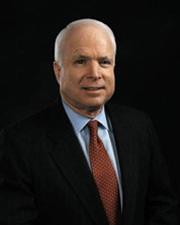 Sen. John McCain (R-AZ)
Legislative Activity
Stay on top of the latest movement without scrolling through every action
Senate amendment submitted
April 3, 2003
View full timeline
Senate amendment submitted
April 3, 2003
Senate amendment proposed (on the floor): Amendment SA 481 proposed by Senator McCain.(consideration: CR S4755-4759, S4760-4761, S4762-4764; text: CR S4755)
April 3, 2003
Senate amendment not agreed to: Amendment SA 481 not agreed to in Senate by Yea-Nay Vote. 38 - 61. Record Vote Number: 118.
April 3, 2003
Roll call votes on amendments in Senate: Amendment SA 481 not agreed to in Senate by Yea-Nay Vote. 38 - 61. Record Vote Number: 118.
April 3, 2003
Amendment SA 481 proposed by Senator McCain. (consideration: CR S4755-4759, S4760-4761, S4762-4764; text: CR S4755) To remove unauthorized and earmarked appropriations.
April 3, 2003
Amendment SA 481 not agreed to in Senate by Yea-Nay Vote. 38 - 61. Record Vote Number: 118.
April 3, 2003
Votes
1 roll call on this amendment
Text
Proposed
SUPPLEMENTAL APPROPRIATIONS ACT TO SUPPORT DEPARTMENT OF DEFENSE
OPERATIONS IN IRAQ FOR FISCAL YEAR 2003

The PRESIDING OFFICER. Under the previous order, the Senate will now
resume consideration of S. 762, which the clerk will report.
The legislative clerk read as follows:

A bill (S. 762) making supplemental appropriations to
support Department of Defense operations in Iraq, Department
of Homeland Security, and Related Efforts for the fiscal year
ending September 30, 2003, and for other purposes.

Pending:

Stevens amendment No. 435, to increase the National Debt
Ceiling of the United States.
Reid amendment No. 440, to provide critical funding to
safeguard nuclear weapons and nuclear material in the United
States and around the world.

Mr. REID. I suggest the absence of a quorum.
The PRESIDING OFFICER. The clerk will call the roll.
The assistant legislative clerk proceeded to call the roll.
Mrs. BOXER. Madam President, I ask unanimous consent that the order
for the quorum call be rescinded.
The PRESIDING OFFICER. Without objection, it is so ordered.

Amendment No. 472

(Purpose: To set aside $30,000,000 for the Department of Homeland
Security for research and development and deployment of technology to
protect commercial aircraft from the threat posed by man-portable air
defense systems)

Mrs. BOXER. Madam President, I send an amendment to the desk and ask
for its immediate consideration.
The PRESIDING OFFICER. The clerk will report.
The assistant legislative clerk read as follows:

The Senator from California [Mrs. Boxer], for herself and
Mr. Schumer, proposes an amendment numbered 472:
In chapter 6 of title I, add at the end the following:

GENERAL PROVISIONS, THIS CHAPTER

Sec. 601. Of the amounts appropriated by this chapter under
the heading ``Departmental Management'' under the heading
``counterterrorism fund'', $30,000,000 shall be available for
the Secretary of Homeland Security, in consultation with the
Secretary of Defense and the Federal Aviation Administration,
for research and development on, and for the initial
deployment of, technology to protect commercial aircraft from
the threat posed by man-portable air defense systems in order
to reduce the costs of such technology and to provide for the
adaptation of military countermeasure systems to commercial
aircraft.

Mrs. BOXER. Madam President, I thank the clerk.
If my colleague would like to make a statement at this time, I would
be happy to yield, without losing my right to the floor.
The PRESIDING OFFICER. The Senator from Alaska.
Mr. STEVENS. Madam President, I thank the Senator from California. My
only reason for standing right now is to inquire of the Senator from
California if it is possible to have a time limit on her amendment.
Mrs. BOXER. I absolutely will agree. I am waiting for my coauthor,
Chuck Schumer. As soon as we get word as to how much time he would
need, yes, we would definitely want to do that.
Mr. STEVENS. Madam President, I do thank the Senator from California.
It is our hope that we will be able to get all of the amendments that
are in line now completed in time to start voting by 11:50, following
the Democratic caucus. So I appreciate her courtesy. And whatever is
possible to enter into a time agreement, I would like to explore that.
I thank her for her courtesy.
Mrs. BOXER. I thank my friend. And, yes, as soon as we get word, I
will ask for a quorum call, and then we will make an agreement on the
time.
Whether we speak about this for a half hour or 2 days, this is a very
important amendment. I think one of the things we learned after 9/11,
tragically, is that we have to take warnings very seriously--our
intelligence agencies, we, as a Congress, the administration, all of us
working together.
We know now that there is a threat out there that is very real. We
have constructed an amendment that does not add any money to this bill
but merely says that out of the funds that have been allotted for
homeland defense, that $30 million be made available immediately for
research and development of countermeasures that could be taken should
a shoulder-fired missile be aimed at a commercial aircraft.
I want to read to you the latest statement of the FBI. This is the
FBI warning, which really must not go unheeded if we are to do our job:

. . . given al-Qaeda's demonstrated objective to target the
U.S. airline industry, its access to U.S. and Russian-made
MANPAD systems--

MANPAD stands for shoulder fired missiles--

and recent apparent targeting of U.S.-led military forces in
Saudi Arabia, law enforcement agencies in the United States
should remain alert to the potential use of MANPADs against
U.S. aircraft.

How clear could this be? If this body turns its back on a threat that
our commercial aircraft are facing right now, it would be a very sad
day, indeed.
I see Senator Schumer has approached the floor. What I will do is ask
that a quorum call be put in place so I might discuss with him a
timeframe he will need on this amendment we have worked so hard on
together.
I suggest the absence of a quorum.
The PRESIDING OFFICER. The clerk will call the roll.
The assistant legislative clerk proceeded to call the roll.
Mr. STEVENS. Madam President, I ask unanimous consent that the order
for the quorum call be dispensed with.
The PRESIDING OFFICER. Without objection, it is so ordered.
Mr. STEVENS. After conferring with the Senator from California, I ask
unanimous consent that the Senator from California control the time
until 10 minutes of 11 and that I control the time thereafter until 5
minutes after 11.
The PRESIDING OFFICER. Without objection, it is so ordered.
The Senator from California.
Mrs. BOXER. I will take it from the top because this is such a
crucial amendment. The amendment I am offering with Senator Schumer
will provide $30 million that is already in the bill--we are not adding
new money--for the Department of Homeland Security to research and
develop and to initially deploy countermeasure systems for commercial
aircraft to combat the threat of manned portable shoulder-launched
missile systems.
I have held one of these missiles. I am a little person. They are
very lightweight. They can be easily used. They have been used in the
past. As I say, this $30 million is not new money. I hope, therefore,
it will not be opposed on the other side of the aisle.
The chairman of the House Aviation Subcommittee, a Republican, said
just yesterday that the threat of these shoulder-fired missiles being
aimed at a commercial aircraft in the United States or one of our
assets abroad ``keeps me up at night.'' This is a Republican chairman
of the House Aviation Subcommittee who came into this debate, in his
own words, not convinced that we needed to move on this threat. But
after a secret briefing--and I was there--said this threat ``keeps me
up at night.''
Shoulder-fired missiles, such as the SA-7 and stinger missile, are
available on the black market for $25,000 to $80,000 each. Most can be
used with very little training and they take just minutes to fire. As I
said, I have held one of these missiles in my hand. Almost anybody
could do the same and fire one.
Nearly 30 guerrilla and terrorist groups are in possession of these
weapons, including al-Qaida. We will show a chart of the terrorist
groups, the guerrilla groups we believe have these

[[Page S4738]]

weapons or have access to these weapons: al-Qaida, Hezbollah, Kurdistan
Workers Party, the Palestinian Authority, the Popular Front for the
Liberation of Palestine, the Taliban. It goes all the way down the
line. These are the groups that have these missiles and could use them
against a commercial aircraft.

Al-Qaida has shown it is willing to use these weapons as weapons of
terror. They are suspected of targeting U.S. military aircraft in Saudi
Arabia last May with an SA-7 missile.
Mr. BAYH. Will the Senator yield for a question?
Mrs. BOXER. Yes.
Mr. BAYH. Is the Senator aware many of these countermeasures are made
in the State of Indiana at Crane Naval Depot? I thought the Senator
might be interested. I had occasion to be there several weeks ago. They
reported to me that these countermeasures the Senator quite rightly
hopes to fund in this supplemental have been used in Afghanistan, and
there have been more than 200 incidents of attacks on our military
aircraft, but not one successful attack because the countermeasures are
so effective in preventing the downing of our aircraft. The point the
Senator makes is a good one since we have been so successful in
protecting our military men and women. We have the technology. Why not
make it available to the civil aviation sector as well.
Mrs. BOXER. I am so pleased my friend would come over and engage in a
colloquy with me. I was not aware of where these countermeasures were
made. I know there are corporations working on them.
He is right. Our military planes are protected--thank God--because
these are heat-seeking missiles. They are attracted to these engines.
Our military aircraft are protected. It is interesting because if you
look at El Al, although they will not confirm or deny that their planes
are so equipped, we believe they are. We don't have any specific
information, but we believe they are.
The point is, we need to now take this technology that is used on
military aircraft and do a little more work so these technologies can
work on commercial aircraft. That is what the amendment does.
I say to the Senator, who I know is a fiscally responsible Member, we
don't add any new funds because the first stage, $30 million, we can
take out of existing money for research and development and begin to
deploy a few airplanes with this system so we can make sure it works
before we make a bigger investment.
Mr. BAYH. My colleague is quite right. I compliment her for this
amendment. The technology is more than theoretical. It exists in large
part today. We are talking about saving lives with this kind of
investment. I can't think of a better use of our tax dollars. I make
the point not only as a matter of State pride but that the technology
is there. We are saving lives. Another way to put it, we are saving
lives in Afghanistan today using these pyrotechnic technologies. Why
not arm our civil aviation aircraft to save lives domestically as well.
I strongly support her amendment. It is a very wise investment.
Mrs. BOXER. Before my friend leaves the floor, I want to put up the
FBI warning we have been given. It is not as if we haven't been warned.
That is why I want to make the case to my friends on both sides of the
aisle as to how important they are.

Given al-Qaida's demonstrated objective to target the U.S.
airline industry, its access to U.S. and Russian-made systems
and recent apparent targeting of U.S.-led military forces in
Saudi Arabia, law enforcement agencies in the U.S. should
remain alert to the potential use of the MANPAD'S against
U.S. aircraft.

When you put that together with the list of terrorist groups that
have the weapons, you are so right. The Taliban is at the top. That is
why now in Afghanistan we face threats from these shoulder-fired
missiles, because they have them.
Mr. BAYH. In addition, my colleague is aware that I serve on the
Intelligence Committee. Without getting into detail on the floor, which
would be inappropriate, this is a growing concern in the intelligence
world, particularly following the attack in Kenya on the Israeli
airlines. These attacks have been carried out on civil aviation
aircraft. These missiles are widely available, as you pointed out, and
it is a matter of growing concern to our law enforcement and
intelligence officials that this is perhaps a future area for threat--
the civil aviation in the United States.
We have the ability to protect the aircraft, so why not take the step
before it is too late? We should not wait until after a tragedy has
occurred. We have been down that road before.
Mrs. BOXER. My friend is so much on point. It is true that the
attempt to down an Israel airliner in Kenya failed. However, it is
estimated that over the last 25 years, more than 550 people have been
killed in incidents involving shoulder-fired missiles and commercial
aircraft.
I want to show my friend a statement made by a member of the travel
industry, as we look at more funding for the airlines, which I think is
essential right now given what they have gone through, because we have
a war and we had terrorism and we have a recession. This is what Ed
Adams, chairman of a big tourism industry group, said:

The travel industry is painfully aware of what a successful
attack of using a shoulder-fired missile on a commercial
airliner could do to the confidence of the traveling public.
It is a situation we would prefer not to even imagine, but we
must understand the reality of such an event if we intend to
prevent it. The blow to the economy, in general, and the
travel and tourism sector, in particular, combined with the
loss of human lives would be staggering. These costs would
certainly outweigh the expense of the precautionary measures
you are recommending today to make sure our commercial planes
are safe from such a terrorist attack.

Mr. BAYH. My colleague pointed out that I pride myself as being
fiscally responsible. I view her amendment in that spirit. We are in
the process of appropriating, I believe, $3 billion for the civil
aviation industry in this supplemental. Previously, following the 9/11
attacks, there were other billions of dollars. If that industry is
going to recover and be viable economically again, it is going to have
to be in part because people feel safe getting on planes and traveling
across the country. So the Senator's efforts to secure the traveling
public are very much in the spirit of stabilizing an industry and, in
fact, being fiscally responsible so that further efforts to provide
largess from the Federal Treasury won't be necessary.

Mrs. BOXER. My friend is right. We know that, right now--before we
have even seen research and development in a robust fashion to bring
down the cost of these countermeasures--they are about a million
dollars per plane. I say to my friend that $1 million on a $120 million
aircraft is not too much to ask.
We had a big breakthrough because Chairman Mica on the House side,
yesterday, came on board on this amendment and is working on the other
side. I have spoken to the leadership. I think if the Senate today can
come together--I know we are voting so much on party lines now, and I
can see that, but if we can come together on this amendment, which
doesn't add any money at all, but simply says this is a priority--by
the way, it is not only the Senator from Indiana, or the Senator from
California, or the Senator from New York saying it is a priority; it is
the FBI saying it is a priority. Who knows better what threats we face
than the FBI?
The TSA is saying it is a priority, too. On Sunday, there was a
report in the New York Times saying that the Bush administration has
ordered major security improvements at several of the Nation's largest
airports after inspections showed that passenger planes taking off or
landing at those airports could be vulnerable to attack by a terrorist
using a shoulder-fired missile.
So the fact is we see--I know at Los Angeles Airport dozens of
National Guard troops are deployed. It is a good thing to patrol the
perimeter and at road checkpoints, in part, because of concerns about
shoulder-fired missiles.
So the administration now takes this very seriously. We all know that
while the National Guard is going to be very helpful in this regard,
and more troops are going to help in this regard--and I support these
measures--we know these missiles can reach commercial aircraft up to
12,000 feet. We know that stepped-up patrols of the perimeters are only
part of the solution because you can have one of these shoulder-fired
missiles pretty far away from the

[[Page S4739]]

airport--in an apartment building, or anywhere else, or in the middle
of a park, and it would be very difficult.
Mr. BAYH. Or possibly from the sunroof of an SUV. It is difficult to
secure the perimeter around an airport to the extent that we need it.
These countermeasures would be very warranted. I apologize for
interrupting the Senator's remarks. But this threat is real. We have
done a great deal of good work in the military sphere combating just
this kind of threat.
Why not make it available to the civil population as well? We are
spending billions of dollars to bail out an industry, but if people
don't feel safe flying in planes, the industry will never recover. I am
in support of my colleague's amendment. Again, I apologize for
interrupting the flow of her argument.
Mrs. BOXER. The Senator hasn't interrupted my argument; he has made
it stronger and better. Also, we know that military transport and
refueling aircraft--and you have mentioned this--such as the C-17, C-
130, KC-135, and the KC-10 are some of the models that employ these
countermeasure systems that we believe can be and must be used for
commercial aircraft.
Just going to the Senator's point about the military, they are
conducting thousands of hours of training on countermeasures. So to
underscore what my friend has stated, we know these systems work. We
also know there is a threat.
I think if you look at this amendment and all the parts of it, No. 1,
it is a modest step because we are not adding new funding; we are
simply taking out--there is more than a billion dollars in that
particular section--it is $1.135 billion--and we are saying $30 million
of that should go to support the research and development and getting
these prototypes ready, so we know they can be put on aircraft.
Chairman Mica and I have spent time talking about this, as well as
Senator Schumer. We have come to understand that as we do this research
and development, and the price comes down, when the airlines in the
future order new commercial aircraft--and they are spending up to $150
million a copy--to spend an extra million dollars on that is not going
to be very much.
So we think this is a very responsible amendment. We think it would
be foolish and foolhardy not to begin this work right now, because I
can tell you, God forbid, if a terrorist were successful, or even
unsuccessful but came close to hitting one of our commercial aircraft,
everybody in this body would say: Oh, my God, we had our chance and we
blew it. We didn't do what we should have done.
Whether you look at the fact that these technologies are working on
military planes, whether you look at the fact that we have enormous
warning from the FBI, and we have seen this administration begin to
move forward, if you put this all together, it speaks loudly and
clearly in favor of this amendment.
This is a chart of recent incidents of attacks. In November 2002, an
Israeli jetliner was fired upon seconds after takeoff in Mombasa,
Kenya, and al-Qaida is suspected.
In May of 2002, an empty shoulder-launched missile tube was found
outside Prince Sultan airbase in Saudi Arabia, and our military thinks
that was from a shoulder-fired missile.
In October 1998, we had rebels down a civilian Boeing 727 over the
Democratic Republic of the Congo in which 40 were killed. This is just
recent incidents, but if we go back 25 years, we see this occurred.
I expect Senator Schumer is going to be coming to the Chamber. Until
he does, I am going to continue to go over these charts. If we look at
any of these charts, we get the picture.
This chart shows the groups we believe have access to shoulder-fired
missiles. This would make anybody shudder because we know these groups
are well funded and active, and we know many of them view the United
States of America as their target:
Al-Qaida, Hezbollah, Kurdistan Workers Party, Palestinian Authority,
Popular Front for Liberation of Palestine, Taliban, Armed Islamic
Group, Huta Militiamen, UNITA, Oromo Liberation Front, Somali National
Alliance, United Somali Congress, Hark at ull-Ansar, Hizbul Majahideen,
Khmer Rouge, Liberation Tigers of Tamil, United State Wa Army, Kosovo
Liberation Army, National Liberation Army, and the IRA. We know these
groups have access to shoulder-fired missiles. We know some groups,
particularly some on the top part of this chart, would like to go after
United States interests, given the past and given the present
situation.
I want to read what Chairman Mica said after he came out of an
intelligence briefing on this issue:

I went into the meeting somewhat skeptical. I came out
convinced that this is probably one of the most serious
challenges we face in combating terrorism. I think that's
important.

Then he said:

Since that hearing, I've lost some sleep and have great
concern.

We are saying this is very important.

Honoring our Armed Forces

Madam President, until Senator Schumer comes to speak on my
amendment, I wish to pay tribute to five additional young Americans who
were killed in the Iraqi war who were either from California or based
in California. Sadly, these numbers are growing, and I have tried in
every case to read their names on the floor.
LCpl Patrick T. O'Day, age 20, was from Sonoma, CA, which is not very
far from where I live. He was assigned to the 1st Tank Battalion, 1st
Marine Division, Marine Corps Air-Ground Combat Center, Twenty-nine
Palms, CA. He was killed in a tank accident in Iraq on March 25.
His family moved to the United States from Scotland in 1987. He was
captain of the wrestling team at Santa Rosa Middle School. He enlisted
in the Marines after graduating from Santa Rosa High School in 2001. He
is survived by his wife, his parents, his three brothers, and his wife
is expecting their first child in September.

PFC Francisco A. Martinez Flores, age 21, from Los Angeles, CA, was
assigned to the 1st Tank Battalion, 1st Marine Division, Marine Corps
Air-Ground Combat Center, Twenty-nine Palms, CA. He was killed in a
tank accident in Iraq on March 25. He moved to California with his
family when he was 3 years old. He was expecting to become a U.S.
citizen in 2 weeks.
CPT Aaron J. Contreras was assigned to the Marine Light Attack
Helicopter Squadron, Marine Aircraft Group-39, Marine Corps Air Station
in Camp Pendleton, CA. He was 31 years old. He was killed on March 30
in a helicopter crash in southern Iraq.
He was born on the Fourth of July in 1971. His family moved from San
Jose, CA, to Sherwood, OR, in the late seventies, and he was a graduate
of Sherwood High School. He joined the Marines in 1997. He is survived
by his wife and three children, his parents, and four brothers.
SSgt Donald C. May was assigned to the 1st Tank Battalion, 1st Marine
Division, Marine Corps Air-Ground Combat Center, Twenty-nine Palms, CA.
He was from Richmond, VA. He was 31 years old. He died March 25 in a
tank accident in Iraq. He is survived by his wife and two children.
Cpl Robert M. Rodriguez, age 21, was assigned to the 1st Tank
Battalion, 1st Marine Division, Air-Ground Combat Center, Twenty-nine
Palms, CA. He was killed in a tank accident in Iraq on March 25. He was
from Queens, NY. He was born in Brooklyn and grew up in the Maspeth
section of Queens. He was known to treasure his Puerto Rican heritage.
He is survived by his parents, four siblings, and 17 nieces and
nephews.
I have come to this Chamber to honor our fallen military personnel
before. We now have 20 men who have died in the Iraqi war who were
either from California or who were based in my home State. My State
mourns their loss. May these beautiful young Americans rest in peace.
May we have a short war. And may we also pray for the wisdom of those
who sent our young men and women into their mission.
When we speak about the realities of war and how families will never
be the same, as we take this bill up to make sure we have the best
equipped military in the world and they have everything they need to
protect them from harm, we also need to protect civilians from harm,
which gets me back to the amendment that is before the body today.
We have been warned by the FBI that the chance of a shoulder-fired
missile being fired at one of our civilian aircraft is real. We have
been warned by

[[Page S4740]]

the Transportation Security Agency that the threat is real. The
administration has deployed National Guard to various airports in our
country to try to spot one of these individuals with a shoulder-fired
missile. We know there are skeptics who have now come to the conclusion
that this is, in fact, a very real threat to our people. We have heard
from the travel industry that such an attack would be more than
catastrophic, and as we vote more and more funding for our airline
industry because we do not want to lose our airline industry, we need
to take steps to protect it from further harm as well.
We have an amendment that ought to get bipartisan support. We have an
amendment that is fiscally responsible. We are not adding more money.
We are saying this is a high priority and it ought to happen because if
we can get the cost of these systems down below $1 million--right now
they are about $1 million a plane. Even that is a small amount when one
considers an aircraft costs $100 million to $150 million a copy. If we
can get it even lower than that, it becomes less and less of a burden
to both retrofit the older planes, the 6,800 planes we have flying now,
and make this a mandated safety measure on all future commercial
aircraft.
There is a lot of support for this amendment. I just hope the Senate
will put it in place. I think all of us will be able to sleep a little
bit better at night because there are folks out there who want to hurt
us. We know that. They look at civilians in a way we have never seen
before. On 9/11 we saw that just because you are a civilian does not
protect you from terrorists. It is our job to make sure we protect our
people from terrorists.
I am hopeful Senator Schumer will join us shortly. I yield the floor
and suggest the absence of a quorum.
The PRESIDING OFFICER. The clerk will call the roll.
The assistant legislative clerk proceeded to call the roll.
Mrs. BOXER. Madam President, I ask unanimous consent that the order
for the quorum call be rescinded.
The PRESIDING OFFICER. Without objection, it is so ordered.
Mrs. BOXER. Madam President, Senator Schumer is working hard on a
major amendment dealing with first responders. I thank the Senator from
the bottom of my heart for all his work on this issue and this
amendment. Senator Schumer and Senator Clinton had an experience that
no other Senator had. Yes, we had horrific pain in this area with the
Pentagon being hit. The Senators from this region dealt with the pain
and suffering and grief, but Senators Schumer and Clinton saw something
they will never forget--none of us will, they particularly--and they
deal with the fallout of this every day.
When we talked about trying to get ahead of terrorists and listening
to the FBI warnings, the TSA warnings, Senator Schumer said: I want to
work closely with you on this. God forbid something like this should
happen and a shoulder-fired missile would bring down a commercial
aircraft. We would all say, my God, why didn't we do something? We have
the technology.
I yield to my friend for as much time as he has remaining before
Senator Stevens takes time to respond.
Mr. SCHUMER. I thank my colleague.
The PRESIDING OFFICER. The Senator has 6\1/2\ minutes.
Mr. SCHUMER. I ask unanimous consent that I be given an additional 5
minutes, or 3\1/2\ minutes, so I may speak for 10 minutes, with the
consent of the Senator from Alaska.
Mr. STEVENS. Reserving the right to object--I would not object--I
consent that Senator Boxer control the time until 5 minutes of 11 a.m.,
and if we extend that time, we would then control the time until 11:15.
Mr. KENNEDY. Reserving the right to object--because I understand my
friend just came from the Judiciary Committee and some of us want to
get over to the Judiciary Committee, and I understand Senator Bayh was
set to go on at 11:05--now we are asking consent to move Senator Bayh's
amendment to a later time.
Mr. STEVENS. We do not have a time agreement on Senator Bayh's
amendment. He is next in order. The Senator asked to extend the time by
5 minutes, and I asked to extend by 5 minutes. That does extend the
time when another amendment would be taken up until 11:15; that is
correct.
Mr. REID. Madam President, I say to the Senator from Massachusetts,
it is not Senator Stevens asking for additional time, it is Senator
Schumer.
Mr. SCHUMER. I will be brief. I withdraw my request to accommodate my
colleague from Massachusetts.
The PRESIDING OFFICER. Does the Senator withdraw the request?
Mr. SCHUMER. I withdraw the request.
The PRESIDING OFFICER. The Senator from New York.
Mr. SCHUMER. I commend my colleague from California. We all know she
is a fighter. She finds issues, focuses on them with passion, is able
to persuade so many others. The American people are lucky that Senator
Boxer has taken such a leadership role in defending the homeland. I
know the citizens of California thank her, but so do the Senators of
New York. This is a real danger.
If we had to make a list of how terrorists would go after us,
unfortunately, shoulder-held missiles would be at the top of the list.
As my colleague from California has demonstrated, we know they have
them. We know al-Qaida, the most sinister right now of the terrorist
organizations, has tried to use them. And there is an FBI statement
that says just that.
God forbid this should happen. God forbid the loss of life, the
anguished families. Would anyone fly for 3 months, 6 months, 9 months?
The economy is squishy now. If one of these shoulder-held missiles were
used by terrorists to bring down one of our commercial airliners, it
would send the economy due south; we would have huge problems.
The good news is we can stop this. Yes, it will cost some dollars.
But I cannot understand the attitude that we should not spend dollars
to deal with something such as this. The Senator from California is not
asking for much. I, for one, would like to see more money. I know if we
do this, it will eventually cost more money, but she is being extremely
modest in the amendment.
To say, against one of the greatest dangers held for our wonderful
people in America, that we should not do anything defies imagination,
defies belief. We have the technology on our military planes, on Air
Force One, El Al Airlines. I have dealt with the former top of security
of El Al Airlines. They have them. They unfortunately know what
terrorists can do. Yet we are saying we should fiddle while terrorism
burns. I don't get it.
The Senator from California and I carefully crafted this amendment,
along with Congressman Mica from Florida, a Republican Member, to make
it as modest as possible. I hope we accept this amendment. No one wants
this to be a partisan amendment. Obviously, it is not. However, one of
our jobs is to defend the troops. We are doing that by supporting the
President's request. One of our jobs is to protect this homeland from
the new scourge of terrorism.
I mourn every day for the families lost on September 11. I wear this
flag on my lapel every day in their memory; God willing, I will wear it
every day for the rest of my life. I don't want it to happen again in
any way. Spend a few dollars to make sure that does not happen.
If we ask the American people to line up the priorities of all
Federal spending, does anyone think this is at the bottom?
They say there is no more money or maybe it will come out of some
existing funds. We know what that means around here. That means forget
it. If you cannot earmark it, it does not happen. I cannot believe we
are not going to do this. I can't believe there is opposition to this.
I can't believe, on something so vital to our security, where we have
spent billions of dollars to protect our military planes, that we would
not apply it to commercial airliners because in the post-September 11
world, those commercial airliners are just as much targets as our F-18s
and F-16s and B-1s and B-2s.
Please, colleagues, let's not be in the ``what if'' situation.
Let's not wake up one morning after this has occurred and say, What
if we had done this? I would plead with my colleagues to support this
very important amendment.
I yield the floor.

[[Page S4741]]

The PRESIDING OFFICER. The time yielded the Senator from California
has expired. The Senator from Alaska controls the next 15 minutes.
Mr. STEVENS. The Senator from Alaska controls time at 5 minutes of
11.
Mr. REID. Madam President, parliamentary inquiry: Has the time for
the Senator from California been exhausted?
The PRESIDING OFFICER. Yes, it has.
The Senator from Alaska.
Mr. STEVENS. I yield 8 minutes to the Senator from Arizona.
The PRESIDING OFFICER. The Senator from Arizona.
Mr. McCAIN. Madam President, I rise to oppose this amendment because
it is premature. The amendment is premature not only in my view but in
the view that was held by the Senator from California on March 13 in
the Commerce Committee when we marked up the cargo security bill. At
that time, the Senator from California said, and I quote from the
record of the hearing of the markup:

I have a bill which I am not moving today because I think
that would require a hearing. But what I thought would be
good is that since the TSA has said they are studying the
best way to combat this--

Speaking of protection of the airliners from missile attack--

but yet we haven't seen the study, what I would say in this
amendment is to ask them to please give us a report on their
study to this committee within 90 days on the best way to
defend turbo and jet passenger aircraft from these shoulder-
fired missiles.

So we adopted the amendment of the Senator from California on the
cargo security bill that is before the Senate which will be passed by
the Senate without any doubt whatsoever.
I do not know of any living American who does not want to protect our
airliners. I do not know of any living American who does not want to
protect all of America, including our borders.
The fact is that it is proposed to spend $30 million on R&D and
deployment of technology on commercial airliners. I can assure my
colleagues that it is not that easy. It is not that easy to transfer
technology which is adopted for military aircraft and then immediately
transfer it to civilian aircraft. Obviously, we need some time for the
TSA to look at the threat and put the threat in the scale of the
threats that we face in an order of priority, and the best way may not
be installing this equipment on airliners. It probably is. But we do
not know for sure. All we know is that there is a threat, as there are
myriad threats out there to our lives and our security, whether they be
at reservoirs or nuclear powerplants or along our borders, or wherever
they may be. And we do have the ability perhaps to adopt military
technology. But that has to be studied, as the amendment of hers on the
bill after discussion in the markup.
What type of technology is it? How can we deploy technology
immediately when we do not know what technology it is that is best
executed if we believe that airliners needed this protection
immediately.
I am not going to take the entire 8 minutes the Senator from----
Mrs. BOXER. Will my colleague yield?
Mr. McCAIN. That the Senator from Alaska yielded, but I just say this
is a premature amendment. This is an amendment that is going to spend
$30 million for deployment of technology when we do not even know if
that technology exists, and if it does, if that is the best technology.
So that is why I am in opposition to the amendment.
Mrs. BOXER. Will the Senator yield?
Mr. McCAIN. I will be glad to respond to a question from the Senator
from California.
Mrs. BOXER. I thank the Senator. I think the Senator makes a very
important point that I absolutely supported a study in the committee.
Since that has occurred, however, two things have happened. Chairman
Mica on the other side invited me to a secret meeting.
Mr. McCAIN. Does the Senator have a question or does she want to use
her own time?
Mrs. BOXER. I was hoping--I don't have any time left.
Mr. McCAIN. If the Senator has a question, I would be glad to
respond. Otherwise, I do not want to use the time of the Senator from
Alaska.
Mrs. BOXER. I do have a question. I was just going to let the Senator
know what had happened and then I was going to ask the question.
What happened at that time was this threat had been rising and the
administration took action since the time of the study that said to all
the big airports around the country, national guardsmen will protect
against this threat. Chairman Mica changed his mind after those
hearings and I became more concerned. That is the reason why I drafted
this to be both a study and a deployment on just a couple of planes.

Mr. STEVENS. Regular order.
Mrs. BOXER. I just wanted to know if my rationale made any sense.
Mr. McCAIN. I thank the Senator for her question, and I appreciate
the Senator from Alaska allowing that time. It is still premature and I
think that to order a study of the background within a period of a
couple months would be most appropriate.
I yield back the remainder of my time to the Senator from Alaska.
Mr. STEVENS. Madam President, I say to the Senate that as a pilot,
almost every pilot I know shudders over the thought of weapons that are
heat-seeking missiles. I commend the Senator from Arizona for what he
has done already on the commitment of trying to get a study. I do not
want to leave the impression here--it is classified, but there are some
commercial planes that are outfitted for some defenses against some
weapons. But all you have to do is think of ``Blackhawk Down'' to know
it is not that simple.
The Air Force has been working in research and development on a
system. It is being tested on one plane so far. As a matter of fact, it
is too large for most of our commercial aircraft. We don't know how
soon it will be before we can get technology that can be fielded for
civil aviation. There are several systems available that can detect the
shoulder-fired weapons. However, they are not effective on all of them,
and the problem is, if we are going to say that our civilian airlines
are safe, to find a system that is safe.
Currently, we have some. As I said, one of these systems is deployed
on commercial aircraft to try to see how effective it might be. These
systems currently that are being deployed cost about a million dollars
a plane. I just do not see many commercial airlines that are ready to
put out $1.5 million for each plane to try to defend it with a system
that is not deemed to be effective by the Air Force so far.
The Boxer amendment earmarks $30 million from within the
counterterrorism fund for this project to equip our commercial airlines
with a system to defeat heat-seeking missiles.
This will reduce the fund; the counterterrorism fund has been assumed
to provide additional dollars for agencies within that department. One
hundred and twenty million dollars is assumed in this bill to pay for
the passenger screeners and other costs incurred at additionally
secured airports.
We have tried to be very discrete about this fund. This is not a bill
to deal with the problems of commercial airliners. This is a bill to
deal with funding the war. Again, I want to say we have three wars
going on, and this is not part of the war. We already have taken this
up in Commerce. We have a study coming because of it. I hope that bill
will pass.
I share the absolute fear that Senator Boxer reflects in terms of the
problem of passenger aircraft having some defense against shoulder-
fired missiles. Again, I wish we could all take a look at ``Blackhawk
Down.'' There is no question they are out there and they are very much
a fear in terms of terrorism. But that is what the Department of
Homeland Security is for and that is why the research and development
money that is in the defense bill that has already been passed this
year, and that research is going on.
Madam President, I regret deeply that this is not the way to solve
the problem. The problem is going to be solved with a study that we
have asked for of what can be done and the funding that would follow
that study. I hope it gets here in time to deal with it on the 2004
bill.
Again, I do not know anyone else who fears these as much as pilots.
Passengers to a great extent understand the problem but you have to be
a pilot to understand total consequences of having something that you
cannot control from within the cockpit.

[[Page S4742]]

It is true we have these systems on high-performance airplanes. They
are extremely heavy. As I said, they cost more than $1.5 million
apiece.
Madam President, $1.5 million added to the cost of a high-performance
airplane we are buying for war purposes, that is one thing. This does
not affect that. Those systems have already been perfected under the
Department of Defense, and they are adequate for our needs in defense.
I point out in the 12 years we have flown over Iraq on the so-called
CAPs Program, we have not lost one plane to a heat-seeking missile to
my knowledge.
That is military. We are trying to say can we put them into civilian
airlines? Can we put them into commuters? What size do we need?
It is a research program. I don't know how long it would take. I was
told at one time it would take up to 2 years to develop this system.
But we should approach this action from the point of view of research
and development first and not a mandate, and particularly not take
money out of the bill as it is right now.
We do have, by the way, some of them that are applicable to the
commercial system. It is dealing with a laser system. That system will
be available for installation in commercial airlines by fiscal year
2006, under the current system. As I said, we are trying to accelerate
research and development and ability to defend small aircraft and
helicopters. There just is none available today that can do that, that
are affordable.
I reluctantly agree with the chairman of our committee. I believe the
language in the Cargo Security Act that was the product of Senator
Boxer's efforts on the Commerce Committee should be allowed to go
forward. We should study this important issue. But we should not be
taking money from other homeland security efforts and directing it be
spent on pilot projects for systems that have not yet been demonstrated
to be effective.
We are monitoring this. I say in all sincerity, I think the Commerce
Committee has Senators on both sides of the aisle who are committed to
following this through, to finding the best way to defend passenger
aircraft from shoulder-fired missiles.
This is not the way to do it. Reluctantly, I do move to table the
amendment.
I ask unanimous consent the Boxer amendment, amendment No. 472, be
set aside until the hour of 1:50, and at that time the Senate proceed
to a vote in relation to the amendment with no second-degree amendments
in order to the amendment prior to the vote. I further ask unanimous
consent there be 2 minutes of debate equally divided immediately prior
to that vote.
The PRESIDING OFFICER (Mr. Ensign). Without objection, it is so
ordered.
Mr. STEVENS. I want to announce that will be the first vote in a
sequence that will start at 1:50 p.m. this afternoon.
I now ask, if it is appropriate, and I believe it is, unanimous
consent with regard to the amendment Senator Bayh will offer, that
there be 20 minutes of debate under the control of the proponent, 10
minutes under control of myself, and no second-degree amendments in
order prior to the vote. I further ask this amendment, when we are
finished, and I shall make--I may not make a motion to table this--but
a vote in relation to this amendment to be taken, if required, at the
hour of 1:50, following the Boxer amendment.
Mr. REID. Mr. President, I failed to tell the manager of the bill
that Senator Kennedy wants 10 minutes. So it would be 30 minutes and
whatever time you want to respond to that.
Mr. STEVENS. I have no objection. The Senator has been waiting to
speak. I am pleased to amend my request that there be 30 minutes under
the control of the proponents and 10 minutes under my control.
The PRESIDING OFFICER. Is there objection to the unanimous consent
request? Hearing none, it is so ordered.

Amendment No. 474

Mr. BAYH. Mr. President, I have an amendment at the desk. I ask for
its immediate consideration.
The PRESIDING OFFICER. The clerk will report.
The assistant legislative clerk read as follows:

The Senator from Indiana [Mr. Bayh], for himself, Mr.
Nelson of Nebraska, Mr. Schumer, Ms. Stabenow, Mrs. Clinton,
and Ms. Mikulski, proposes an amendment numbered 474.

Mr. BAYH. I ask unanimous consent the reading of the amendment be
dispensed with.
The PRESIDING OFFICER. Without objection, it is so ordered.
The amendment is as follows:

(Purpose: To provide funding for grants to States for smallpox and
other bioterrorism inoculation activities)

On page 38, after line 24 add the following:

Smallpox and other Bioterrorism Inoculation Activities

For additional expenses necessary to support grants to
States for smallpox and other bioterrorism inoculation
activities, $340,000,000, to remain available until September
30, 2004: Provided, That this amount is transferred to the
Centers for Disease Control and Prevention.

Mr. BAYH. Mr. President, I offer this amendment on behalf of myself,
Senator Nelson of Nebraska, Senator Schumer, Senator Stabenow, and my
distinguished colleague, Senator Mikulski.
I offer this amendment because of my conviction that just as we spare
no expense ensuring our military men and women in the field have the
tools with which to defend themselves, have the tools with which to
disarm rogue regimes that possess weapons of mass destruction so we can
protect the American people, we also need to give those tools to the
brave men and women working here at home who will defend the American
people against biological attack. That is because it is the same fight.
It is the same war.
Disarming rogue regimes of weapons of mass death, protecting American
citizens who might be killed by those weapons of mass death, is the
same fight. We need to make sure that both overseas in the military and
here at home, in terms of civilian defense, we do what it takes to
defend America's national security interests.
Simply put, in the war we are fighting today, the war against global
terrorism, rogue regimes, and failed states, the distance between the
front lines and the home front is not that great. We must recognize
this fact and aggressively defend both; otherwise, the American people
may suffer.
We are now involved in a great conflict in Iraq. This conflict has,
as its genesis, our desire to avoid another tragedy like September 11,
only this time involving weapons of mass destruction and casualties and
loss that could be far greater.
We suffered 3,000 fatalities on September 11, worse than the attack
on Pearl Harbor, the greatest loss of life in our country since the
Civil War.
But I rise today to say that, unfortunately, much worse can happen.
Weapons of mass death--let us call them what they are because they seek
to destroy not buildings or physical property but people--weapons of
mass death capable of inflicting losses of catastrophic, even Biblical
proportion, now roam the international landscape. Biological weapons in
particular can unleash pathogens capable of slaughtering millions,
rending civil society itself and spreading terror and fear, and perhaps
starting a new Dark Age.
I do not overstate the case. Not so long ago, I tell my colleagues,
there was something called Operation Dark Winter that was conducted by
a variety of entities, including the Center for Strategic and
International Studies. Operation Dark Winter sought to anticipate what
might happen if smallpox were introduced into the ventilation systems
of three shopping malls in different States across our country.
Within 13 days, the disease had spread to 25 States. After 60 days, 3
million cases of smallpox had been diagnosed and more than 1 million
American citizens--1 million were anticipated to die from the outbreak.
That is just how bad it can get.
Colleagues, the threat is not theoretical. As we saw in this very
Chamber with the anthrax outbreak of a year ago, the threat of
biological weapons is all too real, all too tangible. Our intelligence
services estimate the chances of a nation such as Iraq possessing
smallpox are about 50-50. Other nations have it, too.
Terrorist groups such as al-Qaida and Ansal al-Islam and others are
working feverishly to obtain chemical and biological weapons. Since
smallpox is the worst case scenario when it comes to a

[[Page S4743]]

biological outbreak, we have to assume that smallpox would be near the
top of their list when it comes to obtaining a biological capability to
attack the United States here at home or abroad.
The administration itself has recognized the threat. The President
himself was inoculated against smallpox to great fanfare. The
recommendation last December by the administration was to inoculate up
to 10 million first responders--10 million--to ensure that our country
was in a position to minimize this threat, God forbid, should it reach
our shores. Unfortunately, while the rhetoric has been right on, the
resources and the actual response have been left wanting.
The response to date ignores the fact that there are many other
pressing needs when it comes to protecting the American people against
a biological attack. Smallpox is only one of the potential risks.
Inoculating our people against smallpox is only one of the steps that
must be taken. We simultaneously must move forward with expanding our
lab capacity so we can analyze the cases as they come in so we know
what we are dealing with. Is it a plague? Is it smallpox? Is it
botulism? What is the pathogen that is killing Americans? How do we
treat it? What should be our next steps?
Having a lab capacity is critically important. We have to improve the
communications systems between the Federal level, the CDC, State
laboratories, and local hospitals because if there is not an effective
communication system, the response will break down and people will die
as a result.
Finally, we need better health monitoring at the local level so we
can judge the ebb and flow of systems and analyze exactly what it is we
are dealing with so we know how to respond and save people's lives.
The response to date ignores all these other pressing needs competing
for scarce resources, leaving the very real possibility that either
protecting the Nation against smallpox will be left wanting or that
these other critical needs will be left wanting. That is a choice we
should not be forced to make.
The response also ignores the very language of the emergency
supplemental, which states explicitly that the funds can only be used
for equipment and training, that they cannot be used for inoculation--
they cannot be used for inoculation. So even if enough money had been
provided to help defend against smallpox, by the very wording of the
supplemental, the funds cannot be used for the most pressing need, to
ensure that first responders, who might be infected, are inoculated
against smallpox, protecting both them and others with whom they might
have contact.
Third, the response to date ignores the very real, pressing fiscal
crises confronting our States. I just came from a meeting with my own
Governor. Indiana, as other States, is facing a deficit. It is strapped
for money. So States simply are not in a position to step in and
provide resources to fill in the gaps.
If this need is going to be met, if this threat is going to be met,
if our people are going to be protected at this hour of national
crisis, at this hour of State fiscal crisis, it is the Federal
Government that must step up and protect the national security
interests, the health and well-being of the American people, because we
are the only level of government that is in a position to do so.
Next, the response proposed by the administration falls short of past
responses in similar cases. My colleagues might be interested to know
that in 1947, responding to a single outbreak of smallpox in New York
City, 6,350,000 citizens were inoculated, including 500,000 in a single
day--in a single day. Yet there is nothing for smallpox inoculation in
this bill. Clearly, based upon past response, the current steps are
inadequate and, hence, the amendment is necessary to supplement our
efforts.
Finally, along these lines, the House of Representatives--not known
for responding overzealously to concerns such as this, known to want to
keep a firm grip on the purse strings--has recognized that the
emergency supplemental is inadequate and has proposed an additional $94
million to help address this need. While $94 million is itself
inadequate--the $340 million we propose in our amendment is the correct
response to inoculate 4 million people who the States have said are
necessary to inoculate--at least the House of Representatives has taken
a tentative initial step in recognizing the very real need.

If we are going to meet this threat, the response to date proposed by
the administration, however well intended, is simply inadequate to
meeting the very real potential threat, the disastrous potential threat
facing the American people. That is why we have proposed action.
I will spend a couple of moments addressing what the potential
arguments against our amendment might be. I know some might suggest
this is simply more social spending. That is simply not the case. This
money will save lives. We have been attacked, as we all know. As we all
know, terrorists are planning further attacks. We know they are
desperately seeking weapons of mass death, including biological
weapons. We know that smallpox is the worst case scenario, and that in
all likelihood they are attempting to get it.
This money is needed. It is not simply just more social spending. It
is needed to save lives, and to save lives now. It would be
irresponsible not to ensure that we are protecting against this threat
because we know how real it can be.
Secondly, the argument that enough resources have already been
provided is simply not accurate. Enough resources have not been
provided to meet this threat, as the House of Representatives has
recognized, as the Governors of the 50 States have recognized in their
State plans, saying that inoculating 4 million first responders is what
is necessary to truly protect the American people.
The administration has done precious little along these lines. Not
enough in the way of resources has been provided. Regrettably,
responding to this need is not inexpensive. The National Association of
County & City Health Officials estimates that, at a bare minimum, it
takes $85--and, in fact, recent experience suggests far more--it takes
$85 per case to screen, inoculate, and monitor the results of the
inoculation per individual inoculated. That is the least case scenario.
So taking the lowest cost estimate, multiplying by the 4 million first
responders that the Governors and States, regardless of party,
indicated need to be inoculated, that is how we reached our estimate of
$340 million being the bare minimum needed to help protect the American
people against this threat.
Finally, 58 percent of local officials indicate that smallpox
inoculations are now hurting their other bioterrorism efforts. I would
ask my colleagues, What do we leave the American people vulnerable to?
If we emphasize smallpox, do we choose to leave them vulnerable to
anthrax? Do we choose to leave them vulnerable to another pathogen that
is capable of killing millions of people? That is simply not the
responsible course of action. Yet it is the course we are on if we do
not adopt this amendment.
In closing, let me say that my position in this amendment, offered by
myself, Senator Mikulski, and others, is not a partisan position. I
have with me an article from the Washington Post of 2 days ago,
indicating the very pressing needs that States face in this arena.
It quotes several Governors, including Governor Pataki of New York,
Governor Huckabee of Arkansas, and others, to the effect that States
and cities are simply not being provided with the resources they need
from the Federal Government. I quote:

[G]overnors and mayors of both parties declared [the
funding is] inadequate.

Our States and cities deserve better from us than that.
Finally, I have letters that I will have printed in the Record from
city and local health officials, including the American Nurses
Association, who indicate that our exposure to the West Nile virus and
the recently discovered SARS respiratory problem will be much, much
worse because of their efforts to fight smallpox, if we don't provide
the additional funding so they don't have to confront the dilemma they
are confronting: Do they protect against smallpox or some other cause
of death? We should not leave them in that lurch.
In conclusion, this is a pressing problem. It is a single war: The
war abroad

[[Page S4744]]

to disarm rogue nations, to protect us from weapons of mass death, and
the war here to protect America from those same sources of threats.
They both deserve our attention and funding. That is the purpose of
this amendment. I am pleased to offer it on behalf of myself and my
colleagues today.
Mr. President, I ask unanimous consent to have relevant material
printed in the Record.
There being no objection, the material was ordered to be printed in
the Record, as follows:

National Association of

County & City Health Officials,

Washington DC, April 2, 2003.
Refunding for smallpox vaccination.

Hon. Evan Bayh
U.S. Senate,
Washington, DC.
Dear Senator Bayh: The National Association of County and
City Health Officials (NACCHO) is committed to preparing the
nation to respond to an outbreak of smallpox, should such a
terrible event ever occur. Therefore, we strongly support
additional funding for the large, unanticipated costs that
state and local public health agencies are incurring to
implement the President's smallpox vaccination program.
Nearly 80% of local public health agencies already report
that they are diverting resources from overall bioterrorism
preparedness to work on smallpox vaccination. This situation
is unsustainable and threatens to undermine our nation's
ability to improve public health preparedness for other acts
of biological, chemical, or nuclear terrorism.
Existing federal funds for bioterrorism preparedness are
neither available nor sufficient to pay for both smallpox
vaccination and other bioterrorism planning and preparedness
work that is already underway. Congress appropriated $940
million in FY2002 and $940 for FY2003 to help states and
localities improve their capacities to respond to public
health threats and emergencies. The Department of Health and
Human Services made the first $918 million available to the
states in June 2002. This disbursement of federal funds
occurred in a timely and responsible fashion and states were
directed to spend these funds in five different areas of
public health preparedness. Neither HHS nor states and
localities contemplated undertaking smallpox vaccination at
that time and funds have been programmed and obligated to
improve overall preparedness in multiple ways, pursuant to
HHS' guidance to the states.
The Administration announced a smallpox vaccination program
six months later and has expected states and localities to
pay the costs of this program from the FY 2002 bioterrorism
funds they had received. This expectation is unrealistic for
two reasons. First, as is the case with any federal program,
the sums that states have spent according to HHS records do
not reflect plans and obligations that have already been
undertaken and cannot be reversed either for legal or
practical reasons. Second, the costs of smallpox vaccination
are proving to be far greater than had been anticipated.
Smallpox vaccination is not like giving flu shots in the
local mall. Extensive advance planning, training, and
consultation in the community are necessary. Delivering the
vaccine requires careful screening and counseling. Follow-up
to assure a proper ``take'' and to prevent secondary
transmission of vaccinia is essential, as are design and
implementation of systems to track adverse reactions. NACCHO
has found that costs for smallpox vaccination being incurred
now by local public health agencies smallpox vaccination
range from $154 to $284 per person, with an average of $204
per person. These do not include costs to states or to other
entities, such as hospitals or police or fire departments.
NACCHO is deeply concerned that it is dangerously short-
sighted to devote our resources for public health
preparedness to a single potential agent. We cannot
anticipate what agents might be used by a bioterrorist.
Moreover, we remain highly vulnerable to natural disease
outbreaks, including West Nile virus and the newly-discovered
Severe Acute Respiratory Syndrome, that have a potential to
cause more illness and death than would occur in many
bioterrorism scenarios. We believe that we must build our
public health systems so that they are well-staffed,
effective and adaptable. We should avoid building separate
systems for specific diseases; they will tax our resources,
and unless we use them day in and day out, they won't work
well when they are really needed. We must also achieve
preparedness specifically for smallpox, which has the unique
feature of requiring vaccination of a number of public health
and medical personnel, but we cannot afford to sacrifice
other improvement in that process.
We appreciate your leadership and concern for public health
protection and look forward to working with you to ensure
that the public health system is able to improve preparedness
for all public health threats and emergencies, in addition to
smallpox.
Sincerely,
Patrick M. Libbey,
Exeuctive Director.
____

American Nurses Association,

April 2, 2003.
Dear Senator: On behalf of the American Nurses Association
(ANA), I am writing to urge you to support the amendment
offered by Senator Bayh to the supplemental appropriations
bill. This amendment will provide resources so that state and
local health departments can safely implement the smallpox
vaccination program.
The ANA is the only full-service association representing
the nation's RNs through our 54 state and territorial
constituent member associations. Our members are well
represented in the Administration's plan to vaccinate 10.5
million health care workers and first responders.
Sufficient funds must be appropriated to the states to
support robust education, prescreening and surveillance of
the potential recipients of the vaccine. The recent death of
a Maryland nurse, a Florida nurse aide and a National
Guardsman only underscore the need for aggressive medical
screening, monitoring and treatment. Nurses and other first
responders will continue to feel uncomfortable about the
vaccine until they receive the reliable information needed to
make an informed decision.
Members of the armed services have received personalized
education and free and confidential prescreening prior to the
administration of the vaccine. This process properly screened
out one-third of the potential recipients. Unfortunately,
existing Federal funds for states to conduct a proper
vaccination program have been exhausted. The National
Association of County and City Health Officials (NACCHO)
estimates that state and local health offices are incurring a
cost of $204 per person vaccinated. These expenditures are
diverting needed health resources away from other important
bioterrorism and public health activities.
Once again, the ANA urges you to support the Bayh amendment
to the supplemental appropriations bill. These funds are
critical to ensure state and local officials can actually
implement the crucial education, prescreening and
surveillance programs.
Sincerely,
Rose Gonzalez, MPS, RN,
Director, Government Affairs.
____

American Federation of State, County and Municipal
Employees, AFL-CIO,
Washington, DC, April 1, 2003.
Dear Senator: On behalf of the 1.3 million members of the
American Federation of State, County and Municipal Employees
(AFSCME), I am willing to urge you to support amendments to
the supplemental appropriations bill that will increase
funding for homeland security. In particular, we urge you to
support an amendment to add $4.3 billion for funding the
``first responders'' that will be offered by Senators
Schumer, Clinton and Mikulski. We also urge you to support an
amendment for $340 million for combating bioterrorism to be
offered by Senator Bayh.
The cost of shoring up the nation's security needs has
placed an enormous burden on state and local governments,
particularly New York City, Los Angeles and other
jurisdictions that face the greatest security threat. Reduced
revenues from a slow economy, increased human needs and
increased security needs have stretched state and local
governments beyond their capacity. Today, states face their
gravest fiscal crisis since World War II. If the nation is to
be secure, it is imperative that the Congress help state and
local governments improve security by providing more federal
resources for first responders.
The amendment to be offered by Senator Bayh will provide
resources so that state and local health departments can
implement the President's smallpox vaccination program
safely. Public health officials have estimated that the cost
of each vaccination will average $204. New resources are
needed to carry out the smallpox program without diverting
resources away from other bioterrorism preparedness and core
public health activities.
Since September 11, the nation has come to realize that it
has numerous vulnerabilities to terrorist attack. These
vulnerabilities must be addressed through a national
commitment to improve homeland security. Accordingly, we urge
you to support amendments to increase funding for homeland
security, and in particular the two amendments to be offered
by Senators Schumer, Clinton and Mikulski and by Senator
Bayh.
Sincerely,
Charles M. Loveless,
Director of Legislation.

The PRESIDING OFFICER. The Senator from Massachusetts.
Mr. KENNEDY. Mr. President, how much time do we have on our side?
The PRESIDING OFFICER. Sixteen and a half minutes.
Mr. KENNEDY. Sixteen and a half minutes.
The PRESIDING OFFICER. Sixteen and a half minutes.
Mr. KENNEDY. Mr. President, I ask unanimous consent to have that
divided between myself and the Senator from Maryland.
The PRESIDING OFFICER. Without objection, it is so ordered.
Mr. KENNEDY. Mr. President, I would like to retain a minute of my
time, if the Chair would inform me.
This country has given focus to the battle on the war on terrorism in
a variety of different ways, but one area which is enormously important
is the threat we are facing from bioterrorism.

[[Page S4745]]

We enacted legislation even prior to 9/11 that was very helpful and
important at that time. We have enacted legislation subsequently, and
next week we are going to be enacting legislation which will support
the President's commitment for some $6 billion that will be used to
develop vaccinations in anticipation of the threat we will be having
overseas by these very dangerous pathogens that are being developed.
Now we have smallpox and anthrax that are dangerous to this country.
People in this city have certainly witnessed the dangers. Families have
been impacted and affected because loved ones have lost their lives
because of the dangers of anthrax.
This amendment is meant to provide help to local communities to make
sure they have an effective vaccination program, period. There are a
number of different features in the war dealing with bioterrorism. One
is to make sure we have the people on the ground who are trained,
supported, who have the ability to screen, have the vaccines, and will
do the followup work if we expect this program to take off.
Secondly, we have to have a compensation program that will be
available to provide help to these individuals if there is an adverse
reaction. Why this is so important is these first responders, when they
signed up for their job, didn't think they were taking on the
additional responsibility of dealing with terrorism. Now we are asking
them to do that. We are asking them to do something in addition.
In some instances, with some vaccines, they will be risking their
lives, because we know a certain number of them are going to die and a
certain amount of them will have serious disabilities as a result of
taking the vaccine. That is the vaccination compensation program. That
is not on this bill.
What we are talking about here is making sure individuals in local
communities are going to have the resources to resist any bioterrorism
that comes their way in the form of anthrax and smallpox. To do it, you
have to give support to local communities. This legislation before us
does not do it. There is no funding whatsoever. There are billions for
our soldiers and our sailors, and all of us are for that, but it does
not provide any resources.
I say that against this following background. Last year we cut
support for our hospitals by $1.9 billion. Those were cuts in the
Medicaid program and also in what we call graduate medical education.
We provided $500 million for them under the battle of bioterrorism, but
they still lost $1.4 billion in cuts to the hospitals. We say we have
already provided sufficient funding for these hospitals. I will not
take the time now, because it is short, to read into the record what
the hospitals are saying, not just in my State but all over the
country, the pressure they are under to try to get the programs
started.
My friend and colleague from Indiana has indicated it costs about
$80. Actually, according to better estimates, it is about $200. I will
put that in the Record. I thank him for offering this amendment. The
President's program is asking 10 million people in phase 2 of the
immunization program, 10 million people. Under the Bayh program you get
coverage for about 4 million. It is a very modest program. That is $85.
It is done cheaper in the military because they have the trained
personnel to do it.
By and large, public health officials believe if we are going to have
a monitoring program--and we have seen in this past week how important
that monitoring program can be, because if you have these kinds of
vaccinations going to individuals who have some kind of heart
complication and difficulty, it can cause death. That is why the
monitoring is so important. We want to make sure we have a program that
will be put in place.
Today it is suspended by 10 States. Ten States are not doing it
because they don't think the program itself has been set up in a way
which can provide adequate protection to the individuals who need it.
I hope our friend and colleague on the Appropriations Committee will
be willing to accept this amendment. It is a bare-bones amendment. I
remind the Senate what happened yesterday in the Human Resources
Committee when we were dealing with the compensation program. Our
friend and colleague, Senator Mikulski, made an impassioned statement
about what happened to a particular individual in her State with this
vaccination program. It was accepted unanimously, by Republican and
Democrat, that there should be additional resources to make sure if we
go ahead with this immunization program--I am strongly committed that
we do--it is done wisely and right.

The amendment offered by Senator Bayh and Senator Mikulski and
others--I ask unanimous consent to be added as a cosponsor, if I am
not--is an absolutely essential part on the war on terrorism.
The PRESIDING OFFICER. Without objection, it is so ordered.
Mr. KENNEDY. Fighting against the dangers of bioterrorism is a key
aspect on the war on terrorism. To do that, you need to have two
components: One, you need a compensation program; secondly, you need to
be able to get that program of vaccinations out there. It is not
getting out there now. It is putting too great a strain on local public
health officials. We should give them assistance to make sure we have
the very best. We want the best for our service men and women fighting
in Iraq, and we want the best for our first responders whose lives are
at risk. This amendment will ensure they will receive the best in terms
of support in local communities.
I withhold the remainder of my time.
The PRESIDING OFFICER. The Senator from Maryland.
Ms. MIKULSKI. Mr. President, I rise as a proud cosponsor of this
amendment that would provide $340 million to State governments to do
important education, screening, and monitoring in the delivery of the
smallpox vaccine program.
I would like to share with my colleagues a story. One of my
constituents, who lives on the Eastern Shore of Maryland, died last
week from a heart attack 5 days after she received the smallpox
vaccine. I am not drawing a conclusion that the two are linked. We will
leave that to the appropriate medical and public health officials to
decide. But let me tell you the story. She was 55 years old. She just
got her nursing degree after having another degree. She wanted to get
her nursing degree because the lower Eastern Shore of Maryland is an
underserved health community in terms of doctors and nurses.
She is a Native American. She is a proud descendant of the Assateague
tribe. Her name is Andrea Deerheart Cornitcher. She wanted to volunteer
for the smallpox vaccine so she could serve her community, serve her
country in the event of a smallpox attack. She was ready to do anything
she needed to when she was called.
When I spoke to her husband, filled with grief and melancholy, I
asked him what he wanted to tell me and, if he could come to the floor
of the Senate, what would he tell us. He said: Senator, tell your
colleagues, and if you have a chance to talk to the President, tell
him, people are ready to volunteer, but they have to have a right to
know what they are getting into. They have the right to know how safe
the vaccine is. They have to know how safe they will be if they get the
vaccine. We need education. We need screening. I might add, we need
monitoring and surveillance, so that if you sign up to be part of the
bioshield warriors, you will have ongoing monitoring and
biosurveillance to make sure there are no physical or other
repercussions from this.
That is what Mr. Glenn Standing Bear Mayo asked. He said, the way I
want to honor my wife, the way we ought to protect America, is to make
sure we protect the volunteers. The way to protect the volunteers is
through education, better and more amplified screening, and ongoing
monitoring and surveillance.
You cannot do this on the cheap. Public health departments are
already stretched to the breaking point.
They are now foraging for funds to be able to meet a Federal mandate
to recruit, screen, and do smallpox vaccinations for our first
responders who are volunteering. This takes $85 per screening. They
don't have it. They are taking money from other funds--from maternal
and child health, West Nile virus, or being prepared in case SARS comes
to the United States.
This is a very modest amount to put into the Federal checkbook. It
doesn't

[[Page S4746]]

even deal with the larger issue of compensation that we will debate at
another time, an appropriate time.
I salute the Senator from Indiana for advocating this. I advocated it
in the authorizing committee just yesterday. It was accepted by the
committee. The committee knows this is important. Now is the time to
make it a reality by putting screening, testing, and monitoring into
the Federal checkbook.
So I really ask my colleagues: If the volunteers are going to have
enough confidence to participate in the program, they need to know what
they are getting into, and they need to be properly screened. They need
to know that they will be monitored and that there will be surveillance
to protect them as they line up to protect America. They also need to
know that there is a safety net for an adequate and responsible
compensation program. This amendment does not deal with compensation,
but it deals with funding the usual and customary public health
protections. It says that people have a right to know, they have a
right to be heard about their concerns, and they have a right to be
protected.
On behalf of Andrea Deerheart Cornitcher, I offer this amendment with
my colleagues to the Senate.
I yield the floor.
Mr. NELSON of Nebraska. Mr. President, I rise today in support of the
amendment of my good friend from Indiana that will help State and local
health departments pay for the cost of administering the smallpox
vaccine.
The threat of terrorism, both foreign and domestic, is real and
should not be taken lightly. We prepare for these threats by preparing
our first responders--including our health care professionals. Whenever
and wherever disasters have struck, health care professionals have
responded selflessly by lending their skills, time, and expertise to
help victims and their families. Now we are asking them to safeguard
the health care infrastructure by being vaccinated against smallpox.
The least we can do is make sure that the funds are available to
provide the vaccinations.
The vaccinations are more expensive than anticipated. Vaccinating
against smallpox is not like giving flu shots. Preparation and training
is needed to administer the vaccine by trained professionals who must
be able to carefully screen vaccine recipients for potential adverse
reactions. Followup is also needed to check on health status. All of
this takes time and resources. My State of Nebraska has already
vaccinated 2500 workers at a cost of about $140 per person for a total
of $350,000.
The resources to pay for and administer these vaccinations have been
diverted from other important bioterrorism preparedness activities. The
financial assistance provided in this amendment will allow States to
dually safeguard against smallpox without diverting funds ``from other
important bioterrorism preparation efforts. Without this additional
funding, vaccinating against smallpox is essentially an unfunded
mandate to the States.
As any biological attack would certainly be a Federal priority, it is
both unfair and ineffective not to provide Federal funds to prepare for
the possibility. A virus will not stop at State lines. Our efforts to
prevent the spread of a devastating illness should be national in
scope, as should be the funding to pay for it.
I commend the Senator from Indiana for introducing the amendment.
The PRESIDING OFFICER. Who yields time? There are 3 minutes 45
seconds remaining on the Democratic side.
Mr. BAYH. Mr. President, I want to make two or three brief points in
conclusion. The emergency supplemental contains funding for fatalities
that might result from vaccination. But there is no funding
specifically targeted to preventing those fatalities through screening.
It seems to me this is an irony we should address and do address in
this amendment--money for fatalities from vaccinations but not
resources to prevent those fatalities.
Secondly, as my colleagues pointed out, money is being literally
taken away from working against the West Nile virus, against SARS, and
against other potential causes of fatalities. We could leave America
vulnerable to other sources of sickness and death if this amendment is
not adopted.
The goal here is to prevent fatalities abroad in our fighting men and
women and here at home, directly or indirectly. Without the adoption of
this amendment, fatalities will result either from smallpox or from
other potential pathogens left wanting--West Nile, SARS, and others--
because resources are being taken away from those for inoculations
against smallpox because the resources are not available. That is why
there is a pressing case for adopting this amendment.
I thank my colleagues for their support, and I urge its immediate
adoption.
Thank you.
The PRESIDING OFFICER. Who yields time?
Mr. KENNEDY. How much time remains?
The PRESIDING OFFICER. You have 2 minutes.
Mr. KENNEDY. We will reserve our time.
Mr. STEVENS. Mr. President, I can yield to the Senator from
Massachusetts or proceed now, at his request.
Mr. KENNEDY. Is the Senator prepared to yield back, or is the Senator
going to talk? I would like to respond.
Mr. STEVENS. All right. I yield myself such time as I may use. I
don't think I have a request from anybody else on this side.
I compliment the Senator from Indiana on this amendment. The House
has $94 million in a smallpox vaccine fund. I have a little conflict of
interest here because I am one of the few Members of the Senate who has
taken the smallpox vaccination again. I have had it many times in my
life. Going back, as a 19-year-old, I first got it when I was admitted
to the Army.
There are some 4 million responders who could be vaccinated under
this amendment, as I understand it. The figure that has been used by
Senator Bayh is $85 per person. The current costs range somewhere from
$20 to $284 a person, depending on who does the estimates. The
administration's current estimate is that it would cost $13 per person
to deal with 4 million responders. There are already funds allocated to
health departments, and I believe we should take this up in the regular
bill when we go to the 2004 bill.
I remind the Senate that this bill is for the period from now until
September 30. We are not going to appropriate moneys beyond September
30 unless, on a bipartisan basis, we find it is necessary. So far, it
has not been necessary. There are other health needs, such as TB, West
Nile virus, and HIV. Now we have this terrible situation coming out of
China.
There is no question that many people are interested in this subject,
and I can state without any question that our leader, Dr. Frist--
Senator Frist--is very interested in that subject. So I merely state
that I wish to discuss the amount of this amendment with the Senator
from Indiana. I do not believe we should put up more money than is
necessary for this fiscal year. We should process the moneys for beyond
this fiscal year in the normal bill. I will be very pleased to discuss
that with him.
I have no request for Senators to speak on this side. I hope we will
have a portion, at least, of Senator Bayh's amendment in this bill for
fiscal year 2003, and I reserve a sufficient time to make a motion on
or in relation to this amendment, if that is necessary. I hope it will
not be necessary.
I am prepared to yield back the remainder of my time and listen to
the Senator from Massachusetts.
The PRESIDING OFFICER. The Senator from Massachusetts is recognized.
Mr. KENNEDY. How much time remains?
The PRESIDING OFFICER. One minute 40 seconds.
Mr. KENNEDY. Mr. President, I have been briefed by the Department of
Defense. The cost for the military is about $28 or $29. They have done
a very effective program. The National Association of State and County
Officials estimates it is $150 to $284. Senator Bayh is down to $85.
There is zero in the bill at the present time.
The first responders we are talking about are at the cutting edge of
defending the country against a bioterror attack. I don't believe we
ought to make the case in Washington, DC, when we have seen Americans
die as a result of anthrax. If you are going to have an effective
program, you are going to have to support local communities to be

[[Page S4747]]

able to implement that program. That is what this amendment provides.
It is a very modest amendment.
The President of the United States says he wants, initially, 400,000
immunized, and then he wants 10 million. There is zero money to
accomplish that in the supplemental. We believe there is a sense of
urgency and we ought to do it now. That is what the Bayh amendment
does. That is why a very modest downpayment is called for in this
amendment. I hope this will be accepted.
Mr. STEVENS. Mr. President, for fiscal year 2004, this provides $3.7
billion for biodefense, and $940 million is included for grants to
States and local health departments. Those departments already have
funds to implement a vaccination strategy. There is no need to add more
money here for State and local health departments.
I am willing to discuss the amounts necessary for the vaccine. Again,
I reserve my right to reserve sufficient time that I might make a
motion on or in relation to the amendment, if necessary, when the
voting starts at 1:50.
I yield back the remainder of whatever time I have. I believe the
Senator from Florida is here to offer the next amendment, Mr.
President.
Mr. REID. Mr. President, before the Senator from Florida takes the
floor.
The PRESIDING OFFICER. The Senator from Nevada.
Mr. REID. It is my understanding on this amendment there will be 30
minutes--20 minutes to the Senator from Florida and 10 minutes to the
Senator from Alaska; is that right? Does Senator Stevens want to look
at the amendment first?
Mr. STEVENS. Mr. President, I agree to the time, but I have not seen
the amendment.
Mr. REID. We will withhold the request until the Senator reviews the
amendment.
Mr. STEVENS. I do not think there will be a problem.
Mr. REID. We can renew that request after Senator Stevens has had a
chance to look at the amendment.
Mr. STEVENS. If the Senator is prepared to renew his request, I am
prepared to agree.
Mr. REID. I renew that request, Mr. President.
The PRESIDING OFFICER. Without objection, it is so ordered.
Mr. REID. Mr. President, I ask that the vote on or in relation to the
amendment offered by the Senator from Florida occur third in line; that
is, Boxer, Bayh, and Graham.
The PRESIDING OFFICER. Without objection, it is so ordered.
Mr. REID. As per the other agreements, there will be no second-degree
amendments in order.
The PRESIDING OFFICER. Without objection, it is so ordered. The
Senator from Florida.

Amendment No. 459

Mr. GRAHAM of Florida. I call up amendment No. 459.
The PRESIDING OFFICER. Without objection, the pending amendments are
set aside. The clerk will report.
The senior assistant bill clerk read as follows:

The Senator from Florida [Mr. Graham], for himself, Mr.
Kerry, Ms. Mikulski, Mrs. Murray, Mr. Dorgan, Mr. Dayton, Mr.
Daschle, Mr. Johnson, Ms. Landrieu, Mr. Lautenberg, Mr.
Bingaman, Mrs. Clinton, Mr. Biden, Mr. Edwards, Mr.
Rockefeller, Mr. Akaka, and Mr. Nelson of Florida, proposes
an amendment numbered 459.

Mr. GRAHAM of Florida. Mr. President, I ask unanimous consent that
the reading of the amendment be dispensed with.
The PRESIDING OFFICER. Without objection, it is so ordered.
The amendment is as follows:

(Purpose: To appropriate an additional $375,000,000 for the Department
of Veterans Affairs for Medical Care for costs of medical care for
certain veterans of the current conflict in Iraq)

At the appropriate place, insert the following:

DEPARTMENT OF VETERANS AFFAIRS

Veterans Health Administration

MEDICAL CARE

For necessary expenses for the maintenance and operation
of hospitals, nursing homes, and domiciliary facilities; for
furnishing, as authorized by law, inpatient and outpatient
care and treatment to beneficiaries of the Department of
Veterans Affairs, including care and treatment in facilities
not under the jurisdiction of the department; and for
furnishing recreational facilities, supplies, and equipment
incident to the provision of hospital care, medical services,
and nursing home care authorized by section 1710(e)(1)(D) of
title 38, United States Code, $375,000,000; Provided, That
such amount shall remain available until expended.

Mr. GRAHAM of Florida. Mr. President, on behalf of a large number of
our colleagues--Senators Kerry, Mikulski, Murray, Dorgan, Dayton,
Daschle, Johnson, Landrieu, Lautenberg, Bingaman, Clinton, Biden,
Edwards, Rockefeller, Akaka, and my colleague Senator Nelson of
Florida--I offer an amendment today to address the cost of providing
health care to troops serving in the war in Iraq.
This amendment would provide to the Veterans' Administration the
additional funds it will require to meet the needs of returning service
men and women.
There is a history behind this amendment. Following the 1991 gulf
war, returning servicemembers began to report unexplained illnesses and
ailments that many linked to their service. Under the law that existed
and controlled at that time, only those who had been granted a claim
for a service-connected disability or demonstrated financial need could
turn to the VA for health care services. The effect was to leave many
of the returning veterans without medical coverage. Reservists were
particularly vulnerable as they lost their military health care
benefits shortly after returning. In 1998, Congress acted to ensure
that no combat veteran endures such a delay again.
This chart indicates the evolution of this process with the gaps that
were identified after the first gulf war being filled by Public Law
105-368 which assured that combat veterans are eligible for VA care for
2 years after discharge or separation from active duty, and it also
extended this coverage to include reservists and National Guard
personnel, so that today any servicemember who participates in a
theater of combat is eligible for free VA health care for 2 years after
separation or release from active duty.
I emphasize, this is not discretionary. We are not talking about an
item that we can decide to omit. These veterans have a congressionally
sanctioned right, an entitlement to these VA health services.
On March 19, 2003, the United States committed itself and our sons
and daughters to a second gulf war, this time in the country of Iraq.
The Senate supported this second war. Now the Senate must provide
support for them. We owe it to them to make certain they have the
proper equipment to win the war, and we also must take care of these
men and women when they have completed their duty to our Nation.
This is why I rise today to offer an amendment to provide to the
Veterans' Administration $375 million in funding to provide for the
care that we are obligated through the VA to make available to
returning troops. This is a downpayment on the cost of paying for these
returning servicemembers, a cost of war that has thus far been
overlooked.
The estimated cost of $375 million is based on the percentage of
veterans who sought VA health care and benefits following the 1991 gulf
war multiplied by the current VA average per patient cost of care.
Briefly, to look at the math, in the 1991 gulf war, there were
582,136 persons who were subsequently separated from the military. That
represents 82 percent of the force that was committed in the first gulf
war. Of that number, 166,717 were able to establish that they had a
service-connected disability, or 29 percent of the total of now
veteran, former combat personnel in the first gulf war. In addition to
that, 287,848, or half of those veterans who were combat service
personnel in the first gulf war, used the VA for outpatient health care
services.
We use these numbers times the $3,300 of estimated annual cost as the
basis for the amendment we are offering. We assumed that the blend
between those who had a service-connected disability and those who used
the VA for nonservice disability would equal one-third of those who
were deployed into the field. That would result in a number of 340,000
troops who would be eligible, including reservists and National Guard,
times $3,300, or $375 million to meet this mandate and obligation of
the VA.
No provision has been made for this responsibility of the VA in
legislation today. Nearly one-third of the 582,000 veterans in the
first gulf war have already been granted service-connected

[[Page S4748]]

disability claims, and we can assume there will be a minimum of a
similar number of veterans who will come from this second gulf war.
I indicate to my colleagues that this is a downpayment because as
additional service personnel, including reservists and National Guard,
either by the end of their term or other voluntary action, are
separated from service, they will become eligible for this 2 years of
VA health care.
There is an issue raised: Can the VA absorb this cost within its
current budget? It has been stated that it could because on January 17,
2003, the VA cut off the future enrollment into the VA Health Care
System for moderate and higher income veterans. At that time, the VA
cited rising costs, long waiting times, and focusing on core
constituencies as the rationale for limiting services. There was no
reference in January of 2003 that the Veterans Administration was doing
this in order to prepare itself financially to meet the obligation it
was going to have on returning troops.

In a press release on January 17, Secretary of the VA Principi said:

VA is maintaining its focus on the health care needs of its
core group of veterans, those with service-connected
disabilities, the indigent, and those with special health
care needs.

Again, no reference to the new obligation the VA was going to have as
a result of a war which was still almost 2 months prior to
commencement.
In the article in the Gainesville Sun on March 30, Secretary Principi
tried to justify ending access to VA health care services for moderate
and higher income veterans because of the war. He said at that time:

It's very important at this time, when you've got men and
women in combat, that we assure we have the capability to
treat them, that we're not trying to care for everybody at
the expense of those who take a bullet.

Some 10 weeks later, the rationale for the cutoff of moderate and
high-income veterans was because of the war, whereas at the time it was
done it was because the VA needed to be able to maintain its focus on
its current responsibility.
I ask unanimous consent to have printed in the Record the Gainesville
Sun article and the VA press release.
There being no objection, the material was ordered to be printed in
the Record, as follows:

[Department of Veterans Affairs News Release, Jan. 17, 2003]

VA Announces Record Budget, Health Care Changes

Washington.--Secretary of Veterans Affairs Anthony J.
Principi today announced a record increase in the budget for
Department of Veterans Affairs (VA) medical care, the annual
decision required by law (PL 104-262) on health care
enrollment and a new plan between VA and the Department of
Health and Human Services for a program that will allow
eligible veterans to use their Medicare benefits for VA care.
The President's FY 2004 Budget includes a total of $63.6
billion for VA--$30.2 billion in discretionary funding
(mostly for health care) and $33.4 billion for VA-
administered entitlement programs (mostly disability
compensation and pensions). The budget includes $225 million
in new construction funding for VA's nationwide
infrastructure initiative (CARES) to ensure that VA can put
services where veterans live.
``VA is maintaining its focus on the health care needs of
its core group of veterans--those with service-connected
disabilities, the indigent and those with special health care
needs,'' Principi said.
``We're able to do so because of the generous budget
proposed by President Bush for fiscal year 2004 beginning
Oct. 1, 2003. It will be 7.7 percent more for health care
than the expected FY 2003 budget. This would be the largest
requested increase in VA history,'' he said.
In order to ensure VA has capacity to care for veterans for
whom our Nation has the greatest obligation--military-related
disabilities, lower-income veterans or those needing
specialized care like veterans who are blind or have spinal
cord injuries--Principi has suspended additional enrollments
for veterans with the lowest statutory priority. This
category includes veterans who are not being compensated for
a military-related disability and who have higher incomes.
The suspension of enrollment affects only veterans in
Priority Group 8, the lowest group in VA's eight-level system
for setting health care priorities, who have not enrolled in
VA's health care system by January 17. Priority Group 8
veterans already enrolled will be ``grandfathered'' and
allowed to continue in VA's health care system.
Work is underway with the Department of Health and Human
Services to determine how to give Priority Group 8 veterans
aged 65 or older who cannot enroll in VA's health care system
access to the ``VA+Choice Medicare'' plan. The plan calls for
VA to participate as a Medicare+Choice provider. Eligible
veterans would be able to use their Medicare benefits to
obtain care from VA.
In return, VA would receive payments from a private health
plan contracting with Medicare that would cover costs. The
``VA+Choice Medicare'' plan would become effective later this
year as details are finalized between VA and the Department
of Health and Human Services.
``HHS is happy to join the Department of Veterans Affairs
in developing this new option for veterans who might
otherwise be unable to obtain health care through the VA,''
said HHS Secretary Tommy G. Thompson. ``This is a creative
marriage of our federal health programs to serve our veterans
efficiently and effectively.''
VA has been unable to provide all enrolled veterans with
timely access to health care services because of the
tremendous growth in the number of veterans seeking VA health
care. More than half of all new enrollees have been in
Priority Group 8. This demand for VA health care is expected
to continue in the future.
Between October 2001 and September 2002, VA enrolled
830,000 additional veterans. Since 1996, VA enrollment has
increased from 2.9 million to 6.8 million today. Non-service
disabled, higher income veterans accounted for the majority
of the rapid enrollment growth, hindering the ability of VA
to care for the service-disabled, the indigent and those with
special needs. Even with the suspension of new enrollments
for Priority Group 8 veterans, another 380,000 veterans in
Priority Groups 1 through 7 are projected to enroll by the
end of FY 2003.
``Last year, VA treated 1.4 million more veterans with
20,000 fewer employees than in 1996,'' said Principi.
``Nonetheless, VA leads the nation in many important areas
like patient safety, computerized patient records,
telemedicine, rehabilitation and research. I not only want to
see this standard continue, I intend to see it get even
better.''
Congress mandated in 1996 that VA established an enrollment
system to manage hospital and outpatient care within
budgetary limits and to provide quality care to those
enrolled. By law, the VA secretary must decide annually
whether to maintain enrollment for all veterans.
``With this record budget increase, I expect access to
medical facilities for severely disabled veterans to improve,
along with a reduction in waiting times for all veterans,''
Principi said.
____

[From the Gainesville Sun, Mar. 30, 2003]

VA: Iraq War Veterans Will Need Care Denied to Others

Washington.-- As the world watched U.S. soldiers hunker
down in sandstorms last week, Veterans Affairs Secretary
Anthony Principi saw respiratory problems in the making.
Add lung damage from sand to the list of threats--including
bombs, bullets and possibly poison gas--that could haunt
soldiers now fighting in Iraq.
When soldiers return, many are likely to seek treatment and
benefits from a strained VA system. Principi said recent
decisions to exclude some veterans from health care will help
his department cope.
``It's very important at this time, when you've got men and
women in combat, that we ensure we have the capability to
treat them, that we're not trying to care for everybody at
the expense of those who take a bullet,'' Principi said last
week.
The VA excluded from health care this year hundreds of
thousands of higher income veterans who don't have service-
connected disabilities. It also proposes new fees and higher
drug co-payments designed to force 1.25 million others out of
the system. Principi, who had argued the moves were intended
to end long waiting lists at VA hospitals and clinics, said
last week they also will make room for new combat veterans.
He told House members in a hearing last week that
refocusing the VA's mission on low-income and combat veterans
is especially important now. The new spin on a series of
decisions that began in January tangles the politics of the
Iraq war with recent disputes about the administration's
treatment of veterans.
``If we have enough casualties that that's going to be the
rationale for withholding services, this is going to be a
hell of war,'' said Sen. Bob Graham, a presidential candidate
from Florida who is the ranking Democrat on the Senate
Veterans Affairs Committee. ``If there are, then there has
really been an underestimate of the degree of resistance.''
Graham is a critic of Principi's plans to exclude veterans
and of the administration's predictions of a quick victory in
Iraq.
The debate is timely. The VA needs to tally its cost of the
Iraq war. Tens of thousands of veterans of the 1991 Gulf War
joined the VA health care system and sought disability
benefits for everything from bullet wounds to chronic
backaches.
Apart from Principi's proposals for rollbacks, that concern
isn't reflected in the president's 2004 budget. Nor, several
lawmakers complained, was it a factor in President Bush's
request for an initial $75 billion to cover war costs.
If the 1991 Gulf War is any guide, the VA can expect
soldiers to seek care. Indeed, Congress in 1998 authorized
the VA to treat all combat veterans free for two years after
they leave active duty. That alone could

[[Page S4749]]

prompt waves of new patients as active military, reservists
and members of the National Guard return home..
The possibility that Saddam Hussein might use weapons of
mass destruction has many people hedging their predictions.
``We don't know yet whether there's going to be chemical or
biological warfare,'' said Rep. Cliff Stearns, a Florida
Republican on the House Veterans Affairs Committee.
The VA so far has granted disability claims to about
164,000 of the 581,000 troops who fought in the first Persian
Gulf War and have since left the services, or nearly 30
percent. About 250,000 Gulf War veterans received treatment
at VA hospitals last year, part of an upward trend in which
10,000 to 20,000 more Persian Gulf veterans sought health
care each year since 1993, according to VA data.
The force deployed to Iraq is smaller this time--about
250,000 with more on the way compared to 700,000 in 1991--but
many lawmakers believe the impact on the VA could be
significant.
Taxpayers for Common Sense, a budget watchdog group,
estimated the war could require $5 billion to $20 billion in
VA benefits and health care during the next 10 years. The
wide range is based on the last Gulf War's aftermath but
reflects the current uncertainties.
Bush's 2004 budget includes a $2.1 billion increase for VA
health care, which is intended to deal with existing
shortcomings. Principi said the Iraq war will bring
additional costs as soldiers require care for physical and
psychological wounds.

Mr. GRAHAM of Florida. Mr. President, there is no linkage between the
January action of cutting off veterans from enrolling in VA health care
services and the costs which the VA is legally obligated to assume for
service personnel who will be returning from the second gulf war. We
gave the VA the duty to care for service members after numerous troops
returned from the first gulf war. This duty stretches not only to
injuries in combat but also those who suffered mysterious illnesses,
the cause of which, in many instances, still remains undetermined.
The cost of this war will not end with the war itself and will not be
confined to the borders of Iraq. Veterans will continue to pay those
costs for years to come. We must be prepared for thus far neglected
costs of war by assuring the VA will be prepared when the newly created
veterans of Operation Iraqi Freedom seek their health care. It is our
responsibility to assure the VA has adequate resources to fulfill this
promise. It is a promise which we, the Congress, made to our
servicemen. The Senate, in 1998, unanimously passed the statutory right
of veterans to have VA health care for 2 years after they separated
from service for those veterans who were actually in combat in this and
possibly future engagements.
I urge my colleagues to join me in this effort to see our veterans
are provided the care they are currently earning by their service.
I seek unanimous consent to have printed in the Record several
letters in support of my amendment from the American Legion, from
Disabled American Veterans and Paralyzed Veterans of America,
organizations which, together, represent more than 2 million Americans.
There being no objection, the material was ordered to be printed in
the Record, as follows:

The American Legion,

Washington, DC, April 1, 2003.
Hon. Bob Graham,
Ranking Member, Committee on Veterans' Affairs, U.S. Senate,
Hart Senate Office Building, Washington, DC.
Dear Senator Graham: On behalf of the 2.8 million members
of The American Legion, I would like to express full support
for your amendment to provide $375 million to the Department
of Veterans Affairs (VA) in the Wartime Supplemental bill.
The current conflict with Iraq will regrettably create a
new generation of service-connected disabled veterans. Due to
the experiences from the first Gulf War, President Clinton
enacted of Public Law 105-368, the Veterans Programs
Enhancement Act of 1998, which extended essential health care
benefits for service members returning from combat duty. This
law provides a two-year window for recently-separated,
combat-veterans timely access to VA's quality health care.
Currently, VA is struggling to provide services for the
current veterans' population and this supplemental funding
will be essential to anticipate the needs of returning
service members from Operation Iraqi Freedom. While this
Nation gives its full support to the war fighters, it must
equally match its support for those returning from war. The
American Legion urges you and your colleagues to provide the
necessary funding to meet the health care needs and benefits
for veterans--past, present, and future.
The American Legion supports and applauds your efforts and
your continued support of the men and women who serve and
have served in uniform.
Sincerely,

Steve Robertson,

Director,
National Legislative Commission.
____

Disabled American Veterans,

Washington, DC, April 3, 2003.
Hon. Bob Graham,
Ranking Minority Member, Senate Veterans' Affairs Committee,
Hart Senate Office Building, Washington, DC.
Dear Senator Graham: I would like to thank you for your
proposed amendment to the Fiscal Year 2003 Supplemental
Appropriations Bill that would increase Department of
Veterans Affairs (VA) health care funding by $375 million.
As you know, sick and disabled veterans suffer because of
insufficient funding in VA health care. This amendment would
ensure that the government is capable of meeting the needs of
not only veterans currently using the system, but also those
returning from Iraq and the global War on Terror.
The Disabled American Veterans fully supports this effort.
Thank you for your advocacy on behalf of our nation's sick
and disabled veterans.
Sincerely,
Edward R. Heath, Sr.
National Commander.
____

Paralyzed Veterans of America,

Washington, DC, April 3, 2003.
Hon. Bob Graham,
Ranking Member, Committee on Veterans' Affairs, U.S. Senate,
Hart Senate Office Building, Washington DC.
Dear Senator Graham: On behalf of the members of Paralyzed
Veterans of America I would like to express our strong
support for your amendment to provide $375 million in funding
for the Department of Veterans Affairs' (VA) health care
system in the Wartime Supplemental Appropriations bill.
In approving legislation, now Public Law 105-368, the
Congress extended essential health care benefits for service
members returning from combat duty after the first Gulf War.
This law provided access to VA health care for newly
separated combat veterans for a two-year period following
their return to civilian life. The Department of Veterans
Affairs must be prepared and Adequately funded to meet the
challenges placed upon it by a new generation of returning
veterans as well as, undoubtedly, health care demand from
increasing numbers of veterans with service-connected
disabilities sustained as a result of this new war in Iraq.
Thank you for your continuing care and concern for those
who serve and have served in defense of this Nation.
Sincerely,
Richard B. Fuller,
National Legislative Director.

Mr. NELSON of Florida. Will the Senator yield?
Mr. GRAHAM of Florida. I yield.
Mr. NELSON of Florida. I join my colleague from Florida in supporting
his amendment. The Senator clearly has examples all over the country
but we, especially, have examples in our State of Florida of backlogs
of 6 months before a veteran can get an appointment. One of the clinics
has enrollment backlogs of up to 2 years just to get in the system.
There are 44,000 veterans in Florida who are backlogged, waiting 6
months for appointments. Nationwide, there are 230,000 veterans waiting
to get an appointment and have to wait 6 months. That is
unconscionable.
Then, the administration, in trying to deal with the shortage of
money, has denied enrollment of what is called category 8 veterans
which are not service connected and have an income of over $24,000 a
year. They cannot even get into the system. Nationwide, that is 360,000
veterans.
I think my colleague from Florida has made the case most pointedly
and I certainly will support the distinguished senior Senator from
Florida.
Mr. GRAHAM of Florida. Mr. President, I express my appreciation for
the comments by my good friend and colleague, Senator Nelson. What the
VA seems to want to do is to use the money saved by denying services to
hundreds of thousands of veterans. They want to use it twice.
In January, the rationale was they could not meet their core
responsibilities, for instance, for veterans who had a service-
connected disability. In March, they want to use the same $375 million
to pay for the veterans who will be coming out of the gulf war and
will, by statute enacted by this Congress in 1998, be eligible, be
guaranteed, access for 2 years to VA health care services.
They cannot have it both ways. The responsible thing to do is to
recognize this as a cost of war. But for the fact we have men and
women, including reservists and National Guard personnel at risk in
combat, we would not be

[[Page S4750]]

talking about an additional $375 million. However, the fact is, they
are in combat and they at some point, like the 82 percent from the
first gulf war, will be separated from the service and therefore become
eligible.
We also have this issue of the large number of veterans who are
otherwise eligible because of their previous service for VA benefits
who have been cut off. We need to deal with both of these problems. At
least by adopting this amendment we will deal with the most current
issue which are the combat veterans from the war which is currently
underway.
Mr. STEVENS. Mr. President, this amendment would provide an
additional $375 million for VA medical care to address the medical
needs of returning veterans from the war in Iraq.
This funding would be used to meet the funding requirements of the
Veterans Programs Enhancement Act of 1998 which entitles, for 2 years
following participation in combat, that any active duty service member
is immediately eligible to receive VA health care upon release or
separation from service.
These funds will be needed at some point in the future but this
amendment does not meet the requirements of this supplemental as
funding that is needed immediately to address concerns related to
homeland security or the war in Iraq.
And while I agree with my colleagues that VA medical care is not
meeting the medical needs of veterans in a timely manner and there is
much to be improved, the problem is as much systemic as it is funding.
However, this funding is not needed now on the heels of the fiscal year
2003 Omnibus Appropriations bill in which we appropriated some $23.9
billion for VA medical care. This funding level was an increase of some
$2.6 billion over the fiscal year 2003 level and $1.15 billion over the
fiscal year 2003 Budget Request. The VA medical system has all the
funds that it can absorb this year and will be able to meet the medical
needs of any returning veterans from the war in Iraq.
We will need additional funding for VA medical care in the future but
that is the job of the fiscal year 2004 and fiscal year 2005
appropriations bills.
I also do not want to leave my colleagues with the false impression
that VA medical care is broken. Yes, there are problems with patient
backlog, but I can assure you that Secretary Principi has made a
commitment to fix VA medical care and has made significant strides in
addressing veteran concerns, reducing patient backlog and improving VA
medical care.
Ms. MIKULSKI. Mr. President, I rise in strong support of the Graham
amendment to increase funding for VA medical care.
I am proud to cosponsor the Graham amendment. Our men and women in
uniform have my steadfast support. We must support the brave men and
women who are fighting for our country. Our troops need to know that
America is with them, and we owe them a debt of gratitude. We need to
remember our troops in the Federal checkbook.
That is why I am proud to cosponsor the Graham amendment. The
amendment is simple and straightforward. It would provide $375 million
more for VA medical care, so that when our troops return from war, the
VA can give them the medical care they deserve.
Under a law we passed after the Persian Gulf War, the VA must give
priority to returning troops for immediate medical care. But the VA
medical care system is strained. Nationally, there are 236,000 veterans
waiting longer than 6 months to get their first appointment with a VA
doctor. In January, the VA health care system stopped accepting
Priority 8 veterans. These are veterans who are not service disabled,
and whose income is higher than about $29,000 per year.
Our veterans didn't stand in waiting lines when they were called up
or they volunteered to serve our country. So they shouldn't have to
stand in line or pay toll charges to get the medical care they deserve.
As the ranking member on the VA-HUD Appropriations Subcommittee, my
guiding principle for the VA budget is that we keep the promises we
made to our veterans. In the last four years, the VA-HUD Subcommittee
has provided large increases for medical care, including $1.7 billion
in 2000, $1.3 billion in 2001, $1 billion in 2002, and $2.4 billion in
2003. We provided these increases because we know that the failure of
private health insurance companies and high prescription drug costs are
really straining our veterans on fixed incomes. At the same time, our
veterans population is growing and getting older. Today, the VA treats
2 million more veterans than in 1996
I am very concerned that the administration's VA budget for next year
does not keep promises to our veterans, and will not support the needs
of our troops. The VA's budget puts new toll charges and means tests on
our veterans. Specifically, the budget proposes four things. First, the
budget proposes to keep the VA closed to Priority 8 veterans. Second,
the budget proposes a new $250 entrance fee for veterans. Third, the
budget proposes to increase outpatient primary care copayments from $15
to $20. Fourth, the budget proposes to increase prescription drug
copayments from $7 to $15.
I raised my concerns about these proposals with Secretary Principi
during the VA-HUD Subcommittee budget hearing last month. We have great
respect for Secretary Principi. He is a Vietnam Veteran who continues
to serve his country. Now he's battling OMB against a skimpy and
spartan budget. But I am concerned that the budget OMB gave VA this
year leaves the VA foraging for funding. It will leave our troops
without access to the medical care they deserve.
I urge my colleagues to support our troops and our veterans in the
Federal checkbook by supporting the Graham amendment.
Mr. DASCHLE. Mr. President, the full attention of the Senate is
focused today on legislation to fund our ongoing military campaign in
Iraq. The newspapers this morning were focused on our latest military
feats, including the apparent destruction of two important Republican
Guard divisions and advances that leave us very near the outskirts of
Baghdad.
Senator Bob Graham, the ranking member of our Veterans' Affairs
Committee, has asked us to look ahead and begin planning for the future
to ensure that our veterans receive the counseling, health care, and
other services we know they will need after the last battles are
fought.
The Graham amendment, of which I am a proud cosponsor, would provide
$375 million to the Department of Veterans Affairs so the VA can
provide adequate care for returning troops.
I cannot stress enough how vital this amendment is.
During my career, I have been involved in dealing with the aftermath
of two major wars, Vietnam and Operation Desert Storm. In both cases,
there was enormous confusion, frustration, and pain--much of it
unnecessary, in my view--because our government assumed that veterans
would come back and pick up their lives where they left off before the
war.
It didn't work that way, and it probably never will. I learned this
the hard way, from talking to hundreds of veterans about post-traumatic
stress disorder, Agent Orange, readjustment counseling, and Gulf War
illnesses. A fascinating literature review, published in 1996, found
that war syndromes, many of them poorly understood, have been
associated with armed conflicts at least since the Civil War.
Today's amendment would prepare us to assist veterans from day 1,
hopefully allowing us to avoid repeating the mistakes of the past. It
is not the complete answer, but it begins to move us in the right
direction, by adjusting VA funding levels to reflect the number of
veterans who will be returning from Iraq.
The funding level in this amendment has a very logical basis. We know
that about one-third of veterans from the 1991 Gulf War have been
granted service-connected disability claims, which makes them eligible
for VA health care. We can expect, at a minimum, a similar number of
veterans to turn to the VA after the conflict. The number may well be
even higher than in 1991, since our troops so far are experiencing more
ground combat and higher casualties than in Operation Desert Storm. So
if one-third of our returning troops seek VA compensation or health
care, we can multiply that figure by the VA's average per-patient cost
and arrive at an approximate dollar figure: $375 million, the amount
requested in this amendment.

[[Page S4751]]

Remarkably, the Administration claims the VA already has sufficient
resources to accommodate returning veterans. To that surprising claim,
I would respond that the VA's wait list in the upper Midwest now forces
23,000 veterans to wait at least 6 months for health treatment. For
next year, the Administration has told us that it needs to charge
veterans $250 million in new fees and higher copayments, not to raise
money, but to drive away 1.2 million veterans from VA hospitals and
clinics. Everyone except the White House is using the word ``crisis''
to describe the current state of affairs at the VA.
Senator Graham has a recent newspaper article from Florida, in which
VA Secretary Anthony Principi reportedly claims that the VA can take
care of returning troops because it blocked access to VA health care
for thousands of middle-income veterans. But in January, when the
regrettable eligibility decision was announced, the Secretary said this
move was necessary just to begin working down the atrocious backlogs at
VA hospitals and clinics.
Sadly, this is all just another chapter of an old story with this
administration. When it comes to the VA, their budget claims long ago
ceased to be credible. The ranking member of the Veterans' Affairs
Committee, Senator Graham, deserves our thanks for stepping into the
leadership void and proposing a constructive solution.
We are all proud of the spirit, valor, and selflessness exhibited by
our troops. Now is the time to show our understanding, our recognition,
of the personal cost associated with wartime service. I urge all
senators to join this effort to prepare the VA to meet the needs of
these men and women after they return home.
Mr. STEVENS. What is the time situation?
The PRESIDING OFFICER. The Senator from Florida has 4 minutes and the
Senator from Alaska has 10 minutes.
Mr. GRAHAM of Florida. Mr. President, I do not believe there are any
Senators requesting to speak under my time, so I reserve my time for
final remarks until Senator Stevens has completed his comments.
The PRESIDING OFFICER. The Senator from Alaska.
Mr. STEVENS. Mr. President, I have to agree with my colleague from
Florida that additional funds will be needed in the VA medical care
account in the future. That, again, is a job for the 2004/2005 bill.
Those people are coming out of the service and are cared for a period
of time after they leave the service and the VA picks them up at the
end of that time. This $365 million is strictly for the medical needs
of returning veterans from the war in Iraq.
I remind the Senate we appropriated $23.9 billion for VA medical care
for fiscal year 2003. That was $2.6 billion over the amount made
available in 2002 and $1.50 billion more than the President request.
The VA medical system was adjusted for what we believe will be the
demands on the VA for returning veterans during the period of this
fiscal year.
Again, there is no question there will be additional funds to meet
medical needs of returning veterans and they will be defined, I am
sure, as we get into the fiscal year 2004 bill.
I do know that there are some problems in the VA, but they are not in
funding. They are systemic problems that need to be addressed. I have
every confidence in the current Secretary of the Veterans'
Administration, Secretary Principi. He has visited with me personally.
As a matter of fact, he worked here in the Senate. We know him well. He
was a staff member to the Senate committee. I do believe he is sincere
in telling us these funds are not needed at this juncture.
The funds that may be needed in the future must be addressed on the
basis of the needs as the war in Iraq and the war in Afghanistan and
the war on terrorism proceed.
I state categorically to the Senate I do not oppose additional funds
to meet the medical needs for returning veterans. I will oppose putting
them up now. Only 3 months ago we gave the VA $2.6 billion more than
they asked.
The situation is a difficult one. When the Senator finishes his
statement, I intend to move to table his amendment because it is not
our proper process now to deal with returning veterans' needs from the
VA that might exceed funds already available for fiscal year 2003.
I hope to work with the Senator from Florida. I assure him,
obviously, there are many of us here on the floor of the Senate who are
veterans. We would not in any way take action to deny the funds that
are necessary to meet their needs, particularly these gallant people
who are over there now.
No one on the floor of the Senate yet has mentioned the stories on
the front pages of all papers in America today about the gallant young
lady who fought the fight in Iraq, almost to her own death, and after
the death of several of her colleagues. She was trained as a supply
clerk. She is one of the veterans, now, that will have needs. I assure
the Senate we are going to see those needs are met. Jessica Lynch is an
example for all Americans, and particularly for young women. I have had
several comments about her gallantry and we are all inspired by her
gallantry. But the subject now is what is her need?
There is available, for this fiscal year, the balance of the $23.9
billion that this Department already has. When the time comes, I am
confident that Secretary Principi will request additional funds for
fiscal year 2004 as they are defined, but let's not precede that. Let's
not put additional money up.
This will be money for 2003. I state categorically there is no
evidence any additional money is needed in fiscal year 2003 for the
Veterans' Administration.
As soon as the Senator has completed using his time, I will make a
motion to table his amendment, regretfully.
The PRESIDING OFFICER. Who yields time?
Mr. GRAHAM of Florida. Mr. President, it seems the issue now is not
whether we are going to meet this responsibility which we have taken on
ourselves by a vote of this Senate and the House of Representatives to
provide to returning combat veterans, men and women who actually were
under fire, a 2-year period of access to the Veterans' Administration
health care services. The issue seems to be when we should make this
commitment. My answer to that question would be: Now.
The fact is, unless this war goes on much longer than the
administration or any American prays that it will, there will be
returning veterans, particularly reservists who, as soon as they
complete their period of active duty, are going to be eligible for
these health care costs. I hope we are not taking the position that
this war is going to drag on so long that no reservist, no National
Guard member will be eligible for these benefits prior to September 30
of this year.
There also will be regular duty combat soldiers who will be
separating from service and therefore become eligible.
I believe, if we are concerned about the morale of our service men
and women and wish to show American support for their gallant service,
there is no better way to do it than to indicate that we are fully
committed to meet our responsibilities to those men and women when they
return home.
The issue is, is there enough money in the VA budget to accept this
new responsibility? The VA, just 2 months ago, terminated the
eligibility of several hundred thousand veterans because of the
financial pressures that they were under at that time. The increase in
the veterans budget, which is applauded, essentially represents the
cost of medical inflation from one year to the next. There are no
significant real dollar additional resources for the VA to carry this
new responsibility.
I urge the Senate not table this amendment but, rather, to
enthusiastically endorse it as a tangible statement of our commitment
to the men and women of America who are, today, putting their lives at
risk in order to achieve Iraqi freedom.
The PRESIDING OFFICER (Mr. Talent.) Who yields time? The Senator from
Alaska is recognized.
Mr. STEVENS. Mr. President, I now move to table the amendment of the
Senator from Florida. I ask unanimous consent that it be set aside to
occur in the sequence that beings at 10 minutes of 2.
Mr. GRAHAM of Florida. Mr. President, I ask for the yeas and nays on
the motion to table.

[[Page S4752]]

Mr. STEVENS. I am not prepared to agree to the yeas and nays at this
time.
The PRESIDING OFFICER. The Chair needs to inform the Senator from
Alaska the motion to table is not in order because time remains to the
Senator from Florida.
Mr. STEVENS. I apologize. I thought the Senator used his time.
Mr. GRAHAM of Florida. The Senator from Alaska is correct. I have
used my time and am prepared to yield it back. Let me make a
parliamentary inquiry. The Senator from Alaska is now requesting a
motion to table my amendment, which will be voted on later today. I
want to be clear I am not foregoing my right to ask that there be a
recorded rollcall vote on that motion to table.
Mr. STEVENS. Mr. President, I have no intention to deny that. I may
wish to ask the Senator to modify his amendment at a later date, so I
would like to not get the yeas and nays yet, but I will agree to them
when the time comes, if necessary.
The PRESIDING OFFICER. The Senator has not lost the right to request
the yeas and nays.
Mr. GRAHAM of Florida. I yield the remainder of my time.
Mr. STEVENS. I thank the Senator. I do make the motion to table and
reserve the right to decide what to do.
Under our understanding, we will have Senators from our side of the
aisle offer amendments now. I see the Senator from Nevada here. He has
an amendment.
Before that, if he doesn't mind, I ask unanimous consent that we
return to the amendment of Senator Bayh and have it put before the
Senate.
The PRESIDING OFFICER. Without objection, it is so ordered.

Amendment No. 474, As Modified

Mr. STEVENS. I send to the desk a modification of that amendment on
behalf of Senator Bayh and his cosponsors and myself.
The PRESIDING OFFICER. Without objection, the amendment is modified.
The amendment (No. 474), as modified, is as follows:

On page 38, after line 24 add the following:

smallpox and other bioterrorism inoculation activities

For additional expenses necessary to support grants to
States for smallpox and other bioterrorism inoculation
activities, $105,000,000, to remain available until September
30, 2004: Provided, That this amount is transferred to the
Centers for Disease Control and Prevention.

Mr. STEVENS. The amendment has now been modified according to the
submission I made?
The PRESIDING OFFICER. That is correct.
Mr. STEVENS. I now urge the adoption of the amendment.
The PRESIDING OFFICER. If there is no further debate, the question is
on agreeing to the amendment, as modified.
The amendment (No. 474), as modified, was agreed to.
Mr. STEVENS. Mr. President, I move to reconsider the vote.
Mr. REID. I move to lay that motion on the table.
The motion to lay on the table was agreed to.
The PRESIDING OFFICER. The Senator from Alaska.
Mr. STEVENS. Mr. President, the Senator from Nevada has an amendment,
and I know he is willing to accept a short time agreement. But I would
ask him to offer it, have it read, and then we will see how much time
may be required.
The PRESIDING OFFICER. The Senator from Nevada is recognized.

Amendment No. 488

(Purpose: To prohibit the use of funds in a manner that benefits
citizens or businesses of France and Germany unless physically located
in the United States)

Mr. ENSIGN. Mr. President, I have an amendment at the desk, and I ask
for its immediate consideration.
The PRESIDING OFFICER. The clerk will report.
The legislative clerk read as follows:

The Senator from Nevada [Mr. Ensign] proposes an amendment
numbered 488.

Mr. ENSIGN. Mr. President, I ask unanimous consent that further
reading of the amendment be dispensed with.
The PRESIDING OFFICER. Without objection, it is so ordered.
Mr. STEVENS. Mr. President, has it been read? Was the amendment read
in full?
The PRESIDING OFFICER. The Senator asked consent to have the reading
of the amendment called off.
Mr. ENSIGN. Mr. President, I ask unanimous consent that the amendment
be read.
The PRESIDING OFFICER. Without objection, the clerk will read the
amendment.
The legislative clerk read as follows:

At an appropriate place insert the following:
Sec  . (a) No funds made available in this Act for purposes
of reconstruction in Iraq may be provided, to a person who is
a citizen of or is organized under the laws of France or
Germany, unless such person is a resident of or organized
under the laws of the United States.

Mr. STEVENS. Mr. President, I ask unanimous consent there be 30
minutes on each side for this amendment. I do not know how much time
Senators might request, but I have been informed there may be several
Senators who wish to discuss the matter, and 30 minutes on a side would
be sufficient.
Does the Senator from Nevada wish to be recognized?
Mr. REID. Mr. President, I say to the manager of the bill, I am going
to talk to Senator Biden. He has called the cloakroom. I will see how
he feels about this. He is at a Foreign Relations matter.
Mr. STEVENS. Mr. President, I withdraw the request for the unanimous
consent, but I do believe there is going to be substantial need for
time on this one.
I thank the Senator.
The PRESIDING OFFICER. The Senator from Nevada.
Mr. ENSIGN. Mr. President, I have a very simple amendment.
As we have seen leading up to this time of war, the United States and
our President attempted many diplomatic means to try to make us not go
to war. And many people, including myself, feel those diplomatic means
were thwarted by some of our traditionally closest allies. And what I
mean by thwarted is that the stronger of a hand our President would
have had in the negotiations, I believe the better chance we would have
had of not going to war.
Gerhard Schroeder, in his election bid, I believe, shamelessly used
some anti-American sentiments to narrowly gain his reelection. Now,
that may have been a shrewd political move for him to make, but it was
certainly not statesmanlike. He started many in the world against the
United States in this diplomatic effort that we were engaged in in
trying to avoid war with Iraq by getting them to disarm.
After Germany started leading this battle, France joined the battle
and has taken it to a new level, much to the dismay of, I believe, most
Americans.
We now are engaged in a conflict to change the regime in Iraq. That
regime, by all accounts, is a brutal regime and needs to be changed.
And we need to disarm that country from weapons of mass destruction,
which, as Americans--and I think the rest of the world looking on--we
can see what a fabulous job our military is doing in accomplishing
their mission.
My amendment today says when the conflict is over and we are going to
rebuild Iraq, American taxpayer dollars are not to go, in the
rebuilding of Iraq, to French or German companies, to French or German
citizens, because of what their governments did in opposing the United
States actively. It was not just that they voted against us at the
United Nations. They led--especially France led--the world against the
United States and, I believe, because of that, made it more difficult
in Turkey. If we could have had our ground troops available in Turkey,
we could end this war much sooner than when it will be ended.
So this amendment says American tax dollars, in the rebuilding of
Iraq, are basically refused from going to any companies and/or citizens
from the countries of France or Germany.
Now, if a company from France actually has a subsidiary in the United
States that employs people, our amendment allows that company, that
subsidiary to bid on the contracts. But in no case can the company that
is located in France or located in Germany bid on these contracts and
win the contracts from the United States.
Now, in the future, if the United Nations and other countries decide
to put together a coalition and fund that coalition with international
dollars or

[[Page S4753]]

their own dollars, our President, the State Department, and everybody
else in the United Nations concerned can give the contracts to whomever
they want. But I believe, as an American--and I believe the American
people would support this amendment--I believe it would be wrong to
have our tax dollars going to companies and individuals within France
and within Germany because I believe their behavior leading up to this
was really quite despicable.

So, Mr. President, I offer this amendment to the Senate today. I hope
it is supported widely across this body. I believe it is the right
thing to do. I believe it will send a strong message in the future that
when countries are trying to do the right thing, and rid the world of a
brutal dictator, they should be supported, and you should not expect a
reward afterward, as we are seeing countries now around the world
trying to jump on board as the war looks like it is going well. We
should not reward those countries who, in the first place, had opposed
us.
So, Mr. President, I reserve the remainder of my time and look
forward to hearing other Senators speak on this amendment.
The PRESIDING OFFICER. The Senator from California.
Mrs. FEINSTEIN. Mr. President, I rise to oppose this amendment. I
very much respect the distinguished Senator from Nevada. However, I
think this amendment is enormously destructive. If America is going to
become an arrogant nation, do things only our way, this is a good way
to begin. I believe it would be a tragic and a terrible mistake.
The amendment is couched in such words that no one would know exactly
what it means. It reads:

No funds made available in this Act for purposes of
reconstruction in Iraq may be provided, to a person who is a
citizen of or is organized under the laws of France or
Germany, unless such person is a resident of or organized
under the laws of the United States.

Just to know how this would affect an employee of a given company, an
officer of a given company, or anyone else, I think creates a whole
miasma of very real problems. I think to use the word ``despicable''
perhaps is hyperbole. I think there is a legitimate point of difference
between European nations and the United States with respect to how to
handle Iraq. Culturally there are differences. Diplomatically there are
differences. But to pass a piece of legislation that puts America's No.
1 allies in a position of being an absolute enemy of this country, I
think is a terrible thing to do. I would hope we would vote down this
amendment.
The PRESIDING OFFICER (Mr. Graham of South Carolina). The Senator
from Nevada.
Mr. ENSIGN. Mr. President, I believe we will have relationships with
France and Germany. We have had many good relationships with both of
those countries in the past. I believe we need to have good relations
with both of them in the future. But I just think it would be patently
wrong for us to use money from this supplemental bill we are doing
today in providing for the rebuilding of Iraq, it would be absolutely
wrong to use that money for countries that actively tried to get the
rest of the world to oppose us in doing what the United States believed
was right in the world: To disarm a brutal dictator, to rid his own
country of weapons of mass destruction which he has used against his
neighbors. When a country stands up and tries to do what is right--not
in an arrogant sort of a way but in a way in which it is trying to do
something that is right--its closest allies should not lead some of the
world opinion against it.
The United States during World War II was the leader with our allies
in getting rid of a brutal dictator back then. Today the United States
is attempting to do the same thing. Some countries tried to appease
Adolf Hitler during World War II. We were hearing up until this a lot
of the same arguments, especially from the French, about Saddam
Hussein. Well, we will just deal with him. We could just appease him,
just keep him going along.
I believe brutal dictators understand force. They understand
countries that will stand up to them. The more you try to appease them,
the more it emboldens them. I believe that is what France was trying to
lead the rest of the world to do, to make Saddam Hussein more dangerous
in the future.
President Bush is leading a coalition to disarm Saddam Hussein and to
disarm him from weapons of mass destruction. It is the right thing to
do. When we are done with it, when we rebuild that country, liberating
the Iraqi people is going to take some reconstruction. It always has to
happen. A beautiful thing about the United States is, we don't just go
over, liberate people, and then walk away. We actually believe there is
a responsibility. We want to help rebuild that country. But I think it
would be absolutely wrong for American tax dollars to go to countries
and companies in those countries that have tried to turn the world
against us.
The PRESIDING OFFICER. The Senator from California.
Mrs. FEINSTEIN. Mr. President, I rise to respond. The fact is, there
are dozens of countries in this world that disagreed with what the
United States is doing. I am one who voted to authorize the President
with the use of force. Most of the larger countries in the world
disagree.
Additionally, the French and the Germans, in many ways in the war
against terror, have been helpful to the United States. Those of us who
serve on the Intelligence Committee know this. We know that
intelligence comes from both of those nations which is instrumental in
helping in the war on terror.
The unilateral approach of this country is subject to some concern by
other countries. That is not necessarily a bad thing. This is the first
time in America's history we have unilaterally, with Great Britain,
with the help of a couple thousand Australians, and with some tacit
support of other countries in different ways, some public, some not
public, essentially invaded another sovereign nation. There is a
difference of opinion as to whether we should have stayed at the United
Nations. I happen to share that view. I believe we should have worked
to have made this more multilateral. I believe we should have taken the
time to do so. But we chose not to do that. The administration chose
not to do it.
For the Senate to pass this amendment--you might as well include a
whole host of other countries in this--sets us upon a very bad course
of action. I would think we would want everyone's help in the
rebuilding of Iraq. I would think we would want everyone's help in the
establishment of a secure and stable and open and free and, perhaps one
day, democratic, new Iraqi government. To place two of America's
staunchest allies, France and Germany, that have shown their solidarity
with us over the years from the time--certainly the French from the
time our country was founded, the Germans certainly subsequent to World
War II, and not to understand that there are strong antiwar feelings in
both of these countries is shortsighted.
What this Senate should try to do is bring people together, bring our
allies together, to reduce America's unilateral courses in the world,
to work with our friends. This does not help.
I hope there will be an overwhelming vote against this amendment.
The PRESIDING OFFICER. The Senator from Nevada.
Mr. ENSIGN. Mr. President, the bill actually reflects sort of the
sentiments we are talking about here today, but it is only a sense of
the Senate. We actually want to put it in legislative language. Section
506, page 35 says:

It is the sense of the Senate that, to the maximum extent
practicable, contracts (including subcontracts) and grants
for relief and reconstruction in Iraq from funds appropriated
under this chapter should be awarded to United States
companies (particularly small and medium sized businesses)
and organizations, to companies and organizations located in
the Near East region, and to those from countries which have
provided assistance to Operation Iraqi Freedom.

Our amendment narrows it. It was said there are countries that have
been opposing America around the world, not just France and Germany. I
agree. But it is France and Germany that have been leading the fight.
That is the reason we targeted those two countries. In World War II,
European security was threatened. America came to the rescue. In
Kosovo, European security was threatened. America came to the rescue.
With Iraq, American security is threatened and Germany and France are
AWOL. It would be entirely

[[Page S4754]]

inappropriate for the money from an emergency supplemental bill to pay
for the war and pay for reconstruction of Iraq, for those moneys to go
to countries that have attempted to lead the world against us in
protecting our own security, in liberating the Iraqi people, and in
ridding the Middle East of one of the most brutal dictators it has ever
seen.
It is highly appropriate to have this amendment. I hope we have a
very strong vote from this body that shows the American people when
countries come against us, we are not going to reward them. We will not
reward them by giving them money to help rebuild something.
The PRESIDING OFFICER. The Senator from Nevada is recognized.
Mr. REID. Mr. President, I have spoken to the ranking member of the
Foreign Relations Committee, Senator Biden, and he is unable to be here
right now. He will be here in the next 15 minutes or thereabout. He
indicated he would take a relatively short period of time. He may have
an amendment to offer and he can discuss that with the sponsor of the
bill when he arrives. So we will stay on this amendment until Senator
Biden arrives.
The PRESIDING OFFICER. The Senator from California is recognized.
Mrs. FEINSTEIN. Mr. President, I would like to make a couple of
points on this amendment. I ask the distinguished Senator two
questions. The first is, is he aware that Germany has allowed over
60,000 U.S. troops to pass through U.S. Air Force bases in Germany--all
troops bound for Iraq? Is he aware that the Germans have helped in many
ways?
Second, is he aware that there are already contracts out from our
Department of Defense with firms that would be nullified under this
bill? Also, I would like to ask the question, if he does know, to what
extent would those contracts be nullified by this legislation?
Mr. ENSIGN. Mr. President, I am very aware of the role that Germany
is playing there. We defended Germany, with those bases, from the
Soviet threat during the entire cold war. It is the reason that Germany
hasn't had to spend hardly any money on their national defense--because
America has been providing that umbrella of defense, and now we are
using those bases, obviously, with their permission.
That is something we appreciate, but it doesn't take away the fact of
the role they played in trying to turn world opinion against the United
States. I still think it is inappropriate to have these funds going
toward these other countries. If this nullifies those other contracts,
as far as I am concerned, the purse strings are controlled by the U.S.
House and the U.S. Senate. That is under the Constitution. We should be
able to at least direct--when we feel strongly--where some of those
funds could go. I think it would be highly inappropriate for those
funds to be going toward companies and persons from Germany and from
France.
Mrs. FEINSTEIN. Mr. President, if I might, I would like to read an
editorial that was published in the Los Angeles Times. I think it is
pertinent. It was published on the 30th of last month, a few days ago.
It is entitled, ``Move Past the Grudges.''

The United States should act to review tattered alliances
that will be needed in the fight against terrorism.

It goes on to point out:

Blair visited Bush at Camp David last week and readily
acknowledged the bruises left by the rancorous United Nations
debate before the war. When Bush was asked about the many
nations that declined to join the Iraq war alliance, he
replied only that the United States and Britain had plenty of
Western allies that continue to stand with us. Blair,
however, frankly conceded that many countries disagree with
what we are doing. How that divide is handled now and after
the war will affect global relationships for years to come.

Mr. President, I could not agree more. I don't know why we have any
need to be small, to be rancorous, and to be bitter. Right now, we have
our men and women in harm's way, and the battle is turning and it is
favoring our side. The hope should be that we can put this conflict to
an end, that we can mend the wounds, that we can rebuild the country,
that we can show to the entire Muslim/Arab world that America is indeed
an open, fair, democratic country, and we care about the Muslim people.
I don't believe any purpose is served by this amendment. I don't
believe the world is going to be a better place because we pass this
amendment. I don't believe we are going to be able to restore or bind
any wounds with this amendment. I believe we will drive deeper the
scars into the psyche of America with this amendment. I believe we will
spread apart our alliances with this kind of amendment. I hope this
amendment is not a harbinger of things to come on the floor of the U.S.
Senate because I believe it does disrespect to a strong, able,
competent, and compassionate United States of America. I urge its
defeat.
The PRESIDING OFFICER. The Senator from Nevada.
Mr. ENSIGN. It has been asked, What should the United States do to
repair our relationship with France? My question is, What should France
do to repair its relationship with the United States? The United States
is attempting to defend itself, to rid the world of a brutal dictator.
September 11 changed everything. We all know that. America is
vulnerable. America is the only superpower left in the world, which
makes us a target.
France is taking advantage of the fact that we are the only
superpower and, because of that, there are natural sentiments against
one country having that much power--even though the United States
doesn't go into countries to occupy them. We are going into Iraq to
liberate it and rebuild it and then get out. We want to get out of
there as soon as possible. We would love to be able to have a stable,
democratically elected government there as quickly as possible; have
infrastructure put in place and get out of there. We don't want our
troops or our personnel, whatsoever, to be potentially in harm's way
for any longer than they have to be.
So France, in its effort to continue to curry favor with the Saddam
Hussein regime, and to continue the trade relations they have, I
believe has done something that is very wrong. So I believe France has
an obligation to America to try to repair the relationship they have
with us. I believe it is up to them to make the first step, and they
certainly have not done that--at least up to this point.
Are we open to having them do that? Absolutely. But they have not
done it up to this point. At least Germany is making some strides, but
France hasn't even made strides toward that. If you look at this
historically, over the last many years, France has done just the
opposite. France didn't even want Turkey to be able to defend itself
against weapons or missiles coming in and use NATO to defend Turkey
from missiles coming in from Iraq. That is how much France has wanted
to keep favorable relations with Saddam Hussein and his brutal regime.
What is the motivation for this? I don't know. Maybe because France
and Jacques Chirac helped them build a nuclear reactor that would lead
to nuclear bombs, and then once Israel took out their nuclear reactor,
he offered to rebuild it. There seems to be some interest that France
has with Saddam Hussein that leads to ulterior motives and this whole
idea of getting the world against the United States.
So for France to have taken this idea that the United States is a
superpower, and if you want to be against the only superpower, come
over here and join us, I think to take advantage of those kinds of
natural sentiments in the world has been very wrong, when the U.S. is
trying to do something that I believe is on the moral high ground. All
you have to do is look at how this brutal regime treats prisoners of
war--they torture them--or how they treat their own people, who either
are afraid to fight--I mean, if you had bombs coming in night after
night after night and you see people around you getting blown up in
their tanks, you would think that that might be a little unnerving.
When those people try to go back to their homes, they say: You know
what. This regime is not worth giving my life for. What do they do?
They have checkpoints, and as those people try to leave, they are
shooting them. That is the kind of regime with which we are dealing,
and that is the kind of regime France was trying to prop up.
Do I want to see our relations in the future improve with Germany and
improve with France? Yes, but they have

[[Page S4755]]

to come to the table with something for those relations to improve. The
United States gives and gives and gives, and it is time for the United
States to hold countries accountable that come against us. That is all
I believe this is doing. It is saying taxpayer dollars that are earned
by the American people and sent to Washington, DC, are not going to be
sent to companies and citizens of France and Germany.
Mr. President, I suggest the absence of a quorum.
The PRESIDING OFFICER. The clerk will call the roll.
The bill clerk proceeded to call the roll.
Mr. STEVENS. Mr. President, I ask unanimous consent that the order
for the quorum call be rescinded.
The PRESIDING OFFICER. Without objection, it is so ordered.
Mr. STEVENS. Mr. President, I ask unanimous consent that the Ensign
amendment be temporarily set aside so we might consider an amendment
offered by the Senator from Arizona.
The PRESIDING OFFICER. Is there objection?
Mr. REID. Reserving the right to object, as I have explained to the
managers of the bill, we have been waiting now for some time for the
Senator from Delaware. He will be here and he will now speak after the
Senator from Arizona. It is my understanding on the Ensign amendment
there are others who wish to speak so Senator Biden would not be the
last.
I have no objection.
The PRESIDING OFFICER (Mr. Bunning). Without objection, it is so
ordered.
Mr. STEVENS. Mr. President, I understand there may be several
Senators who wish to speak on the amendment of Senator Ensign. It would
be my desire that we accommodate those people but then go back to the
McCain amendment until he has finished. The Ensign amendment will be
with us for a little while this afternoon.
Does the Senator from Arizona wish to enter into a time agreement?
Mr. McCAIN. I am sure it will not be long, but since my colleague
Senator Kyl wants to speak on it, I would like to wait before entering
a time agreement.
Mr. STEVENS. For the interest of Senators, could we have some
timeframe?
Mr. McCAIN. It should not be more than 15 or 20 minutes.
Mr. STEVENS. I thank the Senator.

Amendment No. 481

Mr. McCAIN. I have an amendment at the desk, and I ask for its
immediate consideration.
The PRESIDING OFFICER. The clerk will report.
The assistant legislative clerk read as follows:

The Senator from Arizona [Mr. McCain], for himself and Mr.
Kyl proposes an amendment numbered 481.

The amendment is as follows:

(Purpose: To remove unauthorized and earmarked appropriations)

At the end of the bill, add the following:

LIMITATIONS ON OTHER PROVISIONS

Notwithstanding any other provision of this Act:
(1) Amounts made available under sections 310, 312, and 313
of title I shall not be made available for the purposes
stated in those sections.
(2) Amounts made available for each of the following items
elsewhere in this Act for fiscal year 2003 shall not be made
available as provided in this Act:
(A) $500,000 for the Great Lakes Fishery Commission to be
used for sea lamprey control in Lake Champlain within the
Procurement, Acquisition and Construction Account of the
National Oceanic and Atmospheric Administration of the
Department of Commerce as provided for under chapter 2 of
title II.
(B) $225,000 for the Mental Health Association of Tarrant
County, Ft. Worth, Texas, to provide school-based mental
health education to schools in Tarrant County; $200,000 for
the AIDS Research Institute at the University of California,
San Francisco, for Developing County Medical Program to
facilitate clinician exchange between the United States and
developing countries; and $1,000,000 for the Geisinger Health
System, Harrisburg, Pennsylvania, to establish centers of
excellence for the treatment of autism, as provided for under
paragraph (5) under the amendments to Public Law 108-7 for
matter under the heading ``Department of Health and Human
Services, Health Resources and Services Administration,
Health Resources and Services, under the Department of Labor
as provided for under chapter 5 of title II.
(3) Amounts appropriated for each of the following items
for fiscal year 2003 shall be zero instead of the following
amounts appropriated elsewhere in this Act:
(A) $98,000,000 for Buildings and Facilities under the
Agricultural Research Service of the Agricultural Department
as provided for under chapter 1 of title 1.
(B) $50,000,000 for the cost of guaranteed loans under the
Maritime Guaranteed Loan (title XI) Program Account of the
Maritime Administration of the Department of Transportation
as provided for under chapter 10 of title 1.
(C) $1,000,000 for the Jobs for America's Graduates (JAG)
school-to-work program for at-risk young people for Training
and Employment Services under the Employment and Training
Administration of the Department of Labor as provided for
under chapter 5 of title II.

Mr. McCAIN. Mr. President, as I said yesterday during the debate on
the supplemental, I hope we can consider the bill that did not include
a host of add-ons and provisions not requested by the administration.
Today, with many of our young men and women in harm's way, we should be
considering a measure to support the ongoing war efforts and our
Nation's homeland security needs free of earmarked or unauthorized
provisions. Unfortunately, that is not the case with the bill before
the Senate.
I wonder why we could not once--especially with a war going on--bring
forward a bill that was free of unnecessary provisions in wasteful
earmarks. I hoped we could do it just once.
The amendment offered by Senator Kyl and myself is intended to
improve the bill to achieve that goal. This amendment would not provide
funding for a number of items in the bill that are not associated with
the stated purpose of the bill. If there is discussion by other
Members, I make it fully understood this amendment is proposed in the
framework of the title of the bill which I may repeat several times,
which is: Making supplemental appropriations to support Department of
Defense operations in Iraq, Department of Homeland Security, and
related efforts for the fiscal year ending September 20, 2003, and for
other purposes.
Clearly, this legislation is to pay for the war in Iraq and other
homeland security needs. It is not here to pay for agricultural
facilities, for loan guarantees, for sea lamprey control in Lake
Champlain, for the Mental Health Association in Tarrant County, Forth
Worth, TX, or AIDS research at the University of California, for the
study of treatment of autism at the Geisinger Health System,
Harrisburg, PA. None of those, even in one's wildest imagination,
relates to the title of this legislation.
What Senator Kyl and I have done is propose an amendment, rather than
drag the Senate through each individual measure and forcing votes on
it--which we could have done--but lump them all together and find out
whether the Senate is going to continue its porkbarreling ways, which
has become, to me, a national scandal, or we are going to draw the line
somewhere.
Let me go specifically through what our amendment would not fund. It
would not fund $98 million for buildings and facilities under the
Agricultural Research Service to continue construction for USDA
research facilities. Of course, it is designated in Ames, IA.
The very first lines in the emergency supplemental bill include $98
million in funds that are intended to be used to continue modernization
work on the animal and inspection services facility near Ames, IA. I
note this facility received favorable attention from the appropriators
previously when a $50 million earmark for the same facility was
included in last year's supplemental bill that was intended to fight
the war against terrorism. An additional $33 million was also earmarked
in the fiscal year 2003 omnibus appropriations bill.
The administration has previously stated additional funding as
suggested in last year's supplemental bill was not an essential
priority at that time. As a further demonstration of the nonemergency
nature of this project, the administration's 2004 budget does not
request any funding to supplement this effort.
Certainly, the study of farm animal diseases and controlling known
and unknown animal diseases are clearly important to national public
health

[[Page S4756]]

issues. As part of the Government's effort to improve its knowledge of
disease agents and mechanisms, this research facility and other related
facilities do serve an important purpose. However, this work is already
underway. Adding an additional $98 million as part of this essential
war spending measure is simply not required or necessary.

Finally, this ongoing project will clearly be the subject of
additional appropriations in future years through the routine
appropriations process. These particular renovations are not scheduled
to be completed for at least a few more years. I find it difficult to
believe removing this $98 million earmark at a time when it is not
needed will jeopardize its continued planning and construction.
We will not fund $50 million for the Maritime Administration's title
XI loan guarantee program. Chapter 10 of title I provides $50 million
in funding to the Maritime Administration's title XI guaranteed loan
program for shipbuilders and shipyards. As I said yesterday, this
funding is not justified as part of an emergency supplemental to fund
the ongoing war. Not only is the program riddled with problems, but the
administration did not propose funding it, either in its 2004 or 2003
budget. The Title XI program does not serve any defense or homeland
security purpose. It should not receive funding under the guise of a
wartime need.
The title XI program is without question one of the most wasteful and
mismanaged guarantee programs in the Federal Government. Since 1998,
loan defaults have totaled $490 million. On Monday of this week, the
Department of Transportation's Office of Inspector General released a
report that details the multiple problems with the program's
administration. Moreover, how can this provision be aimed at supporting
the current war when vessels take years to be built? It simply cannot.
I take a moment to respond to some of the comments made by my
colleagues yesterday on the floor in defense of the title XI Maritime
Loan Guarantee Program that warrant clarification to ensure there is no
misconception about the program.
First, it was asserted that this program is a critical need for the
auxiliary maritime capacity during time of war. Yet based on
information provided by the Maritime Administration, nothing could be
further from the truth. The fact is, as I indicated in my statement
yesterday, out of the 51 vessels currently being used in support of
Operation Iraqi Freedom, only 1 was built using a title XI maritime
loan guarantee. Furthermore, when the Maritime Administration reviews
such loan applications, it does not evaluate them to determine if the
proposed vessels have any military applicability.
Second, the proponents of this funding claim that the program
strengthens our shipbuilding industrial base in support of our defense
needs. This argument has been used time and time and time and time
again in an attempt to justify this porkbarrel program. Appropriators
have claimed for years that commercial ship construction keeps
shipyards open and reduces the costs associated with defense ship
construction.
I cannot argue against the claim that providing subsidies helps to
keep shipyards open. There is little, if any, evidence that commercial
ship construction reduces the costs associated with defense ship
construction. In fact, recent evidence shows just the opposite.
In February, the Department of Justice filed suit against Newport
News Shipbuilding for knowingly mischarging the U.S. Navy for more than
$72 million of costs related to the design and development of
commercial tankers which were passed through as overhead on major Navy
shipbuilding contracts. This is one case, but clearly more
investigation is needed to determine how other yards are doing their
work.
I point out again, $490 million in defaults over the last 5 years is
a lot of money. Speaking of a lot of money, I point out the $98 million
for building facilities under the Agricultural Research Service and $50
million for the Maritime administration is about $150 million that is
being added. So we are not talking about small amounts of money.
Mr. President, $500,000 for another program that will not be funded
is $500,000 for the Great Lakes Fishery Commission. Title 11, Chapter 2
of the bill earmarks $500,000 for the Great Lakes Fishery Commission to
be used for sea lamprey control in Lake Champlain. This funding was not
requested by the administration and the sea lamprey does not, in my
opinion, pose a clear and present danger to our national security. I
hope my colleagues will agree that a wartime supplemental is not an
appropriate vehicle to fund an earmark of this nature, which has
absolutely nothing to do with fighting the war in Iraq or meeting our
homeland security needs.

One million dollars for the Jobs for America's Graduates (JAG)
school-to-work program for at-risk young people for Training and
Employment Services under the Employment and Training Administration of
the Department of Labor.
The supplemental appropriations bill provides $1 million for the
Department of Labor's Jobs for America's Graduates school-to-work
program for at-risk youth people. This program is a school-to-career
program implemented in 1,000 high schools, alternative schools,
community colleges, and middle schools across the country and United
Kingdom. Its mission is to keep young people in school through
graduation and provide work-based learning experiences that will lead
to career advancement opportunities or to enroll in a post-secondary
institution that leads to a rewarding career.
No one disputes that the goals of this program are worthwhile and
that this may be a valuable and effective program. But what is it doing
in a appropriations bill whose purpose, by its stated title, is to
``support Department of Defense Operations in Iraq, Department of
Homeland Security, and Related Efforts . . .''? Can someone tell me how
this program is so related to our war effort and homeland security that
we must provide funding for it today in this bill? If it is so urgent,
then why was it not included in the President's supplemental
appropriations request?
When we consider the Labor/HHS appropriations bill for the next
fiscal year, we should debate funding for this program at that time.
The Labor/HHS appropriations bill is the proper legislative vehicle for
debate about this program--not this war supplemental. We are doing a
disservice to our young men and women fighting the war in Iraq by
attaching this unrelated program to a bill designed to support their
efforts.
Mr. President, there is $225,000 for the Mental Health Association of
Tarrant County, Ft. Worth, TX to provide school-based mental health
education to schools in Tarrant County; $200,000 for the IDS Research
Institute at the University of California, San Francisco for Developing
County Medical Program to facilitate clinician exchange between the
United States and developing countries; and $1,000,000 for the
Geisinger Health System, Harrisburg, PA to establish centers for
excellence for the treatment of autism.
The Department of Health and Human Services (HHS) portion of the
emergency supplemental spending bill to fund the war in Iraq contains
several earmarks. Such funding may be for worthy health endeavors.
However, these provisions are earmarks and they do not belong within
the text of an emergency bill devoted to funding the war. These
earmarks are funded from monies allocated by the fiscal year 2003
omnibus appropriations bill which I understand were earmarked in the
accompanying report. But now, the appropriators are seeking to earmark
them in statute.
There is directive language that would allow West Point cadets to
receive flight training during the summer at The University of North
Dakota.
Last year's appropriations Senate Report--I emphasize ``report,''
which does not have the effect of law--earmarked $2 million in Army
Operation and Maintenance account for the University of North Dakota
ROTC program, known as ``Air Battle Captain.'' On this supplemental
bill, there is directive language which would authorize--for the first
time--a new program to teach flight training to West Point cadets
during summer training at the University of North Dakota. This sounds
like a good program, but

[[Page S4757]]

shouldn't this aviation training program be competitively bid? Perhaps
cadets could be better trained at the Army aviation school at Fort
Rucker in Alabama. Arizona also has a very good aviation school in
Prescott, AZ--Emory Riddle University. These schools should be afforded
the same opportunity to train West Point cadets. At the very least,
there should be competition, to determine the most cost-effective means
to provide this type of initial pilot training to West Point cadets. I
don't know. However, I do know the appropriations bill should not
direct the West Point Superintendent to send his cadets only to The
University of North Dakota, without consideration of other pilot
training capabilities. That is wrong. That is wrong.
In the Senate report--not in bill language--there is an earmark for
$12 million from Defense-Wide Research, Development, Testing and
Evaluation for airfield improvements in Alaska that may be associated
with the ground-based mid-course missile defense program. Because this
is report language, I can not strike it in my amendment, however it is
equally as appalling.
According to the Congressional Budget Office and the Office of
Management and Budget: ``Research, Development, Testing, and Evaluation
covers the costs of developing and testing new systems and
subsystems.'' My staff advises me that, this may have been included in
previous appropriations tables in some form--but I could not find it.
However, I question the merit of this earmark. If this was a valid
program, why would we take critical dollars from research, development,
testing, and evaluation funding--which Republicans and Democrats alike,
understand is underfunded according to defense budget experts--to pay
for airfield improvement in Alaska? Why are we robbing critical defense
Research, Development, Testing, and Evaluation funds to pour concrete?
Why not use Military Construction money? Mr. President, $12 million is
a lot money for airfield improvements.
The Commerce, Science, and Transportation Committee provides Airport
Improvement Program funding for airports in the United States for
planned maintenance and construction. This is a lot of money to
refurbish the airfield. Because it is report language--it is a Senate
Appropriations Committee recommendation only--the Department of Defense
does not need to apply the $12 million in this way, so it could simply
ignore the Committee recommendation as it does not have the force of
law.
Similarly, there are two other earmarks--that my colleagues will
explain are not new earmarks. In fact, they were included in the Senate
Appropriations Report language last year.

We have a new kind of routine that is going on here by the
appropriators that certainly is a testimony to imagination, but I think
it is something that is a new opening for porkbarrel spending. In an
appropriations bill, you put in money for a general fund and it is in
the report language, not having the force of law, so, therefore, those
of us who want to eliminate it cannot do so because it is in the report
language. Then in the following appropriations bill, they earmark from
that report language in the law the porkbarrel project. It is wrong. It
is wrong.
In any case, there is no doubt this year--the war supplemental to
support Department of Defense operations in Iraq--includes directive
bill language specifically to provide $6.8 million from Air Force
Operation and Maintenance accounts to build and install fiber optic and
power upgrades at the 11th Air Force Range in Elmendorf Air Force Base
in Alaska. Furthermore, there is $3 million earmarked in the Operation
and Maintenance accounts directing the Army to build a rifle range for
the South Carolina National Guard. Why not use Military Construction
funding, if this was a worth-while project. Why hide it in Operation
and Maintenance funding?
For the benefit of my colleagues, operations and maintenance money is
used to train people. This is what we could use to provide spare parts.
This is the heart and soul of the movement and readiness of our
military. So we are, in report language, saying they should take money
from operation and maintenance accounts to build fiberoptic and power
upgrades at Elmendorf Air Force Base and to build a rifle range for the
South Carolina National Guard.
The one thing many of us have worried about, and worried about for
years and years, is operation and maintenance. We always shortchange
them because they are nonsexy items. There is no contract let,
generally speaking, for operation and maintenance--to provide the spare
parts, the maintenance of the high-tech equipment, the fuel, all of
those things. Now, where is this directed money coming from for
fiberoptic upgrades, for building a rifle range? Out of operation and
maintenance.
Again, according to the Congressional Budget Office and the Office of
Management and Budget: ``Operation and Maintenance (O&M) includes
spending on fuel, spare parts, and overhauls of military equipment. O&M
also includes spending on such items as health care, environmental
programs, the maintenance and repair of buildings, roadways, runways,
and base operating support including telephone systems and computers.''
Report language does not have the force of law. The war supplemental
bill language does however. There will now be no doubt in any Pentagon
general counsel's mind because the Iraqi war supplemental says: Spend
the money or you will be breaking the law.
Mr. President, let me also express my deep concern about a pattern
that seems to be developing. It seems to becoming a practice in which
funding is provided in one appropriations bill, and then earmarked,
under the guise as technical corrections, in a subsequent measure. In
fact, this is the very situation that is taking place with the above
mentioned earmarks under the Department of Health and Human Services.
Funding was authorized and now we are expected to not even question the
fact that the pending bill proposes a number of provisions to earmark
the previously authorized funds.
Again, I will never underestimate the imagination and creativity of
the Appropriations Committee. This is one pattern that must be halted.
I hope we can vote in favor of this amendment. It is not a huge
amount of money when we are talking about the size of this overall
bill. I believe all of these provisions from which we are trying to
eliminate the money would probably be restored in a normal
appropriations process--whether I happen to agree with it or not. But
how do we tell our constituents, who are paying their taxes--and
understanding they have difficult times now with unemployment high,
with cutbacks, and people being laid off--that we are going to take
their tax dollars, in the name of funding the war on Iraq and homeland
security, and spend it on these projects? I do not think we should be
doing this.
I hope my colleagues will consider voting in favor of the amendment.
The PRESIDING OFFICER. The Senator from Nevada.
Mr. REID. Mr. President, if I could direct a question to the Senator
from Arizona, it is my understanding there are others who wish to speak
on your amendment. The reason I mention that is because what we would
like to do is arrange a vote on your amendment in the order that has
been set to begin at 1:50.
Prior to that, the ranking member of the Foreign Relations Committee
is here to speak on the preceding amendment. As the Senator from
Arizona knows, we took the Senator from Arizona out of order.
How long does the Senator from Idaho wish to speak?
Mr. CRAIG. No more than 5 minutes.
Mr. McCAIN. I mention to my colleague, I tried to get a handle on it.
My colleague from Arizona, Senator Kyl, I know wants to speak on it,
but I am not sure there is a lot of other significant debate on the
amendment.
Mr. REID. I ask unanimous consent that when the Senator from Idaho
finishes his remarks, the Senator from Delaware be recognized and we
would return temporarily back to the Ensign amendment.
Mr. McCAIN. I object.
Mr. REID. The Senator from Delaware.
Mr. McCAIN. After that, return to the Ensign amendment or return to
the McCain amendment?
Mr. REID. He is going to speak on the Ensign amendment. Then we would
immediately go back to the McCain amendment.

[[Page S4758]]

The PRESIDING OFFICER. Would the Senator repeat the request?
Mr. REID. I am happy to. I ask unanimous consent that the Senator
from Idaho, Mr. Craig, be allowed to speak for up to 10 minutes on the
pending amendment, the McCain amendment, and that following his
statement, the Senator from Delaware, Mr. Biden, be recognized to speak
on the Ensign amendment; and that following the statement of the
Senator from Delaware, we will go back to the McCain amendment.
The PRESIDING OFFICER. Is there objection?
Without objection, it is so ordered.
The Senator from Idaho.
Mr. CRAIG. Mr. President, I come to the floor to speak in support of
S. 762, but in doing so, I have been seated here for the last few
minutes listening to the senior Senator from Arizona. I must tell you,
what he speaks about in relation to this appropriations bill makes a
good deal of sense.
I think all of us are looking at debt and deficit at this moment and
recognizing the tremendous importance of supporting our men and women
in uniform and our President's request for supplemental spending for
the operations in Iraq, knowing full well we will fully fund all they
need in that area.
We also recognize this may well be a time for some belt tightening.
We are creative around here as it relates to our ability to associate
certain activities in our State with other activities in a national
sense, to build a slightly different image or character of them.
I think we need, at this point in time, to be much more careful than
we have been in the past, and deal with our debt and our deficit and
recognize that money is very tight, and that we are struggling at this
moment as a Senate, as a Congress, working with our President, to do a
variety of things that, in the near future, are going to be very
critical--not only the operations ongoing in Iraq but the economy
itself, and being able to build a stimulus package for this economy
that gets it rolling, gets investment back into the marketplace, and
builds job opportunities for the men and women in America who are
currently out of work. It is certainly true in my home State. It is
true across the Nation at this moment.
Our economy is flat. We struggled mightily to put a budget resolution
out. That budget resolution is now working its will with the House in a
conference to try to resolve our differences, to set the spending trend
and limits for the coming fiscal year, and, as importantly, to build a
stimulus package to get this economy moving.
This is not a time for extra spending. This is not a time for that
extraordinary opportunity, if you will, that clearly has value,
certainly in the minds of the Senator and the home State that he or she
represents but in the whole of things may not be as important in this
moment in time as is funding defense, funding our war effort, making
sure we hold our spending down so the deficit does not become
unmanageable, getting this economy turned on, and getting the men and
women of America back to work. That is really what we all ought to be
about at this moment. Certainly this supplemental appropriations bill
ought to address just that.
I must tell you, there is a part of this bill I am struggling with:
$3.5 billion to benefit the airline industry. I do not question the
value of the airline industry. I do question whether it has
reorganized, restructured, asked its employees, asked its executives,
asked its pilots to reshape their salaries to get them in line with
other industries in our country, and, as a result of that, get their
act back together instead of asking the American taxpayers to
continually bail them out.
I do not, in any way, underestimate the value of the flow of commerce
and industry in this country, of tourism and recreation, and business
men and women flying around our country, and certainly the average
person who just wishes to travel for whatever purpose. I understand the
importance of the airline industry.
I will vote for this legislation, but I am struggling mightily at
this moment in an industry that just has not faced the reality of the
day, the reality of years and years of building a commitment to its
employees that it may now not well be able to finance and, therefore,
to ask the American taxpayer to bail them out in absence of significant
reform.

Some airlines are doing that. Some have already announced major
cutbacks, major adjustments in salary, and they are struggling to hang
on. Others have not done so. I hope they will follow suit. We have put
some provisions in the legislation that I trust will allow for that.
Lastly, let me say, because I have not had the opportunity in the
last several days--busy in briefings on the war, busy in committees--to
come to the floor and, as one of Idaho's Senators, and 1 of 100
Senators here, tell the men and women in uniform who are currently in
harm's way in Iraq how proud I am of them, how proud I am of their
leadership and the tremendous work they are doing there on behalf of
human freedom, on behalf of the civilian population of Iraq, who for
decades have only known the iron fist, the bullet, or the poison of a
dictator who has brought that country to phenomenal despair--a country
that has lost almost a quarter of a million people in the last decade
through starvation or from fleeing their homeland just for the sake of
their families and themselves and their well-being.
We are there for a purpose. Yes, it is self-serving in the sense of
the stability of our country and the wiping out of terrorism around the
world and those who might feed it and those who might cause it to
flourish, but it says something about this great country when we are
willing to put ourselves, our men and women and our resources, at risk
to save others, to free others, to provide them with a better
opportunity. That is what we are doing in the nation of Iraq at this
moment.
The war, on the whole, goes well, and I am extremely proud of those
who execute it and those brave souls who stand in harm's way on behalf
of our country and on behalf of the citizens of Iraq.
The supplemental appropriations is about that. And it should be about
that and not about a lot of other things that can appropriately come
before the Appropriations Committee, on which I serve, and/or the
authorizing committees that should be setting the necessary budgets,
holding the necessary hearings as it relates to how the public
resources of this country get allocated.
So I trust that my colleagues will review this critically, can, in
the whole, support S. 762, and recognize its importance as we fight our
deficits, work to turn on an economy, work to put the men and women of
America back to work, and at the same time assure those who stand in
harm's way in Iraq at this very moment that they have the support of a
country, an appreciative country, and they have the resources of this
country to assure them the material necessary to not only execute their
mission but to keep them safe.
With that, I yield the floor.
Mr. SHELBY. Mr. President, I rise in support of the amendment by the
Senator from Arizona, an amendment of which I am a cosponsor.
This amendment, if accepted, will require the Department of State to
produce a report within 60 days following the termination of offensive
military operations in Iraq detailing everything that is known about
that country's weapons of mass destruction programs, as well as about
its ability to field conventional forces after a decade of sanctions.
Most importantly, it will require that the report in question provide a
thorough description of the means by which Iraq acquired the designs,
technologies, components, and systems with which to develop and
construct weapons of mass destruction and their means of delivery.
Finally, the report required by this amendment will include a
discussion of the effectiveness of the unilateral and multilateral
agreements designed to prevent Iraq's acquisition of weapons of mass
destruction and their means of delivery. This is not intended as an
indictment of these agreements. On the contrary, they were an essential
component of the structure needed to try to contain Iraqi aggression
and impede its ability to acquire such weapons. Rather, it is intended
to educate us as to the ways in which rogue governments seek to
manipulate and undermine sanctions regimes and, in some instances,
exploit the somewhat mercantilist tendencies of some nations to look
the other way when logic otherwise dictates caution.

[[Page S4759]]

American blood is being shed in the deserts and in the towns and
villages of Iraq for the principal purpose of ensuring that a brutal
dictator is denied the ability to use chemical, biological or nuclear
weapons against his neighbors, against U.S. interests, and against the
American homeland. The reasons that we arrived at this point in time
are many and are varied. Suffice to say, however, that vitally
important lessons will be drawn from this conflict, and from the period
leading up to it. Among those lessons will be ways in which Iraq was
able to amass the capabilities that it possessed at the time of
Operation Desert Storm, and that it was able to retain and accumulate
in the decade since. We know, for instance, that it succeeded in
exploiting oil-for-food income for illicit purposes. What we need to
better understand and to illuminate for the public, however, is the
extent to which others facilitated such transactions.
As the remains of Americans killed in combat and in combat-related
accidents return home for burial, and as the images of innocent Iraqi
victims fills the world's television screens, a reckoning will
increasingly be in order. This war is a terrible necessity. I fully
support the President of the United States in his decision to bring a
decade-long problem that threatens our national interest to a
definitive conclusion. As the elected representatives of the American
public, however, it is incumbent upon us to prepare to focus our
attention on the history that brought us to where we are today. Only
through a thorough examination of the ways in which Saddam Hussein was
able to reach the stage where we were compelled to bring the full
weight of our national power to bear upon him can we hope to prevent a
recurrence elsewhere in the world.
I urge support for this amendment. It is about knowledge. It is about
learning from the past. It is about helping to avoid traveling the road
to war again in the future because we failed to keep our moral bearings
in the present. Vote yes on the Kyl amendment.
The PRESIDING OFFICER. Under a previous order, the Senator from
Delaware is recognized.

Amendment No. 488

Mr. BIDEN. Mr. President, I rise to speak against the amendment of a
good friend of mine, Senator Ensign from Nevada. He introduced an
amendment that maybe I should have been aware of but was unaware of
until just a few minutes ago that reads:

No funds appropriated or otherwise made available in this
Act for purposes of reconstruction of Iraq may be obligated
or expended to pay any person who is a citizen of a country
named in a subsection.

It goes on to name in the subsection France and Germany.
I don't want to speak for the Senator, but that view is an expression
of the frustration of an awful lot of Americans and some anger at the
failure of the Germans and the French to support our effort to disarm
Saddam Hussein.
I begin by saying, I have just spoken with the White House and the
State Department. They are adamantly opposed to this amendment. France
and Germany are providing support for our effort to disarm Saddam that
exceeds that of many countries who were formally members of the
coalition. There are overflight and basing rights, and many of our
wounded are being flown first to Germany before they come here, not to
mention their absolutely critical support in the war on terrorism.
Again, I understand the motivation and the frustration and the anger
that may be behind some who want to support the amendment. Our decision
to use force in Iraq has created deep divisions within the Security
Council. Nonetheless, America need not and cannot take sole
responsibility for the challenges of postwar Iraq. That is exactly what
this would produce. We can't allow the Security Council and our
Atlantic alliances to become casualties of this war.
Mr. McCAIN. Will the Senator yield for a question?
Mr. BIDEN. I am happy to.
Mr. McCAIN. The Senator is aware there are German military and
civilians working right now, helping in the reconstruction and
peacekeeping in Bosnia, Kosovo, and Afghanistan?
Mr. BIDEN. I am.
Mr. McCAIN. And have these Germans perhaps been associated with some
firm that may also be in the work of reconstruction and peacekeeping in
Bosnia and Kosovo and Afghanistan? Does my friend from Delaware believe
somehow we should prevent any company, corporation, or individual who
may have a contract in those three parts of the world from doing so?
Mr. BIDEN. Absolutely not. Any more than they should be in Iraq. This
amendment is a disaster. I understand the frustration. But this is a
case where, as my dear mother would say--and my friend from Arizona has
met my mom--she would look at me when we were both young--neither the
Senator from Arizona nor I have a temper any longer, but when we were
young we were alleged to have tempers. My mother, every time I would
lose my temper, would look at me and say: Joey, don't bite your nose
off to spite your face.
We are about to, in the colloquial phrase, bite our nose off to spite
our face if, in fact, we were to ever allow this amendment to become
law.
Mr. McCAIN. One more question: As the ranking member and senior and
former chairman of the Foreign Relations Committee, suppose in the case
of Kosovo, where Germany contributed enormously in the force of
peacekeeping, medical care, other provisions of sustenance,
particularly in Kosovo and Bosnia, where there was enormous
devastation, suppose we had passed a law like this with regard to
Bosnia or Kosovo: Do you think we would have gotten the kind of
assistance from the German government and the people we have received
to date, including leadership of the peacekeeping forces?

Mr. BIDEN. Absolutely, positively not. Because of the, as some view
them, arcane rules of the Senate, the Senator has to make his point by
asking me questions. I would be delighted to yield him some time to
speak to this directly as well.
What we are both saying is, this is a fool's errand. This is a
foolish undertaking. Let me lay it out, if I may. And then I will be
delighted to save some time for my friend from Arizona, who is not only
a good personal friend, but a person for whom I have great respect on
all matters, particularly foreign policy.
The first reason this would be such a profound mistake is that
rebuilding Iraq an Iraq that is secure and self-sufficient, whole and
free is going to require tens of billions of dollars over many years.
While Iraq's long-term economic promise is good, its short-term
prospects are bleak.
This is something we don't focus on. Iraq's annual oil revenues in
the first 5 years after Saddam is out--God willing--are projected to be
no more than $15 billion. Iraq is saddled, as they should be, with U.N.
sanctions, an estimated $61 billion in foreign debt, and $200 billion
in reparation claims through the U.N. Compensation Committee. So the
idea that we can thumb our nose at the rest of the world and say, we
don't need you in there helping us, is profoundly mistaken.
Many Senators think that what happens once Saddam is down, once the
war is over, is that the oil is going to flow and there will be plenty
of money for the Iraqis to move toward democracy, reconstruct their
country, all from their oil revenues.
The fact is, the estimates are, if all goes well, there will be no
more than $15 billion a year, and they sit now with obligations that
exceed $61 billion in foreign debt and $200 billion in claims.
Experts who have testified before the Foreign Relations Committee put
the price tag at post-conflict security--a fancy phrase for saying
after the war is over--humanitarian assistance and reconstruction to be
between $20 and $25 billion per year for the next 10 years.
My point is, the United States should not take on that obligation
alone. Yet if we bar the companies of friendly countries who did not
support us in the war from taking part in the peace, what incentive
will there be for their governments to help pick up the tab? I
respectfully suggest it would be zero.
Secondly, as pointed out to me by the State Department and my staff--
and it is self-evident when you think about it--this is going to
require the so-called ``iffies,'' the World Bank, the International
Monetary Fund, and other international banking institutions, to be part
of this reconstruction. We are taking a country that has been decimated
by a guy named Saddam for

[[Page S4760]]

the past several decades, and we are going to try to make it a member
of the family of nations on the road to democracy. We know how hard
that is, even where there has been no war. We know how important it is
to have international institutions part of the process of helping
fledgling democracies come into being.
Now, what prospect do you think there is that the World Bank will get
involved, or the IMF, if in fact the two leading members who make
decisions on those boards are German and French and they are
prohibited, in an almost spiteful way, from having any German or French
individuals, let alone any companies, participating in anything having
to do with the reconstruction of Iraq?
Third, we need military forces of those countries to be in on the
peace. That is what the Secretary of State is doing right now. He is
meeting with NATO. The Associated Press published an article today
entitled: ``Powell Says U.S. Will Lead Postwar Effort in Iraq.'' And I
quote:

Powell and the Europeans did reach a tentative agreement,
however, that NATO should consider deploying peacekeepers to
Iraq.

I want someone else in the deal besides the United States. I don't
want it merely to be for the next year or 2, 3, 4 or 5 years that there
is a young American woman or man standing at every checkpoint, guarding
every border crossing, guarding every oil field, and becoming the
target of every malcontent and terrorist in the world.
I want the world to take on this responsibility with us. That is what
the Secretary of State is trying to do. A military occupation, even
temporary, that includes only Americans and British soldiers could fuel
resentment throughout the Middle East, bolster al-Qaida's recruitment,
make America the target for terrorists and malcontents everywhere. If
the military mission stretches beyond several months or years, as is
predicted, the failure to include other countries would compound these
problems and, I predict, if history is any teacher, turn us from
liberators into occupiers.
We need to make peace in Iraq the world's responsibility, not just
our own. If we bar their companies from the peace, we may as well
forget about their help on the security side. Let's not undermine our
diplomacy here by passing such an ill-conceived amendment.
Four, if the United States alone selects a new Iraqi government--even
an interim one--that will call into question the government's
legitimacy in the eyes of the Iraqi people, the region, and the world.
Iraqis who have lived through the brutality of Saddam Hussein's rule
should be given the time, the space, and the support to choose their
own leaders and to develop the institutions of a stable representative
government. We should work with the international community to help
achieve that. Who is going to be involved with us if, in fact, we take
these punitive measures because they disagreed about the course of
action to begin with?
Fifth, many around the world, even long-time allies, question our
motives in Iraq. They believe, wrongly, that the President was driven
by a quest for oil, driven by commercial interests, or imperial
designs. They are dead wrong. But barring foreign companies in the
industrialized world--particularly from France and Germany--from taking
part in the peace, would only go a step further to confirm the
misconception that we are in this for economic gain. We are not. That
is not why the President moved. If we allow that to happen, I believe
we risk further erosion of those alliances and institutions that have
been essential to American security and global cooperation for more
than 50 years. It would undermine our interests because we cannot
contend with all the threats around the world, including the unfinished
war on terrorism, the dangerous nuclear programs in North Korea and
Iran, and the spread of infectious diseases, such as SARS, without the
cooperation of others in the world. Making friends and allies who
oppose the war our partners in Iraq's peace can go a long way to repair
the hard feelings that have been emerging in recent months.

Six, if we start blackballing foreign companies, we better be
prepared for retaliation against the many American companies operating
in France, Germany, and other countries. These American companies bring
in billions of dollars that support tens of thousands of jobs in the
United States of America. If we were to blackball those who disagreed
with us, including France and Germany, from participating in any way in
the reconstruction of Iraq, I believe you would see retribution from
that which will have impacts beyond anything I am sure my friend from
Nevada, Mr. Ensign, intended. This amendment would put a lot in
jeopardy.
Let me conclude--because I see the chairman on the floor--by
reiterating what I said at the outset, which is that the Ensign
amendment is opposed by the White House. I spoke to Dr. Rice, and I am
authorized to say the White House opposes this amendment because it
would deny the President of the United States the flexibility he needs.
I spoke to the State Department, the Deputy Secretary of State, who
pointed out that this would significantly undermine the other projects,
the other issues we are trying to negotiate with our allies.
The last point I will make is this: Some will say, why do we have to
reconstruct Iraq at all? If we fail to secure the peace in Iraq, then
we will fail to honor those young marines and soldiers and airmen and
Navy pilots who have been killed in Iraq. The purpose of this endeavor
is not only to deny Saddam Hussein those weapons of mass destruction,
but to begin the process of stabilizing in that region so we don't have
to send, in the future, our children--young American men and women--to
Iraq to give their lives to secure our freedom.
I am not in any way suggesting the motive of my friend from Nevada,
Senator Ensign, is not a pure one. I am suggesting that it is
dangerously misguided.
I am prepared to yield the floor. I am looking to the leadership here
to determine whether I should suggest the absence of a quorum.
Mr. President, I suggest the absence of a quorum.
The PRESIDING OFFICER. The clerk will call the roll.
The senior assistant bill clerk proceeded to call the roll.
Mr. GRASSLEY. Mr. President, I ask unanimous consent that the order
for the quorum call be rescinded.
Mr. REID. Mr. President, I object.
The PRESIDING OFFICER. Objection is heard.
The clerk will continue with the call of the roll.
The senior assistant bill clerk continued to call the roll.
Mr. GRASSLEY. Mr. President, I ask unanimous consent that the order
for the quorum call be rescinded.
The PRESIDING OFFICER. Without objection, it is so ordered.
Mr. GRASSLEY. Mr. President, I wish to speak against the McCain
amendment. I assume that is in order.
The PRESIDING OFFICER. The Senator may proceed.

Amendment No. 481

Mr. GRASSLEY. Mr. President, I urge my colleagues to support funding
for the construction of the Ames, IA, animal health facilities
laboratory. That is the National Animal Disease Laboratory--a national
facility, not an Iowa facility--in Ames, IA. I heard my colleagues
question the relevance of this provision. I am here now to explain to
all my colleagues the importance of this facility to America's national
security.
In the event of an animal disease outbreak, this facility in Iowa
will play a very crucial role. Whether the issue is bioterrorism or a
new or emerging disease, this facility will be centrally involved.
Modernization of this facility that was built three or four decades ago
is a paramount priority to ensure America's agricultural biosecurity
and the safeguard of our food supply. Both the Department of
Agriculture in Washington, as well as this Congress, have recognized
the importance of moving forward with this modernization project as
quickly as possible.
I quote from a May 2001 report which was issued by the Secretary of
Agriculture:

The Agricultural Research Service and Animal Plant and
Health Inspection Service partnership in Ames represents an
unmatched team of scientific and response personnel providing
expertise and skill to address known and emerging domestic
animal disease threats.

[[Page S4761]]

Our current national threat level demonstrates that we need to be
aware of our environment and prepared for realistic threats. Animal
disease is a realistic threat to all Americans because it affects our
food safety and supply.
Even without bioterrorism, we know what mad cow disease, for
instance, has done to agriculture and to the people of England, as one
example; and that carried over to Europe a year later and it has
recently scared the consumers of Japan. That is not even bioterrorism;
that is just a natural course of animal disease and, in fact, how that
in turn impacts upon whether humans live.

The Ames lab is very important as we talk about the safety of our
food. This lab is the best large research and diagnostic facility in
the United States. Unfortunately, after all these decades, it is
obsolete. It does not even meet international standards. Nearly every
other livestock trading nation has superior facilities. They understand
the importance of effective and expedient diagnostic competency. The
Ames lab is a surveillance hub for animal disease in the United States.
It is the closest thing we have for agriculture and livestock health to
human health with the Centers for Disease Control in Atlanta, GA.
Doesn't it seem unbelievable that the Ames facility does not have the
electrical capacity to handle new computers necessary to update the
facility, let alone a complex array of essential electronic diagnostic
equipment? This is more than an embarrassment for our Government. It is
a national security risk.
We have worked through many different scenarios to improve this
facility. We have evaluated leaving the current facility in place and
renovating the existing facility to bring it in to the 21st century. We
found in the interest of the taxpayers that the most cost-effective
method to bring this facility up to speed is to start over from the
ground up.
Let me be clear. This $98 million is not full funding for the U.S.
Department of Agriculture master plan. This amendment only affords us
the opportunity to build the laboratory. The laboratory is clearly
critical for research, diagnosis, and prevention of all animal disease
threats. We cannot afford to delay construction. We need to be
prepared, and this is the only way to reach an optimum level of
security.
Remember, we have already appropriated some money for other aspects
of this renovation, and this still will not complete the renovation of
the animal disease laboratory to what is planned by the Department of
Agriculture.
The fact is, the Ames laboratory is the cornerstone of the planned
National Animal Health Laboratory Network. The Ames facility is a
fundamental element required to protect American agriculture and to
improve food safety.
For these reasons, I urge my colleagues not to support this amendment
to delete but instead vote for continuing the process that is already
in place, that has expended tens of millions of dollars of the
taxpayers' money in partial renovation. To move one step closer toward
that renovation for the safety of our food supply means to vote against
the McCain amendment. I yield the floor.
The PRESIDING OFFICER. The Senator from Arizona.
Mr. McCAIN. Mr. President, I will not waste the time of this body
responding to the statement of the Senator from Iowa except to say I
agree with him. It is more than an embarrassment. It is more than an
embarrassment that we would be putting $98 million into a project that
already received $50 million before an additional $33 million in the
2003 omnibus appropriations bill and for which there was not any
additional funding requested by the administration.
There is a reason there was not any request for this money by the
administration when they asked for this funding which is supposed to be
for the war.
As I say, I will not waste time except to say it is more than an
embarrassment to me to tell my constituents that when we are supposed
to be funding a war that is going on right now when young Americans are
fighting and dying and badly need the equipment and materiel and the
help that is in this bill that we are going to try to stuff in a $98
million porkbarrel project for an agricultural research facility which
is already more than adequately funded, rather than put it into an
emergency supplemental. I yield the floor.
The PRESIDING OFFICER. The Senator from Iowa.
Mr. GRASSLEY. Mr. President, I have a great deal of respect for
Senator McCain. He is very consistent. I want to only argue with one
point. This is a national facility. It was located decades ago in my
State for reasons that I believe are closely related to Iowa State
University being a very good land grant and research institution.
Second, the issue of whether this is legitimate at this point is best
justified by the fact that this renovation has already been
reauthorized, and this is just one more step by the Congress in
carrying out a decision that Congress previously made that this
facility that is now decades old should be renovated for the good of
the safety of food in the United States.
The PRESIDING OFFICER. The Senator from Arizona.
Mr. KYL. Mr. President, I support the McCain amendment.
Mr. REID. Mr. President, will the Senator yield?
Mr. KYL. Certainly.
Mr. REID. If the senior Senator from Arizona said the junior Senator
wanted to speak, we would have no objection. He wants 2 minutes.
Mr. KYL. Mr. President, I was about to say there is no more honest
Member of this body than the Senator from Iowa, who spoke a moment ago.
When he lays out the case for this particular facility in Ames, IA, I
do not think any of us can quibble with that. That is not the point.
The point of this amendment is literally to help the chairman of the
Appropriations Committee resist the very persuasive cases that every
one of us can make that some great project that needs to be completed
or started needs to be part of this very special supplemental
appropriations bill. We are hoping to make his job a little easier in
the future so he can say: No, these bills are going to be clean.
This is a bill to fund the war. It is not to complete a research
facility and do other activities that may be good ideas but have no
place in this bill to fund the war. Let them go the regular process. I
can make the case there is something that relates to our ability as
first responders to deal with an emergency from a terrorist threat in
the State of Arizona. We are trying to get some money to prevent our
hospital emergency rooms from closing down because we are having to
treat illegal immigrants with health care under a Federal mandate, a
Federal law, which we are happy to comply with, but which costs our
hospitals hundreds of millions of dollars every year. We would like
reimbursement for that so those emergency rooms will not close down, as
they had to, but can stay open. We will not ask for that in this bill.

Instead, we think the best approach is to go through the regular
process. That is why I hope my colleagues will support the amendment.
Mr. STEVENS. Parliamentary inquiry. It is my understanding there are
two amendments that will be voted on consecutively now, is that
correct?
The PRESIDING OFFICER. That is correct.
Mr. STEVENS. I ask unanimous consent the McCain amendment be added as
the third amendment to be voted on in that queue.
Mr. REID. And that there be no second degree amendments in order.
The PRESIDING OFFICER. Without objection, it is so ordered.
Mrs. BOXER. Parliamentary inquiry. Is my friend intending to move to
table my amendment or will it be a straight up-or-down vote?
Mr. STEVENS. Mr. President, it is my understanding I have already
moved to table the amendment of the Senator from California.
The PRESIDING OFFICER. The Senator is correct.
Mr. STEVENS. I am trying to work out the sequence. What is the second
amendment in the queue?
The PRESIDING OFFICER. The Graham amendment.

Amendment No. 472

Mr. STEVENS. I ask for the yeas and nays on the Boxer amendment.
The PRESIDING OFFICER. Is there a sufficient second?
There is a sufficient second.

[[Page S4762]]

The yeas and nays were ordered.
The PRESIDING OFFICER. There are now two minutes equally divided on
the Boxer amendment.
The Senator from California.
Mrs. BOXER. Mr. President, we have worked hard to protect aircraft by
making sure pilots are equipped to defend the airplane. We need to go
an extra step today. The FBI warned us that terrorists with shoulder-
fired missiles are a threat to our commercial aircraft. The
administration has determined airports are vulnerable to shoulder-fired
missiles and they have deployed the National Guard. But we need to do
more. We need to adapt countermeasures now installed in our military
aircraft for commercial use. It is possible to do this. El Al is doing
this.
Opponents argue, and we will hear this, we should wait until a study
provision I wrote into another bill becomes law. We should not wait
because things have moved on since that study.
This amendment is not even inconsistent with it. It will, in fact,
make the money available for that study. This is about fighting a war
on terrorism. I hope we will vote in favor of my amendment and not to
table this amendment
Mr. STEVENS. Mr. President, this amendment takes money from the
Transportation Security Administration allocation for passenger
screening and other costs to be incurred for additional security at
airports. There is no current technology that can fulfill this need.
The systems are too heavy for most commercial aircraft. We do have
underway research and development in the Department of Defense and the
Department of Homeland Security to try to develop the kind of devices
that provide this protection.

This is not a wartime request. This bill is a wartime request. We do
not want to see the Senate vote amendments that would earmark the
homeland security moneys in this bill. I have opposed them before and
the Senate has voted against this action before. I have previously made
a motion to table.
Mr. McCAIN. I ask unanimous consent for 30 seconds.
Mrs. BOXER. Reserving the right to object, then I would like 30
seconds to conclude debate.
Mr. STEVENS. If it is 30 seconds, I don't object, but the 30 seconds
have a way of going on and on. Not the Senator's 30, but with all due
respect.
The PRESIDING OFFICER. Is there objection?
Mr. STEVENS. No objection to 30 seconds on each side.
Thirty seconds on each side.
Mr. McCAIN. I will take ten seconds. I oppose the amendment, but I
assure the Senator from California we recognize this is a threat; we
recognize this is a danger. I hope we defeat this amendment, but I
commit to her we will work to try to address this clear and present
danger, through studies and work with TSA and other agencies of
government. I look forward to working with the Senator.
Mrs. BOXER. Mr. President, I am very grateful. Senator McCain is my
chairman, Senator Hollings is the ranking member. We will work together
on this threat.
I have to say when we are dealing with an emergency supplemental bill
where we have a study already accepted by my friend, which I am very
happy about, which is moving forward, this is not inconsistent with
that. This will just move along a little quicker. If you look at the
FBI warning, we need to act.
The PRESIDING OFFICER. The question is on agreeing to the motion.
The yeas and nays have been ordered.
The clerk will call the roll.
The assistant bill clerk called the roll.
Mr. McCONNELL. I announce that the Senator from North Carolina (Mrs.
Dole) is necessarily absent.
I further announce that if present and voting the Senator from North
Carolina (Mrs. Dole) would vote ``yes.''
Mr. REID. I announce that the Senator from North Carolina (Mr.
Edwards) and the Senator from Massachusetts (Mr. Kerry) are necessarily
absent.
I further announce that, if present and voting, the Senator from
Massachusetts (Mr. Kerry) would vote ``no.''
The PRESIDING OFFICER (Ms. Murkowski). Are there any other Senators
in the Chamber desiring to vote?
The result was announced--yeas 50, nays 47, as follows:

[Rollcall Vote No. 117 Leg.]

YEAS--50

Alexander
Allard
Allen
Bennett
Bond
Brownback
Bunning
Burns
Campbell
Chafee
Chambliss
Cochran
Coleman
Collins
Cornyn
Craig
Crapo
DeWine
Domenici
Ensign
Enzi
Frist
Graham (SC)
Grassley
Gregg
Hagel
Hatch
Hutchison
Inhofe
Jeffords
Kyl
Lott
Lugar
McCain
McConnell
Miller
Murkowski
Nickles
Roberts
Santorum
Sessions
Shelby
Smith
Snowe
Stevens
Sununu
Talent
Thomas
Voinovich
Warner

NAYS--47

Akaka
Baucus
Bayh
Biden
Bingaman
Boxer
Breaux
Byrd
Cantwell
Carper
Clinton
Conrad
Corzine
Daschle
Dayton
Dodd
Dorgan
Durbin
Feingold
Feinstein
Fitzgerald
Graham (FL)
Harkin
Hollings
Inouye
Johnson
Kennedy
Kohl
Landrieu
Lautenberg
Leahy
Levin
Lieberman
Lincoln
Mikulski
Murray
Nelson (FL)
Nelson (NE)
Pryor
Reed
Reid
Rockefeller
Sarbanes
Schumer
Specter
Stabenow
Wyden

NOT VOTING--3

Dole
Edwards
Kerry
The motion was agreed to.
Mr. STEVENS. Mr. President, I move to reconsider the vote.
Mr. LOTT. I move to lay that motion on the table.
The motion to lay on the table was agreed to.

Amendment No. 459 Withdrawn

Mr. STEVENS. Madam President, the next order of business is the
amendment of the Senator from Florida, Mr. Graham.
The PRESIDING OFFICER. The Senator is correct.
Mr. STEVENS. I see my friend is here. Maybe he would like to
announce, we have reached agreement to modify his amendment. We will
put it in the managers' package because it is being withdrawn. We have
reached accommodation with the Senator from Florida, after further
conversation with the VA administration.
I yield to my friend for a minute if he would like.
Mr. GRAHAM of Florida. Madam President, the Senator from Alaska has
very accurately described the negotiation. Therefore, I ask unanimous
consent to temporarily withdraw my amendment with the understanding it
will be approved in the managers' package, as modified.
The PRESIDING OFFICER. Without objection, it is so ordered.
Mr. STEVENS. Madam President, I thank the Senator. It is the proper
thing to do.
I yield now to the Senator from Nevada.

Amendment No. 488 Withdrawn

Mr. ENSIGN. Madam President, regretfully, I ask unanimous consent to
withdraw my amendment. I also want to briefly say that this is a battle
I plan to continue. I believe it was the right thing to do. But we are
going to live to fight another day on this particular amendment. We are
going to watch what the administration does with the funds for
reconstructing Iraq, perhaps even join this fight at a later date. I
ask unanimous consent that amendment No. 488 be withdrawn.
The PRESIDING OFFICER. The Senator has the right to withdraw his
amendment at this time.
The amendment is withdrawn.
The Senator from Maryland.
Mr. SARBANES. Madam President, I would like to address an inquiry to
the Senator from Nevada who indicates he intends to live and fight
another day on this amendment. If and when he does so, I hope he will
also address the question of how much cooperation he anticipates
receiving from the intelligence services in both Germany and France in
our fight against international terrorism. If he is going to be laying
down a marker to these countries with his amendment, I hope when he
does so the consideration of its impact on our cooperation with these
countries in the effort against terrorism will be in the forefront of
his explanation.

Amendment No. 481

Mr. STEVENS. Madam President, we still have another amendment to vote

[[Page S4763]]

on in the queue according to previous agreement.
The PRESIDING OFFICER. The McCain amendment is the next amendment.
Mr. STEVENS. I ask for the yeas and nays on the McCain amendment.
The PRESIDING OFFICER. Is there a sufficient second?
There appears to be a sufficient second.
The yeas and nays were ordered.
Mr. STEVENS. This is an up-or-down vote.
The PRESIDING OFFICER. The Senator from Arizona.
Mr. McCAIN. Madam President, could we, in this body, strike these
nonessential and unnecessary projects from this bill so we can focus on
the intent of the language? I don't want to debate the merits or
demerits of projects that are included in the bill. They are clearly
nonemergency and nonwar related. I ask my colleagues in the Senate to
consider striking them. They can come in future appropriations bills,
but they are certainly not appropriate at this time on this bill.
Mr. STEVENS. Madam President, the Senator from Iowa has expressed
opposition to this amendment. I do express opposition to it myself. I
would like to take the balance of the time to tell the Senate we are
working to try to finish the bill. This is the last of the amendments
that is part of this package. We will struggle to put together another
series of amendments to vote on no later than 4 o'clock. We have, for
very strong reasons, at least one Member and others who requested we
try to finish this bill as early as possible today. I urge Senators to
contact us to see if there are any further amendments we might work out
and not have to vote. But there will be some votes probably by 4:30.
The PRESIDING OFFICER. Who yields time?
Mr. McCAIN. Regular order, Madam President.
Mr. STEVENS. I am finished.
The PRESIDING OFFICER. The Senator from Iowa.
Mr. McCAIN. I ask for the regular order.
The PRESIDING OFFICER. The time has expired on the amendment.
Mr. STEVENS. I took the time in opposition. I thought I was entitled
to take the time in opposition. As manager, I oppose the amendment. I
ask unanimous consent for 1 minute on the other side.
The PRESIDING OFFICER. Is there objection?
Mr. McCAIN. I object.
The PRESIDING OFFICER. Objection is heard.
Mr. HARKIN. I suggest the absence of a quorum.
The PRESIDING OFFICER. The clerk will call the roll.
The legislative clerk proceeded to call the roll.
Mr. HARKIN. I ask unanimous consent that the order for the quorum
call be dispensed with.
The PRESIDING OFFICER. Without objection, it is so ordered.
The question is on agreeing to amendment No. 481. The yeas and nays
have been ordered. The clerk will call the roll.
Mr. REID. I announce that the Senator from Massachusetts (Mr. Kerry)
is necessarily absent.
I further announce that, if present and voting, the Senator from
Massachusetts (Mr. Kerry) would vote ``no.''
The PRESIDING OFFICER. Are there any other Senators in the Chamber
desiring to vote?
The result was announced--yeas 38, nays 61, as follows:

[Rollcall Vote No. 118 Leg.]

YEAS--38

Alexander
Allard
Allen
Biden
Bingaman
Brownback
Bunning
Chambliss
Collins
Cornyn
Corzine
Craig
Crapo
Dayton
Ensign
Enzi
Feingold
Fitzgerald
Graham (FL)
Graham (SC)
Hagel
Hutchison
Inhofe
Kyl
Lott
Lugar
McCain
Miller
Nickles
Roberts
Santorum
Sessions
Smith
Snowe
Sununu
Talent
Thomas
Warner

NAYS--61

Akaka
Baucus
Bayh
Bennett
Bond
Boxer
Breaux
Burns
Byrd
Campbell
Cantwell
Carper
Chafee
Clinton
Cochran
Coleman
Conrad
Daschle
DeWine
Dodd
Dole
Domenici
Dorgan
Durbin
Edwards
Feinstein
Frist
Grassley
Gregg
Harkin
Hatch
Hollings
Inouye
Jeffords
Johnson
Kennedy
Kohl
Landrieu
Lautenberg
Leahy
Levin
Lieberman
Lincoln
McConnell
Mikulski
Murkowski
Murray
Nelson (FL)
Nelson (NE)
Pryor
Reed
Reid
Rockefeller
Sarbanes
Schumer
Shelby
Specter
Stabenow
Stevens
Voinovich
Wyden

NOT VOTING--1

Kerry

The amendment (No. 481) was rejected.
Mr. STEVENS. I move to reconsider the vote.
Mr. BOND. I move to lay that motion on the table.
The motion to lay on the table was agreed to.

Vote change

The PRESIDING OFFICER. The Senator from Alaska.
Ms. MURKOWSKI. Mr. President, on vote No. 118 I am recorded as voting
aye on amendment No. 481. I ask unanimous consent that my vote be
recorded as nay. This change will not affect the outcome of the vote.
The PRESIDING OFFICER. Without objection, it is so ordered.
(The foregoing tally has been changed to reflect the above order.)
Mr. REID. Senator Stevens, Senator Kohl has an amendment, and he
wants 5 minutes on it. It may require a vote; we have not had a chance
to look at it.
Mr. STEVENS. With due respect, we are still negotiating with several
people, including Senator Kohl. I urge not putting that amendment in
yet. If we are going to make the deadlines some want to meet, we will
have to work some amendments out.
I suggest the absence of a quorum.
The PRESIDING OFFICER. The clerk will call the roll.
The assistant legislative clerk proceeded to call the roll.
Mr. HARKIN. I ask unanimous consent that the order for the quorum
call be rescinded.
The PRESIDING OFFICER. Without objection, it is so ordered.
Mr. HARKIN. Madam President, I was not in the Chamber prior to the
last vote, and there was an objection to having an extra minute so I
could make some comments on the vote just held.
I thank the Senators for rejecting the McCain amendment for a number
of reasons, but most importantly because the biggest item in that
proposed amendment was funding to begin to complete the National Animal
Disease Laboratory located in Ames, IA. I point out that this National
Animal Disease Laboratory is fully authorized, specifically authorized.
It has been peer reviewed. The USDA developed all the lands, and it is
being built on an expedited basis to get it completed as soon as
possible. It is a national animal disease laboratory in Ames. It is not
an Ames lab, it is not an Iowa lab. Think about it like NIH. The
National Institutes of Health is located in Maryland, but it is not a
Maryland facility. It is a national facility. You can look at it like
the Centers for Disease Control and Prevention in Atlanta, GA. That is
not a Georgia facility; it is a national facility that just happens to
be located in Atlanta. The same is true of the National Animal Disease
Laboratory. It is a national laboratory that is located in Iowa.

I think in speaking of the Centers for Disease Control, we could also
think of the National Animal Disease Lab as sort of the animal
counterpart to the Centers for Disease Control and Prevention. Just as
the Centers for Disease Control and Prevention is there nationally to
help prevent or stop any kind of an infectious outbreak that might
occur among humans, whether it is anthrax or smallpox or SARS or
whatever it is, the job of the CDC is to get in there, contain it, stop
it from infecting more people. The National Animal Disease Laboratory
has the same function for animals. It is there to prevent, to stop
infectious outbreaks among animals, infectious outbreaks that could
devastate entire herds or entire populations of animals in this
country, as we saw what happened with the mad cow disease in Great
Britain. The National Animal Disease Lab would be charged with the
responsibility, if there is any kind of bioterrorist outbreak or you
had an animal infectious disease that could be transmitted to humans,
the National Animal Disease Lab would be there to stop

[[Page S4764]]

it, contain it, and keep it from spreading.
That is why it is so important at this time to make sure we complete
the National Animal Disease Lab as soon as possible.
I thank my colleagues on both sides of the aisle for their support in
defeating the McCain amendment that would have drastically cut back on
our ability to get the National Animal Disease Lab completed as
expeditiously as possible.
I yield the floor and suggest the absence of a quorum.
The PRESIDING OFFICER (Mr. Crapo). The clerk will call the roll.
The assistant legislative clerk proceeded to call the roll.
Mr. STEVENS. Mr. President, I ask unanimous consent that the order
for the quorum call be rescinded.
The PRESIDING OFFICER. Without objection, it is so ordered.
Mr. STEVENS. May I inquire if the Senator is willing to have a time
agreement for his amendment?
The PRESIDING OFFICER. Would the Senator restate his inquiry?
Mr. STEVENS. I asked if the Senator would be willing to discuss a
time agreement on his amendment?
Mr. BREAUX. The answer is yes. What was the custom of some of the
other amendments? What was the division of time on the others, 20-10?
Mr. STEVENS. The custom, as the Senator from Nevada says, is 20
minutes on your side, 10 minutes on this side on amendments we didn't
intend to work out, with the understanding the vote will be delayed.
I ask unanimous consent there be 30 minutes, 20 minutes for the
Senator from Louisiana and 10 minutes under my control, and with the
vote to occur at a time to be specified after consultation with my
friend from Nevada.
Mr. REID. Also with no second-degree amendment in order.
Mr. STEVENS. No second-degree amendments.
Mr. DORGAN. Reserving the right to object, I ask the Senator if that
will provide sufficient time? I would like to speak for 10 minutes.
Mr. BREAUX. I have no other request for time. Ten minutes is
sufficient for me.
The PRESIDING OFFICER. Is there objection?
Mr. DORGAN. I have no objection.
The PRESIDING OFFICER. Without objection, it is so ordered.

Amendment No. 494

Mr. BREAUX. Mr. President, I send to the desk amendment No. 494 and
ask it be reported.
The PRESIDING OFFICER. Without objection, the pending amendments are
set aside. The clerk will report the amendment.
The assistant legislative clerk read as follows:

The Senator from Louisiana [Mr. Breaux] proposes an
amendment numbered 494.

Mr. BREAUX. I ask unanimous consent the reading of the amendment be
dispensed with.
The PRESIDING OFFICER. Without objection, it is so ordered.
The amendment is as follows:

At the end of the bill, insert the following:

TITLE III--FEDERAL HOMELAND SECURITY RESPONSIBILITIES

DEPARTMENT OF HOMELAND SECURITY

United States Coast Guard

operating expenses

For an additional amount for ``Operating Expenses'',
$200,000,000, to remain available until December 31, 2003,
for terrorism-related prevention, preparedness, and response
requirements associated with Operation Liberty Shield,
including but not limited to operating expenses related to
the increase in maritime operating tempo, the protection of
critical infrastructure and enforcement of Security Zones,
and the activation of Coast Guard Reservists.

BORDER AND TRANSPORTATION SECURITY

customs and border protection

For an additional amount for ``Customs and Border
Protection'', $366,000,000, to remain available until
December 31, 2003, of which not less than $35,000,000 shall
be for the Container Security Initiative, not less
$200,000,000 shall be for radiation portal monitors and other
forms of non-intrusive inspection equipment to be deployed at
the Nation's ports-of-entry, and not less than $131,000,000
shall be for increased border and maritime protection
operations, overtime pay, and other activities resulting from
the movement to the ``Code Orange'' terrorist threat level
and in support of activities related to Operation Liberty
Shield.

immigration and customs enforcement

For an additional amount for ``Immigration and Customs
Enforcement'', $131,000,000, to remain available until
December 31, 2003, for increased operations, overtime pay,
and other activities resulting from the movement to the
``Code Orange'' terrorist threat level and in support of
activities related to Operation Liberty Shield.

Transportation Security Administration

For additional amounts for necessary expenses of the
Transportation Security Administration related to
transportation security services pursuant to Public Law 107-
71 and Public Law 107-296 and for other purposes,
$1,355,000,000, to remain available until December 31, 2003,
of which not less than $235,000,000 shall be available for
costs associated with the modification of airports to comply
with the provisions of the Aviation and Transportation
Security Act, not less than $300,000,000 shall be available
for grants to public transit agencies in urbanized areas for
enhancing the security of transit facilities against
chemical, biological and other terrorist threats, not less
than $620,000,000 for shortfalls pursuant to Public Law 108-
10, including the securing of airline cockpit doors, port
security grants, and airport modifications, not less than
$200,000,000 for railroad security grants including grants
to the National Railroad Passenger Corporation for capital
expenses associated with tunnel and dispatch facility
security enhancements;

Federal Law Enforcement Training Center

salaries and expenses

For an additional amount for ``Salaries and Expenses'',
$20,000,000, to remain available until December 31, 2003 for
personnel, equipment and support for increased training
requirements for Federal and State and local law enforcement
personnel.

Office for Domestic Preparedness

For an additional amount for ``Emergency Management
Planning and Assistance'', $150,000,000, to remain available
until December 31, 2003, for grants to States and localities
to improve communications within and among first responders
including law enforcement, firefighters, emergency medical
services personnel, and other emergency personnel.

DEPARTMENT OF THE INTERIOR

National Park Service

operation of the national park system

For an additional amount for ``Operation of the National
Park System'', $18,000,000, to remain available until
December 31, 2003, for expenses related to enhanced security
at nationally significant facilities.

DEPARTMENT OF JUSTICE

United States Marshals Service

salaries and expenses

For an additional amount for ``Salaries and Expenses'',
$25,000,000, to remain available until December 31, 2003, for
necessary expenses relating to courthouse security; Provided,
That funds provided under this paragraph shall be available
only after the Committees on Appropriations of the House of
Representatives and Senate are notified in accordance with
section 605 of the Departments of Commerce, Justice, and
State, the Judiciary, and Related Agencies Appropriations
Act, 2003.

Federal Bureau of Investigation

salaries and expenses

For an additional amount for ``Salaries and Expenses'',
$225,000,000, to remain available until December 31, 2003,
for necessary expenses relating to response and security
capabilities and field operations: Provided, That funds
provided under this paragraph shall be available only after
the Committees on Appropriations of the House of
Representatives and Senate are notified in accordance with
section 605 of the Department of Commerce, Justice, and
State, the Judiciary, and Related Agencies Appropriations
Act, 2003.

Office of Justice Programs

community oriented policing services

For an additional amount for the Community Oriented
Policing Services' Interoperable Communications Technology
Program, for grants to States and localities to improve
communications within and among law enforcement agencies,
firefighters and emergency medical service personnel,
$150,000,000, to remain available until December 31, 2003.

District of Columbia Federal Funds

feberal payment to the district of columbia

For a Federal payment to the District of Columbia for
critical infrastrature protection $25,000,000, to remain
available until December 31, 2003, for security upgrades and
backup operations of transportation, emergency response,
energy, and communications infrastructure in the District of
Columbia; Provided, That the Mayor and the Chairman of the
Council of the District of Columbia shall, in consultation
with the governments in the National Capital region, submit a
financial plan to the Committees on Appropriations of the
House of Representatives and Senate for approval not later
than 30 days after enactment of this act; Provided further,
That the Chief Financial Officer of the District of Columbia
shall provide quarterly reports to the Committees on
Appropriations of the House of Representatives and Senate on
the use of funds under this heading, beginning not later than
June 2, 2003.

[[Page S4765]]

INDEPENDENT AGENCIES

DEPARTMENT OF HEALTH AND HUMAN SERVICES

Agency for Toxic Substances and Disease Registry

toxic substances and environmental public health

For an additional amount for ``Toxic Substances and
Environmental Public Health'', $10,000,000 to remain
available until December 31, 2003, to enhance States'
capacity to respond to chemical terrorism events.
Section   . Notwithstanding any other provision of this
Act, funding under the heading Department of Justice, General
Administration, Counterterrorism Fund, shall be zero.
Section   . Notwithstanding any other provision of this
Act, funding under the heading Department of Homeland
Security, Departmental Management, Counterterrorism Fund,
shall be zero.

Mr. BREAUX. Mr. President, the committee has done a very good job in
addressing a number of concerns dealing with terrorism, particularly in
the area of counterterrorism, by creating a fund that is going to give
to the Department of Homeland Security $1.135 billion for
counterterrorism. I think the administration actually requested a
little more money than that.
Regarding the amendment I have, we think, No. 1, it should be more
than that and, No. 2, we think Congress should be involved and the
American people should be involved in where that money is going to be
allocated, as to which department doing this type of work is going to
get the additional funds.
The amendment of the committee, about which I am concerned, says: Mr.
President, here is $1.135 billion. Let's throw it up against the wall
and hope it comes off the wall and falls down and does some good. We
take $1.135 billion and throw it up in the air and somehow hope it
comes down and settles in the areas where it can do the most good to
protect the American people.
I think that is not the way we should do business. We are taxing the
American people for these moneys to be spent to protect the American
public. We as a Congress should have a direct say-so, not just entrust
it to an individual Secretary as to where the money should go.
My amendment says in the area of counterterrorism funds, instead of
$1.135 billion, we are going to have $2.65 billion, an increase for
counterterrorism provisions in the bill.
In addition to that, we are going to say where the moneys are going
to be allocated. That is the role of the Congress. That is the
appropriate role of the Congress.
For instance, in the Coast Guard, our provision provides $200 million
more for the Coast Guard. The Coast Guard is being asked to do a lot
more work domestically. Most of the money in the committee's bill is
for Coast Guard utilization overseas. That is fine; they ought to be
overseas doing this work, but they also should be protecting the ports
of America, the ports of New York, and the gulf and the west coast and
east coast ports. We also say the Bureau of Customs and Border
Protection should have an increase of $366 million for the inspections
they are going to be required to do.
We have literally millions of containers, each carrying as much as
60,000 pounds of material, coming into the ports of the United States.
We ought to be looking at these containers where they are loaded, in
foreign ports. The Bureau of Customs and Border Protection is going to
need that additional money if, in fact, they are going to be able to
get the job done.
In addition to the Bureau of Customs, we are talking about $1 billion
for transportation security. We are talking about making sure that at
all the airports where we are telling them now you have to put in all
this fancy equipment, not just to check luggage that is carried on the
plane but check every single piece of luggage that is going to go into
the cargo hold of the plane--how many of us have had to be delayed at
airports because they are checking not only your carry-on luggage but
also the stuff that is going to be checked into the hold of the plane.
You see the long lines develop. They need the equipment to make sure
that type of luggage is safe and not delaying passengers and the
traveling public moving into the airports.
We also say about the Federal Law Enforcement Training Center, give
them an additional $20 million for enhanced training.
We are asking these organizations now to work 24 hours a day, 7 days
a week training these new employees to make sure they know what they
are doing. They are going to need additional funds for that.
I read the bill from the committee. It just says on page 36 of the
bill: counterterrorism, give the Secretary the discretion to spend
$1.135. That is what the bill says. That means throw it over to the
Secretary; let him spend it anywhere he wants. I think the report
language says here are some suggestions. That is fine; we all know what
happens with report language. It is filed in some staff person's desk,
and they don't pay any attention to it. That is not the law. They can
totally ignore it. They can disregard it, pay no attention to it
whatsoever.

If you put it into law, it would state that these are the categories
that are necessary in order to make sure this counterterrorism
provision is run the way we would like to see it run.
Mr. President, I want to yield time to the distinguished Senator from
North Dakota. I think he said he would like to have 10 minutes. And if
he could use less, we may get another speaker in here. But I yield 10
minutes to the distinguished Senator from North Dakota.
The PRESIDING OFFICER. The Senator from North Dakota is recognized
for 10 minutes.
Mr. DORGAN. Mr. President, I rise to support the amendment offered by
my colleague, Senator Breaux. I am a cosponsor of that amendment.
Let me describe why I think this is so important. We have a number of
wars that are going on at the moment. We have a conflict, a war in
Iraq. We have a war against terrorism. So in this piece of legislation
we deal with defense, the costs of defense.
Part of defense is the Defense Department, in which men and women in
America's uniform are overseas protecting our country and involved in
the conflict in Iraq. But, also, part of the defense is our homeland
defense. The issue of homeland defense is very important.
Let me describe what happens inside this country each and every day:
1.1 million passengers come into this country processed by the Customs
Service; 57,000 trucks and containers come into this country every
single day; 580 vessels arrive at this country's ports; 2,459 aircraft
arrive in this country; 323,000 vehicles, every single day.
No one is going to provide an adequate homeland defense in this
country unless we have secure borders and are able to prevent
terrorists--both known terrorists and those who associate with
terrorists--from coming into our country. Frankly, we are not doing as
good a job as we must in order to prevent a future act of terrorism in
this country.
I speak from the standpoint of a northern border State. We have
thousands of miles of common border with our good neighbor to the
north, the country of Canada.
We know that at least two of those who perpetrated the September 11
attack came into this country across the northern border. We also know
that, in the past, almost all of our resources in this country were
targeted at the southern border, southwestern border. Border Patrol,
Immigration, the Customs Service: Hundreds and hundreds and hundreds--
in fact, thousands--of agents from all of those agencies were at the
southern border, and a very few at the 4,000-mile northern border that
we share with Canada.

So what do we do about that? Well, we need the resources at the
northern border, and the new technology that is available, to make sure
we try to keep terrorists out. Once again, you must have control of
your borders or you do not have control inside the country to prevent
an act of terrorism perpetrated against our country.
Now, when I began this process, even before September 11, I proposed
something called the Northern Border Initiative. That became law. That
added some resources at the northern border. It became more imperative
after September 11 that we do much more. Prior to that time, when the
northern border ports would close, especially in the remote areas, they
would simply put an orange cone in the middle of the road, and that
would be the protection in this country against terrorism. Well,
terrorists, of course, were they to enter at one of those rural remote
ports, would shred that orange cone at 70 miles an hour with their
vehicle.

[[Page S4766]]

The fact is, we have to do more. And we are now doing more. But we
are not doing enough. That is why the Senator from Louisiana offers an
amendment that says let's make the investments we know we need to make.
He mentioned seaports. I come from a landlocked State. I do not know
much about seaports, but I have made two tours of seaports, two of them
recently, to understand what is happening at our ports. Mr. President,
5.7 million containers come in every single year on container ships--
5.7 million. And 100,000 of them are inspected.
I was at a port one day--and I have told my colleagues this
previously--but they had a refrigerated container there that they had
taken off a container ship. I said: What's in that container? They
said: Well, we're just inspecting that. They said: This is frozen
broccoli from Poland. And they showed me one of the 100-pound bags of
frozen broccoli they pulled out of this container. They ripped open the
bag, and, sure enough, there it was, frozen broccoli from Poland. It
didn't look very appetizing to me, but it was going to go into
America's food supply.
So I said: Well, that is interesting to know. You have shown me the
bag at the end of the container. What is in the middle of the bag in
the middle of the container? Do you know?
They said: No, we don't know. I said: Do you know where it came from?
They said: We know it came from Poland. I said: Do you know who loaded
it? They said: No, we don't know. I said: Do you know that there's not
something in the middle of this container that could threaten our
country? They said: No, we don't know.
Mr. President, 5.7 million containers come into this country every
year, and we inspect 100,000 of them.
You know the story about the person from the Middle East who put
himself in a container and intended to ship himself to Canada in a
container. He had a little bathroom set up in the container. He had a
water supply. He had a computer. He had a GPS. He had a cot. He had a
heater. He was going to ship himself to Canada, presumably then to
enter this country from Canada. But he did it in a container. They
caught him actually before he left the Middle East.

The fact is, we had better care about homeland security--yes, about
the northern border, about the southern border, about aircraft coming
into this country, and, yes, about ships that are pulling up to our
seaports this afternoon in New York, Los Angeles, and the other major
ports around this country.
Which of those ships might have a weapon of mass destruction in the
middle of a container, piled in the middle of that ship, that will be
hoisted off, by a crane, put on 18 wheels, and then sped across
America's highways to Cincinnati or Toledo or Fargo or Los Angeles?
That is what homeland defense has to be about: preventing these kinds
of things from happening, preventing terrorists from perpetrating an
attack in this country.
We have actually done pretty well since 9/11. The fact is, there is
much more to do. It will not do any good to say: Well, yes, this is
needed, but let's do it later.
This is the legislation. This is a supplemental appropriations bill.
This is emergency funding. And this is about defense, yes, the Defense
Department, but also, in my judgment, the defense of our homeland.
I have not gone through all of the portions of this bill that the
Senator from Louisiana suggests we adequately fund, but it is the
Immigration Service, the Customs Service, the Border Patrol, and a list
of agencies that we know have to have adequate funding to do the job
this country expects in order to protect itself against a terrorist
attack.
So this is not some ad hoc spending for which the Senator has no
justification. This is spending and funding every bit as important as
every dollar that is going to the U.S. Department of Defense. This is
homeland defense. That is the Department of Defense. Both are of
paramount importance in protecting this country's interests. I hope my
colleagues will join me in supporting the amendment now offered by the
Senator from Louisiana.
There is, perhaps, an unlimited number of things we could do to
protect this country, but we do not have unlimited funds. The Senator
has selected specific areas of investment that all of us know are
underfunded. And he said: Yes, let's do this, but, more important,
let's do this now.
I just submit, in the shadow of 9/11, this country knows that
terrorists want to attack this country. Homeland defense is of
paramount importance. The investment--a rather small investment, in my
judgment--made by the amendment offered by the Senator from Louisiana
will make this a stronger country, better able to resist terrorists who
wish to attack her.
Mr. President, I yield the floor.
Mr. BREAUX. Mr. President, I reserve the remainder of my time.
The PRESIDING OFFICER. The Senator from West Virginia.
Mr. BYRD. Mr. President, I wish to speak in support of the amendment
offered by Mr. Breaux.
For many months now, the American people have been told that we are
at war. We are at war in Iraq. We are at war here at home. We are at
war against the al-Qaida terrorist network and other organizations like
it. We are at war against terrorists who would use any means possible
to destroy our Government, strike fear in our people, and cripple this
great Nation.
But, America is still woefully unprepared to prevent or respond to
another terrorist attack. Despite the constant warnings from the
Department of Homeland Security about terrorist threats here at home,
and despite the obvious vulnerabilities, there are some in Congress who
seem to want to put off sound investment for increased protections for
our people. ``Hold off! Hold off! Wait for another day!'' they say. Mr.
President, we may wait, but the terrorists, I fear, will not wait.
The amendment before the Senate, which is offered by Mr. Breaux,
would invest dollars now--today!--in some of the most critical areas of
vulnerability here at home.
The amendment offered by the Senator from Louisiana would provide
$2.6 billion for border and transportation security, including $200
million for the Coast Guard, $35 million for the Bureau of Customs and
Border Protection, $200 million for radiation detection equipment, $235
million for airport explosion detection systems, $300 million for mass
transit security, $300 million for interoperable communications for
first responders, $225 million for terrorism prevention at the Federal
Bureau of Investigations, and funding to reimburse Department of
Homeland Security expenses incurred as a result of Code Orange and to
make up for fiscal year 2003 funding shortfalls at the Transportation
Security Administration.
A March 12, 2003, General Accounting Office report concluded that the
Coast Guard faces ``fundamental challenges in meeting its new security-
related responsibilities while rebuilding its capacity to accomplish
other missions that have declined'' and that these challenges are made
even more difficult by the heightened terror alert and by Coast Guard
deployments to the Persian Gulf.
In addition, a December 2002, GAO report identified more than $700
million in security needs at only eight transit agencies that were
visited. The GAO concluded that, ``Obtaining sufficient funding is the
most significant challenge in making transit systems as safe and secure
as possible.'' Yet to date, no money--none--has been provided for
transit security.
If there is one lesson that we should learn from 9/11, it is that
terrorist attacks on our Nation can no longer be viewed as distant
threats across the oceans. The enemy may attack our troops, the enemy
may attack our citizens overseas or civilians here at home. Clearly, we
must provide all of the necessary resources to support our troops
overseas. But we must also provide significant homeland security
resources now to meet real needs that have been authorized by the
Congress and signed into law by the President for port security,
airport security, border security, and nuclear security.
We should not accept the alarming deficiencies in our seaport
security--an area that many experts have identified as perhaps the
Nation's single greatest vulnerability. We should not accept the fact
that our land borders are porous and that our airports simply cannot
afford modern security equipment. We should not be satisfied that our
cities and States--the front lines of this war

[[Page S4767]]

at home--do not have sufficient equipment or expertise to handle wide-
ranging threats involving madmen who may have gotten their hands on
weapons of mass destruction.
The danger is clear. The need is clear. I urge my colleagues to
support the Breaux amendment.
I yield back the remainder of my time.
Mr. DORGAN. Mr. President, I am pleased to join Senator Byrd, Senator
Breaux, and others in supporting this Federal homeland responsibilities
amendment. In particular, I want to speak for a moment about the
National Park Service component of the amendment. As the ranking member
on the Interior and Related Agencies Subcommittee, I am deeply
concerned that the administration's supplemental funding request will
leave the National Park Service in the lurch, without the resources it
needs to protect our most important national symbols.
The Statue of Liberty, the Washington Monument, the Lincoln Memorial,
the Jefferson Memorial, the St. Louis Arch, the Liberty Bell, and
Independence Hall in Philadelphia; these are just some of the national
icons under the protection of the Park Service. These treasures are, in
their own unique way, potent reminders of the liberty and freedom that
are the foundation of the American experience. They symbolize the
struggles this Nation has overcome, the hope we have maintained for our
future, and the essence of the democracy we all cherish.
The Twin Towers of the World Trade Center were a powerful symbol of
the economic might of our Nation, and that is why they were attacked.
The Pentagon is a powerful symbol of our military might, and that is
why it was attacked. I worry about which symbol is next. Which of these
facilities, emblematic of our liberty, will the terrorists target next?
I don't have the answer to that question, nor do I know anyone who
does. This is precisely why we need to provide the National Park
Service with the resources it needs to ensure the safety and security
of these national treasures.
In fact, yesterday's Washington Post contains an article which
substantiates my fears. As of yesterday, the Park Service has closed
Independence Hall in Philadelphia because of security concerns
associated with the elevated threat level. The very birthplace of our
Constitution--the document once called the ``most wonderful work ever
struck off at a given time by the brain and purpose of man''--has been
closed to the American people because the Park Service is unable to
provide for its security. Part of the problem, as the article points
out, is lack of funding. ``Since the government raised its color-coded
threat index to orange, or high risk, two week ago, the National Park
Service's daily security costs have increased by $63,500. . . .'' That
is a daily cost, and comes to nearly $2 million per month, money the
Park Service simply does not have. Yet despite asking for $75 billion,
the administration's supplemental request did not include any funding
for these additional security costs. That is wrong, and it is why we
have included funding for the Park Service in our amendment.
We cannot turn our backs on the security needs mandated by the
increased threat level. Nor can we expect the Park Service to just
absorb these costs. It is our responsibility to provide these funds,
and I urge my colleagues to support this amendment.
Mr. SHELBY. Mr. President, I rise today in opposition to the Breaux
amendment for a variety of reasons, but I will limit my remarks to the
provision dealing with increased funding for mass transit security.
I commend the Senator from Louisiana for bringing attention to this
important issue. While I believe that transit security is an issue
deserving of increased investment, the approach taken in the amendment
is not one that I can support at this time.
Existing Federal transit law already requires that a percentage of
formula funds be used for safety and security needs. The Federal
Transit Administration has made transit security a priority. FTA has
already conducted assessments for the 33 largest systems and has
provided a ``tool box'' to help systems develop their own
individualized security programs. Further, FTA has developed and
distributed a checklist of the most important measures that transit
agencies should implement to ensure that their systems are as secure as
possible. FTA has made it a priority to work with agencies to assist in
implementation of those measures.
Mass transit is perhaps one of the most difficult modes of
transportation to secure. By its very nature, transit must operate in
an open environment in order to provide its customers with mobility and
access. We need to carefully consider how we develop transit security
measures to ensure that we do not risk stranding those who depend on
transit for their day-to-day mobility needs.
As chairman of the Committee on Banking, Housing, and Urban Affairs,
I am cognizant of the unique need for further analysis of transit
security issues. As the committee reauthorizes the Federal transit
program this Congress, we intend to make the issue of transit security
a high priority.
I urge my colleagues to vote ``no'' on the Breaux amendment.
Mr. REED. Mr. President, I rise in support of the Breaux Federal
homeland security responsibilities amendment. This amendment addresses
a number of important homeland security needs that the administration
has failed to adequately fund, and it deserves the support of this
Senate.
I particularly want to thank the author of this amendment for
including specific resources to help protect our Nation's transit
systems and the 14 million Americans who depend on them to get to work
or elsewhere safely and securely every workday.
In the 107th Congress, as the chairman of the Housing and
Transportation Subcommittee, I chaired two hearings on the topic of
transit security in the wake of September 11. At these hearings, we
heard from transit operators and others that public transportation is
regrettably a target for terrorists. Indeed, roughly one-third of
terrorist attacks worldwide have occurred against transportation
systems. One only needs to watch international news to see pictures of
the devastation of suicide bombers on buses.
Senator Sarbanes and I also requested a General Accounting Office
report on transit security entitled ``Mass Transit: Federal Action
Could Help Transit Agencies Address Security Challenges.'' The GAO
found that the Federal Transit Administration and the Transportation
Safety Administration were providing technical assistance and some
training to transit systems, but that there are still many unmet needs.
For example, when the GAO asked just eight transit systems how much
they needed to address their security needs, the answer was over $700
million. Transit systems also expressed concern that there is often
insufficient planning, communication and coordination with local, State
and Federal law enforcement entities.
The administration, which has embraced the Senate's efforts to
improve aviation security, has unfortunately not shown the same level
of commitment to our transit systems. It failed to request specific
funding for transit security in either its fiscal year 2004 budget or
its fiscal year 2003 supplemental request.
The Breaux amendment would address this shortcoming by providing a
down-payment for transit security improvements and send a strong signal
to the millions of working men and women who ride our subways, buses,
and commuter rail lines that their government is aggressively working
to improve transit security.
I urge my colleagues to support this amendment.
The PRESIDING OFFICER. The Senator from Mississippi.
Mr. COCHRAN. Mr. President, it has been our hope that we could get
the cooperation of the Senate in funding what are essential needs of
the Department of Homeland Security for the balance of this fiscal
year. In trying to determine what those amounts are for all of these
new activities, the 22 agencies that have been folded into this new
Department under the jurisdiction of Secretary Tom Ridge, we had
hearings. We have questioned agency officials to determine how we could
help support the administration's effort to improve the security of our
homeland, to fund the activities of those agencies that are involved in
the war effort in Iraq, such as the Coast Guard, to be sure that they
could meet their responsibilities.

[[Page S4768]]

We did this in a very careful and deliberate way, knowing full well
that because of the concerns and the fears that exist throughout the
country about terrorism attacks and because of the increase in the
threat levels that from time to time are announced, there is no way we
could assuage the concerns of everybody with just money. But money
helps. If a State or locality believes it is not able to afford what it
thinks it needs to do right now to protect its citizens, there is
pressure that builds on elected Members of this body. All of us feel
this pressure right now to be sure that we do the best job we possibly
can to put money in the hands of those agencies and those government
officials that can make a difference in terms of our national security
needs.
We didn't just think up these numbers and throw them in the bill.
They are based upon estimates we have received from each agency, the
President's request that was submitted to the Congress, and the
testimony from the recent hearing when Secretary Ridge appeared before
our committee and we had an opportunity to talk with him about these
needs.
One reason there is some concern is that the Secretary asked for
flexibility. There were some members of the committee who questioned
him pretty sharply about why he needed flexibility, that it is the role
of the Congress to make sure we appropriate money for specific purposes
and not just write a blank check.
Well, we didn't write a blank check. We have written not only the
provisions of the bill with specificity about how the funds we are
appropriating are to be used, but we also have accompanied the bill
with a written report that spells out, in the case of the
counterterrorism fund, what our understanding of the needs are and the
estimates that we received from the agencies. So in spite of the
suggestions we have heard by the proponents of this amendment, we do
have some specificity.
We have, for example, put in the committee report, with respect to
the Department of Homeland Security's 30-day surge associated with
immediate or emerging terrorism-related prevention and response
activities, the following: Bureau of Immigration and Customs
enforcement, $55 million. Federal Protective Service overtimes
operations and maintenance for the air program and other related costs
are included in that. For the Bureau of Citizenship and Immigration
Services, $1 million. The Bureau of Customs and Border Protection, we
have $65 million. That includes overtime, operation costs of assets,
impact on user fee collections and other logistics costs, and on and
on. Transportation Security Administration, $120 million, overtime for
passenger screeners, operation costs of assets, contract hiring,
service training, and State and local expenses. We enumerate several
other activities with specificity in that connection.

One thing the Senate needs to know, the Breaux amendment deletes the
entire provision, the funding for the entire provision of the
counterterrorism fund. I will read it. This is what it says; it is very
clear: ``Notwithstanding any other provision of this Act, funding under
the heading Department of Homeland Security, Departmental Management,
Counterterrorism Fund, shall be zero,'' knocking out $1.132 billion.
Then $500 million is zeroed out of the Department of Justice, General
Administration, Counterterrorism Fund.
Think about what you are being asked to do. This amendment is
suggesting that you disregard the efforts by the committee in the
writing of a meticulously drafted committee report that specifies our
understanding of where these funds are going to be spent, and you trade
that for this amendment that is offered, as we are in the closing hours
of consideration of this supplemental bill and assume that these
recommendations are going to be superior to the ones the committee has
proposed to the Senate.
I am suggesting this is not a good way to legislate. The Senate ought
to reject this amendment. These are efforts and activities of our
Government that are too important for the Senate to be asked to
substitute the judgment of a new list of activities with new numbers
beside them that are not related to estimates from the agency, are not
related to any testimony we have received in any of our hearings, but
yet amount to a rewrite of this entire section of the supplemental
appropriations bill.
There is some money in here for States and localities. We hope the
Senate understands that we have written in here some requirements that
get the money out faster to States and localities. It requires that 80
percent of the funding go directly to localities in some of the grant
programs administered by the Department of Homeland Security.
We have made a concerted effort to ensure that the taxpayers will get
their money's worth out of the funds appropriated in this bill. For
example, although this amendment adds money for the Coast Guard, we set
up a separate section for funding of Coast Guard activities. We put in
$580 million directly to the Coast Guard. I have to admit, that was not
requested by the administration, but we wanted to be sure their
activities, particularly with regard to Operation Iraqi Freedom, were
fully funded.
The Coast Guard has been mobilized, in effect, as a part of our war
against terror in the Persian Gulf area, so-called Operation Iraqi
Freedom. But they also have responsibilities here for homeland
activities. The bill reported by the Committee on Appropriations gives
the Secretary discretion to use fiscal year 2003 funds from the
counterterrorism account to allocate funding to the Coast Guard for
additional operation expenses. That includes Operation Liberty Shield.
The bill fully funds the administration's request in support of the
Coast Guard and general terrorism prevention, preparedness, and
response capability.
There is absolutely no basis for the $200 million estimate in the
amendment offered by the Senator from Louisiana. It is just added on.
If there is evidence, if there is a request, if there is documentation,
then we need to see it. We ought not be asked to support add-ons to
this bill to make it sound as if we are underfunding the legitimate
needs of these agencies in the protection of the security of our
country.
I suggest the Senate should look very carefully at this amendment.
I will cite one other area. This amendment puts in $131 million for
increased border and maritime protection operations. What this
amendment does is double the amount that the administration says they
need, just doubles it: If what we suggest is good, then twice as much
ought to be twice as good.
That is not good reasoning and the Senate ought to reject the
amendment.
The PRESIDING OFFICER. Who yields time?
Mr. BREAUX. How much time remains on both sides?
The PRESIDING OFFICER. The Senator from Louisiana has 6 minutes, and
the Senator from Mississippi has 25 seconds.
Mr. BREAUX. Mr. President, I yield myself 5 minutes. I ask unanimous
consent that Senators Schumer, Clinton, Stabenow, and Kennedy be added
as cosponsors.
The PRESIDING OFFICER. Without objection, it is so ordered.
Mr. BREAUX. Mr. President, the idea that Congress ought to be
involved in how the money is spent is not a novel idea. If we are going
to spend $1.135 billion, Congress ought to be involved in saying how it
is going to be spent.
The bill before the Senate now says that we are going to give $1.135
billion to the Office of the Secretary of Homeland Security, and
whatever he wants to do with it, he pretty much has carte blanche to do
whatever he thinks fit. I would hope he would make the right decisions,
but I would like to have Congress involved in saying these are the
priorities within that $1.135 billion as to what we think should be
spent and how it should be spent. We do not do our job if we just
appropriate money and do not indicate how the money should be spent,
especially when you are talking about billions of dollars.
Here is an example. The Senator from Mississippi says we have a
report that makes suggestions. Folks, this is a suggestion. This could
be filed in a desk drawer at the Department, thrown in the waste paper
basket, and ignored, because it doesn't have the effect of law. It is
nice that people worked on it and that it was printed, but how many
people will read it? Not very many, and not many will read it over at
the Department of Homeland Security either.

[[Page S4769]]

If you want to say how money is going to be spent, it has to be part
of the law. We are not saying spend whatever you want. We are giving
him a specific amount. We should also say how that specific amount is
going to be spent. That is what my amendment does.
Let me give an example of what the problem is. For the Coast Guard--
and we know how much work they are going to have to be doing in the
United States, in the ports of New York, Florida, New Orleans, Houston,
and the west coast because of the problems we have--the supplemental
appropriations bill puts in $580 million more for the Coast Guard. What
they say is that $400 million of it is going overseas. We need it
overseas. That is appropriate and proper. But we also have some
homeland needs for counterterrorism.

Under the supplemental bill pending before the Senate, we would have
$180 million for the domestic Coast Guard needs, and then the remainder
of $400 million would be going overseas. We are neglecting homeland
security. We are talking about homeland security, which means here at
home.
So we are suggesting that we add an additional $200 million, which
would be utilized in this country for the needs at all of the ports.
They have to do a lot more, we are telling them, and the Coast Guard
has to devise a security plan for every single port in the United
States. They are not going to be able to do that for free, with all the
work that needs to go into those ports.
If we are going to spend $1.135 billion, the Congress should be
involved in saying where it is going to be spent. We should not simply
say: Here is the money; we hope it does some good; whatever you want to
use it for, do it, as long as it fits the generic title of
counterterrorism. Well, counterterrorism is more than a word; it is the
Coast Guard, the Bureau of Customs, the Immigration Service, and it is
money for airport modifications to detect the luggage going into the
holds of the ship; it is mass transit security, railroad security,
Federal law enforcement training, and it is better communications for
the men and women who work in counterterrorism.
That is what counterterrorism is. It is not just a term; it is a
bunch of Agencies and Departments that have a lot of work to do. We
ought to have the intelligence to be able to say where it is going to
be spent, instead of just putting a term out there and saying we are
going to give $1.135 billion for counterterrorism.
What is counterterrorism? I suggest that counterterrorism is outlined
in the descriptions we have in the amendment now pending before the
Senate, which we ask our colleagues to consider supporting. It is nice
that we have suggestions in a report, but we all know--if you have been
here more than a week--a report is not binding, not law; it is merely a
suggestion. We are here to write laws, to direct the Departments as to
how their funds should be used. I am sure they are going to read the
report, but they can also ignore the report. I think it is better to
spell out what we are talking about when we talk about
counterterrorism. It is not just a word; it encompasses a lot of
different Departments.
The PRESIDING OFFICER. The Senator from Mississippi is recognized.
Mr. COCHRAN. Mr. President, contrary to the suggestion of my friend
from Louisiana, the committee is requiring the administration to
respond and spend the money as provided in this bill. I am reading:

Prior to the obligation of any funds, the Secretary of
Homeland Security is required to submit a notice to the
Committee on Appropriations. The committee expects this
notice to be accompanied by a full and complete justification
of the costs to be reimbursed by agency accounts, including a
detailed breakdown by program, project and activity.

We are going to maintain oversight. Who is not going to get money if
this amendment is adopted? The U.S. Secret Service, law enforcement
training requirements, emergency preparedness and response, and other
important activities are going to be zeroed out of this bill.
Mr. BREAUX. Mr. President, $2.65 billion is not zeroing out
counterintelligence and counterterrorism. It is a large add-on, $2.65
billion. The only difference is we are suggesting in law where it ought
to be spent, instead of saying you can do what you want and then come
back to the committee and tell us why you did it that way. We should
tell them where it should be spent before the fact, not after the fact.
Our amendment adds money to counterterrorism. I think that is what we
should be doing as a Senate.
Mr. COCHRAN. Mr. President, I move to table the amendment and ask for
the yeas and nays.
The PRESIDING OFFICER. Is there a sufficient second?
Mr. REID. Mr. President, reserving the right to object, it is my
understanding that the manager of the bill and the leaders have agreed
this vote would occur at a later time.
Mr. COCHRAN. That is correct. I ask unanimous consent that the Breaux
amendment be temporarily set aside and a vote occur on or in relation
to the amendment at 4:45 p.m.
The PRESIDING OFFICER. Without objection, it is so ordered.
Mr. REID. Mr. President, if I may direct a question.
The PRESIDING OFFICER. The Chair wants to clarify the situation
regarding the motion to table. Did the Senator make a motion to table?
Mr. COCHRAN. Yes, a motion to table was made. I now ask for the yeas
and nays.
The PRESIDING OFFICER. Is there a sufficient second?
There is a sufficient second.
The yeas and nays were ordered.
Mr. REID. Mr. President, I direct a question to the manager of the
bill. I have indicated to Senator Stevens that Senator Feinstein is
ready to offer an amendment. It is my understanding that there has been
some arrangement made on the amendment she is going to offer.
I see my friend from Missouri. Does he wish to offer an amendment? I
thought we were going to the Feinstein amendment. May I have an
indication from the Senator from Missouri how long he is going to take,
or what the subject matter is?
Mr. COCHRAN. Mr. President, the Senator from Missouri has an
amendment, and there will be a short discussion of it, and it may not
require a vote.
Mr. REID. I thank the Senator.
The PRESIDING OFFICER. The Senator from Missouri is recognized.

Amendment No. 499

Mr. TALENT. Mr. President, I send an amendment to the desk.
The PRESIDING OFFICER. The pending amendment is temporarily set
aside.
The clerk will report.
The assistant legislative clerk read as follows:

The Senator from Missouri [Mr. Talent], for himself, Mr.
Bond, Mrs. Clinton, and Mr. Schumer, proposes an amendment
numbered 499.

Mr. TALENT. Mr. President, I ask unanimous consent that further
reading of the amendment be dispensed with.
The PRESIDING OFFICER. Without objection, it is so ordered.
The amendment is as follows:

(Purpose: To require certain air carriers that receive funds
appropriated under this Act to accept procedures that ensure the fair
and equitable resolution of labor integration issues in transactions
for the combination of air carriers)

At the end of title IV, insert the following:
Sec. ____. (a) This section may be cited as the ``Airline
Workers Fairness Act''.
(b) The purpose of this section is to require covered air
carriers that receive funds appropriated under this Act to
accept procedures that ensure the fair and equitable
resolution of labor integration issues, in order to prevent
further disruption to transactions for the combination of air
carriers, which would potentially aggravate the current
disruptions in air travel associated with increased terror
alerts and other factors in the United States.
(c) In order to receive funds appropriated under this Act,
a covered air carrier shall agree to be subject to this
section.
(d) In any covered transaction involving a covered air
carrier that leads to the combination of crafts or classes
that are subject to the Railway Labor Act--
(1) sections 3 and 13 of the labor protective provisions
imposed by the Civil Aeronautics Board in the Allegheny-
Mohawk merger (as published at 59 CAB 45) shall apply to the
covered employees of the covered air carrier; and
(2) subject to paragraph (1), in a case in which a
collective bargaining agreement provides for the application
of sections 3 and 13 of the labor protective provisions in
the process of seniority integration for the covered
employees, the terms of the collective bargaining agreement
shall apply to the covered employees and shall not be
abrogated.

[[Page S4770]]

(e) Any aggrieved person (including any labor organization
that represents the person) may bring an action to enforce
this section, or the terms of any award or agreement
resulting from arbitration or a settlement relating to the
requirements of this section. The person may bring the action
in an appropriate Federal district court, determined in
accordance with section 1391 of title 28, United States Code,
without regard to the amount in controversy.
(f) Nothing in this section shall be construed to affect
any provision of law that provides greater employee rights
than the rights established under this section.
(g) In this section:
(1) The term ``air carrier'' means an air carrier that
holds a certificate issued under chapter 411 of title 49,
United States Code.
(2) The term ``covered air carrier'' means an air carrier
that is involved in a covered transaction.
(3) The term ``covered employee'' means an employee who--
(A) is not a temporary employee;
(B) is a member of a craft or class that is subject to the
Railway Labor Act (45 U.S.C. 151 et seq.); and
(C) was an employee of a covered air carrier on April 1,
2003.
(4) The term ``covered transaction'' means a transaction
that--
(A) is a transaction for the combination of multiple air
carriers into a single air carrier;
(B) involves the transfer of ownership or control of--
(i) 50 percent or more of the equity securities (as defined
in section 101 of title 11, United States Code) of an air
carrier; or
(ii) 50 percent or more (by value) of the assets of the air
carrier;
(C) was pending, or had been completed, during the period
beginning on January 1, 2001 and ending on September 11,
2001; and
(D) did not result in the recognition of a single air
carrier by the National Mediation Board by September 11,
2001.

Mr. TALENT. Mr. President, I rise, along with my colleagues, Senators
Bond, Clinton, and Schumer, to offer the Airline Workers Fairness Act,
with the hope of ensuring the fair and equitable resolution of labor
integration issues surrounding American Airlines and the former TWA. I
want to give the Senate a brief history of these issues.
American Airlines acquired TWA in April of 2001. We all thought that
was a good thing. We still hope it is a good thing. We supported it. At
the time, American Airlines promised TWA employees that they would be
treated fairly as a result of the buyout, and in fact that promise was
one of the conditions of Federal approval of the buyout. Certainly, our
expectation was that when the representative employee groups merged,
their seniority lists would be dovetailed in the normal fashion. In
other words, the years of service for TWA employees would count in the
merged company, and years of service for former American Airline
employees would count as well. For whatever reason, that didn't happen.
In fact, nothing even close to it happened.
The former TWA flight attendants were stapled to the bottom of the
merge seniority list, and most of the TWA pilots were stapled to the
bottom of the seniority list. In all my years in public office and in
the years when I practiced labor law, I have never seen a merger that
was as disadvantageous to one of the former employee groups as this
one.
The effect of it is that employees who have been working for TWA for
decades are placed behind on the seniority list employees working for
American Airlines only a year or two. All you have to do is fly
American Airlines and be recognizable as a Member of Congress to see
what the implications of this have been for real people.
I do not think I go on a flight where a flight attendant does not
come up to me and tell a story, such as she is a 28-year flight
attendant for TWA who is now going to be laid off while people who have
been working for American Airlines for only a year or two will be still
flying.
A specific example: Sally Young, a former TWA captain who now works
for American Airlines whom I have met and talked with, is a 15-year
veteran of TWA. She was demoted, because of seniority, from being a
captain to a first officer, and now, after the recent layoffs were
announced, is scheduled to be laid off even though pilots who have been
working only a short time for American Airlines will continue to fly.
The result of this for the flight attendants is that there were 4,000
flight attendants who worked for TWA. By midsummer, all of them will be
gone. These are people who have given their life to this company,
people who have mortgages, people who are at a stage in life where it
is very difficult for them to retrain and find other employment. People
who were promised better, who clearly understood that in some way,
shape, or form they would be protected in this buyout are going to be
gone, and most of the pilots will be gone as well.
I am not here to blame anybody for this. It is an extraordinarily,
uniquely disadvantageous situation. I do not know how it happened, but
I know it is not right, and this amendment is designed to fix it in a
fair and equitable fashion. It applies only to this merger.
It says that the parties will bargain for several weeks after this
amendment becomes effective, and if they cannot reach an agreement,
they will go to a neutral expert binding arbitration, and the
arbitrator can then decide what result will be fair in light of the
situation they are in now. These people who have worked for so long and
given back so much over the years to keep this company afloat will have
the consideration that we all thought they would have had.
Those of us who are offering this amendment and supporting this
amendment would rather not do it on this vehicle. We would not have
done it on this vehicle, but the underlying bill provides several
billion dollars of extraordinary relief for the airline industry. We
support that.
In addition, American Airlines announced several thousand more
layoffs earlier this year. If we do not do something soon, it will be
too late to do anything. Certainly it will be too late to do anything
as conveniently as it will be if we adopt this amendment.
Again, our amendment does not impose any Government solution on the
parties. It costs no money. It affects no other airline and no other
situation. We are offering it now to provide some relief to a group of
people who expected and deserve better and who, unless we do something,
are going to be out on the street. That is the reason we are offering
the amendment at this time.
The PRESIDING OFFICER. The Senator from Missouri.
Mr. BOND. Mr. President, I rise in strong support of the amendment by
my colleague from Missouri. We are dealing with another very
significant bailout, using taxpayers' money, for the airlines which
have been hurt.
I agree with the need to keep the airlines flying. Airlines are
absolutely essential to our economy. But I believe when we are sending
taxpayers' dollars to airlines, that we have at least some
responsibility to ensure the employees are being fairly treated. This,
to me, is simply an issue of equity and fairness.
Back when American Airlines acquired TWA, they did not just take the
airplanes. They took the hub, they took the facilities, and they took
the heart of TWA as well--its employees, employees we have come to know
and respect and trust and whose service we have appreciated over the
years.
Since April 9, 2001, American Airlines and TWA have operated under a
single umbrella. On that date, Donald J. Carty, chairman and CEO of
American Airlines, stated:

Today, we warmly welcome TWA's employees to the American
family. While employees and customers will see business-as-
usual for some time, we're looking forward to working
together and building a future as one team. Employees at
American and TWA are united in our commitment to meeting our
customers' needs and providing opportunities for growth in a
rewarding work environment. Our theme for today's
celebrations is ``Two Great Airlines--One Great Future,'' and
I'm sure that, working together, we can fulfill that promise.

I was out there and I joined in that recognition in celebrating two
great airlines with one great future, and on January 1, 2002, all TWA
employees officially became American employees. At that moment, all
former TWA employees were now an integral part of the new team at
American Airlines.
Promises were made to the hard-working TWA employees in my home
State, and these employees were publicly referred to as the crown jewel
of TWA. It was not as if they were ``lucky to have a job at all,'' as
some have suggested. They are employees with extensive years of
background and years of seniority over a great number of their
colleagues at American Airlines and, through their service to the
traveling public to our communities, had developed a reputation for
service that made this an extremely valuable hub.
Had they known that the promises were not going to be kept, there
were

[[Page S4771]]

other options--reorganizing in bankruptcy, seeking alliance with
another airline that would treat them fairly. They were made promises
of fair treatment. They gave up what they call their Allegheny Mohawk
protection rights on the expressed promise that they would be treated
fairly.
After American Airlines stapled the TWA seniority list to the bottom,
at least the top official of American Airlines came to my office and
said: We are going to protect the hub at St. Louis; we are going to put
a wall around that and keep former TWA employees serving the traveling
public out of that hub, and we are not going to have them laid off
because they will continue the TWA service.
The wall came down. They were not protected. The crown jewel of TWA,
the people in St. Louis, are losing their glitter. These promises made
to them were the root of the entire agreement reached between TWA and
American Airlines back when this whole deal was going down, and now
these promises appear to have been broken.
If the TWA employees knew at the beginning they were merely being
taken as a sacrificial lamb, then the deal would likely never have
happened. Now the TWA employees, the TWA pilots, and the TWA flight
attendants are the blood donors when cuts have to be made.
According to today's issue of the St. Louis Post Dispatch:

All American Airlines flight attendants based at Lambert
Field will lose their jobs if members of the Association of
Professional Flight Attendants approve a contract by April 15
to help the airline avoid bankruptcy.

That is what we are providing money to support?
The situation for former TWA pilots is grim as well. Fifty-four
percent of former TWA pilots will lose their job before a single former
American Airlines pilot will lose his or her job because they were
simply stapled to the bottom of the seniority list.
After planned furloughs, there will only be 565 former TWA employees
remaining. To help everyone with the math, that is 76 percent of the
former TWA pilots and 100 percent of TWA flight attendants in St. Louis
who will lose their jobs. They are literally cutting off the family
crown jewel.
The senior most TWA pilot hired in 1963 was integrated along with a
1985 hire from American Airlines. That is almost 22 years later, and
guess which one is on the chopping block first? Promises made in
fairness have not been achieved.
In this supplemental bill, we are poised to provide our airlines with
$3.5 million to keep them in the air. With that assistance, more
layoffs are coming. We must act before more of our talented and
qualified employees are let go before junior colleagues within the same
organization.
The choice before this body is simple: Support the Talent-Bond
amendment and you support fairness, or oppose the Talent-Bond amendment
and you decide with the bosses who are strong arming weaker unions,
resulting in an extremely unfair integration of two great airlines and
one great future. About 5,000 jobs are at stake.
I strongly urge my colleagues to support this fair integration
proposal.
I yield the floor.
The PRESIDING OFFICER. The Senator from Texas.
Mrs. HUTCHISON. Mr. President, I rise to speak against the amendment.
I respect my colleagues, Senator Talent and Senator Bond very much. I
am very sad and very sorry about the situation with the TWA employees.
It was a difficult situation when TWA was in bankruptcy. A number of
airlines sought to take over TWA. American was the one that was willing
to do it.
There were agreements made at the time. American offered to preserve
the jobs and pensions of the TWA employees at the time if the unions
would agree to waive their seniority rights from TWA. That was the
agreement. If American had not stepped up to the plate, all of the TWA
pilots, flight attendants, mechanics, and ticket agents would have lost
their jobs immediately and their pension funds would have been wiped
out. Instead, American not only persevered their jobs but fully funded
the TWA pension funds.
Everyone hoped the aviation industry would recover and that everyone
would stay employed. It is still the hope of every American employee
that the TWA former employees who have been laid off will be hired
back. American is committed to hire back former TWA employees before
anyone else.
However, the TWA employees took this matter to the National Mediation
Board. The National Mediation Board has rendered a decision reinforcing
the original agreement. TWA's pilots and flight attendants have
appealed. That is their right.
This case is still in litigation. It is completely inappropriate to
bog down a wartime appropriations bill with language that would attempt
to pit winners and losers in a battle between unions or between any
union and management.
This amendment is coming at a time when American's unions are set to
vote on the most significant cost restructuring proposal in U.S.
history, with $1.8 billion in proposed union concessions. Interference
with these negotiations at this time could impact that vote and push
the world's largest airline into bankruptcy. Of course, if that
happens, everyone at American, not just the former TWA employees, could
lose their jobs.
I do sympathize, and I hope very much the little bailout that we are
giving the aviation industry, will result in American staying strong
and being able to hire back everyone who has had to be laid off. That
is the purpose of the bill today.
Regretfully, I must raise a point of order and offer an objection to
amendment No. 499 on the grounds that it is legislation on an
appropriations bill and thus violates rule 16, paragraph 4 of the
Senate rules.
The PRESIDING OFFICER. The Senator from Missouri.

Amendment No. 499 Withdrawn

Mr. BOND. Mr. President as cosponsor of this amendment, I ask the
amendment be withdrawn.
The PRESIDING OFFICER. The Senator has that right. The amendment is
withdrawn.

Amendment No. 500

Mr. BOND. Mr. President, I have discussed this matter with my good
friend from Texas, who is very understanding. I believe the sense-of-
the-Senate amendment which we have prepared essentially states some of
the findings in perhaps less colorful language than I have described
but encourages American Airlines, or tells American Airlines to
encourage its employee groups to integrate all employees in a manner
that is fair and equitable for all parties involved. I send that
amendment to the desk and ask for its immediate consideration.
The PRESIDING OFFICER. The pending amendments are set aside.
The clerk will report.
The assistant legislative clerk read as follows:

The Senator from Missouri [Mr. Bond] for Mr. Talent, for
himself, Mr. Bond, Mrs. Clinton, and Mr. Schumer, proposes an
amendment numbered 500.

Mr. BOND. I ask unanimous consent reading of the amendment be
dispensed with.
The PRESIDING OFFICER. Without objection, it is so ordered.
The amendment is as follows:

(Purpose: To state the sense of the Senate regarding procedures that
ensure the fair and equitable resolution of labor integration issues in
transactions for the combination of air carriers)

At the end of title IV, insert the following:
Sec. ____. It is the sense of the Senate that--
(1) the asset acquisition of Trans World Airlines by
American Airlines was a positive action that should be
commended;
(2) although the acquisition was a positive action, the
combination of the 2 airlines has resulted in a difficult
seniority integration for the majority of the employee groups
involved;
(3) airline layoffs from American Airlines should be
conducted in a manner that maintains the maximum level of
fairness and equitable treatment for all parties involved;
and
(4) American Airlines should encourage its employee groups
to integrate all employees in a a manner that is fair and
equitable for all parties involved.

Mr. REID. I suggest the absence of a quorum.
The PRESIDING OFFICER. The clerk will call the roll.
The assistant legislative clerk proceeded to call the roll.
Mr. REID. Mr. President, I ask unanimous consent that the order for
the quorum call be rescinded.
The PRESIDING OFFICER. Without objection, it is so ordered.

[[Page S4772]]

Mr. REID. Mr. President, it is my understanding that a number of
Senators want to speak for a brief time on the amendment the Senator
from Missouri sent to the desk that is now pending. I ask they be
allowed to speak on this amendment but that no action be taken until we
have had a chance to review it on our side.
The PRESIDING OFFICER. Is this a unanimous consent request?
Mr. REID. Yes.
The PRESIDING OFFICER. Without objection, it is so ordered.
The Senator from Missouri.
Mr. TALENT. Mr. President, I will speak briefly. First, I commend my
friend and colleague from Missouri for his work on this issue for
several years and his consistent advocacy for fairness to all the
employees of American Airlines. I also express my deep gratitude to our
friend and colleague from Texas for how she has worked with us on this
amendment and indeed on this whole issue within, of course, the limits
of her convictions.
Briefly, this situation is not easy for anyone and I recognize that.
I emphasize that there are thousands of people who are in a uniquely
difficult situation, people with 10, 15, 20 years seniority with a
company. When you get that kind of seniority with a company, you order
your life so far as it is job related, on the assumption that unless
the company goes down--in this case, stops flying--you are not going to
be laid off. You do that in terms of your financial affairs; you get
mortgages; you make arrangements with your kids and their college
education. Thousands of people worked for TWA for years and years and
years and did that.
Then something happened. I don't know what happened; I was not there.
The people who were supposed to represent their interests in this
process--management, the union, the government--for some reason did
not. Their interests were not represented. As a result, they are now
facing layoffs contrary to all their expectations.
I support the Senator's sense-of-the-Senate amendment. I hope it
means as we continue to represent those interests we will have some
chance along the process to get fairness for these people who expect
better and deserve better and who have worked so hard in giving so much
to this company for so long.
Mrs. HUTCHISON. Mr. President, I certainly support the sense of the
Senate. We all want fair treatment. If the aviation industry had stayed
viable and we had a good economy, I believe every employee would have
maintained their employment status and there would have been more
hires. However, we all know the economy is in a very precarious
situation. The aviation industry has been hit hard since September 11,
particularly American. And they do not want these layoffs. That is the
only alternative they have.
I know the first people hired back when business picks up are going
to be these employees who have been laid off. I certainly support the
sense of the Senate. We all want fair treatment for all of the
employees of American Airlines.
Mr. REID. Mr. President, Senator Feinstein has been waiting here all
day. She has a speech she wants to give and an amendment to offer. This
will not be part of the voting in 45 minutes because she and Senator
Stevens have been in discussions about how to resolve this issue.
If I could have Senator Cochran's attention, Senator Byrd is here.
You and Senator Breaux used up all the time on the amendment, the
Breaux amendment pending, which we will vote on at quarter to 5.
Senator Byrd will ask for up to 15 minutes to speak in favor of the
Breaux amendment. We have no objection to that.
Mr. COCHRAN. I have no objection to that request, Mr. President.
Mr. REID. Mr. President, I ask unanimous consent the Senator from
California be recognized for up to 15 minutes.
The PRESIDING OFFICER (Mr. Smith). Without objection, it is so
ordered.
Mr. REID. Following that speech, I ask unanimous consent that Senator
Byrd be recognized to speak in favor of the Breaux amendment for up to
10 minutes.
The PRESIDING OFFICER. Without objection, it is so ordered. The
Senator from California is recognized for up to 15 minutes.
Mrs. FEINSTEIN. Mr. President, I was going to call up an amendment
about interoperable communications, but the text of our amendment is
being worked out by the chairman of the committee and the ranking
member. I believe it is going to be successfully worked out, so I would
like to say a few words about what I would like to see happen.
This emergency supplemental provides $2 billion through the Office of
Domestic Prepareness for State and local governments and first
responders for homeland security.
It also states in the Conference Report that $30 million of the $2
billion should go to provide ``technical assistance to States for a
variety of activities'' and mentions ``assistance with interoperable
communications and equipment'' as one such activity.
But nowhere is there a specific earmark for interoperable
communications, and none of the $30 million mentioned for ``technical
asssistance'' will go directly to the people who need it most--
policemen, firefighters, and emergency assistance personnel.
And even if some fraction of the $30 million does trickle down to
public safety first responders, this is simply not enough to make a
dent in the problem.
There are, today, about 2.5 million public safety first responders
operating in the U.S., located at 18,000 law enforcement agencies,
26,000 fire departments, 6,000 rescue departments, and many other
agencies as well.
They have historically depended on their own radio systems, even
though sometimes these systems are often incompatible with other
agencies with whom they work.
As a result, law enforcement, firefighters, and emergency medical
service (EMS) teams can't talk to each other.
For example, while police received a radio message that the World
Trade Center was going to collapse on September 11, firefighters never
received the message because they use different radios.
A report from the University of New Hampshire-based ATLAS Project
states:

From numerous interviews gathered as part of a fire
department inquiry into the events of September 11th, it
would appear that non-interoperability was at least partially
responsible for the loss of 343 firefighters at the World
Trade Center.

According to an article in The New York Times on January 30, 2002,
the New York Fire Department's most senior commanders report that:

they had little reliable radio communications that morning,
could not keep track of all of the firefighters who entered
the towers and were unable to reach them as the threat of
collapse became unmistakeable. . . . So poor were
communications that on one side of the trade center complex .
. . a city engineer warned officials that the towers were at
risk of ``imminent collapse.'' Those he told could not reach
the highest-ranking fire chief by radio. A messenger was sent
across, dodging flaming debris and falling bodies, to deliver
it in person. He arrived with the news less than a minute
before the first tower fell.

Let me give some other examples.
Interoperability was also a problem at both the Littleton, Colorado
shooting spree at Columbine High School. During that horrific attack,
over 2000 students and teachers were effectively held hostage and 15
were killed and 23 wounded.
Forty-six separate agencies responded during the incident. Many of
these responders were operating on different emergency radio channels,
and in different parts of the radio spectrum. Some operated on VHF
frequencies, some on an Ericsson 800 megahertz system, some on an
analog 800 megahertz system, and some on a digital 800 megahertz
trunked system.
According to an internal report by the Jefferson County Sheriff's
Office:

With such varying systems being used, not only were
agencies prevented from communicating directly with each
other, but groups with similar functions also could not
communicate via radio. Ideally, groups with the same
responsibility, such as the various SWAT teams or those
officers setting up inner or outer perimeters would have
their own channel to use in order to report and obtain vital
information about their particular area.

In the aftermath of the Oklahoma City bombing, the Federal, State,
and local first responder agencies also couldn't talk to each other.
Things were so bad that agencies resorted to using ``runners'' to
carry

[[Page S4773]]

messages from one command center to another. To ensure that all
agencies were on the same page, these runners often had to run between
different agencies repeating the same message.
This is the same method of communication used thousands of years ago
by the ancient Greeks and Romans. We all know--Senator Byrd
especially--the story from 490 B.C. of the man who ran 26 miles from
the plains of Marathon to the city of Athens to report victory in the
Battle of Marathon and warn the people in the city of impending attack.
In some ways, we are no better off today, 2,500 years later.
It is outrageous that our emergency communications systems can be
reduced to levels that existed 2\1/2\ millennia ago.
And even if runners are not needed to transit messages physically
from agency to agency, lack of interoperability can still spell
disaster.
Lack of interoperability always means that precious minutes are lost
and lives are put at risk.
The bottom line is that Congress has not provided enough money for
interoperable communications--and that means we are needlessly
jeopardizing the safety of our public safety first responders and the
citizens of our country.
The fiscal year 2003 appropriations bill only provides $45 million in
dedicated money for interoperable communications--only $12 million of
which is likely to go directly to first responders. Twenty million
dollars was given to the COPS program for interoperability, but $8
million of this amount was earmarked for other purposes--$5 million to
the National Institute of Standards to develop minimum standards and $3
million for research and development through the National Institute of
Justice's Advanced Generation of Interoperability for Law Enforcement--
AGILE--program.
Another $25 million was given to FEMA under the Emergency Management
Planning and Assistance account. However, my staff has been told that
this money will probably go to State emergency management agencies.
There is another $400 million for equipment grants and $750 million
for fire grants, but only some of this could be used for interoperable
communications. There was only about $50 million set aside specifically
for interoperable communications in fiscal year 2002.
And I mentioned earlier, that there is $30 million in the
supplemental for ``technical assistance'' to the States, some of which
could be used for interoperable communications.
In my view, providing only $12 million in dedicated money directly
for first responders for fiscal year 2003 is simply not enough.
We have talked with the International Chiefs of Police. We have
talked with all the national firefighting and first responding
organizations. They are all strongly in support of increasing this
amount.
I must tell you, I am delighted that both the chairman of the
Appropriations Committee and the ranking member have responded, and I
am assured there will be added, in the managers' package, an additional
amount which will go directly to first responders.
Now, let me make one point. I recently heard from a Los Angeles city
councilman, Jack Weiss, about one potential solution. It is a device
called ACU-1000, which is also available in a mobile version called the
First Responder Vehicle. ACU-1000 is manufactured by JPS
Communications, which is owned by Raytheon.
Now, here is how the First Responder Vehicle works: They take an SUV,
and fill it with software that converts the different frequencies into
a compatible network that allows first responders, using different
communication devices, to talk to each other. So a local community,
such as one of yours, I say to the Presiding Officer, or one of mine,
can purchase this vehicle for $150,000 to $200,000 and thus allow first
responders to coordinate using diverse, incompatible communications
systems.
A public safety first responder will drive the SUV to an emergency.
Then Federal agency, State agencies, local agencies, the National
Guard, police officers and firefighters can all talk to one another.
This can be done for as little as $150,000 a unit.
While my amendment is for $400 million, I am hopeful that as much as
the chairman and the ranking member believe is possible can be
appropriated and earmarked for interoperable communications in the
supplemental and go directly to these first responding communities.
I also ask that the Record reflect that Senator Mikulski, Senator
Dodd, Senator Durbin, and Senator Dayton are also very concerned about
this issue and that they worked on the amendment with me. I thank them
all very much.
The bottom line is that it is easy to solve this problem and that
solving the problem is going to save lives. If you are going to protect
the homeland, you have to enable those who first respond to a major
crisis to be able to communicate.
Once again, I thank the chairman and the ranking member for working
with me to include money for interoperable communications in the
supplemental. I look forward to this issue being resolved in the
manager's package, but I would like to reserve the right, in the event
something goes wrong, to call up the amendment.
Ms. LANDRIEU. Will the Senator yield for a moment?
Mrs. FEINSTEIN. I certainly will.
Ms. LANDRIEU. I thank the Senator from California. I particularly
thank her for bringing this issue to the attention of the Senate. I ask
unanimous consent to be added as a cosponsor of the amendment.
The PRESIDING OFFICER. Without objection, it is so ordered.
Ms. LANDRIEU. Mr. President, I also ask unanimous consent to have
printed in the Record a letter from the Governor of Louisiana and a
letter from Louisiana's Department of Public Safety and Corrections.
Those documents substantiate the statement outlined by the Senator from
California.
There being no objection, the material was ordered to be printed in
the Record, as follows:

State of Louisiana,

Office of the Governor,

Baton Rouge, March 14, 2003.
Hon. Mary Landrieu,
U.S. Senate, Hart Senate Office Bldg.,
Washington, DC.
Dear Mary: I am writing to request that the Senate
Appropriations Committee report to accompany the Fiscal Year
2004, Commerce, Justice and State, the Judiciary and Related
Agencies Appropriations Act, include language in the Law
Enforcement Technology Program account to provide $7 million
for one-time equipment costs necessary to upgrade Louisiana's
statewide 800 MHz SmartZone public safety communication
system.
This system is operated by the Louisiana State Police and
utilized by 75 other state and local agencies including
numerous sheriffs' departments, the Louisiana National Guard,
the U.S. Marshals Service, U.S. Secret Service and U.S. Coast
Guard, among others.
The existing 800 MHz system is an analog one, designed over
15 years ago. The existing system has numerous gaps in
statewide coverage. Upgrading to the digital system would
eliminate statewide communications coverage gaps. The
existing system is also limited in terms of communications
interoperability. The digital system upgrade would greatly
enhance communications interoperability. The requested system
upgrade would measurably assist the public safety agencies in
Louisiana who provide the bulk of the first responder,
investigative follow-up (in case of terrorism, or other
manmade disasters) and consequence management efforts in
emergency situations.
The move to a digital capable system allows the state to
build on the existing MHz infrastructure by reusing a large
percentage of the hardware at the existing sites. These sites
would be upgraded to allow for digital communications. New
sites would be added to enhance coverage for the users. With
the capability to add more sites and improve coverage and
audio clarity, the ability to interoperate with other public
safety agencies would be greatly enhanced, thus providing
more agencies the capability of communications during a
disaster recovery effort.
The state of Louisiana and local governments have invested
approximately $42,500,000 in infrastructure and subscriber
units for the statewide system. Your assistance in
appropriating the necessary federal funds for the new digital
communications upgrade will be greatly appreciated by the
state of Louisiana, public safety community and those whom we
serve.
Sincerely,
M.J. ``Mike'' Foster, Jr.,
Governor.
____

Department of Public

Safety and Corrections,

Baton Rouge, LA, March 18, 2003.
Hon. Mary Landrieu,
U.S. Senate, Hart Senate Office Bldg.,
Washington, DC.
Dear Senator Landrieu: The Governor of Louisiana, M.J.
``Mike'' Foster, Jr. has sent

[[Page S4774]]

a letter to you dated March 14, 2003 requesting that the
House Appropriations Committee report to accompany the Fiscal
Year 2004, Commerce, Justice and State, the Judiciary and
Related Agencies Appropriations Act, include language in the
Law Enforcement Technology Program account to provide $7
million for one-time equipment costs necessary to upgrade
Louisiana's statewide 800 MHz SmartZone public safety
communication system. In addition, as Deputy Secretary of the
Department of Public Safety Services, Superintendent of
Louisiana State Police, and as the largest user of this
lifeline communications network I am also asking for your
support.
This system is operated by the Louisiana State Police and
utilized by 75 other state and local agencies including
numerous sheriffs' departments, the Louisiana National Guard,
the U.S. Marshals Service, U.S. Secret Service and U.S. Coast
Guard, among others.
The existing 800 MHz system is an analog one, designed over
15 years ago. The existing system has numerous gaps in
statewide coverage. Upgrading to the digital system would
eliminate statewide communications coverage gaps. The
existing system is also limited in terms of communications
interoperability. The digital system upgrade would greatly
enhance communications interoperability. The requested system
upgrade would measurably assist the public safety agencies in
Louisiana who provide the bulk of the first responder,
investigate follow-up (in case of terrorism, or other manmade
disasters) and consequence management efforts in emergency
situations.
The move to a digital capable system allows the State to
build on the existing 800 MHz infrastructure by reusing a
large percentage of the hardware at the existing sites. These
sites would be upgraded to allow for digital communications.
New sites would be added to enhance coverage for the users.
With the capability to add more sites, improve coverage and
audio clarity the ability to interoperate with other public
safety agencies would be greatly enhanced thus providing more
agencies the capability of communications during a disaster
recovery effort.
As mentioned in the Governor's letter the State of
Louisiana and local governments have invested approximately
$42,500,000 in infrastructure and subscriber units for the
statewide system. Your assistance in appropriating the
necessary federal funds for the new digital communications
upgrade will be greatly appreciated by the State of
Louisiana, public safety community and those whom we serve.
Sincerely,
Col. Terry C. Landry,
Deputy Secretary/Superintendent.

Ms. LANDRIEU. Mr. President, the Senator from California is
absolutely correct, that even with the finest training, law
enforcement, on the ground--and of which they are doing a better job
every day--as they step up their training to address these new threats,
all of that training is for naught if they cannot communicate with each
other. There are some real challenges in our communication ability.
The Senator is absolutely correct, with just a small investment, the
current communications systems could be made more operable.
I conclude by saying to the Senator from California that this was one
of the first requests asked of the Mayor of DC and the city council
here as they experienced the attack on September 11. It has been on the
top of the list of law enforcement from Louisiana.
I am pleased to join her as a cosponsor. I thank her for her
leadership.
Mrs. FEINSTEIN. Mr. President, I thank the distinguished Senator from
Louisiana. I appreciate that. I was a mayor for 9 years. I required all
of the departments to have portable radios. Every Monday we would test
their radio systems at 7:30 because, in the event of an earthquake, at
that time there was no other way for all the city departments to talk
to one another except over a radio system. So I know firsthand the
importance of interoperable communications.
I appreciate the comments. Thank you very much.
I yield the floor.
Mr. STEVENS. I suggest the absence of a quorum.
The PRESIDING OFFICER. The clerk will call the roll.
The legislative clerk proceeded to call the roll.
Mr. STEVENS. Mr. President, I ask unanimous consent that the order
for the quorum call be rescinded.
The PRESIDING OFFICER. Without objection, it is so ordered.
Mr. STEVENS. Mr. President, I remind Senators we are going to come up
on a series of votes soon. This bill is a bill the President asked us
to move quickly on to provide moneys for the ongoing events in Iraq and
Afghanistan and the war on terrorism. We are now being besieged by
amendments for homeland security. As a matter of fact, we have been
besieged by homeland security amendments as long as I can remember.
The problem is, apparently there is an assumption here on the floor
that the Federal Government is responsible for every single dime spent
by any city or county or State in the interest of security. I always
thought this was a mutual security society, and the cities and States
and counties did what all they could do, and we would follow up and do
the balance. Now it seems we are getting to the point where we are
asked to provide each city, each State, each county with the full cost,
not only of their systems for security against terrorism, but for their
overtime.
I again ask the Senate, how much overtime are the people out in the
desert in Iraq getting? How much overtime are the people right here on
the floor, who are going to be working late tonight, getting? And they
are going to be working over the weekend. It is high time people
realized, I will not support financing every city, every town, every
county, every State for every dime they say they need for homeland
security. I think we should wake up. There is just so much that can be
put on the Federal taxpayer.
We are running an enormous deficit. On the one hand, my colleagues on
that side of the aisle are beating on this President every day for a
deficit, yet there isn't one amendment here that doesn't go billions
above the request the President made. What for? For war. Not for
homeland security. There is a very small amount for homeland security.
It was associated with moneys that were necessary to prosecute the war.

Now we are going to the total concept of homeland security, whatever
it may be. Politically it may be good. I expect to read about these in
2004 in every single spot combating anyone over here who voted with me
to table these amendments. I hope the American public wakes up to what
is going on. I don't think the average person working for wages expects
their money they pay into the Treasury is going to be used to pay
overtime money in every city, every State, every village in this
country.
When I inquired about several of these amounts, I was told they were
to pay overtime. We have not accepted those amendments. We will
continue to oppose them. Any campaign I hear about in 2004 where any of
our people are attacked for votes made here, I will pay my own expense
and go defend them. I will defend them and tell the American public
what is right.
Everyone ought to be part of homeland security. There ought to be
volunteerism. There should be people paid by the cities, by the
counties, by the States, and by the Federal Government. We are
providing the money for the Federal people. This bill is full of money
to pay those who are in Federal employment to increase the level of
homeland security. But what we are hearing now is that every city wants
more. Every State wants more. It is time we realize we ought to have a
debate about this in terms of what is the Federal policy.
I remember we used to have debates about federalism and what it
means. It doesn't mean the Federal taxpayer pays every dime everyone
wants in order to get ready for a potential terrorist attack. I have
said this before. I had one mayor from a very small village in my State
ask me to help him to get a new fire truck for homeland security. When
I looked into it, I found out they didn't have a fire station. As a
matter of fact, most of the roads weren't paved. This concept that
everybody is going to get part of the money we put up for homeland
security, I believe, is wrong.

As we vote, I hope the Members on my side stand up and be counted in
terms of protecting this bill that the President wants. I keep hearing
we have a war going on. Well, I see three wars out there, and I don't
know how long any one of them is going to go.
The President deserves our support. Our people in uniform deserve our
support, and the people fighting in Iraq are not the primary concern of
homeland security. This bill is. This is a bill for supplemental
assistance for national defense and a very small amount

[[Page S4775]]

for homeland defense--$4.6 billion out of almost $78 billion. Yet we
are spending most of our time on the floor debating adding to the $4.6
billion. I hope that does not go on much longer. As a matter of fact,
it isn't going to go on much longer because I am not going to continue
to accept amendments that are directed toward just beefing up homeland
security for political purposes. I accepted the amendment of the
Senator from Florida when he cut it down to five-sevenths of what he
wanted, and we fund it after the balance of this year.

PFC Jessica Lynch

This gets to the point where I would like to talk about something
else for a minute. I mentioned before today that I read in this
morning's paper the tremendous story of one of our brave young
soldiers, PFC Jessica Lynch. I asked my staff to look up more about
her.
As we all know from reading the papers, she is 19 years old. She is a
supply clerk with the Army's 507th Ordnance Maintenance Company
supporting the 3rd Infantry Division advancing toward Baghdad. I am
sure Senator Byrd knows that PFC Lynch is from Palestine, WV. I know he
joins me in recognizing this brave young woman.
I remember so well standing on the floor of the Senate years ago,
when we had the draft, urging that we extend the draft so it covered
everybody who was 19, male and female. That was defeated. People
thought that young women should not be in combat at all. This young
woman shows what happens when a brave, young American woman is in
combat.
She was taken captive, as we all know, by Iraqi forces on March 23,
after her company was ambushed near the southern city of Nasiriyah. She
was rescued Tuesday from an Iraqi hospital after 8 days in captivity.
It was obvious that the hotel had been used as a military command post.
She suffered two broken legs, a broken arm, and at least one gunshot
wound during her ordeal. They found her at her position and the
magazine on her gun was empty. Most of the people in her detail had
been killed. She survived.
I think this is a tremendous example of the young people who are
involved in this war. She is the first POW to be rescued since World
War II, Mr. President. I believe it is something I would like the
Senate to think about for a moment. We commend the outstanding work of
our Special Forces and the other units involved in the joint operation,
including Marines and Army Rangers, who rescued this young woman. I
think their efforts are a demonstration of our military's commitment to
never leave a soldier behind.
We have invested a great deal in the Special Forces. Just recently, I
flew to Tampa and visited with Special Forces Command. We will continue
to rely on their expertise. This recent success is proof that our
investment is paying dividends in saving American lives, and it
demonstrates the critical need of Congress to continue to support
America's Special Forces and to support this bill and get this bill to
the President as soon as possible.

Above all, I want to commend Jessica Lynch for her commitment to this
country, her patriotism, her courage, and to thank her for her
outstanding service.
I yield the floor.
The PRESIDING OFFICER. The Democratic whip is recognized.
Mr. REID. Mr. President, we all know the President pro tempore of the
Senate, the manager of this bill, is one of the great legislators in
the history of this body. We also believe we have been acting
responsibly on this side of the aisle during the last 2 days. We have
been admonished for 2 weeks now by the Democratic leader that we must
finish the bill this week.
We have tried to be responsible with the amendments we have offered.
We have negotiated with the Senator from Alaska and his staff in good
faith, and we have been able to work out some very big amendments, I
think, to the betterment of this country.
We have not tried in any way to alter the financial package that is
going to the President that relates to the military. I have told the
Senator from Alaska, and anyone else who would listen, that I am
grateful he was able to put in the bill something that will help
bolster the airline industry in this country, which badly needs help.
But we also believe on this side of the aisle--and I personally
support all $9 billion that the President has put in this bill for
foreign aid--that if we can get $9 billion for foreign aid, we can
reexamine what is being done for homeland security, and that is in
effect what we are doing--reexamining what is taking place in the bill
relating to homeland security.
So the Democratic leader and all the Senators on this side of the
aisle are committed to finishing the bill tonight. We understand the
importance of it. Nobody should criticize any of the amendments that we
have filed. They have been responsible, targeted, and they are not
political in nature. They are responsible in nature.
Before I yield the floor, the Senator from Mississippi is here. It is
my understanding that we are going to have a vote in about 7 minutes.
The Senator from Louisiana has an amendment to offer that has been
worked out on the other side. I think it would be to everyone's
advantage that we go to her until the vote. There will not be a vote
required on her amendment.

Mr. COCHRAN. Mr. President, I don't have first-hand knowledge of the
agreement with respect to the Senator's amendment. I assume this is the
Merchant Marine amendment.
Ms. LANDRIEU. Yes.
Mr. COCHRAN. I have no objection to her proceeding until we vote at
4:45.
The PRESIDING OFFICER. The Senator from Louisiana.
Ms. LANDRIEU. Mr. President, before I send my amendment to the desk,
I want to take a point of personal privilege and comment on the remarks
made by the Senator from Alaska and tell him how much I and many women
and many men appreciate them. They were heartfelt and they were right
on target, and they were sincere, and they were very meaningful on this
day, as we all read about the extraordinary event of the last 48 hours
in which this young soldier was rescued and returned safely to her unit
and will be, ultimately, to her family.
As the first Democratic woman to ever serve on the Armed Services
Committee in the Senate, following in the footsteps of Margaret Chase
Smith; the Senators from Maine, Ms. Snowe and Ms. Collins, I am
particularly appreciative of the support of the Senator from Alaska and
other members who have, year after year, argued--and I think
successfully, as the record will show--that women can most certainly
make extraordinary contributions to the strength of our military in
many different ways. We have all been proud as we have watched the
level of contribution grow over time and, most certainly as this war
unfolds before our eyes, we are reminded again of the continued bravery
and skill and expertise of the women who are serving at the highest
levels of our military and challenging the notions that women can serve
but not on the front lines, or women can serve but not in this
capacity, that women can serve but not here. I think those glass
ceilings are shattering, and women are showing themselves to be, as we
all know, the brave and courageous individuals who help us strengthen
our military and strengthen every aspect of our national life.

I thank the Senator for his comments and for his leadership and add
my own voice to the progress we are making on that issue.

Amendment No. 504

Ms. LANDRIEU. Mr. President, I send an amendment to the desk and ask
for its immediate consideration and a vote on it at whatever time the
managers believe will be convenient.
The PRESIDING OFFICER. Is there objection to laying aside the pending
amendment?
Without objection, it is so ordered. The clerk will report.
The legislative clerk read as follows:

The Senator from Louisiana [Ms. Landrieu], for herself and
Ms. Mikulski, proposes an amendment numbered 504.

Ms. LANDRIEU. Mr. President, I ask unanimous consent that the reading
of the amendment be dispensed with.
The PRESIDING OFFICER. Without objection, it is so ordered.
The amendment is as follows:

(Purpose: To make applicable provisions of law requiring the use of
privately owned United States flag commercial vessels for the
transportation of U.S. Aid and other materials)

At the end of chapter 2 of title I, add the following:

[[Page S4776]]

Sec. 210. No provision of this Act may be construed as
altering or amending the force or effect of any of the
following provisions of law:
(1) Sections 2631 and 2531a of title 10, United States
Code.
(2) Sections 901(b) and 901b of the Merchant Marine Act,
1936 (46 U.S.C. App. 1241(b), 1241f).
(3) Public Resolution Numbered 17, Seventy-third Congress
(48 Stat. 500).
(4) Any other similar provision of law requiring the use of
privately owned United States flag commercial vessels for
certain transportation purposes of the United States.

Ms. LANDRIEU. Mr. President, I understand this amendment has been
agreed to on both sides. I brought this issue up in committee and was
asked specifically by the leadership to wait until the bill was before
the Senate to discuss it. I understand the amendment has already been
worked out.
It is an amendment that merely restates current law regarding the
merchant marines. There is in this bill a very broad waiver that the
President may furnish assistance under this heading, notwithstanding
any provision of law, dealing with provision of aid, cargo, and
supplies that we are sending to Iraq. I do not think it is the
intention of the President to use this broad waiver to diminish or to
circumvent current law regarding the merchant marines which would, of
course, have the effect of giving a preference, and rightly so, to
vessels sailing under the American flag with American crews.
As you understand and as the Senate is well aware, in the drafting of
this amendment, there is an exception in the event of an emergency;
there is an exception in the event that the particular cargo could be
shipped at a less expensive price if the rates are not competitive. All
four sections of the law that we cite in our amendment have national
security waivers.
The cargo preference is only 50 percent, which gives the President
the flexibility he needs in the event that a foreign carrier is
necessary, and with DOD cargo, the President can also look at cost, as
I said, to ensure that fair and reasonable rates are being charged.
I hope this amendment that Senator Mikulski and I offer for the
consideration of the Senate will be accepted. It is very important for
many reasons to support our merchant marines, particularly at a time
when American taxpayers have really stepped up to the plate in their
support of this war effort and will pick up a huge share of the
reconstruction of Iraq. It only makes sense that we also extend and
restate in this supplemental appropriations our intention not to waive,
unless absolutely necessary, the current law regarding cargo shipments
in this time of war and also post conflict.
At the appropriate time, I will ask for either a vote or the proper
disposition of this amendment. It is very important to many Members of
the Senate but is something that can be supported in a bipartisan way.
In additional support of this amendment, it does not cost anything. I
know there are Members who say every amendment that has come to the
floor has added money to the bill. This does not add any money to the
bill. It is not offered to attempt to slow down the bill. It is simply
offered to make sure that our merchant marines and the laws governing
flags, the vessels, and the crews of the ships that will be carrying a
lot of this cargo follow the law as it is today and only grant the
waiver to the President and give him broad flexibility under certain
guidelines unless there is an emergency or cost is involved.
At the appropriate time, I will ask for a vote.
Mr. STEVENS. Regular order.

Amendment No. 494

The PRESIDING OFFICER. The regular order is the vote on the motion to
table the Breaux amendment No. 494.
Mr. COCHRAN. The yeas and nays have been ordered, I think, Mr.
President.
The PRESIDING OFFICER. The yeas and nays have been ordered. The
question is on agreeing to the motion to table amendment No. 494. The
clerk will call the roll.
The legislative clerk called the roll.
Mr. REID. I announce that the Senator from Hawaii (Mr. Inouye) and
the Senator from Massachusetts (Mr. Kerry) are necessarily absent.
I further announce that if present and voting, the Senator from
Massachusetts (Mr. Kerry) would vote ``no.''
The result was announced--yeas 52, nays 46, as follows:

[Rollcall Vote No. 119 Leg.]

YEAS--52

Alexander
Allard
Allen
Bennett
Bond
Brownback
Bunning
Burns
Campbell
Chafee
Chambliss
Cochran
Coleman
Collins
Cornyn
Craig
Crapo
DeWine
Dole
Domenici
Ensign
Enzi
Fitzgerald
Frist
Graham (SC)
Grassley
Gregg
Hagel
Hatch
Hutchison
Inhofe
Kyl
Lott
Lugar
McCain
McConnell
Miller
Murkowski
Nickles
Roberts
Santorum
Sessions
Shelby
Smith
Snowe
Specter
Stevens
Sununu
Talent
Thomas
Voinovich
Warner

NAYS--46

Akaka
Baucus
Bayh
Biden
Bingaman
Boxer
Breaux
Byrd
Cantwell
Carper
Clinton
Conrad
Corzine
Daschle
Dayton
Dodd
Dorgan
Durbin
Edwards
Feingold
Feinstein
Graham (FL)
Harkin
Hollings
Jeffords
Johnson
Kennedy
Kohl
Landrieu
Lautenberg
Leahy
Levin
Lieberman
Lincoln
Mikulski
Murray
Nelson (FL)
Nelson (NE)
Pryor
Reed
Reid
Rockefeller
Sarbanes
Schumer
Stabenow
Wyden

NOT VOTING--2

Inouye
Kerry

The motion was agreed to.
Mr. COCHRAN. I move to reconsider the vote.
Mr. STEVENS. I move to lay that motion on the table.
The motion to lay on the table was agreed to.
The PRESIDING OFFICER (Mr. Cornyn). The majority leader.
Mr. FRIST. Mr. President, it is 5:20 now, and I want to update
Members where we are pending the supplemental appropriations bill.
The chairman has been here throughout the day working on amendments.
We have made outstanding progress, if you take yesterday and today. We
have had some amendments agreed to by voice vote. Some have been
withdrawn and, as you know, we have had a number of rollcall votes.
I do want to ask our Members, as much as possible, to show restraint
and not feel compelled to offer every single amendment. I believe every
Member in this body does understand the urgency, that it is absolutely
imperative we pass this bill. It is an emergency bill. It is an
emergency supplemental bill. We need to do it in a responsible way. And
we need to do it expeditiously.
I once again ask for the cooperation of all Members in allowing us to
move forward on this bill, which we will do, so we can keep moving in a
progressively advancing way and finish this bill this evening.
We are going to stay in session until we finish this bill tonight. We
will stay in as late as it takes to get this bill through to final
passage. I hope it will not necessitate being here for hours and hours
and hours, but it means we, as a body, must look at the individual
amendments, come forward with some restraint, and understand the
importance of finishing this bill in a responsible but expeditious way.
I do want to be clear that Senators should be prepared to be here
until we have final passage sometime tonight.
The PRESIDING OFFICER. The Senator from Alaska.
Mr. STEVENS. Mr. President, we have asked Members to stay who have
amendments they might wish to consider. If the Senator from Nevada is
prepared, we could go through some of those and see what the time
constraints may be in getting the bill finished tonight.
Mr. REID. Mr. President, I am in the process of working. During the
vote, I was not able to contact everyone. If we could go to the next
amendment, it would be better in a few minutes from now.
We have been able to work quite well with Members who have offered
amendments, amendments that others have offered. We still have a number
of amendments Senators want to offer. I could go over those now if the
Senator wanted. We are down to about half a dozen amendments over here.
Mr. STEVENS. I suggest the absence of a quorum.
The PRESIDING OFFICER. The clerk will call the roll.
The legislative clerk proceeded to call the roll.

[[Page S4777]]

Mr. REID. Mr. President, I ask unanimous consent that the order for
the quorum call be rescinded.
The PRESIDING OFFICER. Without objection, it is so ordered.
Mr. REID. I have spoken to the manager of the bill. The ranking
member of the Appropriations Committee has an amendment to offer. He
has agreed to have a time agreement. Would 30 minutes equally divided
be appropriate or 40 minutes equally divided?
Mr. BYRD. Forty.
Mr. REID. I ask unanimous consent that the Senator from West Virginia
be allowed to proceed with his amendment and that there be 40 minutes
equally divided in the usual form.
The PRESIDING OFFICER. Without objection, it is so ordered.

Amendment No. 508

Mr. BYRD. Mr. President, I send to the desk an amendment.
The PRESIDING OFFICER. Without objection, the pending amendment is
set aside. The clerk will report.
The legislative clerk read as follows:

The Senator from West Virginia [Mr. Byrd] proposes an
amendment numbered 508.

Mr. BYRD. Mr. President, I ask unanimous consent that reading of the
amendment be dispensed with.
The PRESIDING OFFICER. Without objection, it is so ordered.
The amendment is as follows:

(Purpose: To protect the prerogatives of the Congress in the allocation
of homeland security funding)

On page 36, Line 9, strike all through the ``.'' on page
36, line 25 and insert the following:

Border and Transportation Security

customs and border protection

For an additional amount for ``Customs and Border
Protection'', $160,000,000, to remain available until
December 31, 2003, of which not less than $35,000,000 shall
be for the Container Security Initiative and not less than
$125,000,000, shall be for radiation portal monitors and
other forms of non-intrusive inspection equipment to be
deployed at the Nation's ports-of-entry.

Transportation Security Administration

For additional amounts for necessary expenses of the
Transportation Security Administration related to
transportation security services pursuant to Public Law 107-
71 and Public Law 107-296 and for other purposes,
$452,000,000, to remain available until December 31, 2003, of
which not less than $50,000,000 shall be available for grants
to public transit agencies in urbanized areas for enhancing
the security of transit facilities against chemical,
biological and other terrorist threats, not less than
$147,000,000 shall be for shortfalls pursuant to Public Law
108-10, including port security grants, nuclear detection and
monitoring equipment, and truck and intercity bus grants not
less than $55,000,000 shall be for installation design,
installation, and FAA certification of a system to defend
commercial airliners against portable, infrared, heat-seeking
missiles, not less than $100,000,000 shall be for port
security grants for the purpose of implementing the
provisions of the Maritime Transportation Security Act, and
not less than $100,000,000 shall be for railroad security
grants including grants to the National Railroad Passenger
Corporation for capital expenses associated with tunnel and
dispatch facility security enhancements.

Federal Law Enforcement Training Center

salaries and expenses

For an additional amount for ``Salaries and Expenses'',
$5,000,000, to remain available until December 31, 2003 for
personnel, equipment and support for increased training
requirements for Federal and State and local law enforcement
personnel.

Office for Domestic Preparedness

For additional amounts for ``Office for Domestic
Preparedness,'' $300,000,000, to remain available until
December 31, 2003, of which $100,000,000 shall be for
``Emergency Management Planning and Assistance,'' to improve
communications within and among first responders including
law enforcement, firefighters, and emergency medical services
personnel, and $200,000,000 shall be for grants to high
threat urban areas, which should be identified by criteria
that include credible threat, vulnerability, the presence of
infrastructure of national importance, population, and needs
of public safety organizations.

United States Coast Guard

operating expenses

For an additional amount for ``Operating Expenses'',
$73,000,000, to remain available until December 31, 2003, of
which not less than $42,000,000 shall be for Port Security
Assessments and the Port Security Assessment Program, and not
less than $7,000,000 shall be for the purchase of radiation
detection equipment, and not less than $24,000,000 shall be
for the establishment of Maritime Safety and Security Teams.

acquisition, construction and improvements

For an additional amount for ``Acquisition, Construction
and Improvements'', $40,000,000, to remain available until
December 31, 2003, to implement the Automated Identification
System and other tracking systems designed to actively track
and monitor vessels operating in United States waters.

Departmental Management

counterterrorism fund

For an additional amount for the ``Counterterrorism Fund,''
for necessary expenses as determined by the Secretary of
Homeland Security, $105,000,000, to remain available until
December 31, 2003, to reimburse any Department of Homeland
Security organization for the costs of providing support to
prevent, counter, investigate, respond to, or prosecute
unexpected threats or acts of terrorism: Provided, That the
Secretary shall notify the Committees on Appropriations of
the Senate and House of Representatives 15 days prior to the
obligation of any amount of these funds: Provided Further:
That of the total amount provided, $20,000,000, is provided
under this heading which shall be transferred to, and merged
with, funds in the ``Federal payment for emergency planning
and security costs in the District of Columbia''
appropriations account within thirty days of enactment of
this Act, for a Federal payment to the District of Columbia
for critical infrastructure protection, for security upgrades
and backup operations of transportation, emergency response,
energy, and communications infrastructure in the District of
Columbia, provided that the Mayor and the Chairman of the
Council of the District of Columbia shall, in consultation
with the governments in the National Capital region, submit a
financial plan to the Committees on Appropriations of the
House of Representatives and Senate for approval not later
than 30 days after enactment of this act, and provided that
the Chief Financial Officer of the District of Columbia shall
provide quarterly reports to the Committees on Appropriations
of the House of Representatives and Senate on the use of
funds under this heading, beginning not later than June 2,
2003: Provided Further: That of the total amount provided,
$10,000,000, is provided under this heading which shall be
transferred to, and merged with, funds in the ``Operation of
the National Park System'' appropriations account within the
National Park Service in the Department of the Interior
within thirty days of enactment of this Act, for expenses
related to enhanced security at nationally significant
facilities.

Mr. REID. Mr. President, if I could direct a question to the Senator
from West Virginia, I forgot that the Senator from Louisiana has been
here all day. She has 5 minutes on an amendment that is agreed upon.
There would be no vote on it. I apologize because it is my fault
totally. Would the Senator from West Virginia allow the Senator from
Louisiana to proceed for up to 4 minutes?
Mr. BYRD. Absolutely.
Mr. REID. I ask unanimous consent that the Byrd amendment be
temporarily set aside and that the Senator from Louisiana be allowed to
offer her amendment and to speak up to 4 minutes and then we would
return to the Byrd amendment.
The PRESIDING OFFICER. Without objection, it is so ordered.
The Senator from Louisiana.

Amendment No. 504, As Modified

Ms. LANDRIEU. Mr. President, I send my amendment to the desk with a
modification suggested by Senator Stevens.
The PRESIDING OFFICER. Without objection, the amendment is so
modified.
The amendment (No. 504), as modified, is as follows:

At the end of chapter 2 of title I, add the following:
Sec. 210. No provision of this Act may be construed as
altering or amending the force or effect of any of the
following provisions of law as currently applied:
(1) Sections 2631 and 2631a of title 10, United States
Code.
(2) Sections 901(b) and 901b of the Merchant Marine Act,
1936 (46 U.S.C. App. 1241(b), 1241f).
(3) Public Resolution Numbered 17, Seventy-third Congress
(48 Stat. 500).
(4) Any other similar provision of law requiring the use of
privately owned United States flag commercial vessels for
certain transportation purposes of the United States.

Ms. LANDRIEU. I thank the Senator from West Virginia for yielding for
a few moments because I understand this amendment has been worked out.
This amendment simply clarifies the underlying bill. It doesn't add a
penny to the bill. It seeks to clarify the waiver given to the
President that will mirror the current law regarding U.S. flagships. It
doesn't add any new legislation to the law. It simply clarifies the
general waiver provisions in the supplemental provision, that the same
law in effect today will remain in effect for the Military Cargo
Preference Act. I understand it has been agreed to. I submit the
amendment for consideration.
The PRESIDING OFFICER. The Senator from West Virginia is recognized.

[[Page S4778]]

Amendment No. 508

Mr. BYRD. Mr. President, I sent to the desk an amendment and I asked
unanimous consent that further reading be dispensed with, which was
granted.
The PRESIDING OFFICER. The Senator is correct.
Mr. BYRD. Mr. President, I ask unanimous consent that Mr. Hollings be
made a cosponsor.
The PRESIDING OFFICER. Without objection, it is so ordered.
Mr. BYRD. Mr. President, on March 25, 2003, the President sent to
Congress a $74.7 billion supplemental appropriations request for
``urgent and essential requirements'' for the costs of Operation Iraqi
Freedom and for the global war on terrorism. In his request, the
President sought an unprecedented level of flexibility in the use of
those funds. This request was not only for the Secretary of Defense for
the prosecution of the war in Iraq but also for the Secretary of
Homeland Security and for the Attorney General.
While I understand the unique circumstance in which the Nation finds
itself, the situation is not entirely without precedent. We have been
at war before. We have faced earthquakes and we have faced floods
before. We have faced economic crises before. But the need to confront
a crisis in a thoughtful or nimble way does not mandate that the
Congress allow the executive branch to usurp its constitutional duties.
The Constitution grants to the Congress the authority to appropriate
funds and the responsibility to use that authority to make careful
choices. Yet the President has asked the Congress to hand over its
responsibility to the executive branch. The bill that is before the
Senate includes $1.135 billion to be parceled out by the Secretary of
Homeland Security for whatever purpose he believes is most appropriate.
So will he use that authority to support the Coast Guard? Will he use
that authority for border security or for port security? Will he give
the money to States or to localities? Will he give it to first
responders--police, fire, or emergency medical personnel in our
communities? Or will he use it to build up a new bureaucracy?
These are questions to which Congress should be seeking the answers.
Congress itself must guard its prerogative and resist succumbing to
expediency and to political partisanship.
While I fully support the funding in this legislation for the men and
the women who are engaged in battle in Iraq, I do not support
additional grants of authority to this administration, or to any other
administration, that would infringe upon the congressional power of the
purse.
Senator Stevens and I, together with the subcommittee chairmen and
ranking members, have worked, in most cases, to improve the President's
supplemental budget request. We have eliminated or reduced the sweeping
grants of new authority requested by this administration, while still
providing some very limited flexibility where appropriate.
However, with regard to this unallocated fund for the Secretary of
Homeland Security, we have not adequately protected the prerogatives of
the Congress, nor have we done enough to protect our homeland. Time and
again, the White House has argued that funding for securing our
homeland can wait. When the Senate debated legislation to increase
funding for homeland security just 2 months after the September 11
attacks, we tried to add money for homeland security, but the President
said let's wait--let's wait until 2002. Then, in 2002, the Congress
approved a $2.5 billion supplemental for first responders, for port
security, border security, aviation security, and nuclear security, and
the President refused to spend it. He claimed that homeland security
could wait until 2003. Now it is 2003 and Senators on the other side of
the aisle--some of them--are saying we are half way through the fiscal
year; so let's wait until 2004. Well, I must ask the Senate, in the
name of the people whom we represent, when will it be time to invest in
securing our homeland? How much longer must we wait?
The President proposes to put more than $1 billion in a fund for
homeland security, but he does not tell us what the money will be used
for. He does not tell us which agencies have requested funding. He
provides us with no evaluations of those requests. He does not tell us
when the money will be spent. For all we know, he may take the rest of
this year to decide how the money will be spent so that he can reduce
his spending request for fiscal year 2004. But who knows, he may just
tell us that homeland security spending can wait until 2005.

How can I reconcile this desire to wait, wait, wait, with the fact
that the Secretary of Homeland Security has said that more terrorist
attacks are inevitable and the threat of further attacks is a long-term
threat to our Nation? I simply cannot reconcile his statements with the
policies of this administration. This threat of terrorist attack will
not end at the end of this war.
So today, here is an amendment that does not add one thin dime to the
bill. Instead, this amendment does what the Constitution--which we all
swore to support and defend--compels us to do. This amendment makes
choices. Last year, the Senate Appropriations Committee held 5 days of
bipartisan hearings on homeland security. It was an excellent series of
hearings where we heard from Governors, mayors, first responders, six
cabinet officers, the Attorney General, and the Administrator of FEMA.
In those hearings, we identified numerous gaps in our security. Based
on those hearings and numerous reports, such as the nonpartisan Rudman-
Hart report, my amendment, which I offered together with Senator
Hollings, allocates the $1.135 billion contained in the committee bill
for specific programs.
More than $365 million would fund critical improvements at our
seaports. Six million containers enter into the United States each year
through our ports and very little is known about the contents of these
containers or their shippers. There is no national system in place to
track who is working within our own ports. This funding would begin to
develop that system.
The amendment would also pay for the installation of monitors at
seaports to detect radiological, nuclear, chemical, biological
substances, and weapons of mass destruction, without disturbing cargo.
Additional equipment would expedite the inspection process. At the same
time, we invest in port security teams and in other quick-response
efforts should a terrorist strike at one of the Nation's seaports. We
provide $150 million for mass transit and rail security. Transit
systems throughout the world have historically been a top
transportation target of terrorists. They are, by their nature, open
systems used by a vast number of people and are very vulnerable to
attack.

With the exception of the Metro in the District of Columbia region,
no money to date has been provided to our Nation's transit system to
enhance security and reduce the vulnerability of these systems.
Under the amendment, the Transportation Security Administration will
receive $147 million for aviation security, while $55 million is
directed toward the effort to find ways to protect commercial airplanes
from missile attack.
Another key part of this amendment is the $100 million directed
toward interoperable communications equipment for police and fire
departments. First responders need equipment that allows them to
communicate with each other regardless of the team, the squadron, or
the department to which they belong.
Finally, there is funding totaling $75 million for the Secretary of
Homeland Security to use for responding to unanticipated problems. The
Secretary could draw on this fund by notifying the Congress 15 days in
advance of spending the money. Mind you, this is no small sum. This is
$75 million.
This Congress can make intelligent choices and this Congress should
make intelligent choices about how to use the taxpayers' dollars. We
should not abrogate that responsibility by handing it off to unelected
officials in Washington.
I urge Members to support this amendment. Mr. President, I reserve
the remainder of my time.
The PRESIDING OFFICER. Who yields time? The Senator from Mississippi.
Mr. COCHRAN. Mr. President, I yield myself such time as I may consume
under the order.
The PRESIDING OFFICER. The Senator is recognized.

[[Page S4779]]

Mr. COCHRAN. Mr. President, this amendment is a modified version of
the amendment the Senate just acted on a little while ago offered by
the Senator from Louisiana, Mr. Breaux. That amendment was tabled by
the Senate. This amendment would strike the appropriations provided in
the committee bill of $1.135 billion for the Department of Homeland
Security Counterterrorism Fund and replace it with specific
supplemental appropriations for various Department of Homeland Security
accounts. It includes a number of specific earmarks and proposals that
have been included in other amendments that have been offered to this
bill but have been either tabled or defeated.
These additional amounts have no direct relationship to additional
costs borne by the agencies as a result of heightened security related
to the Iraqi war as part of Operation Liberty Shield.
For example, this amendment proposes to add an additional $160
million for the Customs and Border Protection account. Of this amount,
$35 million is proposed for the Container Security Initiative. That is
nearly three times the fiscal year 2003 regular appropriations level of
$12 million; and $125 million for radiation portal monitors and other
equipment, over two times the regular fiscal year 2003 appropriation
level of $45.7 million.
It does not seem to me to make good sense to add these amounts of
money at this time to a supplemental of immediate need to pay costs
related to the war and Operation Liberty Shield.

We are 8 months into this fiscal year. The amendment proposes an
additional $452 million in supplemental appropriations for the
Transportation Security Administration. It includes $100 million for
port security grants when the fiscal year 2002 funds have not been
completely awarded. Ninety million dollars in 2002 funds have been
rewarded, and $105 million in applications are being currently
examined, and there is another $150 million in 2003 appropriations.
It also includes the $55 million proposed by the amendment offered by
the Senator from California, Mrs. Boxer, which the Senate already
tabled earlier today. This amendment being presented to the Senate now
is a proposal that we have already rejected.
The amendment proposes $5 million for the Federal Law Enforcement
Training Center. This is more than double any supplemental funding
requirements identified to us by the agency. We have asked the center
what they need to meet their responsibilities. We tried to find out
what the requirements are and to make this bill coincide with those
requirements. We are not talking about a full fiscal year, we are
talking about the balance of this fiscal year, this supplemental
appropriations.
This amendment proposes an additional $300 million on top of the $2
billion recommended separately in the bill for the Office for Domestic
Preparedness. Listen to this: For the Coast Guard, it adds an
additional $73 million. This is on top of $580 million provided
separately in this bill for the Coast Guard costs related to Operation
Iraqi Freedom and Operation Liberty Shield. Of that amount, $42 million
is for port security assessments, when the highest estimate we know of
to complete this is $37.8 million. Another $7 million is for the
purchase of radiation detection equipment which is currently under
study. Specifically, the Coast Guard is studying what the cost to
purchase this equipment will be. So it is difficult to determine the
funding required until that study is complete.
Further, the amendment proposes $40 million in supplemental funds to
implement the Automated Identification System and other tracking
systems when only $4 million is proposed for fiscal year 2004.
Think about that: This supplemental amendment proposes $40 million in
supplemental funds for something when only $4 million is proposed for
fiscal year 2004.
Finally, it proposes $105 million for the Counterterrorism Fund and
specifies the transfer of these funds to other Federal agencies rather
than proposing to appropriate these funds directly to those agencies--
$20 million to the District of Columbia, $10 million to the National
Park Service.
My position is the same on this amendment as it was on the Breaux
amendment which the Senate tabled. We have carefully examined the
proposal from the administration for supplemental funding. The request
was submitted to our committee. We had hearings. We had opportunities
to talk with the agencies that are going to be spending these funds. We
have made a concerted effort to find out what the needs are and to
respond to those needs in this supplemental appropriations bill.
We might be wrong, but we are certainly not coming in and
disregarding the needs of the agencies and throwing money out here and
pretending that is going to solve all the problems at a time when we
are concerned about the deficit, people are worried about our economy,
we are trying to be sure we do not make decisions that make it harder
to create new jobs and return good health to the economy.
We are under a lot of pressure from the added costs for the war in
Iraq. We know that. We are under a lot of pressure for the added costs
to defend our cities and localities against terrorist attacks. It is a
big challenge to do what is right and to make the best judgments on
these subjects. But I can assure the Senate that a concerted effort and
a very thoughtful effort has gone into the development of the funding
levels in the bill before the Senate. I am prepared to defend it and to
not apologize for the amounts we put in here because it reflects a
good-faith effort to do what is right.

I urge the Senate to reject the amendment.
The PRESIDING OFFICER. Who yields time?
Mr. HOLLINGS. Will the Senator yield me 3 minutes?
Mr. BYRD. How much time do I have?
The PRESIDING OFFICER. Ten minutes.
Mr. BYRD. I yield.
Mr. HOLLINGS. There is no one I admire more than my distinguished
colleague from Mississippi, Senator Cochran, but he is off base. The
father of homeland security studied it way better than Governor Ridge.
We have been holding the hearings on all of these things, and you can
see they have no idea what is going on in that so-called Department of
Homeland Security.
We brought the Attorney General up, and he said: Well, the Office of
Domestic Preparedness is transferred over. Then you go, by gosh, to the
homeland security people, and you cannot find the money.
What the ranking member for homeland security is doing is bringing
together all the chaos. We are the ones having the Coast Guard hearings
for 30-some years up here. We are the ones who have been handling the
Office of Domestic Preparedness. We are the ones who have been knowing
the needs.
This does not add a red penny but says here is how these needs should
be responded to and it is an emergency.
I commend the distinguished Senator from West Virginia for his
particular amendment. He is trying to do the right thing. He is being
charged with doing the wrong thing. It is the same thing as the Breaux
amendment.
I remember one time they told me I had an impediment in my speech,
and I asked: What was that? They said: The trouble with you, Senator,
is that you can't listen.
The trouble with my friends on the other side is they didn't listen
to the Breaux amendment.
Now we are getting it clearer with the amendment of the Senator from
West Virginia.
Mr. BYRD. I thank my friend from South Carolina. He is a good
listener. As far as I am concerned, he does not have any impediment in
his speech.
The Constitution invests the power of the purse, the control of the
purse, here, in Congress, section 9, article I, of the Constitution.
The Constitution does not say anything about letting some bureaucrat
downtown--we all appreciate the fact we have to have bureaucrats, but
nowhere do I swear it is important to defend the Department of Homeland
Security when it comes to the allocation of the taxpayers' money.
We are doing what we ought to do here. We are saying these funds are
the taxpayers' money; Congress shall determine how they will be spent.
Why should we turn over $1.3 billion to a Department and say to that
Department head: You take it? That Department head does not appear on
the ballot anywhere. He may have in times past. He

[[Page S4780]]

was a good Governor, I suppose. I have a lot of respect for him. But
nowhere does he appear before the elected representatives, before the
electors in the various States. And we do. We have a responsibility to
say where this money will be spent.
We had hearings, as Senator Hollings has so ably pointed out. We had
extensive hearings. We had six Department heads, we had the Attorney
General, we had the Director of Homeland Security, we had mayors, we
had Governors, we had local responders, we had firemen, we had
policemen, we had emergency health personnel before the Appropriations
Committee. Those hearings were well attended by Members on both sides
of the aisle. My distinguished friend from Mississippi was there.
We then reported out bills based on the hearings and the facts that
were gleaned from those painstaking hearings, and in a great way that
work was for naught.
But here we are, we come back, and we are trying to say yes, we will
respond, Mr. President. We will appropriate this money, but we are not
just going to turn over a blank check to the Department of Homeland
Security. That agency head--I have a lot of respect for him, as I say,
but he was not allowed to come before our committee during those
hearings. He was not allowed by this President. This President said,
no, no, Mr. Ridge shall not appear before the Senate Appropriations
Committee.
Now are we willing to turn it over to Mr. Ridge and say: Here it is,
lock, stock and barrel, the whole kit and caboodle; you have it; we
will spend it; we will set ourselves aside. I am not willing to do
that, I say with great respect to my friend from Mississippi, and he is
my friend. We have a responsibility to say where this money is going to
be spent, how it will be spent. We ought to live up to that
responsibility.
I hope Senators vote for the amendment.
The PRESIDING OFFICER. The Senator from Mississippi.
Mr. COCHRAN. Mr. President, it is with some trepidation that I oppose
the amendment of the Senator from West Virginia because I have enjoyed
working with him on this committee and in the Senate for a long time.
There may very well be provisions in this amendment he offers that
should be seriously considered for inclusion in the fiscal year 2004
appropriations bill.
Right now, we are having hearings in the various subcommittees of
Appropriations looking at the budget requests for 2004. Every committee
is involved in that process, every subcommittee is involved in that
process. But this is an appropriations bill that is targeted to the
needs that are arising from Operation Iraqi Freedom and Operation
Liberty Shield, the functions of the Department of Defense and the
Department of Homeland Security.

It is a very narrow and limited area that we are concentrating our
attention on right now. Some of these programs are hard to estimate in
terms of what is really needed for the remainder of this fiscal year in
addition to the funds that have already been appropriated in the
regular appropriations bills for the Department of Defense and
Department of Homeland Security.
But the President submitted this request, asked for the funds to
finish out this fiscal year. We know we can add funds and probably use
them later on, but this is not the last bill we will consider during
this calendar year, that funds these Departments and these activities.
We have the 2004 bill coming up after the supplemental appropriation. I
ask Senators to take that into account. If we have underfunded anything
as a result of mistakes made, we can make up those shortfalls in the
year 2004, but right now this is what the administration says they
need.
I am not the Secretary of the Department of Homeland Security. I have
not devoted all of my personal attention to that job as has Secretary
Ridge. The President and his other staff members and the executive
branch have. We have to respect their right to participate in this
process. Just because we think we can improve upon what they have
suggested by adding funds to these accounts--even funds that have been
considered and rejected today by the Senate--let's vote on it again.
This amendment contains a lot of things that have already been
considered today and rejected by this Senate. So think about that, as
well.
I don't think I need to take up any more time. I am prepared to yield
back my time. I do yield back the time on this side. When the Senator
has used all his time, it would be my intention to move to table the
amendment.
Mr. BYRD. How much time remains?
The PRESIDING OFFICER. The Senator from West Virginia has 4\1/2\
minutes.
Mr. BYRD. Mr. President, my friend from Mississippi says the folks
downtown want to participate. They did not want to participate last
year when we asked the Secretary of Homeland Security--who is now the
Secretary of Homeland Security--to appear. The President did not want
to participate then. The President said: No, he shall not go up before
that committee.
So I say, Mr. President, once again, this administration is simply
asking for too much authority. They want to participate? Well, this is
not the first time administrations have wanted to participate. Under
this Constitution, Congress has the power to appropriate funds. I say
that Congress has not only the right, it has the responsibility to
state how those funds shall be spent. We should not turn over the whole
kit and caboodle to some unelected somebody down there, who will be the
Secretary of Homeland Security. We transfer our responsibilities, we
hand off our duties when we do that.

This is an effort to stand by our constitutional duties, to stand by
the taxpayers of the country who provide the money. This is our
responsibility. We should say where these moneys will be spent, and we
are doing that based on the testimony that was given to the
Appropriations Committee last year. That is where we are getting our
information.
What is wrong with that? Why do Senators want to quarrel with that?
It is the responsibility of Senators, I say to the distinguished
Senator from Texas who is in the Chair. He shares that responsibility
with the Senator from West Virginia and the Senator from North Carolina
and the Senator from Mississippi. That is our responsibility. Why do we
want to hand it over to some bureaucrat who is not elected by the
people, who doesn't have to stand before the bar of judgment as we
Senators do? Why do we want to hand that over to the administration?
Just because the administration wants to have it?
This administration, time and time again, has turned the back of its
hand to Congress when Congress has made appropriations for homeland
security--time and time again. We appropriated $2.5 billion last year,
designated as an emergency, and that money would be out there in the
hands of the local responders right today if this President hadn't
turned the back of his hand on that and said: No, I refuse to attach my
signature designating that as an emergency.
So, there you have it. That is talk versus action.
Mr. President, I hope Senators will support this amendment.
Read the Constitution once again if need be, but take my word for it,
that is in the Constitution.
I hope Senators will stand up for the Constitution, stand up for the
taxpayers. See, those taxpayers are looking right at us through those
electronic lenses there. I say support this amendment.
I yield the remainder of my time.
Mr. COCHRAN. Mr. President, I move to table the amendment. I ask for
the yeas and nays.
The PRESIDING OFFICER. Is there a sufficient second? There is a
sufficient second.
The yeas and nays were ordered.
Mr. COCHRAN. I understand there are discussions with the acting
leader on the other side. Senator Hollings has a sense-of-the-Senate
amendment dealing with taxes that we could take up now and have a
debate on it and have a vote in relation to that amendment that would
follow immediately after the vote on the Byrd amendment. I will be
happy to yield to the Senator.
Mr. REID. If the Senator will yield, Senator Stevens has indicated it
has been cleared by both leaders that we could have a vote around 6:30.
I ask unanimous consent, in keeping with the remarks of the Senator
from Mississippi, that we have a vote in relation to the Byrd amendment
at the

[[Page S4781]]

expiration of 20 minutes for the Senator from South Carolina, and 10
minutes for the Senator from Mississippi, and that there be no second-
degree amendments. Following that, there would be a motion on or in
relation to the Hollings amendment, there would be no second-degree
amendments ordered, and we would vote on that following the disposition
of the Byrd amendment.
The PRESIDING OFFICER. Is there objection?
Mr. COCHRAN. That is satisfactory with this side.
The PRESIDING OFFICER. It is so ordered.
The Senator from South Carolina.
Mr. HOLLINGS. Mr. President, I ask unanimous consent the present
amendment be set aside temporarily so I can call this amendment up.
The PRESIDING OFFICER. Without objection, it is so ordered.

Amendment No. 479

Mr. HOLLINGS. I call up the amendment and ask the clerk to report the
sense of the Senate.
The PRESIDING OFFICER. The clerk will report.
The assistant legislative clerk read as follows:

The Senator from South Carolina [Mr. Hollings] proposes an
amendment numbered 479.

Mr. HOLLINGS. I ask unanimous consent the reading of the amendment be
dispensed with.
The PRESIDING OFFICER. Without objection, it is so ordered.
The amendment is as follows:

(Purpose: To instruct the President to submit a bill raising revenues
to offset the costs of this supplemental appropriations bill)

At the appropriate place, insert the following:

SEC. ____. SENSE OF THE SENATE ON PAYING THE COSTS OF THE WAR
WITH IRAQ.

It is the sense of the Senate that--
(1) the President should submit a proposal to the Committee
on Finance to raise sufficient revenues to offset the funds
spent in this supplemental appropriations Act for the war in
Iraq;
(2) the President should submit this proposal not later
than 60 days after the date of enactment of this Act; and
(3) if the President does not submit such a proposal, the
Committee on Finance should put forward its own proposal to
offset the funds spent in this supplemental appropriations
Act for the war in Iraq.

Mr. HOLLINGS. Mr. President, right to the point, the comment was made
just a minute ago about taxes. I wish I could introduce a tax measure
because I introduced one way back in January to pay for the war. The
reason I rise now with a sense of the Senate is because under the
rules, any revenue measure should arise in the House of
Representatives. So I am asking that we have at least a sense of the
Senate to break this syndrome of not paying for anything.
A minute ago our distinguished colleague handling the bill said, ``We
are concerned.'' They are not a bit concerned about deficits, I can
tell you that. We spent a half trillion dollars last year we didn't pay
for. Under the President's budget we just passed--another half a
trillion dollars in deficits this year. And the President projects to
spend nearly $600 billion next year, unpaid for. The particular budget
we just passed increases the debt, the national debt, from
approximately $6 trillion to $12 trillion. We double the debt in the
next 10 years and we are going merrily along, not paying for anything.
We all say the Pledge of Allegiance. We run around with our flags in
our lapels. We all have a moment of silence for the troops in Iraq. It
is a sincere demonstration. But then you have to question the sincerity
when we will not pay for anything.
We are sending that GI into Iraq, and we are saying we hope you don't
get killed. And the reason we hope you don't get killed is we want you
to hurry back so we can give you the bill. We aren't going to pay for
it.
What we need, and Carl Rove has told us, is a tax cut so we can get
elected next year. We are not concerned about the needs of the country.
We are concerned only about the needs of the campaign. I hope this
sense-of-the-Senate amendment will engender support for the troops.
The articles on the front page of the business section of the New
York Times today explain why this is necessary.
I ask unanimous consent to print the two articles, ``Sour Mood
Pervades the Economic Front,'' and, ``A Year-long Decline in the Dollar
Is Little Help in the U.S. Trade Gap.''
There being no objection, the material was ordered to be printed in
the Record, as follows:

Sour Mood Pervades the Economic Front

(By Edmund L. Andrews)

Washington, April 2.--While American optimism about the war
in Iraq rose sharply today, American spirits about the
economy are still being battered.
Stock markets surged on hopes that American and British
forces are closing in on victory in Iraq, but the mood among
business executives and consumers is sour.
Every survey of manufacturers over the last month has shown
a sharp increase in pessimism as executives complain about
slumping demand for their own goods and higher prices for the
materials they use to make them.
The Commerce Department reported today that factory orders
dropped 1.5 percent in February, the steepest drop in five
months. On Friday, economists predict, the government will
report that unemployment rose again in March.
Though the increase in joblessness is expected to be
modest, the economy has already shed more than 600,000 jobs
since November and two million since President Bush took
office.
Consumers, whether because of anxiety about the war or
because they have been preoccupied with the television
coverage, have slowed their spending. Car sales declined last
month, airline travel has dropped and retailers have reduced
their expectations of growth for the year.
The trend is even worse in Europe and Japan, where growth
has almost stalled entirely. As if that was not enough,
tourism and travel through Asia are now being hurt by fears
of the spread of the disease known as severe acute
respiratory syndrome, or SARS.
In effect, President Bush is being forced to fight wars on
two fronts. Anxieties about the war in Iraq have slowed the
economy, with businesses still reluctant to invest in new
factories or expand their work forces.
But a growing number of analysts are skeptical that the
economy will snap back quickly after the shooting subsides.
The aftershocks of the stock market bubble still appear to
inhibit investor confidence and corporate spending.
``We have had three consecutive quarters of below-trend
growth,'' said William C. Dudley, chief United States
economist at Goldman Sachs. ``To explain all that on the
basis of the war in Iraq seems to be a stretch.''
Initial data from retailers indicates that consumers slowed
their spending noticeably in the first week of the war. But
it remains unclear whether they will rush back into stores
when the war dies down.
On Tuesday, Instinet Research's survey of chain stores
found that sales dropped by 2.8 percent last week, compared
with those in the week a year earlier, and that March sales
were off 1.5 percent.
A significant part of that decline stemmed from unusually
bad winter weather, as well as the fact that the Easter
weekend fell earlier last year.
But consumer surveys suggest that Americans have curbed
their urge to shop. The most recent poll by ABC News and
Money magazine, released on Tuesday, showed that consumer
confidence remained near its lowest point in nine years.
In a poll by The New York Times and CBS News, taken from
March 20 to 24, about 49 percent of the respondents said the
economy was bad while 50 percent said it was good.
Those attitudes constituted an improvement over the month
before and may have reflected the initial surge of optimism
that the United States and Britain would defeat Iraq within
days.
In follow-up interviews today, at least some participants
had returned to their earlier pessimism.
``I would not make any purchases at this time,'' said
Robert Micheo, a retired probation officer in Los Angeles.
``The economy is going down day by day, and it's going to get
worse.''
Alan Greenspan, the Federal Reserve chairman, has continued
to express a comparatively sunny view that confidence will
revive as soon as the ``geopolitical uncertainties'' abate.
But Fed officials say the uncertainties about the economy
are so numerous that they cannot make any predictions. And
the surveys of business sentiment by Fed regional banks have
been extremely gloomy.
Earlier this week, the Philadelphia Fed's survey of
manufacturers showed deteriorating conditions in several
areas. Companies in the region reported that new orders and
hiring declined sharply in March and that its broadest
measure of manufacturing conditions had plunged.
____

Yearlong Decline in Dollar Is Little Help on Trade Gap

(By Daniel Altman)

For many economists, the dollar's jagged yearlong slide is
just a side effect of an inevitable contraction in the
nation's huge trade deficit. But current economic and
political conditions are making the process more perilous
than it might otherwise have been.
Recently, the dollar's exchange rates have bounced up and
down with news from the

[[Page S4782]]

Iraq war: late yesterday, on news of American military
progress toward Baghdad, it reached 118.98 yen, up 0.76
percent from Tuesday. But the dollar's overall trend in the
last year has been distinctly downward. Weighted by the
volumes of trade with other countries and adjusted for
inflation, an average of the rates dropped 4.4 percent from
March 2002 to last month.
A deeper decline could be on the way, though. The run-up to
the war in Iraq hurt the American economy, and fears of
similar conflicts to follow could deter foreigners from
holding dollar-denominated securities. With less demand for
the securities, there would be less need for dollars.
``Perceptions are very important,'' said Kermit L.
Schoenholtz, chief economist of Salomon Smith Barney. ``If
people believe that the events we've seen in Iraq are not
one-off events, it will affect their investments.''
The falling dollar has helped some American companies to
increase their exports, but not enough to counteract the
effects of a middling global economy.
``It's only offset part of it,'' said Frank Mendizabal, a
spokesman for Weyerhaeuser, the paper and building materials
maker. The company exported 18 percent of its sales last
year, and the weaker dollar helped it compete with producers
in Latin America and Asia. But factors like a stagnant
housing market in Japan still restrained demand, Mr.
Mendizabal said.
Several forces may be combining to dull the effect of the
exchange rate on exports. Mr. Schoenholtz said that weakness
of incomes and demand abroad was ``a very significant portion
of the reason'' why the deficit in international transactions
had not narrowed more. Heightened world competition is also
adding to the difficulty of American exporters' task.
``I can't think of an exchange rate at which U.S. exports
might be competitive with those from a very low-cost country
like China,'' said John G. Lonski, chief economist at Moody's
Investors Service. And in China's case, Mr. Lonski said, the
currency is tied to the dollar, which helps prevent a
narrowing of its trade imbalance with the United States.
Despite the decline in the trade-weighted value of the
dollar, from October (when the dollar reached a peak) to
January (the last month for which the Commerce Department has
data), exports barely changed and imports rose 5 percent,
seasonally adjusted. At least in the short term, the dollar's
movements seem to reflect foreigners' willingness or
reluctance to hold American securities more than the balance
of trade.
``The recent confrontation with Iraq may have convinced
investors of a need to better diversify their investment
portfolios away from dollar-denominated assets,'' Mr. Lonski
said. Though he did not forecast any large-scale dumping of
American securities, Mr. Lonski said that ``in view of the
U.S.'s record-breaking current account deficit, it seems like
some decline in the dollar appears to be overdue.''
Last month, according to a report by Morgan Stanley,
foreign investors' demand for Treasury securities suddenly
slackened. And well before the possibility of war in Iraq
began to concern investors, corporate scandals pushed
foreigners to shift their portfolios away from American
securities, said a senior executive based in the New York
office of a major European bank.
``It was more that than anything else initially, and now it
has to do with them feeling uncomfortable about the war,''
said the executive, who spoke on condition of anonymity.
In addition to the changes in portfolios, the pace of
foreigners, direct investment in the United States has
slowed. The euro zone has outpaced the United States as a
target for foreign direct investment for six consecutive
quarters, according to figures compiled by Morgan Stanley.
All American companies, exporters or not, could suffer if
foreign capital being pulled out of United States investments
is not replaced by domestic savings. Though household savings
rose to about $330 billion last year from $200 billion in
2001, the budget deficit of $158 billion cut the nation's
total savings in half. This year, the overall deficit will
probably be $250 billion to $300 billion, according to the
latest estimates from the Congressional Budget Office.
With national savings near zero, almost all new investment
by American businesses would essentially be financed with
foreign money. ``The only way we can grow is to get capital
from abroad,'' said Stephen S. Roach, chief economist of
Morgan Stanley. ``What we're seeing now are some early
warning signs of how this will play out over the next several
years.''
The Treasury also needs foreigners to remain interested in
dollar-denominated securities. According to estimates by the
Bond Market Association, a trade group, foreigners hold about
35 percent of the Nation's outstanding debt. The Treasury's
borrowing requirements seem likely to balloon as result of
the Iraq war, the sluggish economy and President Bush's tax
cuts. If demand for that debt falls at the same time,
interest rates could rise.
``We're asking the world to give us too much of their
surplus savings,'' Mr. Roach said. ``That's just not a
sustainable way to run the economy, period.''
Mr. Schoenholtz says he thinks the United States could
regain its attractiveness to foreign investors. ``If concerns
about the war fade, and oil prices recede sharply,'' he said,
``then you'll be back in a position where you could argue
that the chance of an economic pickup would be greater for
the U.S., than in Europe of Japan.'' In that case, he said,
the United States would be likely to resume its position as
the preferred market for foreign investors.
Indeed, investors may still be hard pressed to find a
better place to invest. ``The Europe economic data has been
as bad or worse than the U.S.,'' said Ifty Islam, head of
United States fixed-income strategy at Deutsche Bank
Securities. ``Just because this is not a European war, it
doesn't mean Europe is not suffering.''
Mr. HOLLINGS. I quote hurriedly, Mr. President, just to emphasize, if
you please, the problem we are really getting this generation in:

A growing number of analysts are skeptical that the economy
will snap back quickly after the shooting subsides. The
aftershocks of the stock market bubble still appear to
inhibit investor confidence and corporate spending. ``We have
had three consecutive quarters of below-trend growth,'' said
William C. Dudley, chief United States economist at Goldman
Sachs. ``To explain all that on the basis of the war in Iraq
seems to be a stretch.''

Moving along:

But consumer surveys suggest that Americans have curbed
their urge to shop. The most recent poll, by ABC News and
Money magazine, released on Tuesday, showed that consumer
confidence remained near its lowest point in nine years. . .
.

. . . surveys of business sentiment by regional banks have
been extremely gloomy. . . .The Philadelphia Feds survey of
manufacturers showed deteriorating conditions in several
areas. Companies in the region reported that new orders and
hiring declined sharply in March, and that its broadest
measure of manufacturing conditions had plunged.

There is also the statement that we have lost 600,000 jobs since
November.

On Tuesday, a closely watched index of manufacturing
activity by the Institute of Supply Management . . . [f]or
the first time in five months . . . suggested that factories
were contracting rather than expanding.

Then, Mr. President, jumping right to that next article, because you
can see we have always depended on the foreigners to pay for our debt--
they have been carrying over a third of our debts--I quote, again:

Last month, according to a report by Morgan Stanley,
foreign investors' demand for Treasury securities suddenly
slackened.

They stopped buying that debt. I tell you, this is very dangerous to
us because we are going to have to increase the interest rates, when
deficits matter, according to Alan Greenspan. All my colleagues want to
object, and they run around with the litany that: We are worried about
deficits.
The truth is, we are not worried about deficits. This $80 billion
bill before us--there is no money for it. We are going to borrow to
support the troops, and then want the troops to come back and let them
pay for it.
Let me read some more:

In addition to the changes in portfolios, the pace of
foreigners' direct investment . . . has slowed. The euro zone
has outpaced the United States as a target for foreign direct
investment for six consecutive quarters, according to figures
compiled by Morgan Stanley.

So they are investing back in Europe rather than the United States,
which was always their first preference.

With national savings near zero, almost all new investment
by American businesses would essentially be financed with
foreign money. ``The only way we can grow is to get capital
from abroad,'' said Stephen S. Roach, chief economist of
Morgan Stanley. ``What we're seeing now are some early
warning signs of how this will play out over the next several
years.''

. . . foreigners hold about 35 percent of the nation's
outstanding debt. The Treasury's borrowing requirements seem
likely to balloon as a result of the Iraq war, the sluggish
economy and President Bush's tax cut. If demand for that debt
falls at the same time, interest costs could rise.
``We're asking the world to give us too much of their
surplus savings,'' Mr. Roach said. ``That's just not a
sustainable way to run the economy, period.''

I wish I had the time to read it all, but it is not Hollings just
trying to pass a tax. I would rather be tax and spend than spend and
wreck. We can't get this crowd off the deficit barley corn. If we can't
sober them up with a war, when troops are dying in Iraq and the amounts
that we appropriate we can't even pay for--I don't know how it is ever
going to happen.
We have always paid for all of our wars. For the Revolution War, they
put on a property tax. Back in the Civil War, they put a tax on
dividends and estates; for World War I, they raised

[[Page S4783]]

the marginal tax rate to 77 percent; World War II, 94 percent; Vietnam,
77 percent. That is the last time--and I was here--that we balanced the
budget, that we paid our way, under President Lyndon Johnson, guns and
butter. The tax rate was 77 percent.
Now it has already been cut to 38.5 percent, and they want to cut it
further in the budget that just passed. And to say, Why do we have
deficits? and to use the statement that we are concerned about
deficits--that is nonsense. There is no concern. This place has run
amok. And if we can't get a sense of the Senate that we are willing to
pay for the war, we are just going to have to quit, we are not doing
the people's job at all.

The party of Lincoln that passed in order to pay for the Civil War
the estate tax and the dividend tax, this party of Lincoln today, in
2003, says: Let's go to war. And the first order of business is to
eliminate the estate tax, eliminate the dividend tax, and talk about
stimulus, stimulus, growth, growth.
Do you know that in 200 years of American history, with all the
wars--World War II, right on through, Korea, Vietnam--we never had a
$100 billion interest cost on our debt. But, by gosh, along came
President Reagan. George Walker Herbert Bush called it voodoo. And
under voodoo we went not only to $100 billion, but we went to $200
billion in interest costs. And then we went to $400 billion under
President Bush's father.
Then, under President Clinton, we eliminated the deficit. It took 8
years to eliminate that $400 billion deficit, but we raised taxes,
which I am asking us to do, at least to pay for the war--not for any
other program. I have a value-added tax. Mr. President, that is S. 112.
Mr. President, I ask unanimous consent that this particular chart be
printed in the Record.
There being no objection, the material was ordered to be printed in
the Record, as follows:

TAXES TO PAY FOR WAR
------------------------------------------------------------------------
Individual          Corporation
War                     increases           increases
------------------------------------------------------------------------
Civil War.......................  0-10%.............  Dividends.
World War I.....................  13-77%............  1-12%.
World War II....................  79-94%............  20-40%.
Korean War......................  82-91%............  38-52%.
Vietnam.........................  70-77%............  48-52.5%.
Afghan, Iraq and Terrorism Wars.  Tax cut...........  Tax cut.
------------------------------------------------------------------------

Mr. HOLLINGS. Mr. President, before I forget, I ask unanimous consent
to have this article printed in the Record: ``No Excuse for Tax Cuts,''
by E.J. Dionne, Jr.
There being no objection, the material was ordered to be printed in
the Record, as follows:

[From the Washington Post, Mar. 25, 2003]

Washington Talks a Blue Streak As Social Security's Red Ink Runs

(By Allan Sloan)

No matter how well the war goes, the United States has one
problem that isn't going away: Social Security. And despite
what you may have read last week, Social Security's financial
situation isn't getting better. If anything, it's getting
worse, because another year has passed without doing anything
about the program's long-term problems.
Pour yourself a glass of warm milk or a stiff drink,
depending on how you calm your nerves, then look at the
numbers. Open the 2003 Social Security Board of Trustees
report, issued last week, to page 184. If you don't happen to
have a copy of this jewel sitting around, go to <a href='http://www.ssa.gov/
OACT/TR/TR03/lr6F9-2.html'>www.ssa.gov/
OACT/TR/TR03/lr6F9-2.html</a>.
You get Social Security's projected annual cash flow by
subtracting the outgo column from the income-excluding-
interest column. This disregards the interest that Social
Security gets on its trust fund, because the interest is paid
not in cash but in Treasury securities. This year's $77
billion cash surplus and $88 billion of interest that doesn't
count as a budget expense produces a $165 billion Social
Security surplus in the federal budget. This surplus is being
pillaged to support huge tax cuts and other government
expenses.
Social Security's cash surplus is projected to peak at $112
billion in 2008 and then start to decline. For 2027, the
surplus is projected at $5 billion. Given that Social
Security will be spending more than $1.1 trillion, the $5
billion is a rounding error, not a margin of safety. By 2018,
the ``crossover date,'' when the amount collected in Social
Security taxes isn't enough to cover current benefits, the
program is projected to run a $25 billion negative cash flow,
and the red ink starts to run like a river.
If you subscribe to the school, consisting primarily of
Democrats, that says we're okay until 2041 because we can
depend on the trust fund, you're in dreamland. Take a look at
the horrific projected cash-flow deficits that lie ahead. In
2020, $568 billion. by 2039, it's more than $1 trillion. You
think we're going to spend that kind of money? What are you
smoking?
But, you ask, why can't the trust fund, currently at $1.54
trillion and climbing, be used to fund the cash deficit?
Welcome to the wonderful world of Washington math. The
federal government putting Treasury securities into a federal
trust fund is like you funding your retirement by writing
IOUs to yourself. It's a meaningless exercise, because you
have to convert the IOUs into cash--and having the IOUs on
hand doesn't make it easier for you to come up with cash.
If you put Treasury securities into your file drawer to
finance your retirement, you'd be fine. You'd depend on the
Treasury to redeem its securities; you wouldn't have to raise
the money with your own resources. If Social Security had put
your IOU into its trust fund--say, by making you a mortgage
loan--it would be fine, provided you paid off your loan.
Instead, the government will have to redeem Social Security's
Treasury securities with its own cash, by cutting other
spending, getting more revenue or borrowing. Exactly what it
would have to do if there were no trust fund. So the trust
fund, no matter how many trillions are in it, isn't helpful
when it comes to paying bills.
The cash-crossover date has been moving forward steadily
for five years. Is that a sign that the problem will never
actually arrive? No, says Stephen Goss, Social Security's
chief actuary. ``The possibility is about 50-50 that the
dates will be earlier in next year's report,'' he says. And
Goss isn't a political numbers troll. He's a career civil
servant who's a total truth-teller. He said the same things
during the Clinton administration that he said to me last
week.
Just as Democrats engage in fantasy when they say the trust
fund will protect Social Security recipients, Republicans are
engaging in fantasy when they talk about ``saving'' the
program by diverting some Social Security tax payments to
individual investment accounts. For starters, the utterly
imprudent tax cuts the Republicans are pushing would ensure
that there won't be money available to cover the shortfall if
some Social Security taxes go to private accounts rather than
being used to pay current beneficiaries. Second, the whole
idea of stock-based individual accounts isn't very social--
it's each person for him or herself. And these accounts offer
no security: If you turned a private account into a lifetime
annuity today, you'd get only about half as much per month as
you'd have gotten three years ago, because the market and
interest rates were much higher then.
The logical solution to Social Security's long-term problem
is to cut benefit growth, increase taxes or both. You could
also use general revenue to pay benefits, but then there'd be
no limiting the benefits level. The earlier we deal with the
problem, the less pain we'll inflict. But with Democrats
denying there's a problem and Republicans fantasizing about
the stock market solving Social Security's ills, don't hold
your breath waiting for something constructive to happen.
You'll turn blue.
____

[From the Washington Post, Mar. 25, 2003]

No Excuse for Tax Cuts

(By E.J. Dionne, Jr.)

Do the leaders of Congress really want to make their branch
of government look foolish?
The attention of Americans is focused on the war in Iraq--
the successes, the sacrifices, the capture of American
fighting men and women, the march on Baghdad.
Congressional leaders should not exploit this moment to
push narrow ideological agendas. Ramming through enormous tax
cuts is not the best way to unite the country or--the phrase
is on the lips of every politician--to show our support for
the men and women in uniform. At a time of war, we should not
feel we are witnessing a political Ponza scheme.
The administration waited until this week to discuss what
this war might cost. President Bush's aides insisted,
implausibly, that they really couldn't know the price until
hostilities began.
Hey, some estimates and ranges would have done just fine.
The administration, already proposing far too much tax
cutting in the face of rising deficits, clearly wanted to
avoid putting out numbers that would make the budget picture
even worse. The hope was that Congress would just push
through budget resolutions containing its $726 billion tax
plan.
But once the war started, the fact that it was happening
became a rationale for supporting the tax cut. House Speaker
Dennis Hastert told his Republican colleagues that it was
important not to embarrass the president by cutting back on
his tax proposal.
Since the tax plan was losing support among moderates on
the merits, Hastert had to haul out the flag. Hastert is
saying that to oppose the president on anything right now--
even on tax policies that have nothing to do with the war and
that make less sense than ever because of the war--is somehow
to oppose the war effort. If the speaker really believes
that, he should just put the House on automatic pilot to
ratify the president's desires. Who needs a legislative
branch?
The Senate, fortunately, is a more complicated place.
Republicans hold only 51 of 100 seats, and many Republican
moderates are restive. Sens. John McCain of Arizona and
Lincoln Chafee of Rhode Island think

[[Page S4784]]

tax cutting is senseless until we know more about the costs
of war and postwar reconstruction. Sens. Susan Collins and
Olympia Snowe of Maine and George Voinovich of Ohio have been
trying to hold down the size of the reductions.
McCain has particular standing on this matter. He's as
strong a supporter of the Iraq war as there is in Congress.
On this issue, he has been unwavering in standing up for
Bush--not one of his favorite people after the bitter 2000
Republican primaries. McCain is suggesting that conservatives
who favor a large American role in the world should put their
money where their mouth is and pay for their expansive
foreign policy. The alternative is to stop pretending and go
back to being a party for which tax cutting is the one and
only priority.
If the five Republican skeptics held together, they could
put a brake on the mad rush to unaffordable tax cuts. Last
week Senate moderates carried a proposal to trim the tax cuts
by $100 billion. But it's not clear that vote will stand, and
it's not enough anyway.
It would take courage for moderate Republicans and
Democrats in the Senate to do more. But they would only be
matching the courage of moderate and conservative Democrats
in the House, who put their anti-deficit principles above the
convenience of voting with a president popular in many of
their districts.
Perhaps the most powerful argument in last week's budget
debate came from Rep. Gene Taylor, a solidly conservative
Mississippi Democrat. Taylor wondered how Congress could be
considering policies that would throw today's costs onto
tomorrow's taxpayers--including the many young Americans now
fighting for their country.
``You're sticking those 250,000 young Americans and their
children with that bill,'' Taylor said. ``And that's
inexcusable.''
Deficit arguments tend to be abstract. But Sen. Kent
Conrad, a North Dakota Democrat who heads his party's
contingent on the Budget Committee, makes the essential
point. When the policies of the 1980s threw the country into
deep deficits, there was time to repair the problem before
the baby boomers retired. This time there will be no
opportunity to correct the mistakes. If these tax cuts go
through, the choices just a few years from now will be sharp
cutbacks in Medicare and Social Security, big tax increases
or unheard-of-deficits.
War should not be used as an excuse to evade these
consequences. This tax debate should be shelved until victory
is won.
____

[From the Washington Post, Mar. 25, 2003]

A Fair Payment for War

(By William H. Gates, Sr. and Chuck Collins)

Last week we saw something unprecedented in American
history: a push for tax cuts targeted to the wealthy in a
time of war. As U.S. jets prepared to bomb Baghdad, Sen. Jon
Kyl (R-Ariz.) offered an amendment to the federal budget
legislation accelerating the repeal of the estate tax. It is
a provision that would benefit less than 2 percent of the
wealthiest taxpayers. It passed by a narrow vote of 51 to 48.
There is something unseemly about Congress's obsession with
repealing the estate tax, the nation's most equitable tax on
accumulated wealth, at a time when life and death are at
stake. The American history of estate and inheritance taxes
is wound together with mobilizations for war. The first
federal tax on wealth was levied in 1797, as our country was
faced with the escalating costs of responding to French
attacks on American shipping.
During the 19th century, federal revenue came primarily
from excise taxes and tariffs. Income and estate taxes were
imposed only in revenue emergencies, during the Civil War and
the Spanish-American War. Wartime taxation, or the
``conscription of wealth,'' was perceived as equitable at a
time when many citizens were sacrificing their lives,
sometimes as soldier proxies for wealthier citizens.
The 1916 estate tax was a fundamentally American response
to the excessive inequalities of the Gilded Age and reflected
the country's need to move beyond reliance on the regressive
tariff and excise taxes as primary sources of government
revenue. Yet it was given a tremendous push by the U.S. entry
into World War I and the need for wartime funds. Even after
the war, businessman Harlan E. Read argued in his book ``The
Abolition of Inheritance'' that war debts should be paid off
with heavy taxes on inherited wealth.
In order to pay for World War II, the income tax was
broadened to many lower-income households. In 1942 Irving
Berlin wrote a patriotic song called ``I Paid My Income Tax
Today'' to mark the unprecedented tax collections. One verse
went: ``You see those bombers in the sky, Rockefeller helped
to build them, so did I.'' President Franklin D. Roosevelt
understood that national unity against Hitler depended on
a sense of shared sacrifice, by both Rockefeller and Rosie
the Riveter.
Top income rates were boosted, and the estate tax was
increased so that fortunes exceeding $50 million would be
taxed at 70 percent. FDR spoke out boldly against war
profiteering, saying, ``I don't want to see a single war
millionaire created in the United States as a result of this
world disaster.''
Today the lives of some of our citizens are at risk. Others
are feeling the pain of the recession, losing their jobs,
savings and security. State and local governments, facing the
worst budget cuts since World War II, are laying off workers
and cutting education spending, children's health care and
basic human services.
Rather than facing these problems and appropriating the
money to resolve them, congressional leaders are using the
diversion of war to pass a tax cut for the wealthy that would
exacerbate budget shortfalls at all levels. While the
public's attention is riveted on Iraq, the Senate acts to
accelerate the repeal of the progressive estate tax.
At a time when states need $70 billion in federal aid to
close their deficits, federal priorities seem to be very
different. Will the costs of war be paid by reductions in
spending, mostly affecting our most vulnerable citizens? Will
there be clear domestic economic winners and losers in the
conduct of this war?
Political scientist Michael Lipsky observed a year ago that
this war ``will evidently excerbate the divide between rich
and poor.'' Wars have had this effect on the United States
before, but absolutely without precedent is a push for a
windfall tax cut for the wealthy as wartime expenses mount.

Mr. HOLLINGS. Right to the point, we got voodoo II here the year
before last with George W. Bush's tax cuts, and we are jumping back to
$400 billion deficits. And now we are asking, with the budget that we
passed, for voodoo III, to really run $700 billion deficits.
I wish they would hear that and listen to me. They have no idea. The
interest costs--the distinguished Presiding Officer, you come from a
responsible State. In the State of Texas, I can tell you, you have to
pay the bill. In fact, in my State, you cannot run for Governor unless
you promise to pay the bill.
But it has gotten so that now the Republicans have taken over, and
you can't run for the Senate unless you promise not to pay--not to
pay--the bill. They are taking over in this miasma of growth, growth.
The only thing that grows is the national debt, the interest costs, the
waste. There has been $300 to $400 billion waste since voodoo 1. There
it is.
We could pay for all of these particular needs--there is $80 billion
here for the war--if we had a pay-as-you-go government up here in
Washington. But they back off onto that deficit barley corn. They have
no intent of paying for anything. Tax cuts, tax cuts, says Karl Rove.
You have to do it in order to get reelected. And it is a dirty shame.
It is a dirty shame.
I have been in government now for 50 years, and I have to say,
immodestly, I have been the longest serving member of the Budget
Committee. I have been chairman of that Budget Committee. As Governor
of South Carolina, I got the Standard & Poors' and Moody's AAA credit
rating for our State.
As a Senator, I voted for the balanced budget. And we cut the deficit
when I was chairman of that Budget Committee, and those kinds of
things. I got together with Senator Gramm and Senator Rudman, and we
had Gramm-Rudman-Hollings to systematically cut $35 billion a year. We
just passed a budget that increases the deficit by $350 billion, and
they are fighting over at the White House to make sure they get more
than $350 billion in tax cuts.
This sense of the Senate merely says to the President: You submit
your program. And if you don't, we have tax revenues to pay for this
war. And don't say the revenues are going to ruin the economy because
it will take a year for the value-added tax to be implemented by the
Internal Revenue Service. So if we pass this now, we are telling the
market, like we did back in 1993, that we are going to start getting
rid of the deficits, and paying down the debt.
We said, for 8 years: Pay down the debt. Pay down the debt. We don't
say that any longer. We are just saying, we are concerned about
deficits.
I can tell, my time is up. I thank the distinguished Senator from
Mississippi for yielding me this time. I appreciate it very much.
The PRESIDING OFFICER (Mr. Chambliss). The Senator from Mississippi.
Mr. COCHRAN. Mr. President, the distinguished Senator from South
Carolina is one of my best friends. It is always a pleasure to hear him
address the Senate on a subject about which he feels strongly and where
he is truly an expert. He served as one of the first members of the
Budget Committee and helped shape budget policies in Congress for many
years.
I remember that it seems like last week we were debating the budget
resolution that contained provisions relating to assumptions about tax
policy

[[Page S4785]]

and fiscal policy for the next fiscal year. The Senate had an
opportunity to consider and vote on a lot of amendments and provisions
in that budget resolution having to do with tax policy.
Of course, we all know that what we are confronted with is a request
from the President for funding for supplemental funds for the balance
of this fiscal year to help finance the war in Iraq and to help finance
Operation Liberty Shield by providing funds to the Department of
Homeland Security and the Department of Defense.
While this sense-of-the-Senate resolution offered by the Senator from
South Carolina does raise a subject about which we have thought and
discussed a good bit in recent weeks, we hope the Senate will approve a
motion to table the amendment and continue to work our way through this
bill so we can complete action on the appropriations measure tonight if
at all possible. We can go to conference with the House and work out
differences between their bill and ours and get these funds in the
hands of the administration so we can get about the business of
protecting the security of our homeland and waging a winning war
against terror. That is the purpose of this legislation. We hope the
Senate does not get too sidetracked on what our mission is tonight.
I hope Senators will be aware. We called over to the Finance
Committee, which has jurisdiction over tax policy, to let them know
about the amendment and that we had an opportunity for them, if they
wanted to, to come over and speak on the subject. Not having had a
request for time, I am prepared to yield time back and proceed to a
vote on the Byrd amendment or in relation to the Byrd amendment and
then the Hollings amendment.
Mr. President, if there is no problem with that, I yield back the
time on this side. I move to table the Hollings amendment and ask for
the yeas and nays.
The PRESIDING OFFICER. Is there a sufficient second?
There appears to be a sufficient second.
The yeas and nays were ordered.
Mrs. BOXER. Mr. President, I will vote not to table the Hollings
amendment.
We still do not know how much the war in Iraq will cost, and we do
not know how we will pay for those costs.
I have been concerned about the United States shouldering the entire
financial burden not only of the ongoing war, but also of the necessary
postwar reconstruction. The President has released a list of more than
40 nations that are supporting our effort in Iraq. However, a close
look at the nations on that list will show that the overwhelming
majority of them are in no position--and have made no commitment--to
help pay for the effort.
In comparison, during the 1991 gulf war, our allies paid for 88
percent of the costs of the war. We have no such assurance this time.
Because of this uncertainty, I believe the Senate should be
discussing and debating this issue. That is, discussing and debating
how we will meet the costs of the war and the costs of reconstruction.
Will we receive contributions from our allies? Will we use revenues
from Iraqi oil after the war is over? Will we cut wasteful government
spending?
These questions need to be asked and debated. That is why I voted not
to table the Hollings amendment. With his amendment, the Senator from
South Carolina tried to raise the issue of how we will pay for the war
and reconstruction. And, his amendment was intended to force the Senate
to debate this issue. I believe we need to have that debate, and that
is why I voted not to table the Hollings amendment.
Mr. REID. Mr. President, I ask unanimous consent that the time
between the two votes be 10 minutes; the second vote be 10 minutes.
The PRESIDING OFFICER. Is there objection?
Mr. COCHRAN. There is no objection on this side.
The PRESIDING OFFICER. Without objection, it is so ordered.
Mr. REID. I don't know if the Senator from Mississippi can answer
this question. The Senator from Louisiana had talked to Senator
Stevens' staff and Senator Stevens on the amendment. We will work on
this during the vote.
Mr. COCHRAN. My understanding is Senator Stevens wanted an
opportunity to talk about that.
Mr. REID. We will go ahead and start the vote then.

Vote on Amendment No. 508

The PRESIDING OFFICER. The question is on agreeing to the motion to
table the Byrd amendment, No. 508.
The yeas and nays have been ordered. The clerk will call the roll.
The legislative clerk called the roll.
Mr. McCONNELL. I announce that the Senator from Kentucky (Mr.
Bunning) is necessarily absent.
I further announce that, if present and voting, the Senator from
Kentucky (Mr. Bunning) would vote ``yes.''
Mr. REID. I announce that the Senator from Hawaii (Mr. Inouye) and
the Senator from Massachusetts (Mr. Kerry) are necessarily absent.
I further announce that, if present and voting, the Senator from
Massachusetts (Mr. Kerry) would vote ``no.''
The PRESIDING OFFICER. Are there any other Senators in the Chamber
desiring to vote?
The result was announced--yeas 51, nays 46, as follows:

[Rollcall Vote No. 120 Leg.]

YEAS--51

Alexander
Allard
Allen
Bennett
Bond
Brownback
Burns
Campbell
Chafee
Chambliss
Cochran
Coleman
Collins
Cornyn
Craig
Crapo
DeWine
Dole
Domenici
Ensign
Enzi
Fitzgerald
Frist
Graham (SC)
Grassley
Gregg
Hagel
Hatch
Hutchison
Inhofe
Kyl
Lott
Lugar
McCain
McConnell
Miller
Murkowski
Nickles
Roberts
Santorum
Sessions
Shelby
Smith
Snowe
Specter
Stevens
Sununu
Talent
Thomas
Voinovich
Warner

NAYS--46

Akaka
Baucus
Bayh
Biden
Bingaman
Boxer
Breaux
Byrd
Cantwell
Carper
Clinton
Conrad
Corzine
Daschle
Dayton
Dodd
Dorgan
Durbin
Edwards
Feingold
Feinstein
Graham (FL)
Harkin
Hollings
Jeffords
Johnson
Kennedy
Kohl
Landrieu
Lautenberg
Leahy
Levin
Lieberman
Lincoln
Mikulski
Murray
Nelson (FL)
Nelson (NE)
Pryor
Reed
Reid
Rockefeller
Sarbanes
Schumer
Stabenow
Wyden

NOT VOTING--3

Bunning
Inouye
Kerry
The motion was agreed to.
Mr. STEVENS. I move to reconsider the vote.
Mr. CRAIG. I move to lay that motion on the table.
The motion to lay on the table was agreed to.

Vote on Amendment No. 479

The PRESIDING OFFICER. The question is on agreeing to the motion to
table the Hollings amendment, No. 479.
Mr. COCHRAN. I ask for the yeas and nays if they have not been
ordered.
The PRESIDING OFFICER. The yeas and nays have been ordered.
The clerk will call the roll.
The assistant legislative clerk called the roll.
Mr. McCONNELL. I announce that the Senator from Kentucky (Mr.
Bunning) is necessarily absent.
I further announce that, if present and voting, the Senator from
Kentucky (Mr. Bunning), would vote ``yes.''
Mr. REID. I announce that the Senator from Hawaii (Mr. Inouye) and
the Senator from Massachusetts (Mr. Kerry) are necessarily absent.
I further announce that, if present and voting, the Senator from
Massachusetts (Mr. Kerry) would vote ``aye.''
The PRESIDING OFFICER. Are there any other Senators in the Chamber
desiring to vote?
The result was announced--yeas 79, nays 18, as follows:

[Rollcall Vote No. 121 Leg.]

YEAS--79

Alexander
Allard
Allen
Baucus
Bayh
Bennett
Bingaman
Bond
Brownback
Burns
Campbell
Cantwell
Chambliss
Cochran
Coleman
Collins
Conrad
Cornyn
Corzine
Craig
Crapo
Daschle
DeWine
Dole
Domenici
Dorgan
Durbin
Edwards
Ensign
Enzi
Feingold
Feinstein
Fitzgerald
Frist
Graham (SC)
Grassley
Gregg
Hagel
Hatch
Hutchison
Inhofe
Johnson

[[Page S4786]]

Kennedy
Kohl
Kyl
Landrieu
Lautenberg
Lieberman
Lincoln
Lott
Lugar
McCain
McConnell
Mikulski
Miller
Murkowski
Murray
Nelson (FL)
Nelson (NE)
Nickles
Pryor
Reid
Roberts
Rockefeller
Santorum
Schumer
Sessions
Shelby
Smith
Snowe
Specter
Stabenow
Stevens
Sununu
Talent
Thomas
Voinovich
Warner
Wyden

NAYS--18

Akaka
Biden
Boxer
Breaux
Byrd
Carper
Chafee
Clinton
Dayton
Dodd
Graham (FL)
Harkin
Hollings
Jeffords
Leahy
Levin
Reed
Sarbanes

NOT VOTING--3

Bunning
Inouye
Kerry
The motion was agreed to.
Mr. STEVENS. Mr. President, I move to reconsider the vote, and I move
to lay that motion on the table.
The motion to lay on the table was agreed to.
Mr. STEVENS. I now yield to the Senator from South Carolina.
Mr. HOLLINGS. I ask unanimous consent that the distinguished Senator
from West Virginia be added as a cosponsor on that amendment.
The PRESIDING OFFICER. Without objection, it is so ordered.
The Senator from Alaska.
Mr. STEVENS. Mr. President, I ask unanimous consent that when Senator
Schumer offers his first-degree amendment regarding first responders,
upon the reporting of the amendment it be set aside and Senator Specter
be recognized to offer a first-degree amendment on the same subject;
that the amendments be debated concurrently with a total of 30 minutes
of debate to be controlled by Senator Schumer and Senator Specter--
actually, I asked my colleague to yield me 5 of those minutes--or their
designees, and that no amendment be in order to either amendment prior
to a vote in relation to each amendment; upon the use or yielding back
of time, the Senate proceed to a vote in relation to the Specter
amendment to be followed immediately by a vote in relation to the
Schumer amendment.
The PRESIDING OFFICER. Is there objection? Without objection, it is
so ordered.
Mr. BYRD. Mr. President, I would like to inquire as to whether or
not, in the opinion of the distinguished manager of the bill, we might
be able to finish action by no later than 9 o'clock?
Mr. STEVENS. Mr. President, we are doing everything we can. I thought
we were going to finish by 5:30 but we are having votes that we might
otherwise not have had, if we proceeded with the agreements we had
previously. But we are doing our best to be finished. My feeling is
this vote will take place at about 7:30, between 7:30 and 7:35. After
that, we are inquiring to see how many more votes. There are two votes,
actually.
If it would be in order, I ask the second vote be 10 minutes. I ask
unanimous consent that the second vote on this sequence to come be 10
minutes in length.
The PRESIDING OFFICER. Without objection, it is so ordered.
Mr. STEVENS. We will do everything we can to shorten the time.
Mr. BYRD. I wonder if it might be possible to get agreement that the
vote would occur--the final passage would be voted at 9 o'clock.
Mr. STEVENS. We can't do it because we are still reviewing the
managers' package.
Mr. REID. I would say, if I could, if the Senator would yield,
through the Chair, I think we have a real good opportunity of finishing
the bill quickly after these two votes. We will need cooperation of
both sides but I think we can do that.
Mr. SPECTER addressed the Chair.
The PRESIDING OFFICER. The Senator from Pennsylvania.
Mr. SPECTER. I send my amendment to the desk. I ask unanimous consent
that the reading of the amendment be dispensed with.
Mr. STEVENS. Senator, I don't think the Schumer amendment is there
yet.
Mr. SCHUMER addressed the Chair.
The PRESIDING OFFICER. The order provides that the Schumer amendment
be called up first.
The Senator from New York.

Amendment No. 514

Mr. SCHUMER. I send an amendment to the desk and ask for its
immediate consideration.
The PRESIDING OFFICER. The clerk will report.
The legislative clerk read as follows:

The Senator from New York [Mr. Schumer], for himself, Mrs.
Clinton, Ms. Mikulski, Mr. Lieberman, Mr. Kennedy, Ms.
Stabenow, Mrs. Boxer, Mr. Johnson, Mr. Bingaman, Mr. Nelson
of Nebraska, Mr. Leahy, Mr. Baucus, Mr. Akaka, and Mr.
Sarbanes, proposes an amendment numbered 514.

Mr. SCHUMER. I ask unanimous consent the reading of the amendment be
dispensed with.
The PRESIDING OFFICER. Without objection, it is so ordered.
The amendment is as follows:

(Purpose: To increase the appropriation for the Office for Domestic
Preparedness, Department of Homeland Security, by $2,330,000,000)

On page 37, strike lines 3 through 25 and insert the
following:
For additional amounts for the ``Office for Domestic
Preparedness'', as authorized by the Homeland Security Act of
2002 (Public Law 107-296), the USA PATRIOT Act of 2001
(Public Law 107-56), and the National Defense Authorization
Act of 1996 (Public Law 104-201), for grants to States and
local governments, $3,000,000,000, to remain available until
December 31, 2003: Provided, That of the total amount
appropriated, $2,500,000,000 shall be made available for
grants to States under section 1014 of the USA PATRIOT Act of
2001, subject to the minimum grant amount requirement of that
section, and the requirement that remaining amounts be
distributed on a per capita basis, for the purchase of needed
equipment, including interoperable communications equipment,
and to provide training, exercise, planning, and personnel
funds to State and local first responders: Provided further,
That the Office for Domestic Preparedness (referred to under
this heading as the ``Office'') shall transfer funds for such
grants to States not later than 30 days after the date of
enactment of this Act, and not less than 80 percent of funds
made available to each State under this proviso shall be made
available to units of local government based on population
within 30 days of receipt by the State: Provided further,
That up to 20 percent of the amount made available under the
first proviso shall be for costs of law enforcement, fire,
emergency medical services, and other emergency personnel,
including overtime expenses and reimbursement of States (in
addition to personnel costs related to training), local
governments, and Indian tribes for additional costs incurred
to replace first responders who are called to active duty in
the Reserves for periods of not less than 6 consecutive
months: Provided further, That $500,000,000 shall be for
personnel costs of States and units of local government,
subject to the minimum grant amount requirement of section
1014 of the USA PATRIOT Act of 2001 and the requirement that
remaining amounts be distributed on a per capita basis, for
enhanced security around critical infrastructure (as that
term is defined in section 1016 of the USA PATRIOT Act of
2001 (Public Law 107-56)), the Office shall transfer funds
for such grants to States not later than 30 days after the
date of enactment of this Act, and not less than 50 percent
of such funds made available to each State shall be made
available to units of local government within 30 days of
receipt.
For additional amounts under the Acts referred to in the
preceding paragraph for grants to high threat urban areas,
which should be identified by criteria that include credible
threat, vulnerability, the presence of infrastructure of
national importance, population, and needs of public safety
organizations, for the purchase of equipment, including
interoperable communications equipment, and to provide
training, planning, exercise, and personnel costs,
$1,045,000,000: Provided, That not less than 80 percent of
funds made available under this proviso shall be made
available to units of local government: Provided further,
That up to 20 percent of this amount shall be for costs of
law enforcement, fire, emergency medical services, and other
emergency personnel, including overtime expenses (in addition
to personnel costs related to training).
For additional amounts for such office for programs as
authorized under section 33 of the Federal Fire Prevention
and Control Act of 1974 (15 U.S.C. 2201 et seq.),
$155,000,000, to remain available until December 31, 2003.
For an additional amount, $130,000,000, which shall be
transferred to, and merged with, funds in the ``Community
Oriented Policing Services, Department of Justice'',
appropriations account for Public Safety and Community
Policing Grants pursuant to title I of the 1994 Act, for the
hiring of law enforcement officers to prevent acts of
terrorism and other violent and drug-related crimes, of which
up to 30 percent shall be available for overtime expenses.

Amendment No. 515

Mr. SPECTER. I ask that my amendment now be in order.
The PRESIDING OFFICER. The clerk will report.
The legislative clerk read as follows:

The Senator from Pennsylvania [Mr. Specter] proposes an
amendment numbered 515.

Mr. SPECTER. I ask unanimous consent the reading of the amendment be
dispensed with.

[[Page S4787]]

The PRESIDING OFFICER. Without objection, it is so ordered.
The amendment is as follows:

(Purpose: To increase funds for protection and preparedness of high
threat urban areas under the Office for Domestic Preparedness)

On page 37, line 10, strike ``$2,000,000,000'' and insert
in lieu thereof ``$2,200,000,000''.
On page 37, line 12, strike ``$1,420,000,000'' and insert
in lieu thereof ``$1,270,000,000''.
On page 37, line 17, strike ``$450,000,000'' and insert in
lieu thereof ``$300,000,000''.
On page 37, line 23, strike ``$100,000,000'' and insert in
lieu thereof ``$600,000,000''.

Mr. SPECTER. Mr. President, the essence of my amendment is to provide
additional funds for high threat urban areas. This amendment would add
an additional $500 million over the $100 million currently contained in
the bill for the protection or preparedness of high threat urban areas.
This increase would be achieved with $200 million in additional funds
added to the supplemental appropriations bill, and a reduction of $300
million in State and local grants for other accounts in the Office of
Domestic Preparedness.
The amendment which has been submitted by the Senator from New York
would increase the appropriation for the Office of Domestic
Preparedness from $2 billion to $4.3 billion. My amendment would
increase the appropriation from $2 billion to $2.2 billion. And while
there is no doubt the high-threat urban areas and the Office of
Domestic Preparedness could use additional funds, the fact is, that
increase of more than $200 million which is in my amendment would, in
effect, tend to break the bank.
The distinguished manager of the bill, Senator Stevens, is trying to
keep this bill within $80 billion, and that can be accommodated with
the addition of $200 million.
The urban areas have very substantial risks involved. In very brief
summary, the city of Philadelphia has had expenses of almost $30
million annually.
Mr. President, I ask unanimous consent that a letter dated April 2
from Mayor John Street to me be printed in the Record at the conclusion
of my remarks.
The PRESIDING OFFICER. Without objection, it is so ordered.
(See exhibit 1.)
Mr. SPECTER. Similarly, the City of Pittsburgh has had increases in
expenditures for the years 2001 and 2002 in excess of $10 million.
Mr. President, I ask unanimous consent that chart be printed in the
Record.
There being no objection, the material was ordered to be printed in
the Record, as follows:

CITY OF PITTSBURGH, DEPARTMENT OF PUBLIC SAFETY, COST INCREASES FOR
TERRORISM
------------------------------------------------------------------------
2001         2002        Total
------------------------------------------------------------------------
POLICE

New Police Recruits--80
Salaries.......................      $93,565   $1,677,059   $1,770,624
Benefits.......................       13,431      465,600      479,031
Uniforms.......................       16,040      208,040      224,080
Training.......................  ...........    1,129,760  1,1,129,760
--------------------------------------
Total Recruit Costs..........      123,036    3,480,459    3,603,495
Premium Pay Increases............    1,478,866      898,522    2,377,388
Special Equipment for Terrorism..       65,000  ...........       65,000
======================================
FIRE

New Fire Recruits--32
Salaries.......................        6,591      428,209      434,800
Benefits.......................       19,698      186,240      205,938
Uniforms.......................  ...........       16,000       16,000
Training.......................       29,764      158,117      187,881
--------------------------------------
Total Recruit Costs..........       56,053      788,566      844,619
Premium Pay Increases............    1,923,229      377,129    2,300,358
EMS

Premium Pay Increases............      484,738      565,948    1,050,686
Special Training for Terrorism...  ...........       24,000       24,000
Special Equipment for Terrorism..       14,000        6,000       20,000
Building Security................  ...........      500,000      500,000
--------------------------------------
Total Terrorism Costs........    4,144,922    6,640,624   10,785,546
------------------------------------------------------------------------

Mr. SPECTER. Mr. President, I also ask unanimous consent that a chart
be printed in the Record on a survey by the U.S. Conference of Mayors,
dated March 27, 2003, on additional city homeland security spending due
to the war high alert.
There being no objection, the material was ordered to be printed in
the Record, as follows:

ADDITIONAL CITY HOMELAND SECURITY SPENDING DUE TO WAR/HIGH ALERT
------------------------------------------------------------------------
Cost/Week
City and state                     (Est.)     Population
------------------------------------------------------------------------
New York City, NY.............................   $5,000,000    8,008,278
San Francisco, CA.............................    2,600,000      776,733
Los Angeles, CA...............................    2,500,000    3,694,820
Atlanta, GA...................................    2,250,000      416,474
Fresno, CA....................................    1,500,000      427,652
Portland, OR..................................      750,000      529,121
Austin, TX....................................      500,000      656,562
Baltimore, MD.................................      300,000      651,154
Chandler, AZ..................................      336,000      176,581
New Orleans, LA...............................      304,000      484,674
Pittsburgh, PA................................      280,000      334,563
Seattle, WA...................................      225,000      563,374
Lexington, KY.................................      218,000      260,512
Riverside, CA.................................      216,000      255,166
Frederick, MD.................................      206,958       52,767
San Jose, CA..................................      200,000      894,943
Denver, CO....................................      192,000      554,636
Norfolk, VA...................................      175,000      234,403
Sierra Vista, AZ..............................      175,000       37,775
Columbus, GA..................................      171,900      186,291
Simi Valley, CA...............................      161,000      111,351
Columbus, OH..................................      160,000      711,470
Tuscaloosa, AL................................      160,000       77,906
Phoenix, AZ...................................      154,615    1,321,045
Houston, TX...................................      154,370    1,953,631
Miami, FL.....................................      130,000      362,470
Pawtucket, RI.................................      119,000       72,958
Orlando, FL...................................      112,000      185,195
Fremont, CA...................................      103,500      203,413
Kansas City, MO...............................      100,000      441,545
Lakewood, CA..................................       99,200      137,893
Everett, MA...................................       80,000       38,037
Laredo, TX....................................       79,250      176,576
------------------------------------------------------------------------