To provide special minimum funding requirements for certain pension plans maintained pursuant to collective bargaining agreements.
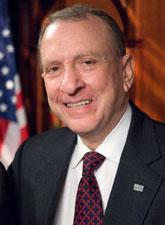 Sen. Arlen Specter (R-PA)
Legislative Activity
Stay on top of the latest movement without scrolling through every action
Senate amendment proposed (on the floor): Amendment SA 68 proposed by Senator Specter.(consideration: CR S1341-1346; text: CR S1341-1342)
January 22, 2003
View full timeline
Senate amendment proposed (on the floor): Amendment SA 68 proposed by Senator Specter.(consideration: CR S1341-1346; text: CR S1341-1342)
January 22, 2003
Roll call votes on amendments in Senate: Motion to table amendment SA 68 agreed to in Senate by Yea-Nay Vote. 64 - 31. Record Vote Number: 18.
January 22, 2003
Amendment SA 68 proposed by Senator Specter. (consideration: CR S1341-1346; text: CR S1341-1342) To provide special minimum funding requirements for certain pension plans maintained pursuant to collective bargaining agreements.
January 22, 2003
Motion to table amendment SA 68 agreed to in Senate by Yea-Nay Vote. 64 - 31. Record Vote Number: 18.
January 22, 2003
Senate amendment submitted
January 21, 2003
Votes
1 roll call on this amendment
Text
Proposed
MAKING FURTHER CONTINUING APPROPRIATIONS FOR FISCAL YEAR 2003--
Continued

Amendment No. 40

The PRESIDING OFFICER. Who yields time on the motion to waive?
The Senator from Rhode Island.
Mr. REED. Madam President, before recognizing my colleague, Senator
Durbin, let me say the Reed-Durbin amendment would provide up to 1
million Americans who are long-term unemployed and were not assisted by
the January 8 amendment we passed. This would be a positive stimulus
for our economy. These benefits would be paid out until the economy
came back and then automatically stop. It also recognizes the
structural changes. The high-tech meltdown and the exodus of
manufacturing have left many people without jobs. They need our help
now.
Our economy is in distress. We have to help these hard-working
Americans. We cannot wait any longer because as we wait, they invade
their 401(k)s, they extend their credit cards, they do anything to make
ends meet. We should help them now.
I yield the remainder of my time to the Senator from Illinois.
Mr. DURBIN. I thank the Senator from Rhode Island for yielding. I am
happy to cosponsor this amendment with him. I am glad it has finally
come to a vote.
I listened to the arguments yesterday by the Senators from Oklahoma
and Iowa and others who suggested this recession is not that bad; we
really should not be talking about a million people who have exhausted
their unemployment benefits; things were a lot worse 12 or 13 years
ago.
The unemployment rate in the United States of America has increased
over 50 percent since October of 2000. We now have 6.0 percent or more
who are unemployed in this country, a million of whom have exhausted
their unemployment benefits. When the President said he was going to
help these families, he forgot a million Americans, 53,000 in my State.
I hope my colleagues in the Senate will understand that the money we
have collected over the years and we put in the unemployment trust fund
is money designed specifically for this purpose.
Previous Presidents, Democrats and Republicans alike, have noted the
need to help these struggling families. We cannot turn our backs on
them. We will have a chance today by voting yes on this amendment, and
I hope my colleagues on both sides will join in that effort.
I yield the floor.
The PRESIDING OFFICER. Who yields time?
The Senator from Oklahoma.
Mr. NICKLES. Madam President, how much time is remaining on both
sides?
The PRESIDING OFFICER. The Senator from Oklahoma has 2\1/2\ minutes.
The Senator from Rhode Island has 36 seconds.
Mr. NICKLES. Madam President, I urge my colleagues to vote no on the
motion to waive the budget point of order. I am afraid we are going to
have to decide this many times, are we going to be waiving the budget
every time we turn around?
There is a reason a budget point of order lies against this
amendment. We are on an appropriations bill. Instead of trying to pass
appropriations, some people are saying, let's expand entitlements.
It so happens we did this January 7. The Senate unanimously passed a
bill to expand unemployment compensation, extend the present law
through May, and it cost us about $7.2 billion.
Now our colleagues are coming back and saying: This is a 13-week
Federal program. Let's make it a 26-week Federal program, except let's
even do more. The Federal program today is up to 13 weeks. The bill we
have before us says all States get a mandatory 26 weeks. It is not
coupled to what the State programs have.
We have never done that in the history of the United States. We have
always coupled Federal unemployment extensions with the State program.
But that is not what this amendment does. The amendment was not drafted
well and was not thought out well. It is very expensive. It is about
the fifth iteration we have seen, and it is still not done very well.
I urge my colleagues, if they want to do it, introduce the bill, have
it referred to the appropriate committee, have that committee have
hearings on it and mark it up with professional staff to do a good job.
This is grossly irresponsible. It would cost $6.3 billion.
I ask unanimous consent to have printed in the Record a Congressional
Budget Office letter stating that fact.
There being no objection, the material was ordered to be printed in
the Record, as follows:
U.S. Congress,

Congressional Budget Office,

Washington, DC, January 22, 2003.
Hon. Don Nickles,
Chairman, Committee on the Budget, U.S. Senate, Washington,
DC.
Dear Mr. Chairman: As requested by your staff, CBO has
prepared a preliminary estimate of the costs of amendment
number 40 to House Joint Resolution 2. This amendment would
expand the Temporary Extended Unemployment Compensation Act
of 2002 (as amended by Public Law 108-1) to provide
additional weeks of federal unemployment benefits by
increasing the maximum number of additional weeks of benefits
available in all states from 13 to 26. The amendment also
would change the number of weeks available in states with
high unemployment from 13 to 7.
CBO estimates that enactment of this amendment would
increase outlays by between $5.8 billion and $5.9 billion in
2003, and by about $500 million in 2004, for a total cost of
about $6.3 billion. Under our most current estimates, there
would be no significant budgetary effects in subsequent
years. Under the March 2002 baseline assumptions, there would
be an offsetting increase in revenues in later years because
this spending would reduce the amount of Reed Act transfers
assumed under the March projections. However, CBO has not yet
estimated this effect.
If you have additional questions about this estimate, we
will be pleased to provide them. The CBO staff contact is
Christi Hawley Sadoti, who may be reached at 226-2820.
Sincerely,
Barry B. Anderson,
Acting Director.
Mr. NICKLES. Colleagues, let's have regular order in the Senate. Why
have the Finance Committee have jurisdiction over an issue if we are
just going to skip the committee and consider it on the floor? Are we
going to do this with every authorizing committee: There is an
appropriations bill, let's ignore the authorizing committee and come up
with all kinds of entitlement expansions. That is the reason a budget
point of order lies against this. That budget point of order is well
taken.
This chairman of the Budget Committee plans on enforcing the budget.
I urge my colleagues to vote no on the motion to waive the Budget Act.
Mr. KENNEDY. Since President Bush assumed office in January 2001, the
economic well-being of America's families has significantly
deteriorated, and a major cause of this crisis for so many families is
the economic policy of the Bush administration, which has neglected the
basic needs of working men and women, lavished extravagant tax breaks
on the wealthiest taxpayers, and allowed corporate abuse and excess to
go unchecked.
Today, nearly 8.6 million Americans are unemployed--2.6 million more
than when President Bush took office. Due to the lack of available
jobs, the number of long-term unemployed--those out of work for more
than 6 months, has now soared to nearly 2 million--a 70 percent
increase from last year. Long-term unemployment has increased in every
month since March 2001. It is clear that Congress needs to do more for
these Americans, who have worked hard, played by the rules, and are
suffering because of the economic downturn.
The new law enacted earlier this month provided needed assistance for
many of the unemployed, but it does nothing for the 1 million long-term
unemployed who have run out of their State and Federal unemployment
benefits and still have not found jobs. These Americans are struggling
to make ends meet. Many have depleted their savings

[[Page S1326]]

and refinanced their homes. A tragic number are facing foreclosure.
In Massachusetts, nearly 170,000 workers are unemployed. Ninety
thousand of those workers will be helped by the new law. But more than
30,000 of those hardest hit by the recession have run out of all of
their State and Federal benefits and are still out of work.
The unemployment trust fund now contains about $25 billion. It was
intended for just this kind of situation. We now have an opportunity to
extend unemployment compensation to families across this country who
have lost their jobs through no fault of their own, but have not yet
found a new job. They deserve this lifeline during this difficult time,
before they are able to get back on their feet.
The issue is fundamental fairness.
At other times in recent years, Republicans and Democrats have come
together to provide this urgently needed support. The first President
Bush signed into law three benefit extensions for those who had run out
of their State and Federal benefits. The same is true of the recessions
of the 1970s and 1980s. Congress recognized each time that benefits
were insufficient to reach the workers who were hardest hit. We acted
to give them a safety net. It's time to live up to this standard now
and provide unemployment benefits for these 1 million workers. These
benefits are their lifeline, and Congress should act as soon as
possible to provide the assistance they deserve.
Mr. GRASSLEY. Mr. President, I rise in opposition to the amendment by
my colleague from Rhode Island. While I understand his desire to
address the problem of unemployment, I would suggest this is neither
the time nor the place to do so.
First, I would remind my colleagues that this amendment would
increase mandatory spending in an appropriation bill, and therefore is
subject to a 60-vote point of order.
Second, let's remember what we've already done to address this issue.
Last year, Congress voted to provide more than $11 billion in federally
funded benefits, and we voted earlier this month to provide an
additional $7 billion on top of that. That's a total of $18 billion in
federally funded unemployment benefits.
Third, I would suggest this amendment is based on a faulty premise.
On one hand, my colleague seems to suggest unemployment is worse than
ever before. On the other hand, he suggests this amendment is no more
than we've done before.
I would suggest he is mistaken on both counts.
The truth is this amendment represents the greatest expansion of
Federal unemployment benefits in history, and it is being proposed at a
time when unemployment is well below historical recession levels.
Let's be clear about what this amendment does. It would provide a
minimum of 26 weeks of federally funded unemployment benefits and a
maximum of 33 weeks--at an additional cost of more than $6 billion.
The last--and only time--Congress provided up to 33 weeks of
unemployment benefits was back in 1992 when the unemployment rate
reached nearly 8 percent. Today, the unemployment rate is 6 percent.
Moreover, every other time Congress has provided federally funded
unemployment benefits, they have been linked to the duration of State
benefits. This amendment would provide between 26 and 33 weeks of
Federal benefits without regard to the duration of State benefits. This
is an unprecedented expansion of the unemployment program.
It violates the insurance principles inherent in the unemployment
program by breaking the link between the time someone has worked to the
time that person can collect unemployment benefits. This amendment
would allow someone who worked as few as 20 weeks to collect as much as
33 weeks of federally funded benefits. This is neither the right time,
the right place, nor the right way to change the unemployment program.
Unemployment has not risen to the historical level of previous
recessions. Moreover, a uniform duration of benefits would violate
every historical precedent.
I urge my colleagues to sustain the point of order and defeat this
amendment.
Mr. KERRY. Mr. President, right now the American people are dealing
with tough economic times. Over 1 million Americans have exhausted
their unemployment benefits without finding a job, more than 30,000 of
those people are from my home State of Massachusetts. Can you imagine
how hopeless these workers are to be at the end of their benefits with
no job? I've heard from so many of my constituents recently about the
great difficulties they're having finding jobs and how scared they are
about providing for their families when their benefits run out. These
are people who are desperate to work, but they've found that jobs are
simply not available right now. In fact, there are 1.5 million fewer
jobs today than in March 2001 when the current economic downturn began,
and the number of jobs in the economy has been stagnant for several
months.
I am pleased that Senator Reed has offered an amendment to the
omnibus appropriations bill to provide additional weeks of benefits to
the long-term unemployed, to those 1 million American workers whose
benefits have already expired. I am a cosponsor of Senator Reed's
amendment, although unfortunately I will not be present to vote in
support of the motion to waive the budget act today. When we passed S.
23 on the first day of the 108th Congress, we extended benefits for one
group of the unemployed, but ignored this equally deserving group. It
is totally unfair to me that we have not provided benefits to the long-
term unemployed, particularly when we know that the current
unemployment rate of 6.0 percent is the highest rate in nearly 9 years
and is higher than when the Temporary Emergency Unemployment
Compensation program was created.
Twenty percent of America's unemployed have been without work for
more than twenty-six weeks and that percentage is still growing. We
must not leave the long-term unemployed and their families with no
where to turn. I urge my colleagues to support the Reed amendment.
The PRESIDING OFFICER. The Senator from Rhode Island.
Mr. REED. I yield 10 seconds to the Senator from Maryland.
Mr. SARBANES. Madam President, I point out that taxes have been paid
into the unemployment insurance trust fund for the purpose of paying
unemployment insurance in an economic downturn. That fund has close to
$25 billion in it. About $7 billion was used in the last legislation we
passed. The purpose of paying that money in good times is to be able to
pay it out in bad times. I support this amendment.
Mr. REED. Madam President, we might be able to wait here for
procedural niceties, but the million Americans who are desperate for
jobs and can't find jobs cannot wait. I urge passage.
I request the yeas and nays.
The PRESIDING OFFICER. Is there a sufficient second? There is a
sufficient second.
The question is on agreeing to the motion.
The clerk will call the roll.
The assistant legislative clerk called the roll.
Mr. REID. I announce that the Senator from California (Mrs.
Feinstein), the Senator from Iowa (Mr. Harkin), the Senator from South
Carolina (Mr. Hollings), the Senator from Hawaii (Mr. Inouye), the
Senator from Massachusetts (Mr. Kerry) and the Senator from Connecticut
(Mr. Lieberman) are necessarily absent.
I further announce that, if present and voting, the Senator from
Massachusetts (Mr. Kerry) would vote ``Aye''.
The PRESIDING OFFICER. Are there any other Senators in the Chamber
desiring to vote?
The yeas and nays resulted--yeas 45, nays 49, as follows:

[Rollcall Vote No. 14 Leg.]

YEAS--45

Akaka
Baucus
Bayh
Biden
Bingaman
Boxer
Breaux
Byrd
Cantwell
Carper
Chafee
Clinton
Conrad
Corzine
Daschle
Dayton
Dodd
Dorgan
Durbin
Edwards
Feingold
Graham (FL)
Jeffords
Johnson
Kennedy
Kohl
Landrieu
Lautenberg
Leahy
Levin
Lincoln
Mikulski
Murray
Nelson (FL)
Nelson (NE)
Pryor
Reed
Reid
Rockefeller
Sarbanes
Schumer
Snowe
Specter
Stabenow
Wyden

[[Page S1327]]

NAYS--49

Alexander
Allard
Allen
Bennett
Bond
Brownback
Bunning
Burns
Campbell
Chambliss
Cochran
Coleman
Collins
Cornyn
Craig
Crapo
DeWine
Dole
Domenici
Ensign
Enzi
Fitzgerald
Frist
Graham (SC)
Grassley
Gregg
Hagel
Hatch
Hutchison
Inhofe
Kyl
Lott
Lugar
McCain
McConnell
Miller
Murkowski
Nickles
Roberts
Santorum
Sessions
Shelby
Smith
Stevens
Sununu
Talent
Thomas
Voinovich
Warner

NOT VOTING--6

Feinstein
Harkin
Hollings
Inouye
Kerry
Lieberman
The PRESIDING OFFICER. On this vote, the yeas are 45, the nays are
49. Three-fifths of the Senators duly chosen and sworn not having voted
in the affirmative, the motion is rejected. The point of order is
sustained and the amendment falls.
Mr. REID. Madam President, I suggest the absence of a quorum.
The PRESIDING OFFICER. The clerk will call the roll.
The assistant legislative clerk proceeded to call the roll.
Mr. DASCHLE. Madam President, I ask unanimous consent that the order
for the quorum call be rescinded.
The PRESIDING OFFICER. Without objection, it is so ordered.

Amendment No. 79

Mr. DASCHLE. Madam President, I call up amendment No. 79.
The PRESIDING OFFICER. The clerk will report the amendment.
The assistant legislative clerk read as follows:

The Senator from South Dakota (Mr. Daschle) proposes an
amendment numbered 79.

Mr. DASCHLE. Madam President, I ask unanimous consent that reading of
the amendment be dispensed with.
The PRESIDING OFFICER. Without objection, it is so ordered.
The amendment is as follows:

(Purpose: To provide emergency disaster assistance to agricultural
producers)

Beginning on page 1032, strike line 21 and all that follows
through page 1040, line 25, and insert the following:

TITLE II--EMERGENCY AGRICULTURAL DISASTER ASSISTANCE

SEC. 201. SHORT TITLE.

This title may be cited as the ``Emergency Agricultural
Disaster Assistance Act of 2003''.

SEC. 202. CROP DISASTER ASSISTANCE.

(a) In General.--The Secretary of Agriculture (referred to
in this title as the ``Secretary'') shall use such sums as
are necessary of funds of the Commodity Credit Corporation to
make emergency financial assistance authorized under this
section available to producers on a farm that have incurred
qualifying crop losses for the 2001 or 2002 crop, or both,
due to damaging weather or related condition, as determined
by the Secretary.
(b) Administration.--The Secretary shall make assistance
available under this section in the same manner as provided
under section 815 of the Agriculture, Rural Development, Food
and Drug Administration, and Related Agencies Appropriations
Act, 2001 (Public Law 106-387; 114 Stat. 1549, 1549A-55),
including using the same loss thresholds for the quantity and
quality losses as were used in administering that section.
(c) Crop Insurance.--In carrying out this section, the
Secretary shall not discriminate against or penalize
producers on a farm that have purchased crop insurance under
the Federal Crop Insurance Act (7 U.S.C. 1501 et seq.).

SEC. 203. LIVESTOCK ASSISTANCE PROGRAM.

(a) In General.--The Secretary shall use such sums as are
necessary of funds of the Commodity Credit Corporation as are
necessary to make and administer payments for livestock
losses to producers for 2001 or 2002 losses, or both, in a
county that has received a corresponding emergency
designation by the President or the Secretary, of which an
amount determined by the Secretary shall be made available
for the American Indian livestock program under section 806
of the Agriculture, Rural Development, Food and Drug
Administration, and Related Agencies Appropriations Act, 2001
(Public Law 106-387; 114 Stat. 1549, 1549A-51).
(b) Administration.--The Secretary shall make assistance
available under this section in the same manner as provided
under section 806 of the Agriculture, Rural Development, Food
and Drug Administration, and Related Agencies Appropriations
Act, 2001 (Public Law 106-387; 114 Stat. 1549, 1549A-51).

SEC. 204. FUNDING.

Of the funds of the Commodity Credit Corporation, the
Secretary shall--
(1) use such sums as are necessary to carry out this title,
to remain available until expended; and
(2) transfer to the fund established by section 32 of the
Act of August 24, 1935 (7 U.S.C. 612c), to remain available
until expended, an amount equal to the amount of funds under
section 32 of that Act that--
(A) were made available before the date of enactment of
this Act to provide assistance to livestock producers under
the 2002 Livestock Compensation Program announced by the
Secretary on October 10, 2002 (67 Fed. Reg. 63070); and
(B) were not otherwise reimbursed from another account used
by the Secretary or the Commodity Credit Corporation.

SEC. 205. EMERGENCY DESIGNATION.

(a) In General.--The entire amount made available under
this title shall be available only to the extent that the
President submits to Congress an official budget request for
a specific dollar amount that includes designation of the
entire amount of the request as an emergency requirement for
the purposes of the Balanced Budget and Emergency Deficit
Control Act of 1985 (2 U.S.C. 900 et seq.).
(b) Designation.--The entire amount made available under
this section is designated by Congress as an emergency
requirement under sections 251(b)(2)(A) and 252(e) of that
Act (2 U.S.C. 901(b)(2)(A), 902(e)).

SEC. 206. BUDGETARY TREATMENT.

Notwithstanding Rule 3 of the Budget Scorekeeping
Guidelines set forth in the Joint Explanatory Statement of
the Committee of Conference accompanying Conference Report
No. 105-217, the provisions of this title that would have
been estimated by the Office of Management and Budget as
changing direct spending or receipts under section 252 of the
Balanced Budget and Emergency Deficit Control Act of 1985 (2
U.S.C. 902) were it included in an Act other than an
appropriation Act shall be treated as direct spending or
receipts legislation, as appropriate, under section 252 of
the Balanced Budget and Emergency Deficit Control Act of 1985
(2 U.S.C. 902).

The PRESIDING OFFICER. The Senator from Mississippi.

Amendment No. 204

(Purpose: To provide agricultural assistance)

Mr. COCHRAN. Madam President, I call up Cochran amendment No. 204.
The PRESIDING OFFICER. The clerk will report the amendment.
The assistant legislative clerk read as follows:

The Senator from Mississippi [Mr. Cochran] proposes an
amendment numbered 204.

Mr. COCHRAN. Madam President, I ask unanimous consent that reading of
the amendment be dispensed with.
The PRESIDING OFFICER. Without objection, it is so ordered.
(The amendment is printed in the Record of January 21, 2003, under
``Text of Amendments.'')
Mr. DASCHLE. Madam President, just for the information of all
Senators, the order that has been agreed to will accommodate debate on
both the Cochran amendment and the Democratic amendment simultaneously.
There will be 70 minutes equally divided to accommodate Senators who
wish to speak to the amendments. I am sure we will accommodate Senators
on both sides of the aisle in an attempt to alternate back and forth as
people wish to speak. So both amendments are pending and both
amendments are subject to comment by our colleagues.
I appreciate, as always, the great willingness on the part of the
chairman of the Agriculture Committee to enter into this agreement and
to accommodate this debate as we anticipate it.
It has been 342 days since the effort was first initiated to bring
about meaningful disaster relief to many parts of the country. During
those 342 days, I don't know how many hours we spent on the Senate
floor attempting to inform our colleagues and urging the Senate to act
as expeditiously as it could to address the concerns of so many farmers
and ranchers.
We did it first in the farm bill itself. We attempted to provide
meaningful disaster assistance within the farm legislation. It passed
in the Senate. In conference, I had a number of conversations with the
chair of the Agriculture Committee in the House and with the Speaker,
and it was the view, almost unanimously expressed in the House, that
they would not be willing to support disaster assistance on the farm
bill. They said: We will come back at a later date and address it in a
sufficient way. So we completed our work on the farm bill and
anticipated we would have an opportunity to pass meaningful assistance
later in the year.
When the Interior appropriations bill came before the Senate, we
offered an amendment, and it generated 79 votes. That amendment
provided about $6 billion in direct assistance to farmers and ranchers.
Forty different farm organizations publicly expressed their support for
the effort. Over and over again, people said: This must be urgent. You
have to understand the extraordinary

[[Page S1328]]

urgency of what is happening and the need for this relief as quickly as
you can get it to us.
Madam President, just for the record, I note that I will use my
leader time to make my remarks with regard to the amendment so that I
can accommodate other Senators who wish to speak.
The PRESIDING OFFICER. The leader has that privilege.
Mr. DASCHLE. So we adopted that amendment with 79 votes, with every
expectation that we could get help to the farmers and ranchers who need
it as quickly and as meaningfully as possible.

Almost from the beginning, the administration's position was that we
just could not afford it; that the $6 billion was out of line; that it
was too expensive; that there really was not a way to provide the
resources to help farmers and ranchers with the magnitude of help we
proposed in the amendment.
I must say, I find it deeply troubling that at the very time the
administration says we cannot afford the $6 billion in disaster
assistance, they come forth with a $670 billion tax cut, a tax cut that
helps those at the very top, with very little support for anyone else--
borrowing the money, I might add.
So, on one hand, the administration is saying to the American people,
somehow we can afford a tax cut, $20 billion of which will go to 226
millionaires, at the very time we do not have the resources, we do not
have the will, we do not have the support for $6 billion for farmers
and ranchers.
I have to say, over the course of the last 342 days, time and time
and time again, people have come to us saying: We don't understand
either, but we hope that however you ultimately decide to help us, you
help us soon.
There are places in South Dakota that have not had rain for months.
There are places in South Dakota where we had no crop at all last year.
We have locations in our State where virtually all of the livestock
population has been sold off.
In letters, in e-mails, in phone calls, farmers and ranchers--by the
thousands--have contacted the Senate pleading for help, asking that we
do so as quickly as possible. So this is our last chance. This is our
last opportunity, at least for the foreseeable future. I cannot imagine
when we can come back to the Senate floor and try this again.
So we are offering the same amendment that generated 79 votes last
fall. The amendment provides help in the two categories where help is
most needed--the crop disaster assistance program and the livestock
assistance program--with one minor exception. Last fall, the
administration shifted several hundred million dollars to ill-
considered, unresponsive, and underfunded disaster efforts for those
key or niche areas of livestock producers, a very small number of
livestock producers, which amounted to about 2 weeks of assistance
before it expired.
This amendment replenishes what the administration took from that
important account, funding for school lunch and funding for hunger
relief. I must say, I hope everyone will recognize the importance of
taking this action.
As I said, the Senate is already on record; 79 Senators in an
overwhelming bipartisan vote, 40 organizations, including the Farmers
Union, the Farm Bureau, the National Wheat Growers, the National Cattle
and Beef Association, the National American Soybean Association, 40
farm organizations have said: Help us now. Do what you were not able to
do last year. Join as you did last year. Pass this meaningful
assistance. We have waited too long.
I hope people recognize there is a difference between the two
amendments. I have the utmost respect for the Senator from Mississippi,
the chairman of the Senate Agriculture Committee. He will do an
outstanding job as chair of the committee itself. We don't stipulate a
dollar figure in this amendment. We leave that to the administration to
define. We simply say: Let's meet the need that is there, meet the need
in crop assistance, meet the need in livestock assistance, but meet the
need that is there.
The alternative says: We know the need is there, but we are only
going to provide $3 billion to meet that need. We recognize it may only
be half but, I suppose they would argue, at least it is something.
We need more than just something. We need to provide the kind of
assistance that is so desperately needed in the dead of winter to
ensure that at long last, those who have waited so long get the help
they truly deserve.
I yield the floor.
The PRESIDING OFFICER. Who yields time? The Senator from Mississippi.
Mr. COCHRAN. Madam President, let me compliment the distinguished
Democratic leader for his effort to get an agreement under which we
could carefully and thoughtfully consider this issue in the Senate. We
have reached that agreement, and we have two alternatives now pending
before the Senate: The so-called Daschle amendment and the Cochran
amendment.
For the information of Senators, these are not the only efforts that
have been made up to this point to deal with the disaster facing
agriculture. In fairness, we have to acknowledge that the
administration has been working very diligently to use existing
authority to make payments to producers under the authority of current
law to deal with the losses being suffered in production agriculture
and in the livestock industry. Specifically, the Risk Management Agency
of the Department of Agriculture has been supervising the payment of
crop insurance benefits and so far $4.1 billion in crop insurance
indemnities have been paid to producers across the country.
In addition, the Livestock Compensation Program has been utilized to
the extent of the payment of $932 million by the Department of
Agriculture, and for the Livestock Feed Assistance Program, outlays of
$150 million have been made available. Adding up these three specific
instances of assistance, we can see that $5.182 billion of benefits
have been paid to agricultural producers.
I agree with what the distinguished Senator from South Dakota has
said: That is not enough. So we come here today trying to define new
authorities for the Department of Agriculture under which additional
benefits can be made available to compensate farmers for losses that
have been sustained because of not only drought, which has been
devastating in some parts of the country, but also other adverse
weather conditions--excessive rainfall at the time in the South where
farmers were trying to get into the fields to harvest cotton, to
harvest other crops, and were not able to do so because of the
difficult conditions created by excessive rainfall.

All of these producers will be eligible for benefits under the
Cochran amendment. It will be capped however. The CBO, the
Congressional Budget Office, estimates the outlays under this amendment
would amount to $3.1 billion. The additional fact to be kept in mind
is, under our scoring procedures, trying not to add to the deficit with
this amendment, we have offset the spending under the Appropriations
Committee bill to which this amendment is added, so that this is not
going to be new spending under this amendment.
By comparison with the Daschle amendment, the $6.5 billion that the
Congressional Budget Office estimates that amendment will cost will be
added to the deficit. It is not offset. It is declared an emergency.
And under the Budget Act, that is one way of funding disasters that are
unanticipated. I am not suggesting it is illegal, but it simply does
have budget implications in terms of additions to the deficit that the
Cochran amendment does not.
We also try to deal with the disaster in terms of defining the areas
where benefits could be made available. These basically are in disaster
counties, counties that have been declared a disaster under current law
by the Department of Agriculture or by the President. Other farmers who
are located outside of those designated areas, if they can prove a loss
up to 35 percent, may do that, and they will be eligible for
compensation just as farmers who are located in the disaster
declaration areas.
We are trying to make this applicable to those who have suffered
disasters. At one point some Senators raised a question about the
wording of this amendment I offer today because it appeared to make
available benefits to

[[Page S1329]]

those who might not have had a disaster or may not have suffered any
economic losses due to any kind of disaster. We hope we have tightened
up the definition of eligibility so only those where there have been
declarations of disaster or where they can prove they suffered damages
up to 35 percent will be eligible for benefits. We hope we have taken
care of that difficulty. We appreciate the fact that Senators are not
bashful normally and they were not in this case either when they
disagreed with some parts of this amendment as it was earlier drafted
and brought this to our attention.
We tried to accommodate those concerns, and we think the amendment
has been improved to the extent that it merits the support of the
Senate.
We hope Senators on both sides of the aisle will look at the
suggestions we have made carefully. We have tried to cover livestock
producers as well as row crop producers. Other specialty vegetable
crops and the like are covered as well. We think this is a generous but
responsible way to deal with the problem. We hope Senators will vote
for the amendment.
The PRESIDING OFFICER. The Democratic leader.
Mr. DASCHLE. Madam President, there are a number of our colleagues
who have asked to be recognized. I don't want to take a lot of time
because we have a lot of Senators who wish to be heard.
There is one difference between the two amendments of which I think
all of our colleagues ought to be aware. Under the Cochran amendment,
in disaster counties, counties declared disaster, every producer is
eligible regardless of loss. In my State, there are counties that were
declared disaster that had pockets where they had all the rain they
needed, where there are livestock producers who really don't need any
assistance.
What we are doing is taking away from those who need assistance to
provide resources to those who don't need it by not differentiating, by
not having some qualification, by not saying they have to meet this
threshold.
What our amendment says is, they have to have incurred at least a 35-
percent loss to be eligible for benefits, even in those counties
declared disaster. There is no discretion in that regard in the Cochran
amendment.
I yield 2 minutes to the distinguished Senator from Wisconsin.
Mr. KOHL. Madam President, I rise in support of the amendment being
offered by Senator Daschle to provide much-needed assistance to our
Nation's farmers who have been hard hit by a series of natural
disasters, notably severe drought that has destroyed crops and harmed
livestock operations in many States. Although my State of Wisconsin has
not suffered the losses that most other farm States have faced these
last 2 years, wise, Wisconsin farmers have been hurt by natural
disasters in the past and probably will be again in the future. And
until we come up with an agriculture policy that protects farmers from
ruin when drought, or floods, or tornadoes, or disease strikes,
Wisconsin will stand by other farm States as they seek disaster
assistance.
Before I yield the floor to other Senators who would like to speak on
this amendment, I would like to take a moment to briefly comment on the
fiscal year 2003 appropriations bill for Agriculture, Rural Development
and Related Agencies. First I commend Senator Cochran on the job he has
done, given the tough fiscal restraints he was facing. It is never easy
to cut funding and balance multiple priorities, and I believe Senator
Cochran has done good work, given the circumstances.
However, there are two items that have been taken out of the bill as
it was originally written, which I believe warrant mention, and
reconsideration.
The bill before us no longer funds an expansion of the Summer Food
Service Program. This increase would have expanded to all 50 States a
successful 13 State pilot program to streamline the process of setting
up a summer feeding site. A report released this summer found that the
13 pilot States increased their participation in the SFSP by 8.9
percent between July 2000 and July 2001. Participation in the rest of
the Nation decreased by approximately 3.3 percent during the same time
period. I have an amendment to restore the funding for this important
program.
I also have an amendment to fund a program authorized in the 2002
Farm Bill and funded in the Agriculture Appropriations bill passed out
of committee last July. The program, initiated by the Girl Scouts of
the USA, Boy Scouts of America, National FFA Organization, and National
4-H Council, allows these experienced and very successful youth
organizations to increase their presence in remote rural communities.
As we pare back on funds for education and other federal initiatives
for our children, we should not also cripple private efforts to bring
programs like Girl Scouts, Boy Scouts, 4-H and Future Farmers of
America to our underserved rural youth.
Again, I thank Senator Cochran and his staff for their hard work.
Overall, I believe this is a good bill, and I look forward to working
together to try and restore the items I just mentioned in a fiscally
responsible manner.
I yield the floor.
The PRESIDING OFFICER. Who yields time?
Mr. COCHRAN. Madam President, I yield 3 minutes to the distinguished
Senator from Nebraska, Mr. Hagel.
The PRESIDING OFFICER. The Senator from Nebraska.
Mr. HAGEL. I thank the Chair.
Madam President, I rise in support of drought disaster aid for
America's drought-stricken agricultural producers and to support the
Cochran amendment to the omnibus appropriations bill.
I wish to also express my thanks to Chairman Stevens, Chairman
Cochran, and their staffs for their hard work and especially for
finding the necessary critical funding to offset the spending in the
bill.
Those of us in drought-stricken States have known for many months
that our farmers and ranchers needed assistance. Unfortunately, in a
year when 80 percent of U.S. counties were declared a disaster, the
House and Senate adjourned last November with neither Chamber having
passed 2002 drought aid.
There is no doubt that disaster relief is justified. In Nebraska,
only the Dust Bowl years of 1934 and 1936 were dryer than what the
State experienced last summer. Since autumn, conditions have only
worsened throughout much of the Plains, as well as most of the West and
Southwest. This has been one of the driest winters in these regions in
more than 100 years.
Nebraska officials are becoming increasingly concerned about
irrigation resources for the upcoming growing season. The water level
at Lake McConaughy, Nebraska's largest reservoir, is 60 percent below
capacity.
With the Federal budget deficit projected to balloon near $300
billion in this fiscal year, Congress must demonstrate fiscal
responsibility. The days of budget surpluses are gone, but at the same
time we must turn our attention to this much-needed drought assistance.
Under this proposal, the Cochran amendment, disaster payments would
get more attention more quickly than under the old crop disaster
formula, and we would help a larger number of farmers and ranchers.
Months ago, the President made it clear that any disaster aid for
agriculture must be offset. Last week, White House agriculture adviser
Chuck Conner reiterated this requirement, telling farm groups that all
disaster aid proposals would be judged upon three criteria: One, cost;
two, available budget offsets; and, three, whether farmers would be
more self-reliant in the end. The Cochran amendment complies with the
President's request.
I urge my colleagues to support the proposal of the chairman of the
Agriculture Committee. I yield the floor.
The PRESIDING OFFICER. The Democratic leader.
Mr. DASCHLE. Madam President, I yield 4 minutes to the Senator from
South Dakota.
The PRESIDING OFFICER. The Senator from South Dakota.
Mr. JOHNSON. Madam President, I thank Senator Daschle for his
leadership on this amendment and express my high regard for Senator
Cochran as well. We now find ourselves in a circumstance where the
drought has gone on for 2001 and 2002 across much of this country,
including in South Dakota, and it has been devastating. There has been
a $2 billion loss to South Dakota's economy alone based on numbers from
South Dakota State University.

[[Page S1330]]

There is a need for urgent relief and comprehensive relief. We had 79
votes in this body for a $6 billion package last year. Now we find
ourselves in a circumstance where we are being told about fiscal
constraints and yet the White House and our colleagues on the other
side of the aisle are telling us they are willing to borrow $674
billion over the coming decade--$108 billion this next year--for a so-
called tax relief plan, but we do not have the resources for a
comprehensive $6 billion drought relief bill in rural America.
If ever there was an initiative that would stimulate the economy of
rural America, it is the comprehensive $6 billion amendment before us
today, and it would fit very nicely within the context of the enormous
stimulus initiative coming to us from the White House and from our
colleagues.
While I appreciate the work that has gone into the alternative bill
presented by the Senator from Mississippi, it is half the money. With
respect to aid for livestock producers, arguably the hardest hit, $1.5
billion would be available for livestock under the bill I support and
Senator Daschle supports as opposed to only $250 million under the
alternative version.
By applying the AMTA payments, we wind up with gross inequities in
the plan offered by the other side. In one of my counties, for
instance, it is a primary disaster area, but it has been determined
that just 23 percent of its 1,200 farmers have experienced crop or hay
losses meeting or exceeding the 30-percent threshold that normally
triggers disaster relief. That means 77 percent of the farmers in that
disaster county have not experienced significant crop or hay losses but
will still get an AMTA payment from the alternative plan.
Meanwhile, a rancher in a western county in South Dakota with whom I
spoke this morning said his average AMTA payment is just $250 per year
because he is primarily a cattle producer. Under the alternative plan,
he would receive a $250 AMTA payment, which would purchase just a
couple bales of hay, and be forced to compete with other producers for
just $250 million annually remaining for livestock producers, and that
is spread across the entire country.
On top of that, under the alternative plan, producers must pick
drought payments from 2001 or 2002, but not from both, and there is
concern over a $10 million grant for Texas farmers and $50 million
carved out for cotton as opposed to the comprehensive crop loss
coverage under the Daschle bill that I am cosponsoring.
Simply put, the amendment I have cosponsored provides real,
comprehensive aid to crop farmers and livestock producers who suffered
actual losses to the drought or other natural disasters. The
alternative plan provides aid to producers regardless of loss. It
simply is not fair.
It ought to be apparent which bill provides the real assistance and
real relief. We are seeing a hemorrhage of farmers and ranchers off the
land. It hits the youngest producers worst. Those least capitalized are
least able to sustain their operations throughout all of this crisis.
We have rancher after rancher who have liquidated their animals. Young
people are leaving the land. We are falling below the critical mass of
population in many of our rural areas to sustain basic rural
institutions.

At a time when this body is debating economic stimulus, I can think
of no other initiative that would do more for rural America than this
$6 billion drought bill in the context of the $108 billion that has
been proposed by the White House as economic stimulus for this year
alone.
It makes sense for this initiative to pass now. I ask support of the
Daschle amendment.
The PRESIDING OFFICER. The Senator's time has expired.
Who yields time?
Mr. COCHRAN. Madam President, I yield 5 minutes to the distinguished
Senator from Texas.
The PRESIDING OFFICER. The Senator from Texas.
Mrs. HUTCHISON. I thank the Chair.
Madam President, I thank Senator Cochran for all his amendment does
to deal with the drought and the severe crises in the agricultural
community in our country.
I want to specifically speak about a part of this amendment that
affects my home State and thank him for the support he has given to the
farmers who live in south Texas and who are suffering because Mexico
has refused to meet its requirements under the 1944 water treaty with
the United States.
Farmers, families, and communities in the Rio Grand Valley of Texas
have suffered devastating economic losses due to Mexico's refusal to
comply with this treaty. The treaty obligates Mexico to allow an
average of 350,000 acre feet of water to flow into the Rio Grande River
annually for the United States, while obligating the United States to
allow an average of 1.5 million acre feet of water to flow to Mexico
from the Colorado River.
Even during the hardest times, since 1944 America has strictly
complied with its obligations under the treaty of 1944, but Mexico has
accrued a deficit of 1.5 million acre feet. Mexico claims that drought
conditions in Chihuahua prevented it from releasing Rio Conchos water
into the Rio Grande. However, Mexico's agricultural production in
Chihuahua has blossomed.
Recent reports by Texas A&M University's Extension Service,
accompanied by NASA satellite photographs from the University of Texas,
document Mexico's increased use of irrigation water to promote high
value water-dependent crops such as corn, oats, forage, and vegetables
in the state of Chihuahua. We can see from this satellite photograph
the Madero Reservoir's water storage is at 14-percent capacity on June
25 of 2002. Even during the low 14-percent water storage, Mexico
continued to irrigate its fields. However, two months later, August 28,
2002, the Madero's water storage has risen to 75 percent of its total
capacity and we still couldn't get Mexico to comply with the treaty and
fully deliver its water obligations to South Texas this year.

We cannot stand by and allow our farmers and ranchers to suffer
because an international treaty is not being met. This satellite image
clearly shows Mexico is holding the water it owes the U.S. While its
reserves are full, Mexico only delivers the bare minimum this year.
Furthermore, Mexico is making no effort to repay its debt. I find it
incomprehensible that Mexico would not even comply this year when it
clearly has the water available.
Mexico's domestic agricultural production is flourishing with U.S.
treaty obligated water while the Rio Grande Valley in Texas is
suffering from a decline of more than 100,000 acres of farmland, nearly
a $1 billion net loss to the regional economy and 30,000 lost jobs.
Many agricultural operations have been forced to go out of business
and many are expected to fail unless the United States can resolve this
issue immediately. Agricultural production and its allied industries
are the economic engines of south Texas. It is one of the few weapons
that south Texas has to combat--unemployment and poverty. The United
States cannot afford to stand by and allow Mexico's destruction of an
American industry and the communities and people whose survival depend
on it.
Mexico needs to change its water management practices. I have urged
the President to press Mexico to immediately comply with its
obligations, and the President has done so. He has repeatedly talked to
the President of Mexico, as have I, and many others. If Mexico
continues its refusal to comply with the 1944 water treaty, I think the
United States must consider renegotiating this treaty with Mexico and
taking into consideration the 1.5 million acre feet of water that we
are sending to Mexico every year from the Colorado River.
Texas has suffered severe losses and the Rio Grande Valley's economic
viability and livelihood depend on this water. The United States has a
duty to either force Mexico to deliver the water to South Texas or
compensate Texas families who are paying the price for this abrogation
of the treaty.
Senator Cochran's amendment has $10 million that would be available
for grants through the Texas Department of Agriculture----
The PRESIDING OFFICER. The Senator has used her 5 minutes.
Mrs. HUTCHISON. To help these farmers stay in business. I thank the
Senator for helping us get through this hard time while we try to make
Mexico keep its commitments.

[[Page S1331]]

The PRESIDING OFFICER. The minority leader.
Mr. DASCHLE. I yield 4 minutes to the Senator from Nebraska.
The PRESIDING OFFICER. The Senator from Nebraska.
Mr. NELSON of Nebraska. Madam President, I thank the Democratic
leader for this time to speak about the need for disaster relief, and I
commend my good friend and colleague from Mississippi, the chair of the
Senate Agriculture Committee, for bringing forth his proposal.
The debate today is not simply about disaster relief. It is about
economic stimulus, and it looks to me as if the debate has already
begun. Part of the stimulus package will involve tax cuts. Obviously,
for a State such as Nebraska, tax cuts can be helpful, but to many
farmers and ranchers who have no taxable income, who are about to lose
their farms, who are about to lose their ranches and everything they
have owned and that has been in the family for generations, a tax cut
simply is not going to be enough.
That is not an argument against the tax cut. It is an argument real
stimulus. It is an argument in favor of disaster relief.
Let's put a face on this problem. Let's go to southwest Nebraska, my
home area, not far from Saint Francis, KS, where the distinguished
Democratic leader's wife hails from. Randy Peters, who lives on his
family farm that has been in the family for generations, when I say,
look, we are getting you tax cuts, he will say, I appreciate that,
Senator, that is nice. I then say, maybe part of the package will be
eliminating the taxes on your dividends, and he says, that is great
but, Senator, but the problem is that right now I do not have any
taxable income. I spent all my savings on the farm and so I do not even
have any dividends to be sheltered, and besides they are raising my
taxes in Lincoln. What can you do to help me?
I say to him and I say to my colleagues, the best way we can help
those who are experiencing the ravages of this drought is to simply
move forward and pass enough in disaster relief to take care of the
problem.
I have heard, and I suspect it will be suggested, that something is
better than nothing. I agree, something is better than nothing, but in
this case, something is just not good enough. We ought to be talking
about how we are going to do something that is good enough to take care
of those who are having this unfortunate experience we are seeing
today.
There seems to be no relief in sight from the drought. Every
forecast, every suggestion for the future, indicates an indefinite
drought, but there can be financial relief if we will step forward and
make sure we provide for enough, not less than what is required.
As we debate the whole area of economic stimulus, I hope we are not
going to be in a position where we say to the White House, we know
something is better than nothing and they know something is better than
nothing. But we are not going to be able to do everything that is
necessary because if we are going to require offsets consistently
whether it is disaster relief or other spending, then I suppose the
question has to be raised: Where is the offset on the stimulus package?
If that is the case, maybe there is not enough. Something, of course,
is better than nothing.
I do not want to make that argument then, and I do not want to hear
that argument now, because something is better than nothing, we
understand that. But when it is not good enough, we ought to strive
towards making sure we can look Randy Peters and the family farmers and
ranchers across this Nation who are experiencing these challenges in
the eye and say we have done what we can do and it is not just a half a
loaf to feed you for a very short period of time. Let's do enough to
make sure we take care of our agricultural needs for the future.
There is not a better way to take care of rural America than to make
sure our farmers and our ranchers do not lose their farms and ranches
as an experience of this drought that continues today. It is not over.
I have termed it ``Drought David'' as one way of getting it some
attention so it has an identity. What I want to do is make sure we take
care of those farmers and ranchers whose identity may be a little bit
unknown in the hallowed Halls of the Capitol but whose pain is being
felt.
The PRESIDING OFFICER. The Senator has used 4 minutes.
The Senator from Mississippi.
Mr. COCHRAN. Madam President, I am pleased to yield 3 minutes to the
distinguished Senator from Wyoming, Mr. Thomas.
Mr. THOMAS. I rise to support this disaster assistance, one of the
things that is most important for us to deal with in the area I come
from.
I thank the chairman of the committee for putting this bill forward
and going back and making it fit the need. We have to send relief to
people who have had real disasters. I thank also the Democrat leader
for his work. He has worked on it for some time.
We do need, of course, to have balance in our spending. We need to
have some control. We know that. We have to be reasonable about how we
do that.
In Wyoming, this is probably the third year of drought. Fortunately,
up until this last year, we generally had runoff and the irrigating
systems worked reasonably well. This year that is less the case. We do
not have the kind of storage we have had in the past. We need to deal
with this issue.
In Wyoming, livestock is at least equally important as the crops. We
need to adjust that, which has been done here, to make sure livestock
is recognized as well.
We have had natural disasters throughout the country. We have had tax
relief. That is good. But in many cases tax relief is not sufficient
because there is no income to tax. We had a farm bill this year which
changed things. We had an unworkable insurance program. We need to do
something about that so it does work.
We also now have a farm program that is based on loans for crops. If
you do not have a crop, you do not benefit from the farm program. That
has been difficult.
I am pleased we do have an option. We did have a year ago the
opportunity and did vote for a disaster bill at that time. Frankly, it
seemed at the time and still seems that it is very unlikely to pass. We
have to have some results as opposed to just talking about it. That is
what we are talking about, something that we can complete for the
people throughout the country.
This bill is a good bill. The Cochran amendment moves the money
quickly to those who need it. It goes to those who are needy and have
had losses. That is very important.
It does include livestock. We need that, certainly. Also, it is the
kind of budget recognition we need. It has an offset. I urge our
support of the Cochran amendment.
Mr. DASCHLE. I yield 4 minutes to the distinguished Senator from
Montana.
Mr. BAUCUS. Madam President, I hope my colleagues listen to what I
have to say. We all are talking about the need for disaster assistance.
That is undisputed. There are provisions in the Cochran amendment which
do partially address natural disaster, particularly drought disaster,
in our country. I say partially. That is wonderful. That is fine.
I am quite confident the provisions that have helped Texas producers
are needed. I also understand in some parts of the country a natural
disaster occurred, say, in 2002--not 2001. And the amendment before the
Senate, the Cochran amendment, provides 1 year, for 2002. I can
understand why some of my colleagues are in favor of the Cochran
amendment because it helps them, it helps their producers.
Madam President, I can understand why there are tobacco provisions in
the Cochran amendment. I am sure the producers in North Carolina and
South Carolina will get significant benefit from the tobacco
provisions. For all I know, it is well intended and deserved and they
should have it.
We are talking here about a natural disaster. Mother Nature does not
pick and choose years--2001 or 2002. Mother Nature does not choose
which parts of the country it will affect or not affect. Mother Nature
does not choose which farms in a certain county will be hit by disaster
and which farms in the county are not hit.
I start with the good news. Fortunately, the Cochran amendment
provides assistance to those parts of America that have experienced
natural disasters. That is good.

[[Page S1332]]

Unfortunately, the Cochran amendment does not provide assistance to
those other farmers who have experienced disaster in a different way,
those who got hit by disaster in 2001. Nebraska is 2002. Kansas is
2002. My State of Montana is 2002, but it is also 2001. There are
several years of disaster.
The amendment offered by the Senator from South Dakota is designed to
help fairly producers across the country who have experienced natural
disasters, irrespective of where they are, irrespective of whether they
are in a certain county which on average may have 35-percent loss or
not.
The Cochran amendment is unfair. It helps some producers who have not
experienced disasters. That is wrong. The Daschle amendment helps
producers who have experienced disasters. That is fair. That is right.
I only wish the Senators from Mississippi, North Carolina, and other
Senators would come to the high plain States and see what a disaster we
have. It is sad. It is stunning. It is despairing. It is so sad,
looking in people's eyes. Thousands are leaving their places; they are
drying up. It is worse this year even than last year, thus far. It may
rain some more; we do not know.
We, across America, have a big heart. We help Americans who need
help. We have helped those who have experienced hurricane losses. We
helped those with earthquake damage, say, in California or New York in
the Trade Towers. We knew intuitively that is what you do.
I say to my colleagues and all those who are helped, remember those
who are not sufficiently helped.
To sum up in one sentence, we are talking about a few billion. That
does not affect the outyear budget deficit. We can always make
adjustments. We are all concerned about the deficit. Help our people
who need help. In many parts of our country we need help desperately. I
urge colleagues to put aside the partisanship and do what is right for
America and vote for farmers who need the help, help offered in the
amendment of the Senator from South Dakota.
Mr. COCHRAN. Madam President, I yield 10 minutes to the distinguished
Senator from Kansas, Mr. Roberts.
Mr. ROBERTS. I thank the distinguished chairman of the Senate
Agriculture Committee for yielding time to me.
Everyone understands, on a bipartisan basis, I say to the
distinguished Senator from Montana, that we are not in very good shape
with regard to farm country. It does not matter if you have been hit by
hurricane, flood, or record-breaking drought.
Last spring, I warned this is exactly what would happen because the
current farm bill was structured to provide assistance to producers
when they had a crop, but left them dangling in the Kansas, Wyoming,
Nebraska, and Montana wind when there was no crop to harvest, not to
mention other parts of the country suffering these kind of weather
disasters.
It seems to me, and maybe I took it a little personal, we will not
get into partisanship because we have to accomplish some degree of
relief, but I was criticized on the floor of the Senate last spring.
They said I didn't know anything about agriculture because producers
with high prices are just fine and need no Government assistance.
Well, as everyone here knows, with the wheat, sorghum, corn, and
soybean prices have experienced the highest levels in the last few
years, but like most of the producers in Kansas or throughout the Great
Plains or in other sections of the country, it does not do much good if
all the producer had to harvest was a dust cloud. Prices are high
because the drought cut production and supply.
What are we going to do about this? We heard that we have one
approach that is $6 billion. I question that, really. Not in regard to
the intent of the distinguished Senators who brought it forward, but if
my second-degree amendment to the $6 billion bill as of last year was
$2.9 billion, an amendment that was not allowed because of some
parliamentary maneuvers, now costs $4.03 billion, I have to assume that
the $6 billion is probably closer to $7 billion or $8 billion.
But that is not really the issue. The issue is the chairman of the
Agriculture Committee really brought forth this amendment and worked
with many of us to ensure that we are directing the bulk of assistance
to those areas that have actually experienced the crop losses in recent
years.
This past year in Kansas, we have really gone through a very
difficult time. Kansas State University estimates the crop losses in
the State at over $1 billion. Thankfully, these have been partially
offset by $406 million in crop insurance indemnity payments. That is
the other half of the equation, and yes we had to improve the crop
insurance program in 2000 but thank goodness for that.
But the losses are very substantial. Livestock losses total over $300
million in Kansas; 26 percent of pasture conditions are rated poor to
very poor. We have seen a winter, in many parts, the driest on record.
And net farm income is forecast to be approximately $10,000. When all
is figured in for 2002, this is estimated to represent a shortfall of
about $35,000 in simply meeting family living expenses.
On top of all this, the total government payments on the 2002 crop
were estimated to be 60 percent less than received in 2001.
That is right. Under this farm bill described by the other side as
the best farm bill ever--the greatest farm bill ever, pardon me--our
Kansas producers have seen a drop of 60 percent in government
assistance because it is a price support program. We have high prices
but no income support. That is why we are back again, despite the
predictions that we would not have another disaster bill.
I heard from many bankers who say there will be no next year for many
of our producers unless we grant relief. You know, you can't take
issues and promises to the bank. That is what we have. Issues do not
pay bills. Promises do not pay bills. Debate will not pay bills. We
need to give them hope and an assistance package that can actually
pass.
Everyone here knows that the House of Representatives will not pass
the proposal that has been put forth by my good friends on the other
side of the aisle. It will not pass the House. There are many reasons
for that: Budget reasons, any other reason you can come up with. Some
sections of agriculture who do not want to open up the farm bill. It
will not pass the House. It will not be signed into law by the
President of the United States. That is a given.
We can argue the merits of that and the politics of that. We did all
last year. But now is not the time to keep arguing about that. Put
politics aside. It is not the best bill that I could possibly write or
that the distinguished Senator from Mississippi could write, but it is
a bill that will be passed by the House and signed into law by the
President.
As I said, the amendment is not perfect, but it does give them hope.
It targets assistance to those areas which were actually declared a
disaster area. It provides vital livestock assistance that will aid
producers throughout the country. It provides assistance for specialty
crops. And it does replenish some of the section 22 account so these
funds can be used for nutrition programs and purchase programs for
specialty crops and the meat sector.

It doesn't bust the budget; it is paid for. It doesn't take any money
out of the agriculture baseline.
The back of the envelop math is $190 million for Kansas. I don't know
what it is for the other States that are represented here on the floor.
But it is substantial. Is it enough? We can argue that all day long.
But this is a decision whether we have $190 million that goes to
Kansas, hard-hit Kansas producers and livestock producers, or nothing.
So that is the issue.
Coming pretty close to the truth is coming pretty close, but it is
still not the truth, and that is the truth. We could have an issue or a
bill. Our farmers are sick and tired of being sick and tired. It may
well be that if it doesn't rain, we will be back here again later on
this year to try to fix the farm bill, do some technical correction, or
come with additional assistance. I don't know. But right now you had
better pass this $3.1 billion package put together by the distinguished
Senator from Mississippi and backed by some of us who want something as
opposed to nothing. That is the way it is.
I yield the floor.

[[Page S1333]]

Mr. DASCHLE. I yield 5 minutes to the distinguished Senator from
North Dakota.
The PRESIDING OFFICER. The Senator from North Dakota.
Mr. DORGAN. Madam President, this is a very disappointing debate. It
seems to me, at least, in this Chamber these days, when the big
interests have something they need to move through, it moves through
like a greased pig, no problem at all. Today we are talking about
family farmers. It is a little more difficult.
It is interesting to me to see people who, last year, with 79 votes,
many of them participating in the 79 votes to support nearly $6 billion
in relief for family farmers--help for family farmers to offset the
disasters they faced--now are saying somehow that is ill advised. They
say the President wouldn't sign this. I will tell you this. The
President cannot sign a bill he won't get. The quick way to decide the
President won't get a bill is to decide he won't support the $6 billion
that is needed.
I have heard this ``half a loaf'' nonsense forever--a half a loaf is
better. The fact is it is only a half a loaf when it comes to the
little guy. I am talking about people who raise families and raise food
out on the family farm. They live under the yard light, take all the
risks and hope it rains, but not too much, hope the insects don't come,
hope the crop disease doesn't come, hope it doesn't hail, and hope, if
they get a crop, they are able to sell it at a decent price. They take
all those risks, and then a disaster happens.
Let me show this disaster. This chart shows widespread extreme
drought in a significant part of our country. This poster shows two
different scenes in my State. This farmer is standing on farmland, but
of course you can't grow on farmland inundated with water. In the same
State, this farmer stands on ranchland with not a bit of vegetation. It
looks like a moonscape.

Is this a disaster? Half a loaf? We can't afford to do what is
necessary? Watch the talk here in this Chamber when it comes to tax
cuts for those at the top of the income ladder. The sky is the limit.
We don't have to offset that. Borrow the money. Give them more tax
cuts. When it comes to the families out there trying to make a living,
hit by a disaster they didn't cause, all of a sudden we hear all this
refrain: What about an offset? What about an offset?
I know where this comes from. It comes from the White House. The
President doesn't want to sign this bill. He came to my State and said
to family farmers: When you need me, I'll be there. We need him, and he
is not there. I think we ought to send him a bill that doesn't
represent the half a loaf.
We have two choices today. One is the bill the Senate has already
passed by 79 votes. If the same people who believed disaster relief was
needed then still feel the same way about family farmers, then we will
pass this amendment. But if you believe we really can't do that because
we need to make room for tax cuts for upper income folks--which are not
offset; we will borrow the money for that--if you feel that way, if
that is the choice you want to make, then don't vote for this; vote for
the Cochran amendment. But I tell you, it is disappointing.
Good enough. You know. Throw somebody drowning under 20 feet of water
10 feet of rope and say: I am being a good Samaritan here. It is not
being a good Samaritan, in my judgment, for the policy choice to say
those economic All-Stars--who live on America's farms, who produce food
for a hungry world--are not worthy, when it comes to disaster, to get
the full measure of support from this country for what they do.
The operative question is, Do we want family farmers in our future?
Do we care about who farms? Some don't. Some say the agrifactories can
produce milk--4,000 cows a day 3 times a day--farm the entire county,
get $25 million from a farm bill that pays the big interests.
It is not what I want to be doing. I want this Congress to recognize
that when disaster strikes family farmers, we stand with family
farmers. We want to help. Why? Because we want a future in which
families can live on the land in this country and raise food for a
hungry world.
I just do not understand at all. There are people watching this
debate today, who have just spent time with their bankers and their
lenders, who are not going to be able to go into the field next spring,
who are going to have to sell their livestock if we don't pass good
disaster relief, if we don't pass the kind of disaster relief that is
available in the amendment we have offered.
They wait, wondering: Will I be able to continue to farm? They call
our offices, and some weep, saying: We have done this all of our life.
We are not frivolous in spending money. We have done the best job we
can, and we are going broke through no fault of our own. The drought
has devastated our family, devastated our farm, and we need help.
In previous years, this country has said: In these circumstances, let
us lend a helping hand. Let us extend our hand to say we care about you
and we want you to remain on the family farm. The only way that is
going to happen is if we pass the bill introduced by my colleague,
Senator Daschle, and others of us, to make this disaster relief work
for family farmers.
I yield the floor.
The PRESIDING OFFICER. The Senator from Mississippi.
Mr. COCHRAN. Madam President, I yield 3 minutes to the distinguished
Senator from Idaho, Mr. Craig.
The PRESIDING OFFICER. The Senator from Idaho.
Mr. CRAIG. Madam President, I thank the chairman of the
Appropriations subcommittee, Senator Cochran, for working with all of
us to reshape the legislation to fit those and to compensate those and
help those who truly have lost through disaster.
That is exactly what the Cochran amendment now does. In so shaping
that, we are also able to fit in those livestock farmers and ranchers
who lost grazing and need some more assistance for food supplementation
and hay supplementation for their livestock. We already provided them
in October with substantial assistance. This is in addition to that.
I am not a midwesterner. I can't talk about the extent of the drought
down in the Midwest as my colleague from North Dakota just did. But I
can tell you that the 44 counties of Idaho which are split by two time
zones, three air sheds, and three different moisture patterns did
rather well this year. With commodity prices up, they are doing better
than they probably had anticipated they would at the beginning of this
crop season a year ago. But 27 counties did experience extreme drought
conditions. They do mostly irrigation there. The pastureland and the
grazing lands there were badly damaged and livestock had to be brought
in early. High-priced hay had to be purchased to feed the livestock in
order to sustain or maintain the family operation. That drove up the
cost of hay for the dairy farmer. While none of this goes to the dairy
farmer, his costs of operation have gone up substantially.
What I think we have to recognize is what we do is a balance in the
first instance. What we ought to be doing is dealing with those who
truly experienced loss through natural disaster, as the Cochran
amendment now does. That is what is important. That is what we ought to
be about.
We have a farm bill that some of us voted for and some didn't. I can
tell you it is probably not the farm bill I would have written. But we
now have it. There are those in the Chamber who will claim it is their
work product and that we are working to implement it and make it work.
We ought not just be constantly adding to it and having it become the
second largest income source for American agriculture. It doesn't work
very well if we are the ones who they end up depending upon mostly. But
when a natural disaster strikes--whether it be a drought or a hurricane
or too much water and a flood--that is what we do best. And that is
what we ought to be about.
That is exactly what the Senator from Mississippi and I and others
are attempting to address in the Cochran amendment. Yes. Money will
come to Idaho--not as much as to others. But I believe this is a
balanced and appropriate way to deal with a bill that will get to the
President's desk and that will be signed.
Mr. LEVIN. Mr. President, I would like to express my support for the
amendment that has been introduced

[[Page S1334]]

by our distinguished Democratic leader. This amendment reflects the
disaster assistance packages that the Senate passed three times last
year, but in each of these cases the House of Representatives failed to
go along with these measures. Most convincingly, this amendment last
passed the Senate by a vote of 79-16. I cosponsored that amendment as
well because it provided much needed assistance to our Nation's farmers
who have suffered significant crop losses during the past 2 crop years.
Farmers throughout the Nation have suffered great losses, and farmers
in my home State of Michigan have been among those who have suffered
most.
Two years of statewide crop failure have threatened the viability of
many of Michigan's farmers, and this amendment strives to address the
losses suffered by growers in the 2001 and 2002 growing years. Over the
past 2 years, some farmers faced early warm temperatures followed by
freezing conditions. For others, torrential rains came early in the
growing season and were followed by long droughts. Still other farmers
faced drought conditions at the start of the crop year and heavy rains
at harvest time.
Last year, USDA Secretary Ann Veneman recognized the atypical weather
conditions that greatly diminished crop production in Michigan by
designating all of Michigan's 83 counties as disaster areas. If that
was not bad enough, Secretary Veneman designated 82 of Michigan's 83
counties as official disaster areas in 2001.
Michigan is one of the Nation's most diverse States in terms of the
sheer breadth and number of crops grown in it, and growers of many
crops have been affected by adverse weather conditions. Total losses
for Michigan farmers for both 2001 and 2002 are roughly estimated at
$314 million. For 2 years, I have met with many farmers who want to
know if they will receive assistance. Assistance is what farmers in
Michigan and throughout the Nation need.
Last year, cherry farmers in Michigan lost upwards of 95 percent of
their crops, a level that threatens to devastate Michigan and the
Nation's cherry industry, given that Michigan produces over 70 percent
of the tart cherries in the Nation. Last summer, I had the opportunity
to visit with cherry growers in Michigan and listen to them as they
told me how this year's crop losses were the worst that the industry
had ever suffered since crop records have been kept. Additionally, 80
percent of all Michigan apple farmers have lost upwards of 40 percent
of their crop this year.
In 2001, farmers in just one area of Michigan, which is one of the
leading dry bean producing regions in the Nation, lost 85 percent of
their bean crop. Due to severe drought, bean growers who export every
other row they grow, lost 85 percent of their crops.
Across the state, in the southwest corner of Michigan, Labrusca grape
growers lost 80 percent of their crop and they suffered similar losses
this year. While the losses suffered by bean and grape growers are
particularly severe, they are not the only crops to have suffered
drastic losses.
Approximately 25 percent of apple growers in Michigan and across the
Nation are in danger of going out of business in the next 2 years, and
in Michigan that means that our cherry, peach, and asparagus crops,
which are often grown on the same orchards as apples, will be greatly
decreased. Orchard communities around the country have been devastated.
Orchard operators still have very high operating expenses even if they
do not harvest a crop. Orchards must be tended to all year long.
Activities such as pruning and spraying are expensive to conduct, but
they must be done even when there is no crop.
As farmers have left the business, small businesses and cooperatives
that have been around for generations have also gone out of business,
and local governments have lost significant tax revenue. This
assistance will allow many growers to reduce debt and get private bank
or USDA loans for the next growing season. This assistance for will
give farmers the shot in the arm they need to recover from several
years of low prices. This aid is the economic stimulus package for
rural America.
Our Nation's farmers have not shared in the prosperity which many
Americans have experienced over the past decade. No one, least of all
America's farmers, likes the fact that annual emergency agriculture
supplementals have seemingly become routine.
Yet, we must provide this assistance if we are to address the
problems facing farmers throughout the Nation. Several growers have
told me that the crop losses they suffered this past year were so
severe that without emergency assistance they will most likely lose
their farms. This assistance is not the answer to the problems facing
our farmers and rural America, but it is an important part of an effort
to keep families on their farms. I thank the Senator for South Dakota
for his efforts in offering this amendment.
Mrs. CLINTON. Mr. President, I would like to express my support of
the amendment introduced by my colleague, Mr. Daschle, because it
provides emergency disaster relief to farmers. During the past 2 years,
Mother Nature has not been kind to farmers and bad weather has
devastated their crops and threatened the survival of family farms.
New York State experienced statewide drought this past growing
season. Farmers across the State have struggled with lower crop yields
and higher feed prices for their livestock. Fifty-five counties in the
State have been designated as primary disaster counties by the
Secretary of Agriculture, which includes all of New York's agricultural
counties.
But in New York, crop damage has not come solely from drought.
Unseasonably high temperatures in the spring followed by frost and
hailstorms have devastated specialty crops such as such as apples,
peaches, pears, grapes, strawberries, stone fruits, onions, and
cherries. And the disasters have not just been limited to the 2002 crop
year--many farmers in New York were also hurt because of adverse
weather in 2001.
The unfortunate result of this disastrous weather is that a large
percentage of these farmers, particularly those that produce specialty
crops, are bordering on financial ruin. I have met with the farmers and
growers of New York, and their stories are heartbreaking as they talk
about bankruptcy and selling off their family's farm. For many
specialty crops, adequate crop insurance that would cover more than
catastrophic losses is not available. Crop disaster relief is truly
needed to keep these farms going as well as the rural economies that
they support. Time is running short for these hard-working families in
New York, and they need our help.
The funding that Senator Cochran has proposed would give our farmers
in New York and across the Nation the relief they need. While it
provides a total of $100 million for specialty crops, these funds are
not focused on those who have incurred weather-related losses. In 2002
alone, New York's apple growers sustained damage of over $80 million.
The amount provided by Senator Cochran is not enough to address these
losses and the tremendous needs of other New York crops--such as
Labrusca grapes, peaches, pears, strawberries, stone fruits, onions,
and cherries. And this says nothing to the financial needs of specialty
crop producers across the entire country.
In addition, the amendment by Senator Cochran would not fully
replenish section 32 funds that the administration took last year from
programs designed to feed impoverished urban, suburban, and rural
residents. Without fully replenishing these funds, the ability of
nutrition and food aid programs to assist citizens in need may be
compromised. New York has many in need of food aid, and I cannot stand
by while this form of assistance is in jeopardy. The amendment proposed
by Senator Daschle does address these needs, and that is why I ask my
colleagues to support this emergency disaster assistance package.
I have worked with my colleagues in the past to pass legislation that
would provide financial relief to farmers who have suffered losses due
to natural disasters in 2001 or 2002. I supported the farm bill last
year which included disaster aid. I cosponsored S. 2800, a bill that
would provide emergency disaster assistance to agricultural producers.
And I cosponsored the crop disaster amendment to the Interior
Appropriations that passed with 79 votes.
In the 108th Congress, I have cosponsored S. 21, which would again
provide emergency disaster assistance to agricultural producers as well
as restore

[[Page S1335]]

section 32 funding. And I support Senator Daschle today, in his
continued efforts on behalf of this Nation's farmers who have suffered
disaster, our rural communities who depend upon farm incomes, and those
in this Nation who are hungry.
Mr. KERRY. Mr. President, I would like to voice my support today for
Senator Daschle's amendment which provides emergency disaster
assistance for crop and livestock producers who have suffered losses
during the 2001 and 2002 agriculture production years due to natural
disasters.
For U.S. farmers and ranchers, the current production disaster is
multifaceted. In many areas, drought has decimated crops and has
reduced water supplies available for livestock. In other regions,
farmers are experiencing crop destruction and reduced yields and
quality due to flooding and an increased incidence of crop pests and
diseases. Especially hard hit are the specialty crops such as apples,
cherries, and grapes in the Great Lakes region, the Eastern States and
the Pacific Northwest that suffered frost, freeze, and drought damage
this season and adverse weather in 2001.
The negative economic impact of natural disasters to American
agriculture and rural communities continues to grow. In my home State
of Massachusetts, the cranberry industry suffered $10 million loss in
2002 from drought alone. The situation across the Nation is the same:
our farmers are in trouble and Congress needs to step in and provide
assistance.
It is for those reasons I support the Daschle amendment. Unlike the
Cochran amendment, it provides equitable disaster assistance to those
producers--crop and specialty crop alike--who were impacted by
disasters.
Mr. ENZI. Mr. President, I rise to speak in support of the Cochran
amendment. This package is the result of a concentrated effort to
provide speedy and targeted assistance to agricultural producers who
have suffered from drought and other disasters.
At $3.1 billion, the size of this package is not as large as what I
have supported in the past. But the time has come to support and pass
assistance in the Senate that our agricultural producers actually
receive. The Senate passed drought assistance numerous times in 2001,
but each time the provisions were stripped by the House.
Today we have an opportunity to pass desperately needed drought
assistance that for the first time has a good chance of landing in
producers' pockets and not in the trash can across the street. The
President has consistently asked that drought assistance be offset and
that it be budget neutral. This amendment is budget neutral.
The Cochran amendment targets assistance to producers in counties
that have been declared primary disaster areas. It uses a mechanism to
distribute the assistance that will not burden the FSA with another
long sign up period and excessive paperwork. It is an improvement over
what is currently in the omnibus bill because it specifies $250 million
for the Livestock Assistance Program.
The Cochran amendment specifically benefits Wyoming producers in a
number of ways. The amendment reimburses producers in my State that
grazed their own Conservation Reserve Program acres this fall for the
25 percent reduction in their CRP payment. The amendment also provides
$80 million to sugar beet producers who have suffered production losses
in the 2002 crop year. Many of those sugar beet producers live in my
State. I know they will be grateful for the assistance that will help
them maintain a number of sugar beet cooperatives.
Wyoming's current drought situation is serious. Because the need is
so great, I will support the Cochran amendment. It is better to provide
a simple meal to a starving man than promise a feast and not deliver.
I urge my colleagues to support the Cochran amendment and responsibly
provide drought assistance to the people who have waited so long.
Mr. BAUCUS. Mr. President, last week, I saw that $3.1 billion was
included for drought assistance in the omnibus funding bill. It was a
good way to start the day, until I started to dig deeper. Montana
producers will not receive meaningful relief from these funds.
I am fighting today for full funding for both 2001 and 2002 for the
crop disaster program, livestock assistance program, and the American
Indian livestock feed program that 79 Members of the Senate agreed to
on September 10, 2002.
I have spent a lot of time visiting producers on their farms and
ranches in Montana. And each time I am stunned by the desperation in
their voices and in their eyes, stunned by the way the winds are
blowing away their topsoil and their herds are getting smaller and
smaller.
I cannot stress how important it is that we quickly pass meaningful
drought disaster assistance. The unrelenting drought in Montana has
brought economic hardship to our agriculture producers and our rural
communities.
The same way we use emergency funds to rebuild communities hurt by
tornadoes and hurricanes, we should use emergency funds to rebuild our
communities hurt by drought. There is no reason that a double standard
should apply to agriculture.
And the situation has become even more devastating, since many of
these regions are suffering their third, fourth, or fifth year of
consecutive drought conditions.
According to the New York Times on May 3, 2002, ``In eastern Montana,
more than a thousand wheat farmers have called it quits rather than
trying to coax another crop out of the ground that has received less
rain over the last 12 months than many deserts get in a year.''
It is anticipated that another 1,300 Montana wheat producers will
call it quits if disaster assistance is not provided.
The effects of the drought have gone beyond our farmers and ranchers.
Businesses are closing their doors, employees are being laid off, and
main streets are literally drying up.
According to Dale Schuler, past president of Montana Grain Growers
and a farmer in Choteau County, MT, nearly 2,000 square miles of crop
in his area of central Montana have gone unharvested. That is an area
the size of Delaware. ``Farmers and our families have not had the means
to repay our operating loans, let alone buy inputs to plant the crop
for the coming year.''
Dale added, ``Chouteau County is the largest farming county in
Montana, and yet our last farm equipment dealer had no choice but to
close his doors, our local co-op closed its tire shop, one farm fuel
supplier quit, and the fertilizer dealers and grain elevators are
laying off workers. I believe that we are set to see a mass exodus from
Montana that has not been seen since the Great Depression of the
1930's.
On September 3, 2002, the Wall Street Journal printed an article that
stated that, ``the U.S. may be looking at the most expensive drought in
its history, inflicting economic damage far beyond the Farm Belt.''
Loans have been made with the understanding that Congress was going
to provide disaster assistance because as a country and a Government
that is what we as Americans do. We rush to provide assistance to
victims of hurricanes and tornadoes. As we all know, that is not what
has occurred with the drought.
Now we have bankers who are desperately trying to not call loans due
and producers who are desperately trying to scrape enough together to
make the bank hold on just a little longer.
Producers are considering selling parcels of land or pieces of
equipment that they have considered vital to their operation. They will
do it if it means that they can keep the farm or ranch that their
family has been working for generations. Scraping that money together
has never been more difficult as most of the potential buyers are in
similar financial straits.
The devastation of this drought does not end at the front door of our
rural homes. The enormous economic toll of this relentless drought on
our communities will take years to recover.
However, the toll on our rural families is irreparable. Incidents of
domestic abuse, suicides, and alcoholism have increased significantly
in the past 2 years. We must not continue to let our inability to
uphold our responsibilities cripple rural communities any longer.
We cannot and must not continue to ignore the impacts of drought and
the effect it has on our agricultural producers and our rural
communities. Agricultural producers are every bit as

[[Page S1336]]

deserving of assistance for their suffering from the drought as the
small business owner in Louisiana suffering from a hurricane.
I cannot urge more strongly my colleagues in the House and Senate to
work together to pass full funding for natural disaster assistance for
both 2001 and 2002. I, again, ask the President to live up to the words
he spoke almost a year ago when he said that the agriculture economy is
vital to the national economy. It is vital that we pass agriculture
disaster assistance immediately to help our producers, to help our
economy, and to help our Nation.
Mr. TALENT. Mr. President, I rise today in support of the agriculture
disaster assistance funding included in the fiscal year 2003 omnibus
appropriations bill. The farmers and ranchers in Missouri have suffered
through bad weather and depressed prices, threatening their ability to
stay in business. Agriculture is the cornerstone of the Missouri
economy and I am pleased that the Senate was able to provide much
needed assistance to these producers.
Over the past 3 years, the agriculture community has faced droughts,
flooding and insect infestations that have damaged yields and reduced
profits. This package provides a responsible level of assistance to
those who have suffered or continue to suffer substantial losses as a
result of natural disasters.
After months of political maneuvering, the Senate finally passed a
new farm bill last year. This legislation provided increased economic
resources, certainty, and stability across a wide range of agricultural
and rural programs. However, the new farm bill is incapable of
predicting and adequately dealing with natural disasters. The floods
and droughts have deteriorated Missouri's agriculture production and
exposed the shortcomings of these new farm programs.
I have heard from producers around Missouri. Our farmers need this
additional assistance to secure their operating loans for the 2003 crop
year. Agriculture producers and lenders can include this assistance in
cashflow projections. This $3.1 billion will give farmers great
assistance as they make planting decisions for the upcoming crop year.
Depressed prices, falling farm income, weather disasters and unstable
global markets present a host of challenges to production agriculture.
This assistance, made through direct payments and the additional funds
for the livestock compensation program, enables farmers in Missouri and
across the country, to continue to produce the safest, most abundant
and affordable food in the world.
I support this targeted disaster assistance measure that would bring
great equity to Missouri's farmers and ranchers.
Mr. SARBANES. Mr. President, I rise today in strong support of the
amendment offered by the Senator from South Dakota to address the
critical needs of our Nation's family farmers affected by natural
disaster.
Over the past 2 years, farmers throughout the Nation have been
devastated by periods of prolonged drought and other natural disasters.
Last year, in my own State of Maryland, the drought was among the most
destructive in our history. Over the summer, as I traveled through the
rural areas of my State, I saw firsthand the damage that had been done.
The fields were dry and the crops withered. According to the Department
of Agriculture, corn production was down 42 percent from 2001 and both
the corn crop and yield were the smallest in 14 years. Similarly,
soybean production was down 46 percent from the previous year and the
crop and yield were the worst in 15 years.
At the urging of the Maryland Congressional Delegation, the Secretary
of Agriculture declared 21 of the State's 23 counties primary natural
disaster areas. And, as a result, farmers in the disaster areas and the
two contiguous counties became eligible for emergency loans.
Unfortunately, for many farmers, taking on additional loans is just not
possible.
The Daschle amendment will provide meaningful disaster relief to
those farmers in Maryland and throughout the Nation. The amendment,
similar to one that passed the Senate with my support and that of 78 of
my colleagues in the last Congress, provides approximately $6 billion
in direct emergency disaster assistance to producers who have been
directly impacted by drought or natural disaster. This amendment has
the support of more than 40 farm, ranch, and rural organizations,
including the American Farm Bureau Federation and the National Farmers
Union.
In my view, this amendment will provide our farmers with a much
needed safety net, one not included in the recently passed farm bill,
that will allow them to maintain their livelihoods and their lands. I
urge my colleagues to join me in supporting its passage.
Mr. LEAHY. Mr. President, I rise today to urge my colleagues to
support the Daschle amendment providing emergency assistance to our
Nation's family farmers suffering weather-related natural disaster
losses in 2001 and 2002 and to oppose the Republican alternative.
The Daschle amendment offers several distinct advantages over the
Republican alternative offered by Senator Cochran.
Unlike the Daschle amendment, the Republican alternative requires
deep cuts in discretionary programs. And the cuts will have a dramatic
impact on many Americans. This across-the-board cut would eliminate:
1,175 FBI Agents; 490 Food Safety Inspectors; 1,600 Customs inspectors,
(fewer inspectors than pre 9/11); kick 2,722 children off early
childhood education, (added to original cuts totals 5,522 children);
kick 224,689 women, infants and children off WIC; and leave 230,000
Veterans without medical services.
Never before has Congress insisted that emergency assistance be
offset by cuts in other programs. We don't do this for hurricane
relief. We shouldn't do it for drought relief.
Unlike the Daschle amendment, the Republican alternative doesn't
target assistance to those who suffered from a disaster. In fact, it
pays producers who did not suffer a disaster.
Historically, producers must show that they personally suffered a
qualifying loss before receiving federal disaster assistance. But the
Republican amendment does away with this important requirement.
So, under their proposal, if a single producer in a county suffers a
qualifying loss, every producer in the county and every contiguous
county will be eligible to receive a payment. It's wasteful and fails
to ensure that those producers who really need the help get it.
Unlike the Daschle amendment, the Republican alternative fails to
fully restore food assistance funds to the Section 32 account.
Back in September, the administration raided money set aside to buy
food commodities for school lunches and our Nation's food banks to pay
for the Livestock Compensation Program.
The payments to drought-stricken farmers were desperately needed, but
the administration never should have taken these funds, which were
specifically targeted for the hungry.
In his amendment, Senator Cochran recognizes the blatant unfairness
of the administration's move and restored about half of the funds
needed. But with our weak economy and growing food lines, now is not
the time for half measures.
The Daschle amendment will put the food assistance program back on a
sound financial footing, allowing soup kitchens and food banks to keep
helping hungry families.
For these reasons, I urge my colleagues to support the Daschle
amendment and to oppose the Republican alternative.
Mr. DASCHLE. Madam President, how much time remains?
The PRESIDING OFFICER. The Democrat leader has 13 minutes 31 seconds.
The Senator from Mississippi has 8 minutes 25 seconds.
Mr. DASCHLE. Madam President, I yield 3 minutes to the distinguished
Senator from Michigan.
The PRESIDING OFFICER. The Senator from Michigan.
Ms. STABENOW. Madam President, following up on what the distinguished
Senator from Idaho was talking about--operating costs--in a State such
as Michigan, which has great diversity, we have a very large number of
fruit and vegetable growers. I remember hearing from Fred Tubbs who has
40 acres of cherries. He says even

[[Page S1337]]

though he lost his crop and even though he had been devastated this
year, he has to continue to spray. He has to continue to have
operational costs as well.
My grave concern about the Cochran amendment is so many of our
farmers--particularly family farmers--have been left out of this
amendment. People such as Fred Tubbs have--with operating costs whether
or not they have a crop.
We have two choices in front of us: The Daschle amendment and the
Cochran amendment. The Cochran amendment is not a disaster package.
That is very clear. There are farmers who did not have a disaster and
may have had a bumper crop who will be helped under this amendment.
States that have seen devastation in crops such as soy beans would be
helped under this provision. But grape growers, apple growers, cherry
growers, asparagus, peaches, plums--all of those fruit and vegetable
growers who have been devastated in my State would not receive
assistance under this plan.
There is a small provision in the Cochran amendment that would
provide $100 million set aside for fruits and vegetables. I will just
share with my colleagues that in Michigan alone the fruit and vegetable
losses are $180 million. The amount in this bill is $100 million for
the entire country. Our farmers deserve better than this. We can do
better.
I also indicate that the bill provides a small amount--$250 million
in the Cochran amendment--for section 32 as it relates to nutrition and
the purchase of fruits and vegetables. Unfortunately, that is far less
than the $1 billion that was removed last year for livestock
assistance.
Our fruit and vegetable growers were very pleased the first time we
passed a farm bill last year that included them--that recognized our
fruit and vegetable growers across the country. Yet we are seeing
attempts at every turn to eliminate the assistance that was placed into
the farm bill.
It is time for the Daschle amendment; it is time to provide needed
disaster assistance for both losses in 2001 and 2002.
I urge my colleagues to do the right thing for our farmers.
The PRESIDING OFFICER. The Senator from Mississippi.
Mr. COCHRAN. Madam President, I yield 3 minutes to the distinguished
Senator from Minnesota, Mr. Coleman.
The PRESIDING OFFICER. The Senator from Minnesota.
Mr. COLEMAN. Madam President, I thank the Senator for yielding the
time.
I rise in support of the Cochran amendment. Last year when I was
running for the U.S. Senate, I promised to get something done in the
way of relief for Minnesota farmers. The picture the distinguished
Senator from North Dakota showed is a picture that is close to the
heart of Minnesotans who suffered disasters. They have suffered
flooding. They have been hurt. They have suffered losses.
Last year, the House and the Senate attempted to pass the Daschle
legislation, but it never became law. Those two bills looked good on
paper, but they never became law. They never lightened the load of one
farmer. They never comforted one farm family. They never provided a
single auction.
When I ran for the Senate, I promised to get to work to get something
done for disaster relief for Minnesota farmers. I never promised to
vote for something that everyone knows is going nowhere, and then shrug
my shoulders and say: Gee whiz, I tried. I promised to shoot straight
for the people back home and to be honest about what I think can be
done and then help it become law. No one believes the alternative
disaster package now scored by the Congressional Budget Office at
nearly $7 billion has support to become law. I think it is
irresponsible to raise hopes and expectations to that level.
I was elected to get something done. I have some serious concerns
about the $3.1 billion disaster package in the Cochran amendment. In my
view, the help provided in this bill needed to be better targeted to
farmers hit by disaster. I was among a number of Senators who expressed
concerns to the chairman of the Agriculture Committee. He went back to
the drawing board. He made some changes to better target the help.
Although he didn't go as far as I would like, we are going to get
something done for Minnesota farmers. Farmers can't cashflow on
promises alone. They need help now. I am told this $3.1 billion relief
package can get help to our farm families within weeks. I am going to
support this $3.1 billion package. I was elected to get things done.
The Cochran amendment gets things done. Let's pass it and let us move
on.
I yield the floor.
Mr. DASCHLE. Madam President, I yield 4 minutes to the distinguished
Senator from North Dakota.
The PRESIDING OFFICER. The Senator from North Dakota.
Mr. CONRAD. Madam President, I hear over and over from the other side
that we can't get it done. That is a self-fulfilling prophecy. We have
gotten it done for 4 years, before last year, every year. When farmers
suffered a natural disaster, we responded--and we responded with the
package we are offering today. This isn't some new formulation. This
isn't something that has never been done before. It was done every year
before when farmers suffered from a natural disaster. All of a sudden,
the other side throws up their hands and says they cannot do it. The
reason they can't do it is they will not vote for it. Vote for it, and
we will pass it here, and then we will be able to go to the House and
fight it out with them.

This notion that we should give in to what the House might agree to,
I have never heard of that working very well in the Senate. We are the
masters of our destiny. We represent the people who sent us here. We
should not abrogate our responsibility to what the House might do or
might not do. We ought to do what has been done for 4 years in the past
and reach out and help a part of the country that has been devastated.
A headline in the Wall Street Journal of today reads: ``Midwest
Drought Is Threatening Agriculture, Rivers and Tourism.''
The article begins, ``A severe drought that began in the Great Plains
is engulfing the Midwest this winter, snarling the Mississippi River,
crippling snow-dependent businesses, and increasing the likelihood for
poor crops at a time when the nation's grain supply is precariously
low.''
That is the Wall Street Journal.
The package offered on the other side isn't a disaster package. A
farmer isn't required to have a farm loss in order to get a payment.
Let me repeat that. You do not have to have a crop loss to get a
payment under the plan being offered on the other side.
No. 2, every eligible farmer--which could be as many as 97 percent of
the farmers in this country--could get the same level of payment
regardless of what loss they suffer. Even if they have no loss, if they
are in a disaster county, they get help.
Now we see the appearance, in this proposal, of $53 million in direct
payments to tobacco producers--not tobacco producers that have had a
disaster but just tobacco producers.
This is not a disaster bill. I don't know what one would term it, but
it is not disaster assistance, not the disaster assistance we gave 4
years in a row before last year.
The proposal on the other side provides one-half of what was done in
every previous year--one-half. That does not meet the test of what is
required. We ought to pass what we know is right, what we have done
before, what we have provided in assistance every time in the past when
there was a natural disaster; and that is the Daschle proposal. I hope
my colleagues will support it.
The difference is dramatic. In my State, if a farmer suffers a full
loss, they get $6.50 an acre under the proposal from the other side.
Under the Daschle proposal, they get $45 an acre. But under the
Republican proposal, if you did not suffer a loss, you get $6.50 an
acre. If you did not have any loss--and it does not matter under the
Republican proposal what level of loss you suffer--you get the same
payment. We have never designed a disaster package that way.
I hope colleagues will think very carefully about this vote and
provide the parts of the country that have suffered natural disaster
with a natural disaster package.
The PRESIDING OFFICER. The Senator's time has expired.

[[Page S1338]]

The Senator from Mississippi.
Mr. COCHRAN. Madam President, I am pleased to yield 2 minutes to the
distinguished Senator from Montana, Mr. Burns.
The PRESIDING OFFICER. The Senator from Montana.
Mr. BURNS. Madam President, I thank my friend from Mississippi. And I
thank my friend from South Dakota for his work.
I want to make a couple of points because I guess we are all trying
to say the same thing; it is just that everybody has not had an
opportunity to say it.
The farming business is just as competitive as any other business.
But let's go back and think a little bit. You have 2 years here: 2001
and 2002. You also have a section in this bill that deals with CRP. But
I am going to make sure that something gets to the President of the
United States. That is what I am going to do.
I may end up supporting both of them. Somewhere in the middle we will
come up with a disaster package that provides the right kind of
assistance to the people who have had actual losses. That is what is
important. It is not one or the other. We were operating under a
different bill the last 2 or 3 years that the Senator from North Dakota
was referring to, completely different. There is no question in my mind
that we are looking at a year now or a Congress now where we are going
to have to take a look at risk management and how we manage our risk.
I am pragmatic. I do not want to mislead my people in the State of
Montana who are going into their 6th year of drought. We know what it
is all about. So I will probably support both amendments. But I want to
make sure we get one to conference so we can deal with some of those
specific areas in order to get the money to the people who have
actually experienced the impact of this drought.
I thank the chairman of the committee. I also appreciate the
leadership of the Democratic leader.
I yield the floor.
The PRESIDING OFFICER (Mr. Cornyn). Who yields time?
Mr. DASCHLE. Mr. President, I yield 3 minutes to the distinguished
Senator from Minnesota.
The PRESIDING OFFICER. The Senator from Minnesota.
Mr. DAYTON. Mr. President, 19 Minnesota counties were declared
disaster areas last year because of severe flooding. Many of those same
counties were devastated the year before. In fact, many of the same
farmers lost their entire crops in both of the last 2 years.
That is real disaster. Whether it is a record drought in South Dakota
or flooding in Minnesota, we know the vicissitudes of Mother Nature are
ones that no farmer can predict and no farmer, in this case, can
survive.
Last year the Senate bill contained disaster assistance. We
understood that it did not make sense to have a bill where if you
suffered some loss--you were going to get a lower price--you were going
to get a countercyclical payment, but if you suffered complete loss,
you would get nothing at all. But the House would not agree to that
because the administration was opposed to it.
I was confused for a while about the administration talking about
``compassionate conservative'' because I thought they meant both the
words together. But I have concluded they mean one or the other. If it
is tax breaks for the wealthiest people in this country, then they are
very compassionate. If they are talking about farmers who are on the
brink of disaster, they are very conservative.
For big corporations and, indeed, new tax shelters, they are very
compassionate. For unemployed workers, they are very conservative.
In this case, we need more compassion. And we can also be
conservative because, in fact, this package is eminently affordable.
The distinguished new chairman of the Senate Agriculture Committee
was quoted as saying that the figure he had received from the
administration, from the U.S. Department of Agriculture, in terms of
the savings in this year's farm bill, was $5 billion. That is almost
the entire cost of Senator Daschle's amendment. Certainly, in the
context of everything else that is being proposed by the
administration, an additional $1 billion for farmers who are destitute
would be very much affordable.
I might also say this is economic stimulus. This is money that will
go in the pockets of farmers who will go out literally the next day to
pay for goods and services in their communities. Those dollars multiply
four times through the communities in Minnesota, twice more through the
State, and once more at the Federal level.
This, along with extending unemployment benefits, is the kind of
economic stimulus that really gets the country moving forward and helps
people who need a helping hand. It does everything that the Government
ought to be doing for the people who need it rather than the people who
do not.
Mr. President, I yield the floor.
Mr. GRASSLEY. Mr. President, today we have the ability to address a
problem that has been neglected for the last 18 months. For 18 months
farmers have been waiting for 2001, and now 2002 disaster assistance,
but partisanship kept us from providing rural America with relief.
Today, we will provide the remedy.
Today the Senate has the opportunity to address the issue of
significant loss in the agriculture community due to natural disasters.
In Iowa we have experienced both drought and flood during the last 2
years. For instance, last year the eastern side of the State--counties
such as Clayton, Delaware, Jackson, Clinton, and Scott--had a disaster
in 2002 due to flood. In 2001, the southern two tiers of counties in
Iowa experienced drought. Turning back to 2002 again, one of Iowa's
best production years ever, we saw counties such as Harrison, Mills,
Adams and Cass turn up bone dry during critical states of the growing
season.
Iowa had record yields in 2002, but we did not have uniformity in
state-wide averages of precipitation or production and that has made
the package we are debating today very important to many family farmers
in my home State.
The agriculture assistance package I have worked on with Chairman
Cochran and other Members provides $3.1 billion of assistance to areas
and individuals with the greatest need. Our proposal will give
assistance to farmers who live in ``primary'' designated disaster
counties and to farmers who have had a 35 percent crop loss outside of
those primary counties. We will be able to get checks to the farmers in
the primary designated counties within 4 weeks after the President
signs the bill. The farmers who can account for a 35 percent crop loss
will need to go to their local FSA office and sign-up for assistance.
Our program also contains an additional $250 million for the
Livestock Assistance Programs--LAP provides direct payments to eligible
livestock producers who suffered grazing losses due to natural
disaster--and offers a sense of the Senate that encourages the U.S.
Department of Agriculture to provide surplus dry milk supplies to pork
producers to use as feed.
Some members of the Senate will try to make ``political hay'' out of
this by opposing our proposal. They will say the need is greater than
$3.1 billion and our assistance isn't focused, but the fact is the only
way the House of Representatives and the White House are going to allow
us to spend more on agriculture, after we have already spent over $180
billion on the other agriculture disaster we experienced last year, the
2002 farm bill, is if we ``find'' the money through offsets.
Those who choose to oppose this proposal will claim that their
proposal was better for rural America, but what good is a proposal that
can't pass? We tried it their way; I voted for emergency funding more
than once, but the Senate leadership was unsuccessful in advancing any
assistance to rural America. In fact, the last time I voted for
emergency spending we couldn't even get it off the floor of the Senate.
Doesn't it seem reasonable that we should actually vote on something
that can actually pass? Isn't tangible assistance better than empty
promises?
The assistance in our proposal will get to farmers months before the
assistance in the Democratic alternative. Most farmers will get help
within four weeks after the President signs the legislation, instead of
waiting up to eight months under the alternative approach. Family
farmers that carry significant debt, or those that have been

[[Page S1339]]

forced to arrange ``bridge loans'' because of the problems with farm
bill payments need the assistance now to reduce their debt, not eight
months from now when the debt has had plenty of time to build due to
interest.
Chairman Stevens worked diligently to find an offset that would
provide funds to address the current need. I appreciate the work of
Chairman Stevens and thank him for his assistance. I would also like to
thank Chairman Cochran for working with me and other members to fit
this proposal to the need in rural America. Without Chairman Cochran's
dedication to developing the best proposal possible for rural America
we would not have such broad support.
Mr. President, family farmers need disaster assistance, not ``pie in
the sky'' empty promises that can't make it past the House of
Representatives or the White House. It was important to make sure
farmers who need assistance receive help as quickly as possible, and
we've done that. I encourage my colleagues to support family farmers
and support the Cochran amendment.
The PRESIDING OFFICER. The Senator from Mississippi.
Mr. COCHRAN. Mr. President, I think we have had a good discussion of
these two amendments that are pending before the Senate. I continue to
believe the way to get the assistance to the farmers in the most
expeditious way possible is to vote for the Cochran amendment. The
reason for that is, the counties that have been declared disaster
counties are already a matter of record. With these computer programs
that the Department of Agriculture has, sometimes it takes time to get
to a point where you can actually send out checks if new information is
going to be included in that program.
That is what would happen under the alternative presented by my
friend from South Dakota. Farmers would have to come in and sign up for
benefits. The Department of Agriculture, through the Farm Service
Agency offices around the country, would have to gather that
information, process it, and submit it to the Department here. I think
it is not unreasonable to expect there to be months that go by before
the checks would actually go to the farmers who need the help; whereas,
in the Cochran amendment the funds would go out much more
expeditiously--I think in a matter of weeks. That has been the
experience in the past disaster situations where we have followed this
kind of benefit program.
The percentage of the payment is calculated on the basis of the farm
payment received by farmers in the past. That is a matter of record.
The identity and the addresses, all of that is already in the
computers.

This is no small matter. You cannot disregard the importance of that
because farmers are hurting now. We have talked about how we don't want
to put this off. If you vote for the Cochran amendment, you won't be
putting it off. You will not be putting it off for months before
farmers get the benefits to which they are entitled.
I urge Senators to vote for the Cochran alternative. We have had a
good description of the content of the bill. It is going to be not only
approved in conference but will be signed by the President and will get
the benefits to those who need it quickly.
The PRESIDING OFFICER. The Democratic leader.
Mr. DASCHLE. Mr. President, I ask the distinguished chair of the
Agriculture Committee if it is his understanding that both amendments
will be up-or-down amendments as they are offered to the Senate.
Mr. COCHRAN. That is my understanding of the meaning of the agreement
we reached.
Mr. DASCHLE. That is my understanding as well. I appreciate the
clarification.
Mr. President, how much time remains?
The PRESIDING OFFICER. The Democratic leader has 3 minutes. The
Senator from Mississippi has 1 minute 42 seconds.
Mr. DASCHLE. Mr. President, in the final 3 minutes, let me quickly
comment on a few points raised. First, to the point that we need to
comply with the House prior to the time we vote in the Senate, as the
distinguished Senator from North Dakota said, that is not usually the
practice here. The Senate takes its stand, the House takes its stand,
and we work out whatever differences there are in the two stands in
conference. We don't say because the House has a position, we have to
comply with the House position before we even go to conference. I hope
our colleagues will not set that very dangerous precedent as their
motivation for voting for the Republican amendment.
Secondly, we have gone through this many times. The formulation we
have used as a body, as a government, is the formulation offered in the
Democratic amendment. We give the administration latitude to administer
it. We have created these programs, disaster assistance and crop
assistance, for those relief benefits to be provided. That is what we
do here. It is the Republican amendment that creates a new
infrastructure, not the Democratic amendment. The traditional and
accepted approach we have used in disaster after disaster is the one we
offer again and the one for which we voted last fall and received 79
votes.
Thirdly, what troubles me the most is that the Republican amendment
is one-half of what is estimated to be the need. Even though it is one-
half of the need, it is written in such a way that everybody,
regardless of whether they have a loss, is eligible. So what happens is
you have situations such as the Senator from North Dakota described
where those who are eligible, who may be entitled to a $45-per-acre
payment, will get $6. Those who may not need any money at all will get
$6. There are many of us who do our very best to maximize whatever
value we get out of whatever dollars we commit in the programs we
authorize. I just don't see why that nondiscriminating approach is not
what we want to do especially if you cut in half the benefits to begin
with. It seems to me you ought to maximize the benefits to those who
need them. There ought to be some degree of need demonstrated, which is
why we say that 35-percent threshold has to be realized. To say you are
entitled to benefits with no loss at a time when you are cutting the
overall cost to the program by 50 percent turns logic on its head.
For those reasons, I hope my colleagues will do what they have done
before. I hope they will support this amendment. I hope we can show the
same bipartisan support we did last fall, and I hope we can work out
whatever differences we have with the House in conference as we have
always done.
I yield the floor.
The PRESIDING OFFICER. The Senator's time has expired.
Mr. COCHRAN. Before I yield back the time remaining on this side of
the aisle, parliamentary inquiry: The schedule under the order is for a
vote to occur at this time on the Cochran amendment and then, following
the vote on the Cochran amendment, a vote will occur on the Daschle
amendment; is that correct?
The PRESIDING OFFICER. The agreement was for the vote on the Cochran
amendment to be first, followed by the vote on the Daschle amendment.
Mr. COCHRAN. I thank the Chair. I yield back the remainder of my
time, and I ask for the yeas and nays.
The PRESIDING OFFICER. Is there a sufficient second?
Mr. COCHRAN. Mr. President, may I ask for the yeas and nays on both
amendments? I ask unanimous consent that that be in order.
The PRESIDING OFFICER. Without objection, it is so ordered.
Is there a sufficient second on both amendments?
There appears to be a sufficient second.
The question is on agreeing to amendment No. 204. The clerk will call
the roll.
Mr. REID. I announce that the Senator from California (Mrs.
Feinstein), the Senator from Iowa (Mr. Harkin), the Senator from Hawaii
(Mr. Inouye), the Senator from Massachusetts (Mr. Kerry) and the
Senator from Connecticut (Mr. Lieberman) are necessarily absent.
The PRESIDING OFFICER. Are there any other Senators in the Chamber
desiring to vote?
The result was announced--yeas 59, nays 35, as follows:

[[Page S1340]]

[Rollcall Vote No. 15 Leg.]

YEAS--59

Alexander
Allard
Allen
Bennett
Bond
Breaux
Brownback
Bunning
Burns
Campbell
Chafee
Chambliss
Cochran
Coleman
Collins
Cornyn
Craig
Crapo
DeWine
Dole
Domenici
Edwards
Ensign
Enzi
Fitzgerald
Frist
Graham (SC)
Grassley
Gregg
Hagel
Hatch
Hollings
Hutchison
Inhofe
Kyl
Landrieu
Lincoln
Lott
Lugar
McCain
McConnell
Miller
Murkowski
Nickles
Pryor
Roberts
Santorum
Sessions
Shelby
Smith
Snowe
Specter
Stevens
Sununu
Talent
Thomas
Voinovich
Warner
Wyden

NAYS--35

Akaka
Baucus
Bayh
Biden
Bingaman
Boxer
Byrd
Cantwell
Carper
Clinton
Conrad
Corzine
Daschle
Dayton
Dorgan
Durbin
Feingold
Graham (FL)
Jeffords
Johnson
Kennedy
Kohl
Lautenberg
Leahy
Levin
Mikulski
Murray
Nelson (FL)
Nelson (NE)
Reed
Reid
Rockefeller
Sarbanes
Schumer
Stabenow

NOT VOTING--6

Dodd
Feinstein
Harkin
Inouye
Kerry
Lieberman
The amendment (No. 204) was agreed to.
Mr. COCHRAN. I move to reconsider the vote.
Mr. CRAIG. I move to lay that motion on the table.
The motion to lay on the table was agreed to.

Vote on Amendment No. 79

The PRESIDING OFFICER. The question now is on agreeing to the Daschle
Amendment No. 79. The yeas and nays have been ordered.
The clerk will call the roll.
The assistant legislative clerk called the roll.
Mr. REID. I announce that the Senator from California (Mrs.
Feinstein), the Senator from Iowa (Mr. Harkin), the Senator from Hawaii
(Mr. Inouye), the Senator from Massachusetts (Mr. Kerry), and the
Senator from Connecticut (Mr. Lieberman) are necessarily absent.
The PRESIDING OFFICER (Ms. Collins). Are there any other Senators in
the Chamber desiring to vote?
The result was announced--yeas 39, nays 56, as follows:

[Rollcall Vote No. 16 Leg.]

YEAS--39

Akaka
Baucus
Bayh
Biden
Bingaman
Boxer
Byrd
Cantwell
Carper
Clinton
Conrad
Corzine
Daschle
Dayton
Dodd
Dorgan
Durbin
Edwards
Graham (FL)
Hollings
Jeffords
Johnson
Kennedy
Kohl
Lautenberg
Leahy
Levin
Mikulski
Murray
Nelson (FL)
Nelson (NE)
Pryor
Reed
Reid
Rockefeller
Sarbanes
Schumer
Stabenow
Wyden

NAYS--56

Alexander
Allard
Allen
Bennett
Bond
Breaux
Brownback
Bunning
Burns
Campbell
Chafee
Chambliss
Cochran
Coleman
Collins
Cornyn
Craig
Crapo
DeWine
Dole
Domenici
Ensign
Enzi
Feingold
Fitzgerald
Frist
Graham (SC)
Grassley
Gregg
Hagel
Hatch
Hutchison
Inhofe
Kyl
Landrieu
Lincoln
Lott
Lugar
McCain
McConnell
Miller
Murkowski
Nickles
Roberts
Santorum
Sessions
Shelby
Smith
Snowe
Specter
Stevens
Sununu
Talent
Thomas
Voinovich
Warner

NOT VOTING--5

Feinstein
Harkin
Inouye
Kerry
Lieberman
The amendment (No. 79) was rejected.
Mr. COCHRAN. I move to reconsider the vote.
Mr. DASCHLE. I move to lay that motion on the table.
The motion to lay on the table was agreed to.
The PRESIDING OFFICER. The Senator from Alaska.
Mr. STEVENS. Madam President, for the information of Senators, we now
have an amendment to be offered by Senator Nelson of Florida. I am
going to ask, in a minute, that we have a minute on each side to
explain this amendment. After that, Senator McCain has an amendment he
wishes to debate. We believe we will be able to accept that amendment.
Senators Durbin and DeWine have another amendment, and we believe we
will accept that one. Following that is the Specter amendment, which
will take an hour on each side. After that, we have other amendments
that are going to be offered. We are going to try to get an agreement
in just a few minutes that the next vote will not be before 7:45,
something like that.
Mr. REID. If I may ask my friend from Alaska, the manager of this
bill, is there any way we could cut the time down on this 2 hours? We
have not had a 2-hour amendment in 2 days. I cannot understand why the
amendment would take 2 hours.
Mr. STEVENS. What amendment?
Mr. REID. Did I hear the Senator say the Specter amendment will be an
hour on each side?
Mr. STEVENS. We do not have an agreement yet. We expect to have an
agreement of 1 hour total, 30 minutes each side, but we do not have
that agreement yet.
Mr. REID. Fine.
Mr. STEVENS. But we do expect to get that agreement soon.
I would like to get an understanding that the next vote, after the
Nelson vote, will not occur before 7:45.
Mr. REID. I apologize to my friend. I was on the telephone.
Mr. STEVENS. That is so we can work this out and try to get an idea
what we can do. Perhaps we can get the amendments so we can argue them
tonight and vote on them tomorrow morning, but we will not know until
7:45.
Mr. REID. I would say to my friend, we have done good work over here.
We have set an example for the majority. We have about eight or nine
amendments, and the folks over here have agreed to time limits. And 30
minutes is the longest we have on any of them.
Mr. STEVENS. I congratulate my friend. He has always done very good
work in this regard. The Senator from Nevada does a good job.
I want to announce that tomorrow morning I hope to be able to call up
amendments four or five at a time in a block that we have intended to
agree to, but if people want to object, they can at that time. We will
have to pull them up and have a vote. But we think we have an agreement
on a whole series of amendments.
I would say potentially there are 70 amendments that are technical in
language and have de minimis amounts of money on small projects in
States that we can adopt in a process tomorrow morning on a consent
basis, if we can work that out. But tonight I hope to have, if we can
do it, at least a couple amendments argued so we can vote on them
either tonight, after 7:45, or vote tomorrow morning.
Mr. REID. Will the distinguished manager yield for another comment?
Mr. STEVENS. Yes.
Mr. REID. The reason I gave the Senator the outline of what we have
been able to do is, we are going to try to stick to these times that we
have. But when you talk to your folks, have them understand that these
times are contingent on your times also being agreeable.
Mr. STEVENS. It is a two-way street, Madam President. I agree 100
percent. We do intend to follow that procedure.
I would be happy to yield to my colleague from the South.
The PRESIDING OFFICER. The Senator from Washington is recognized.
Mrs. MURRAY. I thank my colleague from the North.
If I am correct, Madam President, we are trying to get some
amendments on the table. I would be happy to ask unanimous consent to
offer my amendment following Senator Specter.
Mr. REID. At this time we cannot do that. I say to my friend from
Washington, we have a schedule. I have already told Senators what the
order would be.
Mr. STEVENS. The projection is the Specter amendment would be voted
on at 7:45.

Amendment No. 97

Madam President, I now ask unanimous consent that there be a period
of 1 minute on each side so the distinguished Senator from Florida can
explain his amendment, and I will take the time on this side.
The PRESIDING OFFICER. Without objection, it is so ordered.
The Senator from Florida is recognized.
Mr. NELSON of Florida. Madam President, this is the African famine
starvation relief amendment.
Nearly two decades ago in Africa, my wife Grace held an almost
lifeless,

[[Page S1341]]

starving child in her arms, and that changed my wife's life forever.
For two decades she has been at the forefront of trying to get relief.
There was this famine 15, 17 years ago, and because of drought it is
back. You have seen it. Everyone has seen it. The world has seen it:
The spindly legs, the distended bellies, the thatched hair, the begging
eyes.
The Senator from Alaska says he cannot accept this amendment because
it is an emergency. It does not require the President to declare an
emergency.
He says he will not accept any emergency amendments. If there is not
an emergency, then I would ask, what is an emergency for America to
share its abundance?
Mr. LEAHY. Mr. President, I rise today to speak in favor of the
amendment offered by Senator Nelson that would provide $600 million in
emergency food aid to sub-Saharan Africa. I know other Senators are
waiting to speak so I will make three short points.
First, there is an enormous humanitarian crisis in sub-Saharan
Africa. The World Food Program estimates that there are 38 million now
at risk of starvation. The situation has gone from bad to worse.
Second, humanitarian organizations with field operations in Africa,
such as Catholic Relief Services and Save the Children, report that at
least $600 million is needed to address these immediate needs. What are
the reasons for this shortfall?
We are debating a budget request that is almost a year old. When the
request was submitted last year, this crisis in Africa had not reached
this magnitude. On top of that, commodity prices have increased 30
percent.
Third, the Nelson amendment is carefully tailored to give the
President the flexibility he needs to deal with the crisis. If the
President does not want to spend this money, he does not have to
declare an emergency. However, if he feels, as many of us do, that this
money is needed now to address this growing crisis, he can declare it
an emergency and provide this assistance to sub-Saharan Africa.
This is a bipartisan issue. I know Secretary Powell and Administrator
Natsios care deeply about Africa. Representative Wolf just came back
from Ethiopia and Eritrea and issued a compelling report on the dire
situation there.
The administration does not currently have the resources to deal with
this crisis. It is up to Congress to provide the resources to prevent
mass starvation in Africa. We may not get another chance for months.
The PRESIDING OFFICER. The Senator's time has expired.
The Senator from Alaska.
Mr. STEVENS. Madam President, I regret deeply that I am faced with
this dilemma. There is $1.850 billion in Public Law 480 in the
amendment I have offered. That is $335 million above the 2002 level.
That money has not been allocated yet, and it is entirely available to
allocate to the cause to which the Senator from Florida seeks to send
relief.
I understand his position, but we have already increased this amount
in the bill. It is a sizable increase. I urge the Senate to realize
that and to support my motion to table.
Mr. President, I move to table the Senator's amendment, and I ask for
the yeas and nays.
The PRESIDING OFFICER. Is there a sufficient second?
There appears to be a sufficient second.
The question is on agreeing to the motion. The clerk will call the
roll.
The legislative clerk called the roll.
Mr. McCONNELL. I announce that the Senator from Ohio (Mr. Voinovich)
is necessarily absent.
Mr. REID. I announce that the Senator from California (Mrs.
Feinstein), the Senator from Iowa (Mr. Harkin), the Senator from Hawaii
(Mr. Inouye), the Senator from Massachusetts (Mr. Kerry), and the
Senator from Connecticut (Mr. Lieberman) are necessarily absent.
THE PRESIDING OFFICER. Are there any other Senators in the Chamber
desiring to vote?
The result was announced--yeas 48, nays 46, as follows:

[Rollcall Vote No. 17 Leg.]

YEAS--48

Alexander
Allard
Allen
Bennett
Bond
Bunning
Burns
Campbell
Chafee
Chambliss
Cochran
Coleman
Collins
Cornyn
Craig
Crapo
Dole
Domenici
Ensign
Enzi
Fitzgerald
Frist
Graham (SC)
Grassley
Gregg
Hagel
Hatch
Hutchison
Kyl
Lott
Lugar
McCain
McConnell
Miller
Murkowski
Nelson (NE)
Nickles
Roberts
Santorum
Sessions
Shelby
Smith
Snowe
Stevens
Sununu
Talent
Thomas
Warner

NAYS--46

Akaka
Baucus
Bayh
Biden
Bingaman
Boxer
Breaux
Brownback
Byrd
Cantwell
Carper
Clinton
Conrad
Corzine
Daschle
Dayton
DeWine
Dodd
Dorgan
Durbin
Edwards
Feingold
Graham (FL)
Hollings
Inhofe
Jeffords
Johnson
Kennedy
Kohl
Landrieu
Lautenberg
Leahy
Levin
Lincoln
Mikulski
Murray
Nelson (FL)
Pryor
Reed
Reid
Rockefeller
Sarbanes
Schumer
Specter
Stabenow
Wyden

NOT VOTING--6

Feinstein
Harkin
Inouye
Kerry
Lieberman
Voinovich
Mr. STEVENS. Madam President, I move to reconsider the vote and to
lay that motion on the table.
The motion to lay on the table was agreed to.
Mr. STEVENS. For the information of Senators, we are now going to
take up Senator Specter's amendment. I ask unanimous consent that the
vote on the Specter amendment commence at 20 minutes after 6. That will
be the last vote tonight.
We are going to debate it now. Senator Specter wants 25 minutes, and
we will take the remainder of that time and vote at 6:20.
Mr. REID. That is going to be fine, but we would like to see the
amendment. Why don't we start the debate, give us the amendment, and
let us look at it.
Mr. STEVENS. The amendment has been filed. It is the Specter
amendment on the airline.
The PRESIDING OFFICER. Is there objection?
Mr. REID. Reserving the right to object.
The PRESIDING OFFICER. The Senator from Nevada.
Mr. REID. What is the number of the amendment?
The PRESIDING OFFICER. The amendment is numbered 68.
Mr. STEVENS. That is on or in relation to his amendment at 6:20.
The PRESIDING OFFICER. Is there objection?
Mr. SPECTER. Reserving the right to object.
The PRESIDING OFFICER. The Senator from Pennsylvania.
Mr. SPECTER. I want the record to show I have 25 minutes of the time
between now and the vote.
Mr. STEVENS. Yes, that is part of the request.
The PRESIDING OFFICER. Is there objection?
Mrs. BOXER. Reserving the right to object.
The PRESIDING OFFICER. The Senator from California.
Mrs. BOXER. I withdraw my reservation.
The PRESIDING OFFICER. Is there objection? Without objection, it is
so ordered.

Amendment No. 68

Mr. SPECTER. Madam President, I send an amendment to the desk.
The PRESIDING OFFICER. The clerk will report.
The assistant legislative clerk read as follows:

The Senator from Pennsylvania [Mr. Specter] proposes an
amendment numbered 68.

Mr. SPECTER. Madam President, I ask unanimous consent that the
reading of the amendment be dispensed with.
The PRESIDING OFFICER. Without objection, it is so ordered.
The amendment is as follows:

(Purpose: To provide special minimum funding requirements for certain
pension plans maintained pursuant to collective bargaining agreements)

At the appropriate place, insert:

SEC. ____. MODIFICATION OF FUNDING REQUIREMENTS FOR CERTAIN
PLANS.

(a) Funding Rules for Certain Plans.--
(1) In general.--Notwithstanding any other provision of the
Internal Revenue Code of 1986 or the Employee Retirement
Income Security Act of 1974, the minimum funding rules under
paragraph (2) shall apply for any

[[Page S1342]]

plan year beginning after December 31, 2002, in the case of a
defined benefit plan which--
(A) was established by an air carrier which was granted a
conditional loan guarantee by the Air Transport Stabilization
Board on July 10, 2002, and which filed for protection under
chapter 11 of title 11, United States Code, on August 11,
2002, and
(B) is maintained for the benefit of such carrier's
employees pursuant to a collective bargaining agreement.
(2) Special funding rule.--
(A) In general.--In the case of a plan described in
paragraph (1), the minimum funding requirements under this
paragraph shall be the requirements set forth in Treasury
Regulation section 1.412(c)(1)-3 (as in effect on the date of
the enactment of this section).
(B) Rules of special application.--In applying the
requirements of Treasury Regulation section 1.412(c)(1)-3 for
purposes of paragraph (1)--
(i) the plan shall be treated as having met the
requirements of Treasury Regulation section 1.412(c)(1)-
3(a)(2),
(ii) the payment schedules shall be determined--

(I) by using the maximum amortization period permitted
under section 1.412(c)(1)-3, and
(II) on the basis of the actuarial valuation of the accrued
liability and the current liability of the plan as of January
1, 2003, less the actuarial value of the plan assets on that
date,

(iii) the payments under a restoration payment schedule
shall be made in level amounts over the payment period, and
(iv) the actuarial value of assets shall be the fair market
value of such assets as of January 1, 2003, with prospective
investment returns in excess of or less than the assumed
return phased in over 5 years.
(b) Effective Date.--The amendments made by this section
shall apply to plan years beginning after December 31, 2002.

Mr. SPECTER. Madam President, this amendment arises out of the
bankruptcy proceedings and reorganization of US Airways. It involves
the effort by US Airways, with the agreement of the pilots, to
restructure one of its pension plans. US Airways, as is well known, was
very hard hit, as was the airline industry generally, by the events of
September 11. US Airways was hit much harder because Reagan National
Airport was closed down. In order to pare their expenses, the employees
of US Airways made enormous concessions. The pilots made concessions of
some $650 million a year.
In order to obtain financing to get a Federal loan guarantee, there
had to be substantial modifications made. One of the proposals from US
Airways was to restructure its pension plan so that instead of having a
5-year payout, it would be a 30-year payout. This was agreed to by the
pilots, by the employees who are affected. And the Pension Benefit
Guaranty Corporation, PBGC, made a determination that it did not have
the discretion to permit a plan termination and a reinstatement of the
plan with a longer payout.

We had an extensive hearing in the subcommittee of the Appropriations
Committee on Labor, Health and Human Services, and Education last
Tuesday to inquire into this matter in some detail. It is my view that
the PBGC has substantial discretion, but in order to make a
clarification, I filed this amendment.
Two weeks ago, Senator Santorum and I sought unanimous consent to
take up this legislation as a freestanding bill. I offer it on this
omnibus appropriations bill because time is of the essence and all of
US Airways's reorganization proceedings have to be completed by March
31, 2003.
I am well aware of the preference not to have this sort of matter on
an appropriations bill, but we have no choice if we are to have this
reorganization go forward.
Key testimony last Tuesday, a week ago yesterday, was given by an
expert attorney, William Kilberg, who had served as Solicitor to the
Department of Labor in 1974 when the relevant statute was passed. Mr.
Kilberg, along with his affiliate Gary Ford, rendered an opinion that
the PBGC has the authority to allow for the plan modification, as I
have just articulated. The critical language of Mr. Kilberg's working
opinion is as follows: The statute ``allows the PBGC to restore a plan
when it is to be terminated or is in the process of termination.''
Then, referring to the decision of the Supreme Court of the United
States in the one case that interprets this matter, the LTV case, Mr.
Kilberg said ``the court said that a plan can be restored when
restoration would further the interest that Title IV of ERISA is
designed to protect.'' He then enumerated the three points of the
statutory structure: that is, to keep premiums at a reasonable level;
to keep plans going; and to have the plans pay benefits.
Now, if the proposal by US Airways, agreed to by the Air Line Pilots
Association, is not permitted, then the PBGC will have to pay the
pensions. So it was in the financial interest of PBGC to have the plan
adopted as US Airways and the pilots wanted.
Pilots who have worked for 30 years would be cut on their pensions by
some 20 to 25 percent, which would be a drastic curtailment, especially
inequitable in the context of the pilots giving up some $650 million a
year.
When unanimous consent was asked 2 weeks ago, an objection was raised
by the chairman and ranking member of the Finance Committee, and
hearings were contemplated during the month of January. We went ahead
with hearings, as I said, from the subcommittee.
I ask unanimous consent that Senator Clinton be added as an original
cosponsor.
The PRESIDING OFFICER. Without objection, it is so ordered.
Mr. SPECTER. So the essence of it is that this would be a win-win-win
situation. It would really be a win situation for the PBGC because it
would not have to pay the pensions. It would be a win situation for the
pilots since their pensions would not be reduced drastically, and they
are the real parties of interest at risk. And it would be a win
situation for US Airways, which can structure its reorganization and
this way obtain financing and obtain the appropriate guarantee.
One point to be focused on with particularity is that this does not
order the PBGC to adopt the US Airways proposal. All it does is say the
PBGC has the authority to do so. The Secretary of Labor, who is the
dominant public official in this matter, advised me that she felt bound
by the opinion of the attorneys for the PBGC.
How much time remains?
The PRESIDING OFFICER. The Senator has 18 minutes 30 seconds.
Mr. SPECTER. I reserve the remainder of my time.
Mr. ALLEN. Madam President, will the Senator from Pennsylvania yield
for a series of questions?
Mr. SPECTER. I do.
Mr. ALLEN. Madam President, I ask the Senator from Pennsylvania, his
amendment as best I understand it--and this is for the benefit of other
Senators to understand the purpose of the amendment--the Pension
Benefit Guaranty Corporation, interpreted the law and felt that they
had not accorded what management and labor wanted in the restructuring
of pensions, and the purpose of the amendment is, in a permissive
manner, to allow those directors to make that determination where right
now in their legal opinion they do not have that authority.
The point is, this is permissive as opposed to mandatory or dictating
that they must accept?
Mr. SPECTER. Madam President, the Senator from Virginia has
articulated the situation accurately. It is permissive. They do not
have to adopt the plan. But the Secretary of Labor would then be in a
position to exercise her discretion, perhaps, if it was plain that the
PBGC had the authority. It is permissible only.
I go into some detail with the background of the opinions that they
do have the authority because the whole statutory structure has been
set up to keep these plans going, to have reasonable premiums, and to
have the plans pay benefits. What the PBGC has said is that it cannot
do it while everyone really agrees it ought to be done.
Mr. ALLEN. Madam President, I want to make it clear, the Senator
states that the pilots union, all labor, all management, are in
agreement with this amendment to try to help save this airline and help
save those jobs and the service to the communities that are served by
US Airways; is that correct?
Mr. SPECTER. Madam President, that is correct. The leader of the
pilots association, the national president, testified Tuesday in favor
of the plan and in favor of this legislation. The president of the
pilots association of US Airways in Pittsburgh testified in favor. The
president of US Airways, David Siegel, told me again today that he was
very appreciative of my pushing this matter, that it would be very
helpful to US Airways.
Mr. ALLEN. One final question. This applies only to this agreement
that has

[[Page S1343]]

to do with US Airways, labor and management. It should not have any
impact whatsoever on any other airline; is that correct?
Mr. SPECTER. Madam President, the Senator from Virginia is correct.
It has never been tailored to set a precedent or open any portals for
any other situation in order to eliminate or obviate the argument that
others can rush in.
Madam President, when I pressed the general counsel and the executive
director of the PBGC for any public policy reason not to do this, they
had no reason.
I ask unanimous consent that Mr. Kilberg's testimony be printed in
the Record.
There being no objection, the material was ordered to be printed in
the Record, as follows:

Excerpt of William Kilberg's Testimony

Senator Specter. Mr. Kilberg, you've heard the testimony of
Mr. Keightley. What is your analysis and conclusion of it?
Mr. Kilberg. I have a great deal of respect for Mr.
Keightley, but both Mr. Ford and I disagree with his opinion,
the restoration or the authority to restore a plan, as stated
in Section 4047. And while Mr. Ford was general counsel to
PBGC, I have had the honor of being solicitor of the
Department of Labor, and I was solicitor in 1974, when the
statute was passed and the initial restoration authority
language was put in.
It is very, very broad. It allows the PBGC to restore a
plan when it is to be terminated or is in the process of
termination. So a plan does not actually have to have been
terminated in order to have it restored.
The Supreme Court has had an opportunity to look at this
language in one case, the LTV case, the only instance where
there's been a plan restoration, and in that decision, the
court said that a plan can be restored when restoration would
further the interest that Title IV of ERISA is designed to
protect.
When we look at the interest as set forth in the statute,
the preamble to the statute, it is really just--just three.
It is to keep premiums at a reasonable level and to keep
plans going and paying benefits. And it was our conclusion
that, in this instance, a plan termination and a restoration
funding schedule which allowed a 30-year period of
amortization would do precisely that.
The PBGC and Mr. Keightley, in his opinion, says that
funding relief is not a proper purpose. I can't disagree with
that, but I would assert, respectfully, that it is a proper
method permitted by the statute in order to achieve the
statutory objectives of maintenance of plans and their
benefits and to keep PBGC premiums at a reasonable level.
That's basically the sum and substance of our disagreement.
There's relatively little case law. You will note that Mr.
Keightley's opinion doesn't cite any. There's just the LTV
decision. But we believe that that, combined with the
language of the statute and its purposes, would support the
argument that the PBGC has discretion to work out a
restoration funding schedule if it chose to do so with an
employer like U.S. Air that is in bankruptcy, where there is
no question but that a distress termination would be
appropriate, where it is able to fund those benefits over
time, and, frankly, where it has received unprecedented
concessions from its unions, giving up going-forward benefits
that make the ability to fund this plan over time a great
likelihood.
Senator Specter. Would you amplify your analysis of the one
decision by the Supreme Court of the United States on this
general area, which signifies to you the Supreme Court's
interpretation of legislative intent and the public policy in
this matter?
Mr. Kilberg. Well, in LTV it was LTV's decision to create a
follow-on plan which mirrored the plan that it had terminated
that caused the PBGC to first take the position that the
termination was a sham and then to insist that it could
restore the plan to LTV and create a new funding schedule.
That case was hotly litigated. It went to the Supreme
Court, and the Supreme Court interpreted the statute to give
the PBGC an extraordinarily broad grant of discretion, as I
indicated, to restore a plan when restoration would further
the interest that Title IV of ERISA is designed to protect.
The court went further and said that in carrying out this
specific and what it called an unambiguous statutory mandate,
the PBGC is not required to focus on the policies and goals
of other statutes. In other words, one of the arguments that
LTV was making was that because of the Internal Revenue code
and other statutes, the PBGC could not exercise its authority
to restore the plan and to impose a funding requirement upon
LTV. The court said that PBGC, in fact, has that very, very
broad authority.
Senator Specter. Mr. Keightley, would you care to comment
on Mr. Kilberg's testimony?
Mr. Keightley. First, I'd like to comment that the Supreme
Court, contrary to the trial court as well as the Court of
Appeals, deferred to the interpretation of the PBGC as to
what a statutory authority was in that particular case. And
that particular case was not at all analogous to the
situation. In that case, the LTV plans had been terminated in
order to avoid shut-down benefits. After that took place, the
unions and management agreed to, basically, pension plans
that made retirees, as I understand and read the opinions,
one-hundred percent whole and many of the others
substantially whole, with the PBGC paying the basic benefits,
and then they made up the rest in this, what we would call an
abusive follow-on plan. So they were letting us absorb their
pension cost; and, to the extent you view that as a labor
cost. That is completely--and the court said we had the
authority to construe the restoration authority in that
context.
In my view, that has no connection with the current
situation at all. I would say that they said we had broad
authority in interpreting our statute in order to come to
that result, but they deferred to our interpretation and
agreed with us. And, as I say, I just don't see taking that
language. There are limits to what I think we can do under
that statute, and I think you folks are, you know, U.S. Air
folks are asking us to go beyond that.
I might point out that there is no question that the
purpose, reading from the joint opinion, of the termination
restoration, is to provide funding relief for U.S. Airways
and pension plans. There's just no question about that. And
so, again, we think Congress addressed that issue, told
everybody who had that authority, limited the waivers. If you
remember the waivers in the IRS context are, you get to waive
it and spread the funding over, say, five years, I believe,
much shorter period of time.
So Congress has addressed that issue and built that limited
waiver provision into ERISA, and that's how I get to the
conclusion that PBGC does not have that statutory authority,
and other government agencies only have a very limited
statutory authority, which U.S. Air has advised us does not
meet their needs financially.
Senator Specter. While there's no doubt that the LTV case
is very different factually, your response doesn't really go
to the basic point that Mr. Kilberg made with respect to the
Supreme Court's determination that the PBGC has broad
authority and broad discretion to interpret the statute. Do
you disagree with Mr. Kilberg's statement as to the Supreme
Court's decision in that respect?
Mr. Keightley. We have broad authority within the statutory
limits.
Senator Specter. Well, do you think if you made a finding,
as Mr. Kilberg says you have the authority to do so, if that
was your decision within your broad discretion, that that
would be upheld by the Supreme Court?
Mr. Keightley. I do not believe--if the purpose was the
termination, to provide funding relief for U.S. Airways, I do
not believe the Supreme Court, or for that matter, any other
court, would uphold that position.
Mr. Kilberg. I do.
Senator Specter. Senator Santorum, anything further?
Mr. Keightley. One last point. I might point out that in
the bankruptcy proceedings in response to our opposition to
their termination restoration, they have abandoned that
position and are now pursuing legislative relief plus a
termination, and we intend to be working with them on some
other solution. But at this time, they're not pushing that,
and litigating it in the bankruptcy court is the point.
Mr. Kilberg. With all due respect to Mr. Keightley, no one
questions that the PBGC has discretion. The PBGC does not
have to agree to terminate a plan. The PBGC does not have to
agree to restore a plan. It certainly does not have to agree
to a particular restoration funding schedule if it does
decide to restore a plan. So this is all within the agency's
discretion, and we respect the agency's decision in this
regard. There's not much choice about it. We wouldn't have
standing to raise a complaint, bankruptcy court or anywhere
else.
Senator Santorum. Because what you would raise is they have
the discretion, so you certainly can litigate something where
you're saying they have discretion and then argue that you
abuse--I guess you could argue they abused the discretion.
Mr. Kilberg. Well, that would be a very difficult argument.
Certainly the PBGC has policy reasons. We may not agree with
them, but that doesn't mean that their use of discretion for
them to assert them.
Mr. Keightley. I continue to say we don't believe it is a
discretionary area when the sole purpose is altering the
funding. That's the purpose--that's the reason we're being
asked for this, and that is beyond our statutory
authority. There may be other areas where we have
discretion that is within that authority, but it doesn't
extend this far.
Senator Santorum. Do you agree that that's the purpose?
Mr. Kilberg. No. I mean, that's the method, obviously. And
I had the same point, Senator, that you had earlier, the
confusion between a restoration funding schedule and a waiver
of funding.
A waiver of funding is a term of art. It does go to the
Internal Revenue Service. There are very, very strict
limitations. They would not help U.S. Air in this instance.
They're really not for this purpose. What we're looking for,
clearly, is something far more creative, but something we
believe that, if it could be achieved, would help U.S. Air to
come out of bankruptcy and would serve the interest of its
employees as well as the company.
Mr. Keightley. May I read one sentence for the record from
the December 13th memorandum signed by Mr. Kilberg? ``The
purpose''----
Senator Specter. Where are you reading from?
Mr. Keightley. I'm reading from the December 13th memo of
Mr. Kilberg and Mr. Ford.

[[Page S1344]]

Senator Specter. I understand that, but where from the
memo?
Mr. Keightley. Oh, in the first paragraph. ``The purpose of
the termination restoration''--I underscore ``purpose''--``is
to provide funding relief for U.S. Airways' pension plans.''
Senator Santorum. Mr. Kilberg?
Senator Specter. Well, there's no doubt about that, is
there?
Mr. Kilberg. There's no doubt, there is no doubt about
that, but that is our purpose. The question earlier was
``purpose under the statute.'' They said that that was not a
purpose under the statute. When we use the term ``purpose,''
we're using it as a method. That's the method that we
thought----
Senator Santorum. To accomplish what purpose under the
statute?
Mr. Kilberg. To accomplish a purpose under the statute that
would, from the PBGC's standpoint, that would maintain
premiums, and from the company employees' standpoint that
would restore the plan and would allow the employees to
obtain the benefits under the plan. Those are the statutory
purposes.
We used the term ``purpose'' here--we weren't talking about
statutory purpose; we were talking about our purpose.
Senator Santorum. Mr. Keightley, is the purpose, is the
method by which Mr. Kilberg has suggested U.S. Airways wants
to achieve its purposes proscribed by the statute?
Mr. Keightley. Yes, it's beyond our statutory authority,
whether it's a method or a purpose.
Senator Santorum. Is it proscribed by the statute . . .

Mr. SPECTER. Anyone can examine the record. There was simply no
public policy reason given. When I talked about this to my colleagues,
the argument has been raised, well, it is complicated. Well, we have
not had hearings before the other committees. We had a very extensive
hearing before the subcommittee on labor in the Appropriations
Committee. I say, this is win-win-win all the way around.
Mr. President, how much time remains on my side?
The PRESIDING OFFICER (Mr. Alexander). The Senator has 14 minutes 32
seconds.
Mr. SPECTER. I reserve the remainder of my time.
The PRESIDING OFFICER. Who yields time?
Mr. GRASSLEY. I will yield 2 minutes to the Senator from Mississippi.
The PRESIDING OFFICER. The Senator from Mississippi is recognized.
Mr. LOTT. Mr. President, I thank the Senator for yielding this time.
I understand what the Senator from Pennsylvania is trying to do here,
but I am concerned that the Finance Committee has not had a chance to
look into this issue, the impact on the Pension Benefit Guaranty
Corporation. Neither has the Commerce Committee. I am also concerned
about the precedent that is being set here.
It is a rifleshot for one company. The other companies would like to
have this same opportunity, perhaps. They are all involved in this
Pension Benefit Guaranty Corporation. It may be permissive, as was
pointed out, I believe, by the Senator from Virginia. But if this
company, US Airways, does not make it in the end, as I understand it,
the other companies that pay into this benefit plan will be responsible
for covering the losses. Whether or not that is accurate, I am not
positive what the impact would be. So that has been my concern, as I
expressed to the Senator earlier today.
It may have some merit. We may even want to look at setting this
precedent. But I don't think we have yet fully thought it through, and
I am concerned we may be making a mistake here that could cause
tremendous additional damage to the rest of the aviation industry.
I am going to be working with Senator McCain, Senator Hutchison, and
Senator Rockefeller on this issue this year. We need to take a serious
look at aviation as a whole, not only the airlines but labor,
obviously--their needs. How we deal with their pensions, what we do
about security, the costs they are faced with. It is going to take some
time to do this. To do this one rifleshot at this time, I would have to
raise questions about it.
I would like to be able to work with the Senator from Pennsylvania
because I know how committed he is to doing the right thing for the men
and women who work for this company, but I express my reservation at
this time on this bill.
The PRESIDING OFFICER. The Senator's time has expired.
The Senator from Pennsylvania.
Mr. SPECTER. Mr. President, it is fine to talk about working this out
this year, but that will be too late, and the pilots will then have 25
percent of their pensions remaining. We talked to the Finance Committee
two weeks ago about scheduling a hearing in January. No hearing has
been scheduled for the Finance Committee during the month of January,
as was anticipated. When the Senator from Mississippi makes a point
that the other airlines will have to pay the pensions of US Airways
pilots, that is precisely what is going to happen if this plan is not
adopted. The PBGC is going to have to pay the pension benefits. So, at
worst, if US Airways does not succeed, in any event, PBGC will be no
worse off if this is adopted than if US Airways fails.
I reserve the remainder of my time.
Mr. ROCKEFELLER. Mr. President, I have strong concerns about the very
narrow manner in which this provision is written. In general, I am not
in favor of legislating in a way that deals with one specific company.
Furthermore, as a member of the Senate Committee on Finance and the
Senate Committee on Commerce, Science & Transportation, I regret that
this matter was not considered via the normal committee process. I hope
that we can have a broad discussion in the days ahead about ways to
address pension issues at struggling companies. Despite these concerns,
however, I am supporting the amendment of the senior Senator from
Pennsylvania, particularly since this provision will place no
additional burden on the American taxpayer. I also support its goal of
protecting employees' pensions. Furthermore, this provision is
important to US Airways' effort to secure a loan from the Air
Transportation Stabilization Board. As a critical provider of air
service to West Virginia, I am committed to doing everything I can to
ensure US Airways' long-term viability.
The PRESIDING OFFICER. Who yields time?
Mr. McCAIN. Mr. President, will the Senator yield me 2 minutes?
Mr. GRASSLEY. Yes.
Mr. McCAIN. I have the same concerns as articulated by the chairman
of the Subcommittee on Aviation of the Commerce Committee, Senator
Lott. I know he and I would both be willing to look into this
situation.
We are in great sympathy for the entire airline industry. United
Airlines is in bankruptcy. They have similar problems.
As far as this giving any leeway is concerned, it says right here:

. . . funding rules [for certain plans] shall apply for any
plan year beginning after December 31, 2002, in the case of a
defined benefit plan. . . .

Then it goes on to describe USAir.
Then later on it says:

. . . the minimum funding requirements under this paragraph
shall be the requirements. . . .

This is clearly a mandate. There is no flexibility in this. We all
know what ``shalls'' mean in appropriations bills.
I am in sympathy for the entire airline industry. That is why the
first hearing we had in the Commerce Committee was on the status of the
airline industry. CEOs of these industries came before us. They are in
bad shape. They are in very bad shape. They are hemorrhaging hundreds
of millions of dollars every year.
USAir is in bankruptcy. United is in bankruptcy. Others border on
bankruptcy. This needs to be viewed in the context of the entire
airline industry. As much sympathy as I have for USAir, I don't think
we can do something such as this at this particular time on an omnibus
appropriations bill.
I want to commit to the Senator from Pennsylvania, I appreciate his
dedication to the people of Pittsburgh and to the people who are
employed by USAir, and I look forward to working with him.
The PRESIDING OFFICER. Who yields time?
Mr. SPECTER. I yield 5 minutes to my colleague from Pennsylvania.
The PRESIDING OFFICER. The Senator from Pennsylvania.
Mr. SANTORUM. Mr. President, I rise in support of the Specter
amendment. I understand, just listening to the Senator from Arizona,
that this is a complex issue and there are a lot of carriers involved
in bankruptcies or financial distress. For this carrier timing is the
issue. They have to file this complete reorganization by the end of
March.

[[Page S1345]]

We have a situation where hearings and study by the Commerce
Committee, Finance Committee, HELP Committee--whatever--are great for
looking at the overall picture of pensions and what we are going to do
with funding of distressed plans, but that doesn't solve the problem of
US Airways. US Airways went about solving their own problem, and they
did so by working in a very aggressive fashion with a labor union that
is most involved, which is the pilots, and got enormous concessions.
They got enormous concessions from the pilots union, in this case, to
dramatically reduce their pension benefits in order for the airline to
survive.
This was actually a model of labor-management cooperation. They came
to the administration believing--as Senator Specter has outlined,
justifiably so--because their counsel, who is a former PBGC lawyer,
suggested they had the discretion to do so--they could get this plan
approved. That is because it was a model of how to restructure a
pension plan to: No. 1, provide a reduction of expenses to allow the
company to go forward and emerge from bankruptcy--and that is what this
plan does; it reduces US Airways' expenses to allow them to emerge from
bankruptcy; No. 2, provide the best possible compensation for a pilots
union, for pilots who obviously have very good benefits, but they were
willing to take a hit, but not as much as would be the case if the PBGC
took over the plan. So it was a good compromise; and, No. 3--and this
is something our colleagues should be concerned about--it doesn't cost
the Federal Government any money. If the PBGC takes over the plan--if
the plan is terminated and the PBGC takes over this plan, it is a half
a billion dollars. That is what is going to be the cost if we don't
agree to this amendment and don't give the administration the
flexibility to adopt the US Airways-pilots union agreement.
So we have here a situation where we would be encouraging positive
cooperation between labor and management; saving the Federal Government
money; and, according to the provisions we enacted here after 9/11,
where airlines effectively were eligible for these loan guarantees but
we wanted to be sure if these guarantees were given, the companies
would do the things necessary to run a good financial operation, US
Airways has dramatically reduced their costs at the direction of the
board we set up to help stabilize the airlines.
So US Airways has done everything we would want a company to do:
Reduce costs to make them competitive; get agreements with their labor
unions to reduce costs but at the same time not in a draconian way; and
save the Federal Government money. The administration has come back and
said: That may be all well and good, but we don't have the authority to
do this and we just don't think it is good policy. But even if we did
think it was good policy, we don't have the authority to do it.
Fine. This amendment gives them the authority to do it. It doesn't
force them to do it.
So I say to my colleagues who suggest what we are doing here is
opening Pandora's box by allowing other companies to come in under this
USAir exemption, all this does is give them the flexibility to deal
with this situation. It doesn't force them to adopt the US Airways
proposal.
So I think this is a prudent step. It is in response to the PBGC
saying they do not have the authority. I am not sure--and I don't know
whether Senator Specter has commented on this--whether they would even
exercise that authority if this amendment is agreed to. But what it
does is it gives them the opportunity, or hopefully the incentive, to
relook at their decision based on the facts as to what would be in the
best interests of the fund, the people who actually contribute to the
pension system. So it is not taxpayers' dollars but it is employee
contributions.
So it would, in fact, be beneficial, I believe, saving money,
encouraging labor-management cooperation, and encouraging companies,
airlines in particular, to restructure in a way that is going to give
them the chance to be profitable over the long term.
That is a win-win-win for us. Hopefully, we will be successful in
agreeing to Senator Specter's amendment.
Mr. SPECTER. Mr. President, how much time remains?
The PRESIDING OFFICER. The Senator has 8 minutes.
Mr. SPECTER. Mr. President, in response to the arguments raised by
the Senator from Arizona, he points out the ``shalls'' in the pending
amendment. But each of the ``shalls'' relate to preexisting obligations
under which the PBGC can put this plan into effect. The two ``shalls''
in subsection (2)(A) say that ``the minimum funding requirements under
this paragraph shall be the requirements set forth in Treasury
Regulation.'' So it establishes the funding in accordance with existing
regulations. What it does not say is that the PBGC has to put the plan
into effect.
The later provision under (B)(i) says that ``the plan shall be
treated as having met the requirements of Treasury Regulation,'' and
specifies the technical compliance. But it does not in any way require
that the PBGC has to carry this plan forward.
Let me add as cosponsors Senators Warner, Allen, Dole, Clinton, and
Senator Santorum, whom I believe I should have mentioned earlier as an
original cosponsor to the bill.
I reserve the remainder of my time.
The PRESIDING OFFICER. The Senator from Iowa.
Mr. GRASSLEY. Mr. President, I yield 1 minute of my 2 minutes to the
Senator from Montana.
The PRESIDING OFFICER. The Senator from Montana.
Mr. BAUCUS. Mr. President, this is the same issue which the Senator
from Arizona raised not too long ago. It has serious deficiencies: No.
1, that it only applies, as I understand it, to one carrier and not to
other carriers, which on its face raises many serious questions.
No. 2, I said to the Senator from Pennsylvania at that time, if I
were in the position to influence whether we would have hearings on
this subject in the near future, I would certainly do so. Time has
passed. We have a new chairman of the Finance Committee. But I still
hold the same view; namely, that we should have a good opportunity to
address this issue more broadly and more fairly and deal with other
airlines that face, to some degree, the same issues; otherwise, this is
a single-shot amendment. It is unfair to other airlines. We should have
more time to consider the right way to deal with this issue.
I respectfully urge Senators not to adopt this amendment so we can
more appropriately deal with the matter at an appropriate time.
Mr. GRASSLEY. Mr. President, I yield myself the 1 minute remaining.
At the end of the time being used up, I will make a motion to table. I
will not do that yet.
But I want to reiterate what my colleague from Montana said; that
this is a problem bigger than USAir and requires the time of our
committee to work on it. The statistic the distinguished chairman of
the Appropriations Committee gave me is that there are about 125
companies in one shape or another that are working in unison to try to
find a global solution. So taking care of the situation for US Airways
ought to be taken care of in conjunction with the issues that other
companies have before the Congress instead of using a rifleshot. This
is within the jurisdiction of the Senate Finance Committee. Nothing has
been said about those left, but the chairman of the Senate
Appropriations Committee is trying to write an appropriations bill that
would avoid the blue slip problem with the House of Representatives.
So this has a lot of problems. We have to deal with it in the
committee.
Mr. DOMENICI. Mr. President, could I ask a question of Senator
Specter? Do we have time?
The PRESIDING OFFICER. Senator Specter will have to yield time.
Mr. SPECTER. I yield.
Mr. DOMENICI. Mr. President, I have a very simple question. If in
fact this amendment is agreed to, and let us assume the next step is
that the board grants it--although you were saying that is optional,
let us assume it is granted--do the other airlines have a chance of
losing money as far as that fund is concerned now or in the future
because of this incident?
Mr. SPECTER. Mr. President, I thank the Senator from New Mexico for
his question. The answer is they do not have any chance of losing money
unless you say the competitors of US Airways stay in flight. But that
is very

[[Page S1346]]

much in the competitive interest of the United States.
Mr. DOMENICI. I should have said other than they will retain a
competitor.
Mr. SPECTER. They lose absolutely nothing.
Mr. DOMENICI. If you have to extend the program in terms of the
payoff, does that mean it takes care of itself and that United Airlines
money put into that plan takes care of that, not the other airlines?
The other airlines don't pay for it in any way?
Mr. SPECTER. Mr. President, that is exactly correct. It is the money
of US Airways paid over a longer period of time which meets the
obligations to the pension. The other side of that coin is if the plan
is not adopted, PBGC has to pay the pensions.
I yield 1 minute to my colleague from Pennsylvania.
Mr. SANTORUM. I thank the Senator. I want to make a point, too, that
this is not a pension fund that has been underfunded for a long period
of time. This isn't like a lot of the industries that have been in bad
shape for years. I believe this pension fund is overfunded as recently
as 2\1/2\ years ago. So this is not a chronically bad pension fund that
all of a sudden is now coming into bankruptcy and asking for help. This
is a fund that has been dramatically affected by two things: No. 1,
obviously, September 11. One can make the argument that no other
airline was affected more by 9/11 than US Airways. Why? Because they
closed the most profitable place they operate--Reagan National Airport.
Who did that? The Federal Government. They closed their most profitable
center at Reagan National Airport for an extended period of time--the
place that was the most effective with air travellers for US Airways.
That is where the traveling fell off most dramatically. That had a huge
impact on their ability to pay into their pension. No. 2, obviously the
decline in the market.
The ``perfect storm,'' if you will, hit US Airways and put them in a
particularly bad situation. And for them to come to the PBGC and say:
Look, this is not a long-term problem, this is a problem that happened
which is a very unusual event. Give us an opportunity to work ourselves
out of the hole.
Mr. SPECTER. Would my colleague yield for a question? How much longer
is he going to take?
Mr. SANTORUM. I just wanted to know if the Senator from Pennsylvania
agrees.
Mr. SPECTER. Take another minute.
Mr. SANTORUM. I wanted to know if the Senator from Pennsylvania
happened to agree with my analysis.
Mr. SPECTER. Absolutely.
Mr. BAUCUS. Will the Senator yield for a question?
Mr. SPECTER. No. I don't have enough time, I regret to say. Let me
make a concluding argument. If time remains, I will yield for a
question from the Senator from Montana.
We have heard this business of a single shot. That is what we do
around here. We fire single shots. We have a problem, and we try to
structure legislation to answer the problem. We should fire single
shots.
The most fascinating part about this argument today is that not one
public policy argument has been advanced against this proposition.
Nobody has said this is bad public policy. They have said that it is
the jurisdiction of the Finance Committee. Senator Santorum and I were
on this floor on January 9 asking unanimous consent to take up the
bill, and the Senator from Montana, then the chairman, and the Senator
from Iowa, then the ranking member now reversed, said we will try to
give you a hearing in January. No hearing has been scheduled. We went
ahead in the Appropriations Committee. We heard from the executive
director of the PBGC and the general counsel. They had not one public
policy argument to advance against what we have said.
Mr. BAUCUS. Mr. President, will the Senator yield on that very point
about the public policy argument?
Mr. SPECTER. Mr. President, how much time remains?
The PRESIDING OFFICER. One minute.
Mr. SPECTER. Twenty seconds.
Mr. BAUCUS. Will the Senator agree, strong public policy, which this
body has adopted, is that a company does not borrow from their pension
funds for their own corporate purposes? That is a strong public policy
point.
Mr. SPECTER. Mr. President, has the time expired?
The PRESIDING OFFICER. The Senator's time has expired.
Mr. SPECTER. Mr. President, the business about borrowing from the
pension plan is a purple herring. It does not even rise to the level of
being a red herring. Nobody has said anything about borrowing from the
pension plan.
Here we have an amendment which is a rifleshot to protect the
pensions of thousands of pilots. Otherwise, the PBGC is going to have
to pay out money. This jurisdictional business does not have any
standing when the equities are so strong in favor of this amendment.
Mr. President, how much time remains?
The PRESIDING OFFICER. Thirty seconds.
Mr. SPECTER. Mr. President, in summation, I believe the arguments are
overwhelmingly in favor of this amendment. I am joined by Senator
Santorum, Senator Warner, Senator Allen, Senator Dole and Senator
Clinton.
A beneficial question was asked by Senator Domenici. We deal in
rifleshots. We deal in protecting our constituents. And Pennsylvania
has a big constituent interest, but so does America. This is the
country's sixth biggest airline.
The PRESIDING OFFICER. The time has expired.
Mr. SPECTER. I thank the Chair.
The PRESIDING OFFICER. The Senator from Iowa.
Mr. GRASSLEY. Mr. President, I move to table this amendment and ask
for the yeas and nays.
The PRESIDING OFFICER. Is there a sufficient second?
There appears to be a sufficient second.
The question is on agreeing to the motion. The clerk will call the
roll.
The legislative clerk called the roll.
Mr. REID. I announce that the Senator from California (Mrs.
Feinstein), the Senator from Iowa (Mr. Harkin), the Senator from Hawaii
(Mr. Inouye), the Senator from Massachusetts (Mr. Kerry), and the
Senator from Connecticut (Mr. Lieberman) are necessarily absent.
The PRESIDING OFFICER. Are there any other Senators in the Chamber
desiring to vote?
The result was announced--yeas 64, nays 31, as follows:

[Rollcall Vote No. 18 Leg.]

YEAS--64

Akaka
Alexander
Allard
Baucus
Bayh
Bennett
Bingaman
Bond
Breaux
Brownback
Bunning
Burns
Campbell
Chafee
Chambliss
Cochran
Coleman
Conrad
Cornyn
Corzine
Craig
Daschle
Dayton
Dorgan
Ensign
Enzi
Feingold
Fitzgerald
Frist
Graham (FL)
Graham (SC)
Grassley
Hagel
Hatch
Hollings
Hutchison
Inhofe
Johnson
Kohl
Kyl
Lautenberg
Levin
Lincoln
Lott
McCain
McConnell
Miller
Murkowski
Murray
Nelson (FL)
Nelson (NE)
Nickles
Pryor
Reid
Roberts
Sessions
Smith
Stabenow
Stevens
Sununu
Talent
Thomas
Voinovich
Wyden

NAYS--31

Allen
Biden
Boxer
Byrd
Cantwell
Carper
Clinton
Collins
Crapo
DeWine
Dodd
Dole
Domenici
Durbin
Edwards
Gregg
Jeffords
Kennedy
Landrieu
Leahy
Lugar
Mikulski
Reed
Rockefeller
Santorum
Sarbanes
Schumer
Shelby
Snowe
Specter
Warner

NOT VOTING--5

Feinstein
Harkin
Inouye
Kerry
Lieberman
The motion was agreed to.
Mr. STEVENS. Mr. President, I move to reconsider the vote, and I move
to lay that motion on the table.
The motion to lay on the table was agreed to.
Mr. STEVENS. Mr. President, I ask unanimous consent that Senator
Durbin be allowed to call up an amendment which we will accept and then
Senator McCain call up an amendment which we will accept. We are
working on a unanimous consent request and, if it is accepted, there
will be no more votes tonight. We have not quite gotten that straight
yet. We cannot announce that yet. As soon as we get this unanimous
consent request adopted, we will be able to make that announcement.

[[Page S1347]]

For the time being, does the Senator have a time limit on his
amendment?
Mr. DURBIN. Five minutes.
Mr. STEVENS. Five minutes on the Durbin amendment. How much time on
the McCain amendment?
Mr. McCAIN. Senator Kyl and I would both like 15 minutes, if that is
agreeable.
Mr. STEVENS. Each?
Mr. McCAIN. Ten each.
Mr. STEVENS. Ten each.
Mr. DURBIN. Mr. President, I say to the Senator from Alaska, I note
the presence of my colleague, Senator DeWine, who would also like 5
minutes. A total of 10 minutes.
Mr. STEVENS. Fifteen minutes for Senator Durbin and Senator DeWine,
and 20 minutes for Senator McCain and Senator Kyl--10 minutes each for
Senator Kyl and Senator McCain. Is that agreeable?
The PRESIDING OFFICER. Is there objection?
Mr. STEVENS. After which we will accept the amendments.
The PRESIDING OFFICER. Without objection, it is so ordered.
Mr. STEVENS. And that no amendments be in order to these amendments.
I ask there be no amendments in order.
The PRESIDING OFFICER. Without objection, it is so ordered.
The PRESIDING OFFICER. The Senator from Illinois.

Amendment No. 127

Mr. DURBIN. Mr. President, I express my gratitude to my colleague and
cosponsor of this amendment, Senator DeWine from Ohio. It has been a
bipartisan effort from the start, and we would not be at this
successful moment without him. I thank him from the bottom of my heart
for his dedication to this cause. I particularly thank the Senator from
Alaska. He led the effort to fund the first effort to deal with the
AIDS epidemic. I salute him for his leadership.
I call up amendment No. 127.
The PRESIDING OFFICER. The clerk will report.
The legislative clerk read as follows:

The Senator from Illinois [Mr. Durbin], for himself, Mr.
DeWine, Mr. Daschle, Mr. Kennedy, Mrs. Boxer, Mrs. Murray,
Mr. Schumer, Ms. Mikulski, Mr. Leahy, Mr. Kohl, Mrs. Clinton,
Mr. Biden, Ms. Landrieu, Mr. Corzine, Mr. Edwards, Mr.
Lautenberg, Mr. Coleman, Ms. Collins, Mr. Brownback, Mr.
Smith, Mrs. Dole, Mr. Specter, and Ms. Snowe, proposes an
amendment numbered 127.

Mr. DURBIN. Mr. President, I ask unanimous consent that the reading
of the amendment be dispensed with.
The PRESIDING OFFICER. Without objection, it is so ordered.
The amendment is as follows:

(Purpose: To provide an additional amount for funding global HIV/AIDS
programs)

On page 311, between lines 7 and 8, insert the following:

united states agency for international

development

child survival and health programs fund

additional amount for global hiv/aids programs

(including transfer of funds)

For an additional amount to carry out the provisions of
chapters 1 and 10 of part I of the Foreign Assistance Act of
1961, for child survival, health, and family planning/
reproductive health activities, $180,000,000, to remain
available until September 30, 2004: Provided, That of such
amount, not less than $100,000,000 shall be made available
for a United States contribution to the Global Fund to Fight
AIDS, Tuberculosis and Malaria (in addition to amounts made
available for contribution to such Fund under any other
provision of this Act): Provided, further, That, of the
additional amount appropriated under this heading, up to
$25,000,000 (not to be derived from the amount made available
for contribution under the preceding proviso) may be
transferred to (and upon transfer shall be merged with)
amounts appropriated for the Department of Health and Human
Services for the Centers for Disease Control and Prevention
for disease control, research, and training under title II of
division G of this Act, which shall be made available for
child survival, maternal health, and other disease programs
and development activities to prevent, treat, care for, and
address the impact and consequences of HIV/AIDS: Provided,
further, That not more than seven percent of the total amount
appropriated under this heading may be made available for
administrative costs of departments and agencies of the
United States that carry out programs for which funds are
appropriated under this heading, but funds made available for
such costs may not to be derived from amounts made available
for contribution and transfer under the preceding provisos.

Mr. DURBIN. Mr. President, I ask unanimous consent that the following
Senators be added as cosponsors of the amendment: Senators Clinton,
Biden, Landrieu, Corzine, Edwards, Coleman, Collins, Brownback, Smith,
Dole, Specter, and Snowe.
The PRESIDING OFFICER. Without objection, it is so ordered.
Mr. DURBIN. Mr. President, I will speak briefly to the substance of
this amendment.
This amendment adds $180 million to the U.S. effort to fight the
global AIDS epidemic. I believe future generations will judge our work
by many standards. One of the first tests of public service will be
what we did to respond to the most devastating epidemic in history. The
challenge of global AIDS is a challenge to each and every one of us
blessed with good health, a bountiful life, and a conscience. Today,
with this amendment, the United States will increase its spending on
the global AIDS crisis by 50 percent over last year's level. With these
dollars, children will not be orphaned, communities will have hope, and
we will extend a hand to help the least of our brothers and sisters.
Now we turn to the world community and ask that they join us,
increasing their commitment with the United States to this struggle,
showing our mutual resolve to commit the resources, the energy, and the
leadership to save a world at risk.
I am hoping that by the end of this week, Senator DeWine, Senator
Graham of Florida, and a few others will be able to make a trip with me
to visit Haiti. As far as my experience is concerned, it is the first
time--Senator DeWine has been there many times--to see that the AIDS
epidemic is not across the ocean, it is in our backyard. It is in every
part of this world. It threatens us from every direction. Once one has
seen it face to face, they will never, ever be the same.
Two years ago, I went to Africa and saw it myself. I saw it in
Uganda, where I sat on a porch with mothers who were HIV positive, who
were gathering scrapbooks, photos, notes, and little memorabilia of
their lives to leave to their children who were in the yard playing,
children who had been orphaned already, losing one parent, and were
about to lose their second parent.
There are 42 million AIDS victims worldwide, most of them in sub-
Saharan Africa. When one meets these victims, sees their courage, and
sees what little it takes to fight this AIDS epidemic successfully, as
they have in Uganda and a few other countries, they realize that our
leadership and our commitment at this moment in history can make such a
difference.
The United States has again shown leadership with this amendment. I
thank Senator Stevens and my colleagues in the Senate for joining what
I consider to be a historic moment. We have made a commitment on behalf
of our country, which we hope others in the world will join, and in so
doing, I believe we can catch, and I hope apprehend, this epidemic
before it is out of control, bringing peace and joy to the minds of
many who today are suffering around the world.
I thank my colleague Senator DeWine. It has been a genuine joy to
work with him on this. I thank him for his commitment.
I ask unanimous consent that Senator Dodd be added as a cosponsor of
this amendment as well.
The PRESIDING OFFICER. Without objection, it is so ordered.
The Senator from Connecticut.
Mr. DODD. I thank my colleague for adding me as a cosponsor. I
commend my colleague from Illinois for taking the leadership on this
effort. I also commend our colleagues on both sides of the aisle for
endorsing and supporting this proposal.
Over the last number of days, there have been rare occasions when we
have found some common ground. At this late hour on Wednesday night, it
is refreshing to know that on this matter, and I think eventually on
the matter raised by Senator Nelson of Florida earlier, the issue of
starvation and hunger, we will eventually find some common ground as
well.
The leadership of Senator Durbin is something that ought to make all
of us proud as Members of this body that the United States can step up
to the forefront and try to do everything we possibly can to alleviate
the hardships

[[Page S1348]]

caused by this scourge. I commend him for his efforts. I thank others
who have joined Senator Durbin as a cosponsor and thank Senator Stevens
for his willingness to accept this amendment and to endorse it.
The PRESIDING OFFICER. Who yields time?
The Senator from Wisconsin.
Mr. FEINGOLD. Mr. President, I rise in the support of Senator Durbin
and Senator DeWine's amendment to increase U.S. support for the fight
against the HIV/AIDS pandemic. As a 10-year member of the Senate
Subcommittee on African Affairs--and over half of those years have been
as either the ranking minority member or the chairman--I have seen the
terrible unfolding of the pandemic. I have read and repeated the
numbing statistics that grow more horrifying every year. In 2002 alone,
3.1 million people died of AIDS. Five million were infected with HIV
over the course of the year, and 42 million people were living with the
virus by the end of the year. Ten million children have been orphaned
by AIDS, and that number is expected to quadruple in the next 10 years.
And I have seen the reality of these statistics in individual faces; I
have met with orphans, with the sick, with the dying, and with the
mourning. And while most of my own experience with this disaster has
been in the African context, this is not only an African problem. In
India, China, Russia, and the countries of the Caribbean, the terrible
statistics have begun their own march steadily upward as the pandemic
is taking hold.
The devastation is all the more appalling each year not just because
the numbers grow, but because each year we have more tools at our
disposal to fight this catastrophe. We know more about what works in
terms of prevention and public awareness; we have improved treatment
protocols and developed more effective methods for stopping the
transmission of HIV from mother to child. But we still have not
developed the will to scale up our activities and to use these tools on
a grand scale.
The world simply must do more. Whole communities are being gutted--
robbed of their core of productive adults. Whole societies--whole
countries, even--are at risk. I urge my colleagues to consider the
magnitude of the crisis, consider the human tragedy involved, consider
the consequences of massive destabilization in the developing world,
and to support this amendment. It is not going to solve the problem
before us, but it is a step in the right direction, and we must take
these steps at our every opportunity.
The PRESIDING OFFICER. The Senator from Ohio.
Mr. DeWINE. Mr. President, I thank Senator Durbin for the great work
he has done. I thank Senator Dodd, Senator Coleman, and all of those
who have worked on this bill to bring us to this point. I also thank
Senator Ted Stevens for raising the amount of money that this bill
originally had by $50 million, at our request. And then coming along,
he brought this bill to the floor and agreed to this amendment. I am
very grateful. He has been a leader in this area.
I also thank the majority leader, Bill Frist, who has great vision in
this area and great compassion as well. My colleague from Illinois has
said it very well. When you travel to Africa or, as my wife Fran and I
have, to Haiti, when you see these children, when you hold them, touch
them, talk to the people who care for them, when you know these
children whom you see or are holding in all likelihood many of them are
going to die, it truly does change you forever. When you leave those
countries and when you leave those children, you know you cannot just
leave. You know you have to try to do something. That is an experience
I had, it was an experience my wife Fran had, but we are not unique. I
know my colleague Bill Frist has traveled to Africa. When he goes
there, he can do much more than I can. He can work as a medical doctor.
I know Senator Inhofe goes, as well as many other people, and they see
this, and they come back. I have talked with so many of my colleagues.
This amendment says to the world that the United States of America
does not just care, does not just want to use its rhetoric, but that we
are going to back that up with our dollars and that we are going to do
something about it and that, as the richest country in the world, we
are going to lead in this area. We are going to be a leader in the
world.
In the last several years, we have done a lot better. My colleague
has said our spending level in this area has gone up significantly, and
I compliment my colleagues on the Appropriations Committee for that.
With this amendment, we are upping that a lot more. It is $150 million
more. That money goes a long way. That money can be used primarily in
two significant ways. One is to help in the area of the transmission
from mothers who have AIDS to their babies. It is an amazing statistic.
We know, medical science tells us and the experts tell us, if we can
reach these mothers early enough, before they give birth to that child
who will have AIDS because the mom has AIDS, and get medical treatment
to her and get the proper drugs to her that really cost comparatively
little, we can save that child.
Two out of three of the children who will be born, if the mother gets
the appropriate drugs, will not have AIDS. Think of the savings in
dollars and cents, let alone the human savings. We can do that. Yet
children are being born every single day with AIDS who needlessly would
not have to have AIDS.
With the great plagues in Africa today and the great plagues in Haiti
today, there are a number of children who are orphans. All throughout
this little country of Haiti, there are thousands of orphans. Why?
Because there are not the drugs to keep the parents alive. And that is
transforming that little country of Haiti. For the next year, there
will be just as many incidents of AIDS in Haiti, a country of 8 million
people, as there will be in the entire United States of America. We can
see this is a problem not just in sub-Saharan Africa, it is a problem
in a country that is only a 1-hour flight from Miami.
So this bill goes a long way to deal with this problem. It speaks
volumes. It says we care and we are going to put our money where our
mouth is. It is a step forward.
It does not do everything, we have a long way to go, but I think it
is a great bipartisan effort. I thank all of my colleagues for getting
behind this. I thank Senator Stevens for accepting the amendment. I
again pay tribute to Senator Durbin, who has been a real bulldog on
this. I thank all of my colleagues who have really made a great
commitment to it.
The PRESIDING OFFICER. The Senator from Illinois.
Mr. DURBIN. How much time remains?
The PRESIDING OFFICER. Four minutes.
Mr. LEAHY. Mr. President, I support this amendment and I congratulate
my friend from Illinois, Senator Durbin. He has been a passionate,
relentless advocate for increased funding to fight the horrific scourge
of AIDS.
The foreign operations portion of this omnibus appropriations bill
contains $791 million for international programs to fight AIDS. That is
a lot of money, and I applaud Senator McConnell, the chairman of the
Foreign Operations Subcommittee, for including those funds, which is
similar to the amount that was reported by the Appropriations Committee
last July.
It is a lot more than we were spending to combat AIDS just 2 or 3
years ago. But think about it another way. The amount we expect to
provide in 2003 on AIDS, which threatens the lives of each of the
world's 6 billion people--is less than what my own State of Vermont,
with a population of only 600,000 people, will spend on health care
during that same period.
So while the United States is doing more than ever, and we can point
to successes in several countries such as Uganda, Thailand, and Brazil,
the reality is that the AIDS pandemic is out of control.
It is spreading faster, not slower. Forty million people are
infected. Almost nobody is receiving treatment. Twenty five million
people have died from AIDS-related causes, and at the current rate that
number is expected to exceed 65 million by the year 2020.
The reality is that despite everything we have done and are doing, we
are failing miserably to control this pandemic. Until we develop a
strategy that

[[Page S1349]]

matches the challenge, and until we start thinking in terms of
billions, not millions, of dollars, we will continue to fail.
The alternative is unthinkable, but it is by no means far-fetched.
100 million deaths, 200 million, 400 million, this virus spreads
exponentially and so does the cost of controlling it.
Imagine waking up tomorrow morning and learning that every single
man, woman, and child--every single person--in Miami, Minneapolis,
Atlanta, Denver, Boston, Seattle, Washington, DC, New York City, Los
Angeles, Chicago, Houston, Philadelphia, San Diego, Detroit, and Dallas
combined had a virus for which there was no cure.
That is the reality in Africa today. Every hour--hour, not day, not
week not month, every hour--AIDS buries another 250 Africans.
Within the next decade, at the current rate, more than 40 million
children in Africa will lose one or both parents to AIDS.
Many of these children will end up on the streets, turning to crime,
drugs or prostitution, driving the rates of HIV even higher,
perpetuating this vicious cycle.
This is an enormous challenge for Africa, but it is an even greater
challenge for the world.
Every day, another 12,000 people are infected and millions more
continue to suffer needlessly.
In India,the infection rate is skyrocketing. In China, only 4 percent
of the Chinese population even knows how AIDS is spread.
It is a grim picture, but there is a great deal we can do. We do not
have a cure for AIDS and there is no vaccine in sight, but we know how
to protect ourselves from the HIV virus. We can provide basic care to
the sick, and mobilize communities to support the growing number of
AIDS orphans.

We know how, for pennies a day, to treat the half of all AIDS
patients who will otherwise die from the pneumonia, tuberculosis, or
meningitis that prey upon weak immune systems. We have to get these
drugs, as well as antiretroviral drugs which have been available in
wealthy countries for years, to people in poor countries that need
them.
We know how to reduce the transmission of AIDS from mothers to
children. We must also care for the mothers who are sick, because a
young child without a mother in these countries cannot survive.
We know all these things but, even so, we are failing. The disease is
spreading out of control. What we lack, even after all these years, is
a global plan.
This administration, as the one before it and the one before that,
has no plan for how to mount a global campaign to combat the most
deadly virus in history. There is no strategy for dealing with 40
million AIDS orphans, no strategy for getting treatment to the 40
million people infected today, or the 50 million who will be infected
in another 3 years, no strategy for expanding education and prevention
programs on the scale that is called for.
It is not enough to point to a few success stories, as important as
they are. You have to look at the big picture. Despite everything we
have done and are doing, we have failed miserably. This deadly pandemic
is out of control, and the amount of money being spent is a pittance of
what is needed.
If we are going to conquer--or at least control--this disease, we
need to think differently about it. It sounds cliche and it has
probably been said many times before, but we need the health equivalent
of the Manhattan Project or putting a man on the moon. We need to
increase our investment not linearly but exponentially. Where we are
spending millions we need to spend billions.
Unless we start treating AIDS as a global health catastrophe, not
just someone else's problem, we will face a far worse, and far more
costly, crisis in the future.
The world faces immense challenges--from global warming to the threat
of nuclear, chemical and biological weapons, to poverty on a vast
scale. We cannot ignore any of challenges because they all affect the
security of future generations of Americans.
But when those same future generations look back at this time and
place, I believe they will judge us, more than anything, on how we
responded to AIDS. It is the most urgent, the most compelling, moral
issue of our time.
This amendment is a step, and an important one. I urge President
Bush, who has shown real leadership in focusing our country and the
world on combating terrorism, to think differently about AIDS. As
serious a threat as international terrorism is, and we are spending
many billions of dollars to protect ourselves from terrorists, measured
by the number of victims it pales compared to AIDS.
Last year, the White House opposed an earlier amendment by Senator
Durbin, to provide $500 million in emergency funding to combat AIDS.
Because of the White House's objection, that amendment was defeated. I
hope we do not repeat that mistake today because if AIDS is not an
emergency, nothing is.
To those who would say we cannot afford the additional $180 million
provided in this amendment, I say look at the past decade. Look at the
past two decades. If we had only acted then. We could have saved tens
of millions of lives and billions of dollars. Instead, there was
monumental failure of leadership, and today we are facing costs that
were unthinkable then.
Have we learned nothing? I hope we have. Let us pass this amendment.
Mr. KENNEDY. Mr. President, I join in support of the amendment
offered by the Senator from Illinois, Senator Durbin, and by the
Senator from Ohio, Senator DeWine, to provide urgently needed help in
the international battle against AIDS, TB, and malaria.
AIDS killed 3 million people last year, TB almost 2 million, and
malaria killed more than 1 million, mostly children in Africa. These
terrible diseases end lives, destroy families, undermine economies, and
threaten the stability and progress of entire nations.
AIDS, TB, and malaria rob poor countries of the workers they need to
develop their economies. They lose teachers needed to combat illiteracy
and train their workers for modern challenges. Africa has lost 7
million farmers needed to meet the food needs of entire nations. These
diseases plunge poor nations into even deeper, more desperate poverty.
We must carry the fight against AIDS, TB, and malaria to every corner
of the globe. And the Durbin-DeWine amendment would help the United
States and the world to meet this extraordinary challenge.
While we still seek a cure to AIDS, we have learned to help those
infected by the virus to lead long and productive lives through the
miracle of prescription drugs.
But this disease knows no boundaries. It travels across borders to
infect innocent people in every continent across the globe.
We have an obligation to continue the fight against this disease at
home. But we should also share what we have learned to help those in
other countries in this life-and-death battle. And we must do all we
can to provide new resources to help those who cannot afford today's
therapies.
As we sought to enforce child labor laws at home, we also worked to
protect children abroad. As we developed new ways of promoting
children's health and public health, we have shared these lifesaving
discoveries with other countries in need.
And once again, we are called upon to open the doors between nations
to do all we can to halt the spread of AIDS, TB, and malaria, and to
treat those infected by these deadly diseases.
Twelve years ago, this country demonstrated its commitment to the
care and treatment of Americans living with AIDS by passing the Ryan
White Care Act. Since that time, community-based care has become more
available, drug treatments have been developed that nearly double the
life expectancy of HIV positive individuals, and public campaigns have
increased awareness of the disease. Yet, advances such as these remain
largely the privilege of wealthy nations.
AIDS inflicts a particular toll on developing countries. Globally, 40
million people have HIV/AIDS, and the overwhelming majority live in
poor countries. Sub-Saharan Africa is the most affected region, where
nearly all of the world's AIDS orphans live.
Governments can make the difference in battling this epidemic.

[[Page S1350]]

Where governments in poor countries have been provided resources to
fight the spread of AIDS, infection rates have dropped 80 percent. But
these countries cannot turn the corner on AIDS on their own. Their
governments must be provided the technical assistance and resources to
carry out anti-AIDS campaigns. They need financial help to afford
expensive antretroviral drugs. And drug companies must do their part to
make these drugs more affordable to the poor.
The challenges are great, but not insurmountable. The epidemic is in
its early stages. In most regions of the world, the prevalence rate is
still less than 1 percent of the population. But we cannot delay. It
only took 10 years for the HIV/AIDS population to double in the Russian
Federation. And in South Africa, the rate increased from 1 in 100
people to 1 in 4 in one decade.
The Durbin-DeWine amendment would help the United States and the
world to meet the extraordinary challenges of AIDS, TB, and malaria. By
supporting this amendment to increase the funding for bilateral AIDS
prevention, care and treatment, as well as the United States commitment
to the Global Fund, we will be helping to address the global public
health crisis and maintain international stability.
I thank Senator Durbin and Senator DeWine for offering the amendment,
and I urge my colleagues to support it.
Mr. DURBIN. I yield 2 minutes to my colleague from Minnesota. I
precede this by saying I was particularly touched by his decision to
add his name as a cosponsor of this amendment. He is new in the Senate.
I do not know him well. But he has made a fabulous first impression on
me that he would stand up so early in his Senate career for such an
important issue.
I yield 2 minutes to the new Senator from Minnesota.
The PRESIDING OFFICER. The Senator from Minnesota.
Mr. COLEMAN. Mr. President, I thank my distinguished colleague from
Illinois for yielding the floor and giving me this opportunity.
Two weeks ago yesterday, I was sworn in as a Senator. This is the
very first amendment I signed onto. I appreciate this opportunity.
All too often, we talk about all politics being local, but there is a
global aspect. We are touched by what happens around the world. The
Jewish philosopher Maimonides said we each should view ourselves as if
the world were held in balance and any single act of goodness on our
part can tip the scales.
The reality is the impact of this amendment will tip the scales again
and again and again and it will change the world.
As my colleague from Ohio discussed, we reach one mother, we save one
child. I believe this is a national security issue. If we do not deal
with the plague and the plight of AIDS, it will have a tremendous
impact upon our security here.
I believe this is a humanitarian issue. We are doing the right thing.
I thank my colleague from Illinois for his leadership in helping me
be part of doing what is right.
I yield the floor.
The PRESIDING OFFICER. The Senator from Illinois.
Mr. DURBIN. Mr. President, I conclude briefly by saying there are
many people in this world who do not understand the United States of
America. There are many people in this world who hate the United States
of America. They do not understand who we are. They do not understand
our values.
Tonight, the Senate, with this small effort, is trying to say to the
world that we care, we are part of this global community that wants to
make this a better Earth, better for everyone to live on. I hope that
some who judge us will judge us by what we have done tonight.
I express my gratitude to all the Senators who have joined me in this
effort, particularly Senator DeWine, in passing this important
amendment. I urge adoption of the amendment.
The PRESIDING OFFICER. If all time is yielded back, the question is
on agreeing to the amendment of the Senator from Illinois.
The amendment (No. 127) was agreed to.
Mr. McCAIN. I move to reconsider the vote.
Mr. DURBIN. I move to lay that motion on the table.
The motion to lay on the table was agreed to.
Mr. McCAIN. Could I ask the regular order?
The PRESIDING OFFICER (Mr. Coleman). The Senator is to be recognized
to offer an amendment.

Amendment No. 54

Mr. McCAIN. On behalf of Senator Kennedy, Senator Kyl, Senator
Feinstein, and myself, I believe there is an amendment at the desk, and
I ask for its immediate consideration.
The PRESIDING OFFICER. The clerk will report.
The legislative clerk read as follows:

The Senator from Arizona [Mr. McCain], for Mr. Kyl, for
himself, Mr. Kennedy, Mrs. Feinstein, Mr. McCain, and Mr.
Feingold, proposes an amendment numbered 54.

Mr. McCAIN. Mr. President, I ask unanimous consent that the reading
of the amendment be dispensed with.
The PRESIDING OFFICER. Without objection, it is so ordered.
The amendment is as follows:

(Purpose: To make funds available for the Entry Exit System)

On page 95, line 7, strike ``$3,076,509,000'' and insert
the following: ``$3,241,787,000: Provided, That of the amount
appropriated under this heading $80,200,000 shall be
available only for the Entry Exit System, to be managed by
the Justice Management Division: Provided further, That, of
the amounts made available in the preceding proviso,
$42,400,000 shall only be available for planning, program
support, environmental analysis and mitigation, real estate
acquisition, design and construction: Provided further, That
$25,500,000 shall only be available for an entry-exit system
pilot, including demonstration projects on the southern and
northern border, and $12,300,000 shall only be available for
system development: Provided further, That none of the funds
appropriated in this Act, or in Public Law 107-117, for the
Immigration and Naturalization Service's Entry Exit System
may be obligated until the INS submits a plan for expenditure
that: (1) meets the capital planning and investment control
review requirements established by the Office of Management
and Budget, including OMB Circular A-11, part 3; (2) complies
with the acquisition rules, requirements, guidelines, and
systems acquisition management practices of the Federal
Government; (3) is reviewed by the General Accounting Office;
and (4) has been approved by the Committees on
Appropriations: Provided further, That funds provided under
this heading shall only be available for obligation and
expenditure in accordance with the procedures applicable to
reprogramming notifications set forth in section 605 of
Public Law 107-77: Provided further, That none of the funds
made available by this Act shall be available for any
expenses relating to the National Security Entry-Exit
Registration System (NSEERS), and that the Attorney General
shall provide to the Committee on Appropriations all
documents and materials: (1) used in the creation of the
NSEERS program, including any predecessor programs; (2)
assessing the effectiveness of the NSEERS program as a tool
to enhance national security; (3) used to determine the scope
of the NSEERS program, including countries selected for the
program, and the gender, age, and immigration status of the
persons required to register under the program; (4) regarding
future plans to expand the NSEERS program to additional
countries, age groups, women, and persons holding other
immigration statuses not already covered; (5) explaining of
whether the Department of Justice consulted with other
federal agencies in the development of the NSEERS programs,
and if so, all documents and materials relating to those
consultations; (6) concerning policy directives or guidance
issued to officials about implementation of NSEERS, including
the role of the FBI in conducting national security
background checks of registrants; (7) explaining why certain
INS District Offices detained persons with pending status-
adjustment applications; and (8) explaining how information
gathered during interviews of registrants will be stored,
used, or transmitted to other Federal, State, or local
agencies.''.

Mr. McCAIN. Mr. President, I join my friend, Senator Kyl, and thank
him, Senator Kennedy, Senator Feinstein, and Senator Feingold. I also
thank Senator Stevens for his agreement to this amendment which we
think is a very important amendment.
I understand that under the previous order, I have 10 minutes and the
other Senator from Arizona has 10 minutes.
The PRESIDING OFFICER. The Senator is correct.
Mr. McCAIN. Mr. President, this amendment restores $165 million,
which was the level of funding requested by the President, to the INS
for development and implementation of the exit-entry systems to be used
at ports of entry across the United States.
Before any of my colleagues might have an impression that somehow I
am breaking some of my iron rules, the fact is this amount of money was
requested by the President in the President's budget, so what Senator
Kyl and

[[Page S1351]]

I are achieving here is the restoration of at least some of those funds
for this very important program.
This morning, on the front page of the Wall Street Journal:

A Ranger's Death Shows New Hazards Of a Venerable Job. Law
Enforcement Has Become A Bigger Part of Duties; Some Bridle
at the Change. A Gunfight on the Border.
Organ Pipe Cactus National Monument, Ariz.
In the ovenlike afternoon heat last Aug. 9, Kris Eggle got
a call for help.
Mexican police were chasing a truck that was about to cross
the poorly marked national border into this desert park. Mr.
Eggle, a 28-year-old park ranger, raced to the scene and
found the truck stuck in a dust-filled pothole on the U.S.
side. Several men spilled out and ran.
Mr. Eggle spotted one of them trying to hide behind a bush.
He approached the suspect and prepared to arrest him, when
the man whipped out an AK-47 automatic rifle and fired.

Mr. Eggle, a dedicated member of the U.S. Park Service, was killed in
that encounter. He is the fourth park ranger to be killed in recent
times as we are experiencing an increasing level of violence on our
southern border.
We are in a crisis on our southern border--not just Arizona, but
Arizona, unfortunately, is experiencing a majority of these problems
because there have been crackdowns in California and in Texas, which
has then funneled people up through Arizona.
This is a tragedy--a tragedy. Last year, 320 illegal immigrants died
in the desert of Arizona trying to get across, usually exploited by
unscrupulous coyotes, as they are called, who brought them across the
border and said, ``Tucson is right over the next hill,'' and left them
to die in the desert of Arizona.
By the way, the motivation of those who died, I am sure, was simply
to get a job so they could feed their families. The ones with the drug
smugglers and the coyotes and the bad people, they don't starve in the
desert because they know how to survive and they know where to go.
Innocent people are dying every day in the deserts of Arizona and
across this Nation. These innocent people, very frankly, are coming
here because they want a better life in the United States. That is the
same reason my ancestors came here and any of us who are not Native
Americans.
There is a crisis in health care in Arizona. Emergency rooms are
being shut down. Over $100 million in medical expenses was incurred by
the State of Arizona last year because of medical services paid for by
illegal immigrants. Senator Kyl will talk about the fact that it is the
INS people who are waving medical emergencies across the border. That
is a Federal responsibility. It is not a State responsibility. It is a
Federal responsibility. Enforcement of our border is a Federal
responsibility.

Do you know what else is happening? An interesting and very alarming
thing is happening. People, believing--correctly--that the Federal
Government won't take care of its responsibilities, are beginning to
want to take these responsibilities in their own hands in the form of
vigilantism.
The Arizona Daily Star, January 3, 2003:

Bisbee militia leader Chris Simcox says he is set today to
launch the first patrols along the border with members of his
Civil Homeland Defense group.
Simcox has said he plans to have groups of armed citizens
patrolling three areas of the Arizona-Mexico line, though he
wouldn't specify the sites.

Do you know what vigilantism leads to, Mr. President? There is no
doubt what it leads to; that is the death of innocent people. Our
border is uncontrolled. If we are going to win a war on terrorism, how
do we know who those 1,000 people a day are? A thousand people a day
who are coming across the Arizona border into our country are not just
people who are seeking a job, not even just drug smugglers, but could
be terrorists, as well.
This amendment is attacking a small part of a major problem that we
have in this Nation. I don't think it is a parochial attitude toward my
own State when the facts are that three out of every five illegal
aliens who are coming into the United States of America are apprehended
in the State of Arizona. There are miles and miles and miles of border.
What separates the United States of America from Mexico is seven
strands of barbed wire. The latest tactic--I don't mean to take too
much of my colleagues' time--is to take an SUV, put something in front
of it, and bust right through the barbed-wire fence and bring in the
drugs and bring in the illegals and everybody else who wants to get in.
Senator Kyl went down and talked to a rancher--11 times in 1 week SUVs
have driven right across his property, a couple of them armed. Our
citizens deserve better than that; those who live along the border,
those who run health care facilities along the border, deserve better
than that and certainly the citizens of this country deserve a better
enforcement of our national borders than they are receiving today.

I say in closing that Senator Kyl and I, along with other border
State Senators, intend to make this an issue this year because it has
to be addressed. It has to be addressed.
If we are going to preserve the security of this Nation, we have to
have protection of our borders. It may cost money. It may be a
difficult task to achieve. But the consequences of a failure to act are
unacceptable.
I yield the remainder of my time and again I thank Senator Stevens
for helping us with this amendment.
The PRESIDING OFFICER. The Senator from Alaska.
Mr. STEVENS. Mr. President, we are prepared to accept the amendment,
and I ask it be adopted.
The PRESIDING OFFICER. There is time remaining.
Mr. KYL. I would like to speak on it as well.
Mr. STEVENS. I am sorry, I thought the Senator had already spoken. I
withhold my motion.
The PRESIDING OFFICER. The Senator from Arizona.
Mr. KYL. Mr. President, let me take a couple of minutes to amplify a
couple of points my colleague, Senator McCain, made and also I ask
unanimous consent Senator Domenici of New Mexico be added as a
cosponsor of the amendment.
The PRESIDING OFFICER. Without objection, it is so ordered.
Mr. KYL. Mr. President, as Senator McCain just noted, we have a
crisis on the southern border with Mexico. We have drug and human
smuggling daily. There are over 500,000 illegal immigrants a year
crossing into the United States; 320 people died last year crossing
into the desert area of Arizona. There is a significant degradation of
the environment that has occurred because of the large number of people
and vehicles coming across. The ranchers' operations are disrupted,
their cattle are sent scurrying, their fences are cut, their water is
taken. We have hundreds of millions of dollars of medical costs that
are unreimbursed because of the emergency care that is being provided
to illegal immigrants. We have the vigilantes that Senator McCain
talked about springing up now, an understandable reaction to a problem
but not an appropriate one. We have attacks on the Border Patrol every
day, and even park rangers are being killed.
This is a crisis and it has to be dealt with. I thank Senator Stevens
and the other Senators who were helpful, for helping us to restore some
of the funding the President had requested, and for their willingness
to accept this amendment to begin to deal with at least one aspect of
this problem.
We have not only, however, a problem of controlling the border at the
border, but we also have a problem of dealing with the people who come
to the United States legally but stay here illegally. That is one of
the specific focuses of this amendment. I would like to take just a
second to talk about it.
Did you know that half of the approximately 10 million people who are
here in the United States illegally today came here legally and they
overstayed their visas? The problem is, we don't have an effective
system in our country that can track the people who are here illegally.
We have mandated it three times in the law now. It is called an Entry
Exit System. One of the things this amendment will do is to restore
about $80 million to help fund this Entry Exit System.
This was originally left out of the Senate version of the bill, but
as I said, thanks to the work of Senator Gregg and Senator Hollings,
Senator Byrd and Senator Stevens, we were able to get this funding back
into the bill.
The Entry Exit System was originally authorized in 1996 through the
Illegal Immigrant and Immigrant Responsibility Act of 1996, and then it
was

[[Page S1352]]

strengthened again in the U.S.A. Patriot Act after September 11, and
again in the Border Security and Visa Entry Reform Act. In all three
cases we need to basically mandate the Federal Government to institute
and administer this program.
Finally, Congress has gotten the attention of the appropriate
officials, and we are beginning to get this done. It makes no sense to
spend all of the resources we spend to control the border and then
totally ignore the fact that half of the people who are here illegally
got here legally, but we have no way of tracking them and determining
where they are at a given time.
There are a lot of reasons this is important, but just think about
the terrorism aspect for just a moment. This will help us identify
terrorists, someone who arrived on a valid visa but hasn't exited the
country because they want to stay here and engage in some nefarious
activity. Just imagine if we had an effective system working at the
time the September 11 hijackers came here. All of them came legally but
of course they weren't all remaining in the country legally after they
arrived.
It will also obviously help in a lot of other ways. As a matter of
fact, when someone exits the country, if our law enforcement officials
need to question them for any reason, they can be stopped and therefore
they can be questioned because of the effectiveness of this system.
I want to make a final comment for the benefit of the administration
because Congress is now acting to begin the funding of this program.
Senator Gregg, the chairman of the Appropriations Subcommittee, has
made the point in the past it always has not been a wise expenditure of
money by Congress to fund INS systems because the money doesn't seem to
be spent very wisely. What we are saying is, as a result of this
amendment, we are willing to put confidence in the INS, in the new
Homeland Security Department, Justice Department, Border Patrol, and
the other agencies that have this responsibility. But we expect them to
follow through on the laws that we pass so when we mandate a system, it
is implemented, and we expect it to be implemented on time.
We are going to be restoring the funding so they can do that. We
expect them to do their part of the job and put these systems into
effect. Not only is it important to help us with the problems of
illegal drug smuggling and illegal immigration and general crime
control, but it is now very important to deal with the problem of
terrorism and the terrorist threat to our country.
I thank Senators Stevens, Gregg, and Hollings. I thank the cosponsors
of this legislation. I am very much looking forward to working with
them on the problems that Senator McCain and I have identified in many
other areas that we are going to have to deal with this year to deal
with this crisis situation on the border between the United States and
Mexico.
The PRESIDING OFFICER. Is all time yielded back? The Senator from
Alaska.
Mr. STEVENS. Mr. President, I urge the adoption of the amendment
offered by the Senators from Arizona.
The PRESIDING OFFICER. All time is yielded back. The question is on
agreeing to the amendment.
The amendment (No. 54) was agreed to.
Mr. STEVENS. Mr. President, I move to reconsider the vote.
Mr. REID. I move to lay that motion on the table.
The motion to lay on the table was agreed to.

Amendment No. 80, As Modified

Mr. REID. Mr. President, is amendment No. 80 pending?
The PRESIDING OFFICER. Yes, it is.
Mr. REID. On behalf of Senator Dayton, I ask unanimous consent the
Dayton amendment be modified with the changes that are now at desk, the
amendment as modified be agreed to, the motion to reconsider be laid on
the table, with no intervening action or debate.
The PRESIDING OFFICER. Is there objection?
Mr. STEVENS. No. I thank the Senator from Nevada for his great work
on this amendment.
The PRESIDING OFFICER. Without objection, it is so ordered.
The amendment (No. 80), as modified, was agreed to, as follows:

(Purpose: To amend the Homeland Security Act of 2002 (Public Law 107-
296) to provide that waivers of certain prohibitions on contracts with
corporate expatriates shall apply only if the waiver is essential to
the national security, and for other purposes)

At the appropriate place, insert the following:

SEC ____. CONTRACTS WITH CORPORATE EXPATRIATES.

(a) Short Title.--This section may be cited as the
``Senator Paul Wellstone Corporate Patriotism Act of 2003''.
(b) Limitation on Waivers.--Section 835 of the Homeland
Security Act of 2002 (Public Law 107-296) is amended by
striking subsection (d) and inserting the following:
``(d) Waivers.--The President may waive subsection (a) with
respect to any specific contract if the President certifies
to Congress that the waiver is essential to the national
security.''.
(c) Expanded Coverage of Entities.--Section 835(a) of such
Act is amended by inserting ``nor any directly or indirectly
held subsidiary of such entity'' after ``subsection (b)''.

The PRESIDING OFFICER. The Senator from Alaska.
Mr. REID. If the Senator will yield? The Senator from Connecticut
wishes to make a short statement. We have a unanimous consent agreement
we wish to enter into.
Mr. STEVENS. Yes. I have a unanimous consent request to offer as soon
as the Senator from Connecticut is finished.
The PRESIDING OFFICER. The Senator from Connecticut.
Mr. DODD. I believe the unanimous consent request needs to be made to
withdraw both the Dodd and the Gregg amendments and then I will offer
what will be a substitute for those two amendments. I think it needs to
proceed in that order, if I am not mistaken.
Mr. STEVENS. We do plan to offer a unanimous consent request that
would bring up amendment No. 217. Is that what the Senator is referring
to?
Mr. DODD. I believe so.

Amendments Nos. 71 And 78 Withdrawn

Mr. STEVENS. Mr. President, I ask unanimous consent the Dodd and
Gregg amendments be withdrawn. Would you like to have that adopted
first?
Mr. DODD. I think we ought to do that first.
Mr. STEVENS. I ask unanimous consent the pending Dodd and Gregg
amendments be withdrawn. Further, that Senator Dodd be recognized to
call up amendment No. 217, that the amendment be modified with the
changes that I, Senator Gregg, and Senator Dodd have agreed to, and
will send to the desk, that the amendment be agreed to and the motion
to reconsider be laid on the table. After that, I will ask the Senate
proceed to other amendments.
Does the Senator from Connecticut wish to be heard at this time?
Mr. REID. Mr. President, reserving right to object, I ask the Senator
to complete the request. Let us get it finished.
Mr. STEVENS. Does the Senator from Connecticut withhold?
I further ask unanimous consent that the Senate then proceed to the
consideration of the following amendments in the following order and
that the designated times in relation to the amendments be equally
divided in the usual form:
Senator Feingold, amendment No. 200, 30 minutes;
Senator Mikulski, amendment No. 61, 20 minutes;
Senator Murray, amendment No. 30, 20 minutes.
I further ask consent that following debate on each amendment, the
amendment be temporarily set aside and a vote occur in relation to each
amendment on Thursday at a time determined by the leader, with no
second-degree amendments in order to any amendments prior to the vote.
The PRESIDING OFFICER. Is there objection?
Mr. REID. Mr. President, Senator Feingold has graciously consented to
limit his time to 20 minutes equally divided.
Mr. STEVENS. Mr. President, I amend that request to 20 minutes
instead of 30.
Mr. DODD. Mr. President, reserving the right to object, may I
inquire, if I may have 1 minute.
Mr. STEVENS. It is my intention to ask that the Senator from
Connecticut be recognized for whatever time he needs.
Mr. DODD. I would like 3 or 4 minutes to explain what the amendment
will achieve.

[[Page S1353]]

Mr. STEVENS. Mr. President, may we have the consent agreement agreed
to?
The PRESIDING OFFICER. Is there objection?
Without objection, it is so ordered.
Mr. STEVENS. Mr. President, I ask that the Senator from Connecticut
be recognized.

Amendment No. 217, As Modified

Mr. DODD. Mr. President, I send an amendment to the desk.
The PRESIDING OFFICER. The clerk will report.
The legislative clerk read as follows:

The Senator from Connecticut [Mr. Dodd], for himself and
Mr. Stevens, Mr. Gregg, Mr. Kennedy, Ms. Mikulski, Mr.
Jeffords, Mrs. Murray, Mr. Edwards, Mr. Dayton, Mr. Corzine,
Mr. Kerry, Mr. Reid, Mr. Reed, Mrs. Clinton, Mr. Bingaman,
Mr. Johnson, Mr. Schumer, Mr. Baucus, and Mr. Kohl, proposes
an amendment numbered 217, as modified.

Mr. DODD. Mr. President, I ask unanimous consent that reading of the
amendment be dispensed with.
The PRESIDING OFFICER. Without objection, it is so ordered.
The amendment is as follows:

(Purpose: To provide additional funding for special education programs)

At the appropriate place, add the following:
Sec.  . Funding for the Individuals with Disabilities
Education Act. Notwithstanding any other provision of this
Act, in addition to any amounts otherwise appropriated under
this Act for support of Part B of the Individuals with
Disabilities Education Act other than section 619 of such
part the following sum is appropriated out of any money in
the Treasury not otherwise appropriated for the fiscal year
ending September 30, 2003, $1,500,000,000, which shall become
available on October 1, 2003, and shall remain available
through September 30, 2004, for academic year 2003-2004:
Provided, That notwithstanding any other provision of this
Act, funds provided under this section shall not result in a
further across-the-board rescission under section 601 of
Division N.

Mr. REID. Mr. President, if I could direct a question to the manager
of the bill, it is my understanding that the majority leader has said
there will be no more rollcall votes tonight.
Mr. STEVENS. Mr. President, it is my privilege to announce that. I
was going to do that after the Senator from Connecticut was finished. I
assume he is not going to want any further votes. I announce in behalf
of the majority leader that there will be no further votes this
evening. The next vote will occur tomorrow at probably around 11
o'clock.
Mr. DODD. Mr. President, I thank the distinguished chairman of the
Appropriations Committee, Senator Stevens, and Senator Gregg, and, of
course, my colleagues Senator Mikulski and others who spoke eloquently
on this subject matter a few days ago regarding special education
funding. I say to my colleague from Alaska that he has been a great
help.
This $1.5 billion for special education is going to make a huge
difference for schools and communities during the 2003-2004 school
year. This is 1-year funding--it is not fully funding special education
as we have promised, but it is a great step. As I look at the Presiding
Officer, a former mayor, I know that Governors all across this country,
as well as mayors, consistently put special education funding at or
near the top of their list of priorities. And, it is especially
important to note that unlike some other amendments that the Senate has
adopted the past few days, this funding will not come through across
the board cuts that include such critical programs as Head Start, WIC,
and others that I have talked about. This is the way for us to address
our priorities.
I am very grateful to my colleagues for supporting this. I will not
take a lot of time this evening to go into it. Obviously, it makes a
huge difference to our States, our communities, and, of course,
families and children who will be the direct beneficiaries of these
efforts.
Our colleague from Alabama spoke the other day about the importance
of reform in this area. I agree that we need to review these programs
to make sure the dollars are reaching the families who need them. And
we will be reauthorizing IDEA in this Congress as we have in the past.
But in the midst of a lot of pressure, I say to the Senator from
Alaska, the chairman of the committee, that this is a special moment.
While it is late evening, and there will be no other recorded votes
tonight, I want to thank him immensely for working out a solution to
this. This may not be perfect. I know that some are a little bit
disgruntled over how we managed to get this done. But this will truly
make a difference in the lives of children and families. It is a
special moment as we begin this 108th Congress. So, again, I thank the
Senator from Alaska, and his staff, for working this out with us.
And, I thank my colleagues who have been stalwart. Senators Harkin,
Jeffords, and Hagel, among others, who have done, and I know will
continue to do, a tremendous amount of work in this area.
Finally, I hope and expect that this amendment, which includes not
only myself and the many other Democrats I listed as co-sponsors, but
also Senator Stevens, the chair of the Appropriations Committee, and
Senator Gregg, the chair of the Health, Education, Labor, and Pensions
Committee, will be maintained in conference. I urge the conferees to
oppose any effort to strip this provision that is so critical to our
children and families.
Mrs. MURRAY. Mr. President, I would like to add my wholehearted
support for the amendment offered by my friend from Connecticut.
The passage of IDEA was a watershed event--for children with
disabilities and for all Americans.
By opening the doors of our public schools, we enabled millions of
talented students to join their peers in becoming productive members of
society.
Equally important, we improved education for all students by allowing
them to know the strength and richness that diverse people with
different experiences, challenges, and abilities bring to our lives.
Finally, we took yet another critical step on our journey to becoming
a country that lives out our ideals of democracy, opportunity, and
equality.
Because we have not lived up to the commitments made in IDEA, the
full promise of this law has yet to be fulfilled.
Having failed to provide the full 40 percent of excess cost that was
committed over 25 years ago, we have cheated students of the high-
quality education they deserve.
This amendment gives us another chance to right that wrong and move
forward on a path to full funding.
Last year during the ESEA debate, this body unanimously adopted an
amendment that would have fully funded IDEA over the next 6 years.
The Dodd amendment would add the first increment of the full funding
to the appropriations bill.
I hope my colleagues have not changed their minds about the
importance of funding special education. I hope this amendment will
also be adopted unanimously.
Frankly, given my home State's projected budget shortfall of $2.4
billion, these funds are even more desperately needed to maintain and
improve education for children with disabilities.
We have all agreed time and again that it is important to fully fund
IDEA. Now we can actually provide the dollars to back up those
statements. With this amendment, we have the opportunity to make an
important choice for our children's future.
Are we going to make the investment in education that all our
children deserve?
Or are we going to offer another false promise?
Cheating children of their education cheats them of their chance to
succeed.
This is especially true for children with disabilities, who already
face a more challenging future. We must do everything in our power to
ensure all children have that chance.
I ask my colleagues to join me in supporting this amendment.
Mr. President, recently I received a note from an educator in my
state reminding me what this money could mean for our students.
Northport School District is a small, rural school district nestled
between the Idaho panhandle and the border with British Columbia. It
serves 202 students in grades K-12.
Mary Swaim is both the special education director and the only
special education teacher in Northport, WA. She has one aide, who
spends the majority of her day giving physical therapy to six students.
Mary told me that they currently have 15 special needs students with
disabilities that range from Autism to

[[Page S1354]]

muscular dystrophy and from Down's Syndrome to learning disabilities.
According to Mary, one of these students costs the district $30,000 a
year. They have spent a small fortune on therapeutic equipment that
includes a Hoyer lift, tables, wheel chairs, walkers and therapy balls.
But Mary's concern is not the cost of educating these children. She
is worried that this small school cannot afford the staff to provide
the quality education these students deserve.
According to Mary, fully funding IDEA would give Northport the money
to hire another special education teacher, and would greatly improve
these children's chance to learn and to succeed.
Mary told me:

I've watched your legislation to keep class sizes small in
general education but, in special education, we frequently
have higher numbers than the general education classes and
all of our students have far greater needs. More funding
would mean quality education. Thank you so much for asking my
opinion.

I believe we need to do more than ask Mary's opinion. I believe we
need to listen to her valid concerns and act, as we can today, to make
a difference for the students about whom she is so rightly concerned.
Mr. President, I ask unanimous consent that a letter from Mary Swaim
be printed in the Record.
There being no objection, the material was ordered to be printed in
the Record, as follows:

Dear Senator Murray: You asked what difference it would
make to me and my students if IDEA were funded at 40 percent.
Northport School District is a small, rural school with 202
students K-12 and we have a B-3 Early Headstart program/4-5
year old EACAP program renting space on our campus. We
currently have 15 special needs students that include Autism,
multiple handicaps, muscular dystrophy, mental retardation
and specific learning disabilities. We could hire a full time
teacher on what it costs this district for the autistic
student alone ($30,000.00). The muscular dystrophy student
costs at least $12,000.00 a year over the funding we receive
for him. We have an autistic student who will be three years
old in March and will be added to our program and we have two
multiple handicapped kindergarten students who require
speech, occupational therapy and physical therapy. We have
spent a small fortune on therapeutic equipment that includes
a Hoyer lift, tables, wheel chairs, walkers and therapy
balls. I am the special education teacher/director. I have
one full time aide and the majority of her day is spent
delivering physical therapy to six students. We receive only
a small portion back from Medicaid on what we put out on our
students. This small school cannot afford the staff to
provide a quality education to these students. I've watched
your legislation to keep class sizes small in general
education but, in special education, we frequently have
higher numbers than the general education classes and all of
our students have far greater needs. More funding would mean
quality education. Thank you so much for asking my opinion.
Mary Swaim, Northport School District #211

Mr. STEVENS. Mr. President, has the amendment been agreed to?
The PRESIDING OFFICER. Under the previous order, the amendment is
agreed to.
The amendment (No. 217), as modified, was agreed to.
The PRESIDING OFFICER. The Senator from Wisconsin.

Amendment No. 200

Mr. FEINGOLD. Mr. President, I send an amendment to the desk.
The PRESIDING OFFICER. The clerk will report.
The legislative clerk read as follows:

The Senator from Wisconsin (Mr. Feingold) for himself, Mr.
Leahy, Mr. Wyden, Mrs. Boxer, and Mr. Durbin, proposes an
amendment numbered 200.

Mr. FEINGOLD. Mr. President, I ask unanimous consent that reading of
the amendment be dispensed with.
The PRESIDING OFFICER. Without objection, it is so ordered.
The amendment is as follows:

(Purpose: To restrict funds made available for IMET assistance for
Indonesian military personnel to ``Expanded International Military
Education and Training'' assistance unless certain conditions are met)

Before the period at the end of the undesignated paragraph
under the heading ``International Military Education and
Training'', insert the following: ``Provided further, That
funds made available under this heading for Indonesian
military personnel shall be available only for ``Expanded
International Military Education and Training'' assistance,
unless the President determines and reports to the
appropriate congressional committees that the Government of
Indonesia and the Indonesian Armed Forces are (1)
demonstrating a commitment to assist United States efforts to
combat international terrorism, including United States
interdiction efforts against al-Qaida and other terrorist
organizations, and taking effective measures to bring to
justice those responsible for the October 13, 2002, terrorist
attack on Bali, which killed United States citizens, and (2)
taking effective measures, including cooperating with the
Federal Bureau of Investigation, to bring to justice any
member of the Indonesian Armed Forces or Indonesian militia
group against whom there is credible evidence of involvement
in the August 31, 2002, attack, which resulted in the deaths
of United States citizens, and in other gross violations of
human rights: Provided further, That nothing in the preceding
proviso prohibits the United States from conducting ongoing
contacts and training with the Indonesian Armed Forces,
including sales of nonlethal defense articles,
counterterrorism training, officer visits, port visits,
educational exchanges, or Expanded International Military
Educational and Training for military officers and
civilians''.

Mr. FEINGOLD. Mr. President, I ask that Senators Leahy, Wyden, Boxer,
and Durbin be added as cosponsors of this amendment.
Mr. FEINGOLD. Mr. President, I rise today to offer a very simple
amendment to this bill.
This amendment restricts Indonesian participation in the
International Military Education and Training program, or IMET,
limiting that participation to Expanded-IMET only, until the President
can determine that Indonesia is doing two things--demonstrating a
commitment to assist U.S. efforts to combat terrorism and taking
effective measures, including cooperating with the FBI, to bring to
just those members of the Indonesian Armed Forces and militia groups
against whom there is credible evidence of involvement in the August
attack on American citizens.
On August 31, 2002, two American schoolteachers and one Indonesian
citizen who were working at an international school for the children of
Freeport McMoRan's mine employees were killed, and eight more Americans
were wounded when they were ambushed on a mountain road in Papua,
Indonesia. Press reports indicate that Indonesian garrisons control all
access to the remote road where the attack occurred. The attackers
sprayed their targets with automatic weapons--weapons that would be
rare to find in the hands of separatists in the area. Police reports
indicated that the Indonesian military was very likely involved in the
attack, but the investigation was then turned over to the military,
which, not surprisingly, has proven unwilling to investigate itself,
and unwilling to fully cooperate with the FBI. In November, the
Washington Post reported that intelligence agencies had obtained
information indicating that, prior to the ambush, senior Indonesian
military officials discussed an operation targeting Freeport and
intended to discredit Papuan separatists.
The survivors of the attack, and the widows of the murdered, want
their government to pressure the Indonesians to uncover the truth about
the attack and to bring those responsible to justice. This Senate
should support them.
I want to be very clear about what this amendment does not do. It
does not cut off military contacts with Indonesia. Rather, it
explicitly states that nothing in the amendment shall prohibit
important national security contacts and programs, including counter-
terrorism training, sales on non-lethal defense articles, officer
visits, port visits, participation in conferences, or educational
exchanges. The amendment explicitly permits Indonesian civilians and
military personnel to participate in the expanded-IMET program, which
offers a wide range of courses highly relevant to the reform efforts so
important to the future of the military in Indonesia's new democratic
system.

I believe that the United States should work with Indonesia to
support such reforms, and should work within Indonesia and other states
around the world in making the coalition against terrorism ever
stronger.
The October 12 terrorist attack in Bali made plain that international
terrorism threatens Indonesia just as it threatens the rest of the
world, and I am encouraged by the many positive steps that Indonesia
has taken in the wake of that horrific event--steps to track down those
responsible using solid law enforcement methods, and

[[Page S1355]]

broader steps to acknowledge the reality of international terrorism's
link to Indonesia. These efforts marked a welcome change from an
initial reluctance in Jakarta to acknowledge the fact on the ground.
More work remains ahead. The International Crisis Group recently
published a powerful report on the Jamaah Islamiyah terrorist network,
a group that is linked to dozens of attacks across Southeast Asia and
that is believed by intelligence officials to be associated with al
Qaeda. It is my hope that cooperation with Indonesia will continue to
grow stronger.
But I also believe that our relations with Indonesia and the
Indonesian military cannot be characterized by a business-as-usual
approach until they have made a commitment to cooperate in
investigating the murder of American citizens. In late December, when
American citizens were brutally murdered in Yemen, the White House
spoke plainly, stating that ``it is our intention to bring to justice
any and all people who were responsible for these murders.'' The White
House was right to make that perfectly clear, and I take them at their
word. And it is all the more important in the Indonesian case--where
one of the institutions of the state may well be responsible for the
murder of American citizens, where we find a long history abusive and
extortionate military practices and an urgent need for military
reform--it is all the more important, in this case, the U.S. make its
intentions plain. We must be equally clear with the Indonesians,
equally resolute in our commitment to get to the bottom of the murders
in Papua. I hope that my colleagues will join me in this effort, and
support this amendment.
Mr. LEAHY. Mr. President, I strongly support this amendment. It
addresses a problem that has been a concern of mine for years, which is
the involvement of the Indonesian military in deliberate attacks
against American citizens.
I fully appreciate that Indonesia is an important country with an
elected president. We want to support Indonesia in every way we can,
and we are doing so. The foreign operations portion of this omnibus
appropriations bill provides $150,000,000 in economic assistance for
Indonesia, a significant increase above the amount requested by the
President.
We are also supporting the Indonesian military. Our armed forces are
engaging with the Indonesian military at all levels, including
providing them millions of dollars in antiterrorism training
assistance.
So no one should be under any illusion that we are not engaging with
the Indonesian military or that we are not working with them to thwart
international terrorism. We are training them and we are working with
them.
We are doing that despite the fact--and this is widely known--that
the Indonesian military was responsible for creating and arming some of
the most radical Muslim terrorist groups in that country.
But that is not what this amendment is about. This amendment focuses
on a separate, $400,000 military training program, which was suspended
in 1999 after senior Indonesian military officers orchestrated the
massacre of some 1,000 people in East Timor, and then lied about it.
It was criminal, it was shameful, and it was universally condemned.
At that time, we, the Congress, said that we would resume that IMET
training program when the Indonesian military took steps to bring to
justice those responsible. Was that too much to ask? No one thought so
at the time. Not here, not in the Pentagon.
There has been no justice. In fact, the Indonesian military has
flagrantly obstructed justice, intimidating, judges and threatening
witnesses.
But even worse, there is credible evidence that 5 months ago--last
August--the Indonesian military purposefully singled out American
citizens for assassination. That they planned an attack which left two
American teachers dead and several others wounded. Since the, they have
actively tried to obstruct the police investigation of the crime.
We all agree that Indonesia is an important country, and that we need
to work with the Indonesian government to combat international
terrorism, and on other issues. We are doing that. But should we not at
least expect the Indonesian military to cooperate with the
investigation of the murders of American citizens.

Is that too much to ask? It is not about the money. The amount of
money is insignificant. It is about the message it sends. This
amendment says that before we resume this tiny military training
program, the deaths of Americans need to be investigated and the people
involved brought to justice.
If the military had not actively obstructed the investigation, this
amendment would not be necessary. There is even evidence that an army
officer shot at a police investigator, and that a police vehicle was
attacked. Only after months of refusals and obfuscation, have they
finally agreed to let the FBI assist in the investigation, and we do
not yet know what access to witnesses or other evidence the FBI will
have.
This amendment does not cut off anti-terrorism training and it does
not cut off the IMET program. In fact, it reinstates the IMET program.
There should be no confusion about that. The Feingold amendment
reinstates the IMET program. But not for combat training--not until
they meet the conditions in the amendment.
It is a timely and reasonable amendment. It is a simple amendment. It
is a victims rights amendment.
Mr. FEINGOLD. I yield the remainder of my time.
Mr. SESSIONS. Mr. President, I yield back time in opposition to this
amendment.
The PRESIDING OFFICER. All time is yielded back.
Mr. FEINGOLD. Mr. President, it is my understanding we will be
allotted a moment to summarize prior to the vote on the amendment
tomorrow.
The PRESIDING OFFICER. There is no order to that effect at this time.
Mr. FEINGOLD. I ask the minority whip, what is the intention?
Mr. REID. Mr. President, Senator Stevens and Senator Byrd, the two
managers of the bill and all these amendments, have allowed the
participants to have a minute on each side. I am sure that will happen
tomorrow.
Mr. FEINGOLD. Mr. President, has the other side yielded back their
time?
Mr. SESSIONS. Yes.
The PRESIDING OFFICER. The Senator from Alabama.
Mr. SESSIONS. Mr. President, I understand there are two more
amendments to be called up by Senators Mikulski and Murray. For each I
believe we have 20 minutes to speak on behalf of those amendments.
I see Senator Mikulski.
I yield the floor.
The PRESIDING OFFICER. The Senator from Maryland.

Amendment No. 61

Ms. MIKULSKI. Mr. President, I call up amendment No. 61 dealing with
the contracting out of employment of Federal employees.
The PRESIDING OFFICER. The clerk will report.
The legislative clerk read as follows:

The Senator from Maryland (Ms. Mikulski), for herself, Mr.
Sarbanes, Mr. Dorgan, Mr. Durbin, Mr. Akaka, Mr. Bingaman,
Mr. Feingold, Mr. Johnson, Mr. Kennedy, Mr. Kohl, and Mrs.
Murray, proposes an amendment numbered 61.

Ms. MIKULSKI. Mr. President, I ask unanimous consent that reading of
the amendment be dispensed with.
The PRESIDING OFFICER. Without objection, it is so ordered.
The amendment is as follows:

(Purpose: To prohibit funds to be used to establish, apply, or enforce
certain goals relating to Federal employees and public-private
competitions or work force conversions, and for other purposes)

At the appropriate place, insert the following:
Sec. ____. None of the funds made available in this Act may
be used by an Executive agency to establish, apply, or
enforce any numerical goal, target, or quota for subjecting
the employees of the agency to public-private competitions or
converting such employees or the work performed by such
employees to private contractor performance under the Office
of Management and Budget Circular A-76 or any other
Administrative regulation, directive, or policy.

Ms. MIKULSKI. Mr. President, I ask unanimous consent that my
colleague, Senator Harry Reid, be added as a cosponsor of the
amendment.
The PRESIDING OFFICER. Without objection, it is so ordered.
Ms. MIKULSKI. Mr. President, my amendment will prevent the arbitrary
privatization of almost a million Federal workers. It prevents agencies
from

[[Page S1356]]

establishing or applying or enforcing any numerical goal, target, or
quota for the contracting out of Federal jobs either by public-private
competitions or by directly converting jobs to the private sector.
I want to be very clear, I am not against privatization, but I
believe the privatization should be based on thoughtful criteria, not
arbitrary numerical quotas.
This administration has stated, in another arena, they are absolutely
against quotas. So am I. But they seem to use quotas when it is
convenient. I do not understand why OMB wants to use quotas to get rid
of Federal employees. Let's not use quotas at all, whether it is to get
into college or to get rid of Federal workers.
Right now, many people are thinking about how to reform the Federal
workforce. Excellent thinking. Former Federal Reserve Chairman Volcker
and Senator Voinovich--leaders in this area--have put a lot of work
into this issue. What they are saying, loud and clear, is, we need to
be able to recruit the best, we need to be able to retain the best, we
need to be able to maintain the integrity of the civil service system
and make sure it never lapses into cronyism or political patronage. I
am for their approach.
Why am I offering this amendment? And why would that go against the
thinking I have just talked about? Because the Office of Management and
Budget has issued a directive calling for bounty hunters in Federal
agencies to get rid of 850,000 jobs over the next 3 years. That is
nearly half of the Federal workforce. No agency would be immune from
these cuts. And, more importantly, there is no criteria for the cuts.
Managers will be forced to meet arbitrary targets, sometimes against
their will or even their better judgment--without careful criteria,
without rationale, without guidelines; and without considering: Would
privatization of these jobs affect national security? Is it cost-
effective for the taxpayer? What is its impact on the mission of each
agency? And what would arbitrary, cavalier, swashbuckling privatization
mean?
I think it is a dangerous trend with our Federal employees. Look at
the Customs Service. Recently, they were made part of the Homeland
Security Department. Their top priority should be protecting our
borders and our ports, like stopping the millennium bomber. They should
be searching for terrorists instead of wasting their time searching for
private companies to do part of their job.
Next let's look at DOD. We may be going to war. Yet the Army would
have to contract out as many as 200,000 jobs. Transferring these jobs
to the private sector could seriously erode morale and readiness. While
the military is fighting a war against terrorism, and maybe even a war
in Iraq, let's not have a war within the Pentagon over who gets to keep
their job.
Who are the kinds of people I am talking about? I am thinking about a
secretary at the FBI in the Baltimore field office who has worked there
for close to 50 years. During the terrible sniper case that gripped our
whole Capital region, the FBI was on the job with our local law
enforcement, along with the BATF, and it was the people in the back
office keeping the agency support.

What are we going to say to that secretary who has worked with field
officers, who has helped keep the FBI going for over 48 years and went
to the same high school I went to and, by the way, Congresswoman
Pelosi? Hello. Thank you very much. You are part of a quota. You are
going to be replaced by a Kelly Girl. There is nothing wrong with Kelly
Girls, but there is nothing wrong with a dedicated secretary who stuck
with the FBI for 50 years so they could be effective and out there on
the job protecting us.
So I am not seeking an end to privatization, but I think we should
follow the FAIR Act. I think we should follow OMB's A-76 circular on
these kinds of things.
Privatization is a code word to go after Federal employees. I do not
know why OMB wants to do this. There is even a question of whether it
will save money.
First of all, we have now the smallest Federal workforce since the
1960s. Also, at the same time, we know, from Federal managers
themselves, that they are really nervous about this OMB directive
because they think it will, first, undermine morale; and, second, there
is no clear criteria. And instead of doing the job, they now have to
justify the job.
I do not know why we are so prickly, hostile to our Federal
employees. Who are the Federal employees? They are the Customs
inspectors, they are the nurses at our VA hospitals, and they are the
people at Social Security who make sure the seniors get their checks on
time.
I am a Senator from Maryland, and I am really proud of it. I
represent over 100,000 Federal employees. I wish you could meet them
the way I do: on the job, at supermarkets. I represent people who are
Nobel Prize winners at the National Institutes of Health and the
National Institute of Standards and Technology. I represent people who
work for the Coast Guard who are out there protecting our coast. I
represent FBI agents. I represent the National Security Agency, the
faculty at the United States Naval Academy that is getting our next
generation of leaders ready.
They work hard every day to guard our borders, protect our homes, get
America ready for the future. Workers in the FDA are protecting our
food supply and making sure our pharmaceuticals are safe. They are also
the Federal employees in other parts of America, the ones who died at
the World Trade Center. How about the ones who died at the Pentagon?
How about the ones who lost their lives in Oklahoma City? They were
protecting our Nation. They were protecting our communities.
We said a grateful Nation will never forget. Well, let's not forget
them when it comes to pushing out their colleagues from the Federal
workforce. I know what Federal employees do. They work hard. They think
for themselves first as citizens of the United States and second as
workers at missions-driven agencies.
Let me just close by saying this. We need to have a civil service in
this country. And we need to have a civil service that is reliable and
has integrity and is independent.
We have gone from an age of patronage politics to an age of partisan
politics. I believe the American people want us to be in an age of
performance politics. That means keeping a civil service. Do not fool
around with the civil service. Don't just contract it out and reward
your pals through cronyism or a new form of patronage.
I fought a political machine to get into politics, and I will fight a
political machine that will try to destroy the civil service of the
United States.
Let's keep a strong nonpolitical Federal workforce. Let's get rid of
the quotas for the OMB circular, and let's take a rational approach
maintaining the civil service but privatizing those jobs that are
appropriate.
I yield the floor and reserve time that I might need for rebuttal.
Mr. FEINGOLD. Mr. President, I rise in strong support of the
amendment offered by the Senator from Maryland, Ms. Mikulski, of which
I am a cosponsor.
I have long been concerned about the costs and benefits associated
with the process by which the Federal Government contracts out work. In
particular, I am concerned about the lack of data on whether these
contracts actually achieve real savings for taxpayers, and about the
effects of outsourcing on the pay and benefits of Federal workers.
I do not oppose contracting out. Such a process is often appropriate.
I am concerned, however, that the arbitrary quotas proposed by the
Office of Management and Budget will encourage Federal agencies to
circumvent the existing public-private competition process for
contracting out work without regard for what is the best use of
taxpayer dollars. Contracting out affects the jobs of thousands of
dedicated Government employees each year. These men and women deserve
the chance to compete for this work--and for their jobs--on a level
playing field.
The amendment offered by the Senator from Maryland would prohibit OMB
from using numerical targets to privatize jobs currently filled by
Federal employees. It would not prevent Federal agencies from
contracting out. Instead, it would ensure that contracting decisions
are based on what is

[[Page S1357]]

best for American taxpayers, rather than on arbitrary quotas set by
OMB.
The language included in the Mikulski amendment was adopted by the
Senate Appropriations Committee last year as part of the fiscal year
2003 Treasury-Postal appropriations bill. It was also adopted
overwhelmingly by the House of Representatives by a vote of 261-166
during that body's consideration of the fiscal year 2003 Treasury-
Postal appropriations bill.
I remain concerned about the administration's push to contract out
hundreds of thousands of Federal jobs with little regard for true
public-private competition. Late last year, OMB released its proposed
changes to the Circular A-76 process, that, if adopted, would result in
the privatization of 850,000 Federal jobs nearly half of the Federal
workforce. The proposed revisions would allow agencies to contract out
jobs currently held by Federal employees without public-private
competition. In addition, the proposal would force agencies to
privatize work without competition if they fail to meet arbitrary
deadlines for contracting out work.
The proposal further undermines competition by rarely allowing
Federal employees to compete for new work or work that is currently
being done by contractors. It would also switch to a so-called ``best
value'' system of competition, rather than continuing the current cost-
based system that takes into account quality of work.
OMB's proposal does nothing to improve the tracking of costs and
benefits of contracted work or to ensure that there is oversight to
determine whether the contractors are providing quality services or
otherwise complying with the terms of their contracts. Further, once a
contractor has been awarded a job, there is no mechanism to recompete
the work at a later date to ensure that taxpayers are actually
receiving the best work for the best price.
I agree that the Federal contracting system needs reform. But to rush
to outsource the positions of nearly half of the Federal workforce in
an arbitrary manner, and without allowing these dedicated workers to
compete to keep their jobs, is shortsighted. We should proceed
cautiously to ensure that the contracting process is fair to Federal
workers and that it actually results in a quality, cost-effective
product for taxpayers. OMB's current plan for arbitrary quotas and
little public-private competition will not achieve these goals.
I urge my colleagues to support this amendment.
Mr. AKAKA. Mr. President, I rise today to support and cosponsor
Senator Mikulski's amendment to the omnibus appropriations bill. Our
amendment would prevent funds appropriated by this bill from being used
to impose privatization quotas on Federal agencies. This amendment
would promote sensible procurement policies by eliminating the need to
contract out Federal work just to meet subjective targets. Decisions to
contract out Federal work, which would reduce the Federal workforce,
should never be based on political objectives. This amendment is an
important step towards preventing contracting decisions based on
arbitrary quotas.
Under proposed regulations governing privatization, up to 850,000
Federal employee jobs will be reviewed for privatization. At minimum,
the administration intends to open up at least 425,000 Federal jobs to
competition by the end of 2004. The decision to do so is not based on
data or hard science. How did the administration choose that number? I
want my colleagues to know that there is no evidence that outsourcing
such a sizeable number of Federal jobs so quickly will achieve any cost
savings at all. The proposed revisions to A-76, the regulations
governing the contracting of Federal work, support outsourcing quotas
by forcing agencies to outsource jobs without first holding public-
private competitions, regardless of whether the move to privatization
saves the Government any money.
Arbitrary quotas serve no purpose, and they place Federal workers in
the unenviable position of never knowing whether their job will be
eliminated. Even if employees were to understand the regulations
governing Federal contracting, they would be competing in a system that
is skewed toward private-sector bidders. Moreover, Federal managers are
ill-prepared and undertrained to deal with large-scale outsourcing of
government work. Federal employees are being forced to compete for jobs
they already hold with very little, if any, training or guidance on how
to enter the Federal contracting process and successfully compete with
seasoned bidders. The past performance of Federal employees will not be
taken into account when analyzing whether a Government contract should
be awarded. However, a great value will be placed on the past
performance of a private contractor.
As a member of the Governmental Affairs Committee, I am committed to
an efficient, effective, and responsive Federal Government. However, as
we look for ways to achieve this, we must ensure that contracting
objectives are fair to our Federal workforce and result in cost
savings. I do not believe that these goals are mutually exclusive. I
will continue to work toward ensuring that Federal procurement policies
are fair to Federal workers and cost-effective. The Mikulski amendment
achieves this end, and I urge its adoption.
The PRESIDING OFFICER. The Senator from Alabama.
Mr. SESSIONS. Mr. President, I yield back the time on this side.
Ms. MIKULSKI. Mr. President, if the other side yields back its time,
I therefore yield back my time and know that there will be an agreement
to vote on my amendment that will be concluded at the end of the
evening.
I thank my colleague from Alabama. I hope all my debates are that
easy.
The PRESIDING OFFICER. Under the previous order, the Senator from
Washington is recognized.

Amendment No. 39

Mrs. MURRAY. Mr. President, I call up amendment No. 39 and ask for
its immediate consideration.
The PRESIDING OFFICER. The clerk will report.
The legislative clerk read as follows:

The Senator from Washington [Mrs. Murray], for herself, Mr.
Kennedy, Mr. Reed, Mrs. Clinton, Mr. Bingaman, Mr. Dodd, Ms.
Cantwell, and Ms. Stabenow, proposes an amendment numbered
39.

Mrs. MURRAY. Mr. President, I ask unanimous consent that reading of
the amendment be dispensed with.
The PRESIDING OFFICER. Without objection, it is so ordered.
The amendment is as follows:

(Purpose: To provide funding for the community access program)

On page 570, line 19, insert before the period the
following: ``; Provided further, That $120,027,000 shall be
appropriated to carry out the community access program to
increase the capacity and effectiveness of community health
care institutions and providers who serve patients regardless
of their ability to pay''.

Mrs. MURRAY. Mr. President, I am offering this amendment on behalf of
myself, Senators Kennedy, Reed, Clinton, Bingaman, Dodd, Stabenow, and
Cantwell.
The amendment I have called up is very simple. It restores the $120
million to the Community Access Program that was cut in the managers'
amendment. This $120 million level is exactly the same level as we
appropriated in fiscal year 2002, and it is the same level that was
included in the fiscal year 2003 Labor-HHS-Education appropriations
bill which we marked up last year.
The Community Access Program helps increase the capacity and
effectiveness of community health care institutions and providers that
serve patients regardless of their ability to pay.
It is a community-based program that seeks to coordinate care for the
uninsured. It has been very successful, and it enjoys broad bipartisan
support.
It is difficult for me to understand why the President's budget
eliminates a program that seeks to get care for the uninsured at a time
when the ranks of the uninsured continue to grow. Without a coordinated
community-based approach to accessing care, the uninsured simply end up
in our emergency rooms or go without care, and both of those results
add to our growing health care crisis.
I know firsthand how successful this program has been. Washington
State has four CAP grantees that have worked to expand access to
quality, comprehensive care for those who have no health care safety
net. They are

[[Page S1358]]

based in Spokane, Wenatchee, Olympia, and Seattle.
As I have met with our CAP grantees, they have shown me a glimpse
into what I think is the future of health care.
In October I visited the Odessa Brown Children's Clinic. I saw a
doctor, a dentist, and a psychologist in the same room, not just
treating body parts but actually treating the whole child in a
comprehensive, compassionate way. Today that project is known as ``Kids
Get Care,'' and it is connecting more than 3,000 children to
comprehensive health care.
These kinds of efforts are making a real difference for low-income
families, and they need more investment. Our CAP grantees have worked
to ensure that our increased investment in community health centers
reaps the greatest benefit possible. They have worked with vulnerable
populations to tear down barriers to care and not just economic
barriers. They use the small investment to better serve the uninsured.
We should be strengthening efforts like this right now, not eliminating
them.
Currently in my home State of Washington, one in nine residents is
uninsured. And with my State's ongoing economic crisis--and I am sure
across the country--demand is going to grow for programs that provide
care for the uninsured. We need to meet the immediate needs of these
families who today can only get access in the emergency room.
CAP provides the seed money that gives community health care
providers the ability to serve those who have nowhere else to go.
As a member of the HELP Committee, I am disappointed that the
majority has proposed eliminating this program. The HELP Committee
worked in a bipartisan manner, under the leadership of Senators
Kennedy, Gregg, and Frist, and secured passage of a 4-year health care
safety net authorization bill. Last year that provided an authorization
of this CAP program. That legislation was, in fact, unanimously adopted
by the Senate in October of 2002 and signed by the President on October
26, 2002.

The purpose of the authorization is spelled out now in Public Law
107-251. I want to read the committee report. The purpose is:

To provide assistance to communities and to consortia of
health care providers, in order to develop or strengthen an
integrated health care delivery system that coordinates
health services for individuals who are uninsured and
individuals who are underinsured and to develop or strengthen
activities related to providing coordinated care for
individuals with chronic conditions.

Those are goals we must achieve. I understand the fiscal pressures
facing the chairman of the Appropriations Committee and Chairman
Specter, but we are facing a major health care crisis in this country.
This is not just a crisis of the uninsured but a crisis of increasing
costs. The impact of this will only mean higher Federal expenditures in
programs such as Medicare and Medicaid, not to mention the human toll
on our uninsured citizens.
I applaud the recent comments by the new majority leader in
discussing the racial inequities in our health care delivery system,
and I look forward to working with him to address this injustice and to
ensure greater access to care for all Americans. Fair and just access
to care is a civil rights issue.
Being uninsured does not have to mean going without. We can offer a
safety net to provide comprehensive care to the uninsured through
programs such as CAP and community health centers.
I believe that CAP provides us a model for closing the gaps in health
care and eliminating racial inequities. If we truly hope to provide
fair and equal access, we must not eliminate CAP in this bill.
CAP is certainly not the only solution, but we all know that in order
to address our health care crisis, we have to find innovative solutions
that use our resources more effectively, and CAP does just that. It
supports innovative community-based programs.
I urge my colleagues to support this amendment. I remind them, it was
authorized by the full committee last year, unanimously passed the
Senate, and has broad bipartisan support. We need to back our words in
that bill with the resources for these communities to provide care for
the uninsured and the growing ranks of uninsured across this country.
We need to strengthen our fragile health care safety net across this
country, and this amendment will help us do that.
I thank the Chair and reserve the remainder of my time.
The PRESIDING OFFICER. The Senator from Alabama.
Mr. SESSIONS. Mr. President, I thank the Senator from Washington for
her comments. I had the pleasure a little over a year ago to travel to
five different rural health clinics in Alabama, many of these in areas
where minority citizens live, and was very pleased to have the chief
Assistant Secretary of Health and Human Services, Claude Allen, to do
that, an African-American himself, the chief deputy to Tommy Thompson.
My understanding is the administration does support rural health
clinics; in fact, it has plans to expand them. Properly done, it would
be the right way to go. I will be looking at the Senator's amendment
and reviewing that as we go forward.
I think the general policy and the general direction of this
administration will be to expand those clinics rather than to reduce
them.
Mr. SESSIONS. Mr. President, we are waiting for the assistant
Democratic leader, and while Senator Murray is here, I will add further
on that subject that we visited rural health clinics in Alabama. They
do a lot of work. Somehow we have created a system of health care where
it is not easy for physicians and health care professionals to choose
to live in rural areas, and it has taken Government programs to meet
the crisis need. I wish we could figure out a way to incentivize it so
a person who might like to live in a small town could practice medicine
there and make a decent living and have a nice life. Somehow we have
not done that effectively. That is the reason we have felt the need to
create these clinics with Government support.

Textile Transshipments

Mrs. DOLE. Mr. President, it is my understanding that in the 107th
Congress, $9.5 million was authorized by the Trade Promotion Authority
Act for the hiring of up to 71 new customs agents to more vigorously
enforce the existing textile trade agreements. I ask Senator Campbell,
is that correct?
Mr. CAMPBELL. Yes, it is.
Mrs. DOLE. And it is also my understanding that this funding was not
included in the final version of the bill before us. Is that also
correct?
Mr. CAMPBELL. Yes, that is correct.
Mrs. DOLE. I understand the severe budget restraints you and the
committee were working under to produce this final bill. I wish that
the committee had been able to fund this very important measure.
Since 1996, 65,7000 jobs have been lost in North Carolina alone in
the textile industry. However, contrary to some opinions, the North
Carolina textile industry can compete domestically and worldwide if,
and I strongly emphasize ``if,'' the Federal Government allocates the
resources to its customs agents to do their jobs and enforce existing
trade agreements.
Chuck Hayes, the former head of the American Textile Manufacturers
Institute, once said that thousands of textile jobs could have been
saved in North Carolina if the United States had rigorously enforced
our existing textile trade agreements.
But in order to do that, the Customs Service needs to hire many more
experienced agents to be able to investigate cases of illegally shipped
textile products into the United States through our ports. It is a
massive undertaking but one that we must pursue in order to save the
remaining textile jobs in North Carolina and elsewhere and put our
domestic textile industry on a more equal basis versus overseas
manufacturers.
Mr. CAMPBELL. I fully understand and appreciate the Senator's
feelings on this matter and I will work with her on this problem in the
next appropriations cycle for fiscal year 2004.
Mrs. DOLE. I thank the Senator for that pledge to work with me. The
health and welfare of thousands of hard-working North Carolina families
depends on enforcing the textile trade agreements we now have in force.
I will continue to stay in close contact with you and the committee on
this issue.

Port Security

Mrs. MURRAY. Mr. President, I rise to request to enter into a
colloquy with

[[Page S1359]]

the chairman and the ranking member on the Treasury and General
Government Appropriations Subcommittee, the distinguished Senators from
Colorado and North Dakota, regarding port security.
Mr. DORGAN. Mr. President, the security of our Nation's ports is of
extreme importance to me, so I gladly will engage in a colloquy with
the senior Senator from Washington. Being from a northern border state,
like the senior Senator from Washington, I am particularly concerned
about how others may try to use the border to circumvent our security.
Furthermore, it is important that improving our security doesn't
unnecessarily infringe upon commerce that travels over our northern
border.
Mr. CAMPBELL. Mr. President, I also agree that securing our Nation's
ports and points of entry is critical to protecting our citizens.
Mrs. MURRAY. Mr. President, on October 31, 2002, the U.S. Customs
Service published regulations requiring sea carriers to provide cargo
manifests 24 hours prior to the lading of containerized cargo at
foreign ports for shipment to the United States. In short, since
December 2, 2002, the Customs Service has been asking for a detailed
list of all cargo entering a U.S. port and detailed information
regarding the shipper. This will allow Customs agents to identify at-
risk cargo, thus making our ports safer.
My State of Washington includes the ports of Seattle and Tacoma.
These ports combined represent the Nation's third largest intermodal
container gateway. So I applaud this initiative, which will allow
customs agents the opportunity to identify at risk cargo, while
expediting the process for low-risk cargo.
Having said that, I am concerned that if this rule is not adopted by
the Customs authorities in countries with whom we share a border, we
could actually make our borders even less secure. There is a
substantial flow of overseas containerized goods coming over the
Canadian and Mexican borders, especially the Canadian border, into the
U.S. annually. If those goods are not subject to the 24-hour rule, as
overseas containerized goods coming through U.S. ports are, we have
defeated the intent of the rule. In addition, we are actually providing
an incentive for shippers to use the Canadian or Mexican gateways
instead of bringing their goods through U.S. ports. This scenario hurts
us in two ways. First, it diminishes the security at our borders if the
same rules do not apply to overseas containerized goods coming through
Canada or Mexico, and second, if shipping lines flock to ports located
in our northern and southern neighbors to bring goods into the U.S. due
to the ``hassle factor,'' it takes jobs and the potential for economic
growth from our communities.
For this reason, I am gratified to learn that the Canadian government
is in the process of considering port security regulations of its own.
U.S. Customs has thus far been able to work successfully with Canadian
Customs on programs such as the Smart Border Accord, the Container
Security Initiative, and the Customs Trade Partnership Against
Terrorism effort.
So I am asking the distinguished Senators from Colorado and North
Dakota regardless of whether the Canadian Government does or does not
implement a similar advanced manifest information requirement, to with
me to see our Government require the same manifest information on all
container traffic that is destined to the United States on a through-
bill-of-lading via a Canadian or Mexican port.
Mr. DORGAN. Mr. President, I thank the distinguished Senator from
Washington for raising this issue with me. Congress must be vigilant in
making sure that all cargo entering this country via any method--sea,
air, or rail--faces the same level of scrutiny. Should the perception
develop that it is easier to move goods into the U.S. through Canada,
not only would our Nation's ports be disadvantaged economically, but
our country would face a greater security risk. As you point out,
regulation on ship traffic is moving ahead. I understand that Customs
Commissioner Bonner has directed that regulations regarding rail, air,
and truck shipments be kept on track. I certainly will work with the
distinguished Senator from Washington and the Customs Service to ensure
that all cargo entering the United States receives equal scrutiny.
Mr. CAMPBELL. Mr. President, I will work with the Senator from
Washington, my ranking member, and the Customs Service to achieve this
important goal. We must work hard to plug the security holes that
exist, and this is one we should fix.

PROVIDENCE PERFORMING ARTS CENTER

Mr. CHAFEE. Mr. President, as we move forward on this measure, I
noted in the Senate Report accompanying the FY 2003 Commerce, Justice,
State, and the Judiciary Appropriations bill that the Appropriations
Committee urged the Economic Development Administration (EDA) to
evaluate several worthwhile proposals for projects which may be
eligible for funding under the various EDA programs.
Mr. GREGG. That is correct. The committee listed six such proposals.
Mr. CHAFEE. I would like to make the Senator from New Hampshire, the
Chairman of the Commerce Appropriations Subcommittee, aware of a strong
economic development proposal from my home state of Rhode Island.
The proposal focuses on the renovation of the restored historic
theater at the Providence Performing Arts Center, PPAC, in our capital
city of Providence. Listed on the National Register of Historic Places,
the facility was recently named an Official Project of the Save
America's Treasures program directed by the National Trust for Historic
Preservation and the White House Millennium Council. The full
renovation of the theater, both structural and mechanical, is the
ultimate goal of the non-profit entity that operates the center. A
renovated PPAC has the potential to be one of the major economic
development stimulants in the old downtown. I know from my membership
on the Environment and Public Works Committee, which has authorizing
jurisdiction over the EDA, that this project is very similar to others
funded by the agency.
I ask the chairman if the Providence initiative is in keeping with
the projects recommended by the committee and listed in the report?
Mr. GREGG. It is. In fact, the proposal to renovate and operate a
vibrant theater appears to be just the type of job-creating project EDA
should be encouraging in our downtowns.
Mr. CHAFEE. That being so, I ask the chairman if he would deem the
Providence project part of the committee's recommendation to the EDA.
Mr. GREGG. Although we cannot amend the report at this point, I would
urge the EDA to evaluate the Providence Performing Arts Center project
along with the other projects listed in the committee report. The
project should be given every consideration within applicable
procedures and guidelines by the Economic Development Administration.
Mr. CHAFEE. I thank the Senator and look forward to working with the
committee and EDA to generate positive economic development in downtown
Providence.

____________________