To provide additional funds for certain homeland security measures.
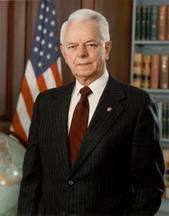 Sen. Robert C. Byrd (D-WV)
Legislative Activity
Stay on top of the latest movement without scrolling through every action
Senate amendment submitted
January 16, 2003
View full timeline
Senate amendment submitted
January 16, 2003
Roll call votes on amendments in Senate: Amendment SA 8 not agreed to in Senate by Yea-Nay Vote. 45 - 51. Record Vote Number: 3.
January 16, 2003
Senate amendment not agreed to: Amendment SA 8 not agreed to in Senate by Yea-Nay Vote. 45 - 51. Record Vote Number: 3.
January 16, 2003
Senate amendment proposed (on the floor): Amendment SA 8 proposed by Senator Byrd.(consideration: CR S1018-1023; text: CR S1020-1021)
January 16, 2003
Amendment SA 8 proposed by Senator Byrd. (consideration: CR S1018-1023; text: CR S1020-1021) To provide additional funds for certain homeland security measures.
January 16, 2003
Amendment SA 8 not agreed to in Senate by Yea-Nay Vote. 45 - 51. Record Vote Number: 3.
January 16, 2003
Votes
1 roll call on this amendment
Text
Proposed
MAKING FURTHER CONTINUING APPROPRIATIONS FOR FISCAL YEAR 2003

The PRESIDING OFFICER. Under the previous order, the Senate will now
resume consideration of H.J. Res. 2, which the clerk will report.
The assistant legislative clerk read as follows:

A joint resolution (H.J. Res. 2) making further continuing
appropriations for the fiscal year 2003, and for other
purposes.

[[Page S1000]]

Pending:

Byrd Amendment No. 2, to provide additional funds for
certain homeland security measures.

The PRESIDING OFFICER. Under the previous order, there will now be 2
hours of debate on the Byrd amendment No. 2, with the time to be
equally divided in the usual form.
Mr. STEVENS. Mr. President, I yield myself such time as I may
consume. I do intend to yield to my distinguished friend from West
Virginia anytime he wishes to start discussing his amendment.
The amendment pending before us to the amendment I have offered,
which contains the 11 bills that were not enacted that the majority
leader mentioned, the Byrd amendment, deals with additions to the
homeland security package that is contained in these 11 bills. As I
stated last evening, I find myself sort of in a position of a husband
who has ordered a new car for his wife and tells her, when the bill
comes, he is not going to pay the bill.
I sat through the hearings Senator Byrd held as chairman on homeland
security. I know the amounts that are in his amendment are amounts of
money that various persons from throughout our society and from
community after community all over the country have asked for. It is
money they want. There is no question they want this money. We had a
plan to make it available. Actually, it should have been made available
sometime early last year, but we never got do that because we didn't
have a budget last year. And we were unable to move the appropriations
bills last year because of the lack of a budget.
What I am seeking to do today, and started yesterday, is to ask the
Senate to exercise a rare type of discipline and allow us to take these
bills to conference. My amendment to this pending continuing resolution
bill that is before us will allow us to take these bills to conference
with the House. There are 11 bills that should have been passed before
October 1 of last year. As I said yesterday, it does not do any good to
try to point fingers to say why we didn't do that. The simple fact is,
we did not pass them.
Now in this new Congress we have to pass bills that actually expired
at the end of the last Congress. All of the work that was done on those
bills in the House and the Senate was eliminated by the end of that
last Congress.
We have initiated a process to catch up with those bills. There are
bills that deal with the moneys to be expended by the agencies in the
Federal Government between the time the President signs the bill and
September 30. That is a very short period of time. It does not exceed
7\1/2\ months. It is probably 7 months. The money that is in my
amendment will provide ample money for those departments for that
period of time. It is less than they would have gotten on October 1 of
last year, because since October 1 of last year they have been
following the provisions of the continuing resolution Congress enacted,
and they are using no more than the amount of money that was available
to them in the fiscal year 2002 budget. The 2002 budget was contrived
by the President really in the fall of 2001. We enacted it sometime in
2001.
We are dealing, in other words, with a process of funding our
Government based upon decisions made in 2001, continuing down to the
end of this fiscal year.
I note the distinguished Senator from West Virginia is here. I am
pleased to yield to him whenever he wishes to speak.
Mr. BYRD. I thank the Senator. Go ahead.
Mr. STEVENS. Mr. President, there is money in this amendment I have
offered, in one bill or another, dealing with each subject Senator Byrd
wishes to cover by his amendment. I can say that the money in the Byrd
amendment is going to be spent sometime by the Federal Government in
dealing with these issues. The question is, when should we make it
available?
The President of the United States has said, because of all the other
pressures on our Federal Government, he wanted to limit spending under
these bills to $750.5 billion. He has given us a new amendment--there
will be a second one, too--and that adds $825 million to deal with the
enormous fires that occurred in our country last year. As a
consequence, we agreed before the end of last year to try to live
within the President's limitations. We were unable to do so in the
period after the election. Now that we have come back, of course, it is
a new Congress and that agreement we made last year to limit it to the
President's level was not still binding. But it is binding on me,
because I went to see the President and he asked if I would try to do
this and get these bills done so we can turn to the budget request,
which he will submit to the Congress after the State of the Union
Message. I told him I would.
I am in the position of asking the Senate to hold to the amount the
President asked, the amount of these 11 bills. I didn't really decide
every number in these bills. These bills came from 11 subcommittees of
the Appropriations Committee, with staff members working from both the
Republican and Democratic sides at my request to reduce the amount so
the total did not exceed the President's request. That has been done.
We have a letter now, Mr. President, which I will put into the Record.
I will read some of it to the Senate:

Dear Mr. Chairman:
I would like to take this opportunity to thank you for your
leadership--

I won't read the whole first paragraph. The second paragraph says
this:

I am writing today to strongly oppose amendments to your
bill that would add extraneous spending above the levels
requested by the President. In particular, the ``Byrd
amendment'' purports to add $5 billion in additional
``homeland security'' spending that is unnecessary.

This letter goes on to say:

We are now more than a quarter of the way through fiscal
year 2003 and much of the funding contained in the ``Byrd
amendment'' could not even be obligated in the remaining
months of this year. For these reasons, I urge you to
oppose the Byrd amendment.

Mr. President, I ask unanimous consent that this letter be printed in
the Record at the end of my comments.
The PRESIDING OFFICER. Without objection, it is so ordered.
(See exhibit 1.)
Mr. STEVENS. Mr. President, I am prepared to try to explain any
provision that is in the 11 bills that are contained in the amendment I
have offered, or I will call upon the chairmen of all those
subcommittees whenever anything is questioned.
My hope is the Senate will understand the problem. The problem is, do
we take care of these 11 bills in a very expeditious way, get them to
conference between the House and Senate, working with the President and
his people, and really fashion this into a satisfactory piece of
legislation which the President will sign now. If we don't, we must
wait for the House to pass these bills individually. That will take a
considerable time for them to pass. We are putting this amendment on a
resolution that has already been passed by the House and we will send
it back to the House. If we have to wait for 11 bills to come back from
the House and send them to conference one by one, it will be late March
or late April before we get through this process. We will not be able
to deal with the pressing needs of this economy, with the problems of
taxation, the problems of homeland security itself, and all of the
problems that really perplex us in terms of medical problems of our
Nation, the health care delivery system. We have the chance now to
really try to eliminate the problems caused by a failure to act last
year, and act decisively and take these 11 bills, in one bill, to a
conference and work it out with the House and the President, and come
back with a final bill in a conference report and send it to the
President and, hopefully, obtain his signature and have this put behind
us.
I intend to oppose any amendment to this bill which adds money. I
intend to try to get the concept to move expeditiously, if possible. We
now have the majority leader's agreement that we will stay in session
until we pass this bill. We can do it sooner or we can do it later.
When we get to conference, we will have representation from both sides
of this aisle. We will be dealing with the Appropriations Committee
from the House and from the Senate and, by definition, that committee
is made up of the most experienced people on both sides of the aisle.
Every point of view is represented in that conference, and every
amendment that could be offered here could be offered through one of
the members on that

[[Page S1001]]

conference. We ought to be able to come back to the Senate very quickly
with a final solution to this problem, and that is the problem of how
do we eliminate this sword of Damocles that hangs over this new
Congress--that is, the 11 bills that were not enacted.
I ask unanimous consent that a chart that my staff and the staffs of
the individual subcommittees have prepared, which shows the major
elements of Senator Byrd's amendment, item by item, the amount in
Senator Byrd's amendment, and the amendment in my amendment for each of
those items, be printed in the Record at the end of my remarks.
The PRESIDING OFFICER. Without objection, it is so ordered.
(See exhibit 2.)
Mr. STEVENS. Mr. President, I confess that if we didn't have the
limitations we face, the deficit we face, I would once again support
Senator Byrd's funding in each of these items. Under the circumstances,
we cannot. We must get a bill the President will sign as quickly as
possible and get these bills behind us so we can come before the Senate
with the individual 13 appropriations bills that represent the bills
for fiscal year 2004.
I yield the floor.

Exhibit 1

Executive Office of the President, Office of Homeland
Security,
Washington, DC, January 16, 2003.
Hon. Ted Stevens,
U.S. Senate,
Washington, DC.
Dear Mr. Chairman: I would like to take this opportunity to
thank you for your leadership in bringing the FY 2003 Omnibus
Appropriations Bill to the Senate floor and for supporting
critical funding for out Nation's homeland security.
I am writing today to strongly oppose amendments to your
bill that would add extraneous spending above the levels
requested by the President. In particular, the ``Byrd
amendment'' purports to provide $5 billion in additional
``homeland security'' spending that is unnecessary.
The base omnibus bill contains, as the Administration
requested, an unprecedented 30% increase over 2002 (including
supplemental funding) in the fiscal commitment to defending
the homeland. The funds requested and provided are sufficient
to address homeland requirements and, in many cases, are the
most that can be absorbed responsibly in the remaining months
of this fiscal year.
In total, the budget for FY 2003 will provide $37.7 billion
in homeland security funding, nearly doubling the pre-9/11
levels. Investments made in previous supplemental
appropriations and the FY 2003 Budget will build capacity in
areas that will help protect our Nation against terrorist
attacks. Since 9/11, the Administration and Congress have
committed to providing: $9.6 billion to defend against
biological terrorism, more than doubling the level that the
Government spent prior; $3.3 billion to secure our borders
and ports and over $10 billion for aviation security
activities. The omnibus bill as proposed by Senator Stevens
supports all of these homeland security initiatives and
further funding is unnecessary.
We are now more than a quarter of the way through fiscal
year 2003 and much of the funding contained in the ``Byrd
Amendment'' could not even be obligated in the remaining
months of this year. For these reasons, I urge you to oppose
the Byrd amendment.
Thank you again for your support and we look forward to
working with you to ensure that our homeland is protected.
Sincerely,

Steve Abbot,

Admiral (ret.), USN,
Deputy Homeland Security Advisor.
____

Exhibit 2

MAJOR ELEMENTS OF $5 BILLION HOMELAND SECURITY PACKAGE
------------------------------------------------------------------------
FY 2003 level/
Byrd amendment   Stevens amendment
------------------------------------------------------------------------
State and Local Assistance to       $1.4 billion.....  $3.7 billion
Combat Terrorism.
Border Security...................  1.0 billion......  4.3 billion
Airport Security..................  720 million......  374 million
Port Security.....................  585 million......  120 million
Nuclear Security/Energy Security..  296 million......  1.1 billion
Mass Transit Security.............  300 million......  15 million
Federal Law Enforcement...........  212 million......  1.2 billion
Water Security....................  178 million......  65 million
Cyber Security....................  128 million......  48 million
Other (Food Safety, Securing        167 million......  1.9 billion
Biohazardous Materials at USDA
Facilities, Embassy Security,
Research to Combat Chemical
Attacks, Security at Washington
and Jefferson Memorials, and DC
Emergency Response Plan).
Total.............................  5 billion........  12.8 billion
------------------------------------------------------------------------

The PRESIDING OFFICER. The Senator from West Virginia is recognized.
Mr. BYRD. Mr. President, I begin my speaking with reference to my
colleague, Ted Stevens. He is a beacon of reasoning. I was saying to my
staff last night--or this morning, I forget; I am almost oblivious to
time--here is a man who is standing up for the institution.
It is not the administration's desire that we have a time agreement
that allows the minority, the Democrats, to offer amendments with up-
or-down votes, with an understanding there will be no stacking of the
tree. This is something new in the Senate, in a way, under this
administration. Yet this man, Senator Stevens of Alaska, has taken the
position the minority is going to have its opportunity--when I say the
minority, I am talking about the Democrats--to offer amendments. We
will have up-or-down votes. We are not going to stack any tree. This is
a breath of fresh air, and I think we ought to recognize this in
Senator Ted Stevens' chairmanship. He is fighting for fairness and
equality between the two parties when it comes to deliberations on the
Senate floor and the offering of amendments. I want to pay this tribute
to him. This is really the kind of chairman of the Appropriations
Committee a Senator ought to be. We have not always seen this insofar
as the other side of the aisle is concerned, when the other side has
been in power. We have seen a willingness to run roughshod over the
rights of the minority to offer amendments and to debate.
I do not say this to gain any favors from this chairman. He has been
around a long time. I have been around a long time. We know we have to
give and take, but I point this out at the beginning of this debate. If
it were not for Ted Stevens, we would not be debating my amendment
today. I would probably not have any amendment up. This is the way the
Senate ought to work, a forum for free debate and for amendments to be
offered.
So to begin with, I salute him. I admire him. I respect him. It does
not matter how this finally turns out. As far as this Senator from the
State of West Virginia is concerned, Senator Stevens is my friend, I am
his friend, and that is the way it is going to be.
I also recognize that Senator Stevens would probably do things
different if it were not for the circumstances that he is in. The
administration kept the House from acting on appropriations bills after
July of last year. This administration put their foot down, put the
brakes on. The House Appropriations Committee chairman, Mr. Young,
wanted to go forward with additional appropriations bills. He is
another man who is entitled to great credit. Of course, my counterpart
in the House, Mr. Obey, is a very knowledgeable and forceful advocate
of programs, a very experienced man.
So what I say has nothing to do with Mr. Obey or Mr. Young, but Mr.
Stevens is, in a way, swimming upstream. He has the opposition, I am
sure, of the administration and, being as fair as he is being, he has
the opposition, I would imagine, of the House leadership. The House
leadership has not wanted the appropriations process to go forward
since July of last year. Of course, I can only assume that the House
leadership was carrying the water for and taking its orders from the
administration, which I do not exactly agree with when it comes to
taking orders and giving orders, if I may use those crude forms of
expression.
I pay tribute to this chairman. He is swimming upstream. I expect
even on his own side he has a lot of opposition to the fairness he is
displaying. I do not know that, but I have a feeling that is true. I
have a feeling that is true with respect to the Republican-controlled
House and the administration.
I fully understand Senator Stevens' situation. In many ways, I expect
his heart is not in the coffin with Caesar. I have a feeling he has
great empathy for what he is doing, but he is also trying to get a
massive bill through. We failed last year because of the
administration's bullheadedness, its stubbornness, its pigheadedness in
refusing to go forward with these bills and holding them back so that
we would operate on automatic pilot with continuing resolutions, so
spending would not be one dollar above last year's levels--if we might
speak in general terms.

So I pay him tribute and I pay tribute to the Republican members of
the Appropriations Committee who time after time voted to report out
these appropriations bills. We had unanimity, complete bipartisanship.
What a model for committee bipartisanship that committee was.
Now we come to the situation where in order to get a bill that is
made up of

[[Page S1002]]

the 11 appropriations bills that were not passed last year, the Senator
from Alaska has to come in with some cuts. I do not believe his heart
is in those cuts, but he has to make this presentation. He does it
forcefully, and I respect him for that.
Having said that, I have to vigorously oppose the amendment offered
by my distinguished colleague, Mr. Stevens.
Before I make any further remarks, I yield 5 minutes to the
distinguished Senator from Michigan, Ms. Stabenow. If she needs more
time, let us know.
The PRESIDING OFFICER. The Senator from Michigan is recognized for 5
minutes.
Ms. STABENOW. Mr. President, I thank the distinguished Senator from
West Virginia for yielding 5 minutes to me. I also share his great
respect and admiration for the Senator and the processes in which he is
involved and the bipartisan way the Appropriations Committee has moved
forward in working together with our two leaders.
I thank Senator Byrd for his leadership on the issue of homeland--
many of us are saying ``hometown''--security, because that is really
what it is. I come with thanks and gratitude from law enforcement,
firefighters, EMS workers, hospital emergency room workers, all across
the great State of Michigan.
I have held six different community meetings around Michigan in the
last month asking our local first responders how they are doing, what
do they need, do they feel prepared, what can we do to be of
assistance. I have scheduled three more meetings in Michigan to listen,
and I am hearing the same thing over and over again, and that is our
first responders, our firefighters and police officers on the front
line, emergency personnel, health departments, local emergency rooms,
desperately need us to partner with them to give them the resources
they need to take the necessary steps to be prepared in the case of
terrorism in their communities.
I heard concern about training, not only the need to have a trainer
but the costs that it takes to remove that police officer. In a small
police department, when an officer goes to training for a week, there
is the additional cost to replace that person, with overtime involved,
and all kinds of concerns about training relating to the cost. They
very much want this training. They need the training. But they need our
help to be able to continue to provide law enforcement safety services,
fire services, and other services in the community while their
personnel are being training.

I heard great concern about the lack of resources for equipment and
communications, one county not being able to speak to the next county,
large departments in one city not being able to speak to a township,
very small fire departments that are not yet on e-mail. We have
information coming out from the Federal level, many of them saying they
appreciate the information coming from the FBI or the Department of
Justice, but small departments are not receiving that in a timely
manner. There are great concerns about lack of coordination and
communication, all of those things involving resources.
We have also heard great concerns about additional personnel who are
needed in this time when the States are cutting back. In my own State
of Michigan, because of tremendous budget crises, we have seen cuts in
revenue sharing to our local governments. Police officers are being
laid off. Firefighters and other front responders are coming to us and
asking us to partner with them. We have a new Homeland Security
Department. We have new responsibilities that have been given to our
local hometown security leaders. We need to provide them the resources
to be able to get the job done.
Michigan is a border State. In Senator Byrd's amendment, the
resources for border security are absolutely critical. We have three of
the top five busiest borders, the busiest being in Detroit.
I rise today to support Senator Byrd's amendment and to urge that we
pass it as he has provided. We are in a situation that I believe is
absolutely critical. We are hearing this from Republican sheriffs and
Democratic sheriffs, from Republican police chiefs and Democratic
police chiefs. This is not a partisan issue. This is about the local
law enforcement and emergency management personnel desperately needing
our help to be able to get the job done to keep families safe and
secure in their homes and in their neighborhoods.
I urge colleagues to support this effort. Once last year we came
together to pass emergency dollars in the supplemental. The dollars
that are being proposed are absolutely critical. It is a small amount
to pay in order to give the assurance to our families that they will in
fact have the resources given to first responders in their community so
they know they can respond in a crisis. I cannot think of anything more
important today than making sure we are funding hometown security
efforts. Senator Byrd's amendment is critical to that effort. I hope we
will join and have 100-percent support to send a message to our police,
firefighters, emergency health personnel, and medical personnel that we
stand with them in partnership, the Federal Government with our local
communities, and we will be there and make them a priority for the
resources they need in order to keep us safe.
I yield the floor.
The PRESIDING OFFICER. The Senator from New Hampshire.
Mr. GREGG. I yield myself such time as I may consume.
I appreciate the concerns of the Senator from West Virginia. We all
admire his commitment to the issue as we all try to make sure we as a
nation have prepared effectively to address the issue and the threat of
terrorism in our homeland. This has been a priority. This has been the
No. 1 priority of the President of the United States. I don't think
anyone can argue that this President has not committed himself and his
administration in an almost messianic effort to get our Nation ready to
defend itself in the face of this terrorism threat.
Thus, we have to give great credibility to do what the President
wants and believes he needs in order to accomplish the protection of
the homeland. What he has said he wants and needs is in the bill as
brought forward by Senator Stevens, the chairman of the Appropriations
Committee. In fact, the add-ons which are requested by the Senator from
West Virginia, in large part, although well intentioned, may in fact
undermine the effort to try to get efficiently into place a response to
the threat of terrorism.
Why is that? Because sometimes when these agencies receive much more
money than they can handle, they handle all their money poorly. If they
receive the money they need to do the job right, they focus on doing
the job right rather than simply spending the money.
The administration has written us and said they believe the
additional funds requested by the Senator pro tempore emeritus are
inappropriate. I have a letter signed by Admiral Abbott, the Deputy
Home Security Adviser:

I would like to take this opportunity to thank you for your
leadership in bringing the fiscal year 2003 omnibus budget
bill to the floor of the Senate. I am writing today to
strongly oppose amendments to your bill that would add
extraneous spending above the levels requested by the
President. In particular, the Byrd amendment purports to
provide $5 billion additional homeland spending that is
unnecessary.

That is one paragraph from this letter. He is very clear. The
President of the United States, through his Deputy Secretary for
Homeland Security--Deputy Secretary-designee anyway--Admiral Abbott,
has said this money is not needed and it is not appropriate for the
effort they are trying to undertake to protect the homeland.
I don't think anyone can question but that this President understands
the importance of protecting the homeland.
I will go through a few specifics relating to issues over which I
have had jurisdiction with my subcommittee I have been honored to chair
on the Appropriations Committee, the Commerce, Justice, State, and the
Judiciary Subcommittee.
Mr. BYRD. Will the Senator yield?
Mr. GREGG. Of course, I yield----
Mr. BYRD. I will refer to something----
Mr. GREGG. For a question.
Mr. BYRD. He is citing a statement of a Deputy Director of Homeland
Security; is that it?
Mr. GREGG. Designated Deputy Director.

[[Page S1003]]

Mr. BYRD. Citing that individual as saying that they do not need any
additional moneys as we find in the amendment I have offered; is that
what he is saying?
Mr. GREGG. That is correct.
Mr. BYRD. I was off the floor, and I want to make sure I heard. I
make this comment in that regard. We heard that same tune last year
from Mr. Ridge who was at that time the Director of Homeland Security.
His comment was with respect to moneys that were in legislation I was
offering. His comment was: We don't need any more. We don't need any
more money. The same old tune: We don't need any more money. We heard
that from Mr. Ridge last year.
I don't speak with criticism of the distinguished Senator who is on
the floor, but I am simply pointing out, that is the same old saw, the
same old tune we heard last year from the then-designated Director of
Homeland Security, Gov. Tom Ridge. He even wrote me a letter.
Mr. GREGG. Will the Senator yield for a second? I have to reclaim my
time.
Mr. BYRD. I had the floor.
Mr. GREGG. I yielded for a question.
Mr. BYRD. I am talking on my time.
The PRESIDING OFFICER. The Senator from New Hampshire has the floor.
Mr. BYRD. He has the floor, but I point out that I had the floor. I
had to leave the floor, and I yielded to the distinguished lady from
Michigan.
The PRESIDING OFFICER. Now the Senator from New Hampshire has the
floor.
Mr. BYRD. I understand that. I very well know the rules of the
Senate. I am not itching for a fight with the Chair. I respect the
Chair. I respect the Senator from New Hampshire. But the Senator from
New Hampshire, let him understand that I am yielding--I have asked for
him to yield on my time, my time.

Mr. GREGG. Fine. I am yielding for a question. I am not yielding the
floor, but the time is being charged to the Senator from West Virginia;
is that correct?
The PRESIDING OFFICER. That is correct. The time is so charged.
Mr. BYRD. I only want to point out that we heard that same old tune
last year from then-Director Tom Ridge of the Department of Homeland
Security. He wrote me a letter--probably wrote the same letter to
Senator Stevens at that time--that they didn't need the money we were
trying to put in the bill. So we have heard that before.
I thank the distinguished Senator for yielding. That is the only
point I wanted to make. I wanted to recall for the record that we have
heard that same argument before from this administration, at that time
through Director Tom Ridge, whom the President of the United States
refused to let come before the Appropriations Committee and testify on
budget matters.
I thank the Senator.
Mr. GREGG. I thank the Senator for his comments.
I simply add, today we have a letter from Admiral Abbott, in which it
is stated that they think this money is unnecessary, and I believe
their point is it is unnecessary at this time because these agencies
can't handle it.
Let me go through why that is the case with the agencies with which I
have some familiarity. I have been fortunate enough to serve as either
ranking member or chairman of the Commerce-State-Justice Subcommittee
for about 8 years, and during that time I have come to know with some
familiarity of the activities of the agencies under that jurisdiction,
many of which impact homeland security. Let me specifically talk about
the FBI, INS, first responders, and the issue of the Marshals Service.
This amendment includes in it $137 million for the Triology Program.
The Trilogy Program was an attempt to get coherence into the computer
systems of the FBI and basically be able to get every agent at the FBI
the capability to go online and instantaneously access the database of
the FBI, so you would have the capacity of a field agent actually
having the information necessary to find out, if they ran into a
suspect, what that suspect's threat situation was and also to feed into
the system information they may have developed that was important to
protecting the country, especially in the area of terrorism.
Unfortunately, Trilogy has become a large disaster. A big part of the
disaster of the Trilogy Program is that we, last year, threw $237
million at the program that they didn't need in order to develop it.
That was part of our efforts last year to try to show that we were
concerned about terrorism. This money, essentially, buried the program.
As a result, in large part, the program has fallen apart. The situation
is that the FBI software and hardware contracts for Trilogy have
essentially become gold plated. The cost is soaring. The schedule is
out of control. Right now we still do not have contracts on Trilogy
hardware or Trilogy software. We are completely at the mercy of the
contractors.

The practical effect of that is that we now have a program which has
what is estimated to be an approximately $213 million increase in 1
year--that is a 57-percent increase--and we are not getting what we
expected out of the program. The simple fact is that putting another
$137 million on top of a program which already is awash with money, so
much awash in money that it basically has caused the FBI to lose its
focus on how to best get contracts for software and hardware, is not
going to help the program at all. In fact, to put another $137 million
into the program is not going to contribute anything to making Trilogy
work better.
Regarding the additional funds in this amendment, there is a point
made that, in the prior bill from which this bill was brought up, there
is at least $100 million of unobligated funds at the FBI. We happen to
think it is probably much higher than that. It may approach $150
million. It makes much more sense to say to the FBI: You spend the
unobligated funds first before we put more funds on top of the funds
you already have, because we already know you are having trouble
managing the additional resources that you have received.
The FBI is, regrettably, a very troubled agency today. I don't think
there is anybody who has been following the news who doesn't recognize
that. If you happen to follow the actual substance of the situation,
you can appreciate that. For example, the National Infrastructure
Protection Center, NIPC, which presented a spending plan that was so at
variance with what the committee guidance was--and this was committee
guidance when the committee was under the chairmanship of Senator
Hollings, who did an extraordinary job as chairman of this
subcommittee, by the way--it was so at variance with that we had to
redirect $30 million and basically NIPC was transferred out of the FBI
because they simply couldn't handle the program any longer.
The Foreign Terrorism Tracking Task Force--this was created on a
whim. It was a press release creation. We still don't know what it
does. We still can't figure out what it does. As a practical matter, it
doesn't know what it does.
The efforts to implement the Webster Commission mandates on security
have ended up creating unnecessary tasks because of the initial Bureau
reluctance to allow us to have full oversight. That has made it
impossible for us to determine whether the Webster Commission mandates
are being met.
Director Mueller is trying very hard, and I have immense respect for
him. I honestly believe--unfortunately, with time--he is going to get
the FBI up and running, to be the type of force it needs to be in order
to protect us from terrorist attacks.
But right now the FBI has serious managerial problems. It does not
have serious cash problems. We have funded the FBI at very high levels
in this bill, very high levels. They have significant unobligated
funds. Programs such as Trilogy do not need more money. What they need
is more management.
We can move on to the INS. The amendment would add $267 million more
for INS construction. The fiscal year 2003 bill before us already
provides $267 million for INS construction. We doubled INS
construction, compared to historic levels at which INS construction was
getting funded. If you take the money now being proposed in this
amendment, you will be doubling it again. This is one area in the INS
Department where they actually do things well--construction. They know
what they are doing. They do it well.

[[Page S1004]]

But, as any other agency, if you overwhelm it with funds, many more
funds than it can handle--and I respectfully present that a quadrupling
of funds in one agency's construction account is an overwhelming
event--you are going to find that agency starts to erode its internal
control mechanisms and you are probably going to find that money will
be spent recklessly, inappropriately, and, unfortunately, wasted.

The doubling of the money in this account is a reasonable number. I
don't see how anybody can say it is not a reasonable number, which is
in this legislation as it comes from Senator Stevens. It does not need
to be quadrupled.
The amendment also calls for $262 million in the exit/entry program.
The exit/entry system is, unfortunately, another computer disaster. It
is a proposed system. Unfortunately, it is a promise; it doesn't exist.
We can't even begin to develop the system until the INS has a central
computer control network. The INS has so mismanaged its information
technology programs over the years that we now have several core
systems that cannot communicate with one another. That is one of the
reasons the 9/11 disaster is so frustrating. It was the fact that the
INS systems couldn't communicate with each other that didn't allow us
to find out that we had folks training in flight school 9 months before
the event.
The situation is so bad that the proposed fiscal year 2003 mark
provides $83 million for the Justice Department to come in and develop
a new central computer system for the INS, because we have decided--and
this wasn't my unilateral decision; this was a decision made under
Chairman Hollings' leadership, and I applaud him for it because he went
into this and they understand the problem--we came to the conclusion
the INS couldn't straighten this out; it is such a disaster, their
computer systems. The amendment would have us spend $362 million on a
system that, if developed, would be standing in isolation because there
is no central computer system that is working now at the INS.
What we need to do first is develop a central computer system at the
INS that can communicate within the INS, and then with the exit/entry
system in place. So we are putting the cart before the horse, to say
the least, and it is going to cost us $360 million to do it and it
makes very little sense, although it is well intentioned. But it is not
good fiscal management for that agency.

Finally, the amendment adds some $80 million for salaries and
expenses. The fiscal year 2003 mark already funds 500 new Border Patrol
agents and 460 new inspectors. We know from the historical experience
over the last few years that we have been trying to hire up the Border
Patrol and that we simply can't fill these positions as fast as we
would like. We can say they want 1,000 new Border Patrol agents. We
know they will not get them. Why? Because we have language
requirements. We require significant training experience for these
individuals. And up until last year or the year before, we didn't pay
them enough to get the people who had those qualities. We are losing
them at a high rate, especially since TSA came into existence and the
rate of pay there was better than the Border Patrol. We saw people
migrating from the Border Patrol over to there. We need to fill the
slots that are already there. We need to hire up those slots and not be
putting another $80 million on top of that. That is $80 million that
can't be used. It really isn't necessary in order to accomplish what we
want in the area of hiring up the Border Patrol.
We know--once again, like the FBI--that the INS has huge amounts of
money that are sitting there that are unobligated and basically
becoming slush funds. That is what this $80 million would be added to.
Just last month, like a rabbit out of a hat, when a hole in the
security bill was announced, they came up with $30 million at the INS,
bang, just like that. We don't know where it came from, but we know
they found it in that agency.
Unfortunately, this $80 million, as well intentioned as it is, is
simply not going to be able to be used because we have already put in
place as many new positions as they possibly can hire up in the next 8
months which this bill covers.
In the area of the U.S. Marshals, the U.S. Marshals is a small agency
that is trying hard. They are sort of like the little-engine-that-could
agency. This amendment is suggesting $537 million for 200 new deputy
U.S. marshals--the revival of an idea that I think was initially put on
the floor here by Senator Graham of Florida last year. Again, it is
well intentioned. But this is especially an agency that we do not want
to overload with money they can't use and with which they would
potentially end up producing inefficiencies and waste.
Rather than throwing a whole lot of money and saying hire up a whole
lot of new people at the U.S. Marshals Service, this bill suggests that
we shift 106 presently underused senior U.S. marshalls away from their
desks and back onto the front lines. What is the advantage of doing
this versus hiring up? The advantage is you don't end up with fresh,
new faces out there; you end up with people who have line experience,
knowledge, and ability, and who will from day 1 know how to handle a
difficult situation should they confront it in a courthouse. This is a
prudent course.
The amendment of the Senator from West Virginia, unfortunately, in my
opinion, would simply swamp the marshals. It is better to bring 106
senior deputies back to the fold than to chase and try to capture 200
rookies who may or may not be able to be added in time, and may or may
not be able to be constructive, compared to moving the 106 onto the
front line.
By moving those senior marshals to those positions, we will address
the problem most effectively. That is why the bill takes this approach
rather than additional funding.
The bill has also added a huge new increase on top of the very
dramatic increase that is in the bill for first responders. This is an
area where I have spent a huge amount of time, as has Senator Hollings.
Our committee basically first began the first responder effort 3 years
before the 9/11 event. We set up five major schools across the country.
We started with training. Actually, we had them in 167 cities before 9/
11. We wish we had been able to do more. We weren't. But as a practical
matter, this is an area where we have focused a lot of energy and a lot
of time to get this program to work right. It is working right. This is
one of the real things in our efforts to address terrorism that is
working right.

This bill has put $2 billion into what used to be DPO, the Domestic
Preparedness Office, which will go out to the police and the emergency
responders. Then it has another $1 billion-plus going over to FEMA,
which will help with fire first responders.
We don't want to put more money on top of that--and I will be willing
to place odds on this one--than these agencies are going to be able to
handle in the next 8 months, and at the end of the next 8 months we are
going to pour another dramatic amount of money into this account.
We understand that these are the people who need the support. They
need the technical support and the training. They need the equipment.
But we also understand, once again, that putting these types of dollars
into these agencies this fast--into the local fire departments, local
police departments, local public health departments--if you do it at a
rate that you can't keep track of it and you can't manage it
effectively, you are going to end up with a lot of bells and whistles
rather than substantive equipment. That is what we don't want. We don't
want people buying blue lights; we want people taking care of the
equipment they should be buying--respirators or machines--and we want
the training to be directed at the training needed by a first responder
in a terrorism event--especially weapons of mass destruction. We don't
want this money simply ending up by placing dollars that are flowing
into these agencies.
The $2 billion that is coming out of our subcommittee and the $1
billion-plus coming out of the FEMA subcommittee is a dramatic increase
and a very significant commitment to the first responder program.
Putting more money on top of that, as the Homeland Security Assistant
Secretary, Admiral Abbott, pointed out, simply isn't going to add to
solving the problem.
As well intentioned as this amendment is--it is well intentioned, and
I respect immensely the author, but certainly the author's commitment
to

[[Page S1005]]

this issue which as been acted on for the last few years in a very
aggressive way--I think at this time that the administration has it
right and knows what it is doing as well as anyone can in this type of
a climate and that this bill properly funded was brought to the floor
by Senator Stevens.
I yield the floor.
Mr. BYRD. Mr. President, how much time do I have?
The PRESIDING OFFICER. The Senator has 52 minutes 43 seconds.
Mr. BYRD. I yield myself 2 minutes.
Mr. STEVENS. Mr. President, will the Senator yield for 1 minute?
Mr. BYRD. I yield on the Senator's time.
Mr. STEVENS. Yes.
Mr. President, I ask unanimous consent that the time for the rollcall
on Senator Byrd's amendment be changed to commence at 12:30, with the
time added to be equally divided.
The PRESIDING OFFICER. Without objection, it is so ordered.
Mr. BYRD. Mr. President, let me compliment the distinguished Senator
from New Hampshire. He is a very knowledgeable Senator. He is a
reasonable Senator, and he is a courageous Senator. He doesn't always
fall in line and do the party thing. But let me say this. He raises a
straw man when he talks about computers. We are knowledgeable. He is
right on the computers. So we didn't ask to put any money in this
amendment for computers.
Let me also say this. Is there anybody in this Chamber who would
maintain that we know who is coming into this country and who is going
out of this country from day to day? The borders are wide open. We know
that. So let it not be said that the FBI and the other agencies, the
Border Patrol people, and all of those are awash with money. Don't
listen to that. Our country is not secure. This amendment is attempting
to make our Nation secure.
With regard to the FBI, we have $46 million. We say we are awash with
money, that we don't need any more money. That was a mainstay of the
distinguished Senator's argument. I will defer to Senator Hollings
because he can best speak to this subject matter with respect to the
FBI, and so forth.
But the Senator from New Hampshire says we are awash with money; we
don't need any more money. Well, in this amendment, there is $46
million for aviation support, including funding for additional pilots
and mechanics, for two Blackhawk helicopters and surveillance aircraft,
funding for maintenance and equipment, and other items needed by the
aviation program.
This money has been requested by the President of the United States.
Does the right hand know what the left hand is doing here? This
amendment is attempting to, in this instance, with respect to the $46
million--nothing was said about that by the distinguished Senator from
New Hampshire. Now they are sending in their top artillery people over
here on this amendment. I hope our top artillery people will come and
address these comments.
But let it not be said that we are spending more money on computers.
We are not doing it in this amendment. The Senator from New Hampshire
is exactly correct. We know that, so we did not add money for that.
But there is other money here requested by the President. So let it
not be said we do not need that money. Who is right? If a President
requests the money, is the Senator from New Hampshire, or any other
Senator on that side of the aisle, or any Senator who is opposed to
this amendment, willing to stand on the floor and say the President is
mistaken, the President does not know what he is talking about, the
President does not speak for us?
Mr. REID. Will the Senator yield for a question?
Mr. BYRD. Yes, I yield.
Mr. REID. I have listened to this debate, and it appears, with the
remarks from the distinguished Senator from New Hampshire, that these
amounts in this amendment which the Senator from West Virginia has
filed were just brought out of the sky someplace. The fact is, agencies
of the executive department requested these matters initially; is that
true?
Mr. BYRD. That is true. And not only the agencies in the executive
department, but the distinguished Senator from Utah, for example,
talked about cybercrime, cyberterrorism, the distinguished Senator from
Utah, Mr. Bennett. He is a very knowledgeable Senator on this subject.
So in this amendment we have $70,600,000 to combat cybercrime and
cyberterrorism. We have taken this from testimony at last spring's
homeland security hearings. These are funds that were blocked--
blocked--by the President in the $2.5 billion supplemental.
Hear me now. Who asked for this money? Senators on that side of the
aisle have maintained that this is a very, very worthy cause; we need
to combat cybercrime and cyberterrorism. This amendment is trying to
respond to that need that was evidenced by Senator Bennett at the
hearings.
Everybody knows we have a language translation problem in the
services. We have heard that from all sources in the hearings that were
held by the Appropriations Committee last spring. We heard it from the
people at the local level. They could not talk with one another. And
there are problems in language translation. So this was a Hart-Rudman
report recommendation, and this amendment is trying to respond to that.
Mr. President, how much time do I have?
The PRESIDING OFFICER. The Senator has 49 minutes 45 seconds.
Mr. BYRD. I thank the Chair.
How much time does the Senator from New York want?
Mr. SCHUMER. If it is all right with the Senator, 6 minutes.
Mr. BYRD. I yield 6 minutes to the Senator.
Mr. SCHUMER. I thank my colleague.
The PRESIDING OFFICER. The Senator from New York is recognized.
Mr. SCHUMER. Mr. President, I stand here to back up our leader, the
Senator from West Virginia, who has waged a long fight.
First, I wish to say that the Senator from New Hampshire is very
erudite, and I am glad he chairs his subcommittee, but what he is
saying, that we do not need money, does not square with the facts. The
bottom line, if you have followed the fight of our good friend, our
leader, the Senator from West Virginia, is that this administration has
constantly cut back on homeland security, on requests they have made,
and on things that we need.
We are in a strange situation; that is, when we fight a war on
terrorism overseas, every penny is available, as it should be. We back
up our men and women who are overseas. But when it comes to fighting
here at the homeland, we have no money. The analogy would be telling
the generals to fight the war in Iraq--the upcoming war we pray to God
will not happen; but if it does, fight the war in Iraq--with no new
money. It makes no sense.
I want to point out three areas because I heard my colleague from New
Hampshire.
First, in my State--all of which I know from my State; and I will
take one end of my State and the other--at one end we have a northern
border; at the other end we have a port. The northern border is totally
unguarded. Every 2 weeks we hear on television the fact that some
unknown group may have come over the northern border.
In the PATRIOT Act, a bipartisan act which the Justice Department
pushed, we called for tripling the Border Patrol, Customs, and INS on
the northern border. In Buffalo we have the second largest port of
entry between Canada and the United States. I have been there. I have
talked to the head of the Border Patrol in New York on the northern
border. I have talked to the head of Customs. I have talked to INS.
They are desperately short of people.
If my friend from New Hampshire thinks we don't need money to
increase personnel for Customs, INS, and the Border Patrol, I would
invite him to come to my State.
For the southern border, we have some guards and strictures, and,
unfortunately, the terrorists have realized that and they use the
northern border.
Again, the President called for tripling--tripling--in the PATRIOT
Act, the personnel of those three Departments on the northern border.
The underlying amendment does virtually nothing. Even the amendment
offered by my good friend from West Virginia does not triple the amount
we need on the northern border, but at least it takes a step in that
direction.
I have asked the people in Buffalo and in Plattsburgh and in
Ogdensburg

[[Page S1006]]

why they can't hire people. Because they don't have the money. Not that
the personnel aren't there, not that there are bureaucratic
bottlenecks, but they don't have the money.
Let's go to the southern end of my State, New York City, the port.
Right now, unfortunately--and this is well known--we are wide open in
terms of what can be smuggled into our ports on the Pacific, on the
Atlantic, and on the gulf coast. God forbid if a nuclear weapon was
smuggled in.
My good friend from Virginia and I, Senator Warner and I, put in an
amendment in the homeland security bill, and then in Senator Hollings's
port security bill, to create detection devices to prevent these
nuclear weapons from coming in. Do you know what we were told? There is
no money. The President asked that it be taken out.

How can we say we need to go into Iraq to find nuclear weapons--I
supported the President in his move to go into Iraq--and at the same
time leave our ports wide open to someone else--al-Qaida, a Chechen--
smuggling in a weapon?
Again, the amendment of our leader, the distinguished Senator from
West Virginia, does not come close to putting the money in we need, but
he puts in some. At the same time we are raising the budget for the war
overseas by tens of billions of dollars, we refuse to even begin to do
what we need on homeland security.
Let me say to my friend from New Hampshire, the only bottleneck that
prevents us from developing a detection device and implementing it on
every container, on every toll booth at the northern and southern
borders, to prevent nuclear weapons from coming in, is money. Again, if
we are going to fight this war on terrorism abroad, we need the dollars
to do it. Everyone agrees. But, somehow, there is a disconnect, and
when we fight the war on terrorism at home, we say there are no
dollars.
God forbid that something happens and we rue the day.
One final point. My friend, again, from New Hampshire was saying that
our first responders in our localities do not need any more money, that
the $3.4 billion they put in is enough. I beg to differ.
Let me talk about New York City.
If you drive over the Brooklyn Bridge, there is a police officer at
each end of the bridge now. There never used to be. Now that has to be
24 hours, 7 days a week, to prevent someone from placing a bomb there.
That is six police officers--three shifts, 24 hours a day--for each end
of that bridge and for each end of every one of our bridges.
We, in New York City alone--Commissioner Kelly, Mayor Bloomberg--have
requested $265 million of this committee, not for anything new, and not
for the new equipment that my good friend from New Hampshire talks
about, but simply to pay for some of the costs.
Let's face it, ladies and gentlemen, the city of New York has been--
up until now; I hope it does not happen again--their No. 1 target.
The PRESIDING OFFICER. The Senator's time has expired.
Mr. SCHUMER. Mr. President, I ask the Senator for 2 more minutes to
complete my point.
Mr. BYRD. Two more minutes.
Mr. SCHUMER. I thank the Senator very much.
The PRESIDING OFFICER. The Senator is recognized for 2 more minutes.
Mr. SCHUMER. We, in New York City, are stretched. I know what is
going to happen. They are going to say: New York City, $265 million out
of $3.4 billion? That is unfair. Everyone else needs the money.
Well, we are the No. 1 target. We don't have enough money for the
first responders. And this is true throughout every part of our
community--our hospitals, our firefighters. Everyone is stretched. Our
States and local governments have no money to do all this. So, of
course, we need more. The amendment of the Senator from West Virginia
doesn't do enough, but at least it is a step on the road.

I could go on and on. I have talked about the northern border, which
involves Customs, INS, and Border Patrol. I have talked about the port
of New York and all the ports of the country which involve both TSA and
some of the scientific research. I have talked about first responders.
I could go on and on, but I know there is not enough time. We
desperately need this money. Let us hope and pray that our stinginess
in this vital area, where there is no ideological dispute, doesn't hurt
our people this year or next year or the year after.
The Senator from West Virginia is making a lonely and difficult
fight. He has done it for 6 months. But once again, we will look back
on history and say he was right. We cannot fight a war on terror at
home if we don't appropriate the dollars.
My good friend from New Hampshire can say we may not need this or we
may not need that. In my State, the focal point of terrorism, we are
not doing what we should on homeland security because we don't have the
dollars--plain and simple.
I will enthusiastically support the amendment by the Senator from
West Virginia, my leader. I hope the rest of the Senate will, too. God
forbid we regret the day we do not.
Mr. BYRD. Mr. President, I thank the distinguished Senator from New
York. I yield myself 2 minutes.
The PRESIDING OFFICER (Mr. Burns). The Senator from West Virginia.
Mr. BYRD. Recently, former Senators Rudman and Hart released a report
that concluded that American transportation, water, food, power,
communications, and banking systems remain easy targets for terrorist
attacks.
The report highlighted the vulnerabilities created by the miniscule
fraction of trains, ships, trucks and containers that are searched for
weapons of mass destruction; poor radio communications and equipment
and training for police, fire, and emergency medical personnel;
inadequate coordination and focus on threats to food safety; lack of
lab capacity to test for biological or chemical contaminants; and
insufficient sharing of intelligence information with State and local
governments on potential terrorist threats.
Not only has President Bush failed--failed, failed--to lead the
Nation in addressing these vulnerabilities, he has in fact actively
opposed efforts to provide the resources necessary to address these
significant weaknesses. The record will show that. When it comes to
homeland defense, the President is strong on rhetoric and weak on
resources. The record will substantiate that statement of mine.
Under pressure from the White House since September 11, 2001, $8.9
billion of critical funding to address the specific concerns identified
in the Rudman-Hart report and in our bipartisan Senate Appropriations
Committee hearings have been squeezed out of spending bills considered
by the Congress. In November of 2001, just 2 months after the attacks
of September 11, the President said: Wait.
The PRESIDING OFFICER. The Senator has used 2 minutes.
Mr. BYRD. I yield myself an additional 2 minutes.
The President said: Wait, we can wait until 2003 to begin spending
more on homeland security.
Now it is 2003. What is the President saying? He is saying: Let's
wait until 2004.
Now the administration is saying we don't need more money for fiscal
year 2003 because the administration has not spent some of the money
that was appropriated for fiscal year 2002. The administration is
leaving itself wide open to justified criticism when it maintains that.
So it is saying we don't need more money because the administration has
not spent some of the money that was appropriated for fiscal year 2002.
What poppycock.
If the administration has not spent essential funds approved by the
Congress over 1 year ago for homeland security, then the Senate
Appropriations Committee should be holding hearings to find out why.
Where does the fault lie? Who is right here? Who is wrong? What are we
doing?
Very little is being said on the part of the administration these
days about protecting the homeland. Everything is go, go, go, go, go.
They are sending off our National Guardsmen. We see the tears streaming
down the cheeks of the wives and the children and of the guardsmen and
reservists themselves. We see this on television every day or so. These
people are part-time soldiers, but they are full-time community

[[Page S1007]]

workers. They are lawyers. They are doctors. They are firemen. They are
policemen. They are State policemen. These people are being sent
overseas to fight a war in Iraq, an undeclared war on the part of the
Congress.
The PRESIDING OFFICER. The Senator has used 2 minutes.
Mr. BYRD. I yield myself whatever time I need from my time.
It is time somebody says something about what is going on in this
country.
Mr. DURBIN. Will the Senator yield?
Mr. BYRD. Not for the moment. I will shortly.
Mr. President, I don't hear a whimper from the Congress which only a
short time ago attempted to give up its constitutional power to declare
war to one man. He will determine when, how, and where our military
forces will be used in an unprovoked war against a sovereign state that
has not attacked us in this new doctrine of preemption. It is a new
doctrine.
This Senator is just not going to take this lying down. I don't care
how popular Mr. Bush may be. I answer to my constituents, I answer to
my Constitution, and I answer to my conscience.
Here we are penny pinching when it comes to protecting the homeland.
This administration is not paying enough attention to the protection of
the homeland--our country, our people, our institutions, our
installations.
I think it is time we called the hand of this administration. If the
administration says: We don't need any more money, we are awash with
money, well, then, if the administration has not spent essential funds
approved by the Congress over 1 year ago for homeland security, the
Senate Appropriations Committee ought to be holding hearings to find
out why. Let's find out why.
We need these homeland security resources now to meet real needs that
have been authorized by the Congress for port security, airport
security, border security, nuclear security.
I understand the Senator would like for me to yield. How much time do
I have remaining?
The PRESIDING OFFICER. The Senator has 34 minutes.
Mr. BYRD. I thank the distinguished chair. I yield time to the
Senator from Illinois.
Mr. DURBIN. I thank the Senator from West Virginia.
One of my favorite historians, William Manchester, in writing his
volumes concerning the life of a great man named Winston Churchill,
entitled the second volume ``Alone,'' telling of that period in Winston
Churchill's career in the 1930s when he stood in the House of Commons
in England as a lonely voice warning his countrymen of the impending
peril of what was to occur in World War II. He was ignored. He was
derided. He was ridiculed. Eventually, history vindicated him.
The same will be true of the Senator from West Virginia. I want to
let him know, he does not stand alone in this battle. There are many of
us who believe we need to step up at this moment in time and speak up
for not just the defense of America from foes who attack us overseas
but the defense of hometown America, the defense of our homeland. It is
not enough to create a new bureaucracy and a multi-agency unit with a
high-sounding name, the Department of Homeland Security, and not
provide the resources that are essential to protect hometown America.
My colleague from New York recounted the challenges in New York City.
The same can be said for the city of Chicago and for small towns and
villages all across Illinois. Something as basic as establishing a
communications network for police and fire first responders and the
medical community is essential to respond to a crisis. The money is not
there. My State is deep in debt, as are many States across the Nation.
The question is whether this administration will come forward and
support Senator Byrd's amendment to put in a small proportional
increase, a small incremental increase in terms of homeland security,
and to think this would be resisted is an open invitation for critics
to say this administration supports a hollow homeland security--one
that will not be there when we need it. I hope this great Nation and
our people never face an act of terrorism again. But it is foolhardy
for us to ignore the threat of September 11, 2001, and its repetition.
We live on Capitol Hill most of our working lives and we know that two
letters mailed to an office in Capitol Hill containing anthrax cost us
$20 million to clean up, cost us American lives, and closed down office
buildings for months--two envelopes. That is our vulnerability. That is
the vulnerability of America.
Senator Byrd, you do not stand alone. I hope there are Members across
the aisle who will join us in this effort to make certain our
commitment to homeland security goes beyond rhetoric.
Mr. BYRD. Mr. President, I thank the distinguished Senator from
Illinois. He stood with me when we opposed the Iraq resolution, and we
stand together today.
Let me say this, Mr. President: This is not the last word with
respect to sending our men and women across the seas to fight a war
that has been unprovoked. We have not been attacked. We will have more
to say about that later.
We do need to protect this homeland. This amendment will do that. The
Senate is at a crossroads. We face a choice: Will we allow partisan
politics to rule the day or will we step up to the responsibility to
respond to the growing security crisis facing our country? Of course,
this administration is not going to support me in this amendment. The
administration has opposed every effort I have made in the past to add
moneys for homeland security. The administration, the White House,
would not let their key point man on homeland security come before the
Appropriations Committee in the Senate last year. They said: He is a
staff person. Yes, he was, but he was the administration's point man on
homeland security. They kept him from coming. Then when we tried to
appropriate more money--unanimously--in the committee, what did we get?
We got veto threats from this administration.
Now, what does that tell you about this administration? They don't
want to work with the Congress. They want to have it their way all the
way. They don't want to admit there are weaknesses, admit Congress can
be right, and is right on many occasions. No, we don't expect them to
support this amendment. They have not supported our amendments in the
past.
Mr. President, how much time do I have?
The PRESIDING OFFICER. The Senator has 29 minutes.
Mr. BYRD. I see my distinguished chairman and I will be glad to yield
the floor for now.
Mr. STEVENS. Mr. President, I thank the Senator from West Virginia.
Again, I have to come back to where we are. We are trying to send to
the House, in order that we might convene a conference between the
House and Senate, the 11 bills we did not pass last year, governing 11
different appropriations bills. The President has to be taken into
consideration because we are asking him to sign 11 bills with one
signature. Rather than have 11 bills individually come over here from
the House, handle them individually in committee, bring them to the
floor and handle them individually, take them to conference and handle
them individually, pass them by the Senate again individually, and send
them one by one to the President, we are asking to play catchup, send
them to conference, work it out with the President, within his limits,
and he will sign the bills and we will put this problem behind us.

The Senator from West Virginia raises a series of issues about
homeland security. This Senator does not dispute the fact that
additional funds will be needed for homeland security. For instance, if
we go back to the State, Justice, Commerce bill, the section of the
amendment I have put before the Senate contains $11.3 billion for
homeland security for State, Justice, Commerce functions only--
Department of Commerce, Department of Justice, Department of State.
There is $8 billion for the Department of Justice, $222.7 million for
the judiciary, $262.8 million for the Department of Commerce, and $280
million for the Department of State.
Adding another $1.2 billion, as the Senator from West Virginia
directs under his amendment, would not be something that can be used by
these departments in the 7-plus months that are left--plus maybe a week
or two--to spend that money.
My position is, let's get this behind us. In every instance, there is
money in

[[Page S1008]]

the bill that would deal with the issues at the President's level; but
Senator Byrd wants to increase that money. For instance, for the DC
emergency response plan, Senator Byrd wants to add $12 million for the
District's unified communication center. We have $10 million for that
purpose in this amendment. The President didn't request any money, so
we have already added $10 million. Senator Byrd wants to add $12
million to that.
In the District of Columbia, Senator Byrd wants to add $13 million
for the bioterrorism hospital preparedness account. We already included
$10 million in this amendment, and there is $8 million already
available from the supplemental passed late last year for the fiscal
year 2003. So the District of Columbia has already $18 million for that
function to which the Senator wants to add $13 million.
In the civil defense area--this is under the Energy and Water
Subcommittee--the Senator from West Virginia wants an additional $100
million for security upgrades for the Army Corps of Engineers. That is
for reviewing facilities such as dams, water treatment plants, et
cetera. We already have $65 billion to be spent in less than 8 months.
My friend wishes another $211 million for security upgrades for the
Department of Energy's nuclear facilities. In this omnibus amendment
before us, we have $1.2 billion for that purpose. Even that money will
not be spent in the balance of fiscal 2003.
It doesn't do us any good to pass bills that contain surplus money
that cannot be spent in this fiscal year. This omnibus bill is for
funding the balance of fiscal year 2003.
For the Department of Homeland Security's national infrastructure
simulation and analysis center in New Mexico, the Senator from West
Virginia wants to add $25 million. The President asked for $20 million.
We have increased that to $30 million--more money than requested for
that function. We increased it 50 percent already. This agreement is
not with the function, it is with the pace of spending. The money the
Senator wants just cannot be spent in this period of time. I say that
respectfully because we have already passed 4 months. At the end of
this month, it is 4 months of the fiscal year that is gone. It takes
about a month to allocate money, get it out to where people can use it,
and it takes time to contract it and hire new people to spend it. It is
not physically possible, administratively possible, to spend this
additional money. The main thing is, if it is needed, we have a
supplemental that is coming along. We will be looking at additions to
these bills.
We will have money in the 2004 bill which will be available in the
last 3 months of this calendar year, this coming October 1. I urge the
Senate to look at each issue.
Again, I sat with my good friend when we had those hearings. There
was not a person there who did not want more money. I do not remember
one single person who did not want more money. As a matter of fact, as
a father of six, I have had people around me who wanted money all my
life. The question is: How much should be allocated, and how fast
should they spend it?
Now, on this concept of taking the bill and saying, we want to add $5
billion to this omnibus amendment I have, we will take it back into the
same fight we had last year, the same thing that delayed us last year,
and it will delay us so we cannot even get to the battle for the 2004
appropriations bills.
Not to be disrespectful to my friend from West Virginia, but I urge
the Senate to not approve this amendment that really does not solve the
problem. The problem is, how do we catch up with the appropriations
process? How do we face up to the fact that the last Congress did not
pass 11 of the 13 bills?
I admit I have suggested a rather abrupt and arbitrary procedure,
putting them all together in one package, but I did not do it alone.
Each of the subcommittees reviewed every single line in these bills.
I put into the Record last night the summary of the reports that
would have been prepared had we brought out 11 separate bills so that
everybody can see where this money is intended to go.
Very clearly, it is designed to go to conference with the House. As
we go to the conference with the House, I hope we can have a wide-open
conference that deals with the issues, and it may be that some of the
items that Senator Byrd wants will be brought to us by the House. I do
not know, but I know every issue the Senator wants to cover goes into
conference. We have rule 28, and those things will be in conference.
They can be increased if the conference wishes to do so.
I know of no instance where anyone has come to this Senator and said
the amount of money that is in this omnibus bill is not enough to
finish their functions for fiscal year 2003. There are a lot of them
who want more money, but there is not one of them who said, we cannot
survive with that amount of money.
We have ample money for every function of homeland security that I
know of in this bill, and we should not confuse the issue. The
Senator's amendment does not address how much money is required for
homeland security but whether we should go beyond the President's total
request for homeland security.
As I mentioned in several instances, we have recommended more than
the President requested, but we offset it with cuts from other areas.
Unfortunately, the amendment of the Senator from West Virginia does not
offset at all. It adds to the bill. There are no offsets. So we do not
have a budget resolution. We ought to have agreed to that level right
after the election, and had we had the chance to move before then,
Senator Byrd would have had the job I have of coming down to that
level.
Now the gavel has shifted, but the problem has not changed, and I am
asking the Senate to do what I think Senator Byrd would have asked last
November/December had we gotten to the point where we are now, actually
considering the bills on the floor.
Again, I do not want to put all of this in the Record, but, again, I
will put the summary in the Record in terms of the charts I have
prepared. We have covered these functions. We have funded the functions
for the amount that the subcommittees, working with the staff of both
Republicans and Democrats, believe is sufficient to carry this through
until October 1 of this year, fulfilling the obligation to fund the
fiscal year 2003 functions of Government.
If we do not do this now, there is not one agency that is going to
get any money until at least the end of March. It would be a miracle
for any one of these bills to pass before the end of March.
My suggestion is, let's take it to conference now, and if anyone
wants to come in and convince the conference that something is
underfunded, do it. These are the collective recommendations of the
staff, the chairmen, and ranking members of these subcommittees as to
how they would live under this lid of $750.5 billion, as I agreed to
do, staying within the President's level, get it to him, and let him
sign the bills.
Don't misunderstand me. The President is not too happy with this
omnibus package either because there are lots of items that are
increased and others decreased in terms of his requests. It is not over
until the pen moves, until the President signs the bill.
I think the only place we can get to the point where he will sign the
bill is in conference, and I urge the Senate not to approve this
amendment and not to approve the other amendments. Let's take this
omnibus package to the conference and work with our counterparts in the
House on a bipartisan basis and fashion a bill that the President will
sign.
I yield the floor.
The PRESIDING OFFICER. The Senator from West Virginia.
Mr. BYRD. I realize my leader is in the Chamber and wishes to speak
on leader time, and we have other Senators who wish to speak. How much
time do I have remaining?
The PRESIDING OFFICER. The Senator has 28 minutes remaining.
Mr. BYRD. I thank the Chair.
Mr. President, I yield myself 3 minutes.
Mr. President, I have listened to my distinguished friend, and he is
my friend, but remember that my friend from Alaska said in December a
year ago: Now, 4 months have already passed. We have 8 months. Let's
wait until 2003. We have already gone through 4 months. Let's wait
until 2003.

[[Page S1009]]

Now we are hearing the same argument, may I say, from my dear friend:
Let's wait until 2004.
We cannot wait.
The distinguished chairman refers to the fact that the President will
not like this either. Well, I accord this President the same respect I
accord any other President. This President is not infallible, nor is
any other President we have ever had.
The problem with what I see in this administration is they want to
have it their way with every comma, semicolon, colon, and hyphen. They
do not want the Congress to come forward with anything. They are
against anything we propose. They have been against everything we have
proposed thus far.
Let's take their own argument and turn it on its head. Congress has
approved $365 billion for Defense. That is a lot of money. We have
never squeezed a penny. We have never denied Defense anything. We do
not deny the Defense Department anything they want. When they come up
and want more money, we give them more money, almost without questions
asked.

On top of the $365 billion for Defense that we have provided, this
bill adds $3.9 billion. That is $3.90 for every minute since Jesus
Christ was born.
Can the Defense Department spend that money? My distinguished
chairman asks, can this Government responsibly spend this additional
money that Senator Byrd is asking for in this amendment? Well, I ask
the same question: Can the Department of Defense spend the money? Can
it spend $3.9 billion more? Yes.
We are adding $5 billion for homeland defense on homeland security--
the security of your people, Mr. President, my people, my children, our
installations, our institutions, our borders, our country. Can we spend
that money, $5 billion for homeland defense and homeland security? Yes,
they can spend it, and spend it well.
Let something happen, and then we will see what the polls show. If
something happens, let the American people then take a look backward
and see how this Congress sought to add monies for border security, for
airport security, for homeland security, for port security. Those are
monies the administration threatened to veto. It turned its back on
them. It turned its back on the $2.5 billion last year. The President
refused to sign a bill that provided $2.5 billion for emergency
planning. He turned the back of his hand. He turned his back on his own
country when he turned down that opportunity to give $2.5 billion for
homeland security, to put it in the hands at the local level, the law
enforcement people, the health personnel, the people at the local
level. He flatly rejected it. Let something happen, and then see what
the polls show. Then see where the questions are asked. Then hear what
the answers will be. I say a stitch in time saves nine.

I reserve the remainder of my time.
The PRESIDING OFFICER. The Democratic leader.
Mr. DASCHLE. Mr. President, I will use leader time that I have under
the order of the day.
Let me begin by congratulating the distinguished Senator from West
Virginia for his eloquence and for his leadership on this critical
issue. As we consider all of the priorities we ought to be concerned
about in this bill, there is no priority of greater import than the
homeland defense of this Nation. I have immense respect for the
chairman of the Appropriations Committee, and I admire the way he works
and his dedication to his work and the leadership he provides. I can
only surmise this would not be his package, either, had he had the
opportunity to do this on his own. He is forced to work with an
administration and people in the House that have different priorities.
I understand that.
We have differences and disagreements with regard to priorities, but
there should not be any disagreement under the Constitution as to what
the most important priority is. It is to protect and defend this
country against enemies, both foreign and domestic. That is what the
Constitution says. They leave no doubt, our Founding Fathers, about
what our priorities ought to be as we consider budgets, as we consider
each year what should be our priorities under fiscal management. Over
the course of the last couple of years we have turned to experts to
ask, How are we doing with that constitutional responsibility in light
of 9/11?
The Conference of Mayors, under the leadership of President Tom
Morino, said about a year ago: It has been 16 months since 9/11, and
the Congress has still failed to deliver public safety money for first
responders. They vote for tax cuts for special interests but deny
cities and States money for critical programs. Washington, he said, is
out of step with the rest of the country.

We asked two of the most respected experts in the Senate, former
colleagues, to give their evaluation of how it is we are doing as we
attempt to protect this country against enemies both foreign and
domestic. Their response: America remains dangerously unprepared to
prevent and respond to a catastrophic terrorist attack on U.S. soil.
We hear from the experts. We hear from those people who are charged
with the responsibility of ensuring that first responders have the
ability to do what our constitutional obligations require. Today what
Senator Byrd is proposing is we put our money where our mouth is, that
we make the commitment required to live up to those constitutional
obligations.
I find the current circumstances in the Senate absolutely bizarre
because, on one hand, we are told by our colleagues on the other side
of the aisle that we can afford a tax cut of the magnitude almost equal
to what we passed 2 years ago. Take the President's recently proposed
tax package, add to it the cost of interest, and add to that his
proposal that we make those tax cuts permanent, and you come to about
$1.3 trillion. Now they tell us we can afford that. We can pass this
``leave no millionaires behind'' bill. We can do that. We can somehow
find the resources to give more tax breaks to 226,000 millionaires, but
we do not have $5 billion to live up to our constitutional obligations.
That is bizarre. That is, in my view, one of the most preposterous
positions anyone could come to the Senate floor and take.
Yet that is exactly what I hear our Republican colleagues saying. I
have a handout I was given this morning from the Republican caucus. It
says: Homeland security funding, and it lays out the reasons why
Senator Byrd's amendment ought not be supported by Senators on their
side. It says the Byrd amendment is well-intentioned but unaffordable.
Unaffordable? Five billion dollars is unaffordable? Unaffordable,
when we know we have to provide smallpox vaccine? Unaffordable, when we
know we have to ensure that we synchronize the police and fire
communication systems and have the emergency planning? Unaffordable,
when we see cuts in Coast Guard programs and our efforts to try to
protect our ports and bridges and infrastructure? Unaffordable, when we
cannot find the money to ensure that we can even deal with the security
questions we are facing right now in protecting our nuclear facilities
and our water and other unique needs to every community in the nation?
Unaffordable? That is preposterous. This debate is bizarre. For the
life of me, I cannot understand how anyone can say in light of their
advocacy of a $1.3 trillion tax cut that defending this country, as the
Constitution requires, is unaffordable.
I hope our colleagues think very long and hard about how unaffordable
this is. God forbid anything happens in the coming months. God forbid
we once again experience what we did on 9/11. I would think we would do
exactly what Senator Byrd is proposing, and even more. I think $5
billion is just the beginning for what we are going to be required to
do to make this country safer and stronger and to live up to those
constitutional obligations.
If we do not start now, in this fiscal year, when do we start? Tell
the mayors they cannot spend the money. Tell our firefighters and our
police officers, they cannot spend the money. Tell all of those who are
concerned about responding to whatever eventuality there may be, they
can't spend the money. I have not found one yet who has given me that
answer. When I ask them, Do you need more resources, they say yes, I
needed them yesterday. Yes, if we are going to defend our water system,
and if we are going to defend all of our facilities and our
infrastructure in this country; I needed that money a year ago. Yes, I
need the money.

[[Page S1010]]

But for Heavens' sake, if anyone can say with a straight face that we
ought to spend $1.3 trillion more on tax cuts, they ought to be able to
say yes, we have $5 billion to protect our homeland, as well.
I yield the floor.
Mr. BYRD. Will the Senator yield? Does the Senator still have time?
Mr. DASCHLE. I am sure I do.
Mr. BYRD. Mr. President, I say to the leader, how long ago was it we
heard the President of the United States saying, no price is too great
a price to pay for freedom? Right? When they talk about war in
Afghanistan, they talk about war in Iraq, no price is too great a price
to pay.
Where are those voices now from the administration? Where are the
voices that say no amount of money is too much to pay? What about this?
What amount of money is too much to pay for homeland security? Who
knows but when the first shot ricochets in the war against Iraq--which
Congress is not declaring--when that first shot is fired, is it
possible we may hear some shots fired in our own country; that we may
see the terrorists come out of hiding; we may see them come from the
veil; we may see them come forward? What will happen then? What will
happen then to this Capitol?
What saved this Capitol from being demolished on September 11? A few
brave men and women on that plane that went down in Pennsylvania saved
this Capitol. Who is to say that these terrorists--we don't have them
among us now? Who can say there are not terrorists out here now,
waiting, just waiting, waiting for the moment?

And here the people downtown, when it comes to homeland security,
when it comes to the protection of our homeland, when it comes to the
protection of our families, when it comes to the protection of our
churches, our schools, our stores, our jobs--aha, $5 billion is too
much to pay, too much to pay; we don't need it.
If you don't need it, don't spend it, and let's have some hearings as
to why it isn't spent.
No price is too much to pay. No price is too much to pay for the
security of this great land of ours.
I thank the distinguished leader.
Mr. DASCHLE. I would just say to the distinguished Senator from West
Virginia that he is absolutely right. This city has heard a lot of
great speeches since 9/11, but I keep thinking of Teddy Roosevelt who
said: ``Speak softly but carry a big stick.''
What I find this administration doing is speaking loudly and carrying
a small stick. It is a small stick when you consider what they are
doing with homeland defense. What you want to do is give them a bigger
stick. What you want to do is send as clear a message as we can that we
are willing to commit the resources of this country to carry out the
rhetoric that we have heard so often on the floor of the Senate and in
every one of these State of the Union Messages. We have to match our
commitment in resources to the rhetoric we hear from our leaders.
Mr. BYRD. Right.
Mr. DASCHLE. That is what you are doing.
Mr. BYRD. Right.
Mr. DASCHLE. I yield the floor.
Mr. REID. Will the Senator yield for a question?
Mr. DASCHLE. I would be happy to yield.
Mr. REID. Mr. President, I have heard various accounts of how much
the war in Iraq will cost. The accounts range from $60 billion to $250
billion, a quarter of a trillion dollars. That is the wide range of the
cost of a war in Iraq. A resolution passed here saying the President
could go to Iraq when he believed it appropriate.
It seems to me that if we can spend up to a quarter of a trillion
dollars to go into the Middle East, we can spend a paltry $5 billion to
make sure that my people in Nevada have some semblance of protection.

Would the leader agree that if we can spend hundreds of billions of
dollars going to Iraq, we can afford, we should spend, $5 billion to
take care of the people in South Dakota, West Virginia, Montana,
Nevada, Alaska, Kentucky--the States of the Senators I see on the floor
here now?
Mr. DASCHLE. I think the Senator from Nevada makes a very important
point. I have about 1,000 people from South Dakota who are now in the
Persian Gulf, who are awaiting further orders from the President of the
United States and from the Pentagon with regard to what may occur in
the Middle East and in Iraq in the next couple of weeks.
Of course, I want to provide whatever resources are necessary to see
that they are protected and that they have the ability to do their job.
But I ask, if we are willing to make that commitment to those fighting
the war in the gulf, why aren't we willing to make the same commitment
to those fighting the war here at home? Why aren't we willing to
provide the resources to the police and the first responders and to all
of those who are fighting just as critical an effort to defeat
terrorism here at home?
Why do we say we have the money for the people in the gulf but we
don't have the money for the people here at home? Are they less
vulnerable? Is their role less important? Do they have some degree of
disadvantage because they are here at home? I think the Senator from
Nevada makes a very critical point in the argument here. If we have the
resources and if we have the commitment to fight terrorism, regardless
of whether it is abroad or here at home, we ought to have the resources
commensurate with that commitment.
What the President is saying is we don't have that kind of commitment
here at home. That is inexcusable. And it is especially inexcusable
when he says we have the resources for a tax cut of the magnitude they
are considering today.
I yield the floor.
The PRESIDING OFFICER. Who yields time?
Mr. BYRD. Mr. President, I yield myself 3 minutes, and then I want to
yield to the distinguished Senator from Washington.
I thank the distinguished Democratic leader for his contribution
today. I thank both the leader and the assistant leader for what they
have contributed to this debate.
Mr. President, we talk about sending our troops, men and women,
fathers, brothers, husbands, wives, overseas to fight a war in Iraq. We
talk as though it is just a video game. Nobody raised a question. We
don't hear a whimper--not a whimper.
We see the pictures on television every day. These people are going
away. We see them kissing. We see them waving goodbye. We see them
shedding tears. We know that those tears are shed at night on those
pillows. There seems to be no thought to the sacrifices that may be in
the offing for this country. They talk as though it is a video game,
just a matter of pushing a few buttons and we will win.
Well, now, we may be lucky. If we go to war, we may be lucky. I hope
we will be lucky. But what if we are not lucky? Where will those who
are silent now be? Why don't they raise their voice now? Why don't we
ask questions?
I am not one to be driven in a hole. We hear a lot about driving them
in the holes and we will go in and get them. Our men--our men--will go
in and get them. We talk about driving the enemy into holes in
Afghanistan and in Iraq--we will drive them into holes.
I yield myself as much time as I may consume.
We will drive them in the holes; we will go get them. Who is ``we''?
It is not I. I don't think I will be going in those holes, driving
anybody out. It is going to be those poor men and women who are giving
up their salaries as lawyers, as doctors, as teachers, as security
people, as law enforcement people, as firemen--they are the people who
are going in those holes in Afghanistan. They are the people who are
going to go into those holes and bringing out the enemy.
We talk as though it is a video game. I hope and I pray to God that
if we do go to war with Iraq, we will be lucky. I hope Saddam will
catch the first plane out to Libya or to some other country. I hope he
will. But what if he doesn't? We have to contemplate that.
So I think it is our responsibility here in the Congress to do two
things at least: Raise questions, and provide the money for the
security of this homeland. We don't know what will happen to this
homeland once we open fire in the hot sands of the deserts in the
Middle East. We don't know what may break out in this country. Are our
water resources fully protected? Are

[[Page S1011]]

our energy resources fully protected? Are our nuclear facilities fully
protected? Are our borders secure? Are our ports secure? Are our
airports secure? Are our people secure? No. And here we strain at a
gnat and swallow a camel when it comes to fighting and protecting
ourselves on the homeland.
How many here, right here in this Chamber today, will feel secure in
this very Chamber in the future? I say we had better stop, look, and
listen while there is time to stop, look, and listen. I will have
plenty more to say on that subject.
But on the subject of homeland security, let it not be said that we
are not doing our very best to give this administration all the tools
it needs, all that it can possibly usefully use, all that it can
possibly efficiently use, to protect this homeland of ours. And who
will say that this land is fully protected? Who feels secure in this
homeland of ours today? Ask your wives. Ask your mothers if they feel
secure. And here we are, quibbling over $5 billion.

Nobody is going to put you in jail if you don't spend it. But if you
need to spend it and don't--don't have it, and if you haven't spent it
already, why haven't you? Surely we are not perfect. Surely we are not
absolutely secure.
Mr. President, how much time does the Senator wish?
How much time does the Senator from Washington want?
Mrs. MURRAY. I simply ask for 1 minute, or 2, I say to the
distinguished Senator.
Mr. BYRD. I yield 2 minutes to the Senator from Washington.
Mr. REID. Will the Chair indicate at what time the vote will occur as
a result of Senator Daschle having spoken?
The PRESIDING OFFICER. It is estimated right now by the
Parliamentarian that 12:44 will be the time for the vote.
Mr. REID. I thank the Chair.
The PRESIDING OFFICER. The Senator from Washington.
Mrs. MURRAY. Mr. President, I came to the floor last night to give
extensive remarks about the tremendous importance of the amendment that
has been offered by Senator Byrd in the area of transportation for port
security, airport security, and transit security. I have been listening
to the debate this morning.
I wanted to come to the floor to refute a critical misstatement that
has been made about the amendment that has been offered by Senator
Byrd. It was argued by my friends on the other side of the aisle that
the funds in this bill are all over and above the funding requested by
President Bush. I need to tell my colleagues that in the area of
transportation that is just simply not true. In the underlying bill,
the funding level for the Transportation Security Administration is
some $460 million short of what is needed to fully fund all of the
congressionally directed initiatives, as well as fully fund the
security requests of the Bush administration. It is a simple
mathematical fact. This amendment that has been offered by Senator Byrd
provides $460 million for the TSA needs to fully fund what President
Bush has requested for the Transportation Security Administration.
Without the amendment offered by Senator Byrd--if we enact this without
that--the TSA will have to cut $460 million to make way for the
congressional mandates that all of us have worked on, supported,
passed, and told our constituents are coming. The only way to fully
fund what President Bush has requested for screening passengers at our
airports and purchasing the explosive-detecting machines is by
providing the funding for the Byrd amendment.
I thank the Senator from West Virginia for yielding me a minute to
clarify this critical point--that we need to have this amendment to
fully fund President Bush's request, particularly in the area of
transportation security.
I thank the President. I yield the floor.
The PRESIDING OFFICER (Mr. Graham of South Carolina). The Senator
from West Virginia is recognized.
Mr. BYRD. Mr. President, I thank the distinguished Senator from
Washington for clarifying a very critical point. I thank her, and I
apologize to her for keeping her waiting. She has been on the floor
waiting to make this correction. I am glad she made the correction. I
hope that Senators will carefully study what she has said. She has
pointed to a yawning flaw in the argument of the other side. I thank
her for her contributions to her country.
Mr. KOHL. Mr. President, once again Senator Byrd has taken up the
fight to fund adequately our homeland security needs. I supported his
efforts last year, I voted with him today, and I will continue to back
his efforts to sufficiently fund out security needs in the future.
Last year the Senate included supplemental funding for homeland
security needs but the President refused to spend those funds. The
Senate Appropriations Committee wanted to spend an additional $8.3
billion, but the administration only agreed to spend $4.2 billion. The
President effectively vetoed $2.5 billion in emergency funding for
homeland security last August. We hear reports that our country is no
more secure today than we were on September 10, 2001, but the
administration refuses to spend the funds required. This administration
seems to believe that wisdom can only come from one end of Pennsylvania
Avenue.
The $5 billion in this package goes for hiring and salaries for FBI
and Customs Agents. It purchases more patrol boats for the Coast Guard
and improves port security. This money will help transform the
Immigration and Naturalization Service and improve security at our
embassies around the world. Almost $150 million will go out to our
first responders through the COPS program, one of the more effective
community policing programs. There are important funds in this package
to protect and secure important Army Corps of Engineers infrastructure.
We need to protect our dams and water projects from potential attacks
or tampering.
There is also significant funding to improve our transportation
infrastructure. There is $300 million for improving security at
airports and hardening cockpit doors. These two issues are critical to
improving safety in the air. We know these changes have to happen, and
should have happened a long time ago. We can't afford to waste any more
time. Two years have passed and we cannot say that our aviation network
is safe from a terrorist attack.
This money meets real, documented, legitimate demands. These needs
have been testified to in hearings, they were exposed in the Hart-
Rudman report, and the agencies themselves have asked for these funds
but have been denied by the Office of Management and Budget. I
understand that some on the other side of this issue are concerned that
the money will not be spent correctly, that we are forcing these
agencies to grow too quickly. I believe we have a duty to give the
agencies an opportunity to do their job. We have a duty to give the
agencies all the tools they need to protect the American people. I
would rather be accused of trying to do too much, than not enough.
Ms. MIKULSKI. Mr. President, there is nothing more important than
America's homeland security. I support Senator Byrd's amendment because
it provides essential funds for hometown security.
It will improve our ability to prevent terrorism, through stronger
port security, border security, and transportation security. And it
will improve our ability to respond to acts of terrorism by giving
first-responders the tools they need.
Local communities are on the front lines in our war against
terrorism. They must not bear the full cost of this war. This means
Congress must do its share by providing funds for: local law
enforcement, first responders and public health professionals; extra
security for critical infrastructure like public water supplies; and
improved communications systems.
This amendment accomplishes six important things. First, it improves
port security, airplane cockpit security, and airport security by
giving the Transportation Security Administration $1.64 billion. It
permits INS to better monitor who is coming into our country by giving
them $363 million to develop an entry/exit system. It enables community
law enforcement agencies to upgrade communications equipment by
providing $100 million through the COPS program. It ensures that the
Children's National Medical Center here in DC can expand their
quarantine and decontamination facilities for children and families by
giving the Center $8 million. Senator Byrd's amendment allows states to
enhance

[[Page S1012]]

their chemical response capabilities by giving them $9.5 million.
Finally, the amendment assures that 10 million doctors, nurses, and
first-responders will receive the smallpox vaccination this year by
giving $850 million to state and local health departments.
Without this additional funding, States will be forced to cut back on
other critical public services, such as putting more police officers on
the streets to fight ``everyday'' crime, or tracking West Nile virus
cases. I have received dozens of letters pleading for promised Federal
assistance for first-responders. For example, Laurel, MD continues its
efforts to organize and prepare their regional emergency services to
respond not only to terrorism but to all local emergencies. Since
September 11, Laurel has had to use their limited resources to respond
to several critical events, a tornado on September 24, 2001, and the
sniper shootings that required them to be on extended heightened alert.
Despite this, Laurel continues to prepare its emergency service
providers to respond to the various alerts and incidents that continue
to occur. Baltimore, MD also has the additional task of securing large
public arenas such as Camden Yards and Ravens Stadium against terrorist
attacks.
This is why it is so important that we pass this amendment. Cities
are on the front lines in preparing for, and responding to, acts of
terror. Who are the people on the front lines? They're police,
firefighters, EMS and public health responders. Firefighters in
Maryland alone need $40 million for equipment, training and personnel
protective gear. Our law enforcement officers play a critical role in
detection and prevention, and must also have equipment, training, and
better information from federal agencies to do their jobs. By investing
this money today, we get double value, more money to prepare for
terrorism means more money to fight crime and fires.
My own State of Maryland has made great strides in preparing our
Nation against a terrorist attack, but communities need this additional
funding to make sure they are combat ready and fit-for-duty. Let's
protect the protectors and keep our promises to the warriors on the
front lines of this new war against terrorism.
That is why I support homeland, and hometown, security, and I
encourage my colleagues to vote for this amendment.
Mr. LEAHY. Mr. President, I am pleased today to strongly support the
amendment by the Senior Senator from West Virginia to restore funds
approved by the Senate Appropriations Committee last year to enhance
our homeland security.
The Byrd amendment would be giving law enforcement the tools they
need to do their job, focusing on both immediate and long-term threats
we face at home and abroad. It aims to bolster our security against
terrorists, and to improve the administration of justice throughout the
country.
This Federal support is desperately needed by our States, counties,
cities and towns, which are now facing fiscal crisis.
Since September 11, 2001, States, counties, cities and towns have
become overwhelmed by increasing homeland security costs. The National
Governors' Association estimated that States incurred about $7 billion
in security costs in the past year alone. The National Association of
Counties believes at least $5.2 billion is needed to better equip
public health systems to cope with attacks and fight terrorism.
The President's ill-conceived tax cut in 2001, along with the new
cuts he proposes now, are likely to exacerbate these economic woes.
The Byrd amendment would provide the Federal support that our States
need by restoring $1 billion in homeland security cuts, restoring $2.5
billion of emergency homeland security funds, and funding the Airport
Security Act, all critical needs.
The Byrd amendment would also provide needed funding to protect our
borders. Through the USA Patriot Act and the Enhanced Border Security
and Visa Reform Act, a Democratic Senate led the fight to dramatically
increase authorizations for personnel and technology to guard our
northern border. Unfortunately, the appropriations package before us
would shortchange that pressing need.
Senator Byrd's amendment includes an additional and much-needed $83
million to enforce our immigration laws and safeguard our borders,
including funding to provide pay upgrades for Border Patrol agents and
Immigration inspectors. We are asking more and more of our border
personnel, and we must reward them for their hard work or risk losing
them altogether.
In addition, the Byrd amendment expands the COPS program by providing
$150 million for grants to law enforcement and first responder agencies
for improved communications systems. I know that Senator Gregg and
Senator Hollings, the new chairman and ranking member of the Commerce,
Justice, State Appropriations Subcommittee, understand that
communication is key to coordinated and effective law enforcement
efforts. I thank them for their past bipartisan support in my home
state for upgraded communications systems for better law enforcement.
This year marked an unfortunate turn after a decade of remarkable
declines in the Nation's crime rate. The decade of progress we made
under the leadership of President Clinton and Attorney General Reno
helped revitalize our cities and restore a sense of security for
millions of Americans. According to the latest FBI report, however, the
number of murders, rapes, robberies, assaults, and property crimes is
up across the United States, the first year-to-year increase since
1991.
It is troubling that, at this crucial moment, the Bush Administration
is proposing to reduce by nearly 80 percent the Community Oriented
Policing Services, COPS, program that has helped to put 115,000 new
police officers on the beat since 1994 and Byrne grants to State and
local law enforcement. I believe that we must fight to maintain and
extend the COPS program and Byrne grants, which has proven its value in
increasing the security of our cities, towns, and neighborhoods.
I am a strong supporter of Senator Biden and Senator Specter's
bipartisan bill to reauthorize the COPS program, which the Senate
Judiciary Committee approved unanimously last year only to have an
anonymous Republican hold put on it to prevent final passage. I hope we
can finally reauthorize the COPS program this year since it has proven
to be such a crime-fighting success.
As we provide the necessary tools for federal law enforcement
officials to protect our homeland security, we must remember that State
and local law enforcement officers, firefighters and emergency
personnel are our full partners in preventing, investigating and
responding to criminal and terrorist acts.
As a former State prosecutor, I know that public safety officers are
often the first responders to a crime. On September 11, the Nation saw
that the first on the scene were the heroic firefighters, police
officers and emergency personnel in New York City. These real-life
heroes, many of whom gave the ultimate sacrifice, remind us of how
important it is to support our State and local public safety partners.
In addition, the ``Comprehensive Homeland Security Act of 2003'', S.
6, and the ``Justice Enhancement and Domestic Security Act,'' S. 22,
which Senator Daschle introduced on behalf of the Democratic Caucus and
which I am proud to cosponsor, establish the First Responders
Partnership Grant program, which will provide $4 billion in annual
grants for each of the next 3 years to support our State and local law
enforcement officers in the war against terrorism.
First Responder Grants will be made directly to State and local
governments and Indian tribes for equipment, training and facilities to
support public safety officers in their efforts to protect homeland
security and prevent and respond to acts of terrorism. Grants may be
used to pay up to 90 percent of the cost of the equipment, training or
facility, and each State will be guaranteed a fair minimum amount. This
is essential Federal support that our State and local public safety
officers need and deserve.
Our State and local public safety law enforcement partners welcome
the challenge to join in our national mission to protect our homeland
security. But we cannot ask State and local law enforcement officers,
firefighters and emergency personnel to assume these

[[Page S1013]]

new national responsibilities without also providing new Federal
support.
The Byrd Amendment is an essential down payment and with the First
Responders Partnership Grant Program, which I hope the Senate will turn
to and enact without delay, we can provide the necessary federal
support for our State and public safety officers to serve as full
partners in our fight to protect homeland security and respond to acts
of terrorism.
Mr. KENNEDY. Mr. President, I commend my colleague from West Virginia
for his leadership in providing the resources needed to enhance our
national security.
One of the most important aspects of the Byrd amendment is the
additional resources it will provide to protect America from the threat
of bioterrorism. The anthrax attack of a year ago has made all
Americans aware of the grave threat posed by biological weapons. We
know, for example, that terrorists bent on savage destruction may well
have access to the smallpox virus, one of the deadliest plagues ever to
threaten humanity.
Faced with this obvious danger, it is essential for Congress to
provide adequate funds to our hospitals, medical professionals, and
communities. They need to act now to prepare for this threat.
In a few days, thousands of health and emergency workers will be
asked to roll up their sleeves and be vaccinated against smallpox.
There is a cleave need to inoculate health care workers, so that they
can quickly vaccinate millions of Americans in the event of an
outbreak, as a CDC advisory committee has recommended to the White
House.
We need to protect the safety of those who receive the vaccine. We
need to provide financial assistance to the communities that will bear
the expense of giving the vaccine to thousands of workers. We need to
provide compensation to those who are injured by the vaccine and
guarantee their medical care.
Smallpox vaccination must be coupled with effective education and
safety programs to minimize the risks to those receiving the vaccine
and to their communities. The health of those receiving the vaccine
must be closely monitored. Recipients of the vaccine must be educated
about its risks and potential benefits. All of these essential elements
cost money.
The Nation's health departments and hospitals should not have to
implement the smallpox plan by taking from other vital health
priorities or risking their financial viability.
Just this month we've seen new figures that the current death toll
from the flu has surpassed that from HIV/AIDS. Senior citizens around
the Nation may have to go without flu vaccinations if local health
departments are spending their immunization budgets on smallpox. Women
may not receive needed screenings for breast cancer because scarce
funds are being siphoned away. Certainly, we must enhance our
homeland's security, but we must not purchase security at unacceptable
price of missed immunizations or reduced care for those most
vulnerable.
The cost of implementing the smallpox plan should not be reducing
efforts to enhance our preparedness for other forms of biological
attack. Public health organizations report that many communities are
thinking of following the example of Seattle and Arlington, VA, where
almost all other bioterrorism preparedness activities have been
suspended in order to free up funds for smallpox vaccinations. The
Massachusetts State Laboratory Institute has had to divert $110,000
from preparedness planning, $165,000 from epidemiology, $125,000 from
expanding disease tracking networks, and $261,000 from health education
and information, all to fund the new smallpox plan.

These diversions of funding may be just the tip of the iceberg.
Although the direct costs of the smallpox plan are large, the indirect
costs may be even larger. Even with the best safety measures, some
individuals will be injured by the vaccine. Military personnel
receiving smallpox shots can rest assured that anyone injured by the
vaccine will get the best of medical care. We should do no less for the
civilian heroes who put their lives on the line to safeguard our
security. It would be shameful for the Federal Government to encourage
any American to receive the vaccine, and then deny proper care for the
consequences.
Yet this is just what the current plan would allow. Instead of
assuring medical care to vaccine recipients, the plan relies on the
uncertain coverage of the private insurance market or workers'
compensation programs to provide care. If a health care worker who
volunteers for vaccination has no coverage or has inadequate coverage,
they are out of luck, and that is wrong.
Nor does the plan provide an assured system of compensation for those
who are injured by the vaccine or for health workers who must take days
away from work to protect their patients from the risk of accidental
transmission of the live virus in the vaccine. Instead, the plan forces
claimants to sue the U.S. Government in Federal courts, where they face
the arduous task of proving that their injuries were due to negligence.
The Byrd amendment takes the steps that are necessary to deal with
these problems. The distinguished Senator from West Virginia provides
almost $1 billion to help communities around the Nation implement the
administration's smallpox plan. I urge my colleagues to approve the
Byrd amendment and devote adequate resources to protecting not only
safety of the Nation, but the health and safety of those who defend it.
Mr. SARBANES. Mr. President, I rise today in strong support of the
amendment proposed by Senator Byrd, which would restore a portion of
the devastating cuts to this year's Senate-passed appropriations
measures that are contained in the pending Republican omnibus
appropriations package.
In my own State of Maryland and across the Nation, State, local, and
regional authorities are struggling to make even the most basic of
homeland security improvements. In many cases, these communities have
taken exhaustive measures to identify their areas of greatest
vulnerability, and have made commendable advances in enhancing their
own preparedness and response capabilities.
Last year, this body made a series of nearly unanimous legislative
commitments to assist these local security efforts in several important
areas. Moreover, while the House of Representatives passed only a
portion of its spending measures, the Senate completed action on all 13
of its own appropriations bills. After months of hard work on behalf of
both my Democratic and Republican colleagues on the Appropriations
Committee, difficult decisions were made, and spending levels were
agreed to. Contained in these bipartisan commitments was critical
Federal support in several key homeland security areas.
The Republican omnibus appropriations proposal slashes an astonishing
$9.8 billion in Federal support--funding that was overwhelmingly agreed
to in the Senate during the 107th Congress. A disturbingly large
portion of these cuts--approximately $1 billion--were made in the area
of homeland security. Senator Byrd's amendment would restore this
important funding.
Maintaining these funding levels becomes even more critical in light
of the regrettable decision made by President Bush this past summer to
short-change many of our vital security needs by not spending $2.5
billion in emergency supplemental funding passed by the Congress.
Senator Byrd's amendment would also restore much of this important
support.
Since the terrorist attacks of September 11, 2001, we have become
increasingly aware of the woefully inadequate safeguards to our
Nation's 361 seaports. Last November we took a significant first step
in improving this aspect of our homeland security by passing the
Maritime Transportation Security Act. I joined 94 of my Senate
colleagues in supporting the passage of this measure, and the bill was
signed into law by President Bush soon thereafter.
A critical section of this legislation reaffirms the importance of
providing funding to the Nation's seaports for security upgrades. The
omnibus appropriations package introduced yesterday by my Republican
colleagues would cut this program significantly. Senator Byrd's
amendment would restore these dangerous cuts, providing $585 million
for port security grants to implement the Maritime Transportation
Security

[[Page S1014]]

Act--which, I again remind my colleagues, we overwhelmingly approved a
mere 2 months ago.
In my own state of Maryland, the Port of Baltimore is an important
and vulnerable point of entry for the country. Indeed, handling over 30
million tons of cargo each year, it is one of the busiest seaports on
the East Coast. Clearly, the volume and traffic associated with this
distinction present considerable security challenges for the port.
While the port has made important progress in this area, the grants
provided are vital for making some of the most basic of security
upgrades.
Unfortunatley, the cuts made in the Republican spending package are
not confined to our Nation's seaports. As the outgoing chairman of the
Congressional Fire Services Caucus, I have heard many of the concerns
of first responders in Maryland and around the country.
First responders were devastated last summer when they learned last
that the President would be withholding $100 million in grant funding.
Another $155 million was withheld from State and local law enforcement.
Now we learn that the administration and my Republican colleagues are
proposing further cuts to the Senate-approved funding for first
responders. This time, first responders would lose an additional $132
million. This amendment would merely provide some of the basic promises
the Congress has already made to those Americans who we call on to
provide our most vital emergency preparedness and response needs.
Mr. President, I urge my colleagues to support Senator Byrd's
amendment. If the Congress and the administration are to enact
legislation signaling our commitment to securing the homeland, we must
provide the resources to provide even the most basic levels of
protection. We must demonstrate steely resolve in our efforts to
protect our citizens and critical infrastructure, and this will not be
achieved if the resources committed to the task are inadequate.
Mrs. BOXER. Mr. President, I strongly support Senator Byrd's
amendment to increase funding for homeland security.
A little over a year ago, we experienced the worst terrorist attack
in U.S. history. As a result, we began to examine where our country had
security weaknesses and work to prevent another attack. Unfortunately,
the appropriations bill brought forward by the Republicans does not
fund homeland security to the level that is needed, which is I why I
support Senator Byrd's amendment.
Since the September 11 attacks, the State of California and its
cities and counties have spent almost $600 million on homeland
security, on emergency operations and response, on protecting
powerplants and water supplies, on fire and emergency medical services.
Our States and cities and counties need our help. The Federal
Government cannot abdicate its responsibility. Yet last year, after
Congress passed $5 billion in funding to improve homeland security at
the national, State, and local levels, President Bush refused to spend
that money. It is still needed.
Let me mention just a few things the Byrd amendment does.
It increases funds for port security by $585 million. Last year, I
was a member of the Port Security Conference Committee. We ended up
with a good bill to improve security at our Nation's ports. But, there
was no way to pay for it, despite my efforts and the efforts of
Chairman Hollings. To get the money to our ports, we need to rely on
the appropriations bill, so the additional funding in the Byrd
amendment is crucial.
For over a year now, I have been calling for the Federal Government
to protect first responders--police, firefighters, emergency personnel,
nurses, and doctors--by immunizing them against smallpox. If terrorists
were able to unleash smallpox in the United States, these people would
risk their lives to save us and protect us. We need to protect them
now. The Byrd amendment provides $850 million to immunize first
responders against the smallpox virus.
The amendment would also increase funding for the Coast Guard for
patrol boats by $40 million. The Coast Guard has many important
missions including homeland security, drug security, and environmental
work. After September 11, Coast Guard resources needed to be shifted.
We now need to provide the Coast Guard with the necessary patrol boats
to protect our coastline and ports as well as undertake its other
missions.
The amendment includes $200 million for airports for the installation
of the baggage screening machines. Screening of all baggage was
required as part of the Aviation and Transportation Security Act, which
became law in November 2001. Estimates for the cost of installing these
machines are, at a minimum, $2 billion. Los Angeles International
Airport estimates that it will spend $135 million, San Francisco $65
million, and Oakland $16 million. So I support the $200 million that
Senator Byrd proposes. This is only a downpayment.
Congress has also required that cockpit doors be reinforced. But the
airlines, for a variety of reasons, are in a difficult financial
situation. Senator Byrd's amendment would provide $100 million to
strengthen the cockpit doors. Let's not let another terrorist gain
control of an airplane.
Every day millions of people across the Nation take public transit to
work. We need to ensure that these people are protected from a
terrorist attack. Senator Byrd's amendment does just that by providing
$300,000 in grants to public transit agencies.
One of the problems in the aftermath of the September 11 attack was
that first responders often could not communicate with each other. This
amendment provides $150 million to first responders in our local
communities in order to improve communications. That way, if there is
another attack, and we all hope there will not be, we can rescue and
save as many people as possible.
The Byrd amendment also increases funding for border security, for
food safety, and for the FBI.
The Byrd amendment is vital for our nation's security for our
homeland security, for the security of our cities and towns. I urge all
Senators to vote for it to ensure that we can prevent more terrorist
attacks.
Mr. LIEBERMAN. Mr. President, I am deeply troubled that the Bush
administration has not done more since September 11, 2001, to close
major gaps that remain in our domestic security. Senators Gary Hart and
Warren Rudman, who presciently predicted a major terrorist attack
within our borders before it actually happened, produced a new report
last September in which they observed that ``America remains
dangerously unprepared to prevent and respond to a catastrophic
terrorist attack on U.S. soil. In all likelihood, the next attack will
result in even greater casualties and widespread disruption to American
lives and the economy.''
This is a sobering prediction. And it has convinced me to make it a
personal priority and mission to ensure that the Department of Homeland
Security has the resources it needs and deserves.
The fact is homeland security costs money, to train people in the
skills they need, to buy the right equipment, and to pay the men and
women in every community across America, on police forces, in fire
departments, and emergency medical services, who are our front line
troops in the war against terrorism here at home.
The U.S. Conference of Mayors reported last year that cities will
have already spent more than $2.6 billion on additional security costs
between September 11, 2001, and the end of 2002, with precious little
help from the Federal Government.
Seventeen months after the September 11 attack, thousands of
communities across the country have been unable to press ahead to meet
this awesome security challenge. Our firefighters are left holding the
ladder. Our police departments are put in fiscal handcuffs. Washington
is demanding expensive new programs without offering States the
financial support to implement them. And the States, according to the
National Governor's Association, are already experiencing their worst
budget crises since World War II.
Governors will have a harder time developing and implementing
emergency preparedness plans. And local communities may not even be
able to pay for critical security projects and programs that are
already underway. Federal agencies, too, are being underfunded, with
the Customs Service, the Coast Guard, and others coming up hundreds

[[Page S1015]]

of millions of dollars short of what they need to protect us.
Indeed, it may surprise some people, though not the first responders,
to know that all the money appropriated by Congress in the days
immediately following the terrorist attacks in 2001 has not reached its
destination, and the administration has exercised no leadership that I
can see to speed up the process. For example, according to a December 2
report from the Office of Management and Budget, FEMA had obligated
only $33 million out of some $214 million in budget authority for
States for emergency management planning and assistance. That is truly
shameful.
A year ago, in his fiscal year 2003 budget, President Bush proposed
spending $3.5 billion on first responders for training, equipment, and
planning to respond, if necessary, to a major terrorist attack. Of
course, none of that money has been appropriated, and now, as we try to
resolve outstanding fiscal year 2003 appropriations, I am distressed to
learn that our Republican colleagues are seeking to cut $1 billion from
the homeland security funding levels Senate appropriators agreed to
last year.
Homeland security cannot be had on the cheap. Therefore, I am proud
to cosponsor Senator Byrd's amendment. This amendment would make good
on our promises to put in place critical new programs to boost homeland
security and, most important, to help State and local governments and
first responders bear the costs of their front-line responsibilities in
the war on terrorism.
First, it would provide the full $2.5 billion in homeland security
funding in last summer's emergency supplemental appropriations bills.
This is money, for first responders among others, that was approved by
Congress but which the President blocked from actually being spent.
The amendment also restores about $1 billion in cuts to the fiscal
year 2003 spending bills below what Senate appropriations agreed to
last summer and fall.
Finally, the Byrd amendment provides money for critical new programs.
It includes $850 million to help States and localities implement the
President's smallpox vaccination plan. Another $585 million would go to
implement the new port security law, legislation that passed
overwhelmingly in November but which to date has not been funded. We
will not be any more secure if we just pass these security blueprints,
then walk away.
Taken together, the amendment will provide $1.4 billion to State and
local governments, including grants to make first responder radio
equipment compatible, a priority ever since we learned of the
communications problems that hampered September 11 rescue workers.
The amendment will provide an additional $1 billion for border
security, including funding new initiatives to identify suspicious
container traffic and to keep track of who enters and exits our
borders.
I truly hope the Bush administration hasn't settled on a strategy to
talk tough on homeland security, while withholding the money necessary
to make that security possible. So far, their approach has been all
talk and little action, but we can't defend the country on words alone.
It is time to make our commitment to our domestic defenses ever bit
as strong and bipartisan as our commitment to our Armed Forces. If we
won't do that now, with September 11 still fresh in our minds and
hearts and our communities still struggling to protect themselves, when
will we?
(At the request of Mr. Daschle, the following statement was ordered
to be printed in the Record.)
<bullet> Mr. KERRY. Mr. President, I support Senator Byrd's amendment
to add $5 billion in homeland security funding to the omnibus
appropriations bill for fiscal year 2003. I cannot be here for the
vote, but if I were, I would vote in favor of the amendment. The Byrd
amendment provides funding for several critical initiatives aimed at
strengthening our efforts to protect America and its interests. It is
unbelievable to me that the President can propose a $674 billion tax
cut, but can't make a sufficient investment in homeland security. When
I look at the important programs that this amendment would support, I
can't fathom that the Senate won't pass it. It is imperative that we
provide the resources necessary to protect this Nation. Vulnerabilities
exist in our homeland security infrastructure and we should not
squander a single day addressing them. An independent task force,
chaired by former Senators Gary Hart and Warren Rudman, recently
advised that ``America remains dangerously unprepared to prevent and
respond to a catastrophic attack on U.S. soil.'' We must act to ensure
that the functions needed to better protect our borders, coasts,
cities, and towns have sufficient resources to do so.
The Byrd amendment would provide more money to states and localities
to implement President Bush's smallpox vaccination plan, to make the
radio equipment of first responders interoperable, and provide
emergency planning and training for terrorist attacks. It would make
critical investments in our preparedness for biological attack. It
would also fortify our borders by funding such things as additional
Coast Guard patrol boats and improvements to the INS entry and exit
system. The Byrd amendment also fully funds the newly created
Transportation Security Administration so that our airports are made as
secure as possible. Mr. President, last year I was very involved in the
development of the new port security law, and I am pleased that the
Byrd amendment includes funding to help implement these new rigorous
security requirements for our ports. Finally the Byrd amendment
provides resources to secure nuclear weapons and materials and conduct
vulnerability assessments for energy supply and distribution systems.
The funding that the Byrd amendment provides for the Transportation
Security Administration is critical to our national security. Given the
vulnerabilities that we know exist in our port and airport security, I
cannot imagine that this body would opt to provide insufficient funding
to address these problems. The need to fully fund the TSA cannot be
overstated; installing baggage screening equipment in the top forty
U.S. airports alone is expected to cost billions, and to date only one
major airport has installed the necessary equipment mandated by the
Aviation Security Act. Mr. President, we cannot hope to maintain the
confidence of the American people in our ability to secure the nation's
transportation system if we fail to adequately fund the legislation
we've passed to achieve that goal. These investments are essential if
we are to be fully protected from those who threaten our freedom.
Our task is to make America more secure. We cannot allow the
Republican omnibus appropriations bill to undermine the war on
terrorism and we must pass the Byrd amendment.<bullet>
Mr. VOINOVICH. Mr. President, I rise today to correct some
inaccuracies that were stated by my colleague from Nevada during last
night's session regarding nuclear security and Senator Byrd's amendment
to increase funding for homeland security. My friend from Nevada came
to the floor and argued that this body should support Senator Byrd's
amendment because our Nation's nuclear facilities are ``inadequately
protected.'' After hearing this statement, I felt it was my duty as the
chairman of the Clean Air, Climate Change, and Nuclear Safety
Subcommittee to set the record straight on the security of our Nation's
nuclear facilities. This is an area that I have worked hard to
investigate and fully understand. I urge my colleagues to also spend
time carefully reviewing the existing security controls at our Nation's
nuclear facilities before they rush to any judgments. The best way to
do this is to go and visit the facilities in order to see the security
measures in practice.
Last August, I visited the Davis Bessie Nuclear facility in Oak
Harbor, OH, for the purpose of reviewing the operations of the plant. I
was extremely impressed with security measures in place to gain
entrance and access to the facility. Also this last April, I had the
opportunity to spend a half day at the Perry Nuclear Power Plant in
Perry, OH to specifically review their security systems. I received a
classified security briefing at the facility, which I highly recommend
to all of my colleagues. In addition, I participated in personnel and
vehicle searches, and I

[[Page S1016]]

reviewed the external security systems, including meeting with the
Coast Guard which patrols Lake Erie off the coast of the Perry
facility.
My tour of the security operations confirmed for me that every
security measure is being taken to protect our energy supply from
terrorist attack and the members of the surrounding community should be
very comfortable with the level of security that protects them and the
facility. In fact, if I were a terrorist the last place I would try and
take over or attack would be a nuclear powerplant with the security
measures at Perry and Davis Bessie. This past fall, I visited the EU
Headquarters at The Hague in Brussels. I was impressed with the
security required to gain entrance to the facility, but it didn't
compare to the security at Perry and Davis Bessie nuclear plants.
In addition to these visits, I have participated in several committee
hearings on nuclear plant security and Nuclear Regulatory Commission,
including a classified security briefing. While I have found the
security measures to be impressive, this does not decrease my resolve
to remain at the forefront of this issue and ensure the safety of these
facilities. Last Congress, I supported the Nuclear Security Act of 2002
in the EPW Committee. In the 108th Congress, I will continue to look
for ways to improve our excellent security at our Nation's nuclear
powerplants.
Nuclear energy is important to our Nation's economy and environment.
America's nuclear energy industry currently provides approximately 20
percent of our energy. It is a safe, reliable, and zero-emission source
of energy that is an important part of our energy future.
I agree with my colleague that we have an obligation to the American
people to ensure the safety of these facilities. I have and will
continue to scrutinize the security at our Nation's nuclear plants.
However, I disagree that this is an appropriate argument for this
debate on homeland security funding. I urge my colleagues to look at
the facts and go and see for yourself the efforts of these plants.
Mr. BYRD. Mr. President, I yield my remaining time to myself.
In this new world, we face a new kind of war--a war on our shores, a
war that is different in scope and intensity from any that we have ever
faced before. The enemy is no organized army. There is no organized
army of infantry, or artillery. The enemy is not an organized army with
maps and bayonets. The enemy follows no rules of engagement. The enemy
heeds no Geneva Convention. Their weapon is fear. Their application is
destruction.
We cannot stand idly by and put our total faith in some new
bureaucracy. We ought not be lulled into complacency that the hope of a
new government department may eventually make us safer.
This Congress has the responsibility to protect the American people.
That responsibility lies here as well as downtown in the executive
branch. This Congress has the responsibility to protect the American
people. This Congress has the responsibility to invest the dollars
where they are most needed and to focus on the Nation's many serious
vulnerabilities. But by blindly supporting the arbitrary figures that
are undermining the package before this Senate, we take a dangerous
gamble with the lives of the American people. And we do not have that
right. We do not have the right to take that danger and gamble with the
American people. The White House does not have that right. The
President of the United States does not have that right. Let him come
before the cameras of the electronic eye. Let him say to the American
people that you are secure and you don't need more money; that we don't
need to spend another dollar; and that we don't need to spend any more
than we have.
I can be mistaken, and I am often mistaken. I don't maintain that I
am always right. But I maintain that we have a duty to protect our
people. I maintain that in the Appropriations Committee we conducted
hearings--lengthy hearings. We heard from administration witnesses. We
heard from the people at the local level. We heard from mayors. We
heard from Governors. This Appropriations Committee, when I was in
charge, unanimously voted out these bills appropriating moneys. Time
and time again, this administration turned the back of its hand to the
Congress and in so doing to the American people because the people in
the Congress are the elected representatives of the American people.
The people in the Congress are the elected representatives of those
taxpayers out there who send us here. We don't come here at the bidding
of any President. No President can say when I have to go home or when I
can come to this place. The people of West Virginia determined that,
and they are my bosses.
No President is infallible. But this administration, more than any
administration that I have seen in my 50 years in Congress, maintains
that it is right; that it is always right; that Congress is wrong,
always wrong.
We are coming to some very difficult showdowns in this country. Who
knows what may happen in the days ahead?

This legislation would cut investments in homeland security. I
appreciate the work and the effort Senator Stevens and his staff have
put into this package given the arbitrary constraints placed on them by
the White House. But the Senate should not allow itself to be
handcuffed by the political advisers inside the White House. Who are
they? To whom do they answer? They answer to the President of the
United States, I guess. They do not answer to the American people.
We should not accept the hundreds of miles of our northern and
southern borders remaining unguarded. We should not accept the alarming
deficiencies in our seaport security, an area that many experts have
identified as perhaps the Nation's single greatest vulnerability. We
should not accept the fact that first responders and local doctors and
nurses do not have sufficient training and equipment to handle wide-
ranging threats involving madmen who may have gotten their hands on
weapons of mass destruction.
This Senator from West Virginia is not now nor will he ever be
prepared to accept those dangers. This Senator is prepared to do
whatever it takes to close the gaps and to protect the American people.
I urge my colleagues to join me.
Since September 11, 2001, the threat of a terrorist attack has only
increased. It has not decreased. Administration officials have said
time and time again that another terrorist attack will happen. It is
inevitable, they say, and it could involve weapons of mass destruction.
Last September, the administration raised its terrorist alert system
to its second highest level and closed nine embassies for security
reasons.
Last October, the FBI warned of terrorist attacks against railroads.
Last November, the FBI warned hospitals in Houston, Chicago, San
Francisco, and Washington of an imminent terrorist attack. The CIA
director warned of terrorist dangers, and testified that once war
begins in Iraq--hear me now, hear me--the CIA director warned of
terrorist dangers and testified that once war begins in Iraq, Islamic
extremists will likely increase their effort to attack us here at home.
It is not to be a video game. Oh, praise God that we will be lucky.
We could be. I hope we will be.
Last December, the administration reported that Islamic extremists
associated with al-Qaida may have taken possession of chemical weapons.
Canadian intelligence told us that al-Qaida was plotting attacks from
Canada.
An increasing number of terrorist warnings threats to the use of
weapons of mass destruction against us, a war with Iraq that could
escalate the threat level, yet this Congress and this President process
all of that information and conclude that the best place to find
savings is in the funding for homeland security funds. That is simply
astonishing.

Our borders remain dangerously unguarded. They leak like a sieve. We
don't know if terrorists have crossed into the country, as we saw over
the New Year's holiday, when the FBI was frantically looking for
suspected terrorists. Do you remember that? They were frantically--
frantically--looking for suspected terrorists who they later concluded
had not entered the country after all. Yet this administration wants to
cut border security funding by $705 million.
The Customs Service is able to inspect only 2 percent--at most, 5
percent--of cargo entering this country.

[[Page S1017]]

We know terrorists could smuggle weapons of mass destruction into our
ports, either to blow them up and cause massive economic and physical
destruction or to explode those weapons within the interior of the
country near a major city. Yet this Bush administration wants to cut
port security funding by tens of millions of dollars. Astonishing? Yes,
astonishing.
The FBI lacks the law enforcement personnel to track potential
terrorists and disrupt potential terrorist cells already based inside
this country. Yet this White House--this White House--the Bush
administration wants to cut money for Federal law enforcement personnel
by more than $250 million. Irresponsible? Yes, irresponsible.
The President has suggested that a smallpox attack is a big enough
risk to the American public that a smallpox vaccine should be made
available to the public by the beginning of 2004. Yet this President
knows that State and local governments lack the necessary funding to
administer the smallpox vaccination plan, let alone provide for the
homeland security protections for which the State and local governments
are responsible. Never mind. This administration wants to cut aid to
the States by more than $500 million.
Our nuclear facilities remain dangerously exposed. Yet this White
House, this administration, seeks to cut funding to protect our nuclear
facilities by more than $230 million.
Airport security, mass transit security, cybersecurity, water
security, embassy security, food safety--these are all critical
vulnerabilities and yet the administration wants to whack those moneys
by a total of $1.5 billion.
Then, on top of all of those reductions, this bill has an across-the-
board cut of 1.6 percent for each and every Federal law enforcement and
homeland security initiative across this country. It is a shameful
way--a shameful way--to fund the protection of this Nation.
Sound policy decisions cannot possibly be driving these spending
cuts. Clearly, these programs need more money, not less. The
administration cannot blame these decisions on growing budget deficits
because that same administration now argues that deficits don't matter.
It is politics. The administration chose an arbitrary number last
year, and it is twisting the arms of the Congress to stick to it. The
result is a disaster for homeland security programs.
While our troops overseas are equipped with high-tech gadgets to
fight our enemies, our troops left at home will have to defend us with
meager resources. Our troops in the desert are bouncing their
communications off satellites, while our homeland defenders may have to
communicate with twine and coffee cans. This may sound ridiculous, but
it is much closer to the truth than many of us would like to believe.
When it comes to fighting overseas, this administration's attitude is:
Spare no expense. There is no pricetag on freedom. But when it comes to
fighting the war here at home, this White House, this administration,
prefers to shop in bargain basements.

Delays of this funding for a few months, until the next fiscal year's
appropriations bills, translates into more than a calendar year. By
waiting for the next fiscal year, we would force first responders to
wait for help until the calendar year 2004. By waiting for the next
fiscal year, we force our airports and our seaports to struggle with
security until the calendar year 2004. These delays do not serve any
constructive purpose, and they certainly do not help to protect
American lives. If we provide these moneys, the oversight committees
should do their job to ensure that the agencies invest these dollars
quickly and effectively.
The amendment I have proposed would invest funds where they are most
needed. First, it would restore the $1 billion in reductions in
homeland security initiatives made from the original committee-passed
appropriations bills and for which every member of the Appropriations
Committee voted. Second, it would restore much of the $2.5 billion in
emergency homeland security funds that passed this Congress
overwhelmingly in the summer but was vetoed by this White House.
Finally, this amendment would fund the priorities that Congress has
found so necessary and that President Bush has already signed into law.
This amendment would fund the border security authorization bill that
passed the Senate 97 to 0 and that the President signed last May. This
amendment would fund the port security authorization bill that passed
the Senate 95 to 0 and that the President signed into law last
November. This amendment would provide funds--hear me now--this
amendment would provide funds for the 10 million smallpox vaccinations
that this administration has mandated from State and local health
professionals.
These dollars address our most critical needs, Mr. President. These
funds would help to shore up our defenses and could save lives here at
home.
We are in new and dangerous times. No attack should be deemed so
unlikely that it can be ignored. The men and women who send us here
demand that we protect them, that we protect our country first. The
fathers and mothers who send their children to school each morning
expect us to invest the dollars to keep their little precious ones
safe. That is a solemn duty that lies on the conscience of every man
and woman Member of this body. It is a basic and sacred duty. And may
God forgive us if we so cavalierly fail in our duty to protect our
people, the American people.
Mr. SARBANES. Will the Senator yield for a question?
Mr. BYRD. Yes, I yield.
How much time do I have, Mr. President?
The PRESIDING OFFICER. One minute twenty seconds.
Mr. BYRD. How much time?
The PRESIDING OFFICER. One minute twenty seconds.
Mr. BYRD. I thank the Chair.
Mr. SARBANES. First, I commend the very able Senator from West
Virginia for this amendment. This is an extraordinarily important
amendment. If we are going to provide for homeland security, we must
provide the resources for homeland security; otherwise, it is all a
charade.
I wish to focus on just one thing. I represent a great port, one of
the world's great ports. In fact, the distinguished Senator from West
Virginia worked in the Port of Baltimore in World War II.
Mr. BYRD. That is right.
Mr. SARBANES. Contributing to the war effort in the construction of
Liberty ships.
We passed the Maritime Transportation Security Act last year; 95 to 0
I believe was the vote in this body. But what good does that bill do us
if we do not have the resources with which to carry out the promises
and the concepts that are contained in the legislation?
Mr. BYRD. Right. Right.
Mr. SARBANES. What good does it do us if we pass this legislation on
homeland security, we beat our chests about it, and then we don't
provide the resources? The Senator's amendment will provide the
resources to carry out this legislation.
Mr. BYRD. It will. It will.
Mr. SARBANES. Is that correct?
Mr. BYRD. Absolutely.
Mr. SARBANES. I very strongly support the amendment.
The PRESIDING OFFICER. The time of the Senator from West Virginia has
expired.
Who yields time?
Mr. REID. Mr. President, I suggest the absence of a quorum.
The PRESIDING OFFICER. The clerk will call the roll.
The assistant legislative clerk proceeded to call the roll.
Mr. REID. Mr. President, I ask unanimous consent that the order for
the quorum call be rescinded.
The PRESIDING OFFICER. Without objection, it is so ordered.
Mr. REID. Mr. President, I understand the time of the Senator from
West Virginia has expired.
The PRESIDING OFFICER. That is correct.
Mr. REID. I have spoken to the majority whip, and he has allowed me
to read a letter Senator Byrd has asked me to read into the Record.
The PRESIDING OFFICER. Without objection, it is so ordered.
Mr. REID. This letter is from the American Public Health Association,
addressed to the Honorable Robert Byrd.

Dear Senator Byrd: On behalf of the American Public Health
Association (APHA), the largest and oldest organization of
public health professionals in the nation, representing more
than 50,000 members from

[[Page S1018]]

over 50 public health occupations, I write in strong support
of your amendment that would provide an additional $850
million to assist state and local governments with
implementing the Administration's smallpox vaccination plan.
States and localities are preparing to vaccinate more than
500,000 public health and hospital response teams. Should the
risk be elevated to merit the need for a broader smallpox
vaccination program, significant new resources will be
required. Beyond vaccinating workers, funding will be needed
to educate volunteers, monitor adverse events, treat
complications and train personnel.
APHA believes this additional funding is essential to
provide local health departments with the resources they will
need to implement the Administration's plan without having to
divert scarce funds and staff away from other important
bioterrorism preparedness and public health programs. At a
time when many states are facing large budget deficits, it is
essential that the federal government assist state and local
governments in undertaking this expensive and labor intensive
task.
APHA also believes that those who volunteer to receive and
administer the vaccine must be protected from liability and
compensated for vaccine-related injuries that result in
medical costs, lost wages and pain and suffering. We hope
that Congress will address these issues as soon as possible.
Thank you for your efforts to address this important issue
facing our nation's public health system.

The letter is signed by George C. Benjamin, Medical Doctor, Fellow of
the American College of Physicians, who is executive director of the
American Public Health Association.
I thank my friend from Kentucky.
Mr. McCONNELL. Mr. President, I announce for the information of all
Senators it would be our intent to yield back the balance of the time
at 12:30 so the vote can commence at that time.
I suggest the absence of a quorum.
The PRESIDING OFFICER. The clerk will call the roll.
The assistant legislative clerk proceeded to call the roll.
Mr. McCONNELL. Mr. President, I ask unanimous consent that the order
for the quorum call be rescinded.
The PRESIDING OFFICER. Without objection, it is so ordered.
Mr. McCONNELL. Mr. President, I yield back the remainder of the time
on this side.
The PRESIDING OFFICER. All time is yielded back. All time has
expired.
Under the previous order, the question is on agreeing to amendment
No. 2 offered by the Senator from West Virginia.
Mr. STEVENS. Mr. President, I ask for the yeas and nays.
The PRESIDING OFFICER. Is there a sufficient second?
There is a sufficient second.
The clerk will call the roll.
The assistant legislative clerk called the roll.
Mr. McCONNELL, I announce that the Senator from Nebraska (Mr. Hagel)
is necessarily absent.
Mr. REID, I announce that the Senator from North Dakota (Mr. Conrad),
the Senator from North Carolina (Mr. Edwards), and the Senator from
Massachusetts (Mr. Kerry) are necessarily absent.
I further announce that, if present and voting, the Senator from
North Dakota (Mr. Conrad), the Senator from North Carolina (Mr.
Edwards), and the Senator from Massachusetts (Mr. Kerry) would each
vote ``aye''.
The PRESIDING OFFICER. Are there any other Senators in the Chamber
desiring to vote?
The result was announced--yeas 45, nays 51, as follows:

[Rollcall Vote No. 2 Leg.]

YEAS--45

Akaka
Baucus
Bayh
Biden
Bingaman
Boxer
Breaux
Byrd
Cantwell
Carper
Clinton
Corzine
Daschle
Dayton
Dodd
Dorgan
Durbin
Feingold
Feinstein
Graham (FL)
Harkin
Hollings
Inouye
Jeffords
Johnson
Kennedy
Kohl
Landrieu
Lautenberg
Leahy
Levin
Lieberman
Lincoln
Mikulski
Murray
Nelson (FL)
Nelson (NE)
Pryor
Reed
Reid
Rockefeller
Sarbanes
Schumer
Stabenow
Wyden

NAYS--51

Alexander
Allard
Allen
Bennett
Bond
Brownback
Bunning
Burns
Campbell
Chafee
Chambliss
Cochran
Coleman
Collins
Cornyn
Craig
Crapo
DeWine
Dole
Domenici
Ensign
Enzi
Fitzgerald
Frist
Graham (SC)
Grassley
Gregg
Hatch
Hutchison
Inhofe
Kyl
Lott
Lugar
McCain
McConnell
Miller
Murkowski
Nickles
Roberts
Santorum
Sessions
Shelby
Smith
Snowe
Specter
Stevens
Sununu
Talent
Thomas
Voinovich
Warner

NOT VOTING--4

Conrad
Edwards
Hagel
Kerry
The amendment (No. 2) was rejected.
Mr. STEVENS. Mr. President, I move to reconsider the vote.
Mr. ENSIGN. I move to lay that motion on the table.
The motion to lay on the table was agreed to.
Mr. STEVENS. Mr. President, in order to give Senator Byrd a chance to
review the amendment, I suggest the absence of a quorum.
The PRESIDING OFFICER. The clerk will call the roll.
The assistant legislative clerk proceeded to call the roll.
Mr. STEVENS. Mr. President, I ask unanimous consent that the order
for the quorum call be rescinded.
The PRESIDING OFFICER (Mr. Sununu). Without objection, it is so
ordered.
Mr. STEVENS. I ask unanimous consent that Senator Mikulski be allowed
to speak as in morning business for 10 minutes and that I retain the
floor thereafter.
The PRESIDING OFFICER. Without objection, it is so ordered.
The Senator from Maryland.
(The remarks of Ms. Mikulski are printed in today's Record under
``Morning Business.'')
The PRESIDING OFFICER. The Senator from Alaska.
Mr. STEVENS. Mr. President, we have an understanding with Senator
Byrd. He will have the floor to offer the second amendment, if he
desires to do so. We await that decision.
I suggest the absence of a quorum.
The PRESIDING OFFICER. The clerk will call the roll.
The bill clerk proceeded to call the roll.
Mr. STEVENS. Mr. President, I ask unanimous consent that the order
for the quorum call be rescinded.
The PRESIDING OFFICER. Without objection, it is so ordered.
Mr. STEVENS. Mr. President, I ask unanimous consent that the
amendment Senator Byrd will offer now be subject to a time agreement
under which Senator Byrd has an hour and a half for his amendment and I
have one half hour in rebuttal.
The PRESIDING OFFICER. Without objection, it is so ordered.
Mr. STEVENS. I add to that request that this amendment not be subject
to second-degree amendment.
The PRESIDING OFFICER. Without objection, it is so ordered.
Mr. BYRD. How much time do I have?
The PRESIDING OFFICER. The Senator has 90 minutes.
Mr. BYRD. On the last amendment, what was the vote?
The PRESIDING OFFICER. On the last amendment, the vote was 51 to 45;
45 ayes and 51 nays.
Mr. BYRD. How many absentees were there on my side?
The PRESIDING OFFICER. There were three on the minority side not
voting, one on the majority side not voting.
Mr. BYRD. One Democrat voted against my amendment?
The PRESIDING OFFICER. The Senator is correct.

Amendment No. 8

Mr. BYRD. Mr. President, I make another plea to my colleagues, and I
speak on behalf of the American people in doing so because it is their
security I am talking about. By all let this be heard, by Democrats as
well as Republicans. I make this last plea to my colleagues with
respect to homeland security. If they will not allow the Government to
invest $5 billion to protect the lives of the American people from
terrorist attacks, at least let us invest in the most obviously
vulnerable segments of our infrastructure.
Now listen to me, colleagues. You are going to have to answer to the
American people for your vote. Democrats are going to have to answer
for their votes. Republicans are going to have to answer for their
votes. You may say, well, I am ready. That is all right. You be ready.
You be ready. And the record will follow you. The record will follow
you.
You cannot nonchalantly say: Well, we had a caucus and we decided we
would have a party-line vote; we would

[[Page S1019]]

stand against Senator Byrd's amendment and we would oppose all
amendments, et cetera, et cetera--if that is the case. That may be OK
here, but wait until the American people look at the record. It was
their safety that you are compromising when you voted against this past
amendment. I am surprised that we had any votes at all, at least from
this side of the aisle, against that amendment. But every Senator has
to answer to his own conscience and to his own people. I respect that
on any Senator's part.

I will send up an amendment in due time, and I understand the time is
limited on this amendment whether I send it up or not, so that is
understood to start with.
In the past year and a half, this Senate, and indeed the entire
Congress, have voted overwhelmingly for authorization bills that commit
funds for the protection of the American people. This Senate and the
entire Congress have voted overwhelmingly for authorization bills that
commit funds for the protection of the American people.
In November 2001, this Senate, by a 100-to-0 vote, approved the
Federal Aviation Security Act: a vote of 100 to 0. The President signed
this legislation amid great fanfare--how sweet it is. Oh, it was great
to pass the legislation. But despite the high-toned rhetoric, the
resources to implement this act have been denied.
Last May the Senate passed the U.S. Border Security Act under an
array of great speeches, noteworthy speeches. Oh, the speeches, I can
hear them yet. I can hear the reverberation of those stentorian tones--
the reverberations around this great Chamber and outside the Chamber as
well, and other places.
The border security bill passed the Senate 97 to nothing, and the
President very accommodatingly and happily signed that legislation into
law. So with a flourish of the pen it became law, a flourish of the pen
in the mighty hand of the chief magistrate of this country, a great
flourish of the pen. Headlines in the newspaper, excellent paragraphs
as to the comments that were made, worthy of keeping in our scrapbooks,
may I say.
And then this past November, by a vote of 95 to 0 again--95 to zero?
Where was the opposition then? A vote of 95 to zero the Senate passed
the Port and Maritime Security Act, giving approval for massive
investments at the Nation's seaports. And, again, the Commander in
Chief--if I may use that term, if I may pluck that term out of the
Constitution--the Commander in Chief signed the bill into law.
Despite these overwhelming bipartisan votes, despite the stentorian
rhetoric that came from many voices that spoke as though they had lungs
of brass, despite that great rhetoric that accompanied the signing of
these bills, the resources have been slow in coming, to say the least.
As a result, our Nation's defenses against terrorist attack have
remained vulnerable--vulnerable. You better ponder that word.
I have seen more than 85 summers. More than 85 years have passed; 50
of those 85 years have been spent in the Congress of the United States.
Never have I seen a Congress that has been more recreant in its duty to
stand up against an executive branch that looks with utter contempt on
the elected Representatives of the people in this, the legislative
branch.
People downtown, many of them it seems, feel that the legislative
branch is beneath the dignity of the executive branch. They have
nothing but contempt for this branch.
So when this branch comes forward with recommendations as to what is
needed to ensure the people's security, the executive branch turns the
back of its hand to the recommendations of the legislative branch. And
it has done that repeatedly, time after time, over the past year.

The fact of the matter is that the Senate Appropriations Committee in
the 107th Congress did its work. It passed all 13 appropriations bills.
It did so responsibly. It did so in a bipartisan fashion, in a fashion
that was remarkably bipartisan. What we have before us is not merely
the last year's committee-passed bills for fiscal 2003 with a nip here
and a tuck there to address new budgetary circumstances. The bills that
are now before us are shaped around policy completely divorced from
reality.
Mr. President, the Chamber is empty. I, too, would like to be sitting
somewhere. It is not easy. It is not easy to make this fight. But who
cares whether it is easy or not. That is not important. I will give the
last vestige of my strength to stand and speak on behalf of the
security of the American people. I am putting this amendment before the
Senate today, and I am asking Senators to carefully weigh the amendment
on behalf of the American people. It is not easy. But never was I more
willing to expend my limited energies and my frail voice on behalf of
the safety of the American people than I am here today.
I know that what I am saying will fall upon deaf ears in some
quarters. But the bill before us now, let me say again, was shaped
around sound policy that is completely divorced from reality. If we are
to be treated to speeches touting what this administration can do when
it controls the Congress, perhaps we should take a close look. The most
telling example of what we are in for is demonstrated in how these
appropriations bills treat domestic security.
Just yesterday, two distinguished Members of this body, the senior
Senator from California, Mrs. Feinstein, and the senior Senator from
Texas, Mrs. Hutchison, released a report from the General Accounting
Office that examined the vulnerabilities in the Nation's air cargo
system.
Let me say that again. Two distinguished Members of this body on
yesterday, the senior Senator from California, Mrs. Feinstein, and the
senior Senator from Texas, Mrs. Hutchison, released a report from the
General Accounting Office that examined the vulnerabilities in the
Nation's air cargo system.
The GAO found that while 22 percent of the Nation's air cargo is sent
on passenger aircraft, very little of that cargo is ever inspected.
Listen to that. How many Senators have ridden on cargo planes? I
have. Does it make one pause to reflect upon the fact that so little of
that air cargo is ever inspected?
Your life and the lives of others who ride those cargo planes are in
the hands of God. He isn't getting much help from this administration,
and He isn't getting much help from the Congress of the United States
as reflected by this last vote, for example.
The GAO found that while 22 percent of the Nation's air cargo is sent
on passenger aircraft, very little of that cargo is ever inspected.
The GAO reported that:
First, there are simply not enough safeguards in place to ensure that
someone shipping air cargo under the existing protocols has taken the
proper steps to protect against the use of that shipment by terrorists.
Second, cargo tampering is possible at various points where shipments
transfer from company to company.
Third, air cargo handlers are not required to have criminal
background checks and do not always have their identities verified.
Fourth, most cargo shipped by air is never screened.
How many more attacks, how many more warnings, how many more reports
will it take before this Congress awakens, before it believes that this
Nation is seriously at risk?
Instead of simply paying lipservice to the many vulnerabilities in
this Nation, it is time to invest real resources to protect the
American people from terrorist attack. We cannot nickel and dime the
protections of American lives. Think of your own. National security
requires national investments. We hear that freedom has no price. The
same can be said of safety--the safety of the American people. The
safety of the American people should have no pricetag.
The lessons from September 11, 2001, are clear--as clear as the
noonday Sun on a cloudless sky. Terrorists live among us, and they
traverse our open borders with relative ease.
We know that the enemy prefers weapons fashioned from the ordinary
infrastructure of modern life--trucks, trains, planes, mail delivery,
envelopes in the mail, ports, energy sources, cyberspace, spent nuclear
materials, and one can go on and on. All of these, we are told, can be
easily adapted to cause death, sudden death and destruction, fear and
panic.
At home, our technology is deficient, with outdated computers in key
government agencies unable to easily

[[Page S1020]]

transmit vital information back and forth.
Last April and May, in 5 days of hearings, the Senate Appropriations
Committee heard testimony that indicated our adversaries could cripple
the U.S. economy without great difficulty and without enormous cost. It
can be done on the cheap.
The warnings have been prolific. The warnings that have come down
from the various agencies of this administration have made it clear
time and again that we are at great risk. This country is at great
risk. With these warnings in mind and with the realization of the many
gaps in our homeland security network, the men and the women of this
Congress are playing Russian roulette with the safety of our people
unless we take immediate steps to protect American lives and to avoid
future tragedies.
I could go on and on. But Senators already know where we are
vulnerable--border security, airport security, port security. We are
well aware of the gaps in our protections. If we know where those gaps
are--if we know where those gaps are--you can be sure that the
terrorists know where those gaps are.
Further delay is unconscionable. Further delay on the part of the
elected representatives of the American people is unconscionable. This
is not a time for politics. We may think we can play politics. But this
is not something with which we can play politics. Further delay is
unconscionable.
That is why I offer an amendment that is smaller in scope and more
narrowly defined than the one that was just considered by the Senate
and defeated by the Senate. This amendment, which I shall shortly send
to the desk, would fund the core mandates of the authorization bills
which the Congress last approved and the President of the United States
has signed into law. What are they? The Airport Security Act, the
Border Security Act, the Seaport Security Act. Let us match the
rhetoric with resources. Let us fulfill the promises that we made to
provide the necessary funds when we voted for and last passed those
authorization bills and when they were signed.
I urge Senators to expedite this much needed assistance for our
Nation. We must not turn our backs on the efforts to bolster our
weaknesses, on the effort to address our vulnerabilities, on the effort
to protect American lives, the lives we say may be our own.

Now, the amendment which I am going to send to the desk shortly, I
shall explain. This is the summary of the amendment.
This amendment provides $500 million for aviation security--get that,
$500 million for aviation security--to implement the law signed by
President Bush in November of 2001.
The amendment directs $750 million for border security to implement
the law signed by President Bush in May 2002.
The amendment invests $500 million for seaport security to implement
the law signed by President Bush in November 2002.
The amendment provides $850 million to State and local health
professionals to implement the President's announced plan from December
2002 to vaccinate 10 million first responders and health care workers
against smallpox.
Are you going to vote against that? This is your President. This is
my President. This is our President. Are you going to vote against
that?
Let me say it again, lest you did not hear. This amendment provides
$850 million to State and local health professionals to implement the
President's announced plan to vaccinate 10 million first responders and
health care workers against smallpox. The President mandated that the
States--including West Virginia, including New York, including
California, including Alaska, including Washington, including Texas,
including Florida--and local governments carry out this vaccination
plan but provided no financial support to implement it.
Let me say that again. The President mandated that the States and
local governments carry out this vaccination plan--we are talking about
a plan to vaccinate responders, local responders, and health care
workers against smallpox--the President mandated that the States and
local governments carry out this vaccination plan but provided no
financial support to implement it.
This amendment directs $200 million for law enforcement agencies and
other first responders to address the communications conflicts that
exist in their current radio systems.
How many times have we heard that the local responders--the fire
department people, the law enforcement personnel--could not talk with
one another? Law enforcement could not talk with firefighters.
Firefighters could not talk with emergency health personnel. How many
times have we heard that? How many times did we hear it during the
course of those hearings last year in which both parties worked
together, in a bipartisan fashion, to have the hearings, to shape the
hearings, to determine who would be called, and to pass the legislation
implementing the requests of the people from the local levels--the
mayors, the Governors, the first responders?
So I say again, the amendment directs $200 million for law
enforcement agencies and other first responders to address the
communications conflicts that exist in their current radio systems.
The amendment invests $200 million for nuclear security to protect
against theft of nuclear materials and to provide increased security at
nuclear facilities.
Did we hear Sam Nunn? Did we hear former Senator Sam Nunn when he
appeared before the Appropriations Committee in last year's hearings?
Did we listen to former Senator Rudman when he appeared there before
the Senate Appropriations Committee in those hearings? Senator Nunn,
working with Senator Lugar, addressed these problems. And they continue
to be very concerned about the problems involved in nuclear security.
This amendment invests $200 million for nuclear security to protect
against theft of nuclear material and to provide security at nuclear
facilities.
Now, Mr. President, that is all I shall have to say.
I send the amendment to the desk, and I ask that it be read in its
entirety so that all Senators will hear it today, not wait until
tomorrow to read it in the Congressional Record.
The PRESIDING OFFICER. The clerk will report the amendment.
The bill clerk read as follows:

The Senator from West Virginia (Mr. Byrd) proposes an
amendment numbered 8.
At the appropriate place in the joint resolution insert the
following:

DIVISION   --HOMELAND SECURITY SUPPLEMENTAL APPROPRIATIONS

That, in addition to the funds provided elsewhere in this
joint resolution, the following sums are appropriated, out of
any money in Treasury not otherwise appropriated, for the
fiscal year ending September 30, 2003, and for other
purposes, namely:

CHAPTER 1

DEPARTMENT OF JUSTICE

General Administration

salaries and expenses

For an additional amount for ``Salaries and Expenses'',
$363,000,000, to remain available until expended, only for
the Entry Exit System, to be managed by the Justice
Management Division: Provided, That none of the funds
appropriated in this Act, or in Public Law 107-117, for the
Immigration and Naturalization Service's Entry Exit System
may be obligated until the INS submits a plan for expenditure
that: (1) meets the capital planning and investment control
review requirements established by the Office of Management
and Budget, including OMB Circular A-11; part 3; (2) complies
with the acquisition rules, requirements, guidelines, and
systems acquisition management practices of the Federal
Government; (3) is reviewed by the General Accounting Office;
and (4) has been approved by the Committees on
Appropriations: Provided further, That funds provided under
this heading shall only be available for obligation and
expenditure in accordance with the procedures applicable to
reprogramming notifications set forth in section 605 of
Public Law 107-77.

Immigration and Naturalization Service

salaries and expenses

enforcement and border affairs

For an additional amount for ``Salaries and Expenses,
Enforcement and Border Affairs'', $77,000,000, to remain
available until expended, of which $25,000,000 shall be only
for apprehending absconders, of which $25,000,000 shall be
only for fleet management, and of which $6,250,000 shall be
only for pay upgrades for Border Patrol agents and
Immigration Inspectors.

construction

For an additional amount for ``Construction'',
$100,000,000, to remain available until expended.

[[Page S1021]]

Office of Justice Programs

community oriented policing services

For an additional amount for the Community Oriented
Policing Services' Interoperable Communications Technology
Program in consultation with the Office of Science and
Technology within the National Institute of Justice, and the
Bureau of Justice Assistance, for emergency expenses for
activities related to combating terrorism by providing
grants to States and localities to improve communications
within, and among, law enforcement and other first
responder agencies, $100,000,000, to remain available
until expended.

CHAPTER 2

DEPARTMENT OF ENERGY

ATOMIC ENERGY DEFENSE ACTIVITIES

National Nuclear Security Administration

weapons activities

For an additional amount for ``Weapons Activities'' for
emergency expenses, $150,000,000: Provided, That $25,000,000
of the funds provided shall be available for secure
transportation asset activities: Provided further, That
$35,000,000 shall be available for construction and
renovation activities at the National Center for Combating
Terrorism: Provided further, That $90,000,000 of the funds
provided shall be available to meet increased safeguard and
security needs throughout the nuclear weapons complex,
including at least $25,000,000 for cyber security.

ENVIRONMENTAL AND OTHER DEFENSE ACTIVITIES

Other Defense Activities

For an additional amount for ``Other Defense Activities''
for emergency expenses needed to conduct critical
infrastructure assessments at critical energy supply
facilities nationwide, $50,000,000, to remain available until
expended: Provided, That $25,000,000 of the funds made
available shall be provided to the National Infrastructure
Simulation and Analysis Center: Provided further, That
$25,000,000 of the funds made available shall be provided to
the National Energy Technology Laboratory.

CHAPTER 3

DEPARTMENT OF HEALTH AND HUMAN SERVICES

Office of the Secretary

public health and social services emergency fund

For additional amounts for grants to state and local health
departments to support activities related to immunizing first
responders against smallpox, $850,000,000: Provided, that
this amount is transferred to the Centers for Disease Control
and Prevention.

CHAPTER 4

DEPARTMENT OF TRANSPORTATION

Transportation Security Administration

salaries and expenses

For additional amounts for necessary expenses of the
Transportation Security Administration related to
transportation security services pursuant to Public Law 107-
71, $1,120,000,000, to remain available until September 30,
2004, of which not less than $500,000,000 shall be
available for port security grants for the purpose of
implementing the provisions of the Maritime Transportation
Security Act, not less than $200,000,000 shall be
available for the costs associated with the modification
of airports to comply with the provisions of the Aviation
and Transportation Security Act, and not less than
$120,000,000 shall be available for Operation Safe
Commerce.

CHAPTER 5

DEPARTMENT OF THE TREASURY

United States Customs Service

salaries and expenses

For an additional amount for ``Salaries and Expenses'',
$89,600,000, to remain available until expended; of the
total, not to exceed $47,000,000 shall be available for the
Container Security Initiative; not to exceed $15,000,000
shall be available for pay parity; and not to exceed
$27,600,000 shall be available for northern and southern
border port-of-entry infrastructure.

CHAPTER 6

INDEPENDENT AGENCIES

Federal Emergency Management Agency

emergency management planning and assistance

For an additional amount for ``Emergency management
planning and assistance'' for emergency expenses to respond
to the September 11, 2001, terrorist attacks on the United
States, $100,000,000.
This division may be cited as the ``Homeland Security
Supplemental Appropriations Division'', of this joint
resolution.

The PRESIDING OFFICER. Who yields time?
The Senator from Alaska.
Mr. STEVENS. Mr. President, I have not yet seen a copy of the
amendment. I need to have a copy in order that I may address it.
I have a summary of the major elements of this. This is a $3 billion
package as opposed to the one we just voted upon that was $5.1 billion.
I am compelled to make the same statement I made before, that unless
this is offset, we would not be within the guidelines of the commitment
I made; that is, to take a bill to conference which does not exceed the
President's total request to the Congress for the fiscal year 2003
appropriations bills.
I can hear and see that a great many of the items in this amendment
are items for which we will appropriate these moneys sometime, but the
Homeland Security department itself is not yet organized. The funds
already contained in the Omnibus and prior year funding is sufficient
to begin the first phase of the smallpox vaccination program. The
border security systems, the security systems, are still in the process
of being evaluated. We do have sufficient money in the bill, a
substantial amount of money, as a matter of fact, in the bill to deal
with those issues.
It is with a great deal of sadness that I must tell the Senator, I
continue to oppose his efforts to increase the amount of money that
would be available to be spent during the fiscal year 2003. I do so
with great respect but with total confidence that each of these
agencies has enough money to go forward. If they run into problems that
are really serious, we can act expeditiously to meet them.
The goal we want to achieve now is to get the bill to conference and
to get it to conference in a way that we can work out differences with
the House over the total amount of money that is to be made available
to the administration for these various items.
For instance, there is already $24.7 billion in this bill, the
amendment I have offered, for homeland security efforts; $4.3 billion
of that is for INS, $1.26 billion is for the FBI. We have $5.3 billion
for the Transportation Security Administration, including an increase
of $1.84 billion for that agency. There are funds for the airport
security concepts. We have money for the port security concepts. Each
of these items has been covered by the bill that is before us in my
amendment.
I say to my friend, I cannot in good conscience support this, having
opposed the same amounts of money in the larger amendment upon which we
just voted.
I would hope the Senator would understand, again, what I am trying to
do. I am trying to get the 11 bills to conference as a whole and to
work with the House and try to come back with a bill the President will
sign, if possible, this month. If it can get to the President this
month, we will have this money working by February. If we don't do that
and the House has to start moving single bills, the 11 bills that
affect 2003, when they should be starting to move the 2004 bills, we
will be more than a full year behind by the end of this year. That will
be a collapse of the appropriations process. I hope we don't have to
face that.
I urge the Senate to defeat amendments to add money to this Omnibus
bill unless it is offset. If the offsets are valid, we will be pleased
to consider such amendments.
I reserve the balance of my time.
The PRESIDING OFFICER. Who yields time?
Mr. BYRD. Mr. President, how much time do I have remaining?
The PRESIDING OFFICER. The Senator from West Virginia has 61 minutes
remaining.
Mr. BYRD. I thank the Chair.
Mr. President, the distinguished Senator from Alaska need have no
second thoughts as to where I stand. I understand the problem he has to
deal with and the efforts he is making, trying to do what he sees as
the right thing under the circumstances. I can understand that. I
sympathize with what he says regarding offsets. But I don't believe all
this defense money is offset either. I haven't heard anything about
offsetting defense moneys in this amendment. Perhaps I missed
something. I haven't heard anything said about offsetting defense
moneys.
The $24.7 billion in the bill compares to $24.2 billion for fiscal
year 2002. That is hardly a significant increase in our commitment to
homeland defense.
For 50 years, I have been supporting funds for the defense of this
country. For 50 years, I have been supporting the appropriations for
our military men and women. So when it comes to supporting funds for
the defense of this Nation, I have been at that job 50 years. I think I
am doing that now. I support the moneys for defense. I consider
homeland security, homeland defense as much a part of defense, the
overall rubric, as anything else or more.

[[Page S1022]]

The defense of our homeland is No. 1, as far as I am concerned. We
have a war on terrorism going on right here at home. I don't hear much
about it anymore. I hear more about fighting a war in foreign lands,
across the seas. I hear more about sending our men and our women away
from their homes, away from the fatherland, sending them abroad to deal
with an enemy that has not attacked our country.
We are sending those men and women at great cost. Are they fully
prepared? I don't know. I hear that they are not fully prepared to meet
and contend with biological weapons, which might be lodged against
them. I understand that there is equipment--by way of protecting our
troops from biological warfare--that is unaccounted for, and there is
equipment that is untested.
I am not for pinching pennies when it comes to our troops. I will
support those troops as they are sent across the seas by air and by
water, perhaps against their own personal will, certainly at great cost
to themselves personally. They give up salaries; they give up the wages
of sweat and labor and work and thought; they give up those wages to go
abroad, to answer to the call of a war overseas; they give up home and
fireside, warm quarters at home, where they can be with their families,
where they can be with their wives, children, parents; they sacrifice
their own businesses--small businesses perhaps--and their own
professions. I am for every penny; I am not for pinching pennies when
it comes to our men and women who are sent overseas. For 50 years I
have never been for pinching pennies.
I am not for wasting money. I often think of myself as the last
warrior in Vietnam, the last man to come out of Vietnam. I stood at the
elbows of the then-Commander in Chief, Richard Nixon. I supported him
in his efforts to protect our men who were sent overseas, sent to
Cambodia, sent to fight the Vietcong across the borders in Vietnam, to
deal with people in the Vietcong located in Cambodia and striking our
own men. I stood by the Commander in Chief in those days, and we were
under a Republican administration at that time. I stood with that
President, at times against my own then-majority leader. I don't know
how many other Senators in this body would do that. But my credentials
are pretty good when it comes to supporting and standing up for
defense.
But today I am pleading on behalf of the unprotected men and women,
boys and girls, in this country who may be subject to terrorist attack
at any moment. I am pleading with my colleagues here on both sides of
the aisle to forget politics and to vote for what is right and to vote
for the security of the American people.
I am trying to support funds here for the legislation that we
passed--with great fanfare--to protect the airports, to protect the
ports, to protect the borders. I am fighting for funds to provide
vaccinations for those first responders, the people at the local level
who will possibly have to deal with biological and chemical warfare. So
when you say stand up for the defense of the country, count me No. 1. I
am up there first in the ranks.
Mr. President, this is not a political matter. I note that, again,
the Deputy Homeland Security Adviser, Mr. Steve Abbott, wrote Senator
Stevens to strongly oppose amendments to Senator Stevens' bill that
would ``add extraneous spending.''
Well, can you imagine extraneous spending to protect our homeland?
This amendment is not about politics; it is about a vulnerable nation.
Any Member who has told his or her constituents that he or she will
work for homeland security should vote for this amendment. Our
President has signed an authorizing bill to improve port security,
border security, airport security, and he has called on State and local
governments to implement his smallpox vaccination plan. All right. Step
up, belly up to the bar here. Let's put the money where our mouth is.
This amendment funds those important programs.
Mr. President, I hope other Senators will come to the floor and speak
on behalf of this amendment. I will be glad to yield to the
distinguished Senator from Alaska at any time he wishes.
Mr. STEVENS. Mr. President, I inform my friend that none of the
persons who spoke on the previous, similar amendment by my colleague
from West Virginia wish to speak on this amendment. They have called my
attention to the fact that this amendment deals with the first five
items in the last amendment.
What was in the first amendment for State and local assistance to
combat terrorism, the $1.406 billion has been reduced to $1.05 billion;
for border security, the $1.008 billion is reduced to $750 million; for
airport security, the $720 million has been reduced to $500 million;
for port security, the $585 million has been reduced to $500 million;
for nuclear security and energy security, the $296 million is reduced
to $200 million.
In other words, the Senator's amendment takes the first five items he
had in the last amendment and reduces them by a reasonable amount in an
attempt to reduce its impact in terms of the budget. He has reduced it,
by quick calculation, by $1.015 billion in those five areas. He also
has deleted another $985 million in other categories.
I commend the Senator for being willing to come down in his request.
It still amounts to a concept of offering a portion of the last
amendment. Instead of the amount that would have been requested--$5
billion--the Senator now says $3 billion.
Under the circumstances, I am constrained to again say I oppose the
amendment. I would like to have a vote on it. I have no requests for
time on this side. I am prepared to yield back the remainder of my
time.
I yield the floor.
The PRESIDING OFFICER (Mr. Alexander). Who yields time?
Mr. BYRD. Mr. President, I yield myself whatever time I may consume.
I will not be long. I think Senators ought to be aware that a vote can
take place on this amendment momentarily, virtually.
Let me simply say, in closing my remarks on this amendment, I think
the record is clear, and I thank my colleague, Senator Stevens, for his
having accommodated me, and those Members who may wish to speak on the
previous amendment that I offered and on this amendment. He has done
everything he possibly could do to accommodate us. We have not been
cramped for time on these amendments. I again want to thank him for his
fairness, absolute fairness.

I also want to thank the two leaders for their fairness. I thank our
new Republican leader for his fairness. He has been willing to debate
this matter at considerable length. I am not aware if he has pressured
my colleague, Mr. Stevens, to cut the debate short, not have the
debate, to try to thwart the efforts on the part of Members on this
side to call up amendments. I am not aware of any effort toward that
end. I am only aware of the fact that we have been allowed ample time
to debate. I have been allowed ample time to offer amendments, other
Members on my side allowed to offer additional amendments dealing with
education, dealing with Amtrak, and other matters involved in homeland
security.
I thank Senator Stevens again. I thank Senator Frist. I think this is
a good indication on his part that we are going to debate matters in
this forum and that we are going to be allowed to call up amendments.
That is what the Senate is all about. That is why we are here. That was
the beauty of the Great Compromise of July 16, 1787, when it was
decided there would be two bodies and that the size of one body would
be determined on the basis of population, while in the other body
States would speak with equality. A small State would be equal with a
large State and with the largest States in our numbers here. That is
what the Senate is all about.
I am glad to see that in this instance we are being allowed to work
our will. The Senate is being allowed to work its will on this
important matter. We have offered the amendment. We have had our say.
We have not been shut off at the pass. There has not been an effort
here to gag the Members. We have had our say. I do not ask for anything
else. That is the Senate.
I say that to the distinguished Senator from Tennessee who now
presides over this Senate with a degree of dignity and aplomb and poise
that is so rare as a day in June. When I see our former colleague, our
quondam colleague, Howard Baker, I want to pass along to Howard Baker a
good word concerning the new Senator from Tennessee who sits in the
Chair today, as

[[Page S1023]]

he listens. He is sitting at the desk. He is not reading newspapers. He
is not reading letters. He listens to what is said. That is the
appropriate role of a Presiding Officer.
Mr. President, we do not have any complaints. I am ready to have a
vote. I do not think I have anything else to say at this point, so I
yield the floor. I am ready for a vote.
Mr. STEVENS. Mr. President, I am prepared to yield back the remainder
of my time.
Mr. BYRD. I yield back the remainder of my time.
Mr. REID. I suggest the absence of a quorum.
The PRESIDING OFFICER (Mr. Kyl). The clerk will call the roll.
The senior assistant bill clerk proceeded to call the roll.
Mr. STEVENS. Mr. President, I ask unanimous consent that the order
for the quorum call be rescinded.
The PRESIDING OFFICER. Without objection, it is so ordered.
Mr. STEVENS. Mr. President, I ask for the yeas and nays on Senator
Byrd's amendment.
The PRESIDING OFFICER. Is there a sufficient second?
There appears to be a sufficient second.
The question is on agreeing to amendment No. 8. The clerk will call
the roll.
The assistant legislative clerk called the roll.
Mr. McCONNELL. I announce that the Senator from Nebraska (Mr. Hagel)
is necessarily absent.
Mr. REID. I announce that the Senator from North Dakota (Mr. Conrad),
the Senator from North Carolina (Mr. Edwards), and the Senator from
Massachusetts (Mr. Kerry) are necessarily absent.
I further announce that, if present and voting, the Senator from
North Dakota (Mr. Conrad), the Senator from North Carolina (Mr.
Edwards), and the Senator from Massachusetts (Mr. Kerry) would each
vote ``Aye''.
The PRESIDING OFFICER (Mr. Alexander). Are there any other Senators
in the Chamber desiring to vote?
The result was announced--yeas 45, nays 51, as follows:

[Rollcall Vote No. 3 Leg.]

YEAS--45

Akaka
Baucus
Bayh
Biden
Bingaman
Boxer
Breaux
Byrd
Cantwell
Carper
Clinton
Corzine
Daschle
Dayton
Dodd
Dorgan
Durbin
Feingold
Feinstein
Graham (FL)
Harkin
Hollings
Inouye
Jeffords
Johnson
Kennedy
Kohl
Landrieu
Lautenberg
Leahy
Levin
Lieberman
Lincoln
Mikulski
Murray
Nelson (FL)
Nelson (NE)
Pryor
Reed
Reid
Rockefeller
Sarbanes
Schumer
Stabenow
Wyden

NAYS--51

Alexander
Allard
Allen
Bennett
Bond
Brownback
Bunning
Burns
Campbell
Chafee
Chambliss
Cochran
Coleman
Collins
Cornyn
Craig
Crapo
DeWine
Dole
Domenici
Ensign
Enzi
Fitzgerald
Frist
Graham (SC)
Grassley
Gregg
Hatch
Hutchison
Inhofe
Kyl
Lott
Lugar
McCain
McConnell
Miller
Murkowski
Nickles
Roberts
Santorum
Sessions
Shelby
Smith
Snowe
Specter
Stevens
Sununu
Talent
Thomas
Voinovich
Warner

NOT VOTING--4

Conrad
Edwards
Hagel
Kerry
The amendment (No. 8) was rejected.
Mr. FRIST. Mr. President, I move to reconsider the vote.
Mr. McCONNELL. I move to lay that motion on the table.
The motion to lay on the table was agreed to.
The PRESIDING OFFICER. The majority leader.
Mr. FRIST. Mr. President, I ask unanimous consent that Senator
Kennedy be recognized in order to offer an amendment relating to
education; provided further that when Senator Gregg is recognized,
Senator Kennedy's amendment be temporarily set aside in order for
Senator Gregg to offer a first-degree amendment relating to education;
further, that no second-degree amendments be in order to the amendments
prior to votes in relation to the amendments.
The PRESIDING OFFICER. Is there objection?
Mr. GREGG. Reserving the right to object, is it the understanding
then that the first vote will be on my amendment and the second vote
will be on Senator Kennedy's amendment?
Mr. KENNEDY. That is my understanding.
Mr. FRIST. That is the understanding.
Mr. GREGG. I do not object.
The PRESIDING OFFICER. Is there objection?
Without objection, it is so ordered.

Amendment No. 13

Mr. KENNEDY. Mr. President, I send an amendment to the desk.
The PRESIDING OFFICER. The clerk will report.
The assistant legislative clerk read as follows:

The Senator from Massachusetts (Mr. Kennedy), for himself
and Mr. Daschle, Mr. Dodd, Mr. Reed, Mr. Bingaman, Mrs.
Murray, Mrs. Clinton, Ms. Mikulski, Mr. Jeffords, Mr. Harkin,
and Mr. Lieberman, proposes an amendment numbered 13.

Mr. KENNEDY. Mr. President, I ask unanimous consent that reading of
the amendment be dispensed with.
The PRESIDING OFFICER. Without objection, it is so ordered.
The amendment is as follows:

(Purpose: To provide additional funding for education)

At the appropriate place in division G, insert the
following:

TITLE __--EDUCATION TO SECURE TOMORROW

SEC. __. SHORT TITLE.

This title may be cited as the ``Trust in Education to
Secure Tomorrow (TEST) for America's Future''.

SEC. __. DECLARATION OF PURPOSE AND POLICY; FINDINGS.

(a) Declaration of Purpose and Policy.--Congress declares
the following:
(1) The security of the Nation requires the fullest
development of the mental resources and technical skills of
its young men and women. The present national security
emergency demands that additional and more adequate
educational opportunities be made available. The defense of
this Nation depends upon the mastery of modern techniques
developed from complex scientific principles. It depends as
well upon the discovery and development of new principles,
new techniques, and new knowledge.
(2) We must increase our efforts to identify and educate
more of the talent of our Nation. This requires programs that
will correct as rapidly as possible the existing imbalances
in our educational system and will give assurance that no
student of ability will be denied an opportunity for higher
education because of financial need.
(3) Congress reaffirms the principle and declares that the
States and local communities have and must retain control
over and primary responsibility for public education. The
national interest requires, however, that the Federal
Government give assistance to education for programs which
are important to our defense.
(4) To meet the present emergency requires additional
effort at all levels of government. It is therefore the
purpose of this division to provide substantial assistance in
various forms to individuals, and to States and their
subdivisions, in order to insure trained manpower of
sufficient quality and quantity to meet the national defense
needs of the United States.
(b) Findings.--Congress finds the following:
(1) In fiscal year 2002, the No Child Left Behind Act of
2001 (Public Law 107-110) was funded at $22,195,000,000. The
Budget of the United States Government for Fiscal Year 2003,
as submitted to Congress, proposes to fund the No Child Left
Behind Act of 2001 (Public Law 107-110) at $22,105,000,000.
(2) The size of the maximum Federal Pell Grant is
authorized to be $5,800, but because of insufficient funding,
in fiscal year 2002, the maximum Federal Pell Grant was only
$4,000.
(3) State budget deficits are having a pronounced effect on
State education funding and public college and university
tuition.
(4) In fiscal year 1946, the share of the Federal budget
dedicated to education was 10.4 percent. In fiscal year 2002,
the share of the Federal budget dedicated to education was
2.5 percent. On March 23, 1994, the United States Senate
unanimously resolved to increase to 10 percent by 2004 the
share of the Federal budget dedicated to education.

SEC. __. MEET THE PROMISE OF THE NO CHILD LEFT BEHIND ACT.

In addition to any amounts otherwise appropriated under
this Act for part A of title I of the Elementary and
Secondary Education Act of 1965, the following sums are
appropriated, out of any money in the Treasury not otherwise
appropriated for the fiscal year ending September 30, 2003,
$4,650,000,000 for carrying out such part, to remain
available through September 30, 2004: Provided, That
$2,325,000,000 of the amount of funding appropriated under
this section for part A of title I of the Elementary and
Secondary Education Act of 1965 shall be distributed
according to section 1125 of such Act: Provided further, That
$2,325,000,000 of the amount of funding appropriated under
this section for part A of title I of the Elementary and
Secondary Education Act of 1965 shall be distributed
according to section 1125A of such Act.

[[Page S1024]]

SEC. __. HELP FOR FAMILIES PAYING FOR COLLEGE.

(a) Additional Appropriations.--The following sums are
appropriated, out of any money in the Treasury not otherwise
appropriated for the fiscal year ending September 30, 2003,
for an additional amount for ``Student Financial Assistance''
for carrying out subpart 1 of part A of title IV of the
Higher Education Act of 1965, $1,350,000,000 to remain
available through September 30, 2004.
(b) Maximum Pell Grant.--Notwithstanding any other
provision of this Act, the maximum Pell Grant for which a
student shall be eligible during award year 2003-2004 shall
be $4,500.

SEC. __. RESTORATION OF FUNDING FOR EDUCATION.

Section 601 of Division N shall not apply with respect to
programs funded under title III of Division G.

Mr. KENNEDY. Mr. President, as all of us in this Chamber understand,
and perhaps those American citizens who are watching this debate do not
understand, this matter that we are considering is also the instrument
by which we are going to fund the support for educational programs. The
amendment which we offer is directed primarily at the title I parts of
the educational programs. It also has an important addition in terms of
the Pell provisions which make such a difference to children who have
considerable ability but lack financial support.
I wish to review very briefly where we have been in terms of the
funding of education. The Federal role in the area of education has
been limited but very important. It goes back to the early mid-1960s
when the Congress and the President at that time made a decision that
it was in the national interest to try to provide some help and
assistance to the neediest and poorest children of this country,
recognizing that education was a local and State responsibility. And
they continue to remain the responsibilities for the localities and the
States. But, nonetheless, the issue of very poor children in our
society was a matter of national interest and national concern, and so
we tried to fashion an educational program to provide assistance so
those children would not be left out and left behind.
That was, basically, the reason for the development of the title I
program in the mid-1960s.
In the 1960s, as that went through the Senate and eventually went to
the House of Representatives, the formula for the implementation of
that program spread those resources far and wide. Rather than being
really targeted on the neediest children, it was spread among a broader
area. The actual resources that went to aid the neediest children was
very little, sometimes $100 or $200, but essentially small, generally
speaking.
In the review of the effectiveness of title I, we have seen over a
long period of time that hasn't produced the kinds of results that many
of us had hoped would be achieved. We have seen a number of different
steps that were taken during the Clinton administration where we had a
variety of different pieces of legislation, for instance, the Goals
2000, which provides help and assistance to localities through the
States. That was the legislation that helped develop the concept of
standards which has been so important and embraced in the No Child Left
Behind bill, with the idea that States would develop the kinds of
standards they thought necessary for each grade in that particular
State.
What No Child Left Behind tried to do was say these are the standards
established by the States, this is the curriculum for teaching those
standards, and these are the tests to try to make sure those children
are learning what was intended they should learn, and then these are
the supplementary services to try to help those children who are
falling further behind.
That was the concept in the No Child Left Behind bill. Nonetheless,
the good work of the Goals 2000 made an important downpayment.
There was also the efforts of the School-to-Work Program to assist
some of the children who might have been dropping out. We have close to
500,000 children a year who drop out of school, who think they can not
make it academically. This program provided help and assistance when
they went from school to work. We have had strong success in a number
of different areas, and continue to, even though the legislation has
expired.

We had additional educational funds in the AmeriCorps and in the
direct loan program to try to provide help and assistance to children
in higher education--a whole range of HOPE scholarships, and lifelong
learning scholarships for educational efforts during that period of
time.
Nonetheless, if we look back over the focus and attention of where
this institution has been in funding educational programs, it is not a
strong record.
I wish to review very quickly as we put into perspective the needs of
this amendment, which adds some $6 billion to the overall omnibus bill,
meaning we would have $16 billion in the title I program and which
effectively is what our conference committee agreed to when we reported
out and accepted the No Child Left Behind bill that the President
signed.
In my opening comments, looking at the figures, I mention to the body
the amendment that was offered by my friends and colleagues from
Connecticut and Maine. During authorization of the No Child Left Behind
bill, we took the time to consider the Dodd-Collins amendment which
would have provided $18 billion. That was agreed to by 79 Members of
this body. It had 29 Republican votes supporting that increase of $18
billion as the total amount in title I. This is $16 billion. We are
going to find out this afternoon whether there is that kind of
commitment so clear from the debate and discussion and vote that we had
on May 3 which provided 79 votes in favor of that, with virtually no
Democrats voting in opposition to it.
Now we have a chance for real money. This is real money. That is the
authorization. Now we have the chance to implement what we voted for
some time ago in terms of the No Child Left Behind bill.
As we look over the last years in terms of where we are and what the
record is in this body on various educational funding, the reason this
is so important is that we find there has been a strong element in this
body that believes there is no role whatsoever for the Federal
Government in the field of education. I understand that. I respect
that. I differ with it. I think most parents want to see their children
learn. They want to see smaller class sizes as we have seen in
recognizing the distinguished Presiding Officer's State of Tennessee
which has moved to get smaller class sizes. They want well-qualified
teachers. They want afterschool programs to help and assist the
students who are falling further behind. They want that certainly. They
need that kind of a program. They want some help and assistance for
limited-English-speaking students to help and assist those individuals.
They want to make sure when these children, who may come from limited
resources, also have an opportunity to continue their education in
terms of help and assistance with either Pell grants and loan programs.
They work hard during the course of the summer and they may want to
take out some loans to continue their education. I think that is what
the American people expect.
There should be no mistake about it. In this body, we have had a
long, hard battle in getting adequate funding in education.
In considering the No Child Left Behind bill, we have a great sense
of expectation for the children in this country. No Child Left Behind
said to the young people in this country: We will do our best to give
you a well-qualified teacher, smaller classrooms, and help and
assistance when you need it. And we are going to be committed to trying
to assist you to continue your education.
We put strong responsibility on the children. We put strong
responsibility on the schools that if they are failing, they have to
reorganize or restructure themselves or there will be action by the
States. We put responsibility on the parents with the report card to
inform parents how their children are performing. We have even involved
the parents in a variety of educational alternatives, all of which have
been recommendations and experiences which we have found to have
benefited the children left behind.
We have to ask ourselves today, who is failing in meeting their
responsibilities? It is right here in the Congress of the United States
that we are failing the children of America. This omnibus bill is
failing the children of America. With this amendment we have an
opportunity to provide the kind of assistance to the children all
across this

[[Page S1025]]

country that the No Child Left Behind bill was intended to provide.
This has been a long and continuing struggle. Many of us can
remember, going back to 1995, when we had already appropriated funding
in the area of education, and there was actually a rescission offered
by the new Republican leadership for moneys going to education of $1.7
billion. And we were able to get $1.1 billion restored with the
Democratic support.
The next year, there was a $3.9 billion reduction in the cut in the
Republican House of Representatives. We, the Democrats, were able to
restore $3.5 billion. It was repeated again in 1997. It was repeated
again in 1998. In 1999, the Republicans authorized and appropriated $2
billion below what the President requested. And then, after tough
negotiations, President Clinton was able to get the $3.6 billion. And
the list goes on.
I want to bring to the attention of the Senate, and our friends who
are watching this debate, these figures. This is what was actually
offered by the President of the United States. In the year 2000, he
asked for a $2.5 billion increase, and we stood for, with the reform,
$7.7 billion.
We are going to hear a lot about increases over 2002. Let's remember
theirs was $2.5 billion and this was $7.7 billion. Then, this year,
they asked for $1.4 billion, which is 2.8 percent above what was asked
for in the previous years.
I want to say, right at the outset of this debate, money isn't
everything, but it is a pretty clear indication of a nation's
priorities. That is what this debate is about: a nation's priorities.
That is what the omnibus bill is about: reflecting the Nation's
priorities in the amount of moneys that are going to be appropriated by
the Congress and Senate of the United States. That is what this debate
is all about.
When we talk about these figures, we are not just talking about
dollars--hundreds of millions or billions of dollars--we are talking
about making sure qualified teachers get in those classrooms. That is
what money represents. It is not just spending; it is providing
qualified teachers. It means smaller classrooms and afterschool
programs and assistance to students with limited English.

We do not have the construction money in here that we had in the
previous administration. So we effectively made a contract with the
American people. We said: Look, we will pass No Child Left Behind. We
had made a contract with the parents, with the students, with the
States, with the local communities, and we were signatories. The
President was a signatory. Every Member of this Congress, at that time,
was a signatory with their vote. There were a handful of Members who
voted in opposition, but those who voted in favor were signatories to
that particular proposal.
So we are looking, effectively, with the report that we have before
us, at an increase of $1.7 billion instead of the amount that was
requested, $1.4 billion. We will hear a good deal on the floor of the
Senate about what kind of increase this is, what kind of increase it
isn't, that it is a large increase or that it is really just a small
increase, as I have described it.
I have here the Department of Education Fiscal 2003 Budget Summary.
It says on page 2: The President is requesting $50 billion in
discretionary appropriations for the Department of Education, an
increase of $1.4 billion or 2.8 percent over the 2002-enacted level. So
2.8 percent over the 2002 level.
That does not even take care of inflation. That is effectively a cut.
Let me show you what has happened over the previous years in
education. Let me just show you what has happened over the last several
years in the areas of education funding. This chart includes total
education. Going back to 1997, a 16-percent increase; 1998, 12 percent;
1999, 12 percent; 2000, 6 percent; 2002, 19 percent; 2002, 16 percent.
Now, the administration's budget is at 2.8 percent--the lowest we
have had over this whole period of time. This is when we have the most
important education legislation before the children of America. That is
wrong. That is wrong. And that is what we are attempting to address.
This is, as I mentioned, under the Department of Education, 2.8
percent. I mention this because we will hear others talk about: Oh, we
have the largest increase we have seen in recent times.
Listen to this. I have here a page, which I will print in the Record,
entitled ``Labor, Health and Human Services, Education and Related
Agencies Appropriations.'' It says: ``Republican House Appropriations
Staff Document Accompanying [their bill] H.R. 246.]''
If you look down at ``Total: Elementary and Secondary Education Act
programs,'' there is a cut of $89.655 million. So a $90 million cut
right here in the effect of their program, a $90 million cut, because
their funding does not even meet the education inflationary needs.
Mr. President, I ask unanimous consent that the item to which I just
referred be printed in the Record.
There being no objection, the material was ordered to be printed in
the Record, as follows:

Labor, Health and Human Services, Education and Related Agencies Appropriations
[$ in 000s]
--------------------------------------------------------------------------------------------------------------------------------------------------------
Difference                  Difference
FY 2002     President's                 President's   Difference    House bill
comparable      budget      House bill   request/2002   House bill/   President's
request                      comp.      2002 comp.      request
--------------------------------------------------------------------------------------------------------------------------------------------------------
Research and Statistics:
Research.................................................     D        121,817       175,000       140,000       +53,183       +18,183       -35,000
Regional Research Laboratories...........................     D         67,500        67,500        67,500             0             0             0
Statistics...............................................     D         85,000        95,000        95,000       +10,000             0
===================================================================================
Assessment:
National Assessment..................................     D        107,500        90,825        90,825       -16,675       -16,675             0
National Assessment Governing Board..................     D          4,053         4,682         4,562          +509          +509             0
-----------------------------------------------------------------------------------
Subtotal: Assessment...................................  .....       111,553        95,387        95,387       -16,166       -16,166             0
===================================================================================
Total: Research and Statistics.........................  .....       385,870       432,887       397,887       +47,017       +12,017       -35,000
Multi-year Grants and Contracts..............................     D         58,000             0             0       -58,000       -58,000             0
-----------------------------------------------------------------------------------
Total: ERSI............................................  .....       443,870       432,887       387,887       -10,983       -45,983       -35,000
===================================================================================
Departmental Management:
Program Administration...................................     D        418,798       411,795       411,754        -7,003        -7,003             0
Office for Civil Rights..................................     D         79,666        86,276        86,276        +6,610        +6,610             0
Office of the Inspector General..........................     D         38,588        41,000        41,000        +2,412        +2,412             0
-----------------------------------------------------------------------------------
Total: Departmental Management.........................  .....       537,052       539,071       539,071        +2,019        +2,019             0
===================================================================================
Student Aid Administration:
Administrative Costs.....................................     D              0       932,000       105,388      +932,000      +105,388      -826,612
Federal Direct Student Loan Reclassification (Legislative     D              0      -795,000             0      -795,000             0      +795,000
proposal)...............................................
Total: Elementary and Secondary Education Act programs.  .....    22,222,794    22,133,139    22,292,239       -89,655       +69,445      +159,100
Total: Departmental of Education.......................  .....    52,416,982    52,843,371    52,843,371      +426,389      +426,389             0
===================================================================================
Current Year.................................................  .....    37,405,681    37,832,070    37,832,070      +426,389      +426,389             0
===================================================================================
FY04.........................................................  .....    15,011,301    15,011,301    15,011,301             0             0             0
===================================================================================
Related Agencies:
Armed Forces Retirement Home:............................

[[Page S1026]]

Operations and Maintenance...........................     D         61,628        61,628        61,628             0             0
Capital Program......................................     D          9,812         5,712         5,712        -4,100        -4,100             0
--------------------------------------------------------------------------------------------------------------------------------------------------------
Note.--This document is an unofficial staff description of Appropriations Committee activities.

Mr. KENNEDY. Mr. President, this is all against a background of what
is happening out there in the States. Six months ago, we thought the
States had about a $45 billion shortfall; now the best estimates are
$90 billion. A conservative estimate is that a third of those budgets
are education budgets, divided between higher education and elementary
and secondary education. But that is $30 billion that is going to be
withdrawn from the States in terms of education.
We have an administration program which is effectively cutting back
on the title I at the same time that we are considering the largest tax
reduction in the history of the country--$670 billion now over the next
10 years. When you add on the costs of carrying that out, another $300
billion. So it is close to $1 trillion. And the administration cannot
find $16 billion out of that $640 billion tax cut, much of it going to
the wealthiest individuals in this country, to say: Let's invest in
what America was proud of when the President of the United States
signed the No Child Left Behind bill.
How do you explain that? How do you explain that to parents in this
country? How do you explain that? This is an institution of choices. We
have choices. We have choices here this afternoon. And we have the
recognition, when all is said and done, that this proposal before the
Senate of the United States is $10 billion less than what was generally
agreed to in the last Congress by Republicans and Democrats, reflected
in a vote of 59 Senators but agreed to as being the target figure for
the appropriators.
This bill is $10 billion less. Republicans voted for that higher
number. I am not asking to exceed it. I am just saying, instead of $10
billion, let's fund education including title I programs and the Pell
grants and use up $6 of that $10 billion, which would move us a little
closer to what we voted for.
Is that so irresponsible? Is that so outrageous, when we have the
kind of need and opportunity taking place all across the country? This
is a matter of enormous importance to the children.
I see my colleagues on the floor who want to speak. Let me wind up
this phase quickly.
We know that the earlier the intervention in terms of children, the
better the opportunity that they will have a successful education. We
are not talking here about early education, which I hope later in the
session we will be able to address in a bipartisan way. Hopefully we
will. But all of the Academy of Science's studies show that early
education is absolutely crucial in terms of children. And that is
effectively what the title I program is all about, trying to intervene
in the early years.
We have tried to coordinate the Head Start Program with the first
year of education training and with the title I. We have made efforts
and we will make more of an effort this year on reauthorization. We
tried in the last Congress, with the last reauthorization, increasing
and enhancing the quality of the Head Start Program, and we are going
to try and bring this into greater conformity in the course of this
year. But all of our efforts are going to be weakened dramatically if
we are going to fail to meet even our minimum responsibilities to the
children by investing and restoring this kind of commitment.
The amendment which we offer today will invest $16 million in the
title I program. It was passed overwhelmingly, in a bipartisan way, on
the reauthorization. I am hopeful we can have bipartisan effort when we
vote later in the afternoon. By doing so, we will live up to our
commitment and meet our responsibility in the contract of No Child Left
Behind.
The PRESIDING OFFICER. The Senator from Connecticut.
Mr. DODD. Mr. President, I note the presence of several of my
colleagues. I will not take long.
I commend our friend and colleague from Massachusetts for offering
this amendment. He mentioned at the close of his remarks how this body
in the previous Congress had voted some $16 billion in authorization
moneys for title I. That amendment was offered by myself and my
colleague from the State of Maine, Senator Collins. We received 79
votes on that amendment, a recorded vote, supporting the $16 billion
figure to authorize the title I funds.
What we are doing here today with this amendment is merely trying to
confirm once again the Senate's commitment in the previous Congress to
that dollar amount. My colleague from Massachusetts has laid out the
substantive arguments--in fact, even gone back and reminded us of the
history of our efforts to try and get additional funding for the
critical area of elementary and secondary education. I rise to support
this effort and hope once again for the same spirit that imbued this
body only a Congress ago, when 79 of us thought this was so important
we ought to support the authorization figure of $16 billion. You now
have an opportunity, albeit a bit late, but nonetheless an opportunity
to reconfirm the commitment made by most of us to that dollar amount.
We have all heard the language and the rhetoric over the last several
years about leaving no child behind. Nothing could be more important to
the well-being of this country than to see to it that we make the
necessary investments our children will absolutely need if they are
going to have the quality of education necessary to maximize their
potential in the 21st century. I can't think of a better way to begin
that effort than by providing the resources necessary.
We have already seen the budget cuts, some $4.6 billion short of the
promise made when the President signed into law the $16 billion
authorization level. Yet hardly before the ink was dry on that
commitment we saw the cuts come in. How many of us remember the
President traveling around the country, celebrating this major first
initiative of his administration, proud of the fact he had built
bipartisan support for dealing with the educational needs of America's
children. What a great irony to find ourselves back here in this
Congress arguing with the administration about restoring some funds to
a program that was so highly celebrated by them.
This is an issue that should not divide Americans by ideology or
party or partisanship. I do not know of a single citizen who believes
we can continue to prosper and grow as a people while simultaneously
depriving the youngest of our citizens the opportunity to acquire the
skills necessary to do what will have to be done to make us a strong
and prosperous Nation in the 21st century.
We all know how painfully difficult it is to provide that opportunity
of education today at the local level, with property taxes being the
major source of funding for educational needs, and in some areas State
budgets also contribute. It is incredible to me that we contribute less
than 2 percent of the entire Federal budget to the elementary and
secondary educational needs of our students. About 6 cents on the
education dollar comes from the national Government, and the
overwhelming burden falls on local property taxpayers.
We have been debating the issue of affirmative action and the
President's decision yesterday to oppose the plan at the University of
Michigan. I will find another moment and time to address that issue
head on. But let me suggest to the President and others, if you want to
know why there is a need for affirmative action, you merely have

[[Page S1027]]

to look at how we spend money when it comes to elementary and secondary
education and on title I. If you are wondering why a child entering
college may need some further consideration when it comes to accepting
them or rejecting them to a higher educational opportunity, consider
what we do at the earliest stages of their educational development.

In most States in this country, if you go to the inner city urban
schools, you will find that 35 or 36 percent of the teachers are not
certified to teach the course the children are taking; whereas
Statewide, in the more affluent communities, those numbers are
dramatically lower.
We should be doing everything we can. If you want to eliminate
affirmative action, then you better begin here with the amendment
offered by the Senator from Massachusetts, to make it possible for
every child to have an equal opportunity to learn. Today, given the
disparities in our communities based on the wealth, the poverty, or
affluence of those communities increases the likelihood of an
educational opportunity. It should not be a question of where you were
born as to whether you will have a right or an opportunity to succeed.
We ought to be doing everything we can to see to it that every child,
regardless of the circumstances of their birth, will have an
opportunity to achieve to their maximum potential.
We bear no responsibility to guarantee success. We bear every
responsibility to see to it that there is an opportunity to succeed or
fail. That is all we are trying to do in this one area of title I and
Pell grants which the Senator rightly has added to the amendment.
I can't recall a prouder day in the last Congress than when we stood
here, 79 of us, and Senator Collins and I offered that amendment.
Many thought we could not pass it. But 79 of us here said we ought to
do this on title I. I hope the Members who cast the vote that day, as
they walk into this Chamber in the coming hour or 2, will recall how
they felt when they actually voted to see to it that we maximize the
dollars necessary to support this critically important program and cast
a ballot again today in this Congress to see that we have full funding
for title I and the necessary dollars to support the Pell Grant
Program, which will make it possible for children of modest means to
achieve a higher education which, in the absence of this amendment,
would be difficult to do.
This is important to children at both the elementary and secondary
school levels. It is important to the security of America. Our security
is directly linked to the wellness and ability of our children to
acquire the educational skills they will need. This is a national
security issue, not just an education issue. I look forward to
supporting this amendment when the vote occurs.
I yield the floor.
The PRESIDING OFFICER (Mr. Crapo). The Senator from New Mexico is
recognized.
Mr. BINGAMAN. Mr. President, I also want to speak in favor of the
amendment my colleague from Massachusetts, Senator Kennedy, has
offered. I commend him and Senator Harkin, in particular, for the
leadership they have shown in trying to maintain an adequate level of
funding for education. I am proud to be a cosponsor of this amendment
and the amendment Senator Harkin will offer later today.
The pending omnibus appropriations bill we are debating on the floor
is woefully inadequate when it comes to funding education. Senator
Kennedy and Senator Dodd have just pointed out that last year, with
great acclaim, we passed the No Child Left Behind Act, and I supported
that. I believe there are accountability provisions in that act that
will move us in the way of implementing major changes in our
educational system and will bring us a long way toward ensuring equal
educational opportunity for all children in this country.
What we were starting to do with that act, as I understood it, was to
work in partnership with States and local governments to see this
improvement occur, and part of that partnership was that we would help
provide resources to the schools and the teachers so that those
children could succeed.
The President's budget abandoned that effort. This bill that we have
on the floor today--although it is slightly better than the President's
budget--also abandons the promise to leave no child behind.
Like the President's budget, the pending bill underfunds the No Child
Left Behind Act by several billion dollars. I do think the context is
important here. The context is the one to which Senator Kennedy
referred. We are being urged as a Congress and a nation to embrace some
$660 billion or $670 billion worth of new tax cuts. At the same time,
we are being told now there is not enough money to adequately fund the
No Child Left Behind Act: We cannot make good on the promise that we
made when we passed that act because we cannot afford it, but, by the
way, why don't you speed up and pass this $660 billion tax bill, which
is really focused on assisting those who are the best off in our
society.

So you have an interesting juxtaposition, where tax cuts are targeted
at the wealthiest versus having adequate funding for programs to
benefit our most disadvantaged children. That is the choice we are
going to have to make in the Senate this afternoon.
Unlike the President's budget, this bill has a small increase for
programs authorized in the No Child Left Behind Act--an increase of
$400 million. But that funding level will mean a significant cut in
services because of expected inflation. Inflation is not going to be
much; it is expected to be 1.8 percent. But even with that, we are not
providing the funds to make up for it. The only significant increases
for education in the bill are a billion dollars for title I and a
billion dollars for IDEA.
This bill--like the President's budget--makes those increases at the
expense of other very crucial programs. In addition, even with the
increase for title I--the program targeted on districts and schools
with large numbers of our most disadvantaged students--in this bill,
the program is $4.6 billion short of the levels agreed to on a
bipartisan basis when we passed the No Child Left Behind Act.
The proposed funding level will not be sufficient to keep pace with
the growth in child poverty. It will mean that over 6 million poor
children will in fact be left behind.
If we truly intend to leave no child behind, then education funding,
particularly targeted at this group of disadvantaged children, needs to
be our top priority.
The increase for IDEA is also insufficient. I am sure people will
come to the floor today and say, no, we are increasing IDEA. At the
rate of increase provided for in the underlying bill today, it will
only take us 33 more years to get to the level we promised the Federal
Government achieve when we enacted that program. That is covering 40
percent of the cost of that program. So the funding level in this
year's bill is a mere 17 percent of those costs.
The pending amendment would go a long way toward ensuring that no
child, in fact, will be left behind. If Senator Kennedy's amendment
prevails--which I hope it will--we will have over 2 million more needy
children who will be fully served by the title I program. It will
provide sufficient funding to hire 50,000 fully qualified new teachers.
It will provide afterschool opportunities for a million more children.
Every one of the 10,000 schools currently identified as not meeting the
standards provided in the No Child Left Behind Act will be able to
implement research-based school reform models. There are 200,000
college students nationally who will be able to receive a Pell grant to
defray the cost of college. So this amendment can make a great
difference.
Let me give a few statistics about my home State of New Mexico, and
then I will yield to my colleagues who also wish to speak on this
important amendment.
This amendment will provide the Albuquerque Public Schools $9.8
million in increased funding. In my home State, we will receive
approximately $54 million under this amendment; 1,400 more college
students will be eligible for a Pell grant in New Mexico and over
42,000 grant recipients will receive a substantial increase.

This is an important amendment for my State, and it is an important

[[Page S1028]]

amendment for all the schoolchildren in the country. I urge my
colleagues to support the amendment.
I yield the floor.
The PRESIDING OFFICER. The Senator from Washington is recognized.
Mrs. MURRAY. Mr. President, I also come to the floor to support the
extremely important amendment offered by the Senator from
Massachusetts, which is offered to ensure that all students get the
educational resources they deserve.
This amendment funds title I at the level we agreed to when we passed
the No Child Left Behind Act and increases Pell grants so we can help
more low-income students afford college. This is the minimum investment
we need to make if we truly are going to leave no child behind.
Leaving no child behind is a noble goal, one that we all endorse. But
it is a travesty to use the mantra of the Children's Defense Fund as a
cover for policies and budgets that hurt rather than help American
students. Make no mistake, the bill before us, based on the President's
budget, will leave students behind.
I find it particularly incredible that at the same time the President
and his friends in Congress are pushing for a $674 billion tax cut,
they are insisting that we provide less money for the education of our
children.
Look at title I. Title I pays for things such as books, teachers,
tutoring, and preschool for our most needy students. The President and
his party are saying that we can no longer afford the $1.5 billion
increase slated for title I last year, yet we can afford to give $20
billion to 226,000 millionaires.
One year ago, when we passed the No Child Left Behind Act, we agreed
on new sweeping requirements and mandates. We also agreed that title I
would need to be funded at $16 billion this year for schools to meet
those requirements. America's students and their parents have entrusted
us with their future. We cannot turn our backs on them and say we have
done our part by setting high standards and creating tough
accountability, and the rest is up to you--even if you are trying to
learn in overcrowded classrooms or from unqualified teachers or you are
coping with crumbling school buildings. That is what they are really
saying.
Last week, the President celebrated the 1-year anniversary of the No
Child Left Behind Act by calling it the most meaningful education
reform probably ever. But that reform had two parts. On the one hand,
it called for higher standards and accountability, and on the other
hand it promised more investment so schools could make progress.
My good friend, Senator Paul Wellstone, spent many hours on this
floor reminding all of us that the so-called No Child Left Behind Act
would, at best, be a sham and, at worst, a serious blow to the public
school students of our country if it was funded on a tin cup budget. I
fear this appropriations bill will prove him right.
By providing only an inflationary increase in education funding while
significantly raising the demands on our schools, we have reduced
America's students to begging for the Government's spare change to
finance their future.
Setting a high bar is important, but setting a high bar and failing
to give kids the resources to succeed is just setting them up for
failure.
The appropriations bill before us offers the smallest increase in
education funding in 7 years. It freezes the State grants that reduced
class size and improved teacher quality and, as a result, no new
teachers will be hired and fewer teachers will get professional
development.
This bill does not fully fund our share of special education costs,
failing yet again to fulfill that commitment to our communities, our
schools, and our disabled students. And it falls far short of title I
funding we included in the No Child Left Behind Act because we knew it
was necessary to help our students succeed.
We know what the needs are. We know what works to help our children
succeed. And we also know that making college affordable is critical to
helping students succeed and to helping our economy grow. Senate
Democrats have worked to increase funding for Pell grants. In fiscal
year 2002, while the Bush administration proposed no increase in Pell
grants, Senate Democrats increased the top limit from $3,750 per year
to $4,000 per year.
Again this year, the President proposed no increase in Pell grants.
It is a good step that this bill includes a small increase for Pell
grants, but it is not nearly enough to meet the rapidly rising needs.
In my home State of Washington, our legislature cut $1.6 billion out of
their budget last year. This year they are suffering from even deeper
economic stress, and they need to cut an additional $2.5 billion. A
result of that is tuition at our public colleges and universities
increased 12 to 16 percent this year, and we could be looking at
similar increases next year. I am really worried that students will
look at that increase in tuition, see no significant increase in
Federal aid, and decide they cannot afford to go to college.
One of the most important things we can do to ensure a safe and
secure future is to help educate our young people. We know a college
degree means on average an additional $20,000 a year for men and an
additional $15,000 a year for women. Given today's global-based
economy, the gap in earnings between those Americans who have a college
degree and those who only have a high school degree is likely to grow.
Ensuring that our young people have the resources to go to college is a
critical national priority.
Putting America's future first means putting our children's education
first. But the sad truth is that this appropriations bill shortchanges
all of America's students. We have spent so much time talking about how
we can hold teachers, administrators, and parents accountable for doing
their jobs well. I think we ought to focus on how well we are doing our
job, and that means making good choices for our children and investing
in their futures.
At a time when we are and should be demanding more than ever from our
schools, we must not slow down the Federal investments in our schools.
We must not abandon our commitment to help reduce class sizes and
provide quality teachers. We must not continue to shirk our
responsibility to disadvantaged students.
The Republican bill freezes our progress. That is why we have offered
this amendment. That is why Senator Kennedy has offered this amendment:
To provide the resources that parents, teachers, and students need.
This amendment will ensure more children start school ready to learn.
It can help children learn in smaller, well disciplined classes by
hiring 50,000 fully qualified teachers so we can reduce the size of
classes. It will help our local districts that are badly in need of
help right now to ensure there is a high quality teacher in every
classroom. It could allow communities to offer more afterschool
programs to keep 1 million additional latchkey children safe and
learning, and it would help more Americans afford college at this
critical time.
Mr. KENNEDY. Will the Senator yield on that point?
Mrs. MURRAY. I will be happy to yield.
Mr. KENNEDY. I was listening to the Senator. I see my colleagues who
have not spoken. I will only take a minute.
I was listening to the Senator talk about opportunities for young
children to go to college. I have here a chart which indicates the
average requested increase during the Clinton years was $167. Last
year, the Bush request was $100 in Pell grants. The Congress raised
that to $250. This year it is zero. In the matter before us, this
amendment raises it by $500. I want the Senator to know, as she talks
about higher education, the administration request was zero. Last year
it was $100, and we raised it to $250.
If this amendment is successful, it will be $500. There will be
200,000 new Pell grant recipients, 4.5 million college students with
Pell grants that on average are $300 higher, and it hikes the maximum
Pell grant to these needy students by $500.
As she was talking about the importance of higher education, after
being the leader in this body on the issue of smaller class size and
qualified teachers over the years, and I believe the only former member
of a school board, as well as a teacher, it is wise that our colleagues
listen to the Senator from the State of Washington.
Mrs. MURRAY. The Senator from Massachusetts is absolutely correct.

[[Page S1029]]

On his point on the Pell grants, I remind us again that our States are
suffering severe budget crises. Some people estimate as much as a $100
billion shortfall in our State legislative budget this year. Those
State legislatures are going to have to look toward increasing revenue
in their States at this difficult time because they have to balance
their budget. Many of those States will do as my State has done--raise
college tuition. At the same time, if we do not have Pell grants
available to students under this appropriations bill presented to us,
we are going to have kids say: I cannot afford to go to college. That
is the wrong message for our students at this time in our Nation's
history.
Mr. SARBANES. Will the Senator yield for a question?
Mrs. MURRAY. I will be happy to yield.
Mr. SARBANES. It is my understanding in some schools they are cutting
back the school week from 5 days to 4 days because they have inadequate
resources.
Mrs. MURRAY. The Senator is correct. Many State legislatures are
looking to cut back the school week because of lack of resources for
education at this time because of the effects of the economy.
Mr. SARBANES. Would the Senator agree with me that you cannot give
meaning to the Leave No Child Behind legislation, which not only did
the President sign but made a great to-do about signing it? He traveled
around the country and said this was his commitment to education, but
you cannot make a reality out of what that legislation contains if you
do not provide the resources with which to carry it out. Would that not
be the case?
Mrs. MURRAY. The Senator from Maryland makes an absolutely critical
point. He knows as well as I do that we sincerely miss Senator Paul
Wellstone who I know would be sitting next to Senator Ted Kennedy--
actually, he would be roaming up and down this aisle saying: I told all
of you this No Child Left Behind hype is a sham if we do not provide
the resources. Providing accountability on one hand and not providing
resources on the other hand says we only did half what we promised.
Mr. SARBANES. What does the distinguished Senator from Washington
make of the contrast that the President, while not providing the
resources to carry through on the promises contained in the Leave No
Child Behind legislation, is pushing very hard in every way he possibly
can for a tax cut for very wealthy people, what I have characterized as
the ``leave no millionaire behind'' legislation?
So the sense of priorities from the administration is that they are
determined to try to get this tax cut to benefit the very wealthy so no
millionaire is left behind, at the same time that they are failing to
provide the resources in order to deliver on the Leave No Child Behind.
These connections must be made.
There is a tendency to look at the tax side as though it is somehow
something separate, but the fact is, the President wants to commit
scarce resources, given our fiscal position, to the tax cut to benefit
the very wealthy at the same time that he is unwilling to commit the
resources in order to fund the educational programs.
Mrs. MURRAY. The Senator from Maryland is absolutely correct. The
President is asking for a $674 billion tax cut that essentially means
we can no longer afford the $1.5 billion increase to title I funds that
we promised in No Child Left Behind at the same time he is giving
226,000 millionaires a $20 billion tax cut.
Mr. SARBANES. Absolutely.
Mr. KENNEDY. On this point, will the Senator give a reaction to this
particular chart? This chart provides a tax cut for the top 1 percent
versus the Leave No Child Behind. This is the point the Senator from
Maryland made so eloquently. That amounts to a $180 billion tax cut for
the top 1 percent versus No Child Left Behind.
Mr. SARBANES. That is the top 1 percent of the income and wealth
scale; is that correct?
Mr. KENNEDY. The Senator is correct.
Now, this is the choice for the Senate. We can fully fund No Child
Left Behind, reach the 10.8 million children all across this country;
we can provide for universal afterschool programs, provide the needed
resources to assist those children who need the extra help and
assistance in afterschool programs. We can make sure there is a
qualified teacher in every title I classroom in America, and provide
help and assistance for the English instruction to every LEP child,
every child who needs language training in English.
We have the alternative of funding the tax cut for the 1 percent, the
wealthiest individuals, or all of these items of the No Child Left
Behind. That is the choice the Senator from the State of Washington has
posed to this body and that the Senator from Maryland has underlined,
and I think it is important that our colleagues and the American people
understand what this debate is all about.
Mrs. MURRAY. The Senator from Massachusetts is correct, and I
appreciate the comments of the Senator from Maryland. I think we should
ask the millionaires in this country whether they want the tax cut or
whether they would prefer to see no child left behind. My guess is many
of them would prefer to make sure that the generation that follows them
has the same opportunities they have had in this country.
Mr. SARBANES. If the Senator would yield, hopefully many of them
would be sufficiently enlightened to perceive that by strengthening our
society through implementing the Leave No Child--actually, this goes
beyond implementing the legislation because it sets out other
priorities that we can accomplish to succeed in strengthening our
society to the benefit of everyone. It is a clear choice of priorities,
what we are going to put first.
I think most of the American people would put education first,
recognizing that it not only benefits the students who gain the
education but benefits the society generally. We all draw a benefit
from having a well-educated society with people who are able to work to
the very limits of their capacities.

Mrs. MURRAY. I thank the Senator from Maryland for his comments
because I think they are essential to this debate. I also thank the
Senator from Massachusetts.
Mr. KENNEDY. Will the Senator yield for one more observation and
indicate whether she agrees, and I hope I have the attention of the
Senator from Maryland.
I will read these words. It will take less than a minute.

The security of the Nation requires the fullest development
of the mental resources and technical skills of its young men
and women. The present national security emergency demands
that additional and more adequate educational opportunities
be made available. The defense of this Nation depends upon
the mastery of modern techniques developed from complex
scientific principles. It depends as well upon the discovery
and development of new principles, new techniques, and new
knowledge.
We must increase our efforts to identify and educate more
of the talent of our Nation.

That was President Dwight Eisenhower in 1958. Those words are the
same words that we need today when we are talking about the defense of
our country as well, and that had virtually unanimous support in this
body at that time in 1958. That is the same principle we are trying to
support with this amendment today.
Mr. SARBANES. Absolutely.
Mrs. MURRAY. I thank the Senator from Massachusetts for that
statement as well.
As I finish my statement, and I know the Senator from Iowa also wants
to speak, I think we have to ask ourselves are we going to let our kids
go to school in overcrowded classrooms in crumbling school buildings
with underpaid and inadequately prepared teachers or are we going to
rise to the occasion and make the choices to invest in our children's
futures?
We know what the needs are out there. We know what helps our kids
succeed. We need Members of Congress to stand up and put the money
where their mouths are.
Parents, teachers, students, and community leaders are saying do not
just talk about the importance of education funding, make the tough
choices to show the American public that education is truly a priority,
and that means giving our local school districts the resources they
need to provide a first-rate education to every student in this country
by supporting this amendment.

[[Page S1030]]

I urge the millionaires in this country who are looking at a tax cut
to let this Congress know that the education of the next generation,
the possibility of creating future millionaires, is far more important
than the tax cut they have been promised by this administration. I urge
my colleagues to vote yes on this extremely important amendment that
will benefit our children and grandchildren and their future.
I yield the floor.
The PRESIDING OFFICER. The Senator from Iowa.
Mr. HARKIN. Mr. President, first, I thank the Senator from
Massachusetts for his great leadership on this specific item, but also
his great leadership on all issues concerning education, both in this
Congress and in Congresses of the last 25 or 30 years.
This amendment is one that is needed to meet the barest of needs of
this country in terms of educating our children and making sure we live
up to the commitments we made a year ago when the President signed into
law the Leave No Child Behind Act.
It is time to stop talking about a commitment to education and start
proving it. All across my State of Iowa, all over the Nation, teachers,
principals, and parents are deeply worried about this new education
law. They are on edge not because they are afraid of accountability--
teachers and parents want their schools to be held accountable--but
they are on edge because they are afraid the Government is going to
come in and label their schools a failure without giving them the
resources they need to succeed.
People all over this country are now beginning to see this law for
what it is: an unfunded Federal mandate. President Bush keeps saying
that schools do not need more money. His attitude is more tests are
needed, more unfunded mandates; the schools do not need more money.
Well, it is a funny thing about money. It sure comes in handy when
tax cuts are being given to the rich. When it comes to tax breaks for
millionaires, why, money seems like a pretty nice thing to have,
according to this White House. But when it comes to education,
President Bush's education plan sounds more like that old beer ad, the
Miller Lite ad: Great tests, less funding. In essence, what it is all
about is priorities, President Bush's priority, as we have seen now, is
leave no millionaire behind.
Instead of focusing on dividends for millionaires, we should be
focusing on making sure our kids can multiply and divide. If we really
want to do something that will pay dividends for our country, we need
to invest in our children.
No one in this Chamber thinks money is the only answer to improving
schools. We all can come up with examples and instances of chasing bad
money with good in education. But it takes money to hire a highly
qualified teacher. In fact, I submit that what we are seeing happening
in education in America today is what I call ``finally the education
system is meeting the marketplace.'' More and more of our teachers are
finding they can make a better living doing something else than what
they went to school for and were trained for. That is why we have so
many teachers leaving education after two or three years, because the
market in the private sector will pay them more for their skills and
their learning than they can get in education.

In my time, when I was in elementary school and high school, perhaps
even college, there were not that many opportunities for a lot of the
people who were teachers. Most of the teachers in those days were
women. Women did not have access openings. You could be a teacher or a
nurse and that was about it. Thankfully this country, through various
Civil Rights Acts, now has a society where an American woman can become
anything she wants. So we have women who are lawyers, doctors, Senators
and Congresspeople, truck drivers and welders, and everything else.
Therefore, we do not get the teacher on the cheap anymore like we did
when I was younger. If you want a good, qualified teacher, you have to
pay the money. There is no way around it.
If we want to reduce class sizes so kids can learn better and have a
better learning environment, that takes some money. If we want to send
a poor middle-class kid to college, that also takes some money. If we
want to fix up our broken-down school buildings--the average age is
almost 50 years old--and get the new technologies in the classroom,
that is not free. That costs some money.
President Bush does not want to face that fact. As soon as he signed
the No Child Left Behind Act, he walked away from the job of improving
our schools. Take a look at this chart. There seem to be mistakes made
on the Senate floor a week ago by my friend from New Hampshire. I
thought I might correct the Record. About a week ago, I was on the
floor talking about how the President actually cut funding for Leave No
Child Behind. Secretary Paige said that was not true, and the Senator
from New Hampshire, in the Record of January 10, also said Senator
Kennedy and Senator Harkin had it wrong and that it was not cut. Just
get the executive branch budget book, what he requested in funding for
this year. In fiscal year 2002 we put $22.195 billion into the programs
authorized by the No Child Left Behind Act. The President's request in
the budget for this year was $22.105, a $90 million cut. One might say
that is not much. All right, it is not, but my point is that right
after signing the Leave No Child Behind Act the President submits his
budget to this Congress and actually cuts the programs authorized by No
Child Left Behind Act.
The Senator from New Hampshire last week was talking about $90
million from earmarked programs, which he says is not working to begin
with, which has virtually no purpose other than to fund special
interest activities which is worth $90 million. The fact is there were
25 programs authorized by the No Child Left Behind Act.
For instance, rural education in fiscal year 2003 was $162 million.
This is part of No Child Left Behind. We do not want to leave rural
kids behind. It is part of the bill. For this year, President Bush
zeroed it out. He requested zero dollars for rural education. School
counselors, $32 million in the previous year--this is the previous year
before we had No Child Left Behind. These were specifically authorized
by No Child Left Behind. These are not earmarked programs, not in the
least. These are authorized under the heading of No Child Left Behind
Act. Dropout prevention; $11 million to zero for gifted and talented.
Zeroed it out. The national writing project, of which I know the
Senator from Mississippi has been supportive, $14 million before, is
zeroed out. This is just a partial list of the 25 that were cut--either
zeroed out or cut--under the President's budget.

Again, we in Congress in both the Senate and the House did not follow
President Bush's lead. We put money back into these programs. The fact
is the money we put in is now cut out by the appropriations bill we
have before us in the Senate. The amendment offered by Senator Kennedy
puts that money back in. President Bush requested this $22.105 billion
for all of the programs under No Child Left Behind, less than what we
had the year before. Our Appropriations Committee last year bumped that
up to $24.512 billion. Every Republican on the Appropriations Committee
voted for that. It passed unanimously. The bill before the Senate today
cuts that back down to $22.65 billion. The amendment offered by Senator
Kennedy, of which I am a cosponsor and many others are, brings that
back up to over $27 billion, to meet the minimal requirements of what
we need around the country to support No Child Left Behind.
The real question is, Are we going to do it? The President, we know,
says, no, we do not have to. Now we are fighting to make sure we live
up to our promise we made just 1 year ago when the President signed No
Child Left Behind. As this chart demonstrates, President Bush's request
for this year for education was the lowest, 2.8 percent, of the last 7
years. One might say you could live with that but for the fact a year
ago the President signed into law No Child Left Behind, touted it
widely, said it is a new era in education, and we are not going to
leave kids behind, and then sends Congress a bill that gives us the
lowest increase in education in 7 years.
I suppose maybe the President and others might say we will leave it
up to the States and local schools. They just got hit with the biggest
Federal mandate in education in over 30 years at

[[Page S1031]]

the same time they are facing the worst fiscal crisis they have had
since World War II.
Again, why am I spending so much time talking about funding? I
suppose I will be accused of saying money is the answer to education.
That is not it at all. I support accountability. I support making sure
parents of all kids, including poor kids, get a report card and know
how their kids are doing so they can hold their schools accountable. I
support the law. I voted for it. But I voted for it because there were
representations made to us by this administration that they were going
to back it. In fact, they walked away from it.
I read this weekend that schools in Portland, or may have to cut 24
days from the school year because they have run out of money. More than
100 school districts in 7 States have switched to a 4-day week during
this school year because they are out of money.
If students are not in class, they are not going to reach the
standards we set for them in No Child Left Behind. Right now, the
Federal Government is leaving behind 6.2 million students who are not
being fully served by the title I program, the main Federal program for
educating disadvantaged students. That is what the Kennedy amendment
will do, get these title I students back to where we make sure we meet
the needs of these title I students. Only 4.1 million out of the 10.3
million needy students are getting the services for which they are
eligible.
Mr. KENNEDY. Will the Senator yield on that point?
Mr. HARKIN. I am glad to yield to the Senator.
Mr. KENNEDY. As the Senator remembers, the legislation actually is a
guarantee that all of those children, the whole 10 million, will reach
what we call proficiency.
Mr. HARKIN. That's right.
Mr. KENNEDY. That means they will have the basic kinds of educational
skills over a 12-year period. That was the national goal. That is what
had the support of the President, Republicans, and Democrats alike.
Can the Senator possibly explain how we are ever going to have those
6 million begin to even reach proficiency when, year after year, they
are left out of any kind of coverage, any help--a qualified teacher,
smaller classroom with supplementary services, which is guaranteed in
the legislation?
Mr. HARKIN. I respond to the Senator, it is a promise delayed. We
promise these kids and their families we are not going to leave them
behind, that they are going to have good teachers, good education--but
not these kids, not this year, maybe not even next year but sometime in
the distant future. But in the distant future these kids will be out of
school and they will be ill-educated. They will not be fully productive
members of our society. A day lost in education today is a day you
cannot make up. A year lost to these students is a year that cannot be
made up. That is why we have to put this money back, to make sure we
meet our commitments.
The bill before us would add just 289,000 students. We have 4.1
million out of 10.3 million needy students. The Republican bill would
only add 289,000 students to that total. That does not even keep pace
with the growing number of needy students in this country. They are
falling backwards.
This amendment would make it possible to serve another 2 million
students--not 289,000 students, 2 million students--by funding title I
at $16 billion. That is the level we committed to, if I am not
mistaken, in the bill last year.
Mr. KENNEDY. That's right.
Mr. HARKIN. I ask the Senator from Massachusetts, is that not the
level to which we committed?
Mr. KENNEDY. That is the figure that came out of the conference. That
is the figure the President agreed to and signed to. That, actually, is
$2 billion less than was voted on by 79 Members of the Senate in the
Dodd-Collins amendment, which would have added $18 billion. This is $16
billion. That's what came out of the conference.
Mr. HARKIN. That's right.
Mr. KENNEDY. So the Senator is absolutely correct.
Mr. HARKIN. I thank the Senator. Last year this Senate voted, 79
Senators voted to increase title I by even more than what Senator
Kennedy has proposed in his amendment. We will see how they vote today.
There is one other aspect of this amendment, too, to which I just
want to address myself. It addresses the needs of students who cannot
afford to go to college. This amendment would add $1.35 billion to the
Pell Grant Program, which would make it possible to increase the
maximum grant award from $4,000 to $4,500. Pell grants are the key
program for making sure that poor and middle class students have the
same opportunity to attend college as our wealthy students. Pell grants
buy a lot less than they used to. In 1976 the maximum Pell grant award
paid for 84 percent of the average 4-year public college tuition. Last
year it paid for half of that, just 42 percent. So we have fallen far
behind in Pell grants.

With the economy still in a rut, more people laid off, more
unemployment, two things are going to happen. More students would like
to go to college, to fine-tune their job skills and enhance their
careers. Second, more and more families will fall below the eligibility
line. So kids who may not have qualified for Pell grants in the past
will now qualify because their parents are unemployed, or not employed
full time. So the demand in the Pell grant program will go up as the
economy continues to slow down. The Kennedy amendment would provide 4.5
million college students an average increase of $300 a year.
Think about this, think about $300 a year for the neediest students
in this country to go to college, that juxtaposed against the
President's proposed tax plan to give more and more tax breaks to the
richest people in this country.
Again, as I said, it is really a matter of priorities. This amendment
is one that ought to have strong support in the Senate from both sides
of the aisle. It is the right thing to do for our kids. It is the right
thing to do for our country. Frankly, in the end, what it does is it
just makes us live up to the commitment we made 1 year ago, to actually
leave no child behind.
I commend the Senator from Massachusetts for his leadership. I hope
we have an overwhelming vote in support of education, making sure we do
not leave any kids behind.
I yield the floor.
The PRESIDING OFFICER. The Senator from Vermont.
Mr. JEFFORDS. Mr. President, I join the Senator from Massachusetts
and all the others who have come before us this afternoon supporting
this amendment. This amendment supports funding for two significant
programs, title I and Pell grants.
I have been in the Congress 30 years now and this is the worst
education crisis this Nation has seen in that 30 years. I will go back
to some of those that we faced before.
I come from the State of Justin Morrill, a United States Senator who
gave America the Land Grant College System. The Land Grant College
System opened the doors for college education for every American child,
and I am proud of that. I am proud of Vermont's history in education.
I have spent 30 years, as I said, in Congress, and this is the worst
education crisis I have seen in that time.
I should have known this was coming because I was the chairman of the
education committee when it was introduced. I realized, as we started
that it was going to be tough. We gave the tests out and did a model on
it and found out every school in America, I think, failed to pass it.
Then I asked them who was going to pay for the cost of the test, to
find out how bad you were. They said: Oh, that will be up to the
schools. I think I finally won a battle and shamed them into thinking
that maybe at least they ought to pay for the tests that were going to
prove how bad they were, and they agreed to do that.
Unfortunately, though, now, due to budget cuts at the State, local,
and Federal level, those doors we thought we were opening are becoming
closed. We have the worst education crisis in this Nation in 60 years.
Pell grants are important avenues toward making higher education
available. The amendment before us will increase higher education
opportunities for today's students who will be tomorrow's workforce.
The worst crisis we had was at the end of World War II, where
thousands of young people came back. I was a

[[Page S1032]]

young person at that time. But I know that my neighbors came back and
they had been interrupted in their studies in high school. They had
been interrupted going to college. So we had a crisis of a magnitude
that was even worse than today. Hundreds of thousands of young people
came back without any high school education. With huge increases in
Federal funds we made at that time, we finally got a sufficient amount
of money into the system to allow the creation of junior colleges all
over this Nation, and allowed people to get back to try to make up all
they had lost.
So we have experiences of how it is to react to crises and that we
can react if we have to. Our higher education institutions are the envy
of the world. Yet we have so many individuals who graduate high school
first in their class and so desperately want a higher education, but
the means are not there for them to make that goal a reality. That is a
sad situation.
A similar crisis existed in this Nation in the 1960s, when the
Sputnik launch came. All of a sudden, we who thought we were the best
in the world in science and all found that a Sputnik was raised into
the sky by Russia, and we recognized that we were defenseless against
that. Our institutions of higher education rallied due to some good
strong economic help. They became the best in the world. Federal funds
were provided to make that possible.

Instead of being behind the eight ball, we had thousands and
thousands of students coming from all over the world to come to our
institutions of higher learning, to pass and to be ready to bring this
country up to a position where we could hopefully be able to head off
attacks by missiles.
But we have slipped again. Our schools are in dire need, and it is
perhaps the worst position we have been in since World War II.
Last week we celebrated the 1-week anniversary of No Child Left
Behind--the law that is to provide the tools so every child will be
able to receive a quality education. In order to accomplish this
mission, significant commitments were made to fund K-12 programs
authorized under No Child Left Behind. We have yet to see those
commitments realized.
In addition, the Federal Government, all 50 States, and cities and
towns, are facing budget troubles as well. This is especially true in
the area of education--both undergraduate and graduate. For example,
some of our school districts are considering 4-day weeks. The Tulsa
School District recently announced that it could no longer afford to
hire substitute teachers for the remainder of the school year.
Beginning in the late 1940s, and continuing through the 1960s, this
Nation decided that education was a top domestic priority. I mentioned
earlier what we did at the end of World War II. The passage of the GI
bill at that time gave veterans access to higher education. The passage
of the Defense Education Act, which concentrated on teacher preparation
for math and science, and title I which realized the importance of
providing education resources to our children so economically
disadvantaged children could also receive a quality education. We gave
them an opportunity, and we succeeded in doing what had to be done to
get the quality of our education up.
Now we jump back to World War II again and the horrible problems we
had in education when hundreds of thousands and perhaps millions of
young people arrived without the opportunity to have had even a high
school education, to say anything about higher education. We found that
we had a crisis of great magnitude about which we had to do something.
We did. We made the highest increase in educational spending that
probably will ever be made because we increased it from 2 percent of
the Federal budget to 10 percent of the Federal budget--a huge
increase.
It worked. We were able to make sure those young people could
flourish and that this country could flourish and that it could be the
economic wonder it turned into. But now we are in a similar situation
which we need to do something about.
To give you an example of the comparison of what our Federal
Government pays for education with the rest of the world, almost all of
our economic competitors pay a substantial percentage of the local
school money. In Japan and other countries, 40 percent of the money
that goes to the local schools comes from their federal government.
What is it in the United States? Right now, less than 2 percent--right
around 2 percent--of the moneys for local schools comes from the
Federal Government. We need to recognize that our schools are having
deep financial problems.
We have to, as every other country has, recognize the modern needs
and get our share of the education up in the area of 30 to 40 percent
for our local schools rather than the meager 7 percent that it is now.
That is a big charge and a big challenge for us in the future.
Right now we must correct the problems created by the committee in
marking up this particular piece of legislation and make sure we bring
it up to a more reasonable and effective amount of funding to make sure
that every child will not be left behind, but, even more than that,
that every child will have some chance of being able to have the
education they need.
I yield the floor.
The PRESIDING OFFICER (Mr. Smith). The Senator from Louisiana.
Ms. LANDRIEU. Mr. President, I rise to support the compelling notion
that we need to as a Congress and as a Senate and, hopefully, with this
administration, find a way to fully fund the Leave No Child Behind Act.
It is imperative for any number of reasons. I would like to speak to
a few of those reasons for a few minutes and join my colleagues who
have so eloquently expressed in their own ways and in their own words
why this is so important.
Let me give you just three reasons why I think it is very important,
critical, and essential that we have this amendment, or something
similar to it, and continue to fight for full funding.
No. 1, it is important that this Senate and this Congress in a
bipartisan way continue to push for reform. We must not fail in that
effort or we will not be able to reform our schools, whether the
schools are in Louisiana, Mississippi, Massachusetts, Vermont, or
California. We cannot continue to encourage them and push them to
reform in excellence and greatness if we don't help fund them.
No. 2, I think it is important that as an adult, as a citizen, as a
mother, and as a Senator we keep promises when we make them. We are,
unfortunately, in the process, with this administration leading us, to
cause us to break a promise. We shouldn't be breaking our promises to
anyone, let alone the children, the schoolchildren and the students and
their parents and families at a time such as this. We simply shouldn't
break our promises.
The President is wrong to break his promise to the schoolchildren and
to the families and to the Americans when he did not sign the act that
those of us on both sides of the aisle helped to craft. He just simply
should do that. He doesn't have to do it because there is money enough
to fund it. It is a matter of priority.
A third good reason why we shouldn't go down this path is that if we
want to promote long-term stimulus, which I actually believe we
should--I believe in short-term stimulus, and there are a number of
things that would do that--the tax cut for dividends is not one of
them, but there are many ways that we could do that.
But one of the things that is clear to me and should be crystal clear
to everyone in this Chamber is that a college graduate makes 50 percent
more over a lifetime than a person without a degree.
In a country where we have 260 million-plus people--maybe close to
300 million now--it would be very important for us to make investments
today that help our children, teenagers, citizens, and citizens of all
ages, to get that college degree by preparing them before they even hit
the kindergarten door, and then promoting their lifelong learning.
Why? Not only is it good for them personally and their personal
growth and development as a human being, and their immediate family,
but for a nation, for long-term economic stimulus it brings wealth to
America. When America has wealth, and when America spends its wealth
correctly, we help to lift the world to a higher place, including
ourselves. Those are just three reasons why this amendment is worth
considering and just three reasons why we

[[Page S1033]]

should respond in the Senate, and in Congress, to what the American
people are asking us, imploring us, and telling us how they would like
to have their money spent.
Let me just begin by giving a very brief history of how we got here.
About 30 years ago or more, 35 years, the Federal Government decided
that States alone should not have to fund the education of its
citizens. While the bulk of that has to be picked up at the State and
local level, the Federal Government decided it was in the Federal
Government's interest to make sure every child was getting a quality
education. Regardless of whether a child was born or grew up in a very
poor, small town, with limited resources, and a limited tax base, or
whether a child was born in a very wealthy part of the country, it was
in the country's interest to have a school system that was strong in
educating the citizens of the future.
So the Federal Government enacted, 35 years ago, a way for us to
supplement in a small way, but in an important way, money for
education, and we went along that road for over 35 years. Every 5 years
we would reauthorize the elementary and secondary account, adding
program after program, trying to get money to places that needed it,
trying to help promote and urge and encourage States to, at first, help
all students, and then we helped disabled students, and then there have
been many early reading programs. I could go on--arts in education. We
tried it, and many of these programs worked. Some of them did not work,
but many of them worked.
But then, just a few years ago--2 years ago--after 35 years of this
general framework, we said: That is not enough. Because the public
isn't just asking us to spend more money, the public wants results for
the money we spend. Why are we continuing to fund schools that fail?
Why is it every time there is a problem, we just add a new program? So
some of us said: It doesn't make sense. We have been doing it for 35
years. Let's do something differently. And we did.
We joined forces, Republicans and Democrats, and we said: No, we are
not going to abandon the public school system and come up with a system
of vouchers. We said no to a group of people who only wanted to send
more money. And do you know what? We won that battle, and the President
helped to lead that battle. We said: No, we are not going to abandon
the public school system, but we are also not going to keep funding
just yet one more program and throwing money at it. We are going to
reform the schools.
So we raised standards. We instituted pretty rigorous tests. We put
on deadlines, to tell our schools--and in Louisiana this is a big
deadline for us to meet--no longer can you have unqualified or
uncertified teachers. You have to have completely certified teachers. I
am happy with that. I helped to initiate that as one of the major
reforms. But it is going to be a heavy lift in Louisiana and in other
States, even with alternative certification, even with recruiting, even
with raising the teachers' salaries, even with improving their
benefits, to get a qualified, certified teacher in every classroom in
America. But we did that. We put that deadline in the bill.

We also, besides the testing, besides the qualification, increased
standards. Then we turned around and pulled the plug on funding. So we
have set our students up and our system up, made them a real big
promise, and then are just about getting ready to walk away. And it
should not happen. I am going to fight, along with many Senators in
this Chamber, to make sure it does not happen because it is not right,
it is not smart, and it is not fair.
So we did not just throw more money. We said: Investment in education
without accountability is a waste of resources. I do not believe in
wasting resources. Why? Because we have a couple of wars we might have
to fund. We cannot waste a penny. We are fighting in Iraq. We are
helping rebuild Afghanistan, holding off a potential conflict in Korea.
We do not have time in this Chamber to waste any money.
So we have reformed the system, retooled the system, and said: We
don't want you to just continue funding failure. So the States all over
this Union--and there are a lot of people engaged in this effort--are
depending on us to deliver the funding to help them. And what do we do,
at the first chance? This administration backs down from its commitment
to fund it.
I am hoping we can reverse this decision, move some money into this
area, so we can eventually increase the share of Federal funds to
education, maybe yet, to a percentage of somewhere between 10 and 20
percent. We were at 7 percent. We got up to 12 percent. I would like to
see us get up to 20 percent.
Why? There is no magic number, but if we want to be honest with
ourselves, and we want to say, as a Federal Government, what portion we
have to contribute so we can pretty much guarantee that even if you
were born in a poor little town, with very little tax revenue to
support your school, or you graduated, like Harry Reid did, from
Searchlight, NV--he had eight people in his graduating class; I don't
know how rich Searchlight is, but probably it is not a very rich town--
or a small town in Louisiana, such as Dulac--whether you come from a
small town or whether you happen to be born in a very wealthy place,
because you are an American, and because we think it is important for a
democracy to be educated in order for it to exist, the Federal
Government thinks we should contribute at least 20 percent to the
education of our children.
We are not even anywhere near there, and the Senator from New
Hampshire understands this. We need to be moving, not in the direction
we are going but in a different direction, even if it means cutting
down on some tax cuts we would like to give.
If the President would fund this, I don't care if he would give every
millionaire in the country a big tax cut. I don't have a problem with
that. What I do have a problem with is suggesting tax cuts before he
lives up to his promises he made, with our support, to the children of
this country.
Let me also say, this is pretty much of a crisis. I will tell you
why. Everybody says everything is a crisis on this floor, but let me
try to give you some hard numbers.
The States have a shortfall. Maybe it is because they do not manage
their money well. Some people think that: They have a shortfall because
they cannot run any good programs and Government is bad and Government
does not do anything good. But, for whatever the reason, the States are
going to be short $17.5 billion.
As you will recall, what I just said is that the States pick up the
most important part of funding for schools. In my State, it is a great
percentage because we rely less on property taxes at the local level
and more at the State level. So my State government contributes between
60 and 70 percent of the total education budget for all of the
schoolchildren in Louisiana.
Maybe in other States the local governments pick up more of that
funding. But as States have crises in their budgets, they are going to
pass that headache of the shortfall on to their cities and on to their
counties, and, in our State, on to their parishes.
So the States are going to have to probably cut their education
budgets unless they are in some kind of trust fund. While our State has
something like that, we cannot completely protect our education
dollars.
So if we do not step to the plate and live up to our promise, they
are going to get a double whammy. We have said--and basically did not
tell the truth about funding this new reform act: You raise your
standards, you put in these goals and objectives, and we will be there
with you, buddy, every step of the way. And the first chance we get, we
walk away. Then, on top of that, you could argue that policies
conducted by this Congress, and things that are out of our control--
such as 9/11 and terrorist attacks, which we, of course, are doing
everything we can to fight against--have caused the economy to turn
sour in many ways. But they find themselves $17.5 billion short.
Where are the States going to go to get their money? To their
education budgets, which will make the situation worse. I know the
Senator from Massachusetts wants to engage others in the debate. I want
him to know the reason I would like to stay on the floor for a couple
of hours is that this isn't a little change to Louisiana, this is $122
million that is going to be short in my State, on top of which they are
going

[[Page S1034]]

to have to probably cut the education budget to balance their budget.
Why? Because States can't deficit spend like we do--sometimes in a more
haughty fashion than we should. They can't deficit spend. They have to
balance the budget.
On whose backs are they going to balance the budget in the State? The
backs of the children who are trying to learn to read but they can't
learn to read because we won't put a qualified teacher in their
classroom.
When you want to spread the responsibility for fighting a war and for
other things, then put the responsibility at least on the backs of
those physically strong enough to bear it. But no, we are about ready
to put it on the backs of kids who can't bear the burden and should not
have to bear the burden. It is wrong.
I hope we will find the wherewithal, from wherever we get the money,
or, if we have to, put this on par with the tax cut. We are deficit
spending for a tax cut. Why not deficit spend for education? What
answer will the President give to the Senate? What will he say? I think
it is OK to deficit spend for a tax cut but it is not OK to deficit
spend for education? What is his answer? He doesn't have an answer.
I have a quote I keep in my office. I try to read it to myself to
remind me of why I am here: If you want 1 year of prosperity, you grow
grain. If you want 10 years of prosperity, you grow trees. And if you
want 100 years of prosperity, you invest in people.
The best way we can invest in people is to invest in an education
system. If we don't want to invest in it, then we should not be telling
them every year what to do, what tests to give, how many teachers to
hire. We should just keep our mouths shut and walk away and let them
figure it out. But we dragged them to the deal. We dragged them to the
table. Some of them came more happily than others. And we got a new act
and a new approach. And then the first thing we do is walk away. I
think it is a disgrace.
I know my colleagues are going to come down here and they are going
to talk about the other side of the aisle: All the Democrats want to do
is spend more money. I am not one of those Democrats. And I don't think
Democrats generally want to. But I most certainly have shown on this
issue I am not just willing to spend more money for education. I will
fight the good fight for accountability, but I will be darned if I am
going to fight the fight for accountability and then have the
Republicans say they will deficit spend for everything--the military,
tax cuts--but won't deficit spend for education, leaving the country
vulnerable in the short term and in the long term because of it.
I rise to support the amendment. I would like to fund it in many
different ways. It could be funded. It is a relatively small amount of
money, $6 billion to live up to even a partial part of our promise,
over 10 years $60 billion, one-tenth of what the President is
suggesting for a tax cut.
For those reasons and others, I strongly suggest that we reverse
course, that the public, the people in Louisiana, the viewing audience
would let the President of the United States know how disappointed they
are that his budget and his proposal fail to live up to the promises he
made when he signed the bill for education. Let Democrats themselves
recommit to make sure that we have our priorities in order and that we
put the education of our children and their ability to grow and to
become all that God intended for them to be when He created them, let
us be part of that part of strengthening our Nation.
I yield the floor.
The PRESIDING OFFICER. The Senator from New Hampshire.
Mr. GREGG. Mr. President, I am hopeful we can arrive at some
timeframe for wrapping this up and getting on to a vote. I have spoken
with the Senator from Massachusetts about that. I believe he is also
amenable to that approach. I do intend to lay down an amendment in a
few minutes which we have already represented will be one of two
amendments voted on.
Prior to laying down that amendment, I did want to respond to a
number of the representations made over the last hour or so on the
issue of the President's commitment to No Child Left Behind and the
Republican Party's commitment to it and how we will make this law work
well.
First, let's remember, when this law was passed, it really was a
bipartisan effort to try to accomplish something special for our kids,
especially low-income kids on whom we had just an inordinate amount of
data and, unfortunately, real-life examples of the fact that they were
not being educated at a level that made them competitive in America,
that low-income kids were being left behind and that, as a result, we
were turning out generations of children who were not able to
participate in the American dream because they were not able to read
and write and to add and subtract and do math at a level competitive
with their peers.
All these numbers get thrown out here, but this bill, No Child Left
Behind, has at its core the simple purpose of making sure that American
children, children in our public school system, which is the essence of
the strength of our Nation--we all understand that; the ability to get
an education in America and the public school system has and always
will be the essence of our strength--learn what they need to learn,
that they are able, when they finish their elementary and secondary
school experience, to participate in American society, to find a good
job, and take part in the American dream. That was the purpose.
You have to thank the President for leading the Nation in this
direction. He feels it with great emotion and purpose, as does the
Senator from Massachusetts, as do many people who worked on this bill.
We want to do something that gives those kids an extra shot at the
American dream, make sure they do not get left behind.
No Child Left Behind was passed, and it had four basic purposes. I
will just quickly recite them so we are all working off the same page.
The first purpose was to give local school districts more flexibility
over how they managed their dollars, Federal dollars specifically.
The second purpose was to make sure there was an accountability
system where, when a child goes through the system, how a child is
doing at different grade levels could be compared to other grade
levels.
The third purpose, of course, was to fund adequately this bill, which
I believe was done, and which I think we can defend. On that point of
funding, I want to start with a little bit of a comparison. When the
President came into office, we, of course, had the experience of a
prior administration in the area of title I, low-income programs. The
Clinton administration--in the 7 years leading up to President Bush's
undertaking of this effort--had put approximately $2 billion into title
I.
Within the first 2 years of President Bush's administration, he added
$2.5 billion to title I. The single largest increase ever experienced
by title I occurred in his first year, the second largest increase was
in his second year, and probably the third largest will occur in the
third year--if he gets the billion dollars he asked for. That is title
I.
The practical implications of this are that increases under President
Bush represented about a 27-percent jump in title I over what the prior
administration did. If you look at it in cumulative years, you see it
is rather startling. Over 7 years, the Clinton administration did $2
billion. Over 2 years, President Bush did $2.5 billion. Massive
increases. To put it into real dollar terms, the difference in new
education funding--total--between the last year of the Clinton
administration and the first year of the Bush administration is, again,
$20 billion--$42 billion versus $60 billion. These are massive
increases of funding into the educational system in order to try to
make sure we meet the requirements and needs of No Child Left Behind.
In addition to this type of funding, which was direct cash into the
school systems type of funding on the discretionary side, the President
also made a huge and dramatic commitment in the area of giving parents
more dollars in their pockets, through a tax cut, which was directed
specifically at the issue of helping parents educate their children--a
$30 billion tax cut, which created new deductions for qualified high
education expenditures, increased the amount individuals could
contribute to their educational savings accounts, and dramatically
expanded the availability

[[Page S1035]]

of tax-free distributions for qualified tuition plans--a very
significant effort, which has basically been overlooked and never even
mentioned in the debate on the other side.
This tax cut the President put in place, which benefits moderate-
income Americans as they attempt to educate their children with cash in
their pockets, which they can then put into the savings vehicles and
other vehicles that assist them as their children get ready for
college--and also assist in the elementary and secondary school area--
also helped teachers by giving them some deductions that they didn't
have before as they spend money in doing things relative to their
classrooms, such as buying books, maps, and things such as that.
In addition to the huge increases, the $20 billion actual increase--a
huge increase in title I funding--the President made a dramatic
commitment to IDEA, special education, the biggest single commitment to
special education in the history of the country. Again, this dwarfs the
effort made by the Clinton administration in special education. During
the run-up years before President Bush came into office, President
Clinton actually proposed virtually no increase in special education.
In fact, in 1992-93 when he came into office, you would see virtually
no green bar. The only year the Clinton administration asked for a
significant increase was in his last year in office when they asked for
$300 million, I think. There were dramatic increases made in this
period--in 1999, 2000, 2001--and they came as a result of the
Republican Congress and the leadership. I would like to think I played
a role in that, along with Senator Lott and Senator Specter. We were
able to dramatically increase special education funding during this
period.

When President Bush came into office, he ratcheted up special
education funding dramatically, putting a billion dollars of new money
into special education in each of the first 2 years of his term in
office, which translated to money going back into the school districts
to assist them in moving forward and addressing the requirements of
special needs children.
So we have had increases in title I, which are historic under this
administration, and which dwarfed the increases in title I put in by
President Clinton's administration--a 27-percent increase just in year
1. We have increases in overall discretionary education funding of $20
billion year to year. We have the increases in special education
funding--again, dwarfing anything done in the prior administration--a
billion-dollar annual increase each year. And we have the massive
increase in availability of money to parents to save for their
children's education through the tax cut.
So the effort here has not been anything but significant in the area
of trying to make sure we have funding in education, and this
administration has certainly made that commitment. This chart shows how
that works in relationship to all the other funding going on in the
Federal Government. Here we are in the midst of a war on terrorism. We
have a health care concern. If you look at the education funding, it
has gone up 132 percent. Health care funding has gone up 96 percent.
Defense spending has gone up 48 percent. The fact is that education
funding is outstripping every other element of the Federal budget by
dramatic amounts as a percentage and, in real terms, in real dollars
flowing back to the States.
No Child Left Behind specifically. I already mentioned that the title
I money has jumped by 27 percent. Let's look behind that to some of the
other accounts that are involved in the No Child Left Behind bill. One
of the important things the No Child Left Behind bill did was to take
all sorts of accounts, merge them together, and then say to the local
communities: Here is the money, with no strings attached. You can do
what you want with this money. But in the end, what we want is to make
sure that every child at the third-grade, fourth-grade, fifth-grade, or
sixth-grade level has learned enough so that their parents and the
other people in the community can compare whether or not that child is
learning at a level that is competitive with their peers and with other
school districts: Accountability, to put it quite simply.
Instead of controlling input and having lots of strings running to
the child and to the funding, as it came out of the Congress, we
reversed that trend and said: We are not going to put a lot of strings
on what comes out of the Congress, but we are going to expect results.
We have had discussion of this before. One area where I think this has
been most telling and constructive is that of teachers. This bill took
a lot of the different teacher funds, such as the Eisenhower Fund and
the classroom size fund, and moved them into a pool of money, and then
it said to the local school district--principals especially because
they are key here--you can take this new pool of money, and instead of
having to spend it under the categorical terms you used to get it under
so you could only spend it for the purpose of basically classroom size
reduction or teaching math-science, you can use it however you want for
your teachers, to improve your teacher situation. If you want to hire
more teachers, you can do that. If you want to have your teachers
better trained, you can do that. If you want your teachers to have
better technical support, you can do that. If you have good teachers
and you want to pay them more to keep them, you can do that with the
money. All sorts of different options were given to the local school
districts to make sure that teacher money was more effectively used.
And then we increased the money flowing into that account, again
dramatically--35 percent. That was up by $742 million over the last
year of the Clinton administration.

So, once again, I think you can see that the game plan of No Child
Left Behind was to fund aggressively, with flexibility, and then leave
it to the local school districts to find out how to best use the
dollars. That is exactly what has been accomplished. The number
increases, as I have said, are rather dramatic in this area. In fact,
the number increase in education has been so dramatic that we presently
have here at the Federal Government approximately $4.5 billion that has
not been drawn down by the States and local communities because the
money has been flowing in so fast that they cannot keep up with how to
spend it. That is hard to believe, but it is true.
Here is a chart that reflects that $4.5 billion. The majority of it
is in the school improvement program, and in the special education
grant program, and in the education for disadvantaged program. But it
is there, and it is available, and it hasn't been spent yet.
When I hear colleagues on the other side saying there is a dearth of
money available in the Federal Government, and just because we have
increased it by 27 percent, that is not enough; and because we
increased it by $20 billion in a year, that is not enough; and just
because we cut these taxes, that is not enough; and just because we
have a 12-percent increase in educational funding, that is not enough,
it does seem to me when we have $4.5 billion sitting down there at the
Department of Education waiting to be distributed, that might be a sign
we are doing a pretty good job in putting money into the system and,
hopefully, we are going to start getting it out the door, too, fairly
soon.
That is where we stand today. A very important point is that if you
want to do another comparison, which I think is fairly interesting, we
have heard almost incessantly we have to fund the authorization level;
we have to fund the authorization level; we have to fund the
authorization level. The only problem with that argument is the
Congress almost never funds the authorization level. Authorization is a
goal, but it is hardly ever attained. The purpose of authorization and
appropriations is sometimes quite different.
If we are to assume that is the purpose--that we must fund the
authorization level--then I have to ask my colleagues on the other side
of the aisle: What were they doing the last time they controlled the
Congress and the Presidency? What were they doing? Because at that time
there was a $2.7 billion difference between the authorized level and
the appropriated level, which represented a 21-percent difference.
If we look at the Bush administration's difference between authorized
and appropriated levels, it is 15 percent. We are doing 50 percent
better under this administration. It is pretty hard to defend this
authorization argument, in my opinion.
That puts us at the point where we are now, and I hope I have
adequately

[[Page S1036]]

responded to some of the comments on the other side, although I suspect
I might have engendered some other comments from the other side. But
let me go on to the amendment which I intend to offer. I am still
awaiting its arrival, so I will have to wait before I can send it to
the desk.
The purpose of the amendment is to say: OK, I am willing to increase
the funding for education, and I think people on our side are willing
to increase the funding for education, but let's do it in a way that is
responsible. The President has said--and it was agreed to at one
point--that we will stay at a $750 billion discretionary number. I
think it is pretty important we start getting fiscal discipline around
here or we are going to be in big trouble. I think that is obvious.
In order to accomplish this--I do think education is a priority, and
I do think as we prioritize items within the Federal Government we have
to put education right up there. In fact, if I were to prioritize, I
would put fighting terrorism as No. 1, and that is in a class by itself
because we have to defend ourselves. These people want to kill us
because we are Americans, and we have to make sure we are ready to
respond to them and defend ourselves. Fighting terrorism is No. 1.
Right behind fighting terrorism comes the issue of education. I
believe a reasonable approach to this question of how we fund education
is that if we are going to jump the number significantly--and under the
proposal of the Senator from Massachusetts, he has about $4.6 billion
in here for No Child Left Behind, we are going to jump that amount
dramatically, then we ought to do it in a way that is fiscally
responsible.

I am offering an amendment which increases the funding by $5 billion,
but it says that we do an across-the-board cut to get to that number so
that we are going to stay under the $750 level.
In addition, I do not know about my colleagues, but I am hearing from
my school systems again: We need more flexibility. I am saying we have
$5 billion you can fund No Child Left Behind, you can fund anything
under the No Child Left Behind bill, but we are not going to put any
strings on this. You are, basically, going to get this money to assist
you at the local schools in undertaking and accomplishing the No Child
Left Behind effort. In addition, you can use this money, if you feel
you need to, for IDEA and for programs like TRIO.
Essentially, we are not going to put any strings on this. We are
going to send it back to the States and say: All right, States, this is
an add-on. You are concerned about unfunded mandates. If there is
anything in this bill that is unfunded and is a mandate, these dollars
will certainly take care of it.
I want to touch base on that because there was some representation
out here that the testing regime in the bill is an unfunded mandate. It
simply is not. It is fully funded under this bill, and the bill
specifically says you do not have to pursue the testing regime if it is
not paid for. That is a totally irresponsible statement.
In fact, and I know in my State, they are spending $300,000 per test.
Under this bill, they are going to get $500,000 per test. So they are
actually going to make money in their testing regime in New Hampshire,
which I am sure they will put to good use in some other area of
education.
This amendment is a fairly reasonable, straightforward amendment. It
is $5 billion more. It is actually a little higher than the proposal of
the Senator from Massachusetts in the area of No Child Left Behind
funding--$5 billion more--but it is going to be done by an across-the-
board cut so it is fiscally responsible. The money will be available
with no strings attached. Our local school districts and State school
districts can see we mean it when we say there is no unfunded mandate
in this bill.

Amendment No. 19

Mr. GREGG. Mr. President, I send my amendment to the desk. I hope we
can enter a time agreement for a vote on these two amendments. I ask
the Senator from Massachusetts if he feels we can enter such a time
agreement.
Mr. KENNEDY. Mr. President, I have yet to see the Senator's
amendment.
Mr. GREGG. It is being brought to the Senator at this moment.
Mr. KENNEDY. Let me have a chance to review it.
The PRESIDING OFFICER. The clerk will report.
The assistant legislative clerk read as follows:

The Senator from New Hampshire [Mr. Gregg] proposes an
amendment numbered 19.

Mr. GREGG. Mr. President, I ask unanimous consent that the reading of
the amendment be dispensed with.
The PRESIDING OFFICER. Without objection, it is so ordered.
The amendment is as follows:

(Purpose: To provide additional funding for innovative programs at the
state and local level)

At the appropriate place add the following:

``SEC.  . FUNDING FOR INNOVATIVE PROGRAMS.

In addition to any amounts otherwise appropriated under
this Act for part A of title I of the Elementary and
Secondary Education Act of 1965, the following sums are
appropriated, out of any money in the Treasury not otherwise
appropriated for the fiscal year ending September 30, 2003,
$5,000,000,000 for carrying out such part, to remain
available through September 30, 2004; Provided, that
notwithstanding any other provision of this Act, any amounts
appropriated for programs or activities under title III of
Division G that are in excess of $54,195,685,000 shall be
distributed to States and local educational agencies in
accordance with sections 5111 and 5112 of the Elementary and
Secondary Education Act of 1965 to be used by such States and
local educational agencies to carry out any activity
authorized under the Elementary and Secondary Education Act
of 1965, the Individuals with Disabilities in Education Act,
or the Higher Education Act of 1965, to remain available
through September 30, 2004: Provided further, that the
percentage amount of any across-the-board rescission provided
for under section 601 of Division N of this Act shall be
increased by the percentage amount necessary to rescind an
amount of funds equal to the total amounts appropriated in
excess of $54,195,685,000 for title III of Division G.

Mr. GREGG. Mr. President, I reserve my request of the Senator from
Massachusetts and yield the floor.
Mr. KENNEDY. I thank the Senator. I want to have a chance to review
the amendment.
Mr. President, we have had a very good discussion with seven or eight
of our colleagues who have spoken. Senator Reed wants to speak. Senator
Clinton, Senator Corzine, and Senator Stabenow also want to make
comments.
This has been an important debate. I agree with the Senator from New
Hampshire that the issues of ensuring protection at home and education
are the Nation's top two priorities. We do not differ, evidently, on
those issues. We have important differences on how to assist in
education. I will mention a couple quick responses to the Senator.
My first response is about the unspent figures, about $4.5 billion.
Most agencies, not all, but most agencies have unspent funding. The
reason the funds are not spent is because we are in the middle of the
school year. Do we understand that the funds that will be in this
omnibus bill will be for the next year, for July? That is when they
will be committed.
We have unspent money because we are only halfway through the school
year. The districts have already obligated these funds. Anyone who does
not believe that there are severe fiscal challenges in local school
districts has not talked with their local school board, principals,
students, or the teachers in communities across this country. That is
number one.
Second, I welcome the fact the Senator from New Hampshire wants to
effectively take credit for the increases we were able to agree on in
the No Child Left Behind legislation. As he remembers very well, when
the bill was first introduced, it was $500 million. It ended up at $1.5
billion because we insisted on it. I am glad we worked that out in a
bipartisan way. I am glad he is prepared to say that is part of the
Bush commitment at this time.
We ought to understand exactly what the history has been. When he
talks about the increase over the last 2 years, he is talking about the
increase which the Democrats were able to get, with the agreement of
the Republicans, in the last year of the Clinton proposal.
The Senator makes a fair point in terms of the funding of Title I
under the previous administration. I would have liked to have seen this
funding higher, but it was not higher. We have to recognize all that
was being done in the area of education during that period of time,
which was extremely important, to respond to many of the challenges in
the areas of title I.

[[Page S1037]]

Under the previous administration, what did they have? They had no
school left behind. To do what? To provide funds at the local school
level. To do what? To establish standards, which were eventually
adopted in the No Child Left Behind legislation. There was basic school
reform in the good legislation of Goals 2000 that was passed. We had
the school-to-work program, that has not been referenced, but has been
very important in terms of opening opportunities for students moving
out of high schools.
There was expansion of the TRIO program, which also is a program
which targets the disadvantaged. We also had expansion and improvement
of Head Start. We had AmeriCorps, which was a new educational
opportunity. We had the GEAR UP program, which built upon the concept
that rather than just looking for individuals whose education ought to
be furthered by special individual help and assistance at the
university, to look instead at the idea of helping a whole class,
moving a whole class forward. A very interesting and new concept,
particularly to tie universities to school districts with disadvantaged
children. A great deal was done in that time.
There was also the HOPE scholarship, the lifelong learning
scholarship. There was a lot of educational activity during that period
of time. I think it is fair to say that we did not see the expansion in
Title I that we have seen in recent times; but in the area of
prioritizing education, no administration can compete with what was
achieved in the Clinton administration, quite frankly. Many of us are
proud to be a part of it.
Nonetheless, when we take all of that apart, let us get to what the
facts are. I have in my hand a report by the Center on Education
Policy. This is not a Democratic report. This is not a Republican
report. This is a board of some of the most distinguished educators
across the country, and this is what it says, effectively: We have
found that the fiscal crisis in most States, coupled with the prospect
of limited Federal aid, threatens the successful implementation of this
ambitious law, the No Child Left Behind Act.
There it is. At this time, we have more than 6 million children who
qualify for assistance under Title I who are not assisted without this
kind of amendment. With this amendment, we would include 2 million more
of those children. Without this amendment, maybe 354,000 of those
children are helped. So are we going to try to reach out to children
who are being challenged educationally in every community, as the
Senator, my friend from New Hampshire, Mr. Gregg, has pointed out,
which is a major kind of reform in terms of advancing teacher training,
involving the parents, developing good curriculum and working with
afterschool programs, or are we going to cast them adrift?
We have the framework. We will lose the opportunity. Those are the
facts concerning the number of children who still remain to be covered.
That is the essential part of where we are in the funding.

Now I will say a word about the Gregg amendment, and then I will
yield. This puts $5 billion in a block grant which will go to the
States. As far as we are reading it now, it is not directed toward the
title I program. If I am wrong on that, I hope to be corrected because
we just received this amendment.
What our amendment does is, it deals with the title I program. It
also deals with Pell grants, but it is primarily for title I, the
neediest children. The primary purpose of President Bush's program was
title I, but the Gregg amendment is not a title I program, it is
basically a block grant to the States. It does not focus on or require
that it be spent on title I.
It provides for a 1.3-percent across-the-board cut in addition to the
1.6-percent cut, which is almost double the amounts that previously
would have been cut. If this program is supported, this will mean
248,000 women, infants, and children will be turned away from the WIC
program. It eliminates 8,600 children from the Head Start program. It
means 250,000 fewer veterans being treated, 1.6 million fewer visits by
veterans to outpatient clinics. Eighty-eight thousand fewer families
would receive housing assistance. And the list goes on.
This omnibus bill is $10 billion less than what was basically agreed
to in the previous Congress. My amendment says $6 billion of that will
be used now. It will still be $4 billion less than what was agreed to
last year, even with this amendment. It is effectively replicating what
79 Members of the Senate voted for.
Some say, well, that does not really make much difference because it
was an authorization. It evidently made a difference to the Senators
from Maine and Connecticut who offered the amendment and to the 79
Members who voted for it and went back to their constituents and said
they voted for it, said: This is what we believe in.
I take their votes seriously. That was for $18 billion. This would be
a total of $16 billion. I hope the Senator's amendment will not be
agreed to.
Mr. SARBANES. Mr. President, as we consider appropriations for fiscal
year 2003, I want to express my strong support for Senator Kennedy's
amendment to increase funds for education spending by $6 billion. This
increase would bring the total funding for Title I programs to $16
billion, the level authorized by the No Child Left Behind Act that was
signed into law by the President. It is imperative that Congress sends
a strong message supporting education accompanied by strong funding for
this important goal. The practice of paying lip service to improving
education for our Nation's children without following up with the money
that States and local school districts to do so must cease. Only then
will children and educators receive the resources they need to meet
higher standards and eliminate barriers to higher education.
States are struggling with budget shortfalls, rising student
enrollment, and an increasing number student with limited English
proficiency. At the same time, States are working to meet the new
requirements of the No Child Left Behind Act. I supported the No Child
Left Behind Act because I agreed with its principles, all public school
children should be able to achieve and all schools should be held
accountable in seeing that they do so.
I believed the President when he said education would be a priority.
But now the Senate is considering a spending bill that encapsulates the
President's proposed education funding levels, a bill that does not
even provide a 1 percent increase over fiscal year 2002 spending. The
No Child Left Behind Act requires a variety of new requirements
including annual standardized testing and increased teacher
certification. While we can expect our educators to do all within their
power to improve our schools, we cannot expect this landmark
legislation to be effective if States and school districts are not
given the resources to implement these programs.
Congress must also demonstrate its commitment higher education. We
all know that pursuing a college degree dramatically increases earning
potential. According to the Bureau of Labor Statistics, the median
income for high school graduates is $28,800 but is $46,300 for those
with a bachelor's degree. However, the burden of higher education costs
is crushing low-income students and their families. The inability to
pay for college makes it more and more likely low-income students will
be unable to pursue higher education or do so facing staggering debt
upon completion. The economic benefits are clear but the promise of
many will not be fulfilled if Congress does not assure that every
student eligible for a Federal student aid receives it and if the
maximum Pell Grant award is not raised to bridge the gap between higher
education costs and the ability of many to pay.
Many States are considering stiff tuition hikes at their public
institutions. Between 1991-1992 and 2001-2002, average tuition and fees
grew 37 percent in private 4-year institutions and 38 percent in public
4-year institutions, outstripping the 8 percent growth in inflation-
adjusted median family income over that same period. Maryland's public
university system is notifying its students that it may have to raise
tuition by up to five percent for the Spring 2003 semester so these
young people have to face the dilemma of addressing increases after
already budgeting for a certain amount. The National Center for
Education Statistics estimates that annual prices for undergraduate
tuition, room, and board were

[[Page S1038]]

estimated to be $7,621 at public colleges and $21,423 at private
colleges for the 2000-2001 academic year. Yet the maximum Pell Grant
award is only $4,000 per year. In addition, more and more student aid
is being shifted from grant money to loans. Senator Kennedy's amendment
would help over 200,000 students by adding $1.35 billion for the Pell
Grant program making it possible to increase the maximum award to
$4,500.
While we consider education funding, it is important to note the
challenges we face in educating children with disabilities. Congress
must increase the Federal contribution for the Individuals with
Disabilities Act, IDEA. When Congress enacted IDEA, it committed the
Federal Government to pay 40 percent of the average per pupil cost of
educating students with disabilities. However, to this day, the Federal
Government has provided only 16.7 percent. The Federal Government must
make good on its promise and provides the resources disabled students
and their families need.
That we can consider a tax cut aimed at the wealthiest Americans
while purporting to be unable to adequately fund education programs is
absurd. Where are our priorities? Now is the time to move beyond the
rhetoric of the No Child Left Behind Act and deliver the resources that
teachers and students so desperately need. I urge my colleagues to vote
in favor of Senator Kennedy's amendment and to support meaningful
increased in education spending.
Mr. VOINOVICH. Mr. President, if there is one thing that this Senate
can agree on wholeheartedly is that we, as a Nation, need to invest in
our children's educational future. There is no other issue that hits
closer to home for America's families.
But even as we recognize the importance of education, we must realize
that close to home is where education works best in America, and simply
spending more and more Federal dollars on more and more Federal ``one
size fits all'' education directives will not, by itself, make our
education system perform better.
When this body voted to pass the No Child Left Behind Act of 2001, I
did not vote for this bill. I could not vote for this bill in good
conscience for two reasons. One, the bill fundamentally usurped control
over education from those closest to the students. Education has been
and should continue to be a State and local responsibility.
Additionally, the excessive spending within the bill provided
unrealistic expectations.
Over the course of my 36 years of public service to the people of
Ohio, I have developed a passion for the issue of federalism, that is,
assigning the appropriate role of the Federal Government in relaxation
to State and local government.
Our forefathers outlined this relationship in the 10th Amendment: The
powers not delegated to the United States by the Constitution, nor
prohibited by it to the states, are reserved to the states
respectively, or to the people.
Education is one such responsibility. And this was the tradition in
America for 200 years. Only in the last 35 years has the Federal
Government played a prominent role in education in America. And even
then, the most we sent to our State and localities is 7 percent of the
education spending in America.
In my view, the No Child Left Behind Act not only violated that
principle of federalism, it puts us on a fast-track towards thoroughly
federalizing education and violates local control of schools.
Some of my colleagues think that the Congress is the national school
board. Well, we are not the national school board here in this
Congress.
With the expansion of education programs that the Federal Government
undertook in that bill, I have a genuine concern that in ten or fifteen
years, Washington will be dictating what is happening in every school
house in America. In spite of the limited contribution of the Federal
Government, under the No Child Left Behind Act, Washington will be
mandating annual tests for elementary and middle school children in
America regardless of how the kids are doing or whether or not the
States already have sophisticated testing regimes in place.
States as Ohio, where the Governor signed a new testing system into
law on June 12, 2002, detailed testing systems are already in place.
And no one understands how onerous additional testing programs will be.
Principals, local school boards, parents and especially teachers in
Ohio are saying, ``Here we go again.''
We are already seeing the results of Federal intrusion into our
Nation's schools. It is an unworkable, unflexible plan that is punitive
to our children. Simply spending more Federal dollars on more Federal
``one size fits all'' education directives will not make our education
system perform better.
Besides the dangerous increase in Federal control of education, I
want to point out the real increase in funding the Department of
Education has received over the past several years, during which
deficits have only grown. From 1998 to 2002, we have increased total
funding for the Department of Education by 57 percent or $20.3 billion.
Specifically following the passage of the No Child Left Behind
legislation, according to the Congressional Research Service, funding
for ESEA in Fiscal Year 2002 increased more by than $3 billion, 17
percent, from fiscal year 2001.
Unfortunately, because the majority of No Child Left Behind does not
provide actual monetary guidelines for its authorization--instead
utilizing ``as such sums''--we have no idea of the potential costs of
the bill.
However, we can look at Title I, one of the largest accounts within
the No Child Left Behind Act.
In the Omnibus bill before us, the base text already includes an
increase for Title I funding of $1 billion, a 10 percent increase from
fiscal year 2002.
Senator Kennedy has brought an amendment to the floor that seeks to
appropriate the entire amount of the authorization for Title I--$16
billion for fiscal year 2003. His one amendment alone would cost $6
billion.
If we follow the argument that my colleagues on the other side of the
aisle make, that the authorization level is a mandate to fully fund
these account, in this case Title I, this body will vacate any fiscal
responsibility we have.
Just look at the increases for Title I if we were to fully fund them:
from fiscal year 2002 to fiscal year 2003, an increase of 18.5 percent;
from fiscal year 2003 to fiscal year 2004, an increase of 15.6 percent;
from fiscal year 2004 to fiscal year 2005, an increase of 11 percent;
from fiscal year 2005 to fiscal year 2006, an increase of 11 percent;
from fiscal year 2006 to fiscal year 2007, an increase of 10 percent;
where is this money coming from? We are spending money we don't have.
The projected deficit for fiscal year 2003 is already $315 billion,
and don't forget, folks, we have a $6.2 trillion national debt.
According to CBO projections that I recently requested, if we
continue spending at the rate we have been spending and extend the tax
cut, we could rack up an additional $5.4 trillion in debt by fiscal
year 2012.
This means that by fiscal year 2012, our national debt could stand at
a whopping $11.6 trillion.
Leaving this sort of burden on our children and grandchildren is
simply wrong. We need to make hard choices now so that this doesn't
happen.
We just increased the debt ceiling in June 2002, and we will probably
need to increase it again before the end of this year. We are looking
at oceans of red as far as the eye can see.
This entire omnibus process is indicative of how the entire budget
process has slipped.
While the House passed a budget resolution in March 2002, the Senate
never did.
That was the first time in the history of the budget process that the
Senate failed to enact a budget resolution. Not only did we not pass a
budget, the Democrat leadership did not even bring a resolution to
floor for consideration.
This only precipitated what has become modus operandi for the
Senate--not getting our appropriations bills out in time.
This body cannot go back in time to correct our past mistakes. We
need to move forward and we need to move forward now.
The executive branch is already one-third through the fiscal year.
Starting this week, executive branch agencies must absorb a 3.1 percent
pay raise within Fiscal Year 2002 funding levels.
Many agencies will be unable to effectively allocate funds prior to
the

[[Page S1039]]

end of the fiscal year without a final appropriation in the next 20 to
30 days.
Let's get on with the business at hand. This Congress has much work
to do, not the least of which is providing our Nation's seniors with a
prescription drug benefit and an economic growth package to stimulate
the sagging economy.
The Congress and the administration have already agreed on a $750
billion cap for fiscal year 2003. This amount meets President Bush's
request and will fund critical priorities.
And let me remind my colleagues who seek to spend additional money;
$750 billion represents an increase of over 12 percent in discretionary
spending in just the last two fiscal years.
We need to be real in our assumptions and our spending habits.
If Congress doesn't wake up and smell the coffee, we are going to
wake up with enormous deficits--by CBO's most recent projections, $866
billion in fiscal year 2012.
Enough is enough.
(At the request of Mr. Daschle, the following statement was ordered
to be printed in the Record.)
<bullet> Mr. KERRY. Mr. President, I strongly support the Kennedy-
Harkin amendment to increase education funding by $6 billion in Fiscal
Year 2003. I cannot be present for the vote on the Kennedy-Harkin
amendment, but I would vote for it if I were Present. The increased
accountability and teacher quality requirements of the No Child Left
Behind Act necessitate a significant investment in our schools, but the
omnibus appropriations bill before the Senate falls short of the needed
investment. The Kennedy-Harkin amendment is critically important to
ensuring that all children can learn to high standards, which is the
goal of the No Child Left Behind Act. States, schools, and districts
are diligently working to meet the stringent requirements of the new
law at a time when they are facing shrinking education budgets due to
the state fiscal crisis. Right now states are facing a shocking $75
billion budget deficit. Twelve states cut K-12 education spending last
year and another eleven are poised to do so this year.
The Kennedy-Harkin amendment would increase funding for the Title I
program--the education program that provides resources for the most
economically disadvantaged students in the country--to the level that
was authorized for Fiscal Year 2003. The omnibus appropriations bill
includes an increase of only $1 billion, falling $4.65 billion short of
the level authorized by the No Child Left Behind Act. The Department of
Education announced that 8,652 schools will begin the 2002-2003 school
year ``in need of improvement.'' How will these schools be able to
perform Mr. President, if they are not provided with the resources to
attract and retain high quality teachers and to implement reforms that
will ensure all children can learn to high standards? As I stated many
times during debate on the No Child Left Behind Act, tough
accountability requirements without sufficient resources to meet the
requirements is cruel to students, teachers, administrators, and
parents and ultimately it will undermine the success of the education
law.
The Kennedy-Harkin amendment would also provide $1.35 billion to
increase the maximum Pell grant award from $4,100 to $4,500. Pell
grants are extremely important in helping financially needy students
enroll and stay in college, many of whom would not otherwise have the
opportunity to attend college. According to Empty Promises, a report
released in June 2002 by the congressionally-mandated Advisory
Committee on Student Financial Assistance: ``. . . this year alone due
to record-high financial barriers, nearly one-half of all college-
qualified, low- and moderate-income high school graduates--over 400,000
students fully prepared to attend a four-year college--will be unable
to do so, and 170,000 of these students will attend no college at
all.'' If we are to reduce income inequality in this country, then we
must support students who are academically prepared to attend college,
but do not have the financial means to do so on their own.
The Kennedy-Harkin amendment is about opportunity. The chance for
economically disadvantaged students to succeed in school, and the
chance for those same students to attend college. I urge my colleagues
to support the amendment.<bullet>
Ms. MIKULSKI. Mr. President, I rise in support of the Kennedy
amendment to increase funding for vital education programs. There is a
lot of talk about leaving no child behind. Yet the No Child Left Behind
Act, which we passed just last year, will be a hollow promise if we
don't match our rhetoric with resources. We must make sure no child is
left out of the budget. This amendment increases funding for two of the
most vital educational programs--title I and Pell grants.
The No Child Left Behind Act placed the burden on schools to improve.
It is a worthy goal, but it will be a difficult task for our schools.
We knew this when we passed the No Child Left Behind Act, and so we
promised to give schools adequate resources. I am outraged that only 1
year later, we are already falling behind in our commitment to
providing the resources needed to make the reforms work. By increasing
funding for title I, our Nation's poorest schools will be able to hire
more teachers, buy more computers, and implement the kind of reforms
they need to improve student achievement.
Increasing funding for Pell Grants is equally vital. In the 21st
century, a college education is the key to moving up the opportunity
ladder. Yet the average Pell grant doesn't come close to covering
tuition at a State college, and the gap between the cost of college and
the amount of financial aid available to the neediest students is only
getting bigger. In my own State of Maryland, colleges have had to raise
tuition by 5 percent this year because of the State budget shortfall.
This amendment raises the maximum Pell grant from $4,000 to $4,500.
That is a big step on the way to making college more affordable for
students of all backgrounds.
Education and the opportunity to go on to higher education are what
give parents hope for their children. Yet today we are still fighting
to make sure our children go to good schools with good teachers and up-
to-date books and facilities. That is why this amendment is so
important. It will help the neediest students of all ages, elementary
school, middle school, high school, and college.
Mr. LIEBERMAN. Mr. President, I am proud to join my good colleagues,
Senator Kennedy and Senator Harkin, in offering this amendment to
ensure that we live up to the promise we made just over 1 year ago to
improve student achievement by raising standards, increasing
accountability, and investing more resources in the classroom.
Recently we celebrated that 1-year anniversary of the most far-
reaching Federal education reform in a generation. Today, we ought to
be celebrating our progress and looking forward to more. Instead, too
many public schools across the country are being taught the difference
between rhetoric and reality, and when they read the name of this bill,
the No Child Left Behind Act, they are being taught the meaning of
irony.
It is sadly fitting that the traditional first anniversary gift is
paper because so far, this education reform has happened only on paper,
not in practice. The bill was signed, but the bills haven't been paid.
The No Child Left Behind Act is an important law. It is a bipartisan
law. It is a strong expression of our intent to prepare all our
children to excel in our increasingly competitive information economy.
I am proud to have helped shape it.
But what good is a piece of legislation if the executive branch ducks
its implementation? What value is a bill if government lacks the will
to make it happen?
A little over a year after signing the bill, the President deserves a
report card on putting it into action. And here is what I would give
him: an ``A'' for words, a ``D'' for deeds, dollars, and dedication. In
Stamford Public Schools, where I was educated, those are pretty bad
grades.
President Bush talks plenty about the soft bigotry of low
expectations; somebody needs to make sure he understands the hard
reality of inadequate appropriations. The fact is the funding levels
that the President has requested have been consistently, dramatically
below what was originally promised, leaving inadequate funding to
educate our neediest children.
Money isn't everything, but schools need money to hire good teachers.

[[Page S1040]]

They need money to implement high quality reforms. They need money to
truly raise standards. Without those resources, the new bill is just
Washington's hollow holler for them to change.
It is a disgrace that the President has underfunded title I by nearly
$5 billion compared to what was called for in the bill he himself
signed with great fanfare. Our amendment would, will, fill that gap by
funding an additional $4.65 billion, to ensure that we meet our
commitment to fully fund education for our Nation's most disadvantaged
students.
In my own State of Connecticut, this would mean an addition of nearly
$11 million for local schools to help them fund the critical reforms
that will raise academic achievement for all students.
It would also raise the maximum amount of the Pell grant to $4,500 so
that more low-income students are not priced out of higher education.
My father worked days and nights in his store to earn enough to send me
to college. I was the first in my family to go. But for most families
in an equivalent position today, even two incomes aren't enough to
cover tuition.
The Pell grant increase we propose is not nearly enough to fully meet
the needs of low- and moderate-income students, but it is a positive
step forward. It will help make the college dream, the dream to keep
climbing the learning ladder and get the skills necessary to compete in
this information economy, a reality for more students.
Of course Federal money can't flow freely, not while we fight a war
against terrorism at home and abroad. But the choice we face isn't
between fighting the war against terrorism and fixing our schools. It
is infuriating to hear people suggest that false choice.
The truth is, this administration's unfair and unaffordable tax cut,
which does too little to grow the economy and too much to reward a few
taxpayers, has made it all but impossible to meet other critical needs.
Think about what it would cost to fully fund the new education law
and raise Pell grants versus what the President wants to spend on the
least effective pieces of his 2001 tax cut, or on his misguided so-
called stimulus plan proposed earlier this month.
This is about priorities. Do we spur economic growth with responsible
tax cuts and necessary investments in education, or do we blow the bank
on unaffordable and ineffective tax cuts and chronically fail to rise
to our commitment to education?
Throughout our history, public schools have been the ladder that
children in poverty climb to enter the middle class, the ladder that
kids at all economic levels climb to reach greater heights and access
new opportunities. More and more that ladder is extending into higher
education as well.
But in recent years, for too many kids those rungs have gotten
slippery. The ladder has gotten rickety. If passed, this amendment will
help make the learning ladder steady and strong again. But if not, as
standards continue to rise in our elementary and secondary schools, and
college costs continue to soar, we will be setting up our kids for a
long, hard fall.
Mr. President, I urge my colleagues, on both sides of the aisle, to
join me in supporting this amendment that will restore $6 billion to
our public schools, and put us back on track for meeting our funding
commitment to the high-quality academic reforms Congress strongly
supported last year.
Mr. KOHL. Mr. President, I rise today in strong support of the
amendment by Senator Kennedy. But frankly, I am surprised and
disappointed that it is even necessary.
Just one year ago, Congress overwhelmingly passed, on a bipartisan
basis, the No Child Left Behind Act. Eighty-seven Senators supported
it. Three hundred eighty-one House Member supported it. And the
President signed it into law, hailing it as the most sweeping reform of
Federal education policy in a generation.'' We all agreed that the
combination of flexibility, accountability, and investment were the key
to making the new law work.
Now, a year later, States and school districts are working hard to
meet their responsibilities. But the Republican majority in Congress
and the President are reneging on that deal.
The omnibus bill before us falls far short of the funding we promised
just a year ago. In other words, just as we are asking States, teachers
and students to achieve more, we are taking away the funding they need
to succeed. That is a cruel joke to play on students who we committed
to help 12 months ago.
The Kennedy amendment would increase education funding by $6 billion
overall--rather than the $90 million cut recommended by the President.
It would ensure that Title I, the main Federal program that serves
poor, disadvantaged children, would be fully funded. That means 2
million more poor children would be served nationwide. Wisconsin would
receive $229 million, an increase of nearly $80 million over fiscal
year 2002 levels.
In addition, this amendment would ensure that 200,000 more students
in our nation have the opportunity to go to college. Unlike the
President's budget request, which flatlines Pell grants, this amendment
would provide $1.4 billion more for Pell grants. It would increase the
maximum award to $4,500--the highest level ever.
The amendment before us would keep the promises we made to States,
school boards, teachers and parents across this country. It would
increase funding--not exhorbitantly, not unnecessarily--it simply
provides the funding we have already promised. States and school
districts are working hard to do their part to improve education. It is
time that the President and Congress take responsibility and do our
part.
I realize that our country has tremendous needs. We need to fully
fund homeland security. We need to spur strong economic growth. But we
cannot turn our backs on our children. We can afford to fully fund
education if we are serious about making it a priority and not just a
soundbite.
The PRESIDING OFFICER. The Democratic leader.
Mr. DASCHLE. Are we under a time agreement at this time?
The PRESIDING OFFICER. We are not.
Mr. DASCHLE. I come to the floor to congratulate the distinguished
Senator from Massachusetts on his amendment and on his efforts this
afternoon. I said this morning I believed the amendment offered by the
distinguished Senator from West Virginia was perhaps the most
significant priority we could address, and indeed in terms of our
personal security that is true, but I cannot think of a higher
priority, in terms of the long-term future and strength of this
country, than this issue and this amendment.
We talk about the need for strength. This amendment provides it. I
have been home a good deal over the course of the last several months,
and I do not know that I have ever seen a time when my teachers, my
school districts, my school superintendents, were more alarmed at the
circumstances they faced than they are today.
We are not alone. There are many schools in South Dakota that have
now been forced to move from 5-day-a-week school sessions to 4 days a
week. Why? Because they do not have the resources. Why? Because they
have to share teachers. Why? Because in many cases the Federal
requirements are putting burdens on them that they simply cannot meet
budgetarily.
I recall a debate we had years ago about unfunded mandates. I recall
that debate so vividly because, I think probably with unanimity, we
said: Let's put an end to unfunded mandates. Let's say we are no longer
going to press upon States and local governments more regulation if we
are not going to provide the funding for them.
What has happened since that vote? Year after year, session after
session, we have done just the opposite. There is layer after layer of
additional unfunded mandates. I cannot think of anything more critical
and more in evidence of that trend than this.
I was an enthusiastic backer of the No Child Left Behind Act when we
passed it. There is a need for greater accountability. There is a need
to recognize the importance of more shared information and a better
understanding of how schools are performing. We know we need that. We
said at the time, as important as reform is, it is impossible without
resources. So we said at that time, in order to ensure that we do not
get to the position once more of imposing unfunded mandates and
impressing upon school districts the need for reform without the
support for reform, we would guarantee them the resources,

[[Page S1041]]

guarantee them the support. Guarantee them they would not be facing the
extraordinary nightmare that my school districts are facing right now.

That is what this amendment does. This amendment says we are serious
about providing those resources. We are serious about providing the
opportunity for meaningful reform. If we are going to do it, we have to
start in this year's appropriations bill. We cannot wait 6 more months.
We cannot tell the school districts, hold on, help is on the way. Help
is needed now.
This amendment fully funds title I. As I talk to school districts all
over my State and around the country, they say, if there is one thing
you can do to help, it is ensuring we have the resources for title I.
What is troubling to me is the bizarre set of priorities we continue
to face as we look at the budgetary questions that have come before the
Congress in the early days of the 108th Congress. We are told we cannot
afford this amendment. We are told the cut is necessary because it is
in keeping with a budget that requires us to cut $10 billion, first,
and another 1.7 percent, or $6 billion, second, out of an
appropriations bill that is already inadequate. That is what we are
told. We are told the only way we are going to be able to meet our
obligations is if we make these cuts.
I guarantee in a couple of weeks we will be right back, saying in
spite of all the need for the cuts, we have plenty of room for a $1
trillion tax cut, most of which will go to those in the very top
brackets of income in the country. That is a bizarre juxtaposition of
priorities. We have a choice of helping our kids, building strength for
our future, recognizing that school districts are in dire straits and
in desperate need of this help, or turn around and say no to those
children, no to those school districts, no to those States, and yes to
the millionaires, yes to the tax cuts, yes to this extraordinary zeal,
in spite of the need we find this very afternoon.
I hope on a bipartisan basis we can recognize that if we were serious
about passing real reform a year ago last December, if we were serious
about suggesting that school districts would have a new day, a new
opportunity for meaningful reform with accountability and resources, we
are going to support this amendment. We are going to recognize that
school districts have no choice but to rely on us for help through this
amendment. We are going to say yes, we recognize this is important from
an educational point of view, from a stimulus point of view, from the
point of view of providing strength to our schools and to our kids.
There can be no more important amendment we could take up on this
appropriations bill than this amendment this afternoon. We have to
recognize that.
I can say with unanimity, we do on this side. I only hope there are
those on the Republican side who recognize it, too. Let's put our real
commitment where our mouths were a little over a year ago. Let's say we
understand the need for reform but we also understand the need for
resources. That is what this amendment does. That is why I feel so
strongly about supporting it. That is why I applaud its author, Senator
Kennedy, and others, who have presented it to us today.
I yield the floor.
The PRESIDING OFFICER (Mr. Cornyn). The Senator from New Hampshire.
Mr. GREGG. I would appreciate it if the Senator from Rhode Island
would allow me to proceed with a unanimous consent request.
I ask unanimous consent there now be 60 minutes equally divided
between myself and Senator Kennedy; provided further that following the
use or yielding back of the time, the Senate proceed to a vote in
relationship to my amendment, to be followed immediately by a vote in
relationship to Senator Kennedy's amendment.
The PRESIDING OFFICER. Without objection, it is so ordered.
Mr. GREGG. I appreciate the courtesy of the Senator from Rhode
Island. I yield the floor.
The PRESIDING OFFICER. Who yields time?
Mr. KENNEDY. I yield 10 minutes to the Senator from Rhode Island.
Mr. REED. Mr. President, I rise to support the Kennedy amendment
which would allow us to live up to the commitment we made just over a
year ago in the No Child Left Behind Act, that we would fully fund
educational programs contained in that law and other educational
initiatives that are so important to all of our citizens. Today we are
facing a budget that does not do that.
I was listening to my colleague who talked about President Bush's
efforts of the last two years with title I, which is very important.
These increases are commendable. I was listening to comparisons with
President Clinton. I think President Clinton did extremely well in
terms of funding education, and he focused not just on title I but also
efforts to reduce class sizes, increase professional development, and
increase and improve the quality of the educational efforts throughout
this country.
It is particularly noteworthy that President Clinton exceeded all of
his recent predecessors in terms of Title I increases. President Reagan
proposed a 2.99-percent cut; President George Herbert Walker Bush, a
2.31-percent increase; and President Clinton, a 4.01-percent per year
increase.
When I arrived in 1990 in the other body and served on the Education
Committee there, it was recognized that education was important, but by
1995 a Republican Congress was making its first priority the
elimination of the Department of Education. Yet in that environment we
were still able to increase funding for title I and other educational
programs.
The issue is not about comparing President George W. Bush to
President Clinton. We are simply asking President Bush to do what he
said he would do when he signed the No Child Left Behind Act, when he
embraced all of the reforms within this act, when he touted these
reforms as a path-breaking development in Federal education policy.
He understood, I think, and certainly in the deliberations we all
came to the understanding, that education is not just about one
segment, not just about students. It is about teachers. It is about
facilities. It is about giving local school districts incentives to
improve and ensuring they do improve by setting up accountability
measures. We cannot do that without providing the resources.
There have been discussions in the Chamber about unfunded mandates,
and my colleague from New Hampshire pointed out that in his view the
testing is not an unfunded mandate because we will fund the testing.
The reality is that we are telling school districts to not only test,
but then to take those results and improve schools.
I already have schools in Rhode Island that have been required by the
Department of Education to be certified as not making sufficient
progress. Under our legislation, that triggers steps the State and
school districts must take. Those steps are not without costs. Yet we
are not providing sufficient resources to meet all of those costs.
That is the unfunded mandate. That is what is objectionable. That is
what we hear in every State capital in every community. You asked us to
go out and test our children, you asked us to start reforming, you
asked us to have better teachers, better facilities, better libraries.
You give us money to test, but where are the other resources? That is
the heart of this whole discussion and whole debate.
I recall, they were so eloquent and so passionate, the words of our
late colleague, Paul Wellstone, who said repeatedly:

We cannot realize the goal of leaving no child behind on a
tin cup budget.

There were loads of us who, a year ago, applauded the approach but
feared the authorization would be what it seems to be on the floor this
evening, just a hortatory, nice thing to do, rather than a goal we are
bound and committed to achieve.
Last year, no one was talking about this as just merely suggestions,
these authorization levels. They talked about it as a real commitment.
That is why we are here. That is why Senator Kennedy has this
amendment. Let's make a real commitment, not just a rhetorical one.
Let's put our money where our mouth was last year and should be this
year. We have to do that because we recognize unless we invest in
education we are not going to be able to prepare young people to assume
roles, not just in our economy, but also in our civic life.

[[Page S1042]]

The tasks before schools today are so much more complicated. The new
Americans who arrive daily with different languages and different
cultural viewpoints have to be, we hope, seamlessly brought into our
system, and public education has been the great institution to do that.
We have to support that.
So we are here today to be very serious about education, not just to
pass a bill that we can go out and tout in our states and then come
back here and say that was just rhetoric. We are here for the
resources. We are here for the second part of the equation.
The goals are there. The structure is there. Now we really have to
put the resources to those goals and to that structure. Senator Kennedy
has identified two of the key components: title I, which serves
practically every community in this country, and also Pell grants.
In distinction to the approach of Senator Kennedy, my colleague from
New Hampshire would suggest an across-the-board cut. So many people
have already pointed out this overall omnibus is deficient in so many
different ways, to take from the Department of Veterans Affairs, to
take from the other departments, is not a way to solve this issue. We
have to stand up and fund these programs in education without denying
other worthwhile programs. I think we can. I think we should.
Of course, all of this is in the context of what follows this
appropriations process. It is already the announced goal, the objective
of the President, to propose a huge tax cut. We should ask ourselves
why can't we, today, simply reserve from that proposed tax cut
sufficient moneys this year and in the years to come to fully fund
education? I would suspect, and I would even wager that, if you asked
most Americans whether they would prefer to fund this bipartisan
education act--which has been touted, supported, embraced by all sides,
President Bush, Republican congressional leaders, and Democratic
congressional leaders--by taking money from that tax cut and putting it
into this sound program, and they agree it is sound, they would agree
overwhelmingly.
In a way, we are not doing that directly, but that is the overarching
context of our efforts this afternoon. We want to put the resources
where they should be, in title I and in Pell grants. We want to keep
our promises. We want to make sure all the provisions of this No Child
Left Behind Act have a fair chance to operate and succeed.
Let me just conclude by saying one of the major points that persuaded
me with some--I wouldn't say reluctance, but with some hesitancy,
because I feared this day where we, a year after our press releases,
would be coming here and finding the money is not there to do the job--
but what persuaded me is that this bill essentially recognized that
education is not just one thing, it is many things. That is why this No
Child Left Behind Act has funding for professional development,
parental involvement, school libraries, and a host of other programs.

Let me tell you, those programs are going to be drastically
underfunded in the President's budget, as I see it, even if we put more
money into the title I program.
But the point is, if we do not commit ourselves to the full change of
educational reform we are going to, I think, sadly misspend even the
money we commit to the program.
I hope we can support the Kennedy amendment. I hope we can support
additional resources for education. In doing so, let's fulfill our
commitment, not just our commitment to the act that was passed last
year, but a greater commitment, to give every citizen in this country
the opportunity to succeed, and the best instrument to do that is good
education. We all believe that. Let's translate our beliefs into votes
this evening and put the money where it should be.
I yield the remainder of my time.
The PRESIDING OFFICER. Who yields time?
Mr. ENZI. Mr. President, I yield myself 10 minutes.
The PRESIDING OFFICER. Without objection, it is so ordered.
Mr. ENZI. Mr. President, every time we have the education debate I
feel a little bit compelled to come over to the floor and point out to
my colleagues the extent of what we are talking about. We are talking
today as if the Federal Government solves all education problems. We
are the problem. We provide about 8 percent of the funding for
education and we provide over 50 percent of the paperwork for
education. We have been attacking this accountability thing with papers
that have to be turned in to the Department of Education for years.
I have a person on my staff who is a former principal. He was a
principal and he took a leave of absence to come back to Washington and
take a look at what happens to the forms he fills out. He spent a
semester at the Department of Education. When he reported back he said:
You know, they actually read all of those documents. They make sure
that every ``i'' is dotted and every ``t'' is crossed. He said the big
disappointment is then there is no use for the paperwork. Nothing
happens with it. There is no accountability. There is no support. There
is no help to the schools. We need to do something differently.
That is what No Child Left Behind is about, taking a different
approach to accountability. We have been placing this huge burden on
schools for a long time. We have not been providing the money to
provide the paperwork. Now we said let's try a different approach;
let's let them set up an accountability mechanism; let's give them some
money so they can do the accountability; and then let's see if we can
hold their feet to the fire with that so it's not just another report
going into the garbage can. Actually, they don't go into the garbage
can; they go into some file cabinets that we also pay a lot of money
for.
I am not going to spend a lot of time defending the levels of funding
or trying to show who is outbidding whom--and that is what this is,
just a bidding war, and we do it every year. Of course, what I would
like to ask the other side of the aisle is, if the increases in funding
and the funding is so important, why did we have to change majorities
before we could even debate it? Why wasn't this appropriations bill
done last summer? Why wasn't it done in July or September? We are just
debating it now, and 4\1/2\ months of the time has already passed and
we are saying this is a crisis and we need to outbid each other.
This is a crisis and we need to get it done, but it doesn't have to
be a bidding war. We need to get this done so we can get to the next
part of the process, which is to do a budget. Remember, we missed
having a budget last year, the first time in 32 years that we had not
had a budget. That kind of kept us from getting to those appropriations
bills. And we did not. Now what we need to do is get this done, get on
to the budget, get on to the appropriations, and do it correctly this
next year; have the hearings, have the debates on this floor without
the time constraints of being 4\1/2\ months late.
I thank the Senator from New Hampshire for his presentation on the
way the Bush administration has increased funding for schools. As the
accountant, I am pleased with the charts he has done and the figures he
has given on the increases the Bush administration has done for
education.
Elementary and secondary education funding is growing at a faster
rate than enrollment. In 2002, there was a 27 percent increase in
elementary and secondary education funding, and that was compared to a
0.3 percent increase in enrollment.
Let me say that again. In 2002 we did a 27 percent increase in
education funding, and that was compared to a 0.3 percent increase in
enrollment.
Since much of the new money from 2002 is just reaching the schools
for the first time, the massive increase for 2002 began reaching them
in last July. It is disingenuous to make the case that the Federal
Government isn't doing its share when it comes to dollars for
education. Again, I point out the delay in appropriations this year. In
fact, a total of $19 billion from 2002 is still sitting over at the
Department of Education and has not been drawn down by the schools.
That is $19 billion. That is more than we are talking about in any
bidding wars we are doing here.

But let us not forget that the No Child Left Behind Act is not just
about Federal investment in education. It is about getting a return on
that investment and improved student achievement for all of our
children. That

[[Page S1043]]

means dedication of the States, too. It is not just an effort to move
the burden to the Federal Government. The States have to be involved.
I am pleased to say that according to the Washington Post there are
two States in the United States that fully fund their education plan.
One of those is Wyoming. When we are talking about increases in
dollars, we are certainly hoping it can have the flexibility that will
go to the kinds of programs to help develop our kids for the kind of
jobs there will be in the future so they can stay in Wyoming and so
they can compete in the global market. We have recognized the
importance of education. We have fully funded education. That isn't
enough money. We are also one of those States with a declining
enrollment. We aren't even three-fifths of 1 percent in increase in
enrollment.
Let us keep in mind that, even with limited resources, economic
concerns, and many additional important national priorities as a result
of our Nation's war on terrorism, the President's 2003 budget and this
bill contain significant increases in the areas that most directly
affect the neediest children.
I could go into some more detail on that. We have a time agreement. I
appreciate having a time agreement so we can begin some votes.
But I do think we have the capabilities to do the kind of things for
which the No Child Left Behind Act is intended. We can do better next
year, and we will as we do the process the way it was designed to be
done.
We know well-prepared teachers lead to a child's success in school.
However, millions of children don't have the benefit of a qualified
teacher in their classroom. That is why this bill provides almost $3
billion this year to support our Nation's teachers.
I am particularly sensitive to that because my oldest daughter is a
principal in the Wyoming School System. She was a teacher. She taught
English to seventh graders for about 6 years. I think that is one of
the challenging places to teach because students have all those
hormones and body changes and all of those things. She really enjoys
it. She got two masters degrees while she was doing that, and one of
them entitled her to be a principal. She was hired principal in a
little community called Chugwater. I hope you will try Chugwater chili
and the great spices for the chili. It is the community activity and
the community business in a town of 256 people.
Enrollment in the school, kindergarten through 12th grade, is 130.
She found out there are some experiences the education textbooks don't
cover. On the the first day of school there was a rattle snake in the
building. On the second day, a seventh grader found a black widow
spider. Day before yesterday, there was a skunk in the schoolyard. This
is 45 miles from anywhere. There are some different problems dealing
with a situation such as that. It took 45 minutes for the police to get
there to remove the skunk.
Teachers are challenged. Principals are challenged. We need to have
well-prepared teachers who are qualified to teach. I am blessed to say
that in Wyoming that we have met that goal--not completely. We are
still working on having better teachers all the time.
I remember one fellow running for superintendent in the public
schools saying the job of the principal was to make sure good teachers
got better and bad teachers got better somewhere else.
But I do want to say the President's budget asks for money for
increases in teachers and increases for reading programs.
I want to close by saying that the combination of the very
substantial new funding provided over the past 3 years and the reforms
in the No Child Left Behind Act will make a real difference in
improving the performance of our schools and the achievement of all
students.
What I have said today shows the picture in addition to what the
Senator from New Hampshire said. He has put in an amendment that does
call for an increase in spending and the flexibility that I have been
talking about for the Wyoming schools and for other States that have
been doing an adequate job of funding their students presently. It
gives them the flexibility to spend it on the things they think are
needed the worst.
I hope you will support the Gregg amendment. I hope you will defeat
the Kennedy amendment and provide for a budget and appropriations now.
I yield the floor.
The PRESIDING OFFICER. Who yields time? The Senator from New Jersey.
Mr. CORZINE. Mr. President, I ask unanimous consent to have 6 minutes
from the time allotted to Senator Kennedy.
The PRESIDING OFFICER. Is there objection?
Without objection, it is so ordered.
Mr. CORZINE. Mr. President, I want to say a few words to reflect what
I know the people of New Jersey believe with regard to the debate we
are having on the floor about the omnibus appropriations bill,
particularly with regard to the two priorities we talked about today--
homeland defense, but particularly as it relates to our educational
priorities in this country.
I feel as if I am living in a different world from what I hear talked
about on the floor of the Senate. We are experiencing in my home State
a severe fiscal crisis. We have a $5 billion budget deficit this year
that has to be closed at the expense of our kids and investing properly
in our homeland defense. Then I hear, by the way, that we are having on
average, across our local communities, about a 7-percent increase in
property taxes, which is really going to fund education.
Since I have been here in Congress, we are doing a lot to put new
mandates on our local communities about what their responsibilities are
with regard to education. But we are not providing the kind of
resources that will allow them to fulfill those mandates effectively to
meet the needs of our kids--those 6 million children left behind under
title I whom Senator Kennedy so appropriately tried to address with his
amendment.
I just have an incredible misunderstanding of why we think we need a
$675 billion tax cut and $375 billion of it going to dividend
exclusions, 80 percent of the overall tax cut going to the top 5
percent, and 60 percent going to the top 10 percent in our society,
when we are unwilling to invest in those 6 million kids and the 10,000
failing schools that have already been identified. And 40 percent of
the title I schools don't have teachers who are qualified to sit in the
classroom. I don't get it. I don't understand why there is this serious
deficit problem back in our State and local communities and we are
talking about a tax cut and a priority that doesn't relate to the long-
term health and growth of our Nation. It just doesn't make sense.
I hear all the arguments about who is growing the educational budget
faster, or whether it is this year or over in the Clinton
administration. The fact is we have a real need. These are tangible
needs to be addressed. They need to be addressed now. We have choices.
Six billion dollars is not even a tenth of the $675 billion we are
talking about in the tax cut. And, by the way, when you add the
interest, it is $1 trillion. What is $6 billion among friends?
This is not the right priority, in my view, and it certainly is not
what the people of New Jersey are telling me they want.
Mr. KENNEDY. Will the Senator yield on that point? I yield myself 2
minutes on this.
Is the Senator saying as we are considering the omnibus bill and the
money which is going to be expended on that--of which $10 billion was
generally agreed to last year by Republicans and Democrats--that we
would take $6 billion of that $10 billion--and there are those who are
opposing it--that we are still going to say we can afford the $670
billion, and a great percentage of that will go to the top 1 percent of
the wealthiest individuals, and that is a higher priority than meeting
what President Bush and a bipartisan group pointed out were the needs
of children in many of the poorest areas of this country?
Mr. CORZINE. The Senator from Massachusetts is, as always, using
common sense. We are saying this tax cut is more important than
investing in our kids, investing in our schools, fulfilling the promise
that we talked about and debated and worked, on a bipartisan basis, to
provide. Improvement and flexibility--all the things the distinguished
Senator from New Hampshire talked about in principles--we

[[Page S1044]]

are all for that, but we are saying this darn tax cut is a lot more
important than the priorities of educating our kids.
Mr. KENNEDY. Mr. President, I yield myself one more minute.
Is the Senator, therefore, suggesting, as we look down the line in
terms of the national budget--and what the budget is going to be--that
we have the choice of having the $6 billion to take care of 2 million
more children, who we promised we would take care of in title I, and
perhaps reducing the President's tax cut by $10 billion this year?
That could be done, as the Senator said. We could say: Look, we, in
the Senate, say, OK, we think it is more important to provide funding
for the children and to reduce the President's tax cut by the $6
billion that would be affected this year. We have that choice, do we
not?
Mr. CORZINE. I think it is absolutely in the hands of the people who
sit in this Chamber to make the decisions. We are elected to talk about
priorities. Where are the priorities in this Nation with regard to
homeland defense, and certainly with our longrun health and security--
that American promise that we hear and we all embrace?
We are making a choice that a tax cut, which is going to promise
those who are already doing really well--that 1 percent, that 5
percent, or 20 percent; however you cut it--they are more important
than our kids in making sure that everybody has access to the American
promise.
Mr. KENNEDY. I thank the Senator again and appreciate his comments. I
hope he will continue.
Mr. CORZINE. I will just wrap up.
Again, I have a hard time understanding this debate, when we have
such a clear choice in front of us, when we talk about the needs of
these 6 million kids, the 10,000 identified failing schools.
By the way, we are all in favor of the flexibility and making sure
that the local school districts have the ability to deal with a lot of
these issues. But we cannot turn around failed schools if we don't have
teachers who are qualified to sit in the classrooms. And we need to do
it.
By the way, one of the ways we get those qualified teachers in those
classrooms is to make sure the Pell grant program is properly funded,
where people who need the opportunity to get a higher education
actually have access.
I hear about the tax cut, $30 billion that went into the tax system.
That is great, as long as you have taxable income. If you don't have
anything to have a tax credit against, it is pretty hard to figure out
how you are going to use that to fund higher education that will
ultimately end up providing our teachers, our doctors, our researchers,
and all the people to go forward.
So I hope my colleagues can understand the simple concept: Do we
really need a $675 billion tax cut, for those who are already doing
well, when we can't make the choice to provide the $6 billion that we
want to invest in our schools?
I appreciate Senator Kennedy's efforts here. I wholeheartedly support
them and hope my colleagues will as well.
The PRESIDING OFFICER. Who yields time?
Mr. KENNEDY. Mr. President, how much time remains on either side?
The PRESIDING OFFICER. The Senator from Massachusetts has 11\1/2\
minutes. The Senator from New Hampshire has 19 minutes.
Mr. KENNEDY. I yield 5 minutes to the Senator from Illinois.
The PRESIDING OFFICER. The Senator from Illinois.
Mr. DURBIN. Mr. President, I thank the Senator from Massachusetts not
only for yielding time but also for his leadership on this issue.
I would like to note to the Senator from Massachusetts that the
President gave a speech last night relative to the issue of affirmative
action in which he said he did not believe preferences should be given
based on race but, rather, people should be chosen based on merit.
If you accept the President's premise, that Americans should have an
opportunity to be educated, and then compete for spots at good
universities, then doesn't it follow you would want to make certain
that people across America have equal opportunity in education? Because
how can you compete on the basis of merit and education if you don't
have a good school and a good teacher, a good curriculum, and an
opportunity to learn?
Senator Kennedy comes to us today offering this amendment saying: Why
aren't we putting money into education so that children--all children,
minority children as well as majority children--have an opportunity to
learn?
I think this is a test for the other side of the aisle. If you
support the President's position, in opposition to affirmative action,
and believe people should be judged on merit, then, for goodness sakes,
create a level playing field, so the children from the poorest
families, in the poorest schools, have a chance to learn, compete, and
lead fulfilled lives.
It will be interesting to see what happens, whether the same Senators
who oppose affirmative action will also oppose funding education.
Secondly, let me suggest Senator Kennedy is keeping his word. When he
and I and others joined the President in voting for No Child Left
Behind, it was not an empty promise; it was a promise that we would
stand with the schools, the families, and the children in improving the
quality of education across America.
The President took great pride in this education bill, and he passed
it and said: The first thing we need is accountability. I certainly
agree with that. But he called for more tests than usual, so that we
could monitor, on an annual basis, how our children are doing in
school. And, of course, those schools that are not doing a good job,
where children are falling behind, will require some remedial effort.
The remedial effort involves title I, part of the Elementary and
Secondary Education Act, which Senator Kennedy is trying to fund.
Senator Kennedy is trying to keep President Bush's promise to America
when it comes to education. It is not enough to say that the schools
are failing us, the schools are falling behind. Senator Kennedy brings,
with this amendment, a chance for every Republican who voted for No
Child Left Behind, and those of us on the Democratic side who joined,
to keep our promise and keep our word.
Failing that, if we do not come up with the resources for West
Virginia, for Massachusetts, or New Hampshire, then they will have to
make difficult decisions.

They will have the Federal requirements of No Child Left Behind--
requirements to improve their curriculum, improve their teachers,
improve their teaching assistants, formulate all sorts of tests and
evaluate the students--but they will not have the resources to improve
their schools.
What will we have accomplished? We will have diagnosed an illness,
but the President refuses to come up with the drugs necessary to cure
it. Senator Kennedy's amendment does. Senator Kennedy comes forward and
says: Let's put the money we promised on the table. If you don't do
that, I will tell you what will happen in my State and most other
States. You will have a mandate from Washington, under President Bush's
No Child Left Behind, and no funds to meet the mandate. And what a
terrible time for that to happen.
Estimates across the Nation suggest that States are falling behind
$90- or $100 billion this year. In my State, it is $5 billion. I can
tell you where the cuts will be made. Sadly, they will be made in
education. And so, in Illinois, we will be cutting basic funds for
education while President Bush's requirements under No Child Left
Behind are being imposed on Illinois school districts facing
bankruptcy.
Where is the fairness in that outcome? And the Senator from New
Hampshire suggested we do across-the-board cuts from all the other
agencies to come up with a pot of money, and send it to the States to
deal with on a grant basis. You can certainly argue with his premise as
to whether or not we can continue to make cuts in a lot of different
agencies that have already been cut and trimmed, time and time again--
whether it is the Veterans' Administration or homeland security; and
those are certainly areas where we could debate long and hard as to
whether that is the right thing to do--but what Senator Kennedy is
doing

[[Page S1045]]

with this amendment is asking Congress to keep its word.
All of those who posed for those political ``holy'' pictures with the
President, which showed us being friends of the education President and
friends of education, now have to come through with the money to make
sure it happens. If we do not, then, frankly, we should be held
accountable.
Those who vote no on this amendment--
The PRESIDING OFFICER. The Senator has used 5 minutes.
Mr. DURBIN. Mr. President, I ask for 30 additional seconds.
Mr. KENNEDY. Thirty seconds.
The PRESIDING OFFICER. The Senator from Illinois.
Mr. DURBIN. Mr. President, those who vote no on this amendment have
basically asked for the best of both worlds. They want all the positive
publicity for reforming education, but they don't want to pay the bill.
That is an abdication of responsibility to my State and every other
State.
I urge Senators who believe in the President's program to stand with
the program when it comes to providing the funds. This amendment will
give them that chance to do so.

I yield the floor.
The PRESIDING OFFICER. Who yields time?
Mr. GREGG. Mr. President, what is the status of the time?
The PRESIDING OFFICER. The Senator from New Hampshire has 19 minutes
17 seconds. The Senator from Massachusetts has 5 minutes 50 seconds.
Mr. GREGG. I thank the Chair.
Mr. President, let's remember what we are debating here relative to
the merits of the various amendments. We heard another restatement of
this representation that the President has not made a commitment to No
Child Left Behind. He has not only made a commitment, he has made the
most significant commitment to education in recent history, the most
significant commitment to title I in history, and the most significant
commitment to IDEA in history. Compared to the prior administration,
his commitment represents a massive increase. In fact, if you take the
7 years of the prior administration, running up to 2001, and compare it
to the President's first 2 years, the President has actually made a
commitment that exceeds those 7 years in 2 years by approximately $500
million. Or almost 25 percent more than what President Clinton put into
education over 7 years, President Bush has put into education in 2
years.
His commitment to title I has been a 27-percent increase over the
Clinton commitment. His commitment to special education has been $1
billion a year each year for the first 2 years of his administration,
the two most significant increases in history compared, again, to the
Clinton years. It dwarfs what the administration did during that
period. That isn't necessarily the issue, although it has been a matter
of debate.
The issue is the appropriateness of the two different amendments. The
Kennedy amendment essentially tries to fund No Child Left Behind at
about a $4.6 billion level of additional funding, which theoretically
gets to an authorized level, which is pretty hard to put your hand
around but theoretically gets there. We are talking about putting $5
billion, which works out to about the same number as Senator Kennedy's,
into the No Child Left Behind bill.
From a dollar standpoint, the two amendments are essentially the
same. Where they differ is in how they approach those dollars. We say
to local school districts: Here is the money. You can take it. You can
use it to address your needs in your local school systems as you try to
respond to No Child Left Behind.
We know that many of our school systems think that in areas such as
teacher training or classrooms or maybe just testing or whatever it is,
they think they need more money for No Child Left Behind. This money we
are proposing goes to them without any strings, without any controls
coming from Washington. It says, you have to use it for No Child Left
Behind initiatives. As a result, it is going to give the flexibility to
local school districts which they really want with these dollars to
accomplish the goal which, let's not forget, is to make sure the kids
learn. The whole purpose of this bill is to make sure the kids learn.
The priorities should be how we get to that point.
The second thing we do in our amendment, which is not done under the
Kennedy amendment, is that we pay for it. I just heard the Senator from
Illinois say: We don't need to pay for this. We can't cut anything
else.
Listen, we are running a deficit. We are at war. We are a nation
which is under some fiscal strain in our economy. The fact is, we have
to reinstitute fiscal discipline in the Congress. Regrettably, under
the prior Congress, no budget was passed. The Democratic Party, for
whatever reason, decided not to bring a budget to the floor of the
Senate in the last session of the last Congress, which left us without
any enforcement mechanisms. It was, in my opinion, a grossly
irresponsible act; the first time in my experience in this Congress
that we did not have a budget. Therefore, we did not have enforcement
mechanisms.

Now we are in a situation where the President has said, through the
force of his bully pulpit: Here is the number, 750. It is a reasonable
number. It represents a significant, dramatic increase in funding by
the Federal Government. It represents a massive increase in Federal
spending. It is a double-digit increase in Federal spending. He said:
Hold that 750 number.
Members of the other side are not willing to do that. They don't want
any budget discipline. We believe there should be budget discipline. We
believe our job as legislators is to prioritize.
The first order of business is to defend our Nation with strong and
effective antiterrorism activity, and we have a President who is doing
that. We have aggressively funded that.
I happen to believe the second order of business is to fund
education. That is why we propose this amendment which basically
reallocates funds from other accounts into the education account and
fully funds No Child Left Behind as defined by Senator Kennedy's
definition.
I happen to believe No Child Left Behind is getting significant
dollars, probably more than they can spend, but these additional
dollars will absolutely guarantee that our local school districts have
the money they need.
I reserve the remainder of my time.
The PRESIDING OFFICER. Who yields time?
Mr. KENNEDY. Mr. President, how much time do I have?
The PRESIDING OFFICER. The Senator from Massachusetts has 5 minutes
45 seconds.
Mr. KENNEDY. Mr. President, I yield myself 2\1/2\ minutes.
I ask unanimous consent that Senators Dayton, Durbin, Edwards, Kerry,
Corzine, and Landrieu be added as cosponsors of my amendment.
The PRESIDING OFFICER. Without objection, it is so ordered.
Mr. KENNEDY. We will have a chance to vote in a few minutes. One will
be for the Gregg amendment. And I hope our colleagues will vote against
it. Then we will have an opportunity to vote for the amendment I have
introduced with a number of our colleagues that will add some $6
billion and achieve what the President had actually committed; that is,
to begin the real downpayment in reaching all the children who need the
Title I funding.
If you accept the Gregg amendment, that will result in reducing
funding for Head Start by $104 million; NIH by $410 million; highways
by $501 million, NSF by $64 million.
I see our ranking member of the Appropriations Committee. He talked
about a 1.3-percent cut. I have indicated what the 1.3 percent would be
over the year. But as the good Senator from West Virginia knows, we are
talking about a budget that is only 9 months. So the 1.3 will mean
deeper cuts in each and every one of these programs. If you vote for
that, that is what you are voting for in the Gregg amendment.
Secondly, on the Gregg amendment, it is basically the block grant
program that will go for any education purposes. I remind my colleagues
what the President of the United States said, and I agree with him.
This is in his report from the Department of Education: President Bush
emphasized his deep belief in public schools, but even a greater
concern about too many of our neediest children being left behind.

That is President Bush.
That is what we are trying to get at. The Gregg amendment doesn't
even address that issue. It doesn't say, look, I

[[Page S1046]]

will take $5 billion; I will just put it toward title I. He says it can
be used for anything.
President Bush says he is concerned about the neediest children being
left behind. Then this amendment really makes very little sense.
I see my friend from Florida. How much time do I have totally?
The PRESIDING OFFICER. The Senator from Massachusetts has 3 minutes
22 seconds.
Mr. KENNEDY. I am glad to yield a minute to the Senator from Florida.
The PRESIDING OFFICER. The Senator from Florida.
Mr. NELSON of Florida. I thank the Senator for the time.
Mr. President, I wish to express support. I thought a deal was a
deal. Last year, when the Senator from Massachusetts negotiated the
authorizing bill with the White House, it was that we would increase
the funding level from the Federal Government, which is only 7 percent
of all of the educational funding, because most of the educational
funding is at the State and local level, as it should be, but the
Federal Government had a unique position, especially for the
disadvantaged, to help out the States so that a child would have an
equal opportunity to learn.
So in the minute that the Senator has given me, I wanted to express
my support for his position to honor the agreement that was made
between the White House and the Congress last year on educational
funding.
The PRESIDING OFFICER. The Senator has used 1 minute.
Who yields time?
The PRESIDING OFFICER. The Senator from Pennsylvania is recognized.
Mr. SPECTER. Mr. President, Senator Gregg has authorized me to yield
10 minutes to myself.
The PRESIDING OFFICER. Without objection, it is so ordered.
The Senator from Pennsylvania is recognized for 10 minutes.
Mr. SPECTER. Mr. President, it is always difficult to oppose
increases in education funding because education is the greatest
capital asset this country has. However, in approaching this
legislation today, with an omnibus bill on the floor, an effort is
being made to cram into two days what should have occurred during the
course of a year. Last year the Senate did not have a budget.
I have just returned from a trip to Israel where the Palestinian
Authority has a budget, but the United States Senate doesn't have a
budget. Now, we are being called upon in the course of a few hours to
make decisions involving billions of dollars.
What we have here, realistically, is an auction, a bidding war, a
political bidding war to see who will look the best, trying to clothe
themselves with being the protectors of education. We have a duty to
the taxpayers of America to make rational decisions. I am the chairman
of the Appropriations subcommittee that has jurisdiction over the
Department of Education. I have been on the subcommittee, and I am now
in my 23rd year. I took over the chairmanship in 1995 and have worked
very closely and coordinated with Senator Tom Harkin. On a bipartisan
basis, we have added an enormous amount to the Department of Education,
starting in my first year as chairman with $23 billion, and now being
up to $51.5 billion. Since the year 2000, we have had a 45 percent
increase in education funding.
Now, maybe we do need an additional $6 billion, or maybe we don't
need an additional $6 billion. It cannot be rationally decided in the
course of a few hours on the Senate floor. We ought to have hearings
and have experts and have witnesses come in and define the subject and
delineate the subject to allow us to analyze it and to make rational
decisions.
It is widely noted that the two things you never want to see made are
sausage and legislation. Well, this legislation is giving sausage a bad
name. We are being asked to make this decision in a rushed way in the
course of a few hours.
Now, on the Pell grants, I agree the Pell grants are very valuable,
but take a look at what has happened in the course of the last several
years on Pell grants. They have gone from $2,600 in 1997, up to $3,300
in 2000, up to $4,000 last year. When Senator Harkin and I put that
$4,000 figure in, the director of Management and Budget, Mitch Daniels,
came to my office and complained bitterly that it was too much money
and wanted it offset. Senator Harkin and I stood by our guns. This
year, they are going to go up to $4,100.
We have a budget that has to accommodate a great many factors. One of
my other jobs is chairing the Veterans Affairs Committee. This
afternoon, I sat down with Secretary Tony Principi to go over a program
he has to reduce eligibility for VA care. He has to do that because the
veterans covered were 2.9 million in 1998, when we went to open
enrollment, and now it is 6.8 million. There simply isn't enough money
in the VA budget. I would like to see more money in the VA budget. I am
concerned about what is going to happen in the National Institutes of
Health budget when and if this is adopted. Senator Gregg's amendment is
the less irrational of the two amendments on the floor--the less
irrational. I don't think either is rational. We have to make a
judgment and a choice about which is the least undesirable. If the
Gregg amendment is adopted, we are going to be cutting the NIH. Why?
Because Senator Gregg, realistically, is offering a counterbalance to
what Senator Kennedy is offering, and that is because we are in an
auction and a bidding war for political cover, because everybody wants
to look good by adding money to education.

Maybe we ought to take more money for education from some of the
other accounts. But, it ought not be done on an afternoon when we are
racing against time to finish this multibillion dollar omnibus bill so
we can get out of here for the weekend and give 600 speeches over the
weekend that are already committed to, and the Martin Luther King
holiday is on Monday, and the prospect of being here Sunday, or coming
in on Tuesday--if people really knew what we did and what the pressures
were on spending billions of dollars of taxpayers' money, they would
throw all the rascals out. Unfortunately, C-SPAN 2 doesn't have
sufficient coverage to really tell the American people what is going on
here.
If you take a look at what Senator Harkin and I have done as we have
changed the gavel over the years, raising the education budget from $23
billion in 1996 to $51.5 billion-plus now, at a 45 percent increase
since the year 2000, and the way we have raised the Pell grant awards,
there has been a tremendous increase.
I am prepared, in my capacity as chairman of the subcommittee, to go
to work and see whether you need more money here so as to not to leave
any child behind. However, I must protest the way we are conducting the
business of the Senate because we didn't get a budget last year. It is
just absolutely inexcusable. The Palestinian Authority has a budget,
but the Senate doesn't have a budget. Now we are being asked to
appropriate billions of dollars under time pressure, which is simply
not right. Between the lesser of the irrational amendments, I choose
Senator Gregg's. I think we ought to go through the hearing process,
the legitimate process, and do our jobs for the public interest and not
pass these amendments, which are really a political bidding war to look
good under the mantle of backing education.
Let me repeat, in the 23 years I have been in this body, I have
seldom, if ever, voted against increasing money for education, but this
goes too far.
I yield the floor.
The PRESIDING OFFICER. The Senator from New Hampshire is recognized.
Mr. GREGG. Mr. President, first, let me state I greatly admire the
Senator from Pennsylvania, who has done an extraordinary job of
attempting to fund some very complicated issues, with lots of different
priorities. He has driven increases in special ed funding and has been
a huge player in title I and many other positive efforts as ranking
member and chairman of the subcommittee. I congratulate him. I am
always happy to be the more rational of the irrational.
I yield 2 minutes to the Senator from Pennsylvania, Senator Santorum.
Mr. SANTORUM. Mr. President, we have heard a lot of talk on the floor
in the last few weeks about the deficits we are facing and about the
irrational conduct of the President proposing reductions in taxes. I
want to point out the exercise we are engaged in right

[[Page S1047]]

now. As the Senator from Massachusetts said, we are talking about real
money. It is real money. What is being proposed in these amendments is
real money that will add real dollars to the deficit.
I am going to start a process with every amendment we vote on. We are
going to keep a running tally of how much money--over this period of
time we are proposing amendments to add spending--we will add to the
deficits over the next 10 years. The Byrd amendment, which got 45
Democratic votes, adds $5 billion for this year. People have to
understand when you add $5 billion this year, it becomes part of the
baseline, which is $5 billion not just this year but for 10 more years,
plus inflation and the interest costs it takes to finance that deficit;
that is $70 billion over 10 years. That $5 billion you voted for this
year is $70 billion over 10 years.
We don't know what the vote is yet on the Kennedy amendment, but it
is $6 billion; over 10 years, it is $84 billion. So these two votes add
up to $154 billion. And we are just starting, folks. It is $154 billion
added to the deficit.
So let's look at the folks who are crying about how we don't have
enough money to let people keep some of it, but we certainly have
enough to spend more of it. I am going to warn my colleagues that this
is the starting of a, hopefully, short but presumably long process of
adding the numbers of how much our colleagues on the other side of the
aisle are going to add to the deficit; and when we reach about $600
billion--and I would not be surprised if we do--you will be at the
amount the President wants to give back.
Mr. GREGG. Mr. President, I ask unanimous consent that there be 2
minutes for debate equally divided prior to the beginning of the second
vote on the Kennedy amendment.
The PRESIDING OFFICER (Mr. Chambliss). Without objection, it is so
ordered.
Mr. GREGG. Mr. President, I ask for the yeas and nays on my
amendment.
The PRESIDING OFFICER. Is there a sufficient second?
There appears to be a sufficient second.

The yeas and nays were ordered.
The PRESIDING OFFICER. The Senator from New Hampshire has 2 minutes
52 seconds.
The Senator from Massachusetts.
Mr. KENNEDY. Mr. President, I have 2 minutes. I yield myself 1\1/2\
minutes.
I have difficulty in understanding the argument of my good friend
from Pennsylvania. We debated the No Child Left Behind legislation for
7 weeks. On May 3, the Senator from Pennsylvania, Mr. Specter, voted
for an $18 billion increase in No Child Left Behind. This is $16
billion. This comes as no surprise to any of the Members who are
debating the issues of Title I.
President Bush galvanized the Nation in giving attention to the
neediest children in this country. He recognized that there are 11
million children who have been left out and left behind. He talked
about a partnership between the Federal Government, the students, the
States, the local communities, and the parents; that we were going to
work together to enhance academic achievement and responsibility, and
that there was going to be tough accountability. We supported that in a
bipartisan way in this Senate, in the House of Representatives, and all
across this country.
All this amendment does is make sure we are going to have a real
downpayment to that commitment by ensuring that at least 2 million more
children will be included in the No Child Left Behind legislation. Four
million will still be left out. Four million will still be left behind.
This amendment is just a downpayment on that pledge made in the No
Child Left Behind Act.
If my colleagues support this amendment, we are still under the
overall caps that were agreed to. For anyone worried about the budget,
I say this is a better investment in the future of our country than the
$670 billion that the Republicans and the administration are supporting
in tax breaks. This is what the American families want: Invest in their
children, invest in education. That is what our amendment does.
The PRESIDING OFFICER. The Senator's time has expired.
Mr. GREGG. Mr. President, what is the status of the time?
The PRESIDING OFFICER. The Senator has 2 minutes 52 seconds
remaining.
Mr. GREGG. Does the Senator from Massachusetts retain any time?
The PRESIDING OFFICER. He is out of time.
Mr. GREGG. Mr. President, let us return to the amendments. The
amendment I put forward is a $5 billion increase in educational
funding. It is a process of funding, however, that sends the money back
to the States without strings, gives them the flexibility they need to
meet the obligations of the No Child Left Behind legislation. It
addresses many of the concerns we are hearing from our local educators
and our communities about whether they are going to have adequate funds
and whether those funds are going to be free enough for them to
accomplish what they need to do to bring these children up to speed and
educated.
It is a paid-for amendment. That is probably the most significant
difference. This is a paid-for amendment, and in a time of deficits, in
a time of economic concern, in a time of war, we need to be setting
priorities and be willing to pay for them and make the tough decisions
on those priorities, and this amendment does that.
Mr. President, I yield back the remainder of my time.
The PRESIDING OFFICER. All time is yielded back. The question is on
agreeing to amendment No. 19. The yeas and nays have been ordered. The
clerk will call the roll.
The legislative clerk called the roll.
Mr. McCONNELL. I announce that the Senator from Nebraska (Mr. Hagel)
is necessarily absent.
Mr. REID. I announce that the Senator from North Carolina (Mr.
Edwards) and the Senator from Massachusetts (Mr. Kerry) are necessarily
absent.
I further announce that, if present and voting, the Senator from
North Carolina (Mr. Edwards) and the Senator from Massachusetts (Mr.
Kerry) would each vote ``no''.
The PRESIDING OFFICER. Are there any other Senators in the Chamber
desiring to vote?
The result was announced--yeas 52, nays 45, as follows:

[Rollcall Vote No. 4 Leg.]

YEAS--52

Alexander
Allard
Allen
Bennett
Bond
Brownback
Bunning
Burns
Campbell
Chafee
Chambliss
Cochran
Coleman
Collins
Cornyn
Craig
Crapo
DeWine
Dole
Domenici
Ensign
Enzi
Fitzgerald
Frist
Graham (SC)
Grassley
Gregg
Hatch
Hutchison
Inhofe
Kyl
Lott
Lugar
McCain
McConnell
Miller
Murkowski
Nelson (NE)
Nickles
Roberts
Santorum
Sessions
Shelby
Smith
Snowe
Specter
Stevens
Sununu
Talent
Thomas
Voinovich
Warner

NAYS--45

Akaka
Baucus
Bayh
Biden
Bingaman
Boxer
Breaux
Byrd
Cantwell
Carper
Clinton
Conrad
Corzine
Daschle
Dayton
Dodd
Dorgan
Durbin
Feingold
Feinstein
Graham (FL)
Harkin
Hollings
Inouye
Jeffords
Johnson
Kennedy
Kohl
Landrieu
Lautenberg
Leahy
Levin
Lieberman
Lincoln
Mikulski
Murray
Nelson (FL)
Pryor
Reed
Reid
Rockefeller
Sarbanes
Schumer
Stabenow
Wyden

NOT VOTING--3

Edwards
Hagel
Kerry
The amendment (No. 19) was agreed to.
Mr. STEVENS. Mr. President, I move to reconsider the vote.
Mr. BROWNBACK. Mr. President, I move to lay that motion on the table.
The motion to lay on the table was agreed to.

Amendment No. 13

Mr. STEVENS. Mr. President, what is the pending business?
The PRESIDING OFFICER. There are 2 minutes evenly divided before a
pending vote on the Kennedy amendment.
Mr. STEVENS. Two minutes to each side?
The PRESIDING OFFICER. One minute on each side.
Mr. REID. That wasn't the unanimous consent.
Mr. STEVENS. There seems to be some disagreement about it.
The PRESIDING OFFICER. The Democratic whip.

[[Page S1048]]

Mr. STEVENS. I yield for a question. I don't want to lose the floor.
Mr. REID. I was on the floor when the Senator from New Hampshire
offered a unanimous consent agreement. I understood it would be 4
minutes evenly divided.
Mr. GREGG. Mr. President, if the Senator will yield, it was 2 minutes
equally divided.
Mr. REID. I apologize, Mr. President.
Mr. STEVENS. If they want 2 minutes for each side, let's do it. I ask
unanimous consent it be 2 minutes on each side.
The PRESIDING OFFICER. Is there objection? Without objection, it is
so ordered.
Mr. STEVENS. May we have order, Mr. President.
The PRESIDING OFFICER. Who yields time?
Mr. STEVENS. I yield the floor.
The PRESIDING OFFICER. The Senator from Massachusetts.
Mr. KENNEDY. Mr. President, I thought, since it is my amendment, we
would have the opportunity to go last, if that is agreeable to the
Senator. Can we have order?
The PRESIDING OFFICER. The Senate will be in order.
The Senator from New Hampshire.
Mr. STEVENS. Will the chair please use his gavel and get some
attention and tell Senators to keep quiet.
The PRESIDING OFFICER. The Senator from New Hampshire.
Mr. GREGG. Mr. President, although I do not believe it is stated, I
believe it is the proper protocol for me to go first. The amendment is
different from the one that was just passed. I think it was a good
decision by the Chamber to pass the one that was just passed. The way
the Kennedy amendment differs is, first, it costs more money; but,
second, it is not paid for; and, third, it comes with strings.
Obviously, in a time of fiscal discipline, under which we should be
functioning, it is inappropriate to be passing plus-up amendments
without paying for them. This amendment would take us over the $750
billion number, which is the number at which the President has
requested us to stay.
Regrettably, we do not have a budget resolution. We should have a
budget resolution, but no budget resolution was brought to the floor of
the Senate under the leadership of the other party during the 107th
Congress in the second session. Therefore, we have to sort of self-
discipline around here.
We have just done that by passing the amendment I have offered. We
will not do it if we pass the amendment the Senator from Massachusetts
offers.
I yield my time.
The PRESIDING OFFICER. The Senator from Massachusetts.
Mr. KENNEDY. Mr. President, the overall budget figure we are
considering is $10 million less than what was effectively agreed to
last year in a bipartisan way, and which the Appropriations Committee
marked up. This would take $6 billion of that, which is the amount the
President signed into law under the authorization. This figure was
effectively supported by a 79-vote majority here in the Senate when we
debated the authorization. It had strong bipartisan support.
With all respect to the previous amendment, it is not targeted on the
neediest children in this country. President Bush, to his credit,
aroused the Nation to give focus and attention to the neediest children
in this country, that they should not be left out and should not be
left behind.
We made a commitment with the No Child Left Behind Act that over a
period of 12 years, every child in this country would reach
proficiency. Now, unless we are going to pass this amendment, we are
going to only include 354,000 more children--and not meet what the
administration had committed itself to, and what the President had
committed himself to, and what I think the bipartisan membership
committed itself to. That is to include the 2 million children. We will
still have a long way to go.
Mr. President, this is about education. This is about teachers. This
is about parents. This is about local schools. This is about local
school boards.
This is needed across the country. There isn't a school district in
this country that does not have a financial crisis. This will be a
lifeline to those children who are going to need these resources. The
States are $90 billion in debt. A third of that comes from education.
So we are seeing enormous cuts in the support of children, and the
neediest children. This will continue the strong commitment we made to
accountability, to reliability, to better teachers, smaller class
sizes, and afterschool programs. I hope the Senate will accept the
amendment.
Mr. STEVENS. Mr. President, have the yeas and nays been ordered?
The PRESIDING OFFICER. They have not.
Mr. STEVENS. I ask for the yeas and nays.
The PRESIDING OFFICER. Is there a sufficient second?
There is a sufficient second. The question is on agreeing to the
amendment. The clerk will call the roll.
The assistant legislative clerk called the roll.
Mr. McCONNELL. I announce that the Senator from Nebraska (Mr. Hagel)
is necessarily absent.
Mr. REID. I announce that the Senator from North Carolina (Mr.
Edwards) and the Senator from Massachusetts (Mr. Kerry) are necessarily
absent.
I further announce that, if present and voting, the Senator from
North Carolina (Mr. Edwards) and the Senator from Massachusetts (Mr.
Kerry) would each vote ``aye''.
The PRESIDING OFFICER. Are there any other Senators in the Chamber
desiring to vote?
The result was announced--yeas 46, nays 51, as follows:

[Rollcall Vote No. 5 Leg.]

YEAS--46

Akaka
Baucus
Bayh
Biden
Bingaman
Boxer
Breaux
Byrd
Cantwell
Carper
Clinton
Conrad
Corzine
Daschle
Dayton
Dodd
Dorgan
Durbin
Feingold
Feinstein
Graham (FL)
Harkin
Hollings
Inouye
Jeffords
Johnson
Kennedy
Kohl
Landrieu
Lautenberg
Leahy
Levin
Lieberman
Lincoln
Mikulski
Murray
Nelson (FL)
Nelson (NE)
Pryor
Reed
Reid
Rockefeller
Sarbanes
Schumer
Stabenow
Wyden

NAYS--51

Alexander
Allard
Allen
Bennett
Bond
Brownback
Bunning
Burns
Campbell
Chafee
Chambliss
Cochran
Coleman
Collins
Cornyn
Craig
Crapo
DeWine
Dole
Domenici
Ensign
Enzi
Fitzgerald
Frist
Graham (SC)
Grassley
Gregg
Hatch
Hutchison
Inhofe
Kyl
Lott
Lugar
McCain
McConnell
Miller
Murkowski
Nickles
Roberts
Santorum
Sessions
Shelby
Smith
Snowe
Specter
Stevens
Sununu
Talent
Thomas
Voinovich
Warner

NOT VOTING--3

Edwards
Hagel
Kerry
The amendment was rejected.
Mr. STEVENS. Mr. President, I move to reconsider the vote.
Mr. REID. I move to lay that motion on the table.
The motion to lay on the table was agreed to.
Mr. REID. Mr. President, I suggest the absence of a quorum.
The PRESIDING OFFICER. The clerk will call the roll.
The legislative clerk proceeded to call the roll.
Mr. STEVENS. Mr. President, I ask unanimous consent that the order
for the quorum call be rescinded.
The PRESIDING OFFICER. Without objection, it is so ordered.

Unanimous Consent Agreement

Mr. STEVENS. Mr. President, I ask unanimous consent that Senator
Murray now be recognized to offer an amendment regarding Amtrak; I
further ask unanimous consent that there be 90 minutes for debate
equally divided in the usual form, and that following the use or
yielding back of time the Senate proceed to a vote in relationship to
the amendment without further intervening action or debate; further, I
ask that following the disposition of the above amendment Senator
Harkin be recognized to offer an amendment regarding the Byrne grants
and there be 60 minutes for debate equally divided in the usual form to
be used this evening; provided further that following the debate the
amendment be temporarily set aside and Senator Schumer be recognized to
offer an amendment relating to port security and there be 60 minutes
for debate equally divided in the usual form to be

[[Page S1049]]

used this evening; further, I ask consent that when the Senate resumes
consideration of the bill tomorrow morning at 9:30, the Senate proceed
to a vote in relation to the Harkin amendment, to be followed
immediately by a vote in relation to the Schumer amendment, with no
amendments in order to any of the above prior to the votes, with 5
minutes for debate equally divided before each vote.
Mr. REID. Mr. President, reserving the right to object, it is my
understanding that the Murray amendment will be accepted by voice vote.
Mr. STEVENS. It is our intention that we will accept that amendment
by voice vote. It is my understanding that 90 minutes will probably not
be used.
Mr. REID. With both leaders on the floor, it is my understanding
there will be no more rollcall votes tonight.
Mr. STEVENS. I am not authorized to say that.
Mr. REID. I said to Senator Stevens that with both leaders on the
floor, it is my understanding that if this agreement is accepted there
will be no more rollcall votes tonight.
Mr. STEVENS. The majority leader has agreed that is the case. There
will be no more rollcall votes tonight.
The PRESIDING OFFICER. Is there objection?
Mr. HARKIN. Mr. President, reserving the right to object, I wasn't
hearing so well back here. As I understand it, because I have an
amendment involved in this agreement, there are 60 minutes equally
divided but we will not be voting on it tonight; we will vote tomorrow.
Mr. STEVENS. That request was put forward by your side. We agreed to
that.
Mr. HARKIN. With 5 minutes of debate before each vote?
Mr. STEVENS. Before each of the two votes--your vote and the vote on
the amendment of the Senator from New York, and 5 minutes prior to
votes on each amendment tomorrow morning.
The PRESIDING OFFICER. Is there objection?
Mr. STEVENS. There is no objection. I understand we probably will not
use that 90 minutes.
The PRESIDING OFFICER. Without objection, it is so ordered.
The Senator from Washington.

Amendment No. 30

Mrs. MURRAY. Mr. President, I send an amendment to the desk.
The PRESIDING OFFICER. The clerk will report.
The assistant legislative clerk read as follows:

The Senator from Washington (Mrs. Murray), for herself and
Mrs. Hutchison, Mr. Byrd, Ms. Snowe, Mr. Hollings, Mr.
Chafee, Mr. Biden, Mr. Specter, Mr. Leahy, Mr. Carper, Mr.
Lautenberg, and Mr. Corzine, proposes an amendment numbered
30.

Mrs. MURRAY. Mr. President, I ask unanimous consent that reading of
the amendment be dispensed with.
The PRESIDING OFFICER. Without objection, it is so ordered.
The amendment is as follows:

(Purpose: To ensure the continued viability of the National Railroad
Passenger Corporation)

On page 741, strike lines 3 through 9, and insert:
For necessary expenses of operating costs and capital
improvements of the National Railroad Passenger Corporation
as authorized by 49 U.S.C. 24104(a), $1,200,000,000, to
remain available until expended, of which $550,000,000 shall
be for operating expenses, $369,000,000 shall be for capital
expenses along the Northeast Corridor Mainline, and
$281,000,000 shall be for capital expenses along the
remainder of the Corporation's national rail network.

Mrs. MURRAY. Mr. President, I am very pleased to rise, along with the
ranking member of the full Appropriations Committee, Senator Byrd, and
my other colleagues who are in the Chamber tonight, to offer this
amendment to boost funding for Amtrak to a level that was included in
our Transportation appropriations bill that was reported back in July
of last year.
Six months ago, the Appropriations Committee unanimously reported a
bill that funded Amtrak at the level of $1.2 billion. That is the same
level that was requested of us by the Amtrak board of directors.
Some people seem to believe that the funding level of $1.2 billion
represents a massive funding increase for Amtrak. As all Members know,
the appropriations bills that we approved last year have now been
rewritten by the majority to reflect their priorities, and those new
bills are now before us. For Amtrak, that means a cut of $374 million
below the level we provided back in July. It also means a $318 million
cut, or a 27-percent cut, below the level the railroad received in
fiscal year 2002.
I am not familiar with the funding level proposed for every single
program that is funded in this massive bill, but I suspect there are
very few, if any, other programs that have been singled out for a 27-
percent cut below last year's level.
There is no question that at this funding level Amtrak is heading
straight for bankruptcy. That is not a debatable point. That
representation is simply not true.
We have a letter from Amtrak's new president and chief executive
officer, Mr. David Gunn, that makes it clear that Amtrak will be
insolvent by spring should this funding level become law.
I ask unanimous consent to have this letter printed in the Record.
There being no objection, the material was ordered to be printed in
the Record, as follows:

National Railroad Passenger

Corporation,

Washington, DC, January 16, 2003.
Hon. Patty Murray,
Chair, Subcommittee on Transportation, Committee on
Appropriations, Dirksen Senate Office Building,
Washington, DC.
Dear Senator Murray: I appreciate the opportunity to have
met with you and your staff yesterday to discuss the crisis
that will occur this Spring at Amtrak if the FY03 funding
level is below $1.2 billion. Neither the revised Senate level
of $826 million nor the House level of $762 million will be
adequate. As I said to you yesterday, any level less than
$1.2 billion, will leave us with no choice but to begin plans
for a total shutdown of the railroad, including all
operations in the Northeast Corridor in the Spring. We are
into the second quarter of the fiscal year and we are beyond
the point where we can make significant changes to avoid a
shutdown. None of us want to repeat a financial crisis
similar to the one we experienced last year.
As I told you, Amtrak's FY03 request of $1.2 billion is, in
reality, a small increase of the money made available to
Amtrak in FY02. Including $310 million in supplemental
funding, Amtrak received a total funding of $1.4 billion last
year. The number currently in the Senate bill is a
significant cut from the FY02 level.
We have taken significant steps to stabilize Amtrak. We
have opened our books and made them available to the United
States Department of Transportation and the appropriate
oversight committees in Congress as you have requested. As I
told you yesterday, we are making progress to stabilize the
organization. I hope that you will be able to convince your
fellow Senators to give me a chance to turn this railroad
around by restoring the money to the level that was
previously recommended by the full Appropriations Committee.
Sincerely,
David L. Gunn,
President and Chief Executive Officer.

Mrs. MURRAY. Mr. President, let me remind my colleagues that this is
not one of those situations where we can just make everything OK in
conference. My colleagues need to know that while the House of
Representatives never passed a transportation bill for the current
fiscal year, the House Appropriations Committee did report a bill to
the floor, and it included only $762 million for Amtrak. So if we do
not restore the funding needed to keep Amtrak alive today, Members
should not expect this will be rescued later.
For those of my colleagues who don't want to accept the word of
Amtrak's president or even my word on what will happen to Amtrak
without this funding, they can look to the words of the Department of
Transportation Inspector General. The DOT IG's office conducts an
annual audit of Amtrak's finances. They are as familiar with Amtrak's
books as anyone in this country.
The DOT IG's office was asked to review every element of Amtrak's
request for $1.2 billion. What they concluded, after an extensive
review, was that the budget request was indeed flawed. The Inspector
General concluded the budget request was $12 million too low.
One thing we know for sure is that Amtrak is not going to get its
final appropriation level until almost half the fiscal year has been
completed. No observer of Amtrak's financial situation--not the
Secretary of Transportation, not the Federal Railroad Administrator,
not the DOT IG, no one on the Amtrak board of directors, including the
three Republican appointees on that board--no one has put forward a
credible argument that Amtrak can absorb a funding cut of this size in
the

[[Page S1050]]

middle of the fiscal year and do anything other than declare
bankruptcy.
So let me remind my colleagues that we are not talking about a
bankruptcy like we are experiencing with some of our airlines, such as
USAirways and United. Amtrak will not keep operating with the benefit
of bankruptcy protection. It will stop the trains, and they will shut
their doors.
Members will recall last summer when we faced an Amtrak crisis. The
railroad was days away from running out of cash, and we were still
working on a supplemental appropriations bill, a bill that would
eventually provide $205 million in additional cash for Amtrak to
continue operations.
It was not just Amtrak service that was at risk; it was not just the
tens of thousands of Amtrak passengers that were going to be left
standing on the platform; there were hundreds of thousands of daily
transit riders utilizing commuter rail systems from Boston to San
Diego, from suburban Virginia to Seattle, WA--systems that depend on
Amtrak remaining a viable entity in order to continue their daily
operations.
Thankfully, due to the enactment of the supplemental appropriations
bill, and a $100 million temporary loan that was extended by the Bush
administration, we avoided an Amtrak catastrophe last summer. However,
if we enact the bill currently before us without getting the additional
$374 million called for under the amendment that is pending, we will
once again face that crisis in just a few months' time.
Some of my colleagues in the Senate continue to press their position
that Amtrak needs to tighten their belt. Well, Amtrak has been
tightening their belt. Since David Gunn took control of the company 8
months ago, hundreds of employees have been let go, certain trains have
been eliminated, and dramatic efforts have been initiated to rid the
corporation of unnecessary costs. But we need to recognize that the
funding level included in the underlying bill for Amtrak is not an
exercise in tightening the company's belt. It is a death sentence.

Those who would impose these cuts on the Amtrak budget may have
forgotten the experience of September 11, 2001, when our aviation
system was brought to a halt for almost a week and travelers flocked to
Amtrak trains in order to get to their destinations.
The Senate needs to have a meaningful debate about Amtrak. We need to
have a debate that is based on facts. We need to focus on the fact that
Amtrak is burdened with a huge debt. We need to focus on the fact that
Amtrak has billions of dollars in capital needs on the Northeast
corridor and no way to pay for them.
We need to focus on the fact that terminating Amtrak's long distance
trains effectively saves the railroad almost no money. We need to have
that fact-based debate without the distraction of another Amtrak
funding crisis every few months due to congressional budgetary
shenanigans.
I was hopeful last year we were going to have that debate. Last year
the Senate Commerce Committee, by a vote of 20 to 3, reported an
authorization bill for Amtrak calling for funding of just under $4
billion in fiscal year 2003. Not only a majority of Democrats on the
Commerce Committee but also a majority of the Republicans on the
Commerce Committee supported that bill.
The returning chairman of the Senate Commerce Committee, Senator
McCain, did not support that bill. However, he did introduce his own
Amtrak authorization bill calling for Amtrak funding in fiscal year
2003 to be at the level of $1.3 billion. My amendment would not succeed
in providing that level of funding. It would only succeed in providing
$1.2 billion.
There is a widely held myth that the principal financial drag on
Amtrak's finances is the long distance trains that travel across this
country. One of those trains is the Empire Builder which originates in
Chicago but provides service between eastern and western Washington, as
well.
The fact is, the long distance trains pose a comparatively little
cost to Amtrak each year because they carry with them extremely small
capital costs. These trains run over tracks that are owned and
maintained by the Nation's freight railroads. By comparison, the
Northeast corridor between Boston and Washington, DC, is owned by
Amtrak and burdens Amtrak with hundreds of millions of dollars in
capital costs every year.
Using generally accepted accounting principles, Amtrak's Northeast
corridor has not yielded profits, as some are fond of saying. It never
has and it never will. In fact, just last year, Amtrak's Northeast
corridor lost a total of $367 million.
It is also estimated that the Northeast corridor has a critical
maintenance backlog of between $5 and $6 billion. Even the Bush
administration concedes that fact.
During a hearing I held on Amtrak's finances last year with the
administration and the DOT Inspector General, I asked them about the
comparative financial burden of the long distance trains versus the
Northeast corridor. DOT Inspector General Ken Mead made the following
statement:

Some have suggested that Amtrak's financial woes would go
away if you would cut out the trains outside the Northeast
corridor. That is not true. In fact, the annual net
operating subsidy that is required to continue Amtrak's most
unprofitable trains is less than one-third of the annual capital
subsidy that is required to operate the most profitable trains in the
Northeast Corridor.

To those who would say that Amtrak just needs to eliminate its long
distance trains to get its finances in order, I tell them to look at
the numbers.
Amtrak's own financial analysis of savings associated with
eliminating 18 of the long distance trains--those are 18 trains that
are considered the worst performers in the national system--would
effectively yield zero savings in the first year.
In the second year, the net savings of eliminating all 18 of those
trains would only be about $18 million. Only after 5 years would the
elimination of those trains yield savings that exceed $200 million.
Let me say that again. If we eliminated all of Amtrak's 18 long
distance trains, the railroad would eventually yield savings of $200
million--only after 5 years.
However, the underlying appropriations bill would call on Amtrak to
absorb a cut of some $400 million right now, today, with only 9 months
left in this fiscal year.
These are the unpleasant facts that no one wants to face.
So I encourage all Members to support this amendment. I would love to
tell my colleagues there is an easy way to make significant savings in
the Amtrak budget--such as the company could absorb funding reductions
this year and next year--but the fact is there is not.
So I ask that we provide stability for Amtrak while we debate the
larger issues regarding the company's future. I ask that we provide
some surety to the millions of Amtrak riders and commuter rail
passengers across the country who depend on a solvent Amtrak. I ask
that we provide sufficient funding so Amtrak can approach the level of
funding it received in total in fiscal year 2002.
Mr. President, I know there are a number of colleagues who wish to
discuss this amendment as well. I thank Senator McCain, chairman of the
Commerce Committee, for agreeing to accept this amendment at this time.
I understand his need to have a reauthorization. I look forward to
working with him on that.
The PRESIDING OFFICER. Who yields time?
Mr. JEFFORDS. Mr. President, will the Senator yield me time?
Mr. McCAIN. Mr. President, I think Senator Hollings controls the time
for the other side.
The PRESIDING OFFICER. Senator Murray controls the time.
Does the Senator wish to yield?
Mrs. MURRAY. I yield to the Senator from South Carolina such time as
he may need.
Mr. HOLLINGS. I thank the distinguished chairwoman.
Let's talk about the good news with respect to Amtrak. Eight months
ago, the Bush administration worked with the Amtrak board to get a new
director to operate this particular railroad. The selection, of course,
was Mr. David Gunn who had operated the Metro system here in Washington
and up in New York, another particular system, but more particularly,
the Canadian railroad, with tremendous success. He had just retired to
his home there in Nova

[[Page S1051]]

Scotia, and they finally persuaded him to come and take on this task
because he knows railroads. He knows what needs to be done. He is for
reform, and he set about doing just that in the last 8 months.
What has happened is that he has turned around and gotten out of the
express business. If my distinguished colleague from Arizona, the
chairman of our authorization committee, Senator McCain--if I could get
his attention, the distinguished chairman of our authorizing committee,
Senator McCain, I wanted him to know that our David Gunn, who is
operating Amtrak, went first right to the heart of the number of
employees. And those who were not producing he has already eliminated.
He got out of the express business. That wasn't paying at all. And with
a lot of objections and everything else from fruit growers, flower
folks, and everything else, he got out of the express business. He took
the Kentucky Cardinal line, a passenger line that I think the
distinguished Senator from Arizona cited several times in the debate
about a tremendous waste, and discontinued it.
But more particularly, he opened up his books--which has never been
done before--to the Department of Transportation. And the budget he is
now operating under was OK'd, signed off on by this administration by
the inspector general of the Department of Transportation, plus the
Secretary.
That reminds me to thank colleagues who are cosponsors on the other
side: The distinguished Senator from Texas, Mrs. Kay Bailey Hutchison,
who has been the chairman of our Surface Transportation Committee;
Senator Olympia Snowe of Maine; Senator Lincoln Chafee of Rhode Island;
and Senator Arlen Specter of Pittsburgh.
When I approached Senator Specter earlier today, he said: Let me just
do some checking. He wanted to make sure this was in consonance with
what the administration was having done. That is the case today.
So the good news is that we are on course with what Mr. Gunn calls
the conservative, tight budget. We are not in the red there right now.
Yes, this $1.2 billion allows for the payback to the Department of
Transportation. In other words, it is just swapping moneys of a $100
million loan back to the Department of Transportation. But he is
working again on the reservation system with the Internet reservations
and otherwise. Some economies can be had there with the personnel. A
lot of these reservations now are coming through with the Internet.

I could list out many other good things. There is a bill in Chairman
McCain's committee with 30 cosponsors for reform. I pledge to work with
the distinguished Senator from Arizona, with whom I have worked during
the past few years in perfect harmony. We have agreed on just about
everything. We wanted reform. He wants reform. I want reform.
I was having difficulties from time to time trying to explain what
they were doing because I couldn't get the information. But we now have
an open operation there with David Gunn.
What happens is, with the $1.2 billion the Appropriations Committee
just reported out, they thought they had some carryovers and everything
else and cut it back to $826 million. With that cutback to $826
million--it was not considered by us or anybody on the committee--that
actually is a 27-percent cut under the present operation. We presently
are operating on a continuing resolution of 1.1, plus the $100 million
loan to pay back to the Department of Transportation. So what happens
is, that is a 27-percent cut.
Mr. Gunn comes in in distress and says: Look, if that occurs, we will
run out. We are operating very economically, very conservatively. I
have some other initiatives that I will put in, but by April, under
this particular $826 million amount, I will have to be closing down
sometime this spring.
None of us wants that. I am sure the chairman of the committee and
all of us want to make sure we do the right thing.
Incidentally, we have an operator in Mr. Gunn who is not going to
play games. We have had others who evidently liked the job, needed the
job, or wanted the job, or whatever it was, and so they went along over
the last 30 years. To give colleagues some grasp of this situation,
Amtrak has always come for over $1 billion in requests, and they have
always compromised at around $500 million. So at $500 million, on an
average, per year, it amounts to about $15 billion in a 30-year period.
Now, wait a minute; 9/11; the airlines immediately got $15 billion.
Plus the airport and airways transportation act is another $15 billion.
Here comes where we really need some reform, $30 billion in 1 year, and
we keep jumping and picking and picking and nagging and fussing at
Amtrak when we ought to be fussing at each other. We are the ones who
really haven't gotten into it.
Thanks to the leadership of Senator McCain, we are getting into it
because, as chairman, he has said: We are not going to let this one go
unless we work together on reform.
With that in mind, let me yield the floor and thank these particular
Senators and Chairman Murray here on her leadership also.
The PRESIDING OFFICER. Who yields time?
Mrs. MURRAY. Mr. President, how much time remains on our side?
The PRESIDING OFFICER. Twenty-five minutes.
Mrs. MURRAY. I thank the Chair.
Mr. LAUTENBERG. May I have 5 minutes?
Mrs. MURRAY. Mr. President, I will yield 5 minutes to the Senator
from New Jersey and 5 minutes to the Senator from Vermont, and I ask
the Senator from Arizona if he wants to use time before us since he has
not had time on his side.
Mr. McCAIN. Go ahead. I am fine.
The PRESIDING OFFICER. The Senator from New Jersey.
Mr. LAUTENBERG. Mr. President, I thank the Senator from Washington
and commend her and Senator Hollings for their work on getting this
amendment in front of us. And I am pleased to see the chairman of the
Commerce Committee here because over the years, while this is the first
time I have spoken on the floor in a couple of years, nevertheless, the
tune is similar and we have sung it before. I hope that finally we will
come to the realization that Amtrak is not simply a Northeast corridor
program, that it is an essential part of an intermodal transportation
system. That fact was made abundantly clear on September 11, 2001, when
jet-liners crashed into the World Trade Center and shocked America to
its very core. Aviation--I never believed that it would shut down--was
shut down across the country as a result of that terrible tragedy.
Highways were jammed. Thank goodness we had Amtrak still running. It
kept some semblance of order going between Washington and New York and
throughout the Northeast region.

How quickly this seems to be forgotten when we get to appropriating
proper funding for Amtrak to continue its operations. Amtrak has been
starved almost since birth. We heard the distinguished Senator from
South Carolina talk about the amount of funds that were put into Amtrak
over a 30-year period--something like $500 to $750 million a year,
which is certainly not peanuts in anybody's vocabulary--but the fact
is, we have just never spent enough.
Last fall, the Senate Appropriations Committee provided $1.20 billion
for Amtrak. The bill we are considering tonight cuts that amount by
$374 million, to $826 million. That's a cut of nearly one-third! Amtrak
would be better off under the Continuing Resolution, which at least
provides $1.04 billion. Amtrak can't survive on $826 million--it's that
simple, that stark.
I was with the distinguished Senator from Arizona at a meeting in
Brussels when there was a NATO gathering there, and I took the train
from Brussels to Paris. The train ride was about 200 miles--roughly the
equivalent of the ride to Washington from New York, which is 225
miles--and it took an hour and 25 minutes. Can you imagine what would
happen to the traffic along I-95 if we could ride like that from
Washington to New York? Even if the New York to DC trip were 2 hours,
frankly, it would not pay to go near the airport--not by the time you
get out to the airport, finish parking and unloading, and all that. We
could avoid so many problems. Two hours, city to city, would facilitate
so much travel and commerce between these two capitals, New York City,
the financial capital of the world, and Washington, DC, the capital of
our great country.
So when we look at what we have done, what we have done is just not

[[Page S1052]]

enough. Amtrak has received $24.2 billion in Federal support since its
creation in 1971. To put that in perspective, it's less than we spent
on highways just in 2001 alone. In the 1980s, the Western European
nations made a push to develop their high speed corridors and spent
$101 billion in just ten years. That is more than four times what we
have spent in 30 years.
It is time now to start facing up to the reality. The Federal
Aviation Administration (FAA)--a precious instrument in terms of our
aviation system--got $13 billion worth of funds this year; $3 billion
of that came from the General Treasury and $10 billion came from
passenger facility charges and taxes on aviation.
What happened after 9/11 with aviation? I think the Senator from
South Carolina made reference to it. The fact is, we had to go to the
airlines and bail them out further, make sure they got plenty of
subsidies.
I hope this amendment that is being offered here to restore fiscal
year 2003 funding for Amtrak to $1.2 billion is passed--but not only
passed here. I ask the Senator from South Carolina, can we be confident
that this amendment won't fall by the wayside in conference? Can we be
confident that we have the full support of the leadership in the
Senate, especially on the Majority's side, when Committee Members sit
down at the table with their House counterparts to discuss this
funding? I certainly hope so because it is essential.
We spent almost $10 billion on Northeast Corridor infrastructure
improvements. About a third of that amount was for the electrification
of the line from New Haven to Boston to make sure we had continuous
service. There has been a real improvement in rail passenger service in
the Northeast as a result, and there has been an improvement in rail
passenger service in the country. But we can and need to do more.
The PRESIDING OFFICER. The Senator's time has expired.
Mr. LAUTENBERG. I ask for 1 more minute.
Mrs. MURRAY. I yield 1 additional minute.
Mr. LAUTENBERG. I thank the Senator. So we have made improvements and
they have been popularly received. People could not stop talking about
what a nice ride it is from Washington to Wilmington to New York to--
you name it, along the way. What a change from what we used to have.
I hope my colleagues will recognize that continued investment in
Amtrak and higher speed rail is essential for our Nation. It is not
just a Northeast corridor thing, which is often the mythology here. And
I hope that we will see a positive vote on this amendment, supported
further by an insistence that the conference committee retain the full
funding.
I thank the Chair and yield the floor.
The PRESIDING OFFICER. The Senator from Vermont is recognized for 5
minutes.
Mr. JEFFORDS. Mr. President, I rise in support of the amendment to
restore funding to Amtrak. I just served as chairman of the Environment
and Public Works Committee and we had a great interest--and still do--
in the health of Amtrak.
Amtrak president, David Gunn, has made clear that failure to
adequately fund the railroad will lead to its bankruptcy and
liquidation of its assets. This will cost us far more than the dollar
value of this amendment. That is unacceptable to my State of Vermont
and to the Nation.
Across the Nation, Amtrak carries over 23 million riders a year, or
roughly 65,000 riders each day. On holidays and other peak times,
Amtrak is the best option for many of our citizens.
An Amtrak bankruptcy will have a devastating effect on employment and
the economy. Amtrak alone employs over 23,000 Americans, and roughly
233,000 commuters will find their daily trip to work delayed and
disrupted.
In Vermont, as in many rural States, Amtrak is an essential service.
My home State provides over $2 million a year to maintain Amtrak
service to our towns and villages. If we turn away from Amtrak tonight,
Vermonters will surely lose this very vital service.
On September 11, Amtrak kept America moving as our airports were
idled. I was chairman of the committee at that time and I know the fear
we had that Amtrak would not be able to keep going. We need the
redundancy in our transportation system, especially in light of the
continuing threats.
Even when it is Mother Nature who comes calling, as in the blizzards
on the east coast in recent years, the rail mode makes it through while
our highways and airports are buried and stopped.
I have spent the last year examining the state of our Nation's
transportation system. The system is hemorrhaging. Our highways and
airports are congested and unreliable. We need a viable third choice.
Passenger rail is that choice.
The United States stands alone among the world's advanced countries
in our neglect of the rail mode. Europe, in particular, has a modern
rail system, a key part of its balanced continental transportation
network. Europe is developing new and advanced rail technologies and
exporting these technologies around the world. I have seen
demonstrations of those technologies.
Our Nation's surface and aviation programs are up for renewal during
this session of Congress. So is Amtrak. This is the year to shape
America's transportation future, and that is a job for Congress, not
for the bankruptcy court.
As the ranking member on the Committee on Environment and Public
Works, I don't want to give away a third of our option--our passenger
rail system--before we even begin.
Our choice is clear. We can shortchange Amtrak, throw away its
assets, disrupt the economy, and forfeit this unique chance to create a
balanced transportation system or we can restore Amtrak funding,
preserve our options, and bring our Nation's transportation system into
the 21st century.
I urge my colleagues to vote yes for this amendment.
I yield the floor.
The PRESIDING OFFICER. Who yields time?
The Senator from Arizona is recognized.
Mr. McCAIN. Mr. President, I yield myself such time as I may consume.
First, I thank Senator Hollings for his continued efforts on this
issue. It has been a great pleasure and honor for me to have had the
privilege of working with him for the last 16, 17 years as a member of
the Commerce Committee, where I find the most interesting and
challenging issues.
Frankly, this issue of Amtrak, to me, has been one of complete
frustration. I say that because time after time after time, until the
present administrator of Amtrak became the head of Amtrak, Mr. Gunn,
with those who ran this organization, which was put together in 1973, I
believe, and was committed to being financially independent within 3
years, there has been an endless drain of resources, an endless series
of frustrations, and a continuous battle, which goes on as we speak.
I think it is important, particularly in light of the last comments
made by my dear friend from Vermont and my newly renewed friend from
New Jersey, who rejoins us, about the importance of Amtrak. The fact
is, Amtrak carries less than 1 percent of the traveling public, and we
continue to pour in billions of dollars.
We are subsidizing--it is remarkable--we are subsidizing long
distance the Lake County Limited, $1,218.45 per passenger--per
passenger. You could charter an airplane and fly these passengers from
one place to the other rather than pay $1,200; the Sunset Limited,
$347.45; the Pennsylvania, $292.34; the Three Rivers, $244.99 per
passenger. We recently, thank God, canceled the Lake County Limited
which was subsidizing $1,218.45 per passenger.
I say to my friends, the reality is that Amtrak is probably a vital
and important means of transportation for the Northeast corridor. It
has the potential to perform that same vital function in the Far West.
But to continue with this grandiose vision of a national train system
where you envision someone getting on a train in Dallas and riding that
train all the way to Los Angeles, which takes about 2 days now, where
they can go to the airport in Dallas and fly to Los Angeles in about 2
\1/2\ hours, is crazy. It is crazy.
Americans are not interested, even if you have a 200-mile-an-hour
train. I say to the Presiding Officer, at present, they are not going
to get on a train in Atlanta and go to San Francisco. They may for
vacation, and they may for recreation, but to think it will ever be

[[Page S1053]]

anything close to sustaining just flies in the face of every experience
we have had since Amtrak was formed.
I am glad to hear of the commitment to reform Amtrak on the part of
my distinguished friend from South Carolina who knows as much about
this issue as any Member of this body. I am pleased the Senator from
Alaska who, in negotiations, as this bill goes into conference, will
insist that we come up with a reform plan. I am encouraged, I am
exuberant that Mr. Gunn has taken control, and already, as my friend
from South Carolina has pointed out, has made some very tough decisions
and increased efficiency rather dramatically.
Let me also point out to my friends, despite claims that it is
essentially the same level, ridership is the same level as it was in
1979. I remind my friends to read again the August 6 Washington Post.

The Acela Express, the premium high-speed train that Amtrak
has counted on. . . .

That I heard for years was the panacea; this was the pot of gold we
were looking for.

Amtrak President David L. Gunn said that Amtrak will never
order another Acela Express, which is manufactured by a
consortium of Bombardier Transportation of Montreal and
Alstom of Paris.
The train has become highly popular with travelers in the
Northeast Corridor but has also become increasingly
unreliable. In July, the number of Acela problems spiked.
There was an average of one cancellation or en-route
breakdown for mechanical reasons every day. The train also
has the worst on-time record for any Northeast Corridor
train.

This, I say to my friends, is the train that was going to solve all
our problems because we would be able to get from Washington to New
York in an hour to an hour and a half. Now Mr. Gunn is not going to
order any more of them. In fact, he is going to go to court and sue
them for the lousy product he got.

But the trains experienced repeated delays and
developmental problems. The first one arrived more than a
year after the last extended deadline. In a rush to get the
trains on line, the manufacturer made modifications to each
train set to solve the latest problem, meaning that none of
the 18 train sets delivered to Amtrak so far is the same as
any other.

My God.

That fact complicates maintenance and trouble shooting.
Gunn said the problems range from the serious--one Acela
electronic braking system froze up and blocked other traffic
North of Union Station--to less serious, such as restroom
doors that sometimes stick and trap passengers inside.
``You'd think that after 170 years of railroading, you
could have a crapper door that works,'' Gunn says.

Some of this is entertaining, but it is also the investment of
billions of taxpayers' money. I urge all of my colleagues to read a
very interesting article out of the New York Times Sunday magazine,
``Amtrak Must Die: A Train Lover's Lament.'' It is a very interesting
and entertaining article which I will not read because it is at some
length. But it talks about an individual who got on a train in Chicago
and tried to get out to L.A. hours late. It is just a sad story, but it
is a story that is repeated.
My point is, after dealing with this issue for all these years, we
need fundamental reform. I wish to point out--and I think all my
colleagues should know--we are going to provide them now with enough to
meet the $1.2 billion Mr. Gunn says he needs. He also says he needs
$2.2 billion next year. He needs $2.2 billion next year to keep
operating.
Now remember, we are talking about less than 1 percent of the
passengers of the traveling public. For less than 1 percent of the
traveling public, we are going to spend $1.2 billion this year, $2.2
billion next year, and God only knows when this will stop.
We have every right to expect reform, and if that reform means
cutting long distance lines, then we ought to admit there is a clear
record that some long distance lines do not work and no one wants to
ride them. The facts are overwhelming.
When I say we are going to have reform, I mean reform, and that means
the Department of Transportation has to come up with a plan, and that
plan has to be validated by Mr. Gunn, who has already gained great
credibility amongst all of us, and then that plan has to be put into
effect.
I wish to point out one other point in my conversation, and I am sure
Senator Hollings had the same conversation with Mr. Gunn. If the States
want to contribute, and admittedly States are in severe difficulty now,
including my own, to maintain these routes, then we welcome it. I think
it is a fine idea. It may be difficult because when you go through one
State from another to another, then you have to have participation of
all the States. But we have to think outside the box.
Thirty years ago we were going to have a fiscally independent Amtrak
in 3 years. Maybe that was unrealistic at the time, but as short a time
as 2 years ago, Mr. Gunn's predecessor testified before the Commerce
Committee and said: We are on the glidepath to fiscal independence.
Those were his exact words. I looked at him with astonishment and
amazement because nobody who knew anything about Amtrak believed that.
But yet we sat there and watched Amtrak deteriorate further and
further.
The Amtrak Reform and Accountability Act of 1997, an attempt that
again Senator Hollings and I and Members of the Commerce Committee
made, provided the operational procurement, labor and liability reforms
that Amtrak requested so it could operate more as a legitimate
business. The reforms were designed to allow Amtrak to run its
operations based on good business decisions rather than political
pressures. For example, reforms allowed Amtrak to set its own route
structure instead of conform to a statutory mandate. Reforms allowed
Amtrak to contract out work where it decided it would make sense.
Reforms allowed Amtrak to negotiate reasonable labor protection
agreements. Unfortunately, little, if any, progress was made as a
result.
As I said, for years after the passage of that bill, Amtrak presented
glowing reports on its achievement that it was on a glide path to self-
sufficiency. How many times did members of the Commerce Committee hear
those words: We are on a glide path to self-sufficiency?
If I sound a bit cynical, it is because we have not been told the
truth, but I do believe that Mr. Gunn has. Mr. Gunn's straight talk has
been refreshing.
In a letter to me, Mr. Gunn stated:

Amtrak pretended it was on a glide path to self-sufficiency
and maintained that fiction far too long. It took actions
such as borrowing money through a variety of means, the
primary example being the mortgage of Penn Station last year,
and now debt service is a huge cost. This is not a way to run
a railroad and not the way I will run the railroad. Too many
happy words have hidden some very dismal financial results.

That really is the first time, in Mr. Gunn's letter to me, that we
have had a straightforward and honest depiction of Amtrak's conditions.
I think that was the day when many of us began having confidence that
Mr. Gunn's stewardship would lead to some beneficial results.
Over the past decade, Amtrak spent almost $3 billion in taxpayers'
dollars on the Northeast corridor to develop higher speed service, as I
mentioned. Acela was to have been Amtrak's silver bullet for achieving
operational self-sufficiency, reportedly generating $180 million in
profits annually. Instead, it has become another of their many failures
over the past 5 years and has raised concerns about Amtrak's ability to
handle major rail infrastructure projects.
Problems with the project, as I mentioned, have included significant
cost overruns, a year's delay in the introduction of Acela service and
ongoing mechanical problems with the equipment. The latter recently
became so severe that Amtrak was forced to remove the train sets from
service for considerable periods of time. Again, we are losing a huge
amount of money per passenger on those routes I mentioned before.
So I want to thank my colleagues for their involvement in this issue.
I really believe we have every right to demand a genuine proposal to
reform the system. I believe we need a Northeast corridor. I believe we
may need them in the West and we may need them in other parts of the
country, but the burden of proof of having to need them lies with
Amtrak and its proponents, and we should not be asking our citizens to
continue to subsidize routes in the hundreds and sometimes even
thousands of dollars per passenger that will

[[Page S1054]]

never, ever, become economically viable.
So the status quo at $2 billion, in my view, which will be what
Amtrak will be asking for next year, is not affordable or acceptable.
I guess this is a triumph of hope over good sense. I hope it is not,
but I have some confidence that Mr. Gunn will work with us and the
appropriators, as well as the authorizers, and come up with a reform
plan that will give us a system that Americans can be proud of rather
than the shameful history of Amtrak over the last 30 years.
I reserve the remainder of my time.
The PRESIDING OFFICER. The Democratic whip.
Mr. REID. I ask unanimous consent that I be joined as a cosponsor on
this amendment.
The PRESIDING OFFICER. Without objection, it is so ordered.
Mr. REID. I know the Senator from Alaska, the manager of this bill,
has been confined to quarters, so to speak, but I wanted to make sure
everyone understood the snow is starting, and so maybe that will
shorten some of the speeches.
The PRESIDING OFFICER. The Senator from Alaska.
Mr. STEVENS. I would be pleased to go out and see my normal condition
of life and enjoy the snow this evening.
Does the Senator from Delaware expect to speak tonight?
Mr. CARPER. Yes.
The PRESIDING OFFICER. The Senator from Washington.
Mrs. MURRAY. How much time do I have remaining on my side?
The PRESIDING OFFICER. Fourteen and a half minutes are remaining.
Mrs. MURRAY. I ask unanimous consent that Senator Jeffords be listed
as a cosponsor on the amendment.
The PRESIDING OFFICER. Without objection, it is so ordered.
Mrs. MURRAY. How much time does Senator Carper need?
Mr. CARPER. I would appreciate 5 minutes.
Mrs. MURRAY. Five or less, and the Senator from Illinois would like 3
minutes. And I believe that is all we have.
I yield 5 minutes to the Senator from Delaware and 3 minutes to the
Senator from Illinois.
The PRESIDING OFFICER. The Senator from Delaware.
Mr. CARPER. Mr. President, I thank the Senator from Washington for
yielding 5 minutes. I also express my thanks to her, and especially
Senator Hollings, for their work. I say to Senator McCain that I
appreciate his comments and his willingness to join with the Senator
from Delaware last year as we tried to address the issue of rail
security.
It looks like we will pass, on a voice vote, an appropriation level
for Amtrak which will carry Amtrak through the balance of this fiscal
year. That sets the stage for a robust debate, which we need to have,
on whether the future of passenger rail service in this country is the
Northeast corridor and maybe some routes on the West Coast. If there
are other high speed corridors that make sense, if there are long
distance trains such as the Auto Train that make sense, I welcome that
debate. The concurrence of reauthorization of T-21, reauthorization of
our transportation programs along with reauthorization of Amtrak, is a
very fortunate confluence of events. I think we will have the
opportunity to maybe do the right thing not just by Amtrak but by the
people of this country.
I have said on this floor before and I will say it again tonight,
when Amtrak was created roughly 30 years ago it was created at a time
when private rail companies wanted out of the passenger business. They
could not make money carrying passengers. They said to Congress: Let us
out of that business, and Congress freed them of that responsibility.
Amtrak was created with the private railroads, the freight railroads,
giving to this new entity their old rolling stock, their old passenger
cars, their old cafe cars, their old locomotives. Amtrak was given the
old track bed from Washington to Boston. Amtrak was given the old
repair shops, the old train stations. Somehow, given all this old
equipment and being undercapitalized for 30 years, we said to Amtrak we
expect them to make money when nobody in the private sector could make
money.

There are a number of other countries around the world that have
terrific passenger rail service. We have talked about some of them
tonight. The reason why they have good passenger rail service is
because they believe it is in the naked self-interest of their country
to invest in passenger rail, and that is some of the reason why they do
it. They want to reduce their reliance on foreign oil. They want to
reduce the size of their trade deficits that grow out of importing
foreign oil. They want to reduce the amount of congestion they have on
their highways and at their airports. They are concerned about the
quality of the air and the kinds of emissions that their cars, trucks,
and vans put up into the air.
As a result, those countries rather generously support passenger rail
service. They do not do it for reasons of altruism or nostalgia. They
think it is in their naked self-interest, and it is. When we think
about it, we have an interest in clean air as well in this country. We
have problems with congestion around our airports and our roads as
well. We have a huge trade deficit, $400 billion this year. About a
third of that is imported oil.
I say to my friend from Arizona, I do not think it makes sense for us
to run trains where people do not want to ride them. But today in this
country, 75 percent of Americans live within 50 miles of one of our
coasts. Think about that. That provides for a lot of congestion, but it
also provides for some wonderful high speed train routes that if we are
smart we will figure out how to take advantage of and give people the
chance to move throughout those densely populated corridors more
quickly.
From time to time, there is going to be a train like the Auto Train
which runs south of Washington, DC, down to Orlando. It leaves every
day and comes back every day. It basically makes money. A lot of people
ride the train. It is the longest train in the world. They take their
cars, trucks, and vans, hitch them up to the train and head on south or
bring them back from Florida. There are probably some other routes like
that around the country that would make sense, too.
Then there are some States where, frankly, the States would like to
put in some of their own money in order to have passenger rail service
to routes that are losing money, but inexplicably, at least to me as an
old Governor, I was never allowed to use Delaware's Federal
transportation money or congestion mitigation money to help provide for
passenger rail. We could use that money in our State for freight
railroads, for bicycle paths, but we could not use it to help pay for
passenger rail service. That makes no sense. We should give States and
Governors the flexibility to use a portion--not all, a portion--of
their Federal transportation money to invest in passenger rail if it
makes sense for the States.

We will have a great debate this year. It is time for that debate. I
am pleased to participate with all my colleagues on this. I thank
Senator Murray for her leadership, Senator Byrd and Senator Hollings
for their work, Senator Hutchison, Senator Specter, and others who
believe in the cause.
I say to my friend from Arizona, we look forward to a debate that
will lead to better passenger rail service and, frankly, the return of
common sense.
The PRESIDING OFFICER (Mr. Voinovich). The Senator from Illinois is
recognized for 3 minutes.
Mr. DURBIN. I yield to the Senator from New York if he has a request.
Mr. SCHUMER. I ask unanimous consent that I be allowed to address the
body for 7 minutes after my colleague from Oregon.
Mrs. MURRAY. How much time remains?
The PRESIDING OFFICER. The Senator from South Carolina has 8\1/2\
minutes and already yielded 3 to the Senator from Illinois, so there
are about 5\1/2\ minutes remaining.
Mr. DURBIN. Mr. President, I thank the Senator from Washington. I ask
unanimous consent to be included as a cosponsor of this amendment.
The PRESIDING OFFICER. Without objection, it is so ordered.
Mr. DURBIN. Mr. President, I know the Senator from Arizona is a
skeptic on Amtrak, and whether there is forbearance or blind hope,
thank you. And thank you to the Senator from Washington for showing
leadership because

[[Page S1055]]

$1.2 billion means Amtrak has hope and an opportunity.
It means a lot when you consider the context of our Federal support
for transportation: Over $30 billion for highways each year, over $10
billion for airports, so $1.2 billion for national passenger rail
service is not an extraordinary amount of money in that context.
People talk about the coastal service. The Senator from Delaware made
that point a moment ago. But for the State of Illinois, it means that
2.6 million passengers last year used Amtrak. If Amtrak disappears and
we do not provide the money the Senator from Washington asks for, 2.6
million trips will be converted into automobile trips, by and large,
and that means more highway congestion, more pollution, more use of
petroleum products, and more dependence on foreign oil. None of that is
good for my State of Illinois. We value Amtrak. It not only means a lot
of service, it means a lot of jobs. I think it is important to our
economy.
My hometown, a downstate city, is the largest user of Amtrak outside
of the city of Chicago. We believe in Amtrak. We believe investing in
Amtrak and improving its service so we can have high-speed rail is
going to dramatically increase passenger ridership. I hope those who
are skeptical of Amtrak will understand we have in this new
administrator, Mr. Gunn, a man who has been brutally honest in terms of
the future of Amtrak and what it needs, and the Senator from Washington
is offering him the resources he needs to continue to reform this
important service to our Nation. I thank the Senator from Washington
for her leadership on this.
I yield the remainder of my time.
Mr. BYRD. Mr. President, on July 26, 2002, just 6 months ago, the
Committee on Appropriations, on a unanimous, bipartisan vote reported a
Transportation Appropriations bill that included $1.2 billion in
funding for Amtrak.
At that time, Amtrak had just weathered a severe financial crisis.
Amtrak's President, Mr. David Gunn, testified before the Transportation
Appropriations Subcommittee, just a few weeks into his tenure, and
described to us the desperate financial conditions he found when he
assumed control of the railroad.
It was only through a combination of a $205 million supplemental
appropriation that our Committee approved back in July, as well as a
temporary loan by the Bush Administration against the railroad's 2003
appropriation, that the railroad survived and continues to run to this
day.
That Amtrak funding crisis served as a wake-up call for many of us in
Congress as well as for the millions of Amtrak riders and the millions
of commuter rail riders whose train service depends on a viable
operating Amtrak system.
However, when the new Republican majority drafted its new
appropriations bill for the Transportation Department, it singled out
Amtrak for a whopping $374 million cut, a reduction of over 31 percent.
Amtrak's new President, David Gunn, has made clear in letters to me
and to Senator Stevens, Senator Shelby, Senator Murray, and others that
a funding cut of this kind will mean certain bankruptcy for Amtrak by
this coming Spring.
Now many Senators will speak on this amendment, including a great
many that represent the states along the Northeast Corridor.
These Members will speak to the impact of an Amtrak bankruptcy on the
very fine rail service that we have between Boston and Washington, DC.
These Members will speak on what a bankrupt Amtrak means for their
daily commuter lines that are either operated by Amtrak under contract
or operate over Amtrak's property. But as a Senator from West Virginia,
I want to speak today on what Amtrak means to rural America. Amtrak
does not just stop in cities like Boston, New York, and Washington, DC.
Amtrak serves communities like Beckley, WV; Hinton, WV; Alderson, WV;
Charleston, WV; Huntington, WV; Martinsburg, WV, and, Harpers Ferry,
WV. These are some of the communities in my state that are served by
Amtrak.

I can tell you that for a great many of the citizens in those
communities, the Amtrak train may be the only way into town and the
only way out. When you talk about long-distance travel, the situation
is no different in the great many other communities that are served by
Amtrak: communities like Pascagoula, MS; Lordsburg, NM; Crestview, FL;
Gilman, IL; Wilson, NC; Libby, MT; Winona, MN; Fort Morgan, CO; White
Salmon, WA; Sun River, OR; Fulton, KY; Ardmore, OK; and Weaverville,
CA.
Many of the communities I have just named, like so many communities
across the United States, were put on the map by the arrival of the
freight railroads as they were built across our country east and west,
north and south.
Those communities continue to be connected to our national rail
network and our national economy through Amtrak.
The service may not be the kind of high speed, high comfort rail
service that people have come to expect in the Northeast, but it is
service that gets grandmothers to their grandchildren; it gets soldiers
home to see their parents; it gets college students home for the
holidays; and lest we forget, Amtrak moved Americans all over this
country, immediately after September 11, when our aviation system was
brought to a complete halt.
We are now faced with a funding proposal to take all of rural America
off of the national rail map and do away with passenger service in its
entirety; not just in the heartland of America, but in the Northeast as
well.
I encourage my colleagues in the Senate to talk to the mayors of
their towns on the Amtrak rail map and see how they feel about losing
their daily service. At a time when rural communities across the
country are suffering from economic isolation, ask the people of those
communities if they want even greater isolation by losing their rail
service.
The Amendment that we have offered here today holds the promise of
continued rail service and the promise that Amtrak's new president, Mr.
David Gunn, will continue his efforts that he just started in getting
the railroad's costs under control and creating a national network of
which we all can be proud. I ask all of my colleagues to support this
Amendment.
Mrs. MURRAY. I ask unanimous consent that the Senator from New York
be given 2 minutes of my remaining time and the Senator from Delaware
be given 3 minutes.
The PRESIDING OFFICER. Without objection, it is so ordered.
The PRESIDING OFFICER. The Senator from New York.
Mr. SCHUMER. Mr. President, I thank the Senator from Washington for
her leadership, the Senator from South Carolina, the Senator from West
Virginia, and I thank our Senator from Arizona for letting this
amendment go through. If we did not, we would have the same situation
we had last August when Amtrak closed.
I find it rather perplexing that so many of my colleagues are willing
to subsidize the basic transportation infrastructure for roads--it is
the Federal Government, not the passengers, that pays for roads--we are
willing to pay for airports--again, Federal Government money pays for
airports, both general aviation and commercial aviation--but we are not
willing to do it for rail. It makes no sense, no sense whatever. It is
unfair. It is probably geographic. Every State has airports and every
State has roads but not every State has Amtrak. So people who do the
same thing for air and for roads do not do it for rail.
Mr. STEVENS. Will the Senator yield on my time?
Mr. SCHUMER. On the Senator's time.
Mr. STEVENS. There is a tax fund for roads with the gasoline tax;
there is a fund for airports with airplane tickets. How about a program
that charges people on trains to pay for whatever you need for trains?
Mr. SCHUMER. Reclaiming my time, that is something we could consider.
May I answer on the Senator's time?
Mr. STEVENS. It is not my time now.
Mr. SCHUMER. That is something we should consider, but we should not
consider pulling the rug out from Amtrak. Roads are subsidized far
beyond the nickel gas tax, and airports are taxed

[[Page S1056]]

far beyond the ticket price. Federal dollars go into each of those; we
all know that. It is not simply that one is subsidized by the other. It
makes no sense if you just believe in air and roads.
Before September 11, we had delay after delay after delay in the
Northeast and then throughout the country in the air. In Europe, where
they have as great a density, they do not have it. If you go a short
distance, you take a speedy train. If you go from Paris to London, you
take the Chunnel. From Paris to Frankfurt, you take the TGV. We will
have to have rail in this country because we do not have enough space
at the airports, we do not have enough space on the roads in the
Northeast corridor, in California, and in so many other parts of the
country where we have dense populations. So let's all pull together.
My good friend from Arizona fights subsidies in a lot of places, and
I appreciate that. But so many others will vote for subsidies in every
other place, but when it comes to rail, we say no. That makes no sense.
It is unfair.
I am glad we have this amendment on the floor. I salute the
leadership of my colleagues. I hope we will do something about Amtrak.
The new head of Amtrak will shut that place down if we do not fund it,
and then the country will have an economic cataclysm that will affect
everyone, whether you have Amtrak in your community and in your State
or not.
I yield the floor.
Mr. BIDEN. Mr. President, we are once again back here on the Senate
floor fighting for the future of passenger rail in this country.
Everyone here is well aware of my position on railroads.
Unfortunately, this is a battle that those of us who believe in
passenger rail service have had to make over and over.
I don't need to tell anyone here that our national rail system is at
a crossroads. Decades of underfunding have finally caught up to us.
Amtrak is struggling to stay afloat. They have imposed drastic
spending cuts in the last 2 years. They have deferred key capital
maintenance projects. The have mortgaged Penn Station in New York--
their most valuable asset. The have slashed jobs.
These short-term moves have only served to worsen Amtrak's long-term
financial viability and put its future in jeopardy.
For 30 years, Congress has dragged its feet. It has taken a back-seat
approach to dealing with the long-term needs of a national passenger
rail system. It stalled. It bickered. In the end, it provided only
enough money to allow Amtrak to continue to limp along.
And we broke the deal we made with Amtrak to help it meet its capital
needs. Year after year, Amtrak received only $521 million--far less
than it was promised--forcing it to turn to private sector loans and
dramatically increasing it debt burden.
No industrialized country in the world operates a rail system that is
completely self-sufficient. Japan, Germany, France--all of the
supposedly superior, successful rail systems, received some level of
subsidy from their governments, in most cases far more than that sought
by Amtrak.
They understand the enormous capital costs involved in developing and
maintaining a national rail system. Why don't we? Why don't we speak
the truth: America needs a passenger rail system and it will take a
national commitment. It makes sense. It's simple common sense.
And yet, though we've made a substantial commitment to highway and
aviation development--over $750 billion since 1971--somehow we don't
seem to get it. We don't seem to understand the parallel commitment
necessary for railroads.
Instead, we have starved the rail system. And that's why Amtrak is in
this situation today.
We have to end that practice. We have to sit down with governors,
mayors, railroad workers--with everyone who cares about keeping the
railroads solvent, safe, and moving.
We need to discuss and resolve the kind of passenger rail system this
country deserves. And how much support from Federal, State, and local
agencies will be needed to sustain it now and over time.
And we need to do this in the larger context--taking into account
increasing capacity constraints on our highways, at our airports, the
chronic overcrowding, and the air pollution that comes from that.
I commend my good friend, the Senator from South Carolina, Senator
Hollings, because as chairman of the Commerce Committee, he made the
reauthorization of Amtrak a priority and stepped up to the plate--
recognizing the depth of commitment that is needed. I am proud to
cosponsor his bill.
But this is not what we're fighting over today. Today, we are asking
for the life-support to keep Amtrak moving until we are able to reach a
consensus on its future. If we don't adopt this amendment, if we don't
fund Amtrak at $1.2 billion this year, this system will die, commerce
will be disrupted, passengers will be abandoned, and it will cost us
much more to build a new rail system down the road.
I want to thank the Senator from Washington, Senator Murray, and the
Transportation Appropriations Subcommittee, for giving Amtrak a
fighting chance, and to give us the time we need to resolve these
issues.
Last spring, Amtrak got a new president, David Gunn. Right out of the
gate he was faced with the prospects of shutting down the system
because of the lack of operating funds.
We were here less than a year ago, fighting for an emergency $200
million to keep the trains running.
This administration was not especially receptive to the idea of
helping, but in the end, after long hours, an agreement was reached and
Amtrak got the infusion of funds it needed to keep going.
But David Gunn made it clear to the Congress even before then that in
this fiscal year--the one we are in right now--Amtrak was going to need
$1.2 billion in this year to stay alive.
The administration sent up a budget with just a placeholder number in
it: $521 million--the same number Amtrak has received in other recent
years. But everyone knew that number wasn't real, that it was grossly
insufficient.
The number in this bill is grossly insufficient as well. Its $374
million short. Once more, Amtrak is getting underfunded. But this time
we can't expect it to keep limping along. This time--if we don't step
up to our commitment--we're going to strand millions of rail
passengers.
We need to give David Gunn the resources he needs to get Amtrak back
on its feet again. Now--with new leadership at the helm--it is critical
that we don't short change Amtrak one more time.
Mr. President, this is unusual for me. I thank my friend from
Arizona. I appreciate him. My friend from Arizona is right on one very
basic point. We have had such a stark disagreement, he and I, for so
many years, as close as we are. It is the only thing ever where we have
gotten each other's hackles up, and in the middle of these debates we
have occasionally felt like walking across and pummeling one another,
but we are close friends.
But he is right--and I mean this sincerely--about one important
thing. We should make a decision. We should shut this sucker down or we
should fund it. I have been fighting this fight for 30 years as a
Senator, and it is always a bridge too far. I am not referring to my
friend from Arizona because he says: Look, let's figure out how to
reorganize this sucker; let's chop it, move it, change it, but whatever
we are going to do, let's do it.
I agree. Let's have the final fight here. Not tonight. Let's this
year have a fight over whether or not to reauthorize Amtrak. Let's do
it. If we do it--whatever we call it, subsidy or not--let's pay for it.
If we call them giveaways, whatever it is, let's just be realistic and
decide, is it worth the price?
It reminds me--and I will end with this--every single year I have
come on this floor since the Nixon administration, and said: I will
take whatever you can give me; just keep part of it open; just keep it
open. It was always less than everyone said was needed to make it run.
It kind of reminds me of when we talk about vouchers--I am not talking
about my friend from Arizona--we talk about vouchers for school.
In my State, the cost of the average private school is about $1,500.
If you go to the real private schools, they cost about $13,000 a year,
like down here in Washington. If I go to some African-

[[Page S1057]]

American or Latino kid in the neighborhood and say: You have $500. Here
it is. I could give him $5,000, if the cost is $13,000--I could give
him $10,000--and he can't get there. That is kind of where Amtrak is.
There is no way to get from here to there without funding it, like I
guess we have basically reached an agreement on. We are going to get,
at least initially here, a reform.
I thank my friend. I really hope this year he and I and others--the
leader in this deal for me has always been Senator Hollings, and now
Patty Murray, who has for the last I don't know how many years headed
up this subcommittee. I think we should just have a knockdown, drag it
out debate about whether we should have the railroad or not. If we have
it, fund it. If not, let's get rid of it.
The PRESIDING OFFICER. The Senator from Arizona.
Mr. McCAIN. How much time do I have remaining?
The PRESIDING OFFICER. The Senator has 28 minutes.
Mr. McCAIN. Would the Senator from Delaware like to take a couple of
extra minutes?
Mr. BIDEN. No, I am fine. I said all I want to say. I sincerely mean
what I said about let's decide whether we are going to have this system
or not.
Mr. McCAIN. I thank the Senator from Delaware. I will just take a few
minutes, I say to my dear friend from Delaware. I just want to point
out I don't think the decision necessarily has to be to shut it down or
to fund it. I think it is to reform the system.
The Senator from New York just came on and talked about how the
general funds subsidize aviation. The fact is that $3.08 over the last
5 years has come out of the general fund per passenger. Compare that
with the Sunset Limited, which is $347 per passenger; the Texas Eagle,
which is $258 per passenger; the Pennsylvanian, which is $292 per
passenger; the Lake County Limited, which has been canceled--$1,200 per
passenger.
The fact is that most of the funding for highways and for air service
in America comes out of user fees. It comes out of trust funds that are
funded by user fees. And we just laid a whole lot more on the airlines
in the interest of aviation safety.
But the fact is that if it is going to cost $347 per passenger, then
the Senator from Delaware is right: You either shut it down or you tell
the American people that we are going to fund the Sunset Limited for
$347 per passenger forever. Or we are going to tell the American people
that we are going to fund the Northeast corridor, we are going to fund
the Far West and other places in the country where it is economically
viable and, in many cases, as the Senator from Delaware and the Senator
from Vermont have pointed out, vital to have that service.
The problem with Amtrak has not been in the Northeast, although the
mismanagement--I am sorry you were not here while we talked about Acela
and those incredible failures.
Mr. BIDEN. If the Senator will yield, I think I could have guessed
what he said.
Mr. McCAIN. They are the words of Mr. Gunn, the new President, not
mine--the new President of Amtrak, Mr. Gunn, about their failures. I am
sorry the Senator from Delaware wasn't here:

Amtrak pretended it was on a glidepath to self-sufficiency
and maintained that fiction far too long. It took action
such as borrowing money through a variety of means, the
primary example being the mortgaging of Penn Station last
year, and now debt service is a huge cost. That's not the
way to run a railroad and not the way I will run the
railroad. Too many happy words have hidden very dismal
financial results.

I come to this floor year after year, talking about these problems
and, in all due respect to my dear friend from Delaware, he never
recognized these problems. These problems were never recognized by the
proponents of Amtrak. These were serious problems.
Mr. BIDEN. Will the Senator yield?
Mr. McCAIN. I am glad to yield to my friend from Delaware.
Mr. BIDEN. I will only take 2 minutes. The Senator is right. It's
like going to someone and saying: By the way, we are going to demand
that you be self-sufficient within the next 2 weeks or 2 years. By the
way, we are going to give you half of what you need to be self-
sufficient. And now you have to promise me you are going to be self-
sufficient.
I know darned well I can't get self-sufficient based on what I have
to operate with. But what do I do? What has been done--and this is the
lie of it, in effect--what has been done too long, they say: OK, don't
shut us down now. We will be self-sufficient--hoping that something
happens in the next year and the year after and the year after.
So my friend is exactly right. He made a believer out of me. He's
absolutely right. That is what I mean by let's not do that anymore,
let's shut it down or whatever we want to do.
Mr. McCAIN. I would be glad to yield an additional 2 minutes to the
Senator from Delaware if he wants.
The PRESIDING OFFICER. The Senator from Delaware.
Mr. BIDEN. I really appreciate the courtesy, and this is really the
last thing I will say. I realize, and I don't think other people here
do--I realize my friend is not ``against rail.'' He has said to me, I
don't know how many times over the years: Why can't we work something
out, Joe, that funds the places needed, the dense populations, the
Northeast corridor? But the rest of this apparatus is bleeding us to
death. And you have inefficiencies even in the corridor. Why don't we
work that out?
What I am saying to my friend, and I say it sincerely, he is right in
this respect. We should either decide what we mean by Amtrak, that it
is the Northeast corridor and West Coast system and that's it, or we
should decide it is a national system and we are going to pay the
price. We should decide what it is. He is right about that debate.
Let's have that debate. Whatever it comes out, in terms of
reorganization, let's then make sure it can function.
I wasn't being smart with my friend. I am sincere when I say I know
he is not ``against rail.'' He is against what he believes to be--and
in many cases is right--total inefficiency and outrageous subsidies.
That's the only way we have been able to keep the Northeast corridor
going, because we had to get everyone from Texas to West Virginia and
Minnesota to vote for it.
The PRESIDING OFFICER. The Senator from Arizona.
Mr. McCAIN. Let me add one additional point. The thing that
frustrated me--and I know my friend from Delaware appreciates this--is
that people who are running Amtrak would come before the Commerce
Committee and say: We are on a glidepath to self-sufficiency.
We have kind of an odd thing, that we have hearings and witnesses
come and testify and we take their word for it. We say: Gee, that's
wonderful. Time after time after time.
The reason why we express our frustrations is because, despite the
assurances that are made, ``glidepath to self-sufficiency,'' it was far
from the truth. That is why I know the Senator from Delaware and I are
both very pleased that Mr. Gunn is telling us exactly how it is. That
is a critical aspect of this whole issue and frankly one of the reasons
why I believe that Mr. Gunn has said he needs this $1.2 billion to
continue operating while he institutes these reforms. That's one of the
reasons why I am in favor of it and I think the reason why the Senator
from Alaska very reluctantly agreed to allow this amendment to go
through.
I am sorry. I want to apologize to my colleagues. I have probably
overtalked this issue. But I do take them at their word, that we will
sit down this year and work together: First with the Department of
Transportation, sending over their reform plan. Then working with
Amtrak and working with all of our colleagues and coming up with a plan
for genuine reform of Amtrak so we don't have to go through this debate
on an annual basis. And it will remove the only existing impediment to
the friendship and affection that I feel for my friend from Delaware.
Mr. President, I yield the floor.
Mrs. FEINSTEIN. Mr. President, I rise today in support of Senator
Murray's amendment to add $438 million to Amtrak to fund system-wide
rail security upgrades and to reiterate my unwavering support for
Amtrak.
I believe it is essential to fund Amtrak at $1.2 billion in fiscal
year 2003 to prevent our passenger rail system from grinding to a halt
and stranding millions of commuters coast to coast. In fact, Amtrak's
President David Gunn has said a funding level of only $762

[[Page S1058]]

million would ``guarantee insolvency by spring and the shutting down of
the railroad at that time.''
And as James Jones, California State Legislative Director of the
United Transportation Union, wrote to me in a recent letter:

This shutdown would end all intercity rail and much of the
commuter operations in California. This would cause a serious
adverse effect on the general public, the Amtrak employees
that would be out of work, as well as the California economy.

Amtrak's passenger rail service is an essential link in our
transportation system and our economy.
Every day, Americans use Amtrak and local commuter rail systems that
depend on Amtrak to get to and from work. More and more Americans are
relying on long distance Amtrak trains for their travel because of
security changes at our Nation's airports.
I cannot think of a worse time to underfund Amtrak.
What will happen if Amtrak shuts down? Well, you can be sure the
roads will jam up even more and air travel will become an even greater
headache.
Last year, I joined many of my colleagues in a commitment to fund
$1.2 billion for Amtrak in fiscal year 2003. This is the amount Amtrak
needs and it was the amount the Appropriations Committee unanimously
approved last year despite the Bush administration's paltry budget
request of $521 million for fiscal year 2003.
I cannot understand why President Bush continues to stand by his
budget request of $521 million.
Amtrak needs more funding, not less and last week I was pleased to
again co-sponsor Senator Hollings's legislation to fund Amtrak for the
next 5 years. The National Defense Rail Act would authorize $4.6
billion annually for passenger rail service. The legislation, which
passed the Commerce Committee by a vote of 20-3 last April would fund
rail security improvements, high-speed rail development, and
operational costs for existing rail routes.
I strongly believe that Amtrak is not a failure, it is the government
that has failed Amtrak. If we do not properly fund our rail system, how
do we expect it to thrive?
Since 1971, when Amtrak was founded, only $25 billion has been spent
on passenger rail, compared to over $750 billion that has been invested
in highways and aviation. The Federal Government has made a commitment
to fund road construction and expand aviation capacity, but we have
always come up short to provide fair funding for our rail system.
The Federal Government provided $15 billion in payments and loan
guaranties to aid the airlines after the September 11th terrorist
attacks. Why can't we provide $438 million more to keep our trains
running?
Imagine the chaos that will ensue if Amtrak does shut down. There
will be even more traffic on our roads and air travel will slow down if
trains are not an option for commuters heading to work or travelers on
vacation.
Last summer, Senator Boxer and I wrote President Bush to ask him to
approve Amtrak's $200 million loan guarantee to prevent the rail system
from grinding to a halt. I cannot believe that 6 months later Amtrak is
again being denied life support.
If Amtrak shuts down, thousands of people in California who depend on
Amtrak service every day will be stranded. Since most rail lines in
California are run by Amtrak or depend on Amtrak, everything is in
jeopardy.
These include three Amtrak routes funded by the State and the Federal
Government:

No. 1, the Capitol Corridor route between San Jose and
Auburn;
No. 2, the San Joaquin route between Oakland and
Bakersfield; and
No. 3, the Pacific Surfliner route between San Diego and
San Luis Obispo.

These are three of the most successful routes in the United States.
In fact, all three are among the top five intercity rail corridors, and
the Pacific Surfliner is the fastest growing route in the Nation.
Overall the State of California has added 28 new daily trains since
1995, and over 1.5 million new passengers.
But a shutdown will also threaten some of California's largest
regional transportation systems including:

No. 1, Caltrain, the rail service between San Francisco and
San Jose;
No. 2, Metrolink, Southern California's regional transit
system; and
No. 3, the Coaster, San Diego County's regional train.

It is clear to me that a shutdown of Amtrak will be devastating for
rail passengers across the Nation. I believe we must act immediately to
avoid it. I urge my colleagues to approve Senator Murray's amendment to
add $438 million to Amtrak to fund system-wide rail security upgrades.
Mr. SARBANES. Mr. President, I rise in strong support of the
amendment offered by Senator Murray to restore funding for Amtrak to
the full $1.2 billion level needed to ensure the solvency and continued
operations of the railroad. I am deeply troubled by this
administration's failure to address Amtrak's financial needs.
Since it was first established in 1970, Amtrak has been an essential
part of our transportation network. The railroad currently carries
nearly 23 million passengers each year including over 1.7 million
travelers in Maryland who rely on Amtrak for commuting to work and
other transportation needs. Amtrak operates 87 trains daily in Maryland
alone. And these figures do not include the MARC trains or the 1.9
million passengers annually who use the MARC/Amtrak lines for service.
In recent years, we have made great strides toward improving our
highway, mass transit, and aviation systems. In 1998, we enacted TEA-
21, providing record levels of funding for highway and mass transit
improvements throughout the country. In 2000, we enacted AIR-21,
substantially increasing funds for needed airport infrastructure. To
ensure a transportation system that is truly intermodal, we need to
continue to invest in Amtrak, doing for inter-city rail what we have
already done for highways, transit, and aviation. The level of
government support for passenger rail in Japan and European countries
far exceeds the level of government support in the United States. In my
view, we cannot afford to be the only industrialized country without a
comprehensive national passenger rail system.
Across the Nation, congestion and gridlock are taking their toll in
terms of economic loss, environmental impacts, and personal
frustration. According to the Texas Transportation Institute's Annual
Mobility Report, in 1997, Americans in 68 urban areas spent 4.3 billion
hours stuck in traffic, with an estimated cost to the Nation of $72
billion in lost time and wasted fuel. It is clear that highway and
airport expansion cannot be our only solution. We need a balanced
approach, and passenger rail must be a part of that approach. Without
the additional funds provided by Senator Murray's amendment, Amtrak
cannot continue to operate.
Mr. CORZINE. Mr. President, I rise in support of the amendment
offered by Senator Murray to restore funding for Amtrak for the
remainder of this fiscal year.
The underlying amendment before the Senate includes a $374 million
cut in Amtrak relative to the level approved on a bipartisan basis by
the Senate Appropriations Committee last year, and relative to the
level requested by Amtrak. Amtrak tells us that if this cut remains in
place, Amtrak would have to shut down as early as March.
This amendment would restore Amtrak funding to $1.2 billion, the
level it needs, and the level that originally was approved by the
Appropriations Committee.
It is absolutely critical that we approve this amendment, and save
Amtrak from bankruptcy. I am sure I don't need to remind my colleagues
how important it was to have a national intercity rail system in the
immediate aftermath of September 11th. On that terrible day, our
commercial aviation system was shut down, stranding thousands of
travelers. Meanwhile, Amtrak ridership surged, as thousands of people
took Amtrak to get home to their loved ones. It has been clear from
that day that we can never afford to let this vital lifeline be shut
down.
A shutdown of Amtrak would have an especially devastating effect on
commuters in my State of New Jersey; that is because Amtrak owns the
Northeast Corridor, upon which many trains of New Jersey Transit also
depend. So an Amtrak shutdown would not only inconvenience the many New
Jerseyans who depend on Amtrak directly, but it would force more than

[[Page S1059]]

80,000 riders of New Jersey Transit to find another way to work. The
end result clearly would be a disaster for New Jersey.
Amtrak badly needs a guarantee of the financial assistance that will
allow it to survive. Senator Murray's amendment would help ensure
Amtrak's operations for the remainder of the fiscal year. We should
approve it today. And then, before too long, we should take up and pass
the National Defense Rail Act of 2003. That bill would authorize $35
billion to maintain and further develop our passenger rail system. It
also would provide more than $800 million for vital safety improvements
to the tunnels under the Hudson River that connect New Jersey with New
York City. These tunnels are used on a daily basis by over 300,000 New
Jerseyans. I was proud to get $100 million to begin work on these
tunnels in the supplemental defense appropriations bill signed by the
President last year. But we need to do more.
In conclusion, I urge my colleagues to support the Murray Amendment.
It is absolutely critical that Amtrak remains a safe and viable
transportation alternative in the 21st century. And only by adopting
this amendment can we make that happen.
The PRESIDING OFFICER. The Senator from Alaska.
Mr. STEVENS. Mr. President, how much time remains?
The PRESIDING OFFICER. Twenty minutes.
Mr. McCAIN. Mr. President, if the Senator wants me to, I yield back
the remainder of my time.
Mr. STEVENS. Mr. President, I am constrained to say at this late time
of the night, that President Lincoln offered a bonus of $1 million and
every odd section along the railroad right of way to anyone who
completed the transcontinental railroad. Subsidies to railroads are 150
years old.
But the problem is that was not a taxpayer burden. I think we have to
really examine this and find out what is the taxpayer burden for the
future as far as Amtrak.
I yield the remainder of my time and I urge the adoption of the
amendment.
The PRESIDING OFFICER. Is there further debate on the amendment? If
not, the question is on agreeing to amendment No. 30.
The amendment (No. 30) was agreed to.
Mr. HOLLINGS. Mr. President, I move to reconsider the vote.
Mrs. MURRAY. I move to lay that motion on the table.
The motion to lay on the table was agreed to.
Mr. STEVENS. Mr. President, what is the next order of business?
The PRESIDING OFFICER. Under the previous order, there are 60 minutes
on the Harkin amendment. The Senator from Iowa is recognized.

amendment no. 32

(Purpose: To restore funding for nondiscretionary Byrne grants to a
level of $500,000,000)

Mr. HARKIN. Mr. President, I send an amendment to the desk.
The PRESIDING OFFICER. The clerk will report.
The assistant legislative clerk read as follows:

The Senator from Iowa (Mr. Harkin), for himself, Mrs.
Feinstein, Mr. Biden, Mr. Leahy, Mrs. Murray, Mr.
Rockefeller, Mr. Johnson, Mr. Jeffords, Mr. Nelson of
Florida, Mr. Akaka, Mr. Kohl, and Mr. Lautenberg, proposes an
amendment numbered 32.
On page 101, line 1, strike ``$134,700,000'' and insert
``$634,700,000''.
Mr. HARKIN. Mr. President, this is a very simple amendment which I
send to the desk on behalf of myself and Senators Feinstein, Biden,
Leahy, Murray, Rockefeller, Johnson, Nelson of Florida, Kohl, and
Lautenberg.
This amendment will restore the funding for the Edward Byrne Memorial
Grant Program at the fiscal year 2002 level. The bill before us
virtually eliminates this grant program which provides a critical
resource directly toward our State and local law enforcement
communities.
The bottom line is if you eliminate the Byrne grant program, you
eliminate most of the local counterdrug task forces in rural America.
Our amendment would restore those cuts to fully fund Byrne at $500
million at the fiscal year 2002 level.
I am sure every Senator on this floor on both sides of the aisle has
on more than one occasion talked to their local police departments,
their State sheriffs, or narcotics enforcement agencies in their States
about the vital necessity of having this Byrne grant program for local
law enforcement to battle drugs throughout this country.
To give you an example of how critically needed this funding is, in
my State of Iowa, 25 of the multicounty task forces are funded through
the Byrne grant program. Without the Byrne grant, those task forces are
gone. Iowa receives about $5.4 million a year from Byrne. Believe me,
we use every cent of it well and wisely.
It is a formula grant program that goes out to States, and basically
it is based on population. As I said, Iowa gets about $5.5 million,
Texas gets about $32 million, Alaska gets $2.1 million, Massachusetts
gets $11.5 million, and California gets $50.9 million, and on and on.
I ask unanimous consent that the State-by-State breakdown of the
amount of money for the Byrne grant program listed by State as of
January 14 of last year be printed in the Record.
There being no objection, the material was ordered to be printed in
the Record, as follows:

FY 2002 Byrne Formula Grant Program--State Allocations

State                                                    Amount
Alabama......................................................$7,763,473
Alaska........................................................2,158,472
Arizona.......................................................8,766,474
Arkansas......................................................5,670,673
California...................................................50,933,474
Colorado......................................................7,549,473
Connecticut...................................................6,235,473
Delaware......................................................2,388,472
District of Columbia..........................................2,078,472
Florida......................................................24,687,474
Georgia......................................................13,249,474
Hawaii........................................................3,016,472
Idaho.........................................................3,137,473
Illinois.....................................................19,460,474
Indiana......................................................10,160,474
Iowa..........................................................5,532,473
Kansas........................................................5,183,473
Kentucky......................................................7,169,373
Louisiana.....................................................7,795,473
Maine.........................................................3,109,473
Maryland......................................................9,009,474
Massachusetts................................................11,591,053
Michigan.....................................................15,820,474
Minnesota.....................................................8,456,474
Mississippi...................................................5,412,473
Missouri......................................................9,448,474
Montana.......................................................2,562,472
Nebraska......................................................3,749,473
Nevada........................................................4,170,473
New Hampshire.................................................3,052,472
New Jersey...................................................13,584,474
New Mexico....................................................3,907,473
New York.....................................................29,080,474
North Carolina...............................................13,048,474
North Dakota..................................................2,181,472
Ohio.........................................................17,895,474
Oklahoma......................................................6,301,473
Oregon........................................................6,258,473
Pennsylvania.................................................19,257,474
Rhode Island..................................................2,777,472
South Carolina................................................7,125,473
South Dakota..................................................2,346,472
Tennessee.....................................................9,586,474
Texas........................................................31,831,474
Utah..........................................................4,515,473
Vermont.......................................................2,344,472
Virginia.....................................................11,624,474
Washington....................................................9,886,474
West Virginia.................................................3,892,473
Wisconsin.....................................................9,108,474
Wyoming.......................................................1,963,472
Puerto Rico...................................................6,826,473
Virgin Islands................................................1,398,472
Guam..........................................................1,443,752
American Samoa..................................................953,222
No. Mariana.....................................................470,076
Mr. HARKIN. Mr. President, the Byrne program is one of the most
successful Federal anticrime programs ever. It pays for drug
enforcement task forces, more cops on the street, improved technology,
and countless other valuable antidrug and anticrime efforts in local
communities. Restoring the Byrne funds is a top priority of law
enforcement groups who know the impact the program has had on crime and
drugs.
The National Association of Police Organizations, the National
Sheriffs Association, and the International Association of Chiefs of
Police have contacted me urging full funding of this program.
For example, Iowa and the Midwest have made great strides in reducing
methamphetamine production and supply over the last few years. These
cuts will only set them back in their uphill battle. Without Byrne,
most of the small agencies in that region would lack the manpower,
funding, and technology necessary to combat this methamphetamine
problem.

[[Page S1060]]

I have heard this story over and over again from my contacts in Iowa.
These drug task forces are funded primarily by the Byrne grant, and
they are desperately needed to fight our State's uphill battle against
methamphetamine. I know that is the case in States across the country.
I also want to make one more point. At this crucial time in our
history, we cannot afford to reduce the effectiveness of our Nation's
State and local law enforcement agencies. It makes no sense to cut this
successful program that directly benefits our local communities.
Today, I received various letters from various organizations I just
mentioned in support of putting the funding back in for the Byrne
program.
I have a letter dated today from the National Association of Police
Organizations.

Dear Senator Harkin:
On behalf of the National Association of Police
Organizations representing 220,000 rank-and-file police
officers from across the United States, I would like to bring
to your attention our wholehearted support for your amendment
to the Omnibus Appropriations bill currently before the
Senate.
Under the proposed Omnibus bill, funding of the Byrne Grant
Program would be virtually eliminated. In a time when our
country is focused on the varied aspects of homeland
security, the loss of a key source of Federal funding to
State and local law enforcement initiatives would be
unacceptable. Your amendment will rightly restore to Fiscal
Year 2002 levels this necessary funding.
NAPO is proud to stand in support of your efforts and we
thank you for your hard work on this important issue.
Sincerely,
William Johnson,
Executive Director.

I have another letter from the International Association of Chiefs of
Police:

I am writing to express our strong support for your efforts
to ensure that the Edward Byrne Memorial Grant Program is
fully funded in FY 2003. As you know, the IACP is the world's
oldest and largest association of police executives
representing more than 19,000 members in over 90 countries.
Since its inception, the Byrne Grant Program has proven
itself an invaluable resource for cooperative Federal, State,
and local anti-crime policing strategies, such as multi-
jurisdictional drug task forces and DARE training. In
addition, the close working relationship--

I want to make this point very clear--

between law enforcement agencies that is fostered by the
Byrne program is invaluable in law enforcement's efforts to
secure our communities and to combat terrorism.

That letter is signed by Joseph Samuels, president of the
International Association of Chiefs of Police.
Now I have a letter here from the National Governors Association to
both Senator Frist, the majority leader, and Senator Daschle, the
minority leader. Basically, they say they would like to express their
support for the following amendments. They mention the Harkin
amendment. The Governors urge support for restoring current funding
levels to the Edward Byrne block grant program for State and local law
enforcement activities.
It is signed by Gov. Paul Patton and Gov. Dirk Kempthorne, vice
chairman, Governor Kempthorne having been a member of this Senate just
a few years ago.
I ask unanimous consent to have those letters printed in the Record.
There being no objection, the material was ordered to be printed in
the Record, as follows:

International Association of

Chiefs of Police,

Alexandria, VA, January 16, 2003.
Hon. Tom Harkin,
U.S. Senate,
Washington, DC.
Dear Senator Harkin: On behalf of the International
Association of Chiefs of Police (IACP), I am writing to
express our strong support for your efforts to ensure that
the Edward Byrne Memorial Grant Program is fully funded in FY
2003. As you know, the IACP is the world's oldest and largest
association of police executives, representing more than
19,000 members in over 90 countries.
Since its inception, the Byrne Grant Program has proven
itself an invaluable resource for cooperative federal, state
and local anti-crime policing strategies, such as
multijurisdictional drug task forces and DARE training. In
addition, the close working relationship between law
enforcement agencies that is fostered by the Byrne program is
invaluable in law enforcement's efforts to secure our
communities and combat terrorism.
The IACP believes that at this crucial time in our history,
we cannot afford to reduce the effectiveness of our nation's
state and local law enforcement agencies. Over the last
decade, the funds provided by the Byrne Grant program have
dramatically increased the capabilities and effectiveness of
these agencies. It is imperative that departments continue to
receive this assistance. We have entered a new era for law
enforcement; we are faced with new and daunting challenges;
we are asking more of our officers; and our communities are
turning to us for protection. Only with federal assistance
funds that are specifically targeted for law enforcement and
its unique role can we hope to successfully meet this
challenge.
Once again, the IACP strongly urges Congress to maintain
current funding levels for the Byrne Memorial grant program.
Thank you for your assistance in this matter.
Sincerely,
Joseph Samuels, Jr.,
President.
____

National Governors Association,

Washington, DC, January 16, 2003.
Hon. Bill Frist,
Majority Leader, U.S. Senate,
Washington, DC.
Hon. Tom Daschle,
Minority Leader, U.S. Senate,
Washington, DC.
Dear Senator Frist and Senator Daschle: On behalf of the
nation's Governors, we are writing to express our support for
several key provisions of the (FY) 2003 omnibus
appropriations bill affecting state programs. First, we
appreciate that the bill would maintain the FY 2003 highway
program investment level at $31.8 billion. With a sluggish
economy and many states facing budgetary difficulties, now is
not the time to cut federal highway investment. In addition,
Governors strongly support the $1.5 billion provided in the
bill to implement the new election reform law. We also
appreciate that the bill includes an extension of the
Temporary Assistance for Needy Families (TANF) block grant
and related programs through September 30, 3002. It is
critical that states have reliability of funds in order to
continue operating their welfare reform programs while
Congress considers TANF reauthorization.
We would also like to express our support for the following
amendments:
Dodd amendment. The Governors support Senator Dodd's
amendment calling for a $1.5 billion increase in state grants
for special education. We are committed to continuously
improving the academic performance of all students, including
students with disabilities. The nation's Governors support
this amendment and urge Congress to continue to work toward
enacting legislation that makes the Individuals with
Disabilities Education Act (IDEA) funding a mandatory
expenditure with incremental increases towards meeting the 40
percent federal requirement;
Murray amendment. The Governors support providing the
necessary funding for Amtrak to support the continuation of a
national passenger rail system as proposed by Senator Murray.
Amtrak must be provided a sufficient level of funding to
guarantee there will be no break or threat of a break in
service. We must be certain that Amtrak will not encounter
the rolling financial crises it experienced during the past
year;
Chafee-Rockefeller amendment. The nation's Governors urge
your support for quick action on a bipartisan compromise to
protect resources in the State Children's Health Insurance
Program (S-CHIP). Preserving the S-CHIP funds that have
reverted to the federal treasury would keep $1.2 billion of
the FY 1998 and FY 1999 allocations within the program until
2004; and
Harkin amendment. The Governors urge support for restoring
current funding levels to the Edward Byrne block grant
program for state and local law enforcement activities.
Finally, while Governors appreciate the inclusion of $2
billion for first responder grants, we urge support for the
President's original request of providing $3.5 billion
coordinated through the states. Just as Congress and the
President have responded by acting on a far-reaching
reorganization and consolidation of federal agencies, so too
the President recognized the critical role of states--the
first line of defense and the first line of coordination of
response to any attack. Thus, this should be meaningful, new
resources that respect the diversity, responsibilities, and
capabilities of states and the immediate need for resources
for national defense. Therefore, we encourage you to add an
additional $1.5 billion in first responder grant funds to the
$2 billion, so that we meet the President's recognition of
the need to be prepared to respond to and recover from any
terrorist attacks.
We greatly appreciate your consideration of our views.
Sincerely,
Governor Paul E. Patton,
Chairman.
Governor Dirk Kempthorne,
Vice Chairman.
____

National Association of

Police Organizations, Inc.

Washington, DC, January 16, 2003.
Hon. Tom Harkin,
U.S. Senate,
Washington, DC.
Dear Senator Harkin: On behalf of the National Association
of Police Organizations

[[Page S1061]]

(NAPO), representing 220,000 rank-and-file police officers
from across the United States, I would like to bring to your
attention our wholehearted support for your amendment to the
Omnibus Appropriations bill, currently before the Senate.
Under the proposed Omnibus bill, funding of the Byrne Grant
program would be virtually eliminated. In a time when our
country is focused on the varied aspects of homeland
security, the loss of a key source of federal funding to
state and local law enforcement initiatives would be
unacceptable. Your amendment will rightly restore to Fiscal
Year 2002 levels, this necessary funding.
NAPO is proud to stand in support of your efforts and we
thank you for your hard work on this important funding issue.
Sincerely,
William J. Johnson,
Executive Director.

Mr. HARKIN. Mr. President, the Byrne grant program has been a great
success in rural America. In Iowa, in 2000, we found over 641
methamphetamine laboratories. In 2002, we found over 800. Without the
25 task forces that I talked about, these laboratories wouldn't be
found by law enforcement. But they could have been found by children
playing in rural areas around abandoned sheds, barns, and farms.
Again, that is the Byrne Grant Program that does this. It goes to the
States. It is for law enforcement and also for prevention activities.
This program was started under President Reagan, named for Edward
Byrne, who was a police officer, I am told, in New York City, who was
gunned down and killed while he was actively pursuing drug traffickers
in the city of New York.
At a time when our States are having serious budget problems, at a
time when we are making great inroads and strides in the fight against
especially methamphetamine, at a time when we need our local law
enforcement agencies--the sheriffs, the police departments, our DEAs,
our narcotics law enforcement officers--we need them all working
together, both for combating the scourge of drugs but also, as was
mentioned in the letter, I believe, from the Police Chiefs Association,
for making our communities safe from the threats of terrorism. And to
combat terrorism we need coordination and communication among small
towns and communities in rural areas. It is vital for tracking and for
surveillance.
I find it kind of odd that our national drug czar, Mr. John Walters,
with Federal money, with taxpayer money, is running ads all over
America--and those ads are tying drug traffickers and the drug trade to
the funneling of money to terrorists; making the point, in these ads,
that we have to go after the drug traffickers to keep them from
funneling money to terrorists--I find it odd they are running those ads
and, at the same time, the omnibus bill before us would cut out all
funding for the Byrne program, which is the basic funding for local law
enforcement for combating drug trafficking.
I have made this a battle of mine now for going on almost 10 years,
to make sure we fund the Byrne Grant Program, and, I might add, both
through Democratic administrations and Republican administrations.
As I have traveled around the country, I have found local law
enforcement so grateful for the fact that they are able to get this
money. And it goes down without strings attached. It is not a mandate.
What they have used that money for, as I said, is to combat drug
trafficking, with coordination, surveillance, and now for
counterterrorism activities.
It has been a long battle. We have been successful in keeping the
funding up on both sides of the aisle. I might say, this has not been a
partisan battle at all. We have had great support from both sides of
the aisle in continuing the Byrne Grant Program. I am hopeful we will
find that same kind of support now. As I said, it is $500 million to
put back in, just to get it up to the fiscal year 2002 level. At least
if we have that, we can continue the program. So I hope we will have a
successful vote on both sides of the aisle.
I might just add that if we are not successful on this amendment, it
will not go away. I will be back again and again and again because I am
not going to let this issue drop. It is too important in a matter of
minutes, or in a late evening or 1-day rush to judgment on an
appropriations bill, to just throw out. It is one of the most important
law enforcement programs we have had over the last nearly 20 years in
this country.
So, again, I guess the vote will be in the morning at 9:30. I will
sum up my arguments again at that time. But I am hopeful we can have a
good, strong vote to reassure our local law enforcement officials
around the United States that the Senate stands behind them, that we
are not going to pull the rug out from underneath them, and we are
going to make sure the Byrne Grant Program is fully funded.
Mr. President, I reserve the remainder of my time. If anybody wants
to engage in a colloquy or debate, I am prepared to do so. If not, I
will yield back the remainder of my time.
Mr. STEVENS. Mr. President, does the Senator wish to have any further
comments tonight? It would be my intention to yield back the time on
our side because there is a 2\1/2\-minute comment period in the morning
when we take up this amendment.
Mr. HARKIN. That is fine.
Mr. STEVENS. Does the Senator yield back the remainder of his time?
Mr. HARKIN. I yield back the remainder of my time.
Mr. STEVENS. I yield back the remainder of our time.
The PRESIDING OFFICER. Under the previous order, the Senator from New
York is to be recognized.

Amendment No. 31

Mr. SCHUMER. Mr. President, I call up amendment No. 31.
The PRESIDING OFFICER. The clerk will report.
The assistant legislative clerk read as follows:

The Senator from New York [Mr. Schumer] proposes an
amendment numbered 31.

The amendment is as follows:

(Purpose: To provide funds for research and development grants to
increase security for United States ports)

On page 723, strike lines 16 through 23, and insert the
following:

``$72,000,000, to remain available until expended, of which
$3,500,000 shall be derived from the Oil Spill Liability
Trust Fund: Provided, That there may be credited to and used
for the purposes of this appropriation funds received from
State and local governments, other public authorities,
private sources, and foreign countries, for expenses incurred
for research, development, testing, and evaluation: Provided,
further, That, of the total amount appropriated under this
paragraph, $50,000,000 shall be available for the Secretary
of Homeland Security to award grants to national
laboratories, private nonprofit organizations, institutions
of higher education, and other entities for the support of
research and development of technologies that can be used to
secure the ports of the United States: Provided, further,
That, the proceeds of grants made under the preceding proviso
may be used to develop technologies such as equipment that
accurately detects explosives or chemical and biological
agents that could be used to commit terrorist acts in the
United States, equipment that accurately detects nuclear
materials (including scintillation-based detection equipment
capable of attachment to spreaders to signal the presence of
nuclear materials during the unloading of containers),
improved tags and seals designed for use on shipping
containers to track the transportation of the merchandise in
such containers (including ``smart sensors'' that are able to
track a container throughout its entire supply chain, detect
hazardous and radioactive materials within that container,
and transmit such information to the appropriate authorities
at a remote location), and tools to mitigate the consequences
of a terrorist act at a port of the United States (including
a network of sensors to predict the dispersion of
radiological, chemical, or biological agents that might be
intentionally or accidentally released): Provided, further,
That the proceeds of grants made under such preceding proviso
may also be used to develop pilot projects that could be
implemented within 12 months at the Port of New York and New
Jersey, the port of Los Angeles and Long Beach, California,
and the port of Virginia to demonstrate the effectiveness of
a system of radiation detection monitors located throughout
the port to detect nuclear or radiological material:
Provided, further, That each entity desiring a grant under
such preceding proviso shall submit an application to the
Secretary of Homeland Security at such time, in such manner,
and accompanied by such information as the Secretary may
reasonably require.''.

Amendment No. 31, As Modified

Mr. SCHUMER. Mr. President, send a modification to the desk.
The PRESIDING OFFICER. Is there objection to the modification?
Mr. STEVENS. Reserving the right to object, I have not seen the
amendment yet.
Mr. SCHUMER. I believe the majority was given a copy of the
amendment.
Mr. STEVENS. It may have gone to the leader, but I didn't get it.

[[Page S1062]]

Mr. SCHUMER. The only change I am changing, I inform my friend from
Alaska, is on the second page where it says ``$50 million,'' it should
say ``$150 million.''
Mr. STEVENS. Mr. President, reserving the right to object again,
wouldn't it be necessary to amend this amendment in more than one place
in order to accommodate that change?
Mr. SCHUMER. I believe it would, yes. I believe it would.
Mr. STEVENS. It is my understanding it would have to insert a figure
``1'' before the ``7'' in the third line.
Mr. SCHUMER. The Senator from Alaska is correct. That is in the
modified amendment.
Mr. STEVENS. As I understand it, that was a mistake in drafting the
amendment. I have no objection.
The PRESIDING OFFICER. Without objection, the amendment is so
modified.
The amendment, as modified, is as follows:
On page 723, strike lines 16 through 23, and insert the
following:

``$172,000,000, to remain available until expended, of which
$3,500,000 shall be derived from the Oil Spill Liability
Trust Fund: Provided, That there may be credited to and used
for the purposes of this appropriation funds received from
State and local governments, other public authorities,
private sources, and foreign countries, for expenses incurred
for research, development, testing, and evaluation: Provided,
further, That, of the total amount appropriated under this
paragraph, $150,000,000 shall be available for the Secretary
of Homeland Security to award grants to national
laboratories, private nonprofit organizations, institutions
of higher education, and other entities for the support of
research and development of technologies that can be used to
secure the ports of the United States: Provided, further,
That, the proceeds of grants made under the preceding proviso
may be used to develop technologies such as equipment that
accurately detects explosives or chemical and biological
agents that could be used to commit terrorist acts in the
United States, equipment that accurately detects nuclear
materials (including scintillation-based detection equipment
capable of attachment to spreaders to signal the presence of
nuclear materials during the unloading of containers),
improved tags and seals designed for use on shipping
containers to track the transportation of the merchandise in
such containers (including ``smart sensors'' that are able to
track a container throughout its entire supply chain, detect
hazardous and radioactive materials within that container,
and transmit such information to the appropriate authorities
at a remote location), and tools to mitigate the consequences
of a terrorist act at a port of the United States (including
a network of sensors to predict the dispersion of
radiological, chemical, or biological agents that might be
intentionally or accidentally released): Provided, further,
That the proceeds of grants made under such preceding proviso
may also be used to develop pilot projects that could be
implemented within 12 months at the Port of New York and New
Jersey, the port of Los Angeles and Long Beach, California,
and the port of Virginia to demonstrate the effectiveness of
a system of radiation detection monitors located throughout
the port to detect nuclear or radiological material:
Provided, further, That each entity desiring a grant under
such preceding proviso shall submit an application to the
Secretary of Homeland Security at such time, in such manner,
and accompanied by such information as the Secretary may
reasonably require.''.

Mr. SCHUMER. I thank my colleague from Alaska. I will try to be brief
on this amendment.
Mr. President, this amendment deals with port security, particularly
port security research and development. And it increases the funding by
$150 million. I believe this is a bare minimum of what we should be
passing. First, let me make a point that we have lax security at our
ports. And that has created a terrorist threat that jeopardizes not
only the ports themselves but cities near the ports and any city in
America because so much can be brought in through the ports and then be
trucked elsewhere and cause untold damage.
The statistics are chilling. Mr. President, 95 percent of U.S.
overseas trade is conducted at our Nation's 361 ports. The Port of New
York and New Jersey, for my home State, in part, is the largest on the
east coast. Yet in that port less than 3 percent of the total cargo is
scanned or inspected. Despite the risk we face, despite the threat that
hangs over our head, ports are receiving an extremely small amount of
Federal funding--basically nothing. We need to do more.
Let me explain to my colleagues what the problem is.
What is the greatest danger that we could face here in America? It is
very simple. A terrorist group could--it could be a country; it could
be a group--smuggle a nuclear weapon into one of the large containers
that comes to our ports by the tens of thousands every month.
They can put that container on a ship. They can put the container on
a truck as it drives over the Canadian and Mexican borders. If that
nuclear weapon is successfully smuggled into this  country  and
detonated,  as  bad  as 9/11 was, the damage would be much worse.
Right now we have no way to check whether such a nuclear weapon could
be smuggled into our country. I have been worried about this. So I did
some research. Here is what I found. I talked to scientists at
Brookhaven National Laboratory on Long Island and at Argonne National
Laboratory in Illinois. Those are two energy labs that don't produce
weapons. I asked: What can we do to prevent a nuclear weapon from being
smuggled into our ports?
They said: There is good news and bad news. The good news is that
every radioactive device emits gamma rays which can pass through
anything except lead and tungsten and some very thick metals. The bad
news is, the only way to detect these devices right now in a practical
way is a Geiger counter, and it has to be held about 3 feet in front of
the nuclear source of the radioactive device.
You can't go on every container, each of which contains scores of
these crates, put a Geiger counter by each one, and hope that you could
detect any nuclear weapon that might be smuggled in because that would
bring commerce to a standstill. They said: However, in that cyclotron
in their laboratories, the scientists can detect radiation 50, 60, 70,
80 feet away, but the devices that detect nuclear radiation are big and
delicate. They can't be bounced around.
The main purpose of this proposal is to make those devices practical,
to make them smaller and more robust, and then they could be put on
every crane that loads or unloads containers of ships, on every toll
booth as the container goes through the toll booth, and any nuclear
weapon smuggled into this country could be detected.
Our money here is for research and development. Such a device could
probably be developed within a short period of time, as little as a
year or two. And I find it totally anomalous that we are willing to go
to war in Iraq, a war in which I have supported the President, to make
sure they don't have nuclear weapons, when our whole foreign policy
establishment is focused on North Korea, but when it comes to detection
devices for al-Qaida or any other terrorist group that might smuggle
those weapons in, we say we don't have the dollars.
The amendment I originally offered was with my good friend, Senator
Warner. We were able to get it in the homeland security bill, through
the support of former Senator Thompson, Senator Lieberman, as well as
Senator Hollings and Senator McCain. When it came to the end of the
day, we were told the administration wanted no spending in the homeland
security bill. So our amendment didn't have the dollars, although it
was authorized by Senator Hollings in the port security bill.
This is a relatively small amount of money that could save us from
the worst catastrophe possible. One hundred fifty million dollars to
develop such detection devices that could prevent any nuclear weapon
from being smuggled in through our ports is something every one of us
should support. Unfortunately, it is not in the bill. I understand
there are lots of needs. I am hoping that my colleague from Alaska
would examine this amendment and support it and accept it. The ports
everywhere in America are vulnerable, and this is not just money at a
random purpose. It is not pork. It is designed simply to deal with
nuclear weapons that might be smuggled into our country.

We can't do it unless we have such devices. We are not going to be
able to stop each container and inspect each one. As I said, we inspect
3 percent. Just as we can have X-ray machines at our airports that can
detect explosives, we can have such devices at our ports and at our
border crossings that detect an even worse danger--nuclear weapons.

[[Page S1063]]

In the Hollings port security bill, there was authorizing language.
So this appropriation is authorized. It is, again, a small amount of
money that would stop a nuclear weapon from being smuggled into this
country. The shame of it is, this is not a very difficult thing to do.
The science is there. The experts say we can create such a device. The
danger is enormous. I don't know a single argument against doing this.
As I say, it is a bipartisan proposal. The original bill was by
Senator Warner and myself. It was supported by both Democratic and
Republican members of the Homeland Security Committee, but because the
administration didn't want any spending in the homeland security bill,
we are here.
I am hopeful that my colleagues will look at this amendment and
support it because the safety of our country depends on it. If a
nuclear weapon were smuggled in a container, put on a truck and
exploded, whether it be in New York or Los Angeles or Chicago or St.
Louis or any inland city because they can be put on that truck and
driven there, we would rue the day we didn't develop such detection
devices. The terrorists know our weaknesses. They know we have done a
pretty good job on airport security. They know our ports are wide open.
If they should get hold of a nuclear device right now, we would be
naked to them. We can stop that. But we can stop it in a year or two
for a small amount of money.
I am hopeful my colleagues will support this amendment.
With that, I don't know if my colleague has any questions or any
comments, but I don't have anything more to say. I will only yield any
time I might need to answer any of his questions or respond.
The PRESIDING OFFICER. The Senator from Alaska.
Mr. STEVENS. Mr. President, the hour is late, but we have in the
amendment that contains the 11 bills a total of $24.7 billion for
homeland security. That is better than $3 billion a month to be spent
for homeland security.
There is nothing that prevents the homeland security agencies from
pursuing this task that the Senator's amendment would fund. What this
does, however, is add another $150 million to the total of this bill
and makes it subject to a veto by the President. We have no more room
for amendments. We have just used up the balance of the offset that we
had available.
This amendment, as worthy as it may seem, in my judgment is
unnecessary because there is plenty of money in this bill. There is an
overwhelming amount of money. I really stake my reputation on the fact
that some of that money will carry over to the next fiscal year. It
just cannot be spent as fast as people want to spend it.
The $20 billion we put up for New York in 2001 has not been spent
yet. The $20 billion we gave to the President of the United States to
pursue al-Qaida and to prepare our homeland security defenses has not
totally been spent yet. Why should we continue adding amounts to this
bill because people want to assure that their project is going to be
built before the homeland security agency is even established?
I don't want to debate at length here. I do believe it is a matter of
discipline. We do not have a budget resolution. If we had a budget
resolution, this would be subject to a point of order. But each one of
these amendments that is going to come at us now is going to add a
little bit more.
This subject was covered in the Byrd amendment which we defeated.
Senator Byrd wanted to add more money to the $24.7 billion. One of them
was this port security project. Now we have this little amendment
coming in, $150 million. It has been here too long. One hundred fifty
million dollars is a lot of money, and to add it to this bill is going
to make it subject to a veto. Tomorrow morning, I shall oppose this
amendment and show that this amount was in the Byrd amendments--both of
them--which have been defeated. This is part of it.

I predict, if this one is passed, we are going to see 50 small
amendments and we will have put the $5 billion back in the bill. So I
am not prepared to do that. Maybe the Senate is willing to do that. I
told somebody else that it is hard for a person to eat a pound of
cheese unless he takes it a half ounce at a time. That is what we are
going to be looking at--50 amendments to put $5 billion back into this
bill and make it subject to a veto. Now I am not going to permit that
without a fight.
We have reserved the right to table, and I shall make a motion to
table this at the appropriate time tomorrow because it is the same
subject once again.
The money is there. We just don't need redundant money. We do not
need redundant money for homeland security. It forces us to go into a
concept of how big the deficit is and yet we won't spend the money.
Mr. SCHUMER. Will my colleague yield for a question?
Mr. STEVENS. Yes.
Mr. SCHUMER. I understand this is a large bill. I just ask my
colleague, from what section of the bill could this be funded?
Mr. STEVENS. In the homeland security portions of the bill we have
$24.7 billion, and it is subject to immense discretion as to how the
money is spread. It is spread throughout the bill--$24.7 billion--for
homeland security.
Mr. SCHUMER. If I might, I understand there is a lot of money for
homeland security, and I understand there are huge needs. I appreciate
that my colleague said this is an important subject and probably needs
to be done, but he has been around here much longer than I have. I have
been in the House 18 years and now in the Senate 4. But in my
experience, something like this that has no lobby behind it, has no
interest pushing for it, no State or city is going to lobby, no group
is going to lobby, no company is going to lobby, no union is going to
lobby--in my experience, unless you earmark a certain amount of money--
and I am not out to increase the budget. If my friend from Alaska would
be willing to take a part of that $24 billion and earmark $150 million
for this subject, I would be happy to withdraw the amendment. I don't
want to increase the budget.
My worry is, even though we say we have a lot of money in homeland
security, in the scheme of things, this may not be funded. I am
obsessed with this issue. I think this is the greatest danger we can
face in the country, and I am worried we will not do it. I would wait
until tomorrow morning, but if the Senator could show me a way to take
it out of some existing pool of money and earmark it so it would not be
caught in the political vicissitudes, I would support that. I don't
want to add any more money, but I know there is a huge pot of money,
and this is out there. The odds are that it is not going to be funded,
as important as it is.
Mr. STEVENS. The Senator makes a valid request. The staff with whom I
have to confer are gone now. We might pursue that. I will be pleased to
report to him in the morning precisely if we can do that.
I recall the subject, however, because this system has not been
deployed yet. If the Senator read his hometown paper the other day,
they have accused me of taking this money out, that it was never in
specifically. However, the money was in the bill to do it if the
Homeland Security Department decided to do it. It may be possible for
us to earmark a portion of that money to pursue the experiment that the
Senator wishes. Whether we would earmark the money specifically for
these specific reports, again, I don't know.

The Senator's amendment would, in fact, deal with pilot projects for
the Port of New York and New Jersey, the Port of Los Angeles and Long
Beach, and the Port of Virginia, and there is a ``may'' in there.
Mr. SCHUMER. If the Senator would yield, I am not out to specifically
do it for any one port. I rather want the research done to develop the
devices. Once the devices were developed, we would have to deploy them
at all our ports.
Mr. STEVENS. That is the specific question I asked after I read the
article. I was told there is money to pursue the development and
testing of the system to which I believe you are referring.
Let us finish this tonight now, and I will report back to him before
the vote tomorrow as to whether or not it is possible to achieve the
Senator's result without adopting this amendment. I agree. We have a
lot of ports on the coast of Alaska. We have 25 percent of the domestic
oil coming out of those ports. So I understand port security. I

[[Page S1064]]

am willing to work with the Senator from New York on port security. It
may be possible to earmark money to see to it that this pilot project
is pursued.
If the Senator wishes to respond, OK. Otherwise, I am prepared to
yield back the remainder of my time tonight. We have 2 \1/2\ minutes on
each side tomorrow. I hope we can reach a conclusion that we can adopt
the Senator's proposal.
I yield back the remainder of our time.
Mr. SCHUMER. Mr. President, I yield back the remainder of my time.
The PRESIDING OFFICER. All time is yielded back.

____________________