An amendment to protect sections 1113 and 1114 from possible points of order.
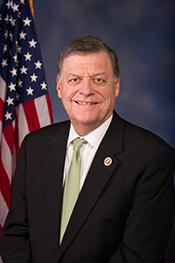 Rep. Tom Cole (R-OK)
Description
Amendment protects sections 1113 and 1114 in the bill from points of order.
Legislative Activity
Stay on top of the latest movement without scrolling through every action
House amendment offered
March 15, 2005
View full timeline
House amendment offered
March 15, 2005
House amendment agreed to: On agreeing to the Cole (OK) amendment (A001) Agreed to by voice vote.
March 15, 2005 • 11:41 AM
Amendment agreed to by House: On agreeing to the Cole (OK) amendment (A001) Agreed to by voice vote.
March 15, 2005 • 11:41 AM
Roll call votes on amendments in House
March 15, 2005 • 11:41 AM
House amendment offered/reported by : Amendment (A001) offered by Mr. Cole (OK).(consideration: CR H1433-1435; text: CR H1433-1434)
March 15, 2005 • 11:16 AM
Amendment (A001) offered by Mr. Cole (OK). (consideration: CR H1433-1435; text: CR H1433-1434)
March 15, 2005 • 11:16 AM
On ordering the previous question on the amendment (A001) and on the resolution Agreed to by the Yeas and Nays: 220 - 195 (Roll no. 69).
March 15, 2005 • 11:41 AM
On agreeing to the Cole (OK) amendment (A001) Agreed to by voice vote.
March 15, 2005 • 11:41 AM
Votes
1 roll call on this amendment
Text
Offered
PROVIDING FOR CONSIDERATION OF H.R. 1268, EMERGENCY SUPPLEMENTAL
APPROPRIATIONS ACT FOR DEFENSE, THE GLOBAL WAR ON TERROR, AND TSUNAMI
RELIEF, 2005

Mr. COLE of Oklahoma. Mr. Speaker, by direction of the Committee on
Rules, I call up House Resolution 151 and ask for its immediate
consideration.
The Clerk read the resolution, as follows:

H. Res. 151

Resolved, That at any time after the adoption of this
resolution the Speaker may, pursuant to clause 2(b) of rule
XVIII, declare the House resolved into the Committee of the
Whole House on the state of the Union for consideration of
the bill (H.R. 1268) making emergency supplemental
appropriations for the fiscal year ending September 30, 2005,
and for other purposes. The first reading of the bill shall
be dispensed with. All points of order against consideration
of the bill are waived. General debate shall be confined to
the bill and shall not exceed one hour equally divided and
controlled by the chairman and ranking minority member of the
Committee on Appropriations. After general debate the bill
shall be considered for amendment under the five-minute rule.
Points of

[[Page H1428]]

order against provisions in the bill for failure to comply
with clause 2 of rule XXI are waived, except for Sections
1113 and 1114. During consideration of the bill for
amendment, the Chairman of the Committee of the Whole may
accord priority in recognition on the basis of whether the
Member offering an amendment has caused it to be printed in
the portion of the Congressional Record designated for that
purpose in clause 8 of rule XVIII. Amendments so printed
shall be considered as read. At the conclusion of
consideration of the bill for amendment the Committee shall
rise and report the bill to the House with such amendments as
may have been adopted. The previous question shall be
considered as ordered on the bill and amendments thereto to
final passage without intervening motion except one motion to
recommit with or without instructions.
Sec. 2. In the engrossment of H.R. 1268, the Clerk shall--
(a) add the text of H.R. 418, as passed by the House, as
new matter at the end of H.R. 1268;
(b) conform the title of H.R. 1268 to reflect the addition
to the engrossment of H.R. 418;
(c) assign appropriate designations to provisions within
the engrossment; and
(d) conform provisions for short titles within the
engrossment.

The SPEAKER pro tempore (Mr. Miller of Florida). The gentleman from
Oklahoma (Mr. Cole) is recognized for 1 hour.

General Leave

Mr. COLE of Oklahoma. Mr. Speaker, I ask unanimous consent that all
Members may have 5 legislative days within which to revise and extend
their remarks on H. Res. 151.
The SPEAKER pro tempore. Is there objection to the request of the
gentleman from Oklahoma?
There was no objection.
Mr. COLE of Oklahoma. Mr. Speaker, for the purpose of debate only, I
yield the customary 30 minutes to the gentlewoman from New York (Ms.
Slaughter), pending which I yield myself such time as I may consume.
During consideration of this resolution, all time yielded is for the
purpose of debate only.
Mr. Speaker, on March 14, the Committee on Rules met and granted an
open rule on House Resolution 151, with 1 hour of debate equally
divided between the chairman and ranking minority member of the
Committee on Appropriations. This rule accords priority of recognition
to Members who have preprinted their amendments in the Congressional
Record and provides one motion to recommit, with or without
instructions.
Additionally, this rule attaches the text of H.R. 418, as passed, to
the base text of the bill. H.R. 418 previously passed the House by a
bipartisan vote of 261 to 161 on February 10 of this year.
Mr. Speaker, I am proud today to be able to manage this rule. This
rule provides for an emergency supplemental funding package to sustain
our troops in the ongoing war on terror. Most of these funds are
directed towards operations in Iraq. Just last week, I returned from
Iraq where I personally received numerous briefings regarding our
readiness and our operational capabilities. I heard from our
commanders, military personnel, and diplomats on the ground in Iraq. My
colleagues and I also had the opportunity to meet with senior and
provincial Iraqi political leaders.
Their collective message was clear, compelling, and optimistic.
First, things are getting better. Second, our soldiers, Marines,
sailors, and airmen believe in their mission. Third, continued
congressional support, both moral and financial, is absolutely
essential to bring our operations to a successful conclusion. The bulk
of H.R. 1268 moves us closer to that objective.
This supplemental appropriations package is the fifth supplemental
since September 11 that focuses on meeting the challenges imposed on us
by the ongoing global war on terrorism.
Specifically, this supplemental provides for the replenishing of
those accounts that the military has exhausted during sustained
operations in Iraq, Afghanistan, and other areas of the world.
Additionally, it provides important funding to assist in our efforts to
address the disastrous results of the recent tsunami in South Asia and
the Indian Ocean. Finally, there are important measures dedicated to
improving the benefits due to our soldiers and meeting the diplomatic
costs that our efforts have necessitated.
Important obligations are met in this legislation. Specifically, this
bill provides saving $76.8 billion for total defense expenditures, a
full $1.8 billion over the President's request, funding other important
military shortfalls identified by committees of the Congress. The vast
majority of these dollars will directly support our servicemen in the
area of operations. These include purchases such as an additional
47,000 sets of body armor, 1,700 new armored Humvees and $408 million
to harden the facilities that protect our servicemen from indirect
fire.
Mr. Speaker, the Committee on Appropriations also addressed several
other issues inside the supplemental that are essential to successfully
prosecuting our global war on terror. Among them are the inclusion of
Army modularity reform and the construction of a new American embassy
in Baghdad.
Specifically, with respect to Army modularity, the committee took
some important steps to ensure that our troops who will deploy in the
near future are able to leverage more combat power from their current
formations by adding a brigade at the division level. This ultimately
supports the Army's attempt to transform the service to make it
lighter, faster, more efficient and to reorient itself to its core
competencies. Put simply, Army modularity, the movement to new brigade
formations, will put more soldiers in the fight and allow us to use our
combat personnel much more efficiently.
With respect to the embassy in Baghdad, the committee took a close
look at the State Department's request and reduced it by 10 percent.
Mr. Speaker, with respect to the embassy, I am aware that many Members
have concerns about its high cost. However, let me be clear about the
need for this extraordinary expenditure.
Having visited the Baghdad embassy twice before, it is clear to me
that a new facility is required. This is not an optional item. The
United States should not occupy one of Saddam Hussein's palaces
indefinitely, for to do so only reinforces the impression in parts of
the Arab world that the United States is an occupying power.
More importantly, Iraq is a very dangerous diplomatic post. Indeed,
it is so dangerous that essentially every State Department employee
based in Baghdad is a volunteer. Like our soldiers, these brave career
civil servants need and deserve the best security we can provide them
while they perform their vital functions. A new, secure embassy is
indispensable to achieving this objective.
Mr. Speaker, H.R. 1268 takes a number of important steps forward in
addressing the needs of our military. Today, we are likely to debate
several amendments that would have a gutting effect on this underlying
legislation. I would strongly urge Members to closely examine such
amendments and reject them.

{time}  1030

Our debate today is not over the war. The President and the Congress
have already made that decision. Our focus should be to give our forces
the resources they need to successfully complete their dangerous and
challenging mission.
The bill we have before us today is an excellent and timely piece of
legislation with strong bipartisan input and support. Therefore, I urge
the support for the rule and the underlying bill.
Mr. Speaker, I reserve the balance of my time.
Ms. SLAUGHTER. Mr. Speaker, I yield myself such time as I may
consume.
Mr. Speaker, this is the third major supplemental appropriations bill
Congress has considered for Iraq and Afghanistan. A war and
reconstruction that the administration told us could be completely
financed by Iraqi oil revenues has cost the American taxpayer a
staggering $275 billion, and the end is nowhere in sight. As the price
of this war continues to climb, we can no longer afford to ignore the
equally expansive ``accountability'' gap that has developed in the
White House.
Harry Truman was famous for saying the buck stops here. After all, he
was the President, and to him that meant he had to take responsibility
for his government. He was accountable to the people he served.
But time and again our current President has demonstrated his
unwillingness to be held accountable for any decision, or commitment or
blunder of

[[Page H1429]]

his administration. And what is particularly disappointing is the
willingness of the Republican leadership to assist the administration
in its need to avoid accountability.
Let me give an example. The gentleman from Massachusetts (Mr.
Tierney) came before the Committee on Rules last night, offered an
amendment which would have established a select committee to follow up
on a very disturbing report just released from the Inspector General's
Office. The report indicates that $9 billion spent on Iraqi
reconstruction is unaccounted for and no one knows where it is.
In one case, the Inspector General raised the possibility that
thousands of ghost employees were on one unnamed ministry's payroll. In
another case, a firm was allegedly paid $15 million to provide security
during civilian flights into Baghdad even though no planes flew during
the term of the contract. In another case, a Pentagon contract for the
development of bulletproof armor was given to a ``former Army
researcher who had never mass-produced anything,'' and according to the
New York Times, the researcher tried for a year to meet the order and
finally was forced to give up completely.
These types of incidents squander precious resources, waste time we
often do not have, and place American's lives at risk.
Mr. Speaker, we heard of another report just this morning that
Halliburton has overcharged us, according to the Pentagon, by $100
million.
The Tierney amendment would have established a House select committee
to further investigate the allegations, much like the successful Truman
Committee was established during the Second World War. The Committee on
Rules Democrats tried to get the amendment made in order because we
expect accountability from our government, but we were voted down on a
party-line vote. Why?
No one can reasonably suggest that this body does not have time to
get to the bottom of these unresolved issues. After all, we spend on
average only 2 days a week in this Chamber, and half the time we do
spend here we are renaming Post Offices and honoring foreign
dignitaries, and a few athletic endeavors.
If we have enough time for that, we certainly have enough time to
track down $9 billion that the administration seems to have misplaced.
We have the time and energy to address rampant corruption in the way
our contracts in Iraq are being administered. Certainly we have the
will to infuse some accountability into the process, but apparently the
leadership does not have the time or the will and truly demonstrates
the hypocrisy of those in the majority who say they are for saving
taxpayer money, except when it is being wasted by their administration.
But it raises a more important question, and that is if we in this body
will not hold the White House accountable for losing $9 billion, then
who will? If it is not our job in this Chamber, then whose is it?
There is another disturbing aspect to the lack of accountability in
Iraq contracting. The administration was supposed to issue two reports
detailing spending on both military operations and reconstruction
activities in Iraq. That was done by law, one of the reports due on
October 31, 2004, the other due January 1, 2005. Neither report has
ever been delivered to the Congress.
Mr. Speaker, the Department of Defense has a legal obligation to
provide the reports to Congress and they are breaking the law by not
providing them. The majority in this body is breaking its bond of trust
with the American people by not demanding these reports, and with them
a measure of accountability for their administration.
The American people expect the leadership of this Congress to be more
than a rubber stamp for an administration that has shown itself to be
secretive and dishonest time and time again. We have a responsibility
to our fellow Americans, to our Constitution, to ensure that all
branches of the government are held accountable to the American people.
And speaking of accountability, this supplemental increases the
military death gratuity from $12,000 to $100,000 and subsidized life
insurance benefits from $250,000 to $400,000 for families of soldiers
who died or were killed on active duty from October 7, 2001.
This is critical language which does two important things for our
fighting men and women: Expands their life insurance and increases
their death benefits. But what happened, these benefits, which will be
legislating on an appropriation bill, require protection from the
Committee on Rules against a point of order on the floor of the House.
Sadly, the leadership refused to grant that protection in this rule,
and those two measures are left open to a point of order.
Therefore, any single Member of this body can stand up and knock out
those provisions without any debate, without any vote, without any
opportunity for dissent. This was no accident. Clearly the rule was
written this way by design because we had to wait to get the rule after
they completed those negotiations.
And why are the benefits of our fighting men and women not worthy of
protection? The sad truth is these men and women have the courage to
protect us with their lives, and yet some in this Chamber do not have
the courage to protect them with even a vote on the House floor.
The Republican leadership has resorted to setting up a point of order
to ensure the benefit increases never make it into law because they do
not have the courage to vote it down themselves and they do not want to
be accountable for the vote.
The bill also includes funding for body armor, armored Humvees,
electronic jammers and other necessary items to protect our troops
which are long overdue. But as we listen to Member after Member rising
to pay homage to the sacrifice of our fighting forces, I want my fellow
Americans to remember who was willing to sacrifice those men and women
on the House floor today.
I also want them to remember two very important amendments which were
not made in order by the Committee on Rules. The amendments by the
gentlewoman from Oregon (Ms. Hooley) and the gentlewoman from
Connecticut (Ms. DeLauro) would have expanded veterans' health care and
mental health care, but they were not included in the bill.
Mr. Speaker, that is why at the conclusion of the debate I will ask
Members to defeat the previous question to the rule so we can get a
vote on the Hooley and DeLauro amendments and so we can move to protect
the language in the bill which increases the benefits for our military
personnel.
Our soldiers, sailors, airmen and Marines are over in Iraq today
risking their lives to protect America and the world. The least we can
do is provide them with decent health care when they return. Once we
vote, our fellow Americans will know exactly where we all stand on
health care for our veterans despite the rhetoric and legislative
tricks, and that is what I like to call held accountable.
Mr. Speaker, I reserve the balance of my time.
Mr. COLE of Oklahoma. Mr. Speaker, I yield myself such time as I may
consume.
Mr. Speaker, just for an informational point, the gentlewoman from
New York (Ms. Slaughter) makes an excellent point about sections 1113
and 1114. I want to inform the gentlewoman that at the conclusion I
will be offering an amendment to protect those sections from points of
order.
Mr. Speaker, I am pleased to yield 2 minutes to the gentlewoman from
Florida (Ms. Ginny Brown-Waite).
Ms. GINNY BROWN-WAITE of Florida. Mr. Speaker, I rise to support
including the REAL ID Act in the supplemental spending bill on the
floor today.
As we saw post-9/11, Congress must protect our Nation's borders
against the threat of terrorism. Just last week, my district saw the
unfortunate confluence of illegal immigration, Social Security fraud
and potential terrorist threats meeting together.
In my hometown of Crystal River, Florida, the nuclear power plant was
found to have contracted with illegal immigrant day laborers through a
contract who had used fake or stolen ID and Social Security numbers to
obtain government-issued driver's licenses. Thankfully, these men have
been arrested by the FBI and fully interviewed by Customs enforcement
agents.
Who is to say that the seemingly harmless workers could not have
really

[[Page H1430]]

been agents of a terrorist group that is intent on blowing up or
hijacking a nuclear power plant? As we saw with flight schools before
9/11, it is often the little things that are overlooked in our constant
fight against terrorism that lead to the biggest problems.
As President Bush has said time and time again, we have to be right
hundreds of times each and every day in our fight against terrorism,
and they only have to be right once.
I voted against the 9/11 intelligence reform bill primarily because
it omitted the ID standard reforms that the 9/11 Commission called for
and that America needed. Had the REAL ID Act been in place, the
Department of Motor Vehicles would have been required to verify the
Social Security numbers used by these workers. This check would have
shown that the numbers were really issued to men that had been deceased
for 40 years and would have disallowed the men from gaining access to a
supposedly secure nuclear power facility.
I would hate to see a future terrorist attack that Congress could
have prevented by tightening our access to driver's licenses. We need
the Senate to pass the REAL ID bill, and I am delighted it was added
onto this supplemental budget.
Mr. Speaker, I urge my colleagues to support these much-needed
reforms and to vote in favor of the REAL ID Act included in the
supplemental bill.
Ms. SLAUGHTER: Mr. Speaker, I yield 5 minutes to the gentleman from
Massachusetts (Mr. McGovern), a member of the Committee on Rules.
Mr. McGOVERN. Mr. Speaker, I wish to commend the chairman of the
Committee on Appropriations, the gentleman from California (Mr. Lewis);
the ranking member, the gentleman from Wisconsin (Mr. Obey); and the
chairman and ranking member of the Subcommittee on Defense, the
gentleman from Florida (Mr. Young) and the gentleman from Pennsylvania
(Mr. Murtha). They have written a bill that seeks to address the needs
of our troops and provide needed reconstruction funds to Iraq,
Afghanistan and those nations devastated by the recent tsunami.
I know the gentleman from Pennsylvania (Mr. Murtha) took special care
in ensuring that this bill contains adequate vehicle and personal
protection for our troops in Iraq, and to make sure that our military
will be adequately equipped and supplied for upcoming troop rotations
in Iraq.
It is, therefore, difficult for me to rise and declare my opposition
to this bill. My opposition is not meant as an affront to their hard
work and care for the security of our troops. Every single Member of
this House, including myself, shares their concerns and their
commitment to the safety and well-being of our men and women in uniform
who are serving so courageously under such difficult circumstances, nor
do I object to the foreign aid of this bill.
So why do I rise in opposition? It is quite simple. Once this
supplemental is signed into law, Congress will have provided this
administration with nearly $300 billion for military and reconstruction
efforts in Iraq and Afghanistan. Two years after we invaded Iraq
President Bush still asked for these moneys under emergency authority.
Tomorrow we are going to debate the President's budget. There are no
funds in his budget or the Republican budget resolution for the
continuing war in Iraq or security operations in Afghanistan. Why not?
Is the President telling us that all our troops are coming home next
year, or is he just saying that we can look forward to year after year
of so-called emergency bills totaling hundreds of billions of dollars
because his administration has no idea how long we are going to be
engaged in Iraq and how much it is going to cost the American people in
blood and treasure.
I believe Congress must know the answers to those questions before we
vote more money for this war. These funds should be in the budget, and
the cost of these wars should be projected over the next 5 years just
like every item in the budget. We know we are in Iraq. It is not a
surprise. It is certainly not an unforeseen emergency. The President
has told us we are going to be there next year, so why is there no
money for these operations in the budget? How much do they project
these wars will cost? How do they propose we pay for it? Right now we
borrow money to pay for the war, nearly $300 billion worth. We do not
pay for it, we simply go deeper and deeper into debt and pass the bill
on to our children.
Mr. Speaker, this is a profound failure of accountability, the
failure to level with the American people.
This week when Congress debates the budget resolution we will be
asked to vote for a bill which cuts education, cuts health care, cuts
veterans benefits, economic development for our cities and towns, and
many other critical projects. But the war, it is not part of the budget
or subject to cuts or reconciliation. It is all off the books.
From the very first day when we were told the U.S. had to invade Iraq
we have been lied to. We were lied to about the weapons of mass
destruction. We were lied to about Saddam Hussein having ties to al
Qaeda. We were lied to about how much the war would cost and how long
it would take to bring stability to Iraq.
We are here today debating a bill that is filled with armored Humvees
and personal body armor for our troops. But, Mr. Speaker, we provided
money for those items in 2002 before we went to war in Iraq, and we
provided it again in the first supplemental on Iraq and in the second
supplemental on Iraq and in the third supplemental on Iraq. So why are
so many of our troops still lacking body armor and still driving
unprotected vehicles? Congress sent that money specifically to meet
those needs. So what happened to the money? Why were those needs not
met? That is a deadly serious question of accountability.

{time}  1045

The Pentagon's own inspector general says that nearly $9 billion in
reconstruction funds for Iraq cannot be accounted for. Another $15
million may have been subject to fraud by the very companies the
Pentagon chooses to give contracts to for services in Iraq. That is
taxpayer money provided by my constituents.
Mr. Speaker, we need to have a real debate about our policy in Iraq.
Every few months we get an emergency supplemental for the war on Iraq.
We are told we have to vote for it in order to show our support for our
troops, and I expect that this bill will probably pass overwhelmingly.
But it is just more of the same.
There comes a time when you just have to stop and say no more, not
until we get real answers to hard questions, not until we know where we
are going in Iraq and how much it is going to cost.
Mr. Speaker, I oppose this bill; and I urge my colleagues to oppose
it.
Mr. COLE of Oklahoma. Mr. Speaker, I am pleased to yield 5 minutes to
the gentleman from Texas (Mr. Smith).
Mr. SMITH of Texas. Mr. Speaker, I thank the gentleman for yielding
me this time. And, Mr. Speaker, I rise in strong support of this rule.
Last October, 282 Members of Congress voted for landmark legislation
that fulfilled our duty to our constituents to make America an
appreciably safer place. H.R. 10 truly reflected the hard-earned lesson
of 9/11.
Unfortunately, the other body saw fit to strip from the bill some of
its most vital provisions, measures designed to ensure that terrorists
would never again be able to carry out their nefarious plots by abusing
our immigration system and our identity documents.
Today, leadership is fulfilling a commitment that it made to the
American people that these provisions would yet become law. Today's
rule makes the text of H.R. 418, the REAL ID Act, a self-executing
amendment to the Emergency Wartime Supplemental Appropriations Act.
The gentleman from Wisconsin (Chairman Sensenbrenner) introduced, and
the House last month passed, the REAL ID Act containing many of the
provisions stripped from the intelligence reform bill last year. I
thank the gentleman from Illinois (Mr. Hastert), the gentleman from
Texas (Mr. DeLay), the gentleman from Missouri (Mr. Blunt), and the
gentleman from California (Mr. Dreier) for ensuring that the will of
this House will be done, and that this crucial legislation will be
enacted into law.
The goal of the REAL ID Act is straightforward. It seeks to prevent
another catastrophic terrorist act by deterring terrorist travel. These
terrorist methods of operation were mentioned

[[Page H1431]]

both in the 9/11 Commission report and the 9/11 staff report on
terrorist travel. Page 49 of the terrorist travel report states:
``Abuse of the immigration system and a lack of interior enforcement
were unwittingly working together to support terrorist activities.''
Page 59 states: ``Members of al Qaeda clearly valued freedom of
movement as critical to their ability to plan and carry out the attacks
prior to September 11.''
The REAL ID Act contains four provisions aimed at disrupting
terrorist travel. First, it addresses the use of a driver's license as
a form of Federal identification. American citizens have the right to
know who is in their country, that people are who they say they are,
and that the name on the driver's license is the real holder's name,
not some alias.
The REAL ID Act will establish a uniform rule for all States that
temporary driver's licenses for foreign visitors expire when their visa
terms expire and establish tough rules for confirming identity before
driver's licenses are issued.
Second, this legislation will tighten our asylum system. Some judges
have made asylum laws vulnerable to fraud and abuse. We will end judge-
imposed presumptions that benefit suspected terrorists so that we will
stop providing them a safe haven.
The REAL ID Act will reduce the opportunity for immigration fraud so
that we can protect honest asylum seekers and stop rewarding the
terrorists and criminals who falsely claim persecution.
Third, the REAL ID Act will waive Federal laws to the extent
necessary to complete gaps in the San Diego border security fence which
is still unfinished 8 years after congressional authorization.
The REAL ID Act contains one final commonsense provision that helps
protect Americans from terrorists who have been able to successfully
infiltrate the United States: currently, certain terrorism-related
grounds of inadmissibility to our country are not also grounds for
deportation. The REAL ID Act makes aliens deportable from the U.S. for
terrorism-related offenses to the same extent that they would be
inadmissible to the United States to begin with.
Mr. Speaker, I urge my colleagues to support this rule.
Ms. SLAUGHTER. Mr. Speaker, I yield 6 minutes to the gentleman from
Wisconsin (Mr. Obey).
Mr. OBEY. I thank the gentlewoman for yielding me the time. Mr.
Speaker, there are a number of things that can be said about this bill.
Let me simply say that I opposed going to war in the first place. I
think this country was misled into war on the basis of bad information
and false information. And I believe some of that was purposeful.
I think that our attack on Iraq is the dumbest American war since the
War of 1812. But nonetheless, that is past history. We now have the
question of whether or not we are going to pay for the war which we
have waged. And at this point, I do not believe we have any choice.
What I do wish is that the administration would be forthcoming about
the full cost of the war, because you can bet just as surely as you sit
here today that the administration will be back for even more money to
cover the costs which are allegedly being provided for under this bill
today. I think the administration is giving us the facts about the cost
of this war on the installment plan. And by the time the full truth
comes out, the costs will be much higher than this bill implies today.
I also believe that it is dead wrong for this Congress to decline to
appoint a Truman-like committee to investigate profiteering and fraud
by contractors in Iraq.
Just the story today about Halliburton in The Washington Post ought
to be enough to prod this Congress into setting up a meaningful
investigative committee. As has been pointed out, Harry Truman, when he
was in the Senate, conducted almost 400 hearings and issued over 50
reports on war profiteering during World War II. That was a Democratic
Congress investigating a Democratic administration and it did no harm
to the country. I hope that today this House will still agree to
appoint that kind of a committee.
Having said that, I think there is a far more important issue which
is associated with this bill. Mr. Speaker, as we know, some of what
appears in the newspaper can be right and some can be wrong, but there
have been a number of stories which have appeared in the newspaper
about the activities of the Defense Department which I find highly
disturbing. I quote from one story Sunday, January 23, Washington Post:
``The Pentagon expanding into the CIA's historic bailiwick has created
a new espionage arm and is reinterpreting U.S. law to give Defense
Secretary Donald Rumsfeld broad authority over clandestine operations
abroad.''
That article goes on to say: ``The Pentagon official said they are
establishing the strategic support branch using reprogrammed funds
without explicit congressional authority or appropriation.''
It then goes on to say: ``One Republican Member of Congress with a
substantial role in national security oversight declined to speak
publicly against political allies, but he is quoted as saying, `It
sounds like there's an angle here of let's get around having any
oversight by having the military do something that normally the CIA
does and not tell anybody. That immediately raises all kinds of red
flags for me. Why aren't they telling us?' ''
I think that question needs to be answered.
There are a number of other comments in the press which are along the
same lines. I would simply get to the last one by reading a portion of
an article that appeared in the New Yorker several weeks ago. I just
want to read one paragraph: ``The new rules will enable the special
forces community to set up what it calls action teams in the target
countries overseas which can be used to find and eliminate terrorist
organizations. `Do you remember the right-wing execution squads in El
Salvador?' the former high-level intelligence official asked me,
referring to the military-led gangs that committed atrocities in the
early 1980s. `We founded them and we financed them,' he said. `The
objective now is to recruit locals in any area we want and we aren't
going to tell the Congress about it.' ''
Mr. Speaker, I think that the Congress has a right to demand that we
be told about it. I had originally intended to offer an amendment today
which would have fenced and prohibited the expenditure of the
intelligence funds in this bill until we get from the administration an
understanding about how we are going to be informed on these matters.
And I do not mean after the fact.
I had intended to offer that amendment, but yesterday I received a
phone call from Andy Card, the President's chief of staff, who asked me
to at least temporarily withhold offering that amendment, and he gave
me his commitment that the administration would try to work out an
arrangement to see to it that the leaders of the Intelligence
Committee, the Armed Services Committee, and the Appropriations
Committee are given the adequate information that they need to make
choices around here.
I told him that I would be willing to withhold that amendment on this
bill with the understanding that if we have not got this worked out
very quickly, that we will have an opportunity to deal with this issue
on the next regular vehicle moving through here, which would be either
the armed services bill or the defense appropriations bill.
This, in my view, is the most important issue associated with this
bill, and I intend to be back here with just such an amendment if we do
not get the kind of reporting from the administration that we have a
right to expect under the Constitution.
Mr. COLE of Oklahoma. Mr. Speaker, I yield myself such time as I may
consume.
Let me just make a couple of quick points. I was not in Congress when
the decision, on a bipartisan basis, was made to give the President the
authority to commence hostilities in Iraq, but I do think it was the
right decision, and I do think that it has been vindicated frankly by
things that have happened recently not only in Iraq but throughout the
Middle East.
Regardless of that, I think my friend makes a good point, and I
appreciate his support for this particular piece of legislation. I know
it is very difficult. But the real question here is not the

[[Page H1432]]

war, as I tried to mention in my opening comments. That is a decision
that has already been made by Congress. The real question on this
particular piece of legislation on this rule is are we going to provide
people the resources they need to get the job done that we asked them
to do. I think it is very important that we do that on a bipartisan
basis. I think that will be a very powerful message in Iraq and a very
powerful message around the Middle East.
Mr. Speaker, I reserve the balance of my time.
Ms. SLAUGHTER. Mr. Speaker, I yield 2 minutes to the gentlewoman from
Oregon (Ms. Hooley).
Ms. HOOLEY. I thank the gentlewoman from New York for yielding me
this time.
Mr. Speaker, I rise in opposition to the rule. Last night, I offered
an amendment before the Rules Committee that would have added $1.2
billion to this bill for VA health care and $100 million for
reintegration services for National Guard members being released from
active duty. Unfortunately, my amendment was not ruled in order.
America is currently asking more of its all-volunteer military force
than it ever has before. Yet even as America prepares to continue its
large and prolonged military campaign in Iraq, it has done very little
to provide for the veterans of this war. Our obligation to support our
troops does not end when they leave Iraq. But how are we supposed to
provide adequate health care to these new veterans when we cannot even
meet the needs of our current veterans?

{time}  1100

Last year's budget was $1.3 billion short of the amount that VA
Secretary Principi, as well as the House Committee on Veterans'
Affairs, stated is needed just to maintain the current level of
veterans' health care services.
We also need to make sure that our returning soldiers have the
readjustment assistance they need, particularly for members of the
Guard and Reserve. Members of the National Guard returning home face
immense challenges in transitioning out of active duty deployments and
back to civilian life. They do not go home to a base. They go home.
They are scattered throughout the State. While the State Guard offices
are working to provide these returning soldiers with important
information regarding their health care, employment assistance, and
other transitional services, they do not have the resources needed to
complete the education and counseling necessary for a smooth transition
back to civilian life. Our returning soldiers deserve better.
I urge my colleagues to defeat the previous question so we can
consider this important amendment and keep our promises to our Nation's
veterans.
Mr. COLE of Oklahoma. Mr. Speaker, I reserve the balance of my time.
Ms. SLAUGHTER. Mr. Speaker, I yield 2 minutes to the gentlewoman from
Connecticut (Ms. DeLauro).
Ms. DeLAURO. Mr. Speaker, I rise in opposition to the rule, but
because it is important to get our troops in the field the equipment
that they need I will support the supplemental legislation that also
includes desperately needed aid to Sudan and the victims of the tsunami
and provides economic development funding for projects in Palestinian
controlled areas of the West Bank.
Yet I remain concerned that the legislation provides no funding for
immediate mental health needs of our troops. The House is not even
being given a chance to consider an amendment that I wanted to offer
that would have added $263 million in DOD and VA funding for this
issue. This at a time when the Army tells us that as many as one in six
returning soldiers suffer from symptoms of post-traumatic stress
disorder. If that is not an emergency, then I do not know what is.
Providing badly needed funding for the Defense Department to improve
its training programs for military families on the detection of mental
health problems in service members returning from combat is an issue
this committee agreed the Defense Department should consider in the
2005 Defense appropriations bill. As such, this amendment would have
increased by 20 percent our spending on specialized PTSD programs
within the DOD, within the Veterans Administration, and go to treating
the symptoms of PTSD such as substance abuse and homelessness. It would
have embraced new technology in the Veterans Administration, promoted
the use of private sector mental health professionals and students to
be able to reach more troops and their families, especially in rural
and underserved areas.
More than 500 soldiers have been evacuated from Iraq for mental
health reasons since the beginning of Operation Iraqi Freedom. We know
the damage PTSD can do away from the battlefield, ruining families,
causing alcoholism, drug abuse, and homelessness. Our men and women in
uniform deserve a better homecoming than that.
Let us do the right thing for our troops, address this issue soon,
and give our soldiers the mental health services that they have earned.
Mr. COLE of Oklahoma. Mr. Speaker, I reserve the balance of my time.
Ms. SLAUGHTER. Mr. Speaker, I yield myself such time as I may
consume.
I will be asking Members to join with me in voting ``no'' on the
previous question so that I can modify the rule and allow the House to
consider two very critical amendments for our Nation's combat soldiers
that were rejected last night in the Committee on Rules. The first
amendment by the gentlewoman from Oregon (Ms. Hooley) will help our
Iraq and Afghanistan veterans in two important ways: First, it will
provide an additional $1.2 billion for veterans' health care.
Additionally, it will provide $100 million for reintegration services
for the Army and National Guard members being released from active duty
and returning to civilian life.
The second amendment by the gentlewoman from Connecticut (Ms.
DeLauro) would expand mental health care by providing $238 million to
the VA for a post-deployment mental health initiative and $35 million
for the Defense Department to contract with private mental health
providers for counseling the returning service members.
Mr. Speaker, I want to emphasize that a ``no'' vote on the previous
question will not block consideration of the supplemental. The bill
will still be considered in its entirety. However, a ``yes'' vote will
prevent us from voting to help our veterans in these very important
areas. I urge all Members to join with me in supporting our soldiers
and vote ``no'' on the previous question.
Mr. Speaker, I ask unanimous consent that the text of the amendments
be printed in the Record immediately prior to the vote on the previous
question.
The SPEAKER pro tempore (Mr. Miller of Florida). Is there objection
to the request of the gentlewoman from New York?
There was no objection.
Ms. SLAUGHTER. Mr. Speaker, I yield back the balance of my time.
Mr. COLE of Oklahoma. Mr. Speaker, I yield myself such time as I may
consume.
Mr. Speaker, I would like to take a few moments just to go through
some of the specific provisions of this particular legislation because
I think the vote that we are getting ready to cast is so exceptionally
important.
Mr. Speaker, in terms of the defense portion of this particular
appropriation, it includes a total of $76.8 billion for total defense
expenditures. That is again $1.8 billion over what the administration
requested. The additions over the request are in support of deployed
and soon to be deployed or returning troops and to assist in force
protection and to increase the survivability of troops in the field.
Within the total Defense fund, $3.1 billion is provided for
activities under the jurisdiction of the Military Quality of Life and
Veterans Affairs, and Related Agencies Subcommittee. The following
table summarizes, which I will submit for the Record, the committee's
addition to the request within the Defense Subcommittee.
So we have an extensive addition that I think actually improves the
administration's original request. In addition to the Defense
expenditures, we have included other moneys for foreign operations. The
committee has added $1.7 billion in net foreign assistance funds within
the Foreign Operations,

[[Page H1433]]

Export Financing and Related Programs Subcommittee. Within these funds,
the committee has identified $1.7 billion in urgent or critical items
funded in the bill as an emergency that are directly related to the War
on Terror or aiding recovery to the tsunami victims. The committee also
provides $1 billion of important items that further U.S. global
interests but has offset this spending with a corresponding rescission
of $1 billion in previously appropriated assistance to Turkey. These
funds were provided in the first Iraq supplemental of 2 years ago and
require a positive vote of the Turkish Parliament to be expended. There
is widespread agreement that this will not take place anytime soon.
Within the $1.7 billion of emergency assistance, there is $594
million to the counternarcotics effort and for police training in
Afghanistan; $400 million is requested to train Afghan police, and $194
million and $66 million below the request.
Mr. Speaker, I yield 8 minutes to the distinguished gentleman from
California (Mr. Dreier), chairman of the Committee on Rules.
Mr. DREIER. Mr. Speaker, I rise in strong support of this rule, and I
want to begin by congratulating the gentleman from Oklahoma (Mr. Cole),
who has worked long and hard on this and has made four trips to Iraq
and understands extraordinarily well how critically important it is for
us to ensure that we get the resources necessary for our men and women
in uniform there.
We have many important things that need to be done in this measure.
The gentleman from Oklahoma (Mr. Cole) talked in his opening remarks
about the need for us to ensure the completion of our compound. It is
not just an embassy, our compound, in Baghdad. I am one who would be
very critical of a massive expenditure for a huge compound like this,
but we have got to realize, as the gentleman from Oklahoma (Mr. Cole)
said, that sending a message throughout Iraq that we are taking over a
former palace of Saddam Hussein would not be the right signal for us to
send. And that is why it is essential that we proceed with the
construction of this very important compound.
I think it is also very important for us to note that we have got to
provide a reimbursement for the important humanitarian assistance that
is being provided to those who have suffered, the over 150,000 who were
killed, the people who have suffered from the tsunami. It is very
important for us to deal with that.
And, Mr. Speaker, it is also very important for us to recognize that
this is the first must-pass piece of legislation. And what does that
say? It says that we are keeping our word based on a very rigorous
debate that we had last fall in the 108th Congress, and that had to do
with implementation of the recommendations of the 9/11 Commission, the
intelligence reforms. And just to remind our colleagues, Mr. Speaker,
there were a number of us, and I was privileged to serve as one of the
five House Republican conferees on that bill to implement the 9/11
Commission's recommendations, and one of the things that we focused on
was border security, realizing that Mohammed Atta, one of the
individuals who flew a plane into one of the World Trade Center towers,
had a valid driver's license, as did the 19 others who were involved in
the terrorist attacks on September 11. But Mohammed Atta was in a
unique position. He had been pulled over for a traffic violation and
was actually scheduled to appear in court for that violation after
September 11, and we all know what he did. He brought down one of the
World Trade Center towers. And that is why we felt very strongly last
fall when we were negotiating that conference agreement that we include
language that this House overwhelmingly voted in support of, and that
was to deal with this driver's license question, the problem of having
people get into their hands, people who are here illegally, access to
driver's licenses. And that is why we took those provisions. And,
unfortunately, because the other body would not allow us to include
those in the 9/11 conference, we had gotten to a point where we said we
would include those in the first must-pass piece of legislation.
Mr. Speaker, this is the first must-pass piece of legislation. And
the REAL ID Act, which the gentleman from Wisconsin (Mr. Sensenbrenner)
and the gentleman from Texas (Mr. Smith) and a wide range of other
Members have offered include, it was a measure that was passed with
strong bipartisan support here, 260 votes, and it is designed to do a
number of very important things that are focused on our border
security, which is tied to our national security, a very important
aspect of our national security. It says that those States that provide
driver's licenses to people who are here illegally cannot have those
driver's licenses used for any Federal purpose, meaning that we
recognize the importance of federalism, we recognize States rights,
which is a very important thing for us to do, but what we do say is
that those States which grant licenses to people who are here
illegally, those licenses cannot be used for a Federal purpose, meaning
getting on board an aircraft, meaning going into a Federal courthouse,
applying for any kind of Federal program. The idea behind it is that we
hope we will not see States granting driver's licenses to people who
are here illegally. That is really our goal.
One of the reasons that I enthusiastically supported Arnold
Schwarzenegger for Governor of California 1\1/2\ years ago was the goal
of ensuring that we did not see driver's licenses get into the hands of
people who are here illegally.
So this measure which we are going to be voting on here today, I am
happy to say we have now included this in the rule itself. By voting
for the rule, we will be including that measure.
But another provision that is very important happens to be the goal
that we have of closing the 3\1/2\ mile gap that exists in the 14-mile
fence that goes from the Pacific Ocean to what is called the Otay Mesa
on the border between San Diego and Tijuana. We have been able to see a
great deal of success, based on reports that we have had from our
border patrol agents, with the existence of this 14-mile fence. But,
unfortunately, my California Coastal Commission, and I say it is my
California Coastal Commission because I am a Californian, and I do not
support what they have done, but they have chosen to sue the Federal
Government to prevent completion of that 3\1/2\ mile gap in the 14-mile
fence because of the fact that something known as the Bell's vireo bird
has chosen to nest on that fence. And, Mr. Speaker, it is very sad that
in the name of improving the environment and saving this bird, we have
seen the environment devastated as well as the serious exacerbation of
the illegal immigration problem across that border. Why? Because now
through what is known as the Tijuana estuary we see people flowing in
great numbers and all kinds of waste and devastation is there.

{time}  1115

Mr. Speaker, I want to thank my colleagues, the gentleman from
California (Mr. Hunter) and the gentleman from California (Mr.
Cunningham), and our former colleague, Doug Ose, who worked hard on
this issue over the past several years.
Back in 1997, with the support of President Clinton, we passed
legislation that was designed to build this 14-mile fence, and it is an
amazing commentary that it took a shorter period of time to win the
Second World War than it has to complete this 14-mile fence. I believe
that with passage of this very, very important rule and the legislation
itself, we will be able to deal with that.
Mr. Speaker, we have done a number of very important things in this
measure, aid and support for our efforts in Iraq, and we have enjoyed
resounding success. Is it still a ``tough slog,'' as the Secretary of
Defense said? Absolutely. No one ever claimed that war is easy. But we
are enjoying success now, as we see the people of Iraq, 8.5 million
strong, casting their ballots; as we see their great appreciation for
the U.S. support there; as we see this realization with the leadership
in Iraq, it is not the United States Government, the leadership in Iraq
or the 275 Members of the Transitional National Assembly.
So we are in position right now where we are doing the right thing
with passage of this legislation. It is absolutely essential.

Amendment Offered by Mr. Cole of Oklahoma

Mr. COLE of Oklahoma. Mr. Speaker, I offer an amendment.
The Clerk read as follows:

Amendment Offered by Mr. Cole of Oklahoma:

[[Page H1434]]

On page 2, line 9-10, strike ``, except for Sections 1113
and 1114''.

=========================== NOTE ===========================

March 15, 2005--On Page H1434 the following appeared: except for
sections 113 and 1114''.

The online version should be corrected to read: except for
sections 1113 and 1114''.

========================= END NOTE =========================

Mr. COLE of Oklahoma. Mr. Speaker, this amendment intends to protect
sections 1113 and 1114 against points of order. The Committee on Rules
last night exposed these provisions at the request of the chairman of
the Committee on Veterans' Affairs, who has since asked the Committee
on Rules to protect the provisions.
The amendment is necessary to protect the important Military Death
Gratuity Benefits contained in the bill.
Mr. Speaker, I urge my colleagues to support this particular
amendment to the resolution.
Mr. Speaker, in closing, I would like to say that I believe we have
had an excellent debate on the rule. What is clear to me is the
importance and timeliness of this legislation. With that said, I would
again encourage Members to listen carefully to the following debate and
to support the underlying legislation.
Additionally, I would encourage Members to be cautious when it comes
to considering the amendments. This bill has been carefully crafted and
worked out in a way to ensure that our servicemen receive the best
equipment when they go forward into war.
Finally, I would ask the Members to remember that this is not a vote
about the wisdom of the war in Iraq. The President and the Congress
made that decision years ago. This vote is about giving those we have
asked to execute our policy in Iraq the tools they need to do their
job. The men and women serving our cause in Iraq ask for nothing more.
In good conscience we should give them nothing less.
To close, I would urge my colleagues to support this rule and the
underlying resolution.
The material previously referred to by Ms. Slaughter is as follows:

Previous Question for H. Res. 151--Rule on H.R. 1268 March 2005
Emergency Supplemental Appropriations for Iraq, Afghanistan and Tsunami
Relief

At the end of the resolution add the following:
Sec. 3. Before consideration of any other amendment it
shall be in order to consider the amendments printed in
section 4, which may be offered only in the order specified,
may be offered only by the Member designated or a designee,
shall be considered as read, shall not be subject to
amendment except pro forma amendments for the purpose of
debate, and shall not be subject to a demand for division of
the question in the House or in the Committee of the Whole.
All points of order against such amendments are waived.
Sec. 4. The amendments referred to in section 3 are as
follows:
(a) Amendment offered by Representative Hooley:

Amendment to H.R. 1268, as Reported

(Supplemental Appropriations Bill, 2005)

Offered by Ms. Hooley of Oregon

At the end of title V (page 69, after line 17), insert the
following new section:

Sec. __. (a) In addition to amounts otherwise appropriated
in this Act, there is hereby appropriated for fiscal year
2005--
(1) for ``Department of Defense--Military--Military
Personnel--National Guard Personnel, Army'', $100,000,000, to
be available for the provision of services for the
reintegration into civilian life of members of the Army
National Guard being released from active duty; and
(2) for ``Department of Veterans Affairs--Veterans Health
Administration--Medical Services'', $1,200,000,000.
(b) The amounts provided under this section are designated
as an emergency pursuant to section 402 of the conference
report to accompany S. Con. Res. 95 (108th Congress).

(b) Amendment offered by Representative DeLauro:

Amendment to H.R. ___, as Reported

(Supplemental Appropriations, 2005)

Offered by Ms. DeLauro of Connecticut

At the end of title V, insert the following new section:
Sec. __. (a) In addition to amounts otherwise appropriated
in this Act, there is hereby appropriated for fiscal year
2005--
(1) for ``Department of Defense--Defense Health Program'',
$35,000,000, of which $25,000,000 shall be available for
Department of Defense contracts with private mental health
providers for counseling for returning servicemembers and
$10,000,000 shall be available for other mental health
programs within the Department of Defense; and
(2) for ``Department of Veterans Affairs--Veterans Health
Administration--Medial Services'', $238,000,000, to be
available for a post-deployment mental health initiative
within the Department of Veterans Affairs.
(b) The amounts provided under this section are designated
as an emergency requirement pursuant to section 402 of the
conference report to accompany S. Con. Res. 95 (108th
Congress).

Mr. BACA. Mr. Speaker, I rise in strong opposition to this rule.
This rule adds to the Emergency Supplemental Appropriations
legislative language by Rep. Sensenbrenner that is completely unrelated
to the Supplemental and will allow millions of people to drive our
streets and freeways without insurance or a driver's license.
Yes, we are speaking about undocumented immigrants. Yes, they broke
the law and are here illegally. But, do we somehow think that denying
these people the ability to legally drive is going to force them back
to their home countries?
That's ridiculous.
Do we want millions of unsafe, untrained drivers on our streets with
no insurance?
This provision does nothing to make America safer.
It is simply anti-immigrant legislation disguised as homeland
security.
No one doubts that our immigration system is broken and needs to be
fixed.
The Sensenbrenner provision is not the solution to our immigration
problems and does not make our country safer.
The Emergency Supplemental Appropriations bill is for funding our men
and women in uniform overseas, not for controversial anti-immigrant
agendas.
Our men and women in uniform are risking their lives for our country,
and need our financial support. They need armored personnel carriers,
bulletproof vests, and the tools necessary to do their job as safely as
possible.
The Senate needs to be able to discuss and vote on the driver's
license issue on its own merits, and not have this sneaked into our
emergency war funding.
I urge my colleagues to oppose this rule.
Mr. COLE of Oklahoma. Mr. Speaker, I yield back the balance of my
time, and I move the previous question on the amendment and on the
resolution.
The SPEAKER pro tempore (Mr. Foley). The question is on ordering the
previous question.
The question was taken; and the Speaker pro tempore announced that
the ayes appeared to have it.
Ms. SLAUGHTER. Mr. Speaker, I object to the vote on the ground that a
quorum is not present and make the point of order that a quorum is not
present.
The SPEAKER pro tempore. Evidently a quorum is not present.
The Sergeant at Arms will notify absent Members.
The SPEAKER pro tempore. Pursuant to clause 9 of rule XX, the Chair
will reduce to 5 minutes the minimum time for electronic voting, if
ordered, on the question of adoption of the amendment or on final
passage.
The vote was taken by electronic device, and there were--yeas 220,
nays 195, not voting 19, as follows:

[Roll No. 69]

YEAS--220

Aderholt
Akin
Alexander
Bachus
Baker
Barrett (SC)
Bartlett (MD)
Barton (TX)
Bass
Beauprez
Biggert
Bilirakis
Bishop (UT)
Blackburn
Blunt
Boehner
Bonilla
Bonner
Bono
Boozman
Boustany
Bradley (NH)
Brady (TX)
Brown (SC)
Brown-Waite, Ginny
Burton (IN)
Buyer
Calvert
Camp
Cannon
Cantor
Capito
Carter
Castle
Chabot
Chocola
Coble
Cole (OK)
Conaway
Cox
Crenshaw
Cubin
Culberson
Cunningham
Davis (KY)
Davis, Jo Ann
Davis, Tom
Deal (GA)
DeLay
Dent
Diaz-Balart, L.
Diaz-Balart, M.
Doolittle
Drake
Dreier
Duncan
Ehlers
Emerson
English (PA)
Everett
Feeney
Ferguson
Fitzpatrick (PA)
Flake
Foley
Forbes
Fortenberry
Fossella
Foxx
Franks (AZ)
Frelinghuysen
Gallegly
Garrett (NJ)
Gerlach
Gibbons
Gilchrest
Gillmor
Gingrey
Gohmert
Goode
Goodlatte
Granger
Graves
Green (WI)
Gutknecht
Hall
Harris
Hart
Hastings (WA)
Hayes
Hayworth
Hefley
Hensarling
Herger
Hobson
Hoekstra
Hostettler
Hulshof
Hunter
Hyde
Inglis (SC)
Issa
Istook
Jenkins
Jindal
Johnson (CT)
Johnson (IL)
Johnson, Sam
Jones (NC)
Keller
Kelly
Kennedy (MN)
King (IA)
King (NY)
Kingston
Kirk
Kline
Kolbe
Kuhl (NY)
LaHood
Latham
LaTourette
Leach
Lewis (CA)
Lewis (KY)
Linder
LoBiondo
Lucas
Lungren, Daniel E.
Mack
Manzullo
Marchant
McCaul (TX)
McCotter
McCrery
McHenry
McHugh
McKeon
McMorris
Mica
Miller (FL)
Miller (MI)
Miller, Gary
Moran (KS)
Murphy
Musgrave
Myrick
Neugebauer
Ney
Northup
Nunes
Nussle
Osborne
Otter
Oxley
Paul
Pearce
Pence
Peterson (PA)
Petri
Pickering
Pitts
Platts
Poe
Pombo
Porter
Portman
Price (GA)
Pryce (OH)
Putnam
Radanovich
Ramstad
Regula
Rehberg
Reichert

[[Page H1435]]

Renzi
Reynolds
Rogers (AL)
Rogers (KY)
Rohrabacher
Ros-Lehtinen
Royce
Ryan (WI)
Ryun (KS)
Schwarz (MI)
Sensenbrenner
Sessions
Shadegg
Shays
Sherwood
Shimkus
Shuster
Simmons
Simpson
Smith (NJ)
Smith (TX)
Sodrel
Souder
Stearns
Sullivan
Tancredo
Taylor (NC)
Terry
Thomas
Thornberry
Tiahrt
Tiberi
Turner
Upton
Walden (OR)
Wamp
Weldon (FL)
Weldon (PA)
Weller
Whitfield
Wicker
Wilson (SC)
Wolf
Young (AK)
Young (FL)

NAYS--195

Ackerman
Allen
Andrews
Baca
Baldwin
Barrow
Bean
Becerra
Berkley
Berman
Berry
Bishop (GA)
Bishop (NY)
Blumenauer
Boren
Boswell
Boucher
Boyd
Brady (PA)
Brown (OH)
Butterfield
Capps
Capuano
Cardin
Cardoza
Carnahan
Carson
Case
Chandler
Cleaver
Clyburn
Conyers
Cooper
Costa
Costello
Cramer
Crowley
Cuellar
Cummings
Davis (AL)
Davis (CA)
Davis (FL)
Davis (IL)
Davis (TN)
DeFazio
DeGette
Delahunt
DeLauro
Dicks
Dingell
Doggett
Doyle
Edwards
Emanuel
Engel
Eshoo
Etheridge
Evans
Farr
Fattah
Filner
Ford
Frank (MA)
Gonzalez
Gordon
Green, Al
Green, Gene
Grijalva
Gutierrez
Harman
Hastings (FL)
Herseth
Higgins
Hinchey
Holden
Holt
Honda
Hooley
Hoyer
Inslee
Israel
Jackson (IL)
Jackson-Lee (TX)
Jefferson
Johnson, E. B.
Kanjorski
Kaptur
Kennedy (RI)
Kildee
Kilpatrick (MI)
Kind
Kucinich
Langevin
Lantos
Larsen (WA)
Larson (CT)
Lee
Levin
Lewis (GA)
Lipinski
Lofgren, Zoe
Lowey
Lynch
Maloney
Markey
Marshall
Matheson
Matsui
McCarthy
McCollum (MN)
McDermott
McGovern
McIntyre
McKinney
McNulty
Meehan
Meek (FL)
Meeks (NY)
Melancon
Menendez
Michaud
Millender-McDonald
Miller (NC)
Miller, George
Mollohan
Moore (KS)
Moore (WI)
Moran (VA)
Murtha
Nadler
Napolitano
Neal (MA)
Oberstar
Obey
Olver
Ortiz
Owens
Pallone
Pastor
Payne
Pelosi
Peterson (MN)
Pomeroy
Price (NC)
Rahall
Rangel
Reyes
Ross
Rothman
Roybal-Allard
Rush
Ryan (OH)
Sabo
Salazar
Sanchez, Linda T.
Sanchez, Loretta
Sanders
Schakowsky
Schiff
Schwartz (PA)
Scott (GA)
Scott (VA)
Serrano
Sherman
Skelton
Slaughter
Smith (WA)
Snyder
Solis
Spratt
Stark
Strickland
Stupak
Tanner
Tauscher
Taylor (MS)
Thompson (CA)
Thompson (MS)
Tierney
Towns
Udall (CO)
Udall (NM)
Van Hollen
Velazquez
Visclosky
Wasserman Schultz
Watson
Watt
Waxman
Weiner
Wexler
Wilson (NM)
Woolsey
Wu
Wynn

NOT VOTING--19

Abercrombie
Baird
Boehlert
Brown, Corrine
Burgess
Clay
Hinojosa
Jones (OH)
Knollenberg
Norwood
Pascrell
Rogers (MI)
Ruppersberger
Saxton
Shaw
Sweeney
Walsh
Waters
Westmoreland

Announcement by the Speaker Pro Tempore

The SPEAKER pro tempore (Mr. Foley) (during the vote). Members are
advised that there are 2 minutes remaining in this vote.

{time}  1144

Messrs. DAVIS of Tennessee, GORDON, VISCLOSKY, PETERSON of Minnesota,
AL GREEN of Texas, CLEAVER and CRAMER and Mrs. NAPOLITANO changed their
vote from ``yea'' to ``nay.''
Mr. LEWIS of Kentucky changed his vote from ``nay'' to ``yea.''
So the previous question was ordered.
The result of the vote was announced as above recorded.
Stated for:
Mr. ROGERS of Michigan. Mr. Speaker, on the legislative day of March
15, 2005, the House had a procedural vote on H.R. 1268, the FY 2005
Emergency Supplemental Appropriations bill. On House rollcall vote No.
69, I was unavoidably detained. Had I been present, I would have voted
``aye.''
The SPEAKER pro tempore (Mr. Shimkus). The question is on the
amendment offered by the gentleman from Oklahoma (Mr. Cole).
The amendment was agreed to.
The SPEAKER pro tempore. The question is the resolution, as amended.
The resolution, as amended, was agreed to.
A motion to reconsider was laid on the table.

____________________