An amendment numbered 2 printed in House Report 109-19 to replace the current 19 functional categories with four functions: Defense, Homeland Security, Non-Defense Discretionary and Mandatory Spending, and Interest. Accepts the Iraq Operations Reserve Fund and creates a new `rainy day' fund for non-military emergencies. Discretionary Spending: Defense: Accepts the President's and Budget Committee's levels that provide for a 4.4% increase over last year. Homeland Security: Accepts the President's and Budget Committee's levels that provide for a 3.6% increase over last year. Non-Security Discretionary: Reduces spending by 2% compared to last year's level (the Budget Committee calls for a .7% reduction), which is over $5.1 billion more in first-year savings than the Committee's bill. Mandatory Spending: Includes reconciliation instructions reducing the rate of growth of mandatory spending from 6.4% to 6.1% (while making no changes to Social Security), which is over $58 billion more in savings than the Budget Committee's levels and a total of $125 billion in savings over five years. The Committees would be permitted to apply the savings unevenly across mandatory programs with particular emphasis on exempting earned entitlement programs. Taxes: Assumes the Committee's number for tax relief over the next five years, whil. reconciling the entire amount (the Committee reconciles $45 billion of the $107 billion allotted over five years). Budget Enforcement: Creates a point of order against consideration of a rule or order reported by the Rules Committee waiving sections 302(f) or 303(a) (other than paragraph 2) of the Congressional Budget Act of 1974. This point of order can only be waived
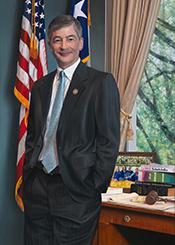 Rep. Jeb Hensarling (R-TX)
Description
Amendment in the nature of a substitute printed in House Report 109-19 and numbered 2 was offered as the Republican Study Committee substitute.
Legislative Activity
Stay on top of the latest movement without scrolling through every action
Amendment failed in Committee of the Whole
March 17, 2005 • 11:37 AM
View full timeline
Amendment failed in Committee of the Whole
March 17, 2005 • 11:37 AM
Roll call votes on amendments in House
March 17, 2005 • 11:37 AM
House amendment not agreed to: On agreeing to the Hensarling amendment (A001) Failed by recorded vote: 102 - 320 (Roll no. 83).(consideration: CR H1633-1640; text: CR H1633-1639)
March 17, 2005 • 11:37 AM
On agreeing to the Hensarling amendment (A001) Failed by recorded vote: 102 - 320 (Roll no. 83). (consideration: CR H1633-1640; text: CR H1633-1639)
March 17, 2005 • 11:37 AM
House amendment offered
March 16, 2005
House amendment offered/reported by : Amendment (A001) in the nature of a substitute offered by Mr. Hensarling.(consideration: CR H1587-1598; text: CR H1587-1594)
March 16, 2005 • 8:56 PM
Amendment (A001) in the nature of a substitute offered by Mr. Hensarling. (consideration: CR H1587-1598; text: CR H1587-1594)
March 16, 2005 • 8:56 PM
Votes
1 roll call on this amendment
Text
Offered
CONCURRENT RESOLUTION ON THE BUDGET FOR FISCAL YEAR 2006

The SPEAKER pro tempore. Pursuant to House Resolution 154 and rule
XVIII, the Chair declares the House in the Committee of the Whole House
on the State of the Union for the further consideration of the
concurrent resolution, H. Con. Res. 95.

{time}  1652

In the Committee of the Whole

Accordingly, the House resolved itself into the Committee of the
Whole House on the State of the Union for the further consideration of
the concurrent resolution (H. Con. Res. 95) establishing the
congressional budget for the United States Government for fiscal year
2006, revising appropriate budgetary levels for fiscal year 2005, and
setting forth appropriate budgetary levels for fiscal years 2007
through 2010, with Mr. LaTourette in the chair.
The Clerk read the title of the concurrent resolution.
The CHAIRMAN. When the Committee of the Whole rose earlier today, the
gentleman from Iowa (Mr. Nussle) had 1 hour and 7 minutes remaining and
the gentleman from South Carolina (Mr. Spratt) had 1 hour and 26
minutes remaining.
Mr. SPRATT. Mr. Chairman, I yield 3 minutes to the gentleman from
Maine (Mr. Allen).
Mr. ALLEN. I thank the gentleman for yielding me this time.
Mr. Chairman, the budget is a reflection of our values and priorities
as a Nation. Congress should support a Federal budget that will make us
more competitive in the global economy, spread prosperity to more
Americans and reestablish fiscal discipline to ensure a better future
for our children. This budget resolution takes us in the wrong
direction. In order to cover up the President's mismanagement of the
economy and the resulting mountains of debt, the Republican budget
sacrifices important domestic priorities like Medicaid. This budget
resolution cuts Medicaid more deeply than the President's proposal, as
much as $20 billion over 5 years. Slashing Medicaid will have a
devastating impact on the most vulnerable in our society. Medicaid is
the health care safety net for impoverished children, elderly and the
disabled. Reductions to Medicaid will cause lasting harm to current
Medicaid beneficiaries and make the system less viable for health care
providers.
Exactly who will be affected by cuts to Medicaid? Thirty-nine million
low-income children and parents, including one in every five American
children; 13 million elderly and disabled individuals who are receiving
acute and long-term care coverage.
This budget would set back the quality of nursing home care. With
Medicaid funding half of the Nation's nursing home care, cutting or
block granting the program would set back efforts at improving the
quality of care provided to seniors and people with disabilities in the
Nation's nursing homes. This budget would unravel an already fraying
health safety net, jeopardizing support for providers like hospitals,
clinics, doctors and health plans that serve low-income people.
This budget would increase the number of uninsured which has already
risen to 45 million people under the President's watch. Sick people
cost more when they are uninsured and receiving care in emergency rooms
than when they are covered by Medicaid.
This budget would put children at risk. If children have less health
coverage, they are more likely to compromise their ability to learn in
school and to grow into healthy, contributing members of society.
Cuts to Medicaid will shift costs to States, increasing their already
significant fiscal burdens. Cuts in block grants do not address the
real challenges States are facing, Medicaid enrollment increases which
have occurred as a result of more people losing their health care
coverage. Shifting additional costs to the States will likely drive
them to cut Medicaid coverage and services.
This administration has provided huge tax cuts to the highest earning
households in the Nation over the last few years. Now we see the rest
of the plan. To reduce or eliminate health care coverage for poor,
elderly and disabled people in order to finance tax cuts for the
wealthy is inequitable and not in line with our Nation's values.
Mr. SPRATT. Mr. Chairman, I yield 5 minutes to the gentleman from
Wisconsin (Mr. Kind).
Mr. KIND. Mr. Chairman, I thank my friend from South Carolina for
yielding me this time, and I also want to thank him and commend him for
the leadership that he has shown during the course of the Budget
Committee work and for the alternative Democratic substitute which we
will talk about a little bit later today.
Mr. Chairman, there are few moments during the legislative year here
in Congress which really defines who we are as a Congress, who we are
as a Nation and where we are going with our priorities. It is one of
these moments today when we have a discussion about our budgets and the
priorities that we place in the budget.
For some reason, the Republican budget that we have before us only is
budgeted for 5 years rather than the typical 10 years. I submit that
one of the reasons I think they are doing a 5-year budget instead of a
10-year budget is because of the complete breakdown in fiscal
responsibility and what the costs of their budget will entail and the
explosion of budget deficits in the second 5 years that they do not
want to talk about during the course of these next couple of days
during the budget. We, on the other hand, will be presenting a
Democratic alternative, one that does, I believe, reflect the values
and the priorities that we share as Americans in this Nation.
Our budget will reinstate the pay-as-you-go rules to instill budget
discipline again in the decisions that we are making in these budgets.
We achieve a balanced budget under our plan by 2012, just when the
massive baby boom retirement wave really starts to hit, and we protect
important investments, in defense, in veterans' programs, education and
health care to keep America strong and to help us grow the economy and
create jobs. By reinstating the pay-as-you-go rules, we will be in a
better fiscal position to better preserve and protect the long-term
solvency of the Social Security program.
What this chart demonstrates next to me is the result of budget
decisions over the last 14 to 15 years. This green line which shows an
upward trend that resulted in 4 consecutive years of budget surpluses
is Congress operating under pay-as-you-go rules. The red lines that
show the plummeting of the surpluses into historically large budget
deficits shows Congress without pay-as-you-go rules. What is hard to
understand about reinstituting pay-as-you-go rules as part of budget
discipline and decisions that we have to make to right the fiscal ship
again?
With pay-as-you-go rules, it gave us 4 years of budget surpluses, 2
in which the Congress was not raiding the Social Security Trust Fund
and using that money for large tax cuts or other spending priorities
and enabled us to start reducing the national debt which was an
incredible economic dynamic at the end of the 1990s.
This chart demonstrates the current raid on the Social Security Trust
Fund under the Bush administration. Every dime in surplus that is being
run in the Social Security account right now is

[[Page H1560]]

being diverted, to help finance large cuts for the most wealthy or to
help finance large new spending programs, a 30 percent increase in
Federal spending over the last few years alone. That will continue
throughout the duration when we are running surpluses in the Social
Security Trust Fund under their budget proposal. What this has meant
was increased borrowing cost, year after year after year having to
raise the debt ceiling in order to finance the breakdown in fiscal
discipline in this place.
Why is this important today? It is important because we do not owe
this debt to ourselves anymore. Ninety percent of the new debt that was
purchased this last year alone is being purchased by foreign countries,
Japan, the number one purchaser, soon to be surpassed by China as the
number one holder of our debt.

{time}  1700

I do not believe, and Democrats do not believe, it is in our best
long-term economic interest to be so dependent on foreign interests to
be financing these deficits.
The President has been out campaigning on a new Social Security plan
lately. It is kind of tough to engage in a meaningful discussion since
he has not offered a detailed proposal; but from what we understand, he
is calling for massive new borrowing in order to set up these
privatized accounts that he is fond of. In fact, Social Security runs a
deficit of $3.7 trillion over the next 75 years. What the President is
proposing to do is to borrow $5 trillion for these transition costs to
set up private accounts over the first 20 years alone in order to fix a
$3.7 trillion problem. And that is probably one of the reasons why he
is having such a hard time selling his plan out in Middle America.
People know intuitively with this massive new borrowing that it is
going to hurt economic growth prospects for our Nation; it is going to
jeopardize our children and grandchildren's future by leaving a large
legacy of debt for them. That is why, once we can get past the whole
idea of privatizing the Social Security system, we can try to get
together as Americans and work on a bipartisan solution that will be
fiscally responsible and that will keep the promise to future
generations.
Mr. SPRATT. Mr. Chairman, I yield 2 minutes to the gentleman from
Washington (Mr. McDermott).
(Mr. McDERMOTT asked and was given permission to revise and extend
his remarks.)
Mr. McDERMOTT. Mr. Chairman, the budget declares our Nation's
priorities in black and white, and this budget makes America black and
blue.
Republicans have squandered the surplus, forcing America to go
country to country in search of money to prop up what cannot stand on
its own fiscal integrity. They present charts and graphs. They talk
about acting in America's best interest when, in fact, we have before
us a budget that rewards America's special interests. We are deep in
debt and growing deeper because Republicans have so many special
interests to thank with your money.
The price tag is mind-boggling, but that is outdone by the people
Republicans have targeted to bear the burden of their fiscal
recklessness. The rich get the gain; America's most vulnerable get the
pain.
As ranking Democrat on the Human Resources Subcommittee, I asked my
staff to examine where past Republican practices might be in this
politically engineered budget crisis. $18.7 billion is coming out of
the Committee on Ways and Means. None of it out of Social Security.
None out of Medicare. What is left? Poor people and children.
Two million of our Nation's poorest families will see Draconian cuts
in Temporary Assistance for Needy Families. Child care assistance for
low-income working families could be eliminated. Social service block
grants could be cut 60 percent, and Federal assistance for foster care
could be slashed by 80 percent. And if that is not enough, let us take
$5 billion worth of food stamps out of children's mouths. It is
America's most vulnerable who will pay for the Republican intention to
extend tax breaks for capital gains, with 75 percent of the benefit
going to people earning over $200,000 a year.
What in the world is going on? Do Republicans intend to starve the
poor so they can feed the rich?
Budgets reflect values. We heard a lot about values, family values,
all this stuff. I guess feeding kids is not a value. And I suppose this
budget reflects the Republican majority. Those values can be summed up
in one word, bankrupt, just like this budget.
I urge a ``no'' on this resolution.
Mr. SPRATT. Mr. Chairman, I yield 2 minutes to the gentlewoman from
Michigan (Ms. Kilpatrick).
Ms. KILPATRICK of Michigan. Mr. Chairman, I thank our ranking member
for yielding me this time.
This is a bad budget. The very safety net that we hoped to help
American families is being shredded. The Republican budget is wrong;
and the prescription is wrong for Medicaid, over 52 million children,
women, elderly, seniors, disabled individuals, 52 million in America.
The largest health care program and the only health care program for
many.
The Committee on Energy and Commerce has been instructed to cut $20
billion from the Medicaid health care program for so many vulnerable
citizens. Medicaid pays for 70 percent of nursing home care in
Michigan. Sixty-four percent of the costs are spent on the elderly and
disabled. Do we really want to hurt the least of these who have built
this country?
This Republican budget cuts Medicaid even more than what the
President sent to Congress. We can do better.
I just left a meeting with my Governor in our Michigan delegation,
both Democrats and Republicans. Unfortunately, the Republicans wanted
to blame our Governor for Medicaid, and they said cut Medicaid back.
When one is unemployed, when they have no health care, when jobs are
being lost, unfortunately they need Medicaid. And it is unfortunate
that this budget does not restore Medicaid, help the most vulnerable,
and not ask for $20 billion cut for the elderly, for seniors, for the
disabled.
The budget is bad. It kills Medicaid. We can do better.
Mr. NUSSLE. Mr. Chairman, to talk about the importance of our
communities and our cities, I yield 3 minutes to the gentlewoman from
Connecticut (Mrs. Johnson).
Mrs. JOHNSON of Connecticut. Mr. Chairman, I thank the chairman for
yielding me this time.
As a member of the Save Our Cities Caucus, which is chaired by the
gentleman from Ohio (Mr. Turner), I rise in strong support of full
funding of the Community Development Block Grant and Community Services
Block Grant.
Our cities are hardest hit by the tough social problems of this age:
poverty, drug abuse, underachievement. And I am proud that Republicans
have long understood that the Federal Government has a responsibility
to support our cities. They are the life blood of our commerce, but
locally controlled Federal dollars are far more powerful than arbitrary
Federal programs.
It is extremely important that we fully fund these critical programs
because they preserve the local power of local governments to fix holes
in the safety net, to assure the services that people need. In New
Britain, my hometown; in Meridien or Danbury, Connecticut; or in
Waterbury, the largest city in my district, Community Development Block
Grant funds and Community Service Block Grant funds leverage several
times their value to provide child care, elder care, literacy programs,
substance abuse treatment programs, after-school programs. They help
those cities demolish buildings that are a blight or that harbor drug
dealers. They help clean up brownfields. They improve fire stations.
They improve parks. They rebuild sidewalks. They reconstruct streets.
They work to make our cities able to attract the economic development
that provides jobs and a healthy urban environment.
So between the Community Development Block Grant and the Community
Services Block Grant, the Federal Government has traditionally
contributed, and under Republican leadership, generously, to assure the
safety net in the cities and the economic strength of our urban
communities.
So I thank the gentleman from Iowa (Mr. Nussle) for recognizing, as
the majority of Republicans do, the importance of these flexible block
grant programs to our urban communities.

[[Page H1561]]

Mr. NUSSLE. Mr. Chairman, I yield 3 minutes to the gentleman from
Ohio (Mr. Turner), the chairman of that coalition, to talk about the
same subject, the importance of our communities and the Community
Development Block Grant.
Mr. TURNER. Mr. Chairman, as the chairman indicated, I chair a
working group appointed by the gentleman from Illinois (Speaker
Hastert) called Save America's Cities. This working group has 24
members of the Republican conference who have backgrounds in urban
issues, either having served as mayors or members of city councils or
otherwise in local government, or who by their districts have a natural
affinity for urban issues by working closely with their communities and
seeing the difficulty of urban revitalization and redevelopment and the
commitment to bringing jobs back to our cities.
Mr. Chairman, I support the Committee on the Budget in adding $1.140
billion to the administration's request for programs under the
community and regional development function in the budget, which
includes the Community Development Block Grant. The budget document
itself specifically lays out that the funds are being restored with the
clear intention of supporting the Community Development Block Grant
program, or CDBG.
It goes on to state that the resolution makes no assumption regarding
implementation of the President's proposed Strengthening America's
Communities Block Grant or transferring the Community Development Block
Grant program from the Department of HUD to the Department of Commerce.
This is an important notation because it is very important for national
associations that support urban issues, like the U.S. Conference of
Mayors, the National League of Cities, that have had a great deal of
concern about the consolidation of 18 programs, some of which are
currently located in HUD, to Commerce and the reduction in overall
spending, which was proposed of 30 percent.
This House, in taking the action of supporting the Committee on the
Budget's resolution, does not accept the President's level of funding
and looks to restore functions for CDBG that go to important issues in
our community such as taking abandoned houses and refurbishing them,
demolishing abandoned buildings where they cannot be rehabilitated,
taking abandoned lots that might have been strewn with broken grass or
be places where criminals congregate and turning them into community
parking lots that can help support areas of local community business
districts.
Looking, as the gentlewoman from Connecticut (Mrs. Johnson) was
saying, to the area of brownfields, we have abandoned factory sites
throughout our urban core which make it more difficult for us to bring
jobs to those areas of our cities, to find ways to environmentally
clean up those sites, and to demolish the buildings, bringing jobs back
into them. The Community Development Block Grant program supports those
functions.
I also serve as chairman of the Federalism and the Census
Subcommittee of the Committee on Government Reform, and we recently
held a subcommittee hearing on the administration's proposal to
consolidate existing direct grant economic and community development
programs within the Department of Commerce. We heard information from
the U.S. Conference of Mayors and the National League of Cities where
they told of the success of these programs.
I want to thank the chairman for listening to the great degree of
success that they have had in the past and looking to ways that we can
continue to support this program.
So I appreciate the addition of the $1.140 billion and the notation
of the support for the Community Development Block Grant program.
Mr. NUSSLE. Mr. Chairman, I yield myself 30 seconds.
Just to punctuate what the gentleman from Ohio and the gentlewoman
from Connecticut said, we believe in local control; and we want to be
partners with these communities in solving problems. We disagreed with
the President in his budget with the changes that were made to the
Community Development Block Grant; so we made that value judgment and
change in this budget. We are supporting our mayors. We are supporting
our communities. We want to be good partners, and we believe in local
control in solving those problems. The big Federal Government cannot
solve all these problems that these local folks are dealing with. We
want to give them the opportunity to do that.
Mr. Chairman, I yield 1 minute to the gentleman from Texas (Mr.
DeLay), majority leader.
Mr. DeLAY. Mr. Chairman, I thank the gentleman for yielding me this
time.
Before us today is an excellent budget, the result of an excellent
process, and the product of an excellent chairman, the gentleman from
Iowa.
Despite some occasional overheated rhetoric, the fiscal year 2006
budget resolution is, in fact, a modest attempt by a reasonable
majority to hold down the growth of government spending. This is one of
the strongest budgets I have seen since coming to Congress.
True, it makes tough choices. Imagine, it prioritizes spending, and
it starts the long process of modernizing the Federal Government while
rooting out waste, fraud, and inefficiency. But, Mr. Chairman, American
taxpayers deserve no less, especially today. We are at war with an
enemy who threatens us here at home and on the other side of the world.

{time}  1715

Our security spending must therefore take priority, and in turn we
must make difficult but necessary choices about non-security spending.
That is exactly what this budget does. It meets our needs at home and
abroad without raising taxes, which would stifle our economy, or
wasting money, which undermines the hard work the American people did
to earn those tax dollars in the first place.
Of course, for some people, regardless of the fiscal and
international circumstances, taxes and spending are never high enough.
This year, as every year, they have warned us about the dire
consequences of trusting the American people with their own money.
Last year, the same critics made the same criticism of our efforts,
which we now know ultimately slowed the growth of non-security
discretionary spending to about 1 percent. These critics assured us
that our budget would bust a hole in the deficit. And yet last year,
the deficit came in $109 billion smaller than experts originally
thought it would, specifically because of the increased economic growth
directly attributed to Republican tax relief passed since 2001.
Millions of jobs were created last year. Indeed, more than 3 million
of them have been created since the House took up President Bush's
similarly criticized Jobs and Growth tax relief package 21 months ago.
So, in short, Mr. Chairman, the economic data coming in every month
speaks to the wisdom of the fiscal policies of the Republican majority.
The critics were just wrong, and they are wrong again this year.
The principal mantra against this budget is that it will explode the
deficit, despite the evidence of last year's shrinking deficit
projections. What, one wonders, do they think that the $67.1 billion in
additional spending that they propose at the Committee on the Budget
markup would do?
The balanced budgets of the late 1990s should serve as our model,
they say. Well, I agree. And I would remind them that the balanced
budgets of the late 1990s were passed by Republican Congresses, without
much help from our friends on the other side of the aisle. Hardly any
of them voted for it.
How anyone takes credit for policies they opposed is beyond me, but I
guess that is politics. But, again, so is the idea that raising $392.4
billion in new taxes, as Committee on the Budget Democrats proposed
just last week, would somehow help the economy to create jobs.
Well, Mr. Chairman, the facts are indisputable: Democracy is on the
march around the world; the war on terror is being won; the economy is
growing; jobs are being created; deficit projections are shrinking; and
the looming demographic crises facing Social Security and Medicare are
being addressed, all thanks to the courage, the policies and the
leadership of President Bush and this Republican Congress.
That the same people who have criticized us all along are criticizing
our

[[Page H1562]]

budget today, Mr. Chairman, only suggests we must be doing something
right.
So I urge all my colleagues to give more momentum to our success and
support the budget resolution before us.
Mr. SPRATT. Mr. Chairman, I yield myself such time as I may consume
to respond to the gentleman.
I would point out that when the Bush budget summit agreement came to
the floor of this House in the fall of 1990, after many arduous months
of negotiation with the Bush administration and the Democratic
leadership and the Republican leadership in the House, only 88
Republicans supported the passage of that bill, which had the
President's support behind it.
In 1993, when we passed the Clinton Budget Act and began the
unprecedented march towards lower and lower deficits, eventuating in a
surplus of $236 billion in the year 2000, not a single Republican in
either House voted for that deficit reduction effort.
Mr. Chairman, I yield 2 minutes to the gentleman from Texas (Mr. Gene
Green).
Mr. GENE GREEN of Texas. Mr. Chairman, I thank my colleague from
South Carolina, our ranking member on the Committee on the Budget for
yielding me time.
Mr. Chairman, I wish I had enough time to respond to the Majority
Leader's problems with this budget, but, in all honesty, the War on
Terror, we just passed the supplemental that was not part of this
budget, and most of us, in fact I voted for that supplemental because
it was the War on Terror.
But I rise to oppose the drastic cuts in Medicaid in this budget
resolution. Medicaid is not the problem child of our health care system
and should not take the fall for this administration's inability to
balance the budget.
Medicaid's cost per capita growth is lower than Medicare or even
private insurance, despite the fact that Medicaid has absorbed an
increased beneficiary population due to gaps in Medicare coverage, an
economic downturn and the decline of employer-sponsored health
insurance. Medicaid is a success story in this country, not a program
that belongs on the Federal chopping block.
As a member of the Committee on Energy and Commerce, I cannot support
this budget resolution instruction to my committee to cut $20 billion
outs of Medicaid.
The robust Medicaid program is critical for the health care delivery
in my home State of Texas. Forty-five percent of all infants born in
Texas are covered by Medicaid, 45 percent. Nearly 50 percent of all
children receiving care in our children's hospitals are Medicaid
beneficiaries. Medicaid is the single-largest health insurer for our
Nation's children. How can we cut the most vulnerable in our society,
our children, and still consider ourselves looking out for the least of
this society?
To paraphrase the Bible, let us not suffer the little children. That
is not our job here in this Congress. If Congress goes forward with
these ill-advised Medicaid cuts, the States will be left holding the
bag and their only option is to further cut the benefits.
Mr. Chairman, 45 million Americans currently are uninsured. It makes
no sense to slash Medicaid spending, which will virtually guarantee an
increase in the number of uninsured in our country. Medicaid cuts will
not better our bottom line. It will only make our problems worse.
Mr. SPRATT. Mr. Chairman, I yield 1 minute to the gentlewoman from
California (Mrs. Capps).
Mrs. CAPPS. Mr. Chairman, I thank the gentleman for yielding me time.
Mr. Chairman, I wish to speak very briefly about an aspect of fiscal
responsibility, the rule called pay-as-you-go, because there is a
connection between our lack of fiscal responsibility and these
draconian cuts we are seeing in vital services, like the $20 billion
that people who are poor and dependent on Medicaid will be forced to
endure.
Our colleagues in the majority have consistently opposed Democratic
efforts to reinstall pay-as-you-go rules for both entitlement spending
and new tax cuts. In fact, they just denied the House the ability to
vote on such a proposal offered by the gentleman from Tennessee (Mr.
Cooper) and the Blue Dogs.
These PAYGO reforms were put in place in the 1990s and were essential
to the successful effort achieved then to balance the budget. PAYGO
reforms have been endorsed in their entirety by Alan Greenspan, but the
Republicans do not want them applied to tax cuts. Why? Because doing so
would require that they identify specific revenue measures, most likely
spending cuts, which would provide the offsets, vital spend services
being cut, such as Medicaid.
So we should reinstate PAYGO. We should not support this budget, that
destroys so much which is a part of our health care delivery, Medicaid.
Mr. SPRATT. Mr. Chairman, I yield 2\1/2\ minutes to the gentleman
from Missouri (Mr. Skelton), the ranking member of the Committee on
Armed Services.
Mr. SKELTON. Mr. Chairman, I thank the gentleman for yielding me
time.
Mr. Chairman, I rise in support of the alternative budget resolution
that will soon be offered by my friend and colleague, the gentleman
from South Carolina (Mr. Spratt). I do so in light of the fact that the
Republican budget resolution mirrors the President's request for
defense and the Spratt alternative matches this funding dollar-for-
dollar, but the Spratt budget is better because section 401 of his
resolution calls on the Congress to address serious shortcomings in
both the President's budget and the House Republican budget resolution.
Let me explain why I favor the Spratt alternative budget. The
Republican budget only temporarily increases the death gratuity and the
Service Members Group Life Insurance coverage. The Spratt budget would
make these increases permanent. That is important.
The Republican budget omits targeted pay raises and reenlistment
bonuses for enlisted personnel. We know right now we are having a great
deal of trouble in enlisting young people, reenlisting some of the
troops. As you know, you enlist a soldier, but you retain families.
These issues are critical to retaining experienced troops and
maintaining readiness. The Spratt budget makes it a priority.
The Republican budget fails to increase funds for Family Service
Centers to support the families of deploying troops. The Spratt budget
takes care of that, and takes care of our military families.
The Republican budget shortchanges community-based health care
organizations that care for the injured servicemen and women. The
Spratt budget takes care of that. It pluses up the program.
The Republican budget does not aggressively fund nuclear
nonproliferation programs. Both sides of the aisle, and as a matter of
fact during the last campaign both the candidates for President, said
that stopping a nuclear weapon from getting in the hands of terrorists
is our top national security priority. The Spratt budget backs that up
with dollars.
Mr. Chairman, I urge my colleagues to support the budget to be
offered by the gentleman from South Carolina (Mr. Spratt).
Mr. SPRATT. Mr. Chairman, I yield 3 minutes to the gentleman from
Texas (Mr. Edwards).
Mr. EDWARDS. Mr. Chairman, a budget says a lot about our values. What
this budget says to America's veterans is that Congress does not value
your service to country. It makes a mockery of the American value of
shared sacrifice in time of war. How does it do that? Let me explain.
This budget says to the person sitting here safely at home who makes
$1 million in dividend income this year that you can keep every penny
of your $220,000 tax break that the House Republican leadership has
given you recently, every penny of that tax break. But, on the other
hand, it says to millions of America's veterans that we are going to
direct a $14 billion cut in veterans' programs over the next 5 years.
This budget even goes so far as to say they have to cut $798 billion
out of disabled veterans' monthly pensions, low-income veterans
compensation checks and veterans GI benefits, their education benefits,
unless of course they want to go raise fees or, perhaps most likely, do
all of those things.
Where is the American value, the American family value, in those
priorities? To a millionaire, making every

[[Page H1563]]

dime on dividend income, you can keep your $220,000 tax cut; but to a
veteran who may be coming back from Iraq, in fact a soldier today who
may be tomorrow's veteran or next year's veteran, we are going to make
you wait longer for health care in our VA hospitals; you are not going
to get the care you deserve and you earned by risking your life for
your country.
I hear a lot from my Republican colleagues about family values. This
budget does not reflect the family values of the American family,
because the American family respects the service and sacrifice of our
veterans, not just with speeches on Veterans Day. We are awfully good
about that. But they expect us to respect veterans every day, and this
bill does not even come close to maintaining present services for
health care for our veterans.
They can show their charts, how they have increased veterans funding,
but the reality is it does not keep up with present services. So, in
effect, every Member of this House who votes for this bill is voting
for a real cut in health care services, education services and monthly
disability pension checks for America's veterans.
I think the American people, and I know America's veterans, are going
to be offended by the values and priorities of this bill. Let us not
just say yes to veterans on Veterans Day and turn our backs on them on
budget day. Sadly that is what this budget does.
Mr. Chairman, I urge my colleagues on both sides of the aisle to
reject the values of this budget; reject the slap in the face of
millions of American veterans while coddling the wealthiest in our
society, who are going to enjoy that $220,000 tax break they are making
by their riskless dividend income of $1 million this year.
Let us stand up for America's veterans today when it counts. They may
appreciate our speeches on Veterans Day, but today they need our vote.
That is the value that counts. Vote no on this unfair slap in the face
to America's veterans.

{time}  1730

Mr. NUSSLE. Mr. Chairman, I yield 5 minutes to the gentleman from
Indiana (Mr. Buyer), a veteran and the chairman of the Committee on
Veterans' Affairs.
Mr. BUYER. Mr. Chairman, I want to congratulate you on this budget. I
think the American people are smart enough to recognize truth and
demagoguery. That is what you hear on this House floor is demagoguery,
and that is completely unfortunate.
I believe that ensuring that the disabled, the injured, the low-
income and special needs veterans are given the highest attention. That
is the priority of our Nation.
In establishing priorities of care for veterans health care, this
Congress also believes that the same military values that guided
servicemembers on active duty should define how services and assistance
are provided to them as veterans. It is why we established the
priorities of care, one, two, three, four, five, six, seven, eight.
This budget takes into consideration the present budgetary
constraints, the aging veteran population, as well as the influx of
veterans into the system as the Nation continues to fight the war on
terror throughout the world.
As chairman of the Committee on Veterans' Affairs, I seek an increase
in $12.6 million for the medical and prosthetic research projects above
the President's budget request. We also increased by $293 million for
State nursing home partnership. We increase about $300 million
discretionary funding for veterans health care, despite the demagoguery
you will hear from some Members on this floor.
To ensure that our national cemeteries are maintained as the shrines
that they are, my subcommittee chairman, the gentleman from Florida
(Mr. Miller), and I recommended an additional $45.6 million in
construction to begin a 5-year $300 million national shrine commitment
project to repair and restore the existing national cemeteries. But
while our greatest attention should be focused on those who have served
us and can no longer fend for themselves, there is another group of
veterans that needs our help: our soldiers, sailors, airmen and Marines
who need assistance in returning to the workforce or entering the
workforce for the first time after serving their country.
This budget will also ensure that the VA benefits take care of the
young solder coming home, as well as the older soldier who may already
have a family. We need to make sure that the VA is flexible and
personal in its delivery of health care and benefits, such as training
and education.
This is a wise investment, harnessing the same spirit and drive that
has won our Nation's battles, to contribute to our Nation's workforce
and to sustain our national competitive edge. To facilitate this
investment, I created a new subcommittee solely devoted to this effort
chaired by the gentleman from Arkansas (Mr. Boozman).
The gentleman from Iowa (Mr. Nussle), as chairman of the Committee on
the Budget, has done an outstanding job. He has led Congress through
some challenging budgetary times as chairman. Some may forget the
meaning of the attacks upon our country on September 11. It was an
attack upon our freedom, upon our way of life. It was devastating to
our economy. That economic growth has returned, but we also now need to
manage that economic growth smartly.
There is a lot of rhetoric, but let me return to some facts. Under
this President, spending for veterans has increased by 47 percent in 5
years versus 32 percent in the 8 years under the Clinton
administration.
If I turn to the chart to my left, as the chart shows, over the last
7 years discretionary spending has grown 39.5 percent under the VA-HUD
appropriations bill. That is a 4.9 percent average increase for every
year from 1998 all the way to present. So despite all the rhetoric that
America and my colleagues will hear, the reality is this chart. The
spending on veterans continues to increase, maintaining our commitment
to veterans in America.
I also would like to turn to a second chart I think is very
interesting. On this chart it shows what happened under the Democrat
control of Congress. Congressional spending per veteran was flat. For
10 years a meager $400 increase for 10 years from 1984 to 1994.
Can everybody see this? It was flat. To my colleagues on this side of
the aisle, do you see this? It was flat for 10 years. You did not hear
demagoguery on the House floor. What you had at the time were
individuals on both sides of the aisle working together in a bipartisan
fashion with regard to how we deal with veterans.
So what we have under the Republican control the last 10 years is
from 1995 to 2005 Congress increased spending by $1,400 per veteran,
that is from $1,368 to $2,773 per veteran. I think this chart is very
clear.
What has occurred under Democrat control is flat-lined budget for
veterans. I am not going to demagogue. It is just a reality.
Now with regard to what has happened under Republican control, the
increase and the maintaining of our commitment to veterans programs and
causes across the board. This is the reality.
I want to say to the budget chairman, I want to thank him. He has
given me a task, and the task is that with regard to all of these
programs in discretionary and mandatory, are there savings out there?
Are these systems being run smartly and effectively and efficiently?
He has challenged those of us who serve on the Committee on Veterans'
Affairs. And you know what? We will accept the challenge, and we will
go and work together in a bipartisan fashion and see if we can find
those savings. He has not dictated to us. He has challenged us and we
accept the challenge.
Mr. NUSSLE. Mr. Chairman, I yield 3 minutes to the gentleman from New
Hampshire (Mr. Bradley), a member of the committee.
Mr. BRADLEY of New Hampshire. Mr. Chairman, the gentleman's budget
allows our country to meet our most important values, a strong defense,
a strong economy, while reducing our Nation's deficit.
Let me, if I might, focus on another area of concern that the prior
speaker just talked about and that is commitment to our Nation's
veterans. We do value our veterans' service. And if you look at this
chart that I have here that talks about overall spending in the VA, Mr.
Chairman, you will see a strong

[[Page H1564]]

commitment to honoring the commitment of our Nation's veterans.
The second chart that I have specifically talks to veterans medical
care which has increased from 1995 to 2005, over a 10-year period,
nearly 85 percent. And in the last 5 years, medical spending has
increased by 68 percent. That is a commitment to our Nation's veterans.
Let me talk about some other specific areas of improvement that we
have made. We have allowed Guard and Reserve units to enroll in medical
benefits. We have increased the GI benefit. We have funded finally for
the first time concurrent receipts so that the practice of disallowing
veterans who had disabilities as a result of their service from
collecting both their retirement pay and disability pay is finally
being addressed with a $22 billion commitment over the next 10 years.
We have reduced the wait times at our VA hospitals, and the VA
continues to give our Nation's veterans excellent care.
Let me touch on, Mr. Chairman, what we have done under the
gentleman's leadership this year in the veterans line items of the
budget. The discretionary baseline under the President's submission was
$30.8 billion. Under the gentleman's mark and allowing me to work
together with him and propose an amendment, we increase that by $877
million, which means in these tough fiscal times that our Nation is
experiencing a 2.8 percent increase for veterans health care numbers.
Yes, there is a reconciliation number; but when we started with the
President's submission, it was $424 million. The reconciliation, Mr.
Chairman, under the gentleman's mark is $155 million. I believe that we
can find that reconciliation number without enrollment fees, without
drug co-pays because we will have the flexibility to look for waste,
fraud, and abuse in the veterans numbers and be able to reduce and meet
a goal in that fashion.
Let me repeat: we do not have to establish either drug co-pays or
enrollment fees. We can achieve this reconciliation in other ways.
Mr. Chairman, in summary, I congratulate the gentleman again for a
fiscally prudent budget that meets our Nation's needs, and I look
forward to continuing to work with him to honor the commitment to our
Nation's veterans.
Mr. NUSSLE. Mr. Chairman, I yield 3 minutes to the gentleman from
California (Mr. Lewis), the gentleman of the House who has probably
some of the heaviest lifting to do with regard to controlling spending,
the chairman of the Committee on Appropriations.
Mr. LEWIS of California. Mr. Chairman, I very much appreciate my
chairman yielding me time.
I really come today to express my very sincere and deep appreciation
to both the gentleman from Iowa (Mr. Nussle) and the gentleman from
South Carolina (Mr. Spratt) for the fabulous job they do of working
together on behalf of all of us to try to make sense out of our budget
process.
To say the least, the world on both sides of the aisle and across the
country would love to suggest that we provide for them every program at
a maximum level that they might have on their wish list. And in turn,
that same world wants us to make sense out of balancing our budget.
These gentlemen are faced with that horrendous and impossible task, and
to them we owe a great debt of gratitude.
As the gentleman from Iowa (Mr. Nussle) suggested, I have now the
responsibility of chairing the Committee on Appropriations where, as
they help us struggle with the budget, we spend money that has a
propensity to violate that which is their guidelines for sensible
budgeting. But in turn, over the years as I have observed this process
there has been far too little communication, that is meaningful
communication, between those on the staff level but also the
professional level within the committee itself, between the
appropriations process and the budgeteers.
I must say that in the time I have had this job, the short time, the
gentleman from Iowa (Mr. Nussle) has gone out of his way to say time
and time again, we want to work with you.
I have committed myself to trying to have the Committee on
Appropriations once again be a committee designed to preserve dollars,
not just spend dollars; and, indeed, if we are successful in that
effort, we will be in partnership with our budgeteers, attempting to
make sense out of the budget and eventually balance that budget.
We are not in this alone. And the issues that flow around stabilizing
our economy know nothing about partisan politics. And I must say that
the Committee on the Budget has provided guidelines; in the past we
have not always followed those guidelines. It is my intention to work
as partners in this business so we can all be successful. And I can say
without any reservation, if we are successful, moving our bills this
year very rapidly so they are ready for conference in the early spring,
it will be in no small part a success of the work you all have done.
I appreciate that very much and look forward to continuing this
relationship.
Mr. NUSSLE. Mr. Chairman, I reserve the balance of my time.
Mr. SPRATT. Mr. Chairman, I yield myself such time as I may consume.
Mr. Chairman, I would like to thank the gentleman for his kind
remarks.
Mr. Chairman, I yielded to myself to clarify what is in the budget
proposal we are proposing versus the budget resolution reported by the
committee and sponsored by the Republicans.
Our budget, let me make this clear, matches dollar for dollar their
budget on national defense and international affairs, there is not a
dime's worth of difference over a 5-year period of time. But our budget
does single out veterans as one group deserving of more spending, more
than just a current services budget, because the demands are clearly
there. So our budget provides $1.6 billion more than theirs, than the
Republican resolution, for veterans health care in 2006. And between
2006 and 2010 we provide $17 billion more for veterans health care.
Our budget resolution contains no reconciliation instructions to the
Committee on Veterans' Affairs. What does that mean? Their resolution
calls upon the Committee on Veterans' Affairs to report savings out of
mandatory programs that will save $798 million. There are only two
places those savings can come from: either cutting disability benefits
or raising the fees that veterans must pay to use veterans facilities.
Our budget resolution contains special provisions for our troops to
make sure that the increases in life insurance to $400,000 for combat
fatalities voted up in the supplemental for 1 year will be extended for
future years, and that the death gratuity raised to $100,000 will also
be continued for future years. And we will provide more funding for
family separation centers, for deployed troops, and more community-
based health care for returning troops and their families, two things
that have been critically noted.
Our resolution recommends that the funds be taken from the Missile
Defense Agency and advanced satellite programs to pay for these
personnel benefits. We think it is a good trade-off.
Our resolution also contains more in the four functions that fund
homeland security and make special provisions for increasing the budget
for cooperative threat reduction, so-called nonproliferation, by $200
million.
So in summary, for our veterans, for our troops and for the emerging
threats facing us, terrorists armed with WMDs, our budget is not only
better funded, but better focused than theirs.
Mr. Chairman, I yield 30 seconds to the gentleman from Texas (Mr.
Edwards) for a response.
Mr. EDWARDS. Mr. Chairman, my colleague, the gentleman from Indiana
(Mr. Buyer), may want to hide behind a fig leaf of charging
demagoguery, but let us review the facts he did not refute.
Fact number one, this budget will cut veterans pensions compensation
and education benefits by nearly $800 million.

{time}  1745

Fact number two, over 5 years it will cut veterans health care by
nearly $14 billion. Fact number three, in this same budget someone
making a million dollars a year in dividend income will get to keep
every penny of his $220,000 tax break. They may call it demagoguery. I
think America's veterans

[[Page H1565]]

will call it wrong, wrong what they are doing to our service men, women
and our veterans.
Mr. SPRATT. Mr. Chairman, I yield 2 minutes to the gentlewoman from
Florida (Ms. Corrine Brown).
(Ms. CORRINE BROWN of Florida asked and was given permission to
revise and extend her remarks.)
Ms. CORRINE BROWN of Florida. Mr. Chairman, I thank the gentleman
from South Carolina (Mr. Spratt) for his leadership on this budget
matter.
Shame, shame, shame. I cannot believe the Republican budget. Our men
and women that serve this country are putting their lives on the line,
and what are we doing? Cutting benefits and refusing service. I am
reminded of the words of the first President of the United States,
George Washington, whose words are worth repeating over and over again.
``The willingness with which our young people are likely to serve in
any war, no matter how justified, should be directly proportional as to
how they perceive the veterans of earlier wars are treated and
appreciated.''
The independent budget puts support by the veterans community as $300
billion short. I say that President Bush's budget and the House
Republican Bush budget should be dead on arrival. Let me repeat that. I
said that Bush's budget and the House Republican budget as it relates
to veterans should be dead on arrival.
On top of all of this, this budget tells the Veteran's Affairs
Committee, which I am on, to find $800 million in cuts over the next 5
years for savings.
You know, the Republicans practice what I call reverse Robin Hood,
robbing from the veterans to give tax cuts to the rich. The President
keeps telling us we are at war. Well, put your money where your mouth
is.
Mr. SPRATT. Mr. Chairman, I yield 3\1/2\ minutes to the gentleman
from New Jersey (Mr. Menendez), the House Democratic Caucus Chairman.
(Mr. MENENDEZ asked and was given permission to revise and extend his
remarks.)
Mr. MENENDEZ. Mr. Chairman, I thank the gentleman from South Carolina
(Mr. Spratt) for yielding me this time and for his work in developing a
budget for all Americans. Every year the administration and Congress
are taxed with developing a budget that reflects our Nation's
priorities in spending, priorities that reflect our country's values.
Unfortunately, the budget resolution we have before us, and the
values it represents insults the true values of the American people,
given the extensive cuts to first responders, community policing,
veterans benefits, health care, and education funding.
Under the Republican leadership the entire budget process has become
a complete fraud on the American people. This budget adds more than $4
trillion to the deficit in the next 10 years, without even including
the enormous costs that have been left out of the budget. It is past
time for this House to be honest and restore fiscal responsibility to
this process and to the Nation, the same fiscal responsibility that
each of our constituents face when they try to balance their household
and business budgets.
Unfortunately, this budget shows that the Republican Congress does
not share the values of the American people. What type of values would
cut funding to the Fire Act Grant Program which helps meet the basic
needs of firefighters by 30 percent? Firefighters on the front lines of
the war on terror in New Jersey stand to lose $4 million under this
resolution, which means they will have less protective clothing, fewer
portable radios than they need to protect our citizens.
What type of values would slash funding to the COP program by 95
percent, a program that has put over 4,800 police officers on the
street in New Jersey? In doing so, this budget dismantles a critical
instrument in New Jersey's fight against crime.
What type of values would raise health costs for many of the over
620,000 veterans in New Jersey, increasing drug copayments and imposing
new enrollment fees that will cost veterans more than $2 billion over 5
years and drive more than 200,000 veterans out of the system entirely?
What type of values would cut discretionary health programs by 6
percent and slash Medicaid by billions of dollars?
New Jersey would lose more than $100 million per year in Federal
Medicaid funding, enough funding to provide health coverage to 6,400
seniors or 34,000 children. And what type of values would underfund
education and, specifically, the No Child Left Behind Act by over $12
billion, creating a 4-year deficit between what was promised and what
was actually delivered of $39 billion?
If this budget passes, over 53,000 children in New Jersey will go
without promised help in reading and math and 34,000 will no longer be
able to enroll in the afterschool programs that not only keep kids safe
but also boost academic achievement. That is why the Democratic
substitute will restore fiscal responsibility to secure our homeland,
provide for America's seniors and veterans, fund education initiatives
to guarantee our children's future success in an ever increasingly
competitive world and lay the foundation for a society that truly
reflects our values and our commitment to a better more prosperous and
stronger America.
I urge my colleagues to support the Democratic substitute and vote
down the woefully inadequate Republican budget.
Mr. SPRATT. Mr. Chairman, I yield 2\1/2\ minutes to the gentleman
from Illinois (Mr. Evans), a veteran of the United States Marine Corps,
the ranking member of the Committee on Veterans' Affairs.
Mr. EVANS. Mr. Chairman, I rise in opposition to H. Con. Res. 95 and
in support of both the substitute amendment offered by the gentleman
from South Carolina (Mr. Spratt) and the amendment of the gentleman
from Wisconsin (Mr. Obey). The GOP budget resolution will put the
Department of Veterans Affairs programs at least $3.2 billion short to
meet the current level of needs to our veterans.
It is not just a matter that VA will not be able to make critical
program enhancements for servicemen and women returning from Iraq and
Afghanistan. It is even short of meeting current services.
The Bush administration's budget submission for 2006 requested less
than half of a 1 percent increase for its health care services. The VA
has testified that it requires a 13 to 14 percent increase to sustain
services annually. Both the gentleman from Wisconsin (Mr. Obey) and the
gentleman from South Carolina's (Mr. Spratt) amendments will support
increased amounts funding for our veterans.
If we thought it was ridiculous to grant tax cuts to millionaires
while the deficit soars, how about cutting veterans' programs in the
middle of the war? Are we really going to promote a point of view that
instead is deserving of our support by cutting benefits?
Mr. Chairman, I hope not. If we do, we should be ashamed.
Mr. SPRATT. Mr. Chairman, I yield 2\1/2\ minutes to the gentlewoman
from Pennsylvania (Ms. Schwartz).
Ms. SCHWARTZ of Pennsylvania. Mr. Chairman, I rise in opposition to
the resolution under consideration.
As a former State legislator, I know how important Federal Government
investments are. They allow State and local governments to meet our
obligations without assuming the responsibility for Federal shortfalls
or passing those costs along to local taxpayers. Federal investments
acknowledge the shared responsibility for promoting economic growth,
meeting health needs and ensuring educational opportunity.
I strongly believe that the Federal Government must recognize its
obligations, work within budgetary limits to meet them and to make
smart investments focused on the Nation's current and future fiscal
well-being. Unfortunately, the budget resolution before us does not
meet these simple tests. Instead, it prioritizes tax cuts to the
wealthiest Americans and largest corporations over meeting our
obligations to average Americans. It fails to live within available
revenues and increases future deficits.
I fought for a seat on the Committee on the Budget because my
constituents want me to be an advocate for strong fiscal discipline and
wise Federal spending. During Committee on the Budget consideration of
this budget resolution, I was proud to join my Democratic colleagues in
putting forward amendments aimed at refocusing our spending and
investments on the

[[Page H1566]]

priorities that matter to the everyday lives of all Americans: creating
and keeping jobs, supporting community development and providing for a
safe and secure homeland. Specifically, I led the effort to better
ensure adequate funding for police, first responders and security at
our ports.
Democrats and Republicans alike agree that our Nation's top priority
is keeping Americans and this Nation safe. After all, nothing else will
matter if we cannot protect the people of this country right here at
home.
Yet, at the same time, fire departments, police forces, ports and
rail stations across the Nation are ramping up efforts to implement
safety measures and better prepare for any kind of terrorist incident
or extreme emergency. This budget proposes cutting the very programs
that will help them meet these responsibilities.
Despite these dire warnings of security at our ports in particular,
this budget falls $4.7 billion short of what the Coast Guard estimates
it would cost to secure our ports.
Despite the fact that we cannot afford our first responders to be
unprepared, this resolution recommends a reduction of $560 million in
first responder funding.
Let me say, Mr. Chairman, that we must do better, that we have to
make sure that our first responders at our ports meet the obligations
to all Americans, that we do all that we can to make sure that our
government, the Federal Government, helps our local communities be
strong and be safe.
Mr. SPRATT. Mr. Chairman, I yield 2\1/2\ minutes to the gentlewoman
from Georgia (Ms. McKinney).
Ms. McKINNEY. Mr. Chairman, I want to talk about who wins and who
loses in the Bush Republican budget.
Three hundred thousand working poor who have children will be cut
from the Food Stamp Program. I received a call today from a constituent
from Lithonia, Georgia, complaining that her children depend on the
food stamps she gets to stretch the family food budget.
LIHEAP is the Low Income Heating Assistance Program that makes sure
our working families do not freeze during the winter, and the
Republicans propose to cut that program even as heating costs rise.
While the Republicans want us to believe that they really care about
our children, the proof is in where they choose to put taxpayers'
money.
The Pentagon cannot account for $2.3 trillion. Halliburton walks away
with over $100 million undeserved dollars. Secretary Rumsfeld says the
U.S. can afford record defense expenditures, while the President
proposes to cut all vocational education at the high school level, the
Safe and Drug Free Schools program, the Upward Bound program and even
dropout prevention. What could be more important to the Education
President than to make sure that our young people graduate from high
school with an education that has prepared them for life.
Well, I know the answer to that question. Not the mom and pop
businesses on Main Street and their families, but the wealthy scions of
industry on Wall Street.
Even chairman of the Federal Reserve System, Alan Greenspan, lamented
before our committee the growing wealth and education disparities in
our country. The Republicans will talk about growth, but they will not
talk about how our country is growing apart.
They tell us that homeownership is on the rise, but they will not
tell us that three-quarters of white families in this country own their
homes while the majority of Asian Americans, Native Americans, Latinos
and African Americans remain renters.
According to just about every reputable study, the disparity between
black quality of life and white quality of life is not narrowing nearly
as fast as we would like it to. In the last 6 years, wealth for white
families grew by 37 percent while wealth for families of color fell by
7 percent. These numbers represent real people who have not felt one
bit of Republican growth.

{time}  1800

Mr. Chairman, too many Americans, especially African Americans and
Latinos, cannot afford health care, housing and even a college
education.
We have two choices: we can grow together, or we can grow apart. When
we invested it in our people like Social Security, the GI bill, civil
rights laws, affirmative action, America grew and we all grew together.
But now because of the policies coming out of Washington, D.C., today's
wealthiest 10 percent own 70 percent of America's wealth. It is clear
that Americans are growing apart. The Republican budget ought to
provide opportunity for all to experience America's coming prosperity,
but it is also clear it does not.
Mr. NUSSLE. Mr. Chairman, I yield 3 minutes to the gentleman from
Florida (Mr. Mario Diaz-Balart), a member of the Committee on the
Budget.
(Mr. MARIO DIAZ-BALART of Florida asked and was given permission to
revise and extend his remarks.)
Mr. MARIO DIAZ-BALART of Florida. Mr. Chairman, I have listened to
the debate with great interest, and I keep hearing about cuts in the
budget. They are not there. All of the specific cuts are just not
there. They do not exist in this budget.
What this budget does do, however, is it fulfills our Federal
obligations while at the same time it reduces the deficit in half by
the year 2009. We all know why we have a deficit. We have a deficit
because when President Bush got elected, he inherited a recession. He
inherited the burst of the Internet bubble, he inherited Wall Street
scandals, and the mother of all economic and all other problems, which
is 9/11.
Despite that, because of the Bush policies and economic policies of
this House, the economy is doing well again. If it was up to the
Democrats, they would have raised taxes massively and destroyed the
economy. Luckily we prevailed; the Democrats did not. And, therefore,
we reduced taxes and the economy is once again doing well.
But I just heard again tonight the Democrats all concerned about the
deficit. Yet let me show Members what the Democrats, who tonight have
been talking about how concerned they are about the size of the deficit
and spending, what they proposed just a few days ago.
They proposed in committee amendments that would have again increased
spending by $67.1 billion, and yet they give us lip service tonight and
continuously state they are concerned about the deficit. To borrow a
phrase from a very well-known Democratic leader, Democrats are
concerned about the deficit, they support reducing the deficit before
they are against reducing the deficit. They cannot have it both ways.
We have a deficit that is caused by too much spending. We have to
reduce the deficit, so lip service and lip balm is fine; but when push
comes to shove, they cannot complain about the deficit and then try to
increase spending.
What the budget that the chairman is proposing does, it does address
our responsibilities while reducing the deficit and while responsibly
spending the taxpayers' money.
I also heard, Mr. President, put your money where your mouth is. It
is not our money, it is the taxpayers' money.
That is the big difference. We remember it is not our money. That is
why we are not willing to throw it away. It is the taxpayers' money.
This budget spends it responsibly. I thank the chairman for this very
responsible budget and urge adoption of the budget.
Mr. NUSSLE. Mr. Chairman, I reserve the balance of my time.
Mr. SPRATT. Mr. Chairman, I yield 3 minutes to the gentleman from
Alabama (Mr. Davis).
Mr. DAVIS of Alabama. Mr. Chairman, I thank the gentleman from South
Carolina (Mr. Spratt) for presenting a budget that has a better vision
for the American people, and for the gentleman's hard work that he does
for the American people.
Mr. Chairman, this is the third year that I have been in the
Congress. There has been a similar routine every year I have been here.
We debate the budget and our side says it is a statement of our values,
and we say it is a statement of who we are. I would add one observation
to that. This is a process that tells us a great deal about whether we
are who we say we are, because there is an irony that I see with my
friends from the other side of the aisle.
As we move into the year and move into the holiday season, we spend a
lot of time talking about shared benevolence, but they will pass a
budget tomorrow that will cut $5 billion from

[[Page H1567]]

food stamps, and only 2 percent of people who are eligible receive food
stamps. It is not a program filled with waste and fraud.
A lot of our friends on the other side of the aisle will talk about
benevolence and their belief in families and families having strong
values, and yet they will vote tomorrow night to cut child care
assistance. A lot of our friends on the other side of the aisle will
talk about cutting taxes, and yet they will vote tomorrow night to
raise taxes on people receiving the earned income tax credit.
And the other side of the aisle will talk about their belief in
Social Security and their faith in that program and their refusal to
touch it, and then they will cut SSI payments which are a major part of
Social Security. A lot of our friends on the other side of the aisle
will talk about their commitment to housing, and then they will vote to
eliminate one of the most effective housing programs in this country.
And finally, a lot of our friends on the other side of the aisle will
talk about their commitment to children and helping families raise
their children with the right values, and then they will vote to freeze
or leave virtually frozen child care services and day care services.
I am not one who likes to call names, but the word ``hypocrisy''
means you say one thing and you blatantly endorse another set of
practices.
This is a debate about exactly who we will ask to sacrifice in this
country. There is no question we have asked our veterans to sacrifice
an enormous amount, and they belong in a category of their own; but
there is another class of Americans who we also ask to sacrifice in
this budget. We ask the most vulnerable people, the people in our
society who are working and living by the sweat of their brow every
day. We ask them to give up so much in this budget, and there is an
irony because we have heard it said by the chairman and various other
Members on the other side of the aisle, we have heard it said that
people want these tax cuts and they will trade these programs off for
the prevalence and the prevailing of these tax cuts.
But here is the problem. The average people that will receive the
cuts that I described got a tax cut of $28 to $35 a month. That is not
an equitable trade-off; that is not a fair trade-off.
I simply end by saying the Spratt budget presents a better vision for
the American people and introduces a six-letter word into this debate
that we have not heard all day, a word called ``equity.'' That is what
separates our approach from theirs.
Mr. SPRATT. Mr. Chairman, I yield 2\1/2\ minutes to the gentleman
from North Carolina (Mr. Price).
Mr. PRICE of North Carolina. Mr. Chairman, colleagues will remember
the Biblical story of the prophet Nathan coming to the mighty King
David. Nathan told David a story about a rich man who had many sheep
but took the one little ewe lamb of a poor man to feed a visiting
friend. David flew into a rage at the rich man and proclaimed that
anyone who should do such a thing deserved to be put to death for
abusing his power and showing so little compassion. Then Nathan turned
to David and said, ``You are that man.''
This story should lead us to look into the mirror. Are we in danger
of becoming ``that man''? The Republican budget removes support for
housing, education, Medicaid, community development, and small business
lending. It raises taxes on the poor. And it does all this so the
Republicans can afford new tax cuts for the wealthiest among us. If
ever there were a moral issue before this Congress, surely it is this
one.
One might expect that these cuts would at least result in significant
decreases in our deficits, but this is not the case. We continue to
face the worst-of-both-worlds scenario in which we suffer both
devastating cuts and dangerous increases in the deficit. We continue to
borrow from our children to pay for tax cuts, the wars in Iraq and
Afghanistan, and the President's Social Security privatization.
As Members of Congress, we have a responsibility to be good stewards
of the resources of our government, not simply to look at our immediate
desires, but also to the needs of our children and our children's
children, including their need to be free of a crippling debt.
Republicans claim to be the party of moral values, but their budget
belies that claim. The Democratic alternative maintains current funding
levels for our country's critical domestic and security programs while
also providing meaningful tax relief for middle-class Americans.
Furthermore, the Democratic budget recognizes that fiscal
responsibility is also a moral value by reinstating a real pay-as-you-
go rule and by balancing our budget within 7 years. The Republican
budget, on the other hand, continues to run up record deficits for as
far as the eye can see.
Mr. Chairman, the budget process provides each party with a chance to
put its money where its mouth is, to act on the rhetoric we all hear
around here year round. A budget is a statement of moral priorities.
May we do justice to those imperatives in the vote we cast tomorrow.
Mr. SPRATT. Mr. Chairman, I yield 3 minutes to the gentleman from
Oregon (Mr. Blumenauer).
Mr. BLUMENAUER. Mr. Chairman, I thank the gentleman from South
Carolina (Mr. Spratt) for an opportunity to speak this evening, and I
appreciate the work the gentleman has done to provide a balanced
approach to meet our requirements in a fiscally responsible manner. I
particularly appreciate the work done by the Democrats on the committee
to deal with the environmental priorities of America.
I am saddened by a party-line vote that these proposals were rejected
to be a part of the proposal brought forward by the majority. This
budget is stunningly out of sync with where the typical American is in
terms of protecting our environment and our natural resources. From
oceans to brownfields, we have found environmental quality to be victim
of the obsession of misplaced budget priorities and an obsession with
more tax cuts.
In areas of clean water, every independent outside organization, and
most of them within government, have identified that we have a serious
problem with the Nation's aging water systems required to ensure safe
drinking water; yet the President's budget and what we have here today
reduces almost $700 million for water quality responsibilities.
In the land and water conservation fund, we are breaking the promise
that was negotiated here in the year 2000 where the conservation trust
fund was established that should by now by rights, as a result of this
bipartisan, bicameral agreement be moving funds in the neighborhood of
$2 billion for this fiscal year. But, unfortunately, this budget would
turn its back on that responsibility.
Another important element is the land and water conservation fund
authorized at almost $1 billion; yet this budget includes only $147
million for actual programs to help preserve parks, forests, wildlife
refuges and open space, things that touch people where they live at
home, garnering broad bipartisan support. This year the President and
the Republicans go even further by eliminating the land and water
conservation State grants programs which have provided critical funding
to States and local communities to preserve open space and develop
recreation facilities.
And one of the most significant broken promises is in the area of
conservation in the agriculture sector. One of the elements that was
negotiated as part of the farm bill, there were going to be investments
in farm conservation; and yet this budget takes something that is so
critical to America's farmers, particularly small and medium-sized
operations, and cuts more than a half billion dollars from these vital
farm bill conservation programs that unite rural America, conservation
interests, people who care about natural resources.
There is currently over a $4 billion backlog of producers waiting to
participate in these critical farm conservation programs. It is a
travesty as far as the environment is concerned; and it is a sad, sad
story for America's farmers who deserve better. I strongly urge the
rejection of the majority proposal.
Mr. SPRATT. Mr. Chairman, I yield myself such time as I may consume
to amplify on what the gentleman from Oregon has stated.
Our budget would be $2.9 billion above theirs for the year 2006 for
resources and the environment. That

[[Page H1568]]

makes a big difference when it comes to EPA, safe drinking water, the
Land and Water Conservation Act; and over 5 years, our budget is $23
billion in resources and environment better than their budget.

{time}  1815

Mr. Chairman, I yield 2\1/2\ minutes to the gentlewoman from
California (Ms. Waters).
Ms. WATERS. I thank the gentleman from South Carolina for yielding me
this time.
Mr. Chairman, I rise in strong opposition to the shameful Republican
budget. Yet again the Republican leadership neglects the needs of low
and middle income families in order to provide hundreds of billions of
dollars in tax cuts to the wealthiest of Americans. We should not be
supporting this unfair budget that leaves people without adequate
housing, without opportunities for a decent education or job training,
and which passes billions of dollars of debt to our children.
I am especially concerned about the Community Development Block
Grant. Mr. Chairman, the Community Development Block Grant is something
that should have the support of both Democrats and Republicans. This
Community Development Block Grant is the only source of funds that some
of our small towns and cities have to deal with housing, to deal with
programs for senior citizens, at-risk youth or to deal with the
infrastructure. Many of the small cities just do not have the money to
deal with some of the problems of the sewer systems and roads and other
kinds of things. But with the Community Development Block Grant, they
have the flexibility. This is a very, very respected program. They have
the kind of extensive community planning that brings in all of the
community groups and organizations, the 501(c)(3) nonprofit
organizations, and they actually go through all of the programs and
they decide which of these programs will be funded. To talk about
cutting this is very, very cruel. I have received just hundreds of
calls from mayors and city council members who say, ``Please, whatever
you do, don't cut CDBG.''
Since the President initially proposed consolidating CDBG and other
development programs into one grant program, not only have I received
all of these letters from members of city councils and mayors, they
have basically said without this program, many of their cities will
simply collapse.
In addition to these cuts, the President has already proposed to cut
public housing by 10 percent, section 811 disabled housing by 50
percent, housing opportunities for persons with AIDS by 14 percent, and
other HUD programs. Yet the Republican budget resolution proposed to
make even more draconian cuts to this function. We simply cannot afford
to do that.
I urge my colleagues to reject the Republican budget and to support a
budget that invests in the future of our country. This is shameful and
unconscionable that they can even bring this budget to the floor. I ask
for a ``no'' vote on the Republican budget and an ``aye'' vote on the
Democratic budget.
Mr. NUSSLE. Mr. Chairman, I yield 3 minutes to the gentleman from
Florida (Mr. Lincoln Diaz-Balart).
Mr. LINCOLN DIAZ-BALART of Florida. I thank the gentleman for
yielding me this time.
Mr. Chairman, I rise in strong support of the budget brought forth by
the gentleman from Iowa and the Committee on the Budget. We have not
only, I think, the right but the duty as the legislative branch of
government to perform the oversight function of the executive branch.
As the gentleman from Iowa pointed out before the Committee on Rules
yesterday, we really have not done that since 1997. The reality of the
matter is that everything has been on automatic pilot basically since
1997 and we not only should, we must perform our oversight duty.
We have heard the word ``draconian'' with regard to supposed cuts
being proposed in this budget. I think it is important to look at the
facts. What the budget proposed by the Committee on the Budget calls
for with regard to what constitutes the most dangerous threat on the
horizon to our economic well-being, strength in this country, the
great, extraordinary growth in what is referred to as mandatory
spending, spending that is built into the law, that the appropriators
do not have anything to do with because it is built into the law, this
budget initiates a process of review and of study, oversight, so that
the growth in what is almost 60 percent of the budget and projected to
continue to grow and continue to grow, the growth in the mandatory
spending will be reduced from 6.4 percent to 6.3 percent, one-tenth of
1 percent. Not a cut, a reduction in the growth.
We have an obligation to perform oversight, Mr. Chairman. I commend
the gentleman from Iowa and the Committee on the Budget as I strongly
support this budget. As the chairman of the Subcommittee on Legislative
and Budget Process of the Committee on Rules, along with our full
committee chairman the gentleman from California (Mr. Dreier) and the
rest of the House leadership and the gentleman from Iowa (Mr. Nussle),
we will be doing our part to carry forth what we consider our legal
obligation, oversight. We will be studying the budget process and
seeing how it can better be enforced.
This is a responsible budget, it is a reasonable budget, it is one
meant to contribute to the continued economic health of the United
States. I strongly support it and urge all of my colleagues to do so as
well.
Mr. SPRATT. Mr. Chairman, before yielding to the gentleman from Texas
(Mr. Cuellar), I yield myself such time as I may consume because he is
going to address education. I would like to make it clear that
education is one of those areas in our budget where we have made a
decided improvement and have a notable advantage over the Republican
resolution.
Our budget resolution rejects their education cuts. Our budget
resolution provides $4.5 billion more for next year, 2006, and over the
next 5 years $41 billion more than their budget resolution. This kind
of funding, this level of funding, cannot only preserve current
education programs such as vocational education, funded at $1.3 billion
which the President and their resolution would simply exterminate, wipe
out, it can also support increases in priority programs like special
education. The additional funding we are providing can also help close
the gap in funding for No Child Left Behind, $12 billion below this
year and next year below where it was authorized to be when the act was
passed.
Our budget rejects the reconciliation instructions to the Education
Committee calling for $21 billion in savings over 5 years. We do not
know where that is coming from. We do not include the President's
student loan proposals that would raise loan fees. We do not end the
students' ability to consolidate their student loans at fixed interest
rates. We do not eliminate Perkins loans, for goodness sake, and we do
not force colleges to repay prior Perkins contributions. We do provide
the funding to raise the Pell grant, not just $100 every year for 5
years but $100 every year for 10 years. The Bush administration and the
gentleman from Iowa (Mr. Nussle) and the Republicans claim that is
provided for, but that can only be funded in their budget through
reconciliation; that is, through taking it out of other student loan
programs.
We have a decidedly different approach to education, a much greater
emphasis on education. It is one of those things in our budget which we
have singled out as deserving of additional funding. Even though we
keep everything at the level of current services, a few things we plus-
up to the detriment of other things, but education is one of those
things we emphasize and plus-up.
Mr. Chairman, I yield 2\1/2\ minutes to the gentleman from Texas (Mr.
Cuellar).
Mr. CUELLAR. Mr. Chairman, I believe very strongly in balancing our
budget and reducing the deficit, but I think we need to set certain
priorities that are important to our families. My hope is that we do
this in a bipartisan approach, that we develop a consensus, and I do
want to thank the gentleman from Iowa and the committee for allowing us
to put some committee report language dealing with education in the
budget and with results-oriented budgeting which I believe we need here
at this House.
We need to balance the budget, but I think we need to protect our
families and we need to make sure that we ensure that we are not trying
to fix the

[[Page H1569]]

deficit on the backs of the country's working class.
The budget includes the termination of 150 programs. Nearly one in
three of them are in education. It eliminates programs essential to our
children's futures, such as Even Start, Upward Bound, Talent Search,
Gear Up, Perkins loans, Pell grants and LEAP programs. It also does not
allow us to give the full funding for special education. It also
eliminates certain programs, such as the vocational education, nearly
$1.3 billion in cuts. The safe and drug-free schools State programs
which are so vital to our communities is eliminated.
Again, I believe in education. In my life, education has been one of
the most invaluable tools that has made it possible for me to open up
doors, move forward to attain higher goals and make my dreams a
possibility. I feel very strongly about financial aid. In fact, I think
we need to restore the funding to these vital education programs,
especially increasing the $100 maximum Pell grant award. This fulfills
the President's request of increasing the maximum Pell grant by $100
without paying for it by taking from other parts of the education
budget.
As a member of the Committee on the Budget, I think we should ensure
that the Federal Government investment is available to fulfill our
commitment to helping low income students get into and graduate from
college. College enrollment is slated to grow by almost 19 percent
between now and 2015. This group increasingly will be comprised of
full-time, nontraditional students, college age, first generation, low
income and minority students. Most of these will likely need and will
qualify for student financial aid.
My test for considering any budget proposal is whether it will make
our families stronger. This budget proposal in my opinion does not make
our families stronger. I urge our colleagues to vote in favor of
strengthening and protecting our young children by protecting
education.
Mr. Chairman, again, I hope we do this in a bipartisan approach and
find a consensus.
Mr. NUSSLE. Mr. Chairman, I yield myself 5 minutes.
First let me compliment my friend from Texas (Mr. Cuellar), a new
member of the committee. I appreciate his service. We have worked
together on a number of issues. But let me give a slightly different
tack from what he was suggesting with regard to our record on education
because I think it is important for us to see what has come before.
First, with regard to education totals, as you can see, we have grown
on an average of 9 percent a year for the last 5 years. There are not
many programs around Washington that have grown that fast. Homeland
security is the only other department that has grown at that rate. Nine
percent. This is the total we have spent for education.
Again, is it enough? You might say no. Could we always spend more? Of
course. But I want to put it in perspective. Nine percent annual growth
over the last 5 years.
Title I, the main program that affects No Child Left Behind, has
grown 10 percent per year since 2000 and was funded at $12 billion for
fiscal year 2005. That annual growth, again, every year has gone up.
Pell grants has grown 10 percent per year since 2000 and $12.4 billion
in this fiscal year. No Child Left Behind has grown at 40 percent under
President Bush. I understand there will always be this debate that
programs are authorized at one level and then they are appropriated at
yet another level. Everyone around here knows this, but it is a game
that we play with our constituents. There is almost no program that is
funded at its authorized level. That is not a floor. It is a ceiling.
That is always the way it has been approached in Congress.
Special education, a program that I feel a personal affinity toward
and it was a personal goal and leadership that I took with regard to
special education to our States and to our schools and to our
classrooms and for our kids with special needs, I am proud of what we
have done. These green charts do not mean anything compared to what it
has meant in the lives of the kids that are receiving a quality
education and it has unlocked opportunity for them that is boundless.
That is because we have invested some resources there.
I just want to end with this. It is not only about the money. We come
down here with these green bar charts as if to say, if I spend this
much it means that I don't care and if I spend this much it means that
I care a little more, or here I am caring a little bit more now. Watch
out, here I am caring some more. It is getting higher. I am caring even
more.

{time}  1830

And the more we spend, the more we care. And the more we invest, the
more we care. And we measure by green charts the compassion, the
caring, the value, as if money alone is the only measure.
I have got to tell my colleagues something. Take special education.
Go talk to any one of their teachers back home in the special education
classroom and ask them whether they have seen these increases in their
classrooms. Do the Members know what is going on, Mr. Chairman? The
States are taking that money, and it is not getting through their
bureaucracy. We are getting this money out of Washington, but it is not
getting to the classroom teacher teaching our child.
So their chart may look a little bit bigger; our chart may look a
little bit bigger, and our charts look great, and if I care at $5 and
they care at $6, maybe they care $1 more, and we get into all of this.
And we are not looking at the results. We need to look at the results
of these programs and find out whether they are getting to the kids in
the classrooms. And I have got to tell my colleagues right now it is
not. So we have got to provide the oversight. It cannot just be about
the money.
And that is the last chart I want to show. For all of the chest
beating about education and the priority, see that little red line of
the total amount spent on education in our country? That is what the
Federal Government kicks in. We are talking, on any given day, like
about 6 percent. The people who are really doing the work here are our
local school boards, our local State legislators, our local parents and
community leaders. They are kicking in all this amount right here. That
is what is being kicked in. It is this little red part that we all of a
sudden think is so important and that we beat our chests about.
The Federal Government is not going to solve education, Mr. Chairman.
Not with a big red line or a little red line or with this money or that
amount of money. It is not about the money. It is about results. We
have got to focus on results in education, and this budget accomplishes
that.
Mr. SPRATT. Mr. Chairman, I yield 2\1/2\ minutes to the gentleman
from Wisconsin (Mr. Kind).
Mr. KIND. Mr. Chairman, I thank the gentleman for yielding me this
time.
I have a great deal of respect for the chairman of the Committee on
the Budget. He is a friend of mine. He has got a tough job, trying to
bring forth a budget priority that reflects his caucus's wishes in
that.
But let us set the facts straight here. The Democratic alternative
does a lot better when it comes to support of the education programs
than our Republican counterpart. We also in our budget proposal
reinstitute the pay-as-you-go rules so that if we are proposing a
spending increase or a tax cut in one area, we are going to find an
offset in the budget to pay for it. Their budget does not do it.
Our budget is also out for 10 years that shows that we come to
balance by 2012. Their budget is a 5-year proposal. And the reason they
do not do it at 10 years is because their deficits explode in the
second 5 years. But their budget has also hidden the true and real cuts
that are occurring in their education programs, ones that affect real
people, real students in real-life conditions and will not help improve
the condition of education or access to higher education, which we
desperately need in this country.
Their budget proposal actually calls for eliminating $4.3 billion
worth of education programs in the next fiscal year alone. They
completely wipe out vocational education, the Federal commitment to
that. They completely wipe out all the Federal education technology
programs that exist. They wipe out the Safe and Drug-Free Schools Grant
program. They also get rid of TRIO and GEAR UP, targeting low-income
students who want to go on to

[[Page H1570]]

post-secondary education opportunities. They wipe out Even Start Family
Literacy programs. And their proposals also hurt students by raising
fees for student loans for higher education, ending students' ability
to consolidate those loans at a lower fixed rate interest, and not only
eliminating the Perkins loan program, as the gentleman from South
Carolina (Mr. Spratt) indicated, but also forcing colleges to repay
prior Federal Perkins contributions.
The Democratic alternative is better than that. We restore these
funding cuts as well as $4.5 billion in the next fiscal year alone.
Talk to any administrator, any teacher throughout the country wrestling
with implementing the unfunded Federal mandate called No Child Left
Behind, and they will say what these requirements are doing to their
school districts with the lack of funding to back up those
requirements. Talk to special education teachers, and they will say how
the lack of education commitment at the Federal level, only 18.6
percent of the 40 percent cost share that we promised for special
education funding is pitting student against student in our public
classrooms throughout the country.
We can do a better job. The Democratic alternative does do a better
job, while staying true to fiscal discipline and fiscal responsibility
by reinstituting the pay-as-you-go rules that worked very well in the
1990s and led us to 4 years of budget surpluses, while also maintaining
a crucial investment in education programs.
As a Member of the Committee on Education and the Workforce, I am
heading to China in a couple of days in order to visit their colleges
and universities. Guess what? China and India are making a major
education investment in the future of their countries. They are
graduating more engineering students than we are today. They are
emphasizing the math and science and engineering programs while we are
starting to cut back in these crucial education areas. Do people want a
recipe for economic disaster? The Republican budget and their lack of
commitment for education is a sure way of getting us there.
Mr. NUSSLE. Mr. Chairman, I yield myself such time as I may consume.
For the purposes of entering into a colloquy, I yield to the
gentlewoman from Virginia (Mrs. Jo Ann Davis).
Mrs. JO ANN DAVIS of Virginia. Mr. Chairman, I thank the gentleman
for yielding to me.
Over the past decade, funding for NASA's Aeronautics Research has
declined by more than half, to about $900 million. The President's
budget proposes to cut aeronautics research by 20 percent over the next
5 years.
I am concerned that the United States is losing critical expertise in
aeronautics research and development. This degradation will have a
tragic impact on military and civilian aviation, which contributes
significantly to our national defense and our economy. I believe that
the President's funding levels for aeronautics programs should be
reassessed and that the House should give priority to restoring these
vital programs.
Will the gentleman commit to bring to the conference report language
that will clarify that the resolution makes no assumption regarding the
President's proposed funding level for NASA's Aeronautics Research
programs?
Mr. NUSSLE. Mr. Chairman, reclaiming my time, the answer is yes to
start with. First and foremost, I appreciate her leadership and concern
about the research programs that we have for NASA. She does an
excellent job there, and we really appreciate the leadership she takes
in that.
The gentlewoman knows that the resolution, while it tracks the
President's overall number, it does not make any specific decisions
about the different funding levels that we have in some of these major
categories. It goes actually back to what the gentleman was saying on
education. We cannot find in the budget any of what the gentleman from
Wisconsin just talked about in education. It is a great speech, but we
cannot find it in the budget. And the same is true with so much of
this.
So the Committee on Appropriations is the one that is going to make
these determinations. The same is true for NASA. And we appreciate that
her advocacy and mine is going to have to be brought to bear as we work
on that.
So that being the case, I do commit to the gentlewoman to bring back
from the conference language clarifying that the budget does not make
these specific assumptions regarding the President's proposed level for
these programs and urging that the levels for NASA should be
reassessed. There is no question that R&D is important, and I know the
appropriators agree with that. I know the gentlewoman from Virginia
agrees with that. I agree with that, and I have no doubt that they will
bring back a bill with that in mind.
Mrs. JO ANN DAVIS of Virginia. Mr. Chairman, I thank the gentlewoman
for his answer.
Mr. NUSSLE. Mr. Chairman, I reserve the balance of my time.
Mr. SPRATT. Mr. Chairman, I yield 3 minutes to the gentleman from
Massachusetts (Mr. Neal), a former mayor, to talk about community
development programs in our budget resolution versus theirs.
Mr. NEAL of Massachusetts. Mr. Chairman, I thank the gentleman from
South Carolina (Mr. Spratt) for yielding me this time.
Mr. Chairman, I would ask the Members on the Republican side of the
aisle this evening to find one Republican mayor in America, one, who
favors what they are about to do to the Community Development Block
Grant program.
The Community Development Block Grant program has been
extraordinarily successful. It has had broad bipartisan support for as
long as I can remember. And we ask, how did that come about? It came
about because there was a Republican President named Richard Nixon who
created what he believed to be the new federalism, and there were
overwhelming majorities of Democrats in the Congress who accepted that
leadership with this simple idea, that, yes, Washington, because from
time to time they exacerbate problems at the local level, and if that
was to be the case, how would we funnel some resources to the local
government but allow, and listen to this because it is a critical
aspect of the Community Development Block Grant program, local
decision-making, meaning that the problems that confront Seattle,
Washington might be different from those that confront Birmingham,
Alabama, that might be different from those that confront Portland,
Maine, from those that might confront Dallas, Texas. An extraordinary
principle, the national principle.
So what does this Congress decide to do with this extraordinarily
popular and successful initiative? They are going to cut it. They are
going to cut it back. I do not think we can find a Republican Governor
in America who supports what they are about to do with the Community
Development Block Grant program.
And what is it used for? Overwhelmingly, it is used for housing. The
number of substandard units of housing in America that have been
brought back to life because of CDBG allocations is most impressive.
And then let us throw in the next part of what CDBG does. It provides
ample opportunity for economic development. They might expedite the
paving of a roadway to an industrial park so that there can be new
business growth and new job opportunities in cities and towns across
America.
And what else might they do with it? There are all kinds of public
parks across this country that have succeeded because of Community
Development Block Grant programs. Some of them in the lowest income
neighborhoods of America. And do my colleagues know what else? Some of
them in great middle-income neighborhoods across this Nation as well.
As a member of the alumni association that is exceedingly small in
this Congress, called Former Mayors, I might point out that if we
assembled mayors across America, the United States Conference of
Mayors, we would be hard pressed to go into that room and find one
mayor who supports what they are about to do to the most popular
domestic urban program called Community Development Block Grant money.
Mr. NUSSLE. Mr. Chairman, I yield myself 1 minute.
In response to my friend from Massachusetts, he is right and I agree
with

[[Page H1571]]

him. Let us get that in the Record right now. There are those moments
in time. In fact, he was not here for our colloquy earlier; so let me
just report to him. I am sure I am not going to get his vote, but I
will report to him anyway. We agree with the local control aspects of
CDBG. There are so many on our side, including myself and so many
others, who agree that this is local control, local decision-making,
getting this back to communities.
In the budget that we have, we did not take the President's
assumption with regard to CDBG. We do not necessarily foreclose the
ability to look at the program and make improvements. But we plussed-up
the function for CDBG by $1.1 billion, and we increased it for that
purpose; and we also did not make any assumption with regard to the
President's new proposal of the Strengthening America's Communities
Block Grant or transferring the program from HUD, Housing and Urban
Development, to the Committee on Energy and Commerce.
The bottom line is there are many things that we will disagree with
on budgets, and like I said, I doubt I am going to get the gentleman's
vote, but I do think we have a bipartisan commitment to this. It is one
area that I know we will continue to work on. And there may be other
disagreements, but this is an area that we have worked on together.
I commend the gentleman for his leadership, and we are providing that
leadership as well. And we hope the President can come forward with a
little better rationale as to why this program, in particular, needed
the changes that he proposed in his budget. If there are reforms that
are needed, then let us reform the program. We will work together. If
there are bad apples spoiling it for the rest of the bunch, then let us
get rid of those bad apples. Let us figure that out. But let us not
throw the baby out with the bath water. I agree with the gentleman.
Mr. Chairman, I reserve the balance of my time.
Mr. SPRATT. Mr. Chairman, I yield myself such time as I may consume.
I take the chairman of the committee, my good friend, at his word;
but I have to point out the language of the resolution does increase
the allocation for Community Development and Regional Development
programs by $1.1 billion more than the President requests. But it is
still $1.5 billion below this year's level adjusted for inflation.
What we have done in our resolution is to make amply clear that the
CDBG will survive intact and will be fully funded, not suffer some
crippling cut, as we have provided $9 billion more than their
resolution for Community Development programs over 5 years. That will
guarantee, virtually, if the committees are willing, that the CDBG and
other important Regional Development and Community Development programs
will not have to be cut.
Mr. Chairman, I yield 3 minutes to the gentleman from Illinois (Mr.
Emanuel).

{time}  1845

Mr. EMANUEL. Mr. Chairman, I thank the gentleman for yielding me
time.
Mr. Chairman, I rise in opposition to the budget resolution and in
support of the Democratic substitute. In the last 3 years, the
Republican Congress has enacted three tax cuts, resulting in the three
largest deficits in history, all the while on top of the record $400-
plus billion deficits and $2.4 trillion of additional debt. This budget
does not account for the $300 billion of the Iraqi-Afghanistan war, the
$800 billion for the prescription drug benefit they passed, and the
$1.9 trillion needed to privatize Social Security.
If this is an example of what a conservative philosophy is, we cannot
afford this fiscal mess any more, and the one thing we can always say
about the Republican budget is we will be forever in your debt.
The CBO, the Congressional Budget Office, has attested to all of
these figures, but none of them are honestly reflected in this
resolution.
But while leaving a sea of red ink for future generations, what does
this budget do to the middle class, who are facing rises costs in
health care and college tuition? This budget makes it all the more
difficult for the middle class to afford their health care and college
education. This budget cuts the health care professional training by
$300 million, it cuts community health by $289 million, it cuts
extended health care facilities for veterans by $105 million, and it
eliminates the Preventive Health Care Block Grants. It also underfunds
the National Institutes of Health and Maternal and Child Health Care
Block Grants.
It is a fascinating approach to investing in America's future. Who
knew when George Bush declared he was against nation building, it was
America he was talking about?
We need a new direction and a new set of economic policies to put the
middle class families and their economic interests at the heart of our
economic policies. To think that the policies or the stewardship of the
Republican Congress over the last 4 years has led to $2.4 trillion in
additional debt, three consecutive years of the largest deficits in the
history of the country, and all under the rubric of being a
conservative, it is a fascinating approach, and all the while we are
cutting health care, investments in America, cutting college tuition
assistance to middle class families, opening doors to their future, it
is a fascinating approach nobody has ever really thought of as a way to
build America's future as one that is brighter.
Mr. NUSSLE. Mr. Chairman, I yield myself such time as I may consume
to just respond and say it is fascinating. It is fascinating how we got
into this situation. And if you heard the gentleman who just spoke, if
you wondered whether or not he maybe had been reading the newspaper and
may be forgetting all of the things that have been happening to our
country over the last going on 4 years, you might wonder if anyone has
been paying attention, because he is correct.
On September 10, 2001, we were running a surplus. There is no
question that that was a good thing, something was very positive about
that. But, unfortunately, we learned the very next morning that we had
a homeland security deficit, that we had a national defense deficit.
Our economy was already in a recession, and we found out we had an
economic growth deficit. So even though there was more cash in the
Federal Treasury than we were using, and you can call that a surplus,
that did not mean we were meeting the needs of our country. There were
many other challenges that we had to meet, and that next morning we
found out.
And all of the votes, all of the spending votes, I will go back to
the record, all of the spending votes that the gentleman was just
talking about under our management, the gentleman from Illinois voted
for; voting for our troops, voting for homeland security, voting for
education. I will go back to each one of those appropriations bills and
the gentleman from Illinois voted for each one of those. The only one
he does not like, if you take away all of the clutter, is he wants to
increase taxes. He did not like that part. But all of the spending he
voted for.
So, let us just boil it down: There are people who want to increase
taxes, and that is fine, and there are people who want to control
spending, and that is also fine. But it is not all of this
mismanagement.
People say Republicans did all of this mismanagement. I think Osama
bin Laden had a lot more to do with where we are today with the deficit
than anybody else, than anybody else.
Mr. Chairman, the purpose of me taking this time was just to remind
everybody that it was not just Republicans that were here voting for
those things, and there were probably a lot of reasons why we got into
this situation that had nothing to do with Jim Nussle or the gentleman
from Illinois (Mr. Emanuel). It probably had more to do with Osama bin
Laden than just about anybody else.
Mr. Chairman, I yield 3 minutes to my friend the gentleman from
Illinois (Mr. Kirk).
Mr. KIRK. Mr. Chairman, democracy is sweeping the world and we should
be proud that our country has become the greatest force for dignity of
men and women in history. But if you look back at history, at past
democracies, you will see that many collapsed because they voted by
majority to go into debt. Athenians and the French republics, the
budding democracies in Latin America, all collapsed in debt, which led
to dictatorship. But that should

[[Page H1572]]

never happen here. This is a hard line budget, because the threat to
freedom is also overspending, debt and instability.
In America, the Federal Government made a basic promise in the 19th
century to provide for the common defense. In an age including the War
on Terror, this promise to defend America is very expensive. It is
expensive to send armies to Afghanistan or to stand watch across the
demilitarized zone in Korea. But we must do this, and we must fully
support Americans in uniform.
In the 20th century, the Federal Government made a second promise, to
ensure retirement security for Americans who worked hard and played by
the rules. The Social Security and Medicare programs face real
challenges as the baby-boom generation retires. We are now expecting
the number of people under Social Security and Medicare to rise from 40
million to 90 million.
Social Security recipients used to live, when Roosevelt created the
program, an average of only 11 months, but now people are on Social
Security on average 22 years. So the size of meeting the retirement
security promise is extremely large, in fact beyond the current means
of this government.
We are commanded to be fiscal conservatives to meet the needs of our
common defense and the 20th century's promise of retirement security.
We cannot start new programs, because we should honor these promises
first.
Some say we should borrow more, but we already borrow too much and we
have seen past democracies drown in debt. Some would like us to raise
taxes, killing economic growth, but we cannot kill economic growth. Our
growing economy right now is already yielding more tax revenue to meet
the Nation's needs, but for the foreseeable future those new dollars
should be used to support Americans in uniform and to already honor the
retirement security promises that the Federal Government has made.
Our chairman has done a good job, a budget that stands for restraint,
that continues the course of a free people being free, that grows our
economy. We could say yes to everyone. We could say yes, and then we
would be much more popular in the short run. But in the long run there
would be more debt, a smaller economy, a smaller future for our
children.
I am for less debt, rather than more. I am for more economic growth,
rather than less. I am for honoring the basic promises the Federal
Government has made to provide for the common defense and the
retirement security of older Americans.
That should not be done on borrowed money, on borrowed time. It
should be done with a growing economy. It is under this restraint, with
this discipline, that this budget comes before the House, and we should
honor that work.
Mr. SPRATT. Mr. Chairman, I yield 2\1/2\ minutes to the gentleman
from Texas (Mr. Doggett).
Mr. DOGGETT. Mr. Chairman, I thank the gentleman for yielding me
time.
Mr. Chairman, the Republican budget that we are considering assumes
funding for the Community Development Block Grant Programs that for
this coming year is $1.5 billion below last year's level adjusted for
inflation. And while it may be reassuring to some to hear the words of
the chairman of the Committee on the Budget tell us that they like
local control of Community Development Block Grants, they seem to like
it $1.5 billion less than they did last year. And when they tell us
that they like Community Development Block Grants so much that they are
funding it more than President Bush proposes, that just means they are
poking it with one fist instead of with two, because his is a really
draconian cut, and they have made it just a little less painful than
what he proposes to do.
Community Development Block Grant is a mouthful, but in a little town
like Freer, Texas, it is concerned with holes, the holes of abandoned
septic systems where several children have drowned, and they do not
have a reliable sewer system there, so they have used the Community
Development Block Grant Program for the health and safety of that
community.
In McAllen, Texas, in Austin, Texas, it is the principal source of
funding to help with affordable housing for seniors, for those with
disabilities, for poor people, to have a chance to share in
rehabilitated housing, some new housing.
In many of these communities, the dollars are going to food banks,
they are going to assist in a variety of social programs that are
stretched and strained that municipalities could not do without
Community Development Block Grant projects.
The reason we are faced with this kind of challenge, as with the
other challenges in this budget, it does not have anything to do with
Osama bin Laden; it has to do with the decisions that were made down
the street on Pennsylvania Avenue and that were implemented by this
Republican Congress.
Indeed, with the budget that we are considering tonight, this
administration says to those who are poor, who are uninsured,
essentially what Leona Helmsley said, that only the little people pay
taxes. Well, this administration thinks that only the little people,
like the folks in Freer, Texas, only the little people ought to bear
the burden of its fiscal irresponsibility.
We have never had a more fiscally irresponsible administration than
the one we have in office today, that has driven the deficit to the
highest level in American history and then turns to poor people in
Freer, Texas, to kids that are trying to get a decent education, to our
veterans, and says you bear the burden. You dig us out of this hole we
dug into with your little shovels to make up for the big shovels where
we shoveled out all the revenue to those at the top of the economic
ladder.
It is unfair, and that is why this budget ought to be rejected.
Mr. NUSSLE. Mr. Chairman, I yield 3 minutes to the gentleman from
Kentucky (Mr. Davis).
Mr. DAVIS of Kentucky. Mr. Chairman, I found the rhetoric on the
budget particularly interesting over the course of a wide variety of
issues. One near and dear to my heart is the issue of veterans care. I
can speak to this issue with a great deal of authority that very few of
my colleagues in this body can as a member of the American Legion, a
member of the 82nd Airborne Division Association, a member of the Army
Ranger Association and a member of the Association of Graduates of the
United States Military Academy.
Being both a former enlisted solider and an officer who served here
and abroad, I am concerned that we keep our commitment to our veterans,
those who have laid their lives on the line and in many cases borne a
great price to pay for the freedoms that we have here to have this
dialogue.
Unfortunately, there is a tremendous amount of misinformation that is
going around the public right now, I found this unfortunately being
passed out to veterans in my own district, that completely disregards
the facts in favor of what I would consider a shameless play at
political power.
The facts speak to themselves. As a former numbers person, I would
like to point out that in the chart that we referenced, that spending
per veteran has increased dramatically. Indeed, total veterans spending
in the 2006 budget is $68.9 billion. There are considerable monthly
payments for veterans, and the budget provides $31.7 billion, an
increase of $877 million, for veterans' medical care and other
discretionary spending.
These increases in this budget carry on a commitment to our Nation's
veterans that, over the past 11 years, has been reflected in veterans
spending since 1995 when Republicans took control of Congress.
We can see that the rhetoric from the past is hollow from when there
was a Democratic majority in this body and also a Democratic
administration.
What we have seen since Republicans took control of the House is a
steady increase, particularly after President Bush was elected, in
making sure that our veterans' needs were cared for. Spending for
veterans' medical care has increased 85 percent, from $16.2 billion to
$29.9 billion. Indeed, the number of veterans receiving care has
increased from 2.5 million veterans to 4.8 million, a 92 percent
increase.

{time}  1900

The facts speak for themselves. And, again, the shameless rhetoric is
hollow.

[[Page H1573]]

Education benefits, under the Montgomery GI bill, have more than
doubled during this same period and total per veteran spending has
increased by nearly 103 percent.
I respect our national leadership. I respect the leadership of our
party, the leadership in this Congress who has led the way, not with
hollow words, but with straightforward actions to take care of the
veterans in this United States who I am proud to represent.
Since we took control of Congress in 1995, we have made tremendous
strides in improving benefits for our Nation's 25 million veterans, and
we will continue to do that into the future with new strides in
technology, reaching out to cover those who have legitimate needs who
have served our country and served in harm's way.
Moreover, the Republican Congress has expanded eligibility for
medical care in 1996 and 1999. That has increased the number
significantly. In the end, this budget provides significant relief for
veterans who have served. I am proud to support it. I stand with our
leadership; I stand with the veterans in this Congress who are
rightfully supporting this budget.
Mr. SPRATT. Mr. Chairman, do I have 18\1/2\ minutes remaining?
The Acting CHAIRMAN (Mr. Cole of Oklahoma). The gentleman is correct.
Mr. SPRATT. Mr. Chairman, I would like to yield 15 minutes to the
gentleman from North Carolina (Mr. Watt), chairman of the Congressional
Black Caucus, for purposes of control.
The Acting CHAIRMAN. The Chair may not entertain that request in the
Committee of the Whole.
Mr. NUSSLE. Mr. Chairman, before the gentleman yields time, if I
might yield 5 minutes to a Member, and then I would also be willing to
contribute a little bit of time to the debate here.
Mr. Chairman, I yield 4 minutes to the gentleman from California (Mr.
Daniel E. Lungren), a member of the committee.
Mr. DANIEL E. LUNGREN of California. Mr. Chairman, it is a pleasure
to be here on the floor speaking on this subject since some may know I
left this place for 16 years, and coming back to the floor of the House
and having an opportunity to serve on the Budget Committee has given me
a perspective that I did not have before. Being away from this place
for 16 years gave me a little bit of a bird's eye view of how the rest
of the public views what we do here. And I just must say that during
the several years that I was embarking on my endeavor to return to this
House, I was constantly reminded by the people that I came into contact
with in my district as to the spending spree they believe the Congress
has gone on and been involved in over the last number of years. The
amount of discretionary spending that we have had in terms of its
increase is remarkable.
I wish they could go back 16 years from when I left this wonderful
institution back in 1989 to show what we are talking about. This chart
merely goes back to 1994, but it shows us spending $513 billion in
1994, and we are talking about now stretching our way to $900 billion.
I was in my office watching some of this debate, and I heard what
appeared to me to be crocodile tears expressed by some on the other
side about how much we are cutting. And I guess only in this
institution is a little restraint in the amount that we are spending in
addition to what we have spent in the past considered a cut. Where I
come from, cut is not a four letter word. Most American citizens, most
of the people in my district believe that if you spent too much, maybe
you ought to look on the side of spending restraint.
The response we got in committee time and time again from the other
side was, why do we not just raise taxes? And I cannot even calculate
the increase in taxes they suggested to cover all the programs they
want.
As part of the requirements under the budget act, the Budget
Committee gives an opportunity for any Member in the House to appear
for 10 minutes to talk about any particular matter within the province
of the Budget Committee. And I was privileged to accept that duty for
perhaps the last hour. And I remember those coming up to talk about the
Community Development Block Grant program. They even were effective in
citing a quotation from the mayor of the town in which I was born,
someone whom I know.
And in response to that, I said, I think it is a worthy program, but
could you please tell me, if we do not cut this, where we should find
the money to fund it? And the response I received was, that is not our
job; that is somebody else's job. And that is the problem with the
Congress, at least as I see it. It is always somebody else's job.
But the job of the Budget Committee is to bring us, I think, some
fiscal sanity by suggesting with some enforcement mechanisms, numbers
within which we will live, which is no different than what we do in our
daily lives and our family lives.
And all I can say is, having been gone from this place for 16 years,
the image that I obtained from people on the outside looking in is,
frankly, not that we have been very restraining in terms of our
spending. The average person would, I think, stand with their mouth
agape at some of the conversation that has been on this floor. We are
not really restraining ourselves very badly when you look at the
numbers that we have seen here. Only in Washington, D.C. could a
restraint on increased spending be considered a cut.
That may be very simplistic, Mr. Chairman. I am sorry for being
simplistic; but I have been away from this place for a long time, and
where I come from, again, cut is not a four letter word. And I would
just ask, if people could understand, if other Members could have the
chance I had to leave this place for 16 years and come back and see the
change, people coming to us asking for spending, no longer requesting
it, but coming with the expectation that it is an entitlement in the
area of discretionary spending. It is so different than what it was 16
years ago. It is, as we used to say, the difference between night and
day.
I want to thank the gentleman, the chairman of this committee, for
leading our committee and bringing forward a product which will put us
on the path towards restraint, the type of restraint that not only is
necessary but is expected by the folks back home.
Mr. SPRATT. Mr. Chairman, I yield 3 minutes to the gentleman from
North Carolina (Mr. Watt), the chairman of the Congressional Black
Caucus, so he can discuss the alternative that the CBC is offering.
Mr. WATT. Mr. Chairman, I thank the gentleman from South Carolina
(Mr. Spratt) for yielding me time.
At some point tomorrow, the Congressional Black Caucus will be
introducing an alternative budget which we will discuss in detail.
Unfortunately, we have been allotted only 20 minutes on our side to
discuss the details of that proposed, budget and I am delighted that
the Committee on the Budget has seen fit to provide us a little bit
more time this evening to discuss some of the benefits we believe will
enure if the Congressional Black Caucus Budget is adopted.
We will be asking the Members of our House of Representatives to make
some basic choices because we believe that a budget is about making
choices. There are two choices in particular we will be asking them to
consider: Would you rather provide a tax cut to people who make more
than $200,000 per year, or would you rather spend approximately $30
billion dollars that you would save if you did not provide that tax cut
on a series of things that would benefit our community and have a
substantial potential of closing some of the disparities and gaps that
have existed for years and years between African American citizens and
white citizens in this country?
The second question we will be asking will be: Would you rather spend
$7.9 billion on a ballistic missile defense program which has been
tested time after time after time and has failed all of those tests, or
would you rather spend that $7.8 billion on providing more security to
our troops, body armor, personnel support equipment, and other
protective gear for our troops, and providing more benefits to our
veterans in this country?
This is a basic choice that we at this point need to debate. Our
budget that we will be submitting and detailing tomorrow morning when
we offer the Congressional Black Caucus substitute budget will ask
Congress, What are your priorities?
That is what budget-making is about. And there is no trickery here.
It is

[[Page H1574]]

straightforward, and we will be asking our Members to make those
choices.
Mr. SPRATT. Mr. Chairman, I yield 5 minutes to the gentleman from
South Carolina (Mr. Clyburn).
Mr. CLYBURN. Mr. Chairman, I thank my colleague and good friend for
yielding me time.
Mr. Chairman, today I rise to support the Congressional Black Caucus
fiscal year 2006 budget substitute which has three main focuses.
First and foremost, it restores fiscal responsibility to the Federal
budget process. Secondly, it keeps our Nation's promises to our
veterans and provides the equipment and materials needed to support our
men and women on active duty. Thirdly, this budget funds efforts to
close gaps and eliminate disparities in America's communities and among
its citizens.
We restore fiscal responsibility by closing tax loopholes and
eliminating the repeal of the limitation on itemized deductions, the
phase-out of personal exemptions scheduled to take place between 2006
and 2010. We get rid of abusive shelters and tax incentives for
offshoring jobs. This budget reduces the deficit by $167 billion over
the House majority's budget over the next 5 years which reduces our
interest payments by $27 billion.
Mr. Chairman, our colleagues on the other side are fond of talking
about supporting and respecting our troops, but they do not put their
money where their mouths are. The Republican budget resolution mandates
almost $800 million in cuts to veterans mandatory programs. These are
reductions in disability compensation, pension benefits, education
benefits, and death benefits.
The President also proposes to increase fees and drug payments on
veterans. The CBC budget increases funding for veterans by $4.65
billion. We restore veterans health care, enhance survivor benefits,
medical and prosthetic research, long term care, and mental health
care.
Mr. Chairman, under the issue of education, the President's budget
eliminates 48 education programs that receive $4.3 billion this year.
The CBC budget increases funding for education by $23.9 billion. It
fully funds No Child Left Behind. It provides $2.5 billion for school
construction, increases vocational educational job training, increases
Pell grants by $450 million, increases Head Start by funding by $2
billion.
Mr. Chairman, unlike the President, we are not playing budgetary
games. We increase funding for Pell grants by tapping into new revenue.

{time}  1915

The President, on the other hand, has increased funding for Pell
grants by taking needed funds from programs such as the school lunch
program for low-income children.
Mr. Chairman, there is no greater betrayal or broken promise to the
American people than that which can be found in the President's budget
for rural America.
The President recommends cutting agricultural programs by $9 billion
over 5 years, and the Republican budget has suggested cutting the
program by only $5 billion.
On the other hand, the CBC budget increases funding for programs that
benefit rural communities by more than $3 billion. We increase funding
for agricultural issues by more than $300 million; increase funding for
community and resource development by more than $1.5 billion, Community
Development Block Grants by $1.1 billion.
In addition, the Republican budget cuts funding for 17 different
community and economic development programs that provide housing, water
and sewer improvements and small business loans.
Mr. Chairman, in this budget we maintain tax cuts for wage earners
making less than $200,000 a year, and we roll back cuts on the top 2
percent of Americans, and by doing so, we have saved almost $47 billion
that we have used to invest in the human assets of this country, the
American people.
I thank my colleague so much for yielding me the time.
Mr. SPRATT. Mr. Chairman, I yield 3 minutes to the gentlewoman from
California (Ms. Lee).
Ms. LEE. Mr. Chairman, first, let me just thank the gentleman for
yielding me the time and for his leadership; also to the gentleman from
North Carolina (Mr. Watt), the Chairman of our Congressional Black
Caucus, and to the gentleman from Virginia (Mr. Scott) for their
leadership in spearheading this very responsible alternative budget.
The CBC budget is not only fiscally responsible but it also reduces
our Federal deficit by $167 billion. It rescinds the 2001 and 2003 tax
cuts for individuals making more than $200,000. It closes tax loopholes
and it drastically reduces funding for the Ballistic Missile Defense
Program by about $7.8 billion.
The Republican budget, quite frankly, fails to live up to any
standard of morality that requires us to care for the least of these.
From port security to health care, the Republican budget falls short on
every count. On the other hand, the Congressional Black Caucus budget
shows how national security priorities must include the economic
security of all Americans. A strong America cannot have desperate,
vulnerable people.
As a Member representing one of the largest ports in the country, it
is clear to me that there needs to be significant increases in port
security funding. The CBC budget provides $500 million more for port
and container security. At a time when our ports remain one of our most
vulnerable targets, allocating funds for container security is
essential. Unfortunately, the Republican budget fails to adequately
support homeland security priorities.
Our budget strengthens economic security priorities by easing
disparities in housing and health care for example.
The President's budget eliminated the Community Development Block
Grant program which provides financial assistance towards improving
housing and economic conditions in low- and moderate-income
neighborhoods. That is why I am very proud to support the CBC budget
that provides $1.12 billion more than the Republican budget to the CDBG
initiative. The President's budget also eliminated the Brownfields
Redevelopment Program, but our budget adds $24 billion. The Brownfields
Redevelopment Initiative provides important incentives for hazardous
site cleanup and redevelopment. It is crucial to the health and safety
of our communities, especially our children.
The CBC budget also provides an additional $880 million for Section 8
housing and $500 million more for HOPE VI. All of these programs are
crucial to ensuring the economic security of the most vulnerable
Americans. The CBC budget also restores approximately $50 million in
funding to the Public Housing Drug Elimination Program. It allocates
$490 million to the Minority Health Initiative and $500 million for
Community Health Centers. These programs are vital to providing primary
health care for our minority communities.
Mr. Chairman, the Republican budget punishes people. It punishes them
by making them choose between their health or their housing. The CBC
budget allows people to have access to both.
The Republican budget erodes our economic security. It weakens our
community. It leaves our infrastructure crumbling. The Republican
support of outdated weapons systems, wasteful defense programs,
reckless tax cuts, and irresponsible deficit spending relegates
economic security priorities to the back burner.
I urge my colleagues to join me in supporting the Congressional Black
Caucus budget.
Mr. SPRATT. Mr. Chairman, I yield 4 minutes to the gentlewoman from
Texas (Ms. Jackson-Lee).
(Ms. JACKSON-LEE of Texas asked and was given permission to revise
and extend her remarks.)
Ms. JACKSON-LEE of Texas. Mr. Chairman, I thank the distinguished
ranking member for the time. I thank the chairman for yielding the
additional time, and I do rise as well to thank the ranking member for
a very creative, a very important statement on the alternative budget
offered by the Democrats, and I look forward to supporting that vision
that really helps to balance the budget and bring us back on line and
also keep us in line with Social Security, which I will discuss, does
more for education, and of course we do not forget the veterans.
Just as an anecdotal story, we were in the Committee on the Judiciary
earlier today looking at the bankruptcy

[[Page H1575]]

bill, and there were several amendments that had to do with veterans'
catastrophic health conditions, and unfortunately, in the bankruptcy
bill markup we did not succeed in supporting veterans, those of us who
supported that, particularly Democrats. So I rise to as well support
the Democratic alternative over the Republican budget--because both the
CBC Budget and the Democratic Budget supports people.
I want to spend some time on the Congressional Black Caucus budget
and really focus on why this is so very important, what it means for us
to rise on the floor of the House and to argue a certain focus, and I
thank the gentleman from North Carolina (Mr. Watt) for leading us in
this direction and, of course, the gentleman from Virginia (Mr. Scott),
who will offer this amendment tomorrow.
Let me start out by saying something that I am not making up, but let
me just hold up a sheet of paper that shows that the President's mark,
the administration's mark, his first thought was to cut $60 billion out
of Medicaid. There is some plussing up, $15 billion, and so someone
said there is a net of $44 billion in cuts because we have got a little
increase, but let me just say the intent of the administration was to
cut $60 billion out of Medicaid. That goes to the very heart of health
care for the uninsured, the disabled, those in nursing homes, and we
are to pass a budget with that kind of insult, if you will, to the
needs of Americans around this Nation?
In addition, the budget that was offered cut the community block
grants $1.5 billion, and here is where the Congressional Black Caucus
budget comes into play.
We understand the need to protect the troops. We have provided
dollars for armor. In fact, Mr. Chairman, we have provided some $6.7
billion, or $75 million for body armor, $10 million for ammunition for
the Marine Corps and small arms for Army, $1 billion for building
maintenance and $5 million for studying instances of waste, but at the
same time we provide $1.12 billion back into the Community Block Grant
Program which helped to reinvest in our local communities and helped to
provide for affordable housing. We believe in investing in America. The
community is the most important element of this budget process, the
rural community, the urban community, and that is what the
Congressional Black Caucus does.
So we restore the Medicaid funds. We ensure that in restoring those
Community Block Grant funds we answer the question.
In the President's budget, child care funding, losses in purchasing
power, billions of constant dollars, we will see in that budget the
inability, up to 2010, to be able to provide real child care for those
who need it, and if there is anything that I get asked about when I go
home, it is the parents, single parents and young parents, with low
income who cannot afford to provide child care, and as we can see the
purchasing power will go down, down, down up to 2010, and we will not
have the ability to purchase child care in America for those who
actually need it.
So the Congressional Black Caucus recognizes that and provides that
funding. In addition we also, if you will, take care of Social
Security.
In the President's mark, there is a mention of a Social Security
transition cost, but there is no accounting for it. There is no money
for it. So the Congressional Black Caucus budget takes into account
affordable housing, Medicaid, the needs of our troops, investment in
security and as well a provision for the Border Patrol agents and the
Customs agents.
It is a comprehensive budget. It is a budget that should be passed.
The Congressional Black Caucus budget is a budget for all of us to
support.
Ms. JACKSON-LEE of Texas. Mr. Chairman, I rise today being very
disturbed with the direction that the Republican Proposed Budget and
this Administration is taking our great nation. The prime reason for my
concern is the national budget which stands before this body today. The
Nussle budget clearly does not improve upon the severely flawed Bush
Administration budget. The needs of average Americans are still
ignored. The interests of a wealthy few outweigh the needs of an entire
nation in this budget. I say this not out of partisanship, but from a
statement of the facts. I want to highlight a few areas in this budget
that are particularly egregious.
This President and the majority party in this body have spent so much
time talking about their record on education and as hard as I try I can
not see what they have to be proud of. It is one thing to address areas
of critical need with rhetoric, but to advocate a policy and then not
fund it sufficiently is plain irresponsible. This budget eliminates 48
education programs that receive $4.3 billion this year. These
eliminations include wiping out $1.3 billion for all vocational
education programs, $522 million for all education technology programs,
and $29 million for all civic education programs. The budget eliminates
other large programs including the Even Start family literacy program
($225 million) and state grants for safe and drug-free schools and
communities ($437 million). The President's budget cuts 2006 funding
for the Department of Education by $1.3 billion below the amount needed
to maintain purchasing power at the current level, and by $530 million
below the 2005 enacted level of $56.6 billion. This is the first time
since 1989 that an Administration has submitted a budget that cuts the
Department's funding. This Administration and the majority in this
Congress promised to leave no child behind, but clearly they have
reneged on their promise.
Our brave American veterans are another group who were outraged by
the President's budget and will unfortunately be disappointed with the
Republican House Budget. I hear so much in this body from the majority
party about the greatness of our Armed Forces, and their right, but
again its just empty rhetoric on their part. Those brave men and women
fighting on the front lines in our War Against Terror will come back
home and find that the Republican Party looks at them differently once
they become veterans. Almost all veterans need some form of health
care, some will need drastic care for the rest of their lives because
of the sacrifice they made in war, but the Republican Budget continues
to turn a blind eye to their needs. The fact is that $3.2 billion more
than the current budget proposal is needed just to maintain the current
level of health care programs for veterans.
The entire Department of Veterans Affairs is going to suffer because
of the Republican agenda. I have heard from veterans groups throughout
my district in Houston and I am sure each Member of this body has heard
from groups in their own district because veterans are one group that
come from all parts of this nation. These brave veterans have told me
their stories of how they are suffering now with the current state of
Veterans Affairs, I am going to have trouble telling them that not only
will things continue to stay bad but if this budget passes this body
things will only continue to get worse. That is not what our returning
soldiers from Iraq and Afghanistan should have to look forward to, a
future where their needs are not only unprovided for, but are in fact
ignored.
Education and Veterans Affairs are not the only two areas where
Republican budget fails Americans. The truth is there are many other
programs and services vital to our nation that are at risk because of
the Republican agenda. At this point, an average American may be asking
why the Republican leadership finds it necessary to cut so many
fundamental programs. The answer is simple, yet disturbing; the
majority is cutting important programs in order to finance all their
irresponsible tax cuts. They will continue to make the argument that
tax cuts provide stimulus for our economy, but millions of unemployed
Americans will tell you otherwise. In fact the Congressional Budget
Office itself said ``tax legislation will probably have a net negative
effect on saving, investment, and capital accumulation over the next 10
years.''
While the Republican leadership continues its offensive for
irresponsible tax policies they allow our national deficit to grow
increasingly larger. When President Bush came into office he inherited
a budget surplus of $236 billion in 2000. Now, however, this
Administration has raided those surpluses and its fiscally
irresponsible tax policies have driven the country ever deeper into
debt. A $5.6 trillion ten-year projected surplus for the period 2002-
2011 has been converted into a projected deficit for the same period of
$3.9 trillion--a reversal of $9.5 trillion. Much like the President's
budget, the resolution before us omits the longer-term costs of either
the war in Iraq or fixing the AMT, yet still tries to make claims of
reducing the deficit. It's clear that the Republican Party is hiding
from the American people. This President and this majority in Congress
have yet to advocate a fiscal policy that helps average Americans.
Special interests have become king in this budget at the price of sound
fiscal policies.
This body was made to stand for the will of all Americans; if we
allow this budget proposal to take effect we will have failed our
mandate. I for one will not stand by silently; I have a duty to my
constituents and indeed to all Americans to work for their well being
and I will continue to honor that duty.

[[Page H1576]]

Mr. NUSSLE. Mr. Chairman, I yield myself as much time as I may
consume to just respond gently, firmly in some respects to some of the
characterizations I disagree with of the budget that I am presenting
and the Republicans are presenting.
I definitely respect the Congressional Black Caucus in their effort
to put together a budget. I admire anybody who tries to go through this
process and comes out of the other end with an actual work product that
they can come to the floor to defend.
So, as a result of that, I am pleased to yield time so that they can
present that budget.
Mr. Chairman, I yield 4 minutes to the gentleman from North Carolina
(Mr. Butterfield) so that we can continue this discussion.
Mr. BUTTERFIELD. Mr. Chairman, first, I want to thank the chairman
for yielding these 4 minutes to me. One of the hazards of being one of
the lowest in seniority on this side of the aisle is that we run out of
time so quickly. So I thank the chairman for yielding this time. I want
to thank the ranking member for the work he has done in the process.
Mr. Chairman, I represent North Carolina's 1st District. We are the
15th poorest district in America. We are working very hard to lift our
communities in meaningful ways and it is difficult.
The one area in which we are succeeding is in the area of making
higher educational opportunities more available to minority and low-
income students. I am so proud of the fact that we are beginning to
eliminate the educational disparity that exists between black, white
and brown.
One program, Mr. Chairman, that has significantly contributed to this
success is the TRIO program. TRIO programs are working. This program is
serving 6,200 young people in my district, a total of 17 projects.
Across the country, more than 870,000 low-income Americans are being
served.
TRIO has a Talent Search Program which serves young people in grades
6 through 12. In addition to counseling, participants receive
information about college admissions requirements, scholarships and
various student financial aid programs. This early intervention program
helps people from families with incomes under $24,000 to better
understand their educational opportunities and options. Over 387,000
Americans are enrolled in 471 Talent Search programs. The President's
budget and the Republican budget eliminates these programs entirely.
TRIO has an Upward Bound Program which helps young students to
prepare for higher education. Participants receive instruction in
literature, composition, mathematics and science on college campuses
after school, on Saturdays and during the summer. Currently, 770
programs are in operation throughout the country. This program, Mr.
Chairman, is scheduled for extinction.
The alternative Congressional Black Caucus budget is a responsible
document, and I want to thank the gentleman from North Carolina (Mr.
Watt) and the gentleman from Virginia (Mr. Scott) for the work that
they have done in developing this great document. This budget restores
funding for TRIO. It reduces spending while maintaining strong funding
for national defense and homeland security.
Mr. Chairman, I urge my colleagues to oppose the Republican budget
and to vote for the Congressional Black Caucus budget as this budget
restores funding for the TRIO program which is a very, very deserving
program.

{time}  1930

Mr. NUSSLE. Mr. Chairman, I yield 2 minutes to the gentleman from
North Carolina (Mr. Watt) to close the debate.
Mr. WATT. Mr. Chairman, I thank the gentleman from South Carolina
(Mr. Spratt) and the gentleman from Iowa (Chairman Nussle) for
providing the Congressional Black Caucus a little extra time to talk
about the CBC budget, and I want to summarize what our proposed budget
which we will be introducing tomorrow will do.
It will roll back the tax cuts on people with adjusted gross incomes
that exceed $200,000 per year. Most of the revenue raised in the CBC
budget will be used to address disparities in America's communities. A
substantial portion is reserved to reduce the deficit.
On the military side, we would roll back $7.8 billion in ballistic
missile defense spending leaving using $1 billion for research to
continue regarding the ballistic missile defense system. All of these
funds are spent on other defense items to support our troops, homeland
security needs, and veterans program and benefits. The total for
defense, homeland security, and veterans is equal to the Republican
budget.
The bottom line is that the CBC budget addresses critical domestic
challenges and supports our troops. The CBC budget reduces the deficit
by $167 billion compared to the House majority's budget over the next 5
years. This fiscal responsibility is rewarded by a reduction of $27
billion in interest payments, compared to the House majority's budget
over that 5-year period. We will have a responsible budget, and I look
forward to having the support of our colleagues in this body and look
forward to discussing the proposed CBC budget in more detail tomorrow
when our substitute is presented to the House.
Mr. SPRATT. Mr. Chairman, I yield myself the balance of my time for
the purpose of closing general debate.
Mr. Chairman, we have put before the House a substitute resolution as
an alternative to the resolution supported by the Republicans and
reported by the committee.
What does our resolution do? First of all, in the realm of fiscal
discipline, we would reimpose a rule found to work and work well during
the 1990s, a rule that was first implemented by a bill signed into law
by President Bush, the first President Bush, in 1990 as part of the
Bush budget summit agreement, which laid the foundation for the
phenomenal success in the 1990s when we finally moved the budget out of
intractable deficits into a surplus in 1998 and into a monumental
surplus of $236 billion in the year 2000.
Part of the budget process changes that helped us achieve those
impressive results was a rule called pay-as-you-go, which simply
stipulates that before anyone can increase an entitlement or mandatory
spending program, add to its benefits, they have to either pay for the
benefits by an identified revenue source, or they have to offset the
increased expenditure by decreasing expenditures elsewhere.
In addition, it provides when anyone wants to cut taxes, when we have
a deficit, must offset the tax cut so it will not contribute to the
deficit; it will not further enlarge the problem on the bottom line. So
we first of all would reinstate the PAYGO rule. As I said earlier, this
is not just some notion we have concocted. Three times Chairman Alan
Greenspan of the Federal Reserve has testified before the Committee on
the Budget that he would reinstate the PAYGO rule and he would apply it
to expiring tax cuts that are renewed.
On the spending side of the ledger, we have brought spending back to
current services, in many cases restoring deep cuts made by the
Republicans. We have brought it back to current services, but we have
held it at that level. Current services is basically today's spending
level carried forward with inflation.
What do we do by instituting those two practices? What do we
accomplish? Well, our budget moves to balance in the year 2012, which
the gentleman from Iowa (Chairman Nussle) cannot say with respect to
his budget resolution.
Secondly, we incur less in deficits each year and over the 10-year
period of time that we run out our numbers, even though we provide
current services funding.
Thirdly, we protect Medicare and Medicaid. The Republicans would cut
Medicaid by $60 billion. I met with Governors, Republicans and
Democrats, who have told us a cut of that magnitude would be
devastating and we should not cut Medicaid by any significant amount so
that when the program is revised, it has to be revised in pursuit of
some arbitrary savings number.
Finally, we match funding for defense, function 050, dollar for
dollar the same as their resolution. We match funding for international
affairs, function 150. There is no difference between us there, but we
have made some changes in our budget resolution which recommends that
resources within the defense budget be shifted to personnel benefits
and in particular to see that the $400,000 life insurance increase just

[[Page H1577]]

provided in the supplemental will be carried forward and that the
$100,000 increase in death gratuities will also be carried forward and
funded in the future.
So we have a budget resolution with many positive features to it, but
also with fiscal discipline. A signature element is that in the year
2012 it gets to balance, but it gets there with balanced priorities.
Mr. NUSSLE. Mr. Chairman, I yield myself the balance of my time.
Mr. Chairman, first let me say to the gentleman from South Carolina
(Mr. Spratt), there is absolutely no one on the Democratic side that I
admire more than the gentleman and the partnership we have in working
on these budgets. This is the culmination when we come to the floor and
have these debates, and I really respect the way he handled the debate.
We appreciate that.
We disagree how we are going to accomplish the goals that our Nation
needs to set, but we know the goals are pretty important. We have to
keep the country strong. There is no question about that. It is really
nonnegotiable. There is not a constituent I talk to that would suggest
at this point in time in our history we do not want to protect the
country. Our borders, everything from terrorism to illegals and drugs
and all sorts of things coming into the country, we have to protect the
country, number one.
Number two, we have to make sure that the economy keeps growing. That
should not be an item up for negotiation. It is so important that
families have the resources to deal with the challenges that they face
every single day.
We come out here and talk about other people's money very easily on
the floor of the House, what the taxpayers send us in order to solve
problems; but we really do need to be mindful of the fact that the most
important budget that we ought to be focused on is the budget decided
and discussed and sweated over and argued about around kitchen tables
across the country. That is such an important budget.
We worry about education here, but parents do that every night after
their kids go to bed. We worry about health care here, but seniors do
that every night when they are laying in a bed in a nursing home. We
worry about creating jobs, but small business people do that every
night in the quiet of their closed shop. They try and make sure their
cash register all added up.
It is funny, I have heard people say we should not worry about the
error rate in the food stamp program, which is now 6 percent. Mr.
Chairman, 6 cents on every dollar in this country in food stamps is
wasted. We say that is an improvement because it is down from 19
percent. The interesting and fascinating thing about that is if a small
business person ended the night, closed that shop door and turned the
open sign around to closed and rang up the cash register and they were
missing six pennies, they would stay all night to find it, all night
long to find those six pennies that did not add up in their cash
register. But we say, oh, that is an improvement. Amazing. It really is
amazing. That is what I turn to first.
This is the record of Federal Government spending over the last 10
years. In these numbers is what I was talking about, the concern of
education, the concern of homeland security, the concern of national
defense, the concern of job training, the concern of our environment,
the concern of transportation, the concern of research and development.
All of the concerns that we have talked about are embodied in numbers
because in Washington we define compassion from one year to the next,
solutions from one year to the next of spending more.
We have all seen that. If I spend just a little bit more from one
year to the next year, I must care, I must be solving problems, I must
be dealing with real solutions. If I just spend a little bit more
money, I will solve all of the problems in the country. Every problem
that every family ever addressed around their kitchen table can be
solved with just a little bit more Washington spending. That is the
fallacy of what we are debating tonight, and that is that if we
believe, truly believe that all we have to do is take more money to
Washington in the form of taxes and define and design and develop just
one or two more programs that hires a number of more bureaucrats, that
builds maybe a few more office buildings to be filled with those
bureaucrats, and they drive in from Virginia or Maryland or wherever
they drive in from, so that they care more about what is going on than
the families back home, if we really believe that is solving problems,
then Members are going to have a budget to vote for.
It spends more money, it increases taxes, and it purports to solve
problems. Unfortunately, we are not solving those problems by doing
that. My favorite saying that I heard on the floor, and I do not
remember who said it, a long time ago, if you always do what you always
did, you will always get what you always got.
If Members think about it, we have been trying to solve problems in
Washington with more spending for quite some time now, and those
problems do not seem to go away. Last year we decided to put the brakes
on spending. We said yes, we have had the excuse of September 11, of
the war on terror, of needing to deal with homeland security and
needing to deal with our economy; but it is time to be done with all of
that. And so what we did was we said let us put the brakes on spending
just a little bit.
What happened? When the economy grows and when we control spending,
just like the Republican budgets in the late 1990s when we got back to
balance, and President Clinton can take credit for anything he wants,
that is fine. But everyone who has studied government knows that the
buck stops here when it comes to spending. When it comes to fiscal
responsibility and article I of the Constitution, we are the ones in
charge of the budget. Members know that.
As a result, last year with fiscal discipline and a growing economy,
we were able to reduce the deficit 20 percent in 1 year. That is good
news, but we need to build on that.

{time}  1945

What our budget does is it says, let us continue to build on that
success every year with more and more deficit reduction. That is what
we accomplish with the spending discipline within this budget. We say
not only should we hold the line on discretionary spending, that is the
spending we will argue about every day out here during the
appropriations process. We want to actually reduce some spending there.
We want to have the first reduction in non-security spending since
Ronald Reagan was in town back in 1980. That is good news. We also know
that we have to start tackling what we call the mandatory spending, or
the automatic spending. And so we accomplish that because we know that
mandatory spending, that is this yellow part, the part here that back
in 1995 was half the budget and now is more than half the budget and is
growing to even more than half the budget, almost two-thirds of the
budget if we do not start controlling our spending in these accounts.
I want to give you an example of what we would have to do. As much as
there will be all sorts of discussion today, and there has been, and
tomorrow about Medicaid, you cannot find the word Medicaid in the
budget. The reason is because what we do is we say the committees of
jurisdiction, in this instance the Committee on Energy and Commerce,
should be given responsibility to look through the programs and see if
they cannot only find savings but reform the program, to do a better
job of delivering the product to the people who need it. If it is true
that people sit up at night worrying about how they are going to pay
their bills, how they are going to meet their health care needs, then
let us help them figure that out. But let us not continue to do a
program that every single Governor would admit is unsustainable. We
have got quotes from here to the end of the day from Governors who have
written us that have said, This program cannot continue. It cannot
continue.
All right. So what do we have? We have one budget on the Democratic
side. We actually, I think, will have two or three budgets on the
Democratic side that do nothing with regard to Medicaid. No reforms. No
changes. Let us continue to always do what we have always done, and
that is continue what has been what some people say is fraudulent
transfers that are going on at the State level, where Governors

[[Page H1578]]

and State legislators are put in a position where they actually have to
figure out how to game the system, how to manipulate the system so that
they can get more money from the Federal Government. I have heard of
situations that colleagues of mine have told me from around the country
where we actually have a situation where kids, teenagers who are
eligible for foster care, good kids, good teenagers, that are difficult
to find families for so that they can integrate and become part of a
family again, but the State, a couple of States in particular, what
they have done is they have devised a way to lock those kids into
mental health residential treatment centers. Why? So they can get more
money from the Federal Government. If you are a foster parent or you
are someone who is thinking about adopting, opening up your heart, your
family, your home to a child, to a kid, to a teenager and giving them a
life, try doing that with a stigma of having mental health problems, of
having challenges in that regard, because of the stigma of being part
of that State program, not because they were helping the kid but
because they wanted more money. We are hurting people with some of
these programs.
I realize if you measure your compassion from one year to the next
with spending, I cared at $92 billion this year. Oops, there I went and
I cared a little bit more that year. Then I cared at $101 billion. Then
I really cared at $108 billion. Boy, my caring and compassion is going
up. That is not how we should measure it. We should measure it on
results. Are these programs working? Are they helping families? Are
they helping kids? Are they helping communities? Are they solving the
problem that Medicaid ought to be solving for people with long-term
health care concerns, people with disabilities, people who require
indigent care? That is what we ought to be asking.
What do we do in this budget? We say, Commerce Committee, go to work.
Invite the Governors to come to Washington to give us their proposal.
The gentleman from South Carolina (Mr. Spratt) and I sat in a room with
Governors where they said, ``Don't arbitrarily let the number drive the
policy.'' That is exactly right. The number should not drive policy.
This number should not drive policy any more than it ought to determine
compassion. But there is only one way to get the Governors to come back
to Washington. They were here the first time. The only way to get them
back the second time is to have a process that requires reform and that
is exactly what this budget does. It says, by September, we want you to
come back with ideas for reform. Just as a result of this, they have
committed to come back by June with a reform proposal that the
Governors are going to offer that we can work together with the
administration to try and come to a solution and try to come to some
agreement on. That is a positive step forward. That helps us with a
program that most people think is unsustainable and that helps us solve
the problem of making sure that this goes to people who cannot help
themselves.
What does the so-called reduction in growth look like? We have heard
all the complaints on the floor today. One would think we were just
eliminating the Medicaid program. I want to show you the chart of what
this looks like after we are all done. This is what the Governors would
complain about. This is what some of the advocates are complaining
about. In other words, we are asking for just a little sliver, just
slow down the growth. But it is growing every year. Every year it
grows. We are just asking for a little bit of change, just a little bit
of reform, make the program work better, less it help seniors, let it
help people with disabilities, make sure it is solving the problem for
families that do not have the resources to meet their health care
needs. Let us also instill some personal responsibility. Do not just
hand it out and give people first dollar Cadillac coverage without
saying in return, Folks, you have got to be healthier, you have got to
practice prevention, you have got to be personally responsible. That is
what reform can give you and a budget without that reform will not give
you.
I understand that between today and tomorrow we have got a big
decision to make. The decision as it boils down to me is very simple.
If you believe that taxing a little bit more, taking a little bit more
out to Washington from all of these hardworking families across the
country and hiring more bureaucrats and inventing more programs and
trying to solve more of these problems from Washington, if you believe
that is the solution, you need to vote for the Spratt budget. You need
to vote for the Democrat alternative budget because that is what it
does. It says increase taxes, increase spending and you will begin to
solve these problems.
But there is an alternative and it is the majority. What the majority
is saying, Stop the madness. It is the spending. We have got to get the
spending under control. We know the other body left to their own
devices may not do it on their own. We have already seen in a kind of a
disappointing way that they have not really stepped up the way the
President has and how we believe the way I have.
In closing, let me just say that we will be able to give, I believe,
our kids and our grandkids the opportunity of a debt-free world if we
begin with a small step again this year. I ask Members to support the
majority budget.
The CHAIRMAN. The gentleman from Pennsylvania (Mr. English) and the
gentlewoman from New York (Mrs. Maloney) each will control 30 minutes
on the subject of economic goals and policies.
The Chair recognizes the gentleman from Pennsylvania (Mr. English).
Mr. ENGLISH of Pennsylvania. Mr. Chairman, I yield myself such time
as I may consume.
It is a real privilege to rise tonight to take on the role of
discussing the statutorily required Humphrey-Hawkins side of this
debate; that is, to consider how this budget fits into the overall
economic policy of the United States.
We have heard so far a very engaging debate, and may I say, the
chairman of the Committee on the Budget has done an extraordinary job
of defending the details of this budget. He has been powerful and
persuasive and intelligent and, I think, has made a compelling case.
The argument that we are going to make in the next hour has to do more
with how this fits into the overall economic priorities of the United
States. This in my view is perhaps one of the most important reasons
for passing this budget, because as we look at where America is today,
as we look at the economic challenges we are facing, it is clear that
we need to have a strong and responsible fiscal policy that encourages
economic growth, that controls spending, and by controlling spending
brings down our deficit over time, reassures capital markets and sends
the message that the American economy continues to be the safest place
in the world to invest. If we continue on the path directed by this
budget resolution, we have an opportunity, I think, to lay the
groundwork for an unprecedented expansion and to create opportunity and
economic growth in the American economy that is so badly needed in many
of our communities, including many parts of my district.
There is no question, Mr. Chairman, that the challenges we are facing
today are substantial, the deficit is a serious problem and the
proposed remedy contained in this budget resolution involves some very
strong medicine and, for many individual Members of the House, some
very, very difficult policy decisions. We need to pass this resolution
because the broad parameters of spending that are the real budget
resolution, the blueprint that is the substance of this budget
resolution is precisely the vehicle we need to move in the right
direction to make sure that we control spending and create the
opportunity to continue the economic expansion which is only now just
beginning.
Over the past few years, America has gone through a challenging time
economically. Nowhere is that more evident than in my district, but at
the same time there are very encouraging signs. We know that we have
been running a deficit. We know we have been running a deficit because,
first of all, understandably, we have been in the throes of a recession
and we have never run a surplus during a recession. Second of all, we
have never run a surplus in wartime. And even as we have been
undergoing a very difficult episode, a combination of a slowdown which

[[Page H1579]]

began during the last administration coupled with the substantial
damage to our economy that occurred in the wake of 9/11, at the same
time we have had to take on a war on terrorism that was not of our
choosing. The combination of these two factors, the loss of revenue
because of the slowdown of the economy and at the same time the
challenge of meeting the war on terrorism have been a substantial drain
on our resources. Yet our underlying economy continues to be sound and
clearly we have a path that we can pursue that brings us back toward a
balanced budget and providing the kind of policy in place that will
continue to meet the needs of America.
This budget resolution is precisely what we need. We recognize that
an uncontrolled deficit can put pressure on interest rates, increasing
the cost of borrowing and putting the brakes on economic growth and
investment. Without economic growth, we are not going to be able to
generate the revenue to get back to a balanced budget. We also
recognize that a lax fiscal policy could further weaken the U.S. dollar
in global markets and undermine its standing as the reserve currency of
the world economic system. This has been one of the core advantages
that America has retained relative to our global competition. That is
why the decision we make with this budget is going to be so very, very
important.
This budget is a blueprint for injecting spending restraint while
encouraging economic growth and stability. Its adoption will signal to
the financial markets that a fiscally conservative Congress once more
is prepared to sally forth to make difficult decisions necessary to
control the Federal deficit and maintain our economy on a growth path.
This budget vehicle provides fiscal discipline that will strengthen
investor confidence in the renascent economy and act as a powerful
tonic to continue on the path of economic growth. It provides for
controlling spending without raising taxes, which is precisely the
formula that has worked for us and can continue to work for us.
Mr. Chairman, we recognize that we need to maintain a pro-growth tax
policy. That is essential to move America toward a balanced budget.
This budget resolution allows us to continue and make permanent the
successful tax policies that have allowed us to grow the economy. What
it does in a nutshell is it cuts the deficit in half over a 5-year
period. Perhaps more importantly, Mr. Chairman, it shrinks over time
the national debt relative to the economy. That is the burden on the
national economy that the capital markets understand. If we have a
national debt that is growing relative to the economy, it will roil
capital markets over time if it grows excessively. But what matters to
the economy is not the absolute size of the debt, it is the size of the
debt relative to the economy.

{time}  2000

If we can continue to grow the economy and grow the economy faster
than the national debt, then that will be a source of confidence and a
source of growth in the economy. Mr. Chairman, that is precisely what
this budget resolution does in a sound, responsible way. It maintains a
strong commitment to economic growth and pro-growth tax policy by
controlling discretionary and mandatory spending.
Mr. Chairman, I will have further remarks in support of this
resolution.
Mr. Chairman, I reserve the balance of my time.
Mrs. MALONEY. Mr. Chairman, I yield myself such time as I may
consume.
As a member of the Joint Economic Committee, I am pleased to speak on
the economic goals and policies reflected in the budget.
When it comes to the economy, this is a record-setting
administration. The problem is, the administration is setting records
for debt and deficits. We now have the largest debt, the largest budget
deficit, and the largest trade deficit in the history of our Nation.
Republicans have become the party of debt and deficits.
Even worse, the administration continues to repeat the same economic
mantras even as experience continues to prove them wrong and more
wrong.
This administration has turned a surplus projected in January of 2001
to be almost $400 billion by 2004 into a budget deficit of over $400
billion. And, Mr. Chairman, there is no end in sight. The budget
deficit for last month set another record as the first time the budget
deficit has gone over $100 billion in a single month in the history of
our country. The administration has raised the debt limit three times
to a record $7.6 trillion, which means $26,000 of debt is owed for
every man, woman, and child in America.
This week the lead story is our Nation's trade deficit; and to no
one's surprise, this deficit is breaking records too. Data released
today by the Department of Commerce shows that the trade deficit in
2004 was at an all-time high, nearly $666 billion, 5.7 percent of our
GDP. Another unfortunate record. The all-time monthly trade deficit of
more than $59 billion was set in November, and the total for January
was just barely shy of setting a new record.
The administration keeps saying that the ever-weaker dollar will
correct our trade deficit for the last several years, and this has
proven to be wrong. Our deficits are soaring because it is the policy
of this administration to spend money we do not have and to borrow from
foreign sources to cover ourselves.
Since the administration is content importing money lent by foreign
banks to cover the cost of foreign goods, we are increasingly at the
mercy of our overseas benefactors. As of January, foreign governments
own $1.2 trillion of our public debt, the highest it has ever been.
What if one day they decide to stop propping up our spend-and-borrow
habit? We had a tiny taste of that recently when South Korea hinted
that they would not buy more dollars and the markets trembled.
America is the greatest economic engine in the world. We should never
build our economic system on a foundation of foreign loans. Any day
that foundation could become a house of cards. There is absolutely no
evidence in the budget resolution before us in the House or in the
policies of this budget that the majority understands or even cares
about these risks to our economy.
This budget uses smoke and mirrors to give the allusion of cutting
the deficit in half, but it leaves out necessary actions such as fixing
the alternative minimum tax, which is hurting the middle class more and
more and must be dealt with sooner rather than later.
This budget is also mean spirited. In order to preserve the
Republican tax cuts, the budget cuts programs for Americans who are
struggling just to make it in what for them is a very difficult
economy.
Mr. Chairman, this President continues to have the worst job record
since President Hoover and the Great Depression. Even worse, the gains
the economy has made benefit the bottom line of large corporations at
the expense of ordinary hard-working Americans. The gap between the
haves and have-nots is growing, and that should be of great concern to
everyone in America.
The administration continues to say the economy is recovering, but
how good a recovery can it be if ordinary American families can buy
less and less with their paychecks? Over the period of job gains since
May of 2003, the average hourly earnings of workers in nonfarm
industries has actually fallen by .6 percent after inflation.
The administration's budget does not even address the biggest and
largest budget buster of them all: the President's plan to privatize
Social Security. As a new study by the Joint Economic Committee
Democratic staff shows, the President's plan for private accounts would
create $5 trillion of new debt in the first 20 years, but it would do
absolutely nothing to address Social Security's solvency and would do
nothing to increase national saving. In fact, it would weaken the
solvency of Social Security and probably reduce national saving,
exactly the opposite of what is needed.
Mr. Chairman, I think the President's plan for Social Security is a
perfect example of what is wrong with the economic goals and policies
of this administration. It manufactures a false crisis around a real,
but manageable, problem and then offers a proposal that makes things
worse without even addressing the original problem. As I have seen in
my own town meetings, Americans understand that privatization of Social
Security is a bad idea.

[[Page H1580]]

We need honest budgeting and an honest economic policy if we are to
foster true economic prosperity to ordinary hard-working Americans.
Mr. Chairman, I reserve the balance of my time.
Mr. ENGLISH of Pennsylvania. Mr. Chairman, I yield 7 minutes to the
distinguished gentleman from Texas (Mr. Paul), a fellow member of the
Joint Economic Committee.
(Mr. PAUL asked and was given permission to revise and extend his
remarks.)
Mr. PAUL. Mr. Chairman, I thank the gentleman for yielding me this
time.
Mr. Chairman, I appreciate very much this opportunity to talk about
the budget. In listening to the debate today on both sides of the
aisle, there has been a lot of expression of concern about the deficit;
and, of course, I am very concerned about the deficit as well.
But I would like to make a suggestion that we are not facing
primarily a budgetary crisis or a budgetary problem. I see this more as
a philosophic problem, dealing more with the philosophy of government
rather than thinking that we can tinker with the budget, dealing with
this as a tactical problem when really it is a strategic problem. So as
long as we endorse the type of government that we have and there is a
willingness for the people as well the Congress to finance it, we are
going to continue with this process and the frustrations are going to
grow because it is just not likely that these deficits will shrink.
And the gentleman from Pennsylvania rightly pointed out the concerns
this might have in the financial markets. I am hoping that his optimism
pans out because, indeed, if they do not, there could be some
ramifications from these expanding deficits and what it means to our
dollar.
But I would like to suggest that in dealing with the budget itself, I
see only one problem that we have. And that problem to me is the budget
is too big, and I would like to shrink the budget. I have toyed with
the idea over the years to introduce and offer a constitutional budget
to the House floor. That would not be too difficult because the budget
would be so much smaller. It would mean essentially that if one is a
strict constitutionalist that they would cut the budget approximately
80 percent.
What would that mean to the economy? It would be a boost because we
would be injecting $2 trillion back into the economy, allowing the
people to spend their own money. But being pretty realistic, I know
that is not likely to happen or be offered or even be able to present
that on the House floor. Besides, it could be rather embarrassing to
bring something like that to the floor. Not so much embarrassing to me,
because I am accustomed to voting in a small group of people on many
occasions; but it could be embarrassing to others because, for the most
part, most Members would not even conceive of the idea of having a
strict interpretation of the Constitution and severely limiting the
budget. So we would not want to put everybody on record for that.
The other day I heard an interview with one of our Members, and he
was asked about a particular program about where the authority came
from in the Constitution for that program. And his answer was very
straightforward; and he explained that in the Constitution there was no
prohibition against that program, so therefore it was permitted. In his
mind, as it is in the minds of many Members of Congress, if there is no
strict prohibition, it is permitted.
And that is just absolutely opposite of what was intended by the
authors of the Constitution that we would only be able to do those
things which are explicitly permitted in the Congress, and they are
spelled out rather clearly in article I, section 8.
And then we are given the permission to write the laws that are
necessary and proper to implement those powers that are delegated to
us. Those powers that are not delegated are reserved to the States and
to the people. So it means that those things that are not prohibited
are permitted, but I would say that the conventional wisdom today is
that people accept the notion that we can do anything that we want as
long as it is not prohibited by the Constitution.
I think this improper understanding and following of the Constitution
has brought us closer to a major crisis in this country, a crisis of
our personal liberties, a crisis in our foreign policy, as well as a
crisis in our budgeting.
But it is not simply the ignoring of the Constitution that I think is
our problem. I think our other problem is our country and our people
and our Congresses and our Senators have accepted the notion of faith
in government, faith in the State, that the State can provide these
great services and do it efficiently.
Really, there are only two areas that would have to be cut if we were
to strive for a constitutional budget. There are only two things that
we would have to cut, and it would be welfare and warfare. And then we
would get back to some fundamentals. During World War I, a gentleman by
the name of Randolph Bourne wrote a pamphlet called ``War is the Health
of the State,'' and I truly believe that. When we are at war, we are
more likely to sacrifice our liberties; and, of course, we spend more
money that we really have. I would like to suggest a corollary, that
peace is the foundation of liberty because that is what the goal of all
government should be: the preservation of liberty.
We have endorsed a program with this interpretation that spending is
going to be endlessly increased, and we have devised a system whereby
we have ignored the constraints through monetary policy by not only are
we taxing too much and borrowing too much; we have now since 1971
endorsed a monetary system that if we come up short we just print the
money. And I would suggest to the gentlewoman that one of the reasons
why the workers' purchasing power is going down is we print too many
dollars and they are the ones who are most likely and first to suffer
from inflation.
And it is the philosophy of government and our philosophy on money
that encourages these problems. And the current account deficits and
this huge foreign indebtedness that are encouraged by our ability to
maintain a reserve currency, it is going to lead to a crisis where this
spending will have to come in check.

{time}  2015

And that is why the gentleman from Pennsylvania is quite correct that
we should be concerned about how the financial markets look at what we
do. And hopefully we will be able to deal with this in a budgetary way
and institute some restraints. But quite frankly I am a bit pessimistic
about that. This program that we follow and this philosophy we followed
prompted our Federal Reserve to create $620 billion in order to finance
the system. That is the reason that the dollar becomes less valuable,
because we just print too many to accommodate the politicians and the
people who enjoy the excessive spending.
Mrs. MALONEY. Mr. Chairman, I yield 6 minutes to the gentleman from
New York (Mr. Hinchey), a member of the committee and a very
outstanding colleague.
Mr. HINCHEY. I thank the gentlewoman from New York for yielding me
the time. Mr. Chairman, this budget of course is a clear statement of
the economic objectives of the people who have put it together, and it
is illustrative of where they want this country to be over the course
of the next year.
In understanding that, it is important for us to look back at
previous budgets that they have constructed and the effect that those
budgets have had on the economy of our country.
We have here in Washington today, and have for the last 4 years, a
monolithic government. In other words, the Republican Party controls
both Houses of the Congress, the House and the Senate, and the White
House. So they are in complete control of the budget operation, how we
take in money, and how we spend it, allegedly, on behalf of the
American people.
Let us just take a look at the effects of their budgets and economic
policies over the course of the last several years. First of all, the
economy has endured the most protracted job slump since the 1930s. Last
year we had some increase in jobs. Government payrolls, in fact, have
expanded. And it is interesting, because our colleagues in the

[[Page H1581]]

Republican Party talk about shrinking government. But what their budget
policies have managed to do is to expand government.
At the same time, there were 544,000 fewer private nonfarm payroll
jobs and 2.8 million fewer manufacturing jobs. Their budget policies
have cost us nearly 3 million manufacturing jobs over the last several
years.
The official unemployment rate is now 5.4 percent. But many more
people than that would like to go to work if there was an opportunity
for them to do so. When you include the 5 million people who have
stopped looking but who would take a job if one were available to them
and the 4.3 million people who have been forced to settle for part-time
employment, when you consider all of those, the unemployment rate jumps
to 9.3 percent.
Four years ago America enjoyed a $5.6 trillion 10-year projected
budget surplus. Today our country is facing a $3.3 trillion 10-year
projected budget deficit. That is a heroic accomplishment over the last
5 years by these Republican budgets, nearly $9 trillion in negative
results.
The public debt has almost doubled and will probably reach $5
trillion before the end of this year, all of that as a result of these
budgets, and this particular budget that we are addressing tonight
continues these same policies.
One consequence of the low national savings associated with large
budget deficits is that we are running now a very large trade deficit.
In January, for example, the last month for which we have figures, it
was $58.3 billion in trade deficit just for the month of January.
Last year we accomplished a record trade deficit. The trade deficit
for the year 2004 was a record $617 billion. This budget continues
those same policies. But those deficits are unsustainable. Our economy
will not survive if we continue along the same road.
American workers are becoming more productive, but that productivity
as a result of these budgets is not showing up in their wages. Private
nonfarm industries' wages have fallen .6 percent, after being adjusted
for inflation.
This year, this past year alone, typical households will make $1,500
less than they did 4 years ago as a result of the economic policies
reflected in this and the previous budgets of the Republican Party.
Since November 2001, output per hour has increased from the average
worker by an average of 3.9 percent per year. Over that same period,
the hourly wages and benefits of the workers producing that increased
output has increased by only 1.6 percent per year.
The current account deficit, which measures the amount we have to
borrow from the rest of the world to finance our international trade
imbalance, reached a record of over $600 billion. Increasingly, foreign
central banks purchase U.S. treasury securities, and that means that we
are increasingly deeper and deeper in debt to other foreign countries.
That is also a result of these budgets. If foreigners become nervous
about the falling value of the dollar, they could stop buying our
treasury debt, which would cause the dollar to plunge. The consequence
could be an international financial crisis, sharply higher inflation
and interest rates, and also stop any economic recovery.
So the debate today on this budget resolution is critically
important. The question is, are we going to continue the policies that
have put us in this very difficult position where we find ourselves
today as a result of the previous four budgets passed by this
monolithic government, or are we finally going to wake up, realize the
consequences of these policies and begin to take a new course? That
vote will come tomorrow.
Mr. ENGLISH of Pennsylvania. Mr. Chairman, I reserve the balance of
my time.
Mrs. MALONEY. Mr. Chairman, I yield 6 minutes to the gentleman from
Maryland (Mr. Cummings), the immediate past Chair of the Congressional
Black Caucus.
Mr. CUMMINGS. Mr. Chairman, I thank the gentlewoman for yielding me
time. As a member of the Joint Economic Committee, I rise today to
speak on the economic policies of the budget resolution.
Mr. Chairman, both the Bush and Republican budgets suffer from the
same infirmities, fiscal irresponsibility and self-serving and out-of-
touch priorities. Both are wholly inadequate to meet the needs of our
Nation and will pass along mounting deficits and debts to generations
yet unborn.
First, the 5-year Republican budget will result in a deficit of $376
billion in 2006, $44 million over the President's projection.
The Republicans' budget proposal also has many cost omissions,
because they know that their deficit numbers explode after 5 years. As
such, this budget does not take into account the cost of fixing the
AMT, which will cost at least $642 billion. It does not take into
account the $774 billion needed to pay for the President's much-talked
about but yet unveiled Social Security privatization plan.
I suppose the Republican budget proposal deserves a little credit for
hiking its deficit projection as it at least includes $50 million in
2006 for the wars in Afghanistan and in Iraq. The President's budget
proposal contained zero dollars. As a matter of fact, it reported that
the costs could not be known. However, both figures are fantasy. The
realistic figure over the next 10 years, in addition to the $80 billion
that we just passed in the supplemental, is likely to be $384 billion.
To pay for its misguided policies, the House budget resolution cuts
nondefense discretionary spending by $12 billion below the amount
needed in fiscal 2006 just to maintain current spending levels, and it
cuts spending on mandatory domestic programs by $8 billion.
To add insult to injury, the Republican budget provides $18 billion
in additional tax cuts. These misguided tax cuts will actually cost
much more when the tax cuts actually expire in 2010. In fact, 97
percent of these tax cuts will benefit taxpayers with incomes above
$200,000. I think most reasonable people can agree that these
priorities are not America's priorities.
While little good can be said about the Bush administration's budget,
it at least provides detailed information on the programs it seeks to
cut. The House resolution shrouds its cuts in darkness, leaving the
American people to wonder what vital programs will find their way to
the chopping block next.
Both the Republican and Bush budget proposals are travesties. When
the Bush administration took office, the Nation was experiencing record
surpluses. It has managed to turn a $521 billion surplus into a $367
billion deficit.
In contrast, the Spratt alternative budget, as well as the
Congressional Black Caucus alternative budget that we will consider
tomorrow, focus national spending on priorities that benefit all
Americans and get us on the road to economic recovery. They do this by
funding key domestic priorities which address the needs of working
families while fully supporting the national defense and protection of
our homeland and preserving Medicaid, Social Security, pension programs
and student loans.
Let me speak particularly about the budget developed by the
Congressional Black Caucus which corrects the irresponsible fiscal and
economic policies contained in the House budget resolution by
supporting existing programs that are essential to closing disparities,
creating opportunities and helping our citizens build their future. It
will get our country on the road to recovery, while funding meaningful
national priorities for our children, for our seniors, for our veterans
and for our communities.
Importantly, the Congressional Black Caucus budget supports these
priorities, while also meeting our obligation to our troops in Iraq and
in Afghanistan.
The CBC budget funds community development programs, including
restoring funding to the Community Development Block Grant Program and
supporting increased funding for elderly and disabled housing programs.
The Congressional Black Caucus budget will also restore funding for
veterans' health care, rather than imposing new copayments on them for
essential services and prescription drugs.
Importantly, the Congressional Black Caucus budget will reduce the
budget deficit by $167 billion during the next 5 years below the
deficit that will be produced by the House budget resolution.

[[Page H1582]]

Mr. Chairman, the Republican budget cuts educational, housing and
health programs for our children, while bequeathing to them a public
debt that has increased by $1.268 trillion over the last 4 years and
that will exceed $4.6 trillion even before we begin fiscal year 2006.

{time}  2030

These actions are not only irresponsible, they are unconscionable. In
the end, one can only conclude that the Republican budget balances
itself on the backs of Americans who can least afford it.
I urge the administration to reconsider its ill-conceived economic
policies. The Congressional Black Caucus budget is the ultimate
expression of our national priorities; and our priorities must be our
children, our families, our elderly and our veterans and, of course,
our soldiers.
Mrs. MALONEY. Mr. Chairman, I yield 4 minutes to the gentlewoman from
the Virgin Islands (Mrs. Christensen).
Mrs. CHRISTENSEN. Mr. Chairman, I rise to speak in support of the
Congressional Black Caucus alternative budget this evening.
This budget would not only add funding to close the glaring and
shameful disparities which have existed too long for African Americans,
but it is fiscally responsible. Our budget would provide additional
protection for our troops today and provide more funding to honor the
debt to our Nation's veterans, including those who are returning as we
speak. It also protects us at home by adding funding to address
unacceptable deficiencies in homeland security.
But our investment in homeland security goes beyond the important
funds we provide for first responders, for fighting bio-terrorism, and
providing interoperable communications. Our homeland security also
depends on a well-educated citizenry, and so we fully fund Leave No
Child Behind, TRIO programs as well as increased Pell grants.
Our homeland security depends on a healthy citizenry. The
Congressional Black Caucus budget restores much of the funding for
minority AIDS, Health Professions Training, and the Office of Minority
Health, as well as provides funding to help close gaps in the Caribbean
and Africa. And, Mr. Chairman, we do all of that and reduce the deficit
by an additional $167 billion over 5 years; $167 billion more than the
majority budget resolution does.
The Congressional Black Caucus budget would make us more economically
secure.
Mr. Chairman, the CBC alternative budget, like the Congressional
Black Caucus itself, speaks to the conscience, not only of the Congress
but to the conscience of our country. It is a budget that reflects our
values and seeks to create not just a stronger America but also a
better America.
The Congressional Black Caucus alternative budget is a morally and
fiscally responsible budget, and I urge all of my colleagues to support
it when it comes to the floor tomorrow.
Mrs. MALONEY. Mr. Chairman, how much time remains?
The CHAIRMAN. The gentlewoman from New York (Mrs. Maloney) has 9
minutes remaining. The gentleman from Pennsylvania (Mr. English) has 15
minutes remaining.
Mrs. MALONEY. Mr. Chairman, I yield 4 minutes to the gentleman from
North Carolina (Mr. Watt), the Chair of the Congressional Black Caucus.
Mr. WATT. Mr. Chairman, I thank the gentlewoman for yielding me time.
Let me just go through some of the things that the Congressional
Black Caucus budget will do in various areas. We are planning to submit
this budget tomorrow, and we will be adding an additional $1 billion in
the international affairs category for foreign aid to Africa and the
Caribbean, Global AIDS Initiative in the State Department, Public
Health and Preventable Illness initiatives.
We will be adding half a billion dollars in general science, space
and technology in the following areas: NASA Research and Development,
NASA Space Shuttle Safety, restore research and development funding for
the National Science Foundation, Department of Energy. We will be
adding an additional $50 million in the natural resources and
environment, historically black colleges and university preservation
program.
We will be adding $300 million in the agriculture budget in support
of the 1890 land-grant historically black colleges and universities,
expanded food and nutrition education programs, the U.S. Department of
Agriculture Office of Civil Rights. And we will be restoring and
modifying some of the Draconian cuts in agriculture programs that
affect minorities in particular.
We will be adding $1 billion in commerce and housing credit for SBA
loan programs, the 7(a) program, Microloan, and New Market Venture
programs, adult training and dislocated worker programs, Manufacturing
Extension Partnerships, home ownership initiatives.
We will be adding $150 million in transportation, most of which will
go to Amtrak. We will be adding $1.5 billion to community and regional
development to restore the cuts that have been proposed by the
President in the Community Development Block Grants, increased funding
for Brownfields Economic Development, Empowerment Zones, community
development, financial institutions, economic development assistance.
We will be adding $23.9 billion in education and training with which
we will fully fund the No Child Left Behind. That is $12 billion to
fully fund No Child Left Behind.
We will be adding $50 million to elementary and secondary school
counseling, vocational training, job training, adult education, Pell
grants, Head Start, Individuals With Disabilities, IDEA, Historically
Black Colleges and Universities, Hispanic Serving Institutions, TRIO,
Gaining Early Awareness of Readiness. That is the GEAR-UP program,
restoring that. Perkins loans, impact aid.
In the area of health we will be adding $1 billion. In the area of
Administration of Justice we will be adding $1 billion. And over on the
defense side we are going to be adding money for body armor, personal
support equipment, and other protective gear for our troops, ammunition
for the Marine Corps, small arms for the Army. We will be adding $4.65
billion for veterans programs, veterans health care, survivor benefit
plans, disabled veterans plans, prosthetic needs for veterans, VA
medical and prosthetic research, mental health care for veterans. And
we will be adding $2 billion in homeland security for rail security and
port security.
Now, you are wondering how can the Congressional Black Caucus do all
of this? It is simple. Simply roll back the tax cut on people who make
above $200,000 a year. And all we are saying to our Members in this
body is that these things that I have just described are much higher
priorities. Even to people that I know who make more than $200,000 a
year, they think these things are higher priorities than getting a
little extra tax cut. And I just entreat my Members to please support
the Congressional Black Caucus budget. It is a sane budget. It is good.
Mrs. MALONEY. Mr. Chairman, I yield the balance of my time to the
gentleman from South Carolina (Mr. Spratt).
(Mr. SPRATT asked and was given permission to revise and extend his
remarks.)
Mr. SPRATT. Mr. Chairman, when Lem Keyserling wrote the Full
Employment Act of 1946, he was an ardent Keynesian, and he believed
that the government had a major role to play in stimulating an economy,
in seeking to maintain full employment. And if he believed that
theoretically, he believed it even more deeply after the war when the
enormous demand generated by the war for once made this a full
employment economy. The whole country supported the concept.
Keynes believed in deficit financing when the economy was stuck in a
liquidity trap and could not get loose. But he did not believe in the
kind of deficit financing that we are running today. I think he would
be appalled both by the current account deficit which we are running,
$618 billion, more than most economists thought was sustainable. It
exceeds 5 percent of the GDP. And certainly I do not think he would
find at all pleasing to his understanding of economics a budget deficit
expected this year to be $427 billion. Not even Maynard Keynes would
look approvingly on that.
We have come so far from the year 2000 when after 6 or 7 straight
years of

[[Page H1583]]

fiscal discipline, we finally put the budget in surplus, a surplus of
$236 billion. We had a meeting on the Democratic side of the Committee
on the Budget with Mr. Greenspan about what is the best approach we
should take to this surplus that we find ourselves enjoying. And it was
agreed among everyone there and among Democrats and Republicans in the
House that one thing surely we should do since we now have the
resources to do it is no longer borrow and spend the Social Security
trust fund, the surplus in it.
Indeed, our proposal was that we use this surplus in the future
instead of funding new debt and buying new government bonds, instead
going into the open market, buying outstanding Treasury bonds and that
way reducing the Treasury debt held by the public, increasing net
national savings which woefully deficient and lowering the cost of
capital and boosting the economy.
It was the first and best step we could take towards shoring up
Social Security and making it solvent. It was a truly conservative
idea, and we urged it upon the Bush administration when they came into
office. But they took a much, much different, almost opposite, path,
and that is, big tax cuts tilted toward wealthy Americans.
We did not deal then with our long-range liabilities to Social
Security as we could have for the first time in a long time, and today
we are suffering the consequence of that. We are dealing with second-
best proposals.
What do we have instead? Well, instead of being here on this pinnacle
with a $236 billion deficit surplus, we are down here with a $427
billion deficit this year, according to CBO.
Now, the President has told us he has plans and a budget that will
cut this deficit in half over a period of about 5 years. But when we
put back into his budget everything we know is likely to be incurred as
a cost, whether it is the costs of Iraq and Afghanistan, whether it is
the cost of fixing the AMT, the deficit that we are dealing with today
does not get better. It does not go away. It does not go down; it gets
bigger. And by the end of our timeframe, 2015, we have a deficit of
$621 billion.
Read the CBO analysis of the President's budget. By the end of that
timeframe, we accumulated 5.135 trillion additional dollars as part of
the national debt. That surely cannot be the kind of economy that Lem
Keyserling or Maynard Keynes had in mind.
Look at this very simple table here, and it tells you a world of
facts about what has happened over the last 4 years. Three times in 4
years this Congress at the request of President Bush in order to
accommodate his budget had to raise the debt ceiling of the United
States three times by $2.234 trillion.
At the present rate, we are adding $1 trillion to our national debt
every year, every 18 months, $1 trillion every 18 to 20 months to our
national debt. Nobody in his right mind thinks that that course can be
sustained. And yet look at the Bush budget again. It only promises in
our estimation more and more debt, not less debt.
How do we get away with this? No country in the world could have the
kind of current account deficit we have or certainly have the kind of
budget deficit that we mitigate the effects of it. Do not feel, do not
see the consequences, and therefore do not feel compelled to do
anything serious about it. We sell much of our debt to foreigners and
that mitigates the effect.
These are not good vital signs for the economy of the United States.
And surely one of the things we should be about now is the adoption of
a resolution which will take us back to where we were in the year 2000,
back to surpluses because we need to be saving, not spending as the
baby boomers begin to retire.

{time}  2045

Mr. ENGLISH of Pennsylvania. Mr. Chairman, I yield myself the balance
of my time.
I am particularly grateful for the opportunity to be here to make
this presentation as required under law by Humphrey-Hawkins because I
think it is very important perhaps that the record be set straight.
Any Member of the House who is serious about controlling the deficit,
about maintaining the forward movement in the economy, growing jobs,
and the social justice that could only come through economic growth
should be prepared to strongly support this budget resolution.
Mr. Chairman, a couple of points I think need to be made in response
to the interesting presentations that were made on the other side.
First of all, on the issue of jobs. We have heard the criticism that
our friends on the other side of the aisle try to blame President Bush
for an economic slowdown that he inherited from the Clinton
administration that was exacerbated by 9/11. The truth is economic
policies that have been adopted by this Congress, working with the
administration, have been successful in helping the U.S. economy
rebound from the recession into a sustained expansion, with strong
growth in the gross domestic product and payroll jobs.
Despite all of the problems that this President inherited, the tax
relief policies of the past 4 years that our friends on the other side
of the aisle are striving to sabotage have helped to restore economic
growth and job creation.
During 2004, real GDP grew 4.4 percent, the strongest annual
performance in 5 years, one of the strongest growth performances of the
past 20 years, belying the glooming forecast we have heard on the other
side.
Private forecasters' projections for real GDP growth for this year
are being revised upward. Growth for 2005 is expected to be at a 3.7
percent robust rate. More Americans, Mr. Chairman, are working today
than at anytime in our Nation's history, and employment is at a record
level of more than 140 million. The unemployment rate in February was
5.4 percent, lower than the averages for each of the last three
decades. Payroll employment rose by 2.2 million jobs during 2004. It is
up by more than 3 million jobs since May of 2003. Last month, we saw
employment gains of 262,000 jobs, more than a quarter of a million new
jobs in the month of February alone. This suggests that there is
clearly forward motion in the economy.
Mr. Chairman, let us compare that to some of our trading partners.
Those who last year invoked the Great Depression in describing recent
economic conditions have been, after all, often favoring policies that
would increase government intervention in the economy. Yet some of
those countries where those sorts of policies are applied are not doing
as well as we are.
Economic growth in Europe is generally slower than that of the United
States. The unemployment rate in Europe is much higher than in the U.S.
In January of 2005, Europe had an unemployment rate of 8.8 percent,
substantially higher than our U.S. level of 5.4 percent.
The fact is, by following on a path of high growth and low taxes, we
are moving the economy in the right direction, and ultimately, if we
are prepared to put in place fiscal policies that restrain the deficit,
that will allow us to grow the economy in the right direction.
I have heard a couple of extraordinary claims on the floor of the
House that we are facing a record debt. I suppose that is true if we
look at this in a purely static, green eyeshade perspective, but what
really matters with the national debt, as I said before, is its size
relative to the economy. The fact remains the national debt today is
significantly lower, relative to the economy, than it was in the early
1990s when their party controlled Congress and controlled the reins of
spending.
We have heard about record deficits, but here again we propose in our
budget resolution to cut the deficits in half relative to the size of
the economy. That will send the right message to global markets.
We have heard a little bit tonight about the trade deficit, and I
must say that is something where I have some sympathy with the critics.
Our trade deficit is much too high, but those who are making these
claims tonight perhaps should be questioning whether they supported the
Clinton-era trade policies that this administration inherited and put
us firmly on the path to large trade deficits.
We have also heard from the other side that they are concerned that
there is not enough room in this budget to deal with the problem of the
AMT. As cochairman of the Zero AMT Caucus, I have to be sympathetic
with their raising the issue, but the fact remains eliminating the AMT
is only going to

[[Page H1584]]

be possible as part of fundamental tax reform. This budget put lays in
place, creates the groundwork for us to go forward later this year and
take a look at fundamental tax reform.
We also, notwithstanding this budget, have every opportunity to move
forward later this year and consider the issue of Social Security
solvency. I believe that the President is right to raise this issue.
Anyone who has studied this issue carefully has to concede that for the
long-term health of the Social Security system we have a choice of
either going forward with a laissez-faire approach that has long been
advocated on the other side and ultimately have to see truly draconian
cuts as a result, or if we act now we can put in place reforms that
will allow us to preserve existing benefits, also provide a solid
retirement for the next generation and do so by improving the rate of
return within the Social Security system. Nothing in this budget
resolution is inconsistent with that initiative.
I am very, very pleased to address the concerns raised by the
gentleman from New York about the supposed monolithic government in the
Congress that has worked with a Republican administration to do some
things that the gentleman finds distasteful. The fact is our economic
policies and our economic challenges today are at least partially the
result of the gridlock that existed before the last election in which
the Senate was at least not able to move forward on key issues like a
stimulus bill, like an energy bill, like tort reform, that directly
speak to our economic health because of the gridlock implicit in the
rules that gave the minority a veto over many of these provisions.
Monolithic government is not the issue. The issue here is whether we
can move forward and get to a balanced budget ultimately. Our
resolution clearly is the one strongest able to do that.
We continue to grow the economy without raising taxes, which clearly
is the agenda on the other side, raising taxes that would slam the
brakes on economic growth.
At the same time, it is obvious from the laundry list we have heard
tonight if the other side were in the majority we would be
contemplating a saturnalia of new spending. I can think of a lot of
things that I would love to spend money on in the Federal budget, but
the fact remains we need to set tough priorities if we are going to get
back to a balanced budget. Our spending resolution does just that.
What we provide is low taxes, controlling Federal spending and
ultimately the prospect of falling deficits and low debt and ultimately
the right economic direction for this country, a true blueprint for
economic growth, expansion and opportunity.
With that, I urge all of my colleagues to support the Republican
budget resolution. Regardless of any concern about any particular
program, we need to move forward with the broad outline of spending
that this resolution fairly lays out and put it in place so that we are
able to get to a balanced budget over time as we reassure capital
markets that we are truly committed to controlling spending without
raising taxes.
Mr. RUSH. Mr. Chairman, as a member of both the Congressional Black
Caucus and the Energy and Commerce Committee, I rise in support of both
the Democrat alternative and of the Congressional Black Caucus
alternative to H. Con. Res. 95, the First Concurrent Resolution on the
Budget. The CBC alternative offers to the American people and to this
Congress a rational budget that is fiscally sound and morally
responsible. The CBC alternative budget invests federal resources in
the programs that benefit the constituencies of all of the Members of
this House: education, health care, economic opportunity, retirement
security and homeland security. And the CBC alternative budget makes
these investments while reducing the federal deficit--which has
spiraled out of control and out of sight over the last four years--by
an additional $4.0 billion.
The Congressional Black Caucus budget alternative focuses on closing
the disparities that exist in America's communities and invests in the
future of this nation by fully funding the No Child Left Behind Act at
Fiscal Year 2006 authorization levels, expanding the Head Start
Programs, doubling the funding for Historically Black Colleges and
Universities and Hispanic serving institutions and increasing the size
of the Pell Grant allotment for college students.

The CBC alternative restores much-needed federal dollars to the
Minority Health Initiative and for Community Health Centers that
provide critical health services to urban-based congressional districts
like mine and rural-based congressional districts as well. The CBC
alternative also increases funding for law enforcement initiatives such
as juvenile justice programs and prisoner reentry programs that are so
critical to facilitating successful reentry into society by ex-
offenders.
The Congressional Black Caucus Substitute invests in education and
funding for the minority health initiative. The Congressional Black
Caucus Substitute invests in our nation's veterans by restoring the
cuts the President's budget proposed in veterans' health care and
providing enhanced survivor benefits, medical and prosthetic research,
long term care and mental health care.
To meet the needs of America and its citizens, the CBC changes some
of the components of the President's tax program, and directs those
revenues to making our troops safe in the battlefield and our citizens
safe here at home. Mr. Chairman, the CBC's budget is America's hope for
tomorrow.
Mr. Chairman, I urge my colleagues to join me in support of the CBC
alternative budget.
Mr. ENGLISH of Pennsylvania. Mr. Chairman, I yield back the balance
of my time.
The CHAIRMAN. All time for general debate has expired.
The text of H. Con. Res. 95 is as follows:

H. Con. Res. 95

Resolved by the House of Representatives (the Senate
concurring),

SECTION 1. CONCURRENT RESOLUTION ON THE BUDGET FOR FISCAL
YEAR 2006.

The Congress declares that the concurrent resolution on the
budget for fiscal year 2006 is hereby established and that
the appropriate budgetary levels for fiscal years 2005 and
2007 through 2010 are set forth.

TITLE I--RECOMMENDED LEVELS AND AMOUNTS

SEC. 101. RECOMMENDED LEVELS AND AMOUNTS.

The following budgetary levels are appropriate for each of
fiscal years 2005 through 2010:
(1) Federal revenues.--For purposes of the enforcement of
this resolution:
(A) The recommended levels of Federal revenues are as
follows:
Fiscal year 2005: $1,483,971,000,000.
Fiscal year 2006: $1,589,905,000,000.
Fiscal year 2007: $1,693,266,000,000.
Fiscal year 2008: $1,824,251,000,000.
Fiscal year 2009: $1,928,663,000,000.
Fiscal year 2010: $2,043,903,000,000.
(B) The amounts by which the aggregate levels of Federal
revenues should be reduced are as follows:
Fiscal year 2005: $53,000,000.
Fiscal year 2006: $16,622,000,000.
Fiscal year 2007: $24,414,000,000.
Fiscal year 2008: $4,927,000,000.
Fiscal year 2009: $8,570,000,000.
Fiscal year 2010: $9,063,000,000.
(2) New budget authority.--For purposes of the enforcement
of this resolution, the appropriate levels of total new
budget authority are as follows:
Fiscal year 2005: $2,070,357,000,000.
Fiscal year 2006: $2,135,290,000,000.
Fiscal year 2007: $2,199,074,000,000.
Fiscal year 2008: $2,314,562,000,000.
Fiscal year 2009: $2,430,359,000,000.
Fiscal year 2010: $2,257,892,000,000.
(3) Budget outlays.--For purposes of the enforcement of
this resolution, the appropriate levels of total budget
outlays are as follows:
Fiscal year 2005: $2,052,551,000,000.
Fiscal year 2006: $2,154,404,000,000.
Fiscal year 2007: $2,206,300,000,000.
Fiscal year 2008: $2,298,338,000,000.
Fiscal year 2009: $2,402,719,000,000.
Fiscal year 2010: $2,507,365,000,000.
(4) Deficits (on-budget).--For purposes of the enforcement
of this resolution, the amounts of the deficits (on-budget)
are as follows:
Fiscal year 2005: $568,580,000,000.
Fiscal year 2006: $564,499,000,000.
Fiscal year 2007: $513,034,000,000.
Fiscal year 2008: $474,087,000,000.
Fiscal year 2009: $474,056,000,000.
Fiscal year 2010: $463,462,000,000.
(5) Debt subject to limit.--Pursuant to section 301(a)(5)
of the Congressional Budget Act of 1974, the appropriate
levels of the public debt are as follows:
Fiscal year 2005: $4,685,000,000,000.
Fiscal year 2006: $5,071,000,000,000.
Fiscal year 2007: $5,389,000,000,000.
Fiscal year 2008: $5,649,000,000,000.
Fiscal year 2009: $5,891,000,000,000.
Fiscal year 2010: $6,105,000,000,000.
(6) Debt held by the public.--The appropriate levels of
debt held by the public are as follows:
Fiscal year 2005: $7,958,000,000,000.
Fiscal year 2006: $8,635,000,000,000.
Fiscal year 2007: $9,264,000,000,000.
Fiscal year 2008: $9,862,000,000,000.
Fiscal year 2009: $10,464,000,000,000.
Fiscal year 2010: $11,060,000,000,000.

SEC. 102. MAJOR FUNCTIONAL CATEGORIES.

The Congress determines and declares that the appropriate
levels of new budget authority and outlays for fiscal years
2005 through 2010 for each major functional category are:
(1) National Defense (050):
Fiscal year 2005:
(A) New budget authority, $500,621,000,000.
(B) Outlays, $497,196,000,000.

[[Page H1585]]

Fiscal year 2006:
(A) New budget authority, $441,562,000,000.
(B) Outlays, $475,603,000,000.
Fiscal year 2007:
(A) New budget authority, $465,260,000,000.
(B) Outlays, $460,673,000,000.
Fiscal year 2008:
(A) New budget authority, $483,730,000,000.
(B) Outlays, $471,003,000,000.
Fiscal year 2009:
(A) New budget authority, $503,763,000,000.
(B) Outlays, $489,220,000,000.
Fiscal year 2010:
(A) New budget authority, $513,904,000,000.
(B) Outlays, $505,908,000,000.
(2) International Affairs (150):
Fiscal year 2005:
(A) New budget authority, $32,085,000,000.
(B) Outlays, $32,166,000,000.
Fiscal year 2006:
(A) New budget authority, $31,718,000,000.
(B) Outlays, $35,097,000,000.
Fiscal year 2007:
(A) New budget authority, $34,835,000,000.
(B) Outlays, $33,359,000,000.
Fiscal year 2008:
(A) New budget authority, $35,197,000,000.
(B) Outlays, $32,397,000,000.
Fiscal year 2009:
(A) New budget authority, $35,237,000,000.
(B) Outlays, $32,115,000,000.
Fiscal year 2010:
(A) New budget authority, $34,928,000,000.
(B) Outlays, $31,643,000,000.
(3) General Science, Space, and Technology (250):
Fiscal year 2005:
(A) New budget authority, $24,413,000,000.
(B) Outlays, $23,594,000,000.
Fiscal year 2006:
(A) New budget authority, $24,735,000,000.
(B) Outlays, $23,894,000,000.
Fiscal year 2007:
(A) New budget authority, $25,171,000,000.
(B) Outlays, $24,610,000,000.
Fiscal year 2008:
(A) New budget authority, $25,545,000,000.
(B) Outlays, $24,922,000,000.
Fiscal year 2009:
(A) New budget authority, $25,851,000,000.
(B) Outlays, $25,242,000,000.
Fiscal year 2010:
(A) New budget authority, $26,162,000,000.
(B) Outlays, $25,565,000,000.
(4) Energy (270):
Fiscal year 2005:
(A) New budget authority, $2,564,000,000.
(B) Outlays, $794,000,000.
Fiscal year 2006:
(A) New budget authority, $3,147,000,000.
(B) Outlays, $2,027,000,000.
Fiscal year 2007:
(A) New budget authority, $2,362,000,000.
(B) Outlays, $1,212,000,000.
Fiscal year 2008:
(A) New budget authority, $2,445,000,000.
(B) Outlays, $551,000,000.
Fiscal year 2009:
(A) New budget authority, $2,056,000,000.
(B) Outlays, $652,000,000.
Fiscal year 2010:
(A) New budget authority, $1,754,000,000.
(B) Outlays, $543,000,000.
(5) Natural Resources and Environment (300):
Fiscal year 2005:
(A) New budget authority, $32,527,000,000
(B) Outlays, $31,168,000,000.
Fiscal year 2006:
(A) New budget authority, $30,513,000,000.
(B) Outlays, $32,276,000,000.
Fiscal year 2007:
(A) New budget authority, $30,883,000,000.
(B) Outlays, $32,046,000,000.
Fiscal year 2008:
(A) New budget authority, $30,952,000,000.
(B) Outlays, $32,402,000,000.
Fiscal year 2009:
(A) New budget authority, $31,706,000,000.
(B) Outlays, $32,663,000,000.
Fiscal year 2010:
(A) New budget authority, $31,248,000,000.
(B) Outlays, $32,254,000,000.
(6) Agriculture (350):
Fiscal year 2005:
(A) New budget authority, $30,151,000,000.
(B) Outlays, $28,550,000,000.
Fiscal year 2006:
(A) New budget authority, $29,480,000,000.
(B) Outlays, $28,507,000,000.
Fiscal year 2007:
(A) New budget authority, $27,190,000,000.
(B) Outlays, $25,999,000,000.
Fiscal year 2008:
(A) New budget authority, $25,334,000,000.
(B) Outlays, $24,281,000,000.
Fiscal year 2009:
(A) New budget authority, $25,691,000,000.
(B) Outlays, $24,796,000,000.
Fiscal year 2010:
(A) New budget authority, $25,417,000,000.
(B) Outlays, $24,687,000,000.
(7) Commerce and Housing Credit (370):
Fiscal year 2005:
(A) New budget authority, $16,804,000,000.
(B) Outlays, $11,302,000,000.
Fiscal year 2006:
(A) New budget authority, $10,772,000,000.
(B) Outlays, $5,562,000,000.
Fiscal year 2007:
(A) New budget authority, $10,074,000,000.
(B) Outlays, $4,929,000,000.
Fiscal year 2008:
(A) New budget authority, $10,040,000,000.
(B) Outlays, $4,250,000,000.
Fiscal year 2009:
(A) New budget authority, $10,667,000,000.
(B) Outlays, $3,768,000,000.
Fiscal year 2010:
(A) New budget authority, $14,565,000,000.
(B) Outlays, $6,393,000,000.
(8) Transportation (400):
Fiscal year 2005:
(A) New budget authority, $72,506,000,000.
(B) Outlays, $67,703,000,000.
Fiscal year 2006:
(A) New budget authority, $70,007,000,000.
(B) Outlays, $70,393,000,000.
Fiscal year 2007:
(A) New budget authority, $70,130,000,000.
(B) Outlays, $72,421,000,000.
Fiscal year 2008:
(A) New budget authority, $70,501,000,000.
(B) Outlays, $74,167,000,000.
Fiscal year 2009:
(A) New budget authority, $70,911,000,000.
(B) Outlays, $75,500,000,000.
Fiscal year 2010:
(A) New budget authority, $72,254,000,000.
(B) Outlays, $77,356,000,000.
(9) Community and Regional Development (450):
Fiscal year 2005:
(A) New budget authority, $23,007,000,000.
(B) Outlays, $20,756,000,000.
Fiscal year 2006:
(A) New budget authority, $14,179,000,000.
(B) Outlays, $18,461,000,000.
Fiscal year 2007:
(A) New budget authority, $14,196,000,000.
(B) Outlays, $17,413,000,000.
Fiscal year 2008:
(A) New budget authority, $14,283,000,000.
(B) Outlays, $15,727,000,000.
Fiscal year 2009:
(A) New budget authority, $14,421,000,000.
(B) Outlays, $14,491,000,000.
Fiscal year 2010:
(A) New budget authority, $14,441,000,000.
(B) Outlays, $14,140,000,000.
(10) Education, Training, Employment, and Social Services
(500):
Fiscal year 2005:
(A) New budget authority, $94,001,000,000.
(B) Outlays, $92,798,000,000.
Fiscal year 2006:
(A) New budget authority, $91,978,000,000.
(B) Outlays, $90,981,000,000.
Fiscal year 2007:
(A) New budget authority, $89,925,000,000.
(B) Outlays, $90,360,000,000.
Fiscal year 2008:
(A) New budget authority, $89,980,000,000.
(B) Outlays, $88,864,000,000.
Fiscal year 2009:
(A) New budget authority, $90,194,000,000.
(B) Outlays, $88,363,000,000.
Fiscal year 2010:
(A) New budget authority, $89,652,000,000.
(B) Outlays, $88,181,000,000.
(11) Health (550):
Fiscal year 2005:
(A) New budget authority, $257,469,000,000.
(B) Outlays, $252,770,000,000.
Fiscal year 2006:
(A) New budget authority, $262,151,000,000.
(B) Outlays, $262,513,000,000.
Fiscal year 2007:
(A) New budget authority, $275,220,000,000.
(B) Outlays, $274,801,000,000.
Fiscal year 2008:
(A) New budget authority, $295,010,000,000.
(B) Outlays, $293,810,000,000.
Fiscal year 2009:
(A) New budget authority, $317,113,000,000.
(B) Outlays, $313,625,000,000.
Fiscal year 2010:
(A) New budget authority, $336,523,000,000.
(B) Outlays, $335,574,000,000.
(12) Medicare (570):
Fiscal year 2005:
(A) New budget authority, $292,587,000,000.
(B) Outlays, $293,587,000,000.
Fiscal year 2006:
(A) New budget authority, $331,181,000,000.
(B) Outlays, $330,944,000,000.
Fiscal year 2007:
(A) New budget authority, $371,875,000,000.
(B) Outlays, $372,167,000,000.
Fiscal year 2008:
(A) New budget authority, $395,312,000,000.
(B) Outlays, $395,364,000,000.
Fiscal year 2009:
(A) New budget authority, $420,234,000,000.
(B) Outlays, $419,828,000,000.
Fiscal year 2010:
(A) New budget authority, $448,111,000,000.
(B) Outlays, $448,442,000,000.
(13) Income Security (600):
Fiscal year 2005:
(A) New budget authority, $339,057,000,000.
(B) Outlays, $347,754,000,000.
Fiscal year 2006:
(A) New budget authority, $347,218,000,000.
(B) Outlays, $354,055,000,000.
Fiscal year 2007:
(A) New budget authority, $352,416,000,000.
(B) Outlays, $359,566,000,000.
Fiscal year 2008:
(A) New budget authority, $365,343,000,000.
(B) Outlays, $370,830,000,000.
Fiscal year 2009:
(A) New budget authority, $374,529,000,000.
(B) Outlays, $378,609,000,000.
Fiscal year 2010:
(A) New budget authority, $383,590,000,000.
(B) Outlays, $386,978,000,000.
(14) Social Security (650):
Fiscal year 2005:
(A) New budget authority, $15,849,000,000.
(B) Outlays, $15,849,000,000.
Fiscal year 2006:
(A) New budget authority, $15,891,000,000.
(B) Outlays, $15,891,000,000.
Fiscal year 2007:
(A) New budget authority, $17,704,000,000.
(B) Outlays, $17,704,000,000.
Fiscal year 2008:
(A) New budget authority, $19,768,000,000.
(B) Outlays, $19,768,000,000.
Fiscal year 2009:
(A) New budget authority, $21,743,000,000.
(B) Outlays, $21,743,000,000.
Fiscal year 2010:

[[Page H1586]]

(A) New budget authority, $24,029,000,000.
(B) Outlays, $24,029,000,000.
(15) Veterans Benefits and Services (700):
Fiscal year 2005:
(A) New budget authority, $69,448,000,000.
(B) Outlays, $68,873,000,000.
Fiscal year 2006:
(A) New budget authority, $68,881,000,000.
(B) Outlays, $68,148,000,000.
Fiscal year 2007:
(A) New budget authority, $66,321,000,000.
(B) Outlays, $66,014,000,000.
Fiscal year 2008:
(A) New budget authority, $69,448,000,000.
(B) Outlays, $69,258,000,000.
Fiscal year 2009:
(A) New budget authority, $69,961,000,000.
(B) Outlays, $69,672,000,000.
Fiscal year 2010:
(A) New budget authority, $70,059,000,000.
(B) Outlays, $69,787,000,000.
(16) Administration of Justice (750):
Fiscal year 2005:
(A) New budget authority, $39,817,000,000.
(B) Outlays, $39,501,000,000.
Fiscal year 2006:
(A) New budget authority, $40,840,000,000.
(B) Outlays, $42,268,000,000.
Fiscal year 2007:
(A) New budget authority, $41,390,000,000.
(B) Outlays, $42,463,000,000.
Fiscal year 2008:
(A) New budget authority, $42,031,000,000.
(B) Outlays, $42,650,000,000.
Fiscal year 2009:
(A) New budget authority, $42,602,000,000.
(B) Outlays, $42,779,000,000.
Fiscal year 2010:
(A) New budget authority, $42,860,000,000.
(B) Outlays, $42,803,000,000.
(17) General Government (800):
Fiscal year 2005:
(A) New budget authority, $16,748,000,000.
(B) Outlays, $17,656,000,000.
Fiscal year 2006:
(A) New budget authority, $18,017,000,000.
(B) Outlays, $18,308,000,000.
Fiscal year 2007:
(A) New budget authority, $17,956,000,000.
(B) Outlays, $17,999,000,000.
Fiscal year 2008:
(A) New budget authority, $17,570,000,000.
(B) Outlays, $17,555,000,000.
Fiscal year 2009:
(A) New budget authority, $17,587,000,000.
(B) Outlays, $17,378,000,000.
Fiscal year 2010:
(A) New budget authority, $17,408,000,000.
(B) Outlays, $17,216,000,000.
(18) Net Interest (900):
Fiscal year 2005:
(A) New budget authority, $267,942,000,000.
(B) Outlays, $267,942,000,000.
Fiscal year 2006:
(A) New budget authority, $310,479,000,000.
(B) Outlays, $310,479,000,000.
Fiscal year 2007:
(A) New budget authority, $359,797,000,000.
(B) Outlays, $359,797,000,000.
Fiscal year 2008:
(A) New budget authority, $397,194,000,000.
(B) Outlays, $397,194,000,000.
Fiscal year 2009:
(A) New budget authority, $426,162,000,000.
(B) Outlays, $426,162,000,000.
Fiscal year 2010:
(A) New budget authority, $453,172,000,000.
(B) Outlays, $453,172,000,000.
(19) Allowances (920):
Fiscal year 2005:
(A) New budget authority, -$3,135,000,000.
(B) Outlays, -$3,304,000,000.
Fiscal year 2006:
(A) New budget authority, $47,903,000,000.
(B) Outlays, $24,359,000,000.
Fiscal year 2007:
(A) New budget authority, -$10,368,000,000.
(B) Outlays, -$2,845,000,000.
Fiscal year 2008:
(A) New budget authority, -$9,641,000,000.
(B) Outlays, -$10,363,000,000.
Fiscal year 2009:
(A) New budget authority, -$9,193,000,000.
(B) Outlays, -$13,636,000,000.
Fiscal year 2010:
(A) New budget authority, -$8,738,000,000.
(B) Outlays, -$14,484,000,000.
(20) Undistributed Offsetting Receipts (950):
Fiscal year 2005:
(A) New budget authority, -$54,104,000,000.
(B) Outlays, -$54,104,000,000.
Fiscal year 2006:
(A) New budget authority, -$55,362,000,000.
(B) Outlays, -$55,362,000,000.
Fiscal year 2007:
(A) New budget authority, -$63,263,000,000.
(B) Outlays, -$64,388,000,000.
Fiscal year 2008:
(A) New budget authority, -$65,480,000,000.
(B) Outlays, -$66,292,000,000.
Fiscal year 2009:
(A) New budget authority, -$60,876,000,000.
(B) Outlays, -$60,251,000,000.
Fiscal year 2010:
(A) New budget authority, -$63,447,000,000.
(B) Outlays, -$62,822,000,000.

TITLE II--RECONCILIATION AND REPORT SUBMISSIONS

SEC. 201. RECONCILIATION IN THE HOUSE OF REPRESENTATIVES.

(a) Submissions to Slow the Growth in Mandatory Spending
and to Achieve Deficit Reduction.--(1) Not later than
September 16, 2005, the House committees named in paragraph
(2) shall submit their recommendations to the House Committee
on the Budget. After receiving those recommendations, the
House Committee on the Budget shall report to the House a
reconciliation bill carrying out all such recommendations
without any substantive revision.
(2) Instructions.--
(A) Committee on agriculture.--The House Committee on
Agriculture shall report changes in laws within its
jurisdiction sufficient to reduce the level of direct
spending for that committee by $797,000,000 in outlays for
fiscal year 2006 and $5,278,000,000 in outlays for the period
of fiscal years 2006 through 2010.
(B) Committee on education and the workforce.--The House
Committee on Education and the Workforce shall report changes
in laws within its jurisdiction sufficient to reduce the
level of direct spending for that committee by $2,097,000,000
in outlays for fiscal year 2006 and $21,410,000,000 in
outlays for the period of fiscal years 2006 through 2010.
(C) Committee on energy and commerce.--The House Committee
on Energy and Commerce shall report changes in laws within
its jurisdiction sufficient to reduce the level of direct
spending for that committee by $630,000,000 in outlays for
fiscal year 2006 and $20,002,000,000 in outlays for the
period of fiscal years 2006 through 2010.
(D) Committee on financial services.--The House Committee
on Financial Services shall report changes in laws within its
jurisdiction sufficient to reduce the level of direct
spending for that committee by $30,000,000 in outlays for
fiscal year 2006 and $270,000,000 in outlays for the period
of fiscal years 2006 through 2010.
(E) Committee on the judiciary.--The House Committee on the
Judiciary shall report changes in laws within its
jurisdiction sufficient to reduce the level of direct
spending for that committee by $123,000,000 in outlays for
fiscal year 2006 and $603,000,000 in outlays for the period
of fiscal years 2006 through 2010.
(F) Committee on resources.--The House Committee on
Resources shall report changes in laws within its
jurisdiction sufficient to reduce the level of direct
spending for that committee by $96,000,000 in outlays for
fiscal year 2006 and $1,413,000,000 in outlays for the period
of fiscal years 2006 through 2010.
(G) Committee on transportation and infrastructure.--The
House Committee on Transportation and Infrastructure shall
report changes in laws within its jurisdiction sufficient to
reduce the level of direct spending for that committee by
$12,000,000 in outlays for fiscal year 2006 and $103,000,000
in outlays for the period of fiscal years 2006 through 2010.
(H) Committee on veterans' affairs.--The House Committee on
Veterans' Affairs shall report changes in laws within its
jurisdiction sufficient to reduce the level of direct
spending for that committee by $155,000,000 in outlays for
fiscal year 2006 and $798,000,000 in outlays for the period
of fiscal years 2006 through 2010.
(I) Committee on ways and means.--The House Committee on
Ways and Means shall report changes in laws within its
jurisdiction sufficient to reduce the deficit by
$3,907,000,000 for fiscal year 2006 and $18,680,000,000 for
the period of fiscal years 2006 through 2010.
(b) Submission Providing for Changes in Revenue.--The House
Committee on Ways and Means shall report a reconciliation
bill not later than June 24, 2005, that consists of changes
in laws within its jurisdiction sufficient to reduce revenues
by not more than $16,623,000,000 for fiscal year 2006 and by
not more than $45,000,000,000 for the period of fiscal years
2006 through 2010.
(c)(1) Upon the submission to the Committee on the Budget
of the House of a recommendation that has complied with its
reconciliation instructions solely by virtue of section
310(b) of the Congressional Budget Act of 1974, the chairman
of that committee may file with the House appropriately
revised allocations under section 302(a) of such Act and
revised functional levels and aggregates.
(2) Upon the submission to the House of a conference report
recommending a reconciliation bill or resolution in which a
committee has complied with its reconciliation instructions
solely by virtue of this section, the chairman of the
Committee on the Budget of the House may file with the House
appropriately revised allocations under section 302(a) of
such Act and revised functional levels and aggregates.
(3) Allocations and aggregates revised pursuant to this
subsection shall be considered to be allocations and
aggregates established by the concurrent resolution on the
budget pursuant to section 301 of such Act.

TITLE III--CONTINGENCY PROCEDURE

SEC. 301. CONTINGENCY PROCEDURE FOR SURFACE TRANSPORTATION.

(a) In General.--If the Committee on Transportation and
Infrastructure of the House reports legislation, or if an
amendment thereto is offered or a conference report thereon
is submitted, that provides new budget authority for the
budget accounts or portions thereof in the highway and
transit categories as defined in sections 250(c)(4)(B) and
(C) of the Balanced Budget and Emergency Deficit Control Act
of 1985 in excess of the following amounts:
(1) for fiscal year 2005: $42,806,000,000,
(2) for fiscal year 2006: $45,899,100,000,
(3) for fiscal year 2007: $47,828,700,000,
(4) for fiscal year 2008: $49,715,400,000, or
(5) for fiscal year 2009: $51,743,500,000,

the chairman of the Committee on the Budget may adjust the
appropriate budget aggregates and increase the allocation of
new budget authority to such committee for fiscal year 2005
and for the period of fiscal

[[Page H1587]]

years 2005 through 2009 to the extent such excess is offset
by a reduction in mandatory outlays from the Highway Trust
Fund or an increase in receipts appropriated to such fund for
the applicable fiscal year caused by such legislation or any
previously enacted legislation.
(b) Adjustment for Outlays.--For fiscal year 2006, in the
House, if a bill or joint resolution is reported, or if an
amendment thereto is offered or a conference report thereon
is submitted, that changes obligation limitations such that
the total limitations are in excess of $42,792,000,000 for
fiscal year 2006 for programs, projects, and activities
within the highway and transit categories as defined in
sections 250(c)(4)(B) and (C) of the Balanced Budget and
Emergency Deficit Control Act of 1985, and if legislation has
been enacted that satisfies the conditions set forth in
subsection (a) for such fiscal year, the chairman of the
Committee on the Budget may increase the allocation of
outlays and appropriate aggregates for such fiscal year for
the committee reporting such measure by the amount of outlays
that corresponds to such excess obligation limitations, but
not to exceed the amount of such excess that was offset
pursuant to subsection (a).

TITLE IV--BUDGET ENFORCEMENT

SEC. 401. EMERGENCY LEGISLATION.

(a) Exemption of Overseas Contingency Operations.--(1) In
the House, if any bill or joint resolution is reported, or an
amendment is offered thereto or a conference report is filed
thereon, that makes supplemental appropriations for fiscal
year 2005 or fiscal year 2006 for contingency operations
related to the global war on terrorism, then the new budget
authority, new entitlement authority, outlays, and receipts
resulting therefrom shall not count for purposes of sections
302, 303, 311, and 401 of the Congressional Budget Act of
1974 for the provisions of such measure that are designated
pursuant to this subsection as making appropriations for such
contingency operations.
(2) Amounts included in this resolution for the purpose set
forth in paragraph (1) shall be considered to be current law
for purposes of the preparation of the current level of
budget authority and outlays and the appropriate levels shall
be adjusted upon the enactment of such bill.
(b) Exemption of Emergency Provisions.--In the House, if a
bill or joint resolution is reported, or an amendment is
offered thereto or a conference report is filed thereon, that
designates a provision as an emergency requirement pursuant
to this section, then the new budget authority, new
entitlement authority, outlays, and receipts resulting
therefrom shall not count for purposes of sections 302, 303,
311, and 401 of the Congressional Budget Act of 1974.
(c) Designations.--
(1) Guidance.--In the House, if a provision of legislation
is designated as an emergency requirement under subsection
(b), the committee report and any statement of managers
accompanying that legislation shall include an explanation of
the manner in which the provision meets the criteria in
paragraph (2). If such legislation is to be considered by the
House without being reported, then the committee shall cause
the explanation to be published in the Congressional Record
in advance of floor consideration.
(2) Criteria.--
(A) In general.--Any such provision is an emergency
requirement if the underlying situation poses a threat to
life, property, or national security and is--
(i) sudden, quickly coming into being, and not building up
over time;
(ii) an urgent, pressing, and compelling need requiring
immediate action;
(iii) subject to subparagraph (B), unforeseen,
unpredictable, and unanticipated; and
(iv) not permanent, temporary in nature.
(B) Unforeseen.--An emergency that is part of an aggregate
level of anticipated emergencies, particularly when normally
estimated in advance, is not unforeseen.

SEC. 402. COMPLIANCE WITH SECTION 13301 OF THE BUDGET
ENFORCEMENT ACT OF 1990.

(a) In General.--In the House, notwithstanding section
302(a)(1) of the Congressional Budget Act of 1974 and section
13301 of the Budget Enforcement Act of 1990, the joint
explanatory statement accompanying the conference report on
any concurrent resolution on the budget shall include in its
allocation under section 302(a) of the Congressional Budget
Act of 1974 to the Committee on Appropriations amounts for
the discretionary administrative expenses of the Social
Security Administration.
(b) Special Rule.--In the House, for purposes of applying
section 302(f) of the Congressional Budget Act of 1974,
estimates of the level of total new budget authority and
total outlays provided by a measure shall include any
discretionary amounts provided for the Social Security
Administration.

SEC. 403. APPLICATION AND EFFECT OF CHANGES IN ALLOCATIONS
AND AGGREGATES.

(a) Application.--Any adjustments of allocations and
aggregates made pursuant to this resolution shall--
(1) apply while that measure is under consideration;
(2) take effect upon the enactment of that measure; and
(3) be published in the Congressional Record as soon as
practicable.
(b) Effect of Changed Allocations and Aggregates.--Revised
allocations and aggregates resulting from these adjustments
shall be considered for the purposes of the Congressional
Budget Act of 1974 as allocations and aggregates contained in
this resolution.
(c) Budget Committee Determinations.--For purposes of this
resolution--
(1) the levels of new budget authority, outlays, direct
spending, new entitlement authority, revenues, deficits, and
surpluses for a fiscal year or period of fiscal years shall
be determined on the basis of estimates made by the
appropriate Committee on the Budget; and
(2) such chairman may make any other necessary adjustments
to such levels to carry out this resolution.

SEC. 404. RESTRICTIONS ON ADVANCE APPROPRIATIONS.

(a) In General.--(1) In the House, except as provided in
subsection (b), an advance appropriation may not be reported
in a bill or joint resolution making a general appropriation
or continuing appropriation, and may not be in order as an
amendment thereto.
(2) Managers on the part of the House may not agree to a
Senate amendment that would violate paragraph (1) unless
specific authority to agree to the amendment first is given
by the House by a separate vote with respect thereto.
(b) Limitation.--In the House, an advance appropriation may
be provided for fiscal year 2007 or 2008 for programs,
projects, activities or accounts identified in the joint
explanatory statement of managers accompanying this
resolution under the heading ``Accounts Identified for
Advance Appropriations'' in an aggregate amount not to exceed
$23,568,000,000 in new budget authority.
(c) Definition.--In this subsection, the term ``advance
appropriation'' means any discretionary new budget authority
in a bill or joint resolution making general appropriations
or continuing appropriations for fiscal year 2006 that first
becomes available for any fiscal year after 2006.

SEC. 405. SPECIAL RULE IN THE HOUSE FOR CERTAIN SECTION
302(B) SUBALLOCATIONS.

In the House, the Committee on Appropriations may make a
separate suballocation for general appropriations for the
legislative branch for the first fiscal year of this
resolution. Such suballocation shall be deemed to be made
under section 302(b) of the Congressional Budget Act of 1974
and shall be treated as such a suballocation for all purposes
under section 302 of such Act.

SEC. 406. SPECIAL PROCEDURES TO ACHIEVE SAVINGS IN MANDATORY
SPENDING THROUGH FY2014.

(a) Findings.--The Congress finds that--
(1) the share of the budget consumed by mandatory spending
have been growing since the mid-1970s, and now is about 54
percent;
(2) this portion of the budget is continuing to grow,
crowding out other priorities and threatening overall budget
control;
(3) mandatory spending is intrinsically difficult to
control;
(4) these programs are subject to a variety of factors
outside the control of Congress, such as demographics,
economic conditions, and medical prices;
(5) Congress should make an effort at least every other
year, to review mandatory spending; and
(6) the reconciliation process set forth in the
Congressional Budget Act of 1974 is a viable tool to reduce
the rate of growth in mandatory spending.
(b) Sense of Congress.--It is the sense of the Congress
that concurrent resolutions on the budget for fiscal years
2007 through 2010 should include reconciliation instructions
to committees, every other year, pursuant to section 310(a)
of the Congressional Budget Act of 1974 to achieve
significant savings in mandatory spending.

The CHAIRMAN. Pursuant to the rule and the order of the House, no
amendment to the concurrent resolution is in order except the
amendments printed in House Report 109-19. Each amendment may be
offered only in the order printed in the report, except for amendment
No. 2, may be offered only by a Member designated in the report, shall
be considered read, shall be debatable for the time specified in the
report, equally divided and controlled by the proponent and an
opponent, shall not be subject to amendment, and shall not be subject
to a demand for division of the question.
Pursuant to the order of the House of today, it is now in order to
consider amendment No. 2 printed in House report 109-19.

Amendment No. 2 in the Nature of a Substitute Offered by Mr. Hensarling

Mr. HENSARLING. Mr. Chairman, I offer an amendment in the nature of a
substitute.
The CHAIRMAN. The Clerk will designate the amendment in the nature of
a substitute.
The text of the amendment in the nature of a substitute is as
follows:

Amendment No. 2 in the nature of a substitute offered by
Mr. Hensarling:
Strike all after the resolving clause and insert the
following:

SECTION 1. CONCURRENT RESOLUTION ON THE BUDGET FOR FISCAL
YEAR 2006.

(a) Declaration.--The Congress declares that the concurrent
resolution on the budget

[[Page H1588]]

for fiscal year 2006 is hereby established and that the
appropriate budgetary levels for fiscal years 2005 and 2007
through 2010 are hereby set forth.
(b) Table of contents.--The table of contents for this
concurrent resolution is as follows:

Sec. 1. Concurrent resolution on the budget for fiscal year 2006.

TITLE I--RECOMMENDED LEVELS AND AMOUNTS

Sec. 101. Recommended levels and amounts.
Sec. 102. Major functional categories.

TITLE II--RECONCILIATION AND REPORT SUBMISSIONS

Sec. 201. Reconciliation in the House of Representatives.
Sec. 202. Submission of report on savings to be used for members of the
Armed Forces in Iraq and Afghanistan.

TITLE III--RESERVE FUNDS AND CONTINGENCY PROCEDURE

Sec. 301. Rainy Day Fund for nonmilitary emergencies.
Sec. 302. Contingency procedure for surface transportation.

TITLE IV--BUDGET ENFORCEMENT

Sec. 401. Point of Order Protection.
Sec. 402. Restrictions on advance appropriations.
Sec. 403. Automatic votes on expensive legislation.
Sec. 404. Turn off the Gephardt Rule.
Sec. 405. Restriction on the use of emergency spending.
Sec. 406. Compliance with section 13301 of the Budget Enforcement Act
of 1990.
Sec. 407. Action pursuant to section 302(b)(1) of the Congressional
Budget Act of 1974.
Sec. 408. Changes in allocations and aggregates resulting from
realistic scoring of measures affecting revenues.
Sec. 409. Prohibition in using revenue increases to comply with budget
allocation and aggregates.
Sec. 410. Application and effect of changes in allocations and
aggregates.
Sec. 411. Entitlement safeguard.
Sec. 412. Budget Protection Mandatory Account.
Sec. 413. Budget Protection Discretionary Account.

TITLE V--SENSE OF THE HOUSE

Sec. 501. Sense of the House on spending accountability.
Sec. 502. Sense of the House on entitlement reform.
Sec. 503. Sense of the House regarding the abolishment of obsolete
agencies and Federal sunset proposals.
Sec. 504. Sense of the House regarding the goals of this concurrent
resolution and the elimination of certain programs.

TITLE I--RECOMMENDED LEVELS AND AMOUNTS

SEC. 101. RECOMMENDED LEVELS AND AMOUNTS.

The following budgetary levels are appropriate for each of
fiscal years 2005 through 2010:
(1) Federal revenues.--For purposes of the enforcement of
this resolution:
(A) The recommended levels of Federal revenues are as
follows:
Fiscal year 2005: $1,483,971,000,000.
Fiscal year 2006: $1,589,905,000,000.
Fiscal year 2007: $1,693,266,000,000.
Fiscal year 2008: $1,824,251,000,000.
Fiscal year 2009: $1,928,663,000,000.
Fiscal year 2010: $2,043,903,000,000.
(B) The amounts by which the aggregate levels of Federal
revenues should be reduced are as follows:
Fiscal year 2005: $53,000,000.
Fiscal year 2006: $16,622,000,000.
Fiscal year 2007: $24,414,000,000.
Fiscal year 2008: $4,927,000,000.
Fiscal year 2009: $8,570,000,000.
Fiscal year 2010: $9,063,000,000.
(2) New budget authority.--For purposes of the enforcement
of this resolution, the appropriate levels of total new
budget authority are as follows:
Fiscal year 2005: $2,070,357,000,000.
Fiscal year 2006: $2,125,130,000,000.
Fiscal year 2007: $2,185,198,000,000.
Fiscal year 2008: $2,291,682,000,000.
Fiscal year 2009: $2,404,965,000,000.
Fiscal year 2010: $2,497,636,000,000.
(3) Budget outlays.--For purposes of the enforcement of
this resolution, the appropriate levels of total budget
outlays are as follows:
Fiscal year 2005: $2,052,551,000,000.
Fiscal year 2006: $2,143,613,000,000.
Fiscal year 2007: $2,192,270,000,000.
Fiscal year 2008: $2,275,421,000,000.
Fiscal year 2009: $2,377,265,000,000.
Fiscal year 2010: $2,476,988,000,000.
(4) Deficits (on-budget).--For purposes of the enforcement
of this resolution, the amounts of the deficits (on-budget)
are as follows:
Fiscal year 2005: $568,580,000,000.
Fiscal year 2006: $553,708,000,000.
Fiscal year 2007: $499,004,000,000.
Fiscal year 2008: $451,170,000,000.
Fiscal year 2009: $448,602,000,000.
Fiscal year 2010: $433,085,000,000.
(5) Debt subject to limit.--Pursuant to section 301(a)(5)
of the Congressional Budget Act of 1974, the appropriate
levels of the public debt are as follows:
Fiscal year 2005: $4,685,000,000,000.
Fiscal year 2006: $5,060,705,000,000.
Fiscal year 2007: $5,374,742,000,000.
Fiscal year 2008: $5,626,285,000,000.
Fiscal year 2009: $5,865,547,000,000.
Fiscal year 2010: $6,074,877,000,000.
(6) Debt held by the public.--The appropriate levels of
debt held by the public are as follows:
Fiscal year 2005: $7,958,232,000,000.
Fiscal year 2006: $8,623,729,000,000.
Fiscal year 2007: $9,249,860,000,000.
Fiscal year 2008: $9,839,054,000,000.
Fiscal year 2009: $10,438,512,000,000.
Fiscal year 2010: $11,029,815,000,000.

SEC. 102. MAJOR FUNCTIONAL CATEGORIES.

The Congress determines and declares that the appropriate
levels of new budget authority and outlays for fiscal years
2005 through 2010 for each major functional category are as
follows:
(1) National Defense (050):
Fiscal year 2005:
(A) New budget authority, $500,621,000,000.
(B) Outlays, $497,196,000,000.
Fiscal year 2006:
(A) New budget authority, $441,562,000,000.
(B) Outlays, $475,603,000,000.
Fiscal year 2007:
(A) New budget authority, $465,260,000,000.
(B) Outlays, $460,673,000,000.
Fiscal year 2008:
(A) New budget authority, $483,730,000,000.
(B) Outlays, $471,003,000,000.
Fiscal year 2009:
(A) New budget authority, $503,763,000,000.
(B) Outlays, $489,220,000,000.
Fiscal year 2010:
(A) New budget authority, $513,904,000,000.
(B) Outlays, $505,908,000,000.
(2) Homeland Security (100):
Fiscal year 2005:
(A) New budget authority, $30,896,000,000.
(B) Outlays, $25,830,000,000.
Fiscal year 2006:
(A) New budget authority, $29,323,000,000.
(B) Outlays, $28,186,000,000.
Fiscal year 2007:
(A) New budget authority, $29,673,000.
(B) Outlays, $30,029,000,000.
Fiscal year 2008:
(A) New budget authority, $30,081,000,000.
(B) Outlays, $31,244,000,000.
Fiscal year 2009:
(A) New budget authority, $32,910,000,000.
(B) Outlays, $31,200,000,000.
Fiscal year 2010:
(A) New budget authority, $31,404,000,000.
(B) Outlays, $31,703,000,000.
(3) International Affairs (150):
Fiscal year 2005:
(A) New budget authority, an amount to be derived from
function 920.
(B) Outlays, an amount to be derived from function 920.
Fiscal year 2006:
(A) New budget authority, an amount to be derived from
function 920.
(B) Outlays, an amount to be derived from function 920.
Fiscal year 2007:
(A) New budget authority, an amount to be derived from
function 920.
(B) Outlays, an amount to be derived from function 920.
Fiscal year 2008:
(A) New budget authority, an amount to be derived from
function 920.
(B) Outlays, an amount to be derived from function 920.
Fiscal year 2009:
(A) New budget authority, an amount to be derived from
function 920.
(B) Outlays, an amount to be derived from function 920.
Fiscal year 2010:
(A) New budget authority, an amount to be derived from
function 920.
(B) Outlays, an amount to be derived from function 920.
(4) General Science, Space, and Technology (250):
Fiscal year 2005:
(A) New budget authority, an amount to be derived from
function 920.
(B) Outlays, an amount to be derived from function 920.
Fiscal year 2006:
(A) New budget authority, an amount to be derived from
function 920.
(B) Outlays, an amount to be derived from function 920.
Fiscal year 2007:
(A) New budget authority, an amount to be derived from
function 920.
(B) Outlays, an amount to be derived from function 920.
Fiscal year 2008:
(A) New budget authority, an amount to be derived from
function 920.
(B) Outlays, an amount to be derived from function 920.
Fiscal year 2009:
(A) New budget authority, an amount to be derived from
function 920.
(B) Outlays, an amount to be derived from function 920.
Fiscal year 2010:
(A) New budget authority, an amount to be derived from
function 920.
(B) Outlays, an amount to be derived from function 920.
(5) Energy (270):
Fiscal year 2005:
(A) New budget authority, an amount to be derived from
function 920.
(B) Outlays, an amount to be derived from function 920.
Fiscal year 2006:

[[Page H1589]]

(A) New budget authority, an amount to be derived from
function 920.
(B) Outlays, an amount to be derived from function 920.
Fiscal year 2007:
(A) New budget authority, an amount to be derived from
function 920.
(B) Outlays, an amount to be derived from function 920.
Fiscal year 2008:
(A) New budget authority, an amount to be derived from
function 920.
(B) Outlays, an amount to be derived from function 920.
Fiscal year 2009:
(A) New budget authority, an amount to be derived from
function 920.
(B) Outlays, an amount to be derived from function 920.
Fiscal year 2010:
(A) New budget authority, an amount to be derived from
function 920.
(B) Outlays, an amount to be derived from function 920.
(6) Natural Resources and Environment (300):
Fiscal year 2005:
(A) New budget authority, an amount to be derived from
function 920.
(B) Outlays, an amount to be derived from function 920.
Fiscal year 2006:
(A) New budget authority, an amount to be derived from
function 920.
(B) Outlays, an amount to be derived from function 920.
Fiscal year 2007:
(A) New budget authority, an amount to be derived from
function 920.
(B) Outlays, an amount to be derived from function 920.
Fiscal year 2008:
(A) New budget authority, an amount to be derived from
function 920.
(B) Outlays, an amount to be derived from function 920.
Fiscal year 2009:
(A) New budget authority, an amount to be derived from
function 920.
(B) Outlays, an amount to be derived from function 920.
Fiscal year 2010:
(A) New budget authority, an amount to be derived from
function 920.
(B) Outlays, an amount to be derived from function 920.
(7) Agriculture (350):
Fiscal year 2005:
(A) New budget authority, an amount to be derived from
function 920.
(B) Outlays, an amount to be derived from function 920.
Fiscal year 2006:
(A) New budget authority, an amount to be derived from
function 920.
(B) Outlays, an amount to be derived from function 920.
Fiscal year 2007:
(A) New budget authority, an amount to be derived from
function 920.
(B) Outlays, an amount to be derived from function 920.
Fiscal year 2008:
(A) New budget authority, an amount to be derived from
function 920.
(B) Outlays, an amount to be derived from function 920.
Fiscal year 2009:
(A) New budget authority, an amount to be derived from
function 920.
(B) Outlays, an amount to be derived from function 920.
Fiscal year 2010:
(A) New budget authority, an amount to be derived from
function 920.
(B) Outlays, an amount to be derived from function 920.
(8) Commerce and Housing Credit (370):
Fiscal year 2005:
(A) New budget authority, an amount to be derived from
function 920.
(B) Outlays, an amount to be derived from function 920.
Fiscal year 2006:
(A) New budget authority, an amount to be derived from
function 920.
(B) Outlays, an amount to be derived from function 920.
Fiscal year 2007:
(A) New budget authority, an amount to be derived from
function 920.
(B) Outlays, an amount to be derived from function 920.
Fiscal year 2008:
(A) New budget authority, an amount to be derived from
function 920.
(B) Outlays, an amount to be derived from function 920.
Fiscal year 2009:
(A) New budget authority, an amount to be derived from
function 920.
(B) Outlays, an amount to be derived from function 920.
Fiscal year 2010:
(A) New budget authority, an amount to be derived from
function 920.
(B) Outlays, an amount to be derived from function 920.
(9) Transportation (400):
Fiscal year 2005:
(A) New budget authority, an amount to be derived from
function 920.
(B) Outlays, an amount to be derived from function 920.
Fiscal year 2006:
(A) New budget authority, an amount to be derived from
function 920.
(B) Outlays, an amount to be derived from function 920.
Fiscal year 2007:
(A) New budget authority, an amount to be derived from
function 920.
(B) Outlays, an amount to be derived from function 920.
Fiscal year 2008:
(A) New budget authority, an amount to be derived from
function 920.
(B) Outlays, an amount to be derived from function 920.
Fiscal year 2009:
(A) New budget authority, an amount to be derived from
function 920.
(B) Outlays, an amount to be derived from function 920.
Fiscal year 2010:
(A) New budget authority, an amount to be derived from
function 920.
(B) Outlays, an amount to be derived from function 920.
(10) Community and Regional Development (450):
Fiscal year 2005:
(A) New budget authority, an amount to be derived from
function 920.
(B) Outlays, an amount to be derived from function 920.
Fiscal year 2006:
(A) New budget authority, an amount to be derived from
function 920.
(B) Outlays, an amount to be derived from function 920.
Fiscal year 2007:
(A) New budget authority, an amount to be derived from
function 920.
(B) Outlays, an amount to be derived from function 920.
Fiscal year 2008:
(A) New budget authority, an amount to be derived from
function 920.
(B) Outlays, an amount to be derived from function 920.
Fiscal year 2009:
(A) New budget authority, an amount to be derived from
function 920.
(B) Outlays, an amount to be derived from function 920.
Fiscal year 2010:
(A) New budget authority, an amount to be derived from
function 920.
(B) Outlays, an amount to be derived from function 920.
(11) Education, Training, Employment, and Social Services
(500):
Fiscal year 2005:
(A) New budget authority, an amount to be derived from
function 920.
(B) Outlays, an amount to be derived from function 920.
Fiscal year 2006:
(A) New budget authority, an amount to be derived from
function 920.
(B) Outlays, an amount to be derived from function 920.
Fiscal year 2007:
(A) New budget authority, an amount to be derived from
function 920.
(B) Outlays, an amount to be derived from function 920.
Fiscal year 2008:
(A) New budget authority, an amount to be derived from
function 920.
(B) Outlays, an amount to be derived from function 920.
Fiscal year 2009:
(A) New budget authority, an amount to be derived from
function 920.
(B) Outlays, an amount to be derived from function 920.
Fiscal year 2010:
(A) New budget authority, an amount to be derived from
function 920.
(B) Outlays, an amount to be derived from function 920.
(12) Health (550):
Fiscal year 2005:
(A) New budget authority, an amount to be derived from
function 920.
(B) Outlays, an amount to be derived from function 920.
Fiscal year 2006:
(A) New budget authority, an amount to be derived from
function 920.
(B) Outlays, an amount to be derived from function 920.
Fiscal year 2007:
(A) New budget authority, an amount to be derived from
function 920.
(B) Outlays, an amount to be derived from function 920.
Fiscal year 2008:
(A) New budget authority, an amount to be derived from
function 920.
(B) Outlays, an amount to be derived from function 920.
Fiscal year 2009:
(A) New budget authority, an amount to be derived from
function 920.
(B) Outlays, an amount to be derived from function 920.
Fiscal year 2010:
(A) New budget authority, an amount to be derived from
function 920.
(B) Outlays, an amount to be derived from function 920.
(13) Medicare (570):
Fiscal year 2005:
(A) New budget authority, an amount to be derived from
function 920.
(B) Outlays, an amount to be derived from function 920.
Fiscal year 2006:
(A) New budget authority, an amount to be derived from
function 920.
(B) Outlays, an amount to be derived from function 920.
Fiscal year 2007:
(A) New budget authority, an amount to be derived from
function 920.
(B) Outlays, an amount to be derived from function 920.
Fiscal year 2008:
(A) New budget authority, an amount to be derived from
function 920.

[[Page H1590]]

(B) Outlays, an amount to be derived from function 920.
Fiscal year 2009:
(A) New budget authority, an amount to be derived from
function 920.
(B) Outlays, an amount to be derived from function 920.
Fiscal year 2010:
(A) New budget authority, an amount to be derived from
function 920.
(B) Outlays, an amount to be derived from function 920.
(14) Income Security (600):
Fiscal year 2005:
(A) New budget authority, an amount to be derived from
function 920.
(B) Outlays, an amount to be derived from function 920.
Fiscal year 2006:
(A) New budget authority, an amount to be derived from
function 920.
(B) Outlays, an amount to be derived from function 920.
Fiscal year 2007:
(A) New budget authority, an amount to be derived from
function 920.
(B) Outlays, an amount to be derived from function 920.
Fiscal year 2008:
(A) New budget authority, an amount to be derived from
function 920.
(B) Outlays, an amount to be derived from function 920.
Fiscal year 2009:
(A) New budget authority, an amount to be derived from
function 920.
(B) Outlays, an amount to be derived from function 920.
Fiscal year 2010:
(A) New budget authority, an amount to be derived from
function 920.
(B) Outlays, an amount to be derived from function 920.
(15) Social Security (650):
Fiscal year 2005:
(A) New budget authority, an amount to be derived from
function 920.
(B) Outlays, an amount to be derived from function 920.
Fiscal year 2006:
(A) New budget authority, an amount to be derived from
function 920.
(B) Outlays, an amount to be derived from function 920.
Fiscal year 2007:
(A) New budget authority, an amount to be derived from
function 920.
(B) Outlays, an amount to be derived from function 920.
Fiscal year 2008:
(A) New budget authority, an amount to be derived from
function 920.
(B) Outlays, an amount to be derived from function 920.
Fiscal year 2009:
(A) New budget authority, an amount to be derived from
function 920.
(B) Outlays, an amount to be derived from function 920.
Fiscal year 2010:
(A) New budget authority, an amount to be derived from
function 920.
(B) Outlays, an amount to be derived from function 920.
(16) Veterans Benefits and Services (700):
Fiscal year 2005:
(A) New budget authority, an amount to be derived from
function 920.
(B) Outlays, an amount to be derived from function 920.
Fiscal year 2006:
(A) New budget authority, an amount to be derived from
function 920.
(B) Outlays, an amount to be derived from function 920.
Fiscal year 2007:
(A) New budget authority, an amount to be derived from
function 920.
(B) Outlays, an amount to be derived from function 920.
Fiscal year 2008:
(A) New budget authority, an amount to be derived from
function 920.
(B) Outlays, an amount to be derived from function 920.
Fiscal year 2009:
(A) New budget authority, an amount to be derived from
function 920.
(B) Outlays, an amount to be derived from function 920.
Fiscal year 2010:
(A) New budget authority, an amount to be derived from
function 920.
(B) Outlays, an amount to be derived from function 920.
(17) Administration of Justice (750):
Fiscal year 2005:
(A) New budget authority, an amount to be derived from
function 920.
(B) Outlays, an amount to be derived from function 920.
Fiscal year 2006:
(A) New budget authority, an amount to be derived from
function 920.
(B) Outlays, an amount to be derived from function 920.
Fiscal year 2007:
(A) New budget authority, an amount to be derived from
function 920.
(B) Outlays, an amount to be derived from function 920.
Fiscal year 2008:
(A) New budget authority, an amount to be derived from
function 920.
(B) Outlays, an amount to be derived from function 920.
Fiscal year 2009:
(A) New budget authority, an amount to be derived from
function 920.
(B) Outlays, an amount to be derived from function 920.
Fiscal year 2010:
(A) New budget authority, an amount to be derived from
function 920.
(B) Outlays, an amount to be derived from function 920.
(18) General Government (800):
Fiscal year 2005:
(A) New budget authority, an amount to be derived from
function 920.
(B) Outlays, an amount to be derived from function 920.
Fiscal year 2006:
(A) New budget authority, an amount to be derived from
function 920.
(B) Outlays, an amount to be derived from function 920.
Fiscal year 2007:
(A) New budget authority, an amount to be derived from
function 920.
(B) Outlays, an amount to be derived from function 920.
Fiscal year 2008:
(A) New budget authority, an amount to be derived from
function 920.
(B) Outlays, an amount to be derived from function 920.
Fiscal year 2009:
(A) New budget authority, an amount to be derived from
function 920.
(B) Outlays, an amount to be derived from function 920.
Fiscal year 2010:
(A) New budget authority, an amount to be derived from
function 920.
(B) Outlays, an amount to be derived from function 920.
(19) Net Interest (900):
Fiscal year 2005:
(A) New budget authority, $276,942,000,000.
(B) Outlays, $276,942,000,000.
Fiscal year 2006:
(A) New budget authority, $310,247,000,000.
(B) Outlays, $310,247,000,000.
Fiscal year 2007:
(A) New budget authority, $358,951,000,000.
(B) Outlays, $358,951,000,000.
Fiscal year 2008:
(A) New budget authority, $395,414,000,000.
(B) Outlays, $395,414,000,000.
Fiscal year 2009:
(A) New budget authority, $423,169,000,000.
(B) Outlays, $423,169,000,000.
Fiscal year 2010:
(A) New budget authority, $448,789,000,000.
(B) Outlays, $448,789,000,000.
(20) Allowances (920):
Fiscal year 2005:
(A) New budget authority, $1,325,002,000,000.
(B) Outlays, $1,315,687,000,000.
Fiscal year 2006:
(A) New budget authority, $1,399,360,000,000.
(B) Outlays, $1,384,939,000,000.
Fiscal year 2007:
(A) New budget authority, $1,394,577,000,000.
(B) Outlays, $1,407,005,000,000.
Fiscal year 2008:
(A) New budget authority, $1,477,937,000,000.
(B) Outlays, $1,444,052,000,000.
Fiscal year 2009:
(A) New budget authority, $1,505,999,000,000.
(B) Outlays, $1,493,927,000,000.
Fiscal year 2010:
(A) New budget authority, $1,566,983,000,000.
(B) Outlays, $1,553,407,000,000.
(21) Undistributed Offsetting Receipts (950):
Fiscal year 2005:
(A) New budget authority, -$54,104,000,000.
(B) Outlays, -$54,104,000,000.
Fiscal year 2006:
(A) New budget authority, -$55,362,000,000.
(B) Outlays, -$55,362,000,000.
Fiscal year 2007:
(A) New budget authority, -$63,263,000,000.
(B) Outlays, -$64,388,000,000.
Fiscal year 2008:
(A) New budget authority, -$65,480,000,000.
(B) Outlays, -$66,292,000,000.
Fiscal year 2009:
(A) New budget authority, -$60,876,000,000.
(B) Outlays, -$60,251,000,000.
Fiscal year 2010:
(A) New budget authority, -$63,447,000,000.
(B) Outlays, -$62,822,000,000.

TITLE II--RECONCILIATION AND REPORT SUBMISSIONS

SEC. 201. RECONCILIATION IN THE HOUSE OF REPRESENTATIVES.

(a) Submissions Providing for the Elimination of Waste,
Fraud, and Abuse in Mandatory Programs.--(1) Not later than
July 15, 2005, the House committees named in paragraph (2)
shall submit their recommendations to the House Committee on
the Budget. After receiving those recommendations, the House
Committee on the Budget shall report to the House a
reconciliation bill carrying out all such recommendations
without any substantive revision.
(2) Instructions.--
(A) Committee on agriculture.--The House Committee on
Agriculture shall report changes in laws within its
jurisdiction sufficient to reduce the level of direct
spending for that committee by $893,000,000 in outlays for
fiscal year 2006 and $5,959,000,000 in outlays for the period
of fiscal years 2006 through 2010.
(B) Committee on education and the workforce.--The House
Committee on Education and the Workforce shall report changes
in laws within its jurisdiction sufficient to reduce the
level of direct spending for that committee by $2,128,000,000
in outlays for fiscal year 2006 and $21,803,000,000 in
outlays for the period of fiscal years 2006 through 2010.
(C) Committee on energy and commerce.--The House Committee
on Energy and Commerce shall report changes in laws within
its jurisdiction sufficient to reduce the level of direct
spending for that committee by $1,419,000,000 in outlays for
fiscal year 2006

[[Page H1591]]

and $30,725,000,000 in outlays for the period of fiscal years
2006 through 2010.
(D) Committee on financial services.--The House Committee
on Financial Services shall report changes in laws within its
jurisdiction sufficient to reduce the level of direct
spending for that committee by $30,000,000 in new budget
authority for fiscal year 2006 and $270,000,000 in new budget
authority for the period of fiscal years 2006 through 2010.
(E) Committee on government reform.--The House Committee on
Government Reform shall report changes in laws within its
jurisdiction sufficient to reduce the level of direct
spending for that committee by $268,000,000 in outlays for
fiscal year 2006 and $3,164,000,000 in outlays for the period
of fiscal years 2006 through 2010.
(F) Committee on house administration.--The House Committee
on House Administration shall report changes in laws within
its jurisdiction sufficient to reduce the level of direct
spending for that committee by $57,000,000 in outlays for
fiscal year 2006 and $2,673,000,000 in outlays for the period
of fiscal years 2006 through 2010.
(G) Committee on international relations.--The House
Committee on International Relations shall report changes in
laws within its jurisdiction sufficient to reduce the level
of direct spending for that committee by $45,000,000 in
outlays for fiscal year 2006 and $504,000,000 in outlays for
the period of fiscal years 2006 through 2010.
(H) Committee on the judiciary.--The House Committee on the
Judiciary shall report changes in laws within its
jurisdiction sufficient to reduce the level of direct
spending for that committee by $144,000,000 in outlays for
fiscal year 2006 and $826,000,000 in outlays for the period
of fiscal years 2006 through 2010.
(I) Committee on resources.--The House Committee on
Resources shall report changes in laws within its
jurisdiction sufficient to reduce the level of direct
spending for that committee by $114,000,000 in outlays for
fiscal year 2006 and $1,598,000,000 in outlays for the period
of fiscal years 2006 through 2010.
(J) Committee on science.--The House Committee on Science
shall report changes in laws within its jurisdiction
sufficient to reduce the level of direct spending for that
committee by $303,000,000 in outlays for fiscal year 2006 and
$3,864,000,000 in outlays for the period of fiscal years 2006
through 2010.
(K) Committee on transportation and infrastructure.--The
House Committee on Transportation and Infrastructure shall
report changes in laws within its jurisdiction sufficient to
reduce the level of direct spending for that committee by
$65,000,000 in outlays for fiscal year 2006 and $690,000,000
in outlays for the period of fiscal years 2006 through 2010.
(L) Committee on veterans' affairs.--The House Committee on
Veterans' Affairs shall report changes in laws within its
jurisdiction sufficient to reduce the level of direct
spending for that committee by $155,000,000 in outlays for
fiscal year 2006 and $798,000,000 in outlays for the period
of fiscal years 2006 through 2010.
(M) Committee on ways and means.--The House Committee on
Ways and Means shall report changes in laws within its
jurisdiction sufficient to reduce the level of direct
spending for that committee by $6,534,000,000 in outlays for
fiscal year 2006 and $52,391,000,000 in outlays for the
period of fiscal years 2006 through 2010.
(N) Special rule.--The chairman of the Committee on the
Budget may take into account legislation enacted after the
adoption of this resolution that is determined to reduce the
deficit and may make applicable adjustments in reconciliation
instructions, allocations, and budget aggregates and may also
make adjustments in reconciliation instructions to protect
earned benefit programs.
(b) Submission Providing for Changes in Revenue.--The House
Committee on Ways and Means shall report a reconciliation
bill not later than June 24, 2005, that consists of changes
in laws within its jurisdiction sufficient to reduce revenues
by not more than $17,700,000,000 for fiscal year 2006 and by
not more than $105,900,000,000 for the period of fiscal years
2006 through 2010.
(c)(1) Upon the submission to the Committee on the Budget
of the House of a recommendation that has complied with its
reconciliation instructions solely by virtue of section
310(b) of the Congressional Budget Act of 1974, the chairman
of that committee may file with the House appropriately
revised allocations under section 302(a) of such Act and
revised functional levels and aggregates.
(2) Upon the submission to the House of a conference report
recommending a reconciliation bill or resolution in which a
committee has complied with its reconciliation instructions
solely by virtue of this section, the chairman of the
Committee on the Budget of the House may file with the House
appropriately revised allocations under section 302(a) of
such Act and revised functional levels and aggregates.
(3) Allocations and aggregates revised pursuant to this
subsection shall be considered to be allocations and
aggregates established by the concurrent resolution on the
budget pursuant to section 301 of such Act.

SEC. 202. SUBMISSION OF REPORT ON DEFENSE SAVINGS.

In the House, not later than May 15, 2005, the Committee on
Armed Services shall submit to the Committee on the Budget
its findings that identify $2,000,000,000 in savings from (1)
activities that are determined to be of a low priority to the
successful execution of current military operations; or (2)
activities that are determined to be wasteful or unnecessary
to national defense. Funds identified should be reallocated
to programs and activities that directly contribute to
enhancing the combat capabilities of the U.S. military forces
with an emphasis on force protection, munitions, and
surveillance capabilities. For purposes of this subsection,
the report by the Committee on Armed Services shall be
inserted in the Congressional Record by the chairman of the
Committee on the Budget not later than May 21, 2005.

TITLE III--RESERVE FUNDS AND CONTINGENCY PROCEDURE

SEC. 301. RAINY DAY FUND FOR NON-MILITARY EMERGENCIES.

In the House of Representatives and the Senate, if the
Committee on Appropriations reports a bill or joint
resolution, or if an amendment thereto is offered or a
conference report thereon is submitted, that provides new
budget authority (and outlays flowing therefrom) for
nonmilitary emergencies, then the chairman of the Committee
on the Budget of that House shall make the appropriate
revisions to the allocations and other levels in this
resolution by the amount provided by that measure for that
purpose, but the total adjustment for all measures considered
under this section shall not exceed $20,000,000,000 in new
budget authority for fiscal year 2006 and outlays flowing
therefrom.

SEC. 302. CONTINGENCY PROCEDURE FOR SURFACE TRANSPORTATION.

(a) In General.--If the Committee on Transportation and
Infrastructure of the House reports legislation, or if an
amendment thereto is offered or a conference report thereon
is submitted, that provides new budget authority for the
budget accounts or portions thereof in the highway and
transit categories as defined in sections 250(c)(4)(B) and
(C) of the Balanced Budget and Emergency Deficit Control Act
of 1985 in excess of the following amounts:
(1) for fiscal year 2005: $42,806,000,000,
(2) for fiscal year 2006: $45,899,100,000,
(3) for fiscal year 2007: $47,828,700,000,
(4) for fiscal year 2008: $49,715,400,000, or
(5) for fiscal year 2009: $51,743,500,000,

the chairman of the Committee on the Budget may adjust the
appropriate budget aggregates and increase the allocation of
new budget authority to such committee for fiscal year 2005
and for the period of fiscal years 2005 through 2009 to the
extent such excess is offset by a reduction in mandatory
outlays from the Highway Trust Fund or an increase in
receipts appropriated to such fund for the applicable fiscal
year caused by such legislation or any previously enacted
legislation.
(b) Adjustment for Outlays.--For fiscal year 2006, in the
House, if a bill or joint resolution is reported, or if an
amendment thereto is offered or a conference report thereon
is submitted, that changes obligation limitations such that
the total limitations are in excess of $42,792,000,000 for
fiscal year 2006 for programs, projects, and activities
within the highway and transit categories as defined in
sections 250(c)(4)(B) and (C) of the Balanced Budget and
Emergency Deficit Control Act of 1985, and if legislation has
been enacted that satisfies the conditions set forth in
subsection (a) for such fiscal year, the chairman of the
Committee on the Budget may increase the allocation of
outlays and appropriate aggregates for such fiscal year for
the committee reporting such measure by the amount of outlays
that corresponds to such excess obligation limitations, but
not to exceed the amount of such excess that was offset
pursuant to subsection (a).

TITLE IV--BUDGET ENFORCEMENT

SEC. 401. POINT OF ORDER PROTECTION.

(a) In General.--(1) A report by the Committee on Rules on
a rule or order that would waive section 302(f) or 303(a)
(other than paragraph (2)) of the Congressional Budget Act of
1974 may not be called up for consideration (over the
objection of any Member) except when so determined by a vote
of a majority of the Members duly chosen and sworn, a quorum
being present.
(2) A question of consideration under this paragraph shall
be debatable for 20 minutes equally divided by a proponent
and opponent of the question but shall otherwise be decided
without intervening motion except one that the House adjourn.
(3) This paragraph does not apply to any rule providing for
consideration of any legislation the title of which is as
follows: ``A bill to preserve Social Security.''
(b) Waiver Prohibition.--The Committee on Rules may not
report a rule or order proposing a waiver of subsection (a).

SEC. 402. RESTRICTIONS ON ADVANCE APPROPRIATIONS.

(a) In General.--(1) In the House, except as provided in
subsection (b), an advance appropriation may not be reported
in a bill or joint resolution making a general appropriation
or continuing appropriation, and may not be in order as an
amendment thereto.
(2) Managers on the part of the House may not agree to a
Senate amendment that would violate paragraph (1) unless
specific authority to agree to the amendment first is given
by the House by a separate vote with respect thereto.
(b) Exception.--In the House, an advance appropriation may
be provided for fiscal year 2007 and fiscal years 2008 for
programs,

[[Page H1592]]

projects, activities or accounts identified in the joint
explanatory statement of managers accompanying this
resolution under the heading `Accounts Identified for Advance
Appropriations' in an aggregate amount not to exceed
$23,568,000,000 in new budget authority.
(c) Definition.--In this section, the term ``advance
appropriation'' means any discretionary new budget authority
in a bill or joint resolution making general appropriations
or continuing appropriations for fiscal year 2006 that first
becomes available for any fiscal year after 2006.

SEC. 403. AUTOMATIC VOTES ON EXPENSIVE LEGISLATION.

In the House, the yeas and nays shall be considered as
ordered when the Speaker puts the question on passage of a
bill or joint resolution, or on adoption of conference
report, which authorizes or provides new budget authority of
not less $50,000,000. The Speaker may not entertain a
unanimous consent request or motion to suspend this section.

SEC. 404. TURN OFF THE GEPHARDT RULE.

Rule XXVII shall not apply with respect to the adoption by
the Congress of a concurrent resolution on the budget for
fiscal year 2006.

SEC. 405. EMERGENCY SPENDING.

(a) Exemption of Overseas Contingency Operations.--In the
House, if a bill or joint resolution is reported, or an
amendment is offered thereto or a conference report is filed
thereon, that makes supplemental appropriations for fiscal
year 2006 for contingency operations related to the global
war on terrorism, then the new budget authority, new
entitlement authority, outlays, and receipts resulting
therefrom shall not count for purposes of sections 302, 303,
and 401 of the Congressional Budget Act of 1974 for the
provisions of such measure that are designated pursuant to
this subsection as making appropriations for such contingency
operations.
(b) Exemption of Emergency Provisions.--In the House, if a
bill or joint resolution is reported, or an amendment is
offered thereto or a conference report is filed thereon, that
designates a provision as an emergency requirement pursuant
to this section, then the new budget authority, new
entitlement authority, outlays, and receipts resulting
therefrom shall not count for purposes of sections 302, 303,
311, and 401 of the Congressional Budget Act of 1974.
(c) Designations.--
(1) Guidance.--In the House, if a provision of legislation
is designated as an emergency requirement under subsection
(b), the committee report and any statement of managers
accompanying that legislation shall include an explanation of
the manner in which the provision meets the criteria in
paragraph (2). If such legislation is to be considered by the
House without being reported, then the committee shall cause
the explanation to be published in the Congressional Record
in advance of floor consideration.
(2) Criteria.--
(A) In general.--Any such provision is an emergency
requirement if the underlying situation poses a threat to
life, property, or national security and is--
(i) sudden, quickly coming into being, and not building up
over time;
(ii) an urgent, pressing, and compelling need requiring
immediate action;
(iii) subject to subparagraph (B), unforeseen,
unpredictable, and unanticipated; and
(iv) not permanent, temporary in nature.
(B) Unforeseen.--An emergency that is part of an aggregate
level of anticipated emergencies, particularly when normally
estimated in advance, is not unforeseen.
(d) Enforcement.--It shall not be in order in the House of
Representatives to consider any bill, joint resolution,
amendment or conference report that contains an emergency
designation unless that designation meets the criteria set
out in subsection (c)(2).
(e) Enforcement in the House of Representatives.--It shall
not be in order in the House of Representatives to consider a
rule or order that waives the application of subsection (d).
(f) Disposition of Points of Order in the House.--As
disposition of a point of order under subsection (d) or
subsection (e), the Chair shall put the question of
consideration with respect to the proposition that is the
subject of the point of order. A question of consideration
under this section shall be debatable for 10 minutes by the
Member initiating the point of order and for 10 minutes by an
opponent of the point of order, but shall otherwise be
decided without intervening motion except one that the House
adjourn or that the Committee of the Whole rise, as the case
may be.

SEC. 406. COMPLIANCE WITH SECTION 13301 OF THE BUDGET
ENFORCEMENT ACT OF 1990.

(a) In General.--In the House, notwithstanding section
302(a)(1) of the Congressional Budget Act of 1974 and section
13301 of the Budget Enforcement Act of 1990, the joint
explanatory statement accompanying the conference report on
any concurrent resolution on the budget shall include in its
allocation under section 302(a) of the Congressional Budget
Act of 1974 to the Committee on Appropriations amounts for
the discretionary administrative expenses of the Social
Security Administration.
(b) Special Rule.--In the House, for purposes of applying
section 302(f) of the Congressional Budget Act of 1974,
estimates of the level of total new budget authority and
total outlays provided by a measure shall include any
discretionary amounts provided for the Social Security
Administration.

SEC. 407. ACTION PURSUANT TO SECTION 302(B)(1) OF THE
CONGRESSIONAL BUDGET ACT.

(a) Compliance.--When complying with Section 302(b)(1) of
the Congressional Budget Act of 1974, the Committee on
Appropriations of each House shall consult with the Committee
on Appropriations of the other House to ensure that the
allocation of budget outlays and new budget authority among
each Committee's subcommittees are identical.
(b) Report.--The Committee on Appropriations of each House
shall report to its House when it determines that the report
made by the Committee pursuant to Section 302(b) of the
Congressional Budget Act of 1974 and the report made by the
Committee on Appropriations of the other House pursuant to
the same provision contain identical allocations of budget
outlays and new budget authority among each Committee's
subcommittees.
(c) Point of Order.--It shall not be in order in the House
of Representatives or the Senate to consider any bill, joint
resolution, amendment, motion, or conference report providing
new discretionary budget authority for Fiscal Year 2006
allocated to the Committee on Appropriations unless and until
the Committee on Appropriations of that House has made the
report required under paragraph (b) of this Section.

SEC. 408. CHANGES IN ALLOCATIONS AND AGGREGATES RESULTING
FROM REALISTIC SCORING OF MEASURES AFFECTING
REVENUES.

(a) Whenever the House considers a bill, joint resolution,
amendment, motion or conference report, including measures
filed in compliance with section 201(b) or 201(c), that
propose to change federal revenues, the impact of such
measure on federal revenues shall be calculated by the Joint
Committee on Taxation in a manner that takes into account--
(1) the impact of the proposed revenue changes on--
(A) Gross Domestic Product, including the growth rate for
the Gross Domestic Product;
(B) total domestic employment;
(C) gross private domestic investment;
(D) general price index;
(E) interest rates; and
(F) other economic variables;
(2) the impact on Federal Revenue of the changes in
economic variables analyzed under subpart (1) of this
paragraph.
(b) the Chairman of the Committee on the Budget may make
any necessary changes to allocations and aggregates in order
to conform this concurrent resolution with the determinations
made by the Joint Committee on Taxation pursuant to paragraph
(a) of this Section.

SEC. 409. PROHIBITION ON USING REVENUE INCREASES TO COMPLY
WITH BUDGET ALLOCATIONS AND AGGREGATES.

(a) For the purpose of enforcing this concurrent resolution
in the House, the Chairman of the Committee on the Budget
shall not take into account the provisions of any piece of
legislation which propose to increase revenue or offsetting
collections if the net effect of the bill is to increase the
level of revenue or offsetting collections beyond the level
assumed in this concurrent resolution.
(b) Paragraph (a) of this section shall not apply to any
provision of a piece of legislation that proposes a new or
increased fee for the receipt of a defined benefit or service
(including insurance coverage) by the person or entity paying
the fee.

SEC. 410. APPLICATION AND EFFECT OF CHANGES IN ALLOCATIONS
AND AGGREGATES.

(a) Application.--Any adjustments of allocations and
aggregates made pursuant to this resolution shall--
(1) apply while that measure is under consideration;
(2) take effect upon the enactment of that measure; and
(3) be published in the Congressional Record as soon as
practicable.
(b) Effect of Changed Allocations and Aggregates.--Revised
allocations and aggregates resulting from these adjustments
shall be considered for the purposes of the Congressional
Budget Act of 1974 as allocations and aggregates contained in
this resolution.
(c) Budget Committee Determinations.--For purposes of this
resolution--
(1) the levels of new budget authority, outlays, direct
spending, new entitlement authority, revenues, deficits, and
surpluses for a fiscal year or period of fiscal years shall
be determined on the basis of estimates made by the
appropriate Committee on the Budget; and
(2) such chairman may make any other necessary adjustments
to such levels to carry out this resolution.

SEC. 411. ENTITLEMENT SAFEGUARD.

(a) It shall not be in order in the House of
Representatives to consider an direct spending legislation
that would increase an on-budget deficit or decrease an on-
budget surplus as provided by paragraph (e) for any
applicable time period.
(b) For purposes of this clause, the term ``applicable time
period'' means any of the following periods:
(1) The period of the first 5 fiscal years covered by the
most recently adopted concurrent resolution on the budget.
(2) The period of the 5 fiscal years following first 5
years covered in the most recently adopted concurrent
resolution on the budget.
(c) For purposes of this section and except as provided in
paragraph (d), the term ``direct-spending legislation'' means
any bill,

[[Page H1593]]

joint resolution, amendment, or conference report that
affects direct spending as that term is defined by, and
interpreted for purposes of, the Balanced Budget and
Emergency Deficit Control Act of 1985.
(d) For purposes of this section, the term ``direct-
spending legislation'' does not include--
(1) any legislation the title of which is as follows: ``A
bill to preserve Social Security.''; or
(2) any legislation that would cause a net increase in
aggregate direct spending of less than $100,000,000 for any
applicable time period.
(e) If direct spending legislation increases the on-budget
deficit or decreases an on-budget surpluses when taken
individually, it must also increase the on-budget deficit or
decrease the on-budget surplus when taken together with all
direct spending legislation enacted since the beginning of
the calendar year not accounted for in the baseline assumed
for the most recent concurrent resolution on the budget,
except that direct spending effects resulting in net deficit
reduction enacted pursuant to reconciliation instructions
since the beginning of that same calendar year shall not be
available.
(f) This section may be waived by the affirmative vote of
three-fifths of the Members, duly chosen and sworn.
(g) For purposes of this section, the levels of budget
authority and outlays for a fiscal year shall be determined
on the basis of estimates made by the Committee on the
Budget.
(h) The Committee on Rules may not report a rule or order
proposing a waiver of paragraph (a).

SEC. 412. BUDGET PROTECTION MANDATORY ACCOUNT.

(a)(1) The chairman of the Committee on the Budget shall
maintain an account to be known as the ``Budget Protection
Mandatory Account''. The Account shall be divided into
entries corresponding to the allocations under section 302(a)
of the Congressional Budget Act of 1974 in the most recently
adopted concurrent resolution on the budget, except that it
shall not include the Committee on Appropriations.
(2) Each entry shall consist only of amounts credited to it
under subsection (b). No entry of a negative amount shall be
made.
(b)(1) Upon the engrossment of a House bill or joint
resolution or a House amendment to a Senate bill or joint
resolution (other than an appropriation bill), the chairman
of the Committee on the Budget shall--
(A) credit the applicable entries of the Budget Protection
Mandatory Account by the amounts specified in subparagraph
(2); and
(B) reduce the applicable 302(a) allocations by the amount
specified in subparagraph (2).
(2) Each amount specified in subparagraph (A) shall be the
net reduction in mandatory budget authority (either under
current law or proposed by the bill or joint resolution under
consideration) provided by each amendment that was adopted in
the House to the bill or joint resolution.
(c)(1) If an amendment includes a provision described in
subparagraph (2), the chairman of the Committee on the Budget
shall, upon the engrossment of a House bill or joint
resolution or a House amendment to a Senate bill or joint
resolution, other than an appropriation bill, reduce the
level of total revenues set forth in the applicable
concurrent resolution on the budget for the fiscal year or
for the total of that first fiscal year and the ensuing
fiscal years in an amount equal to the net reduction in
mandatory authority (either under current law or proposed by
a bill or joint resolution under consideration) provided by
each amendment adopted by the House to the bill or joint
resolution. Such adjustment shall be in addition to the
adjustments described in subsection (b).
(2)(A) The provision specified in subparagraph (1) is as
follows: ``The amount of mandatory budget authority reduced
by this amendment may be used to offset a decrease in
revenues.''
(B) All points of order are waived against an amendment
including the text specified in subparagraph (A) provided the
amendment is otherwise in order.
(d) As used in this rule, the term--
(1) ``appropriation bill'' means any general or special
appropriation bill, and any bill or joint resolution making
supplemental, deficiency, or continuing appropriations
through the end of fiscal year 2006 or any subsequent fiscal
year, as the case may be.
(2) ``mandatory budget authority'' means any entitlement
authority as defined by, and interpreted for purposes of, the
Congressional Budget Act of 1974.
(e) During the consideration of any bill or joint
resolution, the chairman of the Committee on the Budget shall
maintain a running tally, which shall be available to all
Members, of the amendments adopted reflecting increases and
decreases of budget authority in the bill or joint
resolution.

SEC. 413. BUDGET DISCRETIONARY ACCOUNTS.

(a)(1) The chairman of the Committee on the Budget shall
maintain an account to be known as the ``Budget Protection
Discretionary Account'';. The Account shall be divided into
entries corresponding to the allocation to the Committee on
Appropriations, and the committee's suballocations, under
section 302(a) and 302(b) of the Congressional Budget Act of
1974.
(2) Each entry shall consist only of amounts credited to it
under subsection (b). No entry of a negative amount shall be
made.
(b)(1) Upon the engrossment of a House appropriations bill,
the chairman of the Committee on the Budget shall--
(A) credit the applicable entries of the Budget Protection
Discretionary Account by the amounts specified in
subparagraph (2).
(B) reduce the applicable 302(a) and (b) allocations by the
amount specified in subparagraph (2).
(2) Each amount specified in subparagraph (A) shall be the
net reduction in discretionary budget authority provided by
each amendment adopted by the House to the bill or joint
resolution.
(c)(1) If an amendment includes a provision described in
subparagraph (2), the chairman of the Committee on the Budget
shall, upon the engrossment of a House appropriations bill,
reduce the level of total revenues set forth in the
applicable concurrent resolution on the budget for the fiscal
year or for the total of that first fiscal year and the
ensuing fiscal years in an amount equal to the net reduction
in discretionary budget authority provided by each amendment
that was adopted by the House to the bill or joint
resolution. Such adjustment shall be in addition to the
adjustments described in subsection (b).
(2)(A) The provision specified in subparagraph (1) is as
follows: ``The amount of discretionary budget authority
reduced by this amendment may be used to offset a decrease in
revenues.''
(B) All points of order are waived against an amendment
including the text specified in subparagraph (A) provided the
amendment is otherwise in order.
(d) As used in this rule, the term ``appropriation bill''
means any general or special appropriation bill, and any bill
or joint resolution making supplemental, deficiency, or
continuing appropriations through the end of fiscal year 2006
or any subsequent fiscal year, as the case may be.
(e) During the consideration of any bill or joint
resolution, the chairman of the Committee on the Budget shall
maintain a running tally, which shall be available to all
Members, of the amendments adopted reflecting increases and
decreases of budget authority in the bill or joint
resolution.

TITLE V--SENSE OF THE HOUSE

SEC. 501. SENSE OF THE HOUSE ON SPENDING ACCOUNTABILITY.

It is the sense of the House that--
(1) authorizing committees should actively engage in
oversight utilizing--
(A) the plans and goals submitted by executive agencies
pursuant to the Government Performance and Results Act of
1993; and
(B) the performance evaluations submitted by such agencies
(that are based upon the Program Assessment Rating Tool which
is designed to improve agency performance);in order to enact
legislation to eliminate waste, fraud, and abuse to ensure
the efficient use of taxpayer dollars;
(2) all Federal programs should be periodically
reauthorized and funding for unauthorized programs should be
level-funded in fiscal year 2006 unless there is a compelling
justification;
(3) committees should submit written justifications for
earmarks and should consider not funding those most
egregiously inconsistent with national policy;
(4) the fiscal year 2006 budget resolution should be
vigorously enforced and legislation should be enacted
establishing statutory limits on appropriations and a PAY-AS-
YOU-GO rule for new and expanded entitlement programs; and
(5) Congress should make every effort to offset nonwar-
related supplemental appropriations.

SEC. 502. SENSE OF THE HOUSE ON ENTITLEMENT REFORM.

(a) Findings.--The House finds that welfare was
successfully reformed through the application of work
requirements, education and training opportunity, and time
limits on eligibility.
(b) Sense of the House.--It is the sense of the House that
authorizing committees should--
(1) systematically review all means-tested entitlement
programs and track beneficiary participation across programs
and time;
(2) enact legislation to develop common eligibility
requirements for means-tested entitlement programs;
(3) enact legislation to accurately rename means-tested
entitlement programs;
(4) enact legislation to coordinate program benefits in
order to limit to a reasonable period of time the Government
dependency of means-tested entitlement program participants;
(5) evaluate the costs of, and justifications for,
nonmeans-tested, nonretirement-related entitlement programs;
and
(6) identify and utilize resources that have conducted
cost-benefit analyses of participants in multiple means- and
nonmeans-tested entitlement programs to understand their
cumulative costs and collective benefits.

SEC. 503. SENSE OF HOUSE REGARDING THE ABOLISHMENT OF
OBSOLETE AGENCIES AND FEDERAL SUNSET PROPOSALS.

(a) The House finds the following:
(1) The National Commission on the Public Service's recent
report, ``Urgent Business For America: Revitalizing The
Federal Government For The 21st Century,'' states that
government missions are so widely dispersed among so many
agencies that no coherent management is possible. The report
also states that fragmentation leaves many gaps,

[[Page H1594]]

inconsistencies, and inefficiencies in government oversight
and results in an unacceptable level of public health
protection.
(2) According to the Commission, there are: more than 35
food safety laws administered by 12 different federal
agencies; 541 clean air, water, and waste programs in 29
federal agencies; 50 different programs to aid the homeless
in eight different Federal agencies; and 27 teen pregnancy
programs operated in nine Federal agencies; and 90 early
childhood programs scattered among 11 Federal agencies.
(3) According to the General Accounting Office (GAO), there
are 163 programs with a job training or employment function,
64 welfare programs of a similar nature, and more than 500
urban aid programs.
(4) GAO also indicates 13 agencies coordinate 342 economic
development programs, but there is very little or no
coordination between them. This situation has created a
bureaucracy so complex that many local communities stop
applying for economic assistance. At the same time, the GAO
reports that these programs often serve as nothing more than
funnels for pork, have ``no significant effect'' on the
economy, and cost as much as $_____ to create each job.
(5) In 1976, Colorado became the first state to implement a
sunset mechanism. Today, about half of the Nation's States
have some sort of sunset mechanism in effect to monitor their
legislative branch agencies. On the Federal level, the United
States Senate in 1978 overwhelmingly passed legislation to
sunset most of the Government agencies by a vote of 87-1.
(6) In Texas, ``sunsetting'' has eliminated 44 agencies and
saved the taxpayers $_____ million compared with expenditures
of $ million for the Sunset Commission. Based on these
estimates, for every dollar spent on the Sunset process, the
State has received about $ in return.
(b) It is the Sense of the House that legislation providing
for the orderly abolishment of obsolete Agencies and
providing a federal sunset for government programs should be
enacted during this Congress.

SEC. 504. SENSE OF THE HOUSE REGARDING THE GOALS OF THIS
CONCURRENT RESOLUTION AND THE ELIMINATION OF
CERTAIN PROGRAMS.

(a) The House of Representatives finds the following:
(1) The concurrent resolution on the budget for fiscal year
2006 should achieve the following key goals:
(A) Ensure adequate funding is available for essential
government programs, in particular defense and homeland
security.
(B) Foster greater economic growth and increased domestic
employment by eliminating those provisions in the tax code
that discourage economic growth and job creation and by
extending existing tax relief provisions so as to prevent an
automatic tax increase.
(C) Bring the Federal budget back into balance as soon as
possible.
(2) The Government spends billions of dollars each year on
programs and projects that are of marginal value to the
country as a whole.
(3) Funding for these lower priority programs should be
viewed in light of the goals of this concurrent resolution
and whether or not continued funding of these programs
advances or hinders the achievement of these goals.
(4) This concurrent resolution assumes that funding for
many lower priority programs will be reduced or eliminated in
order increase funding for defense and homeland security
while at the same time controlling overall spending.
(b) It is the Sense of the House of Representatives that
the following programs should be eliminated:
(1) Title X Family Planning.
(2) Corporation for Public Broadcasting.
(3) National Endowment for the Arts.
(4) Legal Services Corporation.
(5) the Advanced Technology Program.

The CHAIRMAN. Pursuant to House Resolution 154, the gentleman from
Texas (Mr. Hensarling) and a Member opposed each will control 20
minutes.
The Chair recognizes the gentleman from Texas (Mr. Hensarling).
Mr. HENSARLING. Mr. Chairman, I yield myself as much time as I may
consume.
Mr. Chairman, spending is out of control in the Nation's capital, and
if we do not work to control this spending, we will leave our children
and grandchildren a legacy of debt, a legacy of a lower standard of
living, a legacy of more government, of less freedom, of less
opportunity.
Many people in this Chamber have risen tonight to say that we are not
spending enough money. I think we should take a look at the facts.
Number one, Mr. Chairman, we are now spending over $20,000 for
American families. For the first time since World War II are we
spending this much money. For only the fourth time in the history of
our Nation, and if we look back just 10 years, almost every government
agency has grown by a huge multiple overinflation.
International affairs is up 93 percent; agriculture up 165 percent;
transportation, 78 percent; education, 95 percent, and the list goes on
and on and on. We have been growing government at twice the rate of
inflation and 50 percent faster than the family budget.
We believe that these growth rates are unsustainable and let us just
not look at the past. Let us look at the future.
According to the Congressional Budget Office, over the next decade
Social Security is due to grow by 5.5 percent a year, Medicaid by
almost 8 percent a year and Medicare by 9 percent a year. We have an
explosion of government spending, and yet many in this Chamber want to
spend even more, at the expense of American families.
Where is this leading us? Mr. Chairman, most recently, the Chairman
of the Federal Reserve Alan Greenspan said, As a Nation we may have
already made promises to coming generations of retirees that we will be
unable to fulfill.
According to the General Accounting Office, Social Security faces a
serious and growing solvency and sustainability challenge that is
growing as time passes.
According to the Director of the Office of Management and Budget,
referring to Social Security, such chronic and growing obligations in
the Social Security program are properly understood by the American
public, including investors, as a sign that the program is out of
balance and headed for bankruptcy.

{time}  2100

According to the trustees of the Social Security and Medicare trust
funds, ``We do not believe the currently projected long run growth
rates of Social Security and Medicare are sustainable under current
financing arrangements.'' The Comptroller General of the General
Accountability Office said, ``How this is resolved could effect not
only our economic security but our national security. We are headed to
a future where we will have to either double Federal taxes or cut
Federal spending by 50 percent.'' Let me repeat that. We are headed to
a future where we will have to double Federal taxes or cut Federal
spending by 50 percent.
Mr. Chairman, that is why it is so critical that today, not tomorrow,
not next week, that we do something, something to begin to control
spending in the United States Congress.
First, I want to congratulate the gentleman from Iowa (Chairman
Nussle) of the Committee on the Budget for bringing forth to this body
a truly historic budget, the most fiscally responsible budget we have
seen since the Reagan era, a budget that is serious about protecting
the family budget from the Federal budget.
But a combination of hope and fear has propelled me, on behalf of the
Republican Study Committee, to offer an alternative budget. The hope
is, as historic as the gentleman's budget is, maybe given the
seriousness of the challenge we have, maybe we can do just a little bit
better on spending discipline. My fear is, as great as the budget is
that the gentleman from Iowa (Chairman Nussle) has brought to this
House, I want it to be a real budget. I want to ensure that we have the
mechanisms in place to ensure that we enforce the spending discipline.
How does this particular budget differ from the committee budget?
There are a number of similarities, but let me describe a couple of
differences. Whereas in the chairman's budget we have a discretionary
savings of a little less than 1 percent, this budget would achieve
savings of roughly 2 percent. It would further double the
reconciliation savings in the Nussle budget. And finally, it includes a
number of enforcement mechanisms to ensure that we can live with this
budget, that the budget is something more than a suggestion, the budget
is something more than a goal or an aspiration, that it is actually a
limit on spending, that we draw a line in the sand and say we are going
to take this much money away from American families and say this is it,
we are going to live within our budgets.
Mr. Chairman, budgets tend to be about priorities; and, indeed, this
budget, the Republican Study Committee budget, is about priorities. We
have a priority of saving Social Security, and we congratulate our
President for bringing this issue to the American people. I believe
when the American people focus on Social Security, what

[[Page H1595]]

they will realize is that government has been part of the problem. They
have raided the Social Security trust fund 59 times. Government took
the money away from Social Security; government should give the money
back.
How does government give the money back? Government can grow at a
slower rate than it has in the past. The second theme of this budget,
the second priority of this budget, is we believe we have to protect
the family budget from the Federal budget. Is there really a compelling
reason as families have to get around their kitchen table and have to
make tough decisions that we in Congress cannot do the same thing? We
do not believe that the Federal budget should grow faster than the
family budget, and this budget achieves that goal.
Finally, we believe a budget ought to be a limit on spending. We
ought to decide, subject to emergency spending that we understand, that
we ought to draw a line in the sand and say this is all we care to take
away from the American people; and when we tell the American people
this is our budget, then this is the budget that we will live with.
Mr. Chairman, I reserve the balance of my time.
Mr. NUSSLE. Mr. Chairman, I claim the time in opposition, and I ask
unanimous consent that the gentleman from South Carolina (Mr. Spratt)
be permitted to control 10 minutes, or half of the time in opposition.
The CHAIRMAN. Is there objection to the request of the gentleman from
Iowa?
There was no objection.
The CHAIRMAN. The Chair recognizes the gentleman from Iowa (Chairman
Nussle) for 10 minutes.
Mr. NUSSLE. Mr. Chairman, I yield myself such time as I may consume.
I will vote against this budget, and let me say why. It is because of
my responsibility and duty to protect the base bill, the base
resolution, the product that was worked and crafted in a very genuine
way through the committee process, one that has the support of our
majority, one that has the support of our leadership, one that has the
support of our chairman, and one that I dare say has, and I believe
has, the support of my friends who bring forth the budget resolution
tonight.
As I said before when the Congressional Black Caucus came forth,
anyone who has the guts to come out here with their own budget I have
to applaud. I may oppose it, but I have to applaud it because I know
what it takes to put together a budget. Whether the alternative budget
has one person who supports it or 80 Members or 218 Members to support
it, I commend the coalition for coming forth with their budget. I said
the same to the Congressional Black Caucus because they have done this
in a very responsible way every year I have been in Congress and for
many year before. I really mean that. Anyone who is willing to put the
sweat equity into it gets my admiration.
I reluctantly oppose this alternative because if given the
opportunity to have a perfect world could we, should we work for more
spending control? Yes, there is no question. For all of the haranguing
that happens out here about the cuts, we know there are a lot more
weeds in the garden we could pull; we know there is more reform that we
could drive. We know we could work harder and probably find more
spending to control.
We have some practicalities, however. One is we have some committees
that have to do the work of achieving those reforms. I have worked with
each one of those committees and the committee chairmen to arrange the
agreements which bring the base resolution here today; and I respect
that process, and I will support that process.
In addition, we have a President who is for really I think the first
time since I have been in Congress willing to step up during a very
challenging time in our Nation's history when we are at war and say
even though it would be easy to use the war as an excuse and not worry
about what is happening on the domestic side, the President of the
United States has said we are going to control spending, work on the
entitlement programs, and try to reform the programs and to meet the
needs out there.
The fact that the RSC comes forward with a budget that goes a little
further, as I say, I respect that; but I do not think that we are going
to get the support behind it that we need in order to get it done. At
the end of the day, that is what we need. We need the budget to pass so
we have something to enforce.
I want to speak to that briefly because as congressional watchers may
have seen or misinterpreted, the intramural discussion that went on and
fighting that may have seemed to be happening between friends and
colleagues, I interpret what the RSC was doing, the Republican Study
Committee was doing with regard to enforcement to be the exact right
attitude to have. That is if you are going to do the work of having a
budget, then let us enforce it.
The good news from my standpoint is last year when we were not able
to get a budget through both bodies, the House took the version we
passed, we deemed it, and we enforced it. We stuck to it. At the final
analysis of the Congressional Budget Office when all of the smoke
cleared and they finally were able to close all of the books, you know
what we blew that budget by, a $2.4 trillion budget, and we missed it
by $400 million.
Now Members could say we missed it, but I would say for not having a
budget in both the House and Senate and not having the budget being the
force of law with the President, I would say that is a pretty good
track record and one that I give a lot of credit to our Speaker, in
particular, for having accomplished. I give them much credit not only
on the work product of coming forward with a budget, but also their
desire to enforce it. I stand ready to work shoulder to shoulder and
side by side with them as we not only get that budget done, but enforce
the budget the rest of the year. I commend them on their work product,
and I reluctantly will vote against their budget.
Mr. Chairman, I reserve the balance of my time.
Mr. SPRATT. Mr. Chairman, I yield 5 minutes to the gentlewoman from
California (Ms. Millender-McDonald).
Ms. MILLENDER-McDONALD. Mr. Chairman, I thank the ranking member for
his kindness in providing time for me and also the chairman for
providing the time he has provided to other Congressional Black Caucus
members.
Mr. Chairman, I am both pleased and proud today on the alternative
budget that we, the Congressional Black Caucus, have crafted. It is a
sensible and fiscally responsible budget that takes into consideration
the needs of the average working American. This budget does not cater
to the wealthy, but addresses the needs of ordinary Americans coping
with the daily economic challenges that they face such as education,
jobs, and housing. In short, Mr. Chairman, the CBC alternative budget
works toward eliminating disparities in housing, small businesses,
economic, educational, and other disparities created by the
administration's fiscal year 2006 budget.
First, as we all know, a sound education is a stepping stone to
economic opportunity, success, and prosperity. The CBC alternative
budget has a comprehensive approach to education and training by
increasing funding for education and training programs by $23.9 billion
over the majority budget. It provides funds for school construction,
fully funds No Child Left Behind, and provides critical funding for
Head Start, Gaining Early Awareness and Readiness Programs, and
Individuals with Disabilities Education Act, or IDEA. For those in
college, the CBC budget appropriates $450 million for Pell grants. In
addition, the CBC budget funds the Perkins loan programs, job training,
and vocational education programs that are critical in today's global
economy.
Our young people, particularly African Americans, are lagging in
education when compared to other groups. This budget aims to close the
achievement gap here at home while making our students more competitive
worldwide. The CBC understands that Federal support for community and
regional development helps promote growth in economically distressed
urban and rural areas. To remedy these economic disparities, the CBC
budget ensures that the community development block grant programs will
continue to improve housing conditions in low- to moderate-income
neighborhoods.

[[Page H1596]]

Our budget adds $1.5 billion to CDBG grants and improves housing
conditions for moderate-income families. I cannot emphasize enough the
importance of CDBG grants. They assist cities and counties with
creating jobs, increasing economic development opportunities, and
expanding homeownership. CDBG provides for these services in a way that
recognizes the unique needs of distressed areas in rural, urban, and
suburban communities. It is the signature program for cities and
counties to stimulate local economies. I know that from experience
because I once served as the mayor pro tempore on the city council for
Carson, California.
In 2004, CDBG assisted 168,938 households across America with their
housing needs, including financial assistance, construction,
rehabilitation, and other improvements. At least 95 percent of the
funds support activities benefiting low- and moderate-income families.
The alternative CBC budget also allocates funding to the Small
Business Administration and the Manufacturing Extension Partnership and
provides additional funding for adult training and dislocated workers
programs. By supporting these programs, the CBC is working to close the
existing economic disparities in the United States and to help
entrepreneurs and ordinary Americans realize the American Dream.
The CBC alternative budget also allocates additional funding for
enforcement initiatives such as juvenile justice and prison reentry
programs. The CBC understands we need to protect the homeland, and our
budget adds $2 billion to meet urgent homeland security needs that face
our Nation. The alternative budget therefore devotes additional
resources for guarding against terrorist attacks through our rail and
ports, including cargo screening that prevents nuclear or radiological
weapons from entering the United States.
It also supports essential funding for the Centers for Disease
Control to help us prepare for a possible biological attack. The CBC
alternative budget ensures that cities, towns, and hamlets will receive
the resources that are urgently needed to protect our citizens,
resources that are absolutely needed for our cities and towns.
We can accomplish this, all of these priorities, by reducing the tax
cuts from 2001 and 2003 from an individual's adjusted gross income that
exceeds $200,000 and closing tax loopholes. I urge all of my colleagues
to support this budget.

{time}  2115

Mr. HENSARLING. Mr. Chairman, I yield 3\1/2\ minutes to the gentleman
from New Jersey (Mr. Garrett), a member of the Budget Committee and a
budget leader within the Republican Study Committee.
Mr. GARRETT of New Jersey. Mr. Chairman, before I begin, let me just
say that in addition to rising in support of this amendment budget, I
also rise to support the efforts of the gentleman from Iowa (Chairman
Nussle) that he has done to move us in the right direction with the
budget that he has released.
It was just a short time ago that I had the opportunity to finish
reading a book by Chuck Colson which is entitled ``How Now Shall We
Live''. And it is a title that is an intriguing title. It is a question
that we really should all ask ourselves all the time. How shall we
conduct ourselves in our private lives, in our lives with our families
and our lives in our community, in our lives in our society, and it is
really a question that every Member of Congress should be asking
ourselves every day as we come down to the floor.
Now, with families, how shall we live. Well, we ask our families to
do a simple thing, to live within our means. Families have many ways
that we can be spending our money, on trips, on schools, on property,
on houses and fancy cars. But at the end of the day, a responsible
family knows it has to spend no more than it takes in at the end of the
year and must live within its means because if it does not what will
the family be doing but simply passing that financial burden on to
their children and their grandchildren.
So Congress really has to set an example, and I guess you could say
in a way we have been setting an example for years. But we have been
setting a terrible example for families for years, and it is about time
that we set a good one.
I serve on the Budget Committee, and if you ever come to those
meetings you will see, from the other side of the aisle especially,
their ways to live within our means is to increase the means by
increasing the revenue by raising taxes, and they just did it last week
again.
I have never had anyone explain to me how we improve the economy by
taking more money out of the family budget and sending it down here to
Washington so that we can spend it. So raising taxes obviously is not
the answer to living within our means. It is spending less.
Just like families who have lots of things that we can spend money
on, Congress has lots of things that we can spend money on and if you
come to the budget meetings you will see. Every agency, every
department, every program that comes before us, they all say the same
thing basically, that they want more money to spend.
As a matter of fact, if you sat on a budget hearing last year you saw
the gentleman from Minnesota (Mr. Gutknecht), who, where we put charts
up on all the time of these various things, spending requests and what
have you, the gentleman from Minnesota asked a question. He said, could
you put up a chart behind us of all the agencies, all the programs, all
the departments that have ever come before us to ask for their program,
for their department to spend less money. And we all looked at the
chart, and there was nothing on the chart, because no one ever asks for
less money in Washington because we know we always spend more.
So I am rising in support of the bill sponsored by the gentleman from
Texas (Mr. Hensarling) because it moves us in that right direction. It
moves us in the direction of spending within our means. And how does it
do it? Not really hard at all. One of the things it does is it limits
our spending on nonsecurity discretionary by reducing the spending by 2
percent. 2 percent. Many families have to do that all the time. It is
not a heavy lift to reduce our spending in that area. We should be able
to do the same thing.
The second area is by reducing the growth in mandatory spending from
6.4 to 6.1 percent. We are still increasing spending there by almost
twice the increase in the inflation rate, but we are just lowering the
curve a little bit.
So how now shall Congress live? We shall live as families have to
live, within their means. And this bill sponsored by the gentleman from
Texas (Mr. Hensarling) does do that.
Mr. SPRATT. Mr. Chairman, I yield a minute to the gentlewoman from
Texas (Ms. Jackson-Lee).
(Ms. JACKSON-LEE of Texas asked and was given permission to revise
and extend her remarks.)
Ms. JACKSON-LEE of Texas. Mr. Chairman, it is very interesting
listening to my colleagues make a presentation on their budget. And I
would ask them really the real question, this is not about what
Congress would do. This is about the needs of the American people.
It is interesting that if there was a serious intent about a budget
that really was fair and did not burden the children of the future, we
would not be adopting both the gentleman from Iowa's budget and the
gentleman from Texas' budget, $1.5 trillion in new tax cuts over the
next 10 years as proposed by the President and taking every single
penny from Social Security.
The budget that is on the floor right now does nothing to close the
disparities between African Americans, Hispanics and others less
fortunate than others in the United States of America.
The Congressional Black Caucus budget, fair, balanced, closing the
deficit, protecting our troops, but it understands protecting Medicaid
and education funds and health care funds and homeland security.
The budget that is on the floor today now supports a trillion dollars
plus in tax cuts and does nothing for catastrophic possibilities that
may happen, such as a terrorist attack. This is the wrong direction to
go. The Congressional Black Caucus closes the disparities and supports
the investment in the American people.
Mr. HENSARLING. Mr. Chairman, I yield 2 minutes to the gentleman from
Arizona (Mr. Flake), one of the most fiscally responsible Members of
Congress.

[[Page H1597]]

Mr. FLAKE. Mr. Chairman, I want to thank the gentleman from Texas for
helping put together this package and for all the work that he has done
on behalf of the Republican Study Committee and for all of my
colleagues there that have worked so hard on this alternative budget.
I want to also commend the gentleman from Iowa (Mr. Nussle) for the
budget that is presented here. It makes cuts of .7 percent in
nondefense discretionary.
Finally, we are actually doing what families would do when a large
deficit looms in the future, though we need to do far more than that.
This budget would cut 2 percent. When you look at what lies ahead, when
you look at the unfunded liabilities that lie ahead, this is kid stuff.
We are going to have to do much, much more in the future. If we are
inching toward bankruptcy in Social Security, we are flat running
toward it with Medicare. And when you look at the liabilities there, we
added $7 trillion in unfunded liabilities with the Medicare
prescription drug bill, for example, that we are going to have to
somehow deal with, that our kids and grandkids are going to have to
somehow deal with.
We have got to get ahold of this deficit. The problem is not tax
cuts. That is part of the solution. We need more revenue coming in. You
do that by cutting taxes. We have seen that time and time again. The
problem here is spending. There is a culture of spending in this
institution that is just difficult to stop. This alternative budget
makes some progress toward that end, but I again want to stress this is
kid stuff compared to what we are going to have to do in the coming
years to get a handle on this culture of spending.
I commend my colleagues for putting this forward. I urge this House
to support it.
Mr. SPRATT. Mr. Chairman, I yield myself such time as I may consume.
Mr. Chairman, I want to respond to an observation the gentleman from
Texas (Mr. Hensarling) made that this was the most fiscally responsible
budget since the Reagan years. I was surprised, first of all, that he
chose the Reagan years as a frame of reference. Those are the years
that the mushroom deficits first appeared. We had deficits of $200
billion, 5.6 percent of GDP in the early 1980s. It took us 15 years to
get to those deficits. That would not be the kind of model that I would
choose. If you want something to model a budget after, then there is a
much more recent and much more valid model and that is what we did in
1990, 1993 and 1997.
In 1990, both sides sat down, President Bush took part in the
negotiations through his staff and we came to the first agreement for
the settlement of the budget deficit. The Bush balanced budget
agreement of 1990 and 1991, laid the foundation for what we
accomplished in the 1990s. In 1993, we did the Clinton budget. In 1997,
we finished it up with the Balanced Budget Act. All of those acts
contained three elements, the PAYGO rule which we are proposing to
reinstate, caps on discretionary spending backed up by sequestration,
and a multiyear 5-year budget, not just a 1-year budget but a 5-year
budget with goals to attain each year. That is what is lacking here,
the budget process, the budget discipline, the budget plan.
If you want to see where this budget is likely to lead us, I would
like to say once again that everybody should look in his mail and he or
she will find an analysis of the President's budgetary proposals for
fiscal year 2006. This is essentially the President's budget with a few
changes to it, but it is basically his budget. As I have said, you only
have to read two pages. You come to table 1.1 and you look in the far
right-hand column and you will see the total debt accumulation
according to CBO that will be incurred if we follow the President's
budget through 2015. That total is $5.135 trillion and that is before
anything for fixing the alternative minimum tax which CBO tells us is
going to cost at least $640 billion, and before anything is added to
the cost side of the ledger for the war in Iraq. This is where we are
going if we adopt this budget, right back where we were in 1980 with
the budget that the gentleman from Texas (Mr. Hensarling) said he
admired so much as fiscally responsible.
Mr. Chairman, I reserve the balance of my time.
Mr. HENSARLING. Mr. Chairman, growing government and putting us on a
path to doubling taxes on the American people meets nobody's definition
of fiscal responsibility.
Mr. Chairman, I yield 2 minutes to the gentleman from Indiana (Mr.
Chocola), a real leader on budget enforcement in this Congress.
Mr. CHOCOLA. Mr. Chairman, I thank the gentleman for yielding time
and I thank the gentleman from Texas for his leadership on this very
important issue which I think is one of the most important issues that
our Nation faces in the long term.
Mr. Chairman, I rise in support of the Hensarling amendment. I do so
because of a lot of reasons. I do so because the amendment in this
budget is about simplification. It changes our budget functions from 19
that are really unrelated to the way we spend money around here to four
simple budget functions, defense, homeland security, nondefense
discretionary and mandatory spending, making the budget much simpler
and easier to understand. It is about honesty. It creates a rainy day
fund where we actually budget for emergencies. Every single year we
spend Federal money on emergencies but we never budget for them. It
seems to me if we know we are going to spend money, we ought to be
honest and we ought to budget for it. It also is about accountability.
It makes all of us more accountable because it has mechanisms on how we
can enforce the budget which I think is the least we can do is pass a
budget and stick by it and do what we say we are going to do to the
American people. But most of all it is about fiscal responsibility. It
starts the process of moving from the measurement of success on how
much we spend to how well we spend. It does so in a way, as has been
pointed out, it reduces nondefense discretionary spending by 2 percent,
it reduces the size of growth in government in mandatory spending by
just a little bit, and there will be those that say this is very
draconian. But it reminds me of a lot long ago when I was in the
private sector and I was in other budget process meetings, I would sit
down with general managers of the business and I would say, your
expense budget is reduced and maybe it is reduced by as much as 10
percent. You might expect the world was going to come to an end, we
were going to lose all our customers, we were going to lose all our
employees, but every single year the fact of the matter was that at the
end of the year after we reduced our expense budget and we measured how
well we spend not by how much we spend, we grew our market share, we
served our customers better, our employees were more secure in their
employment because our company was stronger and more successful. In
other words, we learned how to do more with less and we were better off
for it.
I think that government should be no exception because no family and
no business is an exception to the challenges that we face. This budget
gets us on the path of being able to meet those challenges in a very
responsible way. I thank the gentleman for his leadership.
Mr. SPRATT. Mr. Chairman, I yield back the balance of my time.
Mr. HENSARLING. Mr. Chairman, I yield 2 minutes to the gentleman from
North Carolina (Mr. McHenry), an outstanding freshman Member.
Mr. McHENRY. Mr. Chairman, I want to first start by thanking the
gentleman from Texas for offering this budget alternative. I think it
is a fiscally conservative, sane budget and I think it is much needed
here in Washington, D.C. Furthermore, I would like to thank the
gentleman from Iowa (Mr. Nussle), the chairman of the Committee on the
Budget, for putting forward a very strong, fiscally conservative,
reasonable budget for the American people that is not just good for our
priorities here in Washington, D.C., like funding national defense,
like funding homeland security, but it is also a good way to rein in
government spending and eliminate government programs that have gotten
out of control and maybe are not responsive to individual taxpayers.

{time}  2130

So I compliment our chairman in that regard.
But, Mr. Chairman, the reason why I address the House tonight is
because

[[Page H1598]]

we have a better alternative, a much more fiscally alternative budget
put before us by the gentleman from Texas. This budget would further
reduce spending, would further rein in government growth, and would
take on the mandatory spending programs that are going to bankrupt our
country.
What the gentleman from Texas does with this alternative budget is
rein in government spending and mandatory programs further, further
reduce nondiscretionary spending, while at the same time funding the
President's budget when it comes to defense and homeland security, two
top priorities of this Congress. But, additionally, it continues the
tax cuts. It continues returning the taxpayers' money to them at home.
So I think it is important that we keep all those notions in mind as
we vote for this budget. I encourage those on the other side of the
aisle who ask for more fiscal discipline to come on over and vote for
this budget because it is a reasonable thing to do, the right thing to
do. It is the right thing to do for the taxpayers, the right thing to
do for the American people; and I encourage them to vote for the
budget.
Mr. HENSARLING. Mr. Chairman, I yield 3 minutes to the gentleman from
Indiana (Mr. Pence), one of the outstanding conservative leaders of
this Congress, the chairman of the 100-member Republican Study
Committee.
(Mr. PENCE asked and was given permission to revise and extend his
remarks.)
Mr. PENCE. Mr. Chairman, I thank the gentleman for yielding me this
time.
I rise to commend the gentleman from Texas (Mr. Hensarling), who is a
man of principle and a man of personal courage, in his quest to restore
fiscal discipline to Washington, D.C. In just a few short years, the
gentleman from Texas (Mr. Hensarling) has emerged as a national leader
on fiscal restraint in Washington, D.C., and it is an honor for me to
be associated with his handiwork in support of the Hensarling
amendment.
I too join in the chorus of those conservatives who have spoken
tonight in commendation of the gentleman from Iowa (Chairman Nussle),
who has, in fact, produced the most conservative budget since the
historic years of the Reagan administration. And the gentleman from
Iowa (Mr. Nussle), who history may be calling him to other duties
sometime soon, will leave a lasting and indelible mark on the budget at
the Federal level, and we are grateful for his principled leadership
and support as well.
I do support the Hensarling amendment, though, which today was
endorsed by the 350,000-member National Taxpayers Union, Americans for
Tax Reform, just to name a few, because it is long past time for
Congress to put our fiscal house in order.
The OMB estimates the total fiscal outlays in 2005 will be a stunning
33 percent higher than outlays as recently as fiscal year 2001. We have
seen extraordinary growth in various departments, including spending in
the Department of Education, which has grown at almost twice the rate
of even military spending. Spending at the Labor Department will have
risen 26 percent during the same period.
The RSC budget, known as the Hensarling amendment, would provide for
needed restraint by reducing nondefense-related discretionary spending
by 2 percent and calling for $57 billion more in savings than the
Committee on the Budget's budget; but better yet, the RSC's budget
would dramatically enhance the possibility that Members will adhere to
the spending levels set out in the budget resolution by providing bold
initiatives in process reform, point of order protection, forcing
Congress to define emergency spending and account for it in the budget,
creating budget protection accounts that would allow spending cuts to
be directed toward deficit reduction or tax relief, just to name a few
proposals.
The RSC budget is an opportunity for Members of Congress to vote for
the President's number on defense and homeland security and a little
bit less than the Committee on the Budget's number on everything else.
Voting for the RSC budget is voting for finding more savings in the
largest category of Federal spending, mandatory spending. And voting
for the RSC budget is voting for a way to enforce the budget that the
House passes and to embrace a series of budget process reforms, which,
if they are not successful in the Hensarling amendment, may yet be
entertained by the 109th Congress in the months and days ahead.
I strongly support the gentleman from Texas (Mr. Hensarling), his
courage, his principle; and I urge support of all of my colleagues of
the Hensarling amendment.
Mr. HENSARLING. Mr. Chairman, I yield myself the balance of my time.
For some people, Mr. Chairman, we just cannot get enough government.
But we are drowning in a sea of red ink already.
This is not a debate about how much we are going to spend on health
care and education and housing. This is a debate about who is going to
do the spending. We believe families should do the spending. We believe
good things come from freedom, from opportunity, and freedom for
families to choose the health care that is right for them, to choose
the education opportunities for their children that are right for them,
to find the best job in a competitive market economy. We cannot have
unlimited government and unlimited opportunity. The Republican Study
Committee believes in unlimited opportunity.
Mr. Chairman, we urge the adoption of this amendment; but should it
fail, please, we ask the House to vote for the Nussle budget.
Mr. NUSSLE. Mr. Chairman, I yield myself such time as I may consume.
As I said before, I rise with reluctant opposition. What the RSC has
done is bold; it is worth consideration. It will be part of the
consideration as we go through the process, I am sure, throughout the
rest of the year as well as we consider the budgets in years to come.
But I would ask, as the author of the amendment just did, that while
consideration be given that we adopt the underlying bill. And,
therefore, I oppose the amendment, but with a great amount of respect
and admiration for the work that has been done.
Mr. Chairman, I yield back the balance of my time.
The CHAIRMAN. The question is on the amendment in the nature of a
substitute offered by the gentleman from Texas (Mr. Hensarling).
The question was taken; and the Chairman announced that the noes
appeared to have it.
Mr. HENSARLING. Mr. Chairman, I demand a recorded vote.
The CHAIRMAN. Pursuant to clause 6 of rule XVIII, further proceedings
on the amendment in the nature of a substitute offered by the gentleman
from Texas (Mr. Hensarling) will be postponed.
Mr. NUSSLE. Mr. Chairman, I move that the Committee do now rise.
The motion was agreed to.
Accordingly, the Committee rose; and the Speaker pro tempore (Mrs.
Drake) having assumed the chair, Mr. LaTourette, Chairman of the
Committee of the Whole House on the State of the Union, reported that
that Committee, having had under consideration the concurrent
resolution (H. Con. Res. 95) establishing the congressional budget for
the United States Government for fiscal year 2006, revising appropriate
budgetary levels for fiscal year 2005, and setting forth appropriate
budgetary levels for fiscal years 2007 through 2010, had come to no
resolution thereon.

____________________