To provide that no funds may be made available to provide television broadcasting to Cuba, to increase by $21,100,000 the amount appropriated to the Peace Corps, and to reduce by the same amount the amount appropriated under title I to the Broadcasting Board of Governors for broadcasting to Cuba.
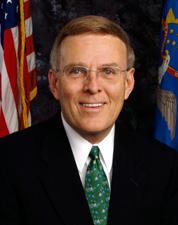 Sen. Byron L. Dorgan (D-ND)
Legislative Activity
Stay on top of the latest movement without scrolling through every action
Senate amendment submitted
July 19, 2005
View full timeline
Senate amendment submitted
July 19, 2005
Senate amendment not agreed to: Amendment SA 1294 not agreed to in Senate by Yea-Nay Vote. 33 - 66. Record Vote Number: 194.
July 19, 2005
Roll call votes on amendments in Senate: Amendment SA 1294 not agreed to in Senate by Yea-Nay Vote. 33 - 66. Record Vote Number: 194.
July 19, 2005
Senate amendment proposed (on the floor): Amendment SA 1294 proposed by Senator Dorgan.
July 19, 2005
Amendment SA 1294 proposed by Senator Dorgan. (consideration: CR S8464-8468, S8469-8470; text: CR S8465) To provide that no funds may be made available to provide television broadcasting to Cuba, to increase by $21,100,000 the amount appropriated to the Peace Corps, and to reduce by the same amount the amount appropriated under title I to the Broadcasting Board of Governors for broadcasting to Cuba.
July 19, 2005
Amendment SA 1294 not agreed to in Senate by Yea-Nay Vote. 33 - 66. Record Vote Number: 194.
July 19, 2005
Votes
1 roll call on this amendment
Text
Proposed
DEPARTMENT OF STATE, FOREIGN OPERATIONS, AND RELATED PROGRAMS
APPROPRIATIONS ACT, 2006

The PRESIDING OFFICER. The Senate will now resume consideration of
H.R. 3057, which the clerk will report.
The assistant legislative clerk read as follows:

A bill (H.R. 3057) making appropriations for foreign
operations, export financing, and related programs for the
fiscal year ending September 30, 2006, and for other
purposes.

Pending:

Landrieu amendment No. 1245, to express the sense of
Congress regarding the use of funds for orphans, and
displaced and abandoned children.
Grassley amendment No. 1250, to prohibit the use of funds
to approve or administer a loan or guarantee for certain
ethanol dehydration plants.

The PRESIDING OFFICER. The Senator from Illinois is recognized.
Mr. OBAMA. Mr. President, I rise today in support of H.R. 3057, the
Foreign Operations appropriation bill. I would also like to highlight
one aspect of the bill.
Since coming to the Senate 6 months ago, one of the foreign policy
and health issues I have focused on relates to the avian flu. I am
pleased that this bill includes $10 million to combat the spread of
this potential pandemic, adding to the $25 million that the Senate
provided in the supplemental appropriations bill in April.
I thank the managers of this bill, Senators McConnell and Leahy, and
their staffs for working with me on this important issue. I know that
Senator McConnell has a longstanding interest in Southeast Asia, and
Senator Leahy has always been a champion of international health
issues, making the avian flu something I know they both care deeply
about.
In the last few weeks, scientists have reported that a deadlier
version of the avian flu has now spread to migrant birds that could
carry the disease out of Asia and across the world.
While it may not seem that threatening to many Americans at first,
this bird flu could easily transform into a human flu. And if it does,
it could be one of the deadliest flus mankind has ever known--even
worse than the 1918 flu pandemic that killed 675,000 Americans and 50
million worldwide.
Already, there have been 108 human cases of avian flu, resulting in
54 deaths. And while the virus has not yet mutated into a full-blown
human flu, recent developments suggest it might be heading in that
direction. In recent months, the virus has been detected in mammals
that have never previously been infected, including tigers, leopards
and cats.
A few weeks ago, the World Health Organization reported that avian
flu strains in Vietnam are lasting longer and spreading to more humans.
And according to government officials, a few cases of human-to-human
spread have already occurred.
Every day, there are new reports about the increasing dangers of the
avian flu. Last month, it was revealed that Chinese farmers have tried
to suppress outbreaks of the avian flu by using human antiviral drugs
on infected animals.
As a result, one strain of the virus has become resistant to these
drugs, thus making the drugs ineffective in protecting humans against a
possible pandemic. And just this week, researchers found that ducks
infected with the virus were contagious for up to 17 days, causing the
animals to become--in the researchers' words--``medical Trojan horses''
for transmitting the disease to humans.
Simply put, the world is not ready for a potential outbreak of this
deadly flu. In fact, we aren't even close.
There is no known vaccine for the avian flu, and producing one could
take months once an outbreak occurs. And while the World Health
Organization recommends that every nation stockpiles enough flu
treatment to treat a quarter of its population, the United States has
only ordered enough to treat less than 1 percent of ours.
We can't just stand by and hope that this virus doesn't reach our
shores when it only takes hours to travel from one side of the world to
the other. It is time for America to lead the world in taking decisive
action to prevent a potential global tragedy.
We should start by doing what we can to fight the virus while it is
still mainly in Southeast Asia. That is why I fought for and obtained
$25 million for prevention efforts by the CDC, the Agency for
International Development, the Health and Human Services Department,
and other agencies. And that is why I requested another $10 million in
this bill.
In addition, the Senate Foreign Relations Committee approved language
that I offered directing President Bush to form a senior-level task
force to devise an international strategy to deal with the avian flu
and coordinate policy among our government agencies. I hope that the
Bush administration forms this task force immediately without waiting
for legislation to be passed.
Yet, these are only modest first steps. International health experts
believe that Southeast Asia will be an epicenter of influenza for
decades. That is why we need to create a permanent framework for
curtailing the spread of future infectious diseases--a framework that
would increase international disease surveillance, response capacity
and public education and coordination, especially in Southeast Asia.
But we must also prepare our own country in the event that a global
pandemic reaches America. That is why I recently introduced the AVIAN
Act, which helps make sure that Americans are protected from a possible
outbreak of the avian flu.
When the threat is this real, we should be increasing research into
possible flu vaccines, and we should be ordering enough doses of flu
treatment to cover the recommended 25 percent of our population--just
like England and other Western countries have done.
We should also ensure that our Health and Human Services Department
and State governments put in place a plan as to how they would address
a potential flu pandemic, including the purchasing and distributing of
vaccines. A year after a draft of a Federal plan was published, a final
version has yet to be finalized. We shouldn't have to wait any longer,
because the avian flu certainly won't.
We are extremely fortunate that so far, the avian flu has not been
found in the United States. But in an age when you can board planes in
Bangkok or Hong Kong and arrive in Chicago, Burlington or Louisville in
hours, we must face the reality that these exotic killer diseases are
not isolated health problems half a world away, but direct and
immediate threats to security and prosperity here at home.
Again, I thank Senators McConnell and Leahy for including this
important funding in the supplemental appropriations bill and now
including additional funding in this bill. And I thank the
distinguished chairman of the Foreign Relations Committee, Senator
Lugar, for his leadership on this issue.
I ask unanimous consent that several articles and editorials about
the avian flu be printed in the Record.
There being no objection, the material was ordered to be printed in
the Record, as follows:

[From the New York Times, July 18, 2005]

Avian Flu Virus Could Hide in Ducks

(By the Associated Press)

Washington (AP).--Changes in the avian flu virus have made
it less deadly to ducks, potentially turning them into
medical Trojan horses where the flu can hide while continuing
to infect other birds and humans.
Waterfowl such as ducks have been natural hosts of this
type of influenza before but rarely became ill from it until
2002, when an evolving strain killed off a large number of
the birds.
Since then, however, the virus has continued to change,
reverting to a form less dangerous to ducks but still able to
cause illness and death in chickens and humans, according to
a study in Tuesday's issue of Proceedings of the National
Academy of Sciences.
``These results suggest that the duck has become the Trojan
horse of Asian H5Nl influenza viruses,'' reported a research
team led by Robert G. Webster of St. Jude Children's Research
Hospital in Memphis, Tenn.
``The ducks that are unaffected by these viruses continue
to circulate these viruses, presenting a pandemic threat,''
the team said.
The researchers infected domestic ducks with flu isolated
at various times.
They found that ducks infected with H5Nl from 2003 or 2004
were contagious for 11-17 days, a longer transmission time
than pre-2002 strains. The researchers also noted that the
virus was transmitted primarily through the upper respiratory
tract instead of through fecal matter as in older strains.
When flu virus from ducks that had survived the disease was
administered to healthy animals, it no longer caused disease

[[Page S8448]]

in ducks, but still caused disease in chickens.
Over the last two years, hundreds of millions of birds,
including poultry and wild birds, have died or were
slaughtered across Asia because of the H5Nl bird flu virus,
which has also infected some humans, killing 51 people in
Vietnam, Thailand and Cambodia.
The humans appear to have been infected by contact with
birds. Experts fear that if the virus mutates into a form
that could be passed easily from person to person it could
spark a global pandemic, killing millions.
Webster's research was funded by the U.S. Public Health
Service and American Lebanese Syrian Associated Charities.
____

[From the Washington Post, July 7, 2005]

Deadly Flu Strain Shows Up in Migratory Birds

Scientists' Discovery Gives Rise to Fears the Virus Could Spread Beyond
East Asia

(By David Brown)

The strain of bird flu responsible for the deaths of tens
of millions of chickens and 54 people in east Asia over the
past two years is now circulating in long-distance migratory
birds, potentially opening a way for the deadly virus to
reach India, Australia and Europe.
That is the conclusion of two research teams whose findings
were rushed into print by the rival journals Science and
Nature yesterday.
Spread of the virus beyond its current home in China and
neighboring countries could cause billions of dollars in
losses to poultry farmers around the world. It could also
give influenza A/H5N1--the virus's formal name--further
,opportunity to adapt to human as well as avian hosts, a
development that theoretically could lead to a global flu
epidemic.
Until now, the H5N1 virus has chiefly attacked chickens and
ducks in farms and markets. It also killed a small number of
birds in two Hong Kong nature parks in late 2002, and since
then has been found sporadically in hawks, herons and swans.
Those birds presumably acquired it from direct contact with
poultry.
Now, however, it appears the virus is being transmitted
among wild birds that have had no known contact with
domesticated birds.
``It has been difficult to tell whether the true migrating
birds had been infected by this terrible virus. This leaves
no doubt in my mind,'' said Robert G. Webster, a flu
virologist at St. Jude Children's Research Hospital in
Memphis who helped analyze virus samples collected during a
recent die-off of birds at a huge saltwater lake in western
China.
Since the first reports emerged on April 30, between 1,000
and 6,000 birds have died on the shores and islands of remote
Qinghai Lake. The species most affected is the bar-headed
goose, a large bird whose migration over the Himalayas to
Burma, India and Pakistan starts in about a month. Illness
and death were also recorded in brown-headed gulls, black-
headed gulls and great cormorants.
There is a web of migratory flyways around the globe. The
ones taken by the species congregating at Qinghai Lake
intersect with others that lead to Europe. That theoretically
provides a way for the H5N1 virus to reach that continent.
H5N1 influenza virus was first detected in southern China
in 1996. In 1997, it caused a major outbreak in Hong Kong,
which led to the death of 1.5 million poultry and six people.
The virus most recently emerged in South Korea in late
2003. Since then, it has led to the death of 100 million to
200 million chickens in China and Southeast Asia. It has also
infected 108 people (most of them in Vietnam), of whom 54--
exactly half--have died. Most human victims had direct
contact with dead or dying chickens, but in a few cases it
appears the virus was acquired directly from an infected
person.
While person-to-person spread of H5N1 influenza is rare and
occurs with difficulty, the more the virus circulates the
greater its chance of acquiring genetic changes that permit
easy human transmission.
If that occurs, the virus would have ``pandemic
potential''; it could travel quickly and infect much of the
world's population, which has no immunity to it.
There is no guarantee H5N1's presence in migratory birds
will lead to global dissemination. It simply increases the
chance.
For there to be further spread, a significant number of
infected birds would need to be healthy enough to start their
migration. They would need to establish a ``chain of
transmission'' in the migrating flock, with new birds
acquiring the virus as the infected ones died or recovered.
At their destinations, they would have to make contact with
poultry, igniting a new chicken outbreak and again putting
the virus into contact with human beings.
The likelihood of any of these steps is unknown.
``What would migratory birds contribute to the
possibilities of disease outbreak? That is the question we
don't know the answer to,'' said David E. Swayne of the U.S.
Department of Agriculture's Southeast Poultry Research
Laboratory in Athens, Ga.
How the Qinghai Lake birds acquired H5N1 influenza is
unknown.
There are chickens in Qinghai Province, but ``there is no
H5N1 infection in those chickens--they don't have it,''
George F. Gao of the Institute of Microbiology of the Chinese
Academy of Sciences said in a telephone interview from
Beijing. He is the lead author of the paper that was
published online by Science.
Both his team and one from the University of Hong Kong,
whose report is published online in Nature, detected in the
Qinghai Lake samples the three genetic defects and mutations
found in the H5N1 strains responsible for high mortality in
chickens and humans.
According to the two reports, the wild-bird strain bears
genetic features of the virus found in chickens in China in
2003 and 2005 and in a peregrine falcon in Hong Kong in 2004.
It is not identical to any of them, however.
The leader of the Hong Kong team, Yi Guan, a microbiologist
at the University of Hong Kong, said the Chinese Ministry of
Agriculture closed the Qinghai Lake area to his colleagues in
mid-May.
``We hope they will open the door and let us in to do long-
term surveillance,'' he said yesterday from Hong Kong.
``There are a lot of questions waiting for answers.''
____

[From the New York Times, July 17, 2005]

Unprepared for a Flu Pandemic

If a much-feared pandemic of avian influenza starts
sweeping through the world's population anytime soon, neither
the United States nor international health authorities will
be prepared to cope with it. There is not enough vaccine or
antiviral medicine available to protect more than a handful
of people, and no industrial capacity to produce a lot more
of these medicines quickly.
The best that can be hoped is that no pandemic will
materialize for the next several years, allowing time to
become better prepared, or that a potential pandemic can be
spotted early enough to allow international health officials
to snuff it out before the virus runs amok.
It has been 37 years since the last influenza pandemic, or
widespread global epidemic, so by historic patterns we may be
due for another. And a particularly ominous strain of avian
influenza that has devastated poultry flocks in Asia seems
poised to wreak havoc in humans. This strain, known as H5N1,
first became a matter of health concern in 1997 when it was
found to have jumped from birds to humans in Hong Kong in an
outbreak that failed to spread widely. Since then, the virus
has looked more and more threatening. It has infected
poultry, domestic ducks and migratory birds in nine
countries, making the virus almost impossible to contain.
More ominously, the virus has developed the ability to jump
to a range of mammals, including pigs, mice, tigers and
domestic cats.
The human toll has been slight. Only 108 people have been
infected, of whom 54 have died, an alarmingly high mortality
rate but one that seems to be diminishing. It is reassuring
that millions of people have lived and worked in close
proximity to infected birds without harm and even more
reassuring that the flu strain has not yet developed the
ability to spread easily from one person to another, the sine
qua non for a pandemic to take off. But that could change in
a trice if the virus mutates or combines its genes with a
human influenza virus.
No one knows whether the world is headed toward a health
disaster or a false alarm, but virtually all experts agree we
need to strengthen our defenses. American health authorities
have taken the lead in testing vaccines against two strains
of avian flu and have contracted to buy two million doses of
a vaccine against H5N1. That is a tiny fraction of the amount
that would be needed if a pandemic hit, but will give the
manufacturer experience that would prove useful in a crisis.
Officials have also stockpiled enough antiviral medicine to
treat 2.3 million people, again a fraction of what would be
needed in a pandemic.
Yet the best defense might be to go on the offensive. The
most urgent need is to control the disease in poultry and
other animals that might spread the virus to humans. Some
countries have done a good job. Others, including Vietnam,
which accounts for almost 80 percent of the human cases, need
more prodding and international assistance. If the virus
breaks through this line of attack, authorities should try to
quench an incipient outbreak before it can really get
started. The Bush administration is wisely pumping millions
of dollars into an international effort to improve
surveillance of the disease in humans and animals in the
infected regions of Asia, and the World Health Organization
has amassed a small stockpile of antiviral drugs that will
soon be enlarged and could be rushed to the scene of any
outbreak.
Many experts are doubtful that it would be possible to
detect and contain an outbreak of transmissible influenza in
time to head off a pandemic. But that may be the best hope we
have until we are able to upgrade today's fragile and
unreliable vaccine production system with new processes that
can expand output quickly to meet a crisis.
____

[From the Washington Post, June 18, 2005]

Bird Flu Drug Rendered Useless

Chinese Chickens Given Medication Made for Humans

(By Alan Sipress)

Hong Kong.--Chinese farmers, acting with the approval and
encouragement of government officials, have tried to suppress
major bird flu outbreaks among chickens with an antiviral
drug meant for humans, animal

[[Page S8449]]

health experts said. International researchers now conclude
that this is why the drug will no longer protect people in
case of a worldwide bird flu epidemic.
China's use of the drug amantadine, which violated
international livestock guidelines, was widespread years
before China acknowledged any infection of its poultry,
according to pharmaceutical company executives and
veterinarians.
Since January 2004, avian influenza has spread across nine
East Asian countries, devastating poultry flocks and killing
at least 54 people in Cambodia, Thailand and Vietnam, but
none in China. World Health Organization officials warned the
virus could easily undergo genetic changes to create a strain
capable of killing tens of millions of people worldwide.
Although China did not report an avian influenza outbreak
until February 2004, executives at Chinese pharmaceutical
companies and veterinarians said farmers were widely using
the drug to control the virus in the late 1990s.
The Chinese Agriculture Ministry approved the production
and sale of the drug for use in chickens, according to
officials from the Chinese pharmaceutical industry and the
government, although such use is barred in the United States
and many other countries. Local government veterinary
stations instructed Chinese farmers on how to use the drug
and at times supplied it, animal health experts said.
Amantadine is one of two types of medication for treating
human influenza. But researchers determined last year that
the H5N1 bird flu strain circulating in Vietnam and Thailand,
the two countries hardest hit by the virus, had become
resistant, leaving only an alternative drug that is difficult
to produce in large amounts and much less affordable,
especially for developing countries in Southeast Asia.
``It's definitely an issue if there's a pandemic.
Amantadine is off the table,'' said Richard Webby, an
influenza expert at St. Jude Children's Research Hospital in
Memphis.
Health experts outside China previously said they suspected
the virus's resistance to the medicine was linked to drug use
at poultry farms but were unable to confirm the practice
inside the country. Influenza researchers at the U.S. Centers
for Disease Control and Prevention, in particular, have
collected information about amantadine use from Chinese Web
sites but have been frustrated in their efforts to learn more
on the ground.
China has previously run afoul of international agencies
for its response to public and agricultural health crises,
notably the SARS epidemic that began in 2002. China's health
minister was fired after the government acknowledged it had
covered up the extent of the SARS outbreak by preventing
state-run media from reporting about the disease for months
and by minimizing its seriousness.
In interviews, executives at Chinese pharmaceutical
companies confirmed that the drug had been used since the
late 1990s, to treat chickens sickened by bird flu and to
prevent healthy ones from catching it.
``Amantadine is widely used in the entire country,'' said
Zhang Libin, head of the veterinary medicine division of
Northeast General Pharmaceutical Factory in Shenyang. He
added, ``Many pharmaceutical factories around China produce
amantadine, and farmers can buy it easily in veterinary
medicine stores.''
Zhang and other animal health experts said the drug was
used by small, private farms and larger commercial ones.
Amantadine sells for about $10 a pound, a fraction of the
drug's cost in Europe and the United States, where its price
would be prohibitive for all but human consumption.
Two months before China first reported a bird flu outbreak
in poultry to the World Animal Health Organization in
February 2004, officials had begun a massive campaign to
immunize poultry against the virus. They have now used at
least 2.6 billion doses of a vaccine.
But researchers in Hong Kong have reported that the H5N1
flu virus has been circulating in mainland China for at least
eight years and that Chinese farms suffered major outbreaks
in 1997, 2001 and 2003. Scientists have traced the virus that
has devastated farms across Southeast Asia in the last two
years to a strain isolated from a goose in China's Guangdong
province in 1996.
The U.N. Food and Agriculture Organization has long
recommended that countries try to eradicate infectious animal
diseases by slaughtering infected flocks and increasing
safety measures on farms. Last year, the FAO also suggested
that countries consider vaccinating their poultry against
bird flu. But the guidelines never recommended the use of
antiviral drugs such as amantadine, which, unlike
vaccination, has been proven to make viruses resistant,
officials said.
In 1987, researchers at a U.S. Department of Agriculture
laboratory demonstrated that bird flu viruses developed drug
resistance within a matter of days when infected chickens
received amantadine.
Still, a veterinarian with personal knowledge of livestock
practices across China said Chinese farmers responded to the
bird flu outbreak by putting the drug into their chickens'
drinking water. The veterinarian asked that his name not be
published because he feared for his livelihood.
``This would explain why we're seeing such high resistance
levels,'' said Michael T. Osterholm, director of the Center
for Infectious Disease Research and Policy at the University
of Minnesota. While various antibiotics have lost their
effectiveness because of overuse, he said, the emergence of
resistance to amantadine is unprecedented because it is an
antiviral.
``This is the first example of an antiviral drug that was
used for animal production that has major implications for
human health,'' Osterholm said.
A popular Chinese handbook, titled Medicine Pamphlet for
Animals and Poultry, provides farmers and livestock officials
with specific prescriptions for amantadine use to treat
chickens and ferrets with respiratory viruses. The manual,
written by a professor at the People's Liberation Army
Agriculture and Husbandry University and issued by a
military-owned publishing company, prescribes 0.025 grams of
amantadine for each kilogram of chicken body weight.
Farmers also use the drug to prevent healthy chickens from
catching bird flu, giving it to their poultry about once a
month or more often when the weather is liable to change and
chickens are considered susceptible to illness, veterinary
experts said. The antiviral is often mixed with Chinese
herbs, vitamins and other medicine.
In the United States, amantadine was approved in 1976 by
the Food and Drug Administration for treating influenza in
adults. Amantadine and it sister drug, rimantadine, known
collectively as amantadines, work by preventing a flu virus
from reproducing itself. Both are now ineffective against the
H5N1 strain.
International health experts stressed that amantadine could
have been vital in stanching the spread of the bird flu virus
in the early weeks of an epidemic.
Now, the only alternative is oseltamivir and closely
related zanamivir, which stop the flu virus from leaving
infected cells and attacking new ones. Oseltamivir is easier
to use and has far greater sales.
``Amantadine is the cheapest drug against flu,'' said Malik
Peiris, an influenza expert at the University of Hong Kong.
``It is much more affordable for many countries of the
region. Now, it is clearly no longer an option.''

Amendment No. 1264

Mr. OBAMA. Mr. President, I also want to make a brief statement on
amendment No. 1264, which is offered on behalf of Senator Hagel,
Senator Gregg, Senator Leahy, and myself.
It is a very simple amendment. It provides $13 million for the
Special Court for Sierra Leone to help make up for a shortfall in
international contributions to the Court.
While the amendment is simple, it is critically important to
promoting the rule of law in Africa; helping advance security and
stability in West Africa; and holding accountable some of the worst war
criminals of the 20th century.
The Special Court was established by the United Nations Security
Council with strong U.S. backing. The Court is working, as we speak, to
bring to justice those most responsible for the atrocities committed in
Sierra Leone during wars there in the 1990s.
The Court, however, currently has one major piece of unfinished
business--Charles Taylor.
Although Mr. Taylor has been indicted by the Special Court on 17
counts of war crimes and crimes against humanity, he continues to live
in exile in Nigeria, enjoying the protection of the Nigerian
government.
What is worse is there are credible reports that Mr. Taylor has
repeatedly broken the terms of his agreement with the Nigerian
government, continues to meddle in the affairs of Liberia and other
West African nations, is involved in a number of activities that
threaten to destabilize the region, and has associations with al-Qaida.
There is no question that the United States and the international
community owe the Nigerian government a debt of gratitude for helping
to remove Mr. Taylor from power. However, the job of promoting regional
peace and security cannot be completed until Mr. Taylor appears before
the Special Court to answer to the charges against him.
I would also point out that transferring Charles Taylor to the Court
also is widely supported within Nigeria. Prominent members of Nigeria's
military and civil society have vigorously opposed the decision to
shield Taylor.
This bipartisan amendment makes clear that bringing Mr. Taylor to
justice is a top U.S. foreign policy priority. It makes clear that the
Court is not going away anytime in the near future. It makes clear that
the transfer of Mr. Taylor to the Court will help reduce transnational
threats in West Africa, promote peace and security in the region, and
enhance respect for the rule of law throughout Africa.

[[Page S8450]]

I understand that the managers are in the process of working this
amendment out, and I look forward to working with them to get this
accepted. I would like to thank the cosponsors who played a leadership
role Senators Hagel, Gregg, and Leahy.
I yield the floor.
The PRESIDING OFFICER. The Senator from Texas is recognized.
Mr. CORNYN. Mr. President, I ask unanimous consent to speak as in
morning business.
The PRESIDING OFFICER. Without objection, it is so ordered.

The President's Supreme Court Nominee

Mr. CORNYN. Mr. President, just a few moments ago, we all learned,
through the miracle of modern technology, that the President intends to
announce his Supreme Court nominee tonight at 9 p.m. when he addresses
the Nation.
This is certainly the culmination of an unprecedented consultative
process that this President has undertaken with the Senate, spending
more than 2 weeks now, I believe, reaching out to Senators on both
sides of the aisle, asking for their suggestions.
Now, the President believes that it is appropriate for him to name
the successor to Justice Sandra Day O'Connor on the U.S. Supreme Court.
It is my hope that tonight's announcement will be met with some
restraint on the part of the Members of the Senate, that we will hold
our fire, and that we will not prejudge this nominee or seek to use
this as an opportunity to perhaps disparage the nominee before we have
had a chance to ask questions, before the nominee has had a chance to
meet with Members, and before we have had a chance to conduct a hearing
before the Senate Judiciary Committee, as we will surely do either in
late August or early September.
We can do better in the Senate than we have done in the recent past
when it comes to judicial nominations. I think we have shown that we
can conduct ourselves with dignity and civility, even as we have
disagreed. Indeed, that is one of the great things about this body--
that even people who disagree can debate, but then turn that debate
over to our colleagues for an up-or-down vote and the judgment of the
American people.
I hope we have a dignified process and one that reflects well on the
Senate, that treats this nominee fairly, and allows the President to
have his nominee considered in the regular course of our business.
Throughout this debate, even before the President has named a
nominee, various Senators have come to the floor and opined about how
this process should go forward. I will respond to some of the comments
made earlier today by the senior Senator from Massachusetts regarding
the process.
The senior Senator from Massachusetts envisions a step in this
process where the President gives him and his colleagues the ability to
veto particular nominees--in other words, suggesting that the President
ought to perhaps share some on his short list with the Senate before
the President can name a particular nominee. Nothing in the
Constitution provides for or requires such a step. The President is
under no obligation to give any Senator the power to veto his
nomination.
The Constitution entrusts the President with the power to nominate,
and there is no requirement for the President to do anything further.
Indeed, as I mentioned a moment ago, this President has gone above and
beyond the call and consulted in an unprecedented manner. But certainly
the Constitution doesn't give this President, or impose upon this
President, the obligation to allow Senators to co-nominate their
particular choice along with the President. Rather, it provides for
separate and distinct functions for the President to nominate and then
for the Senate to conduct hearings, to act in its role of advice and
consent, and then to vote on the nominee.
The senior Senator from Massachusetts has said he wants the President
to nominate someone who is independent and impartial. I submit that the
best way to do that is to do precisely the opposite of what the senior
Senator from Massachusetts says he intends to do; that is, he says he
intends to demand that the nominee answer questions about how he or she
will rule on particular questions or particular issues.
The Senator has stated his intention to ask nominees how they would
rule on a host of different issues. Today, he mentioned several of
them--everything from retirement benefits to college admission
standards. He even noted that all of these issues are likely to be
subjects of future Court decisions. It would, however, undermine the
independence of the nominee and the judiciary to demand that he or she
answer questions about issues that are likely to come before the Court.
How can a nominee be truly independent from the Congress if they are
required to make a pledge to certain outcomes in the Senate in order to
get confirmed? Well, simply stated, they cannot be independent and make
such a pledge. So it would be inappropriate for any nominee to make
that pledge. While certainly I recognize and respect the right of any
Senator to ask any question he or she wants, no nominee worthy of
confirmation would in fact answer those questions and make such a
pledge.
It would also undermine the impartiality of the person nominated to
demand that he or she answer questions on issues likely to come before
the Court. Imagine if you came before a judge and you find out that
that judge already, during the confirmation process, stated his or her
belief in the correctness of a certain outcome, before you have even
had a chance to present your case to the Court. Imagine if that judge
promised the President or a Senator that he or she would rule against
you no matter what you said.
That is not equal and open-minded justice. That is not a judicial
process but rather a political process, and one we ought to avoid at
all costs.
It is also not how we have conducted our business in the recent past.
Justice Ginsburg was confirmed by the Senate by a vote of 96 to 3.
Before her service on the Federal bench, Justice Ginsburg served as
general counsel of the American Civil Liberties Union, a liberal
organization that has championed the abolition of traditional marriage
laws and challenged the Pledge of Allegiance because the words ``under
God'' are invoked in that pledge.
Before she became a judge, now-Justice Ginsburg expressed opposition
to laws prohibiting bigamy and prostitution. She wrote that the Boy
Scouts and Girl Scouts were discriminatory institutions, and that
taxpayer funds should be used to pay for abortions--hardly views that
the American people would view as mainstream. Yet the Senate did not
engage in asking her to make prejudgments about cases she later would
rule on from the Supreme Court. They did not ask her to make promises
to politicians about how she would perform once confirmed. Indeed,
Republicans and Democrats alike set aside such concerns and approved
her nomination.
Make no mistake, I am just as curious as anybody else about what the
private views of a nominee might be. But the need to assure a fair
process and an independent judiciary and to avoid the hyper-
politicalization of this process more than outweighs a results-oriented
curiosity on my part or on the part of any other Senator, I submit.
Finally, the Senator from Massachusetts said he also wants the
President to nominate a consensus choice to the Supreme Court. But it
will be up to the Senator and his other colleagues whether the nominee
meets their definition of what actually constitutes a consensus choice.
The President has said he intends to nominate someone in the mold of
Justice Scalia. Justice Scalia was confirmed by a vote of 98 to 0. That
is quite a consensus.
So long we do not change the standard from when the nomination of
Justice Scalia was considered or Justice Ginsburg was considered, then
we will have a relatively easy time confirming the President's
selection if they meet the basic qualifications of legal scholarship,
high ethical rectitude; in short, the type of person we would entrust
with making the weighty decisions that are made by the Supreme Court.
But if we, to the contrary, revert to a political process, one that
is accusatory of this nominee before we actually have a chance to
investigate their background and fitness for this office, if we engage
in asking nominees to make promises to politicians about how they will
rule in the future, I

[[Page S8451]]

think we will not have conducted ourselves in the best traditions of
the Senate, and certainly not in a way that befits the awesome
responsibility imposed upon the Senate under the Constitution of the
United States.
Mr. President, I yield the floor.
The PRESIDING OFFICER. The Senator from Connecticut.
Mr. LIEBERMAN. Mr. President, I have come to the floor to speak about
an amendment to the pending matter, the Foreign Operations
appropriations bill. But the focal statements of my friend from Texas
lead me to say a word about the apparently imminent nomination by the
President of a Justice to the Supreme Court to replace Justice
O'Connor.
I want to particularly identify myself with Senator Cornyn's call
that to the extent possible, we dispatch our very important
responsibilities to advise and consent to the President's nomination to
the Court in a nonpolitical manner.
I have been in politics all my adult life, so I am not naive. I know
when you have a political environment such as today, which is intensely
partisan, when you have a Supreme Court, such as we have today, which
is quite closely divided on some of the major issues facing our
country, that it is going to be hard for this to be a totally
nonpolitical process. But I do think, to the extent possible, that is
what the Framers of our Constitution, the Founders of our country
wanted us to do, and that is what our responsibility as Senators in
this Chamber calls on us to do.
The fact is, in the magnificent framework that the Founders created
for the American Government, which has stood this great democracy, this
great Republic so well for now more than two centuries, the Supreme
Court was intended to occupy a unique place. It is the least political
of the branches of Government. It is the branch of Government that is
not occupied by elected officials. Supreme Court Justices, appointed by
the President, serve life terms, going well beyond, in most cases, the
term of the President who appointed them.

The Supreme Court, in the contemplation of the Founders of this
country, was meant to be that branch of Government that is most
separated from the political passions of the moment that might lead the
legislative or executive branch to take a particular action. The
Supreme Court is there to apply, if you will allow me to say so, the
eternal values incorporated in our Constitution and the Bill of Rights
to the matters of the moment that come before them. They are human, so
they obviously are sensitive to what is happening around them.
The high calling of the Court is to look beyond the moment, including
the political controversies of the moment, and do what they think the
Constitution requires them to do and what the future of this
constitutional Republic of ours requires them to do.
This is a big moment which, to the best of our ability, we should try
to keep as nonpolitical as possible, nonpartisan as possible, to focus
on the nominee in a thoughtful way.
I agree, it would be an unusual circumstance if people started to
jump to conclusions immediately as to whether they were for or against
the person the President will apparently announce tonight. It is going
to require some consideration of the person's record, some thoughtful
consideration. The Judiciary Committee will hold hearings. There will
be public questioning. So we are going to have ample time to find out
more about the nominee.
There may be partisans on both sides, Democrats and Republicans, both
ideological sides--left and right--who will want to immediately and, in
some sense already have, make this nomination a matter of controversy,
confrontation, division. That is their right in our democracy. But
ultimately this comes down to 101 people: the President of the United
States who, in the first instance, the most significant by virtue of
having been elected, has earned the right to make this nomination, and
then the other 100, of course, are the Members of this Senate. For the
President and for the 100 of us privileged to serve in the Senate
today, this is one of the big moments in our service because Supreme
Court Justices have so much to say over the course of a generation or
two about the quality of American freedom, about the quality of our
Government, about the balance of rights, about the adjudication of
controversies in our country. We are all going to be tested.
I look forward to a nominee being named tonight who, I hope, will
fill the President's pledge that he will nominate somebody who is
mainstream, but he will not apply litmus tests. I thank the White
House, including the President, for the consultation that has gone on
with Members of the Senate of both parties leading up to this
nomination tonight. Most of all, I hope we in this Chamber, because
this is our responsibility, will conduct ourselves in a way that will
be thoughtful; that not only will lead to an appropriate result in
regard to the confirmation or failure to do so of the nominee, but will
also bring some honor to this Chamber, and at a moment, as I said a
moment ago, when there is too much polarization in our politics, that
we will together do what is right for our country, at home and abroad.

Amendment No. 1248

Mr. President, I came to the floor today to thank the floor managers,
Senators McConnell and Leahy, for their stewardship of this very
important bill, the Foreign Operations appropriations bill. I also
specifically came to thank them for accepting an amendment on refugees
that I offered to this bill with Senators Brownback and Kennedy, a
bipartisan measure.
Senators McConnell and Leahy have a longstanding commitment to the
well-being of refugees, and this priority is reflected in the
legislation they have reported out of the committee which devotes $900
million to refugee assistance. This is a worthy expenditure of
America's money. That figure is more than the administration had
requested. And I hope that in future years, the many supporters of
refugees in both the Senate and the House--on both sides of the aisle--
can work together to increase our support for refugee assistance.
This Nation of ours has been the home to so many who have come here
seeking freedom and a better life. It is the essence of what America is
about, and that includes addressing the systemic problems that have
kept so many refugees in exile, confined in camps without a real home.
Senator Kennedy and Senator Brownback have been leaders in calling
attention to the longstanding plight of refugees in the world. Earlier
this year, I was privileged to cosponsor a resolution they submitted
condemning the so-called warehousing of refugees.
The amendment we offered, which was accepted yesterday by the floor
managers, builds on that antiwarehousing resolution by directing the
expenditure of funds on programs that can help move refugees out of
these camps and ease their assimilation into normal communities. The
amendment addresses the heartrending conditions of millions of refugees
who have been confined in these camps for many years.
Here is a number that may stun people who are listening. Worldwide,
there are 8 million refugees who have been confined to camps or other
restricted settlements for longer than 5 years. That is a number that
represents more than half of all refugees in the world--8 million in
camps for at least 5 years.
In many cases, the refugees have been confined in camps for decades.
These warehouse refugees include people who have fled oppressive
regimes, civil wars, even genocide. Their confinement deprives them, in
my opinion, of the guaranteed right of the U.N. Refugee Convention of
1951, such as the right to work, to travel, to own property, and to
receive a basic education. Generations of refugees are born and die in
camps. They cannot support their families. Their living conditions too
often are horrendous. Their inherent potential as human beings, as
recognized by our own Declaration of Independence, is suppressed and
squandered.
Unfortunately, the neighboring countries that have absorbed a sudden
inflow of refugees are often the least equipped to care for them. So it
is with the Burmese, the subject of the resolution adopted today,
sanctioning the Burmese Government for antidemocratic policies. So it
is with the Burmese who have fled to Thailand during this circumstance,
to Bangladesh and India, the Angolans in Zambia, the

[[Page S8452]]

Bhutanese in Nepal, and the Somalians and Sudanese in Kenya.
In response to immediate humanitarian needs, refugees are frequently
massed in camps where nongovernmental organizations and the United
Nations Commissioner for Refugees can more easily get aid to them. That
is an understandable short-term reaction.
Too often the camps have become long-term realities. We cannot expect
developing countries such as Africa, Asia and Latin America to shoulder
alone the burden of assimilating refugees, but neither can we accept a
status quo that allows millions to remain massed at border camps
indefinitely. Instead, we must work with countries that host refugee
communities to develop alternatives to confinement in camps, and that
is what the language of this amendment that Senators Kennedy,
Brownback, and I have introduced will do.
Our amendment directs the Secretary of State to work with the UNHR,
with nongovernmental organizations, and with host countries to develop
programs that support refugees outside of camps, programs that
facilitate the integration of refugees by promoting their access to
schools, health care, and other local services in the communities in
which the camps are located.
The international donor community will need to be responsive to local
needs and, of course, local sensitivities. We have to create incentives
for the host communities so they can see the local assimilation of
refugees as an opportunity, not a threat. For example, refugees with
special skills can help create economic opportunities for others around
them. Our aid can pay for doctors, teachers, and facilities that are
shared by the refugees and the local communities, thus benefiting the
local community as well, or for job training and job creation programs
that also would benefit the people in the surrounding communities. Our
amendment calls on the State Department to fund programs that encourage
dialog among local communities, the United Nations, and nongovernmental
organizations.
There is no easy solution to this refugee crisis that exists around
the world, but it does cry out to us as the strongest and, in my
opinion, greatest and most humanitarian nation in the world to do
something to assist these people, these fellow citizens of this Earth.
In some instances, conditions will improve sufficiently so that
refugees can return to their home countries. Many nations offer to
resettle refugees, but relatively few of the world's refugees actually
get that opportunity. Permanent integration into the country of first
asylum is also rare, and that leaves a temporary solution that is
neither temporary nor a solution, which is confinement in camps.
Many in Congress and others around the world are speaking out against
the warehousing of refugees. They are looking for a better way. Helping
to improve the lives of refugees will take work, it will take money,
and it will take perseverance, but that is what this country is all
about. It is worth it when we consider the living conditions of the
Sudanese, Burmese, and other refugee children. Let us think about the
children who are born in these camps and will die in these camps unless
we do something to help them. Without our help, they will never have a
future beyond the confinement of these camps.
When we think about what this $900 million can do to open up the
possibility of a future to these children, we know it is worth it. That
is why I am honored to have worked with Senators Kennedy and Brownback
on this amendment, and again I am very grateful to Senators McConnell
and Leahy for accepting it. It was amendment No. 1248.
I yield the floor, and I suggest the absence of a quorum.
The PRESIDING OFFICER (Mr. Coleman). The clerk will call the roll.
The legislative clerk proceeded to call the roll.
Mr. McCONNELL. Mr. President, I ask unanimous consent the order for
the quorum call be rescinded.
The PRESIDING OFFICER. Without objection, it is so ordered.
Mr. McCONNELL. Mr. President, are we now on the Foreign Operations
bill?
The PRESIDING OFFICER. That is correct.

Amendments Nos. 1276, 1277, 1278

Mr. McCONNELL. Mr. President, I send a managers' package to the desk.
It is a series of amendments by Senators Brownback and Kennedy
regarding Vietnamese refugees; Senator Leahy, regarding the Extractive
Industries Transparency Initiative Trust Fund; and Mr. Brownback,
regarding education programs in Egypt.
I send these amendments to the desk. They have been cleared on both
sides. I ask for their immediate consideration.
The PRESIDING OFFICER. Without objection, the pending amendments will
be set aside and the clerk will report.
The assistant legislative clerk read as follows:

The Senator from Kentucky (Mr. McConnell) proposes
amendments numbered 1276, 1277, 1278, en bloc.

Mr. McCONNELL. I ask unanimous consent the reading of the amendments
be dispensed with.
The PRESIDING OFFICER. Without objection, it is so ordered.
Is there further debate on the amendments?
Mr. McCONNELL. I ask unanimous consent that the amendments be agreed
to.
The PRESIDING OFFICER. Without objection, it is so ordered.
The amendments were agreed to, as follows:

AMENDMENT NO. 1276

(Purpose: To extend eligibility for refugee status of unmarried sons
and daughters of certain Vietnamese refugees)

On page 326, between lines 10 and 11, insert the following:

VIETNAMESE REFUGEES

Sec. 6113. Section 594(a) of the Foreign Operations, Export
Financing, and Related Programs Appropriations Act, 2005
(enacted as division D of Public Law 10809447; 118 Stat.
3038) is amended by striking ``and 2005'' and inserting
``through 2007''.

AMENDMENT NO. 1277

(Purpose: To provide a United States contribution to the Extractive
Industries Transparency Initiative Trust Fund)

On page 173, line 6, after the colon, insert the following:
Provided further, That of the funds appropriated under this
heading, not less than $1,000,000 should be made available
for a United States contribution to the Extractive Industries
Transparency Initiative Trust Fund:

AMENDMENT NO. 1278

(Purpose: To ensure certain funds are used for educational programs in
Egypt)

On page 169, lines 23 and 24, after ``programs'', insert
the following: ``, not less than $50,000,000 should be used
for education programs''.

Mr. McCONNELL. I move to reconsider the votes on those amendments and
move to lay that motion on the table.
The motions to lay on the table were agreed to.

Amendment No. 1264

(Purpose: To support a United States contribution to the Special Court
for Sierra Leone)

Mr. McCONNELL. There are filed amendments which I will designate
which I will send to the desk. They have been cleared on both sides. I
call up amendment No. 1264, offered by Mr. Obama and Mr. Hagel. I ask
its immediate consideration. I ask that Mr. Gregg and Mr. Leahy be
added as cosponsors.
The amendment has been cleared on both sides of the aisle.
The PRESIDING OFFICER. Without objection, it is so ordered. The clerk
will report the amendment.
The assistant legislative clerk read as follows:

The Senator from Kentucky (Mr. McConnell), for Mr. Obama,
for himself and Mr. Hagel, Mr. Gregg, and Mr. Leahy, proposes
an amendment numbered 1264.

The amendment is as follows:

On page 173, line 6 after ``Nepal:'' insert the following:
Provided further, That of funds appropriated under this
heading, $13,000,000 should be made available for a United
States contribution to the Special Court for Sierra Leone:

The PRESIDING OFFICER. Is there further debate? If not, without
objection, the amendment is agreed to.
The amendment (No. 1264) was agreed to.
Mr. McCONNELL. Mr. President, I move to reconsider the vote and I
move to lay that motion on the table.
The motion to lay on the table was agreed to.

[[Page S8453]]

Amendment No. 1238, as Modified

Mr. McCONNELL. I call up amendment No. 1238, offered by Senator
Allen, and send a modification to the desk. I ask Senator Leahy be
added as a cosponsor. The amendment, as modified, has been cleared on
both sides of the aisle.
The PRESIDING OFFICER. Without objection, the clerk will report.
The assistant legislative clerk read as follows:

The Senator from Kentucky (Mr. McConnell) for Mr. Allen,
for himself and Mr. Leahy, proposes an amendment numbered
1238, as modified.

The amendment is as follows:

At the appropriate place, insert the following:

combatting piracy of united states copyrighted materials

Sec. __. (a) Program Authorized.--The Secretary of State
may carry out a program of activities to combat piracy in
countries that are not members of the Organization for
Economic Cooperation and Development (OECD), including
activities as follows:
(1) The provision of equipment and training for law
enforcement, including in the interpretation of intellectual
property laws.
(2) The provision of training for judges and prosecutors,
including in the interpretation of intellectual property
laws.
(3) The provision of assistance in complying with
obligations under applicable international treaties and
agreements on copyright and intellectual property.
(b) Consultation With World Intellectual Property
Organization.--In carrying out the program authorized by
subsection (a), the Secretary shall, to the maximum extent
practicable, consult with and provide assistance to the World
Intellectual Property Organization in order to promote the
integration of countries described in subsection (a) into the
global intellectual property system.
(c) Funding.--Of the amount appropriated or otherwise made
available under the heading ``International Narcotics Control
and Law Enforcement'', $5,000,000 may be available in fiscal
year 2006 for the program authorized by subsection (a).

The PRESIDING OFFICER. Is there further debate? If not, without
objection, the amendment is agreed to.
The amendment (No. 1238), as modified, was agreed to.
Mr. McCONNELL. Mr. President, I move to reconsider the vote and I
move to lay that motion on the table.
The motion to lay on the table was agreed to.

Amendment No. 1253, as Modified

Mr. McCONNELL. I call up amendment No. 1253 offered by Senator
Feingold and send a modification to the desk. The amendment, as
modified, has been cleared on both sides.
The PRESIDING OFFICER. The clerk will report.
The assistant legislative clerk read as follows:

The Senator from Kentucky (Mr. McConnell), for Mr.
Feingold, proposes amendment numbered 1253, as modified:

On page 326, between lines 10 and 11, insert the following:

REPORT ON ANTI-RETROVIRAL DRUG PROCUREMENT

Sec.   . Not later than 180 days after the date of
enactment of this Act, the Coordinator of United States
Government Activities to Combat HIV/AIDS Globally shall make
available to the public a report setting forth the amount of
United States funding provided under the authorities of the
United States Leadership Against HIV/AIDS, Tuberculosis, and
Malaria Act of 2003 (22 U.S.C. 7601 et seq.), or under an
amendment made to that Act, to procure anti-retroviral drugs
in a country described in section 1(f)(2)(B)(VII) of the
State Department Basic Authorities Act of 1956 (22 U.S.C.
2651a(f)(2)(B)(VII)). The report shall include a detailed
description of the anti-retroviral drugs procured,
including--
(1) the amount expended for generic and for name brand
anti-retroviral drugs;
(2) the price paid per unit of each such drug; and
(3) the vendor from which such drugs were purchased.

The PRESIDING OFFICER. Is there further debate on the amendment?
Without objection, the amendment, as modified, is agreed to.
The amendment (No. 1253), as modified, was agreed to.
Mr. McCONNELL. Mr. President, I move to reconsider the vote and I
move to lay that motion on the table.
The motion to lay on the table was agreed to.

Amendment No. 1262, as Modified

Mr. McCONNELL. I call up amendment No. 1262, offered by Senator
Salazar, and send a modification to the desk. The amendment, as
modified, has been cleared on both sides.
The PRESIDING OFFICER. The clerk will report.
The assistant legislative clerk read as follows:

The Senator from Kentucky (Mr. McConnell), for Mr. Salazar,
proposes an amendment numbered 1262, as modified.

The amendment is as follows:

On page 183, line 15, strike the period at the end and
insert ``: Provided further, That of the funds appropriated
under this heading, not less than $10,000,000 should be made
available for law enforcement programs to combat the
prevalence of violent gangs in Guatemala, Honduras, and El
Salvador.''.

The PRESIDING OFFICER. Is there further debate? If not, without
objection the amendment, as modified, is agreed to.
The amendment (No. 1262), as modified, was agreed to.
Mr. McCONNELL. Mr. President, I move to reconsider the vote and I
move to lay that motion on the table.
The motion to lay on the table was agreed to.

Amendment No. 1273, as Modified

Mr. McCONNELL. Mr. President, I have a modification to an amendment
already filed, No. 1273. I send the modification to the desk.
The assistant legislative clerk read as follows:

The Senator from Kentucky (Mr. McConnell), for Mr.
Grassley, proposes an amendment numbered 1273, as modified:

The amendment is as follows:

On page 326 between lines 10 and 11 insert the following:

EXPORT-IMPORT BANK

Sec. 6113. None of the funds made available in this Act may
be used by the Export-Import Bank of the United States to
approve or administer a loan, guarantee, or insurance policy,
or an application for a loan, guarantee, or insurance policy,
for the development, or for the increase in capacity, of an
ethanol dehydration plant in Trinidad and Tobago.

Mr. McCONNELL. Mr. President, Senator Leahy and I are aware of only a
few amendments to this bill which must be disposed of prior to final
passage.
Let me reiterate for all of our colleagues who are interested in
amending this bill, we are not interested in encouraging that sort of
thing, but if we are going to do it, since both the majority leader and
Democratic leader have indicated we are going to finish this bill
today, I think it would be considerate of all the Members of the
Senate, and helpful, if we were to dispose of these amendments while
the Sun is still up rather than this evening, because Members typically
have many responsibilities in the evening. We would all like to finish
up in the late afternoon.
If you have an amendment that you simply must offer, come over and
discuss it with us. Hopefully we can take it. If not, we will look for
a short time agreement, a vote, and move toward final passage this
afternoon.
I suggest the absence of a quorum.
The PRESIDING OFFICER. The clerk will call the roll.
The legislative clerk proceeded to call the roll.
Mr. McCONNELL. Mr. President, I ask unanimous consent that the order
for the quorum call be rescinded.
The PRESIDING OFFICER. Without objection, it is so ordered.

Amendment No. 1283

Mr. McCONNELL. Mr. President, I send an amendment to the desk on
behalf of Senator Brownback, Senator Leahy, and myself and ask for its
immediate consideration.
The PRESIDING OFFICER. Without objection, the pending amendment is
set aside. The clerk will report.
The legislative clerk read as follows:

The Senator from Kentucky [Mr. McConnell], for Mr.
Brownback, for himself, Mr. Leahy, and Mr. McConnell,
proposes an amendment numbered 1283.

Mr. McCONNELL. Mr. President, I ask unanimous consent that reading of
the amendment be dispensed with.
The PRESIDING OFFICER. Without objection, it is so ordered.
The amendment is as follows:

(Purpose: To express the sense of the Senate regarding the forced
repatriation of refugees in Cambodia)

On page 326, between lines 10 and 11, insert the following:

FORCED REPATRIATION OF REFUGEES IN CAMBODIA

Sec.   . It is the sense of the Senate that--
(1) the United States Government is deeply concerned with
reports of the planned repatriation to Vietnam of 107
Montagnard refugees by the Government of Cambodia;
(2) the United States Government strongly condemns any
forcible repatriation of refugees by the Government of
Cambodia; and

[[Page S8454]]

(3) these refugees should be provided unobstructed legal
assistance from an independent organization in connection
with their appeals for fair review of their refugee claims,
and all such claims should be credibly and thoroughly
reviewed by the Office of the United Nations High
Commissioner for Refugees in Geneva.

Mr. McCONNELL. The amendment has been cleared on both sides. I ask
for its immediate consideration.
The PRESIDING OFFICER. Without objection, the amendment is agreed to.
The amendment (No. 1283) was agreed to.
Mr. McCONNELL. I move to reconsider the vote, and I move to lay that
motion on the table.
The PRESIDING OFFICER. Without objection, it is so ordered.
The motion to lay on the table was agreed to.
Mr. McCONNELL. Mr. President, I suggest the absence of a quorum.
The PRESIDING OFFICER. The clerk will call the roll.
The legislative clerk proceeded to call the roll.
Mr. CHAMBLISS. Mr. President, I ask unanimous consent that the order
for the quorum call be rescinded.
The PRESIDING OFFICER. Without objection, it is so ordered.
Mr. CHAMBLISS. Mr. President, I ask unanimous consent that the
pending amendment be set aside in order to offer an amendment.
The PRESIDING OFFICER. Without objection, it is so ordered.

Amendment No. 1271

Mr. CHAMBLISS. Mr. President, I call up amendment No. 1271, which is
at the desk.
The PRESIDING OFFICER. The clerk will report.
The bill clerk read as follows:

The Senator from Georgia [Mr. Chambliss] proposes an
amendment numbered 1271.

Mr. CHAMBLISS. Mr. President, I ask unanimous consent that further
reading of the amendment be dispensed with.
The PRESIDING OFFICER. Without objection, it is so ordered.
The amendment is as follows:

(Purpose: To prevent funds from being made available to provide
assistance to a country which has refused to extradite certain
individuals to the United States)

On page 326, between lines 10 and 11, insert the following:

GOVERNMENTS THAT HAVE FAILED TO PERMIT CERTAIN EXTRADITIONS

Sec. 6113. None of the funds made available in this Act for
the Department of State, other than funds made available in
title III under the heading ``international narcotics control
and law enforcement'', may be used to provide assistance to
any country whose government has notified the Department of
State of its refusal to extradite to the United States an
individual, or has not within a reasonable period of time
responded to a request for extradition to the United States
of an individual, charged with committing a criminal offense
in the United States for which the maximum penalty is life
imprisonment without the possibility of parole, or a lesser
term of imprisonment, regardless of the individual's
citizenship status.

Mr. CHAMBLISS. Mr. President, I offer an amendment to the
appropriations bill for State and Foreign Operations in regard to an
issue that is very troubling to me. When an individual is charged with
a crime and flees to a foreign country, it is the responsibility of the
U.S. Department of State to seek extradition of that fugitive.
In some instances, countries will refuse extradition. A common reason
is where the prosecutors in the United States intend to seek the death
penalty. Oftentimes, the prosecutors will waive the death penalty in
order for the extradition to proceed successfully. I suppose this is an
understandable bargain because not all countries around the world
accept capital punishment.
I am greatly concerned, however, about other instances where
extradition is denied. For example, let me explain what happened to the
son of a man named David Fulton, who is a constituent of mine from
Hampton, GA.
On December 21, 2002, Mr. Fulton's son, CPL Joshia Fulton of the U.S.
Marine Corps, was murdered right here on the streets of Washington, DC.
At the time of his murder, Corporal Fulton was a member of the elite
Presidential protection program called Yankee White, an assignment
through which he had the honor of traveling abroad with the President
of the United States. Corporal Fulton was awaiting assignment for
service as a guard in the West Wing of the White House when he was
killed.
After an investigation by the District of Columbia police department,
a criminal complaint was filed charging a suspect named Carlos Almanza
with the murder of Joshia Fulton. Almanza, however, fled the United
States to his home country, the Republic of Nicaragua, where that
country's constitution prohibits extradition of its citizens.
If Nicaragua refuses to turn this murder suspect over to the U.S.
authorities so he can be brought to justice in the United States, where
this heinous crime occurred, then Nicaragua should not receive any
financial aid from the United States under the appropriations bill now
before the Senate. Nicaragua's constitutional ban on extradition of its
citizens who are fugitives from justice is simply no excuse. That law
needs to change if they want to continue to receive American aid.
Mr. President, let me point out another situation in which
extradition of criminal suspects has been frustrated in recent times;
that is, where countries will not extradite fugitives not because they
face the death penalty but because they face life in prison without
parole.
For example, in October 2001, the Mexican Supreme Court ruled that
extradition of a person from Mexico who faces life imprisonment in the
United States would violate the Mexican Constitution's bar on cruel and
unusual punishment. This decision has resulted in a serious setback to
the United States-Mexico so-called bilateral relationship.
Since that court decision, the Mexican Government has asked the
United States for assurances that life imprisonment would not be
imposed on persons extradited to this country. In the absence of such
assurance, they refused to extradite.
The impact of the Mexican Supreme Court decision has been ``severe,''
as described by the Department of Justice. Not only have extradition
requests been denied by the courts, but many prosecutors hesitate to
seek extradition due to the requirement of lessening a sentence.
Costa Rica, Spain, Venezuela, and Portugal have also sought non-
imposition of life sentences. Some of these countries have even set
term limits for the maximum number of years a criminal faces before
they will extradite. In Costa Rica, it is 50 years; in Venezuela, it is
30 years; in Portugal, it is 20 years.
My amendment reads simply as follows:

None of the funds made available in this Act for the
Department of State, other than funds made available in title
III under the heading ``International Narcotics Control and
Law Enforcement,'' may be used to provide assistance to any
country whose government has notified the Department of State
of its refusal to extradite to the United States an
individual, or has not within a reasonable period of time
responded to a request for extradition to the United States
of an individual, charged with committing a criminal offense
in the United States for which the maximum penalty is life
imprisonment without the possibility of parole, or a lesser
term of imprisonment, regardless of his or her citizenship
status.

My intent in offering this amendment is not to deny aid to any
country but, rather, to provide a substantial incentive for
recalcitrant countries to reform their extradition laws so that
suspected criminals can be brought to justice in the United States,
which I submit to you offers the greatest due process protections to
those who stand accused of a crime of any country in the world.
Mr. President, I applaud the House of Representatives for recently
passing similar amendments to the State-Foreign Operations
appropriations bill that will deny U.S. aid to countries that refuse to
extradite fugitive criminal suspects to the United States. My
colleague, Congressman Nathan Deal of Georgia, offered such an
amendment in the House, and it passed by a vote of 294 to 132.
Likewise, Congressman Bob Beauprez of Colorado offered an amendment
that would withhold funds to any country that refuses to extradite a
fugitive cop-killer suspect. His amendment passed on a vote of 327 to
98.
The thought behind my amendment, as well as those passed by our
colleagues in the House, is that financial assistance from the United
States is a privilege--a privilege that can and should be revoked where
a recipient country refuses to extend to the United

[[Page S8455]]

States the simple courtesy of sending back those who have been charged
with breaking our laws. These fugitives should not be allowed to seek
refuge under the laws of countries who would purport to be our friends.
Friendship should be reciprocal and, consequently, privileges like
foreign aid can be revocable. The bottom line on my amendment is that
we should not spend the tax dollars of hard-working Americans to assist
countries that don't want to treat us with the respect that a
friendship deserves.
Mr. President, I yield the floor and suggest the absence of a quorum.
The PRESIDING OFFICER. The clerk will call the roll.
The bill clerk proceeded to call the roll.
Mr. McCONNELL. Mr. President, I ask unanimous consent that the order
for the quorum call be rescinded.
The PRESIDING OFFICER (Mr. Martinez). Without objection, it is so
ordered.
Mr. McCONNELL. Mr. President, I want to make a report to Republican
Members of the Senate. We are down to a handful of amendments. I am
aware of only one at the moment that may require a rollcall vote. So
let me announce to our Republican colleagues that time is running out
for them to come over and let me know for sure whether they need to
offer an amendment so we can find out whether it can be worked out.
As I indicated, at this moment, there is only one Republican
amendment we know that will require a rollcall vote, and we have a
tight time agreement on it that the author is willing to enter into.
I know my friend and colleague Senator Leahy has worked hard to
reduce the possible number of amendments on the Democratic side. I will
yield the floor and hope we get a report to him on how we stand and see
if he is making the same progress.
Mr. LEAHY. Mr. President, I commend the Senator from Kentucky for
trying to move this bill along. I have been trying to do the same on my
side. I am hoping we can.
In fairness, if people actually have amendments, they should bring
them forward. We have had several hours of quorum calls today. It would
not seem to make a great deal of sense that we be here at midnight
tonight finishing the bill. I join with the Senator from Kentucky. We
could easily have had it finished by now. I will make one last call on
our Members, but I am very eager to go to third reading.
I see other Senators seeking recognition. I yield the floor.
Mr. McCONNELL. Mr. President, let me add, we are going to finish the
bill tonight. We hope to finish it late this afternoon. We have made
good progress on this side of the aisle in whittling down the number of
amendments. We would like to talk to anyone remaining on the Republican
side who has an amendment they may want to offer, and Senator Leahy, of
course, is open for business on the Democratic side.
I suggest the absence of a quorum.
The PRESIDING OFFICER. The clerk will call the roll.
The bill clerk proceeded to call the roll.
Mr. COBURN. Mr. President, I ask unanimous consent that the order for
the quorum call be rescinded.
The PRESIDING OFFICER. Without objection, it is so ordered.
Mr. COBURN. Mr. President, I will make a few comments before I call
up a couple of amendments.
No. 1, I am disheartened that the committee, as well as the
administration, would not take our restrictions on the USAID program
for malaria. The Federal Financial Management Subcommittee of the
Homeland Security and Governmental Affairs Committee had a very
insightful and revealing hearing that revealed in testimony that the
vast majority of the funds to help those in Africa suffering from
malaria, both in terms of prevention and treatment, were not going for
that purpose, but yet were being consumed by consultations and travel,
and very little of the $90 million that is allocated each year actually
is going to treat malaria.
One million African children under 5 years of age each year die from
a totally preventable disease, malaria. It takes 90 cents to treat them
and cure them of that disease.
I am markedly disappointed in the process that even though the
administration has a great new program for malaria in Africa,
limitations on the present program would not be agreed to and put in
place. I assure this body and the administration that within 3 months,
we are going to look at the USAID program for malaria again and if, in
fact, they are still wasting money the way they are today and not
achieving the goals of prevention and treatment for malaria, then we
will be bringing another piece of legislation to the floor to modify
the expenditures and put a limitation on them.
I also am somewhat disheartened that the State Department failed to
recognize the contribution of 47 individuals in Iraq and that, through
their own inappropriateness and lack of ability to follow the law,
overpaid these individuals. Their average work time was 16 to 18 hours
a day, 7 days a week over the last year, and the State Department has
now made a very onerous and difficult situation for those people, who
are still in Iraq, to now have to pay back money inadvertently
overpaid. This is a small price to pay. The cost to collect the
overpayments is going to be more than the forgiveness would have been.
But yet we have a stiff rule that we seem to be more interested in
doing what the State Department wants in terms of its technical
problems instead of doing what is probably the best thing to do for
these people who have sacrificed greatly in Iraq.
We are going to be debating a couple of amendments in a few moments.
One amendment will be an amendment under which Senator Boxer and I
limit some funds of the Export-Import Bank in terms of financing sales
of nuclear powerplants to China. It is a fairly straightforward
amendment. There is no question we want to promote jobs in this
country. It is important for us to stay competitive. But competing with
the French in terms of subsidizing a British corporation, not an
American corporation, and subsidizing that to the intent that it will,
in fact, allow technology that Westinghouse Electric, which is owned by
British Nuclear Fuels which is owned by the British Government, that
technology 10 years from now will belong to the Chinese. We are in
essence through an American taxpayers' loan, subsidizing the Chinese to
take more of our technology.
The press is rife, the reports are rife, our trade people also
recognize intellectual property is not something that is honored by the
Chinese Government. There are some very significant inconsistencies in
our policy that I think we need to reinforce, and this amendment with
Senator Boxer is intended to do that.
The other amendment I will be calling up has to do with the
expenditure of USAID in terms of entertainment. There is no question
that we have much to do in terms of our foreign policy internationally
and that the USAID can and should be the agent of a lot of those
changes. However, there are significant problems associated with that,
and we will be discussing that.
I ask unanimous consent to set aside the pending amendment.
The PRESIDING OFFICER. Without objection, it is so ordered.

Amendments Nos. 1241 and 1242, En Bloc

Mr. COBURN. I call up amendments Nos. 1241 and 1242.
The PRESIDING OFFICER. The clerk will report.
The bill clerk read as follows:

The Senator from Oklahoma [Mr. Coburn] proposes amendment
No. 1241.
The Senator from Oklahoma [Mr. Coburn], for himself, and
Mrs. Boxer, proposes an amendment numbered 1242.

Mr. COBURN. Mr. President, I ask unanimous consent that the reading
of the amendment be dispensed with.
The PRESIDING OFFICER. Without objection, it is so ordered.
The amendments are as follows:

AMENDMENT No. 1241

(Purpose: To prohibit funds from being made available to the United
States Agency for International Development for entertainment expenses)

On page 206, strike lines 6 through 10, and insert the
following:

LIMITATION ON EXPENSES

Sec. 6004. None of the funds appropriated or made available
pursuant to this Act may be used for entertainment expenses
of the United States Agency for International Development.

[[Page S8456]]

(Purpose: To prohibit any funds from being used by the Export-Import
Bank of the United States to approve a loan or a loan guarantee related
to a nuclear project in China)

On page 326, between lines 10 and 11, insert the following:

EXPORT-IMPORT BANK OF THE UNITED STATES

Sec. 6113. Notwithstanding any other provision of this Act,
none of the funds appropriated or made available pursuant to
this Act may be used by the Export09Import Bank of the United
States to approve an application for a long-term loan or a
loan guarantee related to a nuclear project in the People's
Republic of China.

Mr. COBURN. Amendment 1241 has to do with entertainment expenses
associated with USAID. I have a couple of charts that I will refer to.
We are going to run a true on-budget deficit this year of $541 billion.
It is inappropriate for bureaucracies of our Government to spend money
in ways that are not appropriate when, in fact, that money can do much
greater things.
In the current bill, and since 1999, there has been a limitation of
$5,000 in the USAID budget for entertainment. Much of this
entertainment has gone for personal gifts, for live entertainment, for
dinners. One of the things I found quite striking was what the USAID
handbook states about spending.
The USAID handbook states: For budget purposes, entertainment
includes food and drink, receptions, banquets, live or recorded music,
live artistic performances, personal gifts and furnishings.
The USAID handbook also states: The USAID has the authority to use
program and regular operating expense funds for entertainment under the
necessary expense doctrine. GAO decisions to the contrary are not
binding on the executive branch. There are no restrictions on the use
of the entertainment account or representation allowances for alcoholic
beverages.
Let us talk about what $5,000 per pop could do. Five thousand dollars
per pop in Africa today is enough to prevent 1,250 babies from getting
HIV. Are we going to have a party or buy gifts for officials of African
governments, or are we going to cure babies of HIV and prevent the
transmission?
Five thousand dollars is enough to prevent 5,000 children from dying
of malaria. Are we going to have a party with USAID, are we going to
have entertainment, or are we going to direct USAID back to their
directed purpose, which is carrying out the good will and the financial
assets of Americans to make an impact on the health, lives, and
prosperity of those we are attempting to serve?
Five thousand dollars would buy 5,000 5-gallon bottles of clean water
for the multitudes of cities that have no clean water. Are we going to
spend it on entertainment--and we do not care what the GAO says, we do
not care what Congress says--are we going to spend it on entertainment
and furnishings?
Five thousand dollars would buy 300 bags of rice, oats, and wheat for
communities in need of food and nourishment. Are we going to have
entertainment for USAID, or are we going to send the money?
The problem the American people have with our foreign aid is not that
they do not want to help people. They want to help. The problem is they
have become skeptical that their tax dollars are actually getting to
the very people they intend and want to help. USAID can limit this.
They can make a bigger difference if, in fact, they will eliminate the
entertainment portions of their budgets.
Five thousand dollars can buy 10 additional body armor units for our
troops. Are we going to have entertainment by USAID, or are we going to
have additional body armor units for our troops?
I am not a prude. I think there is an appropriate time for us to
greet in a diplomatic fashion, in a way that is commensurate with what
is protocol, but I do not think USAID has to be doing that. There are
other areas within the State Department that should be doing that.
The last thing I would say is $5,000 may seem like an inconsequential
amount one at a time, but when it is done multiple times, it is not
inconsequential, No. 1. No. 2, it could be the difference of life and
death for the very people USAID proposes to want to help.
I yield the floor.
The PRESIDING OFFICER. The Senator from New Jersey.
Mr. CORZINE. Mr. President, I will be sending an amendment to the
desk.
Mr. McCONNELL. Would the Senator from New Jersey yield for just a
moment?
Mr. CORZINE. Certainly.
Mr. McCONNELL. Would the Senator from New Jersey be willing to
withhold until I get a time agreement on one of the Coburn amendments,
and then the Senator from New Jersey will be recognized again?
Mr. CORZINE. I would be happy to yield for that.
Mr. McCONNELL. Mr. President, it is my understanding after
discussions with the Senator from Oklahoma, the ranking member of the
subcommittee and myself, we have an agreement on voting on the Coburn-
Boxer amendment.
I ask unanimous consent that there be 60 minutes for debate in
relation to the Coburn-Boxer amendment No. 1242, with Senator Coburn in
control of 20 minutes, Senator Boxer in control of 20 minutes, and 20
minutes under my control; provided further that following the use or
yielding back of time, the Senate proceed to a vote in relation to the
amendment, with no amendments in order to the amendment prior to the
vote.
The PRESIDING OFFICER. Is there objection?
Mr. LEAHY. Reserving the right to object, and I shall not--I
discussed this with the Senator from Kentucky before--I will make two
additions, one to add 5 minutes for the Senator from Vermont, which I
do not expect to be using but just because of the way it is broken
down, just to make sure that I have time; and secondly, this debate not
start until such time as the Senator from New Jersey, the Senator from
Wisconsin, and the Senator from New York who are on the floor, each
waiting to speak briefly, make their statements before we begin the
Coburn-Boxer amendment. With those provisos, the additional 5 minutes
for myself, plus the time for the three of them, I have no objection.
The PRESIDING OFFICER. Is there objection?
Mr. LEAHY. They are asking, as I understand it, for 10 minutes.
Mr. CORZINE. If the Senator from Vermont would yield, I ask unanimous
consent for up to 10 minutes for myself, 5 minutes for Senator Kohl,
and 5 minutes for Senator Schumer.
Mr. LEAHY. I make that as part of the agreement.
Mr. McCONNELL. After which we would move to the Coburn-Boxer
amendment?
Mr. LEAHY. That is right.
The PRESIDING OFFICER. Is there objection?
Without objection, it is so ordered.
The Senator from New Jersey is now recognized.

Amendment No. 1290

Mr. CORZINE. Mr. President, I send an amendment to the desk and ask
for its immediate consideration.
The PRESIDING OFFICER. Without objection, the pending amendments are
set aside.
The clerk will report.
The bill clerk read as follows:

The Senator from New Jersey [Mr. Corzine], for himself, Mr.
DeWine, Mr. Durbin, Mr. Brownback, and Mr. Obama, proposes an
amendment numbered 1290.

Mr. CORZINE. Mr. President, I ask unanimous consent that the reading
of the amendment be dispensed with.
The PRESIDING OFFICER. Without objection, it is so ordered.
The amendment is as follows:

(Purpose: To make funds available for the African Union Mission in
Sudan)

On page 326, between lines 10 and 11, insert the following:

TRANSFER OF FUNDS

Sec. 6113. Of the funds appropriated in title III under the
heading ``conflict response fund'', $50,000,000 shall be
transferred to, and merged with, the funds appropriated in
title IV under the heading ``foreign military financing
program'' and made available to provide assistance to support
the African Union Mission in Sudan.

Mr. CORZINE. Mr. President, I rise once again to speak out on the
subject that I have addressed on the floor a number of times and feel
passionately about--a number of us do--and that is the continuing
genocide in Darfur.
I offer an amendment to the Foreign Operations bill to provide funds
for the African Union to provide the troops that will protect and stop
the genocide if we have the will to take the steps to have the
resources made available.

[[Page S8457]]

Hundreds of people are dying every day, some by guns, some by
illness, disease, and a whole host of things. There have been over
300,000 lives lost over the last 2 years and 2 million people
displaced. One year ago this Friday, the Senate recognized this
genocide and spoke about it. Our Secretary of State testified in the
Senate Foreign Relations Committee to the fact that genocide was taking
place.
To the President's credit, before he left for the G8, he spoke out
again against the genocide that is taking place here and now. There is
complete recognition that this is a tragedy that is unfolding, maybe
more in slow motion today than it was 6 months or a year ago, but it is
very much still taking place. People are losing their lives. Our
President, the Congress, and the American people understand it is time
to stop this genocide.
Last weekend, there was a national weekend of prayer and reflection
for Darfur based on a Senate resolution that Senator Brownback and I
put forward. It was unanimously accepted by this body. Churches,
synagogues, mosques, and other communities of faith, people across this
country with conscience and compassion spoke up together that they want
this genocide stopped.
In New Jersey, I attended services at the B'nai Jeshurun Congregation
at the Barnert Temple in Franklin Lakes and the Shiloh Baptist Church
and First United Methodist Church in Trenton. People of all
backgrounds, all religious faiths, people of conscience want us to act.
The people are demanding that we act.
We have looked at the history across the last century. We have seen
the Holocaust, the genocides in Rwanda, Cambodia, Armenia, and we
constantly are saying: Never again. Never again, we say, will we accept
the slaughter of our fellow human beings; never again will we stand by
while systematic crimes are being inflicted on humanity. Now is the
time to put deed with words on ``never again.''
The amendment I am offering provides critical assistance to the
African Union and Darfur. My colleagues, Senators DeWine, Durbin,
Brownback, and Obama, were seeking to provide the African Union with
$50 million. Frankly, that is not enough. It does not meet what the
State Department knows is necessary. It does not meet what is necessary
to get the proper amount of troops on the ground in Darfur, Sudan. I am
disappointed that we cannot figure out how we can declare this
emergency funding, whatever it takes, to make sure that we put deeds
with words on ``never again.''
The African Union has been deployed. Where it has been deployed, it
has been successful. The attacks have stopped. Keep in mind, Darfur is
the size of Texas. The current deployment of about 3,300 troops just
does not get the job done. There has to be a sustained presence.
Civilians are protected one day, they move on to the next spot, and
they are no longer.
The African Union has a plan to put 7,700 troops there by the end of
September. They need the funding. They do not have the resources. The
real need is 12,000. There is a plan to have that done by next May. We
are working with the United Nations on that.
The United States has to step up and help. If we know that genocide
is occurring, we have a moral obligation to help. It is tragic that we
are not putting our money where our mouth is; we are not putting money
for the deeds that match the words that we so willingly put out.
Again, I compliment President Bush for speaking out on this and being
attentive to it, as well as the State Department, but we need to make
sure the resources match the stated policy. The Government of Khartoum
is still not doing those things that are necessary. We ought to have a
full policy with regard to putting a special envoy on the ground. We
need to make sure that we are putting an arms embargo against the state
of Sudan, all of Sudan. We need to make sure there is pressure about
real sanctions on those who have been responsible for those crimes and
that they are held accountable. All of this has been in legislation
that Senator Brownback and I have brought before this body and have had
passed unanimously at other times.

The American people are watching us to see whether we have the will
to address the moral challenge of genocide. They are watching to see
whether we can make the choices to do something about it. Last weekend,
Americans of faith and conscience spoke. I hope we will do that with
regard to this amendment, but I hope we will go further and make sure
we have all of the resources that are necessary to fulfill this plan of
getting 7,700 troops on the ground by September and 12,000 by next
spring.
This is a moral challenge to the people in this body. It is a moral
challenge to our country. I hope we accept it and work together to
address something that we all know is necessary.
I yield the floor.
The PRESIDING OFFICER. The Senator from Wisconsin is recognized.
Mr. KOHL. Mr. President, I ask unanimous consent to speak as in
morning business.
The PRESIDING OFFICER. Without objection, it is so ordered.

The President's Supreme Court Nominee

Mr. KOHL. Mr. President, we have all just heard the President will
announce this evening a candidate to replace Supreme Court Justice
Sandra Day O'Connor. Then, the Senate will begin its constitutional
duty to examine the nominee and give or withhold our consent. As the
Senator from Connecticut said earlier on the floor, this is one of our
most important jobs. Whomever we put on the Supreme Court will affect
the lives of every American. Further, that person will receive a
lifetime appointment, unchecked by elections or any other
accountability to the people for whom we work. The confirmation process
is our only chance to make sure whomever we put in this very powerful
job embraces our values, respects our laws, and protects our
Constitution.
We need to make sure this nominee is well-qualified and approaches
legal issues with an open mind and no partisan, political agenda. He or
she must have a keen understanding of the law and the ability to
explain it in ways the American people will understand.
Second, we hope he or she is someone who will represent the views of
people all across America, someone who will respect the Constitution.
Third, a qualified nominee must understand that the law is more than
an intellectual game and more than a mental exercise. The law is about
real people, often facing the all-too-real challenges of raising
families and earning a living. Justice, after all, may be blind, but it
should not be deaf.
Finally, a nominee has to be willing to tell us how she or he will
exercise the enormous power of their position. We need to know how the
nominee sees the world and what he or she thinks about basic issues.
The Senate is about to begin one of its most solemn and important
duties. As the confirmation process unfolds, I sincerely hope we
continue to talk to and listen to each other, regardless of party and,
more importantly, to the people we represent.
I yield the floor to the Senator from New York.
The PRESIDING OFFICER. The Senator from New York.
Mr. SCHUMER. Mr. President, if reports are correct, less than 5 hours
from now, President Bush will announce to the Nation his first
nomination to the Supreme Court. This process and his choice will
surely make up a large part of his lasting legacy.
The President no doubt spent a great deal of time and thought before
making the selection he will announce tonight, and I am hopeful--still
hopeful--that it will be a truly consensus nominee, one we can all
support and one that will serve this country well on the highest court
in the land.
I must admit to some disappointment that President Bush did not do
more to consult with the Senate on this pick because, as many of us
have said all along, it is such consultation that helps ensure a smooth
confirmation process and a unified vote.
Had we been given some names beforehand, we would have been able to
do some due diligence before any announcement and be able to suggest to
the President who might quickly succeed and who might face a tougher
road to confirmation, just as Orrin Hatch did with President Clinton.
But be that as it may, tonight we start fresh and likely with a
nominee who has not been vetted with the Senate beforehand. This will
make the upcoming hearings on this nominee that

[[Page S8458]]

much more important--perhaps the most important we have had in several
generations. We, in the Senate, will soon begin to fulfill our
constitutional duty to advise and then to give or withhold our consent
on the President's nominee. Whomever the nominee, whether Edith
Clement, as many are rumoring, or another, there will be many tough
questions on a broad range of issues. It is my hope that every Member
of the Senate will take this solemn duty seriously and move forward
with dignity, diligence, and a view toward coming to a deliberate, but
not dilatory, conclusion on whether the coming nominee should be on the
Supreme Court.
Because Justice O'Connor was such a swing vote on so many issues
vital to Americans, the answers this nominee gives at the hearings will
be of incredible importance in determining whether the nominee is
suitable for the Court.
So tonight is a momentous night--for President Bush, for the nominee,
for the Senate, and most of all for the country. We must renew our
determination to fulfill this sacred trust with vigor and fairness, but
with thoroughness as well.
I yield the floor.

Amendment No. 1242

The PRESIDING OFFICER. Who yields time on the Coburn amendment?
Mr. McCONNELL. Mr. President, for the information of Members of the
Senate, what we are trying to do is set up a series of three votes,
between an hour and 1\1/2\ hours on two Coburn amendments and a Dorgan
amendment. I will be back at the conclusion of Senator Coburn's remarks
to propound a unanimous consent agreement that would lock in those
three votes around the time that I just suggested.
The PRESIDING OFFICER. The Senator from North Dakota.
Mr. DORGAN. Mr. President, I wonder if I might ask consent that I be
recognized following the debate on the Coburn-Boxer amendment to offer
my amendment. I would say I only require 15 minutes for myself on my
amendment. My guess is we would want to allocate 15 minutes to perhaps
the Presiding Officer or others in the Chamber who would oppose the
amendment, but that would be acceptable. I want to get it locked in so
I could offer that amendment following the debate on the Coburn-Boxer
amendment.
Mr. McCONNELL. I suggest that there be 15 minutes under the control
of the Senator from North Dakota; 15 minutes under the control of the
occupant of the chair or myself; 15 minutes under the control of
Senator Martinez, and that debate commence at the expiration of the
time allocated that is about to start momentarily related to the Coburn
amendment.
Mr. DORGAN. I make that unanimous consent request.
The PRESIDING OFFICER. Without objection, it is so ordered.
Who yields time on the Coburn amendment?
The Senator from North Dakota.
Mr. DORGAN. Mr. President, I suggest the absence of a quorum.
The PRESIDING OFFICER. The clerk will call the roll.
The assistant legislative clerk proceeded to call the roll.
Mr. McCONNELL. Mr. President, I ask unanimous consent the order for
the quorum call be rescinded.
The PRESIDING OFFICER. Without objection, it is so ordered.
Mr. McCONNELL. Mr. President, is the Coburn-Boxer amendment pending?
The PRESIDING OFFICER. Yes, it is. The Senator from Oklahoma.
Mr. COBURN. Mr. President, I rise in support of an amendment that I
called up earlier, the Coburn-Boxer amendment, banning the Export-
Import Bank of the United States from funding construction of nuclear
facilities in the People's Republic of China.
I want the American people to know, and especially this body, that we
are walking down a road using taxpayers' funds for low-interest loans
to finance a British Government-owned company to sell U.S. nuclear
technology to the Chinese Government, which has already said that after
they get that technology, they are going to take it and then they are
going to start utilizing it to resell the same nuclear technology
around the world. To me, that seems insane, that we would give a
subsidy to finance the export of technology--American technology owned
by the British Government through the British Nuclear Fuels
Corporation--to the Chinese, who will then take that technology, once
they build nuclear plants, own it themselves, and then sell that
product around the world.
We are going to take the largest amount of money the Export-Import
Bank has ever used, $3.2 billion, a sum bigger than the Export-Import
Bank has ever loaned--$1.8 billion was the highest in the past--and we
are going to subsidize a country that is holding $165 billion worth of
our notes. We already owe them $165 billion. They have plenty of cash
to finance this themselves. And the reason we are told we are going to
do this is it is going to help hold on to 5,000 jobs.
The fact is, if we take that same kind of subsidy, through our
Export-Import Bank, and put it into venture capital, small business,
research in this country, we would create hundreds of thousands of
jobs. So the only rationale for doing this is to hang on to some jobs.
And we are going to ask the American taxpayer to subsidize this.

What happens if the Chinese do not pay back the loan? The American
taxpayer has to pay $5 billion. That is what happens if they, in fact,
do not pay it back. I do not know if that is realistic or not. I don't
know what is going to happen over the next 10 years to a $5 billion
loan to a country that already is attempting to buy, through their
Government, assets of this country's oil infrastructure.
I think it behooves us to have a vigorous debate on what our policy
should be with the Export-Import Bank and whether it is a shortsighted
policy to save 5,000 jobs. The actual logic behind that is that if we
don't do it, France will do it; France will beat us on this contract
because the French Government will do it.
If we are going to invest $5 billion or put that on the line, let's
loan it to small businesses across America. Let's invest in technology
here rather than invest in a corporation that is owned by the British.
Let's invest in American corporations. Let's give American companies
this kind of benefit.
But, in fact, we have chosen to go down this path for a very good
reason. It is important to save jobs. I don't mean to demean that
whatsoever. But it is a short-range answer to a very long-range
problem. If, in fact, $5 billion will save 5,000 jobs in the United
States, that is $100,000 a job. It is important for us to be clear
about what the intent is. The Export-Import Bank was designed to help
us enhance our exports.
First of all, there are some jobs in California and Pennsylvania and
Louisiana that are affected by this deal. It is not to say that those
jobs will not be there if this deal doesn't go through. As a matter of
fact, I would say, as we look at the need for nuclear energy in the
future in this country, most probably we are going to see some greater
demand from these companies. But I find it very ironic that a country
that has a trade surplus with us approaching $200 billion, that has a
significant growth factor that is greater than ours, that is ``cash
rich'' at this time to the tune of $165 billion just in U.S. Treasury
securities, that the taxpayer ought to be financing the sale of nuclear
powerplants and nuclear technology to China.
With that, I reserve the remainder of my time.
The PRESIDING OFFICER. The Senator from California.
Mrs. BOXER. Mr. President, my understanding is I have 20 minutes; is
that correct?
The PRESIDING OFFICER (Mr. Alexander). The Senator is correct.
Mrs. BOXER. I ask to be notified when I have used 14 minutes.
The PRESIDING OFFICER. The Senator will be so notified.
Mrs. BOXER. Mr. President, I thank Senator Coburn for his work on
this amendment. I am very pleased to be a cosponsor.
As he explains, this amendment will stop the Export-Import Bank from
financing a project to construct nuclear powerplants in China. Earlier
this year, the Ex-Im Bank agreed to provide $5 billion in loans or loan
guarantees to the American subsidiary of a British company,
Westinghouse Electric Company, so the company could bid on a contract
to build nuclear powerplants in China.
This deal will, if we do not stop it, be the largest deal in the
history of the Ex-Im Bank. In fact, it would be nearly

[[Page S8459]]

three times larger than the bank's previous deal, a $1.7 billion
transaction in the mid-1980s. So this is not some small,
inconsequential amendment. This is a big deal because this would be the
biggest deal of the Ex-Im Bank since the 1980s, and three times the
size of that deal. According to the Ex-Im Bank itself, some of these
loans may go not to the company but directly to the Government of
China. What is going on here?
Over the last decade, China has emerged as an economic power. It is
the sixth largest economy in the world with a gross domestic product of
over $1.65 trillion. The economy is growing at 9.5 percent.
What about our economic relationship with China? Last year, the
United States had a trade deficit of $162 billion with China. This
year, the trade deficit may go over $200 billion. This is in part
because China purposely undervalued its currency in order to dump
projects in America.
Just last month, a company that is majority-owned by the Chinese
Government offered to buy the American company, Unocol, for $18.5
billion. In addition--and this shocks me every time I read it--the
Chinese Government owns $230 billion of our Treasury bonds on which we
are paying billions of dollars of interest. The Chinese Government is
not poor, and it does not need a loan backed by U.S. taxpayers.
What would that $5 billion loan be used for? It would be used to help
Westinghouse build nuclear powerplants in China, one of the riskiest
investments possible. Remember, as Senator Coburn has explained,
Westinghouse is the American subsidiary of a large British company.
Since 1948, in the United States the nuclear power industry has
received more than $66 billion of Federal research and development
funding. I am the first to say, the majority of Senators support these
types of subsidies. Why? Because we have not seen a nuclear powerplant
built in America since 1973. Why? Because it is too risky an
investment. But the Ex-Im Bank is prepared to put our American taxpayer
dollars at risk for nuclear powerplants in China. Nuclear power is not
only a risky investment here, but think about nuclear powerplants being
built in China where the terribly weak standards on workplace safety
glare out at us and the terribly weak standards of environmental
protection stand out. That in itself takes the risk to a whole new
level.
There are several other aspects of this deal that do not make sense.
It comes down to the same bottom line: Why should we use American
taxpayer dollars for this risky investment? Again, the beneficiary is
not an American company but a subsidiary of a British-Government-owned
company. The Brits are great allies. We love them. But let them put
their taxpayers on the line. Why do we have to put our taxpayers on the
line?
As Senator Coburn points out, the biggest argument against our
amendment is this will create 5,000 American jobs if we agree to this
risky loan. Let's ignore for a minute that the Chinese Government says
it fully intends to develop for itself the ability to manufacture the
parts that Westinghouse would be selling to them--a point made very
dramatically by my colleague, Senator Coburn. The fact is, those 5,000
jobs will not last very long when the Chinese learn how to do the work.
But, given that, that the 5,000 jobs will be created, we need to put
that number in context. We are talking about $5 billion in loans and
loan guarantees. It will create 5,000 jobs.
U.S. manufacturers have estimated that China's undervaluation of its
currency has resulted in the loss of 2 million American jobs. So why
don't we do something to change this persistent unfair trade practice
and create 2 million jobs--if everything was fair--not 5,000 jobs? If
we can't do this through pressure by convincing the Chinese to change
their practice or by pursuing a complaint with the WTO, surely there
are easier ways to create 5,000 jobs.

For example, spending $100 million--2 percent of the size of this
deal--on transportation projects would create 5,000 jobs. According to
the measurements used by the Small Business Administration, $5 billion
in loans and loan guarantees to American small businesses would create
100,000 new jobs. What is wrong with this picture? If we are so ready
to give loan guarantees, let's look at giving them right here to our
small businesses. Of course we are not going down that path today. It
is a point of priorities.
Count me out for this. The 5,000 jobs are not real. They will not
last long. It is a British-owned company. And we can do much more with
$5 billion in loan guarantees to our small businesses and create
100,000 jobs.
This Chinese nuclear powerplant deal is a bad deal from an American
jobs standpoint. Another thing that makes no sense is that in order to
build the nuclear powerplants, we would be selling our advanced nuclear
technology to China. I say to my colleagues, wake up.
Chinese Major General Zhu Chenghu said:

If the Americans draw their missiles and position-guided
ammunition into the target zone on China's territory, I think
we will have to respond with nuclear weapons.

The date was July 15, 4 days ago, that this major general threatened
us with nuclear weapons.
The same major general said on the same day to the Asian Wall Street
Journal on the Financial Times:

Of course the Americans will have to be prepared that
hundreds of, or two hundreds of (or) even more cities will be
destroyed by the Chinese.

I believe this was stated in the context of the Taiwan situation.
We are at the brink of giving a $5 billion loan, or loan guarantee,
part of which, according to the Ex-Im Bank, will go directly to China
to give them the technology they need so that this general can run
around and make threats to use nuclear weapons. This is beyond belief.
I hope and pray and maybe go so far as to trust this general is not
reflective of reality in China.
But even if you do not believe this guy has any clout, what a time to
give them nuclear technology when one of their top military people is
threatening us. What a time to give them the opportunity to steal our
technology.
China is one of the largest violators of U.S. intellectual property
rights in the world. That is indisputable. Coming from California, I
know too well the piracy of American movies, music, software, and other
products committed by China. It costs American businesses billions of
dollars every year. A movie and a record represents millions and
billions of loss to my business people and American jobs, but it cannot
kill. We are talking about nuclear technology. That can come back and
bite us. We have to assume that the Chinese will pirate our nuclear
technology if they pirate all our other technologies. They admit they
are going to learn how to use it. When all is said, something is wrong
with this picture.
I conclude this portion of my remarks in this way. I will paint the
picture as succinctly as I can. If the Ex-Im Bank's deal goes through,
U.S. taxpayer dollars will be put at risk so that the Chinese
Government can pay an American subsidiary of a British company to send
U.S. nuclear technology to China where a major general has threatened
to use nuclear weapons against the United States--all of this in order
to undertake an incredibly risky financial investment, building nuclear
powerplants. Not only is something wrong with this picture, something
is horribly wrong with this picture.
Am I permitted to refer to a House vote on the Senate floor?
The PRESIDING OFFICER. The Senator may so refer.
Mrs. BOXER. In the House of Representatives a very similar amendment
was offered. It passed with the type of coalition we see here, across
the aisle. It passed 3 to 1. We have an opportunity today to follow the
lead of our colleagues who ask us to stand with them.
This deal makes no sense. The Coburn-Boxer amendment stops this deal
in its tracks. I urge my colleagues to vote for this amendment.
I retain the remainder of my time and defer to Senator McConnell.
Mr. McCONNELL. Mr. President, Senator Santorum wishes to use the time
in opposition to the amendment. I believe he is on his way.
Mr. COBURN. How much time remains?
The PRESIDING OFFICER. The Senator has 14 minutes 38 seconds.
Mr. COBURN. I will yield such time as I may consume. I ask the
Presiding

[[Page S8460]]

Officer to notify me when I have 5 minutes remaining.
The PRESIDING OFFICER. The Senator will be notified.
Mr. COBURN. A couple of points: No. 1, this is not just the British-
owned corporation; this is a corporation owned by the British
Government. There is a big difference. It is not a privately held
corporation. The British Government owns British Nuclear Fuels, which
owns Westinghouse. If there is a subsidized loan that ought to go
anywhere, it ought to come from the British, not the American
taxpayers.
Second, I spoke in error. It is not $100,000 per job but $1 million
per job; $5 billion for 5,000 jobs is $1 million a job. That is what we
are putting at risk to save 5,000 jobs.
The third point I make is we are not just offering a loan subsidy and
guarantee to a Westinghouse power generation subsidiary of British
Nuclear Fuels owned by the British Government. We are also allowing a
subsidy for Mitsubishi Heavy Industries that also has a large portion
of this deal. What we are doing is financing just as many jobs out of
the country as we are in the country. So the claim that we want to do
this to save 5,000 jobs means we are going to enhance the ability of
the Japanese steel manufacturers to compete with our steel
manufacturers because we are going to give them a guaranteed loan to
supply the steel for this facility.

It makes no sense. How do we best create more jobs in this country?
We trim Government spending. We cut taxes. We allow the entrepreneurs
of this country, the people who have paid 14 percent more taxes this
year already, to have the money with which to invest. If we are not
going to do that, then let's subsidize the small businessmen, the
venture capitalists in this country. Let's put it into our own research
and development, our own science and our own technology. If we are
going to put the taxpayer on hold for $5 billion, I would much rather
do that than trying to collect it, because I think we would have a
tough time trying to collect it from the Japanese if they did default.
I don't think that would happen. But we start putting American
taxpayers', Americans' future at risk on something that does not make
any sense.
I have a difference of opinion with the Senator from California about
the need for nuclear power. We differ on that. There is no question
about that. I happen to believe this very deal will come back to haunt
us. I believe 20 years from now we will be buying nuclear powerplants
from the Chinese rather than them buying from ourselves or from the
British, because if you look at every other major manufacturer that has
a deal in China, one of the components to have the deal in China is to
give up your technology at the specified period of time. There isn't
one manufacturer over there today that has not agreed to license or
give away their technology for the opportunity to enter that market.
That is not free trade. That is extortion and that is what is going on
in China today. To get into that big market and to have access to that
labor market, what American companies are doing is giving up their
future. They are giving away their technology. And this is more of the
same. It is bad medicine for America. It is bad medicine for American
workers. It is bad medicine for investment in our own future
technology. And it is bad medicine for the American taxpayer.
With that, I will reserve the remainder of my time.
I note the absence of a quorum.
The PRESIDING OFFICER. The clerk will call the roll.
The legislative clerk proceeded to call the roll.
Mr. SANTORUM. Mr. President, I ask unanimous consent that the order
for the quorum call be rescinded.
The PRESIDING OFFICER. Without objection, it is so ordered.
Mr. SANTORUM. I thank the Chair.
The PRESIDING OFFICER. Who yields time to the Senator?
Mr. SANTORUM. Mr. President, I yield myself such time as I may
consume under the agreement.
Am I in control of the time in opposition?
Mr. McCONNELL. I say to my friend from Pennsylvania, he controls the
time. He can use as much as he wishes.
Mr. SANTORUM. I thank the Senator.
Mr. President, I rise in opposition to the amendment. I did not get a
chance to hear all of the comments of Senator Coburn, and I did miss
the comments of the Senator from California, but let me address this
issue as someone who represents a State--Senator Specter and I were in
a meeting so we could not be here for the debate, but we represent a
State where a lot of these jobs are going to be located. Westinghouse
Nuclear is a large and important entity in our State, in western
Pennsylvania, and so for those who do not believe that jobs will accrue
to the United States, let me assure you that I talked with the folks
there and they most certainly will. This technology is commercial
technology. This is not a technology that is any threat from a national
security point of view. This is commercial nuclear power technology. As
we all know, China has nuclear powerplants and we also know China has
also nuclear weapons.
The idea that this is a national security issue is not a relevant
one, No. 1. No. 2, is this an appropriate use of taxpayer dollars? I
think I heard the Senator from Oklahoma say he does not expect the
Chinese Government to default on the purchase of these nuclear reactors
and I think it is pretty safe to say they will not default. So this
idea that this is putting taxpayer money at risk is probably
overstating the point, that in fact this $5 billion loan guarantee is
only going to cost the taxpayers dollars if in fact the Chinese
Government defaults. The likelihood of that, according to the Senator
from Oklahoma, is very slim. So the question is should the Export-
Import Bank get involved in financing and supporting an American
company that wants to do business in competition in China versus a
European and Russian competitor, when the European and Russian
competitor is, like the U.S. Ex-Im Bank, supporting and financially
backing the transaction? I guess the answer could be no, we don't want
to participate, we don't want to compete in China, we don't want to
have this technology be used in the construction of 4 good, safe
nuclear plants, with a prospective 24 plants being built in the future.
The 5,000 to 7,000 jobs that we talk about are real jobs, they are
high-paying jobs, they are high-tech jobs. When we build a powerplant,
we are not building something we can provide to China from here in the
United States. We can't send power to China. It is not as though we are
going to be able to build something here and export it to China. This
is energy capacity they need in China.

I might ask the question, well, what if we do not build nuclear
plants? If we don't, then they are going to put more demand on the
global need for oil and gas as well as coal. So if they are not
building technology, they are going to be driving up demand for fuels
we need and driving up the cost of those fuels. So we should be
encouraging them to build this kind of technology, just as many of us
are encouraging us to build this kind of technology so we don't put
more demand on our petroleum resources, natural gas resources, and coal
resources. I think it is a wise move for China to be building this kind
of generating capacity. It is good for the global economy that they are
building this kind of generating capacity. It is good for American jobs
that we are in fact competing to build this generating capacity using
American technology, something that can't be built here.
I understand people have very strong feelings about China right now,
and I am one of them. I voted for some of the toughest measures we have
dealt with here on the Senate floor trying to send a message to China,
but I don't know how this sends a message to China, to say that, well,
now we don't want these jobs, let the French and let the Russians have
these jobs, and let them create economic prosperity in those two
countries, and let them build the technology in China, and we will
sacrifice the jobs at no cost to the American taxpayer, if we accept
the fact they are not going to default on this loan.
Mr. COBURN. Will the Senator yield?
Mr. SANTORUM. Yes, I will be happy to yield to the Senator from
Oklahoma.
Mr. COBURN. I understand we are competing in the global economy and
the French or the Russians are going to subsidize it, but the fact is
this is a

[[Page S8461]]

very low interest rate. We are borrowing money from China today and
paying over 4 percent and we are going to finance this at less than
that, so the cost to the taxpayer is real. There is a real cost to the
American taxpayer. It is the difference between at what rate they
invest and the interest rate we pay to them and at what rate we are
going to subsidize this loan. So there is a cost to the taxpayer.
The other thought I hope the Senator would agree with is, this is not
just to Westinghouse, which is owned by the British Government, not a
British corporation. This is also to Mitsubishi Steel because we are
now going to take American taxpayer dollars, the difference between
what we are paying on their notes that they are investing, their cash
investment here, and we are going to subsidize a Japanese company. I
hope the Senator would agree we shouldn't be doing that.

Mr. SANTORUM. Two things. First, the Senator is right, Westinghouse
is owned by an entity owned by the British Government. As you probably
also know, there have been widely spread reports that they are selling
that division, they are selling Westinghouse. So probably by the time
this deal goes through, it will not be owned by the British Government
and will be--by the way, I don't have anything against the British
Government. They have been great allies and I don't want to suggest
somehow that I am speaking ill of that entity. All I am suggesting is
Westinghouse is clearly, according to news reports, going to be spun
off and sold and maybe recapitalize itself as an American company.
Nevertheless, the jobs are here. The benefit is here. With respect to
Mitsubishi, if it is your test then to suggest that any project being
built has to be built with all-American steel, all-American concrete,
all-American--obviously, in a global economy that is not going to
happen, particularly if you are building a product in China.
Mr. COBURN. Will the Senator yield?
Mr. SANTORUM. In one second. So I would suggest, yes, there will be
lots of corporations around the world that are part of this deal to
build this reactor that would benefit from this, just as probably you
could make the argument--and I don't want to make it for you, but I
will make it for you--there may be an American company that benefits
from the French building this reactor but certainly not to the extent
if Westinghouse builds it.
Mr. COBURN. Would the Senator agree that today this is a British-
Government-owned company and that the profits from this will accrue to
the benefit of the Mitsubishi Corporation and Shaw Corporation? Why in
the world wouldn't those two governments be subsidizing the loan rather
than this government?
Mr. SANTORUM. Well, again, Westinghouse is a company based in the
United States. As you know, we have multinational companies that are
headquartered all around the world. But the bottom line is Westinghouse
is a U.S. company, it pays U.S. taxes, it has a U.S. payroll, and that
is where the AP1000 is being built. The AP1000 is something that was
designed--I went and saw it in Pittsburgh, PA. These are the folks who
have the technology. These are the folks who are going to be building
and constructing this plant.
I am sure there may be some profit. Obviously, I am sure they would
not be bidding if they didn't think there was profit. But the profit is
in this U.S.-based subsidiary. And so I would suggest that the
overwhelming benefit is coming to the United States, not to the British
holding company.
Mr. President, I yield the floor.
The PRESIDING OFFICER. Who yields time?
The Senator from Oklahoma.
Mr. COBURN. The Senator from Pennsylvania didn't hear the debate
about the $5 billion loan guarantee, and what that would turn into if
we did the same type of thing for other American-owned corporations and
invested here. As the Senator from California outlined, the difference
is a $100 million investment in highways will produce 5,000 jobs; $100
million invested in small businesses will produce 5,000 jobs.
I still stand by the contention that this subsidy--and that is what
it is. We need to make sure we talk about what this really is. This is
a subsidy by the American taxpayer, and it is going to cost them money
because we are going to loan money at lower than we are borrowing now
so there is a net cost to the American taxpayers for doing this. Even
if they do pay it back, we are still going to be losing the jobs.
What we have to recognize is our fiduciary responsibility. The
fastest growing cost to the Federal Government is net interest. We are
going to boot it up $5 billion, times about 1.5 percent, and that
happens to be about $50 million a year that we are going to ask our
grandkids to pay to subsidize this deal. Take $50 million. Can't we
invest that $50 million in a better way? Can't we invest the true cost
of this deal, about $50 million a year to the American taxpayer, in
some other way to create 5,000 jobs in the future that will be here
forever? We have already heard them say they have every intention of
taking this technology; at the end of 10 years, it will be their
technology and they will build their own plant, and there will be no
benefit to Westinghouse or the British Government or Mitsubishi Steel
or Shaw Corporation. There will be none because they will do as they
have done on every other issue: They take the technology; once it
becomes theirs, they will just duplicate it. Or if it doesn't become
theirs legally, they reverse engineer it.

Mrs. BOXER. Will the Senator yield to me?
Mr. COBURN. I am happy to.
Mrs. BOXER. Again, I thank the Senator for his leadership on this
issue.
Mr. COBURN. Will the Senator yield so I can find out how much time I
have?
Mrs. BOXER. Yes.
The PRESIDING OFFICER. The Senator has 7\1/2\ minutes remaining.
Mr. COBURN. Mr. President, I reserve the remainder of my time. I will
be happy to yield time if the Senator comes up short.
Mrs. BOXER. All right. Very good.
The PRESIDING OFFICER. The Senator from California.
Mrs. BOXER. Mr. President, what I was going to ask the Senator--but
it is more a rhetorical question--is, Why does China need this money
anyway? We already owe China $230 billion they have loaned us buying
our Treasury bills. We pay them now billions of dollars of interest--
billions, multibillions. I was going to ask my friend a question, but
it was a rhetorical question. The Chinese do not need any more dollars.
They have dollars all right. They have so many dollars it is
unbelievable: dollars from the trade deficit that is huge and climbing.
They have the interest payments that we pay them.
Now they need another $5 billion? This is the most outrageous thing I
have seen come across my desk. I will tell you this: If we cannot win
this amendment, I say to my friend, I do not know who we are here
fighting for. It does not make any sense. Set aside our differences on
nuclear power, that does not even have to come into it. My friend from
Pennsylvania says there is not a risk? Give me a break. Talk to any
American businessman who has done business in China. I meet them all
the time in California. Oh, everything is promised. Oh, it is all going
to be great. Somehow it does not happen, and they are left holding the
bag.
I wish I could protect my California businesspeople. I cannot. But I
sure can protect my California taxpayers. For 5,000 jobs in
Pennsylvania--which, by the way, the Chinese Government admits they are
going to take the technology. They admit it. I will give them that. And
they are going to replace those 5,000 workers.
In light of what the general said 4 days ago: The Americans will have
to be prepared that hundreds of or two hundreds of or even more cities
will be destroyed by the Chinese with nuclear weapons--he says: We'll
have to respond with nuclear weapons--that is what he said in light of
a conversation about Taiwan.
So what is wrong with this picture? We are putting taxpayers on the
hook for $5 billion in loans and loan guarantees to a British-
Government-owned subsidiary, where it will create, in the short term,
5,000 jobs, what the Chinese say will not be long-lasting, to give them
nuclear technology so they can build better weapons against us and have
more materials to use against us. It makes no sense.
I want to create 100,000 jobs in America. I want to create 2 million
jobs in America. Do you know how we can do

[[Page S8462]]

that? By cracking down on the way the Chinese deal with their currency.
If they would allow their currency to float, we would create more than
2 million jobs in America, and it would not put the taxpayers on the
hook for anything.
As my colleague from Oklahoma said--as we both have said--if you want
to put up $5 billion in loan guarantees, why not do it for American
small businesses, and instead of creating 5,000 jobs, create 100,000
jobs. If that is my choice, I come down on the side of the American
worker. This is 5,000 jobs, at $1 million a job. This makes no sense
whatsoever--and putting the taxpayers on the hook.
So no matter how I look at it, the Chinese do not need this money.
And do you know what I say? Let the Russians have this deal. Let the
French have this deal. Let the French put their taxpayers at risk. Let
the Russians put their taxpayers at risk. I am not moving forward
toward this deal, which is the largest deal ever done by Ex-Im Bank, to
benefit a country that has threatened us with nuclear weapons, at least
the major general has.
This is insane. If anything should garner a big bipartisan vote, it
is the Coburn-Boxer amendment. We do not team up that often. We have a
couple times. This is really interesting. And we do it for different
reasons. But do you know what? Overall, it is looking out after the
taxpayer. That is the bottom line of this particular amendment.
There are many issues where I could stand up on this floor and say to
my tax-paying constituents: There are certain things that I think are
worth investing in. I think it is worth investing in No Child Left
Behind and making sure our kids can read and write. Yes, it is going to
cost money. Yes, it is a bit of a risk because some of the kids may not
learn, and that is a problem. I guess you could argue with that. But I
think, overall, the benefits outweigh the risks.
What is the benefit here to give over technology that the Chinese say
they are going to learn; they are going to replace the American
workers; they will have technology they can use against us? I think it
is a bad deal. It is bad for the American taxpayer. It is a terrible
message to send from a foreign policy point of view. The jobs we are
creating are costing $1 million a job. They are very few jobs. They
will not last long.
I cannot say enough how I hope this amendment will be adopted with an
overwhelming vote.
Mr. President, I reserve the remainder of my time and suggest the
absence of a quorum.
The PRESIDING OFFICER. Does the Senator from California withhold the
suggestion of an absence of a quorum?
Mrs. BOXER. Yes, I do.
The PRESIDING OFFICER. The Senator from Pennsylvania.
Mr. SANTORUM. Mr. President, I yield 9 minutes to the Senator from
California, Mrs. Feinstein.
The PRESIDING OFFICER. The Senator from California.
Mrs. FEINSTEIN. Mr. President, I always regret having to oppose an
amendment proposed by my friend and colleague from California, but I am
afraid I must. I have a very hard time understanding this amendment and
understanding why we would even do it.
I believe, if this amendment is adopted, it is a free gift to the
French, the Russians, and other European contractors who would have
been provided a majoring advantage over their U.S. counterparts.
Secondly, it will only lead to a further increase of greenhouse gases
in China. Thirdly, it will result in the initial loss of American jobs
and potentially many thousands in the future. Finally, it would mean a
lost opportunity to address our rising trade deficit with China and to
cooperate in finding efficient sources of energy.
I have been going to China for over 30 years now. I try to go every
year. As mayor, I started a relationship with Shanghai. I traveled
east, west, north, and south in China. China needs energy. All anybody
has to do is be in China in the middle of the summer or the winter and
see the effect of this coal-burning country.
Do you remember when they wanted to build hydroelectric power and
build the Three Gorges Dam and people in this country objected to it?
They said: It is too big. And the Three Gorges Dam, the largest
hydroelectric dam in the world, will only handle 5 percent of the
energy needs of China. So China has to go somewhere. China has to find
a source of clean power.
This provision, I believe, would essentially shut out U.S. firms from
being able to compete with their counterparts in Europe and, for all
practical purposes, cede billions of dollars worth of contracts to non-
American companies.
No matter what our personal views on nuclear power and the
construction of nuclear powerplants in the United States--that is our
business--it is clear that China intends to proceed with at least 30
nuclear powerplants, the most advanced and the cleanest yet known to
man, over the next decade. This is China's decision, and it is their
right to make this decision.
China, as its economy continues to expand by over 9 percent annually,
is deeply concerned about an energy shortfall. As the world's No. 2
consumer of energy, China currently imports 40 percent of its oil
supplies.
As its economy continues to grow--and it will--China will need to
find additional and greater sources of energy. We do not want them to
rival us as we look for those sources of energy.
Let me give you an example. The International Energy Agency, in its
2004 annual report, predicts that China's oil imports will increase by
some 500 percent by 2030.
Despite the negative impacts on its citizens' health and its
contribution to greenhouse gases, China remains the world's largest
producer and consumer of coal. Coal continues to make up two-thirds of
energy consumption in China, and it is predicted that coal consumption
will only double over the next two decades.
Currently, the second largest emitter of greenhouse gases--behind
us--China is expected to surpass the United States as the world's
largest emitter of greenhouse gases by 2025. In an attempt to increase
its reliance on cleaner, more efficient energy sources, China has been
working to develop natural gas, hydroelectric power, and nuclear
energy.
Now, while nuclear energy is not a panacea for all of China's energy
needs, it offers one of the most efficient and cleaner sources of
energy. And it is certainly superior to coal.
In the next 20 years, China is expected to top the world in nuclear
power development. So I ask, what is the point of this amendment? Why
would we want to pass legislation that would hurt American companies
and try to tell China what sort of energy it can develop?
I could understand if this was sensitive nuclear technology and had
national security implications. But it has been vetted, and that is
simply not the case. The administration--and, in particular, the
Department of Commerce and the Department of Energy--has reviewed this
technology and has offered its unequivocal support for American firms
bidding or subcontracting on these projects.
In the first project that would involve American technology, a
multinational consortium, including the American Shaw group, is looking
to design and construct four AP1000 pressurized water reactors on two
sites in central and southern China. This AP1000 advanced nuclear
powerplant will be the new standard for nuclear power throughout the
globe and lead to thousands of high-tech jobs for Americans for many
years to come.
In February 2005, the Ex-Im Bank gave a preliminary commitment to
provide $5 billion of assistance to this consortium. Should this
amendment pass today, it would mean the loss of at least 5,000 high-
tech jobs throughout the Nation and could well set a precedent that
precludes any American company from bidding on nuclear powerplant
projects in China.
By passing this amendment, we essentially hand the contract to either
the French or the Russians, who have the full support and backing of
their respective governments.
With our trade deficit with China nearing $200 billion, I simply
cannot understand why we would not want to provide American firms the
best opportunity to successfully bid on these projects in China. For
those, like myself, who have raised concerns with Chinese leaders about
this unacceptable trade imbalance, it would seem counterproductive to
support such an amendment.

[[Page S8463]]

Some have raised concerns about the decision by the Ex-Im Bank to
provide financial assistance to a multinational consortium that
includes non-American companies, suggesting that the bank is going
beyond its mandate.
But the fact is, the Ex-Im Bank's primary responsibility is to assist
in creating American jobs and export growth for the U.S. economy.
With this mission in mind, since 1987, the Ex-Im Bank has financially
supported equipment and services for several overseas nuclear power
projects, providing these loans at fee-for-service.
Despite what you may hear, American taxpayers do not subsidize these
Ex-Im Bank loans to other countries and are not at credit risk.
Even in cases where the primary contractor may not be an American-
owned company, these projects will spawn millions of dollars' worth of
business for American subcontractors.
The fact is, China already has extensive nuclear power production.
This is China's choice to pursue the construction of nuclear
powerplants. We should not be telling China, which needs an increasing
number of energy options, what to do.
Energy sufficiency has increasingly become a central component of
China's long-term economic growth and development, and could have deep
security implications as well.
I believe it is vital for the United States and China to cooperate in
order to avoid future tensions and conflicts over securing energy
resources. If this amendment passes, you can be sure there will be
these conflicts. Therefore, in my view, working with China is
important.
I oppose this amendment. I thank the Chair and yield the floor.
The PRESIDING OFFICER. The Senator from Oklahoma is recognized.
Mr. COBURN. Mr. President, I listened very intently to the words of
the Senator from California. I am somewhat confused. If in fact the
American contractor, i.e. Bechtel, working with the British-owned
company, not an American company, gets this contract, it will have an
effect on reducing coal utilization. But in her first statement, the
Senator said if the American company consortium doesn't get it, the
French or Russians will. So the argument about coal and greenhouse
gases doesn't fly. They are going to go with nuclear, much like this
country should be doing, except we don't have the wisdom to do that.
The fact is, we will be subsidizing the difference in the rate. Loans
for nuclear powerplants are high-risk loans. There are not many
commercial lenders that will lend for that, and when they do lend for
it, you pay a premium. This is going to be a subsidized loan that will
cost somewhere between $50 million and $100 million per year to the
American taxpayer. What could we do with another $50 million or $100
million to produce jobs? I am all for producing jobs. I want
Westinghouse to produce lots of nuclear plants. I believe it is safe
and smart for us to use nuclear power. Every time we have seen a
problem in this country, the power systems and safety systems have
worked.
The debate is not whether I want nuclear power. I have been on record
for nuclear power for a long time. I am not an advocate of us
subsidizing the British Government, the Japanese Government, and their
businesses, and having the American taxpayers pay for it.
Mr. SANTORUM. Will the Senator yield for a question?
Mr. COBURN. I am happy to yield for a question.
Mr. SANTORUM. My staff has been checking this. We cannot figure out
where the Senator is coming up with the $50 million to $100 million
figure, since the Ex-Im Bank has not decided how they are going to
structure the transaction yet.
Mr. COBURN. The assumption is, if this becomes an Export-Import Bank
loan, then it, in fact, will be at a rate less than what China could
borrow in the international markets for the same thing. If you go out
and check loans on nuclear powerplants, what you see is they are high-
premium loans because there is a lot of risk. Whatever they do, if
they, in fact, finance it, or if they, in fact, guarantee it and don't
finance it, the rate is going to come down, so that builds the risk for
the American people. I agree, they probably will pay it back. My
argument is, whatever it is, if we are subsidizing it, either through
the auspices of a guarantee or a loan through a reduced rate, what
could we be using that same buying power for here?
So there is an economic cost. If we put $5 billion over here, it is
going to cost us by not putting it somewhere else in terms of loan
guarantees. The question is not whether we ought to have a vibrant
nuclear power industry in this country. The question in my mind is
this. I understand the global economy. You are talking about the vast
majority of the major players in this not being American companies--the
vast majority. Although Westinghouse employs Americans, the profits
that inure to Westinghouse through a loan guarantee for subsidy go to
the British, not to Americans. That government owns it through the
nuclear power unit, the research fuels unit of the British Government,
British Nuclear Fuels. They own it 100 percent.

We can muddy the water on who owns it. The fact is, American
taxpayers should not be on the hook for subsidizing or guaranteeing
what should be subsidized or guaranteed by the Japanese and British
Governments. If they think this is a great deal--and I am all for
reducing our deficit with China. I voted for looking at the floating of
the currency, so I am with the Senator from Pennsylvania; but I don't
believe we should put our grandchildren and our children at risk when
we can use the money much more wisely and our credit rating more
wisely.
Mr. SANTORUM. Will the Senator yield?
Mr. COBURN. Mr. President, I inquire how much time remains?
The PRESIDING OFFICER. There remains 3 minutes 10 seconds.
Mr. SANTORUM. Mr. President, I ask this question. You are aware that
there is an exposure fee that is paid by the company to the Ex-Im Bank,
which is calculated to cover the credit risk of the transaction, so the
credit cost to the taxpayer would be zeroed out through this exposure.
Mr. COBURN. Would the Senator like to yield back to me?
Mr. SANTORUM. I am asking a question.
Mr. COBURN. The fact is, there should be no risk to the American
people on this deal, period. There is risk. There is a guarantee for
the full faith and credit of the United States through the Export-
Import Bank to finance the vast majority of a British-owned company--a
British-Government-owned company, not by the taxpayer, but a British-
owned company and a Japanese company and a smaller American company. So
my basic position is we should not have that risk placed on our
children or grandchildren.
The other issue that is important is that they have already said they
are going to take the technology at the end of 10 years. I cannot
believe we are saying at the end of 10 years whatever advantage we have
they are going to get. We agreed in this deal that they get it. They
are going to be turning around and selling nuclear powerplants to us.
We ought to be doing something different. If this is the only way we
can put jobs out there, by competing on subsidies with the French and
Russians, we have lost the innovative spirit of America. We need to get
back to investing in hard reserve, entrepreneurship, and in small
business. We will create more jobs and more industries. If we keep
playing the game of government-run subsidies and guarantees to buy
business--because that is what we are doing. Why did the Chinese choose
this one over the others? Because it is the best economic deal. They
are essentially equivalent as to what they can buy. We are buying
business. When you start buying business, it marks the end of your
ability to compete.
With that, I reserve the remainder of my time.
The PRESIDING OFFICER. Who yields time? The Senator from Pennsylvania
has 1 minute. The Senators from Oklahoma and California have a minute
each. The Senator from Vermont has 5 minutes.
Mr. SANTORUM. I will reserve the remainder of my time.
The PRESIDING OFFICER. The Senator from Vermont is recognized.
Mr. LEAHY. Mr. President, I would be willing to yield back my time,
if the others are, to accommodate the chairman of the subcommittee.

[[Page S8464]]

Mr. McCONNELL. Under the unanimous consent agreement, I believe we
immediately move to debate on the Dorgan amendment as soon as time
expires on the Coburn-Boxer amendment. Am I hearing that all of the
remaining time might be yielded back?
Mr. SANTORUM. I just need a minute and then I am done.
Mrs. BOXER. I will take just 30 seconds.
Mr. McCONNELL. I think I am hearing that Senators Santorum and Boxer
would like to use the remainder of their time.
Mr. LEAHY. Once they have finished their time, I will ask unanimous
consent that my time be yielded back.
The PRESIDING OFFICER. The Senator from Pennsylvania is recognized.
Mr. SANTORUM. Mr. President, this is about reducing the trade deficit
with China, about creating American jobs, and about creating high-tech,
high-quality, good-paying jobs in America, to build something that we
cannot export to China, something that we cannot build here and send to
China, something that China desperately needs.
As the Senator from California said, it will reduce emissions in
China. The reason we will get this contract is because we have the best
technology. AP-1000 is the best technology. They are not going to buy
the best technology if we are uncompetitive in the financing and
because of the subsidies of the French and Russian Governments.
We are trying to put up the best technology, developed with the best
know-how, which is what the Senator from Oklahoma said we should be
doing, but we cannot compete on an uneven playing field. This will even
up the playing field. It costs nothing to the taxpayers. There is an
exposure fee covering the credit risk.
In all likelihood, there will be a guarantee. If anybody believes the
Chinese Government will not come through on their guarantee, I have a
bridge to sell you. Thank you.
The PRESIDING OFFICER. The Senator from California.
Mrs. BOXER. Mr. President, the Coburn-Boxer amendment will stop us
from putting at risk $5 billion of taxpayer money. My colleague from
Pennsylvania can say all he wants that he believes the Chinese will
never default, no problem, just come and talk to the business people
who have made investments in China. It hasn't been a pretty picture.
The fact is, if this is about creating jobs, the Senator from
Oklahoma and I and others have shown much better ways to create far
more jobs that will really benefit the American people. This is
something that we should not do.
I am on the Foreign Relations Committee with my colleague in the
chair, and we are very proud of that committee. We want to be known as
``Uncle Sam.'' We don't want to be known as ``Uncle Sucker.'' I think
we have a chance tonight to say we are Uncle Sam; we are not Uncle
Sucker. We are going to protect the taxpayers and American jobs. I hope
we will have an overwhelming vote, just as the House voted for a
similar amendment.
I yield the floor.
The PRESIDING OFFICER. The Senator from Oklahoma is recognized.
Mr. COBURN. Mr. President, I ask our colleagues to look at this for
what it is. In the long run, we don't win; we lose. Even if it costs us
nothing in terms of finance charges, in the long run the technology
goes to China. We need to be investing in real jobs, real science, real
entrepreneurs, and small business. We can create high-paying jobs. We
have done that. I hope the body will do that.
I yield back the remainder of my time.
Mr. LEAHY. Mr. President, I yield back the remainder of our time.
The PRESIDING OFFICER. The Senator from Kentucky is recognized.
Mr. McCONNELL. Mr. President, is it correct that the pending business
now is the Dorgan amendment?
The PRESIDING OFFICER. That is correct. The order anticipates the
offering of the Dorgan amendment.
Mr. McCONNELL. The time division on that amendment is 15 minutes for
Senator Dorgan and 15 minutes under the control of Senator Martinez.
The PRESIDING OFFICER. The Senator is correct.
The Senator from Florida is recognized.
Mr. MARTINEZ. Mr. President, my colleague from Florida, the senior
Senator from Florida, I understand is interested in participating in
the debate. At the request of the majority whip, I will be happy to
yield a portion of my time. I have not discussed that.
Mr. McCONNELL. Mr. President, I suggest that the Senator from Florida
go ahead and begin his remarks. If his colleague arrives, he can make
sure he has time left to yield to him.
Mr. MARTINEZ. I thought maybe the proponent would want to go first. I
am happy to have him go, and I will respond once he has an opportunity
to present his amendment.
Mr. DORGAN. Mr. President, are we in a quorum call?
The PRESIDING OFFICER. The Senate is not in a quorum call. The
Senator from North Dakota is recognized.
Mr. DORGAN. Mr. President, I am waiting a minute for something to be
delivered from the cloakroom. I suggest the absence of a quorum.
The PRESIDING OFFICER. The clerk will call the roll.
The legislative clerk proceeded to call the roll.
Mr. DORGAN. Mr. President, I ask unanimous consent that the order for
the quorum call be rescinded.
The PRESIDING OFFICER. Without objection, it is so ordered.

Amendment No. 1294

Mr. DORGAN. Mr. President, I am offering an amendment. The amendment
I offer today is very simple. It is an amendment that will eliminate
the $21 million in this appropriations bill for something called
Television Marti and will instead use that $21 million to restore
funding for the Peace Corps. The Peace Corps has been cut by $25
million. This would restore most of that $25 million. It would restore,
in fact, the $21 million that is allocated for Television Marti.
Let me talk for a moment about Television Marti. It is for the
purpose of broadcasting signals into the island of Cuba, apparently to
tell the Cubans the truth, to tell them Castro is an awful person. I
would agree with that, that they ought to live free. We ought to find a
way to move Cuba toward freedom.
We have Radio Marti that sends radio signals into Cuba. I have been
to Cuba. The Cuban people told me they receive the radio signals. Of
course, they can also receive the signals of the Miami radio stations,
but Radio Marti is something that is valuable, is important, we should
fund and will fund. I support it.
Television Marti, on the other hand, is a tragic, complete waste of
money. We have now spent a substantial amount of money, $189 million,
sending television broadcast into Cuba that the Cuban people cannot
see.
Let me tell you how we do that. This is a picture of Fat Albert. Fat
Albert is an aerostat balloon. We have this balloon go way up into the
air and then, on a big tether, it broadcasts television signals into
Cuba. Castro, through his technology, blocks the signals so the Cuban
people cannot see them. So we have $189 million we have spent to send
broadcast signals to Cuba that the Cuban people cannot receive.
We will hear people say today: That is not true, the Cuban people are
receiving it. I am sorry, they are not. They just are not. There is no
evidence they are receiving it, except very sporadically and in only a
few spots in Cuba.
In fact, there have been some surveys that used to be taken and they
have discontinued them because they could not find anyone who saw
Television Marti and it was kind of embarrassing. On June 6, 2002,
Brian Conniff, the acting director of the International Broadcasting
Bureau, testified before the House subcommittee and said this. He is
speaking of TV Marti:

Transmission to Cuba has been consistently jammed by the
Cuban Government.

Let me say that again. This is not me. This is the person in the
administration who is the acting director of the International
Broadcasting Bureau. He said:

Transmission of these signals to Cuba has been consistently
jammed by the Cuban Government.

So we spend $189 million to send television signals that they cannot
see in Cuba. Maybe it makes people feel better to waste that money. It
does not make me feel any better. There is $21 million proposed in this
appropriations

[[Page S8465]]

bill. I say better use that to restore the funding for the Peace Corps
where we need the money.
This Fat Albert aerostat balloon was up on a tether broadcasting
signals no one could see. Fat Albert actually got loose once. They
tracked it down. It flew over by the Everglades. They had to grapple up
and find the hooks to get ahold of Fat Albert.
In all, $189 million of the taxpayers' money has been spent to send
television signals into Cuba that the people cannot see. That was not
enough, however. The President announced he was going to get tough with
Cuba recently so he restricted the right of people to travel in Cuba. I
am talking about United States visitors to Cuba, including, by the way,
Sergeant Lazo, who earned the Bronze Star Medal for bravery in Iraq. He
came back to this country and had a sick child in Cuba and was denied
the freedom by this Government to visit his sick child. We had a vote
on that issue on the floor of this Senate. Sixty Senators voted to let
him see his child. We needed 63 votes. So this Senate decided to deny a
soldier who won the Bronze Star Medal in Iraq the freedom to see his
sick child in Cuba. That is another debate for another time, but it
shows the obsession of this policy with Fidel Castro.

Castro has lived through 10 Presidents. This embargo doesn't work. We
understand it. This is a big, fat batch of politics dealing with
particularly Florida, also New Jersey, and a couple of other spots in
the country.
The President announced he is going to get tough. On October 10,
2003, in the Rose Garden, he said: We are going to get tough with Cuba.
He says now instead of just Fat Albert, we are going to use Commando
Solo C-130s. There are only a few of these planes. These are some real
technology-laden airplanes that have been developed to use in combat
areas for communications, specific communication areas. And so they fly
this airplane.
I didn't mention, by the way, that the broadcast signals from old Fat
Albert into Cuba occurred from 3:30 in the morning until 8:30 in the
morning. Under the best of circumstances--let's assume nobody is
jamming signals--one would wonder what kind of audience exists at 3:30
in the morning in Cuba. Notwithstanding that, they come up with this
airplane. They expropriate this airplane from the National Guard, one
of a few airplanes called Commando Solo. The C-130, with very special
equipment, is now flying 4\1/2\ hours a week--let me say that again,
4\1/2\ hours a week--broadcasting signals into Cuba--signals, by the
way, which are still jammed.
They say this jamming has now been overcome by this Commando Solo,
this new airplane. Let me quote Chris Courson, former chairman of the
President's Board Of Advisers on Broadcasting to Cuba. He was appointed
to that position by the first President Bush. Until 6 years ago, TV
Marti used to conduct exit interviews with Cubans coming to the United
States on rafts and to determine whether Cubans, in fact, watch TV
Marti. From the interviews, it was clear TV Marti was seen by virtually
no one in Cuba. And finally, they stopped doing interviews altogether,
and they have no idea whether anybody from Cuba is watching these
programs. In fact, these programs are being jammed.
We are going to hear, I am sure, today somehow somebody in Cuba is
picking up the television signal. There is no credible evidence of
that, except at most for a few sporadic reports from isolated spots in
the Cuban hinterlands.
This is a terrible waste of the taxpayers' money. First with a big,
old balloon, an aerostat balloon called Fat Albert, and second with
Commando Solo. And now to top it off--failure is not anything that
slows anybody down around here or at the White House--to top it all
off, they want to buy a new airplane. They took one from the National
Guard, Commando Solo, a handful of special airplanes, but that wasn't
enough. Now they want to buy an entirely new airplane. They get $21
million this year. Better it should be used, in my judgment, for the
Peace Corps.
I have often wondered whether everything has a constituency in this
Congress. It is quite clear, to me at least, that waste has a
constituency. Waste has a relentless constituency. This is not the
first time we have tried to shut this funding down. I think my
colleague Dale Bumpers and I some years ago were trying to shut this
down. But this keeps moving along. Waste has an enormous constituency
here. Keep doing it. It doesn't matter if they can't see it; if it
doesn't work, it doesn't matter what the facts are, keep doing it. It
is as if the taxpayers have pockets with no bottoms. Have them ante up
for a big balloon, ante up for an airplane, and send signals nobody can
see.
People in Cuba are jumping on rafts to come here. They deserve to be
able to have a new government. They deserve freedom and democracy.
Radio Marti gives them the hope of that; it gives them some
information. So, too, does Cuban radio off the radio stations in Miami
or the regular radio stations in Miami which they can pick up. But
Television Marti? If they can't get the signal, do we keep sending it?
Mr. President, how much time remains?
The PRESIDING OFFICER (Mr. Chambliss). The Senator has 5 minutes 20
seconds remaining.
Mr. DORGAN. Mr. President, I send my amendment to the desk and ask
for its immediate consideration.
The PRESIDING OFFICER. The clerk will report.
Mr. DORGAN. I send this amendment to the desk on behalf of myself and
Senator Wyden.
Mr. NELSON of Florida. Will the Senator yield?
The PRESIDING OFFICER. The clerk will first report the amendment.
The legislative clerk read as follows:

The Senator from North Dakota [Mr. Dorgan], for himself and
Mr. Wyden, proposes an amendment numbered 1294.

Mr. DORGAN. Mr. President, I ask unanimous consent that the reading
of the amendment be dispensed with.
The PRESIDING OFFICER. Without objection, it is so ordered.
The amendment is as follows:

(Purpose: To provide that no funds may be made available to provide
television broadcasting to Cuba, to increase by $21,100,000 the amount
appropriated to the Peace Corps, and to reduce by the same amount the
amount appropriated under title I to the Broadcasting Board of
Governors for broadcasting to Cuba)

On page 227, beginning on line 13, strike ``headings
`Foreign Military Financing Program' and `Broadcasting to
Cuba' '' and insert ``heading `Foreign Military Financing
Program' ''.
On page 326, between lines 10 and 11, insert the following:

PROHIBITION ON TELEVISION BROADCASTING TO CUBA

Sec. 6113. (a) None of the funds appropriated under this
Act may be made available to provide television broadcasting
to Cuba.
(b) The amount appropriated by title III under the heading
``peace corps'' is hereby increased by $21,100,000.
(c) The amount appropriated by title I to the Broadcasting
Board of Governors under the heading ``broadcasting to cuba''
is hereby reduced by $21,100,000.

Mr. DORGAN. Mr. President, I ask the Senator from Kentucky how we
allocate the time. I know we have two Senators who want to speak in
opposition.
The PRESIDING OFFICER. The Senator from Kentucky.
Mr. McCONNELL. Mr. President, I believe there is 15 minutes on the
side of the opposition. I think I heard the junior Senator from Florida
offer to divide the time with the senior Senator from Florida.
I will take a moment to propose a unanimous-consent request related
to several amendments so we can stack these votes for the very near
future.
I ask unanimous consent that following debate on the current
amendment, the Dorgan amendment, that there then be 5 minutes for
Senator Leahy and 5 minutes for Senator Coburn in relation to amendment
No. 1241. I further ask unanimous consent that the Senate then proceed
to a vote in relation to amendment No. 1242, which is the Coburn-Boxer
amendment, on which we have already had debate, to be followed by a
vote in relation to amendment No. 1241, which is the Coburn AID
amendment, on which we have already had debate, to be followed by a
vote in relation to the Dorgan amendment related to TV Marti.
Mr. LEAHY. Reserving the right to object, and I shall not object,
should we not have 2 minutes between each vote evenly divided between
the sides in the usual form to discuss the next vote?
Mr. McCONNELL. Mr. President, I had not put that in the request. We
can

[[Page S8466]]

do that. I so amend the unanimous-consent request.
The PRESIDING OFFICER. Is there objection to the request as modified?
Without objection, it is so ordered.
Mr. NELSON of Florida. Mr. President, will the Senator from North
Dakota yield for a question?
Mr. DORGAN. Mr. President, I am yielding on the time of the Senator
from Florida. I will be happy to.
Mr. NELSON of Florida. Mr. President, I ask the Senator if we can see
that photograph of the airplane, the C-130. Would the Senator be more
amenable to this situation if he realized that the aircraft called
Commando Solo has to fly all the way from Harrisburg, PA, to the
Florida Keys on Saturdays to do the broadcasts, and what the
Broadcasting Board of Governors is proposing is instead to buy a small
aircraft that would be located in the Florida Keys so it would be close
by and the broadcasts could be much more frequent? Would the Senator
recognize that might be a wise thing?
Mr. DORGAN. Mr. President, since my colleague from Florida is going
to oppose my amendment, I will not give him a lot of satisfaction with
my answer except to say this: Sending another airplane closer to Cuba
to send signals that the Cubans cannot receive does little for the
American taxpayer, in my judgment.
Mr. MARTINEZ. Mr. President, if I may, I would like to be heard on
the amendment. I rise to oppose the amendment because anytime someone
would offer an amendment that is going to deny the Cuban people the
opportunity to hear the voices and see the signs of freedom, I do not
believe that is an appropriate amendment, and I oppose it.
I want to correct a couple of misperceptions. The Senator from North
Dakota relishes showing the balloon photographs. I have heard him on
several occasions discuss the unfortunate incident where apparently the
wind blew it into the Everglades, which is inconsequential as to
whether, in fact, it reaches Cuba.
The fact is that technology began and the Cuban Government began to
jam it. The Cuban Government jams that information coming into the
Cuban people and the images of TV for some reason or another. It is
obvious to them that it does harm to their political interests for the
people of Cuba to see these images of freedom. So I would discount the
fact that because Cubans do choose to take that dangerous route of
coming through dangerous, treacherous waters, where more than one-third
of them perish and die, and they do understand the difference between
freedom and tyranny, and out of desperation may come to this country,
that the information that they receive through the images of TV Marti
are, in fact, remarkable and important.
I also say that while Radio Marti does reach Cuba, the quantum
importance of adding the images of television to those of radio are the
same impact of the reasons I would daresay that most of us who have run
for office in recent years choose to do television ads in preference
over radio ads even though television ads are much more expensive,
because the power of the images on the television set are much more
powerful than those of the spoken word over the radio. That is why it
is so important that not only Radio Marti but TV Marti also reach the
people of Cuba.
I add to that, even though it has been jammed by the Cuban
Government, the Cuban Government has been unable to jam the flights of
Commando Solo, which is why they are so important as an added measure
of policy of the United States towards Cuba.
In fact, the Cuban people were able to see me take my oath of office
as the first Cuban American in the history of this Nation to become a
United States Senator from the very floor of this Senate with images of
TV Marti broadcast to Cuba. So I would daresay that the information
that I receive anecdotally but certainly reliably is that the people of
Cuba do see the Commando Solo flights, do see the images reaching them
on television. The power of these images on television cannot be
understated or minimized.
The fact is, the people of Cuba recently have suffered the ravages of
yet another hurricane. As a result of that hurricane, it is
unquestionable that the people of Cuba are desperate to know the facts
of free information flow. For instance, the Cuban Government has
refused humanitarian aid from the U.S. Government. We hear that most of
Cuba today has blackouts given the fact that the hurricane destroyed
large parts of the electrical system. Would it not be good to get the
information to the people of Cuba that their dictator, their tyrant,
while he sleeps in a comfortable, dry bed, does not want them to have
the humanitarian assistance that our Government would provide?
We know from reports that are received that the audio and video
signals are seen in the provinces of Havana, where more than one-third
of the population of Cuba lives, also in Matanzas and Villa Clara
provinces. Villa Clara happens to be the part of the country where I
come from.
The fact is, the images in Cienfuegos, Pinar del Rio, Ciego de Avila,
and Sancti Spiritus also have been seen and are seen frequently with
the assistance of the airplane which cannot be jammed.
Why would Castro, why would this dictator, why would this tyrant, jam
the signals that come into Cuba if it was of no significance to them
politically?
The policy towards Cuba changed on that day in the Rose Garden where
I had the honor, by the President of the United States, to be appointed
to a Cuba study commission, which I cochair with Secretary Powell. One
of the important tenets of this policy toward Cuba was, in fact, to
include information flow and to make it effective, which is why we
shifted from the balloon to the airplane, a way in which the
information could get to the people of Cuba.
I would finally say that the same arguments that are being made today
against TV Marti are the same arguments as those that have been made
against Radio Marti. The words that are being used on this Senate floor
to further this amendment, the fact that the voices and sounds and
signs of freedom are given no importance, is a completely different
message than that which we sent to the world when Radio Free Europe was
piercing the Iron Curtain, when Radio Free Europe was beaming signs of
hope and a better future to the people of Eastern Europe.
In talking to the Natan Sharansky and other heroes of those days, we
know that they value greatly the partnership and the solidarity with
the United States as they sought to stand up for freedom.
As the dissident movement in Cuba, each and every day growing, seeks
to get a foothold and a toehold, the information from Radio and TV
Marti is essential to the creation of voices of freedom, of people who
live on an imprisoned island without the ability to get information
that we today regard as casual and everyday, which is the evening news
or the broadcast of any events that may take place in the world.
I yield time to my senior colleague, the Senator from Florida, so
that he might speak on this issue.
The PRESIDING OFFICER. The Senator from Florida is recognized.
Mr. NELSON of Florida. Mr. President, we have been through this only
a few weeks ago on another appropriations bill. This is the identical
amendment that was offered then. It was defeated by a very strong vote
of 65 votes against it and 35 votes in favor of it.
Senator Dorgan, who is one of the fiscal watchdogs of this Chamber,
is clearly well motivated in his attempt to find waste, but I want to
lay out why I do not think this is a good place for him to look.
Cuba successfully jammed TV signals before, when we were beaming them
from a tower located in the Keys or when we were beaming them off of
the ionosphere coming down where the Castro government could get a fix
on the signal. Likewise, they were successful in jamming it when they
could get a fix on a signal coming from a satellite. That is the reason
the airplane is so useful. They cannot get a fix on the signal because
the airplane is moving.
That is why I asked the Senator from North Dakota my question
earlier: why is it not reasonable to think that we could save money,
which is what the Broadcasting Board of Governors wants to do, instead
of flying this C-130 all the way from Pennsylvania to off the

[[Page S8467]]

coast of Cuba every Saturday? Let us have a smaller aircraft stationed
nearby so that it can go more frequently and at much lower cost.
Is there any reason why Castro wants to jam the broadcast? He wants
to keep the information from getting in, but the Cuban people are
hungry for this information.
My position on this goes back to when I was 17 years old, when I was
sent by this country as a representative of its youth to speak to young
people behind the Iron Curtain on Radio Free Europe. We know the
success of that program. We know that they tried to jam the broadcast,
but some broadcasts got through and were the lifeline for those people
who ultimately--we know the story. The Iron Curtain came down.
Eliminating this funding would eliminate the Broadcast Board of
Governors' radio and TV broadcast operations. With a dictator in Cuba
who is trying to keep his people's minds enslaved, as well as their
bodies, this is not the time to end these broadcasts.
I hope our colleagues will defeat this amendment even more strongly
than they defeated the last one. Let us see how our broadcasts operate
under this new system. Let us see how, under the new leadership and
administration of Radio and TV Marti and all other forms of U.S.
outreach and support to the island, this can demonstrate our commitment
to the Cuban people and to all the oppressed people around the world.
If we were to end our support now we would be turning our backs on
the dissidents who have been so brave to sign the petition in the
Varela project, a petition signed by over 11,000 courageous Cuban
citizens demanding greater freedoms. They made this petition in
accordance with Cuban law, and yet were ignored by the Cuban
Government.
So I urge our colleagues, on behalf of my colleague from Florida and
this Senator from Florida, to oppose this amendment.
Mr. MARTINEZ. How much time remains?
The PRESIDING OFFICER. The Senator from Florida has 2 minutes 30
seconds remaining.
Mr. MARTINEZ. In closing, I would like to say a couple of words about
the broader policy toward Cuba because I know that part of this has to
do with whether, in fact, we believe that the policy of this country
toward Cuba is misguided or actually correct.
The policy of this country toward Cuba has been enshrined in a study
that was carried out by Secretary Powell, myself, and others on behalf
of President Bush to try to arrive at a consensus way in which we would
look at Cuban policy well beyond the fact of an embargo. An embargo had
been in place for a long time, but that in and of itself did not
constitute a policy. The fact is, it was then a multifaceted approach
that was chosen. Included among those facets, one of the most important
underpinnings of it was the free information flow to the people of
Cuba. Radio and TV Marti are only one of the means in which it is done.
One has to understand this in the context of a society that is
closed, that does not permit people to seek information as casually as
we do today by going on the Internet. The Internet is denied to the
people of Cuba. Access to news and information is denied to the people
of Cuba.
Cuba has always had the unfortunate circumstance of being an island,
which has deprived it of communication and contact with other people in
the Western Hemisphere. As a result of that, the ease of information
control is greater there than it would be in many other places. That
has been a great detriment to the Cuban people in being unable to free
themselves from the shackles of oppression for now over 45 years.
Today we ought to defeat this amendment. We did so just a couple of
weeks ago. This, again, is the same issue, the same time, the same
misguided look at the way in which we want to see the people of Cuba
have the opportunity for the free flow of information. So I urge my
colleagues to defeat this amendment and to, once again, allow the
people of Cuba to hear and see the voices and sounds of freedom, the
voices and sounds of liberty, as they seek to themselves regain that
for themselves.
The PRESIDING OFFICER. The Senator from North Dakota.
Mr. DORGAN. How much time remains?
The PRESIDING OFFICER. The Senator has 4 minutes 35 seconds.
Mr. DORGAN. Mr. President, let me just say that the case with respect
to this country's dealing with Cuba is a case study in failure. I will
not debate that at the moment, but it is absolutely absurd. We plead
that the way to move China and Vietnam in a more constructive
direction, both Communist counties, is through trade and travel and
engagement. We take exactly the opposite position with respect to Cuba.
This policy is the best friend Fidel Castro ever had, and that is why
he is still in office.
Aside from all of that, this amendment does not deal with the whole
Cuba trade policy. It deals with the issue of Fat Albert, and, yes, the
new airplane they want to buy. They say they are going to get a new
little airplane, fly it off the coast of Florida, and we will get some
television signals into Cuba.
The fact is, they have already wasted $189 million. Apparently, now
after 10 years, or however many years it is, there is a new approach. I
don't believe it will work.
Let me read something from the Chicago Tribune Foreign Correspondent,
October 2004. He went right to the heart of this. Do the Cubans see
these signals with Commando Solo or Fat Albert, the balloon? He says:
In interviews on the island, speaking of Cuba, it is difficult to find
anyone who says they have ever seen TV Marti, although one Havana
resident said she picked up some of the audio portion of a Saturday
evening broadcast.
That viewer said: There was no picture but I could hear it and the
static was very loud.
One person hearing a voice without a picture on a television station.
My colleague from Florida, Senator Martinez, said at the start of his
presentation that Fidel Castro jams these signals. Yes, he does. That
is exactly my point.
I am willing to do all kinds of things to send additional information
to Cuba, to give them additional information, but I am not willing to
sit by and say: Let's keep wasting money. If we send big fat balloons
up in the air or send Commander Solo or buy a two-engine plane and run
it off the coast of Florida and believe we are doing something, all we
are doing is wasting the American taxpayers' money.
Maybe I am confused. Maybe I am just hopelessly confused and
misguided. I thought when you spend money that is not yours--and the
money here is the taxpayers' money--I thought you should spend it
wisely. When you find somebody wasting it, you stop it. Maybe I am
confused about that. I thought surely if all the evidence--I am talking
about the evidence of the people who ran this thing, TV Marti--if all
the evidence is you are sending television signals that no one can
receive and spending $189 million doing it, maybe at some point you
would stop and say this doesn't make any sense. This doesn't pass any
litmus test.
What I suggest is this: $21 million, once again, $21 million more to
send a television signal that no one can see. That $21 million is
better spent by sending it to the Peace Corps, which is underfunded by
$25 million. The Peace Corps is something of which I am enormously
proud. It gives me great pride, these people moving around the world
representing our country in the Peace Corps in all corners of the
world. Underfunding $25 million to the Peace Corps and sticking $21
million into this? Maybe next time it will not be Commander Solo or an
aerostat balloon, or maybe they will train an eagle with some sort of
transmitter. Who knows? No matter what it is, no matter what the waste
is, no matter they spend millions and millions--now $180 million--no
matter, there will be people here representing that waste.
Vote for this amendment. Move this money to the Peace Corps where it
will be used for the good of this country.
Have the yeas and nays been requested on my amendment?
The PRESIDING OFFICER. They have not.
Mr. DORGAN. Mr. President, I ask for the yeas and nays.
The PRESIDING OFFICER. Is there a sufficient second? There is a
sufficient second.

[[Page S8468]]

The yeas and nays were ordered.
Mr. McCONNELL. Mr. President, am I correct we are now into a 10-
minute debate on the Coburn amendment, or have we already had that?
The PRESIDING OFFICER. The Senator is correct.
Mr. McCONNELL. Five minutes is under the control of Senator Coburn
and 5 minutes is under the control of Senator Leahy. Then, let me say
for my colleagues, we are unaware of any other amendments on either
side that will require votes. We are also unaware that there will be a
request for a recorded vote on final passage. So we are very close to
the end of consideration of the Foreign Operations bill.
I yield the floor.
The PRESIDING OFFICER. The Senator from Oklahoma.

Amendment No. 1242

Mr. COBURN. Mr. President, we are about to have a vote on the Coburn-
Boxer amendment. It is a very straightforward amendment that says the
U.S. Export-Import Bank should not subsidize a $5 billion loan for the
sale of nuclear powerplants to China. We are opposed to it. I am
personally not opposed to nuclear power. I am not opposed to the
Chinese having nuclear power. But I am opposed to financing a company
owned by the British Government through the British Nuclear Fuels
Company, which is wholly owned by the British Government, which wholly
owns Westinghouse Nuclear Powerplant Division. This Export-Import Bank
financing will also finance Mitsubishi Steel out of Japan.
The question that has been raised in the debate is if we don't do it,
the French or Russians will. The fact is, if we have the best
technology and the best quality, then we ought to earn it on the
merits. The American taxpayers should not be put on the hook for
financing.
The second issue is that when we buy business in this country--which
is what we are doing; we are buying business by subsidizing and giving
a deal to compete--what we are doing is taking away moneys and Export-
Import financing that could be used elsewhere. This is by far the
largest, by 250 percent, of any Export-Import Bank loan in the history
of the Export-Import Bank. I don't believe our grandchildren should be
on the hook for it, but I also don't believe this is the best use of
that money.
I am an advocate of nuclear power both in this country and around the
world. I think it can be used safely. These are great companies, but it
is time we get out of the idea of buying business and out of the idea
of putting our kids and our grandkids at risk for something that fully
should be subsidized by the governments that are going to benefit the
most from it.

I yield my time.
The PRESIDING OFFICER. The Senator from North Dakota.
Mr. DORGAN. Mr. President, yesterday on the floor I suggested that I
might offer an amendment to this bill dealing with the CNOOC Chinese
oil company's purchase of Unocal. I wanted to tell the ranking member
that I decided not to offer this amendment to this appropriations
subcommittee bill. There are other avenues with which to discuss and
describe that issue. It is very controversial. It is something which I
believe very strongly the Congress--the Senate needs to deal with, but
I have elected not to do it on this particular piece of legislation
because other opportunities will exist in the days ahead.
The PRESIDING OFFICER. The Senator from Vermont.
Mr. LEAHY. I thank the Senator from North Dakota. Then, as the
Senator from Kentucky said earlier, I think it is pretty clear we on
our side do not have any amendments beyond the unanimous-consent
agreement that would require rollcall votes. I know of nobody on this
side, nor am I, requesting a rollcall vote on final passage, insofar as
we are going to have to have a rollcall vote when the conference report
comes back, in any event.

Amendment No. 1241

The PRESIDING OFFICER. The Senator has 5 minutes on the Coburn
amendment.
Mr. LEAHY. I have spent almost 30 years on this committee, cutting
out areas where I believed we spent tax dollars frivolously. This,
however, is talking about $5,000 overall throughout AID regarding
hospitality for visiting dignitaries. I have had disagreements with
various Directors of AID over the years on particular programs, but I
am not going to come on the Senate floor and seek to micromanage AID to
the extent that if they have visiting dignitaries and they are trying
to move through a program, they would be unable to even have recorded
music for that or pay a modest honorarium to a local singer or
something like that to come in and entertain, much the same way other
countries do with us. We are talking about for the whole world--$5,000
in a multimillion dollar budget.
Frankly, I will give the Bush administration--as I have since I have
been in the Senate the Ford administration, the Reagan administration,
the first Bush administration, the Clinton administration, and now the
Bush administration--the benefit of the doubt that out of this
multibillion dollar budget, they can handle this $5,000.
I will vote against the amendment, and I yield the remainder of my
time.

Amendment No. 1242

The PRESIDING OFFICER. The question is on agreeing to the Coburn
amendment, numbered 1242.
Mr. LEAHY. Have the yeas and nays been ordered?
The PRESIDING OFFICER. They have not.
Mr. LEAHY. I ask for the yeas and nays.
The PRESIDING OFFICER. Is there a sufficient second? There is a
sufficient second.
The yeas and nays were ordered.
Mr. McCONNELL. Do we now have rollcall votes on all three stacked
amendments? Have they been requested of all three?
The PRESIDING OFFICER. The Senator is correct.
Mr. LEAHY. Mr. President, further parliamentary inquiry: Is it the
intent of the distinguished Republican leader to request subsequent
votes after this first one be 10-minute votes?
Mr. McCONNELL. I ask unanimous consent that the second and third
votes on the three stacked amendments be 10-minute rollcall votes, and
as was suggested earlier, there will be a minute on each side to
describe each of the amendments prior to the vote.
The PRESIDING OFFICER. Without objection, it is so ordered.
Mr. McCONNELL. I thank the Chair.
The PRESIDING OFFICER. The question is on agreeing to the amendment.
The yeas and nays have been ordered. The clerk will call the roll.
The legislative clerk called the roll.
Mr. DURBIN. I announce that the Senator from Louisiana (Ms. Landrieu)
is necessarily absent.
The PRESIDING OFFICER (Mr. Thune). Is there any Senator in the
Chamber desiring to vote?
The result was announced--yeas 37, nays 62, as follows:

[Rollcall Vote No. 192 Leg.]

YEAS--37

Allard
Bayh
Boxer
Brownback
Byrd
Clinton
Coburn
Collins
Conrad
Dayton
Dorgan
Durbin
Ensign
Enzi
Feingold
Gregg
Harkin
Inhofe
Inouye
Johnson
Kennedy
Leahy
Levin
Martinez
Mikulski
Obama
Reed
Salazar
Sarbanes
Schumer
Sessions
Smith
Snowe
Stabenow
Sununu
Talent
Wyden

NAYS--62

Akaka
Alexander
Allen
Baucus
Bennett
Biden
Bingaman
Bond
Bunning
Burns
Burr
Cantwell
Carper
Chafee
Chambliss
Cochran
Coleman
Cornyn
Corzine
Craig
Crapo
DeMint
DeWine
Dodd
Dole
Domenici
Feinstein
Frist
Graham
Grassley
Hagel
Hatch
Hutchison
Isakson
Jeffords
Kerry
Kohl
Kyl
Lautenberg
Lieberman
Lincoln
Lott
Lugar
McCain
McConnell
Murkowski
Murray
Nelson (FL)
Nelson (NE)
Pryor
Reid
Roberts
Rockefeller
Santorum
Shelby
Specter
Stevens
Thomas
Thune
Vitter
Voinovich
Warner

NOT VOTING--1

Landrieu

The amendment (No. 1242) was rejected.

Amendment No. 1241

The PRESIDING OFFICER. There will now be 2 minutes of debate equally
divided on the Coburn amendment No. 1241.
The Senator from Oklahoma.
Mr. COBURN. Mr. President, the claim is that this is micromanagement

[[Page S8469]]

of USAID. USAID's role is to deliver goods, health care, and support to
the needy people around the world. What this amendment does is negate
what they have already said they are going to ignore anyway. I will
read: USAID has the authority to use program and regular operating
expense funds for entertainment under the necessary expense doctrine.
GAO decisions to the contrary are not binding on this Agency.
This is a small amount of money, but it should send a signal to
USAID, their job is to deliver what we want as American taxpayers in
terms of health care and food and medicine to people in need. The best
example of that is not to spend the money on furnishings, not on live
recording artists, not on gifts for other bureaucrats but on food and
medicine for those people who need it. That is what this amendment is
about. It is not about micromanaging. It is about sending a signal: Do
what you are expected to do.
The PRESIDING OFFICER. The Senator from Vermont.
Mr. LEAHY. Mr. President, I have had questions about what six
different administrations have done, since I have been in the Senate,
in their operation of USAID, but I have never seen such
micromanagement. This would could cost far more than it would save. It
would actually cost far more money than this amount in debating it. It
would not have been done in the Ford administration, the Nixon
administration, the Reagan administration, the former Bush
administration, the Clinton administration, and I would not support
this kind of micromanagement in the current Bush administration. We
would simply spend more money debating it than we could save, and I
hope we would vote against it.
The PRESIDING OFFICER. The question is on agreeing to the amendment.
Mr. LEAHY. Have the yeas and nays been ordered?
The PRESIDING OFFICER. No.
Mr. LEAHY. I ask for the yeas and nays.
The PRESIDING OFFICER. Is there a sufficient second?
There is a sufficient second. The clerk will call the roll.
The assistant legislative clerk called the roll.
Mr. DURBIN. I announce that the Senator from Louisiana (Ms. Landrieu)
is necessarily absent.
The PRESIDING OFFICER. Are there any other Senators in the Chamber
wishing to vote?
The result was announced--yeas 59, nays 40, as follows:

[Rollcall Vote No. 193 Leg.]

YEAS--59

Alexander
Allard
Allen
Bayh
Bennett
Bond
Brownback
Bunning
Burns
Burr
Byrd
Chambliss
Coburn
Cochran
Coleman
Collins
Conrad
Cornyn
Craig
Crapo
Dayton
DeMint
DeWine
Dole
Domenici
Ensign
Enzi
Frist
Graham
Grassley
Gregg
Hatch
Hutchison
Inhofe
Isakson
Johnson
Kyl
Lott
Lugar
McCain
McConnell
Murkowski
Roberts
Salazar
Santorum
Sessions
Shelby
Smith
Snowe
Specter
Stabenow
Stevens
Sununu
Talent
Thomas
Thune
Vitter
Warner
Wyden

NAYS--40

Akaka
Baucus
Biden
Bingaman
Boxer
Cantwell
Carper
Chafee
Clinton
Corzine
Dodd
Dorgan
Durbin
Feingold
Feinstein
Hagel
Harkin
Inouye
Jeffords
Kennedy
Kerry
Kohl
Lautenberg
Leahy
Levin
Lieberman
Lincoln
Martinez
Mikulski
Murray
Nelson (FL)
Nelson (NE)
Obama
Pryor
Reed
Reid
Rockefeller
Sarbanes
Schumer
Voinovich

NOT VOTING--1

Landrieu

The amendment (No. 1241) was agreed to.

Amendment No. 1294

The PRESIDING OFFICER. There will now be 2 minutes of debate equally
divided on the Dorgan amendment No. 1294.
The Senator from North Dakota.
Mr. DORGAN. Mr. President, we have now spent $198 million sending
television signals to Cuba that the Cubans cannot see. It is called
Television Marti. The President proposes to spend another $21 million
in the coming year, including buying an airplane to send these signals.
Let me say that the Chicago Tribune foreign correspondent recently
reported on this and said he couldn't find anybody who had ever seen TV
Marti. In all of the surveys that have been done on people who came
over by raft and so on, they couldn't find anybody who saw TV Marti.
Why? Because it was jammed. So we are spending another $21 million in
the next year to send television signals the Cubans can't see.
Meanwhile, we have now cut $25 million in this bill from the
President's budget request for the Peace Corps. I say let's take the
$21 million we now spend on television signals the Cubans can't watch
and spend it on the Peace Corps which will invest in the future of this
country and promote a better world.
I don't think I need to say much more about this. I could speak about
Fat Albert and Commando Solo and the aerostat balloon, but I shall not
do that at the moment.
The PRESIDING OFFICER. The Senator from Florida.
Mr. MARTINEZ. Mr. President, a few weeks ago this same amendment was
defeated in the Senate by a large majority. I urge my colleagues once
again to defeat this bad amendment. The fact is, the people of Cuba
have had these signals jammed by the Cuban Government because the Cuban
Government places such a high value on controlling information and
because it places such a high value on controlling how the people of
Cuba think. With the addition of airplane flights, we have now been
able to get the signal to the Cuban people because the signal is not in
one fixed point. It can move about. As it moves about, the people in
Cuba can, in fact, receive the signal and did, in fact, see me take my
oath of office on the Senate floor. As the first Cuban American in this
Senate, it was a historic moment for the people of Cuba, and it was an
exciting thing for them to see.
These are the kinds of voices and visual images that are encouraging
the dissident movement within Cuba that is increasingly becoming more
known and better known by the people of Cuba through the signals and
the radio transmissions of Radio and TV Marti.
I urge my colleagues to join with me and my colleague from Florida,
Senator Nelson, in defeating the amendment.
The PRESIDING OFFICER. The Senator's time has expired.
The Senator from Kentucky.
Mr. McCONNELL. Mr. President, let me announce to all of our
colleagues, this will be the last vote tonight. We are unable to finish
the bill tonight. We will have to wrap it up tomorrow. But this is the
last rollcall vote tonight.
The PRESIDING OFFICER. The question is on agreeing to amendment No.
1294.
The yeas and nays have been ordered. The clerk will call the roll.
The legislative clerk called the roll.
Mr. DURBIN. I announce that the Senator from Louisiana (Ms.
Landrieu), is necessarily absent.
The PRESIDING OFFICER. Are there any other Senators in the Chamber
desiring to vote?
The result was announced--yeas 33, nays 66, as follows:

[Rollcall Vote No. 194 Leg.]

YEAS--33

Akaka
Baucus
Bingaman
Boxer
Byrd
Cantwell
Carper
Conrad
Dayton
Dodd
Dorgan
Durbin
Enzi
Feingold
Feinstein
Harkin
Inouye
Jeffords
Johnson
Kennedy
Kohl
Leahy
Levin
Lincoln
Mikulski
Murray
Obama
Pryor
Reed
Rockefeller
Stabenow
Sununu
Wyden

NAYS--66

Alexander
Allard
Allen
Bayh
Bennett
Biden
Bond
Brownback
Bunning
Burns
Burr
Chafee
Chambliss
Clinton
Coburn
Cochran
Coleman
Collins
Cornyn
Corzine
Craig
Crapo
DeMint
DeWine
Dole
Domenici
Ensign
Frist
Graham
Grassley
Gregg
Hagel
Hatch
Hutchison
Inhofe
Isakson
Kerry
Kyl
Lautenberg
Lieberman
Lott
Lugar
Martinez
McCain
McConnell
Murkowski
Nelson (FL)
Nelson (NE)
Reid
Roberts
Salazar
Santorum
Sarbanes
Schumer
Sessions
Shelby
Smith
Snowe
Specter
Stevens

[[Page S8470]]

Talent
Thomas
Thune
Vitter
Voinovich
Warner

NOT VOTING--1

Landrieu

The amendment (No. 1294) was rejected.
The PRESIDING OFFICER. The Senator from Kentucky is recognized.
Mr. McCONNELL. Mr. President, I think Senator Santorum is here and is
prepared to offer an amendment.
The PRESIDING OFFICER. The Senator from Pennsylvania is recognized.

Amendment No. 1260

Mr. SANTORUM. Mr. President, I call up amendment No. 1260 and ask for
its immediate consideration.
The PRESIDING OFFICER. Without objection, the pending amendment is
set aside.
The clerk will report.
The assistant legislative clerk read as follows:

The Senator from Pennsylvania [Mr. Santorum], for himself
and Mr. Durbin, proposes an amendment numbered 1260.

Mr. SANTORUM. Mr. President, I ask unanimous consent that further
reading of the amendment be dispensed with.
The PRESIDING OFFICER. Without objection, it is so ordered.
The amendment is as follows:

(Purpose: To transfer $100,000,000 from the Economic Support Fund to
provide for an additional contribution to the Global Fund to Fight
AIDS, Tuberculosis and Malaria)

On page 326, between lines 10 and 11, insert the following:

TRANSFER OF FUNDS

Sec. 6113. Of the funds appropriated in title III for Other
Bilateral Economic Assistance under the heading ``economic
support fund'', $100,000,000 shall be transferred to and
merged with funds made available in title III for the United
States Agency for International Development for a United
States contribution to the Global Fund to Fight AIDS,
Tuberculosis and Malaria under the heading ``child survival
and health programs fund. The funds made available for
contribution to the Global Fund to Fight AIDS, Tuberculosis
and Malaria in this section shall not be available for
obligation prior to September 30, 2006.''.

Mr. SANTORUM. Mr. President, I thank the managers of this bill for
agreeing to accept this amendment. We have been working diligently over
the last few days to make sure this amendment could become part of the
bill. Senator McConnell, in particular, has been exceptionally helpful
in allowing this amendment to be entered into the managers' package,
which I am told the Senator will be offering.
It is an amendment Senator Durbin and I have been working on to add
$100 million to the Global Fund for HIV/AIDS. It is an important $100
million in that it brings the U.S. contribution up to the level of one-
third the amount that is estimated to be contributed to the Global
Fund.
A few years ago, we passed a piece of legislation on the floor of the
Senate that the President signed into law that said that we would
provide $1 for every $2 of international contributions to the Global
Fund to help fight this scourge that is killing 270,000 people a
month--a month--on the continent of Africa. It is just remarkable. The
number is almost too much for all of us to comprehend, the devastation
occurring on the continent of Africa.
Senator Durbin and I have in the past worked together on a bipartisan
basis to try to provide the money to the Global Fund as an incentive
for other countries to make their contribution and to up their
contributions. So this $100 million puts the marker out there, that
those in the international community believe is the right marker for
where they believe the international community will come in with
contributions.
It is keeping the American commitment. It is a commitment the
President of the United States, as recently as the G8 summit, says he
believes we should, in fact, keep a 1-to-2 ratio of funds for the
Global Fund.
This money is being used effectively. We are not only using the
Global Fund effectively, but our bilateral aid, for which the President
requested $3 billion, is being used effectively to treat hundreds of
thousands of people with antiretroviral drugs, as well as treatment for
malaria and tuberculosis, not just in Africa, but the Global Fund
reaches beyond the continent of Africa into other countries where there
is a rapid increase in the infection of HIV/AIDS.
This is a vitally important amendment to keep our commitment, to keep
the pressure on the international community to come up with the money
necessary to help fight this pandemic in Africa and in many other
countries around the world.
It is an opportunity for the Senate to go into conference with the
House with a stronger number, with the right number, and hold that
number. The way we have offset this--again, we had a lot of cooperation
from Senator McConnell and Senator Gregg on the Budget Committee. We
understand we are going to have to work on it in conference to make
sure the offset squares a little better than what we actually have in
this amendment. We are willing to work with the managers, as well as
the chairman of the Budget Committee, to make sure we do this in a way
that will meet with their satisfaction.
But we have laid down the marker tonight. This amendment is going to
be adopted. We are going to be at $3 billion in bilateral aid and $600
million for the Global Fund, so the total U.S. commitment is going to
be $3.6 billion--$500 million with this amendment, and Senator Specter,
in the Labor-HHS appropriations bill, has an additional $100 million,
which brings the total to $600 million, as I said before.
This is a very gratifying day, I know, for Senator Durbin. I
appreciate his support and the support of all the Members on the
Democratic side of the aisle who have been stalwart supporters of the
Global Fund and making sure that America keeps its commitment it has
made to those who are suffering from this pandemic around the world.
Mr. President, I thank again the Senator from Kentucky, the manager
of this bill, for his tremendous cooperation. I thank all those who
have worked very hard, all the outside groups who have been lobbying
Members of Congress in the House and Senate and spending a lot of
energy on this issue trying to get to this number, $3.6 billion, with
$600 million in the Global Fund. That has been the target for this
year. With the adoption of this amendment, all of that work has at
least taken one big step in the right direction. Now our job is to make
sure we hold this number in conference so we can do what is right for
the people who are affected with this pandemic around the world.
Mr. President, I yield the floor.
Mr. DURBIN. Mr. President, I rise to speak about the Santorum-Durbin
global AIDS amendment, which addresses the deadliest epidemic in modern
times.
The amendment before us presents a simple choice: fighting AIDS, or
funding cost overruns. Providing lifesaving treatment for tens of
thousands of the most vulnerable people in the world, or allocating
scarce funds for excess, and perhaps questionable, reconstruction costs
in Iraq.
A number of my colleagues and I have argued on the floor of this
Chamber that budgets are moral documents, that budgets are about
choices.
If budgets are moral documents, then appropriations bills are where
our moral principles are put into practice. Appropriations bills are
where we decide, line by line, where the people's money will be spent.
The choice before us is simple: we cannot place cost overruns ahead
of lifesaving treatment.
AIDS is the deadliest pandemic of our times, killing 3 million people
every year. That is one person ever 10 seconds.
AIDS kills individuals, impoverishes families, orphans children,
imperils economics, destabilizes societies, and steals hope.
This disease can undermine the stability and economies of nations, to
such a degree that the CIA has called HIV/AIDS a threat to our national
security.
Dr. Condoleezza Rice, while National Security Adviser, said that
``fighting the scourge of HIV/AIDS is both a moral duty and a strategy
priority.''
I would like to commend the Appropriations Committee, which has
demonstrated their strong commitment to fighting HIV/AIDS around the
world. The bill before us fully funds the President's request for
bilateral HIV/AIDS programs. It also provides $400 million for the
global fund to fight AIDS, Tuberculosis, and Malaria. When combined
with the $100 million provided to

[[Page S8471]]

the global fund in the Labor-HHS appropriations bill, the total U.S.
contribution for fiscal year 2006 to the global fund will be $500
million.
This is a good start, but it leaves us $100 million short of what the
global fund needs to simply renew existing programs and ensure that
people receiving lifesaving treatment will not lose their access to
care. Making sure that no one loses their access to care is the moral
minimum that we as a nation must meet.
The global fund is an important complement to our bilateral programs.
It supports projects in 130 countries, complementing the bilateral
program's efforts in 15 focus countries.  The fund tackles tuberculosis
and malaria, which together kill 3 million people a year, along with
HIV/AIDS.
The global fund also provides a unique opportunity for American
leadership to directly result in increased contributions from others.
The bill that created the President's emergency plan for AIDS relief
established an important benchmark for the global fund. For every
dollar that we put in, we asked other donors to put in $2. This has
helped to make the global fund a truly global effort, by encouraging
other countries to step up their contributions to the fund. In response
to the fund's needs, Japan recently tripled its donation to the fund,
and France doubled its donations. The United States should also put in
its share. I believe strongly that no one should lose their access to
lifesaving treatment because the United States didn't come up with its
share of the needed funds.
I have met a number of the individuals whose lives are being saved by
global fund programs. I have met their young children and listened to
their hopes for the future. I can't imagine that anyone in this Chamber
would wish to cut off lifesaving care to any of these individuals. This
is why our amendment provides an additional $100 million for the fund.
To offset the $100 million increase for the global fund, the
Santorum-Durbin amendment reduces funding to Iraq programs in the
ecomomic support fund by $100 million. The Senate Appropriations
Committee provided the full requested level of $3 billion for the
economic support fund, including $360 million in new money for Iraq
programs. However, Congress has already provided over $18 billion for
Iraq relief and reconstruction programs in supplemental appropriations.
Nearly $12 billion of these funds remain unspent, including nearly $5
billion that have not even been obligated.
A very small portion of this nearly $5 billion in unobligated funds
could be used to make up for our proposed reduction of $100 million to
the economic support fund.
I would like to be clear that I strongly support the rebuilding and
reconstruction efforts in Iraq. Reconstruction is vitally important for
the people of Iraq, for stability in the Middle East, and for the
spread of democracy around the globe.
But, it is also clear that there is more money currently available
for Iraq reconstruction than is being used. Over 18 months after
Congress appropriated over $18 billion for reconstruction, nearly $5
billion remains unobligated.
Moreover, according to the White House, there is $1.3 billion that
has not even been committed to programs. This $1.3 billion is instead
intended for ``security-related cost overruns.'' This means that 7
percent of the total amount Congress appropriated for reconstruction is
being reserved for ``cost-overruns.''
If cost overruns are preventing the use of reconstruction dollars for
their intended purpose, Congress should be hearing about this so we can
work with the administration to get these expenditures under control.
If the nearly $5 billion in unobligated funds is not adequate to make
up the $100 million reduction imposed by our amendment and additional
funds are determined to be needed, I would support replenishment of
these funds in future appropriations bills.
I have voted for every penny for our troops, and I am committed to
Iraqi reconstruction as part of our mission in Iraq. But if $5 billion
is still unobligated, including $1.3 billion intended for ``cost
overruns,'' then I believe that $100 million of these funds could be
better served for another vital mission: saving lives.
President Bush has described AIDS as ``an individual tragedy for all
who suffer and a public health catastrophe that threatens the future of
many nations.''
And, Dr. Rice, while National Security Adviser, warned, ``History
will treat us unkindly if those of us who had the means and those of us
who had the way were unresponsive to this great crisis.''
We have the ability today to literally save the lives of millions.
This $100 million can provide antiretroviral treatment to 35,000
people, and provide over 2 million mosquito nets to keep children safe
from malaria.
This is why I support an additional $100 million contribution to the
global fund. I hope my colleagues will join me in supporting this
amendment.
The PRESIDING OFFICER. The Senator from Kentucky.
Mr. McCONNELL. Mr. President, no one has been more tenacious in
fighting for adequate funding for HIV/AIDS than the Senator from
Pennsylvania. I thank him for his important contribution.
His amendment is such a good idea that it has been approved on both
sides of the aisle. Mr. President, I recommend we move forward and
approve the amendment on a voice vote.
The PRESIDING OFFICER. Is there further debate on the amendment? If
not, without objection, the amendment is agreed to.
The amendment (No. 1260) was agreed to.
Mr. McCONNELL. I move to reconsider the vote.
Mr. SANTORUM. I move to lay that motion on the table.
The motion to lay on the table was agreed to.

Amendment No. 1250 Withdrawn

Mr. McCONNELL. Mr. President, I ask unanimous consent that amendment
No. 1250 be withdrawn.
The PRESIDING OFFICER. Without objection, it is so ordered.

Amendment No. 1290

Mr. McCONNELL. Mr. President, I call up amendment No. 1290, as it has
been cleared on both sides, and ask that we adopt it.
The PRESIDING OFFICER. The amendment is pending.
Is there further debate? If not, without objection, the amendment is
agreed to.
The amendment (No. 1290) was agreed to.
Mr. McCONNELL. I move to reconsider the vote, and I move to lay that
motion on the table.
The motion to lay on the table was agreed to.
Mr. DURBIN. Mr. President, I am a cosponsor of this amendment to
provide $50 million in assistance for the African Union in Darfur,
Sudan. The African Union is today our only line of defense against
genocide in Darfur. As the President restated at the G8 meeting earlier
this month, what is happening in Darfur is genocide. And, as he said,
the human cost is beyond calculation.
The African Union has struggled to raise the numbers of peacekeeping
troops needed in Darfur, but it has nonetheless made a difference. The
AU has saved lives, but it has not been able to create conditions of
security. To make a greater difference, it will have to increase the
number of troops on the ground.
This amendment earmarks $50 million from the newly drafted Conflict
Response Fund to the Foreign Military Finance Account for the African
Union mission in Darfur.
The administration has asked for a Conflict Response Fund to respond
to conflicts that may emerge in the next year. The conflict in Darfur
has already emerged. It must be addressed.
And the State Department has said that it needs at least $100 million
to support the expansion of the African Union mission. This amendment
at least gets us halfway there.
You might ask why the administration didn't ask for this money for
the African Union directly. Apparently when the budget request was
formulated, they did not think that the AU mission would have to be
scaled up still further. Evidence on the ground tells us that expanding
the mission is a necessity, and so is the additional funding.
This spring, the Joint Assessment Team of the EU, the U.N., the AU,
and

[[Page S8472]]

the U.S. conducted assessment of the AU's Darfur mission.
The assessment found that where the current AU mission has deployed,
the security situation has improved. The Joint Assessment Team also
found that the general security level remains unacceptable. That is
still true today.
The Joint Assessment report concluded that the African Union mission
should be doubled by September, followed by a subsequent expansion ``to
contribute to a secure environment throughout Darfur in order to enable
full returns of displaced persons.''
To accomplish this task--even to undertake it--will require
additional assistance from the United States. The AU is on the front
lines against genocide. We have to help.
There are those who think that the crisis in Darfur is over because
today the villages in the region are no longer on fire.
Sadly, the fires are out, not because the Sudanese Government has
necessarily changed its policies, but because so many villages have
already been burned to the ground.
Darfur is still the scene of terrible violence and terrible fear.
There are still hundreds of thousands, even millions of people who
are living in displacement camps in Sudan or in refugee camps outside
its borders. And these people are still under attack. Women and girls
are still at risk of rape every time they go to collect firewood or
water.
People are still being killed. Children, especially, are still dying
from the diseases that plague refugee camps.
If the African Union cannot create conditions of greater security,
these people cannot go home. If the AU cannot create conditions of
safety, these people will not go home.
Right now, they would rather risk the misery, the disease, and the
danger of the camps than go home and risk facing the jingaweit and the
Sudanese army.
The violence, food insecurity, and enormous numbers of displaced
persons combine to make Darfur still one of the most desperate places
on the planet. This is not yesterday's tragedy.
Over 2 million people have been driven from their homes. Over 300,000
have probably been killed, maybe even more. The insecurity makes
humanitarian assistance difficult, meaning still more people will die.
Increasing our assistance to the African Union is, frankly, the very
least that we can do--I believe we should do far more--but at the very
minimum we should help the African Union try to end this slaughter.

Amendment No. 1254, as Modified

Mr. McCONNELL. Mr. President, I call up amendment No. 1254 and send a
modification to the desk. It has been cleared on both sides as
modified.
The PRESIDING OFFICER. The clerk will report.
The legislative clerk read as follows:

The Senator from Kentucky [Mr. McConnell], for Mr.
Feingold, proposes an amendment numbered 1254, as modified.

The amendment is as follows:

On page 326, between lines 10 and 11, insert the following:

SUPPORT FOR DEMOCRACY AND GOVERNANCE ACTIVITIES IN ZIMBABWE

Sec.   . Of the funds appropriated under the heading
``Economic Support Fund'' not less than $4,000,000 should be
made availabe to support democracy and governance activities
in Zimbabwe consistent with the provisions of the Zimbabwe
Democracy and Economic Recovery Act of 2001 (Public Law 107-
99; 22 U.S.C. 2151 note).

The PRESIDING OFFICER. Is there further debate on the amendment? If
not, without objection, the amendment, as modified, is agreed to.
The amendment (No. 1254), as modified, was agreed to.
Mr. McCONNELL. I move to reconsider the vote, and I move to lay that
motion on the table.
The motion to lay on the table was agreed to.

Amendment No. 1285, as Modified

Mr. McCONNELL. Mr. President, I call up amendment No. 1285 and send a
modification to the desk. This also has been cleared on both sides.
The PRESIDING OFFICER. The clerk will report.
The legislative clerk read as follows:

The Senator from Kentucky [Mr. McConnell], for Mr. Nelson
of Florida, for himself and Mr. Coleman, proposes an
amendment numbered 1285, as modified.

The PRESIDING OFFICER. Without objection, the reading of the
amendment is dispensed with.
The amendment is as follows:

On page 326, between lines 10 and 11, insert the following:

VENEZUELA

Sec. 6113. Of the funds appropriated under the heading
``Economic Support Fund'' up to $2,000,000 should be used for
democracy programs in Venezuela administered through grants
by the National Endowment for Democracy.

The PRESIDING OFFICER. Is there further debate? If not, without
objection, the amendment, as modified, is agreed to.
The amendment (No. 1285), as modified, was agreed to.
Mr. McCONNELL. I move to reconsider the vote, and I move to lay that
motion on the table.
The motion to lay on the table was agreed to.

Amendment No. 1274, as Modified

Mr. McCONNELL. Mr. President, I call up amendment No. 1274 and send a
modification to the desk. This, too, has been cleared on both sides of
the aisle.
The PRESIDING OFFICER. The clerk will report.
The legislative clerk read as follows:

The Senator from Kentucky [Mr. McConnell], for Mr.
Sessions, proposes an amendment numbered 1274, as modified.

The PRESIDING OFFICER. Without objection, the reading of the
amendment is dispensed with.
The amendment is as follows:

(Purpose: To prohibit the use of funds for any loan to the United
Nations in excess of $600,000,000 for the renovation of its
headquarters in New York, New York)

On page 326, between lines 10 and 11, insert the following:
Sec. 6113. It is the sense of the Senate that the amount of
any loan for the renovation of the United Nations
headquarters building located in New York, New York should
not exceed $600,000,000. Provided, That, if any loan exceeds
$600,000,000, the Secretary of State shall notify the
Congress of the current cost of the renovation and cost
containment measures.

The PRESIDING OFFICER. Is there further debate? If not, without
objection, the amendment, as modified, is agreed to.
The amendment (No. 1274), as modified, was agreed to.
Mr. McCONNELL. Mr. President, I move to reconsider the vote, and I
move to lay that motion on the table.
The motion to lay on the table was agreed to.

Amendment No. 1273, as Modified

Mr. McCONNELL. Mr. President, I call up amendment No. 1273, as
modified. This, too, has been cleared on both sides of the aisle.
The PRESIDING OFFICER. The amendment is now pending.
Is there further debate? If not, without objection, the amendment is
agreed to.
The amendment (No. 1273), as modified, was agreed to.
Mr. McCONNELL. I move to reconsider the vote, and I move to lay that
motion on the table.
The motion to lay on the table was agreed to.

Amendment No. 1287, as Modified

Mr. McCONNELL. Mr. President, I call up amendment No. 1287 and send a
modification to the desk. This also has been cleared on both sides of
the aisle.
The PRESIDING OFFICER. The clerk will report.
The legislative clerk read as follows:

The Senator from Kentucky [Mr. McConnell], for Mr. Vitter,
proposes an amendment numbered 1287, as modified.

The PRESIDING OFFICER. Without objection, the reading of the
amendment is dispensed with.
The amendment is as follows:

At the appropriate place, insert the following:
Sec. __. None of the funds made available in this Act may
be used to send or otherwise pay for the attendance of more
than 50 employees of a Federal department or agency at any
single conference occurring outside the United States, unless
the Secretary of State determines that such attendance is in
the national interest.

Is there further debate? If not, without objection, the amendment, as
modified, is agreed to.
The amendment (No. 1287), as modified, was agreed to.
Mr. McCONNELL. I move to reconsider the vote, and I move to lay that
motion on the table.
The motion to lay on the table was agreed to.

Amendments Nos. 1295 through 1300, En Bloc

Mr. McCONNELL. Mr. President, I have a managers' package: On behalf
of Senator Leahy and myself, an amendment regarding Indonesia; on
behalf of Mr. Brownback, for himself, Mr. Coburn, Mr. Inhofe, and Ms.
Landrieu,

[[Page S8473]]

an amendment regarding malaria; an amendment by Senator Feinstein
requiring a report on small arms; an amendment by Senator Sununu
regarding assistance for Lebanon; an amendment by Mr. Kennedy and Mr.
Biden regarding democracy promotion in Iraq; and an amendment by
Senator Stevens and Senator Inouye regarding the Middle Eastern-Western
Center for Dialogue.
Mr. President, I urge the consideration of the managers' package, en
bloc, and also that the amendments not be read.
The PRESIDING OFFICER. Without objection, it is so ordered.
Without objection, the amendments are agreed to, en bloc.
The amendments were agreed to, en bloc, as follows:

(Purpose: Technical amendment relating to Indonesia)

On page 289, line 10, after the semicolon, insert the
following:
(3) at the direction of the President of Indonesia, the
Armed Forces are cooperating with civilian judicial
authorities and with international efforts to resolve cases
of gross violations of human rights in East Timor and
elsewhere; and (4)
On page 289, line 10, strike ``and''.
On page 289, line 11, strike ``(3)''.
On page 302, line 11, after ``may'' insert: ``only''.
On page 289, line 12, after ``Navy'' insert ``,''.

Amendment No. 1296

(Purpose: To support commodities, equipment and other assistance to
combat malaria)

At the appropriate place in the bill, insert:

MALARIA

Sec.   . Of the funds appropriated under the heading
``Child Survival and Health Programs Fund'', not less than
$105,000,000 should be made available for programs and
activities to combat malaria: Provided, That such funds
should be made available in accordance with best public
health, practices, and considerable support should be
provided for the purchase of commodities and equipment
including: (1) insecticides for indoor residual spraying that
are proven to reduce the transmission of malaria; (2)
pharmaceuticals that are proven effective treatments to
combat malaria; (3) long-lasting insecticide-treated nets
used to combat malaria; and (4) other activities to
strengthen the public health capacity of malaria affected
countries: Provided further, That not later than 90 days
after the date of enactment of this Act, and every 90 days
thereafter until September 30, 2006, the Administrator of the
United States Agency for International Development shall
submit to the Committees on Appropriations a report
describing in detail expenditures to combat malaria during
fiscal year 2006.

Amendment No. 1297

(Purpose: To require a report on states that have not cooperated in
small arms programs)

On page 326, between lines 10 and 11, insert the following:

REPORT ON SMALL ARMS PROGRAMS

Sec.   . Not later than 180 days after the date of
enactment of this Act, the Secretary of State shall submit to
the Committee on Foreign Relations and the Committee on
Appropriations of the Senate and the Committee on
International Relations and the Committee on Appropriations
of the House of Representatives a report--
(1) describing the activities undertaken, and the progress
made, by the Department of State or other agencies and
entities of the United States Government to encourage other
states to cooperate in programs on the stockpile management,
security, and destruction of small arms and light weapons;
(2) listing each state that refuses to cooperate in
programs on the stockpile management, security, and
destruction of small arms and light weapons; and
(3) recommending incentives and penalties that may be used
by the United States Government to encourage states to comply
with programs on the stockpile management, security, and
destruction of small arms and light weapons.

Amendment No. 1298

(Purpose: To increase by $5,000,000 the amount available for Economic
Support Fund assistance for Lebanon, and to increase by $2,000,000 the
amount of such assistance that should be made available for
scholarships and direct support of American educational institutions in
Lebanon)

On page 171, line 2, strike ``35,000,000'' and insert
``$40,000,000''.
On page 171, line 4, strike ``$4,000,000'' and insert
``$6,000,000''.

Amendment No. 1299

(Purpose: To make available, out of funds appropriated for Economic
Support Fund assistance, $28,000,000 to the International Republican
Institute and $28,000,000 to the National Democratic Institute for
fiscal year 2006 to support democracy building programs in Iraq)

On page 326, between lines 10 and 11, insert the following:

DEMOCRACY PROGRAMS IN IRAQ

Sec.   . Of the amount appropriated under the heading
``economic support fund''--
(1) $28,000,000 should be made available for fiscal year
2006 to the International Republican Institute to support, in
consultation with the Bureau of Democracy, Human Rights, and
Labor of the Department of State, democracy building programs
in Iraq in the areas of governance, elections, political
parties, civil society, and women's rights; and
(2) $28,000,000 should be made available for fiscal year
2006 to the National Democratic Institute to support, in
consultation with the Bureau of Democracy, Human Rights, and
Labor of the Department of State, democracy building programs
in Iraq in the areas of governance, elections, political
parties, civil society, and women's rights.

amendment no. 1300

(Purpose: To provide funding to the Center for Middle Eastern-Western
Dialogue)

At the appropriate place, insert the following:

SEC.__. FOR AMOUNTS APPROPRIATED IN THIS ACT.

(a) Under the heading ``Center for Middle Eastern-Western
Dialogue'' in title I of this Act strike ``$2,000,000'' and
insert in lieu thereof ``$7,000,000.''
(b) Under the heading ``Embassy Security, Construction, And
Maintenance'' in title I of this Act strike ``$603,800,000
and insert in lieu thereof ``$598,800,000.''

amendment no. 1299

Mr. KENNEDY. Mr. President, this amendment provides $28 million for
the International Republican Institute and $28 million for the National
Democratic Institute for their democracy-building programs in Iraq in
fiscal year 2006. Funding will be used by the institutes to continue
democratic development assistance in the areas of governance,
elections, civil society, women's rights and political party
development.
The additional funding set aside in this bipartisan democracy
amendment is necessary for the IRI and NDI to continue their important
work in Iraq through the end of fiscal year 2006.
Both institutes, whose cutting-edge democracy work is well-known and
respected in Iraq and throughout the world, have substantial operations
in Iraq outside the Green Zone. Unfortunately, despite their deep
commitment to advancing democracy and the great risks their employees
take by working in a war zone, they have not been assured funding
beyond February 2006. If additional funding is not provided, the danger
is very real that they will need to begin cutting back on their
democracy activities.
Under the current schedule, the new Iraqi Constitution now being
drafted must be completed by August 15, and a referendum on it will
take place on October 15. If it is approved, elections for a permanent
government will take place in December. This is no time to short change
democracy in Iraq. Doing so would send a very troubling and
discouraging sign about the U.S. commitment to this difficult struggle.
IRI's programs in Iraq are bigger than its programs anywhere else in
the world. It has offices in Baghdad, Irbil, and Basra, and it also
operates a substantial media center. The Institute employs some 200
people, including those responsible for security.
Similarly, NDI is conducting a number of democracy programs in Iraq
focusing on elections, political parties, governance, civil society and
women's rights. It works directly with Iraqi partners, including
hundreds of civic organizations, the Iraqi National Assembly, more than
81 political parties and entities, and the Constitutional Drafting
Committee.
It has helped train more than 10,000 Iraqi election monitors, who
covered 80 percent of the country's polling sites in January and
provided opportunities for ordinary Iraqis to participate in that
election. It is currently providing legal assistance directly to the
Constitutional Drafting Committee, and is facilitating countless local
civic dialogues on the constitution in communities throughout Iraq.
NDI operates much of the time outside the relative safety of the
Green Zone. It has offices in Baghdad, Basra, and Irbil, with resource
centers in Hilla and Kirkuk. It works with approximately 30
international staff and 200 Iraqi staff, including security personnel,
to strengthen democracy for all the people of Iraq.
Its people have sacrificed greatly. In February, insurgents killed an
Iraqi woman working for NDI, and a Czech security guard working for the
institute was killed in April. Three of NDI's Iraqi staff left their
jobs because they felt their lives were in danger.
While Iraq continues to struggle with the insurgency, there is
important

[[Page S8474]]

progress to be made on the political front. Thousands of Iraqis are
working very hard, often at great risk to themselves, to develop civic
groups, participate in political parties, run for and serve in
political office, and contribute to the constitutional process. These
are critical building blocks for the long-term development of democracy
in Iraq. Its people continue to express a tremendous demand for the
kind of nonpartisan assistance for long-term political development that
NDI and IRI are providing.
All of us feel that long-term progress to defeat the insurgency is
directly related to progress on the political front, and ongoing work
on this key issue must be a top priority. History shows that building
democratic institutions, including government, parties, and civil
society, takes many years, considerable political engagement, and
patience. For a country as repressed as Iraq, a serious long-term
democracy plan must look at least a decade into the future. At a
minimum, it should look to the end of fiscal year 2006, as our
amendment would do.
The development of the constitution and the subsequent referendum and
election are only the beginning of that process. It makes no sense to
send a signal now that our support for Iraqi democracy will end next
February.
We must be clear in our intention to stand by organizations such as
NDI and IRI that are working on the front lines in the struggle for
democracy in Iraq every day. We also need to demonstrate to Iraqis and
others that we are committed to Iraq's long-term democratic
development. We need a long-term plan and a long-term strategy that is
backed by appropriate resources.
To date, approximately $1 billion of the $18 billion provided by
Congress for reconstruction has been allocated for democracy-building
and related activities, including governance, the rule of law, human
rights, civic programs, and the U.S. Institute of Peace. Nearly all of
these funds have already been committed for specific programs and more
than half of this amount has been spent.
We need to do far more. The hard work of strengthening democracy will
continue long after the adoption of a constitution and the election of
a permanent government.
On June 28, in his address to the Nation, President Bush spoke about
the importance of democracy in Iraq as a way to quell the insurgency
and end the violence. He said:

They know that as freedom takes root in Iraq, it will
inspire millions across the Middle East to claim their
liberty, as well. And when the Middle East grows in democracy
and prosperity and hope, the terrorists will lose their
sponsors, lose their recruits, and lose their hopes for
turning that region into a base for attacks on America and
our allies around the world.

Our financial commitment to the organizations at the forefront of the
democracy effort must be strong and unambiguous. Funding IRI and NDl
only through February 2006 sends an ominous signal that can only be
harmful to this very important effort.
America spends $1 billion a week on the war in Iraq. At this rate, it
would take the military just 10 hours to spend the $60 million.
Certainly, we can make a commitment to spend this level of funding on
democracy programs next year in Iraq.
Regardless of whether we supported or opposed the war, we all agree
that the work of building democracy requires patience, skill and,
importantly, adequate resources.
We need to demonstrate we are genuinely committed to Iraq's political
development. We need a long-term political strategy, and we need to
back up that strategy with the necessary resources, if we truly hope
for a stable, peaceful and democratic Iraq.
I urge my colleagues to support this amendment.
Mr. McCONNELL. I move to reconsider the vote, and I move to lay that
motion on the table.
The motion to lay on the table was agreed to.
Mr. McCONNELL. Mr. President, I suggest the absence of a quorum.
The PRESIDING OFFICER. The clerk will call the roll.
The assistant legislative clerk proceeded to call the roll.
Mr. McCONNELL. Mr. President, I ask unanimous consent that the order
for the quorum call be rescinded.
The PRESIDING OFFICER. Without objection, it is so ordered.
Mr. McCONNELL. Mr. President, I ask unanimous consent that the
following amendments be the only remaining first-degree amendments in
order to the bill: Feingold amendment on oversight of funds; Chambliss
amendment on extradition; Landrieu amendment on orphans; Schumer,
reporting requirement; Frist, two relevant; McConnell, relevant; Leahy,
relevant; Byrd, relevant; Lugar, MDB reform; Lugar, general provision;
Reid, Iraq report; Reid, two relevant; Nelson of Florida, Haiti report;
Dodd, Haiti report, Biden Nos. 1251 and 1252; Biden, nonproliferation.
I further ask consent that they be subject to second degrees which
are related to the first degree to which they are offered. I further
ask consent that following the disposition of the above-listed
amendments, the bill be read a third time and the Senate proceed to a
vote on the passage of the bill, as amended; provided further that
following the vote, the Senate insist on its amendment, request a
conference with the House, and the Chair be authorized to appoint
conferees on the part of the Senate.
The PRESIDING OFFICER. Is there objection?
Without objection, it is so ordered.
Mr. GREGG. Mr. President, the pending Department of State, Foreign
Operations and Related Programs Appropriations Bill for fiscal year
2006, H.R. 3057, as reported by the Senate Committee on Appropriations
provides $31.842 billion in budget authority and $34.998 billion in
outlays in fiscal year 2006 for the Department of State and foreign
assistance programs. Of these totals, $174 million in budget authority
and outlays are for mandatory programs in fiscal year 2006.
The bill provides total discretionary budget authority in fiscal year
2006 of $31.668 billion. This amount is $1 billion below the
President's request, $3 million below the 302(b) allocations adopted by
the Senate $11.4 billion more than the House-passed bill, and $3.2
billion above fiscal year 2005 enacted levels.
I commend the distinguished chairman of the Appropriations Committee
for bringing this legislation before the Senate. I ask unanimous
consent that a table displaying the Budget Committee scoring of the
bill be printed in the Record.
There being no objection, the material was ordered to be printed in
the Record, as follows:

H.R. 3057, 2006 STATE, FOREIGN OPERATIONS, AND RELATED PROGRAMS APPROPRIATIONS; SPENDlNG COMPARISONS--SENATE-
REPORTED BILL
[Fiscal Year 2006, $ millions]
----------------------------------------------------------------------------------------------------------------
General purpose       Mandatory            Total
----------------------------------------------------------------------------------------------------------------
Senate-reported bill:
Budget authority...................................             31,668                174             31,842
Outlays............................................             34,824                174             34,998
Senate 302(b) allocation:
Budget authority...................................             31,671                174             31,845
Outlays............................................             34,827                174             35,001
2005 Enacted:
Budget authority...................................             28,466                175             28,641
Outlays............................................             34,506                175             34,681
President's request:
Budget authority...................................             32,671                174             32,845
Outlays............................................             34,939                174             35,113
House-passed bill: *
Budget authority...................................             20,270                 42             20,312
Outlays............................................             25,062                 42             25,104

[[Page S8475]]

SENATE-REPORTED BILL COMPARED TO:

Senate 302(b) allocation:
Budget authority...................................                 -3                  0                 -3
Outlays............................................                 -3                  0                 -3
2005 Enacted:
Budget authority...................................              3,202                 -1              3,201
Outlays............................................                318                 -1                317
President's request:
Budget authority...................................             -1,003                  0             -1,003
Outlays............................................               -115                  0               -115
House-passed bill: *
Budget authority...................................             11,398                132             11,530
Outlays............................................              9,762                132              9,894
----------------------------------------------------------------------------------------------------------------
* House and Senate State-Foreign Operations subcommittees have differing jurisdictions.
NOTE: Details may not add to totals due to rounding. Totals adjusted for consistency with scorekeeping
conventions.

Mr. McCAIN. Mr. President, I support passage of the Foreign
Operations Appropriations Act for fiscal year 2006. This important
legislation funds the international development and assistance portion
of our national budget and with its passage, we acknowledge the vital
nature of these programs. Supporting foreign aid, military assistance,
development funds, democracy promotion activities and other programs
should be a matter of course--something that America does as part of
its responsibilities as the global superpower.
This year's bill provides $31.8 billion to carry out our many fore
operations programs. I commend Senator McConnell, chairman of the
foreign operations subcommittee, and Senator Leahy, ranking member of
the subcommittee, on developing an appropriations measure that is
generally light on pork. There are, nevertheless, dozens of earmarks,
especially in the report language, including a few that simply leave me
scratching my head. I am a longstanding champion of robust funding of
America's international affairs budget. But I ask, whether that budget
should include an earmark of half a million dollars for the Neotropical
Raptor Center in Panama. I wonder if the birds of prey the center seeks
to protect have instead descended on our appropriations bill. Likewise,
the report includes a $2 million earmark for ``activities to protect
the orangutan from extinction'' and directs that some of these funds go
to the Orangutan Foundation.
I note with regret that, once again, the Senate has failed to pass an
authorization bill prior to considering this legislation. Again, the
responsibilities of authorizors and appropriators are expected to be
distinct. The Senate Foreign Relations Committee has the responsibility
for laying out a blueprint for the policies and funding levels of USAID
and the Department of State and their programs. I hope that the Senate
will finish consideration of the State Department authorization bill,
so that the Senate will have the benefit of the Foreign Relations
Committee's recommendations. We should not continue to fund
unauthorized programs and risk marginalizing our authorizing
committees.
With that said, most of the provisions in the bill under
consideration serve America's interests and values in powerful ways.
Let me comment on just one group. This year's version of the Foreign
Operations bill states that $495 million of our annual aid to Egypt
``shall be provided with the understanding that Egypt will undertake
significant economic political reforms which are additional to those
which were undertaken in previous fiscal years.'' The bill also
withholds $227 million in economic reform assistance until the
Secretary of State determines that the Government of Egypt has met its
2005 economic reform commitments--commitments it made to the United
States. Finally, the bill directs that nongovernmental organizations
providing democracy and governance assistance shall not be subject to
prior approval by Government of Egypt. I believe that we should have
conditioned aid to Egypt in this way for years, and I commend my
colleagues on the Appropriations Committee for these bold steps. The
Government of Egypt has, for too long, gotten a free pass from the
United States. We are grateful for its friendship with the U.S. and its
peace agreement with Israel, but its lack of real reform offends the
universal values we hold dear and poses a security threat to the United
States.
I would also like to note that the report language contains words of
support for the ADVANCE Democracy Act. Working with Senator Lieberman
and the other cosponsors of the ADVANCE Democracy Act, I will continue
work toward passage of that bill this year, and I thank my colleagues
on the Appropriations Committee for their support. I hope that we can
work together to move the ADVANCE bill through the Senate in the near
future.
I must once again convey my gratitude to the members of the
subcommittee. Their attention and commitment to supporting vital
programs has provided a sound bill with which to fund our foreign
operations for the coming fiscal year.
Mr. INHOFE. Mr. President, somewhere in the world a child dies from
malaria every 30 seconds. The disease debilitates more than 500 million
people annually and kills well over 1 million of them. Suffering most
acutely from this epidemic is the continent of Africa where 90 percent
of the world's malaria deaths occur. In fact, malaria is the No. 1
killer of pregnant women and children under the age of 5 in Africa.
I have personally visited nearly 20 countries in Africa. Everywhere
you go there, children have it. These trips have changed statistics
into incomprehensible reality for me. Malaria--a debilitating and
deadly disease--is a huge problem. I recently heard from a young boy in
Ghana named Ibrahim who has accepted the dismal reality of dealing with
malaria. ``Malaria is just a part of life,'' Ibrahim told me.
The United States has been concerned about this problem for many
years. The United States Agency for International Development, USAID,
budget to fight this disease has increased nearly fivefold since 1998
to $90 million in 2005. However, the incidence of malaria continues to
increase alarmingly in underdeveloped African countries. Unequivocally,
the current strategy is not working. USAID spends 90 percent of its
money on advice giving, conferences, and technical assistance, but not
on direct interventions that produce significant results.
Insecticides to preempt malaria are cheap. Drugs to cure malaria can
be purchased for $2--less than a cup of coffee at Starbucks. Indoor
residual spraying is a technique that has eradicated malaria in many
regions. We know how to address malaria and we have the resources to do
it.
We have talked enough about the problem. It is time to fix it.
I am pleased that we have addressed this problem with language in the
Foreign Operations appropriations bill. This is an important step
toward achieving real results. Instead of doling out money to beltway-
based consultants, this language will ensure that tangible aid reaches
desperate African women and children. It is vital that we require USAID
malaria allocations go toward lifesaving drugs, mosquito nets, and
pesticides, which are proven to reduce malaria death and infection
rates. In the hands of the affected individuals these commodities can
save lives. It does not take a lot of money to make a huge difference.
Additionally, this language requires transparency from USAID. I have
often had difficulty determining exactly how USAID malaria money is
being spent. In fact, the latest data available to Congress on how
USAID spends malaria funding is from fiscal year 2004.

[[Page S8476]]

That year only 1 percent of total malaria funding was spent on indoor
residual spraying, 1 percent was spent on purchasing antimalarial
drugs, and 6 percent was used to purchase insecticide-treated bed nets.
I am also concerned that too much of our foreign aid goes to
conferences and research. Not enough resources get directly to the
Africans who suffer so acutely. No more studies. It is time to act and
to prevent that aid from being diverted to Washington consultants.
To effectively address this epidemic, Congress needs to ensure that
the money it appropriates is wisely spent. Within 90 days of enactment,
this language requires USAID to submit their malaria expenditure report
to the Senate and House Appropriations Committees to describe how they
plan to follow these new priorities. I am confident that this increased
accountability will prevent funds from going primarily primarily to
beltway-based consultants.
When we know how to eradicate malaria and possess the resources to do
that, there is no reason that six children should have died in the time
it took me to give this speech. It is a needless tragedy that we have
the opportunity to arrest.
Children in Africa have accepted the reality that malaria is
inevitable. Today, we have the chance to change that dismal reality
into tangible hope.

____________________