To prohibit the use of appropriated funds to pay the salaries or expenses of personnel to inspect horses under certain authority or guidelines.
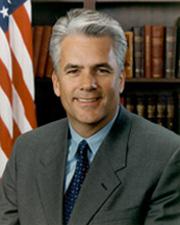 Sen. John Ensign (R-NV)
Legislative Activity
Stay on top of the latest movement without scrolling through every action
Senate amendment submitted
September 20, 2005
View full timeline
Senate amendment submitted
September 20, 2005
Roll call votes on amendments in Senate: Amendment SA 1753 as modified agreed to in Senate by Yea-Nay Vote. 69 - 28. Record Vote Number: 237.
September 20, 2005
Senate amendment agreed to: Amendment SA 1753 as modified agreed to in Senate by Yea-Nay Vote. 69 - 28. Record Vote Number: 237.
September 20, 2005
Senate amendment proposed (on the floor): Amendment SA 1753 proposed by Senator Ensign.
September 20, 2005
Amendment SA 1753 proposed by Senator Ensign to Amendment SA 1726. (consideration: CR S10218-10220; text: CR S10218) To prohibit the use of appropriated funds to pay the salaries or expenses of personnel to inspect horses under certain authority or guidelines.
September 20, 2005
Amendment SA 1753 was modified to reflect a first degree amendment by Unanimous Consent.
September 20, 2005
Amendment SA 1753 proposed by Senator Ensign. (consideration: CR S10224-10225)
September 20, 2005
Amendment SA 1753 as modified agreed to in Senate by Yea-Nay Vote. 69 - 28. Record Vote Number: 237. (text as modified: CR S10225)
September 20, 2005
Votes
1 roll call on this amendment
Text
Modified
AGRICULTURE, RURAL DEVELOPMENT, FOOD AND DRUG ADMINISTRATION, AND
RELATED AGENCIES APPROPRIATIONS ACT, 2006--Continued

Amendment No. 1747

Mr. DURBIN. Mr. President, I believe this has been cleared on the
other side.
Mr. President, I send an amendment to the desk on behalf of Senator
Reid and ask for its immediate consideration.
The PRESIDING OFFICER. Without objection, the pending amendments will
be set aside.
The clerk will report.
The assistant legislative clerk read as follows:

The Senator from Illinois [Mr. Durbin], for Mr. Reid,
proposes an amendment numbered 1747.

Mr. DURBIN. Mr. President, I ask unanimous consent that the reading
of the amendment be dispensed with.
The PRESIDING OFFICER. Without objection, it is so ordered.
The amendment is as follows:

(Purpose: To provide for minimum prices for milk handlers)

On page 173, after line 24, insert the following:
Sec. 7__.(a) Section 8c(5) of the Agricultural Adjustment
Act (7 U.S.C. 608c(5)), reenacted with amendments by the
Agricultural Marketing Agreement Act of 1937, is amended by
adding at the end the following:
``(M) Minimum milk prices for handlers.--
``(i) Application of minimum price requirements.--
Notwithstanding any other provision of this section, a milk
handler described in clause (ii) shall be subject to all of
the minimum and uniform price requirements of a Federal milk
marketing order issued pursuant to this section applicable to
the county in which the plant of the handler is located, at
Federal order class prices, if the handler has packaged fluid
milk product route dispositions, or sales of packaged fluid
milk products to other plants, in a marketing area located in
a State that requires handlers to pay minimum prices for raw
milk purchases.
``(ii) Covered milk handlers.--Except as provided in clause
(iv), clause (i) applies to a handler of Class I milk
products (including a producer-handler or producer operating
as a handler) that--

``(I) operates a plant that is located within the
boundaries of a Federal order milk marketing area (as those
boundaries are in effect on the date of enactment of this
subparagraph);
``(II) has packaged fluid milk product route dispositions,
or sales of packaged fluid milk products to other plants, in
a milk marketing area located in a State that requires
handlers to pay minimum prices for raw milk purchases; and

[[Page S10216]]

``(III) is not otherwise obligated by a Federal milk
marketing order, or a regulated milk pricing plan operated by
a State, to pay minimum class prices for the raw milk that is
used for the milk dispositions or sales.

``(iii) Obligation to pay minimum class prices.--For the
purpose of clause (ii)(III), the Secretary may not consider a
handler of Class I milk products to be obligated by a Federal
milk marketing order to pay minimum class prices for raw milk
unless the handler operates the plant as a fully regulated
fluid milk distributing plant under a Federal milk marketing
order.
``(iv) Certain handlers exempted.--Clause (i) does not
apply to--

``(I) a handler (otherwise described in clause (ii)) that
operates a nonpool plant (as defined in section 1000.8(e) of
title 7, Code of Federal Regulations (as in effect on the
date of enactment of this subparagraph));
``(II) a producer-handler (otherwise described in clause
(ii)) for any month during which the producer-handler has
route dispositions, and sales to other plants, of packaged
fluid milk products equaling less than 3,000,000 pounds of
milk; or
``(III) a handler (otherwise described in clause (ii)) for
any month during which--

``(aa) less than 25 percent of the total quantity of fluid
milk products physically received at the plant of the handler
(excluding concentrated milk received from another plant by
agreement for other than Class I use) is disposed of as route
disposition or is transferred in the form of packaged fluid
milk products to other plants; or
``(bb) less than 25 percent in aggregate of the route
disposition or transfers are in a marketing area or areas
located in 1 or more States that require handlers to pay
minimum prices for raw milk purchases.
``(N) Exemption for certain milk handlers.--Notwithstanding
any other provision of this section, no handler with
distribution of Class I milk products in the Arizona-Las
Vegas marketing area (Order No. 131) shall be exempt during
any month from any minimum milk price requirement established
by the Secretary under this subsection if the total
distribution of Class I products during the preceding month
of any such handler's own farm production that exceeds
3,000,000 pounds.''.
(b) Section 8c(11) of the Agricultural Adjustment Act (7
U.S.C. 608c(11)), reenacted with amendments by the
Agricultural Marketing Agreement Act of 1937, is amended--
(1) in subparagraph (C), by striking the last sentence; and
(2) by adding at the end the following:
``(D) Exclusion of nevada from federal milk marketing
orders.--In the case of milk and its products, no county or
other political subdivision located in the State of Nevada
shall be within a marketing area covered by any order issued
under this section.''.
(c) Notwithstanding any other provision of this section or
the amendments made by this section, a milk handler
(including a producer-handler or producer operating as a
handler) that is subject to regulation under this section or
an amendment made by this section shall comply with any
requirement under section 1000.27 of title 7, Code of Federal
Regulations (or a successor regulation) relating to
responsibility of handlers for records or facilities.
(d)(1) This section and the amendments made by this section
take effect on the first day of the first month beginning
more than 15 days after the date of enactment of this Act.
(2) To accomplish the expedited implementation schedule for
the amendment made by subsection (a), effective on the date
of enactment of this Act, the Secretary of Agriculture shall
ensure that the pool distributing plant provisions of each
Federal milk marketing order issued under section 8c(5)(B) of
the Agricultural Adjustment Act (7 U.S.C. 608c(5)(B)),
reenacted with amendments by the Agricultural Marketing
Agreement of 1937, provides that a handler described in
section 8c(5)(M) of the Agricultural Adjustment Act,
reenacted with amendments by the Agricultural Marketing
Agreement of 1937 (as added by subsection (a))), will be
fully regulated by the order in which the distributing plant
of the handler is located.
(3) Implementation of this section and the amendments made
by this section shall not be subject to a referendum under
section 8c(19) of the Agricultural Adjustment Act (7 U.S.C.
608c(19)), reenacted with amendments by the Agricultural
Marketing Agreement Act of 1937.
Mr. DURBIN. Mr. President, I urge adoption of the amendment.
Mr. BENNETT. Mr. President, I ask for a voice vote.
The PRESIDING OFFICER. The question is on agreeing to amendment No.
1747.
The amendment (No. 1747) was agreed to.

Amendment No. 1748

Mr. DURBIN. Mr. President, on behalf of Senator Inouye, Senator
Feinstein, and others, I send an amendment to the desk and ask for its
immediate consideration.
The PRESIDING OFFICER. The clerk will report.
The assistant legislative clerk read as follows:

The Senator from Illinois [Mr. Durbin], for Mr. Inouye, for
himself, Mr. Akaka, and Mrs. Feinstein, proposes an amendment
numbered 1748.

Mr. DURBIN. Mr. President, I ask unanimous consent that the reading
of the amendment dispensed with.
The PRESIDING OFFICER. Without objection, it is so ordered.
The amendment is as follows:

(Purpose: To limit the use of funds made available to the Animal and
Plant Health Inspection Service)

On page 101, line 10, before the period at the end insert
the following: ``: Provided further, That none of the funds
may be used to demolish or dismantle the Hawaii Fruit Fly
Production Facility in Waimanalo, Hawaii''.

Mr. INOUYE. Mr. President, today, I offer an amendment that would
prohibit the Animal and Plant Health Inspection Services, APHIS, from
using appropriated funds to demolish or dismantle the Hawaii Fruit Fly
Production Facility in Waimanalo, HI.
This amendment, which is cosponsored by my dear friends, Senator
Akaka and Senator Finstein, is in response to a recent decision made by
APHIS to dismantle the Hawaii Fruit Fly Production Facility in
Waimanalo, HI and would preclude the agency from carrying out this
decision until other alternatives have been articulated and analyzed.
In addition, this amendment would provide the agency and the many
stakeholders with additional time to examine the issue, to seek a more
creative solution, and to have the Secretary recommend a plan that is
acceptable to the agricultural representatives of the State of Hawaii,
California, and other impacted States.
Releases of sterile insects have played a prominent role in the
success of most pest control or eradication programs. It is in this
context that I have two main concerns with the agency's decision.
First, relying solely on Guatemala as a source of sterile Mediterranean
fruit flies places the United States at risk if the supply from
Guatemala were curtailed for any reason. In these times of terrorist
activities and civil unrest, disruption is much more than an academic
debate. I have been assured by other states impacted by the APHIS
decision that they share my concern.
Second, from a Hawaii perspective the permanent closure of the
facility in Waimanalo does not bode well for the future of diversified
agriculture in Hawaii. Unfortunately, Hawaii is infested with four
fruit fly pest species--not just the Mediterranean fruit fly. Any hope
of area wide control or eradication of these pests requires efficient
rearing of all four species for sterile release programs. It is my
intent to seek support for a multiple species rearing facility in
Waimanalo to address this problem that is unique to Hawaii. While
suppression of all four of the fruit fly species in Hawaii is of great
benefit to our State, such activities may be among the best mechanisms
for avoiding inadvertent fruit fly infestations in other states where
these alien pests can survive.
Given these concerns, I urge my colleagues to support my amendment
that would prohibit APHIS from implementing its demolition decision and
to provide additional time for the agency to work with all stakeholders
in exploring and implementing a sound public policy on this issue of
great importance to the State of Hawaii.
Mr. DURBIN. Mr. President, I urge adoption of the amendment.
Mr. BENNETT. Mr. President, I ask for a voice vote.
The PRESIDING OFFICER. The question is on agreeing to amendment No.
1748.
The amendment (No. 1748) was agreed to.
Mr. DURBIN. I move to reconsider the vote.
Mr. BENNETT. I move to lay that motion on the table.
The motion to lay on the table was agreed to.

Amendment No. 1749

Mr. DURBIN. I send an amendment to the desk on behalf of myself,
Senator Enzi, and Senator Kennedy.
The PRESIDING OFFICER. Without objection, the pending amendments are
set aside. The clerk will report.
The assistant legislative clerk read as follows:

The Senator from Illinois [Mr. Durbin], proposes an
amendment numbered 1749.

Mr. DURBIN. Mr. President, I ask unanimous consent that the reading
of the amendment be dispensed with.
The PRESIDING OFFICER. Without objection, it is so ordered.

[[Page S10217]]

The amendment is as follows:

(Purpose: To insert provisions related to conflicts of interest among
members of advisory panels of the Food and Drug Administration)

On page 173, after line 24, insert the following:
Sec. 7___.(a) Subject to subsection (b), none of the funds
made available in this Act may be used to--
(1) grant a waiver of a financial conflict of interest
requirement pursuant to section 505(n)(4) of the Federal
Food, Drug, and Cosmetic Act (21 U.S.C. 355(n)(4)) for any
voting member of an advisory committee or panel of the Food
and Drug Administration; or
(2) make a certification under section 208(b)(3) of title
18, United States Code, for any such voting member.
(b) Subsection (a) shall not apply to a waiver or
certification if--
(1) not later than 15 days prior to a meeting of an
advisory committee or panel to which such waiver or
certification applies, the Secretary of Health and Human
Services discloses on the Internet website of the Food and
Drug Administration--
(A) the nature of the conflict of interest at issue; and
(B) the nature and basis of such waiver or certification
(other than information exempted from disclosure under
section 552 of title 5, United States Code (popularly known
as the Freedom of Information Act)); or
(2) in the case of a conflict of interest that becomes
known to the Secretary less than 15 days prior to a meeting
to which such waiver or certification applies, the Secretary
shall make such public disclosure as soon as possible
thereafter, but in no event later than the date of such
meeting.
(c) None of the funds made available in this Act may be
used to make a new appointment to an advisory committee or
panel of the Food and Drug Administration unless the
Commissioner of Food and Drugs submits a confidential report
to the Inspector General of the Department of Health and
Human Services of the efforts made to identify qualified
persons for such appointment with minimal or no potential
conflicts of interest.

Mr. DURBIN. Mr. President, the Scientific Advisory Committee system
at the Food and Drug Administration is meant to provide the Agency with
unbiased, independent, professional advice on the safety and efficacy
of drugs, devices, biologics, food, and veterinary medicine.
To protect the objectivity and the integrity of advisory committees,
members have long been subject to a number of conflict of interest laws
and regulations. Unfortunately, the Food and Drug Administration has
routinely granted waivers to scientists with financial ties to the
manufacture of the products under consideration or their competitors.
These waivers can compromise the integrity of this important advisory
process. Let me give one example.
The February 2005 advisory panel considering whether painkillers,
Celebrex, Bextra, and Vioxx, could safely be marketed to the public
included 10 scientists who were granted conflict of interest waivers.
Ten of the thirty-two members--that is 31 percent--consulted for or
received research support from Pfizer, which makes Celebrex and Bextra;
and Merck, which makes Vioxx; or Novartis, which is seeking approval
for a similar painkiller.
Had the votes of those 10 scientists been excluded, the panel would
have favored withdrawing Bextra from the market and blocking the return
of Vioxx.
As the New York Times pointed out in a March editorial:

Unless the FDA makes a more aggressive effort to find
unbiased experts or medical researchers start severing their
ties with the industry, a whiff of bias may taint the
verdicts of many advisory panels.

I, along with two of my colleagues, Senators Enzi and Kennedy, have
offered this amendment to the Agriculture appropriations bill, a bill
which funds the Food and Drug Administration. It will increase the
transparency of the process. It will ensure the FDA has searched for
experts without conflicts of interest.
Specifically, our amendment requires the FDA to disclose any conflict
of interest waivers on their Web site 15 days prior to the meeting of
the advisory committee. They must detail the nature of the conflict of
interest and the rationale for the waiver.
The amendment also requires the FDA to send a report to the Health
and Human Services inspector general after each new advisory committee
is convened. The report must detail the steps the FDA took to find
scientists who were free from conflicts.
Finally, Senators Enzi, Kennedy, and I will request that the
Government Accountability Office conduct an in-depth study of the
waiver process and provide recommendations on how it can be improved.
My amendment will increase the transparency of the waiver process and
require the FDA to report to a third party about their efforts to
identify scientists without conflicts. I think this will create a
powerful incentive for the FDA to find more scientists without the
potential for bias.
Let me close by saying that, over the years, it has been my good
fortune to work with this important agency, the Food and Drug
Administration. The American people don't know how much we rely on this
tiny agency to decide that what is sold to us in drug stores and other
places in our daily lives must be safe and they must be effective as
advertised. It is an arduous and important process, and they get it
right so often, but occasionally they do not. We have to make certain
that we try to take out of this decision process any question that
would be raised about the integrity of the Agency or the means they are
using to reach their conclusions. I hope this amendment moves us in
that direction.
I yield the floor.
The PRESIDING OFFICER. The Senator from Utah.
Mr. BENNETT. Mr. President, I thank the Senator from Illinois for his
initiative on this issue and congratulate him for the final product
that has been crafted. This could have been a very controversial and
contentious issue, but by compromise, conversation, and consultation
among him and the other Senators he mentioned, we now have an amendment
that is virtually noncontroversial.
It is important that we do not enforce the conflict-of-interest issue
with such difficulty that ultimately the pharmaceutical companies are
cut off from any opportunity of ever consulting with the best experts
in the field because those experts want to also remain available to the
FDA.
I think the compromise that has been reached is a sound one. I
endorse the amendment and urge all Senators to vote for it.
I call for a voice vote.
The PRESIDING OFFICER. Without objection, the question is on agreeing
to amendment No. 1749.
The amendment (No. 1749) was agreed to.
Mr. DURBIN. I move to reconsider the vote.
Mr. BENNETT. I move to lay that motion on the table.
The motion to lay on the table was agreed to.
Mr. BENNETT. Mr. President, I suggest the absence of a quorum.
The PRESIDING OFFICER. The clerk will call the roll.
The assistant legislative clerk proceeded to call the roll.
Mr. BENNETT. Mr. President, I ask unanimous consent that the order
for the quorum call be rescinded.
The PRESIDING OFFICER. Without objection, it is so ordered.

Amendments Nos. 1750, 1751, and 1752, en bloc

Mr. BENNETT. Mr. President, I have three amendments which I send to
the desk and ask for their consideration.
The PRESIDING OFFICER. Without objection, the pending amendments are
set aside. The clerk will report the amendments en bloc.
The bill clerk read as follows:

The Senator from Utah [Mr. Bennett] proposes amendments
numbered 1750, 1751, and 1752.

Mr. BENNETT. I ask unanimous consent that further reading of the
amendments be dispensed with.
The PRESIDING OFFICER. Without objection, it is so ordered.
The amendments are as follows:

amendment no. 1750

On page 93, line 9 at the end of the sentence insert the
following:
``Provided further, That the Agricultural Research Service
may convey all rights and title of the United States, to a
parcel of land comprising 19 acres, more or less, located in
Section 2, Township 18 North, Range 14 East in Oktibbeha
County, Mississippi, originally conveyed by the Board of
Trustees of the Institution of Higher Learning of the State
of Mississippi, and described in instruments recorded in Deed
Book 306 at pages 553-554, Deed Book 319 at page 219, and
Deed Book 33 at page 115, of the public land records of
Oktibbeha County, Mississippi, including facilities, and
fixed equipment, to the Mississippi State University,
Starkville, Mississippi, in their ``as is'' condition, when
vacated by the Agricultural Research Service.

[[Page S10218]]

amendment no. 1751

At the appropriate place in the bill (page 173 after line
24), insert the following new paragraphs:
``Sec.   . (a) Hereafter, none of the funds made available
by this Act or any other Act may be used to publish,
disseminate, or distribute Agriculture Information Bulletin
Number 787.
(b) Of the funds provided to the Economic Research Service,
the Secretary of Agriculture shall enter into an agreement
with the National Academy of Sciences to conduct a
comprehensive report on the economic development and current
status of the sheep industry in the United States.''

amendment no. 1752

On page 173, after line 24 insert the following:
``Sec.   . The Secretary of Agriculture may establish a
demonstration intermediate relending program for the
construction and rehabilitation of housing for the Choctaw
Nation: Provided, That the interest rate for direct loans
shall be 1 percent: Provided further, That no later than one
year after the establishment of this program the Secretary
shall provide the Committees on Appropriations with a report
providing information on the program structure, management,
and general demographic information on the loan recipients.''

The PRESIDING OFFICER. The Senator is recognized.
Mr. BENNETT. Mr. President, the first amendment is in regard to a
study on the sheep industry in the United States by the National
Academy of Sciences. The second authorizes a demonstration tribal
housing program. And the third authorizes a land transfer in
Mississippi from the Agricultural Research Service to Mississippi State
University.
All three of these amendments have been considered carefully on both
sides. They have been cleared on both sides. I ask that they be
approved en bloc by a voice vote.
The PRESIDING OFFICER. Is there objection? Without objection, the
question is on agreeing to the amendments en bloc.
The amendments (Nos. 1750, 1751, and 1752) were agreed to en bloc.
Mr. BENNETT. Mr. President, I ask that the vote be reconsidered and
that reconsideration be laid upon the table.
The PRESIDING OFFICER. Without objection, it is so ordered.
Mr. BENNETT. Mr. President, I suggest the absence of a quorum.
The PRESIDING OFFICER. The clerk will call the roll.
The assistant legislative clerk proceeded to call the roll.
Mr. ENSIGN. Mr. President, I ask unanimous consent that the order for
the quorum call be dispensed with.
The PRESIDING OFFICER (Mr. Voinovich). Without objection, it is so
ordered.
Mr. ENSIGN. Mr. President, I ask unanimous consent that the pending
amendment be set aside.
The PRESIDING OFFICER. Without objection, it is so ordered.
Mr. ENSIGN. Mr. President, I ask unanimous consent that I may offer
an amendment dealing with horse inspection and that no second-degree
amendments be in order.
The PRESIDING OFFICER. Is there objection? Without objection, it is
so ordered.
Mr. ENSIGN. Mr. President, I suggest the absence of a quorum.
The PRESIDING OFFICER. The clerk will call the roll.
The assistant legislative clerk proceeded to call the roll.
Mr. ENSIGN. Mr. President, I ask unanimous consent that the order for
the quorum call be dispensed with.
The PRESIDING OFFICER. Without objection, it is so ordered.
Mr. ENSIGN. Mr. President, I withdraw my previous unanimous consent
request and I call for the regular order with respect to amendment No.
1726.
The PRESIDING OFFICER. The amendment is now pending.

Amendment No. 1753 to Amendment No. 1726

Mr. ENSIGN. Mr. President, I send an amendment to the desk.
The PRESIDING OFFICER. The clerk will report.
The legislative clerk read as follows:

The Senator from Nevada [Mr. Ensign], for himself, Mr.
Byrd, Ms. Landrieu, Mr. Lott, Mr. Graham, Ms. Stabenow, Mr.
DeMint, Mrs. Feinstein, and Mr. Lautenberg, proposes an
amendment numbered 1753 to amendment numbered 1726.

Mr. ENSIGN. Mr. President, I ask unanimous consent that reading of
the amendment be dispensed with.
The PRESIDING OFFICER. Without objection, it is so ordered.
The amendment is as follows:

(Purpose: To prohibit the use of appropriated funds to pay the salaries
or expenses of personnel to inspect horses under certain authority or
guidelines)

At the appropriate place, add the following:
Sec. ___. None of the funds made available in this Act may
be used to pay the salaries or expenses of personnel to
inspect horses under section 3 of the Federal Meat Inspection
Act (21 U.S.C. 603) or under the guidelines issued under
section 903 the Federal Agriculture Improvement and Reform
Act of 1996 (7 U.S.C. 1901 note; Public Law 104-127).

Mr. ENSIGN. Mr. President, I rise, along with my colleagues, Senators
Byrd, Landrieu, Graham, Lott, Stabenow, DeMint, Feinstein, and
Lautenberg, to submit an amendment to the 2006 Senate Agriculture
appropriations bill.
The goal of our amendment is simple: to end the slaughter of
America's horses for human consumption overseas.
I graduated from Colorado State with a degree in veterinary medicine.
I have been concerned with animal welfare since my earlier days as a
youth and pursued those interests as a practicing veterinarian.
Our Nation's history and cultural heritage is strongly associated
with horses. George Washington is pictured many places with horses. We
are reminded of the legend of Paul Revere's ride and the Pony Express
in the West. The Depression era race between Seabiscuit and War Admiral
raised the morale of our country during desperate times.
The owners who sell their horses at auction are often unaware that
those horses may be on their way to one of the three remaining horse
slaughterhouses in America. These slaughterhouses--two in Texas and one
in Illinois--are owned by French and Belgium companies. They slaughter
American horses almost exclusively for one purpose--exporting the meat
overseas for human consumption.
Workhorses, racehorses, and even pet horses--many young and healthy--
are slaughtered for human consumption in Europe and Asia, where their
meat is considered a delicacy. The profits, along with the product, are
shipped overseas. These horses are slaughtered in America and shipped
to Japan, France, Belgium, Italy, Germany for human consumption.
Last year, nearly 100,000 American horses were slaughtered for human
consumption overseas. Sixty-five thousand of these were sent to three
slaughterhouses in the United States, and more than 30,000 were shipped
across our borders to Canada and Mexico for slaughter.
Our amendment effectively stops this practice. It restricts the use
of Federal funds for the inspection of horses being sent to
slaughterhouses for human consumption. Without these inspections,
required under the Federal Meat Inspection Act, horses cannot be
slaughtered, or exported for slaughter, for human consumption overseas.
Strong support for our amendment is reflected in the House of
Representatives, where an identical measure was passed by a vote of 269
to 158 this past June.
We have several articles and editorials from around the country that
have been written in support of our amendment. Articles have appeared
in the Washington Times, the St. Petersburg Times, the Charleston
Gazette, and the Louisville Courier-Journal, just to name a few. I ask
unanimous consent to have these articles printed in the Record.
There being no objection, the material was ordered to be printed in
the Record, as follows:

[From the Washington Times, Sept. 15, 2005]

Save the Horses

Most Americans would sooner starve than eat fillet of horse
with cranberry chutney, or however they do it in Europe. It
might then come as a surprise that 66,000 horses were
slaughtered for consumption in the United States last year,
and 20,000 more were exported abroad for the same purposes.
Even more so when one considers that nearly none of this
horse flesh ends up on American platters--and for that we are
thankful.
While cattle and poultry are bred specifically for food,
horses are not. Many of those sold to slaughterhouses are
privately owned or caught in the wild by the federal Bureau
of Land Management, which then tries to find adoptive homes.
When it cannot, the horses go to the highest bidder, in this
case either to one of the three Belgian- or French-owned
plants.
Fortunately, there is growing opposition in Congress to
this kind of thing. In June, the House passed by a bipartisan
majority an

[[Page S10219]]

amendment to the agriculture appropriations bill banning the
use of federal funds in the slaughtering of horses. The
Senate is schedule to vote on the amendment, sponsored by
veterinarian Sen. John Ensign, next week. We encourage
senators to support this ban.
Certain veterinary groups, rather ironically, oppose the
amendment. They claim that it is humane to put aging or
neglected horses out of their misery. But if anyone actually
saw how these noble beasts are slaughtered--strung up by
their hind legs and bled--they might think twice before
supporting such conduct. The only problem with attaching the
amendment to an appropriations bill is that it will expire
next year.
So, Mr. Ensign has also introduced independent legislation
that would ban the slaughter of horses entirely. Some critics
contend an outright ban is an abuse of congressional power.
But Cass Sunstein, the distinguished University of Chicago
law professor, conclusively addressed those concerns a few
years ago: ``A ban on commercial slaughter of horses would be
plainly within congressional authority, if accompanied by
reasonable findings that such slaughter is often or generally
a way of yielding products for interstate or international
sale, and therefore has a substantial effect on interstate or
international commerce.'' Few would argue that it doesn't.
We admit to a certain sentimentality in our appeal to ban
horse slaughter. The horse has always held a hallowed place
in our national identity, much like the bald eagle. And just
as no American would consider ordering up a bald eagle, if
only out of respect, so would none ask for a horse steak.
____

[From the Louisville Courier-Journal, Sept. 13, 2005]

Horse Sense in Senate

This week, the U.S. Senate may vote on an amendment to the
agriculture appropriations bill that would outlaw the
slaughter of horses for food. For most Kentuckians--in fact,
for most Americans--it's shocking that such a vote would need
to be taken. In this country, horses are raised to be
companion animals. Most folks don't know that in three
foreign-owned slaughterhouses within our borders, about
45,000 horses are killed each year.
The meat is then shipped to Japan and several European
countries, where horse is served for dinner. In the
international market, the meat of American horses is
especially coveted, since most of them have been well fed and
have received superior care.
This should be an easy vote for Sens. Mitch McConnell and
Jim Bunning. Horses are central to Kentucky's culture. Our
famous Bluegrass farms breed and raise them for higher
purposes than ending up on some dinner table overseas.
And no horse is currently safe from that fate. Ferdinand,
the 1986 Kentucky Derby winner, was killed in a Japanese
slaughterhouse when his stud services were no longer needed.
This past spring, 41 wild mustangs were slaughtered for food
in a Texas plant after being purchased through a program
meant to give them new homes.
That's why, in June, the U.S. House of Representatives
overwhelmingly passed legislation identical to what the
Senate is considering. Kentucky's own Rep. Ed Whitfield, R-
1st District, led the effort.
Now the Senate should do the same, with Kentuckians again
playing a leadership role.
____

[From the St. Petersburg Times, Sept. 13, 2005]

Bring an End to Horse Slaughter

Horse slaughter has no place in the United States. The
House of Representatives confirmed that earlier this year by
passing an amendment to the agriculture spending bill that
would, in essence, stop the practice. Now it is the Senate's
turn.
Currently, horses that are no longer wanted are sold to
buyers who presumably seek them for recreation or as pets too
often end up in slaughterhouses or in the hands of exporters
who send them outside the country for slaughter. Sometimes
the buyers hide their true intentions and make a profit by
selling the horses for slaughter. Each year, nearly 100,000
horses are subjected to a cruel end to their lives.
Horse meat for human consumption hasn't been sold in the
United States for decades and isn't even used in pet food
here. If a horse is near the end of its useful life, there
are more humane ways for an owner to get rid of it. Adoption
groups offer horses a peaceful retirement, and if the horses
need to be euthanized, it can be done painlessly and humanely
for a couple hundred dollars.
The Senate vote could come up in the next few days, so
those opposed to horse slaughter should contact their
senators and tell them to support the amendment, which would
deny the Agriculture Department taxpayer dollars for the
inspection of horse meat. Without such inspections, legalized
horse slaughter in this country will end. And good riddance.
____

[From the Charleston Gazette, Sept. 13, 2005]

Save Horses--Bill Would Stop Slaughter

Around 90,000 American horses are slaughtered each year for
human consumption. Foreign-owned slaughterhouses on American
soil kill about 50,000 of them; the other 20,000 are sent
live to Mexico or Canada. Some are wild horses that still
wander ranges of the West; others are unwanted, disposed of
by their owners or unscrupulous dealers who promise they will
go to good homes.
Many of these creatures undergo extreme suffering en route
to their final destination. Transport law allows them to go
for 24 hours without food, water or rest, even if they are
badly injured or heavily pregnant.
West Virginia Sen. Robert Byrd plans an amendment to the
Agriculture appropriations bill banning horse slaughter in
the United States. All three of the state's representatives
voted for a similar amendment in the House that passed, 269-
158.
There are alternatives to the slaughter of unwanted horses.
The recent auction of wild mustangs in Ronceverte resulted in
new homes for horses trucked in and sold for a nominal
amount. Many horse rescue operations work with retired
racehorses, many of whom have tragically ended at
slaughterhouses--even big-time steeds, including Kentucky
Derby winner Ferdinand. The rescue organizations retrain them
and find them new homes and careers. Horses that have truly
come to the end of their useful or comfortable lives can be
humanely euthanized, rather than having to endure the pain,
panic and trauma of a trip to the slaughterhouse.
The bond between horses and humans is as close as the
connection between dogs or cats and their owners. The
horsemeat industry is not a vital part of the American
economy. We hope the Senate will pass this humane amendment.
____

City of Kaufman,

Kaufman, TX, September 6, 2005.
Re Support Congressional efforts to end horse slaughter.

Dear Senator: As the Mayor of Kaufman, Texas, I am all too
well acquainted with an issue that has been getting plenty of
attention on Capitol Hill recently: horse slaughter.
Kaufman is ``home'' to Dallas-Crown, one of only three
slaughterhouses that continue to operate in this country (the
other plants are in Ft. Worth, TX and DeKalb, IL). Together,
the plants killed more than 65,000 of our horses last year
for human consumption abroad. All three plants, are foreign
owned, and all three are out of step with American public
opinion. Seventy-eight percent of Texans oppose horse
slaughter and polls from other parts of the country reflect
this sentiment. Both of the Texas plants operating in
violation of state law which prohibits the sale of horsemeat
for human consumption. And Dallas-Crown is operating in
violation of a multitude of local laws pertaining to
wastemanagement, air quality and other environmental
concerns.
When the District Attorneys in the two Texas jurisdictions
moved to prosecute under the state law, the plants filed suit
and the District Attorneys were prevented from proceeding.
Horses continued to be slaughtered while the case languished
in federal court. Recently, the judge ruled in the plants'
favor. The District Attorneys are considering an appeal.
When the city took action against the plant for releasing
pollutants into the sewer system far in excess of legally
acceptable limits, we ended up in court and are now forced to
mediate on an issue that can't be mediated. Meanwhile, our
municipal sewer system is overburdened, but we simply cannot
afford to refurbish the system so that it can tolerate
overload from Dallas-Crown. Nor should we have to.
Residents are also fed up with the situation. Long-
established neighbors living adjacent to the plant cannot
open their windows or run their air conditioners without
enduring the most horrific stench. Children playing in their
yards do so with the noise of horses being sent to their
deaths in the background. Landowners have difficulty securing
loans to develop their property. The residents have
petitioned the city council to take corrective action against
the plant. On August 15 the Kaufman City Council voted
unanimously to implement termination proceedings against the
plant.
But the ultimate remedy rests with the federal government,
which has the authority--and opportunity--to close this
shameful industry down. I urge you to cosponsor the American
Horse Slaughter Prevention Act when it is introduced by
Senator John Ensign, and to support the Ensign amendment to
the Senate Agriculture Appropriations Bill for Fiscal Year
`06 that will prohibit the use of federal funds to facilitate
horses slaughter.
As a community leader where we are directly impacted by the
horse slaughter industry, I can assure you the economic
development return to our community is negative. The foreign-
owned companies profit at our expense--it is time for them to
go. If I can provide you with further information, please
don't hesitate to contact me at 972-932-2856.
Sincerely,
Paula Bacon,
Mayor of Kaufman, Texas.

Mr. ENSIGN. Mr. President, the Ensign-Byrd amendment also has strong
support from some of the people most familiar with the slaughterhouses.
Paula Bacon, the mayor of Kaufman, TX, which is home to the Dallas
Crown Slaughterhouse, recognized the importance of ending this
slaughter.
She stated:

My city is little more than a doormat for a foreign-owned
business that drains our resources, thwarts economic
development and stigmatizes our community. There is no
justification for spending American tax dollars to support
this industry.

[[Page S10220]]

That is Paula Bacon, mayor of Kaufman, TX, home to the Dallas Crown
horse slaughterhouse facility.
Members of the local community would like to see this slaughterhouse
closed, as well.
Concerns have been raised about what will happen if this slaughter is
ended. Many of these horses will be sold to a new owner. Some horses
will be kept longer by their original owner, others will be euthanized
humanely by a licensed veterinarian, and still others will be cared for
by the horse rescue community. Efforts are underway to standardize
practices for horse rescue organizations. Guidelines for this ever-
growing sector have been developed by the animal protection community
and embraced by sanctuaries.
Statistics do not support claims that this legislation will result in
more abuse and neglect of unwanted horses. In Illinois, the number of
abuse cases actually dropped from 2002 to 2004, when the State's only
slaughterhouse was closed due to fire. In California, there has been no
rise in neglect cases since the State passed a ban on slaughter for
human consumption in 1998.
Furthermore, it is illegal to ``turn out,'' neglect, or starve a
horse, so this amendment will not lead to more orphaned horses. If a
person attempts to turn his or her horses out, animal control agents
can enforce humane laws. These animals still can be euthanized and
disposed of by a veterinarian for about $225, a fraction of the cost to
keep a horse. That cost is not too big of a burden to bear when no
other options are available.
Our amendment is good for horses. That is why it is supported by many
animal protection groups. The Humane Society of the United States, the
American Society for the Prevention of Cruelty to Animals, the Doris
Day Animal League, the American Humane Association, and Society for
Animal Protective Legislation--all support our legislation. We have
also received support from much of the horse industry and veterinarians
nationwide. In fact, congressional measures to end horse slaughter are
supported by Veterinarians for Equine Welfare, the National
Thoroughbred Racing Association, Churchill Downs, Incorporated, and
dozens of owners and trainers of champion racehorses, including
Kentucky Derby winners.
The time to end this slaughter is now. Please join my colleagues and
me in supporting this important amendment.
I yield the floor and suggest the absence of a quorum.
The PRESIDING OFFICER. The clerk will call the roll.
The legislative clerk proceeded to call the roll.
Mr. CONRAD. Mr. President, I ask unanimous consent that the order for
the quorum call be rescinded.
The PRESIDING OFFICER (Mr. Thomas). Without objection, it is so
ordered.
Mr. BENNETT. Mr. President, I ask unanimous consent that the Senator
be recognized to speak as in morning business. We are under the
Agriculture bill, and no one seems to be coming forward under the
Agriculture bill, so I obviously have no objection, but I think, to be
clear, it should be as in morning business; therefore, I ask unanimous
consent that the Senator be given the opportunity to do that.
The PRESIDING OFFICER. Is there objection?
Hearing none, it is so ordered.
Mr. CONRAD. Mr. President, I thank my colleague from Utah for his
graciousness, and my colleague from Wisconsin as well. I appreciate
this opportunity to speak.
(The remarks of Mr. CONRAD pertaining to the introduction of S. 1730
are printed in today's Record under ``Statements on Introduced Bills
and Joint Resolutions.'')
Mr. BYRD. Mr. President, Winston Churchill said, ``when you are on a
great horse, you have the best seat you will ever have.'' Indeed,
throughout the ages, the horse has carried mankind across continents,
helped forge civilizations, and has been that beloved beast of burden
that has borne the human race on its back.
In America, the horse was the primary source of transportation of our
founding fathers, the vehicle of our Revolutionary soldiers, and a
symbol of the majestic strength and character that this great country
was based upon. Our fledgling urban centers rose with the help of the
horse's brawn. Our American frontier expanded farther and farther west,
with families traveling by horse-drawn wagons across mountains and
valleys, the plains and prairies. The American cowboy, an indelible
image of the fierce and undying determination of the American spirit,
was never without his trusty four-legged companion.
But each year, 65,000 horses are slaughtered in this country for
human consumption in Europe and Asia, where horsemeat is considered a
delicacy. Another 30,000 horses are shipped every year to Canada and
Mexico to be slaughtered.
These horses often suffer unnecessarily while in transit to
slaughterhouses. Horses can be shipped for more than 24 hours without
food, water, or rest. They can be transported with broken legs, missing
eyes, or while heavily pregnant. The horses are kept in cramped
conditions, in trucks with ceilings so low that they prevent the horses
from holding their heads in a normal, upright position. The cramped
nature of their transport often results in trampling, with some horses
arriving at the slaughterhouses seriously injured or dead.
Even more cruel than the suffering these animals endure while in
transit is their often injurious end. Improper use of stunning
equipment at the slaughterhouse can result in the animal having to
endure repeated blows to head, meaning that horses sometime remain
conscious throughout the slaughter process.
The market for horsemeat is not an American market. Horsemeat is
shipped abroad. The three slaughterhouses in the U.S. are foreign-
owned. Thus, American horses are sold to a foreign company, killed for
consumption in a foreign market, and foreign-owned companies profit
from the export of horse meat. Many Americans would be shocked to learn
that our animals suffer such a fate, all in order to satisfy the tastes
of those living in Europe and Asia. Indeed, many individuals who sell
horses to slaughterhouses do so unwittingly. Slaughterhouses often send
third parties, called ``killer buyers,'' to auction to buy horses.
Senator Ensign and I have offered an amendment to stop the slaughter
of horses for human consumption by preventing taxpayer dollars from
being used to inspect the horses intended for slaughter. Without these
inspections, which are paid for by the American taxpayer, it would be
impossible for these companies to slaughter horses in the U.S., or to
transport horses abroad for slaughter.
I ask my colleagues to support the Ensign-Byrd amendment to end the
slaughter of one of the most precious American symbols.
The PRESIDING OFFICER. The Senator from Utah.
Mr. BENNETT. Mr. President, I understand the Senator from Hawaii has
some amendments to the Agriculture appropriations bill.
The PRESIDING OFFICER. The Senator from Hawaii.
Mr. AKAKA. Mr. President, what is the pending order of business?
The PRESIDING OFFICER. The Bennett amendment is now pending.
Mr. AKAKA. I ask unanimous consent to set the pending amendment
aside.
The PRESIDING OFFICER. Without objection, it is so ordered.

Amendment No. 1729

Mr. AKAKA. Mr. President, I have two amendments to offer. I call up
amendment No. 1729 to H.R. 2744, the Agriculture, Rural Development,
Food and Drug Administration, and Related Agencies appropriations bill.
The PRESIDING OFFICER. The clerk will report.
The legislative clerk read as follows:

The Senator from Hawaii [Mr. Akaka] proposes an amendment
numbered 1729.

Mr. AKAKA. I ask unanimous consent that reading of the amendment be
dispensed with.
The PRESIDING OFFICER. Without objection, it is so ordered.
The amendment is as follows:

(Purpose: To prohibit Federal funding of research facilities that
purchase animals from Class-B dealers)

On page 173, after line 24, insert the following:
Sec. 7___. None of the funds made available by this Act may
be used to provide funding to a research facility that
purchases animals from a dealer that holds a Class B license
under the Animal Welfare Act (7 U.S.C. 2131 et seq.).

[[Page S10221]]

Amendment No. 1730

Mr. AKAKA. Mr. President, I call up amendment No. 1730 to H.R. 2744.
The PRESIDING OFFICER. Without objection, the pending amendment is
set aside. The clerk will report.
The legislative clerk read as follows:

The Senator from Hawaii [Mr. Akaka] proposes an amendment
numbered 1730.

Mr. AKAKA. I ask unanimous consent that reading of the amendment be
dispensed with.
The PRESIDING OFFICER. Without objection, it is so ordered.
The amendment is as follows:

(Purpose: To ensure the humane slaughter of nonambulatory livestock)

On page 173, after line 24, insert the following:
Sec. 7___. None of the funds made available by this Act may
be used to approve for human consumption under the Federal
Meat Inspection Act (21 U.S.C. 601 et seq.) any cattle,
sheep, swine, or goats, or horses, mules, or other equines
that are unable to stand or walk unassisted at a
slaughtering, packing, meat-canning, rendering, or similar
establishment subject to inspection at the point of
examination and inspection under section 3(a) of that Act (21
U.S.C. 603(a)).

Mr. AKAKA. Mr. President, I rise to offer two amendments to H.R.
2744, the Agriculture appropriations bill for FY 2006, that will help
protect the health of the American public. Amendment 1730, the downed
animal amendment, would prohibit the U.S. Department of Agriculture,
USDA, from utilizing funds under this act to approve downed animals for
human consumption.
Downed animals are livestock such as cattle, sheep, swine, goats,
horses, mules, or other equines that are too sick to stand or walk
unassisted. Many of these animals are dying from infectious diseases
and present a significant pathway for the spread of disease.
While I commend USDA and livestock organizations for their efforts to
address the issue of downed animals, I am still very concerned about
diseases such as BSE, more commonly known as mad cow disease, that pose
a serious risk to the United States cattle industry and human health. A
food inspection study conducted in Germany in 2001 found that BSE is
present in a higher percentage of downed livestock than in the general
cattle population. USDA stated that downed animals are one of the most
significant potential pathways that have not been addressed in previous
efforts to reduce risks from BSE. Stronger legislation is needed to
ensure that these animals do not enter our food chain. My amendment is
very simple. It would prevent downed animals from being approved for
consumption at our dinner tables. This will allow USDA and other
stakeholders to continue working on reducing and potentially
eliminating the risk of BSE or any other prions from entering our food
chain.
Currently, before slaughter, USDA's Food Safety Inspection Service,
FSIS, diverts downer livestock that exhibit clinical signs associated
with BSE or other types of diseases until further tests may be taken.
However, this does not mean that downed livestock cannot be processed
for human consumption. If downer cattle presented for slaughter pass
both the pre- and post-inspection process, meat and meat by-products
from such cattle can be used for human consumption. Routinely, BSE is
not correctly distinguished from many other diseases and conditions
that show similar symptoms. This was demonstrated by the surveillance
of a similar inspection process in Europe, showing that the process is
inadequate for detecting BSE. Consequently, BSE-infected cattle can be
approved for human and animal consumption.
Today, USDA has increased its efforts to test approximately 10
percent of downed cattle per year for BSE. However, it is my
understanding that USDA is looking to revisit this issue. I do not
believe that now is the time to lower our defenses. While I am not
asking the industry and Federal Government to test every slaughtered
cow, I am asking the Federal Government to address and reduce the real
risks associated with BSE and similar diseases in the U.S.
Some individuals fear that my amendment would place an excessive
financial burden on the livestock industry. I want to remind my
colleagues that one single downed cow in Canada diagnosed with BSE this
year shut down the world's third largest beef exporter. It is estimated
that the Canadian beef industry lost more than $1 billion as a result
of the discovery of BSE and more than 30 countries banned Canadian
cattle and beef. As the Canadian cattle industry continues to recover
from its economic loss, it is prudent for the United States to be
proactive in preventing BSE and other animal diseases from entering our
food chain.
We must protect our livestock industry and human health from diseases
such as BSE. My amendment reduces the threat of passing diseases from
downed livestock to our food supply. It also requires higher standards
for food safety and protects human health from diseases and the
livestock industry from economic distress.

amendment no. 1729

Amendment No. 1729 is based on my bill, the Pet Safety and Protection
Act, S. 451. It will protect family pets while allowing research on
dogs and cats to continue in an environment free from scientific fraud
and animal abuse.
This amendment prohibits Federal funds from being provided to a
research facility that purchases animals from Class B dealers. Class B
animal dealers collect dogs and cats from ``random sources'' and
routinely violate the Animal Welfare Act. The Animal Welfare Act sets
the minimum standards of care for animals and requires accurate record
keeping on their acquisition and disposition. Dogs and cats are
subjected to abusive handling and exposure to the elements while kept
on the premises of Class B dealers. They are routinely denied
sufficient food, water, and veterinary care before they are sold off to
laboratories.
Less than a month ago, one of the more notorious Class B dealers,
C.C. Baird, pleaded guilty in a case before a U.S. District Judge. He
had violated the Animal Welfare Act because he transferred the dogs and
cats to research facilities with false acquisition records. During the
search, approximately 125 dogs were seized by Federal agents as
evidence of various violations of the Animal Welfare Act.
I recently sent a letter to all my colleagues in the Senate
requesting support in passing the Pet Safety and Protection Act. On the
front were pictures of a hound dog, Buck, who was in terrible shape--
skinny, his ribs sticking out, pieces of his ear torn off--after being
held by a Class B dealer.
There are only 17 Class B dealers selling random source dogs and cats
for research. However, there are hundreds of suppliers to these
dealers. Random source animals are dogs and cats that may be obtained
by fraudulent means, through ``free to good homes'' ads, false animal
origin records, and stealing of pet dogs and cats from their owners.
The Department of Agriculture lacks the necessary resources to track
the interstate activities of Class B dealers to ensure that they comply
with Federal law. USDA cannot provide an assurance that illegal
acquired pets are not being sold by Class B dealers. This is a problem
that is certain to grow in the aftermath of hurricane Katrina with the
thousands of animals placed in shelters.
From a scientific research point of view, Class B-acquired animals
have not had standardized care nor is there any certainty of the
history of the animals. These circumstances make them unsuitable as
research subjects in any case, since they cannot be used as control
cases or experimental animals. Valid scientific research relies on
controlled experimental design and replicable results--two things
highly questionable when using animals with unknown history and
background.
This simple amendment prohibits funding in this FY 2006
appropriations bill from going to research facilities that purchase
animals from a dealer that holds a Class B license under the Animal
Welfare Act.
I urge my colleagues to support these two amendments.
The PRESIDING OFFICER (Mr. Martinez). The Senator from Utah.
Mr. BENNETT. Mr. President, as near as I can tell, there is support
for these amendments on both sides of the aisle. I ask they be
considered en bloc by a voice vote.
The PRESIDING OFFICER. Without objection, the amendments will be
considered en bloc.
The question is on agreeing to amendments Nos. 1729 and 1730, en
bloc.
The amendments (Nos. 1729 and 1730) were agreed to, en bloc.
Mr. AKAKA. I move to reconsider the vote, and I move to lay that
motion on the table.

[[Page S10222]]

The motion to lay on the table was agreed to.
Mr. BENNETT. Mr. President, unless the Senator has an additional
amendment----
Mr. AKAKA. Mr. President, I thank the Senator from Utah and the
ranking member, Senator Kohl, for accepting these amendments.
The PRESIDING OFFICER. The Senator from Utah.
Mr. BENNETT. Mr. President, I ask unanimous consent that I be allowed
to proceed as in morning business.
The PRESIDING OFFICER. Without objection, it is so ordered.

Storage of Nuclear Waste

Mr. BENNETT. Mr. President, one of the issues that has occupied this
Chamber for some time and had a particular impact on those of us in the
Western States is the issue of the storage of nuclear waste. The
question of where nuclear waste should be stored has been before
various administrations and various Congresses literally for decades.
The original policy decision made by administrations past and
Congresses past was that there should be a single repository for
nuclear waste. After a study by the National Academy of Sciences and
others, the decision was made to put that repository in Nevada, in
Yucca Mountain. Ever since that time, construction has gone forward at
the Yucca Mountain facility.
All of that happened before I came to Congress. When I got here, the
debate was going on, and we had a particular point where we had to
vote, once again, on whether to put nuclear waste in Yucca Mountain.
At that time, as I looked at the various alternatives, I decided that
the best scientific answer to the question of what to do with nuclear
waste was to leave it where it was. I was assured by the scientists
that it was safe in the dry cask storage that had been prepared for its
transportation, and that it could be safely transported across the
country to Yucca Mountain.
My reaction to that was, if it is safe where it is and if it is safe
to transport, why transport it at all? Why not leave it where it is?
It was very clear that the Congress was not going to accept that
position, that the President was not going to accept that position, and
that we were going to go ahead as a matter of public policy and have a
single repository for nuclear waste.
So I said: If we are going to have a single repository for nuclear
waste, the most logical place for that is Yucca Mountain. And I voted
in favor of Yucca Mountain.
Looking back on it, the keyword in that sentence is the word ``if.''
If we are going to have a single repository for nuclear waste, it
appeared that the logical place to put it was Yucca Mountain.
It is now clear that we are not going to have a single repository for
nuclear waste. Yucca Mountain has been challenged on scientific
grounds. Yucca Mountain has been challenged in the court on legal
grounds. And as we look at the present state of our need for energy,
Yucca Mountain will be challenged on practical grounds because it is
very clear that we are going to need more, not less, nuclear power.
Nuclear power is here to stay. The nuclear plants that we have are
going to be recommissioned and relicensed, and Yucca Mountain will be
full if we go ahead with the existing plans to send nuclear waste
there. We will still need storage in place even if Yucca Mountain
opens. It doesn't make sense from a practical point of view to move the
material all across the country, store it in Yucca Mountain for the
purpose of ending storage in place, and then have storage in place come
back.
Those who saw this in advance--Senator Reid and Senator Ensign--have
the right to tell the rest of us, ``I told you so,'' as it now becomes
clear that scientifically, legally, and practically, Yucca Mountain is
not going to become the single repository for nuclear waste. And we
need to start thinking about new strategies and new places to deal with
this issue.
I want to make it very clear that I am not opposed to nuclear power.
Indeed, I am a strong supporter of nuclear power. I have supported
Senator Domenici in his efforts in crafting the Energy bill to craft
the bill in such a way as to encourage America to build new nuclear
powerplants. We are behind the rest of the world on this issue. Go to
Europe and you will find the French have something like 80 percent of
their power generated by nuclear power. The British have large amounts
of nuclear power.

With the price of natural gas going as high as it is, it becomes
increasingly economically unwise for us to continue to build gas-
powered electric plants. Nuclear power is something in which we should
get involved in a big way in the future, and the Energy bill we passed
prior to the August recess laid the groundwork for that.
The question is, of course, if we go in that direction, what do we do
with the nuclear waste? If Yucca Mountain is not going to be
available--and I am now convinced that it will not be--where should it
be put? There is a proposal that it should be put in the State of Utah
at an interim storage site that has just recently been licensed by the
Nuclear Regulatory Commission.
I put stress on the word ``interim'' because the whole idea behind
the proposed facility in Utah, in a place called Skull Valley, was that
it would simply be a stopover for the waste on its way to Yucca
Mountain, and so it has been designed and it has been licensed as an
interim storage facility.
If it does not make sense for us to take this nuclear waste and put
it in a permanent repository, which is what Yucca Mountain is, why does
it make sense to put it in an interim repository that does not have the
safeguards that are built into Yucca Mountain?
Yucca Mountain would put the waste below ground. It would put the
waste in vaults that have been prepared for it. The interim facility in
Skull Valley would leave the waste above ground. It would leave the
waste in the dry cask receptacles that were built for transportation.
Why ship it from its present site aboveground to another site
aboveground to say, well, this is an interim storage site until we put
it in permanent storage?
The reality is, if you do that, you are creating a permanent storage
site because there will be no place to put it after it has been
transported to the interim storage site.
There are those who say: You just don't want it in Utah. And that is
true, I don't want it in Utah. But there is another factor that drives
the reason I don't want it in Utah. This particular interim storage
site is at the portal to the Utah Test and Training Range. Even most
people in Utah have never heard of the Utah Test and Training Range,
and they have no idea what it is. It is the largest land range for
bombing practice in the United States. It goes all the way back to the
Second World War. The crew that flew the mission over Hiroshima in the
Enola Gay trained at the Utah Test and Training Range.
Today, it is still in use. F-16s from Hill Air Force Base fly over
the Utah Test and Training Range and practice their bombing runs with
live ordinance. I have flown over the Utah Test and Training Range in a
helicopter and have been told: We have to get out of here because the
F-16s are coming, and they are going to start bombing.
It clearly does not make sense to have an interim storage facility
for nuclear waste in an area where F-16s with live ordinance are going
to be flying.
There are those who say: The F-16s can change their flight pattern;
they can go around this area; they don't need to pay attention to it.
One of the things we have learned from spending time with the BRAC
process in determining which military facilities will be retained and
which will not is that more military facilities have been closed by
encroachment than have been closed by BRAC--encroachment being
development or other activities that come close to the gate of the
military base that make it impossible for the people on the base to do
their job, and they ultimately say: When we built this base, it was
surrounded by open spaces. Now activity has come in, development has
come in, encroachment has happened, and we are going to have to close
this base.
I do not want to see encroachment take away the last remaining large,
land-based test and training range in the United States. We need to
rethink this whole thing.
So, Mr. President, I am now making it clear that my support for Yucca
Mountain, however well intended it was at the time, in my opinion does
no longer hold in the situation in which we find ourselves.

[[Page S10223]]

I also believe the proposal that was made at the time we approved
Yucca Mountain the last time, that of leaving the material in place
until we can work out the economics and the technology of reprocessing
it, is the right approach. That is what the future holds.
Right now people say: Reprocessing it is too expensive. But we know
from past experience that technology will find a way around that. It
will become cheaper and cheaper the more we do it. We are already
involved in reprocessing warheads from the former Soviet Union as we go
through the process of reducing nuclear weapons and nuclear stockpiles
around the world. As that reprocessing activity goes forward, we will
learn how to do it faster, we will learn how to do it cheaper, and
reprocessing will be available for the nuclear waste that is currently
being developed by our nuclear power facilities.
At that time, it would make sense for the nuclear waste that is
stored onsite to be shipped to a reprocessing center, not to an interim
storage facility.
There is one other factor that needs to be stressed. At the present
time, the contract to take the nuclear waste and ship it to the interim
storage facility in Utah--which, by the way, has not been built; there
is still $1 billion worth of investment that will have to go into
that--the process by which that will go forward will be under the
ownership of the utilities that run the nuclear plants.
The main difference between an interim storage facility and a
permanent storage facility in the law has to do with titles. In the
interim storage facility, the utility that created the waste and ran
the nuclear plant retains title to the waste. While it is being
packaged, while it is being shipped, and while it is in interim
storage, it is owned by the utility. Under the Yucca Mountain proposal,
the Federal Government would take title to the waste the minute Yucca
Mountain would open so the Federal Government would be responsible for
packaging it, the Federal Government would be responsible for
protecting it while transporting it, and the Federal Government would
be responsible for the security on the site where it would be located.
If we leave it where it is while we work on the issue of reprocessing,
title remains with the utility that produced it, but the security that
the utility has already built into its plant is already there. It is
not exposed to any terrorist attack while it is moving so that utility
does not have to bear the expense of extra security in moving waste to
which they retain title.
Then when we get to the point where we can move it to a reprocessing
plant, once again the Federal Government may take title to it.
The Federal Government can provide the security during
transportation. The Federal Government can see that it is kept safe
from terrorist attack and bring it to the reprocessing facility.
One last point. One of the reasons we want to be sure the Federal
Government is in charge of all of the reprocessing is that the end
product after reprocessing is not only additional energy created by the
process, but the residue that is left is weapons-grade plutonium. We do
not want to run the risk of having weapons-grade plutonium in the hands
of private entities. We want to be sure that the Government controls
it.
What I think we need to do--``we'' being the collective word for the
administration and the Congress, generally--is to adopt some
fundamental principles and then rethink the whole issue to come up with
the appropriate details. The fundamental principles that I would
recommend and that I embrace are, No. 1, we are in favor of nuclear
power. We want more nuclear power in this country for all of the
environmental reasons dealing with greenhouse gases, for all of the
demand reasons dealing with the increased necessity for electric power,
and for all of the legal reasons having to do with the control of the
ownership of these facilities. So the No. 1 principle, I am in favor of
nuclear power. No. 2, I am in favor of reprocessing. I think we should
work toward that technical solution for the question of waste. And No.
3, while we are in the process of building new nuclear plants and
working toward reprocessing of the waste, we should leave the waste
where it is. If, indeed, as I say, it is safe to transport and it is
safe to store in an interim facility someplace else, by definition, it
is equally safe to store it where it is. That is cheaper, that is
equally as safe, and that sets us up for the solution of our problem. I
believe that if we rethink the whole issue as to how we are going to
handle it and what we are going to do, there may very well be a useful
purpose for Yucca Mountain. We have spent, as a nation, billions of
dollars preparing that facility. We should review the facility and what
it offers and see how it might be used at some particular point in the
future and see how we might retain some of the investment we have made
there.
I am not one who thinks we ought to fill Yucca Mountain up with dirt
and walk away and leave it. There can be a win-win situation for all.
Nevada can get some value out of the investment that has been made in
Yucca Mountain if we think it through carefully. The Nation can get
additional power without the greenhouse gas effect that comes from
fossil fuels, and we can ultimately solve the problem of nuclear waste
with reprocessing.
I have discussed this in general terms with Senator Domenici, who is
the chairman of the Energy Committee as well as the chairman of the
energy and water subcommittee of the Appropriations Committee, and I
commend him for his original thinking of moving in directions that will
make sense for the future. However, much as the idea of a single
repository may have made sense decades ago, it is now clear, as I say,
that it does not make sense, and we need to move in some future
direction. To the degree that Senator Domenici will allow me to
participate in trying to find logical solutions under the three
principles I have described, I will be more than happy to cooperate
with him. To those who had the vision long ago who, as I say, have
earned the right to say to the rest of us, ``I told you so,'' I say I
will be happy to join with you, too, in seeing how we can think this
thing through and get the best solution for our Nation and all of those
who live in it.
With that, Mr. President, I suggest the absence of a quorum.
The PRESIDING OFFICER. The clerk will call the roll.
The assistant legislative clerk proceeded to call the roll.
Mr. BENNETT. Mr. President, I ask unanimous consent that the order
for the quorum call be rescinded.
The PRESIDING OFFICER. Without objection, it is so ordered.
Mr. BENNETT. Mr. President, I ask unanimous consent that the Ensign
amendment No. 1753 be modified to be drafted as a first-degree
amendment, provided further that the vote in relation to the Ensign
amendment No. 1753 occur at 4:45 today with no amendment in order to
the amendment prior to the vote. I also ask for the yeas and nays on
this amendment.
The PRESIDING OFFICER. Is there objection? The Chair hears none, and
it is so ordered.
Mr. BENNETT. I suggest the absence of a quorum.
The PRESIDING OFFICER. Is there a sufficient second? There appears to
be a sufficient second. The yeas and nays are ordered.
The clerk will call the roll.
The legislative clerk proceeded to call the roll.
Mr. BENNETT. Mr. President, I ask unanimous consent that the order
for the quorum call be rescinded.
The PRESIDING OFFICER. Without objection, it is so ordered.

Amendment No. 1726

Mr. BENNETT. Mr. President, I believe that amendment No. 1726 is now
the pending business.
The PRESIDING OFFICER. The Senator is correct.
Mr. BENNETT. This is the managers' amendment that Senator Kohl and I
introduced last Thursday. It makes some technical corrections in the
bill regarding conservation technical assistance for DuPage County, IL.
It also makes some technical corrections in the Rural Electrification
Act of 1936. It has the approval of the authorizing committee, as well
as the support of USDA, and there is no additional cost to the bill.
Senator Kohl and I have taken the position that we will not offer any
authorizing legislation on this bill that does not have the approval of
the authorizing committee. And this one falls within that scope. So it
has been cleared on both sides of the

[[Page S10224]]

aisle, and I believe we are now prepared to pass it on a voice vote.
The PRESIDING OFFICER. The question is on agreeing to the amendment.
The amendment (No. 1726) was agreed to.
Mr. BENNETT. Mr. President, I move to reconsider the vote and ask
that that be laid upon the table.
The PRESIDING OFFICER. Without objection, it is so ordered.
Mr. BENNETT. Mr. President, I suggest the absence of a quorum.
The PRESIDING OFFICER. The clerk will call the roll.
The assistant legislative clerk proceeded to call the roll.
Mr. TALENT. Mr. President, I ask unanimous consent that the order for
the quorum call be dispensed with.
The PRESIDING OFFICER. Without objection, it is so ordered.

Amendment No. 1763

Mr. TALENT. Mr. President, I send an amendment to the desk.
The PRESIDING OFFICER. The clerk will report.
The assistant legislative clerk read as follows:

The Senator from Missouri [Mr. Talent], for himself and Mr.
Pryor, proposes an amendment No. 1763.

Mr. TALENT. Mr. President, I ask unanimous consent that reading of
the amendment be dispensed with.
The PRESIDING OFFICER. Without objection, it is so ordered.
The amendment is as follows:

(Purpose: To prohibit the use of funds to close or relocate certain
local offices of the Farm Service Agency)

On page 173, after line 24, insert the following:
Sec. 7___. None of the funds made available by this or any
other Act may be used to close or relocate a county or local
Farm Service Agency office unless or until the Secretary of
Agriculture has determined the cost effectiveness and
enhancement of program delivery of the closure or relocation,
and report to the House and Senate Committees on Agriculture
and Appropriations.

Mr. TALENT. Mr. President, this amendment, which I am offering on
behalf of myself and Mr. Pryor, the Senator from Arkansas, is an
attempt to address a development within the Department of Agriculture.
The Department is proposing closing about a quarter to a third of the
Farm Service Agency's local offices around the country, including, as
far as we can tell, around 30 out of the 90 offices in Missouri, the
object, according to the Department, being to modernize and consolidate
functions and to provide better service.
Certainly nobody is opposed to better service. But I want to
emphasize something here. The key with regard to how we handle FSA
offices has to be service to the agricultural community and to our
producers. The idea is accessibility. The idea is responsiveness. The
idea is not necessarily somebody's planning in Washington about how
they would organize everything in the United States if they could do it
exactly the way they wanted.
I am a little concerned about changing our FSA offices when, from
what I am told back in Missouri, there has been little or no
consultation either with local FSA people or with producer
organizations, more particularly farmers or the affected communities. I
don't know how we can do this in a way that emphasizes service,
acceptability, and accountability without having to talk to the people
whom we are trying to serve.
The amendment basically says hold up on this until we have an
opportunity for that kind of accessibility and that kind of
accountability.
Again, I am not saying--and I don't think Mr. Pryor is saying
either--that no consolidation is possible. I imagine it is possible in
Missouri. We certainly want to look at how we can modernize these
offices so we can perform better service. But we have to remember that
these are the offices our producers have to go to any time they want to
deal with any of the Government's various programs that affect them.
Some of them in Missouri are already driving 30, 40 minutes, or more
than that, and if they drive and they don't have all the forms they
need, or they left something at home, they have to go all the way home,
get it, and turn around and come back.
When you are proposing eliminating some of those offices when they
are already difficult to access, in many cases, I think that is
something we need to look at. I certainly believe we need more
consolidation, at least in Missouri, than we have had now.
That is all this amendment says. I appreciate very much the bill
managers working with us. I understand they are going to be willing to
accept the amendment. I appreciate that. I pledge to work with them in
conference.
This language isn't necessarily the be-all and end-all with regard to
this issue. I think they see what Senator Pryor and I are driving at,
and I think everybody would agree this is something we want to do with
consultation and discussions with the affected communities--in
particular the affected producer and producer groups. They are not
opposed to making the Farm Service Agency work better. We all know the
problems that have sometimes occurred. But we have potentially disaster
relief coming down the pike, and I certainly hope so for producers who
have been affected negatively by the hurricane, or by drought. We have
another farm bill that is not that far away. We need to do this right,
if we are going to do it. That is what the amendment says.
I appreciate the support of the Senator from Utah, and certainly
pledge to work with him and his ranking member in conference on this
amendment.
I yield the floor.
Mr. BENNETT. Mr. President, I share the concern and frustration of
the Senator from Missouri with the proposal. We have had some of that
same concern and frustration in Utah. Charitably, I will say that the
efforts to close these offices have been handled a little less wisely
than might otherwise have been the case.
I hope that between now and the conference we can learn more about
this proposal. I think the Senator's comments about getting information
and input from those directly affected is very wise.
I pledge to work with all the Senators concerned on this issue
between now and the time we get to conference. So knowing that this
will be the vehicle whereby we can get to conference, I am willing to
proceed now to a voice vote and urge Senators to support it. I
understand it has been cleared on both sides.
The PRESIDING OFFICER. Is there further debate? If not, the question
is on agreeing to the amendment.
The amendment (No. 1763) was agreed to.

Amendment No. 1753

Mr. BENNETT. Mr. President, as we are approaching the hour of 4:45,
which has been set as the time for the vote on the Ensign amendment, I
say to my colleagues that Senator Ensign outlined the reasons for his
amendment. I have heard others who for one reason or another have
already been opposed to it. But so far, none of them have come to the
floor to express that opposition.
I make it clear to anyone who is following the proceedings that one
of the reasons we have delayed the vote as we have and kept the
afternoon as open as we have has been to allow those who may be opposed
to the Ensign amendment the opportunity to present their proposals.
We now are at 4:45. I expect the time is far gone and the vote will
proceed. I didn't want anyone thinking we had made any effort to
prevent anybody from presenting a different point of view than what
Senator Ensign laid out when he proposed his amendment this afternoon.
The PRESIDING OFFICER. The hour of 4:45 having arrived, the question
is on agreeing to the amendment of the Senator from Nevada.
The yeas and nays have been ordered.
The clerk will call the roll.
The assistant legislative clerk called the roll.
Mr. DURBIN. I announce that the Senator from New Jersey (Mr.
Corzine), the Senator from Louisiana (Ms. Landrieu), and the Senator
from West Virginia (Mr. Rockefeller) are necessarily absent.
The PRESIDING OFFICER (Mr. Alexander). Are there any other Senators
in the Chamber desiring to vote?
The result was anounced--yeas 68, nays 29, as follows:

[Rollcall Vote No. 237 Leg.]

YEAS--68

Akaka
Alexander
Allen
Bayh
Bennett
Biden
Boxer
Bunning
Burr

[[Page S10225]]

Byrd
Cantwell
Carper
Chafee
Chambliss
Clinton
Coleman
Collins
Dayton
DeMint
DeWine
Dodd
Dole
Durbin
Ensign
Feingold
Feinstein
Frist
Graham
Gregg
Hagel
Harkin
Hatch
Hutchison
Inouye
Isakson
Jeffords
Kennedy
Kerry
Kohl
Kyl
Lautenberg
Leahy
Levin
Lieberman
Lott
Lugar
Martinez
McCain
McConnell
Mikulski
Murkowski
Murray
Nelson (FL)
Nelson (NE)
Obama
Reed
Reid
Santorum
Sarbanes
Schumer
Smith
Snowe
Specter
Stabenow
Sununu
Vitter
Warner
Wyden

NAYS--29

Allard
Baucus
Bingaman
Bond
Brownback
Burns
Coburn
Cochran
Conrad
Cornyn
Craig
Crapo
Domenici
Dorgan
Enzi
Grassley
Inhofe
Johnson
Lincoln
Pryor
Roberts
Salazar
Sessions
Shelby
Stevens
Talent
Thomas
Thune
Voinovich

NOT VOTING--3

Corzine
Landrieu
Rockefeller
The amendment (No. 1753), as modified, was agreed to.
Mr. BENNETT. Mr. President, I move to reconsider the vote.
Mr. SUNUNU. I move to lay that motion on the table.
The motion to lay on the table was agreed to.
Mr. BENNETT. Mr. President, I have been asked throughout the vote
whether that is the last vote of the evening. That obviously is not my
call. It is the responsibility of the leader to make that decision. At
the moment, I don't know of any amendment that would require a vote. I
would hope that our colleagues who have amendments would be aggressive
in coming to the floor now and offering them. We could offer an
amendment now, lay it down for a vote in the morning.
Mr. ROBERTS. Will the Senator yield?
Mr. BENNETT. I yield.
Mr. ROBERTS. I have an amendment. I would like to offer it.
Mr. BENNETT. The Senator from Kansas satisfies our request instantly.
I am happy to yield the floor.

Amendment No. 1742

Mr. ROBERTS. Mr. President, I have an amendment pending at the desk
numbered 1742. I ask for its immediate consideration.
The PRESIDING OFFICER. The clerk will report.
The assistant legislative clerk read as follows:

The Senator from Kansas [Mr. Roberts] proposes an amendment
numbered 1742.

Mr. ROBERTS. I ask unanimous consent that reading of the amendment be
dispensed with.
The PRESIDING OFFICER. Without objection, it is so ordered.
The amendment is as follows:

(Purpose: To modify the conditions under which the Federal Crop
Insurance Corporation may offer crop insurance to single producers)

On page 173, after line 24, insert the following:
Sec. 7___. Section 508(a)(4)(B) of the Federal Crop
Insurance Act (7 U.S.C. 1508(a)(4)(B)) is amended by
inserting ``or similar commodities'' after ``the commodity''.

Mr. ROBERTS. Mr. President, this amendment is very straightforward.
It has been cleared by both the chairman and ranking member of the
Agriculture Committee, and I have also received word that the Risk
Management Agency is supportive of this change.
Very simply, the amendment amends the section of the Federal Crop
Insurance Act regarding the use of written agreements for commodities
in counties where the crop has not yet been approved for crop insurance
purposes.
The problem is that 3 years of cropping history is needed in order to
issue a written agreement for coverage. However, producers cannot get a
history of planting because the banker won't lend the money if they
can't get insurance coverage. Thus, it is an endless cycle.
We have many counties where coverage exists for sunflowers, and we
would like to use that data to expand coverage to canola. The Risk
Management Agency has indicated that this would be an acceptable
practice. However, the current law says that data must be used from the
same commodity for which the policy is being issued. This amendment
simply changes that language to allow data from agronomically similar
crops to be used in providing written agreements.
The amendment has been given a score of zero by the CBO, and I urge
my colleagues to accept it.
I yield the floor.
The PRESIDING OFFICER. The Senator from Utah.
Mr. BENNETT. Mr. President, I have no objection to this amendment and
believe we should move forward on a voice vote.
The PRESIDING OFFICER. Is there further debate on the current
amendment?
Mr. BENNETT. Mr. President, I ask that we withhold from the vote, and
I suggest the absence of a quorum.
The PRESIDING OFFICER. The clerk will call the roll.
The legislative clerk proceeded to call the roll.
Mr. BENNETT. Mr. President, I ask unanimous consent that the order
for the quorum call be rescinded.
The PRESIDING OFFICER. Without objection, it is so ordered.
Mr. BENNETT. Mr. President, we are now prepared to proceed to a voice
vote on the Roberts amendment.
The PRESIDING OFFICER. If there is no further debate, the question is
on agreeing to amendment No. 1742.
The amendment (No. 1742) was agreed to.
The PRESIDING OFFICER. The Senator from Wisconsin.

Amendment No. 1765

Mr. KOHL. Mr. President, on behalf of Senator Harkin, I send an
amendment to the desk.
The PRESIDING OFFICER. The clerk will report.
The legislative clerk read as follows:

The Senator from Wisconsin [Mr. Kohl], for Mr. Harkin,
proposes an amendment numbered 1765.

Mr. KOHL. Mr. President, I ask unanimous consent that the reading of
the amendment be dispensed with.
The PRESIDING OFFICER. Without objection, it is so ordered.
The amendment is as follows:

(Purpose: To require the Secretary of Agriculture to provide notice to
Congress before initiating any structural change in a mission area of
the Department)

On page 173, after line 24, insert the following:
Sec. 7___. 90 days before initiating any structural change
in a mission area of the Department, the Secretary of
Agriculture shall provide notice of the change to the
Committees on Appropriations of the Senate and the House of
Representatives.

Mr. KOHL. I ask for adoption of the amendment.
The PRESIDING OFFICER. Is there further debate? If not, the question
is on agreeing to the amendment.
The amendment (No. 1765) was agreed to.
Mr. KOHL. I move to reconsider the vote, and I move to lay that
motion on the table.
The motion to lay on the table was agreed to.

Amendment No. 1766

Mr. KOHL. Mr. President, on behalf of Senator Pryor, I send an
amendment to the desk.
The PRESIDING OFFICER. The clerk will report.
The legislative clerk read as follows:

The Senator from Wisconsin [Mr. Kohl], for Mr. Pryor,
proposes an amendment numbered 1766.

Mr. KOHL. Mr. President, I ask unanimous consent that the reading of
the amendment be dispensed with.
The PRESIDING OFFICER. Without objection, it is so ordered.
The amendment is as follows:

(Purpose: To provide a technical correction for the community
eligibility for rural utilities programs in Arkansas)

On page 154, line 10, insert ``, Cleburne County,
Arkansas,'' after ``Montana''.

Mr. KOHL. I ask for adoption of the amendment.
The PRESIDING OFFICER. If there is no further debate, the question is
on agreeing to the amendment.
The amendment (No. 1766) was agreed to.
Mr. KOHL. I move to reconsider the vote, and I move to lay that
motion on the table.
The motion to lay on the table was agreed to.
Mr. KOHL. I yield the floor.
Mr. BENNETT. Mr. President, I suggest the absence of a quorum.
The PRESIDING OFFICER. The clerk will call the roll.
The legislative clerk proceeded to call the roll.
Mr. DAYTON. Mr. President, I ask unanimous consent that the order for
the quorum call be rescinded.
The PRESIDING OFFICER. Without objection, it is so ordered.

[[Page S10226]]

Mr. DAYTON. I thank the Chair. I ask unanimous consent that I speak
in morning business for up to 10 minutes.
The PRESIDING OFFICER. Without objection, it is so ordered.
Mr. DAYTON. I thank the Chair. I also thank the distinguished Senator
from Utah, in charge of the proceedings right now, for this
opportunity.

RESPONSE FROM THE ADMINISTRATION

Mr. President, it has been 3 weeks now since the levees failed in New
Orleans, and the Committee on Homeland Security and Governmental
Affairs, on which I am a member, is tomorrow holding its second public
hearing since those levees failed. The title of the hearing is, ``After
the London Attacks, What Lessons Have Been Learned To Secure U.S
Transit Systems?''
That is a worthy topic. I don't question that. But in the context of
what is occurring in the United States, it is not, and should not, be
the most pressing priority of that committee.
On this coming Friday, we are having the second hearing of that
committee related to Hurricane Katrina. The witnesses, very
distinguished individuals to be sure, are a county judge from Harris
County, Texas; mayor of Baton Rouge, LA; mayor of Brookhaven, MS; and
the mayor of Fayetteville, AR--no one from the administration with
responsibility for the rescue-recovery efforts in Louisiana,
Mississippi, and Alabama. No administration official is appearing, as
last week when the hearing was held no one with any direct
responsibility for Hurricane Katrina and the response to it by the
Federal Government or any other level of Government was present.
Some would say we should not disrupt the relief efforts in that
region, and I totally agree. I do not want any of us to be involved in
any way that is disruptive. Lord knows, those relief efforts have been
disruptive enough and continue to be by all the goings on down there.
But last Sunday, Coast Guard Vice Admiral Allen, now in charge of the
relief effort, found time to appear on four of the five major TV talk
shows. Two weeks before, Homeland Security Secretary Chertoff found
time to appear on all five of the major TV Sunday talk shows. If they
are actually in Louisiana or its vicinity around the clock leading the
recovery efforts, let's hook up a closed television system,
communications system, and let them appear before our committee in a
public session via that communication, but to appear before the
committee which has, under the Senate authorizing resolution, the
authority, not subject to some subsequent decision by the majority
leadership with concurrence by a sufficient number of Members of the
Senate to establish a select committee, but right now, here and now the
authority and the responsibility to this body and more importantly to
the American people to be conducting oversight and what is going on
there, how the now over $63 billion this body has appropriated, and
necessarily so, with more requests to come soon, how that money is
being expended, or not. These are vital questions that are relevant to
decisions that are being made every day in expending those billions of
dollars and affecting the lives of those people in that region of the
country.
We have the right, the responsibility to be asking questions in
public hearings and getting answers from those who are directly
responsible in the administration. That is long overdue, and I urge
again the leadership of the committee and the leadership of the Senate,
majority leadership, to make the insistence and to assure that we get
the proper witnesses at the highest levels of the administration who
are responsible, and that we get answers in public settings.
Similarly, tomorrow we are informed that the Secretary of Defense,
Donald Rumsfeld, and Chairman of the Joint Chiefs of Staff, Richard
Myers, will be appearing before Members of the Senate to discuss the
situation in Iraq and Afghanistan. Once again, that gathering is going
to be in a closed setting, private, nonpublic, no press, and not the
American people. This is a pattern that has been continued repeatedly
over the last 3 months by the administration in not being willing to
have its top people responsible for the war effort in Iraq and
Afghanistan appear in a public setting before the Committee on Armed
Services, of which I am also a Member.
The last hearing that the Senate Armed Services Committee held
regarding oversight in Iraq was almost 3 months ago. It was June 30 of
this year. Since then we have had, again, private top secret classified
briefings but nothing in a public setting where we can ask questions
and where we and the American people can hear the answers.
I call upon this administration and its responsible authorities,
Cabinet Secretaries, those to whom the President has delegated
responsibility to make these life-and-death decisions affecting our
constituents, affecting the brave men and women who are serving in Iraq
and Afghanistan, affecting the brave men and women who are involved in
the rescue efforts down in Southern United States, who are making
decisions affecting the lives of those of our constituents and our
citizens, make those leaders available to us in public hearings
starting now. We deserve the answers. The American people deserve the
answers.
I thank the Chair. I yield the floor.
I suggest the absence of a quorum.
The PRESIDING OFFICER (Mr. Chambliss). The clerk will call the roll.
The legislative clerk proceeded to call the roll.
Mr. THUNE. I ask unanimous consent that the order for the quorum call
be rescinded.
The PRESIDING OFFICER. Without objection, it is so ordered.
Mr. THUNE. Mr. President, I ask unanimous consent I be permitted to
speak as in morning business for up to 10 minutes.
The PRESIDING OFFICER. Without objection, it is so ordered.
Mr. THUNE. I send the following bill to the desk.
The PRESIDING OFFICER. The bill will be received and appropriately
referred.
(The remarks of Mr. Thune pertaining to the introduction of S. 1733
are located in today's Record under ``Statements on Introduced Bills
and Joint Resolutions.'')

pet identification tags

Mr. HARKIN. I understand that the House report on this appropriations
measure includes language that directs the APHIS to adopt a particular
standard with respect to microchip identification tags for pets, but
that the present measure does not include this language.
As the ranking member of the authorizing committee that has
jurisdiction over this issue, I strongly disagree with this language
being inserted in an appropriations report, and with a process that
would dictate a standard for these microchips without fully considering
alternatives. It is my understanding that pet animals with chips that
conform to the standard included in the House report are a small
fraction of all the pet animals in the U.S. that presently have a
microchip identification tag implanted under their skin. These ID tags
play a vital role in reuniting pet animals that have gone astray with
their families.
Further, I understand that adopting this standard as directed would
interfere with ongoing intellectual property litigation over patented
technology incorporated in the most widely adopted microchip standard
in the U.S. I think it would be improper for Congress to take this
action at this time.
I do not advocate any action in the current legislation, other than
to ensure that the language unfortunately included by the House is not
included in the conference report. I would ask the subcommittee chair
and the ranking member whether, since the Senate report is silent on
this issue, this issue is preserved for our consideration as part of
the conference, and whether they agree with me that this provision
should be dropped from the conference report?
Mr. BENNETT. I would tell the Senator that I share his concern
regarding this provision in the House Report. The report on the Senate
version of this legislation is silent on this matter, but this matter
will certainly be preserved for consideration in conference.
Mr. KOHL. I share the concerns of the Senator from Iowa and the
observations of Chairman Bennett and look forward to working with both
of them on this in conference.

Oceanic Institute (Hawaii) Finfish Hatchery Technology Development and
Transfer

Mr. INOUYE. Mr. President, will the distinguished Senators from Utah
and Wisconsin yield? I would like to discuss

[[Page S10227]]

with them the tremendous potential of open ocean cage culture as a
sustainable source of high protein seafood for the United States and
the world, and the issues associated with advancing open ocean cage
culture.
Mr. BENNETT. I am pleased to yield to the senior Senator from Hawaii.
Mr. KOHL. I, too, would also like to join in on the discussion of
this matter.
Mr. INOUYE. I thank my distinguished colleagues for yielding. Along
with the increased demand for seafood, we have also witnessed the
decline in natural fisheries. While we have, as a Nation, made great
advances with land-based aquaculture to address the widening gap
between seafood demand and supply, we are beginning to see the emerging
potential of open ocean cage culture as a way to bolster supply without
detrimental impacts on the marine environment. With the development of
a viable open ocean cage aquaculture industry, we will have a valuable
tool to assist our efforts to manage wild fisheries and ensure that
United States consumers will have access to a range of high quality,
environmentally responsible seafood products. I am proud to say that
producers and the marine aquaculture research community in my State of
Hawaii are among the leaders in the development of this new industry.
To date, growers in Hawaii have demonstrated the commercial viability
of open ocean cage culture for Hawaiian finfish and have small scale
ventures that supply Hawaii as well as some mainland markets.
To move open ocean cage culture to the next level requires the
refinement and transfer of finfish hatchery technology to the industry.
The Oceanic Institute in Hawaii has been the leader in developing this
technology but recently has encountered problems in scaling hatchery
technology to a commercial level. To overcome these problems, this
research organization has recently expressed a need to remove the
nutritional and other constraints in the raising of finfish fingerlings
destined for open ocean cages. This will involve some redirection of
funds provided by this committee for the Oceanic Institute of Hawaii
for a comprehensive aquaculture development research program.
Specifically, there is a need to shift funds from more general feed
issues to the myriad problems associated with raising fingerlings on a
commercial scale for open ocean cages. I support such changes in the
use of funds appropriated for the Oceanic Institute of Hawaii and seek
your concurrence.
Mr. BENNETT. In developing a new industry, I fully understand the
need to be flexible and recognize that all issues cannot be anticipated
during the initial phases of a project. I fully concur with the request
for flexibility in the use of the funds provided by this committee.
Mr. KOHL. I concur with my colleagues from Hawaii and Utah and
encourage the Agricultural Research Service to work closely with the
Oceanic Institute in utilizing funds appropriated for aquaculture
development to specifically address finfish hatchery technology
refinement and transfer to the industry.
Mr. INOUYE. I thank my colleagues.
Mr. SPECTER. Mr. President, I wish to describe my amendment to the
fiscal year 2006 Agriculture appropriations legislation. My amendment
would extend the Milk Income Loss Contract, MILC, program for 2 years.
It is imperative that we extend this crucial program for our dairy
farmers that expires at the end of this month.
The MILC program provides a safety-net for farmers when the price of
milk falls below a set price per hundredweight, or 100 pounds of milk,
roughly 11 gallons. Dairy farmers in Pennsylvania, and across the
country, are an integral component of our rural economy. In
Pennsylvania alone, agriculture is our No. 1 industry with dairy being
the largest sector composing over 40 percent of the industry. We need
to ensure that dairy farmers, like most farmers in America, have the
protection needed when the price they receive for their milk falls.
During the consideration of the 2002 farm bill, I coauthored this
program to provide payments to dairy farmers when the price of Class I
fluid milk falls below $16.94 per hundredweight. This program applies
to all dairy farmers in the United States, from my former home State of
Kansas to Oregon to Georgia and all the way up to Maine.
When the milk prices are low, as they were in 2002 and part of 2003,
the MILC program partially supplements dairy farm income to bridge the
gap until prices recover. When the milk prices are strong, the program
is dormant. This was the case for most of 2004 and 2005. However, one
payment of 3 cents per hundredweight was made in June.
However, dairy economists forecast that the price of milk will fall
in 2006 below the set price established in the MILC program. Thus,
there is an urgency to extend this program to ensure that our dairy
farmers continue to have the safety-net of the MILC program. If prices
fall and the MILC program is not in place, our farmers will suffer
tremendous losses.
I urge my fellow Senators to support this amendment and America's
dairy farmers.

notice of intent

Mrs. BOXER. Mr. President, in accordance with rule V of the Standing
Rules of the Senate, I hereby give notice in writing that it is my
intention to move to suspend paragraph 4 of rule XVI for the purpose of
proposing to the bill, H.R. 2744, the Agriculture appropriations bill,
the following amendment:

AMENDMENT NO. 1756

On page 173, after line 24, insert the following:
Sec. 7___. Notwithstanding the proclamation by the
President dated September 8, 2005, or any other provision of
law, the provisions of subchapter IV of chapter 31 of title
40, United States Code (and the provisions of all other
related Acts to the extent they depend upon a determination
by the Secretary of Labor under section 3142 of such title,
whether or not the President has the authority to suspend the
operation of such provisions), shall apply to all contracts
to which such provisions would otherwise apply that are
entered into on or after the date of enactment of this Act,
to be performed in the counties affected by Hurricane Katrina
and described in such proclamation.

Mr. BENNETT. Mr. President, in consultation with the Democratic
manager of the bill, I now ask unanimous consent that all first-degree
amendments to the pending Agriculture appropriations bill be filed at
the desk no later than 4 o'clock tomorrow, Wednesday, with the
exception of those managers' amendments that have been cleared by both
managers.
The PRESIDING OFFICER. Without objection, it is so ordered.
Mr. BENNETT. Mr. President, I suggest the absence of a quorum.
The PRESIDING OFFICER. The clerk will call the roll.
The legislative clerk proceeded to call the roll.
Mr. BENNETT. Mr. President, I ask unanimous consent that the order
for the quorum call be rescinded.
The PRESIDING OFFICER. Without objection, it is so ordered.

____________________