S.Amdt. 1883
What it does: Adds SEC. 1073. POLICY OF THE UNITED STATES ON THE INTER-CONTINENTAL BALLISTIC MISSILE FORCE at the end of subtitle G of title X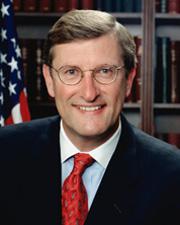 Sen. Kent Conrad (D-ND)
What it changes
1 change to S. 1042 · shown in the bill's text
Adds SEC. 1073. POLICY OF THE UNITED STATES ON THE INTER-CONTINENTAL BALLISTIC MISSILE FORCE at the end of subtitle G of title X
Adds a sectionIn S. 1042 · Placed on Calendar Senate
Section 21(a) of the Internal Security Act of 1950 (Public Law 81- 831; 64 Stat. 1005) is amended by inserting "or military or civilian director" after "military commander".
Inserted: SEC. 1073. POLICY OF THE UNITED STATES ON THE INTER-CONTINENTAL BALLISTIC MISSILE FORCE.
Inserted: (a) Findings.--Congress makes the following findings:
Inserted: (1) Consistent with warhead levels agreed to in the Moscow Treaty, the United States is modifying the capacity of the Minuteman III intercontinental ballistic missile (ICBM) from its prior capability to carry up to 3 independent reentry vehicles (RVs) to carry as few as a single reentry vehicle, a process known as downloading.
Inserted: (2) A series of Department of Defense studies of United States strategic forces, including the 2001 Nuclear Posture Review, has confirmed the continued need for 500 intercontinental ballistic missiles.
Inserted: (3) In a potential nuclear crisis it is important that the nuclear weapons systems of the United States be configured so as to discourage other nations from making a first strike.
Inserted: (4) The intercontinental ballistic missile force is currently being considered as part of the deliberations of the Department of Defense for the Quadrennial Defense Review.
Inserted: (b) Statement of United States Policy.--It is the policy of the United States to continue to deploy a force of 500 intercontinental ballistic missiles, provided that unanticipated strategic developments may compel the United States to make changes to this force structure in the future.
Inserted: (c) Moscow Treaty Defined.--In this section, the term "Moscow Treaty" means the Treaty Between the United States of America and the Russian Federation on Strategic Offensive Reductions, done at Moscow on May 24, 2002.
Original wording
At the end of subtitle G of title X, add the following:
Read automatically from the Congressional Record. Check the original before relying on it.
As printed
SA 1883. Mr. CONRAD (for himself, Mr. Baucus, Mr. Salazar, Mr. Enzi, Mr. Thomas, and Mr. Burns) submitted an amendment intended to be proposed by him to the bill S. 1042, to authorize appropriations for fiscal year 2006 for military activities of the Department of Defense, for military construction, and for defense activities of the Department of Energy, to prescribe personnel strengths for such fiscal year for the Armed Forces, and for other purposes; which was ordered to lie on the table; as follows:
At the end of subtitle G of title X, add the following:
SEC. 1073. POLICY OF THE UNITED STATES ON THE INTER-CONTINENTAL BALLISTIC MISSILE FORCE.
(a) Findings.--Congress makes the following findings:
(1) Consistent with warhead levels agreed to in the Moscow Treaty, the United States is modifying the capacity of the Minuteman III intercontinental ballistic missile (ICBM) from its prior capability to carry up to 3 independent reentry vehicles (RVs) to carry as few as a single reentry vehicle, a process known as downloading.
(2) A series of Department of Defense studies of United States strategic forces, including the 2001 Nuclear Posture Review, has confirmed the continued need for 500 intercontinental ballistic missiles.
(3) In a potential nuclear crisis it is important that the nuclear weapons systems of the United States be configured so as to discourage other nations from making a first strike.
(4) The intercontinental ballistic missile force is currently being considered as part of the deliberations of the Department of Defense for the Quadrennial Defense Review.
(b) Statement of United States Policy.--It is the policy of the United States to continue to deploy a force of 500 intercontinental ballistic missiles, provided that unanticipated strategic developments may compel the United States to make changes to this force structure in the future.
(c) Moscow Treaty Defined.--In this section, the term “Moscow Treaty” means the Treaty Between the United States of America and the Russian Federation on Strategic Offensive Reductions, done at Moscow on May 24, 2002.
Legislative Activity
Stay on top of the latest movement without scrolling through every action
Senate amendment submitted
September 29, 2005