To make available an additional $6,700,000,000 to fund equipment reset requirements resulting from continuing combat operations, including repair, depot, and procurement activities.
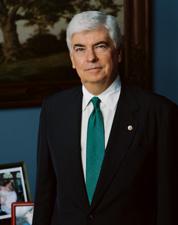 Sen. Christopher J. Dodd (D-CT)
Legislative Activity
Stay on top of the latest movement without scrolling through every action
Senate amendment submitted
August 2, 2006
View full timeline
Senate amendment submitted
August 2, 2006
Senate amendment proposed (on the floor): Amendment SA 4819 proposed by Senator Dodd.(consideration: CR S8596-8598; text: CR S8596-8597)
August 2, 2006
Senate amendment agreed to: Amendment SA 4819 agreed to in Senate by Yea-Nay Vote. 97 - 0. Record Vote Number: 221.
August 2, 2006
Roll call votes on amendments in Senate: Amendment SA 4819 agreed to in Senate by Yea-Nay Vote. 97 - 0. Record Vote Number: 221.
August 2, 2006
Amendment SA 4819 proposed by Senator Dodd. (consideration: CR S8596-8598; text: CR S8596-8597) To make available an additional $6,700,000,000 to fund equipment reset requirements resulting from continuing combat operations, including repair, depot, and procurement activities.
August 2, 2006
Amendment SA 4819 agreed to in Senate by Yea-Nay Vote. 97 - 0. Record Vote Number: 221.
August 2, 2006
Votes
1 roll call on this amendment
Text
Proposed
DEPARTMENT OF DEFENSE APPROPRIATIONS ACT, 2007--Continued

Mr. STEVENS. I suggest the absence of a quorum.
The PRESIDING OFFICER. The clerk will call the roll.
The assistant legislative clerk proceeded to call the roll.
Mr. CHAMBLISS. I ask unanimous consent that the order for the quorum
call be rescinded.
The PRESIDING OFFICER. Without objection, it is so ordered.
Mr. CHAMBLISS. Mr. President, I rise today to speak on the 2007
Defense appropriations bill. Senator Stevens and Senator Inouye, as
well as the entire committee, worked diligently to produce a bill that
supports our troops and provides what our military needs to fight and
win the global war on terrrorism. I am pleased to say that this bill
does just that. The bill provides $453.48 billion in new budget
authority for the Department of Defense, including the $50.0 billion in
additional global war on terror appropriations, and $14.7 billion above
the fiscal year 2006 enacted level, excluding supplemental funding.
This bill provides our service men and women with the resources
necessary to continue and win the global war on terrorism, keep our
country safe, and improve the quality of life for soldiers, sailors,
airmen, marines, and their families.
After visiting with soldiers stationed from the 48th Brigade in
Tallil, Iraq, I am convinced that the members of the Armed Forces are
wholeheartedly committed to accomplishing the mission. It is my belief
that Members of Congress have a duty to support fine soldiers such as
these and ensure they have the best training, equipment, and resources
to defeat our Nation's enemies. We must never forget that it is
essential we finish the job we set out to do because our own security
rests in winning the global war on terrorism.
Over the past few months, we have seen many amendments that claim
that withdrawing from Iraq is the right approach. The Senate wisely
defeated those amendments. We have a responsibility to ensure that the
governments of Iraq and Afghanistan are stable, have the ability to
govern themselves as sovereign nations, and have the infrastructure
necessary to maintain the rule of law. I am proud that the bill before
us today allows us to continue to fight and win the global war on
terrorism and also continues to enhance our research and development
projects so that we will continue to be able to defeat those who raise
arms against us.
One of the key provisions in this bill is the funding for new
aircraft. By appropriating $4.3 billion and approving a multiyear
contract for the F-22A, the United States will maintain its position as
having the superior air fighter well into the next few decades. Because
my colleagues and I fought hard for multiyear procurement during the
Defense authorization bill debate, we will be able to save the American
taxpayer an estimated $225 million over separate 1-year contracts for
the next 60 F-22s. While some dismissed these savings as
``insignificant,'' funds saved through this multiyear contract can be
applied to other, crucial priorities during this time of war.
I am also very proud of the aspects of the bill which guarantee the
United States will maintain its strategic lift capability. With an
aging fleet, it is imperative we invest now in strategic lift aircraft
to secure our future. The bill appropriates $867 million to procure C-
130Js. Coupled with an additional $12 million for the C-5 AMP Program
and $2.3 billion for C-17 procurement, including language directing the
Department of Defense to budget for additional C-17s fiscal year 2008,
we can be assured that the United States will maintain a strategic
force projection capability able to respond to crises any place on
short notice.
We must remember, however, that the best investment we can make is
not equipment, but in the warfighters themselves. I am pleased that
this legislation appropriates $45 million in supplemental education
funding for local school districts that are heavily impacted by the
presence of military personnel and families, including $30 million for
impact aid, $5 million for educational services to support special-
needs children, and an additional $10 million for districts
experiencing rapid increases in the number of students due to rebasing
and the BRAC process. I have several bases in my State that will
benefit from this funding and I can assure you that this funding is
critical to ensuring that children of our military families receive the
quality education they deserve. As a result of the 2005 base
realignment and closure process, Fort Benning and school systems in the
surrounding area will experience an influx of approximately 10,000
students into their school systems over

[[Page S8579]]

the next several years. This funding ensures that communities like Fort
Benning will have additional resources to help accommodate these extra
students.
Continuing our focus on the families of service members, this bill
provides $2 million to support the Reach Out and Read Program on
military installations world-wide. The Reach Out and Read organization
seeks to promote literacy and language development in infants and young
children to ensure that they start school with every advantage
possible. Cited by the National Research Council as an exemplary
program, I am pleased that the bill provides funding for this worthy
cause. This program makes an investment in the future that I am sure
will pay substantial dividends.
This bill also provides a well deserved pay raise of 2.2 percent for
all military personnel, effective January 1, 2007, and approves
targeted pay raises for mid-career and senior enlisted personnel and
warrant officers effective April 1, 2007. I have heard directly from
troops in the field and personnel at Georgia military installations
about how important these targeted pay raises are for retaining our men
and women in uniform in the service and taking advantage of their hard-
to-replace expertise. I commend the committee for including these pay
raises in the bill.
This is a good bill that is clearly crafted with the needs of our
troops and the security of our Nation foremost in mind. I hope my
colleagues will join me in expeditiously approving this legislation so
that our men and women in uniform can get the equipment, the benefits,
and the support that they need and deserve.
The PRESIDING OFFICER. The Senator from Pennsylvania.
Mr. STEVENS. Will the Senator yield for a moment?
Mr. SPECTER. I yield.

Amendment No. 4775, as Modified

Mr. STEVENS. I send to the desk a modification of Senator Sessions'
amendment that reflects the amendment offered by Senator Kyl. Since it
has not been ordered yet, I believe it is the Senator's right to modify
the amendment.
The PRESIDING OFFICER. A vote has been ordered on the amendment, so
it does take consent.
Mr. STEVENS. I ask unanimous consent he be permitted to modify his
amendment.
The PRESIDING OFFICER. Without objection, it is so ordered.
The amendment (No. 4775), as modified, is as follows:

On page 221, line 9, strike ``$204,000,000'', and insert
``$2,033,100,000, which shall be designated as an emergency
pursuant to section 402 of S. Con. Res. 83 (109th Congress),
the concurrent resolution on the budget for fiscal year 2007,
as made applicable in the Senate by section 7035 of Public
Law 109-234.''

The PRESIDING OFFICER. The Senator from Pennsylvania.
Mr. SPECTER. Mr. President, I commend the distinguished chairman of
the Subcommittee on Defense Appropriations and the ranking Member for
their very good work in producing this Defense appropriations bill. It
has been my pleasure to serve on this committee for some 25\1/2\ years
with Senator Stevens and Senator Inouye. I have supported their action
in providing substantial funding for a robust military and will be
supporting this bill.
Our first line of defense is diplomacy. We ought to be undertaking
some very strenuous efforts at diplomacy on what is happening today in
the Middle East with Israel raging a defensive war, having been
attacked by Hezbollah to the north and Hamas to the south, two
terrorist organizations.
I spoke at some length on this subject on June 16th. My remarks are
in the Congressional Record. I made the basic point that I thought it
highly advisable for the United States to engage in direct negotiations
with Iran and in direct negotiations with North Korea to try to solve
the problems posed by those nations on the very serious issue of
nuclear proliferation, with Iran seeking to develop nuclear weapons and
with North Korea having nuclear weapons and posing an enormous threat.
In the more extensive remarks, which I made back on June 16, I
pointed out the experience I have had in discussions with Hafez al-
Assad on many visits which I paid to Syria over the years and some of
those contacts which I think were helpful in acquainting Hafez al-Assad
with the thinking of the West, acting to some extent as an intermediary
between Assad and the Israeli Prime Minister because they would not
talk, and perhaps being helpful in getting Assad and the Syrians to go
to the Madrid Conference in 1991.
I picked up some of the efforts of former Congressman Solarz in
trying to get Assad to allow the Jews in Syria to leave. And after many
years, Assad did that. Whether my exhortations had any influence or
not, I cannot be sure. But my own experience has been, in talking to
foreign leaders, that one-on-one negotiations is highly desirable.
I had occasion to talk to Castro, to Chavez in Venezuela, to
officials in China. And all of this is set out at some greater length
in the floor statement I made back on June 16.
I made some comments on July 20, again, noted in the Congressional
Record, as to what I thought ought to be done with respect to trying to
work for a settlement in the Mideast, trying to eliminate Hezbollah as
a threat to Israel's north and Hamas as a threat to the south in
Israel.
I want to supplement those comments today with the underlying point
that a solution to the problems there require some international
pressure, if there is any pressure at all that can be brought to bear
on Iran and Syria to stop backing Hezbollah and to stop arming
Hezbollah and to stop being an accessory before the fact and really a
coconspirator with Hezbollah in waging the war against Israel.
Earlier this week, on July 31, I wrote to Secretary of State
Condoleezza Rice, with a copy to U.N. Ambassador Bolton. My letter to
Secretary Rice applauded the efforts she is making to find a peaceful
solution to the Mideast, and saying:

It is my judgment that no solution is possible, especially
as to Hezbollah, until Iran and Syria cease to support
Hezbollah's military action.

I sent a copy of that letter, as noted, to our Ambassador to the
U.N., John Bolton, and talked to him about the situation. And after
those discussions--and I am not looking for any endorsement from
anybody--I thought that I ought to pursue the matter with this floor
statement.
We have had a situation where the Iranian Foreign Minister was in
Beirut earlier this week and parroted the party line from Syria and
Hezbollah in making demands for a five-point program: First, Israeli
withdrawal; second, an exchange of prisoners; third, an international
force; fourth, that Israel should compensate Lebanon, which is not
sensible, to put it mildly, in light of the fact that Israel is
fighting a war in self-defense, which Israel has every right to do
under article 51 of the U.N. Charter; and the fifth point pursued by
the Iranian Foreign Minister, in talks with the French Foreign Minister
in Beirut earlier this week, was the formation of an international
commission to investigate Israeli war crimes, with the view to
compensation--again, an idea which has no merit whatsoever in view of
the underlying facts as to what is going on there.
We have seen a situation evolve in the fighting there where Hezbollah
has fired some 1,500 Katyusha rockets into Israel. They started the
turmoil and the conflict on July 12 of this year, kidnapping two
Israeli soldiers and killing eight others. This is the same Hezbollah
terrorist organization which, in April of 1983, killed 63 people in a
bomb attack on the U.S. Embassy in Lebanon. On October 23, 1983
Hezbollah was responsible for the killing of 241 U.S. servicemen at the
marine barracks in Beirut.
Since its establishment, Hezbollah has been tracked with the
kidnapping of more than 30 westerners and has been charged with
carrying out attacks from London to Buenos Aires. Hezbollah has killed
more Americans than any terrorist group, with the exception of al-
Qaida.
The State Department's 2006 Country Reports on Terrorism noted that
Hezbollah ``receives training, weapons, and explosives, as well as
political, diplomatic, and organizational aid, from Iran.'' The report
further states that Hezbollah ``is closely allied with Iran and often
acts at its behest.'' Further, the report maintains that ``the Iranian
Islamic Revolutionary Guard Corps and Ministry o Intelligence and
Security

[[Page S8580]]

were directly involved in the planning and support of terrorist acts
and continued to exhort . . . Lebanese Hezbollah, to use terrorism in
pursuit of their goals.''

The same State Department 2006 report on terrorism also describes the
support provided to Hezbollah by the Government of Syria. According to
the report: ``Hezbollah receives diplomatic, political, and logistical
support from Syria'' and ``Syria continued to permit Iran to use
Damascus as a transshipment point to resupply Hezbollah in Lebanon.''
More recently, an intelligence officer said, as reported by the
Washington Post on July 27 of this year, that, Iranian national
security chief Ali Larijani was on an unannounced visit to Damascus on
Thursday to discuss the Lebanon crisis with Syrian leaders and to urge
continued support for Hezbollah.''
The New York Times, on July 19, reported that 5 days earlier an
Israeli naval vessel was attacked by ``a sophisticated antiship cruise
missile, the C-802, an Iranian-made variant of the Chinese Silkworm.''
Experts cited in this article noted that ``Iran was not likely to
deploy such a sophisticated weapon without also sending Revolutionary
Guard crews with the expertise to fire the missile.'' And the Times
also noted that forensics conducted by the Israelis concluded that many
of the Hezbollah rockets ``including a 220-millimeter rocket used in a
deadly attack on a railway site in Haifa . . . were built in Syria.''
On February 9 of 2004, the Security Council passed Resolution 1559 by
a vote of 9-0 which called for the disbanding and disarmament of
Hezbollah, the removal of foreign forces from Lebanon, and the
deployment of the Lebanese Army to the southern border. After the
adoption of that resolution, the U.N. issued a statement calling ``upon
all parties concerned to cooperate fully and urgently with the Council
for the full implementation of all its resolutions concerning the
restoration in Lebanon of territorial integrity, full sovereignty and
political independence.''
An April 2006 report delivered to the Security Council on the
implementation of Resolution 1559 was explicitly critical of Iran's and
Syria's support for Hezbollah. In the report, Secretary General Kofi
Annan noted:

. . . renewed incidents of arms transfers across the Syrian-
Lebanese border into Lebanon . . . [is] in contradiction of
resolution 1559.

The report further stated that Hezbollah ``maintains close ties, with
frequent contacts and regular communication, with the Syrian Arab
Republic and the Islamic Republic of Iran.''
All of this paints a conclusive picture of Iran and Syria being
behind Hezbollah, having armed Hezbollah, having the rockets in a
position with a knife at the throat of Israel, with Israel taking
action in self-defense, once Israeli soldiers were killed, other
Israeli soldiers attacked.
And in searching for a resolution to this dire situation, it is
pointless to defang Hezbollah if Hezbollah is going to be resupplied by
Syria and by Iran. And that is why I have urged Secretary of State
Condoleezza Rice, by the letter dated July 31, to have the United
States seek to bring Iran and Syria before the United Nations for the
imposition of sanctions if they do not act promptly in furtherance of
U.N. resolutions to stop arming Hezbollah.
My conversations with U.N. Ambassador John Bolton confirmed my view
that this sort of U.N. action is urgently needed. I complimented
Ambassador Bolton on the U.N. resolution--14 to 1--to set the stage for
the imposition of sanctions on Iran if Iran does not move ahead to
cease its development of nuclear weapons.
So I urge our State Department to move ahead vigorously to seek the
imposition of sanctions on Iran and Syria to try to be helpful on this
serious situation. Without eliminating the source of supply to
Hezbollah, any cease-fire or any resolution would be temporary only.
Mr. President, I ask unanimous consent that the full text of my
letter to Secretary Rice be printed in the Record.
There being no objection, the material was ordered to be printed in
the Record, as follows:

U.S. Senate,

Committee on the Judiciary,

Washington, DC, July 31, 2006.
Hon. Condoleezza Rice,
Secretary, Department of State,
Washington, DC.
Dear Condi: I applaud the efforts you are making to try to
find a peaceful solution to the two-front defensive war which
Israel is waging against Hezbollah to the north and Hamas to
the south.
It is my judgment that no solution is possible, especially
as to Hezbollah, until Iran and Syria cease to support
Hezbollah's military action.
In a speech on the Senate floor on July 20, 2006, I urged
the United Nations to call Iran and Syria on the carpet to
explain their conduct in backing Hezbollah, in providing
personnel to do more than train Hezbollah, more than advisers
being integral parts of the military offensive of Hezbollah.
I urge you to take the leadership to bring a U.S.
resolution before the UN Security Council demanding that Iran
and Syria stop supporting Hezbollah and other terrorist
organizations.
Sincerely,
Arlen Specter.

Mr. SPECTER. Mr. President, I ask unanimous consent that a fuller
statement be printed in the Record at the end of these extemporaneous
remarks
There being no objection, the statement was ordered to be printed in
the Record, as follows:

Statement of Senator Arlen Specter on the United Nations Obligation To
Confront the Iran-Syria-Hezbollah Connection

Mr. SPECTER. Mr. President. I have been following the
recent developments in the Middle East with great concern.
While Israel has rightfully defended itself against the
attacks of Hezbollah, I believe the true source of this
conflict must be confronted if there is to be an enduring
peace in the region. Hezbollah is not a terrorist entity
acting solely of its own accord. Rather, Hezbollah is a proxy
of Iran and Syria.
Despite Israel's withdrawal from Southern Lebanon in 2000,
the territory has remained a terrorist safe haven and over
the last two weeks has become the launching point for more
than 1,500 Katyusha rockets into Israel. This is the same
territory from which Hezbollah launched an attack on an
Israeli border patrol on July 12, 2006 which resulted in the
killing of eight Israeli soldiers and the kidnapping of two
others. These unprovoked acts of aggression have resulted in
numerous civilian casualties in both Israel and Lebanon.
Israel, especially its citizens in the north, have had a
knife at their throat for decades. Hezbollah has spent the
last 25 years digging in and arming themselves poised to
attack Israel. These belligerent acts are not the first to
come from Hezbollah. In April 1983, Hezbollah killed 63
people in a bomb attack on the U.S. embassy in Lebanon. In
October of that same year, the terrorist group killed 241
U.S. servicemen at the Marine Corps barracks in Beirut. Since
its establishment, Hezbollah is believed to have kidnapped
more than thirty Westerners and has been charged with
carrying out attacks from London to Buenos Aires.
I compliment the Secretary of State, Condoleezza Rice, for
her efforts to highlight the connectivity which exists
between Iran, Syria, and Hezbollah. These links have
contributed to the destabilization of the region and are
directly responsible for the outbreak of hostilities between
the Israeli Defense Forces and Hezbollah. The UN must
proclaim that Iran and Syria's links with Hezbollah will not
be tolerated and must be severed. Failure to do so will allow
Syria and Iran to remain the obstacle in laying a foundation
upon which a lasting peace can be established.
The connection between Iran, Syria and Hezbollah is
undeniable. According to the State Department's 2006 Country
Reports on Terrorism, Hezbollah ``receives training, weapons,
and explosives, as well as political, diplomatic, and
organizational aid, from Iran.'' The report states that
Hezbollah ``is closely allied with Iran and often acts at its
behest.'' Further, the report maintains that ``the Iranian
Islamic Revolutionary Guard Corps (IRGC) and Ministry of
Intelligence and Security (MOIS) were directly involved in
the planning and support of terrorist acts and continued to
exhort . . . Lebanese Hezbollah, to use terrorism in pursuit
of their goals.''
The State Department's 2006 Reports on Terrorism also
describes the support provided to Hezbollah by the government
of Syria. According to the report, ``Hezbollah receives
diplomatic, political, and logistical support from Syria''
and ``Syria continued to permit Iran to use Damascus as a
transshipment point to resupply Hezbollah in Lebanon.'' More
recently, an intelligence officer told The Washington Post on
July 27, 2006, that, ``Iranian national security chief Ali
Larijani was on an unannounced visit to Damascus on Thursday
to discuss the Lebanon crisis with Syrian leaders and to urge
continued support for Hizbollah.''
The outbreak of violence has made these connections even
more apparent. According to officials cited in a July 19,
2006 article in The New York Times, on July 14, 2006 an
Israeli naval vessel was attacked by ``a sophisticated
antiship cruise missile, the C-802, an Iranian-made variant
of the Chinese Silkworm.'' Experts cited in this article
noted, ``Iran was not likely to deploy such a sophisticated
weapon without also sending Revolutionary Guard crews with
the expertise to

[[Page S8581]]

fire the missile.'' The New York Times also stated that
forensics conducted by the Israelis concluded that many of
the rockets in Hezbollah's arsenal ``including a 220-
millimeter rocket used in a deadly attack on a railway site
in Haifa . . . were built in Syria.'' It is evident that not
only is Hezbollah supplied by Iran and Syria, but that both
nations have tacit knowledge of their actions and are
directly supporting terrorist operations in Southern Lebanon.
On February 9, 2004, the Security Council attempted to
plant the seeds for peace when it adopted Resolution 1559 by
a vote of 9-0 which called for the disbanding and disarmament
of Hezbollah, the removal of foreign forces from Lebanon, and
the deployment of the Lebanese army to the southern border.
Upon adoption of Resolution 1559, the U.N. issued a statement
calling ``upon all parties concerned to cooperate fully and
urgently with the Council for the full implementation of all
its resolutions concerning the restoration in Lebanon of
territorial integrity, full sovereignty and political
independence.'' Although Israel fully withdrew its forces
from Lebanon, Hezbollah did not disarm. Further, Iran and
Syria continued to be an obstacle by providing support to
Hezbollah, which prevented the deployment of Lebanese
forces to southern Lebanon--an area the State Department
has described as a ``terrorist sanctuary''.
An April 2006 report delivered to the Security Council on
the implementation of Resolution 1559 was critical of Iran
and Syria's support for Hezbollah. In the report, Secretary-
General Kofi Annan noted, ``renewed incidents of arms
transfers across the Syrian-Lebanese border into Lebanon . .
. in contradiction to resolution 1559''. Specifically the
report cited, ``an incident, in which arms destined for
Hezbollah had been transferred from the Syrian Arab Republic
into Lebanon. Twelve trucks carrying ammunitions and weapons
of various kinds, including Katyusha rockets, crossed the
border from the Syrian Arab Republic.'' The report further
stated that Hezbollah, ``maintains close ties, with frequent
contacts and regular communication, with the Syrian Arab
Republic and the Islamic Republic of Iran'' and that
implementation of the resolution would require the
``cooperation of all other relevant parties, including the
Syrian Arab Republic and the Islamic Republic of Iran.''
Secretary General Annan stated, ``with the continued
support of the Security Council, the national dialogue, the
unity of the Lebanese and the farsighted leadership of the
Government of Lebanon, as well as the necessary cooperation
of all other relevant parties, including the Syrian Arab
Republic and the Islamic Republic of Iran, the difficulties
of the past can be overcome and significant headway made
towards the full implementation of resolution 1559.'' It is
clear that Iran and Syria, have acted in a manner to subvert
the implementation of 1559.
I believe Iran and Syria, through Hezbollah, are
responsible for attacking the State of Israel and should be
held accountable. Accordingly, I urge the United Nations to
demand the immediate halt of Hezbollah's attacks against
Israel, declare Iran and Syria directly responsible for the
actions of Hezbollah and demand that all support for the
terrorist organization be immediately withdrawn under the
threat of sanction.
Iran and Syria were three of the original 51 Member States
of the United Nations, agreeing to the Charter and accepting
its conditions on October 24, 1945. Chapter I, Article 2,
Paragraph 2 of the Charter binds ``All Members, in order to
ensure to all of them the rights and benefits resulting from
membership, shall fulfill in good faith the obligations
assumed by them in accordance with the present Charter.'' The
Charter further calls on member states ``to practice
tolerance and live together in peace with one another as good
neighbors'' and ``to maintain international peace and
security.'' Iran and Syria have not practiced tolerance and
their actions pose a threat to peace and security.
Chapter I, Article 2, Paragraph 3 states that, ``All
Members shall settle their international disputes by peaceful
means in such a manner that international peace and security,
and justice, are not endangered.'' Iran and Syria, via
Hezbollah, have chosen to support aggression rather than
peaceful means in their dispute with Israel.
Furthermore, under Chapter I, Article 2, Paragraph 4, ``All
Members shall refrain in their international relations from
the threat or use of force against the territorial integrity
or political independence of any state, or in any other
manner inconsistent with the Purposes of the United
Nations.'' Iran and Syria, who have tacit knowledge of and
directly support Hezbollah's actions, have orchestrated and
enabled the attacks against the territory of a sovereign
nation.
The Security Council is bound under Chapter VII, Article 39
to, ``determine the existence of any threat to the peace,
breach of the peace, or act of aggression and shall make
recommendations, or decide what measures shall be taken in
accordance with Articles 41 and 42, to maintain or restore
international peace and security.'' Accordingly, the UN must
recognize that Hezbollah is a threat to the peace, Iran and
Syria have enabled Hezbollah to breach the peace and that
this connectivity represents a direct threat to the peace.
The Security Council should, under Article 40, call on Syria
and Iran to cease and desist. Should either nation fail to
comply, the UN should move to consider actions, such as
sanctions, available under Article 41.
In conclusion, Syria and Iran have acted contrary to
Security Council Resolution 1559, to the detriment of peace
and stability in the region. Iran and Syria enable, arm,
support and, to a significant degree, dictate the actions of
Hezbollah. It is the duty of the United Nations to directly
confront Iran and Syria and take swift and harsh action to
rightfully lay the blame of Hezbollah's aggression at the
doorstep of Damascus and Tehran.
I yield the floor.

Mr. SPECTER. I yield the floor.
The PRESIDING OFFICER. The Senator from Alaska.

Vote on Amendment No. 4775, as Amended and Modified

Mr. STEVENS. Mr. President, at 2 p.m. there will be a vote on the
Sessions amendment, as modified?
The PRESIDING OFFICER. The Senator is correct.
Mr. STEVENS. The yeas and nays have not been ordered?
The PRESIDING OFFICER. The Senator is correct.
Mr. STEVENS. Mr. President, I ask for the yeas and nays.
The PRESIDING OFFICER. Is there a sufficient second?
There is a sufficient second.
The question is on agreeing to the amendment, as amended and
modified. The clerk will call the roll.
The legislative clerk called the roll.
Mr. McCONNELL. The following Senator was necessarily absent: the
Senator from Kentucky (Mr. Bunning).
Further, if present and voting, the Senator from Kentucky (Mr.
Bunning) would have voted ``yea.''
Mr. DURBIN. I announce that the Senator from Montana (Mr. Baucus and
the Senator from Connecticut (Mr. Lieberman) are necessarily absent.
The PRESIDING OFFICER (Mr. Sununu). Are there any other Senators in
the Chamber desiring to vote?
The result was announced--yeas 94, nays 3, as follows:

[Rollcall Vote No. 220 Leg.]

YEAS--94

Akaka
Alexander
Allard
Allen
Bayh
Bennett
Biden
Bingaman
Bond
Boxer
Brownback
Burns
Burr
Byrd
Cantwell
Carper
Chafee
Chambliss
Clinton
Coburn
Cochran
Coleman
Collins
Conrad
Cornyn
Craig
Crapo
Dayton
DeMint
DeWine
Dodd
Dole
Domenici
Dorgan
Durbin
Ensign
Enzi
Feinstein
Frist
Graham
Grassley
Gregg
Harkin
Hatch
Hutchison
Inhofe
Inouye
Isakson
Johnson
Kennedy
Kerry
Kohl
Kyl
Landrieu
Lautenberg
Leahy
Levin
Lincoln
Lott
Lugar
Martinez
McCain
McConnell
Menendez
Mikulski
Murkowski
Murray
Nelson (FL)
Nelson (NE)
Obama
Pryor
Reed
Reid
Roberts
Rockefeller
Salazar
Santorum
Sarbanes
Schumer
Sessions
Shelby
Smith
Snowe
Specter
Stabenow
Stevens
Sununu
Talent
Thomas
Thune
Vitter
Voinovich
Warner
Wyden

NAYS--3

Feingold
Hagel
Jeffords

NOT VOTING--3

Baucus
Bunning
Lieberman
The amendment (No. 4775), as amended and modified was agreed to.
Mr. STEVENS. Mr. President, I move to reconsider the vote and to lay
that motion on the table.
The motion to lay on the table was agreed to.
Mr. KENNEDY. Mr. President, I have an amendment at the desk and I ask
for its immediate consideration. I talked to both managers of the bill,
and they are reviewing it.
Mr. STEVENS. Will the Senator permit us to have a managers' package
first?
Mr. KENNEDY. Yes. I withhold my request.
The PRESIDING OFFICER. Under the previous order, amendment No. 4802
is scheduled to be the next pending measure before the Senate.
The Senator from Alaska is recognized.
Mr. STEVENS. Mr. President, on behalf of myself and Senator Inouye, I
will present another managers' package. This contains amendment No.
4778, for Senator Smith, regarding airships; No. 4773, for Senator
Dayton, regarding postdeployment support; No. 4766, for Senator Inouye,
regarding a military history exhibit; No. 4760, as modified, for
Senator Lott, regarding airdrop systems.
Mr. President, I withdraw the package.

[[Page S8582]]

Amendment No. 4802

The PRESIDING OFFICER. Under the previous order, it is now in order
to consider amendment No. 4802, as offered by Senator Kennedy.
The clerk will report.
The legislative clerk read as follows:

The Senator from Massachusetts [Mr. Kennedy], for himself,
Mr. Reid, Mr. Biden, Mr. Levin, and Mr. Reed, proposes an
amendment numbered 4802.

Mr. KENNEDY. Mr. President, I ask unanimous consent that the reading
of the amendment be dispensed with.
The PRESIDING OFFICER. Without objection, it is so ordered.
The amendment is as follows:

(Purpose: To require a new National Intelligence Estimate on Iraq)

On page 150, line 24, insert before the period the
following: ``: Provided, That Director of National
Intelligence shall, utilizing amounts appropriated by this
heading, prepare by not later than October 1, 2006, a new
National Intelligence Estimate on Iraq with an assessment by
the intelligence community of critical political, economic,
and security trends in Iraq, which shall address such matters
as the Director of National Intelligence considers
appropriate, including (1) an assessment whether Iraq is in
or is descending into civil war and the actions that will
prevent or reverse deterioration of conditions promoting
civil war, including sectarianism, (2) an assessment whether
Iraq is succeeding in standing up effective security forces,
and the actions that will increase the chances of that
occurring, including an assessment of (A) the extent to which
militias are providing security in Iraq, and (B) the extent
to which the Government of Iraq has developed and implemented
a credible plan to disarm and demobilize and reintegrate
militias into government security forces and is working to
obtain a political commitment from political parties to ban
militias, (3) an assessment of (A) the extent of the threat
from violent extremist-related terrorism, including al Qaeda,
in and from Iraq, (B) the extent to which terrorism in Iraq
has exacerbated terrorism in the region and globally, (C) the
extent to which terrorism in Iraq has increased the threat to
United States persons and interests around the world, and (D)
actions to address the terrorist threat, (4) an assessment
whether Iraq is succeeding in creating a stable and effective
unity government, the likelihood that changes to the
constitution will be made to address concerns of the Sunni
community, and the actions that will increase the chances of
that occurring, (5) an assessment (A) whether Iraq is
succeeding in rebuilding its economy and creating economic
prosperity for Iraqis, (B) the likelihood that economic
reconstruction in Iraq will significantly diminish the
dependence of Iraq on foreign aid to meet its domestic
economic needs, and (C) the actions that will increase the
chances of that occurring, (6) a description of the
optimistic, most likely, and pessimistic scenarios for the
stability of Iraq through 2007, (7) an assessment whether,
and in what ways, the large-scale presence of multinational
forces in Iraq helps or hinders the chances of success in
Iraq; and (8) an assessment of the extent to which the
situation in Iraq is affecting relations with Iran, Saudi
Arabia, Turkey, and other countries in the region: Provided
further, That, not later than October 1, 2006, the Director
of National Intelligence shall submit to Congress the
National Intelligence Estimate prepared under the preceding
proviso, together with an unclassified summary of the
National Intelligence Estimate: Provided further, That if the
Director of National Intelligence is unable to submit the
National Intelligence Estimate by the date specified in the
preceding proviso, the Director shall submit to Congress, not
later than that date, a report setting forth the reasons for
being unable to do so''.

Mr. KENNEDY. Mr. President, this is a request for a national
intelligence estimate on Iraq. We haven't had one now for 2 years. I
have talked with the managers. They will review it. It is under
consideration. They will let us know. We will have further comments on
it later. The managers understand this, and I hope we will have an
opportunity to dispose of it a little later.
Mr. STEVENS. Mr. President, Senator Kennedy's amendment remains the
pending business?
The PRESIDING OFFICER. Amendment No. 4802 is the pending business.
Mr. STEVENS. I suggest the absence of a quorum. I withhold that
request.
The PRESIDING OFFICER. The request is withdrawn.
The Senator from Illinois.

Amendment No. 4781

Mr. DURBIN. Mr. President, I ask unanimous consent that the pending
amendment be set aside so I may call up amendment No. 4781 for debate.
The PRESIDING OFFICER. Without objection, it is so ordered. The clerk
will report the amendment.
The legislative clerk read as follows:

The Senator from Illinois [Mr. Durbin], for himself, Mr.
Obama, and Mr. Lautenberg, proposes an amendment numbered
4781.

Mr. DURBIN. Mr. President, I ask unanimous consent that the reading
of the amendment be dispensed with.
The PRESIDING OFFICER. Without objection, it is so ordered.
The amendment is as follows:

(Purpose: To make available from Research, Development, Test and
Evaluation, Army, up to $2,000,000 for the improvement of imaging for
traumatic brain injuries)

At the end of title VIII, add the following:
Sec. 8109. Of the amount appropriated or otherwise made
available by title IV under the heading ``Research,
Development, Test and Evaluation, Army'', up to $2,000,000
may be available for the improvement of imaging for traumatic
brain injuries and the adaptation of current technologies to
treat brain injuries suffered in combat.

The PRESIDING OFFICER. The Senator is recognized.
Mr. DURBIN. Mr. President, I ask the Senate to join me for a few
minutes to consider this amendment. It relates to traumatic brain
injury. It is a very serious problem with soldiers who are serving in
Iraq and Afghanistan. This amendment addresses the very real medical
issues and problems they are facing with these serious wounds. Senator
Obama shares my concern of this issue. That is why we are offering this
amendment together today.
Our goal is to improve the treatment of the devastating injuries
which are suffered by many of our soldiers in Iraq and Afghanistan.
Traumatic brain injuries can range from large, penetrating skull
fractures to concussions which may not be immediately detected.
As of January of this year, the Department of Defense reported that
nearly 12,000 members of the military have been directly or indirectly
wounded in explosions in Iraq and Afghanistan.
Mr. President, I am going to display a chart at this moment which is
painful to see. I talked it over with a man who has served in Iraq who
commanded troops in Iraq who saw one of his soldiers suffer a very
serious injury similar to the one I am about to show. I asked whether
he thought it was appropriate for me to show this image on the floor.
He said, Yes, it is important that the people of this country
understand the kinds of injuries that our soldiers are experiencing and
why this issue of traumatic brain injury is so important for us to
discuss with this amendment.
This is an actual x-ray of an American soldier who has been the
victim of a traumatic brain injury. Because of an explosion, one can
see that a major portion of this soldier's skull was blown off. We are
told that there are soldiers who have experienced injuries that are
even more grievous, and they survived. Through the miracle of
evacuation and medical treatment, they survive. They go through
extensive surgeries, and some, this officer told me, end up wearing
helmets for long periods of time during their recuperation until they
can finally rebuild their skulls so they can start to go through
rehabilitation and recuperation.
This is amazing when we see an image of an x-ray such as this and
understand that many of our soldiers have been subjected to traumatic
brain injury of lesser and greater extent and are now returning to the
United States.
These brain injuries are often caused by bullet wounds or penetrating
head injuries and can also be the result of blasts, obviously bombs,
grenades, landmines, missiles, mortar, artillery shells.
In the Iraq and Afghanistan conflicts, traumatic brain injury
accounts for 22 percent or more of injuries, a larger proportion of
casualties than in any other recent war of the United States. It is a
serious medical challenge for those who treat our soldiers, certainly
for the soldiers who are victims of these injuries and their families.
With the frequency of attack by rocket-propelled grenades, improvised
explosive devices in Iraq and Afghanistan, soldiers are more likely to
encounter an explosion. Improvements in protective devices, such as
Kevlar helmets and body armor, may make the soldiers more likely to
survive these terrible explosions.
More than 1,700 of those wounded in Iraq are known to have sustained
serious brain injury--1,700 soldiers. Half of these injuries are severe
enough to permanently impair thinking, memory, mood, behavior, and
their ability to work.

[[Page S8583]]

This information I am sharing is from official documentation of the
Department of Defense.
Mr. President, you may recall, however, that back in January, ABC
News co-anchor Bob Woodruff sustained a traumatic brain injury from an
IED when he was embedded with the Army's 4th Infantry Division in Iraq.
In a recent survey of 115 soldiers wounded from blast injuries, 62
percent had brain injuries, according to the Defense and Veterans
Injury Center at Walter Reed.
According to a recent study by researchers at Harvard and Columbia,
it is estimated that the cost of medical treatment for those
individuals with brain injuries from the Iraqi war will be at least $14
billion over the next 20 years. In Vietnam and previous 20th century
wars, brain injuries accounted for less than 20 percent of injuries.
The effect of these injuries range from short-term minor impairment
to long-term serious disability. One of the common long-term residual
effects of traumatic brain injury is the onset of epileptic seizures.
These symptoms may begin months or even years after the injury occurs.
The more brain tissue a soldier loses as a result of a brain injury,
the more likely he or she is to develop seizures.
I can recall recently seeing another television show. There was a
young woman, a beautiful young woman, who had volunteered to serve in
the Army and was in Iraq. She was the victim of one of these blast
injuries and lost a major portion of her skull. She had gone through
numerous surgeries and long periods of recuperation. When you saw her
on television, she looked perfect, beautiful as can be, perfectly
normal, as if nothing had ever happened to her. It is a tribute to the
men and women who treat our soldiers that they do return to this moment
in their lives where they have a chance.

When she was asked what life was like, she said: It is still a battle
every day, but it is one I am willing to face--double vision, pain,
these are things which I am just going to work with.
Unfortunately, we know that these brain seizures are also a challenge
for these victims. Recurrent late seizures are considered post-
traumatic epilepsy, or PTE. Studies have estimated that over 50 percent
of Vietnam veterans with penetrating head injuries acquired epilepsy as
a result of their injuries.
The same statistics apply in Iraq. It means that we will have massive
numbers of our soldiers in years to come who have suffered head
injuries of varying degrees at least subject to the possibility of
these seizures. Unfortunately, our veterans in Iraq and Afghanistan may
face that future. I hope they do not, but it could happen.
Given the heavy incidence of closed head trauma in this war, which is
less well understood, we may see even more cases.
The Army currently does not have a program focused on advanced
traumatic brain injury diagnosis that will treat combat wounds and
related ailments, such as PTE. Clearly, such a program would help the
more than 1,700 soldiers with brain injuries sustained in Iraq and
Afghanistan.
The Army estimates that there is an annual investment gap of $20
million in research, development, test, and evaluation for improved
diagnostics and other long-term rehabilitative treatments of traumatic
brain injuries. These are the Army's own estimates: That they are
falling short $20 million for what they need to deal with this serious
problem.
Senator Obama and I are offering this amendment so that we can focus
a small part of a large bill on defense funds, using them to acquire
and use technology that can best diagnose, identify, and help us treat
traumatic brain injury.
Currently, there is a promising technology called diffusion tensor
imaging, DTI, that could help identify traumatic brain injury that
might not be apparent. DTI is similar to an MRI, but it is twice as
powerful in scanning the brain. DTI identifies damage to the white
matter in the brain that frequently causes traumatic brain injury.
However, today DTI is currently used primarily to identify noncombat
diseases, such as multiple sclerosis and schizophrenia, not for
diagnosing combat-related injuries.
Before we can deploy this promising technology to help treat our
soldiers who suffer traumatic brain injury, we need a greater
understanding of how to use it more effectively. If this research isn't
focused soon, we won't be able to deploy DTI technology to combat field
hospitals or regional medical treatment facilities in places such as
Baghdad or Landstuhl, Germany, that are very close to the scene of
battle.
In order to reach the point where DTI can be deployed closer to
combat, we need to fund a program that pairs the Army with premier
brain institutes in America to focus primarily on diagnosing brain
injuries sustained in combat.
The amendment that Senator Obama and I offer would do just that. It
would allocate $2 million--$2 million--a significant sum for the
average person, but in the context of this bill involving billions of
dollars a very small amount. It would allocate $2 million to premier
brain scientists at the University of Chicago where this research is
underway and enable them to partner with the U.S. Army to test and
evaluate DTI technology so that we can establish a standard of care for
traumatic brain injury that would bring the advantages of DTI closer to
the troops in the field.
This will allow us to immediately detect and treat the increasing
number of traumatic brain injury cases caused by combat. In addition,
these funds will allow the university to partner with the Army Medical
Research and Materiel Command and associated epilepsy advocacy to treat
traumatic brain injury survivors with post-traumatic epilepsy.
As my colleagues can see, this project is directly related to the
real-life needs of our soldiers who have served us so valiantly in Iraq
and Afghanistan and other theaters. It is a small amount by the
standards of this bill, but it could provide the promise of recovery
for soldiers who face these traumatic brain injuries. It will go a long
way toward treating what may be the signature wound of the conflicts in
Iraq and Afghanistan.
I know this is not included in the bill as it comes before us. I
hope, despite the debate in the committee, that my colleagues on both
sides of the aisle will consider this amendment.
Mr. President, $2 million seems a small price to pay to give these
soldiers who have paid such a greater price for America, a chance for
full recovery; $2 million doesn't seem like an unreasonable amount to
bring the very best, modern technology closer to the battlefield so
that our soldiers can be treated and treated effectively and treated
quickly. I hope my colleagues will support our injured troops fighting
this war by supporting this amendment.
Mr. President, I yield the floor.
The PRESIDING OFFICER. The Senator from Alaska.
Mr. STEVENS. Mr. President, I think I can say with assurance, I am
probably the only Member of the Senate who has had a traumatic brain
injury in connection with a jet crash in 1978. I have deep respect for
the researchers who are involved in this area. But really, this is an
amendment to give the University of Chicago's research team $2 million.
The NIH has a substantial number of programs. I am told that through
the National Institute of Neurological Disorders and Stroke, a whole
portion of NIH has an extensive traumatic brain injury program that
supports basic, translational, and clinical research through grants and
contracts through over 100 research teams and investigators.
In addition, we have $45 million in this bill that can be used. It is
called the Peer Review Medical Research Program. This amount can come
out of that $45 million if the Department of Defense needs it. It is up
to them. To stay within our allocation, we had to notify Members who
brought us requests for medical research that we had established this
$45 million program, and from that the Defense Department can pick
these suggestions that come from Members of the Senate, the Congress,
too. The House will be involved in it obviously.
This is not a neglected area. We spent over $1 billion in research
grants for studies in this area, particularly funding long-term
research in traumatic head injury, head and spine injury, and epilepsy.
This amendment deals with epilepsy and its connection with brain
injuries.

[[Page S8584]]

In the past 3 years, an average of $430 million a year has been
awarded for grants, contracts, and research by the National Institutes
of Health clinics for epilepsy, traumatic brain injury, and injuries to
the head and spine. In the last 3 years alone we spent $1.29 billion in
those specific efforts in this area.
In this current fiscal year Congress encouraged and directed the
National Institutes of Health to expand basic and advanced research in
brain injury rehabilitation. As I said, they told us they have an
extensive program there. This is where this money should be taken, in
the final analysis. We have been using over three-quarters of a billion
dollars for research not associated with military programs in the past.
We have at least 20 amendments of the same kind that have also been
suggested to us. The Senator from Pennsylvania has one. A whole series
of people have come and said they want to have earmarks on the money we
have in that fund. We have not done that because we believe the
Department should take the money and spend it on research that is
related to the demands of the military today.
Further brain injury research through the Department of Defense will
reduce the funds available for military readiness and will ignore the
valuable contributions made by NIH and other nondefense research
entities.
I say to the Senator from Illinois, as we discussed in the committee,
there is no question it is a good program. There is no question the
University of Chicago should compete with other universities for the
money that is available. For this to be earmarked here now means they
no longer have to compete. As I said, NIH said there are currently over
100 separate contracts out there right now in addition to the $45
million we have in this bill. NIH has an enormous amount of money and
the expertise of NIH and their clinical trials. The program they have
for allocating money, I think, should not be obviated by an earmark
here on the floor.
If it happens, if the Senate wants to adopt this amendment, then I
can tell them in all fairness we are going to have to bring forth the
amendments of the other Senators. Several of them, as a matter of fact,
are from Senators who are up for election. We told them no. So I say to
the Senate, if you want to adopt this amendment of the Senator from
Illinois to give the University of Illinois priority on this money,
then that is the judgment of the Senate. I oppose it, as I did in
committee. I do think we have to stop using Defense money for contracts
with universities and basic research at the suggestion of a single
Senator. It is not something that should be done.
We have adequate money in this bill to cover this if the Department
wants to do it. We have an overwhelming amount of money in the NIH
area, if NIH wants to pursue having the University of Chicago do this
epilepsy research, but this is not a military requirement.
All the Senator said about injuries that are coming from current
military involvement is correct. But they are being met. Not one member
of the military society came to us and said we need more money for
brain research--not one. This is not something to be handled with an
amendment on the floor, to give one university priority over all others
in connection with the research money that is available under this
bill.
The PRESIDING OFFICER. The Senator from Illinois.
Mr. DURBIN. Mr. President, it has been my honor to serve on the
Appropriations Committee and on this subcommittee. It is an important
subcommittee, one of the most important subcommittees in terms of our
national defense.
A decision was reached, probably before I was elected to the Senate,
that we would dedicate funds within this appropriation for medical
research. Some have questioned them over the years. I have never
questioned them. I believe it is important that we pursue medical
research, not only at the National Institutes of Health--which,
incidentally is facing a cutback in medical research funds in this
President's budget this year--but also when it comes to our military
medical research. They are very competent. They have been very good.
They have included in their research enormous opportunities,
opportunities which relate directly to the soldiers in combat and
opportunities which relate to them and their families.
Breast cancer research is included in this. I totally support it. I
applaud it. I voted for it. There is no question about that. What I am
talking about here is traumatic brain injury to soldiers. This is
something that has become the signature wound of this conflict in Iraq.
The amount of money which I am asking for, $2 million, pales in
comparison to the millions and millions of dollars earmarked in this
bill for universities, specific universities for specific medical
research.

The Senator from Alaska cannot tell me that every dollar in medical
research in this bill is peer reviewed. It is not. You know it and I
know it. Decisions were made by the committee to earmark certain
research at specific universities. I will tell the Senator, I didn't
question that. I deferred to his judgment and the judgment of Senator
Inouye on that.
Mr. STEVENS. Will the Senator yield? I will be pleased to have you
point that out to me.
Mr. DURBIN. Page 241.
Mr. STEVENS. We have had $3 billion requested of our subcommittee for
medical research. It is the largest growth area in this subcommittee's
jurisdiction. More and more money for medical research was requested.
We put $45 million into this program. I want to see that earmark.
Mr. DURBIN. It is page 241 that I refer the chairman to. What we are
talking about here is $2 million. The Senator from Alaska has said we
can't afford this. We cannot afford this medical research. It will be
at the expense of our readiness, the ability of our soldiers to fight.
I am prepared to make the same offer I made to the Senator in
committee. I am prepared to take $2 million--Senator Obama and I will--
from existing projects we alone offered in this bill, $2 million we
will take out of those projects to go into this medical research for
traumatic brain injury so you cannot make the argument that the $2
million is at the expense of anything else related to readiness.
These are dollars that only we requested, dollars given to us in the
bill, and we believe this is a higher priority. So the argument that
somehow we are taking money away from military readiness does not
apply.
To argue that $2 million for traumatic brain injury should be
disqualified because it would go to the University of Chicago? It turns
out the University of Chicago is one of the premier institutes when it
comes to this new technology. I am not going to argue about money going
to any university if it is the right place to send it, and we believe
the credentials of this institution stand up against the best in
America--the best in the world. Isn't that what we want for our troops?
As far as being an earmark, I plead guilty, it is an earmark. But it
is being discussed right here on the floor of the Senate, the exact
dollar amount, the exact recipient, and the exact purpose. There is
nothing that is being done here under cover of night. It should not be.
Why is it so hard for us in a bill of this magnitude, with all of
this spending, to find $2 million for epileptic seizures from traumatic
brain injury when we have so many of our soldiers returning with this
problem? Wouldn't we want to at least err on the side of these soldiers
to get them back, as quickly as possible, recovered, as close as
possible to normal lives?
I don't understand it. I can't understand the opposition of the
chairman. I am prepared--maybe it is best now to go ahead and do it. I
am prepared to say we will take the $2 million out of existing projects
in the bill.

Amendment No. 4781, As Modified

I ask unanimous consent to modify the pending amendment and send this
amendment in its place to the desk.
The PRESIDING OFFICER. Is there objection to the modification?
Mr. STEVENS. Does this require unanimous consent?
Mr. DURBIN. I don't need consent to modify my amendment under the
Senate rules.
The PRESIDING OFFICER. The Senator has that right.
The amendment (No. 4781), as modified, is as follows:

At the end of title VIII, add the following:

[[Page S8585]]

Sec. 8109. (a) Improvement of Imaging for Traumatic Brain
Injuries.--
(1) Additional amount for research, development, test and
evaluation, army.--The amount appropriated or otherwise made
available by title IV under the heading ``Research,
Development, Test and Evaluation, Army'' is hereby increased
by $2,000,000.
(2) Availability.--Of the amount appropriated or otherwise
made available by title IV under the heading ``Research,
Development, Test and Evaluation, Army'', as increased by
paragraph (1), up to $2,000,000 may be available for the
improvement of imaging for traumatic brain injuries and the
adaptation of current technologies to treat brain injuries
suffered in combat.
(b) Offset.--
(1) Other procurement, air force.--The amount appropriated
by title III under the heading ``Other Procurement, Air
Force'' is hereby reduced by $1,000,000.
(2) Defense health program.--The amount appropriated by
title V under the heading ``Defense Health Program'' is
hereby reduced by $1,000,000.

Mr. DURBIN. That argument is gone. This $2 million is from our
projects that only we requested, that we are prepared to give up for
this medical research for the soldiers. Now what is the next argument?
That we don't need it, when 1,700 of our soldiers have already suffered
traumatic brain injuries? We are prepared to take it out of our own
projects for soldiers who are going through this kind of an injury.
Why do you still resist it?
I yield the floor.
Mr. STEVENS. Mr. President, those 1,700 or however many you have,
soldiers, aren't going to the University of Chicago. This is simply a
provision to take $2 million of the defense money for the University of
Chicago for epilepsy research. As I said, we had a total of $3 billion
in requests from this subcommittee for medical research from other
Senators. We turned them all down. The Senator from Illinois wouldn't
take ``no.''
I understand his position. His position is he now wants to say other
items we allowed him to earmark in other portions of the bill would be
changed in order to have this go to the University of Chicago.
Every Senator who asks for that money is going to come wanting to do
the same thing. In other words, it will not make any difference. The
money will be going to medical research instead of going to the needs
of the military.
I didn't say it was for readiness. I said we could not have any more
money going out of the Defense bill to take care of medical research
when medical research is basically a function of NIH and the
subcommittee that deals with Labor, Health, and Human Services. It is
not our business.
I confess, I am the one who made the first mistake years ago. The
Senator just reminded me. I am the one who suggested that we include
some money for breast cancer research. It was languishing at the time.
It was back in the 1980s. Since that time it has grown to $750 million
that was involved, I think it was, in the last bill we had, dealing
with medical research that had nothing to do with the Department of
Defense.
With the shortage of money we have now, we are now over the budget by
about $78 billion in emergency money. Don't tell me I am objecting to
brain research. As I said, I have been the subject of brain research.
But there is plenty of money there for it.
I notice the occupant of the chair suggests maybe I need a little bit
more.
But as a practical matter, we cannot do this just for one Senator,
and I have been a whip and I understand what it means to have access to
the floor and make a demand. But this is not right. I say to the
Senate, if we are going to vote this $2 million, I am going to go back
and tell each one of the other Senators they should come and offer
their amendments, too. They are very well-meaning amendments. I have to
tell you, we have back injury. We have problems with regard to a whole
series of items. Among the amendments proposed were tissue engineering;
another traumatic brain injury study for a long-term concept of a study
of that; vaccine health care centers; eye refractive surgery;
hypothermia; hemostatic agents; traumatic brain injury research at
several other universities.
One of the reasons we turned this one down is we could not in good
faith take the one from the University of Chicago in Illinois and take
down the others. We had neuromuscular research. I could go on and on.
The things all added up to $3 billion. This is just the tip of the
iceberg. It is $2 million, but it leads into, Why should we take this
amendment of the Senator from Illinois and turn down all these other
amendments? We turned them down, not because they were not worthy. We
didn't turn them down because they were not necessary. We turned them
down because this is not the place to fund them.
It is my position that the suggestion we are going to turn around and
take it out of another provision in the bill that says why did we agree
to that other provision, if it is not necessary? Why did we add it to
the bill?
As a matter of fact, I don't recall those items where we did, but we
did handle several amendments for the Senator from Illinois. We treated
them the same as we did every other Senators with regard to research
for medical purposes. This is the only one out of all of them where we
said, no, that has been presented to the Senate.
I do not want to be accused of being against brain research or
ignorant of the fact that there is an enormous number of brain injuries
to our military people. As a matter of fact, I went out to Walter Reed
to see one of our young people from Alaska who had a brain injury. But
no one, again, has told me we need money in this bill for brain
research beyond what is there already and beyond what is being made
available by NIH.
I do say again, this amendment should not be adopted.
The PRESIDING OFFICER. The Senator from Illinois.
Mr. DURBIN. Mr. President, I don't want to belabor this. I think we
have covered most of the ground. But I will tell the chairman, the
Senator from Alaska, the Army estimates annual investment gaps of $20
million in research, development, test, and evaluation for improved
diagnostics and other long-term rehabilitative treatment of traumatic
brain injury.
I am not making this up from whole cloth. This is the Army's own
report. To suggest that we have all the funds we need in this area, to
suggest they couldn't figure out what to do with $2 million just isn't
backed up by the Army's own official statements about what is needed.
They need $20 million. We are offering $2 million.
The Senator has argued that we are taking it from some other areas of
the bill. Senator Obama and I are offering $1 million each from
projects included in the bill, which will slow down their development
but will put more money into medical research in traumatic brain
injury. And, yes, the University of Chicago is a leader. I don't
apologize for that. Wouldn't you want to go to a leading institution
with $2 million for 1,700 soldiers facing traumatic brain injury?
I don't want to belabor the point other than to say to the Senator,
whom I tried in the committee to reason with, that we are prepared to
make sacrifices in other areas for what we consider to be a very
important medical priority, and he wouldn't allow us to go forward. I
tried here on the floor; I am trying now.
At some point, I would like to have my colleagues vote. I think
traumatic brain injury is a serious issue. We need to put more
resources into it. We need to give our soldiers the very best
technology.
Senator Obama and I will offer this amendment.
I ask unanimous consent that Senators Menendez and Salazar be added
as cosponsors.
The PRESIDING OFFICER (Mr. Martinez). Without objection, it is so
ordered.
Mr. DURBIN. Mr. President, I yield the floor.
The PRESIDING OFFICER. The Senator from Colorado is recognized.
Mr. SALAZAR. Mr. President, I ask unanimous consent that the pending
amendment be set aside.
The PRESIDING OFFICER. Without objection, it is so ordered.

Amendment No. 4776

Mr. SALAZAR. Mr. President, I call up my amendment No. 4776.
The PRESIDING OFFICER. The clerk will report.
The assistant legislative clerk read as follows:

The Senator from Colorado [Mr. Salazar] proposes an
amendment numbered 4776.

Mr. SALAZAR. Mr. President, I ask unanimous consent that reading of
the amendment be dispensed with.

[[Page S8586]]

The PRESIDING OFFICER. Without objection, it is so ordered.
The amendment is as follows:

(Purpose: To provide that, of the amount appropriated or otherwise made
available by title II for the Air Force for operation and maintenance,
$10,000,000 shall be available for an interoperable communications
capability for the United States Northern Command)

At the appropriate place, insert the following:
Sec. __. Of the amount appropriated or otherwise made
available by title II under the heading ``Operation and
Maintenance, Air Force'', $10,000,000 shall be available to
provide the United States Northern Command with an
interoperable mobile wireless communications capability to
effectively communicate with Federal, State, and local
authorities.

Amendment No. 4776, as Modified

Mr. SALAZAR. Mr. President, I ask unanimous consent to modify the
amendment with a modification which I am sending to the desk.
The PRESIDING OFFICER. The Senator has the right to modify the
amendment.
The amendment is so modified.
The amendment (No. 4776), as modified, is as follows:

At the appropriate place, insert the following:
Sec. __. Of the amount appropriated or otherwise made
available by title II under the heading ``Operation and
Maintenance, Air Force'', up to $10,000,000 may be available
to provide the United States Northern Command with an
interoperable mobile wireless communications capability to
effectively communicate with Federal, State, and local
authorities.

Mr. SALAZAR. Mr. President, I ask unanimous consent that Senators
Levin and Warner be added as cosponsors of this amendment.
The PRESIDING OFFICER. Without objection, it is so ordered.
Mr. SALAZAR. Mr. President, I also understand that this amendment
will be accepted as part of a managers' package. I want to say thank
you to both the Senator from Hawaii and the Senator from Alaska, the
floor managers, for accepting this amendment.
At the outset of my brief comments on this amendment, I also want to
say that I very much appreciate the leadership of both Senator Inouye
and Senator Stevens. I had the great honor of participating in some
activities with Senator Inouye within this past week and hearing his
own story of his personal courage and fight against discrimination, and
how he has stood up for our country is something that makes me very
proud to be an American. I think with Senator Inouye's life story one
can see how far it is we have come as a country. And he is a living
example of the kind of heroes that we need in America today in these
difficult times which we face as a nation.
I commend both Senator Stevens and Senator Inouye for bringing this
vitally important bill to the floor. While servicemembers are fighting
overseas, this bill is one of the most important actions that we can
take this year on the Senate floor.
This bill takes care of our troops and I look forward to its passage
before the August recess.
Protecting its citizens from attack is our Government's most
important responsibility. Liberty and prosperity are impossible without
security here in our Nation and in our homeland.
We must see to it that we are making the right investments to protect
Americans from attack.
In the last few years the threats facing our Nation have grown in
size and complexity. Rogue nations are developing nuclear weapons as we
speak. Terrorist organizations are recruiting and new members and have
been plotting attacks against Americans. And American service men and
women are in harm's way in Iraq and Afghanistan as we speak.
Our way of life and our freedoms depend on our ability to confront
these threats. They depend on our ability to make smart, forward-
thinking investments in our national defense.
I am proud to represent a State that contributes so much toward
achieving these objectives. An in-depth look at this bill shows just
how prominent a role Colorado plays in contributing to our national
defense and our homeland security. I am happy to support those measures
in this bill that focus on Colorado's military installations, such as
those that will benefit Fort Carson, Schriever Air Force Base, Peterson
Air Force Base, the United States Air Force Academy, and Pueblo
Chemical Depot.
Furthermore, this bill contains additional emergency supplemental
money for the ongoing campaign in Iraq. This money is necessary to make
sure that our fighting men and women are provided with the equipment
they need to be safe and to get the job done. Recently there have been
a number of military commanders saying that overall military readiness
is on the decline. Military equipment is wearing out in the harsh
environment of the desert. I am very troubled by these reports, and am
therefore very proud to support the measure introduced by Chairman
Stevens and Ranking Member Inouye last night to counteract this decline
in readiness by adding $13.1 billion to the bridge fund for Army and
Marine Corps equipment reset requirements. This money is necessary for
the continuing combat missions in Iraq and Afghanistan. I thank my
friends--the Senator from Alaska and the Senator from Hawaii, as well
as Senator Reed of Rhode Island and Senator Dodd of Connecticut--for
their leadership on this important issue.
The amendment I offer directly impacts our homeland security, by
providing the United States Northern Command, known as NORTHCOM, with
an emergency, mobile, fly-away interoperable communications capability.
Northern Command is headquartered in Peterson Air Force Base in
Colorado, and is a crown jewel of our Nation's homeland defense.
The U.S. Northern Command was established on October 1, 2002 to
provide command and control for DOD homeland defense efforts and to
coordinate military assistance to civil authorities. NORTHCOM serves to
defend America on our native soil.
Specifically, NORTHCOM's mission is to conduct operations to deter,
prevent, and defeat threats and aggression aimed at the United States,
its territories and interests within the assigned area of
responsibility; and as directed by the President or Secretary of
Defense, provide military assistance to civil authorities including
consequence management operations.
The area of responsibility that falls under Northern Command is vast.
Their responsibility encompasses the continental United States, Alaska,
Canada, Mexico, and the surrounding water out to approximately 500
nautical miles. It also includes the Gulf of Mexico, Puerto Rico and
the U.S. Virgin Islands.
NORTHCOM plans, organizes, and executes homeland defense and civil
support missions. NORTHCOM's civil support mission includes domestic
disaster relief operations that occur during fires, hurricanes, floods,
and earthquakes. Support also includes counterdrug operations and
managing the consequences of a terrorist event employing a weapon of
mass destruction.
It is quite clear to all of us, that in the few short years that
NORTHCOM has been in existence, it has quickly become integrated into
the very fabric of our homeland defense. NORTHCOM exists to provide the
unity of command that is absolutely necessary when responding to
emergencies that immediately threaten Americans on their home soil. I
know that the men and women at NORTHCOM work hard every single day to
make sure that we are safe, and I thank them for their dedication and
their unswerving devotion to duty.
But thanking them is not enough. We, the Congress, have to provide
them with the tools necessary to do their job. And one thing they lack
right now but desperately need is an interoperable communications
capability.
The amendment I am proposing will benefit the entire country, because
it will provide NORTHCOM with the interoperable communications
equipment they need in order to respond effectively during an
emergency.
Northen Command's top unfunded requirement is the purchase of these
systems. Without interoperable communications, NORTHCOM, the Department
of Homeland Security, and local and State authorities cannot
effectively respond to natural and manmade disasters. A $10 million
increase in fiscal year 2007 funds for NORTHCOM would allow the command
to procure an interoperable mobile communications capability.
This amendment cosponsored by Senator Warner and Senator Levin will

[[Page S8587]]

accomplish that. It is legislation that we have approved before in the
Senate.
When we spoke about this with respect to the budget resolution and
the Department of Defense authorization bill, it was approved by the
Senate.
Language included in the National Defense Authorization Act for
fiscal year 2007 specifically referred to the $10 million for
interoperable communications.
On page 293 of that report, we in the Senate said the following:

U.S. Northern Command requires the capability to
effectively communicate with Federal, State, and local
governments in order to facilitate support to civil
authorities, share information, and provide situational
awareness in response to natural or manmade disasters.

The committee recommends an increase of $10 million to OMAF to
address this funding shortfall and to provide the interoperable
communications capability for USNORTHCOM.
My amendment follows that recommendation.
The Nation cannot afford to wait for the next disaster to strike
before we purchase this equipment.
I urge my colleagues to support this amendment. I thank the Senator
from Alaska and the Senator from Hawaii for their consideration and for
their support of this amendment. I am proud to offer this amendment and
again thank both Senator Inouye and Senator Stevens for their
leadership on Department of Defense appropriations legislation.
I yield the floor.
The PRESIDING OFFICER. The Senator from Arizona.
Mr. KYL. Mr. President, I ask unanimous consent that the pending
amendments be set aside.
The PRESIDING OFFICER. Without objection, it is so ordered.

Amendment No. 4806

Mr. KYL. Mr. President, I have an amendment at the desk, and I ask
for its immediate consideration.
The PRESIDING OFFICER. The clerk will report.
The assistant legislative clerk read as follows:

The Senator from Arizona [Mr. Kyl], for himself and Mr.
Wyden, Mr. DeWine, Mr. Lieberman, Mrs. Feinstein, Ms.
Cantwell, and Mr. Salazar, proposes an amendment numbered
4806.

Mr. KYL. Mr. President, I ask unanimous consent that reading of the
amendment be dispensed with.
The PRESIDING OFFICER. Without objection, it is so ordered.
The amendment is as follows:

(Purpose: To prohibit the suspension of royalties under certain
circumstances, to clarify the authority to impose price thresholds for
certain leases, to limit the eligibility of certain lessees for new
leases, and to restrict the transfer of certain leases)

At the appropriate place, insert the following:

SEC. __. ROYALTY RELIEF FOR PRODUCTION OF OIL AND GAS.

(a) Price Thresholds.--Notwithstanding any other provision
of law, the Secretary of the Interior shall place limitations
based on market price on the royalty relief granted under any
lease for the production of oil or natural gas on Federal
land (including submerged land) entered into by the Secretary
of the Interior on or after the date of enactment of this
Act.
(b) Clarification of Authority to Impose Price Thresholds
for Certain Lease Sales.--Congress reaffirms the authority of
the Secretary of the Interior under section 8(a)(1)(H) of the
Outer Continental Shelf Lands Act (43 U.S.C. 1337(a)(1)(H))
to vary, based on the price of production from a lease, the
suspension of royalties under any lease subject to section
304 of the Outer Continental Shelf Deep Water Royalty Relief
Act (Public Law 104-58; 43 U.S.C. 1337 note).

SEC. __. ELIGIBILITY FOR NEW LEASES AND THE TRANSFER OF
LEASES.

(a) Definitions.--In this section
(1) Covered lease.--The term ``covered lease'' means a
lease for oil or gas production in the Gulf of Mexico that
is--
(A) in existence on the date of enactment of this Act;
(B) issued by the Department of the Interior under the
Outer Continental Shelf Deep Water Royalty Relief Act (43
U.S.C. 1337 note; Public Law 104-58); and
(C) not subject to limitations on royalty relief based on
market price that are equal to or less than the price
thresholds described in clauses (v) through (vii) of section
8(a)(3)(C) of the Outer Continental Shelf Lands Act (43
U.S.C. 1337(a)(3)(C).
(2) Lessee.--The term ``lessee'' includes any person that
controls, is controlled by, or is in common control with, a
lessee.
(3) Secretary.--The term ``Secretary'' means the Secretary
of the Interior.
(b) Issuance of New Leases.--
(1) In general.--Beginning on the date that is 1 year after
the date of enactment of this Act, the Secretary shall not
issue any new lease that authorizes the production of oil or
natural gas in the Gulf of Mexico under the Outer Continental
Shelf Lands Act (43 U.S.C. 1331 et seq.) to--
(A) any lessee that--
(i) holds a covered lease on the date on which the
Secretary considers the issuance of the new lease; or
(ii) was issued a covered lease before the date of
enactment of this Act, but transferred the covered lease to
another person or entity (including a subsidiary or affiliate
of the lessee) after the date of enactment of this Act; or
(B) any other entity or person who has any direct or
indirect interest in, or who derives any benefit from, a
covered lease.
(2) Multiple lessees.--
(A) In general.--For purposes of paragraph (1), if there
are multiple lessees that own a share of a covered lease, the
Secretary may implement separate agreements with any lessee
with a share of the covered lease that modifies the payment
responsibilities with respect to the share of the lessee to
include price thresholds that are equal to or less than the
price thresholds described in clauses (v) through (vii) of
section 8(a)(3)(C) of the Outer Continental Shelf Lands Act
(43 U.S.C. 1337(a)(3)(C)).
(B) Covered lease.--Beginning on the effective date of an
agreement under subparagraph (A), any share subject to the
agreement shall not constitute a covered lease with respect
to any lessees that entered into the agreement.
(c) Transfers.--A lessee or any other person who has any
direct or indirect interest in, or who derives a benefit
from, a lease shall not be eligible to obtain by sale or
other transfer (including through a swap, spinoff, servicing,
or other agreement) any covered lease, the economic benefit
of any covered lease, or any other lease for the production
of oil or natural gas in the Gulf of Mexico under the Outer
Continental Shelf Lands Act (43 U.S.C. 1331 et seq.), unless
the lessee--
(1) renegotiates all covered leases of the lessee; and
(2) enters into an agreement with the Secretary to modify
the terms of all covered leases of the lessee to include
limitations on royalty relief based on market prices that are
equal to or less than the price thresholds described in
clauses (v) through (vii) of section 8(a)(3)(C) of the Outer
Continental Shelf Lands Act (43 U.S.C. 1337(a)(3)(C)).

Mr. KYL. Mr. President, let me briefly describe what this amendment
does. We will have a unanimous consent request later today to deal with
this amendment in the most expeditious way. I appreciate the
cooperation of Senator Stevens and his staff and Senator Domenici in
helping to work out how we deal with this particular amendment.
This amendment deals with some unfinished business before the Senate.
As we will recall, yesterday the Senate overwhelming passed S. 3711,
which is the Gulf of Mexico Security Act of 2006. This bill would open
new areas off the gulf to oil and gas exploration and development. S.
3711, which I voted for, is an important first step in providing our
energy independence and reducing energy prices for American consumers.
Once again, it raises a matter of concern: a history of lapses and
mistakes in royalty collection and payments for oil and gas production
under deepwater leases. It also underscores the prospect that future
payments will go uncollected due to royalty provisions that are still
on the books.
We must step up and deal with this unfinished business of royalty
reform. That is why Senator Wyden and I are offering this amendment
today. I am pleased to be joined by Senator Wyden who has been working
with me on a bipartisan basis on this issue, along with Senator DeWine,
who is an original cosponsor of this royalty reform legislation, S.
3760, and Senators Lieberman, Feinstein, Cantwell, and Salazar.
There are three important aspects of the royalty program that need
fixing.
First, we need to deal with the mistakes that were committed by the
Clinton administration in 1998 and 1999. In those years, the Department
of the Interior, through the Mineral Management Service, issued leases
that did not include price thresholds. That is a big deal. Energy
prices have skyrocketed, and without price thresholds to trigger
payment for royalties, the U.S. Government and the American people will
not see a dime from these leases. The GAO estimated that this mistake
could cost the taxpayers at least $7 billion in lost revenues to the
U.S. Treasury.
Second, we need to deal with leases that were issued in 1996, 1997,
and 2000 that included price thresholds in the lease terms but which
are being challenged. A few of the oil and gas companies who signed
leases in those years

[[Page S8588]]

have refused to pay royalties on production even though the thresholds
have been exceeded. One of the companies has sued the Department of the
Interior, arguing that Interior does not have the authority to
establish price thresholds or any leases issued between 1996 and 2000.
If the lawsuit is successful, this could have significant implications
for royalties already collected. The Federal Government would likely be
required to refund approximately $525 million in royalties paid by the
industry and be precluded from collecting between $18 billion and $28
billion over the next 5 years.
Third, we need to deal with new leases that have royalty relief in
the lease terms. In the Energy Policy Act of 2005, Congress
reinstitutes royalty relief on production in the deep waters but did
not require the Department of Interior to put price thresholds in new
leases that include royalty relief. The 1998 and 1999 leases
demonstrate that the Interior Department can't be trusted to do this on
its own, and we cannot afford another $7 billion mistake.
Let me explain how the amendment fixes these three problems. Let's
take the 1998 and 1999 leases first, since they are the most
controversial. In the context of the fiscal year 2007 Interior
appropriations bill, there have been efforts to address this problem by
Senator Gregg, Senator Domenici, and Senator Feinstein. This amendment
today builds on those efforts.
In our approach, we try to get companies to do the right thing by
giving them a choice: Keep your existing leases royalty free but be
barred from bidding on new leases or renegotiate in good faith with the
Federal Government and retain your eligibility to bid on new leases in
the future. The major difference in our amendment is that we provide
time to renegotiate.
Every company that wants to come to the table has a full year from
the date of enactment of this Act to reach agreement. One year is more
than enough time to address any concerns that need to be explored and
worked out. I am told many of the companies holding leases from 1998
and 1999 are already renegotiating those leases. I applaud the efforts
of those companies. However, Congress cannot stand by and watch
consumers pay record prices at the pump knowing that American taxpayers
are not getting fairly compensated for the oil and gas extracted from
public land. We need to deal with this problem.
Incidentally, I note that Senator Domenici has inserted in a separate
appropriations bill an amendment that deals with this problem,
hopefully, over the course of the next year. What Senator Wyden and I
are saying is let the process that Senator Domenici has begun have an
opportunity to work. We hope it does work. But in the event that it
does not work after a year, our amendment kicks in to, in effect, force
a solution.
The other two fixes are less controversial and probably in the future
actually even more important. Let's turn to the leases first issued
between 1996 and 2000 and the Secretary's authority to impose price
thresholds limiting royalty relief when oil and gas prices are high.
The amendment we are offering simply reaffirms that Congress intended
the Secretary to have the authority to vary the suspension of royalties
based on the price of production in all leases subject to the deepwater
royalty relief action. The language is exactly the same as Senator
Domenici offered on another bill. After all, the whole point of royalty
relief was to provide companies that undertook high-risk investments in
deep water specific volumes of royalty-free production to help cover a
portion of their capital costs before starting to pay royalties. It was
not to pad the pocketbooks of the oil and gas companies at the expense
of the American taxpayer. Price thresholds are the mechanism that
ensures the companies do not benefit from both high market prices and
royalty-free volumes.
Finally, Congress needs to require that new oil and gas deepwater
leases that the Federal Government issues include price thresholds.
This seems like a no-brainer, but right now there is no requirement
that price thresholds be included in leases that have royalty relief.
The language says ``may,'' not ``shall.'' Our amendment will say
``shall.'' It is a one-word change that directs the Secretary of
Interior to include price thresholds in all new leases. This is an
important action to ensure that the Interior Department collects
royalties on the American people's energy resources at times when oil
and gas prices warrant it.
I am hoping that as we debate this important Defense bill we can do
the right thing and fix this problem. We are talking about a program
that accounts for 30 percent of the oil and 23 percent of the natural
gas produced domestically and is a major source of revenue for the
Federal Government.
According to the Mineral Management Service, Federal revenues from
offshore leases are estimated at $6.3 billion in fiscal year 2005. Of
the $6.3 billion in revenue for fiscal year $2005, $5.5 billion was
from royalties. Securing royalty receipts is important.
I recognize this amendment may be deemed legislating on an
appropriations bill, but my colleagues and I have tried to go the
traditional route up to this point to no avail. This problem is too
important to ignore. We are running out of time. We are willing to
submit this amendment to a 60-vote threshold. I look forward to working
with Senator Domenici to work an agreement to that effect soon.
As President Bush and the oil and gas companies have said, we don't
need these additional incentives to explore and develop oil and gas at
current prices. Let's give the American taxpayer fair compensation for
the oil and gas that is extracted from public lands.
I hope my colleagues will agree to our amendment. I note, in passing,
that the score of this, according to CBO, is a $9 billion revenue gain
to the Treasury. This is one of those few times when we are actually
going to be able to help the Treasury rather than take some money from
it.
I conclude by thanking my colleague from Oregon. The Senator from
Oregon and I have worked in a bipartisan way now for several weeks. We
have come to a good resolution of the issue that our colleagues should
be able to support.
Senator Wyden is seeking recognition, and I will let him comment at
this point.
The PRESIDING OFFICER. The Senator from Oregon.
Mr. WYDEN. Mr. President, first of all, I thank the distinguished
Senator from Arizona for working with me on this issue for many months
now. Colleagues know that I stood in this spot for almost 5 hours a few
months ago to try to put together a bipartisan effort to save taxpayers
billions of dollars. I believe we have done that.
I ask unanimous consent to have printed in the Record the official
score that Senator Kyl and I have now received from the Congressional
Budget Office, which the Congressional Budget Office has now officially
informed us that over the next 10 years, the taxpayers will save $9
billion
There being no objection, the material was ordered to be printed in
the Record, as follows:

Estimated budgetary impact of Kyl-Wyden amendment to
prohibit the suspension of royalties under certain
circumstances, to clarify authority to impose price
thresholds for certain leases, to limit the eligibility of
certain lessees for new leases, and to restrict the transfer
of certain leases--Amendment No. 4806.

[In millions of dollars, by fiscal year]
------------------------------------------------------------------------------------------------------------------------------------------------------------------------------------------------
2007       2008       2009       2010       2011       2012        2013         2014         2015         2016       2007- 2011      2007- 2016
------------------------------------------------------------------------------------------------------------------------------------------------------------------------------------------------
BA........................................          0       -100       -500       -600       -900       -900       -1,100       -1,600       -1,700       -1,600          -2,100          -9,000
OL........................................          0       -100       -500       -600       -900       -900       -1,100       -1,600       -1,700       -1,600          -2,100          -9,000
------------------------------------------------------------------------------------------------------------------------------------------------------------------------------------------------
Source: CBO.

[[Page S8589]]

Mr. WYDEN. Mr. President, the reason Senator Kyl and I feel so
strongly about this, this is a program that is out of control. The fact
is that even the sponsor of this program, our distinguished former
colleague, Senator Johnston of Louisiana, said this program is not
operating as Senator Johnston intended.
A brief bit of history is relevant. This program began in the 1990s,
when the price of oil was under $20 a barrel. The point of the program,
as devised by Senator Johnston, nobody could really argue with. We
needed to produce energy, and with the economic situation in that part
of the country, folks were hurting. They devised this program.
But no one can make a case for a program that began when oil was $19
a barrel, when the price of it is now over $70 a barrel. We have a
situation where the companies are charging record prices. They are
making record profits. We certainly do not need record subsidies,
particularly at a time when we have a program that even the sponsor of
the original effort says is not working.
This is the biggest subsidy in the energy area. This is one of the
biggest boondoggles we have seen operated by the Federal Government.
The fact of the matter is, there have been mistakes made under both
Democratic and Republican administrations.
As I outlined for the Senate several months ago, the initial mistakes
were made by those in the Clinton administration which did not lock in
the appropriate price thresholds. When former Secretary Norton came
into office, she sweetened up the subsidies administratively, and
Congress went still further with respect to this program in the Energy
bill.
The Government Accountability Office has estimated that at a minimum
the Federal Government and the taxpayers are going to be out $20
billion. There is litigation underway that could mean the taxpayers
would be out in the vicinity of $80 billion. It is time to draw a line
in the sand and ensure that this effort to roll back these subsidies
becomes law.
If the oil industry can keep the Senate from voting on royalties, the
legislation the House adopted after Senator Kyl and I came to the
Senate and discussed it, almost certainly is going to disappear. The
negotiations now underway with oil companies, in my view, are going to
be dragged out until the last legislative vehicle has left town. Then
the companies can walk away from the table and return to feeding at the
expense of the taxpayers.
Senator Kyl and I have worked very closely with Chairman Domenici. As
always, he has been very fair and very straightforward with us.
With this approach, we have a chance to get a permanent solution to
this giveaway of taxpayer money. We will not interrupt the approach
that Chairman Domenici has advocated. We hope it will work. It
essentially involves negotiations on a voluntary basis. As I have
indicated in the Senate before, while I hope that works, put me down as
skeptical because it is fairly implausible that the oil companies will
simply walk away from billions and billions of dollars at the
negotiating table. If it does work, all the better. If it doesn't work,
however, Senator Kyl and I believe it is finally time for the Senate,
on a bipartisan basis, to lock in a permanent solution.
Colleagues, the President, to his credit, has said, ``You don't need
subsidies for the oil industry when the price of oil is over $55 a
barrel.'' The President made that statement, and I appreciate him
making it. Second, this is an opportunity for the Senate to go back
through these various programs, save taxpayers some money, and to do it
in a bipartisan way.
Even though the President said we do not need incentives with the
price of oil over $55 barrel, we did see the Secretary of the Interior
and the Congress continue to sweeten this royalty relief program, even
as the price of oil climbed far above the point mentioned by the
President at which the oil industry no longer needs subsidies.
We are now faced with the prospect that if we are going to get a
permanent solution, now is the time for the Congress to step up.
I, also, point out, given the fact that the Senate has voted in the
last few days to start a new program, a program that will involve
additional dollars going out to the oil industry, at a minimum, let us
say we are going to fix the old program that is out of control before a
new program is started. That is common sense.
For the Senate to talk about creating a new program, allowing even
more taxpayer money to be given away--and in that case, for 50 years or
more--common sense says the Senate should step up before the end of
this session and move to permanently fix the old program that is out of
control.
The Senate ought to have an opportunity to debate and vote on a
permanent solution to ending these oil royalty giveaways. The House has
voted to do it. They voted, in a bipartisan way, for the very thing
that I spoke at length about in the Senate and that Senator Kyl and I
have been trying to change for many months.
I also point out, if we can get the savings by fixing the old
program, you can talk about a responsible way for funding new efforts,
such as the effort approved by the Senate this week.
I am sure our citizens who now face the highest gas prices ever will
be interested to know when the Senate is going to have a chance to vote
on the question of, at this time of record prices and record profits,
whether we should continue to give away record amounts of taxpayer
subsidies that the President of the United States has indicated are not
necessary.
If the Senate ducks this issue, I think it will be very difficult to
explain to the American people how Congress can be proposing to allow
additional billions of dollars of royalty money to go out before it
fixes the current out-of- control program.
I have said for some time the Senate should not be forced into a
false choice of either aiding the Gulf States or standing up for the
public interest in the face of outrageous taxpayer rip-offs.
We can and should do both. Given what the Senate did earlier this
week on the new program, it is, in my view, essential to protect
taxpayers to accept the bipartisan amendment that Senator Kyl and I
offer this afternoon to reform the Oil Royalty Program.
Mr. President, I urge colleagues to support the bipartisan Kyl-Wyden
amendment. I would also note--I see Senator Stevens on the Senate
floor--that we have a number of sponsors of this bipartisan proposal,
including Senator DeWine, Senator Lieberman, Senator Cantwell, Senator
Feinstein, and Senator Salazar.
Mrs. FEINSTEIN. Mr. President, I rise today as a cosponsor of the Kyl
amendment dealing with royalty relief. The amendment would put an end
to the Federal Government giving the oil and gas industry incentives to
drill when oil and natural gas prices are high.
The amendment includes a provision that Senator Gregg and I
successfully included in the Senate Interior Appropriations bill that
would fix an administrative error that was made in 1998 and 1999. This
provision also passed the House by a vote of 252 to 165.
In 1998 and 1999, the Department of Interior inadvertently omitted
price thresholds from contracts entered into with oil and gas
companies.
This omission has allowed oil companies to produce in Federal waters
in the Gulf of Mexico for free while consumers are paying $3 a gallon
at the pump. And it will cost American taxpayers $10 billion over the
next 25 years.
Essentially, the amendment provides energy companies with a choice:
They can keep their existing leases royalty-free if they so choose, but
be barred from bidding on a new lease, or agree to renegotiate the
terms of the existing lease and be free to bid on new leases.
In my view, the oil companies do not need incentives at a time when
they are making record profits. Just last week, the companies reported
their second quarter profits, and again, they hit new records.
ExxonMobil made $10.36 billion in the second quarter of 2006; that is
almost $3 billion more than they made in the second quarter of 2005.
Shell reported a second quarter profit of $7.32 billion--more than $2
billion greater than their second quarter profit in 2005. And BP's
profits were $7.27 billion, or just less than $2 billion greater than
their second quarter 2005 profits.
The oil companies themselves have said that they do not need royalty
relief. At the Joint Energy and Natural

[[Page S8590]]

Resources and Committee hearing on November 9, 2005, the oil executives
were asked by Senator Wyden:

Gentlemen, the President says and I quote ``With $55 oil,
we don't need incentives to oil and gas companies to explore.
There are plenty of incentives.'' Now today the price of oil
is above $55 per barrel. Is the President wrong when he says
we don't need incentives for oil and gas exploration?

All responded that they did not need incentives.
In addition, a lawyer for Shell Oil, Michael Coney, recently told the
New York Times:

Under the current environment, we don't need royalty
relief.

The amendment passed by the House and by the Senate Appropriations
Committee has spurred oil companies to admit publicly that they would
be willing to renegotiate their leases to include a price threshold.
But without congressional pressure, there is no reason for them to
actually do it. We need to hold their feet to the fire in order to make
sure the leases are really renegotiated.
I just want to take a minute to focus on the issues that the oil
companies have raised in opposition to this amendment: First, they
raised the issue that foreign companies were going to take over
production in the Gulf of Mexico.
Nothing could be farther from the truth. Regulations implementing the
Outer Continental Shelf Lands Act state that ``Mineral leases issued
pursuant to the Act . . . may be only held by Citizens and Nationals of
the United States . . . or private, public or municipal corporations
organized under the laws of the United States or of any State or of the
District of Columbia or territory thereof . . .''
Secondly, the oil companies have argued that the amendment will hurt
oil and gas production.
In fact, the amendment will not impact the daily production of more
than 1.5 million barrels of oil and 10 billion cubic feet of natural
gas from the Gulf of Mexico.
Oil companies are also free to explore and drill in the more than
4,000 untapped leases in the Gulf of Mexico that have already been
leased to them. The amendment simply prohibits oil companies that fail
to renegotiate existing royalty-free leases from obtaining new ones.
Finally, and most importantly, the oil companies say that the
amendment attacks the sanctity of contracts.
And the oil companies couldn't be more wrong on this point.
CRS has issued two papers now stating that the amendment is
constitutional. Specifically, CRS says ``the amendment's incentive to
renegotiate . . . gives the government side a classic argument that
there is no taking here: the decision of a . . . leaseholder to
renegotiate is voluntary, and voluntary actions cannot be the basis of
a taking claim.''
In addition, CRS shows that case law supports the fact that amendment
does not violate contracts.
The courts have determined that if there is no legal compulsion, the
voluntary compromise of a property right in exchange for an economic
benefit is not a taking.
And I would like to reiterate--the amendment offers energy companies
a choice: compromise a property right--exemption from payment of
royalties--in exchange for a possible economic benefit--ability to bid
on new OCS leases.
This amendment is not a taking, because the government is not taking
any property right from the oil companies; it is merely offering an
incentive to renegotiate their leases--an incentive that the oil
companies are free to decline.
We should not be giving away this oil and gas for free while
consumers are paying record high prices to fuel their cars and heat
their homes, and oil companies are making record profits.
Unless we act to force the companies to renegotiate the leases,
taxpayers are going to be left holding the bill for $10 billion.
I urge my colleagues to support this amendment.
Mr. President, I yield the floor.
The PRESIDING OFFICER. The Senator from Alaska.

amendment no. 4776, as modified

Mr. STEVENS. Mr. President, I ask unanimous consent that the pending
amendment be set aside and that Senator Salazar's amendment No. 4776 be
placed before the Senate.
The PRESIDING OFFICER. Is there objection?
Without objection, it is so ordered.
Mr. STEVENS. Mr. President, the managers of the bill are prepared to
accept this amendment and ask that it be accepted on a voice vote.
The PRESIDING OFFICER. Is there further debate on the amendment? If
not, the question is on agreeing to the amendment, as modified.
The amendment (No. 4776), as modified, was agreed to.
Mr. STEVENS. I move to reconsider the vote.
Mr. INOUYE. I move to lay that motion on the table.
The motion to lay on the table was agreed to.

amendments nos. 4778; 4773; 4760, as modified; 4796, and 4771

Mr. STEVENS. Mr. President, we have managers' package No. 2 back
again. I wish to restate that request now. It applies to amendment No.
4778, for Senator Smith, regarding airships; amendment No. 4773, for
Senator Dayton, regarding postdeployment support; amendment No. 4760,
as modified, for Senator Lott, regarding airdrop systems; amendment No.
4796, for Senator Conrad, regarding weapons bays; and amendment No.
4771, for Senator Frist, regarding contracts.
I ask unanimous consent that the pending amendment be set aside and
that the Senate proceed to the consideration of this managers' package
en bloc, and that they be adopted en bloc, and the motion to reconsider
be laid upon the table.
Mr. INOUYE. No objection.
The PRESIDING OFFICER. Without objection, it is so ordered.
The amendments were agreed to en bloc, as follows:

AMENDMENT NO. 4778

(Purpose: To make available from Research, Development, Test and
Evaluation, Navy, up to $2,000,000 for the Advanced Airship Flying
Laboratory)

At the appropriate place, insert the following:
Sec. __. Of the amount appropriated or otherwise made
available by title IV under the heading ``Research,
Development, Test and Evaluation, Navy'', up to $2,000,000
may be available for the Advanced Airship Flying Laboratory.

AMENDMENT NO. 4773

(Purpose: To make available from additional appropriations for
Operation and Maintenance, Army National Guard, up to $6,700,000 for
the pilot program of the Army National Guard on the reintegration of
members of the National Guard into civilian life after deployment)

At the end of title IX, add the following:
Sec. 9012. Of the amount appropriated or otherwise made
available by chapter 2 of this title under the heading
``Operation and Maintenance, Army National Guard'', up to
$6,700,000 may be available for the pilot program of the Army
National Guard on the reintegration of members of the
National Guard into civilian life after deployment.

AMENDMENT NO. 4760, as modified

(Purpose: To appropriate, with an offset, an additional $2,000,000 for
Research, Development, Test and Evaluation, Army for the Para foil
Joint Precision Air Drop System)

At the end of title VIII, add the following:
Sec. 8109. Of the amount appropriated by title IV under the
heading ``Research, Development, Test and Evaluation, Army'',
up to $2,000,000 may be available for support of design
enhancements and continued testing of the Para foil Joint
Precision Air Drop System (JPADS) design parachute system for
the drop of 5-ton and 15-ton loads to precise locations from
high altitude and greater offset distance.

AMENDMENT NO. 4796

(Purpose: To make available from Research, Development, Test and
Evaluation, Air Force, up to $6,000,000 for Military-Standard-1760
integration for the internal weapons bays of B-52 aircraft)

At the end of title VIII, add the following:
Sec. 8109. Of the amount appropriated or otherwise made
available by title IV under the heading ``Research,
Development, Test and Evaluation, Air Force'', up to
$6,000,000 may be available for Military-Standard-1760 (MIL-
STD 1760) integration for the internal weapons bays of B-52
aircraft.

AMENDMENT NO. 4771

(Purpose: To modify the notice and wait period applicable to
modifications of certain contracts for national defense purposes)

At the end of title VIII, add the following:
Sec. 8109. Notwithstanding the first section of Public Law
85-804 (50 U.S.C. 1431), in the event a notice on the
modification of a contract described in that section is
submitted to the Committees on Armed Services of the Senate
and the House of Representatives by the Army Contract
Adjustment Board during the period beginning on July 28,
2006, and ending on the date of the adjournment of the 109th
Congress sine die, such contract may be modified in
accordance with such notice commencing on the earlier of--

[[Page S8591]]

(1) the date that is 60 calendar days after the date of
such notice; or
(2) the date of the adjournment of the 109th Congress sine
die.

Mr. STEVENS. Now, what is the pending amendment, Mr. President?
The PRESIDING OFFICER. The pending amendment is the Kyl amendment No.
4806.
The Senator from North Dakota.

Amendment No. 4805

Mr. DORGAN. Mr. President, I know that the chairman and the ranking
member of the Appropriations Committee and particularly this
subcommittee are anxious to move this piece of legislation. I thank
them for their work. This is perhaps one of the more difficult pieces
of legislation to put together from the appropriations side. It spends
an enormous amount of money at a time when we are engaged in wartime
activities. There are many accounts that are in urgent necessity of
being replenished and restored.
Let me say to the chairman and to the ranking member, I think they
have done an excellent job with a very difficult piece of legislation.
I appreciate their work, and I am privileged to serve on that
subcommittee with them and understand the importance this bill will
have for the U.S. military at a time when men and women are risking
their lives because their country has asked them to do that.
I do want to make a point, however, today, as we pass an
appropriations bill, and I will make the point understanding that the
chairman and ranking member will recognize that this is not about how
much money we appropriate but, rather, about how the money is used. I
accept that in most cases that is a function of authorizing
committees--oversight requirements of authorizing committees--rather
than the Appropriations Committee.
But I do want to make the point now because we have spent a great
deal of money, and will again spend a lot of money--most of it
emergency funding outside of this particular bill--dealing with issues
in Iraq and Afghanistan, when all around us we are seeing that a fair
portion of that money is attached to allegations of misuse and waste
and, in some cases, fraud.
I think all of us, especially those of us on the Appropriations
Committee, wish very much to make certain that what we appropriate is
used to support our troops, to improve the security of this country, is
used wisely and prudently in support of the things that Congress has
authorized.
I want to go through some things because I think it is important for
all of us in Congress to understand the allegations of waste that have
attended some of this spending. And it is important for all of us on
the appropriations and authorizing committees to try to figure out: How
on Earth do we deal with this? What do we do to put a stop to--not
allegations--the waste of taxpayers' funding?
There are so many examples it is hard to know where to start. But
because there have been so few oversight hearings on the bulk of these
issues, I think it is important to describe what we are hearing.
Taxpayers in this country have been asked to provide taxpayer funding
through appropriations, and here are some of the examples: contracts
that are signed, sole-source, no-bid contracts that extend for some
long while.
And because they are sole-source, no-bid contracts, and they are
cost-plus, the taxpayer has been fleeced.
These are stories not from someone who alleges to have seen
something, these stories are from people who worked for the
contractors, whistleblowers: $85,000 trucks, brandnew $85,000 trucks
abandoned beside the road to be torched because they had a flat tire;
$85,000 trucks abandoned to be torched because they had a plugged fuel
pump; a case of Coca-Cola, $45--that is the charge to the American
taxpayer--two plates of breakfast, $28 a plate; feed 42,000 soldiers a
day--and it turns out they were feeding only 14,000 soldiers a day;
they missed it by 28,000 in the charges they made to the U.S.
Government--leasing SUVs, $7,500 a month.
Hand towels, providing hand towels for our troops, the buyer who was
asked to buy the additional hand towels for our troops in the war
theater said: Here are the hand towels I was going to purchase. And
here are the hand towels I was asked to purchase. And the hand towels I
was asked to purchase by my supervisor included the embroidered name of
my company, which doubled the price of the hand towels. So when I
complained about that, the answer was: It doesn't matter.
This is cost-plus. We are the only contractor. The taxpayer will pay
the bill. Cost doesn't matter.
The list is endless and goes on and on and on. Food service to the
troops: A man named Rory, who actually worked in the food service
kitchens, in Iraq, of the contractor--an employee of the contractor--
said: We routinely got food that was stamped ``expired,'' date-stamped
``expired.''
He said: Our supervisors said it doesn't matter. Feed it to the
troops. It doesn't matter. Just feed it to the troops.
He said: We were repeatedly told by our supervisors, don't you dare
speak to a Government investigator or a Government auditor. If they
show up and you talk to them, you are going to be fired. If they show
up and you talk to them, and you are not fired, you are going to be
sent to the most hostile area we can find to send you.
The fellow named Rory, who showed up and spoke about this, who was an
employee and described all of this, in fact, did speak to Government
investigators about what he saw happening to the American taxpayer, and
he was sent to Fallujah during the hostilities. That is what happened
to him.
More recently, we have a whistleblower, or several of them, who have
come forward to say: We are spending money for a contractor to provide
water to our troops at all of the bases in Iraq. That is the money we
are spending to provide water to our troops.
I want to show you some memoranda and some discussions back and forth
about what has happened to that spending. This is an internal report
written by Will Granger, who works for the company that has the
contract to provide water to all the U.S. bases in Iraq. Will Granger
is the top employee for Halliburton on the ground in Iraq. Here is what
Will Granger said in his report:

No disinfection to non-potable water was occurring at Camp
Ar-Ramadi for water designated for showering purposes.

Incidentally, this is water that the troops use to brush their teeth
and wash their face and shower.

This caused an unknown population to be exposed to
potentially harmful water for an undetermined amount of time.

The whistleblowers came forward who were also involved in the
delivery of this water. And they said: By the way, the nonpotable
water--that is water you do not drink, but water you brush your teeth
with and take showers with, and so on--the nonpotable water was more
degraded, more contaminated than if they would have taken raw water
from the Euphrates. This is from the whistleblowers.
Now, when this became known, the internal report that we had from Mr.
Will Granger--again, from the same company--said:

The deficiencies of the camp where the event occurred is
not exclusive to that camp; meaning that country wide, all
camps suffered to some extent from all or some of the
deficiencies noted.

Now, while all this going on, the company, Halliburton, said: None of
this happened. You are wrong. None of this happened.
My point is, the discussion of this came from employees of the
company itself and from an internal memorandum that was leaked, an
internal memorandum written by the top official on the ground in Iraq
in charge of water.
Will Granger, the man I am speaking of, the man in charge, while his
company in Houston was saying publicly, and said it repeatedly, that
none of this happened, none of this happened, Mr. Ganger's report said
this:

This event should be considered a ``near miss'' as the
consequences of these actions could have been VERY SEVERE
resulting in mass sickness or death.

We are spending money on these contracts. Then we have whistleblowers
come forward to say there is a waste of money--tragic waste of money.
Then we have whistleblowers come forward to say that the companies that
are getting these contracts--in this case for water--are not treating
the nonpotable water properly, which is a danger to the troops. And the
company says: Not true. Just not true.

[[Page S8592]]

Then we discover the internal memorandum that the company received
from that company's person on the ground in Iraq, and the guy says:

The consequence . . . could have been VERY SEVERE resulting
in mass sickness or death.

Shortly after this, by the way, a young woman who is serving in Iraq,
an Army physician, wrote me an e-mail, and she said: I have read about
this sort of thing. I want you to know it has happened in my camp. And
I had my assistant go track the water line to see what kind of water
they were bringing into the base that is called nonpotable water, and
it, too, was contaminated, and it, too, is of degraded quality and more
contaminated than raw water, the raw water you would get from the
Euphrates River.
So the question is: What are we getting? What are we getting for the
money we are spending? Where is the accountability?
Now, some of these have been Halliburton. And I know the minute you
talk about Halliburton, somebody says: Ah, that is a political attack
on the Vice President. The Vice President is not at Halliburton. This
is not about the Vice President at all. He used to work for that
company, but this is not about him. It is about a company that received
large no-bid contracts, sole-source contracts, and the allegations are
almost unbelievable about what has happened.
Now, there are others. Some of them are with a RIO contract, Restore
Iraq Oil contract, others with a LOGCAP contract. But let me give you
some other examples: Custer-Battles--two guys show up in Iraq, one
named Custer, one named Battles, and they decide: We want to get in on
some of this. We want to get in on some of this activity.
Before that ended, Custer and Battles had received over $100 million
in contracts from our Government. Among the contracts was one to
provide security at the Baghdad Airport. There were no flights going in
and out of the Baghdad Airport, so presumably they did a pretty good
job of that, except they took the forklift trucks that existed at that
airport, put them in a shed someplace and repainted them blue, and then
sold them back to the Coalition Provisional Authority, which was us.
That is an interesting way to do business.
And, by the way, here is a picture of $2 million wrapped in Saran
Wrap. I know this fellow. This fellow showed up here in Washington, DC.
This picture was taken in Iraq in a building.
He was the guy holding a portion of this money. He said: Our message
in Iraq was, Bring a bag; we pay in cash. If you are a contractor,
bring a sack; we pay in cash.
This is $2 million, 100-dollar bills wrapped in Saran Wrap. They used
them to play football in the office, throwing bricks of 100-dollar
bills around. It was like the Wild West, he said. This particular $2
million went to Custer Battles, a company that showed up with no
experience, took forklift trucks from the airport, repainted them, sold
them back to the American taxpayer, called the Coalition Provisional
Authority. The CPA is us, the Coalition Provisional Authority. That was
created by Donald Rumsfeld. He signed the creation of the CPA. It was
us. So Custer Battles gets a contract for airport security.
Here is the Baghdad airport director of security talking about Custer
Battles. He wrote it to the CPA.

Custer Battles have shown themselves to be unresponsive,
uncooperative, incompetent, deceitful, manipulative, and war
profiteers. Other than that they are swell fellows.

Something else that happened with this contract. They were supposed
to provide trucks. The problem is, they supplied trucks and the trucks
didn't work. Couldn't get them started. They didn't run. The Custer
Battles company said: We just said we would supply trucks. We didn't
guarantee they were going to run. They didn't have to be operational.
My point is this, this goes on day after day, month after month. It
is not the fault of the appropriators. It has nothing to do with the
appropriators. It is about accountability. And in most cases, that
would come from authorizing committees and from a Congress that would
say: Wait a second. When we hear about nonpotable water that is more
contaminated than raw water from the Euphrates River, a Congress would
say, wait a second; you can't do that to American troops, and begin an
immediate investigation. Yet you see very little activity to look into
these issues.
On behalf of the taxpayers and on behalf of those of us who are
appropriators, including the chairman and ranking member and the entire
committee, I think all of us, the Congress, the Department of Defense,
all of us need to expect more accountability and soon. We are spending
an enormous amount of money.
I have mentioned previously that in the early 1940s, Harry Truman
believed there was substantial waste. He put together the Truman
committee, formed by Congress, a bipartisan committee. I am sure there
was a great deal of teeth gnashing down at the White House because the
President was of his own party. But the Congress, with that bipartisan
committee, rooted out a great deal of waste, fraud, and abuse through
the Truman committee. I have tried previously on three occasions to
pass such legislation here in the Senate. I have not been successful.
I think it is time--and I only take the time to speak as we
appropriate money--for all of us to expect more from those committees
with the responsibility to hold accountable those who spend this money.
I have seen precious little energy and far too little activity to
respond to these issues.
I have talked about food and water to troops. There are many other
issues. I will not go through them all today. The issues are sufficient
that we need to take a hard look at what is happening.
Last Friday I met with a doctor from Iraq. He wanted to go look at
the 142 health clinics that were to be restored and rehabilitated and
created in Iraq, 142 health clinics with the money we appropriated in
the U.S. Congress. This Iraq physician went to the health minister of
Iraq and said: I would like to track the money and see what is
happening with these 142 clinics.
The health minister said: No, you don't understand. Many of these
clinics are imaginary.
I said: Are you sure? You are sure that is what he said.
Oh yes, I am sure. Many of these are imaginary clinics. They don't
exist.
It turns out 20 clinics were rehabilitated or created of the 142 that
were supposed to have been rehabilitated or created. Only 20 were done
and all the money is gone. Why? How? Who cares? Does somebody care?
That is the question for this Congress.
I don't mean in any way to suggest that my colleagues, the chairman
and ranking member on the Appropriations Committee, bear responsibility
for this. That is not the case. It is the case, however, that we need
to be much more aggressive on other committees with oversight
responsibility. Oversight is a significant legislative responsibility.
It has gone unfulfilled in this Congress and a couple of Congresses
preceding it.
I have an amendment that I noticed. I understand that the amendment
itself is not germane on an appropriations bill. A point of order would
lie against it. I would expect my colleagues would insist on a point of
order. But the amendment would punish war profiteers, crack down on
contract cheaters, and force real contract competition so that we
finally can do what we should for the American taxpayer and bring down
these costs.
I had filed it as No. 4805. I ask unanimous consent that we set aside
the pending amendment in order to have 4805 considered.
The PRESIDING OFFICER. Is there objection to setting aside the
pending amendment?
Without objection, it is so ordered.
The clerk will report.
The legislative clerk read as follows:

The Senator from North Dakota [Mr. Dorgan] proposes an
amendment numbered 4805.

Mr. DORGAN. I ask unanimous consent that reading of the amendment be
dispensed with.
The PRESIDING OFFICER. Without objection, it is so ordered.
(The amendment is printed in today's Record under ``Text of
Amendments.'')
The PRESIDING OFFICER. The Senator from Alaska.
Mr. STEVENS. Mr. President, I am appalled at some of the information
that the Senator from North Dakota

[[Page S8593]]

has brought to us. I will join him, perhaps, in some specific amendment
that might have some germaneness to this bill such as an authorization
to shoot such people. I can't imagine that anyone would provide to
troops in the field contaminated water. I can't believe that we are
being charged for a sizable number of clinics and our taxpayers are
paying for it and they are imaginary.
On the other hand, this is a provision that deals with Government
contracting governmentwide. If we include it, we would have to have
several subcommittees and the other body confer with us to try to write
the amendment in a way that might be pertinent to the matter before us,
and that is financing the Department of Defense.
I do think we should be indebted to the Senator for his research and
what he is doing to try to bring honesty into Government contracting.
But I am compelled to say that it is an amendment that should be taken
to the Government Affairs Committee, and it should not be on this bill.
It is legislation on an appropriations bill. I do make a point of order
that it violates rule XVI.
The PRESIDING OFFICER. The point of order is taken.
The amendment falls.
The Senator from North Dakota.
Mr. DORGAN. Mr. President, I use this opportunity when we appropriate
money to make the point. It is not the responsibility or the burden of
a couple people who have put together a good appropriations bill to
bear the responsibility for a lack of oversight that exists and the
lack of oversight that exists in the entire Congress. I only raise this
because I think it is critically important that all of us understand.
There is far too much waste and fraud and abuse in some of these
contracts. I recognize that wartime is different. There are times
during wartime when you do things you might not otherwise do. You might
not be quite as efficient or effective. Some money may be wasted. But
this seems like hogs in a trough when you see what is going on.
We are spending so many billions. We added $18.2 billion for
reconstruction in Iraq, and the grunting and shoving and moaning of
hogs at the trough trying to find some of that money. I mentioned
Custer Battles. Two guys would show up with hardly a taxi fare, get
$100 million in contracts, and now we discover the American taxpayer
has been fleeced for much of that. The water isn't going to clear up
until you get the hogs out of the creek. We need to find a way to
address these issues, most especially those raised with food and water
to troops.
Let me say to Senators Stevens and Inouye, I want to work with them.
I know they want the same result I want with respect to these issues.
That is the only reason I raise this today. This burden also falls on
some authorization committees and others that really need to do a much
better job with respect to oversight.
My hope remains that at some point we will be able to pass my
amendment--I expect to offer it again, and I think that will be the
fourth time--to create a Truman-type committee that sinks its teeth
into these issues and says: We will not put up with this. We won't put
up with waste, fraud, and abuse.
I will be back again. I thank my colleagues for their forbearance as
I discuss these things and know that they share with me an interest in
trying to deal with them in an effective way on behalf of our troops
and on behalf of America's taxpayers.
I yield the floor.
Mr. STEVENS. Mr. President, before the Senator leaves, I am sure
Senator Inouye is telling him the same thing. We will instruct our
staff to start the process of establishing a series of hearings to
investigate this fraud that he has brought to our attention. The
Senator is a member of our committee, and we will be pleased to work
with him on it. If it gets to the point where we need a commission per
se to be outside of the Congress to do this investigating, we can look
into that, too. I think we should start the process of investigating
into these repeated reports we have had about fraud and corruption in
connection with Government contracting, particularly that related to
our war effort.
I thank the Senator for his work.
Mr. DORGAN. Mr. President, let me then work with my colleagues,
Senators Stevens and Inouye, and see if I can find a way to write this
approach in a way that does not have a point of order lying against it
and in a way that begins some kind of inquiry. I very much appreciate
the cooperation and interest.
I yield the floor.
Mr. STEVENS. I don't think we need an act. We have authority under
our existing rules today to do that investigation. As has been pointed
out, President Truman used a subcommittee of the Congress at the time
he did his investigations in World War II.
Mr. STEVENS. I suggest the absence of a quorum.
The PRESIDING OFFICER (Mr. Coburn). The clerk will call the roll.
The legislative clerk proceeded to call the roll.
Mr. GREGG. Mr. President, I ask unanimous consent that the order for
the quorum call be rescinded.
The PRESIDING OFFICER. Without objection, it is so ordered.
Mr. GREGG. Mr. President, I wanted to speak briefly about the status
of the budget relative to defense spending, really more for the purpose
of information for my colleagues, because we are getting into a process
where there is tremendous confusion over how much we are spending and
where it is coming from and how it is being spent as a function of what
has been the administration's view that they can fund this war out of
emergency supplementals ad infinitum.
Traditionally when you fund a war such as this--I guess there isn't
much tradition, and hopefully it won't be a tradition for war. But if
you look back over the wars we have fought as a nation that have gone
on for a while, they have usually started out with significant
commitments of emergency funds. There is no question about that. It is
essential to get the troops in the field and get them what they need.
Over time, in both the Korean war and the Vietnam war, which are
probably the best examples to look to, the operation and funding of the
war has been folded into the regular order where the authorizations
have gone through the Defense Department, have gone through the Defense
authorization committee and on to the Appropriations Committee, and
there has been some significant congressional oversight.
In the Korean war, 77 percent of the cost of that war was funded
through the regular budget. In the Vietnam war, about 72 percent was
funded through the regular budget.
This war we are confronted with now is as big and as significant a
threat as we have ever faced because of the fact that, regrettably, the
people who wish to do us harm have shown their willingness to kill
Americans. They have stated their purpose is to destroy our culture.
They have said that if they can get their hands on a weapon that will
kill thousands of people, they will use it against civilian
populations, and they have shown their willingness to kill civilians,
Americans on American soil.
So this is a war that must be fought aggressively. I congratulate the
President for the aggressiveness with which he has gone after
terrorists around the globe and the fact that he has taken the fight to
them. I have supported that effort. But I also remain concerned that
we, as a Congress, have a role here, which we have to some degree
abrogated, and that is the role of oversight as this effort goes
forward--maybe not so much in the day-to-day operation of the war,
which should be left to the generals and the people on the ground, the
officers and men and women fighting this war, but to the issue of how
the Defense Department structures its core purposes in the context of
being in a war.
In fact, for the first couple of years of this effort, when
supplementals were coming up--and they came up at the rate of $50
billion, $60 billion--there appeared to be an almost physical
disconnect between the dollars being used on the war-fighting effort
and the dollars being used for the core purposes of national defense.
One could ask the question: Was the core purpose of the Defense
Department, which was costing in the vicinity of $300 billion to $400
billion at the time, 2 or 3 years ago--

[[Page S8594]]

was a large percentage of that being used to fight the war or was a
large percentage being used to maintain traditional operations within
the Defense Department? It appeared that the two were decoupled in many
ways.
What evolved is a process where, essentially, we have a core defense
budget, on which we have overlaid an entirely separate appropriations
process and budget, called emergency appropriations. We have now had 4
years of experience, and we are averaging about $90 billion a year of
emergency appropriations that are outside of the basic budget process
and which are being spent on the war-fighting effort. For the first 2
years of this effort, the Defense Department refused to send up any
number at all relative to what this would cost. That didn't make a lot
of sense because we knew we were going to have to pay something with
soldiers in the field. At the urging of the Congress 2 years ago, we
put into place a $50 billion--for lack of a better term--``holding''
number to try to cover and identify what that cost was going to be in
the context of the entire budget.
The Defense Department still at that time took the position that it
had no number for that, so $50 billion didn't need to be put in. It
turned out that they exceeded the $50 billion by about $40 billion.
Last year, because we put in $50 billion before, the administration
sent up the base defense budget of about $400 billion and put $50
billion in because, as it was represented by the Assistant Secretary of
Defense before the Budget Committee, because he said the Congress had
done it the year before, he could not estimate whether that would be
the cost of the war. They put that in because Congress had already done
that, so they were trying to track what Congress did. This didn't make
a lot of budgetary sense again, so we put in the budget what had been
the average for this supplemental effort to fight the war, which was
$90 billion.
The new Budget Director--and I give him great credit, and I
appreciate the fact that he has convinced people at the Pentagon to go
along with this--stated very openly that now the supplemental that they
expect in the next budget cycle will be somewhere in the vicinity of
$110 billion to $120 billion, which is at least a number we can work
on, a number that has been put forward and appears to be realistic.
I guess the point is this: Where do we stand with all these numbers
floating around? Do we have any control over this? Is this a lot of
operational activity that is being basically sloughed off on the
emergency accounts so that we end up with the core budget of the
Defense Department not being correctly reflected and authorized, and,
of course, that account clearly isn't authorized relative to war
fighting and is difficult to reflect.
I tried to put this together. This chart reflects the situation as I
see it and the Budget Committee sees it. I put these numbers out so
people can get a sense of where we are going and what we are spending
because this is becoming a fairly significant item of the Federal
activity and is obviously critical to our capacity to fight this war
and be successful.
Since 2001, we have had this core budget of the Defense Department
which, as you can see, rose from $297 billion in 2001, where the
Defense Department had been radically cut back by the Clinton
administration and was suffering underfunding. Ironically, I would call
in the last year and a half of the Clinton Presidency--he acknowledged
publicly that he disproportionately cut the Defense Department and was
starting to retool it and refund it. The core budget has gone from $297
billion--which was a low number, below what they needed--up to $430
billion. That includes the appropriations for the Defense bill and for
military construction.
The supplementals in the postwar period, as we dealt with the Iraq
situation and Afghanistan situation, are the red numbers. They have
gone from $79 billion to $88 billion, to $79 billion, and last year--or
the year we are presently in, it is estimated to be $125 billion. Now
we are looking at 2007.

This is a number that I think needs to be at least publicly stated so
we know what is happening around here. We have the core budget of $430
billion. On top of that, we have a supplemental within this bill--
before the 2007 is even passed and the year has even begun, this is a
supplemental within the bill of $42 billion to basically fight the war.
Then $8 billion came out of money, which last year there was an across-
the-board cut in spending generating about a $9 billion savings--more
than that, but of that across-the-board cut, about $9 billion was not
spent. That came down to about $8 billion being available. And it is
now transferred over to this Defense bill. It could have gone to the
Defense bill or the HHS bill, whatever bill came to the floor, or it
could have been applied to deficit reduction.
On top of that, last night there was a $13 billion add-on to this
bill in emergency spending to basically refund the Army and the
Marines, who are in desperate shape in the area of equipment due to the
harsh climate of Iraq, and this money was critical. And then the
President's representative, Mr. Portman--and I congratulate him--has
said the full cost of this year's emergency supplementals will be about
$110 billion. So we can presume that we are going to get at least
another $60 billion in emergency supplemental as we head into 2007 and,
regrettably, I suspect that will be conservative. It means we are going
to essentially have a $553 billion budget in the defense area, even
though you could argue that the stated budget is $430 billion in the
defense area.
These are just numbers and they are facts. I think it is important we
understand what is happening. I guess the bottom line of all this is we
have set up a two-track process of budgeting and spending around here.
One is subject to the proper review process, which is the authorizing
process followed by the appropriating process. That is the $430
billion. And the other part in here essentially has no controls and
comes at us from the White House and the administration, where they
unilaterally make the decision as to the dollars. I don't think that is
healthy.
There is no question that the Defense Department probably needs this
money. But the purpose of the Congress should be in oversight of the
use of the money. So I am hopeful, because it appears that this process
of these large supplementals has become the modus operandi for both the
administration and the Congress. We should take a hard look at this. We
need to consider the fact that maybe there is a better way to do this,
where Congress can intersect a little earlier on how we are going to
spend this money, so that we put the same review into this money that
we are putting into the base budget, so we can be sure that the money
going to the emergencies of fighting the war--and it is critical that
our soldiers have what they need in the field--is not being used
actually for the purpose of replacing core defense opportunities or
defense needs and, thus, being a way around congressional scrutiny of
core defense obligations.
There are a lot of weapons systems being purchased which have outyear
procurement issues. I heard the second ranking member of the Defense
Committee say that of the nine major systems--I think he said seven
systems were in issue as to how much they were costing and whether they
would be delivered on time. If you are going to properly oversight
that, you want to make sure that those dollars are not suddenly flowing
through the emergency process and thus not being subject to review.
So we have a problem as a Congress, as to how we deal with the
reality of having troops on the ground who have to get support from
us--and no one here would not support them--but at the same time have a
defense budget and an actual budget process that is fundamentally
broken relative to our capacity to oversight these dollars as they are
coming up and being requested.
I don't have the answer, to be very honest with you. But I am trying
to outline the issue so that people are aware of it. I honestly don't
think there are probably five people in the Senate who understand this
number. What we are dealing with is not a defense number of $430
billion, not a defense number of that plus the $42 billion supplemental
in it or plus the $8 billion or plus the $13 billion. It is a defense
number of somewhere around $553 billion and going up. It may be, and
probably is, money we are going to have to spend. I suspect I will vote
for all of it. But I would like to have more

[[Page S8595]]

confidence than I have right now that we have not set up a two-track
budget process, where we essentially focus on one set of numbers and
allow another set of numbers to pass through here as if they are going
through in the night on some shadowy boat.
Mr. STEVENS. Will the Senator yield?
Mr. GREGG. Yes.
Mr. STEVENS. The Budget Committee chairman raises literally the
things we have been thinking about and mumbling about for months now.
We have in this bill a provision that says next year all of this should
be within the budget. That, of course, we realize is next to impossible
because of the inability to predict in advance--really 18 months in
advance--what the costs are going to be to fight a war.
I believe the Senator should look at the changes that have been made
since the war I was in, World War II. We had draftees. All of the
equipment that was used, the transportation equipment was operated by
people in uniform. All of the bases were operated by people in uniform.
We didn't have security people; we did the guard duty. We didn't have
people running the kitchens; we did it ourselves. I distinctly remember
peeling potatoes for hour after hour.
All I am saying to the Senator is, the concept of handling war
materials and emergency issues has gotten out of control. The Senator
from North Dakota--I don't know if the Senator from New Hampshire saw
his comments about some of the fraud and abuse that is involved in
Government contracting.
It is fairly clear, because of the nature of the emergency, controls
have been thought of after the fact. We are trying to bring it into
some kind of perspective for the future.
As budget chairman, the Senator from New Hampshire is absolutely
correct, I don't know how we could fold into the budget for next year
and make everything involved in the fiscal year 2008 the concepts we
are dealing with in terms of emergency funding right now.
However, I am also convinced that because of the way this conflict
has changed and the nature of the conflict, as opposed to wars of the
past, even the Persian Gulf war that we fought, we have no way of
telling how much it is going to cost.
I want the Senator to know that those of us who handle the
appropriations bills, particularly those regarding defense, would like
to work with the Senator. There must be some way to put some controls
over the way this money is spent.
I am appalled when I hear of some of the things the money is spent
for in a redundant fashion which ends up not achieving the goals, but
still have to spend the money after the goals are not achieved. It is
difficult for us right now to get our hands on the way this war has
been costed out and the way the money has been spent.
I don't think it is a political question. I don't think it is a
matter of politics. I think it is a matter of practical application,
some good money-handling propositions. We have run into that in terms
of some of the money we have provided to the Iraq Government, also. I
hope the Senator from New Hampshire is familiar with those.
I wonder whether the Senator has any suggestions on how we might help
him in this endeavor.
Mr. GREGG. Mr. President, first off, my admiration for the Senator
from Alaska is immense and is extremely deep on the issue of defense
policy and how we should fund our Defense Department. If the Senator
from Alaska says we need something, the odds are I am going to say we
need to fund it. People, such as the Senator from Alaska who have the
expertise around here and have had it for a long time--the Senator from
Virginia, for example, who chairs the Armed Services Committee and
members of that committee--are not getting much of a window of
opportunity to be players in how these budgets are evolved. We are just
getting them presented to us and claimed they are an emergency and
basically they have gone outside the budget process.
We have to set up some process that allows the Senator from Alaska,
as chairman of the subcommittee that appropriates, and which allows
Senator Warner as chairman of the full Armed Services Committee to
intersect this activity a little earlier in the process so they can
have their input in it, much as they would the core budget.
The Senator from Alaska spent a lot of time putting together this
base budget of $434 billion. I know he did. That emergency money comes
in here with a bang--here it is today and the Senator has to
appropriate it tomorrow--a situation from the administration. Granted,
it is a war and there is going to be some need for that type of
activity, but there is also a way to anticipate some fairly significant
percentage of that, I would think. I think a little more openness and
cooperation from downtown on that might be helpful.
I don't have the answer. I am just raising the red flag of concern. I
would rely greatly on the Senator's expertise and the expertise of
others around here who have the history and knowledge of the Defense
Department to figure out how we as a Congress can engage more
effectively and not have this second budget moving along which is
really sort of shadowing.
I thank the Senator.
Mr. STEVENS. I thank the Senator also.
The PRESIDING OFFICER. The Senator from North Dakota.
Mr. CONRAD. Mr. President, on this subject, I thank the chairman of
the Budget Committee and Chairman Stevens for their observations. Early
on, I urged the administration to budget for the war, and they said: It
is hard to predict what will be needed. I said: That is true, but the
one thing we know for certain, the right answer is not zero. And that
is what the administration was sending up in their budgets: Zero, no
money. Obviously, that wasn't right.
Budgets are about making an estimate of what the costs are going to
be. Unfortunately, early on, the chief spokesman for this
administration dramatically understated what this war would cost. I
remember very well Larry Lindsey, who was the chief economic adviser to
the President, said this may cost over $100 billion. The Vice President
of the United States chastised him publicly--at least that is my
recollection--and suggested that this war would not cost more than $50
billion.
Here we are and the war has cost over $300 billion so far, and the
administration is still not budgeting appropriately for it. They are
dramatically understating in their budgets what this war is really
going to cost. What that does is denies the Congress the ability to
oversee these expenditures, and the result is we are going to see more
scandals, we are going to see more wasteful spending, we are going to
see more circumstances in which our troops do not receive the equipment
they ought to receive because this money is being handled in a way that
is outside the normal process in which a budget is sent up here that
does not really represent the spending plan at all. And then it is
followed by what is called an emergency supplemental bill that has very
little chance for review, very little chance for scrutiny, very little
chance for oversight.
What the chairman is saying is there is a reason for a budget
process, and the reason is to give Congress the chance to try to make
certain that money is not wasted.
Is it a perfect process? No, we all know that. We know it is a very
imperfect process. But we know it is the best we have, and if we don't
follow it, we are then vulnerable to waste and abuse, and that is a
serious concern for every one of the Members.

The Spreading Disaster of Drought

Mr. President, I now wish to speak on a different matter. It is a
matter of an emergency in my State and increasingly a matter of
emergency in other States as well, and that is the spreading disaster
of drought that is enveloping the central part of our country.
Ironically, last year, my State had massive flooding. These were the
headlines from a year ago: ``Rain Halts Harvest''; ``Heavy Rain Leads
to Crop Diseases''; ``Beet Crop Could be Smallest in 10 Years'';
``Crops, Hay Lost to Flooding''; ``Area Farmers Battle Flooding,
Disease.''
These were the headlines from last year.
In North Dakota last year, every one of our counties was declared a
disaster because of abnormal wet weather conditions, something we are
not very used to in North Dakota, but that is what we were experiencing
last year. Pictures such as this were very typical

[[Page S8596]]

last year: Massive flooding in which farmsteads were surrounded by
water. And in fact, in North Dakota last year, we had over 1 million
acres that couldn't even be planted; 1 million acres that could not
even be planted in my State last year, and then hundreds of thousands
of additional acres that were planted but then flooded out. So farmers
got no production.
Fast forward to this year and what is happening now. This is the
drought monitor that comes out on a weekly basis. What this shows is
the center part of the country is now in very serious drought. The
color code for those watching on TV is: Yellow is abnormally dry, the
light tan is moderate drought, the darker tan is severe drought, the
red is extreme drought, and the dark brown is exceptional drought.
One can see all of my State is now in drought. All of South Dakota is
now in drought. All of Nebraska, all of Kansas, and all of the
Presiding Officer's State are in drought, and virtually all of Texas--
not quite all, but virtually all.
What is dramatic is how this has spread. Last year, it was just the
south central part of our State. Now the entire State is in drought,
and much of it is in extreme drought. That is the red part of this
chart. And one part is in exceptional drought, that is beyond extreme--
exceptional drought.
There was an article in one of our major dailies saying that the
Dakotas are now the epicenter of a drought-stricken Nation. It
indicated that more than 60 percent of the United States is in drought,
and it says the experts say that the dry spell is the third worst on
record. Looking at the drought from 1999 to 2006, the drought ranks
only behind the 1930s and the 1950s.
This is an extraordinarily serious situation in my State. We put
together a chart that just shows the month of July. These are the days
that were over 90 degrees in Bismarck, ND, the capital city, my
hometown: 23 days over 90 degrees. Rainfall is less than 20 percent of
normal. We are a pretty dry area to begin with, but 20 percent of
normal? In my lifetime, I have never seen anything like this. I didn't
live in the thirties. I did live in the fifties, but I was so young I
probably didn't really know what was going on in terms of weather
conditions.
I thought I had seen it all, but last Sunday in my hometown, it was
112 degrees--112 degrees in Bismarck, ND. I have never seen anything
approaching that. I am not talking about the heat index here. I am not
talking about when they add a bunch of things together. I am talking
about the temperature in my hometown last Sunday was 112 degrees with
rainfall 20 percent of normal.
This is a situation that is becoming dire, and if we look at the 10
days leading up to that, on the 10th of July, it was 96 degrees; the
next day it was 101; the next day 105; the next day 94; the next day
102; the next day 105; the next day 106.
In North Dakota, typically you might have a couple of days that are
100 in the summer, but you don't have day after day, and you certainly
don't have a day that gets to be 112.
In July, Senator Dorgan, Congressman Pomeroy, the Governor, and I
went together on a drought tour. This was in early July. This is what
we saw in pastures in North Dakota. There is nothing there. There is
nothing for the cattle to eat.
Now we have seen as the days have gone by that the ground is actually
cracking. It is so dry the ground is cracking. This is an extremely
serious situation.
Here is a map of North Dakota and our counties. The red counties are
ones that have already been approved for emergency CRP haying and
grazing. One can see it is widespread across our State and growing.
But what is striking is when you go out and look at the crops. This
is southern Burleigh County. This is where Bismarck, my hometown, is
located, the capital city of North Dakota. This is a cornfield. You
know what they used to say--knee high by the 4th of July? This isn't
boot high by the 4th of July. There are hardly any plants that have
even emerged. They will produce nothing, absolutely nothing.
During our drought tour, a man came up from South Dakota who runs the
Herreid livestock auction ring in north central South Dakota. He said:
Senators, I want to alert you to something that is happening. It is a
real warning signal. He said: In July we would normally be selling a
couple of hundred head a day. The last 3 or 4 days we have been selling
thousands, thousands of head, because there is no feed.
The Senate has taken action before. We took it on the supplemental
appropriations bill and we said we needed to provide disaster
assistance. There is a need to take it here. Seventy-two Members of the
Senate said: Don't take it out, we ought to provide disaster
assistance. The President said no. If there is any disaster assistance,
he would veto it.
I hope the President is watching carefully what is happening, what is
developing. I just had the independent bankers of my State in my
office. They told me if there is not assistance, 10 percent of the
people they lend to will go out of business by the end of this year--10
percent of the farmers and ranchers of my State. This is a catastrophe
of stunning proportion. It is getting worse each and every day.
We are experiencing temperatures that are unprecedented and a lack of
rainfall that has only happened twice before in our history--in the
1930s, the Dust Bowl days, and the 1950s.
I take the time of my colleagues to raise this issue on the Defense
appropriations bill. I recognize full well this has nothing to do with
the Defense appropriations bill. This does have to do with a crisis
among the people I represent, so I have taken a few moments of the time
of the Senate to alert them to what is happening and to tell them that
a group of us, on a bipartisan basis, from the States affected, are
writing the leadership, Republican and Democratic, of this body to
alert them that when we return in September it will be our effort on
every vehicle that moves to put on disaster assistance.
This is a group of Republican Senators and Democratic Senators who
are from the affected regions. We will do everything we can to minimize
the financial request that is made, but we have to say to our
colleagues this is a crisis. When it gets to be 112 in July in
Bismarck, ND, and rainfall is 20 percent of normal, that is headed
toward a catastrophe--a catastrophe for literally tens of thousands of
people in my State.
It extends way beyond the border of North Dakota. I have talked to
colleagues here from Montana who report to me their State is in
drought, as are Minnesota, South Dakota, Nebraska, Kansas, Oklahoma,
Texas, Colorado--so many of these States being affected--and, of
course, Wyoming as well. I have talked to colleagues from many of these
States who report to me that they are seeing in their States what I am
seeing in mine. This drought is intensifying and the prospects for a
calamitous growing season are growing.
I thank my colleagues for their patience.
I yield the floor and suggest the absence of a quorum.
The PRESIDING OFFICER. The clerk will call the roll.
The legislative clerk proceeded to call the roll.
Mr. DODD. Mr. President, I ask unanimous consent the order for the
quorum call be rescinded.
The PRESIDING OFFICER. Without objection, it is so ordered.

Amendment No. 4819

Mr. DODD. Mr. President, I send an amendment to the desk and ask for
its immediate consideration.
The PRESIDING OFFICER. Is there objection to setting aside the
pending amendment?
Mr. DODD. I ask unanimous consent to do that.
The PRESIDING OFFICER. Without objection, it is so ordered. The clerk
will report.
The assistant legislative clerk read as follows:

The Senator from Connecticut (Mr. Dodd) proposes an
amendment numbered 4819.

Mr. DODD. I ask unanimous consent the reading of the amendment be
dispensed with.
The PRESIDING OFFICER. Without objection, it is so ordered.
The amendment is as follows:

(Purpose: To make available an additional $6,700,000,000 to fund
equipment reset requirements resulting from continuing combat
operations, including repair, depot, and procurement activities)

At the appropriate place, insert the following:

[[Page S8597]]

Sec. __. From funds available in this Act, an additional
$6,700,000,000 may be available to fund equipment reset
requirements resulting from continuing combat operations,
including repair, depot, and procurement activities.

Mr. DODD. I offer this amendment on behalf of myself, Senator Reed of
Rhode Island, Senator Inouye, Senator Leahy, Senator Bingaman, and
Senator Kennedy.
I thank Senator Inouye and his staff for helping us craft this
amendment. As I understand it, this amendment has been cleared on both
sides for consideration. I will be asking for a vote on this amendment
at the appropriate time, but I am not going to take a long time here
because the substance of this amendment was discussed last evening when
it was offered--part of this was offered by Senator Stevens, along with
Senator Inouye--and then earlier today Senator Reed of Rhode Island and
I had a discussion here on the floor about this issue, of what is
occurring in terms of the equipment our military needs to operate
effectively, the gap that exists, that we worry about here, in terms of
the failure to provide the necessary support for our men and women in
uniform, in the Marine Corps, the Army particularly, but also in the
National Guard.
The Senator from Alaska offered an amendment last evening, as I
mentioned a moment ago, to address critical capital equipment
shortfalls long identified by the Army and Marine Corps.
As my colleagues know, Army Chief of Staff General Schoomaker has
said that $17 billion would be needed to begin repairing and replacing
our fleets of trucks, tanks, and aircraft. Last night's amendment
contained an additional $7.8 billion for the Army to add to the $2.5
billion in the underlying bill. It also contained $5.3 billion for the
Marine Corps. But the amendment still leaves a $6.7 billion shortfall
within the $17 billion figure identified by the military's top
uniformed officers.
I am offering this amendment, along with Senator Reed and others, to
make this remaining $6.7 billion available to our military if it needs
it. This is what we call a ``soft mark.'' If the money is not needed,
the resource would come back to the Treasury. But rather than waiting
until next spring sometime when a supplemental might be asked for, we
don't want to deprive our military leadership of the resources
necessary if they can use them to replace and repair the deteriorated
equipment being used in Iraq and Afghanistan and elsewhere.
This amendment is a soft amendment, if you will, in that regard. It
will not detract from other defense priorities, and it will not
contribute further to the deficit. It is part of our budget-neutral, if
you will, proposal. All my amendment does is say that the Army is
allowed at its discretion to use this appropriation for any available
unobligated funds.
Up until now, the cost of war in Iraq has been mainly measured in the
number of lives lost, which is tragic, and the U.S. Treasury spent--and
rightly so.
In Iraq, 2,578 of our fellow citizens have been killed, and Congress
has approved more than $437 billion, with another $50 billion now soon
to be considered by this body. But there is another cost of this war
that needs to be addressed, one we cannot afford to ignore. That is
military readiness.
For months now, the Army's uniformed leadership has been sounding the
alarm about the growing readiness gap, as it is called.
In March, Army Deputy Chief of Staff LTG James Lovelace testified to
Congress that since the Iraq war's beginning, the number of Army units
fully equipped for combat has steadily declined. According to General
Lovelace and his Marine counterpart, LTG Jan Huly, military units have
increasingly become less prepared for combat as they have seen their
stock of functioning vehicles, aircraft, and equipment decline.
Last month, Army Chief of Staff GEN Peter Schoomaker put the problem
in budgetary terms--the President's proposed 2006 supplemental request
was $4.9 billion short to address the equipment shortfalls caused by
combat losses and wear and tear in Iraq. In the administration's 2007
budget request, there was an even larger $12 billion shortfall,
according to the leadership of our uniformed services.
Today we are announcing our commitment to meeting those generals'
calls to address one of the most pressing challenges of the U.S.
military--the growing readiness gap.
We must find resources necessary to repair and replace our military's
critical equipment. This is a matter of the most urgent priority. By
some accounts, these equipment shortfalls are leaving up to two-thirds
of the U.S. Army's combat brigades unfit to perform basic combat
duties. I do not know what could be more alarming, particularly as the
United States confronts growing threats to peace and security
throughout the globe, from the Korean Peninsula to the Middle East, and
elsewhere.

While the sheer size and scope of the U.S. Army readiness remains
classified, one thing is certain: Our military hardware is stretched
thin and our fleets of aircraft, tanks, and trucks are wearing out.
Those are facts--not ones I concluded on my own, but our uniformed
services have warned us about this since very earlier this year.
Early this year in Iraq, U.S. tanks were being driven over 4,000
miles per year--5 times the expected annual usage of 800 miles. Army
helicopters are experiencing usage rates up to roughly two to three
times their otherwise planned usage. The Army's truck fleet is
experiencing some of the most pronounced problems of excessive wear,
with usage rates of five to six times their peacetime rates, further
exacerbated by the addition of heavy armor. This increased use shortens
the life of equipment and demands larger investments in maintenance and
procurement.
On top of that, our equipment is being further degraded by sand,
extreme heat, rocket-propelled grenades, and explosive attacks.
Certainly, our military personnel's bravery and valor can never be
exhausted. We know that. But the same could not be said of the fleets
of humvees, trucks, and aircraft they depend upon. We owe it to them
and to the American people to make certain that the U.S. Armed Forces
are outfitted with the equipment they need to get the job done.
On three or four other occasions over the last several years, I have
stood on this floor to offer amendments to deal with equipment used by
our men and women in uniform. At one point, we were offering the
necessary dollars to make certain that our service men and women were
getting hydration systems, basic needs of a soldier going into combat.
We lost those amendments, and we came back and offered a different
idea--to reimburse the men and women in uniform, some of whom, by their
own accounts, were scraping around in dumps in Iraq to find the
hardware to armor up their humvees and equipment.
Whatever our politics may be on the issue of the war in Iraq, all of
us believe we should never send a soldier into harm's way without
giving them the equipment they deserve and need when they are in those
kinds of situations. Those situations are important. This situation I
have described here today outstrips the importance of those issues.
This has to do with the very ability of our people to defend themselves
and to prosecute their efforts successfully, and we are coming up
woefully short.
I appreciate the leadership of this committee, Senator Stevens and
Senator Inouye, for supporting these additional funds we talked about
here which Senator Reed and I are offering. We think it is critically
important that the uniformed services have the tools necessary to make
sure the men and women in uniform are going to have the kind of
equipment they deserve and need to have under these circumstances. I am
very grateful to the leadership for supporting this amendment.
I will ask at the appropriate time for the yeas and nays on this
amendment. In fact, I will ask for the yeas and nays at this point.
The PRESIDING OFFICER. Is there a sufficient second?
There is a sufficient second.
The yeas and nays were ordered.
Mr. DODD. Mr. President, I do not know when we want to schedule these
votes. Are we ready to go to a vote? I withhold moving that at that
moment until the chairman of the committee

[[Page S8598]]

has a chance to determine how they will proceed.
I yield the floor.
Mr. INOUYE. Mr. President, I suggest the absence of a quorum.
The PRESIDING OFFICER. The clerk will call the roll.
The assistant legislative clerk proceeded to call the roll.
Mr. STEVENS. Mr. President, I ask unanimous consent that the order
for the quorum call be dispensed with.
The PRESIDING OFFICER. Without objection, it is so ordered.
Mr. STEVENS. Mr. President, the Dodd amendment raises an interesting
issue of availability of additional money if needed. It in effect is
reprogramming authority granted in advance to move money to meet
necessity, if it occurs. On that basis, I think I would be willing to
support it, but I think the Senate as a whole ought to vote.
Mr. President, I suggest that we agree on a time to commence this
rollcall vote. Can we say it occur at 10 minutes after 5? Is that
agreeable with Senator Inouye?
Mr. INOUYE. Yes.
Mr. STEVENS. Mr. President, I ask unanimous consent that this vote be
scheduled for 10 minutes after 5.
Mr. DODD. And no second degrees in order.
The PRESIDING OFFICER. Without objection, it is so ordered.
Mr. STEVENS. Is there any further amendment to be discussed at this
time?
I suggest the absence of a quorum.
The PRESIDING OFFICER. The clerk will call the roll.
The assistant legislative clerk proceeded to call the roll.
Mr. STEVENS. Mr. President, I ask unanimous consent that the order
for the quorum call be rescinded.
The PRESIDING OFFICER. Without objection, it is so ordered.
Mr. STEVENS. Mr. President, I ask to rescind the previous order
regarding the vote that is scheduled, and I now ask consent that at
5:15 today, the Senate proceed to a vote in relation to the DOD
amendment No. 4819, with no amendments in order to the amendment prior
to the vote; further, that the Senate then vote in relation to the
Durbin amendment No. 4781, with no amendments in order to the amendment
prior to the vote, and there be 4 minutes for debate equally divided
between the votes.
The PRESIDING OFFICER. Without objection, it is so ordered.
Mr. STEVENS. I suggest the absence of a quorum.
The PRESIDING OFFICER. The clerk will call the roll.
The bill clerk proceeded to call the roll.
Mr. STEVENS. Mr. President, I ask unanimous consent that the order
for the quorum call be rescinded.
The PRESIDING OFFICER. Without objection, it is so ordered.
Under the previous order, the question is on agreeing to the Dodd
amendment No. 4819. The yeas and nays have been ordered. The clerk will
call the roll.
The bill clerk called the roll.
Mr. McCONNELL. The following Senator was necessarily absent: the
Senator from Kentucky (Mr. Bunning).
Further, if present and voting, the Senator from Kentucky (Mr.
Bunning) would have voted ``yea.''
Mr. DURBIN. I announce that the Senator from Montana (Mr. Baucus) and
the Senator from Connecticut (Mr. Lieberman) are necessarily absent.
The PRESIDING OFFICER (Mr. Isakson). Are there any other Senators in
the Chamber desiring to vote?
The result was announced--yeas 97, nays 0, as follows:

[Rollcall Vote No. 221 Leg.]

YEAS--97

Akaka
Alexander
Allard
Allen
Bayh
Bennett
Biden
Bingaman
Bond
Boxer
Brownback
Burns
Burr
Byrd
Cantwell
Carper
Chafee
Chambliss
Clinton
Coburn
Cochran
Coleman
Collins
Conrad
Cornyn
Craig
Crapo
Dayton
DeMint
DeWine
Dodd
Dole
Domenici
Dorgan
Durbin
Ensign
Enzi
Feingold
Feinstein
Frist
Graham
Grassley
Gregg
Hagel
Harkin
Hatch
Hutchison
Inhofe
Inouye
Isakson
Jeffords
Johnson
Kennedy
Kerry
Kohl
Kyl
Landrieu
Lautenberg
Leahy
Levin
Lincoln
Lott
Lugar
Martinez
McCain
McConnell
Menendez
Mikulski
Murkowski
Murray
Nelson (FL)
Nelson (NE)
Obama
Pryor
Reed
Reid
Roberts
Rockefeller
Salazar
Santorum
Sarbanes
Schumer
Sessions
Shelby
Smith
Snowe
Specter
Stabenow
Stevens
Sununu
Talent
Thomas
Thune
Vitter
Voinovich
Warner
Wyden

NOT VOTING--3

Baucus
Bunning
Lieberman
The amendment (No. 4819) was agreed to.
Mr. STEVENS. Mr. President, I move to reconsider the vote.
Mr. INOUYE. I move to lay that motion on the table.
The motion to lay on the table was agreed to.
Mr. STEVENS. Mr. President, I would like the Senate to know where we
are. As of 4:35 this afternoon, we had 68 more amendments. I have asked
the Parliamentarian to advise Senator Inouye and me tomorrow morning
how many of them are subject to rule XVI. A great many of them are
legislation.
I point out to the Senate that this bill must be conferenced and we
must get this bill to the President in time for the money to be
available at the end of the fiscal year. We cannot go over this year.
Amendments subject to rule XVI, when we go to conference, require us
to confer with another committee on the House side in order to see
whether the House will accept these nongermane amendments.
It is our intention to raise rule XVI against any amendment that the
Parliamentarian tells us is subject to the rule. If some can be
rewritten in a way not to do that, we can reconsider them.
I apologize to the Senator from Illinois. There is another vote
scheduled.

Amendment No. 4781, as Modified

The PRESIDING OFFICER. Under the previous order, there is 4 minutes
equally divided prior to a vote on the Durbin amendment No. 4781, as
modified.
The Senator from Illinois is recognized.
Mr. DURBIN. Mr. President, Senator Obama and I have offered an
amendment relating to medical research on traumatic brain injury. This
is the x-ray of an American soldier who has returned from Iraq having
suffered an explosive blast injury. Mr. President, 1,700 of our
soldiers have returned with traumatic brain injuries. This is a very
severe case, but this soldier, thank God, survived. But 1,700 soldiers
have faced this injury, and 62 percent of the soldiers exposed to blast
injuries have traumatic brain injury.
Senator Obama and I have taken money out of our own projects in this
bill--a million dollars each--to put it into medical research at the
University of Chicago so we can use the latest technology to diagnose
and treat traumatic brain injury.
The U.S. Army has reported in their official documents that they have
a gap of $20 million necessary for research for diagnosis and treatment
of soldiers who have suffered these traumatic brain injuries. This does
not take money out of the bill.
Today, we have added $1.8 billion in emergency spending. We just
shifted $6.7 billion. We are asking for $2 million from our own
projects for research for traumatic brain injury for these soldiers.
Please, if you believe we should do everything we can to help these
soldiers, I hope you will support the amendment.
The PRESIDING OFFICER. The Senator from Alaska is recognized.
Mr. STEVENS. Mr. President, this is an important amendment. It is one
to provide the University of Chicago with $2 million to conduct imaging
research on the connection between epilepsy and brain injury.
This is not to directly help the soldiers who have been injured. As a
matter of fact, this is not a neglected area. We put up a billion
dollars in the last 2 years, and there has been substantial research on
brain injuries.
There is a necessity for money for the treatment and care of those
who have this problem, but we do not need more money for research. As a
matter of fact, in the past 3 years, we averaged $430 million a year in
grants, contracts, and research conducted by NIH. For 2006, we asked
NIH to expand research on brain injury rehabilitation.
This money is not going to treat soldiers; it is going to the
University of Chicago for an imaging research

[[Page S8599]]

project. We have 20 other amendments here that deal with the question:
Should we use more money from defense for medical research? We have
said no, we don't want any more money used for brain research.
There is $45 million in this bill that the Department of Defense can
use for any research project in the health area it wants to. But to
take more money now--this is a symbolic $2 million. If this amendment
passes, we have to deal with the other 20. We have said no to
everybody, not just to one amendment.
I urge my colleagues not to support this amendment. As a matter of
fact, I move to table this amendment, and I ask for the yeas and nays.
The PRESIDING OFFICER. Is there a sufficient second? There is a
sufficient second.
The question is on agreeing to the motion. The clerk will call the
roll.
The legislative clerk called the roll.
Mr. McCONNELL. The following Senator was necessarily absent: the
Senator from Kentucky (Mr. Bunning).
Further, if present and voting, the Senator from Kentucky (Mr.
Bunning) would have voted ``yea.''
Mr. DURBIN. I announce that the Senator from Montana (Mr. Baucus) and
the Senator from Connecticut (Mr. Lieberman) are necessarily absent.
The PRESIDING OFFICER. Are there any other Senators in the Chamber
desiring to vote?
The result was announced--yeas 54, nays 43, as follows:

[Rollcall Vote No. 222 Leg.]

YEAS--54

Alexander
Allard
Allen
Bennett
Bond
Brownback
Burr
Chafee
Chambliss
Coburn
Cochran
Coleman
Collins
Cornyn
Craig
Crapo
DeMint
Dole
Domenici
Ensign
Enzi
Feingold
Frist
Graham
Grassley
Gregg
Hagel
Hatch
Hutchison
Inhofe
Inouye
Isakson
Kyl
Lott
Lugar
Martinez
McCain
McConnell
Murkowski
Roberts
Santorum
Sessions
Shelby
Smith
Snowe
Specter
Stevens
Sununu
Talent
Thomas
Thune
Vitter
Voinovich
Warner

NAYS--43

Akaka
Bayh
Biden
Bingaman
Boxer
Burns
Byrd
Cantwell
Carper
Clinton
Conrad
Dayton
DeWine
Dodd
Dorgan
Durbin
Feinstein
Harkin
Jeffords
Johnson
Kennedy
Kerry
Kohl
Landrieu
Lautenberg
Leahy
Levin
Lincoln
Menendez
Mikulski
Murray
Nelson (FL)
Nelson (NE)
Obama
Pryor
Reed
Reid
Rockefeller
Salazar
Sarbanes
Schumer
Stabenow
Wyden

NOT VOTING--3

Baucus
Bunning
Lieberman
The motion was agreed to.
Mr. STEVENS. I move to reconsider the vote, and I move to lay that
motion on the table.
The motion to lay on the table was agreed to.

____________________