To ensure full funding of the Department of Defense within the regular appropriations process, to limit the reliance of the Department of Defense on supplemental appropriations bills, and to improve the integrity of the Congressional budget process.
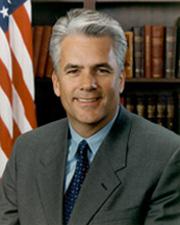 Sen. John Ensign (R-NV)
Legislative Activity
Stay on top of the latest movement without scrolling through every action
Considered by Senate. (consideration: CR S737)
January 18, 2007
View full timeline
Considered by Senate. (consideration: CR S737)
January 18, 2007
Proposed amendment SA 25 withdrawn in Senate.
January 18, 2007
Considered by Senate. (consideration: CR S636)
January 17, 2007
Considered by Senate. (consideration: CR S550)
January 16, 2007
Considered by Senate. (consideration: CR S486)
January 12, 2007
Senate amendment submitted
January 11, 2007
Senate amendment proposed (on the floor): Amendment SA 25 proposed by Senator Ensign to Amendment SA 3.(consideration: CR S417-418, S432-433; text: CR S418; text as modified: CR S432)
January 11, 2007
Amendment SA 25 proposed by Senator Ensign to Amendment SA 3. (consideration: CR S417-418, S432-433; text: CR S418; text as modified: CR S432) To ensure full funding of the Department of Defense within the regular appropriations process, to limit the reliance of the Department of Defense on supplemental appropriations bills, and to improve the integrity of the Congressional budget process.
January 11, 2007
Text
Proposed
LEGISLATIVE TRANSPARENCY AND ACCOUNTABILITY ACT OF 2007

The PRESIDING OFFICER. Under the previous order, the Senate will
resume consideration of S. 1, which the clerk will report by title.
The legislative clerk read as follows:

A bill (S. 1) to provide greater transparency in the
legislative process.

Pending:

Reid amendment No. 3, in the nature of a substitute.
Reid amendment No. 4 (to amendment No. 3), to strengthen
the gift and travel bans.
DeMint amendment No. 11 (to amendment No. 3), to strengthen
the earmark reform.
DeMint amendment No. 12 (to amendment No. 3), to clarify
that earmarks added to a conference report that are not
considered by the Senate or the House of Representatives are
out of scope.
DeMint amendment No. 13 (to amendment No. 3), to prevent
government shutdowns.
DeMint amendment No. 14 (to amendment No. 3), to protect
individuals from having their money involuntarily collected
and used for lobbying by a labor organization.
Vitter/Inhofe amendment No. 9 (to amendment No. 3), to
place certain restrictions on the ability of the spouses of
Members of Congress to lobby Congress.
Vitter amendment No. 10 (to amendment No. 3), to increase
the penalty for failure to comply with lobbying disclosure
requirements.
Leahy/Pryor amendment No. 2 (to amendment No. 3), to give
investigators and prosecutors the tools they need to combat
public corruption.
Gregg amendment No. 17 (to amendment No. 3), to establish a
legislative line item veto.

The PRESIDING OFFICER. The Senator from Illinois.

Amendment No. 11

Mr. DURBIN. Mr. President, I come to the Chamber to discuss DeMint
amendment No. 11 which relates to earmark reform.
First, let me say that I welcome the Senator's efforts to strengthen
this bill. We certainly all have a mutual interest in making this
process more transparent. Senator DeMint, in his amendment language,
adopts the language passed by the House in several important ways. As
we move through the process, we are going to work together to ensure
that the earmark provisions are carefully crafted and as strong as
possible.
Unfortunately, overall the DeMint language is not ready for this
bill. The DeMint amendment defines earmarks to include amounts provided
to any entity, including both non-Federal and Federal entities. The
Reid-McConnell definition which is before the Senate covers only non-
Federal entities. On its face, the DeMint language may sound
reasonable. After all, I have no problem announcing to the world when I
have secured funding for the Rock Island Arsenal in my State. But the
DeMint language is actually unworkable because it is so broad.
What does the Appropriations Committee do? It allocates funds among
programs and activities. Every appropriations bill is a long list of
funding priorities. In the DeMint amendment, every single appropriation
in the bill--and there may be thousands in any given appropriations
bill--would be subject to this new disclosure requirement, even though
in most cases the money is not being earmarked for any individual
entity. How did we reach this point in the debate?
There is a concern expressed by some that there is an abuse of the
earmark process. When you read the stories of some people who have been
indicted, convicted, imprisoned because of earmarks, it is
understandable. There was a corruption of the process. But as a member
of the Senate Appropriations Committee, I tell my colleagues that by
and large there is a race to the press release. Once you put an earmark
in to benefit someone in a bill, you are quick to announce it--at least
I am because I have gone through a long process evaluating these
requests and come up with what I think are high priorities. So there is
transparency and there is disclosure.
The purpose of our debate here is to consider reasonable changes in
the rules to expand that disclosure. Senator DeMint is talking about
something that goes way beyond the debate that led to this particular
bill. We are not talking in his amendment about money that goes to non-
Federal entities--private companies, for example--or States or local
units of government. Senator DeMint now tells us that we have to go
through an elaborate process when we decide, say, within the Department
of Defense bill that money in an account is going to a specific Federal
agency or installation. That is an expansion which goes way beyond any
abuse which has been reported that I know of. Frankly, it would make
this a very burdensome responsibility.
If I asked the chairman, for example, to devote more funds to the
Food and Drug Administration to improve food safety--think of that,
food safety, which is one of their responsibilities--that is
automatically an earmark under the new DeMint amendment, subject to
broad reporting requirements. No one can be shocked by the suggestion
that the Food and Drug Administration is responsible for food safety.
They share that responsibility, but it is one of theirs under the law.
So if I am going to put more money into food safety, why is that being
treated as an earmark which has to go through an elaborate process? I
think that begs the question. Every request, every program, money for
No Child Left Behind, for medical research at the National Cancer
Institute, for salaries for soldiers, for combat pay for those serving
in Iraq, for veterans health programs, every one of them is now
considered at least suspect, if not an odious earmark, under the DeMint
amendment. It is not workable. It goes too far.
In other instances, the DeMint amendment does not go far enough. To
pass this amendment at this time could, down the road, harm the
Senate's efforts to achieve real earmark reform.
Many of us on the Appropriations Committee happen to believe that the
provisions in tax bills, changes in the Tax Code, can be just as
beneficial to an individual or an individual company as any single
earmark in an appropriations bill. If we are going to have transparency
in earmark appropriations, I believe--and I hope my colleagues share
the belief--that should also apply to tax favors, changes in the Tax
Code to benefit an individual company or a handful of companies. The
DeMint amendment does not go far enough in terms of covering these
targeted tax benefits. The language already in the Reid-McConnell
bipartisan bill strengthens the earmark provisions passed by the Senate
last year by also covering targeted tax and trade benefits. The Reid-
McConnell language on targeted tax benefits is superior to the DeMint
amendment. The DeMint amendment, in fact, weakens this whole aspect of
targeted tax credits and their disclosure.

Reid-McConnell covers ``any revenue provision that has practical
effect of

[[Page S416]]

providing more favorable tax treatment to a particular taxpayer or a
limited group of taxpayers when compared with other similarly situated
taxpayers.'' That is the language from which we are working. Consider
what it says: favorable tax treatment to a particular taxpayer or a
limited group of taxpayers compared to others similarly situated. That
is a pretty broad definition. It means that if you are setting out to
give 5, 10, 15, or 20 companies a break and several hundred don't get
the break, that is a targeted tax credit which requires more
disclosure, more transparency.
The DeMint amendment covers revenue-losing provisions that provide
tax credits, deductions, exclusions, or preferences to 10 or fewer
beneficiaries or contains eligibility criteria that are not the same
for other potential beneficiaries. The Senate should not be writing a
number such as 10 into this law or into the Senate rules, creating an
incentive for those who want a tax break to find 11 beneficiaries to
escape the DeMint amendment.
The Reid-McConnell amendment establishes a definition with
flexibility so that facts and circumstances of the particular tax
provision can be considered. There may be instances when a tax benefit
that helps 100 or even 1,000 beneficiaries should be considered a
limited tax benefit. Our bill provides that. The DeMint amendment
weakens it and means that more of these targeted tax credits will
escape scrutiny.
Second, in the interest of full disclosure, the Reid-McConnell
approach requires that the earmark disclosure information be placed on
the Internet 48 hours before consideration of the bills or reports that
contain earmarks. The DeMint amendment does not have a similar
provision. Why would he want to weaken the reporting requirement? That
is, in fact, what he does. Under the DeMint amendment, information
about earmarks must be posted 48 hours after it is received by the
committee, not 48 hours before consideration of the bill. In the case
of a fast-moving bill, it is possible that the information could be
made public only after the vote has already been taken. So this
provision actually weakens reporting requirements.
Finally, it is important that the House and Senate have language that
works for both bodies. Technical changes are probably needed in the
current language in both bills, changes that may come about during the
course of a conference. Adopting the imperfect House language
wholesale, as Senator DeMint suggests, would make it more difficult for
us to work out our differences in conference. The better course would
be to address the final language in conference and not get locked into
any particular words at this moment.
We need strong reforms in the earmarking process. The Reid-McConnell
bipartisan amendment does that. Unfortunately, DeMint amendment No. 11
weakens it--first, in exempting more targeted tax credits instead of
being more inclusive; second, in weakening reporting requirements
already in this amendment; and finally, tying the hands of conferees by
adopting House language that has already been enacted by that body.
The Reid-McConnell substitute is an excellent first step. I am afraid
the DeMint amendment does not improve on that work product but detracts
from it. To adopt this amendment will only take us backward in this
process. I urge the Senate to oppose the DeMint amendment No. 11. Let's
keep working on this issue together on a bipartisan basis.

Amendment No. 13

I would also like to discuss DeMint amendment No. 13. This amendment
on the surface seems like a harmless amendment. Nobody wants a
Government shutdown. But in truth, what amendment No. 13 does is
encourage Congress to abdicate its appropriations responsibility and
fund the Government on automatic pilot at the lowest levels of the
previous year's budget or the House- and Senate-passed levels. That is
what we are in the process of doing for this fiscal year. It is
painful. But the results could be disastrous if it becomes the policy
of our country. Funding the Government by continuing resolutions does
not allow Members to adequately work for a consensus to adjust funding
for new challenges and changing priorities. The responsibility to
appropriate was duly outlined for the legislative branch by our
forefathers in our Constitution. It is a duty we should not abandon by
handing it over to some automatic process.
The Senator from South Carolina has argued that this amendment is
needed so that Congress should not feel the pressure to finish
appropriations bills on time. He is plain wrong. If there is anything
we need, it is the pressure to finish on time. If we are under that
pressure, it is more likely we will respond to it. But if we are going
to glide into some automatic pilot CR that absolves us from our
responsibility of passing appropriations bills, we will find ourselves
in future years facing the same mess we face this year, when many of
the most important appropriations bills were not enacted before the
last Congress adjourned.
Our constituents look to us to complete our appropriations bills on
time, not make it easy to govern by stopgap measures that underfund
important priorities such as education, transportation, and health
care. Incidentally, the last time Congress completed its appropriations
process on time was the 1995 fiscal year. Rather than abdicate our
responsibility, we need to focus on fulfilling that duty under the
Constitution. I believe this DeMint amendment is not responsible. It
signals our willingness to throw in the towel before the fight has even
started.
I urge my fellow Senators to oppose this amendment, send a clear
message to the American people that we are ready to accept our
responsibilities and not avoid them.
I yield the floor.
The PRESIDING OFFICER. The Senator from South Carolina is recognized.
Mr. DeMINT. Mr. President, I am not quite prepared to make all of my
remarks about the amendments, but I did happen to be in the Chamber,
and Senator Durbin was kind enough to open the discussion on two of my
amendments, which I greatly appreciate. I am somewhat disappointed,
however, that my colleague is not completely informed about these
amendments.
I will start with the amendment that attempts to more accurately
define what an earmark is. My colleague went to great pains to
continuously describe this as the DeMint amendment, the DeMint
language. Unfortunately, I am not sure if he knows, but this is the
language which the new Speaker of the House, Nancy Pelosi, has put in
this lobbying reform bill in order to make it more honest and
transparent. I believe she has a very thoughtful approach. She
campaigned on this, along with a number of Democrats and Republicans.
We do need to disclose and make transparent every favor we do for an
entity.
I am beginning to get disappointed in this process because I did
believe in a bipartisan way that we were going to come together to try
to do things to show the American people that we were going to spend
their money in an honest way and that was not wasteful. But as we look
back on some of the scandals, the first one that comes to mind,
obviously, is the Abramoff scandal--using Indian money to try to buy
influence on Capitol Hill.
Yesterday there was a thoughtful amendment by Senator Vitter that
would have attempted to get the Indian tribes to play by the same rules
everyone else in America plays by, that they have regulated
contributions that are disclosed. The reason we had the scandal with
Abramoff is the Indian tribes are not regulated by the Federal Election
Commission. They can give unlimited amounts, unaccounted for, and it
corrupted our process. The amendment yesterday very simply said: Let's
just have everyone follow the same rules. Yet that was voted down,
primarily by my Democratic colleagues. I hope they will rethink that.
We would like to bring that amendment back to the floor and make sure
there is adequate discussion because it is hard for me to believe that
anyone who wants to clear up the corruption in Washington would
overlook that a big part of the corruption was caused by unlimited
donations by lobbyists from Indian tribes.
Now we have another problem. We are talking about earmark reform. We
use language here many times in the Chamber that I don't think
Americans understand. When we talk about earmarks, we are talking
usually about lobbyists who come and appeal on behalf of some
organization or business

[[Page S417]]

or whatever for us to do them a favor with taxpayer money. It may be a
municipality that wants a bridge. It may be a defense contractor that
wants a big contract from us. And if we put that money in an
appropriations bill designated just for them, it is an earmark. That is
a Federal earmark. Nancy Pelosi had the wisdom to see that a lot of the
problems we have had came from lobbyists asking for favors that went to
Federal, as well as State, and other types of earmarks.

What other corruption comes to mind as we think about last year? Duke
Cunningham. The corruption there was a Federal earmark. The underlying
bill we are discussing today would not have included that. It would not
have been disclosed. Senator Durbin said that should not be disclosed,
when most of the problems that we have come from that particular type
of earmark.
I think if you look at this in the big picture, we are talking about
trying to let the American people know how we are spending their money.
When we designate their money as a favor to different people and
entities across this country, we want to let them know what we are
doing so we can defend it, so they can see it. But what is a dirty
little secret in the Senate and in the House is that while we are
making this big media display of reforming earmarks and lobbying, 95
out of every 100 earmarks are in the report language of bills that come
out of conference which are not included in the current discussion of
transparency for earmarks.
So the case my dear friend Senator Durbin has made today is that we
want to disclose these particular favors for 5 out of every 100
earmarks in this Senate. That is not honest transparency. If we are
going to do it, let's look at what the new Speaker of the House has
asked us to do. If we are going to go through this process and if we
are going to change the laws and try to tell the American people that
now you can see what we are doing, let's don't try to pull the wool
over their eyes. Speaker Pelosi is right. Many in this Chamber know I
don't often agree with Speaker Pelosi, but she is the new Speaker. One
of her first and highest priorities was to do this ethics reform bill
right. At the top of the list is, if we are going to talk about the
transparency to the American people, let's be honest and show them the
way we are directing the spending of their money. I agree with her. I
am here to defend her language on behalf of the Democratic colleagues
on the House side that let's not try to pull the wool over the American
people's eyes and tell them we are cleaning up these scandals when what
we are doing here would not have affected the Abramoff scandal, the
Cunningham scandal, or any of the scandals we have talked about in the
culture of corruption in this Congress. Let's at least be honest with
the reform we are saying is going to clean up this place. We are not
being honest now. Speaker Pelosi has the right idea.
Let me mention one other thing, the other amendment my colleague was
nice enough to bring up. It is what we call the automatic continuing
resolution. I have been in Congress now for 8 years. This is my ninth
year. Every year, we get toward the end of the year and we have not
gotten all of our appropriations done; it comes down to the last minute
and they are saying we have to vote on this and we have to pass it or
we are going to shut down the Government. So we create this crisis.
Then we don't know what is in all of the bills. They are just coming
out of conference and we have to vote on them, and most of us go home
in December and find out about all of the earmarks and the favors that
were put in the bills. We find it out later because we are not even
given time to read them. We create this crisis and force people to vote
on bills when they don't know what is in them. We are forced to vote on
things that should not be in them so we won't close down the
Government.
We need to stop playing this game at the end of the year that forces
us to accept what lobbyists and Members and staff have worked out that
we don't even know about. If we are serious about decreasing the power
of lobbyists in this place, we need to take the pressure off passing
bad bills at the end of every year. This is a very simple idea.
You will notice, despite what has been said, we passed a continuing
resolution at the end of last year and didn't pass our appropriation
bills. Of course, as you look around, you see the country is still
operating just fine. The thing we don't have is 10,000 new earmarks. I
would make the case we need a system that if we are not able to have
ample debate and discussion about appropriations, we don't have all
this fanfare about closing down the Government every year and scaring
our senior citizens and our veterans that something is not going to
come that they need. Let's have a simple provision that if we cannot
get our work done and agree on what needs to be done and what should be
in these bills, then we will have a continuing resolution until we can
work it out. We will fund everything at last year's level, so that
there is no crisis, there is just responsibility.
That is what is missing here. When we put things into crisis mode, we
cannot see what needs to be seen, or tell America what needs to be told
about these bills, and we pass bills and find out later we have done
things that embarrass us and diminish the future of our country.
This is a simple amendment. I am very disappointed in my Democratic
colleague who wants to help us, I believe sincerely, clean up the way
lobbying works in this place by making things more transparent to the
American people, but these two amendments--one will disclose all
earmarks and the other will take the crisis out of every year and allow
us to pass responsible legislation.
Mr. President, I will have more to say later and I am sure other
Members will also before these amendments come to a vote.
Unfortunately, I have been told that my colleagues don't even want
these bills to come to a vote. They want to try to table them so we
will limit the debate.
I will reserve the rest of my time and yield the floor right now, and
we will discuss more about these amendments after lunch.
I suggest the absence of a quorum.
The PRESIDING OFFICER. The clerk will call the roll.
The legislative clerk proceeded to call the roll.
Mrs. FEINSTEIN. Mr. President, I ask unanimous consent that the order
for the quorum call be rescinded.
The PRESIDING OFFICER. Without objection, it is so ordered.
Mrs. FEINSTEIN. Mr. President, I know the Senator from Texas wishes
to speak. I will only be a minute.
I ask unanimous consent that at 2 p.m. today the Senate proceed to
vote in relation to the DeMint amendment No. 11, to be followed by a
vote in relation to amendment No. 13, regardless of the outcome of the
vote with respect to amendment No. 11; that there be 2 minutes of
debate equally divided before the first vote and between the votes;
further, that at 12:30 p.m. today, Senator Byrd be recognized to speak
for up to 25 minutes, and that Senator Kyl then be recognized for up to
15 minutes; and that no second-degree amendments be in order to either
amendment prior to the vote. Senator DeMint would have up to 45 minutes
under his control.
The PRESIDING OFFICER. Is there objection?
Without objection, it is so ordered.
Mrs. FEINSTEIN. I thank the Chair. I yield the floor.
The PRESIDING OFFICER. The Senator from Utah is recognized.
Mr. BENNETT. Mr. President, I wish to clarify that the time Senator
DeMint has utilized would be counted against the 45 minutes under his
control.
Mrs. FEINSTEIN. That is my understanding.
Mr. BENNETT. Thank you.
The PRESIDING OFFICER. The Senator from Nevada is recognized.

amendments nos. 24 and 25 en bloc

Mr. ENSIGN. Mr. President, I ask unanimous consent that the pending
amendments be laid aside, and I send two amendments to the desk.
The PRESIDING OFFICER. Without objection, it is so ordered.
The clerk will report.
The legislative clerk read as follows:

The Senator from Nevada (Mr. Ensign) proposes amendments
numbered 24 and 25, en bloc, to amendment No. 3.

Mr. ENSIGN. Mr. President, I ask unanimous consent that reading of
the amendments be dispensed with.
The PRESIDING OFFICER. Without objection, it is so ordered.

[[Page S418]]

The amendments are as follows:

amendment no. 24

(Purpose: To provide for better transparency and enhanced Congressional
oversight of spending by clarifying the treatment of matter not
committed to the conferees by either House)

On page 3, strike line 9 through line 11 and insert the
following:
``(a) In General.--A point of order may be made by any
Senator against any item contained in a conference report
that includes or consists of any matter not committed to the
conferees by either House.
(1) For the purpose of this section, ``matter not committed
to the conferees by either House'' shall be limited to any
matter which:
(A) in the case of an appropriations Act, is a provision
containing subject matter outside the jurisdiction of the
Senate Committee on Appropriations;
(B) would, if offered as an amendment on the Senate floor,
be considered ``general legislation'' under Rule XVI of the
Standing Rules of the Senate;
(C) would be considered ``not germane'' under Rule XXII of
the Standing Rules of the Senate; or
(D) consists of a specific provision containing a specific
level of funding for any specific account, specific program,
specific project, or specific activity, when no such specific
funding was provided for such specific account, specific
program, specific project, or specific activity in the
measure originally committed to the conferees by either
House.
(2) For the purpose of this section, ``matter not committed
to the conferees by either House'' shall not include any
changes to any numbers, dollar amounts, or dates, or to any
specific accounts, specific programs, specific projects, or
specific activities which were originally provided for in the
measure committed to the conferees by either House.

amendment no. 25

(Purpose: To ensure full funding for the Department of Defense within
the regular appropriations process, to limit the reliance of the
Department of Defense on supplemental appropriations bills, and to
improve the integrity of the Congressional budget process)

At the appropriate place, insert the following:

SEC.   . SENATE FIREWALL FOR DEFENSE SPENDING.

(a) For purposes of Section 301 and 302 of the
Congressional Budget Act of 1974, the levels of new budget
authority and outlays and the allocations for the Committees
on Appropriations shall be further divided and separately
enforced under Section 302(f) by--
(1) Defense allocation.--The amount of discretionary
spending assumed in the budget resolution for the defense
function (050); and
(2) Nondefense allocation.--The amount of discretionary
spending assumed for all other functions of the budget.

Mr. ENSIGN. Mr. President, I yield the floor.
The PRESIDING OFFICER. The Senator from Texas is recognized.

Amendments Nos. 25 and 26 En Bloc

Mr. CORNYN. Mr. President, I send two amendments to the desk.
The PRESIDING OFFICER. Without objection, the pending amendments are
set aside.
The clerk will report.
The legislative clerk read as follows:

The Senator from Texas (Mr. Cornyn) proposes amendments
numbered 26 and 27, en bloc, to amendment No. 3.

Mr. CORNYN. Mr. President, I ask unanimous consent that reading of
the amendments be dispensed with.
The PRESIDING OFFICER. Without objection, it is so ordered.
The amendments are as follows:

amendment no. 26

(Purpose: To require full separate disclosure of any earmarks in any
bill, joint resolution, report, conference report or statement of
managers)

At the appropriate place, insert the following:
``(a) In General.--It shall not be in order to consider a
bill, joint resolution, report, conference report, or
statement of managers unless the following--
``(a) a list of each earmark, limited tax benefit or tariff
benefit in the bill, joint resolution, report, conference
report, or statement of managers along with:
``(1) its specific budget, contract or other spending
authority or revenue impact;
``(2) an identification of the Member of Members who
proposed the earmark, targeted tax benefit, or targeted
tariff benefit; and
``(3) an explanation of the essential governmental purpose
for the earmark, targeted tax benefit, or targeted tariff
benefit, including how the earmark, targeted tax benefit, or
targeted tariff benefit advances the `general Welfare' of the
United States of America;
``(b) the total number of earmarks, limited tax benefits or
tariff benefits in the bill, joint resolution, report,
conference report, or statement of managers; and
``(c) a calculation of the total budget, contract or other
spending authority or revenue impact of all the congressional
earmarks, limited tax benefits or tariff benefits in the
bill, joint resolution, report, conference report, or
statement of managers;

is available along with such bill, joint resolution, report,
conference report, or statement of managers to all Members
and the list is made available to the general public by means
of placement on any website within the senate.gov domain, the
gpo.gov domain, or through the THOMAS system on the loc.gov
domain at least 2 calendar days before the Senate proceeds to
it.''.

AMENDMENT NO. 27

(Purpose: To require 3 calendar days notice in the Senate before
proceeding to any matter)

At the appropriate place, insert the following:

SEC. __. NOTICE OF CONSIDERATION.

(a) In General.--No legislative matter or measure may be
considered in the Senate unless--
(1) a Senator gives notice of his intent to proceed to that
matter or measure and such notice and the full text of that
matter or measure are printed in the Congressional Record and
placed on each Senator's desk at least 3 calendar days in
which the Senate is in session prior to proceeding to the
matter or measure;
(2) the Senate proceeds to that matter or measure not later
than 30 calendar days in which the Senate is in session after
having given notice in accordance with paragraph (1); and
(3) the full text of that matter or measure is made
available to the general public in searchable format by means
of placement on any website within the senate.gov domain, the
gpo.gov domain, or through the THOMAS system on the loc.gov
domain at least 2 calendar days before the Senate proceeds to
that matter or measure.
(b) Calendar.--The Secretary of the Senate shall establish
for both the Senate Calendar of Business and the Senate
Executive Calendar a separate section entitled ``Notices of
Intent to Proceed or Consider''. Each section shall include
the name of each Senator filing a notice under this section,
the title or a description of the legislative measure or
matter to which the Senator intends to proceed, and the date
the notice was filed.
(c) Waiver and Appeal.--This section may be waived or
suspended in the Senate only by an affirmative vote of \3/5\
of the Members, duly chosen and sworn. An affirmative vote of
\3/5\ of the Members of the Senate, duly chosen and sworn,
shall be required to sustain an appeal of the ruling of the
Chair on a point of order raised under this section.

Mr. CORNYN. Mr. President, I will not debate the amendments at this
time. I appreciate the courtesies extended by the managers. I will come
back later when it is appropriate to debate these particular
amendments.
I yield the floor.
Mrs. FEINSTEIN. Mr. President, I suggest the absence of a quorum.
The PRESIDING OFFICER. The clerk will call the roll.
The legislative clerk proceeded to call the roll.
Mr. CORNYN. Mr. President, I ask unanimous consent that the order for
the quorum call be rescinded.
The PRESIDING OFFICER. Without objection, it is so ordered.
Mr. CORNYN. Mr. President, I understand now might be a convenient
time for the Senate to consider some debate on the amendments I have
just offered, Nos. 26 and 27.
I think the preeminent value, when we talk about ethics debate, that
we ought to be focusing on is transparency. It has been said time and
time again that the old saying is ``sunlight is perhaps the best
disinfectant of all.'' The fact is, the more Congress does on behalf of
the American people that is transparent and can be reported and can be
considered by average Americans in how they determine and evaluate our
performance here, the better, as far as I am concerned.
I am proud to be a strong advocate for open government and greater
transparency. Senator Pat Leahy, now the chairman of the Senate
Judiciary Committee, and I have been cosponsors of significant reform
of our open government laws. We only had modest success last Congress.
We were able to get a bill voted out of the Judiciary Committee. But it
is my hope, given the sort of bipartisan spirit in which we are
starting the 110th Congress and given Senator Leahy's strong commitment
to open government, as well as my own, that we will be able to make
good progress there.
This amendment No. 27 is all about greater transparency that is
healthy for our democracy and essential if we are to govern with
accountability and good faith. I offer this amendment with the goal of
shining a little bit more light on the legislative process in this body
and actually giving all Members of the Senate an ability to do their
job better.
Specifically, this amendment would require that before the Senate
proceeds

[[Page S419]]

to any matter, that each Senator receive a minimum of 3 days' notice
and that, more importantly, the full text of what we will consider will
be made available to the public before we actually begin our work on
it.
What happens now is that in the waning hours of any Congress, we have
a procedure--known well to the Members here but unknown to the public,
perhaps--known as hotlining bills. In other words, presumably
noncontroversial matters can be so-called hotlined, and that is placed
on the Senate's calendar and voted out essentially by unanimous
consent.
The problem is this mechanism, which is designed to facilitate the
Senate's work and move relatively noncontroversial matters, is
increasingly the subject of abuse. For example, in the 109th Congress,
there were 4,122 bills introduced in the Senate. In the House there
were 6,436 bills. Of course, many of these bills run hundreds of pages
in length. The problem is, as I alluded to a moment ago, in the final
weeks of the 109th Congress, I was told there were 125 matters called
up before the Senate for consideration, many of which included costs to
the taxpayers of millions of dollars, including an astonishing 64 bills
in the final day and into the wee hours of Saturday morning before we
adjourned. In fact, as the chart I have here demonstrates, in the last
5 days of the 109th Congress, there was a total of 125 bills hotlined.
As I mentioned, some of these are relatively noncontroversial matters,
but some of them spent millions of dollars of taxpayers' money.
I would think that at a very minimum Senators would want an
opportunity to do due diligence when it comes to looking at the
contents of this legislation and determining whether, in fact, it is
noncontroversial and in the public interest or whether, on the
contrary, someone is literally trying to slip something through in the
waning hours of the Congress in a way that avoids the kind of public
scrutiny that is important to passing good legislation and making good
policy.
Mr. President, I have in my hands a letter in support of this
amendment from an organization called ReadtheBill.org, which I ask
unanimous consent be printed in the Record following my remarks.
The PRESIDING OFFICER. Without objection, it is so ordered.
(See exhibit 1.)
Mr. CORNYN. Mr. President, I know this perhaps seems like a small
thing, but small things can have dramatic consequences.
Let me give an example. Senator X introduces a bill called the Clean
Water Access Act sometime this year. For whatever reason, this bill
doesn't get a hearing or the hearing is held perhaps with just a modest
number of Members actually attending--in other words, it doesn't get a
lot of attention. The bill is one of the thousands of bills introduced.
And let's say my staff or your staff, Mr. President, or other Members'
staff don't really have this bill on the list of priorities, of things
to do; it is not one of the most urgent priorities because it looks as
though perhaps there is not a lot of interest in the legislation. The
bill never gets a vote in committee or on the floor, so Senator X
decides: I have an idea. I will hotline the bill at the end of the
year, at the very end of the Congress in the last few hours. What this
amendment would do would be to impose a very commonsense requirement--
let's give adequate notice that this is legislation which Senator X
intends to move--so that the appropriate scrutiny and consideration may
be given to the bill.
Of course, a notice goes out under the current rule, and the
Senator's staff alerts the Senator to some concern that unless that
happens, it passes by default. That is right, this is essentially an
opt-out system. If the Senator does not object within an hour or two,
the bill goes out by unanimous agreement.
My proposal is that there be simply a modest notice period before the
Senate proceeds to a measure for Senators and their staff to review the
legislation and so the American people and various groups that may have
an interest in it could scrutinize it before we actually consider it
and pass it in the waning hours, perhaps, of a Congress. I don't know
who could really have a legitimate objection to such a requirement. I
look forward to hearing from any of my colleagues who have some
concerns about it, and perhaps I can address those concerns and we can
work together to pass this important, although simple and
straightforward, amendment.
I believe this amendment is certainly common sense and a good
government and open government approach, which is conducive to allowing
us to do our job better. So I ask my colleagues for their enthusiastic
support, and maybe if not their enthusiastic support, at least their
vote in support of this amendment at the appropriate time.

Amendment No. 26

Mr. President, I have also offered Senate amendment No. 26. This is
another amendment designed to offer greater sunshine and this time on
the earmark process. This is an amendment which I have offered in the
spirit that Senator DeMint, the junior Senator from South Carolina, has
offered but with a little bit of additional twist that I would like to
explain.
The current bill requires that all future legislation include a list
of earmarks and the names of the Senators who requested them. Again, I
know we talk in terms of legislative-ese and, of course, an earmark is
something not otherwise provided for within the Federal appropriations
bills but is specifically requested by a Member of Congress--a Senator
or a Congressman--to be included.
Frankly, there are some earmarks that are very positive and very much
in the public interest, but there are others that have been the subject
of abuse, and I don't need to go into that in any great detail.
It is a fact that the American people have grown very concerned about
the abuse of earmarks here, again, primarily because there is not
adequate scrutiny, adequate sunshine on this process, causing them
grave concerns about the integrity of the entire appropriations
process.
My amendment would add a requirement that the budgetary impact for
each earmark be included, as well as a requirement that the total
number of earmarks and their total budgetary impact be identified and
disclosed. The goal is that when we are considering legislation, we
will have a summary document that details the number of earmarks, the
total cost of those earmarks, and a list of the earmarks, along with
their principal sponsor. I believe this will allow us, again, to do our
job more diligently and with greater ease.
We will also create a fixed baseline from which we can proceed in the
future and will further allow the American public, as well as our own
staff, to be able to analyze the impact of these earmarks on the
budgeting process.
Consider that the Congressional Research Service studies earmarks
each year and identifies earmarks in each appropriations bill. Through
that study, one can see both the total number of earmarks and the total
dollar value of those earmarks have grown significantly over the last
decade. The total number of earmarks, for example, doubled from 1994 to
2005, and the number appears to likely go up in 2006 as well. The
problem is that getting this data after voting on the legislation is
not particularly helpful after the fact. By requiring that all
legislation contain a list of each earmark, the cost of each earmark,
and the total number and cost of earmarks in the legislation as a
whole, we empower our staffs and, more importantly, the American
people, and ourselves to make better decisions.
As I said, this is not a broadside attack against all earmarks. Some
earmarks are good government, but not all earmarks are good government.
What this would do is give us the information we need to evaluate them,
to have some empirical baseline we can use to evaluate how this impacts
Federal spending and the integrity of the appropriations process.
There is one other little element of this amendment I would like to
highlight. This amendment would also require an explanation of the
essential governmental purpose for the earmark or a targeted tax
benefit or targeted tax tariff benefit, including how the earmark
targeted tax benefit or targeted tariff benefit advances the general
welfare of the United States of America. This requirement--again,
something I think most people would assume would be part of the
analysis

[[Page S420]]

and deliberative process Congress would undertake anyway--is an
important reform for the Congress, and it is certainly appropriate on
the subject of ethics reform.
Take, for example, these situations: In the fiscal year 2004 budget,
there was a $725,000 earmark for something called the Please Touch
Museum; $200,000 of Federal taxpayers' money was appropriated by an
earmark for the Rock and Roll Hall of Fame. Even those who like rock
and roll may question the appropriateness of taxpayers' money being
spent to subsidize the Rock and Roll Hall of Fame. Mr. President,
$100,000 was spent for the International Storytelling Center.
In 2005, $250,000 was spent in an earmark for the Country Music Hall
of Fame. I myself am partial to country music. I like country music,
but I think many might question whether it is appropriate that Federal
taxpayers' dollars be spent by an earmark, here again largely anonymous
because it is not required to be disclosed who the Senator is under
current law, who has requested it, but a quarter of a million dollars
of taxpayers' money has been spent for that purpose.
Another example: $150,000 for the Grammy Foundation and $150,000 for
the Coca-Cola Space Science Center.
These are just a couple of quick examples, but I think they help make
the point; that is, under the status quo, there is simply not enough
information, not enough sunshine shining on the appropriations process
and particularly the earmark process which has been the subject of so
much controversy, and yes, including some scandal leading up to this
last election on November 7. If there is one certain message I think
all of us got on November 7, it is that the American people want their
Government to work for them and not for special interests.
One of the best things we can do, rather than passing new rules, is
to shine more sunlight on the process. With more sunlight comes greater
accountability, and I think in many ways it provides a self-correcting
mechanism. In other words, people are not going to be doing things they
think they can sneak through in secret out in the open. So it has the
added benefit of sort of a self-policing or self-correcting mechanism
as well.
So I would commend both of these amendments for the Senate's
consideration. At the appropriate time, I will ask for a vote, working,
of course, with the floor managers on this bill.
Mr. President, I yield the floor.

Exhibit 1

ReadtheBill.org,

Washington, DC, January 11, 2007.
Hon. John Cornyn,
U.S. Senate,
Washington, DC.
Dear Senator Cornyn: ReadtheBill.org Education Fund
commends you for your leadership in proposing an amendment to
S. 1 that would prohibit floor consideration of legislation
and conference reports before senators and the public had
more time to read them. If implemented in Senate rules, this
Cornyn amendment would be a significant improvement over
current Senate rules, and over Senate practice during the
109th Congress.
ReadtheBill.org respects the openness of the sponsors of S.
1 to additional improvements on the floor. As proposed, S. 1
would amend Senate rule XXVIII to prohibit consideration of
conference reports before they have been publicly available
online for 48 hours. S. 1 would improve on current Senate
rules. However, S. 1 would NOT cover legislative measures or
matters on their first consideration by the Senate (as
opposed to final conference reports). This is a major failing
of S. 1. It's crucial to find and fix questionable provisions
early in the legislative process. By the time a bill emerges
from conference committee in its final form, it can be too
late to fix even its worst provisions. Yes, the conference
report can be posted online. But a conference report can
gather the political momentum of a runaway train. Posting the
manifest for each train car may reveal a sinister or illicit
cargo. But it's too late to do more than wave an arm before
the train is long gone.
That is why it is so important to take time to read bills
early in the legislative process, before their first floor
consideration by the Senate. The Cornyn amendment would cover
ALL measures or matters (but no amendments), prohibiting
their consideration until they had been printed in the
Congressional Record for three calendar days and posted
publicly online for two calendar days. ReadtheBill.org
endorses the substance of the Cornyn amendment.
The Cornyn amendment would be a vital step toward
ReadtheBill.org's ultimate goal of amending the standing
rules of the Senate and House to require legislation and
conference reports to be posted online for 72 hours before
floor debate. As work on this bill continues, ReadtheBill.org
looks forward to working closely with you to craft the most
practical, enforceable amendment that moves toward this goal.
Non-partisan and focused only on process, ReadtheBill.org
is the leading national organization promoting open floor
deliberations in Congress.
Sincerely,
Rafael DeGennaro,
Founder & President.

Mr. THOMAS. Mr. President, I would like to speak in general, so I ask
unanimous consent that the current amendment be set aside.
The PRESIDING OFFICER. Without objection, it is so ordered. The
Senator from Wyoming is recognized.
Mr. THOMAS. Mr. President, I wish to speak in general about the bill,
not on the specific amendments, about what I think we are doing and the
importance, frankly, of what we are doing. We are talking, of course,
about ethics, about how we function within this body, and I hope we can
keep that in mind. We are not talking about Federal law. We are not
talking about rules and laws dealing with contributions. We are talking
about how we operate within this body.
I happen to be a member of the Ethics Committee, and I have been very
impressed, frankly, with what we are doing now. That is not to say we
can't do some more, and indeed we should, but the fact is we have
really gone along fairly well here. We haven't had any real problems
particularly. We are reacting largely to some of the problems that have
happened on the other side of the Capitol, and they could happen here,
so they are appropriate. So I believe we need to evaluate where we are
now with the rules and regulations we have with the Ethics Committee,
which is designed to enforce them, and try to maintain our focus on
those kinds of things.
I think we have gotten into things that become Federal law in terms
of, for instance, political contributions. Well, that is really not an
ethics issue; that is a Federal issue with relation to what is done
there. So it seems to me the real overriding opportunity for us is to
increase the transparency of how we function and the accountability and
to spend more time with the Members and with the staff in terms of
familiarizing ourselves with what the rules are. We have lots of rules.
Quite frankly, as I came onto this committee, I was a little impressed
with all there is that most of us haven't had much time or opportunity
to take a look at.
So really what we need is transparency and accountability, and that
is what we are doing. I am pleased that we are, but I want to suggest
that we keep in mind the role of what we are doing, the role of ethics,
and try to maintain some limits on the kinds of things we do and hold
it to what we are doing. As I said, our record has been pretty good. I
think the key is transparency and accountability, so I hope we can hold
it to that.
I think we need to understand that even though there have been things
that have happened in the Capitol that we don't like, the fact is the
people who have done most of those things, many of them, are in jail.
They have acted against the law. The Jack Abramoff thing, which has
brought much of this about, was wrong and bad and has been dealt with
and is being dealt with. I think we need to keep that in mind and try
to define the difference between ethics and behavior here and legal
activities that affect everyone.
So again, I say ethics is something for which each of us is
responsible. As representatives of our people, we are responsible for
it. So if we have transparency, that is one of the keys. And we should
understand that what we are doing is dealing with ethics rules. When
this is all over, we ought to be able to take another look at the total
of our rules and hold what we are doing here on the floor to that
effort. We can do that.
There are a good many reforms in S. 1, and I am pleased we are
talking about earmarks, which is one topic of reform. There needs to be
more public information. There needs to be more information to Members
as to what earmarks are. On the other hand, if I want to represent
things that are important to my State or your State or anyone else's
State, we need from time to time to have an opportunity to suggest that
here is an issue in this budget

[[Page S421]]

which needs to be dealt with. Now, it needs to be done early on. It
needs to be transparent. Everyone needs to know about it. We need to
avoid the idea of putting things in during the conference committee
meetings. After all, Members' opportunities have passed. That is wrong.
But I think the idea that Members have an opportunity to have some
input into the distribution of funding for their States is reasonable.
So I think, again, transparency is the real notion, and the conference
reports ought to be available on the Internet.
Banning gifts, of course, is good. I think we need to be a little
careful about what gifts are and whom they are from.
I just had an opportunity to meet with someone who is a realtor in
Wyoming. He came in to talk about problems for realtors. He is not a
lobbyist; he is a realtor. Now, am I supposed to be a little careful to
talk to somebody from Wyoming? How else am I going to know what the
issues are for the various groups? Even though they have an association
and he is probably a member of it, he is not a lobbyist. So I think we
need to be sure we identify some of the differences that are involved.
We ought to talk about holds. I think there is nothing wrong with
having a distribution of what the holds are when we are putting them
together in Congress and then putting them in the Congressional Record.
Again, that is something which should be public.

Travel. I think there is nothing wrong, with major travel, with
having some sort of preapproval from the Ethics Committee. That is a
reasonable thing to do. We each have different problems with travel.
Some States are quite different from others. Charters can be made to
different places, so we need to have some flexibility there. Again, I
say one of the keys is to have some annual ethics training, some annual
ethics information so people know what it is all about. I would venture
to say that before this discussion started, if you talked about what is
in our ethics rules, most of us wouldn't be able to tell you much about
them. We need to do more of that.
There needs to be public disclosure of lobbying, there is no
question, and that is a good thing and we need to do that.
The idea of an independent ethics office troubles me a good deal. We
are talking about our behavior among ourselves as Members, and the idea
of having some non-Member office overseeing our operation just doesn't
seem to make sense to me. If any of you have not had the opportunity to
see all of the things that our Ethics Committee staff goes through, I
wish you would take a look at it. There is a great deal that goes on.
So in sum, I am generally saying that I hope--and I think our leaders
on this issue have done this--we stay with what it is we are seeking to
do; that is, take a look at our rules and regulations and how we abide
by them, how we understand them, how we enforce them, and how we have
opportunities to see them, and that there is transparency from them.
That is what we are talking about. When we start getting off into so
many things that really are much beyond ethics and get into the laws--
for instance, as I said, campaign contributions--that is another issue.
It is a good issue, but it is not this issue. So I hope we are able to
do that.
Those are the points I wanted to make. We are going to be going
forward, and I am glad we are. I hope we don't spend too much time on
this because I think our real challenge is to focus on what it is we
are really seeking to do and not let us spend a lot of time on things
that are inappropriately in this bill. Our main goal, it seems to me,
is greater transparency, a set of rules we can understand, the
opportunity to know what those are, and then, of course, to have an
opportunity within our own jurisdiction to enforce them.
I yield the floor, and I suggest the absence of a quorum.
The PRESIDING OFFICER. The clerk will call the roll.
The legislative clerk proceeded to call the roll.
Mr. BYRD. Mr. President, I ask unanimous consent the order for the
quorum call be rescinded.
The PRESIDING OFFICER (Mr. Nelson of Florida). Without objection, it
is so ordered.
Under the previous order, the Senator from West Virginia is
recognized for up to 25 minutes.

Iraq

Mr. BYRD. Mr. President, last night in his address to the Nation, the
President called for a ``surge'' of 20,000 additional U.S. troops to
help secure Baghdad against the violence that has consumed it.
Unfortunately, such a plan is not the outline of a brave new course, as
we were told, but a tragic commitment to an already failed policy; not
a bold new strategy but a rededication to a course that has proven to
be a colossal blunder on every count.
The President never spoke words more true than when he said, ``The
situation in Iraq is unacceptable to the American people.'' But the
President, once again, failed to offer a realistic way forward.
Instead, he gave us more of his stale and tired ``stay the course''
prescriptions. The President espoused a strategy of ``clear, hold, and
build''--a doctrine of counterinsurgency that one of our top
commanders, GEN David Petraeus, helped to formulate. Clear, hold, and
build involves bringing to bear a large number of troops in an area,
clearing it of insurgents, holding it secure for long enough to let
reconstruction take place. But what the President did not say last
night is that, according to General Petraeus and his own military
experts, this strategy of ``clear, hold, and build'' requires a huge
number of troops--a minimum of 20 combat troops for every 1,000
civilians in the area. If we apply that doctrine to Baghdad's 6 million
people, it means that at least 120,000 troops will be needed to secure
Baghdad alone. Right now, we have about 70,000 combat troops stationed
all throughout Iraq. Even if they were all concentrated in the city of
Baghdad, along with the 20,000 new troops that the President is calling
for, we would still fall well short of what is needed.
But let us assume that the brave men and women of the U.S. military
are able to carry out this Herculean task and secure Baghdad against
the forces that are spiraling it into violence. What is to keep those
forces from regrouping in another town, another province, even another
country--strengthening, festering, and waiting until the American
soldiers leave to launch their bloody attacks again? It brings to mind
the ancient figure of Sisyphus, who was doomed to push a boulder up a
mountainside for all of eternity, only to have it roll back down as
soon as he reached the top. As soon as he would accomplish his task, it
would begin again, and this would go on endlessly. I fear that we are
condemning our brave soldiers to a similar fate, hunting down
insurgents in one city or one province only to watch them pop up in
another. For how long will U.S. troops be asked to shoulder this
burden?
Over 3,000 American soldiers have already been killed in Iraq; over
22,000 have been wounded. Staggering. Hear me--staggering. And
President Bush now proposes to send 20,000 more Americans into the line
of fire beyond the 70,000 already there.
The cost of this war of choice to American taxpayers is now estimated
to be over $400 billion. That means $400 for every minute since Jesus
Christ was born. That is a lot of money.
Hear me now. Let me say that, again. The cost to American taxpayers
of this war of choice is now estimated to be over $400 billion, and the
number continues to rise. When I say number, I am talking about your
taxpayer dollars. That ain't chicken feed. One wonders how much
progress we could have made in improving education or resolving our
health care crisis or strengthening our borders or reducing our
national debt or any number of pressing issues with that amount of
money. Man, we are talking about big dollars. And the President
proposes spending more money, sending more money down that drain.
On every count, an escalation of 20,000 troops is a misguided,
costly, unwise course of action. I said at the beginning we ought not
go into Iraq. I said that, and I was very loud and clear in saying it.
I stood with 22 other Senators. I said from the beginning we ought not
to go into Iraq. We had no business there. That nation did not attack
us, did it? I said from the beginning I am not going down that road and
I didn't and I am not going to now.

[[Page S422]]

This is not a solution. This is not a march toward ``victory.''
The President's own military advisers have indicated we do not have
enough troops for this tragedy to be successful. It will put more
Americans in harm's way than there already are. It will cost more in
U.S. taxpayers' money--your money. You, who are looking through those
lenses, looking at the Senate Chamber, hear what I have to say. Many
commanders have already said that ours is an Army that is at its
breaking point. It is a dangerous idea.
Why, then, is the President advocating it? This decision has the
cynical smell of politics to me, suggesting that an additional 20,000
troops will alter the balance of this war. It was a mistake to go into
Iraq. Now we want to pour 20,000 more of your men and women, your sons
and daughters, into this maelstrom, this sausage grinder, this drainer
of blood and life.
We won't alter the balance of this war. It is a way for the President
to look forceful, a way for the President to appear to be taking bold
action. But it is only the appearance of bold action, not the reality,
much like the image of a cocky President in a flight suit declaring
``mission accomplished'' from the deck of a battleship. Remember that?
This is not a new course. It is a continuation of the tragically
costly course we have been on for almost 5 years now. Too long. I said
in the beginning, I won't go; it is wrong; we should not attack that
country which has never invaded us or attacked us. Those persons who
attacked this country were not Iraqis, right? Somebody says I am right.
It is simply a policy that buys the President more time, more time to
equivocate, more time to continue to resist any suggestion that the
President was wrong to enter our country into this war in the first
place. This war, in this place, at this time, in this manner, and,
importantly, calling for more troops, gives the President more time to
hand the Iraq situation off to his successor in the White House. The
President apparently believes he can wait this out, that he can
continue to make small adjustments here and there to a misguided policy
while he maintains the same trajectory until he leaves office and it
becomes someone else's problem.
If you are driving in the wrong direction, anyone knows, as you will
not get to your destination by going south when you should be going
north, what do you do? What should you do? You turn around. I see the
Presiding Officer is following me. I saw him use his arm like that. He
did just what I did, before I did it. You turn around and get better
directions.
This President--I speak respectfully when I speak of the President. I
speak respectfully of the President; that is my intention--this
President is asking us to step on the gas in Iraq full throttle while
he has not clearly articulated where we are going. What is our goal?
What is our end game? How much progress will we need to see from the
Iraqi Government before our men and women come home? I should think
that is what the fathers and mothers of our American troops would want
to know. What is our goal? What is our end game? In the first place,
why are we there in Iraq? Why are we asking for more troops now? How
much progress will we need to see from the Iraqi Government before our
men and women come home? How long will American troops be stationed in
Iraq, to be maimed and killed in sectarian bloodshed?
The ultimate solution to the situation in Iraq is political and would
have to come from the Iraqis themselves. The Iraqi Government will have
to address the causes of the insurgency by creating a sustainable
power-sharing agreement between and among Sunnis, Shias, and Kurds, and
it is far from clear that the Government has the power or the
willingness at this point. But as long as American troops are there to
bear the brunt of the blame and the fire, the Iraqi Government will not
shoulder the responsibility itself. And Iraq's neighbors, especially
Iran and Syria, won't commit to helping to stabilize the country as
long as they see American troops bogged down and America losing
credibility and strength. Keeping the United States Army tied up in a
bloody, endless battle in Iraq plays perfectly into Iran's hands and it
has little incentive to cease its assistance to the insurgency as long
as America is there. America's presence in Iraq is inhibiting a lasting
solution, not contributing to one.
Let me say that again. I should repeat that statement. Iraq's
neighbors, especially Iran and Syria, won't commit to helping to
stabilize the country as long as they see America bogged down and
losing credibility and strength. Keeping the United States Army tied up
in a bloody, endless battle in Iraq plays perfectly into Iran's hand
and it has little incentive to cease its assistance to the insurgency
as long as America is there. America's presence in Iraq is inhibiting a
lasting solution, not contributing to a lasting solution.
The President has, once again, I say respectfully, gotten it
backwards. What I hoped to hear from the President were specific
benchmarks of progress that he expects from the Iraqi Government and a
plan for the withdrawal of American troops conditioned on those
benchmarks. Instead, we were given a vague admonition that the
responsibility for security will rest with the Iraqi Government by
November, with no suggestion of what that responsibility will mean or
how to measure that Government's capacity to handle it.
The President is asking us--you, me, you, you out there, you who look
around this Chamber today--asking us once again to trust him while he
keeps our troops mired in Iraq. But that trust was long ago squandered.
I weep for the waste we have already seen--lives, American lives, Iraqi
lives, treasure, time, good will, credibility, opportunity--wasted,
wasted. Now the President is calling for us to waste more. I say
enough, enough. If he will not provide leadership and statesmanship, if
he does not have the strength of vision to recognize a failed policy
and to chart a new course, then leadership will have to come from
somewhere else. Enough waste, enough lives lost on this misguided
venture into Iraq.
I said it was wrongheaded in the beginning and I was right. Enough
time and energy spent on a civil war far from our shores while the
problems Americans face are ignored. Yes, while the problems that you,
the people out there, face--you, the people on the plains and mountains
and in the hollows and hills, your problems--we wallow in debt and
mortgage our children's future to foreigners. That is what we are
doing. We are continuing. We are asking now for more, more, more. Not:
Give me more, more, more of your kisses but more, more of your money,
more, more of your lives. Enough. It is time to truly change course.
Mr. President, it is time to look at the compass, time to change course
and start talking about how we can rebalance our foreign policy and
bring our sons and daughters home--bring our sons and daughters home.

There are a lot of people making political calculations about the war
in Iraq, turning this debate into an exercise of political
grandstanding and point scoring. But this is not a political game. This
is a game of life and death. This is asking thousands more Americans to
make the ultimate sacrifice for a war that we now know, beyond a shadow
of a doubt, was a mistake. We had no business going into Iraq. We had
no business invading a country that never posed an imminent threat, a
serious threat to our own country.
There were those of us who cautioned against the hasty rush to war in
Iraq. And I have some credibility on that score. I cautioned against
it, yes. And there were others in this Senate Chamber who stood against
the hasty rush to war in Iraq. Unfortunately, our cries, like
Cassandra's, went unheeded. Like Cassandra, our warnings and our fears
proved to be prophetic--proved to be prophetic.
But we are not doomed to repeat our mistakes. We ought to learn from
the past. We must understand--and understand it now, and understand it
clearly--that more money and more troops--more American troops, more
American lives lost in Iraq--are not the answer.
The clock--there is the clock above the Presiding Officer's chair.
There it is. There is the clock. There is another one behind me on this
wall. These clocks are running, running, running

[[Page S423]]

on our misadventure. And I can say that with credibility because I said
it was a misadventure in the beginning--our misadventure into Iraq.
Enough time has been wasted, Mr. President. Enough. Enough. Hear me:
Enough. Enough time has been wasted.
Mr. President, I yield the floor.
The PRESIDING OFFICER (Mr. Obama). My understanding is, under the
previous order, the Senator from Arizona is recognized for up to 15
minutes.

Iraq

Mr. KYL. Mr. President, I suppose it was inevitable, the criticism of
the President's announcement last night. But I ask: What happened to
all of the promises of last week, the talk of bipartisanship, the talk
of trying to work together, especially on the biggest challenge of our
time, this challenge to our national security? Where is the unity that
we need at this time for this issue more than at any other? I am
disappointed by the attacks on President Bush's strategy, particularly
because they come primarily from people who have offered no
alternative. It seems to me that threatening to cut off funding for our
troops, as some have done, while not giving the President's Iraq
strategy a chance, is the worst kind of partisan politics.
When dealing with issues of war and peace, and trying to devise a
strategy that will result in the least harm to Americans, with the
greatest chance of success, it seems to me we should be trying to find
common ground.
The critics of the President throughout last year called for a new
strategy and interpreted the election results of 2006 as substantially
a repudiation of the President's strategy and confirmation that there
needed to be a new strategy.
After consulting with Members of Congress, with generals, with
retired generals, with other experts, the Baker-Hamilton Commission,
and many others, the President has come up with another strategy, and
he announced that strategy last night. It seems to me that we at least
owe him the opportunity to see whether that strategy can work before
immediately attacking it as a policy that is bound to fail, especially,
as I said, because I have seen no alternative.
The only alternative is that we withdraw. There are a lot of
different ways that we would withdraw, and timetables for withdrawal,
but they all come down to withdrawing. That suggests that leaving the
Iraqi forces to establish the stability and peace that is required in
Iraq is likely to be more successful than the Iraqi troops combined
with U.S. troops--a proposition which, it seems to me, is incredible on
its face. So where is the alternative strategy for success?
Now, one of our colleagues, earlier this morning, said:

We are in a hole in Iraq, and the President says the way to
dig out of this hole is to dig deeper. Does that make sense,
when you are in a hole, you get out by digging deeper? This
is a reckless plan. It is about saving the Bush Presidency.
It is not about saving Iraq.

Well, let me talk about the two elements of that--first, the analogy,
which I think breaks down. I have used it before. It is a good analogy
in certain situations. But it is a little bit like saying that when the
first wave of our boys hit the Normandy beaches, because many of them
were dying, that it made no sense to add more forces, to land the rest
of our troops on the beach. And that, of course, was not the case.
Mr. BYRD. Mr. President, will the Senator yield?
Mr. KYL. Mr. President, I will be happy to yield to the distinguished
Senator from West Virginia.
Mr. BYRD. Those of us who disagreed with the plan to go into Iraq in
the beginning--and now who disagree with the request that we put more
troops into Iraq--we are not talking about the Normandy beach. That was
an entirely different matter.

What are we fighting for over here in Iraq? Why are the American
people sending their boys and girls into Iraq, a country that has not
attacked us? Why are we sending our boys and girls to have their blood
spilled in that faraway country? For what? For what are we spending
these billions of dollars?
I cannot understand it. I say that most respectfully to the
distinguished Senator, who is my friend.
Mr. KYL. Mr. President, I would say to the distinguished Senator from
West Virginia, the Senator asked that question in his remarks a few
minutes ago, and I had written down that is a fair question. I am
prepared to answer that question, and I would like to answer that
question. If the Senator would allow me just to finish the point I was
making earlier, I will answer that question.
Mr. BYRD. Yes. Very well. I thank the Senator.
Mr. KYL. I might say, by the way, that is the central question, and
it has not been adequately answered to date. I will concede that to my
friend from West Virginia. But there is an answer, I believe, that
justifies, that warrants our participation, and I will make that point.
The point I wanted to make before is that simply because you are
having a problem achieving something does not mean it is wrong to try
to figure out a new strategy to win. And sometimes applying more force
can supply that element, that missing element.
Mr. BYRD. Mr. President, will the Senator yield for a question?
Mr. KYL. Yes, of course, I will be happy to.
Mr. BYRD. What is it we are seeking to achieve by putting more troops
into Iraq?
Mr. KYL. Mr. President, first of all, I ask unanimous consent that
the time used by the Senator from West Virginia not count against the
time I was given.
The PRESIDING OFFICER. Without objection, it is so ordered.
Mr. KYL. Secondly, since the Senator has remained on the Senate floor
and asked that question a second time, I will go ahead and move to
answer that question, and then come back to the other points I was
going to make a moment ago.
Basically, the Senator asked two questions: Why are we there in the
first place; and, secondly, how is this strategy supposed to enable us
to achieve the victory we seek to achieve?
Let me answer that second question first, briefly, because the
President talked about this last night. The concept that the President
outlined was one that he had developed, or our forces in Iraq had
developed with the Maliki government. And it was predicated on a
commitment that the President received from the Iraqi Government that
it would be willing to do some things differently in the future.
Specifically, what? We appreciate until peace and stability come to
Iraq, it is not going to be possible for that Iraqi Government to
engage in the political and economic reforms that will be necessary for
that society to move forward.
How does one achieve peace and stability? For most of the country
there is relative peace. But everyone agrees in Baghdad itself there is
great conflict and killing. So the President talked last night about a
division of the city into nine specific regions, bringing in more
troops from the Iraqi Government, twice as many more as the United
States would bring in, in order not just to clear those areas of the
killers, as the President called them, but to hold the areas, to
prevent them from coming back in and then causing harm to the innocent
Iraqi civilians.
The Maliki government had talked about doing this in the past. But
when we did the clearing, the killers were allowed to come back and
continue their bad action right after we left. We established
checkpoints and curfews, and the Iraqi Government said they would like
for us to eliminate those checkpoints and curfews. We would arrest
these killers and put them in jail, but the Iraqi Government would let
them back out. In other words, it was doing things that were
antithetical to our ability to consolidate the original victory we
obtained by clearing those areas of the killers.
The President obtained a commitment from Maliki that this would
change, so the strategy now would be with Iraqi troops taking the lead
and American troops assisting, to clear the areas and hold them, and
hold the killers responsible, keep them from killing again, and go
after the militias, especially in Baghdad, that were doing most of this
killing.
Now, that would require some additional troops in Baghdad, and the
President talked about the number of troops that would be provided for
that. He said the other area where troops

[[Page S424]]

would be provided would be in Al Anbar Province, to the west, where the
al-Qaida terrorists had basically developed a tremendous amount of
strength and taken over parts of that area, and some additional troops
would be needed there.
There were other elements of the President's speech. There were well
over 20, as I counted them, of different parts of this strategy. But
the key elements were the ones I just mentioned. So that is the role
these additional troops are supposed to play.
Now, to the more fundamental question that the Senator asked, if one
only looks at Iraq in a vacuum, I can easily understand why one would
come to the conclusion that with the death and destruction there, and
the harm to our own troops, it does not make sense for us to be there.
But Iraq is not in a vacuum. Iraq is part of a larger war. And this
is one thing that both Osama bin Laden and George Bush agree on,
probably the only thing: Both of them have called the battle in Iraq
critical to achieving victory in the ultimate--the President calls it
the war against terrorists; bin Laden calls it the holy jihad. But, in
either case, they understand that the loser in this battle in Iraq is
not likely to be able to prevail in the larger global war.
In bin Laden's case, he is talking about the war to establish the
califate, and he says that Baghdad will be the capital of the califate.
This is the area that will be ruled by Sharia, the strict law of his
interpretation of Islam. The U.S. concept of victory is a peaceful,
stable Iraq that can maintain its society and borders and be an ally
with us in the war against the terrorists.
Our security there is identified in two ways. First, because of the
al-Qaida and other terrorists who, as I said, have done a tremendous
amount of damage in Al Anbar Province and who initiated a lot of the
conflict between the Shiites and the Sunnis, among other things, by
bombing one of the most holy of the Shiite mosques; they have initiated
a lot of this terrorism. We have to be able to defeat al-Qaida and the
other terrorists in Iraq.
Secondly, we cannot lose the momentum we have gained in this war
against these terrorists in places such as Jordan and Egypt and Saudi
Arabia and Pakistan and Afghanistan and Yemen and other places. From a
situation where they were actually helping terrorists, we have gotten
to a point where they are actually helping us to find and root out and
capture or kill the terrorists. Were we to leave Iraq a failed state,
it would not only be a devastating--I will use the word--Holocaust for
the people of Iraq, especially anyone who tried to help us or
participated with the Iraqi Government, but it would be a horrible blow
to our national security because it would reverse the momentum we have
gained in the war against the terrorists and cause these other states
to begin to hedge their bets in working with us because it is a
dangerous neighborhood. It would be evident that we have no stomach to
stay there and that the terrorists, therefore, can move back in, can
use those as a base of operation and continue, then, to work against
the states of Afghanistan, Pakistan, Saudi Arabia, and the like. In
fact, Saudi Arabia has already talked about trying to provide funding
for Sunnis in Iraq. Iran is providing assistance to Shiites in Iraq.
These are the reasons why it is more than a battle for Iraq but,
rather, to continue the momentum we have gained in dealing with these
radicals all throughout that region.
Mr. BYRD. Will my friend yield?
Mr. KYL. I am happy to yield, again, to my friend.
Mr. BYRD. He used these words: ``We have no stomach to stay there.''
The question is, How long and at what cost? Stay there how long? How
long are the American taxpayers and mothers and fathers going to put up
with the use of their sons and daughters and their money? How long are
they going to continue to want to--I shouldn't say it that way--how
long are they going to continue to put up with this expenditure of
blood and money and for what? I thank my friend for yielding. I hope I
don't appear to be discourteous in any way.
Mr. KYL. Mr. President, the Senator from West Virginia has, again,
asked the most fundamental of all questions. I am going to have to take
some time to go into more detail about my answer to the question. But I
think I have tried to answer one of the two questions: What is the U.S.
security interest in achieving victory in Iraq?
We know that the world in that region would be thrown into absolute
chaos, with probably hundreds of thousands of casualties, if not more,
if we leave Iraq a failed state. Even more directly to America's
interests and to answer the question of how long will Americans support
this effort is the danger that our momentum in the war on terror will
be set back and will be dealt a tremendous blow if we leave Iraq a
failed state and the terrorists are able to then move out from there
and again become dominant in places such as Afghanistan and Pakistan,
the Wahabis, and Saudi Arabia and so on. That would be a terrible blow
to the progress we have made against these terrorists.
Osama bin Laden has a saying about the weak horse and the strong
horse. It has always been his view that we are a weak horse because we
get out when the going gets tough--in Lebanon, in Vietnam, and in
Mogadishu. He believes that just as he thinks he threw the Soviets out
of Afghanistan, he can throw the United States out of all of this part
of the world because we are the weak horse. If we confirm to the people
in that region that he is right, because we will not stay in Iraq
because of the difficulties we have confronted, then we will only
validate the view that he has propounded and make it much more
difficult for us to confront terrorists.
To the question of how long Americans will continue to support this,
I suspect that the answer is only so long as they believe there is a
prospect for success and only so long as the hidden costs of failure
remain hidden. We have not done as good a job as we need to, to say:
All right, maybe this new strategy of President Bush won't work. He
believes it will. There are new commitments from the Iraqi Government
that suggest it will. We are going to be doing things differently. We
believe this has a chance to succeed. We know one thing for sure; that
is, the alternative, withdrawal, is a guarantee for failure. And what
will that failure bring? Who wants the blood on his or her hands of the
hundreds of thousands of people who are likely to be killed as a result
of our leaving Iraq a failed state? Who wants to then ask the question
of why it is that terrorists began to spread their evil ideology
throughout that part of the world to be more effective in potentially
attacking the United States, when, in fact, we have had them on the
run? The evidence of what we did in Somalia is a good illustration. The
fact that the London bombing about 6 months ago was thwarted is another
good illustration of the fact that when we have good intelligence and
when we have the ability to take the fight to the enemy, we make
ourselves more secure.
I appreciate the questions of the Senator from West Virginia. They go
to the heart of this debate. I would hope that we will have the
opportunity soon to expand on these questions and the answers to them
and engage in the kind of debate that we haven't had up to now and this
country needs in order to be able to make the decision of what kind of
support it wants to give to the President or whether it wants to accept
other points of view.
I didn't deliver quite the remarks I intended, but I appreciate the
comments of the Senator from West Virginia. I would be happy to engage
in that discussion in the future.
Mr. BYRD. I thank the Senator for his comments.
The PRESIDING OFFICER. The Senator from Oklahoma.
Mr. COBURN. I ask unanimous consent to ask the Senator from Arizona a
question.
The PRESIDING OFFICER. Without objection, it is so ordered.
Mr. COBURN. The question I have is, The distinguished Senator from
West Virginia asked the question: How long and at what price? But that
is a false choice. Because if we leave Iraq and we walk away, we are
going to be fighting this battle again. So it is not about how long and
at what price; it is, when are we going to have this battle again? I
believe that is up for debate. What the American people lack is the
understanding that if we walk out now, we are going to put young men
and women

[[Page S425]]

again at risk, at far greater numbers and at far greater cost in the
future, as we empower the terrorists. I wonder if the Senator from
Arizona may comment.

Mr. KYL. In response to the Senator from Oklahoma, that is the point
I raised at the very end. It is not only a question of whether the
President's new strategy has a chance to succeed, as he believes it
does, but what is the alternative. If the alternative is leaving Iraq a
failed state, I have barely scratched the surface of identifying the
horrors that that would represent and the dangers to American national
security that it would involve. We need to do a better job of
articulating that alternative. As I see it, that is the only
alternative that has been put forward to the President's new strategy.

Amendments Nos. 11 and 13

The PRESIDING OFFICER. The Senator from South Carolina.
Mr. DeMINT. Mr. President, am I correct in my understanding that I
control the time between now and 2 o'clock.
The PRESIDING OFFICER. Under the previous order, that is correct.
Mr. DeMINT. I thank the Chair.
I am here to discuss two amendments that will be voted on at 2
o'clock. I see my colleague, Senator Coburn, is here to speak on one of
them. I will make a few comments and then yield some time to him.
This whole debate about lobbying and ethics reform is very important
to this Congress. We know from the last election that the American
people are concerned about how we spend our money, about corruption.
The closer we looked at it as Congressmen and Senators, the clearer it
became that the practice we have of earmarking, which is providing some
favor with tax dollars to some group or entity around the country, has
begun to corrupt the process. The scandals we saw on the House side
were mostly related specifically to a lobbyist basically buying an
earmark, a favor we consider scandalous in the Senate.
The new Speaker of the House, Nancy Pelosi, in a thoughtful proposal,
H.R. 6, provided a clear definition of what these earmarks or favors
are, so that when we begin to develop reform of the earmarking process,
we can target those things that are the problem.
That is what my amendment is about. The bill that is on the floor of
the Senate now defines earmarks in a way that only includes about 5
percent of the total earmarks. It would not have included the type of
earmarks that got Congressman Duke Cunningham in trouble. It would not
have included the Abramoff type of scandal either. We often disagree,
but as we start this new session, there is a new climate of
bipartisanship, the need to cooperate, Republicans and Democrats. But
it is also important, between the House and the Senate, that when we
think the House gets it right, whether it is Republican or Democrat, we
should take an honest look at it. In this case, Speaker Pelosi has it
right on the earmarks.
I would like to speak more about it. Before I do, I will yield
whatever time Senator Coburn would like.
The PRESIDING OFFICER. The Senator from Oklahoma.
Mr. COBURN. Mr. President, I don't think you can have a discussion on
earmarks until you set the predicate for what is really going on. It is
not dishonorable to want to help your home State. The vast majority of
those things that are considered earmarks are not bad projects. They
are not dark. They have a common good that most people would say would
be adequate.
The question about earmarks is, What has evolved through the years
and what have they become? I believe earmarks have been the gateway
drug to the lack of control of the Federal budget. The proof of that
is, look at who votes against appropriations bills. I will promise you,
there won't be Senators in this body who have an earmark in a bill that
will vote against the appropriations bill. What does that say? Does
that mean everything in that bill was good; they agree with the bill?
What it means is, they have an earmark in the bill. And if they vote
against it, the next time they want an earmark, they won't get it. So
you have the coercion of using earmarks to control votes.
Our oath is to do what is in the best long-term interest of our
country. No matter what our political philosophy, we are all Americans.
We can all agree about that. And whether we are liberal or
conservative, we don't want any money wasted. But as we spend money on
things that are earmarks that are not bad but definitely should not be
a priority when we are fighting a war and have a gulf catastrophe and a
budget deficit of $300 billion we are passing on to our children, we
get the priorities all out of whack. Priorities are what the American
people said they wanted us back on, and they wanted us back on it
together.
The bill that is on the floor, as the Senator from South Carolina
said, addresses only 5 percent of that problem--5 percent of the
earmarks. The Congressional Research Service looked at that--12,318, of
which 534 would fall under the bill that is on the floor--correction,
12,852 is the total and there are 12,318 that this bill would not apply
to at all. It would have no application to it at all.
The other problem with earmarks is there has to be sunshine. Fixing
the problem to make everybody think we fixed it versus really fixing it
is what this bill does. It is a charade, as far as earmarks are
concerned. There is nothing wrong with wanting an earmark or for me
wanting to bring something to Oklahoma. I have chosen not to do that
because I cannot see how Oklahoma can be helped with an earmark when we
are borrowing $300 billion from our kids and grandkids. I cannot see
how that priority can be greater when it undermines the future standard
of living of our children and grandchildren. But to put this bill up
without the House version--and even it doesn't go far enough because it
doesn't list who the sponsor is until after it is passed. In other
words, you don't know who the sponsor is until after the bills come
through.
We need to be honest with the American people. The only way we are
ever going to get our house in order fiscally is to have complete
transparency on what we are doing, so they can see it. Today the
President of the Senate and I passed a bill that will, after the fact,
create transparency so that everybody will know where all the money
went. But it does nothing before the fact. We need the discipline to
control the spending and to not use this tool of earmarks as a coercive
tool with which we get votes on appropriations bills that are spending
more money than we have.
This last year, a subcommittee I chaired in the last Congress had 46
oversight hearings where we identified over $200 billion in
discretionary waste, fraud, or duplication. We ought to be taking up
those things. We ought to be eliminating that. We can do tremendous
work.
The other thing that is important in the earmark discussion is that
you don't have an earmark if it is authorized. When it is authorized,
that means a committee of the Senate--a group of our peers--looked at
it and said this is a priority and something that should be done;
therefore, it is no longer an appropriations earmark because it has
been approved by the committee of jurisdiction.
The best way to eliminate earmarks is to bring them into the
sunlight, get them authorized, and allow Appropriations to fund them.
That way, we have 100-percent sunshine and the American people know
what we are doing, and we defend that in the public, open arena of
committee hearings. We should not be afraid to do what is right, what
is open, what is honest, and what is transparent for the American
public. They deserve no less than that.
The earmark provision that is in the bill in the Senate that we are
debating right now is cleaning the outside of the cup while the inside
stays dirty. We should not let that happen. There is no doubt in my
mind that Senator DeMint's amendment is going to lose.
So the question has to come to the American public, are you going to
hold the Senate accountable for acting as though they are fixing
something when they are not? Anybody who votes for this bill, with the
language in it the way it is today, is winking and nodding to the
American people and saying we fixed it. But we didn't. Everybody here
knows it won't be fixed with the language as it sits today. So it is
going to

[[Page S426]]

require the American people to have great oversight over us to see who
votes for this bill. If you are voting for this bill, you don't want to
change the way business is done here; you want to leave it exactly the
way it is and leave everything alone. So you want to tell everybody you
fixed it when you didn't. That smacks of a lack of integrity in this
body that belies its history.
I yield back my time.
The PRESIDING OFFICER. The Senator from South Carolina is recognized.
Mr. DeMINT. Mr. President, I thank my colleague for his persistence
and hard work on a very commonsense issue. Many times in this Chamber,
and in the House, we assume on our side that if the Democrats have an
amendment, there is always some trick in it and they are trying to get
us to take a vote and make us look bad; we don't trust each other. I
wish to make an appeal that on this one amendment--this amendment No.
11 we have talked about--there is no trick. It is the exact language
Speaker  Nancy Pelosi put in their ethics bill, because everybody
there--many Republicans and Democrats--agree that if we are going to at
least have a pretense of changing the culture here, we need to be fully
transparent and open and honest in what we are talking about.
As Senator Coburn said, many earmarks are good projects; they help
people and organizations. The problem we have is that in order to get a
few of those things that are good and necessary, we have to vote for
thousands and thousands of earmarks that are not Federal priorities,
and many of them, once disclosed, become an embarrassment to us. I
think it has made the American people jaded about what we do here.
This is an opportunity to at least work together on one thing. The
problem we had--and Senator Coburn mentioned this--in 2006 is that in
the appropriations bills there were 12,852 earmarks. I am sure there
are many that could be defended. But the biggest problem we have as a
Congress is that behind these thousands of earmarks are thousands and
thousands of lobbyists who have been paid to come up here and influence
us in a way that would include a favor for their client in the bill.
Again, many of these are legitimate. But what we have done to ourselves
and our country--it drives me crazy to see a little town in South
Carolina that is paying a lobbyist firm over $100,000 a year because
that firm has promised them they can come up here and get a Federal
earmark for a million dollars or more. What a great return--pay
$100,000 and get a million dollar earmark. We see little colleges,
associations, and businesses hiring lobbyists, hoping to get a
particular earmark. So we have thousands of lobbyists in this town who
are here to try to influence us to do a favor on behalf of their
client. Much of this is legitimate, but our oath and our reason for
being here is for the good of this country. We cannot do business with
thousands and thousands of special interests who are here to influence
us, and we have a system that actually makes it difficult for us not to
go along with that, as Senator Coburn has pointed out.

This amendment is very simple. It doesn't create any kind of rigorous
process for disclosure, which has been claimed here today by the other
side. It simply says if we are going to create a transparent, well-
disclosed process of the earmarks we are putting into a bill, all of
them are disclosed, not just some small definition that includes only 5
out of 100 earmarks. We have already said there were only 534 out of
about 12,800, so we cannot pretend to be putting a stop to the
corrupting process of money here in the Congress if we try to convince
the American people that somehow we have done some good. If we look at
the corruption we are trying to get rid of, Duke Cunningham on the
House side was influenced by lobbyists to get a Federal earmark from
the Department of Defense. That would not have been included in the
bill that is here on the Senate side. But it would be in Nancy Pelosi's
language. We could stop the corruption before it ever happens.
We have a real opportunity to do something that is significant. If we
are going to spend weeks and weeks--which ultimately we are--with
ethics and lobbying reform and transparency, if we get to the end of
this and we have something that does not appear remotely honest to the
American people, I think we will all be ashamed of the process we went
through. Unfortunately, yesterday, we voted down an amendment that
would bring another bit of honesty to this organization. We had the big
scandal we talked about in the last election, Abramoff. The problem
there is that Indian tribes in America are allowed to give unregulated
amounts of unaccountable money to Congress to buy influence, and that
is what happened in that case.
We had an amendment yesterday that would have asked the Indian tribes
to play by the same rules every other group in America plays by, but we
voted it down. That means that in the future Indian tribes, with all
their casinos and money, are going to continue to flood Congress with
money and the American people don't know what it is buying, where it is
coming from. It is senseless to go through an ethics reform bill and
overlook something that obvious.
Today, we have something equally as obvious. We have a proposal to
identify and make transparent the earmarks that come through the
appropriation bills. It is something the House has agreed on, and
Speaker Pelosi has made it a top priority. This is not a partisan
trick. This is a commonsense disclosure provision that will be good for
this body.
Mr. COBURN. Will the Senator yield for a moment?
Mr. DeMINT. Yes.
Mr. COBURN. Mr. President, I will make a point. There is nobody down
here defending the other side.
Mr. DURBIN. I am here.
Mr. COBURN. I would love to have a debate on the basis of why the
amendment that is in this substitute should not cover the other 95
percent of the earmarks. I ask the Senator from Illinois, what is the
basis for only covering 5 percent of the earmarks in the bill.
Mr. DURBIN. I thank the Senator from Oklahoma.
The PRESIDING OFFICER. Time is controlled by the Senator from South
Carolina.
Mr. DeMINT. I yield to Senator Durbin so he may answer the question.
Mr. DURBIN. Mr. President, there are two problems, at least, with the
amendment. First, we try in the bipartisan Reid-McConnell earmark
reform to include not only appropriations earmarks but also tax
benefits. It is the same deal. You either send a million dollars to a
corporation in an appropriations earmark or in a tax benefit. So we
include both. The language of Senator DeMint's amendment,
unfortunately, waters that down and weakens it.
Secondly, we have more stringent reporting requirements in the Reid-
McConnell amendment than in the DeMint amendment. There is no reason to
walk backward here. We are moving forward toward reform of earmarks. I
don't know if it was a drafting error or what, but the DeMint amendment
makes language on tax earmarks weaker and the reporting requirements
weaker as well.
Mr. DeMINT. I thank the Senator. Reclaiming my time, I would be happy
to work with the Senator on that. We include earmarks related to
special tax treatment and special tariffs. I know there was discussion
in the House. Again, Speaker Pelosi and the Democrats decided on this
definition because they believe strongly in it. I do, too. We are
certainly willing to work on that.
The strategy today to table this amendment that would move from 5
percent of earmarks to 100 percent does not seem to be an open and
honest part of the process to get at a better ethics reform bill.
Mr. COBURN. Will the Senator yield?
Mr. DeMINT. Yes.
Mr. COBURN. I make the point, if you got better reporting on 5
percent and no reporting on 95 percent, you have nothing. That is the
whole point. Before the Senator from Illinois came down, I said it is
not dishonorable to ask for an earmark. Most of them are good projects.
I made that point. But to not have 95 percent of the earmarks reported,
whether strong or weak, and say we are going to report 5 percent of the
earmarks and report them strongly is not cleaning anything up.

Mr. DURBIN. Will one of the Senators yield?
Mr. DeMINT. I yield.

[[Page S427]]

The PRESIDING OFFICER. The Senator from Illinois.
Mr. DURBIN. Mr. President, I thank the Senator. As I said, this is
getting perilously close to debate in the Senate, which hardly ever
happens.
Mr. DeMINT. Mr. President, I thank the Senator for being here.
Mr. DURBIN. I am glad to be here with my colleague. The difference is
this: I have had a passion for a long time about the fight for global
AIDS. I believe we need to appropriate the funds that the President
promised and for which I applauded him to fight the global AIDS
epidemic.
Every year I try to plus up and increase the amount of money that
goes to fight global AIDS. I have been successful. I am proud of it. I
think it is something I have done that has made a difference in the
world.
That, under the Senator's definition, is an earmark. It is not an
earmark as we have traditionally understood it. The money is not going
to a private company, individual or private entity. The money is going
to a Federal agency.
To add to this earmark reform language, all the money that goes to
Federal agencies may give the Senator some satisfaction, but it is just
creating voluminous, unnecessary paperwork.
Can we not focus on where the abuses have occurred, where the
earmarks have gone to special interest groups, businesses, and
individuals? Let's get that right. The rest of it is what an
appropriations bill is all about.
Mr. DeMINT. In the interest of continued debate, I yield to the
Senator from Oklahoma.
The PRESIDING OFFICER. The Senator from South Carolina yields to the
Senator from Oklahoma.
Mr. COBURN. Mr. President, first, that is not an earmark program. It
is not an earmark. Everybody knows it is not an earmark. It is the 95
percent that is in the report language that nobody knows about and on
which we are not going to report.
The American people deserve transparency. The Senator is good.
Senator Durbin is very good, and I understand debating with him is
difficult, but he is not to the point. The point is, that is not an
earmark. It is a great move to the side. That is not an earmark. Items
authorized are not earmarks. That is the point I made before the
Senator from Illinois came to the floor.
All we have to do to get rid of the earmark program is to authorize
them in an authorizing committee. Let a group of our peers say they are
good. But we don't want to do that. We want to continue to hide this 95
percent that is hidden in the report language that the American public
isn't going to know about until an outside group or some Senator raises
it to say: Look at this atrocious thing.
Mr. DURBIN. Mr. President, will the Senator yield?
Mr. COBURN. I would like to finish. The point being, let's not send a
false message to the American public. This provision that is in this
bill is a sham in terms of cleaning up earmarks, and if you are going
to defend it, then you are going to have to defend it to the American
public.
It will not eliminate 95 percent of the earmarks, it will not make
them transparent, and they will never know until after the fact who did
it, why, when, and what lobbyist got paid for it.
Mr. DeMINT. Mr. President, reclaiming my time. I am running short. I
believe I have until 2 o'clock.
The PRESIDING OFFICER. That is correct. The Senator from Illinois has
asked if the Senator from South Carolina will yield for a response.
Mr. DeMINT. I will yield in a moment. I appreciate the Senator from
Illinois staying with us because I want to mention another amendment
and give him some comment. I do appreciate the opportunity for some
debate.
I would like to summarize to make a key point. Nothing in this
amendment would limit, in any way, our ability to earmark bills. We
could have 12,000 next year, if we want. The main point of this is that
if we are going to have 12,800 some-odd earmarks we have a way to show
the American people what these earmarks are, where they are going, and
who sponsored them so they can see what we are doing.
We know what that would do. It would, first of all, reduce a lot of
the earmarks if they were disclosed. It would allow Members to know
when we have earmarks. Many times, the 95 percent or so we are voting
on are in a conference report, and we haven't seen them. We are not
eliminating earmarks, we are disclosing them and making them
transparent, which is key to any lobby reform.
Let me mention another amendment we talked about earlier today. It is
referred to as an automatic continuing resolution, and I am sure a lot
of folks don't know exactly what we are talking about. Every year we go
through a process of appropriating money for different Government
programs. We have 11 or so different bills, if that is the way we
divide it this year. We have to have those done, or supposed to, by the
end of our fiscal year in order for the Government to continue
operations. But 24 out of the last 25 years, the Congress, under the
control of both Republicans and Democrats, has not finished all its
appropriations bills before the end of our fiscal year, and we have had
to have a continuing resolution to avoid the Government shutting down.
We have done that every year I have been in the House and in the
Senate.

What that does at the end of every year is create a crisis. We have
to vote for the continuing resolution, we have to get it done, and that
is when many of these earmarks are slipped in. That is when many times
we are told that if we want to keep the Government operating, we need
to vote for this resolution, even though we don't know what is in it
yet.
Every year we frighten senior citizens, veterans, and other people
depending on Government programs that somehow their service is going to
be interrupted because the Government is going to close down.
It is completely unnecessary to do this every year. We know, in the
last years, it is not unusual for us to pass a continuing resolution in
the middle of the night and put it on a jet airplane and fly it to the
other part of the world so the President can sign it at the last minute
so we won't send all our Federal employees home and cut services around
the country. It is a game we play every year that encourages bad
legislation, it encourages unnecessary earmarks, and it encourages us
to operate with blinders on because we don't know what we are voting
on. This is not a partisan trick because the Democrats could be in
charge, we could have a Democratic President.
This amendment is, again, very simple. If we have not passed the
appropriations bills at the end of the fiscal year that applies to
certain agencies of Government, those agencies continue to operate at
the budget they had the previous year. At whatever time during the year
we pass the appropriations bill that funds them, then that circumvents
the automatic CR, and we continue with the new level funding. This
would take the crisis out of the end of every year.
What is effective blackmail, where you vote for this or the
Government is going to close down, we don't need to do that. What we
need is an orderly, transparent process that the American people can
see and that we as Members can see.
This amendment would continue the operation of Government until we
are able to get our business done, and then we would continue business
as usual.
Again, it is simple, commonsense legislation that does not cost the
country anything. In fact, I think it will save us millions and
millions of dollars when we do our business correctly.
If the Senator from Illinois has some response, I will be glad to
yield.
Mr. DURBIN. Mr. President, if the Senator will be kind enough to
yield.
The PRESIDING OFFICER. The Senator from Illinois.
Mr. DURBIN. Mr. President, I have been speaking with our colleague
from Oklahoma. On some of this, I say to the Senator, we may be able to
reach an understanding. As I understand it, from the original language
of the bill which referred to earmarks as non-Federal spending, that
language ``non-Federal'' is stricken, leading us to conclude that it
applies to Federal earmarks as well.
The Senator from Oklahoma says he believes the distinction should be
whether the program is authorized. That is not in the language of the
amendment of the Senator from South Carolina.
It is important for us, if we are going to change the Senate rules,
to explore

[[Page S428]]

in some detail the language we use. Although the Senator's intent may
be noble, I am opposing it as currently written because I think we need
to tighten it and make sure we achieve what we want to achieve.
The final point I will make is, as disappointing as the underlying
bill may be to some, to others, I think it is a positive step forward.
It is going to result in more required transparency and disclosure than
currently exists.
If the Senator feels we should move beyond it, perhaps at another
time we can, but let's do it in a manner that achieves exactly what the
Senator has described on the floor. I think the language presented to
us does not achieve that.
Mr. DeMINT. Mr. President, I appreciate the Senator's transparency. I
have been around long enough to know exactly what is going to happen.
If we have a transparent provision for 5 percent of earmarks, but if we
do them another way, such as in report language, they are not
transparent, and this is going to encourage more perversion of the way
we do business because what is going to happen is we are going to push
more and more of our earmarks into report language in conference bills
that we don't know is there and the American people don't know is
there.

We know how this place operates, and we are going to choose the path
of least resistance. If we don't have to disclose it if it is in report
language, but we do if it is in the bill, then we are actually going to
do harm to the process.
I will tell the Senator from Illinois this: He mentioned a Senate
rule. We are not talking about a Senate rule. We are talking about a
statute of law we are passing that will go to conference with the
House. The Senator, obviously, as a member of the majority, will have
ample opportunity to change this provision, but I think it would be a
good signal to America, to the House, to our colleagues in the Senate
that if we adopt this amendment today, and if there are ways to improve
it in conference, I am certainly open to that. But to table this
amendment and to say we don't even want to discuss or vote on an
amendment that creates more disclosure and honesty in the process, I
think does harm to what we are trying to do today.
Mr. DURBIN. Mr. President, will the Senator yield for a question?
Mr. DeMINT. Yes.
Mr. DURBIN. Mr. President, I say to the Senator, having served in the
House and Senate on Appropriations Committees and having been fortunate
to chair a subcommittee in the House and now in the Senate, I would
like to make this point which I think the Senator's amendment misses.
We cannot authorize a program with committee report language--we
cannot authorize a program with committee report language. I learned
long ago that unless we have bill language, actually creating a law, we
are not authorizing the creation of a program. The Senator's language
says:

The term ``congressional earmark'' means a provision or
report language authorizing or recommending a specific
amount.

It is not legally possible in a committee report to authorize a
program.
Mr. DeMINT. Mr. President, I thank the Senator. The Senator from
Illinois is right. We don't authorize, but the Senator also mentioned
the word ``recommending.'' Ninety-five percent of the earmarks produced
by this Congress are in report language and conference reports that
actually do not have the force of law, that are recommended but have
been carried out by the executive branch for years just for fear of
retribution from the Congress because we talked to the President about
this.
There is no reason why these should not be disclosed. There is no
reason the American people should not know they are there. We are not
limiting the number that can be there. We are not suggesting we change
the authorizing process.
Mr. COBURN. Mr. President, will the Senator yield?
Mr. DeMINT. I yield to the Senator from Oklahoma.
Mr. COBURN. I want to put in the Record this idea of Federal entity,
non-Federal entity. Let me give my colleagues examples of Army Corps of
Engineers' earmarks in report language:
Six hundred thousand dollars to study fish passage, Mud Mountain, WA;
Two hundred and seventy-five thousand dollars to remove the sunken
vessel State of Pennsylvania from a river in Delaware;
Five hundred thousand dollars for the collection of technical and
environmental data to be used to evaluate potential rehabilitation of
the St. Mary Storage Unit facilities, Milk River Project, MT;
Five million dollars for rural Idaho environmental infrastructure.
Nowhere will you find in that bill what that is for. The American
people ought to know what that is for. We ought to know what that is
for.
One million and seventy-five thousand dollars for a reformulation
study of Fire Island Inlet to Montauk Point, NY;
One hundred and fifty thousand dollars for the Teddy Roosevelt
Environmental Education Center;
One million two hundred and fifty thousand dollars for the Sacred
Falls demonstration project in Hawaii;
Two million dollars for the Desert Research Institute in Nevada.
None of those are authorized. Nobody will hold anybody accountable
for those earmarks. Nobody will know it happened unless we bring it up
on the floor, and then we would not have the power to vote because the
coercive power of appropriations in this Congress is, if you don't vote
for it, you won't get the next earmark you want; you will be excluded
from helping your State on a legitimate earmark.
The American people better pay attention to the vote on tabling this
amendment because anybody who votes to table this amendment wants to
continue the status quo in Washington as far as earmarks.
Mr. LEVIN. Mr. President, I will vote to table the DeMint amendment.
This amendment would strike earmark reform language in the Reid-
McConnell bipartisan substitute and replace it with provisions which
contain, among other things, a definition of earmarked tax benefits
which is weaker than the Reid-McConnell language.
The DeMint amendment would define a tax benefit as an earmark only if
it benefits 10 or fewer beneficiaries. This leaves open a loophole for
earmarks aimed at benefitting very small groups of people, perhaps as
few as 11 or 15 or 50 taxpayers. It would be relatively easy to
circumvent the DeMint language and the intent of the tax earmark
language in the bill.
The bipartisan Reid-McConnell language, on the other hand, defines a
tax benefit as an earmark if it ``has the practical effect of providing
more favorable tax treatment to a limited group of taxpayers when
compared with similarly situated taxpayers.'' This is stronger
language--a limited group can be far more than 10.
I am hopeful that this bill will come back from conference committee
containing strong and effective earmark reform provisions from both the
House and the Senate bills.
Mr. DeMINT. Mr. President, I will give the Senator from Illinois the
last word.
The PRESIDING OFFICER. The Senator from Illinois has 2 minutes.
Mr. DURBIN. Mr. President, let me say at the outset that committee
report language cannot authorize something that is not legal, no matter
what we put in committee report language. This has to be put in bill
language.
So referring to a committee report--trust me, after more than 20
years serving on appropriations committees, committee report language
is akin to sending a note to your sister--it doesn't mean much. But
when it comes to the actual expenditure of money, you want bill
language and it is there.
Let me, also, say that the money the Senator is talking about is
being transferred, I assume--I don't know those particular projects--to
other governmental entities. They could be counties, they could be
States, they could be cities. These governmental entities are receiving
this money.
What we are talking about, the most egregious cases that have led to
the greatest embarrassment on Capitol Hill involves the people who
represent private interest groups who come here and receive these
earmarked funds. Those people are subject to full disclosure under the
underlying bill. That is what this is all about.
The PRESIDING OFFICER. The Senator's time has expired.
The PRESIDING OFFICER. Under the previous order, there will now be 2

[[Page S429]]

minutes of debate equally divided in relation to the DeMint amendment
No. 11. Who yields time?
The PRESIDING OFFICER. The Senator from South Carolina is recognized
for 1 minute.
Mr. DeMINT. Which amendment is this?
The PRESIDING OFFICER. Amendment No. 11.
Mr. DeMINT. Mr. President, this is what we call the Nancy Pelosi
amendment; it is in her honor. I appreciate the opportunity for debate.
I appreciate my colleague from Illinois joining us in some give and
take. I think there is a temptation to make this more than it is. It is
not a new set of regulations. It is applying the same transparency we
are trying to apply to 5 percent of earmarks to all the earmarks so
that we will not only be honest as a body, but we will appear honest to
the American people.
I think all of us know if we walk out of here and the media shines a
light on what we have done, and if it becomes obvious that most of the
earmarks we pass are completely overlooked by our ethics and lobbying
reform bill, then it will be seen for the sham that it really is. We
are investing too much of our time and too much of the interests of our
country in this idea of ethics reform----
The PRESIDING OFFICER. The Senator's time has expired.
Mr. DeMINT. I thank the President for his patience.
The PRESIDING OFFICER. The Senator from Illinois is recognized for 1
minute.
Mr. DURBIN. Mr. President, I urge my colleagues to vote for a motion
to table. We have a good underlying bipartisan bill that will bring
about significant reform in the earmark process. The DeMint amendment
would weaken the bill in two specific instances.
When it comes to targeted tax benefits, his definition, regardless of
the source, is not as strong as the underlying bill, which means the
targeted tax benefits that benefit special interest groups will not
receive the same full disclosure under DeMint that they will under the
underlying bill.
Second, for reasons I don't understand, he removes the requirement of
posting these earmarks on the Internet 48 hours in advance. That is a
good safeguard. Why he has removed it I don't know, but it weakens the
underlying bill.
I urge my colleagues to vote for the motion to table. I will work
with my colleagues from South Carolina and Oklahoma in the hopes that
we can find some common ground.
Mr. President, I move to table the DeMint amendment and ask for the
yeas and nays.
The PRESIDING OFFICER. Is there a sufficient second? There is a
sufficient second.
The question is on agreeing to the motion.
The clerk will call the roll.
The legislative clerk called the roll.
Mr. DURBIN. I announce that the Senator from Hawaii (Mr. Inouye) and
the Senator from South Dakota (Mr. Johnson) are necessarily absent.
Mr. LOTT. The following Senator was necessarily absent: the Senator
from Kansas (Mr. Brownback).
The PRESIDING OFFICER (Mrs. Lincoln). Are there any other Senators in
the Chamber desiring to vote?
The result was announced--yeas 46, nays 51, as follows:

[Rollcall Vote No. 5 Leg.]

YEAS--46

Akaka
Baucus
Bayh
Bennett
Biden
Bingaman
Boxer
Brown
Bunning
Byrd
Cardin
Carper
Casey
Clinton
Conrad
Dodd
Domenici
Dorgan
Durbin
Feinstein
Hatch
Kennedy
Klobuchar
Kohl
Lautenberg
Leahy
Levin
Lincoln
Lott
McCaskill
Menendez
Mikulski
Murray
Nelson (NE)
Pryor
Reed
Reid
Rockefeller
Salazar
Sanders
Schumer
Smith
Stabenow
Voinovich
Whitehouse
Wyden

NAYS--51

Alexander
Allard
Bond
Burr
Cantwell
Chambliss
Coburn
Cochran
Coleman
Collins
Corker
Cornyn
Craig
Crapo
DeMint
Dole
Ensign
Enzi
Feingold
Graham
Grassley
Gregg
Hagel
Harkin
Hutchison
Inhofe
Isakson
Kerry
Kyl
Landrieu
Lieberman
Lugar
Martinez
McCain
McConnell
Murkowski
Nelson (FL)
Obama
Roberts
Sessions
Shelby
Snowe
Specter
Stevens
Sununu
Tester
Thomas
Thune
Vitter
Warner
Webb

NOT VOTING--3

Brownback
Inouye
Johnson
The motion was rejected.
Mr. REID. I move to reconsider the vote.
Mr. BENNETT. I move to lay that motion on the table.
The motion to lay on the table was agreed to.

Amendment No. 13

The PRESIDING OFFICER. There are 2 minutes of debate actually divided
prior to the vote on the DeMint amendment, No. 13.
Who yields time?
Mrs. FEINSTEIN. Madam President, I ask for order.
The PRESIDING OFFICER. There will be order in the Chamber.
The Senator from South Carolina is recognized.
Mr. DeMINT. Madam President, it is my understanding I am speaking in
defense of amendment No. 13, which we call the automatic continuing
resolution.
The PRESIDING OFFICER. That is correct.
Mr. DeMINT. I wish to appeal to my fellow Senators to remember that
over the last 25 years, 24 of those years we were not able to complete
the appropriations process before the end of the fiscal year. As you
know, every year we have a crisis situation here. We are all familiar
with the end of the year crisis where we have to vote for a bill or we
are going to close down the Government or parts of the Government. We
sign a continuing resolution and that night, many times, we are flying
to other parts of the world so the President can sign it.
This amendment is a very simple idea. If we are not able to finish an
appropriations bill before the end of the fiscal year, it simply
continues the Government under last year's funding. That way, we do not
have to have a crisis and vote on bills we have not read and that we
are embarrassed about 3 weeks later, and we do not have to threaten
Federal employees or senior citizens that their services will be cut
off.
Please support this amendment. It is simple common sense to continue
the operations of Government until we can complete our business.
The PRESIDING OFFICER. The time of the Senator has expired.
Mr. COCHRAN. Madam President, this amendment essentially provides for
an automatic continuing resolution in the event any annual
appropriations bill is not enacted prior to the beginning of the fiscal
year.
In this fiscal cycle we have passed three continuing resolutions to
fund the programs for which appropriations bills have not yet been
enacted. Those continuing resolutions have been free of extraneous
matter, and have been passed by the House and Senate without particular
difficulty.
My desire to enact the regular appropriations bills on time does not
stem from fear of our inability to enact a continuing resolution. I do
not see that the need to pass continuing resolutions creates a ``crisis
atmosphere'' as some have portrayed.
Rather, the pressure to pass the annual spending bills stems from a
sincere desire--at least on this Senator's part--to fulfill Congress's
constitutional obligation to exercise the power of the purse. It stems
from our desire to make intelligent decisions about programs that
deserve more funding than was provided in the prior year, and to reduce
or cut off funding for other programs that aren't working, or which are
a lower priority within the constraints of the budget resolution.
Mr. President, if Senators feel that biennial budgeting is wise, then
let us enact a biennial budget. If Members feel that the amount of
discretionary spending should be reduced for certain programs, then let
us debate amendments to the appropriations bills or to the budget
resolution. But let's not abdicate our responsibilities by putting the
whole operation on autopilot.
Finally, I would observe that at the end of the last Congress it was
not the continuing resolution that was laden with extraneous items. It
was rather the tax bill that contained a host of disparate and costly
items, many of which were new to members of the Senate. And what was
one of the primary

[[Page S430]]

drivers of that tax legislation? The need to extend expiring tax
breaks. I wonder how Senators would feel about a formula-driven
approach to automatically extend expiring tax provisions?
This isn't a position that I am advocating, but it illustrates the
point that a continuing resolution is not a ploy by the Appropriations
Committee to pressure Members into supporting appropriations bills.
We don't need an automatic formula of this sort. What we need to do
is get to work, debate legislation, move it through in the regular
order, and get it done. We should not abdicate our responsibilities and
put government on autopilot.
The PRESIDING OFFICER. The Senator from North Dakota.
Mr. CONRAD. Madam President, while this amendment is well intended, I
believe it will make the circumstance even worse, because it will put
Government on automatic pilot.
Madam President, more seriously, the automatic CR proposed by the
Senator guarantees funding levels; therefore, CBO would score the
proposal as effectively prefunding the 2008 bills. Thus, if adopted,
this amendment will be scored by the Congressional Budget Office with
increasing direct spending by hundreds of billions of dollars. The last
time CBO scored this bill, this proposal, they put an estimate of $566
billion on this amendment.
The pending amendment deals with matters within the jurisdiction of
the Committee on the Budget. I therefore raise a point of order that
the pending amendment violates section 306 of the Congressional Budget
Act of 1974.
Mr. DeMINT. We get lots of scores around this place. This is not
spending. Pursuant to section 904(c)(1) of the Congressional Budget
Act, I move to waive the point of order, and I ask for the yeas and
nays.
The PRESIDING OFFICER (Ms. Cantwell). Is there a sufficient second?
There is a sufficient second.
The question is on agreeing to the motion. The clerk will call the
roll.
The assistant legislative clerk called the roll.
Mr. DURBIN. I announce that the Senator from Hawaii (Mr. Inouye) and
the Senator from South Dakota (Mr. Johnson) are necessarily absent.
Mr. LOTT. The following Senator is necessarily absent: The Senator
from Kansas (Mr. Brownback).
The yeas and nays resulted--yeas 25, nays 72, as follows:

[Rollcall Vote No. 6 Leg.]

YEAS--25

Allard
Bunning
Burr
Chambliss
Coburn
Corker
Cornyn
DeMint
Dole
Ensign
Enzi
Graham
Grassley
Hatch
Inhofe
Isakson
Kyl
Lott
Martinez
McCain
McConnell
Sessions
Stevens
Thune
Vitter

NAYS--72

Akaka
Alexander
Baucus
Bayh
Bennett
Biden
Bingaman
Bond
Boxer
Brown
Byrd
Cantwell
Cardin
Carper
Casey
Clinton
Cochran
Coleman
Collins
Conrad
Craig
Crapo
Dodd
Domenici
Dorgan
Durbin
Feingold
Feinstein
Gregg
Hagel
Harkin
Hutchison
Kennedy
Kerry
Klobuchar
Kohl
Landrieu
Lautenberg
Leahy
Levin
Lieberman
Lincoln
Lugar
McCaskill
Menendez
Mikulski
Murkowski
Murray
Nelson (FL)
Nelson (NE)
Obama
Pryor
Reed
Reid
Roberts
Rockefeller
Salazar
Sanders
Schumer
Shelby
Smith
Snowe
Specter
Stabenow
Sununu
Tester
Thomas
Voinovich
Warner
Webb
Whitehouse
Wyden

NOT VOTING--3

Brownback
Inouye
Johnson
The PRESIDING OFFICER. On this vote, the yeas are 25, the nays are
72. Three-fifths of the Senators duly chosen and sworn not having voted
in the affirmative, the motion is rejected. The point of order is
sustained and the amendment falls.
The Senator from South Carolina.
Mr. DeMINT. Madam President, if I could have a brief moment to
address the majority.
We had a good debate on my first amendment, amendment No. 11, to
expand the definitions of earmarks in a way that the American people
could understand and see. I appreciate the Senator from Illinois
participating in a good and open debate. The motion was to table that
amendment, but, with bipartisan support, we defeated the motion to
table. And as a customary way of courtesy, I think, in the Senate, we
normally accept a voice vote for amendments that are not tabled.
I ask unanimous consent that amendment be accepted.
The PRESIDING OFFICER. Is there objection?
Mr. DURBIN. I object.
The PRESIDING OFFICER. Objection is heard.
The Senator from Massachusetts.
Mr. KENNEDY. Madam President, I see the managers on the floor at this
time. I do not wish to interrupt the flow of the discussion. I would
like to speak briefly on another matter, to speak for a very few
minutes.
Mr. BENNETT. Madam President, if I could be recognized to take care
of a few housekeeping details, we would then listen to the Senator from
Massachusetts.
Mr. KENNEDY. Madam President, I yield for that purpose.
The PRESIDING OFFICER. Without objection, it is so ordered.
The Senator from Utah.

Amendments Nos. 19, 28, and 29 En Bloc

Mr. BENNETT. Madam President, I ask unanimous consent to set the
pending amendment aside and call up amendments Nos. 19, 28, and 29 en
bloc.
The PRESIDING OFFICER. Is there objection?
Without objection, it is so ordered.
The clerk will report.
The legislative clerk read as follows:

The Senator from Utah [Mr. Bennett], for Mr. McCain,
proposes an amendment numbered 19 to amendment No. 4.
The Senator from Utah [Mr. Bennett], for Mr. McCain, for
himself, Mr. Feingold, and Mr. Graham, proposes an amendment
numbered 28 to amendment No. 3.
The Senator from Utah [Mr. Bennett], for Mr. McCain, for
himself, Mr. Feingold, and Mr. Graham, proposes an amendment
numbered 29.

Mr. BENNETT. Madam President, I ask unanimous consent that reading of
the amendments be dispensed with.
The PRESIDING OFFICER. Without objection, it is so ordered.
The amendments are as follows:

AMENDMENT NO. 19

(Purpose: To include a reporting requirement)

On page 8, line 4 of the amendment, strike ``expense.''.''
and insert the following: ``expense.
``(i) A Member, officer, or employee who travels on an
aircraft operated or paid for by a carrier not licenced by
the Federal Aviation Administration shall file a report with
the Secretary of the Senate not later than 60 days after the
date on which such flight is taken. The report shall
include--
``(1) the date of such flight;
``(2) the destination of such flight;
``(3) the owner or lessee of the aircraft;
``(4) the purpose of such travel;
``(5) the persons on such flight (except for any person
flying the aircraft); and
``(6) the charter rate paid for such flight.''.
On page 9, line 21 of the amendment, strike ``committee
pays'' and insert the following: ``committee--

``(I) pays''

On page 10, line 5 of the amendment, strike ``taken.'' and
insert the following: ``taken; and

``(II) files a report with the Secretary of the Senate not
later than 60 days after the date on which such flight is
taken, such report shall include--

``(aa) the date of such flight;
``(bb) the destination of such flight;
``(cc) the owner or lessee of the aircraft;
``(dd) the purpose of such travel;
``(ee) the persons on such flight (except for any person
flying the aircraft); and
``(ff) the charter rate paid for such flight.''.

AMENDMENT NO. 28

(Purpose: To provide congressional transparency)

On page 4, strike line 11 through line 10, page 5, and
insert the following:

that portion of the conference report that has not been
stricken and any modification of total amounts appropriated
necessary to reflect the deletion of the matter struck from
the conference report;
(B) the question shall be debatable; and
(C) no further amendment shall be in order; and
(3) if the Senate agrees to the amendment, then the bill
and the Senate amendment thereto shall be returned to the
House for its concurrence in the amendment of the Senate.
(c) Supermajority Waiver and Appeal.--This section may be
waived or suspended in the Senate only by an affirmative vote
of \3/5\ of the Members, duly chosen and sworn. An
affirmative vote of \3/5\ of the Members of the Senate, duly
chosen and sworn, shall be required in the Senate to sustain
an appeal of the ruling of the Chair on a point of order
raised under this section.

[[Page S431]]

(d) Any Matter.--In this section, the term ``any matter''
means any new matter, including general legislation,
unauthorized appropriations, and non-germane matter.

SEC. 102A. REFORM OF CONSIDERATION OF APPROPRIATIONS BILLS IN
THE SENATE.

(a) In General.--Rule XVI of the Standing Rules of the
Senate is amended by adding at the end the following:
``9.(a) On a point of order made by any Senator:
``(1) No new or general legislation nor any unauthorized
appropriation may be included in any general appropriation
bill.
``(2) No amendment may be received to any general
appropriation bill the effect of which will be to add an
unauthorized appropriation to the bill.
``(3) No unauthorized appropriation may be included in any
amendment between the Houses, or any amendment thereto, in
relation to a general appropriation bill.
``(b)(1) If a point of order under subparagraph (a)(1)
against a Senate bill or amendment is sustained--
``(A) the new or general legislation or unauthorized
appropriation shall be struck from the bill or amendment; and
``(B) any modification of total amounts appropriated
necessary to reflect the deletion of the matter struck from
the bill or amendment shall be made.
``(2) If a point of order under subparagraph (a)(1) against
an Act of the House of Representatives is sustained when the
Senate is not considering an amendment in the nature of a
substitute, then an amendment to the House bill is deemed to
have been adopted that--
``(A) strikes the new or general legislation or
unauthorized appropriation from the bill; and
``(B) modifies, if necessary, the total amounts
appropriated by the bill to reflect the deletion of the
matter struck from the bill;
``(c) If the point of order against an amendment under
subparagraph (a)(2) is sustained, then the amendment shall be
out of order and may not be considered.
``(d)(1) If a point of order under subparagraph (a)(3)
against a Senate amendment is sustained, then--
``(A) the unauthorized appropriation shall be struck from
the amendment;
``(B) any modification of total amounts appropriated
necessary to reflect the deletion of the matter struck from
the amendment shall be made; and
``(C) after all other points of order under this paragraph
have been disposed of, the Senate shall proceed to consider
the amendment as so modified.
``(2) If a point of order under subparagraph (a)(3) against
a House of Representatives amendment is sustained, then--
``(A) an amendment to the House amendment is deemed to have
been adopted that--
``(i) strikes the new or general legislation or
unauthorized appropriation from the House amendment; and
``(ii) modifies, if necessary, the total amounts
appropriated by the bill to reflect the deletion of the
matter struck from the House amendment; and
``(B) after all other points of order under this paragraph
have been disposed of, the Senate shall proceed to consider
the question of whether to concur with further amendment.
``(e) The disposition of a point of order made under any
other paragraph of this rule, or under any other Standing
Rule of the Senate, that is not sustained, or is waived, does
not preclude, or affect, a point of order made under
subparagraph (a) with respect to the same matter.
``(f) A point of order under subparagraph (a) may be waived
only by a motion agreed to by the affirmative vote of three-
fifths of the Senators duly chosen and sworn. If an appeal is
taken from the ruling of the Presiding Officer with respect
to such a point of order, the ruling of the Presiding Officer
shall be sustained absent an affirmative vote of three-fifths
of the Senators duly chosen and sworn.
``(g) Notwithstanding any other rule of the Senate, it
shall be in order for a Senator to raise a single point of
order that several provisions of a general appropriation bill
or an amendment between the Houses on a general appropriation
bill violate subparagraph (a). The Presiding Officer may
sustain the point of order as to some or all of the
provisions against which the Senator raised the point of
order. If the Presiding Officer so sustains the point of
order as to some or all of the provisions against which the
Senator raised the point of order, then only those provisions
against which the Presiding Officer sustains the point of
order shall be deemed stricken pursuant to this paragraph.
Before the Presiding Officer rules on such a point of order,
any Senator may move to waive such a point of order, in
accordance with subparagraph (f), as it applies to some or
all of the provisions against which the point of order was
raised. Such a motion to waive is amendable in accordance
with the rules and precedents of the Senate. After the
Presiding Officer rules on such a point of order, any Senator
may appeal the ruling of the Presiding Officer on such a
point of order as it applies to some or all of the provisions
on which the Presiding Officer ruled.
``(h) For purposes of this paragraph:
``(1) The term `new or general legislation' has the meaning
given that term when it is used in paragraph 2 of this rule.
``(2)(A) The term `unauthorized appropriation' means an
appropriation--
``(i) not specifically authorized by law or Treaty
stipulation (unless the appropriation has been specifically
authorized by an Act or resolution previously passed by the
Senate during the same session or proposed in pursuance of an
estimate submitted in accordance with law); or
``(ii) the amount of which exceeds the amount specifically
authorized by law or Treaty stipulation (or specifically
authorized by an Act or resolution previously passed by the
Senate during the same session or proposed in pursuance of an
estimate submitted in accordance with law) to be
appropriated.
``(B) An appropriation is not specifically authorized if it
is restricted or directed to, or authorized to be obligated
or expended for the benefit of, an identifiable person,
program, project, entity, or jurisdiction by earmarking or
other specification, whether by name or description, in a
manner that is so restricted, directed, or authorized that it
applies only to a single identifiable person, program,
project, entity, or jurisdiction, unless the identifiable
person, program, project, entity, or jurisdiction to which
the restriction, direction, or authorization applies is
described or otherwise clearly identified in a law or Treaty
stipulation (or an Act or resolution previously passed by the
Senate during the same session or in the estimate submitted
in accordance with law) that specifically provides for the
restriction, direction, or authorization of appropriation for
such person, program, project, entity, or jurisdiction.''.
(b) Lobbying on Behalf of Recipients of Federal Funds.--The
Lobbying Disclosure Act of 1995 is amended by adding after
section 5 the following:

``SEC. 5A. REPORTS BY RECIPIENTS OF FEDERAL FUNDS.

``(a) In General.--A recipient of Federal funds shall file
a report as required by section 5(a) containing--
``(1) the name of any lobbyist registered under this Act to
whom the recipient paid money to lobby on behalf of the
Federal funding received by the recipient; and
``(2) the amount of money paid as described in paragraph
(1).
``(b) Definition.--In this section, the term `recipient of
Federal funds' means the recipient of Federal funds
constituting an award, grant, or loan.''.
(c) Prohibition on Obligation of Funds for Appropriations
Earmarks Included Only in Congressional Reports.--
(1) In general.--No Federal agency may obligate any funds
made available in an appropriation Act to implement an
earmark that is included in a congressional report
accompanying the appropriation Act, unless the earmark is
also included in the appropriation Act.
(2) Definitions.--For purposes of this subsection:
(A) The term ``assistance'' includes an award, grant, loan,
loan guarantee, contract, or other expenditure.
(B) The term ``congressional report'' means a report of the
Committee on Appropriations of the House of Representatives
or the Senate, or a joint explanatory statement of a
committee of conference.
(C) The term ``earmark'' means a provision that specifies
the identity of an entity to receive assistance and the
amount of the assistance.
(D) The term ``entity'' includes a State or locality.
(3) Effective date.--This subsection shall apply to
appropriation Acts enacted after December 31, 2007.

SEC. 103. EARMARKS.

The Standing Rules of the Senate are amended by adding at
the end the following:

``RULE XLIV

``earmarks

``1. In this rule--
``(1) the term `earmark' means a provision that specifies
the identity of an entity (by

AMENDMENT NO. 29

(Purpose: To provide congressional transparency)

On page 4, strike line 11 through line 2, page 5, and
insert the following:

that portion of the conference report that has not been
stricken and any modification of total amounts appropriated
necessary to reflect the deletion of the matter struck from
the conference report;
(B) the question shall be debatable; and
(C) no further amendment shall be in order; and
(3) if the Senate agrees to the amendment, then the bill
and the Senate amendment thereto shall be returned to the
House for its concurrence in the amendment of the Senate.
(c) Supermajority Waiver and Appeal.--This section may be
waived or suspended in the Senate only by an affirmative vote
of \3/5\ of the Members, duly chosen and sworn. An
affirmative vote of \3/5\ of the Members of the Senate, duly
chosen and sworn, shall be required in the Senate to sustain
an appeal of the ruling of the Chair on a point of order
raised under this section.
(d) Any Matter.--In this section, the term ``any matter''
means any new matter, including general legislation,
unauthorized appropriations, and non-germane matter.

[[Page S432]]

SEC. 102A. REFORM OF CONSIDERATION OF APPROPRIATIONS BILLS IN
THE SENATE.

(a) In General.--Rule XVI of the Standing Rules of the
Senate is amended by adding at the end the following:
``9.(a) On a point of order made by any Senator:
``(1) No new or general legislation nor any unauthorized
appropriation may be included in any general appropriation
bill.
``(2) No amendment may be received to any general
appropriation bill the effect of which will be to add an
unauthorized appropriation to the bill.
``(3) No unauthorized appropriation may be included in any
amendment between the Houses, or any amendment thereto, in
relation to a general appropriation bill.
``(b)(1) If a point of order under subparagraph (a)(1)
against a Senate bill or amendment is sustained--
``(A) the new or general legislation or unauthorized
appropriation shall be struck from the bill or amendment; and
``(B) any modification of total amounts appropriated
necessary to reflect the deletion of the matter struck from
the bill or amendment shall be made.
``(2) If a point of order under subparagraph (a)(1) against
an Act of the House of Representatives is sustained when the
Senate is not considering an amendment in the nature of a
substitute, then an amendment to the House bill is deemed to
have been adopted that--
``(A) strikes the new or general legislation or
unauthorized appropriation from the bill; and
``(B) modifies, if necessary, the total amounts
appropriated by the bill to reflect the deletion of the
matter struck from the bill;
``(c) If the point of order against an amendment under
subparagraph (a)(2) is sustained, then the amendment shall be
out of order and may not be considered.
``(d)(1) If a point of order under subparagraph (a)(3)
against a Senate amendment is sustained, then--
``(A) the unauthorized appropriation shall be struck from
the amendment;
``(B) any modification of total amounts appropriated
necessary to reflect the deletion of the matter struck from
the amendment shall be made; and
``(C) after all other points of order under this paragraph
have been disposed of, the Senate shall proceed to consider
the amendment as so modified.
``(2) If a point of order under subparagraph (a)(3) against
a House of Representatives amendment is sustained, then--
``(A) an amendment to the House amendment is deemed to have
been adopted that--
``(i) strikes the new or general legislation or
unauthorized appropriation from the House amendment; and
``(ii) modifies, if necessary, the total amounts
appropriated by the bill to reflect the deletion of the
matter struck from the House amendment; and
``(B) after all other points of order under this paragraph
have been disposed of, the Senate shall proceed to consider
the question of whether to concur with further amendment.
``(e) The disposition of a point of order made under any
other paragraph of this rule, or under any other Standing
Rule of the Senate, that is not sustained, or is waived, does
not preclude, or affect, a point of order made under
subparagraph (a) with respect to the same matter.
``(f) A point of order under subparagraph (a) may be waived
only by a motion agreed to by the affirmative vote of three-
fifths of the Senators duly chosen and sworn. If an appeal is
taken from the ruling of the Presiding Officer with respect
to such a point of order, the ruling of the Presiding Officer
shall be sustained absent an affirmative vote of three-fifths
of the Senators duly chosen and sworn.
``(g) Notwithstanding any other rule of the Senate, it
shall be in order for a Senator to raise a single point of
order that several provisions of a general appropriation bill
or an amendment between the Houses on a general appropriation
bill violate subparagraph (a). The Presiding Officer may
sustain the point of order as to some or all of the
provisions against which the Senator raised the point of
order. If the Presiding Officer so sustains the point of
order as to some or all of the provisions against which the
Senator raised the point of order, then only those provisions
against which the Presiding Officer sustains the point of
order shall be deemed stricken pursuant to this paragraph.
Before the Presiding Officer rules on such a point of order,
any Senator may move to waive such a point of order, in
accordance with subparagraph (f), as it applies to some or
all of the provisions against which the point of order was
raised. Such a motion to waive is amendable in accordance
with the rules and precedents of the Senate. After the
Presiding Officer rules on such a point of order, any Senator
may appeal the ruling of the Presiding Officer on such a
point of order as it applies to some or all of the provisions
on which the Presiding Officer ruled.
``(h) For purposes of this paragraph:
``(1) The term `new or general legislation' has the meaning
given that term when it is used in paragraph 2 of this rule.
``(2)(A) The term `unauthorized appropriation' means an
appropriation--
``(i) not specifically authorized by law or Treaty
stipulation (unless the appropriation has been specifically
authorized by an Act or resolution previously passed by the
Senate during the same session or proposed in pursuance of an
estimate submitted in accordance with law); or
``(ii) the amount of which exceeds the amount specifically
authorized by law or Treaty stipulation (or specifically
authorized by an Act or resolution previously passed by the
Senate during the same session or proposed in pursuance of an
estimate submitted in accordance with law) to be
appropriated.
``(B) An appropriation is not specifically authorized if it
is restricted or directed to, or authorized to be obligated
or expended for the benefit of, an identifiable person,
program, project, entity, or jurisdiction by earmarking or
other specification, whether by name or description, in a
manner that is so restricted, directed, or authorized that it
applies only to a single identifiable person, program,
project, entity, or jurisdiction, unless the identifiable
person, program, project, entity, or jurisdiction to which
the restriction, direction, or authorization applies is
described or otherwise clearly identified in a law or Treaty
stipulation (or an Act or resolution previously passed by the
Senate during the same session or in the estimate submitted
in accordance with law) that specifically provides for the
restriction, direction, or authorization of appropriation for
such person, program, project, entity, or jurisdiction.''.
(b) Lobbying on Behalf of Recipients of Federal Funds.--The
Lobbying Disclosure Act of 1995 is amended by adding after
section 5 the following:

``SEC. 5A. REPORTS BY RECIPIENTS OF FEDERAL FUNDS.

``(a) In General.--A recipient of Federal funds shall file
a report as required by section 5(a) containing--
``(1) the name of any lobbyist registered under this Act to
whom the recipient paid money to lobby on behalf of the
Federal funding received by the recipient; and
``(2) the amount of money paid as described in paragraph
(1).
``(b) Definition.--In this section, the term `recipient of
Federal funds' means the recipient of Federal funds
constituting an award, grant, or loan.''.
(c) Prohibition on Obligation of Funds for Appropriations
Earmarks Included Only in Congressional Reports.--
(1) In general.--No Federal agency may obligate any funds
made available in an appropriation Act to implement an
earmark that is included in a congressional report
accompanying the appropriation Act, unless the earmark is
also included in the appropriation Act.
(2) Definitions.--For purposes of this subsection:
(A) The term ``assistance'' includes an award, grant, loan,
loan guarantee, contract, or other expenditure.
(B) The term ``congressional report'' means a report of the
Committee on Appropriations of the House of Representatives
or the Senate, or a joint explanatory statement of a
committee of conference.
(C) The term ``earmark'' means a provision that specifies
the identity of an entity to receive assistance and the
amount of the assistance.
(D) The term ``entity'' includes a State or locality.
(3) Effective date.--This subsection shall apply to
appropriation Acts enacted after December 31, 2007.

Mr. BENNETT. Senator McCain will have appropriate comments to make on
these amendments at some future time.

Amendment No. 25, as Modified

Madam President, I, also, ask unanimous consent that amendment No.
25, offered by Senator Ensign, be modified in the form I send to the
desk.
The PRESIDING OFFICER. Is there objection?
Without objection, the amendment is so modified.
The amendment, as modified, is as follows:

At the appropriate place, insert the following:

SEC. __. SENATE FIREWALL FOR DEFENSE SPENDING.

For purposes of sections 301 and 302 of the Congressional
Budget Act of 1974, the levels of new budget authority and
outlays and the allocations for the Committees on
Appropriations shall be further divided and separately
enforced under section 302(f) of the Congressional Budget Act
of 1974 in the following categories:
(1) For the defense allocation, the amount of discretionary
spending assumed in the budget resolution for the defense
function (050).
(2) For the nondefense allocation, the amount of
discretionary spending assumed for all other functions of the
budget.

Mr. BENNETT. Thank you, Madam President.
I thank the Senator from Massachusetts.
The PRESIDING OFFICER. The Senator from Massachusetts.
Mr. KENNEDY. Madam President, I intend to, briefly--if the Senator
has a consent request, I will be glad to yield for that purpose.
Mr. VITTER. Madam President, if the Senator would yield, I have a
very similar 30-second housekeeping matter.

[[Page S433]]

Mr. KENNEDY. Madam President, I yield for that purpose.
Mr. VITTER. I appreciate it.
The PRESIDING OFFICER. Without objection, it is so ordered.
The Senator from Louisiana.

Amendment No. 9, as Modified

Mr. VITTER. Madam President, I request to go to the regular order
regarding the Vitter amendment No. 9 and send a revision of that
amendment to the desk.
The PRESIDING OFFICER. The amendment is so modified.
The amendment, as modified, is as follows:
On page 51, between lines 12 and 13, insert the following:

SEC. 242. SPOUSE LOBBYING MEMBER.

(a) In General.--Section 207(e) of title 18, United States
Code, as amended by section 241, is further amended by adding
at the end the following:
``(5) Spouses.--Any person who is the spouse of a Member of
Congress and who was not serving as a registered lobbyist at
least 1 year prior to the election of that Member of Congress
to office and who, after the election of such Member,
knowingly lobbies on behalf of a client for compensation any
Member of Congress or is associated with any such lobbying
activity by an employer of that spouse shall be punished as
provided in section 216 of this title.''.

Mr. VITTER. Thank you, Madam President.
I thank the Senator from Massachusetts.
The PRESIDING OFFICER. The Senator from Massachusetts.

Iraq

Mr. KENNEDY. Madam President, Iraq is the overarching issue of our
time. American lives, American values, America's role in the world is
at stake.
As the November election made clear, the American people oppose this
war, and an even greater number oppose sending more troops to Iraq.
The American people are demanding a change in course in Iraq.
Instead, the President is accelerating the same failed course he has
pursued for nearly 4 years. He must understand Congress will not
endorse this course.
The President's decision to send more American troops into the
cauldron of civil war is not an acceptable strategy. It is against the
advice of his own generals, the Iraq Study Group, and the wishes of the
American people and will only compound our original mistake in going to
war in Iraq in the first place.
This morning, the Secretary of State testified that the Iraqi
Government ``is . . . on borrowed time.'' In fact, time is already up.
The Iraqi Government needs to make the political compromises necessary
to end this civil war. The answer is not more troops, it is a political
settlement.
The President talked about strengthening relations with Congress. He
should begin by seeking authority from Congress for any escalation of
the war.
The mission of our Armed Forces today in Iraq no longer bears any
resemblance whatsoever to the mission authorized by Congress in 2002.
The Iraq war resolution authorized a war against the regime of Saddam
Hussein because he was believed to have weapons of mass destruction, an
operational relationship with al-Qaida, and was in defiance of the U.N.
Security Council resolutions.
Not one Member of Congress--not one--would have voted in favor of the
resolution if they thought they were sending American troops into a
civil war.
The President owes it to the American people to seek approval for
this new mission from Congress. Congress should no longer be a
rubberstamp for the President's failed strategy. We should insist on a
policy that is worthy of the sacrifice of the brave men and women in
uniform who have served so gallantly in Iraq.
President Bush has been making up his mind on Iraq ever since the
election. Before he escalates the war, the American people deserve a
voice in his decision.
He is the Commander in Chief, but he is still accountable to the
people. Our system of checks and balances gives Congress a key role in
decisions of war and peace.
We know an escalation of troops into this civil war will not work. We
have increased our military presence in the past, and each time the
violence has increased and the political problems have persisted.
Despite what the President says, his own generals are on the record
opposing a surge in troops.
Last November 15, 2006, General Abizaid was unequivocal that
increasing our troop commitment is not the answer.
He said:

I've met with every divisional commander--General Casey,
the corps commander, General Dempsey--we all talked together.
And I said, ``in your professional opinion, if we were to
bring in more American troops now, does it add considerably
to our ability to achieve success in Iraq?'' And they all
said no.

On December 29, General Casey said:

The longer we in the U.S. forces continue to bear the main
burden of Iraq's security, it lengthens the time that the
government of Iraq has to take the hard decisions about
reconciliation and dealing with the militias. . . .They can
continue to blame us for all of Iraq's problems, which are at
base their problems.

Time and again our leaders in Vietnam escalated our military
presence, and each new escalation of force led to the next. We
escalated the war instead of ending it. And similar to Vietnam, there
is no military solution to Iraq, only political. The President is the
last person in America to understand that.
We must not only speak against the surge in troops, we must act to
prevent it.
I thank the Chair and yield the floor.
I suggest the absence of a quorum.
The PRESIDING OFFICER. The clerk will call the roll.
The assistant legislative clerk proceeded to call the roll.
Mr. LIEBERMAN. Mr. President, I ask unanimous consent that the order
for the quorum call be rescinded.
The PRESIDING OFFICER (Mr. Carper). Without objection, it is so
ordered.
Mr. LIEBERMAN. Mr. President, I ask unanimous consent that the
pending amendment be temporarily set aside.
The PRESIDING OFFICER. Is there objection?
The Chair hears none, and it is so ordered.

Amendment No. 30 to Amendment No. 3

(Purpose: To establish a Senate Office of Public Integrity.)

Mr. LIEBERMAN. Mr. President, I now ask that amendment No. 30 be
called up.
The PRESIDING OFFICER. The clerk will report.
The legislative clerk read as follows:

The Senator from Connecticut [Mr. Lieberman], for himself,
Ms. Collins, Mr. Obama, Mr. McCain, Mr. Feingold, Mr. Kerry,
and Mr. Carper, proposes an amendment numbered 30 to
amendment No. 3.

Mr. LIEBERMAN. Mr. President, I ask unanimous consent that reading of
the amendment be dispensed with.
The PRESIDING OFFICER. Without objection, it is so ordered.
(The amendment is printed in today's Record under ``Text of
Amendments.'')
Mr. LIEBERMAN. Mr. President, I am proud to offer this amendment,
along with Senators Collins, Obama, McCain, and the occupant of the
Chair, the distinguished Senator from Delaware, Mr. Carper.
This amendment would create a Senate Office of Public Integrity. The
matter before the Chamber now is to reform the rules by which Senate
ethics and the conduct of lobbyists are governed. It is the contention
of those of us who sponsor this amendment that reform of the rules is
critically necessary and important following the scandals of recent
years. But it is also important to reform the enforcement process by
which those rules are applied.

If we are about the business of restoring the public's trust in this
institution and its Members and the willingness of this great
institution to independently and aggressively investigate allegations
of misconduct among Members and then to hold those Members accountable,
it seems to me we can no longer be comfortable or content with a
process that allows us to investigate charges against us and then reach
a judgment about what the response should be to us.
The office that would be created by this amendment would investigate
allegations of Member or staff violations of Senate rules or other
standards of conduct. It would present cases of probable ethics
violations to the Select Committee on Ethics of the Senate which would
retain the final authority, consistent with tradition and law.
This office of public integrity would make recommendations to the
Ethics

[[Page S434]]

Committee that it report to appropriate Federal or State authorities
any substantial evidence of a violation by a Member or staff of any law
applicable to the performance of his or her duties or responsibility.
Finally, the Senate office of public integrity, a new office that
would be created by this amendment, would approve or deny approval of
privately funded trips for Members or staff, subject to the review of
the Ethics Committee.
I called up this amendment to inform our colleagues that this group
of cosponsors was going to go forward with the amendment and to urge
that our colleagues take a look at it, consider it, ask us questions
about it, and that we look forward to a full debate on it next week.
Earlier, I failed to say that Senators Feingold and Kerry are also
cosponsors of the amendment.
Having introduced it, called it up, I now ask unanimous consent that
this amendment be set aside.
The PRESIDING OFFICER. Without objection, it is so ordered.
Mr. LIEBERMAN. I thank the Chair.
I yield the floor.
The PRESIDING OFFICER. The Senator from Utah.
Mr. BENNETT. Mr. President, I was not sure this would come up. I know
it has been an issue that has been discussed. But in view of the vote
on this issue when we dealt with S. 1 in the previous Congress, I
thought perhaps it would not come up. Because in the previous Congress,
this was defeated 67 to 30. While we have had some turnover in the
Senate, we haven't had a sufficient turnover to obviate 67 votes. Even
if every new Senator who has come would vote with the 30, that would
probably take them to 40 and is still not enough to pass.
We had a vigorous debate about this in the previous Congress. I don't
need to rehearse too many of the issues that were discussed. Just for
the record, the Senate does have a record of dealing with its own
Members. Under the Constitution, it is the Senate that is charged with
punishing its Members for misconduct. And the Senate has done that
historically and sometimes courageously.
Interestingly enough, the majority has dealt with Members of the
majority. Senator Packwood, who was a valued Member of this body,
chairman of the Senate Finance Committee, one of the most prestigious
positions a Senator can hold, the master of his craft--I don't know of
many Senators who knew the finances of this country any better than
Senator Packwood--engaged in activity which the Ethics Committee
unanimously decided was inappropriate. Our current Republican leader,
Senator McConnell, was at the time the chairman of the Ethics Committee
and recognized that the removal of Senator Packwood would undoubtedly,
as it did, result in the shift of a seat from the Republican side to
the Democratic side. I don't think you will find any more loyal
partisan to the Republicans than Senator McConnell.
In that position, with existing procedures, not requiring any office
of public integrity, Senator McConnell, as chairman of the Ethics
Committee, led a unanimous vote out of the Ethics Committee against the
interests of Senator Packwood, and Senator Packwood resigned. He was,
indeed, replaced by Senator Wyden, a Democrat. The Republicans had a
seat which they lost and have never gotten back.
On the other side of the aisle, Senator Torricelli was dealt with by
the Ethics Committee in a manner that caused him to resign his
nomination and, therefore, any hope he may have had of reelection. We
have a history in this body of dealing with our Members who act
inappropriately with the existing procedures.
S. 1 is all about transparency. Most of the debate has been about
transparency, getting more information out. The more information we get
out, the better prepared we are within our existing procedures to deal
with those of our Members who may or may not act as they should.
For all of those reasons, the Senate, by a vote of 67 to 30, said: We
are capable under the present circumstances, under the present rules,
under the present structure, to deal effectively with those Members who
act inappropriately. I would expect the vote would be very close to the
same this time. There is much more that can be said and that has been
said. But given the history of this, that is probably a sufficient
statement on my part.
I yield the floor.
The PRESIDING OFFICER. The Senator from Connecticut.
Mr. LIEBERMAN. Mr. President, I thank my friend from Utah. I was
thinking, there is much more that could be said and much that has been
said. Undoubtedly next week much more will be said. The vote was 67 to
30 last time. Those of us who support this remain undaunted in our
belief that we can improve the process. The process of ethics and
ethical adjudications has been, with all respect, more problematic in
the other body of the Congress, but we have an opportunity here, as we
consider and I believe pass what will be landmark legislation with
regard to the attempt of this great legislative body to set the highest
standards of conduct for itself and those who interact with us, to also
complete the mission while we are doing so by raising the independence
of the enforcement process, still leaving the Senate Ethics Committee,
composed of Senators, with the final judgment on what should happen in
every case.
First, about the vote last year, I suppose the most general response
I would offer is that hope springs eternal and the power of reason of
our arguments will touch some of our colleagues. Secondly, we do have
some new Members who are very focused on this legislation and upgrading
the rules by which we govern ourselves and the process by which those
rules are enforced.
Finally, a lot of things have been said here about Iraq and the
message the people were sending last year about Iraq. It seems to me
they were sending at least as strong a message about the way we in
Congress do our business. I saw one public opinion survey or exit poll
that showed more people said they voted based on what were ethical
wrongdoings here in Congress than on any other issue. I begin this
debate to indicate to our colleagues that my cosponsors and I intend to
go forward with this amendment next week.
I thank my friend from Utah for beginning what I know will be a
serious and elevating discussion.
I yield the floor and suggest the absence of a quorum.
The PRESIDING OFFICER. The clerk will call the roll.
The assistant legislative clerk proceeded to call the roll.
Mr. DeMINT. Madam President, I ask unanimous consent that the order
for the quorum call be rescinded.
The PRESIDING OFFICER (Ms. Klobuchar). Without objection, it is so
ordered.
Mr. DeMINT. Madam President, I would just like a few minutes to
address the Senate. I have some deep concerns about some things that
are going on.
I have been really encouraged since the new majority took over. We
have had some great bipartisan meetings, and we have talked about
trying to create a new spirit of cooperation here in the Senate and to
work together. I think a lot of us have been trying to do that, and it
has been going reasonably well.
Today I had the opportunity to offer an amendment, an amendment that
will contribute to the transparency of what we call earmarks or the
favors that sometimes lobbyists and Members work out where we put money
in bills for specific things. We just wanted to make that transparent
and to include all earmarks, not just a few.
We had a good debate. I have to admit it was the most fun I have had
since I have been in the Senate. I was given 45 minutes of time before
the vote at 2 o'clock, and Senator Coburn came down to speak on my
behalf. Senator Durbin asked me to yield, and I gave him all the time
he wanted. I even yielded the last 2 minutes and gave him the last
word. We had a good debate about it.
The majority had decided to try to table that amendment so we
wouldn't have a vote, so the motion was to table the DeMint amendment.
We had a good vote. It is always exciting to see how votes come in.
When they held up the final sheet, 51 had voted not to table the
amendment and 46 had voted to table it. It wasn't a partisan vote. It
wasn't party line at all. That is what was kind of unusual.
Again, I think the spirit of what we have been trying to do is not
just to

[[Page S435]]

look at the party but to look at the issue. I think a lot of folks
decided that if we are going to have disclosure of earmarks, let's have
disclosure of all of them, and this one happens to take it from 5
percent to 100.
But I would like to thank some of my colleagues, my Democratic
colleagues who thought about this amendment, who listened to the
debate, including Senator Landrieu and Senator Kerry, Senator Cantwell,
Senator Webb, Senator Tester, Senator Harkin, Senator Feingold, Senator
Obama, and my good friend Senator Lieberman, who took the time to
listen to the debate and decided that this shouldn't be tabled, that we
should have a vote on it. Normally what happens in the Chamber--in
fact, I have never seen it done any other way--is if a motion to table
fails, then the majority would accept the amendment as a voice vote
because the will of the Senate has spoken and a majority have expressed
their support of that amendment.
But something happened on the way to civility and camaraderie here
today. Instead of the normal procedure of the majority conceding that
Republicans and Democrats wanted to pass this amendment, they did not
agree when I asked that the amendment be accepted. They objected. Now I
am told that after a lot of backroom work, they want to bring the
amendment back to the floor, and apparently they have convinced some of
my colleagues to change their votes. I have to say, I know when I was
in the House, I saw my party guilty of that, after a Medicare vote
being open 3 hours and arm-twisting and all kinds of carrying on.
I think we all decided after the last election that maybe the
American people didn't want us to do business that way. I think the
will of the Senate has spoken on this amendment, and I think the issue
is bigger than on my particular amendment; it is, if we are going to
have ethics reform, let's be ethical about the process of voting on
this reform. We had a good, open, and honest debate.
The amendment is simple and clear. It is actually Nancy Pelosi's
amendment from the House side which has been vetted and voted on and
discussed. I am aware there is some misinformation now going on about
the amendment, but I would just encourage my colleagues--I would
encourage my Republican colleagues because some of them voted against
this--even if they don't like the amendment, let's support the idea of
just following normal courtesies here in the Senate.
I have often heard, since I came from the House side, that the Senate
is a much different place, that we are civil, we respect each other's
rights. I am afraid a lot of that is slipping away here. I would just
like to make an appeal today that my colleagues accept this amendment.
The will of the Senate has spoken. It obviously can be worked on and
improved in conference. The majority will control the conference. I
think it will speak well for the Senate that we are willing to shine
the light of day onto all of our earmarks so the American people can
see it.
So, Madam President, I thank you for the opportunity to speak, and I
yield the floor.
Mr. DeMINT. Madam President, I note the absence of a quorum.
The PRESIDING OFFICER. The clerk will call the roll.
The legislative clerk proceeded to call the roll.
Mr. REID. Mr. President, I ask unanimous consent the order for the
quorum call be rescinded.
Mr. DeMINT. I object.
The PRESIDING OFFICER. The clerk will continue to call the roll.
The legislative clerk resumed the call of the roll and the following
Senators entered the Chamber and answered to their names.

[Quorum No. 2 Leg.]

DeMint
Durbin
Klobuchar
Reid,

The PRESIDING OFFICER. A quorum is not present. The majority leader
is recognized.
Mr. REID. I move to instruct the Sergeant at Arms to request the
attendance of absent Senators. I ask for the yeas and nays.
The PRESIDING OFFICER. Is there a sufficient second?
There is a sufficient second.
The question is on agreeing to the motion. The clerk will call the
roll.
The legislative clerk called the roll.
Mr. DURBIN. I announce that the Senator from Connecticut (Mr. Dodd),
the Senator from Hawaii (Mr. Inouye), and the Senator from South Dakota
(Mr. Johnson) are necessarily absent.
Mr. LOTT. The following Senator was necessarily absent: the Senator
from Kansas (Mr. Brownback).
The PRESIDING OFFICER (Mr. Sanders). Are there any other Senators in
the Chamber desiring to vote?
The result was announced--yeas 90, nays 6, as follows:

[Rollcall Vote No. 7 Leg.]

YEAS--90

Akaka
Alexander
Allard
Baucus
Bayh
Bennett
Biden
Bingaman
Bond
Boxer
Brown
Bunning
Burr
Byrd
Cantwell
Cardin
Carper
Casey
Chambliss
Clinton
Cochran
Coleman
Collins
Conrad
Corker
Cornyn
Craig
Crapo
Dole
Domenici
Dorgan
Durbin
Enzi
Feingold
Feinstein
Graham
Grassley
Gregg
Hagel
Harkin
Hatch
Hutchison
Inhofe
Isakson
Kennedy
Kerry
Klobuchar
Kohl
Kyl
Landrieu
Lautenberg
Leahy
Levin
Lieberman
Lincoln
Lugar
Martinez
McCaskill
McConnell
Menendez
Mikulski
Murkowski
Murray
Nelson (FL)
Nelson (NE)
Obama
Pryor
Reed
Reid
Roberts
Rockefeller
Salazar
Sanders
Schumer
Sessions
Smith
Snowe
Specter
Stabenow
Stevens
Sununu
Tester
Thomas
Thune
Vitter
Voinovich
Warner
Webb
Whitehouse
Wyden

NAYS--6

Coburn
DeMint
Ensign
Lott
McCain
Shelby

NOT VOTING--4

Brownback
Dodd
Inouye
Johnson
The motion was agreed to.
The PRESIDING OFFICER. With the addition of Senators voting who did
not answer the quorum call, a quorum is now present.
The majority leader is recognized.

Amendment No. 11

Mr. REID. Mr. President, these are the times when some of us who have
served in the House yearn for the House procedures. But we are in the
Senate. We live by the Senate procedures, and we have to work our way
through this.
Everyone keep in mind, the underlying legislation that is bipartisan
in nature, sponsored by the Democratic and Republican leaders, is good
legislation. It is a significant step forward to anything that has
happened in this country since Watergate: ethics reform, lobbying
reform, earmark reform--a very sound piece of legislation.
I am going to be patient and listen to what others have to say. I do
not know exactly, but I think we have 12 amendments that are pending,
maybe 13, and we are going to try to work our way through those.
I have told my friend Senator DeMint that I know his heart is in the
right place. He believes in what he is doing. But this amendment he has
offered is going to take a little more time.
Everyone should understand that the DeMint amendment strikes the
definition of ``earmark'' in the underlying Reid-McConnell substitute
and replaces it with language that is basically the House-passed
definition.
I am happy to see the House doing their 100 hours and moving things
along very quickly. I admire and respect that. But having served in
that body, I know how quickly they can move things and, frankly,
sometimes how much thoughtful consideration goes into matters that are
on that House floor.
With this matter Senator DeMint is trying to change, a lot of time
went into this--a lot of time--weeks of staff working so that Senator
McConnell and I could agree to offer something in a bipartisan fashion.
The earmark provision is good. It is in the underlying bill. If we
have an opportunity to vote on the DeMint amendment, I hope it is
rejected because the definition that Reid-McConnell has is very much
preferable to what Senator DeMint is trying to do with the ``earmark''
definition.
I repeat, the underlying legislation that deals with earmarks was
very carefully vetted by--and I repeat--weeks of work by our respective
staffs. And it is stronger in various ways than DeMint.

[[Page S436]]

The underlying Senate definition of ``earmark'' was included in last
year's ethics bill. We have refined and defined it a little better now.
The relevant committees worked with us on a bipartisan basis. We added
language to the underlying section dealing with earmarks that passed 90
to 8 last year.
First, we added language to address the Duke Cunningham situation.
Congressman Cunningham wrote his earmarks without actually naming the
specific defense contractors he intended to receive Federal contracts.
And he never mentioned the defense contractors, but there is only one
defense contractor in the world that met his specific definition of
that legislation. Under DeMint that would not have to be listed.
Under the new definition in the Reid-McConnell substitute, a Member
cannot evade the disclosure requirement by clever drafting. They cannot
do that. An earmark is present if the entity to receive Federal support
is named or if it is ``described in such a manner that only one entity
would qualify.''
Second, the substitute includes an improved definition of ``targeted
tax benefit.'' Under the DeMint definition, a tax benefit would only
qualify as an earmark if it benefited ``10 or fewer beneficiaries.''
But that leaves open the possibility of drafting mischief. And what
kind of mischief could you draft? For example, someone could easily
write a provision for 11 or 15 or 50 beneficiaries to evade the
definition.
The Reid-McConnell definition says a tax earmark is anything which
``has the practical effect of providing more favorable tax treatment to
a limited group of taxpayers when compared with similarly situated
taxpayers.'' This subjective standard will capture more earmarks, by
far, than the rigid DeMint definition--this ``10 or fewer
beneficiaries.''
Actually, the Reid-McConnell definition is based on the definition of
``targeted tax benefit.'' Where did we come up with this? Senator Judd
Gregg, in his line-item veto bill. That is where we got that. I do not
like the line-item veto bill, but I like his definition of ``targeted
tax benefit.'' That is where we got that. I think Senator Gregg has
found a sensible definition for this illusive concept.
Third, the Reid-McConnell substitute requires Members to certify they
have no personal financial stake in the earmark. This seems to be a
commonsense requirement that was not in the underlying bill. We added
that to it.
It is important that the Senate rules be amended slowly and with
careful bipartisan deliberation. My friend, the distinguished Senator
from North Carolina--South Carolina--north, south; they are close
together--the distinguished Senator from South Carolina has said this
is exactly like the House provision. I say to my friend that is one of
the problems I have with it because I, frankly, do not think they spent
the time we have on this.

The House can change its rules at will, and they do. We cannot. The
Senate is a continuing body. Our rules are permanent. It takes 67 votes
to change a Senate rule. So when we write a Senate rule, we write it in
concrete.
Earmark disclosure will be a major change in the way the Senate
works. We should adopt the Reid-McConnell version rather than the House
version in the DeMint amendment.
If we need to revisit the issue later, we can do that. I would appeal
to my friend from South Carolina. I repeat: I know you are doing this
because you think it is the right thing to do. But take the opportunity
to look at what is here. It is better than the House version--so much
better.
I have only touched upon why it is better than the House version.
And, frankly, as we all know, we are going to have to do some work in
conference. If the House version is what we send over there, there is
no way in the world to improve this.
So I would say to my friend: Let's take another look at this. Do we
need to vote on this? I hope not. This should not be a partisan issue.
This bill is not meant to be partisan. That is why we worked so hard.
One of the hardest provisions staff had to work on to get McConnell and
me to agree was this earmark provision. Senator McConnell and I are
members of the Appropriations Committee--well, I used to be for 20
years. I know the appropriations process very well. I think, with all
due respect, the DeMint amendment will weaken the earmark provision.
Let's see what we come up with with the underlying amendment that Reid
and McConnell submitted to the Senate.
Mr. President, I suggest the absence of a quorum.
The PRESIDING OFFICER. The clerk will call the roll.
The assistant legislative clerk proceeded to call the roll.
Mr. DeMINT. Mr. President, I ask unanimous consent that the order for
the quorum call be rescinded.
The PRESIDING OFFICER. Is there objection?
Without objection, it is so ordered.
The Senator from South Carolina is recognized.
Mr. DeMINT. Thank you, Mr. President.
Mr. President, I see that the majority leader was discussing this
bill. While I have a number of Members sitting here, if I could respond
to the majority leader. I very much appreciate his consideration. I
appreciate what happened today. We had a good debate. Some of you
listened. We had a good vote on the motion to table, and we won that
vote.
As any of you know, if you have ever been through the process of
trying to get an amendment up and trying to develop the support you
need, to win a vote like that, it is a good day in the Senate.
I am afraid it is starting to feel a little like the House. I
remember when I was in the House when the Medicare bill would not pass,
the Medicare Part D, and we kept the vote open for 3 hours twisting
arms, changing minds until the Republicans got what they wanted. I had
hoped the Senate would be different. Our rules are different. We can't
hold the vote open that long. But by using tabling and then bringing it
back up, as we are doing now, we are doing exactly the same thing.
I will take exception to the House and Nancy Pelosi not taking the
time to work this through. I think anyone who looks at the language
will see that the Senate version only deals with 5 out of 100, 5
percent of the earmarks that we pass. We have a chart from last year,
when there were 12,800 earmarks. Under the Senate provision, only about
500 would be included. The public is not going to believe that we are
disclosing earmarks. So if we are going to disclose earmarks, let's
disclose them all.
The House did have the good sense, after seeing what that did to the
ethical appearance of the House, when the Medicare bill was held open
for 3 hours until the majority got what it wanted, to have in their
ethics rules that you cannot--I will just read the rule. It says:
Clause 2(a) of rule 20 is amended by inserting after the second
sentence the following sentence: A record vote by electronic device
shall not be held open for the sole purpose of reversing the outcome of
such vote.
They know what that does to the appearance and the culture of the
House. We didn't hold the vote open, but it has been less time than was
held open for that Medicare vote, and we are back here revoting
something after some arms have been twisted. If that is the culture we
want in the Senate, I think we should stop saying that we have a higher
culture than the House.
I believe Speaker Pelosi is sincere in wanting to disclose what we
are doing so the American people will know how we are spending their
money. This is not a careless amendment. It is something that has been
done with a lot of thought. We won this vote fair and square. It is
going to happen to all of you. If this is how you want fellow Members
treated, if any amendment we offer can be tabled and if you win your
amendment, the majority can go off and twist some arms and change some
minds and we can have another vote, if that is how we are going to do
business, then I think it is time the American people know it, and we
might as well set this whole ethics bill aside because it is all
pretense anyway.
I appreciate the opportunity to have a few people sitting here
listening, but I can assure you that this amendment will improve this
bill, and it will improve the perception of this Senate if we pass it.
I thank the Chair.
Mrs. HUTCHISON. Will the Senator yield?
Mr. DeMINT. I yield.
Mrs. HUTCHISON. I wanted to ask the Senator from South Carolina, what

[[Page S437]]

is the difference in his amendment from the underlying bill, and how
does it improve the transparency we are all seeking?
Mr. DeMINT. I thank the Senator. I welcome any input into this
amendment. We have adopted the exact language that Speaker Pelosi
insisted on just for the definition of ``earmarks.'' The most important
part to remember is, in the Senate bill, no matter what we do with
transparency, it only applies to 5 percent of the earmarks. It doesn't
apply to Federal earmarks, the type of earmarks that got Duke
Cunningham in trouble. Those need to be disclosed. It doesn't apply to
report language in conference reports which include 95 percent of all
the earmarks we do. So there is no way for the media or the public to
look in on what we do, regardless of how we try to do transparency on
that 5 percent and say that we are doing anything to make this place
more transparent. That is the main difference.
We can get into the tax provisions. We used the definition the House
did, but we do include tax-based earmarks or tariff-based earmarks.
Again, in conference, we have the opportunity to work together and
change it. But if we defeat this bill with misinformation right now and
it doesn't go to conference as part of the mix, the public is going to
know from day one that this idea of being open and transparent is just
a scam. If we are going to do it, let's do it to all the earmarks, and
then let's discuss what the best way is to do it.
Mrs. HUTCHISON. Would the Senator say that the earmarks that are
covered in his amendment would include an earmark to a Federal agency
as well as an earmark for a private university or some other private
entity? Is that what he is saying, that he wanted to cover all the
earmarks whether they are a specific earmark for a particular city and
an agency such as the Corps of Engineers, a specific water project in a
city? You just want that earmark to be known, who the sponsor is, just
as if it were an earmark for funding for health research at a
university; is that correct?
Mr. DeMINT. The Senator has it right. We are not saying whether
earmarks are good or bad. We are not saying that we have some and not
others. All we are saying is that earmarks are designated spending.
Whether it be Federal, non-Federal, or report language, it should be
disclosed in the same way. This chart shows the number of earmarks in
the 2006 budget of 12,852. The Senate bill would apply to only 534 of
those. So if we are going to have disclosure of earmarks--and that is
up to the Senate to decide--if we are going to say we are going to have
disclosure, I think we need to include the 12,318 that we don't want to
tell people about. People will not believe we are transparent. I think
that is what both sides of the aisle want. That is the only thing this
amendment does; it doesn't limit earmarks. It doesn't change anything
except it defines them in a way that is open and honest.
Mrs. HUTCHISON. I thank the Senator for the explanation. I think it
is an excellent amendment. I thank him for bringing it to the floor.
Mr. REID. I couldn't hear the Senator. I am sorry. What did the
Senator say?
Mr. DeMINT. I yield the floor and suggest the absence of a quorum.
The PRESIDING OFFICER. The clerk will call the roll.
The assistant legislative clerk proceeded to call the roll.
Mrs. FEINSTEIN. Mr. President, I ask unanimous consent that the order
for the quorum call be rescinded.
The PRESIDING OFFICER. Without objection, it is so ordered.

Amendment No. 38 to Amendment No. 3

Mrs. FEINSTEIN. Mr. President, is there an amendment pending?
The PRESIDING OFFICER. Yes, there is.
Mrs. FEINSTEIN. I ask unanimous consent that the amendment be set
aside.
The PRESIDING OFFICER. Without objection, it is so ordered.
Mrs. FEINSTEIN. I send an amendment to the desk on behalf of the
ranking member and myself.
The PRESIDING OFFICER. The clerk will report.
The legislative clerk read as follows:

The Senator from California [Mrs. Feinstein], for herself
and Mr. Bennett, proposes an amendment numbered 38 to
amendment No. 3.

Mrs. FEINSTEIN. I ask unanimous consent that reading of the amendment
be dispensed with.
The PRESIDING OFFICER. Without objection, it is so ordered.
The amendment is as follows:

(Purpose: To permit attendance of meetings with bona fide constituents)

At the appropriate place, insert the following:

SEC. __. FREE ATTENDANCE AT A BONA FIDE CONSTITUENT EVENT.

(a) In General.--Paragraph 1(c) of rule XXXV of the Senate
Rules is amended by adding at the end the following:
``(24) Subject to the restrictions in subparagraph (a)(2),
free attendance at a bona fide constituent event permitted
pursuant to subparagraph (h).''.
(b) In General.--Paragraph 1 of rule XXXV of the Senate
Rules is amended by adding at the end the following:
``(h)(1) A Member, officer or, employee may accept an offer
of free attendance at a convention, conference, symposium,
forum, panel discussion, dinner event, site visit, viewing,
reception, or similar event, provided by a sponsor of the
event, if--
``(A) the cost of any meal provided does not exceed $50;
``(B)(i) the event is sponsored by bona fide constituents
of, or a group that consists primarily of bona fide
constituents of, the Member (or the Member by whom the
officer or employee is employed); and
``(ii) the event will be attended by a group of at least 5
bona fide constituents or individuals employed by bona fide
constituents of the Member (or the Member by whom the officer
or employee is employed) provided that an individual
registered to lobby under the Federal Lobbying Disclosure Act
shall not attend the event; and
``(C)(i) the Member, officer, or employee participates in
the event as a speaker or a panel participant, by presenting
information related to Congress or matters before Congress,
or by performing a ceremonial function appropriate to the
Member's, officer's, or employee's official position; or
``(ii) attendance at the event is appropriate to the
performance of the official duties or representative function
of the Member, officer, or employee.
``(2) A Member, officer, or employee who attends an event
described in clause (1) may accept a sponsor's unsolicited
offer of free attendance at the event for an accompanying
individual if others in attendance will generally be
similarly accompanied or if such attendance is appropriate to
assist in the representation of the Senate.
``(3) For purposes of this paragraph, the term `free
attendance' has the same meaning as in subparagraph (d).
``(4) The Select Committee on Ethics shall issue guidelines
within 60 days after the enactment of this subparagraph on
determining the definition of the term `bona fide
constituent'.''.

Mrs. FEINSTEIN. Mr. President, this amendment on behalf of Senator
Bennett and myself speaks to a problem that we see with this bill. And
that is when you meet with a very small group of people, say, 10 or
less, bona fide constituents, no lobbyists present, and you have a
sandwich or there is a lunch, somebody puts food in front of you, maybe
you eat two bites of it, maybe you don't eat any of it, maybe you eat
all of it--we all know we have been through that--you are illegal
unless there is some provision that you can accept the lunch.
How many times have I gone to a speaking engagement, got involved,
something is put in front of me. I don't touch it or maybe I touch it
or maybe something is offered to me, maybe I eat one of it, maybe I eat
two of it. It is hard to tell. With respect to these small, bona fide
constituent events, one should be able to accept the meal, if one
chooses, as long as the value of the meal is under $50. It seems to me
that this is a reasonable amendment. The lobbyist is excluded, cannot
be present. It is a bona fide constituent event. You can go to them at
a Member's home. It can be a coffee. It can be a dinner. They happen
all the time. I candidly see nothing wrong with it.
Sometimes you have events where people bring little amounts of food
that are shared. To put a pricetag on all of this, to have to decide
whether it is de minimis or not, whether it is equal to a baseball cap
or a cup of coffee is extraordinarily difficult in the real world where
we operate. That is the purpose of this amendment.
I yield to the ranking member.
The PRESIDING OFFICER. The Senator from Utah.
Mr. BENNETT. Mr. President, I thank the chairwoman for her
consideration of this. As I pointed out in my opening statement when we
got to consideration of this bill, virtually every American has an
association with an

[[Page S438]]

entity that employs a lobbyist. If you go to the rotary club, there is
a lobbyist for the rotary club here in Washington. If you go to the
Girl Scouts, the Girl Scouts have a lobbyist in Washington. If you go
to the PTA, they have a lobbyist here in Washington. A bill that says
you can't accept anything from any institution or corporation or
organization that has a lobbyist means that if the Girl Scouts come by
and give you some cookies and you eat those cookies in the presence of
the Girl Scouts who are there, you have violated the law. You have
taken something, taken a gift from someone who is connected to an
organization that employs a lobbyist. And the chairman heard what I had
to say on this. We worked on it together. We have been working on it
for the past couple of days and came up with a commonsense solution
that removes the concern about this situation. I salute her and thank
her for the way in which she has worked with me. We have something on
which we both agree. We understand it is fairly widely accepted
throughout the body. I am more than happy to act as a cosponsor to this
amendment and hope the Senate will adopt it.

Mrs. FEINSTEIN. Mr. President, I misspoke. The way we have this
drafted, it is at least 5--I think I said 10--it is at least 5
constituents. I hope that is not a problem for anyone.
I thank the ranking member. It has been a pleasure to work with him.
I think we both feel similarly about this. This issue of what you
accept at a meal is a difficult issue, dependent upon where you are and
where you are located. I think this is fair, in view of the nature of
events covering all States, low cost of living, rural and urban States.
So it is at least five bona fide constituents--that is a member of the
State, not a professional lobbyist, although a professional lobbyist
can also be a constituent. For the purpose of this bill, they are
excluded. I hope this will be agreed to. I know there are some Members
who want to look at this. It is at the desk. I urge them to come down
right away and look at it because we would like to voice vote it.
I suggest the absence of a quorum.
The PRESIDING OFFICER. The clerk will call the roll.
The assistant legislative clerk proceeded to call the roll.
Mr. BENNETT. Mr. President, I ask unanimous consent that the order
for the quorum call be rescinded.
The PRESIDING OFFICER. Without objection, it is so ordered.

Amendment No. 20 to Amendment No. 3

Mr. BENNETT. Mr. President, I ask unanimous consent that the pending
amendment be set aside and that amendment No. 20 be called up and that
it be set aside.
The PRESIDING OFFICER. Without objection, it is so ordered. The clerk
will report.
The assistant legislative clerk read as follows:

The Senator from Utah [Mr. Bennett] proposes an amendment
numbered 20 to amendment No. 3.

The amendment is as follows:

(Purpose: To strike a provision relating to paid efforts to stimulate
grassroots lobbying)

Strike section 220 of the amendment (relating to disclosure
of paid efforts to stimulate grassroots lobbying).

The PRESIDING OFFICER. The Senator from South Dakota.

Amendment No. 37 to Amendment No. 3

Mr. THUNE. Mr. President, I ask unanimous consent that the pending
amendment be set aside and that amendment No. 37 be called up.
The PRESIDING OFFICER. Without objection, it is so ordered. The clerk
will report.
The assistant legislative clerk read as follows:

The Senator from South Dakota [Mr. Thune] proposes an
amendment numbered 37 to amendment No. 3.

Mr. THUNE. Mr. President, I ask unanimous consent that the reading of
the amendment be dispensed with.
The PRESIDING OFFICER. Without objection, it is so ordered.
The amendment is as follows:

(Purpose: To require any recipient of a Federal award to disclose all
lobbying and political advocacy)

At the appropriate place, insert the following:

SEC. __. DISCLOSURE OF POLITICAL ADVOCACY BY THE RECIPIENT OF
ANY FEDERAL AWARD.

The Federal Funding Accountability and Transparency Act of
2006 (Public Law 109-282) is amended by adding at the end the
following:

``SEC. 5. DISCLOSURE OF POLITICAL ADVOCACY BY THE RECIPIENT
OF ANY FEDERAL AWARD.

``(a) In General.--Not later than December 31 of each year,
an entity that receives any Federal award shall provide to
each Federal entity that awarded or administered its grant an
annual report for the prior Federal fiscal year, certified by
the entity's chief executive officer or equivalent person of
authority, and setting forth--
``(1) the entity's name;
``(2) the entity's identification number; and
``(3)(A) a statement that the entity did not engage in
political advocacy; or
``(B) a statement that the entity did engage in political
advocacy, and setting forth for each award--
``(i) the award identification number;
``(ii) the amount or value of the award (including all
administrative and overhead costs awarded);
``(iii) a brief description of the purpose or purposes for
which the award was awarded;
``(iv) the identity of each Federal, State, and local
government entity awarding or administering the award and
program thereunder;
``(v) the name and entity identification number of each
individual, entity, or organization to whom the entity made
an award; and
``(vi) a brief description of the entity's political
advocacy, and a good faith estimate of the entity's
expenditures on political advocacy, including a list of any
lobbyist registered under the Lobbying Disclosure Act of
1995, foreign agent, or employee of a lobbying firm or
foreign agent employed by the entity to conduct such advocacy
and amounts paid to each lobbyist or foreign agent.
``(b) OMB Coordination.--The Office of Management and
Budget shall develop by regulation 1 standardized form for
the annual report that shall be accepted by every Federal
entity, and a uniform procedure by which each entity is
assigned 1 permanent and unique entity identification number.
``(c) Website.--Any information received under this section
shall be available on the website established under section
2(b).
``(d) Definitions.--In this section:
``(1) Political advocacy.--The term `political advocacy'
includes--
``(A) carrying on propaganda, or otherwise attempting to
influence legislation or agency action, including, but not
limited to monetary or in-kind contributions, endorsements,
publicity, or similar activity;
``(B) participating or intervening in (including the
publishing or distributing of statements) any political
campaign on behalf of (or in opposition to) any candidate for
public office, including but not limited to monetary or in-
kind contributions, endorsements, publicity, or similar
activity;
``(C) participating in any judicial litigation or agency
proceeding (including as an amicus curiae) in which agents or
instrumentalities of Federal, State, or local governments are
parties, other than litigation in which the entity or award
applicant--
``(i) is a defendant appearing in its own behalf;
``(ii) is defending its tax-exempt status; or
``(iii) is challenging a government decision or action
directed specifically at the powers, rights, or duties of
that entity or award applicant; and
``(D) allocating, disbursing, or contributing any funds or
in-kind support to any individual, entity, or organization
whose expenditures for political advocacy for the previous
Federal fiscal year exceeded 15 percent of its total
expenditures for that Federal fiscal year.
``(2) Entity and federal award.--The terms `entity' and
`Federal award' shall have the same meaning as in section
2(a).''.

Mr. THUNE. Mr. President, I wish to speak briefly to this amendment
before asking that it be set aside.
Currently, Federal grant recipients are generally prohibited from
using their Federal grant funds to lobby Congress or to influence
legislation or appropriations. Current law also generally prohibits
501(c)(4) civic leagues and social welfare organizations from all
lobbying activities, even with their own funds, if they receive a
Federal grant, loan or award. But these prohibitions do not prevent
Federal grant recipients from lobbying or engaging in political
advocacy. Most Federal grant recipients are free to use other parts of
their budget, beyond their Federal grant, for lobbying or political
advocacy. Even 501(c)(4) organizations whose prohibitions are more
stringent can simply incorporate an affiliated organization to engage
in lobbying activities or political advocacy.
While the appropriateness of Federal grant recipients engaging in any
lobbying or political advocacy, even with their own funds, could be
debated, the least we should ask these Federal grant recipients is that
they disclose their lobbying and political advocacy activities. Federal
grant recipients who are engaging in lobbying should register under the
current public disclosure requirements for lobbyists. The public

[[Page S439]]

should also have a right to know if recipients of Federal grants are
engaging in political advocacy and to what extent.
In the wake of last year's transparency legislation, information on
Federal grants and their recipients will soon be on a publicly
available and searchable database. This amendment builds on that
concept by requiring Federal grant recipients to disclose any and all
political advocacy activities. The amendment would also require a good-
faith estimate of the grantee's expenditures on political advocacy.
This, in my view, is a fairly straightforward amendment that adds to
the transparency of organizations that engage in political advocacy and
lobbying and I think sheds further light on the whole process of
getting involved in Federal issues by organizations that actually are
receiving Federal funding. I believe that is something the American
people would like to see happen.
The Transparency Act that was passed last year, as I said earlier,
will bring about disclosure of those organizations. They will have to
now disclose, those who receive Federal funds.
All this amendment does is take that a step further and say that
those organizations that receive Federal funds need to disclose if they
are engaging in a form of political advocacy and to what extent--in
other words, how much money are they spending on those types of
activities.
The definition of ``political advocacy'' in the amendment is pretty
straightforward, but it has to do with:

(A) carrying on propaganda, or otherwise attempting to
influence legislation or agency action, including, but not
limited to monetary or in-kind contributions, endorsements,
publicity, or similar activity;
(B) participating or intervening in (including the
publishing or distributing of statements) any political
campaign on behalf of (or in opposition to) any candidate for
public office, including but not limited to monetary or in-
kind contributions, endorsements, publicity, or similar,
activity;
(C) participating in any judicial litigation or agency
proceeding (including as an amicus curiae) in which agents or
instrumentalities of Federal, State, or local governments are
parties, other than litigation in which the entity or award
applicant--
(i) is defendant appearing in its own behalf;
(ii) is defending its tax-exempt status; or
iii) is challenging a government decision or action
directed specifically at the powers, rights, or duties of
that entity or award applicant. . . .

This is a fairly straightforward amendment. I am simply trying to
shine additional light on this process. It is in line with the thinking
behind this underlying bill; that is, bringing greater transparency,
greater accountability to the process of lobbying and the whole
exercise that we undertake around here and outside organizations
undertake in trying to influence Federal legislation and Federal
issues.
Mr. President, I yield the floor, and I ask unanimous consent that
the amendment be set aside.
The PRESIDING OFFICER. Without objection, it is so ordered.

Amendment No. 40 to Amendment No. 3

Mr. STEVENS. Mr. President, I ask that the pending amendment be set
aside, and I have an amendment to offer.
The PRESIDING OFFICER. Without objection, it is so ordered. The clerk
will report.
The assistant legislative clerk read as follows:

The Senator from Alaska [Mr. Stevens] proposes an amendment
numbered 40 to amendment No. 3.

Mr. STEVENS. Mr. President, I ask unanimous consent that the reading
of the amendment be dispensed with. I intend to explain it at a later
date. There may be a technical change I have to make to this amendment.
The PRESIDING OFFICER. Without objection, it is so ordered.
The amendment is as follows:

(Purpose: To permit a limited flight exception for necessary State
travel)

On page 8, line 14, after ``entity'' insert ``or by a
Member of Congress, Member's spouse or an immediate family
member of either''.
On page 10, after line 5, insert the following:
(4) Limited flight exception.--Paragraph 1 of rule XXXV of
the Standing Rules of the Senate is amended by adding at the
end the following:
``(h) For purposes of subparagraph (c)(1) and rule XXXVIII,
if there is not more than 1 regularly scheduled flight daily
from a point in a Member's State to another point within that
Member's State, the Select Committee on Ethics may provide a
waiver to the requirements in subparagraph (c)(1) (except in
those cases where regular air service is not available
between 2 cities) if--
``(1) there is no appearance of or actual conflict of
interest; and
``(2) the Member has the trip approved by the committee at
a rate determined by the committee.
In determining rates under clause (2), the committee may
consider Ethics Committee Interpretive Ruling 412.''.
(5) Disclosure.--
(A) Rules.--Paragraph 2 of rule XXXV of the Standing Rules
of the Senate is amended by adding at the end the following:
``(g) A Member, officer, or employee of the Senate shall--
``(1) disclose a flight on an aircraft that is not licensed
by the Federal Aviation Administration to operate for
compensation or hire, excluding a flight on an aircraft
owned, operated, or leased by a governmental entity, taken in
connection with the duties of the Member, officer, or
employee as an officeholder or Senate officer or employee;
and
``(2) with respect to the flight, file a report with the
Secretary of the Senate, including the date, destination, and
owner or lessee of the aircraft, the purpose of the trip, and
the persons on the trip, except for any person flying the
aircraft.
This subparagraph shall apply to flights approved under
paragraph 1(h).''.
(B) FECA.--Section 304(b) of the Federal Election Campaign
Act of 1971 (2 U.S.C. 434(b)) is amended--
(i) by striking ``and'' at the end of paragraph (7);
(ii) by striking the period at the end of paragraph (8) and
inserting ``; and''; and
(iii) by adding at the end the following:
``(9) in the case of a principal campaign committee of a
candidate (other than a candidate for election to the office
of President or Vice President), any flight taken by the
candidate (other than a flight designated to transport the
President, Vice President, or a candidate for election to the
office of President or Vice President) during the reporting
period on an aircraft that is not licensed by the Federal
Aviation Administration to operate for compensation or hire,
together with the following information:
``(A) The date of the flight.
``(B) The destination of the flight.
``(C) The owner or lessee of the aircraft.
``(D) The purpose of the flight.
``(E) The persons on the flight, except for any person
flying the aircraft.''.
(C) Public availability.--Paragraph 2(e) of rule XXXV of
the Standing Rules of the Senate is amended to read as
follows:
``(e) The Secretary of the Senate shall make available to
the public all disclosures filed pursuant to subparagraphs
(f) and (g) as soon as possible after they are received and
such matters shall be posted on the Member's official website
but no later than 30 days after the trip or flight.''.

Mr. STEVENS. Mr. President, I suggest the absence of a quorum.
The PRESIDING OFFICER (Mr. Brown). The clerk will call the roll.
The assistant legislative clerk proceeded to call the roll.
Mr. VITTER. Mr. President, I ask unanimous consent that the order for
the quorum call be rescinded.
The PRESIDING OFFICER. Without objection, it is so ordered.
Mr. VITTER. Mr. President, I stand to use this opportunity to again
focus us on what I think is a very significant issue in this ongoing
ethics and lobbyist debate, and that is the unfortunate practice, in my
opinion, and the very clear and huge opportunity for abuse that exists
when spouses of sitting Members, Senate or House, are lobbyists and act
as lobbyists.
Now, the underlying bill and the underlying substitute, as we all
know, have a prohibition on this issue, and it simply says in that case
the spouse lobbyist can't directly lobby the Member he or she is
married to, and that is good. I hope we all agree with that. I hope
that is a no-brainer, an absolute minimum we would all agree to.
I have an amendment on which I look forward to voting in the very
near future. It is amendment No. 9. That would broaden that in a way
that I think is absolutely necessary. That would simply be a broadening
to say that a spouse cannot lobby any Member of Congress, House or
Senate. I think that is necessary if we are going to get real, if we
are going to get serious in this ethics and lobbying debate, and if
this bill is going to be a meaningful attempt to right grievous wrongs
we have seen, including in the last couple of years.
The Presiding Officer came from the House of Representatives, as did
I. Unfortunately, as we know, there have been these abuses. Really, the
abuses fall into two categories; there are not just one but two real
dangers we are talking about. One is that a lobbyist who is married to
a sitting Member clearly has unusual access to other Members of
Congress--forget about his

[[Page S440]]

or her spouse but to other Members. You can't tell me if a lobbyist is
going in to see a Member and he happens to be married, say, to a female
Member who is chair of a committee on which that other Member sits,
that doesn't cross the other Member's mind. You can't tell me that is
not part of the equation; that is not part of the backdrop on that
lobbying relationship. Clearly, that spouse lobbyist is going to have
extraordinary, unusual access to all Members, or many Members, not
simply the Member to whom he or she is married.
Of course, there are all sorts of social occasions where we get
together, as we should, as families, with spouses. So there is that
very real issue. But there is a second very real issue which, in my
opinion, is even more serious and more pernicious and that is the clear
opportunity for moneyed interests, special interests, to write checks
directly into the family bank account of a Member through the lobbyist
spouse.

I wish I could stand here and say that this was a hypothetical. I
wish I could stand here and say that this was a solution searching for
a problem in the real world. I can't. This has happened. This does
happen. There have been cases, including in the House, that have been
in the press in the last year or two where this does happen, and
spouses are making big salaries from interests that have very important
matters before Congress and before the Member to whom that lobbyist
spouse is married.
This is not theoretical. This is not a solution looking for a
problem. This is real and this is real abuse. It is simply a bribe by
another name because it is a conduit to send significant amounts of
money to the family bank account--the same family bank account that the
Member, of course, lives on and relies on and enjoys.
I think this is a very serious issue. Clearly, if we are bringing up
a bill that is about two things, ethics and lobbying, you can't ignore
this issue. This issue is right in the middle of it. It is all about
lobbying. It is all about ethics. It is all about both of those things,
that this whole debate is about.
Let me point out that in my amendment I do include an exception. I
think it is a fair exception. I can make an argument to have no
exceptions, and I was tempted to do that. I wanted to bend over
backwards to be fair and meet any legitimate questions out there. There
is an exception if the spouse lobbyist was a lobbyist a year or more
before the marriage happened, and/or before the Member's first election
to Congress happened. In that situation, I think what it would mean is
that this spouse had a real, bona fide career and was doing this and
built up that practice, way before the marriage relationship ever
happened or the representation relationship--membership in the House or
Senate--ever happened. I think that legitimately is a different
situation than the others.
Again, I can make the argument for no exceptions. I can certainly
understand the sentiment: get rid of that exception. But in an
abundance of trying to meet reasonable questions, reasonable
objections, I included that exception.
I urge all of my colleagues, Democrat and Republican, to take a hard
look and then to vote for the amendment because this goes to the heart
of what we are talking about. This has been a real abuse. It is subject
to continuing abuse. If we do not address it, this exercise, frankly,
is not going to have much credibility in the eyes of the American
people. If we do not address it, we are not going to be doing enough to
restore the confidence of the American people in this institution and
the institution across the Rotunda, the House of Representatives.
This has to be at the center of our debate, and I look forward to
continuing the debate. I will be happy to answer any objections or
questions and continue that debate in the next day or two and look
forward to a vote on this very central amendment. I will specifically
talk to the majority leader about a vote. He has not responded yet.
Certainly, I cannot imagine a reasonable, fair debate on this question
of ethics and lobbying and yet we do not at least vote on this issue of
spouses lobbying Congress. Of course, I hope we vote the right way and
forbid it.
Mr. President, I look forward to the continuation of this discussion
and the vote and I yield the floor.
Mrs. FEINSTEIN. Mr. President, I suggest the absence of a quorum.
The PRESIDING OFFICER. The clerk will call the roll.
The assistant legislative clerk proceeded to call the roll.
Mrs. FEINSTEIN. Mr. President, I ask unanimous consent that the order
for the quorum call be rescinded.
The PRESIDING OFFICER. Without objection, it is so ordered.
Mrs. FEINSTEIN. Mr. President, I announce that there will be no more
rollcall votes tonight. However, I caution Members, there will be
possibly two rollcall votes, certainly one, tomorrow morning. No more
rollcall votes tonight.
I suggest the absence of a quorum.
The PRESIDING OFFICER. The clerk will call the roll.
The assistant legislative clerk proceeded to call the roll.
Mrs. FEINSTEIN. Mr. President, I ask unanimous consent that the order
for the quorum call be rescinded.
The PRESIDING OFFICER. Without objection, it is so ordered.

Amendment No. 38, as Modified

Mrs. FEINSTEIN. Mr. President, I ask that amendment No. 38 be the
pending business.
The PRESIDING OFFICER. The amendment is now pending.
Mrs. FEINSTEIN. Mr. President, I have a modification at the desk, and
I ask the amendment be modified.
The PRESIDING OFFICER. The amendment will be so modified.
The amendment (No. 38), as modified, is as follows:

At the appropriate place, insert the following:

SEC. __. FREE ATTENDANCE AT A BONA FIDE CONSTITUENT EVENT.

(a) In General.--Paragraph 1(c) of rule XXXV of the Senate
Rules is amended by adding at the end the following:
``(24) Subject to the restrictions in subparagraph (a)(2),
free attendance at a bona fide constituent event permitted
pursuant to subparagraph (h).''.
(b) In General.--Paragraph 1 of rule XXXV of the Senate
Rules is amended by adding at the end the following:
``(h)(1) A Member, officer, or employee may accept an offer
of free attendance in the Member's home state at a
convention, conference, symposium, forum, panel discussion,
dinner event, site visit, viewing, reception, or similar
event, provided by a sponsor of the event, if--
``(A) the cost of meals provided the Member officer or
employee does not exceed $50;
``(B)(i) the event is sponsored by bona fide constituents
of, or a group that consists primarily of bona fide
constituents of, the Member (or the Member by whom the
officer or employee is employed); and
``(ii) the event will be attended primarily by a group of
at least 5 bona fide constituents of the Member (or the
Member by whom the officer or employee is employed) provided
that an individual registered to lobby under the Federal
Lobbying Disclosure Act shall not attend the event; and
``(C)(i) the Member, officer, or employee participates in
the event as a speaker or a panel participant, by presenting
information related to Congress or matters before Congress,
or by performing a ceremonial function appropriate to the
Member's, officer's, or employee's official position; or
``(ii) attendance at the event is appropriate to the
performance of the official duties or representative function
of the Member, officer, or employee.
``(2) A Member, officer, or employee who attends an event
described in clause (1) may accept a sponsor's unsolicited
offer of free attendance at the event for an accompanying
individual if others in attendance will generally be
similarly accompanied or if such attendance is appropriate to
assist in the representation of the Senate.
``(3) For purposes of this paragraph, the term `free
attendance' has the same meaning as in subparagraph (d).''

Mrs. FEINSTEIN. Mr. President, I believe both sides are in agreement
with the modification.
We are prepared to voice vote the amendment.
The PRESIDING OFFICER. The question is on agreeing to the amendment.
The amendment (No. 38), as modified, was agreed to.
Mr. BENNETT. Mr. President, I move to reconsider the vote.
Mrs. FEINSTEIN. I move to lay that motion on the table.
The motion to lay on the table was agreed to.
Mrs. FEINSTEIN. Mr. President, I wish to clarify that this exception
applies only when there are at least five constituents attending the
event with a Member and at least half of the group in attendance are
constituents.
Thank you very much.
Mr. President, I suggest the absence of a quorum.
The PRESIDING OFFICER. The clerk will call the roll.

[[Page S441]]

The assistant legislative clerk proceeded to call the roll.
Mrs. FEINSTEIN. Mr. President, I ask unanimous consent that the order
for the quorum call be rescinded.
The PRESIDING OFFICER. Without objection, it is so ordered.

Amendment No. 42 to Amendment No. 3

Mrs. FEINSTEIN. Mr. President, I send an amendment to the desk on
behalf of Senator Rockefeller and Senator Feinstein.
The PRESIDING OFFICER. Without objection, the pending amendment is
laid aside.
The clerk will report the amendment.
The assistant legislative clerk read as follows:

The Senator from California [Mrs. Feinstein], for herself
and Mr. Rockefeller, proposes an amendment numbered 42 to
amendment No. 3.

Mrs. FEINSTEIN. Mr. President, I ask unanimous consent that reading
of the amendment be dispensed with.
The PRESIDING OFFICER. Without objection, it is so ordered.
The amendment is as follows:

(Purpose: To prohibit an earmark from being included in the classified
portion of a report accompanying a measure unless the measure includes
a general program description, funding level, and the name of the
sponsor of that earmark)

On page 7, after line 6, insert the following:
``4. It shall not be in order to consider any bill,
resolution, or conference report that contains an earmark
included in any classified portion of a report accompanying
the measure unless the bill, resolution, or conference report
includes, in unclassified language to the greatest extent
possible, a general program description, funding level, and
the name of the sponsor of that earmark.''.

Mrs. FEINSTEIN. Mr. President, a brief explanation, and then I wish
to set aside the amendment. But essentially what this amendment does is
very simple. It relates to classified earmarks and simply says:

It shall not be in order to consider any bill, resolution,
or conference report that contains an earmark included in any
classified portion of a report accompanying the measure
unless the bill, resolution, or conference report includes,
in unclassified language, to the greatest extent possible, a
general program description, funding level, and the name of
the sponsor of that earmark.

Mr. President, I ask unanimous consent that this amendment be set
aside.
The PRESIDING OFFICER. Without objection, it is so ordered.
Mrs. CLINTON. Mr. President, yesterday evening I voted to table an
amendment that would have prohibited authorized committees and
leadership PACs from employing the spouse or immediate family members
of any candidate or Federal officeholder connected to the committee. I
appreciate the concerns raised by Senator Vitter regarding allegations
of abuse in this area, and believe action should be taken when the
Senate Rules Committee undertakes comprehensive campaign finance reform
later this year. I look forward to working with Chairwoman Feinstein
and the rest of my colleagues at that time to deal with the concerns
raised by Senator Vitter.
Mrs. FEINSTEIN. Mr. President, I suggest the absence of a quorum.
The PRESIDING OFFICER. The clerk will call the roll.
The legislative clerk proceeded to call the roll.
Mr. REID. Mr. President, I ask unanimous consent that the order for
the quorum call be rescinded.
The PRESIDING OFFICER. Without objection, it is so ordered.

____________________