To replace non-competitive earmarks for the AFL-CIO with competitive grants.
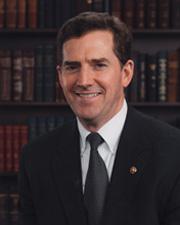 Sen. Jim DeMint (R-SC)
Legislative Activity
Stay on top of the latest movement without scrolling through every action
Senate amendment proposed (on the floor): Amendment SA 3387 proposed by Senator DeMint to Amendment SA 3325.(consideration: CR S13210-13212, S13215-13216; text: CR S13210)
October 23, 2007
View full timeline
Senate amendment proposed (on the floor): Amendment SA 3387 proposed by Senator DeMint to Amendment SA 3325.(consideration: CR S13210-13212, S13215-13216; text: CR S13210)
October 23, 2007
Roll call votes on amendments in Senate: Motion to table amendment SA 3387 agreed to in Senate by Yea-Nay Vote. 60 - 34. Record Vote Number: 385.
October 23, 2007
Amendment SA 3387 proposed by Senator DeMint to Amendment SA 3325. (consideration: CR S13210-13212, S13215-13216; text: CR S13210) To replace non-competitive earmarks for the AFL-CIO with competitive grants.
October 23, 2007
Motion to table amendment SA 3387 made in Senate.
October 23, 2007
Motion to table amendment SA 3387 agreed to in Senate by Yea-Nay Vote. 60 - 34. Record Vote Number: 385.
October 23, 2007
Senate amendment submitted
October 18, 2007
Votes
1 roll call on this amendment
Text
Proposed
DEPARTMENTS OF LABOR, HEALTH AND HUMAN SERVICES, AND EDUCATION
APPROPRIATIONS ACT, 2008

The ACTING PRESIDENT pro tempore. Under the previous order, the
Senate will resume consideration of
H.R. 3043, which the clerk will report.
The assistant legislative clerk read as follows:

A bill (H.R. 3043) making appropriations for the
Departments of Labor, Health and Human Services, and
Education and related agencies for the fiscal year ending
September 30, 2008, and for other purposes.

Pending:

Harkin/Specter amendment No. 3325, in the nature of a
substitute.
Vitter amendment No. 3328 (to amendment No. 3325), to
provide a limitation on funds with respect to preventing the
importation by individuals of prescription drugs from Canada.
Dorgan amendment No. 3345 (to amendment No. 3325), to
require that the Secretary of Labor report to Congress
regarding jobs lost and created as a result of the North
American Free Trade Agreement.
Ensign amendment No. 3342 (to amendment No. 3325), to
prohibit the use of funds to administer Social Security
benefit payments under a totalization agreement with Mexico.
Ensign amendment No. 3352 (to amendment No. 3325), to
prohibit the use of funds to process claims based on illegal
work for purposes of receiving Social Security benefits.
Lautenberg/Snowe amendment No. 3350 (to amendment No.
3325), to prohibit the use of funds to provide abstinence
education that includes information that is medically
inaccurate.
Roberts amendment No. 3365 (to amendment No. 3325), to fund
the small business childcare grant program.
Coburn amendment No. 3358 (to amendment No. 3325), to
require Congress to provide health care for all children in
the U.S. before funding special interest pork projects.
Chambliss modified amendment No. 3391 (to amendment No.
3325), to provide for a declaration of a public health
emergency with respect to Sumter County, GA.
Cardin amendment No. 3400 (to amendment No. 3325), to
provide support to Iraqis and Afghans who arrive in the
United States under the Special Immigrant Visa program.
Landrieu amendment No. 3446 (to amendment No. 3325),
relative to the Elementary and Secondary School Counseling
program.

The ACTING PRESIDENT pro tempore. The Senator from Iowa is
recognized.
Mr. HARKIN. Mr. President, we entered into a unanimous consent
agreement last night. I will repeat it for the benefit of Senators.
Senators should be aware that we will now start a series of debates
and we will stack the votes. The first amendment will be the amendment
of the Senator from Wyoming, Mr. Enzi, amendment No. 3437. There will
be 30 minutes of debate equally divided. That will be the first one.
The second one will be the amendment of the Senator from South
Carolina, Mr. DeMint; that is amendment No. 3387. There will be 20
minutes of debate equally divided.
The third one would be the amendment No. 3365 by the Senator from
Kansas, Senator Roberts. There will be 10 minutes of debate equally
divided.
Then the fourth one would be the amendment No. 3358 offered by the
Senator from Oklahoma, Senator Coburn. There will be 20 minutes of
debate equally divided. At the end of all of that time, the Senate will
proceed to vote on and in relation to those amendments.
We are ready for the amendment of the Senator from Wyoming as soon as
he arrives, and he is here.

Amendment No. 3437 to Amendment No. 3325

Mr. ENZI. Mr. President, I call up amendment No. 3437.
The ACTING PRESIDENT pro tempore. The clerk will report.
The assistant legislative clerk read as follows:

The Senator from Wyoming [Mr. Enzi] proposes an amendment
numbered 3437.

Mr. ENZI. Mr. President, I ask unanimous consent that the reading of
the amendment be dispensed with.
The ACTING PRESIDENT pro tempore. Without objection, it is so
ordered.
The amendment is as follows:

amendment no. 3437

(Purpose: To prohibit the use of funds to modify certain HIV/AIDS
funding formulas)

At the appropriate place in title II, insert the following:
Sec. __. Notwithstanding any other provision of law, no
funds shall be made available under this Act to modify the
HIV/AIDS funding formulas under title XXVI of the Public
Health Service Act.

Mr. ENZI. Mr. President, at the present time, the last numbers that I
saw, Congress's approval rating was 12 percent. There is a reason for
that. We have been nibbling around the edges on a lot of things, and we
have been doing earmarks. I have an amendment that deals with one of
the most egregious earmarks I have seen.
Less than a year ago we passed a bill in this body unanimously, that
the House then passed unanimously, that addressed the Ryan White AIDS
program, and it included transparency, it included accountability, and
it included a change in the formula. The change in the formula gave
some protection to those who have had a declining population, but it
allowed the money to follow the people who had the problem.
Today, in this bill, there is an earmark that provides for money now
to go to people who may no longer even exist--people who are dead. It
is a way that they are trying to change the authorization process we
went through so meticulously, so unanimously, in such a way that it
undoes it in an appropriations bill. We shouldn't be changing law in an
appropriations bill. We especially shouldn't be changing law for a
specific area of the country in an appropriations bill. That is why I
bring this amendment.
I want to discuss the Ryan White program and the need to ensure that
this Labor-HHS bill does not undo our recent work. Last December, after
months of negotiations, the House and the Senate passed a new 3-year
Ryan White reauthorization. Most importantly, we ensured that those new
formulas focused on the lifesaving treatment by including individuals
with HIV, not just AIDS.
One of the key items that delayed this reauthorization for months was
the careful negotiations surrounding the funding formulas. In that
bipartisan, bicameral agreement, we were very clear about the
implications of those new formula changes. We provided GAO data runs
that were nearly identical to how the funding has been distributed. I
hope everybody takes a look at those GAO data runs.
Those funding formulas also included hold-harmless provisions to
ensure the formula funding would not decrease by more than 5 percent
from the previous year. While I would have preferred no hold-harmless
provisions or ones that allowed for more dramatic fluctuations so the
money could follow the HIV-infected person, that was what we agreed
upon a few short months ago.
We didn't pull the wool over anyone's eyes; we provided clear
information about the implications about those funding formulas. Now,
with one simple pen stroke, the House majority would like to undo all
of those carefully crafted, bipartisan, bicameral compromises and
insert a new hold-harmless provision with little thought to how this
change will affect others. I am pleased to note that the Senate did not
include this egregious provision, and I hope today the Senate will go
on record for opposing doing so.
What is even more ridiculous is that this provision primarily
benefits San Francisco, a city that continues to receive funding to
care for dead people. San Francisco received two-thirds of the $9
million available, racking up $6 million of new dollars. All the while,
nearly every other city would have reduced funding just so San
Francisco can receive more riches. That additional $6 million is not
based on the number of people they are treating or on how many new
cases they have. As a hold-harmless provision, it is related to what
that city has received before.

[[Page S13207]]

As GAO noted in the report last month, even within their current
funding, they are receiving money for people who have died. Let me
repeat that. GAO, the Government Accountability Office, confirmed that
San Francisco currently receives funding under Ryan White for dead
people. That is without this additional $6 million earmark. Now, I
don't know about my colleagues, but I find this a little reprehensible.
Where I come from, that is called cheating. This is patently unfair to
those cities and States that are striving to come up with the moneys
for basic HIV/AIDS treatment.
House Democrats reneged on a bipartisan, bicameral solution and are
trying to slide this authorizing legislation into an appropriations
bill, hoping no one will notice. Well, I noticed. I object to this
provision and the implications of it. Rather than providing nearly $10
million to help those cities that don't need it, why aren't we
providing funds to those cities with large numbers of people with HIV?
So I offer my amendment to Labor-HHS, Enzi amendment No. 3437. This
amendment is quite simple. It states that the Labor-HHS bill cannot be
used to undo all of the work we did on Ryan White. We should not be
diverting key funds from cities with rising HIV cases to go to San
Francisco--a city that is still receiving funds for treating people who
have already died from AIDS. If you support keeping people alive, I
believe you should also support my amendment. We did last December. We
should again. We need to keep it on track to take care of the problem.
I yield some time to my fellow Senator from Oklahoma, such time as he
would like.
The ACTING PRESIDENT pro tempore. The Senator from Oklahoma is
recognized.
Mr. COBURN. Mr. President, I wish to make a few comments about what
is in the bill and what is going to happen if we don't accept Senator
Enzi's amendment.
When we crafted the Ryan White Act, the goal was to make sure the
dollars followed the disease and to make sure people who were infected
with HIV who had no other means of seeking treatment and having a life
that is not the scourge of this disease with the modern medicines that
have come about, to create a platform where we could have fair
availability for medicines and treatment and care to where the disease
is growing.
What has come out of the House, with Speaker Pelosi's direction, is
to actually take money from African-American women and the medicines
they need to stay alive, or medicines to treat their newborn infants,
and send it to San Francisco, which in the last few years has not even
spent the entire amount of money that has gone to it.
Senator Enzi is right in the fact that this violates the very
agreement we made over a long period of time to get Ryan White funds to
start following the disease. By taking an extra $6.2 million and
sending it to San Francisco, it violates, No. 1, the agreement on that
bill, but most importantly, it takes away the opportunity for health
for minority women, which is where the disease is growing the greatest
amount. We have all these women throughout the country who have been on
waiting lists for drugs for treatment. They are getting some, but they
are not getting what is going to save their lives. And we are going to
steal that opportunity for minority women to be adequately and fairly
treated under this bill.
The Ryan White bill we passed last year was a good compromise,
knowing that we needed to shift money to where the disease is. What
happened in the House bill is we have actually reneged on that
commitment. What we are actually saying is that the establishment age
groups in northern California deserve more money than a single African-
American woman who was infected with HIV and cannot get the medicines
to treat her disease. That is the choice.
For the first time, the Ryan White Act changed the direction of where
the money went. The Ryan White Act, as we passed it, had the money
following the disease, going to those who need treatment rather than to
established organizations that are used to a certain budget. So the
tragedy will be that if we don't pass the Enzi amendment, we are taking
a step backward from the very principle--a public health principle, by
the way--that you put the money where the epidemic is. What is in the
House bill negates that.
What we are doing is playing politics with the lives of African-
American women, who are the fastest growing numbers of people who have
HIV in this country. We are taking $6.2 million away from them and we
are putting it in facilities that, quite frankly, have done quite well
under the Ryan White Act. The availability, the access, and the
programs are at the greatest level in San Francisco as compared to any
other place in this country. Yet we choose, if we do not accept the
Enzi amendment, to say that is a higher priority than a poor African-
American woman in the South. That is the choice.
I support this amendment. I think the Senate, in good conscience,
ought to live up to its agreement on the Ryan White Act.
I yield back my time.
The ACTING PRESIDENT pro tempore. The Senator from California is
recognized.
Mrs. FEINSTEIN. Mr. President, I rise in opposition to the Enzi
amendment. I congratulate the chairman and the ranking member for the
work they have done on this bill. But this amendment significantly
disadvantages at least nine jurisdictions facing HIV/AIDS crises
throughout the country because it essentially would prevent any stop-
loss provision enacted by the House from going into effect.
Senator Enzi, Senator Kennedy, and the rest of the HELP Committee
worked tirelessly for most of last year to reauthorize the Ryan White
CARE Act. I voted for this reauthorization, and I recognized at the
time that the method of counting HIV/AIDS victims had to change to more
clearly reflect living victims. However, this then mandated huge cuts
to vital programs, despite the fact that States and eligible
metropolitan areas were assured that no jurisdiction would face
destabilizing losses.
The HELP Committee staff provided GAO data during the debate
projecting that San Francisco would receive approximately $17.1 million
in fiscal year 2007. But San Francisco did not receive that amount.
Their formula award totaled $14.6 million, which is $2.5 million less
than estimated.
A compromise was to offset losses by clearly making available
supplemental award funding so that the Health Resources and Services
Administration could consider the funding losses when awarding this
supplemental funding. This amendment seeks to do away with all of this.
Despite these estimates and built-in protection, several areas of the
country received significant funding cuts when the 2007 awards were
announced earlier this year.
The San Francisco eligible metropolitan areas, which also include
Marin and San Mateo Counties, lost approximately $8.5 million. That is
just those three counties--an $8.5 million loss. This accounts for 30
percent of the Ryan White funding--a loss too great for any
jurisdiction to absorb in 1 year.
It didn't surprise me when San Francisco lost money in 2007. The city
knew it would likely face losses. But the protections put in place
clearly were not adequate. The loss of one-third of total funding is
clearly destabilizing. To be very candid with you, I find it highly
objectionable.
This isn't only unique for San Francisco. Five other cities also lost
20 percent or more of their funding: Hartford, CT, 32.1 percent; New
Haven, CT, 23.7 percent; Nassau-Suffolk County, NY, 21.7 percent;
Ponce, Puerto Rico, 28.9 percent; Caguas, Puerto Rico, 34.3 percent.
No jurisdiction can absorb cuts of this magnitude in 1 year without
significant harm to those they serve. To address this, the House of
Representatives included a stop-loss provision to cap the losses faced
by these jurisdictions in their version of the fiscal year 2008 Labor-
HHS appropriations bill. This provision limits the fiscal year 2007
losses for eligible metropolitan areas, or EMAs, to 8.4 percent--not 30
percent but 8.4 percent--which is a manageable amount. Transitional
grant areas will have their losses capped at 13.4 percent.
So there is a willingness to respond to the mandate; that is, change
your method of counting and, secondly, absorb reasonable cuts. I don't
think that

[[Page S13208]]

is too much to ask. I think this is overkill.
I was the mayor who first found AIDS, and I can take you back to 1981
and I can tell you what it was like. You won't like it. What I tried to
do in the task force of the Conference of Mayors was to bring mayors
into the modern day. San Francisco essentially led the Nation in the
fight against AIDS. I think to have to take a 30-percent cut, when we
are seeing some regeneration of AIDS, is a terrible mistake.
Senator Enzi's amendment could nullify the House's solution. Let me
be clear. Under the House language, San Francisco would still lose
$2.3 million. All of the cities will still face significant cuts. This
provision is designed not to stop all reductions but to limit them to a
level that can be absorbed in 1 year. The House provided funding for
the stop-loss on top of a $23 million increase for part A of the Ryan
White CARE Act. So virtually every area across the country sees an
increase in funding. But these areas take a dramatic 30-percent cut in
funding. I don't think that is right, and I don't believe we should
accept it.

The Government Accountability Office examined the impact this stop-
loss provision would have on jurisdictions in 2008. In addition to
benefiting the 11 jurisdictions whose cuts are reduced, the House bill
results in increased funding for 42 of the remaining 45 jurisdictions.
The very minor cuts projected in the remaining three jurisdictions are
less than one-tenth of 1 percent. A reduction of 30-percent is simply
not manageable.
The provision makes no changes to the underlying reauthorization. It
doesn't prevent it from moving forward at all. It caps the total losses
faced by any jurisdiction in fiscal year 2007 with a one-time solution.
It doesn't reopen the reauthorization so carefully crafted by Senators
Kennedy and Enzi and their committee.
The epidemic, as I mentioned, is far from over in San Francisco. AIDS
continues to be the second leading cause of premature death in the city
and counting. Nearly 23,000 people are currently living with HIV/AIDS
in San Francisco, which is more than at any point in the epidemic.
Listen to that--nearly 23,000 people in San Francisco are living with
HIV now, and that is more than at any point during the epidemic. In
addition, the population of San Francisco living with HIV/AIDS is
increasingly impoverished, homeless, and struggling. Many have serious
medical needs.
About 2 weeks ago, the San Francisco Chronicle reported that San
Francisco doctors diagnosed 15 HIV patients with Kaposi sarcoma. That
is a form of cancer commonly found in patients early in the epidemic
but had become rare.
I will never forget, in a staff meeting I had with department heads
back in 1981, when the director of public health said: Madam Mayor,
something is happening. We are finding patients with large purple
lesions all over their bodies, and we don't know what it is.
His name is Merv Silverman. I said: Merv, find out what it is and
come back and tell me.
Three weeks later, they came back, and it was the discovery for the
first time of AIDS in this country. So I feel very sensitive about it.
I started the first AIDS program in the Nation. We funded it with
property tax dollars. That is how we became a leader in the area.
To take a 30-percent cut when we have the largest number of HIV/AIDS
victims in our history in the city, to me, is discriminatory,
wrongheaded, and it need not happen. So I very much hope this body will
respond.
I understand Senator Enzi wants to protect the reauthorization and
the funding formula he authored, but I think we have to admit that the
impact on some areas of the country was not anticipated. Fixing these
unintended consequences does not require reopening the legislation. It
can be addressed with a one-time solution that will still leave some
cities with a decline in funds; that means the House solution of stop-
loss.
I urge my colleagues to join me in opposing the Enzi amendment, which
would strike a dastardly blow to a city that has seen too much
suffering, as well as others.
I thank the chair and yield the floor.
The ACTING PRESIDENT pro tempore. Who yields time?
Mr. ENSIGN. I yield to the Senator from Oklahoma.
Mr. COBURN. Mr. President, I wish to make a couple of points.
I know this is a large step down for San Francisco EMA and a smaller
step down for some of the others. But the thing that needs to be kept
in mind is the amount of dollars spent per HIV patient in those areas
is 2\1/2\ times what the average is around the rest of the country--
2\1/2\ times. We spend 2\1/2\ times more per HIV case in those areas
than we do in North Carolina or Florida or Mississippi or Michigan or
Kansas or Texas or Arizona. So what we are talking about is
proportionality; giving the same opportunities to everybody who has
HIV, not more opportunities.
So with the 30-percent cut, you are still going to be spending 1\1/2\
to 1\3/4\ times more per HIV case in San Francisco as you are in the
rest of the country. So I appreciate the work of the Senator in the HIV
area, which is exemplary, and I understand she would want to protect
this, but it is not fair to the rest of the country. It is not fair to
tell somebody that you are going to spend 2\1/2\ times as much on
somebody with HIV in San Francisco as you are in Dallas, TX, or Miami,
FL. That is what this amendment is about--keeping the fairness that was
in the Ryan White Act.
I yield the floor.
The ACTING PRESIDENT pro tempore. The Senator from California.
Mrs. FEINSTEIN. Mr. President, I don't think it is fair to take a 30-
percent cut in 1 year when you have the largest number of HIV/AIDS
victims in the history of the epidemic in a city that has suffered such
as no other city in America. I am not saying there shouldn't be cuts. I
voted for the reauthorization knowing there would be cuts. What I am
talking about is the level of cuts and the way these cuts fall because
they decimate programs in an area that was ground zero on AIDS in the
United States.
If you are going to take cuts, take those cuts so the communities
involved in fighting HIV with prevention, with education, with care,
with treatment, with drugs, with all of it, can essentially meet the
mandate, which is to prevent the suffering of AIDS in HIV patients and
also to prevent the disease from spreading. That is not easy to do, I
can tell you that firsthand.
You take a 30-percent cut in 1 year and you decimate these programs.
That is why the House put the stop-loss in. Take a moderate cut, and we
will stand up like men and women and we will take that cut. Take a
third cut and it is much more difficult and you affect services to
people. That is all I am saying.
So I would very much hope the Senate would understand the need and
the compassion to defeat this amendment and, once again, I would urge a
``no'' vote.
The ACTING PRESIDENT pro tempore. The Senator from Wyoming.
Mr. ENZI. Mr. President, before we passed the legislation, there were
waiting lines in many of the States in this country, lines of people
waiting to get treatment and care for AIDS. I am pleased to let you
know there are no waiting lines today. No waiting lines anywhere--not
in San Francisco, not in Connecticut, not in New Jersey or in New York.
There has been a cut. The cut is guaranteed to be no more than 5
percent under the formula. Now, there has always been supplemental
money besides the formula. We did not guarantee the supplemental money.
The supplemental money was never guaranteed. And if there are larger
cuts, it comes out of the supplemental money, not the formula. So I
certainly hope we don't change the formula under the appropriations
bill instead of through the proper process, which is authorization.
Mr. President, I ask unanimous consent to have printed in the Record
a letter from the Department of Health and Human Services in North
Carolina with some very pertinent quotes.
There being no objection, the material was ordered to be printed in
the Record, as follows:

North Carolina Department

of Health and Human Services,

October 15, 2007.
Hon. Michael Enzi,
Ranking Member, Committee on Health, Education, Labor, and
Pensions, Hart Senate Office Building, Washington, DC.
Dear Senator Enzi: Thanks to your leadership on the
Committee on Health, Education, Labor, and Pensions (HELP),
Congress took an important step last year and

[[Page S13209]]

modernized the Ryan White CARE Act (RWCA). You and many of
your congressional colleagues--both Democrats and
Republicans--took a principled stance in order to ensure that
patients in need, no matter where they live, can access basic
medical services to treat and prevent HIV.
The new Ryan White program funding is having a profound
impact in North Carolina. The increase in North Carolina's
AIDS Drug Assistance Program (ADAP) eligibility from 125% to
250% over the past two years is the direct result of your
legislative initiative, resources provided by the new Ryan
White funding and new state investments. The increased
eligibility levels will result in approximately 600-750 new
North Carolinians having access to ADAP services. The reforms
you championed are making a crucial difference in the lives
of people living with HIV.
Unfortunately, an effort is underway in the Congress to
modify the original intent of the reauthorization--that
funding would be based on demonstrated need. As you are
aware, according to a Health Resources Services Agency
document and the newly-released GAO report that you and your
colleagues requested, the impact of the House-passed version
of the FY2008 Labor-HHS Appropriations bill that would cap
losses for certain EMAs would result in decreased funding for
states that would have otherwise received new funding based
on higher incidence of HIV.
As a direct result of your efforts last year, North
Carolina and other parts of the country that have been hit
hardest by new HIV cases now have a fighting chance to
effectively increase HIV screening, link infected individuals
to care and reduce the number of HIV infections reported from
year-to-year. If this attempt to undermine the basic premise
of the landmark Ryan White HIV/AIDS Treatment Modernization
Act of 2006 is successful, CARE Act funding will be diverted
from regions of the country that are most in need of federal
assistance. Unless the harmful provision in the
appropriations legislation is eliminated, I am gravely
concerned for patients who are in desperate need of
lifesaving medical care, individuals who will be newly
infected because their partners did not have access to CARE
Act services and ultimately, the future prospects of
addressing the HIV epidemic in North Carolina and throughout
the country.
Thank you for your leadership on the Health Subcommittee,
and thank you for your attention to this important issue.
Sincerely,
Evelyn Foust,
State AIDS Director.

Mr. ENZI. Mr. President, I yield the floor, and I reserve my
remaining time.
The ACTING PRESIDENT pro tempore. The Senator from Pennsylvania.
Mr. SPECTER. Mr. President, in listening to this debate and having
received a letter from the Speaker, the concerns I have are whether
there was a disproportionate share going to some localities in
California.
If I could direct a question to the Senator from California: What is
your response to the concerns raised by the Senator from Wyoming that
the formula was settled last year and that this, in effect, reopens the
formula and is going to direct funds to areas in your State where those
funds could be directed to the same serious problem which Pennsylvania
has in our big cities--Pittsburgh and Philadelphia?
If you could first respond on the issue as to whether the formula was
resolved last year.
Mrs. FEINSTEIN. Through the Chair, Mr. President, if I may, to the
distinguished Senator from Pennsylvania, first of all, it is my
knowledge that the cut to San Francisco and to 11 other jurisdictions
is very large. With respect to the reauthorization of Ryan White, we do
not agree that it applies only to the fiscal year 2007 cuts. It takes
resources, actually, from other jurisdictions. The Pelosi fix in the
House ensures a significant increase for title I that would both reduce
cuts to a manageable level for 11 jurisdictions and still increase for
other jurisdictions. So this isn't taking money away from other
jurisdictions, as I understand it. The provisions in the House bill
increases funding for 42 of the remaining 45 jurisdictions under title
I.
Now, I don't know the particulars, to be candid with you, of how
these cuts fell, but I do know the cut received in the Bay Area was
substantial. I suspect it was from the way they counted AIDS cases, and
they knew they had to change the methodology. But basically the point
is the cut is substantially large and means you have to cut 30 percent
across the board of AIDS programs at a time when San Francisco has the
largest number of HIV/AIDS cases in its history--23,000.
Mr. SPECTER addressed the Chair.
The ACTING PRESIDENT pro tempore. Who yields time to the Senator? The
time is controlled by the Senator from Wyoming and the Senator from
California. Who yields time?
Mrs. FEINSTEIN. May I ask how much additional time I have?
The ACTING PRESIDENT pro tempore. A minute 10.
Mrs. FEINSTEIN. A minute 10. I am not sure I should yield it to the
Senator.
Mr. SPECTER. That is up to the Senator. I am not decided on how I am
going to vote, so you have to decide that question and I will decide--
Mrs. FEINSTEIN. I beg your pardon? Whose side did you say?
Mr. SPECTER. I am considering it.
Mrs. FEINSTEIN. Oh. Then I will yield. If the mind is open, I am
happy to yield.
Mr. SPECTER. I know it is unsenatorial to say that, but I haven't
made up my mind.
The ACTING PRESIDENT pro tempore. The Senator from Pennsylvania.
Mr. SPECTER. I was listening to the Senator from Wyoming and the
Senator from California and trying to figure it out. I don't want to be
too unsenatorial, to think about it, but that is where I am.
Mrs. FEINSTEIN. I would be happy to yield my remaining minute to the
Senator from Pennsylvania.
Mr. SPECTER. The problem is one of enormous seriousness, and it is
very difficult to find the funding with what we have allocated on our
discretionary spending. In a context where some $36 million is being
added in the House bill and some $6 million has been allocated to San
Francisco in the House bill--and I am very sympathetic to San
Francisco's problem and I understand the distinguished Senator from
California was mayor of San Francisco and it is within the district of
the Speaker of the House, so I understand their interest there--what I
am trying to evaluate is whether there is undue funding going because
of the prominence of the advocates of the position by the Senator from
California.
I think I understand it now and I will weigh and consider it. I thank
the Senator from California for yielding me the time.
Mr. ENZI. Mr. President, I yield back the remainder of my time.
Mrs. FEINSTEIN. I yield back the remainder of my time.
The ACTING PRESIDENT pro tempore. Time is yielded back.
Mr. HARKIN. Mr. President, under the unanimous consent agreement
entered into last night, I believe the Senator from South Carolina
would be recognized next for amendment No. 3387, with 20 minutes of
debate equally divided.
Mr. President, I ask unanimous consent that the Senate now proceed to
the consideration of the Roberts amendment first, and then we would,
after the disposal of the Roberts amendment, then proceed to the DeMint
amendment.
The ACTING PRESIDENT pro tempore. Is there objection? The chair hears
none, and it is so ordered.
The Roberts amendment has been proposed and is now pending. The
Senator from Kansas.

Amendment No. 3365

Mr. ROBERTS. Mr. President, I rise in support of the Roberts
amendment, No. 3365, to fund a small business childcare grant program.
The program was authorized earlier this year as part of the
supplemental spending bill. It does have wide bipartisan support at
this time, as well as last Congress when it was unanimously approved by
the HELP Committee as part of the Child Care Community Development
Block Grant.
This program is different from other childcare initiatives because it
specifically targets small businesses and because it encourages them to
work together. These small businesses are the lifeblood of many urban
and rural communities. These grants will allow the local convenience
store or the beauty shop, the auto shop, the implement dealer, the
bank, to cooperatively work together to offer their employees quality
childcare while they work. Right now, these daycare facilities are
simply not available.
My program is also different from other grants because it encourages
sustainability and ownership over these childcare facilities. With an
annual increasing match requirement and a 2012 sunset provision, my
program offers a fiscally responsible approach to plugging the lack of
childcare for many hard-working American families.
I wish to thank Senators Specter, Harkin, Kennedy, Dodd, and Salazar

[[Page S13210]]

for their support of this program in the supplemental spending bill. I
am proud this was a bipartisan effort from the get-go, and I want that
to continue. If you support hard-working American families, if you
support small business and community development, if you support fiscal
responsibility, then simply support this amendment.
Let me say I recognize and appreciate the concern of my good friends
and colleagues, Senators Coburn and DeMint. They feel this program
could be duplicative. I do not think it is because the program targets
small businesses and encourages them to cooperate with other entities
to develop sustainable childcare facilities. Because of the matching
and sunset requirements--50 percent the first year here, 67 percent the
second year, and the third year, 75 percent, and then it sunsets--I
think we are much more fiscally responsible.
There was a suggestion to use TANF funds. These are being held by
States in emergency contingency accounts in case of a sudden economic
downturn. This would be another allowable use of these funds. That is
not the case. This is apples and oranges. This is a fiscally
responsible plan on the part of the States and we should encourage
that.
I yield back the remainder of my time.
The ACTING PRESIDENT pro tempore. Who yields time? The Senator from
Iowa.
Mr. HARKIN. Mr. President, I yield myself about 3 minutes.
The amendment offered by Senator Roberts is a good amendment. This
was authorized in the emergency supplemental bill for fiscal year 2007.
The grants are for small businesses that want to partner with each
other or other organizations to establish employer-owned childcare
programs. Funds can be used for startup costs, technical assistance,
and training and special services for sick kids or children with
disabilities.
The program is authorized at $50 million in fiscal year 2008. As the
Senator said, funding was not included. I think it is time we do fund
it. I have long been a supporter of expanding the role of small
businesses in providing the kind of childcare that their employees
need.
I think the amendment of the Senator will further that goal, and I
offer my support to the Senator's amendment and I hope the Senate will
adopt it.
I yield back whatever time we may have.
The ACTING PRESIDENT pro tempore. All time is yielded back.
Without objection, that amendment is agreed to.
The amendment (No. 3365) was agreed to.
Mr. HARKIN. Mr. President, I move to reconsider the vote, and I move
to lay that motion on the table.
The motion to lay on the table was agreed to.

Amendment No. 3387 to amendment no. 3325

Mr. DeMINT. Mr. President, I ask unanimous consent the pending
amendment be set aside and amendment No. 3387 be called up for
immediate consideration.
The ACTING PRESIDENT pro tempore. The clerk will report.
The assistant legislative clerk read as follows:

The Senator from South Carolina [Mr. DeMint] proposes an
amendment numbered 3387.

Mr. DeMINT. I ask unanimous consent the reading of the amendment be
dispensed with.
The ACTING PRESIDENT pro tempore. Without objection, it is so
ordered.
The amendment is as follows:

(Purpose: To replace non-competitive earmarks for the AFL-CIO with
competitive grants)

Beginning on page 4, strike line 22 and all that follows
through line 7 on page 5, and insert the following:
``workers: Provided further, That $3,700,000 shall be for
competitive grants, which shall be awarded not later than 30
days after the date of enactment of this Act''.

The ACTING PRESIDENT pro tempore. The Senator from South Carolina.
Mr. DeMINT. Mr. President, I do want to make sure we have called up
amendment No. 3387. I appreciate the chairman agreeing to this slight
change in the purpose statement, not the legislative language.
This amendment is part of an effort to clear up what a lot of us have
called the culture of corruption over the last several years. A lot of
this has come from Americans connecting the dots between the earmarks
that we give to our favorite causes back home and many of the campaign
contributions and political support that we get back here in Congress.
While motivations are generally good, at best the appearance of what is
going on here has alarmed the American people.
My earmark amendment today addresses two specific earmarks in the
appropriations bill that is in front of us. One of the earmarks
provides $1.5 million for the AFL-CIO Working for America Institute and
$2.2 million for the AFL-CIO Appalachian Council. These funds come in
the form of what are referred to as noncompetitive grants, according to
the text of the bill and the committee report--which means no one else
can compete to deliver the services that are intended by the bill, that
these are a specific earmark to divisions of the AFL-CIO.
These earmarks are problematic because they fund two organizations
that are not competitive. They provide funds that could be better spent
to achieve the mission of the Department of Labor set out by Congress
in the Workforce Investment Act of 1998. Rather than continuing to give
these groups handouts without any competition, we should force them to
compete with other organizations so Americans get the most value for
their tax dollars. That is exactly what my amendment will do. It
replaces these two earmarks that total $3.7 million with competitive
grants.
Let me be clear. I am not taking the money out of the bill. The money
is still there for the purposes for which it is intended, but it allows
organizations to compete to deliver these services so that the
taxpayers get the most for their money.
Let me say a few things about the performance of the AFL-CIO
organization so my colleagues understand why there is such concern. The
AFL-CIO Working for America Institute originally received grants under
the Workforce Investment Act. The grants were given to national
organizations for the purpose of providing technical assistance in
setting up systems of local and State workforce investment boards for
the purpose of helping unemployed workers get the training and the jobs
they need.
After 3 years, these capacity-building services were no longer
needed, and the grants were terminated. However, the Working for
America Institute failed to complete its mission in 3 years, so the
Department gave it a fourth year of funding. After the fourth year, the
Department terminated its contract with the Working for America
Institute and explained:

It is difficult to make the case that the AFL-CIO should
receive yet a fifth year of funding for organizational
purposes when the other national organizations were able to
achieve their goals in 3 years. Additionally, given that
there are so many workers seeking training or retraining
opportunities, we believe the Department of Labor's emphasis
is rightly placed on promoting employment and reemployment
projects having measurable outcomes.

The Department believes the technical assistance given by the
institute is duplicative and less effective than a similar program
already funded in their Employment and Training Administration. It
said:

We should focus limited financial resources on programs
that deliver actual training services to workers, rather than
pour additional funds into organizational infrastructure.
After 4 years, the AFL-CIO should have developed sufficient
ability to participate effectively in the Workforce
Investment Act system.

Despite these failures, Congress overrode the Department and
earmarked funds for $1.5 million in fiscal year 2005 in the
appropriations bill in that year, and it continued the project through
June of this year. Now this appropriations bill is trying to do the
same thing again. This is a clear example of Congress interfering with
agency decisions because of parochial or political interests. Congress
should not fund a program that is duplicative and not a critical
priority for an agency. It should have to compete for funds like every
other organization.
Let me address the second earmark in this bill. The AFL-CIO
Appalachian Council had a longstanding sole-source

[[Page S13211]]

contract with the Department of Labor that spanned several decades. The
purpose of the contract was to provide career technical training and
career transition services at job placement centers in Pittsburgh, PA,
Charleston, WV, and Batesville, MS. It is important to note that the
council does not manage or run these three centers. It simply provides
the training, placement, and transition services.
The Department of Labor reviewed the council's performance in 2004 in
light of the new requirements of the Workforce Investment Act. The
review resulted in the Department terminating the council's sole-source
contract because it was no longer the only and unique provider of
career transition services and because it experienced a steady decline
in program performance over a 5-year period.
Despite these failures, Congress stepped in and earmarked $2.2
million for the council in fiscal year 2005, forcing the Department to
continue the contract. Following this, the Department canceled the
contract again, but Congress reversed the agency's decision a second
time with another $2.2 million earmark in 2006.
After the second year came to a close, the Department reviewed the
performance outcomes of the council. In 2006, the council placed 265
graduates in apprenticeship programs and 71 graduates in jobs matching
their vocational training. With the earmark funded at $2.2 million, the
cost of each of these graduates was $6,547. Each of the council's 21
staff members placed less than 2 students per month in a registered
apprenticeship program. Despite being given a second chance by
Congress, the Department terminated the contract again this year.
Unfortunately, the appropriations bill we are considering gives
another earmark to the council to continue the services and designates
it a noncompeting earmark, which means no one else can compete to do
the service right. Here we have two examples of earmarks that
circumvent the normal competitive process and abuse the American
taxpayer.
The AFL-CIO has plenty of funds to continue these programs. In 2006,
the AFL-CIO reported $96 million in assets and $157.2 million in
receipts. Their top five executive officers made from $179,000 to
$291,000 a year, with 204 employees making more than $75,000 a year. Of
their disbursements, about $30 million, or nearly 40 percent of their
total receipts, went for political activities and lobbying.

The AFL-CIO should either fund the program itself or help the
institute develop a competitive grant proposal, but these organizations
should not get a handout. My amendment, as I said before, does not
eliminate the funds, but it does require the AFL-CIO to compete based
on real criteria and accountability to deliver the services for the
American taxpayer.
I urge my colleagues to support my amendment to turn these
noncompetitive grants into competitive grants so we accomplish the
purpose in an accountable way. I ask my colleagues to vote for my
amendment later on this morning. I appreciate their support.
I yield the floor.
The ACTING PRESIDENT pro tempore. Who yields time in opposition?
Mr. SPECTER. How much time do we have, Mr. President?
The ACTING PRESIDENT pro tempore. There is 10 minutes in opposition.
The Senator from Pennsylvania is recognized.
Mr. SPECTER. Mr. President, the two programs which have been
commented on by the Senator from South Carolina are very good programs,
contrary to his assertions. The AFL-CIO Appalachian Council is a
nationally recognized provider of educational training service. It was
founded in 1964 and the council has represented Alabama, Georgia,
Kentucky, Maryland, DC, Mississippi, North Carolina, Ohio,
Pennsylvania, South Carolina, Tennessee, Virginia, and West Virginia. I
believe if the Senator from South Carolina looked closely at what has
happened in his own State, which has been a beneficiary, he would find
it has been a good program. The council operates major employment and
training programs through the Department of Labor and Job Corps, as
well as employee assistance programs, and provides funding for
recruitment/replacement of some 1,000 Job Corps students in long-term
jobs.
When you talk about the Job Corps, you are talking about a group of
young people who might well be at risk. With the rising rates of
violence in major American cities--two of them in my State, Pittsburgh
and Philadelphia; Philadelphia had 406 homicides last year--taking some
of these at-risk students off the streets, young people off the
streets, and providing job training is very important.
The Working for America Institute, which is a program very near and
dear to the heart of the senior Senator from West Virginia, Mr. Byrd,
has an important retraining component of our manufacturing base, where
we have seen too many high-paying jobs shipped overseas. During the
current administration, more than 3 million American manufacturing jobs
have been lost. We are dealing with an area of some of the Rust Belt
States where job training and job development is very important and the
Appalachian Council runs through those States and provides a very
important service.
When the Senator from South Carolina talks about a political factor,
that depends upon the eye of the beholder. These programs have worked
very well. They are a very modest allocation with a total of $3.7
million tackling an issue of job training in an area which has been
beset by unfair foreign competition. They have been very carefully
considered by the subcommittee, very carefully considered by the full
committee, and they have been a part of the budget for a considerable
period of time. They have established their bona fides and their
worthwhile nature.
I believe they are worth the money. I urge my colleagues to reject
the DeMint amendment.
I yield to my distinguished colleague from Iowa.
The ACTING PRESIDENT pro tempore. The Senator from Iowa.
Mr. HARKIN. I wish to join with Senator Specter in opposing the
DeMint amendment, which would strike two congressionally directed
fundings in the bill--one for the Appalachian Council, and the other
one would be for the Working for America Institute.
This institute was created, first of all, in 1989 and then in 1998
was spun off and made into a totally separate nonprofit organization
with a functioning board of directors and everything else. They have
over 30 years of experience in the field of job training, workforce
development. They work with businesses, the private sector, they work
with unions, and they work with communities. The institute has
basically been a showcase of how to pull people together and get people
together for workforce development. It is doing great work, and it
benefits communities throughout the United States. In fact, I had the
list of some here. Just last year alone, the institute provided
assistance to Portland, OR, the Ohio State Workforce Board, the
National Governors Association, and the National Alliance of Workforce
Boards. So you can see they do things all over the country.
I point out that this institute received funding through the
Department of Labor for over 30 years, through Republican and
Democratic administrations. I can go back to Nixon and Ford and Carter,
all through the Reagan years, the first Bush administration, the
Clinton administration, and actually the first part of this Bush
administration until just a couple of years ago when the Department of
Labor decided to cut all funding for it. So we had to come in here a
couple of years ago and put directed funding in there for the
institute. It was widely supported.
So when the Senator from South Carolina says that: Well, we will just
make it competitive. Well, the Department will not do it anyway. They
are not interested in it. They will not put it out for competitive
grant. So this is another instance where I think congressionally
directed funding has validity because we have looked at these programs
from a bipartisan standpoint, and we agree they should be funded, even
though the Department of Labor does not want the funding.
Now, the second issue I wanted to address is--I do not know whether I
caught the Senator from South Carolina correctly, but I heard something
about lobbying and political activity. I just wanted to make it very
clear that section 503 of the bill reads--and I will read it in its
entirety:

No part of any appropriation contained in this Act shall be
used, other than for normal

[[Page S13212]]

and recognized executive-legislative relationships, for
publicity or propaganda purposes, for the preparation,
distribution or use of any kit, pamphlet, booklet,
publication, radio, television or video presentation,
designed to support or defeat legislation pending before the
Congress or any State legislature, except in presentation to
the Congress or any State legislature itself.
B. No part of any appropriation contained in this Act shall
be used to pay the salary or expenses of any grant or
contract recipient or agent acting for such recipient related
to any activity designed to influence legislation or
appropriations pending before the Congress or any State
legislature.

So the recipients cannot do it, and they cannot hire lobbyists,
either, to lobby for them for any legislation pending before the
Congress. So I wanted to make it clear that none of this money can be
used for lobbying or for any kind of partisan activities, nor can it
even be used for them to hire a lobbyist or a lobbying firm for that
activity. So I wanted to make that clear.
I support the Senator from Pennsylvania. The Appalachian Council has
done a great job. They are doing great work in a number of States. The
Working for America Institute, again, is one that has proven its worth.
It has been widely supported throughout America, through business
concerns, and State workforce investment boards all over this country.
Now is not the time to pull the rug out from underneath them. So I
would join with Senator Specter in opposing the DeMint amendment.
I yield to the Senator from Pennsylvania.
Mr. SPECTER. Mr. President, just a supplemental comment or two. The
Job Corps program, which is part of this overall operation, funds young
people ages 16 through 24. In Philadelphia, there is a program which
places graduates with 61 major health care employers in higher skill
jobs which are in great demand in Philadelphia. That attacks an area of
great importance, considering the homicide rate in Philadelphia, much
of which is caused by young people, so many at-risk youth. This goes
right to the heart of a very serious problem, to support the funding.
I want to supplement that, too, with the hearing which we held on
July 22, 2004, where we had extensive testimony taken on the subject to
establish the value of the program.
How much time remains, Mr. President?
The ACTING PRESIDENT pro tempore. Just under 1 minute 50 seconds.
Mr. SPECTER. We reserve the remainder of that time awaiting the
argument of the Senator from South Carolina.
The ACTING PRESIDENT pro tempore. The Senator from South Carolina.
The Senator has 30 seconds.
Mr. DeMINT. Mr. President, I agree with all the purposes the Senator
stated, all of the ideas of getting teenagers to work in Philadelphia.
All of those things are good. I am not taking argument with any of
them. If the AFL-CIO is the best source to deliver these services,
there should not be any problem with this at all. All we are asking is
to make this a competitive grant so that we can have criteria and
accountability in a system so that what we want to accomplish will
actually get accomplished. I yield back the remainder of my time.
The ACTING PRESIDENT pro tempore. The Senator from Pennsylvania.
Mr. SPECTER. When you talk about accountability, it is present. It is
an open book. The Job Corps is administered by the Department of Labor.
It is not unusual to have a sole-source contract. When you have
somebody like the AFL-CIO, which has so much knowledge, and so many of
their experts are at work on this program, it makes very good sense to
give the opportunity to carry out the program. It is all subject to the
review by the Department of Labor. I think the quality of this program
speaks for itself. There is agreement on it. It has an important
purpose. I believe the record shows that these funds have been wisely
spent.
I yield the floor.
The ACTING PRESIDENT pro tempore. All time has expired.
Mr. HARKIN. Mr. President, I move to table the DeMint amendment and
ask for the yeas and nays.
The ACTING PRESIDENT pro tempore. Is there a sufficient second?
There is a sufficient second. The yeas and nays are ordered. Under
the previous order, that vote will occur after debate on the Coburn
amendment.

Amendment No. 3358

Mr. HARKIN. Mr. President, now we are going to go to the Coburn
amendment.
I ask unanimous consent that the vote sequence be changed and that
the vote in relation to the Coburn amendment be second in the sequence;
that the remaining provisions remain in effect.
The ACTING PRESIDENT pro tempore. Without objection, it is so
ordered.
The Senator from Oklahoma.
Mr. COBURN. Mr. President, amendment No. 3358 is a pending amendment
we discussed this last Friday. I believe under the unanimous consent
agreement I have 10 minutes, and those in opposition do also. I am
going to speak a few moments, if I may.
What the country is looking for us to do is to choose priorities, to
make good choices about the priorities of what we do with their money.
Quite frankly, there has not been a top-down review on all the
Government programs, ever. We have had very limited oversight hearings,
which should be the No. 1 part of our job. And we have in front of us a
bill that has $400 million in directed earmarks, which we think,
through what the appropriations process has brought to us, is an
important priority.
What this amendment says is that we are going to give the Members of
the Senate an opportunity to vote on whether those are the most
important priorities or whether we ought to have children's health care
because what this amendment does is redirects this money in abeyance
until we say we have the kids in this country covered.
There is a large debate over the SCHIP bill that the President
recently vetoed. There are a lot of things wrong with it. It is not
wrong to help poor kids get health care. Nobody in the Senate opposed
that. What they did oppose is changing, under the guise of a debate for
children, a debate of having the Government start running all of the
health care for kids. What it did do is spend $4,000 to buy $2,300
worth of care, and a lot of other things.
So what this amendment is about is asking the Senate to choose--
choose your directed earmarks for back home or make a statement that
says: We really believe kids health care is important, and we are not
going to spend the money on directed earmarks until we have solved that
problem.
I know this makes some of my colleagues bristle, that we would
challenge the direction. This is not saying specific earmarks are not
good ideas. A lot of the earmarks in this bill are good ideas. What it
does say is: Should they be a priority before we take care of one of
the greatest problems this country is facing, which is health care? Are
we going to go after and really change health care to where we get
value, we get controllable costs, we get freedom of choice, or are we
going to continue to do the same thing of putting earmarks into bills
and ignoring the big problems that are in front of us?
So what this amendment says is that until the Secretary of HHS,
whoever they may be, certifies that we have the kids under 18 in this
country covered, we should not be spending money on directed political
benefits for ourselves and our careers; instead, we should be spending
our time solving the health care needs of the kids in our country.
I reserve the remainder of my time.
The ACTING PRESIDENT pro tempore. Who yields time in opposition? The
Senator from Iowa.
Mr. HARKIN. Mr. President, I assume it comes as no surprise that I
oppose the amendment offered by the Senator from Oklahoma.
I appreciate that the amendment of the Senator from Oklahoma raises
again the issue of children's health care. I think that debate should
go on since the plight of poor children in this country needs as much
attention as we can give it. But I do not think this amendment is
serious about addressing the health of children. The amendment does not
put any money into it at all; it just says that we will not have any
congressionally directed funding until every child in America has
health care coverage. I believe that is the way it is worded. So it
really does not fund it. It does not do anything at all. I think it is
the kind of thing that kind of gives Congress a bad name in that we say
we

[[Page S13213]]

want to do these things, but we do not provide any funding for them.
We really already know how to increase the number of children insured
in this country--by providing an increase in the SCHIP bill program.
The Senate recently voted 68 to 31 to do that--68 to 31, pretty
overwhelming. That bill would have provided insurance to millions of
children who do not have any. Well, maybe the Senator from Oklahoma did
not agree with how that was done but, nonetheless, 68 Senators did
agree on both sides of the aisle on that approach.
So, again, if the Senator was really concerned about the plight of
these children, I would suggest that rather then voting against the
SCHIP bill, which obviously provides some guidance and direction, that
there is another way of doing it. Again, I point out that the Senate
voted overwhelmingly to do that.
That vote on SCHIP was a key one on children's health insurance, not
a completely unrelated vote dealing with congressionally directed
spending, which is what this is.
I say to my friend from Oklahoma, if he wants more kids to have
health insurance, then vote for a bill that would provide more health
insurance to kids. If it is not the SCHIP bill, then what is it? It has
been suggested that maybe a vote for the Coburn amendment might be a
nice cover vote for those who oppose the SCHIP bill. I don't think so.
Perhaps more and more people are finding out that a vote against the
SCHIP bill was not a very popular one, as we hear from communities and
States. But an amendment such as this doesn't change the facts about
the SCHIP bill, one way or the other.
I also disagree with the Senator's implication, if I might say, that
congressionally directed projects in the bill are unworthy of Federal
spending. I am proud of the projects I included in this bill. I will be
glad to defend every one of them. Again, with the transparency we have
that came with the new ethics reform bill, all of these have been
spread upon the record. We know who asked for them and we know how much
money is involved. I am happy to defend every one of the ones I put in
there. I should add that many of the projects the Senator wants to
eliminate are, in fact, directed to children's health. Let me cite a
few examples.
There is congressionally directed funding for St. Francis Hospital in
Delaware to expand prenatal maternity and pediatric services to
indigents. There is funding for the Youth Crisis Center in
Jacksonville, FL to address the serious health consequences facing
runaway and homeless youth. There is funding for St. Luke's Regional
Medical Center in Boise, ID to expand pediatric services. There is
funding for the St. Louis Children's Hospital in St. Louis for neonatal
intensive care unit expansion. There is funding for the Mississippi
Gulf Coast Children's Health Project which uses mobile units to provide
primary care to indigent children along the gulf coast. There is
funding for Child Sight in New Mexico, a vision screening and eyeglass
program especially for Native Americans on reservations. There is
funding for St. Anthony's Hospital in Oklahoma City for construction of
a newborn nursery. All of these would be cut out if the amendment were
adopted. They are good provisions, and they will go a long way toward
helping children's health in all of these instances.
Again, I don't see this as a serious means of doing anything to help
children's health. It is an attack on congressionally directed funding
to which the Senator is opposed. As I said, I support congressionally
directed funding. I always have. I especially support it now with the
new provisions on transparency and accountability as a result of the
ethics bill we recently passed.
I reserve the remainder of my time.
The ACTING PRESIDENT pro tempore. Who yields time?
Mr. SPECTER. How much time remains?
The ACTING PRESIDENT pro tempore. The opposition has 4 minutes 50
seconds. The proponents have 6 minutes 50 seconds.
Who yields time?
Mr. HARKIN. I yield to the Senator whatever time he requires.
The ACTING PRESIDENT pro tempore. The Senator from Pennsylvania.
Mr. SPECTER. I thank the chairman.
Mr. President, the Senator from Iowa, chairman of the subcommittee,
has already advanced the substantive argument about our efforts to deal
with health care for children. I have supported it with a very solid
vote. We will take care of that issue. The President has vetoed the
bill, and I and others have signified our willingness to vote to
override. It was not overridden in the House. The President has
signified his willingness to negotiate. There are some who do not want
to negotiate on the congressional side. I believe that is a mistake. If
they want to attach political blame to the President if the program
should lapse, ultimately, we will have a negotiation because the
American people would see through the facade and understand that those
who refuse to negotiate are the ones responsible if the program lapses
and is terminated. We will take care of congressional and Federal
action for children's health.
What the amendment seeks to do is to eliminate earmarks. Earmarks
have a specific congressional designation budget-wise and are vitally
important projects, such as the dredging of the Delaware in
Philadelphia to provide a 45-foot channel which traditionally has been
the responsibility of the Federal Government under constitutional
provisions on waterways and related matters. It would eliminate flood
control, which is vital. It would eliminate many items where there is
congressional expertise and understanding.
Take the budget that is on the floor now. It is $152 billion. We have
allocated $400 million, which is about one-quarter of 1 percent. So
99\3/4\ percent goes to the bureaucrats in the Department of Education,
the Department of Health and Human Services, and the Department of
Labor. I suggest that is an imbalance. People in the House of
Representatives know their districts much better than people sitting
downtown in big bureaus in Washington. Senators know their States
better than the bureaucrats. I dare say the astute Senator from
Oklahoma, the proponent of this amendment, knows what is going on in
Oklahoma better than the bureaucrats and would be in a better position
to identify projects which are worthwhile. But to limit congressional
control to one-quarter of 1 percent is certainly not appropriate,
certainly not overbearing. I wouldn't call it de minimis because no
dollar amount is de minimis. We understand it is not the Government's
money; it is the taxpayers' money.
The Senator from Iowa has made a very fundamental point. In fact, he
made a couple of fundamental points; in fact, he has made several
fundamental points. One is the transparency. It is all out in the open.
We are prepared to debate any move to strike any of the so-called
earmarks. Earmarks has become a dirty word. But when you reach a real
need somewhere and have an application for Federal funds that a Member
of the House or the Senate understands, and in the broader context of
one-quarter of 1 percent, I don't think that goes too far to having
Members who know their States and know their districts make those
allocations.
I yield the floor.
The ACTING PRESIDENT pro tempore. Who yields time?
Mr. COBURN. Mr. President, may I inquire as to the remaining time?
The ACTING PRESIDENT pro tempore. The Senator has 6 minutes 50
seconds, and the opposition has 23 seconds.
Mr. COBURN. I thank the Chair.
I stand somewhat amused that we are so powerless that the bureaucracy
is going to decide where everything goes. Earmarks are not the only way
to decide how the budget is put out, and the fact that we use the
excuse that we don't have any control, it is called oversight. Last
year in the last Congress more oversight hearings were held by myself
and Tom Carper, true oversight hearings, than all the rest of the
Senate. The fact is, we don't want to do the hard work of oversight
because it is easy to earmark something. But in fact, in dredging, you
can hold the Corps of Engineers to a priority list. You can bring them
before Congress and say: Why aren't you dredging this? How is this a
priority against something else? We don't do the hard work of
oversight. That is our problem. Instead, we want to do it the easy way.
I don't deny these are good projects. They are. I am not saying they
are not. What I am saying is, what about the long term? What about the
fact that a

[[Page S13214]]

child born today is inheriting $400,000 in unfunded liabilities and
that earmarks happen to be the tool that allows us to spend more than
we should, not directly through the earmarks but by voting for bills
that should not be voted on? But because we have an earmark in the
bill, we vote for the bill.
We have an unfunded liability right now on Medicare of $34 billion.
We are never going to be trusted to fix that problem when we can't be
trusted to have an arm's-length separate allocation and look at what
the problems are in front of us in terms of labor, health, and human
services.
I don't deny what people want to do in this bill could be
prioritized. But the number of requests were 36,000 this year. The fact
is, can we get what are priorities for this country if we continue the
process of using earmarks?
How about children's health? Yes, we passed a bill. We passed a bill
that truly wasn't paid for unless we want 22 million Americans to start
smoking. We passed a bill that said: We are going to pay $4,000 to buy
$2,300 worth of care. We are great stewards when it comes to the
American taxpayers' money on this new SCHIP bill. There is no question
we are going to get an SCHIP bill. That SCHIP bill is going to truly
reflect the needs of the poor people who are not eligible for Medicaid.
We are going to put the money there we need to accomplish that. But to
confuse that bill with a process which has got us $9.5 trillion in debt
and hung every one of our kids out to dry, that is what this amendment
is about. It is the process I am attacking.
I am not attacking individual Senators. I am saying if we are going
to get control of the spending, at some point in the future we have to
look at the process and how it works. For us to say it is easier for us
to earmark than to hold the bureaucracy accountable means we are not
doing our job. We can hold the bureaucracies accountable. All we have
to do is have an oversight hearing three times a week and make them
come up here and explain how they are spending their money. They will
start spending on priorities Americans want. We don't have our hands
tied behind us just because we don't do earmarks.
The real question America is asking is, are we going to change our
ways about real priorities, the real future for our country, or are we
going to continue the same old process that has brought us all the
corruption we have seen come through the House in the past that leads
to conflicts of interest?
We talk about transparency. We gutted the transparency rules as far
as appropriations are concerned in this bill and in our ethics bill,
because no longer do you say who is getting it or what it is for. You
only say where it is going. The very things that are in the House bill
in terms of transparency are not available to us in the Senate, so we
can't claim transparency. We are going to get transparency in September
of next year when the transparency bill comes about.
Senator Harkin mentioned that we didn't offer an option. Senator Burr
and I both did, the Every American Kid Insured Act. We talked about it
on this floor during the debate on the SCHIP bill. There are other ways
to do this. Give them all a tax credit. Let them buy the insurance. We
have 9 million kids out there uninsured, 3 million more within 1 year.
There are ways for us to solve that. But this is not a farce amendment.
This is an amendment about a very real problem. Will we have the right
priorities when it comes to this country or are we going to send $42
million to international labor organizations with no accountability
whatsoever from the United Nations? That is what we are doing. That is
what this bill does. We have another $400 million worth of earmarks
that are not competitively bid and will never be overseen, and you will
never see where the money goes. So the question on the amendment is,
will we change the process.
It is a serious amendment. We should not be earmarking things until
we do our business of taking care of kids' insurance.
With that, I yield the floor.
Mr. SPECTER. Mr. President, how much time remains?
The ACTING PRESIDENT pro tempore. There is 23 seconds remaining for
the opposition.
Mr. HARKIN. Mr. President, I point out that the Coburn amendment
doesn't put 1 cent into helping children's health, not 1 penny. Yet in
the bill itself, as I pointed out, there are a number of programs that
actually go to help children's health all over this country. The Coburn
amendment would eradicate those.
Mr. COBURN. I ask for the yeas and nays.
The ACTING PRESIDENT pro tempore. Is there a sufficient second?
At the moment there is not a sufficient second.
The Senator from Iowa.
Mr. HARKIN. Mr. President, I do want to give the yeas and nays to the
Senator. I was just going to move to table the amendment and ask for
the yeas and nays.
The ACTING PRESIDENT pro tempore. Is there a sufficient second on the
amendment itself?
Mr. HARKIN. Yes.
The ACTING PRESIDENT pro tempore. There appears to be a sufficient
second.
The yeas and nays were ordered.
The Senator from Oklahoma.
Mr. COBURN. Mr. President, parliamentary inquiry: As to the unanimous
consent request that we agreed to, was it not agreed to that we were
going to have votes on these amendments up or down?
Mr. HARKIN. No.
Mr. COBURN. That was not part of the unanimous consent agreement?
Fine.
Mr. HARKIN. Mr. President, I say to my friend from Oklahoma, it was
on or in relation to. So, yes, ask that again.
Mr. COBURN. Mr. President, I ask for the yeas and nays.
The ACTING PRESIDENT pro tempore. The yeas and nays have been ordered
on the amendment itself.
The Senator from Pennsylvania
Mr. SPECTER. Mr. President, on the matter of management, after these
votes we will move ahead to take up any other amendments that any
Senators wish to offer. We had an understanding to conclude this bill
by 12:30 today, and we are anxious to come as close to that time as we
can. If Senators want to pursue any other amendments, they ought to
consult with the managers immediately or we intend to go to third
reading to complete this bill.
The ACTING PRESIDENT pro tempore. The Senator from Iowa.
Mr. HARKIN. Mr. President, I say to my friend from Pennsylvania, I
think we are getting close. With these three votes coming up now,
hopefully we are just a few amendments away from completing the bill,
and hopefully we will have it done early this afternoon. I had hoped we
would have it done by 12:30, but that does not look possible. But we
are getting close. I hope when Senators come over to the Chamber we can
work out some other amendments that are pending at this time, and
perhaps we can get a consent to limit the number of amendments and
bring closure to this bill sometime early this afternoon.

Amendment No. 3437

The ACTING PRESIDENT pro tempore. Under the previous order, the
question recurs on the Enzi amendment. There is 2 minutes evenly
divided.
The Senator from Wyoming.
Mr. ENZI. Mr. President, again, I would ask that Senators support my
amendment to strike what we are talking about, which is an earmark of
$6.2 million for San Francisco and another $3 million for a few other
towns.
We are changing law that we passed less than a year ago under an
authorization process. It is much harder to pass an authorization bill
than it is an appropriations bill. We should not be changing formulas
under an appropriations bill.
The GAO numbers that we said would happen are approximately what has
happened. Of the $9 million, San Francisco gets $6.2 million. They
already get twice as much per HIV/AIDS case as any of the rest of the
towns. We put in a hold harmless provision so nobody would lose more
than 5 percent of their money. We have been staying by that. We did not
guarantee supplemental money. That was done less than a year ago. This
is an earmark.
There were waiting lines for people who needed HIV treatment and
care. There are no waiting lines today. What we did last year worked.
We should not change it under appropriations now.
I ask that you vote for my amendment.

[[Page S13215]]

The PRESIDING OFFICER (Mr. Casey). The Senator's 1 minute has
expired.
There is 1 minute in opposition to the amendment.
Who yields time?
Mr. HARKIN. Mr. President, since no one wants to be recognized in
opposition, I yield back the time.
Mr. ENZI. Mr. President, I ask for the yeas and nays.
The PRESIDING OFFICER. Is there a sufficient second?
There appears to be a sufficient second.
The question is on agreeing to amendment No. 3437.
The clerk will call the roll.
The bill clerk called the roll.
Mr. DURBIN. I announce that the Senator from Delaware (Mr. Biden),
the Senator from New York (Mrs. Clinton), the Senator from Connecticut
(Mr. Dodd), the Senator from Massachusetts (Mr. Kennedy), the Senator
from Missouri (Mrs. McCaskill), and the Senator from Illinois (Mr.
Obama) are necessarily absent.
I further announce that if present and voting, the Senator from
Massachusetts (Mr. Kennedy) would vote ``no.''
Mr. LOTT. The following Senator is necessarily absent: the Senator
from Arizona (Mr. McCain).
The PRESIDING OFFICER. Are there any other Senators in the Chamber
desiring to vote?
The result was announced--yeas 65, nays 28, as follows:

[Rollcall Vote No. 383 Leg.]

YEAS--65

Alexander
Allard
Barrasso
Bennett
Bingaman
Bond
Brown
Brownback
Bunning
Burr
Cardin
Carper
Casey
Chambliss
Coburn
Cochran
Coleman
Collins
Conrad
Corker
Cornyn
Craig
Crapo
DeMint
Dole
Domenici
Dorgan
Durbin
Ensign
Enzi
Graham
Grassley
Gregg
Hagel
Harkin
Hatch
Hutchison
Inhofe
Isakson
Kohl
Kyl
Levin
Lincoln
Lott
Lugar
Martinez
McConnell
Mikulski
Murkowski
Nelson (FL)
Nelson (NE)
Pryor
Roberts
Salazar
Sessions
Shelby
Smith
Stevens
Sununu
Tester
Thune
Vitter
Voinovich
Warner
Webb

NAYS--28

Akaka
Baucus
Bayh
Boxer
Byrd
Cantwell
Feingold
Feinstein
Inouye
Johnson
Kerry
Klobuchar
Landrieu
Lautenberg
Leahy
Lieberman
Menendez
Murray
Reed
Reid
Rockefeller
Sanders
Schumer
Snowe
Specter
Stabenow
Whitehouse
Wyden

NOT VOTING--7

Biden
Clinton
Dodd
Kennedy
McCain
McCaskill
Obama
The amendment (No. 3437) was agreed to.

Amendment No. 3358

The PRESIDING OFFICER. There are now 2 minutes equally divided on the
Coburn amendment.
Who yields time?
Mr. HARKIN. Mr. President, first, I make a point of order that the
Senate is not in order.
The PRESIDING OFFICER. The Senate will come to order.
The Senator from Iowa is recognized.
Mr. HARKIN. Mr. President, we now proceed to 2 minutes on the Coburn
amendment. After that, then we will have 2 minutes on the DeMint
amendment and vote. These will be 10-minute votes as per the prior
agreement.
The PRESIDING OFFICER. Who yields time?
The Senator from Oklahoma is recognized.
Mr. COBURN. Mr. President, this is a straightforward amendment. It is
an amendment about where our priorities lie. Do they lie in our
directed spending or do they lie with the children of this country who
aren't covered?
It is a very simple amendment. I know there are things in the bill
for children, but the fact is out of the 9.5 million who are uncovered,
we have 3.6 million who have not been covered for a year.
So this amendment simply states we are not going to spend any money
on the directed spending until the HHS Secretary certifies that we have
done our job in terms of taking care of the kids. Whether that is the
SCHIP bill, negotiations with the administration or whatever it is, we
are not going to spend the money.
Mr. HARKIN. Mr. President, I ask the Senate please be called to
order.
The PRESIDING OFFICER. The Senate will come to order.
The senior Senator from Pennsylvania is recognized.
Mr. SPECTER. Mr. President, the issue of providing health care for
children will be taken care of on the SCHIP bill, which ultimately will
be subject to negotiations between the President and the Congress. The
allocations on earmarks amount to approximately one-quarter of 1
percent. Ninety-nine and three-quarters percent will go to the
bureaucrats in the departments.
Members of the Senate and House have more knowledge about what is
going on in their districts and their States, and this is a very modest
application for very worthwhile programs. The Senator from Oklahoma
conceded in the argument earlier that he is not challenging the
worthwhileness of any of these programs. Any of them are subject to
attack to be stricken, and they are all defensible.
I ask that the amendment of the Senator from Oklahoma be rejected.
The PRESIDING OFFICER. The Senator from Iowa is recognized.
Mr. HARKIN. Mr. President, I move to table the Coburn amendment and
ask for the yeas and nays.
The PRESIDING OFFICER. Is there a sufficient second?
There is a sufficient second.
The question is on agreeing to the motion.
Mr. DURBIN. I announce that the Senator from Delaware (Mr. Biden),
the Senator from New York (Mrs. Clinton), the Senator from Connecticut
(Mr. Dodd), the Senator from Massachusetts (Mr. Kennedy), and the
Senator from Illinois (Mr. Obama) are necessarily absent.
I further announce that, if present and voting, the Senator from
Massachusetts (Mr. Kennedy) would vote ``yea.''
Mr. LOTT. The following Senator is necessarily absent: the Senator
from Arizona (Mr. McCain).
The PRESIDING OFFICER. Are there any other Senators in the Chamber
desiring to vote?
The result was announced--yeas 68, nays 26, as follows:

[Rollcall Vote No. 384 Leg.]

YEAS--68

Akaka
Alexander
Baucus
Bayh
Bennett
Bingaman
Bond
Boxer
Brown
Byrd
Cantwell
Cardin
Carper
Casey
Cochran
Coleman
Collins
Conrad
Craig
Domenici
Dorgan
Durbin
Feinstein
Grassley
Gregg
Hagel
Harkin
Hatch
Hutchison
Inouye
Johnson
Kerry
Klobuchar
Kohl
Landrieu
Lautenberg
Leahy
Levin
Lieberman
Lincoln
Lugar
Menendez
Mikulski
Murkowski
Murray
Nelson (FL)
Nelson (NE)
Pryor
Reed
Reid
Roberts
Rockefeller
Salazar
Sanders
Schumer
Shelby
Smith
Snowe
Specter
Stabenow
Stevens
Sununu
Tester
Voinovich
Warner
Webb
Whitehouse
Wyden

NAYS--26

Allard
Barrasso
Brownback
Bunning
Burr
Chambliss
Coburn
Corker
Cornyn
Crapo
DeMint
Dole
Ensign
Enzi
Feingold
Graham
Inhofe
Isakson
Kyl
Lott
Martinez
McCaskill
McConnell
Sessions
Thune
Vitter

NOT VOTING--6

Biden
Clinton
Dodd
Kennedy
McCain
Obama
The motion was agreed to.

Amendment No. 3387

The PRESIDING OFFICER. The Senator from Iowa.
Mr. HARKIN. Mr. President, I understand there will now be 2 minutes
prior to the vote on the DeMint amendment, which we already have moved.
The PRESIDING OFFICER. Who yields time?
The Senator from South Carolina.
Mr. DeMINT. Mr. President, I appreciate my colleagues' attention. I
would first like to ask unanimous consent to add Senator Enzi as a
cosponsor of my amendment.
The PRESIDING OFFICER. Without objection, it is so ordered.
Mr. DeMINT. Mr. President, I want to make clear to my colleagues that
my amendment does not remove any money from this bill for its intended
purpose. In fact, the amendment addresses the Workforce Investment Act,
money that goes to training and job

[[Page S13216]]

placement in several places in the country. My amendment only changes
the language from a sole-source noncompetitive grant, which we would
refer to as a direct earmark, to a competitive grant.
We have all seen that the competitive grant system is a better way to
deliver Federal money to specific causes that we support as a Senate
because there are criteria, there are standards, and there is
accountability. So we are not excluding the AFL-CIO as a provider of
the services that we intend, but it opens it for competitive bids. And
it is important to realize that the Department of Labor, after judging
the performance of the AFL-CIO, has found the performance lacking and
has discontinued the contracts.
So please open this for competitive bidding. Please vote no on the
motion to table.
The PRESIDING OFFICER. The senior Senator from Pennsylvania.
Mr. SPECTER. Mr. President, this program has been in operation for
decades and has proven to be very effective. A hearing held by the
subcommittee back on July 22, 2004, went into some of the detail. The
program addresses job training and Job Corps. One program,
illustratively, in Philadelphia seeks to give training to young people
who are at risk, come from broken families--no father and a working
mother. It is directed toward training across the Appalachian Council,
States in the Rust Belt, which have been hit very hard by unfair
foreign competition, to have training and to have workmanship skills
developed.
It has been a successful program, and it ought to be retained. Vote
aye to table.
The PRESIDING OFFICER. All time has expired. The question is on
agreeing to the motion to table. The yeas and nays have been ordered.
The clerk will call the roll.
The assistant legislative clerk called the roll.
Mr. DURBIN. I announce that the Senator from Delaware (Mr. Biden),
the Senator from New York (Mrs. Clinton), the Senator from Connecticut
(Mr. Dodd), the Senator from Massachusetts (Mr. Kennedy), and the
Senator from Illinois (Mr. Obama) are necessarily absent.
I further announce that, if present and voting, the Senator from
Massachusetts (Mr. Kennedy) would vote ``yea.''
Mr. LOTT. The following Senator is necessarily absent: the Senator
from Arizona (Mr. McCain).
The PRESIDING OFFICER. Are there any other Senators in the Chamber
desiring to vote?
The result was announced--yeas 60, nays 34, as follows:

[Rollcall Vote No. 385 Leg.]

YEAS--60

Akaka
Baucus
Bayh
Bennett
Bingaman
Bond
Boxer
Brown
Byrd
Cantwell
Cardin
Carper
Casey
Cochran
Coleman
Collins
Conrad
Domenici
Dorgan
Durbin
Feinstein
Harkin
Inouye
Johnson
Kerry
Klobuchar
Kohl
Landrieu
Lautenberg
Leahy
Levin
Lieberman
Lincoln
Martinez
McCaskill
Menendez
Mikulski
Murkowski
Murray
Nelson (FL)
Nelson (NE)
Pryor
Reed
Reid
Roberts
Rockefeller
Salazar
Sanders
Schumer
Smith
Snowe
Specter
Stabenow
Stevens
Tester
Voinovich
Warner
Webb
Whitehouse
Wyden

NAYS--34

Alexander
Allard
Barrasso
Brownback
Bunning
Burr
Chambliss
Coburn
Corker
Cornyn
Craig
Crapo
DeMint
Dole
Ensign
Enzi
Feingold
Graham
Grassley
Gregg
Hagel
Hatch
Hutchison
Inhofe
Isakson
Kyl
Lott
Lugar
McConnell
Sessions
Shelby
Sununu
Thune
Vitter

NOT VOTING--6

Biden
Clinton
Dodd
Kennedy
McCain
Obama
The motion was agreed to.
Mr. KERRY. Mr. President, I ask unanimous consent the order be
delayed so the manager can propose a unanimous consent so that I can
offer an amendment.
The PRESIDING OFFICER. Without objection, it is so ordered.
The Senator from Iowa is recognized.

Amendments Nos. 3351, as modified; 3376, as modified; 3397, 3401, 3430,
3436, 3418, and 3388 En Bloc

Mr. HARKIN. Mr. President, if the Senator from Massachusetts will
withhold for a second, I have two modifications I send to the desk, a
modification of amendment No. 3351, a Smith amendment, and amendment
No. 3376. I have two modifications I send to the desk.
The PRESIDING OFFICER. Without objection, the amendments are so
modified.
Mr. HARKIN. Mr. President, I call up amendments No. 3351, as
modified; 3376, as modified; 3397, by Senator Lautenberg; 3401, by
Senator Cardin; amendment No. 3430, by Senator Feingold; amendment No.
3436, by Senator Hatch; amendment No. 3418, by Senator Lieberman; and
amendment No. 3388, by Senator DeMint. These have all been agreed to. I
ask for their immediate consideration en bloc.
The PRESIDING OFFICER. Without objection, it is so ordered.
Without objection, the amendments will be considered en bloc.
If there is no further debate, the amendments are agreed to without
objection, en bloc.
The amendments considered and agreed to en bloc are as follows:

amendment no. 3351, as modified

At the end of title II, add the following:
Sec. __. (a) The amount made available under the heading
``aging services programs'' under the heading
``Administration on Aging'' in this title shall be increased
by $10,000,000 of which--
(1) $5,000,000 shall be used to carry out part B of title
III of the Older Americans Act of 1965 (42 U.S.C. 3030d) for
fiscal year 2008 (for supportive services and senior centers
to allow area agencies on aging to account for projected
growth in the population of older individuals, and
inflation);
(2) $2,000,000 shall be used to carry out part C of title
III of such Act (42 U.S.C. 3030d-21 et seq.) for fiscal year
2008 (for congregate and home-delivered nutrition services to
help account for increased gas and food costs); and
(3) $3,000,000 shall be used to carry out part E of title
III of such Act (42 U.S.C. 3030s et seq.) for fiscal year
2008 (for the National Family Caregiver Support Program to
fund the program at the level authorized for that program
under that Act (42 U.S.C. 3001 et seq.)).
(b)(1) The 3 amounts described in paragraph (2) shall be
reduced on a pro rata basis, to achieve a total reduction of
$10,000,000.
(2) The amounts referred to in paragraph (1) are--
(A) the amount made available under the heading ``salaries
and expenses'' under the heading ``Departmental Management''
in title I, for administration or travel expenses;
(B) the amount made available under the heading ``general
departmental management'' under the heading ``Office of the
Secretary'' in this title, for administration or travel
expenses; and
(C) the amount made available under the heading ``program
administration'' under the heading ``Departmental
Management'' in title III, for administration or travel
expenses.
At the appropriate place in title II, insert the following:
Sec. __. (a)  Notwithstanding any other provision of this
Act, there shall be made available under this Act a total of
$7,500,000 for the National Violent Death Reporting System
within the Centers for Disease Control and Prevention.
(b) Amounts made available under this Act for travel and
administrative expenses for the Department of Labor, the
Department of Health and Human Services, and the Department
of Education shall be further reduced on a pro rata basis by
the percentage necessary to decrease the overall amount of
such spending by $7,500,000.

amendment 3397

(Purpose: To require the Secretary of Health and Human Services, acting
through the Administrator of the Centers for Medicare & Medicaid
Services, to submit a report to the Committee on Appropriations of the
Senate on workers' compensation set-asides under the Medicare secondary
payer set-aside provisions under title XVIII of the Social Security
Act)

At the appropriate place in title II, insert the following:
Sec. __. (a) Not later than 30 days after the date of
enactment of this Act, the Secretary of Health and Human
Services, acting through the Administrator of the Centers for
Medicare & Medicaid Services, shall submit a report to the
Committee on Appropriations of the Senate and the Committee
on Appropriations of the House of Representatives on workers'
compensation set-asides under the Medicare secondary payer
set-aside provisions under title XVIII of the Social Security
Act.
(b) The report described in subsection (a) shall contain
the following information:
(1) The number of workers' compensation set-aside
determination requests that have been pending for more than
60 days from the date of the initial submission for a
workers' compensation set-aside determination.
(2) The average amount of time taken between the date of
the initial submission for a workers' compensation set-aside
determination request and the date of the final determination
by the Centers for Medicare & Medicaid Services.

[[Page S13217]]

(3) The breakout of conditional payments recovered when
workers' compensation is the primary payer separate from the
amounts in Workers' Compensation Medicare Set-aside Accounts
(in this section referred to as ``WCMSAs'').
(4) The aggregate amounts allocated in WCMSAs and
disbursements from WCMSAs for fiscal year 2005 and fiscal
year 2006.
(5) The number of conditional payment requests pending with
regard to WCMSAs after 60 days from the date of the
submission of the request.
(6) The number of WCMSAs that do not receive a
determination based on the initial complete submission.
(7) Any other information determined appropriate by the
Congressional Budget Office in order to determine the
baseline revenue and expenditures associated with such
workers' compensation set-asides.

amendment no. 3401

(Purpose: To express the sense of the Senate that the Secretary of
Health and Human Services should maintain ``deemed status'' coverage
under the Medicare program for clinical trials that are federally
funded or reviewed as provided for by the Executive Memorandum of June
2000)

On the appropriate place, insert the following:
Sec. __.  It is the sense of the Senate that the Secretary
of Health and Human Services should maintain ``deemed
status'' coverage under the Medicare program for clinical
trials that are federally funded or reviewed, as provided for
by the Executive Memorandum of June 2000.

amendment no. 3430

(Purpose: To require the Comptroller General of the United States to
submit a report to Congress on student preparation techniques for
standards-based assessments)

At the end of title III, add the following:
Sec. __. (a)  Not later than May 31, 2009, the Comptroller
General of the United States shall submit a report to
Congress on student preparation techniques to meet State
academic achievement standards and achieve on State academic
assessments.
(b) The report required under subsection (a) shall include
a compilation of data collected from surveying a
representative sample of schools across the Nation to
determine the range of techniques that schools are using in
order to prepare students to meet State academic achievement
standards and achieve on State academic assessments,
including the extent to which schools have--
(1) extended the school day;
(2) hired curriculum specialists to train teachers or work
with individual students or small groups of students;
(3) de-emphasized academic subjects of which State academic
achievement standards and assessments are not required under
the Elementary and Secondary Education Act of 1965 (20 U.S.C.
6301 et seq.);
(4) used commercial test preparation material;
(5) provided increased professional development for
teachers;
(6) targeted low-performing students for specialized
instruction or tutoring;
(7) instituted formative or benchmark exams;
(8) distributed old exam questions to teachers and students
and focused instruction on these old exam questions;
(9) increased instructional time on tested subjects; or
(10) used any other techniques to prepare students to meet
State academic achievement standards and achieve on State
academic assessments.
(c) The data collected pursuant to this section shall be
reported--
(1) as data for all schools; and
(2) as data disaggregated by--
(A) high-poverty schools;
(B) low-poverty schools;
(C) schools with a student enrollment consisting of a
majority of minority students;
(D) schools with a student enrollment consisting of a
majority of non-minority students;
(E) urban schools;
(F) suburban schools;
(G) rural schools; and
(H) schools identified as in need of improvement under
section 1116 of the Elementary and Secondary Education Act of
1965 (20 U.S.C. 6316).
(d) The representative sample described in subsection (b)
shall be designed in such a manner as to provide valid,
reliable, and accurate information as well as sufficient
sample sizes for each type of school described in subsection
(c).

amendment no. 3436

(Purpose: To assess the impact of education funding in western States
with a high proportion of public lands)

At the appropriate place, insert the following:
``Provided further, That the Secretary of Education shall
assess the impact on education felt by students in States
with a high proportion of Federal land compared to students
in non-public land States. The study shall consider current
student teacher ratios, trends in student teacher ratios, the
proportion of property tax dedicated to education in each
State, and the impact of these and other factors on education
in public land States. The Secretary shall submit the report
not later than 1 year after the date of the enactment of this
Act.''

AMENDMENT NO. 3418

(Purpose: To prohibit the use of funds to close a field office of the
Social Security Administration before submission of a report justifying
the closure)

At the appropriate place, insert the following:
Sec. __.  None of the funds appropriated or otherwise made
available in this Act or any other Act making appropriations
to the agencies funded by this Act may be used to close or
otherwise cease to operate the field office of the Social
Security Administration located in Bristol, Connecticut,
before the date on which the Commissioner of Social Security
submits to the appropriate committees of Congress a
comprehensive and detailed report outlining and justifying
the process for selecting field offices to be closed. Such
report shall include--
(1) a thorough analysis of the criteria used for selecting
field offices for closure and how the Commissioner of Social
Security analyzes and considers factors relating to
transportation and communication burdens faced by elderly and
disabled citizens as a result of field office closures,
including the extent to which elderly citizens have access
to, and competence with, online services; and
(2) for each field office proposed to be closed during
fiscal year 2007 or 2008, including the office located in
Bristol, Connecticut, a thorough cost-benefit analysis for
each such closure that takes into account--
(A) the savings anticipated as a result of the closure;
(B) the anticipated burdens placed on elderly and disabled
citizens; and
(C) any costs associated with replacement services and
provisional contact stations.

AMENDMENT NO. 3388

(Purpose: To prohibit the use of funds by cities that provide safe
havens to illegal drug users)

At the appropriate place, insert the following:
Sec. __.  Notwithstanding any other provision of this Act,
none of the funds appropriated in this Act may be allocated,
directed, or otherwise made available to cities that provide
safe haven to illegal drug users through the use of illegal
drug injection facilities.

Amendments Nos. 3350 and 3446 Withdrawn

Mr. HARKIN. Mr. President, regarding amendment No. 3350 by Senator
Lautenberg and No. 3446 by Senator Landrieu, I ask unanimous consent
they both be withdrawn.
The PRESIDING OFFICER. Without objection, it is so ordered.
The Senator from Massachusetts is recognized.

Amendment No. 3398 to amendment no. 3325

Mr. KERRY. Mr. President, I know we want to and need to break for
recess in a moment so I will not be very long at all. I call up
amendment No. 3398. I ask for its immediate consideration.
The PRESIDING OFFICER. Is there objection to setting aside the
pending amendments? Without objection, it is so ordered.
The clerk will report.
The legislative clerk read as follows:

The Senator from Massachusetts [Mr. Kerry] proposes an
amendment numbered 3398.

Mr. KERRY. I ask unanimous consent the reading of the amendment be
dispensed with.
The PRESIDING OFFICER. Without objection, it is so ordered.
The amendment is as follows:

amendment no. 3398

(Purpose: To provice funding for the Fire Fighter Fatality
Investigation and Prevention Program)

At the appropriate place in title I, insert the following:
Sec. __.  To enable the National Institute for Occupational
Safety and Health to carry out the Fire Fighter Fatality
Investigation and Prevention Program, $5,000,000, which shall
include any other amounts made available under this Act for
such Program. Amounts made available under this Act for
travel expenses for the Department of Labor, the Department
of Health and Human Services, and the Department of Education
shall be reduced on a pro rata basis by the percentage
necessary to decrease the overall amount of such spending by
$2,500,000.

Mr. KERRY. Mr. President, in February of this year, I sent a letter
to the inspector general for the Department of Health and Human
Services regarding a report from the Centers for Disease Control that
actually blocked an investigation into the death of six firefighters
whose personal safety equipment had failed them between 1998 and the
year 2000. In the response to me, the inspector general reported that
funding of the current funds that exist in the Firefighter Fatality
Investigation and Prevention Fund within the National Institutes of
Occupational Health and Safety is flat. Their resources are such that
they have had to

[[Page S13218]]

pick and choose where they can conduct those kinds of investigations.
Every year, about 100 firefighters die in the line of duty in America
and about 87,000 are injured. This fund is an investigative fund that
helps find ways in which we can protect firefighter lives--whether
there is a certain kind of equipment that might have made a difference
or a certain procedure that might have made a difference. Obviously,
for those fire stations, fire houses with the losses or those that face
a future risk, to know we are selectively choosing where we investigate
and where we do not does not do the job. We need to investigate all of
those fatalities, and we need to do everything possible to provide our
firefighters the procedures and equipment necessary to save lives.
This funding will add an additional $2.5 million to that
investigative fund and allow us to complete our responsibility to those
courageous firefighters across the country.
I ask unanimous consent a letter from the International Association
of Fire Fighters and the International Association of Fire Chiefs be
printed in the Record.
There being no objection, the material was ordered to be printed in
the Record, as follows:

October 18, 2007.
Hon. John F. Kerry
304 Russell Senate Office Building,
Washington, DC.
Dear Senator Kerry: On behalf of the International
Association of Fire Chiefs, representing nearly 13,000 chief
fire and emergency officers, and the International
Association of Fire Fighters, representing more than 280,000
professional fire fighters and emergency medical personnel,
we are writing to express our strong support for your
amendment to the FY 2008 Labor, Health and Human Services,
Education and Related Agencies Appropriations Act providing
$5 million for the Fire Fighter Fatality Investigation and
Prevention Program (FFFIPP) of the National Institute for
Occupational Safety and Health (NIOSH).
Of the 1.1 million fire fighters who selflessly serve their
communities and their country, approximately 100 die on the
job each year. Additionally, the National Fire Protection
Association estimates that 80,100 fire fighter injuries
occurred in the line of duty in 2005 alone. The FFFIPP is
instrumental in discovering the primary factors contributing
to fire fighter deaths and recommending ways to prevent
future deaths and injuries.
Since its inception in 1998, the FFFIPP--in cooperation
with fire departments and fire fighters around the country--
has conducted over 300 fatality investigations. The findings
and recommendations of these investigations have led to
increased awareness of fire fighter safety and health
hazards, and led to numerous cooperative efforts among and
between the fire service and NIOSH to improve fire fighter
safety and health.
Despite such successes, fatality investigations are not as
common nor as comprehensive as they should be. According to a
recent report by the inspector general of the Department of
Health and Human Services, such shortcomings are caused, in
part, by a lack of resources.
Congress clearly intended for NIOSH to thoroughly
investigate every fire fighter line-of-duty death. By
doubling the funding allocated for the FFFIPP in FY 2007,
your amendment will allow NIOSH to better fulfill its
Congressional mandate and help prevent fire fighter injuries
and deaths.
Thank you for your leadership in protecting the health and
safety of our Nation's first responders. We look forward to
continue working with you to prevent future deaths and
injuries among fire fighters.
Sincerely,
Chief Steven P. Westermann, CFO,
President, International Association
of Fire Chiefs.

Harold A. Schaitberger,

General President, International
Association of Fire Fighters.
____

Mr. KERRY. I think both sides have now agreed to this amendment.
The PRESIDING OFFICER. Is there further debate?
Mr. HARKIN. Mr. President, can we withhold for a second? The
amendment by the Senator from Massachusetts is accepted on both sides.
The PRESIDING OFFICER. Without objection, the amendment is agreed to.
The amendment (No. 3398) was agreed to.
Mr. KERRY. Mr. President, I move to reconsider the vote.
Mr. HARKIN. I move to lay that motion on the table.
The motion to lay on the table was agreed to.
Mr. KERRY. I thank the Chair and the distinguished manager.

____________________