To give additional consideration to States with limited Amtrak service when considering new intercity passenger rail routes.
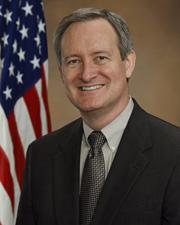 Sen. Mike Crapo (R-ID)
Legislative Activity
Stay on top of the latest movement without scrolling through every action
Senate amendment submitted
October 29, 2007
View full timeline
Senate amendment submitted
October 29, 2007
Senate amendment proposed (on the floor): Amendment SA 3477 proposed by Senator Lott for Senator Crapo.(consideration: CR S13509-13510; text: CR S13510)
October 29, 2007
Senate amendment agreed to: Amendment SA 3477 agreed to in Senate by Unanimous Consent.
October 29, 2007
Amendment SA 3477 proposed by Senator Lott for Senator Crapo. (consideration: CR S13509-13510; text: CR S13510) To give additional consideration to States with limited Amtrak service when considering new intercity passenger rail routes.
October 29, 2007
Amendment SA 3477 agreed to in Senate by Unanimous Consent.
October 29, 2007
Text
Proposed
PASSENGER RAIL INVESTMENT AND IMPROVEMENT ACT OF 2007

The PRESIDING OFFICER. Under the previous order, the Senate will
resume consideration of S. 294, which the clerk will report.
The legislative clerk read as follows:

A bill (S. 294) to reauthorize Amtrak, and for other
purposes.

Pending:

Lautenberg (for Carper) amendment No. 3454 (to amendment
No. 3452), of a perfecting nature.
Allard amendment No. 3455, to strike the provisions
repealing Amtrak's self-sufficiency requirements.
Bond (for DeMint) amendment No. 3467, to require Amtrak to
disclose the Federal subsidy of every ticket sold for
transportation on Amtrak.
Bond (for DeMint) amendment No. 3468, to increase
competition in the American rail system by allowing any
qualified rail operator or transportation company to compete
for passenger rail service.
Bond (for DeMint) amendment No. 3469, to clarify the level
of detail to be included in the modern financial accounting
and reporting system required under section 203.
Bond (for DeMint) amendment No. 3470, to require the
Performance Improvement Plan to address reaching financial
solvency by eliminating routes and services that do not make
a profit.
Bond amendment no. 3464, to amend section 24101 of title
49, United States Code, to clarify Amtrak's mission.

The PRESIDING OFFICER. The Senator from Mississippi is recognized.
Mr. LOTT. Mr. President, regarding the Amtrak legislation, work was
done on Friday and it is being worked on now by our staffs. We had
additional amendments that were filed this afternoon and we are going
through them.
In the meantime, we have cleared on both sides some nine amendments
in a variety of areas. Our staffs have worked together, and we have
reviewed these amendments. They look constructive to me. They are from
both sides of the aisle--from Senators Crapo, Tester, Allard, Bond,
DeMint, Sanders, Coburn, and Hutchison. So we will, in a few moments,
offer these amendments en bloc for acceptance.
I see that Senator Domenici has left the floor. I appreciate his
remarks on the energy legislation. As on so many issues, he has been
one of our most thoughtful and committed leaders on a variety of
subjects. I used to call him our ``No. 1 utility player.'' Wherever you
had a complicated substantive issue, if you needed someone to come and
talk about it sensibly, whether it was budget issues, energy issues,
appropriations, energy plants, nuclear issues, he has been such a great
Member for many years. The Senate will truly miss him upon his
retirement. Once again, I thought his remarks a few moments ago were
extremely thoughtful and pointed out some of what we need to be doing
in the energy policy of this country, and the many problems with trying
to get to conference.
The biggest problem in getting to conference is that the two bills
are almost irreconcilable. In our bill, we had some very strong
requirements with regard to fuel efficiency standards. We knocked out
the energy taxes, we refused to put in a high percentage of renewables
mandates, and we came out with a bill that had in it something worth
having, but we still had some problems.
The House had nothing on CAFE standards, the fuel efficiency
standards. They went the other direction on renewables, and they went
the other direction on taxes.
We have a real mess on our hands. We need a national energy policy,
but we need one that, hopefully, will create more energy for our
country and not more dependence on foreign oil.
We will continue to see if we can find ways to work together across
the aisle and across the Capitol to see what can be done. We need to do
something, but I fear we have created such a hodgepodge, we may not be
able to reach agreement on how to proceed.

Amendments Nos. 3475, 3483, 3488, 3485, 3484, 3477, 3476, 3473, 3472,
En Bloc

Mr. LOTT. Mr. President, I have a package of amendments that have
been cleared on both sides. On behalf of Senator Lautenberg and myself
and the leadership on both sides, I ask unanimous consent that the
amendments be considered and agreed to en bloc, and the motions to
reconsider be laid upon the table en bloc: Coburn amendment No. 3475,
DeMint amendment No. 3483, Hutchison amendment No. 3488, Bond amendment
No. 3485, DeMint amendment No. 3484, Crapo amendment No. 3477, Allard
amendment No. 3476, Sanders amendment No. 3473, and Tester amendment
No. 3472.
The PRESIDING OFFICER. Without objection, it is so ordered.
The amendments were agreed to, as follows:

amendment no. 3475

(Purpose: To require Amtrak to publish a comprehensive annual financial
report that allocates revenues and costs among each of its routes)

On page 14, line 25, strike ``and'' at the end and all that
follows through page 15, line 20, and insert the following:
(2) shall implement a modern financial accounting and
reporting system; and
(3) shall, not later than 90 days after the end of each
fiscal year through fiscal year 2012--
(A) submit to Congress a comprehensive report that
allocates all of Amtrak's revenues and costs to each of its
routes, each of its lines of business, and each major
activity within each route and line of business activity,
including--
(i) train operations;
(ii) equipment maintenance;
(iii) food service;
(iv) sleeping cars;
(v) ticketing; and
(vi) reservations;
(B) include the report described in subparagraph (A) in
Amtrak's annual report; and
(C) post such report on Amtrak's website.

amendment no. 3483

(Purpose: To encourage private sector funding of passenger trains)

On page 58, lines 3 through 5, strike ``its operation of
trains funded by the private sector in order to minimize its
need for Federal subsidies.'' and insert ``the operation of
trains funded by, or in partnership with, private sector
operators through competitive contracting to minimize the
need for Federal subsidies.''

amendment no. 3488

(Purpose: To express the sense of the Senate regarding the need to
maintain Amtrak as a national passenger rail system)

At the appropriate place, insert the following:

SEC. __. SENSE OF THE SENATE REGARDING THE NEED TO MAINTAIN
AMTRAK AS A NATIONAL PASSENGER RAIL SYSTEM.

(a) Findings.--The Senate makes the following findings:
(1) In fiscal year 2007, 3,800,000 passengers traveled on
Amtrak's long distance trains, an increase of 2.4 percent
over fiscal year 2006.
(2) Amtrak long-distance routes generated $376,000,000 in
revenue in fiscal year 2007, an increase of 5 percent over
fiscal year 2006.
(3) Amtrak operates 15 long-distance trains over 18,500
route miles that serve 39 States and the District of
Columbia. These trains provide the only rail passenger
service to 23 States.
(4) Amtrak's long-distance trains provide an essential
transportation service for many communities and to a
significant percentage of the general public.
(5) Many long-distance trains serve small communities with
limited or no significant air or bus service, especially in
remote or isolated areas in the United States.
(6) As a result of airline deregulation and decisions by
national bus carriers to leave many communities, rail
transportation may provide the only feasible common carrier
transportation option for a growing number of areas.
(7) If long-distance trains were eliminated, 23 States and
243 communities would be left with no intercity passenger
rail service and 16 other States would lose some rail
service. These trains provide a strong economic benefit for
the States and communities that they serve.
(8) Long-distance trains also provide transportation during
periods of severe weather or emergencies that stall other
modes of transportation.
(9) Amtrak provided the only reliable long-distance
transportation following the September 11, 2001 terrorist
attacks that grounded air travel.
(10) The majority of passengers on long-distance trains do
not travel between the endpoints, but rather between any
combination of cities along the route.
(11) Passenger trains provide transportation options,
mobility for underserved populations, congestion mitigation,
and jobs in the areas they serve.
(12) Passenger rail has a positive impact on the
environment compared to other modes of transportation by
conserving energy, reducing greenhouse gas emissions, and
cutting down on other airborne particulate and toxic
emissions.
(13) Amtrak communities that are served use passenger rail
and passenger rail stations as a significant source of
economic development.

[[Page S13510]]

(14) This Act makes meaningful and important reforms to
increase the efficiency, profitability and on-time
performance of Amtrak's long-distance routes.
(b) Sense of the Senate.--It is the sense of the Senate
that--
(1) long-distance passenger rail is a vital and necessary
part of our national transportation system and economy; and
(2) Amtrak should maintain a national passenger rail
system, including long-distance routes, that connects the
continental United States from coast to coast and from border
to border.

amendment no. 3485

(Purpose: To provide a mission statement for Amtrak, and for other
purposes)

On page 11, between lines 22 and 23, insert the following:
(e) Amtrak's Mission.--
(1) Section 24101 is amended--
(A) by striking ``purpose'' in the section heading and
inserting ``mission'';
(B) by striking subsection (b) and inserting the following:
``(b) Mission.--
``(1) In general.--The mission of Amtrak is to provide
efficient and effective intercity passenger rail mobility
consisting of high quality service that is trip-time
competitive with other intercity travel options and that is
consistent with the goals of subsection (d).
``(2) Performance measurement.--All measurements of Amtrak
performance, including decisions on whether, and to what
extent, to provide operating subsidies, shall be based on
Amtrak's ability to carry out the mission described in
paragraph (1).''; and
(C) by redesignating paragraphs (9) through (11) in
subsection (c) as paragraphs (10) through (12), respectively,
and inserting after paragraph (8) the following:
``(9) provide redundant or complimentary intercity
transportation service to ensure mobility in times of
national disaster or other instances where other travel
options are not adequately available;''.
(2) Conforming amendment.--The chapter analysis for chapter
241 is amended by striking the item relating to section 24101
and inserting the following:

``24101. Findings, mission, and goals''.

On page 18, line 7, strike ``and''.
On page 18, strike lines 8 and 9 and insert the following:
(12) prior fiscal year and projected operating ratio, cash
operating loss, and cash operating loss per passenger on a
route, business line, and corporate basis;
(13) prior fiscal year and projected specific costs and
savings estimates resulting from reform initiatives;
(14) prior fiscal year and projected labor productivity
statistics on a route, business line, and corporate basis;
(15) prior fiscal year and projected equipment reliability
statistics; and
(16) capital and operating expenditure for anticipated
security needs.

AMENDMENT NO. 3484

(Purpose: To include private rail passenger operators on the Next
Generation Corridor Equipment Pool Committee)

On page 97, line 13, insert ``host freight railroad
companies, passenger railroad equipment manufacturers, and
other passenger railroad operators as appropriate,'' after
``Administration,''.

amendment no. 3477

(Purpose: To give additional consideration to States with limited
Amtrak service when considering new intercity passenger rail routes)

On page 24, line 6, insert ``intercity passenger rail
service or by'' after ``served by''.
On page 25, strike lines 10 through 16 and insert the
following:
(e) Pioneer Route.--Not later than 1 year after the date of
the enactment of this Act, Amtrak shall conduct a 1-time
evaluation of passenger rail service between Seattle and
Chicago (commonly known as the ``Pioneer Route''), which was
operated by Amtrak until 1997, using methodologies adopted
under subsection (c), to determine whether to reinstate
passenger rail service along the Pioneer Route or along
segments of such route.

Amendment No. 3476

(Purpose: To require Amtrak to develop a plan to operate within
budgetary limits, including a longterm plan)

On page 56, strike lines 12 through 17 and insert the
following:
(1) Plan required.--Section 24101(d) is amended--
(A) by striking ``plan to operate within the funding levels
authorized by section 24104 of this chapter, including the
budgetary goals for fiscal years 1998 through 2002.'' and
inserting ``plan, consistent with section 204 of the
Passenger Rail Investment and Improvement Act of 2007,
including the budgetary goals for fiscal years 2007 through
2012.''; and
(B) by striking the last sentence and inserting ``Amtrak
and its Board of Directors shall adopt a long term plan that
minimizes the need for Federal operating subsidies.''.

amendment no. 3473

(Purpose: To clarify that the Secretary of Transportation should favor
projects that involve the purchase of environmentally sensitive, fuel-
efficient, and cost-effective passenger rail equipment in selecting
projects to receive capital investment grants to support intercity
passenger rail service)

On page 66, line 10, insert ``, including projects that
involve the purchase of environmentally sensitive, fuel-
efficient, and cost-effective passenger rail equipment''
before the period.

Amendment No. 3472

(Purpose: To require Amtrak to conduct a 1-time evaluation of passenger
rail service between Chicago and Seattle through Southern Montana)

On page 25, between lines 16 and 17, insert the following:
(f) North Coast Hiawatha Route.--Not later than 1 year
after the date of enactment of this Act, Amtrak shall conduct
a 1-time evaluation of passenger rail service between Chicago
and Seattle, through Southern Montana (commonly known as the
``North Coast Hiawatha Route''), which was operated by Amtrak
until 1979, using methodologies adopted under subsection (c),
to determine whether to reinstate passenger rail service
along the North Coast Hiawatha Route or along segments of
such route, provided that such service will not negatively
impact existing Amtrak routes.

Amendments Nos. 3455 and 3464 Withdrawn

Mr. LOTT. Mr. President, I ask unanimous consent that the following
pending amendments be withdrawn: amendments Nos. 3455 and 3464.
The PRESIDING OFFICER. Without objection, it is so ordered. The
amendments are withdrawn.
Mr. LOTT. Mr. President, I suggest the absence of a quorum.
The PRESIDING OFFICER. The clerk will call the roll.
The assistant legislative clerk proceeded to call the roll.
Mr. BYRD. Mr. President, I ask unanimous consent that the order for
the quorum call be rescinded.
The PRESIDING OFFICER. Without objection, it is so ordered.
Mr. BYRD. Mr. President, I ask unanimous consent that I be allowed to
speak as in morning business for up to 30 minutes.
The PRESIDING OFFICER. Without objection, it is so ordered.
(The remarks of Mr. Byrd pertaining to the submission of S. Res. 358
are printed in Today's Record under ``Submission of Concurrent and
Senate Resolutions.'')
Mr. BYRD. Mr. President, I yield the floor.
The PRESIDING OFFICER. The Senator from Florida is recognized.
Mr. NELSON of Florida. Mr. President, parliamentary inquiry: I wish
to speak as in morning business.
The PRESIDING OFFICER. That will take unanimous consent.
Mr. NELSON of Florida. Mr. President, I ask unanimous consent to
speak as in morning business.
The PRESIDING OFFICER. Without objection, the Senator may proceed.

Florida and the DNC

Mr. NELSON of Florida. Mr. President, I have come to the Senate floor
today to inform colleagues of both parties that there is a monumental
legal issue that has arisen between the Democratic National Committee
and the voters of the State of Florida, specifically the 4\1/4\ million
registered Democrats. The Democratic National Committee, the DNC, has
exacted punishment upon Florida Democrats because the State legislature
of Florida moved its Presidential primary from March to January 29.
Both parties said they would bring about retribution on any one State,
other than four privileged States--the Nevada caucus, the Iowa caucus,
the New Hampshire primary, and the South Carolina primary--if any other
State moved ahead of February 5, earlier than February 5.
The Florida Legislature, in its wisdom last spring--last May, May of
this year--decided to make the move to January 29. This is a
legislature that is two-thirds Republican. That legislation, setting
the date of January 29, was signed into law by Governor Crist, who
himself is a Republican.
In the course of deliberation of the legislation, the Democratic
leader in the State senate offered an amendment to move the primary
later, from January 29, 2008, to February 5, thus to comply with the
request and rules of the DNC. That amendment was voted down.
Thus, a duly called election, pursuant to State law, is, in fact,
going to be conducted by the machinery of the government of the State
of Florida and paid for by the government of the State of Florida--
estimated to the tune of some $18 million of taxpayer money--in order
to have this Presidential primary. Because Florida law set the date of
January 29, municipalities have now moved all of their elections to
concur with January 29. Indeed, also on the ballot is expected to

[[Page S13511]]

be a major constitutional amendment for the voters to decide upon
having to do with a different subject matter, a matter of great import
to the people of Florida, and that is the amount of their real estate
taxes. In other words, it is expected to be a big turnout on January
29. That is Florida law.
But the DNC took great umbrage at the State of Florida and said:
Under the rules we are going to penalize you by taking away one-half of
your delegates. Concurrently, the Republican National Committee
likewise took away one-half of the delegates at the quadrennial
nominating conventions to be held later this year. Then the DNC decided
it was going to exact additional punishment and took the punitive
measure of taking away all of Florida's delegates.
But that is not all. The DNC then further decided that it would
penalize Florida further by prohibiting the Presidential candidates
from coming into the State and campaigning. Campaigning was defined
under the rules of the DNC as talking with voters, having any kind of
communication, hiring staff, opening an office, having any kind of
advertising, whether in print or electronically, or holding press
conferences; in other words, to muzzle the Presidential candidates so
they could not go into the State of Florida--with one huge exception:
that they could go into the State of Florida to raise money. They
couldn't campaign, couldn't talk to ordinary voters, but they could
come in to raise money.
The net effect is the only way a Florida Democrat could have
interaction with a Presidential candidate one on one is to have to pay
for that participation.
This was further enhanced by the four States that I mentioned that
want to go first--the Iowa caucus, the Nevada caucus, the New Hampshire
primary, and the South Carolina primary--those four States exacting a
pledge in writing from the Presidential candidates who said they would
not have any campaigning in a State that moved its primary earlier than
February 5--except those four States.
This is a little sensitive for us in Florida, naturally, as I have
just come from the State Democratic Convention where not any of the
major Presidential candidates have appeared. But, of course, they come
and go from time to time into Florida to raise money. Of course, what a
contrast that is, since the only penalty by the Republican National
Committee was to take away half of Florida's Republican delegates. They
did not stop their candidates from coming in. Indeed, 1 week ago--a
significant contrast with the State Republican Convention--all of the
Presidential candidates were there, and indeed they ended up, the State
Republican Convention, with a televised debate of all the Republican
Presidential candidates.
This should concern not only Floridians, and it should concern not
only Democrats, it ought to concern all voters because it is the
principle of one person, one vote. That is a principle that has long
been established in law and established by the Supreme Court of the
United States. In order to enforce that principle, I, along with
others, including the chairman of our Florida Democratic delegation,
Congressman Alcee Hastings, have filed a federal lawsuit in Federal
District Court against the political party bosses in Washington. Our
lawsuit is about the right of every American to have access to the
ballot box and to have their ballot counted and to have their ballot
counted as intended.
In this lawsuit we are fighting for every person who takes time to
stand in line in the rain or in the cold, at the local church or the
precinct house, to vote and to come outside from that precinct house
feeling as if they did their part in this grand American process.
Those of us who filed this lawsuit believe there is no reason that
can excuse the denial of this fundamental right to vote. Certainly, as
we see by this fracas that has erupted by members of the DNC saying: Go
on and have your Presidential primary vote, Florida, on January 29, but
just make it a beauty contest because it is not going to count--it
certainly points to the fact that this Presidential primary system is
broken, and it desperately needs to be reformed. But the answer is not
to deny people the right to vote and to have that vote count.
For 2008, there is an easy, short-term fix. This Senator suggested
this fix last summer to Howard Dean in writing, in person, and over the
telephone; that is, if you had the States that want to go early to move
up a little early, then everyone has the same order, and the law of
Florida is complied with since there is nothing we can do about it. It
is the law. The election in the Presidential primary process is going
to be January 29 in Florida.
No one would pay any attention to that easy, short-term fix, but that
is in effect what is happening right now because, as of yesterday, Iowa
Democrats joined Iowa Republicans and moved the Presidential caucus up
to January 3. It is expected that the New Hampshire secretary of
State--who has sole authority to set the date of New Hampshire's
primary election--will move the date of the primary in New Hampshire to
something within a week of Iowa's January 3 caucus. What was suggested
as a compromise last summer, without all of this punishment that has
been levied, in effect is starting to happen.
For the long term we can fashion a solution that takes into account
the larger States as well as the small States. Let all of them have a
fair say in a system rotating regional primaries, similar to the ones
Senator Levin and I have introduced in the Senate. But in the process
of exacting this punishment on Florida, it is equally troubling that
the average citizen in Florida can no longer see their candidates for
President because, as I explained, the party bosses have barred them
from campaigning in Florida--except for the private fundraisers.
This is unacceptable. Paying for political participation is
unacceptable, and in a bygone era--one that we do not want to return
to--that was called a poll tax.
Just recently we saw a measure of Florida voters overwhelmingly
agree, regardless of their party affiliation, that they do not think
this is right. A just-released Quinnipiac Poll says by a margin of 62
to 16 Florida voters--that is, Republicans, Independents, and
Democrats--believe it is wrong to strip us of the delegates to the
nominating convention. That same poll also shows the delegate ban may
be hurting our own Presidential candidates.
In this latest Quinnipiac Poll, it has been basically neck and neck
between Presidential candidate Giuliani and Presidential candidate
Clinton. As Clinton was in the lead, now Giuliani has suddenly gone
into the lead. Very significantly, in that same Quinnipiac Poll of
independent voters, 22 percent of those independent voters said they
are less likely to consider voting for the Democrat for President in
the general election because of the DNC's shenanigans.
Mr. Chairman, Howard Dean, I hope you are listening to our plea. If
you are not going to listen on the merits of the case, that polling
data is certainly why, Mr. Chairman Dean, you should lift the ban
because you are giving an additional opportunity, an advantage to the
Republicans in the general election in the State of Florida.
I have today formulated a motion for summary judgment to be offered
in the next couple of days in the Federal District Court where the
lawsuit has been filed. Today is the last day upon which the defendant,
Chairman Howard Dean, and the defendants, the members of the Democratic
National Committee, have to answer the lawsuit. Upon the basis of their
answer, it is my intention and the intention of the other plaintiffs to
this lawsuit of filing a motion for summary judgment that sets out the
legal and constitutional arguments of why the judge should, in fact,
stop this travesty of taking away votes from more than 4.25 million
registered Democratic voters in the State of Florida.
It does not have to be this way. If, in fact, the DNC recognizes that
all these other States are moving forward to earlier dates, then the
sequence is preserved for those who wanted to be first. Whether that is
justified, their sequence is preserved, and we can go on about getting
our eye focused on the November 2008 election, instead of going through
all of this rhubarb that is now engulfing the election apparatus.
It is my hope that now the other States are jumping to an earlier
date, the DNC will see the wisdom of putting

[[Page S13512]]

this all behind us, of joining together as the family we are, stop the
family squabbles, unite, and then start focusing later on the 2008
November election.
Madam President, I yield the floor and suggest the absence of a
quorum.
The PRESIDING OFFICER (Mrs. McCaskill.) The clerk will call the roll.
The legislative clerk proceeded to call the roll.
Ms. CANTWELL. Madam President, I ask unanimous consent that the order
for the quorum call be rescinded.
The PRESIDING OFFICER. Without objection, it is so ordered.

____________________