To add a deficit-neutral reserve fund for repealing the 1993 increase in the income tax on Social Security benefits.
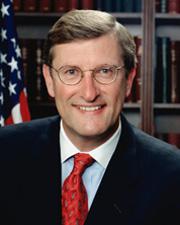 Sen. Kent Conrad (D-ND)
Legislative Activity
Stay on top of the latest movement without scrolling through every action
Senate amendment agreed to: Amendment SA 4204 agreed to in Senate by Yea-Nay Vote. 53 - 46. Record Vote Number: 51.
March 13, 2008
View full timeline
Senate amendment agreed to: Amendment SA 4204 agreed to in Senate by Yea-Nay Vote. 53 - 46. Record Vote Number: 51.
March 13, 2008
Roll call votes on amendments in Senate: Amendment SA 4204 agreed to in Senate by Yea-Nay Vote. 53 - 46. Record Vote Number: 51.
March 13, 2008
Considered by Senate. (consideration: CR S2037, S2045-2046)
March 13, 2008
Amendment SA 4204 agreed to in Senate by Yea-Nay Vote. 53 - 46. Record Vote Number: 51.
March 13, 2008
Senate amendment submitted
March 12, 2008
Senate amendment proposed (on the floor): Amendment SA 4204 proposed by Senator Conrad.(consideration: CR S1939; text: CR S1939)
March 12, 2008
Amendment SA 4204 proposed by Senator Conrad. (consideration: CR S1939; text: CR S1939) To add a deficit-neutral reserve fund for repealing the 1993 increase in the income tax on Social Security benefits.
March 12, 2008
Votes
1 roll call on this amendment
Text
Proposed
CONGRESSIONAL BUDGET FOR THE UNITED STATES GOVERNMENT FOR FISCAL YEAR
2009--Continued

The ACTING PRESIDENT pro tempore. Who yields time?
The Senator from North Dakota.
Mr. CONRAD. Mr. President, I thank the leaders for the action they
have taken for a short-term extension of the farm bill so that we can
conclude action on it. It has been a negotiation that has gone on well
over a year. That is not unusual for a farm bill which is extremely
contentious.
I wanted to comment briefly on the Republican leader's statements
this morning about our budget. As I was driving in this morning, I
heard another Republican on the air saying that we have a trillion-
dollar tax increase in this budget. I don't know what budget they are
talking about because it certainly is not the budget we have presented
here. There is no trillion-dollar tax increase here. There is no tax
increase assumed here. Honestly, if I would go down to the Senate
dining room and come to this floor and introduce the dining room menu
as the budget for the United States, our Republican colleagues would
say it was a trillion-dollar tax increase.
This is what they said last year, and we hear the same mantra again
this year: It is a trillion-dollar tax increase. When they said it last
year, we didn't have a record of a Democratic Congress to refute their
claim. Now we do. We can look back and see precisely what happened with
Democrats in control. How much did taxes increase after the Republicans
asserted repeatedly we were going to increase taxes a trillion dollars?
What happened? What happened on the record, not a projection, not a
forecast, not rhetorical, what is the fact? It is very interesting.
Democrats controlling the House, controlling the Senate, cut taxes $194
billion--not a tax increase, a tax cut that overwhelmingly has gone to
the middle class. That is the Democratic record.
Let me say about this budget, we don't have the vast spending
increases they are talking about. For this year, if you look at total
spending, we have 1 percent more than the President's budget. Where is
that money going? We put it into energy, to reduce our dependence on
foreign oil. We put it into education, and we put it into
infrastructure because we don't want any more bridges, like the one in
Minnesota last year, collapsing into the river with people driving home
from work. That is a fact.
In terms of revenue, the truth is that over the 5 years, we have 2.6
percent more revenue than in the President's budget. We believe that
can be obtained not with a tax increase--don't need a tax increase to
get it--you can go after the tax gap, the difference between what
companies and people owe versus what they are actually paying. You can
go after these offshore tax havens which the Permanent Subcommittee on
Investigations has told us are costing this country $100 billion a
year. You can go after these abusive tax shelters where we have the
spectacle of companies in the United States, banks buying foreign sewer
systems and depreciating them on their books in the United States to
reduce their tax bill here, and then they lease the sewer systems back
to the European cities that built them. My goodness. We are better than
that as a nation, better than letting people abuse the vast majority of
us who are honest. That is not right. That is not fair.
I have shown on this floor many times a picture of a five-story
office building in the Cayman Islands called Ugland House. That 5-story
building is home to 12,800 companies. I would say that is the most
efficient building in the world.
Mr. President, 12,800 companies claim they are doing business out of
this little five-story building in the Cayman Islands. They are not
doing business there. The only business they are doing is monkey
business. What they are doing is evading their taxes.
Now we have seen, according to the Boston Globe, another building
down in the Cayman Islands--this time a four- or five-story building
too--and we know KBR, who is the biggest contractor for security forces
in Iraq and additional workers in Iraq for the U.S. military effort
there, is running an operation out of that building to evade the Social
Security taxes and the Medicare taxes of thousands and thousands of
workers they have employed for Iraq--another tax scam.
It is exactly the kind of thing we on this side think should be
closed down. Over and over, when we have tried, this President said:
No, you can't do that. That would be a tax increase. Really? Is that a
tax increase? I do not think so. Making people pay their fair share,
like the vast majority of Americans already do--I do not think that is
a tax increase. I think that is making those folks pay like all the
rest of us do. That is fair.
Mr. President, we have Senators on the floor ready to offer an
amendment. I want to go to that at this moment.
I ask Senator Bingaman, how much time----
Mr. GREGG addressed the Chair.
Mr. CONRAD. Mr. President, I will withhold. Senator Gregg is seeking
recognition.
The ACTING PRESIDENT pro tempore. The Senator from New Hampshire is
recognized.

Senator Conrad's 60th Birthday

Mr. GREGG. Mr. President, I rise this morning to say this is a big,
big, big day for the chairman of the committee, and I know he would not
want this day to go unacknowledged after having made such an eloquent
statement. But it is the chairman's 60th birthday today. So I
congratulate him and say, on his 60th birthday, we appreciate all he
has done for the last 60 years, and we hope he will be here for another
60 years.
I yield the floor.
The ACTING PRESIDENT pro tempore. The Senator from North Dakota is
recognized.
Mr. CONRAD. Mr. President, I thank the ranking member for his
continuing courtesy and graciousness. This is my 60th. As I left the
house this morning, I told my wife and our son, who is there visiting,
I have to question: What have I done wrong in my life to have my 60th
birthday spent here managing the budget? But I will get over it.
I appreciate the many courtesies of the ranking member. This is a
special day for me, and I am looking forward to a good debate.
With that, we want to go to the next amendment, unless the Senator--
Mr. GREGG. Mr. President, I ask unanimous consent that after Senator
Bingaman has spoken on his amendment, and to the extent Senator
Alexander wishes to speak, that we then, after that, go to our side for
the next amendment.
Mr. CONRAD. Fair enough.
The ACTING PRESIDENT pro tempore. Without objection, it is so
ordered.
Mr. CONRAD. Mr. President, I say to the Senator, if you can give us a
heads up at some point what your next amendment will be, that would be
helpful as well.
Now we will turn to Senator Bingaman and Senator Alexander, who I
think have a very constructive amendment. We welcome their description
of it.
I ask unanimous consent that the time come off the resolution.
The ACTING PRESIDENT pro tempore. Without objection, it is so
ordered.
The Senator from New Mexico is recognized.
Mr. BINGAMAN. Mr. President, I thank the managers of the bill and all
colleagues. Let me mention, I believe Senator Kennedy wishes to speak
in favor of the amendment after Senator Alexander speaks. So I believe
he will be coming to the floor. I hope there is an opportunity for him
to do that before we proceed too far this morning.

Amendment No. 4173

Mr. President, I call up amendment No. 4173 and ask for its immediate
consideration.
The ACTING PRESIDENT pro tempore. The clerk will report.
The legislative clerk read as follows:

The Senator from New Mexico [Mr. Bingaman], for himself,
Mr. Alexander, Mr. Kennedy, Mr. Domenici, Ms. Mikulski, Mr.
Ensign, Mr. Durbin, Mrs. Feinstein, Mr. Lieberman, Mr.
Schumer, Mr. Biden, and

[[Page S1918]]

Mr. Kerry, proposes an amendment numbered 4173.

Mr. BINGAMAN. Mr. President, I ask unanimous consent that reading of
the amendment be dispensed with.
The ACTING PRESIDENT pro tempore. Without objection, it is so
ordered.
The amendment is as follows:

(Purpose: To provide additional funding resources in FY2009 for
investments in innovation and education in order to improve the
competitiveness of the United States)

On page 11, line 13, increase the amount by $600,000,000.
On page 11, line 14, increase the amount by $306,000,000.
On page 11, line 18, increase the amount by $210,000,000.
On page 11, line 22, increase the amount by $60,000,000.
On page 12, line 1, increase the amount by $12,000,000.
On page 12, line 5, increase the amount by $12,000,000.
On page 27, line 16, decrease the amount by $600,000,000.
On page 27, line 17, decrease the amount by $306,000,000.
On page 27, line 21, decrease the amount by $210,000,000.
On page 27, line 25, decrease the amount by $60,000,000.
On page 28, line 4, decrease the amount by $12,000,000.
On page 28, line 8, decrease the amount by $12,000,000.

Mr. BINGAMAN. Mr. President, this is an amendment I am offering on
behalf of myself, Senator Alexander, Senator Kennedy, Senator Domenici,
Senator Mikulski, Senator Ensign, and others to offer an amendment to
the budget resolution to do two things: to fund the Office of Science
within the Department of Energy and also to fund the National Science
Foundation at the fiscal year 2009 funding levels that have been
proposed in the President's budget.
Last year, on a bipartisan basis, Congress passed the COMPETES Act. I
compliment my colleague, who is here on the floor with me today,
Senator Alexander, for his leadership in that legislation. This was
bipartisan legislation. It was strongly endorsed by Members of the
Senate. It authorized a number of programs based upon the
recommendations that came from the National Academies report entitled
``Rising Above the Gathering Storm.''
Specifically, the COMPETES Act authorized a doubling of the budgets
for the National Science Foundation and the Department of Energy's
Office of Science over a period of 7 years. The Office of Science and
the National Science Foundation are the two principal agencies charged
with maintaining the nondefense basic science enterprise of our Nation,
which serves as the wellspring for future innovation and for our global
competitiveness.
For the Office of Science, the America COMPETES Act authorized a 12-
percent increase relative to fiscal year 2007. The President's Advanced
Competitiveness Initiative would have increased the Office of Science
by 7.2 percent. For the National Science Foundation, the COMPETES Act
authorized a 12-percent increase as compared to the President's
Advanced Competitiveness Initiative proposed increase of 9.3 percent.
The COMPETES Act was passed into law last August. At that time, the
appropriations bills in both Chambers kept the funding levels for both
offices I am speaking about here at or above the President's request.
But by the time the Congress made the deep cuts that were required by
the administration in order to get an omnibus spending bill passed in
December, all of the gains that had earlier been in appropriations
bills for the Office of Science and for the National Science Foundation
were lost, and both of those offices were flat funded when you account
for inflation.
Let me talk a few minutes about why these two programs are so
important to our ability to compete globally. As noticed in the
President's budget, the National Science Foundation is the principal
source of Federal support for strengthening science and math education.
Education and human resource programs at the National Science
Foundation support technological innovation to enhance economic
competitiveness and new job growth. They address the workforce needs of
the country. They help to ensure a pool of talented experts. Many of
these programs are critical to developing and advancing the knowledge
of our country's K through 12 math and science teachers as well.
When we passed the America COMPETES Act, we recognized that this
country is facing a critical shortage in well-prepared math and science
teachers. Accordingly, we significantly expanded the Robert Noyce
Scholarship program, which prepares science, technology, engineering,
and mathematics undergraduate students and professionals to become math
and science teachers. Among a number of changes, we required increased
collaboration between science and education faculty to establish STEM
teacher education programs--STEM, of course, refers to science,
technology, engineering, and math teachers--and increased scholarships
and stipends to at least $10,000 per year, for up to 3 years of
scholarship support, beginning with the junior year.
We also increased funding significantly in order to meet these
objectives. Congress anticipated that the Noyce program would grow to
become a major source of effective training for our science,
technology, engineering, and mathematics teachers. Research shows that
students' performance on annual math and science assessments improved
in almost every age group when their schools were involved in a program
that linked K through 12 teachers with their colleagues in higher
education.
The Math and Science Partnership I am referring to helps forge these
connections between K through 12 and higher education to strengthen
math and science teaching skills, improve curriculum, and provide
college preparatory programs for students.
The Office of Science at the Department of Energy also makes
significant contributions to math and science education. Among the
things the America COMPETES Act authorizes for the Department of
Science are: to help establish statewide specialty schools in math and
science; to get middle and high school students around the State
involved in national laboratories through internship programs; and to
require the national laboratories to partner with local school
districts and to adopt at least one high-need high school and transform
these schools into centers of excellence in mathematics and science.
This is only a small part of what the Office of Science does. Simply
put, it provides the support for much of the basic scientific research
that will drive the industries of the future. It funds facilities that
help us understand the basics of materials, funds research into such
critical areas as biogenetic sequencing, and provides support for much
of the physical sciences enterprise in this country.
Once again, for fiscal year 2009, the President has come forward
proposing increases for both the National Science Foundation and the
Office of Science. Relative to fiscal year 2008, the President's
proposed budget increase for these two agencies amounts to $1.4
billion. This amount would not bring the levels for these two agencies
to the full level we authorized in the America COMPETES Act for fiscal
year 2009, but they are a substantial step in the right direction, and
I strongly support these increases.
So the amendment my cosponsors and I are offering today adds another
$600 million to the budget resolution, as reported by the Committee on
the Budget, to at least meet the level the President has indicated he
is willing to support. I believe this addition to the budget resolution
can and should command broad bipartisan support in the Senate, just as
the America COMPETES Act was broadly supported on a bipartisan basis
here in the Senate.
I urge my colleagues to support the amendment. I know my colleague
from Tennessee is here to speak in favor of it as well. I again
compliment him for his leadership on the issue.
I yield the floor.
The ACTING PRESIDENT pro tempore. The Senator from Tennessee is
recognized.
Mr. ALEXANDER. Mr. President, the Senator from New Mexico, Mr.
Bingaman, has been tireless in helping to create the America COMPETES
Act, which passed unanimously here. But even more important than that,
he did not walk away from it once it became law. He has attended to the
details of trying to make sure we implement it. One of those details is
what we are doing today.

[[Page S1919]]

I wish to, in support of what he has said so eloquently--and I also
commend Senator Domenici from New Mexico, who has had such a key role
in this effort--I wish to tell a story that helps put in perspective
what we are talking about.
Two years ago, a group of Senators traveled to China, led by Senator
Stevens and Senator Inouye. We were received very well because Senator
Stevens had flown with the Flying Tigers. He flew the first plane to
land in Beijing after World War II, and the top Chinese leaders had not
forgotten. And, of course, Senator Inouye is a Congressional Medal of
Honor winner for his heroic service to our country in World War II.
So we saw President Hu, and the No. 2 man in China, Mr. Wu. What
struck me about those two meetings--which were about an hour long, and
during which we could have talked about Taiwan or Iraq or Iran or
China's military buildup or America's intelligence system--the subject
about which they wanted to talk the most and which animated them the
most in their conversation was the subject Senator Bingaman just
discussed: how China can use its brainpower to create a higher standard
of living for the people of China.
We are in an economic slowdown in America today, and we are debating
and talking here about how we restore our level of progress
economically. We are talking not only about the Federal budget, we are
talking about the family budget. We are talking about family incomes.
We are talking about jobs. That was the same subject the No. 1 and No.
2 men in China wanted to talk about as well. What were they focusing
on? The fact of trying to give to China the same kind of brainpower
advantage in creating a high standard of living we have had in America,
since World War II especially. This year, despite the economic
slowdown, the United States of America will create about 30 percent of
all the world's wealth for 5 percent of the world's people, who are
those of us who live in the United States. That is an astonishing fact.
There are many reasons for it, including our free market system, our
geography, our character, the immigration that has brought talented
people from all over the world who are entrepreneurial in their
spirit. But most people agree that the major fact in the high standard
of living for this country since World War II has been our brainpower
advantage. We have not only some of the best universities in the world,
we have almost all of them. We have a set of national laboratories that
is unequaled in the world. Until recently, at least, our system of
kindergarten through the 12th grade education has been the envy of the
world. As a result of all that brainpower, we have created a lot of
jobs and a high standard of living. Increasingly, that is where the new
jobs come from. That is why we like to have foreign students come here,
because they become educated in our universities and we are, in effect,
insourcing brainpower, so they create Google in the United States of
America rather than in India or in China, and the jobs are here in the
United States of America.

So the America COMPETES Act, to which Senator Bingaman referred, had
broad support here. It is the only legislation we have had in the last
4 years that I remember was supported by Senator Frist and Senator
Reid. Then, when the Senate changed hands and the Democrats were in the
majority, it was sponsored by Senator Reid and Senator McConnell. At
one point, it had 70 Members of the Senate backing it, 35 Senators who
are Democrats and 35 Republicans. It all came from a request that
Senator Bingaman and I and others--including House Member Bart Gordon
of Tennessee, the chairman of the Science Committee now--made of the
National Academy of Sciences: Please tell us, in priority order, what
are the 10 things we in Congress ought to do to help keep our
brainpower advantage so our jobs will not go overseas. Norm Augustine,
the former chairman of Lockheed Martin, a member of the National
Academy of Engineering, assembled a group of Nobel laureates,
university presidents, and others, and they came back with 20 specific
recommendations in the Augustine report. There was also other important
work being done by the Council on Competitiveness. We put all that
together over 2 years. The President weighed in, in a big way, in two
straight State of the Union Addresses and budgets. The Speaker of the
House also weighed in, in an important way. So in this endeavor, on
this important issue, we are all on the same team. But what we are
doing today with this amendment is making sure we get where we have
agreed we want to go.
Now, for President Hu in China, all he had to do was walk over to
their National Academy of Sciences in China, he convened them all in
the Great Hall--and said: This is what we will do over the next 10
years. We are going to increase support for our universities and
research through a percent of our domestic product. We are going to
recruit from American universities talented Chinese professors who have
distinguished themselves in the United States and they are going to
come back and help improve Chinese universities. So, in China, the top
man gave the order and they are on their way. Here, a lot more of us
have to be involved, but we are all involved. The President has said we
need an 18-percent increase for Fiscal Year 2009 to stay on a track to
double funding for the physical sciences over the next 10 years; 18
percent for the Office of Science, which is our principal funder of our
national laboratories and science programs, and 13 percent in the
National Science Foundation. That is bigger than it normally would be
because of the way the appropriations process worked last year. We
didn't do what we all agreed we wanted to be able to do.
So the Budget Committee did a pretty good job in reporting to the
floor a budget resolution with sufficient provisions to fund this
year's version of the America COMPETES Act. There are a wide range of
those programs. There are opportunities for low-income children to take
advanced placement courses which they now can't afford and to train the
teachers who need to be trained to teach those courses. There are
opportunities for summer academies at our laboratories and at
universities to interest our students in math and sciences. The
Augustine Commission reviewed programs all over America and recommended
only a handful that ought to be emulated, and they included programs
such as the UTeach program in Texas at the University of Texas which
attracts outstanding students in chemistry and physics, for example,
and gives them scholarships if they will agree to become teachers of
chemistry and physics.
Former Gov. Jim Hunt of North Carolina told me the University of
North Carolina only graduated one physics teacher in one recent year.
We are not going to learn much physics in America, to keep up with the
Chinese and Indians and Irish and all the others who are trying to
increase their brainpower to increase their jobs if we don't graduate
physics teachers. So the Budget Committee did a good and important job.
What we are trying to do is to get back on track to double funding
for the physical sciences over 10 years, which is what we all agreed we
should try to do. That was our goal. A huge majority in the House, the
Senate, and the President himself, we are asking that the Senate make
room in the budget for the President's number for the America COMPETES
Act. That is what this amendment does.
So I feel confident we will have substantial support, because so many
of us worked so hard for so long on this idea.
We Republicans are talking these days in unflattering ways about the
Democratic budget. Senator Reid, the majority leader, said he hadn't
heard about tort reform yet. Well, he will, before we are through. One
way to help the family budget is to make it easier for pregnant women
in rural areas to get medical care without driving 60 miles, and one
way to do that is to put some limits on medical malpractice suits. That
is tort reform. That will help the family budget. Lower taxes help the
family budget. Lower energy costs help the family budget. But on this
side of the aisle, we also believe that better schools and investments
in science and technology, so we can keep our brainpower advantage and
keep our jobs from going overseas, is an important part of a pro-growth
plan.

When I was Governor of Tennessee, Tennessee's taxes were the lowest
in the country. I say this with great respect to the Senator from New
Hampshire, who is also here. I double

[[Page S1920]]

checked this fact when I came in. But we were the third poorest State.
So we kept our taxes low, but we also had to enact some other pro-
growth policies, which included getting rid of a usury limit,
preserving the right to work law, reducing the number of employees in
government, but it also included building highways. Eventually, I came
to the conclusion that the single most important thing we could do to
improve family incomes in our State was to focus on improving the
quality of schools, colleges, universities, and research, so we began
to pay teachers more for teaching well. We created chairs of excellence
at the universities and centers of excellence at the universities. I
believe that partly because of all those things together, our State
began to increase its family incomes at a rate that was faster than any
other part of our--any other State in the country during the 1980s. It
was no coincidence we were also increasing funding for our education
during that time at a rate faster than any other State.
So an important part of a pro-growth plan--a Republican pro-growth
plan, but obviously many Democrats agree with this as well--is fully
funding the America COMPETES Act, making sure we keep our brainpower
advantage so we can keep our jobs.
I congratulate the Senator from New Mexico, Mr. Bingaman, for his
leadership on this, and the senior Senator from New Mexico, Mr.
Domenici, for his leadership on this. I thank the majority leader and
the Republican leader for their co-sponsorship of this act.
I say to Senators Conrad and Gregg, I am glad you made room in the
budget for much of the America COMPETES Act. I hope we can complete the
job with the Bingaman amendment so we can keep those jobs from going
overseas. That is one good way to help advance a pro-growth plan that
will help balance the family budget.
I thank the President, and I yield the floor.
The ACTING PRESIDENT pro tempore. The Senator from Massachusetts is
recognized.
Mr. KENNEDY. Mr. President, I welcome the fact that at the real start
of this debate on the Budget Act, we have an amendment that reflects
the best judgment of Republicans and Democrats alike in the Senate,
which is so key to the future of our country, and to listen to our
colleagues on both sides of the aisle at a time when, on so many
issues, there is divisiveness, but on this issue, there is a real
coming together in the Senate on this item for the support of the
America COMPETES Act.
I wish to commend those who have been a part of this process over
recent years. It has been truly a bipartisan effort. We have listened
to Senator Bingaman, Senator Alexander, and others who have been a part
of this whole process, and it was an enormous achievement this last
year when the bill passed the Senate. Now, we are impressed by the fact
that those who were involved in making sure this was going to be
achieved are committed to making sure we are going to have muscle and
bones on this project in the form of providing the resources which are
necessary to make it effective. This is, I think, one of the most
important undertakings we will have in this debate and discussion on
the budget, and I am very hopeful we will get a strong vote in support
of this amendment.
Very briefly, I think all of us understand the average family in this
country is exceedingly hard-pressed at this time. They are wondering
whether they are going to be able to pay their mortgages, and we are
finding out that many are unable to pay their mortgages and they are
losing their homes, or they have the threat of losing their homes. It
is difficult to imagine, I think, for many of us, when parents go to
bed at night and wonder whether they are going to be able to afford
their mortgages and maintain their home for themselves, their families,
and for their children, but it is happening in too many parts of this
country. At the same time, those same parents are wondering if they are
going to be able to heat their homes, at least in my part of the
country. With the fact of the extraordinary explosion of the cost of
home heating oil, we find so many families are hard-pressed to be able
to provide heating for their homes.
These are families who have worked hard, who have played by the rules
all their lives, and they are wondering now about what the future will
hold for themselves and for their parents and for their children. Are
they going to be able to make sure their parents are going to be able
to live their golden years in peace and dignity? They are hard-pressed
to provide the extra help and assistance to them so they can afford
their prescription drugs. They have seen the cost of tuition go up and
continue to go up, and they wonder if they will be able to educate
their children; while fuel and gas go up, whether they will be able to
fill the gas tank to get to their jobs where they are working. There is
enormous anxiety. There is also the concern about rising health care
costs. There is enormous rising anxiety out in the country. People are
wondering: Why should my job be at risk? I have worked hard. I have
played by the rules. I have done everything I possibly can, and still I
wonder whether in a few years, the opportunities for my children are
going to be as great as opportunities were for me. I know my parents
sacrificed so I would be able to make progress, and now I wonder
whether my children are going to be better off than I was. That is
going on in home after home across this country.
It is as a result of the failure of economic policy. It is a failure
of fiscal and monetary policy over the period of recent years. It is
not the fault of these particular families; it is the fault of economic
policy and giving the kinds of investments in our country and
investments in individuals that are necessary in order to have a strong
economy. We know how to do it. We have seen it done. I am not going to
take the time of the Senate to go back over the history where it has
been done and it should be done.
So we are faced with where we are today, and this calls for immediate
assistance for these families. We have seen the efforts that have been
made in terms of housing and in terms of the unemployment, the help and
assistance of fuel assistance and food stamps and others to try to
address the immediate kinds of problems families are facing.
We also have to look at where we are going to be as a country in
terms of the future, where we are going to be in 3 to 5 years as we are
seeing this whole global economy challenge the United States. One
overarching fact is that the future is going to be the knowledge
economy, the economy that puts the premise on knowledge and information
and education. That is where the future is going to lie. That will be
the great competition between the countries of Asia and the United
States. We are thinking about how we are going to address that, and the
COMPETES Act is one of the important solutions to this challenge.
Mr. President, if we look at this chart here, it is interesting in
terms of U.S. students. To be globally competitive, we need to tackle
the achievement gaps. U.S. students from high-income families
outperform students in other countries in math, while U.S. students
from low-income families lag behind. When you are talking about
international competitiveness, we find that U.S. students who come from
higher income families are able to go to schools that are able to
afford the good teachers, are able to out-compete the students in other
parts of the world. It is no mystery about how that should be done. But
students who come from lower income families are not able to keep pace.
This legislation is designed to, among other things, reduce this gap
that exists now in our country.
Look at this chart. We have more math classes in high-poverty schools
that are taught by teachers without a major in that subject. You have
low-poverty secondary schools where the percentage of secondary school
math classes taught by teachers without that major is 26 percent. In
the high-poverty schools, it is 56 percent. Much of it comes down to
teachers and the importance of investing in them, to make sure they are
going to have the skills to serve in communities and in school
districts all over the country, and so they are going to have the
competency. If you are not going to have the high-quality teachers in
underserved areas, then you are going to have those kinds of results we
saw with the other chart where American children are going to fall
further and further behind. It is in this very area that the COMPETES
Act is directed.

[[Page S1921]]

That is one of the important reasons why this legislation is so
important and why the resources and the investment are so much in the
interest of this country and its future in terms of the ability to be
able to compete.
Mr. President, this is a sound amendment that makes a great deal of
sense for the reasons I have mentioned here and other reasons as well.
I am hopeful that the Senate will accept it with an overwhelming vote.
Mr. President, I suggest the absence of a quorum.
The ACTING PRESIDENT pro tempore. The clerk will call the roll.
The assistant legislative clerk proceeded to call the roll.
Mr. GREGG. Mr. President, I ask unanimous consent that the order for
the quorum call be rescinded.
The ACTING PRESIDENT pro tempore. Without objection, it is so
ordered.

Amendment No. 4189

Mr. GREGG. Mr. President, I ask unanimous consent that the present
amendment be set aside, and on behalf of Senator Specter, I send an
amendment to the desk.
The ACTING PRESIDENT pro tempore. Without objection, it is so
ordered.
The clerk will report.
The assistant legislative clerk read as follows:

The Senator from New Hampshire [Mr. Gregg], for Mr.
Specter, for himself and Mr. Craig, proposes an amendment
numbered 4189.

Mr. GREGG. Mr. President, I ask unanimous consent that reading of the
amendment be dispensed with.
The ACTING PRESIDENT pro tempore. Without objection, it is so
ordered.
The amendment is as follows:

(Purpose: To repeal section 13203 of the Omnibus Budget Reconciliation
Act of 1993 by restoring the Alternative Minimum Tax rates that had
been in effect prior thereto)

On page 3, line 10, decrease the amount by $4,700,000,000.
On page 3, line 11, decrease the amount by $25,600,000,000.
On page 3, line 12, decrease the amount by $51,000,000,000.
On page 3, line 13, decrease the amount by $47,300,000,000.
On page 3, line 14, decrease the amount by $26,l00,000,000.
On page 3, line 15, decrease the amount by $30,500,000,000.
On page 3, line 19, decrease the amount by $4,700,000,000.
On page 3, line 20, decrease the amount by $25,600,000,000.
On page 3, line 21, decrease the amount by $51,000,000,000.
On page 3, line 22, decrease the amount by $47,300,000,000.
On page 3, line 23, decrease the amount by $26,100,000,000.
On page 3, line 24, decrease the amount by $30,500,000,000.
On page 4, line 4, increase the amount by $36,190,000.
On page 4, line 5, increase the amount by $441,680,000.
On page 4, line 6, increase the amount by $2,133,860,000.
On page 4, line 7, increase the amount by $4,798,780,000.
On page 4, line 8, increase the amount by $6,988,760,000.
On page 4, line 9, increase the amount by $8,794,210,000.
On page 4, line 13, increase the amount by $36,190,000.
On page 4, line 14, increase the amount by $441,680,000.
On page 4, line 15, increase the amount by $2,133,860,000.
On page 4, line 16, increase the amount by $4,798,780,000.
On page 4, line 17, increase the amount by $6,988,760,000.
On page 4, line 18, increase the amount by $8,794,210,000.
On page 4, line 22, increase the amount by $4,736,190,000.
On page 4, line 23, increase the amount by $26,041,680,000.
On page 4, line 24, increase the amount by $53,133,860,000.
On page 4, line 25, increase the amount by $52,098,780,000.
On page 5, line 1, increase the amount by $33,088,760,000.
On page 5, line 2, increase the amount by $39,294,210,000.
On page 5, line 7, increase the amount by $4,736,190,000.
On page 5, line 8, increase the amount by $30,777,870,000.
On page 5, line 9, increase the amount by $83,911,730,000.
On page 5, line l0, increase the amount by
$136,010,510,000.
On page 5, line 11, increase the amount by
$169,099,270,000.
On page 5, line 12, increase the amount by
$208,393,480,000.
On page 5, line 15, increase the amount by $4,736,190,000.
On page 5, line 16, increase the amount by $30,777,870,000.
On page 5, line 17, increase the amount by $83,911,730.000.
On page 5, line 18, increase the amount by
$136,010,510,000.
On page 5, line 19, increase the amount by
$169,099,270,000.
On page 5, line 20, increase the amount by
$208,393,480,000.
On page 26, line 12, increase the amount by $36,190,000.
On page 26, line 13, increase the amount by $36,190,000.
On page 26, line 16, increase the amount by $441,680,000.
On page 26, line 17, increase the amount by $441,680,000.
On page 26, line 20 increase the amount by $2,133,860,000.
On page 26, line 21, increase the amount by $2,133,860,000.
On page 26, line 24, increase the amount by $4,798,780,000.
On page 26, line 25, increase the amount by $4,798,780,000.
On page 27, line 3, increase the amount by $6,988,760,000.
On page 27, line 4, increase the amount by $6,988,760,000.
On page 27, line 7, increase the amount by $8,794,210,000.
On page 27, line 8, increase the amount by $8,794,210,000.

Mr. GREGG. Mr. President, Senator Specter will talk about this
amendment. Essentially, this amendment would repeal the AMT
permanently, as it relates to middle-income Americans. It is currently
wrong that we have this tax. It was never intended to be a tax that
would cover 20 million Americans. It was supposed to hit high-income
individuals who were avoiding taxes, using legal tax vehicles but
basically avoiding paying any income tax. It has turned into a monster
where literally 20 million Americans would be subject to the tax unless
it is adjusted.
This budget presumes that it will be abated for this year. There is
no reason to keep these revenues in the baseline because we know we
will do this again next year and the year after that. It is time to
correct this permanently and stop having these illusory revenues, which
we turn around and spend, and it creates inappropriate expectations and
leads to less fiscal discipline here.
This is an attempt to address the issue by essentially repealing the
AMT and addressing the fact that if we don't do this, 20 million
Americans will be hit with this tax, and that was never the intention
of the Federal Government, to get revenues from them. It is wrong to
have it on the books.
The Senator from Pennsylvania will come over to speak to this around
11:30 or so. The Democratic side may have another amendment relative to
this issue.
The ACTING PRESIDENT pro tempore. The Senator from North Dakota is
recognized.
Mr. CONRAD. Mr. President, I think the amendment the ranking member
has set up for Senator Specter doesn't actually have full repeal.
Instead, what it does is change the individual alternative minimum tax
from its current two-rate structure of 26 percent and 28 percent to the
single 24-percent rate that was in effect prior to 1993. I believe that
is what the Specter amendment does.
The first priority, of course, for dealing with the AMT is to protect
families who have not been subject to it previously. So our resolution
acknowledges this priority and provides a 1-year patch to prevent the
alternative minimum tax from affecting another 20 million American
households. That is at a cost of $62 billion.
I would prefer that cost be offset, but last year that was not the
will of the body. It was not the will of the body in the very clear and
compelling vote. So we don't have it offset in our resolution this
year.
Our resolution acknowledges the political reality that the will of
this body is to extend alternative minimum tax relief without paying
for it. Restructuring the AMT, as Senator Specter proposes, is even
more expensive. The Specter amendment would lose $185 billion in
revenue, and it is not paid for in any way--by spending reductions or
other revenue--and therefore it simply gets added to the deficit and
debt. If it were adopted as is, the resolution would be in deficit in
every year of the budget window.
Mr. President, I don't think that is fiscally responsible, so I am
offering an amendment that accomplishes the same policy purpose but
requires that it be offset, paid for, so that it is not

[[Page S1922]]

added to the deficit and is not added to the debt.
I inquire of the Senator, did he send up the Specter amendment?
Mr. GREGG. I did.

Amendment No. 4190

Mr. CONRAD. Mr. President, I send the Conrad amendment to the desk.
The ACTING PRESIDENT pro tempore. Is there objection to setting aside
the pending amendment so the Senator from North Dakota may submit his
amendment?
Without objection, it is so ordered.
The clerk will report.
The assistant legislative clerk read as follows:

The Senator from North Dakota [Mr. Conrad] proposes an
amendment numbered 4190.

Mr. CONRAD. Mr. President, I ask unanimous consent that reading of
the amendment be dispensed with.
The ACTING PRESIDENT pro tempore. Without objection, it is so
ordered.
The amendment is as follows:

(Purpose: To add a deficit-neutral reserve fund for repealing the 1993
rate increase for the alternative minimum tax for individuals)

At the end of Title III, insert the following:

SEC. __. DEFICIT-NEUTRAL RESERVE FUND FOR REFORMING THE
ALTERNATIVE MINIMUM TAX FOR INDIVIDUALS.

The Chairman of the Senate Committee on the Budget may
revise the allocations of a committee or committees,
aggregates, and other levels in this resolution for one or
more bills, joint resolutions, amendments, motions, or
conference reports that would reinstate the pre-1993 rates
for the alternative minimum tax for individuals, by the
amounts provided in such legislation for such purpose,
provided that such legislation would not increase the deficit
over either the period of the total of fiscal years 2008
through 2013 or the period of the total of fiscal years 2008
through 2018.

Mr. CONRAD. Mr. President, I think it might be useful here that we
enter into a unanimous consent agreement that when we go to a fuller
debate, the debate on the Specter and Conrad amendments be limited to 1
hour. Is that acceptable?
Mr. GREGG. I don't see why we cannot put the Kyl amendment in there
also.
Mr. CONRAD. Mr. President, I ask unanimous consent that there be a
half hour each on the Specter and Conrad amendments, a total of 1 hour.
The ACTING PRESIDENT pro tempore. Without objection, it is so
ordered.
Mr. CONRAD. Then we will go to the Kyl amendment, and there would
also be a side-by-side for that amendment. That would be, at this
point, an amendment in my name or by my designee.
I also ask unanimous consent that there be a half hour on each for
those amendments.
The ACTING PRESIDENT pro tempore. Is there objection? Without
objection, it is so ordered.
Mr. GREGG. Mr. President, just to clarify this, other Members may
come in and talk during this time. The concept is that this hour is
fluid. If other Senators show up and talk, it will not be off of these
amendments.
Mr. CONRAD. Our understanding is the same. Look, we are going to have
to be flexible. We have other committees that are meeting, and other
Members who are involved in these amendments are at other meetings.
They won't be here until later. It is our intention to have that amount
of time on these specific amendments, but it may not occur all at once.
Mr. GREGG. Mr. President, the understanding is that these are the
amendments that are actually in line: Specter and Conrad, and Kyl and
Conrad. Those are the amendments actually in the queue.
Mr. CONRAD. Correct. Our amendments are side-by-sides. Our amendments
would normally be second-degree amendments. They are not being offered
as second-degree amendments here because we don't do that on the budget
resolution. But those amendments that are the side-by-sides would be in
the regular order. That means they would be voted on first.
We also have the Bunning amendment. Do we want to put that into the
queue?
Mr. GREGG. Mr. President, the regular order would not be that they
would be--we understood that you could offer them as second degrees if
you put them in that position.
Mr. CONRAD. Maybe we should have a discussion and make sure we are on
the same page with respect to that. Do we want to have the Bunning
amendment next?
Mr. GREGG. I believe so. We don't know when he will be available. I
would like the Bunning amendment to be after these. So the next
amendment would be the Bunning amendment.
Mr. CONRAD. All right. That is an amendment that involves Social
Security, correct?
Mr. GREGG. Correct.
Mr. CONRAD. There would be a side-by-side on our side. Would we want
to limit debate on those to a half hour each?
Mr. GREGG. I have not spoken to Senator Bunning yet, so we will
reserve on that.
Mr. CONRAD. All right. That will be the order. The colleagues who
want to offer amendments and want to have floor time, it is a very good
time to contact us to get time allocated because time is going to go
very quickly. Please don't come tomorrow and say: Gee, where is our
floor time? This is the time, this is the moment. If you want floor
time, we urge you to come now.

Amendment No. 4191

Mr. KYL. I have an amendment I would like to send to the desk and ask
that it be read.
The ACTING PRESIDENT pro tempore. Is there objection to setting aside
the pending amendment so that the Senator may offer his amendment?
Hearing no objection, it is so ordered. The clerk will report the
amendment.
The assistant legislative clerk read as follows:

The Senator from Arizona [Mr. Kyl] proposes an amendment
numbered 4191.

Mr. KYL. I ask unanimous consent that further reading of the
amendment be dispensed with.
The ACTING PRESIDENT pro tempore. Without objection, it is so
ordered.
The amendment is as follows:

(Purpose: To protect small businesses, family ranches and farms from
the Death Tax by providing a $5 million exemption, a low rate for
smaller estates and a maximum rate no higher than 35%)

On page 3, line 12, decrease the amount by $500,000,000.
On page 3, line 13, decrease the amount by $19,500,000,000.
On page 3, line 14, decrease the amount by $18,600,000,000.
On page 3, line 15, decrease the amount by $19,900,000,000.
On page 3, line 21, decrease the amount by $500,000,000.
On page 3, line 22, decrease the amount by $19,500,000,000.
On page 3, line 23, decrease the amount by $18,600,000,000.
On page 3, line 24, decrease the amount by $19,900,000,000.
On page 4, line 6, increase the amount by $11,000,000.
On page 4, line 7, increase the amount by $499,000,000.
On page 4, line 8, increase the amount by $1,453,000,000.
On page 4, line 9, increase the amount by $2,468,000,000.
On page 4, line 15, increase the amount by $11,000,000.
On page 4, line 16, increase the amount by $499,000,000.
On page 4, line 17, increase the amount by $1,453,000,000.
On page 4, line 18, increase the amount by $2,468,000,000.
On page 4, line 24, increase the amount by $511,000,000.
On page 4, line 25, increase the amount by $19,999,000,000.
On page 5, line 1, increase the amount by $20,053,000,000.
On page 5, line 2, increase the amount by $22,368,000,000.
On page 5, line 9, increase the amount by $511,000,000.
On page 5, line 10, increase the amount by $20,509,000,000.
On page 5, line 11, increase the amount by $40,563,000,000.
On page 5, line 12, increase the amount by $62,930,000,000.
On page 5, line 17, increase the amount by $511,000,000.
On page 5, line 18, increase the amount by $20,509,000,000.
On page 5, line 19, increase the amount by $40,563,000,000.
On page 5, line 20, increase the amount by $62,930,000,000.
On page 26, line 20, increase the amount by $11,000,000.
On page 26, line 21, increase the amount by $11,000,000.
On page 26, line 24, increase the amount by $499,000,000.
On page 26, line 25, increase the amount by $499,000,000.
On page 27, line 3, increase the amount by $1,453,000,000.
On page 27, line 4, increase the amount by $1,453,000,000.

[[Page S1923]]

On page 27, line 7, increase the amount by $2,468,000,000.
On page 27, line 8, increase the amount by $2,468,000,000.

Mr. KYL. Mr. President, this amendment is a reprise of what we did
last year in offering to reform the estate tax, sometimes referred to
as the death tax.
Now, in the budget itself, and in an amendment that has been offered
by the other side, there is a provision to allow the death tax to be
changed from the current law to a top rate of 45 percent and an
exempted amount of $3.5 million, and there are some other features. My
amendment, as with the proposal that had significant support last year,
would reduce that top rate to no higher than 35 percent so that if you
had more than one rate, at least the top rate could not exceed 35
percent, and both of the two spouses would have a $5 million exempted
amount before the estate tax would kick in.
In addition, this provides for a step-up in the basis of the
property. It would enable the estate tax to be paid over the current
period of time, and the amounts of money in the exempted amount, or
unified credit of the estate gift tax, would be indexed for inflation.
Now, the reason for my amendment is, I think most agree even in this
body, either allowing the estate tax to continue under current law--
getting up to a high rate of 55 percent and an exempted amount of
either $2 million or $1 million, probably $1 million--or the proposal
of the Democratic chairman of the committee would result in a continued
unfair burden on primarily America's small businesses and farms, but,
in any event, anyone subject to the potential liability of estate tax
for which there is a tremendous amount of money spent in attempting to
get around the obligations of the tax or to plan against its eventual
required payments.
As a result, we look for ways to further reform the estate tax so
that burden would be limited to only a few estates--the very highest
estates--and that most people without a huge estate would not have the
burden of trying to plan around it--to buy expensive insurance and hire
lawyers and accountants and estate planners and the like.
The object, in other words, is not simply to limit the estate tax
liability but provide some certainty in the Tax Code so that most
people realize, as their homes have gotten more valuable simply because
of the increased value with inflation, and as their businesses have
accumulated some capital wealth even though it may not be disposable in
the sense of liquid income, they are not going to have to worry that
their estate is going to be subject to a tax and so they are not going
to have to worry about spending this money to deal with the tax.
That is why we need to increase the total for a couple that would be
exempted from the tax to $10 million and provide that the upper rate,
if that rate kicks in, could be no higher than 35 percent. Above that,
you are going to find people feeling that they have to try to prepare
for or to get around the payment of the tax. And the irony is, Mr.
President, those we are most concerned about really don't have the
assets to try to spend a lot of money, whereas those who have enormous
wealth can hire all the accountants, estate planners, and lawyers they
want and buy insurance so that the ultimate impact of the tax does not
hit them.
Last year, when we proposed this same proposal of the 35-percent
highest rate or an amount of $5 million exempted for both spouses in a
motion to instruct conferees, 56 Senators, obviously both Democrats and
Republicans, voted for that motion to instruct. Now, it was never
carried out, but I think it demonstrates the will of this body that we
want to have some reform that is more realistic and that exempts more
estates from the payment of the tax and the consideration of the tax.
According to the Joint Tax Committee, in the tax year 2011, 131,000
estates alone will be subject to the estate tax--131,000. Mr.
President, that is too much of a burden on too many people in this
country who are not extremely wealthy. By 2015, that number goes up to
177,000 estates. The advantage of my amendment is that it would protect
approximately 119,200 family businesses and family farms from the
estate tax each year. It would dramatically reduce the number of
estates that have to worry about paying the tax.
If we fail to act, in other words, about 131,000 families and family
businesses and farms will be subjected to the tax in the year 2011 and
thereafter. Under our proposal, we would, according to the Joint
Committee on Taxation, reduce the impact of the tax so that only 11,800
estates would be required to file estate tax returns each year, if the
exemption is set at $5 million each. So, that is a huge change. It is
necessary to protect the folks I think everybody in this body would
like to protect from having to worry about the estate tax.
Now, it is interesting that when public opinion surveys ask people
what they think about the tax, almost uniformly the results come back
that the majority of Americans believe the estate tax is unfair and it
ought to be eliminated. I remember a Gallup poll, now 3 or 4 years old,
that said 60 percent of Americans believed it should be repealed.
That is my preference, to repeal it. We haven't been able to get enough
votes in this body to repeal it, but that is where the American people
think it should be.

Interestingly, there was a survey conducted after the last
Presidential election, and people who supported both Senator Kerry and
President Bush were asked what they thought about the estate tax. The
interesting thing is that while 70-some percent of the people who voted
said they thought the tax should be repealed, roughly 80-some percent
of the people who voted for President Bush thought it should be
repealed and 60-some percent of the people who voted for Senator Kerry
thought it should be repealed.
So this is not a partisan matter among the American people. They
believe, whether they supported Senator Kerry or President Bush in the
last Presidential election, that the estate tax should be repealed. I
daresay surveys even now, to this time, demonstrate the American public
opinion remains the same. The interesting thing is even those who
understand they will never be subject to the tax because their incomes
are simply not such that they will accumulate the wealth necessary to
have to worry about the tax believe the tax to be unfair and believe it
should be repealed.
But even if you leave aside the issue of the morality of the tax and
people's understanding that it is not a fair tax, it hits people at the
absolute worst time--when a loved one in their family has passed away
and they are having to consider whether pieces of the business or farm
may have to be sold off to pay the tax--they recognize that, at a
minimum, it should be reformed and that is all we are trying to do.
For years, we have been trying to get a reform that basically
accomplishes two objectives: It would increase the amount of the estate
that is exempt from the tax so you don't have to worry about filing
forms or having to try to plan around it; and for those who would still
be subject to the tax above that amount, it would at least put a lid on
it at a maximum of 35 percent.
Now, again, the numbers in the current law, if we don't do anything,
go up to 55 percent. And under the proposal of the chairman of the
committee on the other side of the aisle, that would be reduced to 45
percent. That is still way too high, and the exempted amount would be
$1 million, which is way too low. Because of inflation today, there are
a lot of homes that have a value of over $1 million, especially in
places such as California, New York, and some other places. So,
clearly, an amendment along the lines that I will be introducing to
make room in the budget for this kind of reform is necessary.
I would like to make just about three other quick points.
Last year, even though the budget could accommodate estate tax
reform, the majority did not bring a bill to the Senate. And despite my
best efforts, it wasn't possible to get anybody to allow consideration
of a bill to reform the estate tax. As a result, in the Finance
Committee at the end of last year, I asked that the chairman hold
hearings and seek to have a markup this spring so we could actually
pass a bill and not simply deal with it in the budget that we pass each
year.
The American people need to understand what is really going on. Each
year we pass a budget that, theoretically, allows for a reform of the
estate

[[Page S1924]]

tax, but then we don't do anything about it. And the budget itself
isn't law. The budget is merely a goal, a blueprint of where we want to
go for the year. If you don't follow it up with a bill, you haven't
done anything. But Members here pat themselves on the back and go back
home and tell their constituents that they voted to cut the estate tax.
Oh, that is wonderful, people say. But it is never followed up with an
actual bill.
So the chairman of the Finance Committee said: Well, he would have
the goal of marking up a bill this spring. He has since advised me he
has no plans whatsoever for a real bill on estate tax, and said: It
won't happen.
It is going to be in the budget. His amendment will provide for an
estate tax reform in the budget, but he has advised that he has no
plans to allow that to happen, to make it, in reality, a bill that
would pass and become law. So all of this is an exercise in show, with
apparently no real intent to follow through and provide relief for
America's families and small businesses and farms and the like.
What I would like to do, Mr. President, with my amendment, is not
only demonstrate in the budget that this is the level that we want to
set it, at a $5 million exempted amount per spouse and no higher than a
35-percent rate, but also ensure that the rules of the budget enable us
to consider the bill during the year and not have it subject to some
point of order that would enable people on the other side to say: Gee,
we wish we could do it, but we just can't do it under the budget rules.
My amendment will make it possible to consider such an amendment, and
I serve notice on my colleagues that I intend to try to bring it up. We
are not going to sweep this under the rug year after year. If we are
honest with the American people about putting it in the budget, we
ought to be honest about bringing it to the floor for a vote so that we
can actually pass a bill, send it to the President, and get this job
done.
It is interesting that compared to other countries the United States
is one of the worst in terms of the amount of money it takes from
estates. The rate in the Democratic version would be 45 percent. The
average around the world is 13 percent. There are a lot of countries
that don't have an estate tax, and they understand why.
The irony is, I had to leave a hearing of the Finance Committee just
now, Mr. President, where an individual was testifying about countries
such as Canada, Australia, New Zealand, and places such as that, where
people have decided it is not a good idea to have an estate tax, and it
has been repealed in many of these countries. The United States should
take a leaf out the book of some of these countries that have found it
is inimical to their development and their ability to compete with
other countries.
We know it is not good in terms of savings. The irony is that a lot
of my colleagues are concerned about reducing the fact that our savings
rate in this country is too low and are concerned about the fact that
as a result we have to end up borrowing from countries such as China,
for example. Yet having a big estate tax is exactly what is allowing
that to happen because it discourages savings. If you save the money,
you are just going to get taxed on it when you die, so why not just
spend it?
Incidentally, the Treasury Department estimates the estate tax
reduces the amount of money that we contribute to charity. Treasury
estimates that the estate tax reduces bequests by about 14 percent.
Individuals are either choosing to save less or rely heavily on estate
planning which, of course, is a deadweight loss to the economy unless
you are in the insurance business, in which case you think it is a real
nifty idea because people have to buy insurance against the estate tax
obligation that they otherwise would have.
Finally, it is an irony that the amount of money the Treasury
collects--something over 1 percent of our revenue comes from the estate
tax--is actually an equivalent amount of money to what is spent by
people to try to avoid paying the estate tax. So, in effect, the money
is paid twice. People buy insurance, they hire accountants and lawyers,
and they try to find ways to get around the payment of the estate tax,
and the amount of money that costs each year is almost exactly the same
as what we pay in the estate tax to the Federal Government. This was
according to a study by Henry Aaron and Alicia Munnell who are
economists who have made this point over and over.
The other interesting aspect of the cost of the estate tax is the
amount of money it costs to try to plan around it. If you are a closely
held business, the estate planning is estimated to range anywhere from
$5,000 to $1 million. Again, if you are a lawyer or estate planner or
you are selling insurance, that is probably a great thing. But it is
not great for the people who have to pay the money, and it is not the
best use of the money for the economy. The IRS estimates it takes 38
hours to complete the form, which is form 706. You may have an
obligation, you may not, but you still have to fill out the form. The
tax preparation fees can range from $5,000 to $50,000, and 52 percent
of the estates that filed a return were required to incur a sizable
legal and accounting expense and other expenses even though they owed
no tax. Bear in mind, over half of the people who have to file the
forms end up with no obligation.
What we should do is have a tax that is predictable and clear with a
large enough amount exempted so you know whether you are going to have
to file the form. Hopefully, you would realize you don't have to file
it because we have adopted the reforms I am talking about. We would go
from something over 130,000 filers down to something over 11,000
filers. You would be catching the people with the big estates, those
people who can really afford to pay the estate tax, but you would not
be requiring everybody else to have to engage in this expensive
planning and have the potential of having to pay part of the tax.
Again, the summary numbers to remember are, under the amendment that
will be filed--or has been filed, I gather--it would freeze the rates
where they will be at the end of 2011, at 45 percent. That is only 10
percent less than the top rate of 55 percent under the previous law.
And it will provide an exempted amount of $3.5 million. Far more
estates will be caught in the estate tax trap with the amount at that
level than they will be if both spouses subject to the tax have $5
million exempted as part of the unified gift and estate tax credit.
I hope as with last year when 56 of our colleagues, both Democrats
and Republicans, supported instructing conferees to include in the
budget the precise proposal on estate tax reform that I have
identified, we will get that kind of support out of this budget as
well.
The last thing I want to say is, I think it would be better for the
debate and discussion if we had followed past practices and actually
offered amendments and had debate on those amendments and then voted on
those amendments. Instead, what is happening this year is the majority
is not allowing any votes on any amendments until tomorrow, when we get
into what we affectionately refer to around here as the vote-athon,
when every 10 or 12 minutes we have a vote after 1 minute of discussion
of the amendment, 1 or 2 minutes. I think it is 30 seconds per side, 1
minute equally divided. Great debate. Great debate.
We have time to talk about these things now, but what you can't do is
offer an amendment, have a vote on it, and know whether you have won or
lost so you can determine what you want to do next. If you win, then
you don't have to do two or three other amendments. If you lose, you
may have to do those amendments. But we are not going to do that
because the majority decided it would like to put pressure on the
Members of this body to offer fewer amendments because they will have
to all be voted on on Thursday and, of course, everybody knows the
Easter recess begins as soon as we finish our business. So there is
great pressure to offer fewer amendments, to hurry up and get out of
town, rather than, in my view, spending the time necessary to do the
people's business.
One of the first things we ought to be willing to do is do what is
necessary to both debate and vote on an estate tax reform that would be
meaningful for literally hundreds of thousands of American citizens.

[[Page S1925]]

Mr. CONRAD. Will the Senator yield on that point?
Mr. KYL. I will. I will conclude saying, I hope my colleagues will in
a bipartisan way, as they did last year, support the proposal I have
just laid down. And while we will be doing it on Thursday, I gather,
they will be able to listen to a little of the debate if they are
listening now.
I am happy to yield.
Mr. CONRAD. If I can address one of the concerns of the Senator, when
we vote--this is a very awkward question, I say to my colleague. Let me
be very direct about what it is. We are missing two of our votes. We
have a third Member who is ill. So what we have said is we would defer
votes on these major matters until at least some of our Members are
back. The body is very closely divided. We are completely ready to have
votes on other matters throughout this day. The problem is, with the
major votes on these consequential issues where we are missing two of
our Presidential candidates until tomorrow--they will be here Thursday
and Friday--and we are missing Senator Byrd who, as you know, is ill,
that is the reason we have asked to defer votes on these major
amendments until tomorrow. It is a difficult situation. It has been
throughout.
I do thank the Republican caucus for the extraordinary courtesy they
extended to the Budget Committee by allowing Senator Byrd to vote--to
allow proxy voting in our committee. Our committee does not allow proxy
voting, and for a very good reason. We are the only committee that can
report a fast-track vehicle to the Senate floor directly. But I do
thank the Republican side for doing that. It was very gracious. I think
it was in the best tradition of the Senate.
Here on the Senate floor, of course, there is no ability to allow
that accommodation to a colleague who is ill. That is the circumstance.
I regret it. I just say to my colleague, we are happy to have as many
votes as you want to have. The reason we have deferred these major
votes until tomorrow is for the reason I have given.
Mr. KYL. Mr. President, I appreciate that. In suggesting another
reason for this, I do not think I am wrong in that, but I do
acknowledge that certainly what the chairman of the Budget Committee
has said is true. I appreciate his acknowledgment of our courtesy with
respect to Senator Byrd. I know the Democratic side would do the same
thing. That was done on a previous occasion last year as well. It is
one of the better traditions of the Senate.
It is also true probably this is not the first time this year
because, for the first time in the history of the United States, I am
informed, two Senators will be running against each other for the
Presidency so that there may be other occasions where, when there are
very close votes, our schedule may to some extent need to accommodate
their schedules. Of course, as Members of this body they need to be
here to do business as well, but we understand that is not always
possible. If we could adhere to a slightly more set schedule that might
be possible, but since we don't and it is almost impossible to have
that kind of schedule, that issue is one that has to be accommodated,
and I appreciate what the chairman said.
I do hope the trend we have seen from 2 years ago to last year to
this year of not having votes early on during the week that we consider
the budget, but bunching them all at the end, a process which I don't
think anybody in this body really likes, would not continue; that
certainly the reason the chairman indicated will not pertain next year
and that we can revert to the practice next year that we have
traditionally followed, which is to try to have debate on amendments,
votes, and then debate and then votes, and so on, hopefully, thereby
minimizing the number of votes that we consider in this so-called vote-
athon that, as I said, nobody in this body likes very much.
Mr. CONRAD. Mr. President, I would just say to my colleague, last
year we did much better.
Mr. KYL. Than this year.
Mr. CONRAD. You remember last year we did more votes earlier. Just in
line with what the Senator is thinking because that is the best way. I
think all of us would agree that is the best way to do our business, to
do the votes earlier. You will recall on the vote-arama on that Friday
we actually finished at 2 o'clock in the afternoon because we did have
more votes earlier. I am entirely, 100 percent in agreement with the
Senator. I would far prefer to do it that way. I think it is easier to
follow the debate and to have the votes then coincident with the
debate.
(Mr. DURBIN assumed the Chair.)
Mr. CONRAD. Mr. President, if I might, just on the underlying
amendment offered by the Senator, this amendment as we understand it--
we have just seen it--would virtually eliminate the estate tax. Let me
say why. Let me first say there is no death tax in the country. Of
course, if you poll people and you ask them: Do you want to eliminate
the death tax? they will say sure. I had a baggage handler stop a
colleague of mine, and he said: My No. 1 priority is to eliminate that
death tax. My colleague, who is the current occupant of the chair, told
him there is no death tax here. You are not going to pay any tax when
you die unless you have $2 million.
The guy was very surprised about that because he heard all this talk
about a death tax. There is no death tax in America. There is a tax on
estates. At today's level you would have to have $2 million to be
taxed. That affects only one-half of 1 percent of estates. When the
exemption increases, as it does under current law, and reaches $3.5
million per individual, $7 million a couple in 2009, which is next
year, only two-tenths of estates will be taxed.
If you are out there and you are hearing about this death tax, don't
worry. It does not apply, next year, to 99.8 percent of people who pass
away. It only applies to two-tenths of 1 percent of estates.
We already have a tax structure that has overwhelmingly benefited the
wealthiest among us. The amendment by the Senator would cost an
additional $478 billion over 10 years, and none of it is paid for. That
means it goes on the debt. That means we have to borrow that amount of
money, and where are we going to borrow it? We are now borrowing over
half the money at our bond auctions from abroad--most of it from the
Chinese and the Japanese. So we would have, if the amendment of the
Senator is agreed to as is, the unusual situation of borrowing this
money primarily from China and Japan to give a tax advantage to two-
tenths of 1 percent of the people, but the borrowing would be in the
name of all of the American people. So 99.8 percent of the American
people would be borrowing this money, primarily from China and Japan,
to give it to the Warren Buffets, the Paris Hiltons, and others of
enormous wealth in this country.
I do not think that is a good policy. In the underlying budget, we
have improved the estate tax situation, reformed it in what is, I
think, a reasonable way. This is the bizarre circumstance that is in
current law. The exemption now, in 2008, is $4 million--$2 million a
person. OK? So if you are a husband or wife and you pass away at the
same time, you have $4 million of exemption that applies today. You
don't pay anything if you have estates of less than $4 million.
In 2009 that will go up to $7 million. Then in 2010, under current
law, there is no estate tax, it is repealed. Then, in 2011--it is
utterly bizarre--it goes down to $2 million per couple, $1 million a
person.
In the underlying budget we are saying, no, that makes no sense at
all to go back down to $2 million a couple, $1 million a person. It
should be at $7 million a couple, as it is in 2009. If, in fact, we
adopt those levels, virtually no one will pay the estate tax. That is a
fact.
Here is what has happened under current law: The number of estates
that are taxed is falling very dramatically. In 2000, there were 50,000
taxable estates. In 2006, that has been reduced to 13,000. In 2009, we
are now expecting there will only be 7,000 estates that will pay
anything. As I indicated, that is two-tenths of 1 percent; 99.8 percent
of estates are completely exempt. That is a fact.
Now I am going to lay down an amendment.
Mr. GREGG. Would the Senator yield for a question?
Mr. CONRAD. I would be happy to yield.
Mr. GREGG. Is it my understanding you are telling us how many people
are

[[Page S1926]]

going to die in 2009 in this part of the Democratic budget; that you
are projecting deaths in 2009 to be 7,000?
Mr. CONRAD. No, this is this Tax Policy Center, I say to my
colleague, and they estimate the number of estates in any year, and
then they do a further analysis of how many would actually pay an
estate tax, and what they have concluded is two-tenths of 1 percent.
Mr. GREGG. If the Senator would yield further, I wanted to clarify
where the number came from. I did not know if the Senator, as chairman
of the Budget Committee, was calling on this number of people to die
during 2009 for the chart?
Mr. CONRAD. I know the Senator is pulling my chain. Even as slow
witted as I am, I can recognize when a Senator is pulling my chain, and
here on my birthday, my friend and my colleague is doing that.
What we have tried to do is come up with an alternative. I will send
this amendment to the desk to provide an alternative approach to that
which the Senator from Arizona is offering, to go over and above what
is in the Baucus amendment.
I say to my colleague, it provides another $45 billion, so that in
addition to extending the estate tax exemptions of 2009, $7 million a
couple, $3.5 million an individual, instead of dropping down to $2
million a couple or $1 million, we stay at the $7 million; index it for
inflation.
But in this amendment I am sending to the desk, I say to my
colleague, it also provides another $45 billion in a reserve fund,
which means it would have to be offset either by a spending reduction
or other revenue to further close the gap between what Senator Baucus
provided in his amendment the other day, and the amendment Senator Kyl
has laid down here.
That would be $45 billion in additional room in order to further
reform the estate tax. I want to make clear that would be in a reserve
fund, so it would have to be offset, it would have to be paid for.
Mr. KYL. I ask the chairman to yield for a question. The additional
$45 billion, would you have an estimate as to--well, first, what policy
in the estate tax would be attached to that? And if it is to add to the
exempted amount, what would that take the exempted amount up to?
Mr. CONRAD. I do not know. This is not my amendment. This is an
amendment Senator Baucus and others have crafted. So I apologize to the
Senator, I do not know how much more of an exemption that would permit.
But others who have crafted this amendment hopefully will have an
answer that can be provided when they are available.
Mr. KYL. Mr. President, if I might further, I had understood an
amendment such as this might be offered. My understanding was it would
accommodate both an increase in the exempted amount to $5 million per
spouse, and I also believe to reduce the rate further from 45 down to
35, which would make it identical to my amendment. I might be wrong on
that. If you can ask the author of the amendment here if that is true,
it would conform it to the levels set in the amendment I have laid down
as well.
I wonder, as long as I have interrupted the chairman, if I might make
one or two other points.
Mr. CONRAD. Maybe I can conclude this part and go back to the Senator
from Illinois who is also inquiring and answer his question.
Mr. DURBIN. If the Senator would yield. I wish to ask the Senator a
question. I do not know if you want to offer your amendment first.

Amendment No. 4196

Mr. CONRAD. Mr. President, I send this amendment to the desk. I have
styled it Conrad No. 2. In fact, it is not my amendment. It is the
amendment of the chairman of the Senate Finance Committee, who is at
this very moment chairing a hearing on this subject, so he could not be
here. That is why I am sending it to the desk.
The PRESIDING OFFICER (Mr. Whitehouse). Is there objection to setting
aside the pending amendment?
Without objection, it is so ordered.
The clerk will report the amendment.
The assistant legislative clerk read as follows:

The Senator from North Dakota [Mr. Conrad], for Mr. Baucus,
proposes an amendment numbered 4196.

Mr. CONRAD. Mr. President, I ask unanimous consent that the reading
of the amendment be dispensed with.
The PRESIDING OFFICER. Without objection, it is so ordered.
The amendment (No. 4196) is as follows:

(Purpose: To reform the estate tax to avoid subjecting thousands of
families, family businesses, and family farms and ranches to the estate
tax)

At the end of Title III, insert the following:

SEC. __. ESTATE TAX REFORM INITIATIVE.

The Chairman of the Senate Committee on the Budget may
revise the aggregates, allocations and other appropriate
levels in this resolution for a bill, joint resolution,
amendment, motion, or conference report that provides up to
$45,000,000,000 in tax relief over the period of the total of
the fiscal years 2008 through 2013 for additional estate tax
reforms that address the current flaws in the estate tax law,
by the amounts provided in such legislation for such purpose,
provided that such legislation would not increase the deficit
over either the period of the total of fiscal years 2008
through 2013 or the period of the total of fiscal years 2008
through 2018.

Mr. CONRAD. I ask that Senator Baucus be permitted, when he is able,
to further discuss his amendment. I know we have got time reserved for
that purpose.
Mr. DURBIN. If the Senator from North Dakota would further yield, I
was listening carefully to his debate as I presided. It is my
understanding that he says under current law, two-tenths of 1 percent
of the people who die in the United States each year might be subject
to liability to pay the estate tax or, as the Republicans called it,
the so-called death tax.
Mr. CONRAD. Yes, that is true, under the exemption rates for next
year. Under the exemption rates for next year, it will be two-tenths of
1 percent. I believe this year it is five-tenths of 1 percent; there
are 99.5 percent this year that are exempt. Next year it will be 99.8
percent exempt, as the rate goes up.
Mr. DURBIN. I tried to do a quick calculation on the .2 percent. I
think I have come to the conclusion that each year in America, 3.5
million Americans die. Of that number, you are projecting that 7,000
out of 3.5 million might have some estate tax liability next year?
Mr. CONRAD. That is the correct math.
Mr. DURBIN. It is my understanding the proposal by the Senator from
Arizona is to further enlarge the exemption of those who pay this tax,
so that even fewer than 7,000 will actually pay. Is that correct?
Mr. CONRAD. My understanding is--and the Senator might correct me--
that under the Kyl proposal the cost would be approaching $200 billion
over--$458 billion over 10 years.
Mr. DURBIN. So the Senator from North Dakota, as chairman of the
Budget Committee, has come to the floor repeatedly with a chart which
he can get his hands on in a moment that talks about the accumulation
of debt in America under the Bush administration compared to the
accumulation of debt in America under all previous Presidents. Does the
Senator recall the numbers that were involved in that chart?
Mr. CONRAD. Well, first, in terms of the gross debt of the United
States, under this President's watch, the gross debt has nearly
doubled. The foreign holding of U.S. debt has more than doubled.
This is it. It took 42 Presidents 224 years to run up $1 trillion of
external debt. Perhaps this is the chart the Senator is referring to.
It took 42 Presidents, all of these Presidents pictured, 224 years to
run up $1 trillion of debt, U.S. debt held abroad. This President, as
you can see, has far more than doubled that amount in 7 years.
Mr. DURBIN. Let me, through the Chair, ask the Senator from North
Dakota a question. The pending amendment by the Senator from Arizona is
not paid for, which means he has not suggested increasing some other
tax to set it off or cutting spending to offset it; it is simply added
to the debt of America. And if that debt the Senator from Arizona wants
to add to our national debt over the next 10 years is funded from
foreign sources, how much more is going to be added to this figure by
the amendment of the Senator from Arizona?
Mr. CONRAD. Well, if his amendment costs another $458 billion, it is
not offset. And in a typical bond auction now conducted by the United
States, over

[[Page S1927]]

half of the money, well over half now, is money from abroad. So you can
take well over half of the $458 billion, and it would be added to this
external debt.
Mr. DURBIN. I wish to ask the Senator, who is going to pay this debt?
Mr. CONRAD. Well, that is the unfortunate part of, as I see it, the
amendment of the Senator from Arizona. What he is doing is saying--he
is asking all of us, all Americans, to put our name on the bill. But
the money is only going to two-tenths of 1 percent of us. I think that
is unfortunate.
Mr. KYL. Will the Senator yield?
Mr. DURBIN. I will yield when I am done.
Mr. KYL. I think it would be fair to let me answer.

Mr. DURBIN. I think the Senator from North Dakota has the floor. I am
sure he will yield to the Senator from Arizona.
So that I understand this--I want to make it clear--in order to
spare, at a maximum, 7,000 of the wealthiest people in America who may
die in the outgoing years, in order to spare them estate tax liability,
even though America has been very kind to them and they have lived very
comfortable lives because of this great Nation, to spare them the
possibility of paying back to this country for having lived and enjoyed
this great Nation, we are going to add some $400 billion plus in debt
to Americans. And over half of that will end up being debt we owe to
foreign countries, as I understand the Senator from North Dakota. Is
that correct?
Mr. CONRAD. I think that is clearly correct.
Mr. DURBIN. So for those who are so-called fiscal conservatives, we
are going to cut taxes for the wealthiest people in America, and add
debt for everyone else in America, an added debt we are going to borrow
from overseas and ask our children to pay for it. It sounds like a
great idea if you happen to be in the lucky 7,000 club. This lucky
7,000 club that will be benefitted by Senator Kyl's amendment will have
a great outcome. It appears that everyone loses--I take that back.
Everyone but China and Japan and other countries will be losers in this
proposal by the Senator from Arizona. Is that correct?
Mr. CONRAD. Yes, I think that is undeniably the case. The problem
this country confronts now is we have massive deficits and, under this
President, a dramatic increase in the debt. So all of these provisions
are based on borrowed money. So why would we go borrow this amount of
money, which is increasingly from foreign countries, in order to give a
benefit to two-tenths of 1 percent of the American people, when 99.8
percent of the estates in this country are already exempted from the
taxation? That is lost on me.
Mr. DURBIN. If I can ask one more question--I know the Senator from
Arizona wishes to speak--aside from the lucky 7,000 club the Senator
from Arizona is taking care of, the wealthiest people in America--
nothing but good luck, they have lived comfortable lives in a great
democratic, free nation with the protection of our laws, and now, as
they leave and go to perhaps a better place, they want to make sure
they do not pay back to this Nation, aside from the lucky 7,000 club.
I wish to ask the Senator from North Dakota, I have heard this
concept, talking about pay as you go, that the Democrats, when they
came to control the Congress, would pay for any tax cuts or any
spending increases so it would not add to the national debt. So I wish
to ask the Senator from North Dakota, I know he believes in it very
passionately: Is this a pay-as-you-go proposal from the Republican side
so that there is no net loss to future generations? Is this being taken
care of by the Senator from Arizona offsetting it, for example, with an
increase in taxes on maybe working people of this country or some other
group or cutting spending in some other area?
Mr. CONRAD. No, this is all put on the tab. This is all borrowed
money.
Mr. DURBIN. I thank the Senator.
Mr. GREGG. Will the Senator yield?
Mr. CONRAD. I still have the floor. The Senator from Arizona was
seeking to ask me a question.
Mr. KYL. Mr. President, I would be happy to have the ranking member
of the committee make a comment. But I wish to correct some of the
facts. I can do that either on the Senator's time or on our time.
Mr. CONRAD. I am happy to yield to the Senator from New Hampshire if
the Senator wishes to engage in this debate or any other debate.
I yield the floor.
The PRESIDING OFFICER. The Senator from New Hampshire.
Mr. GREGG. I wish to note the Senator from Illinois described these
people as the lucky 7,000. They are dead. I guess only if you are from
Chicago do you consider it lucky to be dead. They can still vote.
I understand the Senator from Arizona feels these numbers are
inaccurate. I know they are inaccurate. I wish to comment further on
the Senator's amendments.
The PRESIDING OFFICER. The Senator from Arizona.
Mr. KYL. Mr. President, I appreciate the fact that the chairman of
the Budget Committee and the majority whip have done some extrapolation
from the number of people who die and two-tenths of a percent of this
and that and, therefore, they have come up with a number. Why don't I
quote the actual numbers according to the Joint Tax Committee. These
are the officials numbers we deal with every year when calculating the
effect of our legislation. According to the Joint Committee on
Taxation, if my amendment were to be adopted, 11,800 estates each year
would be required to file at the exempted levels that are set forth in
my amendment. If we fail to act, 131,000 families, not 7,000--family
businesses, farms and so on--will be subjected to the death tax each
year, starting in the year 2011.
The point is, these are not individuals. These are families or
businesses with a lot more people affected by the tax than the number
of filers. The filer represents all the members of the family or the
employer of a company. That may be 50 or 60 or 200 people who may be
out of a job. But that is how many will be subjected to filing this,
131,000.
You might make fun of this and say it is a small percentage of the
number of people in the United States. If you are unfortunate enough to
die and your heirs have to deal with this problem, it is a very real
problem to every single one of them. Over a 10-year period, obviously,
you are talking about way more than a million people. You may say that
is not a significant enough number to worry about, but it is enough. We
worry about a few people who suffer from all kinds of things that we
try to deal with. If you have a million Americans over a 10-year period
subjected to an unfair tax, it is a problem we ought to address and not
just make fun of the fact that it is only a million instead of 50 or
60,000. So let's get the numbers right. You can argue, if it is only
131,000 people, should we be worried about it. I say yes, somebody on
the other side might say no, but at least let's get the numbers right.
Mr. GREGG. Will the Senator yield?
Mr. KYL. Yes.
Mr. GREGG. As I understand your proposal, which, if I recall
correctly, got 56 votes in this body last year
Mr. KYL. That is correct, on the motion to instruct conferees, 56
Democrats and Republicans voted for this identical proposal.
Mr. GREGG. I wish to ask the Senator further, through the Chair: As I
understand the proposal, estates over $10 million would continue to be
subject to full estate tax obligation; is that correct?
Mr. KYL. That is correct. The rate would be reduced from 55 percent,
if we don't do anything, to 35. I believe the majority proposal is 45.
This would make the top rate no higher than 35 percent.
Mr. GREGG. So we aren't talking about the wealthiest Americans. We
are talking about people with significant wealth, up to $10 million.
But a family farm can easily be valued at $10 million. A small
business, a restaurant could easily be valued at $10 million. A small
software company could easily be valued at $10 million. So we are
talking about continuing, without major tax consequences, small
businesses and farms that otherwise would be subjected to a very
onerous tax which might put them out of business; is that not correct?
Mr. KYL. The answer is yes. If I could expand on that with a true
story, some friends of my wife and mine in Phoenix had a printing
business. The head of the household came out from New York in the late
1940s and from

[[Page S1928]]

scratch built this business which, at the time he died, employed about
200 people. They didn't take a great deal of money home because in this
business, you have to plow all your profits back into buying the very
latest laser printers and all the other equipment to keep it
competitive. But they did all right as a family, well enough to be a
major giver in the community. That is how we became friends with them
because they were contributing to charities significant amounts,
probably more than they could afford, boys and girls clubs and a
variety of other charities. They were great contributors to the
community, both in terms of their business, the people they employed,
what they did, and how they supported the community. He died. When he
died, his family found that despite the fact that they had spent
millions on insurance and other ways to try to plan for his eventual
death and the estate planning, in order to pay the tax, they had to
sell the business. They did, and they got enough money to pay the tax.
The company that bought it, to my knowledge, never contributed a dime
to any charity in Arizona. It eventually closed the operation. So all
the people who worked there no longer had a job, no contribution to the
community. The family literally had to sell the business to pay the
tax. While they were well off in terms of the average American, they
were exactly the kind of people you want in your community to provide
employment. That is the real story.
We can make fun by saying: Well, it is only 131,000 each year in that
category. But these are real families who are contributors to the
economy and to our communities, and we ought to give them a break. Most
people, even though they know they are not subjected to the tax, still,
when you ask them the questions in public opinion surveys, say they
know it is not fair. They like families such as the one I mentioned and
would like to see this tax either reformed or repealed.
Mr. GREGG. If I may ask a further question, I think the Senator's
anecdotal story is one everybody has seen innumerable times in their
home States: Small businesses put out of business or put under distress
as a result of the death of a principal in the small business due to
the estate tax, the death tax. After finishing law school, I went back
for 3 years and got a master's degree in taxation, which was one of the
most foolish things I ever did. It only proved to me the tax law is
totally inane. But I don't believe in the tax law there is any other
place where there is such a penalty of tax assessment for an act which
has occurred without any economic event. In other words, the only thing
that generates this tax is not that you sold a business or built a
business or that you were involved in some transaction. It is that you
got hit by a truck crossing the street, which is not an economic act.
Isn't that why this tax makes no sense on the face of it, especially
for smaller estates that involve small businesses? It is a noneconomic
event. It is a ``comes out of the blue'' type of an event. You die,
unfortunately. If you get hit by a truck, you get sick, any number of
events can cause that event to occur, but it is not something you have
control over and, therefore, you can't create economic activity around
it which is going to give you the wherewithal to pay the tax. Is that
not true?

Mr. KYL. If I may respond, as an expert in the Tax Code, the Senator
from New Hampshire knows the technical name of the doctrine which
applies in this case, except we have made an exception in the case of
death. If you are robbed or if your house burns down and you collect
insurance to pay for that unanticipated loss--not an economic activity;
you didn't decide to invest and get a return on the investment when
your house burned down--that is something you did not anticipate. It is
noneconomic. The Tax Code treats that in a very good way for people, as
one would expect. You get the insurance on it. You are not taxed on all
that as income.
Mr. GREGG. It is called casualty loss.
Mr. KYL. This is the third. Of the three areas that apply here of
noneconomic activity with a tax consequence, this is the only place
where we don't give people a break for these unanticipated activities,
these noneconomic activities such as death. No, you do get taxed. And,
yes, the Senator from North Dakota is absolutely correct. The dead
person is not the person----
The PRESIDING OFFICER. The time of the Senator from Arizona on this
amendment has expired.
Mr. KYL. Mr. President, if I may conclude, I am answering a question
of the Senator from New Hampshire.
The PRESIDING OFFICER. Time is being charged on the amendment.
Mr. GREGG. I ask unanimous consent that the Senator be allowed to
continue and the time come off the resolution.
The PRESIDING OFFICER. Without objection, it is so ordered.
Mr. KYL. My train of thought with regard to the answer to the
question was interrupted.
Mr. GREGG. The Senator was pointing out that there are three elements
of casualty loss. Two of them you are not taxed on and this one you
are. And it is the ultimate casualty, dying.
Mr. KYL. As a matter of tax policy, I will answer my colleague, we
can differ about the kind of taxes that should apply to economic
activity, but we do agree that is the kind of activity that should be
taxed, if it is on a sale, if it is on income, if it is on a return
such as capital gains or dividends. But where the American people draw
the line is with regard to death. I recall now the final point I wished
to make. It is true the dead person doesn't pay the tax, but the people
who are left to deal with his affairs at the worst time in their life
do have to deal with this. What we are suggesting is, we ought to make
it a little bit easier on these folks and not impose the kind of
penalties that the current Tax Code, if it reverts to this because we
don't act, goes to the 55 percent tax rate. I am talking about 131,000.
According to the Joint Tax Committee, the number by the year 2015 will
be 177,000. So this keeps increasing with respect to the number of
estates each year that will have to be concerned about the tax.
Mr. GREGG. As a final question--I think it needs to be emphasized--is
it not true that this doesn't exempt all estates? This exempts estates
up to $10 million, which are probably going to be small businesses or
small farms?
Mr. KYL. It is actually not quite that. It is $5 million. The way
this is written, if one spouse, let's say, the person who is not
running the business, dies first, you can plan so you can get most of
the effect of $10 million in the unified credit between the estate and
the gift tax, but it is actually a $5 million exempted amount. So, for
example, if a single person owns a business, it is only $5 million. It
is not the amount that would relate to a couple of $10 million.
Mr. CONRAD. Will the Senator yield for a question?
Mr. KYL. Of course.
Mr. CONRAD. I would like to try to harmonize the numbers because I
don't want to leave people with the misimpression that we have some
difference on the numbers because I don't think we do. The Senator is
talking about 131,000 estates possibly being affected. But that would
be at the million-dollar-a-person exemption level; is that not the
case?
Mr. KYL. I believe that is exactly the case. By the year 2015, it
would be 177,000 estates.
Mr. CONRAD. But that is assuming we have a million-dollar-per-person
exemption. Under what is in the budget, we would have $3.5 million per
person--$7 million a couple--which, according to our figures, would
give only 7,000 estates out of 3.5 million any tax. I think the
difference between your 11,000 and my 7,000 was, you are talking about
estates that have a filing responsibility. I am talking about estates
that would actually have a tax liability. As the Senator well knows,
there are some additional people who have a filing obligation even
though they don't have a liability.
The numbers the Senator and I are using are actually quite close. We
are using somewhat different assumptions. He is talking about if we
went down, which current law does, to a million dollar exemption in
2011, 131,000 estates would be affected. What we are seeking to do is
to make certain that does not occur, that the exemption amount be $3.5
million a person, $7 million a couple, which would exempt 99.8 percent
of estates.
Mr. KYL. Mr. President, I would say to the chairman he is correct. I
cannot verify the number 7,000 the chairman is

[[Page S1929]]

talking about, but I can verify the number I am talking about. The
Joint Committee on Taxation projects that 11,800 estates would be
required to file estate tax returns each year. So that is a correct
statement.
Of course, the additional point I made earlier was that not everybody
knows exactly what their liability is and, therefore, you have about 10
times as many people who have to end up filling out the forms, going to
the expense of anywhere between $5,000 and $1 million to complete the
forms, the 38 hours it takes to do it, only to find some of them do
have a tax liability at the end of the day. Some of them do not. The
fact that you may not be subject to the tax does not diminish the fact
that you will be obligated to spend the money to file a return and do
all the work to try to figure out that, in fact, you don't owe the tax.
Mr. CONRAD. That is absolutely fair. I didn't want to leave some
impression that you and I had some great difference on the numbers. I
think our numbers are actually very close.
Mr. KYL. Mr. President, if I might respond with one final point, when
you got to calculating how many--the lucky 7,000, and all that--I think
there was some extrapolation going on, and I think the chairman is
right, we should stick to the numbers from Joint Tax. That way at least
we know exactly what we are talking about.
The PRESIDING OFFICER. The Senator from New Hampshire.
Mr. CONRAD. Mr. President, I say to the Senator, may I be recognized
for a moment? I have a housekeeping item we need to address.
Mr. President, I ask unanimous consent that amendment No. 4196, which
I sent to the desk, be restyled as being offered on behalf of Senator
Salazar. I sent it to the desk in the name of Senator Baucus.
The PRESIDING OFFICER. Is there objection?
Mr. CONRAD. That should be in the name of Senator Salazar. He is the
mover of that amendment.
The PRESIDING OFFICER. Without objection, it is so ordered.
The Senator from New Hampshire has the floor.
Mr. GREGG. Well, Mr. President, Senator Conrad, I think, was going to
straighten this out. But I think the plan now is to go to Senator
DeMint. He needs approximately 20 minutes. Then there would be whatever
time the Senator from North Dakota plans to respond. Then we will go to
Senator Bunning.
Mr. CONRAD. Mr. President, why don't we do this out of courtesy to
Senator Bunning, who is already here: If we could go to Senator
DeMint--how much time would Senator DeMint require?
Mr. DeMINT. About 20 minutes or so.
Mr. CONRAD. Could we reach an agreement on up to 25 minutes?
Mr. DeMINT. Exactly.
Mr. CONRAD. Because Senator Bunning was put on notice earlier he
could come at roughly this time. I would be happy to withhold on
Senator DeMint's amendment.
Mr. GREGG. I see Senator Specter who also has an amendment. Maybe he
wants to speak.
Mr. CONRAD. Maybe we could get him in the train as well so he would
know when he was up.
Mr. SPECTER. Fine.
Mr. CONRAD. How much time would the Senator from Kentucky require?
Mr. BUNNING. No more than 15 minutes.
Mr. CONRAD. Well, shall we enter into an agreement: up to 25 minutes
for Senator DeMint, followed by Senator Bunning for up to 15 minutes.
And then, I say to Senator Specter, how much time would you like?
Mr. SPECTER. Fifteen minutes.
Mr. CONRAD. Up to 15 minutes there. That would take us another hour
down the road. We will do it off the resolution. Is that fair?
Mr. GREGG. Senator Bunning is going to be offering an amendment, so
we can do his off his amendment.
Mr. CONRAD. OK.
The PRESIDING OFFICER. Is there objection?
Without objection, it is so ordered.
The Senator from South Carolina.
Mr. DeMINT. Thank you, Mr. President. I wish to make sure my time is
counted against the resolution and not the amendment that was just
brought up.
The PRESIDING OFFICER. It will be counted against the resolution.
Mr. DeMINT. Thank you, Mr. President.
I rise this morning to speak on an amendment I will offer to the 2009
budget resolution on behalf of myself and a bipartisan group of
reformers in the Senate.
This amendment creates a 1-year moratorium on all earmarks. It does
so by establishing a 67-vote point of order against bills, joint
resolutions, conference reports, and messages between Houses that
contain congressional earmarks for the fiscal year 2009.
This is very important to the budget debate. As we look at this
budget, with planned spending over the next 10 years, we have clearly--
both parties--helped to wreck the budget at the Federal level, while
every month we expect families across this country to balance their
budget.
I would like to start with a little background. Before I came to
Congress, one of my jobs was training quality development people in
organizations. We worked on quality improvement--quality process
improvement--for a number of years. One of the great consultants in
that field, Tom Peters, wrote a book ``In Search of Excellence.''
One of the examples he gave in the book, related to improving
quality, was a person who got on an airplane and pulled down their tray
and saw a coffee stain there. People could say a coffee stain on a tray
in an airplane is not a big deal. But many times we get our cues about
quality, or about whom we can trust and why, from things that are
different than the real substance.
But his point was, if you see a coffee stain, you not only are
concerned about how the cleaning service does in that airplane, you
wonder: If they are not able to clean up a coffee stain, are they
maintaining the engines? Is this a safe plane to fly in?

For us in Congress, our coffee stain is earmarks. Earmarks tell
Americans we cannot be trusted to spend their money in a way that is
efficient and for the good of our country. Americans know if we
continue to throw their tax dollars at bridges to nowhere or hippie
museums--or a number of things I will talk about today--that if we
cannot be trusted to do those things, certainly how can we be trusted
to do the big things in this country.
We have lost our moral authority. We have undermined the trust of the
American people. A lot of that goes right back to our coffee stain,
which is earmarks.
In 2006, many in this body, particularly my friends on the other
side, promised to clean up earmarks in Washington. But after 1 year,
things have gone back to business as usual. The number of earmarks had
fallen to 2,600 in 2007 because we were able to stop this huge omnibus
spending bill that was going through. But now earmarks are back up to
all-time highs. This year, there are 11,612 earmarks, costing $17.2
billion, according to Citizens Against Government Waste. It is the
highest level of earmarks in history.
It came through in this Omnibus appropriations bill, which we were
given less than 48 hours to review. No one read it. It was full of
earmarks, full of wasteful earmarks and wasteful Government spending.
We still expect the American family to balance their budget while we
continue to wreck the budget at the Federal level.
Last year, we worked together to pass earmark reforms, but,
unfortunately, many of these reforms have been gutted or ignored. As
many of my colleagues know, the earmark rule we passed 98 to 0 was
watered down behind closed doors and then passed despite our
objections. Those in this body who oppose change insisted on continuing
business as usual.
I would like to review a little bit the history of the debate so
everyone knows how we got to this place. For Americans who may be
looking in and still wondering what earmarks are--and I, frankly,
confess when I came to Congress I did not know what an earmark was--it
is when every Member of Congress and the Senate feel like it is their
responsibility to take a piece of taxpayer money and designate it to a
particular favorite project or cause or organization back in their
congressional district or State. Instead of doing what is good for the
country, we do what is good for our next election,

[[Page S1930]]

and we use taxpayer dollars to enhance our image back home.
Mr. President, 2007 started off with a pretty hopeful note. I
actually offered Speaker Pelosi's earmark transparency measure as an
amendment to the Senate ethics bill. But, unfortunately, the leadership
on the other side tried to kill the Pelosi transparency language which
would have required disclosure of all earmarks instead of 5 percent, as
we had on the Senate side. But the effort to kill my amendment failed,
and we won the day.
Republicans voted with me and a few brave Democrats--Claire McCaskill
and some others--joined us in saying: Enough is enough; America needs
to know what we are spending. We were able to pass that transparency
bill. But the original Pelosi-DeMint transparency rule that was part of
Senate bill No. 1 last year, and agreed to unanimously, said
authorization earmarks could not be added or airdropped into conference
reports with the House. But that provision has been gutted and ignored.
The original Pelosi-DeMint transparency rule gave Senators the right
to force a vote on individual earmarks that were added into conference
reports in the dark of night. But that provision was secretly gutted.
The original Pelosi-DeMint transparency rule said bills containing
earmarks could not be brought to the floor until we had at least 48
hours to read the bill online in an easily searchable format. That was
not easily searchable with this bill you are looking at on the table.
But that provision, too, has been gutted and ignored.
In fact, in less than 24 hours we brought this bill to the Senate
floor--the largest appropriations bill in our history--that contained
over 11,000 earmarks, and it passed in less than 48 hours. No one read
that bill.
We are wrecking the Federal budget, and we still expect Americans to
balance their family budget.
The original Pelosi-DeMint transparency rule said neither the Senator
nor his or her family could financially benefit from an earmark, but
that provision has been changed to the point where it is almost
meaningless.
The original Pelosi-DeMint transparency rule said the
Parliamentarian, who is nonpartisan and whose job is to make impartial
rulings, would be responsible for determining if bills brought to the
floor complied with earmark transparency rules. That was a good rule,
but that has been gutted. The provision has been changed so that now
the majority leader and the chairman of Appropriations verify if it has
met the rules.
The list goes on and on.
The Senate also passed legislation last year to ban the practice of
what we call phone-marking or letter-marking, which occurs when
Senators secretly request earmarks by pressuring agencies with phone
calls or letters without complying with the earmark disclosure rules.
That provision has been gutted.
Last year, the majority promised to cut the number of earmarks in
half. But they did not. Instead, we passed the second highest level of
earmarks in history. You can see from this chart, Republicans did a
lousy job containing the number of earmarks, but we were able--by
stopping an Omnibus appropriations bill before we left the majority--to
reduce the number to 2,600. But last year it went back up to the second
highest level in history--a lot of broken promises.
I also wish to review some things about the earmark system and why it
is broken. In the last 20 years, porkbarrel earmarks have exploded. In
1987, Ronald Reagan vetoed a bill that had only 121 earmarks. Here is
what he said:

I haven't seen this much lard since I handed out blue
ribbons at the Iowa State Fair.

Mr. President, 121 earmarks. We are dealing with tens of thousands of
earmarks now every year. By 2005, earmarks had skyrocketed to about
14,000 wasteful earmarks into our spending bills. In fact, since 2000,
Congress has spent more than $188 billion of Americans' taxpayer
dollars on over 77,000 porkbarrel projects.
Americans are outraged about a system that hands out their tax
dollars based on political influence and congressional seniority
instead of on the merit of the projects. Here are a few examples of the
results of the earmark favor factory over the last several years. Keep
in mind as I read these earmarks, this is hard-working American tax
dollars coming to us. We are expecting the family to use their money
responsibly to balance their checkbook. Here is what we are doing with
their tax dollars:
The International Fund for Ireland, funding the World Toilet Summit,
$13.5 million; Richard Steele Boxing Club, $100,000--this is at a time
we are creating debt and waste every year--animal waste research and
management, $4.75 million; a study to determine if poultry litter can
generate electricity, $225,000; the Tiger Woods Foundation--he is
hurting for money--$100,000; golf charity, $3 million taken out of the
Department of Defense budget for a golf charity; Museum of Glass,
$550,000; a fake prison museum, $100,000; the Rock and Roll Hall of
Fame--a clear national priority--$200,000; The Historic Coal Library,
$800,000; wine research, $11 million; Baseball Hall of Fame, $750,000;
the National Wild Turkey Federation, $500,000; grasshopper research,
$775,000; bike paths, $6.8 million; Montana Sheep Institute, $400,000;
National Peanut Festival, $200,000; ornamental fish research, $600,000;
Grammy Institute, $800,000; the American Film Institute, $90,000; DNA
study of bears, $1 million; study to analyze bear fur, $300,000; wood
research, $9.5 million; Cowgirl Hall of Fame, $90,000; Indoor Rain
Forest, $50 million; water-free men's urinals, $2 million; Charlie
Rangel Monument, $2 million; Teapot Museum, $500,000; an 85-foot
speedboat the Navy didn't want and refused to use, $4.5 million;
Woodstock Hippie Museum, $1 million; Coconut Road highway project that
was unwanted by the city it was sent to, $10 million; shirts for the
U.S. Marine Corps that were found to melt in battle and caused severe
disfiguring burns, $2 million; National Drug Intelligence Center that
duplicates work already done by 19 other Federal agencies and which the
OMB asked to be shut down--we still gave them $400 million; and, of
course, the Bridge to Nowhere in Alaska, $320 million.

Folks, there are people who come to this floor during this debate and
cite earmarks that they say are good, and certainly we can find some.
But for every one earmark that could be justified, we could find
hundreds that sound just like the ones I read today. At a time when our
country is in severe deficit, when we are at war and the American
family is straining every month in their budget, we are throwing their
money away--coffee stain after coffee stain, demonstrating to the
American people that we don't have the commitment to do what is best
for this country.
This is just scratching the surface. Did I read a couple of dozen?
There are almost 12,000 right here that Americans will never know how
their money is spent.
Besides the waste, earmarks have also led to corruption. Let me say
that I have spent enough time working with my colleagues to know that
most are not corrupt. They love their country, and they want to make it
a better place. But the system of earmarking has taken our energy and
diverted it away from solving national problems and wasted it on the
task of steering tax dollars back home. This perversion of purpose has
undoubtedly led to real corruption scandals that have caused the
American people to lose trust in Congress.
In 2006, former Congressman Duke Cunningham was sentenced to 8 years
in prison for trading earmarks for over $2.4 million in personal
bribes. As reported by ABC News at the time, Cunningham actually kept a
bribe menu where he listed what payments he demanded in return for
earmarks from Government. This card here shows an escalating scale for
bribes, starting at $140,000 and a luxury yacht for a $16 million
Defense Department contract. Each additional $1 million in contract
value required $50,000 in bribes. The rate dropped to $25,000 per
additional million once the contract went over $20 million.
Also in 2006, former lobbyist Jack Abramoff was sentenced to nearly 6
years in prison for corruption and fraud. Abramoff pleaded guilty to
defrauding numerous Indian tribes for which he helped secure earmarks.
It was Jack Abramoff who called the congressional appropriations
process the

[[Page S1931]]

``earmark favor factory'' for his ability to secure millions in
taxpayer funds for his clients.
There are thousands of lobbyists who are sent here by towns and
universities, small colleges, organizations that are up here trying to
get a piece of these Federal handouts that we call earmarks. It is
corrupting the whole process.
Why is it so easy for this earmarking system to lead to corruption?
It is because there is so little oversight. Rather than being funded
based on merit, they are chosen based on political influence and
congressional seniority. Is a sewer or a highway project in West
Virginia more worthy than one in Wyoming simply because the State's
Senator holds a high-ranking appropriations seat? I don't think so.
Americans are frustrated with Congress. Congressional approval is at
alltime historic lows. Voters threw out the Republicans in 2006 hoping
for a change, but not much has changed. Wasteful Washington spending
hasn't stopped. We continue to wreck the Federal budget as Americans
are struggling to balance theirs. The congressional favor factory
hasn't been closed; it is just under new management.
When Members of Congress are sworn into office, we take an oath to
support and defend the Constitution of the United States. This
Constitution prescribes a limited role for the Federal Government,
whose purpose is to ``form a more perfect Union, establish Justice,
ensure domestic Tranquility, provide for the common defense, promote
the general Welfare, and secure the blessings of Liberty.''
This purpose statement should give Congress a clear focus on national
priorities and the good of the Nation as a whole. Unfortunately, many
in Congress have forgotten that oath and lost sight of our
congressional purpose. I did not raise my hand and swear allegiance to
the State of South Carolina and promise to get them as much Federal
money as I could. Those who say it is a constitutional responsibility
to earmark are not using quotes from this document, the Constitution.
In fact, everything in here suggests a national priority. It suggests a
uniform way in collecting taxes. It says: No preference should be given
to a State when money is appropriated, and it says this, which is key:
that no money shall be drawn from the Treasury but in consequence of
appropriation made by law.
Over 95 percent of the earmarks we produce here in this Congress are
not law, they are not constitutional, and there is no excuse for them
at all. We can't hide behind this Constitution. It does not give us the
authority, explicitly or implicitly, to take on a local and State role,
decide where water and sewer plants go, where bike paths go, which
local museum should be funded. That is not our job, but that is a
reason we are not dealing with a broken Tax Code, a broken Social
Security system, a broken Medicare system, how we deal with keeping
jobs in this country, because we are spending most of our time trying
to figure out what needs to be done back in our local communities.
The primary culprit of most of the problems we are dealing with here
is the addictive power of congressional earmarks that we are trying to
stop today. My objection to earmarks is not to specific Members. The
requirement that earmarks now have names on them makes them more
personal, but it is really the earmarking system that is the problem.
When Members of Congress invest their time in securing Federal funds
for sewer plants and bike paths, as I have mentioned, they are doing
more than assuming a Federal role for a local responsibility; they are
locking themselves into voting for whatever bill contains their
projects. That is how leadership here in Congress gets us to vote for
bills that are billions over budget and contain lots of bad policy--
they cram in their projects that make it very difficult for us to vote
against. For this reason, Congress has repeatedly, regardless of which
party is in charge, demonstrated an inability to curb out-of-control
spending. Members who may otherwise vote against a massive, wasteful
spending bill end up voting aye because it contains a project for a
special interest back home.

In January, the first baby boomer received her first Social Security
check. In just 3 years, she will qualify for Medicare. With 77 million
Americans in line right now behind her, now is the time for Congress to
address the long-term fiscal crisis that lies ahead. Social Security
and Medicare are trillions of dollars underfunded. Yet we are focused
on using earmarks to deal with local issues such as determining the
location of local parks and community centers, and we are failing to
address these serious national problems. We are wrecking the Federal
budget while Americans are struggling to meet their family budget.
I didn't come to Washington to fight against earmarks. I didn't even
know what they were when I got here. I came here to work on tax reform
and fixing Social Security and Medicare. But the culture of earmarks is
distracting the attention of Congress from much needed national
reforms. So I have made eliminating earmarks an urgent and immediate
goal.
One of the things I found out in trying to improve the quality
culture in organizations is you have to understand the root causes of
problems and not spend your time treating symptoms. The root cause of
many of the problems, particularly the wasteful spending in this
Congress, is earmarks.
Already in this new Congress, which promised to be more transparent
and to cut earmarks in half, we have seen many shameless requests for
pork projects, including taxpayer-funded monuments to individual
Members of Congress. Worse, Members of Congress insist on hiding these
wasteful pork projects behind some of our Nation's most important
priorities. We have held hostage health care for poor children,
veterans benefits, and funding for our troops in order to sneak through
porkbarrel projects.
We have basically made human shields of our most vulnerable
Americans, giving Members of Congress two bad choices: Either we vote
for bloated bills that are billions over budget and full of wasteful
earmarks or we vote against national priorities and needy constituents.
This is no way to run the most important Government in the world.
So we ended another year with a lot more debt and a lot more broken
promises. We have not helped Americans buy health insurance; in fact,
we have made it harder. We haven't cut spending; we have raised it. Our
antiquated Tax Code continues to chase jobs overseas, and we have not
addressed the huge entitlement crisis. Meanwhile, we increased the
number of special interests and wasteful earmarks from last year, and
both parties are bragging that we did better than expected. Instead of
keeping promises, we have let the earmarking system pervert our purpose
as Members of Congress.
The purpose of the amendment that I have with the budget is to take a
timeout. When you have a problem, when you have an addiction, you have
to agree you have a problem and you have to get into rehab. Congress
needs to get into rehab. We need to stop earmarking this year, take a
timeout, and figure out how to reform the system. Those who continue to
give excuses, who say: No, we don't need a timeout, we will fix it, I
have been listening to for 8 years. They keep saying there is a problem
we need to fix, but they never do. It is time to take this issue
seriously, to get earmarks off the table so that we can look at it
objectively.
I would encourage all of my colleagues to join me, the Republican
nominee for President, John McCain; the two Democratic possibilities
for President, Barack Obama and Hillary Clinton; and Claire McCaskill
and vote for this amendment and show America we can be trusted.
I thank you, Mr. President, and I yield the floor.
The PRESIDING OFFICER. The Senator from Kentucky is recognized.
Mr. DORGAN. Mr. President, will the Senator yield for a unanimous
consent request?
Mr. BUNNING. I will yield.
Mr. DORGAN. Mr. President, I ask unanimous consent that following the
Senator from Kentucky and the Senator from Pennsylvania, both of whom I
think are to be recognized, I be recognized for 20 minutes.
The PRESIDING OFFICER. Is there objection?
Mr. GREGG. Mr. President, I ask that the unanimous consent request be
modified as recognized for the purpose of speaking but not for the
purpose of offering an amendment.

[[Page S1932]]

Mr. DORGAN. Mr. President, I ask that the request be so modified. I
do want to talk to the two Senators about being able to offer the
amendment about which I will speak, but I will do that at another time.
The PRESIDING OFFICER. Without objection, it is so ordered.
The Senator from Kentucky is recognized.

Amendment No. 4192

Mr. BUNNING. Mr. President, I ask unanimous consent that the pending
amendment be set aside and that my amendment No. 4192 at the desk be
called up for consideration.
The PRESIDING OFFICER. The clerk will report.
The legislative clerk read as follows:

The Senator from Kentucky [Mr. Bunning] proposes an
amendment numbered 4192.

Mr. BUNNING. I ask unanimous consent that the reading of the
amendment be dispensed with.
The PRESIDING OFFICER. Without objection, it is so ordered.
The amendment is as follows:

(Purpose: To repeal the tax increase on Social Security benefits
imposed by the Omnibus Budget Reconciliation Act of 1993)

On page 3, line 11, decrease the amount by $14,300,000,000.
On page 3, line 12, decrease the amount by $15,600,000,000.
On page 3, line 13, decrease the amount by $17,500,000,000.
On page 3, line 14, decrease the amount by $19,800,000,000.
On page 3, line 15, decrease the amount by $21,600,000,000.
On page 3, line 20, decrease the amount by $14,300,000,000.
On page 3, line 21, decrease the amount by $15,600,000,000.
On page 3, line 22, decrease the amount by $17,500,000,000.
On page 3, line 23, decrease the amount by $19,800,000,000.
On page 3, line 24, decrease the amount by $21,600,000,000.
On page 4, line 5, decrease the amount by $14,300,000,000
On page 4, line 6, decrease the amount by $15,600,000,000
On page 4, line 7, decrease the amount by $17,500,000,000
On page 4, line 8, decrease the amount by $19,800,000,000
On page 4, line 9, decrease the amount by $21,600,000,000
On page 4, line 14, decrease the amount by $14,300,000,000
On page 4, line 15, decrease the amount by $15,600,000,000
On page 4, line 16, decrease the amount by $17,500,000,000
On page 4, line 17, decrease the amount by $19,800,000,000
On page 4, line 18, decrease the amount by $21,600,000,000
On page 27, line 16, decrease the amount by
$14,300,000,000.
On page 27, line 17, decrease the amount by
$14,300,000,000.
On page 27, line 20, decrease the amount by
$15,600,000,000.
On page 27, line 21, decrease the amount by
$15,600,000,000.
On page 27, line 24, decrease the amount by
$17,500,000,000.
On page 27, line 25, decrease the amount by
$17,500,000,000.
On page 28, line 3, decrease the amount by $19,800,000,000.
On page 28, line 4, decrease the amount by $19,800,000,000.
On page 28, line 7, decrease the amount by $21,600,000,000.
On page 28, line 8, decrease the amount by $21,600,000,000.

Mr. BUNNING. Mr. President, I spoke about this yesterday, and I have
brought it to this Chamber before on numerous occasions. In fact, the
Senate adopted a very similar amendment by unanimous consent last year,
and it passed on a recorded vote 2 years earlier.
My amendment would repeal an unfair tax that Congress enacted in
1993. The Congressional Budget Office has said that over 15 million
senior citizens are affected by the taxation of Social Security
benefits. When Congress created the Social Security Program to provide
income security for seniors, part of the structure of that program, and
one of the reasons for its popularity, was that benefits were not
taxed. I will say that again.
Social Security benefits were not taxed when the program was created.
In 1983, the Greenspan Commission and Congress decided that half of the
benefits of some seniors should be subject to taxation and, in 1993,
raised that amount to 85 percent of the Social Security benefits that a
senior citizen receives.
This tax affected supposedly ``wealthy'' seniors, with incomes above
$34,000 for single seniors, and $44,000 for a couple. Those are
supposedly wealthy senior citizens. The goal of this seemed to be to
impose a type of means testing on Social Security beneficiaries--in
other words, tilting the benefit structure in favor of low-income
seniors, making it more like a welfare program.
This is the kind of change Senator Patrick Moynihan often warned
Congress about. But the Ways and Means Committee and the President
ignored his warnings. If that was the goal, the legislation was
fundamentally flawed. The $34,000 and $44,000 amounts were not indexed
for inflation. I can assure you that seniors earning these amounts do
not consider themselves wealthy at all--particularly with the increased
cost of prescription drugs, rent, or mortgage payments, gasoline,
particularly with unleaded regular being $3.20 a gallon now, heating
oil, and even food prices that seniors are experiencing today.
My amendment is fairly simple. It drops the tax back to the pre-1993
level, starting in 2008, this year, in this budget. This means the 85
percent tax would be eliminated, and the maximum amount of Social
Security benefits that could be taxed would be 50 percent. The revenue
from the 1993 tax was applied to the Medicare trust fund.
My amendment would make the trust fund whole by offsetting the cost
of the tax rollback by $89 billion over 5 years, with an adjustment to
function 920 of the budget.
The inspector general's and the CBO's budget operation report
identified over $300 billion in potential savings on Government
programs over the next 5 years. I believe the committee of jurisdiction
can review wasteful Government spending in order to offset this
extremely important tax cut for America's seniors. This was an unfair
tax on our seniors when it was enacted, and it is time we repeal it.
Think of this now. A senior citizen, single, with an income of
$34,000 receiving maybe $36,000 from Social Security and other income,
and they have to pay 85 percent tax on that Social Security benefit--85
percent. That is the largest, highest taxation of any benefit we
receive from the Federal Government--85 percent of anything. Say I
receive $36,000 from the Federal Government in Social Security benefits
and other income. On the $34,000 I receive from Social Security, 85
percent of that is taxed at the normal rate that I would pay in
whatever tax bracket I fall under. The same goes with a married couple.
Married couples, both seniors, both have unusual expenses as far as
prescription drugs, and some have prescription drugs amounting to maybe
$1,000 each per month--maybe $1,000 each per month, home heating oil,
gas and electric to heat their homes or cool their homes, groceries--
all these things add up for our seniors today. This tax is completely
and totally unfair to the senior citizens we have today.
I urge my colleagues to support this amendment, as many have in the
past. This is something that should have been done a long time ago. I
have tried, since its inception in 1993, to get this repealed back to
the 50-percent level. I have not been successful. The majority, last
year, accepted this amendment by unanimous consent. It went to the
conference committee and was kicked out. They accepted it, said they
would try to do it, and then because of the cost it was kicked out.
What does that tell our senior citizens in the United States--that
they are second-class citizens; they have to pay more on their Social
Security benefits than anybody else. I don't think that is fair. I
think it is time that we did something about it.
So, please, I ask my colleagues on the Senate floor, help us this
year finally repeal this unfair tax that we added to our seniors in
1993.
Mr. President, I will ask for the yeas and nays when the amendment
comes up.
The PRESIDING OFFICER. The Senator from North Dakota is recognized.
Mr. CONRAD. Mr. President, I thank the Senator for his courtesy and
for his work on the Budget Committee. Senator Martinez would like time
on a separate matter, not a budget-related matter. This might be a very
good time to do that. We hate to have dead time on the floor. How much
time would the Senator need?
Mr. MARTINEZ. About 10 or 15 minutes.
Mr. CONRAD. Mr. President, we will give him up to 15 minutes off the
resolution.

[[Page S1933]]

The PRESIDING OFFICER. The Senator from Florida is recognized.

Honoring Dr. Oscar Elias Biscet

Mr. MARTINEZ. Mr. President, I thank the chairman of the Budget
Committee. I appreciate this opportunity. It is something that I am
doing in conjunction with Senator Menendez. Senator Menendez is at a
Banking Committee hearing and will be here shortly to participate.
Today, I rise to speak about a man who is best described as a
defender of freedom and human rights, a consistent voice for change,
and a shining point of defiance within a country rife with oppression.
This man is Dr. Oscar Elias Biscet--a Cuban who has made his life's
work being an advocate for democracy and a defender of human rights.
This individual risked jail time for publicly denouncing the countless
human rights violations performed by the Cuban regime.
As a result, Dr. Biscet is today locked in a jail cell as one of
Cuba's hundreds of political prisoners--people held for crimes not
against society but for speaking out against the systematic repression
of the regime. What was Dr. Biscet's crime? He called for freedom.
I bring attention to Dr. Biscet because I believe, even in his
relatively young life, he has exhibited actions that rise to the level
of the extraordinary and worthy of our recognition.
This is why today I, along with my colleagues, Senators Bob Menendez,
Bill Nelson, John Ensign, and Norm Coleman, will introduce a measure to
award the Congressional Gold Medal to Dr. Oscar Elias Biscet. This is
in recognition of his courageous and unwavering commitment to
democracy, human rights, and peaceful change in Cuba.
Over time, Congress has recognized many individuals who have made
contributions to advancing freedom around the world.
Among these individuals are proponents of peace and liberty,
including Nelson Mandela, Pope John Paul II, the Dalai Lama, and Dr.
Martin Luther King, Jr. All have been awarded the highest award
bestowed to civilians by Congress. Dr. Biscet is equally worthy of this
distinction. In fact, he has modeled his efforts after those of Dr.
King, the Dalai Lama, Thoreau, and Gandhi.
We should recognize him for speaking out, even though he knew he
risked the regime's harassment, censure, and incarceration, and for
drawing the world's attention to the regime's horrific record of human
rights and disregard for human dignity and for always conducting his
work through peaceful means.
He is a hero among his people and deserves Congress's recognition for
his courageous commitment to the principles we hold dear: democracy,
human rights, and freedom for all.
Throughout his life, Dr. Biscet has served others and has helped to
bring the regime's injustices to light.
As a physician, he provided care to those living in his hometown of
Havana, doing his best to practice in the poor conditions that are
common in Cuba's hospitals and state-run health care facilities.
In 1997, Dr. Biscet founded the Lawton Foundation for Human Rights--a
group named for the neighborhood in Havana in which he lived, and an
organization whose main objective is to establish in Cuba a state based
on the rule of law.
In the talks he gave before being imprisoned and in his letters
smuggled out of prison these last few years remains a common theme
involving the intrinsic value of liberty and human rights.
In establishing the Lawton Foundation, Dr. Biscet wrote that the
purpose of it is ``to defend the inalienable rights of the human race
we understand the need to put limits on government to prevent the
undermining of those rights. It is because of this that we have become
activists in this organization--to establish in our country the rule of
law, so that each man and woman may be fulfilled as complete human
beings.''
And for defending these universal principles of freedom, the
foundation's members are often harassed, censured, and incarcerated.
The foundation's mission and objective may be simple; yet it is so
important. ``It promotes the defense of all Cubans through nonviolent
civil disobedience''--a practice set forth by Henry David Thoreau, who
wrote that ``the individual is [a higher and independent power] from
which the state obtains its power.''
This is Dr. Biscet's belief; it is his guide; it is a truth he
continues to promote today--even from the confines of a Cuban prison.
In 1998, after publicly criticizing the quality of the Cuban national
health care system, the doctor was summarily thrown in jail and
forbidden from practicing medicine anywhere in the country.
Even though he has been publicly disparaged and ostracized by the
regime, he has always remained committed to advancing a message of
peaceful political change and nonviolent disobedience.
In 1999, he was arrested for displaying the Cuban flag upside down at
a political rally and, as punishment, he was again thrown into a prison
and savagely beaten, kicked, and burned.
For his work, he was arbitrarily detained 26 times in 18 months. This
is without the benefit of a grand jury, an indictment, or counsel, and
without the benefit of the types of protections that are commonly
afforded to prisoners in most anyplace in the world, or certainly the
kind of opportunity that those detained in Guantanamo had to have: the
Red Cross visit and view and examine their conditions. None of these
things are permitted in Cuba's gulag of prisons. After his most recent
arrest in 2003, following a peaceful protest in Havana, Dr. Biscet is
now serving the fifth year of what is called a 25-year sentence. There
was no fair trial, there was no counsel. This was a sentence issued by
nothing more than one of those courts that the Castro regime has
utilized now for almost half a century.

The Castro brothers have described Dr. Biscet as a ringleader of
counterrevolutionary activities. The reality is Dr. Biscet wants his
people to be free. Amnesty International has declared Dr. Biscet a
prisoner of conscience--someone who has been imprisoned solely for the
peaceful expression of their beliefs.
The Cuban regime has put Dr. Biscet and his family through the kind
of anguish few in this country could ever imagine. He has committed no
crimes, and yet he sits in prison fighting for a freedom he and most of
the island's 11 million Cubans have never known.
As a human rights activist, Dr. Biscet finds inspiration in the words
of many men who share his desire to achieve peaceful change. He speaks
of the Dalai Lama's message of peace, Martin Luther King, Jr.'s mission
of tolerance, and Mahatma Gandhi's lifetime of unwavering faith.
This is a picture of Dr. Biscet. It is a picture before the last 5
years have transpired, because now we cannot obtain a picture of him.
He is given very few visits, and those visits are closely monitored. It
would be unthinkable to have the opportunity to take a picture of him.
I will speak a little more about his confinement in a moment.
We both share a passion to one day see a free and peaceful Cuba, one
where the people can hold free and fair elections so they might choose
their own leaders, so they will not live in fear under an oppressive
and illegitimate dictatorship.
The Cuban regime, sensing the hope brought about by Dr. Biscet's
efforts, sought to make him a tool of the regime. The regime offered
him a choice: He could stay in prison or he could leave Cuba and never
return. He could leave the country or he could remain behind. Instead
of leaving his jail cell, Dr. Biscet has courageously pleaded to stay
and sacrifice his own well-being so he might continue providing hope
and encouragement to the Cuban people.
This is a replica of the cell Dr. Biscet is in today. It is a mock-up
because we could not take pictures of that cell, but it is faithfully
drawn from the types of cells the regime commonly holds prisoners in.
As you can see, it is completely closed. There is no light when that
door is closed inside, the 3-foot-by-4-foot space that is provided for
a prisoner.
As a result of his refusal to abandon the cause he so dearly believes
in, Dr. Biscet remains in deplorable conditions, in a rat-infested
cellblock, and in fact is needing medical care and getting none. This
replica of the cell was described by Dr. Biscet in a letter to

[[Page S1934]]

his wife. He once described the conditions he lives in today. This is
what he wrote:

I'm arbitrarily confined in a cell with characteristics
that violate the law; there are no windows, only walls; a
gloomy space lacking sunlight and the sky's visibility. This
is humiliating and illegal. Of the 8 months I have been in
prison in Pinar del Rio, I have seen my family only once,
during 2 hours, in the month of August. I am not allowed to
have any type of communication with my son and daughter who
live abroad.

These are conditions no one should ever have to endure.
In his most recent letter, dated March 1, 2008, a few weeks ago--and,
by the way, he writes on whatever he can find, toilet paper or any
other means, because he is not provided paper and pencil to write--he
again called on the regime to change. He called for:

Freedom of all political prisoners and prisoners of
conscience without deportation; participation with the same
rights for all Cubans; allowing the legalization of all
political parties, to revoke the absolute rule of the
Communist party over society and a commitment to carry out
free and democratic elections.

Mr. President, I ask unanimous consent to have Dr. Biscet's full
letter printed in the Record.
There being no objection, the material was ordered to be printed in
the Record, as follows:

Message sent by Dr. Biscet on March 1, 2008 to his wife from
the ``Combinado del Este'' jail in Havana, Cuba where he
is currently imprisoned:
Fidel Castro has left power. He should have done it 20
years ago when Mikhail Gorbachev traveled to the island. He
wisely recommended it to him, that way it would have reduced
the years of misery, lack of freedom and cruel suffering of
the Cuban people under a prolonged, unnecessary and poorly
run government.
His brother, Raul, inherited his job and his Communist
party maintains a totalitarian, one party system, with the
only change being that of imposing more laws on the
population during his short time in office.
The Cuban people and their opposition leaders should fast
and pray to God and demand that the authorities of the
country sign and carry out the International Covenants of
Human, Civil, Political, Cultural and Social Rights.
Thanks to the support from the Cuban exile community and of
the governments of free and democratic countries, after a
year and five months of demands, the regime in Havana
promised to carry out these objectives, although they have
yet to materialize. When the previously issued complaints are
addressed and the following rights are granted:
1. Freedom of all the political prisoners and prisoners of
conscience without deportation.
2. Participation with the same rights for all Cubans,
including the exiles, without exception, in the political and
economic life of the country.
3. To allow the legalization of various political parties
in accordance with the interests of the Cuban people.
4. To revoke the constitution and the absolute rule of the
communist party over society.
5. Commitment to carrying out free and democratic
elections.

then we will be able to say that the period of democratic
transition has begun in Cuba.
Gorbachev in the former Soviet Union, Pinochet in Chile,
and DeClercq in South Africa, had the courage and the
pragmatism to make democratic reforms. The goals of the Cuban
people are to live in peace, well-being, happiness, and to
achieve the goals, freedom is needed.
The current government should make openings to reach these
objectives and the citizens should continue to search for
them by means of civil disobedience.
``Woe to those who make unjust laws, to those who issue
oppressive decrees, to deprive the poor of their rights and
withhold justice from the oppressed of my people, making
widows their prey and robbing the fatherless. What will you
do on the day of reckoning, when disaster comes from afar? To
whom will you run for help? Where will you leave your riches?
Nothing will remain but to cringe among the captives or fall
among the slain. Yet for all this, his anger is not turned
away, his hand is still upraised.''--Isaiah Chapter 10, v. 1-
4.

Mr. MARTINEZ. Mr. President, in a recent column discussing the
disaster that the Castro regime has visited upon Cuba, columnist George
Will wrote about another Cuban, Armando Valladares, who withstood the
regime's brutal prison system for 22 years. Of the prison's conditions,
Will wrote:

Some doors are welded shut and prisoners are fed watery
soup sometimes laced with glass, or dead rats, or half a
cow's intestine, rectum included, containing feces.

This is the ugly reality of what speaking openly against the Castro
regime gets you in Cuba. Today there are hundreds of political
prisoners in the many prisons that have cropped up since the Castro
regime took power. Dr. Biscet is one of those prisoners, a noble and
decent man choosing to fight for a cause greater than his own, risking
everything in the process.
Throughout U.S. history, Congress, as an institution, has recognized
those who stand up for democracy, the rule of law, and human rights. We
owe Dr. Biscet and those he inspires the honor of knowing that we
support his worthy efforts and that Americans share his desire for
seeing freedom take root in a country plagued by oppression for far too
long.
Awarding this honor to a man with such courage and conviction will
strengthen his cause and the cause of all Cubans and send a message to
the Cuban regime that they are on the wrong side of history, and they
are on the wrong side of what is good and is right.
I urge my colleagues to support this man who seeks democratic change
and the recognition of human rights by bestowing this honor of a
Congressional Gold Medal to Dr. Oscar Elias Biscet.
Mr. President, I appreciate the indulgence of time on this busy day
on the floor. I know Senator Menendez wishes to speak on this issue,
but at this time I yield the floor, and I thank the chairman for the
time allowed.
Mr. MENENDEZ. Mr. President, I rise with my colleague and friend,
Senator Martinez, in strong support of our resolution to recommend
Cuban dissident and political prisoner Dr. Oscar Elias Biscet for the
Congressional Gold Medal. This medal is the Nation's highest and most
distinguished civilian award, and I can think of few who are more
deserving than this man. For his courageous commitment to democracy,
for his unwavering defense of human rights, for his lifetime of working
for peaceful change on an island where freedom dares not speak its
name, Dr. Biscet has earned the admiration of his community, and he has
earned the recognition of this Congress.
Just over 4 months ago, both Senator Martinez and I, along with
Senators Nelson and Salazar, stood on this floor and declared our
solidarity with about 70 Cuban youths who had just been thrown in jail.
Their crime was nothing more than wearing this simple white bracelet
that says one word, ``cambio,'' change.
This one simple gesture was strong enough to have them held as
prisoners. This one simple gesture was strong enough to have them
detained and harassed. But as I said on the floor 4 months ago, I also
hoped this one gesture would be strong enough to inspire us and to
inspire those who love freedom and democracy and have respect for human
rights around the globe.
Today we stand here once again, in solidarity, to recognize someone
who has shown courage over and over again--courage in defense of human
rights and democracy courage to speak out about the future he wants to
see on the island of Cuba.
When I last came to the floor to speak of Dr. Biscet, it was 1 week
before he received the Presidential Medal Freedom, the highest civilian
award bestowed by the President. Unfortunately, he received the award
in absentia. He received it this way because has been languishing in
the jails of the Castro regime, serving a 25-year prison sentence.
And he continues to languish there today. His crime? Seeking peaceful
change in his country. His crime? Hanging a flag sideways. His crime?
Fighting against a repressive regime.
By awarding the Congressional Gold Medal to Dr. Biscet, we would
create a physical representation of so many years of political bravery.
In that medal, we will see a shining image of his courage and
accomplishments.
In that medal, we will see the patient suffering of Dr. Biscet's
wife, the fellow democracy advocate, Elsa Morjeon Hernandez, and the
patient suffering of his two children who have had to grow up with
their father in jail.
In that medal, we will see the 3 years Dr. Biscet spent in prison, 3
years, after hanging the national flag sideways at a press conference.
In that medal, we will see that once he was released, Dr. Biscet
organized engaged organizing seminars on the Universal Declaration of
Human Rights and continued to fight every day to bring democracy and
justice to Cuba.
And in that medal, we will see a solid beacon of hope for the people
of that island, recognition that people inspired

[[Page S1935]]

by Dr. Biscet will eventually bring democracy and justice to Cuba.
What Dr. Biscet and those young people arrested 4 months ago show us
is inspiring: Cuba can change and will change. And this change will
come from within Cuba, from the Cuban people themselves.
Raul Castro has said, ``Fidel is irreplaceable, unless we all replace
him together.'' Now is the time to show that this can happen, that
Fidel can, in fact, be replaced not by one man but by a government of,
by, and for the people of Cuba. Dr. Biscet himself in a letter 10 days
ago said, ``Fidel Castro has left power. He should have done it 20
years ago when Mikhail Gorbachev traveled to the island. He wisely
recommended it to him, that way it would have reduced the years of
misery, lack of freedom and cruel suffering of the Cuban people under a
prolonged, unnecessary and poorly run government . . . ''
The Cuban people can bring change. But they need our help. We must
continue to fight here to do what we can to empower them and to support
them when they empower themselves as the United States did with
dissidents from Lech Walesa to Vaclav Havel to Aleksandr Solzhenitsyn,
so should it do with Oscar Elias Biscet. Here in the United States,
this is a time to further nurture the human rights activists, political
dissidents, and independent-minded journalists inside of Cuba who have
the capability to stoke the movement toward freedom.
The Cuban people are speaking. In America, this is not the time for
silence. This is the time to speak out. Awarding the Congressional Gold
Medal to Dr. Biscet will allow the American people to speak out, not
only to condemn the dark injustices of the Cuban regime but, more
importantly, to praise the efforts of one hero who has spent his life
standing for the values that unite the free peoples of the world,
values that we know are more precious than gold.
The PRESIDING OFFICER. The Senator from Pennsylvania.
Mr. SPECTER. Mr. President, I thank my distinguished colleague from
North Dakota for permitting me to intervene for 10 minutes. I had been
on the list, but previous speakers ended, I believe earlier than
anticipated, so we have worked out the scheduling on that basis.
Mr. DORGAN. If the Senator will yield, let me ask unanimous consent
that I be recognized following his completion of 10 minutes.
The PRESIDING OFFICER. Without objection, it is so ordered.
Mr. CONRAD. Mr. President, might I thank both Senators for their
courtesy and their graciousness.
The PRESIDING OFFICER. The Senator from Pennsylvania.
Mr. SPECTER. Mr. President, I have sought recognition to offer two
amendments, one amendment which will add $2.1 billion for the National
Institutes of Health, and the same amendment which will increase the
funding on LIHEAP. I offer this amendment on behalf of myself, Senators
Harkin, Snowe, Collins, Casey, Kennedy, Dole, Mikulski, Clinton, Levin,
Sununu, Dodd, Inouye, Brown, Menendez, Stabenow, Coleman, Kerry,
Durbin, Stevens, Smith, Bingaman, Cochran, Cardin, and Rockefeller.
The funding for the National Institutes of Health is grossly
insufficient. For a period of time, in the range of 1999 through 2003,
funding for the National Institutes of Health has been increased very
materially, with the increase on an annual basis rising as high in the
year 2003 to $3.77 billion. That increase in funding has produced
remarkable results in scientific advances in many lines. The cancer
rate has declined 2 percent for the last 2 years. The increase in
treatment for Alzheimer's, Parkinson's, autism, and heart disease, has
shown remarkable achievements. And with a budget of $3.1 trillion, I
suggest it is totally insufficient to have a budget for the National
Institutes of Health which would be projected at $29.2 billion.

In 1970, President Nixon declared war on cancer, and had that war
been prosecuted with the same intensity as other wars, I wouldn't have
gotten Hodgkin's. My good friend, Judge Edward R. Becker, Chief Judge
of the Court of Appeals for the Third Circuit, would not have died
prematurely of prostate cancer. My Chief of Staff, Carey Lackman, a
beautiful young woman of 48, would not have died from breast cancer.
On a daily basis, I have people come to see me from all over the
United States who are urging increased funding on these very important
lines: autism, prostate cancer, breast cancer, Parkinson's,
Alzheimer's, scleroderma, and heart disease. And with the capacity in
the United States to have cures for these ailments with sufficient
funding, I believe this should be a much higher priority than it is at
the present time. These ailments are curable.
As a footnote, one day we will recognize the availability of Federal
funding for embryonic stem cell research. Embryonic stem cell research
has enormous potential--enormous potential--to conquer these maladies.
If these embryonic stem cells were to be used to create life, there is
no doubt that would have a higher call. But there is also no doubt that
with some 400,000 of these embryonic stem cells in storage, if they are
not going to be used for that purpose, it is a matter of either using
them or losing them.
This amendment also adds one billion to the funding for low-income
energy assistance for the people who are facing enormous increases in
costs. The escalating price of oil has produced a very heavy drain,
especially on our senior citizens, with so many faced with the prospect
of either heating or eating. So this amendment will add materially to
that very important fund.
A second amendment which I am offering would repeal the 1993 increase
of the alternative minimum tax. The alternative minimum tax was
expanded in 1993 when the tax rate was increased from 24 percent to 26
percent for taxable income under $175,000 and from 24 percent to 28
percent for taxable income that exceeds $175,000, without those limits
being indexed for inflation. The AMT now has the potential for
capturing some 23 million people, 20 million more than anticipated when
it was increased in 1993. There may be an amendment offered to
eliminate the AMT permanently, and I would be prepared to support that,
but in the absence of such an amendment, I believe it would be useful
to propose this cure.
This differs from another amendment which may be offered on the AMT
which would seek to have an offset. I believe that an offset is not
appropriate, because this AMT was never intended to catch this number
of people. So when you have a tax which was not intended to reach some
23 million people, it ought to be eliminated; it ought to be not
effectuated without having an offset.
I ask unanimous consent that the full text of my prepared statements
be printed in the Record.
There being no objection, the material was ordered to be printed in
the Record, as follows:

The Lack of Funding Will Result in Lost Opportunities

The National Institute of Neurological Disorders and Stroke
will be unable to implement fully the planned network of 10
centers in the Special Program of Translational Research in
Acute Stroke--Funding is only available for 7 centers.
The National Institute of Child Health and Human
Development will be unable to launch a study to treat
children with critical asthma.
The National Eye Institute will be unable to fund several
clinical studies in minority populations, including Asian
Americans and Native Americans.
The National Institute of Deafness and Communication
Disorders will be unable to fund an initiative in Noise-
Induced Hearing Loss.
The National Institute of Mental Health will be able to
support only one clinical trial in the Bipolar Trials
Network.
The National Institute of Alcohol Abuse and Alcoholism will
be unable to conduct a Phase III clinical trial in
medications development. In addition, clinical trials in
alcoholic liver and pancreatic diseases will go undone.
The National Institute of Diabetes, Digestive and Kidney
Disease will eliminate a training program for pediatric
diabetes researchers.
The National Institute of Biomedical Imaging and
Bioengineering will be unable to pursue opportunities in
advanced imaging, which are crucial to early diagnosis and
treatment.
The flat funding of NIH will affect an entire generation of
young researchers. Many of this Nation's best and brightest
scientists are seeking opportunities outside of the lab or in
other countries because of lack of grant support.
NIH funded biomedical research has raised life expectancy,
improved the quality of life, and strengthened our economy.
If the United

[[Page S1936]]

States is to continue its leadership role in providing the
medical breakthroughs to treat disease, the Congress must
commit to adequately supporting the funding of the National
Institutes of Health.
____

Floor Speech--Senator Arlen Specter

NIH/LIHEAP/Mentoring Amendment to the Budget Resolution

NATIONAL INSTITUTES OF HEALTH

The budget resolution currently recommends $30 billion for
the NIH in FY09, which is $950 million over the FY08
appropriation. This $2.1 billion amendment, along with the
$950 million already contained in the resolution would
provide NIH with an increase of $3 billion or 10.3 percent
over the FY08 appropriation.
When I came to the Senate in 1981, NIH spending totaled
$3.6 billion. The FY 2003 omnibus appropriations bill
contained $27.2 billion for the NIH which completed the
doubling begun in FY 1998. However, since the doubling took
place, NIH has failed to keep pace with biomedical inflation
and as a result has lost 15 percent of its purchasing power.
The successes realized by this investment in NIH have spawned
revolutionary advances in our knowledge and treatment for
diseases such as cancer, HIV-AIDS, Alzheimer's disease,
Parkinson's disease, mental illnesses, diabetes,
osteoporosis, heart disease, ALS and many others. It is clear
that Congress' commitment to the NIH is paying off. Now it is
crucial that increased funding be continued in order to
translate these advances into additional treatments and
cures. Our investment has resulted in new generations of AIDS
drugs which are reducing the presence of the AIDS virus in
HIV infected persons to nearly undetectable levels. Death
rates from cancer have begun a steady decline. Stem cell
research could result in replacing diseased or damaged cells.
I anxiously await the results of all of these avenues of
remarkable research. This is the time to seize the scientific
opportunities that lie before us.
On May 21, 1997, the Senate passed a Sense of the Senate
resolution stating that funding for the NIH should be doubled
over 5 years. Regrettably, even though the resolution was
passed by an overwhelming vote of 98 to nothing, the Budget
Resolution contained a $100 million reduction for health
programs. That prompted Senator Harkin and myself to offer an
amendment to the budget resolution to add $1.1 billion to
carry out the expressed sense of the Senate to increase NIH
funding. Unfortunately, our amendment was tabled by a vote of
63-37. We were extremely disappointed that, while the Senate
had expressed its druthers on a resolution, it was simply
unwilling to put up the actual dollars to accomplish this
vital goal.
The following year, Senator Harkin and I again introduced
an amendment to the Budget Resolution which called for a $2
billion increase for the NIH. While we gained more support on
this vote than in the previous year, our amendment was again
tabled by a vote of 57-41. Not to be deterred, Senator Harkin
and I again went to work with our Subcommittee and we were
able to add an additional $2 billion to the NIH account for
fiscal year 1999.
For fiscal year 2000, Senator Harkin and I offered another
amendment to the Budget Resolution to add $1.4 billion to the
health accounts, over and above the $600 million increase
which had already been provided by the Budget Committee.
Despite this amendment's defeat by a vote of 47-52, we were
able to provide a $2.3 billion increase for NIH in the fiscal
year 2000 appropriation's bill.
For fiscal year 2001, Senator Harkin and I again offered an
amendment to the Budget Resolution to increase funding for
health programs by $1.6 billion. This amendment passed by a
vote of 55-45. This victory brought the NIH increase to $2.7
billion for fiscal year 2001. However, after late night
conference negotiations with the House, the funding for NIH
was cut by $200 million below that amount.
For fiscal year 2002, the budget resolution once again fell
short of the amount necessary to achieve the NIH doubling.
Senator Harkin and I, along with nine other Senators offered
an amendment to add an additional $700 million to the
resolution to achieve our goal. The vote was 96-4. The Senate
Labor-HHS Subcommittee reported a bill recommending $23.7
billion, an increase of $3.4 billion over the previous year's
funding. But during conference negotiations with the
House, we once again fell short by $410 million.
In order to stay on a path to double NIH, an increase of
$3.7 billion was needed in fiscal year 2003. The fiscal year
2003 omnibus appropriations bill contained the additional
$3.7 billion, which achieved the doubling effort.
For FY04, I and Senator Harkin offered an amendment to add
an additional $2.8 billion to the budget resolution to ensure
that the momentum achieved by the doubling could be
maintained and translated into cures. The vote was 96-1.
Unfortunately, the amendment was dropped in conference. We
worked hard to find enough funding for a $1 billion increase
in FY04. We fought long and hard to make the doubling of
funding a reality, but until treatments and cures are found
for the many maladies that continue to plague our society, we
must continue our fight.
For FY05, Senator Harkin, Collins and I offered an
amendment to add $2 billion to discretionary health spending,
including NIH. The amendment passed 72-24. However, the
Subcommittee's allocation did not reflect this increase. The
final conference agreement contained an increase of $800
million over the FY04 funding level.
For FY06, the Senate voted 63-37 to accept the Specter/
Harkin budget resolution amendment to add $1.5 billion for
NIH and $500 million for education, but again, the funding
was dropped in conference with the House. With overall
funding for the Labor-HHS-Education Subcommittee cut $1.9
billion below the FY05 enacted level, NIH did not receive an
increase over the previous fiscal year.
For FY07, Senator Harkin and I along with 28 others,
offered an amendment to the budget resolution to add $7
billion to discretionary spending for Labor, Health and
Education programs offset by an increase in advance
appropriations. The amendment passed 73-27. Unfortunately,
the continuing resolution for FY07 did not realize the goal
set by the budget amendment. The continuing resolution
contained $28.9 billion, an increase of $636.7 million.
For FY08, once again Senator Harkin and I offered an
amendment, which the Senate adopted by unanimous consent,
which added $2.2 billion to NIH, CDC and Health Professions
programs. However, the FY08 appropriations bill only provided
increases of $328.6 million for NIH, $112.4 million for CDC
and only $15.5 million for health professions training over
the FY07 level.
I, like millions of Americans, have benefited tremendously
from the investment we have made in the National Institutes
of Health and the amendment that we offer today will continue
to carry forward the important research work of the world's
premier medical research facility.

LOW INCOME HOME ENERGY ASSISTANCE

Paying heating and cooling bills for low-income households
throughout this Nation has always been a struggle, but never
more so than today with the soaring energy costs. The
inability to pay for heating and cooling homes, or having to
make decisions to forgo other needs such as food and medicine
pose health and safety hazards--especially to the elderly,
the disabled and children. This winter, Americans will spend
$977 to heat their homes which is 10 percent higher than last
winter. Nationwide average oil heating bills are expected to
be 22 percent higher than in the previous year. The $1
billion amendment that I am offering today would help defray
some of the costs energy costs for next year.

MENTORING

In this Nation it is estimated that more than 772,500
juveniles are members of gangs, dropouts rates in some school
districts exceed 60 percent and the direct and indirect cost
of youth violence exceeds $158 billion a year. Mentoring
programs have proven to steer children away from gangs
violence and crime. Mentored youth are 46 percent less likely
to start using drugs and alcohol, 33 percent less likely to
act violently, and significantly more likely to graduate from
high school and go on to college, making mentoring highly
cost-effective. There are approximately 17.6 million children
nationwide who need or want a mentor. Yet only three million
children have been paired with a mentor--resulting in a
mentoring ``gap'' of approximately 14.6 million children. I
am pleased to see that the resolution contains an increase of
$5.5 billion above the FY08 appropriation for education and
training programs, and restores funds for the mentoring
program and the 47 other education programs slated for
elimination in the FY09 budget.
The increase provided for education and training programs
will help address juvenile crime, violence, delinquency, and
high dropout rates.

OFFSET

The $3.1 billion amendment would be offset by an across-
the-board reduction of less than 0.3 percent in Function
920--Allowances. The across-the-board reduction would not
result in any program reductions, but would reduce travel and
administrative expenses throughout the Federal government,
including domestic agencies, homeland security, and defense.

CONCLUSION

In summary, this amendment would provide funding to
continue the advances in medical research and help states
assist low-income households in meeting the cost of home
heating and cooling. The amendment is fully offset and does
not break the cap on discretionary spending.
Mr. President, I urge adoption of this amendment.
____

Statement of Senator Arlen Specter

AMT

Mr. SPECTER. Mr. President, I have sought recognition to
discuss an amendment that I intend to offer to S. Con. Res.
70, the Fiscal Year 2009 Concurrent Budget Resolution. My
amendment seeks to repeal section 13203 of the Omnibus Budget
Reconciliation Act of 1993 by restoring the Alternative
Minimum Tax (AMT) rates that had previously been in effect.
The AMT is a flawed income tax system and should be
repealed. It is important to keep in mind that the first
version of the AMT was created in 1969 in response to a small
number of high-income individuals who had paid little or no
federal income taxes. Because of a series of changes made to
the AMT over the years, the AMT now affects over three
million taxpayers annually. Each year we are forced to take
legislative

[[Page S1937]]

action to prevent massive expansion where over 20 million
individuals pay this burdensome tax. Today, between a lack of
indexing for inflation and higher AMT tax rates relative to
the regular income tax system, we have a tax system which has
grown far beyond its intended result. Both problems are
worthy of analysis and legislative action.
The AMT is not indexed for inflation and taxpayers are
``pushed'' into the AMT through so-called ``bracket creep.''
Last year, Congress was late to enact a temporary increase in
the AMT exemption amount and millions of tax refunds will be
delayed this year as a result. I am pleased to see that this
Budget on the floor assumes a one-year ``patch'' without
offsets to prevent inflation from harming taxpayers. It is my
hope that Congress will not again wait until December to
address this problem.
Even with enactment of the ``patch,'' 3.5 million taxpayers
are still impacted, far more than what was originally
intended. The AMT tax rate relative to the regular income tax
impacts taxpayers who were never intended to pay the AMT. In
1993, President Clinton and a Democrat-controlled Congress
imposed a significant tax hike on Americans. The AMT tax rate
was increased from 24 percent to 26 percent for taxable
income under $175,000 and from 24 percent to 28 percent for
taxable income that exceeds $175,000.
My amendment cures this 2nd problem by repealing the 1993
AMT tax increase and brings the AMT tax rate back to 24
percent. During the course of this Budget debate, it is my
understanding that we will also vote on whether to repeal the
AMT altogether, without offsets. Clearly, the best option is
for the AMT to be repealed. However, if my colleagues cannot
support that approach, then I would urge them to vote for
this more modest approach which rolls back one of the many
changes that has brought millions of taxpayers under the
grasp of the AMT. This amendment, combined with the AMT
``patch'' brings the AMT closer to its intended purpose.
This amendment would reduce revenues by $185.3 billion over
the five-year budget window. No offsets are included because
it is highly questionable to justify raising taxes elsewhere
to account for lost revenue that was never intended to be
collected. The Senate agreed with this philosophy last year
when it ``patched'' the AMT without offsets.
I urge my colleagues to support this amendment.

Mr. SPECTER. Mr. President, I again thank my distinguished colleague
from North Dakota, the chairman of the Budget Committee, and I yield
the floor.
Mr. CONRAD. Mr. President, I thank the Senator from Pennsylvania.
Next, we have the Senator from North Dakota, Mr. Dorgan.
The PRESIDING OFFICER. The Senator from North Dakota is recognized.
Mr. DORGAN. Mr. President, I will want to visit with Senator Conrad
and Senator Gregg, the chair and ranking member, to try to determine
when I will be able to offer my amendment. I wish to speak about the
amendment. My understanding is I am not yet able to offer it because of
an objection, but my hope is we will be able to work this amendment
into the list of amendments very soon.
I have often described this budget process. One hundred years from
now, we will all be dead--not a pleasant thought--but historians will
look back at what we did and who we were and could evaluate a little
something about us and our value systems by looking at how we spent our
money. What did we think was important? What did we invest in? What did
we spend our money on? That is true for families and individuals, and
it is especially true for governments--what the Federal Government
thinks is important. What is its value system in this budget document?
It will tell historians a lot about who we were, the kind of people we
were.
I want to talk about an amendment I am offering to provide funding
for the Indian health care system. I am going to tell you why I am
doing that. American Indians were here first. We all came later. They
were the first Americans. Because we took their land, in most
instances, and put them on reservations, we signed treaties with them.
Our Government said to them: Here is what we are going to do. Yes, we
are taking your land, but we are going to have a trust responsibility
for certain things we are going to do for you, and we will even put it
in treaties and sign the treaties. We are going to provide for your
health care. So we have a responsibility here in the Federal Government
to provide for Indian health care. If someone wondered why that is the
case--we promised. We signed treaties, we signed up, we said we will do
it.
So we have a couple of million American Indians in this country who
rely on the Indian health care system. Guess what. We do a pretty
miserable job. We spend half as much money providing health care to
American Indians, per person, as we do to those who serve in Federal
prisons. When we incarcerate someone in a Federal prison, we are
responsible for their health care. We spend twice as much more on
Federal prisoners' health care per person than we do for American
Indians. We are not nearly meeting our responsibility. We are not even
close to keeping our promise, and nobody seems to care very much. There
are people dying as a result of it, and still nobody seems to care very
much.
We passed the Indian Health Care Improvement Act on the floor of the
Senate recently. I am proud of that because it has been many years
since this Congress has addressed the issue of Indian health care. If
the funding available for Indian health care had kept pace with
inflation, here on this chart is where we would be. Instead, we are
down here, dramatically underfunding the health care system for
American Indians, and as a result, we have full-scale health care
rationing. It ought to be a scandal. It ought to be on the front page
of the Washington Post, but it is not. It is a scandal, as far as I am
concerned. Health care rationing? That is unbelievable to me.
Let me describe this health care rationing, if I might. My colleagues
have heard me speak about this before when I talked about the Indian
Health Care Improvement Act, but repetition is fine, as far as I am
concerned, when you are talking about something this important.
Ardel Hale Baker was having a heart attack. She was a member of the
three affiliated tribes, the Mandan, Hidatsa, and Arikara Tribes. She
is a member. She was having a heart attack. They put her in an
ambulance and sent her to a hospital 85 miles away. When she got to the
hospital, they pulled her off of the ambulance gurney to put her in a
gurney for the emergency room, and they found a piece of paper taped to
her thigh. The piece of paper taped to her thigh said this, it said to
the hospital: This is Ardel Hale Baker. If you admit this patient to
the hospital, who is having a heart attack, by the way, understand you
probably will not be paid for it because there is no contract health
funding left for this individual Indian.
So Ardel Hale Baker is having a heart attack, and she is wheeled into
an emergency room with a piece of paper taped to her thigh that says:
Oh, by the way, hospital, admit this woman, and you may not be paid.
I described the need for Indian health care in the names of two
children, one 5, one age 14, both dead. Let me tell my colleagues about
them, as I have before. If, after we understand these issues that are
going on all around the country in Indian Country, we still say there
is no need here and it doesn't matter, then there is something
coldhearted about this institution.
Let me describe Ta'shon Rain Littlelight. This beautiful young girl
loved to dance, as you can see from the costume. She used to go to the
powwows and dance. She was 5 years old and very sick. She was taken to
the Indian health clinic again and again and again and again. They
diagnosed her illness; depression, they said. So this 5-year-old girl
was treated for depression. Then one day she could not bear the pain
any longer. They took her to Billings, MT.
By the way, she was on the Crow Reservation in Montana. The way I
know about this young girl is her grandmother came to a hearing I held
with Senator Tester on the Crow Indian Reservation in Montana, and she
held up a poster this big with a picture of her grandchild, and she
described her death.
After being treated for depression, after going to the clinic time
and time again and being treated for depression, one day she couldn't
bear the pain, and they rushed her to Billings, MT, to a hospital
there, and then they rushed her to Denver, CO, to a hospital there, and
they said she had 4 months to live because she had terminal cancer--
this, after having been treated for depression for so many months.

Ta'shon Rain Littlelight said to her mom when they were in Denver
that the one thing she wanted to do was to go see Cinderella's Castle
at Disney World. The Make A Wish Foundation

[[Page S1938]]

took this little girl and her mother to Disney World in Orlando, FL, to
see Cinderella's Castle. The night before, in the hotel, as they
arrived in Orlando, the night before visiting Cinderella's Castle,
Ta'shon Rain Littlelight said to her mother: Mommy, I am sorry I am
sick. Mother, I am going to try to get better. She cuddled up in her
mom's arms and never again woke up. She died in her mother's arms the
night before she was to see Cinderella's Castle.
Her family told me this little girl spent the last 3 months of her
life in unmedicated pain with a terminal illness, diagnosed as having
depression. Her grandmother and her parents wonder, with decent health
care, would this young girl have died? Would Ta'shon Rain Littlelight
perhaps have lived? Maybe so.
Does it matter that a 5-year-old girl dies because she doesn't get
the health care most all of us would expect? It does to me.
There was a 14-year-old girl named Avis Littlewind. She was on the
Spirit Lake Nation Reservation. I talked to her family. I talked to her
classmates in school. I talked to the Indian tribal council. I did that
because Avis Littlewind was a 14-year-old girl who spent the last 3
months of her life curled up in her bed in a fetal position,
desperately ill, desperately emotionally ill, with no treatment
whatsoever. At the end of that 90 days, she took her own life in her
bedroom.
Her sister had taken her own life 2 years prior. Her father had taken
his life. She came from a very dysfunctional situation. But somehow a
14-year-old girl is not missed for 90 days? Not in school? On that
reservation, they didn't have any mental health treatment capability.
They told me they would have had to borrow--had someone known that Avis
Littlewind, this child, was lying in bed for 90 days feeling hopeless
and helpless, before she took her life--had they been able to find some
mental health treatment somewhere, they would have had to borrow a car
because there is no vehicle to take someone to treatment. It is a
completely dysfunctional system.
These are two children who should not have died among us, but they
did, and others will--perhaps today--because we have a health care
system in the Indian Health Service that is not working. It is
dramatically underfunded.
My colleagues who oppose the bill on the floor of the Senate
recently, the Indian Health Care Improvement Act--a couple of my
colleagues who voted against the act said we need reform but we are
going to vote for additional funding. We are at least $2 billion short
of just providing the kind of thing we would expect for us and our
family.
Let me ask you this: If your aunt or your grandmother went to a
doctor with bone-on-bone in a knee, so she couldn't even walk, it was
so painful, a knee condition that was so unbelievably painful she could
hardly move, what would we expect? Our families would expect she would
get a knee operation and perhaps a new knee joint, have a replacement
with a new knee.
I will tell you what happened to a woman who contacted me from the
Indian Health Service. She went to the doctor with this unbelievable
pain and the inability to move. She was told to wrap that knee in
cabbage leaves for 4 days and it would be fine. That is not medicine,
that is malpractice. What we would expect for our family would be to
have a knee replacement. That is the kind of medicine we would expect.
It is not the kind of medicine that is now being delivered.
Yes, there are some good people in the Indian Health Service. There
are some who should not be there as well. There are people who work
hard and long hours and do a great job, and my hat is off to them.
There are some who, long ago, should have been fired, and no one seems
willing or able to do it.
In this case, I say people are dying because we are rationing health
care. That is a scandal.
I have offered an amendment that would restore $1 billion to this
account. The money would be paid for by--I believe it is function 920
that will provide the payment for this. The question is, Will we decide
this is a requirement, this is a responsibility? I don't know the
answer to that. I have tried before. I guess some are willing to just
blithely go along and act as if this doesn't exist, people are not
dying, people are not suffering, or if they believe it exists, to say:
You know what, it is a tough life out there, it happens. We don't have
the funding.
It would have been nice, perhaps, to have told those first Americans,
the American Indians, when they sat down at the table and signed the
treaty and expected the Federal Government, the United States of
America, to keep its promise--it would have been nice, perhaps, when
the American Government signed it if they had just said: Look, we are
going to try really hard, but we are not sure we can do what we are
promising you we will do. We will do our best, but we are not sure we
can do that.
We don't have the money, apparently, to help Ta'shon Rain Littlelight
or Avis Littlewind, and we don't have the resources or the will, I
guess. That is what we are told. I happen to know how much money we
have to build health clinics in Iraq. I happen to know we are building
950 water projects in Iraq right now. I know how many electricity
projects we are building in the country of Iraq. I know how much we are
spending on road projects in the country of Iraq right now.
I went to a hearing yesterday and heard that $18 billion, most of it
American money, is unaccounted for in Iraq and wasted. I went to a
hearing yesterday to hear that $4 billion, most of it American money in
Iraq to provide for additional equipment for Iraq's armed forces, is
unaccounted for, and the head of their military who could not account
for $4 million is now living in London, a big property holder. So don't
tell me there is not money. How about taking some of that money and
investing it here at home? How about taking some of that money and
deciding to take care of our obligations and our commitments and our
promises in this country?
We are going to have a long, tortured trail over this budget. I
understand it. Everybody has their own sense of what is important and
what is not. But if the health care for children and elders on our
Indian reservations, for whom we have a trust responsibility for health
care, with whom we have treaties--if that is not an urgency, if that is
not something we are willing to commit to do, then, in my judgment,
there is something wrong with the value system here.
I know there are so many other priorities. I look at this S. Con.
Res. 70. It doesn't contain much but numbers. It is 69 pages of
numbers. There are no jobs in here. There is no blood here. There is no
health care here. It is just numbers. But all of these numbers mean
something in a profound way. These numbers tell the American people
what our priorities are and whether we are willing to keep our
promises. I hope the answer from the Senate at last, at long, long
last, is we will begin--at least begin to keep our promises.
If you few decide you want health care to continue as it is with
respect to Indian Health Services, then you must stand up for saying: I
believe in health care rationing; we are going to make a decision to
withhold health care from people who need it.
The Indian Health Service--let me give an example, on the Fort
Berthold Reservation, you go to a clinic that is open from 9 to 5
o'clock 5 days a week. You get sick on Saturday at 6 o'clock, or at
night on a weekday, you are in trouble. You are 85 miles from the
hospital.
So you go to the hospital in an ambulance that is paid for with
contract health care, because they do not have that kind of capability
on the reservation. So contract health care. What do they say on Indian
reservations? Do not get sick after June, because there is no contract
health money. If you are going to get sick, it has got to be before
June. If you get sick, otherwise you end up on a gurney with a heart
attack with a piece of paper attached to your leg. And the paper says:
By the way, hospital, admit this woman and you may not get paid.
That is an unbelievable way for us to meet our obligations. The fact
is, we are not keeping our promises. I hope somewhere in the long trail
of paper, somewhere in the deep abyss of all of these numbers, perhaps
there is a value system, somewhere there is a value system deep in the
recesses that will get people here in the Senate to say:

[[Page S1939]]

You know what, one of the first obligations of this country is to keep
its promises. One of the first obligations of the Senate is to stand
up. It is too late for Ta'shon Rain Littlelight, it is too late for
Avis Littlewind, but other children will survive and other children
will live if we decide to do the right thing.
Now, I wish to say to my colleagues that I would like to offer this
amendment. I am told that at some point I will be able to. If I can
have a dialog with them, I wish to find out----
Mr. CONRAD. We can do that perhaps momentarily. We have worked out
what we would like to be the order.

Amendment No. 4204

I send an amendment that is the side by side to the Bunning amendment
to the desk.
The PRESIDING OFFICER. Without objection, the pending amendments are
set aside.
The clerk will report.
The assistant legislative clerk read as follows:

The Senator from North Dakota [Mr. Conrad] proposes an
amendment numbered 4204.

Mr. CONRAD. Mr. President, I ask unanimous consent that the reading
of the amendment be dispensed with.
The PRESIDING OFFICER (Mr. Menendez.) Without objection, it is so
ordered.
The amendment (No. 4204) is as follows:

(Purpose: To add a deficit-neutral reserve fund for repealing the 1993
increase in the income tax on Social Security benefits)

At the end of Title III, insert the following:

SEC.   . DEFICIT-NEUTRAL RESERVE FUND FOR REPEALING THE 1993
INCREASE IN THE INCOME TAX ON SOCIAL SECURITY
BENEFITS.

The Chairman of the Senate Committee on the Budget may
revise the allocations of a committee or committees,
aggregates, and other levels in this resolution for one or
more bills, joint resolutions, amendments, motions, or
conference reports that would repeal the 1993 increase in the
income tax on Social Security benefits, by the amounts
provided in such legislation for such purpose, provided that
such legislation would not increase the deficit over either
the period of the total of fiscal years 2008 through 2013 or
the period of the total of fiscal years 2008 through 2018.

Mr. CONRAD. Next, Senator Gregg will have an opportunity to send up
Senator Specter's amendment.

Amendment No. 4203

Mr. GREGG. Mr. President, I ask that the amendment for Senator
Specter be called up. It is at the desk.
The PRESIDING OFFICER. The clerk will report.
The assistant legislative clerk read as follows:

The Senator from New Hampshire [Mr. Gregg], for Mr.
Specter, for himself, Mr. Harkin, Ms. Snowe, Ms. Collins, Mr.
Casey, Mr. Kennedy, Mrs. Dole, Ms. Mikulski, Mrs. Clinton,
Mr. Levin, Mr. Sununu, Mr. Dodd, Mr. Inouye, Mr. Brown, Mr.
Menendez, Ms. Stabenow, Mr. Coleman, Mr. Kerry, Mr. Durbin,
Mr. Stevens, Mr. Smith, Mr. Bingaman, Mr. Cochran, Mr.
Cardin, and Mr. Rockefeller, proposes an amendment numbered
4203.

Mr. GREGG. I ask unanimous consent that the reading of the amendment
be dispensed with.
The PRESIDING OFFICER. Without objection, it is so ordered.
The amendment (No. 4203) is as follows:

(Purpose: To increase funding for the National Institutes of Health and
the Low Income Home Energy Assistance Program)

On page 19, line 16, increase the amount by $2,100,000,000.
On page 19, line 17, increase the amount by $2,100,000,000.
On page 21, line 16, increase the amount by $1,000,000,000.
On page 21, line 17, increase the amount by $700,000,000.
On page 21, line 21, increase the amount by $280,000,000.
On page 21, line 25, increase the amount by $20,000,000.
On page 27, line 16, decrease the amount by $3,100,000,000.
On page 27, line 17, decrease the amount by $2,800,000,000.
On page 27, line 21, decrease the amount by $280,000,000.
On page 27, line 25, decrease the amount by $20,000,000.

Mr. GREGG. I ask unanimous consent that after Senator Dorgan sends
his amendment to the desk, that then Senator Alexander will be
recognized to offer an amendment.
Mr. CONRAD. With one alteration, if I could, that we would--if you
recall, we talked about this--I would then discuss the side by side to
Bunning, then the Alexander group would be recognized.
Mr. GREGG. Then the next amendment would be Senator Alexander.
Mr. CONRAD. After I give brief remarks on the side by side I have
sent up. Senator Dorgan can offer his amendment.

Amendment No. 4198

Mr. DORGAN. I have an amendment I have filed. It is amendment No.
4198. It is at the desk. I ask for its immediate consideration.
The PRESIDING OFFICER. Without objection, the pending amendments are
set aside.
The clerk will report.
The assistant legislative clerk read as follows:

The Senator from North Dakota [Mr. Dorgan], for himself,
Mr. Bingaman, and Mr. Johnson, proposes an amendment numbered
4198.

Mr. DORGAN. I ask unanimous consent that the reading of the amendment
be dispensed with.
The PRESIDING OFFICER. Without objection, it is so ordered.
The amendment (No. 4198) is as follows:

(Purpose: To increase the Indian Health Service by $1 billion in FY
2009)

On page 19, line 16, increase the amount by $1,000,000,000.
On page 19, line 17, increase the amount by $915,000,000.
On page 19, line 21, increase the amount by $70,000,000.
On page 19, line 25, increase the amount by $10,000,000.
On page 20, line 4, increase the amount by $5,000,000.
On page 27, line 16, decrease the amount by $1,000,000,000.
On page 27, line 17, decrease the amount by $915,000,000.
On page 27, line 21, decrease the amount by $70,000,000.
On page 27, line 25, decrease the amount by $10,000,000.
On page 28, line 4, decrease the amount by $5,000,000.

Mr. DORGAN. Mr. President, I have described my amendment at some
length. I shall not do so again. But I do appreciate the courtesy of my
colleagues, Senator Conrad and Senator Gregg.
I ask that as you consider what you would intend to vote on as we
move along this process, that you will give me the opportunity to have
a recorded vote as early as is possible.
Mr. CONRAD. By the sequence we have gone through, we have gotten you
in the queue. And so that will be--as we work down the amendments that
have already been in order, yours is now in order. And that will be the
order that is followed. So the Senator can expect when we turn to
amendments, yours will be in line. We very much appreciate the
extraordinary courtesy of the Senator from North Dakota, who, as I
know, has had to wait a couple of times here because of various snafus.
We apologize to him and thank him.
The PRESIDING OFFICER. The Chair would ask the Senator from North
Dakota or New Hampshire to restate what his unanimous consent request
is of the order to be pursued.
Mr. GREGG. Mr. President, as I understand it, the sequence would be,
of the amendments just offered, that the side by side for Senator
Bunning of Senator Conrad, followed by Senator Specter, followed by
Senator Dorgan, followed by Senator Alexander, who has not yet sent his
to the desk.
In the intervening period, I understand the chairman wishes to take
some time. That is my understanding.
The PRESIDING OFFICER. Without objection, it is so ordered.
Mr. CONRAD. That is precisely correct. I thank my colleague. I will
take a few minutes to describe the side by side to the Bunning
amendment earlier offered.
The Bunning amendment would repeal the 1993 increases on Social
Security benefits--tax increases on Social Security benefits. The
amendment would offset the $89 billion 5-year cost with reductions to
function 920. What does that mean? Mandatory 920 offsets would lead to
an across-the-board cut in all mandatory programs, programs such as
Social Security and Medicare. I do not think that is the intention of
the Senator.
If discretionary 920s were offset, it would reduce programs affecting
education, veterans health, homeland security, and law enforcement. In
addition, the amendment would remove a dedicated source of revenue
through

[[Page S1940]]

the Medicare trust funds, adding to the financial problems of that key
program.
Our alternative, the alternative I have sent to the desk, would
provide for a reserve fund that would allow for the repeal of the 1993
increase on Social Security benefits in a way that would protect Social
Security and Medicare, and not increase the deficit over the period of
the resolution.
The budget resolution already includes a reserve fund with the
primary purpose of providing a mechanism for enacting tax relief,
provided it is paid for. This alternative would establish a new
deficit-neutral reserve fund that specifically highlights repeal of the
1993 tax increase on Social Security benefits.
Over the 5-year period covered by this resolution, the cost of
repealing the 1993 tax increase is about $89 billion as I earlier
referenced. We have already acknowledged in the course of the debate on
the resolution we have to limit ourselves when it comes to additional
spending or additional tax cuts, because we need to balance the budget.
There are places we can go to cut spending or to raise revenue. I
have addressed those repeatedly in terms of the tax gap, the offshore
tax havens, and abusive tax shelters.
I ask my colleagues to support the alternative that I have sent to
the desk that would not lead to a cut in Medicare or Social Security or
other elements I identified.
With that, we would be prepared to go to Senator Alexander for the
presentation of his amendment. I see Senator Alexander is in the
Chamber. Would the Senator like a moment, or would the Senator prefer
to proceed?
The PRESIDING OFFICER. The Senator from Tennessee.
Mr. ALEXANDER. I would be happy to proceed. Senator Domenici is going
to join me in making our presentation.
Mr. CONRAD. I thank the Senator and indicate that the intention would
be, after Senator Alexander and Senator Domenici--Senator Alexander, do
you have anyone else whom you wish to speak on your amendment?
Mr. ALEXANDER. Mr. President, there is no other Senator whom I know
wishes to speak at this moment. Senator Domenici will be to the floor
shortly.
Mr. CONRAD. I wish to indicate that after you have presented, the
intention was to go to Senator Kennedy for the purposes of offering an
amendment. Senator Salazar is here.
Mr. SALAZAR. Mr. President, if the Senator will yield, I was going to
speak in connection with the estate tax amendment the Senator offered.
Mr. CONRAD. Very well. I offered it in the Senator's name. It is very
appropriate that he is here to speak on it.
Senator Alexander, could you tell us how much time you and Senator
Domenici may consume?
Mr. ALEXANDER. I will consume not more than 20 minutes. I would
assume Senator Domenici would consume not more than 20 minutes.
Mr. CONRAD. Could we then have an agreement that those two Senators
have up to 40 minutes combined, 20 minutes to Senator Alexander, 20
minutes to Senator Domenici; at the end of that time, which would be at
1:40, that Senator Salazar be recognized.
How much time does the Senator want?
Mr. SALAZAR. Fifteen minutes.
Mr. CONRAD. Yes, so that the Senator from Colorado be recognized for
15 minutes at that time. That would take us to roughly 1:55, and
Senator Kennedy be recognized for 15 minutes at that point.
The PRESIDING OFFICER. Without objection, it is so ordered.
Mr. CONRAD. Let me add to that, after Senator Kennedy, then Senator
Biden be recognized for 10 minutes, not to offer an amendment but to
talk about an amendment.
The PRESIDING OFFICER. Without objection, it is so ordered.
The Senator from Tennessee is recognized.

Amendment No. 4207

Mr. ALEXANDER. Mr. President, I thank the Senator from North Dakota
for his courtesy. Senator Domenici is here and Senator Salazar is here.
I send to the desk an amendment and ask for its immediate
consideration.
Mr. President, I suggest the absence of a quorum.
The PRESIDING OFFICER. The clerk will call the roll.
The assistant legislative clerk proceeded to call the roll.
Mr. ALEXANDER. Mr. President, I ask unanimous consent that the order
for the quorum call be rescinded.
The PRESIDING OFFICER. Without objection, it is so ordered.
The clerk will report the amendment.
The assistant legislative clerk read as follows:

The Senator from Tennessee [Mr. Alexander] proposes an
amendment numbered 4207.

The amendment (No. 4207) is as follows:

(Purpose: To establish a deficit-neutral reserve fund to improve energy
efficiency and production)

At the end of title III, add the following:

SEC. 3___. DEFICIT-NEUTRAL RESERVE FUND TO IMPROVE ENERGY
EFFICIENCY AND PRODUCTION.

(a) In General.--Subject to subsection (b), the Chairman of
the Senate Committee on the Budget may revise the
allocations, aggregates, and other levels in this resolution
by the amounts provided by a bill, joint resolution,
amendment, motion, or conference report that would
encourage--
(1) consumers to replace old conventional wood stoves with
new clean wood, pellet, or corn stoves certified by the
Environmental Protection Agency;
(2) consumers to install smart electricity meters in homes
and businesses;
(3) the capture and storage of carbon dioxide emissions
from coal projects;
(4) the development of oil and natural gas resources
beneath the outer Continental Shelf; and
(5) the development of oil shale resources on public land
pursuant to section 369(d) of the Energy Policy Act of 2005
(42 U.S.C. 15927(d)), without regard to section 433 of the
Department of the Interior, Environment, and Related Agencies
Appropriations Act, 2008 (Public Law 110-161).
(b) Deficit Neutrality.--Subsection (a) applies only if the
legislation described in subsection (a) would not increase
the deficit over the period of the total of fiscal years 2008
through 2013 or the period of the total of fiscal years 2008
through 2018.

Mr. CONRAD. Might I ask the Senator to withhold for 1 moment for a
unanimous consent request?
Mr. ALEXANDER. I will be happy to.

Amendment No. 4196, as Modified

Mr. CONRAD. I appreciate the Senator's courtesy.
Senator Salazar's amendment was earlier sent to the desk. He wishes
to modify his amendment. It has no effect on the policy, on the
numbers, or the effect of the amendment. It is just language. I wonder
if we would allow that to go forward?
The PRESIDING OFFICER. Is this amendment No. 4196?
Mr. CONRAD. That is correct. He is asking unanimous consent to modify
the amendment.
The PRESIDING OFFICER. Is there objection to the modification?
Without objection, it is so ordered.
The amendment, as modified, is as follows:

At the end of Title III, insert the following:

SEC. __. ESTATE TAX REFORM INITIATIVE.

The Chairman of the Senate Committee on the Budget may
revise the aggregates, allocations and other appropriate
levels in this resolution for a bill, joint resolution,
amendment, motion, or conference report that provides up to
$45,000,000,000 in tax relief over the period of the total of
the fiscal years 2008 through 2013 for additional estate tax
reforms that address the current flaws in the estate tax law
in order to protect families, family businesses, and family
farms and ranches from the estate tax, by the amounts
provided in such legislation for such purpose, provided that
such legislation would not increase the deficit over either
the period of the total of fiscal years 2008 through 2013 or
the period of the total of fiscal years 2008 through 2018.

Mr. CONRAD. I thank my colleagues. I again thank Senator Alexander
for his courtesy.
Mr. ALEXANDER. Mr. President, we are talking this week about the
Federal budget. Senator Gregg, Senator Grassley, and others have
pointed out, with appropriate response from the Senator from North
Dakota, that in our belief we will wreck the Federal budget by raising
taxes and increasing debt.
At the same time we have an obligation on our side to say what our
plan is, and we have a progrowth Republican plan which we have been
detailing this week which focuses on lower taxes, less government,
lower energy costs, making health insurance affordable for every
American, without the Government choosing your doctor, support for
better schools, the support for the kind of investments it takes to
increase science and technology. That has been

[[Page S1941]]

our plan. That has been our progrowth economic plan to help balance the
family budget.
So while they would wreck the Federal budget, we would help balance
the family budget, and no part of that would be more important than
dealing with energy costs. Energy costs to most American families
worried about the family budget come down to $3.50 gasoline or electric
bills that might be constantly rising. We have the goal of making sure
that in this Nation, which consumes 25 percent of all the energy in the
world, that we have a realistic policy for making sure we have a low-
cost supply of clean electricity, dealing with the clean air issues--
nitrogen, sulfur, and mercury--and with the climate change issue,
carbon, that we have a low-cost supply of clean electricity and that we
gradually begin to reduce our dependence on foreign oil so we can clean
up our environment, No. 1, and so we can stop shipping billions of
dollars to people who are not friends of the United States, and so we
can lower the price of gasoline over time to help balance the family
budget.
We will have other opportunities during this year to offer proposals
for keeping energy costs low, realistic proposals, not proposals that
fit some desert island which uses electricity occasionally but for the
United States which uses 25 percent of all the energy in the world and
whose demand for energy is growing, not declining.
For example, in my part of the country, in Tennessee, we have the
Tennessee Valley Authority, which is the largest utility in the
country. It covers several States. They operate at about 27,000
megawatts all the time. Sometimes they go as high as 33,000 megawatts.
That is 33 big, new nuclear powerplants and twice that many gas or coal
plants. All that electricity for our local region is supplied by the
Tennessee Valley Authority.
So we have selected five different proposals which would create a
deficit-neutral reserve fund to lower energy costs for families by
encouraging energy efficiency on the one hand and increasing oil and
natural gas supply on the other. There are only two ways we can reduce
the price of gasoline or electricity. One is to increase the supply and
the other is to reduce the demand. There are other ideas, but
particularly in a big economy, that is what we need to do.
No. 1, the Senator from Maine, Ms. Collins, has suggested one way to
increase the supply of clean electricity would be to allow the Finance
Committee or the Energy Committee to encourage the use of biomass by
enacting legislation that would encourage the replacement of old, pre-
1920s wood stoves with new EPA-certified wood pellet or corn stoves,
Environmental Protection Agency certified. These new EPA-certified
stoves will help families save money on heating bills because the new
stoves are up to 50 percent more fuel efficient than the old stoves.
Given the rise of oil and natural gas prices, this idea would produce
savings that would be much appreciated by families in Maine, all of New
England, and in much of America.
Secondly, the amendment allows the Finance Committee or the Energy
Committee to encourage energy efficiency by enacting legislation that
rewards the installation of smart electricity meters in homes and
businesses. Let me give an example of what I mean by that. With this
chart, we see how electricity is generated in America today. This is
the reality. Half of it comes from coal, 19 percent from nuclear power,
7 from hydroelectric, 1.4 from biomass--that is what Senator Collins is
talking about--and 20 percent from gas. We don't want the gas to go up
because when it does, the price of natural gas goes up, and our
chemical companies move to other parts of the world. Farmers pay four
times as much for fertilizer. So we need to look for another way to
create clean electricity. The first way to do that is through
conservation.
Let me take the hometown example of Tennessee. The TVA is a big
utility, maybe the biggest in the country, $10 billion of revenue a
year. I saw an article in the newspaper that said if we have plug-in
hybrid cars, we will create a lot more pollution because we will have
to build new plants such as coal plants. That is dead wrong because the
Tennessee Valley Authority, even though it operates at 27,000 megawatts
on the average every day, that is between 3 and 7 o'clock when we are
all turning on lights, coming home from work, using our electricity.
The TVA has lots of spare electricity to use at night, 7 or 8,000
megawatts. That is 7 or 8 nuclear plants for the Tennessee Valley
Authority. We could plug in our hybrid cars in the middle of the night
without building another new nuclear plant, another new coal plant,
another new any kind of plant because we have excess capacity in our
region and so does virtually every other part of the country. We
encourage consumers to use smart meters so they know that electricity
is going to cost more between 4 and 7 o'clock and less at night.
Then if the car companies wanted to develop a plug-in hybrid car with
advanced battery technology, we can operate on that electricity and
reduce our dependence on foreign oil without building any new plants
for that purpose. So that is the second proposal we have. The same
applies to water heaters. People have their water heaters on at all
times. Any utility should be able to make an agreement with the Senator
from New Jersey or the Senator from Tennessee or from Colorado to say:
Turn your water heater over to me and some of your other appliances,
and I will turn them off and on at peak hours so your electric bill
will stay flat or go down. We could save enormous amounts of
electricity and avoid building new plants. That is what this amendment
would do.
This would permit us to clean up existing coal plants. Here is how we
would propose to do that. Forty-nine percent of our electricity is
produced by coal. We are the Saudi Arabia of coal. Other countries in
the world are building coal plants because it is the technology they
know how to build. Some people are putting up large wind turbines. We
are spending $11 billion of taxpayer money on wind turbines, but it is
hard to find wind turbines on this list for the United States because
it doesn't produce much energy. But coal does. What we need to do is
clean up the coal production. This amendment would allow the relevant
committees of Congress to give tax credits to recapture the carbon that
comes from coal. A great many people are concerned about climate change
and the use of carbon. This would help meet that demand in a realistic
way in the near term.
A fourth idea: I said earlier there are two ways to lower the price
of $3.50 gasoline. One is more supply, and one is less demand. The
advanced battery technology car, the plug-in hybrid car that runs more
on electricity than it does on oil, will help reduce demand. We have a
proposal for that direction. Another proposal--and I am sure the
Senator from New Mexico will want to say something about this--is the
idea of, in appropriate places, using our existing oil and gas that
exists offshore. Two years ago, the Senator from New Mexico, then
chairman of the Energy Committee, pushed through legislation that
permitted us to expand drilling in lease 181 in the Gulf of Mexico for
oil and gas. We took some of those revenues and helped mitigate some of
the problems that exist on the coast; in other words, used it for
conservation purposes. For the first time, we put some of those
revenues into the land and water conservation fund on a permanent
basis, which has been a 40-year goal of the conservation community.
The Senator from Colorado, Mr. Salazar, was key to that effort. I am
proud of that bipartisan effort. We could do more of that. This
amendment doesn't specify exactly what we would do. That would be up to
the authorizing committees. But an example of the next step might be to
allow the State of Virginia, as it has asked Congress to permit it to
do, to go 50 miles out and look for gas and then take half the revenue
and put it in a trust fund for the State of Virginia to improve beach
nourishment or to keep taxes down or to have a trust fund so the
already excellent higher education system can be among the best in the
world. If I were Governor of Virginia, I would want to do that. I was
Governor of Tennessee, and we don't have an ocean. But many States do.
If they asked for that and if they can produce more oil and gas, which
will lower the price of $3.50 gasoline, then they ought to be allowed
to do so.
Finally, oil shale development--the Senator from New Mexico will
direct

[[Page S1942]]

more of his attention to the oil shale development issue--the amendment
would allow the Energy Committee to enact legislation that would
increase domestic oil supplies by allowing the development of oil shale
deposits in green basins in Colorado, Utah, and Wyoming.
So what we have suggested is an amendment that is sponsored by
Republicans, but we hope it is compelling enough to attract a great
many Democrats to support it. It is an amendment that will help balance
the family budget by lowering the cost of energy. It would be the
Collins amendment to help use biomass--wood pellets, corn--in more
efficient stoves in New England and other parts of America. It would be
to create incentives for electricity meters, smart meters which could
make more effective use of hybrid cars or water heaters and avoid
building dozens of new powerplants. It would create room for the
creation of incentives to allow existing coal plants to deal with
carbon. If we want to deal with climate change in this generation, we
have to deal realistically with the coal plants we have today which are
producing one-half of the electricity we use in this country or 12.5
percent of all the electricity that is used in the world. To lower the
cost of gasoline and natural gas or to stabilize it, we want to create
new supply in two ways: By, in appropriate instances, allowing offshore
drilling. We would suggest, not in this legislation but as the
committee works on it, that it be offshore 30 or 50 miles and that the
royalties go to conservation purposes or to the States. The final idea
was to use our oil in shale.
In conclusion, there is one glaring omission in this set of five
recommendations that we have made, and we need to work on it. The
Senator from New Mexico is the leading Senator on this subject, but we
don't have anything in our amendment about nuclear energy. I believe it
is important to repeat, every time we talk about electricity, if we
want to talk about realism, the United States, in the next 10 years,
having control of mercury, having control of sulfur and nitrogen so it
doesn't create health problems, and dealing with climate change in this
generation, that after conservation, nuclear power is the only real
technology we have today for that purpose.
We do want to recapture carbon from coal, but we cannot do that in a
wholesale way yet. We will never be able to put up enough wind turbines
to make much of a difference. Someday maybe solar thermal powerplants
may make a difference. But if we are talking about the next 10 or 12
years, nuclear power will make the difference.
Here is why I am saying that. As shown on this chart, this is the
clean electricity generated in the United States of America last year.
Sixty-six percent of the clean electricity--meaning electricity with no
sulfur, no nitrogen, no mercury, and no carbon--came from nuclear
power, a technology we invented in the United States in the 1950s, that
our Navy has used without one single incident in submarines since the
1950s; nuclear power that has now been adopted by France: 80 percent of
their electricity is nuclear power; nuclear power that has been adopted
by Japan: They build a new nuclear plant every year or so.
We appropriated $5 billion to lend to Westinghouse in this body to
help China build nuclear powerplants. When are we going to get serious
about cleaning up the air?
So we have ideas about that--not in this proposal. One would be to
reprocess the waste, reduce it by 95 percent, so we can store it more
safely. That is one idea. Another idea would be giving increased
credits for the production of nuclear power. If we were to subsidize
nuclear power by the kilowatt hour in way proportional to how we
subsidize wind, we would be subsidizing nuclear power with about $340
billion a year.
So the Republican proposal to help balance the family budget on lower
energy costs has five general areas as part of a reserve fund the
appropriate committees can make a difference with. They have to do with
conservation, and they have to do with increasing this supply. But what
it means is, these are realistic ways to deal with the $3.50-a-gallon
gas price and realistic ways to make sure we have large amounts of
clean electricity, so we can deal with clean air as well as climate
change in the near term instead of some later time.
This is a real proposal and not a fairytale. This is for the country
that produces 25 percent of all the energy in the world and not for
some desert island. This will help balance the family budget. We hope
it earns strong Democratic support as well as Republican support.
Mr. President, I yield the floor. The next speaker is the Senator
from New Mexico, the long-time chairman of the Energy Committee as well
as the Budget Committee and the leading spokesman for nuclear power in
the Senate.
Thank you.
The PRESIDING OFFICER. The Senator from New Mexico.
Mr. DOMENICI. Mr. President, I thank the Senator.
I wish to correct the record, if the Senator from Tennessee has no
objection. The lease we modified, which had a moratorium on it in the
offshore, was lease 181. I believe the Senator said: 187. I would not
correct it, but it is commonly known as 181, so I thought we should fix
it.
I am not going to speak very long because the truth of the matter is,
the distinguished Senator, Mr. Alexander, has done a marvelous job
explaining this package. Everybody should know we Republicans tried, on
a budget resolution, to come up with some ideas. Some of them are
simple, but all of them are good. All of them will do some significant
good for the energy problems that confront everyday people and that
confront the budgets of everyday people.
It is good we sit down and say: Well, even though this is a budget
resolution, can we come up with some things that will be helpful? I
think we have. This amendment he has put in will attempt to bring down
the price of gasoline, which would have the biggest effect on family
budgets. As he says, we are looking at ways to help the family budget,
while the Democratic budget we are on is going to wreck the Federal
budget.
What I am going to do is talk about, quickly, things I see in this
amendment that are important. First of all, as the price of gasoline at
the pump continues to rise, and our level of dependence on unstable
foreign regions continues to rise, we must take action every
opportunity we get. But instead, when the majority has chosen to take
action on their own--and they had a chance a couple months ago--they
have taken action that moves things in the wrong direction.
Consider the Omnibus appropriations bill from last year. Hidden
within those hundreds of pages, without transparency, were provisions
that could have a profound negative effect on the Nation's energy
security.
First, it contained a 1-year moratorium on final regulations on oil
shale. This little amendment my good friend Senator Alexander has
offered says that regulation change--which was made in the back room,
not open to daylight, not part of debate--be removed.
I suggest we have already, in the Omnibus Energy bill, provided
whatever the citizens of this country need as protection--environmental
protection and the like--for this shale development. We have a company,
Shell Oil, that is spending a huge amount of money onsite to see if
they can find a way to convert this shale oil so it can be used as part
of America's ever-growing need for oil and related products. We should
not have put a moratorium on final regulations in an appropriations
bill. So it takes that away.
Secondly, in that same appropriations bill--in the dark of night,
without being open to public discussion--a $4,000 fee was added to
permits for drilling for oil. The Senate did not know anything about
it. We have not debated it. It is the wrong direction. When you are
producing something, you do not add more cost to the production and
hope to get more. When you add a secret $4,000 fee, you cause less
production, not more. This amendment does the right thing and says,
openly and publicly: We want to address it. We take that $4,000 fee off
because it never should have been there. It is moving in the wrong
direction.

According to the Department of Interior, the oil shale in the United
States is the equivalent of 1.23 trillion barrels of oil. As we import
millions of barrels of oil and send $400 billion this year to

[[Page S1943]]

unstable regions of the world, the majority chooses to make it more
difficult to produce American resources.
With the second provision, the majority chooses to increase the costs
on small producers in my home State and others by putting this $4,000
permit fee on the drilling using ordinary rigs to drill for oil. That
should not have been done, and we fix that.
The Alexander amendment takes a better approach than the majority
did. It removes the impediments to producing more of the subject matter
that will help us out of our dependence and makes things better for the
average American in due course.
One last thing I would mention as my last observation: In this bill,
we considered that on the Atlantic and Pacific side of the offshore
waters, we are leaving over 15 billion barrels of oil and over 50
trillion cubic feet of natural gas in the ground. As we debate about
the price impact of 60,000 barrels per day being put in the strategic
petroleum reserve--our Nation's energy security asset--we leave over 1
million barrels per day locked up underground in Arctic Alaska, and we
have allowed about 15 billion barrels of oil to remain locked up under
our ocean.
The Alexander amendment does only what it can do, but it seeks to
revisit the debate on domestic production in light of these new facts
and new costs facing Americans.
The amendment also seeks to improve the efficiency and cleanliness of
the way we produce and use electricity. The Senator has explained that
as much as it needs to be, and better than I can, so I will say no
more.
This amendment overall does not do all that we need to do to
strengthen our Nation's energy security, but it is a vast progrowth
improvement over the approach laid out by the majority in two
provisions which I have talked about, and then we have added an
additional three that are good and will help the American people.
I wish to close by saying, I am firmly convinced the American people
are being hurt every day. We are being made poorer--day by day, week by
week, month by month, year by year--because the cost of oil has gone up
so high. Yet we have not been able to minimize our dependence, although
we passed some very formidable laws to address it in time, in due
course. But for now we continue to use more than we did last year and
more than we did the year before. At $100-plus a barrel, there is no
question we are not adjusting to that very well.
We must do everything we can to avoid that continued use. This
amendment will do a little bit. If the committees that are charged with
and given jurisdiction were to pass it, it would help. In the meantime,
there is no question we should seek every opportunity to minimize our
dependence upon foreign oil so as to permit our economy to grow again
and become powerful again. This Senator is fearful we are going in the
wrong direction, principally because oil is too expensive, and we must
import too much of it.
Mr. President, I yield the floor and thank the Senator for permitting
me to join him in his amendment today.
The PRESIDING OFFICER. The Senator from Colorado.

Amendment No. 4196, as Modified

Mr. SALAZAR. Mr. President, I ask unanimous consent to speak on
amendment No. 4196, as modified, which Senator Conrad offered for me
earlier today.
The PRESIDING OFFICER. Without objection, it is so ordered.
Mr. SALAZAR. Mr. President, my amendment is a very simple amendment.
It deals with the estate tax. What it does is set aside a deficit
reserve fund that will protect family businesses and family farms and
ranches from the estate tax. It is a straightforward amendment that
will address the complexity of the changing estate tax law that we
currently face.
Let me say at the outset that when one looks at what we are facing
with respect to the estate tax in the years ahead, I think it is clear
we must act to provide certainty to people with respect to their
estates and to deal with issues that have been raised by Senators on
the Democratic side of the aisle as well as Senators on the Republican
side of the aisle.
It is clear, when you look at what is happening now with respect to
current law--in 2007 and 2008, you have an effective exemption of $2
million and a top tax rate of 45 percent. When you look at the year
2009, under current law, we are looking at an effective exemption of
$3.5 million and a 45-percent top tax rate. Then, in 2010, for that
year, it is completely repealed, so there is no estate tax. Then, in
2011 and thereafter, you are looking at a framework of law that will
effectively provide a $1 million exemption, and then we will have what
is a 55-percent taxable rate, plus a potential 5-percent surtax, with
respect to estates.
The reality of it is, no one knows when they are going to die. We do
not know whether it is a 2008 event--2009, 2010, 2011, 2012 or 2013. So
this is an area of the law which we must fix.

I am proud of the fact that our chairman of the Finance Committee,
Senator Baucus, has started to hold hearings on the estate tax. We had
one this morning in which we heard different concepts of how estates
are taxed in places such as Canada, Australia, and New Zealand and
different approaches to dealing with this issue. So I am hopeful as we
move forward in the year ahead, we can find a bipartisan solution to
deal with the estate tax issue that faces us.
For me, as one Senator, there are three principles that I will keep
in mind, and I hope we all will keep in mind. First is fiscal
responsibility. We have, in fact, as the chairman of the Budget
Committee has so often stated over the last 7 years, created this huge
mountain of debt. I think it is important for us to abide by the pay-go
principles which we have adopted in this Chamber so that as we are
creating new programs or as we are creating new tax cuts and we are
finding ways of paying for those deficits or for those programs that we
are creating, this will all become part of, hopefully, what will be a
new wind that will blow upon Washington--that has started to blow upon
Washington--as we need to be responsible with the fiscal resources of
the Government.
The second imperative for me as we move forward with the estate tax
is that we deal with those estates that don't have liquidity, as
happens in the case of farmers and ranchers who sometimes have to split
up their estates because of the fact that they can't find the money to
be able to pay off their estate tax. That does, in fact, happen. It
happens from time to time in my own State of Colorado. So I am hopeful
we will be able to create a law that will allow farmers and ranchers to
stay on their land.
Thirdly, as I said at the beginning, there is no way anybody can
predict when they are going to die. It is important for those looking
ahead at their own estates that there be some certainty with respect to
the law that will apply to their assets and to their estate. Our
amendment addresses all of those issues.
The estate tax is a complicated and intimidating law. It does need,
in my view, serious reform. The Finance Committee will hold a number of
hearings on this issue. The first amendment which Senator Baucus
offered on a variety of middle-class tax cuts for Americans provides
some relief and some certainty to American families and small
businesses by ensuring that there will be no increase in the estate tax
through a permanent extension of the 2009 estate tax law. I am a proud
cosponsor of that amendment. I believe the manner in which we address
the estate tax in that amendment is a minimal level of reform that the
Congress can accomplish.
That is why I have introduced the amendment before us, which has
created a deficit-neutral reserve fund for the purposes of providing
additional estate tax relief. The reserve fund will provide sufficient
funds to accommodate a proposal to raise the estate tax exemption to $5
million, indexed for inflation, and to lower the tax rate to 35
percent. But my amendment will not lock in the structure of the estate
tax reform. It may be that we will need to provide additional relief
and tailor the legislation in the Finance Committee in a manner that
effectively addresses the needs of family farmers and ranchers and
family businesses.
We also learned this morning in a hearing of the Senate Finance
Committee there are many options for us to consider as we move forward
with fixing the estate tax law. There are many

[[Page S1944]]

options to estate tax reform, and we should continue to work our way
through the process to identify the most appropriate way to move
forward on a bipartisan basis. This morning's hearing was the second
estate tax hearing we have held in the Finance Committee, and we will
hold a third hearing on this matter in early April. We are working
through the process. We are examining the challenges posed by the
current estate tax system, and we are considering a wide range of
proposals to provide comprehensive, permanent, and fiscally responsible
reform.
I remain committed to working with Chairman Baucus, Senator Conrad,
and other colleagues on the Finance Committee and in the Senate for
achieving meaningful reform in the near term. My amendment and the
amendment by Senator Baucus will help pave the way for that reform, and
I urge my colleagues to support it.
I also wish to spend a few minutes speaking to the Baucus amendment,
of which I am an original cosponsor. That amendment by Senator Baucus
will take surplus funds in the budget resolution to make sure that we
are taking care of the middle class of America as we move forward. What
that amendment does again is, it makes the permanent extension of the
10-percent income tax bracket permanent. It addresses the extension of
the increased refundable child tax credit with additional eligibility
for lower income Americans and makes that permanent. It addresses the
marriage penalty tax relief provisions and makes that tax relief
provision permanent. It addresses the extension of the tax credit for
childcare expenses, and it makes that credit a permanent credit. It
addresses the increased adoption tax credit and makes that permanent,
and it also addresses the estate tax issues, as I mentioned earlier.
I am hopeful that my colleagues will support both the Baucus
amendment as well as the Salazar amendment.
Mr. President, I yield the floor.
Mr. CONRAD. Mr. President, is Senator Kyl seeking recognition?
Mr. KYL. Mr. President, I thought I would like to respond to Senator
Salazar while he is here, and I ask unanimous consent to have my time
taken off the Republican side.
The PRESIDING OFFICER. Without objection, it is so ordered.
Mr. KYL. Mr. President, let me speak for just a few minutes in
response to my colleague from Colorado because earlier today I offered
an amendment which, as I gather, it would accomplish essentially the
same thing as the amendment of the Senator from Colorado.
My amendment explicitly would provide in the budget an accommodation
for an exempted amount of $5 million per spouse, for a total of $10
million, as part of the unified gift and estate tax exemption, and a
top rate not to exceed 35 percent. As I understand it, the amendment of
the Senator from Colorado would accommodate that same relief. I noted
that with my amendment we also ensured that the $5 million per person
exempted amount was indexed for inflation. We provide a step up in
basis, the existing period of time to pay the tax. I presume, or I
would gather, that those same items are included in the Senator's
amendment, but he can respond to that.
I guess my point is that we have a difference between the amendment I
have offered and the amendment of the Senator from Colorado. There is
one difference between them, and that is this: Last year, we passed a
similar amendment to the budget. No legislation was ever brought
forward. Last year, the 10-percent tax bracket renewal or extension was
passed unanimously, I believe, as part of the budget. The chairman of
the Finance Committee never brought forth legislation to deal with
that. He has advised me this year there will be no action on the death
tax. We are going to have hearings, but there is not going to be any
action on the Senate floor. I suspect that one of the reasons is
because of the way he has approached it, the way the Senator from
Colorado has approached it, which is to put the Government before the
taxpayers; to say that before we can do any of this, we have to make
sure the Government is made whole, which means we have to find a way to
``pay for'' the tax. That is the language that has been used. We have
to ``pay for'' the tax.
I ask, why should the American taxpayers have to pay for a reduction
in their own taxes, if you start with the premise that the American
worker earns money, and we want the American family to keep as much
money as possible in their own pockets so they can provide for the
needs of their families? Also, in this time of economic downturn, we
even decided we would try to put more money in their pockets, urging
them to spend it as a way to try to stimulate the economy. I would
think we would start from the premise that the money belongs to the
taxpayers, and we want to allow taxpayers to keep as much of that money
as possible.
If we are going to do taxes on one side, then we ought to hold them
harmless; that is to say, if we believe their tax liability is too much
or that a particular tax is wrong, as we believe that the estate tax
is, that it is in desperate need of, if not repeal, at least
significant reform, that the point is to reduce that estate tax burden
and not to reduce it with one hand and then require a tax increase to
``pay for'' it on the other hand. How have you helped the American
taxpayer if you say: We will reduce your taxes over here, but in order
to keep the Government whole, we need to somehow make up the revenue
for the Government because it matters more than you do, and therefore
we are going to have to raise taxes on you someplace else in order to
``pay for'' this tax relief. We don't do that when we pass a farm bill
around here.
The baseline for the farm bill, what we spent this year, is something
just under $600 billion. If we spent the same amount of money on the
farm bill next year, we would not have to ``pay for'' any of that. We
would only have to ``pay for'' an increase. Yet if we are going to
extend an existing tax rate, say, the 10-percent bracket of the
amendment of the Senator from Colorado, the idea is somehow we have to
pay for that, even though it is exactly the same bracket it is today.
If we are going to extend the capital gains rate or the dividends rate
or any other marginal rates, keep them exactly the same as they are
today, why should we have to raise taxes permanently someplace else in
order to ``pay for'' that? You only get to that conclusion if you think
the Federal Government is more important than taxpayers.
Well, the way our country was founded is based on, ``We, the
people.'' We created the Government. The Government is supposed to
serve us, not the other way around. So you don't start from the premise
that somehow, the Government has an amount of money today and no matter
what happens, no matter how much we want to provide tax relief for
people, the Government still has to have the same amount of money. So
if we are going to provide tax relief for people, somehow we have to
make up the money that we give back to the people.

If you want to provide tax relief for people, the whole idea is that
they don't have to pay for it in some other way. They get to keep the
money. We trust them to spend it. That is the fundamental difference I
have with the amendment of the Senator from Colorado.
If the terms with respect to the amount exempted and the rate is the
same--and I presume it would be--the question is, are we ever going to
act on it?
My amendment will be acted on this year one way or another. We are
not just going to pass it in the budget as we have in the past. This
isn't just going to be a show exercise where we all vote on the budget
to cut taxes, but the cuts never really materialize. Why don't they
ever materialize? Because the majority doesn't bring a bill to the
Senate floor and try to get the bill passed. If the bill doesn't pass,
the President doesn't sign it, and there is no tax relief.
The budget is merely like the family budget. It is a goal. It is a
blueprint. It is something you want to try to follow if at all
possible. Yet when we pass tax relief in the budget, we are not really
passing tax relief. We are just saying: This is something we would like
to do. We would like to accommodate this in the budget. But if you
never follow through with any action, what have you done except to fool
the American people, make them think you are going to reduce taxes but
you never, ever get around to actually doing it.

[[Page S1945]]

My amendment will be brought to the Senate floor. It doesn't have to
put the Government first. We don't have to pay for it by increasing the
taxes on you over here so we can cut your taxes here.
Now, my colleagues can either vote for it or against it, but we are
going to get a vote on the floor of the Senate on reform for the death
tax, and it will be very much along the lines of the amendment I
introduced and the Senator from Colorado introduced. It will have a $5
million exemption per person, a step-up in basis for the property. It
will be indexed to inflation, and it will either have one rate or two,
but the top rate will not exceed 35 percent.
The difference will be we will either give tax relief to people or we
won't. If we give tax relief to people, we are not going to then have
to ``pay for'' it in order to keep the Federal Government whole.
Government gets about a little over 1 percent of its revenues from the
estate tax. This reform would still allow a huge amount of revenue to
come in because there are still a lot of estates that will pay that 35
percent rate on amounts above $5 million or $10 million.
What it will do is take about 130,000 people who otherwise would have
to file an estate tax return off of the rolls. They would not have to
worry about it. They are the smaller businesses, the smaller farms--not
the big estates but the smaller ones--that have to pay anywhere from
$5,000 to $1 million to just plan around the eventuality of death,
which, unfortunately, comes to all of us. So they buy insurance. They
hire lawyers and accountants, and they pay a lot of money. In fact, in
the aggregate, Americans pay as much money to avoid paying the tax as
they pay to the Federal Government in the tax itself.
What we want to do is to get most of those people off of the rolls so
they don't have to worry about it.
I certainly agree with my colleague from Colorado when he said the
first principle should be certainty. We should know--especially with
the death tax there should be some certainty. Well, you don't have any
certainty if you don't know whether you are going to have to pay the
tax. Unfortunately, the way it is right now, the way it is under the
budget that has been brought before us is, you have at least 130,000
people who are going to have to file a return.
You don't know how many are going to have to actually pay the tax.
What our amendment does is reduce that number to a little over 11,000,
so that people don't have to spend a lot of money hiring lawyers and
accountants and buying insurance on the off chance they are going to
have to pay for it; nor do they have to expend large amounts of money
in tax preparation--38 hours, on average, per tax form filed.
We don't want people to have to pay that amount of money. That is why
we hope to get the number of filers down to something like 11,000. Then
if they have to pay the tax, so be it. But the majority of Americans
would be spared the tax.
Mr. SALAZAR. Will the Senator yield?
Mr. KYL. Yes.
Mr. SALAZAR. The Senator from Arizona is correct that this is a
problem we have to deal with, and there are very significant
similarities between our two amendments. In fact, the $45 billion fund
we have created will allow for indexing and for a stepped-up basis. The
key difference between the Senator's amendment and mine is that his is
not paid for. The reality is we in this Congress and in the Senate and
in the White House need to understand we need to be fiscally
responsible. That is a debate we have had here with respect to pay-go.
It is my view, given the fact we already have a $10 trillion national
debt that continues to grow, we have a war that now is projected to
cost over $2 trillion that we have not funded, but we have allowed that
credit card debt to basically be passed on to our children, we need to
be fiscally responsible.
So while we both recognize--the Senator from Arizona and I--that we
need to have certainty with respect to estate tax reform--and I think
we both recognize the Senator from Montana, the chairman of the Finance
Committee, is doing his best to get ideas from around the country and
the world on how to deal with this issue and move forward in a good-
faith effort--the distinction here is whether you pay for this change.
My question to my good friend from Arizona, with whom I enjoy working
on the Finance Committee, is: How would he propose that we pay for this
$10 trillion mountain of debt, built up largely over the last 7 years?
Mr. KYL. Mr. President, I am happy to respond to my colleague. The
debate now is not how to pay for a $10 trillion debt. We have a deficit
of around $400 billion. We need to focus on not increasing the debt by
increasing the amount of the deficit more than we have to. I share the
Senator's goal for that.
There are three fundamental ways you can reduce the deficit. You can
reduce spending--and I am going to pick two out of the three. First,
you can reduce spending. I will vote for that. I have a good record
around here on trying to reduce spending. Yet there isn't anything in
this budget that reduces spending.
If we have a cost, the automatic action under the budget is to
increase taxes, which is the second way you can do it. I reject that
for the reasons I have pointed out. You don't help people by cutting
their taxes here and raising their taxes over there. At best, you have
created a neutral situation.
The third way, of course, is to ensure that our economic policies are
progrowth policies. We don't have too much in the way of regulation,
too much in the way of taxation, that the Government basically tries to
get out of the way of our economy so it can grow, produce jobs, create
more wealth and, with that wealth, by the way, pay more taxes, which is
a good thing. One of the reasons why we are collecting today in Federal
revenues above the 40-year average in tax collections, with our Federal
tax policy--we are collecting roughly 18.8 percent of GDP, more than
the 40-year average. The reason is we have a growing economy, although
it is slowing right now, to be sure. But because that economy has been
robust, even at slightly lower tax rates, we are paying more in taxes,
tax revenue, because the economy has grown. So the textbook answer to
my friend is you can reduce the deficit, and ultimately the debt, in
one of three ways: reduce spending, increasing taxes--though it has
diminishing returns; if you do it too much, you don't get revenue, you
can promote economic growth and you can bring the debt down.
The last point. My colleague pointed out we were having hearings in
the Finance Committee this morning and one of the witnesses there, as
mentioned by my colleague, talked about what countries such as Canada,
New Zealand, and Australia are doing. Do you know what they are doing?
They are repealing their estate taxes. Why would they be repealing
their estate taxes? This gets to the third way you make money. You
grow. What happened in Australia is they found toward the end of life
people with any means were moving to New Zealand, because they didn't
have an estate tax. They wanted to keep them in Australia, so they
decided, for competitive reasons, that they would eliminate the estate
tax. So they stayed in Australia rather than moving to New Zealand.
Canada and others are doing the same thing.
Our rate, now at 43 percent, which would be locked in by the budget,
is far above the worldwide average, which is an 18-percent rate. A lot
of countries don't have an estate tax. My answer is that our better
response is, if we are not going to repeal the estate tax, reform it in
a way that doesn't inhibit economic growth and enables us to compete,
enables our economy to produce revenue, even at a slightly lower tax
rate because, at the end of the day, that will do us all more good than
trying to do what my colleague would do--raise taxes as the way to pay
for a tax reduction. To me, that doesn't make the kind of sense I would
want to be associated with in promoting legislation.
Let me simply yield the floor so my colleague can respond and not
have to pose a question in order to make the point.
Mr. SALAZAR. Mr. President, I respect the Senator from Arizona and
his raising the issue of the estate tax and its need to be reformed, as
well as the fiscal crisis we face. Obviously, it will be a debate that
will consume a tremendous amount of time on the part of

[[Page S1946]]

the Senate and the Congress and, hopefully, an administration that
helps us get back on a line of fiscal integrity and honesty for the
people of America.
Mr. President, I note that my friend from Massachusetts is on the
floor. He has a very tight schedule. I will yield the floor. I ask
unanimous consent that the Senator from Massachusetts be recognized.
The PRESIDING OFFICER. Without objection, it is so ordered.
The Senator from Massachusetts is recognized.

Amendment No. 4151

Mr. Kennedy. Mr. President, I ask unanimous consent that the pending
amendment be set aside, and I call up amendment No. 4151.
The PRESIDING OFFICER. Without objection, it is so ordered. The clerk
will report.
The legislative clerk read as follows:

The Senator from Massachusetts [Mr. Kennedy] proposes an
amendment numbered 4151.

Mr. KENNEDY. Mr. President, I ask unanimous consent that reading of
the amendment be dispensed with.
The PRESIDING OFFICER. Without objection, it is so ordered.
The amendment is as follows:

(Purpose: To add a deficit-neutral reserve fund for increasing federal
student loan limits to protect students against disruptions in the
private credit markets)

On page 55, line 18, after the word ``program'' insert ``or
increasing Federal student loan limits''.

Mr. KENNEDY. Mr. President, the amendment I am offering is intended
to give additional protections for students and families struggling to
pay for college.
Americans are anxious about the slumping economy and how it affects
their families. They are losing their homes. They are seeing
skyrocketing health costs. They wonder if they can afford today's gas
prices to drive to work every day. The cost of heating their homes has
jumped at least 50 percent in the last 2 years. And now they are
hearing that the loans they rely on to afford the high cost of college
may be at risk. Financial aid officers in some colleges are telling
them that loans may not be available when the school year starts this
fall.
What we are seeing is that the credit crunch that is affecting the
mortgage industry and many banks and corporations may affect the
ability of families to secure student loans at fair rates so their
children can go to the college of their choice.
We are here today to say that we cannot allow the credit crunch to
prevent our young people from going to college. The ability of young
Americans to pay the high cost of college should not be determined by
the quarterly earnings of banks.
There are three steps we must take to help families cope with the
cost of college education. First, we must increase our commitment to
Pell grants and other aid. We do that in this budget. This budget meets
our promise to increase the maximum goal to $5,400 by the year 2012.
This chart represents the legislation that was passed last year where
we provided additional funding for the Pell grants. The budget
resolution showed that help is on the way for more than 5 million Pell
grant recipients across the country. This chart illustrates how the
budget resolution will help hard-pressed young people, who are in the
educational system.
Second, we should make sure that secure loan options are available to
students in case the market collapses. We have programs now that are
backed up by the Federal Government that are not affected by the
market. Those are the direct loan programs in which the Federal
Government makes the loans and not the banks--and the lender of last
resort program that allows guaranty agencies to become lenders with the
backing of the Federal Government.
Congressman George Miller, the chairman of the House Education
Committee, and I have urged the Secretary of Education to make sure
these two options are fully available to students and colleges should
they be needed.
Third, we should strengthen the federally subsidized student loan
program, and my amendment does that. We all know that student loans are
indispensable for millions of students and parents struggling to pay
for college. In the last 20 years, the cost of college has tripled, and
more and more students are forced to rely on student loans to pay the
high costs of a college education. In 1993, less than half of all
students had to take out loans. But in 2004, nearly two-thirds had to
take out loans to finance their education. This chart illustrates this
point, showing the increase in students taking out loans from 1993 to
2004.
The average student now graduates with more than $19,000 in debt--a
dramatic increase on the financial burden on the students and their
families.
In Massachusetts, the cost of attending a 4-year public college
increased 59 percent between 2001 and 2005, while family incomes only
went up 20 percent. This chart illustrates where the family income
increased and where the cost of attending college has increased even
more.
The best way to help students and families afford college is to
increase grant aid. More aid up front means fewer loans and less debt
on graduation day.
Last year, the new Democratic Congress delivered on a 7-year old
promise by President Bush to raise Pell grants. The maximum grant will
increase to $5,400 by 2012--an increase of $1,350 over the level at
which it had stagnated under this administration. This increase means
that students eligible for the maximum Pell grant will have to borrow
$6,000 less in loans over the course of their college career.
The effect of borrowing less saves the average student about $6,000
in a reduction of their debt. The legislation enacted last year also
makes Federal loans less costly for students by reducing interest
rates. These benefits, however, will be meaningless if students cannot
obtain the loans to pay for the college of their choice.
The current crisis in the credit market is making it more difficult
for student lenders to obtain capital. This has cut into the lenders'
profit margins, causing some lenders to pull out of the student loan
market and causing those operating outside the Federal loan program to
cut back on lending to high-risk borrowers.
So far, the attractiveness of the guarantee in the federally
subsidized program is encouraging other lenders to fill in the gaps in
that program. Since interest rates in the Federal program are capped,
students are protected from exorbitant interest payments.
But many families need additional loans beyond Federal loans while
they are in college. We have a responsibility to ensure they can obtain
the loans at affordable rates.
One step we can take is to increase the amount that students can
borrow in low-interest, federally backed student loans, which means
they won't have to rely on the higher cost, riskier private loan
market.
The amendment I am offering today expands the deficit-neutral reserve
funds for higher education in the budget resolution so that Congress
can take whatever action is needed to increase the amount students can
borrow under the Federal programs.
Over the last 20 years, as the cost of college has continued to
skyrocket, Federal student aid has essentially remained flat. As this
chart shows, the cost of attending a 4-year college has tripled--from
about $4,000 in 1987 to $12,000 today. Over the same period, the amount
of Federal assistance available to students in grants or loans has been
essentially flat.
This goes back, if you extend these lines to 1965, to when they
passed the Higher Education Act. The basis for passing the Higher
Education Act in 1965 was a national commitment, which was debated in
the 1960 campaign, heavily debated, that this Nation was making a
commitment to the young people of this country. Any young person who
was able to gain entrance into a school or college of their choice
would be able to, on the basis of academic merit, put together
sufficient grants and loans--and what they were able to earn
themselves--to be able to go to any school or college in this country
and come out relatively free from indebtedness. That was what the
debate was at that time.
But look how we have betrayed that commitment.
We have seen that assistance to the students has become basically
flat, but the extraordinary increase we have

[[Page S1947]]

seen in college costs has had a dramatic impact, obviously, on the
students and their ability to go to school and on their income.
I wish to illustrate the point we are trying to make with this chart.
This is a typical family in my State of Massachusetts. Let's say the
median family income is $68,000 which is higher than the national
average but not by much, maybe $10,000 or so. Now, the expected family
contribution is $8,000 to $10,000. The median cost of college is
$17,000. So after all of the grants and loans, the family still has to
make up $2,675 in unmet need. This assumes they can even, with this
amount, put up the $8,000 to $10,000. Many of these families have two,
three, four, or five children and are hard-pressed even to meet this
kind of commitment, but they still have this to pay.
If a member of this family misses a payment, a car payment or some
other credit card payment, they will be forced to pay the most
exorbitant high interest rates, which will result in paying thousands
and tens of thousands of dollars more in interest costs.
We address this very important point right here with this
legislation. It might not seem like a very considerable amount, but it
is the difference between a student going on to college or not
attending college.
Mr. President, we have talked to the Budget chair on this issue, and
we understand we will be moving on to other amendments. This is a very
important area. The impact of the economic challenge we are facing is
reflected most particularly in housing but spills over in terms of
students and their families. This will only be used if we have the kind
of emergency we hope will not take place, but it will ensure that this
Senate is going on record to say to families in this country that we
are aware of the challenges they may very well be facing, and if those
develop, we are going to have some assistance for them and for their
family so that the value and worthwhile effort to continue the
education of their children in the family will be able to continue.
Mr. President, I thank the chairman of the committee for the
opportunity to present this, and hopefully later in the discussion
there might be an opportunity to have this favorably considered.
Mr. CONRAD. Mr. President, I thank Chairman Kennedy especially for
his passion and commitment to educating the children of our country.
I was raised by my grandparents. My grandmother was a schoolteacher
and was only 5 feet tall. We called her Little Chief. She told us, as
we were growing up, there were three priorities in our household:
Education was No. 1, No. 2 was education, and No. 3 was education. We
got the message.
I deeply appreciate the absolute passion and commitment that the
Senator from Massachusetts shows to the education issues. It is
inspiring that he is able to maintain this level of commitment over
these many years and has achieved such extraordinary results, including
last year.
I thought one of the greatest accomplishments of the budget
resolution was the education package that Senator Kennedy brought
before the body and that passed and became law. It increased Pell
grants, which reduced the cost of getting a college education by
enhancing and improving the loan program. I thought it was one of the
two most significant accomplishments of last year. I thought the other
one was the expansion of assistance for veterans health care. That,
too, became law, and it did so because it was included in the budget
resolution. No one had more to do with that package than the Senator
from Massachusetts, and we thank him for his leadership.
Mr. KENNEDY. Mr. President, I thank the Senator, and if he will yield
for a moment, I want to thank him for his comments.
As he has mentioned, we had the opportunity to follow the rules of
the Senate in getting the final resolution and judgment, which was
basically supported in a very strong bipartisan way, ultimately, to
move in that direction. But, as the Senator pointed out, we have
provided increased opportunities to more than 5 million of the children
of hard-working Americans who are hard-pressed trying to go on to
continue their education with the enhanced Pell grants.
Included in that legislation was the loan forgiveness program that
said: If you work in a public service profession, if you work with
special needs children, if you work as an assistant district attorney,
if you work as a legal aid officer, or if you work in areas of
education, you will be able to get your loan forgiven.
We also, as the Senator knows, put the limitation on monthly
repayment amounts, so that individuals, idealistic young people in
America who want to go into some form of public service, would not pay
more than 15 percent of their income to pay off their debt. This gives
a pathway to millions of young people in this country who want to give
something back to their local community or their State or their country
through some form of public service. This will enhance their
opportunity to do so.
I must say, of course, that we would not have been able to do that
had we not had the chance through the Budget Committee, in compliance
with the rules of the Budget Committee, to ensure that we were able to
save hundreds of millions of dollars that went to deficit reduction. As
a result of the leadership of the Budget chair, we were able to do
something good for students but also to do something valuable and
worthwhile in terms of the budget. So I thank the chairman of the
committee for the opportunity and for all his cooperation and help.
Mr. President, I yield the floor.
Mr. CONRAD. I thank the Senator very much.
Next, we have Senator Lincoln, and I would just like to ask Senator
Lincoln how much time she would seek.
Mrs. LINCOLN. No more than 10 minutes, or less.
Mr. CONRAD. We will provide up to 15 minutes off the resolution, and
whatever the Senator consumes.
I would say to the Senator, at the end of her remarks, if she would
withhold actually sending the amendment to the desk, that will allow
Senator Sununu to come to the floor so that we maintain the back-and-
forth order. Then, if the Senator is not here after her remarks, I will
just enter her amendment so that it will be in the queue, but we will
do this in a way that is fair to both sides.
Mrs. LINCOLN. Absolutely.
Mr. CONRAD. I thank the Senator very much. I thank her for all she
has done to help us form this budget. I very much appreciate the effort
and the energy she has brought to it.
The ACTING PRESIDENT pro tempore. The Senator from Arkansas is
recognized.
Mrs. LINCOLN. Mr. President, I, too, wish to thank the Budget
Committee chairman and express my appreciation for his hard work and
that of the ranking member for their diligence throughout this budget
process.
I would also like to thank my colleague from Massachusetts for the
many ways that he affects the lives of Americans all across this great
Nation in support of a multitude of things but without a doubt in terms
of higher education and in making that opportunity available to young
adults across this country who want to reach their potential, who want
to give back to their country, and through reaching that potential are
able to add more of the gift they have to give this world and certainly
to our Nation. His tireless work in those areas has been unbelievably
important to students in Arkansas--I know myself, having gone to school
with a student loan--but without a doubt realizing that potential,
realizing that opportunity, and making it available for Americans all
across this country. Senator Kennedy has done tremendous work, and we
applaud that.
I also again want to applaud Chairman Conrad, who has done a
phenomenal job in bringing together a budget that I believe truly
reflects the values of this country and the values of the American
people. The budget is a blueprint document. It is a place for us to
really express our priorities as a Congress. We move forward with a
budget that we hope reflects the things we hear from our constituencies
and the ways they want to see their Nation, their Government, investing
in this country.
They want to see us investing in the education, the human capital
that is going to continue to make this country great. They want to see
us investing in infrastructure and in children, in health care and in
opportunity, where we can improve on all of these many

[[Page S1948]]

things; investments in rural America as well as the needs that exist in
our urban areas.
It is a tough job to balance all of that and truly reflect our values
as Americans, because we are diverse. It is one of the greatest things
about being a part of this Nation, to know that region upon region is
different, and individuals in those regions are different. But the fact
is, we are all under one common denominator--Americans. As a country
and as a government, we want to see that investment in who we all are.
I think the chairman has painstakingly looked at how we combine in this
budget the values, the morals, and the issues of who we are and the
investments we want to make and setting those as priorities as we move
forward in the process we have.
My purpose for rising today is a simple one, and that is to better
ensure that the men and women who have courageously served our Nation
in uniform receive the benefits to which they are entitled in a more
timely manner.
Last year, we came before the Budget Committee and set forth our
priorities. One was very similar to what Senator Kennedy was just
visiting about, and that was to ensure that our Guard and Reserve are
going to get the educational benefits they deserve, the ones they had
earned.
Our Guard and Reserve have been called to duty in a much different
way in the conflict in Iraq and Afghanistan than we have seen ever
before, and making sure their rewards and their incentives for
education are commensurate with the Active-Duty members they are
fighting alongside is important. We were successful with that, we were
successful in ensuring their ability to access those benefits in a
timely way, because before they only had 1 year. Now we have given them
more time to be able to access those benefits when they return home out
of theater and out of Active Duty.
This, again, is another issue in terms of timeliness, in how we
respond to our veterans and the courageous men and women who serve us.
The amendment that will be offered on my behalf momentarily--and I will
be offering it with my friend and colleague from Maine, Senator Olympia
Snowe--would do just that on timeliness. We are joined by Senators
Biden, Clinton, Mikulski, and Pryor.
Mr. President, I would also like to ask unanimous consent that my
colleague, Senator Lieberman, be added as a cosponsor as well.
The ACTING PRESIDENT pro tempore. Without objection, it is so
ordered.
Mrs. LINCOLN. I would also note that we had 25 Senators who joined us
in a letter to the Budget Committee recently requesting this as a
priority in the budget, and I would encourage my colleagues to take a
look at this amendment and join us because it is truly the right thing
to do. This amendment would provide an additional $50 million for the
Veterans Benefits Administration.

In the scheme of things, and how we talk about things in Washington,
$50 million is not a great deal. It is not a huge amount in the overall
scheme of the dollars we talk about in our Nation's budget. But we
believe it can truly make a difference in providing the Veterans
Benefits Administration with the additional resources it desperately
needs to more effectively meet its increasing workload and its
unacceptability in terms of the large backlog of pending claims.
In recent years, Congress has taken the lead in tackling the claims
backlog and improving the management of the VBA. In last year's budget,
much needed resources were provided to increase the number of claims
processing staff essential to reducing the pending claims backlog and
improving the timeliness of that claims process.
There is not a Member in this body, I am sure, who has not dealt
with, in their constituent services and their casework, the issues of
veterans' benefits that have been backlogged, the time it takes to get
these veterans the benefits they deserve. They have fought hard for
this country and need and deserve those benefits.
The leadership and guidance of Chairman Akaka and Chairman Conrad and
their staffs certainly made all of this possible. Today we seek to
invest further in the commitment we already made in last year's budget
and what we were pushing forward and were successful in, in terms of
additional funding for the VBA dealing with that backlog of cases.
According to the Veterans Benefits Administration's Workload Report
from March 8, 2008, the total number of pending compensation and
pension claims was 666,710. That was up from 627,429 this time last
year. So we are seeing an increase in our caseload while all the while
we still have a backlog in those cases that are pending.
The amount that has been pending for more than 180 days is nearly 27
percent. Additionally, claims requiring a disability rating
determination, which are the most time consuming and resource intensive
to the process, have increased more than 50 percent since 2003.
This is inexcusable--veterans who return home from Iraq and
Afghanistan, veterans who are out there with disability claims from
other circumstances, who have been put into these backlogs. It is
continuing to grow. We are only asking for $50 million to be able to
improve upon that situation for these veterans.
Between the fiscal year 2000 and fiscal year 2007, the number of
filed claims increased 45 percent, from almost 579,000 to 838,000. For
fiscal year 2009, the VA, which has consistently underestimated its
workload in the past, projects the number to increase to approximately
872,000. These numbers are increasing and we have to get a handle on it
so we can stop those overloads and certainly the workloads that are
backlogged.
Further, the VA cautions that ongoing hostilities in Iraq and
Afghanistan could increase its workload even further. So we know
unfortunately there is not going to be a lessening. There is only, more
than likely, going to be an increase. We have to make sure we have the
resources there.
In light of all these mounting challenges, this amendment would
provide an additional $50 million to the VBA's general administration
account so it would have the flexibility to explore pilot programs and
invest more in training or technology initiatives to help tackle the
claims backlog. This is not a process that is going to go away if we do
not address it. It is simply not fair to our veterans.
It complements the recommendations that are provided in the Budget
Views and Estimates from both the House and Senate Committees on
Veterans' Affairs. As discussed in those documents----
(Disturbance in the Visitors' Gallery.)
The ACTING PRESIDENT pro tempore. The Senator will suspend. The
Sergeant at Arms will restore order.
Mr. CONRAD. I ask for a recess subject to the call of the Chair.

Recess Subject to the Call of the Chair

The ACTING PRESIDENT pro tempore. The Senate will stand in recess
while the Sergeant at Arms clears the gallery.
Thereupon, the Senate, at 2:21 p.m., recessed until 2:22 p.m. and
reassembled when called to order by the Acting President pro tempore
(Mr. Cardin).
The ACTING PRESIDENT pro tempore. The Senator from Arkansas may
continue.
Mrs. LINCOLN. Mr. President, there are many passionate pleas we hear
across our country. Hopefully, the passionate pleas we make here on the
floor of the Senate on behalf of our constituents can be seen as
passionate as many we witness--some here today, and certainly others. I
continue with my passionate plea on behalf of the soldiers, the brave
American men and women who serve this great country. In what we have
seen in the backlog, through the Veterans' Administration, certainly it
is an indication that we can do a better job in providing those
benefits to the service men and women who have done such a courageous
job on behalf of this great Nation and all of us.

What I recommended in my amendment are recommendations that I think
complement the recommendations provided in the Budget Views and
Estimates from both the House and Senate Committees on Veterans'
Affairs. Again, I thank Chairman Akaka for all of his hard work and
Chairman Conrad for working with us on this issue.
Our veterans are a very passionate issue to many of us, coming from a

[[Page S1949]]

family where my dad was an infantryman in Korea. We talked earlier
about the impression our families leave on us. Senator Conrad mentioned
his grandmother who believed in education. I grew up in a household
very much like that. My husband did as well. My husband's grandmother
is going to be 111 this year and she is still preaching education. She
is still on her own, still out there making sure that every child who
got her Christmas letter this year knew the importance of education.
Certainly, without a doubt, those of us who grew up in households that
had tremendous respect for the patriots, the brave and courageous men
and women who serve this country in the Armed Forces, deserve that same
kind of passion.
We discussed in those documents, coming to a close here, that it is
imperative for the Veterans Benefits Administration to make greater
investments in the training programs to prepare new hires for the
complicated process of compensation claims adjudication.
Additionally, workload production initiatives such as technological
improvements offer the hope of reducing additionally the average time
for a claims decision. The brave men and women who have served our
Nation in uniform should be a priority for each one of us. As we hear
all kinds of conversation and talk about people's positions on whether
we should be in conflict, whether we should be engaged in war, there
should be no debate, there should be no conflict, in whether those who
are serving this country in uniform deserve to be sure that the
benefits they have earned and they deserve are rightly in place for
them, and something they can use, not set about waiting 180 days to
hear back from somebody to tell them they have yet another 180 days to
wait until they actually get those benefits. The number of veterans who
contact my office for help grows each year, and I am sure it does in
the offices of many of my colleagues. Unfortunately, the backlog is
often denying them the benefits they desperately need for years; not
just weeks or days, but years. It is simply unacceptable.
The lessons ingrained in me since childhood have taught me that after
a person has served in the military, we should make absolutely every
effort, not just priority but every effort, to fund and make real their
benefits and to honor those individuals who have earned them and care
for them and their families, those who have served this great country.
It is the least we can do for those to whom we owe so much. It is the
least we can do to reassure future generations, and those who are
serving in the field today, that a grateful nation will not forget them
when their military service is complete.
Mr. President, I thank the chairmen for working with us, hopefully,
again, as passionately as the passion that has been displayed in this
Chamber today about people's views on military service and certainly
the conflict in Iraq. We can make good on the promise we made to our
soldiers who have served so courageously and bravely.
I thank the Chair, and I yield back the floor.
The ACTING PRESIDENT pro tempore. The Senator from North Dakota.
Mr. CONRAD. Mr. President, under the agreed upon order, Senator
Sununu was to be next. Do we know if Senator Sununu is on his way?
Under the agreed upon order, Senator Sununu was to be next. He was to
be here at 2:30.
The plan is this. I should do this through the Chair. I say to the
Chair, the intention is, the agreement was Senator Sununu--we are
running a little bit ahead of schedule, but Senator Sununu will be here
shortly. He will go for approximately 15 minutes. Then we will come
back.
Mr. GREGG. Then we will call up Senator Lincoln's amendment?
Mr. CONRAD. Yes, we will call up Senator Lincoln's amendment. So we
will be back and forth.
Mr. GREGG. Then we are supposed to go to Senator Alexander.
Mr. CONRAD. We will then go to Senator Sanders for 15 minutes?
Mr. SANDERS. Twenty.
Mr. CONRAD. Then we will come back to Senator Alexander and then we
will come back to Senator Nelson.
Mr. GREGG. If the Senator will yield, then we will be out of order.
Mr. CONRAD. We will not let people send up their amendments. We will
make sure that we maintain the order as we have previously, so that we
will keep going back and forth.
Senator Sununu will send up his amendment; then we will send up
Senator Lincoln's amendment; Senator Sanders, we will ask him to
withhold so we are not out of order, we ask him to withhold; Senator
Alexander could send up his amendment; then we will enter Senator
Sander's amendment.
Mr. GREGG. Senator Sununu tells me he only needs 5 to 10 minutes.
The ACTING PRESIDENT pro tempore. The Senator from New Hampshire is
recognized.

Amendment No. 4221

Mr. SUNUNU. Mr. President, I certainly wish to thank the Chairman of
the Budget Committee for recognizing the frugality of us from the
Granite State. Whether it is money or time, we try to be concise, try
to be direct, and try to use what resources we have very wisely.

(Purpose: To save lives, promote overall health care efficiency, and
lower the cost for the delivery of health care services by facilitating
the deployment and use of electronic prescribing technologies by
physicians)

I ask unanimous consent that any pending amendments be set aside and
I send an amendment to the desk.
The ACTING PRESIDENT pro tempore. Without objection, it is so
ordered.
The clerk will report the amendment.
The assistant legislative clerk read as follows:

The Senator from New Hampshire [Mr. Sununu] proposes an
amendment numbered 4221.

The amendment (No. 4221) is as follows:

On page 62, between lines 3 and 4, insert the following:
(3) Electronic prescribing.--The Chairman of the Senate
Committee on the Budget may revise the allocations,
aggregates, and other levels in this resolution for one or
more bills, joint resolutions, amendments, motions, or
conference reports that promote the deployment and use of
electronic prescribing technologies through financial
incentives, including grants and bonus payments, and
potential adjustments in the Medicare reimbursement
mechanisms for physicians, by the amounts provided in such
legislation for those purposes, provided that such
legislation would not increase the deficit over either the
period of the total of fiscal years 2008 through 2013 or the
period of the total of fiscal years 2008 through 2018.

Mr. SUNUNU. In calling up this amendment, I wish to make sure this
budget resolution effectively addresses the issue of health information
technology. I know the issue was addressed, in part, in the
construction of the budget resolution, but I think we have a historic
opportunity to enact legislation this year that makes a difference, and
the kind of technology available to providers, to doctors and nurses,
to patients, technology that improves efficiency, reduces medical
errors, and improves the quality of care, not for thousands but for
millions of Americans, especially older Americans on Medicare.
A lot of these benefits were recognized in the resolution, but I
think we need to go further. We need to make sure this budget
resolution, and the health care fund that was established in it,
focuses on electronic prescribing in particular.
While there are a number of areas of health care information
technology that have great potential, this is an area of health care
IT, electronic prescriptions, whose time is now. In hundreds of
thousands of places around the country, electronic prescribing systems
are being used, being used effectively, to save time, to save money, to
reduce unnecessary errors in the dispensing of medicine, ultimately
improving the quality of care and reducing costs.
I think it is essential that this budget resolution focus on
electronic prescribing and legislation to expand the use and access of
electronic prescriptions because it is something we can get done this
year. There is a lot of partisanship, a lot of differences of opinion
on many different parts of this budget resolution. But in this
particular area, we have a bipartisan approach. This has been
introduced, and Senator Kerry, Senator Ensign, Senator Stabenow, and I
have crafted electronic prescribing legislation that will do all these
things and I think more.
It reduces the number of errors, it increases the usage of electronic
prescriptions. As I say, in the end, I think

[[Page S1950]]

it significantly improves the Medicare Program for all our seniors. It
is legislation that is ready to go. It is legislation that can be
enacted today. It is legislation that has bipartisan support.
The way we make this difference, the way we improve the acceptance of
electronic prescribing is, first and foremost, by providing some
incentives, some costs and funding to physicians to purchase the
systems, to purchase the software, to fund the hand-held units that are
especially valuable in remote locations or rural areas.
So we have grants to make those systems available. Second, we provide
a bonus, Medicare provides reimbursement to physicians who are using an
electronic prescription system. We give them a 1-percent bonus in their
reimbursement rate. We do this over a 3-year period. Then, at the end
of that period, grants and incentives for those who have not been able
to or have not been willing to use electronic prescription systems, we
have a penalty.
Even with that penalty provision, we do allow the head of Health and
Human Services to make exceptions because there are some underserved
parts of the country, rural parts of the country, where such a system
might not be as effective or as feasible. But in the vast majority of
networks and provider systems and parts of the country, this is a
technology whose time has come.
There are over 1 million cases a year where a mistake is made, where
there is an adverse reaction because of a mistake in issuing a
prescription. If this legislation can even reduce a fraction of those
errors, we will have done a great deal to improve the health care
system under Medicare for our seniors.
Because of the impact this legislation has, it has actually been
evaluated as saving Medicare money in the near term, saving Medicare
between $1 and $3 billion a year in the long term. There are not many
pieces of legislation where you can say we are reducing the cost of the
program for the taxpayers and improving the quality of care and the
options available to the beneficiaries, to the seniors, and the
retirees who depend on Medicare every day.
So this amendment would add to the language that establishes a health
care technology fund to make clear that our priority within that fund
needs to be on legislation to improve access to electronic
prescriptions; that such legislation should use financial incentives;
it should provide grants to purchase equipment; it should include bonus
payments; in the long run it should even consider changing the
allocations of those who are not willing to use this incredibly
valuable technology that is available today.
I think this is an amendment that makes the reserve fund for health
information technology even stronger. It sets the priorities in the
right way. I urge my colleagues to support its adoption.
I yield the floor.
The ACTING PRESIDENT pro tempore. Who yields time?
The Senator from Washington.

Amendment No. 4194

(Purpose: To provide the Veterans Benefits Administration with
additional resources to more effectively meet their increasing workload
and to better address the unacceptably large claims backlog)

Mrs. MURRAY. Mr. President, before my colleague speaks, I send an
amendment to the desk and ask for its immediate consideration.
The ACTING PRESIDENT pro tempore. Without objection, the pending
amendment is set aside in order for the Senator to offer the amendment.
The clerk will report the amendment.
The assistant legislative clerk read as follows:

The Senator from Washington [Mrs. Murray], for Mrs.
Lincoln, Ms. Snowe, Ms. Mikulski, Mr. Pryor, Mr. Biden, Mrs.
Clinton, and Mr. Lieberman, proposes an amendment numbered
4194.

The amendment (No. 4194) is as follows:

On page 23, line 16, increase the amount by $50,000,000.
On page 23, line 17, increase the amount by $44,000,000.
On page 23, line 21, increase the amount by $5,000,000.
On page 23, line 25, increase the amount by $1,000,000.
On page 27, line 16, decrease the amount by $50,000,000.
On page 27, line 17, decrease the amount by $44,000,000.
On page 27, line 21, decrease the amount by $5,000,000.
On page 27, line 25, decrease the amount by $1,000,000.

The ACTING PRESIDENT pro tempore. The Senator from Vermont is
recognized.
Mr. SANDERS. My understanding, I ask Senator Murray, is that my
amendment will be called up later this afternoon; is that correct?
Mrs. MURRAY. The Senator is correct. We will be offering his
amendment later.
Mr. SANDERS. I thank the Senator very much.
Mr. President, I find it interesting that almost every candidate for
President today is talking about change. It is not only the candidates
for President. For candidates at every level across this country, the
mantra out there is: change, change, change.
And the reason the candidates at all levels are talking about change
is they understand something. They understand that from one end of our
country to the other, by vast majority, the American people want to
move America in a new direction. They want a new set of national
priorities.
The American people are angry. They are frustrated with the status
quo, with politics as usual, and they want action not talk. They want
action from their elected officials.
The American people are tired of paying $3.20 for a gallon of gas,
when ExxonMobil is enjoying recordbreaking profits. The American people
are tired of paying more and more for health care, and over 8 million
Americans have lost their health insurance since President Bush has
been in office, while the insurance companies and the pharmaceutical
industry continues to rip them off.
The American people are tired of seeing their good-paying jobs go to
China or the other low-wage countries while they work 50 or 60 hours a
week to pay the bills. When we talk about the economy today, let's not
forget the American people now work the longest hours of any people in
the industrialized world. People are working incredibly long hours, two
or three jobs, to pay the bills.
Most importantly, the American people are deeply worried that the
American dream is disappearing, that no matter how hard they work, no
matter how many hours they spend on the job, that for the first time in
the modern history of the United States, their kids will likely have a
lower standard of living than they do.
From a values perspective, I believe the American people are tired of
the culture of greed which has been so pervasive in recent years, a
culture which says: Yes, I am rich and I am powerful and I have
billions and I want billions more. I do not care about anybody else in
our society; I have got it; I want more.
That is the culture of greed which is so pervasive in our society
today. The amendment that will be offered today, that I am offering, is
cosponsored by Senators Kennedy, Durbin, Clinton, Harkin, Schumer,
Brown, and Mikulski. I am quite confident that if this amendment is
adopted, it will not be solving all the problems facing our country.
But on the other hand, if this amendment is passed, it will begin to
move America in a very different direction, with a very different set
of moral and economic values. This amendment will tell the American
people we understand that Washington must adopt a new set of national
priorities, that we must be concerned not with the wealthy and the
powerful who have so much influence over what goes on in Congress but
that the time is long overdue for Congress to begin paying attention to
the needs of the middle class and low-income people who have been
ignored and left behind year after year after year.
I am very proud to tell you my amendment has been endorsed by over 50
groups representing tens of millions of Americans. These groups include
the AFL-CIO, AFCSME, the National Education Association, the Children's
Defense Fund, the American Federation of Teachers, the YWCA, and the
National Organization of Women, among many other groups.
The budget President Bush recently sent to Congress was nothing less
than a disaster. It gave much to those who did not need any help, while
it took from those who need help, including those living in
desperation.

[[Page S1951]]

As I mentioned to the people in my home State of Vermont, it was a
Robin Hood proposal in reverse. It took from the poor and it gave to
the rich. As a member of the Budget Committee, I am happy to say that
under Chairman Conrad's leadership and hard work, the budget we passed
out of committee was far superior to what the President proposed and is
quite a reasonable document.
I think we can improve upon that document. We can improve upon that
budget. That is why I am offering this amendment today with my
colleagues who are cosponsoring it.
This amendment addresses three major trends in American society that
we must deal with in the budget process.
First, the United States has the most unequal distribution of wealth
and income of any major nation in the industrialized world; and the gap
between the very rich and everyone else is growing wider.
Secondly, it is a national disgrace that here in the United States of
America, this great Nation we are so proud of, that we have by far the
highest rate of childhood poverty of any major country on Earth.
And third, year after year, we have had recordbreaking deficits, and
our national debt is now approaching $10 trillion, a grossly unfair
burden to leave to our children and grandchildren and, in fact, a
staggering sum of money which is economically unsustainable.
This amendment addresses all three of those issues.
The amendment I am offering today puts the needs of our children,
working families, seniors on fixed incomes, persons with disabilities,
and the middle class ahead of the needs of the wealthy.
It says to the wealthy: You do not need any more tax relief when the
middle class is shrinking, when poverty is increasing, and when the top
1-percent level has never had it so good since the 1920s.
It says to my colleagues in the Senate, let's get our priorities
right. Specifically, this amendment simply restores the top income tax
bracket to 39.6 percent for households earning more than $1 million per
year and uses that revenue to address the most urgent unmet needs of
our children, for job creation, and for deficit reduction.
Mr. President, 99.7 percent of Americans would not be impacted by
this amendment. The only families that would be impacted are those
earning at least $1 million a year. That is the top three-tenths of 1
percent. What we are simply doing is asking that the upper tax rates go
back to where they were during the Clinton administration when, I
remind my colleagues, the economy was far stronger.
According to the Joint Tax Committee, restoring the top income tax
bracket for people making more than $1 million to what it was in 2000
would increase revenue by $32.5 billion over the next 3 years,
including $10.8 billion in fiscal year 2009 alone. Instead of giving
$32.5 billion in tax breaks to the very wealthiest people, including
people who have billions and billions of dollars, people who really
don't need any more tax breaks, this amendment would invest money in
the following areas over the next 3 years.
It would put $10 billion into special education, into the Individuals
with Disabilities Education Act. Over 30 years ago, the Federal
Government made a promise that it would fund 40 percent of the cost of
special education. Unfortunately, the Federal Government--shock of all
shocks--has not kept its promise. Today we only spend about 17 percent
of the cost of special ed. What does this mean? I can tell you what it
means in Vermont and I am sure it is the same all over the country.
School districts are faced with growing costs regarding an influx of
special ed kids. Property taxes are going up to accommodate those
increased costs, and kids with special ed needs do not get the
attention they deserve. This amendment begins to reverse that process,
begins to tell school districts all over America that we are going to
keep our promise. We will begin adequately funding special education.
Secondly, this amendment increases Head Start funding by $5 billion
over the next 3 years. The simple truth is, Head Start works. Its goal
is to make sure that when low-income kids get into kindergarten or the
first grade, they are not already far behind everybody else so that by
the time they are in the fourth or fifth grade, they have given up,
they have dropped out intellectually. Head Start works. The problem is,
there are many families who want to take advantage of Head Start, but
communities don't have the resources to open the doors for those kids.
After adjusting for inflation, Head Start has been cut by 11 percent
compared to fiscal year 2002. Boy, is that moving in the wrong
direction. Meanwhile, less than half of all eligible kids are enrolled
in Head Start and only 3 percent of eligible children are enrolled in
Early Head Start.
This amendment will not solve all of those problems, but $5 billion
will help open the doors to large numbers of kids who desperately need
Head Start education.
This amendment would also provide $4 billion for the Child Care
Development Block Grant Program. I can tell you the issue of childcare
is one of those issues that we have managed in Congress to sweep under
the rug, from one end of this country to the other. Where you have mom
and dad both working, where is that working family going to find the
affordable, quality childcare they desperately need? We tell single
moms, go out and work, but we forgot to tell them where they are going
to find the childcare they need to take care of their kids. This
amendment begins to do that with a $4 billion increase for the Child
Care Development Block Grant Program.
This amendment would provide $3.5 billion more for the Food Stamp
Program. I don't have to tell my colleagues that in the United States,
shamefully, disgracefully, we are seeing more and more of our citizens
go hungry. I know in Vermont, and I expect in communities all over the
country, we are seeing working people, not unemployed people, working
people going to food shelves to get the food they need to take care of
their families. That is not the way it should be. This $3.5 billion
increase for food stamps is a step forward.
This amendment would also increase funding for LIHEAP, the Low-Income
Home Energy Assistance Program, by $4 billion. In Vermont and other
States, it gets very cold in the winter. We have seniors living on
fixed incomes who cannot pay the rapidly escalating cost of home
heating oil. LIHEAP is a successful program. It is underfunded. Nobody
should go cold, and we put $4 billion into LIHEAP.
We also provide more for school construction. Not only is it terribly
important that our kids study in decent schools, schools that are not
falling apart, schools which are energy efficient, but by putting money
into school construction, we create a lot of good-paying jobs, and that
is what that provision does.
Finally, last but certainly not least, this amendment would also
reduce the deficit by $3 billion. In other words, at a time when we
have seen recordbreaking deficits, we are now closing in on a $10
trillion national debt. This amendment takes a small step forward in
lowering this year's deficit.
Let me quote from a letter I received in support of this amendment
from over 50 groups across the country, including the AFL-CIO, AFSCME,
the NEA, the Children's Defense Fund, the American Federation of
Teachers, the WYCA, the National Head Start Organization, SEIU, and the
National Organization for Women, among others:

The economic downturn is creating a crisis for parents who
work hard but struggle to afford nutritious meals as food
prices escalate; to pay for energy for their homes and fuel
for their cars; to pay for child care so that they can work;
and to assure that their young children receive the building
blocks of a solid education to prepare them for the future.
Programs that assist in meeting these needs have been cut
significantly in recent years, while tax breaks for
millionaires have soared. Your amendment addresses these
needs. . . .We are urging the Senate to adopt your fiscally
responsible amendment to address the pressing needs of
working families while restoring greater progressivity to the
tax system.

I thank these organizations that represent tens and tens of millions
of working Americans.
The choice we face is simple. A lot of rhetoric goes on around here.
It is pretty warm in this Chamber, and it is not only from the heat. It
is from a lot of hot air from all of us. The time for talk is over and
the time for action is now. This amendment will not solve all the

[[Page S1952]]

problems, but it does say to the American people that the time is long
overdue for us to move in a new direction. It is a very simple choice
we have to make. The richest people in this country have not had it so
good since the 1920s. Frankly, they do not need any more tax breaks.
They are doing just fine. But our children are not doing just fine.
Senior citizens on fixed incomes are not doing just fine. What this
amendment begins to do is to develop a new set of priorities for our
Nation. It tells the people we understand that working people are in
trouble, they need assistance, and that the time is now to ask the
wealthiest people to rejoin the United States and to help us address
some of our major social needs.
My understanding is that later this afternoon this amendment will be
offered.
I thank the Chair and yield the floor.
The ACTING PRESIDENT pro tempore. The Senator from New Hampshire.
Mr. GREGG. Mr. President, the game plan, as the Presiding Officer
laid out, is to go to Senator Alexander and then come back. We will go
to the Sanders amendment and then come back. I am not sure which is
next, but there will be another amendment from our side.
I wanted to respond briefly to Senator Sanders. I respect Senator
Sanders because he believes fervently in his view of the way Government
should work, which is, we should keep making it bigger and keep raising
taxes to accomplish that. I have to disagree with the basic philosophy
that the present tax law isn't effectively raising taxes from high-
income Americans. The simple fact is, over the last 4 years especially,
we have seen a higher growth in revenues than we have ever seen before.
That growth in revenues has come from wealthy, high-income Americans.
Today under this tax law, we have a more progressive tax system than
was in place under President Clinton. The lowest 40 percent of wage
earners who don't pay income taxes, for all intents and purposes--some
pay, but the majority do not; they actually get money back under the
earned income tax credit--are getting about twice as much back today
under our tax laws than they got back under President Clinton's term.
The highest percentage income earners, the top 20 percent, are paying
more into the Federal Government than they were paying into the Federal
Government under the Clinton years. I think it was 82 percent of
Federal revenues came from the top 20 percent of income tax payers
under President Clinton. Today almost 85 percent of revenues come from
the top 20 percent of income earners. That is a progressive system--
lower income people getting more back; higher income people paying more
of the burden.
The reason it works this way under our tax laws is that we have
created a fair and level playing field where people are willing to do
taxable investment. Somebody who has income of significant levels has
two options. They can take action to invest in a way which takes risks
and generates jobs and also is taxable, or they can take action which
takes risks, hopefully generates jobs, and probably isn't taxable
because they use our tax laws in order to legally position their money
so they don't have to pay the tax burden. It is only human nature, as
has been proven over and over again, that if you get the tax rates up
too high, higher income people start to use legal means to reduce their
tax burden. But if you get the tax burden set correctly, then higher
income people take the risk, pursue entrepreneurship, and create jobs,
all of which generates income to the Federal Government. That is what
is happening today.
Mr. SANDERS. Will the Senator yield?
Mr. GREGG. I will yield after I finish making my comment.
The point is, what is the right tax burden. If you have a progressive
system where 85 percent of your revenue is coming from one group, the
high-income people, and the bottom income folks are getting much more
back than they got back historically, you have a progressive system. If
you are generating more revenue than you have ever historically
generated over a 4-year period, and you are well above the average
amount the Federal Government receives, then you have a pretty
reasonable tax structure which is giving a fair amount of revenue to
the Federal Government. In fact, as a percent, we are well over what is
the norm over the last 20 years.
I argue that the tax structure which we presently have in place is
working to the benefit of the Federal Government in getting more
revenue which is being spent rather aggressively by the other side of
the aisle. The Senator from Vermont says: Let's just raise it some
more. Raise that tax some more, and we will get even more revenue. I
would argue that when you start to jump those rates back up, you will
probably not get more revenue. You will dampen economic activity. You
will cause people to take action which causes them to invest in a way
which reduces their tax liability. You will probably end up reducing
revenues with that type of action. It is human nature, and human nature
in a capitalist system tends to produce revenues when you have fair
taxes and tends to reduce revenues when you have an overly burdened tax
system.
I am happy to yield.
Mr. SANDERS. I don't know if it is a New England characteristic that
I share, but we make the same points over and over again. The Senator
is the ranking member of the Budget Committee. He has heard my point.
Let me make it again.
My friend from New Hampshire, from the other side of the Connecticut
River, says we have a progressive system. My God, those rich people are
paying a fortune. Well, wealthy people do pay a lot. Do you know why?
The richest people in this country are earning far more than they used
to, while the middle class is shrinking and poverty is increasing. For
example, according to Forbes magazine, the collective net worth of the
wealthiest 400 Americans increased by $290 billion last year--400
families, $290 billion. The wealthiest 1 percent earn more income than
the bottom 50 percent. Yes, my friend from New Hampshire, I do know
they pay more in taxes. The reason is, they get all of the money.
Every economist understands that in recent years what has been going
on is the middle class is shrinking, real income is going down, and
poverty is increasing. The rich are making out like bandits. Yes, they
are paying more in taxes because they are making a huge amount more.
That is not progressive taxation. What that is about is the fact that
we have the most unfair distribution of wealth and income of any major
nation on Earth.
I ask my friend, don't you agree with me? That is my question. Of
course, you do.
Mr. GREGG. My answer to the Senator from Vermont is, we get two
things from Vermont and New Hampshire: bad weather and bad economics.
At this point, I will yield the floor and allow the Senator from
Tennessee to pursue his amendment.
The PRESIDING OFFICER (Mrs. McCaskill). The Senator from Tennessee is
recognized.
Mr. ALEXANDER. Madam President, I wonder if I might ask the Senator
from New Hampshire a question before he leaves the floor.
Mr. GREGG. Madam President, if the Senator has time, I will be happy
to try to respond to a question.
Mr. ALEXANDER. Madam President, I have some vague memory in my mind
that in the late 1960s, or some time in that time period, a
millionaire's tax was proposed. I am wondering if the Senator from New
Hampshire remembers that and remembers how many millionaires it was to
apply to, how many rich people was it whose money they were going to
get?
Mr. GREGG. Madam President, if the Senator will yield, it is the
Senator's time, so let me put it in the form of a question to ask him
back.
It is my understanding--and I believe the Senator would agree with
this--at the time it was supposed to be the top 1 percent of taxpayers.
It turned out it exploded over the years. It was supposed to apply to 1
million people. It has ended up applying to potentially 20 million
people.
Mr. ALEXANDER. Madam President, the great danger with these
conversations about ``let's get the rich'' is, we got 115 of them, I
think, with the so-called AMT tax. Today it traps, according to the
Senator from New Hampshire, 20 million Americans. That seems to be the
way things go.
So I thank the Senator for his time, and I wish to move on to a
different

[[Page S1953]]

subject. We are talking really--it is the same subject--about the
Federal budget and how to fix the family budget. The Senator from New
Hampshire has eloquently described how the Democratic budget will wreck
the Federal budget by raising taxes--which we have just had a beautiful
speech about the need for higher taxes--more debt, and more spending.
That is one view of how we move ahead in this country.
The view on this side is that we wish to help balance the family
budget.
Now, the subject I wish to talk about has to do with where most
families get their jobs. We balance the family budget by lower energy
prices, which we talked about earlier, by lower taxes--that is one way
to do that--by helping every American have access to health insurance
without the Government picking their doctor.
Another way is to make sure the small businesses of America have the
opportunity to make a profit, to create jobs, to take some money home,
and to avoid unnecessary costs.

Amendment No. 4222

Madam President, I wish to speak for a moment about an amendment I
propose to send to the desk in a moment that relates to keeping the
family budget in balance by reducing the costs of small businesses, and
it has the even more important advantage of helping to unify our
country. The subject is the same subject that is chiseled into stone
there: e pluribus unum--the motto of our country, what has been the
motto of our country: one, from many.
Let me begin with this story.
In March of 2007, the Equal Employment Opportunity Commission, a
Federal agency, sued the Salvation Army for allegedly discriminating
against two of the Salvation Army's employees in a Boston area thrift
store. What had the Salvation Army done to earn this lawsuit from the
Federal Government? Well, it had required its employees to speak
English on the job.
The English rule was clearly posted, and the employees were given a
year to learn it. But this lawsuit, in plain English, means that a shoe
shop in Tennessee or a small business in Missouri or in Washington
State would have to hire a lawyer in order to make sure they have a
clear business reason to require their employees to speak our common
language on the job. So I have an amendment to bring some common sense
to this subject. It would be to take $670,000 used by the Equal
Employment Opportunity Commission, which it is using to bring actions
against employers who require their employees to speak English, and
instead uses the money to help teach English to adults through the
Department of Education's English Literacy/Civics Education State Grant
program, which is one of the principal ways we help American adults
learn our common language.
So, Madam President, I send an amendment to the desk and ask for its
immediate consideration.
The PRESIDING OFFICER. Without objection, the clerk will report.
The assistant legislative clerk read as follows:

The Senator from Tennessee [Mr. Alexander] proposes an
amendment numbered 4222.

Mr. ALEXANDER. Madam President, I ask unanimous consent that reading
of the amendment be dispensed with.
The PRESIDING OFFICER. Without objection, it is so ordered.
The amendment is as follows:

(Purpose: To take $670,000 used by the EEOC in bringing actions against
employers that require their employees to speak English, and instead
use the money to teach English to adults through the Department of
Education's English Literacy/Civics Education State Grant nrogram)

On page 4, line 14, decrease the amount by $583,000.
On page 4, line 15, increase the amount by $415,000.
On page 4, line 16, increase the amount by $134,000.
On page 4, line 17, increase the amount by $34,000.
On page 4, line 23, decrease the amount by $583,000.
On page 4, line 24, increase the amount by $415,000.
On page 4, line 25, increase the amount by $134,000.
On page 5, line 1, increase the amount by $34,000.
On page 5, line 8, decrease the amount by $583,000.
On page 5, line 9, decrease the amount by $168,000.
On page 5, line 10, decrease the amount by $34,000.
On page 5, line 16, decrease the amount by $583,000.
On page 5, line 17, decrease the amount by $168,000.
On page 5, line 18, decrease the amount by $34,000.
On page 18, line 16, increase the amount by $670,000.
On page 18, line 17, increase the amount by $20,000.
On page 18, line 21, increase the amount by $482,000.
On page 18, line 25, increase the amount by $134,000.
On page 19, line 4, increase the amount by $34,000.
On page 24, line 16, decrease the amount by $670,000.
On page 24, line 17, decrease the amount by $603,000.
On page 24, line 21, decrease the amount by $67,000.

Mr. ALEXANDER. Madam President, this is not the first time I have
offered this amendment. I offered it in the Appropriations Committee of
the Senate in June of 2007. Enough Democrats as well as Republicans
voted for it to be reported to the Senate floor as a part of the
Commerce, Justice, Science appropriations bill.
On October 16, 2007, the full Senate voted 75 to 19 to approve that
appropriations bill, containing similar language to the amendment I
have just sent to the desk.
On November 8, 2007, the House of Representatives, with the support
of 36 Democrats, voted 218 to 186 to instruct its appropriations
conferees to recede to the Senate position on the EEOC.
However, the Speaker of the House canceled the conference of the
Commerce, Justice, Science Appropriations Subcommittees over this
issue, even though the Senate and the House both voted that a Federal
agency should not be suing businesses that ask their employees to speak
English on the job. The Speaker of the House, for some reason, thought
it was so important that she canceled the entire appropriations bill
rather than accept this language. So it must be a matter of great
significance. I hope the Senate, having already passed this language
before in the appropriations bill, as I have said by a vote of 75 to
19, will do it again when the opportunity comes tomorrow.
Madam president, there are thousands of small businesses across
America. They may be a Japanese restaurant where the owner may say: I
would like for my employees all to speak Japanese. That is fine. They
might be an Irish pub, and the owner might say: I would like for them
all to speak with an Irish lilt. Or it might be a Chinese restaurant,
and for a whole variety of reasons, the owner of the restaurant might
say: We would like for all our employees to speak Chinese. That's fine.
But in America, if the owner of a business wants to ask his or her
employees to speak English on the job, that ought to not be an issue.
You shouldn't have to go ask a lawyer to come up with a business reason
why you can tell some Federal agency why you asked your employees to
speak English on the job. There are practical reasons for it. There are
safety reasons for it. There are communications reasons for it. There
may be customer reasons for it. But it is a bigger picture than that.
We have, in this country, valued English as our common language for a
long time, and let me go back to the reasons why. One of our country's
greatest characteristics is its diversity. But diversity is not our
greatest characteristic. Our greatest accomplishment as a country may
be that we've taken all that diversity and molded it into one common
country. It is a source of our great strength. No other country has
been able to do it as well. We see many European and Asian countries
that wish they had our practice in inviting people from all over the
world to come to their country and becoming one country. How do we do
it? Because we say at the beginning in our Constitution that we do not
make any distinctions based on race or gender or where your
grandparents came from.
We say to anyone who wants to become a citizen here: You must become
an American. You have to raise your right hand. You have to say
essentially the same oath that George Washington and his officers said
at Valley Forge, and you basically renounce where you came from. You
prove you are of good character. You wait for 5 years. You learn our
history. You must learn our common language. Then we are all Americans.

[[Page S1954]]

We are proud of where we came from, but we are prouder to be
Americans. We have made that a great part of our tradition.
The late Albert Shanker, the head of the American Federation of
Teachers for many years, felt passionately about the importance of
helping children and new Americans learn what it means to be an
American. Once he was asked the rationale for a public school. He said
the rationale of a public school is to help children learn English, to
learn the ``three Rs,'' and what it means to be an American. The hope
was that these students would then go home and teach their parents.
Since 1906, we have required every new citizen to learn English.
Federal law requires that all children learn English in public school.
We have programs to help adults learn English--including the program I
wish to put the EEOC's lawsuit money into. We have in No Child Left
Behind, passed not long ago by this Congress, programs to help children
learn English, and schools are held accountable for students learning
our common language.
When the Senate has recently debated immigration, it has passed two
amendments to help value our common language. One was that by 64 to 33
we declared English as our national language. Another, I introduced,
was to say that if a new citizen or an applicant for citizenship
learned English to a proficient level, that person would be able to
wait only 4 years instead of 5 years to become a citizen--a way of
valuing our common language. We even said we will give a $500
scholarship to any applicant for citizenship who wishes to learn
English, helping them learn English. So in many ways through the last
century we have asserted the importance of our common language.
I am sure many of us in the Senate--and many Americans--saw Ken
Burns' epic series on World War II. My wife and I went to see a preview
of that series last fall, and we were struck by how magnificent it was.
Ken Burns said he felt, after doing years of work on World War II, the
war was the period of the greatest unity in our country's history.
Quoting a book by the late Arthur Schlesinger, ``The Disuniting of
America,'' which was written in the 1990s, Ken Burns said: Maybe what
we need is a little less pluribus and a little more unum.
Where do we get our unum? We do not get it from race. We do not get
it from gender. We get it from learning American history, and we get it
from our common language.
The reason we learn American history is so we can understand and
learn the principles that unite us. It is those principles and that
language which makes it possible for us to say we are all Americans.
So the Equal Employment Opportunity Commission has turned the civil
rights laws upside down when it sues the Salvation Army and says: You
cannot ask your employees to speak America's common language on the
job.
The purpose of the civil rights laws is to unify us, to say no
distinctions based on race. We want to be one country. Well, if we want
to be one country, we need to have a common language, and in this
country that language is English.
It was my hope when I was Education Secretary that every child would
grow up to speak at least two languages well. One of them would be
English. That is still my hope today.
As I look at the motto above the Presiding Officer's desk, and I
think about whose century this is going to be--is it going to be a
Chinese century, a Japanese century, an Indian century, a European
century, an American century?--part of it has to do with our economy,
part of it has to do with our military strength, a big part of it is
whether we can stay one country or whether we become just another
version of the United Nations--the United States of America or the
United Nations; whether we can say we are all Americans or whether we
can't. One way to help us be able to say we are all Americans, one way
to unite us is to value, not devalue, our common language.

So in some ways this is a very small and simple amendment, taking the
approximate amount of money that a Federal agency is using to sue the
Salvation Army and other businesses to say: You can't require your
employees to speak English on the job, and let's instead use that
amount of money to help adults who want to learn English.
We have been sacrificing our unity in the name of diversity for too
long. Diversity is a great strength, but our most magnificent
accomplishment is our unity. You can't become German, you can't become
Japanese, you can't become French very easily, but in order to be a
citizen of this country, you must become an American. The way you
become an American is by showing good character, waiting 5 years,
learning our history, and speaking our common language. The Federal
Government ought to be consistently on the side of valuing that common
language and not on the side of devaluing it.
So I hope the Senate, when it has the opportunity, will find the same
sort of bipartisan support that it had last year, October 16, 2007,
when the Senate voted 75 to 19 to approve the Commerce-Justice-Science
appropriations bill containing substantially the language in this
amendment. We will then be able to say to American small businesses, of
which there are hundreds of thousands: No, you don't have to go hire a
lawyer to come up with some business reason why you need to ask your
employees to speak English on the job.
I thank the Chair, and I yield the floor.
The PRESIDING OFFICER. The Senator from North Dakota is recognized.
Mr. CONRAD. Madam President, the order is that we will go to Senator
Nelson of Nebraska, and we will reserve the side-by-side for Senator
Alexander that I will offer on behalf of others at a subsequent moment.
We will go to Senator Nelson, and I will ask Senator Nelson not to send
his amendment up because in order to maintain the back-and-forth, we
need to send a Republican amendment up next. Then, if the Senator from
Nebraska is not here, I will send his amendment up so that it is in the
queue.
How much time does the Senator require?
Mr. NELSON of Nebraska. Four or 5 minutes.
Mr. CONRAD. I yield up to 5 minutes off the resolution, and if the
Senator needs more, we will provide it.
The PRESIDING OFFICER. The Senator from Nebraska is recognized.

Amendment No. 4212

Mr. NELSON of Nebraska. Madam President, I am here to speak about
amendment No. 4212. It is already at the desk, and as Senator Conrad
said, he will call it up at the appropriate point. But I rise today to
speak about this amendment to the budget resolution that will create
jobs and make a lasting investment in our national infrastructure. I
ask unanimous consent to add Senator Conrad and Senator Stabenow to the
amendment as cosponsors.
The PRESIDING OFFICER. Without objection, it is so ordered.
Mr. NELSON of Nebraska. Let me thank as well the current cosponsors
of the amendment: Senator Baucus, Senator Voinovich, Senator Klobuchar,
Senator Durbin, Senator Bill Nelson of Florida, and Senator Schumer. I
am pleased to work with my colleagues to increase our investment in
infrastructure to help create jobs. I also wish to thank the National
Conference of State Legislatures for supporting my amendment. I believe
that as more information is developed about this amendment, others will
seek to join as well.
This amendment is very straightforward. It says that if we are going
to do additional economic stimulus, then we should invest, not simply
spend, taxpayer dollars.
My amendment doubles the amount in the stimulus in the budget for
``ready-to-go'' infrastructure projects from $3.5 billion to $7
billion. It is fully paid for and does not increase the deficit
compared to the underlying resolution.
The budget resolution before us sets aside $35 billion over 2008 and
2009 for a second economic stimulus package, if necessary, as we
continue to keep a close eye on the economy. Included in this stimulus
at the present time is $3.5 billion for these ``ready-to-go''
infrastructure projects--projects that can be up and running in a
matter of weeks. My amendment would increase this amount to $7 billion
and is paid for by reallocating a portion of the $30 billion of
stimulus resources to transportation infrastructure.

[[Page S1955]]

If Congress decides that additional stimulus is necessary, we need to
ensure that we make a real investment in the economy. Including
infrastructure investment will create jobs and make a lasting
investment in infrastructure that is so desperately needed. These are
projects that will go wanting without the necessary financial support
to have them concluded, but they won't go away. Infrastructure needs
will continue, and the only way to reduce the need is by investing in
them.
This amendment in effect kills two birds with one stone: We get the
immediate boost to the economy by investment in job creation, and when
the economy recovers, the roads we pave and the infrastructure
improvements we make will last for years. They are truly, in that
sense, an investment.
When the initial stimulus package was under consideration, the States
identified nearly $18 billion in projects that would be classified as
ready to go within 3 months. These are projects that are waiting for
only one thing, and that is funding.
This amendment does, in fact, create jobs. According to a U.S.
Department of Transportation study, over 40,000 jobs are created for
each $1 billion we spend on roads and infrastructure. This amendment
will create jobs in Nebraska and in all 50 States and will provide an
important boost to the economy at the same time.
I also want to be clear what this money is intended for: projects
that are ready to go, as I have said, projects that can begin nearly
immediately and certainly as soon as funding is available. There are
already ready-to-go projects in Nebraska and in all 50 States, as we
have been able to determine.
States are crying out for help in this area. The National Conference
of State Legislatures supports this amendment. Our Nation's
infrastructure needs are immense and are continuing to the point of
being staggering. We have an opportunity to stimulate the economy, make
lasting improvements to our infrastructure, and assist in more job
creation. We can invest more in this area, and we should invest more in
this area. So I urge the adoption of this amendment by my colleagues. I
ask that their support continue as others will join in over the next
day or so.
I yield the floor.
The PRESIDING OFFICER. The Senator from New Hampshire is recognized.
Mr. GREGG. Madam President, if I could ask a question of the Senator
from Nebraska, this is $3.5 billion in spending which would occur in
this budget year, not over the 5 years; is that correct?
Mr. NELSON of Nebraska. That is correct.
Mr. GREGG. This is not offset in any way, so it would just be added
to the deficit; is that correct?
Mr. NELSON of Nebraska. This is part of the allocating, part of the
stimulus package as it is right now for emergency spending. What it
would do is it would allocate part of the $35 billion already set aside
in the budget to be added to the $3.5 billion to make a total of $7
billion. It doesn't add any more to the deficit or outside of the
deficit than is currently indicated in the current budget resolution.
In other words, of the $35 billion right now, only $3.5 billion is
allocated to infrastructure. With this amendment, $7 billion would be
allocated to infrastructure.
Mr. GREGG. So if I could ask the Senator another question, the
Senator from Nebraska is saying that his amendment simply reallocates
the $35 billion----
Mr. NELSON of Nebraska. The $3.5 billion.
Mr. GREGG. But there was $35 billion put in the mark that was
available for stimulus. Is the Senator reallocating those dollars or is
the Senator putting $3.5 billion on top of those dollars?
Mr. NELSON of Nebraska. Not on top. We are reallocating, of that $35
billion, an additional $3.5 billion within the $35 billion to
infrastructure, making a total of $7 billion within the $35 billion.
Mr. GREGG. And if I could ask further, where is the Senator taking
the money from?
Mr. NELSON of Nebraska. It wouldn't be taking money from, it would be
allocating money that has not yet been allocated. So there would be
other projects that would not be funded because of this, but it
wouldn't be taking any money away from anything already allocated
because the balance of it is unallocated.
Mr. GREGG. So this is not a 920--this is not offset with a cut in the
920?
Mr. NELSON of Nebraska. It moved from function 820 over to 400.
Mr. GREGG. I am not sure I understand how this is paid for, to be
honest. Maybe the chairman can help.
The PRESIDING OFFICER. The Senator from North Dakota is recognized.
Mr. CONRAD. Madam President, the Senator from Nebraska is exactly
right. What he is doing with this amendment, which I support, is of the
$35 billion which is unallocated, the second stimulus package, an
insurance policy against further economic downturn, he doesn't add any
money. What he does is of the $3.5 billion that was reserved for
infrastructure in the $35 billion, he is doubling that amount to $7
billion of the $35 billion for infrastructure.
I think that is a wise thing to do because I frankly think the
infrastructure projects are the most stimulative. We know for every $1
billion spent on highways and bridges, 45,000 jobs are created, and
those are jobs in America. As my colleague knows, the money is
reserved--the Budget Committee doesn't have the ability to dictate at
the end of the day how it is used. Committees of jurisdiction will do
that. But what the Senator from Nebraska is doing is sending a message
that of this $35 billion, instead of $3.5 billion dedicated for
infrastructure projects that are ready to go--and, in fact, we know
there are more than $3.5 billion of infrastructure projects ready to
fund.
Mr. GREGG. Madam President, if I could reclaim my time, I think the
explanation is that this is a reallocation within the $35 billion which
was in the original budget, which basically was added to the deficit.
Mr. CONRAD. That is true.
Mr. GREGG. Thank you. I think Senator Sessions is ready to proceed.
The PRESIDING OFFICER. The Senator from Alabama is recognized.

Amendment No. 4231

Mr. SESSIONS. Madam President, I send an amendment to the desk.
The PRESIDING OFFICER. The clerk will report the amendment.
The legislative clerk read as follows:

The Senator from Alabama [Mr. Sessions], for himself, Mr.
Vitter and Mr. DeMint, proposes an amendment numbered 4231.

Mr. SESSIONS. Madam President, I ask unanimous consent that the
reading of the amendment be dispensed with.
The PRESIDING OFFICER. Without objection, it is so ordered.
The amendment is as follows:

(Purpose: To establish a deficit-neutral reserve fund for border
security, immigration enforcement, and criminal alien removal programs)

On page 69, after line 25, add the following:

SEC. 308. DEFICIT-NEUTRAL RESERVE FUND FOR BORDER SECURITY,
IMMIGRATION ENFORCEMENT, AND CRIMINAL ALIEN
REMOVAL PROGRAMS.

(a) In General.--The Chairman of the Committee on the
Budget of the Senate may revise the allocations of 1 or more
committees, aggregates, and other appropriate levels in this
resolution by the amounts authorized to be appropriated for
the programs described in paragraphs (1) through (6) in 1 or
more bills, joint resolutions, amendments, motions, or
conference reports that funds border security, immigration
enforcement, and criminal alien removal programs, including
programs that--
(1) expand the zero tolerance prosecution policy for
illegal entry (commonly known as ``Operation Streamline'') to
all 20 border sectors;
(2) complete the 700 miles of pedestrian fencing required
under section 102(b)(1) of the Illegal Immigration Reform and
Immigrant Responsibility Act of 1996 (8 U.S.C. 1103 note);
(3) deploy up to 6,000 National Guard members to the
southern border of the United States;
(4) evaluate the 27 percent of the Federal, State, and
local prison populations who are noncitizens in order to
identify removable criminal aliens;
(5) train and reimburse State and local law enforcement
officers under Memorandums of Understanding entered into
under section 287(g) of the Immigration and Nationality Act
(8 U.S.C. 1357(g)); or
(6) implement the exit data portion of the US-VISIT entry
and exit data system at airports, seaports, and land ports of
entry.
(b) Limitation.--The authority under subsection (a) may not
be used unless the appropriations in the legislation
described in subsection (a) would not increase the deficit
over--
(1) the 6-year period comprised of fiscal years 2008
through 2013; or

[[Page S1956]]

(2) the 11-year period comprised of fiscal years 2008
through 2018.

Mr. SESSIONS. Madam President, we are dealing with an important
issue; that is, the budget of the United States. Under the Budget Act
and rules we have established, a budget can be passed without a 60-vote
margin, a supermajority. Only a simple majority is required. I think
that is a healthy rule because for years there were so many
difficulties in creating a budget. So it really gives the majority
party the power to pass a budget.
The power of a majority party alone to pass a budget means that
document is a defining document, and it defines the agenda for that
party. It tells where they stand on matters of taxing, spending,
deficits, and the like.
I say that my colleagues on the other side of the aisle, who promoted
their move to majority status--and I certainly understand that goal--
indicated over the last several years President Bush was spending too
much, they would be more responsible when given the control of the
Congress and they would produce a better budget for working families in
America.
I note that this budget has a major increase in spending--as did last
year's--over the President's request for domestic discretionary
spending. It contemplates a major tax increase and it will, fairly and
objectively stated, increase the deficit. I am concerned about that and
I wished to make that statement.
Chairman Conrad is a wonderful gentlemen, a fabulous leader of the
committee. He asked that I offer the amendment on the floor and not in
the committee, and I agreed to do that.
I would like to explain the amendment I have offered. It creates a
deficit-neutral reserve fund for border security, immigration
enforcement, and a criminal alien removal program. It sets aside room
in the budget to fully fund existing border security and immigration
enforcement programs. It is another statement. Also, the members of
this Congress meant what we said when we said we wanted border security
and to complete the fence and many other immigration reform measures
that we voted on last year. I will talk about that later. We voted on
those things. One of the things that is eroding public confidence in
this Congress is that we vote for things and we say we are for things
and some of them pass and some of them are blocked, but even those that
pass don't get carried out. So a Congressman or Senator can say I voted
to build a fence, whereas, they may not at all be taking the necessary
steps to fund or otherwise ensure that the fence gets built. There are
other items that are necessary to create a lawful form of immigration,
but that is where we are.
This amendment, I think, is another opportunity for the Members of
our body to say we are prepared to move forward and do the things that
are necessary to follow through on what we promised when we cast votes
previously. My amendment is broad. It covers all border security and
immigration enforcement programs. But, specifically, it highlights six
programs that will need special attention in this year's budget cycle.
Those programs are: Operation Streamline, the so-called ``zero
tolerance'' prosecution policy for illegal entry now in place and being
utilized by the Department of Justice and Homeland Security in 4 of the
20 border sectors. I will go into detail about these later. Then there
is the border fence construction amendment that would complete the 700
miles that we voted on. It would maintain the presence of a National
Guard at the border. It would provide help and assets to effectively
execute the criminal alien removal program, to remove those who have
been convicted of crimes, as it is supposed to be. The section 287(g)
program, which trains State and local officers, would be expanded, as
we voted before to do. And the US-VISIT exit portion of the immigration
law that was supposed to have been completed in 2005 yet remains
uncompleted.
I offered this amendment earlier, but I think some objected that the
amendment would create open-ended funding for immigration programs. But
this money is not free to be spent. It is not open-ended in reality. It
has to be paid for. Full funding for each of these items can only be
approved if the proper committees come up with the proper funds.
Simply put, my amendment gives Congress budget flexibility to fund
these immigration enforcement programs if we can find a way to pay for
them. And we certainly can. These are not that expensive in the scheme
of things. They are matters our constituents care about and that we
have voted for on a number of occasions.
Also, I note the budget resolution our Democratic colleagues have
passed includes at least 35 of these reserve funds, and only 4 of them
have any limitation on funding. The other 31--88 percent--are drafted
just like my amendment.
So here are the proposals. First, it would allow for funding to
expand the zero tolerance prosecution policy for illegal entry. Until
recently, only the most serious illegal entries and reentries were ever
prosecuted. Routine offenders caught by the Border Patrol were
processed in a matter of hours and, if they were from Mexico, they were
simply returned to Mexico. If they were not from Mexico, they were
released on bail and asked to come back so they could be shipped back
to South America or the Middle East or wherever, and we would send them
back to those locations. Of course, 90 percent never showed up once
they were released because their goal was to get in illegally from the
beginning. That has been improved a good bit. We are still, in most of
our border sectors, releasing people immediately to return to Mexico.
There was a CNN report on this recently. I saw the video. Within hours
of two individuals being arrested, they videoed the Border Patrol agent
walking them, escorting them, back to the middle of the bridge that
divides our countries and basically sending them off back to Mexico.
The conclusion of the program was that these individuals, probably the
next day, again commenced their effort to enter illegally. Since they
weren't recorded as being apprehended, the program indicated they
probably successfully made it into the United States. The result has
been a ``revolving door'' at the southern border.
According to the Department of Homeland Security, between 20 and 30
percent of all illegal immigrants physically removed from the United
States will return within the same year. So a third of them come
back, we know, the same year. In 2004, of the 169,000 illegal
immigrants removed from the United States, 65,000 returned illegally.
In 2006, 37,000 out of 195,000 returned.

In recent months, however, progress has been made. The new zero
tolerance prosecution policy, called ``Operation Streamline'' by the
Department of Homeland Security, has been put into place in 4 of the 20
border sectors--Del Rio, Yuma, Laredo, and Tucson.
In just over a year, the guaranteed jail time given under this
program, the conviction process--instead of escorting them back but
having an actual prosecution because it is a crime to enter illegally
in that manner--has resulted in a 50-percent decrease in the number of
arrests in Del Rio and a 68-percent decrease in the arrests in Yuma,
proving, I think, with certainty that this kind of consistent
prosecution and conviction is a critical factor in deterring illegal
entry.
In fact, Secretary Chertoff, a former Federal prosecutor I served
with and have known for some time, was in my office last week. I have
been a critic of some of the things he has done, and I have admired
some of the things he has done. Secretary Chertoff believes this
prosecution sends a different kind of message--and I believe it, too--
that the United States of America is serious about deterring illegal
entry into our country. When you are simply escorted back to the border
and turned loose, that sends a pretty clear message it is not a big
deal to enter illegally. These people are not serving long periods of
time in jail, but they are prosecuted. A record is made of it, they
serve some time in jail and a second offense can lead to a higher
punishment.
So I am strongly encouraging DHS and the Department of Justice to
expand the zero tolerance policy to the entire southern border by the
end of the year 2009. Their efforts ought to be praised. In fact, their
success in deterring illegal entry exceeded what most people would have
ever expected. It is a proven technique that ought to be replicated
across the border. It would need extra funding to make this happen.

[[Page S1957]]

This amendment would allow for that. I will note, parenthetically, does
it cost us more as taxpayers to prosecute everybody who comes across
the border when, in fact, you see a 68-percent reduction in the number
who come? I suspect that maintaining a clear message that our borders
are not open will cause the number to reduce, and the number of illegal
entries is what drives up our costs. If you reduce the number who
attempt to come illegally, you reduce costs at the same time.
No. 2, the Secure Fence Act of 2006 required the construction of 700
miles of fencing on the southern border. Eighty Senators voted for the
Secure Fence Act. 26 were Democrats. In the House, the bill passed 283
to 138. We know the fence construction, combined with other border
enforcement increases, is already having some deterrent effect.
Last year, illegal entries at the border, across the entire border
fell by 20 percent. Let me ask--I like to ask this question--how many
people were arrested last year? That is how we determine basically what
is happening. The number of arrests fell 20 percent. Well, last year we
arrested, even after a 20-percent drop, 877,000 people trying to enter
this country illegally. It was over a million the year before--1.1
million.
A survey conducted by the Mexican Government, released in November,
showed a 30-percent drop since 2005 in the number of Mexican nationals
``looking for a job in another country, or preparing to cross the
border.''
In other words, the message is getting out. The National Guard
increased border patrol, fencing, and prosecution, but people will
follow what reality tells them.
In San Diego, where the first 14 miles of fencing were built years
ago, the results were significant and immediate. Crime rates fell
dramatically. According to the FBI crime index, crime in San Diego
County dropped 56 percent. Vehicle drive-throughs fell from between 6
to 10 per day, to only 4 drive-throughs in a year. Those occurred only
where the secondary fence was incomplete.
It does make a difference. Good barriers make a difference. Good
borders make good neighbors. If you want to enforce your immigration
laws, you have a million people a year coming illegally, and if you are
not prepared to build some sort of barrier that is effective, you are
fooling yourself and attempting to fool the American people. That is
the fact.
Drug trafficking dropped in the area--marijuana smuggling by 38
percent and cocaine smuggling by 88 percent. These new miles of fences
along the other parts of the border are expected to mirror the San
Diego success. There are news articles already describing the deterrent
effect of the new fencing in Arizona. This is new fencing. On November
4 of last year, an article in the Houston Chronicle, titled ``Fences
Presence Felt: Residents on both sides of one border crossing say
barrier is doing what it was intended to do'' stated these things:

The fence works, residents north and south of it say.
``From a law enforcement perspective, it's curtailed a lot
of our problems,'' said Sharon Mitamura, a deputy sheriff who
patrols the border on either side of Columbus.
``That fence, I love it,'' Robinson, a Minuteman in New
Mexico said. ``But being a Minuteman in New Mexico is getting
pretty boring. There's no illegals here to be found,'' he
said wistfully.

The bottom line is, the message is being heard: Our borders are no
longer open in certain areas. And to continue sending that message we
must complete the 700 miles of fencing the Secured Fence Act of 2006
requires.
By the end of 2008, the administration, unfortunately, plans on
completing only 370 miles of actual fencing. We need to ensure that
funding for the construction of the remaining 330 miles are included in
the budget. This amendment will help ensure that occurs.
Now, No. 3. This amendment would allow funding for the National
Guard. In May of 2006, the President announced the deployment of 6,000
Guard members to assist Customs and Border Control with surveillance,
installing fences, and vehicle barriers.
Since June 15 of 2006, the National Guard units have assisted the
Border Patrol by executing logistical and administrative support,
operating detection systems, providing mobile communications, and
augmenting border-related intelligence.
Operational successes made possible with the National Guard members
include direct assistance in 88,000 apprehensions. They cannot
themselves apprehend because of the Posse Comitatus Act, but they are
able to provide intelligence and surveillance. They accounted for
increases in the amount of drugs seized. Marijuana seizures went up by
309,000 pounds, with the National Guard locating 201,000 pounds of
that. There have been 91 aliens rescued from being in trouble in the
desert. So they even help save lives in the desert.
Although Operation Jump Start has been effective, it is currently
scheduled to end. Guardsmen currently stationed on the border number
around 3,000. By this summer, the number will be zero--zero. The Senate
has already voted twice that the Guard should stay on the border
through the end of this calendar year at a minimum.
The Ensign amendment offered during comprehensive reform authorized
Governors to deploy Guard troops through 2008 to engage in border
control activities to meet training requirements. That was agreed to 83
to 10. My amendment, offered to the DOD appropriations bill, funded
Operation Jump Start through the end of fiscal year 2008. It was agreed
to by unanimous consent but was stripped from the conference committee.
See, we all agree to it. Everybody is for the Sessions amendment.
Yes, we should keep the National Guard longer. But it goes off to a
conference committee because we have a bill and the House Members have
a bill and the conference committee meets--sometimes I refer to them as
masters of the universe--and they just take them out, so the bill comes
back to the floor and passes and funding for the National Guard on the
border doesn't become law.
So I, along with the majority of the Senate, do not believe Operation
Jump Start should end before operational control of the border has been
achieved, as required by the Secured Fence Act, which 80 Senators voted
for. If we want to continue stationing Guardsmen on the border in 2009,
we must make sure the budget resolution permits funding for the
continuation of Operation Jump Start.

The mission of the Department of Homeland Security's Criminal Alien
Program is to identify criminal aliens--criminal aliens--who are
incarcerated in Federal, State, and local facilities, evaluate whether
they should be removed at the end of their sentences, and to coordinate
a seamless transition from prison to DHS deportation proceedings. A
perfectly logical thing. Despite this important mission, DHS is only
just beginning to effectively implement the Criminal Alien Program.
Congress provided $400 million in 2008 for this program.
The Director of the Bureau of Prisons, Harry Lapin, testified before
the Senate Judiciary Committee that 27 percent of the entire Federal
prison population is composed of non-citizens--individuals who
committed crimes after they entered the country. They are not in jail
for immigration offenses. I am not talking about that. We are talking
about assault, robbery, drug trafficking, murder, and the like. That is
a dramatic number.
We don't know the exact percentages for all State and local prison
facilities, but we do have some snapshot statistics. These statistics
illustrate that the percentage of State and local jail populations made
up of illegal aliens is likely to be similar to Federal prison
percentages in a number of areas.
According to a February 2008 California Public Policy Institute
report titled ``Crime, Corrections, and California,'' 17 percent of
California's jail population was born outside the United States. The
New York Times reported that the Los Angeles County Sheriff has
reported that 23 percent of inmates in county jails were deportable.
A Center for Immigration Studies study, authored by Manhattan
Institute Scholar Heather McDonald, states that:

In Los Angeles, 95 percent of all outstanding warrants for
homicide (which total 1,200 to 1,500) target illegal aliens.
Up to two-thirds of all fugitive felony warrants (17,000) are
for illegal aliens.

A 2007 DOJ report indicates that 73 of 100 criminal aliens are
rearrested at least once, and that the average criminal alien is
rearrested six times before

[[Page S1958]]

deportation. A 2005 GAO report found the average arrest rate for a
sample population of aliens incarcerated in Federal, State, and local
jails to be even higher, an average of eight arrests per illegal alien.
In 2009, we have the opportunity to expand and carry out effectively
the existing Criminal Alien Removal Program and to fully evaluate all
non-citizens in Federal, State, and local prison populations. It would
ensure that criminal aliens are deported to their home countries at the
end of their sentences and that they are not released back into society
first.
This is the problem. What if a person is in jail serving a sentence,
is going to be released, and is an illegal who, by law, must be
deported as a result of being convicted of a crime in this country. If
you allow them to be released from the State or Federal jail before you
set up the procedure to have them deported, how many do you think are
showing up to be deported? They are not showing up. It completely
eviscerates the whole concept of the system.
Of course, if we are going to have a deportation system, we need to
be evaluating those persons who appropriately and lawfully should be
deported as a result of their convictions for crimes--drugs, assaults,
murder--and they ought to be deported. It is just not happening
effectively, and it indicates to me that our Government still does not
get it--about the things necessary to create a lawful system of
immigration that we can be proud of. We ought to be encouraging law-
abiding people to come here--people with skills, people who speak
English, people who are going to contribute to our society--and not
allowing our immigration slots to be filled with persons who come and
commit crimes. How logical is that?
The success of any nationwide law enforcement effort depends on
effective partnerships with all levels of law enforcement. Federal
immigration agents alone--there are less than 20,000 in the interior of
the United States--will not solve our interior enforcement problem. It
is just a fact. A partnership with the 700,000 State and local law
enforcement officers is essential if we want to make this system work.
And everybody knows that, frankly. Some who don't want the system to
work know it too, and that is why they oppose any effort to give any
increased ability of local law enforcement to supplement our effort.
To achieve that partnership, cross-designation of State and local
officers as Federal agents through the 287(g) program, as done in my
home State of Alabama and some other States, should and can occur
throughout the country.
We talked about this for years. The program was on the books. We had
to push the Department of Homeland Security to partner with Alabama's
State troopers to create these cross-designated officers, and it was
not easy, but we finally got it done. It has worked exceedingly well
and it should be done around the country.
The latest reported figures show that 34 law enforcement agencies in
Alabama, Arizona, California, Colorado, Florida,--which has a pretty
good program, I know--Georgia--and Saxby Chambliss and Senator Johnny
Isakson have sponsored this legislation because it was first championed
by Congressman Charlie Norwood from Georgia, now deceased, and they
became interested in this--Massachusetts, North Carolina, New
Hampshire, Oklahoma, Tennessee, and Virginia--have all signed
memorandums of understanding with the ICE agencies, and nearly 600
officers have been trained.
But that is just a small fraction of the potential that is out there.
Over the past 2 years, these officers have been credited with
identifying more than 37,000 people with possible immigration
violations. State and local law enforcement agencies that voluntarily--
nobody is mandated under this--offer their services to help enforce
Federal laws should be supported and affirmed. The training we require
them to receive should be paid for, and the expenses they incur while
assisting the Federal Government in enforcing our immigration laws
should be reimbursed. So increasing this funding would be helpful.
My final point would be to the US-VISIT system. Researchers at the
Pew Hispanic Center estimate that as much as one-half of the illegal
alien population was admitted legally. Other numbers are about 40
percent. They come here on some sort of visa or legitimate crossing
card but they just stay and do not return.
We don't know who the visa overstayers are because we don't record
when visa holders leave or even if they do ever leave. Until the US-
VISIT exit system is put into place, we are never going to be able to
identify visa overstays. This system was first required 10 years ago.
The Illegal Immigration Reform and Immigrant Responsibility Act of 1996
required an automated entry and exit data system that would track the
arrival and departure of every illegal alien as they crossed our
borders.
Following the September 11 attacks, Congress repeated the mandate.
Several provisions in the USA PATRIOT Act, the Border Security Act of
2002, and the Intelligence Reform and Terrorism Prevention Act of 2004
require the immediate implementation of the automated entry and exit
data system and call for enhancements in its development.
On September 2005, DHS announced that it would have the entry portion
of the US-VISIT system installed at the land border ports of entry by
December 31, 2005. Implementation of the exit portion at our land
borders has yet to occur. Only pilot programs now exist at airports and
seaports--this despite the fact that deadlines for US-VISIT exit
completion are in current existing law. Are people upset about this? No
doubt. We have passed law after law. They are just not getting
executed. For example, December 31, 2003, was the deadline for exit
system implementation at airports and seaports. December 31, 2004, was
the deadline for exit system implementation at the 50 busiest land
ports of entry. December 31, 2005, was the deadline for the exit system
implementation at all ports of entry--land, air, and sea.
Failure to complete this system, I am sad to say, is an indication of
a lack of seriousness about immigration reform by the executive branch,
and it is an affront to Congress and to the rule of law. Until its
completion, Congress cannot move forward responsibly on a myriad of
other immigration-related issues, such as expanding a temporary worker
program to meet domestic labor needs that may be critical.
How can you have a strong entry and exit system when you can't even
know whether somebody leaves the country when they promised to leave or
they exceeded their time limit? This is not impossible to do. Workers
all over America clock in and clock out when they go to work every day
with some card that is computerized. Americans can place their card in
a bank machine in France or Brazil or anywhere else and get money from
their banks in the United States. Surely we can clock out people who
leave this country.
My amendment makes sure there is room in the budget resolution to
fund the completion of the US-VISIT exit system and the other important
components of a legitimate, workable, lawful system of immigration that
we in this Nation should have.
The American peoples' instincts on this are absolutely right. We
allow a million people to enter our country legally every year. We
ought to improve that system in a lot of different ways, but we cannot
allow large numbers of people to enter our country unlawfully because
it makes a mockery of law. It breeds disrespect and anger in people who
wait for months or years to be chosen to enter the country when
somebody they know enters illegally.
It is the right thing for us to do, to create a lawful system of
immigration that meets our highest standards as Americans. It is time
to get that done. Each one of these things I have mentioned in this
legislation is a critical component of creating that lawful system. It
cannot be done without these. More needs to be done than these, but
these are critical.
I hope my colleagues will support this amendment as they have
supported most of these matters already that are referred to in the
amendment.
I yield the floor.
Mr. CONRAD. Madam President, I thank the Senator from Alabama
publicly for the courtesy he showed in the Budget Committee markup. We
had a circumstance where he offered an amendment. I asked him to
withhold a vote on the amendment until we had a

[[Page S1959]]

chance to see if we could work out the amendment. It turns out we kind
of ran out of time, so we were not able to work out the amendment.
Another Senator wanted to have an alternative amendment offered, but
Senator Gregg and I had already agreed that we would not have
additional amendments.
The Senator from Alabama was a consummate gentleman and agreed to
withhold his amendment until we got to the floor so as not to
disadvantage a colleague, although he would have had the right to do
so. I want to say how much I admire that. That, again, is in the best
traditions of the Senate and I think reflects well on the whole body.
Certainly it reflects well on the Senator from Alabama.
Mr. SESSIONS. Madam President, I thank the chairman. Senator Gregg
and he have alternated chairmanships of the Budget Committee. It is a
contentious committee, there is just no doubt about it, because we have
things about which we disagree that are important to our members and
our constituents. But I think both of them have done a really good job
of conducting the committee with grace, gentility and courtesy, so it
was not at all unusual that I would agree with that request, and I
thank the Chair.
The PRESIDING OFFICER. The Senator from New Hampshire is recognized.
Mr. GREGG. I think the key to what the Senator from Alabama said is
that we alternate chairmanships, and it is my turn.
Mr. CONRAD. You know, at about this stage, you might be careful what
you ask for.
I ask Senator Pryor if he would not send his amendment up at the end
of his remarks about his amendment so we can maintain the going back
and forth? We will slot it in as soon as we can.
The PRESIDING OFFICER. The Senator from Arkansas is recognized.

Amendment No. 4181

Mr. PRYOR. Madam President, I rise today to talk about amendment No.
4181 which, at the appropriate time, I would like to call up but not
right now. I will defer to the wisdom of the bill managers and their
protocol and procedure they have set up.
This is a deficit-neutral reserve fund amendment. Even though it is
deficit-neutral and only a reserve fund, I do think it is important for
this country that we agree to this amendment. It deals with science
parks. Science parks provide a launch pad that startup companies need
when they are spun out of a university or a company. Many are
affiliated with a university. They do not have to be. I have
legislation I will talk about in a minute that makes it clear that they
do not have to be, but nonetheless one of the patterns we see is that
they oftentimes are affiliated with a university and that becomes a
symbiotic and very productive relationship.
Science parks go by many names. They are also called research parks,
technology parks, incubators or business incubators, and technopoles.
Whatever we call them, they are good at doing one thing; that is,
creating jobs and spurring innovation. That has really been their
hallmark, that they create jobs and they spur innovation. At a time
when our economy is slowing and international competition is growing,
we need to do everything we can in this country to spur innovation and
create jobs. These are not just any jobs, these are good-paying jobs,
oftentimes high-tech jobs.
Earlier this year, I introduced a bill called Building a Stronger
America Act, along with Senators Snowe, Bingaman, and seven other
cosponsors. Many countries, including China, Hong Kong, Singapore,
India, Japan, and the European Union, are investing heavily in science
parks in order to attract a talented and educated workforce. America
should too.
My amendment builds on a commitment we made through the America
COMPETES Act to develop an infrastructure that will again enhance
innovation and competitiveness in the United States. We see that things
here in this country are undergoing a dramatic transformation. Our
economy is changing. Now our economy is really based on knowledge and
technology.
The world's first science park was started in the 1950s and led to
what we now call Silicon Valley. Another park that was early on in this
was designed in North Carolina to stop the brain drain in that State.
Today, it is the Research Triangle Park, and it is home to many of the
world's most advanced high-tech businesses, and they employ over 40,000
people.
Science parks are often recognized as the gold standard of
technology-led economic development. These are formats, these are
venues where smart people, scientists, innovators, and entrepreneurs
can collaborate, come together and not just come up with ideas but
actually come through with the commercialization of new products and
new technology.
Last year in the Commerce Committee we had a hearing on science
parks, and Dr. Randall Kempner of the Council on Competitiveness said:

American job growth will come primarily from small- and
medium-size businesses and science parks will play a critical
role in accelerating entrepreneurship and innovation.

According to a study by Battelle, the typical North American science
park is located in a suburban community with a population of less than
a half million. Most parks are operated by university or university-
affiliated nonprofits. More than 30,000 workers in North America work
in a university science park. Every job in a science park generates an
average of 2.57 jobs in the economy. Most of these parks were built in
the 1980s and 1990s and really have outgrown their original space.
Madam President, 78 percent of science parks expanded beyond their
physical presence after they were created.
In Arkansas, we have two excellent examples of successful science
parks, first with the Arkansas Research and Technology Park, which is
affiliated with the University of Arkansas and within the city limits
of Fayetteville. That park today has 27 companies. The average salary
for the people who work in that park is $81,000. It is the home of
GENESIS Technology Incubator, the Innovation Center, the Engineering
Research Center, the High Density Electronics Center, and National
Center for Reliable Electric Power Transmission. That is at the
University of Arkansas in Fayetteville. At Arkansas State University at
Jonesboro, AR, the Arkansas Bioscience Institute is focused on plant
biotechnology and is completing its Commercial Innovation Center as we
speak.
Last year, the Arkansas General Assembly established a research park
authority to facilitate the development of research parks. The
authority and the Little Rock Regional Chamber of Commerce are looking
at establishing new science parks to leverage the basic research being
done at the University of Arkansas at Little Rock and the University of
Arkansas for Medical Sciences, which is also in Little Rock. All three
of these groups have told me they need additional funding to meet the
growing demand of companies that want to locate in their science parks.
Here again we see an opportunity for the Senate to spur innovation
and create jobs for the U.S. economy. This is not a short-term game.
But for a small financial commitment from the Congress, we can really
spur innovation over the next several decades.
Again, I mentioned Silicon Valley. I mentioned the Research Triangle
in North Carolina. Those are two great examples. There is no reason we
cannot start this phenomenon all over the country and really build on
this knowledge-based and technology-based economy we have today.
I am offering this amendment to try to build in the right budget
room. Hopefully, what we will do is later this year, in the coming
months--at some point we will pass the broader authorization bill, and
then, of course, we will fight the fight when it comes to
appropriations at the appropriate time. But I believe strongly this
will be a very positive thing for the U.S. economy.
I ask my colleagues to consider this amendment and consider the bill.
I definitely ask their support for this amendment today.
Madam President, I yield the floor.
I suggest the absence of a quorum and ask unanimous consent that the
time be charged equally to each side.
The PRESIDING OFFICER. Without objection, it is so ordered. The clerk
will call the roll.
The legislative clerk proceeded to call the roll.
Mr. CONRAD. Madam President, I ask unanimous consent that the order
for the quorum call be rescinded.

[[Page S1960]]

The PRESIDING OFFICER (Ms. Stabenow). Without objection, it is so
ordered.
Mr. CONRAD. Madam President, I yield 5 minutes off the resolution to
the Senator.
The PRESIDING OFFICER. The Senator from Missouri.
Mrs. McCASKILL. Madam President, I will speak for a few minutes about
the amendment I have cosponsored with Senator DeMint concerning the
earmarking process in Congress.
It is very unusual that a problem is as bipartisan as this problem
is. Spending public money is something we should take very seriously.
It is one of the most important things we do. We all have to remember,
it is not our money. This spending of public money should be done on
merit; it should be done on a cost-benefit basis; it should be done on
getting the most bang for our buck.
Spending public money should not be based on your political party. It
should not be based on what State you come from. It should not be based
on which committee you are assigned to. And it should certainly not be
based on how politically vulnerable you might be in the next election.
If you look at the numbers, for example, the minority Members of the
House of Representatives who represent primarily African-American
districts, it is frankly hard to explain that they get less in
earmarking money than even the Republican Members of the House. Why is
that? Many of them are in politically safe seats.
In other words, what happens around here sometimes is you get more
money if everyone thinks you need to be able to spend more money
because that will help you get reelected.
Well, that is a goofy way to spend public money. That is not the way
we should be spending public money. Many of these projects that are
funded are great projects. Many of them I support. But distribution is
not done on merit.
I have heard over and over again the arguments about the power of the
purse, and that somehow if we do not do earmarking we are ceding
congressional authority to the executive branch. Well, with all due
respect, for 200 years we did fine without earmarking. I do not recall
President Lincoln or Thomas Jefferson or FDR or LBJ saying it was
essential for the balance of power in our constitutional form of
Government to make sure that individual Members of Congress have the
ability to personally decide how to spend public money.
So I think the idea that this practice, which started in the 1980s,
late 1980s, and did not become an art form until the last 5 or 6 years,
is kind of a hollow argument to say somehow this building is going to
shake and lightning is going to strike and our power is going to
dissipate.
We are debating this week all the power we have. The power of the
purse is reflected in our budget amendments and is reflected in the
appropriations. We continue to make the decisions. We will always
continue to make the decisions about the priorities of the way our
Government should spend its money. That is the way the Constitution was
designed.
Finally, there are practices that continue to occur that hurt many
States and hurt many citizens in terms of the way we are sacrificing
the formula grants and the competitive grants in order to fund
earmarks.
We give haircut after haircut after haircut to our formula grants and
to our other grants. If you look at the Byrne grants, if you look at
the violence against women grants, if you look at the COPS Program, all
of these were based on merit. I know, because I used to apply for them
when I was a prosecutor. They have been cut and cut and cut while
earmarks have gone up and up and up. We are still air-dropping. We are
continuing to fund private companies for projects not even requested by
the Government.
It is time for, as I would say to my kids when they were young, a
time-out. We need to take a deep breath, see if we can take another run
at more reform and see if we cannot get to the business of spending
public money based on merit and getting the best value for the dollar,
not on the power of an individual Member or who you know.
I yield the floor and I suggest the absence of a quorum and ask that
the time be charged equally to both sides.
The PRESIDING OFFICER. Without objection, it is so ordered.
The clerk will call the roll.
The assistant legislative clerk proceeded to call the roll.
Mr. CONRAD. I ask unanimous consent that the order for the quorum
call be rescinded.
The PRESIDING OFFICER. Without objection, it is so ordered.
Mr. CONRAD. Madam President, I thank the Senator from Missouri for
her remarks.
Next up is Senator Cornyn. Could the Senator give us a rough idea of
how long he will require?
Mr. CORNYN. Madam President, I should not take more than 10 minutes,
perhaps as few as 5.
Mr. CONRAD. I thank the Senator, who is always a gentleman.
Then Senator Reed wishes to speak or offer an amendment?
Mr. REED. I would offer an amendment. I need 5 minutes.
Mr. CONRAD. We will have to ask the Senator to speak on the amendment
but to reserve sending it up, because we have this order where we have
to go back and forth. If you are not here, I will send up your
amendment when your slot arrives. It may be a while before your slot
arrives. We are going to go back and forth. It requires a delicate
balance. Is that okay with the ranking member?
Mr. GREGG. We wish to see the amendment.
Mr. CONRAD. If you could share the amendment with the Republican side
so they have a chance. They give us their amendments, we give them
ours.
I yield to Senator Cornyn.
The PRESIDING OFFICER. The Senator from Texas is recognized.

Amendment No. 4242

Mr. CORNYN. Madam President, I have an amendment that will create a
60-vote point of order against any legislation that raises income tax
rates on the American people.
If this sounds familiar, it is. Last year the Senate voted, by a vote
of 63 to 35, to pass this particular amendment. In a time when there is
precious little bipartisan cooperation in the Senate on important
matters, this is a list of the Senators on the other side of the aisle
who, on March 21, 2007, voted in favor of this point of order that
would require a vote of at least 60 Senators in order to raise income
tax rates on the American taxpayer.
Now I know the distinguished chairman of the Budget Committee and
others have claimed that this budget does not contemplate an increase
in taxes for the American people. I frankly do not understand that,
because I do not know how you raise the kind of revenue that is
necessary in order to make this budget balance without raising taxes
dramatically on the American people.
But I believe this point of order is an insurance policy, so when
Congress decides to look into the pocketbook of taxpayers for more
revenue, we ought to look first to eliminate Government waste, fraud,
and abuse.
What concerns families and small businesses have about the economy is
now is not the time to think about raising taxes. Of course, this
amendment will not hinder our efforts to close down illegal tax
shelters or close perceived loopholes in the Internal Revenue Service
Code.
The amendment deals with the tax tables contained in 1040 forms that
the IRS annually sends to every American taxpayer. Nor will it hinder
efforts to overhaul the Tax Code. I believe the Tax Code is way too
Byzantine and complex. We need to make our Tax Code fairer, simpler,
and our tax rates flatter. But any tax simplification and reform effort
will need bipartisan support from the Senate.
I believe the support for the amendment as we had last year would
demonstrate a strong bipartisan commitment not to raise taxes at a time
particularly when our economy is starting to show some softness.
As former Chief Justice John Marshall once said:

The power to tax is the power to destroy.

The power to tax is indeed one of the most powerful tools available
to the Congress. My amendment puts in place safeguards that will
protect the pocketbooks of middle-class families, college students, and
hard-working American taxpayers, put a safeguard in place that will
protect them.

[[Page S1961]]

I know there will be strong bipartisan support for this amendment
when it is offered. I believe it is important that the American people
hear the Senate's voice that now is not the time to raise income tax
rates. I ask my colleagues once again to support this strong bipartisan
protection for American taxpayers.
I yield the floor.
Mr. CONRAD. Madam President, I would ask the Parliamentarian, through
the Chair, a series of questions, if I could, about the Cornyn
amendment.
Does the Parliamentarian have the Cornyn amendment?
The PRESIDING OFFICER. The amendment has not been proposed.
Mr. CORNYN. The amendment has not been called up. I would be happy to
do so, but I was told that is not possible; that there was an objection
to calling up the amendment at this time.
Mr. CONRAD. Actually, I would ask the Senator--we are in this
situation in which we try to go back and forth on both sides. There are
a number of other Senators who have preceded you in presenting the
argument for their amendment, but they have had to withhold actually
sending it up so we can go back and forth. I do not know if we are at
the point where Senator Cornyn can send his amendment to the desk.
Mr. CORNYN. Madam President, I am happy to wait for my turn in line.
Mr. CONRAD. The Senator is next. The amendment can be sent to the
desk.
Mr. CORNYN. Madam President, I certainly do not want to cut in line
ahead of my other colleagues who have already talked about their
amendments. I will patiently wait my place in line and then call it up.
Mr. CONRAD. It is OK. You would not be going out of line. We have
cleared the others who are before you. It would be OK for you to send
yours up.

Amendment No. 4242

Mr. CORNYN. I send an amendment to the desk and ask for its immediate
consideration.
The PRESIDING OFFICER. Without objection, it is so ordered.
The clerk will report the amendment.
The assistant legislative clerk read as follows:

The Senator from Texas [Mr. Cornyn] proposes an amendment
numbered 4242.

Mr. CONRAD. Madam President, I ask unanimous consent that the reading
of the amendment be dispensed with.
The PRESIDING OFFICER. Without objection, it is so ordered.
The amendment (No. 4242) is as follows:

(Purpose: To protect the family budget by providing for a budget point
of order against legislation that increases income taxes on taxpayers,
including hard-working middle-income families, entrepreneurs, and
college students)

At the end of title II, insert the following:

SEC. __. POINT OF ORDER ON LEGISLATION THAT RAISES INCOME TAX
RATES.

(a) Point of Order.--
(1) In general.--In the Senate, it shall not be in order to
consider any bill, joint resolution, amendment, motion, or
conference report that includes a Federal income tax rate
increase.
(2) Definition.--In this subsection the term ``Federal
income tax rate increase'' means any amendment to subsection
(a), (b), (c), (d), or (e) of section 1, or to section 11(b)
or 55(b), of the Internal Revenue Code of 1986, that imposes
a new percentage as a rate of tax and thereby increases the
amount of tax imposed by any such section.
(b) Waiver.--This section may be waived or suspended only
by an affirmative vote of three-fifths of the Members, dully
chosen and sworn.
(c) Appeals.--An affirmative vote of three-fifths of the
Members of the Senate, duly chosen and sworn, shall be
required to sustain an appeal of the ruling of the Chair on a
point of order raised under this section.

Mr. CONRAD. While we are giving a chance for the Parliamentarian to
review this amendment, maybe we can go to Senator Reed for discussion
of his amendment.
How much time does the Senator require?
Mr. REED. About 5 minutes.
Mr. CONRAD. I yield up to 10 minutes to the Senator from Rhode Island
off the resolution.
The PRESIDING OFFICER. The Senator from Rhode Island is recognized.
The PRESIDING OFFICER (Mrs. McCaskill). The Senator from New
Hampshire is recognized.
Mr. GREGG. I am not sure the Senator from Texas heard that
discussion.
Mr. CORNYN. I thought I had the floor, Madam President.
Mr. GREGG. If I could interject, what has happened is the
Parliamentarian desires a few minutes to look at the amendment of the
Senator from Texas. We thought we could grant him that and then during
that period have Senator Reed speak for 5 minutes and then come back to
the amendment of the Senator from Texas, which would remain pending.
Mr. CORNYN. I have no objection.
Mr. CONRAD. I thank the Senator from Texas for his courtesy. We are
trying to use the floor time as efficiently as possible. The
Parliamentarian needs a chance to review the Senator's amendment.
The PRESIDING OFFICER. The Senator from Rhode Island is recognized.
Mr. REED. I thank Senators Conrad and Gregg for graciously allowing
me to speak.
We are debating the Federal budget today. While we do that, thousands
of families in my State of Rhode Island and across the country are
struggling to balance their household budgets. They are, in many cases,
in dire circumstances. They are dealing with the effects of failed
economic policies. Over the last several years, wages have been
stagnant for most Americans. There has been no real increase in family
income for almost a decade. In addition to a stagnant income, they have
been assaulted by extraordinarily high prices. I had bakers in my
office today whose bakeries in Rhode Island have to pay 100 percent
more for wheat. What is staggering today is a fact my colleagues are
probably aware of. The price of a barrel of oil is exceeding $110. That
is the highest price ever for oil. It is even higher in real terms than
we saw in the wake of the oil embargo of the 1970s. So wage growth and
skyrocketing costs, particularly energy costs, are crushing and
squeezing families. I regret that the President's budget proposal does
not respond realistically to these current challenges. Instead, it
offers more of the same.
Since he took office, President Bush and his allies in Congress have
increased our national debt to over $9 trillion, which is roughly
$30,000 for every man, woman, and child in America. They have also made
it harder for working families to make ends meet. In contrast, the
resolution advanced by Senator Conrad and the majority would provide
much-needed relief for millions of Americans and begin to reverse some
of the negative trends that have accelerated with President Bush's term
of office.
I am pleased, for example, that the Budget Committee has increased
the fiscal year 2009 authorization for low-income home heating energy
assistance to $2.5 billion, $500 million more than the President's
request. But I believe we need to do more. We certainly need to do more
when the price of oil is soaring above $110 a barrel. That cost will
quickly translate into heating oil costs, increased prices at the pump,
and other energy costs throughout the economy and will have dire
impacts on families.
I will, at the appropriate moment, offer an amendment, along with
Senator Collins, to provide an additional $2.6 billion for LIHEAP for a
total level of $5.1 billion, the fully authorized amount. As my
colleagues know, LIHEAP helps low-income families, seniors, and
individuals with disabilities with their heating and cooling bills,
bills that have become unmanageable, and with the skyrocketing price of
oil, will become even more so. Family budgets have been squeezed. We
have to do something to help them out.
For example, heating oil prices have increased 138 percent from
January 2000 to January 2008. Paychecks for working families have not
increased 138 percent and neither has LIHEAP funding. We are not even
keeping pace with the acceleration in the cost of energy. LIHEAP helps
these households avoid making the tough choices between paying their
energy bill or putting food on the table or also, in this environment,
paying their mortgage. So we have to increase, not cut, LIHEAP funding.
Funding LIHEAP at $5.1 billion would help literally millions of
families cope with high energy prices during bitter cold winters and
accelerating costs of energy and hot summers for those who live in the
Southeast and Southwest and other parts of the country.
I urge all my colleagues to join with me and Senator Collins in
supporting

[[Page S1962]]

this vital amendment to the budget. At this juncture, I ask unanimous
consent that in addition to the 16 cosponsors listed on amendment 4154,
as submitted, further, Senators Coleman, Kohl, Leahy, Lieberman,
Lincoln, and Schumer be added as original cosponsors as well.
The PRESIDING OFFICER. Without objection, it is so ordered.
Mr. REED. In conclusion, this budget resolution and the amendment I
have offered provide a blueprint for legislative action. The amendment
that will be offered in its appropriate turn by Senator Conrad will
address the critical issue of helping families make ends meet by
helping them with their energy costs, both in severe winters and
scalding summers.
However, we have to do much more than this. We have to help people
with mortgage bills, the rising cost of food and energy and stagnant
wages. I hope the administration and my colleagues on the other side of
the aisle will join us in the coming months to enact legislation that
will make a huge difference for Americans in all phases of the economic
issues that challenge them--paying the mortgage, feeding the family,
heating their home, paying the health care bills, getting jobs in the
United States that pay wages with which they can support their
families. We could do that. We have done it in the past. There is no
reason we cannot work together to make it happen now.
I yield the floor.
The PRESIDING OFFICER. The Senator from North Dakota.

Amendment No. 4181

Mr. CONRAD. I send the Pryor amendment to the desk to be in order
after the Cornyn amendment.
The PRESIDING OFFICER. Without objection, it is so ordered.
The clerk will report.
The assistant legislative clerk read as follows:

The Senator from North Dakota [Mr. Conrad], for Mr. Pryor,
for himself, Ms. Snowe, and Mr. Bingaman, proposes an
amendment numbered 4181.

Mr. CONRAD. I ask unanimous consent that reading of the amendment be
dispensed with.
The PRESIDING OFFICER. Without objection, it is so ordered.
The amendment is as follows:

(Purpose: To add a deficit-neutral reserve fund for Science Parks)

At the end of Title III, insert the following:

SEC. __. DEFICIT-NEUTRAL RESERVE FUND FOR SCIENCE PARKS.

The Chairman of the Senate Committee on the Budget may
revise the allocations of a committee or committees,
aggregates, and other levels in this resolution for one or
more bills, joint resolutions, amendments, motions, or
conference reports that would provide grants and loan
guarantees for the development and construction of science
parks to promote the clustering of innovation through high
technology activities, by the amounts provided in such
legislation for such purpose, provided that such legislation
would not increase the deficit over either the period of the
total of fiscal years 2008 through 2013 or the period of the
total of fiscal years 2008 through 2018.

Mr. CONRAD. Maybe we should thank the desk crew for working under
very challenging circumstances because we know we are sending them a
tremendous flood of amendments and paper. They are having to keep it
straight, and we very much appreciate their diligent work.

Amendment No. 4242

Mr. GREGG. I was wondering if we could set the order here before we
go back to the Cornyn amendment.
Mr. CONRAD. I think we could.
Mr. GREGG. If the order is now, the Cornyn amendment is the regular
order, that would be followed by the Pryor amendment in the voting
sequence, followed by the Allard amendment, followed by a side-by-side
to the Allard amendment.
Mr. CONRAD. Yes, we may have a side-by-side for the Allard amendment.
We have reserved that slot at least.
Mr. GREGG. And then after this discussion, we would turn to Senator
Biden.
Mr. CONRAD. After I ask the Parliamentarian a number of questions
with respect to the Cornyn amendment, which we set aside so the
Parliamentarian could study it.
I ask, through the Chair, the Parliamentarian if the Cornyn amendment
is germane to the budget resolution.
The PRESIDING OFFICER. The amendment is not germane.
Mr. CONRAD. I ask further if this amendment was accepted on the
floor, if that would be corrosive to the privileged nature of a budget
resolution?
The PRESIDING OFFICER. It would be.
Mr. CONRAD. I ask further if the Cornyn amendment came back from
conference committee, if that would be fatal to the privileged nature
of the budget conference report?
The PRESIDING OFFICER. It would be.
Mr. CONRAD. Therefore, I have no choice but to raise a point of order
on germaneness on the Cornyn amendment at the appropriate time. I will
not do that now, but I wished to have this conversation in the presence
of the Senator from Texas. We had this conversation last year. I
alerted him that this issue was raised with us afterwards, and I wanted
him to hear for himself the answers of the Parliamentarian.
The PRESIDING OFFICER. The Senator from Texas.
Mr. CORNYN. Madam President, I understand the concerns of the
Senator. It will take 60 votes to waive the point of order. Sixty-three
Senators voted for the amendment last year. My hope would be they would
vote with me to waive the point of order. Unfortunately, the Senator is
correct. After 63 Senators voted on a bipartisan basis for this
amendment last year, it was stripped in the conference. Unfortunately,
this is the kind of thing that tends to undermine public confidence in
what we are doing, when we see a strong bipartisan show of support for
a commonsense amendment and then, behind closed doors, it is later
stripped from the legislation. I respect and understand the concerns of
the Senator. I will move to waive the budget point of order at the
appropriate time.
I thank the Chair.
Mr. CONRAD. I thank the Senator. Now we have time for Mr. Biden, the
senior Senator from Delaware. Would 15 minutes be plenty?
Mr. GREGG. Madam President, I ask if the chairman would be agreeable
to recognizing Senator Allard around 5:15 and that debate on his
amendment and any substitute to his amendment be for 1 hour, up to an
hour equally divided.
Mr. CONRAD. One understanding we might have, if that amendment
consumes less time or the side-by-side consumes less time, that we go
on to other business.
Mr. GREGG. Absolutely.
Mr. CONRAD. All right. I have no objection.
The PRESIDING OFFICER. Without objection, it is so ordered.
The Senator from Delaware.

Amendment No. 4164

Mr. BIDEN. Madam President, I thank the chairman of the Budget
Committee. It is a job I don't envy.
Let me say at the outset, I have two purposes in rising today. One
is, I am going to, at the end of my comments, introduce an amendment
that restores full funding for the 150 function, the State Department
budget, cosponsored by Senators Feinstein, Smith, Durbin, Sununu, Dodd,
Martinez, Menendez, Snowe, Kerry, Collins, Levin, Voinovich, Obama,
Corker, Leahy, and Hagel.
What I rise to speak to now is an amendment already at the desk,
amendment No. 4164. That amendment will add $551 million to the $599
million already provided in the budget resolution for the COPS Program
for a total funding of $1.15 billion. I thank the Budget Committee for
allocating the $599 million to the COPS Program in this resolution.
That is a significant increase from the President's priorities. In
fact, for the first time since its inception in 1994, the President's
budget proposes to eliminate the COPS Program entirely. I am offering
my amendment to get us closer to full funding of the level of $1.15
billion that proved successful in driving down crime in the 1990s.
I realize I am a broken record on this issue. Each year my colleagues
hear me come down and talk about the COPS Program, the fact that we
have to fully fund the program. Why am I such an advocate for the COPS
Program? Mostly because I wrote the original legislation. There is a
tendency around here, if you write something, you hang onto it, even if
it no longer functions. But that is not the reason. It is not pride of
authorship. I support it because it works. It worked. It continues to
work. And it will work even better if we fund it.

[[Page S1963]]

In the 8 years following the creation of the COPS Program, we have
driven down violent crime by 30 percent in the United States. Cops and
sheriffs themselves have told us the COPS Program works and is critical
to their ability to keep communities safe. In addition, we have one
dozen academic studies showing that COPS grants help reduce crimes in
cities of all sizes.
If it ain't broke, as Ronald Reagan used to say, why fix it? I have
never heard the other side argue that this program does not work. They
all agree it works. But they choose not to fund it because they think
funding of local law enforcement is not a Federal responsibility or
that we need to defund the program to be fiscally responsible. The
truth is, this devolution of Government argument I find not very
compelling. The argument that the Federal Government has no
responsibility for local crime would be true if the Federal Government
had no responsibility, if the States were able to do something about
the drugs pouring across our international borders, if, in fact, States
were able to affect crime coming across their borders from some other
States, if, in fact, they had jurisdiction to reach out and deal with
60 percent of the crime that occurs in their communities because of
drug abuse and drug trafficking. So there is an overwhelming Federal
responsibility here.
My view is that allowing crime rates to grow and not doing everything
in our power to protect our constituents is irresponsible. It is not
that we are being fiscally responsible, we are being irresponsible by
not funding programs we know work.
I should point out, the COPS Program actually saves money in the long
run. I hear from some of my neoconservative friends, who are big on the
devolution of Government and fiscal responsibility, as they talk about
it. I also hear them use phrases as businesspeople: You have to spend
money to make money. Well, we should, as I say, change the paradigm
here.
Last March, the Brookings Institute issued a study showing that the
COPS Program greatly benefits society as a whole. The study found that
every $1.4 billion invested in COPS generates a benefit to society of
between $6 billion and $12 billion by reducing crime. According to
Brookings scholars:

COPS appears to be one of the most cost-effective options
available for fighting crime.

That is because when you prevent a crime or you fight crime, you do
not pay for the cost of the injury, you do not pay for the cost of the
physical damage done to the community, you do not pay for all the
ancillary costs that are associated with high crime rates. You actually
save money by spending money on COPS.
The Bush administration argues that because crime is lower than it
was in the early 1990s, we can afford to slash crime-fighting
assistance. Well, I find that striking. I start with the basic premise
that if we do not see a drop in crime rates each year, then we failed.
The fact is, we talk about the number of crimes, violent crimes being
committed in America. If you take the total number of crimes being
committed, even though they have leveled out or are only slightly
increasing, they are down from the high points in the mid 1980s and the
early 1990s. The fact is, there are still over 1,400,000 of those
crimes being committed. Is that OK? Should we not spend money to deal
with what is still an incredible number of crimes committed in
America--17,000-plus murders this year? We need to get back on track
now.
Our law enforcement agencies are facing a perfect storm. Let me
explain why I mean by that.
Since he took office, the President has cut annual funding to COPS
and Byrne Justice Assistance Grant Programs by $1.7 billion. The
President's budget proposes now to eliminate these programs entirely.
At the same time, he asks State and local law enforcement to take on
new responsibilities--new responsibilities--relating to
counterterrorism, homeland security, and immigration duties. The
President is asking cops to do much more and giving them considerably
less.
The FBI agents reassigned away from fighting crime to terrorism--and
they must do that--have not been replaced. One investigative report
last year stated that the number of criminal cases investigated by the
FBI has dropped by 34 percent. I am not being critical of the FBI, nor
critical of the commitment to counterterrorism. But in our effort to
protect America from terrorism, we cannot leave them vulnerable to
violent crime on their streets. It does not matter if you get blown up
by a terrorist or shot by a drug thug on the street, you are dead. You
are dead. Family members do not make a distinction between how you die.
We have to protect them from both the crime on the street and from
terrorism. That takes a commitment of resources that has been lacking
in recent years.

Finally, the economy has slowed down. The Washington Post reported
recently that next year 20 States expect their budgets to be in the
red. As State governments are forced to tighten their belts and cut
back on critical law enforcement funding, as they do that, Federal
assistance is going to become even more important.
Many of you have heard me say this before: Fighting crime is like
cutting grass. This spring, when the grass begins to grow, you go out
and cut it. For 1 week, it is going to look great. Don't cut it for 2
weeks, it looks a little ragged. Don't cut it for a month, it is really
ragged. Don't cut it for the summer, and you have a jungle in your
front yard.
Ralph Waldo Emerson once said in another context: Society is like a
wave. The wave moves on, but the particles remain the same.
God hasn't made a new brand of man in a millennia. As long as there
are people and the population is increasing, there is going to be
continued crime. The idea that we can spend less money one year than
the year before in fighting crime I find preposterous because you do
not change human nature.
Many of you have, as I have said, heard me say this for a long, long
time. But the fact is, we have neglected State and local law
enforcement for much too long, and we have an increasing problem on our
hands.
A recent poll published by the nonpartisan Third Way indicates that
94 percent of Americans view crime as a ``very serious'' or ``fairly
serious'' problem. Sixty-nine percent of Americans think violent crime
is a bigger threat to them than the possibility of terrorist attacks.
It is sort of a self-evident proposition, but it is interesting to know
they feel that way.
The concerns of these Americans are serious, and they are real. Last
year, 1.4 million Americans were victims of violent crime. Now, if
crime is down from what it was a decade ago, is that an acceptable
rate? Is it acceptable to say we do not have to spend any more money,
we can level off violent crime at 1.4 million violent crimes a year?
Are we doing our job? Are we winning the war? Are we protecting
Americans? How can we justify spending less money when there are still
1.4 million violent crimes in America? More than 445,000 Americans were
robbed. More than 17,000 were murdered. Is there anyone in this body
who does not think these numbers are unacceptably high for a civilized
nation? We know what the solution is. We know how to make American
communities safer. But we know it takes a commitment, and it takes a
financial commitment.
In all my years dealing with this issue of crime and the criminal
justice system, there are only a few things we know for sure. One is,
the older you get, the less violent crimes you commit because it is
harder to run down the street being chased by a cop and to jump a
chain-link fence when you are 50 years old. So violent crime decreases
as you get older. The other thing we know for sure is that cops matter.
If there is going to be a crime committed at an intersection and there
are three cops at that intersection, the crime is going to be committed
on the corner of the intersection where the cops are not standing. Cops
matter.

So I find it preposterous that no one has argued against the merits--
the merits--of the COPS Program and the crime bill originally written.
No one argues that it does not work, but they argue we fiscally cannot
afford it. Can we afford 17,000 murders in this civilized country? Can
we afford 1.4 million violent acts against our fellow citizens? Can we
afford 445,000 robberies, for which we know if we commit these
resources of $1.15 billion a year we can significantly reduce the
number

[[Page S1964]]

of people being victims of violent crime?
My amendment will add $551 million for the COPS Program to support
the local law enforcement officials on the front lines, and it is fully
offset by an across-the-board cut to nondefense, discretionary
spending.
So when the appropriate time comes, I will urge my colleagues to vote
for this amendment. I might add, it passed last year. It passed, and it
passed the appropriations process until we ended up with a continuing
resolution. So there has been overwhelming support for this, and I
think it is needed.
Now, Madam President, I would like to turn, in the moments I have
left, to an amendment I would like to offer at this time for myself and
Senator Lugar. We are joined by a number of our colleagues whom I
mentioned earlier. Our amendment builds on similar work done by Senator
Feinstein. We all share the same goal.
My amendment restores the full amount of the President's requested
$39.5 billion to the international affairs budget. To put this in
perspective, for every $19 we spend on the military, we spend $1--$1--
on diplomacy and development.
Last week, two distinguished former senior military officers, GEN
Anthony Zinni and Admiral Smith, came before the Foreign Relations
Committee to tell us that we must reorder our Nation's priorities in
order to protect our national security. With more than 50 of their
fellow former flag officers behind them, they are calling for a new
emphasis on smart power--using our Nation's diplomatic and economic
resources to protect our interests.
Secretary of Defense Gates has made the same point absolutely clear.
He said:

Having robust civilian capabilities could make it less
likely that military force will have to be used in the first
place.

We can all see the results in both Iraq and Afghanistan of not having
those capabilities, the resources, or the plan to turn military action
into a sustainable peace.
But Secretary Gates was also perfectly clear about the real issue. In
his words:

Sometimes there is no substitute for money.

He was talking about the need for an international affairs budget
that can do the jobs that are now increasingly shifted onto our
overburdened military or simply are not being done at all. The way we
do things now, we have, in his words, ``field artillerymen and tankers
building schools and mentoring city councils--usually in a language
they don't speak.''
We have to do better. We face many challenges around the world in the
rise of religious fundamentalism, the proliferation of weapons of mass
destruction, the spread of disease, and failed states. They are all
vectors that, in fact, intersect and cause great threats to us. Not one
of them can be met solely or even primarily with military force. No one
knows that better than our men and women in uniform.
The message we heard in our committee last week was: ``We cannot rely
on military power alone to make our nation secure.'' Yet, as I said,
for every $19 we spend on military resources, barely $1 goes toward
civilian programs that can prevent military action, support a balanced
response to security threats, or secure the peace once the shooting
stops. We spend more in 3 weeks on military operations in Iraq, for
example, than we have spent since 9/11 to rebuild and secure
Afghanistan--the total amount of money spent in Afghanistan, which is
one end of the superhighway of terrorism between Afghanistan and
Pakistan. We have spent less money, since 9/11, in Afghanistan
defeating the Taliban and dealing with its civilian as well as military
needs than we spend for 3 weeks in Iraq. This amendment will not fix
that problem, but it will keep us from making it worse.
Last month, I wrote to my colleagues on the Budget Committee asking
them to treat the President's budget for international operations ``as
a floor, not a ceiling.'' I ask unanimous consent, Madam President, to
have a copy of my views printed in the Record.
There being no objection, the material was ordered to be printed in
the Record, as follows:

U.S. Senate,

Committee on Foreign Relations,

Washington, DC, February 26, 2008.
Hon. Kent Conrad, Chairman,
Hon. Judd Gregg, Ranking Member,
Committee on the Budget, U.S. Senate,
Washington, DC.
Dear Chairman Conrad and Senator Gregg: I write in response
to your request for the views and estimates of the Committee
on Foreign Relations, as required by Section 301(d) of the
Congressional Budget Act of 1974, regarding the budget for
programs under the jurisdiction of the Committee. Most, but
not all, of the programs within function 150 are under the
jurisdiction of the Committee on Foreign Relations.
At the outset, I repeat my suggestion made in years past
that the Committee consider functions 050 and 150 as part of
a ``national security budget.'' Both national defense and
international affairs programs are essential to the security
of the country, and we should fund both adequately. This was
true before the attacks on the United States in September
2001, and is even more so today.
International affairs funding is the ``first line of
defense,'' and the request should be treated as a floor, not
a ceiling. The international affairs agencies remain
underfunded and understaffed, in spite of increases in the
last decade. That is not my conclusion alone, but that of
several recent studies performed within and without the
government. Therefore, in preparing the budget resolution, I
urge you not to reduce the money allocated to function 150
under the President's request.
I also urge the Committee to bear in mind the difficulty of
estimating foreign affairs funding over the duration of the
budget resolution. Predicting the future in foreign policy
can be difficult, because so many events outside the control
of the United States can affect the course of American
policy. I think it safe to say, however, that our
international interests are unlikely to diminish over this
period; the opposite is true. In the age of globalization,
with ever-increasing links in commerce, travel, and
communications, it is more likely that our interests will
increase. Most important, we face a continuing threat of
attack by international terrorist organizations. The
unclassified portions of a National Intelligence Estimate,
issued in July 2007 (entitled ``The Terrorist Threat to the
U.S. Homeland''), stated that the ``U.S. Homeland will face a
persistent and evolving terrorist threat over the next three
years.'' The main terrorist organization threatening the
United States--al Qaeda--has its base of operations overseas.
Our foreign policy institutions devote substantial resources
to combating al Qaeda and its affiliates in numerous
countries overseas. In sum, our security and economic
interests dictate that we continue to provide adequate
funding for the international activities of our government.
Against this background, let me discuss several specific
items that your Committee should consider in preparing the
budget resolution.
Funding for Iraq and Afghanistan
The President has requested a relatively small amount of
foreign affairs funding for Iraq in the FY 2009 budget--$397
million in foreign assistance funds, and $65 million for
State Department operations. But this modest request obscures
a much larger supplemental request of over $2 billion for
State Department operations in FY 2008. I would expect
additional supplemental funds to be requested in FY 2009.
This continues an objectionable practice of treating these
costs as somehow unforeseen and worthy of exemption from the
normal budget discipline. We should not force the taxpayers
of tomorrow to bear the costs of today's military and foreign
policy priorities.
I am pleased that the President's budget contains over $1
billion in additional assistance for Afghanistan, but I
remain concerned that the level of commitment falls far short
of the President's pledge, made in 2002, of a reconstruction
program modeled on the Marshall Plan. In fact, over the past
six years the funds spent on Afghanistan's reconstruction
equal what we spend on military operations in Iraq every
three weeks. The budget presents little cause for optimism
that the Administration will adopt a coherent plan for
combating the illicit narcotics trade, which remains a major
threat to the objective of establishing a secure and stable
society. We, and the Afghan people, have waited half a decade
for the President's promises to be fulfilled for Afghanistan.
It is in our vital national interest to see that this budget
funds a new strategy for success rather than a continuation
of the failing policies of the past. Accordingly, I expect
that the Committee on Foreign Relations will closely review
the ongoing programs in Afghanistan and will reauthorize the
Afghan Freedom Support Act (P.L. 107-327) at levels higher
than those in the President's budget.
Non-proliferation programs
An ongoing priority of the Committee will be to improve the
non-proliferation and counterterrorism posture of the United
States. The Administration has emphasized military action
against states, but has paid insufficient attention to. non-
military efforts to keep the world's deadliest weapons,
materials, and technology out of the hands of the world's
most dangerous people.
Committee priorities in this area will include: ensuring
that sufficient resources and authority are available to take
advantage of opportunities to verifiably disable and
dismantle sensitive nuclear facilities in North Korea and, if
possible, Iran (additional resources will be of particular
importance if

[[Page S1965]]

Congress is unable to enact a budget-neutral Glenn Amendment
waiver for disablement, dismantlement, and verification
activities related to North Korea's nuclear programs, a
proposal that is supported by the Administration, Senator
Lugar and me); providing robust funding in a timely manner to
key international organizations carrying out critical
nonproliferation tasks, such as the International Atomic
Energy Agency and the Organization for the Prohibition of
Chemical Weapons; funding new State Department efforts to
promote biosecurity worldwide; and enacting the Global
Pathogen Surveillance Act to strengthen the ability of
developing countries to detect and combat bioterrorism
threats and infectious diseases. I first developed this
legislation in 2002, and it has been approved by the
Senate twice (most recently in December 2005 as S. 2170, a
Frist-Biden-Lugar bill). The authorization of
appropriations for these initiatives is expected to be
$150 million in FY 2009 and $180 million in each of the
out years.
Lastly, I would highlight a need that Senator Lugar has
rightly raised in the past. The Department's Directorate of
Defense Trade Controls (DDTC) is seriously under-staffed and
in need of funds to hire more full-time personnel to process
munitions license applications. Without an increase in funds
for the activities of DDTC, license applications for critical
arms sales to support our allies and their activities in
Afghanistan and Iraq will continue to be processed far more
slowly than we believe would be the case if more funds were
available. Last year, for instance, DDTC had to process more
than 40,000 cases with only 34 licensing officer positions
filled. By comparison, the Bureau of Industry and Security at
the Department of Commerce has far more staff to process far
fewer cases involving dual-use export licenses. Yet the
President's budget request for FY 2009 includes no funding
for additional staff at the Licensing Office at the
Directorate of Defense Trade Controls. The Foreign Relations
Authorization Act for Fiscal Year 2003 (P.L. 107-228)
authorized $10 million to be available in FY 2003 for DDTC
salaries and expenses. Six years later, the Administration's
request for FY 2009 is only $6.9 million. A doubling of that
figure is warranted, to ensure that DDTC has sufficient
funding to hire additional licensing officers.
Reconstruction and stabilization assistance
A priority for Senator Lugar and me continues to be to
significantly improve the U.S. civilian capacity to undertake
stabilization and reconstruction missions in countries that
are recovering from War or conflict. I am encouraged that the
President has requested $248 million for the Civilian
Stabilization Initiative (CSI), and I urge your Committee to
assume funding for this initiative. The request level for the
CSI would support a civilian active response corps of 250
personnel, a standby response corps of 2,000, and a civilian
reserve of 2,000 drawn from the general U.S. workforce. This
capacity is the core of legislation which Senator Lugar and I
have introduced in every Congress since the 108th Congress.
The Senate approved our bill in the 109th Congress and, with
strong support from the Administration, we are working for
enactment of the current version (S. 613).
Global health
Progress in the battle against HIV/AIDS constitutes one of
the leading accomplishments of this administration and U.S.
foreign policy in recent years, but the President's request
for global health funding, including HIV/AIDS, will fail to
build on those achievements. The request includes a very
small increase for HIV/AIDS funding overall, but it cuts
funding for the multilateral Global Fund to Fight AIDS,
Tuberculosis, and Malaria by $340 million from the enacted
funding level for FY 2008, requesting only $200 million
within State and Foreign Operations and $300 million within
the Health and Human Services budget. In keeping with
Congress's strong support of the Global Fund, I urge that the
budget resolution assume additional funds for a U.S.
contribution that will be provided within the 150 account.
The President's budget request also significantly reduces
funding for Child Survival and Health, including a
substantial cut in bilateral funding to combat tuberculosis,
despite the fact that drug resistant strains of tuberculosis
are growing increasingly common and more dangerous.
Additionally, I would note that the authorization period
for the United States Leadership Against HIV/AIDS,
Tuberculosis, and Malaria Act of 2003 will expire at the end
of FY 2008, unless extended by Congress. I believe that a
strong, bipartisan majority in Congress is committed to the
reauthorization of these important and successful programs. I
expect that the Committee will initiate and Congress will
pass reauthorization legislation. Therefore, the budget
resolution should assume the continuation and, I hope,
expansion of these programs.
International Violence Against Women
Current U.S. efforts to address violence against women are
well intentioned, but fragmented and piecemeal, and lack
systemic integration into current U.S. foreign assistance
programs. Our approach to this issue can, and needs to be,
more effective. Senator Lugar and I recently introduced
comprehensive legislation to address the issue, entitled the
International Violence Against Women Act (S. 2279). The bill
contains three primary components: First, it reorganizes and
rejuvenates the gender-related efforts of the State
Department by creating one central office, directed by a
Senate-confirmed Ambassador who reports directly to the
Secretary. The Coordinator will be charged with monitoring,
coordinating, and organizing all U.S. resources, programs and
aid abroad that deals with gender-based violence. Second, we
know that in humanitarian crises, conflict and post-conflict
environments, women and girls are even more vulnerable to
horrific acts of violence. The legislation requires training,
reporting mechanisms and other emergency measures for those
who are working directly with or protecting refugees and
other vulnerable populations. Finally, the Act mandates a 5-
year, comprehensive strategy, with coordinated programming,
to prevent and respond to violence against women in 10 to 20
targeted countries. The Act authorizes $175 million a year to
support programs to prevent and address violence. against
women in areas such as strengthening criminal and civil
justice systems, enhancing women's access to property and
inheritance rights, improving access to health care and
education, and supporting public awareness campaigns to
change social norms. I urge your support for the additional
funding contemplated by this bill.
Millennium Challenge Corporation
The President has requested $2.225 billion to fund the
Millennium Challenge Corporation (MCC) in FY 2009, which is
significantly below the FY 2008 request of $3 billion. I
remain concerned about the lack of funds disbursed by MCC and
delays in implementing its Compacts. Of the nearly $7.6
billion appropriated to MCC since 2004, only $145 million has
been disbursed to date. At the same time, MCC enjoys the
continued support of the development community and represents
one of the few institutions in the U.S. Government dedicated
to providing longterm development funding. Given the slow
pace of disbursements, Congress has continued to reduce the
President's requests. This year, he has scaled back his
budget request to an appropriate level. Therefore, I
request the Committee assume MCC will receive its full
funding request.
Development Assistance funding
The President requests an increase in funding for the
Development Assistance account to over $1.6 billion,
reversing a declining trend in this account as well. I have
watched with increasing concern as the Administration has
diverted funds from the development assistance account to the
shorter-term Economic Support Funds. I believe adequately
funding both accounts is critical to supporting a multi-
faceted and balanced foreign policy. The programs supported
by Development Assistance funds--basic education, water and
sanitation, agriculture and trade capacity building--are
essential building blocks for developing countries. I support
the request level for this account.
Humanitarian assistance
I am concerned by the President's reduced request for
humanitarian assistance funding, especially funds for the
International Disaster and Famine Assistance account. The
Administration has conveyed that it intends to request
additional funds for this account through a budget
supplemental. I do not believe this represents the best
approach for dealing with emergencies as they arise. In each
of FY 2004 through FY 2007, the total appropriation for the
International Disaster and Famine Assistance account has
exceeded $500 million. There is little reason to expect this
year to be any different, yet the President's request stands
at $298 million. As a result, humanitarian agencies working
on the ground are forced to plan in a vacuum, leading to
lives lost and inefficient expenditure of taxpayer funds. I
believe it is much more sensible to fully fund these accounts
in the regular budget.
Contributions for International Peacekeeping Activities
The President's request for Contributions for International
Peacekeeping Activities--the account through which we pay the
U.S. share of United Nations peacekeeping operations--
significantly underestimates the amount that we will be
required to pay for the United States' proportionate share of
assessments in 2009. The estimate of U.S. payments for fiscal
year 2008 was $2.3 billion; the budget request for fiscal
year 2009 is $1.5 billion. We know that the need for
peacekeepers in Africa alone is immense, and projected to
remain the same, if not grow. Darfur, Chad, and Somalia are
still in the grips of terrible conflicts. The Democratic
Republic of Congo, which has seen horrendous violence in
recent years and contains the largest of the U.N.
peacekeeping missions, may be on the verge of a breakthrough
toward genuine peace and needs a stable environment to
support such a breakthrough. The President's budget request,
however, would effectively cut funding for nearly all of the
U.N. peacekeeping operations from estimated 2008 levels, and
in particular a cut of $75 million for the Congo mission, a
$56 million cut for the mission in Liberia, and a cut of $39
million in the Cote d'Ivoire mission. No justification for
these reductions is provided in the budget request; the
budget resolution should assume that these projections are
inadequate.
Migration and Refugee Assistance
The request for $764 million for the Department of State's
Migration and Refugee Assistance (MRA) account represents
deep cuts from the Fiscal Year 2008 appropriation of $1.023
billion. These cuts are most troubling at a time when
significant refugee crises

[[Page S1966]]

continue in nations such as Thailand and Chad. and where
refugees remain in camps for a decade or more in some regions
of the world. Of greater concern is that the President's
request makes these cuts following a year where up to two
million Iraqis have now sought refuge in neighboring
countries in the Middle East, millions more Iraqis are
internally displaced within Iraq, and at a time when the
world community is struggling to address the needs of these
populations. The budget resolution should assume a higher
level of funding, at least consistent with last year's level.
USAID operating expenses
The President reverses a declining trend of funding towards
USAID's operating expenses by increasing its FY 2009 funding
request to over $767 million. This will cover critical
salary, operational, administrative, IT and central support
costs. I believe it is a well-needed and much delayed step in
the right direction. In particular, this request will allow
the Agency to recruit, hire and train 300 new Foreign Service
Officers, barely covering attrition rates. We have asked the
Agency to expand its mission and operations into new theaters
like Iraq and Afghanistan. We cannot expect it to achieve
U.S. foreign policy objectives if we do not provide
appropriate resources. I view this request as just the first
step in a comprehensive reform and overhaul of how USAID
operates.
State Department operations
The President has requested a 6.5 percent increase in the
operating budget of the Department of State. Much of this is
devoted to addressing personnel shortfalls and the need for
more officers trained in difficult languages. The lack of
experienced officers with adequate language skills in
languages such as Arabic or Chinese is well known. In
addition, several studies in the past few years--including by
the Government Accountability Office and the Center for
Strategic and International Studies--have noted that the
Department suffers from serious personnel shortages.
Altogether, the budget requests 1,543 new positions in the
Department, of which 448 would be funded by fees in the
Border Security program (i.e., visa and passport fees). I
support this increase in personnel.
Extension of Overseas Private Investment Corporation
The basic authorities of the Overseas Private Investment
Corporation (OPIC), set forth in Section 234(a), (b), and (c)
of the Foreign Assistance Act of 1961, expired at the end of
FY 2007, but have been extended by Congress to April 1. The
House has approved a four year reauthorization (H.R. 2798);
the Committee on Foreign Relations ordered reported a
substitute version of this bill on February 13. I believe a
majority of the Senate supports OPIC programs. Therefore, the
budget resolution should assume the continuation of OPIC
operations.
Direct spending
I request that the Committee provide the Committee on
Foreign Relations with a small allocation (not more than $10
million) for direct spending for Fiscal Year 2009. In recent
authorization legislation for the Department of State, the
Committee has approved provisions related to management and
personnel in the Department that have resulted in small
amounts of direct spending, though most of these provisions
affect direct spending and revenues by less than $500,000
annually.
I appreciate your consideration of these views and look
forward to working with you on the budget resolution.
Sincerely,
Joseph R. Biden, Jr.,
Chairman.

Mr. BIDEN. Madam President, working under tight constraints, the
committee reduced the President's budget request by $4.1 billion. I
understand they have a difficult task and a great staff, but I believe
we have to do a lot better.
I ask my colleagues today to join me, when this amendment comes
forward, in restoring the full $39.5 billion the President requested.
That will allow us to at least continue the work now underway to help
rebuild Iraq and Afghanistan, to support our ongoing nonproliferation
programs, to provide the manpower and skills for our Civilian
Stabilization Initiative, to fight AIDS, and to do all the things that
reduce threats, relieve human suffering, and help to rebuild the moral
stature of the United States in the world.
Our amendment is supported by the One Campaign, Interaction, the U.S.
Global Leadership Campaign, and many other groups, many of whom are men
and women who have worn the uniform their whole life.
The money we are asking for is less than a couple weeks of military
operations in Iraq. It is an absolutely essential investment in our
national security. So at the appropriate time, I will urge my
colleagues to support this amendment.
Madam President, I thank my colleagues for the time on the floor.
I suggest the absence of a quorum.
The PRESIDING OFFICER. The clerk will call the roll.
The bill clerk proceeded to call the roll.
Mr. CONRAD. Mr. President, I ask unanimous consent that further
proceedings under the quorum call be rescinded.
The PRESIDING OFFICER (Mr. Schumer). Without objection, it is so
ordered.
Mr. CONRAD. Mr. President, I want to enter a plea to my colleagues:
We need an attitude adjustment around here. We need an attitude
adjustment around here. Here it looks pretty placid. Underneath all of
this, there is a great deal of turmoil. If we are going to complete
this in any reasonable way, we have to have people be more cooperative,
less confrontational, less insistent on side-by-side amendments for
even minor matters. I plead with my colleagues. I have a feeling what
we have here is a lot of staff members who have gone into hyperactive
mode, insisting on things in the name of their boss, and I bet their
boss doesn't even know. I bet a lot of bosses would be a little
embarrassed, frankly, about the insistence being made here from their
staffs about how they have to have this and they have to have that, no
matter how minor, no matter how insignificant, no matter how petty. I
will tell my colleagues, it is wearing pretty thin with me. It is
wearing real thin with me. I want to send that message.
Senator Gregg and I have been here for hours, we will be here hours
more. We were here all day yesterday. Let's get serious. If we want to
get done, then everybody is going to have to start getting a little
better attitude about getting done. I hope people think very carefully
about what I have said.
I thank the Chair.
The PRESIDING OFFICER. The Senator from Colorado is recognized.
Mr. ALLARD. What is the regular order?
The PRESIDING OFFICER. The Senator is recognized.
Mr. ALLARD. What is the regular order?
The PRESIDING OFFICER. The pending amendment is the Conrad-Pryor
amendment.

Amendment No. 4246

(Purpose: To raise taxes by an unprecedented $1.4 trillion for the
purpose of fully funding 111 new or expanded Federal programs)
Mr. ALLARD. Mr. President, I ask unanimous consent to set aside the
pending amendment, and I send an amendment to the desk.
The PRESIDING OFFICER. Without objection, it is so ordered.
The clerk will report.
Mr. ALLARD. Mr. President, I ask for the yeas and nays.
The PRESIDING OFFICER. The clerk has not yet reported the amendment.
The assistant legislative clerk read as follows:

The Senator from Colorado [Mr. Allard] proposes an
amendment numbered 4246.

(The amendment is printed in today's Record under ``Text of
Amendments.'')
Mr. GREGG. Mr. President, I simply ask--we have an order to go
through. We will protect the rights of the Senator from Colorado to
have it voted on and he is actually in the queue to come after Senator
Pryor at this point. So I don't think the Senator from Colorado needs
to ask for the yeas and nays right now.
Mr. ALLARD. I thank the Senator from New Hampshire, and I will
respect those wishes. I will move right to the debate on the amendment.
The PRESIDING OFFICER. The Senator from Colorado is recognized.
Mr. ALLARD. Mr. President, one of my goals for this debate is to
fight what I see as an erosion of fiscal discipline in the budget. I
have offered an amendment to fully--I planned on offering an amendment
to fully budget for the war, a war we know we are going to pay for but
we are underbudgeting for by about $100 billion. I had planned on
offering an amendment to tighten the requirements on reserve funds so
they cannot be gimmicked into adding billions of dollars in spending. I
plan on offering an amendment to curb the use of time shifts to allow
budgets to falsely make claims on spending levels when the true picture
is unchanged. I had planned on offering an amendment to allow authority
to fight Medicaid waste, fraud, and abuse to be extended.
I am offering another ``truth in budgeting'' amendment now. I think
we

[[Page S1967]]

need to work harder to tie what is in this budget with what is actually
going to be spent by the U.S. Government.
As a component of that work, I want to add an amendment--an amendment
I intend to vote against, but an amendment I think needs to be a part
of this process--that will budget for some of the rhetoric we are
hearing on the campaign trail. Three of these amendments could be
offered, but I am going to offer only one.
Senator Obama has offered 188 campaign proposals that would add up to
at least $300 billion in new annual spending. That has a 5-year cost of
more than $1.4 trillion. Of the 188 new spending proposals, the $300
billion pricetag only covers 111 proposals. There are another 77
proposals with unknown cost estimates that will add billions to this
number. This new spending, if enacted, would represent an almost 10-
percent increase over the President's budget for fiscal year 2009.
To put this in perspective, this $300 billion spending proposal would
cost more than 42 States' budgets combined when we look at their
general fund expenditures. It is more than the United States spent last
year on imported oil, and it is more than 60 percent larger than any 1-
year Federal spending increase ever.
Who will pay for the proposed $300 billion increase in spending? The
middle-class American taxpayers and small businesses, which are the
engine of growth for our economy, that is who. Raising taxes on just
the rich simply won't cover it.
Under pay-go budget rules, new spending or tax cuts are paid for by
spending cuts or tax hikes. The CBO budget baseline already
incorporates the extra revenue due to higher tax rates, so the end of
the Bush tax cuts won't pay for the proposed spending and still satisfy
our pay-go requirements.
Senator Obama has promised to pay for his record new spending
increases with a tax increase on families making $250,000 and over.
However, this increase would only yield $225 billion over 5 years. Now,
that is a far cry short of the $1.4 trillion required under his new
spending plan. So we will need to raise taxes on the middle class and
small businesses or deficit spend. Those are the choices we have.
According to CBO, President Clinton's 1993 tax increase raised taxes
$240.6 billion over 5 years. The late Senator Patrick Moynihan called
it the ``largest tax increase in the history of public finance in the
United States or anywhere else in the world.'' This proposal will
increase spending $300 billion in a single year.
To finance the first year of this proposed spending--the $300
billion--Congress would need to increase taxes on the top 1 percent of
taxpayers by 57 percent. Under that scenario, taxpayers with incomes
over $365,000 would see a tax hike of at least $40,300 on top of what
they are currently paying. That is simply not realistic. So if Congress
decides to widen the pool of taxpayers footing the bill, it would have
to raise taxes on the top 5 percent by 38 percent. It would have to
raise--the top 10 percent of taxpayers, it would have to raise their
tax rates by 32 percent; or the top 25 percent by raising their tax
rates 26 percent; or the top 50 percent of taxpayers by raising their
tax rates 23 percent.
The top 50 percent of American taxpayers, who already pay 96.9
percent of all Federal income taxes, are those who earn $31,000 of
adjusted gross income or more.
To translate this point into language everyone can understand, if you
have an income of $104,000 or more, the plan would cause your tax bill
to go up at least an additional $5,300 a year. If you have an income of
$62,000 or more, the plan will cause your tax bill to go up at least--
at least--$2,300 a year. This is on top of the $2,300 increase already
assumed by the failure to extend the current tax policy that was put in
place by this President and a Republican Congress. But we are not just
looking at new spending. He also wants to balance the budget and stop
spending the Social Security surplus. If he follows through with these
promises, it would mean the average taxpayer earning $62,000 would see
their income tax bill rise 5,300 or 61 percent, or the average taxpayer
earning $104,000 would see their income tax bill rise by 12,300, or 74
percent. The average taxpayer earning $365,000 would see their income
tax bill rise by an astounding $93,500. That is a 132-percent increase.

Keep in mind that all these tax increases would be on top of the
$2,300 tax increase 43 million families will feel, when the current tax
policy expires; the $2,200 tax increase seniors will experience, when
the current tax policy expires; and the $4,000 tax increase small
business will have to pay, when the current tax policy expires.
If such a massive hike is deemed politically undoable, all of this
staggering spending would simply be added to the Federal debt each
year, to the tune of over $1.4 trillion over 5 years. That debt would
be passed along to our children and grandchildren, with interest.
I will oppose this amendment. But I think we need to include these
proposals in our budget debate. I refer to, and other Members have
referred to, this as the ``Obama spend-orama.'' It is a huge spending
proposal that he is talking about in the campaign, which we can expect
him to present to Congress if he is elected President. The consequences
are a huge increase. When you pay for that, he is going to have to
implement a huge tax increase. That is on top of the expiring taxes
that will be taking place in the next 2 or 3 years.
So we have a tax increase built into current law that will be
compounded by this type of spending plan.
My point is that the taxpayers of this country simply cannot afford
this kind of budgeting. Their taxes are too high. They are going to be
too high in the next 2 or 3 years. We are going to have tax increases
when our economy can least afford to deal with them.
So I ask my colleagues to join me in voting against this ``Obama
spend-orama'' amendment. I think it is the wrong answer in today's
world. We need to have the American people keep their money in their
own pockets so they can spend it on their own family needs, so it can
be used in their local communities to take care of the needs of those
communities in which they live. Sending it to Washington and sending it
back in some type of programmatic dollars simply will not do the trick
to keep our economy growing, and that is certainly not what I want to
see.
I came to Washington to make sure we kept power at the State and
family level. So I am proposing this amendment so we can have this
debate and move forward with this budget policy, which we may have to
deal with after this particular Presidential election.
Mr. President, I see Senator Burr. I will yield the floor so he can
raise his concerns.
The PRESIDING OFFICER. The Senator from North Carolina is recognized.
Mr. BURR. Mr. President, I thank my colleague for his amendment. I
want to make it clear to my colleagues in the Senate that you should
not vote for this amendment. I will say that again. You should not vote
for the Allard amendment.
The amendment reflects the proposals that one candidate made in the
Presidential race to, in a blanket way, spend $300 billion a year--the
first year. We all know if you have 1 year of spending up here, all you
need to do is multiply it by how many years you are going to watch it
because you will end up close to what the total is. If you look at over
a 5-year period, you are looking at a tremendous growth in spending.
Now, this may be considered by some an economic stimulus package--I
think that is probably the only way it could be billed--and that we are
going to grow the size of the Federal Government through what they
spend. That is not how I envision economic growth. I envision that when
you fuel, through policies, the commitment by the private sector to
invest in bricks and mortar and buy new equipment, to create jobs and
hire our children and grandchildren, to continue to innovate to bring
new resources to the marketplace and make sure the U.S. economy grows--
not the U.S. Government--I think if the American people wish for
anything today, they wish we would slash the size of the Federal
Government. They wish we would cut the number of employees and that we
would actually take a look at the programs that the Federal Government
has that we have funded--and that we created many times--that don't
work today, and actually fix them and make

[[Page S1968]]

them work or get rid of them. But, no, in typical fashion, every
election year we say the Government is broken, this or that doesn't
work, so let's create new programs. Let's not try to fix the ones that
are there. Maybe they will just go away on their own. But they never
do. Spending piles up and piles up.
So there is a big difference as we go into this budget debate, and as
we go into this election year. The question is, are you going to ask
the private sector to fuel the economic growth? Are you going to ask
the private sector to invest in bricks and mortar and job creation or
are you going to let the Federal Government do it? Our track record in
the Federal Government is not too good.

Senator Obama's $300 billion spending proposal--in one year, again--
would cost more than 42 State budgets combined; 42 of the States in
this country, in total, have a smaller budget than the $300 billion
that Senator Obama is proposing to spend in the first year of his
administration.
Quite frankly, who will pay for the $300 billion increase in the size
of the Federal Government, the spending and the number of employees in
the Federal Government? The American people will, the middle class
will. I think my colleague from Colorado said it very well--that even
though the rhetoric says we are going to target those people at just
the top of the income level, that Congress would need to increase taxes
on the top 1 percent of taxpayers 57 percent, which would be a $40,000
increase, if you want to try to raise it just on the backs of the
wealthiest or highest taxpayers. In all likelihood, the average
taxpayer earning $62,000 a year would see their income tax rise $5,300
or 61 percent. That is how low you would have to go on the taxable
scale to be able to raise the money you need to fund the $300 billion
increase in the Federal Government.
Let me put things into perspective. CBO said that President Clinton,
in 1993, raised taxes in this country $240.6 billion over 5 years. The
late Senator Moynihan, from New York, called it the ``largest tax
increase in the history of public financing in the United States or
anywhere else in the world.'' Now, what Senator Obama is proposing for
a spending increase in 1 year is bigger than the 5-year increase that
President Clinton imposed on the American taxpayer, which was the
largest in the history of the country or, as Senator Moynihan said,
anywhere else in the world. Senator Obama has promised to pay for this
new record spending with tax increases on families making over $250,000
a year. That is a pretty attractive target, as we have learned. I think
more Americans aspire to get there than worry about getting there.
However, as my dear friend from Colorado points out, this increase
would only yield $225 billion over 5 years, which is a far cry from
what the amount is that we will need, which is $1.4 trillion. I will
say that again. It is $1.4 trillion, which is required under the new
spending program.
So in typical Washington fashion, we have a proposal by somebody to
spend $1.4 trillion and to pay for it in total with the taxes on just
families making over $250,000 in income, which would equal $225 billion
over 5 years. Somehow in Washington that is understood as a promise to
pay for it in total--$225 billion collected in taxes and $1.4 trillion
spent.
I don't need to belabor the point. I am here to beg my colleagues to
vote against this amendment. Vote against my friend from Colorado. Turn
him down. America doesn't need us to spend more money. They need us to
fix the programs designed to affect the American people today. We don't
need to tax the American people more. We need to tax them less. We need
to look at corporate taxes in this country and we need to reduce them.
We need to look at health care and fix it. We need to look at education
and we need to figure out how every child crosses the goal line of
graduation on time. Government is not going to do that. Communities and
the private sector are the ones that will invest in bricks and mortar
and will create the jobs. If we create them here, it is not the job
most Americans want. If we allow the private sector to create those
jobs, the future of every child in this country is unlimited, only
controlled by their commitment and their willingness.
Let's make sure our investment is to make sure our policies support
the private sector, our programs help the American people, and that we
don't fuel the economy fictitiously by proposing that the Federal
Government can increase spending and, in fact, balance it on the backs
of a select few. It will be like every other tax increase. We will
balance it on the backs of Americans who cannot afford any more taxes.
I yield the floor.
The PRESIDING OFFICER. The Senator from Colorado is recognized.
Mr. ALLARD. Mr. President, I thank the Senator from North Carolina
for his comments. He is entirely right. This is an appropriate time to
consider this because we are talking about the budget of 2009. Whoever
is going to be the next President, we are talking about his or her
budget. We are talking about the same year he or she will be in his or
her first year in office.
There is a debate going on out on the campaign trail for President,
and I think we need to seriously look at the proposals that are being
put forward on the campaign trail. This particular amendment looks at,
right now, the leading Democrat candidate for President, the proposal
he is going to be making, with the 188 programs he is promoting out
there. We have done an analysis on 111 of them. Spending just goes
through the roof. Consequently, taxes will go through the roof. If you
don't raise taxes to take care of the spending program, then your
deficit spending is going to go through the roof.
I think this is a meaningful amendment. I urge my colleagues to vote
no, and my view is that, if you make this argument that you are going
to make the rich pay for all these programs, that just cannot happen.
It will filter down, and the middle class and small businesses are the
ones that will carry most of it.
I have mentioned this before on the Senate floor, and I will say it
again. If you want economic growth in this country, it comes out of the
small business sector. When you raise their taxes markedly, it is going
to have an adverse effect on the economy. So this is the wrong solution
at the wrong time. I ask my colleagues to vote no on this important
amendment.
I yield the floor.
The PRESIDING OFFICER. Who yields time?
Mr. GREGG. Mr. President, how is the time being charged now?
The PRESIDING OFFICER. The Senator from New Hampshire has the floor.
Mr. GREGG. Then I ask that the time I am on the floor and the time
going forward be charged against the bill.
The PRESIDING OFFICER. That is the order. Time is being charged
against the resolution.
Mr. GREGG. Mr. President, if I might have the floor, there are a
number of folks who wish to speak to this bill and have amendments
relative to the bill. I strongly urge them to wander over here in the
next few hours and give their talks and talk about their amendments. It
is possible that we will start the vote-arama tomorrow. Once we start,
there is not going to be any discussion. There will be one vote after
another, with a very brief time period in between equally divided. If
people want a substantive discussion on their amendments, now is the
time to come over and make their presentation.
Taking my own advice, I will mention an amendment I intend to offer
which deals with the H-1B issue. H-1Bs are visas which go to people who
can contribute immensely to our economy. We have an economy that
depends on value added--smart people creating ideas which create jobs.
A lot of those smart people come from overseas, and we should take
advantage of them wanting to come to the United States. One of our
great strengths as a nation is people want to come here, and we should
take advantage of that strength and convert it to an economic engine.
The way to do that, of course, is to encourage people who want to
come here and who are going to contribute to the economy by being job
creators--rather than taking jobs, they will be actually job creators--
to come to the United States. So I will have an amendment to expand the
H-1B program. This is critical to the high-technology industry
especially.

[[Page S1969]]

I expect that this amendment will be strongly supported by those who
wish to expand our economy, especially by advancing our leadership in
the area of technology, and I know it will be strongly supported by
everybody----
Mr. DURBIN. Mr. President, will the Senator yield for a question?
Mr. GREGG. I am happy to yield to the Senator from Illinois for a
question. There will be no dead people brought over to the United
States.
Mr. DURBIN. Lucky 7,000.
I would like to ask the Senator from New Hampshire, if I might, is he
aware of the companies that took advantage of the H-1B visas in 2006,
which companies led in the number of H-1B visa awards?
Mr. GREGG. Well, I know the Senator from Illinois doesn't like the H-
1B visa program, doesn't desire it to be expanded. I appreciate that
and I understand we have a difference of opinion on that, and when he
wants time, I will be happy to listen to his views again. But the fact
is I happen to think, even though there may have been abuses in the
program, I don't think they were at the core of the problem; that the
primary energy of this program has been to create jobs in the United
States by bringing smart people here.
We should be going across the world and saying to the best and the
brightest----
Mr. DURBIN. Will the Senator yield?
Mr. GREGG. I will in a second--and saying to the best and the
brightest in the world, if you want to come to the United States and be
a job center that adds to the value of our economy, we would like to
have you come. We would like to consider you as being a participant
under an H-1B visa program.
Mr. DURBIN. Will the Senator yield for a question?
Mr. GREGG. Yes.
Mr. DURBIN. The Senator inadvertently misstated my position. I know
it was an accident. We are good friends. He is probably not aware I do
support the H-1B.
But is the Senator aware that out of the top 10 companies that
secured H-1B visas, 6 of those companies were Indian corporations;
5,000 visas to Infosys, an Indian corporation which is a body shop
which moves H-1B engineers from India to the United States for a fee
and then back to India to compete with American companies; WoodPro,
which is the second largest company, 4,000 visas; and the first
American company on the list for H-1B visas was Microsoft, with 3,000.
So 9,000 had already been awarded to Indian companies, and the
Government of India has said the H-1B is what they consider their
outsourcing visa so they can send engineers to the United States to
learn how to compete against American companies.
Does the Senator believe that is an abuse which should be addressed?
Mr. GREGG. Well, I would say to the Senator from Illinois that when
you bring a person here who has the capacity to add to the strength of
a Microsoft, for example, which is probably our single biggest
international producer of economic activity for us as a nation, after
maybe, I don't know, Wal-Mart, but it is a value-added company of the
first level, and that when you bring somebody here who Microsoft feels
adds to their ability to be more competitive, if that person decides to
go back to India or back to China, well, that will be a choice they
make.
But I suspect the odds are pretty good if that person has the
opportunity to stay here under an H-1B visa program, they will probably
end up staying here, or at least a large enough percentage of them will
stay to add to our economy.
Now, what my amendment does----
Mr. DURBIN. Will the Senator yield?
Mr. GREGG. I will in a second. What my amendment does, to make it
clear, is it recaptures visas that are unused and it uses those visas
now. It also specifically targets bringing in high-skilled nursing,
people who are trained in the nursing facility area, which is very much
in demand right now.
Mr. DURBIN. Will the Senator yield?
Mr. GREGG. Certainly. Of course.
Mr. DURBIN. Does the Senator feel the option of job vacancies that
may be filled by H-1B visa holders should first be offered to Americans
to fill those jobs before an H-1B visa is given to a person coming from
another country?
Mr. GREGG. I happen to believe the H-1B program is one of those
programs that expands jobs in the United States, and by getting people
here, you actually create jobs and you will create more jobs for
Americans rather than lose jobs.
So, no, I don't happen to think you create a uniform rule that says
nobody can come here if somebody else can take the job because then you
are going to get the bureaucracy behind that which would basically bar
those people from ever getting here. That becomes then a bureaucratic
nightmare for building those jobs. It makes much more sense to bring
these smart, intelligent people here, have them create jobs here,
rather than leave them creating jobs in China and India.
Bill Gates speaks to this far more eloquently than I do. He speaks to
most things more eloquently than I can because he can pronounce the
words. But as a practical matter, he says these people are centers for
the energy that creates the ideas, that creates the jobs that drive the
economy. And if you leave them in China, if you leave them in India, as
those types of individuals creating jobs, they become huge competitors
to the entrepreneurship of America. If you bring them here, they become
adjuncts to our economy.
I think the proposal makes a lot of sense from the standpoint of job
creation and from the standpoint of making our economy stronger, so I
will be offering it later in the day.
I yield the floor.
The PRESIDING OFFICER. The Senator from Connecticut is recognized.
Mr. REID. Mr. President, if I can ask my friend to withhold for a
minute.
The PRESIDING OFFICER. The Democratic leader.
Mr. REID. Mr. President, I have had a conversation with Senator
McConnell, and he and I have had a discussion as to what is going on
here and what needs to go on. We believe we should start voting about
11 o'clock tomorrow, or maybe a half-hour earlier. We have an event in
the Rotunda that he and I have to attend, and there is a moment of
silence for our troops, so we can start about 10:30 or 11 o'clock.
Tonight, Members should offer any amendments they want, talk as long
as they want. But it appears, based on my conversation with the
Republican leader, it will not be necessary that we be in all night. So
that would be all I have to say, and that is also based on the
conversation we had with the two managers of the bill earlier in the
evening.
The PRESIDING OFFICER. The Senator from North Dakota.
Mr. CONRAD. Mr. President, I would ask the leader, for the purposes
of clarification, if Members would be permitted to speak tonight on
their amendments but to call them up tomorrow. We already have a very
long line of amendments in the queue. I think the ranking member would
probably agree that we would permit Members to speak tonight, but they
would have to sequence their amendments tomorrow because we already
have a long line of amendments in the queue. I think that would provide
a better discipline for the process tomorrow.
Mr. REID. I would say to my friend, if the managers of the bill agree
to that, I am sure Senator McConnell would agree to that. So unless we
hear from the Republican leader to the contrary, I would say, based on
that, there will be no rollcall votes tonight and that we will proceed
along that line. Staff will draw up a consent agreement the two of you
can take a look at and make sure it is in order.
The PRESIDING OFFICER. The Senator from New Hampshire is recognized.
Mr. GREGG. I take it the Senator from North Dakota is suggesting we
will continue this evening, but in debate only, unless the chairman and
the ranking member of the committee agree to put an amendment in order.
Mr. CONRAD. I think that would be the best way to proceed, don't you,
to maintain some discipline for what is to come tomorrow?
Mr. GREGG. I agree. I wished to make certain.
Mr. REID. Mr. President, I ask unanimous consent that be the order.
The PRESIDING OFFICER. Without objection, it is so ordered.
Mr. GREGG. Mr. President, I understand that Senator Dodd is going to
speak for 20 minutes. At the end of Senator Dodd's presentation, I ask
unanimous consent that Senator Ensign be recognized.

[[Page S1970]]

The PRESIDING OFFICER. Is there objection?
Mr. CONRAD. I would not object, but if Senator Ensign can give an
idea, for the knowledge of other Members, how long he will take. An
approximation.
Mr. ENSIGN. About 20 minutes.
Mr. CONRAD. That might be helpful to our colleagues who might be
listening, in knowing how much time it would take.
The PRESIDING OFFICER. So the order will be the Senator from
Connecticut for 20 minutes and the Senator from Nevada for 20 minutes?
Mr. CONRAD. That is correct.
The PRESIDING OFFICER. Without objection, it is so ordered.
The Senator the Connecticut is recognized.
Mr. DODD. Mr. President, I wish to talk about a couple amendments I
will be offering, but let me inquire, if I may, of the chairman of the
Budget Committee, if it would be appropriate for us to submit our
amendments this evening. I understand the sequence will be left to the
committee, but I am not sure whether I should be submitting an
amendment or whether we can do that tomorrow.
Mr. GREGG. If the Senator will yield.
The PRESIDING OFFICER. The Senator from New Hampshire.
Mr. GREGG. I think you can file one, but it can't be called up.
Mr. DODD. I understand that. That is the point.
Well, Mr. President, what I will do, then, is I would like to file
two amendments, and I send them to the desk and ask they be filed.
The PRESIDING OFFICER. Without objection, it is so ordered.
Mr. DODD. Mr. President, let me discuss these two amendments, and I
will reserve about 5 or 6 minutes at the end to talk about the present
housing issue that is critical to all of us. I wish to take a few
minutes, which is far more than I will probably get tomorrow with the 1
minute allocated to talk about these amendments that are important in a
number of aspects.
I wish to thank Senator Orrin Hatch of Utah, Senator Schumer, the
Presiding Officer, and Senator Durbin for joining me in the first
amendment I will be offering to increase funding for the Maternal and
Child Health Block Grant. This amendment that I will be calling up is
supported by a large coalition of organizations, and I ask unanimous
consent that the list of organizations and letter from the
organizations be printed in the Record at this point.
There being no objection, the material was ordered to be printed in
the Record, as follows:

Friends of the Title V Maternal

and Child Health Program,

Dear Senator: As organizations committed to improving the
health of America's women, children, and families, we urge
you to support full funding for the Title V Maternal and
Child Health (MCH) Services Block Grant. Full funding at the
authorized level of $850 million will enable all states and
territories to provide vital public health and health care
services to millions of women, infants and children,
including children and youth with special health care needs.
The MCH Block Grant is the only Federal program that
focuses solely on improving the health of all of our nation's
mothers and children. State and territorial health agencies
and their partners use MCH Block Grant resources to reduce
infant mortality, deliver services to children and youth with
special health care needs, support prenatal and postnatal
care, screen newborns for genetic and hereditary health
conditions, deliver childhood immunizations, and prevent
childhood injuries. MCH Block Grant funding assists states in
addressing critical health workforce needs, including the
training of health professionals, and supports the
development and testing of innovative public health
practices.
State and territorial MCH programs coordinate their work
with Medicaid agencies, state Special Supplemental Nutrition
Programs for Women, Infants and Children (WIC) and other
programs serving vulnerable and at-risk populations. This
collaborative work assures that every dollar is used to
provide necessary services without duplication to underserved
mothers, children, and families in your state.
Six years ago, funding for the MCH Block Grant was $731
million and has remained flat or has decreased ever since.
The FY 2008 omnibus appropriations bill cut MCH Block Grant
funding to $666 million, the lowest level since 1993. Five
years of cuts have curtailed progress in improving the health
of mothers, children, and families. Full funding for the MCH
Block Grant will allow states to efficiently meet increased
demand for public health and health care services in their
communities.
We strongly urge you to fully fund the Title V MCH Block
Grant at $850 million. Your support of this vital program is
appreciated.
Sincerely,
Association of Maternal and Child Health Programs;
American Academy of Pediatrics; American College of
Obstetricians and Gynecologists; American Public Health
Association; Association of Public Health Laboratories;
Association of State & Territorial Health Officials;
Association of University Centers on Disabilities;
Autism Society of America; CityMatCH; Children's Dental
Health Project; Division for Early Childhood of the
Council for Exceptional Children; Epilepsy Foundation;
Family Voices; Families USA; First Focus; IDEA Infant
Toddler Coordinators Association (ITCA) March of Dimes
Foundation National Association of County and City
Health Officials; National Assembly on School-Based
Health Care; National Center for Children in Poverty;
National Healthy Start Association; National Hispanic
Medical Association; Prevent Blindness America; The Arc
of the United States; The Children's Defense Fund; The
Children's Health Fund; United Cerebral Palsy.
____

Support for Dodd Amendment on Maternal and Child Health Block Grant

Association of Maternal and Child Health Programs; American
Public Health Association; Association of Public Health Labs;
Association of State & Territorial Health Officials; Autism
Society of America; AFSCME; Child FIRST, Bridgeport Hospital,
Yale New-Haven Health System; Child Welfare League of
America; CityMatCH; Division for Early Childhood of the
Council for Exceptional Children (DEC); Easter Seals;
Epilepsy Foundation; Family Voices; First Focus; IDEA Infant
Toddler Coordinators Association (ITCA) March of Dimes
Foundation; National Assembly on School-Based Health Care;
National Center for Children in Poverty Mailman School of
Public Health, Columbia University; National Center for
Learning Disabilities; National Child Abuse Coalition;
National Healthy Start Association; Prevent Blindness
America; SEIU; Voices for America's Children.

Mr. DODD. Mr. President, among the associations and organizations
that are supporting this amendment is the Association of Maternal and
Child Health Programs, the American Academy of Pediatrics, the March of
Dimes, and many others.
In a minute, I will speak to the second amendment I am offering
relating to autism funding.
Under the President's budget, the Maternal and Child Health Block
Grant will be funded at $666 million for the second consecutive year.
This amount represents a cut of $65 million from 5 years ago, when
funding peaked at $731 million. These persistent cuts and flat funding
have a real impact on the services States are able to offer to nearly
35 million women, children, and youth affected by maternal and child
health programs.
The Maternal and Child Health programs include direct health care for
children with special needs, preventive and primary care for children
and youth, integration of health care with other child and family
services, newborn screening for genetic disorders, lead poisoning
prevention, injury prevention, and public education.
We must ensure that the States are able to continue to offer these
services to those in need. That is why I am offering this amendment,
which will increase the funding of this block grant by $184 million to
the authorized level of $850 million.
Again, I wish to thank Senators Hatch, Schumer, and Durbin for
supporting this effort in a bipartisan way. The Maternal and Child
Health Block Grant services act as a critical source of care for many
of our Nation's uninsured children. Of the more than 23 million
children receiving services in 2006, 6.8 percent, or nearly 1.8 million
children, had no known source of health insurance at all.
More than a third of MCH funds are used to provide primary and
preventive health care services to children--including immunization
clinics, outreach to enroll eligible children in Medicaid and the State
Children's Health Insurance Program, SCHIP, and funding and technical
assistance to school based health centers, that serve adolescents.
In other words, MCH funds are used to ensure that mothers and
children in traditionally underserved populations receive absolutely
necessary care.
Yet, despite this important mission, we continue to ask State MCH
programs to do more with less. According to the Association of Maternal
and Child Health Programs, the purchasing power of the MCH block grant
has decreased close to 24 percent since 2003.

[[Page S1971]]

Consider this: at present, low birth weight and preterm births are
increasing, the U.S. ranks 32nd out of 33rd of the world's
industrialized nations in the rate of infant deaths with African
American infants in the United States more than twice as likely as
white infants to die before their first birthday, and childhood obesity
rates for some age groups representing a three-fold increase in rates
over the past two decades. We can do much better. This program has
proven it works. Thus you have the support of Senator Hatch and others
who know that this program has made a difference in the lives of
millions.
Nearly one-half of all preterm births have no known cause but what we
do know is that by reducing certain risk factors in the mother such as
cigarette smoking and obesity, we can help reduce rates of prematurity.
I chair the Children and Families Subcommittee of the HELP Committee
and authored the Newborn Screening Saves Lives Act with Senator Hatch--
passed the Senate unanimously last December--and the Preventing
Prematurity Research Expansion and Education for Mothers who deliver
Infants Early Act, better known as the PREEMIE Act with Senator
Alexander, enacted into law. These initiatives have made important
steps toward giving children a healthy start at life. But now it's time
for us to ensure that the money will be there to continue the success
of these vital programs.
The MCH block grant is a proven success for helping ensure a healthy
future for our Nation's children. States are required to match $3 for
every $4 of Federal funds provided by the block grant. The MCH block
grant has performance measures and evaluations that document the
effective impact of this modest investment. To quote the Bush
administration:

The program is well designed. The [MCH Block Grant] serves
as a safety net to help improve the health of mothers and
children and has a positive impact on their health.

The MCH program is critical to the health and well-being of millions
of families across this country, including some of the most vulnerable
members of our society. Years of funding cuts and level funding have
stretched maternal and child health programs to their limits. I urge my
colleagues to support my amendment to increase MCH block grant funding
to $850 million in this year's budget resolution. On behalf of Senators
Hatch, Schumer, Durbin and others, we hope that members will be in
favor of something that has enjoyed broad support.
Mr. President, I would now like to speak on an amendment I will be
offering with Senators Collins and Kennedy. I thank Senator Collins and
Senator Kennedy, the distinguished Chairman of the Health, Education,
Labor and Pensions Committee for their support for this amendment. I
would also like to thank Autism Speaks for their support for this
amendment.
The amendment increases funding for autism in the fiscal year 2009
budget by $197 million in a budget-neutral manner, bringing autism
funding up to its authorized level and then doubling our commitment to
funding research into the causes of and treatments for autism.
In 2006, the Congress unanimously passed the Combating Autism Act,
which my colleague from Pennsylvania former Senator Rick Santorum and I
authored along with the strong support of Senators Kennedy and Enzi.
This initiative was the largest Federal expansion of funding and
programs for children and families with autism spectrum disorder. It
authorizes $800 million to find the causes and decide how to treat the
myriad of problems faced by families of children with autism.
At the time the bill passed, the Centers for Disease Control and
Prevention, CDC, estimated that 1 in 166 children were diagnosed with
autism. Today the CDC estimates that number to be 1 in 150. In fact, 67
children are diagnosed with autism spectrum disorder per day. A new
case is diagnosed almost every 20 minutes.
It continues to be a challenge to determine how much Federal funding
is actually going to study the causes of and treatments for autism. In
fact, some estimates are that actual NIH funding for research specific
to autism is less than half of what is being reported.
That is why this amendment is so critical. It will redouble our
Federal commitment to funding autism, the fastest-growing developmental
disability in the U.S.
At a time when the number of children and families living with autism
has grown exponentially, the President's budget proposes to freeze
Federal spending on autism at levels that are insufficient to make the
kind of discoveries in autism that are needed.
Many of my colleagues no doubt have been visited by children and
their families with autism. Autism is a complex neurological disorder,
which manifests itself differently in each individual but occurs in all
racial, ethnic and socioeconomic groups. It is a lifelong condition
that affects not only the individual with the disability, but impacts
the entire family, often requiring intensive levels of support and
intervention.
There are so many unanswered questions about autism. And it will
require a major scale-up in funding to bring us closer to answering
them. We should close no doors on promising avenues of research into
the causes of autism and my amendment allows all biomedical research
opportunities on autism to be pursued.
The amendment I am offering would enable us to redouble our efforts
on autism research and treatment services by increasing funding for
research, treatments, education and interventions by $197 million in
fiscal year 2009 and I urge my colleagues to support the amendment.
Again, I emphasize it is the fastest growing developmental disability
in our country. The number of children who will be born with autism is
increasing every day in this country. Again, on behalf of Senator
Collins and myself, Senator Kennedy and others, we urge you to be
supportive of this amendment when it comes up. It is deficit neutral,
which ought to make it easier for Members to support this amendment.
Lastly, I want to take a couple of minutes, to commend the chairman
of the Budget Committee, Senator Conrad and Senator Judd Gregg, the
ranking member as well, and the other members of the Budget Committee.
I served on that committee for many years and have nothing but
admiration and respect for those going through this process. This
budget is a positive step to address the serious challenges our economy
is facing today. Having just spoken on the specific issues regarding
the resolution, on autism and maternal and child health, I want to take
a moment to again address some of the problems that are plaguing our
economy.
I have been coming to the floor with some regularity in recent weeks
to speak on economic issues. I do not wish to test the patience of our
colleagues. But I believe that these issues are of such paramount
importance at this point in our national life that they merit the
consideration of our colleagues.
Just yesterday the Federal Reserve announced a significant new action
that attempts to address the liquidity lock-down that has spread
through our credit markets and crippled the ability of lenders to lend
and borrowers to borrow. The announcement by the Fed is a significant
measure that is intended to address this very serious situation. The
markets' strong positive reaction to the Fed's action demonstrates that
policymakers can undertake actions which have the potential to improve
our situation. However, I do not believe that the Fed's action alone
will be enough to right our Nation's economic ship. Additional steps
should also be considered to address the root cause of the present
market turmoil--namely, the housing market and specifically the
foreclosure crisis.
New data was released last week regarding the condition of America's
homeowners. It is stark, even alarming in certain respects.
Foreclosures have hit a new all-time record, according to the Mortgage
Banker's Association, MBA. This data shows that more than 1 in every 50
homes with a mortgage in the country is in foreclosure, as of the end
of last year. Foreclosure rates have been growing at record levels for
some time. Foreclosures are increasing because people are continuing to
struggle to make their payments, and because those payments are
increasing for millions of Americans. The report tells us

[[Page S1972]]

that 1 in every 13 homeowners with a mortgage has fallen behind on
their mortgage.
The Federal Reserve also released new data, which shows that
Americans' equity in their homes is at a record low. Home equity has
fallen for three straight quarters and now, for the first time in
recorded history, which dates back to the end of the Second World War,
Americans own less than 50 percent of the value of their home. By
virtually all estimates, the housing problem is getting worse, not
better.
Congress can and in my opinion, must, address the situation. There
are several pieces of legislation that I, along with others, am working
to do just that. I am working with my ranking member, Senator Shelby
and our colleagues in the House on legislation to reform the Federal
Housing Administration. I remain committed to creating a world-class
regulator for the GSEs. I also believe that we need to expand the
community development block grant program to enable cities and
localities with the tools and funding they will need to address the
foreclosure crisis which is upon us. I have worked with Senators
Schumer, the Presiding Officer Bond and others to make sure that high-
quality counseling is available to homeowners who are facing the brunt
of the storm, and I remain committed to this important program.
Congress should consider creating a home ownership preservation
entity that can help restore stability and liquidity to the mortgage
market and credit markets generally. Fed Chairman Bernanke called for
such an entity in an important address last week.
In addition to addressing the problems in the housing market, which
are at the epicenter of our current economic crisis, we also need to
make sure that our economy is fundamentally strong for the future. One
of the most effective ways to do that is to invest in our Nation's
infrastructure. Just yesterday, I chaired a hearing of the Senate
Banking Committee on the condition of our Nation's infrastructure and
on ideas as to how to improve it. The hearing generated some good ideas
that I believe we need to act on. One such idea is contained in
legislation written by Senator Hagel and myself to establish a national
infrastructure bank.
I commend Senator Ron Wyden of Oregon and Senator John Thune for
their efforts as well, on a similar idea which we intend to incorporate
with our idea that can help us in this effort as well.
The budget resolution before allows for such action. It establishes a
reserve fund for the specific purpose of meeting our infrastructure
needs. The fund could encompass the legislation Senator Hagel and I
have introduced. I appreciate the willingness of the Budget Committee
to work with us on this issue. I commend Chairman Conrad and Senator
Gregg for establishing this fund. It is evidence of a growing consensus
in Congress and the country that complacency can no longer substitute
for action.
From the days of the Roman aqueducts to the present, a nation's
ability to grow and prosper rests upon its success at effectively
moving people, goods, and information. Ask any American today how we
are doing in achieving this objective, and chances are the response
would be the same: we can do better. When the average American spends
51.5 hours a year in traffic congestion, we can do better. When 33
percent of all urban and rural roads are in poor, mediocre, or fair
condition, we can do better. When the United States invests less than 2
percent of its gross domestic product on infrastructure while countries
like China and India invest between 7 and 12 percent, we can do better.
Economist Stephen Roach, in a recent op-ed in the New York Times,
suggests that investing in infrastructure would be an effective
strategy for dealing with the current economic slowdown. Specifically,
he recommends that:

Fiscal initiatives should be directed at laying the
groundwork for future growth, especially by upgrading the
nation's antiquated highways, bridges, and ports.
I have been working closely with Senator Shelby on these issues and
remain hopeful that when the Senate returns after the Easter recess, we
can get back to working on cost-effective approaches to allow people to
keep their homes and bring liquidity to the housing market.
Lastly, the budget resolution was a good step to address the problems
before us by allocating funds to existing programs, such as the
Community Development Block Grant Program, as well as, of course, I
mentioned the reserve account here to deal with infrastructure needs.
I commend the authors of this resolution. I urge my colleagues to
consider the two amendments I will be offering dealing with maternal
and general health offered by myself, Senators Hatch, Schumer, Durbin,
and others.
Dealing with autism, Senator Collins and I will be offering two
critical issues. We are accounting for them here in the budget
resolution, so they are budget neutral but also making a difference in
the lives of people in the kinds of proper investments we may have.
I thank the chair for the time. I thank my colleague from Nevada.
I yield the floor.
Mr. CONRAD. Would the Senator from Nevada wait to proceed for one
moment for a unanimous consent request?
Mr. ENSIGN. I would.
Mr. CONRAD. Madam President, I ask unanimous consent that this appear
before the gentleman's remarks so his remarks are not interrupted.
The PRESIDING OFFICER. Without objection, it is so ordered.
Mr. CONRAD. I have talked with Senator Gregg about this matter. The
one thing we did not agree to formally that needs to be agreed to is
that Senator Menendez would have a right to offer the side-by-side
amendment to Senator Sessions' this evening. That would be the only
thing that would be permitted tonight, other than additional agreements
between the ranking member and the chairman.
But that is one piece of business we previously agreed to informally
but have not done formally. We should do that at this moment.
The PRESIDING OFFICER. Without objection, it is so ordered.
Mr. CONRAD. I thank the gentleman for his courtesy.
Madam President, to modify that request, there are a number of
Senators wanting to know what the order would be following the Senator
from Nevada. I see Senator Gregg here. We have Senator Akaka, Senator
Corker, Senator Chambliss. How much time will the Senator from Georgia
seek?
Mr. CHAMBLISS. No more than 10 minutes, probably less.
Mr. CONRAD. The Senator from Tennessee?
Mr. CORKER. Six or seven.
Mr. GREGG. Senator Grassley is here.
Mr. GRASSLEY. May I speak at 8:05?
Mr. CONRAD. Yes. For how long at 8:05?
Mr. GRASSLEY. Six minutes.
Mr. CONRAD. Would you be again praising the resolution and the
chairman of the Budget Committee or would it not be so favorable?
Mr. GRASSLEY. I know you will not believe it, but I will not have
anything negative to say.
Mr. CONRAD. It is my birthday. I wonder if we can agree, after the
Senator from Nevada, that Senator Chambliss be recognized for 10
minutes, Senator Akaka for 10 minutes, then come back to Senator Corker
for up to 10 minutes.
Mr. CORKER. Six will work for me.
Mr. GREGG. And that Senator Grassley be recognized at 8:05.
Mr. CONRAD. After Senator Corker, then Senator Menendez have his
opportunity for 15 minutes, Senator Grassley at 8:05.
I ask unanimous consent that that be the order.
The PRESIDING OFFICER. Is there objection to the request, as
modified?
Without objection, it is so ordered.
The PRESIDING OFFICER (Ms. Cantwell.) The Senator from Nevada.

Amendment No. 4240

Mr. ENSIGN. I wish to speak on two amendments I will be offering to
the budget. The first amendment has to do with means testing Medicare
Part D, the new prescription drug benefit, by making sure that seniors
who are wealthier pay a little more so that middle-class Americans are
not subsidizing their prescription drug benefits to the extent they do
today.
As Members of Congress, we have an obligation to all Americans to
ensure that senior citizens and individuals

[[Page S1973]]

with disabilities have access to medical care. We must maintain that
commitment by strengthening the program and controlling costs. We
already means test Medicare Part B, which helps cover doctor services
and outpatient care.
Today, I am proposing that we finish the job. In order to put the
Medicare Program on better financial footing, we should means test the
Medicare prescription drug program so that beneficiaries with higher
incomes pay higher Part D premiums.
Five short years ago, many of my colleagues, both Democrats and
Republicans, voted with me in support of a Feinstein amendment to
require high-income Medicare beneficiaries pay a greater share of their
Medicare Part B premiums. Many of these Senators are still with us in
the Senate today. In fact, the current chairman of the Senate Budget
Committee, Senator Conrad, supported an amendment to means test
Medicare Part B. Other Democrats who supported the measure include
Senators Biden, Carper, Dodd, Feingold, Kohl, Landrieu, and Wyden.
I hope my colleagues on both sides of the aisle recognize that our
entitlement programs are in serious danger. As our Nation grows older,
these programs will only devour more and more of our Federal budget.
Without reform, our entitlement programs will consume our entire
Federal budget somewhere around 20 years from now, leaving no funds for
national security, education, transportation, or anything else.
Unfortunately, the Democrats are not proposing anything to solve the
problem of entitlements in this budget.
Today, I am asking my colleagues to again show the courage to make
tough choices and to take our lead from American families across the
country who make hard choices each and every day.
My amendment would impose an income test on the wealthiest seniors to
ensure that they pay their fair share for prescription drug coverage.
This amendment will extend the existing Medicare Part B income test to
the Medicare Part D program, the prescription drug part of the program.
By doing so, we will save almost $2 billion over the next 5 years.
Under the proposal, single Medicare patients with an adjusted gross
income over $82,000 and couples with incomes of more than $164,000 will
be responsible for a greater share of their Medicare Part D premium
based on a sliding scale. For example, a single Medicare beneficiary
with an adjusted gross income between $82,001 and $102,000 a year will
see an increase of only about $10.41 in the monthly Medicare premiums
they pay. These income levels will be adjusted in the future for
inflation.
The vast majority of Medicare beneficiaries will not be impacted by
this proposal. This chart shows the percentage of Medicare
beneficiaries who are impacted: 96.6 percent of all seniors enrolled in
Medicare Part D will not be affected by my amendment. Almost 3.5
percent of seniors will be affected, just the wealthiest of those
seniors.
This proposal does not deprive senior citizens of the Medicare
prescription drug benefit. What it does say is that if you can afford
to pay a little more, then you should pay a little more. I believe it
is wrong for the retired CEO of a Fortune 500 company not to pay a
little more so that middle-income taxpayers are not subsidizing their
prescription drug benefits. It really makes no sense for someone like
Bill Gates' father to have his prescription drugs subsidized by a
waitress in Las Vegas or a truck driver in Elko, NV. I strongly believe
that American taxpayers, struggling to make ends meet, certainly should
not be subsidizing, to the current extent, the Medicare Part D premiums
of those seniors who can afford to pay for the cost of premiums
themselves.
In this instance, means testing is fair. Remember, this prescription
drug benefit is a new benefit. It is not something seniors paid for
through their taxes, it is a new entitlement benefit that current
taxpayers are subsidizing. I think it is only fair to the school
teacher, the firefighter, the police officer, and the small
businessperson who is struggling to make ends meet, that wealthy
seniors pay a little more per month for this new prescription drug
benefit.
Madam President, the second amendment I am going to be offering has
to do with an issue that is fundamental to our country, the right of
employees to have a secret-ballot election for determining whether you
are going to have a union represent you in the workplace. This issue is
also known as ``card check.'' We need to ensure the right of employees
to a secret-ballot election conducted by the National Labor Relations
Board. My amendment will create a reserve fund to ensure that the
National Labor Relations Board has sufficient resources to conduct
secret-ballot elections.
The NLRB is a Federal agency that was created by Congress in 1935. It
is responsible for administering the Labor Relations Act, which is the
primary law governing relations between unions and employers in the
private sector. The NLRB works to protect the rights of employees to
organize and collectively bargain with or without a union.
We need to ask a fundamental question: Should Americans have the
right to a secret ballot in choosing whether to have a union represent
them?
The Democrats offered a bill last year, that passed in the House,
which was filibustered by Republicans in the Senate. Their bill would
say: No longer are we going to allow employees the ability to have a
secret ballot on whether to have a union represent them. Instead, they
say: We are going to have a card check.
The Democrats have offered something they deceptively title the
Employee Free Choice Act. As I was saying, instead of secret ballot
elections to determine whether or not to be represented by a union,
they would pass out cards, have employees sign them, and as long as
they get 50 percent of the employees, plus one, to sign a card saying
they wanted a union, they automatically have a union.
The problem is that when you use these cards, instead of a secret-
ballot election, coercion and intimidation can take place. That is why
we have secret-ballot elections to elect our representatives virtually
everywhere. Right here in the Senate, when we elect our leaders in each
party, we do secret-ballot elections. This reduces the opportunity for
intimidation.
People want secret-ballots so that they are free to exercise their
right and their conscience while voting. In whatever they do, whether
it is a union or electing somebody to represent them in the Halls of
Congress, they elect them through the use of a secret ballot. It is
fundamental to the American system of government and the American way
of life.
Unfortunately, the Democrats have sided with the big labor bosses on
this, and not with the union members. If you read the polling data, 80
percent of union members want to maintain their right to secret ballot
elections. As a matter of fact, that number is pretty consistent
whether you are in a labor union or not. Eighty percent of the American
people support the right to secret ballot elections to decide whether
or not to have a union represent them.
We have had actual experiences with this in my hometown of Las Vegas.
Bruce Esgar, then an employee at the MGM, testified in front of a
House Committee about his experience. He talked about how, when the
union wanted to come into his workplace, he and others asked for a
secret ballot vote. They were labeled ``anti-union.'' And when the card
check campaign began, they were threatened that if they did not sign
the card and the union came in, they would lose their jobs and their
benefits.
He said that employees were harassed in the dressing rooms before
shifts, and that these tactics worked. Employees got tired of being
harassed all the time so they signed the cards. Mr. Esgar testified
about a coworker whose wife was the union at another casino, and that
the union threatened to fire her if her husband did not sign the card
at MGM. Another coworker was told that the union knew where his wife
worked and where his kids went to school. He was told, ``accidents
happen.'' I wonder which of these workers feels that the union is
standing up for them?
Bruce summed it up pretty well. He said:

These are the things that the employees put up with. We did
it for two years. And all we were asking for was our right to
vote. In America, you vote for your future.

[[Page S1974]]

My amendment is fundamental. It says, let's preserve the secret
ballot right that Americans have in choosing whether to have a union
represent them in the workplace. This is a critical issue facing our
country today. It literally goes to the very fabric of our society. I
realize that labor unions are big supporters of the Democratic Party
across the country. I realize this is their No. 1 issue, the labor
unions' No. 1 issue. It is and the labor union bosses No. 1 issue, but
it is not for the labor union members. We need to make sure we are
standing up for the rights of American workers everywhere, of union
workers everywhere and make sure that we preserve their right to a
secret ballot in the workplace.
I yield the floor.
The PRESIDING OFFICER. The Senator from New Hampshire.
Mr. GREGG. Madam President, I ask unanimous consent that after
Senator Menendez speaks, Senator Enzi be recognized for 10 minutes,
then Senator Casey for 15 minutes, and then if Senator Cardin seeks
time, he be recognized for up to 10 minutes.
The PRESIDING OFFICER. Without objection, it is so ordered.
The Senator from Georgia.

Amendment No. 4230

Mr. CHAMBLISS. Madam President, I rise to discuss and support
amendment No. 4230 which has been filed by Senator Feinstein and
myself. While this amendment is identical to amendments Senator
Feinstein and I have offered previously to budget resolutions and that
have been adopted by unanimous consent, Senator Feinstein has been an
excellent partner and colleague in developing this amendment. She has
been a strong supporter not just of this particular provision but of
law enforcement in general. It has been a pleasure to work with her.
What this amendment does is to provide for an increase in the funding
level for the Edward Byrne Memorial Justice Assistance Grant Program,
which we commonly refer to as the Byrne/JAG provision, to a total of
$906 million. This amendment is fully offset, and I am pleased to say
that the following Senators have asked to be added as cosponsors in
addition to myself and Senator Feinstein: Senators Bond, Harkin,
Cantwell, Biden, Inhofe, Brown, Coleman, Clinton, Bingaman, Obama,
Collins, Durbin, Isakson, Kerry, Burr, Lincoln, Feingold, and Dole.
The Byrne/JAG program is the primary provider of Federal criminal
justice funding to State and local jurisdictions, and the funding
supports all components of the criminal justice system--
multijurisdictional drug and gang task forces, community crime
prevention programs, substance abuse programs, prosecution initiatives,
domestic violence programs, and information-sharing initiatives. Our
law enforcement officials, our sheriffs, prosecutors, and drug court
professionals, and many other public servants in the law enforcement
community, rely on these particular grants to fight the drug issue in
their particular jurisdictions. They are making their communities safer
because of the awarding of these grants over the years.

According to a survey conducted by the Iowa Governor's Office of Drug
Policy, in the 2004 grant year, multijurisdictional drug enforcement
task forces, funded by the Byrne/JAG program, made more than 221,000
drug arrests. Almost 18,000 kilograms of cocaine was seized, with an
estimated consumer street value of $1.6 billion. Almost 5,500 kilograms
of methamphetamine was seized, with an estimated street value of $518
million. The total value of drugs seized was over $12 billion,
representing $63 in seized drugs for every $1 spent on drug task
forces.
I know the results our law enforcement community gets with Byrne/JAG
funding are tangible and real. In my State of Georgia, we have used
this program extensively. It has been essential to fighting crime,
drugs, and gangs across the State. Last year in Georgia, with Byrne/JAG
funding, the following successes were achieved: Multijurisdictional
task forces were able to make 5,600 drug arrests and seize almost $50
million in drugs; 2,500 law enforcement officers were trained in more
than 100 different classes offered by the Georgia Public Safety
Training Center through its drug enforcement training program; the
Georgia Bureau of Investigation's State drug task force led a
cooperative investigation resulting in an interstate drug enforcement
effort with Alabama that received national recognition. The Georgia
Information Sharing and Analysis Center is Georgia's Homeland Security
State-level fusion intelligence center. The center expanded its
Southern Shield initiative and widened the focus for intelligence
integration in the region by coordinating with 12 other States within
the Southeast on intelligence collection and dissemination. Nine drug
court programs were supported, as was a mental health court diversion
program.
One great thing about this Byrne/JAG program is that the money is
allocated so that 40 percent of the funding is distributed to local
governments. In many cases, grants from the Byrne/JAG program are the
only source of Federal funding for sheriffs and police in smaller
communities. I hope all of my colleagues will join me in supporting
this amendment.
The former president of the National Sheriffs Association happens to
be a good friend and constituent of mine, Sheriff John Cary Bittick in
Forsyth County, GA. Sheriff Bittick was here recently when Senator
Feinstein, Senator Harkin, Senator Biden and I, along with Senator
Bond, talked about the Byrne/JAG program. During that conversation, my
friend Sheriff Bittick related the fact that there are a number of
joint programs in our State that, due to the decrease in the funding
last year in the omnibus bill, were having to eliminate their programs.
If we eliminate these programs in small rural communities around my
home State and the other 49 States, what we are going to see is
certainly an increase in drug and illegal trafficking activities in
those rural areas. This program is essential to fighting the drug
problem in rural America.
Our amendment is supported by the following organizations: the
National Criminal Justice Association, the National Sheriffs
Association, the American Correctional Association, the American
Probation and Patrol Association, the National Narcotic Officers'
Coalition, the National Association of Drug Court Professionals, the
National Association of Police Organizations, International Association
of Chiefs of Police, Major County Sheriffs' Association, National
Center for Victims of Crime, National Association of Counties,
International Community Corrections Association, and Boys and Girls
Clubs of America.
It is pretty obvious that this program is very popular in the law
enforcement community. The reason is because it works. Lives are being
saved. More drugs are being confiscated. More bad guys who are
manufacturing and distributing drugs around America are being locked up
and put away because of this program.
I urge my colleagues to support amendment No. 4230 sponsored
initially by Senator Feinstein and myself.
I yield the floor.
The PRESIDING OFFICER. The Senator from Hawaii.
Mr. AKAKA. Madam President, I am pleased to discuss funding for VA in
the budget resolution for fiscal year 2009. Chairman Conrad and his
colleagues on the Budget Committee have done impressive work on this
resolution.
They have demonstrated sound judgment in their funding recommendation
to address the needs of our country.
Service members returning from Iraq and Afghanistan, like those who
returned from Vietnam, Korea, World War II and all previous wars, bear
the effects of their service.
They show us that the costs of war do not end on the battlefield. In
crafting this budget, we are in a position to ensure that care for
returning service members, of every war, is a top priority.
The Department of Veterans Affairs provides superior health care to
millions of veterans every year.
It is widely regarded as one of the top health care systems in
America. Today, VA faces a growing wave of new demands--veterans of
past wars are aging and making greater use of the system, and younger
veterans of the current conflicts require a new range of services from
VA.
Congress must provide the resources for VA to meet all of these
demands.
This budget resolution acknowledges the challenges facing VA. It
meets our responsibility of caring for our Nation's service members and
veterans.

[[Page S1975]]

In recent years, VA and Congress have made a tremendous investment in
mental health services. I am pleased that this budget reflects an
ongoing commitment to better serve the needs of veterans with mental
health concerns.
Madam President, I remind my colleagues that battle wounds frequently
manifest themselves as invisible wounds. These wounds can be just as
devastating as physical wounds. Indeed, many mental health disorders,
including substance use disorder and PTSD, have both physical and
mental manifestations.
They impact the veteran's relationships and his or her ability to
work and to interact in society. The effects of many mental health
disorders can be limited or even avoided if they are caught and treated
promptly, before long-term disabilities develop.
This budget resolution provides the funds to continue the essential
task of providing timely access to mental health care for all veterans.
Families play a critical role in the well-being of veterans. As
chairman of the Committee on Veterans' Affairs, I held a hearing
yesterday on the role of families in veterans' lives, and on the
support VA and DoD provides them.
Families are often the primary caregivers for injured veterans, and
provide essential assistance in recovery and rehabilitation through
reintegration into civilian life. The degree of support provided by
family members is directly related to a veteran's ability to deal
effectively with readjustment and mental health concerns.
Providing support to veterans' families is in VA's vital interest.
One of the harshest realities of the wars in Iraq and Afghanistan is
the number of soldiers who have sustained complex and multiple injuries
in combat.
Significant improvements in battlefield medicine have enabled many
seriously wounded servicemembers to survive their injuries. These men
and women are coming home with extraordinarily complex health care
needs.
VA and Congress have focused on addressing the needs of these
veterans. There have been improvements in screening and care for
service members with traumatic brain injury, but much remains to be
done.
In addition, Congress directed VA to establish specialized centers
for rehabilitative care in response to the challenging medical and
rehabilitative needs of veterans with multiple and complex injuries.
VA's four lead polytrauma rehabilitation centers are essential to
meeting the needs of the most severely injured veterans and their
families.
As we work to meet the needs of all returning servicemembers, we must
pay close attention to the full range of war wounds--from eye trauma
and damage to servicemembers' hearing, to PTSD and depression, to burn
injuries.
Another important tool which VA is still developing is comprehensive
health screening for returning servicemembers. This is absolutely
essential. Without effective screening for mental health disorders,
traumatic brain injury, hearing and vision loss and other injuries or
disorders, VA will miss opportunities to help veterans in need of
services.
Further, I believe comprehensive health screening before deployment
is essential to help with the evaluation and understanding of the
effects of combat on servicemembers. As chairman of the Committee on
Veterans' Affairs, I have worked to ensure that all veterans receive
appropriate health screenings. I will continue to advocate for these
screenings.
On the benefits side of the ledger, in the last year, Congress has
provided a significant amount of funding to VA for much-needed staffing
to adjudicate claims. Our Nation's veterans deserve nothing less than
having their claims rated accurately and in a reasonable period of
time. Now, the American people, especially veterans, will expect to see
a decreasing backlog and increased timeliness and quality.
I pledge my continuing support to get veterans the benefits they need
in an appropriate amount of time. Congress must now assure that VA has
sufficient funding for technology and training initiatives to aid in
its endeavor to reduce the backlog of claims. This budget resolution is
certainly a step in the right direction.
The entitlement funding provided to veterans in this budget
resolution reflects the Nation's continuing responsibility to care for
he who has borne the battle, long after the last shots of war have been
fired. Indeed, I view funding for veterans' entitlements as a
continuing cost of war.
The administration's VA budget request proposed severe cuts to many
essential programs and accounts. Research, the inspector general, the
National Cemetery Administration, and grants for State home
construction would all be unnecessarily cut.
I am particularly troubled by the proposed cuts of nearly 50 percent
to the VA construction accounts. Over the past year, internal reviews
identified widespread maintenance concerns, in addition to already
planned construction projects. I find it unconscionable that in the
face of the pressing demands across the country, the President would
suggest such cuts. The budget proposal advanced by Chairman Conrad and
his colleagues rectifies these mistakes in the President's request, and
I appreciate their foresight on these issues.
I am pleased with the investment in veterans programs that is made in
this budget resolution. I again commend Chairman Conrad and the Budget
Committee for their thoughtful and responsible work. Care for our
Nation's veterans is truly a cost of war, and it is our responsibility
to meet their needs.
I urge my colleagues to support swift passage of the resolution
before us.
I thank you, Madam President.
The PRESIDING OFFICER. The Senator from New Hampshire.
Mr. GREGG. Madam President, I know Senator Corker is next. I ask
unanimous consent that Senator Voinovich be recognized for up to 10
minutes at the conclusion of Senator Cardin's remarks and that Senator
Barrasso be recognized at 8:45 for 15 minutes and that after Senator
Voinovich, Senator Brown be recognized for 10 minutes.
So the order, as it presently stands, is: Senator Corker, Senator
Menendez, Senator Enzi, Senator Casey, Senator Cardin, Senator
Voinovich, Senator Brown, then Senator Grassley, who would like his
time to be expanded to 20 minutes, and then Senator Barrasso at 8:45.
Senator Grassley is recognized at 8:05.
The PRESIDING OFFICER. Without objection, it is so ordered.
The Senator from Tennessee.
Mr. CORKER. Madam President, it sounds like it is going to be a long
night. I hope you have some relief coming. But I wish to thank the
Senator from New Hampshire.
I rise today to talk about the budget that is getting ready to be put
forth. I do not wish to talk specifically about this budget. But having
gone through this process once before, it is obviously a very
undignified process we are getting ready to enter into tomorrow, where
we will have 30, 40, 50, maybe 60 amendments to a budget, many of which
are set up solely to send messages, cause people to vote on things that
might make them look good in the next election so that 30-second ads
might be generated. I do wish to say I have tremendous respect for our
budget chairman and ranking member. I think they are outstanding
leaders in the Senate. I realize they are dealing, if you will, with
the process that has been set forth in the Senate. I think they both
exercise their duties very diligently.

I know there are differing points of view as to how we might deal
with this next year's budget. Let me say in general I think this entire
process is not what it ought to be. It is, to me, a great disservice to
our country the way we handle our budgeting, and appropriations
processes that follow. I wish to talk about a couple things as it
relates to this issue.
First of all, I know one of the amendments that will come up tomorrow
will be the DeMint amendment relating to earmarks. It is an amendment I
will support because I do believe earmarks have gotten way out of
control in the Senate. I do not believe people who earmark necessarily
in any way are doing bad things. I think it is actually an outcome that
has been generated due to processes breaking down in the Senate.
When various Senators want to see road projects go forward or other
things that are needed, they have now sort of sidelined the processes
we ought

[[Page S1976]]

to be going through, which requires planning and responsibility on our
part--a little bit of discipline. Instead, now we have moved to this
very cumbersome and, I will say, most inefficient earmarking process. I
think that is not a good thing.
I realize, in essence, in the Appropriations Committees earmarking
pots are set up and allocated based on numbers of things, in most cases
having nothing to do with the priorities of our country. I do wish to
say that while I support this amendment in the hopes that together
somehow or another through a moratorium this year on earmarks we will
begin to look responsibly at ways of funding--funding infrastructure,
funding projects that are very needed in our country--that is done so
on merit and with oversight, I do not believe that solving the earmark
problem in any way is going to deal with our overall budgetary process,
nor with the appropriations process that follows that.
As a matter of fact, I worry sometimes that we talk so much about
earmarks that we feel like if we were to solve this earmark issue--and
the American public, I think, is beginning to buy into this--we would
solve all the financial woes this country has. Earmarks--as bad as I
think they have gotten out of control and need to stop--do nothing of
that sort. It is a small piece, very small piece, in a bigger picture
that needs to be solved. As a matter of fact, I hope at some point all
of us in this body will realize how ridiculous the processes are that
we go through and realize we are not in any way dealing with the longer
term issues our country faces. One of those things I would like to see
us do--I know there is an amendment that has been brought forth before:
the biennial budgeting process, where we would actually look at the
budget in a 2-year process.
I know Ranking Member Judd Gregg has brought forth such an
amendment--I am a cosponsor of that amendment--so that in the odd years
we are actually allocating resources and in the even years--election
years--we are actually doing oversight and making sure we are spending
money wisely.
One of the things in the process we go through right now that I think
we are totally blind to is the tremendous entitlement tsunami that is
getting ready to face our country. I think most people realize we as a
body are not dealing with that issue. For us to even be down here
passionately debating amendments over a budget and not dealing with
that, again, does not serve the country well. I think everybody knows
we have huge problems that are coming up in the future. Let me give a
little bit of a picture of that.
Today, if you took in all the money we have set to come in over the
next 75 years and then looked at the liabilities we have toward Social
Security, Medicare, and Medicaid, we have $66 trillion in unfunded
liabilities. Yet tomorrow you are going to see us on the floor haggling
over amendments that, at the end of the day, will have no effect
whatsoever on this huge problem we have to deal with in the very near
future.
To put that in perspective, today if you looked at the entire net
worth of our country, it is only $57 trillion. So because of the Social
Security, Medicare, and Medicaid entitlement issues, we have a greater
unfunded liability than the entire net worth of our country. I think
that is a pretty big issue.
To put that in perspective, since our Government was formed a couple
hundred years ago, we have taken in during that entire time only $42.7
trillion in revenues.
So, Madam President, I look forward to coming tomorrow and going
through an exercise--an exercise that I realize will have some impact,
if you will, on the amount of money we spend on various programs. Then
I realize at the end of the year we will have an appropriations
process. Then, during that period, unless we are able to have a
moratorium on earmarks, we will have another 10,000 or 15,000 earmarks
that direct money out in various places. But I know in the process of
all that occurring, we still will not have dealt with the major issues
this country has to deal with. I hope somehow this body will have the
courage, in a bipartisan way, to come together and deal with this
issue.
I strongly support the Gregg-Conrad amendment that would cause this
body, in a bipartisan way, to bring forth solutions to this problem--to
this entitlement problem--in a manner that can only be voted on up and
down, with no amendments, so we as a body, hopefully, will have the
courage to deal with the real issues our country has to face as it
relates to fiscal issues.
Madam President, I yield the floor.
The PRESIDING OFFICER. The Senator from New Jersey.

Amendment No. 4259

Mr. MENENDEZ. Madam President, pursuant to a previous unanimous
consent agreement, I ask that the pending amendment be set aside and
that amendment No. 4259, which is at the desk, be reported.
The PRESIDING OFFICER. The clerk will report.
The assistant legislative clerk read as follows:

The Senator from New Jersey [Mr. Menendez] proposes an
amendment numbered 4259.

Mr. MENENDEZ. Madam President, I ask unanimous consent that reading
of the amendment be dispensed with.
The PRESIDING OFFICER. Without objection, it is so ordered.
The amendment is as follows:

(Purpose: To establish a reserve fund for immigration reform and
enforcement)

On page 69, after line 25, add the following:

SEC. 308. DEFICIT-NEUTRAL RESERVE FUND FOR IMMIGRATION REFORM
AND ENFORCEMENT.

(a) In General.--The Chairman of the Committee on the
Budget of the Senate may revise the allocations of a
committee or committees, aggregates, and other levels in this
resolution for 1 or more bills, joint resolutions,
amendments, motions, or conference reports, by the amounts
provided in such legislation for the purposes described in
paragraphs (1) through (7), that--
(1) provide for increased border security, enforcement of
immigration laws, greater staffing, and immigration reform
measures;
(2) increase criminal and civil penalties against employers
who hire undocumented immigrants;
(3) prohibit employers who hire undocumented immigrants
from receiving Federal contracts;
(4) provide funding for the enforcement of the employer
sanctions described in paragraphs (2) and (3) and other
employer sanctions for hiring undocumented immigrants;
(5) deploy an appropriate number of National Guard troops
to the southern or northern border of the United States
provided that--
(A) the Secretary of Defense certifies that the deployment
would not negatively impact the safety of American forces in
Iraq and Afghanistan; and
(B) the Governor of the National Guard's home State
certifies that the deployment would not have a negative
impact on the safety and security of that State;
(6) evaluate the Federal, State, and local prison
populations that are noncitizens in order to identify
removable criminal aliens; or
(7) implement the exit data portion of the US-VISIT entry
and exit data system at airports, seaports, and land ports of
entry.
(b) Limitation.--The authority under subsection (a) may not
be used unless the legislation described in subsection (a)
would not increase the deficit over--
(1) the total period comprised of fiscal years 2008 through
2013; or
(2) the total period comprised of fiscal years 2008 through
2018.

Mr. MENENDEZ. Madam President, I rise today to offer an amendment, an
alternative to the amendment offered by Senator Sessions, an
alternative that I think actually has a chance to help fix our broken
immigration system.
My amendment would increase border security and enforce immigration
laws without wasting our resources in unnecessary and potentially even
dangerous ways. We have to be smart when we think about solutions to
the immigration problem. We have to enact measures that do more than
sound tough. They have to be tough. We have to consider the impact our
legislation will have on other programs and other priorities, and we
cannot just throw money and personnel at the border without thinking
carefully about the consequences.
My amendment gets to the real heart of the problem. It provides for
increased border security and increased enforcement of immigration
laws. It gives us the manpower we need to address our immigration
problems by providing for greater staffing for the Department of
Homeland Security because the Department can't do its job if it simply
doesn't have sufficient staff.
My amendment addresses the real root of the immigration problem: the
incentive--the incentive for crossing

[[Page S1977]]

the border without a visa. It helps eliminate this incentive by getting
tough on employers who hire undocumented immigrants. We know
undocumented immigrants come to the United States--for what? They come
looking for a job. They want a better life. They see an American
paycheck as the means to get it. Well, without the draw of the job,
without the draw of income, the motivation to risk it all to cross the
border illegally dries up. Building a bigger, stronger, taller fence
simply doesn't cut it because, as we all know, if there is a will,
there is generally a way. Rather than create new obstacles that
undocumented immigrants are going to try to figure out how to get
around, we need to address the underlying motivation that is the magnet
that drives them to migrate in the first place. The way to do this is
to come down harder on the employers who provide them the incentive.
My amendment would do this by increasing criminal and civil penalties
against employers who hire undocumented immigrants. It seems clear that
today's penalties are not a sufficient deterrent for these companies.
So my amendment sends them a clear message: we are going to hold you
accountable for your actions. There are going to be real consequences
for breaking the law.
My amendment would also prohibit employers who hire undocumented
immigrants from receiving Federal contracts. There is simply no reason
any company that receives a Federal contract should be breaking the law
by hiring undocumented immigrants. It is interesting that there are
some news stories about those who are actually building the wall doing
exactly that. Isn't that ironic? The amendment I am offering isn't just
about getting tough; it is about getting smart.
Senator Sessions and others on the other side of the aisle would not
only build a bigger, longer, taller fence along the border--something
we have seen which simply will not work on its own--they also want to
deploy a significant number of our National Guard to help support the
Border Patrol.
Let me say from the outset I am not at all opposed to sending
reinforcements for the Border Patrol. I voted for those increases in
the Border Patrol agents. They are understaffed and underfunded, and
they need all the help they can get. What I am opposed to is taking one
resource away from a desperate situation in order to give that resource
to another allegedly desperate situation. Just like our Border Patrol,
our National Guard is stretched thin. Right now, there are over 15,500
members of the National Guard deployed in Iraq and Afghanistan. In the
time between September of 2001 and November 30, 2007, close to 255,000
National Guard troops have been deployed in support of Operation Iraqi
Freedom and Operation Enduring Freedom. This year, my home State of New
Jersey, by way of example, will witness the largest deployment of
National Guard personnel since World War II.
So before we rush to act, we should know what the impact of moving
the National Guard would have on the safety of our troops in Iraq and
Afghanistan in terms of those needs. That is why my amendment would
prohibit deployment of the National Guard--would ensure, I shouldn't
say prohibit--would ensure that deployment of the National Guard to the
borders could take place, but two important things would have to happen
first. First, the Secretary of Defense would have to certify that the
deployment would not negatively impact the safety of our troops in Iraq
and Afghanistan. Second, the Governor of the home State of the National
Guard must certify that the deployment would not have a negative impact
on the safety and security of that home State. After all, protecting
the people of the home State is the whole reason States have National
Guard units in the first place.
We cannot endorse a policy that robs Peter to pay Paul. We have to
think long and hard about the impact of taking resources away from Iraq
or Afghanistan, taking resources away from the States that face the
risk of natural disasters as big and as devastating as Hurricane
Katrina. We have to know that taking these resources away will not hurt
us more than it helps us. My amendment makes sure that before we act,
we know what we are getting into.
Now, I do not disagree with every aspect of my colleague's
amendments. In fact, there are two provisions in the Sessions amendment
that I wholeheartedly support and they are in my amendment as well. I,
as Senator Sessions, believe we can do more to remove those
undocumented immigrants in our prison system who should be removed.
That is why my amendment would evaluate the Federal, State, and local
prison populations that are noncitizens in order to identify removable,
undocumented immigrants.

I also believe, as Senator Sessions does, that we need to do more to
implement the US-VISIT entry and exit data system to make sure we are
keeping track of those who actually exit our country once their visas
expire. That is why my amendment would help to implement the exit data
portion of that program.
So I will close on this issue by simply saying it is interesting to
see some of those who have some of the harshest rhetoric, as well as
some of the harshest legislative initiatives, then come and say: But
while I am doing this, we need ag workers, we need H-1B high-tech
workers, or we need H-2B lower skilled workers. So they want their
piece of the immigration pie, but they also want to portray themselves
as sentries at the border. It just doesn't quite work that way. It just
doesn't quite work that way.
Immigration is a difficult problem to tackle. That is something I
think we can all agree on. Any solution needs to be smart, it needs to
be tough, and it needs to be effective. That is what my amendment is--
smart, tough, and effective. It provides for enhanced, improved border
security and enhanced enforcement of immigration laws, while allowing
the Department of Homeland Security and the States to determine how
best to use Federal resources. It provides support for our Border
Patrol without threatening the safety or security of our troops serving
overseas, or for that matter, people of our States. It gets to the root
of the immigration problem by beefing up enforcement against employers
acting illegally by hiring undocumented immigrants, the very essence--
the magnet--of what drives people to this country.
So I urge my colleagues to vote for this amendment when we have the
opportunity tomorrow rather than the amendment offered by Senator
Sessions. I think it gets to the heart of the problem that all of us
are challenged to achieve.
Very briefly, let me move to one other issue while I still have time.
I have said before that our debate over this budget is a fight for the
economic future of America. The core of our economy is America's middle
class: How productively they work, how much they save, how much they
spend. It is clear as day, clear from the tsunami of foreclosures,
clear from the reports that are coming in about thousands of people
losing their jobs, clear from rising gas prices and health care bills
and college tuition, it is clear that the middle class needs help.
What the middle class does not need is another round of tax giveaways
for some of the richest members of our society in which their
collective taxes are being used in a way that is disproportionate to
those who least need it.
Budgets are about priorities; they are about choices. We have to
choose. Are we going to do what many of my colleagues on the Republican
side of the aisle are advocating and spend the people's money helping a
billionaire avoid taxes when he bequeaths his mansion to his child or
are we going to help out two parents who are struggling with the
mortgage payments on a house for them and their children?
When Senate Democrats put together this budget, we made the choice to
put middle-class families first. I am proud to join Senator Baucus in
offering a responsible plan for expanded middle-class tax relief.
The amendment he is offering will take some of the pressure off the
families who are most in need of help by providing $300 billion in tax
relief for working families.
First, it provides tax benefits to members of America's armed
services. It is up to us to make sure that when our men and women in
uniform risk their lives overseas, they have some measure of financial
security at home. This amendment would help those servicemembers in
need by allowing combat pay to count toward eligibility for

[[Page S1978]]

the earned income tax credit. It would also provide additional relief
to small businesses that continue to pay the salaries of National Guard
and Reserve members who are called to duty.
The amendment extends relief to parents and married couples. It would
expand the child tax credit to provide relief to more families, provide
permanent relief for married couples from the marriage penalty, and
make the 10-percent tax bracket permanent.
I am also especially pleased that this amendment includes a provision
that I have worked closely in the past with Senator Baucus on expanding
Federal tax relief for property taxes. It is a provision that would be
welcome news to thousands of New Jersey families since property taxes
are always a top concern. We would create a new standard deduction for
property taxes that could benefit more than a half million New Jersey
taxpayers alone, and could send $86 million to the people across the
State. So that is only one example of how it is replicated across the
country.
So I say to my colleagues: remember that American families are all
watching us right now to see what we are going to do. Are we going to
spend $51 billion to hand out tax breaks to Americans who are earning
over $1 million a year? Or are we going to focus our resources, spend
them wisely, to put tax breaks in the hands of those who need it:
families, service men and women, and Americans who are working hard
every day to achieve the American dream? Are we going to do the same on
the amendment on immigration? Are we going to focus our resources
against the very essence--the magnet--of what drives people to come to
this country in an undocumented fashion and to make sure that our
National Guard and Reserves are used the right way and to pursue the
assistance of the Border Patrol where they ultimately need the help?
Those are our choices. That is what we will have tomorrow.
I hope we will join together to give this responsible tax relief to
middle-class families in America who need it most.
With that, I yield the floor.
The PRESIDING OFFICER. The Senator from Wyoming is recognized.
Mr. ENZI. Madam President, I am here today to explain the three
amendments I have filed to the fiscal year 2009 budget resolution.
The Federal Government is now telling a majority of the States, which
of course includes Wyoming, Montana, Colorado, New Mexico, and other
States that allow for the production of minerals in their State, that
an even split is not enough for the Federal Government, even though the
law--the agreement in effect for years--says there will be a split. So
in an attempt to satisfy an insatiable appetite for money, the
administration's budget is to take more of it away from these States--
$40 million more every year. I am referring to net receipt sharing.
That title kind of gives you an idea that these Federal mineral
royalties are divided in half--net--that is after expenses--the sharing
of receipts from mineral leasing activities on public lands. This is
money that our State governments actually use for roads, for health
care, for residents of our States, for education for our children, and
more efficient and environmentally friendly development of our energy
resources. It is money that finds its way directly to the people, not
down in some bureaucratic black hole. Similar policy that was
implemented in 1991 was repealed in 2000. At that time, they were
stealing 1 percent after the net receipts. That led to a loss of nearly
$250 million in State revenues. Now they are back again, trying to take
more money away from the States. This time they said 2 percent is
better. The Federal Government has maneuvered itself to be in a
position where it can take an even higher percentage of our mineral
royalty money.
Last year, the fiscal year 2008 Consolidated Appropriations Act took
2 percent of the net receipt sharing of Federal mineral royalties from
the States. Furthermore, the administration's budget includes a plan to
make permanent a 2-percent net royalty receipt sharing provision in
fiscal year 2009.
I ask my colleagues now whether your State is being taken advantage
of, whether you are a Democrat or a Republican, I am asking you to
stand with us and support this amendment, amendment No. 4214, to
restore the 2-percent net receipt sharing of Federal mineral royalties
lost to the States in last year's appropriations bill. You know as well
as I do that your State's money could be next.
The Federal Government collects mineral royalties from States that
allow for energy production on lands in their State. Under the law, the
States are entitled to half of the loyalties collected. To distribute
the State share, the law intends for the Minerals Management Service to
divide the amount of mineral royalties collected by two, write a check
for that amount, and mail it to the States. That is all it entails. But
the Federal Government's feeble excuse was that it needed an extra 2
percent share for ``administrative costs.'' Now, they have been doing
this for years without the administrative costs, but they remembered
there was this time they were able to steal it before, so now they are
trying to steal it again and decided to double the amount. It is not
anything that is done from an accounting standpoint. It is a Washington
shakedown.

As an accountant, I can tell you that dividing by two and writing a
check doesn't take a significant amount of time. Somehow the
administration believes it deserves approximately $40 million per year
to do this activity. This is logic that only happens inside the
beltway, and I am telling you that it is patently unfair. If they can
do it here, they will do it on other things. It drastically affects my
State of Wyoming, which supplies a disproportionate share of energy to
our country. Yet the Federal Government still wants more.
We need to pass my amendment not only to keep the mineral royalty
system fair and equal, not only to ensure that more money is used
directly to help people rather than for trumped-up administrative
charges, but also to ensure that a few States aren't trapped in a
corner by the administration and some in Congress who have their ideas
for the money.
Unlike bureaucrats, we answer to our constituents. Mine are telling
me they don't want the Federal Government to take anymore of the
State's money. I am sure yours will tell you the same thing, either now
or later. Think about that and support my amendment, which will help
ensure the Federal Government gets a fair share but just a fair share.
I also want to speak about two amendments I filed earlier today and I
will offer at a later time. One amendment, No. 4215, is designed to
ensure that our States continue to receive formula funding for animal
health research and disease programming. It is administered by the
Cooperative State Research, Education, and Extension Service in the
Department of Agriculture. This assistance allows State research
institutions to carry out critical animal health research that is used
in our communities.
We know that animal health is one of the greatest threats to the
animal agriculture in our Nation. Recent experiences in other countries
with foot-and-mouth disease, avian flu, and mad cow disease bring home
the importance of how animal diseases can affect the food supply, human
health, and even national economies.
In Wyoming, these funds have been used to help State officials and
researchers respond to outbreaks of brucellosis in cattle and help stop
incidences of blue tongue in livestock. This Animal Health Research and
Disease program is an excellent investment in American agriculture.
This amendment seeks to ensure that animal health formula funding is
fully funded so our Nation can continue to enjoy the benefits of
healthy animals and a safe food system.
The third amendment, No. 4216, concerns Ryan White CARE Act funding.
Some have wondered why we need to discuss this issue. The answer is
simple: We need to ensure that the authorization process and the
appropriations process work in sync with each other. The budget is the
first step in doing that.
I worked diligently with Senator Kennedy and others for over a year
to retool our discretionary domestic HIV/AIDS care program--the Ryan
White CARE Act. In putting that reauthorization together, Senator
Kennedy and I did some background research. We learned that more
African Americans,

[[Page S1979]]

more women, and more individuals in rural areas--especially in the
South--are infected and dying from HIV than ever before. We learned
that the old Ryan White formulas didn't count someone until they had
AIDS, instead of trying to help them when they had HIV only--that is
``only'' with a very small ``o.'' We learned that the funding formulas
hurt areas where most African Americans lived because they were more
likely to have HIV and not AIDS. Given what we learned, Senator Kennedy
and I had a principle that the money should follow the person. We
realized the program had to be fairer, the money had to follow the
person.
The Senate passed the revised Ryan White funding formulas by
unanimous consent on December 6, 2006. A few days later, the House also
passed the Ryan White program unanimously. We were all pleased when the
President signed that bill and that formula into law a week or so
later. Then, of course, we all worked to ensure that the Ryan White
program received the appropriate funding for those newly revised
funding formulas. You can imagine my dismay when, during the
appropriations process last year, the Ryan White funding formulas were
hijacked for other purposes. As noted by the GAO, one provision, which
was called on the Senate floor a ``Pelosi fix,'' funneled $4.8 million
away to the San Francisco metropolitan area, or EMA, from all of the
other cities receiving funding. In other words, one city changed the
formula in appropriations, as opposed to authorization, and stole money
from the other cities to give themselves a level of funding that was
not related to the people who had HIV. GAO also noted that ``the San
Francisco EMA continues to be the only urban area whose formula funding
is based on both living and deceased AIDS cases.'' I will repeat that--
``deceased AIDS cases.'' San Francisco continues to receive funding for
dead people.

So, in effect, this misguided appropriations process took money from
the growing population of individuals infected with HIV, including
African Americans, women, and people living in rural areas, so that San
Francisco could receive more dollars. This is further infuriating
because a recent report by the HHS Office of the Inspector General
noted that in the last 5 years, San Francisco has been unable to spend
all of the funds it has received. This simply doesn't make sense.
Therefore, I hope this year we will start the debate off right and
reaffirm our commitment to those who have the HIV domestically by
standing by our newly revised Ryan White funding formulas, which passed
by unanimous consent in both Houses, and were addressed in an amendment
referred to the budget where, again, those people objected to having
money stolen from their funds to go to a community that didn't follow
the authorization funding. So we don't want it funneled off for
inappropriate purposes. That is why I will be offering this amendment,
and I hope the Senate will be able to accept it.
I yield the floor.
The PRESIDING OFFICER (Mr. Casey). The Senator from New Hampshire is
recognized.
Mr. GREGG. Mr. President, the next speaker in order is in the chair.
When somebody replaces him, I will yield the floor. I rise to say a
couple of words about what I consider to be a very dangerous precedent
that appears about to be reset through the House resolution on the
budget. There is something called reconciliation, which is the true
hammer in the budget resolution. It allows changes in things such as
Medicare, Medicaid, entitlement programs, or tax policy to be passed
under an expedited procedure here in the Senate with only 51 votes. It
is at the essence of the Budget Act.
Its whole purpose, and the reason it was created, was in order to
discipline the rate of growth of entitlement programs as its primary
cause and to address tax policy.
Last year, there was a token reconciliation instruction given of $750
million. I say that because reconciliations passed always have been
used to save considerable sums of money, or reduce the rate of growth
of programs by considerable sums.
When I chaired this committee, we reconciled primarily Medicare, but
other spending accounts, including agriculture, to the tune of almost
$40 billion. In 1996, reconciliation was used for, I believe, $96
billion of savings and reductions in the rate of growth of programs. So
this $750 million alleged savings put in the House vehicle last year
was essentially a fig leaf to cover up not a use of reconciliation for
the purpose it was originally designed, which is to control the rate of
growth of spending, but to actually use it as a stalkinghorse to
radically expand programmatic activity, with the protection of a 51-
vote procedure that is basically not amendable.
What happened last year was that under that $750 million of savings,
almost $19.2 billion of new spending occurred--new spending, new
programs, expanded programs.
As a result of that, the Government grew by $19.2 billion in the long
run. Yes, there were savings taken from other accounts, basically
reducing the reimbursement to student lenders, but those savings pale
compared to the outyear costs of what the programmatic activity that
was added under reconciliation will be in last year's bill. Now we see
this game being played again.
This is a cynical game, because reconciliation applies only to the
Senate. The House doesn't need reconciliation protection. They have a
House Rules Committee. No bill in the House can come to the floor
without a rule, and the Rules Committee has the ability to enforce the
will of the majority--without the filibuster.
In the Senate, of course, there is the filibuster. Reconciliation was
designed for the sole purpose of addressing these very significant
programmatic activities, and trying to control their rate of growth in
a way that would not have the filibuster applied, because these
programs were so significant and because making progress on controlling
the rate of growth is always a challenge.
So reconciliation is a vehicle that only disciplines the Senate
activity. It doesn't discipline House activity. What it does in the
Senate is denies the minority rights, because it basically eliminates
the filibuster, as things are put under reconciliation.
Why would the House of Representatives include reconciliation
instructions? The Senate bill doesn't have any reconciliation
instructions--none. Well, there is a game going on. As I said, it is
cynical, and it is a game that undermines the basic purpose of the
Budget Act. This is a direct attack on the rights of the Budget Act and
the rights given under that act. When the House puts in that
reconciliation instruction for a token amount of money--it is a lot of
money, but under the terms of this budget, it is a fig leaf event--$750
million. What happens is when they go to conference, they will claim
they have the right to pursue reconciliation instructions, which will
not affect the House's ability to pass a bill, but it will affect the
Senate's bill and how the Senate proceeds. We may see that
reconciliation instruction--in fact, I almost guarantee we will see it
in conference balloon into a massive programmatic expansion of some
nature, and it could be two or three different programs, protected by
reconciliation, and then passed in the Senate under a procedure of
reconciliation; and while the savings may be a token amount that is put
forward in the House bill, the expansion in the size of the Government
will be extraordinary.
The whole purpose of the Budget Act, which is to discipline the rate
of growth of the Federal Government and put some discipline into the
process of budgeting, will have been made a farce by this procedure. It
truly damages and destroys the Budget Act, in my humble opinion, for
this process to go forward. It is also an incredibly cynical act.
If the Senate leadership wants to expand programs in the Senate with
reconciliation protection, have the courage to bring the language to
the floor of the Senate and let us vote on it during the budget
process. Don't use this backdoor procedure of having the House Budget
Committee do your dirty work, which is what is happening in this
situation.

So this, regrettably, appears to be the game that is about to be
played. I happen to think it violates the privilege of the budget
resolution. I think when something like this happens, which is such a
clear and obvious affront to the process of the budget and is so
outside the scope of what was

[[Page S1980]]

originally considered as the purpose of reconciliation, that basically
undermines the privilege of the budget resolution. Clearly, if it does
not do it from a standpoint of a parliamentary situation, it does it
from a standpoint of what is fair play around here and what is a proper
procedure and the proper way to budget.
Mr. President, I yield the floor, and whoever is in order next I
guess will be recognized.
The PRESIDING OFFICER. The Senator from Ohio.

Amendment No. 4238

Mr. VOINOVICH. Mr. President, I have an amendment at the desk,
amendment 4238, which I will call up at the appropriate time, but for
now I would like to explain to my colleagues what this amendment is
about.
This amendment is very similar to a provision Senator Gregg included
in the Fiscal Year 2007 Budget resolution. It would stop Congress's
addiction to emergency spending. It would create a point of order
against any spending over a designated amount set aside for
emergencies--called an ``emergency reserve fund.'' By now Congress
knows that we will have emergencies every year.
We should, therefore, set aside a designated amount for true
emergencies to meet that obligation and try to stick to it, rather than
continuing on with an unlimited emergency designation that just invites
abuse and irresponsible budgeting.
When I was Governor of Ohio I had a rainy day fund, or a savings
account, for those economic downturns or unforeseen events beyond the
control of even the best money managers. Soon after I arrived at the
statehouse, I discovered that Ohio's rainy day fund was at 14 cents,
but by the end of my eight years as Governor, I had increased the rainy
day fund balance to $906.9 million.
Again and again, the United States Congress has abused the emergency
designation to skirt around budget limits and pay-go. We all understand
that on occasion we face natural disasters or unanticipated crises such
as Hurricane Katrina and 9/11 that require emergency resources. For
this reason, we cannot estimate all of our emergency spending in the
budget each year.
But I am extremely concerned that Congress has abused the emergency
designation in recent years to spend large sums of money outside the
budget for purposes that are not true emergencies. Congress doesn't
even count the money as spending. If spending is designated as
``emergency,'' it is exempted from budget controls and spending limits.
Congress doesn't even count the money on spending.
An example of the sort of abuse of emergency spending that concerns
me is the designation of funding for the 2000 Census as an emergency,
even though the U.S. Constitution has required a census be conducted
every 10 years since 1790. The definition of ``emergency'' uses words
like ``sudden'' and ``unforeseen.'' But in 2000 we had known about the
census for 210 years. This is absurd.
As part of my effort to reign in wasteful spending and conduct
meaningful oversight of government programs, I asked the GAO to review
trends in so-called ``emergency'' and ``supplemental'' spending over
the decade stretching from 1997 through 2006, as well as propose
reforms to ensure that emergency funding truly is for real emergencies
and not simply a way to camouflage spending that is driving up the
national debt.
GAO found that $31 billion over a 10-year period did not fit the
definition of an ``emergency,'' 35 spending accounts received emergency
funding in at least six out of 10 years, and over one-third of
emergency spending has no time limit on when agencies can spend the
money.
My amendment would state that the fiscal year 2009 emergency
designation can only be used for $65 billion worth of spending-
reserving $50 billion for the global war on terror and leaving another
15 billion for any legitimate emergencies. Of course, this $50 billion
would be in addition to the $70 billion already in the Budget for Iraq
and Afghanistan-and so my amendment would allow $120 billion total for
the global war on terror outside the discretionary spending limits.
This point of order could be raised against any spending over the
designated amount set aside for emergencies and would make clear that
this increase in spending would have to bust through the regular
budget. Of course, the Senate could still bust the budget with 60
votes, but at least someone would be throwing a penalty flag so that we
are being honest about it, instead of using the emergency label to
claim we are staying within the budget when we are not.
Mr. President, $50 billion is based on the 5-year average for
emergency defense spending and $15 billion is based on the 10-year
average for certain other types of emergencies, as estimated by the
GAO. These levels are based on a recent study conducted at my request
by the Government Accountability Office evaluating recent trends in
emergency spending.
I hope that my amendment can find broad bipartisan support, and that
we can begin to eliminate some of the outright abuses of the emergency
designation.
It is time for us to be honest with the American people about the
true state of our nation's fiscal health and stop relying on smoke and
mirrors. The longer Congress waits before it gets serious about fiscal
responsibility, the heavier the burden will be for our kids and
grandkids. And it all starts with honest and transparent budgeting.
Mr. President, I yield the floor.
The PRESIDING OFFICER. The Senator from New Hampshire.
Mr. GREGG. Mr. President, I appreciate the fact that the Presiding
Officer has the right to the floor as soon as someone comes over and
helps him out. Pending him being relieved of his duties as the
Presiding Officer, I ask unanimous consent that we yield to Senator
Collins 10 minutes.
The PRESIDING OFFICER. Without objection, it is so ordered. The
Senator from Maine.

Amendment No. 4209

Ms. COLLINS. Mr. President, this is the only time I am happy that a
Democratic Senator is in the chair. It actually worked out well
tonight. I thank Senator Gregg for his courtesy as well and also for
his tremendous leadership on budget issues.
Senator Levin and I have filed an amendment, No. 4209, that will help
set us on a path toward energy independence, as well as provide a more
sensible and balanced energy tax policy.
This has been a very long, hard, cold, and snowy winter in the State
of Maine. As I have visited communities across the State, I hear time
and again that the high cost of energy is imposing such a burden on our
citizens.
My hometown of Caribou, ME, saw 17 days of at or below zero
temperatures in February. Caribou is only inches short of setting a
record for snowfall in the winter. The previous record was 181 inches
of snow. It is clear that record is going to be broken. In fact, more
snow and cold weather is forecast for this weekend. It takes a great
deal of energy to heat a home under such conditions.
Rapidly increasing prices for home heating oil, gasoline, diesel
fuel, and other products refined from fuel are a huge burden for most
Maine families, for our truckdrivers, for our small businesses, for so
many people. High oil prices affect virtually every corner of our
economy in Maine and throughout the Nation, and they are a significant
cause of the current economic downturn.
With net profits of a single oil company reaching almost $10 billion
in a single quarter, I believe we should not expect taxpayers
struggling to pay their bills to continue to subsidize the oil industry
through tax incentives.
Last year, I introduced a bill that would take away needless tax
breaks for the oil industry, and along with my colleague, Senator
Levin, I am proposing much the same approach today with the Collins-
Levin energy independence amendment. These are the very tax breaks that
at a hearing in November of 2005 executives of the big oil companies
themselves conceded are not necessary. I simply see no justification to
continue to provide reduced tax rates for one of the world's most
profitable industries at a time when so many families and small
businesses are struggling due to the high cost of oil.
Mr. President, does it not make sense for us to take a look at these
tax subsidies which the oil companies themselves have admitted they do
not need

[[Page S1981]]

as incentives? In fact, obviously, with oil over $100 a barrel, it is
difficult to think that price alone is not a sufficient incentive for
exploration and drilling to find additional supplies.
We also must embrace the goal of energy independence. I think we
should establish the year 2020 as the date by which we want to be
energy independent. We need to pursue this goal of energy independence
with just as much fervor and commitment as we pursued the goal of
landing a man on the Moon in the 1960s.
I am pleased that the Budget Committee included provisions to extend
the renewable energy production credit, the clean renewable energy
bonds, and provisions for energy-efficient buildings, products, and
powerplants in section 304 of the budget resolution. But we need to do
more. We need to develop policies that are all aimed toward the goal of
freeing us from our dependence on imported oil.
I know it must trouble you, Mr. President, as much as it does me when
I hear the dictator in Venezuela threatening to shut off oil to this
country. The fact is, with 12 percent of our oil coming from Venezuela,
that would hurt our economy. I don't think we should be dependent on
Middle East oil given the instability of that region as well.
So we can embrace the goal of energy independence by the year 2020.
We have taken a step toward that goal by increasing the fuel-efficiency
standards for our cars, light trucks, and SUVs. That will help save a
million barrels of oil a day. But there is more we can do.
In addition to the energy tax credits that I have mentioned that are
in the budget resolution, the Collins-Levin amendment would provide for
a tax credit for replacing old, inefficient wood stoves with clean-
burning, more efficient wood stoves and pellet stoves that can provide
much more heat for far less fuel than was once the case.
In addition, we should provide a production tax credit for cellulosic
ethanol and a vehicle tax credit for plug-in hybrid electric drive
vehicles. I know that has been a goal of the Senator from Utah for many
years as well.
Unlike the current language in the budget resolution, the Collins-
Levin amendment also proposes offsetting some of the costs of these
renewable energy credits and other kinds of conservation credits by
pulling back some of the tax breaks for the large oil companies.
Estimates of savings from this proposal range up to $6.4 billion over 5
years. I think that is reasonable, and that will help shift our tax
policy toward credits and other incentives that will help us reach the
goal of energy independence.
Let me describe a little bit more the provisions having to do with a
tax credit for clean-burning wood stoves or for wood pellet stoves.
During the height of the oil crisis in the 1970s, many families
throughout the country turned to wood as an affordable way to heat
their homes. With oil prices soaring once again, wood is the fuel of
choice for an increasing number of households, particularly in a
heavily forested State such as the State of Maine. But, unfortunately,
many of the wood stoves purchased decades ago are outdated,
inefficient, and are contributing to both indoor and outdoor air
pollution. The emissions from these old-style wood-burning stoves
present a serious health concern, contributing to respiratory ailments
such as asthma.

There have been great, exciting advances in wood stove technology. I
saw them personally at a Jotul plant in Gorham, ME. They now have a
second burn of the emissions, which makes them far more efficient and
also far cleaner burning. New EPA-certified wood and wood pellet stoves
can cut emissions by more than 70 percent and use as much as a third
less firewood for the same amount of heat.
But it is expensive to make that transition from the old, dirty,
inefficient wood stove to the clean-burning stove. That is why our
amendment includes a $500 tax credit to help consumers purchase and
install these new clean-burning stoves as well as the efficient, clean
wood pellet stoves.
We also provide a tax credit for the production of cellulosic
ethanol. While there has been a great deal of focus on corn-based
ethanol in order to decrease our reliance on foreign oil, there are
other renewable plant-based energy sources.
Mr. President, I ask unanimous consent to have 1 additional minute.
The PRESIDING OFFICER. Without objection, it is so ordered.
Ms. COLLINS. Mr. President, the University of Maine is doing exciting
work in this area.
In addition and finally, our proposal would provide a tax credit for
plug-in hybrid vehicles. That, too, would help reduce our reliance on
foreign oil.
This amendment takes a balanced approach toward our tax policy, and
it will help advance us toward the goal of energy independence.
The Collins-Levin amendment would provide for a tax credit for
production of cellulosic ethanol. While there has been a great deal of
focus on using corn-based ethanol in order to decrease our reliance
upon foreign oil, there are other renewable, plant-based energy sources
that are more environmentally friendly and have greater potential to
reduce greenhouse gas emissions. These technologies will help move our
petroleum-based economy toward a renewable, sustainable forest bio-
economy. In fact, researchers at the University of Maine recently
teamed up with a local pulp mill to demonstrate cellulosic ethanol
production at a commercial scale. It is an exciting time for this new
technology.
Finally, the Collins-Levin amendment would provide for a tax credit
for plug-in hybrid vehicles. If all new vehicles added to the U.S.
fleet for 10 years were plug-in hybrids, an additional 80 billion
gallons of gasoline could be saved each year. Obviously, we won't be
replacing all new vehicles with plug-in hybrids, but that statistic
illustrates the large impact plug-in hybrids can have on reducing our
use of oil.
The provisions in our amendment are in addition to renewable energy
production and energy efficiency provisions already in section 304.
Section 304 would allow for extension of the renewable electricity
production tax credit. I believe it is important to give companies
certainty now to plan investments in renewable electricity generation
for the near future. These efforts represent a large up-front capital
investment. Thus, companies will not continue to expand renewable
energy production in the absence of this credit, which makes such
projects cost competitive with traditional energy sources.
Section 304 also would allow for legislation to encourage energy
efficient buildings, products, and powerplants. Making buildings more
energy efficient can dramatically reduce our use of oil and save money
for consumers at the same time. For example, on average, weatherizing a
home reduces heating bills by 31 percent and overall energy bills by
$358 per year.
Mr. President, as I mentioned at the beginning of my remarks, this
amendment provides for the rescission of tax breaks that the oil
companies themselves testified they do not need. It uses that revenue
for additional renewable energy and energy efficiency initiatives. I
urge my colleagues to support the Collins-Levin energy independence
amendment.
Mr. President, I urge my colleagues to support the Collins-Levin
amendment when it is voted on.
Mr. GREGG. Mr. President, I ask unanimous consent that at the close
of business tonight, all statutory time be yielded back, except for 30
minutes to be equally divided and controlled between the chair and the
ranking member for their use when the Senate resumes consideration of
the concurrent resolution on Thursday, March 13.
The PRESIDING OFFICER. Without objection, it is so ordered.
The Senator from Utah.
Mr. HATCH. Mr. President, I compliment my distinguished colleague
from Maine. She does such a great job around here, and we all respect
her and know how hard she works. She has terrific ideas, so we are very
grateful to have her as a colleague.
Mr. President, I rise to offer an amendment designed to protect
Medicare beneficiaries' coverage choices. It will protect beneficiaries
living in rural areas. It will protect beneficiaries with chronic
conditions such as diabetes, congestive heart failure, and even cancer.
It will protect beneficiaries who use preventive health screening
benefits. It will protect low-income Medicare beneficiaries from high
out-of-pocket costs.

[[Page S1982]]

Simply put, my amendment creates a budget-neutral reserve fund so
that if Congress takes action to improve the Medicare, Medicaid, or
CHIP Programs, it may not limit coverage choices for Medicare
beneficiaries. It also may not reduce the benefits of those who are
enrolled in Medicare Advantage Plans.
The Medicare Advantage Program was established by the 2003 Medicare
Modernization Act. I know; I was on the conference committee and one of
the key people in helping to pass that bill. Through the Medicare
Advantage Program, health plans receive a monthly payment to provide
beneficiaries at least all of the health benefits covered by
traditional Medicare.
Prior to the MMA, these plans had difficulty existing in rural areas,
such as Utah, due to very low monthly payments. In fact, Utah did not
have Medicare Plus Choice Programs for any length of time because the
plans simply could not exist due to low reimbursement rates, and that
was true in almost every rural area in the country. The Medicare
Modernization Act of 2003 increased payments to these plans, and as a
result, every State now has Medicare Advantage Plans that are offered
to its residents, and each State's residents are benefiting greatly
from this.
Medicare Advantage Plans provide a lot more to beneficiaries than
traditional Medicare. Medicare Advantage Plans provide a range of
additional benefits not available in traditional Medicare, such as
vision and dental care, annual physical exams, and hearing aids.
Medicare Advantage Plans also have chronic-care programs for
beneficiaries with chronic diseases, such as diabetes or congestive
heart failure. Through chronic-care plans, these beneficiaries are able
to manage their illnesses because their doctors provide a coordinated
care approach to their conditions. That is why these plans work. That
is why they are so much appreciated by seniors, especially, all over
this country. In other words, health care providers actually talk to
each other under Medicare Advantage, and they try to figure out the
best course of action so that the patients will stay healthier longer.
This is not the case in traditional Medicare. A beneficiary in
traditional Medicare may see as many as five or six physicians for
various health problems--a nephrologist for kidney failure, an
orthopedic surgeon for a broken ankle, an endocrinologist for an
underactive thyroid, and an internist for general health issues. In
addition, medicines are prescribed by each of these physicians without
consultation, which sometimes may have disastrous results, all maybe
not even understanding the others in the picture. Would these
physicians talk to each other when the beneficiary is covered by
traditional Medicare? Chances are very high that they would not. That
is why Medicare Advantage Plans are so good for beneficiaries. These
plans encourage providers to approach health care collaboratively--
something that I believe is in the beneficiary's best interest.
Health plans have been covering Medicare beneficiaries for many years
through programs authorized by Congress. However, these Medicare health
plans were typically limited to beneficiaries living in urban areas.
The Balanced Budget Act of 1997 prompted Congress to take action to
provide more coverage choices for beneficiaries living in rural areas.
Mr. President, in Pennsylvania, in your State, there are a lot of
rural areas. In fact, I remember my good friend, Senator Chuck
Grassley, the ranking Republican of the Senate Finance Committee,
pushing for equitable payments in rural areas so that plans could be
offered to beneficiaries living in areas such as Pennsylvania, Utah,
and Iowa. At that time, payment rates to plans offered in urban areas
were higher--in some cases, a lot higher--than payments in rural areas.
Unfortunately, we didn't quite get it right in the BBA 1997, the
Balanced Budget Act of 1997. We should have listened to Senator
Grassley because he was right. In fact, my home State of Utah could not
keep Medicare Plus Choice plans in the State primarily because the
payment rates were too low, and that is true of every rural State.
Ironically, many Utahns wanted to participate in these plans because
they were the only ones offering the supplemental benefits such as
vision care, preventive benefits, and prescription drugs to Medicare
beneficiaries at that time.
Now, let me go to chart one here. We finally were able to achieve the
appropriate payment rates for both rural and urban parts of the country
through the Medicare Modernization Act of 2003. In fact, this chart
shows how many Medicare Advantage Plans are available throughout the
country since its passage. While this chart illustrates the different
payment levels of Medicare Advantage Plans across the country, it also
shows that many Medicare Advantage Plans are available in every county
in every State in this country. Think about that. In other words, all
Medicare beneficiaries have access to at least one Medicare Advantage
Plan, but every part of the United States of America is covered by
Medicare Advantage. It has been a terrific thing for our people who
have suffered in these areas and who now are covered under Medicare
Advantage.

Now, these people may choose between traditional Medicare or a
Medicare Advantage plan. They can make the choice of whatever plan they
want. The primary goal of the Medicare Modernization Act was to give
beneficiaries a choice of coverage.
Now, again, when we first established ceilings for Medicare Plus
Choice plans, we discovered that our floor payments for rural areas
were too low. Medicare Plus Choice plans simply could not exist in
rural areas.
Congress learned an important message from that experience, and that
is why we adjusted the payment ceilings and floors for Medicare
Advantage Plans in the Medicare Modernization Act, to ensure access to
Medicare Advantage Plans in both rural and urban parts of the country.
They are in all parts of the country today because of the changes we
made in that bill. This chart proves that we accomplished that goal.
Now, let me go to chart two. This next chart will give my colleagues
and everybody in America who is watching an idea of what could happen
if Congress eliminates the rural and urban floor payments for Medicare
Advantage Plans. The white parts of this map highlight the regions of
the country where Medicare Advantage Plans may no longer be offered. It
is the vast majority of America, if we do what some are saying we
should do. It is very disconcerting to me that my very home State of
Utah is almost completely white--right over there. There is only one
little yellow spot and one dark-blue spot. In other words, we would
decimate one of the programs that has worked so doggone well.
In essence, if we eliminate these payments from Medicare Advantage
Plans, we will have a repeat of what happened with Medicare Plus
Choice. Plans will pull out of the rural parts of the country, and
beneficiaries will be left without any choice at all. It will be deja
vu all over again. I, for one, do not want to see that happen again.
Now, let me go to chart three. This is important because another
interesting point about the Medicare Advantage Plans is that
beneficiaries are less likely to have problems accessing care compared
to beneficiaries enrolled in traditional Medicare.
This chart shows that Medicare Advantage beneficiaries, as
represented by the light blue on the left--there is light blue, green,
then dark blue--Medicare Advantage beneficiaries have an easier time
accessing care compared to those in traditional Medicare with and
without supplemental health care. The light blue are Medicare Advantage
enrollees, the green are all fee-for-service enrollees, and the dark
blue are all fee-for-service who get supplemental coverage. When we
were creating the Medicare Advantage Program, we strongly believed that
beneficiaries should be able to have access to health care similar to
the health care plans of Members of Congress.
Now, let's take a couple of minutes to go through this chart. It is
an important chart. Only 2.8 percent of Medicare Advantage
beneficiaries have no usual source of care, compared to 11.8 percent of
those beneficiaries in traditional Medicare who do not have
supplemental health coverage. Only 7.7 percent of Medicare Advantage
beneficiaries do not have a usual doctor, compared to 24.6 percent of
beneficiaries in traditional Medicare without supplemental coverage.
Only 4.5

[[Page S1983]]

percent of Medicare Advantage beneficiaries had trouble getting care,
compared to 8.4 percent of those beneficiaries in traditional Medicare
without supplemental health coverage. Only 6.5 percent of Medicare
Advantage beneficiaries delayed getting their care due to costs,
compared to 18.6 percent of those beneficiaries in traditional Medicare
without supplemental coverage. Only 7.5 percent of Medicare Advantage
beneficiaries needed to see a doctor but didn't, compared to 14.3
percent of those beneficiaries in traditional Medicare who do not have
supplemental coverage.
Look at it, starting on the left. No usual source of care--the light
blue shows that they do have care compared to the other two. No usual
doctor--the light blue again shows that they have their doctors. The
third one over in from the left had trouble getting care, and you can
see the light blue had less trouble than the other two. Then you go to
delayed care because of cost. The light blue again was not delayed,
compared to the green and the dark blue. Needed to see a doctor but
didn't--the light blue, compared to green, compared to the dark blue
didn't see the doctor and saved money over that time.
These statistics, based on the 2006 Medicare Current Beneficiary
Survey, make one point very clear: Beneficiaries in Medicare Advantage
Plans have been getting better care.
So let me conclude by urging my colleagues to keep in mind the
following:
Today, beneficiaries across the country, whether they live in a rural
State, such as Pennsylvania, Iowa, Utah, or in almost every State in
the Union, or urban areas such as Boston, they have better coverage
choices.
Today, beneficiaries are offered more choices in Medicare Advantage,
more benefits, and lower out-of-pocket costs. Today, most beneficiaries
are satisfied. Over 90 percent of beneficiaries are satisfied with
their Medicare Advantage plans. That is historically an astounding
success story. We all need to remember that these policy decisions, in
creating the Medicare Modernization Act, were created on a bipartisan
basis. I was there.

These bipartisan decisions helped achieve these impressive results,
and these results should be protected. This is really important, and
unfortunately we have people who want to get money out of Medicare
Advantage and take away these benefits that have helped so many people
in our country today, especially in the rural areas. We just cannot let
that happen. I urge my colleagues to support my amendment to protect
these Medicare Advantage plans and to quit playing with something that
is working so wonderfully well.
I hope my colleagues on the other side will listen to these remarks I
have been making. I know some of them know this is true, and the
others, who have not studied it, ought to study it. They should not
carve money out of a program that is as effective as is this one. It
has exceeded the expectations we had when we were negotiating the
Medicare Modernization Act by far. It is one of the most successful
Federal programs. Frankly, it has done an awful lot of good to bring
health care to those throughout our country and all of those States
where plans have proliferated because they work.
I hope everybody will vote for this amendment.
I yield the floor.
The PRESIDING OFFICER. The Senator from South Dakota.

Amendment No. 4268

Mr. THUNE. Mr. President, I rise to speak to amendment No. 4268. This
amendment would provide for a total of $200 million over the next 5
fiscal years for tribal justice and law enforcement. Specifically, this
amendment would do two things in a fiscally responsible way. First, it
would increase the BIA's public safety and justice account, which funds
tribal law enforcement, tribal court systems, and tribal detention
centers by $25 million a year for the next 5 years. Second, it would
increase funding for U.S. attorneys to prosecute crimes in Indian
Country by $15 million a year for the next 5 years. The need for this
amendment on our Nation's reservations cannot be overstated, as the
absence of basic levels of public safety is reaching a crisis point.
The statistics are startling. Nationally, studies show that one of
every three Native American women will be raped in their lifetime.
Crime rates on remote reservations are an average of 10 times higher
than the rest of the Nation. The Department of Justice has found that
American Indian women are 2\1/2\ times more likely to be raped or
sexually assaulted than women throughout the rest of the country.
In my home State of South Dakota, homicide rates within reservations
are almost 10 times higher than those found in the rest of South
Dakota. According to the BIA, Standing Rock Sioux Tribe has the second
highest rate of crime of all the reservations in the Nation.
In order to start to help improve public safety on our Nation's
reservations, there needs to be a two-part solution. First, we have to
ensure there are adequate law enforcement personnel on the reservations
to respond to, to investigate, and to deter crime--something that is
not currently happening. For example, again, my home State of South
Dakota, the Standing Rock Sioux Tribe, which sits on the border of
North and South Dakota and occupies over 2 million acres of land,
currently has only 16 commissioned police officers. That works out to
no more than three officers a shift for over 2 million acres of land.
To put that in perspective, the Standing Rock Sioux Tribe land is
more than two times larger than the State of Rhode Island, which has
200 sworn State troopers plus additional county, city, and Federal
officers. That means Rhode Island has 12 times as many State troopers
as the Standing Rock Sioux Tribe has law enforcement officers, to
police half the land.
Rhode Island also has 10 State trooper police dogs, meaning that at
any given time, Rhode Island has more canine officers patrolling than
Standing Rock Indian Reservation has human law enforcement officers.
While there are population discrepancies between the Standing Rock
Sioux Tribe and Rhode Island, the differences between the two are still
startling. My amendment addresses this need to increase the number of
law enforcement officers on reservations by increasing funding for the
BIA's public safety and justice account.
Second, there has to be some assurance that those who have been
arrested, especially those arrested for violent crimes, are prosecuted
to the fullest extent of the law. Over the past two decades, only 30
percent of tribal land crimes referred to U.S. attorneys were
prosecuted, according to Justice Department data compiled by Syracuse
University. This compares with 56 percent of all other cases.
My amendment addresses this need with an increase in the BIA's Public
Safety and Justice Account, which also funds tribal courts, and an
increase for U.S. attorneys to prosecute crimes in Indian country.
The bottom line is that violent crime has become a serious problem on
our reservations, particularly on our reservations in South Dakota, and
I am determined to help reduce it. This $20 million increase in
spending in fiscal year 2009 is small, less than 4/1000 of 1 percent of
the total discretionary spending in fiscal year 2009 in this budget
resolution, but it will have a big impact on the reservations that are
truly in need.
I hope my colleagues will support this amendment so we can start
restoring basic public safety to our Nation's Indian reservations.

METH HOT SPOTS BUDGET AMENDMENT

Mr. President, I would also like to speak about an amendment that I
filed earlier this afternoon, amendment No. 4269.
This amendment, which would provide for a total of $99 million in
COPS meth hot spots funding for fiscal year 2009.
The underlying budget resolution assumes $70 million for this
program, and my amendment simply provides the additional funds needed
for a total of $99 million, as authorized by the Combat Meth Act. This
important program trains State and local law enforcement to investigate
and lock up meth offenders.
In 2006, we passed the Combat Meth Act, which authorizes an
additional $99 million per year for 5 years under the COPS Meth Hot
Spots Program. During the budget debate last year, I offered a similar
amendment that was accepted by unanimous consent.

[[Page S1984]]

Like last year, my amendment this year would simply provide, in a
fiscally responsible way, the authorized $99 million for fiscal year
2009.
Meth abuse has become one of the most dangerous problems impacting
small-town rural America and our Indian reservations.
As the Department of Justice's 2007 National Drug Assessment notes,
Mexican criminal groups have expanded direct distribution of
methamphetamine, targeting smaller communities across the Midwest as
new markets.
Young people, ages 12-14, who live in small towns, like those across
South Dakota, are 104 percent more likely to use meth than those living
in large cities.
Sadly, hundreds of young children are brought up in households every
year by parents who are hooked on meth. Studies show that children were
present in more than 20 percent of the meth labs seized.
In addition to the costs associated with investigating, locking up,
and prosecuting meth offenders, there are significant environmental
clean-up costs involved.
The chemicals used to make meth are toxic, and meth producers and
users often dump waste into our streams, rivers, fields, and sewage
systems. Cleaning up these sites requires specialized training and
costs an average of $2,000-$4,000 per site. My amendment would not only
provide much-needed funding for law enforcement expenses associated
with meth, but also for environmental clean-up to protect our lands and
water systems from the harmful effects of this toxic drug.
I strongly urge the adoption of this amendment, so we can continue to
crack down on the growing meth abuse problem in rural States like South
Dakota and other states across the country.
Mr. President, I would like to speak, if I might, as well, to the
broader issue of the budget resolution. There has been a lot of debate
about it. We are in the 50 hours leading up to tomorrow when we have
the so-called vote-arama when many of the amendments that have been
filed will ultimately be voted on, but I want to make some observations
about this budget because I think it is important.
I think the American people derive from this an idea about where the
political parties in Washington want to take the country, what their
priorities are in this budgeting process. Of course this is now a $3
trillion budget that we deal with every single year. The budget
resolution is a statement of priorities. In many respects, because it
is nonbinding, it doesn't have the force of law. Sometimes it seems
this whole exercise would appear at times, perhaps, to the watching
public, to be somewhat more symbolic than anything else. But I do think
it is important in that it does set the direction, the tone, the
agendas in Washington, DC. It is a statement of priorities, and it is a
blueprint for how the two respective political parties in the Senate
would govern the country.
If you look at where we are in terms of the economy today, and you
look at where we have come from in the last 7 years, we did enact over
the past several years some historic tax reductions for all Americans.
Despite a recession, terrorist attacks, corporate scandals, the
collapse of the Internet bubble, these tax cuts have resulted in 52
consecutive months of job growth, the second longest period of job
growth on record. Thanks to the progrowth tax policies that were put in
place by previous Congresses, unemployment remains relatively low and
productivity is higher than the previous three decades. Additionally,
significant job growth followed the 2001 and 2003 tax cuts. Since 2003,
nonfarm employment has increased by 8.3 million jobs, including 1.7
million new jobs last year alone.
There is a simple fact of fiscal policy: reducing taxes, reducing
marginal income tax rates and capital tax gains rates puts more money
back into the economy, encourages investment, and creates jobs.
On the other hand, tax increases drag the economy down and discourage
job creation.
Unfortunately, on account of high energy prices and falling home
values, our economy faces several short- and long-term challenges. In
the fourth quarter of 2007 gross domestic product only increased by .6
percent. Payroll employment declined in January and February. Oil
traded for almost $110 per barrel this week. Subprime mortgage
foreclosures are at an all-time high, and the dollar is at an all-time
low.
In response to these economic challenges, the budget resolution put
forth by the majority in the Senate calls for a dangerous combination
of larger Government bureaucracies and higher taxes. In total, the
Democratic budget includes a $1.2 trillion tax increase on over 116
million families and 27 million small businesses.
Under the Democratic budget, the reduced individual tax rates are set
to expire within 20 months. As millions of families prepare their taxes
ahead of the April 15 deadline, I think it is important to point out
that this deadline will be even more painful in future years under the
Democrat budget resolution, if it is ultimately here adopted.
On January 1 of 2011, the 10-percent tax bracket would expire; the
25-percent tax bracket would increase to 28 percent; the 28-percent tax
bracket would go up to 31 percent; the 33-percent tax bracket would go
up to 36 percent; and the 35-percent tax bracket would increase to 39.9
percent.
On top of the increased tax rates, the increased child tax credit
will expire. In other words, in the tax cuts of 2001 and 2003, the per-
child tax credit was increased to $1,000 per child. Under this budget,
if the tax cuts are allowed to expire, that would fall back down to
$500. Families with children would see their tax burden increase
substantially when that $1,000 tax credit is reduced to $500 after the
year 2010.
Additionally, the marriage penalty is reinstated and the 31 million
filers who report dividend income, and the 26 million filers who report
capital gains income, would see taxes on their investments go up as
well. That impacts, significantly, senior citizens. We have a lot of
senior citizens around the country who have investments that they live
on--dividend income, capitol gains income. So these particular tax
increases are going to strike disproportionately harshly on those
senior citizens across the country who depend on investment income.
Finally, the death tax is reinstated at pre-2001 levels. If you took
a look at the 2001 levels, it allows a $1 million exemption and a
maximum statutory level of taxation of 55 percent, which is one of the
highest death tax rates in the world.
Ironically, under the current law, in the year 2010, the death tax
would completely disappear, which has prompted a lot of people who do
estate planning to suggest that, if somebody wants to be able to pass
on their earnings and their lifetime of assets tax free to the next
generation, it would behoove them to decease or to pass away in the
year 2010. But the bad news is in 2011, if you are still around, the
death tax kicks back in and it kicks in at enormously high levels: 55
percent maximum tax rate and a $1 million exemption. In a State such as
mine, South Dakota, where you have a lot of farm and ranch families who
are asset rich but cash poor, in many cases it causes them to liquidate
their assets; in other words, to sell the farm in order to pay the IRS.
That is something that makes absolutely no sense. I hope we can avoid
that happening. There is going to be an amendment offered by some of my
colleagues that would reform the death tax and reform it in a way so
that in 2011 we don't go back to the old law, which is incredibly
restrictive in terms of the way it takes the money away from those who
have accumulated it and worked hard, including a lot of hard-working
farmers and ranchers in South Dakota, over the course of their lifetime
putting away some of their investments and acquiring land and farm
equipment and that sort of thing.
They want to pass it on to the next generation. The next generation
wants to stay on the farm. But, unfortunately, in many cases, as I
said, they have to sell their assets in order to pay the IRS. In total,
the average family is going to see their taxes increase by
approximately $2,300 per year, which is enough to buy 8 months of
groceries for the average family or a year's worth of health care.
Over the past few years, there have been a lot of misconceptions
about the tax cuts that were enacted in 2001 and

[[Page S1985]]

2003. The first misconception is that the tax cuts are too expensive
and cost the Federal Government too much in terms of lost revenue. If
you look at what has happened in terms of Federal receipts, Federal
receipts have dramatically increased since we enacted the 2001 and 2003
tax cuts. In fact, in 2000, the Federal Government raised $1.99
trillion in revenue. In 2007, after those historic tax cuts had spurred
increased economic growth, the Federal Government collected an all-time
record of $2.57 trillion. So, from the year 2000, where it was just a
little under $2 trillion, to the year 2007, where $2.57 trillion was
collected, over a half trillion dollars additional revenue is now
coming into the Treasury on an annual basis as a result of the tax cuts
that were enacted in 2001 and 2003.
So for somehow to believe for a moment that the Federal Government
has been deprived of revenue as a result of tax rates being reduced
does not at all jibe with the facts.
The first misconception, I would argue, is the one that is held
around here and often used in debates around here, and is very
misguided because tax rates, when they were cut, actually led not to
less Government revenue but to more Government revenue, and not only
that but dramatically more Government revenue.
The second misconception is tax cuts created an overly regressive tax
structure that only benefits the wealthy. But if you look at recent
data from the Congressional Budget Office, the effective Federal tax
rate for middle-income households is the lowest it has been in the past
25 years, thanks to the 2001 and 2003 tax cuts.
For the bottom 20 percent of U.S. households, the total effective
Federal tax rate fell by nearly a third from the year 2000 to the year
2005.
According to the Tax Foundation, approximately 30 million tax returns
had no income tax liability in 2000. After enactment of the historic
tax cuts, an additional 13 million returns had no income tax liability.
So now there are 43 million tax returns in this country where there is
no income tax liability, as I said, an increase of 13 million returns
from the year 2000.
Add that to the 15 million households and individuals who do not file
tax returns at all, and you have 41 percent of the U.S. population
completely outside the Federal tax system as a result of the tax cuts
that were enacted in 2001 and 2003.
Now, under the Democratic budget plan, millions of low-income
Americans are going to be put back on those tax rolls. My colleagues on
the other side of the aisle will claim they are extending middle-class
tax cuts by voting for the Baucus amendment.
I wish to make a couple of points about the Baucus amendment. First,
we heard this very same claim last year. This is the same song that we
heard last year, that the Senate is going to pass an amendment that
addresses some of these, or puts back or restores some of these tax
cuts.
We passed an amendment on the budget resolution last year, a similar
Baucus amendment, as part of the fiscal year 2008 budget resolution.
But we were falsely promised action to extend selected tax cuts as part
of that budget process.
Here we are a year later, the same promises are being made, and the
same wall of tax increases is 1 year closer. Now, second, the Baucus
amendment excludes a whole lot of tax cuts that are absolutely critical
to the well-being of the middle class. Even after the $320 billion
Baucus amendment, if it is adopted on the budget resolution tomorrow,
Americans are still faced with one of the largest tax increases in
American history.
Now, those taxpayers who are following this year's budget process are
probably asking themselves: If the Democrats in Congress are going to
raise taxes by $1.2 trillion, certainly they are going to bring
stability and solvency to entitlement programs and reduce the Federal
debt.
Unfortunately, the answer to both those questions is no. The
Democratic budget does nothing to rein in out-of-control entitlement
spending. Rather than enact meaningful reform, the Democratic budget
resolution leaves our children and grandchildren with $66 trillion
worth of unfunded Government liabilities.
The baby boom generation has already started to retire this year. And
the over-65 population will nearly double by the year 2035 to 75
million people. These demographics, coupled with increasing health care
costs, create a $34 trillion unfunded Medicare liability and a $4.7
trillion Social Security liability over the next 75 years.
The spiraling cost of entitlement spending is the single greatest
threat to the long-term health of our economy, and under the Democratic
budget, entitlement spending grows by $488 billion over 5 years. If
left unchecked, entitlement spending will account for 70 percent of our
Federal budget by the year 2017.
Under the Democratic budget resolution, the gross Federal debt climbs
by $2 trillion by 2013. Every American child will owe an additional
$27,000 to pay down the national debt on account of this budget. This
debt will create an economic drag on our Nation for generations to
come.
The bottom line, the budget resolution that will be voted on
tomorrow, offered by the majority in the Senate, raises taxes. The
largest tax increase in American history we had was back in the 1990s,
when taxes went up about $250 billion under the Clinton administration.
At that time, Senator Patrick Moynihan described it as the largest
tax increase in American history. This will be four times that level of
tax increase. It increases spending, discretionary spending, increases
mandatory spending dramatically and does nothing to curb entitlement
spending to reform entitlements or reduce our Federal debt.
In the coming days, Senators are going to have several opportunities
to correct the shortfalls in this budget. There are going to be a
number of amendments offered tomorrow. I encourage my colleagues to
take a good look at these amendments and take advantage of the
opportunity they have to do what is right for the Federal budget and
for hard-working taxpayers across this country and to hopefully adopt
some amendments that will make this budget better.
But, in the end, I am afraid that in light of the fact that it is
going to increase taxes by $1.2 trillion and increase spending and do
nothing to reduce the Federal debt, this is a budget I do not think
many right-thinking people in the Senate are going to be able to vote
for.
I would close by noting that as you listen to the Presidential
campaign this year, it has been a great experience in democracy. You
have seen candidates running out there holding townhall meetings,
listening to constituents. It is a wonderful example I think of our
Democracy at work and in action.
But as typically happens during the course of Presidential campaigns,
there are lots of promises that get made on the campaign trial. And in
many cases, the other side of the story does not get told; that is, how
are those programs going to be funded? How are they going to be paid
for?
That is the side of the story I hope that at some point in the
campaign we are going to hear, because if you add up all the new
programs that were gathered together into one Cabinet-level department,
these programs, posed by our colleague, the Senator from Illinois, you
could call it the Department of Unfunded Campaign Promises. There are
188 new Federal programs that add up to $300 billion a year in new
Federal spending--$300 billion a year. And that is only 111 programs
added up. The other programs they have not been able to score yet.

But of those they have been able to attach a cost to, $300 billion a
year in new spending. That would constitute the third largest Federal
department in our entire Federal Government, behind only the Department
of Defense and the Department of Health and Human Services.
That new department, consisting of 111 new programs, would have a
larger budget than the Department of Housing and Urban Development, the
Department of Commerce, the Department of the Interior, the Department
of State, the Department of Homeland Security, the Department of Labor,
the Department of Energy, and the Department of Justice combined.
To look at it another way, this new Department of Unfunded Campaign

[[Page S1986]]

Promises would cost more than 42 States' budgets combined. Not only do
we have a budget in front of us today that leads to higher taxes, more
spending, more debt, we have a lot of obligations that are being
promised out there on the campaign trail.
It seems to me at least that we ought to start tomorrow by defeating
this budget that takes us down the wrong path of more Government,
higher taxes, and does not do the right thing for the taxpayers of this
country.
I yield the floor.
The PRESIDING OFFICER (Mr. Salazar). The Senator from Pennsylvania.

Amendment No. 4171

Mr. CASEY. Mr. President, I am going to speak to two amendments that
I have at the desk that I will be able to talk more about tomorrow. But
I wished to describe them tonight.
First of all, amendment No. 4171 is an amendment that focuses on a
problem we see all around us. It seems we cannot go too long in a week
when we do not pick up a newspaper that talks about the safety of the
food we eat. It has been an issue of concern for Americans and
certainly from people in my home State of Pennsylvania.
Over the past year, there have been a steady stream of news reports
on countless incidents of recalled or otherwise contaminated food
products.
To mention a few: Spinach contaminated with E. coli; peanut butter
contaminated with salmonella; imported fish containing high levels of
antibiotics; and, finally, culminating last month with the largest meat
recall in the history of the United States, 143 million pounds of
ground beef.
The safety of our food supply is an issue we can no longer afford to
ignore. My amendment would expand the deficit-neutral reserve fund to
allow for legislation that enhances the protection and safety of the
Nation's food supply.
The funds of this legislation would allow for congressional action.
It would do the following: First of all, expand Federal food inspection
field forces; second, develop risk-based approaches to inspecting the
food supply; third, develop the infrastructure to ensure a coordinated
Federal food safety approach; No. 4, we would enhance the Food and Drug
Administration's recall authority; and, finally, expand food-borne
illness awareness and education programs.
This is a critically important issue, and I know the current
cosponsors include Senator Grassley, who is on the floor with us
tonight; Senators Durbin, Brown, Schumer, Lautenberg. So that is the
food safety amendment No. 4171. I would urge my colleagues to support
that amendment.

Amendment No. 4172

The second amendment is No. 4172, the Wounded Warriors Bonus Equity
Act. I am proud to introduce this bipartisan amendment to the budget
resolution calling for payment of bonuses to troops who have retired or
separated for combat-related injuries.
I wish to thank Senator Clinton and Senator Sessions for agreeing to
be original cosponsors on this amendment. The three of us introduced
legislation in December of last year in response to reports that
wounded troops were asked by the Department of Defense to return their
enlistment bonus. I will say that again. These were troops asked by the
Department of Defense to return their enlistment bonuses after they
retired or separated from the Armed Services due to combat-related
injuries.
These troops and tens of thousands of others across the country that
were injured in Iraq are struggling to support themselves and their
families. We owe them what we promised, and we must not drop our
commitment to our troops at the shoreline of the United States.
The Senate passed our bill, S. 2400, the Wounded Warriors Bonus
Equity Act, last year by unanimous consent. But we have not reconciled
our version with that of the House of Representatives which does not
require retroactive payment of the bonus that has already been withheld
or returned.
I wished to commend Congressman Jason Altmire from my home State of
Pennsylvania, in the Fourth District, who helped bring this problem to
light when one of our constituents faced the loss of his enlistment
bonus.
I am hopeful that expanding the deficit-neutral reserve fund for
veterans and wounded servicemembers will include legislation that will
require the Department of Defense to return promised bonus payments and
conduct an audit to identify any servicemembers who are owed payments.
This will pave the way for signing this legislation into law. We have
often heard the words of Abraham Lincoln when he talked about those who
perished in war, those who gave the last full measure of devotion.
He also spoke, in his Presidency, of those who have been injured in
war. He talked about those who have borne the battle and what we owe
them. Abraham Lincoln was right. We owe them much. The least we can say
is we owe them, to fulfill the promise we made to them for those who
have indeed borne the battle.
I would urge all my colleagues to support this amendment as well,
amendment No. 4172, the Wounded Warriors Bonus Equity Act.
Mr. KENNEDY. Mr. President, as we all know, the Federal budget is a
statement of the Nation's priorities. I want to commend my good friend
from North Dakota who chairs the Budget Committee for setting the right
priorities for America in this budget resolution.
Our Nation is enduring profound changes as we adapt to the global
economy. It seems like every day there is more bad economic news.
Savings are falling and debt is rising. Americans now collectively owe
more than $900 billion in credit card debt.
Foreclosures are skyrocketing: 200,000 families each month are at
risk of losing their homes. Bankruptcies soared by 40 percent last
year, and are expected to rise even more this year. Entire industries
are disappearing, leaving workers and communities devastated in their
wake. And unemployment is up and going higher.
And there is more bad news for America's working families. Now, for
the first time in 5 years, we have seen job losses for 2 months in a
row, a sure sign that the economy is headed for a recession. Employers
cut 63,000 jobs in February, the worst job losses since March 2003. And
it is only likely to get worse.
Economists foresee a significant unemployment problem for at least
the next 2 years. Goldman Sachs has predicted that the national
unemployment rate will rise to 6.5 percent by the end of 2009. Many
States around the country are already struggling with high
unemployment. Michigan's unemployment rate is 7.6 percent. South
Carolina's is 6.6 percent. Ohio just hit the 6 percent mark as well.
And workers who lose their jobs are having more and more trouble
finding work. Today, roughly 18 percent of unemployed workers have been
looking for a job for more than 26 weeks, compared to only 11 percent
before the last recession. That is a dramatically higher level of long-
term unemployment, and it is a deeply troubling sign.
These aren't just statistical trends or indicators. Every bad number
reflects a real hardship in people's lives. For these workers and their
families, a recession isn't just part of the business cycle; it is a
life-altering event from which they may never recover.
With this kind of uncertain economic future, we need a budget that
puts a priority on stimulating the economy and giving hardworking
Americans the support they need to weather the storm. If we want an
economic recovery that works--if we want real opportunity and
sustainable growth--that effort must start and end with working
families.
This budget sets the right priorities to address these challenges. I
commend Senator Conrad for including room in the budget for a second
stimulus package. This will allow us to take what Democrats know is the
right path during a recession, putting working people's needs first.
That means extending unemployment insurance benefits for the long-term
unemployed, increasing food stamp benefits, and providing State fiscal
relief.
This budget further aids those caught up in the economic downturn by
setting aside funds that can be used for unemployment insurance
modernization, a much needed reform to our social safety net. Many
workers who lose their jobs today are finding our unemployment
insurance system leaves them out because federal laws haven't changed
since the 1960s, even though the American workforce has changed

[[Page S1987]]

dramatically since then. In 2006, only one third of unemployed
Americans received unemployment benefits.
These workers have paid into the system for years and it is wrong to
leave them out when they need help the most. This budget will help us
to give States the resources and flexibility they need to serve working
families more effectively.
These are all important measures, but strengthening the safety net
during a crisis is not enough. We need to redouble our efforts to
restore economic opportunity for working families. This budget looks
beyond the short term. It makes a priority of investing in the
preparation workers need to compete in the 21st century global economy.
Comprehensive education and job training programs are the keys to that
preparation.
At times like this, we have turned to education to help strengthen
the Nation. We did so when developing and expanding the Nation in the
early 1800s, when transitioning World War II veterans back into
society, when launching the war on poverty.
We have seen time and again that education is one of the best
investments we can make in the Nation's economic strength. For every
dollar invested in the GI bill, the Nation reaped $7 in return.
Research from the OECD shows that when we increase the average number
of years of education by just 1 year, we can increase our GDP by 3 to 6
percent. For every $1 invested in high quality early preschool
programs, our society benefits from a $13 return.
The Nation's prosperity depends on our ability to prepare our
citizens to face a changing economy. But as other nations modernize
their education system, America must also break free of the shackles of
a school system designed for the industrial age, not the information
age.
We know the school model of centuries past doesn't cut it in today's
economy:
A single, isolated teacher lecturing to a class of 30 students
reflects the production-line model of the Industrial Age. Today, our
knowledge economy demands smaller classes with individualized
instruction and a focus on more advanced skills.
Fifty years ago, only one-third of mothers worked outside the home.
Today, twice as many do, which means nearly 7 million children are left
without adequate supervision after school.
High schools were designed in the last century with the goal of
graduating only 20 percent of students. A 16-year-old could drop out of
school, get a job, and support a family. Today, over 60 percent of jobs
require not only a diploma, but postsecondary skills--either a college
education or advanced career and technical education. We need high
schools graduating all students with college- and work-ready skills.
We wouldn't think of sending our astronauts to Mars in the same
spaceship in which President Kennedy sent them to the Moon.
We wouldn't think of defending our troops with the armor they used in
World War I.
Why do we teach our students using outdated schools?
This budget provides investments critical to ensuring that we have an
education system compatible with the 21st century knowledge economy.
The resolution increases funds for education programs by $6 billion.
It provides $3.5 billion for our public schools, the largest increase
in funding for K-12 education since 2002.
This increase can put us on track to double title I funding in 5
years.
With those funds, our schools can:
Hire 35,000 new teachers to reduce class sizes and provide students
with individualized attention; provide high quality professional
development for 100,000 teachers to assist them in teaching 21st
century skills; and enroll 1 million more children in high quality
afterschool programs.
This is a real investment of new resources to help struggling
schools. The funding for K-12 education will enable schools to
implement needed reforms to turn around. It will allow states,
districts, and schools to improve middle and high schools, so that
students will stay in school and graduate.
The budget resolution also provides $424 million for Head Start,
which will provide more children with the services they need to ensure
they start school ready to learn.
It increases funding for the Individuals with Disabilities Education
Act by $340 million, so that students with disabilities have the
support and opportunities they deserve.
It also provides needed increases in funds for higher education. Last
year, we passed a historic student aid bill and, with the Budget
Committee's efforts and leadership, we were able to chart a course to
increase the maximum Pell grant to $5,400 in 5 years. This budget
resolution helps fulfill that promise by providing funds for a $4,800
maximum Pell grant in fiscal year 2009.
This budget also includes $414 million more for job training
programs, which is greatly needed after years of cuts in job training
programs under this administration. This funding will allow 165,000
more workers to retool their skills for 21st century jobs.
We know job training helps workers learn new skills, become better
equipped for jobs in demand, and earn higher wages. As families across
America struggle to make ends meet, and watch as foreclosures increase,
jobs go oversees, and benefits vanish, job training can help provide
real security for workers.
The Senate budget resolution makes key investments in strengthening
our economy and provides the building blocks for a prosperous future.
It supports good schools for our children, good jobs for workers, and a
fair shot at the American dream. It puts the Nation on a path to
reinventing our public schools and strengthening our education system
so that we are competitive in today's knowledge economy.
Unlike the budget before us, the President's budget ignores the
demands of today's economy and the needs of our students, our teachers,
and our schools.
In his message to Congress, the President said his budget was based
on ``clear priorities that will help us meet our Nation's most pressing
needs while addressing the long-term challenges ahead.''
But those priorities are not reflected in the numbers I see in the
President's budget proposal for the Department of Education.
For too many years under a Republican Congress and administration, we
have seen a great contradiction between the administration's rhetoric
on education and their budgets.
They say that education is the cornerstone of our competitiveness in
the global economy, but then they underfund the No Child Left Behind
Act by $14.7 billion this year alone--leaving 3 million children
without needed services.
They say that education levels the playing field for disadvantaged
students, but then they deny a million poor students the ability to
come to school ready to learn by flat funding Head Start.
They say that education is the key to America's future, but then they
allow children to attend crumbling schools by blocking funding for
school construction.
They say that a good teacher can erase the harmful effects of
poverty, but then they cut funding for teacher preparation and support.
They say that education is the gateway to the American dream, but
then, with 7,000 students dropping out of school each day, they cut a
$1.3 billion program to provide career and technical education for at-
risk high school students.
They say that the good jobs of the future require a college
education, but then they cut campus-based grant and loan programs and
eliminate programs that ensure that low income, first generation
students are prepared for and successful in college.
We must do better than this. The Nation, and the Nation's children,
deserve better than this.
It is time to stop making empty promises. It is time to act.
It is time for a new, bold commitment to investing in education, to
give teachers the support they need and the opportunity to go further
in their careers, to support schools that need to turnaround, to help
every student reach graduation day, to open the gates to college for
all students, regardless of family income.
When a student walks through the doors of a public school, they
should be opening the doors to opportunity, to

[[Page S1988]]

higher education, to a good job, to a better life.
The Senate budget resolution puts an end to the empty promises. By
making education a priority, it takes bold action to address the
mounting economic concerns and it is about time.
Likewise, this budget takes action to address the growing health
concerns that threaten the not only the health of our families, but
also our economic well-being. It rejects the irresponsible budget cuts
for NIH included within the administration's proposals, which would
result in NIH being funded at $1 billion less than is needed just to
keep pace with inflation. The budget resolution is a good basis for
further strengthening of the NIH budget, and I look forward to working
to see that NIH has the support it deserves.
Investment in NIH is essential not just for medical progress, but for
our economic security too. The United States has a long tradition of
being a global innovative leader but we can't take our leadership for
granted. Today, it's at risk. Thirty years ago, U.S. researchers
published 90 percent of all scientific literature on information
technology. Today, it's less than half. Unless we invest in the life
sciences, the story will soon be the same for biotechnology.
The budget also includes an important reserve fund for the millions
of Americans suffering from mental illness whose insurance does not
cover their treatment. Lack of equitable insurance coverage for mental
illness is not only a civil rights issue, but it's also an economic
issue with serious consequences. Recently, the National Institute of
Mental Health revealed that mental and addictive disorders cost our
country more than $300 billion annually. This includes productivity
losses of $150 billion and $70 billion in healthcare costs. The reserve
fund provided in this budget is a major step forward in end insurance
discrimination and making our country more productive.
The budget before us today also makes a commitment to our elderly and
disabled citizens who are capable of living in their community, but are
denied the supports they need. With the proper support, these Americans
are able to live and flourish in the community. But too often they have
to give up the dignity of a job, a home, and a family so they can
qualify for Medicaid, the only program that will support them. That is
why we introduced the CLASS Act last summer, so citizens get the
services they need so they can remain in their community and lead a
full life. This budget includes a reserve fund to support the
infrastructure necessary to save Medicaid over the next decade and help
all our citizens have a chance realize the American dream. It also will
allow the parents and children of these citizens who have had to quit
their jobs to care for a loved one to reenter the workforce.
I commend my colleagues on the Budget Committee, and all their staff,
for their hard work in recent months. The Senate budget resolution
represents a strong commitment to American families across this country
in this time of economic uncertainty, and I strongly urge my colleagues
to support it.
Mr. COCHRAN. Mr. President, I am opposed to the amendment offered by
the Senator from South Carolina that would create a point of order
against consideration of any legislation that contains an earmark.
Since the earliest days of our country's existence there has been
tension between the executive and the legislative branches. Each has
attempted continually to gain power at the expense of the other. The
balance of power has tended to ebb and flow over time. The instances
where one branch gets absolute advantage over the other are rare. That
is the fundamental genius of the system created by our Nation's
Founding Fathers. It is a system that is unique because of the balance
of power that exists between the Congress and the Chief Executive. We
should honor this unique relationship that has made our country the
envy of the world for stability, and fairness for our citizens.
The President has said that he believes earmarking has gotten out of
control, notwithstanding the many pieces of legislation containing
earmarks that he has signed into law over the last 7 years. The
President has further stated that he will now veto any fiscal year 2009
appropriations bill if the number and cost of earmarks isn't cut in
half.
It is the President's right to veto bills. I don't deny that the
practice of earmarking should be the subject of review and debate and I
don't deny the right of the President to express his views on the
subject and to use his veto pen if he feels that it is justified.
What I cannot understand is why the legislative branch would
unilaterally relinquish a fundamental power granted to it in article I
of the Constitution; the power of the purse.
This debate is not about the level of Federal spending, the size of
the deficit, or the national debt. Nothing in this amendment would
change the level of discretionary spending called for in the budget
resolution. Nothing in this amendment issues reconciliation
instructions to committees that might begin to address the entitlement
crisis that faces our Nation. This debate instead is about who decides
how Federal dollars are spent, and where?
Proponents of this amendment apparently are content for Congress to
provide large sums of money to Federal agencies for general purposes,
either to be distributed by a formula or by some sort of executive
branch allocation process. Congress's only input would be after the
fact. I fundamentally disagree. Congress is well within its rights to
target spending for purposes that the legislative branch concludes are
in the public interest.
Senators and Members of Congress represent the several States and the
American people. While some funding formulas or agency-run processes
may have their rightful place in the allocation of Federal dollars,
there should be an opportunity for Congress to identify its own
priorities, as the Constitution contemplates.
There have been cases where the power of the purse has been abused
for personal or political gain, just as other aspects of the
legislative process have been abused. That is an unfortunate truth. But
it is also true that nearly all earmarked projects are put forth by
Members with honorable intentions. Nearly all earmarked projects match
the general purposes of the programs within which they are funded. The
question is, who decides how the people's money is spent. I think it is
the people's representation in Congress.
I am aware that my own party's nominee for President, the Senator
from Arizona, supports this amendment. I am also aware that Senator
McCain has stated that, if elected President, he would veto any bill
that includes an earmark. Even though I disagree with him on this
issue, I understand he thinks the executive branch of government should
decide how taxpayers' money is spent.
It doesn't surprise me that the other Presidential candidates in this
body support this amendment. Any President would want the ability to
allocate Federal funding as he or she sees fit.
Why would the Senate assume it would be preferable for the executive
branch to allocate funds based on the whims of an assistant secretary,
or on the political pressures that can influence the White House or the
Office of Management and Budget? Do we have faith that executive branch
agencies will not embarrass themselves with inappropriate grants for
art exhibits, overpriced hammers for the Pentagon, or million dollar
outhouses in our national parks? History tells us otherwise.
I think Congress should continue to hold the purse strings as the
Founders of our great country contemplated. We should not shirk our
duty to make spending decisions. If the President disapproves, he can
veto the bill.
This amendment doesn't fix anything. It doesn't save any money. It
doesn't propose any reforms. And in spite of its supposed 1-year
duration, the amendment will do nothing to mollify those who wish to
put Congress permanently on the sidelines of the process of allocating
Federal dollars.
This amendment will most assuredly do nothing to help Congress and
the next President of the United States address the budgetary
challenges facing our country in Medicare, Social Security, and tax
policy. We shouldn't be seduced into thinking that a `timeout' on
Congressionally directed spending will somehow help us deal with those
issues. What we should do instead is stay in the game, consider
spending

[[Page S1989]]

bills on a timely basis, and carefully scrutinize the spending in those
bills. Then we need to engage the President on those proposals through
established, constitutional processes and determine the collective will
of the people as determined by all of their elected officials.
I urge my colleagues to oppose the amendment offered by the Senator
from South Carolina.

Amendment No. 4233

Mr. ALLARD. Mr. President, I come to the floor today to discuss my
amendment to codify the unborn child rule in the pending budget
resolution, by modifying the SCHIP reserve fund.
This needs to be done, and it needs to be done during this budget
year.
I am not here to argue SCHIP. There is a SCHIP reserve fund already
in the budget. I am merely seeking to ensure that since it looks like
we are going to pass this reserve fund, we make sure to address the
unborn child as a patient.
We attempted to codify the unborn child rule during the SCHIP debate,
but unfortunately we were not successful. I am hopeful that we will be
successful on this attempt.
The unborn child rule is a regulation that, since 2002, has allowed
States to provide prenatal care to unborn children and their mothers.
It recognizes the basic fact that the child in the womb is a child.
When a pregnancy is involved there are at least two patients--mother
and baby.
It only makes sense to cover the unborn child under a children's
health program.
We have previously modified the SCHIP statute to allow States to
cover ``pregnant women'' of any age.
My amendment would codify the principle of the rule, by amending the
SCHIP reserve fund to codify the current unborn child rule to clarify
that a covered child includes ``the period from conception to birth.''
Many States' definition of coverage for a pregnant woman leads to the
strange legal fiction that the adult pregnant woman is a ``child.''
Surely it was not the intent of anyone who developed the State
Children's Health Insurance Program to allow a loophole for States to
define a woman as a child.
Surely we can agree that the child who receives health care in the
womb is a child receiving care along with his or her mother.
There are many conditions that can affect a mother's health during
pregnancy that are not related to her pregnancy.
Under current statute pregnant mother could not get coverage for any
condition that isn't related to her pregnancy. Without a codification
of the unborn child rule, we cannot guarantee that these services
continue.
Many medical advances, such as surgeries, have allowed for the unborn
child to be treated as a patient separate from the pregnant mother.
They should therefore be able receive coverage as a patient.
We should be allowing mothers to stay healthy, so that they will have
healthy babies.
This also leads to reduced costs associated with premature or low-
birth weight babies.
Eleven states are already using this option to provide such care
through the State Children's Health Insurance Program.
If the intent of the Senate is to provide coverage for the pregnant
woman and her unborn child, then there should be no problem in
supporting my amendment.
We should ensure that pregnant women and their unborn child are both
treated as patients.
This is a matter of common sense.
Every obstetrician knows that in treating a pregnant woman he is
treating two patients, the mother and her unborn child.
Keeping this coverage in the name of the adult pregnant woman alone
is bad for the integrity of a children's health program, bad for the
child, and even bad for some of the neediest of pregnant women.
I urge my colleagues to support my amendment.

Amendments Nos. 4234 and 4235

Mr. President, unfortunately, the resolution before us continues the
erosion of fiscally responsible budget processes. I have offered four
amendments to this budget that will, I believe, increase economic
discipline.
I joined the Budget Committee because I believed the best way to
enforce fiscal responsibility and guarantee appropriate Federal
spending was to have a rigid and meaningful budget. Fiscal discipline
begins in the planning--the budgeting--stage. This is where the choices
are made, and the decisions are reached, that will ensure that the
income matches the spending and that taxpayers dollars are used wisely.
But the budget has been moving away from this. Our discipline has been
eroding.
We have seen increases in ``reserve fund'' shenanigans, we have seen
the use of reconciliation--a process originated to cut government
spending for spending increases, and we have seen a mockery of the pay
go rules; there was $143 billion in pay-go violations last year.
I believe this Budget Committee should be committed to rigid budget
discipline, not politically expedient gamesmanship.
One of my amendments is to fully budget for the expected costs of the
war. I know there will be those who say that they are just following
the President in allocating $70 billion in fiscal year 2009. But the
budget is a congressional document. Say what you want about the genesis
of the ideas in this document, but let me repeat--it was written and
prepared on the sixth floor of Dirksen, not in the White House.
We know the war is expected to cost $170 billion this year. Everyone
knows this. We had testimony in committee supporting this number. And
so we have an obligation to budget for that amount.
If we are going to pay for this war, fiscal discipline and legitimate
budgeting requirements demand that we include those costs. There is no
legitimate reason to fail to include the known estimates of the war
into our budget. Failure to do so is gimmickry, and devalues the budget
exercise we are engaged in. Hiding the war costs from view, when every
Member knows we will be spending, is ridiculous.
On another matter, this budget resolution has an increase in
``reserve funds.'' There are 37 this year, up from 24 last year. They
contain up to $300 billion in spending that hangs over our treasury and
taxpayers as a threat. I have heard them referred to as harmless, but
any device that serves to weaken the authority and legitimateness of
our budget is not harmless.
Many feel that these reserve funds have become an over complicated
type of sense of the Senate, but I feel they weave weakness into what
should be a rigid and honest document. I have offered an amendment that
will prohibit time shifting tax receipts or spending levels to exploit
the reserve fund language. If these reserve funds and their spending
assumptions are going to be included, we need to see that they are
fully walled off and under strong restrictions that will prohibit them
from being realized without proper spending reductions.
I have also offered an amendment to prohibit time shifts on a larger
scale, not just in reserve funds but in the budget itself. Time-
shifting incomes and spending to change where they impact the budget
cycle produces no real economic effect, except allowing more spending
by evading limits. This practice needs to end.
The last amendment I have offered will ensure the ability of the
Secretary of HHS to combat waste, fraud and abuse in Medicaid and
SCHIP.
My amendment is very simple. It will make sure that the Secretary of
Health and Human Services has continued authority to prevent fraud and
protect the integrity of the Medicaid Program and SCHIP and to reduce
inappropriate spending under these programs.
This should be a very bipartisan amendment. Waste, fraud and abuse
should not consume even $1 of taxpayer's money.
The Secretary should have the ability to see that tax dollars are
being spent appropriately.
As long as providers are acting appropriately my amendment would have
no affect on them. Good actors in the Medicaid Program and SCHIP will
feel no impact by my amendment.
My amendment would guarantee the Secretary's ability to enforce any
antifraud provisions of law in effect as of the date of enactment of
the budget with respect to the Medicaid Program or the State Children's
Health Insurance Program, and would allow the

[[Page S1990]]

Secretary to develop new proposals during such period to eliminate
fraud in such programs.
My amendment would not harm beneficiaries' access to health care
under such programs, and only states that the Secretary has the ability
to seek out bad actors.
Combating waste, fraud, and abuse in any program should be a
bipartisan issue. Combating waste, fraud, and abuse to ensure the
integrity of the Medicaid Program and SCHIP is a necessary objective to
so that taxpayer dollars are being spent appropriately to provide
patients with access to care.
I urge my colleagues to support my amendments, and help move the
budget back towards fiscal discipline, improving our financial
standards and accountability for taxpayer's dollars.

Amendment No. 4232

Mr. President, my amendment will pay down the Federal debt and
eliminate government waste by reducing spending 5 percent on programs
rated ineffective by the OMB Program Assessment Rating Tool.
Some of my colleagues may be unaware that the PART reviews were
mandated under the Government Performance and Results Act, Public Law
No: 103-62. This law was written by Senator Roth of Delaware and
sponsored by 20 of his then-colleagues, 10 of whom are still here.
I mention this only to make sure that my colleagues are aware of the
fact that the PART Program was not invented whole cloth by the current
administration. OMB is under mandate from Congress to review and make
budget recommendations on all Federal programs. Let me read from the
purposes of that act:
(1) improve the confidence of the American people in the capability
of the Federal Government, by systematically holding Federal agencies
accountable for achieving program results;
(2) initiate program performance reform with a series of pilot
projects in setting program goals, measuring program performance
against those goals, and reporting publicly on their progress;
(3) improve Federal program effectiveness and public accountability
by promoting a new focus on results, service quality, and customer
satisfaction;
(4) help Federal managers improve service delivery, by requiring that
they plan for meeting program objectives and by providing them with
information about program results and service quality;
(5) improve congressional decisionmaking by providing more objective
information on achieving statutory objectives, and on the relative
effectiveness and efficiency of Federal programs and spending; and
(6) improve internal management of the Federal Government.
So, again, 15 years ago Congress demanded that the Office of
Management and Budget review Federal spending programs with a
nonpartisan analysis to determine if taxpayers are receiving value for
their tax dollars. The Clinton administration worked on this, and the
current administration developed their plan as well.
The current implementation of this is the Program Assessment Rating
Tool, or PART. You can go on line and see these reviews at
<a href='http://www.expectmore.gov.
'>www.expectmore.gov.
</a> I use this Web site with every meeting I have with Federal agencies,
with every appropriations hearing, every Federal appointee. I ask
constituents, when they come in to share their support for a certain
program, to look at that program's PART review and hold the programs
accountable for it.
A small percentage of programs receive an ``ineffective'' rating.
Programs receiving this rating are not using your tax dollars
effectively. As they elaborate on the Web site, ``ineffective programs
have been unable to achieve results due to a lack of clarity regarding
the program's purpose or goals, poor management, or some other
significant weakness.''
I hold no ill will towards any specific program, I just believe in
accountability for Federal spending. Everyone agrees we have to start
somewhere, and the nonpartisan, agenda-free and mutually-conducted PART
Program seems to me to be the best place.
My amendment cuts 5 percent of the funding under this bill for
programs labeled ``ineffective'' under the OMB PART Program and uses
that funding to cut the deficit. This is about the amount that these
programs will see in increases under this budget. They won't face cuts,
but given the failure to pass a mutually conducted performance review
with OMB I don't think they should see an increase.
We are not ending any programs or zeroing out any agencies. All we
are doing is taking 1 dollar in 20 under this budget from programs that
cannot justify their effectiveness and using it to begin to address our
over $9 trillion national debt.
I understand many people have fond thoughts for some of these
programs, but fond thoughts and good intentions do not equal good
government. This is the barest babystep forward for good government and
fiscal responsibility.
So I urge my colleagues to join me in voting for this amendment. I
believe it is a commonsense amendment to a problem we need to address.
We wish to make sure our taxpayer dollars are being used in a way that
can be described as effective. That is the ideal situation.
Certainly for those programs that are classified as ``ineffective''
we can at least question their budget. Even though they may have a
mission statement drawn up that may be somewhat appealing, when OMB
gets right down into the workings of the agency and finds nothing much
is happening to accomplish the goals and objectives the Congress had in
mind at the time it passed the legislation, how can we consider
increasing their budget?
I think this is a commonsense amendment that brings some fiscal
sanity to the process. I urge my colleagues to join me in voting for
the amendment.

amendment no. 4247

Mr. President, I rise today to talk about the importance of making
permanent a progrowth tax cut passed and signed into law earlier this
decade.
I was proud to join my colleagues in passing and implementing
landmark tax legislation. Unfortunately, if Congress does not act soon
to make this critical tax cut permanent, I believe that we will see the
upcoming economic downtime be worse than it should be.
Small business expensing is a key component of the progrowth tax
legislation. It played a vital role in promoting economic growth and
raising revenues.
As a former small business owner, I know and understand the hardships
of running a small business. That is why I strongly supported and
continue to support the small business expensing provisions of the Jobs
and Growth Act of 2003. The small business expensing provisions in this
bill increased the amount small businesses can expense from $25,000 to
$100,000.
I have had occasion to discuss this small business expensing with
former Fed Chairman Alan Greenspan.
Small business expensing lowers the cost of capital for small
businesses and helps them expand, which in turn helps the Nation's
economic growth. Encouraging new business purchasing has helped kick-
start certain sectors of the economy, created new jobs, and helped to
increase productivity.
Congress has increased the amount a small business can expense in the
Jobs and Growth Act of 2003, and just recently in the economic stimulus
package last month, but these increased expensing levels are set to
expire. Unless Congress acts to make these provisions permanent,
expensing levels will revert back to $25,000, with a phase-out cap of
$200,000, in 2011.
Allowing small business owners to keep more of their hard-earned
profits will enable them to hire new employees and buy the technology
and equipment needed to expand their business. By relieving the tax
burden placed on small business owners, all Americans will benefit.
I call on my colleagues today to work together on implementing
legislation that would make permanent this pro-growth tax cut.

Amendment No. 4194

Ms. SNOWE. Mr. President, I rise today in strong support of an
amendment that my friend and colleague from Arkansas, Senator Lincoln,
and I have offered to the budget resolution, which would provide an
additional $50 million to the Veterans Benefits Administration, VBA,
allowing our Nation to continue investing in the programs and resources
necessary so that

[[Page S1991]]

our courageous veterans may receive the benefits that they have earned
in a timely and efficient manner.
Every year, hundreds of thousands of America's finest look to the VBA
to process their claims for disability compensation, pensions, and
other entitlements due them as a result of their unselfish and
steadfast service to our Nation. However, according to a VBA Workload
Report from February 16, 2008, the total number of pending compensation
and pension claims once again increased to 663,319, up from 626,429
this time last year and 517,574 from 2006.Additionally, the VA is
currently projecting claims receipts to increase to approximately
872,000 in fiscal year 2009 and cautions that ongoing hostilities in
both Iraq and Afghanistan may further burden the workload.
Furthermore, although the VA attempted to reduce the average number
of days that claims were pending from a high of 182 days at the end of
fiscal year 2001 to 111 days at the end of fiscal year 2003, the
average age of pending claims has crept back up to 132 days by the end
of fiscal year 2007.
Despite this unfortunate trend, we must not discount the initial
steps that Congress has taken in order to alleviate many of the
challenges facing our Nation's veterans within the VBA system. The
first crucial step over the past year was to improve the management of
the VBA, by providing welcome resources to boost the number of claims-
processing staff, essential to curbing the backlog and improving the
timeliness of the claims process. In fact, at this time last year,
Senator Lincoln and I introduced an amendment to the fiscal year 2008
Budget resolution to address staff and resource shortages at the VBA by
providing $64.5 million in order to hire an additional 600 disability
claims processors and $4.1 million to hire an additional 32 processors
at the Board of Veterans Appeals, BVA, to expedite the adjudication
process to acceptable levels.
Overall, the President's fiscal year 2009 budget request funds nearly
11,000 full-time equivalent employees working on compensation and
pension claims, and represents an additional 2,600 positions, or 32
percent above fiscal year 2007.
Notwithstanding the recent actions that I have outlined and the VA's
expectation that productivity will expand in the long term, veterans
continue to endure lengthy delays in order to receive their benefits
from the VA--and this is simply unacceptable. Therefore, I believe it
is vital for the VBA to maintain the resources necessary to seek and
implement fundamental reforms that will help bolster recent gains in
manpower in order to enhance both productivity and efficiency
throughout the disability claims process. That is why Senator Lincoln
and I have introduced an amendment that will provide the VBA with an
additional $50 million in funding to initiate innovative pilot programs
that will decrease this unprecedented backlog of disability claims.
Given how integral disability payments are for veterans and their
families, especially in a lagging economy, the VA has an undeniable
responsibility to sustain an effective delivery system and look for
solutions that honor our veterans' service. The funding provided within
the Snowe-Lincoln amendment would allow the VBA to build upon recent
efforts to streamline the claims process through such initiatives as
amplifying staff training, improving data collection, or streamlining
data transmission.
As we continue to debate this year's budget resolution, I applaud the
Senate Committee on the Budget and its strong commitment to veterans,
by providing $48.2 billion in discretionary funding within the budget
resolution for fiscal year 2009, which is equal to $3.2 billion above
the President's request and $5.2 billion more from fiscal year 2008
budget levels. Certainly, this increase in veterans' health care
funding is timely as Congress strives to address an ever-growing
contingency of new veterans, who will transition from active duty into
the VA system during the upcoming year, while an aging general veteran
population continues its increased demand for acute medical and long-
term-care services.
It is profoundly imperative that we in Congress fulfill our
obligation to America's best and bravest, whose selfless sacrifices on
behalf of us and the freedoms we cherish are immeasurable. I urge my
colleagues to support the Snowe-Lincoln amendment, which will help the
VBA take the additional steps towards realizing our nation's pledge to
give our veterans the compensation and benefits they have rightfully
earned.
Mr. KOHL. Mr. President, this amendment to S. Con. Res. 70 requests
the Senate to take action to stop the abuse, neglect, and exploitation
of vulnerable individuals who reside in the Nation's 17,000 nursing
homes and receive services in thousands of other long-term care
facilities.
It proposes that the Senate reserve $160 million over 3 years in a
deficit-neutral reserve fund to pay for a nationwide expansion of a
successful background check pilot program enacted as part of the
Medicare Modernization Act, MMA, of 2003. This seven-State pilot
program has already prevented more than 7,200 people with records of
substantiated abuse or a violent criminal record from working with and
preying upon frail elders and individuals with disabilities.
The amendment's reserve fund would be triggered only if the Finance
Committee reported out legislation or submitted a conference report
providing for a nationwide expansion of the MMA pilot program. If this
occurred, the reserve fund amount would be offset by the Finance
Committee.
Today, abuse, neglect, and exploitation of vulnerable individuals
within long-term care facilities result in costly consequences or
elderly or disabled victims, their families, and society as a whole.
Numerous reports issued by GAO, the HHS Office of Inspector General,
and State governments have recommended that comprehensive background
checks should be a routine part of preemployment screening for all
workers serving vulnerable populations, including frail elders and
individuals with disabilities.
A nationwide system of background checks for long-term care workers
would offer greater protection to seniors across the country in a wide
variety of settings s--including the home. The policy would decrease
not only physical abuse but also financial exploitation of vulnerable
home-dwelling seniors, and would produce significant crime prevention
savings.
The policy has broad-based support from outside groups, including the
National Association of State Attorneys General, the National
Association of Medicaid Fraud Control Units, the Elder Justice
Coalition, the nursing home industry, and eldercare advocates in States
and communities across the country.
Mr. LIEBERMAN. Mr. President, I rise to commend the Budget Committee
for its efforts to fund a strong homeland defense, and to introduce an
amendment with my friend Senator Collins on one issue where we think
additional work is needed--funding to continue building the new Federal
Emergency Management Agency.
First, I want to praise the Budget Committee for working within our
difficult budget environment to find adequate funding for critical
homeland security needs, especially support to our State and local
partners in homeland security.
The President's fiscal year 2009 budget request for the Department of
Homeland Security, DHS, includes some useful increases for targeted
programs, but comes up short overall. It is basically a steady State
budget with the glaring exception of homeland security grants, where
the administration has once again proposed aggressive and unwise cuts
to core Federal grant programs that States, tribes, cities, and towns
rely on to keep their citizens safe.
If the President's budget were enacted, it would mean a 48-percent
drop in overall grant funding--seriously limiting the ability of State
and local officials to prevent, prepare for, and respond to acts of
terrorism and natural disasters and to protect their communities the
way they should be protected. The threats we face have not diminished
over the years and neither should the funding to combat those threats.
Most dramatically, the fiscal year 2009 budget request cuts the State
homeland security grant program, SHSGP, from $950 million to $200
million--a whopping 79-percent reduction from fiscal year 2008. SHSGP
grants

[[Page S1992]]

are basic preparedness grants to States, and the failure to fund them
would significantly undermine national preparedness efforts.
I am pleased that the budget resolution before us rejects those
proposed cuts and funds SHSGP at its current level of $950 million,
which also happens to be the level we authorized in the Implementing
the 9/11 Commission Recommendations Act of 2007, which for the first
time set forth statutory requirements for the grants' allocation and
use.
The budget resolution also rejects proposed cuts to other vital grant
programs including grants to firefighters, for emergency management,
and for port and transit security. All of these important programs are
restored to fiscal year 2008 levels, adjusted for inflation, in the
pending budget resolution, and I thank the Budget Committee for that.
On the critical matter of interoperable communications, the Budget
Committee has done better still--increasing funding for the
interoperable emergency communications grant program, IECGP, from $50
million this year to $200 million in fiscal year 2009. State homeland
security directors recently identified the development of interoperable
communications as their top priority, and it is a complex problem that
will be resolved only through strong--Federal leadership, coordination
at all levels of government, and a substantial commitment of dedicated
funding. This grant program, which was authorized in the recent 9/11
Act, will help achieve this critical goal.
I also want to thank the Budget Committee for providing funds to
begin building a new DHS headquarters at the St. Elizabeths West
Campus. We cannot expect DHS to succeed at its many challenging
missions without the fundamental management tools that are taken for
granted by much smaller organizations. Today, DHS is spread throughout
70 buildings across the national capital region making communication,
coordination, and cooperation between DHS components a significant
challenge. A unified headquarters, which would bring together many of
the Department's components into a single facility and allow employees
to work more efficiently and interactively. I believe it is a critical
cornerstone of the efforts to improve management at the Department of
Homeland Security.

I am concerned, however, that the budget resolution does not provide
enough to continue reforms underway to strengthen and rebuild FEMA,
which is why Senator Collins and I are offering this amendment today,
to increase FEMA's operations, management and administration account by
$141 million.
Following Hurricane Katrina, the Homeland Security and Governmental
Affairs Committee conducted an extensive bipartisan investigation into
the failed response at all levels of government, especially and
including FEMA's response. We found that FEMA was woefully unprepared--
and in fact had never been prepared--to deal with a catastrophe on the
magnitude of Hurricane Katrina, lacking essential capabilities and
resources. Our committee subsequently made significant recommendations
to strengthen FEMA's capabilities and resources. Congress implemented
many of those recommendations in the Post-Katrina Emergency Management
Reform Act, which was intended to recreate FEMA into a stronger, more
robust agency that would, for the first time, be equipped to prepare
for and respond to a true catastrophe. The legislation also reunited
the agency's preparedness and response functions; strengthened FEMA's
regional offices and emergency response teams; and fortified its
emergency planning and preparedness responsibilities.
Last year, FEMA received a much needed funding increase, enabling it
to take the essential first step in the long process of rebuilding.
While the budget resolution would sustain FEMA operations at current
levels, it does not include the increases needed for it to continue
strengthening its core capabilities. Our amendment proposes an
additional $141 million to fully fund the Administration's requested
increase to pay for modernizing the agency's IT systems; strengthening
and expanding key teams and other personnel that handle disaster
operations, logistics and other vital capabilities; and converting
certain temporary disaster support employees to permanent staff, which
should help provide a more stable and professional workforce for this
program. The cost of the amendment would be offset by reductions in a
government-wide, general account.
The President's request does not provide enough to strengthen these
core FEMA capabilities, and I would readily support a larger increase.
But at a minimum, we should all be able to agree on the
administration's proposed figure to correct the significant
deficiencies we witnessed during the response to Hurricane Katrina.
Therefore, Senator Collins and I are offering this amendment to ensure
that FEMA continues its transformation into the agency envisioned by
the Post-Katrina Emergency Management Reform Act, which is an agency
prepared to respond to the many potential catastrophes--from natural
disasters to manmade terrorists acts--that we face today. Without
additional funds, significant deficiencies exposed by Hurricane Katrina
will persist and FEMA simply will not be able to protect the American
people the way we want it to.
I ask my Senate colleagues to join me in supporting this amendment to
improve our homeland security.

____________________