An amendment numbered 63 printed in the Congressional Record to prohibit the use of funds for the biological opinion entitled "Biological Opinion and conference Opinion on the Long-Term Operations of the Central Valley Project and State Water Project", issued by the National Marine fisheries Service and dated June 4, 2009.
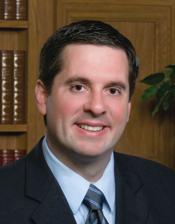 Rep. Devin Nunes (R-CA)
Description
Amendment sought to prohibit the use of funds for the biological opinion entitled "Biological Opinion and conference Opinion on the Long-Term Operations of the Central Valley Project and State Water Project", issued by the National Marine fisheries Service and dated June 4, 2009.
Legislative Activity
Stay on top of the latest movement without scrolling through every action
House amendment not agreed to: On agreeing to the Nunes amendment (A015) Failed by recorded vote: 208 - 218 (Roll no. 366).(consideration: CR H6986-6987)
June 18, 2009 • 12:37 PM
View full timeline
House amendment not agreed to: On agreeing to the Nunes amendment (A015) Failed by recorded vote: 208 - 218 (Roll no. 366).(consideration: CR H6986-6987)
June 18, 2009 • 12:37 PM
Roll call votes on amendments in House
June 18, 2009 • 12:37 PM
Amendment failed in Committee of the Whole
June 18, 2009 • 12:37 PM
On agreeing to the Nunes amendment (A015) Failed by recorded vote: 208 - 218 (Roll no. 366). (consideration: CR H6986-6987)
June 18, 2009 • 12:37 PM
House amendment offered
June 17, 2009
House amendment offered/reported by : Amendment (A015) offered by Mr. Nunes.(consideration: CR H6945-6948; text: H6945)
June 17, 2009 • 6:03 PM
Amendment (A015) offered by Mr. Nunes. (consideration: CR H6945-6948; text: H6945)
June 17, 2009 • 6:03 PM
Votes
1 roll call on this amendment
Text
Offered
PERSONAL EXPLANATION

Mr. LARSON of Connecticut. Mr. Chair, on June 17, 2009, I missed
rollcall votes 351, 352, 353, 354 and 355 due to illness. Had I been
present, I would have voted ``aye'' on all.
The CHAIR. The Clerk will read.
The Clerk read as follows:

agency operations and award management

For agency operations and award management necessary in
carrying out the National Science Foundation Act of 1950, as
amended (42 U.S.C. 1861-1875); services authorized by 5
U.S.C. 3109; hire of passenger motor vehicles; not to exceed
$9,200 for official reception and representation expenses;
uniforms or allowances therefor, as authorized by 5 U.S.C.
5901-5902; rental of conference rooms in the District of
Columbia; and reimbursement of the Department of Homeland
Security for security guard services; $299,870,000: Provided,
That contracts may be entered into under this heading in
fiscal year 2010 for maintenance and operation of facilities,
and for other services, to be provided during the next fiscal
year.

office of the national science board

For necessary expenses (including payment of salaries,
authorized travel, hire of passenger motor vehicles, the
rental of conference rooms in the District of Columbia, and
the employment of experts and consultants under section 3109
of title 5, United

[[Page H6936]]

States Code) involved in carrying out section 4 of the
National Science Foundation Act of 1950, as amended (42
U.S.C. 1863) and Public Law 86-209 (42 U.S.C. 1880 et seq.),
$4,340,000: Provided, That not to exceed $2,800 shall be
available for official reception and representation expenses.

office of inspector general

For necessary expenses of the Office of Inspector General
as authorized by the Inspector General Act of 1978, as
amended, $13,000,000.
This title may be cited as the ``Science Appropriations
Act, 2010''.

TITLE IV

RELATED AGENCIES

Commission on Civil Rights

salaries and expenses

For necessary expenses of the Commission on Civil Rights,
including hire of passenger motor vehicles, $9,400,000:
Provided, That none of the funds appropriated in this
paragraph shall be used to employ in excess of four full-time
individuals under Schedule C of the Excepted Service
exclusive of one special assistant for each Commissioner:
Provided further, That none of the funds appropriated in this
paragraph shall be used to reimburse Commissioners for more
than 75 billable days, with the exception of the chairperson,
who is permitted 125 billable days.

Equal Employment Opportunity Commission

salaries and expenses

For necessary expenses of the Equal Employment Opportunity
Commission as authorized by title VII of the Civil Rights Act
of 1964, the Age Discrimination in Employment Act of 1967,
the Equal Pay Act of 1963, the Americans with Disabilities
Act of 1990, the Civil Rights Act of 1991, the Genetic
Information Non-Discrimination Act (GINA) of 2008 (P.L. 110-
233), the ADA Amendments Act of 2008 (P.L. 110-325), and the
Lilly Ledbetter Fair Pay Act of 2009 (P.L. 111-2), including
services as authorized by 5 U.S.C. 3109; hire of passenger
motor vehicles as authorized by 31 U.S.C. 1343(b);
nonmonetary awards to private citizens; and not to exceed
$26,000,000 for payments to State and local enforcement
agencies for authorized services to the Commission,
$367,303,000: Provided, That the Commission is authorized to
make available for official reception and representation
expenses not to exceed $2,500 from available funds: Provided
further, That the Commission may take no action to implement
any workforce repositioning, restructuring, or reorganization
until such time as the House and Senate Committees on
Appropriations have been notified of such proposals, in
accordance with the reprogramming requirements of section 505
of this Act: Provided further, That the Chair is authorized
to accept and use any gift or donation to carry out the work
of the Commission.

International Trade Commission

salaries and expenses

For necessary expenses of the International Trade
Commission, including hire of passenger motor vehicles, and
services as authorized by 5 U.S.C. 3109, and not to exceed
$2,500 for official reception and representation expenses,
$82,700,000, to remain available until expended.

Legal Services Corporation

payment to the legal services corporation

For payment to the Legal Services Corporation to carry out
the purposes of the Legal Services Corporation Act of 1974,
$440,000,000, of which $414,400,000 is for basic field
programs and required independent audits; $4,200,000 is for
the Office of Inspector General, of which such amounts as may
be necessary may be used to conduct additional audits of
recipients; $17,000,000 is for management and grants
oversight; $3,400,000 is for client self-help and information
technology; and $1,000,000 is for loan repayment assistance:
Provided, That the Legal Services Corporation may continue to
provide locality pay to officers and employees at a rate no
greater than that provided by the Federal Government to
Washington, DC-based employees as authorized by 5 U.S.C.
5304, notwithstanding section 1005(d) of the Legal Services
Corporation Act, 42 U.S.C. 2996(d).

Amendment No. 6 Offered by Mr. Hensarling

Mr. HENSARLING. Mr. Chairman, I have an amendment at the desk made in
order by the rule.
The CHAIR. The Clerk will designate the amendment.
The text of the amendment is as follows:

Amendment No. 6 offered by Mr. Hensarling:

In title IV, strike the heading ``Legal Services
Corporation'' and both paragraphs under that heading
including their subheadings.

The CHAIR. Pursuant to House Resolution 552, the gentleman from Texas
(Mr. Hensarling) and a Member opposed each will control 5 minutes.
The Chair recognizes the gentleman from Texas.

{time}  1715

Mr. HENSARLING. Mr. Chairman, never in the history of Congress have
so few voted so fast to spend so much and indebt so many. The Democrats
are in a program to spend more money than we have seen in the history
of this institution, and apparently they want very few speed bumps
along the road to bankrupting America.
Thus, last night, almost three-quarters of the Republican amendments
that would reform, improve government programs, make them more
efficient, save the American taxpayer money were ruled out of order.
But I suppose, in a modicum of respect for the democratic process, a
handful of amendments were made in order. I suppose I'm happy that mine
was one of them.
Mr. Chairman, recently, our President has said, Without significant
change to steer away from an ever-expanding deficit and debt, we are on
an unsustainable course. We have to take the painstaking work of
examining every program, every entitlement, every dollar of government
spending and ask ourselves, is this program really essential? Are
taxpayers getting their money's worth? Can we accomplish our goals more
efficiently or effectively some other way?
Why is this important? It's important because already we have seen
spending out of control. We are seeing spending at levels that we have
never seen before. The national debt will be tripled in 10 years. In
just 10 years the national debt will be tripled. The Federal deficit
has increased 10-fold, 10-fold in 2 years.
We've seen the taxpayer being forced to shoulder $6,000 per household
to fund $700 billion of bailout money, $9,810 per household to fund a
$1.13 trillion government stimulus plan, $3,534 per household to fund a
$410 billion omnibus plan, and the list goes on and on and on.
Mr. Chairman, you cannot bail out, borrow and spend your way into
prosperity. So, in the spirit of what the President said, when we're
looking at a Federal Government that consists of roughly 10,000 Federal
programs spread across 600 agencies, at a time when American families
are suffering in this economy, maybe, maybe we ought to take a look at
a few and see if we can't sunset them so we can provide sunshine and
morning to the budgets of the American family.
I believe the Legal Services Corporation is one such program. It
hasn't been reauthorized in almost 30 years. The program has a history
of waste, of fraud, abuse. Listen to a recent GAO report of last year:
expenditures were insufficient in supporting documentation. Out of
seven of the 14 grantees we visited, we identified systemic issues
involving payments that lack sufficient supporting documentation that
made it impossible to determine whether the expenditures were accurate,
allowable, or appropriate.
Employee interest-free loans, one grantee we visited was using grant
funds to provide interest-free loans to employees. Three grantees used
legal services money to purchase alcoholic beverages. Lobbying fees,
taxpayer money used for lobbying fees. This isn't me saying this, Mr.
Chairman. It's the General Accountability Office. Again, a program of
history of waste, fraud and abuse.
Now, I believe the line item in this budget, Mr. Chairman, is $440
million. Now, we've got a choice. One, it's a program that's been
unauthorized since 1980, reported instances of waste, fraud and abuse.
And should we actually be taxing taxpayers to force them to subsidize
their neighbors to turn around and sue them? I don't think so. I don't
think so, Mr. Chairman.
Dollars have alternative uses. We can use $440 million to save our
children from this explosion of national debt, something, something
that the majority leader once called fiscal child abuse. We could save
small businesses at a time where we desperately need job creation, or
the money could be put on automatic pilot, once again, and we could
subsidize people so they could turn around and sue their neighbors.
Let's save the American Dream.
I reserve the balance of my time.
Mr. MOLLOHAN. Mr. Chairman, I rise in opposition to the amendment.
The CHAIR. The gentleman from West Virginia is recognized for 5
minutes.
Mr. MOLLOHAN. As part of his argument in support of the amendment to
strike all funds and language for the Legal Services Corporation, the
gentleman appeals to our concern about the national debt.

[[Page H6937]]

Well, we all have a concern about the national debt, and it's all
about priorities. This amendment would attempt to effect a balancing of
the national debt or a reduction of it on the backs of those who are
the absolutely least able to afford it and making an extremely small
contribution in the process.
Now, more than ever, the Legal Services Corporation really needs a
healthy Federal appropriation. Difficult economic circumstances across
the country are driving record numbers of Americans under the income
thresholds that establish eligibility for Legal Services Corporation.
Fifty-one million Americans are now eligible for legal aid, including,
Mr. Chairman, 18 million children.
At the same time, non-Federal funding sources for legal aid are
declining as State budget deficits and pressures on private charitable
organizations have reduced legal aid contributions by outside entities.
Now is the very time that legal aid needs Federal support. LSC
providers already turn away one out of every two eligible clients who
seek assistance. So already, in a difficult economy, when those seeking
legal aid are becoming increasingly eligible, we're turning away 50
percent of those who need the service.
With no Federal funding, as the gentleman has proposed in his
amendment, Legal Services Corporation grantees would be forced to turn
away even more clients who are in desperate need of help.
I urge Members to consider the true human impact of that proposal and
oppose the amendment. And I go back to where I started. This is the
wrong place to try to balance the budget, on the backs of those who are
least able to make a contribution.
I oppose the amendment.
I reserve the balance of my time.
Mr. HENSARLING. Mr. Chairman, may I inquire how much time I have
remaining?
The CHAIR. The gentleman has 30 seconds remaining.
Mr. HENSARLING. I yield myself the balance of my time.
Mr. Chairman, I heard the gentleman say that we all have concerns
over the national debt. I must admit I haven't seen a lot of that
concern on the other side of the aisle since they proposed a budget
that will triple it in 10 years.
I didn't hear any answer to the charges of the Government
Accountability Office about the waste, the fraud and abuse endemic in
this program.
I would also point out to the gentleman, there are pro bono law
firms, lawyers that work on contingent fees. There are other options
besides taking money away from the Dublin family of Palestine, the Mock
family of Athens, the Lilly family of Coffman that I represent in this
institution. Their budget, their budget needs to be improved, not the
legal services.
And I urge adoption of the amendment.
Mr. MOLLOHAN. Mr. Chairman, I yield back the balance of my time.
The CHAIR. The question is on the amendment offered by the gentleman
from Texas (Mr. Hensarling).
The question was taken; and the Chair announced that the noes
appeared to have it.
Mr. MOLLOHAN. Mr. Chairman, I demand a recorded vote.
The CHAIR. Pursuant to clause 6 of rule XVIII, further proceedings on
the amendment offered by the gentleman from Texas will be postponed.
The CHAIR. The Clerk will read.
The Clerk read as follows:

administrative provision--legal services corporation

None of the funds appropriated in this Act to the Legal
Services Corporation shall be expended for any purpose
prohibited or limited by, or contrary to any of the
provisions of, sections 501, 502, 503, 504, 505, and 506 of
Public Law 105-119, and all funds appropriated in this Act to
the Legal Services Corporation shall be subject to the same
terms and conditions set forth in such sections, except that
all references in sections 502 and 503 to 1997 and 1998 shall
be deemed to refer instead to 2009 and 2010, respectively.

Marine Mammal Commission

salaries and expenses

For necessary expenses of the Marine Mammal Commission as
authorized by title II of Public Law 92-522, $3,300,000.

Office of the United States Trade Representative

salaries and expenses

For necessary expenses of the Office of the United States
Trade Representative, including the hire of passenger motor
vehicles and the employment of experts and consultants as
authorized by 5 U.S.C. 3109, $48,326,000, of which $1,000,000
shall remain available until expended: Provided, That not to
exceed $124,000 shall be available for official reception and
representation expenses: Provided further, That negotiations
shall be conducted within the World Trade Organization to
recognize the right of members to distribute monies collected
from antidumping and countervailing duties: Provided further,
That negotiations shall be conducted within the World Trade
Organization consistent with the negotiating objectives
contained in the Trade Act of 2002, Public Law 107-210.

State Justice Institute

salaries and expenses

For necessary expenses of the State Justice Institute, as
authorized by the State Justice Institute Authorization Act
of 1984 (42 U.S.C. 10701 et seq.) $5,131,000, of which
$250,000 shall remain available until September 30, 2011:
Provided, That not to exceed $2,500 shall be available for
official reception and representation expenses.

TITLE V

GENERAL PROVISIONS

Sec. 501.  No part of any appropriation contained in this
Act shall be used for publicity or propaganda purposes not
authorized by the Congress.
Sec. 502.  No part of any appropriation contained in this
Act shall remain available for obligation beyond the current
fiscal year unless expressly so provided herein.
Sec. 503.  The expenditure of any appropriation under this
Act for any consulting service through procurement contract,
pursuant to 5 U.S.C. 3109, shall be limited to those
contracts where such expenditures are a matter of public
record and available for public inspection, except where
otherwise provided under existing law, or under existing
Executive order issued pursuant to existing law.
Sec. 504.  If any provision of this Act or the application
of such provision to any person or circumstances shall be
held invalid, the remainder of the Act and the application of
each provision to persons or circumstances other than those
as to which it is held invalid shall not be affected thereby.
Sec. 505. (a) None of the funds provided under this Act, or
provided under previous appropriations Acts to the agencies
funded by this Act that remain available for obligation or
expenditure in fiscal year 2010, or provided from any
accounts in the Treasury of the United States derived by the
collection of fees available to the agencies funded by this
Act, shall be available for obligation or expenditure through
the reprogramming of funds that:
(1) creates or initiates a new program, project or
activity;
(2) eliminates a program, project or activity, unless the
House and Senate Committees on Appropriations are notified 15
days in advance of such reprogramming of funds;
(3) increases funds or personnel by any means for any
project or activity for which funds have been denied or
restricted by this Act, unless the House and Senate
Committees on Appropriations are notified 15 days in advance
of such reprogramming of funds;
(4) relocates an office or employees, unless the House and
Senate Committees on Appropriations are notified 15 days in
advance of such reprogramming of funds;
(5) reorganizes or renames offices, programs or activities,
unless the House and Senate Committees on Appropriations are
notified 15 days in advance of such reprogramming of funds;
(6) contracts out or privatizes any functions or activities
presently performed by Federal employees, unless the House
and Senate Committees on Appropriations are notified 15 days
in advance of such reprogramming of funds;
(7) proposes to use funds directed for a specific activity
by either the House or Senate Committee on Appropriations for
a different purpose, unless the House and Senate Committees
on Appropriations are notified 15 days in advance of such
reprogramming of funds;
(8) augments funds for existing programs, projects or
activities in excess of $500,000 or 10 percent, whichever is
less, or reduces by 10 percent funding for any program,
project or activity, or numbers of personnel by 10 percent as
approved by Congress, unless the House and Senate Committees
on Appropriations are notified 15 days in advance of such
reprogramming of funds; or
(9) results from any general savings, including savings
from a reduction in personnel, which would result in a change
in existing programs, projects or activities as approved by
Congress, unless the House and Senate Committees on
Appropriations are notified 15 days in advance of such
reprogramming of funds.
(b) None of the funds in provided under this Act, or
provided under previous appropriations Acts to the agencies
funded by this Act that remain available for obligation or
expenditure in fiscal year 2010, or provided from any
accounts in the Treasury of the United States derived by the
collection of fees available to the agencies funded by this
Act, shall be available for obligation or expenditure through
the reprogramming of funds after August 1, except in
extraordinary circumstances, and only after the House and
Senate Committees on Appropriations are notified 30 days in
advance of such reprogramming of funds.

[[Page H6938]]

Sec. 506.  Hereafter, none of the funds made available in
this or any other Act may be used to implement, administer,
or enforce any guidelines of the Equal Employment Opportunity
Commission covering harassment based on religion, when it is
made known to the Federal entity or official to which such
funds are made available that such guidelines do not differ
in any respect from the proposed guidelines published by the
Commission on October 1, 1993 (58 Fed. Reg. 51266).
Sec. 507.  If it has been finally determined by a court or
Federal agency that any person intentionally affixed a label
bearing a ``Made in America'' inscription, or any inscription
with the same meaning, to any product sold in or shipped to
the United States that is not made in the United States, the
person shall be ineligible to receive any contract or
subcontract made with funds made available in this Act,
pursuant to the debarment, suspension, and ineligibility
procedures described in sections 9.400 through 9.409 of title
48, Code of Federal Regulations.
Sec. 508.  The Departments of Commerce and Justice, the
National Science Foundation, and the National Aeronautics and
Space Administration, shall provide to the House and Senate
Committees on Appropriations a quarterly accounting of the
cumulative balances of any unobligated funds that were
received by such agency during any previous fiscal year.
Sec. 509.  Any costs incurred by a department or agency
funded under this Act resulting from, or to prevent,
personnel actions taken in response to funding reductions
included in this Act shall be absorbed within the total
budgetary resources available to such department or agency:
Provided, That the authority to transfer funds between
appropriations accounts as may be necessary to carry out this
section is provided in addition to authorities included
elsewhere in this Act: Provided further, That use of funds to
carry out this section shall be treated as a reprogramming of
funds under section 505 of this Act and shall not be
available for obligation or expenditure except in compliance
with the procedures set forth in that section.
Sec. 510.  None of the funds provided by this Act shall be
available to promote the sale or export of tobacco or tobacco
products, or to seek the reduction or removal by any foreign
country of restrictions on the marketing of tobacco or
tobacco products, except for restrictions which are not
applied equally to all tobacco or tobacco products of the
same type.
Sec. 511.  None of the funds appropriated pursuant to this
Act or any other provision of law may be used for--
(1) the implementation of any tax or fee in connection with
the implementation of subsection 922(t) of title 18, United
States Code; and
(2) any system to implement subsection 922(t) of title 18,
United States Code, that does not require and result in the
destruction of any identifying information submitted by or on
behalf of any person who has been determined not to be
prohibited from possessing or receiving a firearm no more
than 24 hours after the system advises a Federal firearms
licensee that possession or receipt of a firearm by the
prospective transferee would not violate subsection (g) or
(n) of section 922 of title 18, United States Code, or State
law.
Sec. 512.  None of the funds made available in this Act may
be used to pay the salaries and expenses of personnel of the
Department of Justice to obligate more than $700,000,000
during fiscal year 2010 from the fund established by section
1402 of chapter XIV of title II of Public Law 98-473 (42
U.S.C. 10601).
Sec. 513.  None of the funds made available to the
Department of Justice in this Act may be used to discriminate
against or denigrate the religious or moral beliefs of
students who participate in programs for which financial
assistance is provided from those funds, or of the parents or
legal guardians of such students.
Sec. 514.  None of the funds made available in this Act may
be transferred to any department, agency, or instrumentality
of the United States Government, except pursuant to a
transfer made by, or transfer authority provided in, this Act
or any other appropriations Act.
Sec. 515.  Any funds provided in this Act used to implement
E-Government Initiatives shall be subject to the procedures
set forth in section 505 of this Act.
Sec. 516. (a) Tracing studies conducted by the Bureau of
Alcohol, Tobacco, Firearms and Explosives are released
without adequate disclaimers regarding the limitations of the
data.
(b) The Bureau of Alcohol, Tobacco, Firearms and Explosives
shall include in all such data releases, language similar to
the following that would make clear that trace data cannot be
used to draw broad conclusions about firearms-related crime:
(1) Firearm traces are designed to assist law enforcement
authorities in conducting investigations by tracking the sale
and possession of specific firearms. Law enforcement agencies
may request firearms traces for any reason, and those reasons
are not necessarily reported to the Federal Government. Not
all firearms used in crime are traced and not all firearms
traced are used in crime.
(2) Firearms selected for tracing are not chosen for
purposes of determining which types, makes, or models of
firearms are used for illicit purposes. The firearms selected
do not constitute a random sample and should not be
considered representative of the larger universe of all
firearms used by criminals, or any subset of that universe.
Firearms are normally traced to the first retail seller, and
sources reported for firearms traced do not necessarily
represent the sources or methods by which firearms in general
are acquired for use in crime.
Sec. 517. (a) The Inspectors General of the Department of
Commerce, the Department of Justice, the National Aeronautics
and Space Administration, the National Science Foundation,
and the Legal Services Corporation shall conduct audits,
pursuant to the Inspector General Act (5 U.S.C. App.), of
grants or contracts for which funds are appropriated by this
Act, and shall submit reports to Congress on the progress of
such audits, which may include preliminary findings and a
description of areas of particular interest, within 180 days
after initiating such an audit and every 180 days thereafter
until any such audit is completed.
(b) Within 60 days after the date on which an audit
described in subsection (a) by an Inspector General is
completed, the Secretary, Attorney General, Administrator,
Director, or President, as appropriate, shall make the
results of the audit available to the public on the Internet
website maintained by the Department, Administration,
Foundation, or Corporation, respectively. The results shall
be made available in redacted form to exclude--
(1) any matter described in section 552(b) of title 5,
United States Code; and
(2) sensitive personal information for any individual, the
public access to which could be used to commit identity theft
or for other inappropriate or unlawful purposes.
(c) A grant or contract funded by amounts appropriated by
this Act may not be used for the purpose of defraying the
costs of a banquet or conference that is not directly and
programmatically related to the purpose for which the grant
or contract was awarded, such as a banquet or conference held
in connection with planning, training, assessment, review, or
other routine purposes related to a project funded by the
grant or contract.
(d) Any person awarded a grant or contract funded by
amounts appropriated by this Act shall submit a statement to
the Secretary of Commerce, the Attorney General, the
Administrator, Director, or President, as appropriate,
certifying that no funds derived from the grant or contract
will be made available through a subcontract or in any other
manner to another person who has a financial interest in the
person awarded the grant or contract.
(e) The provisions of the preceding subsections of this
section shall take effect 30 days after the date on which the
Director of the Office of Management and Budget, in
consultation with the Director of the Office of Government
Ethics, determines that a uniform set of rules and
requirements, substantially similar to the requirements in
such subsections, consistently apply under the executive
branch ethics program to all Federal departments, agencies,
and entities.
Sec. 518.  None of the funds appropriated or otherwise made
available under this Act may be used to issue patents on
claims directed to or encompassing a human organism.
Sec. 519.  None of the funds made available in this Act
shall be used in any way whatsoever to support or justify the
use of torture by any official or contract employee of the
United States Government.
Sec. 520. (a) Notwithstanding any other provision of law or
treaty, none of the funds appropriated or otherwise made
available under this Act or any other Act may be expended or
obligated by a department, agency, or instrumentality of the
United States to pay administrative expenses or to compensate
an officer or employee of the United States in connection
with requiring an export license for the export to Canada of
components, parts, accessories or attachments for firearms
listed in Category I, section 121.1 of title 22, Code of
Federal Regulations (International Trafficking in Arms
Regulations (ITAR), part 121, as it existed on April 1, 2005)
with a total value not exceeding $500 wholesale in any
transaction, provided that the conditions of subsection (b)
of this section are met by the exporting party for such
articles.
(b) The foregoing exemption from obtaining an export
license--
(1) does not exempt an exporter from filing any Shipper's
Export Declaration or notification letter required by law, or
from being otherwise eligible under the laws of the United
States to possess, ship, transport, or export the articles
enumerated in subsection (a); and
(2) does not permit the export without a license of--
(A) fully automatic firearms and components and parts for
such firearms, other than for end use by the Federal
Government, or a Provincial or Municipal Government of
Canada;
(B) barrels, cylinders, receivers (frames) or complete
breech mechanisms for any firearm listed in Category I, other
than for end use by the Federal Government, or a Provincial
or Municipal Government of Canada; or
(C) articles for export from Canada to another foreign
destination.
(c) In accordance with this section, the District Directors
of Customs and postmasters shall permit the permanent or
temporary export without a license of any unclassified
articles specified in subsection (a) to Canada for end use in
Canada or return to the United States, or temporary import of
Canadian-origin items from Canada for end use in the United
States or return to Canada for a Canadian citizen.

[[Page H6939]]

(d) The President may require export licenses under this
section on a temporary basis if the President determines,
upon publication first in the Federal Register, that the
Government of Canada has implemented or maintained inadequate
import controls for the articles specified in subsection (a),
such that a significant diversion of such articles has and
continues to take place for use in international terrorism or
in the escalation of a conflict in another nation. The
President shall terminate the requirements of a license when
reasons for the temporary requirements have ceased.
Sec. 521.  Notwithstanding any other provision of law, no
department, agency, or instrumentality of the United States
receiving appropriated funds under this Act or any other Act
shall obligate or expend in any way such funds to pay
administrative expenses or the compensation of any officer or
employee of the United States to deny any application
submitted pursuant to 22 U.S.C. 2778(b)(1)(B) and qualified
pursuant to 27 CFR section 478.112 or .113, for a permit to
import United States origin ``curios or relics'' firearms,
parts, or ammunition.
Sec. 522.  None of the funds made available in this Act may
be used to include in any new bilateral or multilateral trade
agreement the text of--
(1) paragraph 2 of article 16.7 of the United States-
Singapore Free Trade Agreement;
(2) paragraph 4 of article 17.9 of the United States-
Australia Free Trade Agreement; or
(3) paragraph 4 of article 15.9 of the United States-
Morocco Free Trade Agreement.
Sec. 523.  None of the funds made available in this Act may
be used to authorize or issue a national security letter in
contravention of any of the following laws authorizing the
Federal Bureau of Investigation to issue national security
letters: The Right to Financial Privacy Act; The Electronic
Communications Privacy Act; The Fair Credit Reporting Act;
The National Security Act of 1947; USA PATRIOT Act; and the
laws amended by these Acts.
Sec. 524.  If at any time during any quarter, the program
manager of a project within the jurisdiction of the
Departments of Commerce or Justice, the National Aeronautics
and Space Administration, or the National Science Foundation
totaling more than $75,000,000 has reasonable cause to
believe that the total program cost has increased by 10
percent, the program manager shall immediately inform the
Secretary, Administrator, or Director. The Secretary,
Administrator, or Director shall notify the House and Senate
Committees on Appropriations within 30 days in writing of
such increase, and shall include in such notice: the date on
which such determination was made; a statement of the reasons
for such increases; the action taken and proposed to be taken
to control future cost growth of the project; changes made in
the performance or schedule milestones and the degree to
which such changes have contributed to the increase in total
program costs or procurement costs; new estimates of the
total project or procurement costs; and a statement
validating that the project's management structure is
adequate to control total project or procurement costs.
Sec. 525.  Funds appropriated by this Act, or made
available by the transfer of funds in this Act, for
intelligence or intelligence related activities are deemed to
be specifically authorized by the Congress for purposes of
section 504 of the National Security Act of 1947 (50 U.S.C.
414) during fiscal year 2010 until the enactment of the
Intelligence Authorization Act for fiscal year 2010.
Sec. 526.  The Departments, agencies, and commissions
funded under this Act, shall establish and maintain on the
homepages of their Internet websites--
(1) a direct link to the Internet websites of their Offices
of Inspectors General; and
(2) a mechanism on the Offices of Inspectors General
website by which individuals may anonymously report cases of
waste, fraud, or abuse with respect to those Departments,
agencies, and commissions.
Sec. 527.  None of the funds appropriated or otherwise made
available by this Act may be used to enter into a contract in
an amount greater than $5,000,000 or to award a grant in
excess of such amount unless the prospective contractor or
grantee certifies in writing to the agency awarding the
contract or grant that, to the best of its knowledge and
belief, the contractor or grantee has filed all Federal tax
returns required during the three years preceding the
certification, has not been convicted of a criminal offense
under the Internal Revenue Code of 1986, and has not, more
than 90 days prior to certification, been notified of any
unpaid Federal tax assessment for which the liability remains
unsatisfied, unless the assessment is the subject of an
installment agreement or offer in compromise that has been
approved by the Internal Revenue Service and is not in
default, or the assessment is the subject of a non-frivolous
administrative or judicial proceeding.
Sec. 528.  None of the funds appropriated or otherwise made
available in this Act may be used in a manner that is
inconsistent with the principal negotiating objective of the
United States with respect to trade remedy laws to preserve
the ability of the United States--
(1) to enforce vigorously its trade laws, including
antidumping, countervailing duty, and safeguard laws;
(2) to avoid agreements that--
(A) lessen the effectiveness of domestic and international
disciplines on unfair trade, especially dumping and
subsidies; or
(B) lessen the effectiveness of domestic and international
safeguard provisions, in order to ensure that United States
workers, agricultural producers, and firms can compete fully
on fair terms and enjoy the benefits of reciprocal trade
concessions; and
(3) to address and remedy market distortions that lead to
dumping and subsidization, including overcapacity,
cartelization, and market-access barriers.

(rescissions)

Sec. 529. (a) Of the unobligated balances available to the
Department of Justice from prior appropriations, the
following funds are hereby rescinded, not later than
September 30, 2010, from the following accounts in the
specified amounts:
(1) ``Legal Activities, Assets Forfeiture Fund'',
$285,000,000;
(2) ``Federal Bureau of Investigation, Salaries and
Expenses'', $50,000,000;
(3) ``Federal Bureau of Investigation, Construction'',
$80,822,000;
(4) ``Office of Justice Programs'', $42,000,000; and
(5) ``Community Oriented Policing Services'', $40,000,000.
(b) Within 30 days of enactment of this Act, the Department
of Justice shall submit to the Committees on Appropriations
of the House of Representatives and the Senate a report
specifying the amount of each rescission made pursuant to
this section.
(c) The recissions contained in this section shall not
apply to funds provided in this Act.
Sec. 530.  None of the funds made available in this Act may
be used to purchase first class or premium airline travel in
contravention of sections 301-10.122 through 301-10.124 of
title 41 of the Code of Federal Regulations.
Sec. 531.  None of the funds made available in this Act may
be used to send or otherwise pay for the attendance of more
than 50 employees from a Federal department or agency at any
single conference occurring outside the United States.
Sec. 532. (a) None of the funds made available in this or
any prior Act may be used to release an individual who is
detained, as of April 30, 2009, at Naval Station, Guantanamo
Bay, Cuba, into the continental United States, Alaska,
Hawaii, or the District of Columbia.
(b) None of the funds made available in this or any prior
Act may be used to transfer an individual who is detained, as
of April 30, 2009, at the Naval Station, Guantanamo Bay,
Cuba, into the continental United States, Alaska, Hawaii, or
the District of Columbia, for the purposes of detaining or
prosecuting such individual until 2 months after the plan
detailed in subsection (c) is received.
(c) The President shall submit to the Congress, in writing,
a comprehensive plan regarding the proposed disposition of
each individual who is detained, as of April 30, 2009, at
Naval Station, Guantanamo Bay, Cuba, who is not covered under
subsection (d). Such plan shall include, at a minimum, each
of the following for each such individual:
(1) The findings of an analysis regarding any risk to the
national security of the United States that is posed by the
transfer of the individual.
(2) The costs associated with not transferring the
individual in question.
(3) The legal rationale and associated court demands for
transfer.
(4) A certification by the President that any risk
described in paragraph (1) has been mitigated, together with
a full description of the plan for such mitigation.
(5) A certification by the President that the President has
submitted to the Governor and legislature of the State to
which the President intends to transfer the individual a
certification in writing at least 30 days prior to such
transfer (together with supporting documentation and
justification) that the individual does not pose a security
risk tot he United States.
(d) None of the funds made available in this or any prior
Act may be used to transfer or release an individual detained
at Naval Station, Guantanamo Bay, Cuba, as of April 30, 2009,
to the country of such individual's nationality or last
habitual residence or to any other country other than the
United States, unless the President submits to the Congress,
in writing, at least 30 days prior to such transfer or
release, the following information:
(1) The name of any individual to be transferred or
released and the country to which such individual is to be
transferred or released.
(2) An assessment of any risk to the national security of
the United States or its citizens, including members of the
Armed Services or the United States, that is posed by such
transfer or released and the actions taken to mitigate such
risk
(3) The terms of any agreement with another country for
acceptance of such individual, including the amount of any
financial assistance related to such agreement.
Sec. 533.  Section 504(a) of the Departments of Commerce,
Justice, and State, the Judiciary, and Related Agencies
Appropriations Act, 1996 (as contained in Public Law 104-134)
is amended by striking paragraph (13).
Sec. 534.  Notwithstanding any other provision of law, to
the extent that the Attorney General (or a designee)
authorizes or approves, if a law enforcement or corrections
officer employed by the Department of Justice dies while
performing official duties or as a result of the performance
of official duties, the Department of Justice may pay from
Government funds the qualified relocation expenses of the
immediate dependent

[[Page H6940]]

family of the employee, and the expenses of preparing and
transporting the remains of the deceased.
This Act may be cited as the ``Commerce, Justice, Science,
and Related Agencies Appropriations Act, 2010''.

Mr. MOLLOHAN (during the reading). Mr. Chairman, I ask unanimous
consent that the remainder of the bill through page 101, line 20, be
considered as read, printed in the Record, and open to amendment at any
point.
The CHAIR. Is there objection to the request of the gentleman from
West Virginia?
There was no objection.
Mr. LEWIS of California. Mr. Chairman, I rise to attempt to be of
some service to the Obama administration and others in the House that
may be concerned about a decision he made not too long ago. And I'd ask
unanimous consent that we put Executive Order 13492 in the Record at
this point.
The CHAIR. Does the gentleman seek to offer an amendment?
Mr. LEWIS of California. Yes, I do.
The CHAIR. Will the gentleman specify the number of the amendment he
wishes to offer?
Mr. LEWIS of California. It is amendment No. 118.

Amendment No. 118 Offered by Mr. Lewis of California

Mr. LEWIS of California. I offer an amendment.
The CHAIR. The Clerk will designate the amendment.
The text of the amendment is as follows:

Amendment No. 118 offered by Mr. Lewis of California:
At the end of the bill (before the short title), insert the
following:
``SEC. . None of the funds made available in this Act may
be used to implement Executive Order 13492, issued January
22, 2009, titled ``Review and Disposition of Individuals
Detained at the Guantanamo Bay Naval Base and Closure of
Detention Facilities''.''

The CHAIR. Pursuant to House Resolution 552, the gentleman from
California (Mr. Lewis) and a Member opposed each will control 5
minutes.
The Chair recognizes the gentleman from California.
Mr. LEWIS of California. Mr. Chairman, I would like to have this
executive order put in the Record at this point.

Presidential Documents--Executive Order 13492 of January 22, 2009--
Review and Disposition of Individuals Detained At the Guantanamo Bay
Naval Base and Closure of Detention Facilities

By the authority vested in me as President by the
Constitution and the laws of the United States of America, in
order to effect the appropriate disposition of individuals
currently detained by the Department of Defense at the
Guantanamo Bay Naval Base (Guantanamo) and promptly to close
detention facilities at Guantanamo, consistent with the
national security and foreign policy interests of the United
States and the interests of justice, I hereby order as
follows:
Section 1. Definitions. As used in this order:
(a) ``Common Article 3'' means Article 3 of each of the
Geneva Conventions.
(b) ``Geneva Conventions'' means:
(i) the Convention for the Amelioration of the Condition of
the Wounded and Sick in Armed Forces in the Field, August 12,
1949 (6 UST 3114);
(ii) the Convention for the Amelioration of the Condition
of Wounded, Sick and Shipwrecked Members of Armed Forces at
Sea, August 12, 1949 (6 UST 3217);
(iii) the Convention Relative to the Treatment of Prisoners
of War, August 12, 1949 (6 UST 3316); and
(iv) the Convention Relative to the Protection of Civilian
Persons in Time of War, August 12, 1949 (6 UST 3516).
(c) ``Individuals currently detained at Guantanamo'' and
``individuals covered by this order'' mean individuals
currently detained by the Department of Defense in facilities
at the Guantanamo Bay Naval Base whom the Department of
Defense has ever determined to be, or treated as, enemy
combatants.
Sec. 2. Findings.
(a) Over the past 7 years, approximately 800 individuals
whom the Department of Defense has ever determined to be, or
treated as, enemy combatants have been detained at
Guantanamo. The Federal Government has moved more than 500
such detainees from Guantanamo, either by returning them to
their home country or by releasing or transferring them to a
third country. The Department of Defense has determined that
a number of the individuals currently detained at Guantanamo
are eligible for such transfer or release.
(b) Some individuals currently detained at Guantanamo have
been there for more than 6 years, and most have been detained
for at least 4 years. In view of the significant concerns
raised by these detentions, both within the United States and
internationally, prompt and appropriate disposition of the
individuals currently detained at Guantanamo and closure of
the facilities in which they are detained would further the
national security and foreign policy interests of the United
States and the interests of justice. Merely closing the
facilities without promptly determining the appropriate
disposition of the individuals detained would not adequately
serve those interests. To the extent practicable, the prompt
and appropriate disposition of the individuals detained at
Guantanamo should precede the closure of the detention
facilities at Guantanamo.
(c) The individuals currently detained at Guantanamo have
the constitutional privilege of the writ of habeas corpus.
Most of those individuals have filed petitions for a writ of
habeas corpus in Federal court challenging the lawfulness
of their detention.
(d) It is in the interests of the United States that the
executive branch undertake a prompt and thorough review of
the factual and legal bases for the continued detention of
all individuals currently held at Guantanamo, and of whether
their continued detention is in the national security and
foreign policy interests of the United States and in the
interests of justice. The unusual circumstances associated
with detentions at Guantanamo require a comprehensive
interagency review.
(e) New diplomatic efforts may result in an appropriate
disposition of a substantial number of individuals currently
detained at Guantanamo.
(f) Some individuals currently detained at Guantanamo may
have committed offenses for which they should be prosecuted.
It is in the interests of the United States to review whether
and how any such individuals can and should be prosecuted.
(g) It is in the interests of the United States that the
executive branch conduct a prompt and thorough review of the
circumstances of the individuals currently detained at
Guantanamo who have been charged with offenses before
military commissions pursuant to the Military Commissions Act
of 2006, Public Law 109-366, as well as of the military
commission process more generally.
Sec. 3. Closure of Detention Facilities at Guantanamo. The
detention facilities at Guantanamo for individuals covered by
this order shall be closed as soon as practicable, and no
later than 1 year from the date of this order. If any
individuals covered by this order remain in detention at
Guantanamo at the time of closure of those detention
facilities, they shall be returned to their home country,
released, transferred to a third country, or transferred to
another United States detention facility in a manner
consistent with law and the national security and foreign
policy interests of the United States.
Sec. 4. Immediate Review of All Guantanamo Detentions.
(a) Scope and Timing of Review. A review of the status of
each individual currently detained at Guantanamo (Review)
shall commence immediately.
(b) Review Participants. The Review shall be conducted with
the full cooperation and participation of the following
officials:
(1) the Attorney General, who shall coordinate the Review;
(2) the Secretary of Defense;
(3) the Secretary of State;
(4) the Secretary of Homeland Security;
(5) the Director of National Intelligence;
(6) the Chairman of the Joint Chiefs of Staff; and
(7) other officers or full-time or permanent part-time
employees of the United States, including employees with
intelligence, counterterrorism, military, and legal
expertise, as determined by the Attorney General, with the
concurrence of the head of the department or agency
concerned.
(c) Operation of Review. The duties of the Review
participants shall include the following:
(1) Consolidation of Detainee Information. The Attorney
General shall, to the extent reasonably practicable, and in
coordination with the other Review participants, assemble all
information in the possession of the Federal Government that
pertains to any individual currently detained at Guantanamo
and that is relevant to determining the proper disposition of
any such individual. All executive branch departments and
agencies shall promptly comply with any request of the
Attorney General to provide information in their possession
or control pertaining to any such individual. The Attorney
General may seek further information relevant to the Review
from any source.
(2) Determination of Transfer. The Review shall determine,
on a rolling basis and as promptly as possible with respect
to the individuals currently detained at Guantanamo, whether
it is possible to transfer or release the individuals
consistent with the national security and foreign policy
interests of the United States and, if so, whether and how
the Secretary of Defense may effect their transfer or
release. The Secretary of Defense, the Secretary of State,
and, as appropriate, other Review participants shall work to
effect promptly the release or transfer of all individuals
for whom release or transfer is possible.
(3) Determination of Prosecution. In accordance with United
States law, the cases of individuals detained at Guantanamo
not approved for release or transfer shall be evaluated to
determine whether the Federal Government should seek to
prosecute the detained individuals for any offenses they may
have committed, including whether it is feasible to prosecute
such individuals before a

[[Page H6941]]

court established pursuant to Article III of the United
States Constitution, and the Review participants shall in
turn take the necessary and appropriate steps based on such
determinations.
(4) Determination of Other Disposition. With respect to any
individuals currently detained at Guantanamo whose
disposition is not achieved under paragraphs (2) or (3) of
this subsection, the Review shall select lawful means,
consistent with the national security and foreign policy
interests of the United States and the interests of justice,
for the disposition of such individuals. The appropriate
authorities shall promptly implement such dispositions.
(5) Consideration of Issues Relating to Transfer to the
United States. The Review shall identify and consider legal,
logistical, and security issues relating to the potential
transfer of individuals currently detained at Guantanamo to
facilities within the United States, and the Review
participants shall work with the Congress on any legislation
that may be appropriate.
Sec. 5. Diplomatic Efforts. The Secretary of State shall
expeditiously pursue and direct such negotiations and
diplomatic efforts with foreign governments as are necessary
and appropriate to implement this order.
Sec. 6. Humane Standards of Confinement. No individual
currently detained at Guantanamo shall be held in the custody
or under the effective control of any officer, employee, or
other agent of the United States Government, or at a facility
owned, operated, or controlled by a department or agency of
the United States, except in conformity with all applicable
laws governing the conditions of such confinement, including
Common Article 3 of the Geneva Conventions. The Secretary of
Defense shall immediately undertake a review of the
conditions of detention at Guantanamo to ensure full
compliance with this directive. Such review shall be
completed within 30 days and any necessary corrections shall
be implemented immediately thereafter.
Sec. 7. Military Commissions. The Secretary of Defense
shall immediately take steps sufficient to ensure that during
the pendency of the Review described in section 4 of this
order, no charges are sworn, or referred to a military
commission under the Military Commissions Act of 2006 and the
Rules for Military Commissions, and that all proceedings of
such military commissions to which charges have been referred
but in which no judgment has been rendered, and all
proceedings pending in the United States Court of Military
Commission Review, are halted.
Sec. 8. General Provisions.
(a) Nothing in this order shall prejudice the authority of
the Secretary of Defense to determine the disposition of any
detainees not covered by this order.
(b) This order shall be implemented consistent with
applicable law and subject to the availability of
appropriations.
(c) This order is not intended to, and does not, create any
right or benefit, substantive or procedural, enforceable at
law or in equity by any party against the United States, its
departments, agencies, or entities, its officers, employees,
or agents, or any other person.

Barack Obama,

The White House,
January 22, 2009.
As we all know, Mr. Chairman, the President signed Executive Order
13492 to close Guantanamo Bay detention facility in January. More than
4 months later, there is still no evidence of a plan to carry out this
order and no consultation with the Congress. Yet the administration is
raising to move detainees, all the while withholding information from
the Congress and the public.
First, let me say that last week a suspected plotter of the 1998
embassy bombings in Africa arrived in New York for a high-threat trial.
Second, last week, the government of Palau announced that it would
accept some of the Uyghur detainees. Press accounts linked this
announcement to some significant level of assistance on the part of the
American government to Palau.
The Uyghur detainees are affiliated with a listed terrorist group and
received weapons training in camps in Afghanistan run by leaders
affiliated with al Qaeda. To say the least, we ought to be concerned
about any group that's been trained under those circumstances.
Finally, last week, the Department of Justice announced that four of
the Uyghur detainees have been resettled in Bermuda, a visa waiver
country.
The Congress and the American people found out about these actions
and efforts after the fact.
And there is more. Three detainees have already been transferred to
Saudi Arabia, one to Chad and one to Iraq. And we are hearing rumors
about possible deals with Yemen, Italy and Albania.

{time}  1730

All of this has been done without an assessment of the risks to the
American people at home and abroad or without an assessment of the risk
to our U.S. forces by such releases. The Guantanamo detainees include
the perpetrators of some of the most horrific terrorist acts against
Americans, including 9/11, the USS Cole bombing, and the Embassy
bombings in Africa.
Director Mueller of the FBI attested to Congress 3 weeks ago that
bringing detainees to U.S. soil poses risks to national security,
including providing financing, radicalizing others and undertaking
attacks in the United States. Additionally, the Department of Defense
has reported that at least 14 percent of former Guantanamo detainees
have returned to terrorist activity in the region. To say the least, we
ought to be concerned about the release of people of that kind who
threaten our interests anywhere in the world.
This administration is ignoring or is disregarding those risks, and
it is stonewalling the Congress. We need to stop this administration
from rushing to transfer or to resettle anymore detainees at the
expense of an increased risk to Americans. We need to help the
President simply fulfill his campaign promise.
The President has been very busy since his inaugural. There is little
question he has been down many a pathway, and he has even found that
some of those pathways might very well have been mistakes. Well, this
is a case where I believe a decision was made without its being
carefully thought through, let alone knowing the serious implications
of the actions to be taken. We are attempting by this amendment to help
the administration rethink that decision that they have made.
Mr. Chairman, I reserve the balance of my time.
Mr. MOLLOHAN. Mr. Chairman, I rise in opposition to the amendment.
The CHAIR. The gentleman from West Virginia is recognized for 5
minutes.
Mr. MOLLOHAN. Mr. Chairman, I rise in opposition to this amendment
which would essentially prohibit any funds to be spent with regard to
the implementation of the Executive order requiring the closure of the
detention facilities at Guantanamo Bay.
I believe that the closing of Guantanamo is the right policy
decision. The President believes that, and the President has acted on
that. It's an embarrassment to the country. It's a symbol that has
really fomented a lot of opposition to the United States around the
world. The continued existence of Gitmo is a basic assault on our
values, and it undermines the success in our counterterrorism programs.
President Obama and I aren't the only ones who believe this.
Secretary Gates, Admiral Mullen and the Nation's top civilian and
military defense officials agree that it should be closed. Also, both
President Bush's Secretaries of State and a variety of other bipartisan
political officials agree that it should be closed. So this is a
bipartisan position.
We have already clearly communicated to the White House that they
must submit a plan showing how they intend to proceed. The White House
has agreed, and I am confident that their plan will show a reasonable
path forward.
The bill before you today, Mr. Chairman, includes provisions to
ensure that the Congress will have sufficient opportunity to weigh in
on that plan, when it is submitted, and to preclude most activities
prior to that. This legislation before us tonight does not permit the
release of Gitmo detainees into the United States during fiscal year
2010. It does not permit the transfer of detainees to the U.S. for
detention or prosecution purposes until 2 months after we've received
the plan. It does not permit the transfer of detainees to foreign
countries without notification and certifications to the Congress, and
it does not provide any funds for activities relating to the Gitmo
closure. This will ensure that we have additional opportunities to
debate this issue when the administration requests a budget amendment
or a supplemental to fund this plan.
We have established a good process for the consideration of this
issue, and it should be allowed to play out before we start prejudicing
a plan that we don't even have before us. This bill postures this issue
in a good way. I oppose the amendment, Mr. Chairman.

[[Page H6942]]

I reserve the balance of my time.
Mr. LEWIS of California. Mr. Chairman, I yield the balance of my time
to my colleague from Kansas (Mr. Tiahrt).
The CHAIR. The gentleman from Kansas is recognized for 1\1/2\
minutes.
Mr. TIAHRT. I thank the gentleman from California.
Mr. Chairman, this is a very important amendment. I think it's very
important that we understand what is at play here.
The current plan by the President through executive order is to close
Guantanamo Bay down. Now, this facility is a state-of-the-art, modern
facility. It includes the right strategy as far as the layout of the
facility. It also has a modern, new courtroom--a state-of-the-art
courtroom--well-suited to handle the challenges that we have in trying
to deal with these detainees, these self-proclaimed terrorists.
Now, I've been to Guantanamo Bay twice. I've been to other
facilities, like Fort Leavenworth. The idea of moving these self-
professed terrorists to American soil is a bad idea. It is a worse idea
to put them in our prisons. We've had two incidences within the last
month where American citizens have been recruited by radical Islamists
in our own prisons. When they were released, they committed acts of
terror in our country. It is a bad idea to send these detainees to our
prisons. It is a terrible idea to send them to our American streets.
Now, this prison cost less than $100 million to build. Yet the
President's plan, as reported, is to send some of these Uyghurs, some
of these Chinese terrorists, to Palau, and we are going to give the
Nation of Palau $200 million to take care of the Uyghurs--only 17 of
them. This does not make financial sense. It does not make sense for
our culture or for the safety of our people here in America.
One of the excuses that I've heard is that, Well, we've got to close
Guantanamo Bay because it's used as a recruiting tool. Well, let me
tell you: On September 11, 2001, Guantanamo Bay did not exist. It was
not used as a recruiting tool. What have been used as recruiting tools
are the pictures of these detainees, themselves. Yesterday's bill, the
supplemental, which was passed by this House against my vote, did not
prevent the release of detainee photos. Those will be used. Those will
be used to recruit other terrorists, so don't give us that as an excuse
as why you've got to close Guantanamo Bay.
Financially, it makes sense to keep it open. As far as the safety of
our country, it makes sense to keep it open. So pass this amendment. Do
the right thing for our country. Vote for the Lewis amendment.
Mr. MOLLOHAN. Mr. Chairman, I yield back the balance of my time.
The CHAIR. The question is on the amendment offered by the gentleman
from California (Mr. Lewis).
The question was taken; and the Chair announced that the noes
appeared to have it.
Mr. LEWIS of California. Mr. Chairman, I demand a recorded vote.
The CHAIR. Pursuant to clause 6 of rule XVIII, further proceedings on
the amendment offered by the gentleman from California will be
postponed.

Amendment No. 69 Offered by Mr. Tiahrt

Mr. TIAHRT. Mr. Chairman, I have an amendment at the desk.
The CHAIR. The Clerk will designate the amendment.

The text of the amendment is as follows:
Amendment No. 69 offered by Mr. Tiahrt:
At the end of the bill (before the short title), insert the
following:

Sec. __.  None of the funds made available in this Act may
be used to obligate, or pay the salary or expenses of
personnel who obligate, funds made available under the
following headings in title II of division A of Public Law
111-5:
(1) ``Economic Development Administration--Economic
Development Assistance Programs''.
(2) ``National Telecommunications and Information
Administration--Digital-to-Analog Converter Box Program''.
(3) ``National Institute of Standards and Technology--
Construction of Research Facilities''.

The CHAIR. Pursuant to House Resolution 552, the gentleman from
Kansas (Mr. Tiahrt) and a Member opposed each will control 5 minutes.
The Chair recognizes the gentleman from Kansas.
Mr. TIAHRT. Mr. Chairman, earlier this year, the Obama administration
told us the stimulus bill was going to be the salvation of our economic
woes. They predicted unemployment would top out at 8 percent, and they
claimed that jobs would be created or saved immediately. Well, there
has been a significant amount of time since it was passed, and our
economic woes haven't changed. In fact, the numbers are in stark
contrast to what we see today.
Unemployment now is at 9.4 percent, and it is headed toward double
digits. Just this week, CNN reported that Americans saw $1.3 trillion
of wealth vaporize in the first quarter of 2009. Despite the massive
government spending, foreclosures continue. Car dealerships are closing
and layoffs continue. Home values have continued to decline, and the
stock market is down 40 percent from last year.
Our government is borrowing money it does not have. It is inflating
programs and projects we do not need. Recently, it was reported that
over 100 wasteful projects were funded through this stimulus bill.
There is a project that includes thousands of signs, at $300 each, to
brag about the projects paid for under this bill. There are projects
here that could have been funded under regular order. There is $2.2
million for a State-run liquor warehouse to put skylights in the
installation. There is $3.4 million for road tunnels for turtles.
Tunnels for turtles. Now, it seems like maybe the turtles will need the
signs to find the tunnels. There is over $40 billion in a State slush
fund, and there is money for education. Secretary of Education Duncan
has admitted he doesn't know how to spend it.
This is your stimulus money at work here in America. Taxpayers don't
understand why so much money is being wasted so quickly with nothing to
show for it. My amendment on the floor today would keep a quarter of $1
billion from our deficit by taking the stimulus dollars to pay for this
legislation and for other legislation. Now, at a time when Americans
are pulling back on their spending and are saving more, our government
should do the same.
In the first quarter of this year, household debt fell by an annual
rate of 1.1 percent, which is $13.8 trillion. Instead of following our
constituents' actions, though, our government continues to spend money
that we do not have. When our government spends money that we do not
have, one of two things happens: either we borrow it from countries
like China--and since China isn't buying our debt now, the other
solution is that our Federal Government prints money. We have had the
Fed pump over $1 trillion of new money into our economy. The problem
with the infusion of new money into our economy like this is that it
causes inflation. When you have more money available for, roughly, the
same amount of goods, you get inflation. The equation is very simple.
The more money we print, the less our money is worth.
Inflation hits our retired Americans the worst. They're on fixed
incomes. It hits the working poor the hardest--people who are just
getting by. When you take purchasing value away from them, they're
worse off. These Americans have worked too hard for their money to see
the actions of the Federal Reserve drastically reduce its value.
Our economic instability and uncertainty is making America's bonds
toxic. Even countries like China and Brazil are turning up their noses
at U.S.-held securities in favor of International Monetary Fund bonds.
Let's follow our constituents' lead. Let's slow the Treasury's
printing press. Let's cut up our Chinese credit card and act
responsibly by repealing the portion of unobligated funds in the
stimulus and pay for the portion of this bill today before us.
I reserve the balance of my time.
Mr. MOLLOHAN. Mr. Chairman, I rise in opposition to the gentleman's
amendment.
The CHAIR. The gentleman from West Virginia is recognized for 5
minutes.
Mr. MOLLOHAN. Mr. Chairman, I oppose this amendment.
I scratch my head as I did in full committee. Why would the gentleman
be offering an amendment to jerk the rug out from under the Recovery
Act at a time when the Recovery Act is beginning to stimulate and to
help the recovery of our economy in the Nation? It is just the wrong
time to do this, and

[[Page H6943]]

I still question the gentleman's logic in this.
Mr. Tiahrt's amendment attempts to prevent the obligation of Recovery
Act funds for the Economic Development Administration. If there is one
agency in the Federal Government that is focused on fomenting economic
development, it is the Economic Development Administration. This agency
is charged with stimulating economic development in areas that are most
needy head on and the amendment is trying to undermine its ability to
do its mission.
NTIA's digital-to-analog converter box program is attacked, as is the
NIST research construction account. There is criticism in a lot of
areas, and certainly in some quarters on the other side of the aisle,
by those who oppose the Recovery Act, that funds are not getting out
quickly enough for construction. Those are the areas that
demonstratively provide real jobs in real time.
So it's unclear why Mr. Tiahrt is singling out these agencies when so
many other agencies in this bill also receive funds under the Recovery
Act. It is the wrong time to reach back and to try to undo the stimulus
package at a time when the economy is recovering. Recovery is measured
by a lot of things--by the recovery in the credit markets, by
improvements in the capital markets.
Mr. Chairman, I rise in opposition to the amendment. It is an unwise
time to do this, and I would hope that the body would oppose the
amendment.
I reserve the balance of my time.
Mr. TIAHRT. How much time is remaining, Mr. Chairman?
The CHAIR. The gentleman from Kansas has 2\1/2\ minutes remaining.
Mr. TIAHRT. Mr. Chairman, the reason that we would repeal the
Recovery Act, or the stimulus bill, is that it simply doesn't work.
In the 1930s, we tried a similar philosophy. We borrowed money from
other countries and we started programs that had never before been
tried, and throughout the 1930s, we had double-digit unemployment. In
May of 1939, Secretary of the Treasury Morgenthau said that we have
borrowed all of this money; we have spent all of this money, and we
have nothing to show for it. The Recovery Act does not work.
In the 1990s, Japan tried the same thing. They had a recession. They
borrowed money. They started government programs, and it didn't work
there either. They call that their ``lost decade'' where the average
per capita income in Japan went from 2nd in the world to 10th in the
world.

{time}  1745

If you want something that works, it's not borrowing money and
spending money. Instead, we need to provide opportunity for our
economy. Four out of five jobs in America are small business jobs. We
need to provide small business jobs. Remember, General Motors started
out in a garage, Boeing started in a barn, Pizza Hut started in a
building that's smaller than your office, because they had opportunity.
And we can provide opportunity without borrowing money from China or
printing new money at the Treasury. We can do it by reforming our
regulations, put them on cost-based analysis. We can do it by reforming
our health care, making it market based. We can do it by reforming our
litigation policy, using loser pays. We can do it by lowering our taxes
and making capital welcome in America.
Capital is a coward, and we are scaring it off. And you can't create
an economy that is strong and recoverable if you don't create small
business jobs. So if you really want to do it, you can do it on the
cheap and do it successfully.
If you want to borrow this money and force this debt on our kids,
this $250 billion, then you can go ahead with this plan. But there is
something better. There is an alternative that actually works, and
historically it's proven.
So what we want to do is repeal the Recovery Act, the stimulus bill,
and provide the opportunity to allow America to grow because when
America grows and our economy grows, the Federal revenue grows.
That's how we balanced the budget in 1990s. It wasn't Bill Clinton's
budget. It was the House of Representatives coming up with opportunity
for small businesses. We limited the growth in government, and we saw
our economy expand at over 7 percent per year. And that's how we
balanced the budget. We can do that again if we just start by getting
some common sense and repeal the unobligated funds in the Recovery Act.
The CHAIR. The time of the gentleman has expired.
Mr. MOLLOHAN. Mr. Chairman, I would close by repeating again that
this is the wrong time. The markets are improving. Credit is being
reestablished. Confidence in the economy is increasing. This is the
wrong time to jerk the rug out from under the stimulus package, which
has gone a long way in achieving this progress. I oppose the amendment.
Mr. Chairman, I yield back the balance of my time.
The CHAIR. The question is on the amendment offered by the gentleman
from Kansas (Mr. Tiahrt).
The question was taken; and the Chair announced that the noes
appeared to have it.
Mr. TIAHRT. Mr. Chairman, I demand a recorded vote.
The CHAIR. Pursuant to clause 6 of rule XVIII, further proceedings on
the amendment offered by the gentleman from Kansas will be postponed.

Amendment No. 102 Offered by Mr. Cuellar

Mr. CUELLAR. Mr. Chairman, I have an amendment at the desk.
The CHAIR. The Clerk will designate the amendment.

The text of the amendment is as follows:
Amendment No. 102 offered by Mr. Cuellar:
At the end of the bill, before the short title, insert the
following new section:
Sec. 535.  None of the funds made available in this Act may
be used to purchase light bulbs unless the light bulbs have
the ``Energy Star'' or ``Federal Energy Management Program''
designation.

The CHAIR. Pursuant to House Resolution 552, the gentleman from Texas
(Mr. Cuellar) and a Member opposed each will control 5 minutes.
The Chair recognizes the gentleman from Texas.
Mr. CUELLAR. Mr. Chairman, I yield myself such time as I may consume.
First of all, I want to thank Chairman Mollohan for the leadership
that he has provided on this particular bill, along with the ranking
member on this particular bill.
I rise today in support of my amendment to ensure long-term taxpayer
savings. This amendment will make certain that no lightbulbs will be
purchased using funds appropriated under this bill that do not meet the
ENERGY STAR or the Federal Energy Management Standards.
As you know, Mr. Chairman, this amendment would ensure that the
Federal Government makes a long-term investment in lowering costs to
taxpayers on inefficient technology. ENERGY STAR lightbulbs have been
proven to use less electricity and last longer, saving taxpayers
dollars on both counts.
Americans know that regular lightbulbs waste almost 90 percent of the
energy on generating heat instead of light. ENERGY STAR lightbulbs,
which use compact fluorescent light, provide the same light as a
standard bulb but use 75 percent less energy and last 8 to 12 times
longer.
I know this amendment was approved in past appropriations, and this
House accepted this amendment included in the fiscal year 2008
Legislative Branch Appropriations.
I want to thank Mr. Upton, Ms. Harman, and Mr. Inglis. Both Democrats
and Republicans have supported this particular amendment.
Mr. Chairman, at this time I yield to the chairman.
Mr. MOLLOHAN. I thank the gentleman.
I commend him for his efforts in this area, environmentally
conscious, and I appreciate his contribution to our bill.
Mr. Chairman, we accept the amendment.
Mr. CUELLAR. If there is no opposition, I will stand with the
chairman's recommendation.
Mr. Chairman, I yield back the balance of my time.
The CHAIR. The question is on the amendment offered by the gentleman
from Texas (Mr. Cuellar).
The question was taken; and the Chair announced that the ayes
appeared to have it.
Mr. PRICE of Georgia. Mr. Chairman, I demand a recorded vote.
The CHAIR. Pursuant to clause 6 of rule XVIII, further proceedings on
the

[[Page H6944]]

amendment offered by the gentleman from Texas will be postponed.

Amendment No. 96 Offered by Mr. Price of Georgia

Mr. PRICE of Georgia. Mr. Chairman, I have an amendment made in order
by the rule at the desk.
The CHAIR. The Clerk will designate the amendment.
The text of the amendment is as follows:

Amendment No. 96 offered by Mr. Price of Georgia:
At the end of the bill (before the short title), insert the
following:
Sec. __. Appropriations made in Title II of this Act are
hereby reduced in the amount of $100,000,00.

The CHAIR. Pursuant to House Resolution 552, the gentleman from
Georgia (Mr. Price) and a Member opposed each will control 5 minutes.
The Chair recognizes the gentleman from Georgia.
Mr. PRICE of Georgia. Mr. Chairman, this is a simple amendment that
says that we ought to take $100 million, we ought to adopt the
President's challenge to the departments, and we ought to save, remove,
$100 million from the Department of Justice in this bill.
On April 20 the President held his first Cabinet meeting, and he
charged the members of his Cabinet with finding $100 million out of
their departments in savings. This was to try to live up to his promise
of going through the budget line by line.
It's important, Mr. Chairman, to put $100 million in context: A $100
million reduction in the President's budget would be 1/40,000th of the
Federal budget, 1/7,830th of the size of the ``nonstimulus'' bill
adopted earlier this year, 1/1,845th of this year's budget deficit
reduced. It would be the amount that the Federal Government spends
every 13 minutes. Mr. Chairman, $100 million is what the government
spends every 13 minutes.
Don't you think we could find $100 million, what we spend every 13
minutes, as savings? It's the equivalent of a family that earns $40,000
cutting a dollar out of their budget.
Mr. Chairman, in the context of this bill, it's even more striking.
From fiscal year 2008 numbers to this proposal here on the table, a
24.2 percent increase, that's a $13 billion increase, and $100 million
is less than 1 percent.
Mr. Chairman, it just makes sense, while the American people are
struggling, while the American people are tightening their belts, while
they're clamoring for us to be fiscally responsible and not spend any
more of their money, to save $100 million, find $100 million. Can't we
do just that?
I urge my colleagues to support this amendment.
Mr. Chairman, I reserve the balance of my time.
Mr. GEORGE MILLER of California. Mr. Chairman, I rise to claim time
in opposition to the amendment.
The CHAIR. The gentleman is recognized for 5 minutes.
Mr. GEORGE MILLER of California. Mr. Chairman, I oppose this
amendment.
At this funding level, the bill supports more than $585 million in
increases for counterterrorism and intelligence programs. At the same
time, the bill makes long overdue reinvestments in traditional
Department of Justice missions like drug and firearms enforcement,
regulation of the marketplace, protection of civil rights and
liberties, support of the judicial process and State and local
assistance. Specific initiatives include: $63 million for new funding
to address white collar crime; $24 million in new funds to reinvigorate
and expand civil rights enforcement; $71 million to improve the safety
and security of inmates and guards in Federal prisons; $345 million in
new funds to safeguard the Southwest border, address the Mexican cartel
violence, and support activities of the Department of Homeland
Security; and $3.4 billion in grant funding for State and local
enforcement assistance, including $298 million to put additional police
on the beat, $100 million for prisoner reentry initiatives, and $94
million for tribal law enforcement.
These investments are absolutely necessary, unlike what the gentleman
has suggested that somehow they're unnecessary, that somehow this is
change that can be found, and these programs can be cut. In fact, what
we are doing is reinvesting in the law enforcement infrastructure of
this country on the border, in our cities, and in the issues of white-
collar crime.
I would hope that he would understand that this is an essential part
of this legislation and that this was carefully crafted as we consulted
with people across the various jurisdictions within these institutions
to make sure that we could, in fact, provide them to be secure and to
serve the needs of this Nation. I think this has been a good-faith
effort to do that, and I would hope that we would reject this
amendment.
I ask for a ``no'' vote.
Mr. Chairman, I reserve the balance of my time.
Mr. PRICE of Georgia. Mr. Chairman, carefully crafted? Carefully
crafted? A 24.2 percent increase, $13 billion increase, carefully
crafted?
I never suggested that these programs weren't important. What I
suggested, Mr. Chairman, was that out of the entire budget of the
Department of Justice, can we not save a penny on a dollar? Can we not
save a penny on a dollar when the American people are struggling across
this land to find pennies that the Federal Government is stealing from
them? Can we not just save a penny on a dollar? It's a simple thing to
do, Mr. Chairman.
I urge my colleagues to support this amendment.
Mr. Chairman, I am pleased to yield to my friend from Texas (Mr.
Gohmert).
Mr. GOHMERT. Mr. Chairman, as someone who served as a judge and a
chief justice and had it constantly drubbed into my head during hours
and hours and hours of ethics classes about the appearance and
potential conflicts of interest, we know that our chairman was
deservedly getting accolades from crew and others for recusing himself
in 2007 because of the reported investigation by the Department of
Justice.
This is an elephant in the room. The Department of Justice budget is
being dealt with here, and there has been no indications that there has
not been an investigation. So I'm hoping that the record can be clear
because it does look funny, it smells bad, if someone's under
investigation and they're managing the budget for those who are doing
the investigation.
I thought it was a wonderful thing that Chairman Mollohan did in
2007. He deserved the accolades he got for recusing himself. And I was
wondering, and I would be glad to yield for the chairman to indicate,
if there is no further investigation. Obviously, there is no
requirement to respond.
But it is an elephant in the room. It clearly is a conflict of
interest. And I hope that we can help eradicate the so-called ``culture
of corruption'' that appeared to the public by dealing with this issue.
Mr. PRICE of Georgia. Mr. Chairman, again, I think it's important to
appreciate that in the context of this overall bill, in the context of
this portion of the appropriations process that's gone from $51 billion
in 2008 to $64 billion this year, that's a 24.2 percent increase, a $13
billion increase. Can we not find $100 million? In fact, that's what
the President asked, to find $100 million in savings. It wasn't too
much for the President to ask.
Let's help out this administration in their minimal attempts to
provide fiscal responsibility, minimal attempts. I urge my colleagues
to support an amendment that all it's asking for is saving less than
one penny out of every dollar.
Mr. GEORGE MILLER of California. Mr. Chairman, I yield back the
balance of my time.
The CHAIR. The question is on the amendment offered by the gentleman
from Georgia (Mr. Price).
The question was taken; and the Chair announced that the noes
appeared to have it.
Mr. PRICE of Georgia. Mr. Chairman, I demand a recorded vote.
The CHAIR. Pursuant to clause 6 of rule XVIII, further proceedings on
the amendment offered by the gentleman from Georgia will be postponed.

Amendment No. 98 Offered by Mr. Hodes

Mr. HODES. Mr. Chairman, I have an amendment at the desk.
The CHAIR. The Clerk will designate the amendment.
The text of the amendment is as follows:

Amendment No. 98 offered by Mr. Hodes:
At the end of the bill (before the short title), insert the
following:
Sec. __.  The Director of the Office of Management and
Budget shall instruct any

[[Page H6945]]

department, agency, or instrumentality of the United States
Government receiving funds appropriated under this Act to
track undisbursed balances in expired grant accounts and
include in its annual performance plan and performance and
accountability reports the following:
(1) Details on future action the department, agency, or
instrumentality will take to resolve undisbursed balances in
expired grant accounts.
(2) The method that the department, agency, or
instrumentality uses to track undisbursed balances in expired
grant accounts.
(3) Identification of undisbursed balances in expired grant
accounts that may be returned to the Treasury of the United
States.
(4) In the preceding 3 fiscal years, details on the total
number of expired grant accounts with undisbursed balances
(on the first day of each fiscal year) for the department,
agency, or instrumentality and the total finances that have
not been obligated to a specific project remaining in the
accounts.

The CHAIR. Pursuant to House Resolution 552, the gentleman from New
Hampshire (Mr. Hodes) and a Member opposed each will control 5 minutes.
The Chair recognizes the gentleman from New Hampshire.
Mr. HODES. Mr. Chairman, I rise in support of the amendment I have
offered, amendment No. 98.
I begin by congratulating Chairman Mollohan and the ranking member on
all of their important work on this legislation, and I thank the Rules
Committee for making this amendment in order.
Mr. Chairman, currently once taxpayer dollars have been appropriated
by Congress to grant accounts, there is no accountability required of
those funds.

{time}  1800

My amendment would fix this problem and make sure taxpayer dollars
are accounted for after we have appropriated those moneys.
In an August 2008 report on grants management, the GAO recommended
that the Office of Management and Budget report annually on expired
undisbursed grant accounts, but unfortunately no action has been taken
on this recommendation, and taxpayer dollars are sitting unused in
these accounts.
My amendment is similar to what was required in the American Recovery
and Reinvestment Act. My amendment ensures that there is clear
oversight of taxpayer dollars. The amendment requires oversight and
accountability of expired undisbursed grant accounts. The amendment
would instruct all executive departments and independent agencies to
track undisbursed balances in expired grant accounts and report the
results to the Office of Management and Budget. This will help lower
the national deficit because my amendment also requires the reports to
identify which accounts could be returned to the United States
Treasury.
Now the group Citizens Against Government Waste has advocated similar
policies. Most recently they advocated rescinding funds earmarked by
Congress for the Federal Transit Administration that remain unobligated
after 3 years. With so many families struggling in this tough economy,
we must invest wisely to help our constituents and to be vigilant with
taxpayer dollars. We need to ensure there is strong oversight and
accountability once taxpayer dollars are appropriated. This amendment
is a critical step in keeping track of our dollars once they've gone
out the door. I urge my colleagues on both sides of the aisle to
support this fiscally responsible amendment.
Mr. MOLLOHAN. Will the gentleman yield?
Mr. HODES. I yield to the gentleman from West Virginia.
Mr. MOLLOHAN. I thank the gentleman for his contribution to the bill.
It is a real one, and we are pleased to accept the amendment, Mr.
Chairman.
Mr. HODES. I yield back the balance of my time.
The CHAIR. The question is on the amendment offered by the gentleman
from New Hampshire (Mr. Hodes).
The question was taken; and the Chair announced that the ayes
appeared to have it.
Mr. CULBERSON. Mr. Chairman, I demand a recorded vote.
The CHAIR. Pursuant to clause 6 of rule XVIII, further proceedings on
the amendment offered by the gentleman from New Hampshire will be
postponed.

Amendment No. 63 Offered by Mr. Nunes

Mr. NUNES. Mr. Chair, I have an amendment at the desk.
The CHAIR. The Clerk will designate the amendment.
The text of the amendment is as follows:

Amendment No. 63 offered by Mr. Nunes:
At the end of the bill (before the short title), insert the
following:
Sec. __.  None of the funds made available in this Act may
be used to implement the biological opinion entitled
``Biological Opinion and Conference Opinion on the Long-Term
Operations of the Central Valley Project and State Water
Project'', issued by the National Marine Fisheries Service
and dated June 4, 2009.

The CHAIR. Pursuant to House Resolution 552, the gentleman from
California and a Member opposed each will control 5 minutes.
The Chair recognizes the gentleman from California.
Mr. NUNES. Mr. Chair, today it's been 628 days since many of my
colleagues and I requested this Congress to take action to avoid a
collapse of civil society in the San Joaquin Valley. Only 3 months ago
I again warned Congress that an economic catastrophe was looming.
Despite this warning, the leadership of this Congress sat back and did
absolutely nothing. The result, 40,000 workers laid off, unemployment
nearing 20 percent with some Valley communities nearing 50 percent.
This man-made drought in California is the direct result of this
government's action to protect the 3-inch minnow. The situation has now
been compounded by a recent Obama administration action that now blames
cities and farms in California for the plight of the killer whale. This
is absolutely absurd. What is wrong with this government? We are
starving people to save the killer whale now. This highly controversial
opinion was rushed into print by the Obama administration without
public comment or debate. This is a clear violation of the Endangered
Species Act and has since been challenged in court. Nevertheless, the
Obama administration, just like the captain of the Titanic, declared
full steam ahead and mandated further reductions on California's water
supply. This has caused water shortages to spread not only in the San
Joaquin Valley but now to Los Angeles and even to San Diego. The
Democrat Congress is directly responsible. You were warned, you failed
to act, and now this Congress must accept the responsibility for their
actions.
A government that cannot provide water is a government that has
failed. Throughout history, dictators like Zimbabwe's Robert Mugabe
have used water as a weapon to starve their enemies of water. But what
we've never seen in history is a democracy starving its own people of
water.
Mr. Chair, my constituents are not enemies of the state. Quite
honestly, offering this amendment today is the worst of all options.
But because of the actions of this Democrat majority, I had no other
choice. They have refused to allow debate on this issue or even a vote
on a bill that would end this crisis for good. This amendment is a
small step in a long process that must be made to build a case that
this Congress has failed its constitutional duties to provide for the
general welfare of its citizens.
Mr. Chair, this is a bipartisan amendment. I would urge support of
this amendment. My colleagues Mr. Cardoza and Mr. Costa have been very
helpful in drafting this amendment. I hope that the Congress would
adopt it.
I reserve the balance of my time.
Mr. MOLLOHAN. Mr. Chairman, I rise to claim the time in opposition,
while I may not be in opposition.
The CHAIR. Without objection, the gentleman from West Virginia is
recognized for 5 minutes.
There was no objection.
Mr. MOLLOHAN. Mr. Chairman, I yield 2 minutes to the gentleman from
California (Mr. Costa).
Mr. COSTA. Thank you very much, Mr. Chairman.
I rise to speak in favor of Congressman Nunes' amendment. My district
is ground zero, where the drought is having its most severe effect in
California. The biological opinion in question asked for modifications
to the Central Valley and State water projects that would divert even
more water from agricultural communities in the San Joaquin Valley. We
believe, with the modeling, that this adds another 330,000 acre-feet to
more than 3 million acre-feet of water that has already been
reallocated over the last 20 years.

[[Page H6946]]

There are substantial biological assessments that have been performed
on the delta. These opinions have been cited, the assessments have been
made, but they were not taken into account in this biological opinion.
Therefore, we believe it's flawed.
There are other factors that contribute to the decline of the
fisheries in the delta which we must change, which we must correct--
treatment from sewage facilities; unscreened private pump diversions
that take up as much water in the delta as we export south; nonpoint
source pollution that has quadrupled as a result of urban areas in the
area; and invasive species.
Bottom line, this biological opinion is flawed, and we ask that we
finally stop this nonsense and come together. When will this stop? When
our valley has no more water left for its farmers and its farm workers?
I strongly support Congressman Nunes' amendment. I ask that we come
together in a bipartisan sense. This is not a Republican or a
Democratic issue. It's an issue that we must solve, and we must do it
now.
Mr. MOLLOHAN. Mr. Chairman, I yield 2 minutes to the gentleman from
California (Mr. George Miller).
Mr. GEORGE MILLER of California. I thank the chairman for yielding.
I would hope that Members would oppose this amendment. This amendment
makes nothing better. I appreciate the frustration of my friends who
live in the Valley and are undergoing very serious economic times. But
the fact of the matter is, to suggest now to throw out this biological
opinion makes nothing better.
Now you have a situation where the Bureau of Reclamation is trying to
deal with these problems. We would lose this consultive agency and the
Marine Fisheries Agency; and as a result of that, they could not go
forward with another biological opinion, which you may or may not want.
But what we would be is we would be stymied, as was suggested in this
opinion and by the court, in the ability to look for other mechanisms
that we could use instead of just turning to the idea that you're going
to reduce the pumping. But that goes out the door now because you will
not have the scientific credibility enabling the bureau to go forward.
So the bureau will fumble around now for a number of months, trying to
figure out how to handle this problem. And eventually, for legal
reasons, they're going to have to go back to the Marine Fisheries, and
the Marine Fisheries are going to tell them that Congress barred them
from consultations. The consultations will not take place; and as a
result of that, we have lost a year, 18 months, 2 years, whatever time
it takes instead of going forward on this biological opinion which
allow for some additional alternatives, some additional investigations
within the delta and elsewhere in this system.
This builds on a whole series of reports that have come out by the
past administration's Office of Management and Budget, saying that the
failure here is not to look at the water system, the CVP, on a system-
wide basis. We keep chopping it up in little increments. We chop it up
based upon the Valley, based upon the south, based upon the north,
based upon the delta. We thought that with good science, we would have
the opportunity to start to overcome that and to broaden this
discussion. But this amendment will collapse it all back again, we'll
start all over again, and we'll just waste a lot of time. And the
problems in the Central Valley will get worse for agriculture; they
will get worse for the economy; they'll get worse in Southern
California; they'll get worse in the delta; we'll have more endangered
species lawsuits; and we'll have more complications. And we'll
accomplish nothing.
It's bold in its approach. It's destructive in its results.
The CHAIR. The gentleman from West Virginia has 1 minute remaining.
The gentleman from California has 2 minutes remaining.
Mr. NUNES. Mr. Chair, excuses, excuses, excuses. What we've had
throughout my entire career in Congress is more and more excuses. I
appreciate the gentleman spent three decades in this body
systematically destroying the Valley's economy. And so to hide behind
the courts, to hide behind the bureaucracy, to hide behind the Obama
administration, it may sound good to the gentleman from California. But
the reality of it is, there are people living in their cars. People
don't have food. Food banks are out of food. Workers are trying to have
work. Farmers are going bankrupt because of the actions that Mr. Miller
has taken throughout his entire career. It's okay. It's okay to value
fish. That's okay. But understand that you're starving families while
you value the fish. It's unfortunate.
Mr. Chair, I appreciate my colleagues' support of this amendment.
I reserve the balance of my time.
Mr. MOLLOHAN. Mr. Chairman, I yield 1 minute to the gentleman from
California (Mr. Thompson).
Mr. THOMPSON of California. Mr. Chair and Members, I understand the
frustration of my friends from the Valley on this issue. I've been
living it in my district. The last administration devastated the
fishing families of the north coast. We haven't had a fishing season up
there in years. Again this year it's closed. And it's all because
science was put aside in favor of politics. Finally we have science
coming in. Science should be allowed to be considered. And as one of
the previous speakers, Mr. Miller, has mentioned, this amendment does
absolutely the wrong thing. Not only does it take science off the table
again, which led us, in part, to this problem and put the courts in
control of these rivers, but it also limits our opportunities to
address the overall problem. Without the Federal agencies at the table
being able to bring different options to solve this problem not only
for the Valley families but for the coastal families as well, we're
limited, and it's not going to bring any answers forward.
It is a mistake to pass this amendment. It won't solve the problem.
It will just exacerbate the situation.
Mr. NUNES. Mr. Chair, how much time do I have remaining?
The CHAIR. The gentleman from California has 1 minute remaining. The
time has expired for the other side.
Mr. NUNES. Mr. Chair, I appreciate my other friend from California.
But the facts are, it's absurd to think that pumping some water out of
a delta is killing killer whales, and that's what is in this biological
opinion. When the government gets to the point of blaming killer whales
for problems, the government has much bigger problems than just this
little amendment.
So when you look at the fisheries in California that have been
destroyed, the fishing industry was run out of San Diego a long time
ago. There used to be Portuguese American fishermen that controlled the
tuna industry in San Diego. The Democrats ran them out back in the
seventies and eighties. So to now blame little minnows and pumping
water to allow people to work are now destroying all the fish and
killer whales in the ocean is absurd. We have starving people in the
Valley. When is this Congress going to act? When? How many more days?
It's been going on for 2 years. How much longer? Is 40,000 people
enough people out of work? Do we need 80,000 people out of work? How
many more people must starve because of the inaction by this body?
That's what I want to know.

{time}  1815

The CHAIR. The gentleman's time has expired
The gentleman from West Virginia does have 15 seconds remaining.
Without objection, each side is allocated extra 15 seconds of time to
control.
There was no objection.
Mr. MOLLOHAN. Mr. Chairman, I yield 15 seconds to the gentleman from
California (Mr. Costa).
Mr. COSTA. Mr. Chairman, I just think that it's time for common sense
to prevail. I've lost 30,000 jobs in my district as a result of this
drought. We may lose generations of farmers. We need to come together
with a California solution that is aside from the partisan differences
and bring back water for all regions of California.
We're fighting for farmers and farm workers. I would ask common sense
to prevail.
Mr. NUNES. I would just say, Mr. Chairman, that I wish that my
friend, Mr. Costa, was the Speaker and not our current Democrat
leadership because it's the current leadership that's destroying the
economy of the San Joaquin Valley--not Mr. Costa and Mr. Cardoza, who
are trying their best to deal with their leadership to try to bring
some attention to this problem.

[[Page H6947]]

Mr. CARDOZA. Mr. Chair, I rise in support of Mr. Nunes' amendment.
The National Marine Fisheries Service's Biological Opinion on the
Central Valley Water Project and State Water Project is flawed because
it attributes the pumps as a single factor in the decline of fisheries
in the Bay Delta. Numerous regulatory measures under the Endangered
Species Act, the Central Valley Project Improvement Act and the Clean
Water have already resulted in over 50 percent cuts to water
deliveries, yet haven't resulted in any improvement to the fisheries.
The interim court orders under which this BO is based and a previous
Biological Opinion on the delta smelt have slashed deliveries to just
10 percent, and we still are not seeing any improvement to the
fisheries.
Implementing the Biological Opinion truly is the definition of
insanity--doing the same thing over and over again and expecting
different results.
We cannot solve the challenges of the Delta ecosystem by continuing
to curtail pumping. We are long overdue for a study that examines all
of the factors affecting the Delta, such as non-native fish that are
predators of endangered species, climate change, and pollution such as
discharged wastewater. It is imperative we undertake a complete study
that identifies all of these factors and then set policy according to a
complete set of data. To continue to curtail pumping prevents a true
solution.
The cumulative effect of this Biological Opinion and other regulatory
decisions is crippling small farm communities in the San Joaquin
Valley. The San Joaquin Valley has an average unemployment rate
hovering near 20 percent, with some communities at 45 percent. This is
one more strike in what is an economic disaster for my constituents.
Mr. NUNES. I yield back.
The CHAIR. The question is on the amendment offered by the gentleman
from California (Mr. Nunes).
The question was taken; and the Chair announced that the ayes
appeared to have it.
Mr. GEORGE MILLER of California. Mr. Chairman, I demand a recorded
vote.
The CHAIR. Pursuant to clause 6 of rule XVIII, further proceedings on
the amendment offered by the gentleman from California will be
postponed.
Mr. CULBERSON. Mr. Chairman, I move to strike the last word.
The CHAIR. The gentleman from Texas is recognized for 5 minutes.
Mr. CULBERSON. The issue which my colleagues from California have
brought up is extraordinarily important, and I would like at this time,
if I could, to yield to the gentleman from California (Mr. Nunes).
Mr. NUNES. I thank the gentleman from Texas for giving more time to
this amendment.
As you know, we had to go to the Rules Committee last night to try to
get this amendment made in order. We had many of our colleagues who
weren't even allowed to offer amendments. The Republicans have
completely been shut out of the process, and I don't know how we're
supposed to come to commonsense resolutions to the problems in this
country if we don't even have time to debate issues.
My friend, Mr. Cardoza, wanted to have time to come out and debate
these issues; my friend, Mr. Costa, had to fight with his leadership to
have time to come down and debate these issues. What's wrong with the
leadership over there? How long are you going to let these people
starve? How long? Two years. It's 2 years now since we've asked.
The pumps in California have to run, and sooner or later, your
colleagues in Los Angeles--whether they like it or not--the Democrats
in Los Angeles who have refused to do anything, their water rates are
going up. They're running out of water. San Diego's water rates are up
40 percent this year. So you can run, but you can't hide. This isn't
going away.
I would encourage the leadership of this body to get some people with
common sense to get control of this body.
Mr. CULBERSON. I yield to the gentleman from California (Mr. Daniel
E. Lungren).
Mr. DANIEL E. LUNGREN of California. Mr. Chairman, we have looked at
what's happened in Detroit and other parts of this country where we've
had high unemployment rates, and we have been directed to offer a
solution in a short period of time. The gentleman from the Central
Valley has a situation that is every bit as dire; in fact, it is worse
in terms of the unemployment rates in the communities that he services.
We are destroying those communities at the present time and the
lifeblood of agriculture in those communities that have stood for well
over a hundred years is being irreparably harmed. And the gentleman's
amendment--although it may not be the best solution, as he suggested--
is the only thing that he has been given an opportunity to present in
this body. And he has waited every year that he has been here to try
and solve this problem, and yet there has been a failure for us to
solve this problem.
And I don't know how we can stand here and say to the gentleman, just
wait. Just wait--as he has percentages of unemployment that would shake
the rest of this country. When he has people whose livelihoods and
whose families' livelihoods are being destroyed on a daily basis, he
has heard nothing but silence, silence in this House and from this
administration
I would hope that we could support his amendment. It may not be the
perfect amendment, I agree. But it's the only thing he has been given
an opportunity to bring to this floor, and maybe it will be given an
awareness of this House and this administration that you can't throw
away a part of the Central Valley of California and say, These are
disposable people; these are disposable families; these are disposable
farms.
Mr. CULBERSON. How much time do I have remaining, Mr. Chairman?
The CHAIR. The gentleman has 2 minutes and 15 seconds.
Mr. CULBERSON. I yield to the gentleman from California (Mr. Nunes).
Mr. NUNES. My friend from California, Mr. Lungren, is exactly
correct. This is all we can do. The Democrat majority, they're correct.
This isn't a solution to the problem, but it's all we can do. Maybe we
can have a unanimous consent agreement tonight. I have a bill ready to
go. We can vote on it tonight so we can get the pumps back on so we can
get water to these people so they can go back to work and provide for
their families.
Mr. Chairman, a guy in a food line in Mendota not long ago told the
national media he didn't want to be in the food line. He only wanted a
job to provide for his family. The Democrats control Congress. The
Democrats control the White House. How much longer does the guy have to
wait to feed his family? How many more jobs must we lose? How many? I
want to know. How many jobs should we lose? Is 40,000 jobs in the San
Joaquin Valley not enough? Should we go to 80,000 jobs? 150,000 jobs?
Should we put a million acres out of production?
You guys are in control. Why don't you tell us how many acres you
want out of production tonight so we can end the misery. Tell the
people, Look, you've got to move out of the valley. Maybe they can move
to the bay area. Maybe there would be work there for them. Maybe
they'll get green jobs. I don't know.
But right now, a half a million acres are out of production. So how
many more acres are we going to put out of production? How many more
people are going to starve because of the inaction by the Democrats in
this body? How many more? That's all I want to know.
I will yield if anyone wants to answer me how many jobs we're going
to lose.
The CHAIR. The gentleman from Texas controls the time.
Mr. NUNES. Looks like we won't get an answer once again, Mr.
Chairman, but I want to thank my Democrat colleagues, Mr. Cardoza and
Mr. Costa, for supporting this amendment. I know it's been hard for
them, and I appreciate their friendship and their work on this issue. I
also want to thank the Republican leadership in this body for
supporting this amendment.
The CHAIR. The time of the gentleman from Texas has expired.

Announcement by the Chair

The CHAIR. The Members are reminded to please address their remarks
to the Chair.
Mr. MOLLOHAN. I move to strike the last word.
The CHAIR. The gentleman from West Virginia is recognized for 5
minutes.
Mr. MOLLOHAN. Mr. Chairman, I yield to the gentleman from California
(Mr. George Miller).
Mr. GEORGE MILLER of California. Mr. Chairman, Members of the House,
you know we're here in this situation because a court ruled after the
last administration trampled through the

[[Page H6948]]

Fish and Wildlife Service, the National Marine Ocean Service, and
altered scientific findings, studies, and opinions that we could no
longer conduct the business of the Central Valley Project. I didn't see
my friends on the other side of the aisle raise one objection at the
time that those actions were taking place, at the time that criminal
behavior was taking place.
I didn't see them raise one objection when the northern rivers were
destroyed and fishery seasons have been closed for years and families
have lost their businesses, lost their livelihood--whether they were
going to seed the fish or they were small businesses on the north coast
or small businesses on the Oregon border--and those political decisions
were made, and they devastated the salmon runs. I didn't see that
happen.
We have seen now, as the environment has deteriorated in the San
Francisco Delta and bay area, small businesses have closed up, many
people have lost their livelihoods; and, yes, it's very intense in the
Central Valley.
But I don't see some of my colleagues on the other side who represent
areas that have a hundred percent of the water. In fact, some of the
valley farmers have 70 percent of their allocation in this drought
year.
Somehow to blame this on this moment, this administration that's been
in office for 5 or 6 months, when in fact for 8 years there was a
design to exploit this system by opening up the pumps, devastate the
system, and now those chickens have come home to roost and those
illegalities have been found out.
The court has asked for direction. This administration put together a
biological opinion. It was peer reviewed, and they've offered that up
to begin the discussions of how we settle some of these problems in the
delta, south of the delta, and north of the delta. That now is going to
be thrown into chaos if this amendment succeeds to become law because
then we will not have those tools available to us.
So we'll go into another year that may be a drought and we will not
have the system-wide approach to dealing with that to help the families
in the Central Valley, in southern California, in northern California.
These are all of the same families. These are all the same people who
are looking for work, looking for jobs. But the fact of the matter is,
if you devastate this water system, they all pay the price.
So now we're trying to recover from 8 years of mismanagement, from 8
years of illegal activity, from 8 years of throwing science out the
door, and now we're left with that wreckage. There's a lot of cleanup
to do after this Bush administration, and this is one of those
projects. And this project now has to be rehabilitated, this project
has to be brought together so that the Central Valley Project can serve
its clients, can serve the needs of the whole State of California. And
if it doesn't happen that way, it's not going to work politically, it's
not going to work environmentally, it's not going to work
scientifically, and it's not going to work economically.
We've just been through 8 years where people tried to segment this
state-wide project into little bits of pieces for their advantages, and
if they had enough politics on their side, they took that advantage
whether it was supported by the law or not. And this is the carnage
that has been left behind because we missed 8 years of opportunity to
rebuild this system so that it could serve the needs for which it was
designed.
That's the tragedy of what has taken place here. That's the tragedy
that we're trying to overcome. That's the tragedy that will be
compounded by the Nunes amendment if it's adopted because it will set
all of this back many, many months--if not years--in this effort to
rebuild the Central Valley Project of California so it can meet the
demands of which are put upon it.
Mr. MOLLOHAN. Mr. Chairman, I yield to the gentleman from California
(Mr. Thompson).
Mr. THOMPSON of California. I thank the gentleman for yielding.
I want to add that this should not be about choosing one job or one
person's job over the job of another person. As I mentioned earlier,
many, many fishing families on the north coast of California and the
coast of Oregon have been displaced. We have lost boats, lost
businesses, lost fortunes, lost opportunities, and all because the
science was scrapped. The last administration pushed forward a water
policy that was illegal, that didn't pay any attention to anything
other than politics.

{time}  1830

In the Klamath River in my district, that water policy brought us
80,000 dead spawning salmon. It absolutely closed the fishing season on
the north coast. It's closed again this year. It's closed on the Oregon
coast. And it's all because politics was put ahead of science. You
can't do business that way.
The only way to fix this is to bring all of the agencies together,
working on the science, to come up with the mitigation that will work
to save jobs not only in the valley, but on the coast and everywhere
else.
I ask that we vote against this terrible amendment and work together.

Amendment No. 111 Offered by Mrs. Blackburn

Mrs. BLACKBURN. Mr. Chairman, I have an amendment at the desk.
The CHAIR. The Clerk will designate the amendment.
The text of the amendment is as follows:

Amendment No. 111 offered by Mrs. Blackburn:
At the end of the bill, before the short title, insert the
following (and make such technical and conforming changes as
may be appropriate):
Sec. 534.  Each amount appropriated or otherwise made
available by this Act that is not required to be appropriated
or otherwise made available by a provision of law is hereby
reduced by 5 percent.

The CHAIR. Pursuant to House Resolution 552, the gentlewoman from
Tennessee (Mrs. Blackburn) and a Member opposed each will control 5
minutes.
The Chair recognizes the gentlewoman from Tennessee.
Mrs. BLACKBURN. Mr. Chairman, I do have a great amendment at the
desk, and I think it speaks to the path we need to travel in this body.
As we know, spending is out of control here in Washington, D.C. The
American people know that this government doesn't have a revenue
problem, it has a spending problem. And we are hearing it from
constituents all across this Nation as they begin to look at how this
should be addressed and talk to us about how we think it ought to be
addressed.
Well, Mr. Chairman, one of the things that we do know is that in our
States--which are great labs for bringing forward entrepreneurial ideas
and innovating ways to address problems in the public sector--many
times they will move to across-the-board spending cuts. Certainly, in
my State of Tennessee, our Democrat Governor went in and made a 9
percent across-the-board spending reduction because he had to get in
there and address the out-of-control growth of TennCare, our public
option health care delivery system that many want to replicate
nationwide.
Now, throughout our Nation's history, we have had times when this
body and our Commanders in Chief have sought to also do across-the-
board spending cuts. At the onset of World War II, President Roosevelt
came in and made a 20 percent across-the-board cut in nondefense
spending. President Truman, with the Korean War, made a 28 percent
across-the-board spending cut. And he did that, Mr. Chairman, because
budgets and appropriations should be about priorities.
At this time in our history, when we see so many families and so many
businesses struggling, when we see appropriations and spending out of
control here--certainly appropriations over the past 3 years for our
CJS appropriations has increased by over 45 percent, this year alone
nearly 12 percent--the spending binge is unacceptable. And on behalf of
my constituents who are sitting at the kitchen table and many times
cutting 50 percent, we need to move forward with spending reductions.
Mr. Chairman, I reserve the balance of my time.
Mr. MOLLOHAN. Mr. Chairman, I rise in opposition to the amendment.
The CHAIR. The gentleman from West Virginia is recognized for 5
minutes.
Mr. MOLLOHAN. Mr. Chairman, an across-the-board cut to this bill of 5
percent is really disastrous. As a general proposition, cuts that are
indiscriminate affect every account in a

[[Page H6949]]

bill--whether it's this appropriation bill or any other appropriation
bill--and one of the best reasons to oppose them is for that reason,
they're indiscriminate. They affect every account in the bill, and
that, of course, means that someone has not done a thoughtful exercise
in going through and trying to find out where there might be a few
extra dollars with regard to this account or that account.
I would also suggest that that's exactly what this subcommittee has
done, both the majority and the minority, and we have done it in close
cooperation with the minority as we have worked this bill this year and
brought it to the floor of the House. We have looked at every single
one of these accounts. We have done exactly what this amendment does
not do. We have done the hard work of thinking about where dollars
should be applied, where the need exists, and where that need exists,
we've increased funding in accounts, not indiscriminately, but very
consciously through a thoughtful process.
Now, just a couple of examples of what a 5 percent cut would do. In
the Department of Commerce, a 5 percent reduction would result in the
complete elimination of $370 million of Census contingency funding,
significantly increasing the risk of unforeseen events impacting field
operations with regard to the census.
Mr. Chairman, we are on the brink of conducting the 2010 census. The
census has had a lot of starts and stops along the way. Those matters
have been corrected, and we are in a position to have a good, accurate
census conducted in this country. This is the wrong time to take any
cut with regard to Census.
A reduction of $230 million to NOAA would eliminate the entire
National Environmental Satellite Data and Information Service, or
alternatively, literally wipe out all salmon and endangered species
funding.
Mr. Chairman, a reduction of $92.4 million to the rest of the title 1
would eliminate the Minority Business Development Agency and the
National Telecommunications and Information Administration salaries and
expenses, as well as Public Telecommunications Facilities' planning and
construction account. Those are accounts that directly impact people
sitting around tables in kitchens across the country.
For NASA, this cut would significantly reduce needed contingency in
the development of all new NASA missions, missions for which we just
heard Democrats and Republicans speak about with great concern.
The National Science Foundation is another example. This drop in
government support for research and development, on top of the falloff
in corporate research investment and private foundation support, would
stress the Nation's research universities at the time that this country
needs to invest in research, needs to invest in development so that
we're at the cutting edge of the new economy as we go forward, which is
at the very heart of President Obama's new economic recovery plan and
strategy.
An across-the-board cut, an indiscriminate cut of any kind--5
percent, 1 percent, 2 percent--I consider it to be mindless. It's not a
careful consideration of fashioning fiscal policy.
I hope that this amendment will be opposed by the body.
Mr. Chairman, I reserve the balance of my time.
Mrs. BLACKBURN. May I inquire as to how much time is remaining?
The CHAIR. The gentlewoman has 2\3/4\ minutes remaining.
Mrs. BLACKBURN. I appreciate so much the comments of my colleague,
and I am so thrilled that he went through a litany of programs.
You know, it is so indicative of how those who feel like they have
unfettered access to the taxpayers' money, that they have first right
of refusal on that paycheck that people go to work and work hard to
earn so that they can do it for all of these grandiose-sounding
programs.
Well, isn't it amazing, with a 12 percent increase in spending, a 5
percent reduction is still an increase. I mean, I just love this new
math that Washington, D.C., spits out across this Nation. You would
still have an increase. I mean, it is just amazing to me. You just
don't get it. You just don't get it.
We have people in my district, we have people across this country,
Mr. Chairman, they are losing their jobs. They are sitting at the
kitchen table right now watching the TV and going, These people, these
elites in Washington, they do not understand it. We're cutting our
budget 50 percent.
I have small business owners that are telling me, We're trying to
figure out how long we can keep the doors open and how much we can
afford to lose every month, and you want to tell me about endangered
species and reducing funding 5 percent for endangered species, or doing
away or holding back or maybe not moving forward?
You know something, there are men and women in this Nation every day
that delay hopes and dreams and aspirations because the liberals never
lose their appetite for the taxpayer money. And they meet their
obligation to the tax man. And they instruct us, Mr. Chairman, to come
here and make good use of those dollars. That is what we are elected to
do. And you want to tell me you can't find $100 million? You can't find
a 5 percent reduction? You can't make this reduction out of a $64
billion allotment of money? You can't find 5 cents out of a dollar?
The American people are sick and tired, they are sick and tired of
reckless runaway spending. They are demanding that it come to a halt. A
5 percent sensible reduction is the way to go about it.
I would encourage all of my colleagues to join me. Let's make a 1
percent, a 2 percent, a 5 percent, and then allow a way to move forward
in a more fiscally responsible manner.
Mr. Chairman, I yield back the balance of my time.

Announcement by the Chair

The CHAIR. Members are again reminded to direct their remarks to the
Chair.
Mr. MOLLOHAN. I yield back the balance of my time, Mr. Chairman.
The CHAIR. The question is on the amendment offered by the
gentlewoman from Tennessee (Mrs. Blackburn).
The question was taken; and the Chair announced that the noes
appeared to have it.
Mrs. BLACKBURN. Mr. Chairman, I demand a recorded vote.
The CHAIR. Pursuant to clause 6 of rule XVIII, further proceedings on
the amendment offered by the gentlewoman from Tennessee will be
postponed.

Amendment No. 71 Offered by Mr. Burton of Indiana

Mr. BURTON of Indiana. Mr. Chairman, I have an amendment made in
order under the rule preprinted in the Congressional Record at the
desk.
The CHAIR. The Clerk will designate the amendment.
The text of the amendment is as follows:

Amendment No. 71 offered by Mr. Burton of Indiana:
At the end of the bill, before the short title, insert the
following:
Sec._. None of the funds made available in this Act may be
used to relocate the Office of the Census or employees from
the Department of Commerce to the jurisdiction of the
Executive Office of the President.

The CHAIR. Pursuant to House Resolution 552, the gentleman from
Indiana (Mr. Burton) and a Member opposed each will control 5 minutes.
The Chair recognizes the gentleman from Indiana.
Mr. BURTON of Indiana. Mr. Chairman, this amendment is very
straightforward. It simply says that ``none of the funds made available
in this act may be used to relocate the Office of the Census or
employees from the Department of Commerce to the jurisdiction of the
Executive Office of the President.''
In February of this year, after Senator Judd Gregg, a Republican, was
nominated by President Obama to be the Secretary of Commerce, the White
House announced that control of the Census Bureau and the 2010 census
would be removed from the Commerce Department and placed in the hands
of the White House staff. Senator Gregg eventually withdrew his name
from consideration, in part because of his concerns about taking
control of the next census out of the hands of the Commerce Department
and putting it into the hands of political operatives at the White
House. Contrary to Democratic claims, there was no historical precedent
for placing the census under the control of political operatives on the
White House staff.
According to former Census Bureau Director Bruce Chapman, who
directed

[[Page H6950]]

the Census Bureau from 1981 to 1983 under President Reagan, he said,
``The White House and its congressional allies are wrong in asserting
that the Census in the past has reported directly to the President
through his staff. Directors of the Bureau often brief Presidents and
their staffs, but as a former director under President Reagan, I don't
know of any cases where the conduct of the Bureau was directly under
the White House supervision; that includes President Clinton in 2000,
Bush 41 in 1990, and Carter in 1980.''
The Obama administration has since backtracked and attempted to
downplay its role regarding the census. And to his credit, the current
Secretary of Commerce, Gary Locke, has expressed his intention to not
cede control of the 2010 census to the White House during his
confirmation hearings.
The U.S. Constitution, article I, section 2, clause 3, as modified by
section 2 of the 14th Amendment, requires a population census every 10
years to serve as the basis for reapportioning seats in the House of
Representatives. The Constitution stipulates that the enumeration is to
be conducted ``in such manner as they [Congress] shall by law direct.''
Congress, through title 13 of the U.S. Code, has delegated this
responsibility to the Secretary of Commerce and, within the Department
of Commerce, to the Bureau of the Census.

{time}  1845

Let me be very clear on this point: The Constitution stipulates that
Congress shall direct how the census is to be conducted and Congress
delegated this responsibility to the Bureau of the Census, not the
Office of the White House Chief of Staff.
The United States census should remain independent of politics. It
should not be directed by political operatives working out of the White
House. Such a move is especially troubling considering the census at
the time was considering entering into a national partnership with
ACORN, an organization ripe with internal corruption and that was
responsible for multiple instances of vote fraud in the 2008
presidential election.
Asking an organization like ACORN to help recruit the 1.4 million
temporary workers that will go door-to-door is akin to inviting the fox
into the henhouse. An estimated $300 billion in Federal funds are
distributed annually on the basis of the census data, according to the
Census officials. This is very important, because all the people in
this country are affected by this money.
The Census Bureau is staffed by experienced and talented
professionals who are leaders in the field of statistics. In order to
produce a fair, accurate and trustworthy count during the 2010 census,
the Census Bureau needs to remain an agency free from political or
partisan interference.
I reserve the balance of my time.
Mr. MOLLOHAN. Mr. Chairman, I rise in opposition to my friend from
Indiana's amendment.
The CHAIR. The gentleman is recognized for 5 minutes.
Mr. MOLLOHAN. Mr. Chairman, I am sympathetic to the gentleman's
interest. But I don't share his concern. There was some talk earlier
this year about the White House taking the census or taking a
leadership role in the census. We have had public assurances and
private assurances that indeed the White House has no such intention.
The fact is that the census was admittedly mishandled during much of
the Bush administration, so that toward the latter part of the
administration everybody was scrambling to try to repair the damage
that had been done. To its credit, the Department of Commerce, the
Bureau of Census, conceived of a census in 2010 that would involve as
much technology, as much automation, as possible. The vision was to be
accurate and to be less expensive.
Unfortunately, the contractor and the Secretary of Commerce actually
took a lot of responsibility for the agency, for the contractor not
having correct instructions. But in fact the job was not well-
performed, whether it was the fault of the Commerce Department and the
bureau or whether it was the contractor.
The point is that we have spent a lot of time during the last years
of the Bush administration and certainly this year ensuring that we
corrected those problems, that we got ahead of those problems, so that
we could rely on a credible, accurate census. Those adjustments have
been made.
I would just assure the gentleman that there is no inappropriate
involvement by the White House. I absolutely embrace his notion that
the Congress should be fashioning it, and I think we are doing that
with quite a bit of oversight. I know this appropriations subcommittee
has been conducting a lot of oversight.
So my remarks in opposition to his amendment I hope are more in the
way of assuring him that we are on top of this, and we are looking at
it. I know there is a lot of concern. I hear it on radio, I see it on
television, certain talk radios are obsessing with regard to ACORN, and
I think, personally, in many ways demonizing a whole organization for
the conduct of a few.
Yes, ACORN could be a part of the 30,000 partnerships that the Census
Bureau will embrace to reach out to communities, many of them hard-to-
identify communities. I know the gentleman shares the goal of having as
accurate a census count as possible, and I know the gentleman
understands that there are hard-to-access communities, and I am sure
that the gentleman embraces the idea of partnerships to reach out and
give assurances to those communities so we can count as many folks as
possible.
There is no money associated with ACORN through those partnerships.
So, again, I oppose the gentleman's amendment, and my comments are
such that I oppose it more to reassure him that we are all about an
accurate, just census, and we intend to do our part to ensure that.
I reserve the balance of my time.
Mr. BURTON of Indiana. Mr. Chairman, how much time do I have
remaining?
The CHAIR. One minute.
Mr. BURTON of Indiana. Mr. Chairman, I believe Mr. Mollohan is well-
intentioned. I believe he is an honorable man. But my concern is that
there could be a change of attitude by some in the White House.
I appreciate that the White House has reconsidered and reversed their
decision on taking control of the census, but unless we pass this
amendment, there is nothing to prevent the White House from reversing
itself once more, and that concerns me.
I am encouraged because the Secretary of Commerce, Mr. Locke, has
expressed his intention to not cede control of the 2010 census to the
White House during his confirmation hearings. But, nevertheless, to
make sure that Congress retains its right to control the census and the
$300 billion that will be disseminated as a result of the census, I
think we need to make it very clear by passing this amendment that it
is up to the Congress and not the White House to make this
determination.
With that, I will yield back the balance of my time.
The CHAIR. The gentleman from West Virginia has 1 minute remaining.
Mr. MOLLOHAN. I yield back the balance of my time.
The CHAIR. The question is on the amendment offered by the gentleman
from Indiana (Mr. Burton).
The question was taken; and the Chair announced that the ayes
appeared to have it.
Mr. MOLLOHAN. Mr. Chairman, I demand a recorded vote.
The CHAIR. Pursuant to clause 6 of rule XVIII, further proceedings on
the amendment offered by the gentleman from Indiana will be postponed.

Amendment No. 97 Offered by Mr. Price of Georgia

Mr. PRICE of Georgia. Mr. Chairman, I have an amendment at the desk
made in order under the rule.
The CHAIR. The Clerk will designate the amendment.
The text of the amendment is as follows:

Amendment No. 97 offered by Mr. Price of Georgia:
At the end of the bill (before the short title), insert the
following:
Sec. _. Appropriations made in this Act are hereby reduced
in the amount of $644,150,000.

The CHAIR. Pursuant to House Resolution 552, the gentleman from
Georgia (Mr. Price) and a Member opposed each will control 5 minutes.
The Chair recognizes the gentleman from Georgia.

[[Page H6951]]

Mr. PRICE of Georgia. Mr. Chairman, this amendment is again another
very simple amendment. It would reduce the total appropriations in this
bill by $644,150,000.
Now, you might ask Mr. Chairman, how did I come up with that number?
Well, that is 1 percent of the bill. That is right, $644,150,000 is 1
percent of the bill.
So what this amendment asks is, is this Congress responsible enough
to be able to decrease the amount of spending in this bill by 1
percent, a penny out of every dollar?
Now, that is not 1 percent of last year, Mr. Chairman. That is 1
percent off the proposed, and the proposed is an 11.6 percent increase
over last year. That means we would go from an 11.6 percent increase to
a 10.6 percent increase.
Mr. Chairman, do you think we can handle that? Do you think we can
handle that?
There are a lot of numbers out there across this land. I don't know
if you have been paying attention. Outstanding public debt as of today,
$11.4 trillion. Outstanding public debt per American citizen,
$37,231.22. Average increase in our national debt every single day
because of the money spent by this Congress and this administration,
$3.82 billion a day--a day, Mr. Chairman.
The country's gross domestic product fell by 6.1 percent in the first
quarter. The President's budget proposes the 11th-highest annual
deficits in United States history. The unemployment rate out there is
9.4 percent, Mr. Chairman. That is higher than the administration
assured the Nation it would be if we did nothing--if we did nothing
when the non-stimulus bill was passed, 9.4 percent.
Mr. Chairman, the Federal tax revenues in this Nation dropped 34
percent in April 2009 compared to 1 year ago--34 percent. Mr. Chairman,
one might be able to just extrapolate that the American people are
tightening their belts by 34 percent. Do you think this Congress can
tighten its belt by 1 percent?
A penny out of every dollar, that is all we are asking. And it is not
going across-the-board. It is not that meat ax that my friend from West
Virginia talks about. It is allowing the department itself to figure
out how to save a penny out of every dollar that it spends. We ought to
be able to do that, Mr. Chairman.
I reserve the balance of my time.
Mr. MOLLOHAN. Mr. Chairman, I rise in opposition to the gentleman's
amendment.
The CHAIR. The gentleman is recognized for 5 minutes.
Mr. MOLLOHAN. Mr. Chairman, the gentleman's amendment is a 1 percent
cut. The amendment we argued a few minutes ago was a 5 percent cut. The
gentleman's amendment is arguably just five times less destructive to
programs that this subcommittee on both sides of the aisle have
carefully balanced as we have worked months and months in drafting this
legislation.
The gentleman is correct; it is a 1 percent cut to the bill, as
written. The agencies could look at it and they could apply the cuts as
they saw fit. But understand that they are cuts.
Imagine a couple of places where these cuts would be felt. For
example, safety and security of inmates and corrections officers in
Federal prisons. It is an area that we have been working on for several
years to understand exactly what the needs are. The bill is carefully
drafted to provide adequate funding to the Bureau of Prisons to ensure
safety and security for inmates and corrections officers in Federal
prisons. A 1 percent cut would be $71 million if applied to BOP.
A 1 percent cut would eliminate $345 million in new funds to
safeguard the Southwest border. It would undermine the Southwest Border
Initiative perhaps, Mr. Chairman, if that is where the cuts were taken.
There is $3.4 billion in grant funding for State and local law
enforcement assistance, including $298 million to put additional cops
on the beat. $100 million for prisoner reentry initiatives. $94 million
for tribal law enforcement assistance. All of this represents funding
that again has been carefully fashioned, carefully considered and
carefully appropriated by the appropriations subcommittee and by the
full committee as we moved this bill to the floor. A 1 percent cut
would undermine any or all of those programs by that amount.
Mr. Chairman, for all of those reasons, I oppose this amendment.
I reserve the balance of my time.
The CHAIR. The gentleman from Georgia has 2\1/2\ minutes remaining.
Mr. PRICE of Georgia. Mr. Chairman, I appreciate the gentleman from
West Virginia's comments, but let's be honest. A cut? A cut? The amount
of money spent last year in this area of the budget, $57.7 billion--
$57.7 billion. The amount in this bill to spend, an 11.6 percent
increase, remember, Mr. Chairman, $64.4 billion. My amendment, what
would we spend? $63.8 billion.
Remember, Mr. Chairman, last year we spent $57.7. This year it is
63.8 under this amendment. 57.7, 63.8--that's a cut? Mr. Chairman, a
penny out of every dollar.
This definition of a cut is like when our teenage son had an
allowance each week of $1, and he came and said, Dad, you think I could
have $2 a week? I said, No, but we could probably make it $1.50 a week.
He said thank you very much. But under this definition, that would be a
50-cent cut. That would be a 50 percent cut.
Mr. Chairman, let's be serious. $57 billion last year, $64 billion
this year. Do you think we can find a penny on the dollar and move it
to $63.8 billion? Are we that irresponsible that we can't do that?
There is 9.4 percent unemployment across this land. People are having
a difficult time putting food on the table, wondering whether they are
going to be able to cover their health care costs, wondering whether or
not they are going to be able to send their kids to school. The United
States is in danger of losing its Triple A credit rating due to the
accumulation of over $1 trillion in debt.
Mr. Chairman, when are we going to start? When is this fiscal
responsibility out of this crowd going to start?
A penny out of every dollar. I would suggest, Mr. Chairman, that that
is a minimal amount, a reasonable amount, an amount that the American
people look at their folks here in Washington, their representatives
here in Washington, and say, Why on Earth can't you find that? Why
can't you find it?
We ought to be able to do this. In fact, not doing this is morally
reprehensible. Not doing this is irresponsible.

{time}  1900

Not doing this is an abrogation of our duty. Not doing this is a
woeful lack of leadership.
I yield back the balance of my time.
Mr. MOLLOHAN. Mr. Chairman, the use of the word ``irresponsible''
gives me pause because if the Appropriations Subcommittee for Commerce,
Justice, Science has done anything during the last 6 months, it has
responsibly considered the administration's requests with regard to
funding of these accounts. Indeed, our Appropriations Committee has cut
$200 million from the administration's request. At the same time we
have filled a lot of holes that the administration left such as $300
million for SCAAP. We filled that hole because the administration
requested zero for SCAAP. On the floor yesterday we added $100 million
more to SCAAP because it has such broad bipartisan support in this
House.
We restored $400 million for State and local law enforcement, money
to help our local police, our local sheriffs, our State police, as they
do their job in very tough times protecting our citizens back home.
This legislation has been very responsibly considered, and while our
appropriation is less than the President requested, it still goes a
long way to adequately fund all the accounts in the bill.
Now, the gentleman makes light of a 1 percent cut. But understand, a
1 percent cut in a $64 billion bill is $644 million. $644 million is
$200 million above the SCAAP hole that we had to fill. It's just $200
million above the $400 million in the State and local law enforcement
assistance grants that we filled.
So the gentleman, 1 percent, when it's said like that, sounds like
just a little bit. But understand, this bill that we bring to you to
the floor today is below the President's request and, at the same time,
we have provided funding for SCAAP to the tune of $400 million above
the President's request, which was zero.

[[Page H6952]]

I can tell you, State and local enforcement across the country, and I
would just imagine in the gentleman's district, are very much
appreciative of that support as they deal with crime in tough economic
times when local government and State government are having trouble
meeting those budgets in order to fund that safety.
A lot of this is ideological, and the gentleman looks to these
domestic accounts to achieve these reductions. I would point out that
these accounts are not flush with funding. Indeed, our funding in this
bill is below the President's request.
I yield back the balance of my time, Mr. Chairman.
The CHAIR. The question is on the amendment offered by the gentleman
from Georgia (Mr. Price).
The question was taken; and the Chair announced that the noes
appeared to have it.
Mr. PRICE of Georgia. Mr. Chairman, I demand a recorded vote.
The CHAIR. Pursuant to clause 6 of rule XVIII, further proceedings on
the amendment offered by the gentleman from Georgia will be postponed.

Amendment No. 100 Offered by Mr. Jordan of Ohio

Mr. JORDAN of Ohio. I have an amendment at the desk, Mr. Chairman.
The CHAIR. The Clerk will designate the amendment.
The text of the amendment is as follows:

Amendment No. 100 offered by Mr. Jordan of Ohio:
At the end of the bill (before the short title), insert the
following:
Sec. __. Appropriations made in this Act are hereby reduced
in the amount of $12,511,000,000.
The CHAIR. Pursuant to House Resolution 552, the gentleman from Ohio
(Mr. Jordan) and a Member opposed each will control 5 minutes.
The Chair recognizes the gentleman from Ohio.
Mr. JORDAN of Ohio. I thank the chairman, thank our ranking member
and the chairman of the subcommittee.
The chairman of the subcommittee was just boasting about the fact
that the committee reduced the amount of dollars appropriated in this
bill from what the administration had requested.
I think it's important to point out that request came after we have
had the stimulus, the omnibus, the second tranche of TARP. I mean, all
the spending that's taken place in the first 6 months of this Congress.
I don't know that there's anything to really brag about.
So this amendment actually goes back to what this Congress was
allocated and what was being spent in the various agencies that fall
under the bill, just 1 year ago. It would reduce the spending in this
bill by $12.511 billion, again, exactly what we were spending prior to
the stimulus, prior to the omnibus.
I think it's really all about preserving opportunity and the
greatness of this country for our children and our grandchildren.
And, Mr. Chairman, I would say this: the American people get it.
They're tightening their belts, as many speakers have already indicated
here on the floor this evening. They're tired of this blank check, this
bailout mentality that has got a hold of Washington. They're sick of
the bailouts. They're sick of the deficits. They're sick of the debt
that we keep piling up.
Think about the number of different bailouts: we had the financial
industry. We had the auto industry bailout. We have a deficit that's
approaching $2 trillion this fiscal year. We have a national debt over
$11 trillion slated to move to $23 trillion over the next decade.
I always think it's important just to figure this out. At some point,
I was an economics major. One of the first things you learn in
economics is there's no free lunch; it has to be paid back. $23
trillion we're slated to get to over the next 10 years.
To pay that back, think about what has to happen. We first have to
balance the budget. We first have to get to zero, actually balance a
budget, not spend more than we take in. And then we have to run a
surplus of $1 trillion for 23 straight years, and that doesn't even
count the interest. That's what we're saddling our kids and our
grandkids with.
One of the things that makes this country great, one of the reasons
we're the greatest Nation in history, is because parents make
sacrifices for their kids so that when they grow up they can have life
a little better than we did. And then they, in turn, when they become
parents, do the same thing for the next generation. And that cycles
continues, and that's why we're the greatest Nation, economic power in
human history.
When you begin to turn that around and go the other direction, that's
where we're having problems. And, frankly, that's where we're at right
now. And that's why it is so important we get a little discipline in
how we budget and spend the taxpayer money.
I had a coach and teacher in high school. He taught chemistry.
Toughest teacher in the school. Taught chemistry and physics. Toughest
coach in the State, I felt like. And talked about discipline every
stinking day. I got tired of hearing about it. He said, you've got to
have discipline if you want to get anything done. You've got to have
discipline if you want to succeed in athletics. And he had a great
definition. He said, discipline's doing what you don't want to do when
you don't want to do it. And basically that meant doing it his way when
you'd rather do it your way. It meant doing things the right way. It
meant doing things the tough way when you'd rather do it the easy way,
the convenient way.
The easy thing to do is to spend taxpayer money. The disciplined
thing, the tough thing to do is say, You know what? We're going to
limit overall spending, and we're going to have some priorities and
make some tough decisions because, if we don't, our kids and our
grandkids are going to inherit a debt that they cannot repay. And
that's where we are today in America. That's why it's important we
adopt this amendment and begin to get a handle on the out-of-control
spending.
I reserve the balance of my time.
Mr. MOLLOHAN. Mr. Chairman, I rise in opposition to the gentleman's
amendment.
The CHAIR. The gentleman from West Virginia is recognized for 5
minutes.
Mr. MOLLOHAN. Mr. Chairman, I'd just point out that this is a 19.4
percent reduction in the funding of the bill. And that equates, by my
math, to $12.5 billion below this bill's recommendation. This
committee's recommendation to the full House would be $5 billion below
the 2009 funding level.
Understand that, just right off the top, this subcommittee has a $4
billion additional obligation to fund the census as we move into 2010.
That immediately and graphically demonstrates the effect this kind of a
cut would have on the bill.
For all the reasons that I have particularized in debating other
percentage cuts to the funding in this bill, I oppose this amendment,
Mr. Chairman.
I reserve the balance of my time.
Mr. JORDAN of Ohio. Mr. Chairman, just let me say this: the gentleman
makes it sound so dramatic. It takes us right back to what we were
spending 1 year, less than a year ago, less than a year ago to what
these Departments were operating, the programs were operating on.
I mean, think about this. A year ago Tiger Woods was getting ready to
win the U.S. Open, just like he is this week.
Brett Favre was thinking about coming out of retirement, just like he
is this week. One year ago.
One year ago Yankees fans and Red Sox fans didn't like each other,
just like today. I mean, this is not a big deal. This is going back to
where we were less than 1 year ago.
A lot of families out there, a lot of families across this country
are having to do that. A lot of businesses are having to do that.
Why is it during tough economic times the only people who have to
suck it up are the American people and small business owners?
Why can't government ever have to suck it up?
That's what this is about. This goes back to where we were less than
1 year ago.
I yield back the balance of my time and urge a ``yes'' vote on the
amendment.
Mr. MOLLOHAN. Mr. Chairman, it's just a small point, but I don't know
what numbers the gentleman is looking at from 1 year ago, and it
doesn't affect his overall point, which I totally

[[Page H6953]]

understand. He wants to reduce the bill by a significant amount of
money.
But 1 year ago the accounts funded in this bill totaled $57.651
billion. As I understand the gentleman's cut, and as we have done the
math on it, his cut would take us down to $52 billion, which would be
$4 billion or $5 billion below.
Mr. JORDAN of Ohio. Would the gentleman yield?
Mr. MOLLOHAN. I yield.
Mr. JORDAN of Ohio. I appreciate the gentleman yielding. That's kind
of you.
A year ago, in my recollection, we were functioning under a
continuing resolution, which would be the 2008 fiscal year spending
level. That's why I'm saying 1 year ago we were functioning under
exactly what this amendment would take us to, not the 2009, which was
done in the omnibus just a few months ago. We were functioning on the
2008 continuing resolution.
Mr. MOLLOHAN. I will reclaim my time. I'm looking at the actual
number here, but the gentleman's point is well taken.
Mr. Chairman, I yield back the balance of my time.
The CHAIR. The question is on the amendment offered by the gentleman
from Ohio (Mr. Jordan).
The question was taken; and the Chair announced that the ayes
appeared to have it.
Mr. MOLLOHAN. Mr. Chairman, I demand a recorded vote.
The CHAIR. Pursuant to clause 6 of rule XVIII, further proceedings on
the amendment offered by the gentleman from Ohio will be postponed.

Amendment No. 114 Offered by Mr. Reichert

Mr. REICHERT. Mr. Chairman, I have an amendment at the desk.
The CHAIR. The Clerk will designate the amendment.
The text of the amendment is as follows:

Amendment No. 114 offered by Mr. Reichert:
At the end of the bill (before the short title), insert the
following:

TITLE VI--ADDITIONAL GENERAL PROVISIONS

Sec. __.  For ``Office on Violence Against Women--Violence
Against Women Prevention and Prosecution Programs'' for the
Supporting Teens through Education and Protection program, as
authorized by section 41204 of the Violence Against Women Act
of 1994 (42 U.S.C. 14043c), and the amount otherwise provided
by this Act for ``Departmental management--Salaries and
expenses'' is hereby reduced by, $2,500,000.

The CHAIR. Pursuant to House Resolution 552, the gentleman from
Washington (Mr. Reichert) and a Member opposed each will control 5
minutes.
The Chair recognizes the gentleman from Washington.
Mr. REICHERT. Mr. Chairman, after listening to the discussion back
and forth here for the last hour or two, I would hope that my amendment
would not be quite so contentious. And it is my great hope that we can
come together in agreement on the amendment that I'm about to offer.
I am suggesting that we take $2.5 million from the Department of
Commerce salaries and expenses account, which is totaling now $60
million and is receiving a $7 million increase. So to remove $2.5
million from a $7 million increase from a $60 million budget, to
Support Teens through Education and Protection program, STEP, which
helps high schools collaborate with domestic violence and sexual
assault service providers, law enforcement, the courts and other
organizations to improve school safety. This vital program was
authorized by Congress under the VAWA Act, Violence Against Women Act,
but was never funded.
Our schools should be safe havens for our children to learn and grow.
Unfortunately, violence in schools has left many kids afraid of the
very places we send them to learn and grow. They increasingly find
themselves becoming victims of dating violence, bullying, harassment,
gang-related violence in the classrooms, in the hallways and in the
restrooms. On the buses, in school yards, anywhere in the area of the
school, this law would apply. When violence occurs in our schools, our
children find themselves in difficult situations. They go to school,
where they spend 6 to 8 hours a day with the very people that have
perpetrated the crime against them, placing them in very dangerous
situations.
For example, a 16-year-old girl breaks up with her 16-year-old
boyfriend in Texas at a high school, and during the day she goes to her
teacher and she says, I'm afraid. This boyfriend of mine is becoming
more and more violent and I'm afraid for my safety. Can you help me?
Two hours later, this young lady is found dead in the hallways of her
own school.

{time}  1915

In 2007, at a high school in Seattle, a young girl was assaulted, was
dragged into the boys' restroom and was assaulted even further. The
girl pushed herself away from the suspect and ran away and told the
teachers. She reported the incident to the teachers. She told the
principal of the school. The school did nothing. For 3 weeks, this
young lady had to go back to school and had to face these three
individuals, these three individuals who assaulted her. They did
nothing. They didn't report it to the police. They didn't tell anybody.
Our schools need more effective procedures to address these problems
when they occur amongst students. Teachers, coaches and counselors have
important roles to play in the lives of our children, as we all know,
and they can be key to curbing violence among our youth. Studies show
that 25 percent of the teens say they would confide in teachers or in
school counselors if they became involved in abusive relationships or
were assaulted. Unfortunately, school personnel are not currently
trained or equipped with the knowledge or with the resources needed to
address these issues effectively in school.
By supporting my amendment, we can help schools address bullying,
harassment and sexual violence involving teen victims. The STEP program
can train school personnel; it can provide support services for
students who are experiencing abuse; it can help schools foster
appropriate and safe responses to the affected students.
The National Education Association, the National Network to End
Domestic Violence, Break the Cycle, the National Center for Victims of
Crime, and the Family Violence Prevention Fund have endorsed this
amendment. I urge my colleagues to support this commonsense amendment
to help create a safe learning environment for our children across this
country.
Mr. Chairman, I reserve the balance of my time.
Mr. MOLLOHAN. Mr. Chairman, I rise to claim the time in opposition,
although I am not in opposition.
The CHAIR. Without objection, the gentleman from West Virginia is
recognized for 5 minutes.
There was no objection.
Mr. MOLLOHAN. Mr. Chairman, I am thrilled to support an amendment
from the minority, and I want to compliment the gentleman from
Washington for his concern.
He is absolutely correct. This program is authorized under the
Violence Against Women legislation. It was not funded in this bill.
There are a number of programs in VAWA and we found it difficult to
fund all of them. Every year, we want to add to them. The gentleman's
contribution to the bill and to fighting violence against women is
real, and we appreciate it. We accept the amendment.
Domestic and dating violence is very serious and can be dealt with
through the program that the gentleman is advocating, so we thank him
for his contribution, and we look forward to working with him as we
move this legislation through conference to ensure that his efforts
here are retained.
I reserve the balance of my time.
Mr. REICHERT. Mr. Chairman, I want to take a moment just to thank the
gentleman for his kind words of support. The majority's support of a
minority amendment is a pleasant change in the atmosphere over the last
day or so, so we appreciate that.
I yield back.
Mr. MOLLOHAN. I thank the gentleman.
I yield back, Mr. Chairman.
The CHAIR. The question is on the amendment offered by the gentleman
from Washington (Mr. Reichert).
The question was taken; and the Chair announced that the ayes
appeared to have it.
Mr. REICHERT. Mr. Chairman, I demand a recorded vote.
The CHAIR. Pursuant to clause 6 of rule XVIII, further proceedings on
the amendment offered by the gentleman from Washington will be
postponed.

Amendment No. 59 Offered by Mr. Broun of Georgia

Mr. BROUN of Georgia. Mr. Chairman, I have an amendment at the desk.

[[Page H6954]]

The CHAIR. The Clerk will designate the amendment.
The text of the amendment is as follows:

Amendment No. 59 offered by Mr. Broun of Georgia:
At the end of the bill, before the short title, insert the
following new section:
Sec. 535.  None of the funds made available by this Act
shall be used to establish or implement a National Climate
Service.

The CHAIR. Pursuant to House Resolution 552, the gentleman from
Georgia (Mr. Broun) and a Member opposed each will control 5 minutes.
The Chair recognizes the gentleman from Georgia.
Mr. BROUN of Georgia. I yield myself as much time as I may consume.
Mr. Chairman, I rise today with an amendment which will strip funding
from the bill that is aimed at implementing a new National Climate
Service. At best, this new Federal agency is duplicative. At worst,
this is an egregious waste of taxpayer dollars for an endeavor which is
not even based on sound science.
Mr. Chairman, there is no consensus among policymakers, academics,
researchers or bureaucrats about how a National Climate Service should
even be structured, and yet here we are funding it. This lack of
agreement was not more evident than during a Science and Technology
subcommittee hearing just last month regarding the development of this
exact agency.
At that hearing, four alternate structured proposals were presented
by different witnesses. They ranged from merging existing agencies to
the creation of a nonprofit entity to provide this research, but each
and every one of them was shot down.
In order to implement any entity of this nature, we must first be
sure that the infrastructure for monitoring our weather and climate
patterns is already in place, but that infrastructure is currently not
there. In fact, according to the National Academy of Sciences, the U.S.
climate observing system is in rapid decline. This includes both our
ground-based and our satellite-based measuring systems. Updating these
systems and making sure of the information they provide should be the
foremost priority when it comes to monitoring our climate.
In fact, just today, in the Committee of Science and Technology, we
just heard how the polar orbiting satellite system has tremendous cost
overruns, how they're not flying the satellites and how NOAA and the
Defense Department, particularly NOAA, desperately need these
satellites to help them give us proper weather predictions. Yet we're
not funding that. We're funding this National Climate Service, and
we're putting off these pressing needs. We're focusing on establishing
yet another bureaucratic web to navigate through. We're doing nothing
more than decreasing efficiency and increasing Federal red tape.
What we know for sure is that this new, unnecessary agency will grant
broad-sweeping authority to the executive branch with little
congressional input. That's it. The details are being left up to some
Federal bureaucrat. As we all know by now, the devil is in the details.
Additionally, there is an absolute dearth of information regarding
the costs and benefits of setting up such an entity. Without such basic
knowledge, how in the world can we, in good conscience, fund this
rudderless endeavor? We have no assurances that this National Climate
Service will turn out to be anything more than a new regulatory agency
for the proposed tax-and-cap scheme, but maybe that's really the goal
here.
I do not like to think ill of the intentions of my colleagues on the
other side of the aisle; but with such an ambiguous mandate with,
obviously, little congressional oversight, what else are we to assume?
Time and time again, this Congress has jumped headfirst into the deep
end of issues which we still know little about. The Wall Street
bailout, the auto bailout, the stimulus, and now the National Climate
Service are all prime examples of how Congress' eyes are bigger than
its grasp.
So I ask my colleagues to please support my amendment. Let's
reevaluate this attempt at funding an impudent new agency. Let's stop
the funding for the new National Climate Service. Thank you, Mr.
Chairman.
I reserve the balance of my time.
Mr. MOLLOHAN. Mr. Chairman, I rise in opposition to the gentleman's
amendment.
The CHAIR. The gentleman from West Virginia is recognized for 5
minutes.
Mr. MOLLOHAN. Mr. Chairman, I would first point out to the gentleman
that I am not sure this is the bill on which the gentleman should make
his arguments against a National Climate Service.
It is true that there is considerable discussion within the
administration and outside of government in consideration of a National
Climate Service and also in the authorizing committees here in the
Congress.
It is also true that we have some money in this bill--for research
and satellites--that is in anticipation of an authorization of a
National Climate Service. That money is also needed by the Weather
Service. Of course, the gentleman understands we fund the National
Weather Service through the Commerce Department accounts.
To really try to impact or prevent the creation of the National
Climate Service, I would suggest to the gentleman that this is the
wrong place to go. We ought to respect the authorizing process. The
gentleman, I would assume, will direct his efforts with regard to
frustrating the creation of a National Climate Service to the
authorizing process--and the gentleman may serve on that committee, I
don't know. That's the place where, respectfully, where you could
better direct your efforts. An appropriations bill, particularly in one
in which the organization is not even stood up, is, I think, the wrong
place for the gentleman to direct his energies.
So, for that reason and others that deal with the necessity for this
Nation and for the world to better understand what is happening to the
world's climate and how global climate change is going to adversely
impact our lives, I would oppose the gentleman's amendment.
Most importantly, I would just like to suggest to the gentleman that
this isn't the place to deal with this issue particularly at this time.
I reserve the balance of my time.
Mr. BROUN of Georgia. Well, I respectfully disagree with my friend
that this is not the place. We are throwing money at something that has
not been established, and you're funding something that's not needed--a
whole new agency. NOAA has no clue of how to deal with this new
National Climate Service. In the Science Committee, we've gone through
the authorization process, and we've had multiple proposals given to
us. Over and over again, the majority has shot down every proposal
besides just establishing this new agency that's not needed.
Nobody knows how to operate this thing. Nobody knows what it's going
to do. If, indeed, this is funded, it is going to totally remove from
Congress any oversight or anything else, and it is going to put it in
the executive branch. We've got to save the taxpayers' dollars. We've
got to stop this egregious spending of money that we don't have. It
just has to stop.
Mr. MOLLOHAN. Mr. Chairman, I would close my opposition with the
observation that there are no funds in the bill to establish a National
Climate Service. There is money in the bill to fund weather
observations, which relate to climate observations, and which is
collected in the normal course of the National Weather Service's
operations.
We anticipate the authorizing committee will come forward with such a
suggestion. We'll see how it fares on the floor of the House and in
Congress and if the President signs it into law as time goes forward;
but there is, in fact, no money going to establish the National Climate
Service in this bill.
Mr. BROUN of Georgia. Will the gentleman yield?
Mr. MOLLOHAN. I will yield.
Mr. BROUN of Georgia. Will you assure me that, in conference, if the
authorizers do not put into place an authorization of new climate
service that no funds will be expended on establishing a new National
Climate Service?
Mr. MOLLOHAN. No, for the same reason I wouldn't assure the gentleman
from Indiana before.
What happens in conference is in the context of all of the issues
that are being considered in conference. So I can't predict that
future, and I won't

[[Page H6955]]

commit to any specific attitude in conference.
I will point out that the authorizing committee is considering this.
We respect the authorizing committee process. If they were not to
authorize a National Climate Service, then that would be something that
we would take seriously into account as we engage in conference with
the Senate.
Mr. BROUN of Georgia. Will the gentleman yield?
Mr. MOLLOHAN. I will yield to the gentleman.
Mr. BROUN of Georgia. Well, there are funds appropriated, and they
are in this bill to establish this unneeded, totally unauthorized
Climate Service, and I am adamantly against establishing that.
The CHAIR. All time has expired.
The question is on the amendment offered by the gentleman from
Georgia (Mr. Broun).
The question was taken; and the Chair announced that the noes
appeared to have it.
Mr. BROUN of Georgia. Mr. Chairman, I demand a recorded vote.
The CHAIR. Pursuant to clause 6 of rule XVIII, further proceedings on
the amendment offered by the gentleman from Georgia will be postponed.

{time}  1930

Amendment No. 60 Offered by Mr. Broun of Georgia

Mr. BROUN of Georgia. Mr. Chairman, I have an amendment at the desk.
The CHAIR. The Clerk will designate the amendment.
The text of the amendment is as follows:

Amendment No. 60 offered by Mr. Broun of Georgia:
At the end of the bill (before the short title), insert the
following:
Sec. __. None of the funds made available in this Act may,
for purposes of carrying out the 2010 decennial census, be
used to apply the statistical method known as ``sampling''.

The CHAIR. Pursuant to House Resolution 552, the gentleman from
Georgia (Mr. Broun) and a Member opposed each will control 5 minutes.
The Chair recognizes the gentleman from Georgia.
Mr. BROUN of Georgia. Mr. Chairman, I yield myself such time as I may
consume.
Mr. Chairman, we have heard it a thousand times that every vote
counts, but, Mr. Chairman, if we allow for the use of the practice
known as ``statistical sampling,'' as this bill clearly allows, it is
my fear that every voter will not be counted and maybe some voters
might be counted more often than others.
Since the new administration has come into office, they have made it
known that they plan on politicizing this basic constitutional function
of the Federal Government. At a time when the Federal Government is
endlessly enacting unconstitutional laws and executive orders, it is
incumbent upon this body to safeguard at least one obligation that is
required of us by the Constitution of the United States.
The Constitution requires the government to take an actual head
count. Not a guess, not an estimate, but a physical head count.
Statistical sampling, however, simply creates profiles and assumes how
many people live in various parts of our country, and it does not
actually do any counting.
In other words, sampling makes people up. It even guesses their age,
their sex, their race, and even their background. Implementing this
process would undoubtedly leave the census open to massive amounts of
fraud and political tinkering. With groups out there like ACORN, who
are potentially in line to be entrusted by our government anyway,
allowing sampling to be used in addition to their already known shady
practices, we might as well just say we don't care in the least about
getting accurate results. Mr. Chairman, enough is enough. We must take
legitimate steps to ensure the integrity of next year's census.
I believe there was another amendment made by my friend Mr. McHenry
from North Carolina that would have done even more to ensure the
integrity of this process. Mr. McHenry and my friend and colleague from
Georgia (Mr. Westmoreland) have worked tirelessly on this very issue.
They know more than any other Members in this Chamber the pitfalls and
the constitutional concerns that come with the use of statistical
sampling, both as it relates to the census and to the apportionment
process of this very body. But because of this gag rule that the
majority has imposed upon us, Mr. McHenry's amendment will not be
eligible to be debated, which is shameful. This is just one example of
how the Democrats' decision to completely close off the amendment
process for this bill is ending up shutting out meaningful debate.
The tactics employed yesterday in the dead of the night are
completely against the promise of openness and honesty that this body
is supposed to stand for.
Mr. Chairman, I reserve the balance of my time.
Mr. MOLLOHAN. Mr. Chairman, I rise in opposition to the gentleman's
amendment
The CHAIR. The gentleman is recognized for 5 minutes.
Mr. MOLLOHAN. Mr. Chairman, first of all, I want to assure the
gentleman that the Census Bureau will not use sampling for purposes of
apportionment. To the extent that's a concern, I want to extend that
assurance. The Supreme Court has already ruled against the use of
sampling for the purposes of apportionment, and it will play no role in
the apportionment next year. Existing law prohibits the use of sampling
for apportionment.
This amendment would prevent the Census Bureau from completing
important aspects of the census that are unrelated to apportionment,
such as coverage measurement. Coverage measurement is used to measure
the undercount and thus assure the quality, and provides a performance
measure, if you will, Mr. Chairman, for the decennial activities. The
Bureau needs this data to identify gaps in coverage and to improve its
process so that Americans can be assured of the best possible census in
the future.
Now, I've heard this debate for the last several censuses. Sitting on
this committee, we deal with this issue every 10 years. Sampling is a
statistically sound methodology. Again, it's not going to be used for
apportionment, assuring the gentleman. But it is a statistically
significant and accurate way to have a better count. It's sound, and it
achieves accuracy, and that's the whole point, through a scientific
method.
Now, I didn't take statistics, so I have to rely upon the scientists
to tell you this, but I've listened to enough of them assure us that
that's the way they get a better count, a more accurate count, and
isn't that tremendous that we have these sophisticated methods to
achieve that?
So to oppose sampling in and of itself, I think, is to disagree that
sampling does achieve greater accuracy, and I think that is disagreed
with by the scientific community.
Mr. Chairman, at this point I yield 2 minutes to the gentleman from
New York (Mr. Towns).
Mr. TOWNS. I would like to thank the gentleman from West Virginia
(Mr. Mollohan) for yielding.
Mr. Chairman, I believe that this is an amendment that tries to solve
a problem but, instead, it creates a problem that does not exist but is
written so broadly that it creates all kinds of other problems.
I understand that the gentleman from Georgia opposes the use of
statistical sampling for the apportionment of seats in the House of
Representatives. The Supreme Court has already ruled that this is not
allowed, so you can forget about that. There is a Federal statute that
already prohibits it, and the administration has repeatedly stated that
it will not be used. Sampling will not be used to adjust the 2010
census.
So this amendment is not necessary. This is a blocking amendment.
This is an in-the-way amendment. The problem is that this amendment is
written so broadly that it would also prohibit commonly accepted
techniques that the Census Bureau uses for quality control and other
surveys.
Next year the Census Bureau will use sampling as a part of its
coverage measurement program after the main count in order to estimate
how well it counted the entire country. This amendment interferes with
that. The Census Bureau uses sampling for other statistical work,
including the American Community Survey. The American Community Survey
provides Congress and the public with specific and valuable data about
our Nation's population that State and local governments need in order
to make the best

[[Page H6956]]

decisions they can make. It is an important tool for policy-making at
the Federal level. We want to make sure that the Bureau can still
provide this necessary information. Please do not tie their hands.
As Chair of the committee that has oversight of this, I urge my
colleagues to oppose this amendment. This is an awful amendment. It
does not do anything to help get to where we need to go.
Mr. BROUN of Georgia. Mr. Chairman, I yield myself 30 seconds.
I respectfully disagree with my friends on the other side. This
doesn't have anything to do with the American Community Survey. It has
to do with the census, and that's the reason that the amendment is
written the way that it is written. It says the census and the census
only. It has to do with the census. It has to do with the apportionment
that's based on the census. And the Constitution requires actual
counting, not statistical surveys or statistical sampling. It is to
ensure integrity that we know who's here and what they're all about.
And that's what my amendment is all about.
Mr. Chairman, I reserve the balance of my time.
Mr. MOLLOHAN. Mr. Chairman, I have no further requests for time, and
I reserve the balance of my time.
Mr. BROUN of Georgia. Mr. Chairman, this whole amendment process is
flawed. We had other amendments that were maybe considered better. And
because of these flaws, the American people surely will not receive the
accurate census that the Constitution requires that they receive next
year.
We have made many efforts to try to cut spending, but those were all
counted out of order too by the new rule. This is a flawed process that
is deplorable, and we should have let the process go on. And I find it
detestable, frankly.
Mr. Chairman, I ask unanimous consent to withdraw my amendment.
The CHAIR. Without objection, the amendment is withdrawn.
There was no objection.

Amendment No. 79 Offered by Mr. Hensarling

Mr. HENSARLING. Mr. Chairman, I have an amendment at the desk, No.
79.
The CHAIR. Is the gentleman the designee of the gentleman from
California (Mr. Lewis)?
Mr. HENSARLING. Yes, I am.
The CHAIR. The Clerk will designate the amendment.
The text of the amendment is as follows:

Amendment No. 79 offered by Mr. Hensarling:
At the end of the bill (before the short title), insert the
following:
Sec. _. None of the funds made available by this Act may be
used by the Art Center of the Grand Prairie, Stuttgart, AR,
for the Grand Prairie Arts Initiative.

The CHAIR. Pursuant to House Resolution 552, the gentleman from Texas
(Mr. Hensarling) and a Member opposed each will control 5 minutes.
The Chair recognizes the gentleman from Texas.
Mr. HENSARLING. Mr. Chairman, this is an amendment that would strike
an earmark in the bill for the Arts Center of the Grand Prairie in
Stuttgart, Arkansas.
I'm not a big fan of earmarks, be they congressional earmarks or
administration earmarks. That's not to say that all earmarks are bad.
In fact, the gentleman from Texas to my left here, Mr. Chairman, has
proposed several very worthwhile earmarks.
But, Mr. Chairman, we are not living in normal times. We are in
severe economic stress in our Nation today. And as I look at what has
happened in the United States Congress, what I have observed is that in
the history of Congress never have so few voted so fast to indebt so
many.
Already on top of a staggering, staggering national debt, we have
seen a $700 billion bailout program that continues today, a $1.13
trillion government stimulus bill that does nothing to help our
economy, a $400 billion omnibus bill chock full of even more earmarks.
All of this is costing hundreds of thousands of dollars to hardworking
American families.
Mr. Chairman, the President himself has said that he is losing sleep
at night over the national debt. Well, I would love for the President
to sleep better at night, and maybe he could quit proposing the
bailouts. Maybe Members of Congress could quit proposing all of the
earmark spending.
Now, this is relatively small as far as the dollars are concerned,
$155,000 apparently to fund an afterschool and summer arts program.

{time}  1945

But, Mr. Chairman, under this Democratic Congress, the national debt
will triple in 10 years. The Federal deficit has gone up tenfold in
just 2 years. We're borrowing 46 cents to spend $1 here. We're
borrowing money from the Chinese, and we're sending the bill to our
children and our grandchildren, which causes me to question, is this
the best expenditure for $155,000 of the taxpayer money?
Mr. Chairman, I'm a veteran of many of these earmark battles. They
have been going on for years. I know from history what we will hear.
Number one, we will hear, Nobody knows my district like I do. Mr.
Chairman, I concede the point. I do not know the gentleman from
Arkansas' district like he does. I suspect I will hear that good things
can be done with the money. Mr. Chairman, I concede the point. I'm not
familiar with the Art Center of the Grand Prairie. My guess is they do
wonderful, wonderful work, although I am unfamiliar with how it's
necessarily related to Juvenile Justice. I will hear that Congress has
the authority to spend this money. I concede the point. Congress has
the authority to spend the money. It doesn't mean it's smart. It
doesn't mean it's wise. It doesn't mean it's helpful. But yes, Congress
has that power.
My complaints are twofold. Number one, again, when we're borrowing 46
cents on the dollar, borrowing money from the Chinese, sending the bill
to our children and our grandchildren, encountering more debt in the
next 10 years than in the previous 220 combined, we've never seen
levels of debt since World War II. Is there any time that we decide,
maybe something isn't a national priority? And as good as the work that
they do at the Art Center of the Grand Prairie in Stuttgart, Arkansas,
I would suggest to you that there are alternative uses for this money
that would help families in America, and it is not a priority, and we
must start this spending discipline somewhere.
I reserve the balance of my time.
Mr. MOLLOHAN. Mr. Chairman, I rise in opposition to the gentleman's
amendment.
The CHAIR. The gentleman from West Virginia is recognized for 5
minutes.
Mr. MOLLOHAN. Mr. Chairman, I yield 5 minutes to the gentleman from
Arkansas, a member of the Appropriations Committee, Mr. Berry.
Mr. BERRY. Mr. Chair, I thank the chairman, the gentleman from West
Virginia, and congratulate him on putting together a good bill and
bringing it to this House floor and moving it forward.
My colleagues across the aisle, as they have suffered in the
minority, talk more trash than a $3 radio. It's amazing. Actually, it
would almost be funny if it were not so serious. But they took over
this country in January of 2001 with a balanced budget, a $5 trillion
surplus and the votes to pass anything they wanted to pass, and they
did. And they imposed their will on the American people. Their idea of
how to grow an economy is, give as much money as you can to the rich
people. Don't regulate them at all. Let them do anything they want to,
and hope Wall Street takes care of you. Well, we all see what happened.
This year we find ourselves in the worst economic circumstance that
anyone can imagine. It's happened one other time in this country. As
I've listened to the debate, it sounds like a ghost from the Hoover
Republicans trying to stop Franklin D. Roosevelt from rebuilding this
country, making it a great Nation again, and putting it in a position
where it could fight and win World War II. What he did was invest in
the people and invest in the country, and we did it, and it worked.
I make no apologies for our attempt to invest in the children of the
Grand Prairie in Stuttgart, Arkansas. So I rise today in support of
funding for the Art Center of the Grand Prairie. The Art Center is a
nonprofit organization that provides after-school and summer programs
for troubled youth.
While the Art Center provides valuable artistic instruction and
activities,

[[Page H6957]]

we don't need to turn this into an argument over whether the Federal
Government should be a patron of the arts. We need to look at the real
point of the program, engaging at-risk youth and preventing crime. That
is the benefit the Federal Government and society as a whole will
derive from this project. It is a worthwhile investment in our
children. The funds for this project come from the Department of
Justice, specifically the Juvenile Justice and Delinquency Prevention
Program. According to DOJ's own description of the program, Juvenile
Justice grants support ``prevention and early intervention programs
that are making a difference for young people and their communities.''
The Art Center of the Grand Prairie is a perfect example of this type
of program.
During the school year, the Art Center's after-school programs can
serve as a valuable supplement to each child's education by emphasizing
task-oriented instruction, learning to create a project from start to
finish and supplementing critical reading and writing skills in the
process.
Most importantly, these programs engage children off the streets
during afternoon hours between 3 p.m. and 6 p.m. They're primarily
staffed with many good, hardworking people that volunteer their time.
It's well known by law enforcement that this is the prime time for
juvenile crime, vandalism and violence.
Outside of the school year, the Art Center's summer art program
provides week-long programs for youth, engaging them with positive
educational activities that stimulate creative thinking, get children
reading and writing, and stem the summer brain drain. These summer
camps are open to youths who would not ordinarily get the opportunity
to attend this type of program or any other program, as evidenced by
the fact that approximately 65 percent of the attendees are on full
scholarship. Federal funding for the Art Center of the Grand Prairie
will ensure that these programs can continue to grow and make a
positive impact on the lives of even more young people.
The amendment offered by the gentleman from Texas would not save the
taxpayers a dime. I ask that this amendment be defeated.
I thank the gentleman from West Virginia for his time.
Mr. HENSARLING. Mr. Chair, may I inquire as to how much time is
remaining on each side?
The CHAIR. The time has expired on the majority side. The gentleman
from Texas has 30 seconds remaining.
Mr. HENSARLING. Thank you, Mr. Chairman.
I am certainly not equipped to speak to the $3 radio generation, but
I think I can speak somewhat to the $50 iPod generation because the
$155,000 to be used for the gentleman's earmark will be borrowed from
the Chinese and sent to that generation.
Now when the Republicans were in control and we had a $300 billion
deficit, the now Majority Leader Steny Hoyer called that fiscal child
abuse. Now we have a $1.8 trillion deficit. This earmark makes it
$155,000 worse. Fiscal child abuse for the iPod generation. It should
not be accepted.
The CHAIR. The question is on the amendment offered by the gentleman
from Texas (Mr. Hensarling).
The question was taken; and the Chair announced that the noes
appeared to have it.
Mr. HENSARLING. Mr. Chairman, I demand a recorded vote.
The CHAIR. Pursuant to clause 6 of rule XVIII, further proceedings on
the amendment offered by the gentleman from Texas will be postponed.

Amendment No. 76 Offered by Mr. Hensarling

Mr. HENSARLING. Mr. Chairman, I rise as the designee of Mr. Lewis of
California to offer amendment No. 76 as printed in the Congressional
Record.
The CHAIR. The Clerk will designate the amendment.
The text of the amendment is as follows:

Amendment No. 76 offered by Mr. Hensarling:
Sec. __. None of the funds made available by this Act may
be used by the Maine Department of Marine Resources, Augusta,
ME, for Maine Lobster Research and Inshore Trawl Survey.

The CHAIR. Pursuant to House Resolution 552, the gentleman from Texas
and a Member opposed each will control 5 minutes.
The Chair recognizes the gentleman from Texas.
Mr. HENSARLING. Thank you, Mr. Chairman. This amendment would strike
a $200,000 expenditure, another earmark, for the Maine Lobster Research
and Inshore Trawl Survey.
I believe, if we've counted properly, there's roughly 1,100 different
earmarks contained within this appropriation. Again, I want to make it
very clear that all earmarks are not bad. But I'm not a fan of
earmarks, be they congressional or administration. Too often in the
earmark process, what we observe, what the American people observe is a
triumph of special interest or local interest over the national
interest or the public interest. Too often we see a triumph of
seniority in political considerations over merit. Too often we see the
triumph of secrecy over transparency, and all too often for this body,
Mr. Chairman, the American people believe they see money coming in on
one end of Capitol Hill and earmarks coming out of the other. The
system is broken. The system must be reformed.
Again, Mr. Chairman, relative to the Federal budget, it may be a
small portion of the total spending. It is a huge portion of the
culture of spending. We need a culture of saving. You cannot earmark,
bail out, borrow and spend your way into prosperity, no matter what my
colleagues on the other side of the aisle believe. It cannot be done.
We have seen no example in history whatsoever.
Now, Mr. Chairman, I have no doubt that this Maine Lobster Research
and Inshore Trawl Survey is very important to the State of Maine. I
have no doubt about that. I wonder, though, how much Federal money is
already going into lobster research. I wonder if it is truly a Federal
priority. How about catfish? How about pecans? How about research for
yams and sweet potatoes? Are those, indeed, national priorities? And if
it's not a national priority, if it's important for the State of Maine,
why didn't the State of Maine pay for it? If it's important to these
local communities, why don't the local communities pay for it? Why
didn't the Chamber of Commerce pay for it? Why don't commercial
companies pay for it? Why don't co-ops pay for it?
Somebody needs to explain to me why the Dublin family in Palestine,
Texas, that needs money to pay their mortgage, why do they have to pay
for it? Why does the Mauk family in Athens, Texas, when they need this
money to put gas in their car, why do they have to pay for it? Why does
the Lilly family in Kaufman, Texas, that need money to pay for their
health care premiums on their insurance, why do they have to pay for
it? I don't understand that, Mr. Chairman, and I don't think it's
right. I don't think it is right at a time of economic crisis.
You know, we're losing small businesses by the thousands. The average
small business is capitalized by $25,000. This $200,000 expenditure
right here, that could mean the difference of saving eight small
businesses and the jobs they represent in this great Nation of ours.
But instead, it's going to be spent on the Maine Lobster Research and
Inshore Trawl Survey. No doubt it's important to Maine. No doubt
they're doing good work. But Mr. Chairman, again, is it worth borrowing
money from the Chinese, sending the bill to our children and
grandchildren, and maybe being the first generation in America's
history to leave the next generation with a lower standard of living?
It's not fair. It's not smart. It's not right. It needs to be rejected.
I reserve the balance of my time.

{time}  2000

Mr. MOLLOHAN. Mr. Chairman, I rise in opposition to the gentleman's
amendment.
The CHAIR. The gentleman from West Virginia is recognized for 5
minutes.
Mr. MOLLOHAN. Mr. Chairman, I yield 4 minutes to the gentlelady from
Maine (Ms. Pingree) who is a member of the Rules Committee.
Ms. PINGREE of Maine. Thank you to the Chair of the committee for
yielding me this time.
Now, you can imagine when I first saw this amendment I was quite
angry,

[[Page H6958]]

and I don't want to be discouraged about the motives of the good
Representative from Texas, so I thought, well, perhaps the good
Representative from Texas doesn't understand the importance of this to
Maine. And as he said, in many ways he doesn't. I know, because he has
a farming district. I'm sure in his district, it's important to him to
have dairy program subsidies, cotton subsidies, wheat subsidies--
millions of dollars of which come into his State every year.
This is $200,000, Mr. Speaker, to a very important industry in our
State, the lobster fishing industry.
Now, if you're from Texas, fishing may seem like a distant thing, and
I understand that may be complicated. But let me just say that fishing
is a common resource. This $200,000 helps us to monitor these
fisheries, a very tightly controlled and restricted fisheries, but very
successful fisheries in our State because of it. And this is the
subsidy that the Federal Government--as well as our State government--
gives to help make sure that this stays a healthy resource.
Now, just to give you a sense of the size of this industry, there are
7,000 licensed fishermen in the lobster industry. They brought in 69
million pounds of lobster in the last year. Now, I know in Texas, $242
million may not sound like a substantial contribution to the economy,
but that's big money in the State of Maine. And fishing is big business
in our State and very important to our State. Eighty-five percent of
all of the lobsters in this country come from the State of Maine.
Now, it may be that you think about lobsters as some sort of
glamorous food, but the fact is we're talking about hardworking
fishermen. And let me tell you a little bit about how this industry
works. By law in the State of Maine, these are basically individual
entrepreneurs. Each one of these fishermen is a small business, and
it's a family business for most people who go lobster fishing in the
State of Maine.
Unlike other States where you may have big corporate farms that get
big corporate subsidies, these are individual fishermen. This is not a
subsidy to them. This is making sure that there is a resource for them
out there, and by law, they operate as individuals. They buy the gas,
they pay for their boats, often their own children go to work with them
on the boat every day. They get up early morning, work long, hard
hours, and struggle with a resource that isn't always abundant and
plentiful. That's why we need to monitor this resource.
It's been a tough year for the fishermen in our State, partly because
of the economic downturn. These fish are often processed in Canada and
the Canadian banks had a problem because they were affiliated with
Iceland last year. So these fishermen have been struggling. These
hardworking fisherman just want to make sure that there is a resource
available to them in the future.
Mr. Chairman, it is possible that the good Representative from Texas
did not understand how vital this was to the State of Maine. It is
possible that he thought this would be a way to use our subsidy of the
fishing industry as an example. But I just want him and everyone else
here in this body to know that this is one of the most regulated
fisheries in the world. These are some of the most hardworking
fishermen in our country.
This is an important resource to our State, and $200,000 isn't very
much to ask to a lot of hardworking people who contribute to our
economy in the State of Maine every day and are counting on our
support.
I hope that the good Representative from Texas will withdraw his
amendment. But if not, I urge everyone in this body to vote against
this and to vote for the economy and the State of Maine.
Mr. MOLLOHAN. Mr. Chairman, I yield 1 minute to the gentleman from
Maine (Mr. Michaud).
Mr. MICHAUD. I thank the gentleman for yielding.
The Lobster Institute CORE initiative is a tremendous, worthwhile
project that helps sustain a vital industry in the State of Maine. This
resource is vital to maintaining the jobs and livelihoods of thousands
of people. In order to maintain an important part of our economy, we
must continue to monitor the resource, in part so that we do not
overfish.
In Maine alone, more than 40,000 jobs depend on the health of this
industry. In all, the industry contributes an indispensable $1 billion
a year to the Maine economy--$1 billion a year. As other fisheries have
declined, fishermen have increased their dependence on lobster.
Mid-coast and down-east Maine have the most fisheries-dependent
communities in New England. Effective lobster management is a key
element to the economic stability of this industry. These programs
monitor the health and sustainability of the lobster resources and are
the foundation of the industry management program. Their continuation
is not only essential to the successful preservation of the lobster
population, but the preservation of tens of thousands of jobs in the
State of Maine.
So I urge my colleagues to oppose this amendment.
The CHAIR. The time of the gentleman from West Virginia has expired.
Mr. HENSARLING. Mr. Chairman, contrary to the gentlelady from Maine,
I did not come here quite angry, but I do come here disappointed.
I'm sure that her motives are good and pure, but she has brought to
us an earmark that takes $200,000 away from taxpayers in my
congressional district in order to benefit people in her congressional
district. Maybe she doesn't understand what $200,000 means to the
working families of the Fifth Congressional District of Texas; and,
ultimately, maybe she doesn't understand borrowing 46 cents on the
dollar, borrowing it from the Chinese in order to send the bill to our
children and grandchildren, something that Majority Leader Steny Hoyer
once described in increasing the Federal deficit, fiscal child abuse.
We must have priorities. We must reject this earmark.
I yield back the balance of my time.
The CHAIR. The question is on the amendment offered by the gentleman
from Texas (Mr. Hensarling).
The question was taken; and the Chair announced that the noes
appeared to have it.
Mr. HENSARLING. Mr. Chairman, I demand a recorded vote.
The CHAIR. Pursuant to clause 6 of rule XVIII, further proceedings on
the amendment offered by the gentleman from Texas will be postponed.

Amendment No. 105 Offered by Mr. Campbell

Mr. CAMPBELL. Mr. Chairman, I rise as the designee of the gentleman
from California (Mr. Lewis) to offer amendment No. 105.
The CHAIR. The Clerk will designate the amendment.
The text of the amendment is as follows:

Amendment No. 105 offered by Mr. Campbell:
At the end of the bill (before the short title), insert the
following:
Sec. __.  None of the funds provided in this Act under the
heading ``National Oceanic and Atmospheric Administration--
Operations, Research, and Facilities'' shall be available for
the Training the Next Generation of Weather Forecasters
project of San Jose State University, San Jose, California,
and the amount otherwise provided under such heading (and the
portion of such amount specified for Congressionally-
designated items) are hereby reduced by $180,000.

The CHAIR. Pursuant to House Resolution 552, the gentleman from
California (Mr. Campbell) and a Member opposed each will control 5
minutes.
The Chair recognizes the gentleman from California.
Mr. CAMPBELL. Mr. Chairman, as the gentleman from Texas before me
pointed out, this Nation right now is awash in debt. The Federal
deficit is around $11 trillion, I think, at last count, but I think
it's going up so fast, about $2 trillion a year, that it's probably
larger than that now. And I don't know exactly what it is
But 46 cents of every dollar spent by the Federal Government, spent
by this Congress on the budget this year will be borrowed--46 cents of
every dollar spent is going to be borrowed. The deficit will double in
5 years and triple in 10 years. Interest payments on the debt, interest
payments alone are projected to be $1 out of every $6 of Federal
spending by 2019; $1 out of every $6 we would spend just to pay
interest on the debt.
Our level of debt is projected by 2011 to reach 70 percent of our
gross domestic product. Seventy percent of gross domestic product now
for most people listening, Mr. Chairman, that may not

[[Page H6959]]

mean anything much, but it's roughly the level where the United
Kingdom, Britain, is at today, which resulted in a warning that they
may get their credit rating downgraded. If that were to happen to the
United States Treasury, then our interest rates would go up even more.
These deficits, interest payments on the debts, will reach almost a
trillion dollars coming forward. Chairman Bernanke has said we can't
expect to continue to borrow even 4-5 percent of GDP in the future, but
the President's budget proposal has deficits ranging from 4-6 percent
of GDP.
Mr. Chairman, the debt we have is absolutely unbelievable and
unsustainable. We have to stop spending and borrowing so much money.
So this amendment is dealing with a proposed $180,000 to be spent on
``training the next generation of weather forecasters for San Jose
State University, San Jose, California.''
Now, Mr. Chairman, weather forecasting is a fine profession, and I'm
sure San Jose State does a fine job teaching weather forecasters, as
I'm sure weather forecasters around the country do. The question is, do
we want to borrow another--because it will all be borrowed--borrow
another $180,000 for this purpose? Do we want to subsidize the training
at this university and not subsidize it anywhere else it is done? Is
this $180,000 so critical--because we really shouldn't be spending
anything right now and borrowing more money unless it's really critical
to our needs in the future--is this $180,000 that critical that we
should borrow it again going forward?
I reserve the balance of my time.
Mr. MOLLOHAN. Mr. Chairman, I rise in opposition to the gentleman's
amendment.
The CHAIR. The gentleman is recognized for 5 minutes.
Mr. MOLLOHAN. Mr. Chairman, I yield 5 minutes to the gentleman from
California, a member of our subcommittee, doing an excellent job on
that subcommittee, Mr. Honda.
Mr. HONDA. I would like to thank my chairman for this opportunity.
I rise in opposition to the gentleman from California and his
amendment. I'm pleased to have this opportunity to talk about what may
well be the most important problem facing our world today, global
warming, and about this important project to help us deal with it.
The gentleman and many of his colleagues on that side of the aisle
may wish to keep their heads in the sand about global warming, but I
believe we need to prepare to deal with the problem today. And I'm not
alone in this view.
The United States Global Change Research Program, which coordinates
and integrates Federal research on changes in the global environment
and their implications for society, released a new report yesterday
that provides authoritative assessment of national and regional aspect
of global climate change in the United States.
This new report provides a valuable, objective scientific consensus
on how climate change is affecting and may further affect the United
States. It reveals that climate change will alter precipitation
patterns on the timing of mountain snow melt, and predicts that climate
change could bring parching droughts to the southwest, home of the
gentleman offering this amendment.
One of the keys to dealing with these changes is going to be
adaptation, developing ways to protect people and places by reducing
their vulnerability to climate changes.
To properly adapt to more extreme climate events, we need to have
more data, accurate weather forecasting, weather forecasters trained to
predict the extreme events expected with climate change, can give the
American people the advanced warning needed to deal with--or even
escape from, if necessary--these dangers and avoid tragedies such as
Hurricane Katrina.
The funding for this amendment would be used by San Jose State
University to complete the development of a field experience curriculum
to supplement the existing bachelor of science in meteorology program.
This will allow San Jose State University to better train the next
generation weather forecasters helping to ensure that government can
plan and respond properly.
By the way, this is a one-time shot that will be used over and over
again as instruction goes on.
The field experience will improve the quality of the graduates by
exposing them to a wider array of weather phenomenon that is typically
experienced where the school is located. This will enhance their
ability to recognize and forecast the wide array of weather that is
likely to be experienced in California and across the Nation in the
next 30 years as we experience climate change.

{time}  2015

I know the gentleman often asks why this project and others are not
worthy projects. Well, the Department of Meteorology at San Jose State
University is the only meteorology department in the public university
system in the State of California, the Nation's most populous, with a
strong focus on the undergraduate program. There are very few bachelor
of science in meteorology programs in the western States, so the
benefits of this program will extend to other States in the region
whose students will attend San Jose State. There are not a lot of
options for developing this important curriculum, and San Jose State
University has the faculty base capable of developing and offering this
new course.
The gentleman also often asks, why should the Federal Government be
funding this? I think NOAA makes that point for me. The headline from a
NOAA News online story from the agency's Web site reads, ``NOAA leads
climate impact and adaptation activities.'' This is what NOAA does.
In its own words, NOAA is dedicated to enhancing economic security
and national safety through the prediction and research of weather and
climate-related events. The curriculum that the funding in this bill
will complete will help NOAA achieve this mission.
The university will seek other funding sources in order to offer the
class after it has been geared up. But to get the program started, I
think it is perfectly appropriate for NOAA to make a small investment
in the development of a field experience course that will help to
better train the next generation of weather forecasters to predict the
extreme weather events that are expected to accompany climate change.
Just a side word on this. When I was going to San Jose State back in
the sixties, several new words like ``ecology,'' ``food web,'' ``smog''
and other terminologies which are common among youngsters today started
then at universities, and today, these are concepts that are necessary
for understanding the kinds of things we are faced with.
Mr. CAMPBELL. Mr. Chairman, may I inquire as to how much time I have
remaining?
The CHAIR. The gentleman from California has 1\3/4\ minutes
remaining.
Mr. CAMPBELL. I appreciate the arguments from my colleague from
California and his eloquence in presenting them. However, one of the
things I would like to point out to the gentleman is that, unless we
missed it somehow, I believe that all earmark requests are supposed to
be shown on your Web site, and we were unable to find this on your Web
site. But we were able to find that there was some of this funded last
year, I believe, so that this is not simply a one-time funding request
but, in fact, a multiple-year funding request.
And as noble as the quest and so forth is that the gentleman
described, San Jose State is a publicly supported university. It's part
of the Cal State University system. And I guess part of the question
is, can we continue to do this, Mr. Chairman? Can we take and borrow
another $180,000 to put into this program to subsidize this program
further? And is that such a critical need that this program gets
another $180,000 from the Federal taxpayer, borrowed by the Federal
taxpayer, that we can't take, starting now, just take $180,000 and save
it and start to reduce the deficit and start to save a little money and
start to reduce that debt so that hopefully we can begin to get this
thing under control? Until we start to do that--I understand the
gentleman's concern, Mr. Chairman, but until we start to do that, we
are not just condemning our children and grandchildren to a mountain of
debt, it is piling up so fast that we are condemning ourselves to a
mountain of debt.

[[Page H6960]]

Mr. Chairman, I yield back the balance of my time and ask for an
``aye'' vote.
The CHAIR. The question is on the amendment offered by the gentleman
from California (Mr. Campbell).
The question was taken; and the Chair announced that the noes
appeared to have it.
Mr. CAMPBELL. Mr. Chairman, I demand a recorded vote.
The CHAIR. Pursuant to clause 6 of rule XVIII, further proceedings on
the amendment offered by the gentleman from California will be
postponed.

Amendment No. 104 Offered by Mr. Campbell

Mr. CAMPBELL. Mr. Chairman, I rise as the designee of Mr. Lewis of
California to offer amendment No. 104.
The CHAIR. The Clerk will designate the amendment.
The text of the amendment is as follows:

Amendment No. 104 offered by Mr. Campbell:
At the end of the bill (before the short title), insert the
following:
Sec. __.  None of the funds provided in this Act under the
heading ``Minority Business Development Agency--Minority
Business Development'' shall be available for the Jamaica
Chamber of Commerce, Jamaica, NY, for the Jamaica Export
Center, and the amount otherwise provided under such heading
(and the portion of such amount specified for
Congressionally-designated items) are hereby reduced by
$100,000.

The CHAIR. Pursuant to House Resolution 552, the gentleman from
California (Mr. Campbell) and a Member opposed each will control 5
minutes.
The Chair recognizes the gentleman from California.
Mr. CAMPBELL. Mr. Chairman, you know, you don't get a mountain of
debt without spending the money first. I would like to talk a little
bit about the spending that this Congress and this President are doing.
Nondefense discretionary spending--so that is basically nondefense
and nonentitlement spending--for 2010 is rising in these appropriations
bills we're dealing with now from the current year by 12.8 percent.
That's $57 billion more that we're going to spend in the next fiscal
year than we're spending in the current fiscal year only on nondefense
discretionary spending.
Now, Mr. Chairman, if you look at what's happening in the economy
right now, growth is not--there is no growth. We are down. GDP is
falling by somewhere from 4 to 6 percent on an annualized basis. And
what that means is that the incomes of Americans are falling by 4 to 6
percent. They're not going up by 4 to 6 percent or 1 percent or 2
percent. They are, on balance, falling by 4 to 6 percent--obviously,
some more than that, some less than that. But in this period when the
incomes of Americans are falling 4 to 6 percent, should the government
be increasing its bureaucratic spending by almost 13 percent? And if it
does, where is that going to come from? If Americans are making 4 to 6
percent less, how is the government going to continue to spend 13
percent more?
If you include defense spending, total discretionary spending is
rising by 8 percent this year. And these numbers that I have just
thrown out are in addition to the $787 billion stimulus bill that was
passed earlier this year. When you put that into effect, Mr. Chairman,
many of the agencies of government saw their budgets double over the
previous year at a time when regular Americans at home are cutting
back. And what are they going to have to do? This money doesn't drop
out of the sky. I know people say, Oh, well, this spending is good for
the economy. It doesn't drop out of the sky. It has to be borrowed or
it has to be taxed, and right now we are borrowing it, and someday the
people on the majority side will probably want to tax it. And that, Mr.
Chairman, is an unsustainable process.
The President's budget increases spending to more than $4 trillion,
which is now 29 percent of the gross domestic product. That basically
means almost $1 out of $3 of output in the country is now done by the
Federal Government, not including State and local governments. After 10
years, the national debt will be a quarter of GDP. For every dollar the
U.S. produces, 25 cents is eaten up in debt.
Mr. Chairman, this particular earmark funds the Minority Business
Development Agency for the Jamaica Chamber of Commerce in Jamaica, New
York, for the Jamaica Export Center. Now, Mr. Chairman, it's $100,000
that is proposed to be spent--another $100,000 to be spent, another
$100,000 to be borrowed, another $100,000 we don't have, Americans
don't have--that is going to have to be borrowed or taxed to be spent
for the Chamber of Commerce in Jamaica, New York, to set up an export
center. Mr. Chairman, that just doesn't seem to me as a critical need
at this time that we should be spending $100,000 more on to do.
Mr. Chairman, I reserve the balance of my time.
Mr. MOLLOHAN. Mr. Chairman, I rise in opposition to the gentleman's
amendment.
The CHAIR. The gentleman from West Virginia is recognized for 5
minutes.
Mr. MOLLOHAN. Mr. Chairman, I yield 5 minutes to the gentleman from
New York (Mr. Meeks).
Mr. MEEKS of New York. I thank the gentleman from West Virginia.
You know, I have been listening for a while, and if ever there was a
bill or position I think that we should agree upon, it's this piece.
I heard Mr. Hensarling say on the floor that we are losing small
businesses by the thousands, and I agree with that. People are losing
jobs, small businesses, which is the backbone of America. And I've
heard my colleagues on the other side of the aisle talk often and
defend the backbone of America, our small businesses; without them, the
average everyday American is in trouble.
And so it is that as you look at the Jamaica Chamber of Commerce
Export Center, which supports the needs of small and midsized freight-
forwarding businesses--small business--that surround John F. Kennedy
Airport and that aims to provide economic and industrial relief to New
York City communities that are grappling with an exodus of export and
freight-forwarding jobs and businesses, we're losing the jobs, small
businesses are closing. The average everyday American is asking those
of us in Congress to help them.
John F. Kennedy Airport, once the premiere airport for shipping
cargo, has fallen, causing the loss of thousands of jobs. As a primary
employer, the freight-forwarding firms in Queens County employ
approximately 41,000 people directly. Studies project that for every
1,000 air transport jobs that are lost means there are an additional
470 jobs in associated industries that are also lost. So it seems to me
that the perfect remedy to save jobs in various areas is to help keep
small businesses running and thriving.
It's estimated that the industry has already lost 4,000 jobs in the
areas surrounding John F. Kennedy Airport. This issue became even more
pronounced after the tragic events of 9/11, which had a devastatingly
negative impact on the airlines and related industries in New York
City. In an effort to help sustain the 1,300 small and midsized firms
located off the airport site, the Jamaica Chamber of Commerce opened
the Export Center.
The center's incubator, one of its main features, happens to
encourage minority and female entrepreneurs to operate freight-
forwarding businesses by offering technical assistance from a major
university business center, keeping them in business and lowering their
costs through the collective use of facilities.
If this project is earmarked, the funds would be administered by the
Minority Business Development Agency under the Department of Commerce,
whose goal is specifically--this is what they're there for--to foster
the establishment and growth of minority-owned businesses in America.
It aims to address the historical disparity in the number of minority
businesses and the large gap that still remains so that small
businesses and minorities can get involved in the great American Dream
of owning a business and creating jobs in a community in which they
reside. It specifically encourages the development of entrepreneurship
programs that increase the success of minority- and women-owned
businesses.
The Jamaica Chamber of Commerce Export Center does exactly and
supports the goals specifically that the program within the Department
of Commerce is charged to do. So there is a perfect match here to
create jobs, to get people to become small business owners, to maintain
low overhead. I think that that's what the American people want. And by
doing this, we are

[[Page H6961]]

saving jobs not only in one area, but in many areas. To me, that is
something that should be applauded, not something that should be taken
away.
We match the very definition of what the Department of Commerce has
talked about, a perfect match. And we give, in this process, daylight
so that the American people can understand we're trying to help them.
Mr. CAMPBELL. May I inquire of the Chair how much time I have
remaining?
The CHAIR. The gentleman from California has 1\1/4\ minutes
remaining.
Mr. CAMPBELL. Mr. Chairman, I would like to point out to the
gentleman from New York as well that we could not find this earmark
request on your Web site, which I believe is something that the
committee rules require, we could not find that. So that is one thing
we would like to point out to you.
But also, Mr. Chairman, what this $100,000 that we are going to
borrow does is subsidizes----
Mr. MEEKS of New York. Would the gentleman yield?
Mr. CAMPBELL. Very quickly, yes, I will yield.
Mr. MEEKS of New York. I would just say it is on the Web site. Later
I can show you that it's on my Web site.
Mr. CAMPBELL. We would be happy to see it. We were not able to find
this project.
But reclaiming my time, Mr. Chairman, it subsidizes $100,000 it would
borrow for the Chamber of Commerce in Jamaica, New York. The Chamber of
Commerce in Jamaica, New York, is a private entity funded by private
businesses. So we are using $100,000 of taxpayer money to subsidize
private businesses here at a time when we don't have the money. And if
we're going to do it for the Chamber of Commerce in Jamaica, why not do
it for the Chamber of Commerce in Irvine, where I live, or the
thousands of Chambers of Commerce that exist all over the country.

{time}  2030

Mr. Chairman, I would ask for a ``yes'' vote on this amendment to
remove this $100,000 and save a little bit, and start now by not doing
this sort of thing anymore that is just not of a critical nature, given
the debt and deficits we have.
The CHAIR. The question is on the amendment offered by the gentleman
from California (Mr. Campbell).
The question was taken; and the Chair announced that the noes
appeared to have it.
Mr. CAMPBELL. Mr. Chairman, I demand a recorded vote.
The CHAIR. Pursuant to clause 6 of rule XVIII, further proceedings on
the amendment offered by the gentleman from California will be
postponed.
Mr. MOLLOHAN. Mr. Chairman, I move to strike the requisite number of
words.
The CHAIR. The gentleman is recognized for 5 minutes.
Mr. MOLLOHAN. Mr. Chairman, I yield 1 minute to the gentleman from
New York (Mr. Meeks).
The CHAIR. In striking the last word, the gentleman may not yield
specific blocks of time.
Mr. MOLLOHAN. Thank you for reminding me of that, Mr. Chairman.
I yield to the gentleman from New York (Mr. Meeks).
Mr. MEEKS of New York. Mr. Chairman, I just wanted to make sure that
I made clear on the record that the Jamaica Chamber of Commerce in
Queens, New York, is not a private entity. It is a not-for-profit
organization that is a public organization that depends upon public
funds, and the City of New York, the State of New York, and the Federal
Government all try to support it because it is a not-for-profit
organization in the City of New York to help people create jobs in the
Queens area.
Mr. MOLLOHAN. I yield for a response to the gentleman from California
(Mr. Campbell).
Mr. CAMPBELL. I understand that chambers of commerce are nonprofit
organizations, but they are funded by profit-making organizations and
their purpose is to try to help those organizations network and make
more profit. There is obviously nothing wrong with chambers of
commerce. They are great things and they are all over and all that.
But my objection to these things, it wouldn't matter if it was
Jamaica, New York, or if it was down the road from me. I don't know how
many chambers of commerce there are in the United States, thousands of
them, tens of thousands, but should we be sending money to one and not
another? And aren't these entities that should learn to live and learn
to do their work without subsidies from the taxpayer, particularly
given the deficits and debts and the situation that we are in now?
In my home State of California, we have an unemployment rate in
excess of 11 percent. So I get it, what is going on and so forth with
the economy out there. But if we go down this road of starting to
subsidize these chambers of commerce, it will never stop, is my fear.
We have got to stop spending what we are spending, not to mention not
spend more.
I thank the gentleman for the time.
Mr. MOLLOHAN. Mr. Chairman, I yield the balance of my time to the
gentleman from California (Mr. Honda).
Mr. HONDA. I thank the gentleman for yielding.
Just to respond to my friend on the other side who indicated that on
my Web site the item of San Jose State University for training the next
generation of weather forecasters was not on my Web site. Mr. Campbell,
I have a copy of my Web site here. So I am going to tell you right now
that it is on the Web site and has been there. So when you make those
kinds of accusations, I think that you need to double check what it is
that you are going to be saying.
To the idea of $180,000, although it may be small, what about this:
by 2025, it is estimated that the four global warming weather kinds of
damages in terms of energy costs, estate costs, hurricane damage, those
four kinds of global warming impact damages will cost approximately--I
want you to hear this number, Mr. Campbell--$271 billion. That is
estimated damages in the future. So $180,000 doesn't seem like a lot of
money, but it is a great investment.
I come from an area called Silicon Valley where we understand ROI,
immediate return on investment, and I think if we can reduce the
damages of $271 billion with a $180,000 investment, that is a good
investment by any means. And these are not only damages to property,
but how about lives? Being able to predict properly the weather and do
it in a way where people can avoid a holocaust because of the weather,
I think $180,000 is a good investment.
Coupled with $271 billion in anticipated costs by the losses due to
global warming and climate changes, and the saving of lives, $180,000
is a minuscule amount, but it is a good investment by any standard.
So, I just want to reiterate, it is good to be able to say that it is
not on the Web site, and when you are not there in front of your
computer, it is hard to say that he is wrong. But I just had to take
this opportunity to let you know that going back to my Web site, I can
show you, if you would like to see it, the iteration that we have on
our Web site.
I suspect that any other comments regarding other Members' Web sites,
that these things are not apparent on the Web sites, could be
questioned.
Mr. CULBERSON. Mr. Chairman, I move to strike the last word.
The CHAIR. The gentleman is recognized for 5 minutes.
Mr. CULBERSON. Mr. Chairman, I think we have engaged in a very
healthy and productive debate tonight that illustrates the very
profound and important philosophical differences of the fiscal
conservatives in the House and those in the majority who are, with good
intentions, doing everything they can to take care of the Nation's
needs, but at a far higher price tag.
I as a fiscal conservative and member of this committee appreciate
very much the work that Chairman Mollohan has done to include both
Members of the minority and the majority in putting together this final
bill, but I as a conservative have profound concerns about the level of
spending in this bill and other bills.
I, for example, looking at the amendments before us tonight that we
have discussed, I see Mr. Price of Georgia's amendment. Representative
Price was asking that we cut this bill by 1 percent, one penny out of
every dollar, and allow the individual agencies to

[[Page H6962]]

decide where to reduce that penny out of every dollar. To me, that is
an absolutely sensible and in fact frankly a modest approach to dealing
with the size of the Federal deficit and the debt.
We, today, Mr. Chairman, in this Congress and every one of us as
guardians of the Treasury, as stewards of the trust given us by our
constituents, have a responsibility first and foremost to think about
the next generation; to think about the amount of money that we are
spending and the fact that the money we spend today is, as Mr. Campbell
said, being borrowed from the Chinese; that that debt will have to be
paid; that we as a Congress have to remember on every vote on every
issue and every opportunity that we get that we should find ways to
save money.
It is entirely appropriate and reasonable for this Congress to trim
expenses wherever we can at a time when the national debt is at record
levels, when the deficit is at a record level, when we have already, as
we stand here tonight as a nation, accumulated over sixty-thousand-
billion dollars worth of unfunded liabilities that must be paid by
future generations.
Medicare runs out of money in 96 months. We have saddled our children
and grandchildren with a level of debt never before seen in our
Nation's history since World War II. And for what end? We in this new
fiscally liberal majority in Congress passed this massive bill, what
they call a stimulus bill, that all by itself spent more money in one
stroke than the entire annual budget of the United States.
The bailout bills, which I also voted against, I voted against $2.6
trillion of spending under President Bush. I have already had to vote
against about $1.3 trillion of spending under President Obama. Those of
us in the minority, the fiscal conservatives in the minority, are doing
everything we know how to do to bring to the attention of the American
people the urgency and immediacy of the problem, that we as Congress
have got to stop spending money. No new debt, no new taxes, no new
spending has got to be the watchword for this Congress.
My colleagues on the conservative side of the aisle here have done
our best to lay out a series of amendments to give the Congress choices
between cuts, as in Mr. Price's amendment, which would give the
agencies the discretion to go in and find how to save that penny out of
every dollar, versus Congresswoman Blackburn's amendment, which is an
across-the-board cut of 5 percent from each program. We have had other
amendments tonight, such as Mr. Jordan's amendment to cut $12 .5
billion out of the bill.
We are facing a national debt of over $11.6 trillion today that is
accumulating at the rate of, as Mr. Campbell pointed out quite
correctly, over $2 trillion a year. These TEA parties that we saw
spring up all across the country spontaneously represent a deep-seated
and well-founded fear among the American people that this Congress is
completely out of control with the new leadership and the new President
spending money at a rate never before seen in American history. It is
true, as Mr. Hensarling said, that never before have so few spent so
much in so little time. We in the minority, the fiscal conservatives in
the minority today, have laid out tonight, Mr. Chairman, a number of
thoughtful alternatives.
My friend Mr. Campbell, I would like to yield my remaining time to
him so he can talk about some of the ideas he laid out and some other
members of the Republican Study Committee.
The CHAIR. The time of the gentleman from Texas has expired.

Amendment No. 107 Offered by Mr. Campbell

Mr. CAMPBELL. Mr. Chairman, I rise as the designee of Mr. Lewis of
California to offer amendment No. 107.
The CHAIR. The Clerk will designate the amendment.
The text of the amendment is as follows:

Amendment No. 107 offered by Mr. Campbell:
At the end of the bill (before the short title), insert the
following:
Sec. __.  None of the funds provided in this Act under the
heading ``National Oceanic and Atmospheric Administration--
Operations, Research, and Facilities'' shall be available for
the Summer Flounder and Black Sea Initiative project of the
Partnership for Mid-Atlantic Fisheries, Point Pleasant Beach,
New Jersey, and the amount otherwise provided under such
heading (and the portion of such amount specified for
Congressionally-designated items) are hereby reduced by
$600,000.

The CHAIR. Pursuant to House Resolution 552, the gentleman from
California (Mr. Campbell) and a Member opposed each will control 5
minutes.
The Chair recognizes the gentleman from California.
Mr. CAMPBELL. Mr. Chairman, we have talked here this evening about
the debt and we have talked about the spending. And, you know, when you
spend more money than you are taking in in government, you have a
deficit.
Now, most people, Mr. Chairman, that may be watching this at home
say, well, I can't do that, because if I spend more money than I am
taking in, I will eventually go broke, if they have a business or their
personal spending or whatever.
Mr. Chairman, we are spending more money than we are taking in here
in the Federal Government by about nearly 2 trillion, that is with a T,
dollars this year. I remember when $1 billion seemed like it was a big
deal, and now we are talking about trillions, we are spending so much.
Part of that includes a $407.6 billion appropriation bill already
passed just this year in this Congress which contained close to 9,000
earmarks. These earmarks totaled almost $11 billion and included such
things as $200,000 for tattoo removal and $2.2 million for grape
genetics, amongst other things. This $2 trillion deficit is the largest
deficit as a percent of our economy of any year since World War II.
The President's stimulus bill included spending of $43.6 billion for
15 programs that the Office of Management and Budget called ineffective
or having results not demonstrated. We could have decreased that
program by 6 percent, that whole stimulus bill, just by eliminating
that $43.6 billion of programs that this government says are
ineffective or have results that are not demonstrated.

{time}  2045

Mr. Chairman, we are spending way too much money. We're spending too
much money on waste. We're spending too much money on duplicative and
ineffective programs, and we're spending too much money on earmarks, on
earmarks like the one that is before us here in amendment No. 107.
This earmark, Mr. Chairman, is for $600,000 to fund the Summer
Flounder and Black Sea Initiative project of the Partnership for Mid-
Atlantic Fisheries in Point Pleasant Beach, New Jersey.
Now, Mr. Chairman, $600,000 more spending, on top of the $4 trillion
we're already spending, on top of creating $600,000 more deficit, and
this is just one of what I'm sure will be thousands of earmarks in all
of these appropriations bills for summer flounder and other fish?
Can the flounders get along without this $600,000? I think they can,
Mr. Chairman.
I reserve the balance of my time.
Mr. MOLLOHAN. Mr. Chairman, I move that the Committee do now rise.
The motion was agreed to.
Accordingly, the Committee rose; and the Speaker pro tempore (Mr.
Meeks of New York) having assumed the chair, Mr. Altmire, Chair of the
Committee of the Whole House on the State of the Union, reported that
that Committee, having had under consideration the bill (H.R. 2847)
making appropriations for the Departments of Commerce and Justice, and
Science, and Related Agencies for the fiscal year ending September 30,
2010, and for other purposes, had come to no resolution thereon.

____________________