An amendment numbered 1 printed in Part A of House Report 111-193 to increase funding for safe water and sanitation programs ($25M); democracy programs ($10M); implementation of the U.S.-Brazil Joint Action Plan to Eliminate Racial and Ethnic Discrimination and Promote Equality ($300,000); maternal health programs ($10M); and oversight of Department of State and USAID programs ($8M). These additions are offset by reductions to the Department of State Capital Investment Fund and USAID's Capital Investment Fund. The amendment also restricts Foreign Military Financing Program funding for Sri Lanka and restrict first-class travel by employees of agencies funded by this Act.
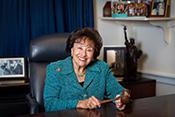 Rep. Nita M. Lowey (D-NY)
Description
Amendment increases funding for safe water and sanitation programs by $25 million; democracy programs by $10 million; implementation of the U.S.-Brazil Joint Action Plan to Eliminate Racial and Ethnic Discrimination and Promote Equality by $300,000; maternal health programs by $10 million; and oversight of Department of State and USAID programs by $8 million. These additions are offset by reductions to the Department of State Capital Investment Fund and USAID's Capital Investment Fund. The amendment also restricts Foreign Military Financing Program funding for Sri Lanka and restricts first-class travel by employees of agencies funded by this Act.
Legislative Activity
Stay on top of the latest movement without scrolling through every action
House amendment offered
July 9, 2009
View full timeline
House amendment offered
July 9, 2009
Amendment agreed to Committee of the Whole
July 9, 2009 • 6:00 PM
Roll call votes on amendments in House
July 9, 2009 • 6:00 PM
House amendment agreed to: On agreeing to the Lowey amendment (A001) Agreed to by recorded vote: 261 - 168 (Roll no. 516).
July 9, 2009 • 6:00 PM
House amendment offered/reported by : Amendment (A001) offered by Mrs. Lowey.(consideration: CR H7877-7878, H7909-7910; text: CR H7877)
July 9, 2009 • 4:09 PM
Amendment (A001) offered by Mrs. Lowey. (consideration: CR H7877-7878, H7909-7910; text: CR H7877)
July 9, 2009 • 4:09 PM
On agreeing to the Lowey amendment (A001) Agreed to by recorded vote: 261 - 168 (Roll no. 516).
July 9, 2009 • 6:00 PM
Votes
1 roll call on this amendment
Text
Offered
DEPARTMENT OF STATE, FOREIGN OPERATIONS, AND RELATED PROGRAMS
APPROPRIATIONS ACT, 2010
The SPEAKER pro tempore. Pursuant to House Resolution 617 and rule
XVIII, the Chair declares the House in the Committee of the Whole House
on the State of the Union for the consideration of the bill, H.R. 3081.
{time} 1503
In the Committee of the Whole
Accordingly, the House resolved itself into the Committee of the
Whole House on the State of the Union for the consideration of the bill
(H.R. 3081) making appropriations for the Department of State, foreign
operations, and related programs for the fiscal year ending September
30, 2010, and for other purposes, with Mr. Capuano in the chair.
The Clerk read the title of the bill.
The CHAIR. Pursuant to the rule, the bill is considered read the
first time.
The gentlewoman from New York (Mrs. Lowey) and the gentleman from
Illinois (Mr. Kirk) each will control 30 minutes.
The Chair recognizes the gentlewoman from New York.
Mrs. LOWEY. Mr. Chairman, I yield myself such time as I may consume.
Mr. Chairman, I'm pleased to present H.R. 3081, the fiscal year 2010
appropriations bill for the Department of State, Foreign Operations,
and Related Programs. I am deeply appreciative to my ranking member,
Kay Granger, for her key role in drafting this bill. This reflects our
bipartisan priorities and is a better product as a result of our
collaboration.
After all the hard work that Ms. Granger put into this bill, I am
deeply saddened that she's unable to be on the House floor with us
today to see the passage of our bipartisan product. I would like to
extend my heartfelt thanks to my friend, Ms. Granger, and I know all of
us wish for her a speedy recovery. Her presence is missed today on the
floor, but I know her thoughts are with us, and I look forward to
continuing to work closely with her as we move forward with the bill.
The bill has also benefited from the input of our very informed and
engaged subcommittee members. The bill totals $48.843 billion, $3.2
billion below the request and $1.2 billion below the fiscal year 2009
enacted level, including supplemental appropriations.
The bill provides an upfront and transparent accounting of the
resources needed to fund our foreign policy and national security
interests to end the reliance on supplemental appropriations to fund
anticipated needs.
Let there be no doubt, this bill, which funds the U.S.'s diplomatic
and development priorities, is a cornerstone of U.S. national security.
It includes $4.7 billion for assistance to Afghanistan, Pakistan, and
Iraq to help stabilize, strengthen, and rebuild these critical
countries.
In conjunction with funding in the 2009 supplemental, the bill fully
funds the U.S. commitments to our allies and partners in the Middle
East, including a total of $2.775 billion in FMF pursuant to the MOU
between the United States and our ally Israel and our commitments to
Egypt and Jordan.
The bill provides $987 million to continue support for
counternarcotics and alternate development programs in Mexico, Central
America, the Caribbean Basin, and Colombia and Peru.
The bill continues the congressional commitment to increasing the
capacity of our civilian agencies to carry out diplomatic and
development missions and provides resources to hire, train, support,
and provide security for 1,000 new Department of State personnel and
300 new USAID personnel.
H.R. 3081 provides $7.6 billion for global activities, including $5.7
billion for global HIV/AIDS, which is $150 million above the
President's request. Not less than $750 million will support the Global
Fund to Fight AIDS, Tuberculosis, and Malaria, and the bill includes
$648 million for voluntary family planning services in the developing
world, of which $60 million is for the United Nations Population Fund.
Addressing pandemics and other health concerns overseas before they
reach our shores is one of the best investments the United States can
make to protect American citizens while saving lives overseas. To this
end, the bill provides $75 million to address pandemic preparedness and
response, in addition to $50 million in the supplemental appropriations
act of 2009.
Now, while I continue to be personally committed to permanently
repealing the global gag rule, in the interest of bipartisan
cooperation, the bill does not change any provisions of law that
restrict funding for abortion or otherwise condition family planning
assistance.
The bill increases funding for key long-term development priorities,
including $1.2 billion to improve access to quality basic and higher
education and provide alternatives to madrassas where youth are often
exposed to extremism; $1 billion for food security and agricultural
development to respond to the global food crisis; over $1.2 billion in
bilateral and multilateral assistance for clean energy, biodiversity
and climate change initiatives; and $310 million to expand access to
safe water and sanitation.
It includes $2.4 billion in refugee and disaster assistance to meet
growing humanitarian needs, including in Pakistan and Afghanistan.
The bill also provides $450 million for the Peace Corps to jump-start
the President's pledge to increase the number of volunteers.
Finally, oversight is a bipartisan priority, and in order to improve
accountability, the bill provides a total of $146.5 million for the
activities of the Inspectors General of the Department of State and
USAID, as well as for the
[[Page H7869]]
Special Inspectors General for Iraq and Afghanistan Reconstruction.
I want to take a moment to thank all of the staff that have worked so
hard on this bill, especially Nisha Desai, our clerk, and her team:
Craig Higgins, Steve Marchese, Michele Sumilas, Celia Alvarado,
Courtney Dunn. I also want to thank Ann Vaughan, Jennie Munoz, and
Elizabeth Stanley on my staff for their work.
And I would also like to thank our hardworking minority staff,
including Ann Marie Chotvacs, the minority clerk, and Alice Hogans,
Mike Ringler, Jason Small, and Rachel Carter for all their work.
Mr. Chairman, the bipartisan foreign assistance package before you
preserves our Nation's interests. I urge my colleagues to give this
bill our bipartisan support.
I reserve the balance of my time.
Mr. KIRK. Mr. Chairman, I yield myself such time as I may consume.
I'm pleased to join Chairwoman Lowey at the beginning of the
consideration of this bill making appropriations for fiscal year 2010
for the Department of State, Foreign Operations, and Related Programs.
This bill funds programs that safeguard our national security and
promote U.S. interests abroad.
It was first founded under the auspices of the Marshall Plan under
the understanding that good diplomacy and development can dramatically
reduce national security problems and troop deployments for the United
States.
I want to commend Chairwoman Lowey for her bipartisan work on this
bill. She's listened to concerns of Members on this side of the aisle
and worked to address them.
I also want to thank the staff both on this and the other side of the
aisle for so many long hours of work on this. That's Nisha Desai-
Biswal, Craig Higgins, Steve Marchese, Michele Sumilas, Cecilia
Alvarado, and Courtney Dunn. I also particularly want to thank Ann
Marie Chotvacs, Mike Ringler, Alice Hogans, and Jason Small.
I know that Ms. Lowey and Ranking Member Granger, who is out today,
appreciate their personal office staffs' work on this bill, especially
Ann Vaughan and Rachel Carter. And I particularly want to thank my
staff, particularly Rich Goldberg.
Now, on this legislation, we make one big key change, and that is
with regard to the International Atomic Energy Agency's new report on
the Iran nuclear program and related responses of the United States to
their report. They showed that after producing low-enriched uranium at
a rate of 40 kilograms per month over a 21-month period, Iran has now
increased its stockpile by 60 percent in just 6 months, doubling its
rate to over 80 kilograms of enriched uranium per month.
We know that Iran's greatest weakness remains her economic dependence
on foreign gasoline. And we can all agree that the United States
taxpayers should not be asked to help increase the supply of gasoline
to Iran, especially now, especially after what we saw after the Iranian
elections. Surprisingly, this is exactly what our taxpayer dollars have
been doing.
In 2007 and 2008, the U.S. Export-Import Bank approved two separate
loan guarantees totaling $900 million to expand the largest refinery
owned by Reliance Industries Limited, an Indian company that provides
roughly one-third of Iran's daily import of gasoline. In effect, the
U.S. taxpayer is underwriting the increased supplies of gasoline to
Iran.
This bill includes the Kirk-Sherman amendment to prohibit further use
of taxpayer dollars to guarantee or insure or extend credit to any
company that supplies gasoline to Iran. I think that is a very
important step that leads off to legislation that Chairman Berman and I
have put forward that we hope, later in the year from the authorizing
committee, that will begin to truly squeeze Iran and her need for
foreign gasoline.
{time} 1515
Now with regard to the overall bill, I am disappointed that we have
departed from the tradition of considering appropriations under an open
rule. I first worked on the Foreign Operations bill of fiscal year
1984. I was taught appropriations at the foot of Appropriations
chairmen Jamie Whitten and Bill Natcher. It was under these historic
chairmen that we always considered appropriations bills under an open
rule, protected under clause 2 of rule XXI that only monetary
amendments could be offered.
Now we have departed from the long tradition established by Jamie
Whitten and Bill Natcher. The rule that governs this bill makes in
order only eight of 89 amendments, a 90 percent death rate for
amendments in the Rules Committee on what used to be an open rule.
I would suggest that the partisan pressures under Speaker Wright,
under Speaker Foley, were as bad or worse as now, but we are responding
with highly restrictive rules that I think hurt our committee in the
long run. I hope that we can address this soon and return to what I
would call the Whitten-Natcher tradition.
Now let me turn to the substance of this bill, the product of work of
especially Chairwoman Lowey and Ranking Member Granger.
The American people are aware that we face many global challenges
that are well addressed in this bill. The funds provide security
assistance to our allies in support countries living in some pretty
dangerous neighborhoods.
There is another reality of this bill and that is the financial
crisis that we see and that we are helping countries through so that
they do not collapse, triggering some sort of new global economic
downturn.
The allocation given to the subcommittee, $48.8 billion, is an
amount, when strictly compared to last year's base, that is very high.
But the administration has pledged to eliminate the wartime
supplemental spending in favor of a regular appropriations process. If
it sticks to that plan, then funding levels in this bill appear to be
much more reasonable, and it includes programs for State and USAID
operations that I support.
I have to admit, though, I remain in doubt whether the administration
really will not request a supplemental next year. In fact, I probably
would lay a dollar bet with anyone that we probably will see a
supplemental. I hope not. Chairman Murtha has already suggested that
supplemental funds may be needed to sustain our troops because of the
302(b) allocation that his Defense Subcommittee received that in his
view may not cover all of the FY 2010 needs. In that case, I hope we
could restrict funding under this bill.
Now, I know Chairwoman Lowey and Ms. Granger have worked together on
a number of very good governance provisions such as language to
strengthen oversight of hiring, training and deployment of new staff
funded by this bill; and a provision that launches a comprehensive
review of roughly $8 billion in global health funding provided by this
bill. Too often we forget that the United States has made the largest
commitment of health funding ever in the history of mankind. It is
something that the United States hasn't yet received enough credit for.
They also agree to language that closely mirrors the fiscal year 2008
bill which prevents U.S. taxpayer dollars from going to organizations
that support or participate in involuntary or coercive methods of
family planning, and that was the bipartisan commitment that Chairwoman
Lowey just alluded to.
The bill also includes amendments from several of my colleagues
offered in full committee, particularly like a provision requiring the
Secretary of State to report to Congress on deals brokered with foreign
nations that receive detainees from Guantanamo Bay, Cuba, like Palau.
The June 10, 2009, New York Times reported that the United States has
agreed to provide Palau with $200 million in return for receiving 17
suspected Uyghur terrorists from Guantanamo Bay. Now, according to the
CIA Factbook, Palau has a population of only 20,796 people. Its GDP is
only $164 million. Under this commitment then, the U.S. would be paying
the Republic of Palau nearly $11.7 million per Uyghur terrorist.
With average incomes in the United States of $56,000, $200 million
would support incomes of over 3,500 Americans; with tuition at $25,000
a year annually, it could put 7,000 students through college for a
year. And $200 million also compares poorly to the cost of Guantanamo
Bay itself. Guantanamo Bay, as a total facility, cost just $54 million
to build. This would be
[[Page H7870]]
four times that amount for just 17 Uyghurs.
There is also an amendment in this bill for new oversight and sunset
restrictions on funding provided to the International Monetary Fund in
the fiscal year 2009 supplemental, and language affirming intellectual
property rights protections for U.S. energy and environmental
technologies, critical in the G-8 discussions right now and the coming
Copenhagen discussions in which China and India have pledged to require
compulsory licensing over all climate change and energy technology.
Compulsory licensing is a code word for stealing U.S. patents. There
will be no green jobs if that provision goes through in the Copenhagen
treaty. I am very happy that the House voted nearly unanimously on the
Larson-Kirk amendment to prevent that.
Now, Chairwoman Lowey has also described highlights of the bill. I
will simply reiterate three very important items related to our
national security. This bill includes $1.4 billion for the expanded
work of the Millennium Challenge Corporation, a $525 million increase
to support prosperity and security of our partners around the
developing world, a very important program that underlies the key point
you cannot have long-term development without policy reform. You can
build a dam, but if the government steals everything, all you will have
is an empty structure a few years later. The MCC works to address that
very problem in an effective way.
When taken together with supplemental funds, this bill fully funds
our security assistance request for our strategic allies in the Middle
East like Israel, Egypt, and Jordan, and continues the fight against
illegal drug trafficking in this hemisphere. I think especially with
Ranking Member Granger's full backing, we have full funding for the
pending request for Mexico and Central America by providing $7 million
above the request, also for continued gains made in Colombia.
In summary, this bill is focused on furthering foreign policy and
national security interests. It monitors the wise use of our tax
dollars and achieves some fairly balanced solutions to some complex
problems leading to what I hope will be a fairly bipartisan debate
today.
I reserve the balance of my time.
Mrs. LOWEY. Mr. Chairman, I yield to a distinguished member of the
committee, the gentlewoman from California (Ms. Lee), for a unanimous
consent request.
(Ms. LEE of California asked and was given permission to revise and
extend her remarks.)
Ms. LEE of California. Mr. Chairman, I ask unanimous consent to put
my statement into the Record in support of this very good bill, H.R.
3081, and to especially thank you for working to increase funding for
two very important issues: support for the global fund to fight AIDS,
tuberculosis, malaria, and also our bilateral tuberculosis program.
Mr. Chairman, I rise in strong support of H.R. 3081, the FY10
Department of State and Foreign Operations Appropriations bill.
I would also like to thank Chairwoman Lowey, Ranking Member Granger,
and all the staff on the State, Foreign Operations Subcommittee of
which I am a member for their hard work and dedication in putting this
bill together.
H.R. 3081 includes many valuable provisions and much-needed resources
to extend the United States' arm of diplomacy in the interest of
development, progress, and peace.
This bill will provide for the hiring of more than 1000 new foreign
service officers and approximately 300 new employees at USAID.
Rebuilding the capacity of these two departments will transform our
ability to put America's ``smart'' power to work, strengthen our
national security, and have a dramatic and lasting impact on
individuals and communities throughout the world.
I especially want to thank the Chairwoman for working with me to
increase funding for two issues that I believe are critical--support
for the Global Fund to Fight AIDS, Tuberculosis, and Malaria, and for
our bilateral tuberculosis programs.
This bill includes $7.8 billion for global health programs, including
$5.75 billion for HIV/AIDS initiatives, which for years have been a
strong bipartisan priority.
These programs continue to save millions of lives while helping us to
stop the spread of this devastating global pandemic. I am hopeful in
the future we can further increase resources for these programs in
order to meet their unprecedented demand.
I am also pleased that this legislation provides $450 million to meet
President Obama's campaign pledge to double the size of the Peace Corps
over several years.
As countries throughout the world seek assistance to combat poverty,
hunger, disease, and environmental degradation, this commitment to the
Peace Corps' mission of peace and friendship through service is
particularly timely.
Lastly, I am greatly encouraged by the steps taken in this bill, and
other appropriations measures, to avoid future reliance on supplemental
appropriations that in the past have undermined efforts to obtain an
honest accounting of the costs of conflict and war which our efforts in
diplomacy and development seek to avoid.
I urge my colleagues to support this effort and to support this bill.
Mrs. LOWEY. I would like to yield for a unanimous consent to my
distinguished colleague from New York (Mrs. Maloney).
(Mrs. MALONEY asked and was given permission to revise and extend her
remarks.)
Mrs. MALONEY. I thank the gentlelady for her leadership on this bill,
and I rise in support of this bill, and particularly commend the
chairwoman for her leadership on the United Nations Population Fund,
which was denied funding for 7 years under the prior administration,
and will save women's lives; and her focus on helping the women under
the oppressive Taliban regime in Afghanistan with over $100 million
focused on female NGOs and the security of our country and the help for
our allies. A great bill. I appreciate your allowing me to include my
statement.
Mr. Chairman, I rise today in strong support of the Foreign
Operations Appropriations bill and commend Chairwoman Lowey and Ranking
Member Granger for their hard work in crafting this important bill.
I am particularly pleased that it includes $60 million for the
critical work done by UNPFA (the United Nations Population Fund).
Every minute of every day, a woman dies needlessly in pregnancy or
childbirth, most in the developing world--this translates into 10
million women lost per generation.
4 million newborns also die every year of similarly preventable
causes. UNFPA has worked to end these deaths since it became
operational in 1969.
It has provided significant assistance to improve the health and
quality of life and to promote the health and rights of women
worldwide.
UNFPA is the largest source of international assistance for women's
reproductive health in the world and despite the past 7 years during
which the previous Administration withheld funding for UNFPA, the
United States Congress has demonstrated its strong support of the
organization by approving U.S. financial support for UNFPA each year.
Fully 42 percent of all pregnancies worldwide suffer complications
and in 15 percent of all pregnancies, the complications are life-
threatening.
In too many places, maternal health still receives inadequate
attention and funding.
Fortunately for women around the world, UNFPA operates in 154
countries specifically to combat maternal mortality and to promote safe
motherhood.
The impact of losing U.S. funding over the past 7 years has been
devastating.
For each of these years, UNFPA could have helped to prevent 2 million
unintended pregnancies, 800,000 abortions, 4,700 mothers' deaths, and
more than 77,000 infant and child deaths.
In 2001, the U.S. Agency for International Development estimated the
global economic impact of maternal and newborn mortality at $15 billion
per year in lost potential production, half associated with women and
half with newborns.
Investing in UNFPA actually reduces healthcare costs, and teaching
and promoting safe motherhood enables adequate time between births for
women's bodies to better carry another pregnancy.
Mr. Chairman, this funding will help to restore the United States'
standing in the global community while demonstrating its commitment to
the lifesaving work of UNFPA.
Mrs. LOWEY. I yield 1 minute to the gentlewoman from Minnesota (Ms.
McCollum) who has been an outstanding member of the committee and has
made it a great bill because of her important work.
Ms. McCOLLUM. Mr. Chairman, I applaud the chairwoman and ranking
member for both of their work in crafting a bill that everyone in this
House can be proud to support.
This bill commits about 1 percent of the total Federal budget to
confront all
[[Page H7871]]
of the global challenges we face: poverty, conflict, famine, drought,
disease and global climate change. If we ignore these issues, they will
threaten our way of life.
This year's bill makes bold, necessary investments in areas of global
health, agriculture and climate change, and it puts America back onto
the path of doubling the number of Peace Corps volunteers proudly
serving our country.
I look forward to working with the chairwoman and President Obama to
increase our investment in child survival and maternal health and to
meet America's commitment to the Millennium development goals.
Today, we start building a safer, healthier world for America's
children and all of the world's children.
Mr. KIRK. I yield 3 minutes to the gentleman from Florida (Mr.
Crenshaw), a distinguished member of the subcommittee.
Mr. CRENSHAW. I thank the gentleman for yielding me this time, and I
want to compliment the chairwoman and our ranking member for the hard
work that they have put into this good bill. I rise in strong support.
There are a lot of reasons why I think Members should vote for this
bill, but let me just mention two. One is I think when you talk about
foreign policy, it is really like a three-legged stool. Part of it is
defense, part of it is diplomacy, and part of it is development. You
can't have one without the other two. I think what this bill does, it
brings into balance these three areas. When you have the appropriate
diplomacy, when you have the appropriate folks to do the development,
then you free up those in the defense to focus on their mission. So I
think this bill brings that into balance and I think that is a good
thing overall in terms of foreign policy, in terms of national
security.
And in particular, I like the Millennium Challenge Corporation. As
someone who has a business background, I have watched this corporation
grow, and this is the fifth year we have had it in place. I think it is
a great example of how we can provide foreign assistance in a smart
way. No longer do we simply write a blank check to some country and
never know where the money is going to go or what the results are. Now
we enter into a compact, a contract, if you will, between the country
receiving the money and our country. If they want to build a power
plant or build a dam, whatever, in return, they agree to try to meet
certain standards in terms of openness and democracy and transparency
and accountability and human rights. So they have an incentive to
follow through on this contract. It is smart aid, in my view. It is the
right way to give assistance, and I think this fifth year of the
Millennium Challenge Corporation is a very critical time because
sometimes these contracts are entered into for a long period of time.
It is adequately funded this year. For those reasons, I urge Members to
support this good bill.
Mrs. LOWEY. Mr. Chairman, I yield 2 minutes to an outstanding member
of our committee who has made major contributions and has helped make
this bill the good bill that it is, the gentleman from New Jersey (Mr.
Rothman).
Mr. ROTHMAN of New Jersey. I thank my distinguished chairwoman.
I rise today in strong support of this bill. First, I would like to
thank Chairwoman Lowey for her amazing leadership, and as well our
ranking member, Kay Granger, who is not with us, and my fellow
subcommittee members, including Congressman Kirk, who is taking the
lead on the floor today for the great leadership efforts that they have
shown in ensuring that this bill puts partisan differences behind, and
that this bill makes sure that we promote our Nation's foreign policy
and national security interests by funding economic development,
health, and education around the world, and diplomacy.
This bill also includes in particular language that would improve
transparency and accountability, Mr. Chairman, at the United Nations
Relief and Works Agency for Palestine refugees in the Near East,
commonly called UNRWA. For almost 60 years, UNRWA has provided
humanitarian services to Palestinians living in refugee camps
throughout the Middle East.
Unfortunately, as UNRWA has grown over the years, it has not taken
nearly enough steps to ensure that it does not employ, affiliate with,
or provide benefits to known terrorists. The problem with UNRWA is
fundamental. There is a remarkable lack of available information.
That is why I am so grateful to Chairwoman Lowey and our ranking
member and my colleagues for including in the bill requirements that
the information available regarding textbooks being used to teach the
next generation of Palestinians be provided, and more money being
provided for that information, and to require the State Department to
undertake a review of those educational materials and UNRWA schools to
ensure that there are no calls for hatred or intolerance, including
anti-Semitism, in these textbooks provided by UNRWA to the Palestinian
refugees.
{time} 1530
In addition, the legislation requires the State Department to report
on whether UNRWA is complying with current U.S. law, which states
appropriately that no American taxpayer dollars be directed to
terrorists or to further terrorist propaganda.
I stand in strong support of this bill. I thank my distinguished
chairwoman and my colleagues for this wonderful bill and I urge its
passage.
Mr. KIRK. Mr. Chairman, I yield myself 1 minute.
I just want to thank my colleague from New Jersey for his leadership
on this.
UNRWA is an organization that is utterly irresponsibly run. Any
corporation in America of UNRWA's size--which is $400 million a year--
would have an outside independent audit, and yet UNRWA has never had
that--and in fact doesn't want it. UNRWA's staff has met with
Republicans and Democrats up here and admitted that they, indeed, do
make martyr payments to people that have carried out attacks against
the people of Israel. And then we've seen all the video of mortar
rocket attacks being used from UNRWA schools where UNRWA security
personnel clearly could have prevented that.
This bill helps increase the heat on UNRWA, one of the least
accountable U.N. agencies. And I really want to thank the gentleman for
his leadership on that.
Mrs. LOWEY. Mr. Chairman, I yield 2 minutes to an outstanding member
of our committee, the gentleman from New York (Mr. Israel).
Mr. ISRAEL. I thank the distinguished chairwoman, my extraordinary
colleague from New York.
Mr. Chairman, I am so pleased to rise in support of this bill. This
is one of the finest State-Foreign Operations bills we have had in many
years.
I am especially indebted to the chairwoman for allowing me to include
two provisions in this bill. One is language that I have been
interested in for several years since visiting India on an energy
congressional delegation, learning what India is doing with respect to
renewable energy and learning that there were six women in the
Sunderbonds, a remote Delta region, who were lighting their entire
village with a solar panel.
If you ask the Department of Defense what we need in order to promote
stability and security and affluence and prosperity, they will tell you
we need a robust defense budget, something I agree with. But in the
Sunderbonds, they are doing it with a solar panel which charges solar
lanterns, which these six women rent to other villagers. And so you
have all the elements that you need for stability and security; you
have the empowerment of women, you have a sustainable small business
model, and you have light.
As a result of the chairwoman's support and the support of the
ranking member, we have included $10 million to establish the Solar
Villages Initiative in the State Department to replicate this project.
I further want to thank the chairwoman and the ranking member for
their support of the National Solidarity Program in Afghanistan. The
essential lesson that Afghanistan teaches us is that order cannot be
imposed from above--Alexander the Great tried it, Genghis Khan tried
it, the British tried it, the Soviets tried it. We can try it, but it
does not succeed.
Afghanistan is stable when order comes from the Afghan people, when
[[Page H7872]]
they are empowered to achieve their own solutions. And as a result of
the chairwoman's support and the support from the minority, we have
included $175 million for the multidonor National Solidarity Program,
which is the leading program rebuilding Afghanistan. That allows local
villages to secure some funding to plan their own projects, to plan
their own future, to bring women into governing councils, to establish
those projects which will secure those villages and promote long-term
security and stability.
These are two programs, among many, which make this a product that
both sides of the aisle can be very proud of. It is the best investment
that we can make. And I again thank the chairwoman for her support.
Mr. KIRK. Mr. Chairman, I yield myself 2 minutes.
I want to thank the gentleman because I have worked very closely with
him to support I think one of the key combat-support elements of this
bill, which is the National Solidarity Program of the Government of
Afghanistan.
We won the war in El Salvador largely through the help of a program
called Mayors in Action, in which we funded programs totaling between
$5,000 and then $10,000, as long as the community could come together
and decide on what project. Having government services and activities
in support of the El Salvadoran Government quickly undercut the
insurgency and helped win a counterinsurgency campaign there.
Based on the success of that program and others, the National
Solidarity Program is now operating in Afghanistan. This bill provides
$175 million, largely through the leadership of the gentleman from New
York.
When I deployed to Afghanistan in December, I spent quite a lot of
time working with Monty Greer and Minister Zia, who described how this
program is now in hundreds of villages throughout Afghanistan, but they
had a funding shortfall. And working with General Nicholson of ISAF
Region South, we put together a plan so that this bill would fund
community development programs right behind the advance of U.S. troops.
It has been little noticed so far in this body that 2 weeks ago the
United States Marine Corps launched an offensive in the key poppy-
growing region of Afghanistan called Helmand Province, and it was that
funding shortfall which would have not enabled U.S. troops to have the
money to do community development projects right in the wake of their
advance, along with the Afghan troops. This legislation allows them to
have those tools right away so that the Afghan people will see progress
in community development right behind the battlefield. It makes our
chances of success much greater. It makes the sustainment and expansion
of the Afghan Government much more likely. And bottom line, I think it
will save a number of lives, especially for those of our constituents
right now working for what sometimes has been called ``Uncle Sam's
misguided children,'' otherwise known as the United States Marine
Corps.
I yield to the gentleman who has worked with me so much with Minister
Zia on this.
Mr. ISRAEL. Well, I thank the gentleman for his personal commitment
and participation in this project.
Mrs. LOWEY. Mr. Chairman, I yield to the gentleman from Massachusetts
(Mr. Lynch) for a colloquy.
Mr. LYNCH. I thank the gentlewoman for yielding.
As the co-Chair of the House Task Force on Terrorist Financing and
Nonproliferation, I rise to engage in a colloquy with my distinguished
colleague, Chairwoman Lowey.
I would like to confirm that the $57 million requested by President
Obama for nonproliferation, antiterrorism, demining, and related
programs in Afghanistan, will be fully funded.
Is it the chairwoman's intent that those critical security and
humanitarian-related activities will be funded at the President's
requested level?
Mrs. LOWEY. Reclaiming my time, first, I thank my friend for raising
this important issue.
Yes, it is the committee's intent to fully fund Afghanistan's
nonproliferation, antiterrorism, demining, and related programs at the
President's requested level. We agree these programs are vital to our
success in Afghanistan. And as we developed the bill, our funding
assumption was, unless otherwise noted, that the President's full
request for Afghanistan was met.
I yield to the gentleman.
Mr. LYNCH. Thank you.
Is it also the chairwoman's view that the State Department should
ensure that these funds are used to support the range of programs, such
as export control and border security, antiterrorism assistance,
terrorist interdiction activities, counterterrorism financing,
humanitarian demining, and destruction of small arms and other weapons?
Mrs. LOWEY. Reclaiming my time, yes, it is the committee's intent to
support these activities.
And I yield to the gentleman.
Mr. LYNCH. Thank you. I want to thank the chairwoman for her
courtesy, and to the gentleman from Illinois for his bipartisanship on
this and all of our critical efforts in Afghanistan.
Mr. KIRK. Mr. Chairman, I reserve the balance of my time.
Mrs. LOWEY. I am pleased to yield 2 minutes to the distinguished
gentleman from California, an outstanding member of the committee, Mr.
Schiff.
Mr. SCHIFF. I thank the gentlewoman.
I rise in strong support of the 2010 State-Foreign Ops Appropriations
bill and congratulate my Chair and friend, Nita Lowey, for her
leadership in crafting a bill that not only addresses critical national
security needs, but does so in a cost-effective manner.
After too many years in which diplomacy and smart power were shunted
aside, this legislation is a reassertion of American leadership in
helping to assure a brighter, more peaceful future for America's
children and for children around the world.
I am particularly concerned about Somalia's renewed descent into
chaos and the prospect that al Qaeda, which is under increasing
pressure along the Afghan/Pakistan frontier, will take advantage of the
power vacuum in that country as it did in Afghanistan during the 1990s.
This must not be allowed to happen. And the U.S. must be willing to
work with the United Nations, the African Union, and nongovernmental
organizations to help stabilize Somalia and create an atmosphere in
which governance and security are again possible.
This will be a long and difficult process, and in the main it must be
driven by the Somalis themselves. But I was gratified that the bill
includes aid above the President's request to foster economic growth,
encourages the State Department to continue its support of Somali
refugees in neighboring countries and, most importantly, provides $102
million to support both the African Union mission in Somalia and
security sector reform within Somalia itself.
In this bill, even as we have provided funding for important
initiatives like that, and we provided robust funding to increase the
size of our Foreign Service and USAID professionals to revamp our aid
to Pakistan and to help it to better confront the threat from al Qaeda,
to provide crucial aid to key Middle Eastern allies Israel, Jordan and
Egypt, to ramp up our efforts to fight the scourges of malaria, HIV/
AIDS, and tuberculosis, and fully meet our obligations to the United
Nations, Ms. Lowey, Ranking Member Granger, and the staff of the
subcommittee have also been mindful of the state of our economy here at
home. In fact, this bill is $1.2 billion, or 2.4 percent, below the
President's spending, and $3.2 billion, or 6 percent, below the
administration's request.
Finally, I am very pleased the bill includes $48 million in economic
assistance to Armenia, as well as an increase in humanitarian
assistance to Karabakh to $10 million, and maintains military
assistance parity to both countries at $3 million, and the IMET
assistance at $450,000 each.
Importantly, the report accompanying the bill references the policy
of parity in military assistance provided to Armenia and Azerbaijan.
Mr. KIRK. I yield myself such time as I may consume.
It's also important to note that this bill carries forward the Kirk
amendment that now prohibits any U.S. assistance to a Palestinian
Authority that includes Hamas--a terrorist organization, as designated
by the United States, President Clinton, President Bush and I believe
now President
[[Page H7873]]
Obama--unless every member of the new Palestinian Government has
publicly, in writing, recognized Israel's right to exist and renounced
terrorism. Over 20 United States citizens have been murdered directly
by Hamas, and having this provision included in this legislation I
think is very important.
Also, this legislation reverses the administration's proposed cut for
U.S. assistance to Armenia. We provide $48 million in economic aid and
$3 million in military aid for Armenia while maintaining military
funding parity with Azerbaijan and providing $10 million in assistance
to Nagorno-Karabakh. The bill also includes a new requirement for the
administration to consult with Congress before exercising its waiver
authority for assistance to Azerbaijan granted under section 907 of the
Foreign Assistance Act.
Now, according to the Congressional Research Service, between 100,000
and 500,000 Korean Americans still have family living in North Korea.
Almost all of them have not seen their loved ones since the end of the
Korean War, while many have not seen family members even since World
War II. In the absence of diplomatic relations between the two
countries, elderly Korean Americans are forced to contact their
relatives without the protection of the U.S. Embassy or help from the
State Department. Families are at the mercy of a black market group of
smuggling rings that control access to North Korea.
This legislation urges the State Department Policy Coordinator for
North Korea to make the issue of divided American citizen families who
have their relatives in North Korea a priority and to establish a
coordinator for this issue.
One last thing I want to highlight. As the United States draws down
our troop commitment to Iraq, and we have tremendous concerns about
safe and secure and sustainable homes and businesses for Iraq's
embattled Christian minority, this bill provides a historic $20 million
dedicated to religious minorities in Iraq, a big step forward for
building an autonomous administrative region for Chaldo Assyrians in
the Nineveh Plain. It's an important group that we should be concerned
about, especially as the United States leaves Iraq.
Mr. Chairman, I reserve the balance of my time.
Mrs. LOWEY. Mr. Chairman, I yield myself 2 minutes for a colloquy
with the gentlewoman from California (Ms. Woolsey).
I am pleased to yield to Ms. Woolsey.
Ms. WOOLSEY. I thank the chairwoman and applaud her leadership on
behalf of women's health. No one in Congress has done more to
prioritize the needs of women and children in our foreign assistance
spending.
As you well know, Madam Chairwoman, every minute somewhere in the
world a woman dies during pregnancy or childbirth. In the poorest
regions, one out of 22 women will die from these causes compared to one
in 4,800 in the United States. In the developing world, mothers
routinely face death or injury as a result of uncontrolled bleeding,
infection, seizures, hypertensive disorders, birth obstruction, or
other complications.
{time} 1545
A pregnancy should be a joyful time in a woman's life, not a death
threat.
The good news is that practical interventions exist. We just need to
leverage the necessary resources and sufficiently focus our assistance
on maternal health.
Mrs. LOWEY. I thank the gentlewoman for her kind words and for her
support for women's health at home and abroad. Healthier mothers will
enjoy safer pregnancies and childbirths, enabling them to better care
for their children. Bolstering maternal health initiatives can help
reduce the 4 million newborn deaths each year in the developing world.
The committee has directed USAID to undertake a detailed review of its
maternal health portfolio, and I look forward to working with my
colleagues on this important issue.
Ms. WOOLSEY. I thank the chairwoman. I look forward to working with
her on this issue to ensure that not one more mother has to replace a
birth announcement with a death notice.
Mrs. LOWEY. Mr. Chairman, I reserve the balance of my time.
Mr. KIRK. Mr. Chairman, I yield myself 2 minutes.
We rarely do this under this legislation, but we also have an
important tradition of highlighting human rights cases, especially if
they set a particularly dangerous precedent. And one of the most
concerning precedents is the one set by the Government of Egypt when
they imprisoned Kareem Amer, who is the first blogger ever to be
arrested for what he wrote on his Internet blog, calling for
reconciliation between Muslims and Jews on his personal blog. He was
convicted. He's currently serving in prison, and it is a particularly
dangerous precedent to have set that merely what you may write in your
Internet blog will land you in jail.
It's interesting to me, too, that of all the Muslim countries around
the world, Egypt set the precedent, and of all the countries around the
world that could have set this precedent against the freedom of speech
on the Internet, it was one of the largest recipients of U.S. foreign
assistance under this act. We have not gone to the step yet of
dramatically affecting the U.S. assistance provided by this, but we do
have to highlight Abdel Kareem Nabil Soliman, his full legal name, and
his time in jail, a very dangerous precedent under Egyptian law and one
that should be highlighted here.
Mr. Chairman, I reserve the balance of my time.
Mrs. LOWEY. Mr. Chairman, I yield 2 minutes to the gentlewoman from
California for the purpose of a colloquy.
Ms. ESHOO. I thank the very distinguished chairwoman of the State,
Foreign Operations Appropriations Subcommittee, Mrs. Lowey, who is a
great friend, and I want to thank her staff for their diligence in
working with us. They have been absolutely more than wonderful on an
important issue.
My intention today is to confirm that the $20 million provided by the
subcommittee for religious minorities in Iraq is intended to focus on
the needs of the Nineveh Plains region.
Did the subcommittee intend that this funding for ethnoreligious
minorities focus on the Assyrian/Chaldean/Syriac/Christians of the
Nineveh Plains region since that is the primary location of these
displaced persons?
I yield to the gentlewoman.
Mrs. LOWEY. Yes. The committee is aware that this region is home to
most of the displaced ethnoreligious minorities in Iraq.
Ms. ESHOO. Is the chairwoman's view that the State Department should
ensure that these funds are used to support a range of programs such as
security, small microenterprise development, agriculture capacity
building, economic development, educational institution capacity
building, health care enhancement, and democratization programs,
including the dialogue on the Nineveh Plain Administrative Unit?
Mrs. LOWEY. Yes. It is the committee's intent to support these types
of activities.
Ms. ESHOO. Would the chairwoman support the award of these funds to
nongovernmental organizations that are already working tirelessly in
the region such as the Dominican Sisters, the Assyrian Aid Society, the
Nineveh Center for Research and Development, the Hammurabi Human Rights
Organization, and other groups that provide services to all people on a
nondiscriminatory basis?
Mrs. LOWEY. Yes. There are a number of organizations that have
provided health, education, and other assistance in the region and
should be considered as potential alternatives to governmental
entities. I expect the State Department to continue to use a
competitive bidding process to ensure that the most appropriate and
effective organizations receive U.S. Government assistance.
Ms. ESHOO. I can't thank the chairwoman enough for her support of
funding to alleviate the plight of these ancient people so critical to
the future of Iraq. Her efforts are going to help hundreds of thousands
of displaced ethnoreligious minorities. And I know that our colleagues
Congresswoman Jan Schakowsky, Congressman Gary Peters, and certainly
Congressman Frank Wolf thank you for your leadership and for your
attention to this issue that matters to so many. God bless you.
Mrs. LOWEY. I thank the gentlewoman.
Mr. KIRK. Mr. Chairman, I yield 2 minutes to the distinguished
minority whip, Mr. Cantor.
[[Page H7874]]
Mr. CANTOR. I thank the gentleman for yielding.
Mr. Chairman, the legislation before us provides $2.22 billion worth
of vital security assistance to the State of Israel, our most
dependable and democratic ally in the Middle East. The funding in this
bill will help ensure Israel maintains its qualitative military
advantage in the region. That means Israel can defend itself against
the existential threat posed by Iran and against Iranian terrorist
proxies, Hamas and Hezbollah, both sworn to Israel's destruction.
A strong Israel means a more stable Middle East. A weakened Israel
only gives momentum to the radicals in the region determined to sow
discord and harm U.S. interests. Joint cooperation with Israel has also
yielded tangible benefits to America since Israel is a leader in
methods of fighting terrorism and preventing civilian casualties in
terrorist attacks.
Mr. Chairman, there is no doubt in my mind that Israel is a pillar in
the national security interests of the United States, and it is, in my
opinion, essential that we provide this assistance to Israel because it
is in the best interests of the United States. That's why I support
this legislation, and I urge my colleagues to do the same.
Mrs. LOWEY. Mr. Chairman, I am very pleased to yield 1 minute to the
gentleman from Pennsylvania (Mr. Fattah).
Mr. FATTAH. Mr. Chairman, let me congratulate the chairwoman. I
served on this subcommittee for a few years, and this is an
extraordinary bill. I think it's the best Foreign Operations bill in
more than a couple of decades in this House on a range of issues, but
I'm only here to speak about one.
I want to thank the chairwoman for her continued support, and notice
in the bill and in the accompanying report the effort around safe blood
in Africa, in sub-Saharan Africa. When we began talking about this
issue a few years ago, there were no safe blood centers and there are
now 35. It wouldn't have happened without the chairwoman's support and
understanding the correlation and nexus between malaria and blood
transfusions and, therefore, increases in AIDS when you have unsafe
blood being used in those transfusions. So I want to thank her and
congratulate her on a great bill.
Mr. KIRK. Mr. Chairman, I yield myself 1 minute.
I want to highlight a key provision of this bill, section 7006, which
withholds 10 percent of the funding under this legislation for the
Board of International Broadcasting, Radio Deewa. This is a service
actually that the chairwoman and I helped sponsor and get rolling
because of our perception that there was very little international
broadcasting service and outside information in the main language of
northwest Pakistan and Afghanistan of Pashtun. But we found that they
were putting Batula Massoud on the U.S. taxpayer-funded radio, giving
him a platform just 6 days after the Secretary of State put him on the
Rewards for Justice terrorism list for his crimes against a number of
terrorist targets, including the Prime Minister of Pakistan. So I
really want to thank the chairwoman for including this because we sent
a very clear signal that we want open and free communication with
accurate news, but we do not give platforms to terrorists on the
Rewards for Justice list of the State Department.
Mr. Chairman, I reserve the balance of my time.
Mrs. LOWEY. Mr. Chairman, I am very pleased to yield 2 minutes to a
leader in this Congress who understands the importance of water, in
addition to bicycles, and has been a tireless advocate for a whole
range of important causes, my good friend Mr. Blumenauer.
Mr. BLUMENAUER. I appreciate the gentlewoman's courtesy in permitting
me to speak on this, as I appreciate her leadership in being able to
advance a cause that's near and dear to both of our hearts.
Mr. Chairman, I will speak for 2 minutes. In the course of that time,
about 10 children around the world will die needlessly from waterborne
disease. We have been working, over the course of the last 5 years, for
the United States to exercise its appropriate leadership to try to
eliminate this tragedy.
I deeply appreciate the work that the subcommittee has done. Indeed,
in the manager's amendment it takes an increase from last year and has
a further increase of $25 million, meaning $335 million to help
implement our Water for the Poor Act, dealing the world's number one
public health problem.
Mr. Chairman, we have more than a billion people worldwide who lack
access to both sanitation and clean drinking water, without which
children cannot learn in school; the sick, including those with HIV/
AIDS, cannot take their medication; stable societies cannot be built;
and millions needlessly continue to die. Entirely preventable tragedies
trap countries in poverty and diminish our own development and security
efforts. It's no coincidence that the Middle East and North Africa, the
most water-stressed region in the world has some of the most complex
security issues. The State Department has said securing fresh drinking
water is a significant part of the Middle East peace process and one
that brings people together rather than dividing them.
I deeply appreciate the chairwoman and her staff for working with me
and my colleague Don Payne, who has been tireless in advancing this
issue. I hope that the administration, with the leadership of Secretary
Clinton, will join in this effort so that we can make the progress that
poor people around the world deserve and that we all need.
Mr. KIRK. Mr. Chairman, I reserve the balance of my time.
Mrs. LOWEY. I am very pleased to yield 2 minutes to the gentlewoman
from Texas (Ms. Eddie Bernice Johnson).
{time} 1600
Ms. EDDIE BERNICE JOHNSON of Texas. Mr. Chairman, let me thank the
chairman of the committee and the ranking member for their work.
I rise today in support of a provision in the manager's amendment to
increase the amount of funds available for human rights and democratic
initiatives of the U.S. Department of State and the U.S. Agency for
International Development. Specifically, the Democracy Fund in this
appropriations bill will be, in large, helping countless people across
the globe.
I'd like to thank my colleagues, the Honorable Nita Lowey and the
Honorable Kay Granger for accepting my amendment; and I commend them
for their hard work on this bill. This really is an important bill. At
this moment in history, I cannot help but be reminded of particular
problems we are facing internationally. Although we have developed and
maintained a high standard of living in our own country, we must
remember that so many people across the globe cannot think about
democracy because, frankly, they're so busy trying to survive, and they
don't share the same luxuries and comforts that we take for granted in
the United States. Basic human rights are a pillar of our democracy,
and we seek to live in a stable and peaceful world. I work with women
from around the world, trying to help build a culture of peace in this
world. So this really is a very important part of it for me. The
Democracy Fund does just this. It gives countless people a way to
identify with a country of democracy.
I ask my fellow colleagues to join me in supporting the manager's
amendment, which seeks to expand and encourage democratic and human
rights initiatives globally.
Mrs. LOWEY. If the gentleman has no more speakers, I am prepared to
close if he wishes to yield back the balance of his time.
Mr. KIRK. Let me just say this bill also contains one last program--
and then I will close--and that is called the Near East Regional
Democracy program. It used to be called the Iran democracy program, and
I hope that's still exactly what it does. We're providing $40 million
for this, and it's very important. Following the suppression of
democracy in Iran, we're particularly concerned about key minority
groups there. The Azeris, representing 40 percent of the country,
including the leading candidate for president whose vote was
suppressed; the Kurds that we worked with so well in northern Iraq; and
the Baluch, in which a significant Iranian military presence is there.
And I want to pay particular attention to the plight of the Baha'i. The
National Assembly of the Baha'i Faith is located in my district; but
this is the faith that
[[Page H7875]]
was founded in Persia, now Iran. There are 330,000 Baha'is in Iran
right now. Under this regime, we have now seen that they have been told
to register their businesses and place of address, that this is the
bureaucratic machinery that we have seen in other countries in other
uniforms before. It is the machinery of oppression and potentially
worse. We have seen now that just following the time President
Ahmadinejad claimed that he had won the election--remembering, of
course, that in 150 Iranian cities, the votes totaled more than the
number of people living in those cities--that just following their
claim to have won the election after only 2 hours of counting the
ballots, that he moved against the Baha'i leaders, putting them on
trial for their lives in that country. The Near East Regional Democracy
program can help us build alternative voices in that country, all the
more important.
Let me close on this bill by saying that this bill has one key and
major component, which is assistance to the State of Israel for us. In
my view, land for peace generally means no land and even more war, as
we saw with Israel's withdrawal from Gaza where an area that used to be
used for agricultural produce is now used for mortars and rockets
against southern Israel, especially Sderot and Ashkelon. My worry is
that we might have more of that kind of adventurism by the other side
further if we see instability in southern Lebanon and especially on the
West Bank. This legislation helps us underscore our commitment to the
Israeli Air Force, their missile defense system and, especially, to
their army to at least encourage the states in that region to make sure
that no adventurism like we saw, especially in 1973, can move forward
against our best allies in the Middle East. My hope is that we have
very strong commitment for this on the floor today and in the United
States Senate because I think this bill, more than any other, makes any
potential conflict in the Middle East less likely; and that is good for
us all.
With that, I recommend passage of the bill. I want to commend our
chairwoman and our greatly missed Ranking Minority Member Kay Granger,
who's out today, for bringing us a bill that adheres to the key
principle that I try to follow at every possible turn, and that is the
aphorism that we say, that partisanship should end at the water's edge.
In my service in the United States military, I generally found that
when we were being shot at, they weren't shooting at Democrats or
Republicans. They were shooting at American citizens. The United States
has bipartisan interests overseas, and this bill fulfills this.
I yield back the balance of my time.
Mrs. LOWEY. As we close this debate, I want to thank Kay Granger
again, the ranking member of this committee, who has been an invaluable
partner in creating what we think is a very, very good bill. I also
want to thank Mr. Kirk for his leadership not only in the committee but
certainly in his role in presenting this bill today. We really have an
outstanding subcommittee. Again, it's because the subcommittee members
and the staff on both sides, who I acknowledged in my opening
statement, and the ranking member; as well as the Chair of the overall
Appropriations Committee, Mr. Obey. Everyone contributed to making this
a really important bill.
I just must say in closing that, for me, it's a real privilege to be
a Chair of this committee, to wake up every day and know that you can
contribute to the great challenges we have internationally; and every
day we are presented with an additional challenge that we have to face.
As the leader of the free world, the United States of America has a key
role to play, and I know that all the members of this committee
understand our responsibility.
So this is a good bill. I appreciate your support. I hope we can get
support from the majority of Members on your side of the aisle and our
side of the aisle because this is an important bill; and as we move
forward, it's extremely important that all of us support these efforts.
Mr. KLEIN of Florida. I rise to support H.R. 3081, the State, Foreign
Operations and Related Programs Appropriations Act of 2010.
This legislation addresses our most urgent national security needs,
rebuilds our diplomatic infrastructure for the long term, and maintains
our commitment to fiscally responsible government. The total for this
bill comes in $3.2 billion below the President's budget request,
meaning that we cut spending tremendously but still managed to fund the
most vital programs around the globe. I'd like to touch on some of
these programs.
This legislation requires that the Administration report to Congress
on the status and progress of diplomatic efforts to prevent Iran from
acquiring nuclear weapons. I support the President's current efforts to
stop Iran's dangerous nuclear weapons program; however, diplomacy
should not be open-ended. This legislation makes it clear that Congress
will exercise its oversight authority over these negotiations to ensure
that there is a plan to stop Iran from building a nuclear weapon.
Furthermore, the legislation prevents the U.S. Export-Import Bank
from providing or guaranteeing credit to companies that provide Iran
with significant amounts of refined petroleum. Iran imports about 40
percent of its refined petroleum. Then-Presidential candidate Barack
Obama stated that restricting these imports could be a valuable lever
in persuading Iran to cease its efforts to acquire nuclear weapons
capabilities. We start that process today, and I am proud to support
legislation that takes the first step in instituting crippling
sanctions against the Iranian government.
Iran represents a great threat to the United States and our allies
throughout the world. This legislation helps mitigate that threat to
our allies by ensuring that countries that Iran would seek to destroy
or destabilize receive support from the United States. U.S. aid to
Israel represents a cornerstone in the strong relationship that our two
countries share. I visited Israel right after the signing of the 10-
year Memorandum of Understanding between the United States and Israel,
and it was clear that this agreement would help cement our long-term
friendship. This legislation fully funds our commitment under this
accord and serves as an assurance to Israel that we will work together
to ensure Israel's security during a time when Israel faces several
powerful threats.
In addition, this legislation helps put us and our allies on a path
to energy independence, funding clean energy initiatives that reduce
our dependence on oil and make us more energy efficient. By partnering
with other countries, we can share these important technologies and
learn from others about new innovations.
Finally, I would like to briefly mention my support for the amendment
by the gentleman from New York, Mr. Weiner. This amendment sends a
strong statement to Saudi Arabia to cease its funding of terrorism and
stop its incitement against Israel, Jews and America. While the bill
prohibits aid to Saudi Arabia, it leaves the door open in case the
President deems that aid is necessary. This amendment shuts that door.
Common sense tells us that Saudi Arabia has enough American dollars
from money that we waste on our dependence on oil.
In closing, this bill fulfills the American imperative to lead the
world in commitment to democracy, human rights and security. I am proud
to support this legislation.
Mr. VAN HOLLEN. Mr. Chair, I rise in support of the 2010 State and
Foreign Operations Appropriations Bill. This bill reflects the
bipartisan priorities of Congress in the areas of national security and
counterterrorism, diplomacy, development, global health and oversight.
This bill appropriates $48.8 billion for State Department operations,
programs and foreign aid, including $13.4 billion for national
security, counterterrorism and counternarcotics programs, $7.8 billion
for global health programs, $5.8 billion to combat HIV/AIDS, $2.5
billion for general development aid, and $2.4 billion for the Child
Survival and Disease Fund. And, to assist and enhance our diplomatic
efforts around the world, the bill provides funding for over a thousand
new Foreign Service officers and $746 million for international
broadcasting activities such as the Voice of America.
To honor our strategic and diplomatic commitments to our partners
around the world, the bill appropriates $2.2 billion in aid for Israel,
$1.3 billion for Egypt, and $513 million in economic and security aid
for Jordan. The bill also funds such commitments closer to home in
Mexico where in 2008, more than 6,200 people died in drug-related
violence, more than twice the number killed in 2007. More than 1,000
people have died so far in 2009.
This problem has grown so severe that the Department of Homeland
Security is reviewing ways to assist Mexican law enforcement to stop
the flow of guns, assault rifles, and cash from the U.S. into Mexico.
This bill recognizes this challenge and provides $987 million to
support counter narcotics and alternative development programs in
Mexico, Central American, the Caribbean Basin, Colombia and Peru.
U.S. peacekeeping and humanitarian efforts are also served by this
bill. The bill appropriates $2.4 billion for various peacekeeping
operations, including missions in Darfur and
[[Page H7876]]
Somalia, where the United States continues to be the leading donor for
emergency refugee and humanitarian assistance. For Sudan alone, this
bill provides over $700 million in combined assistance for African
Union and United Nations missions there.
I want to thank Chairman Lowey and Ranking Member Granger and all the
members of the Appropriations Committee for crafting a bipartisan bill
that responsibly satisfies our strategic, development and diplomatic
commitments around the world. I encourage my colleagues to join me in
supporting it.
Mrs. MILLER of Michigan. Mr. Chair, I rise today in support of H.R.
3081--Department of State, Foreign Operations Appropriations Act for
2010.
Providing funding to our friend and steadfast ally Israel is in our
national interest, and this bill provides $2.2 Billion Dollars for
Israel in the form of Military Assistance.
In a turbulent part of the world, we can count on the friendship of
Israel because we share the important values of freedom of religion,
speech and thought--values that aren't universally shared across the
Middle East.
Israel is the only mature democracy in a region that hungers for
freedom from dictators and tyrants and whose people are distracted by a
steady stream of vitriol directed at the Jewish people.
We recently saw that hunger for freedom displayed on the streets of
Iran in the wake of the disputed election and how it was brutally
suppressed by the Iranian government, resulting in the death of several
protesters.
Freedom and Democracy should be supported wherever we find it and
this bill supports a vital ally, who shares our commitment to the rule
of law, and freedom of assembly.
Israel has showed extraordinary restraint in response to terrorism
and daily rocket attacks emanating from fanatical Hamas militants in
the Gaza Strip. I can think of no country in the world that would have
shown such restraint in the face of direct attacks on their civilians.
Every government of Israel has worked towards peace. Yet, except for
Egypt and Jordan, no Arab government has even recognized the State of
Israel. This bill calls for all Arab League States to normalize
relations with Israel, which is an important step on the road to a
durable peace in the region.
I was happy to see that no support will be provided to support a
Palestinian state unless the Secretary of State determines that they
have demonstrated a commitment to peaceful coexistence with Israel and
is taking appropriate measures to counter terrorism and terrorist
financing in the West Bank and Gaza.
This bill provides essential support to our friend and ally Israel,
so I urge my colleagues to support this bill, and I yield back the
balance of my time.
Mr. PETERS. Mr. Chair, I rise today in strong support of H.R. 3081. I
would like to thank Chairwoman Lowey and Ranking Member Granger for
their hard work on this important legislation.
I am pleased that this bill provides $2.2 billion to one of our most
important allies: the State of Israel. Israel is a strategic partner
and this funding will help ensure Israel has the resources it needs to
protect her borders and citizens. Ever since the United States became
the first nation to recognize Israel's independence our two nations
have shared a special friendship and I am pleased that this bill
continues that close relationship.
I am also proud to support report language that will provide at least
$20 million to provide relief to religious minorities in Iraq,
including assistance for displaced and refugee populations. In the last
year thousands of Iraqi Christians have sought refuge in Southeast
Michigan and thousands more are expected in the years to come. This
funding will aid refugee populations in Iraq that are most in need of
our assistance I thank Chairwoman Lowey and Representative Eshoo for
their work on this issue.
This bill ensures that America will continue to be the leader in
spreading security and opportunity throughout the world and I urge its
passage.
Ms. WATERS. Mr. Chair, I rise to support this bill, which protects
our security and promotes our values by funding humanitarian
assistance, health care, education, poverty reduction, and disaster
relief throughout our world, and especially in countries like Haiti, a
poverty-stricken but democratic nation close to our shores.
I oppose amendments to cut funding for these critical programs. I am
especially concerned about the Lewis amendment, which cuts more than
$500 million from multilateral development programs, including debt
relief for the world's poorest countries. Debt relief has already
helped more than 20 poor countries, freeing up billions of dollars for
investments in health care, education, clean water, and poverty
reduction. The United States played a critical role in negotiating poor
country debt relief, and we did it with bipartisan support from this
Congress.
In the last Congress, I introduced H.R. 2634, the Jubilee Act for
Responsible Lending and Expanded Debt Cancellation, to expand poor
country debt relief. The House passed this bill last year, although the
Senate was not able to complete consideration of it. I will re-
introduce the Jubilee Act later this year.
Both Bread for the World and Catholic Relief Services strongly
supported debt relief, and now they are calling on Members of Congress
to support this bill and oppose amendments like the Lewis amendment.
I urge my colleagues to support this bill.
Mr. LOWEY. I yield back the balance of my time.
The CHAIR. All time for general debate has expired.
Pursuant to the rule, the bill shall be considered for amendment
under the 5-minute rule.
No amendment shall be in order except the amendments printed in part
A and B of House Report 111-193. Each amendment may be offered only by
a Member designated in the report, shall be considered as read, shall
be debatable for 10 minutes equally divided and controlled by the
proponent and an opponent, shall not be subject to a demand for
division of the question. An amendment printed in part B of the report
may be offered only at the appropriate point in the reading.
The Clerk will read.
The Clerk read as follows:
H.R. 3081
Be it enacted by the Senate and House of Representatives of
the United States of America in Congress assembled, That the
following sums are appropriated, out of any money in the
Treasury not otherwise appropriated, for the fiscal year
ending September 30, 2010, and for other purposes, namely:
TITLE I
DEPARTMENT OF STATE AND RELATED AGENCY
DEPARTMENT OF STATE
Administration of Foreign Affairs
diplomatic and consular programs
(including transfer of funds)
For necessary expenses of the Department of State and the
Foreign Service not otherwise provided for, $8,229,000,000,
of which $1,577,427,000 is for Worldwide Security Protection
(to remain available until expended): Provided, That the
Secretary of State may transfer up to $137,600,000 of the
total funds made available under this heading to any other
appropriation of any department or agency of the United
States, upon the concurrence of the head of such department
or agency, to support operations in and assistance for
Afghanistan and to carry out the provisions of the Foreign
Assistance Act of 1961: Provided further, That, consistent
with existing law and regulation, the Secretary of State
shall notify in writing the member of the House of
Representatives representing the district of a left-behind
parent when the parent reports an international child
abduction to the Department of State and the Secretary shall
maintain a computerized data tracking system to track and
monitor such reported international child abduction cases:
Provided further, That the requirements of the previous
proviso shall not apply to cases where the left-behind parent
does not consent to the Secretary taking such actions:
Provided further, That funds made available under this
heading shall be allocated as follows:
(1) Human resources.--For necessary expenses for training,
human resources management, and salaries, including
employment without regard to civil service and classification
laws of persons on a temporary basis (not to exceed
$700,000), as authorized by section 801 of the United States
Information and Educational Exchange Act of 1948,
$2,667,130,000 to remain available until September 30, 2011,
of which not less than $138,075,000 shall be available only
for public diplomacy American salaries, and, $220,840,000 is
for Worldwide Security Protection and shall remain available
until expended.
(2) Overseas programs.--For necessary expenses for the
regional bureaus of the Department of State and overseas
activities as authorized by law, $2,497,158,000, to remain
available until September 30, 2011, of which not less than
$381,800,000 shall be available only for public diplomacy
international information programs.
(3) Diplomatic policy and support.--For necessary expenses
for the functional bureaus of the Department of State
including representation to certain international
organizations in which the United States participates
pursuant to treaties ratified pursuant to the advice and
consent of the Senate or specific Acts of Congress, general
administration, and arms control, nonproliferation and
disarmament activities as authorized, $892,012,000, to remain
available until September 30, 2011.
(4) Security programs.--For necessary expenses for security
activities, $2,172,700,000, to remain available until
September 30, 2011, of which, $1,356,587,000 is for Worldwide
Security Protection and shall remain available until
expended.
(5) Fees and payments collected.--In addition to amounts
otherwise made available under this heading--
(A) not to exceed $1,653,305 shall be derived from fees
collected from other executive
[[Page H7877]]
agencies for lease or use of facilities located at the
International Center in accordance with section 4 of the
International Center Act, and, in addition, as authorized by
section 5 of such Act, $490,000, to be derived from the
reserve authorized by that section, to be used for the
purposes set out in that section;
(B) as authorized by section 810 of the United States
Information and Educational Exchange Act, not to exceed
$6,000,000, to remain available until expended, may be
credited to this appropriation from fees or other payments
received from English teaching, library, motion pictures, and
publication programs and from fees from educational advising
and counseling and exchange visitor programs; and
(C) not to exceed $15,000, which shall be derived from
reimbursements, surcharges and fees for use of Blair House
facilities.
(6) Transfer and reprogramming.--
(A) Notwithstanding any provision of this Act, funds may be
reprogrammed within and between subsections under this
heading subject to section 7015 of this Act.
(B) Of the amount made available under this heading, not to
exceed $10,000,000 may be transferred to, and merged with,
funds made available by this Act under the heading
``Emergencies in the Diplomatic and Consular Service'', to be
available only for emergency evacuations and rewards, as
authorized.
(C) Funds appropriated under this heading are available for
acquisition by exchange or purchase of passenger motor
vehicles as authorized by law and, pursuant to 31 U.S.C.
1108(g), for the field examination of programs and activities
in the United States funded from any account contained in
this title.
Part A Amendment No. 1 Offered by Mrs. Lowey
Mrs. LOWEY. Mr. Chairman, I have an amendment at the desk.
The CHAIR. The Clerk will designate the amendment.
The text of the amendment is as follows:
Part A amendment No. 1 offered by Mrs. Lowey:
Page 2, line 10, after the first dollar amount, insert
``(increased by $300,000)''.
Page 3, line 22, after the dollar amount, insert
``(increased by $300,000)''.
Page 7, line 15, after the dollar amount, insert
``(decreased by $25,300,000)''.
Page 7, line 21, after the dollar amount, insert
``(increased by $8,000,000)''.
Page 7, line 23, after the dollar amount, insert
``(increased by $2,000,000)''.
Page 7, line 25, after the dollar amount, insert
``(increased by $2,000,000)''.
Page 24, line 17, after the dollar amount, insert
``(decreased by $28,000,000)''.
Page 25, line 19, after the dollar amount, insert
``(increased by $10,000,000)''.
Page 31, line 11, after the dollar amount, insert
``(increased by $25,000,000)''.
Page 32, line 1, after the dollar amount, insert
``(increased by $25,000,000)''.
Page 38, line 15, after the dollar amount, insert
``(increased by $10,000,000)''.
At the end of the bill (before the short title) insert the
following:
limitation on assistance to sri lanka
Sec. 70xx. None of the funds made available in this Act
under the heading ``Foreign Military Financing Program'' may
be available for assistance for the Government of Sri Lanka.
prohibition on certain first-class travel
Sec. 70xx. None of the funds made available in this Act
may be used for first-class travel by employees of agencies
funded by this Act in contravention of sections 301-10.122
through 301-10.124 of title 41, Code of Federal Regulations.
The CHAIR. Pursuant to House Resolution 617, the gentlewoman from New
York (Mrs. Lowey) and a Member opposed each will control 5 minutes.
The Chair recognizes the gentlewoman from New York.
Mrs. LOWEY. I yield myself as much time as I may consume.
My amendment makes several modifications to the bill. Specifically,
it would increase funding for safe water and sanitation programs by $25
million and democracy programs by $10 million. It would provide
$300,000 for the implementation of the U.S.-Brazil Joint Action Plan to
eliminate racial and ethnic discrimination and promote equality;
increase funding for maternal health programs by $10 million; and
ensure proper use of taxpayer dollars by increasing funding for
oversight of Department of State and USAID programs by $8 million.
These additions would be offset by reductions to the Department of
State Capital Investment Fund and USAID's Capital Investment Fund. The
amendment would also restrict foreign military financing to Sri Lanka,
but I would note that the base bill includes up to $1 million for
demining activities under the nonproliferation, anti-terrorism,
demining, and related programs' account to continue the work with the
Sri Lankan Government to help the displaced Tamil population return to
their homes. Lastly, this amendment includes a restriction on first-
class travel by employees of agencies funded by this act.
I am pleased to have worked with Representatives Earl Blumenauer,
Henry Cuellar, Alcee Hastings, Eddie Bernice Johnson, Jim Marshall and
Gwen Moore to address these concerns. I urge all of my colleagues to
support this amendment.
I reserve the balance of my time.
Mr. KIRK. Mr. Chair, I seek time in opposition.
The CHAIR. The gentleman from Illinois is recognized for 5 minutes.
Mr. KIRK. I yield myself 4 minutes. I rise in reluctant opposition to
this amendment. There are many parts of the amendment that I support,
like moving funds away from accounts that received a significant
increase in the stimulus bill in order to increase funds for safe
drinking water and sanitation programs.
Unfortunately, I oppose this amendment for what it represents. We are
continuing the movement away from bipartisan consideration of
amendments because it appears that the new practice under the Rules
Committee is to take a number of Democratic amendments and put them in
one group under the chairman's aegis so that it looks like we have a
balanced list of amendments offered but really a much larger number of
Democratic amendments are being considered. This is a very troubling
practice that has now entered into the appropriations bills.
Once again, I would point out, under clause 2 of rule XXI, the only
amendments that are allowed under our rules on the floor are money
amendments that cut or rearrange funds, not policy amendments. That
gives awesome power to the committee on both sides to limit debate on
this bill. It's very odd that in all the consideration of
appropriations bills before, we haven't really made this a standard
practice like is happening now.
Mrs. LOWEY. Will the gentleman yield?
Mr. KIRK. I yield to the gentlewoman from New York.
Mrs. LOWEY. I just want to note that Kay Granger, the ranking
member's amendment, is not a money amendment. It's a policy amendment
as well.
Mr. KIRK. I stand corrected. Under the rule it's allowed, but we
didn't need rules for appropriations bills. I would reiterate my
admiration for Bill Natcher who insisted that his legislation always
come to the floor without a rule because it was protected under clause
2 of rule XXI.
I'm also worried about this amendment because it cuts off FMF,
Foreign Military Financing, for Sri Lanka. Now the Sri Lankan-elected
democratic government was fighting the Tamil Tigers, registered as a
terrorist organization by the State Department. Their victory over the
Tamil Tigers will bring human rights and democracy to the whole country
and remove the need for any kind of military operations which could
tempt either side to hurt civilians.
The victory of the Sri Lankan military against the Tamil Tigers is
exactly what will bring order, rule of law and democracy to that
country. So we're now sending a signal that a democracy who is fighting
a terrorist organization and wins will be cut off in its financing by
the United States. I would put it to you that if we ever had a rebel
terrorist organization operating in our country, maybe like the
Confederate States after our victory, it would be odd, indeed, to see
some country cutting off funding for us. Yet that's exactly what we did
in our civil war. And I would say that a cutoff now is an odd signal
when I would expect that the record of human rights, respect for the
individual rule of law and especially in democracy will definitely go
up now that the Sri Lankan Government controls all of their territory.
I reserve the balance of my time.
{time} 1615
Mrs. LOWEY. I thank the gentleman for his remarks but I just want to
emphasize, again, that we are providing up to $1 million for demining
activities under NADR for the Sri Lankan Government to help the
displaced Tamil population return to their home. And in addition to the
terrorism that occurred on the part of the Tamil Tigers,
[[Page H7878]]
we do have many civilians that have been displaced. And I think it is
essential that the Government of Sri Lanka respond to that challenge
and help those people return to their homes. So I know that we will
continue to follow this issue to be sure that the policy that is in
place adjusts to the actions that the government takes.
I urge all of my colleagues to support this amendment, and I yield
back the balance of my time.
Mr. KIRK. I yield myself such time as I have remaining.
I would say that I think with this amendment it would have been
better to have handled it under a different procedure. But the key
point that I would make here is there are many good parts of this
amendment. I particularly love the part about no first class travel and
hope that that goes into the final bill.
I would urge us in conference to reconsider sending the signal that
we are sending to Sri Lanka. The general signal should be that when a
democratic government engages a terrorist organization, we support the
democratic government. When that democratic government wins against
that terrorist organization, we should support them. That means that we
should support all the aspects of that government that can effect good
order and a return to normalcy, which means helping refugees and which
means helping the government, but it means helping also to maintain a
good relationship with that democracy that just did a good thing in
making sure that the world has one less terrorist organization.
So I would urge opposition to the amendment.
I yield back.
The CHAIR. The question is on the amendment offered by the
gentlewoman from New York (Mrs. Lowey).
The question was taken; and the Chair announced that the ayes
appeared to have it.
Mr. KIRK. Mr. Chairman, I demand a recorded vote.
The CHAIR. Pursuant to clause 6 of rule XVIII, further proceedings on
the amendment offered by the gentlewoman from New York will be
postponed.
part b amendment no. 2 offered by mr. buyer
Mr. BUYER. I have an amendment at the desk.
The CHAIR. The Clerk will designate the amendment.
The text of the amendment is as follows:
Part B amendment No. 2 offered by Mr. Buyer:
Page 2, line 10, after the first dollar amount, insert
``(reduced by $1,200,000,000)''.
Page 21, line 25, after the first dollar amount, insert
``(reduced by $330,000,000)''.
Page 25, line 19, after the dollar amount, insert
``(reduced by $670,000,000)''.
The CHAIR. Pursuant to House Resolution 617, the gentleman from
Indiana (Mr. Buyer) and a Member opposed each will control 5 minutes.
The Chair recognizes the gentleman from Indiana.
Mr. BUYER. Mr. Chairman, I yield myself 3 minutes.
It is very clear that Americans are feeling the burden of a shrinking
economy, empty pocketbooks and also economic uncertainty. What is clear
is that the American people are hurting and that we are continuing to
lose jobs.
The Obama administration and congressional Democratic leadership
promised that their trillion-dollar stimulus would create jobs
immediately and gave the assurance to the American people that
unemployment would not rise above 8 percent. In June alone, almost one-
half million jobs were lost, driving unemployment now to 9.5 percent,
the highest level in almost three decades.
I believe the American people know we cannot tax and spend nor bail
our way out to a growing economy. So what are we doing here today? We
are continuing this practice of reckless spending. Now what is clever
is that there is a release that was sent out by the chairman of the
Appropriations Committee that said, well, it appears as though perhaps
we are cutting, actually this bill is cutting, foreign spending. No, it
is not.
What has to be clear here is that you have to be careful to this
appropriations language called ``enacted'' level of spending. So when
you look at 2008 and as we go into 2009, we had a continuing
resolution, and then from the CR we go into an omnibus. On top of the
omnibus, we go into supplemental spending. And now we go into the 2010
bill. So we have this 33 percent increase.
What I'm doing is I look at three specific accounts here in Foreign
Operations. And I'm saying, okay, fine, keep your increases. But let's
try to hold the line with regard to our Federal spending. I have great
respect for the men and women that represent our country in Foreign
Service abroad. They are serving on America's outposts, and I salute
them. They deserve the best the Nation can provide to them. What I
oppose is the continued habit of reckless and seemingly endless
spending that this bill represents. So with the interests of our
Nation's financial integrity at stake, I offer this amendment that cuts
$2.2 billion from the bill to remedy this bloated increase.
The amendment reduces three accounts to match the fiscal year 2009
enacted funding levels: number one, the diplomatic and consular
programs account reduced by $1.2 billion; secondly, the operating
expense of USAID by $330 million; and the global health account reduced
by $670 million. This represents a total savings of $2.2 billion left
in the Treasury and not borrowed against our children's and
grandchildren's future.
With that, I reserve the balance of my time.
Mrs. LOWEY. I claim time in opposition to the gentleman's amendment.
The CHAIR. The gentlewoman is recognized for 5 minutes.
Mrs. LOWEY. Ms. Granger and I have worked hard to craft a bill that
strengthens the civilian diplomatic and development capacity of the
U.S. Government.
President Obama, Secretary of State Clinton, former Secretary of
State Rice, Secretary of Defense Gates and many of us in this Chamber
have said time and time again that the State Department and USAID have
to start leading U.S. Government efforts to address the global threats
of the 21st century, including preventing and responding to conflict.
As our new administration sets priorities, develops strategies and
creates greater efficiencies and harmony in our foreign policy, this
requires an expansion of people and resources.
The proposed cuts in this amendment, to USAID's operating expenses
and the Department of State's operating account, strike at the very
heart of the bill's efforts to strengthen our civilian capacity. This
amendment would have a devastating impact on USAID and the Department
of State's ability to carry out their diplomatic, development, and
reconstruction mission.
For USAID operating expenses, the amendment would halt support for
over 200 existing personnel, including in Afghanistan, Pakistan and
Sudan, putting the U.S. Government missions in those countries in
jeopardy.
The amendment would stop the construction of secure and safe
facilities for USAID employees in nearly 30 countries overseas and halt
the hiring of 350 new Foreign Service officers as planned in the
development leadership initiative which is intended to rebuild the
civilian development workforce.
Within the Department of State's operating account, the amendment
would eliminate $328 million to add 1,000 foreign and civil service
officers to fill the 12 percent vacancy rate at the 260 diplomatic
posts worldwide and to fill urgently needed positions here in D.C.,
eliminate $213 million to add nearly 300 diplomatic security positions
to better protect and secure diplomatic and development personnel, and
reduce by nearly $700 million funding to regularize diplomatic
operations in Iraq.
USAID is a global leader on health, and the proposed cuts would
hamper their ability to save the lives of hundreds of thousands of
people. The proposed cut in this amendment could result in 18.3 million
women being without access to voluntary family planning services, which
could lead to an estimated 5.5 million additional unintended
pregnancies, 300,000 additional under-5 deaths per year and 15,000
additional maternal deaths per year, and approximately 800,000 people
in four high-burden countries going without planned multidrug
resistance tuberculosis diagnosis and treatment services.
Congress must strengthen civilian agencies to respond to foreign
policy
[[Page H7879]]
crises and not cut core programs in our diplomacy and development
initiatives, as this amendment seeks to do.
So I urge my colleagues to vote ``no'' on this amendment.
I reserve the balance of my time.
Mr. BUYER. I yield myself such time as I may consume.
I would say the gentlelady's comments still don't address the reason
I brought this amendment. I will use two words that you just used to
the gentlelady: ``jeopardy'' and ``devastate.'' That is exactly what
Congress is doing to America's economy if we do not get our fiscal
house in order.
This isn't my quote; this is OMB's. In May, OMB projected that if we
continue this type of spending, the Federal debt will grow to $23.3
trillion in 2019. That is within 10 years, $23 trillion. I think the
American people are getting numb to these numbers. Now to get $1
billion, to get $1 billion, if I take, excluding corporate income tax
receipts, every individual working in my congressional district, if I
take their Federal income tax revenue, I can get $1 billion. That is
just $1 billion. So I think about all the hard work and labor of people
in my congressional district in Indiana, that is $1 billion. So you
throw numbers around here as though it is just nothing, it is just
money. It is more than money. It represents the hard labor of people.
They give it to us, and they make sure that we spend it in a fiscally
responsible manner. At a time when America's economy is hurting, you
plead to me in response, Mr. Chairman, the plea here is that all
Members should weep and cry about the challenges that are all around
the world. Well, what about the challenges in America? That is what I'm
talking about. We are engaged here in a two-front war, actually, a
multi-front war, but in two fronts right now in Afghanistan and Iraq.
I appreciate the leadership of our ranking member and what he is
doing. But don't stand here on the floor and talk about we need more
money for ``family planning,'' which is a code word for us to pay for
abortions overseas. No, this is a moment in time. And I am going to ask
for a recorded vote on something like this because I want a signal to
be sent to the American people to take a look at this vote. That is
what I will say to America, Mr. Chairman: watch this vote.
Do we have what it takes to cut $2.2 billion or not? I'm even saying,
guess what? I will take your 33 percent increase that you had over the
baseline. I will just take us back to the 33 percent increase. And,
America, watch what this Congress will do. Will they be fiscally
responsible with your dollar? Or will they continue the reckless
policies that have been going on in this Congress?
I urge everyone to support this amendment, and I yield back.
Mrs. LOWEY. Mr. Chairman, I just want to respond to my friend, the
gentleman, Mr. Buyer. I agree. And I think most of us in this Congress
would agree that we have to get our fiscal house in order. However, we
put this bill together in a bipartisan way. And I again regret that Ms.
Granger who worked so hard on this bill couldn't be here with us today.
And I want to make it very clear that cutting funding for our diplomats
who are serving our great Nation in very difficult parts of the world,
whether it is Pakistan, Afghanistan, whether it is in Iraq, and I could
go on and on, is irresponsible.
So I think it is fine to say that we have to put our house in order.
However, I would like to remind you that in the past administration,
diplomacy, development and defense were considered the three pillars of
our national security. So just to say we can cut $1 billion here and $1
billion there and not to have the consequences, have great impact on
the security of our people who are fighting for our Nation, I think is
irresponsible.
Again, I ask for a ``no'' vote on this amendment.
I yield back.
The CHAIR. The question is on the amendment offered by the gentleman
from Indiana (Mr. Buyer).
The question was taken; and the Chair announced that the noes
appeared to have it.
Mr. BUYER. Mr. Chairman, I demand a recorded vote.
The CHAIR. Pursuant to clause 6 of rule XVIII, further proceedings on
the amendment offered by the gentleman from Indiana will be postponed.
Mrs. LOWEY. Mr. Chairman, I ask unanimous consent that the remainder
of the bill through page 46, line 4 be considered as read.
The CHAIR. Is there objection to the request of the gentlewoman from
New York?
There was no objection.
The text of that portion of the bill is as follows:
civilian stabilization initiative
For necessary expenses to establish, support, maintain,
mobilize, and deploy a civilian response corps in
coordination with the United States Agency for International
Development, and for related reconstruction and stabilization
assistance to prevent or respond to conflict or civil strife
in foreign countries or regions, or to enable transition from
such strife, $125,000,000, to remain available until
expended: Provided, That funds made available under this
heading may be made available in fiscal year 2010 to provide
administrative expenses for the Office of the Coordinator for
Reconstruction and Stabilization: Provided further, That
notwithstanding any other provision of law and following
consultation with the Committees on Appropriations, the
President may exercise transfer authorities contained in the
Foreign Assistance Act of 1961 for reconstruction and
stabilization assistance managed by the Office of the
Coordinator for Reconstruction and Stabilization, United
States Department of State, only to support an actively
deployed civilian response corps, subject to the regular
notification procedures of the Committees on Appropriations:
Provided further, That not later than 45 days after enactment
of this Act, the Secretary of State and the Administrator of
the United States Agency for International Development shall
submit a coordinated joint spending plan for funds made
available under this heading and under the heading ``Civilian
Stabilization Initiative'' in title II of this Act.
capital investment fund
For necessary expenses of the Capital Investment Fund,
$160,000,000, to remain available until expended, as
authorized: Provided, That section 135(e) of Public Law 103-
236 shall not apply to funds available under this heading.
office of inspector general
For necessary expenses of the Office of Inspector General,
$100,000,000, notwithstanding section 209(a)(1) of the
Foreign Service Act of 1980 (Public Law 96-465), as it
relates to post inspections, of which $23,000,000 shall be
for the Special Inspector General for Iraq Reconstruction for
reconstruction oversight, and $23,000,000 shall be for the
Special Inspector General for Afghanistan Reconstruction for
reconstruction oversight.
educational and cultural exchange programs
For expenses of educational and cultural exchange programs,
as authorized, $600,000,000, to remain available until
expended: Provided, That not to exceed $5,000,000, to remain
available until expended, may be credited to this
appropriation from fees or other payments received from or in
connection with English teaching, educational advising and
counseling programs, and exchange visitor programs as
authorized.
representation allowances
For representation allowances as authorized, $8,175,000.
protection of foreign missions and officials
For expenses, not otherwise provided, to enable the
Secretary of State to provide for extraordinary protective
services, as authorized, $28,500,000, to remain available
until September 30, 2011.
embassy security, construction, and maintenance
For necessary expenses for carrying out the Foreign Service
Buildings Act of 1926 (22 U.S.C. 292-303), preserving,
maintaining, repairing, and planning for buildings that are
owned or directly leased by the Department of State,
renovating, in addition to funds otherwise available, the
Harry S Truman Building, and carrying out the Diplomatic
Security Construction Program as authorized, $876,850,000, to
remain available until expended as authorized, of which not
to exceed $25,000 may be used for domestic and overseas
representation as authorized: Provided, That none of the
funds appropriated in this paragraph shall be available for
acquisition of furniture, furnishings, or generators for
other departments and agencies.
In addition, for the costs of worldwide security upgrades,
acquisition, and construction as authorized, $847,300,000, to
remain available until expended.
emergencies in the diplomatic and consular service
(including transfer of funds)
For necessary expenses to enable the Secretary of State to
meet unforeseen emergencies arising in the Diplomatic and
Consular Service, $10,000,000, to remain available until
expended as authorized, of which not to exceed $1,000,000 may
be transferred to, and merged with, funds appropriated by
this Act under the heading ``Repatriation Loans Program
Account'', subject to the same terms and conditions.
[[Page H7880]]
buying power maintenance account
To offset adverse fluctuations in foreign currency exchange
rates and/or overseas wage and price changes, as authorized
by section 24(b) of the State Department Basic Authorities
Act of 1956 (22 U.S.C. 2696(b)), $7,500,000, to remain
available until expended.
repatriation loans program account
(including transfer of funds)
For the cost of direct loans, $739,000, as authorized:
Provided, That such costs, including the cost of modifying
such loans, shall be as defined in section 502 of the
Congressional Budget Act of 1974.
In addition, for administrative expenses necessary to carry
out the direct loan program, $711,000, which may be
transferred to, and merged with, funds made available under
the heading ``Diplomatic and Consular Programs''.
payment to the american institute in taiwan
For necessary expenses to carry out the Taiwan Relations
Act (Public Law 96-8), $21,174,000.
payment to the foreign service retirement and disability fund
For payment to the Foreign Service Retirement and
Disability Fund, as authorized by law, $158,900,000.
International Organizations
contributions to international organizations
For necessary expenses, not otherwise provided for, to meet
annual obligations of membership in international
multilateral organizations, pursuant to treaties ratified
pursuant to the advice and consent of the Senate, conventions
or specific Acts of Congress, $1,697,000,000: Provided, That
the Secretary of State shall, at the time of the submission
of the President's budget to Congress under section 1105(a)
of title 31, United States Code, transmit to the Committees
on Appropriations the most recent biennial budget prepared by
the United Nations for the operations of the United Nations:
Provided further, That the Secretary of State shall notify
the Committees on Appropriations at least 15 days in advance
(or in an emergency, as far in advance as is practicable) of
any United Nations action to increase funding for any United
Nations program without identifying an offsetting decrease
elsewhere in the United Nations budget: Provided further,
That any payment of arrearages under this title shall be
directed toward activities that are mutually agreed upon by
the United States and the respective international
organization: Provided further, That none of the funds
appropriated in this paragraph shall be available for a
United States contribution to an international organization
for the United States share of interest costs made known to
the United States Government by such organization for loans
incurred on or after October 1, 1984, through external
borrowings.
contributions for international peacekeeping activities
For necessary expenses to pay assessed and other expenses
of international peacekeeping activities directed to the
maintenance or restoration of international peace and
security, $2,125,000,000, of which 15 percent shall remain
available until September 30, 2011: Provided, That none of
the funds made available by this Act shall be obligated or
expended for any new or expanded United Nations peacekeeping
mission unless, at least 15 days in advance of voting for the
new or expanded mission in the United Nations Security
Council (or in an emergency as far in advance as is
practicable): (1) the Committees on Appropriations are
notified of the estimated cost and length of the mission, the
national interest that will be served, and the planned exit
strategy; (2) the Committees on Appropriations are notified
that the United Nations has taken appropriate measures to
prevent United Nations employees, contractor personnel, and
peacekeeping forces serving in any United Nations
peacekeeping mission from trafficking in persons, exploiting
victims of trafficking, or committing acts of illegal sexual
exploitation, and to hold accountable individuals who engage
in such acts while participating in the peacekeeping mission,
including the prosecution in their home countries of such
individuals in connection with such acts; and (3)
notification pursuant to section 7015 of this Act is
submitted, and the procedures therein followed, setting forth
the source of funds that will be used to pay for the cost of
the new or expanded mission: Provided further, That funds
shall be available for peacekeeping expenses only upon a
certification by the Secretary of State to the Committees on
Appropriations that American manufacturers and suppliers are
being given opportunities to provide equipment, services, and
material for United Nations peacekeeping activities equal to
those being given to foreign manufacturers and suppliers.
International Commissions
For necessary expenses, not otherwise provided for, to meet
obligations of the United States arising under treaties, or
specific Acts of Congress, as follows:
international boundary and water commission, united states and mexico
For necessary expenses for the United States Section of the
International Boundary and Water Commission, United States
and Mexico, and to comply with laws applicable to the United
States Section, including not to exceed $6,000 for
representation; as follows:
salaries and expenses
For salaries and expenses, not otherwise provided for,
$33,000,000.
construction
For detailed plan preparation and construction of
authorized projects, $43,250,000, to remain available until
expended, as authorized.
american sections, international commissions
For necessary expenses, not otherwise provided, for the
International Joint Commission and the International Boundary
Commission, United States and Canada, as authorized by
treaties between the United States and Canada or Great
Britain, and the Border Environment Cooperation Commission as
authorized by Public Law 103-182, $12,608,000: Provided, That
of the amount provided under this heading for the
International Joint Commission, $9,000 may be made available
for representation expenses.
international fisheries commissions
For necessary expenses for international fisheries
commissions, not otherwise provided for, as authorized by
law, $48,576,000: Provided, That the United States share of
such expenses may be advanced to the respective commissions
pursuant to 31 U.S.C. 3324, Provided further, That, in
addition to other funds available for such purposes, funds
available under this heading may be used to make payments
necessary to fulfill the United States' obligations under the
Pacific Salmon Treaty.
RELATED AGENCY
Broadcasting Board of Governors
international broadcasting operations
For necessary expenses to enable the Broadcasting Board of
Governors, as authorized, to carry out international
communication activities, including the purchase, rent,
construction, and improvement of facilities for radio and
television transmission and reception and purchase, lease,
and installation of necessary equipment for radio and
television transmission and reception to Cuba, and to make
and supervise grants for radio and television broadcasting to
the Middle East, $733,788,000: Provided, That of the total
amount in this heading, not to exceed $16,000 may be used for
official receptions within the United States as authorized,
not to exceed $35,000 may be used for representation abroad
as authorized, and not to exceed $39,000 may be used for
official reception and representation expenses of Radio Free
Europe/Radio Liberty; and in addition, notwithstanding any
other provision of law, not to exceed $2,000,000 in receipts
from advertising and revenue from business ventures, not to
exceed $500,000 in receipts from cooperating international
organizations, and not to exceed $1,000,000 in receipts from
privatization efforts of the Voice of America and the
International Broadcasting Bureau, to remain available until
expended for carrying out authorized purposes.
broadcasting capital improvements
For the purchase, rent, construction, and improvement of
facilities for radio and television transmission and
reception, and purchase and installation of necessary
equipment for radio and television transmission and reception
as authorized, $12,662,000, to remain available until
expended, as authorized.
RELATED PROGRAMS
The Asia Foundation
For a grant to the Asia Foundation, as authorized by the
Asia Foundation Act (22 U.S.C. 4402), $19,000,000, to remain
available until expended, as authorized.
United States Institute of Peace
For necessary expenses of the United States Institute of
Peace as authorized in the United States Institute of Peace
Act, $49,220,000, to remain available until September 30,
2011.
Center for Middle Eastern-western Dialogue Trust Fund
For necessary expenses of the Center for Middle Eastern-
Western Dialogue Trust Fund, the total amount of the interest
and earnings accruing to such Fund on or before September 30,
2010, to remain available until expended.
Eisenhower Exchange Fellowship Program
For necessary expenses of Eisenhower Exchange Fellowships,
Incorporated, as authorized by sections 4 and 5 of the
Eisenhower Exchange Fellowship Act of 1990 (20 U.S.C. 5204-
5205), all interest and earnings accruing to the Eisenhower
Exchange Fellowship Program Trust Fund on or before September
30, 2010, to remain available until expended: Provided, That
none of the funds appropriated herein shall be used to pay
any salary or other compensation, or to enter into any
contract providing for the payment thereof, in excess of the
rate authorized by 5 U.S.C. 5376; or for purposes which are
not in accordance with OMB Circulars A-110 (Uniform
Administrative Requirements) and A-122 (Cost Principles for
Non-profit Organizations), including the restrictions on
compensation for personal services.
Israeli Arab Scholarship Program
For necessary expenses of the Israeli Arab Scholarship
Program as authorized by section 214 of the Foreign Relations
Authorization Act, Fiscal Years 1992 and 1993 (22 U.S.C.
2452), all interest and earnings accruing to the Israeli Arab
Scholarship Fund on or before September 30, 2010, to remain
available until expended.
[[Page H7881]]
National Endowment for Democracy
For grants made by the Department of State to the National
Endowment for Democracy, as authorized by the National
Endowment for Democracy Act, $100,000,000, to remain
available until expended, of which not less than $250,000
shall be for human rights and democracy programs relating to
Tibet: Provided, That the President of the National Endowment
for Democracy shall provide to the Committees on
Appropriations not later than 45 days after the date of
enactment of this Act a report on the proposed uses of funds
under this heading on a regional and country basis: Provided
further, That funds made available by this Act for the
promotion of democracy may be made available for the National
Endowment for Democracy notwithstanding any other provision
of law or regulation.
OTHER COMMISSIONS
Commission for the Preservation of America's Heritage Abroad
salaries and expenses
For necessary expenses for the Commission for the
Preservation of America's Heritage Abroad, $635,000, as
authorized by section 1303 of Public Law 99-83.
Commission on International Religious Freedom
salaries and expenses
For necessary expenses for the United States Commission on
International Religious Freedom, as authorized by title II of
the International Religious Freedom Act of 1998 (Public Law
105-292), $4,300,000, to remain available until September 30,
2011.
Commission on Security and Cooperation in Europe
salaries and expenses
For necessary expenses of the Commission on Security and
Cooperation in Europe, as authorized by Public Law 94-304,
$2,610,000, to remain available until September 30, 2011.
Congressional-executive Commission on the People's Republic of China
salaries and expenses
For necessary expenses of the Congressional-Executive
Commission on the People's Republic of China, as authorized,
$2,000,000, including not more than $3,000 for the purpose of
official representation, to remain available until September
30, 2011.
United States-china Economic and Security Review Commission
salaries and expenses
For necessary expenses of the United States-China Economic
and Security Review Commission, $3,500,000, including not
more than $4,000 for the purpose of official representation,
to remain available until September 30, 2011: Provided, That
the Commission shall provide to the Committees on
Appropriations a quarterly accounting of the cumulative
balances of any unobligated funds that were received by the
Commission during any previous fiscal year: Provided further,
That section 308(e) of the United States-China Relations Act
of 2000 (22 U.S.C. 6918(e)) (relating to the treatment of
employees as Congressional employees), and section 309 of
such Act (22 U.S.C. 6919) (relating to printing and binding
costs), shall apply to the Commission in the same manner as
such section applies to the Congressional-Executive
Commission on the People's Republic of China: Provided
further, That the Commission shall comply with chapter 43 of
title 5, United States Code, regarding the establishment and
regular review of employee performance appraisals: Provided
further, That the Commission shall comply with section 4505a
of title 5, United States Code, with respect to limitations
on payment of performance-based cash awards: Provided
further, That compensation for the executive director of the
Commission may not exceed the rate payable for level II of
the Executive Schedule under section 5313 of title 5, United
States Code: Provided further, That travel by members of the
Commission and its staff shall be arranged and conducted
under the rules and procedures applying to travel by members
of the House of Representatives and its staff.
TITLE II
UNITED STATES AGENCY FOR INTERNATIONAL DEVELOPMENT
Funds Appropriated to the President
operating expenses
(including transfer of funds)
For necessary expenses to carry out the provisions of
section 667 of the Foreign Assistance Act of 1961,
$1,388,800,000, of which up to $105,000,000 may remain
available until September 30, 2011: Provided, That none of
the funds appropriated under this heading and under the
heading ``Capital Investment Fund'' in this title may be made
available to finance the construction (including architect
and engineering services), purchase, or long-term lease of
offices for use by the United States Agency for International
Development (USAID), unless the USAID Administrator has
identified such proposed construction (including architect
and engineering services), purchase, or long-term lease of
offices in a report submitted to the Committees on
Appropriations at least 15 days prior to the obligation of
funds for such purposes: Provided further, That the previous
proviso shall not apply when the total cost of construction
(including architect and engineering services), purchase, or
long-term lease of offices does not exceed $1,000,000:
Provided further, That of the funds made available under this
heading for capital investments related to the Development
Leadership Initiative, up to $245,000,000 may remain
available until September 30, 2014: Provided further, That
contracts or agreements entered into with funds appropriated
under this heading may entail commitments for the expenditure
of such funds through the following fiscal year: Provided
further, That any decision to open a new USAID overseas
mission or office or, except where there is a substantial
security risk to mission personnel, to close or significantly
reduce the number of personnel of any such mission or office,
shall be subject to the regular notification procedures of
the Committees on Appropriations: Provided further, That the
authority of sections 610 and 109 of the Foreign Assistance
Act of 1961 may be exercised by the Secretary of State to
transfer funds appropriated to carry out chapter 1 of part I
of such Act to ``Operating Expenses'' in accordance with the
provisions of those sections: Provided further, That of the
funds appropriated or made available under this heading, not
to exceed $250,000 may be available for representation and
entertainment allowances, of which not to exceed $5,000 may
be available for entertainment allowances for USAID during
the current fiscal year: Provided further, That no such
entertainment funds may be used for the purposes listed in
section 7020 of this Act: Provided further, That appropriate
steps shall be taken to assure that, to the maximum extent
possible, United States-owned foreign currencies are utilized
in lieu of dollars.
civilian stabilization initiative
For necessary expenses to carry out section 667 of the
Foreign Assistance Act of 1961 for the United States Agency
for International Development (USAID) to establish, support,
maintain, mobilize, and deploy a civilian response corps in
coordination with the Department of State, and for related
reconstruction and stabilization assistance to prevent or
respond to conflict or civil strife in foreign countries or
regions, or to enable transition from such strife,
$30,000,000, to remain available until expended: Provided,
That not later than 45 days after enactment of this Act, the
Secretary of State and the USAID Administrator shall submit a
coordinated joint spending plan for funds made available
under this heading and under the heading ``Civilian
Stabilization Initiative'' in title I of this Act.
capital investment fund
For necessary expenses for overseas construction and
related costs, and for the procurement and enhancement of
information technology and related capital investments,
pursuant to section 667 of the Foreign Assistance Act of
1961, $213,000,000, to remain available until expended:
Provided, That this amount is in addition to funds otherwise
available for such purposes: Provided further, That funds
appropriated under this heading shall be available for
obligation only pursuant to the regular notification
procedures of the Committees on Appropriations.
office of inspector general
For necessary expenses to carry out the provisions of
section 667 of the Foreign Assistance Act of 1961,
$46,500,000, to remain available until September 30, 2011,
which sum shall be available for the Office of the Inspector
General of the United States Agency for International
Development.
TITLE III
BILATERAL ECONOMIC ASSISTANCE
Funds Appropriated to the President
For necessary expenses to enable the President to carry out
the provisions of the Foreign Assistance Act of 1961, and for
other purposes, to remain available until September 30, 2010,
unless otherwise specified herein, as follows:
global health and child survival
(including transfer of funds)
For necessary expenses to carry out the provisions of
chapters 1 and 10 of part I of the Foreign Assistance Act of
1961, for global health activities, in addition to funds
otherwise available for such purposes, $2,375,000,000, to
remain available until September 30, 2011, and which shall be
apportioned directly to the United States Agency for
International Development: Provided, That this amount shall
be made available for such activities as: (1) child survival
and maternal health programs; (2) immunization and oral
rehydration programs; (3) other health, nutrition, water and
sanitation programs which directly address the needs of
mothers and children, and related education programs; (4)
assistance for children displaced or orphaned by causes other
than AIDS; (5) programs for the prevention, treatment,
control of, and research on HIV/AIDS, tuberculosis, polio,
malaria, and other infectious diseases, and for assistance to
communities severely affected by HIV/AIDS, including children
infected or affected by AIDS; and (6) family planning/
reproductive health: Provided further, That none of the funds
appropriated under this paragraph may be made available for
nonproject assistance, except that funds may be made
available for such assistance for ongoing health activities:
Provided further, That of the funds appropriated under this
paragraph, not to exceed $400,000, in addition to funds
otherwise available for such purposes, may be used to monitor
and provide oversight of child survival, maternal and family
planning/reproductive health, and infectious disease
programs: Provided further, That of the funds appropriated
[[Page H7882]]
under this paragraph, $77,000,000 should be made available
for a United States contribution to The GAVI Fund: Provided
further, That none of the funds made available in this Act
nor any unobligated balances from prior appropriations Acts
may be made available to any organization or program which,
as determined by the President of the United States, supports
or participates in the management of a program of coercive
abortion or involuntary sterilization: Provided further, That
any determination made under the previous proviso must be
made no later than six months after the date of enactment of
this Act, and must be accompanied by a comprehensive analysis
as well as the complete evidence and criteria utilized to
make the determination: Provided further, That none of the
funds made available under this Act may be used to pay for
the performance of abortion as a method of family planning or
to motivate or coerce any person to practice abortions:
Provided further, That nothing in this paragraph shall be
construed to alter any existing statutory prohibitions
against abortion under section 104 of the Foreign Assistance
Act of 1961: Provided further, That none of the funds made
available under this Act may be used to lobby for or against
abortion: Provided further, That in order to reduce reliance
on abortion in developing nations, funds shall be available
only to voluntary family planning projects which offer,
either directly or through referral to, or information about
access to, a broad range of family planning methods and
services, and that any such voluntary family planning project
shall meet the following requirements: (1) service providers
or referral agents in the project shall not implement or be
subject to quotas, or other numerical targets, of total
number of births, number of family planning acceptors, or
acceptors of a particular method of family planning (this
provision shall not be construed to include the use of
quantitative estimates or indicators for budgeting and
planning purposes); (2) the project shall not include payment
of incentives, bribes, gratuities, or financial reward to:
(A) an individual in exchange for becoming a family planning
acceptor; or (B) program personnel for achieving a numerical
target or quota of total number of births, number of family
planning acceptors, or acceptors of a particular method of
family planning; (3) the project shall not deny any right or
benefit, including the right of access to participate in any
program of general welfare or the right of access to health
care, as a consequence of any individual's decision not to
accept family planning services; (4) the project shall
provide family planning acceptors comprehensible information
on the health benefits and risks of the method chosen,
including those conditions that might render the use of the
method inadvisable and those adverse side effects known to be
consequent to the use of the method; and (5) the project
shall ensure that experimental contraceptive drugs and
devices and medical procedures are provided only in the
context of a scientific study in which participants are
advised of potential risks and benefits; and, not less than
60 days after the date on which the Administrator of the
United States Agency for International Development determines
that there has been a violation of the requirements contained
in paragraph (1), (2), (3), or (5) of this proviso, or a
pattern or practice of violations of the requirements
contained in paragraph (4) of this proviso, the Administrator
shall submit to the Committees on Appropriations a report
containing a description of such violation and the corrective
action taken by the Agency: Provided further, That in
awarding grants for natural family planning under section 104
of the Foreign Assistance Act of 1961 no applicant shall be
discriminated against because of such applicant's religious
or conscientious commitment to offer only natural family
planning; and, additionally, all such applicants shall comply
with the requirements of the previous proviso: Provided
further, That for purposes of this or any other Act
authorizing or appropriating funds for the Department of
State, foreign operations, and related programs, the term
``motivate'', as it relates to family planning assistance,
shall not be construed to prohibit the provision, consistent
with local law, of information or counseling about all
pregnancy options: Provided further, That to the maximum
extent feasible, taking into consideration cost, timely
availability, and best health practices, funds appropriated
in this Act or prior appropriations Acts that are made
available for condom procurement shall be made available only
for the procurement of condoms manufactured in the United
States: Provided further, That information provided about the
use of condoms as part of projects or activities that are
funded from amounts appropriated by this Act shall be
medically accurate and shall include the public health
benefits and failure rates of such use.
In addition, for necessary expenses to carry out the
provisions of the Foreign Assistance Act of 1961 for the
prevention, treatment, and control of, and research on, HIV/
AIDS, $5,409,000,000, to remain available until expended, and
which shall be apportioned directly to the Department of
State: Provided, That of the funds appropriated under this
paragraph, not less than $750,000,000 shall be made
available, notwithstanding any other provision of law, except
for the United States Leadership Against HIV/AIDS,
Tuberculosis and Malaria Act of 2003 (Public Law 108-25), as
amended, for a United States contribution to the Global Fund
to Fight AIDS, Tuberculosis and Malaria, and shall be
expended at the minimum rate necessary to make timely payment
for projects and activities: Provided further, That up to 5
percent of the aggregate amount of funds made available to
the Global Fund in fiscal year 2010 may be made available to
the United States Agency for International Development for
technical assistance related to the activities of the Global
Fund: Provided further, That of the funds appropriated under
this paragraph, up to $14,000,000 may be made available, in
addition to amounts otherwise available for such purposes,
for administrative expenses of the Office of the Global AIDS
Coordinator.
development assistance
For necessary expenses to carry out the provisions of
sections 103, 105, 106, and sections 251 through 255, and
chapter 10 of part I of the Foreign Assistance Act of 1961,
$2,465,000,000, to remain available until September 30, 2011:
Provided, That of the funds appropriated under this heading
that are made available for assistance programs for displaced
and orphaned children and victims of war, not to exceed
$44,000, in addition to funds otherwise available for such
purposes, may be used to monitor and provide oversight of
such programs: Provided further, That of the funds
appropriated by this Act, not less than $265,000,000 shall be
made available for microenterprise and microfinance
development programs for the poor, especially women: Provided
further, That of the funds appropriated under this heading,
not less than $24,000,000 shall be made available for the
American Schools and Hospitals Abroad program: Provided
further, That of the funds appropriated by this Act, not less
than $310,000,000 shall be made available for water and
sanitation supply projects pursuant to the Senator Paul Simon
Water for the Poor Act of 2005 (Public Law 109-121): Provided
further, That of the funds appropriated by title III of this
Act, not less than $1,000,000,000 shall be made available for
food security and agricultural development programs, of which
$32,000,000 shall be made available for Collaborative
Research Support Programs: Provided further, That prior to
the obligation of funds pursuant to the previous proviso and
after consultation with other relevant Federal departments
and agencies, the Committees on Appropriations, and relevant
nongovernmental organizations, the Administrator of the
United States Agency for International Development shall
submit to the Committees on Appropriations a strategy for
achieving the food security and agricultural development
program goals: Provided further, That of the funds
appropriated under this heading for food security and
agricultural development programs, $10,000,000 shall be made
available for a United States contribution to the endowment
of the Global Crop Diversity Trust pursuant to section 3202
of Public Law 110-246: Provided further, That of the funds
appropriated under this heading, not less than $20,000,000
shall be made available for programs to improve women's
leadership capacity in recipient countries.
international disaster assistance
For necessary expenses to carry out the provisions of
section 491 of the Foreign Assistance Act of 1961 for
international disaster relief, rehabilitation, and
reconstruction assistance, $830,000,000, to remain available
until expended.
transition initiatives
For necessary expenses for international disaster
rehabilitation and reconstruction assistance pursuant to
section 491 of the Foreign Assistance Act of 1961,
$100,000,000, to remain available until expended, to support
transition to democracy and to long-term development of
countries in crisis: Provided, That such support may include
assistance to develop, strengthen, or preserve democratic
institutions and processes, revitalize basic infrastructure,
and foster the peaceful resolution of conflict: Provided
further, That of the funds made available under this heading,
up to $50,000,000 may be made available for a Rapid Response
Fund: Provided further, That none of the funds made available
for the Rapid Response Fund may be obligated until the
Administrator of the United States Agency for International
Development consults with the Committees on Appropriations on
the country that will receive assistance, the level of
assistance proposed for such country, a description of the
proposed programs, projects and activities, and the
implementing agencies or departments of the United States
Government: Provided further, That the United States Agency
for International Development shall submit a report to the
Committees on Appropriations at least 5 days prior to
beginning a new program of assistance.
development credit authority
(including transfer of funds)
For the cost of direct loans and loan guarantees provided
by the United States Agency for International Development, as
authorized by sections 256 and 635 of the Foreign Assistance
Act of 1961, up to $25,000,000 may be derived by transfer
from funds appropriated by this Act to carry out part I of
such Act and under the heading ``Assistance for Europe,
Eurasia and Central Asia'': Provided, That funds provided
under this paragraph and funds provided as a gift pursuant to
section 635(d) of the Foreign Assistance Act of 1961 shall be
made available only for micro and small enterprise programs,
urban programs, and other programs which further the purposes
of part I of such Act: Provided further,
[[Page H7883]]
That such costs, including the cost of modifying such direct
and guaranteed loans, shall be as defined in section 502 of
the Congressional Budget Act of 1974, as amended: Provided
further, That funds made available by this paragraph may be
used for the cost of modifying any such guaranteed loans
under this Act or prior Acts, and funds used for such costs
shall be subject to the regular notification procedures of
the Committees on Appropriations: Provided further, That the
provisions of section 107A(d) (relating to general provisions
applicable to the Development Credit Authority) of the
Foreign Assistance Act of 1961, as contained in section 306
of H.R. 1486 as reported by the House Committee on
International Relations on May 9, 1997, shall be applicable
to direct loans and loan guarantees provided under this
heading: Provided further, That these funds are available to
subsidize total loan principal, any portion of which is to be
guaranteed, of up to $700,000,000.
In addition, for administrative expenses to carry out
credit programs administered by the United States Agency for
International Development, $8,600,000, which may be
transferred to, and merged with, funds made available under
the heading ``Operating Expenses'' in title II of this Act:
Provided, That funds made available under this heading shall
remain available until September 30, 2012.
economic support fund
(including transfer of funds)
For necessary expenses to carry out the provisions of
chapter 4 of part II of the Foreign Assistance Act of 1961,
$6,370,096,000, to remain available until September 30, 2011:
Provided, That of the funds appropriated under this heading,
$250,000,000 shall be available only for Egypt, which sum
shall be provided on a grant basis, and of which sum cash
transfer assistance shall be provided with the understanding
that Egypt will undertake significant economic and democratic
reforms which are additional to those which were undertaken
in previous fiscal years: Provided further, That of the funds
appropriated under this heading for assistance for Egypt, not
less than $25,000,000 shall be made available for democracy,
human rights and governance programs, and not less than
$25,000,000 shall be made available for education programs:
Provided further, That $11,000,000 of the funds appropriated
under this heading should be made available for Cyprus to be
used only for scholarships, administrative support of the
scholarship program, bicommunal projects, and measures aimed
at reunification of the island and designed to reduce
tensions and promote peace and cooperation between the two
communities on Cyprus: Provided further, That of the funds
appropriated under this heading, not less than $363,000,000
shall be made available only for assistance for Jordan:
Provided further, That of the funds appropriated under this
heading not more than $400,400,000 may be made available for
assistance for the West Bank and Gaza, of which not to exceed
$2,000,000 may be used for administrative expenses of the
United States Agency for International Development (USAID),
in addition to funds otherwise available for such purposes,
to carry out programs in the West Bank and Gaza: Provided
further, That not more than $150,000,000 of the funds
provided for the West Bank and Gaza shall be for cash
transfer assistance: Provided further, That of the funds
appropriated under this heading for assistance for
Afghanistan and Pakistan, assistance may be provided
notwithstanding any provision of law that restricts
assistance to foreign countries for cross border
stabilization and development programs between Afghanistan
and Pakistan or between either country and the Central Asian
republics: Provided further, That $300,000,000 of the funds
made available for assistance for Afghanistan under this
heading may be obligated for such assistance only after the
Secretary of State certifies to the Committees on
Appropriations that the Government of Afghanistan at both the
national and provincial level is cooperating fully with
United States-funded poppy eradication and interdiction
efforts in Afghanistan: Provided further, That the President
may waive the previous proviso if the President determines
and reports to the Committees on Appropriations that to do so
is vital to the national security interests of the United
States: Provided further, That of the funds appropriated
under this heading, $200,660,000 shall be apportioned
directly to USAID for alternative development/institution
building programs in Colombia: Provided further, That of the
funds appropriated under this heading that are available for
Colombia, not less than $4,500,000 shall be transferred to,
and merged with, funds appropriated under the heading
``Migration and Refugee Assistance'' and shall be made
available only for assistance to nongovernmental
organizations that provide emergency relief aid to Colombian
refugees in neighboring countries.
democracy fund
For necessary expenses to carry out the provisions of the
Foreign Assistance Act of 1961 for the promotion of democracy
globally, $120,000,000, to remain available until September
30, 2011, of which $70,000,000 shall be made available for
the Human Rights and Democracy Fund of the Bureau of
Democracy, Human Rights and Labor, Department of State, and
$50,000,000 shall be made available for the Office of
Democracy and Governance of the Bureau for Democracy,
Conflict, and Humanitarian Assistance, United States Agency
for International Development: Provided, That funds
appropriated by this Act that are made available for the
promotion of democracy may be made available notwithstanding
any other provision of law, and with regard to the National
Endowment for Democracy, any regulation: Provided further,
That with respect to the provision of assistance for
democracy, human rights and governance activities in this
Act, the organizations implementing such assistance and the
specific nature of that assistance shall not be subject to
the prior approval by the government of any foreign country.
international fund for ireland
For necessary expenses to carry out the provisions of
chapter 4 of part II of the Foreign Assistance Act of 1961,
$18,000,000, which shall be available for the United States
contribution to the International Fund for Ireland and shall
be made available in accordance with the provisions of the
Anglo-Irish Agreement Support Act of 1986 (Public Law 99-
415): Provided, That such amount shall be expended at the
minimum rate necessary to make timely payment for projects
and activities: Provided further, That funds made available
under this heading shall remain available until September 30,
2011.
assistance for europe, eurasia and central asia
For necessary expenses to carry out the provisions of the
Foreign Assistance Act of 1961, the FREEDOM Support Act, and
the Support for East European Democracy (SEED) Act of 1989,
$722,253,000, to remain available until September 30, 2011,
which shall be available, notwithstanding any other provision
of law, for assistance and for related programs for countries
identified in section 3 of the FREEDOM Support Act and
section 3(c) of the SEED Act: Provided, That funds
appropriated under this heading shall be considered to be
economic assistance under the Foreign Assistance Act of 1961
for purposes of making available the administrative
authorities contained in that Act for the use of economic
assistance: Provided further, That notwithstanding any
provision of this or any other Act, funds appropriated in
prior years under the headings ``Independent States of the
Former Soviet Union'' and similar headings and ``Assistance
for Eastern Europe and the Baltic States'' and similar
headings, and currencies generated by or converted from such
funds, shall be available for use in any country for which
funds are made available under this heading without regard to
the geographic limitations of the heading under which such
funds were originally appropriated: Provided further, That
funds made available for the Southern Caucasus region may be
used for confidence-building measures and other activities in
furtherance of the peaceful resolution of conflicts,
including in Nagorno-Karabagh.
Department of State
international narcotics control and law enforcement
For necessary expenses to carry out section 481 of the
Foreign Assistance Act of 1961, $1,630,000,000, to remain
available until September 30, 2011: Provided, That during
fiscal year 2010, the Department of State may also use the
authority of section 608 of the Foreign Assistance Act of
1961, without regard to its restrictions, to receive excess
property from an agency of the United States Government for
the purpose of providing it to a foreign country or
international organization under chapter 8 of part I of that
Act subject to the regular notification procedures of the
Committees on Appropriations: Provided further, That the
Secretary of State shall provide to the Committees on
Appropriations not later than 45 days after the date of the
enactment of this Act and prior to the initial obligation of
funds appropriated under this heading, a report on the
proposed uses of all funds under this heading on a country-
by-country basis for each proposed program, project, or
activity: Provided further, That section 482(b) of the
Foreign Assistance Act of 1961 shall not apply to funds
appropriated under this heading: Provided further, That
assistance provided with funds appropriated under this
heading that is made available notwithstanding section 482(b)
of the Foreign Assistance Act of 1961 shall be made available
subject to the regular notification procedures of the
Committees on Appropriations: Provided further, That none of
the funds appropriated under this heading for assistance for
Afghanistan may be made available for eradication programs
through the aerial spraying of herbicides unless the
Secretary of State determines and reports to the Committees
on Appropriations that the President of Afghanistan has
requested assistance for such aerial spraying programs for
counternarcotics purposes: Provided further, That in the
event the Secretary of State makes a determination pursuant
to the previous proviso, the Secretary shall consult with the
Committees on Appropriations prior to the obligation of funds
for such eradication programs: Provided further, That none of
the funds appropriated under this heading for assistance for
Colombia shall be made available for budget support or as
cash payments: Provided further, That funds appropriated
under this heading that are made available for assistance for
the Bolivian military and police may be made available for
such purposes only if the Secretary of State certifies to the
Committees on Appropriations that the Bolivian military and
police are respecting internationally recognized human rights
and cooperating fully with investigations and
[[Page H7884]]
prosecutions by civilian judicial authorities of military and
police personnel who have been credibly alleged to have
violated such rights: Provided further, That in order to
enhance border security and cooperation in law enforcement
efforts between the United States and Mexico, funds
appropriated under this heading for assistance for Mexico may
be made available for the procurement of law enforcement
communications equipment only if such equipment utilizes open
standards and is compatible with, and capable of operating
with, radio communications systems and related equipment
utilized by Federal law enforcement agencies in the United
States to enhance border security and cooperation in law
enforcement efforts between Mexico and the United States.
nonproliferation, anti-terrorism, demining and related programs
For necessary expenses for nonproliferation, anti-
terrorism, demining and related programs and activities,
$717,430,000, to carry out the provisions of chapter 8 of
part II of the Foreign Assistance Act of 1961 for anti-
terrorism assistance, chapter 9 of part II of the Foreign
Assistance Act of 1961, section 504 of the FREEDOM Support
Act, section 23 of the Arms Export Control Act or the Foreign
Assistance Act of 1961 for demining activities, the clearance
of unexploded ordnance, the destruction of small arms, and
related activities, notwithstanding any other provision of
law, including activities implemented through nongovernmental
and international organizations, and section 301 of the
Foreign Assistance Act of 1961 for a voluntary contribution
to the International Atomic Energy Agency (IAEA), and for a
United States contribution to the Comprehensive Nuclear Test
Ban Treaty Preparatory Commission: Provided, That of this
amount not to exceed $75,000,000, to remain available until
expended, may be made available for the Nonproliferation and
Disarmament Fund, notwithstanding any other provision of law,
to promote bilateral and multilateral activities relating to
nonproliferation, disarmament and weapons destruction:
Provided further, That such funds may also be used for such
countries other than the Independent States of the former
Soviet Union and international organizations when it is in
the national security interest of the United States to do so:
Provided further, That funds made available for the
Nonproliferation and Disarmament Fund shall be subject to
prior consultation with, and the regular notification
procedures of, the Committees on Appropriations: Provided
further, That funds appropriated under this heading may be
made available for IAEA only if the Secretary of State
determines (and so reports to the Congress) that Israel is
not being denied its right to participate in the activities
of that Agency: Provided further, That of the funds
appropriated under this heading, not more than $500,000 may
be made available for public-private partnerships for
conventional weapons and mine action by grant, cooperative
agreement or contract: Provided further, That of the funds
made available for demining and related activities, not to
exceed $700,000, in addition to funds otherwise available for
such purposes, may be used for administrative expenses
related to the operation and management of the demining
program: Provided further, That funds appropriated under this
heading that are available for ``Anti-terrorism Assistance''
and ``Export Control and Border Security'' shall remain
available until September 30, 2011.
migration and refugee assistance
For necessary expenses, not otherwise provided for, to
enable the Secretary of State to provide, as authorized by
law, a contribution to the International Committee of the Red
Cross, assistance to refugees, including contributions to the
International Organization for Migration and the United
Nations High Commissioner for Refugees, and other activities
to meet refugee and migration needs; salaries and expenses of
personnel and dependents as authorized by the Foreign Service
Act of 1980; allowances as authorized by sections 5921
through 5925 of title 5, United States Code; purchase and
hire of passenger motor vehicles; and services as authorized
by section 3109 of title 5, United States Code,
$1,480,444,000, to remain available until expended, of which
not less than $25,000,000 shall be made available for
refugees resettling in Israel.
{time} 1630
The CHAIR. The Clerk will read.
The Clerk read as follows:
united states emergency refugee and migration assistance fund
For necessary expenses to carry out the provisions of
section 2(c) of the Migration and Refugee Assistance Act of
1962, as amended (22 U.S.C. 2601(c)), $75,000,000, to remain
available until expended.
Independent Agencies
peace corps
(including transfer of funds)
For necessary expenses to carry out the provisions of the
Peace Corps Act (22 U.S.C. 2501-2523), including the purchase
of not to exceed five passenger motor vehicles for
administrative purposes for use outside of the United States,
$450,000,000 to remain available until September 30, 2011:
Provided, That none of the funds appropriated under this
heading shall be used to pay for abortions: Provided further,
That the Director of the Peace Corps may transfer to the
Foreign Currency Fluctuations Account, as authorized by 22
U.S.C. 2515, an amount not to exceed $5,000,000: Provided
further, That funds transferred pursuant to the previous
proviso may not be derived from amounts made available for
Peace Corps overseas operations: Provided further, That of
the funds appropriated under this heading, not to exceed
$4,000 may be made available for entertainment expenses:
Provided further, That any decision to open a new domestic
office or to close, or significantly reduce the number of
personnel of, any office, shall be subject to the regular
notification procedures of the Committees on Appropriations.
{time} 1630
Part B Amendment No. 6 Offered by Mr. Stearns
Mr. STEARNS. I have an amendment at the desk.
The CHAIR. The Clerk will designate the amendment.
The text of the amendment is as follows:
Part B amendment No. 6 offered by Mr. Stearns:
Page 46, line 18, after the dollar amount, insert
``(reduced by $76,560,000)''.
The CHAIR. Pursuant to House Resolution 617, the gentleman from
Florida (Mr. Stearns) and a Member opposed each will control 5 minutes.
The Chair recognizes the gentleman from Florida.
Mr. STEARNS. Mr. Chairman, the gentlelady from New York talked about
bipartisanship. This is a bipartisan amendment.
The President has requested $373 million be allocated to the Peace
Corps under the State-Foreign Operations bill and related
appropriations. The gentlelady should realize, all my amendment does is
ensure that we fund the Peace Corps at simply the level the President
requested.
So when you look at this amendment, it's really an President Obama-
Stearns amendment in which he is saying, I think we can get it done,
the Peace Corps allocation under the Foreign Operations bill, for $373
million. And when you look at the facts, I think you will probably
agree with me. In fact, I think, obviously, the President must agree
because that's what he has allocated.
In 2009, the Peace Corps was funded at $340 million. President Obama
has requested $373.4 million, so this is an increase of $33 million. So
there is an increase, 10 percent, it's right there, I agree with him.
Let's go ahead and approve it this afternoon at what the President
requested.
Now, I support the Peace Corps, but I think what you have done is
allocated $450 million, which is almost $77 million increase from what
President Obama has requested. That's $110 million above the FY 2009
level.
So what you are trying to do is increase the Peace Corps by 33
percent over last year's level and, frankly, to the gentlelady from New
York, with the economy the way it is we should keep the money in
America and not in 76 other countries. Certainly the money that we are
spending overseas could be used in this country. So I think President
Obama tried to be conservative in saying let's allocate $373 million
rather than your number of $450 million.
So I think again, with the severe economic crises, and all of us
agree, we must consider carefully how we use taxpayers dollars. We
certainly don't want to send them overseas when we can use them here in
the United States. As Mr. Buyer mentioned we are spending Federal tax
dollars at a rate we can't sustain, and we are putting ourselves into
deeper debt.
Today our national debt stands at almost $12 trillion. You know,
adoption of my amendment, my simple amendment, will demonstrate a
positive step towards restoring fiscal balance and responsibility but
also staying in line with what President Obama has requested.
So with that, I reserve the balance of my time.
Mrs. LOWEY. Mr. Chairman, I claim time in opposition.
The CHAIR. The gentlewoman from New York is recognized for 5 minutes.
Mrs. LOWEY. I would like to remind my good friend, Mr. Stearns, that
the Peace Corps is also a job-creating program. These are our young
people here who are going abroad to serve our country. So it is also a
job-creation program for our young people. The Peace Corps, which is
funded at $450 million in this bill, has long been one
[[Page H7885]]
of America's most effective tools in directly reaching citizens of
other countries, demonstrating firsthand the best of American values
and generating goodwill for our Nation around the world.
Just last year, Peace Corps volunteers helped train 148,000 teachers,
health care workers and other professionals overseas. Their efforts
improved the lives of over 2 million people in developing countries,
including countries that are vital to our national security interests.
In recent years, the Peace Corps has been chronically underfunded.
Last year the agency was forced to cut 500 new positions. Funding the
Peace Corps at the authorized $450 million level lays the groundwork to
fulfill the President's pledge to increase the number of Peace Corps
volunteers at a responsible pace. In addition, the bill calls for the
GAO to conduct a management review to ensure that every dollar is well
spent and every volunteer's effort is well placed.
In recent weeks I and other Members have heard from thousands of
Peace Corps' 200,000 alumni. I am sure there are some in Florida, Mr.
Stearns, and other constituents calling for this increase. In fact, the
gentleman from Florida may have heard from some of the nearly 7,000
Peace Corps current and former volunteers from the State of Florida.
I hope my colleagues will support me in opposing this amendment.
I reserve the balance of my time.
Mr. STEARNS. Mr. Chairman, it's obvious that the gentlelady from New
York does not agree with her President. Her President has offered a
funding level. He said he thinks this will do the job, and you
obviously don't agree with him.
So I am a little surprised if the President of the United States,
your President, indicates he thinks the job can be done with those
dollars, them why don't you agree with him? Using your argument, you
want to increase spending so that we can send jobs for people in
America to go overseas.
And the question is, a simple question for you is, why not let these
people have jobs here in the United States? Why not take the money,
give the jobs to the people in the United States so they don't have to
go overseas?
It is cheaper. It is cheaper to give a job to a student, a college
graduate, here in the United States than to send them oversees into all
these 76--100 countries that we have allocated it for. It's also
cheaper logistically. So I think if the Democrats will look at this,
why aren't you agreeing with your President on the allocation for the
Peace Corps, and why do you want to spend more money overseas when we
can put the jobs here in this country.
I reserve the balance of my time.
Mrs. LOWEY. I am very pleased to yield 1 minute to Sam Farr, a former
Peace Corps worker, from California.
Mr. FARR. Thank you very much, Madam Chair.
I rise in strong support of this. And the answer to your question is
the President has not endorsed your position. He has not asked us to
cut this amount. The reason is that there are 12,000 Americans that
applied for Peace Corps jobs that can't be filled because there isn't
enough money to fill them.
There are 20 other countries that want Peace Corps in them. We can't
expand the program because there isn't enough money for it. That's why
the committee put more money in it. This is the most effective foreign
aid program, the most effective domestic program. If we are going to
curtail violence in the world, we have got to do it through initiating
what is best in America by sending more and more Peace Corps volunteers
to countries who want them.
To the people who apply for the jobs, there is only room for one out
of every four applicants because of the money. So this $450 million is
exactly what President Obama has said in his campaign speeches--that he
wanted to double the Peace Corps. You can't double it without putting
more money in it.
So I object to your opinion that Mr. Obama, President Obama, supports
your amendment. He does not, and neither do the people in this House or
the other House.
Mr. Chairman, I submit for the Record Senator Christopher Bond's
letter asking for $450 million from the Senate for an Appropriations
Committee.
U.S. Senate,
Washington, DC, July 9, 2009.
Hon. Patrick Leahy,
Senate Appropriations Committee, Subcommittee on Foreign
Operations,
Senate Dirksen Building, Washington, DC.
Hon. Judd Gregg,
Senate Appropriations Committee, Subcommittee on Foreign
Operations,
Senate Dirksen Building, Washington, DC.
Dear Chairman Leahy and Ranking Member Gregg:
President Obama pledged to double the number of Peace Corps
volunteers by 2011--a goal I strongly support--but
unfortunately failed to provide the necessary funding to do
so in his budget request. The House of Representatives has
already acted to correct this oversight by increasing funds
for the Peace Corps to $450 million for fiscal year 2010. I
hope that in the House-Senate Conference Committee the
Senate's conferees will support providing additional
resources the Peace Corps needs to accomplish their critical
mission.
The need for the Peace Corps has never been more important.
There is no doubt that anti-Americanism is growing throughout
the world. One of the most effective tools to combat, this
anti-Americanism and other extremist ideologies is the Peace
Corps, which remains one of the United States' most effective
grassroots diplomacy and development programs.
In addition to the growing need for the Peace Corps, the
demand is up as well. The Peace Corps reports that as many as
twenty nations are interested in starting Peace Corps
programs where none currently exist, and there are real
opportunities to expand and improve upon existing programs.
An increased investment in Peace Corps will support an
expansion of Americans serving our country as volunteers,
enable new country programs to be established in strategic--
and too long ignored--countries like Indonesia, and continue
the collaboration and integration of volunteers into our
foreign assistance priority program areas, like basis
education, agriculture and nutrition, global health, and HIV/
AIDS prevention and treatment. Expanding and strengthening
our Peace Corps would provide an immediate opportunity to
realize America's commitment to global leadership and citizen
service.
Smart Power initiatives like the Peace Corps should be a
cornerstone in our foreign policy and in our efforts to
combat extremism and terrorism around the world. Your
recognition and support of these critical efforts is
invaluable. Chairmen Leahy and Ranking Member Gregg, I
appreciate your difficult task of balancing the many
competing Smart Power priorities with limited resources and I
appreciate the subcommittee's support for my additional Smart
Power requests like international exchanges, biotechnology
research and public diplomacy to name a few. However, I also
believe it is critical that we work together to support an
increased investment in the Peace Corps above the President's
request. Our nation must reinvigorate the Peace Corps as part
of its overall effort to strengthen our Smart Power efforts.
Sincerely,
Christopher S. Bond.
Mr. STEARNS. Mr. Chairman, President Obama certainly doesn't endorse
your plan because he did not propose $450 million. He proposed a lot
less. He proposed a 10 percent increase; you proposed a 33 percent
increase.
Really, although the President hasn't called me up to say he endorses
my amendment, frankly, I have endorsed his. I have endorsed his
legislative initiative. What he has proposed, is a 10 percent increase,
I think this is fair. I am just asking you folks to recognize what he
has proposed is fair.
Why not adopt my amendment and let it go at that. Why do you want to
increase the Peace Corp 33 percent and send these jobs overseas when,
frankly, we can keep them here cheaper, and logistically it's easier.
So again I ask you to explain to me why you don't want to agree with
the President's request.
I reserve the balance of my time.
Mrs. LOWEY. I am pleased to yield 1 minute to a great advocate of the
Peace Corps and a distinguished member of the committee, Betty
McCollum.
Ms. McCOLLUM. Thank you, Madam Chair. I am very proud of my staff and
the other staff and Members who have served in the Peace Corps who are
in this House.
Mr. Chairman, today the Peace Corps, one of the most successful
foreign policy initiatives, is at a crossroads. Since 1961, over
200,000 Americans have served our country by helping others around the
world. Today's Peace Corps needs to be reenergized. Peace Corps is not
capable of meeting the demand of Americans of all ages who want to
serve. As I said, Peace Corps is at a crossroads.
We have an opportunity here today in this moment to reinvigorate
Peace Corps for the next new century, but it's
[[Page H7886]]
going to take leadership from Congress. The President's request simply
was not enough, even though the President does propose to double,
increase and fully fund Peace Corps out into the years.
We have an opportunity to do it today. Chairwoman Lowey is leading
with $450 million, a commitment to Peace Corps to put the agency back
on track to double those numbers.
President Bush spoke up from this Chamber and President Obama spoke
too in his inaugural address.
We have an opportunity to make history today. Support the Peace
Corps.
Mr. STEARNS. The gentlelady says the Peace Corps is not meeting the
demands around the world. I think the American taxpayers want the
people to meet the demands of the American people here at home.
I yield back.
Mrs. LOWEY. I am pleased to yield 1 minute to the gentleman from Ohio
(Mr. Driehaus), who is a former Peace Corps volunteer.
Mr. DRIEHAUS. Mr. Chairman, I am a former Peace Corps volunteer, and
I am an American, and the money was spent wisely. As a matter of fact,
I don't know if the sponsor is familiar at all with the Peace Corps,
but we spend $225 a month on a Peace Corps volunteer. That's what the
salary is for a Peace Corps volunteer.
Now, find me a job anywhere else where America's dollars are better
spent on foreign policy than for $225 a month. The total cost of the
Peace Corps is less than two F-22 fighters, almost 1\1/2\ planes.
That's what we spend to send hundreds of thousands of Americans across
the globe to help people better understand this United States. That's
what we spend, less than two F-22 fighters.
The Peace Corps is critical to the foreign policy of this United
States. That is why the Obama administration did not, did not object to
this funding increase, because they know it is the right thing to do.
It is the most cost-effective foreign policy program we have.
I would urge my colleagues to support the Peace Corps and reject this
amendment.
Mr. HONDA. Mr. Chair, I rise today in opposition to the Stearns
amendment, which would reduce the amount appropriated to the Peace
Corps from a much needed $450 million to a little more that $373
million. As a former Peace Corps Volunteer and a member of the House
Appropriations committee, I was pleased to see Chairwoman Lowey answer
President Obama's call to double the size of the Peace Corps, beginning
with increased funding.
Since President John F. Kennedy's call to serve in 1960, over 195,000
people have served as Peace Corps Volunteers spanning 139 countries.
The Peace Corp gives Volunteers the chance to travel the world and help
some of the most impoverished people in the world develop better lives
for themselves and their communities. Beyond that, my experience as a
Peace Corps volunteer in El Salvador was a defining moment in my life--
I developed both personally and professionally, and tested my physical,
emotional, and spiritual limits. I returned with a passion for
teaching, and quickly put my skills, including fluency in Spanish, to
use in Santa Clara county schools and started a lifelong commitment to
public service.
There are currently just under 8,000 Peace Corps volunteers serving
around the world, with thousands more ready, willing, and eager to
join, but held back by the lack of funding and opportunity. A $450
million dollar funding level is necessary to help the Peace Corps
modernize its systems, optimize the number of Volunteers and staff in
existing countries, strengthen and expand recruiting and diversity
efforts, expand to new nations, and maximize safety and security
training and compliance efforts. I hope that with increased funding, a
commitment to double the size of the Peace Corps, and a renewed call to
service by President Barack Obama, people from all walks of life will
bear the torch of peace and goodwill that many Americans in the past
have carried proudly to other countries.
The Peace Corp's budget is 1% of the foreign policy budget of the
United States, which, in itself, is only 1% of the entire federal
budget. For the good this does around the world, it is a critical
investment. With a bleak economic outlook and an international
community under pressure, the Peace Corps mission is more vital than
ever, and so I urge mu colleagues to oppose the Stearns Amendment and
urge full funding of the Peace Corps at the $450 million level agreed
upon by the Appropriations Committee.
The CHAIR. The question is on the amendment offered by the gentleman
from Florida (Mr. Stearns).
The question was taken; and the Chair announced that the noes
appeared to have it.
Mr. STEARNS. Mr. Chairman, I demand a recorded vote.
The CHAIR. Pursuant to clause 6 of rule XVIII, further proceedings on
the amendment offered by the gentleman from Florida will be postponed.
The Clerk will read.
The Clerk read as follows:
millennium challenge corporation
(including transfer of funds)
For necessary expenses to carry out the provisions of the
Millennium Challenge Act of 2003, $1,400,000,000 to remain
available until expended: Provided, That of the funds
appropriated under this heading, up to $95,000,000 may be
available for administrative expenses of the Millennium
Challenge Corporation (the Corporation): Provided further,
That up to 10 percent of the funds appropriated under this
heading may be made available to carry out the purposes of
section 616 of the Millennium Challenge Act of 2003 for
fiscal year 2010: Provided further, That section 605(e)(4) of
the Millennium Challenge Act of 2003 shall apply to funds
appropriated under this heading: Provided further, That funds
appropriated under this heading may be made available for a
Millennium Challenge Compact entered into pursuant to section
609 of the Millennium Challenge Act of 2003 only if such
Compact obligates, or contains a commitment to obligate
subject to the availability of funds and the mutual agreement
of the parties to the Compact to proceed, the entire amount
of the United States Government funding anticipated for the
duration of the Compact: Provided further, That the
Corporation should reimburse the United States Agency for
International Development (USAID) for all expenses incurred
by USAID with funds appropriated under this heading in
assisting the Corporation in carrying out the Millennium
Challenge Act of 2003 (22 U.S.C. 7701 et seq.), including
administrative costs for compact development, negotiation,
and implementation: Provided further, That the Chief
Executive Officer of the Millennium Challenge Corporation
shall notify the Committees on Appropriations not later than
15 days prior to signing any new country compact or new
threshold country program; terminating or suspending any
country compact or threshold country program; or commencing
negotiations for any new compact or threshold country
program: Provided further, That of the funds appropriated
under this heading, not to exceed $100,000 may be available
for representation and entertainment allowances, of which not
to exceed $5,000 may be available for entertainment
allowances.
inter-american foundation
For necessary expenses to carry out the functions of the
Inter-American Foundation in accordance with the provisions
of section 401 of the Foreign Assistance Act of 1969,
$22,760,000, to remain available until September 30, 2011:
Provided, That of the funds appropriated under this heading,
not to exceed $2,000 may be available for entertainment and
representation allowances.
african development foundation
For necessary expenses to carry out title V of the
International Security and Development Cooperation Act of
1980 (Public Law 96-533), $30,000,000, to remain available
until September 30, 2011: Provided, That funds made available
to grantees may be invested pending expenditure for project
purposes when authorized by the Board of Directors of the
Foundation: Provided further, That interest earned shall be
used only for the purposes for which the grant was made:
Provided further, That notwithstanding section 505(a)(2) of
the African Development Foundation Act, in exceptional
circumstances the Board of Directors of the Foundation may
waive the $250,000 limitation contained in that section with
respect to a project and a project may exceed the limitation
by up to $10,000 if the increase is due solely to foreign
currency fluctuation: Provided further, That the Foundation
shall provide a report to the Committees on Appropriations
after each time such waiver authority is exercised.
Department of the Treasury
international affairs technical assistance
For necessary expenses to carry out the provisions of
section 129 of the Foreign Assistance Act of 1961,
$25,000,000, to remain available until September 30, 2012,
which shall be available notwithstanding any other provision
of law.
debt restructuring
For the cost, as defined in section 502 of the
Congressional Budget Act of 1974, of modifying loans and loan
guarantees, as the President may determine, for which funds
have been appropriated or otherwise made available for
programs within the International Affairs Budget Function
150, including the cost of selling, reducing, or canceling
amounts owed to the United States as a result of concessional
loans made to eligible countries, pursuant to parts IV and V
of the Foreign Assistance Act of 1961, of modifying
concessional credit agreements with least developed
countries, as authorized under section 411 of the
Agricultural Trade Development and Assistance Act of 1954, as
amended, of concessional loans, guarantees and credit
agreements, as authorized under section 572
[[Page H7887]]
of the Foreign Operations, Export Financing, and Related
Programs Appropriations Act, 1989 (Public Law 100-461), and
of canceling amounts owed, as a result of loans or guarantees
made pursuant to the Export-Import Bank Act of 1945, by
countries that are eligible for debt reduction pursuant to
title V of H.R. 3425 as enacted into law by section
1000(a)(5) of Public Law 106-113, $60,000,000, to remain
available until September 30, 2012: Provided, That not less
than $20,000,000 of the funds appropriated under this heading
shall be made available to carry out the provisions of part V
of the Foreign Assistance Act of 1961: Provided further, That
amounts paid to the HIPC Trust Fund may be used only to fund
debt reduction under the enhanced HIPC initiative by--
(1) the Inter-American Development Bank;
(2) the African Development Fund;
(3) the African Development Bank; and
(4) the Central American Bank for Economic Integration:
Provided further, That funds may not be paid to the HIPC
Trust Fund for the benefit of any country if the Secretary of
State has credible evidence that the government of such
country is engaged in a consistent pattern of gross
violations of internationally recognized human rights or in
military or civil conflict that undermines its ability to
develop and implement measures to alleviate poverty and to
devote adequate human and financial resources to that end:
Provided further, That on the basis of final appropriations,
the Secretary of the Treasury shall consult with the
Committees on Appropriations concerning which countries and
international financial institutions are expected to benefit
from a United States contribution to the HIPC Trust Fund
during the fiscal year: Provided further, That the Secretary
of the Treasury shall notify the Committees on Appropriations
not less than 15 days in advance of the signature of an
agreement by the United States to make payments to the HIPC
Trust Fund of amounts for such countries and institutions:
Provided further, That the Secretary of the Treasury may
disburse funds designated for debt reduction through the HIPC
Trust Fund only for the benefit of countries that--
(1) have committed, for a period of 24 months, not to
accept new market-rate loans from the international financial
institution receiving debt repayment as a result of such
disbursement, other than loans made by such institutions to
export-oriented commercial projects that generate foreign
exchange which are generally referred to as ``enclave''
loans; and
(2) have documented and demonstrated their commitment to
redirect their budgetary resources from international debt
repayments to programs to alleviate poverty and promote
economic growth that are additional to or expand upon those
previously available for such purposes:
Provided further, That any limitation of subsection (e) of
section 411 of the Agricultural Trade Development and
Assistance Act of 1954 shall not apply to funds appropriated
under this heading: Provided further, That none of the funds
made available under this heading in this or any other
appropriations Act shall be made available for Sudan or Burma
unless the Secretary of the Treasury determines and notifies
the Committees on Appropriations that a democratically
elected government has taken office.
TITLE IV
INTERNATIONAL SECURITY ASSISTANCE
Funds Appropriated to the President
peacekeeping operations
For necessary expenses to carry out the provisions of
section 551 of the Foreign Assistance Act of 1961,
$331,500,000: Provided, That funds appropriated under this
heading may be used, notwithstanding section 660 of the
Foreign Assistance Act, to provide assistance to enhance the
capacity of foreign security forces, including gendarmes, to
participate in peacekeeping operations: Provided further,
That of the funds made available under this heading, not less
than $26,000,000 shall be made available for a United States
contribution to the Multinational Force and Observers mission
in the Sinai: Provided further, That up to $102,000,000 may
be made available for assistance for Somalia, of which up to
$55,000,000 may be used to pay assessed expenses of
international peacekeeping activities in Somalia: Provided
further, That none of the funds appropriated under this
heading shall be obligated or expended except as provided
through the regular notification procedures of the Committees
on Appropriations.
international military education and training
For necessary expenses to carry out the provisions of
section 541 of the Foreign Assistance Act of 1961,
$110,283,000, of which up to $4,000,000 may remain available
until expended and may only be provided through the regular
notification procedures of the Committees on Appropriations:
Provided, That the civilian personnel for whom military
education and training may be provided under this heading may
include civilians who are not members of a government whose
participation would contribute to improved civil-military
relations, civilian control of the military, or respect for
human rights: Provided further, That funds made available
under this heading for assistance for Haiti, Guatemala, the
Democratic Republic of the Congo, Nigeria, Sri Lanka, Nepal,
Ethiopia, Bangladesh, Libya, and Angola may only be provided
through the regular notification procedures of the Committees
on Appropriations and any such notification shall include a
detailed description of proposed activities: Provided
further, That of the funds appropriated under this heading,
not to exceed $55,000 may be available for entertainment
allowances.
foreign military financing program
For necessary expenses for grants to enable the President
to carry out the provisions of section 23 of the Arms Export
Control Act, $4,260,000,000: Provided, That to expedite the
provision of assistance to foreign countries and
international organizations, the Secretary of State may use
the funds appropriated under this heading to procure defense
articles and services to enhance the capacity of foreign
security forces: Provided further, That the Department of
State shall consult with the Committees on Appropriations
prior to exercising the authority contained in the previous
proviso: Provided further, That of the funds appropriated
under this heading, not less than $2,220,000,000 shall be
available for grants only for Israel, and not less than
$1,040,000,000 shall be made available for grants only for
Egypt, including for border security programs and activities
in the Sinai: Provided further, That the funds appropriated
by this paragraph for Israel shall be disbursed within 30
days of the enactment of this Act: Provided further, That to
the extent that the Government of Israel requests that funds
be used for such purposes, grants made available for Israel
by this paragraph shall, as agreed by the United States and
Israel, be available for advanced weapons systems, of which
not less than $583,860,000 shall be available for the
procurement in Israel of defense articles and defense
services, including research and development: Provided
further, That funds appropriated under this heading estimated
to be outlayed for Egypt during fiscal year 2010 shall be
transferred to an interest bearing account for Egypt in the
Federal Reserve Bank of New York within 30 days of enactment
of this Act: Provided further, That of the funds appropriated
by this paragraph, $150,000,000 shall be made available for
assistance for Jordan: Provided further, That of the funds
appropriated under this heading, not more than $60,000,000
shall be available for Colombia, of which $12,500,000 is
available to support maritime interdiction and riverine
operations: Provided further, That funds appropriated under
this heading for assistance for Pakistan may be made
available only for border security, counter-terrorism and law
enforcement activities directed against Al Qaeda, the Taliban
and associated terrorist groups: Provided further, That none
of the funds made available under this heading shall be made
available to support or continue any program initially funded
under the authority of section 1206 of the National Defense
Authorization Act for Fiscal Year 2006 (Public Law 109-163;
119 Stat. 3456) unless the Department of State, in
coordination with the Department of Defense, has justified
such program to the Committees on Appropriations: Provided
further, That funds appropriated or otherwise made available
by this paragraph shall be nonrepayable notwithstanding any
requirement in section 23 of the Arms Export Control Act:
Provided further, That funds made available under this
paragraph shall be obligated upon apportionment in accordance
with paragraph (5)(C) of title 31, United States Code,
section 1501(a).
None of the funds made available under this heading shall
be available to finance the procurement of defense articles,
defense services, or design and construction services that
are not sold by the United States Government under the Arms
Export Control Act unless the foreign country proposing to
make such procurements has first signed an agreement with the
United States Government specifying the conditions under
which such procurements may be financed with such funds:
Provided, That all country and funding level increases in
allocations shall be submitted through the regular
notification procedures of section 7015 of this Act: Provided
further, That none of the funds appropriated under this
heading may be made available for assistance for Nepal, Sri
Lanka, Pakistan, Bangladesh, Philippines, Indonesia, Bosnia
and Herzegovina, Haiti, Guatemala, Ethiopia, and the
Democratic Republic of the Congo except pursuant to the
regular notification procedures of the Committees on
Appropriations: Provided further, That funds made available
under this heading may be used, notwithstanding any other
provision of law, for demining, the clearance of unexploded
ordnance, and related activities, and may include activities
implemented through nongovernmental and international
organizations: Provided further, That only those countries
for which assistance was justified for the ``Foreign Military
Sales Financing Program'' in the fiscal year 1989
congressional presentation for security assistance programs
may utilize funds made available under this heading for
procurement of defense articles, defense services or design
and construction services that are not sold by the United
States Government under the Arms Export Control Act: Provided
further, That funds appropriated under this heading shall be
expended at the minimum rate necessary to make timely payment
for defense articles and services: Provided further, That not
more than $54,464,000 of the funds appropriated under this
heading may be obligated for necessary expenses, including
the purchase of passenger motor vehicles for replacement only
for use outside of the United States, for the general costs
of administering
[[Page H7888]]
military assistance and sales, except that this limitation
may be exceeded only through the regular notification
procedures of the Committees on Appropriations: Provided
further, That of the funds appropriated under this heading
for general costs of administering military assistance and
sales, not to exceed $4,000 may be available for
entertainment expenses and not to exceed $130,000 may be
available for representation allowances: Provided further,
That not more than $550,000,000 of funds realized pursuant to
section 21(e)(1)(A) of the Arms Export Control Act may be
obligated for expenses incurred by the Department of Defense
during fiscal year 2010 pursuant to section 43(b) of the Arms
Export Control Act, except that this limitation may be
exceeded only through the regular notification procedures of
the Committees on Appropriations.
TITLE V
MULTILATERAL ASSISTANCE
Funds Appropriated to the President
international organizations and programs
For necessary expenses to carry out the provisions of
section 301 of the Foreign Assistance Act of 1961, and of
section 2 of the United Nations Environment Program
Participation Act of 1973, $395,091,000: Provided, That
section 307(a) of the Foreign Assistance Act of 1961 shall
not apply to contributions to the United Nations Democracy
Fund.
international financial institutions
global environment facility
For the United States contribution for the Global
Environment Facility, $86,500,000, to the International Bank
for Reconstruction and Development as trustee for the Global
Environment Facility, by the Secretary of the Treasury, to
remain available until expended.
contribution to the international development association
For payment to the International Development Association by
the Secretary of the Treasury, $1,235,000,000, to remain
available until expended.
contribution to the clean technology fund
For contributions to the multilateral Clean Technology
Fund, $225,000,000, to remain available until expended:
Provided, That none of the funds made available under this
heading may be obligated without specific authorization in a
subsequent Act of Congress.
contribution to the strategic climate fund
For contributions to the multilateral Strategic Climate
Fund, $75,000,000, to remain available until expended:
Provided, That none of the funds made available under this
heading may be obligated without specific authorization in a
subsequent Act of Congress: Provided further, That the
Secretary of the Treasury shall consult with the Committees
on Appropriations on the proposed uses of these funds prior
to making a contribution to the Strategic Climate Fund.
contribution to the inter-american development bank
For payment to the Inter-American Investment Corporation by
the Secretary of the Treasury, $4,670,000, to remain
available until expended.
contribution to the enterprise for the americas multilateral investment
fund
For payment to the Enterprise for the Americas Multilateral
Investment Fund by the Secretary of the Treasury, for the
United States contribution to the fund, $25,000,000, to
remain available until expended.
contribution to the asian development fund
For the United States contribution by the Secretary of the
Treasury to the increase in resources of the Asian
Development Fund, as authorized by the Asian Development Bank
Act, as amended, $115,250,000, to remain available until
expended.
contribution to the african development fund
For the United States contribution by the Secretary of the
Treasury to the increase in resources of the African
Development Fund, $159,885,000, to remain available until
expended.
contribution to the international fund for agricultural development
For the United States contribution by the Secretary of the
Treasury to increase the resources of the International Fund
for Agricultural Development, $30,000,000, to remain
available until expended.
TITLE VI
EXPORT AND INVESTMENT ASSISTANCE
Export-import Bank of the United States
inspector general
For necessary expenses of the Office of Inspector General
in carrying out the provisions of the Inspector General Act
of 1978, as amended, $2,500,000, to remain available until
September 30, 2011.
program account
The Export-Import Bank of the United States is authorized
to make such expenditures within the limits of funds and
borrowing authority available to such corporation, and in
accordance with law, and to make such contracts and
commitments without regard to fiscal year limitations, as
provided by section 104 of the Government Corporation Control
Act, as may be necessary in carrying out the program for the
current fiscal year for such corporation: Provided, That none
of the funds available during the current fiscal year may be
used to make expenditures, contracts, or commitments for the
export of nuclear equipment, fuel, or technology to any
country, other than a nuclear-weapon state as defined in
Article IX of the Treaty on the Non-Proliferation of Nuclear
Weapons eligible to receive economic or military assistance
under this Act, that has detonated a nuclear explosive after
the date of the enactment of this Act: Provided further, That
notwithstanding section 1(c) of Public Law 103-428, as
amended, sections 1(a) and (b) of Public Law 103-428 shall
remain in effect through October 1, 2010: Provided further,
That not less than 10 percent of the aggregate loan,
guarantee, and insurance authority available to the Export-
Import Bank under this Act should be used for renewable
energy technologies or energy efficient end-use technologies.
subsidy appropriation
For the cost of direct loans, loan guarantees, insurance,
and tied-aid grants as authorized by section 10 of the
Export-Import Bank Act of 1945, as amended, not to exceed
$58,000,000: Provided, That such costs, including the cost of
modifying such loans, shall be as defined in section 502 of
the Congressional Budget Act of 1974: Provided further, That
such funds shall remain available until September 30, 2025,
for the disbursement of direct loans, loan guarantees,
insurance and tied-aid grants obligated in fiscal years 2010,
2011, 2012 and 2013: Provided further, That none of the funds
appropriated by this Act or any prior Acts appropriating
funds for the Department of State, foreign operations, and
related programs for tied-aid credits or grants may be used
for any other purpose except through the regular notification
procedures of the Committees on Appropriations: Provided
further, That funds appropriated by this paragraph are made
available notwithstanding section 2(b)(2) of the Export-
Import Bank Act of 1945, in connection with the purchase or
lease of any product by any Eastern European country, any
Baltic State or any agency or national thereof.
administrative expenses
For administrative expenses to carry out the direct and
guaranteed loan and insurance programs, including hire of
passenger motor vehicles and services as authorized by 5
U.S.C. 3109, and not to exceed $30,000 for official reception
and representation expenses for members of the Board of
Directors, not to exceed $83,880,000: Provided, That the
Export-Import Bank may accept, and use, payment or services
provided by transaction participants for legal, financial, or
technical services in connection with any transaction for
which an application for a loan, guarantee or insurance
commitment has been made: Provided further, That
notwithstanding subsection (b) of section 117 of the Export
Enhancement Act of 1992, subsection (a) thereof shall remain
in effect until October 1, 2010.
receipts collected
Receipts collected pursuant to the Export-Import Bank Act
of 1945, as amended, and the Federal Credit Reform Act of
1990, as amended, in an amount not to exceed the amount
appropriated herein, shall be credited as offsetting
collections to this account: Provided, That the sums herein
appropriated from the General Fund shall be reduced on a
dollar-for-dollar basis by such offsetting collections so as
to result in a final fiscal year appropriation from the
General Fund estimated at $0: Provided further, That of
amounts collected in fiscal year 2010 in excess of
obligations, up to $50,000,000, shall become available on
September 1, 2010 and shall remain available until September
30, 2013.
Overseas Private Investment Corporation
noncredit account
The Overseas Private Investment Corporation is authorized
to make, without regard to fiscal year limitations, as
provided by 31 U.S.C. 9104, such expenditures and commitments
within the limits of funds available to it and in accordance
with law as may be necessary: Provided, That the amount
available for administrative expenses to carry out the credit
and insurance programs (including an amount for official
reception and representation expenses which shall not exceed
$35,000) shall not exceed $52,310,000: Provided further, That
project-specific transaction costs, including direct and
indirect costs incurred in claims settlements, and other
direct costs associated with services provided to specific
investors or potential investors pursuant to section 234 of
the Foreign Assistance Act of 1961, shall not be considered
administrative expenses for the purposes of this heading.
program account
For the cost of direct and guaranteed loans, $29,000,000,
as authorized by section 234 of the Foreign Assistance Act of
1961, to be derived by transfer from the Overseas Private
Investment Corporation Noncredit Account: Provided, That such
costs, including the cost of modifying such loans, shall be
as defined in section 502 of the Congressional Budget Act of
1974: Provided further, That such sums shall be available for
direct loan obligations and loan guaranty commitments
incurred or made during fiscal years 2010, 2011, and 2012:
Provided further, That funds so obligated in fiscal year 2010
remain available for disbursement through 2018; funds
obligated in fiscal year 2011 remain available for
disbursement through 2019; and funds obligated in fiscal year
2012 remain available for
[[Page H7889]]
disbursement through 2020: Provided further, That
notwithstanding any other provision of law, the Overseas
Private Investment Corporation is authorized to undertake any
program authorized by title IV of the Foreign Assistance Act
of 1961 in Iraq: Provided further, That funds made available
pursuant to the authority of the previous proviso shall be
subject to the regular notification procedures of the
Committees on Appropriations.
In addition, such sums as may be necessary for
administrative expenses to carry out the credit program may
be derived from amounts available for administrative expenses
to carry out the credit and insurance programs in the
Overseas Private Investment Corporation Noncredit Account and
merged with said account.
Funds Appropriated to the President
trade and development agency
For necessary expenses to carry out the provisions of
section 661 of the Foreign Assistance Act of 1961,
$55,200,000, to remain available until September 30, 2011:
Provided, That of the funds appropriated under this heading,
not to exceed $4,000 may be made available for representation
and entertainment allowances.
TITLE VII
GENERAL PROVISIONS
allowances and differentials
Sec. 7001. Funds appropriated under title I of this Act
shall be available, except as otherwise provided, for
allowances and differentials as authorized by subchapter 59
of title 5, United States Code; for services as authorized by
5 U.S.C. 3109; and for hire of passenger transportation
pursuant to 31 U.S.C. 1343(b).
unobligated balances report
Sec. 7002. Any Department or Agency to which funds are
appropriated or otherwise made available by this Act shall
provide to the Committees on Appropriations a quarterly
accounting of cumulative balances by program, project, and
activity of the funds received by such Department or Agency
in this fiscal year or any previous fiscal year that remain
unobligated and unexpended.
consulting services
Sec. 7003. The expenditure of any appropriation under
title I of this Act for any consulting service through
procurement contract, pursuant to 5 U.S.C. 3109, shall be
limited to those contracts where such expenditures are a
matter of public record and available for public inspection,
except where otherwise provided under existing law, or under
existing Executive order issued pursuant to existing law.
embassy construction
Sec. 7004. (a) Of funds provided under title I of this Act,
except as provided in subsection (b), a project to construct
a diplomatic facility of the United States may not include
office space or other accommodations for an employee of a
Federal agency or department if the Secretary of State
determines that such department or agency has not provided to
the Department of State the full amount of funding required
by subsection (e) of section 604 of the Secure Embassy
Construction and Counterterrorism Act of 1999 (as enacted
into law by section 1000(a)(7) of Public Law 106-113 and
contained in appendix G of that Act; 113 Stat. 1501A-453), as
amended by section 629 of the Departments of Commerce,
Justice, and State, the Judiciary, and Related Agencies
Appropriations Act, 2005.
(b) Notwithstanding the prohibition in subsection (a), a
project to construct a diplomatic facility of the United
States may include office space or other accommodations for
members of the United States Marine Corps.
personnel actions
Sec. 7005. Any costs incurred by a department or agency
funded under title I of this Act resulting from personnel
actions taken in response to funding reductions included in
this Act shall be absorbed within the total budgetary
resources available under title I to such department or
agency: Provided, That the authority to transfer funds
between appropriations accounts as may be necessary to carry
out this section is provided in addition to authorities
included elsewhere in this Act: Provided further, That use of
funds to carry out this section shall be treated as a
reprogramming of funds under section 7015 of this Act and
shall not be available for obligation or expenditure except
in compliance with the procedures set forth in that section.
international broadcasting
Sec. 7006. (a) Of the funds appropriated in this Act under
the heading ``International Broadcasting Operations'' for
programming to the Middle East, Afghanistan, and Pakistan, 10
percent of the funds shall not be available for obligation
until the Broadcasting Board of Governors reports to the
Committees on Appropriations that each relevant language
service or grantee is abiding by the standards and principles
set forth in the United States International Broadcasting Act
of 1994 (22 U.S.C. 6202(a) and (b)), is in compliance with
the relevant Journalistic Code of Ethics, and have a policy,
including appropriate management controls, of not providing
an open platform for terrorists or those who support
terrorists.
(b) The Broadcasting Board of Governors shall notify the
Committees on Appropriations within 15 days of any
determination by the Board that any of its broadcast
entities, including its grantee organizations, was found to
be in violation of the principles, standards, or journalistic
code of ethics referenced in subsection (a).
prohibition against direct funding for certain countries
Sec. 7007. None of the funds appropriated or otherwise
made available pursuant to titles III through VI of this Act
shall be obligated or expended to finance directly any
assistance or reparations for the governments of Cuba, North
Korea, Iran, or Syria: Provided, That for purposes of this
section, the prohibition on obligations or expenditures shall
include direct loans, credits, insurance and guarantees of
the Export-Import Bank or its agents.
military coups
Sec. 7008. None of the funds appropriated or otherwise
made available pursuant to titles III through VI of this Act
shall be obligated or expended to finance directly any
assistance to the government of any country whose duly
elected head of government is deposed by military coup or
decree: Provided, That assistance may be resumed to such
government if the President determines and certifies to the
Committees on Appropriations that subsequent to the
termination of assistance a democratically elected government
has taken office: Provided further, That the provisions of
this section shall not apply to assistance to promote
democratic elections or public participation in democratic
processes: Provided further, That funds made available
pursuant to the previous provisos shall be subject to the
regular notification procedures of the Committees on
Appropriations.
transfer authority
Sec. 7009. (a) Department of State and Broadcasting Board
of Governors.--Not to exceed 5 percent of any appropriation
made available for the current fiscal year for the Department
of State under title I of this Act may be transferred between
such appropriations, but no such appropriation, except as
otherwise specifically provided, shall be increased by more
than 10 percent by any such transfers: Provided, That not to
exceed 5 percent of any appropriation made available for the
current fiscal year for the Broadcasting Board of Governors
under title I of this Act may be transferred between such
appropriations, but no such appropriation, except as
otherwise specifically provided, shall be increased by more
than 10 percent by any such transfers: Provided further, That
any transfer pursuant to this section shall be treated as a
reprogramming of funds under section 7015(a) and (b) of this
Act and shall not be available for obligation or expenditure
except in compliance with the procedures set forth in that
section.
(b) Export Financing Transfer Authorities.--Not to exceed 5
percent of any appropriation other than for administrative
expenses made available for fiscal year 2010, for programs
under title VI of this Act may be transferred between such
appropriations for use for any of the purposes, programs, and
activities for which the funds in such receiving account may
be used, but no such appropriation, except as otherwise
specifically provided, shall be increased by more than 25
percent by any such transfer: Provided, That the exercise of
such authority shall be subject to the regular notification
procedures of the Committees on Appropriations.
(c) Limitation on Transfers Between Agencies.--
(1) None of the funds made available under titles II
through V of this Act may be transferred to any department,
agency, or instrumentality of the United States Government,
except pursuant to a transfer made by, or transfer authority
provided in, this Act or any other appropriation Act.
(2) Notwithstanding paragraph (1), in addition to transfers
made by, or authorized elsewhere in, this Act, funds
appropriated by this Act to carry out the purposes of the
Foreign Assistance Act of 1961 may be allocated or
transferred to agencies of the United States Government
pursuant to the provisions of sections 109, 610, and 632 of
the Foreign Assistance Act of 1961.
(d) Transfers Between Accounts.--None of the funds made
available under titles II through V of this Act may be
obligated under an appropriation account to which they were
not appropriated, except for transfers specifically provided
for in this Act, unless the President, not less than 5 days
prior to the exercise of any authority contained in the
Foreign Assistance Act of 1961 to transfer funds, consults
with and provides a written policy justification to the
Committees on Appropriations.
(e) Audit of Inter-agency Transfers.--Any agreement for the
transfer or allocation of funds appropriated by this Act, or
prior Acts, entered into between the United States Agency for
International Development and another agency of the United
States Government under the authority of section 632(a) of
the Foreign Assistance Act of 1961 or any comparable
provision of law, shall expressly provide that the Office of
the Inspector General for the agency receiving the transfer
or allocation of such funds shall perform periodic program
and financial audits of the use of such funds: Provided, That
funds transferred under such authority may be made available
for the cost of such audits.
reporting requirement
Sec. 7010. The Secretary of State shall provide the
Committees on Appropriations, not later than April 1, 2010,
and for each fiscal quarter, a report in writing on the uses
of
[[Page H7890]]
funds made available under the headings ``Foreign Military
Financing Program'', ``International Military Education and
Training'', and ``Peacekeeping Operations'': Provided, That
such report shall include a description of the obligation and
expenditure of funds, and the specific country in receipt of,
and the use or purpose of the assistance provided by such
funds.
availability of funds
Sec. 7011. No part of any appropriation contained in this
Act shall remain available for obligation after the
expiration of the current fiscal year unless expressly so
provided in this Act: Provided, That funds appropriated for
the purposes of chapters 1, 8, 11, and 12 of part I, section
661, section 667, chapters 4, 5, 6, 8, and 9 of part II of
the Foreign Assistance Act of 1961, section 23 of the Arms
Export Control Act, and funds provided under the headings
``Assistance for Europe, Eurasia and Central Asia'' and
``Development Credit Authority'', shall remain available for
an additional 4 years from the date on which the availability
of such funds would otherwise have expired, if such funds are
initially obligated before the expiration of their respective
periods of availability contained in this Act: Provided
further, That, notwithstanding any other provision of this
Act, any funds made available for the purposes of chapter 1
of part I and chapter 4 of part II of the Foreign Assistance
Act of 1961 which are allocated or obligated for cash
disbursements in order to address balance of payments or
economic policy reform objectives, shall remain available
until expended.
limitation on assistance to countries in default
Sec. 7012. No part of any appropriation provided under
titles III through VI in this Act shall be used to furnish
assistance to the government of any country which is in
default during a period in excess of one calendar year in
payment to the United States of principal or interest on any
loan made to the government of such country by the United
States pursuant to a program for which funds are appropriated
under this Act unless the President determines, following
consultations with the Committees on Appropriations, that
assistance to such country is in the national interest of the
United States.
prohibition on taxation of united states assistance
Sec. 7013. (a) Prohibition on Taxation.--None of the funds
appropriated under titles III through VI of this Act may be
made available to provide assistance for a foreign country
under a new bilateral agreement governing the terms and
conditions under which such assistance is to be provided
unless such agreement includes a provision stating that
assistance provided by the United States shall be exempt from
taxation, or reimbursed, by the foreign government, and the
Secretary of State shall expeditiously seek to negotiate
amendments to existing bilateral agreements, as necessary, to
conform with this requirement.
(b) Reimbursement of Foreign Taxes.--An amount equivalent
to 200 percent of the total taxes assessed during fiscal year
2010 on funds appropriated by this Act by a foreign
government or entity against commodities financed under
United States assistance programs for which funds are
appropriated by this Act, either directly or through
grantees, contractors and subcontractors shall be withheld
from obligation from funds appropriated for assistance for
fiscal year 2011 and allocated for the central government of
such country and for the West Bank and Gaza program to the
extent that the Secretary of State certifies and reports in
writing to the Committees on Appropriations that such taxes
have not been reimbursed to the Government of the United
States.
(c) De Minimis Exception.--Foreign taxes of a de minimis
nature shall not be subject to the provisions of subsection
(b).
(d) Reprogramming of Funds.--Funds withheld from obligation
for each country or entity pursuant to subsection (b) shall
be reprogrammed for assistance to countries which do not
assess taxes on United States assistance or which have an
effective arrangement that is providing substantial
reimbursement of such taxes.
(e) Determinations.--
(1) The provisions of this section shall not apply to any
country or entity the Secretary of State determines--
(A) does not assess taxes on United States assistance or
which has an effective arrangement that is providing
substantial reimbursement of such taxes; or
(B) the foreign policy interests of the United States
outweigh the purpose of this section to ensure that United
States assistance is not subject to taxation.
(2) The Secretary of State shall consult with the
Committees on Appropriations at least 15 days prior to
exercising the authority of this subsection with regard to
any country or entity.
(f) Implementation.--The Secretary of State shall issue
rules, regulations, or policy guidance, as appropriate, to
implement the prohibition against the taxation of assistance
contained in this section.
(g) Definitions.--As used in this section--
(1) the terms ``taxes'' and ``taxation'' refer to value
added taxes and customs duties imposed on commodities
financed with United States assistance for programs for which
funds are appropriated by this Act; and
(2) the term ``bilateral agreement'' refers to a framework
bilateral agreement between the Government of the United
States and the government of the country receiving assistance
that describes the privileges and immunities applicable to
United States foreign assistance for such country generally,
or an individual agreement between the Government of the
United States and such government that describes, among other
things, the treatment for tax purposes that will be accorded
the United States assistance provided under that agreement.
reservations of funds
Sec. 7014. (a) Funds appropriated under titles II through
VI of this Act which are specifically designated may be
reprogrammed for other programs within the same account
notwithstanding the designation if compliance with the
designation is made impossible by operation of any provision
of this or any other Act: Provided, That any such
reprogramming shall be subject to the regular notification
procedures of the Committees on Appropriations: Provided
further, That assistance that is reprogrammed pursuant to
this subsection shall be made available under the same terms
and conditions as originally provided.
(b) In addition to the authority contained in subsection
(a), the original period of availability of funds
appropriated by this Act and administered by the United
States Agency for International Development that are
specifically designated for particular programs or activities
by this or any other Act shall be extended for an additional
fiscal year if the Administrator of such agency determines
and reports promptly to the Committees on Appropriations that
the termination of assistance to a country or a significant
change in circumstances makes it unlikely that such
designated funds can be obligated during the original period
of availability: Provided, That such designated funds that
continue to be available for an additional fiscal year shall
be obligated only for the purpose of such designation.
(c) Ceilings and specifically designated funding levels
contained in this Act shall not be applicable to funds or
authorities appropriated or otherwise made available by any
subsequent Act unless such Act specifically so directs:
Provided, That specifically designated funding levels or
minimum funding requirements contained in any other Act shall
not be applicable to funds appropriated by this Act.
reprogramming notification requirements
Sec. 7015. (a) None of the funds made available in title I
of this Act, or in prior appropriations Acts to the agencies
and departments funded by this Act that remain available for
obligation or expenditure in fiscal year 2010, or provided
from any accounts in the Treasury of the United States
derived by the collection of fees or of currency reflows or
other offsetting collections, or made available by transfer,
to the agencies and departments funded by this Act, shall be
available for obligation or expenditure through a
reprogramming of funds that: (1) creates new programs; (2)
eliminates a program, project, or activity; (3) increases
funds or personnel by any means for any project or activity
for which funds have been denied or restricted; (4) relocates
an office or employees; (5) closes or opens a mission or
post; (6) reorganizes or renames offices; (7) reorganizes
programs or activities; or (8) contracts out or privatizes
any functions or activities presently performed by Federal
employees; unless the Committees on Appropriations are
notified 15 days in advance of such reprogramming of funds.
(b) For the purposes of providing the executive branch with
the necessary administrative flexibility, none of the funds
provided under title I of this Act, or provided under
previous appropriations Acts to the agency or department
funded under title I of this Act that remain available for
obligation or expenditure in fiscal year 2010, or provided
from any accounts in the Treasury of the United States
derived by the collection of fees available to the agency or
department funded by title I of this Act, shall be available
for obligation or expenditure for activities, programs, or
projects through a reprogramming of funds in excess of
$1,000,000 or 10 percent, whichever is less, that: (1)
augments existing programs, projects, or activities; (2)
reduces by 10 percent funding for any existing program,
project, or activity, or numbers of personnel by 10 percent
as approved by Congress; or (3) results from any general
savings, including savings from a reduction in personnel,
which would result in a change in existing programs,
activities, or projects as approved by Congress; unless the
Committees on Appropriations are notified 15 days in advance
of such reprogramming of funds.
(c) For the purposes of providing the executive branch with
the necessary administrative flexibility, none of the funds
made available under titles II through V in this Act under
the headings ``Global Health and Child Survival'',
``Development Assistance'', ``International Organizations and
Programs'', ``Trade and Development Agency'', ``International
Narcotics Control and Law Enforcement'', ``Assistance for
Europe, Eurasia and Central Asia'', ``Economic Support
Fund'', ``Democracy Fund'', ``Peacekeeping Operations'',
``Capital Investment Fund'', ``Operating Expenses'',
``Civilian Stabilization Initiative'', ``Office of Inspector
General'', ``Nonproliferation, Anti-terrorism, Demining and
Related Programs'', ``Millennium Challenge Corporation'',
``Foreign Military Financing Program'', ``International
Military Education and Training'',
[[Page H7891]]
``Peace Corps'', and ``Migration and Refugee Assistance'',
shall be available for obligation for activities, programs,
projects, type of materiel assistance, countries, or other
operations not justified or in excess of the amount justified
to the Committees on Appropriations for obligation under any
of these specific headings unless the Committees on
Appropriations are previously notified 15 days in advance:
Provided, That the President shall not enter into any
commitment of funds appropriated for the purposes of section
23 of the Arms Export Control Act for the provision of major
defense equipment, other than conventional ammunition, or
other major defense items defined to be aircraft, ships,
missiles, or combat vehicles, not previously justified to
Congress or 20 percent in excess of the quantities justified
to Congress unless the Committees on Appropriations are
notified 15 days in advance of such commitment: Provided
further, That this subsection shall not apply to any
reprogramming for an activity, program, or project for which
funds are appropriated under titles II through IV of this Act
of less than 10 percent of the amount previously justified to
the Congress for obligation for such activity, program, or
project for the current fiscal year.
(d) Notwithstanding any other provision of law, funds
transferred by the Department of Defense to the Department of
State and the United States Agency for International
Development, and funds made available for programs authorized
by section 1206 of the National Defense Authorization Act for
Fiscal Year 2006 (Public Law 109-163), shall be subject to
the regular notification procedures of the Committees on
Appropriations.
(e) The requirements of this section or any similar
provision of this Act or any other Act, including any prior
Act requiring notification in accordance with the regular
notification procedures of the Committees on Appropriations,
may be waived if failure to do so would pose a substantial
risk to human health or welfare: Provided, That in case of
any such waiver, notification to the Congress, or the
appropriate congressional committees, shall be provided as
early as practicable, but in no event later than 3 days after
taking the action to which such notification requirement was
applicable, in the context of the circumstances necessitating
such waiver: Provided further, That any notification provided
pursuant to such a waiver shall contain an explanation of the
emergency circumstances.
(f) None of the funds appropriated under titles III through
VI of this Act shall be obligated or expended for assistance
for Serbia, Sudan, Zimbabwe, Pakistan, Dominican Republic,
Cuba, Iran, Haiti, Libya, Ethiopia, Nepal, Colombia, Mexico,
Kazakhstan, or Cambodia and countries listed in section
7045(c)(2) and (f)(2) of this Act except as provided through
the regular notification procedures of the Committees on
Appropriations.
notification on excess defense equipment
Sec. 7016. Prior to providing excess Department of Defense
articles in accordance with section 516(a) of the Foreign
Assistance Act of 1961, the Department of Defense shall
notify the Committees on Appropriations to the same extent
and under the same conditions as other committees pursuant to
subsection (f) of that section: Provided, That before issuing
a letter of offer to sell excess defense articles under the
Arms Export Control Act, the Department of Defense shall
notify the Committees on Appropriations in accordance with
the regular notification procedures of such Committees if
such defense articles are significant military equipment (as
defined in section 47(9) of the Arms Export Control Act) or
are valued (in terms of original acquisition cost) at
$7,000,000 or more, or if notification is required elsewhere
in this Act for the use of appropriated funds for specific
countries that would receive such excess defense articles:
Provided further, That such Committees shall also be informed
of the original acquisition cost of such defense articles.
limitation on availability of funds for international organizations and
programs
Sec. 7017. Subject to the regular notification procedures
of the Committees on Appropriations, funds appropriated under
titles III through VI of this Act or any previously enacted
Act making appropriations for the Department of State,
foreign operations, and related programs, which are returned
or not made available for organizations and programs because
of the implementation of section 307(a) of the Foreign
Assistance Act of 1961, shall remain available for obligation
until September 30, 2011.
prohibition on funding for abortions and involuntary sterilization
Sec. 7018. None of the funds made available to carry out
part I of the Foreign Assistance Act of 1961, as amended, may
be used to pay for the performance of abortions as a method
of family planning or to motivate or coerce any person to
practice abortions. None of the funds made available to carry
out part I of the Foreign Assistance Act of 1961, as amended,
may be used to pay for the performance of involuntary
sterilization as a method of family planning or to coerce or
provide any financial incentive to any person to undergo
sterilizations. None of the funds made available to carry out
part I of the Foreign Assistance Act of 1961, as amended, may
be used to pay for any biomedical research which relates in
whole or in part, to methods of, or the performance of,
abortions or involuntary sterilization as a means of family
planning. None of the funds made available to carry out part
I of the Foreign Assistance Act of 1961, as amended, may be
obligated or expended for any country or organization if the
President certifies that the use of these funds by any such
country or organization would violate any of the above
provisions related to abortions and involuntary
sterilizations.
allocations
Sec. 7019. (a) Funds provided in this Act for the following
accounts shall be made available for programs and countries
in the amounts contained in the respective tables included in
the report accompanying this Act:
``Civilian Stabilization Initiative''.
``Educational and Cultural Exchange Programs''.
``International Fisheries Commissions''.
``International Broadcasting Operations''.
``Global Health and Child Survival''.
``Economic Support Fund''.
``Assistance for Europe, Eurasia and Central Asia''.
``International Narcotics Control and Law Enforcement''.
``Nonproliferation, Anti-terrorism, Demining and Related
Programs''.
``Foreign Military Financing Program''.
``Peacekeeping Operations''.
``International Organizations and Programs''.
(b) For the purposes of implementing this section and only
with respect to the tables included in the report
accompanying this Act, the Secretary of State, the
Administrator of the United States Agency for International
Development and the Broadcasting Board of Governors, as
appropriate, may propose deviations to the amounts referenced
in subsection (a), subject to the regular notification
procedures of the Committees on Appropriations and section
634A of the Foreign Assistance Act of 1961.
(c) The requirements contained in subsection (a) shall
apply to the table under the heading ``Bilateral Economic
Assistance'' in such report.
prohibition of payment of certain expenses
Sec. 7020. None of the funds appropriated or otherwise
made available by this Act under the headings ``International
Military Education and Training'' or ``Foreign Military
Financing Program'' for Informational Program activities or
under the headings ``Global Health and Child Survival'',
``Development Assistance'', and ``Economic Support Fund'' may
be obligated or expended to pay for--
(1) alcoholic beverages; or
(2) entertainment expenses for activities that are
substantially of a recreational character, including but not
limited to entrance fees at sporting events, theatrical and
musical productions, and amusement parks.
prohibition on assistance to foreign governments that export lethal
military equipment to countries supporting international terrorism
Sec. 7021. (a) None of the funds appropriated or otherwise
made available by titles III through VI of this Act may be
available to any foreign government which provides lethal
military equipment to a country the government of which the
Secretary of State has determined is a government that
supports international terrorism for purposes of section 6(j)
of the Export Administration Act of 1979. The prohibition
under this section with respect to a foreign government shall
terminate 12 months after that government ceases to provide
such military equipment. This section applies with respect to
lethal military equipment provided under a contract entered
into after October 1, 1997.
(b) Assistance restricted by subsection (a) or any other
similar provision of law, may be furnished if the President
determines that furnishing such assistance is important to
the national interests of the United States.
(c) Whenever the President makes a determination pursuant
to subsection (b), the President shall submit to the
appropriate congressional committees a report with respect to
the furnishing of such assistance. Any such report shall
include a detailed explanation of the assistance to be
provided, including the estimated dollar amount of such
assistance, and an explanation of how the assistance furthers
United States national interests.
prohibition on bilateral assistance to terrorist countries
Sec. 7022. (a) Funds appropriated for bilateral assistance
under any heading in titles III through VI of this Act and
funds appropriated under any such heading in a provision of
law enacted prior to the enactment of this Act, shall not be
made available to any country which the President
determines--
(1) grants sanctuary from prosecution to any individual or
group which has committed an act of international terrorism;
or
(2) otherwise supports international terrorism.
(b) The President may waive the application of subsection
(a) to a country if the President determines that national
security or humanitarian reasons justify such waiver. The
President shall publish each waiver in the Federal Register
and, at least 15 days before the waiver takes effect, shall
notify the Committees on Appropriations of the waiver
(including the justification for the waiver) in accordance
with the regular notification procedures of the Committees on
Appropriations.
[[Page H7892]]
authorization requirements
Sec. 7023. Funds appropriated by this Act, except funds
appropriated under the heading ``Trade and Development
Agency'', may be obligated and expended notwithstanding
section 10 of Public Law 91-672, section 15 of the State
Department Basic Authorities Act of 1956, section 313 of the
Foreign Relations Authorization Act, Fiscal Years 1994 and
1995 (Public Law 103-236), and section 504(a)(1) of the
National Security Act of 1947 (50 U.S.C. 414(a)(1)).
definition of program, project, and activity
Sec. 7024. For the purpose of titles II through VI of this
Act ``program, project, and activity'' shall be defined at
the appropriations Act account level and shall include all
appropriations and authorizations Acts funding directives,
ceilings, and limitations with the exception that for the
following accounts: ``Economic Support Fund'' and ``Foreign
Military Financing Program'', ``program, project, and
activity'' shall also be considered to include country,
regional, and central program level funding within each such
account; for the development assistance accounts of the
United States Agency for International Development ``program,
project, and activity'' shall also be considered to include
central, country, regional, and program level funding, either
as: (1) justified to the Congress; or (2) allocated by the
executive branch in accordance with a report, to be provided
to the Committees on Appropriations within 30 days of the
enactment of this Act, as required by section 653(a) of the
Foreign Assistance Act of 1961.
authorities for the peace corps, inter-american foundation and african
development foundation
Sec. 7025. Unless expressly provided to the contrary,
provisions of this or any other Act, including provisions
contained in prior Acts authorizing or making appropriations
for the Department of State, foreign operations, and related
programs, shall not be construed to prohibit activities
authorized by or conducted under the Peace Corps Act, the
Inter-American Foundation Act or the African Development
Foundation Act. The agency shall promptly report to the
Committees on Appropriations whenever it is conducting
activities or is proposing to conduct activities in a country
for which assistance is prohibited.
commerce, trade and surplus commodities
Sec. 7026. (a) None of the funds appropriated or made
available pursuant to titles III through VI of this Act for
direct assistance and none of the funds otherwise made
available to the Export-Import Bank and the Overseas Private
Investment Corporation shall be obligated or expended to
finance any loan, any assistance or any other financial
commitments for establishing or expanding production of any
commodity for export by any country other than the United
States, if the commodity is likely to be in surplus on world
markets at the time the resulting productive capacity is
expected to become operative and if the assistance will cause
substantial injury to United States producers of the same,
similar, or competing commodity: Provided, That such
prohibition shall not apply to the Export-Import Bank if in
the judgment of its Board of Directors the benefits to
industry and employment in the United States are likely to
outweigh the injury to United States producers of the same,
similar, or competing commodity, and the Chairman of the
Board so notifies the Committees on Appropriations.
(b) None of the funds appropriated by this or any other Act
to carry out chapter 1 of part I of the Foreign Assistance
Act of 1961 shall be available for any testing or breeding
feasibility study, variety improvement or introduction,
consultancy, publication, conference, or training in
connection with the growth or production in a foreign country
of an agricultural commodity for export which would compete
with a similar commodity grown or produced in the United
States: Provided, That this subsection shall not prohibit--
(1) activities designed to increase food security in
developing countries where such activities will not have a
significant impact on the export of agricultural commodities
of the United States; or
(2) research activities intended primarily to benefit
American producers.
(c) The Secretary of the Treasury shall instruct the United
States Executive Directors of the International Bank for
Reconstruction and Development, the International Development
Association, the International Finance Corporation, the
Inter-American Development Bank, the International Monetary
Fund, the Asian Development Bank, the Inter-American
Investment Corporation, the North American Development Bank,
the European Bank for Reconstruction and Development, the
African Development Bank, and the African Development Fund to
use the voice and vote of the United States to oppose any
assistance by these institutions, using funds appropriated or
made available pursuant to titles III through VI of this Act,
for the production or extraction of any commodity or mineral
for export, if it is in surplus on world markets and if the
assistance will cause substantial injury to United States
producers of the same, similar, or competing commodity.
separate accounts
Sec. 7027. (a) Separate Accounts for Local Currencies.--
(1) If assistance is furnished to the government of a
foreign country under chapters 1 and 10 of part I or chapter
4 of part II of the Foreign Assistance Act of 1961 under
agreements which result in the generation of local currencies
of that country, the Administrator of the United States
Agency for International Development shall--
(A) require that local currencies be deposited in a
separate account established by that government;
(B) enter into an agreement with that government which sets
forth--
(i) the amount of the local currencies to be generated; and
(ii) the terms and conditions under which the currencies so
deposited may be utilized, consistent with this section; and
(C) establish by agreement with that government the
responsibilities of the United States Agency for
International Development and that government to monitor and
account for deposits into and disbursements from the separate
account.
(2) Uses of local currencies.--As may be agreed upon with
the foreign government, local currencies deposited in a
separate account pursuant to subsection (a), or an equivalent
amount of local currencies, shall be used only--
(A) to carry out chapter 1 or 10 of part I or chapter 4 of
part II (as the case may be), for such purposes as--
(i) project and sector assistance activities; or
(ii) debt and deficit financing; or
(B) for the administrative requirements of the United
States Government.
(3) Programming accountability.--The United States Agency
for International Development shall take all necessary steps
to ensure that the equivalent of the local currencies
disbursed pursuant to subsection (a)(2)(A) from the separate
account established pursuant to subsection (a)(1) are used
for the purposes agreed upon pursuant to subsection (a)(2).
(4) Termination of assistance programs.--Upon termination
of assistance to a country under chapter 1 or 10 of part I or
chapter 4 of part II (as the case may be), any unencumbered
balances of funds which remain in a separate account
established pursuant to subsection (a) shall be disposed of
for such purposes as may be agreed to by the government of
that country and the United States Government.
(5) Reporting requirement.--The Administrator of the United
States Agency for International Development shall report on
an annual basis as part of the justification documents
submitted to the Committees on Appropriations on the use of
local currencies for the administrative requirements of the
United States Government as authorized in subsection
(a)(2)(B), and such report shall include the amount of local
currency (and United States dollar equivalent) used and/or to
be used for such purpose in each applicable country.
(b) Separate Accounts for Cash Transfers.--
(1) If assistance is made available to the government of a
foreign country, under chapter 1 or 10 of part I or chapter 4
of part II of the Foreign Assistance Act of 1961, as cash
transfer assistance or as nonproject sector assistance, that
country shall be required to maintain such funds in a
separate account and not commingle them with any other funds.
(2) Applicability of other provisions of law.--Such funds
may be obligated and expended notwithstanding provisions of
law which are inconsistent with the nature of this assistance
including provisions which are referenced in the Joint
Explanatory Statement of the Committee of Conference
accompanying House Joint Resolution 648 (House Report No. 98-
1159).
(3) Notification.--At least 15 days prior to obligating any
such cash transfer or nonproject sector assistance, the
President shall submit a notification through the regular
notification procedures of the Committees on Appropriations,
which shall include a detailed description of how the funds
proposed to be made available will be used, with a discussion
of the United States interests that will be served by the
assistance (including, as appropriate, a description of the
economic policy reforms that will be promoted by such
assistance).
(4) Exemption.--Nonproject sector assistance funds may be
exempt from the requirements of subsection (b)(1) only
through the regular notification procedures of the Committees
on Appropriations.
eligibility for assistance
Sec. 7028. (a) Assistance Through Nongovernmental
Organizations.--Restrictions contained in this or any other
Act with respect to assistance for a country shall not be
construed to restrict assistance in support of programs of
nongovernmental organizations from funds appropriated by this
Act to carry out the provisions of chapters 1, 10, 11, and 12
of part I and chapter 4 of part II of the Foreign Assistance
Act of 1961, and from funds appropriated under the heading
``Assistance for Europe, Eurasia and Central Asia'':
Provided, That before using the authority of this subsection
to furnish assistance in support of programs of
nongovernmental organizations, the President shall notify the
Committees on Appropriations under the regular notification
procedures of those committees, including a description of
the program to be assisted, the assistance to be provided,
and the reasons for furnishing such assistance: Provided
further, That nothing in
[[Page H7893]]
this subsection shall be construed to alter any existing
statutory prohibitions against abortion or involuntary
sterilizations contained in this or any other Act.
(b) Public Law 480.--During fiscal year 2010, restrictions
contained in this or any other Act with respect to assistance
for a country shall not be construed to restrict assistance
under the Agricultural Trade Development and Assistance Act
of 1954: Provided, That none of the funds appropriated to
carry out title I of such Act and made available pursuant to
this subsection may be obligated or expended except as
provided through the regular notification procedures of the
Committees on Appropriations.
(c) Exception.--This section shall not apply--
(1) with respect to section 620A of the Foreign Assistance
Act of 1961 or any comparable provision of law prohibiting
assistance to countries that support international terrorism;
or
(2) with respect to section 116 of the Foreign Assistance
Act of 1961 or any comparable provision of law prohibiting
assistance to the government of a country that violates
internationally recognized human rights.
impact on jobs in the united states
Sec. 7029. None of the funds appropriated under titles III
through VI of this Act may be obligated or expended to
provide--
(1) any financial incentive to a business enterprise
currently located in the United States for the purpose of
inducing such an enterprise to relocate outside the United
States if such incentive or inducement is likely to reduce
the number of employees of such business enterprise in the
United States because United States production is being
replaced by such enterprise outside the United States; or
(2) assistance for any program, project, or activity that
contributes to the violation of internationally recognized
workers rights, as defined in section 507(4) of the Trade Act
of 1974, of workers in the recipient country, including any
designated zone or area in that country: Provided, That the
application of section 507(4)(D) and (E) of such Act should
be commensurate with the level of development of the
recipient country and sector, and shall not preclude
assistance for the informal sector in such country, micro and
small-scale enterprise, and smallholder agriculture.
international financial institutions
Sec. 7030. (a) None of the funds appropriated in title V of
this Act may be made as payment to any international
financial institution while the United States Executive
Director to such institution is compensated by the
institution at a rate which, together with whatever
compensation such Director receives from the United States,
is in excess of the rate provided for an individual occupying
a position at level IV of the Executive Schedule under
section 5315 of title 5, United States Code, or while any
alternate United States Director to such institution is
compensated by the institution at a rate in excess of the
rate provided for an individual occupying a position at level
V of the Executive Schedule under section 5316 of title 5,
United States Code.
(b) The Secretary of the Treasury shall instruct the United
States Executive Director at each international financial
institution to oppose any loan, grant, strategy or policy of
these institutions that would require user fees or service
charges on poor people for primary education or primary
healthcare, including prevention, care and treatment for HIV/
AIDS, malaria, tuberculosis, and infant, child, and maternal
well-being, in connection with the institutions' financing
programs.
(c) The Secretary of the Treasury shall instruct the United
States Executive Director of the International Monetary Fund
to use the voice and vote of the United States to oppose any
loan, project, agreement, memorandum, instrument, plan, or
other program of the Fund to a Heavily Indebted Poor Country
that imposes budget caps or restraints that do not allow the
maintenance of or an increase in governmental spending on
health care or education; and to promote government spending
on health care, education, food aid, or other critical safety
net programs in all of the Fund's activities with respect to
Heavily Indebted Poor Countries.
(d) For purposes of this section ``international financial
institutions'' are the International Bank for Reconstruction
and Development, the Inter-American Development Bank, the
Asian Development Bank, the Asian Development Fund, the
African Development Bank, the African Development Fund, the
International Monetary Fund, the North American Development
Bank, and the European Bank for Reconstruction and
Development.
debt-for-development
Sec. 7031. In order to enhance the continued participation
of nongovernmental organizations in debt-for-development and
debt-for-nature exchanges, a nongovernmental organization
which is a grantee or contractor of the United States Agency
for International Development may place in interest bearing
accounts local currencies which accrue to that organization
as a result of economic assistance provided under title III
of this Act and, subject to the regular notification
procedures of the Committees on Appropriations, any interest
earned on such investment shall be used for the purpose for
which the assistance was provided to that organization.
authority to engage in debt buybacks or sales
Sec. 7032. (a) Loans Eligible for Sale, Reduction, or
Cancellation.--
(1) Authority to sell, reduce, or cancel certain loans.--
Notwithstanding any other provision of law, the President
may, in accordance with this section, sell to any eligible
purchaser any concessional loan or portion thereof made
before January 1, 1995, pursuant to the Foreign Assistance
Act of 1961, to the government of any eligible country as
defined in section 702(6) of that Act or on receipt of
payment from an eligible purchaser, reduce or cancel such
loan or portion thereof, only for the purpose of
facilitating--
(A) debt-for-equity swaps, debt-for-development swaps, or
debt-for-nature swaps; or
(B) a debt buyback by an eligible country of its own
qualified debt, only if the eligible country uses an
additional amount of the local currency of the eligible
country, equal to not less than 40 percent of the price paid
for such debt by such eligible country, or the difference
between the price paid for such debt and the face value of
such debt, to support activities that link conservation and
sustainable use of natural resources with local community
development, and child survival and other child development,
in a manner consistent with sections 707 through 710 of the
Foreign Assistance Act of 1961, if the sale, reduction, or
cancellation would not contravene any term or condition of
any prior agreement relating to such loan.
(2) Terms and conditions.--Notwithstanding any other
provision of law, the President shall, in accordance with
this section, establish the terms and conditions under which
loans may be sold, reduced, or canceled pursuant to this
section.
(3) Administration.--The Facility, as defined in section
702(8) of the Foreign Assistance Act of 1961, shall notify
the administrator of the agency primarily responsible for
administering part I of the Foreign Assistance Act of 1961 of
purchasers that the President has determined to be eligible,
and shall direct such agency to carry out the sale,
reduction, or cancellation of a loan pursuant to this
section. Such agency shall make adjustment in its accounts to
reflect the sale, reduction, or cancellation.
(4) Limitation.--The authorities of this subsection shall
be available only to the extent that appropriations for the
cost of the modification, as defined in section 502 of the
Congressional Budget Act of 1974, are made in advance.
(b) Deposit of Proceeds.--The proceeds from the sale,
reduction, or cancellation of any loan sold, reduced, or
canceled pursuant to this section shall be deposited in the
United States Government account or accounts established for
the repayment of such loan.
(c) Eligible Purchasers.--A loan may be sold pursuant to
subsection (a)(1)(A) only to a purchaser who presents plans
satisfactory to the President for using the loan for the
purpose of engaging in debt-for-equity swaps, debt-for-
development swaps, or debt-for-nature swaps.
(d) Debtor Consultations.--Before the sale to any eligible
purchaser, or any reduction or cancellation pursuant to this
section, of any loan made to an eligible country, the
President should consult with the country concerning the
amount of loans to be sold, reduced, or canceled and their
uses for debt-for-equity swaps, debt-for-development swaps,
or debt-for-nature swaps.
(e) Availability of Funds.--The authority provided by
subsection (a) may be used only with regard to funds
appropriated by this Act under the heading ``Debt
Restructuring''.
special debt relief for the poorest
Sec. 7033. (a) Authority to Reduce Debt.--The President may
reduce amounts owed to the United States (or any agency of
the United States) by an eligible country as a result of--
(1) guarantees issued under sections 221 and 222 of the
Foreign Assistance Act of 1961;
(2) credits extended or guarantees issued under the Arms
Export Control Act; or
(3) any obligation or portion of such obligation, to pay
for purchases of United States agricultural commodities
guaranteed by the Commodity Credit Corporation under export
credit guarantee programs authorized pursuant to section 5(f)
of the Commodity Credit Corporation Charter Act of June 29,
1948, as amended, section 4(b) of the Food for Peace Act of
1966, as amended (Public Law 89-808), or section 202 of the
Agricultural Trade Act of 1978, as amended (Public Law 95-
501).
(b) Limitations.--
(1) The authority provided by subsection (a) may be
exercised only to implement multilateral official debt relief
and referendum agreements, commonly referred to as ``Paris
Club Agreed Minutes''.
(2) The authority provided by subsection (a) may be
exercised only in such amounts or to such extent as is
provided in advance by appropriations Acts.
(3) The authority provided by subsection (a) may be
exercised only with respect to countries with heavy debt
burdens that are eligible to borrow from the International
Development Association, but not from the International Bank
for Reconstruction and Development, commonly referred to as
``IDA-only'' countries.
(c) Conditions.--The authority provided by subsection (a)
may be exercised only with respect to a country whose
government--
(1) does not have an excessive level of military
expenditures;
[[Page H7894]]
(2) has not repeatedly provided support for acts of
international terrorism;
(3) is not failing to cooperate on international narcotics
control matters;
(4) (including its military or other security forces) does
not engage in a consistent pattern of gross violations of
internationally recognized human rights; and
(5) is not ineligible for assistance because of the
application of section 527 of the Foreign Relations
Authorization Act, Fiscal Years 1994 and 1995.
(d) Availability of Funds.--The authority provided by
subsection (a) may be used only with regard to the funds
appropriated by this Act under the heading ``Debt
Restructuring''.
(e) Certain Prohibitions Inapplicable.--A reduction of debt
pursuant to subsection (a) shall not be considered assistance
for the purposes of any provision of law limiting assistance
to a country. The authority provided by subsection (a) may be
exercised notwithstanding section 620(r) of the Foreign
Assistance Act of 1961 or section 321 of the International
Development and Food Assistance Act of 1975.
special authorities
Sec. 7034. (a) Afghanistan, Iraq, Pakistan, Lebanon,
Montenegro, Victims of War, Displaced Children, and Displaced
Burmese.--Funds appropriated under titles III through VI of
this Act that are made available for assistance for
Afghanistan may be made available notwithstanding section
7012 of this Act or any similar provision of law and section
660 of the Foreign Assistance Act of 1961, and funds
appropriated in titles III and VI of this Act that are made
available for Iraq, Lebanon, Montenegro, Pakistan, and for
victims of war, displaced children, and displaced Burmese,
and to assist victims of trafficking in persons and, subject
to the regular notification procedures of the Committees on
Appropriations, to combat such trafficking, may be made
available notwithstanding any other provision of law.
(b)(1) Waiver.--The President may waive the provisions of
section 1003 of Public Law 100-204 if the President
determines and certifies in writing to the Speaker of the
House of Representatives and the President pro tempore of the
Senate that it is important to the national security
interests of the United States.
(2) Period of Application of Waiver.--Any waiver pursuant
to paragraph (1) shall be effective for no more than a period
of 6 months at a time and shall not apply beyond 12 months
after the enactment of this Act.
(c) Small Business.--In entering into multiple award
indefinite-quantity contracts with funds appropriated by this
Act, the United States Agency for International Development
may provide an exception to the fair opportunity process for
placing task orders under such contracts when the order is
placed with any category of small or small disadvantaged
business.
(d) Vietnamese Refugees.--Section 594(a) of the Foreign
Operations, Export Financing, and Related Programs
Appropriations Act, 2005 (enacted as division D of Public Law
108-447; 118 Stat. 3038) is amended by striking ``2010'' and
inserting ``2011''.
(e) Reconstituting Civilian Police Authority.--In providing
assistance with funds appropriated by this Act under section
660(b)(6) of the Foreign Assistance Act of 1961, support for
a nation emerging from instability may be deemed to mean
support for regional, district, municipal, or other sub-
national entity emerging from instability, as well as a
nation emerging from instability.
(f) International Prison Conditions.--Funds appropriated by
this Act to carry out the provisions of chapters 1 and 11 of
part I and chapter 4 of part II of the Foreign Assistance Act
of 1961, and the Support for East European Democracy (SEED)
Act of 1989, shall be made available notwithstanding section
660 of the Foreign Assistance Act of 1961 for assistance to
address inhumane conditions in prisons and other detention
facilities administered by foreign governments that the
Secretary of State determines are making efforts to address,
among other things, prisoners' health, sanitation, nutrition
and other basic needs.
(g) Extension of Authority.--The Foreign Operations, Export
Financing, and Related Programs Appropriations Act, 1990
(Public Law 101-167) is amended--
(1) in section 599D (8 U.S.C. 1157 note)--
(A) in subsection (b)(3), by striking ``and 2009'' and
inserting ``2009, and 2010''; and
(B) in subsection (e), by striking ``2009'' each place it
appears and inserting ``2010''; and
(2) in section 599E (8 U.S.C. 1255 note) in subsection
(b)(2), by striking ``2009'' and inserting ``2010''.
(h) World Food Program.--Of the funds managed by the Bureau
for Democracy, Conflict, and Humanitarian Assistance of the
United States Agency for International Development, from this
or any other Act, not less than $10,000,000 shall be made
available as a general contribution to the World Food
Program, notwithstanding any other provision of law.
(i) Disarmament, Demobilization and Reintegration.--
Notwithstanding any other provision of law, regulation or
Executive order, funds appropriated by this Act and prior
Acts making appropriations for the Department of State,
foreign operations, and related programs under the headings
``Economic Support Fund'', ``Peacekeeping Operations'',
``International Disaster Assistance'', and ``Transition
Initiatives'' should be made available to support programs to
disarm, demobilize, and reintegrate into civilian society
former members of foreign terrorist organizations: Provided,
That the Secretary of State shall consult with the Committees
on Appropriations prior to the obligation of funds pursuant
to this subsection: Provided further, That for the purposes
of this subsection the term ``foreign terrorist
organization'' means an organization designated as a
terrorist organization under section 219 of the Immigration
and Nationality Act.
(j) Program for Research and Training on Eastern Europe and
the Independent States of the Former Soviet Union.--Of the
funds appropriated by this Act under the heading, ``Economic
Support Fund'', not less than $5,000,000 shall be made
available to carry out the Program for Research and Training
on Eastern Europe and the Independent States of the Former
Soviet Union (title VIII) as authorized by the Soviet-Eastern
European Research and Training Act of 1983 (22 U.S.C. 4501-
4508, as amended).
(k) Middle East Foundation.--Funds appropriated by this Act
and prior Acts for a Middle East Foundation shall be subject
to the regular notification procedures of the Committees on
Appropriations.
(l) Interparliamentary Exchanges.--Of the unobligated funds
in the ``Educational and Cultural Exchange Programs''
appropriation account, $411,687 shall be transferred to the
permanent appropriation for delegation expenses provided
under Section 303 of the Departments of Commerce, Justice,
and State, the Judiciary, and Related Agencies Appropriations
Act, 1988, as enacted into law by section 101(a) of Public
Law 100-202 (22 USC 276e Note), for the purpose of conducting
Interparliamentary Exchanges and shall remain available until
expended.
arab league boycott of israel
Sec. 7035. It is the sense of the Congress that--
(1) the Arab League boycott of Israel, and the secondary
boycott of American firms that have commercial ties with
Israel, is an impediment to peace in the region and to United
States investment and trade in the Middle East and North
Africa;
(2) the Arab League boycott, which was regrettably
reinstated in 1997, should be immediately and publicly
terminated, and the Central Office for the Boycott of Israel
immediately disbanded;
(3) all Arab League states should normalize relations with
their neighbor Israel;
(4) the President and the Secretary of State should
continue to vigorously oppose the Arab League boycott of
Israel and find concrete steps to demonstrate that opposition
by, for example, taking into consideration the participation
of any recipient country in the boycott when determining to
sell weapons to said country; and
(5) the President should report to Congress annually on
specific steps being taken by the United States to encourage
Arab League states to normalize their relations with Israel
to bring about the termination of the Arab League boycott of
Israel, including those to encourage allies and trading
partners of the United States to enact laws prohibiting
businesses from complying with the boycott and penalizing
businesses that do comply.
palestinian statehood
Sec. 7036. (a) Limitation on Assistance.--None of the funds
appropriated under titles III through VI of this Act may be
provided to support a Palestinian state unless the Secretary
of State determines and certifies to the appropriate
congressional committees that--
(1) the governing entity of a new Palestinian state--
(A) has demonstrated a firm commitment to peaceful co-
existence with the State of Israel;
(B) is taking appropriate measures to counter terrorism and
terrorist financing in the West Bank and Gaza, including the
dismantling of terrorist infrastructures, and is cooperating
with appropriate Israeli and other appropriate security
organizations; and
(2) the Palestinian Authority (or the governing entity of a
new Palestinian state) is working with other countries in the
region to vigorously pursue efforts to establish a just,
lasting, and comprehensive peace in the Middle East that will
enable Israel and an independent Palestinian state to exist
within the context of full and normal relationships, which
should include--
(A) termination of all claims or states of belligerency;
(B) respect for and acknowledgment of the sovereignty,
territorial integrity, and political independence of every
state in the area through measures including the
establishment of demilitarized zones;
(C) their right to live in peace within secure and
recognized boundaries free from threats or acts of force;
(D) freedom of navigation through international waterways
in the area; and
(E) a framework for achieving a just settlement of the
refugee problem.
(b) Sense of Congress.--It is the sense of Congress that
the governing entity should enact a constitution assuring the
rule of law, an independent judiciary, and respect for human
rights for its citizens, and should enact other laws and
regulations assuring transparent and accountable governance.
(c) Waiver.--The President may waive subsection (a) if he
determines that it is important to the national security
interests of the United States to do so.
[[Page H7895]]
(d) Exemption.--The restriction in subsection (a) shall not
apply to assistance intended to help reform the Palestinian
Authority and affiliated institutions, or the governing
entity, in order to help meet the requirements of subsection
(a), consistent with the provisions of section 7040 of this
Act (``Limitation on Assistance to the Palestinian
Authority'').
restrictions concerning the palestinian authority
Sec. 7037. None of the funds appropriated under titles II
through VI of this Act may be obligated or expended to create
in any part of Jerusalem a new office of any department or
agency of the United States Government for the purpose of
conducting official United States Government business with
the Palestinian Authority over Gaza and Jericho or any
successor Palestinian governing entity provided for in the
Israel-PLO Declaration of Principles: Provided, That this
restriction shall not apply to the acquisition of additional
space for the existing Consulate General in Jerusalem:
Provided further, That meetings between officers and
employees of the United States and officials of the
Palestinian Authority, or any successor Palestinian governing
entity provided for in the Israel-PLO Declaration of
Principles, for the purpose of conducting official United
States Government business with such authority should
continue to take place in locations other than Jerusalem. As
has been true in the past, officers and employees of the
United States Government may continue to meet in Jerusalem on
other subjects with Palestinians (including those who now
occupy positions in the Palestinian Authority), have social
contacts, and have incidental discussions.
prohibition on assistance to the palestinian broadcasting corporation
Sec. 7038. None of the funds appropriated or otherwise
made available by this Act may be used to provide equipment,
technical support, consulting services, or any other form of
assistance to the Palestinian Broadcasting Corporation.
assistance for the west bank and gaza
Sec. 7039. (a) Oversight.--For fiscal year 2010, 30 days
prior to the initial obligation of funds for the bilateral
West Bank and Gaza Program, the Secretary of State shall
certify to the Committees on Appropriations that procedures
have been established to assure the Comptroller General of
the United States will have access to appropriate United
States financial information in order to review the uses of
United States assistance for the Program funded under the
heading ``Economic Support Fund'' for the West Bank and Gaza.
(b) Vetting.--Prior to the obligation of funds appropriated
by this Act under the heading ``Economic Support Fund'' for
assistance for the West Bank and Gaza, the Secretary of State
shall take all appropriate steps to ensure that such
assistance is not provided to or through any individual,
private or government entity, or educational institution that
the Secretary knows or has reason to believe advocates,
plans, sponsors, engages in, or has engaged in, terrorist
activity nor, with respect to private entities or educational
institutions, those that have as a principal officer of the
entity's governing board or governing board of trustees any
individual that has been determined to be involved in, or
advocating terrorist activity or determined to be a member of
a designated foreign terrorist organization. The Secretary of
State shall, as appropriate, establish procedures specifying
the steps to be taken in carrying out this subsection and
shall terminate assistance to any individual, entity, or
educational institution which the Secretary has determined to
be involved in or advocating terrorist activity.
(c) Prohibition.--
(1) None of the funds appropriated under titles III through
VI of this Act for assistance under the West Bank and Gaza
Program may be made available for the purpose of recognizing
or otherwise honoring individuals who commit, or have
committed acts of terrorism.
(2) Notwithstanding any other provision of law, none of the
funds made available by this or prior appropriations act,
including funds made available by transfer, may be made
available for obligation for security assistance for the West
Bank and Gaza until the Secretary of State reports to the
Committees on Appropriations on the benchmarks that have been
established for security assistance for the West Bank and
Gaza and reports on the extent of Palestinian compliance with
such benchmarks.
(d) Audits.--
(1) The Administrator of the United States Agency for
International Development shall ensure that Federal or non-
Federal audits of all contractors and grantees, and
significant subcontractors and sub-grantees, under the West
Bank and Gaza Program, are conducted at least on an annual
basis to ensure, among other things, compliance with this
section.
(2) Of the funds appropriated by this Act up to $500,000
may be used by the Office of the Inspector General of the
United States Agency for International Development for
audits, inspections, and other activities in furtherance of
the requirements of this subsection. Such funds are in
addition to funds otherwise available for such purposes.
(e) Subsequent to the certification specified in subsection
(a), the Comptroller General of the United States shall
conduct an audit and an investigation of the treatment,
handling, and uses of all funds for the bilateral West Bank
and Gaza Program, including all funds provided as cash
transfer assistance, in fiscal year 2010 under the heading
``Economic Support Fund''. The audit shall address--
(1) the extent to which such Program complies with the
requirements of subsections (b) and (c), and
(2) an examination of all programs, projects, and
activities carried out under such Program, including both
obligations and expenditures.
(f) Funds made available in this Act for West Bank and Gaza
shall be subject to the regular notification procedures of
the Committees on Appropriations.
(g) Not later than 180 days after enactment of this Act,
the Secretary of State shall submit a report to the
Committees on Appropriations updating the report contained in
section 2106 of chapter 2 of title II of Public Law 109-13.
limitation on assistance for the palestinian authority
Sec. 7040. (a) Prohibition of Funds.--None of the funds
appropriated by this Act to carry out the provisions of
chapter 4 of part II of the Foreign Assistance Act of 1961
may be obligated or expended with respect to providing funds
to the Palestinian Authority.
(b) Waiver.--The prohibition included in subsection (a)
shall not apply if the President certifies in writing to the
Speaker of the House of Representatives, the President pro
tempore of the Senate, and the Committees on Appropriations
that waiving such prohibition is important to the national
security interests of the United States.
(c) Period of Application of Waiver.--Any waiver pursuant
to subsection (b) shall be effective for no more than a
period of 6 months at a time and shall not apply beyond 12
months after the enactment of this Act.
(d) Report.--Whenever the waiver authority pursuant to
subsection (b) is exercised, the President shall submit a
report to the Committees on Appropriations detailing the
justification for the waiver, the purposes for which the
funds will be spent, and the accounting procedures in place
to ensure that the funds are properly disbursed. The report
shall also detail the steps the Palestinian Authority has
taken to arrest terrorists, confiscate weapons and dismantle
the terrorist infrastructure.
(e) Certification.--If the President exercises the waiver
authority under subsection (b), the Secretary of State must
certify and report to the Committees on Appropriations prior
to the obligation of funds that the Palestinian Authority has
established a single treasury account for all Palestinian
Authority financing and all financing mechanisms flow through
this account, no parallel financing mechanisms exist outside
of the Palestinian Authority treasury account, and there is a
single comprehensive civil service roster and payroll.
(f) Prohibition to Hamas and the Palestine Liberation
Organization.--
(1) None of the funds appropriated in titles III through VI
of this Act may be obligated for salaries of personnel of the
Palestinian Authority located in Gaza or may be obligated or
expended for assistance to Hamas or any entity effectively
controlled by Hamas or any power-sharing government of which
Hamas is a member.
(2) Notwithstanding the limitation of subsection (1),
assistance may be provided to a power-sharing government only
if the President certifies and reports to the Committees on
Appropriations that such government, including all of its
ministers or such equivalent, has publicly accepted and is
complying with the principles contained in section
620K(b)(1)(A) and (B) of the Foreign Assistance Act of 1961,
as amended.
(3) The President may exercise the authority in section
620K(e) of the Foreign Assistance Act as added by the
Palestinian Anti-Terrorism Act of 2006 (Public Law 109-446)
with respect to this subsection.
(4) Whenever the certification pursuant to paragraph (2) is
exercised, the Secretary of State shall submit a report to
the Committees on Appropriations within 120 days of the
certification and every quarter thereafter on whether such
government, including all of its ministers or such equivalent
are continuing to comply with the principles contained in
section 620K(b)(l) (A) and (B) of the Foreign Assistance Act
of 1961, as amended. The report shall also detail the amount,
purposes and delivery mechanisms for any assistance provided
pursuant to the abovementioned certification and a full
accounting of any direct support of such government.
(5) None of the funds appropriated under titles III through
VI of this Act may be obligated for assistance for the
Palestine Liberation Organization.
{time} 1645
Mrs. LOWEY (during the reading). Mr. Chair, I ask unanimous consent
that the remainder of the bill through page 126, line 19, be considered
as read.
The CHAIR. Is there objection to the request of the gentlewoman from
New York?
There was no objection.
The CHAIR. The Clerk will read.
The Clerk read as follows:
saudi arabia
Sec. 7041. None of the funds made available in this Act
may be obligated or expended to finance any assistance to
Saudi Arabia unless the President certifies that Saudi Arabia
[[Page H7896]]
is fully cooperating with efforts to combat international
terrorism and such assistance will facilitate these efforts.
Part B Amendment No. 7 Offered by Mr. Weiner
Mr. WEINER. I have an amendment made in order by the rule.
The CHAIR. The Clerk will designate the amendment.
The text of the amendment is as follows:
Part B Amendment No. 7 offered by Mr. Weiner:
Page 126, beginning on line 23, strike ``unless the
President certifies that Saudi Arabia is fully cooperating
with efforts to combat international terrorism and such
assistance will facilitate these efforts''.
The CHAIR. Pursuant to House Resolution 617, the gentleman from New
York (Mr. Weiner) and a Member opposed each will control 5 minutes.
The Chair recognizes the gentleman from New York.
Mr. WEINER. I thank the Chair and I thank the body for its patience,
allowing me to breathlessly run over and offer my amendment.
Let me begin with a noncontroversial statement. The American people
and this body of their representatives believes that there should be no
money, no taxpayer dollars, going from the people of the United States
of America to the Kingdom of Saudi Arabia.
I can say that with some confidence because in fiscal year 2007, 312
Members said so. In fiscal year 2006, 293 Members said so. I can say
that with some certitude because the bill we have before us says that
no money in this bill will go to the Kingdom of Saudi Arabia.
Yet, despite the fact that we in this House keep expressing that
sentiment loudly and clearly, for reasons that would be mysterious
anyplace else but Washington, money continues to flow. That has to
stop.
The reason it happens, by the way, is because we always feel this
sense that we have to include language in the bill offering an
exemption, a loophole you can drive a truck through, that says: Unless
the President says so.
Well, I have news for you, my colleagues. Democrat and Republican
alike, Presidents seem to develop a love affair with the notion of
Saudi Arabia based on what they say. They say they want to be friends
to the United States. They say they want to be a fulcrum against
terrorism. They say they want to be a moderate force in the Middle
East. And yet, year after year, we see evidence that they do the
opposite.
We know this, for example, by reading the human rights reports over
the last several years that see more and more stories like the one of a
75-year-old woman being sentenced to be lashed nearly to death for
having the audacity of being in a home of two unrelated men.
We know, based on research that was done this year by my office, that
they continue to teach hate in their textbooks now; things that teach
ninth-graders, for example, to say things like, The hour of judgment
will not come until the Muslims fight the Jews and kill them. If there
is a Jew behind me, come kill him. This is what ninth-graders are being
taught.
We know, for example, that 15 of the 19 homicide bombers that
attacked my city on September 11th were Saudis, and we also know, based
on evidence that came out in the lawsuit against the Saudi Government,
that these were agents that were not acting apart from the Saudi
Government but, in many cases, were intertwined.
So my amendment does something simple. It takes the very good work of
the Chair of the subcommittee that says, No money, and takes out the
loophole. Because, to be honest with you, even if the administration
certifies something, I can tell you already that the United States
Department of International Narcotics Control Strategy said in February
of this year that the Saudis were responsible for laundering money that
``continues,'' in their words, ``to be a significant jurisdictional
source for terrorism financing worldwide.''
If you believe that there should not be money going to the Saudis,
like I guarantee your constituents do, you have to vote ``yes'' on the
Weiner amendment. If you want to kind of have it both ways, that you
get to vote and then but you really want the money to go, then vote
``no.'' But I believe overwhelmingly in a bipartisan way in this House
we have made it clear.
I reserve the balance of my time.
Mr. ELLISON. I rise to claim time in opposition to the amendment.
The CHAIR. The gentleman from Minnesota is recognized for 5 minutes.
Mr. ELLISON. It's important to get the facts out as to what this
foreign assistance is. This is simply American-to-Saudi joint military
training. This is an opportunity for Americans and Saudis to work in
concert so that we can continue to build a bridge with our historic
ally so that we can be in a better position to influence Saudi society
and we can learn from them what they have to offer.
The fact is that this particular amendment does not bring America
safety, doesn't bring it security. It brings it the opposite.
This new administration, this new Congress is about opening a new era
of foreign policy, a new page in diplomacy that is smarter, more
respectful of other countries, more appreciative of our allies. Saudi
Arabia is one of the most important allies in the Middle East.
King Abdullah of Saudi Arabia is one who proposed the Arab Peace
Initiative, which has recently been endorsed by the Arab League.
President Obama himself expressed support for this initiative in the
early days of his Presidency.
I would go on, but I do want to yield time to a distinguished Member
from Florida, Congressman Crenshaw, who is here today to offer his
views on why this amendment is not good.
Before I yield to the gentleman, let me say that the 2008 U.S. State
Department Country Report on Terrorism praised Saudi Arabia in Saudi
counterterrorism practices, credited Saudi cooperation with U.S.
counterterrorism efforts as significant, and characterized Saudi anti-
extremism initiatives as aggressive, directly contrary to the gentleman
from New York's representation of what Saudi Arabia is doing.
I urge Members not to perpetuate prejudice, but to try to build a
bridge of understanding with the rest of the world.
I yield to the gentleman from Florida (Mr. Crenshaw).
Mr. CRENSHAW. I thank the gentleman for yielding.
Let me just give you a little perspective on this. I think we ought
to reject this amendment because I think it's the wrong policy.
Every year, the State Foreign Operations Subcommittee on
Appropriations includes a little bit of foreign assistance for Saudi
Arabia. It's usually less than half a million dollars. Some of it's for
military training, sometimes it's for counterterrorism. The last couple
of years Mr. Weiner has offered an amendment to say we want to restrict
that flow of foreign assistance unless the President waives that.
He offered that amendment in 2007 and it passed. Again, it had the
language saying unless the President deems in his wisdom that we need
to waive that. It passed again in 2008.
So this year, in the bill that we have before us is that language,
the language that Mr. Weiner always wanted to put, and we put it in
there. It wasn't unanimous, but it's in the bill today. It says that no
foreign assistance will be paid to Saudi Arabia unless the President
waives that provision.
Now he wants to go a step further and take out that provision that
he's always had before and say, Under no circumstances, no
circumstances can the President find that there might be a need for
foreign assistance to Saudi Arabia.
I don't think he really wants to do that to this new President, who
we all hope somehow, some way can negotiate around the world, do a
great job of foreign affairs, national security. Give him that option.
Why would you want to tie his hands in his first year?
No matter what he thinks, no matter what he thinks is important to
the national security of America, he's not going to have the
opportunity to exercise his Presidential authority. I think that's a
step too far. I think it's wrong. I think we should reject the
amendment.
Mr. WEINER. Would the gentleman yield on that point?
Mr. CRENSHAW. Yes, sir.
Mr. WEINER. I guess the question is what are we doing here. I think
what we're doing here with this entire bill is saying what we, the
Representatives of
[[Page H7897]]
this country, who have the power of the purse, think should and should
not be in the bill.
What's the purpose of doing that, I ask the gentleman, if year after
year after year, despite the preferences of this Congress, Presidents,
Democrat and Republican alike, say, We don't really care what Members
of Congress say.
What is this exercise for? Why not have one giant waiver authority on
everything and say we don't want to tie his hands. We do want to tie
his hands; 319 of us say we do want to tie his hands. And if it wasn't
abused year after year, I wouldn't be standing here.
Mr. CRENSHAW. Why did you put, every time the amendment that you
always offer to say no foreign assistance unless--unless--the President
has a waiver? That's what you've always said.
Mr. WEINER. Actually, that's not true.
Mr. CRENSHAW. And now you want to go one step further. All I'm saying
is you got what you wanted.
Mr. WEINER. If the gentleman would yield, first of all, the last time
when it passed the House and died in the Senate, I had the waiver
struck in that amendment as well, in fairness.
Mr. ELLISON. I'd like to reclaim the time, Mr. Chair, and I want to
thank the gentleman from Florida. I actually just want to submit that I
see the gentleman has a poster board up there, and it's extremely
unfortunate that that poster board, I would submit to the American
people, is extremely upsetting to me because, first of all, it has to
do with something called Hadith, and that is disputed. It's not
necessarily even authentic.
Mr. WEINER. Will the gentleman yield?
Mr. ELLISON. No, no. I will not yield. I didn't yield, Mr. Chairman.
I will not yield.
The CHAIR. The gentleman's time has expired.
Mr. ELLISON. So that is the kind of thing that will promote prejudice
and religious bigotry. And I'm very ashamed for this body that he would
do what he's doing right now.
The CHAIR. The gentleman's time has expired.
Mr. WEINER. First of all, I would ask the gentleman to observe
decorum on the floor, referring to the gentleman in the first person,
but I will respond.
Do you know whose words these are? This is the Saudi Arabian
Department of Education teaching to its ninth-graders. I did not write
this. Now, I did translate it, but I did not write it. If the
translation is incorrect, the gentleman will be the first to ever point
that out.
But I will say this. The simple question is this for my colleagues:
If you want aid to go to Saudi Arabia, if, as the gentleman says, you
somehow believe they need our foreign assistance, one of the richest
kingdoms, on our blood money, that there is on Earth--
Mr. CRENSHAW. Will the gentleman yield?
Mr. WEINER. I would ask the gentlemen to let me continue my point,
because it's a good one.
If he believes that our paying $80 a barrel for oil when the Saudis
would do nothing to help us with it is a good idea, vote ``no'' on
this, but don't say it's because you don't want to tie hands.
Mr. CRENSHAW. Will the gentleman yield?
Mr. WEINER. What we want to do here is tie the President's hands to
finally live up to what this Congress has said, which is not a dollar,
not a shekel, not a pound, not a dime going to the Saudi Arabians of
our tax dollars.
Enough is enough. And I think that the gentlelady has it exactly
right. No money. And you can't have it both ways. You can't say, Yes, I
want no money, but I want there to be some wiggle room.
We want no wiggle room in this case, I say to my colleagues. We want
there to be no money going to this nation. They have blood on their
hands. They say one thing and do something else. We all know it. 319 of
us--and maybe with some help around here we'll get closer to 419 of
us--have said, Enough is enough.
Year in and year out. 2004, 217 said no more money; $960,000 went. In
2005, 293; $1.5 million went. 2006, 312 Members said no money, and
$319,000.
Have you no sense of dignity around here?
Mr. CRENSHAW. Will the gentleman yield?
Mr. WEINER. Let me just finish. I'm reaching a crescendo.
{time} 1700
The CHAIR. The question is on the amendment offered by the gentleman
from New York (Mr. Weiner).
The question was taken; and the Chair announced that the ayes
appeared to have it.
Mr. WEINER. Mr. Chairman, I demand a recorded vote.
The CHAIR. Pursuant to clause 6 of rule XVIII, further proceedings on
the amendment offered by the gentleman from New York will be postponed.
The CHAIR. The Clerk will read.
The Clerk read as follows:
iraq
Sec. 7042. (a) Matching Requirement.--Funds appropriated in
this Act for assistance for Iraq shall be made available in
accordance with the Department of State's April 9, 2009,
``Guidelines for Government of Iraq Financial Participation
in United States Government-Funded Civilian Foreign
Assistance Programs and Projects''.
(b) Base Rights.--None of the funds made available in this
Act may be used by the Government of the United States to
enter into a permanent basing rights agreement between the
United States and Iraq.
iran
Sec. 7043. (a) Diplomacy With Iran.--Not later than 90 days
after the enactment of this Act and every 90 days thereafter,
the Secretary of State shall report to the Committees on
Appropriations, in classified form if necessary, on the
status and progress of diplomatic efforts aimed at curtailing
the pursuit by Iran of nuclear weapons technology.
(b) Limitation on the Use of Funds by the Export-Import
Bank Related to Iran.--None of the funds made available in
Title VI under the headings ``Program Account'' and ``Subsidy
Appropriation'' may be used by the Export-Import Bank of the
United States to guarantee, insure, or extend credit for any
project controlled by an energy producer or refiner that
provides the Islamic Republic of Iran with significant
refined petroleum resources, that materially contributes to
Iran's capability to import refined petroleum resources, or
that allows Iran to maintain or expand, in any material
respect, its domestic production of refined petroleum
resources, including any assistance in refinery construction,
modernization, or repair.
(c) Sanctions Report.--Not later than 90 days after
enactment of this Act, the Secretary of State shall submit a
report to the Committees on Appropriations on the status of
multilateral and bilateral United States sanctions against
Iran and actions taken by the United States and the
international community to enforce sanctions against Iran.
The report, which may be submitted in classified form if
necessary, shall include the following:
(1) A list of all current United States bilateral and
multilateral sanctions against Iran;
(2) A list of all United States and foreign registered
entities which the Secretary of State has reason to believe
may be in violation of existing United States bilateral and
multilateral sanctions;
(3) A detailed description of United States efforts to
enforce sanctions, including a list of all investigations
initiated in the 12 months preceding the enactment of this
Act that have resulted in a determination that a sanctions
violation has occurred and United States government actions
taken pursuant to the determination;
(4) In the instances when sanctions were waived or
otherwise not imposed against entities that were determined
to have violated United States bilateral or multilateral
sanctions, the reason in each instance of why action was not
taken to sanction the entity; and
(5) A description of United States diplomatic efforts to
expand bilateral and multilateral sanctions against Iran and
strengthen international efforts to enforce existing
sanctions.
lebanon
Sec. 7044. (a) Funds appropriated under the heading
``Foreign Military Financing Program'' in this Act for
assistance for Lebanon shall be made available only to
professionalize the Lebanese Armed Forces and to strengthen
border security and combat terrorism, including training and
equipping the Lebanese Armed Forces to secure Lebanon's
borders, interdicting arms shipments, preventing the use of
Lebanon as a safe haven for terrorist groups and implementing
United Nations Security Council Resolution 1701.
(b) None of the funds in subsection (a) may be made
available for obligation until after the Secretary of State
provides the Committees on Appropriations a detailed spending
plan, which shall include a strategy for professionalizing
the Lebanese Armed Forces, strengthening border security and
combating terrorism in Lebanon.
western hemisphere
Sec. 7045. (a) Free Trade Agreements.--Of the funds
appropriated by this Act not less than $10,000,000 from
``Development Assistance'' and not less than $10,000,000 from
[[Page H7898]]
``Economic Support Fund'' shall be made available for labor
and environmental capacity building activities relating to
the free trade agreements with countries of Central America,
Peru and the Dominican Republic.
(b) Assistance for Haiti.--
(1) The Government of Haiti shall be eligible to purchase
defense articles and services under the Arms Export Control
Act (22 U.S.C. 2751 et seq.), for the Coast Guard.
(2) Of the funds appropriated by this Act under titles III
and IV, not less than $300,000,000 shall be made available
for assistance for Haiti.
(3) None of the funds made available by this Act under the
heading ``International Narcotics Control and Law
Enforcement'' may be used to transfer excess weapons,
ammunition or other lethal property of an agency of the
United States Government to the Government of Haiti for use
by the Haitian National Police until the Secretary of State
reports to the Committees on Appropriations that any members
of the Haitian National Police who have been credibly alleged
to have committed serious crimes, including drug trafficking
and violations of internationally recognized human rights,
have been suspended.
(c) Caribbean Basin Security Initiative.--Of the funds
appropriated under the headings ``Development Assistance'',
``Economic Support Fund'', ``International Narcotics Control
and Law Enforcement'', and ``Foreign Military Financing
Program'' in this Act, up to $37,000,000 may be made
available to provide equipment and training for
counternarcotics forces to combat drug trafficking and
related violence and organized crime, and for judicial
reform, institution building, education, anti-corruption,
rule of law activities, and maritime security, of which not
less than $21,100,000 shall be made available for social
justice and education programs to include vocational
training, workforce development and juvenile justice
activities: Provided, That none of the funds made available
under this subsection shall be made available for budget
support or as cash payments.--
(1) Spending plan.--Not later than 45 days after the date
of the enactment of this Act, the Secretary of State shall
submit to the Committees on Appropriations a detailed
spending plan for funds appropriated or otherwise made
available for the countries of the Caribbean Basin by this
Act, with concrete goals, actions to be taken, budget
proposals, and anticipated results.
(2) Definition.--For the purposes of this subsection, the
term ``countries of the Caribbean Basin'' means Antigua and
Barbuda, The Bahamas, Barbados, Belize, Dominica, Dominican
Republic, Grenada, Guyana, Haiti, Jamaica, St. Kitts and
Nevis, Saint Lucia, St. Vincent and the Grenadines, Suriname,
and Trinidad and Tobago.
(d) Assistance for Guatemala.--
(1) Of the funds appropriated by this Act under the heading
``International Narcotics Control and Law Enforcement'' not
less than $3,000,000 shall be made available for a United
States contribution to the International Commission Against
Impunity in Guatemala (CICIG).
(2) Funds appropriated by this Act under the heading
``International Military Education and Training'' (IMET) that
are available for assistance for Guatemala, other than for
expanded IMET, may be made available only for the Guatemalan
Air Force, Navy and Army Corps of Engineers: Provided, That
assistance for the Army Corps of Engineers shall only be
available for training to improve disaster response
capabilities and to participate in international peacekeeping
operations: Provided further, That such funds may be made
available only if the Secretary of State certifies that the
Air Force, Navy and Army Corps of Engineers are respecting
internationally recognized human rights and cooperating with
civilian judicial investigations and prosecutions of current
and retired military personnel who have been credibly alleged
to have committed violations of such rights, and with the
CICIG by granting access to CICIG personnel, providing
evidence to CICIG, and allowing witness testimony.
(3) Of the funds appropriated by this Act under the heading
``Foreign Military Financing Program'', not more than
$1,000,000 may be made available for the Guatemalan Air
Force, Navy and Army Corps of Engineers: Provided, That
assistance for the Army Corps of Engineers shall only be
available for training to improve disaster response
capabilities and to participate in international peacekeeping
operations: Provided further, That such funds may be made
available only if the Secretary of State certifies that the
Air Force, Navy and Army Corps of Engineers are respecting
internationally recognized human rights and cooperating with
civilian judicial investigations and prosecutions of current
and retired military personnel who have been credibly alleged
to have committed violations of such rights, including
protecting and providing to the Attorney General's office all
military archives pertaining to the internal armed conflict,
and cooperating with the CICIG by granting access to CICIG
personnel, providing evidence to CICIG, and allowing witness
testimony.
(e) Assistance for Mexico.--
(1) Assistance.--Of the funds appropriated under the
headings ``International Narcotics Control and Law
Enforcement'', ``Foreign Military Financing Program'', and
``Economic Support Fund'' in this Act, not more than
$235,825,000 may be made available for assistance for Mexico,
only to combat drug trafficking and related violence and
organized crime, and for judicial reform, institution
building, anti-corruption, and rule of law activities:
Provided, That none of the funds made available under this
subsection shall be made available for budget support or as
cash payments.
(2) Applicability of fiscal year 2009 provisions.--The
provisions of paragraphs (1) through (3) of section 7045(e)
of the Department of State, Foreign Operations, and Related
Programs Appropriations Act, 2009 (division H of Public Law
111-8) shall apply to funds appropriated or otherwise made
available by this Act for assistance for Mexico to the same
extent and in the same manner as such provisions of law
applied to funds appropriated or otherwise made available by
such other Act for assistance for Mexico.
(f) Assistance for the Countries of Central America.--Of
the funds appropriated under the headings ``International
Narcotics Control and Law Enforcement'', and ``Foreign
Military Financing Program'', $83,000,000 may be made
available for assistance for the countries of Central America
only to combat drug trafficking and related violence and
organized crime, and for judicial reform, institution
building, anti-corruption, rule of law activities, and
maritime security: Provided, That none of the funds made
available under this subsection shall be made available for
budget support or as cash payments.
(1) Applicability of fiscal year 2009 provisions.--The
provisions of paragraphs (1) through (4) of section 7045(f)
of the Department of State, Foreign Operations, and Related
Programs Appropriations Act, 2009 (division H of Public Law
111-8) shall apply to funds appropriated or otherwise made
available by this Act for assistance for countries of Central
America to the same extent and in the same manner as such
provisions of law applied to funds appropriated or otherwise
made available by such other Act for assistance for the
countries of Central America.
(2) Definition.--For the purposes of this subsection, the
term ``countries of Central America'' means Belize, Costa
Rica, El Salvador, Guatemala, Honduras, Nicaragua, and
Panama.
(g) Aircraft Operations and Maintenance.--To the maximum
extent practicable, the costs of operations and maintenance,
including fuel, of aircraft funded by this Act should be
borne by the recipient country.
colombia
Sec. 7046. (a) Assistance for Colombia.--Of the funds
appropriated under the headings ``Economic Support Fund'',
``International Narcotics Control and Law Enforcement'',
``Nonproliferation, Anti-terrorism, Demining and Related
Programs'', ``International Military Education and
Training'', and ``Foreign Military Financing Program'' in
this Act, not more than $520,000,000 shall be available for
assistance for Colombia.
(b) Funding.--
(1) Funds appropriated by this Act and made available to
the Department of State for assistance to the Government of
Colombia may be used to support a unified campaign against
narcotics trafficking and organizations designated as Foreign
Terrorist Organizations and successor organizations, and to
take actions to protect human health and welfare in emergency
circumstances, including undertaking rescue operations:
Provided, That assistance made available in prior Acts for
the Government of Colombia to protect the Cano-Limon pipeline
may also be used for purposes for which funds are made
available under the heading ``International Narcotics Control
and Law Enforcement'': Provided further, That no United
States Armed Forces personnel or United States civilian
contractor employed by the United States will participate in
any combat operation in connection with assistance made
available by this Act for Colombia: Provided further, That
rotary and fixed wing aircraft supported with funds
appropriated under the heading ``International Narcotics
Control and Law Enforcement'' for assistance for Colombia may
be used for aerial or manual drug eradication and
interdiction including to transport personnel and supplies
and to provide security for such operations, and to provide
transport in support of alternative development programs and
investigations of cases under the jurisdiction of the
Attorney General, the Procuraduria General de la Nacion, and
the Defensoria del Pueblo: Provided further, That the
President shall ensure that if any helicopter procured with
funds in this Act or prior Acts making appropriations for the
Department of State, foreign operations, and related
programs, is used to aid or abet the operations of any
illegal self-defense group, paramilitary organization,
illegal security cooperative or successor organizations in
Colombia, such helicopter shall be immediately returned to
the United States.
(2) Of the funds available under the heading
``International Narcotics Control and Law Enforcement'' in
this Act for the Colombian national police for the
procurement of chemicals for aerial coca and poppy
eradication programs, not more than 20 percent of such funds
may be made available for such eradication programs unless
the Secretary of State certifies to the Committees on
Appropriations that: (1) the herbicide is being used in
accordance with EPA label requirements for comparable use in
the United States and with Colombian laws; and (2) the
herbicide, in the manner it is being used, does not pose
unreasonable risks or adverse effects to humans or the
environment, including endemic species: Provided, That such
funds may not
[[Page H7899]]
be made available unless the Secretary of State certifies to
the Committees on Appropriations that complaints of harm to
health or licit crops caused by such aerial eradication are
thoroughly evaluated and fair compensation is being paid in a
timely manner for meritorious claims: Provided further, That
such funds may not be made available for such purposes unless
programs are being implemented by the United States Agency
for International Development, the Government of Colombia, or
other organizations, in consultation and coordination with
local communities, to provide alternative sources of income
in areas where security permits for small-acreage growers and
communities whose illicit crops are targeted for aerial
eradication: Provided further, That none of the funds
appropriated by this Act for assistance for Colombia shall be
made available for the cultivation or processing of African
oil palm, if doing so would contribute to significant loss of
native species, disrupt or contaminate natural water sources,
reduce local food security, or cause the forced displacement
of local people: Provided further, That funds appropriated by
this Act may be used for aerial eradication in Colombia's
national parks or reserves only if the Secretary of State
certifies to the Committees on Appropriations on a case-by-
case basis that there are no effective alternatives and the
eradication is conducted in accordance with Colombian laws.
(c) Applicability of Fiscal Year 2009 Provisions.--
(1) In general.--Except as provided in paragraph (2), the
provisions of subsections (b) through (f) of section 7046 of
the Department of State, Foreign Operations, and Related
Programs Appropriations Act, 2009 (division H of Public Law
111-8) shall apply to funds appropriated or otherwise made
available by this Act for assistance for Colombia to the same
extent and in the same manner as such provisions of law
applied to funds appropriated or otherwise made available by
such other Act for assistance for Colombia.
(2) Exceptions.--The following provisions of section 7046
of division H of Public Law 111-8 shall apply to funds
appropriated or otherwise made available by this Act for
assistance for Colombia as follows:
(A) Subsection (b)(1)(B) is amended by striking clause (iv)
and inserting the following:
``(iv) That the Government of Colombia is respecting the
rights of human rights defenders, journalists, trade
unionists, political opposition and religious leaders, and
indigenous and Afro-Colombian communities, and the Colombian
Armed Forces are implementing procedures to distinguish
between civilians, including displaced persons, and
combatants in their operations.''.
(B) Subsection (b)(2) is amended by striking ``July 31,
2009'' and inserting ``July 31, 2010''.
(C) Subsection (b)(3) is amended by striking ``Andean
Counterdrug Programs'' and inserting ``International
Narcotics Control and Law Enforcement''.
(D) Subsection (c) is amended by striking ``September 30,
2009'' and inserting ``September 30, 2010''.
(E) Subsection (d)(1) is amended--
(i) by striking ``$16,769,000'' and inserting
``$18,606,000''; and
(ii) by striking ``fiscal year 2009'' and inserting
``fiscal year 2010''.
community-based police assistance
Sec. 7047. (a) Authority.--Funds made available by titles
III and IV of this Act to carry out the provisions of chapter
1 of part I and chapters 4 and 6 of part II of the Foreign
Assistance Act of 1961, may be used, notwithstanding section
660 of that Act, to enhance the effectiveness and
accountability of civilian police authority through training
and technical assistance in human rights, the rule of law,
anti-corruption, strategic planning, and through assistance
to foster civilian police roles that support democratic
governance including assistance for programs to prevent
conflict, respond to disasters, address gender-based
violence, and foster improved police relations with the
communities they serve.
(b) Notification.--Assistance provided under subsection (a)
shall be subject to prior consultation with, and the regular
notification procedures of, the Committees on Appropriations.
prohibition of payments to united nations members
Sec. 7048. None of the funds appropriated or made
available pursuant to titles III through VI of this Act for
carrying out the Foreign Assistance Act of 1961, may be used
to pay in whole or in part any assessments, arrearages, or
dues of any member of the United Nations or, from funds
appropriated by this Act to carry out chapter 1 of part I of
the Foreign Assistance Act of 1961, the costs for
participation of another country's delegation at
international conferences held under the auspices of
multilateral or international organizations.
war crimes tribunals drawdown
Sec. 7049. If the President determines that doing so will
contribute to a just resolution of charges regarding genocide
or other violations of international humanitarian law, the
President may direct a drawdown pursuant to section 552(c) of
the Foreign Assistance Act of 1961 of up to $30,000,000 of
commodities and services for the United Nations War Crimes
Tribunal established with regard to the former Yugoslavia by
the United Nations Security Council or such other tribunals
or commissions as the Council may establish or authorize to
deal with such violations, without regard to the ceiling
limitation contained in paragraph (2) thereof: Provided, That
the determination required under this section shall be in
lieu of any determinations otherwise required under section
552(c): Provided further, That funds shall be made available
subject to the regular notification procedures of the
Committees on Appropriations.
peacekeeping missions
Sec. 7050. None of the funds made available under title I
of this Act may be used for any United Nations undertaking
when it is made known to the Federal official having
authority to obligate or expend such funds that: (1) the
United Nations undertaking is a peacekeeping mission; (2)
such undertaking will involve United States Armed Forces
under the command or operational control of a foreign
national; and (3) the President's military advisors have not
submitted to the President a recommendation that such
involvement is in the national interests of the United States
and the President has not submitted to the Congress such a
recommendation.
peacekeeping assessment
Sec. 7051. Section 404(b)(2)(B) of the Foreign Relations
Authorization Act, Fiscal Years 1994 and 1995, (22 U.S.C.
287e note) is amended by striking clause (v) and inserting in
lieu thereof:
``(v) For assessments made during each of the calendar
years 2005, 2006, 2007, 2008, 2009, and 2010, 27.1
percent.''.
united nations human rights council
Sec. 7052. The Secretary of State shall report to the
Committees on Appropriations not later than 30 days after the
date of enactment of this Act, and every 90 days thereafter
until September 30, 2010, on the resolutions proposed and
adopted in the United Nations Human Rights Council: Provided,
That the report shall include a summary of each proposed and
adopted resolution; the sponsor and a record of how member
nations voted.
attendance at international conferences
Sec. 7053. None of the funds made available in this Act
may be used to send or otherwise pay for the attendance of
more than 50 employees of agencies or departments of the
United States Government who are stationed in the United
States, at any single international conference occurring
outside the United States, unless the Secretary of State
reports to the Committees on Appropriations that such
attendance is in the national interest: Provided, That for
purposes of this section the term ``international
conference'' shall mean a conference attended by
representatives of the United States Government and of
foreign governments, international organizations, or
nongovernmental organizations.
restrictions on united nations delegations
Sec. 7054. None of the funds made available under title I
of this Act may be used to pay expenses for any United States
delegation to any specialized agency, body, or commission of
the United Nations if such commission is chaired or presided
over by a country, the government of which the Secretary of
State has determined, for purposes of section 6(j)(1) of the
Export Administration Act of 1979 (50 U.S.C. App.
2405(j)(1)), supports international terrorism.
parking fines and real property taxes owed by foreign governments
Sec. 7055. (a) Subject to subsection (c), of the funds
appropriated under titles III through VI by this Act that are
made available for assistance for a foreign country, an
amount equal to 110 percent of the total amount of the unpaid
fully adjudicated parking fines and penalties and unpaid
property taxes owed by the central government of such country
shall be withheld from obligation for assistance for the
central government of such country until the Secretary of
State submits a certification to the Committees on
Appropriations stating that such parking fines and penalties
and unpaid property taxes are fully paid.
(b) Funds withheld from obligation pursuant to subsection
(a) may be made available for other programs or activities
funded by this Act, after consultation with and subject to
the regular notification procedures of the Committees on
Appropriations, provided that no such funds shall be made
available for assistance for the central government of a
foreign country that has not paid the total amount of the
fully adjudicated parking fines and penalties and unpaid
property taxes owed by such country.
(c) Subsection (a) shall not include amounts that have been
withheld under any other provision of law.
(d)(1) The Secretary of State may waive the requirements
set forth in subsection (a) with respect to parking fines and
penalties no sooner than 60 days from the date of enactment
of this Act, or at any time with respect to a particular
country, if the Secretary determines that it is in the
national interests of the United States to do so.
(2) The Secretary of State may waive the requirements set
forth in subsection (a) with respect to the unpaid property
taxes if the Secretary of State determines that it is in the
national interests of the United States to do so.
(e) Not later than 6 months after the initial exercise of
the waiver authority in subsection (d), the Secretary of
State, after consultations with the City of New York, shall
[[Page H7900]]
submit a report to the Committees on Appropriations
describing a strategy, including a timetable and steps
currently being taken, to collect the parking fines and
penalties and unpaid property taxes and interest owed by
nations receiving foreign assistance under this Act.
(f) In this section:
(1) The term ``fully adjudicated'' includes circumstances
in which the person to whom the vehicle is registered--
(A)(i) has not responded to the parking violation summons;
or
(ii) has not followed the appropriate adjudication
procedure to challenge the summons; and
(B) the period of time for payment of or challenge to the
summons has lapsed.
(2) The term ``parking fines and penalties'' means parking
fines and penalties--
(A) owed to--
(i) the District of Columbia; or
(ii) New York, New York; and
(B) incurred during the period April 1, 1997, through
September 30, 2009.
(3) The term ``unpaid property taxes'' means the amount of
unpaid taxes and interest determined to be owed by a foreign
country on real property in the District of Columbia or New
York, New York in a court order or judgment entered against
such country by a court of the United States or any State or
subdivision thereof.
landmines and cluster munitions
Sec. 7056. (a) Landmines.--Notwithstanding any other
provision of law, demining equipment available to the United
States Agency for International Development and the
Department of State and used in support of the clearance of
landmines and unexploded ordnance for humanitarian purposes
may be disposed of on a grant basis in foreign countries,
subject to such terms and conditions as the President may
prescribe.
(b) Cluster Munitions.--No military assistance shall be
furnished for cluster munitions, no defense export license
for cluster munitions may be issued, and no cluster munitions
or cluster munitions technology shall be sold or transferred,
unless--
(1) the submunitions of the cluster munitions have a 99
percent or higher functioning rate; and
(2) the agreement applicable to the assistance, transfer,
or sale of the cluster munitions or cluster munitions
technology specifies that the cluster munitions will only be
used against clearly defined military targets and will not be
used where civilians are known to be present.
limitation on residence expenses
Sec. 7057. Of the funds appropriated or made available
pursuant to title II of this Act, not to exceed $100,500
shall be for official residence expenses of the United States
Agency for International Development during the current
fiscal year: Provided, That appropriate steps shall be taken
to assure that, to the maximum extent possible, United
States-owned foreign currencies are utilized in lieu of
dollars.
united states agency for international development management
(including transfer of funds)
Sec. 7058. (a) Authority.--Up to $93,000,000 of the funds
made available in title III of this Act to carry out the
provisions of part I of the Foreign Assistance Act of 1961,
including funds appropriated under the heading ``Assistance
for Europe, Eurasia and Central Asia'', may be used by the
United States Agency for International Development (USAID) to
hire and employ individuals in the United States and overseas
on a limited appointment basis pursuant to the authority of
sections 308 and 309 of the Foreign Service Act of 1980.
(b) Restrictions.--
(1) The number of individuals hired in any fiscal year
pursuant to the authority contained in subsection (a) may not
exceed 175.
(2) The authority to hire individuals contained in
subsection (a) shall expire on September 30, 2011.
(c) Conditions.--The authority of subsection (a) may only
be used to the extent that an equivalent number of positions
that are filled by personal services contractors or other
non-direct hire employees of USAID, who are compensated with
funds appropriated to carry out part I of the Foreign
Assistance Act of 1961, including funds appropriated under
the heading ``Assistance for Europe, Eurasia and Central
Asia'', are eliminated.
(d) Priority Sectors.--In exercising the authority of this
section, primary emphasis shall be placed on enabling USAID
to meet personnel positions in technical skill areas
currently encumbered by contractor or other non-direct hire
personnel.
(e) Consultations.--The USAID Administrator shall consult
with the Committees on Appropriations at least on a quarterly
basis concerning the implementation of this section.
(f) Program Account Charged.--The account charged for the
cost of an individual hired and employed under the authority
of this section shall be the account to which such
individual's responsibilities primarily relate. Funds made
available to carry out this section may be transferred to,
and merged with, funds appropriated by this Act in title II
under the heading ``Operating Expenses''.
(g) Foreign Service Limited Extensions.--Individuals hired
and employed by USAID, with funds made available in this Act
or prior Acts making appropriations for the Department of
State, foreign operations, and related programs, pursuant to
the authority of section 309 of the Foreign Service Act of
1980, may be extended for a period of up to 4 years
notwithstanding the limitation set forth in such section.
(h) Junior Officer Placement Authority.--Of the funds made
available in subsection (a), USAID may use, in addition to
funds otherwise available for such purposes, up to
$15,000,000 to fund overseas support costs of members of the
Foreign Service with a Foreign Service rank of four or below:
Provided, That such authority is only used to reduce USAID's
reliance on overseas personal services contractors or other
non-direct hire employees compensated with funds appropriated
to carry out part I of the Foreign Assistance Act of 1961,
including funds appropriated under the heading ``Assistance
for Europe, Eurasia and Central Asia''.
(i) Disaster Surge Capacity.--Funds appropriated under
title III of this Act to carry out part I of the Foreign
Assistance Act of 1961, including funds appropriated under
the heading ``Assistance for Europe, Eurasia and Central
Asia'', may be used, in addition to funds otherwise available
for such purposes, for the cost (including the support costs)
of individuals detailed to or employed by USAID whose primary
responsibility is to carry out programs in response to
natural disasters.
(j) Technical Advisors.--Up to $13,500,000 of the funds
made available by this Act in title III for assistance under
the heading ``Global Health and Child Survival'', may be used
to reimburse United States Government agencies, agencies of
State governments, institutions of higher learning, and
private and voluntary organizations for the full cost of
individuals (including for the personal services of such
individuals) detailed or assigned to, or contracted by, as
the case may be, USAID for the purpose of carrying out
activities under that heading: Provided, That up to
$3,500,000 of the funds made available by this Act for
assistance under the heading ``Development Assistance'' may
be used to reimburse such agencies, institutions, and
organizations for such costs of such individuals carrying out
other development assistance activities.
(k) Personal Services Contractors.--Funds appropriated by
this Act to carry out chapter 1 of part I, chapter 4 of part
II, and section 667 of the Foreign Assistance Act of 1961,
and title II of the Agricultural Trade Development and
Assistance Act of 1954, may be used by USAID to employ up to
40 personal services contractors in the United States,
notwithstanding any other provision of law, for the purpose
of providing direct, interim support for new or expanded
overseas programs and activities managed by the agency until
permanent direct hire personnel are hired and trained:
Provided, That not more than 10 of such contractors shall be
assigned to any bureau or office: Provided further, That not
more than 15 of such contractors shall be for activities
related to USAID's Afghanistan program: Provided further,
That such funds appropriated to carry out title II of the
Agricultural Trade Development and Assistance Act of 1954,
may be made available only for personal services contractors
assigned to the Office of Food for Peace.
(l) Hiring Authority.--Notwithstanding section 307 of the
Foreign Service Act of 1980, the USAID Administrator may hire
up to 30 individuals under the Development Leadership
Initiative: Provided, That the authority contained in this
subsection shall expire on September 30, 2011.
global health activities
Sec. 7059. Funds appropriated by titles III and IV of this
Act that are made available for bilateral assistance for
child survival activities or disease programs including
activities relating to research on, and the prevention,
treatment and control of, HIV/AIDS may be made available
notwithstanding any other provision of law except for the
provisions under the heading ``Global Health and Child
Survival'' and the United States Leadership Against HIV/AIDS,
Tuberculosis, and Malaria Act of 2003 (117 Stat. 711; 22
U.S.C. 7601 et seq.), as amended: Provided, That of the funds
appropriated under title III of this Act, not less than
$648,457,000 should be made available for family planning/
reproductive health, including in areas where population
growth threatens biodiversity or endangered species.
development grants program
Sec. 7060. Of the funds appropriated in title III of this
Act, not less than $40,000,000 shall be made available for
the Development Grants Program established pursuant to
section 674 of the Department of State, Foreign Operations,
and Related Programs Appropriations Act, 2008 (division J of
Public Law 110-161) and of which, $15,000,000 shall be for
grants for organizations focused on building women's
leadership capacity, addressing women's unique development
needs, or directly benefitting women and girls: Provided,
That funds made available under this section are in addition
to other funds available for such purposes including funds
designated by this Act by section 7064.
women in development
Sec. 7061. (a) Programs funded under title III of this Act
shall include, where appropriate, gender considerations in
the planning, assessment, implementation, monitoring and
evaluation of such programs.
(b) Funds made available under title III of this Act shall
be made available to support programs to enhance economic
opportunities
[[Page H7901]]
for poor women in developing countries, including increasing
the number and capacity of women-owned enterprises, improving
property rights for women, increasing access to financial
services, and improving women's ability to participate in the
global economy, including expanding their access to markets.
(c) Funds made available under title III of this Act for
food security and agricultural development shall take into
consideration the unique needs of women in agriculture
development and technical assistance for women farmers should
be a priority.
gender-based violence
Sec. 7062. (a) Funds appropriated under the headings
``Development Assistance'' and ``Economic Support Fund'' in
this Act shall be made available for programs to address
sexual and gender-based violence.
(b) Programs and activities funded under titles III and IV
of this Act that provide training for foreign police,
judicial, and military officials shall address, where
appropriate, gender-based violence.
education
Sec. 7063. (a) Basic Education.--
(1) Of the funds appropriated by title III of this Act, not
less than $1,000,000,000 should be made available for
assistance for basic education, of which not less than
$365,000,000 shall be made available under the heading
``Development Assistance''.
(2) There shall continue to be a Coordinator of United
States government basic education assistance in developing
countries as established in section 664 of division J of
Public Law 110-161.
(3) The United States Agency for International Development
(USAID) shall ensure that programs supported by funding
appropriated for basic education in this Act, and prior Acts,
are fully integrated with other health, agriculture and
economic development funding. Programs should provide access
to a quality education and funding from other accounts should
be integrated into the economic and social needs of the
broader community. Schools supported by funding in this Act
and in prior Acts should serve as ``Communities of Learning''
and should be the focal point for health, education and
development activities.
(4) USAID shall ensure that pilot programs implemented
pursuant to section 664 of division J of Public Law 110-161
include ``Communities of Learning'' in the five-year
strategic plans.
(b) Higher Education.--Of the funds appropriated by title
III of this Act, not less than $200,000,000 should be made
available for assistance for higher education, of which not
less than $20,000,000 shall be made available to expand
higher education activities in Africa.
reconciliation programs
Sec. 7064. Of the funds appropriated by title III of this
Act under the headings ``Economic Support Fund'' and
``Development Assistance'', $27,000,000 shall be made
available to support people to people reconciliation programs
which bring together individuals of different ethnic,
religious and political backgrounds from areas of civil
conflict and war, of which $11,000,000 shall be made
available to support programs in the Middle East: Provided,
That the Administrator of the United States Agency for
International Development shall consult with the Committees
on Appropriations, prior to the initial obligation of funds,
on the most effective uses of such funds.
comprehensive expenditures report
Sec. 7065. Not later than 180 days after the date of
enactment of this Act, the Secretary of State shall submit a
report to the Committees on Appropriations detailing the
total amount of United States Government expenditures in
fiscal years 2008 and 2009, by Federal agency, for assistance
programs and activities in each foreign country, identifying
the line item as presented in the President's Budget Appendix
and the purpose for which the funds were provided: Provided,
That if required, information may be submitted in classified
form.
requests for documents
Sec. 7066. None of the funds appropriated or made
available pursuant to titles III through VI of this Act shall
be available to a nongovernmental organization, including any
contractor, which fails to provide upon timely request any
document, file, or record necessary to the auditing
requirements of the United States Agency for International
Development.
senior policy operating group
Sec. 7067. (a) The Senior Policy Operating Group on
Trafficking in Persons, established under section 105(f) of
the Victims of Trafficking and Violence Protection Act of
2000 (22 U.S.C. 7103(f)) to coordinate agency activities
regarding policies (including grants and grant policies)
involving the international trafficking in persons, shall
coordinate all such policies related to the activities of
traffickers and victims of severe forms of trafficking.
(b) None of the funds provided under title I of this or any
other Act making appropriations for the Department of State,
foreign operations, and related programs shall be expended to
perform functions that duplicate coordinating
responsibilities of the Operating Group.
(c) The Operating Group shall continue to report only to
the authorities that appointed them pursuant to section
105(f).
prohibition on use of torture
Sec. 7068. None of the funds made available in this Act
shall be used in any way whatsoever to support or justify the
use of torture, cruel or inhumane treatment by any official
or contract employee of the United States Government.
africa
Sec. 7069. (a) Expanded International Military Education
and Training.--
(1) Funds appropriated under the heading ``International
Military Education and Training'' in this Act that are made
available for assistance for Angola, Cameroon, Central
African Republic, Chad, Cote D'Ivoire, Guinea and Zimbabwe
may be made available only for expanded international
military education and training.
(2) None of the funds appropriated under the heading
``International Military Education and Training'' in this Act
may be made available for assistance for Equatorial Guinea or
Somalia.
(b) Sudan Limitation on Assistance.--
(1) Subject to subsection (2):
(A) Notwithstanding any other provision of law, none of the
funds appropriated by this Act may be made available for
assistance for the Government of Sudan.
(B) None of the funds appropriated by this Act may be made
available for the cost, as defined in section 502, of the
Congressional Budget Act of 1974, of modifying loans and loan
guarantees held by the Government of Sudan, including the
cost of selling, reducing, or canceling amounts owed to the
United States, and modifying concessional loans, guarantees,
and credit agreements.
(2) Subsection (b)(1) shall not apply if the Secretary of
State determines and certifies to the Committees on
Appropriations that:
(A) The Government of Sudan honors its pledges to cease
attacks upon civilians and disarms and demobilizes the
Janjaweed and other government-supported militias.
(B) The Government of Sudan and all government-supported
militia groups are honoring their commitments made in all
previous cease-fire agreements.
(C) The Government of Sudan is allowing unimpeded access to
Darfur to humanitarian aid organizations, the human rights
investigation and humanitarian teams of the United Nations,
including protection officers, and an international
monitoring team that is based in Darfur and has the support
of the United States.
(3) Exceptions.--The provisions of subsection (b)(1) shall
not apply to--
(A) humanitarian assistance;
(B) assistance for the Darfur region, Southern Sudan,
Southern Kordofan/Nuba Mountains State, Blue Nile State, and
Abyei; and
(C) assistance to support implementation of the
Comprehensive Peace Agreement and the Darfur Peace Agreement
or any other internationally-recognized viable peace
agreement in Sudan.
(4) Definitions.--For the purposes of this Act, the term
``Government of Sudan'' shall not include the Government of
Southern Sudan.
(5) Notwithstanding any other provision of law, assistance
in this Act may be made available to the Government of
Southern Sudan to provide non-lethal military assistance,
military education and training, and defense services
controlled under the International Traffic in Arms
Regulations (22 CRF 120.1 et seq.) if the Secretary of
State--
(A) determines that the provision of such items is in the
national interest of the United States; and
(B) not later than 15 days before the provision of any such
assistance, notifies the Committees on Appropriations of such
determination.
(c) War Crimes in Africa.--
(1) The Congress reaffirms its support for the efforts of
the International Criminal Tribunal for Rwanda (ICTR) and the
Special Court for Sierra Leone (SCSL) to bring to justice
individuals responsible for war crimes and crimes against
humanity in a timely manner.
(2) Funds appropriated by this Act, including funds for
debt restructuring, may be made available for assistance for
the central government of a country in which individuals
indicted by ICTR and SCSL are credibly alleged to be living,
if the Secretary of State determines and reports to the
Committees on Appropriations that such government is
cooperating with ICTR and SCSL, including the surrender and
transfer of indictees in a timely manner: Provided, That this
subsection shall not apply to assistance provided under
section 551 of the Foreign Assistance Act of 1961 or to
project assistance under title VI of this Act: Provided
further, That the United States shall use its voice and vote
in the United Nations Security Council to fully support
efforts by ICTR and SCSL to bring to justice individuals
indicted by such tribunals in a timely manner.
(3) The prohibition in subsection (2) may be waived on a
country-by-country basis if the President determines that
doing so is in the national security interest of the United
States: Provided, That prior to exercising such waiver
authority, the President shall submit a report to the
Committees on Appropriations, in classified form if
necessary, on--
(A) the steps being taken to obtain the cooperation of the
government in surrendering the indictee in question to the
court of jurisdiction;
(B) a strategy, including a timeline, for bringing the
indictee before such court; and
(C) the justification for exercising the waiver authority.
(d) Zimbabwe.--
[[Page H7902]]
(1) The Secretary of the Treasury shall instruct the United
States executive director to each international financial
institution to vote against any extension by the respective
institution of any loans to the Government of Zimbabwe,
except to meet basic human needs or to promote democracy,
unless the Secretary of State determines and reports in
writing to the Committees on Appropriations that the rule of
law has been restored in Zimbabwe, including respect for
ownership and title to property, freedom of speech and
association, and a transition government has been established
that reflects the will of the people as they voted in the
March 2008 elections.
(2) None of the funds appropriated by this Act shall be
made available for assistance for the central government of
Zimbabwe, except with respect to funds made available for
macroeconomic growth assistance, unless the Secretary of
State makes the determination pursuant to subsection (d)(1).
asia
Sec. 7070. (a) Tibet.--
(1) The Secretary of the Treasury should instruct the
United States executive director to each international
financial institution to use the voice and vote of the United
States to support projects in Tibet if such projects do not
provide incentives for the migration and settlement of non-
Tibetans into Tibet or facilitate the transfer of ownership
of Tibetan land and natural resources to non-Tibetans; are
based on a thorough needs-assessment; foster self-sufficiency
of the Tibetan people and respect Tibetan culture and
traditions; and are subject to effective monitoring.
(2) Notwithstanding any other provision of law, not less
than $7,300,000 of the funds appropriated by this Act under
the heading ``Economic Support Fund'' should be made
available to nongovernmental organizations to support
activities which preserve cultural traditions and promote
sustainable development and environmental conservation in
Tibetan communities in the Tibetan Autonomous Region and in
other Tibetan communities in China.
(b) Burma.--
(1) The Secretary of the Treasury shall instruct the United
States executive director to each appropriate international
financial institution in which the United States
participates, to oppose and vote against the extension by
such institution any loan or financial or technical
assistance or any other utilization of funds of the
respective bank to and for Burma.
(2) Of the funds appropriated by this Act under the heading
``Economic Support Fund'', up to $12,000,000 may be made
available for humanitarian assistance for individuals and
communities impacted by Cyclone Nargis and to support
democracy activities in Burma, and not less than $20,000,000
shall be made available for assistance along the Burma-
Thailand border, for activities of Burmese student groups and
other organizations located outside Burma, and for the
purpose of supporting the provision of humanitarian
assistance to displaced Burmese along Burma's borders:
Provided, That such funds may be made available
notwithstanding any other provision of law: Provided further,
That in addition to assistance for Burmese refugees provided
under the heading ``Migration and Refugee Assistance'' in
this Act, not less than $4,000,000 shall be made available
for community-based organizations operating in Thailand to
provide food, medical and other humanitarian assistance to
internally displaced persons in eastern Burma: Provided
further, That funds made available under this paragraph shall
be subject to the regular notification procedures of the
Committees on Appropriations.
(c) Indonesia.--
(1) Of the funds appropriated by this Act under the heading
``Foreign Military Financing Program'', not to exceed
$20,000,000 shall be made available for assistance for
Indonesia, of which $2,000,000 shall be made available only
after the Secretary of State submits to the Committees on
Appropriations the report on Indonesia detailed under such
heading in the report accompanying this Act.
(2) Of the funds appropriated by this Act under the heading
``Economic Support Fund'' that are available for assistance
for Indonesia, not less than $300,000 should be made
available for grants for capacity building of Indonesian
human rights organizations, including in Papua.
(d) North Korea.--
(1) Funds made available under the heading ``Migration and
Refugee Assistance'' in this Act should be made available for
assistance for refugees from North Korea.
(2) Of the funds made available under the heading
``International Broadcasting Operations'' in title I of this
Act, not less than $7,800,000 shall be made available for
broadcasts into North Korea.
(3) None of the funds made available under the heading
``Economic Support Fund'' may be made available for
assistance for the Government of North Korea unless the
Secretary of State determines and reports to the Committees
on Appropriations in writing that North Korea is fulfilling
its commitments under the Six Party Talks agreements.
(e) People's Republic of China.--
(1) None of the funds appropriated under the heading
``Diplomatic and Consular Programs'' in this Act may be
obligated or expended for processing licenses for the export
of satellites of United States origin (including commercial
satellites and satellite components) to the People's Republic
of China unless, at least 15 days in advance, the Committees
on Appropriations are notified of such proposed action.
(2) The terms and requirements of section 620(h) of the
Foreign Assistance Act of 1961 shall apply to foreign
assistance projects or activities of the People's Liberation
Army (PLA) of the People's Republic of China, to include such
projects or activities by any entity that is owned or
controlled by, or an affiliate of, the PLA: Provided, That
none of the funds appropriated or otherwise made available
pursuant to this Act may be used to finance any grant,
contract, or cooperative agreement with the PLA, or any
entity that the Secretary of State has reason to believe is
owned or controlled by, or an affiliate of, the PLA.
(f) Philippines.--Of the funds appropriated by this Act
under the heading ``Foreign Military Financing Program'', not
to exceed $30,000,000 may be made available for assistance
for the Philippines, of which $2,000,000 may not be obligated
until the Secretary of State reports in writing to the
Committees on Appropriations that--
(1) the Government of the Philippines is taking effective
steps to implement the recommendations of the United Nations
Special Rapporteur on extrajudicial, summary or arbitrary
executions, to include prosecutions and convictions for
extrajudicial executions; sustaining the decline in the
number of extrajudicial executions; addressing allegations of
a death squad in Davao City; and strengthening government
institutions working to eliminate extrajudicial executions;
(2) the Government of the Philippines is implementing a
policy of promoting military personnel who demonstrate
professionalism and respect for internationally recognized
human rights, and is investigating and prosecuting military
personnel and others who have been credibly alleged to have
violated such rights; and
(3) the Philippine Armed Forces do not have a policy of,
and are not engaging in, acts of intimidation or violence
against members of legal organizations who advocate for human
rights.
(g) Vietnam.--Notwithstanding any other provision of law,
funds appropriated under the heading ``Development
Assistance'' in this Act may be made available for programs
and activities in the central highlands of Vietnam, and shall
be made available for environmental remediation and related
health activities in Vietnam.
serbia
Sec. 7071. (a) Funds appropriated by this Act may be made
available for assistance for the central Government of Serbia
after May 31, 2010, if the President has made the
determination and certification contained in subsection (c).
(b) After May 31, 2010, the Secretary of the Treasury
should instruct the United States executive directors to the
international financial institutions to support loans and
assistance to the Government of Serbia subject to the
conditions in subsection (c).
(c) The determination and certification referred to in
subsection (a) is a determination and a certification by the
President to the Committees on Appropriations that the
Government of Serbia is--
(1) cooperating with the International Criminal Tribunal
for the former Yugoslavia including access for investigators,
the provision of documents, timely information on the
location, movement, and sources of financial support of
indictees, and the surrender and transfer of indictees or
assistance in their apprehension, including Ratko Mladic;
(2) taking steps that are consistent with the Dayton
Accords to end Serbian financial, political, security and
other support which has served to maintain separate Republika
Srpska institutions; and
(3) taking steps to implement policies which reflect a
respect for minority rights and the rule of law.
(d) This section shall not apply to humanitarian assistance
or assistance to promote democracy.
independent states of the former soviet union
Sec. 7072. (a) None of the funds appropriated under the
heading ``Assistance for Europe, Eurasia and Central Asia''
shall be made available for assistance for a government of an
Independent State of the former Soviet Union if that
government directs any action in violation of the territorial
integrity or national sovereignty of any other Independent
State of the former Soviet Union, such as those violations
included in the Helsinki Final Act: Provided, That such funds
may be made available without regard to the restriction in
this subsection if the President determines that to do so is
in the national security interest of the United States.
(b) Funds appropriated under the heading ``Assistance for
Europe, Eurasia and Central Asia'' for the Russian
Federation, Armenia, Kazakhstan, and Uzbekistan shall be
subject to the regular notification procedures of the
Committees on Appropriations.
(c)(1) Of the funds appropriated under the heading
``Assistance for Europe, Eurasia and Central Asia'' that are
allocated for assistance for the Government of the Russian
Federation, 60 percent shall be withheld from obligation
until the President determines and certifies in writing to
the Committees on Appropriations that the Government of the
Russian Federation--
(A) has terminated implementation of arrangements to
provide Iran with technical
[[Page H7903]]
expertise, training, technology, or equipment necessary to
develop a nuclear reactor, related nuclear research
facilities or programs, or ballistic missile capability; and
(B) is providing full access to international
nongovernmental organizations providing humanitarian relief
to refugees and internally displaced persons in Chechnya.
(2) Paragraph (1) shall not apply to--
(A) assistance to combat infectious diseases, child
survival activities, or assistance for victims of trafficking
in persons; and
(B) activities authorized under title V (Nonproliferation
and Disarmament Programs and Activities) of the FREEDOM
Support Act.
(d) Section 907 of the FREEDOM Support Act shall not apply
to--
(1) activities to support democracy or assistance under
title V of the FREEDOM Support Act and section 1424 of Public
Law 104-201 or non-proliferation assistance;
(2) any assistance provided by the Trade and Development
Agency under section 661 of the Foreign Assistance Act of
1961 (22 U.S.C. 2421);
(3) any activity carried out by a member of the United
States and Foreign Commercial Service while acting within his
or her official capacity;
(4) any insurance, reinsurance, guarantee or other
assistance provided by the Overseas Private Investment
Corporation under title IV of chapter 2 of part I of the
Foreign Assistance Act of 1961 (22 U.S.C. 2191 et seq.);
(5) any financing provided under the Export-Import Bank Act
of 1945; or
(6) humanitarian assistance.
repression in the russian federation
Sec. 7073. (a) None of the funds appropriated under the
heading ``Assistance for Europe, Eurasia and Central Asia''
in this Act may be made available for the Government of the
Russian Federation, after 180 days from the date of the
enactment of this Act, unless the President determines and
certifies in writing to the Committees on Appropriations that
the Government of the Russian Federation:
(1) has implemented no statute, Executive order, regulation
or similar government action that would discriminate, or
which has as its principal effect discrimination, against
religious groups or religious communities in the Russian
Federation in violation of accepted international agreements
on human rights and religious freedoms to which the Russian
Federation is a party; and
(2) is--
(A) honoring its international obligations regarding
freedom of expression, assembly, and press, as well as due
process;
(B) is investigating and prosecuting law enforcement
personnel credibly alleged to have committed human rights
abuses against political leaders, activists and journalists;
and
(C) is immediately releasing political leaders, activists
and journalists who remain in detention.
uzbekistan
Sec. 7074. (a) Funds appropriated by this Act may be made
available for assistance for the central Government of
Uzbekistan only if the Secretary of State determines and
reports to the Committees on Appropriations that the
Government of Uzbekistan is making substantial and continuing
progress--
(1) in meeting its commitments under the ``Declaration on
the Strategic Partnership and Cooperation Framework Between
the Republic of Uzbekistan and the United States of
America'', including respect for internationally recognized
human rights, establishing a genuine multi-party system, and
ensuring free and fair elections, freedom of expression, and
the independence of the media; and
(2) in investigating and prosecuting the individuals
responsible for the deliberate killings of civilians in
Andijan in May 2005.
(b) If the Secretary of State has credible evidence that
any current or former official of the Government of
Uzbekistan was responsible for the deliberate killings of
civilians in Andijan in May 2005, or for other violations of
internationally recognized human rights in Uzbekistan, not
later than 6 months after enactment of this Act any person
identified by the Secretary pursuant to this subsection shall
be ineligible for admission to the United States.
(c) The restriction in subsection (b) shall cease to apply
if the Secretary determines and reports to the Committees on
Appropriations that the Government of Uzbekistan has taken
concrete and measurable steps to improve respect for
internationally recognized human rights, including allowing
peaceful political and religious expression, releasing
imprisoned human rights defenders, and implementing
recommendations made by the United Nations on torture.
(d) The Secretary may waive the application of subsection
(b) if the Secretary determines that admission to the United
States is necessary to attend the United Nations or to
further United States law enforcement objectives.
(e) For the purpose of this section ``assistance'' shall
include excess defense articles.
afghanistan
Sec. 7075. (a) In General.--Funds appropriated under the
heading ``Economic Support Fund'' that are available for
assistance for Afghanistan shall be made available, to the
maximum extent practicable, in a manner that utilizes Afghan
entities and emphasizes the participation of Afghan women and
directly improves the security, economic and social well-
being, and political status, of Afghan women and girls.
(b) Assistance for Women and Girls.--
(1) Funds appropriated in title III of this Act for
assistance for Afghanistan shall comply with sections 7061
and 7062 of this Act and shall be made available to support
programs that increase participation by women in the
political process, including at the national, provincial, and
sub-provincial levels, and in efforts to improve security in
Afghanistan.
(2) Of the funds appropriated under the headings ``Economic
Support Fund'' and ``International Narcotics Control and Law
Enforcement'', not less than $175,000,000 shall be made
available to support programs that directly address the needs
of Afghan women and girls, including for the Afghan
Independent Human Rights Commission, the Afghan Ministry of
Women's Affairs, and for women-led nongovernmental
organizations.
(c) National Solidarity Program.--Of the funds appropriated
under the heading ``Economic Support Fund'' that are
available for assistance for Afghanistan, not less than
$175,000,000 shall be made available for the National
Solidarity Program.
(d) Anticorruption.--Ten percent of the funds appropriated
under the heading ``International Narcotics Control and Law
Enforcement'' that are available for assistance for the
Government of Afghanistan shall be withheld from obligation
until the Secretary of State reports to the Committees on
Appropriations that the Government of Afghanistan is
implementing a policy to promptly remove from office any
government official who is credibly alleged to have engaged
in narcotics trafficking, gross violations of internationally
recognized human rights, or other major crimes.
(e) Base Rights.--None of the funds made available by this
Act may be used by the United States Government to enter into
a permanent basing rights agreement between the United States
and Afghanistan.
enterprise funds
Sec. 7076. (a) Prior to the distribution of any assets
resulting from any liquidation, dissolution, or winding up of
an Enterprise Fund, in whole or in part, the President shall
submit to the Committees on Appropriations, in accordance
with the regular notification procedures of the Committees on
Appropriations, a plan for the distribution of the assets of
the Enterprise Fund.
(b) Funds made available under titles III through VI of
this Act for Enterprise Funds shall be expended at the
minimum rate necessary to make timely payment for projects
and activities and shall be subject to the regular
notification procedures of the Committees on Appropriations.
united nations population fund
Sec. 7077. (a) Contribution.--Of the funds made available
under the heading ``International Organizations and
Programs'' in this Act for fiscal year 2010, $60,000,000
shall be made available for the United Nations Population
Fund (UNFPA).
(b) Availability of Funds.--Funds appropriated by this Act
for UNFPA, that are not made available for UNFPA because of
the operation of any provision of law, shall be transferred
to the ``Global Health and Child Survival'' account and shall
be made available for family planning, maternal, and
reproductive health activities, subject to the regular
notification procedures of the Committees on Appropriations.
(c) Prohibition on Use of Funds in China.--None of the
funds made available by this Act may be used by UNFPA for a
country program in the People's Republic of China.
(d) Conditions on Availability of Funds.--Funds made
available by this Act for UNFPA may not be made available to
UNFPA unless--
(1) UNFPA maintains funds made available to UNFPA under
this section in an account separate from other accounts of
UNFPA;
(2) UNFPA does not commingle amounts made available to
UNFPA under this section with other sums; and
(3) UNFPA does not fund abortions.
(e) Report to Congress and Dollar-for-Dollar Withholding of
Funds.--
(1) Not later than 4 months after the date of enactment of
this Act, the Secretary of State shall submit a report to the
Committees on Appropriations indicating the amount of funds
that the UNFPA is budgeting for the year in which the report
is submitted for a country program in the People's Republic
of China.
(2) If a report under paragraph (1) indicates that the
UNFPA plans to spend funds for a country program in the
People's Republic of China in the year covered by the report,
then the amount of such funds the UNFPA plans to spend in the
People's Republic of China shall be deducted from the funds
made available to the UNFPA after March 1 for obligation for
the remainder of the fiscal year in which the report is
submitted.
prohibition on publicity or propaganda
Sec. 7078. No part of any appropriation contained in this
Act shall be used for publicity or propaganda purposes within
the United States not authorized before the date of the
enactment of this Act by the Congress: Provided, That not to
exceed $25,000 may be made available to carry out the
provisions of section 316 of Public Law 96-533.
opic
(including transfer of funds)
Sec. 7079. Whenever the President determines that it is in
furtherance of the purposes of the Foreign Assistance Act of
1961,
[[Page H7904]]
up to a total of $20,000,000 of the funds appropriated under
title III of this Act may be transferred to, and merged with,
funds appropriated by this Act for the Overseas Private
Investment Corporation Program Account, to be subject to the
terms and conditions of that account: Provided, That such
funds shall not be available for administrative expenses of
the Overseas Private Investment Corporation: Provided
further, That designated funding levels in this Act shall not
be transferred pursuant to this section: Provided further,
That the exercise of such authority shall be subject to the
regular notification procedures of the Committees on
Appropriations.
extradition
Sec. 7080. (a) None of the funds appropriated in this Act
may be used to provide assistance (other than funds provided
under the headings ``International Narcotics Control and Law
Enforcement'', ``Migration and Refugee Assistance,''
``Emergency Migration and Refugee Assistance'', and
``Nonproliferation, Anti-terrorism, Demining and Related
Assistance'') for the central government of a country which
has notified the Department of State of its refusal to
extradite to the United States any individual indicted for a
criminal offense for which the maximum penalty is life
imprisonment without the possibility of parole or for killing
a law enforcement officer, as specified in a United States
extradition request.
(b) Subsection (a) shall only apply to the central
government of a country with which the United States
maintains diplomatic relations and with which the United
States has an extradition treaty and the government of that
country is in violation of the terms and conditions of the
treaty.
(c) The Secretary of State may waive the restriction in
subsection (a) on a case-by-case basis if the Secretary
certifies to the Committees on Appropriations that such
waiver is important to the national interests of the United
States.
energy and environment
Sec. 7081. (a) Clean Energy.--Of the funds appropriated by
title III of this Act, not less than $180,000,000 shall be
made available to the United States Agency for International
Development (USAID), in addition to funds otherwise made
available for such purposes, for programs and activities that
reduce global warming by promoting the sustainable use of
renewable energy technologies and energy efficient end-use
technologies, carbon sequestration, and carbon accounting:
Provided, That of the amount made available to USAID for
clean energy programs, $10,000,000 shall be made available
for the ``Solar Energy Microfinance Initiative''.
(b) Climate Change Adaptation.--Funds appropriated by this
Act may be made available for a United States contribution to
the Least Developed Countries Fund and to the Special Climate
Change Fund to support grants for climate change adaptation
programs and activities, if the Global Environment Facility
makes publicly available on its website an annual report
detailing the criteria used to determine which programs and
activities receive funds, the manner in which such programs
and activities meet such criteria, the extent of local
involvement in such programs and activities, the amount of
funds provided, and the results achieved.
(c) Biodiversity.--Of the funds appropriated by title III
of this Act, not less than $200,000,000 shall be made
available for programs and activities which directly protect
biodiversity, including tropical forests and wildlife, in
developing countries, of which not less than $25,000,000
shall be made available for USAID's conservation programs in
the Amazon Basin: Provided, That of the funds made available
under this paragraph, not less than $17,500,000 shall be made
available for the Congo Basin Forest Partnership: Provided
further, That funds appropriated by this Act to carry out the
provisions of sections 103 through 106, and chapter 4 of part
II, of the Foreign Assistance Act of 1961 may be used,
notwithstanding any other provision of law, for the purpose
of supporting tropical forestry and biodiversity conservation
activities and energy programs aimed at reducing greenhouse
gas emissions: Provided further, That funds appropriated
under the heading ``Development Assistance'' may be made
available as a contribution to the Galapagos Invasive Species
Fund.
(d) Extraction of Natural Resources.--
(1) The Secretary of the Treasury shall inform the
managements of the international financial institutions and
the public that it is the policy of the United States to
oppose any assistance by such institutions (including but not
limited to any loan, credit, grant, or guarantee) for the
extraction and export of oil, gas, coal, timber, or other
natural resource unless the government of the country has in
place functioning systems for:
(A) accurately accounting for payments for companies
involved in the extraction and export of natural resources;
(B) the independent auditing of accounts receiving such
payments and the widespread public dissemination of the
findings of such audits; and
(C) verifying government receipts against company payments
including widespread dissemination of such payment
information, and disclosing such documents as Host Government
Agreements, Concession Agreements, and bidding documents,
allowing in any such dissemination or disclosure for the
redaction of, or exceptions for, information that is
commercially proprietary or that would create competitive
disadvantage.
(2) Not later than 180 days after the enactment of this
Act, the Secretary of the Treasury shall submit a report to
the Committees on Appropriations describing, for each
international financial institution, the amount and type of
assistance provided, by country, for the extraction and
export of oil, gas, coal, timber, or other natural resources
in the preceding 12 months, and whether each institution
considered, in its proposal for such assistance, the extent
to which the country has functioning systems described in
paragraph (1).
prohibition on promotion of tobacco
Sec. 7082. None of the funds provided by this Act shall be
available to promote the sale or export of tobacco or tobacco
products, or to seek the reduction or removal by any foreign
country of restrictions on the marketing of tobacco or
tobacco products, except for restrictions which are not
applied equally to all tobacco or tobacco products of the
same type.
commercial leasing of defense articles
Sec. 7083. Notwithstanding any other provision of law, and
subject to the regular notification procedures of the
Committees on Appropriations, the authority of section 23(a)
of the Arms Export Control Act may be used to provide
financing to Israel, Egypt and NATO and major non-NATO allies
for the procurement by leasing (including leasing with an
option to purchase) of defense articles from United States
commercial suppliers, not including Major Defense Equipment
(other than helicopters and other types of aircraft having
possible civilian application), if the President determines
that there are compelling foreign policy or national security
reasons for those defense articles being provided by
commercial lease rather than by government-to-government sale
under such Act.
transparency and accountability
Sec. 7084. (a) United Nations.--Funds made available by
this Act shall be made available to continue reform efforts
at the United Nations: Provided, That not later than
September 30, 2010, the Secretary of State shall submit a
report to the Committees on Appropriations detailing actions
taken by United Nations organizations under the headings
``Contributions to International Organizations'' and
``International Organizations and Programs'' to continue
reform of United Nations financial management systems and
program oversight.
(b) National Budget Transparency.--
(1) None of the funds appropriated by this Act may be made
available for assistance for the central government of any
country that fails to make publicly available on an annual
basis its national budget, to include income and
expenditures.
(2) The Secretary of State may waive the requirements of
paragraph (1) on a country-by-country basis if the Secretary
reports to the Committees on Appropriations that to do so is
important to the national interest of the United States.
sri lanka
Sec. 7085. (a) In General.--Funds appropriated in title III
of this Act that are available for assistance for Sri Lanka
shall be made available to fund programs that promote
reconciliation between the ethnic Sinhalese and Tamil
communities, support post-conflict reconstruction, and
establish a meaningful and inclusive role for Tamil and other
minorities in national, political, and economic life.
(b) Security Assistance.--Funds made available in title IV
of this Act that are available for assistance for Sri Lanka
should encourage programs that include the recruitment and
training of Tamils into the Sri Lankan Security Forces, Tamil
language training for Sinhalese forces, and human rights
training for all security forces.
(c) Demining.--In addition to subsection (a), up to
$1,000,000 of the funds appropriated under the heading
``Nonproliferation, Anti-terrorism, Demining and Related
Programs'' shall be provided for demining of conflict
affected areas.
(d) Reporting Requirement.--Not later than 60 days after
enactment of this Act, the Secretary of State shall report to
the Committee on Appropriations on the extent to which the
Government of Sri Lanka's is:
(1) providing unrestricted humanitarian access to the
displaced within camps;
(2) providing protection for internally displaced persons
(IDPs) and humanitarian workers, including the International
Committee of the Red Cross at all sites where the military
and police conduct security screening;
(3) permitting freedom of movement for IDPs once they have
completed security screening, including allowing the
displaced to return home or move to other safe locations;
(4) allowing civilian authorities to run without
interference camps and hospitals that house the displaced;
and
(5) allowing for the safe and timely return of IDPs to
their homes.
unrwa accountability
Sec. 7086. The Secretary of State shall prepare and submit
to the Committees on Appropriations not later than 45 days
after the date of enactment of this Act a report on whether
UNRWA is:
(1) continuing to utilize Operations Support Officers in
the West Bank and Gaza to inspect UNRWA installations and
report any inappropriate use;
[[Page H7905]]
(2) dealing promptly with any staff or beneficiary
violations of its own policies (including the policies on
neutrality and impartiality of employees) and the legal
requirements under section 301(c) of the Foreign Assistance
Act of 1961;
(3) taking necessary and appropriate measures to ensure it
is operating in compliance with the conditions of section
301(c) of the Foreign Assistance Act of 1961;
(4) continuing regular reporting to the Department of State
on actions it has taken to ensure conformance with the
conditions of section 301(c) of the Foreign Assistance Act of
1961;
(5) taking steps to improve the transparency of all
educational materials currently in use in UNRWA-administered
schools;
(6) continuing to use curriculum materials in UNRWA-
supported schools and summer camps designed to promote
tolerance, non-violent conflict resolution and human rights;
(7) not engaging in operations with financial institutions
or related entities in violation of relevant United States
law and is enhancing its transparency and financial due
diligence and working to diversify its banking operations in
the region; and
(8) in compliance with the United Nations Board of
Auditors' biennial audit requirements and is implementing in
a timely fashion the Board's recommendations.
limitation on funds relating to transfer or release of individuals
detained at naval station, guantanamo bay, cuba
Sec. 7087. None of the funds made available in this Act,
or any other Act, may be obligated for any country, including
a state with a compact of free association with the United
States, that concludes an agreement with the United States to
receive by transfer or release individuals detained at Naval
Station, Guantanamo Bay, Cuba, unless, not later than 5 days
after the conclusion of the agreement but prior to
implementation of the agreement, the Secretary of State
notifies the Committees on Appropriations in writing of the
terms of the agreement.
imf provisions
Sec. 7088. (a) Opposition to IMF Providing Hard Currency
for SDRS Received by Terrorist Countries.--The Secretary of
the Treasury shall instruct the United States Executive
Director at the International Monetary Fund to use the voice,
vote, and influence of the United States to oppose the
provision by the Fund of United States dollars, euros, or
Japanese yen to any country the government of which the
Secretary of State has determined, for purposes of section
6(j) of the Export Administration Act of 1979, section 620A
of the Foreign Assistance Act of 1961, or section 40 of the
Arms Export Control Act, to be a government that has
repeatedly provided support for acts of international
terrorism, in exchange for any Special Drawing Rights
received by the country pursuant to the amendments to the
Articles of Agreement of the Fund as described in section 64
of the Bretton Woods Agreements Act.
(b) Sunset on Authority to Make Loans to Fund the New
Arrangements to Borrow.--Section 17(a)(2) of the Bretton
Woods Agreements Act (22 U.S.C. 286e-2(a)(2)) is amended by
inserting ``: Provided further, That the authority to make
loans under this section shall expire on the date that is 5
years after the date of the enactment of this proviso''
before the period.
(c) Limitation on Percentage of New Arrangements to Borrow
to Be Funded by the United States.--At any time during fiscal
years 2009 through 2014, no United States contribution to the
New Arrangements to Borrow may cause the total amount of
United States Government contributions to the New
Arrangements to Borrow to exceed 20 percent of the total
amount of funds contributed to the New Arrangements to Borrow
from all sources.
(d) Reporting Requirements.--Not later than December 15,
2009, and semiannually thereafter, the Secretary of the
Treasury, in consultation with other appropriate Federal
agencies, shall submit to the Committees on Appropriations a
report on the loans made and programs carried out using
financing provided by or through the New Arrangements to
Borrow. Each such report shall include the following:
(1) A description of the economies of countries requiring
the assistance from the New Arrangements to Borrow, including
the monetary, fiscal, and exchange rate policies of the
countries.
(2) A description of the degree to which the countries
requiring the assistance have fully implemented domestic
reforms including--
(A) the enactment and implementation of appropriate
financial reform legislation;
(B) strengthening the domestic financial system and
improving transparency and supervision;
(C) opening domestic capital markets; and
(D) making nontransparent conglomerate practices more
transparent through the application of internationally
accepted accounting practices, independent external audits,
full disclosure, and provision of consolidated statements.
(3) A detailed description of the trade policies of the
countries, including any unfair trade practices or adverse
effects of the trade policies on the United States.
(4) The amount, rate of interest, and disbursement and
repayment schedules of any funds disbursed by the
International Monetary Fund pursuant to the New Arrangements
to Borrow.
Mrs. LOWEY (during the reading). Mr. Chairman, I ask unanimous
consent that the remainder of the bill through page 197, line 10, be
considered as read.
The CHAIR. Is there objection to the request of the gentlewoman from
New York?
There was no objection.
The CHAIR. The Clerk will read.
The Clerk read as follows:
intellectual property rights protections
Sec. 7089. Prior to the obligation of the funds made
available in this Act for ``Contribution to the Clean
Technology Fund'' or ``Strategic Climate Fund'' of the World
Bank, the Secretary of State shall certify in writing to the
Committees on Appropriations that all actions taken during
the negotiations of the United Nations Framework Convention
on Climate Change ensure robust compliance with and
enforcement of existing international legal requirements as
of the date of the enactment of this Act that respect
intellectual property rights and effective intellectual
property rights protection and enforcement for energy and
environment technology, including wind, solar, biomass,
geothermal, hydro, landfill gas, natural gas, marine, trash
combustion, fuel cell, hydrogen, microturbine, nuclear, clean
coal, electric battery, alternative fuel, alternative
refueling infrastructure, advanced vehicle, electric grid, or
energy efficiency-related technologies.
Part B Amendment No. 5 Offered by Mr. Culberson
Mr. CULBERSON. Mr. Chairman, I have an amendment at the desk.
The CHAIR. The Clerk will designate the amendment.
The text of the amendment is as follows:
Part B amendment No. 5 offered by Mr. Culberson:
At the end of the bill (before the short title), insert the
following:
Sec. 70xx. Appropriations made in title V of this Act are
hereby reduced in the amount of $505,896,000.
The CHAIR. Pursuant to House Resolution 617, the gentleman from Texas
(Mr. Culberson) and a Member opposed each will control 5 minutes.
The Chair recognizes the gentleman from Texas.
Mr. CULBERSON. Mr. Chairman, as the designee of Mr. Lewis, I am
pleased to offer this amendment today to give the House an opportunity
to keep funding for multilateral assistance at last year's level. In
fact, this is actually a 1 percent increase, trying to keep it as close
to inflation as we can. I would prefer, as a fiscal conservative, to
cut far more at this time of record debt, record deficit, of increasing
unemployment; but we want to give the liberal majority some opportunity
to cut somewhere. And if we will not cut foreign multilateral
assistance simply by keeping the level of funding at last year's level,
plus a little 1 percent bump, where will we cut?
In our personal lives, if we have a financial downturn, someone in
the family loses a job, if there has been a financial hardship of some
type in your personal life, if as a business you have suffered a
dramatic downturn in sales, if you lose money or your income is
reduced, then all of us in our private lives in the private sector
understand that you start to cut expenses. The first thing to go, for
example, in the private sector certainly is discretionary dollars in
advertising. Or in a personal life, as much as I might like to have a
swimming pool or expand the house, you just don't do it when your
income is reduced; and the United States of America is in a similar
situation.
The Nation is hurting. Unemployment is climbing. We have lost a
record number of jobs. Under the new liberal leadership of this
Congress, our new liberal administration in the White House, this
Congress, this President has spent more money in less time than any
Congress in the history of the United States.
In the first 6 months of this year under the budget adopted by this
new liberal majority, the amount of debt created in the first 6 months
of this year exceeds the amount of debt created from the time of George
Washington to President George W. Bush. The national debt now exceeds
$11 trillion. The deficit exceeds a trillion dollars. We as a Nation
are on a path to become Argentina if we don't stop spending money.
So those of us in the fiscally conservative minority have offered in
the Appropriations Committee multiple amendments. We have offered
amendments on the floor to the limited extent we can under these very
restrictive guidelines. We, in the conservative
[[Page H7906]]
minority, have offered amendments to cut 5 percent; 1 percent; 10
percent. On every bill on every occasion, we have searched for some
way, somehow that the liberal majority might try to save some of our
kids' money.
It hasn't happened yet. I haven't seen a cut yet that the liberal
majority will agree to. This amendment today is simply to title V,
multilateral assistance, asking that we keep funding at 2009 levels. In
fact, the 2009 spending level is a 16 percent increase over 2008. And
the programs, the international organizations that are included under
title V, include Global Environmental Facility, a clean technology
fund. There is even a new and completely unauthorized climate
technology fund and strategic climate fund that costs a total of $300
million. These have not been approved by Congress, and they are just
stuck into this bill. I know there are a lot of noble, good things
accomplished by our foreign aid bill.
One that is near and dear to my heart is my support for the State of
Israel. I personally support Mr. Weiner's amendment. I think Saudi
Arabia can certainly afford to pull their own weight. But our good
friends in Israel, I think one of the reasons God blesses the United
States of America is America is the sword and shield of Israel. We have
an obligation as a Nation to stand behind our friends around the world
and help them. But at a time of economic downturn, at a time when so
many Americans are losing their jobs, and at a time as we as guardians
of the U.S. Treasury have an obligation to try to save money everywhere
we can and follow Dave Ramsey's advice, don't spend money you don't
have; don't borrow money to pay off borrowed money, the amendment is
offered today in all sincerity to try to hold the line.
And if we won't cut here, Mr. Chairman, where will we cut? If we
won't cut spending for multilateral assistance to foreign aid, which
all of our constituents get, if we won't cut at the edges in money that
we don't need to spend at this level for foreign assistance, where will
we cut?
Are we not going to save any money anywhere, folks? This is a $500
million savings to keep us at 2009 levels.
The CHAIR. The gentleman's time has expired.
Mrs. LOWEY. I claim the time in opposition to the gentleman's
amendment.
The CHAIR. The gentlewoman from New York is recognized for 5 minutes.
Mrs. LOWEY. I understand that it is quite easy in a time of fiscal
belt tightening to offer an amendment to reduce funding for the
international financial institutions, but I would encourage my
colleagues to recognize that voting in favor of this amendment has
serious consequences to U.S. interests.
It would cut funding for the Asian Development Fund which provides
basic loans and grants to support health care, education,
infrastructure and economic development resources for Afghanistan and
Pakistan.
The World Bank, which provides debt relief to developing countries,
is supporting an integrated agricultural initiative to address the
global food crisis. The Global Environmental Facility and the
International Fund for Agricultural Development provide loans and
grants. This amendment would undermine the ability of the United States
to meet its commitments to global debt relief efforts and to countries
around the world that rely on our assistance.
Remember, this is in the interest of our national security. These
institutions fund valuable initiatives that provide opportunities to
millions of people.
I urge my colleagues to vote ``no'' on this amendment.
I yield the balance of my time to my good friend, the gentleman from
Massachusetts (Mr. Frank), the Chair of the Financial Services
Committee.
Mr. FRANK of Massachusetts. I thank the gentlewoman.
As I listened to the gentleman from Texas, I recall these ferocious
debates we have had, led by a true fiscal conservative, the gentleman
from Arizona, as he assailed earmarks. And I heard the gentleman from
Texas's voice in the earmarks debate. But then I realized I was a
little confused: he was defending his earmark.
So the gentleman's ferocity on behalf of fiscal conservatism does not
extend, apparently, to every earmark, including his own. Now I
understand that. But it did seem to me a little inconsistent with the
uncompromising ferocity of his rhetoric. The gentleman does not come
here with quite the credentials as, for instance, the gentleman from
Arizona.
As to the money here being spent, I would say this: the gentleman
said, Where will we cut? I would like to cut the F-22 spending which we
no longer need. I supported the President's proposals for cuts in
agriculture spending. This notion that it is always the liberals who
want to spend and the conservatives who don't want to spend is
fallacious. When it comes to unnecessary Cold War weapons and when it
comes to American troops being stationed overseas in countries where
they should be able to defend themselves, you know, we could save a lot
more money overseas by telling our wealthy allies that it is time for
them to defend themselves. That is a lot better, in my mind, than
cutting a much smaller amount of money that goes to feed poor children
and that goes to prevent preventable deaths in the health care areas.
And it would also save us because there has been the correct perception
by a whole range of people, including Secretary Gates, including Colin
Powell, a number of distinguished Republicans who have served in
national security positions, that it is far better to spend money
sensibly to avoid the kind of social conditions that don't cause
terrorism, the terrorists are sick people with no justification, but it
makes support for them. It recruits for them, and we should be
undercutting their recruiting by these kinds of things.
The gentleman almost sneeringly said, well, it is global
environmental, let's be national. Well, it may pain the gentleman, but
it is kind of hard to confine the environment to the borders of the
United States. The environment does not respect borders. So if you want
to deal with the environment, it has to be done globally. Many of us
feel, in fact, that it would be a grave error for us to go ahead with
tough climate issues here unless we also did them internationally.
I was very proud, along with Spencer Bachus and Jim Leach and Maxine
Waters, at the urging of the late Pope John Paul the Second and others
to do debt relief for the poorest countries in the world, to take money
that would otherwise go to pay off debts and give it to the poor
children and to health care, and this would threaten that kind of
problem.
So the half a billion dollars here, it pales in comparison, not in
general because it is a lot of money, but to money spent on unnecessary
Cold War weapons, on money that goes for agricultural subsidies to
farmers who do not need it, on sending human beings to Mars.
I don't know how the gentleman plans to vote on that. I plan to vote,
if that comes up, against that.
Mr. CULBERSON. Will the gentleman yield?
Mr. FRANK of Massachusetts. I would yield.
Mr. CULBERSON. Thank you very much for yielding. I did vote against
$2.6 trillion of spending under President Bush, and I voted against the
farm bills. And I voted against----
Mr. FRANK of Massachusetts. I appreciate that. I take back my time to
explain to the gentleman, I wasn't questioning his credentials except
on his earmark. Everybody is entitled to a little earmark.
I'm sorry, I did not yield again. I said the gentleman made cuts
elsewhere. I wasn't saying that the gentleman didn't vote for cuts; I
was refuting his notion that liberals don't vote for cuts.
I have voted for many cuts, including to bring down the overall
budget.
Mr. Chairman, does the gentleman need an instruction on the rules of
the House?
The CHAIR. The gentleman from Massachusetts controls the time.
Mr. FRANK of Massachusetts. The point is that the gentleman used up
his time unwisely. He should have reserved a little time; he didn't do
it. That is the way it goes.
The fact is that alleviating poverty overseas, going to the aid of
children who will die of measles, who will die of diarrhea and who will
die of these other illnesses, it is a far better use of our money
morally and also in terms of national security because I repeat again
what Secretary Gates and what
[[Page H7907]]
Colin Powell have said, what sensible military leaders have said, a
much smaller amount of money spent in these ways on sensible efforts to
alleviate the miserable conditions that lead to support for terrorism,
not the terrorists themselves, is a very good way to preserve the
national security much more cheaply in terms of human lives and in
terms of money than a purely military solution.
I thank the gentlewoman for her leadership.
Mr. BRADY of Texas. Mr. Chair, I commend Mr. Lewis for his leadership
and work to reduce spending increases in this bill and other
appropriations bills this year.
But I do have concern about the consequence of limiting funding for
the World Bank's International Development Association. Doing so I
believe could harm American credibility and leadership abroad. The Bank
is doing critical work to help the world's poorest nations weather the
global economic crisis, limit hunger, and provide for greater security
in volatile areas of the world.
In Afghanistan, the World Bank helped build and reform the nation's
telecommunications sector. This helped to attract $500 million in
private investment, accounting for 60% of all foreign direct investment
in Afghanistan. The Bank also helped train health care workers in
Afghanistan, to help increase access to health care there.
As we seek to cut the deficit and prioritize funding, we must also
consider that we may ultimately lose leverage over the priorities and
direction of the World Bank should the U.S. fail to live up to its
commitments.
The CHAIR. The question is on the amendment offered by the gentleman
from Texas (Mr. Culberson).
The question was taken; and the Chair announced that the noes
appeared to have it.
Mr. CULBERSON. Mr. Chairman, I demand a recorded vote.
The CHAIR. Pursuant to clause 6 of rule XVIII, further proceedings on
the amendment offered by the gentleman from Texas will be postponed.
Part B Amendment No. 4 Offered by Mr. Kirk
Mr. KIRK. I have an amendment for Ms. Granger under the rule.
The CHAIR. The Clerk will designate the amendment.
The text of the amendment is as follows:
Part B amendment No. 4 offered by Mr. Kirk:
Page 198, after line 3, insert the following:
limitation on use of funds to negotiate agreement in contravention of
certain laws
Sec. ___. None of the funds made available in this Act may
be used by the Secretary of the Treasury to negotiate an
agreement in contravention of section 1626 or 1627 of the
International Financial Institutions Act, section 1112 or
1403 of the Supplemental Appropriations Act, 2009 (Public Law
111-32), or the provision added to the end of title XVI of
the International Financial Institutions Act by section 1404
of the Supplemental Appropriations Act, 2009 (Public Law 111-
32).
The CHAIR. Pursuant to House Resolution 617, the gentleman from
Illinois (Mr. Kirk) and a Member opposed each will control 5 minutes.
The Chair recognizes the gentleman from Illinois.
Mr. KIRK. Mr. Chairman, I rise to offer this amendment which refers
to the following situation:
Last month through the 2009 supplemental bill, Congress provided an
expansion of resources and powers to the International Monetary Fund as
requested by President Obama. This included $108 billion in new funding
and approval for the IMF to sell 13 million ounces of gold to fund
their internal operating expenses. As part of that bill, and consistent
with its oversight role, Congress gave the administration clear
guidelines on how an expanded IMF should function.
On June 24, President Obama decided to disregard those
congressionally mandated guidelines. Upon signing the 2009 supplemental
into law, the President issued a signing statement that said he would
ignore sections 1110, 1112, 1403 and 1404 of the supplemental.
These provisions provide some of the only oversight that the United
States exercises over the IMF, an organization that will triple in size
this year.
The Granger amendment, which I offer here, would prohibit funds in
this bill from being used by the Secretary of Treasury to negotiate any
agreement in contravention of these statutorily enacted provisions in
the supplemental.
One provision requires the U.S. to oppose IMF loans to countries that
are supporters of terrorism, countries like Iran. The Congress
consulted the Department of Treasury while drafting this provision.
{time} 1715
Additionally, the provisions give the administration guidance from
the Congress as to how the United States should vote at the IMF on
health care, education, labor rights, and transparency issues.
This Congress, Democrats and Republicans, should not allow any
administration to disregard a statutory mandate, especially on issues
of transparency and accountability. The Congress voted to provide
oversight for the IMF, and we should stand by those provisions.
Giving $108 billion to the IMF without a clear path for the future is
not a policy we would support. And so, therefore, I urge my colleagues
to support this Granger amendment.
Mr. Chairman, I reserve the balance of my time.
Mrs. LOWEY. Mr. Chairman, though I plan to support the amendment, I
ask unanimous consent to claim the time in opposition.
The CHAIR. Without objection, the gentlewoman from New York is
recognized for 5 minutes.
There was no objection.
Mrs. LOWEY. I want to again thank the gentlewoman who couldn't be
with us today for her work on oversight and our assistance to the
International Monetary Fund.
I recognize her concerns about the use of the signing statement by
the President to interpret congressionally imposed mandates that apply
to the World Bank and IMF in the fiscal year 2009 Supplemental
Appropriations bill. It is my understanding that this issue was
included in the signing statement because of concerns regarding
constitutional authority and not because of underlying policy
differences with the Congress.
Mr. Chairman, I yield 1 minute to the chairman of the Financial
Services Committee, Mr. Frank of Massachusetts.
Mr. FRANK of Massachusetts. I welcome this amendment from the
gentlewoman from Texas and the gentleman from Illinois.
The Chair of the subcommittee, who does a great job, said that the
administration says this is constitutional and not substantive, and
I've been told by Treasury they intend to abide by them. That's not
good enough. Let me give my constitutional friends over there another
constitutional lesson: They won't have anything to put a signing
statement to if we don't pass it.
I was asked by the administration and worked hard to get that money
for the IMF with some reasonable conditions. There are some things in
there that make sure that it ends the previous IMF practice of being
unfair to low-income people.
The notion that the administration can take the money and pick and
choose what it wants to do with the conditions is unacceptable. So let
me say, as chairman of the committee that authorizes these and as
someone who works closely with the appropriators in doing it, if the
administration does not withdraw this claim that they can ignore
conditions we put on it, then they will have nothing to ignore because
there won't be any conditions and there won't be any money. And that's
right there in the Constitution.
I thank the gentlewoman.
Mrs. LOWEY. Mr. Chairman, I yield 1 minute to my chairman, Mr. Obey.
Mr. OBEY. Mr. Chairman, let me simply say I agree with every word
uttered by the gentleman and rise also in support of the amendment.
The way the system works is that the administration asks the Congress
for money. Many times that is not a popular request. Sometimes the only
way that the votes can be found to provide the money the administration
wants is to provide certain limitations on the use of that money. For
any administration to say, Well, we will accept the money, but ignore
the limitations is to greatly increase the likelihood that they will
not get the money. That is not in the interest of the administration,
and it certainly does not respect the rightful traditions and
prerogatives of the Congress. And so I very much am in agreement with
the amendment and congratulate the gentlewoman from Texas for offering
the amendment and the gentleman from Illinois for offering it in her
stead.
[[Page H7908]]
Mrs. LOWEY. Mr. Chairman, I yield back the balance of my time.
Mr. KIRK. Mr. Chairman, may I inquire as to how much time I have
remaining?
The CHAIR. The gentleman from Illinois has 2\1/2\ minutes remaining.
Mr. KIRK. I yield myself such time as I may consume.
Mr. Chairman, when we consider legislation in this body, we have
several different ways to put forward an idea or policy of the
Congress--a Dear Colleague letter, filing a bill or a resolution. When
we speak with more authority, we use report language to accompany a
bill, which says a general direction that can be ignored, but at the
peril of the administration. But when it is in a statute, that is,
under the law of the land, the supreme authority, absent being
overridden by a provision of the Constitution.
I really want to thank the clear, bipartisan message that we are
sending here by virtue of the chairwoman of the subcommittee, the
chairman of the full committee, and the chairman of the authorizing
committee here, because I think this is a rare example of showing
bipartisan concern on behalf of this institution against the executive
branch.
Now, I would shudder to think that if ever we concede somehow the
abuse of signing statements--which I am not really that in favor of,
and I don't think have received any long-term sanction by the Supreme
Court to try to override a statute--basic law 101 would provide that.
I yield briefly to the gentleman from Massachusetts.
Mr. FRANK of Massachusetts. I would only make one correction. We do
this--I'm sure he agrees with me, it's a wording change--we do this not
on behalf of this institution, but literally on behalf of democracy, on
behalf of the process by which people get elected and deliberate and do
this. And there is a kind of a unilateralism, in an undemocratic,
unreachable way, to these signing statements that is the opposite of
what we do here. So I thank the gentleman.
Mr. KIRK. And I thank the gentleman because he was critical of
signing statements under the previous administration and is now being
critical of signing statements under this administration.
But there is a much more important legal point here, which is that a
signing statement which attempts to override a statute enacted by the
Congress of the United States should not require litigation before the
Supreme Court. And that's why the statement of the full committee
chairman, Mr. Obey, is so critical here. Because in the end, the way
that we enforce this absent court litigation is simply to deny funding.
I learned that under Chairman Whitten, when I think I remember he
defunded the Office of Legislative Affairs at the Department of
Agriculture when he had a problem.
So the signal that we've sent to the Treasury is very clear: Ignore
statute at your extreme peril. And this is on behalf of a bipartisan,
overwhelming majority. We will be asking for a recorded vote on this
and send a very clear signal to the Secretary of the Treasury.
Mr. Chairman, I yield back the balance of my time.
The CHAIR. The question is on the amendment offered by the gentleman
from Illinois (Mr. Kirk).
The question was taken; and the Chair announced that the ayes
appeared to have it.
Mr. KIRK. Mr. Chairman, I demand a recorded vote.
The CHAIR. Pursuant to clause 6 of rule XVIII, further proceedings on
the amendment offered by the gentleman from Illinois will be postponed.
Part B Amendment No. 3 Offered by Mr. Flake
Mr. FLAKE. Mr. Chairman, I have an amendment at the desk designated
as No. 3 in part B.
The CHAIR. The Clerk will designate the amendment.
The text of the amendment is as follows:
Part B amendment No. 3 offered by Mr. Flake:
At the end of the bill (before the short title), insert the
following:
termination of one-time special educational, professional, and cultural
exchange grants program
Sec. __. None of the funds provided in this Act under the
heading ``Department of State--Administration of Foreign
Affairs--Educational and Cultural Exchange Programs'' shall
be available for the one-time special educational,
professional, and cultural exchange grants program, and the
amount otherwise provided under such heading is hereby
reduced by $8,000,000.
The CHAIR. Pursuant to House Resolution 617, the gentleman from
Arizona (Mr. Flake) and a Member opposed each will control 5 minutes.
The Chair recognizes the gentleman from Arizona.
Mr. FLAKE. Mr. Chairman, on page 128 of the report accompanying this
legislation it states, Neither the bill nor this report contain any
congressional earmarks. I would have to disagree. The legislation will
provide $8 million for the ``one-time special educational,
professional, and cultural exchange grant program'' begun in fiscal
year 2008. These one-time grants can go for up to a half-million
dollars, and the Department of State is to award these proposals on a
competitive basis.
Now, I have been a long supporter of cultural exchange programs, both
having Americans go overseas and foreigners to come here. I am also
supportive of these grants being awarded on a competitive basis. The
problem here is the fact that the report also says, The Secretary is
encouraged to consider the following proposals for this competitive
program, and then it lists several specific exchange programs.
The recommendations of funding for these 12 specific programs
certainly look like earmarks to me and certainly look like earmarks to
a handful of Members who requested them, so much so that they actually
listed the earmark requests on their Web sites--a number of them did.
So to them it looked like an earmark; they're putting it in the report.
This year, the Appropriations Committee is telling us that earmarks
aren't really earmarks; they're just suggestions to the agencies who
are under no obligation to fund them. So my question would be, what is
the difference here? And why, if in other bills there are disclosure
requirements--certification letters, put your name next to the earmark,
other things that we have to do, if those are mere suggestions to the
agencies--a ``look see'' we are told by the Appropriations Committee--
what is the difference here where we list several programs that the
Secretary should consider?
Mr. Chairman, I reserve the balance of my time and hope to be
illuminated on this question.
Mrs. LOWEY. Mr. Chairman, I claim time in opposition to the amendment
of the gentleman from Arizona.
The CHAIR. The gentlewoman from New York is recognized for 5 minutes.
Mrs. LOWEY. The bill before the House contains an increase of 11
percent for education and cultural exchanges and is $33 million below
the amount requested in the budget.
The gentleman's amendment would reduce by $8 million funding for
international exchange programs, bringing the amount in the bill to
over $40 million below the request. It also would prohibit funding for
the one-time special grants program begun in fiscal year 2008.
Grants under this program are required to be competitively awarded
and support exchanges for people who do not benefit through existing
programs. None of the entities and organizations listed in the report
are earmarks. All entities highlighted in the report under the Special
Grants Program must compete with all other applicants, whether listed
in the report or not. And for example, of the 39 entities listed in the
explanatory statement accompanying the State, Foreign Operations, and
Related Programs Appropriations Act, 2008, only 12, or less than one-
third, received funding.
So, I say to my friend, respectfully, these are not earmarks. This
program fills a void in our international exchange portfolio. It is a
targeted, one-time, competitive opportunity for an organization to
address either a regional or population gap in international exchanges
and should be continued.
So I urge my colleagues to reject the amendment.
Mr. Chairman, I reserve the balance of my time.
Mr. FLAKE. The gentlelady mentioned FY 2008, mentioned there were
some 36 listed. Only 24 of those 36 were actually eligible for funding.
Half of
[[Page H7909]]
those that were eligible for funding did receive the funding, which
took over half of the funding that was eligible to be dispersed. And so
there is quite an uncanny alignment between what is put out there and
what is actually then awarded.
And my question is, with the rest of our appropriations this year,
if, as we are told, simply giving the agencies a list of
recommendations or a ``look see,'' why is it that the so-called ``hard
earmarks'' in other bills require a certification letter, require
transparency, and other things, and these soft earmarks here, which act
pretty much the same way, require no such disclosure or no such
transparency? That's my concern here. And it's long been the concern of
many with these soft earmarks.
The agencies have told us that their hands are sometimes too much
tied by the soft earmarks. They have programs, and then Members of
Congress will say, Oh, yes, we're appropriating money, but it needs to
be spent here, here and here. And we all know that the agency knows who
butters their bread, who appropriates their money. And they're
inclined, particularly when it's the case of a powerful Member, to go
along with the recommendations made.
So that's the question I have. It is more of transparency here; why
are these earmarks treated differently than earmarks in other
legislation?
Mr. Chairman, I reserve the balance of my time.
Mrs. LOWEY. I certainly understand the gentleman's concern, but I
would like to reiterate again, there were 39 entities listed, 24
applied; and of that 24, only 12 received the grants. So I think it's
very different from an earmark where, if you list an earmark on many of
the subcommittees, it is expected that those items listed will get the
grants. So, if there were 12 of the 24, it's clear to me that this is a
competitive grant. And so I certainly rest my case that this is not an
earmark.
Mr. Chairman, I reserve the balance of my time.
Mr. FLAKE. May I inquire as to the time remaining?
The CHAIR. The gentleman from Arizona has 1\1/2\ minutes.
Mr. FLAKE. I thank the gentlelady.
I have to say, when we debated the Homeland Security bill just a few
days ago, I challenged an earmark for a for-profit company, Global
Solar.
{time} 1730
I was told, no. Even though in the report language it says that the
money is to go to Global Solar and there was a certification letter
filled out by the Member saying the money is to go to Global Solar at
this address, we were told there, well, no, it's going to be
competitively bid, so don't worry about that language. It really
doesn't mean anything.
So I just don't know what to believe here, if we are told that, well,
this isn't like a hard earmark in other bills, and that's what I am
being told now, but then I was told on the other bills, well, this
isn't really a hard earmark either, but we did have the disclosure
requirements there and we don't have them here. So I think it behooves
us, until we can figure that out, until we can figure out are these
hard earmarks or are they soft earmarks? Are they to be treated
differently? Certainly the Members who requested them who actually
listed them on their Web site as appropriation requests, they see them
as earmarks. So I would think that we need to be careful here.
Mr. Chairman, I reserve the balance of my time.
Mrs. LOWEY. I would like to just say to the gentleman that in the
bill that you referenced, there were a hundred applications, and 51
received funding of the hundred. And of the 24 that applied that were
listed in the bill, 12 received funding. So that sounds like a
competitive grant to me. It looks like a competitive grant. In my
judgment, it is a competitive grant.
Mr. Chairman, I reserve the balance of my time.
Mr. FLAKE. I would ask the gentlewoman, if that's the case, why list
them? If they have to compete competitively, why do we list them? Why
do we say to the agencies, well, you have a competitive program but we
want you to look at these programs, we want you to look at this
exchange program, this sister city program, and we're going to list it
here in the report? If it's not an earmark, then don't list it and
simply have those organizations compete like everyone else does.
Mrs. LOWEY. I would like to say to the gentleman, Members understand
their districts. They have respect for some organizations and not for
others. They have a right, certainly, to recommend to include, to
reference specific groups. That doesn't mean they are directing the
agency to give them the earmarks. So, again, a hundred applied, 51
received them, and of the 24 that were referenced as suggested by
Members, 12 of those received funding. So, again, they had to compete.
But if the Members may believe that a particular group has done
laudable work in their district, I think they have every right. As long
as there is no guarantee, it is not an earmark.
The CHAIR. The question is on the amendment offered by the gentleman
from Arizona (Mr. Flake).
The question was taken; and the Chair announced that the noes
appeared to have it.
Mr. FLAKE. Mr. Chairman, I demand a recorded vote.
The CHAIR. Pursuant to clause 6 of rule XVIII, further proceedings on
the amendment offered by the gentleman from Arizona will be postponed.
Announcement by the Chair
The CHAIR. Pursuant to clause 6 of rule XVIII, proceedings will now
resume on those amendments printed in House Report 111-193 on which
further proceedings were postponed, in the following order:
Amendment No. 1 printed in part A by Mrs. Lowey of New York.
Amendment No. 2 printed in part B by Mr. Buyer of Indiana.
Amendment No. 6 printed in part B by Mr. Stearns of Florida.
Amendment No. 7 printed in part B by Mr. Weiner of New York.
Amendment No. 5 printed in part B by Mr. Culberson of Texas.
Amendment No. 4 printed in part B by Mr. Kirk of Illinois.
Amendment No. 3 printed in part B by Mr. Flake of Arizona.
The Chair will reduce to 5 minutes the time for any electronic vote
after the first vote in this series.
Part A Amendment No. 1 Offered by Mrs. Lowey
The CHAIR. The unfinished business is the demand for a recorded vote
on the amendment offered by the gentlewoman from New York (Mrs. Lowey)
on which further proceedings were postponed and on which the ayes
prevailed by voice vote.
The Clerk will redesignate the amendment.
The Clerk redesignated the amendment.
Recorded Vote
The CHAIR. A recorded vote has been demanded.
A recorded vote was ordered.
The vote was taken by electronic device, and there were--ayes 261,
noes 168, not voting 9, as follows:
[Roll No. 516]
AYES--261
Abercrombie
Ackerman
Adler (NJ)
Altmire
Andrews
Arcuri
Baca
Baird
Baldwin
Barrow
Bean
Becerra
Berkley
Berman
Berry
Bishop (GA)
Bishop (NY)
Blumenauer
Boccieri
Bordallo
Boren
Boswell
Boucher
Boyd
Brady (PA)
Braley (IA)
Bright
Brown, Corrine
Butterfield
Cao
Capps
Capuano
Cardoza
Carnahan
Carney
Carson (IN)
Castor (FL)
Chandler
Childers
Christensen
Clarke
Clay
Cleaver
Clyburn
Cohen
Connolly (VA)
Conyers
Cooper
Costa
Costello
Courtney
Crowley
Cummings
Dahlkemper
Davis (AL)
Davis (CA)
Davis (IL)
Davis (TN)
DeFazio
DeGette
Delahunt
Dicks
Dingell
Doggett
Donnelly (IN)
Doyle
Driehaus
Edwards (MD)
Edwards (TX)
Ellison
Ellsworth
Emerson
Engel
Eshoo
Etheridge
Faleomavaega
Farr
Fattah
Filner
Foster
Frank (MA)
Giffords
Gonzalez
Gordon (TN)
Grayson
Green, Al
Green, Gene
Griffith
Grijalva
Gutierrez
Hall (NY)
Halvorson
Hare
Harman
Hastings (FL)
Heinrich
Herseth Sandlin
Higgins
Hill
Himes
Hinchey
Hirono
Hodes
Holden
Holt
Honda
Hoyer
Inslee
Israel
Jackson (IL)
Jackson-Lee (TX)
Johnson (GA)
Johnson, E. B.
Kagen
Kanjorski
Kaptur
Kennedy
Kildee
Kilpatrick (MI)
Kilroy
Kind
Kirkpatrick (AZ)
Kissell
Klein (FL)
Kosmas
Kratovil
Kucinich
Langevin
Larsen (WA)
Lee (CA)
Levin
Lewis (GA)
Lipinski
LoBiondo
[[Page H7910]]
Loebsack
Lofgren, Zoe
Lowey
Lujan
Lynch
Maffei
Maloney
Markey (CO)
Markey (MA)
Marshall
Massa
Matheson
Matsui
McCarthy (NY)
McCollum
McDermott
McGovern
McHugh
McIntyre
McMahon
McNerney
Meek (FL)
Meeks (NY)
Melancon
Michaud
Miller (NC)
Miller, George
Minnick
Mitchell
Mollohan
Moore (KS)
Moore (WI)
Moran (VA)
Murphy (CT)
Murphy, Patrick
Murtha
Nadler (NY)
Napolitano
Neal (MA)
Norton
Nye
Oberstar
Obey
Olver
Ortiz
Pallone
Pascrell
Pastor (AZ)
Payne
Perlmutter
Perriello
Peters
Peterson
Pierluisi
Pingree (ME)
Platts
Polis (CO)
Pomeroy
Price (NC)
Quigley
Rahall
Rangel
Reichert
Reyes
Richardson
Rodriguez
Ross
Rothman (NJ)
Roybal-Allard
Ruppersberger
Rush
Ryan (OH)
Sablan
Salazar
Sanchez, Linda T.
Sanchez, Loretta
Sarbanes
Schakowsky
Schauer
Schiff
Schock
Schrader
Schwartz
Scott (GA)
Scott (VA)
Serrano
Sestak
Shea-Porter
Sherman
Sires
Skelton
Slaughter
Smith (WA)
Snyder
Space
Speier
Spratt
Stark
Stupak
Sutton
Tanner
Taylor
Thompson (CA)
Thompson (MS)
Tierney
Titus
Tonko
Towns
Tsongas
Van Hollen
Velazquez
Visclosky
Walden
Walz
Wasserman Schultz
Waters
Watson
Watt
Waxman
Weiner
Welch
Wexler
Wilson (OH)
Woolsey
Wu
Yarmuth
Young (AK)
NOES--168
Aderholt
Akin
Alexander
Austria
Bachmann
Bachus
Barrett (SC)
Bartlett
Barton (TX)
Biggert
Bilbray
Bilirakis
Bishop (UT)
Blackburn
Blunt
Boehner
Bonner
Bono Mack
Boozman
Boustany
Brady (TX)
Broun (GA)
Brown (SC)
Brown-Waite, Ginny
Buchanan
Burgess
Burton (IN)
Buyer
Calvert
Camp
Campbell
Cantor
Capito
Carter
Cassidy
Castle
Chaffetz
Coble
Coffman (CO)
Cole
Conaway
Crenshaw
Cuellar
Culberson
Davis (KY)
Deal (GA)
Dent
Diaz-Balart, L.
Diaz-Balart, M.
Dreier
Duncan
Ehlers
Fallin
Flake
Fleming
Forbes
Fortenberry
Foxx
Franks (AZ)
Frelinghuysen
Gallegly
Garrett (NJ)
Gerlach
Gingrey (GA)
Gohmert
Goodlatte
Graves
Guthrie
Hall (TX)
Harper
Hastings (WA)
Hensarling
Herger
Hoekstra
Hunter
Inglis
Issa
Jenkins
Johnson (IL)
Johnson, Sam
Jones
King (IA)
King (NY)
Kingston
Kirk
Kline (MN)
Lamborn
Lance
Latham
LaTourette
Latta
Lee (NY)
Lewis (CA)
Linder
Lucas
Luetkemeyer
Lummis
Lungren, Daniel E.
Mack
Manzullo
Marchant
McCarthy (CA)
McCaul
McClintock
McCotter
McHenry
McKeon
McMorris Rodgers
Mica
Miller (FL)
Miller (MI)
Miller, Gary
Moran (KS)
Murphy, Tim
Myrick
Neugebauer
Nunes
Olson
Paul
Paulsen
Pence
Petri
Pitts
Poe (TX)
Posey
Price (GA)
Putnam
Radanovich
Rehberg
Roe (TN)
Rogers (AL)
Rogers (KY)
Rogers (MI)
Rohrabacher
Rooney
Ros-Lehtinen
Roskam
Royce
Ryan (WI)
Scalise
Schmidt
Sensenbrenner
Sessions
Shadegg
Shimkus
Shuler
Shuster
Simpson
Smith (NE)
Smith (TX)
Souder
Stearns
Sullivan
Teague
Terry
Thompson (PA)
Thornberry
Tiahrt
Tiberi
Turner
Upton
Wamp
Westmoreland
Whitfield
Wilson (SC)
Wittman
Wolf
Young (FL)
NOT VOTING--9
DeLauro
Fudge
Granger
Heller
Hinojosa
Jordan (OH)
Larson (CT)
Murphy (NY)
Smith (NJ)
{time} 1800
Messrs. CAMP and ROGERS of Michigan changed their vote from ``aye''
to ``no.''
So the amendment was agreed to.
The result of the vote was announced as above recorded.
Stated for:
Mr. HINOJOSA. Mr. Chair, on rollcall No. 516, had I been present, I
would have voted ``aye.''
Stated against:
Mr. HELLER. Mr. Chair, on rollcall No. 516, had I been present, I
would have voted ``no.''
(By unanimous consent, Ms. Giffords was allowed to speak out of
order.)
Moment of Silence in Memory of the Honorable James F. McNulty, Former
Member of Congress
Ms. GIFFORDS. Mr. Chairman, today I rise in remembrance of James F.
McNulty, an Arizonan, a patriot, a statesman and a former Member of
this body. Mr. McNulty passed away in Tucson on the 30th of June.
During his long life of service of 83 years, Jim McNulty was many
things. He was a World War II veteran, a proud University of Arizona
alumnus, a father of three, a successful attorney, a member of the
Catholic Church, a Peace Corps volunteer, and a legislator.
In 1982, Jim was elected to the U.S. House of Representatives, the
fifth seat in the district of Arizona, a newly created seat. Though he
only served for one single term, he was widely praised for his
passionate advocacy for his community and for his constituents.
On behalf of the entire Arizona delegation, I would like to request
that all Members please stand and observe a moment of silence in memory
of our dear friend and former colleague, Jim McNulty.
The CHAIR. Members will please rise and observe a moment of silence.
Announcement By the Chair
The CHAIR. Without objection, 5-minute voting will continue.
There was no objection.
Part B Amendment No. 2 Offered by Mr. Buyer
The CHAIR. The unfinished business is the demand for a recorded vote
on the amendment offered by the gentleman from Indiana (Mr. Buyer) on
which further proceedings were postponed and on which the noes
prevailed by voice vote.
The Clerk will redesignate the amendment.
The Clerk redesignated the amendment.
Recorded Vote
The CHAIR. A recorded vote has been demanded.
A recorded vote was ordered.
The CHAIR. This is a 5-minute vote.
The vote was taken by electronic device, and there were--ayes 156,
noes 271, not voting 11, as follows:
[Roll No. 517]
AYES--156
Aderholt
Akin
Alexander
Austria
Bachmann
Bachus
Barrett (SC)
Bartlett
Barton (TX)
Bilbray
Bilirakis
Bishop (UT)
Blackburn
Blunt
Boehner
Bonner
Bono Mack
Boozman
Boustany
Brady (TX)
Bright
Broun (GA)
Brown (SC)
Buchanan
Burgess
Burton (IN)
Buyer
Calvert
Camp
Campbell
Cantor
Carter
Cassidy
Chaffetz
Childers
Coble
Coffman (CO)
Cole
Conaway
Culberson
Deal (GA)
Dent
Diaz-Balart, L.
Diaz-Balart, M.
Dreier
Duncan
Fallin
Flake
Fleming
Forbes
Foxx
Franks (AZ)
Frelinghuysen
Gallegly
Garrett (NJ)
Gerlach
Gingrey (GA)
Goodlatte
Graves
Guthrie
Hall (TX)
Harper
Hastings (WA)
Hensarling
Herger
Hoekstra
Hunter
Inglis
Issa
Jenkins
Johnson (IL)
Johnson, Sam
Jones
Jordan (OH)
King (IA)
Kingston
Kirkpatrick (AZ)
Kline (MN)
Lamborn
Latham
Latta
Lewis (CA)
Linder
Lucas
Luetkemeyer
Lummis
Mack
Manzullo
Marchant
McCarthy (CA)
McCaul
McClintock
McCotter
McHenry
McKeon
McMorris Rodgers
Mica
Miller (FL)
Miller, Gary
Moran (KS)
Murphy, Tim
Myrick
Neugebauer
Nunes
Olson
Paul
Paulsen
Pence
Petri
Pitts
Poe (TX)
Posey
Price (GA)
Putnam
Radanovich
Rehberg
Roe (TN)
Rogers (KY)
Rogers (MI)
Rohrabacher
Rooney
Ros-Lehtinen
Roskam
Royce
Ryan (WI)
Scalise
Schmidt
Schock
Schwartz
Sensenbrenner
Sessions
Shadegg
Shimkus
Shuster
Simpson
Smith (NE)
Smith (TX)
Souder
Stearns
Sullivan
Taylor
Teague
Terry
Thompson (PA)
Thornberry
Tiahrt
Tiberi
Turner
Walden
Wamp
Westmoreland
Wilson (SC)
Wittman
Wolf
Young (AK)
Young (FL)
NOES--271
Abercrombie
Ackerman
Adler (NJ)
Altmire
Andrews
Arcuri
Baca
Baird
Baldwin
Barrow
Bean
Becerra
Berkley
Berman
Berry
Biggert
Bishop (GA)
Bishop (NY)
Blumenauer
Boccieri
Bordallo
Boren
Boswell
Boucher
Boyd
Brady (PA)
Braley (IA)
Brown, Corrine
Brown-Waite, Ginny
Butterfield
Cao
Capito
Capps
Capuano
Carnahan
Carney
Carson (IN)
Castle
Castor (FL)
Chandler
Christensen
Clarke
Clay
Cleaver
Clyburn
Cohen
Connolly (VA)
Conyers
Cooper
Costa
Costello
Courtney
Crenshaw
Crowley
Cuellar
Cummings
Dahlkemper
Davis (AL)
Davis (CA)
Davis (IL)
Davis (KY)
Davis (TN)
DeFazio
DeGette
Delahunt
Dicks
Dingell
Doggett
Donnelly (IN)
Doyle
Driehaus
Edwards (MD)
Edwards (TX)
Ehlers
Ellison
Ellsworth
Emerson
Engel
Eshoo
Etheridge
Faleomavaega
Farr
Fattah
Filner
Fortenberry
Foster
Frank (MA)
Giffords
Gonzalez
Gordon (TN)
Grayson
Green, Al
Green, Gene
Griffith
Grijalva
Gutierrez
Hall (NY)
Halvorson
Hare
Harman
Hastings (FL)
Heinrich
Herseth Sandlin
Higgins
Himes
Hinchey
Hirono
[[Page H7911]]
Hodes
Holden
Holt
Honda
Hoyer
Inslee
Israel
Jackson (IL)
Jackson-Lee (TX)
Johnson (GA)
Johnson, E. B.
Kagen
Kanjorski
Kaptur
Kennedy
Kildee
Kilpatrick (MI)
Kilroy
Kind
King (NY)
Kirk
Kissell
Klein (FL)
Kosmas
Kratovil
Kucinich
Lance
Langevin
Larsen (WA)
LaTourette
Lee (CA)
Lee (NY)
Levin
Lewis (GA)
Lipinski
LoBiondo
Loebsack
Lofgren, Zoe
Lowey
Lujan
Lungren, Daniel E.
Lynch
Maffei
Maloney
Markey (CO)
Markey (MA)
Marshall
Massa
Matheson
Matsui
McCarthy (NY)
McCollum
McDermott
McGovern
McHugh
McIntyre
McMahon
McNerney
Meek (FL)
Meeks (NY)
Melancon
Michaud
Miller (MI)
Miller (NC)
Miller, George
Minnick
Mitchell
Mollohan
Moore (KS)
Moore (WI)
Moran (VA)
Murphy (CT)
Murphy, Patrick
Murtha
Nadler (NY)
Napolitano
Neal (MA)
Norton
Nye
Oberstar
Obey
Olver
Ortiz
Pallone
Pascrell
Pastor (AZ)
Payne
Perlmutter
Perriello
Peters
Peterson
Pierluisi
Pingree (ME)
Platts
Polis (CO)
Pomeroy
Price (NC)
Quigley
Rahall
Rangel
Reichert
Reyes
Richardson
Rodriguez
Rogers (AL)
Rothman (NJ)
Roybal-Allard
Ruppersberger
Rush
Ryan (OH)
Sablan
Salazar
Sanchez, Linda T.
Sanchez, Loretta
Sarbanes
Schakowsky
Schauer
Schiff
Schrader
Scott (GA)
Scott (VA)
Serrano
Sestak
Shea-Porter
Sherman
Shuler
Sires
Skelton
Slaughter
Smith (NJ)
Smith (WA)
Snyder
Space
Speier
Spratt
Stark
Stupak
Sutton
Tanner
Thompson (CA)
Thompson (MS)
Tierney
Titus
Tonko
Towns
Tsongas
Upton
Van Hollen
Velazquez
Visclosky
Walz
Wasserman Schultz
Waters
Watson
Watt
Waxman
Weiner
Welch
Wexler
Whitfield
Wilson (OH)
Woolsey
Wu
Yarmuth
NOT VOTING--11
Cardoza
DeLauro
Fudge
Gohmert
Granger
Heller
Hill
Hinojosa
Larson (CT)
Murphy (NY)
Ross
Announcement by the Chair
The CHAIR (during the vote). There are 2 minutes remaining on this
vote.
{time} 1809
So the amendment was rejected.
The result of the vote was announced as above recorded.
Stated for:
Mr. HELLER, Mr. Chair, on rollcall No. 517, had I been present, I
would have voted ``aye.''
Stated against:
Mr. HINOJOSA. Mr. Chair, on rollcall No. 517, had I been present, I
would have voted ``no.''
Part B Amendment No. 6 Offered by Mr. Stearns
The CHAIR. The unfinished business is the demand for a recorded vote
on the amendment offered by the gentleman from Florida (Mr. Stearns) on
which further proceedings were postponed and on which the noes
prevailed by voice vote.
The Clerk will redesignate the amendment.
The Clerk redesignated the amendment.
Recorded Vote
The CHAIR. A recorded vote has been demanded.
A recorded vote was ordered.
The CHAIR. This is a 5-minute vote.
The vote was taken by electronic device, and there were--ayes 172,
noes 259, not voting 7, as follows:
[Roll No. 518]
AYES--172
Aderholt
Adler (NJ)
Akin
Alexander
Austria
Bachmann
Bachus
Barrett (SC)
Bartlett
Barton (TX)
Bean
Biggert
Bilbray
Bilirakis
Bishop (UT)
Blackburn
Blunt
Boehner
Bonner
Bono Mack
Boozman
Boustany
Brady (TX)
Bright
Broun (GA)
Brown (SC)
Brown-Waite, Ginny
Buchanan
Burgess
Burton (IN)
Buyer
Calvert
Camp
Campbell
Cantor
Cao
Capito
Carter
Cassidy
Castle
Chaffetz
Childers
Coble
Coffman (CO)
Cole
Conaway
Culberson
Deal (GA)
Dent
Diaz-Balart, L.
Diaz-Balart, M.
Dreier
Duncan
Ellsworth
Fallin
Flake
Fleming
Forbes
Fortenberry
Foxx
Franks (AZ)
Frelinghuysen
Gallegly
Garrett (NJ)
Gerlach
Gingrey (GA)
Gohmert
Goodlatte
Graves
Guthrie
Hall (TX)
Halvorson
Harper
Hastings (WA)
Hensarling
Herger
Hoekstra
Hunter
Inglis
Issa
Jenkins
Johnson (IL)
Johnson, Sam
Jones
Jordan (OH)
King (IA)
Kingston
Kline (MN)
Kratovil
Lamborn
Lance
Latham
Latta
Lee (NY)
Lewis (CA)
Linder
LoBiondo
Lucas
Luetkemeyer
Lummis
Lungren, Daniel E.
Mack
Manzullo
Marchant
McCarthy (CA)
McCaul
McClintock
McCotter
McHenry
McKeon
McMorris Rodgers
Mica
Miller (FL)
Miller (MI)
Miller, Gary
Minnick
Moran (KS)
Myrick
Neugebauer
Nunes
Olson
Paul
Paulsen
Pence
Pitts
Platts
Poe (TX)
Posey
Price (GA)
Putnam
Radanovich
Rehberg
Roe (TN)
Rogers (KY)
Rogers (MI)
Rohrabacher
Rooney
Roskam
Royce
Ryan (WI)
Scalise
Schmidt
Schock
Schrader
Sensenbrenner
Sessions
Shadegg
Shimkus
Shuler
Shuster
Simpson
Smith (NE)
Smith (NJ)
Smith (TX)
Souder
Stearns
Sullivan
Teague
Thompson (PA)
Thornberry
Tiahrt
Tiberi
Titus
Upton
Walden
Westmoreland
Wilson (OH)
Wilson (SC)
Wittman
Wolf
Young (AK)
Young (FL)
NOES--259
Abercrombie
Ackerman
Altmire
Andrews
Arcuri
Baca
Baird
Baldwin
Becerra
Berkley
Berman
Berry
Bishop (GA)
Bishop (NY)
Blumenauer
Boccieri
Bordallo
Boren
Boswell
Boucher
Boyd
Brady (PA)
Braley (IA)
Brown, Corrine
Butterfield
Capps
Capuano
Cardoza
Carnahan
Carney
Carson (IN)
Castor (FL)
Chandler
Christensen
Clarke
Clay
Cleaver
Clyburn
Cohen
Connolly (VA)
Conyers
Cooper
Costa
Costello
Courtney
Crenshaw
Crowley
Cuellar
Cummings
Dahlkemper
Davis (AL)
Davis (CA)
Davis (IL)
Davis (KY)
Davis (TN)
DeFazio
DeGette
Delahunt
Dicks
Dingell
Doggett
Donnelly (IN)
Doyle
Driehaus
Edwards (MD)
Edwards (TX)
Ehlers
Ellison
Emerson
Engel
Eshoo
Etheridge
Faleomavaega
Farr
Fattah
Filner
Foster
Frank (MA)
Giffords
Gonzalez
Gordon (TN)
Grayson
Green, Al
Green, Gene
Griffith
Grijalva
Gutierrez
Hall (NY)
Hare
Harman
Hastings (FL)
Heinrich
Herseth Sandlin
Higgins
Hill
Himes
Hinchey
Hinojosa
Hirono
Hodes
Holden
Holt
Honda
Hoyer
Inslee
Israel
Jackson (IL)
Jackson-Lee (TX)
Johnson (GA)
Johnson, E. B.
Kagen
Kanjorski
Kaptur
Kennedy
Kildee
Kilpatrick (MI)
Kilroy
Kind
King (NY)
Kirk
Kirkpatrick (AZ)
Kissell
Klein (FL)
Kosmas
Kucinich
Langevin
Larsen (WA)
LaTourette
Lee (CA)
Levin
Lewis (GA)
Lipinski
Loebsack
Lofgren, Zoe
Lowey
Lujan
Lynch
Maffei
Maloney
Markey (CO)
Markey (MA)
Marshall
Massa
Matheson
Matsui
McCarthy (NY)
McCollum
McDermott
McGovern
McHugh
McIntyre
McMahon
McNerney
Meek (FL)
Meeks (NY)
Melancon
Michaud
Miller (NC)
Miller, George
Mitchell
Mollohan
Moore (KS)
Moore (WI)
Moran (VA)
Murphy (CT)
Murphy, Patrick
Murphy, Tim
Murtha
Nadler (NY)
Napolitano
Neal (MA)
Norton
Nye
Oberstar
Obey
Olver
Ortiz
Pallone
Pascrell
Pastor (AZ)
Payne
Perlmutter
Perriello
Peters
Peterson
Petri
Pierluisi
Pingree (ME)
Polis (CO)
Pomeroy
Price (NC)
Quigley
Rahall
Rangel
Reichert
Reyes
Richardson
Rodriguez
Rogers (AL)
Ros-Lehtinen
Ross
Rothman (NJ)
Roybal-Allard
Ruppersberger
Rush
Ryan (OH)
Sablan
Salazar
Sanchez, Linda T.
Sanchez, Loretta
Sarbanes
Schakowsky
Schauer
Schiff
Schwartz
Scott (GA)
Scott (VA)
Serrano
Sestak
Shea-Porter
Sherman
Sires
Skelton
Slaughter
Smith (WA)
Snyder
Space
Speier
Spratt
Stark
Stupak
Sutton
Tanner
Taylor
Terry
Thompson (CA)
Thompson (MS)
Tierney
Tonko
Towns
Tsongas
Turner
Van Hollen
Velazquez
Visclosky
Walz
Wamp
Wasserman Schultz
Waters
Watson
Watt
Waxman
Weiner
Welch
Wexler
Whitfield
Woolsey
Wu
Yarmuth
NOT VOTING--7
Barrow
DeLauro
Fudge
Granger
Heller
Larson (CT)
Murphy (NY)
Announcement by the Chair
The CHAIR (during the vote). There are 2 minutes remaining in this
vote.
{time} 1815
So the amendment was rejected.
The result of the vote was announced as above recorded.
Stated for:
Mr. HELLER. Mr. Chair, on rollcall No. 518, had I been present, I
would have voted ``aye.''
Part B Amendment No. 7 Offered by Mr. Weiner
The CHAIR. The unfinished business is the demand for a recorded vote
on the amendment offered by the gentleman from New York (Mr. Weiner) on
which further proceedings were postponed and on which the ayes
prevailed by voice vote.
The Clerk will redesignate the amendment.
The Clerk redesignated the amendment.
[[Page H7912]]
Recorded Vote
The CHAIR. A recorded vote has been demanded.
A recorded vote was ordered.
The CHAIR. This will be a 5-minute vote.
The vote was taken by electronic device, and there were--ayes 297,
noes 135, not voting 6, as follows:
[Roll No. 519]
AYES--297
Abercrombie
Adler (NJ)
Akin
Alexander
Altmire
Andrews
Arcuri
Austria
Baca
Bachmann
Bachus
Barrett (SC)
Barrow
Bartlett
Bean
Berkley
Bilirakis
Bishop (GA)
Bishop (NY)
Blackburn
Boccieri
Bonner
Bono Mack
Boozman
Boren
Boucher
Boyd
Brady (PA)
Bright
Broun (GA)
Brown (SC)
Brown-Waite, Ginny
Buchanan
Burgess
Burton (IN)
Butterfield
Buyer
Calvert
Camp
Campbell
Cantor
Cao
Capito
Capuano
Cardoza
Carney
Carter
Chaffetz
Chandler
Childers
Clarke
Coble
Coffman (CO)
Cohen
Cole
Connolly (VA)
Cooper
Costello
Crowley
Culberson
Cummings
Davis (AL)
Davis (CA)
Davis (IL)
Davis (TN)
Deal (GA)
DeFazio
DeGette
Dent
Dicks
Doggett
Donnelly (IN)
Doyle
Dreier
Driehaus
Edwards (TX)
Ellsworth
Emerson
Engel
Faleomavaega
Fallin
Farr
Filner
Flake
Forbes
Foster
Foxx
Frank (MA)
Franks (AZ)
Gallegly
Garrett (NJ)
Gerlach
Giffords
Gingrey (GA)
Gohmert
Goodlatte
Gordon (TN)
Graves
Grayson
Green, Al
Green, Gene
Griffith
Guthrie
Gutierrez
Hall (NY)
Hall (TX)
Halvorson
Hare
Harper
Hastings (WA)
Heinrich
Hensarling
Herger
Herseth Sandlin
Higgins
Hill
Himes
Hinojosa
Hodes
Hoekstra
Holden
Holt
Hoyer
Hunter
Inglis
Israel
Jenkins
Johnson (IL)
Jones
Jordan (OH)
Kagen
Kaptur
Kennedy
Kildee
Kilroy
Kind
Kirk
Kirkpatrick (AZ)
Kissell
Klein (FL)
Kosmas
Kratovil
Lamborn
Lance
Langevin
LaTourette
Latta
Lee (NY)
Levin
Lewis (CA)
Lewis (GA)
Lipinski
LoBiondo
Lowey
Lucas
Luetkemeyer
Lujan
Lummis
Lungren, Daniel E.
Lynch
Maffei
Maloney
Manzullo
Marchant
Markey (CO)
Markey (MA)
Massa
Matheson
McCarthy (CA)
McCarthy (NY)
McCaul
McClintock
McCotter
McHenry
McHugh
McIntyre
McMahon
McMorris Rodgers
Meek (FL)
Melancon
Mica
Miller (FL)
Miller (MI)
Miller, Gary
Mitchell
Mollohan
Moore (KS)
Moran (KS)
Murphy (CT)
Murphy, Patrick
Murphy, Tim
Murtha
Myrick
Nadler (NY)
Neal (MA)
Neugebauer
Nunes
Nye
Olson
Ortiz
Pallone
Pascrell
Paul
Paulsen
Pence
Perlmutter
Perriello
Peters
Petri
Pitts
Platts
Poe (TX)
Polis (CO)
Pomeroy
Posey
Price (GA)
Putnam
Quigley
Radanovich
Rangel
Rehberg
Reyes
Richardson
Rodriguez
Roe (TN)
Rogers (AL)
Rogers (KY)
Rohrabacher
Rooney
Ros-Lehtinen
Roskam
Ross
Rothman (NJ)
Royce
Rush
Ryan (OH)
Sablan
Salazar
Sanchez, Linda T.
Sanchez, Loretta
Scalise
Schauer
Schrader
Schwartz
Scott (VA)
Sensenbrenner
Sessions
Shadegg
Sherman
Shimkus
Shuler
Shuster
Simpson
Sires
Slaughter
Smith (NE)
Smith (NJ)
Smith (TX)
Smith (WA)
Souder
Space
Speier
Stearns
Sullivan
Sutton
Tanner
Taylor
Teague
Terry
Thompson (CA)
Thompson (PA)
Tiahrt
Tiberi
Tierney
Titus
Tonko
Towns
Turner
Upton
Visclosky
Walden
Wamp
Wasserman Schultz
Waters
Watson
Waxman
Weiner
Westmoreland
Whitfield
Wilson (OH)
Wilson (SC)
Wittman
Wolf
Wu
Yarmuth
Young (AK)
Young (FL)
NOES--135
Ackerman
Aderholt
Baird
Baldwin
Barton (TX)
Becerra
Berman
Berry
Biggert
Bilbray
Bishop (UT)
Blumenauer
Blunt
Boehner
Bordallo
Boswell
Boustany
Brady (TX)
Braley (IA)
Brown, Corrine
Capps
Carnahan
Carson (IN)
Cassidy
Castle
Castor (FL)
Christensen
Clay
Cleaver
Clyburn
Conaway
Conyers
Costa
Courtney
Crenshaw
Cuellar
Dahlkemper
Davis (KY)
Delahunt
Diaz-Balart, L.
Diaz-Balart, M.
Dingell
Duncan
Edwards (MD)
Ehlers
Ellison
Eshoo
Etheridge
Fattah
Fleming
Fortenberry
Frelinghuysen
Gonzalez
Grijalva
Harman
Hastings (FL)
Hinchey
Hirono
Honda
Inslee
Issa
Jackson (IL)
Jackson-Lee (TX)
Johnson (GA)
Johnson, E. B.
Johnson, Sam
Kanjorski
Kilpatrick (MI)
King (IA)
King (NY)
Kingston
Kline (MN)
Kucinich
Larsen (WA)
Latham
Lee (CA)
Linder
Loebsack
Lofgren, Zoe
Mack
Marshall
Matsui
McCollum
McDermott
McGovern
McKeon
McNerney
Meeks (NY)
Michaud
Miller (NC)
Miller, George
Minnick
Moore (WI)
Moran (VA)
Napolitano
Norton
Oberstar
Obey
Olver
Pastor (AZ)
Payne
Peterson
Pierluisi
Pingree (ME)
Price (NC)
Rahall
Reichert
Rogers (MI)
Roybal-Allard
Ruppersberger
Ryan (WI)
Sarbanes
Schakowsky
Schiff
Schmidt
Schock
Scott (GA)
Serrano
Sestak
Shea-Porter
Skelton
Snyder
Spratt
Stark
Stupak
Thompson (MS)
Thornberry
Tsongas
Van Hollen
Velazquez
Walz
Watt
Welch
Wexler
Woolsey
NOT VOTING--6
DeLauro
Fudge
Granger
Heller
Larson (CT)
Murphy (NY)
Announcement by the Chair
The CHAIR (during the vote). There are 2 minutes remaining in this
vote.
{time} 1824
Mr. INSLEE changed his vote from ``aye'' to ``no.''
Ms. MARKEY of Colorado, Messrs. GINGREY of Georgia, BROUN of Georgia,
AL GREEN of Texas and MEEK of Florida changed their vote from ``no'' to
``aye.''
So the amendment was agreed to.
The result of the vote was announced as above recorded.
Stated for:
Mr. HELLER. Mr. Chair, on rollcall No. 519, had I been present, I
would have voted ``aye.''
Part B Amendment No. 5 Offered by Mr. Culberson
The CHAIR. The unfinished business is the demand for a recorded vote
on the amendment offered by the gentleman from Texas (Mr. Culberson) on
which further proceedings were postponed and on which the noes
prevailed by voice vote.
The Clerk will redesignate the amendment.
The Clerk redesignated the amendment.
Recorded Vote
The CHAIR. A recorded vote has been demanded.
A recorded vote was ordered.
The CHAIR. This is a 5-minute vote.
The vote was taken by electronic device, and there were--ayes 174,
noes 256, not voting 8, as follows:
[Roll No. 520]
AYES--174
Aderholt
Akin
Alexander
Altmire
Austria
Bachmann
Barrett (SC)
Bartlett
Barton (TX)
Bilbray
Bilirakis
Bishop (UT)
Blackburn
Boccieri
Boehner
Bonner
Bono Mack
Boozman
Boustany
Bright
Broun (GA)
Brown (SC)
Brown-Waite, Ginny
Buchanan
Burgess
Burton (IN)
Buyer
Calvert
Camp
Campbell
Cantor
Cao
Capito
Carter
Cassidy
Castle
Chaffetz
Childers
Coble
Coffman (CO)
Cole
Conaway
Crenshaw
Culberson
Davis (KY)
Deal (GA)
DeFazio
Dent
Diaz-Balart, L.
Diaz-Balart, M.
Dreier
Duncan
Emerson
Fallin
Flake
Fleming
Forbes
Fortenberry
Foxx
Franks (AZ)
Frelinghuysen
Gallegly
Garrett (NJ)
Gerlach
Gingrey (GA)
Gohmert
Goodlatte
Graves
Guthrie
Hall (TX)
Halvorson
Harper
Hastings (WA)
Hensarling
Herger
Hoekstra
Holden
Hunter
Issa
Jenkins
Johnson (IL)
Johnson, Sam
Jones
Jordan (OH)
King (IA)
Kingston
Kirk
Kirkpatrick (AZ)
Kline (MN)
Lamborn
Lance
Latham
LaTourette
Latta
Lee (NY)
Lewis (CA)
Linder
LoBiondo
Lucas
Luetkemeyer
Lummis
Lungren, Daniel E.
Mack
Manzullo
Marchant
McCarthy (CA)
McCaul
McClintock
McCotter
McHenry
McKeon
McMorris Rodgers
Mica
Miller (FL)
Miller (MI)
Miller, Gary
Moran (KS)
Murphy, Tim
Myrick
Neugebauer
Nunes
Olson
Paul
Paulsen
Pence
Petri
Pitts
Platts
Poe (TX)
Posey
Price (GA)
Putnam
Radanovich
Rehberg
Roe (TN)
Rogers (KY)
Rogers (MI)
Rohrabacher
Rooney
Ros-Lehtinen
Royce
Ryan (WI)
Scalise
Schmidt
Schock
Sensenbrenner
Sessions
Shadegg
Shimkus
Shuster
Simpson
Smith (NE)
Smith (NJ)
Smith (TX)
Souder
Stearns
Sullivan
Taylor
Teague
Terry
Thompson (PA)
Thornberry
Tiahrt
Tiberi
Turner
Upton
Wamp
Westmoreland
Whitfield
Wilson (SC)
Wittman
Wolf
Young (AK)
Young (FL)
NOES--256
Abercrombie
Ackerman
Adler (NJ)
Andrews
Arcuri
Baca
Bachus
Baird
Baldwin
Barrow
Bean
Becerra
Berkley
Berman
Berry
Biggert
Bishop (GA)
Bishop (NY)
Blumenauer
Blunt
Bordallo
Boren
Boswell
Boucher
Boyd
Brady (PA)
Brady (TX)
Braley (IA)
Brown, Corrine
Butterfield
Capps
Capuano
Cardoza
Carnahan
Carney
Carson (IN)
Castor (FL)
Chandler
Christensen
Clarke
Clay
Cleaver
Clyburn
Cohen
Connolly (VA)
[[Page H7913]]
Conyers
Cooper
Costa
Costello
Courtney
Crowley
Cuellar
Cummings
Dahlkemper
Davis (AL)
Davis (CA)
Davis (IL)
Davis (TN)
DeGette
Delahunt
Dicks
Dingell
Doggett
Donnelly (IN)
Doyle
Driehaus
Edwards (MD)
Ehlers
Ellison
Ellsworth
Engel
Eshoo
Etheridge
Faleomavaega
Farr
Fattah
Filner
Foster
Frank (MA)
Giffords
Gonzalez
Gordon (TN)
Grayson
Green, Al
Green, Gene
Griffith
Grijalva
Gutierrez
Hall (NY)
Hare
Harman
Hastings (FL)
Heinrich
Herseth Sandlin
Higgins
Hill
Himes
Hinchey
Hinojosa
Hirono
Hodes
Holt
Honda
Hoyer
Inglis
Inslee
Israel
Jackson (IL)
Jackson-Lee (TX)
Johnson (GA)
Johnson, E. B.
Kagen
Kanjorski
Kaptur
Kennedy
Kildee
Kilpatrick (MI)
Kilroy
Kind
King (NY)
Kissell
Klein (FL)
Kosmas
Kratovil
Kucinich
Langevin
Larsen (WA)
Lee (CA)
Levin
Lewis (GA)
Lipinski
Loebsack
Lofgren, Zoe
Lowey
Lujan
Lynch
Maffei
Maloney
Markey (CO)
Markey (MA)
Marshall
Massa
Matheson
Matsui
McCarthy (NY)
McCollum
McDermott
McGovern
McHugh
McIntyre
McMahon
McNerney
Meek (FL)
Meeks (NY)
Melancon
Michaud
Miller (NC)
Miller, George
Minnick
Mitchell
Mollohan
Moore (KS)
Moore (WI)
Moran (VA)
Murphy, Patrick
Murtha
Nadler (NY)
Napolitano
Neal (MA)
Norton
Nye
Oberstar
Obey
Olver
Ortiz
Pallone
Pascrell
Pastor (AZ)
Payne
Perlmutter
Perriello
Peters
Peterson
Pierluisi
Pingree (ME)
Polis (CO)
Pomeroy
Price (NC)
Quigley
Rahall
Rangel
Reichert
Reyes
Richardson
Rodriguez
Rogers (AL)
Roskam
Ross
Rothman (NJ)
Roybal-Allard
Ruppersberger
Rush
Ryan (OH)
Sablan
Salazar
Sanchez, Linda T.
Sanchez, Loretta
Sarbanes
Schakowsky
Schauer
Schiff
Schrader
Schwartz
Scott (GA)
Scott (VA)
Serrano
Sestak
Shea-Porter
Sherman
Shuler
Sires
Skelton
Slaughter
Smith (WA)
Snyder
Space
Speier
Spratt
Stark
Stupak
Sutton
Tanner
Thompson (CA)
Thompson (MS)
Tierney
Titus
Tonko
Towns
Tsongas
Van Hollen
Velazquez
Visclosky
Walden
Walz
Wasserman Schultz
Waters
Watson
Watt
Waxman
Weiner
Welch
Wexler
Wilson (OH)
Woolsey
Wu
Yarmuth
NOT VOTING--8
DeLauro
Edwards (TX)
Fudge
Granger
Heller
Larson (CT)
Murphy (CT)
Murphy (NY)
Announcement by the Chair
The CHAIR (during the vote). There are 2 minutes remaining in this
vote.
{time} 1831
So the amendment was rejected.
The result of the vote was announced as above recorded.
Stated for:
Mr. HELLER. Mr. Chair, on rollcall No. 520, had I been present, I
would have voted ``aye.''
Part B Amendment No. 4 Offered by Mr. Kirk
The CHAIR. The unfinished business is the demand for a recorded vote
on the amendment offered by the gentleman from Illinois (Mr. Kirk) on
which further proceedings were postponed and on which the ayes
prevailed by voice vote.
The Clerk will redesignate the amendment.
The Clerk redesignated the amendment.
Recorded Vote
The CHAIR. A recorded vote has been demanded.
A recorded vote was ordered.
The CHAIR. This is a 5-minute vote.
The vote was taken by electronic device, and there were--ayes 429,
noes 2, not voting 7, as follows:
[Roll No. 521]
AYES--429
Abercrombie
Ackerman
Aderholt
Adler (NJ)
Akin
Alexander
Altmire
Andrews
Arcuri
Austria
Baca
Bachmann
Bachus
Baird
Baldwin
Barrett (SC)
Barrow
Bartlett
Barton (TX)
Bean
Berkley
Berman
Berry
Biggert
Bilbray
Bilirakis
Bishop (GA)
Bishop (NY)
Bishop (UT)
Blackburn
Blumenauer
Blunt
Boccieri
Boehner
Bonner
Bono Mack
Boozman
Bordallo
Boren
Boswell
Boucher
Boustany
Boyd
Brady (PA)
Brady (TX)
Braley (IA)
Bright
Broun (GA)
Brown (SC)
Brown, Corrine
Brown-Waite, Ginny
Buchanan
Burgess
Burton (IN)
Butterfield
Buyer
Calvert
Camp
Campbell
Cantor
Cao
Capito
Capps
Capuano
Cardoza
Carnahan
Carney
Carson (IN)
Carter
Cassidy
Castle
Castor (FL)
Chaffetz
Chandler
Childers
Christensen
Clarke
Clay
Cleaver
Clyburn
Coble
Coffman (CO)
Cohen
Cole
Conaway
Connolly (VA)
Conyers
Cooper
Costa
Costello
Courtney
Crenshaw
Crowley
Cuellar
Culberson
Cummings
Dahlkemper
Davis (AL)
Davis (CA)
Davis (IL)
Davis (KY)
Davis (TN)
Deal (GA)
DeFazio
DeGette
Delahunt
Dent
Diaz-Balart, L.
Diaz-Balart, M.
Dicks
Dingell
Doggett
Donnelly (IN)
Doyle
Dreier
Driehaus
Duncan
Edwards (MD)
Edwards (TX)
Ehlers
Ellison
Ellsworth
Emerson
Engel
Eshoo
Etheridge
Faleomavaega
Fallin
Farr
Fattah
Filner
Flake
Fleming
Forbes
Fortenberry
Foster
Foxx
Frank (MA)
Franks (AZ)
Frelinghuysen
Gallegly
Garrett (NJ)
Gerlach
Giffords
Gingrey (GA)
Gohmert
Gonzalez
Goodlatte
Gordon (TN)
Graves
Grayson
Green, Al
Green, Gene
Griffith
Grijalva
Guthrie
Gutierrez
Hall (NY)
Hall (TX)
Halvorson
Hare
Harman
Harper
Hastings (FL)
Hastings (WA)
Heinrich
Hensarling
Herger
Herseth Sandlin
Higgins
Hill
Himes
Hinchey
Hinojosa
Hirono
Hodes
Hoekstra
Holden
Holt
Honda
Hoyer
Hunter
Inglis
Inslee
Israel
Issa
Jackson (IL)
Jackson-Lee (TX)
Jenkins
Johnson (GA)
Johnson (IL)
Johnson, E. B.
Johnson, Sam
Jones
Jordan (OH)
Kagen
Kanjorski
Kaptur
Kennedy
Kildee
Kilpatrick (MI)
Kilroy
Kind
King (IA)
King (NY)
Kingston
Kirk
Kirkpatrick (AZ)
Kissell
Klein (FL)
Kline (MN)
Kosmas
Kratovil
Lamborn
Lance
Langevin
Larsen (WA)
Latham
LaTourette
Latta
Lee (CA)
Lee (NY)
Levin
Lewis (CA)
Lewis (GA)
Linder
Lipinski
LoBiondo
Loebsack
Lofgren, Zoe
Lowey
Lucas
Luetkemeyer
Lujan
Lummis
Lungren, Daniel E.
Lynch
Mack
Maffei
Maloney
Manzullo
Marchant
Markey (CO)
Markey (MA)
Marshall
Massa
Matheson
Matsui
McCarthy (CA)
McCarthy (NY)
McCaul
McClintock
McCollum
McCotter
McDermott
McGovern
McHenry
McHugh
McIntyre
McKeon
McMahon
McMorris Rodgers
McNerney
Meek (FL)
Meeks (NY)
Melancon
Mica
Michaud
Miller (FL)
Miller (MI)
Miller (NC)
Miller, Gary
Miller, George
Minnick
Mitchell
Mollohan
Moore (KS)
Moore (WI)
Moran (KS)
Moran (VA)
Murphy (CT)
Murphy, Patrick
Murphy, Tim
Murtha
Myrick
Nadler (NY)
Napolitano
Neal (MA)
Neugebauer
Norton
Nunes
Nye
Oberstar
Obey
Olson
Olver
Ortiz
Pallone
Pascrell
Pastor (AZ)
Paul
Paulsen
Payne
Pence
Perlmutter
Perriello
Peters
Peterson
Petri
Pierluisi
Pingree (ME)
Pitts
Platts
Poe (TX)
Polis (CO)
Pomeroy
Posey
Price (GA)
Price (NC)
Putnam
Quigley
Radanovich
Rahall
Rangel
Rehberg
Reichert
Reyes
Richardson
Rodriguez
Roe (TN)
Rogers (AL)
Rogers (KY)
Rogers (MI)
Rohrabacher
Rooney
Ros-Lehtinen
Roskam
Ross
Rothman (NJ)
Roybal-Allard
Royce
Ruppersberger
Rush
Ryan (OH)
Ryan (WI)
Sablan
Salazar
Sanchez, Linda T.
Sanchez, Loretta
Sarbanes
Scalise
Schakowsky
Schauer
Schiff
Schmidt
Schock
Schrader
Schwartz
Scott (GA)
Scott (VA)
Sensenbrenner
Serrano
Sessions
Sestak
Shadegg
Shea-Porter
Sherman
Shimkus
Shuler
Shuster
Simpson
Sires
Skelton
Slaughter
Smith (NE)
Smith (NJ)
Smith (TX)
Smith (WA)
Snyder
Souder
Space
Speier
Spratt
Stearns
Stupak
Sullivan
Sutton
Tanner
Taylor
Teague
Terry
Thompson (CA)
Thompson (MS)
Thompson (PA)
Thornberry
Tiahrt
Tiberi
Tierney
Titus
Tonko
Towns
Tsongas
Turner
Upton
Van Hollen
Velazquez
Visclosky
Walden
Walz
Wamp
Wasserman Schultz
Waters
Watson
Watt
Waxman
Weiner
Welch
Westmoreland
Wexler
Whitfield
Wilson (OH)
Wilson (SC)
Wittman
Wolf
Woolsey
Wu
Yarmuth
Young (AK)
Young (FL)
NOES--2
Kucinich
Stark
NOT VOTING--7
Becerra
DeLauro
Fudge
Granger
Heller
Larson (CT)
Murphy (NY)
Announcement by the Chair
The CHAIR (during the vote). There are 2 minutes remaining in this
vote.
{time} 1839
So the amendment was agreed to.
The result of the vote was announced as above recorded.
Stated for:
Mr. HELLER. Mr. Chair, on rollcall No. 521, had I been present, I
would have voted ``aye.''
Part B Amendment No. 3 Offered by Mr. Flake
The CHAIR. The unfinished business is the demand for a recorded vote
on the amendment offered by the gentleman from Arizona (Mr. Flake) on
[[Page H7914]]
which further proceedings were postponed and on which the noes
prevailed by voice vote.
The Clerk will redesignate the amendment.
The Clerk redesignated the amendment.
Recorded Vote
The CHAIR. A recorded vote has been demanded.
A recorded vote was ordered.
The CHAIR. This is a 5-minute vote.
The vote was taken by electronic device, and there were--ayes 164,
noes 268, not voting 6, as follows:
[Roll No. 522]
AYES--164
Akin
Alexander
Altmire
Austria
Bachmann
Barrett (SC)
Bartlett
Barton (TX)
Bilbray
Bilirakis
Bishop (UT)
Blackburn
Boehner
Bonner
Bono Mack
Boozman
Boustany
Brady (TX)
Bright
Broun (GA)
Brown (SC)
Brown-Waite, Ginny
Buchanan
Burgess
Burton (IN)
Buyer
Calvert
Camp
Campbell
Cantor
Capito
Carter
Cassidy
Chaffetz
Coble
Coffman (CO)
Cohen
Cole
Conaway
Culberson
Dahlkemper
Davis (KY)
Deal (GA)
Dent
Dreier
Duncan
Ehlers
Fallin
Flake
Fleming
Forbes
Foxx
Franks (AZ)
Frelinghuysen
Gallegly
Garrett (NJ)
Gerlach
Giffords
Gingrey (GA)
Gohmert
Goodlatte
Graves
Guthrie
Hall (TX)
Halvorson
Harper
Hastings (WA)
Hensarling
Herger
Hodes
Hoekstra
Hunter
Inglis
Issa
Jenkins
Johnson (IL)
Johnson, Sam
Jones
Jordan (OH)
King (IA)
Kingston
Kirk
Kirkpatrick (AZ)
Kline (MN)
Kratovil
Lamborn
Lance
Latta
Lee (NY)
Lewis (CA)
Linder
LoBiondo
Lucas
Luetkemeyer
Lummis
Lungren, Daniel E.
Mack
Manzullo
Marchant
McCarthy (CA)
McCaul
McClintock
McCotter
McHenry
McKeon
McMorris Rodgers
Mica
Miller (FL)
Miller (MI)
Miller, Gary
Minnick
Moran (KS)
Myrick
Neugebauer
Nunes
Olson
Paul
Paulsen
Pence
Petri
Pitts
Platts
Poe (TX)
Posey
Price (GA)
Putnam
Radanovich
Rehberg
Roe (TN)
Rogers (KY)
Rogers (MI)
Rohrabacher
Rooney
Ros-Lehtinen
Roskam
Royce
Ryan (WI)
Scalise
Schmidt
Schock
Sensenbrenner
Sessions
Shadegg
Shuler
Shuster
Smith (NE)
Smith (TX)
Souder
Stearns
Sullivan
Taylor
Terry
Thornberry
Tiahrt
Tiberi
Titus
Walden
Wamp
Westmoreland
Whitfield
Wilson (SC)
Wittman
Young (AK)
Young (FL)
NOES--268
Abercrombie
Ackerman
Aderholt
Adler (NJ)
Andrews
Arcuri
Baca
Bachus
Baird
Baldwin
Barrow
Bean
Becerra
Berkley
Berman
Berry
Biggert
Bishop (GA)
Bishop (NY)
Blumenauer
Blunt
Boccieri
Bordallo
Boren
Boswell
Boucher
Boyd
Brady (PA)
Braley (IA)
Brown, Corrine
Butterfield
Cao
Capps
Capuano
Cardoza
Carnahan
Carney
Carson (IN)
Castle
Castor (FL)
Chandler
Childers
Christensen
Clarke
Clay
Cleaver
Clyburn
Connolly (VA)
Conyers
Cooper
Costa
Costello
Courtney
Crenshaw
Crowley
Cuellar
Cummings
Davis (AL)
Davis (CA)
Davis (IL)
Davis (TN)
DeFazio
DeGette
Delahunt
Diaz-Balart, L.
Diaz-Balart, M.
Dicks
Dingell
Doggett
Donnelly (IN)
Doyle
Driehaus
Edwards (MD)
Edwards (TX)
Ellison
Ellsworth
Emerson
Engel
Eshoo
Etheridge
Faleomavaega
Farr
Fattah
Filner
Fortenberry
Foster
Frank (MA)
Gonzalez
Gordon (TN)
Grayson
Green, Al
Green, Gene
Griffith
Grijalva
Gutierrez
Hall (NY)
Hare
Harman
Hastings (FL)
Heinrich
Herseth Sandlin
Higgins
Hill
Himes
Hinchey
Hinojosa
Hirono
Holden
Holt
Honda
Hoyer
Inslee
Israel
Jackson (IL)
Jackson-Lee (TX)
Johnson (GA)
Johnson, E. B.
Kagen
Kanjorski
Kaptur
Kennedy
Kildee
Kilpatrick (MI)
Kilroy
Kind
King (NY)
Kissell
Klein (FL)
Kosmas
Kucinich
Langevin
Larsen (WA)
Latham
LaTourette
Lee (CA)
Levin
Lewis (GA)
Lipinski
Loebsack
Lofgren, Zoe
Lowey
Lujan
Lynch
Maffei
Maloney
Markey (CO)
Markey (MA)
Marshall
Massa
Matheson
Matsui
McCarthy (NY)
McCollum
McDermott
McGovern
McHugh
McIntyre
McMahon
McNerney
Meek (FL)
Meeks (NY)
Melancon
Michaud
Miller (NC)
Miller, George
Mitchell
Mollohan
Moore (KS)
Moore (WI)
Moran (VA)
Murphy (CT)
Murphy, Patrick
Murphy, Tim
Murtha
Nadler (NY)
Napolitano
Neal (MA)
Norton
Nye
Oberstar
Obey
Olver
Ortiz
Pallone
Pascrell
Pastor (AZ)
Payne
Perlmutter
Perriello
Peters
Peterson
Pierluisi
Pingree (ME)
Polis (CO)
Pomeroy
Price (NC)
Quigley
Rahall
Rangel
Reichert
Reyes
Richardson
Rodriguez
Rogers (AL)
Ross
Rothman (NJ)
Roybal-Allard
Ruppersberger
Rush
Ryan (OH)
Sablan
Salazar
Sanchez, Linda T.
Sanchez, Loretta
Sarbanes
Schakowsky
Schauer
Schiff
Schrader
Schwartz
Scott (GA)
Scott (VA)
Serrano
Sestak
Shea-Porter
Sherman
Shimkus
Simpson
Sires
Skelton
Slaughter
Smith (NJ)
Smith (WA)
Snyder
Space
Speier
Spratt
Stark
Stupak
Sutton
Tanner
Teague
Thompson (CA)
Thompson (MS)
Thompson (PA)
Tierney
Tonko
Towns
Tsongas
Turner
Upton
Van Hollen
Velazquez
Visclosky
Walz
Wasserman Schultz
Waters
Watson
Watt
Waxman
Weiner
Welch
Wexler
Wilson (OH)
Wolf
Woolsey
Wu
Yarmuth
NOT VOTING--6
DeLauro
Fudge
Granger
Heller
Larson (CT)
Murphy (NY)
Announcement by the Chair
The CHAIR (during the vote). Two minutes remain on the vote.
{time} 1846
So the amendment was rejected.
The result of the vote was announced as above recorded.
Stated for:
Mr. HELLER. Mr. Chair, on rollcall No. 522, had I been present, I
would have voted ``aye.''
The CHAIR. The Clerk will read.
The Clerk read as follows:
This Act may be cited as the ``Department of State, Foreign
Operations, and Related Programs Appropriations Act, 2010''.
The CHAIR. Under the rule, the Committee rises.
Accordingly, the Committee rose; and the Speaker pro tempore (Mr.
Holden) having assumed the chair, Mr. Capuano, Chair of the Committee
of the Whole House on the State of the Union, reported that that
Committee, having had under consideration the bill (H.R. 3081) making
appropriations for the Department of State, foreign operations, and
related programs for the fiscal year ending September 30, 2010, and for
other purposes, pursuant to House Resolution 617, he reported the bill
back to the House with sundry amendments adopted by the Committee of
the Whole.
The SPEAKER pro tempore. Under the rule, the previous question is
ordered.
Pursuant to House Resolution 617, the question on adoption of the
amendments will be put en gros.
The question is on the amendments.
The amendments were agreed to.
The SPEAKER pro tempore. The question is on the engrossment and third
reading of the bill.
The bill was ordered to be engrossed and read a third time, and was
read the third time.
Motion to Recommit
Mr. KIRK. Mr. Speaker, I have a motion to recommit at the desk.
The SPEAKER pro tempore. Is the gentleman opposed to the bill?
Mr. KIRK. I am, in its current form.
The SPEAKER pro tempore. The Clerk will report the motion to
recommit.
The Clerk read as follows:
Mr. Kirk moves to recommit the bill back to the Committee
on Appropriations with instructions to report the same back
forthwith with the following amendment:
At the end of the bill, insert the following new section:
SEC._. REGULAR ORDER ON APPROPRIATIONS BILLS.
(a) Findings.--
(1) On October 6, 2000, the gentleman from Wisconsin, Mr.
Obey, made the following statement regarding the
appropriations process: ``We have gotten so far from the
regular order that I fear that if this continues, the House
will not have the capacity to return to the precedents and
procedures of the House that have given true meaning to the
term `representative democracy'. The reason that we have
stuck to regular order as long as we have in this institution
is to protect the rights of every Member to participate. And
when we lose those rights, we lose the right to be called the
greatest deliberative body left in the world.''
(2) On that same day, the gentleman from Wisconsin, Mr.
Obey went on to say, ``I believe that this incredible
centralization of decision-making in the hands of staff in
the House leadership offices means that for most Members
representing their districts in this body is diminishing
every day in terms of their ability to have a say in what
goes on around here.''
(3) On July 9, 2009, the House adopted a rule governing
consideration of this bill making appropriations for the
Department of State, foreign operations, and related programs
for the fiscal year ending September 30, 2010 that deviated
from the regular order by making in order no more than eight
amendments and by specifically preventing 39 Members from
offering amendments that
[[Page H7915]]
they had publicly indicated a desire to have debated.
(4) The following Members were specifically denied the
right to participate in the deliberations on this bill by
having one or more of their amendments denied the right to be
debated:
The gentlewoman from Illinois, Ms. Bean;
The gentleman from California, Mr. Bilbray;
The gentlewoman from Tennessee, Ms. Blackburn;
The gentleman from Missouri, Mr. Blunt;
The gentleman from Georgia, Mr. Broun;
The gentlewoman from Florida, Ms. Brown-Waite;
The gentleman from Indiana, Mr. Burton;
The gentleman from Delaware, Mr. Castle;
The gentleman from Texas, Mr. Conaway;
The gentleman from Oregon, Mr. DeFazio;
The gentleman from Pennsylvania, Mr. Dent;
The gentleman from Nebraska, Mr. Fortenberry;
The gentleman from New Jersey, Mr. Garrett;
The gentleman from Georgia, Mr. Gingrey;
The gentleman from Virginia, Mr. Goodlatte;
The gentleman from Arizona, Mr. Grijalva;
The gentleman from Nevada, Mr. Heller;
The gentleman from Texas, Mr. Hensarling;
The gentlewoman from South Dakota, Ms. Herseth Sandlin;
The gentleman from New Hampshire, Mr. Hodes;
The gentleman from Ohio, Mr. Jordan;
The gentleman from Iowa, Mr. King;
The gentleman from Missouri, Mr. Luetkemeyer;
The gentleman from Florida, Mr. Mack;
The gentleman from Georgia, Mr. Marshall;
The gentleman from Texas, Mr. McCaul;
The gentleman from Pennsylvania, Mr. Murphy;
The gentleman from Texas, Mr. Neugebauer;
The gentleman from New Jersey, Mr. Payne;
The gentleman from Georgia, Mr. Price;
The gentlewoman from Florida, Ms. Ros-Lehtinen;
The gentleman from Illinois, Mr. Roskam;
The gentleman from Wisconsin, Mr. Sensenbrenner;
The gentleman from New Jersey, Mr. Smith;
The gentleman from Florida, Mr. Stearns;
The gentleman from Michigan, Mr. Stupak;
The gentlewoman from California, Ms. Waters;
The gentleman from New York, Mr. Weiner; and
The gentleman from Virginia, Mr. Wittman.
(5) As each of these Members represents approximately
650,000 Americans, approximately 25,350,000 Americans were
denied their right to be represented because the restrictive
rule supported by the gentleman from Wisconsin, Mr. Obey,
failed to follow the precedents and procedures of the House;
(6) The gentleman from Wisconsin, Mr. Obey, was correct
that a true representative democracy is impossible when
25,350,000 Americans have their representative to Congress
shut-out of the legislative process;
(7) As a result of the restrictive rule implemented by the
Democratic majority, the House was not allowed to vote or
even debate pertinent issues such as:
An amendment that would prohibit funding for the
Palestinian Authority until the ruling Fatah Party abandons
the clauses in its Party Constitution that call for the
destruction of Israel;
An amendment that would reduce subsidies for the Export-
Import Bank;
An amendment to prohibit funding for a new international
organization that proposes to tax American energy companies;
An amendment that would increase aid to Israel;
An amendment that would reduce spending by 15 percent from
the 2009 levels, reducing the deficit by $17,700,000,000;
An amendment to permit Federal agencies to purchase
alternative fuels;
An amendment to prevent U.S. funds from being used to pay
for the legal expenses of United Nations employees who have
been charged with malfeasance;
An amendment to prohibit funds from being used to establish
commercial ties with Iran;
An amendment to prohibit diplomatic relations with Cuba
unless they agree to extradite to the United States convicted
cop killers;
An amendment to prohibit assistance to members of foreign
terrorist organizations;
An amendment to prohibit the use of taxpayer funds to pay
Federal employees to do union activities while on official
time;
An amendment to rescind funding for the International
Monetary Fund;
An amendment to prohibit funds from being used to promote
abortions;
An amendment to terminate the visa lottery program;
An amendment to prohibit taxpayer funds from being used to
employ illegal aliens;
An amendment to help eliminate waste, fraud and abuse of
taxpayer funds by providing additional resources to the
Inspectors General;
An amendment to prohibit funds from being used to fund
projects named after sitting Members of Congress;
An amendment to reallocate funds from the Organization for
American States to the National Endowment for Democracy;
An amendment to provide support for those advocating
democracy in Iran;
An amendment to prohibit funding for international
organizations headed by Iran;
An amendment to prohibit funding for organizations that
perform abortions, and
Several amendments to reform the International Monetary
Fund.
(8) The gentleman from Wisconsin, Mr. Obey, was correct
that the House loses the right to be called the ``greatest
deliberative body left in the world'' if it refuses to even
debate, let alone vote, on these issues.
(b) Policy.--It is the policy of the U.S. House of
Representatives that this bill should be reopened for
amendment under the regular order procedures advocated by the
gentleman from Wisconsin, Mr. Obey, on October 6, 2000.
Mrs. LOWEY (during the reading). Mr. Speaker, I ask unanimous consent
to dispense with the reading of the motion.
Mr. KIRK. Mr. Speaker, I object.
The SPEAKER pro tempore. Objection is heard. The Clerk will continue
to read.
The Clerk continued to read.
Point of Order
Mrs. LOWEY (during the reading). Mr. Speaker, I wish to insist on a
point of order under clause 2 of rule XXI and believe that the Chair
has heard enough of the reading to dispose of such a question.
Mr. KIRK. Mr. Speaker, I object.
The SPEAKER pro tempore. An amendment being offered and the reading
having begun, a point of order may interrupt the reading and the Chair
may rule the amendment out if enough has been read to show that it is
out of order.
Mr. KIRK. Parliamentary inquiry, Mr. Speaker.
The SPEAKER pro tempore. The Chair will entertain argument over the
point of order. Does the gentleman wish to speak on the point of order?
Mr. KIRK. I do.
The SPEAKER pro tempore. The gentleman from Illinois is recognized on
the point of order.
Mr. KIRK. Mr. Speaker, the question I would ask is: How would the
Chair know that a point of order lies if we haven't even read the
underlying motion to recommit?
I would worry that we would enter into a parliamentary procedure
something like the election counting in Iran where we quickly find out
a result before----
The SPEAKER pro tempore. An amendment being ordered and the reading
having begun, a point of order may interrupt the reading and the Chair
may rule the amendment out if enough has been read to show that it is
out of order.
Mr. KIRK. Mr. Speaker, on that I appeal the ruling of the Chair.
The SPEAKER pro tempore. The Chair has yet to rule on a point of
order.
Does the gentleman wish to be heard on the underlying point of order?
Mr. KIRK. I continue to wish to be heard.
On that I would think that due consideration would be to have the
House hear the motion to recommit, and once you have understood its
full import, we would then be able to hear from the Chair and have the
body decide if it wanted to appeal the ruling or not.
The SPEAKER pro tempore. Does any other Member wish to be heard on
the point of order?
The Chair is prepared to rule.
Mrs. LOWEY. I insist on my point of order.
Parliamentary Inquiry
Mr. KIRK. Parliamentary Inquiry.
The SPEAKER pro tempore. The gentleman may state his parliamentary
inquiry.
Mr. KIRK. What is the point of order against reading the actual
resolution that we have before us?
The SPEAKER pro tempore. The gentlewoman from New York stated clause
2 of rule XXI as the basis.
Mr. FRANK of Massachusetts. Mr. Speaker, I wish to be heard on the
point of order.
The SPEAKER pro tempore. The gentleman from Massachusetts is
recognized.
Mr. FRANK of Massachusetts. Mr. Speaker, the logic of this point of
order being in order now is that in the alternative, those Members who
suffer from Senate envy could write a 700-page nongermane amendment.
The SPEAKER pro tempore. The Chair is prepared to rule.
[[Page H7916]]
Mr. FRANK of Massachusetts. Mr. Speaker, I believe I have the floor.
The SPEAKER pro tempore. Does any other Member wish to be heard?
Mr. FRANK of Massachusetts. Mr. Speaker, I would like to continue my
remarks which are that we have a--Mr. Speaker, let me amend what I
said.
Let me amend what I said and refer to those thin-skinned Members with
Senate envy.
Mr. Speaker, the point is that the point of order is necessary to
disallow filibuster by reading a nongermane amendment that could last
for hours. That is why I speak in support of the point of order.
The SPEAKER pro tempore. Does any other Member wish to be heard?
The Chair is prepared to rule. For the reasons stated by the
gentlewoman from New York, and as held in similar circumstances earlier
today, the proposed amendment violates clause 2 of rule XXI. The point
of order is sustained. The motion is not in order.
Mr. KIRK. Mr. Speaker, I appeal the ruling of the Chair.
The SPEAKER pro tempore. The question is, Shall the decision of the
Chair stand as the judgment of the House?
Motion to Table
Mrs. LOWEY. Mr. Speaker, I move to table the appeal of the ruling of
the Chair.
The SPEAKER pro tempore. The question is on the motion to table.
The question was taken; and the Speaker pro tempore announced that
the ayes appeared to have it.
Recorded Vote
Mr. KIRK. Mr. Speaker, I demand a recorded vote.
A recorded vote was ordered.
The vote was taken by electronic device, and there were--ayes 238,
noes 180, not voting 14, as follows:
[Roll No. 523]
AYES--238
Abercrombie
Ackerman
Adler (NJ)
Altmire
Baca
Baird
Baldwin
Barrow
Bean
Becerra
Berkley
Berman
Berry
Bishop (GA)
Bishop (NY)
Blumenauer
Boccieri
Boren
Boswell
Boucher
Boyd
Brady (PA)
Braley (IA)
Bright
Brown, Corrine
Butterfield
Capps
Capuano
Cardoza
Carnahan
Carson (IN)
Castor (FL)
Chandler
Childers
Clarke
Clay
Cleaver
Clyburn
Cohen
Connolly (VA)
Conyers
Cooper
Costa
Costello
Courtney
Crowley
Cuellar
Cummings
Dahlkemper
Davis (AL)
Davis (CA)
Davis (IL)
Davis (TN)
DeFazio
DeGette
Delahunt
Dicks
Dingell
Doggett
Donnelly (IN)
Doyle
Driehaus
Edwards (MD)
Edwards (TX)
Ellison
Engel
Eshoo
Etheridge
Farr
Fattah
Filner
Foster
Frank (MA)
Giffords
Gonzalez
Grayson
Green, Al
Green, Gene
Griffith
Grijalva
Gutierrez
Hall (NY)
Halvorson
Hare
Harman
Hastings (FL)
Heinrich
Herseth Sandlin
Higgins
Himes
Hinchey
Hinojosa
Hirono
Hodes
Holden
Holt
Honda
Hoyer
Inslee
Israel
Jackson (IL)
Jackson-Lee (TX)
Johnson (GA)
Johnson, E. B.
Kagen
Kanjorski
Kaptur
Kennedy
Kildee
Kilpatrick (MI)
Kilroy
Kind
Kirkpatrick (AZ)
Kissell
Klein (FL)
Kosmas
Kratovil
Kucinich
Langevin
Larsen (WA)
Lee (CA)
Levin
Lewis (GA)
Lipinski
Loebsack
Lofgren, Zoe
Lowey
Lujan
Lynch
Maffei
Maloney
Markey (CO)
Markey (MA)
Marshall
Massa
Matheson
Matsui
McCarthy (NY)
McCollum
McDermott
McGovern
McIntyre
McMahon
McNerney
Meek (FL)
Meeks (NY)
Michaud
Miller (NC)
Minnick
Mitchell
Mollohan
Moore (KS)
Moore (WI)
Moran (VA)
Murphy (CT)
Murphy (NY)
Murphy, Patrick
Murtha
Nadler (NY)
Napolitano
Neal (MA)
Oberstar
Obey
Olver
Ortiz
Pallone
Pascrell
Pastor (AZ)
Payne
Perlmutter
Perriello
Peters
Peterson
Pingree (ME)
Polis (CO)
Pomeroy
Price (NC)
Quigley
Rahall
Reyes
Richardson
Rodriguez
Ross
Rothman (NJ)
Roybal-Allard
Ruppersberger
Rush
Ryan (OH)
Salazar
Sanchez, Linda T.
Sanchez, Loretta
Sarbanes
Schakowsky
Schauer
Schiff
Schrader
Schwartz
Scott (GA)
Scott (VA)
Serrano
Sestak
Shea-Porter
Sherman
Shuler
Sires
Skelton
Smith (WA)
Snyder
Space
Speier
Spratt
Stupak
Sutton
Tanner
Taylor
Teague
Thompson (CA)
Thompson (MS)
Tierney
Titus
Tonko
Towns
Tsongas
Van Hollen
Velazquez
Visclosky
Walz
Wasserman Schultz
Waters
Watson
Watt
Weiner
Welch
Wexler
Wilson (OH)
Woolsey
Wu
Yarmuth
NOES--180
Aderholt
Akin
Alexander
Arcuri
Austria
Bachmann
Bachus
Barrett (SC)
Bartlett
Barton (TX)
Biggert
Bilbray
Bilirakis
Bishop (UT)
Blackburn
Blunt
Bonner
Bono Mack
Boozman
Boustany
Brady (TX)
Broun (GA)
Brown (SC)
Brown-Waite, Ginny
Buchanan
Burgess
Burton (IN)
Buyer
Calvert
Camp
Campbell
Cantor
Cao
Capito
Carney
Carter
Cassidy
Castle
Chaffetz
Coble
Coffman (CO)
Cole
Conaway
Crenshaw
Culberson
Davis (KY)
Deal (GA)
Dent
Diaz-Balart, L.
Diaz-Balart, M.
Dreier
Duncan
Ehlers
Ellsworth
Emerson
Fallin
Flake
Fleming
Forbes
Fortenberry
Foxx
Franks (AZ)
Frelinghuysen
Gallegly
Garrett (NJ)
Gerlach
Gingrey (GA)
Gohmert
Goodlatte
Graves
Guthrie
Hall (TX)
Harper
Hastings (WA)
Hensarling
Herger
Hoekstra
Hunter
Inglis
Issa
Jenkins
Johnson (IL)
Johnson, Sam
Jones
Jordan (OH)
King (IA)
King (NY)
Kingston
Kirk
Kline (MN)
Lamborn
Lance
Latham
LaTourette
Latta
Lee (NY)
Lewis (CA)
Linder
LoBiondo
Lucas
Luetkemeyer
Lummis
Lungren, Daniel E.
Mack
Manzullo
Marchant
McCarthy (CA)
McCaul
McClintock
McCotter
McHenry
McHugh
McKeon
McMorris Rodgers
Melancon
Mica
Miller (FL)
Miller (MI)
Miller, Gary
Moran (KS)
Murphy, Tim
Myrick
Neugebauer
Nunes
Nye
Olson
Paul
Paulsen
Pence
Petri
Pitts
Platts
Poe (TX)
Posey
Price (GA)
Putnam
Radanovich
Rehberg
Reichert
Roe (TN)
Rogers (AL)
Rogers (KY)
Rogers (MI)
Rohrabacher
Rooney
Ros-Lehtinen
Roskam
Royce
Ryan (WI)
Scalise
Schmidt
Schock
Sensenbrenner
Sessions
Shadegg
Shimkus
Shuster
Simpson
Smith (NE)
Smith (NJ)
Smith (TX)
Souder
Stearns
Sullivan
Terry
Thompson (PA)
Thornberry
Tiahrt
Tiberi
Turner
Upton
Walden
Wamp
Westmoreland
Whitfield
Wilson (SC)
Wittman
Wolf
Young (AK)
Young (FL)
NOT VOTING--14
Andrews
Boehner
DeLauro
Fudge
Gordon (TN)
Granger
Heller
Hill
Larson (CT)
Miller, George
Rangel
Slaughter
Stark
Waxman
Announcement by the Speaker Pro Tempore
The SPEAKER pro tempore (during the vote). There are 2 minutes
remaining in this vote.
{time} 1913
Ms. KILPATRICK of Michigan changed her vote from ``no'' to ``aye.''
So the motion to table was agreed to.
The result of the vote was announced as above recorded.
A motion to reconsider was laid on the table.
Stated against:
Mr. HELLER. Mr. Speaker, on rollcall No. 523, had I been present, I
would have voted ``no.''
Motion to Recommit
Mr. KIRK. Mr. Speaker, I have a motion to recommit at the desk.
The SPEAKER pro tempore. Is the gentleman opposed to the bill?
Mr. KIRK. I am, in its current form.
The SPEAKER pro tempore. The Clerk will report the motion to
recommit.
The Clerk read as follows:
Mr. Kirk moves to recommit the bill back to the Committee
on Appropriations with instructions to report the same back
forthwith with the following amendment:
Page 11, line 7, after the dollar amount, insert ``(reduced
by $15,000,000)''.
Page 18, line 11, after the dollar amount, insert
``(increased by $15,000,000)''.
Mr. KIRK (during the reading). Mr. Speaker, I ask unanimous consent
that the motion be considered as read.
The SPEAKER pro tempore. Is there objection to the request of the
gentleman from Illinois?
Mrs. LOWEY. I object.
The SPEAKER pro tempore. Objection is heard.
The Clerk will read.
The Clerk continued to read.
The SPEAKER pro tempore. The gentleman from Illinois is recognized
for 5 minutes.
Mr. KIRK. Mr. Speaker, in my judgment, we should support
organizations that advance democracy and reduce the increase in funding
for organizations which are ambivalent.
Under this bill, the National Endowment for Democracy was cut $15
million. Conversely, the Organization of American States and other
international institutions got a $92 million increase. Yet, the OAS
invited Fidel Castro back into the organization--by the way, Fidel then
said no--and the OAS also leads support for the Honduran leader even
after his supreme
[[Page H7917]]
court ruled that he could not extend his term.
{time} 1915
Now many countries are forced into a dilemma by a would-be dictator
who calls a vote but then ends all votes. Cuba has no votes. Venezuela
has few remaining. And now Honduras was saved by a Supreme Court.
Therefore, in my judgment, we should reduce the increase for the OAS,
which doesn't know if it supports democracy, and give that money to the
National Endowment for Democracy, which does.
I yield the balance of my time to the ranking member of the Foreign
Affairs Committee, Ileana Ros-Lehtinen.
Ms. ROS-LEHTINEN. I thank the gentleman from Illinois for his time.
Mr. Speaker, as he explained, our motion to recommit would reduce the
United States' contribution to the Organization of American States by
$15 million and instead direct that funding to NED, the National
Endowment for Democracy, for democracy promotion programs.
Recent events call into question the commitment of the OAS to its
historic values of democracy and human rights.
The OAS on Cuba? In spite of hundreds of political prisoners
languishing in jail, having committed no crime but speaking on behalf
of freedom; in spite of there being no elections; in spite of there
being only one political party allowed to operate in Cuba, the
Communist Party; in spite of no labor unions allowed to operate; no
human rights respected, what did the OAS do? It passed a resolution
lifting the 1962 suspension of Cuba from the OAS.
Regarding the events in Honduras, the OAS ignored President Zelaya's
ongoing constitutional violations and remained silent when the Honduran
Supreme Court acted, when the Attorney General decided, when the Human
Rights Ombudsman decided, when the National Congress voted, all
declaring his referendum illegal.
The United States is footing 60 percent of the entire budget bill for
the OAS while that organization pursues an agenda of appeasement toward
repressive governments in the hemisphere. The hard-earned dollars of
your constituents go to fund this sham.
There are clearly much better uses of U.S. taxpayer funds in order to
advance an agenda of freedom and democracy. The National Endowment for
Democracy has a long record of fighting for fundamental freedoms, for
democracies around the world. The $15 million will be better spent by
NED to support dissidents and those struggling to advance freedom in
the countries of the Americas.
A few examples of the OAS actions, I wish I had more time, but in
February, following the attack of a prominent synagogue in Venezuela
which highlighted the growing anti-Semitic campaign facilitated and
tolerated by the Chavez regime, the then U.S. Ambassador to the OAS
called for a condemnation. What did the OAS do? Nada. They did nothing.
And the Secretary General expressed confidence in the system of Chavez
and their investigation of the incident.
What about Nicaragua? In November of 2008, during their municipal
elections, the OAS again did nada, nothing about reports that thousands
of Sandinista supporters wielding homemade rocket launchers continued
to arrive in Managua from all over the country gathering outside the
Supreme Electoral Council's building to demand a final verdict on the
elections. The OAS also did nada, nothing about the destruction of
three opposition radio stations in the city of Leon during these
municipal elections.
U.S. taxpayer funds are better spent supporting the work of the
bipartisan National Endowment for Democracy that helps strengthen
democratic institutions around the world. Let's help NED do something.
Let's stop the OAS from doing nada.
Mr. KIRK. Mr. Speaker, I would recommend that this House adopt the
motion to recommit so that we can say that we don't want to cut the
National Endowment for Democracy and that we want to support that
organization rather than the Organization of American States, which has
done nada.
Mrs. LOWEY. Mr. Speaker, I rise in opposition to the motion to
recommit.
The SPEAKER pro tempore. The gentlewoman from New York is recognized
for 5 minutes.
Mrs. LOWEY. Mr. Speaker, OAS is the preeminent multilateral
organization in our hemisphere. It helps resolve or minimize many
threats, including terrorism, narcotics, and political conflicts. It
also plays an important role in promoting sustainable development in
Central America, supports the election process in places like Ecuador,
Paraguay, Haiti, and El Salvador.
While we may not agree with every issue and every member in the OAS,
it is the key conduit for discussions among all of our hemispheric
partners. We have made an international commitment as a member of OAS
to pay our dues. Cutting our assessment payment will create arrears and
undermine the work of the Secretariat, located here in Washington. The
OAS is an international organization, and the United States has a legal
commitment to provide our assessed contribution.
The OAS is the only regional organization in the Western Hemisphere
that has all of the democratically elected members of the region, and
all of them strive to enhance and secure democratic principles and
values as embodied in the Inter-American Democratic Charter, which was
accepted by all of the members.
The OAS is the prime defender of human rights in the region. OAS
plays a major role in helping the people of Haiti as they struggle to
establish a sustainable democratic regime, with assistance elections
and civil society programs and rule of law. The OAS is one of the
world's most recognized election observation experts, sending missions
all over Latin America and the Caribbean.
It would be a disastrous sign of our commitment as the main
contributor to the OAS for us to unilaterally cut off funding.
Mr. Speaker, I yield to the gentleman from California, the Chair of
the Foreign Relations Committee, Mr. Berman.
Mr. BERMAN. Mr. Speaker, I just want everybody to understand the
party proposing this motion to recommit is the same party that held the
White House for 8 years where our policies and relationships towards
the entire Latin American region so degraded our reputation and our
effectiveness that they should be embarrassed to make suggestions.
Secondly, I am a great fan of the National Endowment for Democracy. I
tell you they don't want this amendment to pass.
Thirdly, the real agenda here, this is an organization that has
refused to bring back a member that does not meet the democratic
criteria of that organization in great part because of the excellent
work of our administration here at the most recent OAS meeting.
And, fourthly, the real agenda here is because some people here don't
care that people they like better in a country called Honduras--and I
understand why they like them better and in some ways they may be
better--are willing to resort to a military coup and a totally
antidemocratic approach to changing leadership but don't want to bring
that into the debate because they're embarrassed to be associated with
a military coup in Honduras. That's the goal of these people.
I urge a ``no'' vote on this amendment.
Mrs. LOWEY. Mr. Speaker, I yield to the gentleman from New York (Mr.
Engel), chairman of the Subcommittee on the Western Hemisphere.
Mr. ENGEL. I thank my friend, the gentlewoman from New York, for
yielding to me.
As the chairman of the Western Hemisphere Subcommittee for the past 2
years, I can tell you wherever I go in South America, Central America,
the Caribbean, people say that the United States has been neglectful
over the past 8 years, that we haven't looked towards our own brothers
and sisters in the Western Hemisphere, and I think that what we ought
to be doing now is supporting organizations like the OAS. Even if we
don't agree with everything they do, now is not the time to turn away
or to cut funding for the OAS.
We need to be engaged. We need to work with our brother and sister
countries in the hemisphere so that we can show that we are with them.
And all cutting aid does is make it more difficult for our country to
carry out our own foreign policy objectives.
I think there should be more money for the National Endowment for
Democracy. This is not the way to do it.
[[Page H7918]]
Cutting aid to the OAS would be a grave mistake, and I oppose the
motion.
Mrs. LOWEY. Mr. Speaker, I urge a ``no'' vote, and I yield back the
balance of my time.
The SPEAKER pro tempore. Without objection, the previous question is
ordered on the motion to recommit.
There was no objection.
The SPEAKER pro tempore. The question is on the motion to recommit.
The question was taken; and the Speaker pro tempore announced that
the noes appeared to have it.
Recorded Vote
Mr. KIRK. Mr. Speaker, I demand a recorded vote.
A recorded vote was ordered.
The SPEAKER pro tempore. Pursuant to clause 9 of rule XX, the Chair
will reduce to 5 minutes the minimum time for any electronic vote on
the question of passage.
The vote was taken by electronic device, and there were--ayes 192,
noes 233, not voting 7, as follows:
[Roll No. 524]
AYES--192
Aderholt
Akin
Alexander
Altmire
Arcuri
Austria
Bachmann
Bachus
Barrett (SC)
Bartlett
Barton (TX)
Biggert
Bilbray
Bilirakis
Bishop (UT)
Blackburn
Blunt
Bonner
Bono Mack
Boozman
Boren
Boustany
Brady (TX)
Bright
Broun (GA)
Brown (SC)
Brown-Waite, Ginny
Buchanan
Burgess
Burton (IN)
Buyer
Calvert
Camp
Campbell
Cantor
Cao
Capito
Carney
Carter
Cassidy
Castle
Chaffetz
Childers
Coble
Coffman (CO)
Cole
Conaway
Crenshaw
Culberson
Dahlkemper
Davis (KY)
Deal (GA)
Dent
Diaz-Balart, L.
Diaz-Balart, M.
Donnelly (IN)
Dreier
Duncan
Ehlers
Emerson
Fallin
Fleming
Forbes
Fortenberry
Foxx
Franks (AZ)
Frelinghuysen
Gallegly
Garrett (NJ)
Gerlach
Gingrey (GA)
Gohmert
Goodlatte
Griffith
Guthrie
Hall (TX)
Harper
Hastings (WA)
Hensarling
Herger
Hoekstra
Hunter
Inglis
Issa
Jenkins
Johnson (IL)
Johnson, Sam
Jones
Jordan (OH)
King (IA)
King (NY)
Kingston
Kirk
Klein (FL)
Kline (MN)
Lamborn
Lance
Latham
LaTourette
Latta
Lee (NY)
Lewis (CA)
Linder
LoBiondo
Lucas
Luetkemeyer
Lummis
Lungren, Daniel E.
Mack
Manzullo
Marchant
McCarthy (CA)
McCaul
McClintock
McCotter
McHenry
McHugh
McKeon
McMahon
McMorris Rodgers
Meek (FL)
Mica
Miller (FL)
Miller (MI)
Miller, Gary
Moran (KS)
Murphy (NY)
Murphy, Patrick
Murphy, Tim
Myrick
Neugebauer
Nunes
Olson
Paulsen
Pence
Petri
Pitts
Platts
Poe (TX)
Posey
Price (GA)
Putnam
Radanovich
Rehberg
Reichert
Roe (TN)
Rogers (AL)
Rogers (KY)
Rogers (MI)
Rohrabacher
Rooney
Ros-Lehtinen
Roskam
Royce
Ryan (WI)
Scalise
Schauer
Schmidt
Schock
Sensenbrenner
Sessions
Shadegg
Shimkus
Shuler
Shuster
Simpson
Sires
Smith (NE)
Smith (NJ)
Smith (TX)
Souder
Space
Stearns
Sullivan
Teague
Terry
Thompson (PA)
Thornberry
Tiahrt
Tiberi
Turner
Upton
Walden
Wamp
Wasserman Schultz
Westmoreland
Whitfield
Wilson (SC)
Wittman
Wolf
Young (AK)
Young (FL)
NOES--233
Abercrombie
Ackerman
Adler (NJ)
Andrews
Baca
Baird
Baldwin
Barrow
Bean
Becerra
Berkley
Berman
Berry
Bishop (GA)
Bishop (NY)
Blumenauer
Boccieri
Boswell
Boucher
Boyd
Brady (PA)
Braley (IA)
Brown, Corrine
Butterfield
Capps
Capuano
Cardoza
Carnahan
Carson (IN)
Castor (FL)
Chandler
Clarke
Clay
Cleaver
Clyburn
Cohen
Connolly (VA)
Conyers
Cooper
Costa
Costello
Courtney
Crowley
Cuellar
Cummings
Davis (AL)
Davis (CA)
Davis (IL)
Davis (TN)
DeFazio
DeGette
Delahunt
Dicks
Dingell
Doggett
Doyle
Driehaus
Edwards (MD)
Edwards (TX)
Ellison
Ellsworth
Engel
Eshoo
Etheridge
Farr
Fattah
Filner
Flake
Foster
Frank (MA)
Giffords
Gonzalez
Gordon (TN)
Grayson
Green, Al
Green, Gene
Grijalva
Gutierrez
Hall (NY)
Halvorson
Hare
Harman
Hastings (FL)
Heinrich
Herseth Sandlin
Higgins
Hill
Himes
Hinchey
Hinojosa
Hirono
Hodes
Holden
Holt
Honda
Hoyer
Inslee
Israel
Jackson (IL)
Jackson-Lee (TX)
Johnson (GA)
Johnson, E. B.
Kagen
Kanjorski
Kaptur
Kennedy
Kildee
Kilpatrick (MI)
Kilroy
Kind
Kirkpatrick (AZ)
Kissell
Kosmas
Kratovil
Kucinich
Langevin
Larsen (WA)
Lee (CA)
Levin
Lewis (GA)
Lipinski
Loebsack
Lofgren, Zoe
Lowey
Lujan
Lynch
Maffei
Maloney
Markey (CO)
Markey (MA)
Marshall
Massa
Matheson
Matsui
McCarthy (NY)
McCollum
McDermott
McGovern
McIntyre
McNerney
Meeks (NY)
Melancon
Michaud
Miller (NC)
Miller, George
Minnick
Mitchell
Mollohan
Moore (KS)
Moore (WI)
Moran (VA)
Murphy (CT)
Murtha
Nadler (NY)
Napolitano
Neal (MA)
Nye
Oberstar
Obey
Olver
Ortiz
Pallone
Pascrell
Pastor (AZ)
Paul
Payne
Perlmutter
Perriello
Peters
Peterson
Pingree (ME)
Polis (CO)
Pomeroy
Price (NC)
Quigley
Rahall
Rangel
Reyes
Richardson
Rodriguez
Ross
Rothman (NJ)
Roybal-Allard
Ruppersberger
Rush
Ryan (OH)
Salazar
Sanchez, Linda T.
Sanchez, Loretta
Sarbanes
Schakowsky
Schiff
Schrader
Schwartz
Scott (GA)
Scott (VA)
Serrano
Sestak
Shea-Porter
Sherman
Skelton
Slaughter
Smith (WA)
Snyder
Speier
Spratt
Stark
Stupak
Sutton
Tanner
Taylor
Thompson (CA)
Thompson (MS)
Tierney
Titus
Tonko
Towns
Tsongas
Van Hollen
Velazquez
Visclosky
Walz
Waters
Watson
Watt
Waxman
Weiner
Welch
Wexler
Wilson (OH)
Woolsey
Wu
Yarmuth
NOT VOTING--7
Boehner
DeLauro
Fudge
Granger
Graves
Heller
Larson (CT)
Announcement by the Speaker Pro Tempore
The SPEAKER pro tempore (during the vote). There are 2 minutes
remaining in this vote.
{time} 1942
Mr. McMAHON changed his vote from ``no'' to ``aye.''
So the motion to recommit was rejected.
The result of the vote was announced as above recorded.
Stated for:
Mr. HELLER. Mr. Speaker, on rollcall No. 524, had I been present, I
would have voted ``aye.''
The SPEAKER pro tempore. The question is on the passage of the bill.
Under clause 10 of rule XX, the yeas and nays are ordered.
This will be a 5-minute vote.
The vote was taken by electronic device, and there were--yeas 318,
nays 106, not voting 8, as follows:
[Roll No. 525]
YEAS--318
Abercrombie
Ackerman
Aderholt
Adler (NJ)
Alexander
Altmire
Andrews
Arcuri
Austria
Baca
Bachmann
Baird
Baldwin
Barrow
Bean
Becerra
Berkley
Berman
Berry
Biggert
Bilirakis
Bishop (GA)
Bishop (NY)
Blumenauer
Boccieri
Bonner
Bono Mack
Boren
Boswell
Boucher
Boyd
Brady (PA)
Braley (IA)
Bright
Brown, Corrine
Buchanan
Burton (IN)
Butterfield
Cantor
Cao
Capito
Capps
Capuano
Cardoza
Carnahan
Carney
Carson (IN)
Cassidy
Castle
Castor (FL)
Chandler
Childers
Clarke
Clay
Cleaver
Clyburn
Coffman (CO)
Cohen
Cole
Connolly (VA)
Conyers
Cooper
Costa
Costello
Courtney
Crenshaw
Crowley
Cuellar
Cummings
Dahlkemper
Davis (AL)
Davis (CA)
Davis (IL)
Davis (TN)
DeFazio
DeGette
Delahunt
Dent
Diaz-Balart, L.
Diaz-Balart, M.
Dicks
Dingell
Doggett
Donnelly (IN)
Doyle
Dreier
Driehaus
Edwards (MD)
Edwards (TX)
Ellison
Ellsworth
Engel
Eshoo
Etheridge
Farr
Fattah
Filner
Fleming
Foster
Frank (MA)
Frelinghuysen
Garrett (NJ)
Gerlach
Giffords
Gonzalez
Gordon (TN)
Grayson
Green, Al
Green, Gene
Griffith
Grijalva
Guthrie
Gutierrez
Hall (NY)
Halvorson
Hare
Harman
Harper
Hastings (FL)
Heinrich
Higgins
Hill
Himes
Hinchey
Hinojosa
Hirono
Hodes
Holden
Holt
Honda
Hoyer
Hunter
Inglis
Inslee
Israel
Issa
Jackson (IL)
Jackson-Lee (TX)
Jenkins
Johnson (GA)
Johnson, E. B.
Kagen
Kanjorski
Kaptur
Kennedy
Kildee
Kilpatrick (MI)
Kilroy
Kind
King (NY)
Kirk
Kirkpatrick (AZ)
Kissell
Klein (FL)
Kline (MN)
Kosmas
Kratovil
Lamborn
Lance
Langevin
Larsen (WA)
LaTourette
Lee (CA)
Lee (NY)
Levin
Lewis (GA)
Lipinski
LoBiondo
Loebsack
Lofgren, Zoe
Lowey
Lujan
Lynch
Mack
Maffei
Maloney
Markey (CO)
Markey (MA)
Marshall
Massa
Matsui
McCarthy (CA)
McCarthy (NY)
McCollum
McCotter
McDermott
McGovern
McHugh
McMahon
McNerney
Meek (FL)
Meeks (NY)
Melancon
Michaud
Miller (MI)
Miller (NC)
Miller, George
Minnick
Mitchell
Mollohan
Moore (KS)
Moore (WI)
Moran (KS)
Moran (VA)
Murphy (CT)
Murphy (NY)
Murphy, Patrick
Murphy, Tim
Murtha
Nadler (NY)
Napolitano
Neal (MA)
[[Page H7919]]
Nye
Oberstar
Obey
Olver
Ortiz
Pallone
Pascrell
Pastor (AZ)
Paulsen
Payne
Pence
Perlmutter
Perriello
Peters
Pingree (ME)
Platts
Polis (CO)
Pomeroy
Price (GA)
Price (NC)
Putnam
Quigley
Rahall
Rangel
Reichert
Reyes
Richardson
Rodriguez
Roe (TN)
Rogers (AL)
Rooney
Ros-Lehtinen
Roskam
Ross
Rothman (NJ)
Roybal-Allard
Ruppersberger
Rush
Ryan (OH)
Salazar
Sanchez, Linda T.
Sanchez, Loretta
Sarbanes
Scalise
Schakowsky
Schauer
Schiff
Schmidt
Schock
Schrader
Schwartz
Scott (GA)
Scott (VA)
Serrano
Sessions
Sestak
Shadegg
Shea-Porter
Sherman
Shuler
Shuster
Sires
Skelton
Slaughter
Smith (WA)
Snyder
Souder
Space
Speier
Spratt
Stearns
Sullivan
Sutton
Tanner
Terry
Thompson (CA)
Thompson (MS)
Thompson (PA)
Tiahrt
Tiberi
Tierney
Titus
Tonko
Towns
Tsongas
Turner
Van Hollen
Velazquez
Visclosky
Walz
Wasserman Schultz
Waters
Watson
Watt
Waxman
Weiner
Welch
Westmoreland
Wexler
Whitfield
Wilson (OH)
Wilson (SC)
Woolsey
Wu
Yarmuth
Young (AK)
NAYS--106
Bachus
Barrett (SC)
Bartlett
Barton (TX)
Bilbray
Bishop (UT)
Blackburn
Blunt
Boozman
Boustany
Brady (TX)
Broun (GA)
Brown (SC)
Brown-Waite, Ginny
Burgess
Buyer
Calvert
Camp
Campbell
Carter
Chaffetz
Coble
Conaway
Culberson
Davis (KY)
Deal (GA)
Duncan
Ehlers
Emerson
Fallin
Flake
Forbes
Fortenberry
Foxx
Franks (AZ)
Gallegly
Gingrey (GA)
Gohmert
Goodlatte
Hall (TX)
Hastings (WA)
Hensarling
Herger
Herseth Sandlin
Hoekstra
Johnson (IL)
Johnson, Sam
Jones
Jordan (OH)
King (IA)
Kingston
Kucinich
Latham
Latta
Lewis (CA)
Linder
Lucas
Luetkemeyer
Lummis
Lungren, Daniel E.
Manzullo
Marchant
Matheson
McCaul
McClintock
McHenry
McIntyre
McKeon
McMorris Rodgers
Mica
Miller (FL)
Miller, Gary
Myrick
Neugebauer
Nunes
Olson
Paul
Peterson
Petri
Pitts
Poe (TX)
Posey
Radanovich
Rehberg
Rogers (KY)
Rogers (MI)
Rohrabacher
Royce
Ryan (WI)
Sensenbrenner
Shimkus
Simpson
Smith (NE)
Smith (NJ)
Smith (TX)
Stark
Stupak
Taylor
Teague
Thornberry
Upton
Walden
Wamp
Wittman
Wolf
Young (FL)
NOT VOTING--8
Akin
Boehner
DeLauro
Fudge
Granger
Graves
Heller
Larson (CT)
Announcement by the Speaker Pro Tempore
The SPEAKER pro tempore (during the vote). There are 2 minutes
remaining on this vote.
{time} 1949
So the bill was passed.
The result of the vote was announced as above recorded.
A motion to reconsider was laid on the table.
Stated against:
Mr. HELLER. Mr. Speaker, on rollcall No. 525, had I been present, I
would have voted ``nay.''
Mr. AKIN. Mr. Speaker, on rollcall No. 525, had I been present, I
would have voted ``nay.''
____________________