An amendment numbered 4 printed in Part D of House Report 111-209 to strike $500,000 for the Automated Remote Electric and Water Meters in South River project and reduce the overall cost of the bill by a commensurate amount.
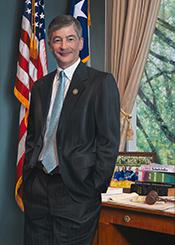 Rep. Jeb Hensarling (R-TX)
Description
Amendment sought to strike the $500,000 earmark for the Automated Remote Electric and Water Meters in South River project.
Legislative Activity
Stay on top of the latest movement without scrolling through every action
House amendment not agreed to: On agreeing to the Hensarling amendment (A021) Failed by recorded vote: 119 - 308 (Roll no. 590).(consideration: CR H8337-8338; text: CR H8337)
July 17, 2009 • 2:14 PM
View full timeline
House amendment not agreed to: On agreeing to the Hensarling amendment (A021) Failed by recorded vote: 119 - 308 (Roll no. 590).(consideration: CR H8337-8338; text: CR H8337)
July 17, 2009 • 2:14 PM
Roll call votes on amendments in House
July 17, 2009 • 2:14 PM
Amendment failed in Committee of the Whole
July 17, 2009 • 2:14 PM
On agreeing to the Hensarling amendment (A021) Failed by recorded vote: 119 - 308 (Roll no. 590). (consideration: CR H8337-8338; text: CR H8337)
July 17, 2009 • 2:14 PM
House amendment offered
July 15, 2009
House amendment offered/reported by : Amendment (A021) offered by Mr. Hensarling.(consideration: CR H8158-8159; text: CR H8158)
July 15, 2009 • 5:38 PM
Amendment (A021) offered by Mr. Hensarling. (consideration: CR H8158-8159; text: CR H8158)
July 15, 2009 • 5:38 PM
Votes
1 roll call on this amendment
Text
Offered
ENERGY AND WATER DEVELOPMENT AND RELATED AGENCIES APPROPRIATIONS ACT,
2010
The SPEAKER pro tempore. Pursuant to House Resolution 645 and rule
XVIII, the Chair declares the House in the Committee of the Whole House
on the State of the Union for the consideration of the bill, H.R. 3183.
{time} 1248
In the Committee of the Whole
Accordingly, the House resolved itself into the Committee of the
Whole House on the State of the Union for the consideration of the bill
(H.R. 3183) making appropriations for energy and water development and
related agencies for the fiscal year ending September 30, 2010, and for
other purposes, with Mr. Tierney in the chair.
The Clerk read the title of the bill.
The CHAIR. Pursuant to the rule, the bill is considered read the
first time. The gentleman from Arizona (Mr. Pastor) and the gentleman
from New Jersey (Mr. Frelinghuysen) each will control 30 minutes.
The Chair recognizes the gentleman from Arizona.
Mr. PASTOR of Arizona. I yield myself such time as I may consume.
Mr. Chairman, it is, indeed, a privilege to submit to the House for
its consideration H.R. 3183, the Energy and Water Development
Appropriations bill for fiscal year 2010. The Appropriations Committee
approved this bill unanimously by a voice vote on July 8. This is a
good bill that merits the support of the entire House.
I thank all of the members of the Energy and Water Development
Subcommittee for their help in bringing this bill to the floor today.
This has been a challenging year with our extremely compressed
schedule, and I appreciate our Members' attention and participation in
this accelerated process.
I particularly want to thank the ranking member--my dear friend, the
gentleman from New Jersey (Mr. Frelinghuysen)--for his extraordinary
cooperation, insight and friendship.
Mr. Chairman, this is a bipartisan bill that represents the fair and
balanced treatment of competing priorities. This is the way our
constituents expect their Representatives to work together, and I am
proud of this bipartisan process.
I also would like to thank the chairman of the Appropriations
Committee, Mr. Obey, and the ranking member, Mr. Lewis, for their
support.
I was given this assignment 3 weeks ago, and without the great work
of the subcommittee staff, we would not be here today. So, today, this
afternoon, I want to thank the staff of the subcommittee: the Clerk,
Taunja Berquam; Robert Sherman; Joseph Levin; James Windle; Casey
Pearce; Rob Blair; and Kevin Jones. They worked many hours and through
the weekends to get this bill today on the floor.
I would also like to thank Richard Patrick, from my office, and Ms.
Nancy Fox and Ms. Katie Hazlett of Mr. Frelinghuysen's office.
I want to acknowledge our agency detailee, Lauren Minto from the
Corps of Engineers, for her assistance, talent and knowledge in putting
this bill and report together.
These people have formed a great team, and without their work, we
would not be here today. I have to thank them again because their
support has been invaluable.
Mr. Chairman, this bill provides funding to address critical issues
that affect our Nation's security and prosperity--from Addressing high
gas prices, our energy crisis and climate change to advancing science
and innovation, to preventing nuclear proliferation, to encouraging
effective project management, and to investing in our Nation's flood
control and water infrastructure projects.
The total funding for energy and water development in fiscal year
2010 is $33.3 billion. This funding amount is a decrease of $1.1
billion from the budget request, and it is roughly equal to the current
fiscal year. While the bill is below the budget request, the primary
reason for this difference is a Congressional Budget Office score of
$1.5 billion for the Department of Energy's budget request for the
Innovative Loan Guarantee Program. The bill provides $406 million above
the budget request in program scope.
This bill made a concerted effort to cut lower priority programs and
to apply the cuts to higher priority efforts. These spending cuts
include 18 activities, totaling $2.5 billion below the President's
request.
Given the wide-ranging scope of issues in this legislation that are
critical to our Nation's well-being, I set forth the following
priorities to ensure that our tax dollars will be spent wisely and
effectively. These priorities include:
addressing high gas prices, reducing our dependence on foreign oil,
and confronting the energy crisis through increased investment in
alternative, domestic transportation fuels and new vehicle
technologies;
addressing climate change with sound investments in carbon
sequestration, low-emission energy technologies, and science research;
modernizing the energy sector through the research and development
[[Page H8118]]
of renewable energy sources, efficient energy technologies, and novel
electric grid technologies;
confronting the terrorist nuclear threat by increasing the protection
of nuclear materials and accelerating the deployment of systems to
detect such materials at border crossing points and ports;
improving the security of our weapons by upgrading the protection of
our facilities as well as improving the training and equipment of the
Protective Force;
insisting that the President submit to Congress a nuclear weapons
strategy and a nuclear complex transformation plan before Congress will
consider funding a new nuclear warhead;
investing in dam safety, flood protection, hydropower modernization
and infrastructure that is essential to waterborne commerce on our
coasts, rivers and inland lakes, which is essential to the safety of
our citizens and our economy; and
saving taxpayer dollars by improving management of agency programs,
especially at the Department of Energy.
This bill provides adequate funds to meet the priority needs of the
House. It funds the most worthwhile projects and programs near
requested levels, and it reduces some programs that are less valuable
or less urgent. I urge my colleagues of the House to support it.
Mr. Chairman, I reserve the balance of my time.
Mr. FRELINGHUYSEN. I yield myself as much time as I may consume.
Mr. Chairman, I rise in support of the Energy and Water Development
Appropriations bill for fiscal year 2010. This is a good bill because
it is a significant improvement over the administration's budget
request, and it was put together in a very bipartisan manner.
Before I turn to the contents of the legislation before us, like Mr.
Pastor, I would like to thank the fantastic staff--Taunja Berquam, the
Clerk; Bob Sherman; Joe Levin; Jim Windle; Casey Pearce; and Lauren
Minto. On the minority side, I would like to thank Rob Blair and Kevin
Jones. In my personal office, I would like to thank Katie Hazlett and
Nancy Fox. In Mr. Pastor's personal office, I would like to thank Rick
Patrick. All of these individuals have worked tirelessly to put
together the product before us.
No one has worked harder than Mr. Pastor, and I want to thank Mr.
Pastor for his friendship and for his leadership and guidance on this
bill. The gentleman from Arizona is a pleasure to work with. I thank
him for his leadership and for his assistance.
Mr. Chairman, the subcommittee's recommendation totals $33.82
billion, which is $1.1 billion below the President's request and $200
million over the fiscal year 2000 enacted level. While the dollar
amounts are significant, the issues contained in this bill are at the
core of our Nation's economic prosperity and national security,
especially the energy portfolio, and our historic responsibility for
the reliability and the protection of our nuclear stockpile. Thus, it
is worthy of debate and amendment on the House floor.
{time} 1300
The bill was preceded by the American Recovery and Reinvestment Act,
which gave more than $44 billion to the agencies under our
jurisdiction. In fact, nearly $39 billion alone went to the Department
of Energy. The Department has nearly one-and-a-half times more money to
manage even before we consider this annual appropriations bill, so our
bill cannot be viewed simply through the traditional lens of annual
appropriations. With the passage of the stimulus bill, Secretary Chu
and his new team assumed new roles as major grant managers and
accountants for billions of dollars for new Federal and State programs
and hundreds of new employees.
Mr. Chairman, I am pleased that we were able to improve upon the
administration's request in several ways. For example, the legislation
before us increases the budget request by over $400 million for the
Army Corps of Engineers, enabling us to address more water needs across
our country. The Army Corps projects touch virtually every
congressional district; and I know Mr. Pastor and I highly respect the
interests of all Members who, knowing their district needs, have sought
some assistance; and we've done our best to accommodate them. Our
recommendation increases research and development for both renewable
energy and nuclear power while supporting clean coal initiatives and
other technologies, such as geothermal, solar, fusion and wind power. I
am exceptionally pleased that our bill keeps the Department on track
for the Next Generation Nuclear Plant program.
There are some areas that I would have done a bit differently, of
course. Not surprisingly, I would have preferred to have done more to
reverse the administration's decision to terminate the Yucca Mountain
repository in Nevada, where we have spent over $11 billion of taxpayer
and rate payer moneys--in fact, $7 billion of rate payer moneys--with
little apparent return. We still have tons of waste to dispose of and
to protect. The bill before us does contain the administration's
significant cut to the program, and I am deeply concerned that this
basically political decision will be followed by others trumping future
scientific recommendations and judgments. However, our bill directs $70
million to ensure that the questions raised during the Yucca license
application process can be answered; and it requires that funding for
the President's suggested Blue Ribbon Panel is only available for a
review, which includes all alternatives, including Yucca Mountain. I
think this is the only way future review could be credible.
I would also have preferred much more support for nuclear power here
in the United States and the greater availability of nuclear loan
guarantees. Given what China and other nations are doing to build new
nuclear power plants, we could produce much more electricity ourselves
while adding American jobs, which we need if the administration as well
as House and Senate majority leadership were more supportive. American
companies are working abroad building nuclear power plants while we
dither here. The President and congressional leadership appear to have
a strong bias against nuclear power as well as oil and gas production,
which will leave our Nation severely disadvantaged. Energy-intensive
industries, like what is left of our American manufacturing base, will
no longer be able to compete with nations who are making nuclear and
other types of capital investments a priority, and they're not
subjecting themselves to self-imposed cap-and-trade emissions
reductions. Our lack of investing in nuclear power, so well illustrated
in the recent passage of the so-called American Clean Energy and
Security Act, is a gift that keeps on giving to our economic
competitors China and India, whose economies are already sucking away
U.S. jobs at an alarming rate.
We also improved that portion of the committee's jurisdiction that
involves nuclear weapons activities, not to promote more nuclear
weapons, but to provide more funds to reduce the weapons stockpile. The
President's recent trip to Russia and his call for major changes in
what is called our nuclear ``posture'' must be matched by the
administration's funding requests that will pay for our country's
nuclear dismantlements and for the science to certify the reliability
of what's left. And we must provide adequate funding to retain our
highly specialized nuclear scientists and technicians and to maintain
the facilities and laboratories where they do their work. The only way
to support our national security is by increasing this account, not by
holding it flat. Talk about a delicate balance between nuclear and
renewables is only talk, for investments in renewables received $60
billion in the $800 billion stimulus--all of that borrowed money, I
should add--and nuclear received nothing. I do hope that we can address
this disproportionality in conference.
One of my biggest disappointments, however, is not with the bill but
the way it was brought to the floor. With all the debate about climate
change, global warming, conservation, carbon footprints and green jobs,
Members of Congress in both parties should have the right to propose
amendments to address their concerns and support sources of power that
they specifically favor and know about, whether that be nuclear,
hydroelectric, solar, wind, oil- or gas-based, fuel cell or fusion.
That traditional right to amend our appropriations has been severely
curtailed by the House leadership. Our appropriations bill affects
virtually every
[[Page H8119]]
part of our economy, the household budgets of every American family and
job prospects for thousands, and the thought that renewables alone are
going to give us energy independence is, of course, on its face,
absurd.
Before I close though, I'd like, on a positive note, to thank the
Army Corps of Engineers, both military and civilian who, as we gather
here today, continue to do their remarkable work in dangerous territory
in Iraq and Afghanistan. We thank them for their courage, their work
and their professionalism. Mr. Chairman, again I'd like to thank Vice
Chairman Pastor for his leadership. Despite my unhappiness about the
energy policy issues I have discussed, I intend to support the bill.
I reserve the balance of my time.
Mr. PASTOR of Arizona. Mr. Chairman, I yield 2 minutes to the
chairman of the Appropriations Committee, the gentleman from Wisconsin
(Mr. Obey).
Mr. OBEY. Mr. Chairman, I want to congratulate both Mr. Pastor and
Mr. Frelinghuysen for an excellent bill. They are both first-rate
legislators, and I think this bill is a very effective and reasonable
response to the problems with which it deals. I think it's, most
clearly, a bipartisan product as well, and I appreciate that.
I also appreciate the fact that this bill will continue providing
significant assistance to Lake Superior communities who need help with
sewer and water in order to be able to provide decent opportunities for
economic growth in the future. Communities cannot grow without adequate
infrastructure.
I also want to suggest that the nonproliferation efforts contained in
this bill are important, indeed.
I would also note that when combined with the actions taken in the
Recovery Act, this bill will begin the long process of trying to make
up for the fact that for almost 30 years, this country has had no
effective energy policy. That has to change, and this is part of the
effort to change that.
I also appreciate the fact that, as is the case with previous bills
approved by the committee, when this bill is finished on the floor, we
will have accepted 24 Republican amendments to appropriation bills in
the full committee. We will have accepted another 24 on the floor
itself. I think that is testimony to the bipartisan approach taken by
the subcommittees on bill after bill. I appreciate the cooperation of
all of the Members and the hard work of the staff.
Mr. FRELINGHUYSEN. Mr. Chairman, I am pleased to yield 3 minutes to
the gentleman from Washington (Mr. Hastings).
Mr. HASTINGS of Washington. Mr. Chairman, I rise to enter into a
colloquy with the distinguished chairman of the subcommittee, Mr.
Pastor.
Mr. Chairman, Hanford is the world's largest nuclear cleanup site.
The wastes at Hanford are a result of our Nation's nuclear weapons
production program that secured our victories in World War II and the
Cold War. Hanford cleanup cannot sustain continued reductions without
jeopardizing progress, breaking existing legally binding commitments to
the State and increasing long-term costs to taxpayers. Achieving
cleanup progress requires steady, stable, adequate funding each year
for all projects at Hanford, including the tank farms, the waste
treatment plant, groundwater protection, and the River Corridor
project, which is responsible for stopping contaminants from reaching
the Columbia River, shrinking the site by 95 percent, and represents
the highest priority work for Hanford's Richland Operations office. I
appreciate Mr. Pastor's attention to this issue and assistance in
making adjustments as this bill went through the committee process.
These adjustments are a step in the right direction and will have a
meaningful impact at Hanford, with full funding provided for the Office
of River Protection.
I would like to ask Mr. Pastor for a commitment to continue to work
with me as the final Energy and Water bill is developed.
Mr. PASTOR of Arizona. As we talked earlier this morning, we said
that we understand the importance of Hanford as well as all the other
sites, and I told you of the possibility that some of us would need to
go see the site and look at it firsthand. So you well know that I
recognize the importance of cleaning up Hanford and also all of the EM
sites. I will work with you on this issue and review the needs of
Hanford's Richland Operations office, including the River Corridor
Closure project, as we make our way through conference and write a
final bill.
Mr. HASTINGS of Washington. Thank you for your commitment on this and
for your commitment to nuclear waste cleanup at all the sites. I look
forward to continuing to work with you. Obviously the invitation is
open for you. Mr. Frelinghuysen has been at Hanford, but I certainly
invite you. It is something to see firsthand. I thank you for your
commitment.
Mr. PASTOR of Arizona. Mr. Chairman, I yield 2 minutes to another
gentleman from Washington (Mr. Inslee).
Mr. INSLEE. I will join my colleague from the State of Washington's
invitation to talk about Hanford issues at some point. I appreciate the
Chair's interest in that.
I want to thank, specifically, the committee for including $1.78
billion for energy efficiency and renewable energy research,
development and deployment. But I do rise with some concern that the
report proposes to decrease water power R&D from $40 million in 2009 to
just $30 million. While I understand that the ocean and tidal-based
marine renewable energy industry is certainly nascent at this time,
estimates suggest that ocean resources in the U.S. could supply more
than 6 percent of our electricity generation if ocean renewable energy
enjoyed the same Federal investment as other forms of renewable energy.
Many countries already operate projects that generate power from both
the waves and tidal and currents; and we should lead in this regard,
not follow.
In Washington State these efforts are currently underway. The U.S.
Navy and Verdant Power will install a demonstration project in Puget
Sound in 2010, and Snohomish County PUD will install a project in
Admiralty Inlet just north of Seattle in 2011. Federally backed
research is underway at the Northwest National Marine Renewable Energy
Center, a partnership between the University of Washington and Oregon
State University. In Sequim the DOE's Marine Science Lab is researching
ocean energy potential and environmental issues. Hawaii, Oregon, Maine,
New York, California, Massachusetts and Alaska are also working to
develop this industry. Our colleagues in the Senate have recommended
$60 million for water power R&D, and I hope to work with Mr. Pastor
through conference to work toward those Senate levels for this
important, very promising program.
With that, I thank Mr. Pastor for his efforts.
Mr. PASTOR of Arizona. I can assure the gentleman from Washington
that the committee is aware of this sustainable domestic energy source
and its potential. We will continue to work with the gentleman from
Washington through conference to highlight renewable marine and
hydrokinetic energy development as a priority for the agency.
Mr. FRELINGHUYSEN. Mr. Chairman, I am pleased to yield 3 minutes to
the gentleman from Idaho (Mr. Simpson).
Mr. SIMPSON. I thank the gentleman for yielding.
Mr. Chairman, I am pleased to rise today in support of the fiscal
year 2010 Energy and Water Appropriations bill. I would like to thank
Vice Chairman Pastor and Ranking Member Frelinghuysen for their work on
this important bill. They have done a great job putting this bill
together.
{time} 1315
I also want to thank the staff on both sides of the aisle for their
hard work and dedication on this piece of legislation.
I would like to focus my remarks today on the Department of Energy's
loan guarantee program. The loan guarantee program is one of the few
policy tools we have that delivers immediately available, market-ready,
innovative, clean energy technologies that will have a positive impact
on our economy.
Congress has authorized $2 billion in loan guarantee authority for
front-end nuclear facilities. DOE should be recognized for their work
creating a loan guarantee program that has sound criteria to ensure the
protection of taxpayers and award guarantees to the most creditworthy
projects.
[[Page H8120]]
I support the efforts of my colleagues in the House to encourage DOE
to administer the loan guarantee program, particularly for front-end
facilities, efficiently and in the earliest possible time frame. I also
support efforts to ensure that these decisions are based on merit and
that all loan guarantees are issued to the most qualified and not
necessarily the most politically connected applicants.
This program is not a bailout. It is designed to allow creditworthy
companies to invest in large, multibillion dollar ``investment grade''
projects that will create thousands of jobs and inject several billion
dollars in the local economy without jeopardizing taxpayers' interest.
For the loan guarantee program to succeed, it must demonstrate
integrity and credibility through a fair, objective and timely process.
It must also meet the reasonable business needs of the applicants and
protect the Treasury and the U.S. taxpayer from undue exposure.
The Department of Energy has personally assured me that all decisions
regarding loan guarantees will be made based on the merit of the
recommended projects rather than on politics.
I look forward to working with my colleagues, the Department of
Energy and Secretary Chu to issue loan guarantees in the earliest time
frame possible by applying the program criteria in a fair and unbiased
manner.
Mr. PASTOR of Arizona. Mr. Chairman, I would like to yield 2 minutes
to the gentleman from Virginia, my good friend, Bobby Scott.
Mr. SCOTT of Virginia. I thank the gentleman for yielding.
Mr. Chairman, I, along with my colleague from Virginia (Mr. Wittman),
would like to briefly discuss the importance of fully funding the
Thomas Jefferson Lab's 12 GeV Upgrade.
This important project received accelerated funding in the Recovery
Act. It is vital that this project receive the administration's full
request of $22 million in this bill. If full funding is not in place
for the upcoming fiscal year due to stringent controls in how Recovery
Act funds are spent, there is little flexibility for the lab to meet
their construction project without costly scheduling delays or
potential elimination of physics-related work.
I would hope that the gentleman from Arizona will work with me and
Mr. Wittman to ensure that this project is funded at the
administration's request for fiscal year 2010.
And I yield to the gentleman from Virginia, my colleague, Mr.
Wittman.
Mr. WITTMAN. Thank you, Mr. Scott.
I rise in support and to echo the remarks of my colleague from
Virginia (Mr. Scott). The Thomas Jefferson Lab is a world leader in
nuclear physics research and education. The lab is currently in the
midst of a major upgrade to their accelerator facility. Fully funding
the accelerator upgrade will significantly expand the facility's
research potential and will lead to a greater understanding of atomic
particles, the building blocks of all matter. Research at Jefferson Lab
will continue to expand our knowledge of nuclear physics that lead to
many exciting scientific advances.
I respectfully request that the gentleman from Arizona would work to
fully fund this important project at Jefferson Lab.
Mr. SCOTT of Virginia. I yield to the gentleman from Arizona (Mr.
Pastor).
Mr. PASTOR of Arizona. I thank the gentleman for bringing this
important issue to us.
You have made a case that the administration request for $22 million
for the continuous electron beam accelerator facility is merited.
You have my personal commitment to work with you and Mr. Wittman
going forward to see that this project receives the funding it needs
and deserves.
Mr. SCOTT of Virginia. I thank you for your commitment and thank you
for your willingness to work on this important issue and thank my
colleague from Virginia for his support and look forward to working
with you in conference.
Mr. FRELINGHUYSEN. Mr. Chairman, I'm pleased to yield 3 minutes to
the gentlewoman from Ohio (Mrs. Schmidt) for purpose of a colloquy.
Mrs. SCHMIDT. I rise to bring attention to the lack of progress by
the Department of Energy in processing loan guarantee applications,
particularly with respect to USEC's long-pending loan guarantee
application for its American Centrifuge Plant project.
USEC filed its application with the Department of Energy for the loan
guarantee nearly 1 year ago, yet its application still languishes. USEC
has informed the Department of Energy that it needs, at minimum, a
conditional commitment from the Department of Energy for a request for
a loan guarantee by early August of 2009 or else USEC will begin to
demobilize its project.
I would like to now turn this over to my good colleague from Ohio
(Mr. Ryan).
Mr. RYAN of Ohio. I thank the gentlelady.
Mr. Chairman, as my colleague said, this loan application is critical
for thousands of jobs in Ohio and throughout the country.
I would hope that the Secretary of Energy and other departmental
leadership will provide the loan guarantee office staff with the
necessary guidance and leadership to address this issue in the
immediate future so that a conditional commitment can be issued on
reasonable terms.
Mrs. SCHMIDT. I would like to now yield to Mr. Wamp from Tennessee.
Mr. WAMP. I thank the gentlelady. I'm proud that the United States
Enrichment Corporation has been developing the highly advanced uranium
enrichment technology for the American Centrifuge Plant in my district,
the Oak Ridge National Laboratory facility.
USEC's enrichment technology is very well established, the risks have
been mitigated, and the technology is fundamentally sound. We should
not allow a seemingly risk-averse loan staff at the Department to
continually delay a decision on the loan application which will have
the effect of terminating this incredible state-of-the-art facility.
Would the chairman work with us to ensure that the program is run
efficiently and effectively?
Mr. PASTOR of Arizona. First of all, I thank the gentleman for
yielding time and congratulate him on his amendments.
To you and Mrs. Schmidt, I appreciate the comments made by all my
colleagues. I will be happy to work with everyone to ensure the program
is run efficiently and effectively. The management and effectiveness of
this program is a priority of the subcommittee. We must ensure that it
is fair to all applicants. And, yes, I will work with my colleagues.
Mrs. SCHMIDT. I just want to add that USEC also plays a critical role
in our national defense and energy security. USEC's ACP project uses
U.S.-owned and developed technology. Under U.S. law and international
agreements, only uranium fuel that is of U.S. origin and produced using
U.S. technology can be used to meet our defense needs. Our Nation's
national security alone is enough of a reason for the Department of
Energy to issue USEC a loan guarantee at reasonable terms and
conditions.
I just want to appreciate everyone's comments here. We are also
talking about 8,000 good-paying jobs in Ohio, Tennessee, and other
States. If we are serious about stimulating the economy, this is a
great place, because these projects are truly ``shovel ready.''
The Department of Energy must finish its review and issue a
conditional commitment with reasonable terms and conditions by the end
of this month. If it doesn't, we can expect to see layoffs beginning in
early August.
The CHAIR. The time of the gentlewoman has expired.
Mr. FRELINGHUYSEN. I yield the gentlewoman 1 additional minute.
Mrs. SCHMIDT. I just wish to say that I would hope that we can get
this resolved quickly, and ask if the gentleman from New Jersey has
anything to add?
Mr. FRELINGHUYSEN. Yes. Mrs. Schmidt, I agree that 11 months is more
than enough for the Department of Energy to act upon the loan guarantee
submission for the front-end of the nuclear fuel cycle. It is a
personal priority of mine to ensure that this program is run
efficiently and in the best interest of U.S. taxpayers. While it needs
to move quickly, the loan
[[Page H8121]]
guarantee application process should be open and fair to all
applicants.
Mrs. SCHMIDT. I thank the gentleman for his comments.
Mr. PASTOR of Arizona. I yield 2 minutes to the gentleman from New
York (Mr. Israel).
Mr. ISRAEL. I thank the gentleman and appreciate your yielding me the
time and commend your leadership on the bill. I'm proud of the
subcommittee's decision to double the International Renewable Energy
Program from $5 million to $10 million this year.
Last year, the committee provided $2 million to promote cooperation
between the United States and the Government of Israel for renewable
and alternative energy programs. The Government of Israel matched that
funding, which is now being directed towards cooperation in the fields
of advanced battery technology, solar, wind, biomass, geothermal and
energy efficiency.
Moving forward, I urge the House to support continued cooperation
between the United States and Israel in the field of alternative
energy.
And with that, I yield to my distinguished colleague from New York,
Chairwoman Nita Lowey.
Mrs. LOWEY. I strongly believe that we must continue to show support
to the United States-Israel Energy Cooperation. Last year, President
Obama told the American people, ``It is time for the U.S. to take real
steps to end our addiction to oil, and we can join Israel building on
last year's U.S.-Israel Energy Cooperation Act to deepen our
partnership in developing alternative sources of energy.'' I agree with
President Obama and believe we must work with our global partners and
allies to diversify our energy portfolio.
Will the distinguished Mr. Pastor work with us to ensure that U.S.-
Israel Energy Cooperation receives substantial funding and support as
you proceed to conference with the Senate?
Mr. PASTOR of Arizona. First of all, thank you for the compliment,
and I will tell you that I have Eliot Engel and Brad Sherman, as well
as you, Madam Chairman and Mr. Israel, who have brought this matter to
my attention, and I want to thank you for raising it on the floor.
I, too, am a supporter of the U.S.-Israel Energy Cooperation. This
bill, as you have told us, doubles the account which funds such
programs, and I look forward to working to ensure that the U.S.-Israel
Energy Cooperation continues to receive strong support in order to
accelerate the development of alternative energy programs.
Mr. ISRAEL. I thank the gentleman and the gentlewoman.
Mr. FRELINGHUYSEN. Mr. Chairman, I'm pleased to yield 2 minutes to my
colleague from New Jersey, Congressman Chris Smith.
Mr. SMITH of New Jersey. Mr. Chairman, I rise today in strong support
of H.R. 3183. The bill includes funding to allow the U.S. Army Corps of
Engineers to take a greater role in ongoing efforts to fix significant
recurring environmental hazards posed by Wreck Pond, located in my
district.
On an average summer day, Wreck Pond is a picture-perfect postcard.
However, just below the surface lie dangerous concentrations of high
levels of fecal coliforms as well as other nasty contaminants. When it
rains, this poison goes onto the beaches, and it has caused, on
average, about 80 percent of all beach closings in New Jersey in the
past few years.
When Wreck Pond floods, this poison pours into the basements and
first floors of nearby homes, which I have seen myself on several
occasions. Immediate action is necessary to improve the water quality
conditions and mitigate the serious health and environmental hazards
caused by its pollution to local residents.
The Corps' work at Wreck Pond will be greatly enhanced and proceed to
construction earlier than normally anticipated because of extensive
analysis already completed by other agencies at the Federal, State and
local level, including work of a $400,000 EPA study, surveillance work
by the New Jersey Department of Environmental Protection, as well as
the State's installation of provisional storm water outflow pipes and
the upstream watershed management programs.
These actions have been effective. However, they are not the best
long-term solution, and a permanent fix can be achieved only after the
Corps begins its work.
I want to especially thank my good friend and colleague, Mr.
Frelinghuysen, for his work, and Chairman Oberstar, of the
Transportation and Infrastructure Committee, who actually made a trip
to Wreck Pond in 2007 to view this himself. I thank them both. Rodney,
thank you for your great work on this.
Mr. PASTOR of Arizona. Mr. Chairman, I yield 2 minutes to the
gentleman from Washington (Mr. Smith) for the purpose of a colloquy.
Mr. SMITH of Washington. Mr. Chairman, I rise in support of the
fiscal year 2010 Energy and Water Appropriations bill, and I am
appreciative of the work done by the chairman and ranking member on
this bill.
I would like to briefly engage the gentleman from Arizona (Mr.
Pastor) in a colloquy regarding an issue related to the Seattle
District of the Army Corps of Engineers and the Howard Hanson Dam.
The Green and Puyallup Rivers located in part in the Ninth District
of Washington were flooded by record levels of water in January 2009,
causing cities along these rivers to sustain major damage. Levees along
those rivers are now in need of repair and rehabilitation, and when
added to the other levees that were already priorities for the Seattle
district, the need for resources and action is imperative.
Following the record high level of water behind the Howard Hanson Dam
on the Green River, significant structural weaknesses were discovered.
Because of this damage, water levels at the Howard Hanson Dam are being
held at lower-than-normal levels, drastically increasing the
possibility of flooding along the banks below.
This is extremely troubling as we are rapidly approaching the
upcoming rain and flood season. If the dam were to fail, or if a strong
storm brings a heavy level of rain, then the levees below are at
serious risk of being breached, causing significant property damage and
driving large numbers of people from their homes and businesses.
I respectfully ask to work with the gentleman to ensure that the
Seattle district of the Army Corps of Engineers is responsive to the
flood prevention needs of those along the lower Green and Puyallup
Rivers and will make the repairs of their levees a top priority.
I also ask to work with the subcommittee to make the resources needed
to fix the Howard Hanson Dam available in a timely manner as they are
identified.
And with that I yield to the gentleman from Arizona (Mr. Pastor).
Mr. PASTOR of Arizona. I would like to thank the gentleman from
Washington for drawing the subcommittee's attention to this very
serious issue. He has been a dedicated advocate for the people of the
Ninth District of Washington and the surrounding areas. We will work
with the gentleman to ensure that the Seattle district of the Corps is
responsive to the needs of the cities and people along the lower Green
and Puyallup Rivers and that adequate resources are available to repair
the Howard Hanson Dam. So we look forward to working with you.
Mr. SMITH of Washington. Thank you. I appreciate that support.
Mr. FRELINGHUYSEN. Mr. Chairman, I am pleased to yield 2 minutes to
the gentlewoman from Illinois (Mrs. Biggert).
Mrs. BIGGERT. I thank the gentleman for yielding.
I rise today in support of the fiscal year 2010 Energy and Water
Appropriations bill. I want to commend Chairman Pastor and Ranking
Member Frelinghuysen and their subcommittee for putting together a
balanced bill that clearly recognizes the importance of scientific
research and energy security to our Nation's competitiveness.
{time} 1330
There are several provisions of this bill I'm proud to support. Chief
among those is the increase for the Department of Energy's Office of
Science. I, along with 70 of my colleagues, asked appropriators for an
increase consistent with the President's request to double the
investment in the basic sciences within the next decade. The committee
provided for $170 million more than the fiscal year 2009. This funding
is critical to our basic research infrastructure and national
laboratory
[[Page H8122]]
work, like that of Argonne in my district.
The innovations and solutions that will enable us to overcome many of
our greatest challenges from our economic crisis, environmental
concerns, dependence on foreign energy, and escalating health care
costs all start with basic research investments.
Economic experts have concluded that science-driven technology has
accounted for more than 50 percent of the growth of the U.S. economy
during the last half century.
In recent years, Congress has come to recognize that science will be
the foundation to address those needs and keep America globally
competitive. As evidenced by the American COMPETES Act in 2007, both
Democrats and Republicans support efforts to increase basic research in
the physical sciences to meet the needs of our growing population. I
will insert a copy of our letter in the Record.
I support the underlying bill and appreciate the committee's efforts
to carefully balance the needs of our energy future and scientific
investments. However, I am particularly disappointed that the committee
followed the President's budget request to slash Yucca Mountain funding
and the failure to increase important loan guarantees to support a
revitalized nuclear energy sector.
Illinois receives almost half of its electricity generation from
nuclear power, followed by coal. If we are to work towards a low carbon
economy, we cannot pick energy winners and losers to meet the growing
energy needs of our population.
Congress of the United States,
Washington, DC, April 3, 2009
Hon. Peter Visclosky
Chairman, Energy and Water Development, Appropriations
Subcommittee, House Appropriations Committee, Washington,
DC.
Hon. Rodney Frelinghuysen,
Ranking Member, Energy and Water Development, Appropriations
Subcommittee, House Appropriations Committee, Washington,
DC.
Dear Chairman Visclosky and Ranking Member Frelinghuysen:
As you begin your work on the Fiscal Year 2010 Energy and
Water Appropriations bill, we write to express our strong
support for the Department of Energy's (DOE) Office of
Science. In particular, we urge you to increase Fiscal Year
2010 funding for its research and facilities by 8 percent
over Fiscal Year 2009 to $5.2 billion, which is consistent
with President Obama's plan to double the Federal investment
in the basic sciences within the next decade.
In recent years, Congress has come to recognize that
science will be the foundation for the innovation and
solutions that will enable us to overcome many of our
greatest challenges--from our economic crises and
environmental concerns to our dependence on foreign energy
and escalating health care costs--and to remain globally
competitive as a nation. As evidenced by the overwhelming
bipartisan vote for enactment of the America COMPETES Act in
2007 (P.L. 110-69), both Democrats and Republicans support
efforts to double federal funding for basic research in the
physical sciences within the next decade. Congress built on
this commitment by funding the programs and activities
authorized by the America COMPETES Act in the American
Recovery and Reinvestment Act and in the Fiscal Year 2009
Omnibus Appropriations bill.
Congress must build on and provide the resources to sustain
this investment in Fiscal Year 2010. Report after report--
from the National Academy of Sciences and the President's
Council of Advisors on Science and Technology to the Task
Force on the Future of American Innovation and the Council on
Competitiveness--has called on Congress and the President to
invest in U.S. research capabilities. The benefits of such an
investment to the U.S. economy and U.S. competitiveness are
well known. Economic experts have concluded that science-
driven technology has accounted for more than 50 percent of
the growth of the U.S. economy during the last half-century.
This kind of technology-based economic growth cannot be
sustained without additional investment in the kind of basic
research supported by the DOE Office of Science. We face a
world in which our economic competitors in Asia and Europe
are making significant new investments in their own research
capabilities. These investments are beginning to pay off, as
Asian and European countries challenge U.S. leadership in the
sciences no matter how it is measured--by number of patents
won, articles submitted to scientific journals, degrees
awarded, Nobel prizes won, or the percentage of Gross
Domestic Product (GDP) dedicated to research and development.
Even as we face greater international competition, these
are exciting times for science in the United States. There
are many great opportunities for scientific discovery, and
with adequate funding, the DOE Office of Science will ensure
the U.S. retains its dominance in such key scientific fields
as nanotechnology, materials science, biotechnology, and
supercomputing well into the next century. Through critical
new investments in biofuels research and basic energy
science, the DOE Office of Science will continue to play a
vital role in developing the knowledge and the technologies
essential to ensuring the nation's future energy security.
Finally, increased funding for the DOE Office of Science will
give the economy a boost in the near-term by creating good-
paying, American jobs in construction, manufacturing, and
research. And in the long-term, such an investment in the
nation's scientific and research enterprise--both human and
physical capital--will increase our capacity to innovate,
reduce our dependence on foreign sources of energy, enhance
our competitive edge in the global economy, and thus create
the jobs of the future.
U.S. scientists are as bright as any in the world, but they
traditionally have had better tools than everyone else. The
DOE Office of Science has led the way in creating a unique
system of large-scale, specialized user facilities for
scientific discovery. This collection of cutting-edge--often
one-of-a-kind--tools makes the DOE Office of Science an
exceptional and critical component of the federal science
portfolio. Other federal science agencies, such as the
National Institutes of Health (NIH) and the National Science
Foundation (NSF), greatly depend upon these DOE Office of
Science facilities in carrying out their own research
activities. In Fiscal Year 2009 alone, over 21,500
researchers have access to these special DOE facilities.
Nearly half of those users will be university faculty and
students--many whose research is being supported by other
federal agencies--and a significant number will be from U.S.
industry.
For these many reasons, we urge you to increase funding for
the DOE Office of Science in Fiscal Year 2010 by 8 percent
over Fiscal Year 2009, consistent with President Obama's plan
to double the Federal investment in the basic sciences within
the next decade. Furthermore, we urge you to focus this
funding on mission-related activities and facilities, and to
avoid using core DOE research program budgets to fund
extraneous projects. With this funding, the DOE Office of
Science will attract the best minds, educate the next
generation of scientists and engineers, support the
construction and operation of modern facilities, and conduct
even more of the quality scientific research that will create
jobs and ensure the U.S. retains its competitive edge for
many years to come.
Thanks for your consideration. We are cognizant of the
difficult budget situation under which your subcommittee is
working, and we urge you to contact us if we may be of
assistance in any way.
Sincerely,
Judy Biggert, Rush Holt, Howard Berman, John Dingell,
Barney Frank, Zoe Lofgren, Ron Kind, David Wu, Michael
Capuano, Tammy Baldwin, Bill Pascrell, Joe Sestak, Jerry
McNerney, Sheila Jackson-Lee, John Shimkus, Mike Rogers (MI),
Adam Schiff, Ron Klein.
Jay Inslee, Daniel Lipinski, James Oberstar, Michael
Michaud, Gary Peters, Bill Foster, Anna Eshoo, Zach Wamp,
David Loebsack, Eddie Bernice Johnson, Brad Miller, Carolyn
Maloney, Doris Matsui, Mary Jo Kilroy, Solomon Ortiz, Lynn
Woolsey, Maurice Hinchey, Ellen Tauscher.
Neil Abercrombie, Rosa DeLauro, Bob Etheridge, Stephanie
Herseth Sandlin, Henry Waxman, Paul Hodes, Jerrold Nadler,
Vernon Ehlers, Earl Blumenauer, Dennis Moore, Chris Van
Hollen, Lois Capps, Jan Schakowsky, John Duncan (TN), Tim
Bishop, Adam Smith, Jim McGovern, Steve Kagen.
Peter Roskam, Christopher Carney, Carol Shea-Porter, Susan
Davis, Raul Grijalva, Russ Carnahan, Eliot Engel, Bob Inglis,
Donna Edwards, Stephen Lynch, Allyson Schwartz, Marcia Fudge,
Eleanor Holmes Norton, Jim Costa, Doc Hastings, Roscoe
Bartlett.
Mr. PASTOR of Arizona. Mr. Chairman, I yield 2 minutes to the
gentleman from Pennsylvania (Mr. Altmire) for the purpose of a
colloquy.
Mr. ALTMIRE. Mr. Chairman, I rise to commend Mr. Pastor for his
excellent work on this legislation and to thank him for his continued
support of the Nuclear Power 2010 program, which is now in its final
year.
This program is a success story. It has reestablished the U.S.
leadership in standardized, state-of-the-art nuclear power plants and
created a licensing process that allows electric utilities the business
certainty to make capital investments while also preserving public
participation.
I yield to the gentleman from Arizona.
Mr. PASTOR of Arizona. I thank the gentleman for yielding.
I agree, and the committee was pleased to recommend that the Nuclear
Power 2010 program receives $71 million in this legislation, an
increase of $51 million above the President's request.
Mr. ALTMIRE. I thank Mr. Pastor. And as he may know, the Nuclear
Power 2010 program is of particular importance to my district, home to
the Westinghouse Electric Company headquarters and the thousands of my
constituents who work for Westinghouse.
[[Page H8123]]
Westinghouse helped establish the civilian nuclear energy industry,
building the first emission-free electricity generating plant in 1957.
Today, more than 40 percent of the world's operating plants are
Westinghouse designs, and 62 of the 104 plants in the U.S. are
Westinghouse designs.
NP2010 has helped Westinghouse meet today's regulatory requirements
for standardizing, siting and licensing the latest nuclear power plant
designs.
Mr. PASTOR of Arizona. I want to thank the gentleman for pointing out
the vital role this program plays in his district. I am glad that
NP2010 funding is included in the bill for all participants who are
moving forward with licensing and building to bring the next generation
of nuclear plants to the market.
Mr. ALTMIRE. I appreciate Mr. Pastor for his support of this project
and am proud of my constituents who helped bring the AP1000 reactor
design to market and make the NP2010 program the success that it is.
Mr. FRELINGHUYSEN. Mr. Chairman, I am pleased to yield 1\1/2\ minutes
to Mr. Calvert of California, a member of our committee.
Mr. CALVERT. Mr. Chairman, I rise today to bring your attention to
the ongoing water crisis in my home State which has exacerbated the
economic downturn throughout California.
Statewide, the unemployment rate has risen to more than 11 percent.
In the Central Valley, regional unemployment has reached 20 percent
with some communities' unemployment now up to over 40 percent.
California's water crisis is the result of severe drought conditions on
top of the federally imposed pumping restrictions that have been placed
on our State's critical water infrastructure.
The appropriations bill before us provides some funding for a number
of California's mid- and long-term water resource management projects.
Unfortunately, many of the projects that are receiving funding are
years away from completion and will not provide any assistance to
Californians suffering today.
Even the most promising short-term projects in the Delta, like the
Two Gates project, will only provide relief if regulatory permitting
and anticipated court challenges are resolved in quick fashion. Many of
the most affected communities have made it clear that they aren't
looking for a handout. They want their water and they want their jobs
back.
During the markup of this bill in the committee, I offered an
amendment to do just that by ending the federally imposed pumping
restrictions. Sadly, most of my colleagues on the other side of the
aisle rejected the amendment and voted to protect a 3-inch fish instead
of protecting jobs and the people of my State of California. I'm
disappointed the Rules Committee denied a similar amendment offered by
my colleague, Mr. Nunes.
Mr. Chairman, the federally imposed pumping restrictions are harming
California families up and down the State. If this Congress and this
administration fail to take the bold steps necessary to address the
crisis in the next 6-12 months, the people of California will know
exactly who's responsible for the job losses.
Mr. PASTOR of Arizona. Mr. Chairman, I would yield 2 minutes to the
gentleman from New Mexico (Mr. Lujan).
Mr. LUJAN. Mr. Chairman, I would first like to commend my good friend
from Arizona (Mr. Pastor) for the strong commitment this bill shows
toward shoring up both science and the national security of this
country. The strong support for the Office of Science will be well
received in my home State of New Mexico.
I'm seeking the commitment of the gentleman from Arizona to work with
me on refurbishing LANSCE, the Los Alamos Neutron Science Center. This
facility plays a crucial role in providing one-of-a-kind experimental
capabilities to further the lab's science mission. In addition, it's a
key draw for new scientific talent in Los Alamos National Laboratory
and high-tech research into northern New Mexico. The capabilities
resident within the LANSCE facility cannot be duplicated in a cost-
effective manner anywhere else in the country. The investment in the
capabilities the refurbishment will sustain will pay for itself many
times over.
I yield to Mr. Pastor.
Mr. PASTOR of Arizona. First of all, I want to thank you for raising
this important issue, and you have my personal commitment to work with
you as we go forward to find a solution that best serves the national
security.
We're well aware of the capabilities and the value of Los Alamos
National Laboratories.
Mr. LUJAN. Mr. Chairman, again, I would like to commend my friend,
the gentleman from Arizona for this legislation, and I thank him for
his willingness to work with me on this important issue.
Mr. FRELINGHUYSEN. Mr. Chairman, I reserve the balance of my time and
ask how much time is available on both sides.
The CHAIR. The gentleman from New Jersey has 8 minutes remaining. The
gentleman from Arizona has 9\1/2\ minutes remaining.
Mr. PASTOR of Arizona. Mr. Chairman, I yield 2 minutes to the
gentleman from Colorado, my good friend, Mr. Polis.
Mr. POLIS. Mr. Chairman, I, along with my colleague Mr. Carnahan,
rise to enter into a colloquy.
Mr. Pastor, several weeks ago the House Sustainable Energy and
Environment Coalition met with the Secretary of Energy, Steven Chu. He
shared his vision of eight energy innovation hubs that would deliver
transformational energy technologies. This bill only funds one of those
important hubs.
When these hubs were first discussed with the committee, DOE's action
plan was not fully developed. Since that time, they have made necessary
revisions to develop the concept. While we support funding only
proposals that are fully developed, we hope that you will work with the
members of the Sustainable Energy and Environment Coalition and the
Department of Energy to continue working to fund this initiative as
this process continues.
Mr. Chairman, I would like to yield to my colleague and fellow SEEC
member, Mr. Carnahan of Missouri.
Mr. CARNAHAN. As co-chair of the Congressional High Performance
Building Caucus, I know firsthand that improvements to our built
environment are some of the lowest hanging fruit in terms of energy
efficiency gains.
In the long term, we would work with you, Mr. Chairman, to see that
all eight energy innovation hubs are fully funded. In the short term,
as we enter into conference with the Senate, we would like to work with
you to ensure that the Fuels from Sunlight Hub and the Energy Efficient
Building Systems Hub are fully funded.
I submit for the Record letters from Members and organizations who
also support funding of the energy efficient building systems.
I thank you, Mr. Pastor, for your willingness to address this issue,
and I look forward to working with you.
Congress of the United States,
High-Performance Buildings Caucus,
Washington, DC, July 15, 2009.
Hon. David R. Obey,
Chairman, Committee on Appropriations,
Washington, DC.
Hon. Ed Pastor,
Acting Chairman, Subcommittee on Energy and Water
Development, Washington, DC.
Hon. Jerry Lewis,
Ranking Member, Committee on Appropriations, Washington, DC.
Hon. Rodney Frelinghuysen,
Ranking Member, Subcommittee on Energy and Water Development,
Washington, DC.
Dear Chairmen and Ranking Members: As members of the High-
Performance Buildings Caucus, we commend your work on the
Energy and Water Appropriations Act of 2010. This Act makes
investments in all areas of energy and makes critical
investments in our nation's infrastructure. Of those
investments, we hope you will give priority consideration to
the Energy Efficient Buildings Systems Hub.
As a Caucus, we have consistently advocated for investments
in a particular element of our nation's infrastructure--our
built environment. Each year our nation's homes, offices,
schools, and other buildings consume 70 percent of the
electricity in the U.S., emit 39 percent of the nation's
carbon dioxide emissions, and our citizens spend
approximately 90 percent of their time indoors. Investing in
the research and development of high-performance building
technologies can have a direct impact on decreasing our
nation's carbon footprint, reducing costs and improving
building energy efficiency.
In light of these facts, the Department of Energy fiscal
year 2010 budget introduced a request for eight Energy
Innovation Hubs, each focused on a specific national energy
related topic. These Energy Innovation Hubs
[[Page H8124]]
would function in a new structure modeled after the research
laboratories involved in the Manhattan Project Labs, Lincoln
Labs at MIT that developed radar and AT&T Bell Laboratories
that developed the transistor.
According to the Department of Energy, the proposed Energy
Efficient Building Systems Hub would:
Develop systems-based approaches to designing commercial
and residential buildings that integrate windows and
lighting, natural ventilation and HVAC, thermal inertia, on-
site energy generation and other factors. Develop building
design software with imbedded energy analysis to assist
architects and engineers in adopting new technologies for
conserving energy. Develop automated operating platforms for
real-time optimization of the building control systems,
analogous to computer optimization of automobile engine
performance.
We understand that during difficult economic and budgetary
times, we must be especially careful with federal research
investments. It is because of our strong belief in the
benefits of energy efficiency gains that we believe that this
Energy Innovation Hub will offer the best return for our
investment.
While we understand the concerns of the Appropriations
Committee regarding possible redundancies within existing
initiatives, we hope to work with the Committee and the
Department of Energy to address these specific concerns
before moving forward. It is our hope that as this
legislation moves forward, we will be able to work with you
to address this important issue.
Sincerely,
Russ Carnahan,
Co-Chair.
Judy Biggert,
Co-Chair.
____
Congress of the United States, Sustainable Energy and
Environment Coalition,
Washington, DC, July 15, 2009.
Hon. David R. Obey,
Chairman, Committee on Appropriations,
Washington, DC.
Hon. Ed Pastor,
Acting Chairman, Subcommittee on Energy and Water
Development, Washington, DC.
Dear Chairman Obey and Acting Chairman Pastor: As members
of the Sustainable Energy and Environment Coalition (SEEC),
we thank and commend you for your continuing leadership in
making the investments in clean energy and energy efficiency
technologies that are essential for a transition to a
cleaner, more prosperous and independent American energy
future.
As a Coalition we believe firmly in the advancement of the
technologies that will provide cleaner, more economically and
environmentally sustainable energy to every segment of our
economy. Further, as members of SEEC we have fought
continuously for investments in research and development of
renewable energy and energy efficiency technologies that will
spawn a new American clean energy economy that will create
jobs, reduce our dependence on foreign oil, and arrest the
progression of global climate change.
In a meeting on June 16, 2009, Secretary of Energy Steven
Chu expressed to our members his desire for a new American
energy future. As a part of his visionary plan to bring this
future to reality, the Secretary called for the creation of
eight ``Energy Innovation Hubs'' for the advanced research
and development of the energy technologies that will allow
America to lead the world in a twenty-first century energy
economy.
Under the Energy and Water Appropriations, Fiscal Year 2010
legislation, funding has been allocated for the Department of
Energy to establish one Energy Innovation Hub. According to
the Department of Energy, this Hub would be chartered for the
research and development of ``Fuels from Sunlight''
technologies. While we stand with the Secretary of Energy in
supporting the research and development of game-changing,
twenty-first century fuel technologies, we would like to
express support for the establishment of a second Energy
Innovation Hub--using existing funding appropriated to the
Office of Energy Efficiency and Renewable Energy--for the
research and development of ``Energy Efficient Building
Systems''.
The creation of an Energy Innovation Hub to research and
develop advancements in increasing the energy efficiency of
buildings is a high priority for the Secretary and the
Department of Energy. As a nation, our built environment
accounts for 40 percent of our carbon dioxide emissions, and
consumes 70 percent of the electricity from our electric
grid. A lack of energy efficiency contributes to higher
energy prices and greater greenhouse gas emissions for homes
and for businesses in every state. Greater and more
widespread energy efficiency in buildings would result in
lower energy prices, less greenhouse gas emissions, and less
wasted use of our energy resources. Therefore, we would like
to work with the Committee on Appropriations, the
Subcommittee on Energy and Water Development, and the
Department of Energy to realize the creation of an Energy
Innovation Hub to research and develop Energy Efficient
Building Systems.
Sincerely,
Russ Carnahan,
Jay Inslee,
Paul Tonko,
Martin Heinrich,
Donna Christensen,
Bruce Braley,
Jared Polis,
Paul Hodes,
Tammy Baldwin,
Betsy Markey,
Peter Welch.
The Members of the Sustainable Energy and Environment
Coalition.
____
High-Performance Building Congressional Caucus Coalition,
Washington, DC, July 15, 2009.
Chairman David Obey,
Committee on Appropriations,
Washington, DC.
Ranking Member Jerry Lewis,
Committee on Appropriations,
Washington, DC.
Re DOE Energy Efficient Building Systems Hub.
Dear Chairman Obey and Ranking Member Lewis: As you
consider appropriations for the Department of Energy that
will impact the energy use associated with buildings, the
members of the High-Performance Building Congressional Caucus
Coalition (HPBCCC) indicated below, strongly encourage
providing funding for the implementation of an innovation hub
for energy efficient building systems.
High-performance buildings, which address human,
environmental, economic and total societal impact, are the
result of the application of the highest level design,
construction, operation and maintenance principles--a
paradigm change for the built environment. The U.S. should
continue to improve the features of new buildings, and adapt
and maintain existing buildings, to changing balances in our
needs and responsibilities for health, safety, energy
efficiency and usability by all segments of society.
Within the private sector, we have made considerable gains
toward the design and construction of energy efficient
buildings and equipment. In further pursuit of the nation's
energy goals and to fully realize the results of private
sector innovation, we look forward to working with you and
the Department of Energy to establish public-private
partnership programs (including the Energy Efficient Building
Systems Hub) to effectively develop and implement energy
savings technologies and practices.
The High-Performance Building Congressional Caucus
Coalition (HPBCCC) is a private sector coalition of leading
organizations from the building community formed to provide
guidance and support to the High-Performance Building Caucus
of the U.S. Congress. The High-Performance Building Caucus of
the U.S. Congress was formed to heighten awareness and inform
policymakers about the major impact buildings have on our
health, safety and welfare and the opportunities to design,
construct and operate high-performance buildings that reflect
our concern for these impacts. Fundamental to these concerns
include protecting life and property, developing novel
building technologies, facilitating and enhancing U.S.
economic competitiveness, increasing energy efficiency in the
built-environment, assuring buildings have minimal climate
change impacts and are able to respond to changes in the
environment, and supporting the development of private sector
standards, codes and guidelines that address these concerns.
Sincerely,
American Society of Heating, Refrigerating and Air-
conditioning Engineers (ASHRAE); Glass Association of North
America (GANA); AEC Science & Technology; National Electrical
Manufacturers Association (NEMA); National Institute of
Building Sciences (NIBS); The Carpet and Rug Institute;
American Society of Civil Engineers (ASCE); International
Association of Plumbing and Mechanical Officials (IAPMO);
Plumbing-Heating-Cooling Contractors-National Association
(PHCC); U.S. Green Building Council (USGBC); and
International Council of Shopping Centers (ICSC).
National Fenestration Rating Council (NFRC); Green Building
Initiative (GBI); American Institute of Architects (AIA);
Environmental and Energy Study Institute (EESI); Portland
Cement Association (PCA); International Code Council (ICC);
Architecture 2030; Center for Environmental Innovation in
Roofing; Mechanical Contractors Association of America
(MCAA); Green Builder Media; International Association of
Lighting Designers (IALD); and Air Conditioning Contractors
of America (ACCT).
Mr. CARNAHAN. I yield to the gentleman from Arizona.
Mr. PASTOR of Arizona. First of all, you are both correct in that
when the Secretary appeared before the subcommittee, this is and was
presented as a work in progress. And knowing that we are going to
proceed forward with the administration and with the Secretary, we
thought that it was in the best interest to fund one hub. And as the
Secretary and the administration goes forward in developing these hubs,
we look forward to working with you, Mr. Polis.
The CHAIR. The time of the gentleman has expired.
Mr. PASTOR of Arizona. I yield another minute to Mr. Polis.
Mr. POLIS. I yield to Mr. Pastor.
Mr. PASTOR of Arizona. So we look forward to working with you and Mr.
Carnahan because it's an idea that obviously will expand, will grow,
and we
[[Page H8125]]
want to make sure that the committee, the subcommittee has the
opportunity to work with the Secretary to see its development. So we
look forward to working with you.
Mr. POLIS. I would like to thank the gentleman from Arizona.
Mr. FRELINGHUYSEN. Mr. Chairman, I am pleased to yield 2 minutes to
the gentleman from Georgia (Mr. Kingston).
Mr. KINGSTON. I thank the gentleman and wanted to rise today for a
colloquy. And what this has to do with is some poor language that's in
the bill, some on the House side and some on the Senate side. But the
gentleman from Florida (Mr. Boyd) had put language in the bill that
directs the Corps to report back to Congress an outline of the study
based on the findings of the National Research Council workshop on
water issues in Apalachicola-Chattahoochee-Flint and Alabama-Coosa-
Tallapoosa River basins, and we in the Georgia and Alabama and Florida
delegations are in support of that language.
However, there was also some language that was put in by Mr. Shelby
on the Senate side that directs the Corps to report the critical yield
of Federal reservoirs on the ACF-ACT, and the majority of Members from
the Georgia delegation are opposed to that, and it's a bipartisan
opposition. It's something that we are very concerned about. We feel
strongly that the Corps of Engineers' water manuals need to be updated
and that what the Senator from Alabama has put on the bill on the
Senate side will hurt that.
So what I would like to do, if possible, is ask the ranking member
and the chairman to keep an eye on this issue and hopefully, as this
thing develops, oppose the language that's been put in the bill on the
Senate side and support the language that Mr. Boyd put in on the House
side. Those two bits of language are not in opposition of each other.
You can support one without the other.
But the one that we have the most heartburn about in terms of the
bipartisan Georgia delegation is the Shelby language on the Senate
side.
I would like to yield to anybody who would like to speak.
Mr. FRELINGHUYSEN. Let me say I would be happy to work, like Mr.
Pastor would, to see what we could do to be helpful to all involved.
Mr. Kingston, as you know, we have yet to go to conference, but this
is an interest that you and other Members have in terms of its effects
on your particular States. You have my commitment, as well as the
ranking member as you heard, to work with you and work it out.
Mr. PASTOR of Arizona. Mr. Chairman, I yield 4 minutes to the
gentleman from New York, a member of the Energy and Water
Appropriations Subcommittee, Mr. Israel.
Mr. ISRAEL. I thank the distinguished gentleman from Arizona. I
appreciate his leadership on so many issues. In particular, I want to
thank him for including my bipartisan amendment with our colleagues,
Mr. Larson from Connecticut, Mr. Massa, Mr. Dent, Mr. Doyle, and Mr.
Inglis to restore $45 million to the hydrogen and fuel cell program at
DOE. This bill brings the total to $153 million, which I believe can be
used to establish a public-private partnership with industry partners
who have already displayed a significant investment in the United
States.
Currently, Mr. Chairman, the United States is in a neck-and-neck
competition with the global market on hydrogen fuel cells. We've got to
support these technologies for commercialization within 5 years as a
matter of national security, energy independence, and to remain
competitive in the energy sector. This investment keeps us ahead.
And I want to again thank the gentleman from Arizona for his
leadership and his cooperation, and my colleagues for their
bipartisanship in drafting this legislation which the gentleman has
accepted.
{time} 1345
Mr. PASTOR of Arizona. Mr. Chairman, I yield 2 minutes to the
gentleman from Connecticut (Mr. Larson).
Mr. LARSON of Connecticut. Mr. Chairman, I want to associate myself
with the remarks of Steve Israel, as the aforementioned also members of
the Hydrogen Caucus who have been so critical to promoting this
legislation. But I especially want to thank Chairman Pastor and
especially his staff, Taunja Berquam, and also Joe Levin, who played an
instrumental role in making sure that we got this important funding
included in the bill.
Now, in Connecticut we pride ourselves as being the fuel-cell center.
We have more than eight companies, three in my home district. But as
Steve Israel pointed out--and I know Mr. Pastor knows this--the
importance of being energy independent cuts to the core of what we need
to do.
This is a technology that has been around for some time. We use it
very successfully in NASA. We're able to power our space vehicles.
We're able to use the water and be able to heat and cool and power our
spacecraft. With that, can we get people back and forth to work and
heat and cool our buildings? I think so.
The whole goal here is to make sure that we're able to embrace the
most abundant element in the universe, which is hydrogen. If we expect
to wean ourselves off of foreign dependency then we have to go with
cutting edge technology.
Another young President in 1960 said we could put a man on the moon
in 10 years. We did it in nine. Part of the technology in getting us
there was hydrogen fuel cells.
It's long overdue for us to make the kind of investments in the
public-private partnerships that Mr. Israel alluded to that are so
essential to us moving this economy forward and making sure that we're
no longer dependent upon OPEC countries, on Libya, on Venezuela or
Russia for our source of fuel, but we make it here in America with
American innovation and technology.
And with that, again, I thank Mr. Pastor for your leadership and your
outstanding staff for providing us this opportunity, what I know is a
bipartisan effort to move this Nation forward.
Mr. FRELINGHUYSEN. We reserve our time, Mr. Chairman.
Mr. PASTOR of Arizona. We don't have any other speakers. So I reserve
my time.
Mr. FRELINGHUYSEN. I yield back my time.
Mr. PASTOR of Arizona. Mr. Chairman, as you heard, this is a
bipartisan bill. We've tried to balance the different priorities and
needs of this country.
Again, I want to thank my ranking member for his cooperation, his
support, and his insight in preparing this bill. It is a good bill, and
we would not have been able to do it without the staff that was
involved in bringing this bill to us.
Mr. VAN HOLLEN. Mr. Chair, I rise in support of the FY 10 Energy and
Water Appropriations bill. Under the leadership of President Obama, the
United States is committing itself to a new national clean energy
policy for the 21st century, and this legislation advances that
critical objective. Additionally, I am pleased with the important
investments this bill makes in our nation's water infrastructure.
The Department of Energy will receive $26.9 billion to fund five
primary mission areas: science, energy, the environment, nuclear non-
proliferation and national security. Specifically, DoE's Office of
Science will receive $4.9 billion--an amount exceeding the goals of the
America COMPETES Act--for its basic and applied research in support of
our nation's future energy needs. The Office of Energy Efficiency and
Renewable Energy will receive $2.25 billion for research, grants and
demonstration projects in areas ranging from solar power to industrial
energy efficiency. This legislation also provides $5.4 billion for
environmental clean-up related to contamination from nuclear weapons
manufacturing, and $592 million is dedicated to safeguarding Russian
nuclear materials and combating international nuclear trafficking.
To support our nation's water infrastructure, the Army Corps of
Engineers receives $5.5 billion for operations, maintenance and
construction of vital water projects across the country, and the
Department of the Interior is provided $1.1 billion for the Bureau of
Reclamation's important work on the nation's dams, canals, water
conservation and rural water projects. Finally, I am heartened by the
wide-ranging support for Chesapeake Bay restoration initiatives
included in this legislation.
Mr. Chair, this bipartisan bill reflects the clean energy and water
infrastructure priorities of the American people. I urge my colleagues'
support.
Mr. PASTOR of Arizona. Mr. Chairman, I yield back my time.
[[Page H8126]]
The CHAIR. All time for general debate has expired.
Pursuant to the rule, the bill shall be considered for amendment
under the 5-minute rule, and the bill shall be considered read through
page 63, line 12.
The text of that portion of the bill is as follows:
H.R. 3183
Be it enacted by the Senate and House of Representatives of
the United States of America in Congress assembled, That the
following sums are appropriated, out of any money in the
Treasury not otherwise appropriated, for energy and water
development and related agencies for the fiscal year ending
September 30, 2010, and for other purposes, namely:
TITLE I--CORPS OF ENGINEERS--CIVIL
DEPARTMENT OF THE ARMY
Corps of Engineers--Civil
The following appropriations shall be expended under the
direction of the Secretary of the Army and the supervision of
the Chief of Engineers for authorized civil functions of the
Department of the Army pertaining to rivers and harbors,
flood and storm damage reduction, shore protection, aquatic
ecosystem restoration, and related efforts.
investigations
For expenses necessary when authorized by law for the
collection and study of basic information pertaining to river
and harbor, flood and storm damage reduction, shore
protection, aquatic ecosystem restoration, and related needs;
for surveys and detailed studies and plans and specifications
of proposed river and harbor, flood and storm damage
reduction, shore protection, and aquatic ecosystem
restoration projects and related efforts prior to
construction; for restudy of authorized projects; and for
miscellaneous investigations and, when authorized by law,
surveys and detailed studies and plans and specifications of
projects prior to construction, $142,000,000, to remain
available until expended: Provided, That, except as provided
in section 101, the amounts made available under this
paragraph shall be expended as authorized by law for the
projects and activities specified in the text and table under
this heading in the report of the Committee on Appropriations
of the House of Representatives to accompany this Act.
construction
(including transfers of funds)
For expenses necessary for the construction of river and
harbor, flood and storm damage reduction, shore protection,
aquatic ecosystem restoration, and related projects
authorized by law; for conducting detailed studies and plans
and specifications of such projects (including those
involving participation by States, local governments, or
private groups) authorized or made eligible for selection by
law (but such detailed studies and plans and specifications
shall not constitute a commitment of the Government to
construction), $2,122,679,000, to remain available until
expended; of which such sums as are necessary to cover the
Federal share of construction costs for facilities under the
Dredged Material Disposal Facilities program shall be derived
from the Harbor Maintenance Trust Fund as authorized by the
Water Resources Development Act of 1996 (Public Law 104-303);
and of which such sums as are necessary to cover one-half of
the costs of construction, replacement, rehabilitation, and
expansion of inland waterways projects shall be derived from
the Inland Waterways Trust Fund: Provided, That $1,500,000 of
the funds appropriated under this heading in title I of
division C of the Omnibus Appropriations Act, 2009 (Pub. L.
111-8; 123 Stat. 601-609) is transferred to the
Investigations account and, in addition to funds appropriated
by this Act, applied toward the cost of carrying out the
Seven Oaks Water Conservation Study, California: Provided
further, That, except as provided in section 101, the amounts
made available under this paragraph shall be expended as
authorized by law for the projects and activities specified
in the text and table under this heading in the report of the
Committee on Appropriations of the House of Representatives
to accompany this Act.
mississippi river and tributaries
For expenses necessary for flood damage reduction projects
and related efforts in the Mississippi River alluvial valley
below Cape Girardeau, Missouri, as authorized by law,
$251,375,000, to remain available until expended, of which
such sums as are necessary to cover the Federal share of
eligible operation and maintenance costs for inland harbors
shall be derived from the Harbor Maintenance Trust Fund:
Provided, That, except as provided in section 101, the
amounts made available under this paragraph shall be expended
as authorized by law for the projects and activities
specified in the text and table under this heading in the
report of the Committee on Appropriations of the House of
Representatives to accompany this Act.
operation and maintenance
For expenses necessary for the operation, maintenance, and
care of existing river and harbor, flood and storm damage
reduction, aquatic ecosystem restoration, and related
projects authorized by law; providing security for
infrastructure owned or operated by the Corps, including
administrative buildings and laboratories; maintaining harbor
channels provided by a State, municipality, or other public
agency that serve essential navigation needs of general
commerce, when authorized by law; surveying and charting
northern and northwestern lakes and connecting waters;
clearing and straightening channels; and removing
obstructions to navigation, $2,510,971,000, to remain
available until expended, of which such sums as are necessary
to cover the Federal share of eligible operation and
maintenance costs for coastal harbors and channels and for
inland harbors shall be derived from the Harbor Maintenance
Trust Fund; of which such sums as become available from the
special account for the Corps established by the Land and
Water Conservation Act of 1965 (16 U.S.C. 460l-6a(i)) shall
be derived from that account for resource protection,
research, interpretation, and maintenance activities related
to resource protection in the areas at which outdoor
recreation is available; and of which such sums as become
available from fees collected under section 217 of the Water
Resources Development Act of 1996 (Public Law 104-303) shall
be used to cover the cost of operation and maintenance of the
dredged material disposal facilities for which such fees have
been collected: Provided, That, except as provided in section
101, the amounts made available under this paragraph shall be
expended as authorized by law for the projects and activities
specified in the text and table under this heading in the
report of the Committee on Appropriations of the House of
Representatives to accompany this Act.
regulatory program
For expenses necessary for administration of laws
pertaining to regulation of navigable waters and wetlands,
$190,000,000, to remain available until expended.
formerly utilized sites remedial action program
For expenses necessary to clean up contamination from sites
in the United States resulting from work performed as part of
the Nation's early atomic energy program, $134,000,000, to
remain available until expended.
expenses
For expenses necessary for the supervision and general
administration of the civil works program in the headquarters
of the Corps and the offices of the Division Engineers; and
for the management and operation of the Humphreys Engineer
Center Support Activity, the Institute for Water Resources,
the Engineer Research and Development Center, and the Corps
Finance Center, $184,000,000, to remain available until
expended, of which not more than $5,000 may be used for
official reception and representation purposes and only
during the current fiscal year: Provided, That no part of any
other appropriation in this title shall be available to fund
the above activities: Provided further, That any unobligated
balances from prior appropriation Acts for ``Flood Control
and Coastal Emergencies'' may be used to fund the supervision
and general administration of emergency operations, repairs,
and other activities in response to any flood, hurricane, or
other natural disaster: Provided further, That upon
submission to the Congress of the fiscal year 2011
President's budget, the Chief of Engineers shall transmit to
Congress the annual congressional budget justifications for
fiscal year 2011: Provided further, That the amount herein
appropriated shall be reduced by $100,000 per day for each
day after initial submission of the President's budget that
the report has not been submitted to the Congress.
office of assistant secretary of the army (civil works)
For the Office of Assistant Secretary of the Army (Civil
Works) as authorized by 10 U.S.C. 3016(b)(3), $6,000,000, to
remain available until expended.
administrative provision
The Revolving Fund, Corps of Engineers, shall be available
during the current fiscal year for purchase (not to exceed
100 for replacement only) and hire of passenger motor
vehicles for the civil works program.
GENERAL PROVISIONS, CORPS OF ENGINEERS--CIVIL
Sec. 101. Reprogramming Restriction.--(a) None of the funds
provided in this title shall be available for obligation or
expenditure through a reprogramming of funds that--
(1) creates or initiates a new program, project, or
activity;
(2) eliminates a program, project, or activity;
(3) increases funds or personnel for any program, project,
or activity for which funds are denied or restricted by this
Act;
(4) reduces funds that are directed to be used for a
specific program, project, or activity by this Act;
(5) increases funds for any program, project, or activity
by more than $2,000,000 or 10 percent, whichever is less; or
(6) reduces funds for any program, project, or activity by
more than $2,000,000 or 10 percent, whichever is less.
(b) Subsection (a)(1) shall not apply to any project or
activity authorized under section 205 of the Flood Control
Act of 1948, section 14 of the Flood Control Act of 1946,
section 208 of the Flood Control Act of 1954, section 107 of
the River and Harbor Act of 1960, section 103 of the River
and Harbor Act of 1962, section 111 of the River and Harbor
Act of 1968, section 1135 of the Water Resources Development
Act of 1986, section 206 of the Water Resources Act of 1996,
or section 204 of the Water Resources Act of 1992.
[[Page H8127]]
(c) The Army Corps of Engineers shall submit reports on a
quarterly basis to the Committees on Appropriations of the
House of Representatives and the Senate detailing all the
funds reprogrammed between programs, projects, activities, or
categories of funding. The first quarterly report shall be
submitted not later than 60 days after the date of enactment
of this Act.
Sec. 102. Competitive Sourcing.--None of the funds in this
Act, or previous Acts making funds available for Energy and
Water Development, shall be used to implement any pending or
future competitive sourcing actions under OMB Circular A-76
or High Performing Organizations for the Army Corps of
Engineers.
Sec. 103. Contract Modification.--None of the funds made
available in this title may be used to award or modify any
contract that commits funds beyond the amounts appropriated
for that program, project, or activity that remain
unobligated, except that such amounts may include any funds
that have been made available through reprogramming pursuant
to section 101.
Sec. 104. Inland Waterways Trust Fund.--None of the funds
in this Act, or previous Acts making funds available for
Energy and Water Development, shall be used to award any
continuing contract that commits additional funding from the
Inland Waterways Trust Fund unless or until such time that a
long-term mechanism to enhance revenues in the Fund
sufficient to meet the cost-sharing authorized in the Water
Resources Development Act of 1986 (Public Law 99-662) is
enacted.
Sec. 105. Two Harbors, Minnesota.--The project for
navigation, Two Harbors, Minnesota, being carried out under
section 107 of the River and Harbor Act of 1960 (33 U.S.C.
577), and modified by section 3101 of the Water Resources
Development Act of 2007 (121 Stat. 1133), is further modified
to direct the Secretary to credit, in accordance with section
221 of the Flood Control Act of 1970 (42 U.S.C. 1962d-5b),
toward the non-Federal share of the project the cost of
planning, design, and construction work carried out by the
non-Federal interest for the project before the date of
execution of a partnership agreement for the project.
Sec. 106. Northern Wisconsin.--Section 154(h) of title I of
division B of the Miscellaneous Appropriations Act, 2001 (114
Stat. 2763A-254) (as enacted into law by Public Law 106-554)
is amended by striking ``$40,000,000'' and inserting
``$60,000,000''.
Sec. 107. Martin, Kentucky.--The Secretary is directed to
use such funds as are necessary, from amounts made available
in this Act under the heading ``Construction'', to expedite
acquisition of those properties located in the vicinity of
Martin, Kentucky, that were damaged by the floodwaters in the
May 2009 flood event and that fall within Phases 3 and 4 of
the mandatory and voluntary acquisition elements identified
in Plan A of the Chief of Engineers, Town of Martin
Nonstructural Project Detailed Project Report, Appendix T,
Section 202 General Plan, dated March 2000.
Sec. 108. White River Minimum Flow, Arkansas.--Section 132
of the Energy and Water Development Appropriations Act of
2006 (119 Stat 2261) is amended--
(1) in subsection (a)(3), by striking ``Corps of
Engineers'' and inserting ``Southwestern Power
Administration'';
(2) by adding at the end of subsection (a) the following
new paragraph:
``(5) Payment to non-federal licensee.--Southwestern Power
Administration shall compensate the licensee of Federal
Energy Regulatory Commission Project No. 2221 pursuant to
paragraph (3) using receipts collected from the sale of
Federal power and energy related services. Pursuant to
paragraph (6), Southwestern Power Administration will begin
collecting receipts in the Special Receipts and Disbursement
account upon the date of enactment of this paragraph. Payment
to the licensee of Federal Energy Regulatory Commission
Project No. 2221 shall be paid as soon as adequate receipts
are collected in the Special Receipts and Disbursement
Account to fully compensate the licensee, and in accordance
with paragraph (2), such payment shall be considered non-
reimbursable.'';
(3) by adding at the end of subsection (a) the following
new paragraph:
``(6) The Southwestern Power Administration shall
compensate the licensee of Federal Energy Regulatory
Commission Project No. 2221 in annual payments of not less
than $5,000,000, until the licensee of Federal Energy
Regulatory Commission Project No. 2221 is fully compensated
pursuant to paragraph (3). At the end of each fiscal year
subsequent to implementation, any remaining balance to be
paid to the licensee of Project No. 2221 shall accrue
interest at the 30-year U.S. Treasury bond rate in effect at
the time of implementation of the White River Minimum Flows
project.'';
(4) by adding at the end of subsection (a) the following
new paragraph:
``(7) Establishment of special receipt and disbursement
accounts.--There is established in the Treasury of the United
States a special receipt account and corresponding
disbursement account to be made available to the
Administrator of the Southwestern Power Administration to
disburse pre-collected receipts from the sale of federal
power and energy and related services. The accounts are
authorized for the following uses:
``(A) Collect and disburse receipts for purchase power and
wheeling expenses incurred by Southwestern Power
Administration to purchase replacement power and energy as a
result of implementation of the White River Minimum Flows
project.
``(B) Collect and disburse receipts related to compensation
of the licensee of Federal Energy Regulatory Commission
Project No. 2221.
``(C) Said special receipt and disbursement account shall
remain available for not more than 12 months after the date
of full compensation of the licensee of Federal Energy
Regulatory Commission Project No. 2221.''; and
(5) by adding at the end of subsection (a) the following
new paragraph:
``(8) Time of implementation.--For purposes of paragraphs
(3) and (4), `time of implementation' shall mean the
authorization of the special receipt account and
corresponding disbursement account described in paragraph
(7).''.
TITLE II--DEPARTMENT OF THE INTERIOR
Central Utah Project
central utah project completion account
For carrying out activities authorized by the Central Utah
Project Completion Act, $40,300,000, to remain available
until expended, of which $1,500,000 shall be deposited into
the Utah Reclamation Mitigation and Conservation Account for
use by the Utah Reclamation Mitigation and Conservation
Commission. In addition, for necessary expenses incurred in
carrying out related responsibilities of the Secretary of the
Interior, $1,704,000, to remain available until expended. For
fiscal year 2010, the Commission may use an amount not to
exceed $1,500,000 for administrative expenses.
Bureau of Reclamation
The following appropriations shall be expended to execute
authorized functions of the Bureau of Reclamation:
water and related resources
(including transfers of funds)
For management, development, and restoration of water and
related natural resources and for related activities,
including the operation, maintenance, and rehabilitation of
reclamation and other facilities, participation in fulfilling
related Federal responsibilities to Native Americans, and
related grants to, and cooperative and other agreements with,
State and local governments, federally recognized Indian
tribes, and others, $910,247,000, to remain available until
expended, of which $53,240,000 shall be available for
transfer to the Upper Colorado River Basin Fund and
$17,936,000 shall be available for transfer to the Lower
Colorado River Basin Development Fund; of which such amounts
as may be necessary may be advanced to the Colorado River Dam
Fund; of which not more than $500,000 is for high priority
projects which shall be carried out by the Youth Conservation
Corps, as authorized by section 106 of Public Law 91-378 (16
U.S.C. 1706; popularly known as the Youth Conservation Corps
Act of 1970): Provided, That such transfers may be increased
or decreased within the overall appropriation under this
heading: Provided further, That of the total amount
appropriated, the amount for program activities that can be
financed by the Reclamation Fund or the Bureau of Reclamation
special fee account established by section 4(i) of the Land
and Water Conservation Fund Act of 1965 (16 U.S.C. 460l-
6a(i)) shall be derived from that Fund or account: Provided
further, That funds contributed under the Act of March 4,
1921 (43 U.S.C. 395) are available until expended for the
purposes for which contributed: Provided further, That funds
advanced under the Act of January 12, 1927 (43 U.S.C. 397a)
shall be credited to this account and are available until
expended for the same purposes as the sums appropriated under
this heading: Provided further, That funds available for
expenditure for the Departmental Irrigation Drainage Program
may be expended by the Bureau of Reclamation for site
remediation on a nonreimbursable basis: Provided further,
That $4,000,000 of the funds appropriated under this heading
shall be deposited in the San Gabriel Basin Restoration Fund
established by section 110 of title I of appendix D of Public
Law 106-554: Provided further, That, except as provided in
section 201 of this Act, the amounts made available under
this paragraph shall be expended as authorized by law for the
projects and activities specified in the text and table under
this heading in the report of the Committee on Appropriations
of the House of Representatives to accompany this Act.
central valley project restoration fund
For carrying out the programs, projects, plans, habitat
restoration, improvement, and acquisition provisions of the
Central Valley Project Improvement Act, $35,358,000, to be
derived from such sums as may be collected in the Central
Valley Project Restoration Fund pursuant to sections 3407(d),
3404(c)(3), and 3405(f) of Public Law 102-575, to remain
available until expended: Provided, That the Bureau of
Reclamation is directed to assess and collect the full amount
of the additional mitigation and restoration payments
authorized by section 3407(d) of Public Law 102-575: Provided
further, That none of the funds made available under this
heading may be used for the acquisition or leasing of water
for in-stream purposes if the water is already committed to
in-stream purposes by a court adopted decree or order.
[[Page H8128]]
california bay-delta restoration
(including transfers of funds)
For carrying out activities authorized by the Water Supply,
Reliability, and Environmental Improvement Act, consistent
with plans to be approved by the Secretary of the Interior,
$31,000,000, to remain available until expended, of which
such amounts as may be necessary to carry out such activities
may be transferred to appropriate accounts of other
participating Federal agencies to carry out authorized
purposes: Provided, That funds appropriated herein may be
used for the Federal share of the costs of CALFED Program
management: Provided further, That the use of any funds
provided to the California Bay-Delta Authority for program-
wide management and oversight activities shall be subject to
the approval of the Secretary of the Interior: Provided
further, That CALFED implementation shall be carried out in a
balanced manner with clear performance measures demonstrating
concurrent progress in achieving the goals and objectives of
the Program.
policy and administration
For necessary expenses of policy, administration, and
related functions in the Office of the Commissioner, the
Denver office, and offices in the five regions of the Bureau
of Reclamation, to remain available until expended,
$61,200,000, to be derived from the Reclamation Fund and be
nonreimbursable as provided in section 4(o) of the Act of
December 5, 1924 (43 U.S.C. 377): Provided, That no part of
any other appropriation in this Act shall be available for
activities or functions budgeted as policy and administration
expenses.
administrative provision
Appropriations for the Bureau of Reclamation shall be
available for the purchase of not more than seven passenger
motor vehicles, which are for replacement only.
GENERAL PROVISIONS, DEPARTMENT OF THE INTERIOR
Sec. 201. Reprogramming Restriction.--(a) None of the funds
provided in title II for Water and Related Resources shall be
available for obligation or expenditure through a
reprogramming of funds that--
(1) creates or initiates a new program, project, or
activity;
(2) eliminates a program, project, or activity;
(3) increases funds for any program, project, or activity
for which funds have been denied or restricted by this Act;
(4) reduces funds that are directed to be used for a
specific program, project, or activity by this Act;
(5) transfers funds in excess of the following limits:
(A) 15 percent for any program, project, or activity for
which $2,000,000 or more is available at the beginning of the
fiscal year; or
(B) $300,000 for any program, project, or activity for
which less than $2,000,000 is available at the beginning of
the fiscal year;
(6) transfers more than $500,000 from either the Facilities
Operation, Maintenance, and Rehabilitation category or the
Resources Management and Development category to any program,
project, or activity in the other category; or
(7) transfers, when necessary to discharge legal
obligations of the Bureau of Reclamation, more than
$5,000,000 to provide adequate funds for settled contractor
claims, increased contractor earnings due to accelerated
rates of operations, and real estate deficiency judgments.
(b) Subsection (a)(5) shall not apply to any transfer of
funds within the Facilities Operation, Maintenance, and
Rehabilitation category.
(c) For purposes of this section, the term ``transfer''
means any movement of funds into or out of a program,
project, or activity.
(d) The Bureau of Reclamation shall submit reports on a
quarterly basis to the Committees on Appropriations of the
House of Representatives and the Senate detailing all the
funds reprogrammed between programs, projects, activities, or
categories of funding. The first quarterly report shall be
submitted not later than 60 days after the date of enactment
of this Act.
Sec. 202. San Luis Unit.--(a) None of the funds
appropriated or otherwise made available by this Act may be
used to determine the final point of discharge for the
interceptor drain for the San Luis Unit until development by
the Secretary of the Interior and the State of California of
a plan, which shall conform to the water quality standards of
the State of California as approved by the Administrator of
the Environmental Protection Agency, to minimize any
detrimental effect of the San Luis drainage waters.
(b) The costs of the Kesterson Reservoir Cleanup Program
and the costs of the San Joaquin Valley Drainage Program
shall be classified by the Secretary of the Interior as
reimbursable or nonreimbursable and collected until fully
repaid pursuant to the ``Cleanup Program-Alternative
Repayment Plan'' and the ``SJVDP-Alternative Repayment Plan''
described in the report entitled ``Repayment Report,
Kesterson Reservoir Cleanup Program and San Joaquin Valley
Drainage Program, February 1995'', prepared by the Department
of the Interior, Bureau of Reclamation. Any future
obligations of funds by the United States relating to, or
providing for, drainage service or drainage studies for the
San Luis Unit shall be fully reimbursable by San Luis Unit
beneficiaries of such service or studies pursuant to Federal
reclamation law.
TITLE III--DEPARTMENT OF ENERGY
ENERGY PROGRAMS
Energy Efficiency and Renewable Energy
For Department of Energy expenses including the purchase,
construction, and acquisition of plant and capital equipment,
and other expenses necessary for energy efficiency and
renewable energy activities in carrying out the purposes of
the Department of Energy Organization Act (42 U.S.C. 7101 et
seq.), including the acquisition or condemnation of any real
property or any facility or for plant or facility
acquisition, construction, or expansion, $2,250,000,000, to
remain available until expended: Provided, That, of the
amount appropriated in this paragraph, $500,000 shall be for
research and development of novel hydrogen energy carriers
that are liquid at standard temperature and pressure and
store hydrogen in bound chemical states rather than as free
molecules, to be awarded under full and open competition:
Provided further, That, of the amount appropriated in this
paragraph, $500,000 shall be for development of a
demonstration plant for the production of biodiesel fuels
from crops that, to the greatest extent possible, are
cultivated on existing cropland during off-season rotations
and minimize land use per unit of fuel energy produced, to be
awarded under full and open competition: Provided further,
That, of the amount appropriated in this paragraph,
$3,000,000 shall be for development of a parking canopy
facility with solar photovoltaic roof panels for electricity
generation to measure the viability of using photovoltaic
technologies in locations where environmental and space
limitations render conventional power generation costly, to
be awarded under full and open competition: Provided further,
That, of the amount appropriated in this paragraph,
$153,560,000 shall be used for the projects specified in the
table that appears under the heading ``Congressionally
Directed Energy Efficiency and Renewable Energy Projects'' in
the report of the Committee on Appropriations of the House of
Representatives to accompany this Act.
Electricity Delivery and Energy Reliability
For Department of Energy expenses including the purchase,
construction, and acquisition of plant and capital equipment,
and other expenses necessary for electricity delivery and
energy reliability activities in carrying out the purposes of
the Department of Energy Organization Act (42 U.S.C. 7101 et
seq.), including the acquisition or condemnation of any real
property or any facility or for plant or facility
acquisition, construction, or expansion, $208,008,000, to
remain available until expended: Provided, That, of the
amount appropriated in this paragraph, $7,600,000 shall be
used for the projects specified in the table that appears
under the heading ``Congressionally Directed Electricity
Delivery and Energy Reliability Projects'' in the report of
the Committee on Appropriations of the House of
Representatives to accompany this Act.
Nuclear Energy
For Department of Energy expenses including the purchase,
construction, and acquisition of plant and capital equipment,
and other expenses necessary for nuclear energy activities in
carrying out the purposes of the Department of Energy
Organization Act (42 U.S.C. 7101 et seq.), including the
acquisition or condemnation of any real property or any
facility or for plant or facility acquisition, construction,
or expansion, and the purchase of not more than 36 passenger
motor vehicles, including one ambulance, all for replacement
only, $812,000,000, to remain available until expended:
Provided, That, of the amount appropriated in this paragraph,
$500,000 shall be used for the projects specified in the
table that appears under the heading ``Congressionally
Directed Nuclear Energy Projects'' in the report of the
Committee on Appropriations of the House of Representatives
to accompany this Act.
Fossil Energy Research and Development
For necessary expenses in carrying out fossil energy
research and development activities, under the authority of
the Department of Energy Organization Act (42 U.S.C. 7101 et
seq.), including the acquisition of interest, including
defeasible and equitable interests in any real property or
any facility or for plant or facility acquisition or
expansion, and for conducting inquiries, technological
investigations, and research concerning the extraction,
processing, use, and disposal of mineral substances without
objectionable social and environmental costs (30 U.S.C. 3,
1602, and 1603), $617,565,000, to remain available until
expended: Provided, That funds appropriated for prior
solicitations under the Clean Coal Technology Program, Power
Plant Improvement Initiative, Clean Coal Power Initiative,
and FutureGen, but not required by the Department to meet its
obligations on projects selected under such solicitations,
may be utilized for the Clean Coal Power Initiative, pursuant
to title IV of Public Law 109-58, in accordance with the
requirements of this Act rather than the Acts under which the
funds were appropriated: Provided further, That no Clean Coal
Power Initiative project may be selected for which full
funding is not available to provide for the total project:
Provided further, That if a Clean Coal Power Initiative
project, selected after enactment of this Act for negotiation
under this or any other Act in any fiscal year, is not
awarded within 2 years from the date the application was
selected, negotiations shall cease and the Federal funds
committed to the application shall be retained
[[Page H8129]]
by the Department for future coal-related research,
development, and demonstration projects, except that the time
limit may be extended at the Secretary's discretion for
matters outside the control of the applicant, or if the
Secretary determines that extension of the time limit is in
the public interest: Provided further, That the Secretary may
not delegate this responsibility for applications greater
than $10,000,000: Provided further, That financial assistance
for costs in excess of those estimated as of the date of
award of original Clean Coal Power Initiative financial
assistance may not be provided in excess of the proportion of
costs borne by the Government in the original agreement and
shall be limited to 25 percent of the original financial
assistance: Provided further, That funds shall be expended in
accordance with the provisions governing the use of funds
contained under the heading ``Clean Coal Technology'' in
Public Law 99-190 (42 U.S.C. 5903d): Provided further, That
any technology selected under these programs shall be
considered a Clean Coal Technology, and any project selected
under these programs shall be considered a Clean Coal
Technology Project, for the purposes of 42 U.S.C. 7651n, and
chapters 51, 52, and 60 of title 40 of the Code of Federal
Regulations: Provided further, That funds available for the
Clean Coal Power Initiative may be used to support any
technology relating to carbon capture and storage or
beneficial uses of carbon dioxide, without regard to the 70
and 30 percent funding allocations specified in section
402(b)(1)(A) and (2)(A) of the Energy Policy Act of 2005 (42
U.S.C. 15962(b)(1)(A) and (2)(A)): Provided further, That,
of the amount appropriated in this paragraph, $750,000 shall
be for development of technologies for integration into
gasification systems for the low-cost production of synthesis
gas, to be awarded under full and open competition: Provided
further, That, of the amount appropriated in this paragraph,
$500,000 shall be for development of fuel cell technologies
for conversion of commercially available fuels and biofuels
into electricity, to be awarded under full and open
competition: Provided further, That, of the amount
appropriated in this paragraph, $300,000 shall be for
development of control technologies for increased performance
in synthesis gas combustion applications, to be awarded under
full and open competition: Provided further, That, of the
amount appropriated in this paragraph, $8,000,000 shall be
used for the projects specified in the table that appears
under the heading ``Congressionally Directed Fossil Energy
Research and Development Projects'' in the report of the
Committee on Appropriations of the House of Representatives
to accompany this Act.
Naval Petroleum and Oil Shale Reserves
For expenses necessary to carry out naval petroleum and oil
shale reserve activities, including the hire of passenger
motor vehicles, $23,627,000, to remain available until
expended: Provided, That, notwithstanding any other provision
of law, unobligated funds remaining from prior years shall be
available for all naval petroleum and oil shale reserve
activities.
Strategic Petroleum Reserve
For necessary expenses for Strategic Petroleum Reserve
facility development and operations and program management
activities pursuant to the Energy Policy and Conservation Act
(42 U.S.C. 6201 et seq.), $228,573,000, to remain available
until expended.
Northeast Home Heating Oil Reserve
For necessary expenses for Northeast Home Heating Oil
Reserve storage, operation, and management activities
pursuant to the Energy Policy and Conservation Act (42 U.S.C.
6201 et seq.), $11,300,000, to remain available until
expended.
Energy Information Administration
For necessary expenses in carrying out the activities of
the Energy Information Administration, $121,858,000, to
remain available until expended.
Non-defense Environmental Cleanup
For Department of Energy expenses, including the purchase,
construction, and acquisition of plant and capital equipment
and other expenses necessary for non-defense environmental
cleanup activities in carrying out the purposes of the
Department of Energy Organization Act (42 U.S.C. 7101 et
seq.), including the acquisition or condemnation of any real
property or any facility or for plant or facility
acquisition, construction, or expansion, $237,517,000, to
remain available until expended.
Uranium Enrichment Decontamination and Decommissioning Fund
For necessary expenses in carrying out uranium enrichment
facility decontamination and decommissioning, remedial
actions, and other activities under title II of the Atomic
Energy Act of 1954, and title X, subtitle A, of the Energy
Policy Act of 1992, $559,377,000, to be derived from the
Uranium Enrichment Decontamination and Decommissioning Fund,
to remain available until expended.
Science
(including transfer of funds)
For Department of Energy expenses including the purchase,
construction, and acquisition of plant and capital equipment,
and other expenses necessary for science activities in
carrying out the purposes of the Department of Energy
Organization Act (42 U.S.C. 7101 et seq.), including the
acquisition or condemnation of any real property or facility
or for plant or facility acquisition, construction, or
expansion, and purchase of not more than 50 passenger motor
vehicles for replacement only, including one law enforcement
vehicle, two ambulances, and three buses, $4,943,587,000, to
remain available until expended: Provided, That $15,000,000
appropriated under this heading under prior appropriation
Acts for the Advanced Research Projects Agency--Energy is
hereby transferred to the ``Advanced Research Projects
Agency--Energy'' account: Provided further, That, of the
amount appropriated in this paragraph, $37,740,000 shall be
used for the projects specified in the table that appears
under the heading ``Congressionally Directed Science
Projects'' in the report of the Committee on Appropriations
of the House of Representatives to accompany this Act.
Nuclear Waste Disposal
For nuclear waste disposal activities to carry out the
purposes of the Nuclear Waste Policy Act of 1982 (Public Law
97-425) (``NWPA''), including the acquisition of real
property or facility construction or expansion, $98,400,000,
to remain available until expended, and to be derived from
the Nuclear Waste Fund: Provided, That of the funds made
available in this Act for Nuclear Waste Disposal, $5,000,000
shall be provided to the Office of the Attorney General of
the State of Nevada solely for expenditures, other than
salaries and expenses of State employees, to conduct
scientific oversight responsibilities and participate in
licensing activities pursuant to the NWPA: Provided further,
That notwithstanding the lack of a written agreement with the
State of Nevada under section 117(c) of the NWPA, $1,000,000
shall be provided to Nye County, Nevada, for on-site
oversight activities under section 117(d) of such Act:
Provided further, That $9,000,000 shall be provided to
affected units of local government, as defined in the NWPA,
to conduct appropriate activities and participate in
licensing activities: Provided further, That, of the
$9,000,000 provided, 7.5 percent of the funds shall be made
available to affected units of local government in California
with the balance made available to affected units of local
government in Nevada for distribution as determined by the
Nevada units of local government: Provided further, That this
funding shall be provided to affected units of local
government, as defined in the NWPA: Provided further, That
$500,000 shall be provided to the Timbisha-Shoshone Tribe
solely for expenditures, other than salaries and expenses of
tribal employees, to conduct appropriate activities and
participate in licensing activities under section 118(b) of
the NWPA: Provided further, That notwithstanding the
provisions of chapters 65 and 75 of title 31, United States
Code, the Department shall have no monitoring, auditing, or
other oversight rights or responsibilities over amounts
provided to affected units of local government: Provided
further, That the funds for the State of Nevada shall be made
available solely to the Office of the Attorney General by
direct payment and to units of local government by direct
payment: Provided further, That within 90 days of the
completion of each Federal fiscal year, the Office of the
Attorney General of the State of Nevada and each of the
affected units of local government shall provide
certification to the Department of Energy that all funds
expended from such payments have been expended for activities
authorized by the NWPA and this Act: Provided further, That
failure to provide such certification shall cause such entity
to be prohibited from any further funding provided for
similar activities: Provided further, That none of the funds
herein appropriated may be: (1) used directly or indirectly
to influence legislative action, except for normal and
recognized executive-legislative communications, on any
matter pending before Congress or a State legislature or for
lobbying activity as provided in 18 U.S.C. 1913; (2) used for
litigation expenses; or (3) used to support multi-State
efforts or other coalition building activities inconsistent
with the restrictions contained in this Act: Provided
further, That all proceeds and recoveries realized by the
Secretary in carrying out activities authorized by the NWPA,
including any proceeds from the sale of assets, shall be
available without further appropriation and shall remain
available until expended: Provided further, That no funds
provided in this Act or any previous Act may be used to
pursue repayment or collection of funds provided in any
fiscal year to affected units of local government for
oversight activities that had been previously approved by the
Department of Energy or to withhold payment of any such
funds: Provided further, That of the funds made available in
this Act for Nuclear Waste Disposal, $5,000,000 shall be
provided to create a Blue Ribbon Commission to consider all
alternatives for nuclear waste disposal.
Title 17 Innovative Technology Loan Guarantee Program
Such sums as are derived from amounts received from
borrowers pursuant to section 1702(b)(2) of the Energy Policy
Act of 2005 under this heading in prior Acts shall be
collected in accordance with section 502(7) of the
Congressional Budget Act of 1974: Provided, That for
necessary administrative expenses to carry out this Loan
Guarantee program, $43,000,000 is appropriated, to remain
available until expended: Provided further, That $43,000,000
of the fees collected pursuant to section 1702(h) of the
Energy Policy Act of
[[Page H8130]]
2005 shall be credited as offsetting collections to this
account to cover administrative expenses and shall remain
available until expended, so as to result in a final fiscal
year 2010 appropriations from the general fund estimated at
not more than $0: Provided further, That fees collected under
section 1702(h) in excess of the amount appropriated for
administrative expenses shall not be available until
appropriated.
Advanced Technology Vehicles Manufacturing Loans Program
For administrative expenses in carrying out the Advanced
Technology Vehicles Manufacturing Loans Program, $20,000,000,
to remain available until expended.
Departmental Administration
For salaries and expenses of the Department of Energy
necessary for departmental administration in carrying out the
purposes of the Department of Energy Organization Act (42
U.S.C. 7101 et seq.), including the hire of passenger motor
vehicles and official reception and representation expenses
not to exceed $30,000, $289,684,000, to remain available
until expended, plus such additional amounts as necessary to
cover increases in the estimated amount of cost of work for
others notwithstanding the provisions of the Anti-Deficiency
Act (31 U.S.C. 1511 et seq.): Provided, That such increases
in cost of work are offset by revenue increases of the same
or greater amount, to remain available until expended:
Provided further, That moneys received by the Department for
miscellaneous revenues estimated to total $119,740,000 in
fiscal year 2010 may be retained and used for operating
expenses within this account, and may remain available until
expended, as authorized by section 201 of Public Law 95-238,
notwithstanding the provisions of 31 U.S.C. 3302: Provided
further, That the sum herein appropriated shall be reduced by
the amount of miscellaneous revenues received during 2010,
and any related appropriated receipt account balances
remaining from prior years' miscellaneous revenues, so as to
result in a final fiscal year 2010 appropriation from the
general fund estimated at not more than $169,944,000.
Office of the Inspector General
For necessary expenses of the Office of the Inspector
General in carrying out the provisions of the Inspector
General Act of 1978, $51,927,000, to remain available until
expended.
ATOMIC ENERGY DEFENSE ACTIVITIES
NATIONAL NUCLEAR SECURITY ADMINISTRATION
Weapons Activities
For Department of Energy expenses, including the purchase,
construction, and acquisition of plant and capital equipment
and other incidental expenses necessary for atomic energy
defense weapons activities in carrying out the purposes of
the Department of Energy Organization Act (42 U.S.C. 7101 et
seq.), including the acquisition or condemnation of any real
property or any facility or for plant or facility
acquisition, construction, or expansion, and the purchase of
not more than one ambulance; $6,320,000,000, to remain
available until expended: Provided, That, of the amount
appropriated in this paragraph, $3,000,000 shall be used for
the projects specified under the heading ``Congressionally
Directed Weapons Activities Projects'' in the report of the
Committee on Appropriations of the House of Representatives
to accompany this Act.
Defense Nuclear Nonproliferation
For Department of Energy expenses, including the purchase,
construction, and acquisition of plant and capital equipment
and other incidental expenses necessary for defense nuclear
nonproliferation activities, in carrying out the purposes of
the Department of Energy Organization Act (42 U.S.C. 7101 et
seq.), including the acquisition or condemnation of any real
property or any facility or for plant or facility
acquisition, construction, or expansion, and the purchase of
not more than one passenger motor vehicle for replacement
only, $1,471,175,000, to remain available until expended:
Provided, That, of the amount appropriated in this paragraph,
$250,000 shall be used for the projects specified under the
heading ``Congressionally Directed Defense Nuclear
Nonproliferation Projects'' in the report of the Committee on
Appropriations of the House of Representatives to accompany
this Act.
Naval Reactors
For Department of Energy expenses necessary for naval
reactors activities to carry out the Department of Energy
Organization Act (42 U.S.C. 7101 et seq.), including the
acquisition (by purchase, condemnation, construction, or
otherwise) of real property, plant, and capital equipment,
facilities, and facility expansion, $1,003,133,000, to remain
available until expended.
Office of the Administrator
(including transfer of funds)
For necessary expenses of the Office of the Administrator
in the National Nuclear Security Administration, including
official reception and representation expenses not to exceed
$12,000, $420,754,000, to remain available until expended:
Provided, That $10,000,000 previously appropriated for
cleanup efforts at Argonne National Lab shall be transferred
to ``Non-Defense Environmental Cleanup'': Provided further,
That, of the amount appropriated in this paragraph,
$13,000,000 shall be used for the projects specified in the
table that appears under the heading ``Congressionally
Directed Office of the Administrator (NNSA) Projects'' in the
report of the Committee on Appropriations of the House of
Representatives to accompany this Act.
ENVIRONMENTAL AND OTHER DEFENSE ACTIVITIES
Defense Environmental Cleanup
(including transfer of funds)
For Department of Energy expenses, including the purchase,
construction, and acquisition of plant and capital equipment
and other expenses necessary for atomic energy defense
environmental cleanup activities in carrying out the purposes
of the Department of Energy Organization Act (42 U.S.C. 7101
et seq.), including the acquisition or condemnation of any
real property or any facility or for plant or facility
acquisition, construction, or expansion, and the purchase of
not more than four ambulances and three passenger motor
vehicles for replacement only, $5,381,842,000, to remain
available until expended, of which $463,000,000 shall be
transferred to the ``Uranium Enrichment Decontamination and
Decommissioning Fund''.
Other Defense Activities
For Department of Energy expenses, including the purchase,
construction, and acquisition of plant and capital equipment
and other expenses, necessary for atomic energy defense,
other defense activities, and classified activities, in
carrying out the purposes of the Department of Energy
Organization Act (42 U.S.C. 7101 et seq.), including the
acquisition or condemnation of any real property or any
facility or for plant or facility acquisition, construction,
or expansion, and the purchase of not more than 12 passenger
motor vehicles for replacement only, $1,518,002,000, to
remain available until expended: Provided, That, of the funds
provided herein, $504,238,000 is for project 99-D-143 Mixed
Oxide Fuel Fabrication Facility, Savannah River Site, South
Carolina; $70,000,000 is for project 99-D-141-02 Waste
Solidification Building, Savannah River Site, South Carolina;
$84,296,000 for MOX operations; and $7,000,000 for WSB
operation: Provided further, That the Department of Energy
shall adhere strictly to Department of Energy Order 413.3A
for Project 99-D-143: Provided further, That, of the amount
appropriated in this paragraph, $2,000,000 shall be used for
the projects specified in the table that appears under the
heading ``Congressionally Directed Other Defense Activities
Projects'' in the report of the Committee on Appropriations
of the House of Representatives to accompany this Act.
Defense Nuclear Waste Disposal
For nuclear waste disposal activities to carry out the
purposes of the Nuclear Waste Policy Act of 1982 (Public Law
97-425), including the acquisition of real property or
facility construction or expansion, $98,400,000, to remain
available until expended.
POWER MARKETING ADMINISTRATIONS
Bonneville Power Administration Fund
Expenditures from the Bonneville Power Administration Fund,
established pursuant to the Federal Columbia River
Transmission System Act (Public Law 93-454), are approved for
the Leaburg Fish Sorter, the Okanogan Basin Locally Adapted
Steelhead Supplementation Program, and the Crystal Springs
Hatchery Facilities, and, in addition, for official reception
and representation expenses in an amount not to exceed
$1,500. During fiscal year 2010, no new direct loan
obligations may be made from such Fund.
Operation and Maintenance, Southeastern Power Administration
For necessary expenses of operation and maintenance of
power transmission facilities and of marketing electric power
and energy, including transmission wheeling and ancillary
services pursuant to section 5 of the Flood Control Act of
1944 (16 U.S.C. 825s), as applied to the southeastern power
area, $7,638,000, to remain available until expended:
Provided, That notwithstanding 31 U.S.C. 3302 and section 5
of the Flood Control Act of 1944 (16 U.S.C. 825s), up to
$7,638,000 collected by the Southeastern Power Administration
from the sale of power and related services shall be credited
to this account as discretionary offsetting collections, to
remain available until expended for the sole purpose of
funding the annual expenses of the Southeastern Power
Administration: Provided further, That the sum herein
appropriated for annual expenses shall be reduced as
collections are received during the fiscal year so as to
result in a final fiscal year 2010 appropriation estimated at
not more than $0: Provided further, That, notwithstanding 31
U.S.C. 3302, up to $70,806,000 collected by the Southeastern
Power Administration pursuant to the Flood Control Act of
1944 to recover purchase power and wheeling expenses shall be
credited to this account as offsetting collections, to remain
available until expended for the sole purpose of making
purchase power and wheeling expenditures: Provided further,
That notwithstanding the provisions of 31 U.S.C. 3302 and
section 5 of the Flood Control Act of 1944 (16 U.S.C. 825s),
all funds collected by the Southeastern Power Administration
that are applicable to the repayment of the annual expenses
of this account in this and subsequent fiscal years shall be
credited to this account as discretionary offsetting
collections for the sole purpose of funding such expenses,
with such funds remaining available until expended: Provided
further, That for purposes of this appropriation, annual
expenses means expenditures that are generally recovered in
the
[[Page H8131]]
same year that they are incurred (excluding purchase power
and wheeling expenses).
Operation and Maintenance, Southwestern Power Administration
For necessary expenses of operation and maintenance of
power transmission facilities and of marketing electric power
and energy, for construction and acquisition of transmission
lines, substations and appurtenant facilities, and for
administrative expenses, including official reception and
representation expenses in an amount not to exceed $1,500 in
carrying out section 5 of the Flood Control Act of 1944 (16
U.S.C. 825s), as applied to the Southwestern Power
Administration, $44,944,000, to remain available until
expended: Provided, That notwithstanding 31 U.S.C. 3302 and
section 5 of the Flood Control Act of 1944 (16 U.S.C. 825s),
up to $31,868,000 collected by the Southwestern Power
Administration from the sale of power and related services
shall be credited to this account as discretionary offsetting
collections, to remain available until expended, for the sole
purpose of funding the annual expenses of the Southwestern
Power Administration: Provided further, That the sum herein
appropriated for annual expenses shall be reduced as
collections are received during the fiscal year so as to
result in a final fiscal year 2010 appropriation estimated at
not more than $13,076,000: Provided further, That,
notwithstanding 31 U.S.C. 3302, up to $38,000,000 collected
by the Southwestern Power Administration pursuant to the
Flood Control Act of 1944 to recover purchase power and
wheeling expenses shall be credited to this account as
offsetting collections, to remain available until expended
for the sole purpose of making purchase power and wheeling
expenditures: Provided further, That notwithstanding 31
U.S.C. 3302 and section 5 of the Flood Control Act of 1944
(16 U.S.C. 825s), all funds collected by the Southwestern
Power Administration that are applicable to the repayment of
the annual expenses of this account in this and subsequent
fiscal years shall be credited to this account as
discretionary offsetting collections for the sole purpose of
funding such expenses, with such funds remaining available
until expended: Provided further, That for purposes of this
appropriation, annual expenses means expenditures that are
generally recovered in the same year that they are incurred
(excluding purchase power and wheeling expenses).
Construction, Rehabilitation, Operation and Maintenance, Western Area
Power Administration
For carrying out the functions authorized by title III,
section 302(a)(1)(E) of the Act of August 4, 1977 (42 U.S.C.
7152), and other related activities including conservation
and renewable resources programs as authorized, including
official reception and representation expenses in an amount
not to exceed $1,500; $256,711,000, to remain available until
expended, of which $245,216,000 shall be derived from the
Department of the Interior Reclamation Fund: Provided, That
notwithstanding 31 U.S.C. 3302, section 5 of the Flood
Control Act of 1944 (16 U.S.C. 825s), and section 1 of the
Interior Department Appropriation Act, 1939 (43 U.S.C. 392a),
up to $147,530,000 collected by the Western Area Power
Administration from the sale of power and related services
shall be credited to this account as discretionary offsetting
collections, to remain available until expended, for the sole
purpose of funding the annual expenses of the Western Area
Power Administration: Provided further, That the sum herein
appropriated for annual expenses shall be reduced as
collections are received during the fiscal year so as to
result in a final fiscal year 2010 appropriation estimated at
not more than $109,181,000, of which $97,686,000 is derived
from the Reclamation Fund: Provided further, That of the
amount herein appropriated, $7,584,000 is for deposit into
the Utah Reclamation Mitigation and Conservation Account
pursuant to title IV of the Reclamation Projects
Authorization and Adjustment Act of 1992: Provided further,
That notwithstanding 31 U.S.C. 3302, up to $349,807,000
collected by the Western Area Power Administration pursuant
to the Flood Control Act of 1944 and the Reclamation Project
Act of 1939 (43 U.S.C. 485 et seq.) to recover purchase power
and wheeling expenses shall be credited to this account as
offsetting collections, to remain available until expended
for the sole purpose of making purchase power and wheeling
expenditures: Provided further, That of the amount herein
appropriated, up to $18,612,000 is provided on a
nonreimbursable basis for environmental remediation at the
Basic Substation site in Henderson, Nevada: Provided further,
That notwithstanding 31 U.S.C. 3302, section 5 of the Flood
Control Act of 1944 (16 U.S.C. 825s), and section 1 of the
Interior Department Appropriation Act, 1939 (43 U.S.C. 392a),
funds collected by the Western Area Power Administration from
the sale of power and related services that are applicable to
the repayment of the annual expenses of this account in this
and subsequent fiscal years shall be credited to this account
as discretionary offsetting collections for the sole purpose
of funding such expenses, with such funds remaining available
until expended: Provided further, That for purposes of this
appropriation, annual expenses means expenditures that are
generally recovered in the same year that they are incurred
(excluding purchase power and wheeling expenses).
Falcon and Amistad Operating and Maintenance Fund
For operation, maintenance, and emergency costs for the
hydroelectric facilities at the Falcon and Amistad Dams,
$2,568,000, to remain available until expended, and to be
derived from the Falcon and Amistad Operating and Maintenance
Fund of the Western Area Power Administration, as provided in
section 2 of the Act of June 18, 1954 (43 U.S.C. 485g):
Provided, That notwithstanding the provisions of such Act and
of 31 U.S.C. 3302, up to $2,348,000 collected by the Western
Area Power Administration from the sale of power and related
services from the Falcon and Amistad Dams shall be credited
to this account as discretionary offsetting collections, to
remain available until expended for the sole purpose of
funding the annual expenses of the hydroelectric facilities
of these Dams and associated Western Area Power
Administration activities: Provided further, That the sum
herein appropriated for annual expenses shall be reduced as
collections are received during the fiscal year so as to
result in a final fiscal year 2010 appropriation estimated at
not more than $220,000: Provided further, That
notwithstanding the provisions of section 2 of the Act of
June 18, 1954 (43 U.S.C. 485g) and 31 U.S.C. 3302, all funds
collected by the Western Area Power Administration from the
sale of power and related services from the Falcon and
Amistad Dams that are applicable to the repayment of the
annual expenses of the hydroelectric facilities of these Dams
and associated Western Area Power Administration activities
in this and subsequent fiscal years shall be credited to this
account as discretionary offsetting collections for the sole
purpose of funding such expenses, with such funds remaining
available until expended: Provided further, That for purposes
of this appropriation, annual expenses means expenditures
that are generally recovered in the same year that they are
incurred.
Federal Energy Regulatory Commission
salaries and expenses
For necessary expenses of the Federal Energy Regulatory
Commission to carry out the provisions of the Department of
Energy Organization Act (42 U.S.C. 7101 et seq.), including
services as authorized by 5 U.S.C. 3109, the hire of
passenger motor vehicles, and official reception and
representation expenses not to exceed $3,000, $298,000,000,
to remain available until expended: Provided, That
notwithstanding any other provision of law, not to exceed
$298,000,000 of revenues from fees and annual charges and
other services and collections in fiscal year 2010 shall be
retained and used for necessary expenses in this account and
shall remain available until expended: Provided further, That
the sum herein appropriated from the general fund shall be
reduced as revenues are received during fiscal year 2010 so
as to result in a final fiscal year 2010 appropriation from
the general fund estimated at not more than $0.
GENERAL PROVISIONS, DEPARTMENT OF ENERGY
Sec. 301. Unfunded Requests for Proposals.--None of the
funds appropriated by this Act may be used to prepare or
initiate Requests For Proposals (RFPs) for a program if the
program has not been funded by Congress.
Sec. 302. Department of Energy Defense Nuclear Facilities
Workforce Restructuring.--None of the funds appropriated by
this Act may be used--
(1) to augment the funds made available for obligation by
this Act for severance payments and other benefits and
community assistance grants under section 4604 of the Atomic
Energy Defense Act (50 U.S.C. 2704) unless the Department of
Energy submits a reprogramming request to the appropriate
congressional committees;
(2) to provide enhanced severance payments or other
benefits for employees of the Department of Energy under such
section; or
(3) to develop or implement a workforce restructuring plan
that covers employees of the Department of Energy.
Sec. 303. Unexpended Balances.--The unexpended balances of
prior appropriations provided for activities in this Act may
be available to the same appropriation accounts for such
activities established pursuant to this title. Available
balances may be merged with funds in the applicable
established accounts and thereafter may be accounted for as
one fund for the same time period as originally enacted.
Sec. 304. Bonneville Power Authority Service Territory.--
None of the funds in this or any other Act for the
Administrator of the Bonneville Power Administration may be
used to enter into any agreement to perform energy efficiency
services outside the legally defined Bonneville service
territory, with the exception of services provided
internationally, including services provided on a
reimbursable basis, unless the Administrator certifies in
advance that such services are not available from private
sector businesses.
Sec. 305. User Facilities.--(a) When the Department of
Energy makes a user facility available to universities or
other potential users, or seeks input from universities or
other potential users regarding significant characteristics
or equipment in a user facility or a proposed user facility,
the Department shall ensure broad public notice of such
availability or such need for input to universities and other
potential users.
(b) When the Department of Energy considers the
participation of a university or other potential user as a
formal partner in the establishment or operation of a user
facility, the Department shall employ full and open
competition in selecting such a partner.
[[Page H8132]]
(c) For purposes of this section, the term ``user
facility'' includes--
(1) a user facility as described in section 2203(a)(2) of
the Energy Policy Act of 1992 (42 U.S.C. 13503(a)(2));
(2) a National Nuclear Security Administration Defense
Programs Technology Deployment Center/User Facility; and
(3) any other Departmental facility designated by the
Department as a user facility.
Sec. 306. Intelligence Activities.--Funds appropriated by
this or any other Act, or made available by the transfer of
funds in this Act, for intelligence activities are deemed to
be specifically authorized by the Congress for purposes of
section 504 of the National Security Act of 1947 (50 U.S.C.
414) during fiscal year 2010 until the enactment of the
Intelligence Authorization Act for fiscal year 2010.
Sec. 307. Laboratory Directed Research and Development.--Of
the funds made available by the Department of Energy for
activities at government-owned, contractor-operated
laboratories funded in this Act, the Secretary may authorize
a specific amount, not to exceed 6 percent of such funds, to
be used by such laboratories for laboratory directed research
and development: Provided, That the Secretary may also
authorize a specific amount, not to exceed 4 percent of such
funds, to be used by the plant manager of a covered nuclear
weapons production plant or the manager of the Nevada Site
Office for plant or site directed research and development.
Sec. 308. Limited Transfer Authority to Address Pension
Requirements.--(a) If the Secretary of Energy determines that
additional funds are needed to reimburse the costs of defined
benefit pension plans for contractor employees, the Secretary
may transfer not more than one percent from each
appropriation made available in this Act to any other
appropriation available to the Secretary in the same Act for
such reimbursements.
(b) In carrying out a transfer under this section, the
Secretary shall use each appropriation made available to the
Department in that fiscal year as a source for the transfer
and shall reduce each appropriation by an equal percentage,
except that appropriations for which the Secretary determines
there exists a need for additional funds for pension plan
costs in that fiscal year, as well as appropriations made
available for Naval Petroleum and Oil Shale Reserves,
Strategic Petroleum Reserve, Northeast Home Heating Oil
Reserve, the Power Marketing Administrations, the Energy
Information Administration, Uranium Enrichment
Decontamination and Decommissioning Fund, Nuclear Waste
Disposal, Defense Nuclear Waste Disposal, and Office of the
Inspector General, shall not be subject to this requirement.
(c) This transfer authority is in addition to any other
transfer authority provided in this or any other Act.
(d) The Secretary shall notify the Committees on
Appropriations of the House of Representatives and the Senate
in writing not less than 30 days in advance of each transfer
authorized by this section.
Sec. 309. Congressional Notification Requirement.--None of
the funds made available by this Act may be used to make a
grant allocation, discretionary grant award, discretionary
contract award, or other transaction agreement or to issue a
letter of intent totaling in excess of $1,000,000, or to
announce publicly the intention to make such an allocation,
award, or agreement or to issue such a letter, including a
contract covered by the Federal Acquisition Regulation,
unless the Secretary of Energy notifies the Committees on
Appropriations of the House of Representatives and the Senate
at least 3 full business days in advance of making such an
allocation, award, or agreement or issuing such a letter:
Provided, That if the Secretary of Energy determines that
compliance with this section would pose a substantial risk to
human life, health, or safety, an award may be made without
such notification, and the Committees on Appropriations of
the House of Representatives and the Senate shall be notified
not later than 5 full business days after such an allocation,
award, or agreement is made or letter issued.
Sec. 310. Wage Rate Requirements.--Section 1702 of the
Energy Policy Act of 2005 (42 U.S.C. 16512) is amended by
adding at the end the following new subsection:
``(k) Wage Rate Requirements.--All laborers and mechanics
employed by contractors and subcontractors in the performance
of construction work financed in whole or in part by a loan
guaranteed under this title shall be paid wages at rates not
less than those prevailing on projects of a character similar
in the locality as determined by the Secretary of Labor in
accordance with subchapter IV of chapter 31 of title 40,
United States Code. With respect to the labor standards in
this subsection, the Secretary of Labor shall have the
authority and functions set forth in Reorganization Plan
Numbered 14 of 1950 (64 Stat. 1267; 5 U.S.C. App.) and
section 3145 of title 40, United States Code.''.
Sec. 311. Bonneville Power Administration Fund.--(a)
Subject to subsection (b), no funds appropriated or otherwise
made available by this Act or any other Act may be used to
record transactions relating to the increase in borrowing
authority or bonds outstanding at any time under the Federal
Columbia River Transmission System Act (16 U.S.C. 838 et
seq.) referred to in section 401 of division A of the
American Recovery and Reinvestment Act of 2009 (Public Law
111-5; 123 Stat. 140) under a funding acount, subaccount, or
fund symbol other than the Bonneville Power Administration
Fund Treasury account fund symbol.
(b) Funds appropriated or otherwise made available by this
Act or any other Act may be used to ensure, for purposes of
meeting applicable reporting provisions of the American
Recovery and Reinvestment Act of 2009 (Public Law 111-5; 123
Stat. 115), that the Bonneville Power Administration uses a
fund symbol other than the Bonneville Power Administration
Fund Treasury account fund symbol solely to report accrued
expenditures of projects attributed by the Administrator of
the Bonneville Power Administration to the increased
borrowing authority.
(c) This section is effective for fiscal year 2010 and
subsequent fiscal years.
Sec. 312. Advanced Technology Vehicles Manufacturing Loans
Program.--(a) Ultra Efficient Vehicles.--Section 136 of the
Energy Independence and Security Act of 2007 (42 U.S.C.
17013) is amended--
(1) in subsection (a)--
(A) in paragraph (1), by inserting ``an ultra efficient
vehicle or'' after ``means''; and
(B) by adding at the end the following new paragraph:
``(5) Ultra efficient vehicle.--The term `ultra efficient
vehicle' means a fully closed compartment vehicle designed to
carry at least 2 adult passengers that achieves--
``(A) at least 75 miles per gallon while operating on
gasoline or diesel fuel;
``(B) at least 75 miles per gallon equivalent while
operating as a hybrid electric-gasoline or electric-diesel
vehicle; or
``(C) at least 75 miles per gallon equivalent while
operating as a fully electric vehicle.'';
(2) in subsection (b)--
(A) by inserting ``, ultra efficient vehicle
manufacturers,'' after ``automobile manufacturers'';
(B) in paragraph (1)--
(i) by striking ``or'' at the end of subparagraph (A);
(ii) by striking ``and'' at the end of subparagraph (B) and
inserting ``or''; and
(iii) by adding at the end the following new subparagraph:
``(C) ultra efficient vehicles; and''; and
(C) in paragraph (2), by inserting ``, ultra efficient
vehicles,'' after ``qualifying vehicles'';
(3) in subsection (g), by inserting ``or are utilized
primarily for the manufacture of ultra efficient vehicles''
after ``20 years''; and
(4) in subsection (h)(1)(B), by striking ``automobiles''
the first place it appears and inserting ``ultra efficient
vehicles, automobiles,''.
(b) Reconsideration of Prior Applications.--The Secretary
of Energy shall reconsider applications for assistance under
section 136 of the Energy Independence and Security Act of
2007 (42 U.S.C. 17013) that were--
(1) timely filed under that section before January 1, 2009;
(2) rejected on the basis that the vehicles to which the
proposal related were not advanced technology vehicles; and
(3) related to ultra efficient vehicles.
TITLE IV--INDEPENDENT AGENCIES
Appalachian Regional Commission
For expenses necessary to carry out the programs authorized
by the Appalachian Regional Development Act of 1965, for
necessary expenses for the Federal Co-Chairman and the
Alternate on the Appalachian Regional Commission, for payment
of the Federal share of the administrative expenses of the
Commission, including services as authorized by 5 U.S.C.
3109, and hire of passenger motor vehicles, $76,000,000, to
remain available until expended: Provided, That any
congressionally directed spending shall be taken from within
that State's allocation in the fiscal year in which it is
provided.
Defense Nuclear Facilities Safety Board
salaries and expenses
For necessary expenses of the Defense Nuclear Facilities
Safety Board in carrying out activities authorized by the
Atomic Energy Act of 1954, as amended by section 1441 of
Public Law 100-456, $26,086,000, to remain available until
expended.
Delta Regional Authority
salaries and expenses
For necessary expenses of the Delta Regional Authority and
to carry out its activities, as authorized by the Delta
Regional Authority Act of 2000, notwithstanding sections
382C(b)(2), 382F(d), 382M, and 382N of such Act, $13,000,000,
to remain available until expended.
Denali Commission
For expenses of the Denali Commission, including the
purchase, construction, and acquisition of plant and capital
equipment, as necessary, and other expenses, $11,965,000, to
remain available until expended, notwithstanding the
limitations contained in section 306(g) of the Denali
Commission Act of 1998.
Northern Border Regional Commission
For necessary expenses of the Northern Border Regional
Commission in carrying out activities authorized by 40 U.S.C.
15303(1), $500,000, to remain available until expended.
Southeast Crescent Regional Commission
For necessary expenses of the Southeast Crescent Regional
Commission in carrying out activities authorized by 40 U.S.C.
15303(1), $500,000, to remain available until expended.
Nuclear Regulatory Commission
salaries and expenses
For necessary expenses of the Commission in carrying out
the purposes of the Energy
[[Page H8133]]
Reorganization Act of 1974 and the Atomic Energy Act of 1954,
including official representation expenses (not to exceed
$25,000), $1,061,000,000, to remain available until expended:
Provided, That of the amount appropriated herein, $56,000,000
shall be derived from the Nuclear Waste Fund: Provided
further, That revenues from licensing fees, inspection
services, and other services and collections estimated at
$878,102,000 in fiscal year 2010 shall be retained and used
for necessary salaries and expenses in this account,
notwithstanding 31 U.S.C. 3302, and shall remain available
until expended: Provided further, That the sum herein
appropriated shall be reduced by the amount of revenues
received during fiscal year 2010 so as to result in a final
fiscal year 2010 appropriation estimated at not more than
$182,898,000.
office of inspector general
For necessary expenses of the Office of Inspector General
in carrying out the provisions of the Inspector General Act
of 1978, $10,102,000, to remain available until September 30,
2011: Provided, That revenues from licensing fees, inspection
services, and other services and collections estimated at
$9,092,000 in fiscal year 2010 shall be retained and be
available until expended, for necessary salaries and expenses
in this account, notwithstanding 31 U.S.C. 3302: Provided
further, That the sum herein appropriated shall be reduced by
the amount of revenues received during fiscal year 2010 so as
to result in a final fiscal year 2010 appropriation estimated
at not more than $1,010,000.
Nuclear Waste Technical Review Board
salaries and expenses
For necessary expenses of the Nuclear Waste Technical
Review Board, as authorized by section 5051 of Public Law
100-203, $3,891,000, to be derived from the Nuclear Waste
Fund, and to remain available until expended.
Office of the Federal Coordinator for Alaska Natural Gas Transportation
Projects
For necessary expenses for the Office of the Federal
Coordinator for Alaska Natural Gas Transportation Projects
pursuant to the Alaska Natural Gas Pipeline Act of 2004,
$4,466,000: Provided, That any fees, charges, or commissions
received pursuant to section 802 of Public Law 110-140 in
fiscal year 2010 in excess of $4,683,000 shall not be
available for obligation until appropriated in a subsequent
Act of Congress.
GENERAL PROVISIONS, INDEPENDENT AGENCIES
Sec. 401. Nuclear Regulatory Commission Reporting
Requirement.--The Nuclear Regulatory Commission shall, not
later than 90 days after the date of enactment of this Act,
provide a report to the Committees on Appropriations of the
House of Representatives and the Senate identifying barriers
to and its recommendations for streamlining the issuance of a
Combined Construction and Operating License for qualified new
nuclear reactors.
TITLE V--GENERAL PROVISIONS
Sec. 501. Lobbying Restriction.--None of the funds
appropriated by this Act may be used in any way, directly or
indirectly, to influence congressional action on any
legislation or appropriation matters pending before Congress,
other than to communicate to Members of Congress as described
in 18 U.S.C. 1913.
Sec. 502. Delta Regional Authority.--Section 382B(c)(1) of
the Consolidated Farm and Rural Development Act (7 U.S.C.
2009aa-1) is amended to read as follows:
``(1) In general.--A decision by the Authority shall
require the affirmative vote of the Federal co-chairperson
and a majority of the State members (not including any member
representing a State that is delinquent under subsection
(g)(2)(C)) to be effective.''.
The CHAIR. No amendment shall be in order except the amendments
printed in part A of House Report 111-209, not to exceed one of the
amendments printed in part B of the report if offered by the gentleman
from California (Mr. Campbell) or his designee; not to exceed six of
the amendments printed in part C of the report if offered by the
gentleman from Arizona (Mr. Flake) or his designee; and not to exceed
three of the amendments printed in part D of the report if offered by
the gentleman from Texas (Mr. Hensarling) or his designee. Each
amendment may be offered only in the order printed in the report, shall
be considered as read, shall be debatable for 10 minutes equally
divided and controlled by the proponent and an opponent, and shall not
be subject to a demand for division of the question.
After disposition of the amendments specified in the first section of
House Resolution 645, the Chair and ranking minority member of the
Committee on Appropriations or their designees each may offer one pro
forma amendment to the bill for the purpose of debate, which shall be
controlled by the proponent.
Part A Amendment No. 1 Offered by Mr. Pastor of Arizona
The CHAIR. It is now in order to consider amendment No. 1 printed in
part A of House Report 111-209.
Mr. PASTOR of Arizona. Mr. Chairman, I have an amendment at the desk.
The CHAIR. The Clerk will designate the amendment.
The text of the amendment is as follows:
Part A amendment No. 1 offered by Mr. Pastor of Arizona:
Page 6, line 25, after the dollar amount, insert
``(increased by $1,800,000)''.
Page 7, line 14, after the dollar amount, insert ``(reduced
by $10,800,000)''.
Page 23, line 2, after the dollar amount, insert
``(increased by $45,000,000)''.
Page 24, line 13, after the dollar amount, insert
``(reduced by $15,000,000)''.
Page 35, line 15, after the dollar amount, insert
``(reduced by $30,000,000)''.
Page 36, line 9, after the dollar amount, insert ``(reduced
by $30,000,000)''.
Page 40, line 7, after the dollar amount, insert ``(reduced
by $2,500,000)''.
Page 60, line 4, after the dollar amount, insert
``(increased by $2,500,000)''.
At the end of the bill (before the short title), insert the
following:
Sec. 503. Light Bulb Restriction.--None of the funds made
available in this Act may be used to purchase light bulbs
unless the light bulbs are ``Energy Star'' qualified or have
the ``Federal Energy Management Program'' designation.
Sec. 504. Passenger Motor Vehicles.--None of the funds made
available in this Act may be used to purchase passenger motor
vehicles other than those manufactured by Ford, General
Motors, or Chrysler.
The CHAIR. Pursuant to House Resolution 645, the gentleman from
Arizona (Mr. Pastor) and a Member opposed each will control 5 minutes.
The Chair recognizes the gentleman from Arizona.
Mr. PASTOR of Arizona. Mr. Chairman, I yield myself such time as I
may consume.
This amendment provides funding for several important programs within
the bill. On behalf of Messrs. Arcuri, Michaud, Hodes, Welch and Ms.
Pingree, $2.5 million for the Northern Border Regional Commission to
address economic challenges in border counties from Maine to New York.
On behalf of Mr. Klein of Florida, $1.8 million for the Corps of
Engineers to help address the chronic backlog of regulatory permit
applications.
And on behalf of Mr. Israel, Mr. Larson of Connecticut, Mr. Dent, Mr.
Massa, Mr. Inglis, $45 million for energy efficiency, renewable energy.
On behalf of Mr. Cuellar of Texas, the amendment prohibits funds in
this bill from being used to purchase lightbulbs unless they the energy
star or Federal energy management program designation.
Also, this manager's amendment has an amendment for Mr. Kissell which
does not create any new programs or it follows the current language,
and the amendment prohibits funds in the bill from being used to
purchase passenger vehicles unless they're purchased from Ford, GM or
Chrysler.
The amendment decreases funding for Corps of Engineers' programs and
expenses by $10.8 million; the Department of Energy departmental
administration by $30 million; the office of electricity by $15
million; and other defense activities by $.25 million.
I reserve my time, Mr. Chairman.
Mr. FRELINGHUYSEN. Mr. Chairman, I respectfully rise in opposition to
the amendment.
The CHAIR. The gentleman from New Jersey is recognized for 5 minutes.
Mr. FRELINGHUYSEN. Mr. Chairman, I don't have any real problem with
the content of my chairman's amendment. I do, however, have a problem
with carrying the idea of a manager's amendment, which was once only
for our full committee's consideration, right on to the House floor.
In committee, this sort of amendment is used for noncontroversial
items. Many of these are. They're generally accepted by unanimous
consent. But now it's largely used, in many instances, for partisan
purposes on the House floor.
None of the content of this chairman's amendment was discussed with
the minority, and none of the changes were made or suggested by the
minority. If the changes are important, then I think we should be able
to discuss them. Otherwise, I fear it is only a matter of time before
the majority will include everything they can in this sort of en masse
amendment. This will be bad for the institution and I think bad for the
American people.
I reserve the balance of my time.
Mr. PASTOR of Arizona. First of all, I apologize to the ranking
member in
[[Page H8134]]
that it was my understanding that the manager's amendment had been
shown to him and had sought his approval, but if they had not, my
deepest apologies because I think it's important that this bill, along
with the manager's amendment, continue to be bipartisan.
I yield 30 seconds to Mr. Massa.
Mr. MASSA. I would like to commend the efforts of my colleagues on
the Energy and Water Subcommittee for recognizing the importance of
hydrogen fuel-cell technologies and what those technologies will play
in the future of the American energy portfolio.
Funding for this important research through this bill and through Mr.
Pastor's amendment will help America continue to lead in this critical
field necessary for our Nation's energy security.
I believe that using these funds to support important breakthroughs
in automotive fuel cells through a public-private partnership with an
experienced industrial leader will put America on track to
commercialize this revolutionary technology within 5 years.
Significant domestic investments have already been made in this
technology, and I have personally experienced the successes of these
efforts by riding from my hometown of Corning, NY to Washington, DC in
a Hydrogen Fuel Cell vehicle.
We must ensure the continuation of this industry here in the US by
partnering with those who have demonstrated the capacity to innovate
and produce tangible results in efforts to commercialize Automotive
Fuel Cells.
We must not fall behind our foreign competitors in this field. By
making this a priority in Washington and providing the necessary
funding for this technology, we can ensure America continues to be the
leader in Hydrogen Fuel Cells.
Mr. FRELINGHUYSEN. I yield 2 minutes to the gentleman from Georgia
(Mr. Deal).
Mr. DEAL of Georgia. I thank the gentleman for yielding.
I rise to comment about language that is in the report that is
attached to this legislation. My good friend and colleague from
Florida, Mr. Boyd, has asked that a study be done. The study relates to
the ongoing dispute about water between the States of Alabama, Florida
and Georgia, and I have no real problem with the study being done.
I simply would hope that we could get assurances from the
subcommittee chairman that with regard to the scope of that study that
it would be broad enough to include all of the issues that are involved
and that it would also allow all three States who have an interest in
this to have equal participation.
There has been a perception I think that is a wrong perception that
my State of Georgia doesn't have a water conservation program in place.
In fact, we have had one in place since 2003, and we believe that all
of these issues should be encompassed within the study that is set
forth in the report to this particular bill.
And we would hope that we could get assurances, not only from the
subcommittee chairman but also from Mr. Boyd, that in determining the
scope of that study, that all three States would have equal opportunity
to participate.
Mr. FRELINGHUYSEN. I yield back the balance of my time.
Mr. PASTOR of Arizona. Mr. Chairman, this is a good amendment and I
would ask the House Members to support it. I yield back the balance of
my time.
The CHAIR. The question is on the amendment offered by the gentleman
from Arizona (Mr. Pastor).
The question was taken; and the Chair announced that the ayes
appeared to have it.
Mr. FRELINGHUYSEN. Mr. Chairman, I demand a recorded vote.
The CHAIR. Pursuant to clause 6 of rule XVIII, further proceedings on
the amendment offered by the gentleman from Arizona will be postponed.
Part A Amendment No. 2 Offered by Mr. Connolly of Virginia
The CHAIR. It is now in order to consider amendment No. 2 printed in
part A of House Report 111-209.
Mr. CONNOLLY of Virginia. I have an amendment at the desk, Mr.
Chairman.
The CHAIR. The Clerk will designate the amendment.
The text of the amendment is as follows:
Part A amendment No. 2 offered by Mr. Connolly of Virginia:
Page 3, line 24, after the dollar amount, insert
``(increased by $7,000,000)''.
Page 7, line 14, after the dollar amount, insert ``(reduced
by $7,000,000)''.
The CHAIR. Pursuant to House Resolution 645, the gentleman from
Virginia (Mr. Connolly) and a Member opposed each will control 5
minutes.
The Chair recognizes the gentleman from Virginia.
Mr. CONNOLLY of Virginia. Mr. Chairman, I rise to address an
amendment to augment the Army Corps of Engineers oyster restoration
program by $7 million. This is a critical investment in the health of
America's largest estuary.
The Chesapeake Bay is a national treasure. It was the port of entry
for Jamestown's European settlers. Many of America's founding fathers,
from George Washington to George Mason, settled on the banks of the Bay
and tidal reaches of her tributaries. When the colonists arrived, the
Bay was extraordinarily fecund. John Smith wrote that one could walk
across the backs of swimming rockfish and that a single turtle could
feed 40 men. He also wrote that oysters ``lay thick as stones''
covering the Bay's floor. This productivity fueled economic growth in
our region. In the early 20th century, H.L. Mencken wrote that oysters,
as the most common fare in Baltimore, were the standard meal of every
workingman.
Today, we are attempting to restore an ecosystem and oyster
population that has been devastated by pollution, to the extent that
some have proposed replacing it with nonnative oysters. The Bay's
economic productivity, whose fisheries are still worth over $100
million a year, relies on the health of its oyster population, not only
for their own value but also because they are a keystone species for
the Bay and the major filtration for pollutants in the Bay.
This amendment is an important part of our broader efforts to restore
the health of the Bay. I thank Mr. Pastor and Mr. Frelinghuysen for the
committee's support for this amendment and the subcommittee's staff for
their assistance.
Mr. Chairman, I yield to Mr. Pastor.
Mr. PASTOR of Arizona. I just want to inform the gentleman that we
support his amendment.
Mr. CONNOLLY of Virginia. I thank the gentleman, and I reserve my
time.
Mr. FRELINGHUYSEN. Mr. Chairman, I rise to claim time in opposition,
although I'm not in opposition to the gentleman's amendment.
The CHAIR. Without objection, the gentleman from New Jersey is
recognized for 5 minutes.
There was no objection.
Mr. FRELINGHUYSEN. The gentleman's amendment would transfer $7
million to restore and protect a nationally and regionally important
resource. These fisheries provide hundreds of jobs, if not thousands,
to local oystermen.
I would only say that this is a huge project and must be balanced
against other national priorities and ask the gentleman to work
closely, as I'm sure he will, with the Corps to ensure that their
budget request reflects the needs for the program against the
background of other demands the Corps is facing.
With that, I'd be pleased to accept the gentleman's amendment.
I yield such time as he may consume to the gentleman from Virginia
(Mr. Wittman).
{time} 1400
Mr. WITTMAN. I rise in support of the gentleman's amendment, and I
want to commend the gentleman from Virginia for his efforts to restore
oyster populations in the Chesapeake Bay. Just as he pointed out,
they're extraordinarily important both economically and culturally to
the State of Virginia.
Historically, the Chesapeake Bay has been one of the most productive
fisheries in the world. However, native oyster populations are
currently at less than 1 percent of historic levels. Pollution and
diseases have taken a substantial toll on oyster populations.
Oysters play a critical role in the Bay. And we all know that oysters
are a commercially important resource. The Virginia seafood industry is
one of the largest in the Nation and provides a positive economic
impact to Virginia of over a half a billion dollars a year.
Oysters also filter and clean the Bay's waters. The oyster is a
natural filter. Oysters filter water by removing
[[Page H8135]]
algae and nutrients, thereby improving water clarity and quality.
Oyster reefs provide habitat for fish, crabs, and many other forms of
marine life.
We'll probably never be able to restore the Bay to how it was when
Captain John Smith landed in Jamestown in 1607. However, by improving
water quality and increasing oyster populations, we will go a long way
to restoring the Bay's health. The challenges to oyster restoration are
daunting and complex.
The Army Corps of Engineers, along with Federal, State, and private
partners, have been working to restore oyster populations. And while
relatively limited in scope, the Army Corps oyster restoration efforts
have shown oyster restoration successes on several watersheds.
The Army Corps is nearing completion of a Programmatic Environmental
Impact Statement to identify an oyster restoration strategy. This major
undertaking will guide bay-wide oyster restoration for years to come.
It is clear that the oyster is a critical species to the Chesapeake
Bay, and this amendment is an important step to support oyster
restoration activities in the Bay.
I urge my colleagues' support.
Mr. CONNOLLY of Virginia. Mr. Chairman, I just want to thank the
managers of this bill for their bipartisan support and for their
respective staffs, particularly my colleague from Virginia for his
support as well.
I yield back the balance of my time.
The CHAIR. The question is on the amendment offered by the gentleman
from Virginia (Mr. Connolly).
The question was taken; and the Chair announced that the ayes
appeared to have it.
Mr. FRELINGHUYSEN. Mr. Chairman, I demand a recorded vote.
The CHAIR. Pursuant to clause 6 of rule XVIII, further proceedings on
the amendment offered by the gentleman from Virginia will be postponed.
Part A Amendment No. 3 Offered by Mr. Wamp
The CHAIR. It is now in order to consider amendment No. 3 printed in
part A of House Report 111-209.
Mr. WAMP. Mr. Chairman, I have an amendment at the desk.
The CHAIR. The Clerk will designate the amendment.
The text of the amendment is as follows:
Part A amendment No. 3 offered by Mr. Wamp:
Page 3, line 24, after the dollar amount, insert
``(increased by $14,000,000)''.
Page 7, line 14, after the dollar amount, insert ``(reduced
by $14,000,000)''
The CHAIR. Pursuant to House Resolution 645, the gentleman from
Tennessee (Mr. Wamp) and a Member opposed each will control 5 minutes.
The Chair recognizes the gentleman from Tennessee.
Mr. WAMP. I yield myself such time as I may consume.
I thank the chairman and I thank the committee for an extraordinary
product. I think this bill is worthy of our support. The staff has done
an excellent job supporting the Members.
I want to thank the Rules Committee for ruling this amendment in
order because Mr. Davis of Tennessee and myself come to the floor today
to offer the amendment to transfer $14 million from the Corps of
Engineers regular account, their operating account, over to the
construction account. And the reason is that we have on the Tennessee
River the Chickamauga Lock, an aging lock with a real problem of
concrete growth.
We have known now for 15 years that this lock must be replaced. We
are under construction. We're in the middle of construction. The
cofferdam is virtually finished now, so the center of the river will be
dried out in just the next few months.
The stimulus funding allowed the purchase of the equipment--the
steel, the gates--to go ahead and do the construction; but,
unfortunately, only $1 million was requested for this project, which
will not allow us to go forward. We must go forward.
There are many priorities within the Corps of Engineers Inland
Waterway System and they should all be supported as much as possible,
but this one can't go forward.
This amendment is really to transfer $14 million from the Corps
expense account to the Corps construction account to be used for the
purpose of awarding a lock construction contract for the Chickamauga
Lock on the Tennessee River.
The reason we have just taken the money from this expense account is
to try to get this amendment adopted on the floor so when we go to
conference--and I'm a longstanding member of this subcommittee, as is
Mr. Davis of Tennessee, now a new member of this subcommittee--when we
go to conference we can try to work this out, something that the
chairman and the ranking member have expressed a desire to do at both
the subcommittee level and the full committee level.
We don't want to hold up the trains or cause any problems, but the $1
million would literally freeze us for a year with a lot of equipment, a
lot of progress; and we're running out of time. This lock has to be
completed and finished by 2014. We spent millions of dollars repairing
the lock to keep the current lock open.
We can't allow the Tennessee River to close to navigation and
commerce. It would be the largest lock closure in the history of our
country if we allowed this to happen. So it's of critical importance to
continue to work with us, and I can't thank the chairman and the
ranking member enough for their willingness to work with us.
I want to yield the balance of my time to the gentleman from
Tennessee (Mr. Davis).
Mr. DAVIS of Tennessee. My colleague from Tennessee, I appreciate his
work that he's been doing to be sure that the Chickamauga Lock is
continuing in the process of being sure that we keep that river open.
I want to make further comments. And I deeply appreciate the ranking
member and our vice chairman and chairman for at least allowing an
opportunity to speak today on this amendment.
When you look at inland water systems and the impact they have on
America's economy, if you go to the tributaries of the Ohio,
Mississippi, the Cumberland, and the Tennessee Rivers and look at
commerce and agriculture that travels those, that becomes the road,
basically, for exports for America's production--at least much of it
does.
So it's important that we keep our infrastructure along our inland
waterways open. It is some of the least expensive methods of
transportation. But one of the bright spots in America's economy as far
as export is concerned is agriculture. That is the only area where we
have a surplus in trade.
So my support of the legislation obviously is to keep all of our
rivers open, all of our waterways open for our commerce. It is my
hope--and I concur in everything that my friend Congressman Wamp from
Tennessee has said--it is my hope that we will be able to pass the
legislation, and recommend Members on both sides of the aisle to
support this amendment.
Mr. WAMP. I yield back the balance of my time.
Mr. PASTOR of Arizona. Mr. Chairman, I claim the time in opposition,
even though I do support the amendment.
The CHAIR. Without objection, the gentleman from Arizona is
recognized for 5 minutes.
There was no objection.
Mr. PASTOR of Arizona. As I told you, I support this amendment since
it simply adds money to the Corps construction account. However, I wish
to point out that additional funds for Chickamauga Lock cannot be made
available until the solvency of the Inland Waterway Trust Fund is
addressed.
The project requires 50 percent of its funding from the Inland
Waterways Trust Fund, and that trust fund isn't solvent. Before any new
multiyear obligations are initiated, the revenue stream or alternative
funding solutions for these projects must be addressed.
We have been working with the Transportation and Infrastructure
Committee for a comprehensive solution to the issue for some time. I
have sympathy for the project. I think I know more about this project
because of Mr. Davis and Mr. Wamp. I congratulate both of them for
bringing the amendment.
Again, the issue at hand is a lot larger than the $180 million
project. I support the project.
Mr. FRELINGHUYSEN. Would the gentleman yield?
Mr. PASTOR of Arizona. I will yield to my ranking member.
[[Page H8136]]
Mr. FRELINGHUYSEN. Let me associate my remarks with your statement
and commend both Mr. Wamp and Mr. Davis for being articulate, ardent
supporters of this move forward.
I have been to the Chickamauga Lock. I can certainly attest to Mr.
Wamp's boundless energy and determination to make this thing happen.
He's made me aware of the dangers of what happens if we have inaction.
I want to commend you. Obviously this issue is moving ahead, but
there's some complex issues that need to be addressed that Mr. Pastor
has appropriately commented on.
Mr. PASTOR of Arizona. Mr. Chairman, I yield back the balance of my
time.
The CHAIR. The question is on the amendment offered by the gentleman
from Tennessee (Mr. Wamp).
The amendment was agreed to.
Part A Amendment No. 4 Offered by Mr. Hastings of Washington
The CHAIR. It is now in order to consider amendment No. 4 printed in
part A of House Report 111-209.
Mr. HASTINGS of Washington. Mr. Chairman, I have an amendment made in
order under the rule.
The CHAIR. The Clerk will designate the amendment.
The text of the amendment is as follows:
Part A amendment No. 4 offered by Mr. Hastings of
Washington:
Page 17, line 17, strike the period and insert the
following: ``; Provided further, That $5,000,000 of the funds
appropriated under this heading shall be available for the
`Power Program Services' to implement the Bureau of
Reclamation's hydropower facilities installations identified
under section 1834 of the Energy Policy Act of 2005.''.
The CHAIR. Pursuant to House Resolution 645, the gentleman from
Washington (Mr. Hastings) and a Member opposed each will control 5
minutes.
The Chair recognizes the gentleman from Washington.
Mr. HASTINGS of Washington. Mr. Chairman, I yield myself 4 minutes.
Mr. Chairman, I rise to offer an amendment that seeks to expand
hydropower in the western United States. For almost a century, Western
communities have benefited from this low-cost, renewable and emissions-
free resource.
In today's environment, where talk centers around the need to provide
clean and environmentally friendly power, there is a clear need to
promote the original renewable energy, which is moving water. This
amendment is a clear opportunity and first step to do just that.
My amendment seeks to follow up on the progress made in the report
authorized by the Energy Policy Act of 2005. This report will require
the Bureau of Reclamation to determine where new hydropower projects
can be added to the agency's existing water supply facilities.
The Bureau of Reclamation is already the second leading hydropower
producer in the Nation so it's only natural to require that agency to
reassess its hydropower potential.
While the agency failed to look at potential projects on small canals
and laterals, it did find six larger opportunities to generate almost
300 megawatts from new hydropower facilities. To date, the Bureau of
Reclamation has not implemented one aspect of this report.
If this amendment is adopted, there will no longer be bureaucratic
excuses about the necessary resources to begin the installation of new
emissions-free resources.
While I'm pleased this amendment was made in order, Mr. Chairman, it
only covers part of the hydropower equation. Regrettably, the Democrat
leadership did not make my other amendments in order.
One of my other amendments would have decreased carbon emissions by
keeping more hydropower resources online. Currently, the Army Corps of
Engineers and the Bureau of Reclamation are forced to divert water from
hydropower production at some of their dams. This results in a loss of
generation that has to be found from some other energy source.
The vast majority of this replacement power is carbon based in the
form of coal and natural gas and is much more expensive than
hydropower. My amendment, which the Democrat majority chose not to
debate on, would have reduced these carbon emissions to help the
environment and keep energy affordable by allowing for more hydropower
production.
Another amendment would have prohibited the reduction of Federal
hydropower if that hydropower backs up other renewable energies, like
wind and solar. As almost everybody knows, the sun doesn't shine 24
hours a day and the wind doesn't blow all the time.
Because of these indisputable facts, wind and solar energy need a
backup, or a firmed-up, in energy speak, as a base resource. In my home
region of the Pacific Northwest, the Federal dams are the models of the
backup electricity generation when it comes to wind generation.
In fact, in December of last year, some of the turbines didn't
produce electricity, wind turbines, for 11 straight days. Yet the only
reason that the lights stayed on was because of the backup electricity
provided by hydropower.
My amendment, which was also rejected by the Democrat majority, would
have prohibited the loss of hydropower needed to back up these
renewable energy sources.
So, in conclusion, the Democrat majority is sending a mixed message
by not allowing amendments to protect our existing Federal hydropower,
yet allowing an amendment to increase a limited amount of hydropower
resources. I appreciate that. The American people deserve to see a full
debate about hydropower, the original emissions-free and renewable
energy. Nevertheless, I urge my colleagues to support this amendment.
With that, I reserve the balance of my time.
Mr. PASTOR of Arizona. Mr. Chairman, I claim the time in opposition,
even though I am not opposed to the amendment.
The CHAIR. Without objection, the gentleman from Arizona is
recognized for 5 minutes.
There was no objection.
Mr. PASTOR of Arizona. I'm very happy to tell the author of the
amendment that this will be a bipartisan amendment, since we are
accepting his amendment.
We understand how important hydropower is, and we need improvements
at existing facilities so we can provide the reliable, efficient
domestic emissions-free source of renewable energy. Investment in
modern turbines has been a benefit of improving existing water quality
and fish passage issues, in addition to increasing generation
efficiency and capability.
As energy security and issues of global climate change are becoming
increasingly important to the decisionmaking regarding infrastructure
investment, improving existing hydropower facilities, we must add some
priority.
I urge the Bureau of Reclamation to work with local groups and public
power entities as it looks to use its water resources most efficiently.
I also urge the Bureau of Reclamation to continue to focus on its core
water and related resource projects and not sacrifice that valuable
work while engaging in this effort. I support the amendment.
I will yield time to the ranking member, Mr. Frelinghuysen.
Mr. FRELINGHUYSEN. I thank the gentleman for yielding. Let me, Mr.
Chairman, associate myself again with Chairman Pastor's remarks. I've
been to Congressman Hastings' district. When he talks about hydropower,
he knows what he's talking about. He's obviously been a strong
proponent of nuclear power.
So we're pleased to accept the amendment. Thank you for recognizing
me.
Mr. PASTOR of Arizona. We support the amendment, and yield back the
balance of our time.
{time} 1415
Mr. HASTINGS of Washington. I yield myself the balance of my time.
I thank the gentleman, the distinguished subcommittee chairman and
the distinguished ranking member for accepting this amendment.
I just simply wanted to point out that had we been under regular
order, we could have probably enhanced hydropower with the two other
amendments that were not made in order.
But nevertheless, this is an important step. It is something that we
need to recognize, because I firmly believe that an energy plan that
includes all of
[[Page H8137]]
the above is what the American people understand and what they accept.
And with that, I appreciate the gentleman for accepting my amendment.
I yield back my time.
The CHAIR. The question is on the amendment offered by the gentleman
from Washington (Mr. Hastings).
The question was taken; and the Chair announced that the ayes
appeared to have it.
Mr. FRELINGHUYSEN. Mr. Chairman, I demand a recorded vote.
The CHAIR. Pursuant to clause 6 of rule XVIII, further proceedings on
the amendment offered by the gentleman from Washington will be
postponed.
Part A Amendment No. 5 Offered by Mr. Costa
The CHAIR. It is now in order to consider amendment No. 5 printed in
part A of House Report 111-209.
Mr. COSTA. Mr. Chairman, I have an amendment at the desk.
The CHAIR. The Clerk will designate the amendment.
The text of the amendment is as follows:
Part A amendment No. 5 offered by Mr. Costa:
Page 18, line 14, after the dollar amount, insert
``(increased by $10,000,000)''.
Page 19, line 9, after the dollar amount, insert
``(reduced by $10,000,000)''.
The CHAIR. Pursuant to House Resolution 645, the gentleman from
California (Mr. Costa) and a Member opposed each will control 5
minutes.
The Chair recognizes the gentleman from California.
Mr. COSTA. I yield to the gentleman from Arizona (Mr. Pastor), the
chairman of the subcommittee, to speak on behalf of the amendment.
Mr. PASTOR of Arizona. I would just like to inform the gentleman that
we are supportive of his amendment.
Mr. COSTA. I want to thank the subcommittee chair and those Members
who have worked very hard on our behalf. This amendment, along with the
next amendment offered by my colleague and friend, Congressman Cardoza,
should be taken as two amendments because they are both part of an
overall effort that many of us from the Valley delegation have been
working on for over the last year on a bipartisan basis to deal with
the third year of the drought in California, which, unfortunately,
could last a fourth and a fifth year.
Water in California has traditionally not been a partisan issue. My
colleagues, Congressmen Radanovich, Nunes, McCarthy, and Cardoza and I
have worked together on many of these issues. I hope that that
tradition will continue.
The drought has been devastating. These two pictures reflect ground
zero, which is in my district, in which we have farm communities that
have 30 to 40 percent unemployment, food lines in Mendota that I have
helped provide food for for those farmworkers, who are some of the
hardest working people you will ever meet in your life.
The picture next to that shows fallow fields, over 300,000 acres this
year, on which family farmers, in second and third generation, are in
fear and frustration of losing their farms.
These two amendments, taken together, are important. Congressman
Cardoza deserves a great deal of credit and effort for working very
hard. These two amendments are not a silver bullet, but they are part
of an overall effort to provide incremental additional water to our
valley.
Amendment 93 provides $10 million for drought relief to the San
Joaquin Valley to fund two important projects that we have identified
on our list of things to do. The Two Gates project that we have strong
support throughout the State on that, if implemented this November, we
believe, could act as real relief to allow the Federal and State
operating--Federal projects and the pumps to operate as they were
intended to. The pumps have operated intermittently and sometimes have
been shut down this year. Today, thank God, they are operating at near
full capacity. But that will not continue on next year if a biological
opinion is implemented that I think is flawed, as does my colleague.
The Two Gates project and the Delta-Mendota Canal Aqueduct Intertie
funding will provide, in this amendment, money for the Secretary of the
Interior, within the Central Valley Project, to be used to implement
both a Two Gates and the Intertie project.
In addition to that, this amendment provides a resolution to the
giant garter snake issue which has long been an impediment to water
transfers. It gives the Bureau of Reclamation flexibility needed to
facilitate water transfers throughout counties in the Central Valley
Project area.
Lastly, I want to commend my colleague and thank Congressman Cardoza,
my colleague, for his hard work on this issue. As a result of our
efforts beginning in January working with the Westlands Water Agency,
with the San Luis unit and others, we have provided, together, with the
State of California and the Bureau of Reclamation, over 560,000 acre-
feet of water to the west side that otherwise would not be there in
these drought conditions, on top of, sadly, what has been a 10 percent
allocation of water. Together, that has provided nearly 700,000 acre-
feet to the very dry west side.
I want to thank all of those who have been a part of it: Leadership,
Steny Hoyer; the Secretary of the Interior, who visited at our request
last month to the Valley; Secretary Salazar and his Deputy Secretary
Hayes and Commissioner Connor, all of whom have been designated as a
part of a drought task force team with Secretary Vilsack, the Secretary
of Agriculture, because God forbid this drought could last a fourth or
a fifth year, in which all of California would be rationing water.
Today, my district is ground zero, along with Congressman Cardoza's
district, but next year it could be far worse. So we will continue to
work with Chairman Obey and other members of the Appropriations
Committee.
I want you to know that the San Luis-Delta Water Authority supports
these amendments, along with the Friant Water Authority and most of the
water agencies in California, because they understand that this
amendment, along with the next amendment, is part of that incremental
effort to bring water to a drought-stricken area in California that
could be, next year, the rest of the State.
I reserve the balance of my time.
Mr. FRELINGHUYSEN. Mr. Chairman, I claim time in opposition, though I
am not in opposition to the gentleman's amendment.
The CHAIR. Without objection, the gentleman from New Jersey is
recognized for 5 minutes.
There was no objection.
Mr. FRELINGHUYSEN. Let me say that while I am supportive of this
amendment, it is Congressman Devin Nunes who's been on this floor
repeatedly calling Members' attention to the catastrophic situation in
California, and I'm admiring of both Representatives Costa and
Cardoza's effort. But it's been Devin Nunes who's been really carrying
this issue in a very visible way. He went to try to get three
amendments in order before the Rules Committee yesterday afternoon and
evening, and he was denied that opportunity.
But I'm no expert on California water, but let's give credit all
around to Members of Congress that have stood up on this issue to
articulate their position, indeed, their passionate position.
I support the amendment, but I certainly want to recognize all
members of the California delegation, and since Mr. Nunes' name was not
mentioned in earlier comments, I would certainly like to highlight his
role making this a priority for our attention.
I yield back.
Mr. COSTA. For the record, I indicated that, traditionally, water has
been a bipartisan issue, and I said for over a year now, Congressmen
Radanovich, Nunes, McCarthy, Cardoza and myself, the five of us, have
been working on a bipartisan basis. And I said I hope it continues to
work on a bipartisan basis.
I yield back the balance of my time.
The CHAIR. The question is on the amendment offered by the gentleman
from California (Mr. Costa).
The amendment was agreed to.
Part A Amendment No. 6 Offered by Mr. Cardoza.
The CHAIR. It is now in order to consider amendment No. 6 printed in
part A of House Report 111-209.
Mr. CARDOZA. Mr. Chairman, I have an amendment at the desk made in
order under the rule.
The CHAIR. The Clerk will designate the amendment.
[[Page H8138]]
The text of the amendment is as follows:
Part A amendment No. 6 offered by Mr. Cardoza:
Page 22, after line 15, insert the following:
Sec. 203. Central Valley Project.-- Section 3405(a)(1)(M)
of Public Law 102-575 is amended--
(1) by striking ``countries'' and inserting ``counties'';
and
(2) by inserting ``a transfer between a San Joaquin River
Exchange Contractor and a Friant Division contractor, a
transfer between a San Joaquin River Exchange Contractor and
a south-of-Delta CVP agricultural water service contractor,
and a transfer between a Friant Division contractor and a
south-of-Delta CVP agricultural water service contractor,''
after ``under California law,''.
Sec. 204. Draft Recovery Plan.-- The Secretary of the
Interior, acting through the Director of the Fish & Wildlife
Service, is directed to expeditiously revise, finalize, and
implement the Draft Recovery Plan for the Giant Garter Snake
(Thamnophis gigas).
The CHAIR. Pursuant to House Resolution 645, the gentleman from
California (Mr. Cardoza) and a Member opposed each will control 5
minutes.
The Chair recognizes the gentleman from California.
Mr. CARDOZA. Mr. Chairman, I rise today in strong support of the
amendment, an amendment that makes technical changes to allow water
transfers in the Central Valley of California. This amendment takes a
significant step towards addressing the impacts of the water supply
crisis in the San Joaquin Valley.
This is a companion amendment to the one that Mr. Costa and I just
introduced. Mr. Costa is my coauthor of this amendment. And together,
these two amendments, in fact, do work to help us deal with the
incredibly significant crisis that we have in the Central Valley.
People are suffering greatly.
Currently, the Bureau of Reclamation restricts certain water
transfers to intracounty transfers. The inability to transfer water
beyond county lines has created incredible impediments to efficient and
practical water use in our State. This amendment will allow those
transfers to occur beyond these county lines so that water users who
have enough supply in one county will be able to use it in another
county to help their fellow farmers.
As Mr. Costa indicated, the amendments also direct the Secretary to
implement recovery plans for the giant garter snake, an endangered
species. The recovery plan will remove the bureaucratic red tape that
prevents water projects from moving forward, while also protecting this
important species.
We could not be here today working on these problems if it wasn't for
the work of the chairman, Mr. Pastor, for Mr. Obey, for the cooperation
that the entire Valley delegation has shown on this issue. Mr. Costa
has indicated that because of the efforts that we have employed, we
have provided our farmers with 500,000 acre-feet that they wouldn't
have had otherwise under the current rules.
I want to specifically also indicate my sincere appreciation to
Majority Leader Hoyer, who has been steadfast in his support of Mr.
Costa and me trying to move this effort forward.
At this time, Mr. Chairman, I would like to yield 2 minutes to the
gentleman from Colorado (Mr. Salazar), who has also been a diligent
supporter of our efforts and has been concerned, has actually visited
our district, and I greatly appreciate his help and support.
Mr. SALAZAR. First of all, I want to thank you for your diligence in
trying to help the agricultural community in California.
On June 28 of 2009, Mr. Chairman, at the request of Congressman Costa
and Congressman Cardoza, the Secretary of the Interior, Secretary
Salazar and Deputy Secretary Hayes, Reclamation Commissioner Connor
held a public meeting to address the issues of the drought in
California.
But previous to that, I want to also thank the administration for
previously working on issues, because they understood that the drought
was of deep concern to this country.
In April of 2009, the Department announced the allocation of $220
million of ARRA funding from the Bureau of Reclamation for water and
environmental infrastructure projects in California. Of this amount,
$160 million was directed to projects to address needs of the Central
Valley. Allocation of $40 million will be made for drought relief
actions, most of which will go to California, with final awards coming
very, very soon.
Reclamation has released $134 million in water recycling and water
reuse grants, of which $120 million was allocated to communities of
California. Reclamation has also processed over 100 transfers, totaling
263,000 acre-feet of water to address shortages in the San Joaquin
Valley.
Reclamation has also accommodated a rescheduling request by Westside
and other Central Valley Water Project contractors to allow them to
preserve and use prior year allocations in the sum of 250,000 acre-feet
in San Luis Reservoir and 57,000 acre-feet in Millerton Lake. Secretary
Salazar has also asked Deputy Secretary Hayes to coordinate Federal
efforts related to California water issues.
So I just want to commend the administration for their diligence in
trying to address the issues in California.
Mr. CARDOZA. Mr. Chairman, how much time do I have remaining?
The CHAIR. The gentleman from California has 1 minute remaining.
Mr. CARDOZA. Mr. Chairman, I would like to yield 15 seconds to the
chairman of the committee.
Mr. PASTOR of Arizona. I just want to indicate to my friend, Dennis
Cardoza, that we will be supportive of his amendment.
Mr. CARDOZA. Mr. Chairman, I would like to thank the chairman. As I
said before, without his help, we could not have made these amendments
in order and brought them to the floor. I think these amendments offer
significant opportunities to the Central Valley. They are not a
panacea. They are not going to cure every problem. We have more work to
do.
But, in closing, I want to thank Secretary Salazar for taking time
out, coming and visiting our valley, understanding the problem. We have
a lot of work to do with the Department of the Interior, the Bureau of
Reclamation, but with continued work and cooperation, I think we will
make significant progress on the significant challenges that we face in
the Central Valley.
With that, Mr. Chairman, I would ask for an ``aye'' vote of my
colleagues.
{time} 1430
Mr. FRELINGHUYSEN. Mr. Chairman, I rise in opposition, though I am
not in opposition to the gentleman's amendment.
The CHAIR. Without objection, the gentleman from New Jersey is
recognized for 5 minutes.
There was no objection.
Mr. FRELINGHUYSEN. Mr. Chairman, I served on the Energy and Water
Committee when I was first elected to Congress in 1994. I took a 2-year
hiatus when I chaired the D.C. Committee, working with Mr. Fattah as
ranking member.
There is a water crisis out in your neck of the woods, and we are
respectful that Republicans and Democrats didn't work together on these
issues. I have to say I'm hugely disappointed at your lack of
inclusiveness. You may be spitting mad at Congressman Devin Nunes. Yet,
for many Members of Congress, he put a human face on the water crisis
out there. I'm not going to get into the issues of biological studies
and things of that nature, but you at least ought to give your
congressional colleague from California credit for raising this issue.
He tried to raise the issue, but quite honestly, he was voted down on
the floor a number of times. When he went to the Rules Committee, his
amendments were not put in order. Yours were. Basic courtesy would have
called for his name to at least be mentioned as he rose to the floor
today.
I yield back the balance of my time.
The CHAIR. The question is on the amendment offered by the gentleman
from California (Mr. Cardoza).
The amendment was agreed to.
Part A Amendment No. 7 Offered by Mr. Boren
The CHAIR. It is now in order to consider amendment No. 7 printed in
part A of House Report 111-209.
Mr. BOREN. Mr. Chairman, I have an amendment at the desk.
The CHAIR. The Clerk will designate the amendment.
The text of the amendment is as follows:
Part A amendment No. 7 offered by Mr. Boren:
Page 23, line 2, after the dollar amount insert
``(increased by $5,000,000)''.
[[Page H8139]]
Page 35, line 15, after the dollar amount insert ``(reduced
by $5,000,000)''.
Page 36, line 9, after the dollar amount insert ``(reduced
by $5,000,000)''.
The CHAIR. Pursuant to House Resolution 645, the gentleman from
Oklahoma (Mr. Boren) and a Member opposed each will control 5 minutes.
The Chair recognizes the gentleman from Oklahoma.
Mr. BOREN. I yield myself as much time as I may consume.
Mr. Chairman, my colleagues may be familiar with an initiative I have
been working on, the NAT GAS Act, to promote the use of natural gas
fueled vehicles, particularly to replace traditionally fueled heavy-
and light-duty trucks. I am a strong proponent of natural gas as an
alternative fuel source because it is clean, abundant, cheap and
readily available, and best of all, as T. Boone Pickens says, it's
ours. According to a study by the Department of Energy, it is feasible
to produce biomethane from landfills, sewage and animal waste, so one
could even argue that it is renewable.
As we continue efforts to drive our country towards a cleaner
transportation sector, natural gas vehicles are a natural fit. There is
no single silver bullet solution to our transportation energy dilemma.
All available alternatives to petroleum must be used in the marketplace
and in an application where they make the most sense. For many of these
applications, that means natural gas.
In 2008, NGVs displaced 250 million gallons of petroleum in the
United States. With adequate support, by 2020, that could grow to 10
billion gallons, but the NGV industry is made up of mostly small
companies. In order for the industry to achieve that growth potential
in the time frame we need, more research is needed for vehicle
integration, deployment, engine development, and cost reductions.
In 1992, Congress authorized a Vehicle Technologies Program to fund a
wide range of research activities on passenger vehicles and heavy-duty
trucks. The program's mission is to develop leapfrog technologies that
will provide Americans with greater freedom of mobility and energy
security while lowering costs and reducing impacts on the environment.
Though natural gas vehicle research was funded through this program
until fiscal year 2005, since then, there have been no DOE activities
in this area.
My amendment would add $5 million in funding to this account for
natural gas vehicle research. This is a relatively small investment for
something that could easily move America towards a cleaner and
independent energy future. I hope my colleagues will join me in
launching a new direction in transportation fuel by supporting this
amendment.
I would like to yield to my friend from Arizona (Mr. Pastor).
Mr. PASTOR of Arizona. First of all, I would like to thank the
gentleman for yielding, and I would also like to thank him for bringing
this amendment.
This amendment funds research and development for one of the small
handful of technologies that may reduce the Nation's dependence on
foreign oil. This increase in funding is consistent with the
committee's efforts in this bill to address rising gasoline prices.
So I tell my dear friend from Oklahoma that we rise in support of his
amendment.
Mr. BOREN. Thank you so much. I reserve the balance of my time.
Mr. FRELINGHUYSEN. Mr. Chairman, I rise to claim time in opposition,
but I am not in opposition to the gentleman's amendment.
The CHAIR. Without objection, the gentleman from New Jersey is
recognized for 5 minutes.
There was no objection.
Mr. FRELINGHUYSEN. I yield 1 minute to the gentleman from Indiana
(Mr. Burton).
Mr. BURTON of Indiana. Mr. Chairman, I rise in very strong support of
the amendment.
We really need to move toward using natural gas. It is a clean-
burning fuel, and we have a huge supply of it in this country. In fact,
down in Louisiana just recently, they discovered probably one of the
biggest finds of natural gas in the whole world.
As I said, it is a clean-burning fuel, and we need to transition from
our dependency on foreign oil. If we continue at the pace we're heading
right now, over the next 10 years, we will see a transfer of $10
trillion of our money to countries like Saudi Arabia and Venezuela, and
many of those are not friends of ours. So this is a great step in the
right direction.
I want to congratulate Mr. Boren on the amendment. You're doing good
work.
Mr. BOREN. Mr. Chairman, I am going to reserve the balance of my
time.
Mr. FRELINGHUYSEN. Mr. Chairman, I yield 1 minute to the gentleman
from California (Mr. Radanovich).
Mr. RADANOVICH. Mr. Chairman, I am using this opportunity to speak
for the amendment that was previous because I was not able to get out
of committee to come down for the debate.
I want to rise in support of the Cardoza amendment. As you are well
aware, California is in the midst of a devastating manmade drought. Any
action to alleviate the drought faced by the San Joaquin Valley is
needed. Facilitating transfers of water from areas of California that
have water to spare and sending it to the wetlands in the San Joaquin
Valley is a good start, but we must have increased pumping out of the
Delta.
I would like to commend my colleagues Mr. Cardoza, Mr. Costa and Mr.
Nunes for their hard work and for their efforts in offering solutions
to the drought in California.
In the meantime, temporary solutions such as the Two Gates and the
Canal Intertie projects are necessary to keep farmers in the San
Joaquin Valley farming. These projects must be constructed and online
by this fall in order to provide any relief to this terrible drought.
The only way to keep the State of California strong is to change the
water infrastructure. The California water system cannot continue as it
is. If there are no changes, we will continue to see escalating
unemployment rates of over 40 percent and the depletion of the
agriculture industry.
Mr. BOREN. Mr. Chairman, I continue to reserve the balance of my
time.
Mr. FRELINGHUYSEN. Mr. Chairman, I am pleased to recognize for 1
minute the gentleman from Oklahoma (Mr. Sullivan).
Mr. SULLIVAN. Mr. Chairman, I rise in support of the Boren amendment.
This amendment would provide $5 million to fund natural gas vehicle
research and development at the Department of Energy.
Natural gas is the bridge fuel toward decreasing our dependence on
foreign sources of oil and for putting our Nation on a path to energy
independence. We have a proven reserve of natural gas right here in the
United States. We have enough known natural gas reserves to last us
more than a century. As a matter of fact, 98 percent of the natural gas
we consume is produced right here in North America. In addition to our
vast supply, we already have a way to get natural gas to the consumer
with over 1.5 million miles of natural gas pipeline distribution across
the country.
Natural gas vehicle technology is readily available in Europe, South
America and Asia, with nearly 10 million natural gas vehicles in
circulation worldwide. General Motors and Ford currently make 18
different models for purchase overseas, yet have fewer than 150,000
natural gas vehicles here in the United States. We must increase our
research and development funding in this amendment, which it seeks to
do.
Mr. BOREN. Mr. Chairman, I want to thank my colleague from Oklahoma
(Mr. Sullivan), who has been a real leader in this effort for natural
gas vehicles.
We have got one more speaker on our side, I think, so I am going to
continue to reserve the balance of my time.
Mr. FRELINGHUYSEN. Mr. Chairman, I am pleased to recognize for 1
minute the gentlewoman from Tennessee (Mrs. Blackburn).
Mrs. BLACKBURN. Mr. Chairman, while I support the Boren amendment, I
do rise in opposition to the manager's amendment and to some provisions
that are there.
It strikes me that the manager's amendment results in an earmark for
the Big Three automakers. What it does is to stipulate that the
alternative fuel cars have to be bought from them. What it does is to
ignore the many other American citizens and taxpayers
[[Page H8140]]
who produce American-made passenger vehicles in this Nation, but they
are manufacturers that are not the Big Three.
I view this as being something that is bad policy. It is bad
environmental policy. It is bad appropriations policy. It is bad
economic policy. There are 209 vehicles, Alternative Fuel Vehicles,
that are going to be purchased to go into these different agencies as
stipulated in this bill. The way this manager's amendment is written,
it is an earmark for the Big Three, which have already received
billions of bailout money.
Mr. BOREN. Mr. Chairman, I firmly believe that these changes will
greatly help the integration of cleaner natural gas vehicles in the
marketplace. I think that we have a real opportunity today to invest in
a cleaner independent energy future for America and to move away from
our dependence on foreign oil.
I want to thank my colleagues on the other side, especially my friend
John Sullivan from Oklahoma. I want to thank the chairman for accepting
our amendment.
Ms. MARKEY of Colorado. Mr. Chair, I rise today in support of
Congressman Boren's amendment for natural gas vehicle research. Natural
gas has an important role to play in United States energy policy
because it is more domestically abundant and cleaner-burning than
traditional transportation fuel. We cannot afford to continue sending
billions of dollars overseas while neglecting the vast energy resources
right here in America. It is critical to our long-term economic
prosperity that we invest in our own domestic sources of energy. By
increasing research and development funding for natural gas vehicles we
can ensure American innovation moves us toward greater energy security
while decreasing our carbon emissions. I urge all my colleagues to
support Congressman Boren's amendment to increase funding for the DOE's
Energy Efficiency and Renewable Energy Vehicle Technologies program for
natural gas vehicle research.
Mr. BOREN. I yield back the balance of my time.
The CHAIR. The question is on the amendment offered by the gentleman
from Oklahoma (Mr. Boren).
The question was taken; and the Chair announced that the ayes
appeared to have it.
Mr. FRELINGHUYSEN. Mr. Chairman, I demand a recorded vote.
The CHAIR. Pursuant to clause 6 of rule XVIII, further proceedings on
the amendment offered by the gentleman from Oklahoma will be postponed.
Part A Amendment No. 8 Offered by Mrs. Miller of Michigan
The CHAIR. It is now in order to consider amendment No. 8 printed in
Part A of House Report 111-209.
Mrs. MILLER of Michigan. Mr. Chairman, I have an amendment at the
desk made in order under the rule.
The CHAIR. The Clerk will designate the amendment.
The text of the amendment is as follows:
Part A amendment No. 8 offered by Mrs. Miller of Michigan:
Page 23, line 2, after the dollar amount, insert
``(increased by $10,000,000)''.
Page 35, line 15, after the dollar amount, insert
``(reduced by $10,000,000)''.
Page 36, line 9, after the dollar amount, insert ``(reduced
by $10,000,000)''.
The CHAIR. Pursuant to House Resolution 645, the gentlewoman from
Michigan (Mrs. Miller) and a Member opposed each will control 5
minutes.
The Chair recognizes the gentlewoman from Michigan.
Mrs. MILLER of Michigan. Mr. Chairman, you know there has been a
great deal of discussion for decades, really, about the issue of
energy, specifically the need for our Nation to generate and to utilize
renewable and clean energy.
I have lived my entire life on the shores of the magnificent Great
Lakes, and I have spent an awful lot of time boating as well on those
magnificent waterways. I have always been awed by the power of that
water, flowing from Lake Superior all the way to the Atlantic Ocean,
actually. I have watched the St. Clair River under the Blue Water
Bridge in Port Huron, Michigan, and I have been amazed at the swiftness
and the consistency with which that water moves.
I believe that the energy created by that water-flow is a source of
energy that we must do more to harness for the use of our people and
for industry. To that end, Mr. Chairman, my amendment would increase by
$10 million the Water Power Energy Program within the Department of
Energy. Increasing this vitally important program by $10 million will
restore that program back to FY 2009 funding levels.
The Water Power Energy Program within the Department of Energy is
such an important program to our overall goal of reducing our
dependence on fossil fuels and of becoming a Nation more reliant on
renewable and green sources of energy. The Water Power Energy Program
is a program designed to develop, test and evaluate new water
technologies and to address barriers to the development of
hydrokinetics and hydropower. The program conducts important research
and development, and it deploys new innovative water technologies in
order to get those products out on the market in an expedient, cost-
efficient and environmentally responsible manner.
Additionally, this program allows for the testing and modeling of
existing technologies. Hydropower technology has literally been around
for hundreds of years, beginning with the earliest waterwheels and then
water mills, which helped produce flour from grains, sawing timber and
powering textile plants, to today's more advanced technologies, from
hydroelectricity to harnessing wave and tidal power.
{time} 1445
Hydropower currently accounts for approximately 19 percent of the
world's electrical needs and produces no harmful emissions, but it
accounts for less than 6 percent of the total United States'
electricity needs. Compare that to our neighbor to the north, Canada,
who uses hydropower to meet 61 percent of its energy needs. While
hydropower only accounts for less than 6 percent, as I said, here in
the United States, it makes up 71 percent of our total renewable
electricity and produces enough electrical power to power 28 million
households.
There are two examples from the great State of Michigan where this
technology is being examined and needs to be looked at further, I
think, Mr. Chairman. I already mentioned the St. Clair River, but I
should also mention the Detroit River. These rivers are known for their
very strong currents, moving along at approximately 6-plus knots. Water
from Lake Huron funnels down into the St. Clair River through Lake St.
Clair and then quickens again through the Detroit River before entering
Lake Erie, where that energy is currently just dissipating. This
technology can be put to work in rivers, harbors and other coastal
areas to capture energy from currents and tides. The best part is that
this can be achieved with minimal impact on our environment or the flow
of the river. Harnessing this energy will create a truly renewable and
green source of clean energy.
Mr. Chairman, again, there has been a lot of interest, a lot of talk
about alternative energy sources in the past week. I have heard many
express strong support for wind power, and I certainly share their
enthusiasm for that energy source. But I will remind my colleagues that
sometimes the wind doesn't blow, but the water always flows. With that,
I would ask all of my colleagues to support this amendment.
I yield back the balance of my time.
Mr. PASTOR of Arizona. Mr. Chairman, I rise to claim the time in
opposition, though I am not in opposition and staying with the flow.
The CHAIR. Without objection, the gentleman is recognized for 5
minutes.
There was no objection.
Mr. PASTOR of Arizona. First of all, to the manager's amendment and
the issue about the purchasing of cars, I have been told that the
current GSA policy that has jurisdiction in the purchasing of cars over
the agencies in which this committee has jurisdiction thereof, that we
have just restated that policy. It was not intended to be an earmark.
It was not intended to do anything different. It is not authorizing on
an appropriation bill. It's a restatement of GSA policy. If there is a
reason to be against it, it would be because it was redundant. But we
did not create any new legislation. We are just restating GSA policy as
it concerns purchase of cars under the agencies.
I rise in support of this amendment from the gentlelady from
Michigan. In this bill the committee supports strong
[[Page H8141]]
investment in renewable energy technologies, such as solar, wind and
geothermal power. Water power is an important piece of this renewable
portfolio. Refining conventional hydropower technologies can increase
the efficiency of our Nation's hydropower dams and cost effectively
increase clean power generation without the need for new dams. Research
and development of technologies that use waves, tides and streams for
power can deliver a new source of virtually untapped renewable energy.
So we continue to be with the flow and support the young lady's
amendment.
I yield to the gentleman from New Jersey.
Mr. FRELINGHUYSEN. I want to commend Mrs. Miller for being a strong
and articulate advocate, and I support her amendment. I thank the
gentleman for yielding.
Mr. PASTOR of Arizona. I yield back the balance of my time.
The CHAIR. The question is on the amendment offered by the
gentlewoman from Michigan (Mrs. Miller).
The question was taken; and the Chair announced that the ayes
appeared to have it.
Mr. FRELINGHUYSEN. Mr. Chairman, I demand a recorded vote.
The CHAIR. Pursuant to clause 6 of rule XVIII, further proceedings on
the amendment offered by the gentlewoman from Michigan will be
postponed.
Part A Amendment No. 9 Offered by Mr. Heinrich
The CHAIR. It is now in order to consider amendment No. 9 printed in
part A of House Report 111-209.
Mr. HEINRICH. Mr. Chair, I have an amendment at the desk made in
order under the rule.
The CHAIR. The Clerk will designate the amendment.
The text of the amendment is as follows:
Part A amendment No. 9 offered by Mr. Heinrich:
In section 307, strike ``6 percent'' and insert ``7
percent''.
The CHAIR. Pursuant to House Resolution 645, the gentleman from New
Mexico (Mr. Heinrich) and a Member opposed each will control 5 minutes.
The Chair recognizes the gentleman from New Mexico.
Mr. HEINRICH. Mr. Chairman, I offer this amendment in strong support
of research and development at our national laboratories. Specifically,
my amendment provides a 1 percent increase in the Laboratory Directed
Research and Development, which is commonly referred to as LDRD. LDRD
increases the ability of laboratories to retain expertise and pursue
innovative projects by providing additional discretion for Department
of Energy laboratories to select research activities. These high-risk,
high-reward projects yield cutting-edge advancements in science and
technology and produce some of our most successful research and
development initiatives. These are projects with an immediate relevance
and a direct impact on national security and our goal of energy
independence. Many LDRD projects have formed the basis of some of the
national labs' most successful research initiatives. For example, at
Sandia National Laboratories in my district, an LDRD researcher
developed the chemistry for a decontamination foam that is used by our
military to protect us against chemical and biological attacks. In
fact, this was the foam that was used to decontaminate the Senate Hart
Office Building after the anthrax attacks of 2001. We know all too well
that those who wish our country harm are constantly adapting their
methods, making these LDRD projects vitally important to our national
security.
LDRD is equally relevant to our goal of energy independence. An LDRD
project developed a manufacturing process that will substantially
reduce the cost of highly efficient LED lightbulbs. These LED
lightbulbs have the potential to decrease electricity consumed in
lighting by a full 50 percent by 2025. This will translate into
meaningful cuts in utility bills for our working families and real
savings for our small businesses. Energy independence is a critical
element of our national security, and LED efficiency will significantly
reduce our demand for energy. These advancements represent just two
examples of the multiple innovative science and technology achievements
made through LDRD initiatives.
Under the 2009 Omnibus Appropriations bill, our labs were granted
authority to use up to 8 percent of their budgets for LDRD initiatives,
yet the bill before us today would reduce that amount for 2010 to only
6 percent. My amendment would allow our labs to dedicate up to 7
percent of their budgets to LDRD. It is important to note that my
amendment does not require any additional spending, as the LDRD funding
percentage is derived from the labs' overall funding level, nor does my
amendment cut any other program. Simply put, my amendment encourages
innovative research and development that will promote our national
security and help us to reach our goal of energy independence. I urge
my colleagues to support this amendment.
I yield to the gentleman from Arizona.
Mr. PASTOR of Arizona. Mr. Chair, may I inquire how much time I have.
The CHAIR. The gentleman from New Mexico has 2\1/2\ minutes remaining
on his time.
Mr. PASTOR of Arizona. Mr. Chairman, first of all, I'd like to thank
the gentleman from New Mexico for yielding to me and to inform him that
we will support the amendment as offered. However, I have some concerns
about increasing the percentage of laboratory directed research at this
time. I hope that this increase in lab directed research and
development will, in this tight budget environment, produce a net
increase in the national security output of the laboratories. I look
forward to working with you to ensure this increase is tightly mission-
oriented and will be compatible with meeting other challenges of the
laboratories. With that, I will inform you that we are supporting this
amendment.
Mr. HEINRICH. I thank the gentleman from Arizona.
I reserve the balance of my time.
Mr. FRELINGHUYSEN. Mr. Chairman, I rise to claim time in opposition,
though I am not in opposition to the amendment.
The CHAIR. Without objection, the gentleman from New Jersey is
recognized for 5 minutes.
There was no objection.
Mr. FRELINGHUYSEN. Mr. Chairman, I would like to associate my
comments with Chairman Pastor. These are tight budget times, and I
think we worked hard to provide the right balance for priorities on our
Energy and Water bill. Many of us would have liked much more, shall we
say, money spent on the safety and security of our nuclear weapons
stockpile; but quite honestly, that was not to be. We all had to
compromise, and this package is a fair, balanced one.
A few comments about the LDRD, the Lab Directed R&D programs. These
programs often allow our laboratories to skirt congressional priorities
laid out in our legislation. Historically these funds have been used by
labs to perform research and development on issues that at times are
not at all germane to the Department of Energy. I have seen it
firsthand. At the same time, these programs can be most innovative and
give our researchers creative opportunities for work. So I don't oppose
the amendment. But I want to make it clear that all members of the
committee, I am sure, will be watching very carefully to ensure that
these funds are used to support the mission of the department.
I yield back the balance of my time.
Mr. HEINRICH. I want to add real quickly that the gentleman mentioned
our nuclear stockpile. One of the other LDRD programs that I think was
particularly important was the creation and assembly of safety devices
for our stockpile, like the gel mylar capacitors that are used in the
W76-1. I think the bottom line is that these programs represent some of
the most cutting-edge research that we do. They are critical to our
national security. They are critical to our energy independence, and I
would urge the support of my colleagues.
I yield back the balance of my time.
The CHAIR. The question is on the amendment offered by the gentleman
from New Mexico (Mr. Heinrich).
The question was taken; and the Chair announced that the ayes
appeared to have it.
Mr. FRELINGHUYSEN. Mr. Chairman, I demand a recorded vote.
The CHAIR. Pursuant to clause 6 of rule XVIII, further proceedings on
the
[[Page H8142]]
amendment offered by the gentleman from New Mexico will be postponed.
Part A Amendment No. 10 Offered by Mr. Cao
The CHAIR. It is now in order to consider amendment No. 10 printed in
part A of House Report 111-209.
Mr. CAO. Mr. Chair, I have an amendment at the desk.
The CHAIR. The Clerk will designate the amendment.
The text of the amendment is as follows:
Part A amendment No. 10 offered by Mr. Cao:
Page 62, line 15, strike ``90'' and insert ``60''.
The CHAIR. Pursuant to House Resolution 645, the gentleman from
Louisiana (Mr. Cao) and a Member opposed each will control 5 minutes.
The Chair recognizes the gentleman from Louisiana.
Mr. CAO. Thank you.
Mr. Chair, I submitted an amendment to H.R. 3183, the Energy and
Water Appropriations bill, to reduce the amount the time the Nuclear
Regulatory Commission has to report to Congress. The purpose of this
amendment is to encourage agencies to be good partners in the
regulatory process by completing their requirements to report to
Congress for oversight in a timely manner.
What is the motivation for this amendment? During the last
administration the agency was charged with identifying ways to
streamline its licensing and review process. Though the Commission
stated in a Legal Times article that it would shorten its review time
to 30 months, recently a number of companies have complained of the
process taking anywhere from 36 to 42 months. Also in June of 2008 the
agency was the subject of a New York Times article on lengthy delays in
its processing at Yucca. It cited a lack of funds to complete the
process.
In this appropriations bill, the NRC is to provide a report to
Congress regarding streamlined issuance of construction for new nuclear
reactors. As written, the agency was given 90 days to do so. My
amendment would reduce it to 60. The reporting which must be done by
the commission requires it to report to the Committee on Appropriations
of the House of Representatives and the Senate, identifying barriers to
and its recommendations for streamlining the issuance of a combined
construction and operating license for qualified new nuclear reactors.
In order for Congress to conduct proper oversight of this agency and
help it improve its function, the NRC must report its findings to
Congress in an expeditious manner. As we go through the process of
reviewing our energy needs in this country, it is important that we
have the information needed to make decisions as quickly as possible.
Therefore, I ask the Members of the House to support this amendment.
I yield back the balance of my time.
Mr. PASTOR of Arizona. Mr. Chairman, I rise to claim the time in
opposition, even though I'm not opposed to the amendment.
The CHAIR. Without objection, the gentleman from Arizona is
recognized for 5 minutes.
There was no objection.
Mr. PASTOR of Arizona. I support Mr. Cao's amendment because the
provision the gentleman is amending requires the Nuclear Regulatory
Commission to provide a report on improving its licensing procedure by
reducing the time for submission of the report to Congress from 90 days
to 60 days. This should improve the NRC's responsiveness to Congress
and provide more timely information to the Congress on measures that
can be taken to improve the regulatory process.
I yield to the gentleman from New Jersey.
Mr. FRELINGHUYSEN. We support the gentleman from Louisiana's
amendment and commend him. It's actually a perfecting amendment of what
Mr. Kingston had in the full committee. So we commend you for your
efforts and support it. Thank you for yielding.
Mr. PASTOR of Arizona. We are in support of the amendment.
{time} 1500
I yield back the balance of my time.
The CHAIR. The question is on the amendment offered by the gentleman
from Louisiana (Mr. Cao).
The question was taken; and the Chair announced that the ayes
appeared to have it.
Mr. FRELINGHUYSEN. Mr. Chairman, I demand a recorded vote.
The CHAIR. Pursuant to clause 6 of rule XVIII, further proceedings on
the amendment offered by the gentleman from Louisiana will be
postponed.
Part A Amendment No. 11 Offered by Mrs. Blackburn
The CHAIR. It is now in order to consider amendment No. 11 printed in
part A of House Report 111-209.
Mrs. BLACKBURN. Mr. Chairman, I have an amendment at the desk.
The CHAIR. The Clerk will designate the amendment.
The text of the amendment is as follows:
Part A amendment No. 11 offered by Mrs. Blackburn:
At the end of the bill (before the short title), insert the
following:
Sec. __. Percentage Reduction of Total Funds.--Each amount
appropriated or otherwise made available by this Act that is
not required to be appropriated or otherwise made available
by a provision of law is hereby reduced by 5 percent.
The CHAIR. Pursuant to House Resolution 645, the gentlewoman from
Tennessee (Mrs. Blackburn) and a Member opposed each will control 5
minutes.
The Chair recognizes the gentlewoman from Tennessee.
Mrs. BLACKBURN. Mr. Chairman, I rise today on behalf of the American
taxpayer to continue my push to rein in Federal spending by just 5
percent.
As with the other appropriations bills that my colleagues and I have
attempted to amend this year, this proposal would enforce a 5 percent
across-the-board cut to the Energy and Water appropriations bill. My
amendment would save the taxpayer $1.7 billion and reset Energy and
Water spending levels for the next budget.
Spending on Energy and Water programs has increased by, get this, 183
percent over the past 3 years. Under the majority's control, spending
has increased 183 percent. The very programs being funded on the House
floor this afternoon have already received $51 billion in stimulus
funding and $7 billion in supplemental funding this year, this one
year.
This Congress has already spent more than $1 trillion than we have
taken in. This trillion-dollar deficit is the largest in American
history. In my opinion, this deficit represents the height of fiscal
irresponsibility and is absolutely unconscionable. On top of it, many
of my colleagues are proposing another $1 trillion in government-run
health care spending.
Every day we are laying more and more debt on the backs of our
children and grandchildren. I ask my colleagues: How do we expect these
children and grandchildren, how do I expect my grandsons to pay for
college or a first home or start a business when they already owe
$70,000 to the Federal Government?
Mr. Chairman, we have to realize debt incurred is opportunity denied.
My constituents keep telling me, We are tired of the government
spending money we have not made yet on programs we don't want.
Through this appropriations cycle, I have intended to rein in this
deficit by cutting spending. And today, again, I will ask the
bureaucrats in Washington and their patrons in Congress to trim a
nickel from every dollar that they are going to spend.
As our deficit and our debt grow to historic and dangerous
proportions, it is more urgent than ever that we take action and bring
spending under control.
I reserve the balance of my time.
Mr. PASTOR of Arizona. I rise in opposition to the amendment of the
gentlelady from Tennessee.
The CHAIR. The gentleman from Arizona is recognized for 5 minutes.
Mr. PASTOR of Arizona. The amendment proposes a 5 percent reduction
to every account in this bill. If you exclude the recovery money, as I
mentioned in my opening statement, this bill that is before you is $1
billion below the President's request and is slightly above last year's
2009 funding.
This Energy and Water appropriations bill is a key part of ongoing
efforts to meet the infrastructure needs of the country; and after
years of neglect, addressing the inadequacies of our national energy
policies, we are trying to do it with this bill.
[[Page H8143]]
The Energy and Water bill is only slightly above last year's enacted
level and is $1.1 billion below the budget request, as I mentioned.
Balancing priorities with this allocation require a concerted
bipartisan effort. We ended up with a bill that meets the priorities
and supports fiscal responsibility.
A reduction of 5 percent would cut $1.7 billion from the bill and
undercut a number of priorities at a time when we can ill afford to
reduce them further.
I do not support the amendment and urge Members to vote ``no.''
I will yield to the ranking member.
Mr. FRELINGHUYSEN. I also rise in opposition to the amendment.
Certainly, I commend the gentlewoman for her hard and repeated attempts
to cut the Federal budget. But I agree with the chairman that we have a
good bill. It is well balanced. It has been done in a bipartisan way.
I worry about indiscriminate cuts to a bill that affects the
protection and reliability of our nuclear stockpile. That is important.
We crafted some good things out of the energy portfolio which I think
are worthy and defensible. This bill also includes funding that only
begins to address a $1 billion-plus retirement pension shortfall
through the individual accounts. That is something which I commend the
chairman for his and staff leadership on.
This across-the-board cut would take a $1.6 billion bite across each
of these initiatives. And I think that would be pretty devastating.
As a result, I rise with him to oppose this amendment.
Mr. PASTOR of Arizona. I would request that Members vote against this
amendment, and I yield back my time.
Mrs. BLACKBURN. Mr. Chairman, I would remind my good colleagues that
this is not Federal Government money. This is taxpayer money. And every
year on April 15, the taxpayers send their portion to the Federal
Government, and they charge us with looking out after that money. Many
times they set aside hopes, dreams and college educations. They don't
get to pursue their priorities because they have to send the money to
Washington.
I find it absolutely incomprehensible that this body is not willing
to turn to the bureaucrats that line all of these streets and these
granite buildings and say, save a nickel out of the dollar. Allow our
children and grandchildren to have opportunities. We have to realize,
as I said, debt incurred today is opportunity denied for these children
and grandchildren. I have heard all those arguments before.
When I was in the State senate in Tennessee, they had this grandiose
health care plan called TennCare. Oh, it was going to save all this
money. It was a public option. It was the test case for public option.
It nearly bankrupted the State. When I offered an amendment to make
across-the-board cuts, oh, those are draconian, those are
indiscriminate. It is going to shut government down.
Well, guess what? They never took the cuts that we had. But when a
Democrat Governor came in and he was faced with seemingly
insurmountable odds on balancing a budget because we have an amendment,
he made 9 percent across-the-board cuts.
We need to do this. We need to make the hard choices of where we are
going to spend this money. You can't say, well, when you exclude this
from the stimulus, and when you exclude this amount of money, when you
exclude this $51 billion from stimulus and this $7 billion from
supplemental, then it is only this. Well, guess what? That money is
already spent. You spent the money. So unless they pay it all back, you
can't exclude it. So your fuzzy math doesn't add up. It doesn't add up.
You have already spent that money.
The person that is being undercut is the American taxpayer. And it is
being done by the selfishness and by the greed of those who refuse to
say ``no'' to a growing, out-of-control Federal bureaucracy.
I think it is time that we get some backbone on this spending issue.
Stop the out-of-control deficit. Stop the out-of-control debt. Vote for
the amendment and ``no'' on the debt.
The CHAIR. The question is on the amendment offered by the
gentlewoman from Tennessee (Mrs. Blackburn).
The question was taken; and the Chair announced that the noes
appeared to have it.
Mrs. BLACKBURN. Mr. Chairman, I demand a recorded vote.
The CHAIR. Pursuant to clause 6 of rule XVIII, further proceedings on
the amendment offered by the gentlewoman from Tennessee will be
postponed.
announcement by the chair
The CHAIR. Pursuant to clause 6 of rule XVIII, proceedings will now
resume on those amendments printed in House Report 111-209 on which
further proceedings were postponed, in the following order:
Amendment No. 1 by Mr. Pastor of Arizona.
Amendment No. 2 by Mr. Connolly of Virginia.
Amendment No. 4 by Mr. Hastings of Washington.
Amendment No. 7 by Mr. Boren of Oklahoma.
Amendment No. 8 by Mrs. Miller of Michigan.
The Chair will reduce to 2 minutes the time for any electronic vote
after the first vote in this series.
part a amendment no. 1 offered by mr. pastor of arizona
The CHAIR. The unfinished business is the demand for a recorded vote
on the amendment offered by the gentleman from Arizona (Mr. Pastor) on
which further proceedings were postponed and on which the ayes
prevailed by voice vote.
The Clerk will redesignate the amendment.
The Clerk redesignated the amendment.
Recorded Vote
The CHAIR. A recorded vote has been demanded.
A recorded vote was ordered.
The vote was taken by electronic device, and there were--ayes 261,
noes 172, not voting 5, as follows:
[Roll No. 543]
AYES--261
Abercrombie
Ackerman
Adler (NJ)
Altmire
Andrews
Arcuri
Baca
Baird
Baldwin
Barrow
Barton (TX)
Bean
Becerra
Berkley
Berman
Berry
Bilbray
Bishop (GA)
Bishop (NY)
Boccieri
Boren
Boswell
Boucher
Boyd
Brady (PA)
Braley (IA)
Brown, Corrine
Butterfield
Camp
Cao
Capps
Capuano
Cardoza
Carnahan
Carney
Carson (IN)
Castle
Castor (FL)
Childers
Christensen
Clarke
Clay
Cleaver
Clyburn
Cohen
Connolly (VA)
Conyers
Cooper
Costa
Costello
Courtney
Crowley
Cummings
Dahlkemper
Davis (AL)
Davis (CA)
Davis (IL)
Davis (TN)
DeFazio
DeGette
Delahunt
DeLauro
Dent
Diaz-Balart, L.
Diaz-Balart, M.
Dicks
Dingell
Doggett
Donnelly (IN)
Doyle
Driehaus
Duncan
Edwards (MD)
Edwards (TX)
Ehlers
Ellison
Engel
Etheridge
Farr
Fattah
Filner
Foster
Frank (MA)
Fudge
Gerlach
Giffords
Grayson
Green, Al
Green, Gene
Grijalva
Gutierrez
Hall (NY)
Halvorson
Hare
Hastings (FL)
Heinrich
Heller
Herseth Sandlin
Higgins
Himes
Hinchey
Hinojosa
Hirono
Hodes
Holden
Holt
Hoyer
Inglis
Inslee
Israel
Jackson (IL)
Jackson-Lee (TX)
Johnson (GA)
Johnson, E. B.
Kagen
Kanjorski
Kaptur
Kennedy
Kildee
Kilpatrick (MI)
Kilroy
Kind
Kirkpatrick (AZ)
Kissell
Klein (FL)
Kosmas
Kucinich
Langevin
Larsen (WA)
Larson (CT)
Lee (CA)
Levin
Lewis (GA)
Lipinski
LoBiondo
Loebsack
Lowey
Lucas
Lujan
Lynch
Maffei
Maloney
Markey (CO)
Markey (MA)
Marshall
Massa
Matheson
Matsui
McCarthy (NY)
McCollum
McCotter
McDermott
McGovern
McHugh
McIntyre
McMahon
Meek (FL)
Meeks (NY)
Michaud
Miller (MI)
Miller (NC)
Miller, George
Minnick
Mitchell
Mollohan
Moore (KS)
Moore (WI)
Moran (VA)
Murphy (CT)
Murphy (NY)
Murphy, Patrick
Murphy, Tim
Murtha
Nadler (NY)
Napolitano
Neal (MA)
Norton
Nye
Oberstar
Obey
Olver
Pallone
Pascrell
Pastor (AZ)
Payne
Perlmutter
Perriello
Peters
Peterson
Pierluisi
Pingree (ME)
Platts
Polis (CO)
Pomeroy
Price (NC)
Quigley
Rahall
Rangel
Reyes
Ros-Lehtinen
Ross
Rothman (NJ)
Roybal-Allard
Ruppersberger
Rush
Ryan (OH)
Sablan
Salazar
Sanchez, Linda T.
Sanchez, Loretta
Sarbanes
Schakowsky
Schauer
Schiff
Schwartz
Scott (GA)
Scott (VA)
Serrano
Shea-Porter
Sherman
Shuler
Sires
Skelton
Slaughter
Smith (NJ)
Smith (WA)
Space
Speier
Spratt
Stark
Stupak
Sutton
Tanner
Taylor
Teague
Thompson (CA)
Thompson (MS)
Tierney
Titus
Tonko
Towns
Tsongas
Turner
Upton
Van Hollen
Velazquez
Visclosky
Walz
Wasserman Schultz
Waters
Watson
Watt
Waxman
Weiner
Welch
[[Page H8144]]
Wexler
Wilson (OH)
Woolsey
Wu
Yarmuth
Young (AK)
NOES--172
Aderholt
Akin
Alexander
Austria
Bachmann
Bachus
Barrett (SC)
Bartlett
Biggert
Bilirakis
Bishop (UT)
Blackburn
Blumenauer
Blunt
Boehner
Bonner
Bono Mack
Boozman
Boustany
Brady (TX)
Bright
Broun (GA)
Brown (SC)
Brown-Waite, Ginny
Buchanan
Burgess
Burton (IN)
Buyer
Calvert
Campbell
Cantor
Capito
Carter
Cassidy
Chaffetz
Chandler
Coble
Coffman (CO)
Cole
Conaway
Crenshaw
Cuellar
Culberson
Davis (KY)
Deal (GA)
Dreier
Ellsworth
Emerson
Eshoo
Fallin
Flake
Fleming
Forbes
Fortenberry
Foxx
Franks (AZ)
Frelinghuysen
Gallegly
Garrett (NJ)
Gingrey (GA)
Gohmert
Gonzalez
Goodlatte
Gordon (TN)
Granger
Graves
Griffith
Guthrie
Hall (TX)
Harman
Harper
Hastings (WA)
Hensarling
Herger
Hill
Hoekstra
Honda
Hunter
Issa
Jenkins
Johnson (IL)
Johnson, Sam
Jones
Jordan (OH)
King (IA)
King (NY)
Kingston
Kirk
Kline (MN)
Kratovil
Lamborn
Lance
Latham
LaTourette
Latta
Lee (NY)
Lewis (CA)
Linder
Lofgren, Zoe
Luetkemeyer
Lummis
Lungren, Daniel E.
Mack
Manzullo
Marchant
McCarthy (CA)
McCaul
McClintock
McHenry
McKeon
McMorris Rodgers
McNerney
Melancon
Mica
Miller (FL)
Miller, Gary
Moran (KS)
Myrick
Neugebauer
Nunes
Olson
Ortiz
Paul
Paulsen
Pence
Petri
Pitts
Poe (TX)
Posey
Price (GA)
Putnam
Radanovich
Rehberg
Reichert
Richardson
Rodriguez
Roe (TN)
Rogers (AL)
Rogers (KY)
Rogers (MI)
Rohrabacher
Rooney
Roskam
Royce
Ryan (WI)
Scalise
Schmidt
Schock
Sensenbrenner
Sessions
Shadegg
Shimkus
Shuster
Simpson
Smith (NE)
Smith (TX)
Snyder
Souder
Stearns
Sullivan
Terry
Thompson (PA)
Thornberry
Tiahrt
Tiberi
Walden
Wamp
Westmoreland
Whitfield
Wilson (SC)
Wittman
Wolf
NOT VOTING--5
Bordallo
Faleomavaega
Schrader
Sestak
Young (FL)
{time} 1536
Mr. BRIGHT, Ms. HARMAN, Mr. CULBERSON, Ms. ESHOO, Messrs. WITTMAN,
ORTIZ, and HONDA changed their vote from ``aye'' to ``no.''
Messrs. MITCHELL and TEAGUE changed their vote from ``no'' to
``aye.''
So the amendment was agreed to.
The result of the vote was announced as above recorded.
Part A Amendment No. 2 Offered by Mr. Connolly of Virginia
The CHAIR. The unfinished business is the demand for a recorded vote
on the amendment offered by the gentleman from Virginia (Mr. Connolly)
on which further proceedings were postponed and on which the ayes
prevailed by voice vote.
The Clerk will redesignate the amendment.
The Clerk redesignated the amendment.
Recorded Vote
The CHAIR. A recorded vote has been demanded.
A recorded vote was ordered.
The CHAIR. This is a 2-minute vote.
The vote was taken by electronic device, and there were--ayes 362,
noes 69, not voting 7, as follows:
[Roll No. 544]
AYES--362
Abercrombie
Ackerman
Aderholt
Adler (NJ)
Alexander
Altmire
Andrews
Arcuri
Austria
Baca
Bachus
Baird
Baldwin
Barrow
Bartlett
Barton (TX)
Bean
Becerra
Berkley
Berman
Berry
Biggert
Bilbray
Bilirakis
Bishop (GA)
Bishop (NY)
Blackburn
Blumenauer
Blunt
Boccieri
Boehner
Bono Mack
Bordallo
Boren
Boswell
Boucher
Boustany
Boyd
Brady (PA)
Braley (IA)
Bright
Brown (SC)
Brown, Corrine
Brown-Waite, Ginny
Buchanan
Butterfield
Buyer
Calvert
Camp
Cantor
Cao
Capito
Capps
Capuano
Cardoza
Carnahan
Carney
Carson (IN)
Carter
Castle
Castor (FL)
Chaffetz
Chandler
Childers
Christensen
Clarke
Clay
Cleaver
Clyburn
Coble
Cohen
Cole
Connolly (VA)
Conyers
Costa
Costello
Courtney
Crenshaw
Crowley
Cuellar
Culberson
Cummings
Dahlkemper
Davis (AL)
Davis (CA)
Davis (IL)
Davis (KY)
Davis (TN)
DeFazio
DeGette
Delahunt
DeLauro
Dent
Diaz-Balart, L.
Diaz-Balart, M.
Dicks
Dingell
Doggett
Donnelly (IN)
Doyle
Dreier
Driehaus
Edwards (MD)
Edwards (TX)
Ehlers
Ellison
Ellsworth
Emerson
Engel
Eshoo
Etheridge
Fallin
Farr
Fattah
Filner
Fleming
Forbes
Fortenberry
Foster
Frank (MA)
Frelinghuysen
Fudge
Gallegly
Garrett (NJ)
Gerlach
Giffords
Gingrey (GA)
Gonzalez
Goodlatte
Gordon (TN)
Granger
Graves
Grayson
Green, Al
Green, Gene
Griffith
Grijalva
Guthrie
Gutierrez
Hall (NY)
Hall (TX)
Halvorson
Hare
Harman
Harper
Hastings (FL)
Heinrich
Herger
Higgins
Hill
Himes
Hinchey
Hinojosa
Hirono
Hodes
Hoekstra
Holden
Holt
Honda
Hoyer
Hunter
Inslee
Israel
Issa
Jackson (IL)
Jackson-Lee (TX)
Johnson (GA)
Johnson, E. B.
Jones
Kagen
Kanjorski
Kaptur
Kennedy
Kildee
Kilpatrick (MI)
Kilroy
Kind
King (NY)
Kingston
Kirk
Kirkpatrick (AZ)
Kissell
Klein (FL)
Kosmas
Kratovil
Kucinich
Lance
Langevin
Larsen (WA)
Larson (CT)
Latham
LaTourette
Lee (CA)
Levin
Lewis (CA)
Lewis (GA)
Lipinski
LoBiondo
Loebsack
Lofgren, Zoe
Lowey
Lucas
Lujan
Lummis
Lynch
Mack
Maffei
Maloney
Manzullo
Marchant
Markey (CO)
Markey (MA)
Marshall
Massa
Matheson
Matsui
McCarthy (CA)
McCarthy (NY)
McCaul
McCollum
McCotter
McDermott
McGovern
McHenry
McHugh
McIntyre
McMahon
McMorris Rodgers
McNerney
Meeks (NY)
Mica
Michaud
Miller (MI)
Miller (NC)
Miller, Gary
Miller, George
Mitchell
Mollohan
Moore (KS)
Moore (WI)
Moran (VA)
Murphy (CT)
Murphy (NY)
Murphy, Patrick
Murphy, Tim
Murtha
Nadler (NY)
Napolitano
Neal (MA)
Norton
Nunes
Nye
Oberstar
Obey
Olver
Ortiz
Pallone
Pascrell
Paul
Paulsen
Payne
Pence
Perlmutter
Perriello
Peters
Peterson
Petri
Pierluisi
Pingree (ME)
Pitts
Platts
Poe (TX)
Polis (CO)
Pomeroy
Posey
Price (NC)
Putnam
Quigley
Radanovich
Rahall
Rangel
Rehberg
Reichert
Reyes
Richardson
Rodriguez
Roe (TN)
Rogers (AL)
Rogers (KY)
Rogers (MI)
Rooney
Ros-Lehtinen
Ross
Rothman (NJ)
Roybal-Allard
Ruppersberger
Rush
Ryan (OH)
Sablan
Salazar
Sanchez, Linda T.
Sanchez, Loretta
Sarbanes
Scalise
Schakowsky
Schiff
Schmidt
Schock
Schwartz
Scott (GA)
Scott (VA)
Serrano
Shea-Porter
Sherman
Shimkus
Shuster
Simpson
Sires
Skelton
Slaughter
Smith (NE)
Smith (NJ)
Smith (TX)
Smith (WA)
Snyder
Speier
Spratt
Stark
Stupak
Sutton
Tanner
Taylor
Terry
Thompson (CA)
Thompson (MS)
Thompson (PA)
Tierney
Titus
Tonko
Towns
Tsongas
Turner
Upton
Van Hollen
Velazquez
Visclosky
Walz
Wamp
Wasserman Schultz
Waters
Watson
Watt
Waxman
Weiner
Welch
Wexler
Wilson (OH)
Wittman
Wolf
Woolsey
Wu
Yarmuth
NOES--69
Akin
Bachmann
Barrett (SC)
Bishop (UT)
Bonner
Boozman
Brady (TX)
Broun (GA)
Burgess
Burton (IN)
Campbell
Cassidy
Coffman (CO)
Conaway
Cooper
Deal (GA)
Duncan
Flake
Foxx
Franks (AZ)
Gohmert
Hastings (WA)
Heller
Hensarling
Inglis
Jenkins
Johnson (IL)
Johnson, Sam
Jordan (OH)
King (IA)
Kline (MN)
Lamborn
Latta
Lee (NY)
Linder
Luetkemeyer
Lungren, Daniel E.
McClintock
McKeon
Melancon
Miller (FL)
Minnick
Moran (KS)
Myrick
Neugebauer
Olson
Price (GA)
Rohrabacher
Roskam
Royce
Ryan (WI)
Schauer
Sensenbrenner
Sessions
Shadegg
Shuler
Souder
Space
Stearns
Sullivan
Teague
Thornberry
Tiahrt
Tiberi
Walden
Westmoreland
Whitfield
Wilson (SC)
Young (AK)
NOT VOTING--7
Faleomavaega
Herseth Sandlin
Meek (FL)
Pastor (AZ)
Schrader
Sestak
Young (FL)
Announcement by the Chair
The CHAIR (during the vote). There is 1 minute remaining.
{time} 1541
So the amendment was agreed to.
The result of the vote was announced as above recorded.
Part A Amendment No. 4 Offered by Mr. Hastings of Washington
The CHAIR. The unfinished business is the demand for a recorded vote
on the amendment offered by the gentleman from Washington (Mr.
Hastings) on which further proceedings were postponed and on which the
ayes prevailed by voice vote.
The Clerk will redesignate the amendment.
The Clerk redesignated the amendment.
Recorded Vote
The CHAIR. A recorded vote has been demanded.
[[Page H8145]]
A recorded vote was ordered.
The CHAIR. This will be a 2-minute vote.
The vote was taken by electronic device, and there were--ayes 432,
noes 0, not voting 6, as follows:
[Roll No. 545]
AYES--432
Abercrombie
Ackerman
Aderholt
Adler (NJ)
Akin
Alexander
Altmire
Andrews
Arcuri
Austria
Baca
Bachmann
Bachus
Baird
Baldwin
Barrett (SC)
Barrow
Bartlett
Barton (TX)
Bean
Becerra
Berkley
Berman
Berry
Biggert
Bilbray
Bilirakis
Bishop (GA)
Bishop (NY)
Bishop (UT)
Blackburn
Blumenauer
Blunt
Boccieri
Boehner
Bonner
Bono Mack
Boozman
Bordallo
Boren
Boswell
Boucher
Boustany
Boyd
Brady (PA)
Brady (TX)
Braley (IA)
Bright
Broun (GA)
Brown (SC)
Brown, Corrine
Brown-Waite, Ginny
Buchanan
Burgess
Burton (IN)
Butterfield
Buyer
Calvert
Camp
Campbell
Cantor
Cao
Capito
Capps
Capuano
Cardoza
Carnahan
Carney
Carson (IN)
Carter
Cassidy
Castle
Castor (FL)
Chaffetz
Chandler
Childers
Christensen
Clarke
Clay
Cleaver
Clyburn
Coble
Coffman (CO)
Cohen
Cole
Conaway
Connolly (VA)
Conyers
Cooper
Costa
Costello
Courtney
Crenshaw
Crowley
Cuellar
Culberson
Cummings
Dahlkemper
Davis (AL)
Davis (CA)
Davis (IL)
Davis (KY)
Davis (TN)
Deal (GA)
DeFazio
DeGette
Delahunt
DeLauro
Dent
Diaz-Balart, L.
Diaz-Balart, M.
Dicks
Dingell
Doggett
Donnelly (IN)
Doyle
Dreier
Driehaus
Duncan
Edwards (MD)
Edwards (TX)
Ehlers
Ellison
Ellsworth
Emerson
Engel
Eshoo
Etheridge
Fallin
Farr
Fattah
Filner
Flake
Fleming
Forbes
Fortenberry
Foster
Foxx
Frank (MA)
Franks (AZ)
Frelinghuysen
Fudge
Gallegly
Garrett (NJ)
Gerlach
Giffords
Gingrey (GA)
Gohmert
Gonzalez
Goodlatte
Gordon (TN)
Granger
Graves
Grayson
Green, Al
Green, Gene
Griffith
Grijalva
Guthrie
Gutierrez
Hall (NY)
Hall (TX)
Halvorson
Hare
Harman
Harper
Hastings (FL)
Hastings (WA)
Heinrich
Heller
Hensarling
Herger
Herseth Sandlin
Higgins
Hill
Himes
Hinchey
Hinojosa
Hirono
Hodes
Hoekstra
Holden
Holt
Honda
Hoyer
Hunter
Inglis
Inslee
Israel
Issa
Jackson (IL)
Jackson-Lee (TX)
Jenkins
Johnson (GA)
Johnson (IL)
Johnson, E. B.
Johnson, Sam
Jones
Jordan (OH)
Kagen
Kanjorski
Kaptur
Kennedy
Kildee
Kilpatrick (MI)
Kilroy
Kind
King (IA)
King (NY)
Kingston
Kirk
Kirkpatrick (AZ)
Kissell
Klein (FL)
Kline (MN)
Kosmas
Kratovil
Kucinich
Lamborn
Lance
Langevin
Larsen (WA)
Larson (CT)
Latham
LaTourette
Latta
Lee (CA)
Lee (NY)
Levin
Lewis (CA)
Lewis (GA)
Linder
Lipinski
LoBiondo
Loebsack
Lofgren, Zoe
Lowey
Lucas
Luetkemeyer
Lujan
Lummis
Lungren, Daniel E.
Lynch
Mack
Maffei
Maloney
Manzullo
Marchant
Markey (CO)
Markey (MA)
Marshall
Massa
Matheson
Matsui
McCarthy (CA)
McCarthy (NY)
McCaul
McClintock
McCollum
McCotter
McDermott
McGovern
McHenry
McHugh
McIntyre
McKeon
McMahon
McMorris Rodgers
McNerney
Meek (FL)
Meeks (NY)
Melancon
Mica
Michaud
Miller (FL)
Miller (MI)
Miller (NC)
Miller, Gary
Miller, George
Minnick
Mitchell
Mollohan
Moore (KS)
Moran (KS)
Moran (VA)
Murphy (CT)
Murphy (NY)
Murphy, Patrick
Murphy, Tim
Murtha
Myrick
Nadler (NY)
Napolitano
Neal (MA)
Neugebauer
Norton
Nunes
Nye
Oberstar
Obey
Olson
Olver
Ortiz
Pallone
Pascrell
Pastor (AZ)
Paul
Paulsen
Payne
Pence
Perlmutter
Perriello
Peters
Peterson
Petri
Pierluisi
Pingree (ME)
Pitts
Poe (TX)
Polis (CO)
Pomeroy
Posey
Price (GA)
Price (NC)
Putnam
Quigley
Radanovich
Rahall
Rangel
Rehberg
Reichert
Reyes
Richardson
Rodriguez
Roe (TN)
Rogers (AL)
Rogers (KY)
Rogers (MI)
Rohrabacher
Rooney
Ros-Lehtinen
Roskam
Ross
Rothman (NJ)
Roybal-Allard
Royce
Ruppersberger
Rush
Ryan (OH)
Ryan (WI)
Sablan
Salazar
Sanchez, Linda T.
Sanchez, Loretta
Sarbanes
Scalise
Schakowsky
Schauer
Schiff
Schmidt
Schock
Schwartz
Scott (GA)
Scott (VA)
Sensenbrenner
Serrano
Sessions
Shadegg
Shea-Porter
Sherman
Shimkus
Shuler
Shuster
Simpson
Sires
Skelton
Slaughter
Smith (NE)
Smith (NJ)
Smith (TX)
Smith (WA)
Snyder
Souder
Space
Speier
Spratt
Stark
Stearns
Stupak
Sullivan
Sutton
Tanner
Taylor
Teague
Terry
Thompson (CA)
Thompson (MS)
Thompson (PA)
Thornberry
Tiahrt
Tiberi
Tierney
Titus
Tonko
Towns
Tsongas
Turner
Upton
Van Hollen
Velazquez
Visclosky
Walden
Walz
Wamp
Wasserman Schultz
Waters
Watson
Watt
Waxman
Weiner
Welch
Westmoreland
Wexler
Whitfield
Wilson (OH)
Wilson (SC)
Wittman
Wolf
Woolsey
Wu
Yarmuth
Young (AK)
NOT VOTING--6
Faleomavaega
Moore (WI)
Platts
Schrader
Sestak
Young (FL)
Announcement by the Chair
The CHAIR (during the vote). There is 1 minute remaining on this
vote.
{time} 1546
So the amendment was agreed to.
The result of the vote was announced as above recorded.
(By unanimous consent, Ms. Richardson was allowed to speak out of
order.)
Congratulating the House Women's Softball Team
Ms. RICHARDSON. Colleagues, it's with great pleasure that we come
before you to announce the incredible success that we had last night at
the First Annual Congressional--may I say--Bipartisan Women's Softball
Game.
We want to recognize our two captains, Republican JoAnn Emerson and,
of course, our fearless leader who did it all, Debbie Wasserman
Schultz. We want to thank all of you, our teammates.
Mrs. EMERSON. You all, thank you very, very much from the bottom of
my heart.
Ms. RICHARDSON. And from mine.
Ms. WASSERMAN SCHULTZ. From the bottom of my foot.
Mrs. EMERSON. We have been told that this was a triumph for women and
a triumph of bipartisanship. And I think that says it all. We have
proven, I think, that we will rise above any kind of partisanship, work
together, come together as a team, and really work hard for something.
And I think we're a good example for the whole House.
Ms. WASSERMAN SCHULTZ. In addition to that, we became even closer
friends than we were when we started and raised awareness about the
fact that young women can and do get breast cancer. We raised $50,000
for the Young Survival Coalition.
So, thank you to all the Members who came out, and all the staff. We
especially want to thank the ladies of the Republican National
Committee, Democratic National Committee, DCCC, NRCC, and the DSCC for
participating and doing a great job. We're going to get you next year.
Announcement by the Chair
The CHAIR. Without objection, 2-minute voting will continue.
There was no objection.
Part A Amendment No. 7 Offered by Mr. Boren
The CHAIR. The unfinished business is the demand for a recorded vote
on the amendment offered by the gentleman from Oklahoma (Mr. Boren) on
which further proceedings were postponed and on which the ayes
prevailed by voice vote.
The Clerk will redesignate the amendment.
The Clerk redesignated the amendment.
Recorded Vote
The CHAIR. A recorded vote has been demanded.
A recorded vote was ordered.
The CHAIR. This is a 2-minute vote.
The vote was taken by electronic device, and there were--ayes 429,
noes 4, not voting 5, as follows:
[Roll No. 546]
AYES--429
Abercrombie
Ackerman
Aderholt
Adler (NJ)
Akin
Alexander
Altmire
Andrews
Arcuri
Austria
Baca
Bachmann
Bachus
Baird
Baldwin
Barrett (SC)
Barrow
Bartlett
Barton (TX)
Bean
Becerra
Berkley
Berman
Berry
Biggert
Bilbray
Bilirakis
Bishop (GA)
Bishop (NY)
Bishop (UT)
Blackburn
Blumenauer
Blunt
Boccieri
Boehner
Bonner
Bono Mack
Boozman
Bordallo
Boren
Boswell
Boucher
Boustany
Boyd
Brady (PA)
Brady (TX)
Braley (IA)
Bright
Broun (GA)
Brown (SC)
Brown, Corrine
Brown-Waite, Ginny
Buchanan
Burgess
Burton (IN)
Butterfield
Buyer
Calvert
Camp
Cantor
Cao
Capito
Capps
Capuano
Cardoza
Carnahan
Carney
Carson (IN)
Carter
Cassidy
Castle
Castor (FL)
Chaffetz
Chandler
Childers
Christensen
Clarke
Clay
Cleaver
Clyburn
[[Page H8146]]
Coble
Coffman (CO)
Cohen
Cole
Conaway
Connolly (VA)
Conyers
Cooper
Costa
Costello
Courtney
Crenshaw
Crowley
Cuellar
Culberson
Cummings
Dahlkemper
Davis (AL)
Davis (CA)
Davis (IL)
Davis (KY)
Davis (TN)
Deal (GA)
DeFazio
DeGette
Delahunt
DeLauro
Dent
Diaz-Balart, L.
Diaz-Balart, M.
Dicks
Dingell
Doggett
Donnelly (IN)
Doyle
Dreier
Driehaus
Duncan
Edwards (MD)
Edwards (TX)
Ellison
Ellsworth
Emerson
Engel
Eshoo
Etheridge
Fallin
Farr
Fattah
Filner
Fleming
Forbes
Fortenberry
Foster
Foxx
Frank (MA)
Franks (AZ)
Frelinghuysen
Fudge
Gallegly
Garrett (NJ)
Gerlach
Giffords
Gingrey (GA)
Gohmert
Gonzalez
Goodlatte
Gordon (TN)
Granger
Graves
Grayson
Green, Al
Green, Gene
Griffith
Grijalva
Guthrie
Gutierrez
Hall (NY)
Hall (TX)
Halvorson
Hare
Harman
Harper
Hastings (FL)
Hastings (WA)
Heinrich
Heller
Hensarling
Herger
Herseth Sandlin
Higgins
Hill
Himes
Hinchey
Hinojosa
Hirono
Hodes
Hoekstra
Holden
Holt
Honda
Hoyer
Hunter
Inglis
Inslee
Israel
Issa
Jackson (IL)
Jackson-Lee (TX)
Jenkins
Johnson (GA)
Johnson (IL)
Johnson, E. B.
Johnson, Sam
Jones
Jordan (OH)
Kagen
Kanjorski
Kaptur
Kennedy
Kildee
Kilpatrick (MI)
Kilroy
Kind
King (IA)
King (NY)
Kingston
Kirk
Kirkpatrick (AZ)
Kissell
Klein (FL)
Kline (MN)
Kosmas
Kratovil
Kucinich
Lamborn
Lance
Langevin
Larsen (WA)
Larson (CT)
Latham
LaTourette
Latta
Lee (CA)
Lee (NY)
Levin
Lewis (CA)
Lewis (GA)
Linder
Lipinski
LoBiondo
Loebsack
Lofgren, Zoe
Lowey
Lucas
Luetkemeyer
Lujan
Lummis
Lungren, Daniel E.
Lynch
Mack
Maffei
Maloney
Manzullo
Marchant
Markey (CO)
Markey (MA)
Marshall
Massa
Matheson
Matsui
McCarthy (CA)
McCarthy (NY)
McCaul
McCollum
McCotter
McDermott
McGovern
McHenry
McHugh
McIntyre
McKeon
McMahon
McMorris Rodgers
McNerney
Meek (FL)
Meeks (NY)
Melancon
Mica
Michaud
Miller (FL)
Miller (MI)
Miller (NC)
Miller, Gary
Miller, George
Minnick
Mitchell
Mollohan
Moore (KS)
Moore (WI)
Moran (KS)
Moran (VA)
Murphy (CT)
Murphy (NY)
Murphy, Patrick
Murphy, Tim
Murtha
Myrick
Nadler (NY)
Napolitano
Neal (MA)
Neugebauer
Norton
Nunes
Nye
Oberstar
Obey
Olson
Olver
Ortiz
Pallone
Pascrell
Pastor (AZ)
Paul
Paulsen
Payne
Pence
Perlmutter
Perriello
Peters
Peterson
Petri
Pierluisi
Pingree (ME)
Pitts
Platts
Poe (TX)
Polis (CO)
Pomeroy
Posey
Price (GA)
Price (NC)
Putnam
Quigley
Radanovich
Rahall
Rangel
Rehberg
Reichert
Reyes
Richardson
Rodriguez
Roe (TN)
Rogers (AL)
Rogers (KY)
Rogers (MI)
Rohrabacher
Rooney
Ros-Lehtinen
Roskam
Ross
Rothman (NJ)
Roybal-Allard
Royce
Ruppersberger
Rush
Ryan (OH)
Ryan (WI)
Salazar
Sanchez, Linda T.
Sanchez, Loretta
Sarbanes
Scalise
Schakowsky
Schauer
Schiff
Schmidt
Schock
Schwartz
Scott (GA)
Scott (VA)
Sensenbrenner
Serrano
Sessions
Shadegg
Shea-Porter
Sherman
Shimkus
Shuler
Shuster
Simpson
Sires
Skelton
Slaughter
Smith (NE)
Smith (NJ)
Smith (TX)
Smith (WA)
Snyder
Souder
Space
Speier
Spratt
Stark
Stearns
Stupak
Sullivan
Sutton
Tanner
Taylor
Teague
Terry
Thompson (CA)
Thompson (MS)
Thompson (PA)
Thornberry
Tiahrt
Tiberi
Tierney
Titus
Tonko
Towns
Tsongas
Turner
Upton
Van Hollen
Velazquez
Visclosky
Walden
Walz
Wamp
Wasserman Schultz
Waters
Watson
Watt
Waxman
Weiner
Welch
Westmoreland
Wexler
Whitfield
Wilson (OH)
Wilson (SC)
Wittman
Wolf
Woolsey
Wu
Yarmuth
Young (AK)
NOES--4
Campbell
Ehlers
Flake
McClintock
NOT VOTING--5
Faleomavaega
Sablan
Schrader
Sestak
Young (FL)
Announcement by the Chair
The CHAIR (during the vote). There is 1 minute remaining in this
vote.
{time} 1553
So the amendment was agreed to.
The result of the vote was announced as above recorded.
Part A Amendment No. 8 Offered by Mrs. Miller of Michigan
The CHAIR. The unfinished business is the demand for a recorded vote
on the amendment offered by the gentlewoman from Michigan (Mrs. Miller)
on which further proceedings were postponed and on which the ayes
prevailed by voice vote.
The Clerk will redesignate the amendment.
The Clerk redesignated the amendment.
Recorded Vote
The CHAIR. A recorded vote has been demanded.
A recorded vote was ordered.
The CHAIR. This is a 2-minute vote.
The vote was taken by electronic device, and there were--ayes 431,
noes 1, not voting 6, as follows:
[Roll No. 547]
AYES--431
Abercrombie
Ackerman
Aderholt
Adler (NJ)
Akin
Alexander
Altmire
Andrews
Arcuri
Austria
Baca
Bachmann
Bachus
Baldwin
Barrett (SC)
Barrow
Bartlett
Barton (TX)
Bean
Becerra
Berkley
Berman
Berry
Biggert
Bilbray
Bilirakis
Bishop (GA)
Bishop (NY)
Bishop (UT)
Blackburn
Blumenauer
Blunt
Boccieri
Boehner
Bonner
Bono Mack
Boozman
Bordallo
Boren
Boswell
Boucher
Boustany
Boyd
Brady (PA)
Brady (TX)
Braley (IA)
Bright
Broun (GA)
Brown (SC)
Brown, Corrine
Brown-Waite, Ginny
Buchanan
Burgess
Burton (IN)
Butterfield
Buyer
Calvert
Camp
Campbell
Cantor
Cao
Capito
Capps
Capuano
Cardoza
Carnahan
Carney
Carson (IN)
Carter
Cassidy
Castle
Castor (FL)
Chaffetz
Chandler
Childers
Christensen
Clarke
Clay
Cleaver
Clyburn
Coble
Coffman (CO)
Cohen
Cole
Conaway
Connolly (VA)
Conyers
Cooper
Costa
Costello
Courtney
Crenshaw
Crowley
Cuellar
Culberson
Cummings
Dahlkemper
Davis (AL)
Davis (CA)
Davis (IL)
Davis (KY)
Davis (TN)
Deal (GA)
DeFazio
DeGette
Delahunt
DeLauro
Dent
Diaz-Balart, L.
Diaz-Balart, M.
Dicks
Dingell
Doggett
Donnelly (IN)
Doyle
Dreier
Driehaus
Duncan
Edwards (MD)
Edwards (TX)
Ehlers
Ellison
Ellsworth
Emerson
Engel
Eshoo
Etheridge
Fallin
Fattah
Filner
Flake
Fleming
Forbes
Fortenberry
Foster
Foxx
Frank (MA)
Franks (AZ)
Frelinghuysen
Fudge
Gallegly
Garrett (NJ)
Gerlach
Giffords
Gingrey (GA)
Gohmert
Gonzalez
Goodlatte
Gordon (TN)
Granger
Graves
Grayson
Green, Al
Green, Gene
Griffith
Grijalva
Guthrie
Gutierrez
Hall (NY)
Hall (TX)
Halvorson
Hare
Harman
Harper
Hastings (FL)
Hastings (WA)
Heinrich
Heller
Hensarling
Herger
Herseth Sandlin
Higgins
Hill
Himes
Hinchey
Hinojosa
Hirono
Hodes
Hoekstra
Holden
Holt
Honda
Hoyer
Hunter
Inglis
Inslee
Israel
Issa
Jackson (IL)
Jackson-Lee (TX)
Jenkins
Johnson (IL)
Johnson, E. B.
Johnson, Sam
Jones
Jordan (OH)
Kagen
Kanjorski
Kaptur
Kennedy
Kildee
Kilpatrick (MI)
Kilroy
Kind
King (IA)
King (NY)
Kingston
Kirk
Kirkpatrick (AZ)
Kissell
Klein (FL)
Kline (MN)
Kosmas
Kratovil
Kucinich
Lamborn
Lance
Langevin
Larsen (WA)
Larson (CT)
Latham
LaTourette
Latta
Lee (CA)
Lee (NY)
Levin
Lewis (CA)
Lewis (GA)
Linder
Lipinski
LoBiondo
Loebsack
Lofgren, Zoe
Lowey
Lucas
Luetkemeyer
Lujan
Lummis
Lungren, Daniel E.
Lynch
Mack
Maffei
Maloney
Manzullo
Marchant
Markey (CO)
Markey (MA)
Marshall
Massa
Matheson
Matsui
McCarthy (CA)
McCarthy (NY)
McCaul
McClintock
McCollum
McCotter
McDermott
McGovern
McHenry
McHugh
McIntyre
McKeon
McMahon
McMorris Rodgers
McNerney
Meek (FL)
Meeks (NY)
Melancon
Mica
Michaud
Miller (FL)
Miller (MI)
Miller (NC)
Miller, Gary
Miller, George
Minnick
Mitchell
Mollohan
Moore (KS)
Moore (WI)
Moran (KS)
Moran (VA)
Murphy (CT)
Murphy (NY)
Murphy, Patrick
Murphy, Tim
Murtha
Myrick
Nadler (NY)
Napolitano
Neal (MA)
Neugebauer
Norton
Nunes
Nye
Oberstar
Obey
Olson
Olver
Ortiz
Pallone
Pascrell
Pastor (AZ)
Paul
Paulsen
Payne
Pence
Perlmutter
Perriello
Peters
Peterson
Petri
Pierluisi
Pingree (ME)
Pitts
Platts
Poe (TX)
Polis (CO)
Pomeroy
Posey
Price (GA)
Price (NC)
Putnam
Quigley
Radanovich
Rahall
Rangel
Rehberg
Reichert
Reyes
Richardson
Rodriguez
Roe (TN)
Rogers (AL)
Rogers (KY)
Rogers (MI)
Rohrabacher
Rooney
Ros-Lehtinen
Roskam
Ross
Rothman (NJ)
Roybal-Allard
Royce
Ruppersberger
Rush
Ryan (OH)
Ryan (WI)
Sablan
Salazar
Sanchez, Linda T.
Sanchez, Loretta
Sarbanes
Scalise
Schakowsky
Schauer
Schiff
Schmidt
Schock
Schwartz
Scott (GA)
Scott (VA)
Sensenbrenner
Serrano
Sessions
Shadegg
Shea-Porter
Sherman
Shimkus
Shuler
Shuster
Simpson
Sires
Skelton
Slaughter
Smith (NE)
Smith (NJ)
Smith (TX)
Smith (WA)
Snyder
Souder
Space
Speier
Spratt
[[Page H8147]]
Stark
Stearns
Stupak
Sullivan
Sutton
Tanner
Taylor
Teague
Terry
Thompson (CA)
Thompson (MS)
Thompson (PA)
Thornberry
Tiahrt
Tiberi
Tierney
Titus
Tonko
Towns
Tsongas
Turner
Upton
Van Hollen
Velazquez
Visclosky
Walden
Walz
Wamp
Wasserman Schultz
Waters
Watson
Watt
Waxman
Weiner
Welch
Westmoreland
Wexler
Whitfield
Wilson (OH)
Wilson (SC)
Wittman
Wolf
Woolsey
Wu
Yarmuth
Young (AK)
NOES--1
Baird
NOT VOTING--6
Faleomavaega
Farr
Johnson (GA)
Schrader
Sestak
Young (FL)
Announcement by the Chair
The CHAIR (during the vote). There is 1 minute remaining in this
vote.
{time} 1558
So the amendment was agreed to.
The result of the vote was announced as above recorded.
{time} 1600
The Acting CHAIR (Mr. Cuellar). It is now in order to consider one of
the amendments printed in part B of House Report 111-209.
Part B Amendment No. 2 Offered by Mr. Campbell
Mr. CAMPBELL. Mr. Chairman, I have an amendment at the desk.
The Acting CHAIR. The Clerk will designate the amendment.
The text of the amendment is as follows:
Part B amendment No. 2 offered by Mr. Campbell:
At the end of the bill (before the short title), insert the
following:
Sec. __. Congressionally Directed Project Eliminated.--None
of the funds provided in this Act under the heading
``Department of Energy--Energy Programs--Energy Efficiency
and Renewable Energy'' shall be available for the Housatonic
River Net-Zero Energy Building project, and the aggregate
amount otherwise provided under such heading (and the portion
of such amount specified for Congressionally Directed Energy
Efficiency and Renewable Energy Projects) are each hereby
reduced by $1,000,000.
The Acting CHAIR. Pursuant to House Resolution 645, the gentleman
from California (Mr. Campbell) and a Member opposed each will control 5
minutes.
The Chair recognizes the gentleman from California.
Mr. CAMPBELL. Mr. Chairman, this amendment would strike a $1 million
earmark that is for--and being from California, I will apologize in
advance to the gentleman from Massachusetts if I butcher the name of
the river, the pronunciation of the name of the river, but is it
Housatonic? You can correct me when it's your time, but the Housatonic
River Museum in Pittsfield, Massachusetts, and it reduces funding in
the overall bill by that amendment.
Mr. Chairman, it is not unusual lately to see amendments for funding
of museums in local communities and around the country, but this one's
particularly unusual, I believe, because, as far as I can determine
from the Web site, this museum doesn't currently exist. And if I am
reading the Web site for this museum correctly, they're still in the
design and development phase of this building, and it would appear that
this is a $1 million earmark to go to a museum in Massachusetts which
does not currently exist and which, according to their own Web site,
would not even have construction completed until 2012. And of course,
this is the appropriations funding for 2010, so this funding would be
available for the museum 2 years before even their Web site indicates
they might be completed. So this appears to be an amendment for a
museum, $1 million for the museum that doesn't exist.
And I will reserve the balance of my time.
Mr. OLVER. Mr. Chairman, I claim time in opposition to the
gentleman's amendment.
The Acting CHAIR. The gentleman from Massachusetts is recognized for
5 minutes.
Mr. OLVER. Mr. Chairman, I urge rejection of the amendment before us.
In 2006, Congress created the Upper Housatonic National Heritage Area
in southwestern Massachusetts and in northwestern Connecticut based on
legislation that was cosponsored by our distinguished former colleague
Representative Nancy Johnson of Connecticut and myself in the House and
by all the Senators from Massachusetts and Connecticut in the other
body.
The Housatonic River Museum is being created by a group of local
citizens and environmentalists, all residents of that national heritage
area, as a venue to highlight the rich cultural history and explore the
hopes for the future of that area. The 13,000-square-foot museum is
being designed to achieve two sustainable goals: zero carbon footprint
and zero net energy usage.
Ninety percent of the money for this project is being raised
privately, but the money provided in this bill will allow the museum to
maximize energy conservation and efficiency using passive strategies
such as natural lighting, natural ventilation, water conservation,
high-performance building materials, and, in addition, to generate
enough power for its own needs, all from renewable sources utilizing
photovoltaic panels, recycled wood pellet boilers and a geothermal well
system. The museum will return excess power to the public electricity
grid when available and possible.
All of these techniques and processes for energy conservation and
efficiency will be made available for explanation and demonstration to
thousands of visitors of all ages, but especially to school-age
children from near and far.
The museum itself will be lead certified, and will serve as a
flagship demonstration project and an example of sustainable
construction. It will be the first public building on the East Coast to
be listed by the Department of Energy as a zero energy, and will join
only seven others of similar designation in the Nation.
This is a good project with high goals and deserves to be funded, and
I urge a ``no'' vote on the gentleman's amendment.
I reserve the balance of my time.
Mr. CAMPBELL. Mr. Chairman, I have no doubt that it sounds like the
museum is going to be a very neat, cool, useful museum in the local
area, but I guess I would ask the gentleman a question. Does this
museum currently exist?
And I would yield to the gentleman. Does it currently exist?
Mr. OLVER. It is under design.
Mr. CAMPBELL. So it is under construction.
Mr. OLVER. It is under design, and the money is being raised as we
speak.
Mr. CAMPBELL. Reclaiming my time, but I would ask the gentleman, have
all the funds for this, the construction of this museum been raised?
And I would yield.
Mr. OLVER. I am not familiar with the day-to-day progress of the
collection of those construction funds.
Mr. CAMPBELL. Mr. Chairman, reclaiming my time, this is $1 million of
the public's money going to a museum that doesn't currently exist, that
is not currently under construction, and the gentleman from
Massachusetts can't tell me if it's even fully funded. I mean, if you
don't have enough, if there isn't enough money to build it, it may
never be built. It may never be funded.
So where is this million dollars going to go and what is it going to
go for?
The gentleman pointed out that most of this museum, or so far they've
been doing this raised on private funds. That's great. That's very
admirable. That's outstanding. That's the way local museums and stuff
should be done. I support them. I'm sure he does as well, and that's
the way that funding should be.
And so, should the taxpayers from California and Texas and Louisiana
and every place else put their tax money towards subsidizing a
privately funded museum in Massachusetts no matter how admirable the
message that that museum may be?
And I would reserve the balance of my time.
Mr. OLVER. I continue to reserve.
I think I have the right to close, do I not?
The Acting CHAIR. The gentleman is correct.
Mr. CAMPBELL. May I ask how much time I have remaining, Mr. Chairman?
The Acting CHAIR. The gentleman from California has 1\1/2\ minutes.
Mr. CAMPBELL. Mr. Chairman, you know, the fiscal and financial status
of this country is at an unprecedented low. We will have a deficit this
year of probably over $2 trillion. President
[[Page H8148]]
Obama's budget projects a deficit of $1 trillion a year as far as the
eye can see.
Of the million dollars that will go to this museum that doesn't exist
and may never exist, $460,000 of that will be borrowed. Much of that
money will be borrowed from people in China and India and other places.
And I guess I would ask, Mr. Chairman, in this time of great fiscal
strain, in this time when people are losing their jobs, in this time
when we have a gigantic deficit, gigantic debt, borrowing money from
all around the world, and a Congress and a President who seem to be
unwilling or unable to stop spending and spending and spending, isn't
at least this, can't we at least not spend $1 million on something that
doesn't even exist and hasn't been fully funded? Can't we at least stop
here?
I tell you, Mr. Chairman, if this sort of spending, this sort of $1
million on a local project subsidizing a privately funded museum that
doesn't even exist, if this isn't a million dollars we can save, then
the message I think, Mr. Chairman, to the American people is that this
Congress is absolutely unwilling to save any of their money and to
reduce these deficits in the future, which is not just a problem for
our children and grandchildren; the problem's going to come on us much
sooner than that. It's a problem for us.
I yield back the balance of my time.
Mr. OLVER. Mr. Chairman, I yield 30 seconds to the gentleman from
Arizona (Mr. Pastor).
Mr. PASTOR of Arizona. I thank the gentleman for yielding and to
inform him and our Members that the committee supports the construction
of this museum and is against the amendment, so we are urging Members
to vote ``no'' on the amendment.
Mr. OLVER. I would just reiterate in this instance that all of this
money goes to achieve those specific goals for providing zero carbon
footprint and net zero energy usage in this to-be-constructed museum.
All of the techniques, an array of techniques, I mentioned five or six,
but the array of techniques, all of those will be available as
demonstrations for all of the visitors all of the years of the future
of this museum.
And he worries that it may never be constructed. Well, if they don't
raise the money, which I expect them to do, and to be able to be in
construction quite as fast as a good many of our recovery projects
might get into construction, but certainly within this and the next
fiscal year, that none of that money gets expended. So there is no harm
at all in that. And otherwise, we have a very fine museum and a very
fine demonstration project which hundreds of thousands of people will
see over the next decade.
So I would hope that the amendment will be rejected. I urge a ``no''
vote on the amendment.
I yield back.
The Acting CHAIR. The question is on the amendment offered by the
gentleman from California (Mr. Campbell).
The question was taken; and the Acting Chair announced that the noes
appeared to have it.
Mr. CAMPBELL. Mr. Chairman, I demand a recorded vote.
The Acting CHAIR. Pursuant to clause 6 of rule XVIII, further
proceedings on the amendment offered by the gentleman from California
will be postponed.
Announcement by the Acting Chair
The Acting CHAIR. It is now in order to consider the amendments
printed in part C of House Report 111-209.
Part C Amendment No. 1 Offered by Mr. Flake
Mr. FLAKE. Mr. Chairman, I have an amendment at the desk.
The Acting CHAIR. The Clerk will designate the amendment.
The text of the amendment is as follows:
Part C amendment No. 1 offered by Mr. Flake:
At the end of the bill (before the short title), insert the
following:
Sec. __. Congressionally Directed Project Eliminated.--None
of the funds provided in this Act under the heading
``Department of Energy--Energy Programs--Energy Efficiency
and Renewable Energy'' shall be available for the Maret
Center project, and the aggregate amount otherwise provided
under such heading (and the portion of such amount specified
for Congressionally Directed Energy Efficiency and Renewable
Energy Projects) are each hereby reduced by $1,500,000.
The Acting CHAIR. Pursuant to House Resolution 645, the gentleman
from Arizona (Mr. Flake) and a Member opposed each will control 5
minutes.
The Chair recognizes the gentleman from Arizona.
Mr. FLAKE. Mr. Chairman, before proceeding with the time constraints
here, I would ask unanimous consent that my amendment be modified to
the form I have placed at the desk.
The Acting CHAIR. The Clerk will report the modification.
The Clerk read as follows:
Modification to part C amendment No. 1 offered by Mr.
Flake:
At the end of the bill (before the short title), insert the
following:
Sec. __. Procurement and Acquisition of Alternative
Fuels.--None of the funds appropriated or otherwise made
available by this Act may be used to carry out, or pay the
salaries and expenses of personnel who carry out, section 526
of the Energy Independence and Security Act of 2007 (Public
Law 110-140; 42 U.S.C. 17142).
{time} 1615
The Acting CHAIR. Is there objection to the modification?
Mr. PASTOR of Arizona. Mr. Chairman, I object to the modification.
The Acting CHAIR. Objection is heard.
Mr. FLAKE. May I inquire of the gentleman from Arizona why he
objects? We were told that this appropriations process, particularly
today's bill, was under a modified structured rule simply because of
time constraints. I am simply offering to modify my amendment to
reflect an amendment that was offered but not accepted by the committee
so that no more time would be consumed. This is an amendment that is in
order, and it is germane.
I would just ask the gentleman why the objection is being heard.
Announcement by the Acting Chair
The Acting CHAIR. Members' remarks will be directed to the Chair.
Mr. FLAKE. I would ask the Chair to ask the gentleman.
I would yield to the gentleman for a response if the gentleman from
Arizona would respond to why he is objecting to this unanimous consent
request.
Mr. PASTOR of Arizona. This amendment was taken up by the Rules
Committee, and I don't have the authority to change or to modify it.
So, rather than get into the debate, I thought it was in proper form to
object.
Mr. FLAKE. I will have to go back to my original amendment. Let me
just make a point, and I will be making it frequently coming up, so the
gentleman or others may want to consult with the Rules Committee.
We were told at the beginning of this process that we were going to
be restricted in terms of what we could offer simply because of time,
that we could not have so many amendments that would take so much time.
There were 108 amendments offered. We would never be able to get them
done, we were told. So here we have a bill. The time constraints are
set. We are told that some 20 amendments are going to be offered. We
are simply asking to swap out amendments.
The Appropriations chairman said, We have an obligation to get our
work done, so what Mr. Hoyer and I did was offer the minority leader an
opportunity from a compressed number of amendments to select their own
amendments, any amendments they wanted, but they did not want to limit
the number of time.
Here we are saying we will agree to the time, and we are simply
asking for unanimous consent to allow us to offer the amendments we
would like to offer, and they're objecting. So, Mr. Chairman, all you
can conclude, again, is that the majority simply doesn't want to take
votes on these amendments. For the first time in years, in decades, we
are shutting down an appropriations process, and saying, You can't
offer the amendments you want. You only offer the amendments we want.
Now, that is simply wrong. I just want to make that point, and I'll be
making it again and again.
So I don't blame the gentleman from Arizona. He is not authorized
here, but his party has told us that we are only compressing and
having, basically, martial law in terms of appropriations bills because
of compressed time. We are agreeing to the compressed time. We are
simply saying allow us to offer the amendments that are germane that
[[Page H8149]]
we want to offer. We are being told, no, you only offer the amendments
we want to hear.
That's what we're being told here, and I just want to register an
objection to that because we ought to have the freedom to offer the
amendments that we have offered like we've been able to do for decades
in this House.
With that, let me get to the substance of the amendment.
This amendment would simply strike $1.5 million for the MARET Center
at Crowder College in Missouri.
May I ask as to the time remaining?
The Acting CHAIR. The gentleman has 1 minute and 15 seconds
remaining.
Mr. FLAKE. I thank the Chair.
According to the Web site, the MARET Center is also known as the
Missouri Alternative Renewable Energy Technology Center. It has been
around since 1992. It has been funded several times, I believe, with
earmarks. It has received, I think, $3 million in earmarks. When we
have a deficit nearing $2 trillion this year, I think it behooves us to
find areas where we can save. This is an earmark that goes to a college
to study renewable energy when we are doing that all over in the
budget--in this bill and in others. I think it behooves us to save the
money where we can. This amendment would strike that funding, and would
save it in the bill.
I reserve the balance of my time.
Mr. FRELINGHUYSEN. Mr. Chairman, I rise in opposition to the
amendment.
The Acting CHAIR. The gentleman from New Jersey is recognized for 5
minutes.
Mr. FRELINGHUYSEN. Mr. Chairman, I would yield such time as he may
consume to the gentleman from Missouri (Mr. Blunt).
Mr. BLUNT. I thank the gentleman for yielding.
Mr. Chairman, first, I want to thank Chairman Pastor and Ranking
Member Frelinghuysen for recognizing the importance of this center, the
Missouri Alternative Renewable Energy Technology Center, located at
Crowder College in southwest Missouri. I am even glad that Congressman
Flake created an opportunity to speak about this project.
I really don't object to this process at all. I think the more we
determine how we are deciding how to spend money, the better off the
country is. I also think that it's good to understand that not every
decision on where to spend our research and development money should be
made by the current administration or by the current Department of
Energy. In fact, I am proud of the research that we are doing in
southwest Missouri, and it has already had and will continue to have an
impact regionally and nationally on renewable energy technology.
This center will serve as a living laboratory. It already serves as a
living laboratory, modeling the best practices for solar and
thermodynamic energy systems and striving to go even beyond zero energy
consumption. Through these efforts, it has served as a regional center.
The project we are talking about today integrates a variety of green
construction practices, such as Earth shelter design, a green roof,
rainwater harvesting, and low-volatile organic compounds, interiors and
furnishings. This is designed to be one of the very first working
examples of a net positive energy structure. In other words, this won't
be a structure that just produces its own energy. It actually will be a
structure that produces all of the energy it uses. It goes beyond the
net zero building to put energy back into the grid, and it will provide
distributed power to the electric utility company that serves the
college.
Crowder College has long been a pioneer in renewable energy. In 1984,
Crowder College, a junior college--a 2-year college--designed and built
the first solar-powered vehicle to cross the United States. These are
southwest Missouri kids out of high school and who are in their first
or second year of post-high school training. They built the first solar
car that did that.
This same group, this same school, finished second behind General
Motors in the first world solar challenge in Australia in 1982. In
2001, they won the fuel-efficiency category of the second ethanol
vehicle challenge. That's a vehicle, by the way, that is still used on
the campus as a maintenance vehicle. This school won the People's
Choice Awards in 2002 in Washington, D.C., for the solar house
competition.
So they don't come to this, competing for Federal funds, without
having had successes. They don't come without having done things that
others have copied, shared and looked at. They come asking for this
funding not only to help design, engineer and construct a center that
is about to go out for bid but also to use that funding to help people
learn how to use these building techniques. They are right there on the
campus, learning how to create jobs. We talk a lot here about green
energy jobs. This is a center that will actually be used as a
laboratory in the building process to teach others how to do this green
energy job creation and green energy building.
As we know, buildings consume 48 percent of the Nation's energy. The
MARET Center will consume zero percent of the Nation's energy. In fact,
it will put energy back into the system. Programs like this are crucial
to the efforts we have for our economy and for our national security.
Our Nation needs to have a new energy policy, an all-of-the-above
strategy, and this is definitely part of that all-of-the-above
strategy.
So I urge my colleagues to look at this issue and to look at it
carefully, to look at a program that has already had national impact
and to help this small 2-year college continue to do the things that
they have been doing for over 20 years now to help establish green-
collar jobs and green technology.
I would love to see our colleagues come to southwest Missouri and
look at what is happening at the MARET Center, because people from all
over America will be following their efforts and will benefit from this
investment in the future.
Mr. FRELINGHUYSEN. Mr. Chairman, I yield to the chairman, the
gentleman from Arizona (Mr. Pastor).
Mr. PASTOR of Arizona. Mr. Chairman, I will inform our colleagues
that the committee is opposed to the amendment.
Mr. FRELINGHUYSEN. Mr. Chairman, I yield back the balance of my time.
Mr. FLAKE. May I inquire as to the time remaining?
The Acting CHAIR. The gentleman has 30 seconds remaining.
Mr. FLAKE. I thank the gentleman.
Mr. Chairman, this sounds like a great program. There are many great
programs all over the country. Why do we need to earmark money for this
one? There are a lot of other universities that would love to compete
for these dollars and for this kind of funding.
That is the problem with the earmarking process that we have. Members
of Congress are able to pick and choose. We typically take from those
accounts where we have money set aside for competition, where people
can, based on merit rather than on political designation, compete for
these funds. So, with that, I would ask for support for the amendment.
I yield back the balance of my time.
The Acting CHAIR. The question is on the amendment offered by the
gentleman from Arizona (Mr. Flake).
The question was taken; and the Acting Chair announced that the noes
appeared to have it.
Mr. FLAKE. Mr. Chairman, I demand a recorded vote.
The Acting CHAIR. Pursuant to clause 6 of rule XVIII, further
proceedings on the amendment offered by the gentleman from Arizona will
be postponed.
Mr. FLAKE. Before proceeding with my amendment, Mr. Chairman, and so
I won't gobble up my time, I would move that the Committee rise so that
the whole House may entertain the unanimous consent request to modify
my amendment.
The Acting CHAIR. The gentleman's motion is not in order according to
the rule (House Resolution 645).
Part C Amendment No. 3 Offered by Mr. Flake
Mr. FLAKE. Mr. Chairman, I have an amendment at the desk.
The Acting CHAIR. The Clerk will designate the amendment.
The text of the amendment is as follows:
Part C amendment No. 3 offered by Mr. Flake:
At the end of the bill (before the short title), insert the
following:
[[Page H8150]]
Sec. __. Congressionally Directed Project Eliminated.--None
of the funds provided in this Act under the heading
``Department of Energy--Energy Programs--Energy Efficiency
and Renewable Energy'' shall be available for the Consortium
for Plant Biotechnology Research, and the aggregate amount
otherwise provided under such heading (and the portion of
such amount specified for Congressionally Directed Energy
Efficiency and Renewable Energy Projects) are each hereby
reduced by $3,000,000.
The Acting CHAIR. Pursuant to House Resolution 645, the gentleman
from Arizona (Mr. Flake) and a Member opposed each will control 5
minutes.
The Chair recognizes the gentleman from Arizona.
Mr. FLAKE. Mr. Chairman, I ask unanimous consent that my amendment be
modified to the form I have placed at the desk.
Mr. PASTOR of Arizona. Mr. Chairman, I object.
The Acting CHAIR. The Clerk will report the modification.
The Clerk read as follows:
Modification to part C amendment No. 3 Offered by Mr.
Flake:
At the end of the bill (before the short title), insert the
following:
Sec. __. Procurement and Acquisition of Alternative
Fuels.--None of the funds appropriated or otherwise made
available by this Act may be used to carry out, or pay the
salaries and expenses of personnel who carry out, section 526
of the Energy Independence and Security Act of 2007 (Public
Law 110-140; 42 U.S.C. 17142).
Mr. FLAKE (during the reading). Mr. Chairman, I withdraw my unanimous
consent request. It has been rejected already.
The Acting CHAIR. The gentleman from Arizona is recognized for 5
minutes.
Mr. FLAKE. I want to make the point again here. I offered a unanimous
consent request to stick within the time frames that we've been given
by the majority party. The majority party said to us, Mr. Obey, said,
We have an obligation to get our work done, so what Mr. Hoyer and I did
was to offer the minority leader the opportunity, from a compressed
number of amendments, to select their own amendments, any amendments
they wanted, but they don't want to be limited by number of time. I
don't fault them for that. I'm simply stating the facts.
Well, here we are with the facts. We're willing to be limited by
time. We have the constraints. All we want to do is have the ability to
offer our own amendments, and we're not being given that ability. The
majority party has objected to a unanimous consent request, not to
offer an amendment that is not germane or that would not be made in
order. It's just an amendment that they don't want to vote on.
So this is the second time. It will probably happen again and again
and again. I don't fault the gentleman from Arizona. He is carrying out
the wishes of the leadership.
I want people to recognize what is happening here. We have what
amounts to martial law on appropriations bills this year for no reason
other than the majority party wants to select the amendments that they
want to vote on, not because of time constraints. We are living within
the time constraints. We are okay with the time constraints. We are
simply being objected to here, and are not allowed to offer the
amendments that we want to offer.
{time} 1630
With regard to this amendment, this amendment would remove $3 million
for the Consortium for Plant Biotechnology Research and would reduce
the overall cost of the bill by a commensurate amount.
I reserve the balance of my time.
Mr. ROTHMAN of New Jersey. Mr. Chairman, I rise in opposition to this
amendment.
The Acting CHAIR. The gentleman is recognized for 5 minutes.
Mr. ROTHMAN of New Jersey. Mr. Chairman, I rise today in strong
opposition to this amendment. First I would like to thank Chairman
Visclosky, Chairman Pastor, Ranking Member Frelinghuysen and all the
Energy and Water Subcommittee members for their leadership on this
important legislation and their support for this project. This is a
good bill, and this is a good project. It will protect America's
waterways and reduce our dependence on foreign oil. I urge my
colleagues to support the bill.
This amendment that the gentleman from Arizona offers would remove
funding for a project that would speed the transition of biotechnology
from the laboratory to the marketplace.
Since 1989, Mr. Chairman, the Consortium for Plant Biotechnology
Research has steered more than $122 million towards energy research
projects that are chosen on the basis of scientific merit and their
importance for building a renewable energy economy, especially from
biomass. The consortium works with more than 50 research universities
in the United States of America and matches those universities with
private entities, which transform their lab work into technology that
can be introduced into the economy, creating jobs in the rapidly
growing alternative energy sector. This is a picture of a wonderful
public-private partnership that so many on both sides of the aisle talk
about.
Through the Consortium for Plant Biotechnology Research, the Federal
dollars made available by this earmark are matched 130 percent with
non-Federal funds so that for every $1 the government puts in, the
private sector puts in $1.30, for a total of $2.30 worth of research.
Recently, Mr. Chairman, Rutgers University in my home State of New
Jersey partnered with the Consortium for Plant Biotechnology Research.
Rutgers' work is focused on creating plants that require less
fertilizer to grow, the result being less energy used in the
manufacture of fertilizer, cheaper crops and easily produced biomass
that can be converted into clean energy. The result is tremendously
efficient research that is cheaper, that will give us better crops and
the next generation of clean, renewable biofuels.
Mr. Chairman, if we're going to combat global warming and break
America's dependence on foreign oil, investing in research into the
next generation of locally generated, renewable biofuels is crucial.
The Consortium for Plant Biotechnology Research facilitates exactly
that, and I am proud to support this earmark.
I urge my colleagues to vote ``no'' on the amendment.
I reserve the balance of my time.
Mr. FLAKE. Mr. Chairman, may I ask the time remaining?
The Acting CHAIR. The gentleman from Arizona has 3 minutes remaining.
Mr. FLAKE. I thank the Chair.
One of the 11 sponsors of this earmark describe this organization to
receive it as a ``nonprofit organization.'' A quick glance at its
membership roster shows that in addition to 45 well-endowed university
members, 46 for-profit corporations also partner in this consortium.
Among them are Procter & Gamble and MeadWestvaco. There is a lot of
private money for this institution as well. Here again we have a
deficit of nearly $2 trillion, and yet we're spending $3 million on an
earmark for a Consortium for Plant Biotechnology Research that already
receives funding from a lot of private sector organizations, and we're
simply adding on with another earmark. Again, it's the case here that
when you earmark dollars, in this case you are removing dollars from
the account that universities and other organizations can compete for.
Over at the Federal agencies, we have a mandate that they compete out
these kinds of projects. People compete on the basis of merit, yet here
when we skim money off the top and earmark it for certain
organizations, there is less money for other colleges, organizations
and universities to compete for; and that's simply not right. As we've
said over and over again, it amounts to quite a spoils system because
just a relatively few people in the House get the bulk of the dollars
that actually go toward earmarks. So, Mr. Chairman, I would ask for a
favorable vote on this amendment. We simply need to save money where we
can when we're running nearly a $2 trillion deficit by the time we get
to the end of the fiscal year.
When I came to Congress just 8 years ago, I think our total Federal
budget was just north of $2 trillion. Our deficit this year will reach
nearly that amount. And still we're earmarking dollars right and left
to universities or other organizations that have big endowments already
or have private sector partners who already contribute money, and still
we're saying they need more. Where does it end? When do we say enough
is enough? I would submit that we should say it right here on this
[[Page H8151]]
earmark, and I urge support for the amendment.
I yield back the balance of my time.
Mr. ROTHMAN of New Jersey. May I ask the Chair how much time is
remaining.
The Acting CHAIR. The gentleman has 2 minutes.
Mr. ROTHMAN of New Jersey. I yield 2 minutes to our distinguished
chairman, the gentleman from Arizona (Mr. Pastor).
Mr. PASTOR of Arizona. I thank the gentleman for yielding. I will
just inform Mr. Rothman that we are against the amendment and support
the gentleman's earmark.
Mr. ROTHMAN of New Jersey. I thank the chairman. There are good
investments, and there are bad investments. I think one would find it
difficult and unreasonable to say that in the present world economic
climate, as well as energy climate, that the United States doesn't need
to do more to become energy independent. We do need to do more. This is
a public-private partnership involving 50 research universities in the
United States, where for every dollar of Federal money, the private
sector invests $1.30 to come up with ways to provide renewable energy
in a clean fashion and clean, green American jobs. I urge opposition to
this amendment.
Mr. ABERCROMBIE. Mr. Chair, I rise today to oppose an amendment
offered by Representative Flake to H.R. 3183, the Energy and Water
Development Appropriations bill for fiscal year 2010. This amendment
would strike $3 million in funding from the Consortium for Plant
Biotechnology Research located in Georgia.
I support this funding because of the amazing progress CPBR funded
projects have been able to make. CPBR receives a small amount of
funding annually and in turn has a competitive selection process to
fund projects that further plant biotechnology that impacts the seed,
agrochemical, forestry, food, energy, electric power, and other nonfood
agriculture-based industries.
On average, federal funds to CPBR are matched 130 percent with non-
federal funds. Industry must provide at least 50 percent cash matching,
this requirement is not required by federal grants and goes to prove
the worthiness of these CPBR projects and expedites their path to the
marketplace. It is noteworthy that 372 CPBR-funded research projects
have resulted in 129 patents, 67 patent applications pending, 274
licenses, and 5 start-up companies. In fact, CPBR-funded projects
average 2.5 patents/$1 million of federal funding. This is
significantly higher than the university rate of 0.13 patents/one
million federal dollars, that's 1900 percent higher.
In Hawaii, CPBR funded a professor at the University of Hawaii who
developed a process called ``flash carbonization'' which is now
patented and has been licensed to several companies including
Kingsford. This process uses a large cylindrical reactor to pressurize
and heat tires, green waste and municipal solid waste to make a
``biochar'' or charcoal that can be used to enhance soil or burn as a
fuel. This technology has spawned two energy companies that are
building new environmentally friendly industries and creating high
paying jobs in Hawaii. This progress started with a small research
grant from CPBR.
CPBR supports higher-risk, longer-term environmental research that is
essential to innovation, research that companies cannot afford to do on
their own. With these federal funds, innovative advancements in
environmental and energy research are hastened to the marketplace where
they can be implemented. I urge my colleagues to oppose this amendment
offered by Representative Flake and vote against its passage.
Mr. CONYERS. Mr. Chair, today, I rise in opposition to Representative
Flake's amendment, which would reduce funding for the Consortium for
Plant Biotechnology Research by $1 million. This project, which
provides grants to universities for plant-based biotechnology research
to promote a cleaner environment, has bipartisan and multiregional
support.
Funding for the Consortium for Plant Biotechnology Research helps
promote goals set out by this Congress: higher education, job training
and environmental protection. A non-profit corporation based in
Georgia, CPBR has partnered with researchers and students in
universities located in 32 states across the country to develop
biotechnology and renewable energy, biofuels and ``green'' chemicals
that can be used in place of ones that are harmful to the environment.
CPBR has been a pioneer in using plants and plant-based materials as
affordable and environmentally safer alternatives to fossil fuels.
CPBR is an example of what a public-private partnership should look
like. Federal funding is matched, on average, with 130% of non-federal
funds, allowing for $2.30 worth of research to be done for every dollar
appropriated by Congress. The vast majority of the project funding,
92%, will go to research projects.
In my own District, the University of Michigan at Dearborn received
funding from CPBR and the Ford Motor Company which allowed Professor
John Thomas and his students to research safer methods of cleaning up
toxic waste. They were examining whether plants could be used to
extract harmful contaminants from the soil.
Important research like this is being done in universities all across
the country because of collaboration between CPBR, the federal
government, and private companies. In addition to invaluable
information gained from this research, a new generation of
environmental students and engineers is being exposed to cutting edge
technology. CPBR also has a history of working with predominately
African American institutions like Tuskegee University and Albany
State. These partnerships provide exciting opportunities for minority
students who are traditionally underrepresented in the environmental
science and research fields.
Innovation from these projects can lead to new, high-paying jobs. As
of September, CPBR research had led to 129 patents granted and 5 start-
up companies. Additionally, students that have participated in this
research have gained experience that makes them more competitive
applicants when they seek high tech jobs after they graduate.
I am pleased to support the Consortium for Plant Biotechnology
Research and its vital mission of providing universities and private
industry the tools to collaborate to allow for vital environmental
research. I encourage my colleagues to oppose Mr. Flake's amendment.
Mr. ROTHMAN of New Jersey. I yield back the balance of my time.
The Acting CHAIR. The question is on the amendment offered by the
gentleman from Arizona (Mr. Flake).
The question was taken; and the Acting Chair announced that the noes
appeared to have it.
Mr. FLAKE. Mr. Chairman, I demand a recorded vote.
The Acting CHAIR. Pursuant to clause 6 of rule XVIII, further
proceedings on the amendment offered by the gentleman from Arizona will
be postponed.
Part C Amendment No. 4 Offered by Mr. Flake
Mr. FLAKE. Mr. Chairman, I have an amendment at the desk designated
as No. 4, part C.
The Acting CHAIR. The Clerk will designate the amendment.
The text of the amendment is as follows:
Part C amendment No. 4 offered by Mr. Flake:
At the end of the bill (before the short title), insert the
following:
Sec. __. Congressionally Directed Project Eliminated.--None
of the funds provided in this Act under the heading
``Department of Energy--Energy Programs--Energy Efficiency
and Renewable Energy'' shall be available for the Ethanol
from Agriculture project, and the aggregate amount otherwise
provided under such heading (and the portion of such amount
specified for Congressionally Directed Energy Efficiency and
Renewable Energy Projects) are each hereby reduced by
$500,000.
The Acting CHAIR. Pursuant to House Resolution 645, the gentleman
from Arizona (Mr. Flake) and a Member opposed each will control 5
minutes.
The Chair recognizes the gentleman from Arizona.
Mr. FLAKE. Mr. Chairman, I ask unanimous consent that my amendment be
modified in the form that I have placed at the desk.
The Acting CHAIR. Is there objection to the request of the gentleman
from Arizona?
Mr. PASTOR of Arizona. Mr. Chairman, I object.
The Acting CHAIR. Objection is heard.
The Chair recognizes the gentleman from Arizona.
Mr. FLAKE. You know, I thought the third time might be the charm, but
apparently not. Let me just make the case again. The reason that we
have martial law this year on appropriations bills is because we were
told we needed to stay within the time structure. Now that excuse, I
have to say, Mr. Chairman, was a bit suspect to start with. We are
finished with voting today. We finished I think just before 4 o'clock.
We'll be finished with these amendments and be out of here by 5 p.m.
That's 2 o'clock on the west coast. Done for the night. And we don't
have time to make in order a few other amendments? But here if that
were the
[[Page H8152]]
case, okay. We're accepting the time constraints. We accept that the
majority party believes we should be done at 3 o'clock or 4 o'clock
today. So we'll just say, Let's just substitute one of the amendments
that we would like to offer for one of the ones that we had made in
order under the rule. Yet the majority party says, No, we only want to
vote on the amendments that we want to vote on, not the ones you want
to offer.
So let's get rid of, once and for all, the excuse that this is a
matter of time, that the minority party simply won't agree to live
within the time strictures. That is simply untrue. We are agreeing here
to live within the time constraints, unreasonable though they may be,
from the majority party as long as we can offer the amendments that we
would like to offer, but we're not being allowed that. We've asked for
three unanimous consent requests, each have been objected to.
Mr. Chairman, this amendment would strike $500,000 in funding for
ethanol from agriculture at Arkansas State University, and it would
reduce the overall cost of the bill by a commensurate amount.
Mr. Chairman, again, we see what we know is probably best referred to
as a spoils system. One appropriator approached me the other day and
said, ``I wish you wouldn't use that term. It's pejorative.'' I don't
know if there's a less pejorative term that can be used. But here's the
case: So far the earmark dollars that have flown out with the
appropriations bills thus far, powerful Members of Congress--these are
the appropriators and those who are chairmen or ranking minority
members--they represent about 24 percent of this body. Yet when you
look at the earmark dollars in CJS, 58 percent went to just 24 percent
of the body; Homeland Security, 68 percent; Interior, 64 percent;
Agriculture, 67 percent; MILCON-VA, 52 percent; Energy and Water--this
bill that we're discussing today--58 percent of the earmark dollars go
to just 24 percent of this body. It's a spoils system. I don't know of
any less pejorative term to use. To the victors go the spoils, I guess.
But that's another problem with earmarking. It's not just that dollars
are wasted or that dollars in defense bills are basically given out as
no-bid contracts. It's that just a small number of people in this body
control too many of the dollars, and we're told that we shouldn't let
some faceless bureaucrat over in some agency decide where to spend the
money because it's our role under the Constitution here in Congress.
But if you accept that, you have to accept the fact that every Member
of Congress knows their district better than some faceless bureaucrat,
as it's always said. But if that's the case, why do appropriators and
other Members in leadership know their districts so much better than
everybody else around here?
So it seems to be a bit of a spoils system, Mr. Chairman. I have to
say, on this earmark with ethanol, we're spending a lot of money on
ethanol. When you take the farm bill into account, when you take just
about everything else we are doing into account with the energy bills
that have been passed, it's not as if we are starving this beast. There
is a lot of money going in here. Again, we're sending $500,000 more
when we have a deficit nearing $2 trillion.
With that, I reserve the balance of my time.
Mr. BERRY. I rise in opposition to the amendment.
The Acting CHAIR. The gentleman from Arkansas is recognized for 5
minutes.
Mr. BERRY. Thank you, Mr. Chairman. I thank our chairman Mr.
Visclosky, Mr. Pastor and ranking member Mr. Frelinghuysen for putting
together a really good bill, and the staff has done an outstanding job
with all of this, and we certainly appreciate all the hard work that
they've done and continue to do. It would be the most foolish thing we
could possibly do in this country. We have economically succeeded and
lived off of the great research--most of it that was begun during World
War II, continued after World War II and made us the technology leaders
of the world. It has tremendous economic benefits. For us to now pursue
a course to say that we don't need to do research, that it doesn't
serve a good purpose.
The research that is being done at Arkansas State University, by the
Arkansas Biosciences Institute that was created and funded by the State
of Arkansas, and tremendous investments have gone into that institute
and great work is being done there, some of it, a very small part of
it, is being funded by the Federal Government. That is most
appropriate. What this does is to make it possible to take the straw
that is left after you harvest an acre of rice, and convert it to 270
gallons of ethanol. That's after you take the grain off of it.
{time} 1645
It makes all the sense in the world to do this, and this would also
be applicable to other crops.
So we are talking about using something right now that just lays
there and rots and turning it into fuel that is environmentally
friendly. And it makes absolutely no sense not to continue this
research, bring it to fruition and put it on the ground and make it
work for the American people and reduce our need for foreign oil.
So I rise in strenuous opposition to this amendment. I would ask the
House to join me in being opposed to this amendment.
I reserve the balance of my time.
Mr. FLAKE. May I inquire as to the time remaining.
The Acting CHAIR. One minute remains.
Mr. FLAKE. We spend upwards, in cumulative subsidies, of about $420
billion at an average of $28 billion annually and climbing on ethanol.
We keep hearing year after year after year, we just need to seed corn
here, if you will, we just need it to prime the pump, and it will take
care of itself later. And 30 years later, we are still subsidizing at
about $28 billion annually. And then we have to mandate use for it.
The truth is, we all know you can turn ethanol out of an old boot if
you expend enough energy doing it. At some point, you have to question
are we doing the right thing here with our dollars. When we are already
spending $28 billion annually, does it make sense to throw in another
$500,000 to Arkansas State University? Are they going to discover
something that $28 billion annually for about 30 years has not
discovered?
At some point, we have to say we have a $2 trillion deficit and we
have priorities here. So, Mr. Chairman, I would suggest we have to
start somewhere. Please, with this program, let's save some money.
I yield back the balance of my time.
Mr. BERRY. I continue to be opposed to this amendment.
I'm very proud of the work that has been done at the Arkansas
Biosciences Institute. I think it is the kind of investment that this
government needs to make in research and development to make sure that
we continue to be the leader in the world in these areas.
With that, I ask my fellow Members to vote against this amendment.
I yield back the balance of my time.
The Acting CHAIR. The question is on the amendment offered by the
gentleman from Arizona (Mr. Flake).
The question was taken; and the Acting Chair announced that the noes
appeared to have it.
Mr. FLAKE. Mr. Chairman, I demand a recorded vote.
The Acting CHAIR. Pursuant to clause 6 of rule XVIII, further
proceedings on the amendment offered by the gentleman from Arizona will
be postponed.
Part C Amendment No. 5 Offered by Mr. Flake
Mr. FLAKE. Mr. Chairman, I have an amendment at the desk designated
as No. 5 in part C.
The Acting CHAIR. The Clerk will designate the amendment.
The text of the amendment is as follows:
Part C amendment No. 5 offered by Mr. Flake:
At the end of the bill (before the short title), insert the
following:
Sec. __. Congressionally Directed Project Eliminated.--None
of the funds provided in this Act under the heading
``Department of Energy--Energy Programs--Energy Efficiency
and Renewable Energy'' shall be available for the Fort Mason
Center Pier 2 project, and the aggregate amount otherwise
provided under such heading (and the portion of such amount
specified for Congressionally Directed Energy Efficiency and
Renewable Energy Projects) are each hereby reduced by
$2,000,000.
The Acting CHAIR. Pursuant to House Resolution 645, the gentleman
[[Page H8153]]
from Arizona (Mr. Flake) and a Member opposed each will control 5
minutes.
The Chair recognizes the gentleman from Arizona.
Mr. FLAKE. Mr. Chairman, I ask unanimous consent that my amendment be
modified in the form I placed at the desk.
Mr. PASTOR of Arizona. Mr. Chairman, I object.
The Acting CHAIR. An objection is heard.
The gentleman from Arizona is recognized.
Mr. FLAKE. Let the record state, four times now, four times asking
unanimous consent to simply swap for an amendment that we would like to
offer rather than one that the majority party would like to hear. But
again, it has been rejected. So I will go on.
This amendment would prohibit $2 million for funding for the Fort
Mason Center Pier 2 earmark and reduce overall cost of the bill a
commensurate amount.
According to the sponsor, and I don't see the sponsor here today, the
Fort Mason Center operates the retired U.S. Army West Coast Port of
Embarkation as a ``national standard for historic preservation, urban
planning, sustainable business practices, nonprofit support and
incubation'' and on and on.
According to a 2001 press release, this is not the first earmark for
the Fort Mason Center by the same sponsor. That year, the sponsor
directed a $13 million earmark to the center for seismic upgrades.
According to the sponsor, this year's earmark was requested for costs
associated with ``repairs related to sustainability and energy
efficiency, as well as seismic safety and patron access.''
According to its Web site, the center ``embodies the essence of San
Francisco, nearness to nature, combined with novel architecture, a nod
to the past, and a dose of the different'' and boasts 300,000 square
feet of space for 17 venues and on and on. This center hosts a lot of
events annually. I suspect that more than a few of the attendees made
their way also to the center's Cowell Theater last year, which is on
the same premises, I believe.
Now, I don't know why in the world we keep earmarking dollars for
centers like this. They clearly are in areas, in this case, San
Francisco, where there is other funding or other funding is already
used. But in this case we have a particularly powerful individual who
requested the earmark who is able to get it time and time again, and so
we are seeing this earmark funded.
At what point do we say we have to make priorities here? When you
have a deficit that may hit $2 trillion this year, at what point do we
say we can't spend another $2 million for the Fort Mason Center Pier 2
earmark?
With that, I reserve the balance of my time.
Mr. PASTOR of Arizona. I claim the time in opposition.
The Acting CHAIR. The gentleman from Arizona is recognized for 5
minutes.
Mr. PASTOR of Arizona. Before I get into the substance of Fort Mason
Center, what I would like to announce is there was concern expressed
regarding the manager's amendment, especially as it related to the
vehicle purchase as outlined in that manager's amendment. I am
committing to work with all Members to address that their concerns will
be addressed in conference.
The gentleman from Arizona is right: we have a congressionally
directed mark in this bill that will assist the Fort Mason Center to
continue its best practices in its development. He is correct: since
this base was basically closed down, this area has been developing to
assist the people of San Francisco and the surrounding areas as a
center for culture, education and recreation. It is located on the
northwest side of San Francisco and includes a number of buildings and
piers, and it leases space to 24 nonprofit organizations.
The gentleman from Arizona is correct: this is an earmark that
continues the development of the center. The attempt of this earmark is
to specifically incorporate sustainable design and construction
strategies consistent with LEED silver certification in the likelihood
it will be better than that certification.
The continued development of the center will now include more and
extensive use of solar and wind energy and will serve as a model for
sustainable practices within a historically sensitive context.
And so with that, I would request a ``no'' to the amendment.
I reserve the balance of my time.
Mr. FLAKE. I inquire as to the time remaining.
The Acting CHAIR. The gentleman from Arizona has 2\1/2\ minutes
remaining.
Mr. FLAKE. I would yield to the gentleman from Arizona if he would
indicate whose earmark this is.
Mr. PASTOR of Arizona. This earmark, its sponsor is the Congresswoman
from San Francisco.
Mr. FLAKE. I believe that is the Speaker of the House.
Now, I mentioned before that the center contains a theater called the
Cowell Theater. Last year the earmark sponsor went on a 12-city tour
with her new book, ``Know Your Power: A Message to America's
Daughters.'' I think that the Member who requested this earmark
certainly knows her power. That is part of the problem with this
earmark process.
Again, let me point out, in this piece of legislation, the Energy and
Water bill, 58 percent of the funding is going to just 24 percent of
the body, people who know their power and know that they can get
earmarks. And we hear a lot of high-minded rhetoric about earmarks,
that we are doing it because we know our districts better than those
bureaucrats, and these bureaucrats shouldn't be able to choose because
I know my district better. But apparently just a quarter of the Members
of this body seem to know their district better than everybody else
because they keep getting all of the earmark dollars.
So, when you strip it all away, we are earmarking dollars because we
can here and sometimes to the same organizations or institutions that
get it year after year after year. And when we are running a deficit
that may hit $2 trillion, I would think that we ought to say enough is
enough. The sponsor of this earmark appears to be associated with,
either is a lone sponsor or in collaboration with other Members, more
than $87 million worth of earmarks last year and more than $94 million
the year before. So knowing your power certainly helps around here.
At some point, this body has to stand up and say we can't continue to
do this. We have to be stewards of the taxpayer money. And I would
submit that when we are running a $2 trillion deficit this year, we may
hit that coming up, then now is the time to say we can't continue to
fund earmarks like this.
I would ask for support of the amendment.
I yield back the balance of my time.
Mr. PASTOR of Arizona. Well, I would tell my dear friend from
Arizona, and he is a dear friend, that this year we, our colleagues, at
least those from Arizona, that requested congressional direct earmarks
in this bill are part of that 24 percent and are very happy to belong
to it. So, we will continue to work with Mr. Flake and other Members of
Congress.
I yield back my time.
The Acting CHAIR. The question is on the amendment offered by the
gentleman from Arizona (Mr. Flake).
The question was taken; and the Acting Chair announced that the noes
appeared to have it.
Mr. FLAKE. Mr. Chairman, I demand a recorded vote.
The Acting CHAIR. Pursuant to clause 6 of rule XVIII, further
proceedings on the amendment offered by the gentleman from Arizona will
be postponed.
Part C Amendment No. 10 Offered by Mr. Flake
Mr. FLAKE. I have an amendment at the desk, designated as No. 10 in
part C.
The Acting CHAIR. The Clerk will designate the amendment.
The text of the amendment is as follows:
Part C amendment No. 10 offered by Mr. Flake:
At the end of the bill (before the short title), insert the
following:
Sec. __. Congressionally Directed Project Eliminated.--None
of the funds provided in this Act under the heading
``Department of Energy--Energy Programs--Energy Efficiency
and Renewable Energy'' shall be available for the Whitworth
University Stem Equipment project, and the aggregate
[[Page H8154]]
amount otherwise provided under such heading (and the portion
of such amount specified for Congressionally Directed Energy
Efficiency and Renewable Energy Projects) are each hereby
reduced by $300,000.
The Acting CHAIR. Pursuant to House Resolution 645, the gentleman
from Arizona (Mr. Flake) and a Member opposed each will control 5
minutes.
The Chair recognizes the gentleman from Arizona.
Mr. FLAKE. Mr. Chairman, I ask unanimous consent that my amendment be
modified in the manner designated at desk.
Mr. PASTOR of Arizona. Mr. Chairman, for the fifth time I will
object.
The Acting CHAIR. An objection is heard.
Mr. FLAKE. I can't say that I'm shocked by now. This is the fifth
time, I guess, but be it noted it is the fifth time we have asked for
unanimous consent to offer the amendments that we would like to offer
on this side of the aisle. But, again, this request has been rejected,
not because of time constraints. We are living within the time
constraints. It is because the majority party seems to only want to
entertain amendments that they know they can defeat. They don't want
anything controversial on the floor, and so we are breaking with
tradition that has held for decades and decades, if not a century in
this House, that we have open appropriations bills. Instead, we have a
sort of a martial law with appropriations bills where they come under a
modified rule that only allows the amendment that the majority chooses
to hear, not the ones that Members want to offer.
That simply disenfranchises most of the Members of this body, I
should say on both sides of the aisle. Many amendments that were
bipartisan amendments or amendments offered by Democrats were rejected
as well, because the leadership of this body and the majority party
simply didn't want to hear those amendments.
This amendment would prevent $300,000 in funding for the Wentworth
University for STEM equipment and to reduce the cost of the bill by a
commensurate amount. STEM in this case stands for Science, Technology,
Engineering and Math. Wentworth University is a private residential
liberal arts institution. The STEM equipment provided by this earmark
would be located in Wentworth's University Center for Applied Health
Sciences.
Now I can't imagine that any university in the United States would
not want Federal funding to increase student capacity at their
institution. In fact, I doubt these universities would even be picky
about the field to which the money was designated.
{time} 1700
But simply wanting Federal money does not equate or merit getting the
money. You simply ought to have--to the extent that we provide Federal
dollars for institutions of higher learning, they ought to be
distributed on a competitive basis, not on a spoils system, not because
one Member can designate here or there.
We tell the agencies you have to set up a program by which people can
compete for grants like this, but then we tell them, All right, but not
for this pot of money. We're just going to designate it, and for the
rest of the money in the account, then let people compete for that. But
I'm going to get mine for my university, or she's going to get hers for
her university, or they're going to get theirs for their university.
That's simply not right.
If we don't like the way the Federal agencies are distributing the
money, then, by golly, we ought to change the way it is set up. And, by
the way, they distribute that money, but we shouldn't run a parallel
system where we say, We don't like the way you are distributing money
so you simply will have to wait and watch while we distribute off the
top.
With that, I reserve the balance of my time.
Mr. FRELINGHUYSEN. I rise in opposition to the amendment.
The Acting CHAIR. The gentleman from New Jersey is recognized for 5
minutes.
Mr. FRELINGHUYSEN. I am pleased to yield to the gentlewoman from
Washington State, Mrs. McMorris Rodgers.
Mrs. McMORRIS RODGERS. Thank you for yielding, and I appreciate the
time.
I am in opposition to this amendment. To the gentleman from Arizona's
point, if there was a way for us to set up a system whereby
universities and colleges could compete for this funding, I would like
to look at it. Bottom line, I believe that we do need to be investing
more in this type of education.
As a Member of Congress, I have become very concerned about America's
competitiveness, and I look at what's happened in this country, and we
talk a lot about our taxes and our tax code and the fact that we have
the second highest corporate tax in the world and the impact that that
has on our competitiveness and our ability for small businesses to
compete.
We talk about our regulatory climate, our litigious system, but I
also think we ought to be looking at our education system. And we know
that around the world other countries are investing in the STEM areas
especially, the science, technology, engineering, and mathematics, and
it's important to our future. As you think about America's ability to
continue to be a leader in innovation and technology, a leader in
research, I do believe that we need to be investing more in these
areas.
I'm one who is shocked to know that a third of our kids will drop out
of high school. Fifty percent who go to college need some kind of
remedial math or English. We need to be raising the bar and we need to
be giving them more opportunities.
As it relates to natural science and engineering majors, it's
estimated by the National Science Foundation that we will acknowledge a
shortage of 675,000 natural science and engineering majors in the next
few years. We need to give our students the critical skills necessary
to compete in the new global economy. Utilizing the advanced technology
and state-of-the-art equipment in our colleges, such as what the
funding allows in this bill, will help accomplish that goal.
Whitworth University has seen a 57 percent rise in the number of
students majoring in science. The STEM Project, which is also matched
by private funds, will give Whitworth the ability to install the
necessary technology and equipment to allow an additional 2,500
students to pursue science majors. Moreover, inclusion of this advanced
technology and state-of-the-art equipment in required research-
intensive courses will enable students to be better prepared to
contribute to our Nation's workforce immediately upon graduation. This
project is supported by a bipartisan group of State legislators, the
Greater Spokane Incorporated, and many others that are focused on this
issue, Mr. Chairman.
There is no doubt that we must be concerned about out-of-control
spending; yet I do believe there are worthy projects out there such as
this one which will enable the United States to remain a global leader
in the 21st century. And I urge opposition to this amendment.
Mr. FRELINGHUYSEN. I yield to the chairman of the subcommittee.
Mr. PASTOR of Arizona. I rise just to inform the gentlelady that the
committee is opposed to the amendment and supports her congressional-
directed earmark.
Mr. FRELINGHUYSEN. I yield back.
Mr. FLAKE. May I inquire as to the time remaining?
The Acting CHAIR. The gentleman has 2 minutes.
Mr. FLAKE. Let me just say again, here we have a private university.
I'm sure that it's a great university. I'm sure this is a great program
that it has, but we have private and public universities all over the
country that are hurting badly and would like to receive funding like
this and would like to be able to compete for funding like this under a
program where they're on equal footing, where the money is not
earmarked or cut off the top and just awarded to individual
organizations or institutions. That's the problem with this process.
It's one of the problems of this process. And so I would urge adoption
of the resolution.
And, again, let me just go back to the request for unanimous consent
to modify the amendment.
Again, going back to what the appropriations chairman said the other
day to the majority leader or said with the majority leader, We did
offer the minority leader the opportunity in the
[[Page H8155]]
compressed number of amendments to select their own amendment, any
amendments they wanted, but they did not want to be limited in number
or time.
Here we're saying we will be limited to number and time. We simply
would like to select the amendments that we would like to offer, but
we're being denied that opportunity. Five times. Five requests for
unanimous consent. Five denials to simply offer the amendments that we
would like to offer.
I yield back the balance of my time.
The Acting CHAIR. The question is on the amendment offered by the
gentleman from Arizona (Mr. Flake).
The question was taken; and the Acting Chair announced that the noes
appeared to have it.
Mr. FLAKE. Mr. Chairman, I demand a recorded vote.
The Acting CHAIR. Pursuant to clause 6 of rule XVIII, further
proceedings on the amendment offered by the gentleman from Arizona will
be postponed.
Part C Amendment No. 11 Offered by Mr. Flake
Mr. FLAKE. I have an amendment at the desk.
The Acting CHAIR. The Clerk will designate the amendment.
The text of the amendment is as follows:
Part C amendment No. 11 offered by Mr. Flake:
At the end of the bill (before the short title), insert the
following:
Sec. __. Congressionally Directed Project Eliminated.--None
of the funds provided in this Act under the heading
``Department of Energy--Energy Projects--Energy Efficiency
and Renewable Energy'' shall be available for the Boston
Architectural College's Urban Sustainability Initiative, and
the aggregate amount otherwise provided under such heading
(and the portion of such amount specified for Congressionally
Directed Energy Efficiency and Renewable Energy Projects) are
each hereby reduced by $1,600,000.
The Acting CHAIR. Pursuant to House Resolution 645, the gentleman
from Arizona (Mr. Flake) and a Member opposed each will control 5
minutes.
The gentleman from Arizona is recognized.
Mr. FLAKE. Mr. Chairman, this amendment would prohibit $1.6 million
from funding the Boston Architectural College Urban Sustainability
Project.
I appreciate the fact that Boston Architectural College is interested
in urban sustainability and green innovation. According to the college,
they're hopeful that that project will serve as a model for densely
built areas, such as Boston's Back Bay historic district. In fact, the
Green Alley funding for this earmark would be constructed in one of
Back Bay's public alleys. For those unfamiliar with Boston, Back Bay is
a residential, retail, and commercial office district. It's considered
to be one of Boston's most--in one of Boston's most high-rent
neighborhoods.
While the construction of the project may be carried out by the
Boston Architectural College, it will benefit an apparently affluent
neighborhood.
With that, I reserve the balance of my time.
Mr. CAPUANO. Mr. Chairman, I would like to claim time in opposition.
The CHAIR. The gentleman from Massachusetts is recognized for 5
minutes.
Mr. CAPUANO. The gentleman is right. It is an affluent neighborhood,
but the school is not affluent. The neighborhood is not doing the work;
the school is going to do it. The neighborhood will benefit from it in
some indirect way because they all live near the Charles River. The
storm water currently runs into the Charles River and pollutes it.
I want to make it clear. This is like many other things, my
presumption is--I don't know yet--but it doesn't sound like this
objection is with this particular earmark. It's with earmarks as a
whole.
I want to make it clear. Based on things I have read in the papers,
this college does not have a lobbyist, either a Federal or State
lobbyist. No one from the school has ever donated to my campaign.
Nothing at the school is named after me or is proposed to be named
after me, and to my knowledge, the school has never received an earmark
of any sort from the Federal Government prior to this. So unless there
is an objection with this specific earmark, I don't know if it fits
into all of the categories that I've heard in the past.
Just for the record, I would like to point out that not every Member
of the majority wanted this amendment to be offered today, but I don't
mind.
With that, I reserve the balance of my time.
Mr. FLAKE. The gentleman is correct. This goes to the Boston
Architectural College. The Sustainable Design Program is an online
program. It allows students from all over the country to enroll in
classes and complete a certificate without even stepping onto the
campus. Who then will be carrying out the project?
I just wonder how the residents of Chicago, for example, whose
alleyways have to outnumber just about every city in the world, feel
about this earmark. In 2006, Chicago created its own Green Alley
Initiative, one of the most ambitious public street makeover plans in
the U.S. However, instead of relying on Federal funds, Chicago used its
own resources and relied on the Chicago Department of Transportation to
implement the program.
If the Boston Architectural College is trying to be an example in
urban sustainability, maybe they should be, and we all should be,
looking to Chicago for that. Not only has Chicago implemented several
green initiatives on a much wider scale, but it does not appear to rely
on an earmark to do it.
We simply can't afford to continue to earmark dollars for this
program or others when we're running a deficit that could approach $2
trillion this year. I don't know how many times we have to say it or
how many times we have to be voted down on the floor on these before we
recognize we have to change things here.
We are on a path, fiscally, that is unsustainable. And when we
continue to have bills like this that earmark hundreds of millions of
dollars not on a competitive basis--remember, earmarks aren't
competitive. Earmarks mean that you forego the competitive process. You
circumvent it. You tell those that are competing for moneys like this,
You will have to take a backseat because we're going to take that money
that you could have competed for and we are going to give it to
somebody else.
So perhaps this program is worthy of Federal money. Perhaps it isn't.
It should have to compete for it. If we don't like the way the Federal
agencies have set up the programs for competition, we should change
them. We should instruct them to change it. That's part of the process
of authorizing, appropriating, and then exercising appropriate
oversight.
But instead, here we're saying we don't like the way you do it over
there so we're going to create a parallel system and we are going to do
it ourselves, and that's simply not right. It's done. It amounts to a
spoils system, as I mentioned here in Congress, where few powerful
Members tend to get the bulk of the dollars and amounts to something,
in the Defense bill, where you are giving a no-bid contract to private
companies. And that's simply not right.
We tell the Federal agencies you have to set up a program for
competition, but then we do something else, and it's not right, Mr.
Chairman.
And I would urge support for the amendment and yield back the balance
of my time.
Mr. CAPUANO. I will make the offer right here, right now. I will
trade every earmark that will be designated for Boston for all of those
designated for Chicago any day of the week. And if this gentleman can
make it happen, count me in.
As far as where the money comes from, let me point out that the
Commonwealth of Massachusetts is a donor State across the board. We pay
more in taxes than we get back. I dare say that the gentleman's State
is not in that category, and I don't mind that. I don't mind that
because I see myself as an American, not just a citizen of Boston or a
citizen of Massachusetts. I think that's the way we built this great
country. So I don't have a problem with that. On occasion, do I think
we have some good ideas in Boston? Yes, I do.
As far as the gentleman is concerned about our deficit, I think he's
1 million percent right; actually, 1 trillion percent right. And I
would join him in anything he would like to do to actually deal with
the deficit. One earmark at a time doesn't do it. It makes good
[[Page H8156]]
PR. It gets the gentleman up and talking, and it gets other Members--I
would really rather be reading the health bill right now, but that's
okay.
But I ask the gentleman where was he on November 14, 2002, when this
House was voting on roll call No. 482, which was the roll call to
maintain the PAYGO rules that were the only things that kept the entire
Federal Government constrained?
{time} 1715
Only 19 of us voted to keep the PAYGO rules. I was one of them
because I share the gentleman's concern about deficits. You don't deal
with deficits one nickel or one dime or $1 million at a time. You deal
with them across the board, if that's the concern.
If the concern is this particular earmark, I didn't hear too many
things that designated this. If the concern is the concept of earmarks,
well, I didn't run for office to do nothing. I did not run for office
to allow the President or the Governor of the State--and I was a mayor.
I don't believe in imperial executives. So we disagree on that issue.
If it is deficit, I will join the gentleman anytime to truly address
the deficit problem we have in this country because I think he has a
good point on that issue, not on this earmark, which is exactly why I
hope this particular amendment is defeated.
And with that, I yield back the balance of my time.
The Acting CHAIR. The question is on the amendment offered by the
gentleman from Arizona (Mr. Flake).
The question was taken; and the Acting Chair announced that the noes
appeared to have it.
Mr. FLAKE. Mr. Chairman, I demand a recorded vote.
The Acting CHAIR. Pursuant to clause 6 of rule XVIII, further
proceedings on the amendment offered by the gentleman from Arizona will
be postponed.
Announcement by the Acting Chair
The Acting CHAIR. It is now in order to consider amendments printed
in part D of House Report 111-209.
Part D Amendment No. 1 Offered by Mr. Hensarling
Mr. HENSARLING. Mr. Chairman, I have an amendment at the desk
designated No. 1.
The Acting CHAIR. The Clerk will designate the amendment.
The text of the amendment is as follows:
Part D amendment No. 1 offered by Mr. Hensarling:
At the end of the bill (before the short title), insert the
following:
Sec. __. Congressionally Directed Project Eliminated.--None
of the funds provided in this Act under the heading
``Department of Energy--Energy Programs--Energy Efficiency
and Renewable Energy'' shall be available for the Energy
Conservation and Efficiency Upgrade of HVAC Controls project,
and the aggregate amount otherwise provided under such
heading (and the portion of such amount specified for
Congressionally Directed Energy Efficiency and Renewable
Energy Projects) are each hereby reduced by $500,000.
The Acting CHAIR. Pursuant to House Resolution 645, the gentleman
from Texas (Mr. Hensarling) and a Member opposed each will control 5
minutes.
The Chair recognizes the gentleman from Texas.
Mr. HENSARLING. Mr. Chairman, this is an amendment which would strike
an earmark for a half a million dollars to the New York Metropolitan
Museum of Art. According to the sponsor's Web site, the money would be
used, For needed conversion of various HVAC systems for obsolete and
high energy consuming systems to direct digital control systems which
will vastly reduce energy costs while allowing for greater conservation
and use of existing energy within the building.
Mr. Chairman, I want to stipulate that I have no doubt that this
would be a very valuable improvement for the Met. I have no doubt this
is a good use of somebody's money, but Mr. Chairman, I have several
questions about this.
And listen, let me also stipulate that the Metropolitan Museum of Art
is one of the great art museums in the world. When I have the occasion
to go to New York City, I love to go to the Met. I particularly love to
go to the galleries that have the art of the various impressionists. I
can spend hours, if not days, there.
So let me stipulate again, I have no doubt that this is a good use of
somebody's money, but let me give you a little background, Mr.
Chairman.
The spending that has been taking place in Washington, D.C., is at an
unsustainable pace. Already this body has passed a $1.1 trillion
government stimulus plan costing every American family $9,810,
including $100 million for an after-school snack program, $1 billion
for the census; an omnibus costing $400 billion, costing every American
family $3,534, including $150,000 for lobster research in Maine, $1.9
million for a pleasure beach water taxi service in Connecticut; a $700
billion bailout program so that folks like Chrysler, GM, AIG and a host
of others can get taxpayer dollars costing every American family
$6,034.
Only 2 weeks ago, a new national energy tax passed by the House,
where every American family that will deign to turn on a light switch,
it will cost them between $1,500 and 3,000, and just yesterday, a new
proposal by House Democrats for a government-controlled health care
plan that will cost a minimum of $1 trillion, and the spending goes on
and on and on.
And so given that backdrop, I ask several questions. Number one, is
the money for the Met, is this really a Federal responsibility? I mean,
according to the chief financial officer of the Met, 31 percent of
their money comes from endowment, 28 percent from gifts, 14 percent
from admissions. Is it really the responsibility of the Federal
taxpayer to pay for this improvement in a heating, ventilation and air
conditioning system?
And if it's a Federal responsibility, Mr. Chairman, is it really a
Federal priority? Given that we just had reports that the national
deficit exceeded $1 trillion for the first time in our Nation's
history, I just ask the question, if it is a Federal responsibility, is
it a Federal priority?
And if it's a Federal priority, is it equal to other Federal
priorities? Is it as important for spending money for the National
Institutes of Health to find the cure for cancer? Is it as important as
spending money on our veterans health care system? And particularly in
this economy, Mr. Chairman, is it as important as giving tax relief to
small business, the job engine in America?
And if it raises to that level of importance, I ask one more
question, and that is, is it worth borrowing money from the Chinese to
send a bill to our children and grandchildren in order to give this
improvement for the HVAC at the New York Met? And as great as the
museum is, as great as this HVAC system is, Mr. Chairman, I do not
think it rises to that level.
I reserve the balance of my time.
Mrs. MALONEY. Mr. Chairman, I rise in opposition to the gentleman's
amendment.
The Acting CHAIR. The gentlewoman from New York is recognized for 5
minutes.
Mrs. MALONEY. Thank you for offering me the opportunity to talk about
the merits of the energy conservation and efficiency upgrade of the
HVAC controls project.
This has been vetted by my office, the Energy and Water
Appropriations Subcommittee, and the Department of Energy, and they
have decided that it will not only directly and positively impact my
district but the Nation at large.
Included in the energy efficiency and energy renewable account, this
project will use solid-state sensors and controllers in direct digital
control systems which have considerable energy-efficiency advantages
over conventional systems. These features will yield energy savings of
up to 15 percent when compared to conventional systems, thus a
significant savings to the environment and a substantial reduction in
energy use by a major museum.
One of the goals of the Metropolitan Museum of Art is to reduce the
energy consumption of its buildings while improving cost-effectiveness.
To achieve these goals, the museum is seeking to use energy efficiency
and renewable energy technologies, recycled and sustainable materials,
and site-sensitive design to minimize the burden on the environment.
And one major piece of this energy-efficiency effort is the upgrade of
the various systems to boost energy output, while allowing greater
control per building in the complex.
[[Page H8157]]
And this will reduce energy waste. This conversion project will also
help generate 20 employment positions, which is needed in this time of
job loss.
Finally, I would say that the Metropolitan Museum of Art is a
national treasure. It is a cultural and artistic center in our country,
and even if the gentleman or others do not recognize the value of
funding art in our society, which I certainly support, it is part of
the economic lifeblood of New York and this country. It pays
considerable taxes, and it also generates revenues in our city from the
over 5 million annual visitors to the museum. It is one of the top
tourist attractions in the country, and by supporting this funding
request, you support the thousands of small businesses in the community
that will benefit from the many who visit it.
I might also say that the museum is considered one of the finest in
the world, and it includes not only the art history of America but the
historical art from around the world, and it is also a center that
helps other museums, including Texas.
The museum recently volunteered its help to the Kimbell Art Museum in
Fort Worth, which draws attendees from Congressman Hensarling's
district, and exhibited the first known painting by Michelangelo. This
painting was cleaned, transported, restored and hung by the
Metropolitan Museum of Art. Without the contribution of the Met, the
Kimbell museum in Texas would not have been able to support the
exhibition of this invaluable work.
I am confident this project is a valuable use of taxpayers dollars,
investing in creating jobs and helping other museums, and helping the
economic development of the district that I am proud to represent.
In response to the gentleman's other points, our economic problems
were not created in the 5 months that President Obama has been in
office, and they're not going to be resolved in 5 months either. We are
facing the most severe recession since the Great Depression, and it
will take time for the Recovery Act to take hold.
Likewise, the Recovery Act was not designed to work in 5 months. It
was designed to work over 2 years, and the Recovery Act was designed to
provide a boost necessary to stop the free-fall and lay the foundation
for recovery.
We are working as quickly as possible in my district and across New
York State to move the stimulus money into the economy as quickly as
possible. Economist Zandi estimates that in the last 3 months alone
over 500,000 jobs were saved as a result of the stimulus spending. So
far, $43 billion of the recovery spending has come in the form of tax
relief to America's working families and businesses. Let's imagine the
situation we would have been in if we had not had the TARP money to
stabilize our financial institutions and let them fail. The failure of
our financial and credit systems would have followed the failure of
institutions, crippling our economy with millions of losses of jobs in
so many directions and unemployment to millions of Americans.
So I strongly support this. I believe it's a good investment in
energy efficiency and job creation and the economic development of our
country.
The Acting CHAIR. The gentlewoman's time has expired.
Mr. HENSARLING. Mr. Chairman, may I inquire how much time I have
left?
The Acting CHAIR. Thirty seconds.
Mr. HENSARLING. Mr. Chairman, I would say to my friend, the
gentlelady, I don't have the honor of representing Fort Worth in the
Congress. My constituents appreciate the Kimbell museum. They
appreciate the Met. More importantly, they appreciate the fact that
they don't want to borrow a half a million dollars from the Chinese and
send the bill to their children and grandchildren and future
generations. Those are the taxpayers and the citizens of the Fifth
District of Texas that I have the honor of representing.
Spending is out of control. Let's start somewhere. Let's say ``no''
to somebody today so we can say ``yes'' to our children's future
tomorrow. I urge adoption of the amendment.
I yield back the balance of my time.
The Acting CHAIR. The question is on the amendment offered by the
gentleman from Texas (Mr. Hensarling).
The question was taken; and the Acting Chair announced that the noes
appeared to have it.
Mr. HENSARLING. Mr. Chairman, I demand a recorded vote.
The Acting CHAIR. Pursuant to clause 6 of rule XVIII, further
proceedings on the amendment offered by the gentleman from Texas will
be postponed.
Part D Amendment No. 2 Offered by Mr. Hensarling
Mr. HENSARLING. Mr. Chairman, I have an amendment at the desk
designated No. 2.
The Acting CHAIR. The Clerk will designate the amendment.
The text of the amendment is as follows:
Part D amendment No. 2 offered by Mr. Hensarling:
At the end of the bill (before the short title), insert the
following:
Sec. __. Congressionally Directed Project Eliminated.--None
of the funds provided in this Act under the heading ``Corps
of Engineers-Civil--Construction'' shall be available for the
Pier 36 Removal project in California, and the aggregate
amount otherwise provided under such heading is hereby
reduced by $6,220,000.
The Acting CHAIR. Pursuant to House Resolution 645, the gentleman
from Texas (Mr. Hensarling) and a Member opposed each will control 5
minutes.
The Chair recognizes the gentleman from Texas.
Mr. HENSARLING. Mr. Chairman, this is an amendment that would strike
an earmark, also known as pork barrel spending, for Pier 36 removal in
San Francisco California, reduce the overall account by $6.22 million.
Apparently, Pier 36 is located along the Embarcadero in San Francisco
Bay. Apparently, according to San Francisco's Port Authority, which
owns the pier, removal of the pier is necessary to begin a new wharf
project.
{time} 1730
Again, Mr. Chairman, I would just ask several different questions
about this particular earmark. Although I have no doubt that removal of
this pier must be a good thing, I'm kind of curious why the San
Francisco Port Authority doesn't pay for it itself. I don't think the
Federal Government owns this particular pier.
Again, I'm not going to debate that it's not a good use of money. I,
again, question whether or not it is a good use of the Federal taxpayer
money at this time.
Again, Mr. Chairman, this amendment has to be put in context of the
spending that goes on around here. Mr. Chairman, sometimes I just
think: When will we stop the madness? When will it stop?
My Democratic colleagues from across the aisle have now brought us a
budget which will triple--triple--the national doubt in 10 years.
Triple it, Mr. Chairman. We will run up under their budget more debt--
more debt in the next 10 years than in the previous 220 years of our
Republic combined. This is shocking, absolutely shocking.
Mr. Chairman, as you well know, for the first time in our Nation's
history the Federal deficit has exceeded $1 trillion, and in just 2
years the Federal deficit has increased tenfold. We are borrowing
forty-six cents on every dollar--borrowing it from the Chinese, from
the Japanese, from the Russians--tin cup in hand, running around the
world saying, Please, please, lend me money, because I can't stop
spending.
I heard one of my colleagues earlier say, Well, you know, this is
just nickel and dime kind of stuff. Number one, Mr. Chairman, I hope
I'm never in Washington so long that I conclude that $6.22 million of
the taxpayer money is not a lot.
Now, I know relative to the entirety of the spending explosion that's
going on around this place, maybe it's not a huge amount. But, Mr.
Chairman, you know, if you don't start saving the pennies and nickels,
how will you ever save the dollars?
I have seen no attempt around this place to reform Medicare, reform
Medicaid, reform Social Security. I mean, I'm told that somehow if we
nationalize, federalize health care, that if we have a Federal
bureaucrat somehow stand between people's families and their doctors,
that somehow that's going to save money, when the Congressional Budget
Office says it will cost at least a trillion dollars. And that's just a
down payment.
I have never known the Federal Government to take something over and
somehow it's going to cost less money.
[[Page H8158]]
Mr. Chairman, this goes to the culture of spending. Unless you change
the culture of spending, you're never going to change spending.
And so, according to the Web site, this is a request of the Speaker
of the House. She can lead by example. More so than any individual in
this institution, she can lead by example. In November of 2006, she
said, ``You can't have bridges to nowhere for America's children to pay
for.'' Well, Mr. Chairman, apparently you can't have piers to nowhere
for America's children to pay for.
The Speaker of the House once said, ``It's just absolutely immoral--
immoral for us to heap those deficits on our children,'' yet the
Speaker of the House will heap an additional $6.22 million of deficit
on our children. She, more than anybody else, can lead by example. And
I'm disappointed this earmark was brought to us today.
I reserve the balance of my time.
Mr. PASTOR of Arizona. I rise in opposition to the amendment and
claim the time in opposition.
The Acting CHAIR. The gentleman is recognized for 5 minutes.
Mr. PASTOR of Arizona. Actually, this pier is somewhere. It's in San
Francisco. Pier 36.
I bring to the gentleman that this removal--in the 2007 WRDA bill,
the funds were authorized so that the Corps would begin removing the
deteriorated Pier 36, which is located in the San Francisco waterfront.
This pier was built in 1908-1909, and it was built of reinforced
concrete for the use as a freight ferry facility. The pier was
originally 721 feet long and 201 feet wide. The outer wood portions of
the pier, after 70 years of being in the elements, have deteriorated.
Recently, further deterioration has caused the pier to be closed and
it has been secured with fencing to prevent entry. The deteriorating
sections of decking and wooden support pieces continue to rot, break,
and float into the bay, which represents a potential hazard to
navigation in the adjacent Federal Channel.
In addition, Pier 36 was constructed using creosote-soaked pilings,
which contain a class of chemical compounds known to affect the
viability of fish spawning. Use of creosote-treated wood is now
prohibited in new construction in the San Francisco Bay.
So, the removal of Pier 36, which was authorized in the WRDA bill
2007, is needed to ensure that the continued deterioration, the piles
that would fall into the water, would not cause a threat to navigation
and the chemicals that they were treated with would be eliminated as an
environmental hazard.
With that, I reserve the balance of my time.
Mr. HENSARLING. Mr. Chairman. May I inquire how much time I have
remaining.
The Acting CHAIR. The gentleman has 30 seconds.
Mr. HENSARLING. Mr. Chairman, again, the Speaker of the House has
said previously, in November of 2006, ``I'd just soon do away with all
earmarks,'' which begs the question: Why is she bringing at least two
of them today?
She has also said, ``It is absolutely immoral--immoral for us to heap
those deficits on our children.'' Why is she asking us to heap another
immoral $6.22 million of debt on our children?
It is time to lead by example. I urge adoption of the amendment.
I yield back the balance of my time.
Mr. PASTOR of Arizona. Mr. Chairman, the committee finds merit in
this authorized Pier 36 removal and we ask our colleagues to object to
and refuse the amendment as offered.
With that, I yield back the balance of my time.
The Acting CHAIR. The question is on the amendment offered by the
gentleman from Texas (Mr. Hensarling).
The question was taken; and the Acting Chair announced that the noes
appeared to have it.
Mr. HENSARLING. Mr. Chairman, I demand a recorded vote.
The Acting CHAIR. Pursuant to clause 6 of rule XVIII, further
proceedings on the amendment offered by the gentleman from Texas will
be postponed.
Part D Amendment No. 4 Offered by Mr. Hensarling
Mr. HENSARLING. Mr. Chairman, I have an amendment designated No. 4.
The Acting CHAIR. The Clerk will designate the amendment.
The text of the amendment is as follows:
Part D amendment No. 4 offered by Mr. Hensarling:
At the end of the bill (before the short title), insert the
following:
Sec. __. Congressionally Directed Project Eliminated.--None
of the funds provided in this Act under the heading
``Department of Energy--Energy Programs--Electricity Delivery
and Energy Reliability'' shall be available for the Automated
Remote Electric and Water Meters in South River project, and
the aggregate amount otherwise provided under such heading
(and the portion of such amount specified for Congressionally
Directed Electricity Delivery and Energy Reliability
Projects) are each hereby reduced by $500,000.
The Acting CHAIR. Pursuant to House Resolution 645, the gentleman
from Texas (Mr. Hensarling) and a Member opposed each will control 5
minutes.
The Chair recognizes the gentleman from Texas.
Mr. HENSARLING. Mr. Chairman, this is an amendment that would strike
another earmark. This one is for $500,000. According to the sponsor's
Web site, funding would be used by the Borough of South River, New
Jersey, to purchase and install automated remote electric and water
meters for both of the utilities owned by the borough. These meters
would provide bi-directional real-time information to both the
utilities and the consumer.
Again, not unlike my previous amendments, Mr. Chairman, I will
stipulate I assume this is very interesting, useful, cutting-edge kind
of stuff for the Borough of South River, New Jersey. I'm sure that this
would help the gentleman's constituents. Maybe it will help make them
more energy efficient. I will just assume that this is good technology.
Again, I assume it's a good use of somebody's money.
But I again question, is it a Federal responsibility, number one. Why
the citizens of the Borough of South River, New Jersey? Why not the
citizens of Provo, Utah; Missoula, Montana, Bangor, Maine; not to
mention Mineola, Texas, which happens to be in my district. Should we
buy these for every single borough, city, town, village in the Nation?
Again, Mr. Chairman, this has to be put in a backdrop of what is
going on in our economy today. Since the President took office, what we
know, Mr. Chairman, is that unemployment has gone up to 9.5 percent, an
increase of just 25 percent since the President has been in office.
Since he's been in office, the economy has shed 2.6 million jobs. The
public debt has increased 13.66 percent. The Federal deficit now
exceeds $1 trillion, $1 trillion for the first time in our entire
Nation's history.
And so I would again ask my colleagues: Where do you draw the line?
Where do you finally say ``no'' to someone's project today so you can
say ``yes'' to our children and grandchildren's future tomorrow? I
would hope it would be here. I would hope it would be now.
Again, like another of my colleagues said, I wish we were talking
about savings trillions of dollars today. Frankly, I, as other Members
of the Republican side, have offered amendments that would save
substantial amounts of money, but a funny thing happened on the way to
the Rules Committee. Somehow those--those weren't found in order. And
so we don't have the opportunity to debate those amendments on the
House floor.
So I guess we're left to debate half a million dollar amendments
instead of half a trillion dollar amendments like we would like.
You know, we've got to remember that dollars have alternative uses,
Mr. Chairman. Every dollar that is spent on an automated remote
electric water meter for the Borough of South River by the Federal
taxpayer is $1--$1 that cannot be spent on cancer research at the
National Institutes of Health; cannot be spent for a rural veterans
health care clinic; cannot be spent for tax relief for small
businesses--the job engine of America. That's the national priority
now, is to get the economy moving again.
And I just ask, number one, is that a Federal priority? Is it a
Federal responsibility? Why not other cities? Again, the critical
question at a time where we're tripling the national debt
[[Page H8159]]
over the next 10 years, is it worth borrowing money from the Chinese
and sending the bill to our children and grandchildren?
Mr. Chairman, I say ``no.'' I say ``no'' so that I can say ``yes'' to
my 5-year-old son's future, my 7-year-old daughter's future, and the
future of all the children and great grandchildren of our country.
I reserve the balance of my time.
Mr. HOLT. I rise in opposition to the amendment, Mr. Chair.
The Acting CHAIR. The gentleman is recognized for 5 minutes.
Mr. HOLT. I understand the hope of my colleague from Texas to rein in
excessive government spending, but he is really misguided on this one.
This is a project that would provide real benefit to the residents of
the Borough of South River, and as a demonstration project it would
serve as an example for the rest of New Jersey and the Northeast and
indeed the whole Nation of how to use technology to conserve energy, to
use it more wisely. In fact, every dollar spent, to paraphrase my
friend here, on smart metering, is indeed a dollar well spent.
My constituents in New Jersey pay some of the highest utility rates
in the Nation. In the Borough of South River, they are seeking
assistance to help decrease the electric bills of the borough
residents, and they're seeking to demonstrate that this works. Funding
for the automated remote electric project will provide relief to the
constituents in this municipal energy system, and it will serve as a
wonderful example.
South River owns and operates its own utilities. It's moving toward
implementing a borough-wide smart grid. This metering that the borough
intends to purchase is the first step toward this eventual goal. They
would provide real-time consumption information. It would allow the
users to make wise decisions based on the real cost of service in real
time.
It's just exactly what we have been discussing here in the House of
Representatives in recent weeks. It's well established in the
scientific community that climate change of recent decades can be
attributed to the way we produce and use energy and that climate change
is altering our planet in ways that are expensive and deadly.
I spoke to the mayor of South River yesterday, who assured me that he
is ready to go ahead with the project. It's one of their top
priorities. They have been working on it for years, one in which they
have already made considerable investment in preparing an efficient
municipal utility.
{time} 1745
This will serve, as I say, as an example.
I might add that the gentleman's home State of Texas ranks 32nd in
the Nation in tax dollars returned from Washington. My home State of
New Jersey ranks considerably lower than that. As a so-called donor
State, I don't apologize to my constituents for working to return their
tax dollars. I really only regret that all municipal utilities in the
country are not funded to convert to smart metering. This is certainly
a good investment.
I reserve the balance of my time.
Mr. HENSARLING. Mr. Chairman, I saw that the gentleman from New
Jersey was lamenting the high energy rates of his constituents. And
although I don't have the House Record in front of me, I'm under the
impression he recently voted for the national energy tax, which would
cost his constituents anywhere from $1,500 to $3,000 a year.
Second of all, I believe in the value of demonstration projects as
well. My constituents would like a demonstration project of fiscal
sanity in the United States Congress. They have yet to see one. Here is
a small demonstration project of fiscal sanity on behalf of our
children and grandchildren by adopting this amendment.
I yield back the balance of my time.
Mr. HOLT. May I ask the Chair the remaining time?
The Acting CHAIR. The gentleman has 2 minutes.
Mr. HOLT. Let me try to figure out why it is that the gentleman from
Texas (Mr. Hensarling) is proposing to do this. I can assure, I think
it is unlikely that he knows as much about this project as I do, but I
must say energy has been my professional field for most of my life.
This is, I would argue, a good investment. To refer to the comments
of my colleague from Massachusetts a while ago, this approach of trying
to deal with the deficit and excess spending one project at a time is
sort of a waste. If the gentleman is really concerned about this, I
presume that we will find his vote in the ``aye'' column next week when
we consider pay-as-you-go legislation.
If he's concerned about earmarks, as a concept, then I would say,
yes, the OMB, the Office of Management and Budget, speaking on behalf
of the White House, should have included this project in their request
to Congress and many more like it. But they didn't.
And so, is the gentleman saying that the House of Representatives
should just be an up-or-down vote on what the President sends to us?
The President will decide what the budget should be. We take it or
leave it.
Well, no, that's not the way it should work. This is something that I
offer. It provides no partisan political advantage. In fact, the mayor
of this town is from the other party. No one from the borough, to my
knowledge, has made any campaign contribution to any Member of
Congress, any member of the borough government. No lobbyist is involved
in this.
This is just good policy. It should have been in the budget sent over
by the President, but it wasn't. Lots of things should be in the budget
sent over by the President, but they're not. That's why we scrub the
budget and decide what should be added and what should be subtracted.
Call it earmarking if you want, but I don't. I would hope that the
gentleman would not think that we should abdicate our responsibilities
here as Members.
I yield back my time.
The Acting CHAIR. The question is on the amendment offered by the
gentleman from Texas (Mr. Hensarling).
The question was taken; and the Acting Chair announced that the noes
appeared to have it.
Mr. HENSARLING. Mr. Chairman, I demand a recorded vote.
The Acting CHAIR. Pursuant to clause 6 of rule XVIII, further
proceedings on the amendment offered by the gentleman from Texas will
be postponed.
Mr. PASTOR of Arizona. Mr. Chairman, I move that the Committee do now
rise.
The motion was agreed to.
Accordingly, the Committee rose; and the Speaker pro tempore (Mr.
Nye) having assumed the chair, Mr. Cuellar, Acting Chair of the
Committee of the Whole House on the State of the Union, reported that
that Committee, having had under consideration the bill (H.R. 3183)
making appropriations for energy and water development and related
agencies for the fiscal year ending September 30, 2010, and for other
purposes, had come to no resolution thereon.
____________________