An amendment numbered 1 printed in House Report 111-237 to strike language prohibiting clawbacks of executive compensation approved by shareholders and insert language prohibiting rules of financial regulators from requiring recovery of incentive-based pay under arrangements in effect on the date of enactment.
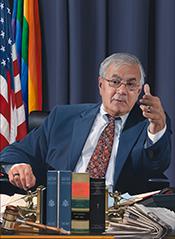 Rep. Barney Frank (D-MA)
Description
Amendment, as offered, strikes provisions prohibiting callbacks of executive compensation approved by shareholders and inserts language prohibiting rules of financial regulators from requiring recovery of incentive-based pay under arrangements in effect on the date of enactment. As modified (page H9226 of the Congressional Record), text is inserted which clarifies that the intent is to prevent the SEC from making inappropriate requirements with respect to executive compensation.
Legislative Activity
Stay on top of the latest movement without scrolling through every action
House amendment offered
July 31, 2009
View full timeline
House amendment offered
July 31, 2009
House amendment agreed to: On agreeing to the Frank (MA) amendment (A001) as modified Agreed to by recorded vote: 242 - 178 (Roll no. 683).(text as modified: CR H9226)
July 31, 2009 • 1:30 PM
Roll call votes on amendments in House
July 31, 2009 • 1:30 PM
Amendment agreed to by House: On agreeing to the Frank (MA) amendment (A001) as modified Agreed to by recorded vote: 242 - 178 (Roll no. 683).(text as modified: CR H9226)
July 31, 2009 • 1:30 PM
House amendment offered/reported by : Amendment (A001) offered by Mr. Frank (MA).(consideration: CR H9225-9227, H9240-9241; text: CR H9225)
July 31, 2009 • 10:56 AM
Amendment (A001) offered by Mr. Frank (MA). (consideration: CR H9225-9227, H9240-9241; text: CR H9225)
July 31, 2009 • 10:56 AM
Frank (MA) amendment (A001) modified by unanimous consent. The amendment, as modified, inserts new text into the "Limitation" provision. The provision is modified to read: ¢ (f)Limitation- No regulation promulgated pursuant to this section shall be allowed to require the recovery of incentive-basedcompensation under compensation arrangements in effect on the date of enactment of this Act, provided such compensation agreements are for a period of no more than 24 months. Nothing in this Act shall prevent or limit the recovery of incentive-based compensation under any other applicable law.
July 31, 2009 • 11:05 AM
On agreeing to the Frank (MA) amendment (A001) as modified Agreed to by recorded vote: 242 - 178 (Roll no. 683). (text as modified: CR H9226)
July 31, 2009 • 1:30 PM
Votes
1 roll call on this amendment
Text
Modified
{time}  0945
CORPORATE AND FINANCIAL INSTITUTION COMPENSATION FAIRNESS ACT OF 2009

Mr. FRANK of Massachusetts. Mr. Speaker, pursuant to H. Res. 697, I
call up the bill (H.R. 3269) to amend the Securities Exchange Act of
1934 to provide shareholders with an advisory vote on executive
compensation and to prevent perverse incentives in the compensation
practices of financial institutions, and ask for its immediate
consideration.
The Clerk read the title of the bill.
The SPEAKER pro tempore. Pursuant to House Resolution 697, the
amendment in the nature of a substitute recommended by the Committee on
Financial Services, now printed in the bill is adopted and the bill, as
amended, is considered read.
The text of the bill, as amended, is as follows:

H.R. 3269

Be it enacted by the Senate and House of Representatives of
the United States of America in Congress assembled,

SECTION 1. SHORT TITLE.

This Act may be cited as the ``Corporate and Financial
Institution Compensation Fairness Act of 2009''.

SEC. 2. SHAREHOLDER VOTE ON EXECUTIVE COMPENSATION
DISCLOSURES.

(a) Amendment.--Section 14 of the Securities Exchange Act
of 1934 (15 U.S.C. 78n) is amended by adding at the end the
following new subsection:
``(i) Annual Shareholder Approval of Executive
Compensation.--
``(1) Annual vote.--Any proxy or consent or authorization
(the solicitation of which is subject to the rules of the
Commission pursuant to subsection (a)) for an annual meeting
of the shareholders to elect directors (or a special meeting
in lieu of such meeting) where proxies are solicited in
respect of any security registered under section 12 occurring
on or after the date that is 6 months after the date on which
final rules are issued under paragraph (4), shall provide for
a separate shareholder vote to approve the compensation of
executives as disclosed pursuant to the Commission's
compensation disclosure rules for named executive officers
(which disclosure shall include the compensation committee
report, the compensation discussion and analysis, the
compensation tables, and any related materials, to the extent
required by such rules). The shareholder vote shall not be
binding on the issuer or the board of directors and shall not
be construed as overruling a decision by such board, nor to
create or imply any additional fiduciary duty by such board,
nor shall such vote be construed to restrict or limit the
ability of shareholders to make proposals for inclusion in
such proxy materials related to executive compensation.
``(2) Shareholder approval of golden parachute
compensation.--
``(A) Disclosure.--In any proxy or consent solicitation
material (the solicitation of which is subject to the rules
of the Commission pursuant to subsection (a)) for a meeting
of the shareholders occurring on or after the date that is 6
months after the date on which final rules are issued under
paragraph (4), at which shareholders are asked to approve an
acquisition, merger, consolidation, or proposed sale or other
disposition of all or substantially all the assets of an
issuer, the person making such solicitation shall disclose in
the proxy or consent solicitation material, in a clear and
simple form in accordance with regulations to be promulgated
by the Commission, any agreements or understandings that such
person has with any named executive officers of such issuer
(or of the acquiring issuer, if such issuer is not the
acquiring issuer) concerning any type of compensation
(whether present, deferred, or contingent) that is based on
or otherwise relates to the acquisition, merger,
consolidation, sale, or other disposition of all or
substantially all of the assets of the issuer and the
aggregate total of all such compensation that may (and the
conditions upon which it may) be paid or become payable to or
on behalf of such executive officer.
``(B) Shareholder approval.--Any proxy or consent or
authorization relating to the proxy or consent solicitation
material containing the disclosure required by subparagraph
(A) shall provide for a separate shareholder vote to approve
such agreements or understandings and compensation as
disclosed, unless such agreements or understandings have been
subject to a shareholder vote under paragraph (1). A vote by
the shareholders shall not be binding on the issuer or the
board of directors of the issuer or the person making the
solicitation and shall not be construed as overruling a
decision by any such person or issuer, nor to create or imply
any additional fiduciary duty by any such person or issuer.
``(3) Disclosure of votes.--Every institutional investment
manager subject to section 13(f) shall report at least
annually how it voted on any shareholder vote pursuant to
paragraphs (1) or (2) of this section, unless such vote is
otherwise required to be reported publicly by rule or
regulation of the Commission.
``(4) Rulemaking.--Not later than 6 months after the date
of the enactment of the Corporate and Financial Institution
Compensation Fairness Act of 2009, the Commission shall issue
final rules to implement this subsection.
``(5) Exemption authority.--The Commission may exempt
certain categories of issuers from the requirements of this
subsection, where appropriate in view of the purpose of this
subsection. In determining appropriate exemptions, the
Commission shall take into account, among

[[Page H9214]]

other considerations, the potential impact on smaller
reporting issuers.''.
(b) Prohibition on Clawbacks.--
(1) Prohibition.--No compensation of any executive of an
issuer, having been approved by a majority of shareholders
pursuant to section 14(i) of the Securities Exchange Act of
1934 (as added by subsection (a)), may be subject to any
clawback except--
(A) in accordance with any contract of such executive
providing for such a clawback; or
(B) in the case of fraud on the part of such executive, to
the extent provided by Federal or State law.
(2) Regulations.--The Securities and Exchange Commission
shall promulgate rules necessary to implement and enforce
paragraph (1).

SEC. 3. COMPENSATION COMMITTEE INDEPENDENCE.

(a) Standards Relating to Compensation Committees.--The
Securities Exchange Act of 1934 (15 U.S.C. 78a et seq.) is
amended by inserting after section 10A the following new
section:

``SEC. 10B. STANDARDS RELATING TO COMPENSATION COMMITTEES.

``(a) Commission Rules.--
``(1) In general.--Effective not later than 9 months after
the date of enactment of the Corporate and Financial
Institution Compensation Fairness Act of 2009, the Commission
shall, by rule, direct the national securities exchanges and
national securities associations to prohibit the listing of
any class of equity security of an issuer that is not in
compliance with the requirements of any portion of
subsections (b) through (f).
``(2) Opportunity to cure defects.--The rules of the
Commission under paragraph (1) shall provide for appropriate
procedures for an issuer to have an opportunity to cure any
defects that would be the basis for a prohibition under
paragraph (1) before the imposition of such prohibition.
``(3) Exemption authority.--The Commission may exempt
certain categories of issuers from the requirements of
subsections (b) through (f), where appropriate in view of the
purpose of this section. In determining appropriate
exemptions, the Commission shall take into account, among
other considerations, the potential impact on smaller
reporting issuers.
``(b) Independence of Compensation Committees.--
``(1) In general.--Each member of the compensation
committee of the board of directors of the issuer shall be
independent.
``(2) Criteria.--In order to be considered to be
independent for purposes of this subsection, a member of a
compensation committee of an issuer may not, other than in
his or her capacity as a member of the compensation
committee, the board of directors, or any other board
committee accept any consulting, advisory, or other
compensatory fee from the issuer.
``(3) Exemption authority.--The Commission may exempt from
the requirements of paragraph (2) a particular relationship
with respect to compensation committee members, where
appropriate in view of the purpose of this section.
``(4) Definition.--As used in this section, the term
`compensation committee' means--
``(A) a committee (or equivalent body) established by and
amongst the board of directors of an issuer for the purpose
of determining and approving the compensation arrangements
for the executive officers of the issuer; and
``(B) if no such committee exists with respect to an
issuer, the independent members of the entire board of
directors.
``(c) Independence Standards for Compensation Consultants
and Other Committee Advisors.--Any compensation consultant or
other similar adviser to the compensation committee of any
issuer shall meet standards for independence established by
the Commission by regulation.
``(d) Compensation Committee Authority Relating to
Compensation Consultants.--
``(1) In general.--The compensation committee of each
issuer, in its capacity as a committee of the board of
directors, shall have the authority, in its sole discretion,
to retain and obtain the advice of a compensation consultant
meeting the standards for independence promulgated pursuant
to subsection (c), and the compensation committee shall be
directly responsible for the appointment, compensation, and
oversight of the work of such independent compensation
consultant. This provision shall not be construed to require
the compensation committee to implement or act consistently
with the advice or recommendations of the compensation
consultant, and shall not otherwise affect the compensation
committee's ability or obligation to exercise its own
judgment in fulfillment of its duties.
``(2) Disclosure.--In any proxy or consent solicitation
material for an annual meeting of the shareholders (or a
special meeting in lieu of the annual meeting) occurring on
or after the date that is 1 year after the date of enactment
of the Corporate and Financial Institution Compensation
Fairness Act of 2009, each issuer shall disclose in the proxy
or consent material, in accordance with regulations to be
promulgated by the Commission whether the compensation
committee of the issuer retained and obtained the advice of a
compensation consultant meeting the standards for
independence promulgated pursuant to subsection (c).
``(3) Regulations.--In promulgating regulations under this
subsection or any other provision of law with respect to
compensation consultants, the Commission shall ensure that
such regulations are competitively neutral among categories
of consultants and preserve the ability of compensation
committees to retain the services of members of any such
category.
``(e) Authority To Engage Independent Counsel and Other
Advisors.--The compensation committee of each issuer, in its
capacity as a committee of the board of directors, shall have
the authority, in its sole discretion, to retain and obtain
the advice of independent counsel and other advisers meeting
the standards for independence promulgated pursuant to
subsection (c), and the compensation committee shall be
directly responsible for the appointment, compensation, and
oversight of the work of such independent counsel and other
advisers. This provision shall not be construed to require
the compensation committee to implement or act consistently
with the advice or recommendations of such independent
counsel and other advisers, and shall not otherwise affect
the compensation committee's ability or obligation to
exercise its own judgment in fulfillment of its duties.
``(f) Funding.--Each issuer shall provide for appropriate
funding, as determined by the compensation committee, in its
capacity as a committee of the board of directors, for
payment of compensation--
``(1) to any compensation consultant to the compensation
committee that meets the standards for independence
promulgated pursuant to subsection (c), and
``(2) to any independent counsel or other adviser to the
compensation committee.''.
(b) Study and Review Required.--
(1) In general.--The Securities and Exchange Commission
shall conduct a study and review of the use of compensation
consultants meeting the standards for independence
promulgated pursuant to section 10B(c) of the Securities
Exchange Act of 1934 (as added by subsection (a)), and the
effects of such use.
(2) Report to congress.--Not later than 2 years after the
rules required by the amendment made by this section take
effect, the Commission shall submit a report to the Congress
on the results of the study and review required by this
paragraph.

SEC. 4. ENHANCED COMPENSATION STRUCTURE REPORTING TO REDUCE
PERVERSE INCENTIVES.

(a) Enhanced Disclosure and Reporting of Compensation
Arrangements.--
(1) In general.--Not later than 9 months after the date of
enactment of this Act, the appropriate Federal regulators
jointly shall prescribe regulations to require each covered
financial institution to disclose to the appropriate Federal
regulator the structures of all incentive-based compensation
arrangements offered by such covered financial institutions
sufficient to determine whether the compensation structure--
(A) is aligned with sound risk management;
(B) is structured to account for the time horizon of risks;
and
(C) meets such other criteria as the appropriate Federal
regulators jointly may determine to be appropriate to reduce
unreasonable incentives offered by such institutions for
employees to take undue risks that--
(i) could threaten the safety and soundness of covered
financial institutions; or
(ii) could have serious adverse effects on economic
conditions or financial stability.
(2) Rules of construction.--Nothing in this subsection
shall be construed as requiring the reporting of the actual
compensation of particular individuals. Nothing in this
subsection shall be construed to require a covered financial
institution that does not have an incentive-based payment
arrangement to make the disclosures required under this
subsection.
(b) Prohibition on Certain Compensation Arrangements.--Not
later than 9 months after the date of enactment of this Act,
and taking into account the factors described in
subparagraphs (A), (B), and (C) of subsection (a)(1), the
appropriate Federal regulators shall jointly prescribe
regulations that prohibit any incentive-based payment
arrangement, or any feature of any such arrangement, that the
regulators determine encourages inappropriate risks by
covered financial institutions that--
(1) could threaten the safety and soundness of covered
financial institutions; or
(2) could have serious adverse effects on economic
conditions or financial stability.
(c) Enforcement.--The provisions of this section shall be
enforced under section 505 of the Gramm-Leach-Bliley Act and,
for purposes of such section, a violation of this section
shall be treated as a violation of subtitle A of title V of
such Act.
(d) Definitions.--As used in this section--
(1) the term ``appropriate Federal regulator'' means--
(A) the Board of Governors of the Federal Reserve System;
(B) the Office of the Comptroller of the Currency;
(C) the Board of Directors of the Federal Deposit Insurance
Corporation;
(D) the Director of the Office of Thrift Supervision;
(E) the National Credit Union Administration Board;
(F) the Securities and Exchange Commission; and
(G) the Federal Housing Finance Agency; and
(2) the term ``covered financial institution'' means--
(A) a depository institution or depository institution
holding company, as such terms are defined in section 3 of
the Federal Deposit Insurance Act (12 U.S.C. 1813);
(B) a broker-dealer registered under section 15 of the
Securities Exchange Act of 1934 (15 U.S.C. 78o);
(C) a credit union, as described in section 19(b)(1)(A)(iv)
of the Federal Reserve Act;
(D) an investment advisor, as such term is defined in
section 202(a)(11) of the Investment Advisers Act of 1940 (15
U.S.C. 80b-2(a)(11));
(E) the Federal National Mortgage Association;
(F) the Federal Home Loan Mortgage Corporation; and
(G) any other financial institution that the appropriate
Federal regulators, jointly, by rule, determine should be
treated as a covered financial institution for purposes of
this section.

[[Page H9215]]

(e) Exemption for Certain Financial Institutions.--The
requirements of this section shall not apply to covered
financial institutions with assets of less than
$1,000,000,000.
(f) GAO Study.--
(1) Study required.--
(A) In general.--The Comptroller General of the United
States shall carry out a study to determine whether there is
a correlation between compensation structures and excessive
risk taking.
(B) Factors to consider.--In carrying out the study
required under subparagraph (A), the Comptroller General
shall--
(i) consider compensation structures used by companies from
2000 to 2008; and
(ii) compare companies that failed, or nearly failed but
for government assistance, to companies that remained viable
throughout the housing and credit market crisis of 2007 and
2008, including the compensation practices of all such
companies.
(C) Determining companies that failed or nearly failed.--In
determining whether a company failed, or nearly failed but
for government assistance, for purposes of subparagraph
(B)(ii), the Comptroller General shall focus on--
(i) companies that received exceptional assistance under
the Troubled Asset Relief Program under title I of the
Emergency Economic Stabilization Act of 2009 (12 U.S.C. 5211
et seq.) or other forms of significant government assistance,
including under the Automotive Industry Financing Program,
the Targeted Investment Program, the Asset Guarantee Program,
and the Systemically Significant Failing Institutions
Program;
(ii) the Federal National Mortgage Association;
(iii) the Federal Home Loan Mortgage Corporation; and
(iv) companies that participated in the Security and
Exchange Commission's Consolidated Supervised Entities
Program as of January 2008.
(2) Report.--Not later than the end of the 1-year period
beginning on the date of the enactment of this Act, the
Comptroller General shall issue a report to the Congress
containing the results of the study required under paragraph
(1).

The SPEAKER pro tempore. After 1 hour of debate on the bill, as
amended, the amendment printed in House Report 111-237, if offered by
the gentleman from Massachusetts (Mr. Frank) or his designee, shall be
considered read, and shall be debatable for 10 minutes equally divided
and controlled by the proponent and an opponent. Thereafter, the
amendment in the nature of a substitute printed in the report, if
offered by the gentleman from New Jersey (Mr. Garrett) or his designee,
shall be considered read and shall be debatable for 30 minutes equally
divided and controlled by the proponent and an opponent.
The gentleman from Massachusetts (Mr. Frank) and the gentleman from
Alabama (Mr. Bachus) each will control 30 minutes.
The Chair will recognizes the gentleman from Massachusetts.

General Leave

Mr. FRANK of Massachusetts. Mr. Speaker, I ask unanimous consent that
all Members may have 5 legislative days on this bill to revise and
extend their remarks and include therein extraneous material.
The SPEAKER pro tempore. Is there objection to the request of the
gentleman from Massachusetts?
There was no objection.
Mr. FRANK of Massachusetts. Mr. Speaker, I recognize myself for such
time as I may consume.
Mr. Speaker, I have encountered gaps between rhetoric and reality in
this Chamber, never one as great as the wildly distorted description of
this bill that we've got before us.
Let's be very clear. There are differences between the parties here
on the whole, at least as reflected in the committee vote. I think it
will probably be different on the floor. There is much less difference
than there used to be about one piece of it, the say-on-pay.
When the say-on-pay bill came up previously in 2007--by the way, when
the Republicans were in the majority prior to 2007, on this, as on many
other issues, we Democrats tried to do some reforms, predatory lending
being one--we got nowhere--credit cards being another. We did try, in
our Committee on Financial Services, to bring this up. The Republicans
used their majority not to allow it.
In 2007, when we were in the majority, we did bring it to the floor,
and it passed over the objection of most Republicans, and I will
introduce into the Record their comments denouncing say-on-pay. But 2
years later, they have moved some. So they are now for reform on say-
on-pay, many of them, although a somewhat watered-down form.
I should say there is a stark difference between us remaining on
whether or not any action should be taken whatsoever by the Federal
Government to restrain compensation practices that inflict excessive
risk on the economy. We should be very clear; this assertion that this
amounts to control of all wages and prices is nonsense. There is, of
course, nothing about prices at all in the bill. As to wages, what it
says is that the SEC shall impose rules that prevent excessive risk-
taking, and the reference to wages is only in that context.
The amount of wages is irrelevant to the SEC. What this bill
explicitly aims at is the practice whereby people are given bonuses
that pay off if the gamble or the risk pays off but don't lose you
anything if it doesn't. That is, there is a wide consensus that this
incentivizes excessive risk for you a shorter time. If you're the head
of a financial institution or you're one of the decisionmakers or you
take actions that are risky and 1 month later it looks like they paid
off and you get your money and then 6 months later it turns out it blew
up, you don't lose any of the money you got. And if at the outset you
take a risk and it costs the company a lot of money, that doesn't cost
you anything.
All we are saying is that there has to be some balance to the risk-
taking. And people ask, What is excessive risk? Excessive risk is when
the people who take the risk pay no penalty when it goes wrong; when
they have a heads they win, tails they break even situation; when the
company loses money and the economy may suffer, but the decision-makers
do not.
Now, one of the sillier remarks we heard was this will cause us a
problem with international competition. In fact, say-on-pay, when the
Republican Party overwhelmingly opposed it 2 years ago, was already
borrowed from Great Britain, the United Kingdom. And we were told
during 2006 that we were losing a lot of business to Great Britain,
that we should cut back on Sarbanes-Oxley, for instance, because people
would go to England. But England had the very proposal that they were
saying was going to drive people away.
In fact, today--I will read from an article from a couple weeks ago.
The Prime Minister of England says they are going to adopt plans
forcing banks to hold back half of all bonuses for up to 5 years to
discourage excessive risk-taking. That's our major financial
competitor. And the conservative opposition is critical because it's
not mandatory.
We have been in conversations with the European Union, the United
Kingdom, with Canada, and others. This will be done on a coordinated
basis. In fact, American salaries, American compensation has been much
higher.
So, no, there is no price control; no, there is no wage control; no,
it is not a problem for international competition. And by the way, as
to every institution, every credit union--you heard that rhetoric--the
bill exempts any institution with less than $1 billion in assets, and
it gives the SEC the authority to even raise that so there's even less.
But here's the nub of it: The Republican Party has reluctantly been
dragged--reality sometimes has an impact--to supporting a watered-down
version of say-on-pay.
Say-on-pay, by the way, says that the shareholders of the company can
vote and express their opinion. The gentleman from Texas was upset that
we don't have a Federal Election Commission mechanism for these votes.
But why only these votes? Shareholders vote on everything. Apparently
it's only when the shareholders tend to vote on pay that Republican
sensibilities are trampled.
We do not, in this bill, talk about the amounts. We do say the
shareholders should. We say, in consultation with all the advocacy
groups who represent shareholders and pension funds and elsewhere, that
the people who own the company, the shareholders, should be able to
express their opinion on the compensation.
We go beyond that to say that we believe the Federal Government has
interest--not in the level of compensation, that's up to the
shareholders--in the structure. When you have, as we have seen,
structures whereby companies lose lots of money, and they lose lots of
money on particular deals, but the people who made those deals make
money on them, that has a systemic

[[Page H9216]]

negative impact on this society because it incentivizes much too much
risk.
Now, what is the Republican approach to that? Nothing. They admit
that these are problems. They regret that these things are happening,
but their regrets won't stop the damage. In the Republican substitute
there is a watering down of say on pay, but they at least acknowledge
that reluctantly. But when it comes to the practice of large
corporations in the financial area structuring bonuses that incentivize
excessive risk, my Republican friends admit that that's the case and
lament it and are adamant that we should do nothing about it. That's
the big difference.

We believe that the SEC--and by the way, as to the form, it was a
Republican former Member of this body, Christopher Cox, who was Chair
of the SEC, proposed disclosure. He broached it first. He said we have
an important public interest in knowing it.
So we are going to take the form of disclosure of compensation
prescribed by a Republican Member of this House as Chairman of the SEC,
with his colleagues, and let the shareholders say yes or no. We are
going to go beyond that and say that the SEC should look at this and
say, you know, you have a situation here where people making the
decisions will have an incentive to take too much risk. If you tell
people that if they take a risk and it pays off they are enriched, and
if it fails miserably, they don't lose anything, they will take more
risk than rationally should be taken.
You should not incentivize people to take risks where they can only
benefit and never suffer a penalty. That's all this bill says. We will
prevent that kind of thing from happening. We won't set amounts. We
won't deal with wage controls. We won't do anything else, and we exempt
institutions under $1 billion.
So I await the Republican counter. Yes, they want to water down say-
on-pay, but they reluctantly accept it, but they have zero to offer
with regard to the situation of excessive bonuses. And yes, we did get
some reluctant agreement that we put some limits on the people who are
recipients of TARP funds, but one of those who received TARP funds
prospered with those funds, paid back the funds, and are now engaging
in the same risky bonus practices they had before.
The Republican position, at least in committee, was to do nothing
about it, zero. Ours is, have rules, not that set the limits, not that
set wage controls, but simply say that you cannot structure it so that
whatever level of compensation you have, you profit if the bonus pays
off and you lose nothing if the bonus causes great damage to your
company and the economy.
Mr. Speaker, I reserve the balance of my time.
Mr. BACHUS. Mr. Speaker, I rise in opposition to this legislation and
yield myself 5 minutes.
Mr. Speaker, the American people are rightly disturbed by almost
daily reports of so-called ``too big to fail'' corporations that have
received billions of dollars in government assistance and have, at the
same time, paid their employees billions of dollars in bonuses.
In response to those events, Republicans have introduced legislation
which gets the American people out of the bailout business--that, Mr.
Speaker, is our response--and prohibits the government from picking
winners and losers. We believe that's the solution.
The legislation we have introduced clearly establishes a structure
where failure is not rewarded and market discipline is reestablished by
placing responsibility for those who engage in risky behavior squarely
where it belongs, on the risk-taker, not the taxpayer. That is the
Republican response.
The Obama administration takes a different approach. It continues to
embrace the ``too big to fail'' doctrine. That's why we're here today.
That's why we have to address executive compensation. It appoints a pay
czar to oversee compensation at the growing list of companies receiving
taxpayer-funded bailouts and guarantees.
Despite growing public outrage over these companies dishing out
billions of dollars in government-enabled bonuses, the Obama
administration and the Democratic congressional leadership steadfastly
refuses to embrace Republican legislation or offer its own proposals
prohibiting further taxpayer bailouts. Instead, it says that these same
corporations are simply too significant to allow them to fail, which
not only enables but encourages these same corporations to continue
what the Obama administration concedes is more risky behavior.
One of the behaviors that the administration and Chairman Frank
identify as risky in these systematically significant corporations is
executive compensation. Today we are presented with a fix, a
legislative response to these bailout bonuses and the resulting public
outrage. The cure-all solution bears the lofty and noble title
Corporate and Financial Institution Compensation Fairness Act. It is in
every way up to the challenge laid down by our former colleague, Mr.
Emanuel, most recently of 1600 Pennsylvania Avenue, who said, ``Never
let a crisis go to waste.''

{time}  1000

It is also in many ways closely akin to the recently departed cap-
and-tax legislation and the ever-looming government, or should I say
public option, health plan. All three are sweeping power grabs into the
private sector under the guise of the government's riding to the
rescue. All three rely on the government to fix the problem. All three
promise to fix the problem, which to a great extent was caused by guess
who? That's right, the government and lack of regulation by the
government. All three will create, or more accurately duplicate, large
government bureaucracies. All three represent ill-advised and in many
cases incompetent government intrusions.
Just 3 weeks or 4 weeks ago, Gene Sperling, legal counsel for our
Secretary of Treasury, warned, Go slow. He said this is a very
difficult subject. It needs testing. It has potential for unintended
consequences. Just yesterday before the Senate, the White House press
spokesman Robert Gibbs stated that the Obama administration is
concerned that the chairman's legislation may give the government
regulators too much say on incentive-based compensation. But as the
chairman said to the Rules Committee, My legislation goes beyond what
the Obama administration has proposed.
Now, if that doesn't take your breath away, nothing will.
In some ways this legislation borders on the classic ``bait and
switch.'' It's being sold as giving the owners of the corporation the
right to set pay and compensation standards. That's the shareholders.
Chairman Frank just this week on CNBC said, Dollar amounts are for the
shareholders to decide. It's up to the shareholders.
The SPEAKER pro tempore. The time of the gentleman has expired.
Mr. BACHUS. I yield myself an additional 2 minutes.
At the markup of this bill, he said say-on-pay empowers the
shareholders, and that's where questions about amounts would come in.
True, the first 6 pages of the bill give the owners, the shareholders,
a non-binding vote on the pay of top executives. But then come the next
8 pages, the switch, which gives the regulators the power to decide
appropriate compensation for not only just top executives but for all
employees of all financial institutions above $1 billion in assets and
all without regard for the shareholders' prior approval. So under the
guise of empowering shareholders, it is, in fact, the government that
is empowered.
One lesson we have learned from the government's arbitrary
interventions over the past 18 months, and that is the converse of
``too big to fail'' is too small to save, which, of course, is the
designation which applies to 99.9 percent of businesses, which have
been deemed by this administration and the regulators as ``systemically
unimportant or insignificant.'' But not so unimportant, not so
insignificant to be totally ignored. While not significant enough to
receive a bailout, they are apparently worthy of increased regulation
in the form of government-mandated pay regulations and new disclosure
requirements in the chairman's bill.
And, finally, on page 15, the bill designates those same government
entities which are empowered to control compensation plans that would
threaten the safety of financial institutions or adversely impact
economic conditions or financial stability to oversee this riskiness.
Look over the list and see if it inspires confidence.

[[Page H9217]]

The SPEAKER pro tempore. The time of the gentleman has again expired.
Mr. BACHUS. I yield myself 1 additional minute.
These are the same government agencies that regulated AIG,
Countrywide, and collectively failed to prevent the worst financial
calamity since the Great Depression. If it took them 30 years to catch
Bernie Madoff, do you really think the SEC can do a better job of
identifying inappropriate risk than the vast majority of financial
institution executives whose businesses have remained solvent during
these challenging times? Really, now, is there any question who is
better qualified or, for that matter, who ought to be responsible for
setting compensation within an American corporation?
In closing, Mr. Speaker, this bill continues the Democrat majority's
tendency to go to the default solution for every problem: create a
government bureaucracy to make decisions better left to private
citizens and private corporations. That's what we did in cap-and-trade.
That's what we did in the health care proposals. And it's this bill on
executive compensation. Government bureaucrats do not know what's best
for America.
For those reasons, Mr. Speaker, I urge opposition to this
legislation.
Mr. Speaker, I reserve the balance of my time.
Mr. FRANK of Massachusetts. Mr. Speaker, I yield myself 3 minutes to
deal with some of these comments.
First of all, I am struck by the fact that the gentleman, as he
indicated in our markup, is sufficiently nervous about the political
implications of opposing this bill and having the House take no action
whatsoever to deal with the problem of risk-incentivizing bonuses but
he wants to debate cap-and-trade and health care. They're not before
us. What's before us is this bill. And when Members debate the bills
that aren't there, it's an indication that they're a little shaky on
the bills that are there.
Secondly, yes, it does say that they can deal with all wages but not
in general. The gentleman reads very selectively. The language about
taking action is in this context: to determine whether the compensation
structure is aligned with sound risk management, is structured to
account for the time horizon of risks, and will reduce unreasonable
incentives by such institutions for employees to take undue risks.
It is limited in its grant of authority only to structures that
incentivize excessive risk. There is no mandate here to set wages for
anybody. There is no mandate to say this percentage is bonuses and that
percentage is pay. It is a mandate only to act where the structure
incentivizes risk, as has been recognized as part of the problem, very
broadly.
I will plead guilty to one issue, yes. We are not in this case taking
orders from the Obama administration. And maybe having represented a
party that took orders from the Bush administration, they now wish they
didn't, but that's not an example I want to follow. I am not here as a
Member of Congress or as chairman of a committee to do whatever the
administration says. I am here for us to put our independent judgment
on it.
The gentleman closed with the key difference between us: the
Republican position, as he articulates it--and I don't think it will be
the unanimous position--is have the Federal Government take no action
whatsoever to restrain the granting of bonuses that incentivize
excessive risk. If they pay back that TARP money having benefited from
it--and, by the way, on the bailout, every single bailout now underway
happened under the Bush administration. But their position is, do
nothing to deal with this. We take the opposite position.
Mr. Speaker, I reserve the balance of my time.
Mr. BACHUS. Mr. Speaker, I yield 2 minutes to the gentleman from
South Carolina (Mr. Barrett).
Mr. BARRETT of South Carolina. Mr. Speaker, I rise today in
opposition of H.R. 3269, the Corporate and Financial Institution
Compensation Fairness Act of 2009.
Restoring confidence in our financial markets is crucial, Mr.
Speaker, a component in bringing about economic recovery. And I support
efforts to responsibly address the issues that led to the financial
crisis that we're facing today.
However, H.R. 3269 does not do either. Instead of addressing the need
for smarter regulation, this bill represents further government
intrusion into the private sector that could ultimately hinder economic
recovery. If this legislation is passed, it will put in place far-
reaching and permanent government regulations on the compensation
practices of financial institutions, crippling their ability to recruit
top talent and remain competitive abroad and here at home.
Mr. Speaker, this bill goes too far by giving the Federal Government
the authority to make compensation decisions for a wide range of
employees in thousands of financial firms across the United States,
which we can all agree is a far cry from just capping executive pay.
In tough economic times like these, we need to focus on ways to
restore confidence in America's financial markets and increase the
ability of American businesses through responsible policies that
restore market discipline and discourage excessive risk. I firmly
believe that we cannot have a successful economic recovery with the
permanent overreaching regulations that this puts in place by this
legislation.
I therefore urge my colleagues to join me in voting ``no'' on this
legislation.
Mr. FRANK of Massachusetts. Mr. Speaker, I yield 4 minutes to a
member of the committee, the gentleman from Georgia (Mr. Scott).

=========================== NOTE ===========================

July 31, 2009 on Page H9217 the following appeared: I yield 4
minutes to a member of the committee, the gentleman from Virginia
(Mr. Scott).

The online version should be corrected to read: I yield 4
minutes to a member of the committee, the gentleman from Georgia
(Mr. Scott).

========================= END NOTE =========================

Mr. SCOTT of Georgia. Mr. Speaker, let me just start out by saying
this. We're hearing complaints from the other side that we are taking
over the private enterprise system; we are taking over the free
enterprise system.

=========================== NOTE ===========================

July 31, 2009 on Page H9217 the following appeared: Mr. SCOTT of
Virginia. Mr. Speaker, let me just start

The online version should be corrected to read: Mr. SCOTT of
Georgia. Mr. Speaker, let me just start

========================= END NOTE =========================

Let me remind them that it wasn't us that went to the private
enterprise system. It wasn't the government that went to Wall Street.
Wall Street came to the government to bail them out from their
behaviors.
Now, Mr. Speaker, the American landscape is absolutely littered with
company after company that has been driven into the ground by
executives who were greedy, who were selfish, cared only about
themselves, with these huge salaries, and these companies are left to
wither on the vine after they have gotten their golden parachutes and
have landed elsewhere.
Somebody needs to say something about the American people. This is a
free enterprise system, but it's not just free for top executives. It's
free for shareholders. It's free for those men and women who have given
their lives, their blood, their sweat, and their tears. And to see
their companies in shambles because of excessive pay by executives who
have abandoned those companies, what about their pensions? What about
their retirements that have gone?
No, Mr. Speaker, this is not about taking over the private enterprise
system. Mr. Speaker, this is about saving and protecting the free
enterprise system so that we all can be free to participate in this
system.
Mr. Speaker, what we have before us here is something because of the
fact that financial firms put together compensation packages and
bonuses that were based on incentives, that were laden with excessive
risk, that caused our financial crisis and brought this economy to the
edge of collapse and caused us here in Congress to go and get over $2
trillion of the American taxpayers' money to bail them out.
Now, the first order of business--and this is why this bill that
Chairman Frank has pushed, and I'm proud to say that we worked on this
together over 3 years ago. Had we had that bill in place 3 years ago,
we might not have had this financial crisis, because we would have been
able to rein in the risky corporate behavior that brought about the
collapse. So that's what we are doing. We're putting forward some
reasonable means here.
What is more reasonable than giving the shareholders a simple say, a
vote? It's nonbinding. We are not setting the salaries. Even the
shareholders are not. But don't they have a right? Isn't it their
company? They are the ones that are pumping the money into it.
The other feature about the bill, Mr. Speaker, that is very simple,
very reasonable, is that we require these compensation committees that
are on these boards to be independent. Right now it's a cozy
relationship. The CEO refers to them as his board. They're

[[Page H9218]]

handpicked. They are paid $50,000, $100,000, $200,000 to come and sit.
They need to be independent. And we have rules and regulations in the
bill that allow for the regulators to determine what these conditions
will be to make sure they're independent. We make sure that the
consultants who come in and help set up these compensation packages are
there.
The other point that we do, Mr. Speaker, is this, which is very
important: we also want to make sure that as we move forward in this,
that risky behavior is disclosed so that we can prevent it.
It's a very good bill, Mr. Speaker, and I urge its passage.
Mr. BACHUS. Mr. Speaker, I yield 2 minutes to the gentleman from New
Jersey (Mr. Lance).

{time}  1015

Mr. LANCE. Mr. Speaker, I rise out of concern for section 4 of this
bill. We had an amendment in the Rules Committee that I offered with
the distinguished gentleman from Georgia, and it was ruled out of order
by the Rules Committee. We believe that the amendment was germane,
drafted properly and submitted on time. The amendment dealt with
section 4.
Regarding section 4, I believe that it is overly broad, and in
particular I am concerned with the section that says, regarding
incentive-based compensation, that Federal regulators can review that
based upon other criteria as the appropriate Federal regulators jointly
may determine to be appropriate to reduce unreasonable incentives for
officers and employees to take undue risks.
In my judgment, that gives too much discretion to Federal regulators,
and we should be specific as Members of Congress in the statutory basis
for compensation issues.
I am also concerned that if this becomes law, that there will be a
tendency for capital to move away from the United States, particularly
New York, and to places like London and Asia. This is a matter I have
discussed previously in the committee, and I certainly believe that we
should continue to be the place in the world where this type of
activity occurs.
Our amendment in no way takes away the other provisions of this bill
regarding say-on-pay and the independence of compensation boards. But I
am sorry that our amendment was not considered favorably in the Rules
Committee and therefore will not be considered favorable here on the
floor.
This morning, a report from Bloomberg indicates that the White House
press secretary, Mr. Gibbs, said yesterday the administration is
concerned that the measure may give regulators too much say on
incentive pay. I agree with that sentiment.
Mr. FRANK of Massachusetts. Mr. Speaker, I yield myself 30 seconds to
say on behalf of the Obama administration, I welcome this very
temporary expression of deference to their views. It will not last very
long. As soon as it is politically convenient, it will disappear. So I
urge them to enjoy that brief moment of graciousness.
Mr. Speaker, I yield 4 minutes to the gentleman from Texas (Mr. Al
Green).
Mr. AL GREEN of Texas. Mr. Speaker, although they are not my words,
we have heard that it takes an act of Congress to get many things done.
I would only add to this what I have heard, it also takes a Congress
willing to act. This is our opportunity to act. This is our opportunity
to do what Dr. King called ``bending the arc of the moral universe
toward justice.'' This piece of legislation is just, given the
circumstances that we have been coping with.
There is no dispute that many CEOs have had their pay structured such
that no matter what the consequences of their actions, they were going
to receive enormous bonuses. I think there are two good reasons to
support this legislation: one, it deals with the safety and soundness
of the banking institutions. It performs perfectly if it does just
this, as far as I am concerned.
If it allows a banking regulator who sees that the structure of pay
is impacting the safety and soundness of the institution, if it allows
this regulator to take some affirmative action to protect the safety
and soundness of the institution, this piece of legislation is working.
That is what it is designed to do, not to structure the pay, but to
prevent the pay from causing ordinary people to have to bail out big
banks.
People are expecting us to do something to prevent this from
happening again. If we are going to act, this is a means by which we
can act. Talking about that which we cannot do and will not do that is
not on the agenda will not help us to do what we can do today. I never
let what I cannot do prevent me from doing what I can do.
The second reason why I support this legislation: this legislation
allows shareholders--by the way, I trust shareholders. I think people
who have a vested interest in something ought to have some say. I think
they ought to be able to know what the salary structure is and say
something about it. And in this case it is nonbinding. There are many
people who are of the opinion that nonbinding is not enough. But I
trust the shareholders to have an opinion. They have but an opinion.
They don't do anything to bind the corporation.
These two reasons, when combined, will help us with the safety and
soundness of these institutions and give the shareholders an
opportunity to know how the salaries are structured and have some say.
Finally, if we want to be a Congress that acts, we have got to have
courage. These are trying times. These are difficult times. It is easy
to stay with the status quo. Those who want change have got to be
willing to take the risk of doing the right thing.
The arc of the moral universe bends towards justice, but it doesn't
do so by itself. It does so because of people who are willing to do the
right thing under unusual and extraordinary circumstances.
I am going to stand with the chairman. I believe the chairman is
eminently correct. He has structured a great piece of legislation.
Those who really want change will vote for this legislation. Those who
want to see a better system so we don't end up with more headlines that
read ``bailed out banks gave millions in executive bonuses,''
notwithstanding the fact that these banks have not been managed
properly and could have been managed a lot better, these kinds of
headlines are going to cause problems for a lot of people.
I am going to vote with the chairman. I am voting for the bill. It is
a good bill. It is a just bill.
Mr. BACHUS. Mr. Speaker, I yield 4 minutes to the gentleman from
Texas (Mr. Hensarling).
Mr. HENSARLING. Mr. Speaker, I thank the gentleman for yielding.
There are aspects of this legislation that I certainly appreciate.
All Americans have been outraged--it is a word we use frequently, and
we use justifiably--about some of the compensation packages we have
seen from failed companies that come with tin cup in hand to the United
States taxpayer looking for more.
This bill has some provisions that add increased transparency, some
increased accountability; and that is good. But, unfortunately, the bad
in the bill way outshadows the good.
I have always said, Mr. Speaker, what you do with your money is your
business. What you do with the taxpayer money is our business.
Mr. Speaker, unfortunately, you can't just read the bumper sticker
slogan. You actually have to read the legislation. So we hear speech
after speech about these failed institutions taking in all of this
government money.
Well, I wonder then why in committee on a party-line vote did we vote
down an amendment that I brought that would have ensured that the
bailout recipients, that this legislation applied to them and them
only. They are the poster children in this debate, yet the legislation
extends potentially to every public company in America that somehow is
defined as a ``covered financial institution.''
By the way, I would say to my friends on the other side of the aisle,
the best way to deal with risky pay schemes is to quit bailing them out
in the first place. My friends on the other side of the aisle are
enshrining us as a bailout Nation. So you complain about the taxpayers
picking up the tab. I have complained about the taxpayers picking up
the tab. Quit bailing them out in the first place.
Again, we have to read the bill and not just read the slogan, because
if you read the bill, what you find out is,

[[Page H9219]]

number one, this isn't just pay restrictions that go to those in the
troubled Wall Street firms. Again, it is almost every covered financial
institution. And guess what? If you read further into the bill, it
doesn't just cover the top officers, the top executives. Every single
employee, every single employee who has an ``incentive-based
compensation plan'' could be covered by this.
We have already learned that somehow, with a very interpretive
approach to the English language, General Motors and Chrysler have been
found to be financial institutions. This means that any employee, any
employee who receives a tip, a sales commission, a Christmas bonus,
could have a Federal bureaucrat take it away from them. Ho ho ho.
That is what this legislation is all about. Again, don't get sucked
in by the bumper sticker slogan. Read the legislation. That was the
problem here on the original bailout. Nobody read the legislation. The
government stimulus, nobody read the legislation. Well, fortunately,
this isn't a 1,000-page bill. I think it is about 15 or 20 pages. I
actually took the time to read it.
And if this is just about class warfare, Mr. Speaker, why doesn't
this do anything about Hollywood stars who make $25 million for a
movie, and yet the movie loses money? Why isn't it about a third
baseman for the New York Yankees who gets $21 million and ties his
worst record for striking out in the season? Why doesn't this have
anything to do with the personal injury trial lawyers who make millions
and millions, and their clients are doing good to make thousands?
The SPEAKER pro tempore. The time of the gentleman from Texas has
expired.
Mr. BACHUS. I yield the gentleman 1 additional minute.
Mr. HENSARLING. So I hear the rhetoric from the other side of the
aisle, which once again seems like a lot of recycled class warfare to
me.
Another point I would make, Mr. Speaker, is we hear that we need this
in order to somehow deal with safety and soundness. We need this
legislation to somehow deal with systemic risk.
Well, number one, I listened very carefully to the testimony that was
presented in our committee, and I am sure it is theoretically possible
that there are pay structures that somehow may lend themselves to this.
But, again, show me the evidence. Where is the evidence? When I look at
pay structures among financial firms that failed versus those that
didn't fail, I don't see the correlation.
Second of all, as we know, Mr. Speaker, the regulators have the power
to regulate the liquidity and capital standards of these financial
firms to make it commensurate with the risk. That is the remedy. That
is the remedy, not to take Christmas bonuses away from employees.
Mr. FRANK of Massachusetts. Mr. Speaker, I yield myself such time as
I may consume.
There is, of course, a contradiction here. When we are talking about
a power, namely, to reduce excessive risk incentivizing bonuses that
the Republicans want to defend, they talk about the unelected
bureaucrats. The unelected bureaucrats can't be trusted. Except the
gentleman from Texas, of course, just closed by saying don't worry, the
unelected bureaucrats are out there to protect us.
The unelected bureaucrats in the Republican cosmology are like the
Obama administration: they are either convenient whipping boys or great
sources of wisdom, depending on where Republican ideology turns to
them. But the gentleman from Texas just said we don't have to worry. We
have those, as his colleagues called them, unelected bureaucrats to do
it.
But I am interested, I have noticed a number of Members have said
they don't like the bonuses. Is there a Republican proposal to deal
with the bonuses that are being given?
Our proposal does not empower anybody to limit the amounts. The
question is, is there a Republican proposal that would deal with what
Paul Volcker and Ben Bernanke and the financial regulators in England
and Warren Buffett and many others believe is a destabilizing tendency
to give out bonuses that give you an incentive to take excessive risks,
excessive in the sense that you benefit if the risk pays off and you
don't lose.
We want people to take risks, but we want them to take risks which
balance the upside and the downside, not which just look only at the
upside. And I continue to point out not in that committee, not in that
12 years they controlled this place, not during this debate today, not
in the Rules Committee, we have not seen a single Republican proposal
to deal with bonuses.
Their position apparently is however the financial industry wants to
structure bonuses, no matter what they say, that you get a bonus if it
pays off in the short term and it turns sour in the long term. You get
a bonus if it pays off, but you don't lose a thing if it doesn't pay
off. They would leave that entirely unchanged. I think that is very
dangerous to the economy, and, yes, there is a consensus among
financial regulators and others that this has contributed to risk-
taking.
We all believe in the free-market system and the incentives. How can
it be that you acknowledge that there is a system which says to people,
take a risk, because it is risk-free for you?

{time}  1030

It's risk-free for the individual. It's risky for the company; and
when you accumulate all those risks for the company, it's risky for the
economy. We're saying, if it's risky for the company and risky for the
economy, it ought to be risky for the individual. We want an alignment
of risks. We don't want risk-free individuals taking big risks on
behalf of those who are going to have to suffer. We have a proposal to
restrain that. The Republican position on that is, do nothing. Let them
keep going exactly as they have been going.
Let us return, as I said the other day, to the thrilling days of
yesteryear when the lone rangers will ride again, untrammeled by any
set of rules. They will be able to continue to give themselves bonuses
that allow them to be free of risk. That's the deal. The company will
face risk. The economy will accumulate and face risk. But the decision-
makers will be free of the risks' negative side; they will gain from
the risks' positive side; and like rational people, they will take more
risks.
I reserve the balance of my time.
Mr. BACHUS. Mr. Speaker, I yield 2 minutes to the gentleman from
California (Mr. Campbell).
Mr. CAMPBELL. I thank the gentleman for yielding, and I hear the
chairman's comments and remarks. There is no argument with anyone, I
think, on this floor that executive pay has been an issue, that there
have been excesses and that there have been problems that have been
created in companies and the economy with executive compensation. I
think I would argue that rather than excessive risk taking, that it's
more about short-term thinking instead of long-term thinking, which, by
the way, is way bigger than just executive pay and is way bigger than
the scope of this bill, and which this bill will not solve. But that's
another issue.
The question for me is whether this is the right way to deal with it.
I would argue no, because is the only problem out there in corporate
governance? Is the only thing that has created problems for companies
related to executive pay? No. Let's look at General Motors and Chrysler
and their recent problems. Were their problems created because of
executive pay? I'm not sure I've heard anybody argue that. But were
their problems caused, in part at least, because of excessive union
contracts? Yes. How about with retirement programs that were unfundable
over time? Yes. What about other companies where perhaps there have
been legal settlements that have created problems that have been fatal
or resulted in companies going bankrupt? Those have occurred. How about
mergers and acquisitions?
So what are we going to do? Are we going to have shareholders vote on
pay, on mergers, on acquisitions, on union contracts, on retirement
pay, on legal settlements, on fees to attorneys? Any of those arguably
can bring a company down. Should the shareholders have a say on that?
You know, obviously the shareholders are the ultimate owners of the
company. If you want to give them a say on pay, fine. Then you'd better
give them a say on the rest of that. But I'm not sure anybody on this
floor thinks that that's the right thing to do. The best way for
shareholders to express their displeasure with the management or
operation of a company is

[[Page H9220]]

through the board of directors. That's the way it has been done, and
that's the way it should be done.
Mr. SCOTT of Georgia. Mr. Speaker, I yield 3 minutes to the gentleman
from North Carolina (Mr. Miller).
Mr. MILLER of North Carolina. I look forward to working with Mr.
Campbell on giving shareholders much more power over their own
corporations. There is much more we need to do to reform corporate
governance in this country. It has been one of many failings of our
economy in the last year or so.
Mr. Speaker, I don't want to run corporations, but someone needs to
set some rules. We need the law to set some rules. We need someone to
provide some oversight. We need someone to be a watchdog of what they
are doing because we have found out what happens when there are no
rules, when there is no oversight, when there is no watchdog. We are
now in the worst economic downturn since the Great Depression, and we
have been perilously close to a financial collapse that would have left
the Great Depression in the shade. And we know what caused it. It's
essentially the same things that went wrong in the 1920s. Corporate
executives were looting the country with predatory lending practices to
make as much money as they possibly could without any regard for the
consequences; and then corporate executives, in turn, were looting
their companies to make as much money for themselves as they could.
They weren't doing right by the American consumers. They weren't doing
right by their own shareholders. They were only looking after
themselves. The idea that the corporate executives were acting in the
best interests of their own shareholders is simply a farce. We saw
compensation for executives and other top officials who were doing very
little of any value to society. In fact, their predatory lending
practices were doing much more harm than good, and it wasn't even to
the benefit of their shareholders because of the risks that they were
creating for the corporation, that the short-term profits would lead to
great risk in a very short while.
This bill is part of what we need to do. It is only part of what we
need to do. This just scratches the surface. We need to make sure the
financial collapse that we have seen in the last year never happens
again. This bill is only part of it.
Mr. BACHUS. Mr. Speaker, I yield 3 minutes to the gentleman from
Delaware (Mr. Castle).
Mr. CASTLE. I thank the gentleman for yielding.
Mr. Speaker, I rise in strong opposition to H.R. 3269, the Corporate
and Financial Institution Compensation Fairness Act. This overreaching
bill, which is being sold as a response to the financial crisis, would,
in effect, take away the rights of individual companies to conduct
business as they see fit. It places government bureaucrats in charge of
making key decisions about how businesses should be run. We can agree
that some executives in this country are grossly overpaid; but allowing
government to make such determinations is counter to everything that
has made our country great. America has always been an economic
powerhouse in the world, but this bill restricts competition through
government intervention in a way that infringes on the entrepreneurial
spirit of this Nation.
Section 4 of H.R. 3269 would actually allow the government to involve
itself in the running of private businesses by empowering Federal
regulators to prohibit compensation arrangements for all employees of
all financial institutions, including banks, bank holding companies,
broker dealers, credit unions and investment advisers. Even regulators
under the current administration have testified that they do not intend
to cap pay or set forth ``precise prescriptions for how companies
should set compensation, which can often be counterproductive.''
However, the majority has ignored the administration's wishes by adding
section 4 to H.R. 3269.
This bill is a vast overreach and an overreaction to the current
financial crisis. Like many, I am concerned that executives at a
handful of large companies, like AIG, have been awarded extravagant pay
packages and bonuses even after the companies have faced failure and
received assistance from the Federal Government to the tune of billions
of taxpayer dollars. In these cases, when Federal assistance has been
granted, I believe the Federal Government does have a right to mandate
the pay structure of these firms, which is why I voted for an amendment
during committee consideration of H.R. 3269 to only apply the
provisions in the underlying bill to TARP recipients for the amount of
time that the TARP money is outstanding. Unfortunately this amendment
was rejected, leaving many financial institutions who did not
contribute to the current crisis to pay for the mistakes of others.
Finally, this bill undermines the primacy of State corporate
governance laws. Corporate law has typically been left up to the
States, allowing this diversity to foster competition. Passing this
bill would eliminate these traditions, which run against the American
free market ideals we have always stood for. For this reason I support
Mr. Garrett's amendment to allow State law to preempt the underlying
bill.
H.R. 3269 was introduced without a single legislative hearing to
examine its far-reaching implications, despite numerous requests from
myself and other Members of the Financial Services Committee. I believe
this legislation may have unintended consequences on our Nation's
businesses, and I urge my colleagues to vote ``no'' on the underlying
bill.
Mr. FRANK of Massachusetts. Mr. Speaker, there is a little bit of an
imbalance. I would ask if I could reserve for one more speaker while I
work something out.
Mr. BACHUS. Mr. Speaker, I yield 2 minutes to the gentleman from
Georgia (Mr. Price).
Mr. PRICE of Georgia. I thank my friend from Alabama for yielding me
time and for leading on this issue. What we hear from the other side of
the aisle is this famous old phrase ``trust us,'' right? Now we know
that folks on the other side don't have any real reluctance to have the
government run things. We've seen it over and over and over again. In
fact, we've just heard it from one of the speakers who said, We don't
want to run private companies, and then he followed that up and said,
But this is only part of what we need to do.
Mr. Speaker, the bill has language in it that would, in effect, allow
the Federal Government to determine pay, compensation for employees;
and that might be all right if it was just companies that were
receiving tax money. That might be okay. But in fact, it's not. It is
so many other companies. Covered financial institutions, the definition
in the bill would expose companies like CVS Caremark--that's right,
drugstores--WellCare Health Plans, Value Line, Textron, McGraw-Hill
Companies, Medco Health Solutions, Lowe's Corporation.
Mr. Speaker, this is another far reach by the Democrats in charge who
believe that the government knows best, not just about automobile
companies, not just about energy companies, not just about how to spend
your money, not just about your health care--they're working on that
government-run health care plan--but also private companies across this
land. They believe that they ought to be able to come in and say, Okay,
this is what you can make, and this is what you can't make.
If you don't believe it, just read the bill. Nobody is concerned
about having shareholders give their opinions, have a say about what
executives make when shareholders own part of that company. That makes
a whole lot of sense. But what we do have concerns about, grave
concerns, is the intervention of the Federal Government into one
business after another after another. This is just another example of
that. It's a terrible idea. It strikes at the very core of the free
market principles that have made us the greatest Nation in the history
of the world. Bad idea, Mr. Speaker. Vote ``no''.
Mr. FRANK of Massachusetts. Well, Mr. Speaker, I yield myself 15
seconds to say I welcome the gentleman from Georgia to the cause of
say-on-pay. When we debated this on March 22, 2007, he was quite
critical of it. So maybe 2 years from now, he will think we should do
something about excessive, incentivizing bonuses.
I now yield for a question to the gentlewoman from California.
Ms. SPEIER. I thank the gentleman from Massachusetts.

[[Page H9221]]

In section 4 of the bill, it defines the term ``covered financial
institutions'' to include depository institutions, broker dealers,
credit unions and investment advisers but also authorizes the
appropriate Federal regulators to designate jointly, by rule, other
financial institutions that are covered. Because this authority is
granted to appropriate Federal regulators, can we assume that entities
not regulated by a Federal financial regulator are not intended to be
``covered financial institutions''?
Mr. FRANK of Massachusetts. Yes. As to section 4, if they are public
companies, they are covered by say-on-pay. And there may be companies
not now federally regulated that may become so by decision. But as of
now, if they're not federally regulated, they're not covered. Of course
AIG was federally regulated by the OTS, so they would have been
covered. The gentlewoman is correct.
Mr. Speaker, I have no further requests for time, and I have only one
more speaker. So I am going to reserve the balance of my time.
Mr. BACHUS. Mr. Speaker, let me tie up a few--what I consider loose
ends about this legislation. One is the motivation. Of course we've
heard that one of the motivations is that these pay schemes and
arrangements could heighten risk; and then if one endorses the Obama
administration approach, that would precipitate a bailout because the
government would continually have to assure against some outsized risk.
As I have said, the Republican approach is, simply don't bail these
companies out, and then you don't have to be micromanaging every
compensation decision by a company. I think there's another motivation,
and I think it is a slippery slope. Chairman Frank was on CNBC this
past Tuesday, and he asked this question: is there some character
defect with some people where they get hired, they give them a prestige
job, but they really won't do it right unless you give them an extra
bonus? Most of us don't need that.
So I'm wondering if one motivation for this legislation is so that
the government can decide whether people need a bonus or don't need a
bonus, whether they're deserving of a bonus. In fact, several pages of
the bill does just that. Some people may not need that bonus. Other
people may. That decision will be made by the list of government
entities on page 15, not by the shareholders even though this bill is
trotted out as a shareholder bill, not by the board of directors, not
by the management who an important tool of management is to offer
incentives and to incentivize performance and achievement. But
apparently now it's the government who will decide whether you need a
bonus or not. That, Mr. Speaker, is scary in my mind.
I reserve the balance of my time.
Mr. WATT. Mr. Speaker, I yield 1\1/2\ minutes to the gentleman from
Maryland (Mr. Van Hollen).
Mr. VAN HOLLEN. I thank my colleague from North Carolina for his
leadership on this issue.
Mr. Speaker, in this country, we believe that hard work should be
rewarded, and I think most people in this country believe in the
concept of pay for performance. But what we've seen on Wall Street over
the last many years is turning that concept of pay for performance on
its head. We saw CEOs and the folks in the Wall Street boardrooms
getting huge bonuses based on short-term gains for their companies,
even while that excessive risk-taking put those institutions at risk.

{time}  1045

Now, if it was just those institutions, I think we'd say, okay, let
them take that risk. If they want to overpay their CEOs in the sense
that the company's going to be put in jeopardy, and it was just that
company at risk, okay. But what happened is this kind of excessive
risk-taking went on at the biggest financial institutions of this
country and put the entire economy at risk, put the financial system at
risk, and at the end of the day, put all of the taxpayers in this
country on the line.
So we all have a stake in changing the system. We all have a stake in
making sure people get paid for performance, and not paid by putting
taxpayers in the financial system at risk because, at the end of the
day, we're all holding the line, not just the CEO and not just the
shareholders.
So, Mr. Speaker, it's time to say, enough is enough. Let's pass this
legislation to protect consumers, shareholders and the taxpayer.
Mr. BACHUS. Mr. Speaker, I yield 2 minutes to the gentleman from
Illinois (Mr. Roskam).
Mr. ROSKAM. Mr. Speaker, I was minding my own business in my office,
and I've been listening to this debate and felt like I needed to come
and just point a couple of things out, some real weaknesses of this
bill.
First of all, I'm hearing from manufacturers, Mr. Speaker, in my
district who are particularly concerned about section 4 of the bill.
They're making their concerns known through the National Association of
Manufacturers, and they've said that they are concerned that this bill
would give authority to government regulatory agencies to review and
prohibit pay arrangements for a wide range of employees and, as a
result, they strongly oppose the government intervention in the
internal dynamics of companies.
Look, I'm the first to say that if you took bailout money, if you
took TARP money, fine, be in this category, and those are entities that
the taxpayers have a right and an expectation to regulate. But when we
start to use ambiguous terms, terms that are not well-defined, with all
due respect to the majority, ultimately, we're creating an environment
where there's going to be more government intervention.
Why is it that the National Association of Manufacturers says, Don't
do this to us? They're working hard to create jobs in this country and
they haven't been able to do it, in part, because of bad policies that
they've seen come out of Washington, D.C., Mr. Speaker. And we can do
much, much more.
Look, in a nutshell, this bill is an invitation for political
meddling at its worst in the private confines of companies that are
trying to work hard to create jobs and to create opportunities. You can
imagine a politician getting on the phone with the regulator and
saying, You know what, I'm interested in you checking into that company
because I don't like them and I don't like the way that they're doing
business.
We can do better. Let's send this bill back to committee. Let's vote
``no.''
Mr. WATT. Mr. Speaker, we have only one final speaker, so we'll
reserve the balance of our time.
Mr. BACHUS. Mr. Speaker, at this time I would like to recognize the
gentleman from New Jersey (Mr. Garrett) for 1\1/2\ minutes.
Mr. GARRETT of New Jersey. In a few moments I'll be submitting an
amendment to this bill, but before I do that, I just want to talk about
someone else's comment on this bill. This is Nell Minow of the
Corporate Library, someone who has been influential and involved in
this issue for some period of time, as you may know, someone who no one
would consider a conservative on this issue. And she just did a blog on
this recently where she says, The House Financial Services Committee
has recently approved this legislation. She recognizes why this is
coming up, and she says, The impulse is understandable, but the
standard is unworkable. What does inappropriate mean? What, while we're
at it, does risk-taking mean? And the most terrifying question is, who
gets to decide what they mean?
Chairman Barney Frank warned earlier this month, she reminds us, and
he did so again just recently, that recent news of compensation of Wall
Street shows that some financial leaders yearn for the stirring years
of yesteryear, and demonstrates a need to adopt legislation on
executive pay. But it's a question of empowering the shareholder to
decide the question of appropriate level of pay and not by the
regulators.
She concludes by saying, Who is in the best position to evaluate and
respond to badly designed pay packages? As someone who is very proud of
8 years of serving in government, she says she has the most utmost
respect for politicians and bureaucrats, but she also recognizes their
limits. The government, therefore, should not be micromanaging pay.
Instead, and this is what Republicans suggest, remove the obstacles
that currently prevent oversight from those who are best qualified and
motivated to manage the risk, the shareholders.
Mr. WATT. Mr. Speaker, we reserve the balance of our time.

[[Page H9222]]

Mr. BACHUS. Mr. Speaker, it appears as if this bill is so much more
than a shareholders' right to say-on-pay bill. We already have a czar,
a pay czar. Are we going to have a consultant czar? You know, we're
going to enable these compensation consultants, they have to go to the
agencies, they meet certain criteria. Are we going to have a consultant
czar? Are we going to need management czars? Are we going to need risk
czars? Because these 20 pages--and 15 of it deals with risks. It deals
with inappropriate behavior.
Are we going to, on the bonuses, are we going to have every bonus
submitted to some government agency to review? How are you going to
report those bonuses? How are you going to approve those bonuses? How
long is it going to take to approve those bonuses? The administration,
itself, has warned that this bill goes too far. Independent witnesses
have warned that this bill goes too far.
Mr. WATT. Mr. Speaker, I yield myself the balance of the time.
Mr. Speaker, the fact that we are here today debating this bill with
such vociferous opposition, to me, is a commentary on how out of whack
our whole system has become.
First of all, this bill is a modest bill which gives shareholders the
right to make advisory votes, take advisory votes on compensation. Who
are these shareholders? They're the owners of the company. They're the
owners of the company, and somehow, the opponents of this bill are
trying to convince the public that the owners of a company shouldn't
have the right to express their opinion to the board about compensation
of the officers of that company.
And the bill specifically says, and I'm reading from the bill, The
shareholder vote shall not be binding on the board of directors and
shall not be construed as overruling a decision of the board. We're
just giving them the explicit right to advise the board about
compensation.
One gentleman has said that this applies to manufacturers. It doesn't
apply to manufacturers. Section 4 doesn't apply to manufacturers. And
even if it did, it would apply only to the extent that they could
threaten the safety and soundness of a financial institution--
manufacturers are not financial institutions--and only to the extent
that they could cause serious adverse effects on economic conditions or
financial stability. And that, I would submit, is an appropriate
Federal Government role to play, to make sure that we don't get back
into the kind of meltdown that we are experiencing and have been
experiencing as a result of greed and irresponsibility in the private
sector.
This is not the government taking over the corporate sector, either
in the financial sector or any other sector of our economy. It is a
statement by the American people that it's time for us to straighten up
the ship. We should pass this bill today and move on.
Mr. GRAYSON. Mr. Speaker, I would like to clarify a point regarding
H.R. 3269, the Corporate and Financial Institution Compensation
Fairness Act of 2009. On page 17, the bill states ``No regulation
promulgated pursuant to this section shall require the recovery of
incentive based compensation under compensation arrangements in effect
on the date of enactment of this Act provided such compensation
agreements are for a period of no more than 24 months.''
The words ``this section'' are intended to mean the fourth section of
H.R. 3269, not the section of the U.S. Code in which this provision may
be found.
In addition, I would like to add into the Record this important
statement by Leo Hindery published in the Washington Note, because it
pertains to this bill.

President Obama was absolutely right a couple of weeks ago
when he demanded that the compensation of the executives,
managers and traders at the failed financial institutions
that received bail-out cash be scrutinized by a new
``oversight council''. He was right because these are the
people who saddled the rest of us with a staggering $2.8
billion or more of trading and credit losses, and yet wanted
to be paid as if everything was just swell.
But he and especially his advisers were wrong not to impose
specific limits on executive compensation, rather than
(mostly) just guidelines. They were especially wrong not to
enact permanent limits that apply to all regulated financial
institutions and all public companies.
The evidence is clear that excessive executive and
management compensation lies at the root of all corporate
crimes and misbehavior, of most of corporate America's
inattention to creating and preserving high-quality domestic
jobs and fair overall employee compensation, and of almost
all of the recent massive trading and credit losses.
In his speech, Obama also said that government's ``role is
not to disparage wealth, but to expand its reach''. He
absolutely should have added that its role is also to
``ensure wealth's fair and equitable distribution''.
For the 35 years following the end of the second world war,
CEOs generally viewed responsible and fair business behavior
as a critical component of the American dream. And during all
those years, and in fact during most of the past century,
corporate leaders in the US earned 20 to 30 times as much as
their average employees. Even today, the ratio of chief
executive pay to average employee earnings in all other main
developed countries has remained near this level. The ratio
is still only about 22 times in Britain, 20 times in Canada
and 11 times in Japan.
Beginning in the 1990s, however, many US executives, with
the complicity of their boards, began to treat management as
a separate constituency, often the primary one. Suddenly,
fair executive compensation was abandoned in hundreds of
corporations and financial institutions.
In America now, the average public company chief executive
earns an almost unbelievable 400 times what his average
employee makes, and his officers and senior managers aren't
far behind in their own compensation. And now we know that
executives and senior managers in the financial services
industry drink just as heartily from the same frothy trough.
Obama and Congress need to enact three changes in executive
and management compensation practices, not just hope, as one
of his senior advisors recently said, that some (not even
all) corporations will voluntarily ``assess risk induced by
[their] compensation practices''.
First, Congress needs immediately to grant public
shareholders the right to call shareholders' meetings, to
vote out the current board and to pass binding (not simply
advisory) votes on executive compensation.
Second, Congress should establish, for all public
companies, a ceiling on individual executive compensation as
a reasonable multiple of average employee compensation--say,
35 times--and then penalize through tax policies those
companies that elect to pay anyone in excess of this
multiple.
Third, Congress should empower the Treasury to oversee the
compensation practices of any entity that is regulated,
whether or not it currently relies on government guarantees.
This should apply to employees at the individual trader
level, too.

Mr. POSEY. Mr. Speaker, I rise to express my concerns about H.R.
3269, the Corporate and Financial Institution Compensation Fairness Act
of 2009, as drafted.
It should not come as a surprise that the American public is outraged
at those executives who would benefit from lavish compensation packages
while failing to produce results. Worse still are those executives who
would deliberately place their own interests above those for whom they
are accountable. As the land of opportunity, America is a very
forgiving place for risk and failure, but Americans also believe that
those who fail should take responsibility for their failures.
Executives of public companies should have the fiduciary
responsibility to put the long-term best interests of shareholders
foremost in all their dealings, and executive compensation committees
should have the same responsibility.
The bill before the House, however, goes too far. Section 4 of the
bill is most troubling. As written and amended, this bill is a
significant expansion of the power of the federal government to
micromanage the compensation practices for executives and employees in
all financial institutions over $1 billion. The bill also has a loosely
defined definition of financial institutions, potentially opening the
door to controlling even more companies.
Despite two requests from me and many of my colleagues on the House
Financial Services Committee, the Chairman did not even hold a hearing
on this legislation to address some of these questions. We were unable
to inquire with federal regulators on how they would interpret their
newfound duties to judge if compensation is commensurate with the vague
criteria of ``sound risk management.'' It is thus left to the
imagination how the federal government would approve or disapprove the
compensation packages and what other ``unreasonable incentives'' would
be banned by unelected bureaucrats. It is bewildering, but the United
States Congress is punting enormous, arbitrary power to the unelected
bureaucrats to decide how much money people can earn and whether any
risk they take is ``unreasonable.''
As we debate financial regulatory reform, it is important that we
refrain from condemning the free enterprise system which has given us
the greatest prosperity in the history of the world. The rise of the
corporation is integral to free markets and the prosperity we enjoy.
Congress should not pass legislation so sweeping as to micromanage the
thousands of enterprises which create jobs in our communities and
produce goods and services we want.

[[Page H9223]]

Unfortunately, the House has rushed a bill to the House floor that
has not been fully vetted and is filled with vague language that no one
fully understands. It is no wonder that so much that has passed the
House has been found unacceptable by the Senate.
Mr. FRANK of Massachusetts. Mr. Speaker, Aflac was the first publicly
traded company to give shareholders an opportunity to vote on executive
compensation, commonly referred to as say-on-pay. Aflac CEO Daniel P.
Amos explained the company's decision to voluntarily adopt the measure
by saying, ``Our shareholders, as owners of the company, have the right
to know how executive compensation works. An advisory vote on our
compensation report is a helpful avenue for our shareholders to provide
feedback on our pay-for-performance compensation philosophy and pay
package.''
The first year of the vote, 2008, 93% of the shareholders voting
approved the company's pay-for-performance compensation policies and
procedures. In May of this year, 97% of the shareholders voting cast
ballots in favor of the compensation policies, even though the stock
price of virtually all financial companies had declined--including
Aflac's. The results of both shareholder votes clearly demonstrate that
shareholders appreciate Aflac's philosophy of paying for performance
and the company's long history of transparency.
I submit the following for the Record.

[From USA TODAY, July 15, 2009]

CEOs Openly Oppose Push for Say-on-Pay by Shareholders

(By Del Jones)

Top executives have taken a relentless public thrashing as
they lay off workers and fight to keep stock prices above the
floor. In a suffering economy, no one seems happy with
leadership, and the image of CEOs has sunk so low that their
approval scores are now south of those serving in Congress.
But no matter how low their image sinks, nor how shrill the
outrage, executives have remained steadfast in their
opposition to one thing: They are roundly against legislation
that would force companies to let shareholders vote on CEO
compensation packages.
``I wonder if the congressmen backing this legislation
would propose similar laws governing their own
compensation,'' says Steve Hafner, CEO of travel search
engine Kayak. ``I'd love to vote on congressional pay and
perks,''

EXEC PAY: Proposal gives shareholders non-binding say

That executives oppose congressional noodling with their
pay is unsurprising. What is surprising is that they are
willing to go so public in their opposition, even though
passage of a so-called ``say-on-pay'' law is likely, says
Dawn Wolfe, associate director of social research for Boston
Common Asset Management.
President Obama, who co-sponsored say-on-pay legislation
while in the Senate, remains in support, as is the Democrat-
controlled Congress. Likewise the public at large. Focus
groups have been describing CEO pay with words such as
``obscene'' and ``immoral'' rather than words like
``excessive'' or ``overly generous'' as in the past, says
Leslie Gaines-Ross, chief reputation strategist at Weber
Shandwick.
``Everyone I talk to understands say-on-pay legislation to
be a question of when, not if,'' Wolfe says. ``There is a
sense in the investment community that it is inevitable.''
CEOs have opinions like everyone else, but the public
rarely sees that side because positions on anything
controversial risk upsetting customers. When they feel
compelled to take a stand at odds with the public, it is
usually articulated by trade associations and lobbyists, so
as to put CEOs and the companies they run at arm's length
from controversy. Not this time, Even though say-on-pay
legislation is almost a sure thing, CEOs and former CEOs
contacted by USA TODAY spoke out against it, both forcefully
and individually.
``Say-on-pay is just another government regulation and
intrusion into free enterprise,'' says Howard Putnam, former
CEO of Southwest and Braniff airlines.
No one likes downward pressure applied to their pay, and in
this respect CEOs are no different than professional
athletes, rock stars, union members, Social Security
recipients--and elected officials. Howard Behar, former
president of Starbucks, asks: Why not let people vote on the
salaries of government workers? He says government employee
unions influence politicians, who commit huge resources to
pensions and raises to get re-elected.

How say-on-pay would work

Say-on-pay legislation would require companies to give
shareholders an up-or-down vote each year on the compensation
of the top five executives of publicly traded companies. The
vote would not be binding, leaving the final decision in the
hands of boards of directors. However, directors are elected
by shareholders and a shareholder vote against a pay
package would likely pressure directors to rethink the
package and make changes.
The Netherlands requires binding shareholder votes on
executive pay. The U.S. law would model those in Britain,
Australia, Norway, Spain and France, where the vote is non-
binding. Boston Common Asset Management has been pushing
shareholder say-on-pay resolutions for three years, and Wolfe
says she doesn't understand the CEO opposition, as there are
only two examples in Britain when shareholders voted a
majority against a CEO's pay: at GlaxoSmithKline in 2003 and
at home builder Bellway in 2009. It may be true that most
CEOs are fairly paid, she said, which means they have nothing
to fear.
Only 24 U.S. companies have implemented say-on-pay without
legislation, Wolfe says. Of those, only Aflac and RiskMetrics
did so without it first coming to a shareholder vote. The
Securities and Exchange Commission continues to get feedback
regarding say-on-pay at companies that have accepted
government money under the Troubled Asset Relief Program
(TARP).
At Aflac, shareholders approved the pay of CEO Dan Amos by
93% in 2008, and that approval rose to 97% this year when
Amos did not accept a $2.8 million bonus even though he had
met the conditions of the bonus as set by the Aflac board.
``That tells me that (shareholders) had the ability to look
beyond the price of stocks and understand,'' says Amos, who
supports say-on-pay at Aflac but declines to weigh in on what
is best at other companies. Giving shareholders a voice
``takes away the frustration that is out there,'' he says.
``People just want to be heard.''
Sarah Anderson, director of the global economy program for
the liberal think tank Institute for Policy Studies, says
say-on-pay is a first step but does not go far enough to rein
in abuses. She cites oil executives who had big paydays that
had nothing to do with personal performance and everything to
do with spikes in oil prices. But shareholders didn't ``bat
an eye'' because they were happy with rising stock prices.
``Everyone, not just shareholders, has a stake in fixing
the executive compensation system,'' Anderson says.
Ralph Ward, publisher of Boardroom Insider, an online
newsletter about boards of directors, agrees that say-on-pay
does not go far enough, because it offers shareholders ``so
little substance.''
Substance or not, CEOs complain that say-on-pay is
government intrusion into the private sector. Such consensus
among CEOs is rare because they run very different companies
that can be made winners and losers on a range of sensitive
issues, from energy to health care. They lean Republican, but
there are signs that they are increasingly blue, and 40%
supported Democrats during the last presidential primary
season, according to an unscientific USA TODAY survey. But
when USA TODAY last month contacted 31 CEOs and former CEOs
of large companies, 77% were against say-on-pay.
Are CEOs fairly compensated? Two of the 31 CEOs declined to
answer, but 24 of the other 29 (83%) said yes. Five (17%)
said that, in general, CEOs are overcompensated. When asked
if say-on-pay would influence CEO compensation, 76% said yes.
CEO median compensation at S&P 500 companies rose 23% from
2003-2008 despite going down 7.5% to $8 million from 2007 to
2008, according to Equilar, which tracks executive
compensation. John Castellani, president of the Business
Roundtable, an association representing CEOs of companies
with more than $5 trillion in annual revenue, says
shareholders have always had the ability to enforce say-on-
pay by using the shareholder resolution process. That makes
legislation unnecessary, he says.
The pro-business U.S. Chamber of Commerce is also against
legislation. ``The decision to allow say-on-pay votes should
come, as it has, through a dialogue between shareholders,
directors and management, not via a Washington mandate,''
says Tom Quaadman, the chamber's executive director for
capital markets.

CEOs' arguments against it

CEOs say the legislation would open the door to
micromanagement by largely uninformed shareholders, who
understand neither the competitive market forces that drive
executive pay nor the complex incentives designed by experts
to get the best results. The law could drive top talent to
private companies and injure the ability of U.S. companies to
compete in a global market, they say.
``You cannot run companies effectively through the
democratic process of voting on all things,'' says Judy Odom,
former CEO of Software Spectrum. ``Independent boards should
be elected, and they should do their jobs.''
While most shareholders are uninformed, some are so
informed that they could use a say-on-pay law to an unfair
advantage, says Andrew Puzder, CEO of CKE Restaurants, which
operates Carl's Jr. and Hardee's. For example, certain
investors could threaten to vote ``no'' on the CEO's pay to
coerce the CEO into making decisions for short-term gain,
such as delaying capital investment or taking on unnecessary
debt. Such tactics could temporarily boost the stock price to
the detriment of the company's long-term health, he says.
An argument could be made that CEO pay is excessive and
does not drive performance, says Anders Gustafsson, CEO of
publicly traded Zebra Technologies, which sells printing
services to 90% of Fortune 500 companies. But he says CEOs
have a significant impact on company performance and are
being unfairly targeted in a bad economy because their pay is
publicly disclosed.
CEOs are not unanimous in their opinions, even where it
comes to pay. Patrick Byrne, CEO of Internet retailer
Overstock, says he is more concerned about CEOs influencing
boards than shareholders influencing CEOs.

[[Page H9224]]

``The CEO is hired by shareholders. He works for them, just
like a farmhand works for the folks who own the ranch,'' says
Byrne, among the CEOs who support say-on-pay legislation. He
says CEOs ``capture'' their boards, leaving shareholders
unrepresented.
Real estate developer Don Peebles, recently named by Forbes
as one of the 20 wealthiest African-Americans, also supports
say-on-pay. He says CEOs who have no significant ownership
often have compensation packages designed to reward them on
the upside, but they suffer few consequences on the downside.
``There is no real alignment of interests,'' Peebles says.
But Behar says he has served on eight boards and says
directors are not stupid, and they are in control of CEOs.
``How will our country be better off if CEOs earn less than
$2 million a year?'' says Behar. ``Are we trying to create a
country without the opportunity to get rich? We had better be
careful about the buttons we push down. We may not like the
ones that pop up.''

Mrs. BACHMANN. Mr. Speaker, I rise in opposition to H.R. 3269.
This misguided legislation will do nothing to restore confidence in
our financial markets and could, in fact, undermine our nation's
economic recovery.
The bill directs federal financial regulators to literally prohibit
compensation arrangements it deems ``inappropriate.'' But when did it
become appropriate for the federal government to take on this role?
How can we not expect this to stifle the global competitiveness so
vital to American companies? When American companies are subjected to
rigid pay structures as set by government bureaucrats and companies in
other nations are free to follow the market, common sense tells us that
America's top talent will go elsewhere.
Furthermore, the bill requires an annual shareholder vote--a non-
binding vote--on executive compensation, which seems terribly
impractical and complex and may only exacerbate problems, not fix them.
We're heading down the same road the trial lawyers have led us in the
courts, and experience tells us that that road leads to a distorted
market.
We've heard from groups across the nation on this--from the U.S.
Chamber of Commerce, which represents more than three million American
businesses and organizations, to the United Brotherhood of Carpenters
union. They all say that requiring them to hold an annual shareholder
vote on compensation is overly burdensome and could actually diminish
proper due diligence by investors.
On average, most companies already approve these packages once every
three years. The Republican alternative, which I support, would honor
this real-world practice. Our substitute would also allow shareholders
to opt out of the shareholder triennial advisory vote if two-thirds
vote to do so. This gives the shareholders more flexibility to decide
whether they actually want this ``say on pay.'' This is real
empowerment of the shareholders--not just lip service.
Finally, our substitute strikes the section of the bill which directs
government bureaucrats to determine the compensation arrangements of
private companies rather than its board and shareholders.
No one on our side of the aisle is for freewheeling pay practices or
lack of oversight. But, we are calling for balance. We support an
alternative that would preserve American competitiveness while ensuring
real transparency and disclosure over compensation packages. The
majority's legislation is sound-bite governance at best, extending
onerous regulatory burdens that have little more than the appearance of
actual empowerment of American shareholders.
Mr. PAUL. Mr. Speaker, many Americans are justly outraged that Wall
Street firms that came hat in hand to receive bailouts from the federal
government rewarded their executives with lavish bonuses. But while
holding those financial firms accountable to the taxpayers is a
laudable aim, the legislation before us, H.R. 3269, goes far beyond
this.
This is not the first time that Congress has meddled in matters of
executive compensation, and unfortunately it will not be the last. Just
like Congress' meddling with the economy, each intervention creates
unseen problems which, when they crop up, are again addressed by
legislation that creates further unseen problems, thus continuing the
cycle ad infinitum. Problems with executive compensation cannot be
addressed by further burdensome legislation.
The Wall Street bailouts have already given the federal government
too much power in corporate boardrooms, and H.R. 3269 is yet another
step in the wrong direction. While shareholder votes on compensation
may be non-binding now, once the precedent of government intervention
on behalf of shareholders is set, there is no reason to believe that
these votes will not become binding in the future.
Perhaps even more frustrating is that enforcement of the provisions
of this bill will be undertaken by overpaid bureaucrats who lack the
skills to earn comparable salaries in the marketplace by providing
useful products or services desired by consumers. People who shuttle
between federal regulator and federally regulated firms, trading on
their political connections and epitomizing the corruption endemic to
the government-managed financial system, will be making decisions that
affect every single public company in this country.
In order to understand the reasons behind excessive executive
compensation, we need to take a look at the root causes. The salaries
and bonuses raising the most ire are those from the financial sector,
the sector which directly benefits from the Federal Reserve's loose
monetary policy. Loose monetary policy leads to speculative bubbles
which drive up stock prices and enrich executives who cash in their
stock options. It makes debt cheaper, which encourages reckless
business expansion. And it shuttles money from industries that produce
valuable products and services to industries that are favored by the
federal government. H.R. 3269 is a well-intended but misguided piece of
legislation. Until we strike at the root of the problem, we will never
get our financial system back on a firm footing.
Ms. JACKSON-LEE of Texas. Mr. Speaker, I rise today in strong support
of H.R. 3269, the ``Corporate and Financial Institution Compensation
Fairness Act of 2009''. I would like to thank my colleague
Representative Barney Frank for introducing this resolution, as well as
the cosponsors.
I stand in support of this important resolution, because it is
designed to address the perverse incentives in compensation plans that
encourage executives in large financial firms to take excessive risk at
the expense of their companies, shareholders, employees, and ultimately
the American taxpayer--risks that contributed to the recent financial
collapse.
One of the solutions it offers is practically the manifestation of
common sense itself--let the stockholders of the company, the people
the corporate executives are supposed to be working for, have a say in
how those executives should be compensated. For example, the bill
requires shareholder non-binding votes on so-called ``golden
parachutes.'' It requires publicly-traded corporations to allow
shareholders to take non-binding votes during annual meetings on the
top five executive compensation packages. And it allows SEC to exempt
small companies from the nonbinding vote requirement if it finds such
an exemption necessary.
The bill also seeks to change the incentives for the sort of
financial firms that brought our economy to the brink of collapse, so
that those who manage the money of our countrymen are not even tempted
to take us back to that precipice. The bill authorizes the SEC, along
with the federal financial regulatory agencies, to develop regulations
for financial firms with at least $1 billion in assets that proscribe
the use of employee compensation structures that pose a risk to
financial institutions and the broader economy. It also specifically,
authorizes the regulations to restrict or prohibit ``inappropriate or
imprudently risky compensation practices'' at these large financial
firms, and further requires financial firms with at least $1 billion in
assets to disclose to the federal regulators any compensation
structures that include incentive-based elements.
The bill does not require disclosure of any individuals' compensation
information; nor does it allow government pre-approval of anyone's
compensation. Rather, the bill is the first step towards enacting
comprehensive financial regulatory reform to make sure we never face
another historic financial crisis that depletes the retirement savings
of millions, locks businesses out of much-needed credit, and threatens
the entire economy.
Finally, the bill requires the compensation committees of the Boards
of Directors of public companies to be made up of independent
directors. It further requires that these compensation consultants
satisfy independence criteria established by the SEC. I would also
point out that this bill will, in practice, only apply to companies
already sufficiently large enough--it specifically allows the SEC to
exempt small companies from the non binding vote requirement if it
finds such an exemption necessary.
Not only is this bill common sense personified, it is also long
overdue. Corporate culture has, in the past three decades, undergone a
transformation for the worse, where the most economically powerful have
come to see, not just stockholder profit, but short term profit, as the
greatest good. Today, the people with most economic influence see
little or no incentive in seeking anything but the next bonus.
It was not always so--from the end of World War II until the mid
1990s, prominent public and private company CEOs almost universally
viewed their responsibilities as being equally split among
shareholders, employees, customers, and the Nation. This broad sense of
corporate responsibility was actually so widely

[[Page H9225]]

and comfortably held that in 1981, the Business Roundtable, which is
the key public policy arm of the Nation's largest public companies and
their CEOs, officially endorsed a policy that said that shareholder
returns had to be balanced against other considerations.
However, just as the Business Roundtable was making its policy
statement, the deregulation and laissez-faire era that was born in the
Reagan administration was starting to chip away at the statement's core
contention. And by 2004--even after many of the myriad scandals and
outright thefts that have hallmarked the last decade of American
business had already come to light--the Roundtable amended its
position. It said that the job of business is only to maximize the
wealth of shareholders.
But even that statement did not, in any meaningful way, restrict or
amend their pursuit of personal wealth, as board members effectively
wrote their own paycheck. So not only were our corporate leaders
explicitly no longer concerned with stakeholders other than those with
the bottom line, they saw little concern for the long term well being
of their company. A well-connected man could just as easily make sure
the short term profits were inflated as much as possible, so it would
look like he was doing a good job, and jump off when the bonuses get
handed out.
We see this behavior, for example, among the companies Americans
entrust their health care with. In 2001, Aetna's CEO made $3.5 million;
7 years later, it increased nearly seven-fold, to $24.3 million, making
over $100 million in the past 9 years. In 2000, Coventry paid its Chief
Executive $2.2 million; apparently that wasn't enough; because in 2007
they gave him nearly $15 million. In the past 9 years, ten
individuals--people who are in charge of companies, whose source of
profit is the denial of care to the people who take large cuts in their
paychecks to give them money--made over $690 million.
In 2007, several high profile corporate executives resigned and
received multimillion dollar financial packages. That year, Home Depot
CEO Robert Nardelli resigned and received a severance package worth
$210 million, which followed several other ``golden parachutes,''
including the $122 million retirement package for Pfizer's former CEO,
the $175 million package for KB Homes' former CEO, who retired after he
was found to have manipulated the company's stock, and the $85 million
severance package for Viacom's CEO who was on the job for less than a
year.
That was the year our noble body tried to act. The House passed a
bill that would have required publicly traded corporations, beginning
this year, to allow shareholders to take a non binding vote on
executive compensation and golden parachutes. Our colleagues in the
Senate, however, never acted on the measure.
And, as everybody sitting in this noble body knows, the outrage has
only grown. In 2008, one man--the head of a financial firm--made over
$700 million. Another CEO, of the Oracle Company, made over half a
billion dollars that same year. Six energy companies paid their CEOs
nearly $800 billion. All told, in 2008, less than 10 individuals made
over $2 billion, over 1 percent of the Gross Domestic Product of my
home city of Houston.
During the worst days of the financial crisis, a raw nerve was struck
when workers generally became aware, many for the first time, of the
huge salaries being earned on Wall Street and on other streets far
removed from Main Street. Wherever earned, excessive executive and CEO
compensation, simply by being ``excessive,'' belies the principles of a
meritocracy, which is what corporations should be. Managers rise to
something akin to royalty when their compensation is at unjustified
levels and when the rewards of employment are not more commonly and
fairly shared with the general employee base.
To conclude: This regulatory overhaul is urgently needed to avoid the
possibility of a repeat of the recent financial disaster which nearly
crippled our economy. It does so through common sense measures to curb
executive power to write their own checks, and dis-incentivizes them
from taking the mad risks that nearly brought us to ruin. It is long
overdue, and becomes only more necessary as time passes. And so I
support the bill.
Ms. CLARKE. Mr. Speaker, I rise in support of H.R. 3269, the
Corporate and Financial Institution Compensation Fairness Act of 2009.
This legislation is important because it encourages the corporate
community to address the issue of excessive compensation to high level
executives by creating greater transparency and giving investors a
``say on pay.'' Some studies have found that as recently as 2003, CEO
compensation was 500 times that of an average worker. Even in 2008, a
year of significant economic decline, the median CEO salary actually
increased by almost 5% with the average worker's wages went up only
2.8%.
This legislation protects the interests of investors, including
pension and mutual fund participants, giving them an advisory vote on
executive compensation. Today's legislation comes in response to
growing concerns in the economic community that excessive executive
compensation is helping to fuel systemic risk in corporate America.
These luminaries, including former Fed Chairman Paul Volcker and the
Group of 30 believe that compensation structures were a factor in the
current financial crisis. The legislation will not affect smaller
institutions such as credit unions and companies that hold less than $1
billion in assets.
I believe this legislation strikes the right balance in addressing
executive compensation while protecting the rights of the companies
that provide so many jobs and are so critical to New York's economy.
I urge the rest of my colleagues to support this important
legislation.
The SPEAKER pro tempore. All time for debate has expired.

Amendment No. 1 Offered by Mr. Frank of Massachusetts

Mr. FRANK of Massachusetts. Mr. Speaker, I offer an amendment.
The SPEAKER pro tempore (Mr. Holden). The Clerk will designate the
amendment.
The text of the amendment is as follows:

Amendment No. 1 printed in House Report 111-237 offered by
Mr. Frank of Massachusetts:
Page 3, line 8, strike ``(a) Amendment.--''.
Page 7, strike lines 1 through 14.
Page 17, after line 4, insert the following:
(f) Limitation.--No regulation promulgated pursuant to this
section shall require the recovery of incentive-based
compensation under compensation arrangements in effect on the
date of enactment of this Act, provided such compensation
agreements are for a period of no more than 24 months.
Nothing in this Act shall prevent or limit the recovery of
incentive-based compensation under any other applicable law.
Page 17, line 5, strike ``(f)'' and insert ``(g)''.
The SPEAKER pro tempore. Pursuant to House Resolution 697, the
gentleman from Massachusetts (Mr. Frank) and a Member opposed each will
control 5 minutes.
The Chair recognizes the gentleman from Massachusetts.
Mr. FRANK of Massachusetts. I yield myself 1 minute.
At the markup, the gentleman from Georgia (Mr. Price) offered an
amendment, which I said we would be willing to accept subject to some
further change. We've talked. We have not yet reached agreement, and
this is going to be an entirely legitimate debate.
What the gentleman was concerned about, and I think legitimately, was
the possibility of a callback; that is, a requirement that people give
back bonuses they'd already received. That would be arbitrary. Now, we
hope that there will be rules adopted that will set those rules in
place, and I agree that there should not be people's pay subjected
unreasonably to arbitrary retroactive decisions.
But there was--and I was not aware of it at the time--an SEC decision
that said that where someone had received the compensation and it
subsequently turned out that the transaction was not profitable,
although it appeared to be, that a return of the money that was given
because of the profitability might be appropriate. So our language
reflects that. It does not overturn that SEC decision. It does give
some protection against arbitrary return.
I reserve the balance of my time.
Mr. PRICE of Georgia. Mr. Speaker, I claim the time in opposition.
The SPEAKER pro tempore. The gentleman from Georgia is recognized for
5 minutes.
Mr. PRICE of Georgia. Mr. Speaker, the debate on this amendment is
very appropriate and germane to the actions of this entire Congress.
The amendment that was offered in committee in good faith, to try to
make certain that there weren't any changes that could be made
retroactively to compensation packages and incentive pay, was very
specific.
It said that no compensation of any executive having been approved by
a majority of the shareholders may be subject to any callback, which is
the retroactivity, unless it was part of the contract or unless there
had been fraud committed. And that's what was accepted by committee,
Mr. Speaker, accepted by committee.
The amendment was put into the bill with the caveat that the chairman
wanted, potentially, a few changes. And I would quote from the
chairman, who said, The impulse to retroactivity is not one of our
finest and ought to be constrained. And he said, We could

[[Page H9226]]

work together to make sure this does not derogate from the SEC
prospectively to say that you can't do this kind of thing.
Well, Mr. Speaker, I'm here to tell you that there weren't any
discussions before the Rules Committee met. There weren't any
discussions before the amendment that we now have before us was offered
as the apparently good-faith effort to the amendment that was offered
and adopted in a bipartisan manner majority in the committee. And what
does the new amendment say? It says, No regulation promulgated pursuant
to this section shall require the recovery of incentive-based
compensation under compensation arrangements in effect as of the date
of the enactment of this act.
Now, what does that mean? Well, it means that the SEC, that is the
Federal Government, Mr. Speaker, will be able to dictate pay, dictate
pay because of the language of this amendment, to publicly held
companies. Now, that may be okay if they take tax money, Federal tax
money, but this would be publicly traded companies that don't take a
dime of tax money.
Mr. Speaker, this is a huge step in the wrong direction. Section 4 is
the area of this bill that we have great concerns about. It puts the
Federal Government, it puts the SEC into the agreements for
compensation for executives in publicly traded companies. It cuts at
the very core of our free market system.
I would urge a ``no'' vote on the amendment.
I reserve the balance of my time.

{time}  1100

Mr. FRANK of Massachusetts. How much time remains?
The SPEAKER pro tempore. The gentleman from Massachusetts has 4
minutes remaining, and the gentleman from Georgia has 2\1/2\ minutes
remaining.
Mr. FRANK of Massachusetts. Who has the right to close, Mr. Speaker?
The SPEAKER pro tempore. The gentleman from Georgia has the right to
close.
Mr. FRANK of Massachusetts. Mr. Speaker, I yield myself 30 seconds to
acknowledge one thing that should have been drafted better. The word
``require'' is ambiguous here. The word should have been ``permit''
rather than ``require.'' That is, we did mean to say that you could not
require the individual to give it back. We do want to restrain the SEC
or anybody else from an inappropriate one. We will try to change that
one word, and it will make a difference to the gentleman of Georgia,
but I believe that ``permit'' would have been more appropriate. When we
say ``require,'' we mean that you could not require the individual to
give it back. That was it.
I now yield 2 minutes to the gentleman from North Carolina (Mr.
Miller).
Mr. MILLER of North Carolina. Mr. Speaker, it may be that the
amendment was offered in good faith, but the explanation for the
amendment had very little to do with what the amendment actually says.
This amendment, Mr. Frank's amendment, does accomplish the reason or
the argument in favor of the amendment.
We don't think that a regulator or regulation should require the
recovery of incentive-based pay where the existing contract doesn't
require it. We shouldn't change contracts retroactively, existing
contracts retroactively, but we also don't need to undermine the
existing law that may provide for that.
Mr. Frank mentioned the SEC. The SEC is now trying to recover money
that was paid supposedly because transactions were profitable when, in
fact, they weren't because of the accounting. So we don't want to
reward accounting irregularities. Going forward, the regulators may
well decide that an effective constraint on imprudent risk-taking is to
require longer horizons for incentive-based pay.
That is the purpose of this amendment. It is what this amendment
actually accomplishes. It is consistent with the reasons given in
committee for the original amendment.
Mr. PRICE of Georgia. Mr. Speaker, I continue to reserve the balance
of my time.
Mr. FRANK of Massachusetts. Mr. Speaker, if the gentleman is going to
close with his remaining time, I will just take, I think, 15 seconds to
say that I've talked to the gentleman from Georgia. Again, we will
still have a disagreement, but instead of ``require,'' it should say--
and he and I have agreed within the limited version here--``allow''
them to require it. In other words, we don't want the SEC to be able to
make an inappropriate requirement. So that will be clarified.
I will take our remaining time to say, yes, we did tentatively agree
to it. There had been an SEC decision that day, which I wasn't aware
of, and I did believe that the amendment as we originally agreed--and I
did say to the gentleman that I thought we would want to make some
further changes.
Mr. PRICE of Georgia. Will the gentleman yield?
Mr. FRANK of Massachusetts. Yes.
Mr. PRICE of Georgia. Given the agreement that you and I have reached
on language, what is the posture about changing the language on this
amendment? Is that a unanimous consent?
Mr. FRANK of Massachusetts. Yes.
I would ask unanimous consent, if that is permissible--we are in the
whole House--to change line 2. Instead of ``require,'' it will read
``shall allow to require,'' ``shall allow the SEC to require.'' No. I
take it back. Here is how I will say it: ``Shall be allowed to
require.''
The SPEAKER pro tempore. Will the gentleman submit that language to
the desk?
Mr. FRANK of Massachusetts. Yes.
The SPEAKER pro tempore. The gentleman's time has expired.
Mr. FRANK of Massachusetts. That's easy for you to say, Mr. Speaker.
Mr. PRICE of Georgia. Mr. Speaker, until that language has been
introduced, I will reserve the balance of my time.

Parliamentary Inquiry

Mr. PRICE of Georgia. Mr. Speaker, I have a parliamentary inquiry.
The SPEAKER pro tempore. The gentleman will state his inquiry.
Mr. PRICE of Georgia. Has the language that has been offered at the
desk been introduced as business allows?
Mr. FRANK of Massachusetts. Mr. Speaker, if the gentleman would yield
to me, I would ask unanimous consent to amend the bill according to
that language which the gentleman has seen.
The SPEAKER pro tempore. The Clerk will report the modification.
The Clerk read as follows:

Modification to amendment No. 1 offered by Mr. Frank of Massachusetts:

On line 2 of the matter proposed to be inserted, after
``shall'' insert ``be allowed to''.

The SPEAKER pro tempore. Without objection, the amendment is
modified.
There was no objection.
The text of the amendment, as modified, is as follows:

Page 3, line 8, strike ``(a) Amendment.--''.
Page 7, strike lines 1 through 14.
Page 17, after line 4, insert the following:
(f) Limitation.--No regulation promulgated pursuant to this
section shall be allowed to require the recovery of
incentive-based compensation under compensation arrangements
in effect on the date of enactment of this Act, provided such
compensation agreements are for a period of no more than 24
months. Nothing in this Act shall prevent or limit the
recovery of incentive-based compensation under any other
applicable law.
Page 17, line 5, strike ``(f)'' and insert ``(g)''.

Mr. PRICE of Georgia. Mr. Speaker, I thank the gentleman, the
chairman, for his desire and willingness to work together on this.
That being said, the challenges with section 4 are huge. The far
reach of the SEC and the ability of the Federal Government now to get
into the executive compensation packages for businesses for which there
is no Federal money involved is remarkable in its extent. As we know,
the Democrat majority has a great desire to have the government
everywhere in our lives, whether it's in financial institutions,
whether it's in energy companies or whether it's that the American
people have to pay to turn on and off their light switches.
I just picked up the paper this morning, Mr. Speaker, and saw that
there is an op-ed in The Wall Street Journal which talks about health
reform and cancer and about how, if the Federal Government is allowed
to control health care, it may result in decreasing innovation in the
area of cancer.
I would suggest, Mr. Speaker, that if the Federal Government is
allowed in this arena that what we will see is a huge, depressing
effect on the ability of businesses all across this land to be

[[Page H9227]]

able to create the most vibrant, entrepreneurial and active businesses
that inure to the benefit of the American people, that create jobs and
that allow us to remain the greatest Nation in the history of the
world. It's just little bits that chip away at the fabric of our Nation
that make it so that it is impossible to continue to compete on an
international basis.
So, Mr. Speaker, I am pleased that the chairman was willing to
clarify the amendment. However, it still gets to the heart of whether
or not we are going to allow the Federal Government into decisions that
ought to be left in a free market and in a private-sector arrangement,
so I urge the defeat of the amendment.
I yield back the balance of my time.
The SPEAKER pro tempore. The question is on the amendment offered by
the gentleman from Massachusetts (Mr. Frank), as modified.
The question was taken; and the Speaker pro tempore announced that
the ayes appeared to have it.

Recorded Vote

Mr. PRICE of Georgia. Mr. Speaker, I demand a recorded vote.
A recorded vote was ordered.
The SPEAKER pro tempore. Pursuant to House Resolution 697, further
proceedings on this question will be postponed.

Amendment in the Nature of a Substitute No. 2 Offered by Mr. Garrett of
New Jersey

Mr. GARRETT of New Jersey. Mr. Speaker, I have an amendment at the
desk.
The SPEAKER pro tempore. The Clerk will designate the amendment.
The text of the amendment is as follows:

Amendment in the nature of a substitute No. 2 printed in
House Report 111-237 offered by Mr. Garrett of New Jersey:
Strike all after the enacting clause and insert the
following:

SEC. 1. SHORT TITLE.

This Act may be cited as the ``Corporate and Financial
Institution Compensation Fairness Act of 2009''.

SEC. 2. SHAREHOLDER VOTE ON EXECUTIVE COMPENSATION.

(a) Amendment to the Securities Exchange Act of 1934.--
Section 14 of the Securities Exchange Act of 1934 (15 U.S.C.
78n) is amended by adding at the end the following new
subsection:
``(i) Triennial Advisory Shareholder Vote on Executive
Compensation.--
``(1) In general.--A proxy or consent or authorization for
an annual meeting of the shareholders to elect directors (or
a special meeting in lieu of such meeting) occurring on or
after the date that is 6 months after the date on which final
rules are issued under paragraph (4), shall provide for a
separate shareholder advisory vote, at least once every 3
years, to approve the issuer's executive compensation
policies and practices as set forth pursuant to the
Commission's disclosure rules. The shareholder vote shall be
advisory in nature and shall not be binding on the issuer or
its board of directors and shall not be construed as
overruling a decision by such board, nor to create or imply
any additional fiduciary duty by such board, nor shall such
vote be construed to restrict or limit the ability of
shareholders to make proposals for inclusion in proxy
materials related to executive compensation for meetings of
shareholders at which such an advisory vote on executive
compensation is not to be conducted.
``(2) Opt out.--If not less than \2/3\ of votes cast at a
meeting of shareholders on a proposal to opt out of the
triennial shareholder advisory vote on executive compensation
required under paragraph (1) are cast in favor of such a
proposal, then such shareholder advisory vote required under
such paragraph shall not be required to take place for a
period of 5 years following the vote approving such proposal.
``(3) Shareholder approval of golden parachute
compensation.--
``(A) Disclosure.--In any proxy or consent solicitation
material for a meeting of the shareholders occurring on or
after the date that is 6 months after the date on which final
rules are issued under paragraph (4), at which shareholders
are asked to approve an acquisition, merger, consolidation,
or proposed sale or other disposition of all or substantially
all the assets of an issuer, the person making such
solicitation shall disclose in the proxy or consent
solicitation material, in a clear and simple tabular form in
accordance with regulations to be promulgated by the
Commission, any agreements or understandings that such person
has with the named executive officers (as such term is
defined in the rules promulgated by the Commission) of such
issuer (or of the acquiring issuer, if such issuer is not the
acquiring issuer) concerning any type of compensation
(whether present, deferred, or contingent) that is based on
or otherwise relates to the acquisition, merger,
consolidation, sale, or other dispositions of all or
substantially all of the assets of the issuer, and the
aggregate total of all such compensation that may (and the
conditions upon which it may) be paid or become payable to or
on behalf of such named executive officer.
``(B) Shareholder approval.--Any proxy or consent or
authorization relating to the proxy or consent solicitation
material containing the disclosure required by subparagraph
(A) shall provide for a separate shareholder vote to approve
such agreements or understandings and compensation as
disclosed. A vote by the shareholders shall not be binding on
the corporation or the board of directors of the issuer or
the person making the solicitation and shall not be construed
as overruling a decision by such board, nor to create or
imply any additional fiduciary duty by such board.''
``(4) Rulemaking.--Not later than 1 year after the date of
the enactment of the Corporate and Financial Institution
Compensation Fairness Act of 2009, the Commission shall issue
rules and regulations to implement this subsection.''.
(b) Study and Report.--The Securities and Exchange
Commission shall conduct a study and review of the results of
shareholder advisory votes on executive compensation held
pursuant to this section and the effects of such votes. Not
later than 5 years after the date of enactment of this Act,
the Securities and Exchange Commission shall submit a report
to the Congress on the results of the study and review
required by this subsection.

SEC. 3. COMPENSATION COMMITTEE INDEPENDENCE.

(a) Standards Relating to Compensation Committees.--The
Securities Exchange Act of 1934 (15 U.S.C. 78f) is amended by
inserting after section 10A the following new section:

``SEC. 10B. STANDARDS RELATING TO COMPENSATION COMMITTEES.

``(a) Commission Rules.--
``(1) In general.--Effective not later than 270 days after
the date of enactment of the Corporate and Financial
Institution Compensation Fairness Act of 2009, the Commission
shall, by rule, direct the national securities exchanges and
national securities associations to prohibit the listing of
any security of an issuer that is not in compliance with the
requirements of any portion of subsections (b) through (f).
``(2) Opportunity to cure defects.--The rules of the
Commission under paragraph (1) shall provide for appropriate
procedures for an issuer to have an opportunity to cure any
defects that would be the basis for a prohibition under
paragraph (1) before the imposition of such prohibition.
``(3) Exemption authority.--The Commission may exempt
certain categories of issuers from the requirements of
subsections (b) through (f), where appropriate in view of the
purpose of this section. In determining appropriate
exemptions, the Commission shall take into account, among
other considerations, the potential impact on smaller
reporting issuers.
``(4) No federal preemption.--If the law of the State under
which an issuer is incorporated provides for a procedure for
the board of directors to establish an independent
compensation committee, then such State law shall be
controlling and nothing in this section shall preempt such
State law.
``(b) Independence of Compensation Committees.--
``(1) In general.--Each member of the compensation
committee of the board of directors of the issuer shall be a
member of the board of directors of the issuer, and shall
otherwise be independent.
``(2) Criteria.--The Commission shall, by rule, establish
the criteria for determining whether a director is
independent for purposes of this subsection. Such rules shall
require that a member of a compensation committee of an
issuer may not, other than in his or her capacity as a member
of the compensation committee, the board of directors, or any
other board committee--
``(A) accept any consulting, advisory, or other
compensatory fee from the issuer; or
``(B) be an affiliated person of the issuer or any
subsidiary thereof.
``(3) Exemption authority.--The Commission may exempt from
the requirements of paragraph (2) a particular relationship
with respect to compensation committee members, where
appropriate in view of the purpose of this section.
``(4) Definition.--As used in this section, the term
`compensation committee' means--
``(A) a committee (or equivalent body) established by and
amongst the board of directors of an issuer for the purpose
of determining and approving the compensation arrangements
for the executive officers of the issuer; and
``(B) if no such committee exists with respect to an
issuer, the independent members of the entire board of
directors.
``(c) Independence Standards for Compensation Consultants
and Other Committee Advisors.--The charter of the
compensation committee of the board of directors of an issuer
shall set forth that any outside compensation consultant
formally engaged or retained by the compensation committee
shall meet standards for independence to be promulgated by
the Commission.
``(d) Compensation Committee Authority Relating to
Compensation Consultants.--
``(1) In general.--The compensation committee of each
issuer, in its capacity as a committee of the board of
directors, shall have the authority, in its sole discretion,
to retain and obtain the advice of a compensation consultant
meeting the standards for independence promulgated pursuant
to subsection (c), and the compensation committee

[[Page H9228]]

shall be directly responsible for the appointment,
compensation, and oversight of the work of such independent
compensation consultant. This provision shall not be
construed to require the compensation committee to implement
or act consistently with the advice or recommendations of the
compensation consultant, and shall not otherwise affect the
compensation committee's ability or obligation to exercise
its own judgment in fulfillment of its duties.
``(2) Disclosure.--In any proxy or consent solicitation
material for an annual meeting of the shareholders (or a
special meeting in lieu of the annual meeting) occurring on
or after the date that is 1 year after the date of enactment
of the Corporate and Financial Institution Compensation
Fairness Act of 2009, each issuer shall disclose in the proxy
or consent material, in accordance with regulations to be
promulgated by the Commission whether the compensation
committee of the issuer retained and obtained the advice of a
compensation consultant meeting the standards for
independence promulgated pursuant to subsection (c).
``(e) Authority To Engage Independent Counsel and Other
Advisors.--The compensation committee of each issuer, in its
capacity as a committee of the board of directors, shall have
the authority, in its sole discretion, to retain and obtain
the advice of independent counsel and other advisers meeting
the standards for independence promulgated pursuant to
subsection (c), and the compensation committee shall be
directly responsible for the appointment, compensation, and
oversight of the work of such independent counsel and other
advisers. This provision shall not be construed to require
the compensation committee to implement or act consistently
with the advice or recommendations of such independent
counsel and other advisers, and shall not otherwise affect
the compensation committee's ability or obligation to
exercise its own judgment in fulfillment of its duties.
``(f) Funding.--Each issuer shall provide for appropriate
funding, as determined by the compensation committee, in its
capacity as a committee of the board of directors, for
payment of compensation--
``(1) to any compensation consultant to the compensation
committee that meets the standards for independence
promulgated pursuant to subsection (c); and
``(2) to any independent counsel or other adviser to the
compensation committee.''.
(b) Study and Review Required.--
(1) In general.--The Securities Exchange Commission shall
conduct a study and review of the use of compensation
consultants meeting the standards for independence
promulgated pursuant to section 10B(c) of the Security
Exchange Act of 1934 (as added by subsection (a)), and the
effects of such use.
(2) Report to congress.--Not later than 3 years after the
date of enactment of this Act, the Commission shall submit a
report to the Congress on the results of the study and review
required by this paragraph.

The SPEAKER pro tempore. Pursuant to House Resolution 697, the
gentleman from New Jersey (Mr. Garrett) and a Member opposed each will
control 15 minutes.
The Chair recognizes the gentleman from New Jersey.
Mr. GARRETT of New Jersey. I yield myself 4 minutes at this time.
Mr. Speaker, the American public truly should be outraged when they
read the front page headlines nowadays with regard to bonuses and pay.
In The Wall Street Journal today, it's a bank bonus tab of $33
billion. You have to read the second headline, though, to realize that
the $33 billion is going to the banks that received, basically, the
taxpayer bailouts. The bottom line on all of this is that there is
nothing in this legislation that would have prohibited this from going
forward.
Now, the other side of the aisle on the floor today repeatedly says,
Well, the Republican side simply has no alternative; it is just the
party of ``no.'' Well, we know that that's not true. On the legislation
before us today, with regard to executive compensation, both in
committees and through Rules, the Republicans have proposed a number of
substantive proposals, which I'll go through right now, which would
address the underlying problems that we're trying to address here.
So, if you will permit me, I will now address the three or four main
points in this substitute which would get at these points that, I
think, outrage America with regard to compensation but which do so in a
fair and just manner.
Firstly, in the underlying bill, it allows for a non-binding
shareholder vote on executive compensation every year.
We propose instead that such vote should occur every 3 years. Why is
that? All the expert testimony we've heard so far says that Wall Street
focuses too much on the short term--on the year, on the 6 months, on
the three-quarters or on the end of the quarter. Why then when
compensation packages usually go longer than 1 year, usually go for 3
years, would we be requiring a vote that would once again refocus the
attention on 1 year, a short period of time, as opposed to being in
line with the 3-year longer time frame? So we suggest that a 3-year
vote would be much more appropriate than a 1-year.
Secondly, as to the shareholders and whom we trust with these
decisions, we suggest, if we are going to trust the shareholders to be
making these decisions, should we not also trust them to make the
decision as to whether or not to have such votes on executive
compensation in the future?
So our amendment would suggest that a substitute would allow for a
two-thirds vote of shareholders to opt out of the shareholder triennial
advisory vote if they are so inclined. We know that this has been a
position taken by a number of institutions and companies in the past
because they've said that we do not want to have such power, that we do
not want to involve ourselves in such decision-making.
We know that it is right now as well because we have a letter from
the United Brotherhood of Carpenters which points out the very real
reason of why this is. You know, they hold something like 3,603
different companies in their portfolio. They said if they were going to
have to make this decision either every 1 year or every 3 years--and
considering the due diligence that they would have to engage in--this
commitment would be a severe challenge to their fiduciary
responsibilities. So, if they want to opt out of this, shouldn't we
give them that ability if two-thirds of the voters decide to do so?
Thirdly, State law. The other side of the aisle speaks about State
law and about hypocrisy on this issue. Should we be preempting State
law in this situation or, as to those States that have already engaged
in this area, should they not be able to speak up and have their voices
heard and not be preempted by the Federal Government?
Fourthly, and most importantly, is section 4. This section goes well
beyond what the administration has already talked about. The
administration says they do not really like what this section is in the
bill and that they did not propose this section.
So our substitute says that we should be deleting section 4 of the
bill, which would allow government bureaucrats rather than
shareholders. The bottom line on this one is: Who is it that the other
side really trusts to make these decisions? Is it the shareholders, as
we saw in the first three sections of this bill, who would make the
decisions, and that we would suggest they should be in the position to
make the decisions, or is it the bureaucrats whom they think should be
able to make these decisions? Is it the same bureaucrats, in the past,
over at the SEC, who totally missed the whole Madoff situation, who
should be making decisions as opposed to the stockholders? Is it the
same bureaucrats who were the regulators for AIG and who totally missed
that situation? Is that who they trust instead?
So we would suggest all four points are substantive amendments to
this, and we would appreciate their consideration.
I reserve the balance of my time.
Mr. FRANK of Massachusetts. Mr. Speaker, I yield 4 minutes to the
gentleman from California (Mr. Sherman).
Mr. SHERMAN. Mr. Speaker, I support the bill. I wish it went a bit
further, and I, of course, oppose Mr. Garrett's amendment.
First, his amendment significantly weakens the say-on-pay provisions.
That's right. It weakens a provision, which, itself, simply provides
for nonbinding resolutions; but the core of the Garrett amendment is
that it eliminates the provision in the bill which is designed to
provide very modest restrictions on some very peculiar and pernicious
compensation formulas that have been used on Wall Street. Now let us
look at how narrow this provision is.
It applies only to financial institutions and then only to those with
over $1 billion. It does not prohibit $1 million-dollar-a-month
salaries. It does not prohibit $10 million-dollar-a-month salaries. It
allows an executive to get a kajillion stock options and another
kajillion shares of restricted stock. This bill is not an overall limit
on compensation on Wall Street.

[[Page H9229]]

What it does is it prohibits those compensation formulas that provide
an incentive for taking extreme risks, risks that are bad for our
economy, risks that are bad for the company.
Now, the Group of 30, led by Paul Volcker, found and reported that
there are numerous examples of misaligned incentives, of incentives
that contribute to instability and to cyclicality in financial markets.
The crisis has driven home the importance of aligning compensation
practices with the incentives and controls in a firm's risk-management
program, aligning pay with long-term shareholder interests rather than
with short-term returns that cannot be sustained and which entail
greater risk.

{time}  1115

So this is a provision not designed, not intended to limit the
overall financial compensation in financial institutions, not designed
to prevent enormous bonuses. But the bonuses must not, by themselves,
be designed to undermine the economy or the company.
Now, this is a small step that we can take to make sure we don't have
another financial meltdown.
Let me respond to Mr. Hensarling and others who came to this floor
and basically said all we have to do is make sure there are no further
bailouts. Well, I opposed the Wall Street bailout, but I'm not going to
join with those who say the only problem we had in September of 2008 is
that we voted for the bill.
We've got to act to prevent the next financial meltdown, and it is
not enough to come to this floor and say, Well, it's okay to have
another September 2008 as long as we vote against some future bailout
bill twice instead of once.
The goal is not to defeat the TARP bill. The goal is to prevent the
conditions which caused so many to think that it was necessary and for
all of us to recognize that we faced a great financial crisis.
The way to do that is to vote down this amendment and make sure that
some very peculiar, very pernicious incentive formulas are not used to
cause those on Wall Street to feel that if they could only take the
most enormous risk, they can maximize their compensation.
Mr. GARRETT of New Jersey. I yield 3 minutes to the gentleman from
Texas (Mr. Neugebauer).
Mr. NEUGEBAUER. Mr. Speaker, I rise in support of the Garrett
substitute. This is a reasonable and thoughtful substitute. Republicans
on the Financial Services Committee are here to bring good ideas to the
table to try to work with the majority to ensure that our markets
operate with transparency and integrity.
Our substitute includes a non-binding shareholder vote on executive
legislation. Rather than vote every year, though, our substitute aligns
the vote with standard time frames of compensation packages and ensures
that institutional investors who represent the shareholders in casting
their votes will be able to have proper time to do the due diligence
necessary to make meaningful votes.
The substitute allows shareholders who don't want to be involved in
these votes to opt out. Makes sense to me. If I don't want to
particularly be involved in that, give me the opportunity.
Finally, the substitute ensures that the Federal Government cannot
decide to pay for employees or financial institutions. Determining pay
practices is not the role of government. As we work together to reform
the financial regulatory structure, debating compensation practices may
make some feel better, but it doesn't fix the cause of our financial
crises. While we and the public may not like to hear about some of the
large salaries and bonuses others have earned, we have to ask ourselves
how much did these compensation practices really contribute to the
problem.
The most important tool available to regulators is the ability to set
capital standards for financial institutions, not the ability to tell
financial institutions how they can pay or how much they should pay
their employees. We need regulators to ensure capital and leverage
ratios at financial institutions match the risk that those entities are
taking on. That's what regulators should focus on, not deciding whether
or not a certain incentive practice is appropriate or not.
Ohio State University finance professor Rene Stulz recently released
a finished study comparing bank performance last year and CEO
incentives leading up to the crisis. Professor Stulz is quoted in
today's New York Times: ``It's hard to believe that regulators will be
better at devising compensation plans with proper incentives,'' he
says. ``Properly designed capital requirements are a much more
efficient approach to regulate the risk of financial institutions than
fiddling with compensation.''
When we allow Federal regulators to decide how much employees of
financial institutions get paid, the government is overreaching.
Congress should be working to encourage well-managed, well-run, and
well-capitalized financial institutions. This bill does the opposite.
Support the commonsense Garrett substitute.
Mr. FRANK of Massachusetts. I yield myself 3 minutes.
First, I had been taking as given that the President's press
secretary said he had some problems with the bill. I know Mr. Sperling
did, and as I said, we have the Republicans in a temporary mode of
obedience to the President. A little bit of a culture gap there. They
thought it was still George Bush. They are used to snapping to
attention for President Bush. Apparently, a little of that left over
for President Obama. I think we should have been independent in both
cases.
I read the transcript of the press conference. Mr. Gibbs said nothing
negative about this. He was asked if he would sign this bill. He said,
Well, there are some pieces of it we are moving and it will go through
the Senate. And when he didn't fully answer it, he got a tough follow-
up question about whether or not they were trying to avoid spilling
beer on the President's children's table.
I do also want to talk about say-on-pay, which the Republicans are
now embracing.
Here's what the gentleman from Alabama, the ranking member of the
committee, had to say as a prediction when we debated this in March of
2007:
Evidence that free-market forces are already at work to correct any
excesses in the system should give this committee real pause before it
seeks to impose a legislative fix that could, like past efforts in this
area, have unintended and negative consequences.
In March, well over 2 years ago, the gentleman from Alabama
confidently predicted that free-market forces are already at work to
correct pay excesses. So apparently the gentleman from Alabama was
correct, there have been no pay excesses in 2\1/2\ years. We've all
been hallucinating. He was wrong then, and he's wrong now. Now they're
wrong on different levels. They've now had to acknowledge the
importance of say-on-pay.
I also would repeat when I say the Republicans have no version. They
want to weaken say-on-pay, but with regard to the bonus structure that
gives people an incentive to take risks because the decision-maker is
risk free, even though the company is at risk, the Republican position
is zero. There has not been in any of our deliberations any Republican
approach to how you deal with the incentive to take excessive risk. No
way, no how.
They have reluctantly agreed to say-on-pay, although they want to
water it down, and that's to the argument that an annual vote focuses
you short term. Of course not. There is an annual proxy vote. It goes
on the proxy. It doesn't require you--if you've got a 3-year contract,
then every year it would still be approved.
So this notion that it focuses on the shorter term is, of course,
wholly inaccurate because it simply says you put it on the proxy every
year. Some companies will have annual contracts, some biennial, and
they are voted on. And if they are triennial, there is nothing at
issue.
But again, the central point is this. The purpose of this amendment--
there are two. We can say on paper but more importantly have the
Federal Government say nothing whatsoever about the bonus structure.
Those financial institutions that received TARP money and paid it back
and now want to do these bonuses in ways that will recreate the risk
will be entirely free to do so under this amendment.
Mr. GARRETT of New Jersey. I am pleased to yield 3 minutes to a
leader

[[Page H9230]]

in advocating for those free-market principles that made this country
as great as it is, the gentleman from Texas (Mr. Hensarling.)
Mr. HENSARLING. Mr. Speaker, to quote the distinguished chairman of
the Financial Services Committee, he was wrong then, he is wrong now to
say that Republicans have no program to deal with excessive risk and
compensation packages. Yes, we do have a program: end the bailouts. End
the TARP program. If you quit bailing out risky behavior, Mr. Speaker,
you receive less risky behavior.
Second of all, the gentleman is also wrong as far as the Republicans
having no program otherwise we wouldn't have this substitute that we
are debating at the moment. I also heard the gentleman from North
Carolina earlier say, Well, we need to have the underlying legislation
because shareholders have no right to have a say-on-pay. Wrong again,
Mr. Speaker. Shareholders have the right. They can have a say-on-pay by
electing directors who will fire the management. They have a say to
invest elsewhere.
Their bill says we have to have mandatory say-on-pay. Now, we can
debate the merits of it, but the gentleman from North Carolina was
simply, clearly wrong.
I also want to say to my friends on the other side of the aisle, when
I listen to, again, the logic that we have to have a new Federal
regulation that somehow will regulate risky incentive pay structures,
again, all of the rhetoric has to do with Wall Street. But guess what?
Read the bill. Look at the interpretation.
Financial institutions. Chrysler and GM have been found to be
financial institutions. We have had testimony when they came looking
for the taxpayer bailout that the UAW, the United Auto Workers, had a
pay structure that was 40 percent higher than their competitors.
So now we have a law here that will allow Federal regulators, I
assume, to come in and say, Folks at the UAW, your incentive structure
is contributing to the demise of Chrysler and GM. So we're going to
have to come down and take down your wage rates.
Read the bill, Mr. Speaker. This isn't restricted to the top
executives. And if anybody believes this is restricted to Wall Street,
then why did Chrysler and why did GM get coverage under a statute that
described institutions?
So, Mr. Speaker, what we have is a Federal Government that is now
taking over our auto companies, telling us what kind of automobiles we
can drive. They're taking over our mortgage companies, telling us
whether or not we can even enjoy a mortgage. They now want to control
access to our family doctor, and now they want to decide for millions
and millions of Americans whether or not they can ever receive a sales
commission or a Christmas bonus that they may view as too risky.
What is risky is too much politization of our economy. What is risky
is too much government control of our economy. We have had enough.
Mr. FRANK of Massachusetts. Mr. Speaker, just briefly, the gentleman
talked about the bailout of General Motors and Chrysler which, of
course, was under the Bush administration. The fact that the Bush
administration decided to initiate a bailout of General Motors and
Chrysler is not binding on this legislation. They are not under
financial regulators and wouldn't be covered under this bill.
I now yield 3 minutes to the gentleman from Georgia (Mr. Scott).
Mr. SCOTT of Georgia. Let me say this: Mr. Garrett's amendment is
sort of like not having a say-on-pay but maybe just a little whisper.
Mr. Garrett's amendment goes at the heart and the soul of this bill and
that is this: that we must have a very strong, definitive say-so from
the shareholders.
Now, Mr. Hensarling, the gentleman from Texas, pointed out about the
bailouts and how we're to prevent this. This measure that we have is
designed to prevent this same situation from happening again. In
section 4, as he pointed out, the reason we need section 4--and let us
remember what section 4 is: section 4, again, is the heart and soul of
this because it spells out how we're going to go about preventing
bonuses tied to incentives that have dragged down this economy and
brought us into the financial situation we have.
He questions the regulators. Maybe the American people might need to
know who we're talking about. We're not talking about somebody over
here inexperienced we're just going to set up. Who are these
regulators? These regulators are the Federal Reserve Bank whose duty it
is to regulate our economy. It is the Office of the Comptroller of the
Currency, the Federal Deposit Insurance Corporation that has to go in
afterwards and fix banks and declare bankruptcy of banks. The Office of
Thrift Supervision, the National Credit Union Administration Board and
the Security and Exchange Commission and the Federal housing agencies.
What is this awesome power we're giving to them? It's spelled out
very simply. What we want them to do is simply we will require these
regulators to prohibit certain compensation structures at large
financial institutions if they could have a serious adverse effect on
financial instability. That's what we are trying to do. We're trying to
prevent the same thing from happening again.
And then, secondly, we will require Federal regulations to write
rules requiring Federal institutions to simply disclose their
incentive-based pay plans, incentives that are tied to risk behavior.

{time}  1130

Mr. Speaker, what has happened that brought this on here is a simple
case, AIG. They went and they set up a little department with 430
employees out of Connecticut and over into Europe and assigned them
risky behavior and signed their rewards to that risky behavior for
their bonuses. The company came down. We had to bail them out. And you
know who had to pay for those bonuses? The taxpayers. This bill is
designed to prevent that. This amendment is designed to gut it.
Vote down the amendment.
Mr. GARRETT of New Jersey. I yield 2\1/2\ minutes to the ranking
member, the gentleman from Alabama (Mr. Bachus).
Mr. BACHUS. Mr. Speaker, we continue to hear this mantra that this is
all about shareholders and empowering them with rights, but then you
sort of give them a crumb, you give them a non-binding right to have a
vote on pay and then you follow that up with 12 or 14 pages where you
give the government all sorts of powers, powers to regulate pay
bonuses. And you do that, you give the shareholders the right to have a
non-binding say on the top executives, but then you give the
government, in the back door, the last 15 pages of the bill, 14 pages,
you give them the right to set the pay for every rank-and-file
employee. And you also do it under the guise that these companies are
so big and so systemically important that they may fail. And that's
right, they may. But then you do all the other 99 percent of the
companies that aren't going to fail.
Now, Chairman Frank, last month, invited, I think, one of his
favorite witnesses, Nell Minow, who is a leading shareholder rights
advocate, to testify on his say-for-pay bill. And she came and she
testified favorably. And then he added this government say-on-pay,
where the government will make the decisions. Well, just yesterday, we
had what we call a ``man bites dog'' moment. She came out and she
posted this on her Web site. She now opposes, vehemently opposes,
section 4 of the bill, the government say-on-pay.
She states, The standard is unworkable. What does inappropriate mean?
Boy, I agree. Deciding whatever bonus or whatever incentive pay or
whatever commission is inappropriate. She asked the same question that
we asked, Who is in the best position to evaluate and respond to badly
designed pay packages? Here's her answer, the entire answer: ``I have
the utmost respect for politicians and bureaucrats, but I also
recognize their limits. The government should not micromanage pay.''
And that is what this debate is about: Are you going to let the
government do it, the board of directors do it, or are you going to let
the shareholders do it? Obviously, you go to the default position that
you went to on health care, cap-and-trade, and now financial services:
Let the government decide.
Mr. FRANK of Massachusetts. Mr. Speaker, I will take 30 seconds to
say, apparently the gentleman from Alabama only has witnesses if he's
sure he will agree with everything they've ever

[[Page H9231]]

said. He says it's ``man bites dog'' because we had an honest witness
with whom we agreed in some parts and disagreed on others. Apparently,
the notion of having a witness that you haven't totally vetted for
everything she's ever said is new to the gentleman from Alabama.
I will continue to invite witnesses that I think are useful, even if
I don't always agree with them. And I would repeat that the gentleman
from Alabama's say on this--he was against say-on-pay. He says it's
just not much, but it was enough for him to say it was going to cause
real problems 2\1/2\ years ago. And I repeat his view on pay, in March
of 2007, Evidence that free market forces are already at work to create
any excesses should give this committee pause, but seeks to oppose a
legislative fix that could have unintended and negative consequences.
He was talking about that insignificant say-on-pay.
I yield 1 minute to the gentleman from Indiana (Mr. Carson).
Mr. CARSON of Indiana. Mr. Speaker, today I've heard a number of
interesting accusations about what this legislation would do if passed.
I have heard that the government will sit in board rooms and set caps
on pay. But of course my constituents are accustomed to hearing these
kinds of false arguments from those who wish to maintain the status
quo.
My constituents sent me to Congress to move beyond the status quo of
a broken financial regulatory structure. They sent me to enact
commonsense reforms like those included in the legislation we're
discussing today, Mr. Speaker. They know that average families have cut
back, work longer hours, and have saved their money during this crisis.
Meanwhile, Wall Street execs have acted irresponsibly and enjoy the
lavish compensation packages that have allowed their companies to fail.
So I am proud to be an original cosponsor of this bill that will
bring about a new era of responsibility on Wall Street. I encourage my
colleagues to do the same.
Mr. GARRETT of New Jersey. Mr. Speaker, may I inquire as to how much
time is remaining and who will be closing?
The SPEAKER pro tempore. The gentleman from Massachusetts has the
right to close.
The gentleman from New Jersey has 3 minutes remaining, and the
gentleman from Massachusetts has 3\1/4\ minutes remaining.

Parliamentary Inquiry

Mr. GARRETT of New Jersey. Parliamentary inquiry.
The SPEAKER pro tempore. The gentleman will state his inquiry.
Mr. GARRETT of New Jersey. As far as the procedure for determining
who closes, is it not the author of the amendment?
The SPEAKER pro tempore. A manager controlling time in opposition has
the right to close the debate.
Mr. FRANK of Massachusetts. Parliamentary inquiry.
The SPEAKER pro tempore. The gentleman will state his parliamentary
inquiry.
Mr. FRANK of Massachusetts. Did the gentleman not notice that Mr.
Price had the right to close because he was defending the committee on
the amendment that I offered?
Mr. GARRETT of New Jersey. I yield myself the remaining 3 minutes.
Mr. Speaker, the final question, I guess, is who do we trust. Who do
we trust to deal with the situation of pay?
The gentleman just spoke on the floor with regard to protecting the
interests of his constituents. You know, it doesn't really matter who
your constituents are, whether they are the CEO at the top of the
ladder, someone in between, the receptionist, anywhere along the line
as far as pay scale, this bill will affect them and will affect their
ability as far as what their compensation is. It will affect the
ability of the Federal Government to dictate what their compensation
will be. Government bureaucrats will be making those decisions in the
future as opposed to the people involved with the company. Large income
or small, bureaucrats will be the ones at hand to make those final
decisions.
The odd thing about this legislation, as we read through it and as
you look at our amendment to try to address this problem, is that the
underlying bill gives with one hand and takes with the other. As has
been previously indicated, it gives with one hand in a tacit approach
to say that the shareholders should be able to make these decisions,
but then it takes that right back again when it says, then, When the
government decides that those shareholders made an incorrect decision,
some bureaucrat at the SEC or the Federal Reserve or someplace else
will overrule that decision and take that power away from them.
It says in the committee, on the one hand, that States should have
some say in some aspects of financial service regulation matters, such
as with the VFPA, where they do not want to preempt State rights, but
here they want to step in and preempt those States, States that may
have had a long history of dealing with such situations as executive
pay compensation, or States that may want to address it in the future,
but the underlying bill says that they will preempt that.
That is why we have come up with an alternative. We have come up with
a solution. We are not the ``party of no,'' we are the party of reform,
a party that says we should address this on a longer period of time, a
party that says that we should allow the shareholders to be able to
decide these issues, a party that says that when it comes to
compensation, the Federal Government should not be intermeddling.
Now, there was an article in The New York Times recently. It quoted
from Alan Blinder, a Princeton economist and former Vice Chairman of
the Fed who wrote recently for the Wall Street Journal with regard to
this. He said, The executives, lawyers, and accountants who design
compensation systems are imaginative, skilled, and definitely not
disinterested. Congress and government bureaucrats won't beat them at
their own game. Congress has tried to do this in the past when they set
the issue with regard to deductibility for executive compensation at $1
million. It had the unintended consequence of setting $1 million as the
floor, and Wall Street then went from compensation packages greatly
exceeding this. We may well see the same thing with this underlying
legislation as well.
In the headlines that I started the hour out with, Bank Bonuses $33
Billion, money that is actually coming from the very taxpayers who are
watching us here right now, this underlying legislation will not change
that. Despite the fact that the gentleman from Texas tried to limit
this legislation to try to address this legislation to situations as
TARP companies, this legislation will not solve this. Our substitute
will.
Our substitute will return the power to the individual. It will
return the power to the corporation and, most importantly, return the
power to the shareholder and take it from the government bureaucrat.
Mr. FRANK of Massachusetts. I yield our remaining time to a leading
member of the committee, the gentleman from Colorado (Mr. Perlmutter).
Mr. PERLMUTTER. Mr. Speaker, I appreciate the comments of my friend
from New Jersey, but I would say the word that comes to mind is
``amnesia.'' My friends on the Republican side of the aisle have
amnesia. They have amnesia over how the Bush administration tried to
deregulate everything, tried to make government smaller and more
ineffective so that we could have Ponzi schemes as existed under
Madoff. That occurred under the George Bush administration. We had the
failure with Katrina, and we had the biggest collapse in the banking
sector ever because of deregulation and a belief that the free market
could do anything it wanted to do.
Now, this bill is very mild. What it allows, Mr. Speaker, is it
allows shareholders to have a say on what the officers of the company
make in terms of salary, the owners having a say on pay. What could be
more American and more free enterprise than that?
What it does allow is the board of directors to overrule the
shareholders if they think that's appropriate. But we need to have the
ownership of the company have a say on what their executives make so
that it doesn't get out of line and that there is no back-scratching
going on.
The second piece that my friends complain about and that the
substitute is designed to gut is that the Federal banking regulators
have a say on the commissions and the bonuses and the

[[Page H9232]]

stock options that exist. And where we saw this most specifically was
in mortgages. Lots of mortgages sold, lots of commissions made, lots of
stock options went straight through the roof, but there was a time bomb
in those mortgages 4 or 5 years down the road that caused all those
mortgages to fail and companies and banks to collapse.
We're not going to allow that anymore. We're not going to allow the
taxpayer to be holding the bag the way we've had to hold the bag this
last fall. It is a time for reasonable regulation to restore confidence
in our financial system. That's what this bill does. The substitute
amendment guts that.
I urge a ``no'' vote on the substitute and a ``yes'' vote on say-on-
pay.

Parliamentary Inquiry

Mr. GARRETT of New Jersey. Parliamentary inquiry.
The SPEAKER pro tempore. The gentleman will state his inquiry.
Mr. GARRETT of New Jersey. Can the Chair indicate how much time is
remaining?
The SPEAKER pro tempore. All time for debate on the amendment has
expired.
Does a Member seek unanimous consent to extend the debate?
Mr. GARRETT of New Jersey. Yes.
The SPEAKER pro tempore. Is there objection to the request of the
gentleman from New Jersey?
Mr. FRANK of Massachusetts. Let me reserve the right to object.
Members want to get out of here. I cannot be responsible for keeping
Members here.
Apparently there is an effort--I don't think we ought to keep
everybody in the dark about all this. There is apparently an effort to
negotiate a unanimous consent agreement involving another bill, so they
are asking us to delay this. I am perfectly willing to do this as long
as people know it's not our fault. We were ready to get finished. There
is a bipartisan leadership request that we wait another 10 minutes. I
am perfectly prepared once people understand that, but I do think this
kind of whisper-whisper, nobody will know is not a good way to go, so
let's be honest about it.
The SPEAKER pro tempore. Without objection, debate will be extended
by 5 minutes on each side of the aisle.
Mr. FRANK of Massachusetts. Mr. Speaker, I reserve my time. I have,
at most, one further speaker.
Mr. GARRETT of New Jersey. I yield myself such time as I may consume.
I appreciate the gentleman from Massachusetts for working with the
respective parties in order to ameliorate any situation that is going
on outside of this area. And just as the gentleman says, it's nothing
on your side of the aisle in the Chambers today at fault, and I guess
we would say the same thing for those who are sitting here right now as
well.
I left my last comments with the question of who do you trust and
what do we need to do in order to address this situation. I will step
back from that for a moment to look to the larger issue here that we
are trying to uncover.
I commend the gentleman for the number of hearings that we have had
over the last several weeks to try to delve into the various matters
that dealt with the fiscal crisis we are currently facing in this
country.

{time}  1145

One of the takeaways, though, that I have had from those myriad of
hearings that we have had is that the underlying concern of the Members
of the House on both sides of the aisle is to try to get at the root
cause of what was it that actually brought us to the current financial
situation that we find in this country today.
We have heard a number of experts from think tanks, from Wall Street,
from across the country expound upon where they believe what the
underlying cause was. We have heard some who said it was with regard to
GSEs, Fannie Mae and Freddie Mac, the fact that there was excessive
leverage there allowed this to occur. There was someone who just spoke
on the other side of the aisle who is in the chair right now who said
that it was all due to deregulation, although I always raise the
question whether or not they could cite those specific actions by
Congress of deregulation other than the issue of Gramm-Leach-Bliley
with regard to deregulation. And we have heard other areas as far as
excesses both by government and Wall Street.
But through all those debates, I have yet to recall anyone who could
provide any factual evidence, any factual proof, other than just their
opinion, that the underlying cause was because of excessive pay by
various corporations in this country. No one, certainly, brought up the
idea that the problems that brought us here were due to excessive pay
outside of the financial sector. So then we have to look at the
underlying legislation and answer the question, what is it we are
trying to get to here?
In the major portion of the legislation, which goes to allowing
shareholders' rights to vote with regard to executive compensation
outside of the financial sector, no evidence whatsoever that that
brought us to the situation. So we ask why is that even in the
underlying bill?
Now, we do try to attempt to reform it, inasmuch as that is all we
can do at this point, by putting on a 3-year extension as opposed to a
1-year period of time. We also tried to reform their idea to say that
States that have already looked into these issues should have the
prerogative to continue with their legislation, that they are more
knowledgeable, they have been more engaged, they follow the trends more
in their States in their corporations in this area.
So we tried to reform and improve the legislation in that area as
well. We also tried to reform it in a last way to say that, for those
corporations that say that we have looked at this situation, our
shareholders have digested the information and realize it would not be
to the benefit of the corporation or the shareholders themselves, and
over two-thirds of those shareholders say that they do not want to
engage in setting pay but rather would allow it to return to where it
has always historically been in this country, and that is by management
and by the directors, we put that in the legislation as well.
But, still, the underlying bill takes all those powers away from the
shareholders, from the management, from the directors, and it does so
without any evidence that they were at all a cause of the problem.
Now, section 4 does, arguably, go to financial institutions, and it
goes to those institutions that, arguably, could be, some would say, a
cause of our current situation. But we already had regulation in place
for most of those financial institutions. We already had regulators who
were supposed to be doing their job. We had regulators over at SEC with
regard to the Madoff situation. And, unfortunately, we know all too
well they failed in that job. Despite the fact that there was testimony
that evidence was presented to them, handed to them, documenting why
that Madoff situation was out there and why the SEC should be involved,
the regulators missed it.
We saw it as well with regard to regulators missing it over at AIG as
well. Those regulators had authority to regulate those institutions as
well, but did they do so? No. They missed it completely with regard to
the whole AIG situation.
Now, the other side of the aisle seems to say that that was then and
this is now, that the same regulators who missed Madoff, the same
regulators who missed AIG, the same regulators who missed executive
compensation and other problems in the past, now, all of a sudden, we
are going to expand it even further and say we are going to give those
regulators even broader authority for financial institutions, however
they may be defined in the future, because this bill realizes that it
may be expanded further. They now entrust those regulators.
We would conclude that we should trust the shareholders, the American
people, more than we should trust the bureaucrats.
The SPEAKER pro tempore. The gentleman's time has expired.
Mr. FRANK of Massachusetts. Mr. Speaker, I yield myself 5 minutes.
First of all, let me emphasize when the gentleman from New Jersey
says ``trust the shareholders,'' that's a conversion. We are born-again
shareholder advocates, because in 2006 when the Republicans controlled
this institution, they would not even on the Financial Services
Committee allow it to come up. We had a petition under the rules for a
hearing. Then we asked for a markup and they refused it.

[[Page H9233]]

Then in 2007 the gentleman from Alabama, the gentleman from New
Jersey, and the others, they all opposed say-on-pay. The gentleman from
Alabama told us in 2007 that the free enterprise system was taking care
of pay excess. He said that in March of 2007. All of the problems that
we've had with pay in the interim apparently were figments of our
imagination. The gentleman from Alabama had such confidence in the free
enterprise system 2\1/2\ years ago, he told us they weren't going to
happen. And say-on-pay now, oh, it's not a big deal. It was a big
enough deal for them to oppose it.
By the way, let me say to the gentleman from New Jersey, here's the
problem: No, it's not so much conscious acts of deregulation as
nonregulation. What happened was new things grew up in the economy,
particularly in the area of subprime mortgage and the way of packaging
them and sending them around. And some of us in the minority wanted to
change it. There were party differences.
In 2004 my friend from North Carolina (Mr. Miller) who was here
earlier, he spoke with people at the Center For Responsible Lending in
North Carolina who told us in 2004 trouble was coming. By the way,
trouble was coming because of an excessive encouragement of low-income
people to buy homes, not from the CRA and not from liberal Democrats,
but from the Bush administration. The gentleman from Texas (Mr.
Hensarling) inserted an amendment which we adopted. In 2002 the Bush
administration sped this up. In 2004, over my objection among others,
the Bush Administration directed Fannie Mae and Freddie Mac to
substantially increase the number of subprime mortgages they were
buying and for people below income. That's in the amendment that Mr.
Hensarling offered that we adopted.
And some of us saw the problem at that point. I hadn't seen a problem
with Fannie Mae and Freddie Mac before, but I did in 2004 become
worried. I joined the gentleman Mr. Oxley in trying to pass a bill,
although I had a housing problem on the floor. The gentleman from
Alabama voted with Mr. Oxley and many others did. Other Republicans
thought Mr. Oxley was too soft, and we then got into an intra-
Republican dispute on Fannie Mae and Freddie Mac where the House passed
the bill, the House under the Republicans, supported by the
overwhelming majority of Republicans, every amendment offering to
toughen it up rejected by an overwhelming majority of Republicans.
And the Republican Senate had a difference. Ironically, the Democrats
in the Senate agreed with Mr. Oxley. The Republicans in the Senate
agreed with Mr. Bush. No bill.
We also tried, as I said, to do something about subprime lending. The
gentleman from North Carolina pushed for legislation. The gentleman
from Alabama, to his credit, was somewhat interested in working with us
on it. But the Republicans were overruled by the then-majority leader,
Mr. DeLay, who used the rhetoric we're hearing today: keep the
bureaucrats out of it and let the free enterprise system do it. That
was the prevailing philosophy of the Republicans who ruled this House
in 2004 and 2005.
So when some of us, including the gentleman from Alabama (Mr.
Bachus), tried to work on legislation to restrict subprime lending, Mr.
Bachus was even chairman of the subcommittee, and he was overruled. The
chairman of the committee, Mr. Oxley, was told, No, we don't do that.
We're Republicans. We believe in free enterprise.
So it was a conscious decision not to do anything about----
Mr. LEWIS of California. Will the gentleman yield?
Mr. FRANK of Massachusetts. I yield to the gentleman from California.
Mr. LEWIS of California. I wish the gentleman would start over. I'm
finding it difficult to understand your very rapid speech. Will you
slow down a little bit?
Mr. FRANK of Massachusetts. No. I tell you, to the gentleman from
California, he's going to have to speed up. I'm not going to slow down.
But if he waits a couple of days, there's a very competent transcriber
here. He'll be able to read it, and maybe we can even get it put into
large type for the gentleman from California.
And now, the gentleman's having tried to interrupt me because that's
what people do when they don't like what you're saying, I will return
to the tale of how the Republicans told us not to do subprime lending.
And we had legislation working. If we had been able in 2005 to get that
legislation done, we could have retarded the depths of the crisis. So,
yes, there were regulators who didn't do their job, but there were
conscious decisions not to regulate.
There was a bill passed, by the way, in 1994 by a Democratic
Congress, replaced in 1995 by a Republican Congress, which gave the
Federal Reserve the authority to regulate mortgages of the kind that
caused trouble. Alan Greenspan, supported by the Republicans in
Congress, refused to use that authority. It was when he continued to
refuse that some of us tried to do something. So, yes, that's where we
got this, because a Republican commitment to never doing anything of
the sort that they are talking about now that let subprime mortgages
flourish.
The SPEAKER pro tempore. All time has expired.
Pursuant to House Resolution 697, the previous question is ordered on
the bill, as amended, and on the amendment in the nature of a
substitute printed in House Report 111-237 offered by the gentleman
from New Jersey (Mr. Garrett).
The question is on the amendment offered by the gentleman from New
Jersey (Mr. Garrett).
The question was taken; and the Speaker pro tempore announced that
the noes appeared to have it.

Recorded Vote

Mr. GARRETT of New Jersey. Mr. Speaker, I demand a recorded vote.
A recorded vote was ordered.
The SPEAKER pro tempore. Pursuant to House Resolution 697, further
proceedings on this question will be postponed.
Pursuant to clause 1(c) of rule XIX, further proceedings on the bill
will be postponed.

____________________