To strengthen the infrastructure investments made by the bill.
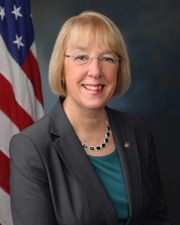 Sen. Patty Murray (D-WA)
Legislative Activity
Stay on top of the latest movement without scrolling through every action
Considered by Senate. (consideration: CR S1775, S1855)
February 6, 2009
View full timeline
Considered by Senate. (consideration: CR S1775, S1855)
February 6, 2009
Proposed amendment SA 110 withdrawn in Senate. (consideration: CR S1855)
February 6, 2009
Considered by Senate. (consideration: CR S1617)
February 5, 2009
Considered by Senate. (consideration: CR S1474)
February 4, 2009
Senate amendment submitted
February 3, 2009
Senate amendment proposed (on the floor): Amendment SA 110 proposed by Senator Murray to Amendment SA 98.(consideration: CR S1374-1387; text: CR S1374)
February 3, 2009
Roll call votes on amendments in Senate: Motion to waive the Budget Act with respect to amendment SA 110 (the section within the amendment regarding an emergency designation) rejected in Senate by Yea-Nay Vote. 58 - 39. Record Vote Number: 33.
February 3, 2009
Amendment SA 110 proposed by Senator Murray to Amendment SA 98. (consideration: CR S1374-1387; text: CR S1374) To strengthen the infrastructure investments made by the bill.
February 3, 2009
Point of order that an emergency designation within the amendment violates the CBA raised in Senate with respect to amendment SA 110.
February 3, 2009
Motion to waive the Budget Act with respect to amendment SA 110 (the section within the amendment regarding an emergency designation) rejected in Senate by Yea-Nay Vote. 58 - 39. Record Vote Number: 33.
February 3, 2009
The emergency designation within amendment SA 110 was stricken.
February 3, 2009
Votes
1 roll call on this amendment
Text
Proposed
AMERICAN RECOVERY AND REINVESTMENT ACT OF 2009

The ACTING PRESIDENT pro tempore. Under the previous order, the
Senate will resume consideration of H.R. 1, which the clerk will
report.
The legislative clerk read as follows:

A bill (H.R. 1) making supplemental appropriations for job
preservation and creation, infrastructure investment, energy
efficiency and science, assistance to the unemployed, and
State and local fiscal stabilization, for the fiscal year
ending September 30, 2009, and for other purposes.

The Senate resumed consideration of the bill.
Pending:

Reid (for Inouye-Baucus) amendment No. 98, in the nature of
a substitute.

The ACTING PRESIDENT pro tempore. The Senator from Montana is
recognized.
Mr. BAUCUS. Madam President, today, we continue consideration of the
economic recovery bill. Our country is facing a serious economic
challenge. America is in the middle of the most significant economic
downturn in the lifetimes of most Americans, and the bill before us is
a serious response.
The Finance and the Appropriations Committees have sought to assemble
the most effective tools available to help our economy recover. Ninety-
nine percent of the Finance Committee's response will take effect in
the first 19 months of the bill. I repeat: 99 percent of the Finance
Committee's response will take effect in the first 19 months of the
bill.

[[Page S1372]]

Today, we begin work in earnest on the bill. We hope to consider a
number of amendments. We have taken extraordinary steps to ensure the
Senate is considering this bill with a fair process. We posted the
Finance Committee part of the bill on the Internet last Friday, and
Chairman Inouye and I submitted our substitute amendment to the
Congressional Record last Friday as well. So the legislative text of
the measure before us has been available for 4 days.
During the Finance Committee's consideration of the bill in
committee, we had a thorough and open amendment process. The committee
considered the bill over the course of 11 hours. Senators filed more
than 200 amendments. The committee voted on 30 amendments.
As we proceed to consideration of the bill on the Senate floor, we
also hope to have an open amendment process. We hope it will proceed
much as it did on the children's health bill last week. As Senators
will recall, last week the Senate considered the children's health bill
over the course of 4 days. Senators offered 27 amendments, and the
Senate conducted rollcall votes on 14 amendments. I do not believe we
turned any Senator away from offering an amendment last week. We had a
thorough process, and the Senate passed the children's health bill with
an overwhelming 66-to-32 vote.
This week, on the economic recovery bill, we hope once again to
process a number of amendments. We intend to begin with an amendment by
the Senator from Washington, Senator Murray, regarding infrastructure.
This afternoon, we expect to consider amendments by Senator Mikulski
regarding automobiles, Senator Boxer regarding repatriation, and
Senator Feingold regarding earmarks.
We hope to consider multiple amendments during the day. This is a
significant bill. We have a work product from both the Appropriations
and the Finance Committees represented in the pending substitute.
Senators Inouye and Cochran will manage the bill for the appropriations
matters and Senator Grassley and I will be managing the bill for
finance matters.
I urge Senators to let the managers know of their intentions to offer
amendments. We will want to make sure the appropriate manager is here
to respond to the amendment. As much as possible, we would like to give
all Senators notice about what subjects will be coming up. In other
words, we are working on possibly grouping subjects so as to give
Senators a little more notice and to help make the process a little
more orderly.
I thank all Senators for their cooperation, and I look forward to a
healthy debate.
The ACTING PRESIDENT pro tempore. The Senator from Florida is
recognized.
Mr. NELSON of Florida. Madam President, I wish to talk about not just
the stimulus bill but how we need to address this overall economic
crisis, which the more we hear about, the worse it gets. If we don't
watch out, we are going to be in a downward economic spiral.
Look back to where we got into the mess. Wall Street allowed banks to
make too many bad home loans. They were home loans the homeowners could
not afford, and many times they were rushed into signing these kinds of
agreements when their income level would not support that kind of
mortgage. Then Wall Street bundled thousands of those mortgages--
sometimes you heard them referred to as subprime--and sold them as a
security. Those were bought and sold throughout the financial process,
from financial institution to financial institution. They were sold at
a profit. There was little or no regulation. Of course, the bankers
walked away with billions of dollars in bonuses and the taxpayers now
have to clean up the mess.
Well, what began as trouble in the housing market quickly spread to
the financial system and, from there, to the economy as a whole. The
revenue stream for these mortgages was cut off because people weren't
paying their monthly payments on the mortgages, and therefore the
revenue from these bundled securities of bad mortgages weren't paying
off, and that started rippling through the entire financial system for
whoever held those bundled mortgages.
What started as an American problem now has become a global problem.
Foreign governments, many of their investors, had invested in these
bundled securitized mortgages. Foreign governments have seen their
exports decline, and they are finding themselves shut out when they
seek loans from the world's banks. The banks aren't lending because
they do not have the security of knowledge that those borrowers are
going to pay off. Lo and behold, since this thing has spread globally,
even to foreign governments, some of the governments may even default
on their own debts, which would be a devastating blow for any nation.
That is a story that has yet to be told. We may have foreign
governments defaulting on their debts and going into insolvency. Such
defaults could clearly pose a national security threat for us, as
already fragile governments fall and are replaced by forces that are
hostile to American interests.
At the same time, our current economic crisis will soon become a
financing problem for our own Government. We are running up a large
tab. We are spending nearly $900 billion in this bill to stimulate the
economy. Maybe we are going to have to spend that much again to relieve
the banks of the toxic assets--these bad assets that are so
underwater--in order to get these toxic assets off the books of the
banks.
Well, when you look down the road, it is hard to fathom that we are
going to put this financial burden on our children, but economists--
conservative and liberal--across the spectrum agree that the burden
could be far worse if we don't take bold and immediate action, as
evidenced in what is on the floor of the Senate now. We need to act, we
need to act boldly, and we need to act now.
This economic recovery bill that we will consider this week begins to
move us in the right direction. Now, there ought to be some tweaks and
some iterations on it, and we are going to consider that in the
amendatory process, but let's consider the thrust of it. It funds
shovel-ready infrastructure--those projects that are ready to go--which
are going to strengthen our Nation while creating jobs in the
construction sector.
We heard the chairman of the Finance Committee say that over 90
percent of all the spending that occurs as a result of the tax cuts and
the tax incentives--he said over 90 percent of all the tax portion of
the bill is going to take effect in the first 19 months. Now that is
the kind of stimulus we need.
This bill provides health and education assistance to State
governments. It protects the most vulnerable, while putting money back
into the economy. The legislation before us creates incentives for the
private sector to put money into innovative ideas in health care
technology, in energy efficiency, and in a smarter electricity grid.
I think this bill moves us in the right direction. But we have to
watch out that we do not get sidetracked. We need to make sure we are
investing in sectors where the economy is idle, where Americans stand
ready to work on the projects we fund. As we debate the bill's tax
provisions, we need to make sure they provide incentives for employers
to create new well-paying jobs.
I saw something that is disturbing to me. I saw that a group of our
Senators is trying to do some cuts in this, and in a publication this
morning they singled out NASA, the National Aeronautics and Space
Administration. The chairman of the Appropriations Committee has helped
those of us who work in this kind of specialty here before the Senate.
What this group of Senators does not realize is that is directly
related to job stimulus because of the horrible situation we have
ourselves in where we are going to shut down our American vehicle to
get to space, the space shuttle, and it is going to be another 5 years,
under the present plan, to get the new rocket ready to get to our own
space station that we have built and paid for. As a result, the Kennedy
Space Center, the Johnson Space Center in Texas, and the Marshall Space
Center in Alabama are looking at massive layoffs. My space center in
Florida is looking at 5,000 jobs being laid off. The chairman of the
Appropriations Committee, who has an insight into this, has provided
that money for stimulus for those jobs. So let's keep that

[[Page S1373]]

goal in mind--jobs. That is what we want to do with this stimulus bill.
The legislation alone is not going to move us beyond the total
problem we are facing, the potential downward spiral. Experts, liberal
and conservative, now agree that the Nation's banks are going to need
ongoing support at a cost that might exceed what we have committed
already. If the banks are going to continue receiving Government
support, they must grant taxpayers a meaningful ownership stake. They
must boost lending to individuals and to small business, and they must
accept real limits on executive compensation.
Of course, there is another story chronicled in this morning's
newspapers about how all of these banks have gotten all of these
billions of dollars, and that not only has not increased lending, their
lending to borrowers has actually decreased. That is unacceptable.
If we provide the banks with more support--and I suspect we are going
to have to--in this next tranche of $350 billion, then we still are
going to have to address the mortgage foreclosure crisis, which is the
root cause of the current circumstance. We need a credible plan for
Government-backed mortgage refinancing, whether it is through Freddie
or Fannie, the FDIC, or whether we create a new loan facility that is
created specifically for that purpose. I talked to the Secretary of the
Treasury three times about this, and I am encouraged that the
administration appears to support such a plan.
I am telling you, every one of us knows that our constituents,
particularly those near retirement age and retired, are dramatically
concerned about the loss of their retirement savings which has
accompanied the markets' collapse.
Since the 1980s, what happened? We have seen a shift away from a
defined benefit pension, toward a market-based individual retirement
account. Many Americans now rely on such accounts as a vital source of
retirement income--the IRAs, the 401(k)s--and for those who have
reached retirement--and every one of us has a lot of retirees in our
State--or for those who hope to retire in the near future, the markets'
collapse has delayed or laid waste to their plans, all the while Wall
Street executives walk off with billions of dollars in bonuses. These
are folks who have worked. They played by the rules. They have saved
all of their lives. They deserve our attention more than the bankers
who got us into this mess.
I want to quote from an Indiana newspaper, the Evansville Courier. To
our colleagues from Indiana, I wish to compliment the editorial from
your newspaper on February 2:

The middle class retirees who saved in their IRA and 401(k)
plans, and who intended to use their Social Security
entitlement to supplement their investment income, and
thereby to live out their days in modest comfort, now face
the complete loss of that dream. It was not a dream of
luxury, just a hard-won freedom from daily work and maybe a
trip to somewhere warm in the winter.

That is what they saved for. And once this economy recovers--and it
will, hopefully sooner than many predict--we are still going to have a
lot of work that will remain. We need to look at the current causes of
our crisis, and we need to better regulate our financial markets. As
the economy recovers, we will need to keep a close eye on the Nation's
monetary policy. Interest rates now are at historic lows, and our
monetary policy is looser than it has been in decades. As we step on
the fiscal gas, in addition to the monetary loosening, we need to make
sure we do not overshoot the mark and trigger a new period of
inflation.
So our problems are many and our options are few. Things may get
worse before they get better. If we put aside the differences and
reason together, they will get better.
I yield the floor.
The ACTING PRESIDENT pro tempore. The Republican leader.
Mr. McCONNELL. I am going to proceed for a few moments on my leader
time.
Evidently, the President had a meeting with House and Senate
Democratic leadership last night, impressing upon them, obviously, the
urgency of approving a stimulus bill that actually works. But I think
it is safe to say that the version House Democrats approved last week
certainly does not meet that test. Most of the infrastructure
projections it includes would not impact the economy for at least a
year.
I was recently talking to my Governor, and he indicated basically
that the spend-outs were in year 2 and 3 in much of this, thereby kind
of illustrating my point that in terms of immediate impact, it is quite
deficient. Worse still, permanent spending--or what we call, inside the
Beltway, ``entitlement spending''--is actually increased by $200
billion.
The President has talked on a number of occasions--I know I have
spoken with him about it--about my willingness to work with him on a
bipartisan basis to get entitlements or permanent spending under
control. We know it is going to ruin our country in the near future.
This bill, in the name of stimulus, actually increases permanent
spending, entitlement spending, by $200 billion, making an already
incredibly difficult problem worse. As everybody--almost everybody--is
now fully aware, the House bill was, of course, additionally loaded
with wasteful spending. Unfortunately, the version Senate Democrats put
forth is not a whole lot better.
President Obama said 75 percent of the bill's discretionary projects
should be paid for within 2 years. Yet more than half of the spending
in the Senate version would not be spent until after 2 years. President
Obama said 40 percent of the bill should be tax relief. Yet less than
one-third of the spending in the Senate version would go to tax relief.
And like the House bill, the spending portion in the Senate version is
simply way too big. The spending portion is way too big. If you include
the interest payments on all of this money we are purportedly about to
spend, the Senate Democratic bill is nearly $1.3 trillion. So I cannot
imagine President Obama is terribly pleased with the proposal Democrats
in the House or the Senate have put forward at this point. I am hoping
he convinced them last night that it is time to put forth, together, a
bill that gives an immediate jolt to the economy and creates jobs right
now, not a bill that increases permanent spending, not a bill that
spends out in years 3 and 4. A stimulus package ought to do something
right now to stimulate the economy.
President Obama has acknowledged that Senate Republicans have a
number of good ideas that he would like to incorporate into the final
bill. So has the senior Senator from New York. Republicans will be
pursuing these ideas this week, and how they would help President Obama
achieve his goal for the stimulus bill. We Republicans think we can
send the President a simpler, more targeted stimulus bill that gets
right at the root of our current economic troubles, that does not waste
money we do not have on projects that do not create jobs now.
Most people recognize that housing is at the root of the current
economic downturn, so we would fix this problem before we do anything
else. Republicans believe that one way to do that is to provide a
Government-backed, 30-year fixed mortgage at approximately 4 percent to
any creditworthy borrower. That would reduce monthly mortgage payments
and increase demand for homes. According to this proposal, the average
family would see its monthly mortgage payment drop by over $400 a
month. That comes out to over $5,000 a year. Over the life of a 30-year
loan, that is a savings of over $150,000. That is a proposal to get
right at the housing problem now.

Next, in order to get money into the economy quickly, Republicans
propose that we cut income tax rates for working Americans right now.
The Federal Government imposes a 10-percent tax on married couples for
incomes up to $16,700. By cutting that rate in half, we put $500 into
the pockets of every working family and give an immediate jolt to the
country. Incomes between $16,700 and $67,900 are taxed at 15 percent.
Republicans would cut that rate to 10 percent, putting another $1,100
into the pockets of working couples. And single filers would get
similar rate reductions. In other words, everyone who works and pays
income taxes would see an immediate increase in pay. This simpler,
targeted plan gets at the root of the problem, which is housing. It
puts money into people's pockets immediately.
President Obama asked Congress to put together a bill without
wasteful

[[Page S1374]]

spending that creates jobs now. We Republicans believe we have better
ideas for doing both. We look forward to having the chance to explain
these ideas this week to the American people through our amendments,
and we look forward to having votes on those amendments in the hope
that many of them will pass.
I yield the floor.
The ACTING PRESIDENT pro tempore. The Senator from Washington State
is recognized.

Amendment No. 110 to Amendment No. 98

Mrs. MURRAY. Madam President, I send an amendment to the desk on
behalf of myself, Senator Feinstein, Mr. Specter, Mr. Reid, Mr. Durbin,
Mr. Dodd, Mrs. Boxer, Mr. Leahy, Ms. Mikulski, Mr. Lautenberg, Ms.
Stabenow, Mr. Levin, Mr. Brown, Mr. Cardin, Mr. Sanders, Mr. Lieberman,
Ms. Cantwell, Mr. Udall of Colorado, Mr. Whitehouse, Mr. Begich, and
Mr. Reed of Rhode Island, and I ask for its immediate consideration.
The ACTING PRESIDENT pro tempore. The clerk will report.
The legislative clerk read as follows:

The Senator from Washington [Mrs. Murray], for herself,
Mrs. Feinstein, Mr. Specter, Mr. Reid, Mr. Durbin, Mr. Dodd,
Mrs. Boxer, Mr. Leahy, Ms. Mikulski, Mr. Lautenberg, Ms.
Stabenow, Mr. Levin, Mr. Brown, Mr. Cardin, Mr. Sanders, Mr.
Lieberman, Ms. Cantwell, Mr. Udall of Colorado, Mr.
Whitehouse, Mr. Begich, and Mr. Reed of Rhode Island,
proposes an amendment numbered 110 to amendment No. 98.

Mrs. MURRAY. Madam President, I ask unanimous consent that the
reading of the amendment be dispensed with.
The ACTING PRESIDENT pro tempore. Without objection, it is so
ordered.
The amendment (No. 110) is as follows:

(Purpose: To strengthen the infrastructure investments made by the
bill)

Beginning on page 118, line 4, strike ``$6,400,000,000, to
remain available'' and all that follows through
``$2,000,000,000 shall be for'' and insert in-lieu thereof
``$13,400,000,000, to remain available until September 30,
2010, of which $10,000,000,000 shall be for making
capitalization grants for the Clean Water State Revolving
Funds under title VI of the Federal Water Pollution Control
Act, as amended; of which $3,000,000,000 shall be for''.
On page 232, line 16, insert ``and other surface
transportation'' prior to the word ``investment'', ``
On page 232, line 20, strike ``$27,060,000,000'' and insert
``$40,060,000,000''.
On page 239, line 24, strike ``$8,400,000,000'' and insert
``$10,400,000,000''.
On page 242, after line 10, insert the following:

Supplemental Grants for Fixed Guideway Modernization

For an additional amount for capital expenditures
authorized under section 5309(b)(2), $2,000,000,000, to
remain available through September 30, 2010: Provided, That
the Secretary of Transportation shall apportion the funding
provided under this heading using the formula set forth in
subsection 5337(a)(7) of title 49, United States Code:
Provided further, That the federal share of the costs for
which a grant is made under this heading shall be at the
option of the recipient, and may be up to 100 percent:
Provided further, That the funds appropriated under this
heading shall not be commingled with funds available under
the Formula and Bus Grants account.

Supplemental Funds for Capital Investment Grants

For an additional amount for ``Capital Investment Grants''
as authorized under section 5338(c)(4) of title 49, United
States Code, and allocated under section 5309(m)(2)(A) of
such title, to enable the Secretary of Transportation to make
discretionary grants as authorized by section 5309(d) and (e)
of such title, $1,000,000,000, to remain available through
September 30, 2011: Provided, That in awarding grants with
funding provided under this heading, the Secretary shall give
priority to projects that the grant funding can expedite
their completion and their entry into revenue service:
Provided further, That such funding shall be allocated
without regard to the requirements of section
5309(m)(2)(A)(i) of title 49, United States Code: Provided
further, That the federal share of the costs for which a
grant is made under this heading shall be at the option of
the recipient, and may be up to 100 percent: Provided
further, That the funds appropriated under this heading shall
not be commingled with funds available under the Capital
Investment Grants account.
Each amount provided in this amendment is designated as an
emergency requirement and necessary to meet emergency needs
pursuant to section 204(a) of S. Con. Res. 21 (110th
Congress) and section 301(b)(2) of S. Con. Res. 70 (110th
Congress), the concurrent resolutions on the budget for
fiscal years 2008 and 2009.

Mrs. MURRAY. Madam President, last year was tragic for workers who
lost their jobs and their homes in this economic crisis. Through no
fault of their own, millions of people are now wondering where they are
going to find the next dollar to pay for groceries or to keep a roof
over their heads. For them, putting money away to save for college or
for a secure retirement is simply a dream. It is clear we need to take
bold action to get us through this recession and back on the road to
economic recovery. I believe the American recovery and reinvestment
plan now before the Senate is that kind of bold investment.
Before I continue, I particularly congratulate our new Appropriations
chairman, Senator Inouye, and commend him for his management and
tremendous work on getting this bill and this part of it to the floor.
He has always shown evenhandedness and poise, as he has managed dozens
of bills on the Commerce and Appropriations Committees. We are very
fortunate to have him as our chairman on the Appropriations Committee,
helping us with this critical piece of legislation. I also thank our
former chairman and ranking member for his long dedication to the
Appropriations Committee, Senator Cochran. I truly appreciate his
contribution to this committee.
I rise to offer an amendment that will make this good bill even
better by boosting our investment in infrastructure and creating
thousands more good-paying American jobs. Our economy needs a jolt. We
have to create jobs, and we have to get commerce going again. I believe
one of the best ways we can do that and bring stability to communities
is by investing in construction projects throughout the entire country.
The amendment I offer today will get more than 650,000 Americans back
to work by injecting $25 billion into our highways and roads, mass
transit systems, and water and sewer networks.
Investing in construction projects is the tried and true way to put
people back to work. My amendment not only supports over 650,000 jobs,
it supports the kind of good-paying jobs we desperately need to help
families put meals on the table or send their kids to school or save a
little money for retirement. These are also the jobs our State
Governors and local mayors say they are praying for to help their
communities. States and municipalities have felt the economic crisis
particularly hard. They have had to make some painful cuts and layoffs.
They are even canceling projects now under way to conserve cash. This
weekend Governor Granholm from Michigan told CNN that her State could
``have dirt flying within 180 days'' if we pass a bill that increases
Federal infrastructure investments.
With the amendment we are offering today, States such as Michigan
could create jobs as fast as they are able to spend the money, and
thousands of people in all 50 States would benefit. It would support,
for example, more than 18,000 jobs in Georgia, 27,600 jobs in Florida,
over 20,000 jobs in Michigan, more than 13,000 jobs in the State of
Washington, to name a few.
I ask unanimous consent to print in the Record a chart that displays
what this will do for every State.
There being no objection, the material was ordered to be printed in
the Record, as follows:

[[Page S1375]]

[GRAPHIC] [TIFF OMITTED] TS03FE09.001

[[Page S1376]]

Mrs. MURRAY. But this amendment doesn't only help the economy today
by creating new jobs. This amendment will literally pave the way for
future economic growth across the country. These investments will help
communities provide cleaner drinking water and roads that are free of
congestion. They will help create modern railroads that will get
workers to their jobs more quickly and safely. They will help improve
our ports so they are more efficient and more competitive. We all know
businesses need good transportation and stable water and sewer systems.
Less traffic means more productivity, cleaner air, and a stronger
economy. These investments will pay off for years to come because
communities will be stronger and more competitive in the global
economy.
Finally, this amendment is critically needed because roads, bridges,
and water and sewer systems are literally falling apart. Year after
year, we have had to put off repairs, while we have spent billions of
dollars in the wars in Iraq and Afghanistan. In August of 2007, we all
stood aghast and watched in horror as the I-35W bridge in Minneapolis
collapsed into the Mississippi River. That tragedy brought home to
everyone how critical it is that we invest in the national highway
system.
Last week, we had another reminder when the American Society of Civil
Engineers issued its annual report card on the condition of America's
infrastructure. The results were truly dismal. The leading experts on
the state of our Nation's infrastructure have reduced the grade point
average of our entire system of roads and bridges and transit and sewer
plants to a D. Let me make it clear, that was a D average for all of
the Nation's infrastructure. Several specific areas which I am
targeting in the amendment did even worse. Wastewater treatment
systems, on which I have worked with Senator Feinstein, got a D-minus.
The engineers pointed out that leaking pipes across the country lose an
estimated 7 billion gallons of drinking water each and every day. The
Nation's roads got a D-minus since a third of the major roads are
considered to be in poor or mediocre condition. More than a third of
urban highways are congested. American families now spend about 4.2
billion hours each year stuck in traffic. That is costing the economy
almost $80 billion every single year. These are roads in every one of
the States. It is time to fix them.
Our transit systems only got a D, but that is still not acceptable.
With ridership skyrocketing, it could get worse, if we don't make the
upgrades and improvements so dramatically needed.
Speaking as a mom and a former teacher, a D-minus or a D is not going
to cut it. As far as I am concerned, when it comes to infrastructure, a
D stands for disappointment. A D means demand change, demand attention,
and demand investment.
The amendment I have offered is going to help us address these
deficiencies head on and put over 655,000 Americans back to work. For
any of my colleagues who are worried about whether we can spend
infrastructure dollars fast enough, I want to be clear: More than a
million workers across the country are today ready and able to start
tomorrow. The unemployment rate in the construction industry is now
just under 16 percent. More than 1.5 million construction workers are
out of a job, a 54-percent increase over a year ago. Skilled workers
all across the country are now forced to try to pick up whatever odd
jobs they can to pay for their week's groceries. This amendment is
about bringing jobs back to those workers and stability to their
families and making the kinds of investments America has ignored for
too long.
I am proposing in the amendment that we invest another $25 billion in
this bill, bringing the total spending on infrastructure to $167
billion. My amendment would increase transportation investments from
$45.5 billion to more than $63.5 billion, with the largest boost going
to highway construction. It would give all States and communities the
equivalent of 2 years of Federal highway contributions at once,
enabling them to support 362,000 construction jobs alone, and another
$5 billion would go to mass transit, supporting 139,000 jobs. Senator
Feinstein will discuss how it will increase water and sewer grants
within the Environmental Protection Agency by $7 billion, supporting
154,000 new jobs.
It is a scary time for millions of families across America. They are
extremely worried about their stability and the future of their
families. They are worried about how they will pay their bills and
whether they will be able to keep their homes. They have put their
faith in all of us and in our new President to set us on a path that
will not only turn things around but leave our country stronger and
more resilient than ever. Today they are watching this debate, and they
are expecting us to take bold, swift action to get us started. This
amendment is that kind of bold action. It supports 655,000 new, good-
paying jobs. It will help us rebuild roads, bridges, mass transit
networks, water and sewer systems that we have neglected for too long.
Most importantly, these investments will leave communities stronger and
more secure in the future.
I urge my colleagues to support the amendment and help put thousands
of American workers back on the job and the country back on its feet.
The ACTING PRESIDENT pro tempore. The Senator from Hawaii.
Mr. INOUYE. Will the Senator yield?
Mrs. MURRAY. I am happy to yield.
Mr. INOUYE. I am extremely impressed by the Senator's presentation. I
am proud to say that I support the measure. It will provide 655,000 new
jobs. As the boys in the back room would say: This is just what the
doctor ordered. Congratulations.
Mrs. MURRAY. I thank the Senator.
The PRESIDING OFFICER (Mr. Udall of New Mexico). The Senator from
Iowa.
Mr. GRASSLEY. Mr. President, the matter before this body is the
majority's stimulus bill. It merges the products of last week's markup
in the Finance Committee and the Appropriations Committee. Twenty-three
Senators were involved in the Finance Committee markup. In that group,
there were 13 Democrats, 10 Republicans. Thirty Senators were involved
in the other committee's markup, the Appropriations Committee. In that
group, there were 17 Democrats and 13 Republicans. So if we add that
up, it means over half the Senate has been involved in either the
Finance Committee part or the Appropriations Committee part of this
legislation. For the first time, however, all Senators will have to
consider this very large and complicated piece of legislation. That
started yesterday and will go on for a week. So the public who want to
follow Congress will have a long time to follow the issue.
We ought to take that sort of time with an $800, almost $900 billion
piece of legislation. First, I will discuss process and then focus on
substance. Because I am the senior Republican on the Finance Committee,
I will focus on the Finance Committee's portion. I, like 69 other
Senators, am still studying the Appropriations Committee part.
First, I thank my friend from Montana, Chairman Baucus, for
courteously and professionally consulting Members on this side. We had
one bipartisan Members' meeting where Chairman Baucus patiently heard
all of us out. In addition, Chairman Baucus apprised me of the
negotiations between Democratic leadership of both bodies and the Obama
administration. Those Democrats-only negotiations were extensive. Folks
on our side who read press reports could see how extensive they were.
Further evidence of that deal making is the relatively small
differences between the basic structure of the Committee on Ways and
Means of the House of Representatives and the Finance Committee of the
Senate. I congratulate Chairman Baucus on those negotiations. The fruit
of that labor is the Finance Committee package.
One significant change followed a recommendation I made in early
January. That change was made in committee. That was the addition of
the alternative minimum tax patch for this year which means over 24
million families need not worry about an average tax increase of at
least $2,000 per family for this year. But let no one be mistaken that
this bill is the result of bipartisan negotiations. While Republicans
were courteously consulted at the Member and staff level, we were never
at the negotiating table. Speaker Pelosi best described the bottom line
of the process from the Washington

[[Page S1377]]

Post, dated Friday January 23, when she said:

Yes, we wrote the bill. Yes, we won the election.

Indeed, there was a rumor floating around about an informal agreement
among Democratic Members. The agreement appeared to be to vote against
any Republican amendments, no matter what the merits of the amendments
might be. As proof of that, if one would review the markup, they will
find that nearly all Republican amendments were defeated on a virtually
party-line vote. They will also find, for the first time in recent
Finance Committee tax legislative history, small issues or
modifications raised by dissenting Members, with a couple exceptions. I
thank the leadership for those exceptions. None of these smaller issues
were even accommodated.

So let's be clear. We knew at the outset the markup would be
ratifying a deal made between Democratic leaders of the House and
Senate: No Republican ideas need apply. With the exception of that AMT
patch amendment, this was the basic outcome.
Since the largely partisan markup process finished, we have been told
by the President and members of the Democratic leadership that this
bill is open to improvement by amendment, and I am hopeful we will see
that follow through, and before the day is over, I am sure we are going
to have some votes where we can do that.
If I could define ``bipartisanship'' just for a minute, I would
define it kind of the way I have seen it work over the past decade in
the Finance Committee but probably other committees do the same thing.
Days before you want to bring up a bill, you sit down and you negotiate
between the two leaders, and maybe other people, but you consider every
member's position to some extent, and you come out with what is called
a bipartisan mark.
In our committee, for some times that was Grassley-Baucus, for other
times it was Baucus-Grassley. It is a little bit like buying a new car.
If it is going to be a family operation, Chuck Grassley does not go up
to Barbara Grassley and say: I have made a determination that we are
going to buy a Ford Taurus, and it is going to be blue, and it is going
to have these accessories, et cetera, et cetera. No. You sit down.
Chuck and Barbara Grassley sit down, and we decide what color car do we
want, what brand do we want, what do we want for accessories, et
cetera, et cetera. And you go to the dealer, and you have a uniform
family position of what kind of a car you buy.
That is the way bipartisanship ought to work here. That is the way I
define it. That is the way it has worked over a long period of time.
But it is not the way it worked in the product we have before us.
Now we have the President of the United States saying to leaders of
his party, when they meet at the White House: Republicans have good
ideas, and we want to work toward bipartisanship. Now we have a process
in place. Will the President's leadership make a difference to the
majority party here on Capitol Hill?
Before I get into substance, though, I wish to pull back and talk
about the larger picture for a couple minutes. Majority Leader Reid
opened debate on this bill yesterday. Yesterday we also had Groundhog
Day. My first chart is a depiction of Punxsutawney Phil, that famous
weather forecaster there in Pennsylvania. Yesterday, Phil saw his
shadow. Groundhog Day is a recurring event. ``Groundhog Day'' is also
the title of a famous film starring Bill Murray.
I have another picture for you of Phil and Bill driving along. In the
movie ``Groundhog Day,'' Bill Murray finds himself continually
repeating the same routine. Now, my friend, Chairman Baucus, last year
rightly pointed out the message of the film. The message was that Bill,
guided by Phil, eventually had to figure out what he was doing wrong.
Once Bill figured it out, he escaped the infinite loop.
On this bill before us, we need to learn from Bill's and Phil's
adventure. We cannot and we should not legislate in a hasty manner and
place ourselves in an infinite loop of repeating the same exercise.
Democrats and Republicans and the President need to get this right,
particularly in the time of the terrible economic recession we are in.
We cannot casually deficit spend and ask American taxpayers to clean up
the fiscal mess with high taxes down the road.
To me, there is a particularly compelling irony to the fact that we
are debating another stimulus bill at roughly the same Groundhog Day
timeframe. One year ago, almost to this exact date, the Senate spent a
week debating an economic stimulus package. The target time set for
enacting legislation was similar to the one for this package. I am
talking about the Presidents Day recess. Let's keep the Groundhog Day
irony in mind as we move forward this week and next week. Let's not
repeat the same exercise, except this time with even much bigger
dollars. Let's get it right.
Now to substance. I want to make it clear that most on our side agree
with President Obama that stimulus is necessary. The economy is flat on
its back. Too many Americans who want to find work cannot find those
jobs. A lot of Americans are worried their job will be the next to go.
We get that on our side. Everyone here knows we need to do everything
we can to get the economy moving again. Where we differ between parties
is the degree to which the engine ought to be Government or the engine
ought to be the private sector, especially America's biggest job
creator, our small business sector, where you hear quite regularly from
economists that 70, 80 percent of the new jobs are created. In fact, in
the year 2007, big business created no new jobs. All the new jobs in
2007 were created by small business.
These are honest, well-intentioned, philosophical differences between
our two parties: Government or the private sector. But those are
differences that are there. On our side, we want the new jobs to come
from the private sector. On the other side, the preference is to grow
employment through an expansion of Government.
Many on the other side and opinion makers who agree with them are
invoking the example of Iowa-born President Hoover. Iowa is my home
State. They seem to be doing it to portray anyone who questions the
trillion-dollar package as a reincarnation of what we call Hoover
economics. It is an unfair characterization. Again, let's be clear.
Folks on our side recognize the need for action. So do not accuse us of
Hooverism.
Also, though Iowans are rightly respectful of the only Iowan to be
President, President Hoover, you have to recognize history. I would
instruct the other side on a couple lessons from the Hoover era, too,
where President Hoover was wrong. One lesson: Do not obstruct free
trade. The highest tariff levels in the history of this country--the
Smoot-Hawley tariffs--were enacted in the middle of his Presidency, and
it shut down world trade. We have to think about that right now because
the latest reports have the first reversal of the growth of trade
worldwide since 1982. There is little doubt those protectionist
barriers that were put up in 1930 or 1931 made the Great Depression
worse. So let's not repeat that mistake. There is some evidence on the
other side of the aisle that they do want to repeat that mistake and
build up protectionist walls.
Now, there is another lesson from the Hoover era I want the other
side to be aware of. President Hoover signed into law significant tax
increases that made that Depression worse. Like high tariffs, economic
history tells us that these burdensome taxes retarded the economy's
ability to recover--a recovery that did not happen until World War II
came along. We do not want war to get us out of a recession.

On this side, we agree the lessons from the Hoover era need to be
learned. We cannot be passive. President Hoover was passive. Errors of
omission on fiscal stimulus should be avoided by all of us. Likewise,
errors of commission on fiscal stimulus, such as impeding free trade
and raising taxes, also should be avoided.
By the conclusion of this debate, those differences will be plain to
people at the grassroots of America. I will tell you, all you have to
do is go to Iowa, go to church on Sunday, go eat at the Village Inn
after church with your family, go to a University of Northern Iowa
basketball game, and talk to your neighbors. The public knows what is
going on here. They see this as a big spending bill and not a stimulus
bill.

[[Page S1378]]

We will see differences fleshed out in the debate and on the
amendments. That is the way it should be. As I indicated above, most on
our side want to improve this bill. Our amendments, large and small,
will be offered as improvements. We hope the other side is sincere and
will follow our President's admonition yesterday in their desire to
change the bill in a way that can garner a bipartisan majority. Whether
Republicans or Democrats have been in control, the test of proper
stimulus boils down to three words.
That famous Harvard economist, former Secretary of the Treasury, a
good person, Larry Summers, had this to say that ought to be a lesson
for both political parties:

As with any potent medicine, stimulus, if misadministered,
could do more harm than good by increasing instability and
creating long run problems. A stimulus program should be
timely, targeted, and temporary.

He may not be an MD, but there is a lesson from that Ph.D. we can
learn. It is a lesson of medicine: First, do no harm. Well, we want to
measure this bill according to what Dr. Summers says. If you apply the
three ``T's'' test to much of the spending in this proposal, you will
find it fails the test. We will get into that when we examine and
debate the bill.
Some folks might ask: What is the problem if we overshoot and flunk
the test? The first problem is running out of budget room. The bill
before us will, when interest costs are included, add up beyond that
$900 billion to $1.3 trillion added to the deficit. All of this extra
deficit increase would be proposed when the baseline deficit for this
fiscal year will hit $1.2 trillion. That amount exceeds all historical
records. As a percentage of our economy, that will mean 8.3 percent of
gross domestic product.
I have read some economists saying that is more stimulus than we have
ever had in the history of this country. Maybe 8.3 percent is enough. I
think in a bipartisan way, and with the President, we concluded it is
not enough. But above that, it seems to me, we ought to be cautious and
make sure it is timely, temporary, and targeted because this amount of
8.3 percent easily exceeds the 5.7 percent in 1983. It is almost 50
percent above any comparable post-World War II levels.
The figures on Federal debt held by the public are likewise
staggering. In the period of 2001 to 2007, debt held by the public
increased by comparatively smaller amounts, roughly 1 percent per year.
This year's change easily exceeds all of that, as you can see from this
chart of how the deficit continues to go up. You also see it there, as
a percent of gross national product, higher than it has been for a 40-
year average.
So we need to acknowledge the deficit situation we are in. It is very
serious. So whatever we do, we ought to not make the long-term fiscal
situation worse than it is. You can see from this chart in the outyears
how bad that situation is going to be.
The other problem is if we prime the pump too much and the pumped-out
stimulus does not materialize until after the hoped-for recovery is
upon us, then we might risk too much stimulus. The result could be
inflation.
Let's look at the timely part of Dr. Summers' statement. That needs
to be brought into sharper focus. The Congressional Budget Office tells
us that less than half of the appropriations amounts will be spent out
by the end of fiscal year 2010. So only half of the spending in the
bill is timely. The Finance package does a little better. Ironically,
the tax policy stimulus, much maligned by the hardcore of both
Democratic caucuses, helps the spend-out ratio greatly in the Finance
package.
The theory for erring on the side of overloading the spending side is
that we need to direct dollars to the folks most likely to spend them.
This is the reason we are told we need extra FMAP money, expanded
entitlements, and other State aid.
It misses the point that the U.S. fiscal policy system already has an
arsenal of antirecessionary automatic stabilizers directed to the very
same populations. These stabilizers provide immediate assistance to
those most vulnerable who have been hit by an economic downturn. The
Congressional Budget Office says that these benefits, including food
stamps, unemployment insurance, and Medicaid, will grow to $250 billion
this year. That built-in, lower income-population stimulus will be
equal to 1.8 percent of gross national product.
It also misses the point, when you argue that you ought to err on the
side of overspending, about ensuring that the lessons of moral hazards
apply to the States. The fiscal problems faced by many of our States
and localities are largely the result of their inability to keep
spending in line with revenue. Between the third quarter of 2006 and
the third quarter of 2008, State revenues increased 7 percent and State
spending increased twice that amount--15 percent. In other words, the
States and localities spent $2.22 for each additional dollar of
revenue. The States have been on a spending spree, and they have dug
themselves into a hole.
Now, we will hear that the Medicaid money we are adding--which I
refer to as a slush fund for States--is necessary to avoid tax
increases at the State and local level. We will also hear that vital
services will be cut unless we cut a big blank check to States. Just as
we did during the Finance Committee markup, some on our side will test
these assumptions with amendments on these points. An open-ended slush
fund is not targeted. It is not going to bring about sound, responsible
fiscal policy in the States that need it, and this is true no matter
how you dress up this issue.
Perhaps the most disturbing stimulus test failure is on the third
``t''--that it should be temporary. This is what bothers me most about
this bill. I am referring, of course, to the temporary test. In this
package, there are many new popular spending programs labeled
``temporary.'' Those programs total $140 billion. If these programs are
extended or made permanent, we can expect another $1.3 trillion added
to future deficits. I will challenge anyone on the other side to tell
me these programs will be turned off once enacted. With large
Democratic majorities and a Democratic President, I would say any such
promise is dubious in this Congress. It is about as deliverable as a
promise to sell the Brooklyn Bridge.
Just so appropriators don't get too far out on a limb, I wish to
quote from what Chairman Miller of one of the House committees had to
say. He was talking about these built-in expenditures that are going to
go beyond the 2 years; things that ought to be handled by the
Appropriations Committee on an annual basis, considering all of the
priorities that come to us from all segments of the economy and from
all government programs. If you think you are building this into the
base, this is Chairman Miller--I am going to quote here from Congress
Daily:

Chairman Miller in the House was asked about the fact that
funding for education programs disappears in two years, and
he said the word he got from the Obama administration is that
these funding levels will NOT become the baseline and that in
two years, we can expect that the President's Budget Request
will be lower than these new levels. That means schools will
see a short-term jump for these programs, but any teacher or
programs they put in place may be cut in two years.

Now, let me just ask my colleagues about that. Is it smart to use
something that is absolutely needed--a stimulus bill--for an excuse to
jack up spending well into the future? That is going to be done in 1
week. Isn't that something appropriations committees generally take
several months to do before they make decisions to go down that road?
That is something for my colleagues to consider.
To sum it up, this package meets a different three t's test. We start
with trillion-dollar deficits. We have a bill that, with interest
added, adds more than another trillion dollars to future deficits. We
have a bill that has new spending ostensibly labeled as ``temporary''
but likely to be extended, that bakes into the cake another $1 trillion
of future deficits. Passing this three t's--as in trillions--test ought
to be a Senator's pause, and we hope during this debate that pause
happens. From our side's view, these are major shortcomings on the
substance.
Although we saw execution of a deal to vote down our amendments in
committee no matter whether our ideas were meritorious or not, we would
like to be and will be constructive, and we will build on parts of the
package that we support. But make no mistake about it, we are going to
try to use Dr. Summers' guideline of, first, do no harm--he didn't say
that--but the

[[Page S1379]]

three t's test he put on the chart from his quotation. In other words,
we hope our amendments will be more openly received on the Senate floor
than they were in committee.
In this respect, we will go back to major differences between the
parties on how to get the economy moving. On our side, we would like to
push more incentives for long-term growth of private sector jobs. There
is a good start on a broad-based middle-income tax cut in the package.
We would like to expand the tax cut to cover all middle-income
taxpayers.
During this fall's campaign, the President described as middle class
families making less than $250,000. Many of the tax cuts don't apply to
millions of families making less than $250,000. It doesn't make sense
to me to call a proposal a middle-class tax cut if it doesn't apply to
millions of middle-class families. We would like to direct that at
labor and capital income earned by middle-income taxpayers.
Since we weren't at the negotiating table to offer these progrowth
ideas, you will see them arise as constructive offers to improve the
package.
I wish to speak for just a minute to some health provisions in the
bill.
Spending in this bill should be judged based on two criteria: Will it
stimulate the economy, and is the money being well spent? In committee,
we aired our honest disagreements over whether several of these
provisions were actually stimulative. Improving health information
technology is critical for health care infrastructure. I support many
of those provisions, but I have to ask: Will it stimulate our economy,
and is this money we should add to the deficit rather than offsetting
it?
It wasn't so long ago that $16 billion was a lot of money around
here. Providing assistance to States makes sense if we are concerned
about States raising taxes or cutting spending. But is $87 billion the
right number, and is increasing Medicaid spending the right way to do
it beyond what is necessary to take care of the millions of people who
are going to lose their health insurance? That is a much smaller
figure; somewhere around $10 billion to $12 billion rather than $87
billion. Could we better stimulate economic recovery using all or part
of that money elsewhere?
The Finance Committee package also includes a 2-year extension of our
current Trade Adjustment Assistance Programs. I am working with the
chairman to see if we can agree with our counterparts on the House Ways
and Means Committee on a broader reauthorization of these programs, but
that is still a work in progress.
Apart from trade adjustment assistance, I am disappointed that this
administration isn't focusing on trade as a component of an economic
stimulus package. As I said, we should heed an important lesson from
the Hoover era. Economic growth comes from expanding free trade, not
contracting it, because protectionism in the 1930s brought us to World
War II. Opening new markets for U.S. exporters should be a part of the
mindset to stimulate our economy.
Right now, 20,000 people are being laid off from Caterpillar. I don't
think John Deere has laid off very many yet, but 22 percent of John
Deere workers have their jobs because of international trade--tractors
made in Waterloo, IA, getting on boats in Baltimore to go overseas. We
don't want to shut down those kinds of jobs, and without emphasis upon
trade being a very important part of a stimulus package, we are sending
a message that trade does not matter. Trade does matter. For instance,
we have these pending agreements with Colombia, Panama, and South Korea
which would provide significant opportunity to do just that, and they
should be implemented as soon as possible.
As we go through the bill, our side will offer several amendments
that I hope will be accepted to try to make the bill better and answer
the questions I and other Members have raised. The people back home see
Congress spending vast amounts of taxpayers' money. They are counting
on us to ensure their money is spent wisely and not wastefully, and
that means to make sure this is a stimulus bill and not a ``porkulus''
bill.
I thank the Chair, and I yield the floor.
The PRESIDING OFFICER. The Senator from Montana is recognized.
Mr. BAUCUS. Mr. President, I will be very brief. I know the Senator
from California wishes to make a statement.
Very briefly, I might just say first how much I enjoy working with my
good friend, Senator Grassley from Iowa. He is a joy to work with. I
know of no finer Senator. He is a man of his word. He is a man of
integrity and good will. He is a terrific Senator. I have enjoyed
working with him on the committee in many respects.
I also wish to thank him for his kind words about the openness with
which I have attempted to conduct the committee. I also wish to commend
him for his AMT amendment to make sure Americans don't pay more taxes
over the next year. The amendment he offered, as well as the Senator
from New Jersey, Mr. Menendez--the two of them offering the amendment
was the right thing to do. Some have suggested we drop that amendment.
I vigorously resisted that because I think it is a good idea that we
have the AMT patch.
There are other provisions in here which remind all of us to help
taxpayers. One is extending the small business expensing provision for
2 years. That is going to help small business. That also included an
entire threshold that was enacted last year. Added to that, we have
payback periods for net operating loss extended from 2 years to 5
years, as well as business tax credits extended from 2 years to 5
years. So businesses can carry back losses with respect to credits they
have otherwise earned, whether it is an R&D tax credit or an energy
credit.
So I want to continue working with the good Senator from Iowa as we
improve this bill. I do not know whether I agree with all of the
amendments some Senators on his side of the aisle will be offering, but
we will certainly do our very best to keep improving the bill. There
are some very good tax provisions in here to help individual taxpayers
and business taxpayers.
So I just wish to thank the Senator for working with us on this.
I yield the floor.
The PRESIDING OFFICER. The Senator from California is recognized.
Mrs. FEINSTEIN. Mr. President, I rise in support of the amendment
Senator Murray has just sent to the desk which would add $25 billion to
the infrastructure portion of the bill. I thank her for her work on
this amendment.
I also thank the chairman of the committee, Senator Inouye. Senator
Inouye became chairman of the committee approximately 1 week before
this bill came out of committee, so it really represents a great deal
of work in a very short period of time, and I believe he is to be
commended for that.
In my view, as a former mayor, a stimulus means job production, very
simply. As this bill stands, only 16 percent of the stimulus package
goes toward infrastructure, which is the physical basis on which a
nation's economy functions, while 39 percent would finance tax cuts.
To be very candid with you, I am one of those who do not believe tax
cuts are necessarily stimulative. The reason I don't believe that is
because I believe the buying habits of Americans in this particular
crisis have changed. I don't think $80 a month in the form of a tax
credit is going to change that. We put $135 billion out in a rebate,
and less than 15 percent of it, it was estimated--by the best chance--
went into the economy. So I really worry that this package is tax cut
heavy and doesn't do what it should do with respect to the production
of jobs to repair this physical base on which a nation's economy can
function.
The amendment, as Senator Murray said, is cosponsored by 21 of us. I
very much appreciate all of the Senators' support. It adds $18 billion
for highway and rail. Those of you who have ridden high-speed rail from
Tokyo and Osaka know that it was built in the mid-sixties. Here we are
in 2009, and we don't have a real high-speed rail, either by MAGLEV or
steel wheel, anywhere in this country today. If you travel through
Europe, you travel on fast trains. If you go from Pudong in Shanghai to
the airport by transit, you can take a MAGLEV system, which does 30
miles in less than 20 minutes. Our highways are jammed. People go to
work in gridlock. The newspaper this morning reported that metropolitan
Washington, D.C. has some of the highest commuter travel times in
America.

[[Page S1380]]

We need to repair this infrastructure, and the beauty of doing it as
part of this package is that it puts people to work immediately on
projects that are shovel ready. So I believe $18 billion in this bill,
which is for highway and rail, and an additional $7 billion in
revolving loan funds for clean water and sewer projects is really
necessary. You might say: $25 billion--what does that do in this
package? I will tell you what it does. It raises the percentage of
infrastructure from 16 to 19 percent. That is all it does. That is how
big this package is and how little of it is really the kind of
infrastructure we should be producing.
For the water infrastructure portion alone, this amendment could
create as many as 154,000 additional jobs beyond that which is
estimated in the stimulus package. The transportation portion of the
amendment would add 501,000 jobs. So, as Senator Murray said, in total,
this amendment would create a net new 655,000 jobs--jobs that are
desperately needed to put Americans back to work and revive our
country.
I come from a State that is big. It is the seventh or eighth largest
economy in the world. It has stopped all public works projects, and it
is furloughing State employees. It is in deep trouble. Where California
goes, because it is such a big part of the economic infrastructure of
this Nation, affects other States as well.
I want to expand a bit as chairman of the Interior and Environment
Subcommittee of Appropriations because I am very concerned about what I
believe has been insufficient funding for clean water and sewer
projects. We put over 50 percent of our allocation into these projects.
It wasn't enough. We have a huge water infrastructure problem in
America. Our sewer systems are deteriorating; they are old and they are
broken. Each year, aging and overburdened sewer and storm water systems
overflow; they break and release more than 860 billion gallons of
partially treated sewage into our rivers and streams, polluting them.
Last year, contamination from these spills and overflows was the second
leading cause of beach closings and water health advisories
nationwide--more than 4,000 closings and advisories--and the problem is
only getting worse.
Investment in our Nation's water systems has not kept pace with the
population growth or sprawling development.
The Government Accountability Office and EPA report that the Nation
faces a $300 billion to $500 billion water and wastewater funding gap
over the next 20 years. So by investing now in needed water and
wastewater infrastructure, we can, in fact, create millions of jobs
here at home and better protect human health.
With this amendment, the total for the water and wastewater State
revolving fund will be $13 billion, with $10 billion for wastewater
projects and $3 billion for drinking water projects. As I said, the
EPA, which oversees this Federal program, has indicated to us that they
can move these additional dollars quickly. These funds will go directly
to the States, which in turn make them available to local communities.
Because the law is a revolving loan fund, there is language in this
that effectively makes these loans grants to States. The $6 billion
currently in the bill will fund 1,290 wastewater projects and 769
drinking water projects. By increasing this funding by $7 billion, for
the total of $13 billion, this amendment would triple the number of
wastewater projects to 3,226 and provide 30 percent more drinking water
projects.
The States will choose these projects based on their most urgent
needs. Here are some of the projects that have been funded in the past
through this program:
The aquifer in Rockland County, NY, was being polluted by sewer waste
from septic tanks. The local sewer district used $80 million from the
Clean Water State Revolving Fund to replace these septic systems with a
new collection system and wastewater treatment plant. The county also
installed advanced treatment technology to protect the millions of
residents downstream of its facility.
The town of Easton, MD, was flushing huge nutrient loads into the
Chesapeake Bay. It received a $20.5 million loan to expand its
wastewater system to install enhanced nutrient-removal technologies and
now exceeds Chesapeake Bay's water quality goals.
A subdivision with septic systems in Lexington County, SC, needed a
connection to the nearest town's public sewer. The area septic systems
had been improperly maintained and were in jeopardy of contaminating
the groundwater. Thanks to funding from this program, it has a
connection.
In my State, Orange County is using $162.9 million to implement a
ground water replenishment system, the largest of its kind in the
world. Highly treated wastewater will be pumped into basins, where it
will percolate back into the ground. This project not only improves
water quality but reliability and supply in an area facing long-term
drought.
This amendment, as I said, waives the State match requirement in an
effort to maximize the use of the funds. This funding, which can be put
to use immediately, will assist the municipalities of our Nation in
upgrading their wastewater systems and ending the damage to our
environment. But it is not only these benefits that speak to the merits
of increasing this funding--and we could do more; we could do at least
another $3 billion more under EPA's ability to move the money.
The U.S. Conference of Mayors estimates that every dollar spent on
wastewater infrastructure generates a return of $3 to $7 that flows
back directly into the economy. The Commerce Department estimates that
for each additional job created in the water and sewer industry, 3.68
jobs are created in all industries. So it has a ripple effect.
The Association of State and Interstate Water Pollution Control
Administrators indicates that nearly $20 billion of shovel-ready
wastewater infrastructure projects await financing today throughout the
country.
In conclusion, Mr. President, the problem I have with this package is
that, in my view, it is heavy on tax cuts which go right to the bottom
line of the deficit and the debt and will reduce allocations to
appropriators to fund the next 2 years' budgets, unless we drive this
country deeper into debt and deficit. It is shy on the infrastructure,
which is the stimulus projects.
Let me make one other point on the change of America's buying habits
which I believe has taken place. If you look at people actually laid
off from Caterpillar and you look at retail closures--the latest of
which is Macy's, as of last night, indicating that they are terminating
7,000 people from their jobs--you will see that people are buying less.
It is reflected in automobile sales, it is reflected in tractor sales,
and it is reflected in shopping and electronic equipment shopping.
I believe the important thing of this package is to put people back
to work. My State has 1.7 million people who are out of work. We need
to do those things that are necessary, such as extend unemployment
insurance, protect the safety net, and have a massive program to
rebuild what is a failing economic infrastructure in this country, so
that America can compete in this new millennium.
Mr. President, I yield the floor.
The PRESIDING OFFICER. The Senator from Washington is recognized.
Mrs. MURRAY. Mr. President, I ask unanimous consent to add as
cosponsors Senators Schumer and Byrd.
The PRESIDING OFFICER. Without objection, it is so ordered.
Mrs. MURRAY. Mr. President, I thank Senator Feinstein for her
cosponsorship and working with me and the chairman on including this
amendment that would provide 655,000 jobs.
I heard the Senator from Iowa earlier talking about providing or
increasing Government jobs. I would let our colleagues know that this
amendment before us is about private construction jobs.
In fact, I ask unanimous consent to have printed in the Record a
letter from AGC of America, Associated General Contractors, as well as
a letter from FasterBetterSafer, Americans for Transportation Mobility,
which represents the American Public Transportation Association, the
American Road and Transportation Builders Association, the Associated
Equipment Distributors, the Association of Equipment Manufacturers, the
Associated General Contractors, the American Society of Civil
Engineers, the International Union of Operating Engineers, the Laborers
International Union of

[[Page S1381]]

North America, the National Asphalt Pavement Association, the National
Stone, Sand, and Gravel Association, the United Brotherhood of
Carpenters and Joiners of America, and the U.S. Chamber of Commerce, in
support of this amendment.
There being no objection, the material was ordered to be printed in
the Record, as follows:

The Associated General

Contractors of America,

Arlington, VA, February 2, 2009.
Re: Support Murray/Feinstein Amendment.

Hon. Harry Reid,
U.S. Senate, Hart Senate Office Building, Washington, DC.
Dear Senator Reid: The Associated General Contractors of
America urges you to support the Murray/Feinstein amendment
to the American Recovery and Reinvestment Act of 2009. The
amendment will provide additional funding to critical surface
transportation and water infrastructure projects across the
country.
Construction employment has tumbled by 899,000, or 11.6
percent, since peaking in September, 2006. Unfortunately
because of dwindling public and private funding more than a
million more good workers could face layoffs in 2009 without
significant construction stimulus.
Providing a significant investment in funding for
construction projects would help address our nation's
infrastructure investment gap and create good jobs in
communities across America. AGC estimates that, an additional
$1 billion of investment in nonresidential construction
supports or creates 28,500 jobs. More than half of the gain
would impact non construction elements of our economy, as
workers and owners in the construction and supplier
industries spend their added income on a wide range of goods
and services.
We estimate that the American Recovery and Reinvestment Act
would create or support more than 1.85 million new jobs
between now and the end of 2010, including over 620,000
construction jobs, 300,000 jobs in supplying industries and
930,000 jobs throughout the broader economy.
The construction industry stands ready to participate in
the economic recovery spawned by the American Recovery and
Reinvestment Act of 2009. Thousands of AGC members across the
country have expressed their personal commitment to putting
this funding to use quickly. Please support the Murray/
Feinstein amendment.
Sincerely,

Jeffrey D. Shoaf,

Senior Executive Director,
Government and Public Affairs.
____

Washington, DC,

February 2, 2009.
To the Members of the U.S. Senate: The Americans for
Transportation Mobility (ATM) Coalition strongly supports the
inclusion of funding for highways and public transportation
in S. 336, the ``American Recovery and Reinvestment Act of
2009,'' and urges the Senate to increase funding levels for
highways and public transportation to at least the levels
provided in H.R. 1, the House-passed version of this
legislation.
Preserving and creating jobs through highway and public
transportation infrastructure investment is a key element of
this economic recovery package. The investments in near-term
transportation projects supported by this legislation would
protect and create jobs to support broad recovery and address
particularly hard hit sectors like construction.
Transportation spending also results in long-term economic
benefits: transportation infrastructure plays a critical role
supporting the nation's economy by facilitating safe,
efficient, and reliable movement of people and goods.
The recovery package is an important step toward renewing
highway and transit infrastructure, but it is only a
beginning. The ATM Coalition looks forward to working with
the Senate in the coming months on reauthorization of the
Safe, Accountable, Flexible, Efficient Transportation Equity
Act--A Legacy for Users (SAFETEA-LU), which must build on the
investment in the American Recovery and Reinvestment Act by
providing the policy and programmatic reforms as well as
long-term funding needed for highways and public
transportation.
ATM urges you to increase funding for highways and public
transportation investments in S. 336 to at least the House-
passed levels.
Sincerely,
Americans for Transportation Mobility.
ATM Management Committee Members: American Public
Transportation Association, American Road and Transportation
Builders Association, Associated Equipment Distributors,
Association of Equipment Manufacturers, Associated General
Contractors, American Society of Civil Engineers,
International Union of Operating Engineers, Laborers
International Union of North America, National Asphalt
Pavement Association, National Stone, Sand, and Gravel
Association, United Brotherhood of Carpenters and Joiners of
America, U.S. Chamber of Commerce.

Mrs. MURRAY. Mr. President, the point is these are private sector
jobs. In fact, less than 1 percent of these will go to Government jobs,
and those jobs will be oversight and accountability to make sure our
taxpayer dollars are spent wisely.
I look forward to having a vote on this amendment as soon as our
chairman determines the time. I ask our Senate colleagues to join us in
making sure we create the kind of investment, infrastructure, job
creation that we have told America about, and we know will get us back
on our feet.
The PRESIDING OFFICER. The Senator from Oklahoma.
Mr. INHOFE. Mr. President, I applaud the Senator from Washington in
bringing this point to the attention of the American people, as I have
been trying to do, that in this stimulus bill--and the same is true on
the House side--there is far too little construction, far too little
jobs.
I found it very difficult to believe that in the bill that came over
from the other side there was only some $30 billion. I can share now,
because it has been public, that 8 days ago on Monday, President Obama
addressed our conference. During that conference, we talked about the
stimulus bill. He was very generous with his time. In fact, he was
there for an entire hour. I said: It is inconceivable to me--and here
we were talking about the bill that was being considered on the other
side--that with some $800 billion or $900 billion--that is without
interest--it is going to be over $1 trillion when you add interest--but
with those amounts, you only have $30 billion of roads and highways.
Quite frankly, President Obama was not sure my statement was
accurate, and he asked Larry Summers, who was in the meeting. We were
all a little bit confused about that, except I wasn't because very
specifically it said $30 billion on roads and highways.
To be fair, there is another $19 billion in water projects.
Infrastructure was a little higher than that. My concern is roads and
highways.
The reason I am concerned is that we went through the 2005
Transportation reauthorization bill. At that time, Republicans were in
the majority, so I was taking the lead on passage of that bill. I had
the support of the ranking member at that time, who was Senator Boxer
from California. We worked closely together on that bill. We actually
were increasing all we could as time went by because the idea of
funding infrastructure and funding roads and highways has a history to
it.
When I was first elected, every year we had huge surpluses in the
highway trust fund. That is probably the most popular tax out there.
With the highway trust fund, people know or they believe that money is
going to be used to increase capacity and increase the condition, the
repairs, the maintenance of the transportation system we have now.
Senator Boxer and I worked together on that bill to do all we could
to enhance it, to raise the amounts because even as large as that bill
was, that did not even maintain what we have today.
Over the years, as people saw the surpluses in the highway trust
fund, their tendency, as is always the tendency around this place, was
let's grab it and put it into something else. We started having hiking
trails, we started having other elements of transportation, over and
above roads and highways, bridges and maintenance. Those are the things
that originally the highway trust fund, way back in the early fifties,
was there for. That is what was established back in the Eisenhower
administration.
We have gone over the years, and this took a turnaround a few years
ago with so many people loading on to the highway trust fund and less
and less was used for maintenance and expansion of our highway system.
We got into the position where in 1998, during the Clinton
administration, he witnessed the very large surplus that was in the
highway trust fund. He took it and put it into the general fund. The
total amount was $9 billion. That was something to which I was very
much opposed because I thought of that as a moral issue. The people of
this country were led to believe that if they paid for gas at the pump,
that money was going to enhance our highway system. That used to be the
situation. Anyway, we were able to successfully remove that and bring
that back into the highway trust fund a matter of a few weeks ago. We
improved that a little bit. Still, we have a deficit that cannot do the
job the American people expect.
I am considered by some of the rating organizations to be one of the
most

[[Page S1382]]

conservative Members of the Senate. Yet I am a big spender in some
areas--national defense, infrastructure. That is what we are supposed
to be doing, and we have these opportunities to do it.
As I said, I applaud the Senator from Washington for recognizing the
need to increase the amount of money for roads and highways.
During the reauthorization bill of 2005, we talked about what our
needs were. We happen to have a guy in the State of Oklahoma, a guy
named Gary Ridley, the best highway director anywhere in the United
States. What he has done is put together what do we have in the State
of Oklahoma that is spade-ready to employ people tomorrow if we are
able to have enough money to take care of some of the things that are
already authorized; we don't have to go through the environmental
impact statements and other statements. This is all ready to go.
For that reason, I thought if this job stimulus bill is going to do
something to stimulate the economy, it is going to have to hire people.
To hire people, you are going to have to get a much larger percentage.
Getting back to 8 days ago when President Obama was before the
Republicans, at that time I said: If I am right and you are wrong in
terms of the fact that you only have 3.5 percent of the total amount of
money that will go to roads and highways, would you be willing to raise
that to some 10 percent? I am not sure the answer was very clear, but
nonetheless, it is something that is very reasonable to make as a
request.
I have one problem with the Murray bill. First, I agree that we need
to have a larger percentage of the money going into roads and highways.
But I think we also need a little bit of truth in advertising. If we
are going to call this package a stimulus bill, then we need to direct
the resources to the programs that have demonstrated the ability to
create jobs immediately. However, merely adding the total number, as
this amendment does, without giving priority to programs that are truly
stimulative is perhaps not all that responsible.
In addition, the major problem I have is that the stimulus needs to
be offset. You cannot tell me, if we are looking at $900 billion out
there, we cannot find something to offset in order to take care of the
immediate problems we have in this country in terms of our
infrastructure.
I do not see the Senator from Washington on the floor now, but I
would ask her--and I asked her a few minutes ago--if she was willing to
offset this money. I believe her response was not at the present time.
So if it changes as this develops, then perhaps I will change.
I will say this: If you are not going to be able to offset this
amount, then I certainly would oppose this amendment. There will be
lots of opportunities to increase the infrastructure investment over
the next few days that do not add to the size of the bill. We cannot
add to the size of this bill.

To me, the whole idea--well, the amount is inconceivable to most
people, most thinking people, in America, and it cannot be increased.
We have numerous opportunities. We have the Boxer-Bond amendment to
increase highway investment by $5.5 billion. It is fully offset. I
strongly support Senator Boxer and Senator Bond in this effort. The
program they eliminate is a discretionary program that would not even
select projects for an entire year.
Then the program provides an additional 3 years to finish the
project. That makes sense to me. My chairman, Senator Boxer, and I as
the ranking member of Environment and Public Works Committee, go along
with a bipartisan group of colleagues who will have a second amendment
to add $50 billion to highway transit and clean drinking water. This
amendment would take funds not obligated within a year up to $50
billion from programs in the stimulus that are not spending and
redirect them to infrastructure projects that are ready to have a
contract awarded within 120 days after receiving the funding. That is
what we call a stimulus. That puts people to work in jobs. And it
doesn't add to the cost of the bill.
Those are two opportunities coming up; we will have to get this done.
It also moves the money from programs that are not stimulating the
economy, which I think is a good idea.
I at this time urge my colleagues to oppose the Murray amendment even
though I agree with what she is trying to do. I want to have this
offset. We have these two opportunities that I mentioned coming up
where we will have the opportunity to accomplish the same objective and
have them offset.
Frankly, the amount she is talking about is not as much as I would
like. I would like it to be an additional $50 billion which we will be
talking about in another amendment coming up.
Since it is not going to be offset, I make a point of order against
the Murray amendment's emergency spending designation under 204(a)5A of
S. Con. Res. 21 of the 110th Congress.
I yield the floor.
The PRESIDING OFFICER. The Senator from California.
Mrs. BOXER. Mr. President, I ask unanimous consent that Senator
Inouye be able to make a UC and then I be granted the floor to speak in
favor of the Murray amendment and for the waiver she will need.
The PRESIDING OFFICER. Is there objection?
Without objection, it is so ordered.
The Senator from Hawaii is recognized.
Mr. INOUYE. Mr. President, I ask unanimous consent that at 12:20 p.m.
today, the Senate proceed to vote in relation to the Murray-Feinstein-
Specter and others amendment No. 110 and that time until then be
equally divided and controlled in the usual form; that if a budget
point of order is raised against the amendment, that a motion to waive
the relevant point of order be considered as made; and that no
amendments be in order to the amendment prior to a vote in relation
thereto.
The PRESIDING OFFICER. Is there objection?
Mr. THUNE. Reserving the right to object, can I clarify exactly then
what the UC is? The Senator from Hawaii would have an opportunity to
respond and offer a unanimous consent request, and then the Senator
from California would have how much time?
Mrs. BOXER. I have not asked for a specific time. I would take 15
minutes.
Mr. THUNE. I was hoping I would have an opportunity to make some
remarks before the vote. The vote is going to occur at 12:20. Very
good.
The PRESIDING OFFICER. Without objection, it is so ordered.
The Senator from California is recognized.
Mrs. BOXER. Mr. President, I rise as the chairman of the Environment
and Public Works Committee in favor of the Murray-Feinstein amendment,
and I hope we will vote to waive this budget point of order. I want to
tell you why.
Senator Inhofe is correct that I will be working with him very
proudly on a couple of amendments which will all be offset. But in
general, we are in such a crisis in this country that we need to look
at three things in this package: jobs, jobs, jobs. This package falls
short. Once we get to the conference, I think some things will fall
away. I do. But we need to boost the spending, it seems to me, on the
most efficient programs that create jobs, and not just any type of job
but good jobs--jobs in the construction industry where we have seen
devastation hit our families.
In my State of California, we have a 9.2-percent unemployment rate.
Let me reiterate. In my State of California, we have a 9.2-percent
unemployment rate. Were it not for our environmental laws which are
putting people to work, putting solar rooftops on and the rest, I hate
to think of where we would be because housing construction has
literally stopped in its tracks.
The importance of the Murray-Feinstein amendment is this: jobs, jobs,
jobs. That is what the people want us to invest in. We know very well
that when we invest money in the type of infrastructure we are talking
about--highways, water systems, sewer systems--the jobs come along with
it.
We also know a lot of our physical infrastructure is failing. We can
never get out of our minds the tragic collapse of the bridge in
Minnesota. And when we look at the condition of our bridges across this
great Nation of ours, we find there are way too many--maybe a quarter
of them--in need of repair. So when we talk about this amendment, we
are talking about adding funding

[[Page S1383]]

for roads, for bridges, for transit, for rail, for ports, for drinking
and wastewater infrastructure, which are the most efficient job
creators.
I think it is fair to ask, are our States and localities ready to
spend these dollars or will they go there only to sit? The answer is,
our States are more than ready. According to the U.S. Department of
Transportation, the backlog of needed improvements to simply maintain
the current bridge and highway network is $495 billion. That is the
backlog. This amendment is $25 billion, and as I understand it, that is
being added to $27 billion. So we are at least adding more funding that
is real.
To me, it is not enough. That is why Senator Inhofe and I are going
to have an amendment that says if the rest of the funds in this bill
are not committed by a time certain, we are going to put up to $50
billion more into these accounts. I hope that passes, but this is a
very important amendment. I hope we will pass it on a bipartisan vote,
but the first step is to allow the budget act to be waived.
The Department of Transportation also told us something else. They
said that for every $1 billion invested in highways and bridges at the
Federal level--and if that funding is matched--we could create and
maintain 34,800 jobs. That is 34,800 jobs for $1 billion invested at
the Federal level. I want to sort of shake my friends, in a nice way,
and remind them that a million jobs were lost in this great Nation in
the last couple of months--a half million in December and a half
million in January. By the way, a half million also in November. I want
you to think about your States and how many families that is. The
number of jobs that have been lost is bigger than some States--bigger
than some States. Close your eyes and imagine the whole State of
Delaware with every person unemployed. That is what has happened so
far, and worse.
We need to get ahead of ourselves here. What worries me about the
Senate is that we are kind of chasing after this tiger called
recession. It took the Bush administration forever to call it a
recession. Then they finally called it a recession and said, well,
hopefully, we will get over it quickly. But we keep chasing it, trying
to grab it by the tail. We have to get in front of this recession or it
will become a depression. You get in front of it by doing the things
you know will create jobs.
Now, is every single item in this bill something I support? No. But I
support the infrastructure part, I support the help to the energy
sector so we can get off foreign oil, I support building a smart grid,
I support making sure people who are long-term unemployed get the
chance to feed their families, and I support doing more about housing.
But I surely know this, as chairman of the Environment and Public Works
Committee, a dollar invested in the physical infrastructure, in
rebuilding it, is a dollar that will create jobs--thousands and
thousands and thousands of jobs. This amendment is a good amendment. It
doesn't overreach. It underreaches. But it is a start.
The next question might be: Well, Senator, I agree with you that this
investment will create jobs, but have the States identified projects
that will qualify? The State departments of transportation, according
to the American Association of State Highway and Transportation
Officials, have identified over 5,000 projects of over $64 billion in
value which could create nearly 1.8 million jobs. We could restore the
jobs that have been lost in the last 2 months with this amendment. Our
committee, the Committee on Environment and Public Works--and I have my
good staff here--has surveyed many of these States and we have
determined these projects are shovel ready.
So let me say it again: $64 billion of shovel-ready projects, ready
to go--1.8 million jobs. And the underlying bill falls short. The
underlying bill falls short. If we pass the Murray-Feinstein-Boxer, et
cetera, amendment, we will in fact move toward equaling that shovel-
ready number we have.
The American Public Transportation Association tells us that States
have identified 787 ready-to-go public transit projects totaling $15.9
billion that would sustain thousands of jobs. The U.S. Conference of
Mayors tells us there is a total of 15,000 ready-to-go infrastructure
projects in 641 cities. So you have the States telling us they are
ready, you have the transit districts saying they are ready, and you
have the U.S. Conference of Mayors saying they are ready. And when I
look at the underlying bill, I believe it didn't fund these projects to
the tune they should have.
This amendment also increases investments in drinking water and
wastewater infrastructure. We are so far behind on those programs. If
our kids can't drink the water, that is trouble. We need to make sure
the drinking water is safe. If we have a sewer spill, that is a
disaster. We need to get out ahead of that. A recent EPA study--and,
Mr. President, you will be interested in this--found that failure to
increase investment in water and wastewater infrastructure could result
in a $500 billion water infrastructure gap in the next 20 years. That
EPA study was done under George Bush. Okay, George Bush's EPA told us
we could have an infrastructure gap of $500 billion in the next 20
years. So let's invest in water infrastructure. It will replace aging
water pipes, expand treatment facilities, reduce pollution flowing into
our Nation's rivers and streams and allow for implementation of
projects to improve water efficiency.
The Murray-Feinstein amendment, my friends, is critical. We don't do
enough in the underlying bill. And for those who worry about an offset,
we will find those in conference. We are going to keep this bill where
President Obama wants it. We know that. But let's walk down the
bipartisan lane on this one. We all know our States and our localities
are crying out. We all know our people are hurting because they are not
working. With this amendment, we create jobs in areas that we have to
pay attention to anyway. Are we going to wait for our sewers to
overflow into the streets? Are we going to wait for more bridges to
collapse? I say that is ridiculous. You can't be a great economy when
bridges are collapsing all around you, and our bridges are in trouble.
So to say you won't vote for this amendment because it is $25 billion
in an $800-plus billion, almost $900-plus billion bill, is
shortsighted. I commit to working with my friends on the other side to
find the offsets in this bill. It is not going to be that hard. I agree
with Senator Inhofe, they are not in this bill, but we can work to get
some offsets in the conference.
Local people are saying to us, please, Senators, do something to help
us get out there, spend the money on these shovel-ready projects--the
highways, the bridges, the transit systems, the sewer systems, the safe
drinking water issues. Help us do it. We can make this a far better
bill. Private industry wants this, and these are private sector jobs.
These are contracts that will be let for local contractors, small
business, big business, union members, and nonunion members. This is
what we should be doing in this bill.
I signed a letter with Chairman Baucus on this very topic and, guess
what, Senator Inhofe signed it, Senator Bond signed it, and we said we
need to do more building of the infrastructure of our great country.
The unemployment rate for construction workers is double the national
unemployment rate. Listen to this: The unemployment rate for
construction workers is 15.3 percent--15.3 percent in December--
compared to a 7.1-percent national unemployment. There are plenty of
workers available. They are ready and they are excited to get to work.
They have to support their families. They are suffering, they are
worried, and they do not want to be on the Federal dole. They do not
want to get food stamps. They do not want it. They want to work. They
want to work.
This is an important test of whether the Senate has a heart, frankly,
and a brain, because I think this is where your brain and your heart
come together with a yes vote. Because with our heart we know people
are suffering. With our heart we know construction workers are
suffering. With our brain we know that when they go to work and they
pay taxes, we all benefit. With our brain we know when we rebuild the
physical infrastructure our country is stronger and we set the
predicate for a very strong economic recovery into the future.
So I feel very strongly, as I am sure you can tell from the sound of
my voice. I just hope we don't have a partisan vote. I think this is
one where we

[[Page S1384]]

should come together. We will find new offsets. President Obama is
going to have a cap. He is going to say we don't want to spend more
than X. We will make this work, but let's have a good vote on this
motion to waive the budget act. I think our country will be better for
it, and the people out there who are watching this debate will feel
good that we know our construction workers are suffering and our
construction companies are suffering, and this would go a long way to
boost their confidence.
Mr. President, I yield the floor.
The PRESIDING OFFICER. The Senator from Montana is recognized.
Mr. BAUCUS. Mr. President, I understand the Senator from South Dakota
wants to speak for 15 minutes. I ask unanimous consent that the Senator
from Michigan, notwithstanding the pending unanimous consent request,
be allowed to speak for 5 minutes following Senator Thune of South
Dakota.
The PRESIDING OFFICER. Is there objection?
Without objection, it is so ordered.
The Senator from South Dakota is recognized.
Mr. THUNE. Mr. President, this is a very important debate for the
American people. We have an economy that is struggling, we have a lot
of people who are hurting, and I think in the context of that debate,
it is very important that we remember these dollars we are spending are
the American people's dollars. Yes, we want to be able to respond to
the economic crisis the country is experiencing in a way that allows
people to spend more money, that gets more money back into the hands of
the American people, that will help grow the economy and create jobs,
and provide the necessary incentives for small businesses to invest,
but I think it is important at the outset of the debate that we give
serious consideration and thought to what we are doing here and what we
are talking about in terms of the dimensions and the scale of what we
are talking about.
When we throw around numbers here in Washington, DC, when we talk in
millions and we talk in billions, and in this case a trillion dollars,
we treat it as if it is something abstract. I think it is sometimes
important to boil it down so that we put in perspective the dimension,
the scale, the scope, and the size of what is being talked about this
week on the floor of the Senate.
I want to put up a chart that illustrates that very point. Imagine
thinking about a trillion dollars, and putting it back to back or if
you put a bunch of hundred dollar bills back to back on top of each
other and asking people around the country how high that stack would
go.
I am sure you would get a lot of varying answers. You would probably
have some people say it might go 300 yards into the air. Some people
might say: Well, it might go 5 miles into the air. But the reality is,
if you took hundred-dollar bills and stacked them on top of each other,
you would have a stack that goes 689 miles high, back to back to back.
That is hundred-dollar bills. We are not talking about dollar bills, we
are talking about hundred-dollar bills.
Mrs. BOXER. Will the Senator yield for a question on this point?
Mr. THUNE. I would say to the Senator, through the Chair, the Senator
from California just had an opportunity. I would like to finish my
remarks. Then I would be happy to yield.
Mrs. BOXER. Thank you. I will stay on the floor.
Mr. THUNE. The point I am making is, you have to sometimes illustrate
this in a sometimes very graphic way to help us understand what we are
talking about. So I would make my point simply again: Hundred-dollar
bills stacked back to back to back, if you stacked them on top of each
other, would equal 689 miles.
Now, another way of looking at this is, if you took hundred-dollar
bills and wrapped them around the Earth at the Equator, in other words,
you took hundred-dollar bills, not stack them on top of each other but
wrap them side by side all the way around the Earth, if you can believe
this, it would go around the Earth almost 39 times. That is 969,000
miles of hundred-dollar bills that would go around the Earth if you
took a trillion dollars and broke it down that way.
That very simply puts into perspective what it is we are talking
about. Someone else has described it this way: If you started spending
a million dollars a day on the day Christ was born, and you spent a
million dollars every single day up until today, you still would not
have spent a trillion. That is the dimension of what we are talking
about.
I remember when I was in business school, we had our little business
analyst calculators that we used to do financial calculations. You
could not even get to this. You could not even get to a trillion
dollars on calculators back at that time. I hope, today, for purposes
of doing economic calculations, because of the scale we are talking
about, these calculators go that far.
But my point is, this is an enormous amount of money, an enormous
amount of money. We are talking about $1.26 trillion of our children's
and grandchildren's money over the next 10 years. I think there is a
basic principle that all Members of the Senate should consider when we
are spending our fellow citizens' hard-earned dollars. That principle
is this: We should not spend money we do not have on things we do not
need. Let me say that again. We should not spend money we do not have
on things we do not need.
Families and business owners understand this principle.
Unfortunately, it is a principle that has been lost and escaped our
colleagues on the other side who have drafted this 700-page, trillion-
dollar spending bill, which is filled with lots of Government spending
that I think most Americans would characterize as wasteful. I am not
saying all Government spending is bad. Government spending, if it is
properly focused and highly scrutinized, may have some countercyclical
impact. One example of that would be infrastructure spending that we
use to improve our roads and bridges and provide access to clean
drinking water, that can provide jobs in the short term, and can create
economic opportunity in the long term.
The problem we have is this bill is laden with unfocused,
unnecessary, and wasteful spending. Now, the stated goal of a stimulus
proposal, as stated by, I think, Larry Summers earlier this year, was
it should be timely, temporary, and targeted. I may not be saying these
in the right order but basically timely, temporary, and targeted,
basically three criteria, three metrics by which we would measure a
stimulus proposal and whether it is effective and whether it works.
I would argue this particular bill is none of the above. It is slow,
it is unfocused, and it is unending. It makes commitments way beyond
the 1-year, 2-year window that we are talking about if we want to have
an impact and create jobs with stimulus.
So even with a price tag that is greater than any previous stimulus
package in the history of our country, the majority of the spending in
this bill is not focused on job creation and fails to meet the job
creation goals our President called for and I think the American public
expects.
With record deficits in the near term, this bill, as drafted, is a
mistake that I do not believe we can afford to make. According to the
Congressional Budget Office, we have a $1.2 trillion deficit in fiscal
year 2009, before any financial stabilization or stimulus measures are
passed by this Congress.
Now, again, we are going to spend $1 trillion. I would point out what
$1 trillion means. If you took hundred-dollar bills, you put them side
by side, 969,000 miles, and that is the amount we are talking about
spending. It is also the amount of the deficit in this particular
fiscal year, fiscal year 2009. That is before, as I said before, any
financial stabilization or stimulus measures are passed by this
Congress. Frankly, we expect other requests to come forward in the area
of financial stabilization.
To put the $1.2 trillion deficit into perspective, that is roughly
triple the previous record of $455 billion that the deficit came to in
fiscal year 2008. So it is important to note that already this deficit
in fiscal year 2009 will exceed by almost three times the deficit in
the year 2008. It is going to be over $1 trillion before we do any of
these other things.
It is also important to note that the Congress, not the executive
branch, has the constitutional authority to raise

[[Page S1385]]

and to spend revenue; that is, the power of the purse, by our
Constitution, falls to Congress. So if we are looking for a scapegoat
in this whole fiscal imbalance, we need to look no further than the
Halls of Congress.
In fact, in the last couple years--the Democrats regained the
Congress back in 2007, the Federal deficit has ballooned from $160
billion or 1.2 percent of our gross domestic product in 2007 to over $1
trillion or 8.3 percent of our gross domestic product this year, in
fiscal year 2009.
Now, if we include just the additional spending for this proposal
before us, the 2009 projected deficit, I am talking about now stimulus
and the deficit as I mentioned earlier that is already projected for
2009, it would increase to $1.43 trillion, almost $1.5 trillion, in
deficits or, put another way, about 10 percent of our gross domestic
product.
I have to remind my colleagues that we are still very early in the
year. We have almost 9 months left in this fiscal year to spend even
more of our children's and grandchildren's tax dollars. The Congress is
soon going to consider an omnibus spending bill for the remainder of
2009.
We also will have to consider a war supplemental bill and the
potential of additional bailouts for the financial sector and we are
told that request may be coming as early as next week.
Without a question, we are going to end 2009 in perhaps the worst
financial condition the Nation has ever seen. In fact, the last time we
had a single-year deficit that the GDP ratio was over 8 percent was the
year 1945, during the height of World War II.
Now, for comparative purposes, the European Union, the Federal
deficit there that we have this year of 10 percent, if you add the
stimulus in, would not even be good enough to get into the European
Union. According to European Union rules, member nations have to have a
budget deficit of 3 percent or less. Our Federal deficit this year will
be three times higher than the maximum threshold to get into the
European Union.
Of course, European countries are also dealing with the same
contractionary forces that we are dealing with in this country, which
are driving up their collective deficit to GDP ratios to record highs.
But even with those factors and influences in those economies, the Euro
zone's collected deficits will only reach 4.7 percent in 2009. That is
4.7 percent of their gross domestic product, which will be less than
half the U.S. total.

When you talk about being faced with such unsustainable deficits,
Congress, I would argue, has to carefully analyze any and all deficit
spending. Any additional Government programs that are financed with
more deficit spending need to meet the highest standards of job
creation and return on taxpayer investment.
Unfortunately, the spending bill we have before us contains a long
list of Government programs that fail to meet that standard. I can
start to go down the list--I will not go through the entire list
because it would take too long--$1 billion for the Census; $20 billion
for the removal of small- to medium-sized fish passage barriers; $400
million for STD prevention; $25 million to rehabilitate ATV or
recreational vehicle trails; $34 million to remodel the Department of
Commerce headquarters in Washington, DC; $70 million to support
supercomputer activities for climate research; $208 million for
disconnected youth; $1.2 billion for summer employment; $246 million in
tax breaks for Hollywood filmmakers; $6 billion so bureaucrats in
Washington can enjoy the benefits of green technology.
I happen to be one who supports green technology. I think we ought to
be moving in that direction. But we also have many opportunities,
energy bills we have made on a regular basis around here, in order to
engage in how we invest to be moving our country in a green direction.
These programs do not create jobs. They hardly justify a $1.2
trillion debt on the shoulders of our children and grandchildren.
So I would encourage my colleagues, as we go through the debate this
week to scrutinize every line item in this 700-page bill and ask
themselves if these provisions will create jobs and justify making
record deficits even worse. We should not spend money we do not have on
things we do not need.
Over the next few days, several amendments are going to be offered to
strike or replace wasteful spending items in this bill. I would call on
my colleagues to consider these amendments with an open mind and a
clear understanding of the dangerous consequences of a trillion-dollar
mistake. A trillion dollars is a terrible thing to waste.
What we are talking about, as I mentioned in terms of the dimensions
of this, if you look at hundred-dollar bills side by side, 38.9 times
it goes around the Earth at the Equator. That is what I am talking
about.
Mrs. BOXER. Would the Senator yield for a question?
The PRESIDING OFFICER. The Senator from California is recognized.
Mrs. BOXER. I am astounded by this new-found fiscal responsibility I
hear from the other side of the aisle. I wish to ask my friend a
question: Do you know what the debt was when Bill Clinton left office
and George Bush took over and there was a Republican Congress? Do you
know what it was at that time?
Mr. THUNE. I would say I am not sure I know the answer, but I am sure
I am going to hear it.
Mrs. BOXER. The debt was $5.7 trillion when George Bush and the
Republicans took over. I will say to my friend, not to ask him a
question, the debt today is $10.1 trillion; a doubling of the debt was
brought to you courtesy of the Republicans.
Does my friend know--I am sure he does--that when Bill Clinton left
office, we had a surplus in our budget. We not only did not have a
deficit, we had a surplus. My friend knows what George Bush left us
with--hundreds of billions of dollars, hundreds of billions of dollars
of debt.
So for him to stand up now that the people are suffering and
struggling and they need jobs and become the Herbert Hoover of current
day times, I think it is hurtful to the American people. I say to my
friend: Why is it that my friend now is suddenly talking about debt and
did not discuss it when the Republicans were in charge?
Mr. THUNE. Mr. President, I thank the Senator from California for her
question. I think we can all talk about what has come before, what has
happened in the past. Frankly, there are lots of reasons why we are in
the situation we are in.
But I would remind my colleague from California that the President of
the United States does not appropriate a single penny; that is done by
the Congress. That is done by the Congress. We in the Congress have
created this problem. Now, arguably it has happened under Republican
Congresses, it has happened under Democratic Congresses. But the point
is, we are here talking about spending an additional trillion dollars
on the top of a historic amount of debt that we have in the country and
deficits that this year are going to be $1.2 trillion. That is without
adding in the stimulus. That is without talking about the financial
stabilization request that is going to come later. That is without the
omnibus spending bill, which is for the first time, I might add, going
to be over $1 trillion, and that is without the supplemental bill that
will be coming our way later this year.
This Congress is talking about going on a spending spree that is
unprecedented in American history. Yes, we can all point to the
mistakes that were made in the past, but I am here to talk about today
my concern for the future and what we are doing in the future, to
future generations and our children and grandchildren, when we impose
this kind of burden on them.
Mrs. BOXER. Mr. President, may I have 60 seconds?
Mrs. MURRAY. May I ask how much time is left on our side?
The PRESIDING OFFICER. There is 5 minutes allocated to the Senator
from Michigan. That is all the remaining time.
Mrs. MURRAY. As the sponsor of the amendment, I ask unanimous consent
for 30 seconds prior to the vote.
Mrs. BOXER. And I ask unanimous consent to extend that for 1\1/2\
minutes.
The PRESIDING OFFICER. Without objection, it is so ordered.
Mrs. BOXER. I want to take 60 seconds to respond to Senator Thune. He
says he doesn't want to point fingers. He is pointing fingers all over
the place. He says we are here today talking about a trillion dollars.
Let me tell

[[Page S1386]]

my colleagues what we are talking about: the deepest recession since
the Great Depression, jobs being lost at 500,000 and 600,000 a month.
All of a sudden some of our Republican friends have said: Whoops. Now
that we can't give tax breaks to the people who are earning over a
million and now that the Iraq war is winding down, we are not that
interested in spending money.
Democrats, when we were in control, had our priorities straight. We
said: Put families first. We balanced the budget, and we will do it
again. But we must restore this economy. When I use the phrase
``Herbert Hoover,'' which has become kind of a symbol for doing nothing
in the face of the middle class crumbling, I know what I am saying. I
hope we will vote for the Murray amendment. It will create thousands of
jobs.
I yield the floor.
The PRESIDING OFFICER. The Senator from Michigan is recognized for 5
minutes.
Mrs. STABENOW. Mr. President, I commend Senator Murray for her
amendment. I am proud to be a cosponsor, and I strongly support the
motion to waive the Budget Act. When my friend from South Dakota said
we should not spend money on things we don't need, we need jobs. We
need jobs, and that is exactly what this amendment does. The additional
resources in this amendment of $25 billion, according to the normal
formulas used, by my calculation would create over 1,187,500 new, good-
paying jobs. That is exactly what we need to do to get this economy
going again. With all due respect to my colleagues on the other side of
the aisle, the reality is, we have had 8 years of their philosophy, 8
years of a philosophy focused on the supply side of supply and demand.
Start at the top, it will trickle down. What has that gotten us? In the
last year alone, what that has meant to us is 2,956,000 good-paying
American jobs gone, in 1 year. Over the last 8 years in manufacturing,
which is the backbone of the middle class, we have lost over 4.1
million manufacturing jobs.
What this amendment is about, what this recovery plan is about, is
changing the way we do business, changing priorities, focusing on
middle-class workers, communities, folks working hard to stay in the
middle class or get into the middle class, the people who need money in
their pocket to buy things so we can have a strong economy again. We
are talking about, in this proposal, creating jobs. That is what this
is about.
The philosophy that has been operating for the last 8 years has put
us in a situation where we lost more jobs last year than any other time
since 1945: Eleven million people are out of work. Something has to
change.
I commend our committee chairmen for their leadership, Senators
Baucus and Inouye, and all of the good work that has gone into changing
direction.
The reality is, we are at a point in time where we have to focus on
the folks who want a job, who want to go to work in the morning, to be
able to pay the bills and keep the mortgage and put the kids in college
and put food on the table. That is what this amendment does. This is
about rebuilding America. At the end of it, we as taxpayers get
something for it. We know a quarter of our bridges are in dangerous
condition. We know we need to focus on roads and bridges and water and
sewer systems, building 21st century schools for children, more focus
on public transportation. We need to focus on creating good-paying
jobs. That is what this amendment is all about. We have had enough of
policies that only focused on a few. We have had enough of policies
that asked the majority of Americans to sit and wait for something to
trickle down to them and their families. This recovery plan rejects a
philosophy that has not worked. Frankly, it is a philosophy that was
rejected last November. People are saying they want to change the
focus.
What have we done? We have put together a recovery plan that focuses
on jobs and rebuilding America. That is what the Murray amendment does.
We focus on green manufacturing and green technologies, which are so
important to our future, because as manufacturing was the backbone of
the middle class for the last century, a green economy will build on
manufacturing, will build on the middle class of the future. We have
significant investments that move us in that direction, that not only
make sure we are growing fuels and that we are operating in a more
efficient manner, but that we are building the green technologies here
so the jobs are here. That is what this is about. I believe strongly
that we need to waive the Budget Act. We need to get on with the Murray
amendment, because the bottom line of all of this is rebuilding the
middle class.
I yield the floor.
Mr. LAUTENBERG. Mr. President, the amendment we have before us is of
critical importance. By adopting this infrastructure amendment, we will
improve this package by increasing its focus on repairing and upgrading
our Nation's infrastructure. The fact is, our Nation's highways,
bridges, and transit and water systems are just not keeping pace with
our country's needs.
For our economy, our workers, and our future, we have to rebuild
America. This amendment will instantly translate into construction
projects in communities across our country and send a quick jolt
through our economy.
In all, this amendment will create 655,000 new jobs. We cannot forget
that unemployment in construction is higher than in any other sector.
We know transportation investments are one of the most effective ways
to grow our economy. For every dollar we invest in transportation, we
get an immediate $1.59 in return.
But make no mistake--this amendment is not just a short-term fix. It
is a long-term investment that will pay off for our entire Nation.
The truth is, as a Nation, we have neglected our pressing
infrastructure needs. More than 25 percent of our Nation's bridges are
deficient. Let us not forget the catastrophic bridge collapse in
Minneapolis just a year and a half ago. Gridlock on our highways means
each commuter spends an average of 38 hours a year sitting in traffic,
burning 26 gallons of gas while going nowhere. And travelers in many
parts of our country are stuck in their cars simply because they don't
have the option to board a train. Our economy--the largest in the
world--still doesn't have a world-class passenger rail system.
This amendment will allow States to invest in highways, bridges,
transit systems and expanded rail service.
And it will put people back to work. Right now, families across our
country are suffering. Every day more and more people join the
unemployment line, a line that is right now 11 million people long.
We have a tremendous opportunity before us to rebuild our
infrastructure, reinvigorate our economy, and create jobs.
We have a lot to do in the next week, and I hope we will meet our
obligations and get the job done.
Mr. CARDIN. Mr. President, this amendment directs $25 billion to a
targeted list of infrastructure programs, including highway, transit,
and water and sewer programs. Adopting the amendment will make
investments in our Nation's physical infrastructure a clear focal point
in the economic recovery bill. And it will create 654,818 jobs.
We have shovel-ready projects in every jurisdiction in my home State
of Maryland.
Let me take just a few minutes to explain how this amendment will
benefit my State. It is a story that will be repeated across America.
Transportation:
The amendment calls for a $2 billion increase in transit grants for
local communities, which will be allocated by well-established formula.
This provision alone would increase Maryland's share of transit funds
by $35.8 million.
Fixed guideway modernization funding will be increased by $2 billion
as well, resulting in an $88 million boost for Maryland. Together these
two transit provisions will provide nearly 3,000 jobs in Maryland.
The highway provisions in the bill will add $13 billion to repairing
and improving our network of roads. Maryland's share will be $208
million, creating 5,580 jobs here in this state alone.
Water:
Drinking water: the amendment sends an additional $13.8 million for
drinking water projects to Maryland to upgrade our aging drinking water
facilities.
Clean water: this amendment will send an additional $146.4 million
into Maryland. We have over a billion dollars in needs to repair and
upgrade our sewer systems in Maryland. These additional funds will
protect Marylanders

[[Page S1387]]

from the health effects associated with sewerage overflows. It will
improve our water quality in rivers and streams across the State,
including our national treasure, the Chesapeake Bay.
Together the water infrastructure funds total an additional $160.2
million in Maryland that will create 6,270 jobs.
This is an amendment that meets our critical infrastructure needs and
creates jobs right away, giving our economy the stimulus it needs.
But this is also an amendment that is temporary and targeted. We will
get major infrastructure improvements that will last much longer than
the funds themselves. These are investments roads, bridges, sewer
systems, drinking water facilities--that typically last 30, 40 even 50
years. This is a smart investment in America's future.
I am proud to serve as an original cosponsor of this amendment, and I
urge my colleagues to give it their enthusiastic support. This is an
amendment that is an investment in America.
The PRESIDING OFFICER. The Senator from Washington, under a previous
order, is recognized for 30 seconds.
Mrs. MURRAY. I ask unanimous consent that Senators Carper and Tester
be added as cosponsors of the amendment, and I ask unanimous consent
that the Senator from Pennsylvania be given 2 minutes prior to my
closing remarks.
The PRESIDING OFFICER. Without objection, it is so ordered.
The Senator from Pennsylvania.
Mr. SPECTER. Mr. President, I believe we do need a stimulus package.
I have not had an opportunity to speak on the bill generally but will
do so later today to express concerns I have about not following
regular order in having hearings. But I understand the President is
concerned about very prompt action. I support this amendment for $25
billion in infrastructure. I believe the bill is too heavily weighted
on items which ought to be in the budget process, very important items,
but not in the stimulus package, and more heavily directed to
infrastructure on projects which are shovel ready. This amendment is
directed to that objective. Governor Rendell has assured me and the
public that he can have highway jobs ready in 6 months, shovel ready to
proceed. So I believe this is what the stimulus ought to be doing.
I would have preferred to have seen an offset for this $25 billion.
There are funds where it could have been offset; for example, in the
State Stabilization Program, $79 billion, which is broad, wide-ranging
discretion to the Governors, which ought not to be a part of the
stimulus package. We will have an opportunity in the balance of this
bill to find the savings of this $25 billion. The overall bill ought to
be less than the $819 billion passed by the House. But for the present
time, I will vote to waive the budget, looking for an opportunity to
find the $25 billion offset later and looking for other opportunities
to have an effective stimulus which is not quite so expensive.
I yield the floor.
The PRESIDING OFFICER. The Senator from Washington.
Mrs. MURRAY. Mr. President, I thank my colleague from Pennsylvania. I
urge my colleagues to approve this $25 billion for the 655,000 jobs
across the country to rebuild roads, bridges, sewers, and
infrastructure. This amendment will put people to work, and it will get
the country back to the point where we feel strong again. I have heard
the arguments about offsets, and I know there are a number of Senators
who are working to find agreement on how we can reduce the cost of the
underlying bill. We will work with them. But let's make sure we
understand that infrastructure is a priority and approve this
amendment.
I ask for the yeas and nays on the motion to waive the Budget Act.
The PRESIDING OFFICER. Is there a sufficient second?
There appears to be a sufficient second.
The question is on agreeing to the motion.
The clerk will call the roll.
The legislative clerk called the roll.
Mr. DURBIN. I announce that the Senator from Massachusetts (Mr.
Kennedy) is necessarily absent.
Mr. KYL. The following Senator is necessarily absent: the Senator
from New Hampshire (Mr. Gregg).
The yeas and nays resulted--yeas 58, nays 39, as follows:

[Rollcall Vote No. 33 Leg.]

YEAS--58

Akaka
Baucus
Bayh
Begich
Bennet
Bingaman
Bond
Boxer
Brown
Burris
Byrd
Cantwell
Cardin
Carper
Casey
Conrad
Dodd
Dorgan
Durbin
Feingold
Feinstein
Gillibrand
Hagan
Harkin
Inouye
Johnson
Kaufman
Kerry
Klobuchar
Kohl
Lautenberg
Leahy
Levin
Lieberman
Lincoln
McCaskill
Menendez
Merkley
Mikulski
Murray
Nelson (FL)
Nelson (NE)
Pryor
Reed
Reid
Rockefeller
Sanders
Schumer
Shaheen
Specter
Stabenow
Tester
Udall (CO)
Udall (NM)
Warner
Webb
Whitehouse
Wyden

NAYS--39

Alexander
Barrasso
Bennett
Brownback
Bunning
Burr
Chambliss
Coburn
Cochran
Collins
Corker
Cornyn
Crapo
DeMint
Ensign
Enzi
Graham
Grassley
Hatch
Hutchison
Inhofe
Isakson
Johanns
Kyl
Landrieu
Lugar
Martinez
McCain
McConnell
Murkowski
Risch
Roberts
Sessions
Shelby
Snowe
Thune
Vitter
Voinovich
Wicker

NOT VOTING--2

Gregg
Kennedy
The PRESIDING OFFICER. On this vote, the yeas are 58, the nays are
39. Three-fifths of the Senators duly chosen and sworn not having voted
in the affirmative, the motion is rejected and the emergency
designation is stricken.
Mrs. MURRAY. Mr. President, I move to reconsider the vote.
Mrs. BOXER. I move to lay that motion on the table.
The motion to lay on the table was agreed to.

____________________