Prohibiting use of funds to fund the Association of Community Organizations for Reform Now (ACORN).
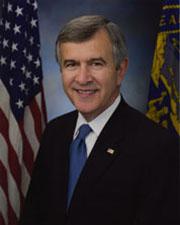 Sen. Mike Johanns (R-NE)
Legislative Activity
Stay on top of the latest movement without scrolling through every action
Senate amendment proposed (on the floor): Amendment SA 2394 proposed by Senator Johanns.(consideration: CR S9517-9519, S9541-9542; text: CR S9517)
September 17, 2009
View full timeline
Senate amendment proposed (on the floor): Amendment SA 2394 proposed by Senator Johanns.(consideration: CR S9517-9519, S9541-9542; text: CR S9517)
September 17, 2009
Roll call votes on amendments in Senate: Amendment SA 2394 agreed to in Senate by Yea-Nay Vote. 85 - 11. Record Vote Number: 289.
September 17, 2009
Senate amendment agreed to: Amendment SA 2394 agreed to in Senate by Yea-Nay Vote. 85 - 11. Record Vote Number: 289.
September 17, 2009
Amendment SA 2394 proposed by Senator Johanns. (consideration: CR S9517-9519, S9541-9542; text: CR S9517) Prohibiting use of funds to fund the Association of Community Organizations for Reform Now (ACORN).
September 17, 2009
Amendment SA 2394 agreed to in Senate by Yea-Nay Vote. 85 - 11. Record Vote Number: 289.
September 17, 2009
Senate amendment submitted
September 15, 2009
Votes
1 roll call on this amendment
Text
Proposed
DEPARTMENT OF THE INTERIOR, ENVIRONMENT, AND RELATED AGENCIES
APPROPRIATIONS ACT, 2010

The ACTING PRESIDENT pro tempore. Under the previous order, the
Senate will proceed to the consideration of H.R. 2996, which the clerk
will report.
The legislative clerk read as follows:

A bill (H.R. 2996) making appropriations for the Department
of the Interior, environment and related agencies for the
fiscal year ending September 30, 2010, and for other
purposes.

[[Page S9500]]

The Senate proceeded to consider the bill which had been reported
from the Committee on Appropriations with an amendment to strike all
after the enacting clause and insert in lieu thereof the following:

That the following sums are appropriated, out of any money in
the Treasury not otherwise appropriated, for the Department
of the Interior, environment, and related agencies for the
fiscal year ending September 30, 2010, and for other
purposes, namely:

TITLE I

DEPARTMENT OF THE INTERIOR

Bureau of Land Management

management of lands and resources

For necessary expenses for protection, use, improvement,
development, disposal, cadastral surveying, classification,
acquisition of easements and other interests in lands, and
performance of other functions, including maintenance of
facilities, as authorized by law, in the management of lands
and their resources under the jurisdiction of the Bureau of
Land Management, including the general administration of the
Bureau, and assessment of mineral potential of public lands
pursuant to Public Law 96-487 (16 U.S.C. 3150(a)),
$965,721,000, to remain available until expended, of which
not to exceed $69,336,000 is available for oil and gas
management; and of which $1,500,000 is for high priority
projects, to be carried out by the Youth Conservation Corps;
and of which $3,000,000 shall be available in fiscal year
2010 subject to a match by at least an equal amount by the
National Fish and Wildlife Foundation for cost-shared
projects supporting conservation of Bureau lands; and such
funds shall be advanced to the Foundation as a lump sum grant
without regard to when expenses are incurred.
In addition, $45,500,000 is for the processing of
applications for permit to drill and related use
authorizations, to remain available until expended, to be
reduced by amounts collected by the Bureau and credited to
this appropriation that shall be derived from $6,500 per new
application for permit to drill that the Bureau shall collect
upon submission of each new application, and in addition,
$36,696,000 is for Mining Law Administration program
operations, including the cost of administering the mining
claim fee program; to remain available until expended, to be
reduced by amounts collected by the Bureau and credited to
this appropriation from annual mining claim fees so as to
result in a final appropriation estimated at not more than
$965,721,000, and $2,000,000, to remain available until
expended, from communication site rental fees established by
the Bureau for the cost of administering communication site
activities.

construction

For construction of buildings, recreation facilities,
roads, trails, and appurtenant facilities, $8,626,000, to
remain available until expended.

land acquisition

For expenses necessary to carry out sections 205, 206, and
318(d) of Public Law 94-579, including administrative
expenses and acquisition of lands or waters, or interests
therein, $28,650,000, to be derived from the Land and Water
Conservation Fund and to remain available until expended.

oregon and california grant lands

For expenses necessary for management, protection, and
development of resources and for construction, operation, and
maintenance of access roads, reforestation, and other
improvements on the revested Oregon and California Railroad
grant lands, on other Federal lands in the Oregon and
California land-grant counties of Oregon, and on adjacent
rights-of-way; and acquisition of lands or interests therein,
including existing connecting roads on or adjacent to such
grant lands; $111,557,000, to remain available until
expended: Provided, That 25 percent of the aggregate of all
receipts during the current fiscal year from the revested
Oregon and California Railroad grant lands is hereby made a
charge against the Oregon and California land-grant fund and
shall be transferred to the General Fund in the Treasury in
accordance with the second paragraph of subsection (b) of
title II of the Act of August 28, 1937 (50 Stat. 876).

forest ecosystem health and recovery fund

(revolving fund, special account)

In addition to the purposes authorized in Public Law 102-
381, funds made available in the Forest Ecosystem Health and
Recovery Fund can be used for the purpose of planning,
preparing, implementing and monitoring salvage timber sales
and forest ecosystem health and recovery activities, such as
release from competing vegetation and density control
treatments. The Federal share of receipts (defined as the
portion of salvage timber receipts not paid to the counties
under 43 U.S.C. 1181f and 43 U.S.C. 1181f-1 et seq., and
Public Law 106-393) derived from treatments funded by this
account shall be deposited into the Forest Ecosystem Health
and Recovery Fund.

range improvements

For rehabilitation, protection, and acquisition of lands
and interests therein, and improvement of Federal rangelands
pursuant to section 401 of the Federal Land Policy and
Management Act of 1976 (43 U.S.C. 1701), notwithstanding any
other Act, sums equal to 50 percent of all moneys received
during the prior fiscal year under sections 3 and 15 of the
Taylor Grazing Act (43 U.S.C. 315 et seq.) and the amount
designated for range improvements from grazing fees and
mineral leasing receipts from Bankhead-Jones lands
transferred to the Department of the Interior pursuant to
law, but not less than $10,000,000, to remain available until
expended: Provided, That not to exceed $600,000 shall be
available for administrative expenses.

service charges, deposits, and forfeitures

For administrative expenses and other costs related to
processing application documents and other authorizations for
use and disposal of public lands and resources, for costs of
providing copies of official public land documents, for
monitoring construction, operation, and termination of
facilities in conjunction with use authorizations, and for
rehabilitation of damaged property, such amounts as may be
collected under Public Law 94-579, as amended, and Public Law
93-153, to remain available until expended: Provided, That,
notwithstanding any provision to the contrary of section
305(a) of Public Law 94-579 (43 U.S.C. 1735(a)), any moneys
that have been or will be received pursuant to that section,
whether as a result of forfeiture, compromise, or settlement,
if not appropriate for refund pursuant to section 305(c) of
that Act (43 U.S.C. 1735(c)), shall be available and may be
expended under the authority of this Act by the Secretary to
improve, protect, or rehabilitate any public lands
administered through the Bureau of Land Management which have
been damaged by the action of a resource developer,
purchaser, permittee, or any unauthorized person, without
regard to whether all moneys collected from each such action
are used on the exact lands damaged which led to the action:
Provided further, That any such moneys that are in excess of
amounts needed to repair damage to the exact land for which
funds were collected may be used to repair other damaged
public lands.

miscellaneous trust funds

In addition to amounts authorized to be expended under
existing laws, there is hereby appropriated such amounts as
may be contributed under section 307 of the Act of October
21, 1976 (43 U.S.C. 1701), and such amounts as may be
advanced for administrative costs, surveys, appraisals, and
costs of making conveyances of omitted lands under section
211(b) of that Act, to remain available until expended.

administrative provisions

The Bureau of Land Management may carry out the operations
funded under this Act by direct expenditure, contracts,
grants, cooperative agreements and reimbursable agreements
with public and private entities. Projects funded pursuant to
a written commitment by a State government to provide an
identified amount of money in support of the project may be
carried out by the bureau upon receipt of the written
commitment. Appropriations for the Bureau of Land Management
(BLM) shall be available for purchase, erection, and
dismantlement of temporary structures, and alteration and
maintenance of necessary buildings and appurtenant facilities
to which the United States has title; up to $100,000 for
payments, at the discretion of the Secretary, for information
or evidence concerning violations of laws administered by the
Bureau; miscellaneous and emergency expenses of enforcement
activities authorized or approved by the Secretary and to be
accounted for solely on the Secretary's certificate, not to
exceed $10,000: Provided, That notwithstanding 44 U.S.C. 501,
the Bureau may, under cooperative cost-sharing and
partnership arrangements authorized by law, procure printing
services from cooperators in connection with jointly produced
publications for which the cooperators share the cost of
printing either in cash or in services, and the Bureau
determines the cooperator is capable of meeting accepted
quality standards: Provided further, That projects to be
funded pursuant to a written commitment by a State government
to provide an identified amount of money in support of the
project may be carried out by the Bureau on a reimbursable
basis. Appropriations herein made shall not be available for
the destruction of healthy, unadopted, wild horses and burros
in the care of the Bureau of Land Management or its
contractors or for the sale of wild horses and burros that
results in their destruction for processing into commercial
products.

United States Fish and Wildlife Service

resource management

For necessary expenses of the United States Fish and
Wildlife Service, as authorized by law, and for scientific
and economic studies, general administration, and for the
performance of other authorized functions related to such
resources, $1,244,386,000, to remain available until
September 30, 2011 except as otherwise provided herein:
Provided, That $2,500,000 is for high priority projects,
which shall be carried out by the Youth Conservation Corps:
Provided further, That not to exceed $22,103,000 shall be
used for implementing subsections (a), (b), (c), and (e) of
section 4 of the Endangered Species Act, as amended, (except
for processing petitions, developing and issuing proposed and
final regulations, and taking any other steps to implement
actions described in subsection (c)(2)(A), (c)(2)(B)(i), or
(c)(2)(B)(ii)), of which not to exceed $11,632,000 shall be
used for any activity regarding the designation of critical
habitat, pursuant to subsection (a)(3), excluding litigation
support, for species listed pursuant to subsection (a)(1)
prior to October 1, 2009: Provided further, That of the
amount available for law enforcement, up to $400,000, to
remain available until expended, may at the discretion of the
Secretary be used for payment for information, rewards, or
evidence concerning violations of laws administered by the
Service, and miscellaneous and emergency expenses of
enforcement activity, authorized or approved by the Secretary
and to be accounted for solely on the Secretary's
certificate: Provided further, That of the amount provided
for environmental contaminants, up to $1,000,000 may remain
available until expended for contaminant sample analyses.

[[Page S9501]]

construction

For construction, improvement, acquisition, or removal of
buildings and other facilities required in the conservation,
management, investigation, protection, and utilization of
fishery and wildlife resources, and the acquisition of lands
and interests therein; $39,741,000, to remain available until
expended.

land acquisition

For expenses necessary to carry out the Land and Water
Conservation Fund Act of 1965, as amended (16 U.S.C. 460l-4
through 11), including administrative expenses, and for
acquisition of land or waters, or interest therein, in
accordance with statutory authority applicable to the United
States Fish and Wildlife Service, $82,790,000, to be derived
from the Land and Water Conservation Fund and to remain
available until expended, of which, notwithstanding 16 U.S.C.
460l-9, not more than $1,500,000 shall be for land
conservation partnerships authorized by the Highlands
Conservation Act of 2004: Provided, That none of the funds
appropriated for specific land acquisition projects can be
used to pay for any administrative overhead, planning or
other management costs.

cooperative endangered species conservation fund

For expenses necessary to carry out section 6 of the
Endangered Species Act of 1973 (16 U.S.C. 1531 et seq.), as
amended, $85,001,000, to remain available until expended, of
which $30,307,000 is to be derived from the Cooperative
Endangered Species Conservation Fund, of which $5,146,000
shall be for the Idaho Salmon and Clearwater River Basins
Habitat Account pursuant to the Snake River Water Rights Act
of 2004; and of which $54,694,000 is to be derived from the
Land and Water Conservation Fund.

national wildlife refuge fund

For expenses necessary to implement the Act of October 17,
1978 (16 U.S.C. 715s), $14,500,000.

north american wetlands conservation fund

For expenses necessary to carry out the provisions of the
North American Wetlands Conservation Act, as amended (16
U.S.C. 4401-4414), $45,147,000, to remain available until
expended.

neotropical migratory bird conservation

For expenses necessary to carry out the Neotropical
Migratory Bird Conservation Act, as amended, (16 U.S.C. 6101
et seq.), $5,000,000, to remain available until expended.

multinational species conservation fund

For expenses necessary to carry out the African Elephant
Conservation Act (16 U.S.C. 4201-4203, 4211-4214, 4221-4225,
4241-4246, and 1538), the Asian Elephant Conservation Act of
1997 (16 U.S.C. 4261-4266), the Rhinoceros and Tiger
Conservation Act of 1994 (16 U.S.C. 5301-5306), the Great Ape
Conservation Act of 2000 (16 U.S.C. 6301-6305), and the
Marine Turtle Conservation Act of 2004 (16 U.S.C. 6601-6606),
$11,500,000, to remain available until expended.

state and tribal wildlife grants

For wildlife conservation grants to States and to the
District of Columbia, Puerto Rico, Guam, the United States
Virgin Islands, the Northern Mariana Islands, American Samoa,
and Indian tribes under the provisions of the Fish and
Wildlife Act of 1956 and the Fish and Wildlife Coordination
Act, for the development and implementation of programs for
the benefit of wildlife and their habitat, including species
that are not hunted or fished, $80,000,000, to remain
available until expended: Provided, That of the amount
provided herein, $7,000,000 is for a competitive grant
program for Indian tribes not subject to the remaining
provisions of this appropriation: Provided further, That
$5,000,000 is for a competitive grant program for States,
territories, and other jurisdictions with approved plans, not
subject to the remaining provisions of this appropriation:
Provided further, That the Secretary shall, for fiscal year
2010 and each fiscal year thereafter, after deducting
$12,000,000 and administrative expenses, apportion the amount
provided herein in the following manner: (1) to the District
of Columbia and to the Commonwealth of Puerto Rico, each a
sum equal to not more than one-half of 1 percent thereof; and
(2) to Guam, American Samoa, the United States Virgin
Islands, and the Commonwealth of the Northern Mariana
Islands, each a sum equal to not more than one-fourth of 1
percent thereof: Provided further, That the Secretary shall,
for fiscal year 2010 and each fiscal year thereafter,
apportion the remaining amount in the following manner: (1)
one-third of which is based on the ratio to which the land
area of such State bears to the total land area of all such
States; and (2) two-thirds of which is based on the ratio to
which the population of such State bears to the total
population of all such States: Provided further, That the
amounts apportioned under this paragraph shall be adjusted
equitably so that no State shall, for fiscal year 2010 and
each fiscal year thereafter, be apportioned a sum which is
less than 1 percent of the amount available for apportionment
under this paragraph for any fiscal year or more than 5
percent of such amount: Provided further, That the Federal
share of planning grants shall not, for fiscal year 2010 and
each fiscal year thereafter, exceed 75 percent of the total
costs of such projects and the Federal share of
implementation grants shall not, for fiscal year 2010 and
each fiscal year thereafter, exceed 50 percent of the total
costs of such projects: Provided further, That the non-
Federal share of such projects may not be derived from
Federal grant programs: Provided further, That any amount
apportioned in 2010 to any State, territory, or other
jurisdiction that remains unobligated as of September 30,
2011, shall be reapportioned, together with funds
appropriated in 2012, in the manner provided herein.

administrative provisions

The Fish and Wildlife Service may carry out the operations
of Service programs by direct expenditure, contracts, grants,
cooperative agreements and reimbursable agreements with
public and private entities. Appropriations and funds
available to the United States Fish and Wildlife Service
shall be available for repair of damage to public roads
within and adjacent to reservation areas caused by operations
of the Service; options for the purchase of land at not to
exceed $1 for each option; facilities incident to such public
recreational uses on conservation areas as are consistent
with their primary purpose; and the maintenance and
improvement of aquaria, buildings, and other facilities under
the jurisdiction of the Service and to which the United
States has title, and which are used pursuant to law in
connection with management, and investigation of fish and
wildlife resources: Provided, That notwithstanding 44 U.S.C.
501, the Service may, under cooperative cost sharing and
partnership arrangements authorized by law, procure printing
services from cooperators in connection with jointly produced
publications for which the cooperators share at least one-
half the cost of printing either in cash or services and the
Service determines the cooperator is capable of meeting
accepted quality standards: Provided further, That the
Service may accept donated aircraft as replacements for
existing aircraft.

National Park Service

operation of the national park system

For expenses necessary for the management, operation, and
maintenance of areas and facilities administered by the
National Park Service (including expenses to carry out
programs of the United States Park Police), and for the
general administration of the National Park Service,
$2,261,309,000, of which $9,982,000 for planning and
interagency coordination in support of Everglades restoration
and $99,622,000 for maintenance, repair or rehabilitation
projects for constructed assets, operation of the National
Park Service automated facility management software system,
and comprehensive facility condition assessments shall remain
available until September 30, 2011.

national recreation and preservation

For expenses necessary to carry out recreation programs,
natural programs, cultural programs, heritage partnership
programs, environmental compliance and review, international
park affairs, statutory or contractual aid for other
activities, and grant administration, not otherwise provided
for, $67,438,000, of which $3,175,000 shall be for Preserve
America grants as authorized by section 7302 of the Omnibus
Public Land Management Act of 2009 (Public Law 111-11).

historic preservation fund

For expenses necessary in carrying out the Historic
Preservation Act of 1966, as amended (16 U.S.C. 470), and the
Omnibus Parks and Public Lands Management Act of 1996 (Public
Law 104-333), $74,500,000, to be derived from the Historic
Preservation Fund and to remain available until September 30,
2011; of which $20,000,000 shall be for Save America's
Treasures grants as authorized by section 7303 of the Omnibus
Public Land Management Act of 2009 (Public Law 111-11).

construction

For construction, improvements, repair or replacement of
physical facilities, including a portion of the expense for
the modifications authorized by section 104 of the Everglades
National Park Protection and Expansion Act of 1989,
$219,731,000, to remain available until expended.

land and water conservation fund

(rescission)

The contract authority provided for fiscal year 2010 by 16
U.S.C. 460l-10a is rescinded.

land acquisition and state assistance

For expenses necessary to carry out the Land and Water
Conservation Act of 1965, as amended (16 U.S.C. 460l-4
through 11), including administrative expenses, and for
acquisition of lands or waters, or interest therein, in
accordance with the statutory authority applicable to the
National Park Service, $118,586,000, to be derived from the
Land and Water Conservation Fund and to remain available
until expended, of which $35,000,000 is for the State
assistance program and of which $4,000,000 shall be for the
American Battlefield Protection Program grants as authorized
by section 7301 of the Omnibus Public Land Management Act of
2009 (Public Law 111-11).

administrative provisions

(including transfer of funds)

In addition to other uses set forth in section 407(d) of
Public Law 105-391, franchise fees credited to a sub-account
shall be available for expenditure by the Secretary, without
further appropriation, for use at any unit within the
National Park System to extinguish or reduce liability for
Possessory Interest or leasehold surrender interest. Such
funds may only be used for this purpose to the extent that
the benefiting unit anticipated franchise fee receipts over
the term of the contract at that unit exceed the amount of
funds used to extinguish or reduce liability. Franchise fees
at the benefiting unit shall be credited to the sub-account
of the originating unit over a period not to exceed the term
of a single contract at the benefiting unit, in the amount of
funds so expended to extinguish or reduce liability.
For the costs of administration of the Land and Water
Conservation Fund grants authorized by section 105(a)(2)(B)
of the Gulf of Mexico Energy Security Act of 2006 (Public Law
109-432), the National Park Service may retain up to 3
percent of the amounts which are authorized to be disbursed
under such section, such retained amounts to remain available
until expended.

[[Page S9502]]

National Park Service funds may be transferred to the
Federal Highway Administration (FHWA), Department of
Transportation, for purposes authorized under 23 U.S.C. 204.
Transfers may include a reasonable amount for FHWA
administrative support costs.

United States Geological Survey

surveys, investigations, and research

For expenses necessary for the United States Geological
Survey to perform surveys, investigations, and research
covering topography, geology, hydrology, biology, and the
mineral and water resources of the United States, its
territories and possessions, and other areas as authorized by
43 U.S.C. 31, 1332, and 1340; classify lands as to their
mineral and water resources; give engineering supervision to
power permittees and Federal Energy Regulatory Commission
licensees; administer the minerals exploration program (30
U.S.C. 641); conduct inquiries into the economic conditions
affecting mining and materials processing industries (30
U.S.C. 3, 21a, and 1603; 50 U.S.C. 98g(1)) and related
purposes as authorized by law; and to publish and disseminate
data relative to the foregoing activities; $1,104,340,000, to
remain available until September 30, 2011, of which
$65,561,000 shall be available only for cooperation with
States or municipalities for water resources investigations;
of which $40,150,000 shall remain available until expended
for satellite operations; and of which $7,321,000 shall be
available until expended for deferred maintenance and capital
improvement projects that exceed $100,000 in cost: Provided,
That none of the funds provided for the biological research
activity shall be used to conduct new surveys on private
property, unless specifically authorized in writing by the
property owner: Provided further, That no part of this
appropriation shall be used to pay more than one-half the
cost of topographic mapping or water resources data
collection and investigations carried on in cooperation with
States and municipalities.

administrative provisions

From within the amount appropriated for activities of the
United States Geological Survey such sums as are necessary
shall be available for reimbursement to the General Services
Administration for security guard services; contracting for
the furnishing of topographic maps and for the making of
geophysical or other specialized surveys when it is
administratively determined that such procedures are in the
public interest; construction and maintenance of necessary
buildings and appurtenant facilities; acquisition of lands
for gauging stations and observation wells; expenses of the
United States National Committee on Geology; and payment of
compensation and expenses of persons on the rolls of the
Survey duly appointed to represent the United States in the
negotiation and administration of interstate compacts:
Provided, That activities funded by appropriations herein
made may be accomplished through the use of contracts,
grants, or cooperative agreements as defined in 31 U.S.C.
6302 et seq.: Provided further, That the United States
Geological Survey may enter into contracts or cooperative
agreements directly with individuals or indirectly with
institutions or nonprofit organizations, without regard to 41
U.S.C. 5, for the temporary or intermittent services of
students or recent graduates, who shall be considered
employees for the purpose of chapters 57 and 81 of title 5,
United States Code, relating to compensation for travel and
work injuries, and chapter 171 of title 28, United States
Code, relating to tort claims, but shall not be considered to
be Federal employees for any other purposes.

Minerals Management Service

royalty and offshore minerals management

For expenses necessary for minerals leasing and
environmental studies, regulation of industry operations, and
collection of royalties, as authorized by law; for enforcing
laws and regulations applicable to oil, gas, and other
minerals leases, permits, licenses and operating contracts;
for energy-related or other authorized marine-related
purposes on the Outer Continental Shelf; and for matching
grants or cooperative agreements, $175,217,000, to remain
available until September 30, 2011, of which $89,374,000
shall be available for royalty management activities; and an
amount not to exceed $156,730,000, to be credited to this
appropriation and to remain available until expended, from
additions to receipts resulting from increases to rates in
effect on August 5, 1993, and from cost recovery fees:
Provided, That notwithstanding 31 U.S.C. 3302, in fiscal year
2010, such amounts as are assessed under 31 U.S.C. 9701 shall
be collected and credited to this account and shall be
available until expended for necessary expenses: Provided
further, That to the extent $156,730,000 in addition to
receipts are not realized from the sources of receipts stated
above, the amount needed to reach $156,730,000 shall be
credited to this appropriation from receipts resulting from
rental rates for Outer Continental Shelf leases in effect
before August 5, 1993: Provided further, That the term
``qualified Outer Continental Shelf revenues'', as defined in
section 102(9)(A) of the Gulf of Mexico Energy Security Act,
division C of Public Law 109-432, shall include only the
portion of rental revenues that would have been collected at
the rental rates in effect before August 5, 1993: Provided
further, That not to exceed $3,000 shall be available for
reasonable expenses related to promoting volunteer beach and
marine cleanup activities: Provided further, That
notwithstanding any other provision of law, $15,000 under
this heading shall be available for refunds of overpayments
in connection with certain Indian leases in which the
Director of MMS concurred with the claimed refund due, to pay
amounts owed to Indian allottees or tribes, or to correct
prior unrecoverable erroneous payments: Provided further,
That for the costs of administration of the Coastal Impact
Assistance Program authorized by section 31 of the Outer
Continental Shelf Lands Act, as amended (43 U.S.C. 1456a),
MMS in fiscal year 2010 may retain up to 4 percent of the
amounts which are disbursed under section 31(b)(1), such
retained amounts to remain available until expended.
For an additional amount, $10,000,000, to remain available
until expended, which shall be derived from non-refundable
inspection fees collected in fiscal year 2010, as provided in
this Act: Provided, That to the extent that such amounts are
not realized from such fees, the amount needed to reach
$10,000,000 shall be credited to this appropriation from
receipts resulting from rental rates for Outer Continental
Shelf leases in effect before August 5, 1993.

oil spill research

For necessary expenses to carry out title I, section 1016,
title IV, sections 4202 and 4303, title VII, and title VIII,
section 8201 of the Oil Pollution Act of 1990, $6,303,000,
which shall be derived from the Oil Spill Liability Trust
Fund, to remain available until expended.

administrative provision

Notwithstanding the provisions of section 35(b) of the
Mineral Leasing Act, as amended (30 U.S.C. 191(b)), the
Secretary shall deduct 2 percent from the amount payable to
each State in fiscal year 2010 and deposit the amount
deducted to miscellaneous receipts of the Treasury.

Office of Surface Mining Reclamation and Enforcement

regulation and technology

For necessary expenses to carry out the provisions of the
Surface Mining Control and Reclamation Act of 1977, Public
Law 95-87, as amended, $127,180,000, to remain available
until September 30, 2011: Provided, That appropriations for
the Office of Surface Mining Reclamation and Enforcement may
provide for the travel and per diem expenses of State and
tribal personnel attending Office of Surface Mining
Reclamation and Enforcement sponsored training.

abandoned mine reclamation fund

For necessary expenses to carry out title IV of the Surface
Mining Control and Reclamation Act of 1977, Public Law 95-87,
as amended, $39,588,000, to be derived from receipts of the
Abandoned Mine Reclamation Fund and to remain available until
expended: Provided, That pursuant to Public Law 97-365, the
Department of the Interior is authorized to use up to 20
percent from the recovery of the delinquent debt owed to the
United States Government to pay for contracts to collect
these debts: Provided further, That funds made available
under title IV of Public Law 95-87 may be used for any
required non-Federal share of the cost of projects funded by
the Federal Government for the purpose of environmental
restoration related to treatment or abatement of acid mine
drainage from abandoned mines: Provided further, That such
projects must be consistent with the purposes and priorities
of the Surface Mining Control and Reclamation Act: Provided
further, That amounts provided under this heading may be used
for the travel and per diem expenses of State and tribal
personnel attending Office of Surface Mining Reclamation and
Enforcement sponsored training.

administrative provision

With funds available for the Technical Innovation and
Professional Services program in this Act, the Secretary may
transfer title for computer hardware, software and other
technical equipment to State and tribal regulatory and
reclamation programs.

Bureau of Indian Affairs

operation of indian programs

(including transfer of funds)

For expenses necessary for the operation of Indian
programs, as authorized by law, including the Snyder Act of
November 2, 1921 (25 U.S.C. 13), the Indian Self-
Determination and Education Assistance Act of 1975 (25 U.S.C.
450 et seq.), as amended, the Education Amendments of 1978
(25 U.S.C. 2001-2019), and the Tribally Controlled Schools
Act of 1988 (25 U.S.C. 2501 et seq.), as amended,
$2,309,322,000, to remain available until September 30, 2011
except as otherwise provided herein; of which not to exceed
$8,500 may be for official reception and representation
expenses; of which not to exceed $74,915,000 shall be for
welfare assistance payments: Provided, That in cases of
designated Federal disasters, the Secretary may exceed such
cap, from the amounts provided herein, to provide for
disaster relief to Indian communities affected by the
disaster; of which, notwithstanding any other provision of
law, including but not limited to the Indian Self-
Determination Act of 1975, as amended, not to exceed
$154,794,000 shall be available for payments for contract
support costs associated with ongoing contracts, grants,
compacts, or annual funding agreements entered into with the
Bureau prior to or during fiscal year 2010, as authorized by
such Act, except that tribes and tribal organizations may use
their tribal priority allocations for unmet contract support
costs of ongoing contracts, grants, or compacts, or annual
funding agreements and for unmet welfare assistance costs; of
which not to exceed $566,702,000 for school operations costs
of Bureau-funded schools and other education programs shall
become available on July 1, 2010, and shall remain available
until September 30, 2011; of which $25,000,000 shall be for
public safety and justice programs as authorized by the
Emergency Fund for Indian Safety and Health, established by
section 601 of Public Law 110-293 (25 U.S.C. 443c); and of
which not to exceed $60,958,000 shall remain available until
expended for housing improvement, road maintenance, attorney
fees, litigation support, the Indian Self-Determination Fund,
land records improvement, and

[[Page S9503]]

the Navajo-Hopi Settlement Program: Provided further, That
notwithstanding any other provision of law, including but not
limited to the Indian Self-Determination Act of 1975, as
amended, and 25 U.S.C. 2008, not to exceed $43,373,000 within
and only from such amounts made available for school
operations shall be available for administrative cost grants
associated with ongoing grants entered into with the Bureau
prior to or during fiscal year 2009 for the operation of
Bureau-funded schools, and up to $500,000 within and only
from such amounts made available for administrative cost
grants shall be available for the transitional costs of
initial administrative cost grants to grantees that assume
operation on or after July 1, 2009, of Bureau-funded schools:
Provided further, That any forestry funds allocated to a
tribe which remain unobligated as of September 30, 2011, may
be transferred during fiscal year 2012 to an Indian forest
land assistance account established for the benefit of the
holder of the funds within the holder's trust fund account:
Provided further, That any such unobligated balances not so
transferred shall expire on September 30, 2012: Provided
further, That in order to enhance the safety of Bureau field
employees, the Bureau may use funds to purchase uniforms or
other identifying articles of clothing for personnel.

construction

(including transfer of funds)

For construction, repair, improvement, and maintenance of
irrigation and power systems, buildings, utilities, and other
facilities, including architectural and engineering services
by contract; acquisition of lands, and interests in lands;
and preparation of lands for farming, and for construction of
the Navajo Indian Irrigation Project pursuant to Public Law
87-483, $225,000,000, to remain available until expended:
Provided, That such amounts as may be available for the
construction of the Navajo Indian Irrigation Project may be
transferred to the Bureau of Reclamation: Provided further,
That not to exceed 6 percent of contract authority available
to the Bureau of Indian Affairs from the Federal Highway
Trust Fund may be used to cover the road program management
costs of the Bureau: Provided further, That any funds
provided for the Safety of Dams program pursuant to 25 U.S.C.
13 shall be made available on a nonreimbursable basis:
Provided further, That for fiscal year 2010, in implementing
new construction or facilities improvement and repair project
grants in excess of $100,000 that are provided to grant
schools under Public Law 100-297, as amended, the Secretary
of the Interior shall use the Administrative and Audit
Requirements and Cost Principles for Assistance Programs
contained in 43 CFR part 12 as the regulatory requirements:
Provided further, That such grants shall not be subject to
section 12.61 of 43 CFR; the Secretary and the grantee shall
negotiate and determine a schedule of payments for the work
to be performed: Provided further, That in considering grant
applications, the Secretary shall consider whether such
grantee would be deficient in assuring that the construction
projects conform to applicable building standards and codes
and Federal, tribal, or State health and safety standards as
required by 25 U.S.C. 2005(b), with respect to organizational
and financial management capabilities: Provided further, That
if the Secretary declines a grant application, the Secretary
shall follow the requirements contained in 25 U.S.C. 2504(f):
Provided further, That any disputes between the Secretary and
any grantee concerning a grant shall be subject to the
disputes provision in 25 U.S.C. 2507(e): Provided further,
That in order to ensure timely completion of construction
projects, the Secretary may assume control of a project and
all funds related to the project, if, within eighteen months
of the date of enactment of this Act, any grantee receiving
funds appropriated in this Act or in any prior Act, has not
completed the planning and design phase of the project and
commenced construction: Provided further, That this
appropriation may be reimbursed from the Office of the
Special Trustee for American Indians appropriation for the
appropriate share of construction costs for space expansion
needed in agency offices to meet trust reform implementation.

indian land and water claim settlements and miscellaneous payments to
indians

For payments and necessary administrative expenses for
implementation of Indian land and water claim settlements
pursuant to Public Laws 99-264, 100-580, 101-618, 108-447,
109-379, 109-479, 110-297, and 111-11, and for implementation
of other land and water rights settlements, $47,380,000, to
remain available until expended.

indian land consolidation, bia

For consolidation of fractional interests in Indian lands
and expenses associated with redetermining and redistributing
escheated interests in allotted lands, and for necessary
expenses to carry out the Indian Land Consolidation Act of
1983, as amended, by direct expenditure or cooperative
agreement, $3,000,000, to remain available until expended.

indian guaranteed loan program account

For the cost of guaranteed loans and insured loans,
$8,215,000, of which $1,629,000 is for administrative
expenses, as authorized by the Indian Financing Act of 1974,
as amended: Provided, That such costs, including the cost of
modifying such loans, shall be as defined in section 502 of
the Congressional Budget Act of 1974: Provided further, That
these funds are available to subsidize total loan principal,
any part of which is to be guaranteed or insured, not to
exceed $93,807,956.

administrative provisions

The Bureau of Indian Affairs may carry out the operation of
Indian programs by direct expenditure, contracts, cooperative
agreements, compacts and grants, either directly or in
cooperation with States and other organizations.
Notwithstanding 25 U.S.C. 15, the Bureau of Indian Affairs
may contract for services in support of the management,
operation, and maintenance of the Power Division of the San
Carlos Irrigation Project.
Appropriations for the Bureau of Indian Affairs (except the
Revolving Fund for Loans Liquidating Account, Indian Loan
Guaranty and Insurance Fund Liquidating Account, Indian
Guaranteed Loan Financing Account, Indian Direct Loan
Financing Account, and the Indian Guaranteed Loan Program
account) shall be available for expenses of exhibits.
Notwithstanding any other provision of law, no funds
available to the Bureau of Indian Affairs for central office
oversight and Executive Direction and Administrative Services
(except executive direction and administrative services
funding for Tribal Priority Allocations, regional offices,
and facilities operations and maintenance) shall be available
for contracts, grants, compacts, or cooperative agreements
with the Bureau of Indian Affairs under the provisions of the
Indian Self-Determination Act or the Tribal Self-Governance
Act of 1994 (Public Law 103-413).
In the event any tribe returns appropriations made
available by this Act to the Bureau of Indian Affairs, this
action shall not diminish the Federal Government's trust
responsibility to that tribe, or the government-to-government
relationship between the United States and that tribe, or
that tribe's ability to access future appropriations.
Notwithstanding any other provision of law, no funds
available to the Bureau, other than the amounts provided
herein for assistance to public schools under 25 U.S.C. 452
et seq., shall be available to support the operation of any
elementary or secondary school in the State of Alaska.
Appropriations made available in this or any other Act for
schools funded by the Bureau shall be available only to the
schools in the Bureau school system as of September 1, 1996.
No funds available to the Bureau shall be used to support
expanded grades for any school or dormitory beyond the grade
structure in place or approved by the Secretary of the
Interior at each school in the Bureau school system as of
October 1, 1995. Funds made available under this Act may not
be used to establish a charter school at a Bureau-funded
school (as that term is defined in section 1146 of the
Education Amendments of 1978 (25 U.S.C. 2026)), except that a
charter school that is in existence on the date of the
enactment of this Act and that has operated at a Bureau-
funded school before September 1, 1999, may continue to
operate during that period, but only if the charter school
pays to the Bureau a pro rata share of funds to reimburse the
Bureau for the use of the real and personal property
(including buses and vans), the funds of the charter school
are kept separate and apart from Bureau funds, and the Bureau
does not assume any obligation for charter school programs of
the State in which the school is located if the charter
school loses such funding. Employees of Bureau-funded schools
sharing a campus with a charter school and performing
functions related to the charter schools operation and
employees of a charter school shall not be treated as Federal
employees for purposes of chapter 171 of title 28, United
States Code.
Notwithstanding any other provision of law, including
section 113 of title I of appendix C of Public Law 106-113,
if in fiscal year 2003 or 2004 a grantee received indirect
and administrative costs pursuant to a distribution formula
based on section 5(f) of Public Law 101-301, the Secretary
shall continue to distribute indirect and administrative cost
funds to such grantee using the section 5(f) distribution
formula.

Departmental Offices

Office of the Secretary

salaries and expenses

For necessary expenses for management of the Department of
the Interior, $118,836,000; of which not to exceed $25,000
may be for official reception and representation expenses;
and of which up to $1,000,000 shall be available for workers
compensation payments and unemployment compensation payments
associated with the orderly closure of the United States
Bureau of Mines: Provided, That, for fiscal year 2010 up to
$400,000 of the payments authorized by the Act of October 20,
1976, as amended (31 U.S.C. 6901-6907) may be retained for
administrative expenses of the Payments in Lieu of Taxes
Program: Provided further, That no payment shall be made
pursuant to that Act to otherwise eligible units of local
government if the computed amount of the payment is less than
$100: Provided further, That for fiscal years 2008 through
2012 the Secretary may reduce the payment authorized by 31
U.S.C. 6901-6907, as amended, for an individual county by the
amount necessary to correct prior year overpayments to that
county: Provided further, That for fiscal years 2008 through
2012 the amount needed to correct a prior year underpayment
to an individual county shall be paid from any reductions for
overpayments to other counties and the amount necessary to
cover any remaining underpayment is hereby appropriated and
shall be paid to individual counties using current fiscal
year funds.

Insular Affairs

assistance to territories

For expenses necessary for assistance to territories under
the jurisdiction of the Department of the Interior,
$81,095,000, of which: (1) $71,815,000 shall remain available
until expended for technical assistance, including
maintenance assistance, disaster assistance, insular
management controls, coral reef initiative activities, and
brown tree snake control and research; grants to the
judiciary in American Samoa for compensation and expenses, as
authorized by

[[Page S9504]]

law (48 U.S.C. 1661(c)); grants to the Government of American
Samoa, in addition to current local revenues, for
construction and support of governmental functions; grants to
the Government of the Virgin Islands as authorized by law;
grants to the Government of Guam, as authorized by law; and
grants to the Government of the Northern Mariana Islands as
authorized by law (Public Law 94-241; 90 Stat. 272); and (2)
$9,280,000 shall be available until September 30, 2011 for
salaries and expenses of the Office of Insular Affairs:
Provided, That all financial transactions of the territorial
and local governments herein provided for, including such
transactions of all agencies or instrumentalities established
or used by such governments, may be audited by the Government
Accountability Office, at its discretion, in accordance with
chapter 35 of title 31, United States Code: Provided further,
That Northern Mariana Islands Covenant grant funding shall be
provided according to those terms of the Agreement of the
Special Representatives on Future United States Financial
Assistance for the Northern Mariana Islands approved by
Public Law 104-134: Provided further, That the funds for the
program of operations and maintenance improvement are
appropriated to institutionalize routine operations and
maintenance improvement of capital infrastructure with
territorial participation and cost sharing to be determined
by the Secretary based on the grantee's commitment to timely
maintenance of its capital assets: Provided further, That any
appropriation for disaster assistance under this heading in
this Act or previous appropriations Acts may be used as non-
Federal matching funds for the purpose of hazard mitigation
grants provided pursuant to section 404 of the Robert T.
Stafford Disaster Relief and Emergency Assistance Act (42
U.S.C. 5170c): Provided further, That at the request of the
Governor of Guam, the Secretary may transfer any mandatory or
discretionary funds appropriated, including those provided
under Public Law 104-134, to the Secretary of Agriculture for
the subsidy cost of direct or guaranteed loans, plus not to
exceed 3 percent of the amount of the subsidy transferred for
the cost of loan administration, for the purposes authorized
by the Rural Electrification Act of 1936 and section
306(a)(1) of the Consolidated Farm and Rural Development Act
for construction and repair projects in Guam, and such funds
shall remain available until expended: Provided further, That
such costs, including the cost of modifying such loans, shall
be as defined in section 502 of the Congressional Budget Act
of 1974: Provided further, That such loans or loan guarantees
may be made without regard to the population of the area,
credit elsewhere requirements, and restrictions on the types
of eligible entities under the Rural Electrification Act of
1936 and section 306(a)(1) of the Consolidated Farm and Rural
Development Act: Provided further, That any funds transferred
to the Secretary of Agriculture shall be in addition to funds
otherwise made available to make or guarantee loans under
such authorities.

compact of free association

For grants and necessary expenses, $5,318,000, to remain
available until expended, as provided for in sections
221(a)(2), 221(b), and 233 of the Compact of Free Association
for the Republic of Palau; and section 221(a)(2) of the
Compacts of Free Association for the Government of the
Republic of the Marshall Islands and the Federated States of
Micronesia, as authorized by Public Law 99-658 and Public Law
108-188: Provided further, That at the request of the
Governor of Guam, the Secretary may transfer any mandatory or
discretionary funds appropriated, including those provided
under section 104(e) of Public Law 108-188, to the Secretary
of Agriculture for the subsidy cost of direct or guaranteed
loans, plus not to exceed 3 percent of the amount of the
subsidy transferred for the cost of loan administration, for
the purposes authorized by the Rural Electrification Act of
1936 and section 306(a)(1) of the Consolidated Farm and Rural
Development Act for construction and repair projects in Guam,
and such funds shall remain available until expended:
Provided further, That such costs, including the cost of
modifying such loans, shall be as defined in section 502 of
the Congressional Budget Act of 1974: Provided further, That
such loans or loan guarantees may be made without regard to
the population of the area, credit elsewhere requirements,
and restrictions on the types of eligible entities under the
Rural Electrification Act of 1936 and section 306(a)(1) of
the Consolidated Farm and Rural Development Act: Provided
further, That any funds transferred to the Secretary of
Agriculture shall be in addition to funds otherwise made
available to make or guarantee loans under such authorities.

Office of the Solicitor

salaries and expenses

For necessary expenses of the Office of the Solicitor,
$65,076,000.

Office of Inspector General

salaries and expenses

For necessary expenses of the Office of Inspector General,
$48,590,000.

Office of the Special Trustee for American Indians

federal trust programs

(including transfer of funds)

For the operation of trust programs for Indians by direct
expenditure, contracts, cooperative agreements, compacts, and
grants, $185,984,000, to remain available until expended, of
which not to exceed $56,536,000 from this or any other Act,
shall be available for historical accounting: Provided, That
funds for trust management improvements and litigation
support may, as needed, be transferred to or merged with the
Bureau of Indian Affairs, ``Operation of Indian Programs''
account; the Office of the Solicitor, ``Salaries and
Expenses'' account; and the Office of the Secretary,
``Salaries and Expenses'' account: Provided further, That
funds made available through contracts or grants obligated
during fiscal year 2010, as authorized by the Indian Self-
Determination Act of 1975 (25 U.S.C. 450 et seq.), shall
remain available until expended by the contractor or grantee:
Provided further, That, notwithstanding any other provision
of law, the statute of limitations shall not commence to run
on any claim, including any claim in litigation pending on
the date of the enactment of this Act, concerning losses to
or mismanagement of trust funds, until the affected tribe or
individual Indian has been furnished with an accounting of
such funds from which the beneficiary can determine whether
there has been a loss: Provided further, That,
notwithstanding any other provision of law, the Secretary
shall not be required to provide a quarterly statement of
performance for any Indian trust account that has not had
activity for at least 18 months and has a balance of $15.00
or less: Provided further, That the Secretary shall issue an
annual account statement and maintain a record of any such
accounts and shall permit the balance in each such account to
be withdrawn upon the express written request of the account
holder: Provided further, That not to exceed $50,000 is
available for the Secretary to make payments to correct
administrative errors of either disbursements from or
deposits to Individual Indian Money or Tribal accounts after
September 30, 2002: Provided further, That erroneous payments
that are recovered shall be credited to and remain available
in this account for this purpose.

Department-wide Programs

wildland fire management

(including transfers of funds)

For necessary expenses for fire preparedness, suppression
operations, fire science and research, emergency
rehabilitation, hazardous fuels reduction, and rural fire
assistance by the Department of the Interior, $979,637,000,
to remain available until expended, of which not to exceed
$6,137,000 shall be for the renovation or construction of
fire facilities: Provided, That such funds are also available
for repayment of advances to other appropriation accounts
from which funds were previously transferred for such
purposes: Provided further, That persons hired pursuant to 43
U.S.C. 1469 may be furnished subsistence and lodging without
cost from funds available from this appropriation: Provided
further, That notwithstanding 42 U.S.C. 1856d, sums received
by a bureau or office of the Department of the Interior for
fire protection rendered pursuant to 42 U.S.C. 1856 et seq.,
protection of United States property, may be credited to the
appropriation from which funds were expended to provide that
protection, and are available without fiscal year limitation:
Provided further, That using the amounts designated under
this title of this Act, the Secretary of the Interior may
enter into procurement contracts, grants, or cooperative
agreements, for hazardous fuels reduction activities, and for
training and monitoring associated with such hazardous fuels
reduction activities, on Federal land, or on adjacent non-
Federal land for activities that benefit resources on Federal
land: Provided further, That the costs of implementing any
cooperative agreement between the Federal Government and any
non-Federal entity may be shared, as mutually agreed on by
the affected parties: Provided further, That notwithstanding
requirements of the Competition in Contracting Act, the
Secretary, for purposes of hazardous fuels reduction
activities, may obtain maximum practicable competition among:
(1) local private, nonprofit, or cooperative entities; (2)
Youth Conservation Corps crews, Public Lands Corps (Public
Law 109-154), or related partnerships with State, local, or
non-profit youth groups; (3) small or micro-businesses; or
(4) other entities that will hire or train locally a
significant percentage, defined as 50 percent or more, of the
project workforce to complete such contracts: Provided
further, That in implementing this section, the Secretary
shall develop written guidance to field units to ensure
accountability and consistent application of the authorities
provided herein: Provided further, That funds appropriated
under this head may be used to reimburse the United States
Fish and Wildlife Service and the National Marine Fisheries
Service for the costs of carrying out their responsibilities
under the Endangered Species Act of 1973 (16 U.S.C. 1531 et
seq.) to consult and conference, as required by section 7 of
such Act, in connection with wildland fire management
activities: Provided further, That the Secretary of the
Interior may use wildland fire appropriations to enter into
non-competitive sole source leases of real property with
local governments, at or below fair market value, to
construct capitalized improvements for fire facilities on
such leased properties, including but not limited to fire
guard stations, retardant stations, and other initial attack
and fire support facilities, and to make advance payments for
any such lease or for construction activity associated with
the lease: Provided further, That the Secretary of the
Interior and the Secretary of Agriculture may authorize the
transfer of funds appropriated for wildland fire management,
in an aggregate amount not to exceed $10,000,000, between the
Departments when such transfers would facilitate and expedite
jointly funded wildland fire management programs and
projects: Provided further, That funds provided for wildfire
suppression shall be available for support of Federal
emergency response actions.

central hazardous materials fund

For necessary expenses of the Department of the Interior
and any of its component offices and bureaus for the response
action, including associated activities, performed pursuant
to the

[[Page S9505]]

Comprehensive Environmental Response, Compensation, and
Liability Act, as amended (42 U.S.C. 9601 et seq.),
$10,175,000, to remain available until expended: Provided,
That Public Law 110-161 (121 Stat. 2116) under this heading
is amended by striking ``in advance of or as reimbursement
for remedial action or response activities conducted by the
Department pursuant to section 107 or 113(f) of such Act''
and inserting in lieu thereof ``including any fines or
penalties''.

natural resource damage assessment and restoration

natural resource damage assessment fund

To conduct natural resource damage assessment and
restoration activities by the Department of the Interior
necessary to carry out the provisions of the Comprehensive
Environmental Response, Compensation, and Liability Act, as
amended (42 U.S.C. 9601 et seq.), the Federal Water Pollution
Control Act, as amended (33 U.S.C. 1251 et seq.), the Oil
Pollution Act of 1990 (33 U.S.C. 2701 et seq.), and Public
Law 101-337, as amended (16 U.S.C. 19jj et seq.), $6,462,000,
to remain available until expended.

working capital fund

For the acquisition of a departmental financial and
business management system and information technology
improvements of general benefit to the Department,
$85,823,000, to remain available until expended: Provided,
That none of the funds in this Act or previous appropriations
Acts may be used to establish reserves in the Working Capital
Fund account other than for accrued annual leave and
depreciation of equipment without prior approval of the House
and Senate Committees on Appropriations: Provided further,
That the Secretary may assess reasonable charges to State,
local and tribal government employees for training services
provided by the National Indian Program Training Center,
other than training related to Public Law 93-638: Provided
further, That the Secretary may lease or otherwise provide
space and related facilities, equipment or professional
services of the National Indian Program Training Center to
State, local and tribal government employees or persons or
organizations engaged in cultural, educational, or
recreational activities (as defined in 40 U.S.C. 3306(a)) at
the prevailing rate for similar space, facilities, equipment,
or services in the vicinity of the National Indian Program
Training Center: Provided further, That all funds received
pursuant to the two preceding provisos shall be credited to
this account, shall be available until expended, and shall be
used by the Secretary for necessary expenses of the National
Indian Program Training Center.

administrative provision

There is hereby authorized for acquisition from available
resources within the Working Capital Fund, 15 aircraft, 10 of
which shall be for replacement and which may be obtained by
donation, purchase or through available excess surplus
property: Provided, That existing aircraft being replaced may
be sold, with proceeds derived or trade-in value used to
offset the purchase price for the replacement aircraft.

General Provisions, Department of the Interior

emergency transfer authority--intra-bureau

(including transfers of funds)

Sec. 101.  Appropriations made in this title shall be
available for expenditure or transfer (within each bureau or
office), with the approval of the Secretary, for the
emergency reconstruction, replacement, or repair of aircraft,
buildings, utilities, or other facilities or equipment
damaged or destroyed by fire, flood, storm, or other
unavoidable causes: Provided, That no funds shall be made
available under this authority until funds specifically made
available to the Department of the Interior for emergencies
shall have been exhausted.

emergency transfer authority--department-wide

Sec. 102.  The Secretary may authorize the expenditure or
transfer of any no year appropriation in this title, for the
suppression or emergency prevention of wildland fires on or
threatening lands under the jurisdiction of the Department of
the Interior; for the emergency rehabilitation of burned-over
lands under its jurisdiction; for emergency actions related
to potential or actual earthquakes, floods, volcanoes,
storms, or other unavoidable causes; for contingency planning
subsequent to actual oil spills; for response and natural
resource damage assessment activities related to actual oil
spills; for the prevention, suppression, and control of
actual or potential grasshopper and Mormon cricket outbreaks
on lands under the jurisdiction of the Secretary, pursuant to
the authority in section 1773(b) of Public Law 99-198 (99
Stat. 1658); for emergency reclamation projects under section
410 of Public Law 95-87; and shall transfer, from any no year
funds available to the Office of Surface Mining Reclamation
and Enforcement, such funds as may be necessary to permit
assumption of regulatory authority in the event a primacy
State is not carrying out the regulatory provisions of the
Surface Mining Act: Provided, That appropriations made in
this title for wildland fire operations shall be available
for the payment of obligations incurred during the preceding
fiscal year, and for reimbursement to other Federal agencies
for destruction of vehicles, aircraft, or other equipment in
connection with their use for wildland fire operations, such
reimbursement to be credited to appropriations currently
available at the time of receipt thereof: Provided further,
That for wildland fire operations, no funds shall be made
available under this authority until the Secretary determines
that funds appropriated for ``wildland fire operations''
shall be exhausted within 30 days: Provided further, That all
funds used pursuant to this section must be replenished by a
supplemental appropriation which must be requested as
promptly as possible: Provided further, That such
replenishment funds shall be used to reimburse, on a pro rata
basis, accounts from which emergency funds were transferred.

authorized use of funds

Sec. 103.  Appropriations made to the Department of the
Interior in this title shall be available for services as
authorized by 5 U.S.C. 3109, when authorized by the
Secretary, in total amount not to exceed $500,000; purchase
and replacement of motor vehicles, including specially
equipped law enforcement vehicles; hire, maintenance, and
operation of aircraft; hire of passenger motor vehicles;
purchase of reprints; payment for telephone service in
private residences in the field, when authorized under
regulations approved by the Secretary; and the payment of
dues, when authorized by the Secretary, for library
membership in societies or associations which issue
publications to members only or at a price to members lower
than to subscribers who are not members.

authorized use of funds

Sec. 104.  Appropriations made in this Act under the
headings Bureau of Indian Affairs and Office of the Special
Trustee for American Indians and any unobligated balances
from prior appropriations Acts made under the same headings
shall be available for expenditure or transfer for Indian
trust management and reform activities. Total funding for
historical accounting activities shall not exceed amounts
specifically designated in this Act for such purpose.

redistribution of funds

Sec. 105.  Notwithstanding any other provision of law, the
Secretary of the Interior is authorized to redistribute any
Tribal Priority Allocation funds, including tribal base
funds, to alleviate tribal funding inequities by transferring
funds to address identified, unmet needs, dual enrollment,
overlapping service areas or inaccurate distribution
methodologies. No federally recognized tribe shall receive a
reduction in Tribal Priority Allocation funds of more than 10
percent in fiscal year 2010. Under circumstances of dual
enrollment, overlapping service areas or inaccurate
distribution methodologies, the 10 percent limitation does
not apply.

twin cities research center

Sec. 106.  Notwithstanding any other provision of law, in
conveying the Twin Cities Research Center under the authority
provided by Public Law 104-134, as amended by Public Law 104-
208, the Secretary may accept and retain land and other forms
of reimbursement: Provided, That the Secretary may retain and
use any such reimbursement until expended and without further
appropriation: (1) for the benefit of the National Wildlife
Refuge System within the State of Minnesota; and (2) for all
activities authorized by 16 U.S.C. 460zz.

payment of fees

Sec. 107.  The Secretary of the Interior may use
discretionary funds to pay private attorney fees and costs
for employees and former employees of the Department of the
Interior reasonably incurred in connection with Cobell v.
Salazar to the extent that such fees and costs are not paid
by the Department of Justice or by private insurance. In no
case shall the Secretary make payments under this section
that would result in payment of hourly fees in excess of the
highest hourly rate approved by the District Court for the
District of Columbia for counsel in Cobell v. Salazar.

ellis, governors, and liberty islands

Sec. 108.  Notwithstanding any other provision of law, the
Secretary of the Interior is authorized to acquire lands,
waters, or interests therein including the use of all or part
of any pier, dock, or landing within the State of New York
and the State of New Jersey, for the purpose of operating and
maintaining facilities in the support of transportation and
accommodation of visitors to Ellis, Governors, and Liberty
Islands, and of other program and administrative activities,
by donation or with appropriated funds, including franchise
fees (and other monetary consideration), or by exchange; and
the Secretary is authorized to negotiate and enter into
leases, subleases, concession contracts or other agreements
for the use of such facilities on such terms and conditions
as the Secretary may determine reasonable.

prohibition on use of funds

Sec. 109. (a) Any proposed new use of the Arizona &
California Railroad Company's Right of Way for conveyance of
water shall not proceed unless the Secretary of the Interior
certifies that the proposed new use is within the scope of
the Right of Way.
(b) No funds appropriated or otherwise made available to
the Department of the Interior may be used, in relation to
any proposal to store water underground for the purpose of
export, for approval of any right-of-way or similar
authorization on the Mojave National Preserve or lands
managed by the Needles Field Office of the Bureau of Land
Management, or for carrying out any activities associated
with such right-of-way or similar approval.

use of cooperative agreements

Sec. 110.  For fiscal year 2010, and each fiscal year
thereafter, the Secretary of the Interior may enter into
cooperative agreements with a State or political subdivision
(including any agency thereof), or any not-for-profit
organization if the agreement will: (1) serve a mutual
interest of the parties to the agreement in carrying out the
programs administered by the Department of the Interior; and
(2) all parties will contribute resources to the
accomplishment of these objectives. At the discretion of the
Secretary, such agreements shall not be subject to a
competitive process.

[[Page S9506]]

conforming amendment

Sec. 111.  Sections 109 and 110 of the Federal Oil and Gas
Royalty Management Act (30 U.S.C. 1719 and 1720) shall, for
fiscal year 2010 and each fiscal year thereafter, apply to
any lease authorizing exploration for or development of coal,
any other solid mineral, or any geothermal resource on any
Federal or Indian lands and any lease, easement, right of
way, or other agreement, regardless of form, for use of the
Outer Continental Shelf or any of its resources under
sections 8(k) or 8(p) of the Outer Continental Shelf Lands
Act (43 U.S.C. 1337(k) and 1337(p)) to the same extent as if
such lease, easement, right of way, or other agreement,
regardless of form, were an oil and gas lease, except that in
such cases the term ``royalty payment'' shall include any
payment required by such lease, easement, right of way or
other agreement, regardless of form, or by applicable
regulation.

prohibition on use of funds, point reyes national seashore

Sec. 112.  None of the funds in this Act may be used to
further reduce the number of Axis or Fallow deer at Point
Reyes National Seashore below the number as of the date of
enactment of this Act.

outer continental shelf inspection fees

Sec. 113. (a) In fiscal year 2010, the Minerals Management
Service (MMS) shall collect a non-refundable inspection fee,
which shall be deposited in the ``Royalty and Offshore
Minerals Management'' account, from the designated operator
for facilities subject to inspection by MMS under 43 U.S.C.
1348(c) that are above the waterline, except mobile offshore
drilling units, and are in place at the start of fiscal year
2010.
(b) Fees for 2010 shall be:
(1) $2,000 for facilities with no wells, but with
processing equipment or gathering lines;
(2) $3,250 for facilities with one to ten wells, with any
combination of active or inactive wells; and
(3) $6,000 for facilities with more than ten wells, with
any combination of active or inactive wells.
(c) MMS will bill designated operators within 60 days of
enactment of this Act, with payment required within 30 days
of billing.

yosemite national park authorized payments, amendment

Sec. 114.  Section 101(a)(1) of Public Law 109-131 is
amended by striking ``2009'' and inserting ``2013''.

northern plains heritage area, amendment

Sec. 115.  Section 8004 of the Omnibus Public Land
Management Act of 2009 (Public Law 111-11; 123 Stat. 1240) is
amended--
(1) by redesignating subsections (g) through (i) as
subsections (h) through (j), respectively;
(2) in subsection (h)(1) (as redesignated by paragraph
(1)), in the matter preceding subparagraph (A), by striking
``subsection (i)'' and inserting ``subsection (j)''; and
(3) by inserting after subsection (f) the following:
``(g) Requirements for Inclusion of Private Property in
Heritage Area.--
``(1) Notification and consent requirement.--No privately
owned property shall be preserved, conserved, or promoted by
the management plan for the Heritage Area until the later of
the date on which--
``(A) the management entity of the Heritage Area submits to
the owner of the private property a written notification of
the proposed preservation, conservation, or promotion; and
``(B) the owner of the private property provides to the
management entity written consent for the preservation,
conservation, or promotion.
``(2) Landowner withdrawal.--Private property included
within the boundary of the Heritage Area shall immediately be
withdrawn from the Heritage Area if the owner of the property
submits a written notice to the management entity.''.

pearl harbor naval complex, joint ticketing

Sec. 116. (a) Definitions.--In this section:
(1) Historic attraction.--The term ``historic attraction''
mean a historic attraction within the Pearl Harbor Naval
Complex, including--
(A) the USS Bowfin Submarine Museum and Park;
(B) the Battleship Missouri Memorial;
(C) the Pacific Aviation Museum-Pearl Harbor; and
(D) any other historic attraction within the Pearl Harbor
Naval Complex that--
(i) the Secretary identifies as a Pearl Harbor historic
attraction; and
(ii) is not administered or managed by the Secretary.
(2) Monument.--The term ``Monument'' means the World War II
Valor in the Pacific National Monument in the State of
Hawaii.
(3) Secretary.--The term ``Secretary'' means the Secretary
of the Interior.
(4) Visitor center.--The term ``Visitor Center'' means the
visitor center located within the Pearl Harbor Naval Complex
on land that is--
(A) within the Monument; and
(B) managed by the Secretary, acting through the Director
of the National Park Service.
(b) Facilitation of Admission to Historic Attractions
Within Pearl Harbor Naval Complex.--
(1) In general.--In managing the Monument, the Secretary
may enter into an agreement with any organization that is
authorized to administer or manage a historic attraction--
(A) to allow visitors to the historic attraction to gain
access to the historic attraction by passing through security
screening at the Visitor Center; and
(B) to allow the sale of tickets to a historic attraction
within the Visitor Center by--
(i) employees of the National Park Service; or
(ii) the organization that administers or manages the
historic attraction.
(2) Terms and conditions.--In any agreement entered into
under paragraph (1), the Secretary--
(A) shall require the organization administering or
managing the historic attraction to pay to the Secretary a
reasonable fee to recover administrative costs of the
Secretary associated with the use of the Visitor Center for
public access and ticket sales;
(B) shall ensure that the liability of the United States is
limited with respect to any liability arising from--
(i) the admission of the public through the Visitor Center
to a historic attraction; and
(ii) the sale or issuance of any tickets to the historic
attraction; and
(C) may include any other terms and conditions that the
Secretary determines to be appropriate.
(3) Use of fees.--The proceeds of any amounts collected as
fees under paragraph (2)(A) shall remain available, without
further appropriation, for use by the Secretary for the
Monument.
(4) Limitation of authority.--Nothing in this section
authorizes the Secretary--
(A) to regulate or approve the rates for admission to a
historic attraction;
(B) to regulate or manage any visitor services within the
Pearl Harbor Naval Complex (other than the services managed
by the National Park Service as part of the Monument); or
(C) to charge an entrance fee for admission to the
Monument.
(5) Protection of resources.--Nothing in this section
authorizes the Secretary or any organization that administers
or manages a historic attraction to take any action in
derogation of the preservation and protection of the values
and resources of the Monument.

assistance for the republic of palau

Sec. 117. (a) In General.--Subject to subsection (c), the
Secretary of the Interior shall provide to the Government of
Palau for fiscal year 2010 grants in amounts equal to the
annual amounts specified in subsections (a), (c), and (d) of
section 211 of the Compact of Free Association between the
Government of the United States of America and the Government
of Palau (48 U.S.C. 1931 note) (referred to in this section
as the ``Compact'').
(b) Programmatic Assistance.--Subject to subsection (c),
the United States shall provide programmatic assistance to
the Republic of Palau for fiscal year 2010 in amounts equal
to the amounts provided in subsections (a) and (b)(1) of
section 221 of the Compact.
(c) Limitations on Assistance.--
(1) In general.--The grants and programmatic assistance
provided under subsections (a) and (b) shall be provided to
the same extent and in the same manner as the grants and
assistance were provided in fiscal year 2009.
(2) Trust fund.--If the Government of Palau withdraws more
than $5,000,000 from the trust fund established under section
211(f) of the Compact, amounts to be provided under
subsections (a) and (b) shall be withheld from the Government
of Palau.

golden gate national recreation area, fort baker amendment

Sec. 118.  Section 120 of title I of H.R. 3423 (Appendix C)
as enacted into law by section 1000(a)(3) of division B of
Public Law 106-113 is amended by striking the last sentence.

theodore roosevelt national park, elk reduction

Sec. 119.  None of the funds made available in this Act
shall be used to establish or implement a plan to reduce the
number of elk in Theodore Roosevelt National Park unless such
plan, notwithstanding any other provision of law, allows
North Dakota residents possessing a State hunting license to
be deputized by the Secretary as rangers in such numbers as
the Secretary deems sufficient for purposes of culling the
elk herd at the Park, and allows each such volunteer to cull
one elk and remove its carcass from the Park.

point reyes national seashore, extension of permit

Sec. 120. (a) Prior to the expiration on November 30, 2012
of the Drake's Bay Oyster Company's Reservation of Use and
Occupancy and associated special use permit (``existing
authorization'') within Drake's Estero at Point Reyes
National Seashore, the Secretary of the Interior shall extend
the existing authorization through a lease (or other legal
instrument) with the same terms and conditions, except as
provided herein, for a period of 10 years from November 30,
2012: Provided, That such extended authorization is subject
to the Company's compliance with all applicable laws and
regulations (excepting any that would prohibit the extended
authorization) and permit conditions in effect on the date of
enactment of this Act with any mutually agreed modifications
to such permit conditions, including the maintenance of best
practices as outlined in the National Academy of Sciences
report expected in fall 2009 regarding (1) shellfish farming
in Drake's Estero, (2) minimizing disturbance of marine
mammals, and (3) control and removal, to the extent
practicable, of the tunicate ``Didemnum'': Provided further,
That such extended authorization is subject to annual
payments to the United States based on the fair market value
of the use of the Federal property for the duration of such
renewal.
(b) Nothing in this section shall be construed to have any
application to any location other than Point Reyes National
Seashore; nor shall anything in this section be cited as
precedent for management of any potential wilderness outside
the Seashore.

contribution authority

Sec. 121.  Title 43 U.S.C. 1473, as amended by Public Law
110-161 and Public Law 111-8, is further amended by deleting
``in fiscal years

[[Page S9507]]

2008 and 2009 only'' and inserting ``in fiscal years 2008,
2009 and 2010 only''.

national park system, special resource study

Sec. 122. (a) In General.--The Secretary of the Interior
(referred to in this section as the ``Secretary'') shall
conduct a special resource study of the national
significance, suitability, and feasibility of including the
Honouliuli Gulch and associated sites within the State of
Hawaii in the National Park System.
(b) Guidelines.--In conducting the study, the Secretary
shall use the criteria for the study of areas for potential
inclusion in the National Park System described in section 8
of Public Law 91-383 (16 U.S.C. 1a-5).
(c) Consultation.--In conducting the study, the Secretary
shall consult with--
(1) the State of Hawaii;
(2) appropriate Federal agencies;
(3) Native Hawaiian and local government entities;
(4) private and nonprofit organizations;
(5) private land owners; and
(6) other interested parties.
(d) Themes.--The study shall evaluate the Honouliuli Gulch,
associated sites located on Oahu, and other islands located
in the State of Hawaii with respect to--
(1) the significance of the site as a component of World
War II;
(2) the significance of the site as the site related to the
forcible internment of Japanese Americans, European
Americans, and other individuals; and
(3) historic resources at the site.
(e) Report.--Not later than 2 years after the date of
enactment of this Act, the Secretary shall submit to the
Committee on Natural Resources of the House of
Representatives and the Committee on Energy and Natural
Resources of the Senate a report describing the findings,
conclusions, and recommendations of the study required under
this section.

TITLE II

ENVIRONMENTAL PROTECTION AGENCY

Science and Technology

For science and technology, including research and
development activities, which shall include research and
development activities under the Comprehensive Environmental
Response, Compensation, and Liability Act of 1980, as
amended; necessary expenses for personnel and related costs
and travel expenses; procurement of laboratory equipment and
supplies; and other operating expenses in support of research
and development, $842,799,000, to remain available until
September 30, 2011.

Environmental Programs and Management

For environmental programs and management, including
necessary expenses, not otherwise provided for, for personnel
and related costs and travel expenses; hire of passenger
motor vehicles; hire, maintenance, and operation of aircraft;
purchase of reprints; library memberships in societies or
associations which issue publications to members only or at a
price to members lower than to subscribers who are not
members; administrative costs of the brownfields program
under the Small Business Liability Relief and Brownfields
Revitalization Act of 2002; and not to exceed $9,000 for
official reception and representation expenses,
$2,878,780,000, to remain available until September 30, 2011:
Provided, That of the funds included under this heading, not
less than $478,696,000 shall be for the Geographic Programs
specified in the committee report accompanying this Act.

Office of Inspector General

For necessary expenses of the Office of Inspector General
in carrying out the provisions of the Inspector General Act
of 1978, as amended, $44,791,000, to remain available until
September 30, 2011.

Buildings and Facilities

For construction, repair, improvement, extension,
alteration, and purchase of fixed equipment or facilities of,
or for use by, the Environmental Protection Agency,
$35,001,000, to remain available until expended.

Hazardous Substance Superfund

(including transfers of funds)

For necessary expenses to carry out the Comprehensive
Environmental Response, Compensation, and Liability Act of
1980 (CERCLA), as amended, including sections 111(c)(3),
(c)(5), (c)(6), and (e)(4) (42 U.S.C. 9611) $1,308,541,000,
to remain available until expended, consisting of such sums
as are available in the Trust Fund on September 30, 2009, as
authorized by section 517(a) of the Superfund Amendments and
Reauthorization Act of 1986 (SARA) and up to $1,308,541,000
as a payment from general revenues to the Hazardous Substance
Superfund for purposes as authorized by section 517(b) of
SARA, as amended: Provided, That funds appropriated under
this heading may be allocated to other Federal agencies in
accordance with section 111(a) of CERCLA: Provided further,
That of the funds appropriated under this heading, $9,975,000
shall be paid to the ``Office of Inspector General''
appropriation to remain available until September 30, 2011,
and $26,834,000 shall be paid to the ``Science and
Technology'' appropriation to remain available until
September 30, 2011.

Leaking Underground Storage Tank Trust Fund Program

For necessary expenses to carry out leaking underground
storage tank cleanup activities authorized by subtitle I of
the Solid Waste Disposal Act, as amended, $114,171,000, to
remain available until expended, of which $78,671,000 shall
be for carrying out leaking underground storage tank cleanup
activities authorized by section 9003(h) of the Solid Waste
Disposal Act, as amended; $35,500,000 shall be for carrying
out the other provisions of the Solid Waste Disposal Act
specified in section 9508(c) of the Internal Revenue Code, as
amended: Provided, That the Administrator is authorized to
use appropriations made available under this heading to
implement section 9013 of the Solid Waste Disposal Act to
provide financial assistance to federally recognized Indian
tribes for the development and implementation of programs to
manage underground storage tanks.

Oil Spill Response

For expenses necessary to carry out the Environmental
Protection Agency's responsibilities under the Oil Pollution
Act of 1990, $18,379,000, to be derived from the Oil Spill
Liability trust fund, to remain available until expended.

State and Tribal Assistance Grants

For environmental programs and infrastructure assistance,
including capitalization grants for State revolving funds and
performance partnership grants, $4,954,274,000, to remain
available until expended, of which $2,100,000,000 shall be
for making capitalization grants for the Clean Water State
Revolving Funds under title VI of the Federal Water Pollution
Control Act, as amended (the ``Act''); of which
$1,387,000,000 shall be for capitalization grants for the
Drinking Water State Revolving Funds under section 1452 of
the Safe Drinking Water Act, as amended: Provided, That, for
fiscal year 2010, to the extent that there are sufficient
applications, not less than 20 percent of the funds made
available for the Clean Water State Revolving Fund or
Drinking Water State Revolving Fund capitalization grants
shall be for projects to address green infrastructure, water
or energy efficiency improvements, or other environmentally
innovative activities; $10,000,000 shall be for
architectural, engineering, planning, design, construction
and related activities in connection with the construction of
high priority water and wastewater facilities in the area of
the United States-Mexico Border, after consultation with the
appropriate border commission; $15,000,000 shall be for
grants to the State of Alaska to address drinking water and
wastewater infrastructure needs of rural and Alaska Native
Villages: Provided further, That, of these funds: (1) the
State of Alaska shall provide a match of 25 percent; (2) no
more than 5 percent of the funds may be used for
administrative and overhead expenses; and (3) the State of
Alaska shall make awards consistent with the State-wide
priority list established in conjunction with the Agency and
the U.S. Department of Agriculture for all water, sewer,
waste disposal, and similar projects carried out by the State
of Alaska that are funded under section 221 of the Federal
Water Pollution Control Act (33 U.S.C. 1301) or the
Consolidated Farm and Rural Development Act (7 U.S.C. 1921 et
seq.) which shall allocate not less than 25 percent of the
funds provided for projects in regional hub communities;
$150,000,000 shall be for making special project grants for
the construction of drinking water, wastewater and storm
water infrastructure and for water quality protection in
accordance with the terms and conditions specified for such
grants in the committee report accompanying this Act, and,
for purposes of these grants, each grantee shall contribute
not less than 45 percent of the cost of the project unless
the grantee is approved for a waiver by the Agency;
$101,000,000 shall be to carry out section 104(k) of the
Comprehensive Environmental Response, Compensation, and
Liability Act of 1980 (CERCLA), as amended, including grants,
interagency agreements, and associated program support costs;
$60,000,000 shall be for grants under title VII, subtitle G
of the Energy Policy Act of 2005, as amended; $20,000,000
shall be for targeted airshed grants in accordance with the
terms and conditions of the committee report accompanying
this Act; and $1,111,274,000 shall be for grants, including
associated program support costs, to States, federally
recognized tribes, interstate agencies, tribal consortia, and
air pollution control agencies for multi-media or single
media pollution prevention, control and abatement and related
activities, including activities pursuant to the provisions
set forth under this heading in Public Law 104-134, and for
making grants under section 103 of the Clean Air Act for
particulate matter monitoring and data collection activities
subject to terms and conditions specified by the
Administrator, of which $49,495,000 shall be for carrying out
section 128 of CERCLA, as amended, $10,000,000 shall be for
Environmental Information Exchange Network grants, including
associated program support costs, $18,500,000 of the funds
available for grants under section 106 of the Act shall be
for water quality monitoring activities, and, in addition to
funds appropriated under the heading ``Leaking Underground
Storage Tank Trust Fund Program'' to carry out the provisions
of the Solid Waste Disposal Act specified in section 9508(c)
of the Internal Revenue Code other than section 9003(h) of
the Solid Waste Disposal Act, as amended, $2,500,000 shall be
for grants to States under section 2007(f)(2) of the Solid
Waste Disposal Act, as amended: Provided further, That
notwithstanding section 603(d)(7) of the Federal Water
Pollution Control Act, the limitation on the amounts in a
State water pollution control revolving fund that may be used
by a State to administer the fund shall not apply to amounts
included as principal in loans made by such fund in fiscal
year 2010 and prior years where such amounts represent costs
of administering the fund to the extent that such amounts are
or were deemed reasonable by the Administrator, accounted for
separately from other assets in the fund, and used for
eligible purposes of the fund, including administration:
Provided further, That for fiscal year 2010, and
notwithstanding section 518(f) of the Act, the Administrator
is authorized to use the amounts appropriated for any fiscal
year under section

[[Page S9508]]

319 of that Act to make grants to federally recognized Indian
tribes pursuant to sections 319(h) and 518(e) of that Act:
Provided further, That, for fiscal year 2010, notwithstanding
the limitation on amounts in section 518(c) of the Federal
Water Pollution Control Act and section 1452(i) of the Safe
Drinking Water Act, up to a total of 2 percent of the funds
appropriated for the Clean Water State Revolving Funds and
Drinking Water State Revolving Funds may be reserved by the
Administrator for grants to Tribes: Provided further, That,
for fiscal year 2010, notwithstanding any other provision of
law, up to a total of 1.5 percent of the funds provided for
the Clean Water State Revolving Funds and Drinking Water
State Revolving Funds may be reserved by the Administrator
for grants to territories of the United States: Provided
further, That no funds provided by this appropriations Act to
address the water, wastewater and other critical
infrastructure needs of the colonias in the United States
along the United States-Mexico border shall be made available
to a county or municipal government unless that government
has established an enforceable local ordinance, or other
zoning rule, which prevents in that jurisdiction the
development or construction of any additional colonia areas,
or the development within an existing colonia the
construction of any new home, business, or other structure
which lacks water, wastewater, or other necessary
infrastructure: Provided further, That notwithstanding the
joint explanatory statement of the Committee on
Appropriations of the House of Representatives accompanying
Public Law 111-8, the $300,000 made available to the Village
of Crestwood for water storage improvements (as described in
the table entitled ``Congressionally Designated Spending'' in
section 430 of that joint explanatory statement) shall be
made available to the City of Quincy, Illinois, for drinking
water system improvements.

Administrative Provisions, Environmental Protection Agency

(including rescission of funds)

For fiscal year 2010, notwithstanding 31 U.S.C. 6303(1) and
6305(1), the Administrator of the Environmental Protection
Agency, in carrying out the Agency's function to implement
directly Federal environmental programs required or
authorized by law in the absence of an acceptable tribal
program, may award cooperative agreements to federally
recognized Indian Tribes or Intertribal consortia, if
authorized by their member Tribes, to assist the
Administrator in implementing Federal environmental programs
for Indian Tribes required or authorized by law, except that
no such cooperative agreements may be awarded from funds
designated for State financial assistance agreements.
The Administrator of the Environmental Protection Agency is
authorized to collect and obligate pesticide registration
service fees in accordance with section 33 of the Federal
Insecticide, Fungicide, and Rodenticide Act, as amended by
Public Law 110-94, the Pesticide Registration Improvement
Renewal Act.
The Administrator is authorized to transfer up to 50
percent of the funds appropriated for the Great Lakes
Initiative under the heading ``Environmental Programs and
Management'' to the head of any Federal department or agency,
with the concurrence of such head, to carry out activities
that would support the Great Lakes Restoration Initiative and
Great Lakes Water Quality Agreement programs, projects, or
activities; to enter into an interagency agreement with the
head of such Federal department or agency to carry out these
activities; and to make grants to governmental entities,
nonprofit organizations, institutions, and individuals for
planning, research, monitoring, outreach, and implementation
in furtherance of the Great Lakes Restoration Initiative and
the Great Lakes Water Quality Agreement.
From unobligated balances to carry out projects and
activities funded through the State and Tribal Assistance
Grants Account, $40,000,000 are permanently rescinded:
Provided, That no amounts may be rescinded from amounts that
were designated by Congress as an emergency requirement
pursuant to the Concurrent Resolution on the Budget or the
Balanced Budget and Emergency Deficit Control Act of 1985, as
amended.

TITLE III

RELATED AGENCIES

DEPARTMENT OF AGRICULTURE

Forest Service

forest and rangeland research

For necessary expenses of forest and rangeland research as
authorized by law, $307,012,000, to remain available until
expended: Provided, That of the funds provided, $66,939,000
is for the forest inventory and analysis program.

state and private forestry

For necessary expenses of cooperating with and providing
technical and financial assistance to States, territories,
possessions, and others, and for forest health management,
including treatments of pests, pathogens, and invasive or
noxious plants and for restoring and rehabilitating forests
damaged by pests or invasive plants, cooperative forestry,
and education and land conservation activities and conducting
an international program as authorized, $276,946,000, to
remain available until expended, as authorized by law; and of
which $55,145,000 is to be derived from the Land and Water
Conservation Fund.

national forest system

(including transfers of funds)

For necessary expenses of the Forest Service, not otherwise
provided for, for management, protection, improvement, and
utilization of the National Forest System, $1,556,329,000, to
remain available until expended, which shall include 50
percent of all moneys received during prior fiscal years as
fees collected under the Land and Water Conservation Fund Act
of 1965, as amended, in accordance with section 4 of the Act
(16 U.S.C. 460l-6a(i)): Provided, That, through fiscal year
2014, the Secretary of Agriculture may authorize the
expenditure or transfer of such sums as are necessary to the
Secretary of the Interior for removal, preparation and
adoption of excess wild horses and burros from National
Forest System lands and for the performance of cadastral
surveys to designate the boundaries of such lands.

capital improvement and maintenance

(including transfer of funds)

For necessary expenses of the Forest Service, not otherwise
provided for, $513,418,000, to remain available until
expended, for construction, capital improvement, maintenance
and acquisition of buildings and other facilities and
infrastructure; and for construction, capital improvement,
decommissioning, and maintenance of forest roads and trails
by the Forest Service as authorized by 16 U.S.C. 532-538 and
23 U.S.C. 101 and 205: Provided, That $50,000,000 shall be
designated for urgently needed road decommissioning, road and
trail repair and maintenance and associated activities, and
removal of fish passage barriers, especially in areas where
Forest Service roads may be contributing to water quality
problems in streams and water bodies which support
threatened, endangered or sensitive species or community
water sources: Provided further, That up to $40,000,000 of
the funds provided herein for road maintenance shall be
available for the decommissioning of roads, including
unauthorized roads not part of the transportation system,
which are no longer needed: Provided further, That no funds
shall be expended to decommission any system road until
notice and an opportunity for public comment has been
provided on each decommissioning project: Provided further,
That the decommissioning of unauthorized roads not part of
the official transportation system shall be expedited in
response to threats to public safety, water quality, or
natural resources: Provided further, That funds becoming
available in fiscal year 2010 under the Act of March 4, 1913
(16 U.S.C. 501) shall be transferred to the General Fund of
the Treasury and shall not be available for transfer or
obligation for any other purpose unless the funds are
appropriated.

land acquisition

For expenses necessary to carry out the provisions of the
Land and Water Conservation Fund Act of 1965, as amended (16
U.S.C. 460l-4 through 11), including administrative expenses,
and for acquisition of land or waters, or interest therein,
in accordance with statutory authority applicable to the
Forest Service, $67,784,000, to be derived from the Land and
Water Conservation Fund and to remain available until
expended.

acquisition of lands for national forests special acts

For acquisition of lands within the exterior boundaries of
the Cache, Uinta, and Wasatch National Forests, Utah; the
Toiyabe National Forest, Nevada; and the Angeles, San
Bernardino, Sequoia, and Cleveland National Forests,
California, as authorized by law, $1,050,000, to be derived
from forest receipts.

acquisition of lands to complete land exchanges

For acquisition of lands, such sums, to be derived from
funds deposited by State, county, or municipal governments,
public school districts, or other public school authorities,
and for authorized expenditures from funds deposited by non-
Federal parties pursuant to Land Sale and Exchange Acts,
pursuant to the Act of December 4, 1967, as amended (16
U.S.C. 484a), to remain available until expended. (16 U.S.C.
4601-516-617a, 555a; Public Law 96-586; Public Law 76-589,
76-591; and 78-310).

range betterment fund

For necessary expenses of range rehabilitation, protection,
and improvement, 50 percent of all moneys received during the
prior fiscal year, as fees for grazing domestic livestock on
lands in National Forests in the 16 Western States, pursuant
to section 401(b)(1) of Public Law 94-579, as amended, to
remain available until expended, of which not to exceed 6
percent shall be available for administrative expenses
associated with on-the-ground range rehabilitation,
protection, and improvements.

gifts, donations and bequests for forest and rangeland research

For expenses authorized by 16 U.S.C. 1643(b), $50,000, to
remain available until expended, to be derived from the fund
established pursuant to the above Act.

management of national forest lands for subsistence uses

For necessary expenses of the Forest Service to manage
Federal lands in Alaska for subsistence uses under title VIII
of the Alaska National Interest Lands Conservation Act
(Public Law 96-487), $2,582,000, to remain available until
expended.

wildland fire management

(including transfers of funds)

For necessary expenses for forest fire presuppression
activities on National Forest System lands, for emergency
fire suppression on or adjacent to such lands or other lands
under fire protection agreement, hazardous fuels reduction on
or adjacent to such lands, and for emergency rehabilitation
of burned-over National Forest System lands and water,
$2,586,637,000, to remain available until expended: Provided,
That such funds including unobligated balances under this
heading, are available for repayment of advances from other
appropriations accounts previously transferred for such
purposes: Provided further, That such

[[Page S9509]]

funds shall be available to reimburse State and other
cooperating entities for services provided in response to
wildfire and other emergencies or disasters to the extent
such reimbursements by the Forest Service for non-fire
emergencies are fully repaid by the responsible emergency
management agency: Provided further, That, notwithstanding
any other provision of law, $8,000,000 of funds appropriated
under this appropriation shall be used for Fire Science
Research in support of the Joint Fire Science Program:
Provided further, That all authorities for the use of funds,
including the use of contracts, grants, and cooperative
agreements, available to execute the Forest and Rangeland
Research appropriation, are also available in the utilization
of these funds for Fire Science Research: Provided further,
That funds provided shall be available for emergency
rehabilitation and restoration, hazardous fuels reduction
activities in the urban-wildland interface, support to
Federal emergency response, and wildfire suppression
activities of the Forest Service: Provided further, That of
the funds provided, $350,285,000 is for hazardous fuels
reduction activities, $11,500,000 is for rehabilitation and
restoration, $23,917,000 is for research activities and to
make competitive research grants pursuant to the Forest and
Rangeland Renewable Resources Research Act, as amended (16
U.S.C. 1641 et seq.), $56,250,000 is for State fire
assistance, $9,000,000 is for volunteer fire assistance,
$17,252,000 is for forest health activities on Federal lands
and $9,928,000 is for forest health activities on State and
private lands: Provided further, That amounts in this
paragraph may be transferred to the ``State and Private
Forestry'', ``National Forest System'', and ``Forest and
Rangeland Research'' accounts to fund State fire assistance,
volunteer fire assistance, forest health management, forest
and rangeland research, the Joint Fire Science Program,
vegetation and watershed management, heritage site
rehabilitation, and wildlife and fish habitat management and
restoration: Provided further, That up to $15,000,000 of the
funds provided under this heading for hazardous fuels
treatments may be transferred to and made a part of the
``National Forest System'' account at the sole discretion of
the Chief of the Forest Service 30 days after notifying the
House and the Senate Committees on Appropriations: Provided
further, That the costs of implementing any cooperative
agreement between the Federal Government and any non-Federal
entity may be shared, as mutually agreed on by the affected
parties: Provided further, That in addition to funds provided
for State Fire Assistance programs, and subject to all
authorities available to the Forest Service under the State
and Private Forestry Appropriation, up to $15,000,000 may be
used on adjacent non-Federal lands for the purpose of
protecting communities when hazard reduction activities are
planned on national forest lands that have the potential to
place such communities at risk: Provided further, That funds
made available to implement the Community Forest Restoration
Act, Public Law 106-393, title VI, shall be available for use
on non-Federal lands in accordance with authorities available
to the Forest Service under the State and Private Forestry
Appropriation: Provided further, That the Secretary of the
Interior and the Secretary of Agriculture may authorize the
transfer of funds appropriated for wildland fire management,
in an aggregate amount not to exceed $10,000,000, between the
Departments when such transfers would facilitate and expedite
jointly funded wildland fire management programs and
projects: Provided further, That of the funds provided for
hazardous fuels reduction, not to exceed $10,000,000, may be
used to make grants, using any authorities available to the
Forest Service under the State and Private Forestry
appropriation, for the purpose of creating incentives for
increased use of biomass from national forest lands: Provided
further, That funds designated for wildfire suppression shall
be assessed for cost pools on the same basis as such
assessments are calculated against other agency programs.

administrative provisions, forest service

(including transfers of funds)

Appropriations to the Forest Service for the current fiscal
year shall be available for: (1) purchase of passenger motor
vehicles; acquisition of passenger motor vehicles from excess
sources, and hire of such vehicles; purchase, lease,
operation, maintenance, and acquisition of aircraft from
excess sources to maintain the operable fleet for use in
Forest Service wildland fire programs and other Forest
Service programs; notwithstanding other provisions of law,
existing aircraft being replaced may be sold, with proceeds
derived or trade-in value used to offset the purchase price
for the replacement aircraft; (2) services pursuant to 7
U.S.C. 2225, and not to exceed $100,000 for employment under
5 U.S.C. 3109; (3) purchase, erection, and alteration of
buildings and other public improvements (7 U.S.C. 2250); (4)
acquisition of land, waters, and interests therein pursuant
to 7 U.S.C. 428a; (5) for expenses pursuant to the Volunteers
in the National Forest Act of 1972 (16 U.S.C. 558a, 558d, and
558a note); (6) the cost of uniforms as authorized by 5
U.S.C. 5901-5902; and (7) for debt collection contracts in
accordance with 31 U.S.C. 3718(c).
Any appropriations or funds available to the Forest Service
may be transferred to the Wildland Fire Management
appropriation for wildland firefighting, emergency
rehabilitation of burned-over or damaged lands or waters
under its jurisdiction, and fire preparedness due to severe
burning conditions upon notification of the Committees on
Appropriations for the House of Representatives and Senate if
the Secretary of Agriculture determines that all emergency
fire suppression funds appropriated under the heading
``Wildland Fire Management'' will be fully obligated within
30 days.
Funds appropriated to the Forest Service shall be available
for assistance to or through the Agency for International
Development in connection with forest and rangeland research,
technical information, and assistance in foreign countries,
and shall be available to support forestry and related
natural resource activities outside the United States and its
territories and possessions, including technical assistance,
education and training, and cooperation with United States
and international organizations.
None of the funds made available to the Forest Service in
this Act or any other Act with respect to any fiscal year
shall be subject to transfer under the provisions of section
702(b) of the Department of Agriculture Organic Act of 1944
(7 U.S.C. 2257), section 442 of Public Law 106-224 (7 U.S.C.
7772), or section 10417(b) of Public Law 107-107 (7 U.S.C.
8316(b)).
None of the funds available to the Forest Service may be
reprogrammed without the advance approval of the House and
Senate Committees on Appropriations in accordance with the
reprogramming procedures contained in title IV of this Act.
Not more than $88,785,000 of funds available to the Forest
Service shall be transferred to the Working Capital Fund of
the Department of Agriculture and not more than $19,400,000
of funds available to the Forest Service shall be transferred
to the Department of Agriculture for Department Reimbursable
Programs, commonly referred to as Greenbook charges. Nothing
in this paragraph shall prohibit or limit the use of
reimbursable agreements requested by the Forest Service in
order to obtain services from the Department of Agriculture's
National Information Technology Center.
Funds available to the Forest Service shall be available to
conduct a program of up to $5,000,000 for priority projects
within the scope of the approved budget, of which $2,500,000
shall be carried out by the Youth Conservation Corps and
$2,500,000 shall be carried out under the authority of the
Public Lands Corps Healthy Forests Restoration Act of 2005,
Public Law 109-154.
Of the funds available to the Forest Service, $4,000 is
available to the Chief of the Forest Service for official
reception and representation expenses.
Pursuant to sections 405(b) and 410(b) of Public Law 101-
593, of the funds available to the Forest Service, up to
$2,000,000 may be advanced in a lump sum to the National
Forest Foundation to aid conservation partnership projects in
support of the Forest Service mission, without regard to when
the Foundation incurs expenses, for administrative expenses
or projects on or benefitting National Forest System lands or
related to Forest Service programs: Provided, That, of the
Federal funds made available to the Foundation, no more than
$200,000 shall be available for administrative expenses:
Provided further, That the Foundation shall obtain, by the
end of the period of Federal financial assistance, private
contributions to match on at least one-for-one basis funds
made available by the Forest Service: Provided further, That
the Foundation may transfer Federal funds to Federal or a
non-Federal recipient for a project at the same rate that the
recipient has obtained the non-Federal matching funds:
Provided further, That authorized investments of Federal
funds held by the Foundation may be made only in interest-
bearing obligations of the United States or in obligations
guaranteed as to both principal and interest by the United
States.
Pursuant to section 2(b)(2) of Public Law 98-244,
$2,650,000 of the funds available to the Forest Service shall
be advanced to the National Fish and Wildlife Foundation in a
lump sum to aid cost-share conservation projects, without
regard to when expenses are incurred, on or benefitting
National Forest System lands or related to Forest Service
programs: Provided, That such funds shall be matched on at
least a one-for-one basis by the Foundation or its sub-
recipients: Provided further, That the Foundation may
transfer Federal funds to a Federal or non-Federal recipient
for a project at the same rate that the recipient has
obtained the non-Federal matching funds.
Funds appropriated to the Forest Service shall be available
for interactions with and providing technical assistance to
rural communities and natural resource-based businesses for
sustainable rural development purposes.
Funds appropriated to the Forest Service shall be available
for payments to counties within the Columbia River Gorge
National Scenic Area, pursuant to section 14(c)(1) and (2),
and section 16(a)(2) of Public Law 99-663.
An eligible individual who is employed in any project
funded under title V of the Older American Act of 1965 (42
U.S.C. 3056 et seq.) and administered by the Forest Service
shall be considered to be a Federal employee for purposes of
chapter 171 of title 28, United States Code.
Any funds appropriated to the Forest Service may be used to
meet the non-Federal share requirement in section 502(c) of
the Older American Act of 1965 (42 U.S.C. 3056(c)(2)).
Funds available to the Forest Service, not to exceed
$55,000,000, shall be assessed for the purpose of performing
fire, administrative and other facilities maintenance. Such
assessments shall occur using a square foot rate charged on
the same basis the agency uses to assess programs for payment
of rent, utilities, and other support services.
Notwithstanding any other provision of law, any
appropriations or funds available to the Forest Service not
to exceed $500,000 may be used to reimburse the Office of the
General Counsel (OGC), Department of Agriculture, for travel
and related expenses incurred as a result of OGC assistance
or participation requested by the Forest Service at meetings,
training sessions, management reviews, land purchase
negotiations and similar non-litigation related matters.
Future budget justifications for both the Forest Service and
the Department of Agriculture

[[Page S9510]]

should clearly display the sums previously transferred and
the requested funding transfers.
Funds provided to the Forest Service in this Act may be
used for the purpose of expenses associated with primary and
secondary schooling for the 2009-2010 school year of
dependents of agency personnel stationed in Puerto Rico, at a
cost not in excess of those authorized by the Department of
Defense for that same area, when it is determined by the
Chief of the Forest Service that public schools available in
the locality are unable to provide adequately for the
education of such dependents.

DEPARTMENT OF HEALTH AND HUMAN SERVICES

Indian Health Service

indian health services

For expenses necessary to carry out the Act of August 5,
1954 (68 Stat. 674), the Indian Self-Determination Act, the
Indian Health Care Improvement Act, and titles II and III of
the Public Health Service Act with respect to the Indian
Health Service, $3,639,868,000, together with payments
received during the fiscal year pursuant to 42 U.S.C. 238(b)
and 238b for services furnished by the Indian Health Service:
Provided, That funds made available to tribes and tribal
organizations through contracts, grant agreements, or any
other agreements or compacts authorized by the Indian Self-
Determination and Education Assistance Act of 1975 (25 U.S.C.
450), shall be deemed to be obligated at the time of the
grant or contract award and thereafter shall remain available
to the tribe or tribal organization without fiscal year
limitation: Provided further, That $779,347,000 for contract
medical care, including $48,000,000 for the Indian
Catastrophic Health Emergency Fund, shall remain available
until expended: Provided further, That $18,251,000 is
provided for Headquarters operations and information
technology activities and, notwithstanding any other
provision of law, the amount available under this proviso
shall be allocated at the discretion of the Director of the
Indian Health Service: Provided further, That of the funds
provided, up to $32,000,000 shall remain available until
expended for implementation of the loan repayment program
under section 108 of the Indian Health Care Improvement Act:
Provided further, That $16,391,000 is provided for the
methamphetamine and suicide prevention and treatment
initiative and $7,500,000 is provided for the domestic
violence prevention initiative and, notwithstanding any other
provision of law, the amounts available under this proviso
shall be allocated at the discretion of the Director of the
Indian Health Service and shall remain available until
expended: Provided further, That funds provided in this Act
may be used for annual contracts and grants that fall within
two fiscal years, provided the total obligation is recorded
in the year the funds are appropriated: Provided further,
That the amounts collected by the Secretary of Health and
Human Services under the authority of title IV of the Indian
Health Care Improvement Act shall remain available until
expended for the purpose of achieving compliance with the
applicable conditions and requirements of titles XVIII and
XIX of the Social Security Act, except for those related to
the planning, design, or construction of new facilities:
Provided further, That funding contained herein for
scholarship programs under the Indian Health Care Improvement
Act (25 U.S.C. 1613) shall remain available until expended:
Provided further, That amounts received by tribes and tribal
organizations under title IV of the Indian Health Care
Improvement Act shall be reported and accounted for and
available to the receiving tribes and tribal organizations
until expended: Provided further, That, notwithstanding any
other provision of law, of the amounts provided herein, not
to exceed $389,490,000 shall be for payments to tribes and
tribal organizations for contract or grant support costs
associated with contracts, grants, self-governance compacts,
or annual funding agreements between the Indian Health
Service and a tribe or tribal organization pursuant to the
Indian Self-Determination Act of 1975, as amended, prior to
or during fiscal year 2010, of which not to exceed $5,000,000
may be used for contract support costs associated with new or
expanded self-determination contracts, grants, self-
governance compacts, or annual funding agreements: Provided
further, That the Bureau of Indian Affairs may collect from
the Indian Health Service, tribes and tribal organizations
operating health facilities pursuant to Public Law 93-638,
such individually identifiable health information relating to
disabled children as may be necessary for the purpose of
carrying out its functions under the Individuals with
Disabilities Education Act (20 U.S.C. 1400, et seq.):
Provided further, That the Indian Health Care Improvement
Fund may be used, as needed, to carry out activities
typically funded under the Indian Health Facilities account.

indian health facilities

For construction, repair, maintenance, improvement, and
equipment of health and related auxiliary facilities,
including quarters for personnel; preparation of plans,
specifications, and drawings; acquisition of sites, purchase
and erection of modular buildings, and purchases of trailers;
and for provision of domestic and community sanitation
facilities for Indians, as authorized by section 7 of the Act
of August 5, 1954 (42 U.S.C. 2004a), the Indian Self-
Determination Act, and the Indian Health Care Improvement
Act, and for expenses necessary to carry out such Acts and
titles II and III of the Public Health Service Act with
respect to environmental health and facilities support
activities of the Indian Health Service, $394,757,000, to
remain available until expended: Provided, That
notwithstanding any other provision of law, funds
appropriated for the planning, design, construction,
renovation or expansion of health facilities for the benefit
of an Indian tribe or tribes may be used to purchase land on
which such facilities will be located: Provided further, That
not to exceed $500,000 shall be used by the Indian Health
Service to purchase TRANSAM equipment from the Department of
Defense for distribution to the Indian Health Service and
tribal facilities: Provided further, That none of the funds
appropriated to the Indian Health Service may be used for
sanitation facilities construction for new homes funded with
grants by the housing programs of the United States
Department of Housing and Urban Development: Provided
further, That not to exceed $2,700,000 from this account and
the ``Indian Health Services'' account shall be used by the
Indian Health Service to obtain ambulances for the Indian
Health Service and tribal facilities in conjunction with an
existing interagency agreement between the Indian Health
Service and the General Services Administration: Provided
further, That not to exceed $500,000 shall be placed in a
Demolition Fund, to remain available until expended, and be
used by the Indian Health Service for the demolition of
Federal buildings.

administrative provisions, indian health service

Appropriations provided in this Act to the Indian Health
Service shall be available for services as authorized by 5
U.S.C. 3109 at rates not to exceed the per diem rate
equivalent to the maximum rate payable for senior-level
positions under 5 U.S.C. 5376; hire of passenger motor
vehicles and aircraft; purchase of medical equipment;
purchase of reprints; purchase, renovation and erection of
modular buildings and renovation of existing facilities;
payments for telephone service in private residences in the
field, when authorized under regulations approved by the
Secretary; uniforms or allowances therefor as authorized by 5
U.S.C. 5901-5902; and for expenses of attendance at meetings
that relate to the functions or activities of the Indian
Health Service.
In accordance with the provisions of the Indian Health Care
Improvement Act, non-Indian patients may be extended health
care at all tribally administered or Indian Health Service
facilities, subject to charges, and the proceeds along with
funds recovered under the Federal Medical Care Recovery Act
(42 U.S.C. 2651-2653) shall be credited to the account of the
facility providing the service and shall be available without
fiscal year limitation. Notwithstanding any other law or
regulation, funds transferred from the Department of Housing
and Urban Development to the Indian Health Service shall be
administered under Public Law 86-121, the Indian Sanitation
Facilities Act and Public Law 93-638, as amended.
Funds appropriated to the Indian Health Service in this
Act, except those used for administrative and program
direction purposes, shall not be subject to limitations
directed at curtailing Federal travel and transportation.
None of the funds made available to the Indian Health
Service in this Act shall be used for any assessments or
charges by the Department of Health and Human Services unless
identified in the budget justification and provided in this
Act, or approved by the House and Senate Committees on
Appropriations through the reprogramming process.
Notwithstanding any other provision of law, funds
previously or herein made available to a tribe or tribal
organization through a contract, grant, or agreement
authorized by title I or title V of the Indian Self-
Determination and Education Assistance Act of 1975 (25 U.S.C.
450), may be deobligated and reobligated to a self-
determination contract under title I, or a self-governance
agreement under title V of such Act and thereafter shall
remain available to the tribe or tribal organization without
fiscal year limitation.
None of the funds made available to the Indian Health
Service in this Act shall be used to implement the final rule
published in the Federal Register on September 16, 1987, by
the Department of Health and Human Services, relating to the
eligibility for the health care services of the Indian Health
Service until the Indian Health Service has submitted a
budget request reflecting the increased costs associated with
the proposed final rule, and such request has been included
in an appropriations Act and enacted into law.
With respect to functions transferred by the Indian Health
Service to tribes or tribal organizations, the Indian Health
Service is authorized to provide goods and services to those
entities on a reimbursable basis, including payments in
advance with subsequent adjustment. The reimbursements
received therefrom, along with the funds received from those
entities pursuant to the Indian Self-Determination Act, may
be credited to the same or subsequent appropriation account
from which the funds were originally derived, with such
amounts to remain available until expended.
Reimbursements for training, technical assistance, or
services provided by the Indian Health Service will contain
total costs, including direct, administrative, and overhead
associated with the provision of goods, services, or
technical assistance.
The appropriation structure for the Indian Health Service
may not be altered without advance notification to the House
and Senate Committees on Appropriations.

National Institutes of Health

national institute of environmental health sciences

For necessary expenses for the National Institute of
Environmental Health Sciences in carrying out activities set
forth in section 311(a) of the Comprehensive Environmental
Response, Compensation, and Liability Act of 1980, as
amended, and section 126(g) of the Superfund Amendments and
Reauthorization Act of 1986, $79,212,000.

[[Page S9511]]

Agency for Toxic Substances and Disease Registry

toxic substances and environmental public health

For necessary expenses for the Agency for Toxic Substances
and Disease Registry (ATSDR) in carrying out activities set
forth in sections 104(i) and 111(c)(4) of the Comprehensive
Environmental Response, Compensation, and Liability Act of
1980 (CERCLA), as amended; section 118(f) of the Superfund
Amendments and Reauthorization Act of 1986 (SARA), as
amended; and section 3019 of the Solid Waste Disposal Act, as
amended, $76,792,000, of which up to $1,000 to remain
available until expended, is for Individual Learning Accounts
for full-time equivalent employees of the Agency for Toxic
Substances and Disease Registry: Provided, That
notwithstanding any other provision of law, in lieu of
performing a health assessment under section 104(i)(6) of
CERCLA, the Administrator of ATSDR may conduct other
appropriate health studies, evaluations, or activities,
including, without limitation, biomedical testing, clinical
evaluations, medical monitoring, and referral to accredited
health care providers: Provided further, That in performing
any such health assessment or health study, evaluation, or
activity, the Administrator of ATSDR shall not be bound by
the deadlines in section 104(i)(6)(A) of CERCLA: Provided
further, That none of the funds appropriated under this
heading shall be available for ATSDR to issue in excess of 40
toxicological profiles pursuant to section 104(i) of CERCLA
during fiscal year 2010, and existing profiles may be updated
as necessary.

OTHER RELATED AGENCIES

Executive Office of the President

council on environmental quality and office of environmental quality

For necessary expenses to continue functions assigned to
the Council on Environmental Quality and Office of
Environmental Quality pursuant to the National Environmental
Policy Act of 1969, the Environmental Quality Improvement Act
of 1970, and Reorganization Plan No. 1 of 1977, and not to
exceed $750 for official reception and representation
expenses, $3,159,000: Provided, That notwithstanding section
202 of the National Environmental Policy Act of 1970, the
Council shall consist of one member, appointed by the
President, by and with the advice and consent of the Senate,
serving as chairman and exercising all powers, functions, and
duties of the Council.

Chemical Safety and Hazard Investigation Board

salaries and expenses

(including transfer of funds)

For necessary expenses in carrying out activities pursuant
to section 112(r)(6) of the Clean Air Act, as amended,
including hire of passenger vehicles, uniforms or allowances
therefor, as authorized by 5 U.S.C. 5901-5902, and for
services authorized by 5 U.S.C. 3109 but at rates for
individuals not to exceed the per diem equivalent to the
maximum rate payable for senior level positions under 5
U.S.C. 5376, $11,195,000.

Office of Navajo and Hopi Indian Relocation

salaries and expenses

For necessary expenses of the Office of Navajo and Hopi
Indian Relocation as authorized by Public Law 93-531,
$8,000,000, to remain available until expended: Provided,
That funds provided in this or any other appropriations Act
are to be used to relocate eligible individuals and groups
including evictees from District 6, Hopi-partitioned lands
residents, those in significantly substandard housing, and
all others certified as eligible and not included in the
preceding categories: Provided further, That none of the
funds contained in this or any other Act may be used by the
Office of Navajo and Hopi Indian Relocation to evict any
single Navajo or Navajo family who, as of November 30, 1985,
was physically domiciled on the lands partitioned to the Hopi
Tribe unless a new or replacement home is provided for such
household: Provided further, That no relocatee will be
provided with more than one new or replacement home: Provided
further, That the Office shall relocate any certified
eligible relocatees who have selected and received an
approved homesite on the Navajo reservation or selected a
replacement residence off the Navajo reservation or on the
land acquired pursuant to 25 U.S.C. 640d-10.

Institute of American Indian and Alaska Native Culture and Arts
Development

payment to the institute

For payment to the Institute of American Indian and Alaska
Native Culture and Arts Development, as authorized by title
XV of Public Law 99-498, as amended (20 U.S.C. 56 part A),
$8,300,000.

Smithsonian Institution

salaries and expenses

For necessary expenses of the Smithsonian Institution, as
authorized by law, including research in the fields of art,
science, and history; development, preservation, and
documentation of the National Collections; presentation of
public exhibits and performances; collection, preparation,
dissemination, and exchange of information and publications;
conduct of education, training, and museum assistance
programs; maintenance, alteration, operation, lease
agreements of no more than 30 years, and protection of
buildings, facilities, and approaches; not to exceed $100,000
for services as authorized by 5 U.S.C. 3109; and purchase,
rental, repair, and cleaning of uniforms for employees,
$634,161,000, of which not to exceed $19,117,000 for the
instrumentation program, collections acquisition, exhibition
reinstallation, the National Museum of African American
History and Culture, and the repatriation of skeletal remains
program shall remain available until expended; of which
$1,553,000 for fellowships and scholarly awards shall remain
available until September 30, 2011; and including such funds
as may be necessary to support American overseas research
centers: Provided, That funds appropriated herein are
available for advance payments to independent contractors
performing research services or participating in official
Smithsonian presentations.

facilities capital

For necessary expenses of repair, revitalization, and
alteration of facilities owned or occupied by the Smithsonian
Institution, by contract or otherwise, as authorized by
section 2 of the Act of August 22, 1949 (63 Stat. 623), and
for construction, including necessary personnel,
$125,000,000, to remain available until expended, of which
not to exceed $10,000 is for services as authorized by 5
U.S.C. 3109.

legacy fund

(including rescission of funds)

For the purpose of developing a public-private partnership
to facilitate the reopening of the Arts and Industries
Building of the Smithsonian Institution, $30,000,000, to
remain available until expended, for repair, renovation and
revitalization of the building: Provided, That such funds
shall be matched on a 1:1 basis by private donations:
Provided further, That major in-kind donations that
contribute significantly to the redesign and purpose of the
reopened building be considered to qualify toward the total
private match: Provided further, That privately contributed
endowments, which are designated for the care and renewal of
permanent exhibitions installed in the Arts and Industries
Building, be considered as qualifying toward the total
private match: Provided further, That this appropriation may
be made available to the Smithsonian Institution
incrementally as private funding becomes available: Provided
further, That any other provision of law that adjusts the
overall amount of the Federal appropriation for this account
shall also apply to the privately contributed requirement:
Provided further, That the unobligated balances provided
under this heading in Public Law 110-161 and Public Law 111-8
are hereby rescinded.

National Gallery of Art

salaries and expenses

For the upkeep and operations of the National Gallery of
Art, the protection and care of the works of art therein, and
administrative expenses incident thereto, as authorized by
the Act of March 24, 1937 (50 Stat. 51), as amended by the
public resolution of April 13, 1939 (Public Resolution 9,
Seventy-sixth Congress), including services as authorized by
5 U.S.C. 3109; payment in advance when authorized by the
treasurer of the Gallery for membership in library, museum,
and art associations or societies whose publications or
services are available to members only, or to members at a
price lower than to the general public; purchase, repair, and
cleaning of uniforms for guards, and uniforms, or allowances
therefor, for other employees as authorized by law (5 U.S.C.
5901-5902); purchase or rental of devices and services for
protecting buildings and contents thereof, and maintenance,
alteration, improvement, and repair of buildings, approaches,
and grounds; and purchase of services for restoration and
repair of works of art for the National Gallery of Art by
contracts made, without advertising, with individuals, firms,
or organizations at such rates or prices and under such terms
and conditions as the Gallery may deem proper, $110,746,000,
of which not to exceed $3,386,000 for the special exhibition
program shall remain available until expended.

repair, restoration and renovation of buildings

For necessary expenses of repair, restoration and
renovation of buildings, grounds and facilities owned or
occupied by the National Gallery of Art, by contract or
otherwise, as authorized, $54,499,000, to remain available
until expended: Provided, That of this amount, up to
$40,000,000 shall be available for repair of the National
Gallery's East Building facade: Provided further, That
notwithstanding any other provision of law, a single
procurement for the foregoing Major Critical Project may be
issued which includes the full scope of the project: Provided
further, That the solicitation and contract shall contain the
clause ``availability of funds'' found at 48 CFR 52.232.18:
Provided further, That contracts awarded for environmental
systems, protection systems, and exterior repair or
renovation of buildings of the National Gallery of Art may be
negotiated with selected contractors and awarded on the basis
of contractor qualifications as well as price.

John f. Kennedy Center for the Performing Arts

operations and maintenance

For necessary expenses for the operation, maintenance and
security of the John F. Kennedy Center for the Performing
Arts, $22,500,000.

capital repair and restoration

For necessary expenses for capital repair and restoration
of the existing features of the building and site of the John
F. Kennedy Center for the Performing Arts, $17,447,000, to
remain available until expended.

Woodrow Wilson International Center for Scholars

salaries and expenses

For expenses necessary in carrying out the provisions of
the Woodrow Wilson Memorial Act of 1968 (82 Stat. 1356)
including hire of passenger vehicles and services as
authorized by 5 U.S.C. 3109, $10,225,000.

[[Page S9512]]

National Foundation on the Arts and the Humanities

National Endowment for the Arts

grants and administration

For necessary expenses to carry out the National Foundation
on the Arts and the Humanities Act of 1965, as amended,
$161,315,000 shall be available to the National Endowment for
the Arts for the support of projects and productions in the
arts, including arts education and public outreach
activities, through assistance to organizations and
individuals pursuant to section 5 of the Act, for program
support, and for administering the functions of the Act, to
remain available until expended: Provided, That funds
appropriated herein shall be expended in accordance with
sections 309 and 311 of Public Law 108-447.

National Endowment for the Humanities

grants and administration

For necessary expenses to carry out the National Foundation
on the Arts and the Humanities Act of 1965, as amended,
$161,315,000, to remain available until expended, of which
$147,015,000 shall be available for support of activities in
the humanities, pursuant to section 7(c) of the Act and for
administering the functions of the Act; and $14,300,000 shall
be available to carry out the matching grants program
pursuant to section 10(a)(2) of the Act including $9,500,000
for the purposes of section 7(h): Provided, That
appropriations for carrying out section 10(a)(2) shall be
available for obligation only in such amounts as may be equal
to the total amounts of gifts, bequests, and devises of
money, and other property accepted by the chairman or by
grantees of the Endowment under the provisions of subsections
11(a)(2)(B) and 11(a)(3)(B) during the current and preceding
fiscal years for which equal amounts have not previously been
appropriated.

administrative provisions

None of the funds appropriated to the National Foundation
on the Arts and the Humanities may be used to process any
grant or contract documents which do not include the text of
18 U.S.C. 1913.
None of the funds appropriated to the National Foundation
on the Arts and the Humanities may be used for official
reception and representation expenses: Provided, That funds
from nonappropriated sources may be used as necessary for
official reception and representation expenses.
The Chairperson of the National Endowment for the Arts may
approve grants of up to $10,000, if in the aggregate this
amount does not exceed 5 percent of the sums appropriated for
grant-making purposes per year: Provided, That such small
grant actions are taken pursuant to the terms of an expressed
and direct delegation of authority from the National Council
on the Arts to the Chairperson.

Commission of Fine Arts

salaries and expenses

For expenses made necessary by the Act establishing a
Commission of Fine Arts (40 U.S.C. 104), $2,294,000:
Provided, That the Commission is authorized to charge fees to
cover the full costs of its publications, and such fees shall
be credited to this account as an offsetting collection, to
remain available until expended without further
appropriation: Provided further, That the Commission is
authorized to accept gifts, including objects, papers,
artwork, drawings and artifacts, that pertain to the history
and design of the Nation's Capital or the history and
activities of the Commission of Fine Arts, for the purpose of
artistic display, study or education.

national capital arts and cultural affairs

For necessary expenses as authorized by Public Law 99-190
(20 U.S.C. 956a), as amended, $9,500,000: Provided, That no
organization shall receive a grant in excess of $650,000 in a
single year.

Advisory Council on Historic Preservation

salaries and expenses

For necessary expenses of the Advisory Council on Historic
Preservation (Public Law 89-665, as amended), $5,908,000:
Provided, That none of these funds shall be available for
compensation of level V of the Executive Schedule or higher
positions.

National Capital Planning Commission

salaries and expenses

For necessary expenses, as authorized by the National
Capital Planning Act of 1952 (40 U.S.C. 71-71i), including
services as authorized by 5 U.S.C. 3109, $8,507,000:
Provided, That one-quarter of 1 percent of the funds provided
under this heading may be used for official reception and
representational expenses associated with hosting
international visitors engaged in the planning and physical
development of world capitals.

United States Holocaust Memorial Museum

holocaust memorial museum

For expenses of the Holocaust Memorial Museum, as
authorized by Public Law 106-292 (36 U.S.C. 2301-2310),
$49,122,000, of which $515,000 for the Museum's equipment
replacement program, $1,900,000 for the museum's repair and
rehabilitation program and $1,264,000 for the museum's
exhibition design and production program shall remain
available until expended.

Presidio Trust

presidio trust fund

For necessary expenses to carry out title I of the Omnibus
Parks and Public Lands Management Act of 1996, $17,230,000
shall be available to the Presidio Trust, to remain available
until expended.

Dwight d. Eisenhower Memorial Commission

salaries and expenses

For necessary expenses, including the costs of construction
design, of the Dwight D. Eisenhower Memorial Commission,
$3,000,000, to remain available until expended.

capital construction

For necessary expenses of the Dwight D. Eisenhower Memorial
Commission for design and construction of a memorial in honor
of Dwight D. Eisenhower, as authorized by Public Law 106-79,
$16,000,000, to remain available until expended.

TITLE IV

GENERAL PROVISIONS

limitation on consulting services

(including transfers of funds)

Sec. 401.  The expenditure of any appropriation under this
Act for any consulting service through procurement contract,
pursuant to 5 U.S.C. 3109, shall be limited to those
contracts where such expenditures are a matter of public
record and available for public inspection, except where
otherwise provided under existing law, or under existing
Executive Order issued pursuant to existing law.

restriction on use of funds

Sec. 402.  No part of any appropriation contained in this
Act shall be available for any activity or the publication or
distribution of literature that in any way tends to promote
public support or opposition to any legislative proposal on
which Congressional action is not complete other than to
communicate to Members of Congress as described in 18 U.S.C.
1913.

prohibition on use of funds for personal services

Sec. 403.  None of the funds provided in this Act to any
department or agency shall be obligated or expended to
provide a personal cook, chauffeur, or other personal
servants to any officer or employee of such department or
agency except as otherwise provided by law.

disclosure of administrative expenses

Sec. 404.  Estimated overhead charges, deductions, reserves
or holdbacks from programs, projects, activities and
subactivities to support government-wide, departmental,
agency or bureau administrative functions or headquarters,
regional or central operations shall be presented in annual
budget justifications and subject to approval by the
Committees on Appropriations. Changes to such estimates shall
be presented to the Committees on Appropriations for
approval.

giant sequoia

Sec. 405.  None of the funds in this Act may be used to
plan, prepare, or offer for sale timber from trees classified
as giant sequoia (Sequoiadendron giganteum) which are located
on National Forest System or Bureau of Land Management lands
in a manner different than such sales were conducted in
fiscal year 2009.

mining applications

Sec. 406. (a) None of the funds appropriated or otherwise
made available pursuant to this Act shall be obligated or
expended to accept or process applications for a patent for
any mining or mill site claim located under the general
mining laws.
(b) Exceptions.--The provisions of subsection (a) shall not
apply if the Secretary of the Interior determines that, for
the claim concerned: (1) a patent application was filed with
the Secretary on or before September 30, 1994; and (2) all
requirements established under sections 2325 and 2326 of the
Revised Statutes (30 U.S.C. 29 and 30) for vein or lode
claims and sections 2329, 2330, 2331, and 2333 of the Revised
Statutes (30 U.S.C. 35, 36, and 37) for placer claims, and
section 2337 of the Revised Statutes (30 U.S.C. 42) for mill
site claims, as the case may be, were fully complied with by
the applicant by that date.
(c) Report.--On September 30, 2010, the Secretary of the
Interior shall file with the House and Senate Committees on
Appropriations and the Committee on Natural Resources of the
House of Representatives and the Committee on Energy and
Natural Resources of the Senate a report on actions taken by
the Department under the plan submitted pursuant to section
314(c) of the Department of the Interior and Related Agencies
Appropriations Act, 1997 (Public Law 104-208).
(d) Mineral Examinations.--In order to process patent
applications in a timely and responsible manner, upon the
request of a patent applicant, the Secretary of the Interior
shall allow the applicant to fund a qualified third-party
contractor to be selected by the Bureau of Land Management to
conduct a mineral examination of the mining claims or mill
sites contained in a patent application as set forth in
subsection (b). The Bureau of Land Management shall have the
sole responsibility to choose and pay the third-party
contractor in accordance with the standard procedures
employed by the Bureau of Land Management in the retention of
third-party contractors.

contract support costs

Sec. 407.  Notwithstanding any other provision of law,
amounts appropriated to or otherwise designated in committee
reports for the Bureau of Indian Affairs and the Indian
Health Service by Public Laws 103-138, 103-332, 104-134, 104-
208, 105-83, 105-277, 106-113, 106-291, 107-63, 108-7, 108-
108, 108-447, 109-54, 109-289, division B and Continuing
Appropriations Resolution, 2007 (division B of Public Law
109-289, as amended by Public Laws 110-5 and 110-28), and
Public Laws 110-92, 110-116, 110-137, 110-149, 110-161, 110-
329, 111-6, and 111-8 for payments for contract support costs
associated with self-determination or self-governance
contracts, grants, compacts, or annual funding agreements
with the Bureau of Indian Affairs or the Indian Health
Service as funded by such Acts, are the total amounts
available for fiscal years 1994 through 2009 for such
purposes, except that for

[[Page S9513]]

the Bureau of Indian Affairs, tribes and tribal organizations
may use their tribal priority allocations for unmet contract
support costs of ongoing contracts, grants, self-governance
compacts, or annual funding agreements.

forest management plans

Sec. 408.  Prior to October 1, 2010, the Secretary of
Agriculture shall not be considered to be in violation of
subparagraph 6(f)(5)(A) of the Forest and Rangeland Renewable
Resources Planning Act of 1974 (16 U.S.C. 1604(f)(5)(A))
solely because more than 15 years have passed without
revision of the plan for a unit of the National Forest
System. Nothing in this section exempts the Secretary from
any other requirement of the Forest and Rangeland Renewable
Resources Planning Act (16 U.S.C. 1600 et seq.) or any other
law: Provided, That if the Secretary is not acting
expeditiously and in good faith, within the funding
available, to revise a plan for a unit of the National Forest
System, this section shall be void with respect to such plan
and a court of proper jurisdiction may order completion of
the plan on an accelerated basis.

prohibition within national monuments

Sec. 409.  No funds provided in this Act may be expended to
conduct preleasing, leasing and related activities under
either the Mineral Leasing Act (30 U.S.C. 181 et seq.) or the
Outer Continental Shelf Lands Act (43 U.S.C. 1331 et seq.)
within the boundaries of a National Monument established
pursuant to the Act of June 8, 1906 (16 U.S.C. 431 et seq.)
as such boundary existed on January 20, 2001, except where
such activities are allowed under the Presidential
proclamation establishing such monument.

international firefighter cooperative agreements

Sec. 410.  In entering into agreements with foreign
countries pursuant to the Wildfire Suppression Assistance Act
(42 U.S.C. 1856m) the Secretary of Agriculture and the
Secretary of the Interior are authorized to enter into
reciprocal agreements in which the individuals furnished
under said agreements to provide wildfire services are
considered, for purposes of tort liability, employees of the
country receiving said services when the individuals are
engaged in fire suppression: Provided, That the Secretary of
Agriculture or the Secretary of the Interior should not enter
into any agreement under this provision unless the foreign
country (either directly or through its fire organization)
agrees to assume any and all liability for the acts or
omissions of American firefighters engaged in firefighting in
a foreign country: Provided further, That when an agreement
is reached for furnishing fire fighting services, the only
remedies for acts or omissions committed while fighting fires
shall be those provided under the laws of the host country,
and those remedies shall be the exclusive remedies for any
claim arising out of fighting fires in a foreign country:
Provided further, That neither the sending country nor any
legal organization associated with the firefighter shall be
subject to any legal action whatsoever pertaining to or
arising out of the firefighter's role in fire suppression.

contracting authorities

Sec. 411.  In awarding a Federal contract with funds made
available by this Act, notwithstanding Federal Government
procurement and contracting laws, the Secretary of
Agriculture and the Secretary of the Interior (the
``Secretaries'') may, in evaluating bids and proposals, give
consideration to local contractors who are from, and who
provide employment and training for, dislocated and displaced
workers in an economically disadvantaged rural community,
including those historically timber-dependent areas that have
been affected by reduced timber harvesting on Federal lands
and other forest-dependent rural communities isolated from
significant alternative employment opportunities: Provided,
That notwithstanding Federal Government procurement and
contracting laws the Secretaries may award contracts, grants
or cooperative agreements to local non-profit entities, Youth
Conservation Corps or related partnerships with State, local
or non-profit youth groups, or small or micro-business or
disadvantaged business: Provided further, That the contract,
grant, or cooperative agreement is for forest hazardous fuels
reduction, watershed or water quality monitoring or
restoration, wildlife or fish population monitoring, or
habitat restoration or management: Provided further, That the
terms ``rural community'' and ``economically disadvantaged''
shall have the same meanings as in section 2374 of Public Law
101-624: Provided further, That the Secretaries shall develop
guidance to implement this section: Provided further, That
nothing in this section shall be construed as relieving the
Secretaries of any duty under applicable procurement laws,
except as provided in this section.

prohibition on use of funds

Sec. 412.  None of the funds made available by this or any
other Act may be used in fiscal year 2010 for competitive
sourcing studies and any related activities involving Forest
Service personnel.

limitation on takings

Sec. 413.  Unless otherwise provided herein, no funds
appropriated in this Act for the acquisition of lands or
interests in lands may be expended for the filing of
declarations of taking or complaints in condemnation without
the approval of the House and Senate Committees on
Appropriations: Provided, That this provision shall not apply
to funds appropriated to implement the Everglades National
Park Protection and Expansion Act of 1989, or to funds
appropriated for Federal assistance to the State of Florida
to acquire lands for Everglades restoration purposes.

hunters point environmental cleanup

Sec. 414.  In addition to the amounts otherwise provided to
the Environmental Protection Agency in this Act, $8,000,000,
to remain available until expended, is provided to EPA to be
transferred to the Department of the Navy for clean-up
activities at the Treasure Island Naval Station--Hunters
Point Annex.

extension of grazing permits

Sec. 415.  Section 325 of Public Law 108-108 is amended by
striking ``fiscal years 2004-2008'' and inserting ``fiscal
year 2010.''

alaska native health care services

Sec. 416. (a) Notwithstanding any other provision of law
and until October 1, 2011, the Indian Health Service may not
disburse funds for the provision of health care services
pursuant to Public Law 93-638 (25 U.S.C. 450 et seq.) to any
Alaska Native village or Alaska Native village corporation
that is located within the area served by an Alaska Native
regional health entity.
(b) Nothing in this section shall be construed to prohibit
the disbursal of funds to any Alaska Native village or Alaska
Native village corporation under any contract or compact
entered into prior to May 1, 2006, or to prohibit the renewal
of any such agreement.
(c) For the purpose of this section, Eastern Aleutian
Tribes, Inc., the Council of Athabascan Tribal Governments,
and the Native Village of Eyak shall be treated as Alaska
Native regional health entities to which funds may be
disbursed under this section.

timber sale requirements

Sec. 417.  No timber sale in Region 10 shall be advertised
if the indicated rate is deficit when appraised using a
residual value approach that assigns domestic Alaska values
for western red cedar. Program accomplishments shall be based
on volume sold. Should Region 10 sell, in the current fiscal
year, the annual average portion of the decadal allowable
sale quantity called for in the current Tongass Land
Management Plan in sales which are not deficit when appraised
using a residual value approach that assigns domestic Alaska
values for western red cedar, all of the western red cedar
timber from those sales which is surplus to the needs of
domestic processors in Alaska, shall be made available to
domestic processors in the contiguous 48 United States at
prevailing domestic prices. Should Region 10 sell, in the
current fiscal year, less than the annual average portion of
the decadal allowable sale quantity called for in the Tongass
Land Management Plan in sales which are not deficit when
appraised using a residual value approach that assigns
domestic Alaska values for western red cedar, the volume of
western red cedar timber available to domestic processors at
prevailing domestic prices in the contiguous 48 United States
shall be that volume: (1) which is surplus to the needs of
domestic processors in Alaska; and (2) is that percent of the
surplus western red cedar volume determined by calculating
the ratio of the total timber volume which has been sold on
the Tongass to the annual average portion of the decadal
allowable sale quantity called for in the current Tongass
Land Management Plan. The percentage shall be calculated by
Region 10 on a rolling basis as each sale is sold (for
purposes of this amendment, a ``rolling basis'' shall mean
that the determination of how much western red cedar is
eligible for sale to various markets shall be made at the
time each sale is awarded). Western red cedar shall be deemed
``surplus to the needs of domestic processors in Alaska''
when the timber sale holder has presented to the Forest
Service documentation of the inability to sell western red
cedar logs from a given sale to domestic Alaska processors at
a price equal to or greater than the log selling value stated
in the contract. All additional western red cedar volume not
sold to Alaska or contiguous 48 United States domestic
processors may be exported to foreign markets at the election
of the timber sale holder. All Alaska yellow cedar may be
sold at prevailing export prices at the election of the
timber sale holder.

colorado cooperative conservation authority

Sec. 418.  Section 331 of the Department of the Interior
and Related Agencies Appropriations Act, 2001, as amended, is
amended in subsection (e) by striking ``September 30, 2009,''
and inserting ``September 30, 2014,''.

national council on the arts membership

Sec. 419.  Section 6 of the National Foundation on the Arts
and the Humanities Act of 1965 (Public Law 89-209, 20 U.S.C.
955), as amended, is further amended as follows:
(1) In the first sentence of subsection (b)(1)(C), by
striking ``14'' and inserting in lieu thereof ``18''; and
(2) In the second sentence of subsection (d)(1), by
striking ``Eight'' and inserting in lieu thereof ``Ten''.

prohibition on use of funds

Sec. 420.  Notwithstanding any other provision of law, none
of the funds made available in this Act or any other Act may
be used to promulgate or implement any regulation requiring
the issuance of permits under title V of the Clean Air Act
(42 U.S.C. 7661 et seq.) for carbon dioxide, nitrous oxide,
water vapor, or methane emissions resulting from biological
processes associated with livestock production.

greenhouse gas reporting restrictions

Sec. 421.  Notwithstanding any other provision of law, none
of the funds made available in this Act or any other Act may
be used to implement any rule that requires mandatory
reporting of greenhouse gas emissions from manure management
systems emitting less than 25,000 tons of carbon dioxide
equivalent per year.

congressionally directed spending

Sec. 422.  Within the amounts appropriated in this Act,
funding shall be allocated in the

[[Page S9514]]

amounts specified for those projects and purposes delineated
in the table titled ``Congressionally Directed Spending''
included in the committee report accompanying this Act.
This Act may be cited as the ``Department of the Interior,
Environment, and Related Agencies Appropriations Act, 2010''.

Mrs. FEINSTEIN. Madam President, I am pleased to join my colleague,
Senator Alexander, in presenting the fiscal year 2010 Interior and
related agencies appropriations bill. This is the first year Senator
Alexander and I have worked together as chairmen and ranking member of
the Interior Appropriations Subcommittee. I am very pleased to report
that it could not have been a better experience. We have consulted on
several occasions and worked through several different issues. As a
result, I think we have produced a fair, balanced, and workable bill. I
thank him very much, and his able staff, for all their hard work and
cooperation.
In total, the fiscal year 2010 Interior appropriations bill provides
$32.1 billion in nonemergency discretionary spending. That amount is
$4.5 billion above the equivalent 2009 enacted level but $225 million
below the President's request. I wish to stress that. This bill is $225
million below the President's request.
The reason is to make it consistent with the subcommittee's 302(b)
allocation for both budget authority and outlays. Our allocation is
substantially lower than that of the House of Representatives.
Therefore, our bill is necessarily constrained. We cannot spend above
our allocation. So there are going to be several items that will be
conferenced in that regard.
Because the committee's report, which spells out all of the funding
details, has been publicly available for more than 2 months, I won't go
through each and every line item. But I would like to emphasize the
great strides we have been able to make in five critical areas: water
and sewer infrastructure, wildfire suppression and prevention on public
land, bolstering our public land management agencies, investment in the
Land and Water Conservation Fund, and helping the most vulnerable in
Indian Country.
First, in these five key areas, the bill provides $3.6 billion for
water and sewer infrastructure projects. I am proud of this. That is a
significant increase over last year's level of $1.6 billion. In fact,
this is the largest single commitment of funds that has ever been
provided in an annual appropriations bill.
Let me say something about this. When we look at America's
infrastructure, I can say that I am old enough, regretfully--I guess I
am delighted I have survived--to remember when everyone could drink
water out of every tap anywhere in America. You can imagine what I
thought when I saw the front of the New York Times with the young lad
from West Virginia with fillings all over his mouth because he couldn't
drink water properly out of the tap, when there was other evidence of
people in that great State bathing in water that created skin lesions.
That should not be the case in the United States. Therefore, this
significant increase in water and sewer infrastructure is
extraordinarily important.
Additionally, I hope we will have report language in our bill in
consultation with the ranking member that will instruct EPA to put much
more regulatory authority in the area of water quality so we don't run
into these areas. This is something I have not yet had a chance to talk
with the ranking member about, but I do intend to do that.
When we factor in the $6 billion included in the stimulus bill in
February, we are providing nearly $10 billion this calendar year to
State and local water authorities. This is a major investment in public
infrastructure and one that, as a former mayor, I strongly support and
am very pleased to be able, along with my ranking member, to
accomplish.
This money will allow State and local water authorities to begin to
tackle 1,327 wastewater and drinking water projects all across the
Nation. For those who may not be aware, the Environmental Protection
Agency, which administers these grants, has estimated that over a 20-
year period communities will need to spend $660 billion--not million--
for drinking water and wastewater infrastructure repairs and
renovations. Obviously, we can't provide that level of funding during
these tough budgetary times. But what we were able to provide, with a
reduced allocation, will go a long way toward helping communities
tackle their crumbling infrastructure and provide residents with more
reliable and cleaner water. It will also have the benefit of creating
thousands of construction jobs to put more Americans back to work.
Secondly, the bill provides $1.8 billion for wildland fire
suppression activities. It is very important that we are providing that
level of funding because that is the same amount that has been spent on
average in each of the last 3 fiscal years. So for the first time in
more than 10 years, we will be providing Federal firefighters the
resources they need well before they run out of money. The fact that we
are providing this level of funding is extremely important. By
appropriating up front what we know is actually going to be needed
based on prior experience, we allow the Forest Service and the Interior
Department to break the cycle of borrowing from other accounts and then
hoping Congress agrees to repay that money. We have been criticized for
doing it. It is good, solid criticism. In this bill, it has been
remedied.
The bill also includes $107 million in grants to help State and local
cooperators fund their own firefighting and fuels reduction efforts.
That is a 2-percent increase over the 2009 level, and it provides $556
million for hazardous fuels reduction projects on Federal lands
nationwide, a 7-percent increase over last year. That is critical.
My State is burning up, as are other States in the West. We lost 1.5
million acres last year from fire. Hazardous mitigation of fuels
becomes very critical.
As important as it is to provide our Federal firefighters with the
funds they need for suppression, it is just as important that we make
these fuel reduction funds available so these agencies can begin to get
in front of the problem and prevent these catastrophic wildland fires
or at least reduce their catastrophic potential.
The money provided in this bill will allow the Forest Service and the
Interior Department to treat 3.5 million acres of fire-prone Federal
lands. That is 3.5 million acres of fire-prone Federal land. This will
reduce the risk of catastrophic wildfires such as the one being fought
right now in southern California.
Let me say something about that fire. The Station fire in southern
California is still burning in the foothills of Los Angeles. The fire
has swept through canyons that are drowning under decades' worth of
dense vegetation. As of Tuesday, the fire has burned 160,000 acres,
destroyed 183 homes and other buildings, and cost more than $90 million
to fight. More than 8,000 firefighters have battled the blaze, and,
tragically, two firefighters have lost their lives.
The Station fire is now the largest fire in Los Angeles County
history. It is also a reminder of how important it is to increase
funding for fuels reduction and fire suppression. I am very proud this
bill accomplishes both.
Third, the bill shores up our public land management agencies by
providing a total of $6 billion for basic operations and backlog
maintenance of our national parks, national forests, national wildlife
refuges, and on Bureau of Land Management land.
For too long we have neglected these agencies and forced program cuts
on them by underfunding the fixed costs they incur every year. In this
bill, fixed costs are fully funded. That is important. Included in
these funds are $2.2 billion for basic operations of our 391 national
parks, an increase of $130 million. These funds will allow the Park
Service to continue utilizing the 3,000 seasonal employees who have
made a real difference in the condition and enjoyment of our parks.
Additional maintenance personnel, additional law enforcement officers,
and additional park rangers will all be brought back as a way of
enhancing the visitor experience now and preparing our parks for the
centennial in 2016.
Our national parks are jewels throughout the United States of
America. They cannot be allowed to grow into poor condition. They must
be maintained, and they must be operated properly.
Also, I wish to point out that the funding being provided in this
bill will

[[Page S9515]]

allow the Park Service to continue the drug eradication program started
last year. I can tell you, in California, this has become a major
problem, with literally hundreds of thousands of acres in our national
parks taken over by Mexican cartels that have moved into the back areas
and set up marijuana production facilities. They are armed. They are
dangerous. It has taken the resources of combined task forces--of
local, Federal, and State officers--to go in and root out these areas
and also to eradicate the planting that has been done. More than $10
million is being made available so law enforcement personnel can work
with other Federal and State agencies to extricate the illegal drug
operations that are increasingly invading our national parks.
This effort is not just limited to the Park Service. Included in the
$1.56 billion that this bill provides for operations of the national
forests is a new $10 million increase for the Forest Service's law
enforcement program. These funds mean the Service will be able to hire
up to 50 new law enforcement officers to battle the epidemic of these
marijuana gardens on our public lands.
The bill also contains a $5 million increase to begin cleaning up
more than 25,000 acres of forest lands nationwide that have suffered
environmental damage because of these drug--the word is ``gardens.'' I
hate that word applied to these drug projects, so I will say ``drug
projects.''
Fourth, the bill increases the protection and conservation of
sensitive lands by providing $419 million through the Land and Water
Conservation Fund. Of that amount, $262 million is set aside for four
Federal land management agencies for conservation of sensitive lands
that provide habitat to wildlife and recreation to visitors; $55
million is for conservation easements through the Forest Legacy
Program; $54 million is for acquisitions associated with habitat
conservation plans; and $35 million is for State grants through the
Park Service's State Assistance Program.
Finally, the bill helps some of the most vulnerable among us by
providing a total of $6.6 billion for the Indian Health Service and the
Bureau of Indian Affairs. That is an 11-percent increase over the 2009
enacted level. The bill includes increases of $450 million in direct
health care services; $81 million in K-12 and college education
programs; and $83 million in law enforcement programs, which will allow
for additional police officer staffing on the streets and in detention
centers.
With these funds, more than 10,000 additional doctor visits will take
place that would not otherwise happen. This means additional well-baby
care to prevent problems before they happen. It means additional
alcohol and substance abuse treatment, which is truly a plague in
Indian Country. It means additional public health nursing visits so
those rural areas are not left out.
Funding provided through the Bureau of Indian Affairs will improve
programs and infrastructure at the Bureau's 183 schools. The $81
million increase in education programs will allow the Bureau to
substantially increase the number of schools that meet the Adequate
Yearly Progress goals spelled out in No Child Left Behind. For the
first time--and I am proud of this--nearly half of all schools will
meet this milestone. Additional funding for law enforcement programs
will allow the Bureau to increase staffing throughout Indian Country.
But it is not just funding for staff that is going to make a real
difference. The bill includes a threefold increase in funds for repair
and rehabilitation of detention facilities. Too often, Bureau police
officers are forced to spend useless time transporting detainees,
sometimes hundreds of miles, to be incarcerated in adequate detention
facilities. These funds will allow the Bureau to repair several local
facilities so less time is spent in transit.
All in all, I believe Senator Alexander and I have been fair and
conscientious in crafting this bill. I urge my colleagues to let us
move forward with this measure as soon as possible.
I want my ranking member to know I am very proud of this bill, not
only because it is a good bill, it is the first start we have had
together. I look forward to more years where we can build our fire
suppression, our care and concern for our national parks, the
Smithsonian, all the 19 institutions it represents, the Kennedy Center,
and all the various Departments we are concerned with in this
appropriations bill.
It is necessarily dull to put forward figures, but as both of us have
learned from our prior lives, budgets and appropriations condition
policy. So I think this is not only a good appropriations bill, but it
is a very good policy bill for the Departments that are included within
the bill.
It has been a sheer delight for me to work with you, I say to Senator
Alexander. Now I would like to defer to the Senator for any comments he
might care to make.
The ACTING PRESIDENT pro tempore. The Senator from Tennessee.
Mr. ALEXANDER. Madam President, I thank the Senator from California.
It is a joy for me to work on this legislation because, first, I care
so much about it, as she does--this is about the great American
outdoors, which is an essential part of our American character--and
because of the privilege of working with Senator Feinstein. She has the
great advantage of having been a mayor of a big city and she is capable
of making a decision and she is results oriented, so we are able to
work easily together. It is the way I liked to work when I was
Governor. She is broad-gauged and cares about this country and about
its environment and its outdoors and about not only protecting and
conserving the outdoors but making it possible for Americans--300
million of us--and the people who visit us to enjoy that great American
outdoors.
It is always a privilege to be in the Senate, but it is a special
privilege to work on the outdoors--the great American outdoors--with
Senator Feinstein from California.
Last week, we celebrated the 75th anniversary of the Great Smoky
Mountains National Park. I am not objective at all about the Great
Smoky Mountains National Park. I grew up there, went hiking there, and
I live 2 miles from its border. One reason I care about the trails so
much is because I have hiked them. One reason I care about the quality
of the air so much is because I breathe it. One reason I care about
having enough rangers and making sure their salaries are paid is
because I know them. So that helps in my objective.
But there was also a reminder. It was a beautiful day up on Newfound
Gap, right on the border of North Carolina and Tennessee. Our mountains
in the East are not as big as the mountains in the West. They are
older, more mature. But the largest of the mountains in the Eastern
United States are along the North Carolina and Tennessee border, 71
miles along the Appalachian Trail, in the Great Smoky Mountains
National Park.
So there we were, at about 5,500 feet, at the place where President
Franklin Delano Roosevelt, on the same day in 1940, a few years after
the park was formed, dedicated the Great Smokies. But among other
things on that beautiful day--and the Secretary of the Interior was
there, Ken Salazar. It is good for our Western Secretary to get a good
look at the Eastern park. Dolly Parton was there. She grew up in the
next county, so she is our special ambassador for the Great Smokies,
and there were all the Members of the Congress who were there from the
area.
But when we look back 75 years, what did we see? It was 1934. So here
we were, in the middle of the greatest depression in our country's
history, and what were we doing? Well, in Tennessee, we had the State
legislature appropriating $2 million to buy land from families and from
lumber companies to create a park. In North Carolina, they did the same
thing. That only made $4 million. Madam President, $10 million was
needed. So they collected another million dollars from the people of
the area.
Schoolchildren put pennies in jars. It is a wonderful story of how
they got up to $5 million. Then one of the early leaders of the group
organizing the Great Smoky Mountains National Park convinced John D.
Rockefeller, Jr.,--who, I guess, is the grandfather of our Senator
Rockefeller--to come; and the Rockefellers gave $5 million in honor of
Laura Spelman Rockefeller, to match the $5 million the two States and
all the people had contributed.
That $10 million bought the park and gave it to the country. This was
not like almost every other park. It was

[[Page S9516]]

not just carved out of land the people already owned. It was given to
the country in the midst of the Great Depression.
The reason I bring up that today is because it is a reminder that
even in difficult times we kept our priorities right. India has its Taj
Mahal. Rome has its art. England has its history. But we have the great
American outdoors. If, as Ken Burns has said, our national parks are
America's best idea, we in Tennessee and North Carolina think that must
mean the Great Smoky Mountains are the very best idea because so many
more people visit it than visit any other park in America.
But what those people did--whether it was the schoolchildren with the
pennies, the Governors of the States, the legislators, the people in
Asheville, NC, and Knoxville, TN, the civic leaders, whether it was the
Rockefeller family--what they did also shows us the foresight of
thinking ahead for the benefit of future generations.
In 1934, the assistant chief ranger of this big, new park wrote a
memo to the superintendent outlining the wildlife he found there. There
were 100 black bears in 1934. There are 1,600 today. There were 315
wild turkeys in 1934. The other day I saw 21 outside my window 2 miles
from the park.
Seventy-five years ago in the Park, there were 12 whitetail deer in
Tennessee and only 6 in North Carolina. They are all over the place
today. There were no peregrine falcons, no river otters, no elk. They
are there today. Twenty-five years ago, when as Governor of Tennessee I
spoke at the 50th anniversary of the Great Smoky Mountains National
Park, there was no Federal law controlling acid rain, there was no
organization called Friends of the Smokies, but both are great
successes today. Those Federal laws were passed and Friends of the
Smokies has contributed $30 million. So that celebration two weeks ago
reminded us of the foresight 75 years ago. Those examples are
everywhere in our culture today.
I am reading Douglas Brinkley's book about Teddy Roosevelt called
``The Wilderness Warrior.'' It is so thick, it will break your back if
you carry it around, but it is a wonderful story of how our President,
Teddy Roosevelt, during his relatively short term in office, had the
foresight to make sure we have many of the wildlife refuges, the
national parks, the national forests, and the others we enjoy today.
This bill Senator Feinstein so ably described is the responsibility we
have as stewards of that great tradition today, to look ahead to the
future about preserving and protecting the great American outdoors;
looking to the future as Teddy Roosevelt did, as the schoolchildren did
in Tennessee, as John Muir did when Yosemite was created, as Lady Bird
Johnson did half a century ago. As we look ahead, we should remember
that we are custodians of that tradition.
What should we hope for as we work on this bill and we plan ahead? My
hope of the future is that we finish cleaning up the air, so in the
Great Smokies, we can celebrate the gray haze about which the Cherokee
sang instead of seeing smog. I hope we do more to use our nearly 400
national park properties to teach about what it means to be an American
so our children and our immigrants can know that story. I hope we can
become better students of the remarkable environmental diversity of our
country. Just within our Great Smoky Mountains National Park, we have
128 species of trees, as many as they have in all of Europe. I hope we
do a better job of creating picturesque entrances and conservation
easements to protect the wildlife and the stunning viewscapes that are
not only in our parks but near our parks.
I am going to do my best--and Senator Feinstein and I have talked
about our concern about this, and I have shared that concern with
Secretary Salazar on many occasions, including last week when he
visited Tennessee--I am going to make sure we pay attention to the
perils of what some conservationists are calling energy sprawl, so that
in our enthusiasm for renewable energy and alternative energy, which we
need, we don't place 50-story wind turbines and acres of square miles
of solar thermal plants in areas that damage the treasured landscapes
we have spent a century trying to protect. It doesn't make sense to
destroy the environment in the name of saving the environment.
I hope we can build on the legislation, too, that Congress enacted in
2007 when we expanded exploration for natural gas and oil in the Gulf
of Mexico and for the first time created what I like to call a
conservation royalty that contributes one-eighth of the revenues that
are collected from that drilling. One-eighth of those revenues go to
the Land and Water Conservation Fund. In this case, it goes to the
State side portion, which is used by communities for local parks and
local greenways. Suffice it to say, the most popular parks in America
are not the Great Smokies and Yosemite; the most popular parks are the
city parks and the community parks and the suburban parks, the parks
down the street. The Land and Water Conservation Fund is the source of
funding for many of those parks and much of that open space.
In the 1960s, Congress, as a result of a report by the first
Commission on American Outdoors that was chaired by Lawrence
Rockefeller, recommended that we take some of the money we receive from
offshore drilling and exploration and use it for the Land and Water
Conservation Fund. We had never really done that, but it makes good
sense. It is good stewardship. Where there is an environmental burden,
which we sometimes have to authorize, we should pay for it with an
environmental benefit. That is the trade between offshore exploration
and money for land and water conservation funding to create city parks.
One other thing. I hope we find additional ways, through increased
private contributions as well as the kinds of Federal appropriations we
talk about today, to support and care for the nearly 400 different
national parks properties we have, as well as our other public lands
and treasured landscapes and national forests and along our coastlines
and our ridgelines in this country.
The Senator from California gave a very thorough statement of the
various programs in our bill. I won't repeat all of those numbers, but
I do have a handful of observations I wish to make. Obviously, we don't
agree on every detail. But we are not here to agree on every detail, we
are here to see whether we can produce a result. I believe we have done
that. In the process, I thank Senator Feinstein for addressing a number
of the concerns I and many of our colleagues on the Republican side of
the aisle have. She has been terrific to work with in that respect.
As she said, this bill is $225 million below the President's budget
request, even though it is substantially higher than last year's
funding levels. I suppose if I were doing this all by myself, I would
have spent less money, but that is not the way our system works. We
each make our arguments, fight our spending battles, decide on a budget
resolution, and we go from there. So I believe Chairman Inouye and the
vice chairman, Thad Cochran, have allocated the funds made available to
the Appropriations Committee by the Senate in a fair and responsible
way.
Similarly, with the funds we have had to work with on the Interior
bill, Chairman Feinstein and I have made our best judgment and done our
best to meet the many competing priorities for the varied programs
here. She mentioned some of the good things in the bill, and I wish to
underscore just a few.
We have continued the Centennial Initiative started under President
Bush by adding over $130 million to increase park operations in
preparation for the national park centennial in 2016. This is a good
time to think about the condition of our national parks. Many of us
visit them, so we are familiar with their maintenance needs and their
personnel needs.
Some are reading the book I mentioned about Teddy Roosevelt, and
millions more, starting September 27, will see Ken Burns' film about
the national parks called ``The National Parks: America's Best Idea.''
I am confident the film will remind us of how important those parks are
to our national character and how determined we are to make sure that
over the next several years, as we approach the centennial, we support
them properly. That includes the law enforcement rangers who ensure the
safety of the public in our parks, the interpreters who explain

[[Page S9517]]

its history and America's history, and the biologists and scientists
who teach us about the plants and animals that live there. This bill
helps to expand and improve that experience.
We have also provided necessary increases to pay for the rangers who
keep visitors to all of our national forests, wildlife refuges, and
other public lands safe; health care professionals who provide medical
care; the Indian Health Service teachers who provide education in the
Indian community--Senator Feinstein described that. Simply keeping pace
with the inflationary pay costs and health benefits for park and forest
rangers, Indian health care professionals, and other critical personnel
required a $540 million increase in funding over the last year.
Senator Feinstein talked about fires. It seems as though when we read
about fires or see them on television they are all in California, and
our hearts go out to the families who have lost their homes and, a few,
their lives as a result of these fires.
But the fires are not all in California. The national Forest Service
is busy spending too much of its time on fire protection. It has an
effective fire protection unit that is part of its job, but what we
have been doing is paying for firefighting the way we used to pay for
the Iraq war. We did it off budget. We did it a little later. I
congratulate the administration and Senator Feinstein for putting into
this budget the amount of money we think we will actually need to fight
fires this year. We have added over $570 million compared to last year
for firefighting and fire prevention programs. I hope that is enough. I
hope we have made a budget that allows us to deal with that so we don't
find ourselves coming back with supplementary appropriations and so we
don't disrupt all of the other important programs in the Forest Service
and in the Department of the Interior. As important as the firefighting
function is to the U.S. Forest Service, we don't want to turn the U.S.
Forest Service into the U.S. fire service.
Let me make one comment about our process. One of the major
criticisms of the appropriations process in recent years has been the
failure of the Senate to take up each bill individually. This denies
the Members of this body an opportunity to offer amendments and help
shape the final bill.
It is important to note that this is the first time in 4 years that
the Interior bill has been brought to the floor of the Senate as a
stand-alone measure for purposes of examination and amendment by all
Senators. This is a tribute to Chairman Inouye and Vice Chairman
Cochran, and I thank Senator Reid and Senator McConnell for the fact
that we are here today and Senators should now come forward to offer
their amendments.
This is the sixth appropriations bill to complete Senate floor
action. We are nearly halfway through the process. I believe all of my
colleagues share my desire that we are able to complete all 12
individual appropriations bills through the normal order and send them
to the President for his signature. It is a much fairer way to operate.
It gives those of us who are elected a chance to have our say, and it
saves the taxpayer a lot of money by permitting the efficient operation
of the government on an orderly, budgeted basis.
Let me close by saying again how much I have enjoyed working with
Senator Feinstein and how much I look forward to that privilege in the
future.
I thank the President, and I yield the floor.
The ACTING PRESIDENT pro tempore. The Senator from California is
recognized.
Mrs. FEINSTEIN. Madam President, if I may, I wish to thank the
ranking member for those very gracious remarks. They are reciprocated
in whole. I think his expressions about the bill are very well taken,
and we will just proceed from there.
I would like Senators to be fully aware that any amendment which
proposes to increase spending in one area of the bill will need to be
offset with a commensurate cut in another area. The bill is at its
allocation level, and the overall effect of the bill's bottom line must
remain neutral. Not to do so is to create a 60-vote point of order
against the amendment. So everyone who wishes to offer an amendment
should bear that in mind. I think both of us will fight vociferously to
see that the financial integrity of our bill is continued.
I very much appreciate Senator Alexander pointing out that this is
the first time since 2005 that the full Senate has had an opportunity
to consider this bill. Considering the landmarks, the vital aspects of
this American government of which people are singularly proud--I mean,
we don't hear much criticism about the Federal Government providing
national parks or a forest service or an environmental protection
agency. So this is a bill of which we are very proud.
I, too, wish to encourage Senators to come to the floor now. We wish
to pass this bill as quickly as we can. The floor should be open to
amendments.
With that in mind, I yield the floor.
The ACTING PRESIDENT pro tempore. The Senator from Nebraska is
recognized.

Amendment No. 2394

Mr. JOHANNS. Madam President, I call up amendment No. 2394.
The ACTING PRESIDENT pro tempore. The clerk will report.
The assistant legislative clerk read as follows:

The Senator from Nebraska [Mr. Johanns] proposes an
amendment numbered 2394.

Mr. JOHANNS. Madam President, I ask unanimous consent that reading of
the amendment be dispensed with.
The ACTING PRESIDENT pro tempore. Without objection, it is so
ordered.
The amendment is as follows:

(Purpose: Prohibiting use of funds to fund the Association of Community
Organizations for Reform Now (ACORN))

On page 240, between lines 13 and 14, insert the following:

prohibition on use of funds

Sec. 4__.  None of the funds made available under this Act
may be distributed to the Association of Community
Organizations for Reform Now (ACORN) or its subsidiaries.

Mr. JOHANNS. Madam President, I compliment both Senators who just
spoke, the Senator from California and the Senator from Tennessee. You
underscore why we are so proud to live in this great country and the
importance of these resources.
Also, as a former Secretary of Agriculture, I know the importance of
adequate funding for firefighting. Without it, our forests are in
serious jeopardy. I wanted to express that.
I rise today to talk about something that is enormously important.
Three days ago, I was here on the Senate floor urging my colleagues to
vote in favor of an amendment I offered to another appropriations bill,
the Transportation and Housing Appropriations bill. The amendment had a
very specific purpose. The purpose was to prohibit funds from going to
the Association of Community Organizations for Reform Now, known as
ACORN.
I am very pleased to report that, in a true display of
bipartisanship, 82 of my colleagues joined with me in voting in favor
of protecting taxpayer dollars by voting for the amendment.
This was a significant and important vote in this body for a number
of reasons. Such a strong bipartisan vote sent a very powerful message
that the Senate is serious about eliminating the flow of taxpayer funds
to an organization that can best be described as being in an absolute
free fall when it comes to allegations of illegal activity--illegal
activity that, in many respects, is funded with taxpayer dollars.
Senators came to this floor a couple of days ago and they threw aside
partisan loyalty in favor of prohibiting funds to an organization
besieged by allegations of fraud and corruption and employee
wrongdoing.
Bottom line: My colleagues--I am so proud of them--answered the call
to defend taxpayers against waste, fraud, and abuse. But because of the
limitations of that amendment, our job simply is not complete. Of
course, in order to comply with the germaneness rules, we could only do
so much with that amendment. Therefore, I come here again today to
offer the same amendment to this bill.
The amendment to the T-HUD bill was a first step. The overwhelming
vote on Monday stopped the flow of funds for transportation or housing
funding that would otherwise go to ACORN.
At least in terms of Senate action, there is more process left there.
Unfortunately, ACORN is still eligible to receive Federal dollars from
innumerable sources in the Federal budget. That is

[[Page S9518]]

why I am here today to offer the identical amendment to the Interior
Appropriations bill and to call on my colleagues again to stand up for
the American taxpayers.
There is unbelievable evidence that ACORN or its estimated 360-plus
affiliates could be eligible for Department of Interior funding. The
following words appear in the text of this bill 193 times: contracts,
grants, nonprofits, and cooperative agreements.
There are so many ways ACORN can receive funds from the Interior
bill. For example, ACORN's subsidiaries openly publicize their advocacy
for environmental causes.
ACORN groups are heavily involved in community redevelopment, and so
is the Department of the Interior. The links are obvious. They are
undeniable.
In fact, on page 66 of the bill, you can--just to pull out specific
language there included for the Great Lakes restoration project that
would give money to nonprofits for ``planning, monitoring, and
implementing.''
This is a project that President Obama has appointed a specific
person to oversee. Do any of us have a certainty that ACORN won't
receive any of that money? I certainly don't.
ACORN is able to tap into taxpayer moneys from so many other ways
besides competitive grants. They or their web of affiliates are able to
work out memoranda of understanding, cooperative agreements, and even
subcontracts with the Federal Government.
Additionally, States that receive grants from the Federal Government
can funnel money to ACORN affiliates, and there is very little
oversight. My amendment will stop that. It will stop the money--the
taxpayer dollars--being directed to this group.
The question before us today is whether my colleagues will again come
to the floor and say this activity is wrong, it is damning. We need to
stand and say that no money will go to a group engaged in this
activity.
Last night, I was watching a news program, and yet another videotape
surfaced of ACORN employee activity. It was shocking. This videotape
displayed someone saying to an ACORN employee that they intended to
bring underage minors into this country from other countries for the
purpose of engaging in prostitution. There was active involvement by
the ACORN employee in how this might happen, even to the extent of
describing the contacts that this person had.
I want to say that we cannot relent, just because some taxpayer money
was safeguarded, until a full government investigation is launched and
completed, and if it turns out with no problem, so be it, but we cannot
rest until that is done and we are assured and we can assure our
citizens back home that no taxpayer money is being used in this
organization.
It doesn't make sense to just stop with the Transportation and
Housing Appropriations bill. We need to stand up and prohibit all
sources of Federal funding and any possibility of Federal funding going
to ACORN.
I will wrap up with a statement of deep respect for what my
colleagues did on Monday. I believe it was the right thing to do. It
was the right thing to step in here to the floor and cast a vote and
say: Enough is enough, it stops here, it stops today.
We need to do everything we can to assure our taxpayers that there is
no possibility somebody can access this funding from ACORN. My hope is
we will come together as we did Monday and that we will do the right
thing.
With that, I yield the floor.
The ACTING PRESIDENT pro tempore. The Senator from California is
recognized.
Mrs. FEINSTEIN. Madam President, I will respond to the Senator from
Nebraska. My belief is that we had an amendment yesterday that was
passed overwhelmingly by this body, prohibiting the use of Federal
funds for ACORN, period. The staff has been researching this bill. We
do not believe there are any Federal funds in this bill. I believe if
there were a rollcall vote, it would come out essentially the same as
it did yesterday.
So I say to the distinguished Senator, both the ranking member and I
would be prepared to take this amendment by unanimous consent.
Mr. JOHANNS. Madam President, this is such an important issue. This
is an issue that people all across the country are watching on the
Senate floor. Therefore, I feel very strongly that if there were ever
an opportunity for Senators to come to the floor and cast a vote in a
rollcall fashion, this is one to make a very strong statement again
about ACORN not receiving this funding.
I appreciate the offer of the Senator from California, but I must
insist, because of the nature of what we are dealing with--the claims
of alleged wrongdoing, the history of wrongdoing with employees from
this organization, the videotapes, the potential to access the
funding--that we need a rollcall vote on this issue.
Mrs. FEINSTEIN. If I may, through the Chair to the Senator, to the
best of our knowledge, there is no funding in this bill for ACORN. The
staff is looking and has found no funding in the bill for ACORN.
Therefore, there is a redundancy, and this will have to be done on
every single appropriations bill, which doesn't seem to me to make very
good sense. I think an 80-plus vote yesterday is a very substantial
vote. I think everybody who is interested has access to know--we are
trying very hard--and I hope the Senator will not be upset by what I am
saying, but we are trying to move our bill, and we will take the
Senator's amendment so that the amendment--if there is any funding, it
still cannot be used, even without this amendment. So the Senator is
covered.

Mr. JOHANNS. Madam President, speaking to my colleague from
California, let me say that I appreciate the Senator's offer of
accepting this by unanimous consent. I appreciate the Senator's claim
that she believes there is no way they can access funding. But I will
tell you that I have operated a Federal Department myself--a very large
department--where we administered millions and billions of dollars of
grants and loans, et cetera. Once that appropriations bill is passed,
the Senator knows and I know that unless there is some real trouble, we
are free at the departmental level to pretty much administer the money.
So there cannot be a guarantee that they won't get money out of this
program.
The second thing I will offer here is this: This is not one of those
issues that just comes along. This involves an organization that has
had a history of very serious problems. I could not feel more strongly
that the American people want us to come to the floor and cast a vote
on this issue.
The final thing I want to say is this: I feel this is an important
issue. There is a way to solve this problem so that I don't have to
come down on every appropriations bill. We will be introducing a bill
today--and we have reached out in a very bipartisan way to Democrats
and Republicans, asking for people to join in this bill--that says
simply that across the entire Federal Government no money for ACORN. My
hope is we can pass that bill expeditiously and we can get that into
effect.
I would like nothing more than to avoid having to come down here on
each and every appropriations bill. Again, I appreciate the offer, but
this is an important vote to constituents all across the United States.
I think we owe it to them to show how we are going to vote on this
issue.
Mrs. FEINSTEIN. Madam President, I wish to signal to all Members that
the floor is open. Amendments will be received to this bill. I say to
my colleagues, if you have an amendment to the Interior Appropriations
bill, please come to the floor.

Order of procedure

Madam President, I ask unanimous consent that the September 16 order
with respect to H.R. 3288 be modified to provide that the Senate resume
consideration of the bill at 2:30 p.m., with the remaining provisions
still in effect. That is the housing and transportation bill. Further,
as in executive session, I ask unanimous consent that at 12:30 p.m.
today, the Senate proceed to executive session to consider the
nomination of Gerard E. Lynch to be a U.S. Circuit Court judge for the
Second Circuit; that there be 2 hours of debate with respect to the
nomination, with the time equally divided and controlled by Senators
Leahy and Sessions or their designees; that upon the use or yielding
back of time, the nomination be set aside to recur upon passage of H.R.
3288; that prior to the vote on confirmation of the nomination and the
Senate resuming executive session,

[[Page S9519]]

there be 2 minutes of debate equally divided and controlled; that upon
confirmation, the motion to reconsider the vote be considered made and
laid upon the table; that no further motions be in order; that the
President be immediately notified of the Senate's action; and that the
Senate then resume legislative session.
The ACTING PRESIDENT pro tempore. Without objection, it is so
ordered.
Mrs. FEINSTEIN. Madam President, I ask unanimous consent that the
vote in relation to the Johanns amendment No. 2394 occur upon
disposition of the nomination of Gerard Lynch and that no amendment be
in order to the amendment prior to the vote, with 2 minutes of debate
equally divided prior to the vote.
The ACTING PRESIDENT pro tempore. Without objection, it is so
ordered.
Mrs. FEINSTEIN. Madam President, I suggest the absence of a quorum.
The ACTING PRESIDENT pro tempore. The clerk will call the roll.
The assistant legislative clerk proceeded to call the roll.
Mr. DORGAN. Madam President, I ask unanimous consent that the order
for the quorum call be rescinded.
The ACTING PRESIDENT pro tempore. Without objection, it is so
ordered.
Mr. DORGAN. Madam President, I have just checked with the manager of
the bill, Senator Feinstein, and asked to speak for 5 minutes in
morning business.
The ACTING PRESIDENT pro tempore. Without objection, it is so
ordered.

Remembering Senator Edward M. Kennedy

Mr. DORGAN. Madam President, the other day when our colleagues were
talking about our departed colleague, Senator Ted Kennedy, I was not
able to be on the Senate floor, and I did want to say just a few words
about my friend Ted Kennedy.
I had the pleasure of serving in this Chamber with him for 16 years.
He sat back at that desk in the row behind me, and I had many
opportunities to spend time and swap stories and talk about public
policy with him. I knew him before I came to the Senate. As a very
young man, I worked on his brother Robert Kennedy's campaign for the
Presidency, and I met Ted Kennedy then. And, I supported Ted Kennedy in
his 1980 Presidential campaign and met him then.
When I came to the Senate, from time to time I was invited to go to
Hyannis Port to the Kennedy compound and visited there with Senator
Kennedy and his family and went sailing with him. To sail with Senator
Ted Kennedy was an extraordinary experience. He was a wonderful sailor.
Many things have been said and written about Ted Kennedy over the
years, and especially in recent weeks since his death. I don't need to
repeat his many accomplishments here in the Senate; my colleagues have
done a great job doing that. Those accomplishments spanned 47 years and
would take far too long and too much time to detail, and many have done
it, as I said.
I will not repeat his love of all things Irish. Everyone understood
that. He was a great Irish storyteller. No prouder Irishman in the
world, I daresay, than Ted Kennedy.
I don't need to tell of his many acts of thoughtfulness and kindness,
large and small, for the powerful and the powerless. They are well-
known already as well and, already, much missed.
Many have talked about his wit and his love of storytelling and a
good joke. That, too, was Ted Kennedy. Laughing and making people laugh
was part of the hallmark of his character. Often when I think of him I
think of a booming laughter that filled the entire room when he was
full of joy.
I need not talk about his doggedness or his tireless work ethic or
his determination, for they, too, were well-known to all of us who
worked with him. Those were the pillars upon which he built success
after success, often small, but then building and building, step by
step, until it was consequential and often big.
Those were also the pillars on which he built decades of
relationships. I think those relationships were the keys to
understanding the man with whom we served--Ted Kennedy.
It didn't matter whether you were a Republican or a Democrat or an
Independent. It didn't matter if you were a businessman or a janitor,
young or old, White or Black, rich or poor, powerful or powerless. Ted
Kennedy wanted to work with you to try to reach a compromise and see
what could be achieved together. He just never, ever stopped; never
gave up.
The great American essayist and author, Ralph Waldo Emerson, once
said:

The characteristic of heroism is in its persistency. All
men have wandering impulses, fits and starts of generosity.
But when you have chosen your part, abide by it, and do not
weakly try to reconcile yourself with the world.

No one I know in this Chamber was more persistent than Ted Kennedy.
He chose his part; he abided by it; he didn't try to reconcile his
principles to the moment or to the world; and, he fought and fought for
what he believed in and what he thought was right. Sometimes it was
very controversial, but he was persistent and fought long and hard
until the end.
Even when he was sick and tired and worn out he fought on because he
loved his country and he knew his colleagues and others loved this
country as much as he did. He knew there was always that common ground,
love of country, and he knew that people of good faith, regardless of
party and regardless of position, could achieve great things for the
country they all loved.
When he was done, he had cast more than 15,000 votes, more than 300
laws bear the name of Senator Ted Kennedy, and he cosponsored more than
2,000 others. That doesn't include the thousands of laws he merely
influenced. Much of that work was done on the Senate floor. It was his
life's work.
If the Senate was his home, this Senate floor surely was his front
porch, where he would let everyone know what was on his mind. When
Senator Ted Kennedy, at that desk, was on the Senate floor, you may not
have agreed with him, you might not have even cared about the subject
before he began to speak, but you had to listen, you had to respond,
and you had to take sides.
He was called the lion of the Senate by many. When he was on the
floor roaring, it was quite a sight and sound to behold, a sound that
moved hearts. It moved minds. It moved this very institution and,
indeed, the country itself. He could be quietly persuasive, but on the
Senate floor his passion literally poured out of him.
It was said long ago of Daniel Webster, another famous Senator from
Massachusetts, that he was ``a great cannon loaded to the lips.'' Well,
Senator Kennedy was a great cannon loaded to the lips, and this
institution will long miss that passion, those words, his spirit, his
love of life, and his love of this institution and our country.
There is an old saying that all men die, but not all men live. Well,
surely Ted Kennedy lived. Senator Ted Kennedy lives in our hearts and
in his good works and in his life's work, and I just wanted today to
join my colleagues in saying: Ted, Godspeed, rest in peace, and all
Members of this Senate miss you dearly.
Madam President, I yield the floor, and I suggest the absence of a
quorum.
The ACTING PRESIDENT pro tempore. The clerk will call the roll.
The assistant legislative clerk proceeded to call the roll.
Mrs. FEINSTEIN. Madam President, I ask unanimous consent that the
order for the quorum call be rescinded.
The ACTING PRESIDENT pro tempore. Without objection, it is so
ordered.
Mrs. FEINSTEIN. Madam President, I note that no colleagues are on the
Senate floor. The floor is open for amendments, and I would like to
urge our colleagues on both sides of the aisle, if you have an
amendment, please bring it to the floor.
I thank the Chair. I suggest the absence of a quorum.
The ACTING PRESIDENT pro tempore. The clerk will call the roll.
The assistant legislative clerk proceeded to call the roll.
Mr. DORGAN. Madam President, I ask unanimous consent that the order
for the quorum call be rescinded.
The ACTING PRESIDENT pro tempore. Without objection, it is so
ordered.
Mr. DORGAN. Madam President, we are on another spending bill, one of
the spending bills we must address during

[[Page S9520]]

this Congress. I compliment Senator Feinstein and Senator Alexander for
their work on this very important bill.
I also want to comment on something that was in the news today,
stemming from a comment I made yesterday about some spending issues. I
will do it very briefly.
This deals with the issue of the economic recovery or the stimulus
package. I voted for that. I didn't vote for the TARP funds, $700
billion for the financial bailout last fall. But I did vote for the
economic recovery or the stimulus program early this year because I
believed it was necessary to give the economy a boost.
Frankly, I think this economy is showing signs of beginning to
recover, and that is going to be good for all Americans. There are a
lot of important investments being made in this economic recovery
program, investments in building and repairing roads and bridges and
many other investments in infrastructure around this country that at
the end of the day will both put people to work and result in important
assets for this country.
Yesterday, I made a point about one particular project that is being
funded with stimulus funds, and I want to make sure everyone
understands the point I made. Part of some stimulus funds were
dedicated to the northern border ports of entry, smaller ports of entry
between the United States and Canada. The specifications for these
ports of entry were developed in 2002 and 2006, under the previous
administration, by the Department of Homeland Security. So when money
began to be allowed under the stimulus program to invest in the
northern border ports of entry, the specifications created by the
previous administration were going to drive how much was spent.
As I looked into it, I realized that these requirements were
completely out of balance. The requirements would create a common
footprint at small ports of entry and require the expenditure of, on
average, $15 million for a small port of entry in circumstances where,
on average, only five vehicles an hour were coming through the port of
entry. I believed that was excessive.
That was not Secretary Napolitano's call. That was not something she
did. That comes from the requirements from that agency that were
developed in 2002 and 2006. So I asked Secretary Napolitano to take a
look at that, and suspend the projects pending a review, and she
immediately said, yesterday, let's review that, let's do a 30-day
review.
First of all, I want to say thanks to the Secretary. I think that is
exactly the right action. I didn't know these were the set of
requirements that were going to drive that kind of funding. But,
frankly, waste is waste.
Of the 22 northern border ports of entry that are slated to be
demolished and rebuilt, 9 of them are in my State. Much of this money
would be spent in my State. But I do not think that much of this
spending is justified because I believe those requirements must change.
I agree that we should ensure that small port of entry have adequate
security. I will support investment to upgrade those facilities where
it is really necessary to do so. But I do not believe it is
appropriate, nor do I believe Secretary Napolitano nor my colleagues
here in the Congress believe it will be appropriate upon review, to
spend $15 million on average at ports of entry where you have five
vehicles an hour coming through the port. That is way out of balance.
It makes no sense to me.
My comments were portrayed in some press accounts as some sort of
criticism of the Congress for passing stimulus legislation aimed at
economic recovery. It is not a criticism of that. A lot of that
stimulus spending is necessary and is lifting the economy and creating
an asset and people in jobs or putting people back to work. I think
that makes sense. But it also makes a lot of sense for all of us to
very carefully scrutinize how this is done, where it is done, whether
it is a good investment, and whether it is fair to the taxpayers.
I will say again, I appreciate the fact that the Secretary is doing
this review. I give her credit for doing that. My hope is that at the
end of the review, she will conclude, as I do, that we cannot spend
money that way. Those requirements that were created in 2002 or 2006
were excessive. You can have adequate security at these small ports
that have five vehicles coming through per hour, without spending $15
million to demolish and rebuild each of these facilities. It is simply
too much money.
I understand that perhaps some people in my State will be a little
upset if they stood to gain from nine of those ports being upgraded. I
am all for making investments that are the right kinds of investments,
to upgrade ports at the northern border. But I do not believe we ought
to waste money, and I think that is what would happen with the
requirements that were created in 2002 and 2006.
Let me make one final point. I can understand, perhaps, why someone
might be tempted to create extraordinary requirements. In 2002, we were
in the shadow of the terrorist attacks of 2001. I understand how that
might have made somebody create a set of requirements that now seem to
be way out of whack.
The fact is that we need to have a secure Northern border, but we
also have to use common sense. If in 2002 and 2006 there were design
specifications drawn up that today would cost $15 million per port of
entry, at facilities that receive only a few vehicles per day, I say
this needs to be carefully reviewed. Let's now review those judgments
and make sure that we are truly increasing border security, and that we
are not wasting the taxpayers' money.
I wanted to reiterate that my statements yesterday were not a general
comment on the Economic Recovery Act. A lot of good, important
investments are being made that create jobs and create real assets for
this country. But I think all of us should be vigilant and look at
situations such as this and where change is necessary, to require and
make those changes. In this case, I believe the right kind of change
could save a couple of hundred million dollars, and I think that is
important. Even if that saving and less spending comes in my State, I
believe that is important.
Years and years ago, a Federal courthouse was to be built in my
State. I believed the amount of money that was proposed to build it was
twice as much as was necessary, and here in Congress I cut the money in
half. In the end, they built a perfectly good courthouse for slightly
less than half of the funds that had been originally proposed. I think
all of us have stewardship requirements to the taxpayer, and that is
why I wanted to amplify on what I talked about yesterday.
I yield the floor and suggest the absence of a quorum.
The PRESIDING OFFICER (Mr. Udall of New Mexico). The clerk will call
the roll.
The assistant legislative clerk proceeded to call the roll.
Mr. LEAHY. Mr. President, I ask unanimous consent that the order for
the quorum call be rescinded.
The PRESIDING OFFICER. Without objection, it is so ordered.
Mr. LEAHY. Mr. President, what is the parliamentary situation?
The PRESIDING OFFICER. The Senate is considering H.R. 2996, Interior
Department appropriations.
Mr. LEAHY. Am I correct that at 12:30 we will go to the nomination of
Judge Gerard Lynch to the U.S. Court of Appeals for the Second Circuit?
The PRESIDING OFFICER. The Senator is correct.
Mr. LEAHY. Mr. President, prior to going to that, I ask unanimous
consent that I be able to speak as in morning business.
The PRESIDING OFFICER. Without objection, it is so ordered.

TRIBUTE TO HAROLD HOWRIGAN

Mr. LEAHY. Mr. President, I rise today to remember one of Vermont's
greatest citizens, dairy farmer, and American, my good friend, Harold
Howrigan.
Harold passed away at the age of 85 at his home in Fairfield, VT, on
September 7, 2009. He was surrounded by his loving family, long and
extended and wonderful family.
Harold was a family man. This large extended family included his wife
of 56 years, Ann, and three sons and two daughters, 12 grandchildren.
He had an optimist's outlook on life. He had a knack for storytelling
that cast a spell over everyone in his presence.
Many of his stories were about growing up in a family with nine other
siblings, reared by William and Margaret

[[Page S9521]]

Howrigan on their hillside farm in Vermont. I can think of more than
one occasion when Marcelle and I would be there. We would be listening
to one of these stories, and I knew that we might be late for the next
thing, but I didn't want it to end. I wanted to hear what else he had
to say.
Harold was a man who seemed to accomplish more each year than most of
us do in a lifetime. He built his Fairfield, VT farm to over 1,000
acres, including the land that had been worked by his family since the
mid 1800s.
It is now tended by the next generation of Howrigans. I remember him
as a dynamic man, as genuinely comfortable in his public duties as he
was in the dairy parlor or out splitting wood. In addition to running
the farm and tending to the family he loved so much, he accepted
leadership roles in dozens of civic and agricultural organizations from
local to national in scope. He moderated the Fairfield town meeting
right up to this year. The town meeting is a sacred institution in
Vermont. A town wants to make sure they have the very best and the
fairest and the most knowledgeable to be their moderator. It also helps
when you have somebody with an Irish sense of humor. This is a position
of distinction in any Vermont town.
He was director of the St. Alban's Cooperative Creamery for 25 years
and president for another 20. He was appointed by three Governors, both
parties, to the Vermont Milk Commission. He was also a local and
national leader among maple sugar makers. He served on University of
Vermont advisory boards and on county commissions. All the while he
tended the fire in the Fairfield sugar house each year and he got the
cows milked each day and sang for 60 years on the choir at church. The
church, of course, is named, as you would expect in a town full of
Irish immigrants and descendants, St. Patrick's.
Nationally, he was a director of the National Milk Producers
Federation for 20 years and chairman of the National Dairy Board. In
addition to his work on dairy, he was a local and national leader for
the maple industry, a prolific sugar maker. I know Marcelle and I and
our children, when we were having something at the farm that called for
maple syrup--and in our family, that is just about anything from
English muffins to pancakes--everybody's eyes would light up if we knew
it was Howrigan syrup.
Notwithstanding his prodigious service to his community, his
profession and his country, his greatest impact was probably felt
through his personal relationships with his family and what he
considered, I think, all of Vermont, his extended family. As a friend,
he was a trusted adviser on agricultural issues over several decades. I
know Senator Jeffords also valued his friendship and advice and
Governors consulted him regularly. But as dad and grandpa to a large,
active family, he cultivated two new generations of Vermont dairy
farmers and maple sugar makers.
We could talk about all the different things he did, but it still
does not give a picture of the man. He was known for a deep and
spirited Irish pride, a sentiment I obviously share. I find myself
comparing that other great Irish American and dear friend, Teddy
Kennedy, whose recent loss I also mourn. But I also treasure the trip
my wife Marcelle and I took with Harold to Ireland. There he felt he
was truly in the Promised Land. We would walk about the streets of
Dublin or small towns nearby. He was so proud of his family's Irish
heritage, he never stopped smiling throughout his visit.
The day of his funeral, last week, Marcelle wore an Irish pin we
purchased with him in Ireland. I, of course, wore a green tie in his
honor. I watched his grandsons wearing some of the Irish ties Harold
had owned. I listened to his son and daughter and grandchildren talk
about him, capturing him in his stories and his nature. I think about
the very last conversation I had with him just weeks before he died. In
all these things, he never asked for anything for himself. He always
asked me to watch out for other people. He led by quiet example and
hard work and kindness and love.
I, along with the State of Vermont and many across the United States
and across the Atlantic, will miss Harold. He was a dear friend, truly
a great American. Similar to all Vermonters, I express my sympathy to
his family and I say: Goodbye, Harold, my dear friend.
I suggest the absence of a quorum.
The PRESIDING OFFICER. The clerk will call the roll.
The legislative clerk proceeded to call the roll.
Mr. LEAHY. I ask unanimous consent that the order for the quorum call
be rescinded.
The PRESIDING OFFICER. Without objection, it is so ordered.

____________________