To provide for testimony before Congress on the additional forces and resources required to meet United States objectives with respect to Afghanistan and Pakistan.
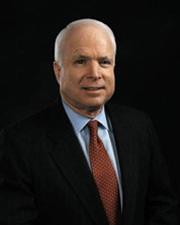 Sen. John McCain (R-AZ)
Legislative Activity
Stay on top of the latest movement without scrolling through every action
Roll call votes on amendments in Senate: Amendment SA 2575 not agreed to in Senate by Yea-Nay Vote. 40 - 59. Record Vote Number: 305.
October 1, 2009
View full timeline
Roll call votes on amendments in Senate: Amendment SA 2575 not agreed to in Senate by Yea-Nay Vote. 40 - 59. Record Vote Number: 305.
October 1, 2009
Senate amendment not agreed to: Amendment SA 2575 not agreed to in Senate by Yea-Nay Vote. 40 - 59. Record Vote Number: 305.
October 1, 2009
Considered by Senate. (consideration: CR S10009-10011, S10026-10027)
October 1, 2009
Amendment SA 2575 not agreed to in Senate by Yea-Nay Vote. 40 - 59. Record Vote Number: 305.
October 1, 2009
Senate amendment proposed (on the floor): Amendment SA 2575 proposed by Senator McCain.(consideration: CR S9971-9972; text: CR S9971)
September 30, 2009
Amendment SA 2575 proposed by Senator McCain. (consideration: CR S9971-9972; text: CR S9971) To provide for testimony before Congress on the additional forces and resources required to meet United States objectives with respect to Afghanistan and Pakistan.
September 30, 2009
Senate amendment submitted
September 29, 2009
Votes
1 roll call on this amendment
Text
Proposed
DEPARTMENT OF DEFENSE APPROPRIATIONS ACT, 2010

The PRESIDING OFFICER. Under the previous order, the Senate will
resume consideration of H.R. 3326, which the clerk will report.
The legislative clerk read as follows:

A bill (H.R. 3326), making appropriations for the
Department of Defense for the fiscal year ending September
30, 2010, and for other purposes.

=========================== NOTE ===========================

On Page S9970, September 30, 2009, the Record reads: . . . for
the fiscal year ending December 30, 2010 . . .

The online Record has been corrected to read: . . . for the
fiscal year ending September 30, 2010 . . .

========================= END NOTE =========================

Pending:

McCain amendment No. 2558, to strike amounts available for
procurement of C-17 aircraft in excess of the amount
requested by the President in the budget for fiscal year 2010
and to make such amounts available instead for operation and
maintenance in accordance with amounts requested by the
President in that budget and for Operation and Maintenance,
Army, for overseas contingency operations.

Amendment No. 2558

The PRESIDING OFFICER. There will now be 2 minutes of debate equally
divided prior to a vote in relation to amendment No. 2558 offered by
the Senator from Arizona, Mr. McCain.
Mr. McCAIN. Mr. President, I again quote from a letter from the
Secretary of Defense:

The President's defense budget request has requested no
additional C-17s. This position is based on the Department's
firm judgment that we have acquired a sufficient number of C-
17s to meet the Nation's military needs. . . . More
specifically, the $2.5 billion it will cost to purchase 10
additional C-17s plus the $100 million per year it will cost
to operate them will invariably result in a reduction in
critical warfighting capabilities somewhere else in the
defense program.

I understand there will be a budget point of order. I wish to tell my
colleagues we will be voting up or down on this issue because if this
is defeated, I will have another amendment simply to kill this
unneeded, unnecessary porkbarreling exercise in the power of lobbyists
in our Nation's Capital.
The PRESIDING OFFICER. The Senator from Connecticut.
Mr. DODD. Mr. President, I am prepared to go right to the heart of
the underlying amendment rather than go through this point of order,
but let me just point out that there are those who have supported a
provision in the fiscal year 2010 Defense Authorization bill that would
prohibit the Defense Department from retiring the 40-year-old C-5As.
These are the people who are now promoting this amendment to kill the
C-17. In effect, the proponents of the McCain amendment are tying the
hands of the Air Force, by requiring the Pentagon to upkeep a fleet of
C-5s--aircraft that are outdated, costly to operate, and are less
capable than the C-17. The Air Force should be allowed to replace them
with C-17s and not be forced to waste hundreds of millions of dollars
to extend the life of the C-5.
It is less costly to build a C-17 than it is to repair a C-5. That is
the reality. If we are looking for cost savings and deficit reduction,
then what the committee has advocated actually makes more sense
fiscally to do. But instead, the McCain amendment in effect promotes a
40-year-old aircraft, getting older by the day, rather than an aircraft
like the C-17 that has the capability of landing almost anywhere on the
globe for that matter, highly versatile.
We have nearly 100,000 new troops who have been added to our armed
services in 4 years. We need to have an airlift capacity that meets our
larger force's needs. I urge the rejection of the McCain amendment.
Mrs. BOXER. Mr. President, I rise today to express my continued
support for the C-17 cargo aircraft program and urge my colleagues to
retain funding for 10 additional aircraft in the fiscal year 2010
Defense appropriations bill.
The C-17 is critical to our national security and our ability to
efficiently carry out important missions around the world. Not only is
this aircraft an indispensable asset in supporting military and
humanitarian missions in countries like Iraq, Afghanistan and Sudan; it
has a proven record of versatility and high performance, and it
sustains jobs that are essential across 43 States--including my home
State of California.
First, I would like to talk about the types of missions where we use
the C-17. According to the Air Force's budget justification for 2010,
the C-17 ``is a major element of America's National Military Strategy
and constitutes the most responsive means of meeting U.S. mobility
requirements. . . . The C-17 will perform the airlift mission well into
this century.''
The C-17 is essential to our missions in Iraq and Afghanistan
particularly because of its versatility. It is used to transport
equipment, supplies and our service members. For example, the C-17 can
land on a dirt runway to deliver needed supplies in remote regions of
Afghanistan.
We also use the C-17 to evacuate our wounded men and women from Iraq
to Germany, and then back to the United States for treatment. And in
some instances, it has even been used to transport our service members
across a combat zone, reducing the risks that they face when they
travel on land by convoy.
And the uses don't stop there. The C-17 is used to deliver
humanitarian supplies. In January of this year, a C-17 delivered 18,000
pounds of supplies to Nicaragua, one of the poorest nations in the
Western Hemisphere.
The C-17 has also been used to bring relief to Americans, including
during Hurricane Katrina. It can deliver a 100-bed, fully equipped
hospital to nearly any area with an unimproved airstrip.
This is an amazing capability, and one we cannot afford to lose.
Second, the C-17 has a proven record of performance. Quite simply, it
is the workhorse of our military. And we are using them at a much
higher rate than the Air Force originally intended.
C-17s have flown over 1.3 million flight hours since 2002. Many are
flown at 150-180 percent of their anticipated flight hours.
According to the Congressional Research Service, the C-17 was
designed to fly 1,000 hours per year over 30 years, but the fleet has
averaged 1,250 hours per aircraft over the last ten years. Some have
even reached 2,400 flying hours in a single year.
And finally, the C-17 is the last strategic airlift production line
in the Nation. Every day 30,000 employees from 43 states go to work in
direct support of the C-17. In addition to those 30,000 direct jobs,
over 100,000 workers depend on this production line. In my home State
of California, 13,800 people work on the C-17. And 19,200 worker's have
an affiliation with this aircraft.
Too many American jobs depend on this vital program. Before we take
any action to shut down the line, we must be absolutely certain that we
have all of the aircraft we need.
We cannot take the chance that we ``may'' have enough aircraft,
particularly without reviewing two studies that are due by the end of
the year.

[[Page S9971]]

The Department of Defense Mobility Capabilities and Requirements
Study and the congressionally mandated study being done by the
Institute for Defense Analyses will determine if our airlift
requirements are being met.
We expect these studies to be complete by the end of this year.
Without the results of these studies, we cannot determine that our
Nation's airlift capability has been met. It would be incredibly
shortsighted to shut down this production line without that
information.
I urge my colleagues to join me in maintaining funds for the C-17,
and to defeat the McCain amendment.
The PRESIDING OFFICER. The Senator's time has expired. The Senator
from Hawaii is recognized.
Mr. INOUYE. Mr. President, I make a point of order that the pending
amendment violates section 302(F) of the Congressional Budget Act of
1974.
Mr. McCAIN. Mr. President, I move to waive the applicable section of
the Budget Act with respect to my amendment and ask for the yeas and
nays.
The PRESIDING OFFICER. Is there a sufficient second? There appears to
be.
The question is on agreeing to the motion.
The clerk will call the roll.
The legislative clerk called the roll.
Mr. DURBIN. I announce that the Senator from West Virginia (Mr. Byrd)
and the Senator from Louisiana (Ms. Landrieu) are necessarily absent.
The yeas and nays resulted--yeas 34, nays 64, as follows:

[Rollcall Vote No. 303 Leg.]

YEAS--34

Alexander
Barrasso
Bennet
Cardin
Carper
Coburn
Conrad
Corker
Dorgan
Ensign
Enzi
Feingold
Franken
Gregg
Kaufman
Klobuchar
Kohl
Kyl
LeMieux
Levin
Lugar
McCain
McConnell
Merkley
Nelson (FL)
Sanders
Sessions
Specter
Thune
Udall (CO)
Vitter
Voinovich
Warner
Webb

NAYS--64

Akaka
Baucus
Bayh
Begich
Bennett
Bingaman
Bond
Boxer
Brown
Brownback
Bunning
Burr
Burris
Cantwell
Casey
Chambliss
Cochran
Collins
Cornyn
Crapo
DeMint
Dodd
Durbin
Feinstein
Gillibrand
Graham
Grassley
Hagan
Harkin
Hatch
Hutchison
Inhofe
Inouye
Isakson
Johanns
Johnson
Kerry
Kirk
Lautenberg
Leahy
Lieberman
Lincoln
McCaskill
Menendez
Mikulski
Murkowski
Murray
Nelson (NE)
Pryor
Reed
Reid
Risch
Roberts
Rockefeller
Schumer
Shaheen
Shelby
Snowe
Stabenow
Tester
Udall (NM)
Whitehouse
Wicker
Wyden

NOT VOTING--2

Byrd
Landrieu

The motion was rejected.
The PRESIDING OFFICER. On this vote, the yeas are 34, the nays are
64. Three-fifths of the Senators duly chosen and sworn not having voted
in the affirmative, the motion is rejected, the point of order is
sustained, and the amendment falls.
Mrs. MURRAY. Mr. President, I move to reconsider the vote.
Mr. COCHRAN. I move to lay that motion on the table.
The motion to lay on the table was agreed to.

Signing Authorization

Mrs. MURRAY. Mr. President, I ask unanimous consent that the majority
leader be authorized to sign any duly enrolled bills and joint
resolutions for the remainder of today, Wednesday, September 30.
The PRESIDING OFFICER. Without objection, it is so ordered.
Mrs. MURRAY. I thank the Chair.
The PRESIDING OFFICER. The Senator from Arizona is recognized.
Mr. McCAIN. Mr. President, I wish to ask the managers this. I have
three amendments I wish to have called up and placed in order. One is
amendment No. 2580, one is amendment No. 2581, and the third is
amendment No. 2575.
The first is to strike the amount for the C-17 aircraft, which is not
subject to a point of order, I am told. The second is to add $2.5
billion for operations and maintenance, which is also not subject to a
point of order. The third one is to have testimony before Congress by
General McChrystal and General Petraeus before the Congress of the
United States.
I would be glad to agree to a brief debate on all three of those
amendments, and I will be glad to enter into a time agreement or
whatever their desires are on all three. On the first two, the issue
has been debated pretty well. I would only need a few minutes. On the
third, I think it is pretty straightforward, calling for the testimony
of General McChrystal and General Petraeus before the Congress of the
United States.
I call up those amendments and ask for their consideration in
sequence.
The PRESIDING OFFICER. Is there an objection to considering the
amendments en bloc?
Mr. McCAIN. Not en bloc, in sequence.
The PRESIDING OFFICER. Is there objection to the amendments being
brought up in sequence? Will the Senator specify the sequence?
Mr. McCAIN. I ask unanimous consent that amendments Nos. 2580, 2581
and 2575--I call up those amendments. I think that is my right.
The PRESIDING OFFICER. Is there objection?
Mr. DURBIN. Reserving the right to object.
The PRESIDING OFFICER. The Senator from Illinois.
Mr. DURBIN. Mr. President, I inquire of the Senator from Arizona, who
said the first two were in order because they strike and replace money,
is the Senator saying the same about the third amendment? Is it in
order on an appropriations bill?
Mr. McCAIN. I believe it is in order. I will be glad to have a vote
on whether it is a violation of any of the Senate rules.
Mr. DURBIN. I will not object to the first two. On the third, I will
object until we have a chance to look at it more closely.
Mr. McCAIN. I thank the Senator.
Parliamentary inquiry: Do I have the right to call up an amendment
that is filed?
The PRESIDING OFFICER. Yes, one amendment at a time.

Amendment No. 2575

Mr. McCAIN. Mr. President, I call up amendment 2575 and ask for its
immediate consideration.
The PRESIDING OFFICER. The clerk will report.
The legislative clerk read as follows:

The Senator from Arizona [Mr. McCain] proposes an amendment
numbered 2575.

Mr. McCAIN. Mr. President, I ask unanimous consent that reading of
the amendment be dispensed with.
The PRESIDING OFFICER. Without objection, it is so ordered.
The amendment is as follows:

(Purpose: To provide for testimony before Congress on the additional
forces and resources required to meet United States objectives with
respect to Afghanistan and Pakistan)

At the appropriate place, insert the following:
Sec. __. (a) Testimony Before Congress on Meeting United
States Objectives on Afghanistan and Pakistan.--The officials
specified subsection (b) shall each be made available, by not
later than November 15, 2009, to testify in open and closed
sessions before the relevant committees of Congress regarding
recommendations for additional forces and resources required
to achieve the objectives of United States policy with
respect to Afghanistan and Pakistan stated pursuant to
section 1117(a) of the Supplemental Appropriations Act, 2009
(Public Law 111-32; 123 Stat. 1907).
(b) Officials.--The officials specified in this subsection
are the following:
(1) The Commander of the United States Central Command.
(2) The Commander of the United States European Command and
Supreme Allied Command, Europe.
(3) The Commander of United States Forces-Afghanistan.
(4) The United States Ambassador to Afghanistan.

The PRESIDING OFFICER. The Senator from Arizona.
Mr. McCAIN. I call up amendment No. 2580 and ask for its immediate
consideration.
The PRESIDING OFFICER. Is there objection to setting aside the
pending amendment? The Senator from Illinois.
Mr. DURBIN. Reserving the right to object, it is my understanding--
Mr. McCAIN. I am not seeking unanimous consent.
The PRESIDING OFFICER. The Senator from Illinois has the floor.
Mr. DURBIN. Sorry. I thought the Senator made a unanimous consent
request.
Mr. McCAIN. I just called up the second amendment.
The PRESIDING OFFICER. The Senate requires unanimous consent to
consider an additional amendment.

[[Page S9972]]

Mr. McCAIN. I see.
Mr. DURBIN. I say to the Senator from Arizona, our mutual friend,
Senator Levin, asked to be on the floor when the first amendment was
being considered. I have to say, on his behalf, that I will object to
moving to another amendment until he has a chance to come to the floor
and debate the Senator's first amendment.
The PRESIDING OFFICER. Objection is heard.
Mr. DURBIN. I object.
The PRESIDING OFFICER. The Senator from Arizona.
Mr. McCAIN. I thank the Senator. We will certainly accede to his
request. I would like to tell my colleagues that I do not intend to
conclude debate on this legislation until such time as we have straight
up-or-down votes on the two amendments about which I talked. One is
striking the funding for the C-17, $2.5 billion and adding $2.5 billion
for operations and maintenance. I will be glad to discuss it with the
managers of the bill how that sequence will take place, how much
debate. I do not intend to hold up the bill in any way. I just wish to
tell my colleagues I want consideration and recorded votes on both of
those amendments.
What we have done tonight by not waiving the budget, the rule, is an
outrage and is going to damage very badly the men and women who are
serving this country because we are not giving them the equipment they
need to operate in harm's way--120,000 of them in Iraq, 68,000 of them
in Afghanistan. That is the opinion of the Chairman of the Joint Chiefs
of Staff, General Petraeus, General McChrystal, and the Secretary of
Defense. It is a remarkable moment--a remarkable moment--in the history
of the Senate, although I have seen it happen before. Congratulations
to the lobbyists from Boeing. I yield the floor.
The PRESIDING OFFICER. The Senator from Nebraska.

Amendment No. 2555, as Modified

Mr. JOHANNS. Mr. President, I ask unanimous consent that the pending
amendment be set aside, and I ask that amendment No. 2555 be called up.
With that, I am sending a modification to the desk.
The PRESIDING OFFICER. Without objection, it is so ordered. The clerk
will report.
Mr. JOHANNS. Before we go to the reading, if I could send a
modification to the desk.
The PRESIDING OFFICER. The clerk will report the amendment as
modified.
The legislative clerk read as follows:

The Senator from Nebraska [Mr. Johanns] proposes an
amendment numbered 2555, as modified.

Mr. JOHANNS. Mr. President, I ask unanimous consent that the reading
of the amendment be dispensed with.
The PRESIDING OFFICER. Without objection, it is so ordered.
The amendment is as follows:

(Purpose: To ensure the availability of not less than $30,000,000 for
High Priority National Guard Counterdrug Programs)

At the appropriate place, insert the following:
Sec. __. (a) High Priority National Guard Counterdrug
Programs.--Of the amount appropriated or otherwise made
available by title VI under the heading ``Drug Interdiction
and Counter-Drug Activities, Defense'', up to $30,000,000
shall be available for the purpose of High Priority National
Guard Counterdrug Programs.
(b) Supplement Not Supplant.--The amount made available by
subsection (a) for the purpose specified in that subsection
is in addition to any other amounts made available by this
Act for that purpose.

Mr. JOHANNS. Mr. President, I rise briefly this evening to speak
about this amendment. The amendment would help maintain, in fiscal year
2010, the current level of funding for the National Guard's counterdrug
efforts throughout the United States. It is important legislation.
As a Governor, as a mayor, I can tell you what I think everybody
knows. One of the toughest problems we face in this Nation is fighting
drug abuse and addiction and putting the tools in place to deal with
that.
We all know firsthand that drug addiction rips families apart and
tears communities down. It is accompanied by an endless parade of
violence.
Reducing drug abuse and crime was a top priority of mine as mayor and
Governor. In part because of steps we took, we were able to bring crime
numbers down. I am proud of that.
I know drugs are not a unique challenge to Nebraska. It is a national
challenge. Meth distributors commonly commit violent crimes as they
traffic in methamphetamine. Meth users often commit property crimes,
burglary, and identity theft. This drug is an enormous burden on public
health departments and treatment centers in our region. Meth-related
violence and child abuse have also strained local foster care systems,
not only in our State but in other States. Because of its highly
addictive nature, it takes longer treatment programs and it has a very
high recidivism rate. Treatment, needless to say, is enormously
difficult.
In the face of this problem, we need to keep up our pressure on drug
trafficking groups and work on providing more consistent funding to
Federal, State, and local drug task forces. The National Guard's
Counterdrug Support Program has been supporting law enforcement and
community-based drug reduction coalitions now for 20 years. However,
this program often faces considerable uncertainty over its funding, and
that hampers operations. Consistent funding would allow police to keep
many of the same officers in the drug task force. This would improve
communication between multiple different law enforcement agencies, and
it would increase their effectiveness.
Rural States are especially hurt by cuts and uncertainty in their
counterdrug budgets, since they often have a great deal of territory to
cover with very small departments.
To get to the crux of this amendment, my amendment would help address
these problems by helping restore counterdrug funding back to its level
last year. We are just asking for a level budget. Last year, Congress
added $22.5 million to the President's level of funding. The year
before it added $20 million. While the Defense authorization this year
authorized an additional $30 million in counterdrug support, it was not
included in the appropriations bill.
This money goes across our country, all 50 States, and some of our
territories. Our counterdrug operations depend on the funds.
If the current shortfall continues, the National Guard would not be
able to effectively support law enforcement in their fight against
drugs. Our law enforcement and National Guard personnel must be given
the tools they need to carry on this battle.
Tonight, in a very large appropriations bill, I ask what I believe is
a very necessary amount of money to help fight this war on drugs in
your State, Mr. President, in mine, and across this country. I urge my
colleagues to support the amendment. My hope is there will be a very
bipartisan, strong statement that we stand behind this very important
piece of this budget.
For the record, if it is acceptable--and I don't know if there is an
agreement on this or not--but I want to indicate for the record that I
will be more than happy to move this amendment with a voice vote.
The PRESIDING OFFICER. The Senator from Mississippi.
Mr. COCHRAN. Mr. President, I congratulate the Senator for bringing
to the attention of the Senate this suggested change. We have no
problem with having this amendment adopted on a voice vote, if that
suits the manager on the other side.
Mr. INOUYE. No objection.
The PRESIDING OFFICER. Is there further debate? If not, the question
is on agreeing to amendment No. 2555, as modified.
The amendment (No. 2555), as modified, was agreed to.
Mr. COCHRAN. I move to reconsider the vote.
Mr. INOUYE. I move to lay that motion on the table.
The motion to lay on the table was agreed to.
The PRESIDING OFFICER. The Senator from California.
Mrs. BOXER. Mr. President, I wonder if the managers would allow me to
make a unanimous consent request on a totally other issue, the issue
dealing with the highway trust fund, at this time. I will take about 2
or 3 minutes; is that all right?
Mr. COCHRAN. I have no objection to the Senator discussing her
suggestion.

Unanimous Consent Request--H.R. 3617

Mrs. BOXER. Mr. President, we are in a very bad situation with the
highway trust fund. We are working very hard on both sides of the aisle
to resolve it. Senator Inhofe and I are absolutely in agreement on what
we should

[[Page S9973]]

do. But yet still there is objection from the other side of the aisle,
our Republican friends. I wish to explain where we are, and then I am
going to make a unanimous consent request.
In the SAFETEA-LU program, which was the last highway bill, there was
an $8 billion rescission that was made. The promise at that time years
ago was that we would fix it in the days, months, and years ahead. It
was not fixed, and if we don't repeal the rescission tonight, what will
happen immediately is that there will have to be layoffs, there will
have to be cancellation of contracts, and the order will go out from
here to our States. Mr. President, 17,000 jobs are on the line. We have
to repeal this rescission. It translates into about $300 million.
I have been working with Senator Inhofe, and we reached agreement
and, frankly, the leaders, I believe, reached agreement that what we
ought to do is repeal this rescission and, as a paid-for, cut the TARP
money because we know that a lot of those funds have been paid back,
cut that program by the equivalent of $300 million. We would repeal the
rescission, everybody keeps working, the contracts are still going, and
we pay for this repeal by cutting $300 million from TARP, the Toxic
Asset Relief Program, not very popular in the country, I might add.
I have to say I asked the administration for some other ideas and
they had none. I believe in pay as you go. So I said to Senator Inhofe
that I was with him on this. He and I are in agreement.
At this time, I am going to make this formal unanimous consent
request to repeal this rescission and pay for it by cutting TARP.
I ask unanimous consent that the Senate proceed to the immediate
consideration of H.R. 3617, received from the House and at the desk;
that the Boxer substitute amendment at the desk be considered; further,
that the Boxer-Inhofe second-degree amendment with an offset be
considered and agreed to, the substitute amendment, as amended, be
agreed to, the bill, as amended, be read a third time, passed, and the
motions to reconsider be laid upon the table, and that any statements
relating to the bill be printed in the Record, without further
intervening action or debate.
The PRESIDING OFFICER. Is there objection?
The Senator from Nebraska.
Mr. JOHANNS. Mr. President, I rise to object. My understanding is
there is an objection on our side of the aisle relative to this
approach. Thus, I rise this evening to object.
The PRESIDING OFFICER. Objection is heard.
Mrs. BOXER. Mr. President, let me say how, frankly, shocked I am at
this objection. We have the chairman of the EPW Committee, the ranking
member of the EPW Committee--this is an amendment that was brought to
us by Senator Kit Bond of the other side of the aisle. I do not
understand how the Republicans can take this position when we can see
these contracts abrogated as a result of our lack of action.
I yield to the Senator from Illinois.
Mr. DURBIN. Mr. President, I ask if the Senator from California will
yield for a question. If the objection of the Senator from Nebraska
holds and if the Republican side of the aisle does not change its
position, it is my understanding that there will be a rescission of
some $8 billion, which means cutting the highway funds going to
Nebraska, the highway funds coming to Illinois, and the highway funds
coming to California; is that what the outcome will be because of the
objection from the other side?
Mrs. BOXER. I think, with due respect to the Senator from Nebraska,
that he is saying that several of his colleagues will not allow this to
go through. I don't want to blame him for this. He is the messenger.
But the bottom line is, the $8 billion in authorizing numbers
translates to $300 million in contracting authority. So as of tomorrow
morning, unless this is reversed, we are going to see cuts to the
highway program of $300 million. And it has to be made from existing
contracts, so people in your State, in my State, in Kentucky, in the
State of the Senator from Nebraska--all of our States are going to
suffer. There will be 17,000 people thrown out of work because the
Republicans cannot agree with the chairman of the EPW, the ranking
member, and both leaders.
Mr. DURBIN. If the Senator from California would further yield, so
what the Republican side is objecting to is that we would take money
out of the toxic asset relief program--money that was sent to the
banks, if you will recall, to help them out of their troubles--and put
it into the highway trust fund to save or create 17,000 jobs across
America, and if we don't, we stand to lose those jobs--the Republican
side is objecting to that?
Mrs. BOXER. The Republican side has objected to an agreement reached
by myself and Senator Inhofe and I believe the two leaders that would
say we are going to replenish the highway trust fund, we are going to
repeal the rescission that was done and as a result the States will be
shorted $300 million, and it is my understanding that starting tomorrow
morning a lot of these contracts will be canceled or delayed unless we
fix this. We could fix it at a later date, but every day that goes by,
it makes it more difficult because we are operating under a midnight
deadline tonight.
Mr. DURBIN. If the Senator would yield for one last question, just so
that I understand, the result of the Republican objection is that we
are going to protect the TARP funds, the toxic asset relief program
funds that were used to bail out banks, at the expense of jobs for
people across America at a time of high unemployment? Is that the
result of that objection?
Mrs. BOXER. My friend is right. But I want to give credit to Senator
Inhofe. He is with us. There are many Members on his side of the aisle,
however, who are letting this happen. But my friend has it exactly
right. The Republicans who are objecting to this are protecting the
toxic asset relief program and they are jeopardizing 17,000 jobs across
America.
I am as stunned as you are, and I guess I am going to try one more
time. If I hear another objection, we will leave it for another day. I
will try it one more time. Maybe I have convinced my friend. Maybe my
friend needs to leave the floor.
Mr. President, I ask unanimous consent that the Senate proceed to the
consideration of H.R. 3617, received from the House and at the desk,
and that the Boxer substitute amendment at the desk be considered;
further, that the Boxer-Inhofe second-degree amendment with an offset
be considered and agreed to, the substitute amendment, as amended, be
agreed to, the bill, as amended, be read a third time, passed, and the
motion to reconsider be laid upon the table; that any statements
relating to the measure appear in the appropriate place in the Record
as if read, without further intervening action or debate.
The PRESIDING OFFICER. Is there objection?
The Senator from Nebraska.
Mr. JOHANNS. Let me, if I might, through the Chair, inquire of the
Senator from California if the Senator would renew her request with one
change: to include a different second-degree amendment from Senator
Vitter which would provide an offset from non-defense and non-veteran
stimulus funds.
The PRESIDING OFFICER. The Senator from California.
Mrs. BOXER. Well, that is easy. If you believe we have a recession,
if you believe the unemployment rate is too high, why in God's green
Earth would anyone recommend cutting the economic recovery fund, the
fund that is providing stimulus and that is putting people to work? I
absolutely would not agree to that. That particular fund is giving
money back to taxpayers in tax breaks. It is fixing highways and
bridges and all the other. Why on Earth would we cut that when we can
cut the toxic asset relief program--the TARP money--that went to the
wealthiest banks? Why on Earth would we take away jobs from working
people and allow the bankers to keep their little fund up there?
No way. We will object to that approach.
Mr. JOHANNS. Mr. President, then I do raise an objection. And here is
the point, in fairness to the process here. There are many who believe
that the TARP money, which was originally designed to buy toxic assets,
has drifted so far away from its original purpose that we haven't kept
faith with the taxpayer who paid the bill for all this. On the other
hand, the stimulus--which, incidentally, I did not support--

[[Page S9974]]

had money in it to do highways and that sort of thing, and that is
where the objection is coming from.
So I do stand to object, and I continue the objection.
Mr. DURBIN. Would the Senator yield for a question?
The PRESIDING OFFICER. Objection is heard.
The Senator from Illinois.
Mr. DURBIN. Whether the Senator voted for the stimulus bill or not--
and I know he did not--the stimulus bill provided tax breaks for
working families, provided money for his State and mine for
infrastructure projects that will build highways and bridges and create
jobs, and it is halfway through. They haven't really finished all the
spending on that.
In the midst of this recession, you are suggesting that the way to
save the 17,000 highway jobs is to cut the jobs that are being created
by the stimulus package? Wouldn't it be better to take the money away
from these banks that have received billions of dollars, that have been
bailed out over and over, than to take it at the expense of working
people in Nebraska and Illinois?
The PRESIDING OFFICER. The Senator from Nebraska.
Mr. JOHANNS. I thank the Senator from Illinois for that question, but
here is what I would say. You can restart the debate on the whole
stimulus plan, and I can point to you the promises that were made of
all the jobs that were going to be created, and I can point to you the
evidence that in fact that has not occurred. But the argument tonight
was, look, if we can just get our hands on some TARP money, then we can
do all these things. And we are saying, well, look, if the promise of
the stimulus was to create jobs, let's use the stimulus. Why not use
that fund?
But fundamentally here is the problem. People came to the American
people and said: Look, our credit is melting down, our financial system
is in serious shape, and the solution to that problem is to buy toxic
assets. And low and behold we bought car companies, we bailed out
insurance companies, and it just goes on and on. And that is why the
objection is coming from over here because this isn't anything near
what TARP was intended to do.
I thank the Chair.
The PRESIDING OFFICER. The Senator from Illinois.
Mr. DURBIN. I will be brief, but the Senator from Nebraska just made
the argument against TARP. That is where we want to take the money from
to protect these jobs. The Senator said the TARP money was misspent,
and we are saying we agree with the premise; that this is a better
place to take money rather than to take it away from tax cuts to
working families in the stimulus or the infrastructure projects that
generate jobs.
I don't know that the Senator from Nebraska wanted to assume this
role this evening. Occasionally, many of us are cast in these roles
where we are objecting on behalf of other people who are not here. But
I think when he reflects on this debate tonight, he will understand why
Senator Boxer's approach to this is the most reasonable one. We are
trying to protect 17,000 jobs across America. We are going to take the
money out of the TARP funds from banks, and I think it is money well
spent to create jobs across the United States. But to take it away from
the stimulus program is to take away money that is going right now,
today, into Nebraska for tax relief for your working families and into
Illinois for the same.
I am sure most Republicans would agree that tax relief is a good
thing. I myself think it is a good thing for working families. So I
think what Senator Boxer has suggested is a much more responsible
approach.
Mrs. BOXER. Mr. President, will the Senator yield?
Mr. DURBIN. I will yield.
The PRESIDING OFFICER. The Senator from California.
Mrs. BOXER. I think sometimes these debates go off on tangents and
they are hard to follow. They get caught up in a lot of rhetoric. But I
think this one tonight says it all to me. We have to ask ourselves a
question: Whose side are we on? Whose side are we on? Tonight, we know
what side the Republicans are on.
We are ready to save 17,000 jobs and to do it by paying for it out of
the money that was given to the biggest banks in this Nation--the banks
that got away scot-free while Americans suffered, whether they were
shareholders or workers, taxpayers all. We want to take that money from
the big banks; they want to take it from the working people, the
working families of America, the ones who are out there getting their
hands dirty and building the roads and the bridges. That says more
about the differences here than many of the other things we do, and I
am stunned.
I particularly want to again thank Senator Inhofe for stepping up. He
tried his best. He spoke to all his Republican friends, and he couldn't
get this. But you know what, we are not going to give up. We will have
this battle on the floor. We will. We will get time for this, and we
will get agreement on offering these two offsets. You just had a taste
of what the debate will be, and it will be a tough debate, and I look
forward to it. But I am very stunned that tonight we couldn't cross the
aisle that divides us tonight. We should have. We should have done that
for all the States--the red States and the blue States, all the States,
the United States--because all are going to lose these jobs. We can say
we stood here at 7:30 on this night and we had a program that would
easily stop those layoffs, easily stop them, but our colleagues on the
other side wanted to protect the big banks. I will take that argument
back to my home State, but I am not happy we couldn't resolve this.
Mr. DURBIN. I thank the Senator from California for yielding for a
question, and I agree.
I yield the floor.
Mr. LEVIN. Mr. President, I am pleased the Senate is debating a
short-term extension of the surface transportation bill SAFETEA-LU.
With the fiscal year ending at midnight tonight this is an urgent
matter. We cannot afford to let Federal highway programs authorizations
expire. It would be a disaster if transportation projects across the
nation were halted because we failed to extend their authority.
Congress needs to rewrite the surface transportation bill, but that
will take some time. This short-term extension allows the program
authority to continue until a longer reauthorization bill can be
passed.
Importantly, the Senate bill includes language to repeal the 2009
rescission contained in the SAFETEA-LU bill that required that on
September 30, 2009--today--$8.7 billion of apportioned contract
authority provided to states for investment in infrastructure be
rescinded. This rescission could require states to de-obligate projects
in order to free up the rescinded contract authority if they don't have
contract authority balances. This is critical to Michigan and all the
other States across the Nation that cannot afford to have Federal
infrastructure funding cut at a time of severe budget constraints. The
rescission repeal language would ensure that Michigan and other States
do not lose these needed Federal transportation funds. Michigan's share
of the rescission is estimated to exceed $260 million or roughly 25
percent of its fiscal year 2009 apportionments.
Congress has been strong in its support for transportation
infrastructure funding as a way to create jobs and jump start an
economic recovery during the severe economic downturn. For instance,
Congress provided $27 billion for highway projects in the American
Recovery and Reinvestment Act. Congress also recently provided an
additional $7 billion to the highway trust fund in order to keep it
solvent on top of the $8 billion that it added to the trust fund last
year. It would make no sense to undermine the recovery efforts and
jeopardize the health of our surface transportation system by allowing
an $8.7 billion cut in highway funding to go through tonight.
Time is of the essence in restoring these needed transportation funds
to every State in the Nation. I hope this important legislation will be
adopted immediately by the Senate and the House of Representatives.
The PRESIDING OFFICER. The Senator from Illinois.
Mr. BURRIS. Mr. President, I ask unanimous consent to speak as in
morning business.
The PRESIDING OFFICER. Without objection, it is so ordered.

[[Page S9975]]

2016 Olympics

Mr. BURRIS. Mr. President, more than 100 years ago, four American
cities competed to host the world's Columbian Exposition. Elected
leaders and proud citizens traveled here to Washington to make the case
for their hometowns. After much debate, Congress decided that the
exposition would take place in the center of the American heartland--
Chicago, IL.
The Chicago delegation had made the strongest case and shown the most
pride and conviction in their city. They bragged that their hometown on
the beautiful banks of Lake Michigan was the perfect site for the
Columbia Exposition and that no other city could compare. Folks from
Chicago argued so long and so hard that a reporter referred to their
hometown as ``that Windy City,'' and the nickname, of course, has stuck
throughout the years.
The Columbian Exposition of 1893 was a resounding success. Almost
one-fourth of the entire U.S. population came to Chicago, and the city
overflowed with happy visitors from across the country and all over the
world.
Today, Chicago remains an economic and cultural center of America.
The city that hosted the Columbian Exposition has boomed into a world-
class metropolis. And once again the proud citizens of the Windy City
have stepped forward to make the case for our hometown.
In 2016, 10,000 athletes from more than 200 countries will come
together to celebrate the human spirit. Tourists, visitors, and
millions of dollars will flow into a single place as a part of the
greatest spectacle on Earth.
The whole world will be watching the city that hosts the Olympic
Games, and in 2016 that city should be Chicago, IL. From Lake Shore
Drive to the West Side, it is a diverse and inclusive city that
represents the very best of what it means to be American. It has always
been a global leader in culture, art, architecture, commerce, sports,
and even cuisine.
I know Chicago will shine on the world stage in 2016, just as it did
more than a century ago. The Olympic and Paralympic Games are a
powerful force for global unity. It is time to bring the games back to
the United States.
President Obama understands what the Olympics will mean to our Nation
and for Chicago. New construction and infrastructure improvement will
revitalize the Midwest; tourist dollars from all over the world will
begin flowing to American businesses once again; jobs will be created,
revenue will increase, our local economy will be jolted back to
prosperity as we prepare to host the games.
It doesn't stop there. This impact will also be felt at the national
level. Foreign visitors who travel to the Olympics in Chicago will also
stop in Los Angeles, New York, Baltimore, Miami, Seattle, New Orleans,
and a dozen other cities during their stay in the United States. The
international spotlight will be focused on America and it will bring
prosperity and good will. That is why I support President Obama's
decision to travel to Copenhagen in support of our Olympic bid.
Some have criticized this trip. Some say it is an unnecessary
distraction from the challenges we face. But I believe it is just the
opposite. It shows that the President is more focused than ever on
bringing economic prosperity and international prestige back to the
United States.
A few days ago I was meeting with the mayor of Chicago and I told
Mayor Daley that I thought the President and the First Lady would go to
Copenhagen. There was some consternation as to whether he was going to
appear, but because of the importance of the Olympics to Chicago and
the Nation, I knew the President's decision was going to be made that
would allow him to make an appearance in Copenhagen. I know they are
proud Chicagoans, and I am pleased they have decided on strong support
for their hometown. The trip will be a short one, but it could make a
world of difference for Chicago and for America, because this is not
just about Chicago or Illinois, it is about bringing the Olympic Games
back to the United States of America. The Olympics will be a boon to
our economy and they will strengthen our friendship with other nations.
By appearing before the International Olympic Committee in person,
President Obama can make the case that America is ready to lead once
again, ready to light the torch of cooperation and prosperity for all
of the citizens of the world. He can show the committee that Chicago is
by far the best choice among the four remaining finalist cities. For
the athletes, world-class training facility and event locations would
be very close together, allowing for convenience and ease. For
visitors, outstanding public transportation and modern infrastructure
would make all events easy to attend. For residents of the city and
people all across the United States, Chicago would shine on the world
stage and dollars would pour in from across the globe to make it clear
it is alive and well in my hometown.
The Chicago 2016 Committee recognizes the importance of the games in
renewing old friendships around the world as well as establishing new
ones. Its ideals and the value of ``friendship through sport'' is at
the heart of the city's Olympic bid.
Let us support President Obama as he travels to Denmark in hopes of
bringing the Olympics and Paralympic Games back to the United States.
They are a powerful, inspiring force for unity in a world divided. Let
us come together once again to welcome the people of every continent to
our shores. Just as the people of Chicago did more than 100 years ago,
let us celebrate our Nation by sharing one of the greatest cities with
all of the world, by sharing its greatest city with the rest of the
world, that great city on the lake--Chicago.
I yield the floor and suggest the absence of a quorum.
The PRESIDING OFFICER. The clerk will call the roll.
The assistant legislative clerk proceeded to call the roll.
Mr. REID. Mr. President, I ask unanimous consent that the order for
the quorum call be rescinded.
The PRESIDING OFFICER (Mr. Warner). Without objection, it is so
ordered.

Cloture Motion

Mr. REID. Mr. President, I have a cloture motion at the desk with
respect to the substitute amendment.
The PRESIDING OFFICER. The cloture motion having been presented under
rule XXII, the Chair directs the clerk to read the motion.
The assistant legislative clerk read as follows:

Cloture Motion

We, the undersigned Senators, in accordance with the
provisions of rule XXII of the Standing Rules of the Senate,
hereby move to bring to a close debate on the committee-
reported substitute amendment to H.R. 3326, the Department of
Defense Appropriations Act for Fiscal Year 2010.
Daniel K. Inouye, Harry Reid, Sheldon Whitehouse, Patty
Murray, Jon Tester, Jack Reed, Ben Nelson, Richard
Durbin, Mark Begich, Bill Nelson, John F. Kerry, Edward
E. Kaufman, Charles E. Schumer, Frank R. Lautenberg,
Carl Levin, Byron L. Dorgan, Daniel K. Akaka.

Cloture Motion

Mr. REID. Mr. President, I have a cloture motion on the bill at the
desk.
The PRESIDING OFFICER. The cloture motion having been presented under
rule XXII, the Chair directs the clerk to read the motion.
The assistant legislative clerk read as follows:

Cloture Motion

We, the undersigned Senators, in accordance with the
provisions of rule XXII of the Standing Rules of the Senate,
hereby move to bring to a close debate on H.R. 3326, the
Department of Defense Appropriations Act for Fiscal Year
2010.
Daniel K. Inouye, Harry Reid, Sheldon Whitehouse, Patty
Murray, Jon Tester, Jack Reed, Ben Nelson, Richard
Durbin, Mark Begich, Bill Nelson, John F. Kerry, Edward
E. Kaufman, Charles E. Schumer, Frank R. Lautenberg,
Carl Levin, Byron L. Dorgan, Daniel K. Akaka.

Mr. REID. Mr. President, I now ask unanimous consent that the
mandatory quorum required under rule XXII be waived.
The PRESIDING OFFICER. Without objection, it is so ordered.

____________________