To strike amounts available for procurement of C-17 aircraft in excess of the amount requested by the President in the budget for fiscal year 2010.
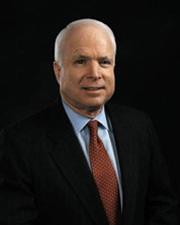 Sen. John McCain (R-AZ)
Legislative Activity
Stay on top of the latest movement without scrolling through every action
Senate amendment proposed (on the floor): Amendment SA 2580 proposed by Senator McCain.(consideration: CR S10153-10154; text: CR S10153)
October 6, 2009
View full timeline
Senate amendment proposed (on the floor): Amendment SA 2580 proposed by Senator McCain.(consideration: CR S10153-10154; text: CR S10153)
October 6, 2009
Senate amendment not agreed to: Amendment SA 2580 not agreed to in Senate by Yea-Nay Vote. 30 - 68. Record Vote Number: 312.
October 6, 2009
Roll call votes on amendments in Senate: Amendment SA 2580 not agreed to in Senate by Yea-Nay Vote. 30 - 68. Record Vote Number: 312.
October 6, 2009
Amendment SA 2580 proposed by Senator McCain. (consideration: CR S10153-10154; text: CR S10153) To strike amounts available for procurement of C-17 aircraft in excess of the amount requested by the President in the budget for fiscal year 2010.
October 6, 2009
Amendment SA 2580 not agreed to in Senate by Yea-Nay Vote. 30 - 68. Record Vote Number: 312.
October 6, 2009
Senate amendment submitted
September 30, 2009
Votes
1 roll call on this amendment
Text
Proposed
DEPARTMENT OF DEFENSE APPROPRIATIONS ACT, 2010

The PRESIDING OFFICER. Under the previous order, the Senate will
resume consideration of H.R. 3326, which the clerk will report.
The assistant legislative clerk read as follows:

A bill (H.R. 3326) making appropriations for the Department
of Defense for the fiscal year ending September 30, 2010, and
for other purposes.

Pending:

Coburn amendment No. 2565, to ensure transparency and
accountability by providing that each Member of Congress and
the Secretary of Defense has the ability to review
$1,500,000,000 in taxpayer funds allocated to the National
Guard and Reserve components of the Armed Forces.
Barrasso amendment No. 2567, to prohibit the use of funds
for the Center on Climate Change and National Security of the
Central Intelligence Agency.
Franken amendment No. 2588, to prohibit the use of funds
for any Federal contract with Halliburton Company, KBR, Inc.,
any of their subsidiaries or affiliates, or any other
contracting party if such contractor or a subcontractor at
any tier under such contract requires that employees or
independent contractors sign mandatory arbitration clauses
regarding certain claims.
Franken (for Bond/Leahy) amendment No. 2596, to limit the
early retirement of tactical aircraft.
Franken (for Coburn) amendment No. 2566, to restore
$166,000,000 for the Armed Forces to prepare for and conduct
combat operations, by eliminating low-priority
congressionally directed spending items for all operations
and maintenance accounts.
Sanders/Dorgan amendment No. 2601, to make available from
Overseas Contingency Operations $20,000,000 for outreach and
reintegration services under the Yellow Ribbon Reintegration
Program.

[[Page S10144]]

Lieberman modified amendment No. 2616, relating to the two-
stage ground-based interceptor missile.

The PRESIDING OFFICER. The Senator from Hawaii.
Mr. INOUYE. Am I correct to assume that the first 30 minutes has been
equally divided?
The PRESIDING OFFICER. The Senator is correct.
Mr. INOUYE. I yield myself 10 minutes.
At the beginning of the year, the chairman of the House
Appropriations Committee and I announced earmark reforms that go far
beyond the transparency requirements enacted in 2007.
These reforms include a requirement for Members to post their earmark
requests on their Web sites, make substantial reductions in the number
and amount of earmarks compared to prior years' appropriations bills,
and early and prompt committee announcements on which projects are
funded in each of the annual appropriations bills.
There has never been as much transparency in the earmark process as
there is today. In most cases, the public has had several months to
review their elected Representatives' requests for funding. The bill on
the floor today has 200 fewer projects and $300 million less in funding
for Member projects than last year's bill.
I believe this is a considerable improvement to how Congress does its
business.
As chairman of the Appropriations Committee, I welcome any
constructive suggestions on how to improve the operations and
efficiency of the ways in which the committee accomplishes its vital
work.
However, those suggestions should not compromise the constitutional
principle that the power of the purse is invested in the Congress, and
not the executive.
We must retain the checks and balances and keep the Congress and the
executive as separate and co-equal branches of government.
That is why I must oppose the amendment offered by the Senator from
Arizona. It purports to increase transparency of congressional earmarks
by subjecting all of them to full and open competition.
In reality, it exempts congressional priorities from the normal,
lawful process of how the Department of Defense purchases equipment,
engages services, and develops new technologies.
For example, we have included a number of earmarks for which the
Department has negotiated contracts already in place. These contracts
were negotiated in full compliance with the law.
Simply because Congress added funds to accelerate important programs,
such as the TB-33 towed sonar array, handheld radios for Special
Operations Command, advanced radars for the F-15 fighter, and virtual
interactive training equipment for National Guard units around the
country, the McCain amendment would require a new competition to take
place.
This would disrupt important programs, delay procurement of valuable
equipment, and cost the taxpayer more money.
The McCain amendment also disregards the fact that sometimes the
Pentagon gets it wrong. There are many programs which are now in use on
the battlefield that would not be there if the Defense Department's
views had prevailed years ago.
Congress directed funds to the Predator unmanned aerial vehicle,
lifesaving Chitosan bandages, and the V-22--programs that would not
exist if Congress had not directed funds to those specific purposes.
I ask my colleagues, What do they suppose would have happened to
those programs if the Pentagon's bureaucracy had put these programs
through the redtape required by the McCain amendment? Would the
Predator be attacking our enemies in Afghanistan and Iraq? Or might it
still be an exquisite, complex system that remains on the drawing board
year after year?
Ultimately the McCain amendment establishes two sets of acquisition
laws: one for items requested by the President, which may be subject to
full and open, limited or no competition at all; and another set of
rules for items added by the Congress.
The amendment rests on the faulty assumption that the Defense
Department is unable to conduct oversight on congressionally directed
spending, and that earmarks do not serve valid military purposes.
In 2008, the Inspector General of the Department of Defense reviewed
219 earmarks from the fiscal year 2007 Defense Appropriations Act.
The Inspector General determined:

The DOD personnel we interviewed and the respondents to our
data call said that DOD performs oversight of earmarks
identical to the oversight of other expenditures.

Furthermore, of the 219 earmarks that were reviewed by the Inspector
General, all but 4 were found to ``advance the primary mission and
goals of the Department of Defense.''
None of these four earmarks is contained in this year's bill. Even if
they were, none of them would be competed under the McCain amendment
because each of those earmarks was awarded to a nonprofit institution.
Due to these shortcomings in the amendment which has been offered, I
have proposed an alternative amendment.
My amendment insures that each earmark added by Congress to benefit a
for-profit entity shall be subject to the very same acquisition
regulations that apply to items requested by the President in his
annual budget request. This proposal applies the rules of the road
equally to Congress and the President.
The amendment I propose also contains the standard exceptions to
competition, including small business set-asides. The McCain amendment,
on the other hand, would eliminate these standard exemptions to
competition for earmarks that support small businesses, minority-owned
businesses, women-owned businesses, and service-connected disabled
veteran-owned businesses.
My amendment is a reasonable and fair approach to balancing the
acquisition rules as they apply to congressional spending items and
items requested by the President. It insures that all spending items
that are funded in this bill, regardless of who proposed them, are
subject to the same rules for competition. I urge my colleagues to
support my amendment and oppose the McCain amendment.
I yield the floor.
The PRESIDING OFFICER. The Senator from Mississippi.
Mr. COCHRAN. Mr. President, I thank the distinguished chairman of our
committee, Senator Inouye, for his leadership and the bipartisan way he
has gone about managing his responsibilities as chairman of the Defense
Appropriations Subcommittee. The committee has carefully reviewed the
President's budget request in public hearings, calling before the
committee representatives of the various service departments and also
opening the opportunity for any outside interest to come to talk about
what our needs are. In my judgment it has been a very careful, prudent,
and workmanlike way to approach this very solemn and important
responsibility. So he has brought us to where we are today, scheduled a
vote, finally, on final passage later today, providing funding for our
national security agencies, the Department of Defense, the men and
women who have volunteered to put themselves in harm's way, to wear the
uniform of our country and to defend our country against aggression
here and abroad.
The Department is currently being funded by a continuing resolution.
Although forcing the Department to operate under a temporary resolution
is not a very good way to provide funding for a department charged with
protecting our national security interests, it is the best we could do.
I applaud the leadership of Senator Inouye for bringing a bill before
us that will cover the entire Department of Defense for the remainder
of the fiscal year, and for working with our counterparts in the House
to begin resolving differences between the two bodies so that a bill
can soon be presented to the President for signature.
There has been much discussion about earmarks. The chairman raised
the issue. Later this afternoon we will vote on an earmark-related
amendment or two. There are those who have been striving to inject
additional earmark reforms and other ways of doing business. We think
we have carefully reviewed all the requests for spending,

[[Page S10145]]

all of the provisions that permit spending in this bill, to be sure
they are warranted, justified, in the national interest, and is not
there only to serve some special interest or private interest of a
Member of Congress.
Congress has worked, the House and Senate together, to improve and
make significant changes in the process, adding procedures to
facilitate the closest possible scrutiny of congressionally directed
spending. In addition, the Appropriations Committee has gone beyond
those requirements and imposed additional disclosure requirements and
limitations on earmarking. But I am not going to support any suggested
changes that will take away from the Congress or diminish the power of
the Congress specifically to carry out its responsibilities under the
Constitution to direct spending.

The committee has recommended, and the Senate has acted in its wisdom
to approve or reject certain provisions of the bill. We have
entertained all amendments. There is no closed rule. There is no
specified number of amendments. There is no prohibition against any
amendment of any Senator. So anyone who has a problem with this bill or
any provision has had a right to say what it is, offer a change in the
way of an amendment, and to have the Senate vote on it. That is the way
we conduct business in the Senate on earmarks. It is an open process.
There is nothing in the procurement history of the Department of
Defense to support the notion that the Department has been infallible
in cost effectively procuring solutions for our Defense Department
needs, and doing so in a fair, open, and evenhanded manner. The
inspector general and GAO reports are replete with examples of poor
judgment in Defense Department activities having nothing to do with
congressionally directed spending. The GAO has upheld protests in
recent years in which the Department did not perform its acquisition
responsibilities in a lawful and appropriate manner.
So there are a lot of checks and balances that are at work in the
process, and I think we have to remind ourselves how thorough and
diligent many people are in assuring that the things that are approved
in this bill serve the public interest, not just the private interests
or whims of Members of Congress.
We have increased funding for the requirement that the Department of
Defense identified over the summer for Mine Resistant Ambush Protected
vehicles for our men and women serving in Afghanistan. We have imposed
new requirements to help protect our soldiers in uniform and on the
battlefield. We have included an additional $1.2 billion for the MRAP
program, and it is above what the administration has requested. I think
we have acted responsibly, and I strongly defend the decision the
committee has made on this subject. I have no doubt including funding
for the procurement of these additional vehicles will save American
lives.
Congressionally directed defense initiatives should be subject to the
closest scrutiny of the Appropriations Committee, and of the
legislative process as a whole including the authorizing procedure
which precedes the appropriations process. The activities of the
Department of Defense were carefully scrutinized by the Armed Services
Committee, which shares responsibilities for making these decisions, as
well as the Appropriations Committee. But I do not think Members of
this body should feel ashamed or embarrassed to promote the passage of
this bill. It is a good bill. It enhances our national security, and it
supports the efforts we are making to protect the security interests of
this great country.
I thank the Senate for allowing me to make these comments and the
distinguished Senator from Hawaii for being an active, responsible
partner in the development of this legislation.
The PRESIDING OFFICER. The Senator from Hawaii.
Mr. INOUYE. Mr. President, I thank my distinguished colleague from
Mississippi, the vice chairman of this committee, for his generous
remarks.
I would like to point out to the Senate, this bill represents
thousands of manhours of study, of research, of discussion, of debate.
It contains spending of $636.6 billion. It is a huge amount. We take
our vows and responsibilities very seriously. It might be interesting
to note that this measure--this huge measure--was passed by the
Appropriations Committee by a vote of 30 to 0. It is a bipartisan bill.
It was passed unanimously. These things do not happen every day, Mr.
President. It demonstrates and I think it illustrates what
bipartisanship can do, what work can do, and what investigation can do.
Senator Cochran and I are proud to present this measure to the
Senate, to our colleagues, and we hope it will be passed accordingly.
Mr. President, I would like to take this opportunity to discuss the
Defense Subcommittee's recommendations regarding the fiscal year 2010
missile defense programs. This bill supports the administration's
request, stays at the authorized funding levels, and, most importantly,
recommends changes that augment programs that this Congress has been
championing year after year.
The committee strongly supports the near-term missile defense
programs, including ground-based missile defense, Aegis sea-based
missile defense, and theater high altitude area defense. The committee
added funding to the budget request in order to enhance each of these
initiatives and ensure that the administration remains focused on these
programs that are supporting the warfighter today.
The committee provides an additional $50 million above the budget
request for the ground-based missile defense, GMD, program. After the
administration submitted its budget for GMD, the Department of Defense
approved a new integrated master test plan for the Missile Defense
Agency, MDA. This plan requires seven additional ground-based
interceptors that were not part of the budget request.
The Department informed the committee that additional funding was
needed to sustain the production line in fiscal year 2010 in order to
avoid costs associated with reconstituting the line in future years.
The committee agreed with the Department and increased the funding.
This bill also provides funds above the budget request that will
support the administration's new missile defense architecture in
Europe. I strongly endorse the new plan. This new approach will enhance
the protection of our allies in Europe, U.S. forces and their families
deployed abroad, and the U.S. homeland from ballistic missile attack
sooner than the previous program.
Some of my colleagues have stated that we are cancelling missile
defense in Europe. Those indictments are simply inaccurate. Earlier
this month, Secretary Gates responded to those types of criticisms as
``either misinformed or misrepresenting the reality of what we are
doing.'' I would have to agree with him.
Under the prior administration's approach, the missile defense system
would not be capable of protecting against Iranian missiles until at
least 2017. Under the new plan, the more threatened areas of Europe and
the U.S. forces stationed there will have protection by the end of
2011. Given Iran's brazen missile tests late last month and its recent
disclosure of a new, secret uranium enrichment facility, we need to get
the right capability fielded sooner.
The 10 interceptors that would have been emplaced in Poland under the
previous plan were only capable of engaging five ballistic missiles
from Iran. Any number greater than five overwhelmed the proposed
system, thereby rendering the U.S. homeland, U.S. allies and partners,
as well as our deployed troops and their families, vulnerable.
Furthermore, these interceptors are not effective against short- and
medium-range missiles that are proliferating around the world.
The system proposed under the new plan is more robust. It will
provide the U.S. and its allies with the protection necessary to
counter today's real ballistic missile threats. The new plan is more
responsive to the increasingly pervasive short- and medium-range
missile threat and is adaptable to respond to longer range threats in
the future.
The new architecture focuses on using the proven standard Missile-3
on Aegis ships and on the land together with additional sensor
capability to provide more effective protection for ourselves and our
allies.
I am pleased to say that the Defense appropriations bill provides
over $130

[[Page S10146]]

million in additional funding to support this new initiative:
The current inventory of SM-3 missiles is woefully inadequate to
outfit the fleet of Aegis ballistic missile defense ships. The
committee adds nearly $60 million to procure an additional 6 SM-3
interceptors to ensure that more missiles are available. This funding
will bring production capacity up to the current level.
The bill adds over $40 million to begin procurement of an additional
TPY-2 radar that could be deployed to Southern Europe. This is
precisely what the new plan calls for. The additional sensor coverage
will support protection of our European allies and deployed forces. It
will also enhance the defense of the United States since it can provide
early and precise tracking data for the U.S. ground-based interceptors
emplaced in Alaska and California.
Finally, the committee provides an additional $35 million to continue
development of SM-3 interceptors. This increased funding will
accelerate the future upgrades of SM-3. These advancements are intended
to increase the range and lethality of the SM-3 missiles on Aegis ships
and the land-based component of the new European architecture. This is
a critical component to counter the threat of Iranian longer range
missiles in the future.
In order to stay at the authorized level for missile defense, while
at the same time adding funds to robustly support the near-term missile
defense programs and the new European missile defense plan, the
committee had to make difficult trade-offs.
The committee reduced programs that are technically challenging and
uncertain to show promise for years to come.
The committee also reduced funds that were not needed in fiscal year
2010. For instance, several of my colleagues have expressed concern
that this bill reduces funding for tests and targets by $150 million.
Our committee strongly supports a robust test program for missile
defense, but we do not support funding that cannot be executed next
year. The committee reduced funds that are premature for fiscal year
2010 and will not be required until later years. Let me explain.
In fiscal year 2009, the Congress appropriated nearly $920 million
for test and targets. According to data provided by the Missile Defense
Agency, as of August 31, they have only spent $360 million of those
funds. This means that the Agency will carry forward into fiscal year
2010 about $560 million.
The fiscal year 2010 request for test and targets is nearly $970
million, a $50 million increase over last year's funding.
The committee believes that a $150 million reduction will not impact
the testing program in fiscal year 2010. With the unexpended funds from
fiscal year 2009 and this committee's recommendation for fiscal year
2010, MDA will have over $1.3 billion for testing purposes.
Furthermore, some of my colleagues will say that the reduction in the
test and target budget line will stop testing of the two-stage ground-
based interceptor that was intended for Poland under the prior
administration's plan. That is simply not the case. Nowhere in this
bill does the committee deny funding for the two-stage interceptor
tests.
Indeed, the bulk of funding for these two tests is not in the test
and target line of the budget request. Most of the funds for these
tests are being carried forward from fiscal year 2009 for the European
third site and are included in the $50.5 million request in fiscal year
2010 for the European capability.
Let me close by saying that this bill responsibly and robustly funds
the missile defense programs that Congress has supported for years. It
provides additional funding for GMD, Aegis and TPY-2 radars. It
provides funding that is strongly aligned with the administration's new
plan for missile defense in Europe. I strongly urge my colleagues to
support the committee's recommendation.
I suggest the absence of a quorum and ask unanimous consent that the
time be charged equally.
The PRESIDING OFFICER. Without objection, it is so ordered.
The clerk will call the roll.
The assistant legislative clerk proceeded to call the roll.
Mr. SESSIONS. Mr. President, I ask unanimous consent that the order
for the quorum call be rescinded.
The PRESIDING OFFICER. Is there objection?
Without objection, it is so ordered.

Amendment No. 2588

Mr. SESSIONS. Mr. President, I would like to speak about the Franken
amendment if it is OK with the bill managers.
The amendment would impose the will of Congress on private
individuals and companies in a retroactive fashion, in validating
employment contracts without due process of law. It is a political
amendment, really at bottom, representing sort of a political attack
directed at Halliburton, which is politically a matter of sensitivity.
Notwithstanding, the Congress should not be involved in writing or
rewriting private contracts. That is just not how we should handle
matters in the Senate, certainly without a lot of thought and care, and
without the support or at least the opinion of the Department of
Defense.
Senator Franken offered this amendment because he apparently does not
like the fact there are arbitration agreements in employment contracts.
I would suggest that is common all over America today.
The Supreme Court of the United States has already resolved that
arbitration agreements contained in employment contracts are not only
valid but in most instances beneficial. In most instances, arbitration
is considered to be beneficial. In fact, employees tend to win more
arbitration disputes than they do lawsuits in court. So I think that is
a matter we should consider.
This is what Justice Kennedy on the Supreme Court wrote in Adams v.
Circuit City:

Arbitration agreements allow parties to avoid the cost of
litigation, a benefit that may be of particular importance in
employment litigation, which often involves smaller sums of
money than disputes concerning commercial contracts.

So I believe that instead of eliminating arbitration, we should
probably be looking for ways to utilize mediation and arbitration more
in these kinds of disputes.
Indeed, in a recent JAMS article published in June of 2009, entitled
``Arbitrators Less Prone to Grant Dispositive Motions Than Courts,''
the author made the following points:

[A]rbitrators are generally much more reluctant than courts
to grant dispositive motions--

That is, to wipe out a lawsuit altogether--

whether they are motions to dismiss a complaint or
arbitration demand, or motions for summary judgment. Indeed,
the rules of most major arbitration providers are silent
about whether an arbitrator may entertain dispositive
motions.

It goes on to say:

While courts have held that arbitrators have the inherent
power to grant dispositive motions, the lack of explicit
rules on the issue reflects the hesitance that most
arbitrators feel in granting dispositive motions without a
fact hearing.

It goes on to say:

There are at least three institutional reasons, which also
highlight some of the advantages of arbitration:

The article says:

First, while every litigant is entitled to appeal the grant
of a dispositive motion in federal or state court, a final
decision in arbitration is subject to far less review.
Moreover, appellant court review of such a grant is de novo,
with the allegations or evidence, as the case may be, read in
the light most favorable to the plaintiff. In addition, to
the extent that the trial court has interpreted the law, the
reviewing court is free to interpret and apply the law
differently.

Basically, they are saying a person who has filed a complaint about
their employment termination or agreement has a better shake of getting
to court and having their matter heard than if they had filed a lawsuit
because the strict rules of summary judgment often toss a lot of these
lawsuits at an early stage.
It goes on to say:

The second difference between courts and arbitrators that
explains why courts are more likely to grant motions to
dismiss [an employee's lawsuit] is a differing level of
concern about discovery. In the U.S. Supreme Court's recent
decision in Twombly, for instance, ``the Court placed heavy
emphasis on the `sprawling, costly, and hugely time-
consuming' discovery that would ensue in permitting a bare
allegation of an antitrust conspiracy to survive a motion to
dismiss, and expressed concern that such discovery'' will
push cost-conscious defendants

[[Page S10147]]

to settle even anemic cases. Discovery is much more limited
in arbitrations and, thus, a denial of a motion to dismiss is
less likely to result in such extensive discovery.
Finally, some commentators and judges have noted that the
pressure of the increasing caseload that federal and state
courts have seen over the last two decades makes the courts
more tempted to dispose of cases on a motion, instead of
after a trial on the merits. . . . [arbitrators have] reacted
in precisely the opposite way--by constricting, not
expanding, the use of dispositive motions.

In effect, allowing more cases to be fully heard.
There is no doubt that contracts are a property right. We do not have
any allegations that the contracts Senator Franken is trying to
invalidate were imposed on employees or that fraud or coercion was
involved in creating them.
To invalidate these contracts would violate not only the due process
rights of employers but the employees as well. Employees could, indeed,
benefit from arbitration rather than having to go to Federal court. The
Congress is in no position to determine whether an employee negotiated
for additional compensation in exchange for signing an arbitration
agreement----

The PRESIDING OFFICER. The minority time has expired.
Mr. SESSIONS. Mr. President, I ask unanimous consent to have one
additional moment.
The PRESIDING OFFICER. Is there objection?
Without objection, it is so ordered.
Mr. SESSIONS. Mr. President, I would conclude by saying that I do
believe this is an important issue; that the Department of Defense is
not asking for this. It is a reaction to some specific event, I assume,
that has not justified changing Federal law. Arbitration in itself can
be better for employees than filing an expensive lawsuit in Federal
court. I believe we ought to at least dig into the issue far more in
depth than we have before we up and pass such legislation as this.
I thank the Chair and yield the floor.
Mr. FRANKEN addressed the Chair.
The PRESIDING OFFICER. The Senator from Hawaii controls the time.
Mr. INOUYE. I yield.
The PRESIDING OFFICER. The Senator from Minnesota is recognized.
Mr. FRANKEN. Mr. President, article I, section 8 of our Constitution
gives Congress the power to spend money for the welfare of our
citizens. Because of this, Chief Justice Rehnquist wrote:

Congress may attach conditions on the receipt of Federal
funds, and has repeatedly employed that power to further
broad policy objectives.

That is why Congress could pass laws cutting off highway funds to
States which didn't raise their drinking age to 21. That is why this
whole bill is full of limitations on contractors--what bonuses they can
give and what kinds of health care they can offer. The spending power
is a broad power, and my amendment is well within it.
But don't take my word for it. I asked three of our Nation's top
constitutional scholars--Akhil Amar, Laurence Tribe, and Erwin
Chemerinsky, authorities regularly cited by everyone from Justice
Scalia to Justice Stevens--what they thought about this amendment. Let
me read their joint conclusion from this letter, which I ask unanimous
consent to have printed in the Record:

Congress' power of the purse is expansive. S.A. 2588 falls
squarely within its purview, and clearly does not infringe
any constitutional prohibition.

There being no objection, the material was ordered to be printed in
the Record, as follows:

Dear Members of the United States Senate: Pursuant to a
request from Senator Franken, we have reviewed his pending
amendment (S.A. 2588) to the Department of Defense
Appropriations Act of 2010 (H.R. 3326). Senator Franken
invited us to consider whether any aspect of this amendment
could arguably be found unconstitutional. We are confident
that S.A. 2588 is well within the bounds of Congress' power
under the Spending Clause. We are also confident that it
raises no separate constitutional concerns.
The Constitution empowers Congress to ``pay the Debts and
provide for the common Defence and general Welfare of the
United States.'' Art. I, Sec. 8, cl. 1. As Chief Justice
Rehnquist wrote in South Carolina v. Dole, 483 U.S. 203, 206
(1987), ``[i]ncident to this power, Congress may attach
conditions on the receipt of federal funds, and has
repeatedly employed the power `to further broad policy
objectives[.]' '' In South Carolina v. Dole, for example, the
Supreme Court upheld the National Minimum Drinking Age Act, a
law that limited federal highway funds to states that did not
adopt a minimum drinking age of twenty-one. This amendment is
precisely the kind of ``general welfare'' legislation that
the Spending Clause, as interpreted by South Carolina v.
Dole, would permit.
Of course, the Spending Clause does not permit actions that
are barred by other provisions of the Constitution. See,
e.g., Buckley v. Valeo, 424 U.S. 1, 91 (1976) (per curiam). A
review of the proposed measure reveals no such barriers.
This measure could conceivably impair government
performance on certain federal contracts. The Contracts
Clause of the Constitution, however, which prohibits passage
of any ``Law impairing the Obligation of Contracts,''
explicitly and exclusively applies to the states, not the
federal government. See Art. I, 10, cl. 1 (``No State shall .
. .''). Hence, the Contracts Clause could not provide the
basis for a constitutional challenge to this amendment.
Similarly, S.A. 2588 is not remotely a Bill of Attainder.
Instead of naming or describing a specific group of entities
to be covered, the amendment erects a ``generically
applicable rule'' for de-funding: the practice of requiring
mandatory arbitration of certain claims. See United States v.
Brown, 381 U.S. 437, 450 (1965). Moreover, denial of federal
funding to an entity that declines to bring itself into
compliance with purely prospective funding guidelines is a
far cry from the punitive conduct that the Bill of Attainder
clause was written to prohibit. If anything, while the
``distinguishing feature of a Bill of Attainder is the
substitution of a legislative for a judicial determination of
guilt,'' this amendment empowers the courts as the only fora
for the resolution of certain claims. De Veau v. Braisted,
363 U.S. 144, 160 (1960).
The Ex Post Facto Clause is also unavailing. Independent of
the fact that the restriction of funding in S.A. 2588 is
conditioned on present or future conduct, it is long-settled
that the Ex Post Facto Clause applies exclusively to criminal
penalties. See Calder v. Bull, 3 U.S. 386 (1798).
Nor could it be plausibly argued that S.A. 2588 effects an
unconstitutional ``regulatory taking'' without just
compensation under the Fifth Amendment Takings Clause. The
Takings Clause addresses only the physical seizure of private
property and the regulatory destruction of particularly
identifiable property rights or interests--air rights, mining
rights, intellectual property, and the like. While a
plurality of the Supreme Court has once voted to strike down
federal legislation under the Takings Clause even where the
statute did not seize any identifiable piece of private
property or render worthless any particular property
interest, it has done so only where the law in question
imposed a ``substantial and particularly far reaching''
retroactive monetary liability that unforeseeably brought
about a ``considerable financial burden.'' Eastern
Enterprises v. Appel, 524 U.S. 498, 529-537 (1998). S.A.
2588, in contrast, is entirely unrelated to property, imposes
no financial liability, and is in any event of purely
prospective effect. Moreover, this measure cannot be said to
impose on a narrowly targeted group burdens that in ``justice
and fairness,'' Andrus v. Allard, 444 U.S. 51, 65 (1979),
ought to be borne by the public as a whole--the singular vice
of takings of private property without ``just compensation.''
Someone unfamiliar with the jurisprudence of the past six
decades might also allege that S.A. 2588 would violate
substantive due process. However, the post-Lochner Supreme
Court has consistently and wisely expressed an unwillingness
to invalidate economic legislation on any such basis so long
as it is at least arguably rational. See, e.g., Ferguson v.
Skrupa, 372 U.S. 726, 731 (1963). In fact, the Supreme Court
in the post-1937 era has invalidated economic legislation on
the basis of substantive due process only where the
legislature has acted in an indisputably ``arbitrary and
irrational'' manner. Usery v. Turner Elkhorn Mining Co., 428
U.S. 1, 15 (1976). This amendment does not even remotely fall
within that narrow prohibition.
Congress' power of the purse is expansive. S.A. 2588 falls
squarely within its purview, and clearly does not infringe
any constitutional prohibition.
Respectfully submitted,
Akhil Reed Amar,
Sterling Professor of Law, Yale Law School.
Erwin Chemerinsky,
Founding Dean, University of California at Irvine School of
Law.
Laurence H. Tribe,
Carl M. Loeb University Professor, Harvard Law School.

Mr. FRANKEN. Mr. President, I also asked the Congressional Research
Service, Congress's nonpartisan research arm, to take a look. They also
did not find any cause for constitutional concern.
Senator Sessions says my amendment violates the due process clause.
But as Professors Amar, Chemerinsky, and Tribe explain in their letter,
the Supreme Court hasn't struck down economic laws on these grounds
since 1937--unless the legislation is ``arbitrary and irrational.''
Their conclusion: ``This amendment does not even

[[Page S10148]]

remotely fall within that narrow prohibition.''
Let me be clear. This amendment does not single out any contractor.
The text of the amendment does not list a single contractor by name,
and if you read the amendment, you would know it. This amendment would
defund any contractor who refused to give the victims of rape and
discrimination their day in court.
Let me tell my colleagues how I think this amendment does speak to
the Constitution. The Constitution gives everybody the right to due
process of law. Today, defense contractors are using fine print in
their contracts to deny women such as Jamie Leigh Jones their day in
court. But it is not just Jamie Leigh Jones. This isn't about one
instance, as Senator Sessions said. This is about many women across
this country who have been victims of sexual assault and rape in Iraq
and who have been hired by contractors and who have been forced to
arbitrate by contractors. So women are not given their day in court.
Instead, they are forcing them behind the closed doors of arbitration
where the Federal Rules of Evidence don't apply, where decisions are
binding and secret, and where decisions are issued by a private
arbitrator often paid by the company itself.
This amendment does not seek to eliminate arbitration. It seeks to
eliminate arbitration in cases of rape and sexual assault. The
victim's----
The PRESIDING OFFICER. The majority time has expired.
Mr. FRANKEN. I ask unanimous consent for another 20 seconds.
The PRESIDING OFFICER. Is there objection?
Without objection, it is so ordered.
Mr. FRANKEN. Mr. President, the victims of rape and discrimination
deserve their day in court. Congress plainly has the constitutional
power to make that happen. I ask my colleagues to vote in support of my
amendment.
The PRESIDING OFFICER. Under the previous order, there will now be 2
minutes of debate equally divided prior to a vote in relation to
amendment No. 2567 offered by the Senator from Wyoming, Mr. Barrasso.
Mr. INOUYE. Mr. President, I suggest the absence of a quorum.
The PRESIDING OFFICER. The clerk will call the roll.
The assistant legislative clerk proceeded to call the roll.
Mr. COBURN. Mr. President, I ask unanimous consent that the order for
the quorum call be rescinded.
The PRESIDING OFFICER. Without objection, it is so ordered.

Amendment No. 2566

Mr. COBURN. Mr. President, later we are going to vote on an amendment
I have that is a prohibition on taking earmarked money from the
operation and maintenance account of our armed services. Operation and
maintenance--not procurement, not research, but operation and
maintenance. The very key thing that funds the ability of our
warfighters and our Defense Department to do what they do is being used
to pay for some very good projects, some not very good projects, most
of which all are parochial; in other words, directed toward State
benefit, through the operation and maintenance account.
Last year, I would remind my colleagues, the Navy ran out of
operation and maintenance money. We had to supplement it. Why did we
supplement it? Because we took their money last year and put it into
earmarks instead of giving the Navy what it needed. I would remind the
people listening to these words that when we do a supplemental, we
charge the money to our kids and our grandkids. We don't have to live
within the budget parameters.
So as we vote for this, earmark is another question. The question is:
Where do you take the money when you go to earmark? When we take it
from the very things that support, equip, and protect the people who
are defending this country, and we put them at risk by not having the
amount of dollars that are necessary for that, I think we are sending a
terrible signal not just to the American people but to our troops that
our parochial desires are more important than their well-being.
When the amendment comes up, I will defer saying anything else so we
can move on. But the American people need to know. This is a couple
hundred million bucks that is going to be taken away from the very
necessary things they need. There are a couple of other gimmicks in
here that actually lessen that account that allow for other things to
be done in terms of not looking into inflation correctly, but we will
pass on those amendments. But the fact is we ought not be playing games
with the money that goes to protect our troops.
With that, I yield the floor and note the absence of a quorum.
The PRESIDING OFFICER. The clerk will call the roll.
The assistant legislative clerk proceeded to call the roll.
Mr. INOUYE. Mr. President, I ask unanimous consent that the order for
the quorum call be rescinded.
The PRESIDING OFFICER (Mr. Tester). Without objection, it is so
ordered.

Amendment No. 2567

The PRESIDING OFFICER. Under the previous order, there will be 2
minutes of debate, equally divided, on the Barrasso amendment No. 2567.
The Senator from Wyoming is recognized.
Mr. BARRASSO. Mr. President, my amendment is simple. It prevents the
Central Intelligence Agency from using any funds from the fiscal year
2010 Defense Appropriations bill to create or operate a center on
climate change and national security.
To me, this center is redundant to activity already conducted by the
CIA and other Federal agencies. There is no reason to create an
additional center to do work already being done.
We don't need to duplicate the work of others. Leave the task of
gathering and analyzing climate change information to the agencies that
do that work. Let them pass that information on to the analysts at the
CIA to incorporate it into their assessments.
The experts at the CIA should focus work on foreign intelligence
gathering to prevent the next terrorist attack. That is what they are
trained and equipped to do.
I urge adoption of the amendment.
Mr. BOND. Mr. President, I rise today to express my support for the
amendment, introduced by Senator Barrasso, to strike the funding for
the Central Intelligence Agency's Center on Climate Change and National
Security. Climate change and the role of the intelligence community has
been the subject of many lively discussions before the Select Committee
on Intelligence.
As the vice chairman of this committee, I have worked with the
chairman, Senator Dianne Feinstein, to resolve many issues of
importance to the intelligence community. Unfortunately, on this issue
of climate change, I have and will continue to disagree respectfully
with the chairman.
I recognize that many Members on both sides of the aisle have strong
beliefs about global climate change, its causes, and its possible
consequences. Regardless of how you come down on this issue, however,
our intelligence agencies are not the appropriate venue for dealing
with it.
Members who support the creation of this center at CIA have cited the
national security implications of global climate change. I agree that
global climate change could have national and global security
implications and that elements of the U.S. Government and private
sector should be studying it, but the intelligence community is not one
of those elements. Other government entities, such as the Environmental
Protection Agency and the National Oceanic and Atmospheric
Administration, are far better suited to study this issue.
The intelligence community is not a think tank. Its job, put simply,
is to steal secrets and provide analysis of those secrets. There are no
secrets to steal or to analyze when studying current weather patterns
and estimating the geopolitical effects of an event 20 or more years in
the future as this new CIA center would be asked to do.
The Senate Intelligence Committee is constantly reminded by various
commissions, and the intelligence community itself, that our Nation's
intelligence analysts are overtasked, overworked, and do not have
adequate time to devote to long-term assessments, even on the important
countries and issues they currently cover on a daily basis, such as
terrorism, proliferation, Iran, Iraq, and China.
To those who support this center, I would ask a simple question: As
we

[[Page S10149]]

face continued threats in Afghanistan, Iraq, and Iran, which analysts
are going to be pulled from their current responsibilities to analyze
the implications of climate change? Adequately covering all of the
geopolitical implications of global climate change would require
analysis on dozens of countries by analysts who are familiar with some
or all of those countries. In short, it would require drawing on a
substantial part of our analytic corp.
Can we really afford to have these analysts redirected from their
current responsibilities to work on global climate change, especially
when our nation is at war? I strongly doubt that terrorist leaders or
rogue nations will stop plotting against us while our analysts take
time off to ponder the potential implications of global climate change.
Through my many discussions with Senator Feinstein, I am familiar
with the motivation for this center. While I will vote in favor of
Senator Barrasso's amendment, I would be willing to work with Senator
Feinstein and others to find alternative avenues to obtain the
information being sought through this center.
The bottom line is this--at a time when our Nation is fighting wars
on two fronts, terrorists continue to plot attacks on our homeland, and
the threat of proliferation grows, we cannot afford for our overtaxed
intelligence agencies to take time off to ponder climate change.
The PRESIDING OFFICER. The Senator from Hawaii is recognized.
Mr. INOUYE. Mr. President, I rise in opposition to the Barrasso
amendment.
The mission of the CIA's Center for Climate Change and National
Security is fully consistent with that of the intelligence community.
Creating this center does not require any additional CIA resources.
It rearranges ongoing programs within the CIA so that existing funding
can be more prudently spent.
The work of this center will not divert resources from other
missions. It will not divert case officers or the tasking of
satellites.
This center will continue in the traditional role of the intelligence
community to support policymakers on national security issues related
to climate change.
Therefore, I urge my colleagues to oppose this amendment.
I yield the floor.
Mr. BARRASSO. Mr. President, I ask for the yeas and nays on my
amendment.
The PRESIDING OFFICER. Is there a sufficient second? There is a
sufficient second.
The question is on agreeing to the amendment.
The clerk will call the roll.
The bill clerk called the roll.
Mr. DURBIN. I announce that the Senator from West Virginia (Mr. Byrd)
and the Senator from Pennsylvania (Mr. Specter) are necessarily absent.
The PRESIDING OFFICER. Are there any other Senators in the Chamber
desiring to vote?
The result was announced--yeas 38, nays 60, as follows:

[Rollcall Vote No. 307 Leg.]

YEAS--38

Alexander
Barrasso
Bennett
Bond
Brownback
Bunning
Burr
Chambliss
Coburn
Cochran
Corker
Cornyn
Crapo
DeMint
Ensign
Enzi
Graham
Grassley
Gregg
Hatch
Hutchison
Inhofe
Isakson
Johanns
Kyl
LeMieux
Lugar
McCain
McConnell
Murkowski
Risch
Roberts
Sessions
Shelby
Thune
Vitter
Voinovich
Wicker

NAYS--60

Akaka
Baucus
Bayh
Begich
Bennet
Bingaman
Boxer
Brown
Burris
Cantwell
Cardin
Carper
Casey
Collins
Conrad
Dodd
Dorgan
Durbin
Feingold
Feinstein
Franken
Gillibrand
Hagan
Harkin
Inouye
Johnson
Kaufman
Kerry
Kirk
Klobuchar
Kohl
Landrieu
Lautenberg
Leahy
Levin
Lieberman
Lincoln
McCaskill
Menendez
Merkley
Mikulski
Murray
Nelson (NE)
Nelson (FL)
Pryor
Reed
Reid
Rockefeller
Sanders
Schumer
Shaheen
Snowe
Stabenow
Tester
Udall (CO)
Udall (NM)
Warner
Webb
Whitehouse
Wyden

NOT VOTING--2

Byrd
Specter

The amendment (No. 2567) was rejected.
The PRESIDING OFFICER. The Senator from Mississippi is recognized.
Mr. COCHRAN. I move to table the motion to reconsider.
The PRESIDING OFFICER. Without objection, it is so ordered.
The Senator from Oklahoma is recognized.

Amendment No. 2618, as Modified

Mr. INHOFE. I ask unanimous consent to call up amendment No. 2618. I
send a modification to the desk for its consideration. It would not
require a rollcall vote.
The PRESIDING OFFICER. The clerk will report the amendment.
The legislative clerk read as follows:

The Senator from Oklahoma [Mr. Inhofe] proposes an
amendment numbered 2618, as modified.

The amendment is as follows:

(Purpose: To ensure sustainment, readiness, and acquisition of
ammunition for all United States military services in order to meet
long term peacetime and wartime requirements)

On page 245, between lines 8 and 9, insert the following:
Sec. 8104. None of the funds appropriated or otherwise made
available by this Act may be used by the Secretary of the
Army to transfer by sale, lease, loan, or donation
government-owned ammunition production equipment or
facilities to a private ammunitions manufacturer until 60
days after the Secretary submits a certification to the
congressional defense committees that the transfer will not
increase the cost of ammunition procurement or negatively
impact national security, military readiness, government
ammunition production or the United States ammunition
production industrial base. The certification shall include,
the Secretary of the Army's assessment of the following:
(1) A cost-benefit risk analysis for converting government-
owned ammunition production equipment or facilities to
private ammunition manufacturers, including cost-savings
comparisons.
(2) A projection of the impact on the ammunition production
industrial base in the United States of converting such
equipment or facilities to private ammunition manufacturers.
(3) A projection of the capability to meet current and
future ammunition production requirements by both government-
owned and private ammunition manufacturers, as well as a
combination of the two sources of production assets.
(4) Potential impact on national security and military
readiness.

Mr. INHOFE. Mr. President, back in August of 2008 there was a
directive that we should try to privatize as many of the Army Corps as
possible. All this does is say, before any more are privatized, the
Army should have to certify that--two things--it would not increase the
cost or negatively impact national security. It has been cleared on
both sides. I urge its adoption.
The PRESIDING OFFICER. Is there further debate? If not, the question
is on agreeing to the amendment.
The amendment (No. 2618), as modified, was agreed to.
Mr. COCHRAN. I move to table the motion to reconsider.
The PRESIDING OFFICER. Without objection, it is so ordered.
Mr. COCHRAN. I thank the Chair.

Amendment No. 2588

The PRESIDING OFFICER. Under the previous order, there will now be 2
minutes of debate equally divided prior to a vote in relation to
amendment No. 2588, offered by the Senator from Minnesota, Mr. Franken.
The Senator from Minnesota is recognized.
Mr. FRANKEN. Mr. President, when she was 19, Jamie Leigh Jones was
drugged, gang-raped, and locked in a shipping container while working
for KBR in Iraq. She tried to sue, but KBR pointed to the fine print in
her contract and forced her into arbitration. Jamie Leigh, who came to
Washington for this vote, has spent 3 years fighting just to get her
day in court.
This is not just Jamie Leigh's story. It is the story of Mary
Kineston of Ohio, Pamela Jones of Texas, and women around this country.
Fifty-eight groups across this country have taken a stand by
supporting my amendment. As the National Alliance to End Sexual
Violence said:

Asking a victim to enter arbitration with someone who raped
her, or with a company that wouldn't protect her, is
outrageous.

I agree. Victims of sexual assault and discrimination at least
deserve their day in court. My amendment would make sure all military
contractors, not just KBR, give victims that basic right.
I urge you to support this amendment.

[[Page S10150]]

Mr. NELSON of Florida. Mr. President, in December 2007, I became
involved in an issue that I continue to work on today. The issue is our
government's failure to prosecute multiple incidents of sexual assault
against American civilians working alongside our military in Iraq and
Afghanistan.
After surviving sometimes brutal attacks, these civilians too often
found themselves in a legal blackhole. No one could tell them how to
report the crime. No one knew who should investigate, putting precious
time and evidence at risk. And perhaps worst of all, no one could
guarantee their personal safety. Their attackers, meanwhile, usually
fell outside the Uniform Code of Military Justice, UCMJ, the legal code
that our men and women in uniform must obey, and beyond the effective
reach of our criminal laws.
Over the last 2 years, I have been in frequent contact with the
Departments of Defense, State, and Justice to ascertain the scope of
this problem. Although these agencies have, on the whole, cooperated
with my requests, I am not satisfied that we have a full picture of the
number of sexual assaults perpetrated against Americans--contractors
and military--in Iraq and Afghanistan. Nor do I believe that the
respective departments have clear policies in place to address crimes
committed by and against U.S. contractors serving in the war zones.
In April 2008, I chaired a hearing in the Foreign Relations Committee
that included harrowing testimony from Mary Beth Kineston and Dawn
Leamon, who were former civilian contractors for Kellogg Brown & Root,
better known as KBR, which is a former subsidiary of Halliburton. These
patriots testified that they were sexually assaulted while working for
KBR in Iraq. In written testimony submitted to the committee, another
woman, Jamie Leigh Jones, wrote of being drugged and gang-raped by her
coworkers, also while working for KBR in Iraq. When she reported the
crime to her superiors, Ms. Jones was locked in a shipping container.
Not until her father was able to contact Congressman Ted Poe was Ms.
Jones rescued from captivity.
When similar crimes are committed within the United States, on a
permanent military base, or at one of our embassies overseas, the
authority and responsibility to prosecute these crimes is clear. Yet
because these crimes were committed abroad and the victims were
civilians, their stories never see the light of day. There is no jury,
no public record and no transcript.
Additionally, in many cases the victims' employer has moved for such
cases to be heard in private arbitration. At the hearing, Dawn Leamon
stated that there was an arbitration clause in the employment agreement
she signed, and that KBR used that clause to prevent her from seeking
justice in a court of law. These arbitration clauses, which have become
all too common, protect the companies from accountability when a crime
occurs.
In response to the hearing and testimony of these courageous women, I
offered an amendment in mark-up of the 2009 National Defense
Authorization Act that later became law, Public Law 110-417. That
amendment required government contractors to report crimes committed by
or against employees in Iraq or Afghanistan to the appropriate U.S.
government authorities. The law now requires contractors to have in
place resources to assist victims and witnesses of crimes, so that
there is a place to go for help. I also attempted to include a
provision that would prevent contractors from requiring employees to
enter into mandatory arbitration contracts.
I am pleased that Senator Franken has taken an interest in this
important issue, and I am cosponsoring the Franken amendment, Senate
amendment No. 2588, which denies funding to Department of Defense
contractors who continue to use mandatory arbitration clauses to force
sexual assault victims into arbitration. If adopted, this important
amendment would close the legal loophole that prevents the victims of
sexual assault from getting the justice they deserve. It is my hope
that justice for these women will encourage reform to the entire
system.
I encourage my colleagues to join us in unanimously adopting this
amendment. It is my hope that such a showing of support will urge its
adoption in the final conference bill. It is imperative that this
provision become law.
The PRESIDING OFFICER. The Senator from Alabama is recognized.
Mr. SESSIONS. Mr. President, first of all, with regard to this
lawsuit, although it took some time, the court, the Fifth Circuit, has
ruled that this matter is not arbitrable and this lady is entitled to a
court trial because it goes outside normal employment matters.
The Department of Defense let me know to oppose this amendment. There
are a number of reasons: because it goes far beyond the issue raised by
my colleague from Minnesota. It eliminates arbitration for any claim
under title VII of the Civil Rights Act, any claim resulting from
negligent hiring, negligent supervision or retention of an employee--
virtually any employment dispute that is now resolvable under
arbitration, which the U.S. Supreme Court has said is good. Statistics
show that employees get final judgment and actually win more cases
under arbitration than they do going to the expense of a Federal court
trial.
I think we should listen to the Department of Defense and vote no on
this amendment.
The PRESIDING OFFICER. The question is on agreeing to the amendment.
Mr. FRANKEN. I ask for the yeas and nays.
The PRESIDING OFFICER. Is there a sufficient second? There is a
sufficient second.
The clerk will call the roll.
The legislative clerk called the roll.
Mr. DURBIN. I announce that the Senator from West Virginia (Mr. Byrd)
and the Senator from Pennsylvania (Mr. Specter) are necessarily absent.
The PRESIDING OFFICER. Are there any other Senators in the Chamber
desiring to vote?
The result was announced--yeas 68, nays 30, as follows:

[Rollcall Vote No. 308 Leg.]

YEAS--68

Akaka
Baucus
Bayh
Begich
Bennet
Bennett
Bingaman
Boxer
Brown
Burris
Cantwell
Cardin
Carper
Casey
Collins
Conrad
Dodd
Dorgan
Durbin
Feingold
Feinstein
Franken
Gillibrand
Grassley
Hagan
Harkin
Hatch
Hutchison
Inouye
Johnson
Kaufman
Kerry
Kirk
Klobuchar
Kohl
Landrieu
Lautenberg
LeMieux
Leahy
Levin
Lieberman
Lincoln
Lugar
McCaskill
Menendez
Merkley
Mikulski
Murkowski
Murray
Nelson (NE)
Nelson (FL)
Pryor
Reed
Reid
Rockefeller
Sanders
Schumer
Shaheen
Snowe
Stabenow
Tester
Udall (CO)
Udall (NM)
Voinovich
Warner
Webb
Whitehouse
Wyden

NAYS--30

Alexander
Barrasso
Bond
Brownback
Bunning
Burr
Chambliss
Coburn
Cochran
Corker
Cornyn
Crapo
DeMint
Ensign
Enzi
Graham
Gregg
Inhofe
Isakson
Johanns
Kyl
McCain
McConnell
Risch
Roberts
Sessions
Shelby
Thune
Vitter
Wicker

NOT VOTING--2

Byrd
Specter

The amendment (No. 2588) was agreed to.
Mr. COCHRAN. Mr. President, I move to reconsider the vote.
Mr. BOND. I move to lay that motion upon the table.
The motion to lay upon the table was agreed to.

Amendment No. 2596

The PRESIDING OFFICER. Under the previous order, there will now be 2
minutes of debate, equally divided, prior to a vote in relation to
amendment No. 2596 offered by the Senator from Missouri, Mr. Bond.
Mr. BOND. Mr. President, the January report of the Governmental
Accountability Office said the Air Force had a couple of major
challenges in sustaining the air sovereignty alert capabilities; that
is, the air structure that keeps our homeland safe.
They say the Air Force has not developed plans because it is focused
on other priorities. Retiring these planes would result in a lack of
aircraft to meet the vital ASA mission. And 16 of the 18 sites across
the Nation are manned by Air National Guard.
Senator Leahy and I, as cochairs, have introduced this amendment,
which is supported by the Guard, which says that we do not retire any
more

[[Page S10151]]

fourth-generation aircraft until the Secretary tells the Congress how
it is going to ensure the capability of the ASA mission.
Mr. LEAHY. Mr. President, I rise in support of the amendment offered
by Senator Bond to temporarily suspend the retirement of tactical
aircraft by the U.S. Air Force.
For months, Senator Bond and I as co-chairs of the Senate National
Guard Caucus have repeatedly questioned Air Force and Department of
Defense leadership about what it was doing to address a looming
shortfall in available aircraft for Air National Guard Units. The Air
Force acknowledges this issue and I know has spent a great deal of time
studying options on how to address the shortfall.
But, after numerous requests at hearings and briefings for a concrete
plan, at the start of the fiscal year 2010 fiscal year today, we still
do not have a plan.
That is why Senator Bond and I have proposed an amendment that
temporarily suspends the retirement of tactical aircraft until the
Secretary of the Air Force provides Congress with a roadmap that
resolves the looming tactical aircraft shortfall.
I hope this amendment prompts the Air Force to conclude its
deliberations so that our National Guard and Reserves never get to
point where there are units that have the best trained pilots and
technicians in the world but there are no aircraft on the tarmac.
The PRESIDING OFFICER. The Senator from Hawaii.
Mr. INOUYE. I have no opposition to this amendment, nor am I aware of
anyone on our side who opposes this. I am prepared for a voice vote.
Mr. BOND. Mr. President, there may be a request for a vote on this
side.
There is objection on this side to having a voice vote.
I ask for the yeas and nays.
The PRESIDING OFFICER. Is there a sufficient second?
There is a sufficient second. The question is on agreeing to the
amendment. The clerk will call the roll.
The bill clerk called the roll.
Mr. DURBIN. I announce that the Senator from West Virginia (Mr.
Byrd), and the Senator from Pennsylvania (Mr. Specter) are necessarily
absent.
The PRESIDING OFFICER (Mr. Kaufman). Are there any other Senators in
the Chamber desiring to vote?
The result was announced--yeas 91, nays 7, as follows:

[Rollcall Vote No. 309 Leg.]

YEAS--91

Akaka
Alexander
Barrasso
Baucus
Bayh
Begich
Bennet
Bennett
Bingaman
Bond
Boxer
Brown
Brownback
Bunning
Burr
Burris
Cantwell
Cardin
Carper
Casey
Chambliss
Cochran
Collins
Conrad
Corker
Cornyn
Crapo
DeMint
Dodd
Dorgan
Durbin
Ensign
Enzi
Feingold
Feinstein
Franken
Gillibrand
Grassley
Hagan
Harkin
Hatch
Hutchison
Inhofe
Inouye
Isakson
Johnson
Kaufman
Kerry
Kirk
Klobuchar
Kohl
Landrieu
Lautenberg
LeMieux
Leahy
Levin
Lieberman
Lincoln
Lugar
McCaskill
McConnell
Menendez
Merkley
Mikulski
Murkowski
Murray
Nelson (NE)
Nelson (FL)
Pryor
Reed
Reid
Risch
Roberts
Rockefeller
Sanders
Schumer
Shaheen
Shelby
Snowe
Stabenow
Tester
Thune
Udall (CO)
Udall (NM)
Vitter
Voinovich
Warner
Webb
Whitehouse
Wicker
Wyden

NAYS--7

Coburn
Graham
Gregg
Johanns
Kyl
McCain
Sessions

NOT VOTING--2

Byrd
Specter

The amendment (No. 2596) was agreed to.
Mr. INOUYE. Mr. President, I move to reconsider the vote.
Mr. LEAHY. I move to lay that motion on the table.
The motion to lay on the table was agreed to.

Amendment No. 2565

The PRESIDING OFFICER. Under the previous order, there will now be 2
minutes of debate equally divided prior to a vote in relation to
amendment No. 2565 offered by the Senator from Oklahoma, Mr. Coburn.
The Senator from Oklahoma.
Mr. COBURN. This is a simple amendment. I am appreciative of the fact
that the National Guard and Army Reserve will get additional funds. All
the amendment says is, run that by the Defense Department. They don't
get to approve it or disapprove it, but they ought to get to see it.
And so should we. Every one of us has National Guard units. Many of us
have Army Reserve units. Why should we not have access to information
as to how they will spend the money? It is about transparency. The
American people ought to see how they will spend the money. I want to
see how it will be spent in Oklahoma. All Senators should be able to
see how it is spent. The Secretary of Defense will not be able to stop
it. It only says he is knowledgeable and responsible, when utilizing
those forces overseas, for their deployment and equipment.
The PRESIDING OFFICER. The Senator from Vermont.
Mr. LEAHY. Mr. President, the Coburn amendment, which would impose an
additional layer of bureaucracy to the National Guard and Reserve's
spending decisions, is unnecessary and burdensome. This proposal
mandates a new component of review and assessment in a process where a
high level of accountability already exists.
As is already required by law, the Assistant Secretary of Defense for
Reserve Affairs sends reports to Congress, including the four
committees which oversee defense spending.
These reports explain, in detail, how the various Reserve component
chiefs have determined to spend the funds provided.
The Guard plays a unique role in our country; they defend us here at
home and, as has been the case all too often in recent years, they
fight for us abroad. This special status directly effects the Guard's
spending priorities, and in recent years they have focused on buying
``dual use'' equipment that is good for both foreign war and for
domestic missions.
Based on this reality, it is important that Congress maintain the
Reserve component chief's level of influence so they can spend funds
based on their most urgent requirements and unique needs.
Finally, creating statutory requirement for an additional ``thorough
review,'' involving the Secretary of Defense and other officials, will
likely delay access to these funds. At a time when our Guard is called
upon more frequently at home and is being relied upon so heavily in
Iraq and Afghanistan, to risk underresourcing them and not providing
the full support of Congress is irresponsible and negligent.
I call upon my colleagues to support the Guard and Reserves and
reject this amendment.
I ask for the yeas and nays.
The PRESIDING OFFICER. Is there a sufficient second?
There is a sufficient second.
The question is on agreeing to amendment No. 2565.
The clerk will call the roll.
Mr. DURBIN. I announce that the Senator from West Virginia (Mr.
Byrd), and the Senator from Pennsylvania (Mr. Specter) are necessarily
absent.
The PRESIDING OFFICER. Are there any other Senators in the Chamber
desiring to vote?
The result was announced--yeas 28, nays 70, as follows:

[Rollcall Vote No. 310 Leg.]

YEAS--28

Barrasso
Bunning
Burr
Carper
Chambliss
Coburn
Collins
Corker
DeMint
Ensign
Enzi
Graham
Gregg
Hatch
Inhofe
Isakson
Johanns
Kyl
LeMieux
McCain
McCaskill
McConnell
Murkowski
Sessions
Shelby
Thune
Vitter
Wicker

NAYS--70

Akaka
Alexander
Baucus
Bayh
Begich
Bennet
Bennett
Bingaman
Bond
Boxer
Brown
Brownback
Burris
Cantwell
Cardin
Casey
Cochran
Conrad
Cornyn
Crapo
Dodd
Dorgan
Durbin
Feingold
Feinstein
Franken
Gillibrand
Grassley
Hagan
Harkin
Hutchison
Inouye
Johnson
Kaufman
Kerry
Kirk
Klobuchar
Kohl
Landrieu
Lautenberg
Leahy
Levin
Lieberman
Lincoln
Lugar
Menendez
Merkley
Mikulski
Murray
Nelson (NE)
Nelson (FL)
Pryor
Reed
Reid
Risch
Roberts
Rockefeller
Sanders
Schumer
Shaheen
Snowe
Stabenow
Tester

[[Page S10152]]

Udall (CO)
Udall (NM)
Voinovich
Warner
Webb
Whitehouse
Wyden

NOT VOTING--2

Byrd
Specter

The amendment (No. 2565) was rejected.
Mr. REID. Mr. President, I move to reconsider the vote.
Mr. INOUYE. I move to lay that motion on the table. The motion to lay
on the table was agreed to.

Amendment No. 2566

The PRESIDING OFFICER. Under the previous order, there will now be 2
minutes equally divided prior to a vote in relation to amendment No.
2566, offered by the Senator from Oklahoma, Mr. Coburn.
The Senator from Oklahoma.
Mr. COBURN. Mr. President, I spoke earlier on this amendment and will
yield my time to the Senator from Arizona.
The PRESIDING OFFICER. The Senator from Arizona.
Mr. McCAIN. Mr. President, this is a pretty simple amendment. It
prohibits the spending of $165 million on earmarks. We would free up
$165 million and return it to the general pool of operation and
maintenance funding. So it is very clear the administration, on the
operation and maintenance account, says the bill cuts the O&M account,
and this restores some of it.
I again would like to point out that operation and maintenance is one
of the most critical aspects of our defense of this Nation. This
amendment simply prohibits expenditures on any earmarks in the
operation and maintenance account.
The PRESIDING OFFICER. The Senator from Hawaii.
Mr. INOUYE. Mr. President, the Senator from Oklahoma has proposed an
amendment to strip the Defense bill of the earmarks in the O&M
appropriations. As I have said previously, the Defense Subcommittee
reviews the entire budget and adjusts funds based on that review. Funds
in the O&M budget are not reduced with the intent to fund earmarks.
Earmarks in O&M provide additional funds to repair facilities and
enhance security on our military bases, augment maintenance efforts,
and equip our military members with personal protection devices.
During this debate, the Senator from Oklahoma has spoken about his
concerns to provide adequate funding for the National Guard. I share
that concern. I would point out that if this amendment is adopted, it
would decrease funding in excess of $75 million provided by this
subcommittee to National Guard units in nearly 20 States.

The PRESIDING OFFICER. The Senator's time has expired.
Mr. INOUYE. I hope my colleagues will vote against it.
Mr. COBURN. Mr. President, I ask for the yeas and nays.
The PRESIDING OFFICER. Is there a sufficient second? There appears to
be.
The question is on agreeing to the amendment.
The clerk will call the roll.
The assistant legislative clerk called the roll.
The PRESIDING OFFICER. Are there any other Senators in the Chamber
desiring to vote?
Mr. DURBIN. I announce that the Senator from West Virginia (Mr. Byrd)
and the Senator from Pennsylvania (Mr. Specter) are necessarily absent.
The result was announced--yeas 25, nays 73, as follows:

[Rollcall Vote No. 311 Leg.]

YEAS--25

Barrasso
Bayh
Bunning
Burr
Chambliss
Coburn
Cornyn
Crapo
DeMint
Ensign
Enzi
Feingold
Grassley
Inhofe
Isakson
Johanns
Kyl
LeMieux
Lugar
McCain
McCaskill
Risch
Sessions
Thune
Vitter

NAYS--73

Akaka
Alexander
Baucus
Begich
Bennet
Bennett
Bingaman
Bond
Boxer
Brown
Brownback
Burris
Cantwell
Cardin
Carper
Casey
Cochran
Collins
Conrad
Corker
Dodd
Dorgan
Durbin
Feinstein
Franken
Gillibrand
Graham
Gregg
Hagan
Harkin
Hatch
Hutchison
Inouye
Johnson
Kaufman
Kerry
Kirk
Klobuchar
Kohl
Landrieu
Lautenberg
Leahy
Levin
Lieberman
Lincoln
McConnell
Menendez
Merkley
Mikulski
Murkowski
Murray
Nelson (NE)
Nelson (FL)
Pryor
Reed
Reid
Roberts
Rockefeller
Sanders
Schumer
Shaheen
Shelby
Snowe
Stabenow
Tester
Udall (CO)
Udall (NM)
Voinovich
Warner
Webb
Whitehouse
Wicker
Wyden

NOT VOTING--2

Byrd
Specter

The amendment (No. 2566) was rejected.
Mr. INOUYE. Mr. President, I move to reconsider the vote and to lay
that motion on the table.
The motion to lay on the table was agreed to.
The PRESIDING OFFICER. The Senator from Vermont is recognized.

Amendment No. 2601

Mr. SANDERS. Mr. President, my amendment is supported by Senators
Dorgan and Leahy, the National Guard Association, the U.S. Air Force
Association, and the U.S. Army and Reserve Officers Association.
This is a simple amendment. Many of the men and women are coming home
from Iraq and Afghanistan with PTSD and TBI. While the DOD and the
Veterans' Administration have done a good job in providing services to
the men and women, not everybody is accessing the services.
This amendment provides $20 million for outreach efforts so that
State by State we can send people out to talk to them and make sure
they understand the facilities that are there and available to them to
help them with PTSD and TBI.
My understanding is that this amendment has been accepted. I thank
the chairman and the ranking member.
The PRESIDING OFFICER. The Senator from Hawaii is recognized.
Mr. INOUYE. Mr. President, there is no opposition to the amendment.
The PRESIDING OFFICER. Is there further debate on the amendment?
If not, the question is on agreeing to the amendment.
The amendment (No. 2601) was agreed to.
Mr. INOUYE. Mr. President, I move to reconsider the vote, and I move
to lay that motion on the table.
The motion to lay on the table was agreed to.

Senator Baucus's 11,000th Vote

Mr. REID. Mr. President, if I can have the attention of the Senate, I
had a chance to go to Montana with Senator Baucus. I had never been
there. Nevada is a huge State area-wise, but Montana is twice as big as
Nevada. We are the seventh largest State and Montana is the fourth
largest. I can remember flying in that airplane and thinking it is
unbelievable how big that State is. Well, that is kind of like Max
Baucus. He always does things in the form of a marathon. As I have
indicated, Montana is the fourth largest State in the Union. It is
called Big Sky Country, and it is. It is such a beautiful State.
The first time Max ran statewide, he walked the State of Montana--820
miles he walked. I was always very satisfied that I was a marathoner,
but I talked to Baucus, and, of course, he has run more of them than I
have and faster than I have. I dropped the subject quickly when I
learned he isn't satisfied with a marathon that is 26\1/4\ miles. He
runs 50 miles. That shows the grit this man has. During one of his 50-
milers, at 8 miles he fell very hard. He hit his head. There was blood
all over. But he got up and ran another 42 miles in that race. He had
hurt himself. A few weeks later, he had to be hospitalized as a result
of that injury he suffered falling down. So it is pretty easy to
understand why this marathon he has been involved in with health care
has been fairly simple compared to some in which he has been involved.
I am here to congratulate Max Baucus on the next vote, which will be
his 11,000th vote in the Senate. He has had a distinguished career in
the House and in the Senate. He has been chairman of the Environment
and Public Works Committee and is now chairman of the Finance
Committee.
I have such great respect for Senator Baucus. There are a lot of
career highlights, and I could list a lot of them. But for me, the most
significant thing he did is not a bill you will see in the archives; it
is his having stepped forward at a time when nobody thought it could be
done, and in the face such opposition, he helped stop the privatization
of Social Security. That was done by a lot of people, but it could
never have been done without Max Baucus.

[[Page S10153]]

The people of Montana love Max Baucus because they know he is a
marathoner, he is a man of strength and courage, and he understands the
State of Montana.
It is hard for me to articulate the relationship I have with Senator
Baucus. It is a relationship I prize. He is my friend and my confidant.
He has a very tough job running the Finance Committee. Every big issue
that comes before the Senate winds up in the Finance Committee because
we have to figure out a way to pay for it. He runs that committee with
an iron hand. We all know how tough he can be on that committee, but we
also know how fair he can be. I learned that working on the Children's
Health Insurance Program. That was a bipartisan piece of legislation.
As a result of the work he did on that committee, we have more than 14
million children now who are able to participate in that program who
would not have been able to do so otherwise. It was done on a
bipartisan basis.
I join with everybody here in congratulating Max Baucus, who is, to
me, what a Senator should be. He understands the significance of being
a Senator, the significance of representing his State, and in the
process he has become a great U.S. Senator.
The PRESIDING OFFICER. The Republican leader is recognized.
Mr. McCONNELL. Mr. President, I say congratulations from this side of
the aisle to the distinguished Senator from Montana on his 11,000th
vote, which he is about to cast. The majority leader pointed out his
great physical prowess in running these marathons. As he also
indicated, presiding over the Finance Committee in the last few weeks
has certainly qualified him for another long run.
For over 30 years, Senator Baucus has represented Montana in the
State legislature, in the U.S. House of Representatives, and in the
U.S. Senate. He grew up on his great-grandfather's ranch, and he has
always fought hard for the people of the Big Sky State. He has had a
simple message: Montana comes first. He has fought to strengthen our
Nation's transportation infrastructure. As we have seen over the past
couple of weeks, he has a pretty strong work ethic, which should not
surprise any of us for a guy who, as the majority leader pointed out,
walked across the entire length of Montana.
Senator Baucus has given three decades of dedicated service and has
kept his pledge to put Montana first. I join the majority leader in
congratulating him on his 11,000th vote.
(Applause.)
The PRESIDING OFFICER. The junior Senator from Montana is recognized.
Mr. TESTER. Mr. President, I wish to add a few comments to those of
the majority leader and the Republican leader.
I say to Max Baucus, congratulations on your 11,000th vote. You have
done such a great job over the many years you have served the people of
the great State of Montana--me being one of those.
I give Max a bad time, saying when he came to the Senate, I was just
a child. Well, when he came to the Senate, he was just a child too. I
have a lot of respect for this man.
Folks say Max is a lucky guy, and he is. But he creates that luck
with hard work. He works very hard not only for the people of Montana
but for this Nation.
I thank you, Max. Congratulations, and all the best.
The PRESIDING OFFICER. The Senator from Iowa is recognized.
Mr. GRASSLEY. Mr. President, as the Member of the Senate who has
worked closely with Senator Baucus over the last 10 years--either he
has been chairman of the committee or I have been--I congratulate him
on this 11,000th vote. But more important, I thank him for the close
working relationship we have had, which I think people back home in our
respective States probably don't observe, which is that there is a
great deal of bipartisanship that goes on in Congress. I think Senator
Baucus and I have established a close working relationship that refutes
that everything in Washington is political. I thank him for that close
working relationship and, more importantly, I thank him for putting up
with a lot of problems I have created for him.
The PRESIDING OFFICER. The Senator from Montana is recognized.
Mr. BAUCUS. Mr. President, I am very honored by all the comments of
the majority leader, who is a good friend; Senator McConnell; my good
friend Jon Tester; and the Senator from Iowa, Mr. Grassley. I am also
honored to have served in this body.
Everyone here cares a lot about public service and about people. We
are all here because we care. I very much appreciate working with all
of you. There are a lot of characters here, different personalities.
The bottom line is that everybody is here for their State and the
Nation.
I feel as if I am the luckiest guy in the world. I think this is the
best job one could have. I have 900,000 of the world's greatest bosses,
the people of Montana. They are terrific and wonderful. I am just a
hired hand working for them.
Combined with all of you and all the staff here, you are all people
here who care about our great country. I thank you very much. I could
not be more touched and appreciative. Thank you.
(Applause.)

Amendment No. 2580

The PRESIDING OFFICER. Under the previous order, there will now be 2
minutes of debate, equally divided, prior to a vote in relation to
amendment No. 2580 to be offered by the Senator from Arizona, Mr.
McCain.
The clerk will report.
The legislative clerk read as follows:
The Senator from Arizona [Mr. McCain] proposes an amendment numbered
2580.
Mr. McCAIN. Mr. President, I ask unanimous consent that reading of
the amendment be dispensed with.
The PRESIDING OFFICER. Without objection, it is so ordered.
The amendment is as follows:

(Purpose: To strike amounts available for procurement of C-17 aircraft
in excess of the amount requested by the President in the budget for
fiscal year 2010)

At the appropriate place, insert the following:
Sec. __.  The amount appropriated by title III under the
heading ``Aircraft Procurement, Air Force'' is hereby reduced
by $2,500,000,000, the amount equal to the amount by which
the amount available under that heading for the procurement
of C-17 aircraft exceeds the amount requested by the
President in the budget for the Department of Defense for
fiscal year 2010 for the procurement of such aircraft.

Mr. McCAIN. Mr. President, President Eisenhower warned us about the
military-industrial complex. Well, we don't have to worry about the
military anymore; it is now just the industrial complex and the
lobbyists.
This amendment strikes the $2.5 billion for 10 C-17 aircraft. Again,
it used to be the military-industrial complex; now it is the industrial
complex. The President, the Secretary of Defense, the Chairman of the
Joint Chiefs, the Chief of Staff and Secretary of the Air Force, the
commander of U.S. Transportation Command, and the chairmen and ranking
members of the Senate and House Armed Services Committees have all
agreed with the Secretary of Defense, who says that the ``205 C-17s in
the force and on order, together with the existing fleet of C-5
aircraft, are sufficient to meet the Department's future airlift
needs--even under the most stressing situations.''
Mr. President, the spending goes on, the beat goes on, and at some
time the American people are going to say ``enough.''
Mr. DODD. Mr. President, it may feel like Ground Hog Day for some of
us. We soundly defeated a similar amendment proposed by the Senator
from Arizona last week, by a vote of 34-64. The reasons are clear, and
have remained unchanged.
The C-17 has proven its worth to our troops in Iraq and Afghanistan,
to our taxpayers that foot the bill, and to the workers that labor day
in and day out to provide our military with these critical planes. Our
need for these planes is not shrinking--in fact, it is growing. Since
the last formal assessment of our military's airlift requirements 4
years ago, our forces have been expanded by 92,000 troops. Our overseas
commitments have dramatically increased, resulting in many C-17s flying
nearly double the flight hours that were planned for. Why? Because the
C-17 is the most versatile and capable airlift plane in our arsenal.
Despite these facts, the Senator from Arizona insists that we extend
the life

[[Page S10154]]

of our 40-year-old C-5 fleet, at a high cost to our taxpayer. Over the
administration's objections, he coauthorized a bill recently that was
approved by this body that actually prohibits the military from
retiring C-5s. According to the Air Force, the C-5B has already reached
147 percent of planned life expectancy. This is a fleet we must begin
to replace.
I urge my colleagues to join me in defeating amendment No. 2580, for
the sake of our troops, our taxpayers, and America's workers.
The PRESIDING OFFICER. The Senator from Hawaii.
Mr. INOUYE. Mr. President, I rise to oppose this amendment which
seeks to eliminate funding on the C-17. I am certain the Senate is
aware that Vice Chairman Cochran and I proposed and the committee
unanimously accepted our recommendation to reallocate $2.5 billion to
procure 10 additional C-17s.
Last week, the Senate voted overwhelmingly to defeat the Senator's
amendment which would have deleted funding for the C-17 program. I
believe the sense of the Senate is very clear. Continuing with the C-17
program is a high priority. It is a critical national security enabler,
providing the airlift our forces need for today's fight and for years
to come.
I oppose the amendment.
The PRESIDING OFFICER. The question is on agreeing to amendment No.
2580.
Mr. COCHRAN. I ask for the yeas and nays.
The PRESIDING OFFICER. Is there a sufficient second?
There appears to be a sufficient second.
The clerk will call the roll.
The legislative clerk called the roll.
Mr. DURBIN. I announce that the Senator from West Virginia (Mr. Byrd)
and the Senator from Pennsylvania (Mr. Specter) are necessarily absent.
The PRESIDING OFFICER. Are there any other Senators in the Chamber
desiring to vote?
The result was announced--yeas 30, nays 68, as follows:

[Rollcall Vote No. 312 Leg.]

YEAS--30

Alexander
Barrasso
Bennet
Cardin
Carper
Coburn
Conrad
Corker
Dorgan
Enzi
Feingold
Franken
Gregg
Kaufman
Klobuchar
Kohl
Kyl
LeMieux
Levin
Lugar
McCain
McConnell
Merkley
Sanders
Sessions
Thune
Udall (CO)
Voinovich
Warner
Webb

NAYS--68

Akaka
Baucus
Bayh
Begich
Bennett
Bingaman
Bond
Boxer
Brown
Brownback
Bunning
Burr
Burris
Cantwell
Casey
Chambliss
Cochran
Collins
Cornyn
Crapo
DeMint
Dodd
Durbin
Ensign
Feinstein
Gillibrand
Graham
Grassley
Hagan
Harkin
Hatch
Hutchison
Inhofe
Inouye
Isakson
Johanns
Johnson
Kerry
Kirk
Landrieu
Lautenberg
Leahy
Lieberman
Lincoln
McCaskill
Menendez
Mikulski
Murkowski
Murray
Nelson (NE)
Nelson (FL)
Pryor
Reed
Reid
Risch
Roberts
Rockefeller
Schumer
Shaheen
Shelby
Snowe
Stabenow
Tester
Udall (NM)
Vitter
Whitehouse
Wicker
Wyden

NOT VOTING--2

Byrd
Specter

The amendment (No. 2580), was rejected.

Amendment No. 2623

The PRESIDING OFFICER. Under the previous order, there will now be 2
minutes of debate equally divided prior to a vote in relation to
amendment No. 2623, to be offered by the Senator from Hawaii, Mr.
Inouye. The Senator from Hawaii is recognized.
Mr. INOUYE. Mr. President, the McCain amendment rests on the
assumption that congressional earmarks are for special treatment in
awarding these contracts. But DOD's own inspector general concluded
that the Department conducts identical oversight on earmarks and items
funded in the President's budget. The McCain amendment also eliminates
small business set-asides for earmarks. These set-asides benefit
minority-owned, women-owned, disabled-veteran-owned businesses.
My amendment applies competitive contracting to earmarks for for-
profit entities on the same basis as items in the President's budget,
and protects funding for small businesses. The items funded by Congress
or the President ought to be awarded using the same rules of the road.
I urge Senators to support my amendment.
The amendment is No. 2623. I call that up.
The PRESIDING OFFICER. The clerk will report the amendment.
The assistant legislative clerk read as follows:

The Senator from Hawaii [Mr. Inouye] proposes an amendment
numbered 2623.

Mr. INOUYE. I ask further reading be dispensed with.
The PRESIDING OFFICER. Without objection, it is so ordered.
The amendment is as follows:

(Purpose: To provide full and open competition for congressionally
directed spending items)

At the appropriate place, insert the following:
Sec. __. (a) Nature of Full and Open Competition for
Congressionally Directed Spending Items.--Each
congressionally directed spending item specified in this Act
or the report accompanying this Act that is intended for
award to a for-profit entity shall be subject to acquisition
regulations for full and open competition on the same basis
as each spending item intended for a for-profit entity that
is contained in the budget request of the President.
(b) Exceptions.--Subsection (a) shall not apply to any
contract awarded--
(1) by a means that is required by Federal statute,
including for a purchase made under a mandated preferential
program;
(2) pursuant to the Small Business Act (15 U.S.C. 631 et
seq.); or
(3) in an amount less than the simplified acquisition
threshold described in section 302A(a) of the Federal
Property and Administrative Services Act of 1949 (41 U.S.C.
252a(a)).
(c) Congressionally Directed Spending Item Defined.--In
this section, the term ``congressionally directed spending
item'' means the following:
(1) A congressionally directed spending item, as defined in
rule XLIV of the Standing Rules of the Senate.
(2) A congressional earmark for purposes of rule XXI of the
House of Representatives.

The PRESIDING OFFICER. Who yields time in opposition?
The Senator from Arizona is recognized.
Mr. McCAIN. Mr. President, the side-by-side here is to basically
neuter the intent of my amendment, which calls for competition for
earmarks that are intended for for-profit companies. That is all it is,
pure and simple. It is very well known how jealously the appropriators
guard their earmarking, pork-barreling projects. My amendment, which is
a side-by-side, would say we just put earmarks up for competition. The
amendment of Senator Inouye will gut that provision.
The PRESIDING OFFICER. The question is on agreeing to the amendment.
Mr. INOUYE. I ask for the yeas and nays.
The PRESIDING OFFICER. Is there a sufficient second?
There is a sufficient second.
The clerk will call the roll.
The assistant legislative clerk called the roll.
Mr. DURBIN. I announce that the Senator from West Virginia (Mr. Byrd)
and the Senator from Pennsylvania (Mr. Specter) are necessarily absent.
The PRESIDING OFFICER. Are there any other Senators in the Chamber
desiring to vote?
The result was announced--yeas 77, nays 21, as follows:

[Rollcall Vote No. 313 Leg.]

YEAS--77

Akaka
Alexander
Baucus
Bayh
Begich
Bennet
Bennett
Bingaman
Bond
Boxer
Brown
Brownback
Burris
Cantwell
Cardin
Carper
Casey
Chambliss
Cochran
Collins
Conrad
Cornyn
Dodd
Dorgan
Durbin
Feinstein
Franken
Gillibrand
Gregg
Hagan
Harkin
Hatch
Hutchison
Inhofe
Inouye
Isakson
Johnson
Kaufman
Kerry
Kirk
Klobuchar
Kohl
Landrieu
Lautenberg
Leahy
Levin
Lieberman
Lincoln
Lugar
McConnell
Menendez
Merkley
Mikulski
Murkowski
Murray
Nelson (NE)
Nelson (FL)
Pryor
Reed
Reid
Roberts
Rockefeller
Sanders
Schumer
Shaheen
Shelby
Snowe
Stabenow
Tester
Udall (CO)
Udall (NM)
Voinovich
Warner
Webb
Whitehouse
Wicker
Wyden

NAYS--21

Barrasso
Bunning
Burr
Coburn
Corker
Crapo

[[Page S10155]]

DeMint
Ensign
Enzi
Feingold
Graham
Grassley
Johanns
Kyl
LeMieux
McCain
McCaskill
Risch
Sessions
Thune
Vitter

NOT VOTING--2

Byrd
Specter

The amendment (No. 2623) was agreed to.

Amendment No. 2560

The PRESIDING OFFICER. Under the previous order, there will now be 2
minutes of debate equally divided prior to a vote on amendment No. 2560
offered by the Senator from Arizona.
The clerk will report.
The bill clerk read as follows:

The Senator from Arizona [Mr. McCain] proposes an amendment
numbered 2560.

The amendment is as follows:

amendment no. 2560

(Purpose: To require that earmarks for for-profit entities be subject
to full and open competition)

At the appropriate place, insert the following:
Sec. ___.  Any specific project contained in the Joint
Explanatory statement accompanying this Act that is
considered a congressional earmark for purposes of clause 9
of rule XXI of the Rules of the House of Representatives or a
congressionally directed spending item as defined in rule
XLIV of the Standing Rules of the Senate, when intended to be
awarded to a for-profit entity, shall be awarded under full
and open competition.

Mr. McCAIN. I ask for a voice vote on this amendment.
Mr. COCHRAN. Mr. President, I urge the Senate to oppose amendment No.
2560 offered by the Senator from Arizona.
This amendment would require all congressionally directed spending
items to be competed but would allow items requested by the President
to be executed with limited or no competition.
In practice, this amendment would create separate acquisition
criteria for items funded in the bill. It does not allow for
traditional exceptions to the competitive process for such programs as
small business set-asides, socially and disadvantaged firms, or women-
owned businesses.
I urge my colleagues to vote ``no'' on the McCain amendment.
The PRESIDING OFFICER. The Senator from Hawaii.
Mr. INOUYE. Mr. President, the McCain amendment purports to save tax
dollars by requiring competition for earmarks for all businesses.
However, it should be noted that if this amendment passes, small
businesses would have to be competed against the big companies; women
businesses will have to be competed; business by small Indian
companies, Native Americans, will have to be competed, and disabled
veterans. We have a choice here.
The PRESIDING OFFICER. The question is on agreeing to the amendment.
The amendment (No. 2560) was rejected.

Amendment No. 2583

The PRESIDING OFFICER. The next amendment is amendment No. 2583 from
the Senator from Arizona.
The clerk will report.
The bill clerk read as follows:

The Senator from Arizona [Mr. McCain] proposes an amendment
numbered 2583.

The amendment is as follows:

amendment no. 2583

(Purpose: To strike funding for the MARIAH Hypersonic Wind Tunnel
Development Program)

At the appropriate place, insert the following:
Sec. __. (a) MARIAH Hypersonic Wind Tunnel Development
Program.--The amount appropriated by title IV under the
heading ``Research, Development, Test, and Evaluation, Army''
is hereby reduced by $9,500,000, with the amount of the
reduction to be allocated to amounts available for the MARIAH
Hypersonic Wind Tunnel Development Program.

Mr. McCAIN. Mr. President, this would strike an unrequested $9.5
million earmark for a hypersonic wind tunnel research project called
MARIAH. It is up to now some $90 million has been spent; nothing to
show for it.
It is an Army program and here is what the Army says:

There are no current operational requirements for a
hypersonic missile program within the Army. No Army missions
currently require flight technologies. The Army does not have
the need for a hypersonic wind tunnel.

It is hard to be more clear than that. So let's have the pork
barrelers vote for it again.
The PRESIDING OFFICER. The Senator from Montana.
Mr. TESTER. Mr. President, the Air Force Material Command said last
year that:

Hypersonic military and commercial flight vehicles,
including space asset vehicles, global research, and missile
defense systems, are envisioned future needs.

We are talking about the future, we are not talking about the past.
The United States lacks capability to adequately test hypersonic
propulsion. The MARIAH Project will fix that gap in research and
development.
Russia, China, and others are aggressively developing a new type of
missile that is believed to be too fast for the U.S. missile defense.
India and Russia have a joint venture engaged in laboratory testing of
supersonic cruise missiles capable of speeds beyond Mach V.
The fact is, folks, we need to look at the future. We need to look at
what is going to happen in the next 5 or 10 years. MARIAH is about
seeing a potential threat to our national defense that is on the
horizon and finding a way to defeat it.
I would encourage you to vote against the McCain amendment. It is
vital to our national security to defeat this amendment.
The PRESIDING OFFICER. All time is yielded back. The question is on
agreeing to the amendment.
Mr. KYL. Mr. President, I ask for the yeas and nays.
The PRESIDING OFFICER. Is there a sufficient second?
There appears to be a subject second.
The clerk will call the roll.
The bill clerk called the roll.
Mr. DURBIN. I announce that the Senator from West Virginia (Mr. Byrd)
and the Senator from Pennsylvania (Mr. Specter) are necessarily absent.
The PRESIDING OFFICER. Are there any other Senators in the Chamber
desiring to vote?
The result was announced--yeas 43, nays 55, as follows:

[Rollcall Vote No. 314 Leg.]

YEAS--43

Alexander
Barrasso
Bayh
Bennett
Bond
Brownback
Bunning
Burr
Chambliss
Coburn
Cochran
Collins
Corker
Cornyn
Crapo
DeMint
Ensign
Enzi
Feingold
Graham
Grassley
Gregg
Hatch
Hutchison
Inhofe
Isakson
Johanns
Kyl
LeMieux
Lugar
McCain
McCaskill
McConnell
Murkowski
Risch
Roberts
Sessions
Shelby
Snowe
Thune
Vitter
Voinovich
Wicker

NAYS--55

Akaka
Baucus
Begich
Bennet
Bingaman
Boxer
Brown
Burris
Cantwell
Cardin
Carper
Casey
Conrad
Dodd
Dorgan
Durbin
Feinstein
Franken
Gillibrand
Hagan
Harkin
Inouye
Johnson
Kaufman
Kerry
Kirk
Klobuchar
Kohl
Landrieu
Lautenberg
Leahy
Levin
Lieberman
Lincoln
Menendez
Merkley
Mikulski
Murray
Nelson (NE)
Nelson (FL)
Pryor
Reed
Reid
Rockefeller
Sanders
Schumer
Shaheen
Stabenow
Tester
Udall (CO)
Udall (NM)
Warner
Webb
Whitehouse
Wyden

NOT VOTING--2

Byrd
Specter

The amendment (No. 2583) was rejected.
Mr. COCHRAN. Mr. President, I move to reconsider the vote.
Mr. BOND. I move to lay that motion on the table.
The motion to lay on the table was agreed to.

Amendment No. 2616, as Modified

The PRESIDING OFFICER. We will now proceed to 2 minutes equally
divided on the Lieberman amendment, No. 2616, as modified.
The Senator from Connecticut.
Mr. LIEBERMAN. Mr. President, on behalf of my cosponsor, Senator
Sessions, I want to speak briefly on the amendment, and then we will
withdraw our request for a rollcall. The chairman and ranking member
have agreed to accept the amendment on a voice vote.
To put this as simplistically and briefly as I can, as we all know,
the administration has decided to terminate the ground-based midcourse
ballistic missile defense system that was to go in Poland and the Czech
Republic and substitute for it the so-called SM-3 system, an
alternative system, to provide defense from missiles that are of short
and medium range that would be fired from Iran, to protect our allies
in Europe and the Middle East. Senator Sessions and I have been
concerned that in

[[Page S10156]]

doing so, we have put ourselves in a position where we do not have the
guarantee of an adequate defense for that day and the next decade when
Iran will have completed its development of a long-range missile, an
intercontinental ballistic missile that it could fire at the United
States.
The PRESIDING OFFICER (Mr. Udall of Colorado). The time of the
Senator has expired.
Mr. LIEBERMAN. Mr. President, you were too happy telling me that. I
ask unanimous consent for an additional 30 seconds.
The PRESIDING OFFICER. Is there objection?
Without objection, it is so ordered.
Mr. LIEBERMAN. I thank the Chair.
Bottom line, we have developed a ground-based intercepter that was to
go in Poland. We have it. It is ready to be tested. The alternative the
administration is proposing to give the United States of America, our
homeland, protection from a missile fired from Iran is basically on
paper. If it is fully developed, it will give us protection.
But Senator Sessions and I offer this amendment to make sure we set
money aside so we continue to test the ground-based intercepter as a
hedge against a failure of this alternative system, to be ready to
protect the United States of America. That is why we offer this
amendment, why I thank the leadership of the committee for being
willing to accept it, and why I hope it will remain in conference when
the bill returns to the Senate.
I thank the Chair.
Mr. HATCH. Mr. President, today I rise in strong support of Senator
Lieberman's and Senator Sessions' amendment No. 2616 which will provide
$151 million for the research and development of the two-stage ground-
based interceptor missile.
I have always believed in having a plan B. Throughout my life I have
learned the colloquial wisdom found in the saying ``do not put all your
eggs in one basket'' has great merit.
In fact, in its most simplistic form, our Nation's strategic
deterrent has been based upon the principle that you always need a
backup plan. Specifically, for over 45 years our Nation's ultimate
security guarantee for ourselves and our allies has been our Nation's
nuclear triad composed of intercontinental ballistic missiles, bombers
and submarine-launched intercontinental ballistic missiles. The idea
was simple: If one leg of our defense system was knocked out or somehow
rendered inoperable, the two other legs would maintain a more then
credible deterrent.
Times have changed. But the continuing need for the triad was
recently reaffirmed by Dr. James Schlesinger who was one of the
principal members of the recently published final report of the
Congressional Commission on the Strategic Posture of the United States.
However, the events of September 11 only underscored a new threat
phenomena that is referred to in military circles as the asymmetric
threat. Simply put, an asymmetric threat is the tactics which are used
by our new adversaries, such as terrorists and rogue regimes, to
counterbalance our Nation's traditional strengths in conventional
warfare. The example which is seared in the mind of each American was
the hijacking and crashing of civilian airliners on September 11.
Asymmetric threats are not just limited to terrorist activity and
those nations which support it. It is also found in those nations which
are developing ever more sophisticated ballistic missiles and even the
ultimate weapon, the nuclear bomb.
But the asymmetric threat that I wish to discuss today is Iran's
ballistic missile program. Though the President argues the Iranians are
a decade away from deploying an intercontinental ballistic missile,
this was not what our military experts were telling us just a few
months ago. Specifically, the Air Force's National Air and Space
Intelligence Center published an unclassified version of its Ballistic
and Cruise Missile Threat report in April 2009--just 5 months ago--that
``Iran has an ambitious ballistic missile and space launch development
programs and, with sufficient foreign assistance, Iran could develop
and test an Intercontinental Ballistic Missile capable of reaching the
United States by 2015.''
The report goes on to say ``in late 2008 and early 2009 it launched
the Safir, a multi-stage space launch vehicle, that can serve as a test
bed for long-range ballistic missile technologies. The [Iranian] 2009
test successfully placed a satellite in orbit.''
These conclusions are supported by the testimony of General Craddock,
who while still Commander of U.S. European Command stated this March
that ``Iran already possesses ballistic missiles that can reach parts
of Europe and is developing missiles that can reach most of Europe . .
. By 2015 Iran may also deploy an Intercontinental Ballistic Missile
capable of reaching all of Europe and parts of the U.S.''
These are serious assessments and no doubt the President has good
reason to believe the threat has changed and therefore made the
decision to drop plans to deploy our ground-based midcourse
interceptor, called GBI, to Europe. However, I am also mindful of the
point the distinguished Senator from Connecticut made when he
introduced his amendment. He astutely reminded the Senate that in 1998
the North Koreans tested their long range Taepodong missile just 7 days
after our intelligence community concluded that North Korea was 3 years
away from having that capability.
Which brings us back to the question: should we have a plan B?
We did until 2 weeks ago.
That plan B was to deploy a European-based GBI system to intercept
intercontinental ballistic missiles fired from the Middle East at the
United States and our European allies. According to the Bush
administration this system was scheduled to be completed by 2013--2
years before our intelligence estimates, until recently, believed Iran
would have an intercontinental ballistic missile.
However, under the new strategy, which relies on the continued
development of the SM-3 missile, we and our allies must wait until 2018
to have a similar capability as planned by the previous administration
and offered by the GBI in 2013. We also must remember the 2018 SM-3
deployment date can only be reached if everything goes according to
plan--an all too rare occurrence in modern weapons development.
Not much of a plan B when one remembers that Iran has received
extensive outside assistance in developing their ballistic missiles.
For example, the National Intelligence Center concluded the Iranian
Shahab-3, which has a range of 1,200 miles is based on the North Korean
No Dong missile. In addition, Anthony Cordesman and Martin Kleiber in
their 2007 book titled ``Iran's Military Forces and Warfighting
Capabilities'' wrote that as early as October 1997 ``Russia began
training Iranian engineers on missile production for the Shahab-3.''
The authors also pointed out that allegations have been made that
various Chinese companies had assisted in Shahab-3s final development.
This, of course, begs the question what other outside assistance
could the Iranians receive which could speed their development of an
intercontinental ballistic missile?
That is why Senator Lieberman and Senator Sessions' amendment is so
important. It provides us with a plan B. It continues the deployment of
a two-stage GBI. This is not a pie-in-the-sky plan. Our Nation has
already deployed a three-stage GBI in Alaska and California and until
10 months ago the Department of Defense believed the two-stage system
could be deployed by 2013.
Therefore, I urge my colleagues to support the Lieberman-Sessions
amendment to provide funding for a plan B which could provide us with
capabilities to intercept Middle East ICBMs launched against our
interests and allies years before the President's plan.
The PRESIDING OFFICER. Who yields time in opposition?
If all time is yielded back, the question is on agreeing to the
amendment, as modified.
The amendment (No. 2616), as modified, was agreed to.
Mr. COCHRAN. Mr. President, I move to reconsider the vote.
Mr. INOUYE. I move to lay that motion on the table.
The motion to lay on the table was agreed to.
The PRESIDING OFFICER. The Senator from Hawaii.

Amendment No. 2605

Mr. INOUYE. Mr. President, I ask unanimous consent that amendment No.
2605 be called up.

[[Page S10157]]

The PRESIDING OFFICER. Without objection, the clerk will report.
The bill clerk read as follows:

The Senator from Hawaii [Mr. Inouye], for Mr. Bingaman, for
himself and Mr. Udall of New Mexico, proposes an amendment
numbered 2605.

Mr. INOUYE. Mr. President, I ask unanimous consent that reading of
the amendment be dispensed with.
The PRESIDING OFFICER. Without objection, it is so ordered.
The amendment is as follows:

(Purpose: To make available from Research, Development, Test, and
Evaluation, Air Force, $5,000,000 to carry out evaluations and analyses
of certain laser systems)

At the appropriate place, insert the following:
Sec. __. (a) Amount for Evaluations of Certain Laser
Systems.--Of the amount appropriated or otherwise made
available by title IV under the heading ``Research,
Development, Test and Evaluation, Air Force'' and available
for Advanced Weapons Technology (PE# 0603605F), up to
$5,000,000 may be available to carry out the evaluations and
analyses required by subsection (b).
(b) Evaluations and Analyses of Certain Laser Systems.--The
Secretary of Defense shall, in a manner consistent with the
October 8, 2008, report of the Air Force Scientific Advisory
Board entitled ``Airborne Tactical Laser (ATL) Feasibility
for Gunship Operations''--
(1) carry out additional enhanced user evaluations of the
Advanced Tactical Laser system on a variety of instrumented
targets; and
(2) enter into an agreement with a federally funded
research and development center under which the center
shall--
(A) conduct an analysis of the feasibility of integrating
solid state laser systems onto C-130, B-1, and F-35 aircraft
platforms to provide close air support; and
(B) estimate the cost per unit of such laser systems and
the cost of operating and maintaining each such platform with
such laser systems.

Mr. INOUYE. Mr. President, this amendment has been cleared by both
sides. I ask unanimous consent that the amendment be agreed to.
The PRESIDING OFFICER. Without objection, the amendment is agreed to.
The amendment (No. 2605) was agreed to.

HMMWV Funding

Mr. DURBIN. Mr. President, I wish to engage my colleague, Senator
Inouye, the chairman of the Appropriations Committee, in a colloquy.
I would first like to thank Senator Inouye and Senator Cochran for
their hard work in developing the fiscal year 2010 Department of
Defense appropriations bill.
As the chairman knows, the budget amendment submitted by the White
House in August 2009 reduced the proposed spending for high mobility
multipurpose wheeled vehicle, HMMWV, from the initial request level by
$375 million, leaving less than $1.2 billion in the program in fiscal
year 2010. This year's reduction is in addition to a $162 million
reduction taken in the fiscal year 2009 supplemental appropriations
bill.
HMMWVs provide enhanced protection for our troops and are much more
mobile and versatile than older models of the vehicle. There are still
extensive requirements for HMMWVs throughout all the Services because
the vehicle operates as a platform for numerous systems that perform
multiple missions.
The National Guard still has a majority of the older HMMWVs that
cannot meet current military, homeland security, or State disaster
missions. Recently, the Adjutants General reported that by fiscal year
2011, 63 percent of their HMMWV fleet will be over 20 years old.
These critical military vehicles also provide high-paying
manufacturing jobs in the heart of the Midwest. The HMMWV supports over
1,600 suppliers across 40 States--the majority of which are located in
Illinois, Indiana, Ohio, and Michigan. These are skilled automotive
workers and suppliers that have faced serious job losses over the last
2 years.
I am concerned that repeated funding reductions could erode the
manufacturing base for this critical military vehicle and adversely
affect our country's manufacturing capacity.
I would encourage the chairman to closely consider this situation as
we move to a conference committee with the House.
Mr. INOUYE. I fully understand the Senator's concerns and support
funding to meet our Nation's requirements for the HMMWV fleet. The
HMMWV has proven its value over the years deployed in combat, in
training at home and in homeland defense missions. I can assure you
that we will carefully consider these factors as the fiscal year 2010
bill is completed.
Mr. FEINGOLD. Mr. President, I would like to address the growing
interest in the Army's recent contract award to the Oshkosh Corporation
for the family of medium tactical vehicles, which is currently being
reviewed by the Government Accountability Office, GAO. A number of my
colleagues in Congress have expressed their concern about the contract.
They have registered their concern and desire for greater oversight on
the floor of the Senate, as well as with the Department of Defense and
GAO.
I have long called for greater congressional oversight of the defense
acquisitions process. Our acquisitions process is broken and costs are
spiraling out of control. This has undermined our ability to provide
the equipment our troops need when they need it. We must have full and
fair competition in order to contain costs and ensure proper
performance of defense contractors. To this end, I was a strong
supporter of enacting the Weapons Systems Acquisition Reform Act
earlier this year.
However, I am concerned about the manner and timing of my colleagues'
statements on this issue. The GAO is currently conducting an
independent review of the contract. Congress should not be doing
anything to foreclose or prejudice the GAO process, which would both
undermine the GAO's independence and set a bad precedent for future
protests. I am afraid that some of the public statements that have been
made during the ongoing review, as well as letters to the GAO, may
exceed Congress' proper role and could have the effect of undermining
GAO's independence.
I, for one, am delighted that a company in my home State with a
strong track record of providing vehicles to the military was awarded
the contract. Wisconsinites take justifiable pride in the high-quality
trucks and other products that Oshkosh Corporation designs and builds.
I understand that some Members of Congress would have preferred a
different outcome, and I respect that. But we must all recognize that
the needs of the men and women of our armed services come first. The
Armed Forces are best equipped to make decisions about their
acquisition needs, as they have the expertise and experience needed to
make decisions about the equipment needs of our troops. We should not
try to substitute our judgments for those of experts in our military
and at the GAO. I strongly urge my colleagues to refrain from passing
judgment on the contract until we all have the opportunity to review
the GAO's expert analysis. There should not be any room for politics in
the acquisition process--our goal is to get the best product for the
taxpayers' dollars.
Mr. DODD. Mr. President, I would like to take a moment to discuss a
very important amendment that was adopted by the Senate. This
amendment, which I was proud to cosponsor, expresses the sense of the
Senate that the joint surveillance target attack radar system, known as
Joint STARS, is one of the most effective and heavily tasked
intelligence, surveillance, and reconnaissance assets in our Air Force.
These aircraft provide critical imagery of tens of thousands of square
miles to our troops every day, helping to protect the lives of our
troops who are protecting our country so bravely overseas.
The Joint STARS fleet, although only 17 aircraft in size, has
demonstrated immeasurable success in Iraq and Afghanistan. So far, they
have flown over 55,000 combat hours, tracking the location and movement
of enemy troops and discovering hundreds of improvised explosive
devices. These aircraft consistently provide our troops on the ground
with critical intelligence that helps them prepare for their missions
in enemy territory.
The Joint STARS fleet has been protecting our troops for decades, and
with that service has incurred expected wear and tear. With no aircraft
being designed to replace them, it is absolutely critical that we
provide the military with the funds they need to keep up with their
heavy deployment cycles. These aircraft are in dire need

[[Page S10158]]

of new engines, which are now more than 40 years old. Failure to do so
will cost the taxpayer billions of dollars in maintenance and operating
costs. According to Air Force estimates, however, replacing the engines
will pay for itself within 8 years. This is the only sensible solution.
Workers in Norwalk, CT, have been working on the radar for this
aircraft for years. This unique technology provides overall images of
the battle space, ensuring our troops receive the most complete and
accurate intelligence possible, from camouflaged insurgent camps and
enemy vehicles to incoming cruise missiles. It is an incredible product
which lends itself to some of the most industrious and dedicated
workers in the field. There are hundreds of workers across the country
like those in Norwalk that labor day in and day out to ensure that the
Joint STARS fleet is able to continue to protect our brave men and
women in uniform.
Our troops cannot afford a lapse in the critical surveillance
capability provided by our Joint STARS fleet. Our warfighters depend on
this cutting edge technology every day, and we must ensure that we do
not deny our troops the intelligence they need to successfully and
safely execute their missions overseas.
Mr. REID. Mr. President, I rise in support of the passage of H.R.
3326, the fiscal year 2010 Defense appropriations bill.
The legislation before us will fund critical priorities in the
Department of Defense designed to protect our Nation from current
threats and develop cutting-edge warfighting technologies for the
future. It will provide the essential resources, equipment, and support
for the nearly 200,000 military servicemembers now serving in Iraq and
Afghanistan. And it will fund more than $89 million in projects to
create jobs in Nevada and help support Nevada's role in keeping our
country safe.
During the course of the Senate's debate on this bill, we considered
an amendment relating to U.S. operations in Afghanistan. The Obama
administration is currently in the midst of an extremely important
examination of our strategy in Afghanistan.
Getting that strategy right is critical. To make sure we have the
right strategy, the President has rightly undertaken consultation with
a wide range of military, civilian, and intelligence community
officials, as well as with Members of Congress.
The amendment we considered was an attempt to cut off those
discussions, to force the President's hand. This amendment was the
wrong approach at the wrong time.
Right now, there are hundreds of servicemembers and civilians from my
home State of Nevada serving courageously in Afghanistan. Many of these
troops have been serving in the military since the 9-11 terrorist
attacks on our country.
These troops have, in many cases, been deployed overseas three, four,
and sometimes even five times. That means 3, 4, or more years that they
have been taken away from their families and loved ones during the last
8 years.
Many of them have missed the births of their children, or their
babies' first steps. Many have been pulled away from their civilian
jobs, and have taken significant pay cuts. And, unfortunately, many
troops in Nevada and throughout the Nation have made the ultimate
sacrifice in service to our mission in Afghanistan.
We owe these troops a rigorous and deliberative debate on the proper
strategy in Afghanistan. We owe it to them to make sure we have
examined every possible option so that we give them the best chance to
win and to stay out of harm's way. To rush this process is to undercut
the President's effort to protect to accomplish these objectives.
Unfortunately, a number of Senators have sought to do just that. They
have called for military commanders to begin testifying about our
strategy in Afghanistan before that strategy is set by the Commander in
Chief. That approach is a blatant attempt to force the President's
hand, to circumvent the rigorous, deliberative review that a decision
of this magnitude demands. It would short-circuit the administration's
review of our Afghanistan strategy, and it would cut many important
voices out of the picture. Our troops and our national security cannot
afford such a rash step.
Now, I agree that GEN Stanley McChrystal, Commander of U.S. Forces in
Afghanistan, should testify to Congress about our strategy in
Afghanistan. But, as his counterpart, GEN David Petraeus, did when this
Chamber was debating our strategy in Iraq, I think it is appropriate
for that testimony to occur after his Commander in Chief has arrived at
a decision.
In the last several days, I have had the opportunity to meet with
Secretary of Defense Robert Gates and GEN Jim Jones, the President's
National Security Adviser, to discuss the questions now facing us on
Afghanistan. Today, I had the opportunity, along with several of my
colleagues, to have a similar discussion with the President.
All three of these officials have made it clear that they are in the
midst of a vigorous, healthy discussion in which military commanders,
including General Petraeus and General McChrystal, have key seats at
the table. They are working through a disciplined and deliberate
process in which they will determine a strategy that will best advance
the security interests of the United States and then determine the
appropriate resources to allocate in implementing that strategy.
Talking about changes in troop levels or other resources before we
have worked out the right strategy simply puts the cart before the
horse. Now is not the time for such an irresponsible approach. Now is
the time for all the best minds on the administration's national
security team to take a hard look at our policy in Afghanistan, free
from politics and other interference, and make sure we get it right.
As we move forward in this debate, my foremost priority will be to
ensure that, no matter what the strategy, the brave servicemembers from
Nevada and across America who are serving in Afghanistan have the
support and resources they need to succeed in their mission. I am
confident that the bill before us today takes an important step toward
that goal, and I urge my colleagues to support it.
The PRESIDING OFFICER. Under the previous order, the committee-
reported substitute, as amended, is agreed to and the motion to
reconsider is considered made and laid upon the table.
The question is on the engrossment of the committee amendment in the
nature of a substitute, as amended, and third reading of the bill.
The amendment was ordered to be engrossed and the bill to be read a
third time.
The bill was read the third time.
The PRESIDING OFFICER. The bill having been read the third time, the
question is, Shall the bill pass?
Mr. COCHRAN. Mr. President, I ask for the yeas and nays.
The PRESIDING OFFICER. Is there a sufficient second?
There appears to be a sufficient second.
The clerk will call the roll.
The result was announced--yeas 93, nays 7, as follows:

[Rollcall Vote No. 315 Leg.]

YEAS--93

Akaka
Alexander
Baucus
Bayh
Begich
Bennet
Bennett
Bingaman
Bond
Boxer
Brown
Brownback
Bunning
Burr
Burris
Byrd
Cantwell
Cardin
Carper
Casey
Chambliss
Cochran
Collins
Conrad
Corker
Cornyn
Crapo
Dodd
Dorgan
Durbin
Ensign
Feinstein
Franken
Gillibrand
Grassley
Gregg
Hagan
Harkin
Hatch
Hutchison
Inhofe
Inouye
Isakson
Johanns
Johnson
Kaufman
Kerry
Kirk
Klobuchar
Kohl
Kyl
Landrieu
Lautenberg
LeMieux
Leahy
Levin
Lieberman
Lincoln
Lugar
McCaskill
McConnell
Menendez
Merkley
Mikulski
Murkowski
Murray
Nelson (NE)
Nelson (FL)
Pryor
Reed
Reid
Risch
Roberts
Rockefeller
Sanders
Schumer
Sessions
Shaheen
Shelby
Snowe
Specter
Stabenow
Tester
Thune
Udall (CO)
Udall (NM)
Vitter
Voinovich
Warner
Webb
Whitehouse
Wicker
Wyden

NAYS--7

Barrasso
Coburn
DeMint
Enzi
Feingold
Graham
McCain
The bill (H.R. 3326), as amended, was passed.

[[Page S10159]]

(The bill will be printed in a future edition of the Record.)
Mr. INOUYE. Mr. President, I move to reconsider the vote.
Mr. BENNETT. I move to lay that motion on the table.
The motion to lay on the table was agreed to.
The PRESIDING OFFICER. Under the previous order, the Senate insists
on its amendments, requests a conference with the House on the
disagreeing votes of the two Houses, and the Chair is authorized to
appoint the following conferees on the part of the Senate:
The Presiding Officer appointed Mr. Inouye, Mr. Byrd, Mr. Leahy, Mr.
Harkin, Mr. Dorgan, Mr. Durbin, Mrs. Feinstein, Ms. Mikulski, Mr. Kohl,
Mrs. Murray, Mr. Specter, Mr. Cochran, Mr. Bond, Mr. McConnell, Mr.
Shelby, Mr. Gregg, Mrs. Hutchison, Mr. Bennett, and Mr. Brownback,
conferees on the part of the Senate.
The PRESIDING OFFICER. The Senator from Hawaii.

____________________