To amend the definition of the term "financial company" for purposes of limits on nondesposit liabilities.
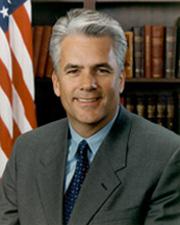 Sen. John Ensign (R-NV)
Legislative Activity
Stay on top of the latest movement without scrolling through every action
Senate amendment submitted
May 6, 2010
View full timeline
Senate amendment submitted
May 6, 2010
Roll call votes on amendments in Senate: Amendment SA 3898 not agreed to in Senate by Yea-Nay Vote. 35 - 59. Record Vote Number: 135.
May 6, 2010
Senate amendment proposed (on the floor): Amendment SA 3898 proposed by Senator Ensign to Amendment SA 3733.(consideration: CR S3350-3352; text: CR S3350)
May 6, 2010
Senate amendment not agreed to: Amendment SA 3898 not agreed to in Senate by Yea-Nay Vote. 35 - 59. Record Vote Number: 135.
May 6, 2010
Amendment SA 3898 proposed by Senator Ensign to Amendment SA 3733. (consideration: CR S3350-3352; text: CR S3350) To amend the definition of the term "financial company" for purposes of limits on nondesposit liabilities.
May 6, 2010
Amendment SA 3898 not agreed to in Senate by Yea-Nay Vote. 35 - 59. Record Vote Number: 135.
May 6, 2010
Votes
1 roll call on this amendment
Text
Proposed
TEXT OF AMENDMENTS

But how much has been doled out and to whom is still a mystery. This
amendment would allow the independent arm of Congress, the Government
Accountability Office, to review the decisions made by the Federal
Reserve. And the Government Accountability Office is nothing but a
group of professional people without a political motive and the right
group to get the job done and do it on an ongoing basis. An objective
review of the Fed's actions will serve our country well in the future.
We can learn from the mistakes that may have been made. We can
determine if the losses or profits from the Fed's investments help
serve the economy well. Did the Federal Reserve act in an appropriate
and ethical manner? Was the relationship between regulators and the
financial industry too cozy, hampering the ability to make an objective
decision?
Proponents of the Federal Reserve should not consider this as a
threat to the independence of the Fed--an independence I support. They
should embrace an independent evaluation as an opportunity to improve
its operations and, most importantly, strengthen public trust for
future generations who may be faced with similar financial crises.
As the Senator from Vermont has made very clear, the intent of his
amendment is not to interfere in monetary policy. I share that same
feeling he has, and I would not support an amendment that went into
monetary policy. But the Fed's extraordinary power outside of monetary
policy should be subject to the light of day, transparency and
accountability. The public's business ought to be public. We should
allow the Government Accountability Office to audit the Fed since they
have moved far beyond their traditional and primary mission of
conducting monetary policy.
I yield the floor.
The PRESIDING OFFICER. The Senator from Vermont.
Mr. SANDERS. I thank the Senator from Iowa not only for his support
but for his long fight for transparency. It has been a pleasure working
with the Senator.
The PRESIDING OFFICER. The Senator from Kansas.
Mr. BROWNBACK. Madam President, I wish to thank my colleagues,
Senators Sanders and DeMint, for putting forward, bringing this
amendment to the floor. I am a cosponsor of this amendment, along with
several of my other colleagues.
I would say as well to my colleague from Vermont, my colleague from
South Carolina, and others who are sponsors, this is an issue I hear a
lot about when I am traveling around my State, which is often. When I
am traveling around and listening to people, this is something people
are concerned about. They are concerned about the monetary policy. They
are concerned about the money system. They are concerned.
I would note to people, and to my colleagues in particular, that the
Congress created the Fed, the Fed didn't create the Congress. So the
Congress does have control over this issue, and I think we need to look
at it and say: Let's look at what is appropriate and what is proper.
And this is clearly one piece of it.
I think the Fed has done a number of things quite well and quite
right. Yet I don't see any problem whatsoever with having a simple
audit; that that is going to somehow reveal the genie in the bottle and
let out all of these secrets that are going to be harmful to the
development of monetary policy. There seems to me to be a fair amount
of overstatement on the other side of the terrible damage this audit
would do. That does not seem right to me. It does not seem right to my
constituents. My constituents look at this and say: Well, I do not want
to harm the development of monetary policy. I want it to be wise and
good and sound. But I do not see how it is harmed by an audit of an
entity that is created by the government, that is created by the
Congress. So why shouldn't we do something like this?
That is why I think this is a prudent amendment. It is a good
commonsense amendment, and I think it will be well received by the
constituents of this great country who I think are pretty wise on these
and other decisions; that as we go around, if we will listen to what
people are saying, I think there is a lot of wisdom in that. They are
saying we ought to know more about what is taking place in the Fed.
I know we would all like to move forward on financial regulatory
reform legislation. I have some serious problems in this bill. I think
the consumer financial product piece shouldn't penalize auto dealers
and orthodontists and others who did not cause any of these problems.

[[Page S3334]]

So I have an amendment. I have other amendments I am a part of as
well, along with this one, that I think we need to consider before we
move on forward, even though I have some problem with the basis of the
bill. I think it hits more Main Street than it does Wall Street. The
difficulty is that we just have different ideas and beliefs about the
best way to move forward, and that is normal.
This amendment is not just about the choices, though, that we have on
reforming the financial sector. I believe it gets to the heart of a
more fundamental issue: what the American people have a right to expect
and know from their governmental institutions.
The fact that this amendment is brought forward by the Senator from
Vermont, Mr. Sanders, and the Senator from South Carolina, Mr. DeMint,
two Members who could not be further apart on the ideological spectrum,
should be a sufficient warning and measure to make everyone sit up and
take notice of what it is that is here that is so troubling.
This amendment isn't about whether the legislation will put an end to
taxpayer-backed bailouts. It isn't about whether the legislation will
end too big to fail. It isn't even about how to best protect the
American people and taxpayer dollars. It is about something I believe
is even more fundamental: the accountability of governmental
institutions to the people of the United States and to the Congress.
I think it is important, as I stated, to remember--I want to state
this again--one single fundamental reality in this debate: Congress
created the Federal Reserve, not the other way around. We created the
Federal Reserve System to serve the interests of the citizens of this
Nation, not to serve the interests of large financial institutions.
In establishing the Federal Reserve, Congress recognized the
importance of a central bank that could operate with independence to
ensure the orderly functioning of the banking systems and to maintain
price stability. That is the core function of the Fed. More recently,
the Federal Reserve mandate was expanded to charge them with
maintaining price stability and maximum employment. That was an
expansion piece that was added.
The Government Accountability Office is also a creation of Congress.
GAO is an independent, nonpartisan agency that works for Congress. What
is GAO's mission? GAO's mission is to support the Congress in meeting
its constitutional responsibilities and to help improve the performance
and ensure the accountability of the Federal Government for the benefit
of the American people.
In my view, the real issue here is whether you believe the Congress
has the right to ask GAO--in many respects, our auditor--to review
actions and activities of an institution that we, the Congress,
created.
I certainly understand the importance of the Federal Reserve's
independence in the execution of monetary policy. I understand and I
support that. I understand the importance of not interfering with the
operation of the FOMC. That is not what this amendment is attempting to
do. That is not my intention. I am confident, as well, it is not the
intention of the main sponsors of this amendment. But I do believe it
is relevant to know whether the Federal Reserve is operating in a
manner that is consistent with its statutory authority. It is relevant
to know whether the Federal Reserve is following its own established
rules and procedures or whether it is just making it up as it goes
along. I do think it is relevant for Congress to know who was involved
in decisions to take extraordinary measures by exercising emergency
powers, as well as who was and was not consulted before those actions
were taken. Those are prudent and proper things for us to know.
I think it is equally important to know whether the policy statements
and subsequent minutes of FOMC meetings accurately reflect what went on
in those meetings.
Recent news reports surrounding the release of transcripts from 2004
meetings of the Fed contained some serious, distressing information.
Those reports revealed that as far as back as 2004, there were
significant concerns raised by regional Reserve Bank presidents about
an emerging housing bubble that, indeed, did emerge and burst. Did we
see any indication of that in the meeting minutes or the policy
statements? We did not. And what that tells me is the minutes did not
accurately--I will even say they did not directly portray what went on
in the meetings. I do not believe that is right.

Disturbingly, the transcripts reveal that the Federal Reserve Bank
president from Atlanta warned that:

A number of folks were expressing growing concern about
potential overbuilding and worrisome speculation in the real
estate markets, especially in Florida. Entire condo projects
and upscale residential lots are being pre-sold before any
construction, with buyers freely admitting that they have no
intention of occupying the units or building on the land but
rather are counting on ``flipping'' the properties--selling
them quickly at higher prices.

That is a direct quote.
Disconcertingly, at the same meeting, the former Chairman of the
Board of Governors, Alan Greenspan, made the following statement:

We run the risk, by laying out the pros and cons of a
particular argument, of inducing people to join in on the
debate, and in this regard it is possible to lose control of
a process that only we fully understand.

Let me repeat that quote. This is from former Chairman Greenspan:

We run the risk, by laying out the pros and cons of a
particular argument, of inducing people to join in on the
debate, and in this regard it is possible to lose control of
a process that only we [the Federal Reserve Board] fully
understand.

Now, I serve as the ranking member of the Joint Economic Committee.
Senator DeMint is also a member of our committee. We believe in free
markets and a free enterprise system. We recognize the importance of a
strong financial system. Yet a fundamental requirement for the orderly
operation of free markets is transparency and accurate reporting--
information. I think the suggestion that only the Federal Reserve was
capable of fully understanding is evidence enough that this amendment
is necessary.
Congress needs to demand change and greater accountability so people
can have more information. What if the people had known about this
debate going on at the Federal Reserve as the housing bubble was
developing? How would people have acted? My guess is, they would have
acted quite prudently, saying: The Federal Reserve is concerned about
this. This is legitimate information. Maybe we should pull back on
housing investments. Maybe we should be watching this as well.
I think people can get it; they need the information, though.
While this amendment does not address the issue of the time delay in
releasing transcripts, I do believe the current 5 years, which amounts
to almost 6 in many cases, is indefensible, between the actual minutes
and them being released--5 years between the actual minutes and their
being released to the public. In my judgment, that time limit should be
reduced to no more than 2 years. Members of this body should have had
access to these and other transcripts before we were asked to reconfirm
the current Chairman of the Federal Reserve Board of Governors. I would
suggest it would have been helpful to have had access to this
information before the housing market collapsed and before it turned
into a financial crisis.
The American people are mad at Washington. They are mad at the
governmental institutions that they view as increasingly unresponsive
and unaccountable. Let's take this step in the direction of
transparency, accountability, and disclosure of information. The
American people have a right to know whether their interests were
protected or simply placed on the back shelf. They have a right to know
the information.
I urge my colleagues to support this amendment, and I urge the
Federal Reserve to work with us to address real concerns about this
amendment, rather than trying to defeat it or amend it with the purpose
of making it a symbolic and meaningless gesture. Let's remind the
Federal Reserve Board of Governors that they are not the only people
capable of fully understanding issues on which all of our economic
future depends.
I yield the floor.
The PRESIDING OFFICER. The Senator from Vermont.
Mr. SANDERS. I wish to thank the Senator from Kansas for his remarks
and for his strong support from day one for this concept of
transparency of the Fed.

[[Page S3335]]

Mr. BROWNBACK. Madam President, I suggest the absence of a quorum.
The PRESIDING OFFICER. The clerk will call the roll.
The assistant bill clerk proceeded to call the roll.
Mr. COBURN. Mr. President, I ask unanimous consent that the order for
the quorum call be rescinded.
The PRESIDING OFFICER (Mr. Sanders). Without objection, it is so
ordered.
Mr. COBURN. Mr. President, as we have watched the debate the last 6
days on the financial regulation reform bill, I thought it would be
interesting just to raise a few questions. The Congress--both the House
and the Senate--created what was called the Financial Inquiry
Commission. As a matter of fact, they had a meeting today. The purpose
of that Commission--that will turn in their report in December of this
year--was to take a thorough and complete look at what happened to us
in 2008--the causes, the regulatory failures, the poor incentives--and
then make recommendations to the Congress on what we should do.
The question I have for my colleagues is, we have a bill on the floor
that has given no credence to the Commission we created, and we are
actually, according to the majority leader, going to finish this bill
next week without the benefit of that Commission's inquiry. So a couple
questions I would ask are, No. 1: Why? Why are we doing that? And, No.
2--by the way, the people on that Commission are learned people with
great exposure and great experience in the areas of which we are
discussing--Why are we allowing the Commission to continue spending
money if we are not going to pay any attention to them? Why don't we
just end the Commission, since we have obviously decided what they are
going to have to give to us is not of value as we make the decision
about what we need to change? I thought that is what we had the
Commission for.
So I find it peculiar that in our rush to blame somebody, our rush to
take the focus off of where it belongs--by the way, that is right here
in the U.S. Congress because 90 percent of what went wrong was our
fault--our fault; that is where it lies--in our rush to shield and
reflect that away from us, we are going to pass a bill with all sorts
of unintended consequences of which we fully do not understand right
now. It is a bill that is going to treat the symptoms, not the
underlying disease of the financial problems we had. It rings well from
a populist standpoint, but in the long run it does a disservice to our
country. That does not mean this bill may not hit it 100 percent on
what this Commission recommends, but we have no idea what they are
going to recommend.
So I think it is a great question for the public to be asking us: Why
are we doing that? And why are we continuing a Commission that we
obviously are not paying any attention to? One, it was created so we
could offload the problem. That is why we created the Commission. We
obviously did not care what they thought because we are not going to
pay any attention to them. No. 2, we are going to continue to spend
money on a Commission that we are not going to value. If we were going
to value it, we would at least either give it a mandate to hurry up so
we can make appropriate decisions and use their expertise or we would
eliminate it.
Now to the bill that is in front of us. What really happened to us.
This is my opinion of what happened to us. The Congress created
incentives to increase with ease the ability to own a home in this
country. Then we created incentives through Fannie Mae and Freddie Mac
to do that even greater. Then we created the ability to package and
offload what Fannie Mae and Freddie Mac had taken and securitized it.
We wonder why people would take advantage of that. There was not one
oversight hearing on the Office of Thrift Supervision, which absolutely
failed in terms of loan originators. There was one hearing in 4 years
at the SEC that had nothing to do with their oversight of the packaging
of these incentives before they became a problem. There was no
oversight--significant oversight--on the explosive nature of
derivatives trading in this country and around the world. We are so
quick to point the finger at the people who took advantage of the
incentives we set in motion.
So now what do we have? We have $6 trillion or $8 trillion worth of
exposure for the U.S. taxpayer in terms of guaranteed mortgages by the
Federal Government through Fannie Mae, Freddie Mac, and FHA, and we are
hustling along so none of that ends up getting focused on us. We have a
bill on the floor that does not address the core problem of what went
wrong.
Here is the core problem of what went wrong: There were no mortgage
origination standards that were enforced by the Federal Government, as
they took American taxpayers, to guarantee what was going to be an
asset. What did we find at the Permanent Subcommittee on
Investigations? That in the last year before this, for one company
alone that originated a vast majority of the loans in California--Long
Beach Mortgage--90 percent of the mortgages were based on fraudulent
data.
OTS knew it and did not do anything about it. Why did they not do it?
Because they got 16 percent of their revenue from Washington Mutual,
who owned Long Beach Mortgage.
So we set up all these systems, we incentivized this system, and now
that it blew up in our faces--because we did not look at it, we did not
oversight it, we did not do our fiduciary responsibility--we want to be
quick and get rid of that blame from us by pointing the finger
somewhere else.
We have minimal leverage requirements in this bill. If we are going
to create an incentive for people to act badly, at least we ought to
put a block somewhere else that will limit the exposure of financial
institutions based on capital ratios. We have not done that. We have
not accomplished that in this bill. That is something that has to be
there. We had companies leveraging to 40 and 50 times their net worth.
Yet we are not addressing that issue to a significant extent. It is one
small portion of the bill.
Then we are going to take a consumer protection agency--which we
created the problems for--and create a massive government bureaucracy
that is going to filter all the way down to every small business in
this country and isolate that power within one individual who is not
accountable to the Congress and not accountable to the President, and
we are going to say: You fix it. There will be an unlimited funding
stream that is going to be totally out of control that is going to
impede and impact the freedom of Americans' ability to make a living in
the name of consumer protection.
If you think I am giving a speech to protect the banks, you are
wrong. I like them about as much as I like insurance companies. But we
have to think about what we are doing, and we ought to be about fixing
the real disease. That real disease is us--us not doing oversight, us
not being responsible for the legislation we created, and setting up
incentives, and then yawn as it goes awry and point our fingers
somewhere else.
There is no question we need to change the regulatory structure in
this country. But there is something we need to change more than the
regulatory structure; that is, the demand on the Congress to start
doing its job in terms of oversight. We are quick to whip a bill out
when it is politically expedient to do it and create a whipping boy, or
several whipping boys, and say we are addressing things. But it is kind
of like the pea under the three walnut shells. You never know where the
pea is. The reason you never know is because there is not really even a
pea there. There was when it started, but it went away. Then it gets
put back.
So we are playing the game. We are playing the American people that
what we are doing is substantive, and that, in fact, it is going to
enhance capital formation, when what we are doing is going to decrease
capital formation.
We have one section in this bill that says every small bank in
Oklahoma--if they write a mortgage and sell it, forever they have to
keep 5 percent of it. Well, if they are a small capitalized bank, guess
what they are going to do. They are never going to create another
mortgage in Oklahoma. So we are going to concentrate all the mortgages
in the big banks in the country. That is why Goldman Sachs loves this
bill. That is why Citibank loves the bill. We are not making the big
banks smaller; we are making the big banks bigger. We are going to
undercut the small and

[[Page S3336]]

medium-sized banks in the country because we are going to put a 5-
percent retention on every mortgage they write, when, in fact, all we
would have to say is: If you write a mortgage and you package it and
sell it, there is recourse back to you, the originator of the loan;
that mortgage, when it becomes nonperforming, comes back to you. That
is all we have to do. That does not tie up their capital. That does not
limit their incentive to create housing in our own regional markets
that is made available with capital in those regional markets.
No, we are going to make the big boys bigger. All the regulation that
is in this bill none of the big banks will ever have a problem with.
They already have thousands and thousands of staff to handle government
regulation. They will not add a person. But every small community bank
in this country, every small financial institution in this country, is
going to drown in the requirements of this bill.
I know the chairman of the Banking Committee has worked hard to try
to bring a forth bill. I know there have been great deliberations with
many from our side of the aisle on the bill. But I think we have thrown
common sense out the window. The motives are good. The goal--fix the
problem--is good. But if we treat the symptoms of this and convince the
American people we have fixed it when, in fact, we have not, when we
have not eliminated too big to fail--because we are going to make the
big banks bigger--what we are going to see is a further decline in
confidence.
In the name of fixing things, we are going to be taking massive
amounts of freedom away from small businesses in this country. We are
going to take discretion away from capital risk that has minimal risk
to the country but has every bit of risk to the person lending the
capital. We are even going to take away ``sugar daddy'' investors who
are the only hope for some ideas--not venture capitalists. We are going
to take away the ability for somebody to come in and say: I will invest
in 40 percent of your business and give you the capital to try
something. We have actually created requirements for that.
As we look at what we are about to do, the American people ought to
ask three questions, three very important questions: No. 1, does it fix
the problem? No. 2, does it grow the government and require increased
spending? And, No. 3, is there anything to make you think--since we
were regulating all these industries already--the Congress might
oversight the next set of regulations we put out there to fix this
problem? I think the answer to that--all three of those questions--is
no. I am in a minority, I understand that.
I said previously, I think we ought to change the regulations in this
country. I think we also ought to eliminate too big to fail by making
those that are too big become so small they won't make a difference if
they do fail. We ought to create the market circumstances that would
force that to happen. But this bill doesn't do that. This bill won't do
that.

So as we go through this rather large bill, which I think has had
three or four accepted amendments thus far and which is 1,409 pages
long, one of the other questions we ought to be asking is how many
Members have read the entire bill. How many Members understand what is
in the bill? How many Members can have the capability to anticipate the
unintended consequences of what is in the bill? I think we will find
the answer to that is zero. Yet we are in a hurry to do this for a
political reason.
So I will go back to what I started on. We created the Financial
Inquiry Commission. What are we going to do with it? What happens if
they come out in December and say everything we did was wrong? Why did
we create it? I would love to read back some of the speeches that were
given on this floor about why we were creating it, because we had to
know what went wrong. Now we have a commission that has been charged to
tell us what went wrong, but we are going to ignore them. We are going
to pass a bill before they have even completed their hearings.
I think it is no wonder the country has a low level of confidence in
our deliberations, because they don't make sense to the average
American. They understand the political spin. They understand pinning
the tail on the donkey. They understand placing blame so you can
deflect it from yourself. They get all that. They see it and they see
right through it. But we are creatures of habit.
There are good things in this bill. Let me end on that. The
elimination of the Office of Thrift Supervision had to happen. The
reason they were ineffective is they got their money from the very
people they were supervising and when their biggest customer is doing
something wrong, rather than lose some of their revenue, they turn
their eye the other way. Consequently, billions and billions and
billions of dollars out of Washington Mutual became junk. Most of it
was junk to begin with. It is the concept of greed.
Other good things: Changing the rating agencies and what they are
accountable for. This bill goes in a direction different than I would
have gone, but the point is there needs to be a change. They need to
not get paid by the very people who are asking them to rate something
they are getting ready to sell, and they ought to be paid by the person
who is getting ready to buy what they are getting ready to sell, so the
accountability will be there. But we haven't done that.
We recovered, and our recovery from this financial fiasco is because
of the resilience of the American people. The price is enormous, with
having 14 million people unemployed. That is a tremendous price to pay.
The loss in terms of dignity, the loss in terms of the ability to
provide for your family, the loss of losing the skill set you had and
no longer can find a job to do it is a tremendous price that has been
paid. But the American people are resilient. What they don't want to
tolerate, however, is a Congress that fails to recognize and continues
to repeat mistakes of the past.
We can say, Well, we have been working on this for 6 months. We have.
There have been negotiations going on for a long time. My question is,
Do we have the answers? Do we know what the answers are? And if the
answer to that question is yes, then let's disband the Financial
Inquiry Commission right now. Let's not waste those folks' time. Let's
not spend another penny of Federal taxpayers' money if we think we
already have the answers. We are going to do just as we do on every
other program: We are going to create another one and we are going to
keep spending on the first one.
Needless to say, I think this bill is fixable. I think we ought to
address the real key issues: Fannie Mae and Freddie Mac. Why are we not
addressing them? Because we don't want to put out the bucks, the cost
to do that. That is why. That is why we are not addressing it. We know
the issues.
We have taken an unlimited amount of our kids' money and put it in
exposure and we have given an absolute implicit and implied guarantee
to both of those organizations. The President in late December took
office, and they are now buying back close to $400 billion worth of
mortgages from the Treasury--nonperforming mortgages--and our kids are
going to pay all that back. It will be 20 or 30 years before any of
that property actually reaches the level at which it was sold.
So what is coming next? What is coming next is we are going to
mandate principal reduction on mortgages across this country. Who does
that impact? What that says is that everybody who paid their mortgage
on time and kept up with their payments by making tremendous sacrifices
other places, guess what. You are going to get to pay for the mortgage
of everybody who didn't through your taxes and through your kids'
taxes. You acted responsibly, but what is coming down the pike is we
are going to lift the load for those who didn't. You met your
obligations. You signed the contract on the bottom line, and those who
were less fortunate than you, you now are going to get to pay for them
too. That is what is coming. Mark my words. You will hear it before
November. That is what is coming through the HAMP, through the 40-
percent reduction in the principal amount on many of these mortgages.
So what is going on? We are rushing the financial reform bill that
doesn't attack the three major underlying diseases of the financial
system, and then right after we pass that, we are going to force
principal reductions on hundreds of thousands, if not millions, of

[[Page S3337]]

mortgages, on which you, the taxpayer, are going to pick up the bill.
That is what is coming. We are going to hear that it is not. That is
what is coming.
Watch carefully what we do. Watch how we spin things. Watch how we
create demons when, in fact, we are the source of the problem. Watch
how we point our fingers at others whom we incentivized to take
advantage of systems we created and say, Oh, no, we are not culpable at
all. Oh, it wasn't us. We did all the oversight hearings. We changed
it.
When we saw the writing on the wall, we didn't do any of that. The
Congress created this mess, and we are going to continue to act in the
same way that is going to create more. Because we are going to create a
whole new set of regulations and then we are not going to have the
oversight hearings: Are you doing it? Where is the metrics? How do we
measure whether you are doing it? Are you, Mr. Bureaucrat, doing what
the Congress directed? As a matter of fact, we don't even put in the
regulations. We let somebody else write the regulations. We are so
knowledgeable that we are getting ready to fix this problem, and
besides the fact the Financial Inquiry Commission hasn't said anything
to us yet about what the causes are and the potential solutions, but we
are not even going to write the regulations, just as we didn't in the
health care bill. The Department of HHS is going to write 1,690
regulations on the health care industry in this country. The same thing
is going to happen in this bill.
As I say, I hope we can fix the bill because I think we need to make
major changes. There are some good things in this bill.
We are in danger of losing what confidence is left of the American
people in our actions. We ought to be asking the right questions for
the right reasons that shouldn't have anything to do with politics,
shouldn't have anything to do with partisanship, and ought to have
everything to do with what is the best, right solution for our country
in the long run.
Mr. President, I yield the floor.
The PRESIDING OFFICER. The Senator from North Dakota.
Mr. DORGAN. Mr. President, I have come to speak in support of the
Sanders amendment. I am intrigued by my colleague's presentation, so I
will respond to a bit of it. There are a couple of areas where we agree
and some where I profoundly disagree, but let me start with the
agreement.
When my colleague says, If you are too big to fail, you are too big
and you ought to get smaller, I fully agree with that. I have an
amendment that says if you are too big to fail--judged by the council
in this bill that you are too big to fail, at that point you require
the breaking up or the paring back of whatever is necessary of that
institution to bring it below the level at which its failure would
cause a moral jeopardy or an unacceptable risk to this country's entire
economy. If we end this process and too big to fail still exists--that
is, we have companies that are, in fact, too big to fail--then we will
have failed, in my judgment.
Too big to fail means you are too big. We have broken up Standard Oil
into 23 pieces and it turns out that 23 pieces are more valuable than
the whole. AT&T was broken up. I am not interested in breaking up
companies for the sake of it, but I am saying this: We know what has
happened.
This chart shows what has happened to the largest financial
institutions in this country. It shows that with respect to assets and
liabilities, the top six commercial financial institutions in this
country have gotten bigger, bigger, bigger, and much, much, much
bigger. Does that cause jeopardy to this country? Well, if you have
been awake the last few years to watch $700 billion be pledged to avoid
a calamitous event to this economy, then you understand that this is
too big and something has to be done about it. Create early warnings?
No, I don't think so. Stop signs? How about deciding that if you are
too big, you are too big, and you have to pare back those portions of
your institution that make you too big to fail and a moral hazard to
this country that is an unacceptable risk to the future of this
economy.
Here is another chart that shows about the same thing. It shows the
growth of these institutions going back to 1995. It is relentless,
aggressive growth. If we end this without having addressed it, we will
not have been able--we won't be able to tell the American people: We
took care of too big to fail. So I agree with the Senator from Oklahoma
on that point.
Where we disagree is the notion that the problem here is us. Well, I
will tell my colleagues what. The ``us'' bears plenty of
responsibility, but let me talk about the ``us.'' It wasn't the ``us''
who decided in Countrywide Mortgage, which was the largest single
mortgage company in this country, to write liars' loans, to decide to
say to people, Hey, you want to get some money from us? We are a big
company. We are making a lot of fees. We are paying a lot of money to
our executives and we want you to come to us. In fact, I have an ad
they ran, Countrywide, the biggest mortgage company in the country.
Here is the ad: Do you have less than perfect credit? Do you have late
mortgage payments? Have you been denied by other lenders? Call us. We
have money for you. Are you a bad risk? Are you a bad person? You can't
pay your bills? Come to us.
It wasn't the Congress that did that, I would say to my friend. This
was Countrywide Mortgage. By the way, the guy who ran this organization
got off with $200 million. So he is now under criminal investigation.
But don't suggest to me that somehow that was the responsibility of
somebody other than the guy running the company that puts up ads such
as: Zoom Credit. It says: You have been bankrupt, slow credit, no
credit, can't pay? Who cares? That is what was advertised to the
American people. That wasn't somebody in this Chamber going out and
saying, Hey, how about letting us give you a loan if you have bad
credit. Was it somebody in this Chamber who decided we are going to
create credit default swaps? That is like saying ``the devil made me do
it'' from the old TV show. No, no, no. It was a group of people who are
high fliers, hotshots, wearing silk shirts and monogrammed sleeves, and
they go out and create all of these exotic instruments such as credit
default swaps, and they weren't enough; they have to do synthetic or
naked default swaps with no insurable interest on the other side of the
transaction. It was simply wagering. It had nothing to do with
investment. It wasn't somebody in this Chamber who said please do this.
It was the most unbelievable greed and avarice I have ever seen in the
history of this country by a lot of folks. It created big
institutions--I am not saying everybody did it, but enough did it to
imperil this country's economy and to require emergency action to, as
the Treasury Secretary then said, ``save the American economy.''

All this was going on. Everybody was having a carnival and making
lots of money. In 2008, Wall Street had a net loss of $35 billion and
paid bonuses of $16 billion. I got a master's degree in business. I
went to business school. There is no place that teaches that--to go
lose a bunch of money and then pay huge bonuses. This was a carnival of
greed that went on in this country and steered this country right into
a ditch.
When my colleagues say it is government that did that, I am sorry,
that is flatout wrong. What government did--and they did it for a
number of years in the last decade--is they hired a bunch--and the
previous administration is especially responsible--of regulators who
didn't like government and didn't want to regulate. One of the key
people who came to this town in a key position of regulatory
responsibility said: Hey, this is a new day. This is a business-
friendly place. Understand that. We are going to be willfully blind
here for a number of years. So do what you want; we won't watch and we
don't care.
So the responsibility for regulatory authority is not in this
Chamber.
I am not somebody who comes here to blame previous administrations
very often, but when the Bush administration came to office--about the
same time that Gramm-Leach-Bliley, by the way, with the support of the
Clinton administration, repealed Glass-Steagall and said you can create
big financial holding companies as big as you want and you can merge
investment banks with commercial banks and security sales, and you can
do it all--a one-stop financial shop. It will be great, and we will
call it modern. About the time that passed--over my

[[Page S3338]]

objections, as I was one of eight Senators who voted no, and I was out
here six, eight times opposing it--about that time, we had a new
administration come in and say: We are going to put regulators in place
who have no interest in watching what you do, so do what you want. They
put out naked credit default swaps and trillions of dollars for them.
Who cares? If you want to increase your leverage from 12 times, to 20
times, to 30 times your capital, fine. We will have a meeting in the
basement of the SEC, and we will, just like that, approve you to be
able to increase your leverage to 30 times your capital. And it will
hardly be reported by anybody because we are not watching anything.
They were blind regulators--dead blind. Unbelievable.
Don't blame this on someone else. We can blame it on bad legislation
a decade ago. That is fair. Those who were making bad loans and taking
big checks to the bank and filling it with millions of dollars were
doing it because they were greedy and nobody was willing to stop them.
That avalanche of greed built into a bubble of speculation that really
injured this country and nearly ran it off a cliff.
By the way, at the same time all of this was happening in the last 15
years or so, the financial institutions decided they were going to
securitize everything. Doesn't matter; find some debt, and we have
people who can roll it into a security. Once they do that, they can
sell it three, four times, to an investment bank, to a hedge fund, you
name it, and they can get a rating agency--because the investment banks
pay the costs of the rating agencies that rate their securities, which
is a pretty big conflict of interest--to help roll these forward, and
nobody has any skin in the game.
My colleague talks about how unfair it would be to ask somebody to
save at least a portion of a loan they are providing. Do you know what?
The only way you have proper underwriting of loans in this country is
if you sit across the table from somebody who wants to get a loan and
look at their credit reports and determine if they are eligible. The
only way you ever ensure that happens the right way is to have that
kind of underwriting, and you would do that if you are going to have
some continuing risk.
But if you are going to give a $750,000 loan to somebody who makes
$17,000 a year--and it happened, by the way--a liar's loan, requiring
no documentation, with no interest or principal paid because he put it
all on the back side--if you can sell that in a security to somebody
else and you have no further risk, you get your money free and clear.
That is what was going on at every single level. It was just the most
unbelievable, irresponsible lack of regulation, perhaps, in the history
of this country.
I want to say that the government has made plenty of mistakes, but
don't blame this Chamber or people who were elected to the Senate for
the bad behavior of somebody who takes $200 million away from the
biggest mortgage finance company in this country and was selling liar's
loans and advertising that if you have bad credit, no credit, slow
credit, and bankruptcy, come to us, we are going to give you money.
Don't blame that on somebody else. Put that blame where it rests--the
unbelievable greed among the people who should have known better and
should not have been able to do it in the first place because the
regulators should have been all over them in a moment, saying: You
cannot do it. That didn't happen.
This demonstrates the need for effective regulation. The free market
system works, but when people try to subvert it, when people commit
fouls in the free market system, it needs a referee with a whistle and
a striped shirt. That was missing in the last decade.
Mr. President, one final point. Part of this argument is excusing
criminal behavior because there wasn't a cop on the beat. Don't excuse
the criminal behavior. We need cops on the beat. We need legislation
that will make sure we close the loopholes that exist. We need to
legislate soberly and thoughtfully and give the American people some
notion that this behavior cannot happen again.
By the way, I think the way we do that is to make certain you cannot
be too big to fail. By what justification should the major financial
companies of this country continue this kind of concentration and
escalation of size in a manner that jeopardizes this country should
they fail? By what justification should we allow that to continue? The
answer is that it should not.
There are two amendments to address that I am aware of--one by
Senators Brown and Kaufman, which creates a numerical limit on size,
and I fully support. The other one, which I prefer because it has my
name on it, is to flatout break up firms that have gotten too big to
fail to the point where they are not too big to fail. That is the most
effective way, in my judgment, to do this.
I will speak ever so briefly about the Sanders amendment. I got
sidetracked by my colleague from Oklahoma, as is so often the case.
My colleague from Vermont has offered a piece of legislation that I
think has great merit. Let me tell you what it doesn't do. It does not,
as those who fear the amendment say, invoke the tentacles of the U.S.
Congress in the construction of monetary policy. That area belongs to
the Federal Reserve Board.
The Federal Reserve Board is a creature of legislation that Congress
created. If you went back and read the debate, the country was assured
that this was not creating a strong central bank. There were just lead
pipe assurances to that, but, of course, that turned out not to be the
case. Nonetheless, the Federal Reserve Board creates monetary policy,
and there is a thought--and I agree with it--that we don't want
monetary policy created on the floor of the Senate. We don't want to
intrude on the creation or development of monetary policy. We do fiscal
policy, the taxing and spending side. The monetary side is the Federal
Reserve Board's terrain.
But the Federal Reserve Board ought not be unaccountable to anybody
for anything. The Federal Reserve Board, it seems to me, deserves, No.
1, to be audited properly--a Government Accountability Office audit--
which the Sanders amendment would require. And I know the Fed is having
an apoplectic seizure thinking that maybe this amendment will pass. You
know what. It is the right thing to do, to say at long, long last,
there should be an audit of the Federal Reserve Board. I am not talking
about auditing monetary policy but what it does generally. It is
necessary, and I support this and think it is the right policy.
No. 2, this legislation does what I and many others have been pushing
the Fed for, for some while. Last July of 2009, I had a letter signed
by 10 of my colleagues to Chairman Bernanke saying: You have now used
your emergency powers for the first time in U.S. history to open your
loan window to investment banks, as never before in the history of our
country. Serious financial problems, you say? Open the loan window and
come and get some money. So we write and say: OK, you did that on an
emergency basis for the first time in our history. What was the result?
Who got the money? What were the terms and the conditions?

The American people deserved to have that information. I wrote again
on March 19 of this year. On both occasions, we received letters from
Chairman Bernanke that were polite, thoughtful, but that said: You know
what. We don't intend to provide you or the American people information
about what happened at our loan window. We don't intend to talk about
the loans we gave to investment banks for the first time in history.
I wonder--and this is idle curiosity--did we have investment banks
show up at this window and get near zero interest rate loans and then
invest them back into Treasury bonds? How much money did they make on
that transaction? I know many of these organizations--the largest
investment banks--are now making record profits. But it is not as a
result of loaning money to businesses in this country that need the
lending; it is by trading securities--once again, right back in the
same trench.
This legislation that my colleague, Senator Sanders, has offered is
legislation that will put in law a requirement that the Federal Reserve
Board disclose the activities, in a certain period of time, of who
received the lending from the Federal Reserve Board, what the
conditions were, and what the amounts of funding were.

[[Page S3339]]

The Chairman of the Fed, who said this might make it very difficult
and it will undermine this and that, undermine these programs, publicly
releasing names--look, two Federal courts have required the Federal
Reserve Board to do this. Two Federal courts--the district court and
the appellate court--have said the Federal Reserve Board does not have
the authority to withhold this information. The Federal Reserve Board
has once again said: It doesn't matter, we intend to appeal again.
They, apparently, intend to keep this tied up in the court system as
long as they can. This amendment in this piece of legislation will say
to the Federal Reserve Board: You cannot do that. The law requires you
to disclose to the American people what you have done.
I come here to say I think this is a good bill. I had introduced a
separate amendment on the disclosure by the Fed, but if we pass the
Sanders amendment, that will take care of my amendment. Some people
talked earlier about duplicates. Mine will be taken care of if we pass
the larger amendment offered by Senator Sanders.
I support the amendment. I know a good many of my colleagues will
too. It has been a long time to try to get an audit of the Federal
Reserve Board--not an audit of the monetary policy but an audit of the
Federal Reserve Board. But if we do that, this will be a significant
step forward for those of us who believe that is necessary and
important for the country.
I yield the floor.
The PRESIDING OFFICER (Mr. Kaufman). The Senator from South Carolina.
Mr. DeMINT. Mr. President, I join Senator Dorgan and Senator Sanders
in the amendment to audit the Federal Reserve.
Let me begin with a perspective on what happened in the stock market
today. Clearly, someone got it wrong, and it created a domino effect of
one thing falling after another, and before we knew it, the stock
market was down 1,000 points. Fortunately, it climbed back up before it
closed today.
It reminds us how volatile, how vulnerable we are in a world where so
many systems are involved with our financial system.
It is good Congress is looking at financial reform. I only regret we
are not dealing with the real causes of our financial crisis.
Wall Street is clearly jittery. We can see that from the stock market
today. Everyone is waiting for the dominos to fall. We see what is
happening in Greece, one country that continued to spend more than it
was bringing in until it went bankrupt. Unfortunately, the American
people are on the hook for yet another bailout, not even a bailout in
this country but billions of American tax dollars are headed for Greece
right now.
As other European countries head toward bankruptcy, last year in this
Congress we created another credit line for the International Monetary
Fund to be drawn down. The real irony is, we are borrowing money from
countries such as China in order to bail out other countries in the
world at a time when the United States is carrying $13 trillion of debt
and projections of tens of trillions of more dollars in the future. It
is clearly unsustainable.
The stock market and investors have a reason to be jittery, and
Americans have a reason to be angry. We saw what the failure of large
government organizations such as Fannie Mae did and how it cost
Americans trillions of dollars. People who had been saving and
investing all their lives found out almost overnight that the system
they counted on and that we were supposed to oversee was not what they
thought it was, and suddenly wealth was gone.
If Fannie Mae could do that much damage to our country, that is small
in comparison to what would happen if the Federal Reserve does it
wrong.
The Constitution gives Congress the responsibility for our monetary
policy. Congress, years ago, delegated that to an independent agency we
call the Federal Reserve. But we are still responsible for monetary
policy. If something is done wrong with that policy, all we worked for
in this country, everyone's savings and investments, everyone's wealth,
not only in this country but because we are the reserve currency for
the world, the whole economic system of the world is resting on top of
what the Federal Reserve does.
The fact is, while it is our responsibility to oversee monetary
policy, we do not know what the Federal Reserve is doing. Keep in mind,
we were assured only months before Fannie Mae and Freddie Mac
collapsed--and, by the way, we bailed them out and Freddie Mac for
another $10 billion this week--only months before they collapsed, we
were told by Chairman Bernanke at the Federal Reserve and many other
economic experts that there was no problem. But there was a problem.
The real problem was we did not know it, and that was a company created
by this Congress. It was our responsibility to oversee it, and we did
not carry out our responsibility.
We need an independent Federal Reserve. We do not need political
manipulation and second-guessing of our monetary policy. But we do not
need a secret Federal Reserve. We have to know what they are doing if
we are going to be responsible for what they are doing. It is not going
to be enough if they do something wrong and we point our finger at them
and say it was their fault because it is our responsibility.
For years, the Federal Reserve has been avoiding any kind of audit,
any kind of accountability, any kind of transparency. Every time we ask
for any type of disclosure, they say we are violating their
independence. We are not violating their independence by this amendment
proposed by Senator Sanders. All we are doing is uncloaking the secrecy
that exists within the Federal Reserve.
It is important to know what we do know. We know the Federal Reserve
has bailed out Bear Stearns and AIG. The taxpayers are stuck holding
failed bets on everything from toxic subprime mortgages to strip malls
and hotels. Thanks to the bailouts, taxpayers now own stakes in
bankrupt Hilton hotels in Malaysia, Russia, and Singapore. I am not
sure that is what the Congress had in mind when they started the
Federal Reserve.
The Federal Reserve owns part of the Civic Opera building in Chicago
and the Crossroads Mall in Oklahoma City. I thought it was bad when the
Fed was printing money to keep up the government's shopping spree, but
I never expected they would buy a mall to go shopping in.
They say it is over when the fat lady sings. Well, now the Fed has an
opera house ready for her singing.
Americans deserve to know if the Federal Reserve is being honest with
the Congress and with the American people. We know what they say behind
closed doors does not square with what they say publicly.
Recently released transcripts show, in 2004, members of the Federal
Reserve publicly downplayed specific concerns they discussed internally
about the coming housing crisis. They knew we had a problem. At that
time, Chairman Alan Greenspan said, if they were to encourage the
public to talk about it ``it's possible to lose control of a process
that only we fully understand.'' Meanwhile, they were telling the
Congress and the public everything was fine.
By doing that, they cost millions of Americans a lifetime of savings,
and they are still struggling. Millions of people are out of work
because of mismanagement by the Federal Reserve. Yet they seem to think
they require no supervision, no accountability, no transparency. We
need to end that with this amendment today.
Within 30 days of the President signing this amendment that has been
proposed, the Federal Reserve will have to tell us who got all this
bailout money, how much they got and the reasoning for giving it and
what terms of repayment there are. It is a pretty simple request. True
financial reform must include a full audit of the Federal Reserve and a
breakup and a winddown of Freddie Mac and Fannie Mae. But the people
who run the government are not willing to hold the government
institutions responsible.
Those who understand what happened in this financial crisis know that
the easy money policy of the Federal Reserve, Fannie Mae and Freddie
Mac buying subprime mortgages and securitizing them and selling them
all over the world were a large part of the meltdown of our financial
system. Yet this financial reform bill we are talking about does not
even address the real causes of our financial meltdown.

[[Page S3340]]

One thing we can do if we adopt this amendment is make sure there is
more transparency, more accountability at the Federal Reserve.
As I already mentioned yesterday, Freddie Mac posted an $8 billion
loss. That is now fully owned by the Federal Government. The Federal
Government is clearly mismanaging Freddie Mac, and they asked for
another $10 billion bailout from the taxpayers. This time that does not
have to go through Congress. President Obama has taken the caps off
anything that can go to these bankrupt companies. Billions of dollars
are going to flow from taxpayers directly to these government-owned
entities.
Freddie Mac and Fannie Mae together have lost at least $126.9 billion
so far. It is pretty amazing in a time when this country is overcome
with debt. There is no end in sight. There is no cap on how much
taxpayers can bail them out. Yet they are not even mentioned in this
financial reform bill. We heard about greed on Wall Street, but we have
not even addressed the greed within the government and within the
government agencies.
The Democratic House Financial Services chairman, Barney Frank, does
not think these government-run institutions are good candidates for
reform. He wrote a memo to the White House saying they were ``being
managed responsibly and aren't doing any further economic damage.''
Fortunately, Senator McCain has an amendment to address this issue, and
I hope it is adopted. But if there is one place the blame can be placed
for this financial meltdown, it comes back to Fannie Mae and Freddie
Mac.
Wall Street certainly deserves a lot of the blame for the financial
crisis because they took advantage of a lot of the mismanagement in
government to their own benefit. But the Federal Reserve, Freddie Mac,
and Fannie Mae also deserve a lot of the blame, and they should be
addressed as well.
The Sanders amendment at least begins the process in letting us know
what the Federal Reserve is doing. The audit-the-Fed amendment has more
than 300 cosponsors in the House and 32 in the Senate. It is supported
by a broad spectrum of political groups from FreedomWorks all the way
to very liberal groups. Within the Senate, if America wants bipartisan
activity, it could not be more bipartisan than Bernie Sanders and Jim
DeMint.
I encourage my colleagues to support this amendment. Let's reform not
only the financial system but our own house, and that includes the
Federal Reserve.
I yield the floor.
The PRESIDING OFFICER (Mrs. Shaheen). The Senator from Virginia.
Mr. WARNER. Madam President, I rise to speak very briefly, following
the comments of my colleague from South Carolina on the pending
amendment that I know has received broad bipartisan support. I also
wish to comment on what happened in the market today.
The stock market was down about 347 points. But what was more telling
was the stock market, at one point today, approached a loss of 1,000
points which, if it had held, would have been the largest single-day
loss in modern history.
There were a number of causes. My colleague mentioned some clear
concerns about the crisis in Greece. What it appears to be in terms of
real-time reporting going on right now is that part of this precipitous
drop took place because it appears there was a technology glitch on an
order put in that had no backguard or safeguards to stop it.
I am going to quickly go into an area that is actually the expertise
of Senator Kaufman. I know Senator McCain's amendment will be up in a
moment.
I have heard, while sitting in that chair, my friend, the Senator
from Delaware, come to this floor time and again to talk about the
challenges that have been created in the marketplace with the increased
use of high-speed trading, flash trading, colocation, sponsored
access--a whole series of technical terms but terms that we may have
seen the first inkling today with what happens when these tools of
technology do not work the way they are supposed to.
I ask my friend, the Senator from Delaware, who has spent time on
this issue much more than I, today we saw--and I have become a believer
and I know the SEC has started moving forward on the flash trading
issue, but there is a series of other activities that as we go through
this financial reform bill, we at least need to have more facts. I
believe the SEC needs to have the resources to keep up with the
marketplace. We saw a living, breathing real-time example of the
potential catastrophe that could take place if we do not have the
ability to adequately use the technology and have safeguards and
realize how some of these firms are using this technology to get an
advantage over the everyday Main Street investor.
Mr. KAUFMAN. Madam President, the Senator from Virginia right from
the beginning has been sympathetic. Because of his great knowledge on
Wall Street and finance, he has been a great source of encouragement to
me. I have spoken on this floor repeatedly, and this is not a surprise.
If this turns out to be the worst case of what we are talking about--we
do not know.
What happened over the years is that we basically went from a market
that was a floor-based market to a market that was digitalized and
decimalized, where we began to have tenths using decimals as opposed to
eighths. What happened is that markets, computer firms--if you want to
read a great story, a book called ``The Quants,'' by Scott Patterson.
People came into the market and began to develop these high-speed
computers. Human beings were no longer doing the trading, computers
were. They developed these algorithms. It ran automatically. It grew
and grew, and now it is something like--they went from 30 percent to 70
percent of all the trades on our markets are in this high-frequency
trading, using these high speed computers. There is no way to know what
is going on. They trade 2,000 to 3,000 shares in a second. No one knows
what is happening in the exchanges when this trading is going on. No
one knows.

The Securities and Exchange Commission has said--after repeated
requests--that we are going to go look at market structure. This is
months ago. They say we are going to look into this. Now they are
having a group look into it. Right now, there is no way to know what is
happening in this marketplace. All we have been requesting from the
Securities and Exchange Commission is that they take a look at what is
happening.
Remember, you have 2,000 to 3,000 trades a second. The only records
that are kept are of the actual trades. But 90 percent--to let you know
how complicated this is--90 percent of the trades are canceled. Why are
they doing that? There are a lot of allegations about why they are
doing this and what is going on, but right now we have this gigantic
business--70 percent of our trading--and we have no idea what is going
on.
I will say one final thing, because it reflects on this bill. What
will happen if we allow our banks to be mingled with our investment
banks and don't put some kind of cap on it? That is my big concern.
Investment banks are into high risk things, and that is where most of
these things are taking place. If you go back and look at derivatives,
what we had under derivatives is a whole lot of money. Nobody argues,
derivatives are gigantic. This is now gigantic. You had a lot of
change. We went from very few derivatives to massive numbers of them.
We went from 30 to 70 percent of all our trades being high frequency
trading. We have no transparency as we have with derivatives. We didn't
know what was going on in the derivatives market. We had no regulation,
because you don't know what the trades are. And what happened? We had
this gigantic meltdown.
I am saying that I totally agree with the Senator from Virginia. We
have a very dangerous situation.
Mr. WARNER. I will wrap up very quickly.
We saw today, for example, in a matter of a moment or two, Procter &
Gamble--one of America's premier companies--fall from $60 to $39. We
saw another company fall from around $30 to a penny stock. This was not
the result of a market, this was the result of, I believe, some lack of
oversight. There is nobody in this Chamber who is more of an advocate
of technology and the powerful tool that technology can be, but we are
seeing what the Senator from Delaware has been an early leader on. I
have listened to his speeches for

[[Page S3341]]

months, and everything in my gut says he is onto something here.
I have asked the chairman of the Banking Committee to make sure as
this piece of legislation proceeds that we make sure that whether it is
a study, whether it is an appropriate question of the SEC, this high
speed, high frequency trading, colocation, sponsored access, all of
these series of tools that seem to give the big guys a slightly bigger
advantage over the everyday investor, be an appropriate subject of some
additional study.
We may disagree about how we go into the last crisis, but I believe
the Senator from Delaware is potentially on to what could be the next
crisis. I think we perhaps saw a little window into that possibility
today when the stock market got close, for moments in time--based on
what appeared to be technology errors and high speed trading--to
perhaps the single biggest loss in modern American history--a thousand
point loss for a moment in time this afternoon.
I know the Senator from Arizona wants to talk about his issues as
well. But there was a warning sign shot across the bow today, and if we
don't deal with this as part of the mix, I think we are not acting
appropriately.
Mr. KAUFMAN. I will yield, but this is a case where I think we have
to look into this and see what is going on.
I yield for the Senator from Arizona.
The PRESIDING OFFICER. The Senator from Arizona.
Mr. McCAIN. Madam President, I want to discuss amendment No. 3839.
This amendment is designed to end the taxpayer-backed conservatorship
of Fannie Mae and Freddie Mac by putting in place an orderly transition
period and eventually requiring them to operate without government
subsidies on a level playing field with their private sector
competitors.
Events of the last 2 years have made it clear that never again can we
allow the taxpayer to be responsible for poorly managed financial
entities which gamble away billions of dollars. Fannie Mae and Freddie
Mac are synonomous with mismanagement and waste and have become the
face of too big to fail. The time has come to end Fannie Mae and
Freddie Mac's taxpayer-backed free ride and require them to operate on
a level playing field.
I want to quote from an AP story yesterday entitled: ``Freddie Mac
seeks $10.6B in aid after 1Q loss.'' Freddie Mac is asking for $10.6
billion in additional Federal aid after posting a big loss in the first
3 months of the year. It is another sign that the taxpayer bill for
stabilizing the housing market will keep mounting. The McLean, VA-based
mortgage finance company has been effectively owned by the government
after nearly collapsing in September of 2008. The new request will
bring the total tab for rescuing Freddie Mac to $61.3 billion. Freddie
Mac says it lost $8 billion, or $2.45 a share, in the January-March
period. That takes into account $1.3 billion in dividends paid to the
Treasury Department. It compares with the loss of $10.4 billion or
$3.18 a share, in the year-ago period.
So the beat goes on and the drainage goes on. Here on this chart we
have the money yet to be repaid by institutions that received $10
billion or more in taxpayer bailouts. Obviously, these organizations
have paid back. GMAC still has $16 billion they owe the taxpayer;
Citigroup, $25 billion; GM--despite their PR stunt the other day, where
they say they paid back, with TARP money, they paid the taxpayers with
taxpayer money--$43.7 billion; AIG, $69.8 billion; and, of course,
Fannie and Freddie, $125.9 billion plus.
I wish to begin today by calling my colleagues' attention to an
editorial in this morning's Wall Street Journal, which states:

Fan and Fred owned or guaranteed $5 trillion in mortgages
and mortgage-backed securities when they collapsed in
September of 2008. Reforming the financial system without
fixing Fannie and Freddie is like declaring a war on terror
and ignoring al-Qaida.

I want to repeat that sentence for the benefit of my colleagues. This
is from the Wall Street Journal this morning.

Reforming the financial system without fixing Fannie and
Freddie is like declaring war on terror and ignoring al-
Qaida.
Unreformed, they are sure to kill taxpayers again. Only
yesterday, Freddie said it lost $8 billion in the first
quarter, requested another $10.6 billion from Uncle Sam, and
warned that it would need more in the future. This comes on
top of the $126.9 billion that Fan and Fred had already lost
through the end of 2009. The duo are by far the biggest
losers of the entire financial panic--bigger than AIG,
Citigroup and the rest.
From the 2008 meltdown through 2020, the toxic twins will
cost taxpayers close to $380 billion, according to the
Congressional Budget Office's cautious estimate.

The numbers, I say to my colleagues, are staggering--staggering.

The Obama administration won't even put the companies on
budget for fear of the deficit impact, but it realizes the
problem because last Christmas Eve--

Strangely enough on Christmas Eve--

. . . it raised the $400 billion cap on their potential
taxpayer losses to . . . infinity. Moreover, these taxpayer
losses understate the financial destruction wrought by Fan
and Fred. By concealing how much they were gambling on risky
subprime and Alt-A mortgages, the companies sent bogus
signals on the size of these markets and distorted decision-
making throughout the system. Their implicit government
guarantee also let them sell mortgage-backed securities
around the world, attracting capital to U.S. housing and thus
turbocharging the mania.

Specifically, this amendment does several things:
It provides for a finite end to the current conservatorship period
for both government-sponsored enterprises--GSEs--at 2 years of date
from the enactment. The Federal Housing Finance Agency has an option to
extend conservatorship for 6 months if the FHFA Director determines and
notifies Congress that adverse market conditions exist. If at the end
of conservatorship a GSE is not financially viable, the FHFA must place
that GSE in receivership. If the GSE is financially viable, then
it would be allowed to reenter the market under new operating
restrictions.

It provides for the following changes to existing operating
structure:
It calls for the repeal of the affordable housing goals mandates for
the GSEs.
It calls for new limits for mortgage assets held on its books of no
more than 95 percent of mortgage assets owned on December 31 of the
prior year, reduced an additional 25 percent by the end of year 1,
reduced an additional 25 percent by the end of year 2, and reduced to
$250 billion by the end of year 3.
It strengthens capital standards and allows them to be increased by
the FHFA as necessary.
It calls for the repeal of the temporary increases in conforming loan
limit and high cost area increases, and a return to the $417,000
conforming loan limit for the first year, subject to annual adjustments
by FHFA.
It provides for a prohibition on the purchase of mortgages exceeding
the median home price for that area.
It calls for a minimum downpayment requirement of at least 5 percent
for all new loans purchased by the GSE, increasing to 7.5 percent in
the second year, and 10 percent in the third year.
It repeals the GSE exemption from having to pay State and local
taxes.
I wonder how many of my colleagues and fellow citizens knew that
Fannie and Freddie did not have to pay State and local taxes.
It calls for a repeal of the exemption allowing GSE securities to
avoid full SEC registration.
In other words, given their enormous clout here in the Congress,
Fannie and Freddie were able to have an exemption from their securities
falling under SEC registration.
It calls for an assessment of fees on GSEs to recoup full value of
the benefit due to guarantee provided by the Federal Government. And
GAO will conduct a study to determine current value of government
guarantee.
The amendment establishes a 3-year period after the end of
conservatorship for GSEs to operate under new operating restrictions
until their government charter expires. Upon charter expiration, it
provides for a 10-year period with the creation of a separate holding
corporation and a dissolution trust fund for any remaining mortgages or
debt obligations held by the GSE.
It establishes a Senate-confirmed special inspector general within
the Government Accountability Office with responsibility for
investigating and reporting to Congress on decisions made with respect
to the conservatorships of Fannie Mae and Freddie Mac. The SIG would
provide quarterly reports to Congress.
While GSEs remain in conservatorship, it reestablishes the Federal
funding limit of $200 billion per institution

[[Page S3342]]

for the GSEs and requires the GSEs to reduce their portfolio holdings
by 10 percent of the prior year's holdings. It also establishes an
approval process for any further agreements that put the taxpayers at
risk.
It places Fannie Mae and Freddie Mac as part of the Federal budget as
long as either institution is under a conservatorship or receivership.
Again, my colleagues might be interested that Fannie Mae and Freddie
Mac, and what we are doing with them now, is not part of the Federal
budget--remarkable.
It requires the FHFA to establish minimum prudent underwriting
standards for mortgage loans eligible for government-sponsored entities
purchase. Minimum requirements will include verification and
documentation of income and assets relied upon to qualify the borrower
for the mortgage loan and determination of borrower's ability to repay
the mortgage loan.
I might add that the Congressional Budget Office has indicated this
amendment would save the taxpayers several billions of dollars
annually. I repeat, the Congressional Budget Office states--and, by the
way, it has not been given any phony assumptions such as a doc fix--
this amendment would save the taxpayers several billions of dollars
annually.
During the debate on this financial reform bill, we will continue to
hear a lot about how the U.S. Government will never again allow a
financial institution to become too big to fail. We will hear
continuous calls for more regulation to ensure that taxpayers are never
again placed at such tremendous risk.
Sadly, and I say very sadly, the underlying bill completely ignores
the elephant in the room because no other entity's failure would be as
disastrous to our economy as Fannie Mae's and Freddie Mac's. Yet this
bill does not address them at all.
In a recent Opinion Piece in the Wall Street Journal, Robert Wilmers
wrote:

Congress may be making progress crafting new regulations
for the financial-services industry, but it has yet to begin
reforming two institutions that played a key role in the 2008
credit crisis--Fannie Mae and Freddie Mac.
We cannot reform these government-sponsored enterprises
unless we fully confront the extent to which their outrageous
behavior and reckless business practices have affected the
entire commercial banking sector and the U.S. economy as a
whole.
At the end of 2009, their total debt outstanding--either
held directly on their balance sheets or as guarantees on
mortgage securities they'd sold to investors--was $8.1
trillion. That compares to $7.8 trillion in total marketable
debt outstanding for the entire U.S. government. The debt has
the implicit guarantee of the federal government but is not
reflected on the national balance sheet.
The public has focused more on taxpayer bailouts of banks,
auto makers and insurance companies. But the scale of the
rescue required in September 2008 when Fannie and Freddie
were forced into conservatorship--their version of
bankruptcy--was staggering. To date, the federal government
has been forced to pump $126 billion into Fannie and Freddie.
That's far more than AIG, which absorbed $70 billion of
government largess, and General Motors and Chrysler, which
shared $77 billion. Banks received $205 billion, of which
$136 billion has been repaid.
Fannie and Freddie continue to operate deeply in the red,
with no end in sight. The Congressional Budget Office
estimated that if their operating costs and subsidies were
included in our accounting of the overall federal deficit--as
properly they should be--the 2009 deficit would be greater by
$291 billion.

The op-ed continues:

All this happened in the name of the ``American Dream'' of
home ownership. But there's no evidence Fannie and Freddie
helped much, if at all, to make this dream come true. Despite
all their initiatives since the early 1970s, shortly after
they were incorporated as private corporations protected by
government charters, the percentage of American households
owning homes has increased by merely four percentage points
to 67%.
According to a 2004 Congressional Budget Office study, the
two GSEs enjoyed $23 billion in subsidies in 2003--primarily
in the form of lower borrowing costs and exemption from state
and local taxation. But they passed on only $13 billion to
home buyers. Nevertheless, one former Fannie Mae CEO,
Franklin Raines, received $91 million in compensation from
1998 through 2003.

Amazing.

In 2006, the top five Fannie Mae executives shared $34
million in compensation, while their counterparts at Freddie
Mac shared $35 million. In 2009, even after the financial
crash and as these two GSEs fell deeper into the red, the top
five executives at Fannie Mae received $19 million in
compensation and the CEO earned $6 million.
This is not private enterprise--it's crony capitalism, in
which public subsidies are turned into private riches. From
2001 through 2006, Fannie and Freddie spent $123 million to
lobby Congress--the second-highest lobbying total in the
country. That lobbying was complemented by sizable direct
political contributions to members of Congress.
Changing this terrible situation will not be easy. The
mortgage market has come to be structured around Fannie and
Freddie and powerful interests are allied with the status
quo.
Nonetheless, Congress must get to work on the reform of
Fannie Mae and Freddie Mac. A healthy housing market, a
healthy financial system and even the bond rating of the
federal government depend on it.

There have been countless warnings about the mismanagement of both
Fannie and Freddie over the years. In May of 2006, after a 27-month
investigation into the corrupt corporate culture and accounting
practices at Fannie Mae, the Office of Federal Housing Enterprise
Oversight--OFHEO--the Federal regulator charged with overseeing Fannie
Mae--issued a blistering, 348-page report which stated that:

Fannie Mae senior management promoted an image of the
Enterprise as one of the lowest-risk financial institutions
in the world and as ``best in class'' in terms of risk
management, financial reporting, internal control, and
corporate governance. The findings in this report show that
risks at Fannie Mae were greatly understated and that the
image was false.
During the period covered by this report--1998 to mid-
2004--Fannie Mae reported extremely smooth profit growth and
hit announced targets for earnings per share precisely each
quarter. Those achievements were illusions deliberately and
systematically created by the Enterprise's senior management
with the aid of inappropriate accounting and improper
earnings management.
A large number of Fannie Mae's accounting policies and
practices did not comply with Generally Accepted Accounting
Principles (GAAP). The Enterprise also had serious problems
of internal control, financial reporting, and corporate
governance. Those errors resulted in Fannie Mae overstating
reported income and capital by a currently estimated $10.6
billion.
By deliberately and intentionally manipulating accounting
to hit earnings targets, senior management maximized the
bonuses and other executive compensation they received, at
the expense of shareholders. Earnings management made a
significant contribution to the compensation of Fannie Mae
Chairman and CEO Franklin Raines, which totaled over $90
million from 1998 through 2003. Of that total, over $52
million was directly tied to achieving earnings per share
targets.
Fannie Mae consistently took a significant amount of
interest rate risk and, when interest rates fell in 2002,
incurred billions of dollars in economic losses. The
Enterprise also had large operational and reputational risk
exposures.
Fannie Mae's Board of Directors contributed to those
problems by failing to be sufficiently informed and to act
independently of its chairman, Franklin Raines, and other
senior executives; by failing to exercise the requisite
oversight over the Enterprise's operations; and by failing to
discover or ensure the correction of a wide variety of unsafe
and unsound practices.
The Board's failures continued in the wake of revelations
of accounting problems and improper earnings management at
Freddie Mac and other high profile firms, the initiation of
OFHEO's special examination, and credible allegations of
improper earnings management made by an employee of the
Enterprise's Office of the Controller.
Senior management did not make investments in accounting
systems, computer systems, other infrastructure, and staffing
needed to support a sound internal control system, proper
accounting, and GAAP-consistent financial reporting. Those
failures came at a time when Fannie Mae faced many
operational challenges related to its rapid growth and
changing accounting and legal requirements.
Fannie Mae senior management sought to interfere with
OFHEO's special examination by diretstOg the Enterprise's
lobbyists to use their ties to Congressional staff to No. 1,
generate a Congressional request for the Inspector General of
the Department of Housing and Urban Development (HUD) to
investigate OFHEO's conduct of that examination and No. 2,
insert into an appropriations bill language that would reduce
the agency's appropriations until the Director of OFHEO was
replaced.
OFHEO has directed and will continue to direct Fannie Mae
to take remedial actions to enhance the safe and sound
operation of the Enterprise going forward. OFHEO staff
recommends actions to enhance the goal of maintaining the
safety and soundness of Fannie Mae.

A remarkable report.
So what steps were taken by the Congress to punish Fannie Mae for
such deliberate manipulation and outright corruption? Basically: NONE.
According to published reports--including

[[Page S3343]]

Fannie Mae's own news release--Daniel Mudd, the president and CEO of
Fannie Mae at the time, was awarded over $14.4 million in 2006--the
year this report was issued, and over $12.2 million in 2007 in salary,
bonuses and stock. And Fannie Mae continued their risky behavior--
successfully posting profits of $4.1 billion in 2006.
The blatant corruption reported by the OFHEO led me to come to the
Senate floor back in 2006 and call for the immediate consideration of
GSE regulatory reform legislation. At the time I said:

For years I have been concerned about the regulatory
structure that governs Fannie Mae and Freddie Mac and the
sheer magnitude of these companies and the role they play in
the housing market. OFHEO's report this week does nothing to
ease these concerns. In fact, the report does quite the
contrary. OFHEO's report solidifies my view that the GSEs
need to be reformed without delay.
If Congress does not act, American taxpayers will continue
to be exposed to the enormous risk that Fannie Mae and
Freddie Mac pose to the housing market, the overall financial
system, and the economy as a whole.

Additionally, also in May, 2006, I joined 19 of my colleagues in
writing to the majority leader urging him to bring the Federal Housing
Enterprise Regulatory Reform Act to the floor for debate.
I ask unanimous consent this letter be printed in the Record.
There being no objection, the material was ordered to be printed in
the Record, as follows:

U.S. Senate,

Washington, DC, May 5, 2006.
Hon. William H. Frist, MD,
Majority Leader, U.S. Senate,
Washington, DC.
Hon. Richard C. Shelby,
Chairman, Banking, Housing and Urban Affairs Committee, U.S.
Senate,
Washington, DC.
Dear Majority Leader Frist and Chairman Shelby, We are
concerned that if effective regulatory reform legislation for
the housing-finance government sponsored enterprises (GSEs)
is not enacted this year, American taxpayers will continue to
be exposed to the enormous risk that Fannie Mae and Freddie
Mac pose to the housing market, the overall financial system,
and the economy as a whole. Therefore, we offer you our
support in bringing the Federal Housing Enterprise Regulatory
Reform Act (S. 190) to the floor and allowing the Senate to
debate the merits of this bill, which was passed by the
Senate Banking Committee.
Congress chartered Fannie and Freddie to provide access to
home financing by maintaining liquidity in the secondary
mortgage market. Today, almost half of all mortgages in the
U.S. are owned or guaranteed by these GSEs. They are mammoth
financial institutions with almost $1.5 trillion of debt
outstanding between them. With the fiscal challenges facing
us today (deficits, entitlements, pensions and flood
insurance), Congress must ask itself who would actually pay
this debt if Fannie or Freddie could not?
Substantial testimony calling for improved regulation of
the GSEs has been provided to the Senate by the Treasury,
Federal Reserve, HUD, GAO, CBO, and others. Congress has the
opportunity to recommit itself to the housing mission of the
GSEs while at the same time making sure the GSEs operate in a
manner that does not expose our financial system, or
taxpayers, to unnecessary risk. It is vitally important that
Congress take the necessary steps to ensure that these
institutions benefit from strong and independent regulatory
supervision, operate in a safe and sound manner, and are
primarily focused on their statutory mission. More
importantly, Congress must ensure that the American taxpayer
is protected in the event either GSE should fail. We strongly
support an effort to schedule floor time this year to debate
GSE regulatory reform.
Sincerely,
Chuck Hagel; John E. Sununu; John McCain; Elizabeth Dole;
Lindsey Graham; Jeff Sessions; Wayne Allard; Mike
Crapo; Jim Bunning; Jon Kyl; Rick Santorum; Mel
Martinez; Judd Gregg; John Thune; Richard Burr; John
Ensign; Larry Craig; Jim DeMint; James M. Inhofe; Tom
Coburn.

Mr. McCAIN. The letter stated in part:

Substantial testimony calling for improved regulation of
the GSEs has been provided to the Senate by the Treasury,
Federal Reserve, HUD, GAO, CBO, and others. Congress has the
opportunity to recommit itself to the housing mission of the
GSEs while at the same time making sure the GSEs operate in a
manner that does not expose our financial system, or
taxpayers, to unnecessary risk. It is vitally important that
Congress take the necessary steps to ensure that these
institutions benefit from strong and independent regulatory
supervision, operate in a safe and sound manner, and are
primarily focused on their statutory mission.
More importantly, Congress must ensure that the American
taxpayer is protected in the event either GSE should fail.

Sadly, the bill which had passed the Senate Banking Committee under
the leadership of then-Chairman Shelby, with the support of all the
committee's Republicans and none of the Democrats, was not brought up
for consideration before this body.
It is critical to note, it was in 2005 that the GSEs, which had been
acquiring increasing numbers of subprime loans for many years in order
to meet their HUD-imposed affordable housing requirements, accelerated
the purchases that led to their 2008 insolvency.
If legislation along the lines of the Senate Banking Committee's bill
had been enacted that year, many if not all the losses Fannie Mae and
Freddie Mac suffered, and will suffer in the future, may have been
avoided. I wish to make it clear to my colleagues: Failure of Congress
to act could have prevented--if they had acted--many of the failures we
are now facing.
Any criticism leveled at Congress for the failures in Fannie Mae and
Freddie Mac is very well placed. On October 3, 2008, the Wall Street
Journal reported on how Congress pushed Fannie Mae and Freddie Mac to
increase the purchases of low- and moderate-income borrowers. They
wrote:

Beginning in 1992, Congress pushed Fannie Mae and Freddie
Mac to increase their purchases of mortgages going to low-
and moderate-income borrowers. For 1996, the Department of
Housing and Urban Development (HUD) gave Fannie and Freddie
an explicit target--42 percent of their mortgage financing
had to go to borrowers with income below the median in their
area. The target increased to 50 percent in 2000 and 52
percent in 2005.

For 1996, HUD required that 12 percent of all mortgages purchased by
Fannie Mae and Freddie Mac be ``special, affordable'' loans, typically
to borrowers with income less than 60 percent of their area's median
income. That number was increased to 20 percent in 2000 and 22 percent
in 2005. The 2008 goal was to be 28 percent.
Between 2000 and 2005, Fannie Mae and Freddie Mac met these goals
every year, funding hundreds of billions of dollars' worth of loans,
many of them subprime and adjustable rate loans made to borrowers who
bought houses with less than 10 percent down.
Fannie Mae and Freddie Mac also purchased hundreds of billions of
subprime securities for their own portfolios to make money and help
satisfy HUD affordable housing goals. Fannie Mae and Freddie Mac were
important contributors to the demand for subprime securities. Congress
designed Fannie Mae and Freddie Mac to serve both their investors and
the political class.
Demanding that Fannie Mae and Freddie do more to increase home
ownership among poor people allowed Congress and the White House to
subsidize low-income housing outside the budget, at least in the short
run. It was a political free lunch. The Community Reinvestment Act,
CRA, did the same thing with traditional banks. It encouraged banks to
serve two masters, their bottom line and the so-called common good.
First passed in 1977, the CRA was ``strengthened'' in 1995, causing
an increase of 80 percent in the number of bank loans going to low- and
moderate-income families. By the way, there is nothing wrong with that
as long as they meet the fundamental criteria, that they are borrowing
money they can pay back.
Fannie Mae and Freddie Mac were part of the CRA story too. In 1997,
Bear Stearns did the first securitization of CRA loans, a $384 million
offering guaranteed by Freddie Mac. Over the next 10 months, Bear
Sterns issued $1.9 billion of CRA mortgages backed by Fannie Mae or
Freddie Mac.
Between 2000 and 2002, Fannie Mae securitized $394 billion in CRA
loans, with $20 billion going to securitize the mortgages. Fannie Mae
and Freddie Mac played a significant role in the explosion of subprime
mortgages and subprime mortgage-backed securities.
Without Fannie Mae and Freddie Mac's implicit guarantee of government
support, which turned out to be all too real, would the mortgage-backed
securities market and the subprime part of it have expanded the way
they did? Perhaps. But before we conclude that markets failed, we need
a careful analysis of public policy's role in creating this mess.
Greedy investors obviously played a part, but investors have always
been greedy, and

[[Page S3344]]

some inevitably overreach and destroy themselves.
Why did they take so many down with them this time? Part of the
answer is, a political class greedy to push home ownership rates to
historic highs, from 64 percent in 1994 to 69 percent in 2004. This was
mostly the result of loans to low-income, higher risk borrowers. Both
Bill Clinton and George W. Bush, abetted by Congress, trumpeted this
rise as it occurred.
The consequence, on top of putting the entire financial system at
risk, the hidden cost has been hundreds of billions of dollars funneled
into the housing market instead of more productive assets. Beware of
trying to do good with other people's money.
Unfortunately, that strategy remains at the heart of the political
process and a proposed solution to this crisis. Congress had the
responsibility to ensure that Fannie Mae and Freddie Mac were properly
supervised and adequately regulated. Congress failed. The devastation
caused by that failure continues to reverberate across the Nation as
more and more families face foreclosures every day.
In September 2008, the Washington Post published an in-depth article
titled: ``How Washington Failed to Rein in Fannie, Freddie. As Profits
Grew, Firms Used Their Power To Mask Peril.'' It is extremely
informative and raised many troubling questions about the culture of
corruption which is evident in the operations of both enterprises.
The Post piece begins:

Gary Gensler, an undersecretary of the Treasury, went to
Capitol Hill in March 2000 to testify in favor of a bill
everyone knew would fail.
Fannie Mae and Freddie Mac were ascendent, giants of the
mortgage finance business and key players in the Clinton
administration's drive to expand home ownership. But Gensler
and other Treasury officials feared the companies had grown
so large that, if they stumbled, the damage to the U.S.
economy could be staggering. Few officials had ever publicly
criticized Fannie Mae and Freddie Mac, but Gensler concluded
it was time to rein them in.
``We thought this was a hand-on-the-Bible moment,'' he
recalled.
The bill failed.
The companies kept growing, the dangers posed by their
scale and financial practices kept mounting, critics kept
warning of the consequences. Yet across official Washington,
those who might have acted repeatedly failed to do so until
it was too late.
Blessed with the advantages of a government agency and a
private company ``at the same time, Fannie Mae and Freddie
Mac used their windfall profits to co-opt the politicians who
were supposed to control them. The companies fought
successfully against increased regulation by cultivating
their friends and hounding their enemies.
The agencies that regulated the companies were outmatched:
They lacked the money, the staff, the sophistication and the
political support to serve as an effective check.
But most of all, the companies were protected by the belief
widespread in Washington--and aggressively promoted by Fannie
Mae and Freddie Mac--that their success was inseparable from
the expansion of homeownership in America. That conviction
was so strong that many lawmakers and regulators ignored the
peril posed to that ideal by the failure of either company.
In October 1992, a brief debate unfolded on the floor of
the House of Representatives over a bill to create a new
regulator for Fannie Mae and Freddie Mac. On one side stood
Jim Leach, an Iowa Republican concerned that Congress was
``hamstringing'' this new regulator at the behest of the
companies.
He warned that the two companies were changing ``from being
agencies of the public at large to money machines for the
stockholding few.''
On the other side stood Barney Frank, a Massachusetts
Democrat, who said the companies served a public purpose.
They were in the business of lowering the price of mortgage
loans.
Congress chose to create a weak regulator, the Office of
Federal Housing Enterprise Oversight. The agency was required
to get its budget approved by Congress, while agencies that
regulated the banks set their own budgets. That gave
Congressional allies an easy way to exert pressure.
``Fannie Mae's lobbyists worked to ensure that [the] agency
was poorly funded and its budget remained subject to approval
in the annual appropriations process,'' OFHEO said more than
a decade later in a report on Fannie Mae. ``The goal of
senior management was straightforward: to force OFHEO to rely
on the [Fannie] for information and expertise to the degree
that Fannie Mae would essentially regulate itself.''
Congress also wanted to free up money for Fannie Mae and
Freddie Mac to buy mortgage loans and specified that the pair
would be required to keep a much smaller share of their funds
on hand than other financial institutions. Where banks that
held $100 could spend $90 buying mortgage loans, Fannie Mae
and Freddie Mac could spend $97.50 buying loans.
Finally, Congress ordered that the companies be required to
keep more capital as a cushion against losses if they
invested in riskier securities. But the rule was never set
during the Clinton administration, which came to office that
winter, and was only put in place nine years later.
The Clinton administration wanted to expand the share of
Americans who owned homes, which had stagnated below 65
percent throughout the 1980s. Encouraging the growth of the
two companies was a key part of that plan.
``We began to stress homeownership as an explicit goal for
this period of American history,'' said Henry Cisneros, then
Secretary of Housing and Urban Development. ``Fannie Mae and
Freddie Mac became part of that equation.''
The result was a period of unrestrained growth for the
companies. They had pioneered the business of selling bundled
mortgage loans to investors and now, as demand for investors
soared, so did their profits.
Near the end of the Clinton administration, some of its
officials had concluded the companies were so large that
their sheer size posed a risk to the financial system.
In the fall of 1999, Treasury Secretary Lawrence Summers
issued a warning, saying, ``Debates about systemic risk
should also now include government-sponsored enterprises,
which are large and growing rapidly.''
It was a signal moment. An administration official had said
in public that Fannie Mae and Freddie Mac could be a hazard.
The next spring, seeking to limit the companies' growth,
Treasury official Gensler testified before Congress in favor
of a bill that would have suspended the Treasury's right to
buy $2.25 billion of each company's debt--basically, a $4.5
billion lifeline for the companies.
A Fannie Mae spokesman announced that Gensler's remarks had
just cost 206,000 Americans the chance to buy a home because
the market now saw the companies as a riskier investment.
The Treasury Department folded in the face of public
pressure.
There was an emerging consensus among politicians and even
critics of the two companies that Fannie Mae might be right.
The companies increasingly were seen as the engine of the
housing boom. They were increasingly impervious to calls for
even modest reforms.
As early as 1996, the Congressional Budget Office had
reported that the two companies were using government support
to goose profits, rather than reducing mortgage rates as much
as possible.
But the report concluded that severing government ties with
Fannie Mae and Freddie Mac would harm the housing market. In
unusually colorful language, the budget office wrote, ``Once
one agrees to share a canoe with a bear, it is hard to get
him out without obtaining his agreement or getting wet.''
Fannie Mae and Freddie Mac enjoyed the nearest thing to a
license to print money. The companies borrowed money at
below-market interest rates based on the perception that the
government guaranteed repayment, and then they used the money
to buy mortgages that paid market interest rates. Federal
Reserve Chairman Alan Greenspan called the difference between
the interest rates a ``big, fat gap.'' The budget office
study found that it was worth $3.9 billion in 1995. By 2004,
the office would estimate it was worth $20 billion.
As a result, the great risk to the profitability of Fannie
Mae and Freddie Mac was not the movement of interest rates or
defaults by borrowers, the concerns of normal financial
institution. Fannie Mae's risk was political, the concern
that the government would end its special status.
So the companies increasingly used their windfall for a
massive campaign to protect that status.
``We manage our political risk with the same intensity that
we manage our credit and interest rate risks,'' Fannie Mae
chief executive Franklin Raines said in a 1999 meeting with
investors.
Fannie Mae, and to a lesser extent Freddie Mac, became
enmeshed in the fabric of political Washington. They were
places former government officials went to get wealthy--and
to wait for new federal appointments. At Fannie Mae, chief
executives had clauses written into their contracts spelling
out the severance benefits they would receive if they left
for a government post.
The companies also donated generously to the campaigns of
favored politicians.
But Fannie Mae wasn't just buying influence. It was selling
government officials on an idea by making its brand
synonymous with homeownership. The company spent tens of
millions of dollars each year on advertising.
In tying itself to politicians and wrapping itself in the
American flag, Fannie Mae went out of its way to share credit
with politicians for investments in their communities.
``They have always done everything in their power to
massage Congress,'' Leach said.
And when they couldn't massage, they intimidated. In 2003,
Richard H. Baker (R-La.), chairman of the House Financial
Services subcommittee with oversight over Fannie Mae and
Freddie Mac, got information from OFHEO on the salaries paid
to executives at both companies. Fannie Mae threatened to

[[Page S3345]]

sue Baker if he released it, he recalled. Fearing the expense
of a court battle, he kept the data secret for a year.
Baker, who left office in February, 2008, said he had never
received a comparable threat from another company in 21 years
in Congress. ``The political arrogance exhibited in their
heyday, there has never been before or since a private entity
that exerted that kind of political power,'' he said.
In June 2003, Freddie Mac dropped a bombshell: It had
understated its profits over the previous three years by as
much as $6.9 billion in an effort to smooth out earnings.
OFHEO seemed blind. Months earlier, the regulator had
pronounced Freddie's accounting controls ``accurate and
reliable.''
Humiliated by the scandal, then-OFHEO director Armando
Falcon Jr. persuaded the White House to pay for an outside
accountant to review the books of Fannie Mae. The agency
reported in September 2004 that Fannie Mae also had
manipulated its accounting, in this case to inflate its
profits.
The companies soon faced new bills in both the House and
the Senate seeking increased regulation. The Bush
administration took the hardest line, insisting on a strong
new regulator and seeking the power to put the companies into
receivership if they foundered. That suggested the government
might not stand behind the companies' debt.
Fannie Mae and Freddie Mac succeeded in escaping once more,
by pounding every available button.
The companies orchestrated a letter-writing campaign by
traditional allies including real estate agents, home
builders and mortgage lenders. Fannie Mae ran radio and
television ads ahead of a key Senate committee meeting,
depicting a Latino couple who fretted that if the bill
passed, mortgage rates would go up.
The wife lamented: ``But that could mean we won't be able
to afford the new house.''
Most of all, the company leaned on its Congressional
supporters.
Fannie Mae even persuaded the New York Stock Exchange to
allow its shares to keep trading. The company had not issued
a required report on its financial condition in a year. The
rules of the exchange required delisting. So the exchange
created an exception when ``delisting would be significantly
contrary to the national interest.''
The amendment was approved by the Securities and Exchange
Commission. Fannie Mae would remain on the New York Stock
Exchange.
As Fannie Mae and Freddie Mac were trying to recover from
their accounting scandals, a new and ultimately mortal threat
emerged. Yet again, the warnings went unheeded for too long.
The companies had begun buying loans made to borrowers with
credit problems.
Fannie Mae and Freddie Mac had been losing market share to
Wall Street banks, which were doing boomtown business
packaging these riskier loans. The mortgage finance giants
wanted a share of the profits.
Soon, the firms' own reports were noting the growing risk
of their portfolios. Dense monthly summaries of the
companies' mortgage purchases were piling up at OFHEO.
An employee at one of the companies said it was already a
constant discussion around the office in 2004: When would the
regulators notice?
``It didn't take a lot of sophistication to notice what was
happening to the quality of the loans. Anybody could have
seen it,'' the staffer said. ``But nobody on the outside was
even questioning us about it.''
President Bush had pledged to create an ``ownership
society,'' and the companies were helping the administration
achieve its goal of putting more than 10 million Americans
into their first homes.
Fannie Mae and Freddie Mac's appetite for risky loans was
growing ever more voracious. By the time OFHEO began raising
red flags in January 2007, many borrowers were defaulting on
loans and within months Fannie Mae and Freddie Mac would be
running out of money to cover the losses.
Finally, as the credit crisis escalated, Congress passed a
bill in July of 2008 that established a tough, new regulator
for Fannie Mae and Freddie Mac. It was too late.

Americans are hurting. The economic situation remains depressed in my
State. Unemployment is at record levels. The time has come to end the
taxpayer-funded free ride of the gambling institutions. We cannot
afford it anymore.
Mr. President, for us to somehow say we are going to enact
significant and meaningful financial regulatory reform without
addressing this situation--these hundreds of billions of dollars of
toxic assets that still have not been resolved; two government-
supported enterprises that have been propped up by the taxpayers of
America for too long, while they engaged in the riskiest of
enterprises, paying obscene profits to their executives and CEOs, their
boards of directors derelict in their duties, criminally so.
We must enact reform of Freddie and Fannie if we are going to perform
our duties, albeit too late--too late because of the terrible losses we
have inflicted on the American taxpayers. But it is not too late to fix
it.
Mr. President, I yield the floor.
The PRESIDING OFFICER (Mr. Burris). The Senator from Rhode Island is
recognized.
Mr. WHITEHOUSE. Thank you, Mr. President.
I rise to speak for a moment again about my amendment No. 3746, of
which I am delighted that the distinguished Presiding Officer is a
cosponsor. I ask unanimous consent that Chairman Patrick Leahy, Senator
Jim Webb, and Senator Bob Casey all be added as cosponsors to the
amendment.
The PRESIDING OFFICER. Without objection, it is so ordered.
Mr. WHITEHOUSE. Just to recap it briefly, if you go around the
country--
Mr. DODD. Mr. President, will the Senator yield for a moment?
Mr. WHITEHOUSE. I will be glad to yield to the chairman.
Mr. DODD. Mr. President, I see my friend from Arizona.
Can I ask the Senator, did he lay down his amendment? I am unclear.
Mr. McCAIN. I have not laid down the amendment because I understand
the Senator from Connecticut would move to table, and there are
numerous Members who want to talk on this issue--this multitrillion-
dollar issue. So, no, I have not. But I can also assure the Senator
from Connecticut, if I propose the amendment, and it is tabled without
proper debate, there will be another amendment just like it.
Mr. DODD. Let me say to my friend from Arizona--and he is my friend--
I have no intention of immediately tabling anyone's amendment. I have
not done that at all in the process. I think most Members appreciate I
have been trying to make sure everybody has a chance to be heard and to
work out amendments where we can so we can move along.
You can also understand my dilemma, in a sense. We have 100 Members
here who basically all have amendments on which they want to get heard.
Everyone thinks their amendment is pretty important, and I respect
that. All I am trying to look for are some time agreements so we can
say: How long do we need? So we can then set up a schedule whereby,
with some predictability--Members want to go home tomorrow. Are we
going to have votes tomorrow? Are we going to have votes on Monday?
I am just trying to have a schedule so I can accommodate as many
people as I can so they can be heard on their matters. That is all I am
seeking. I am not trying to shortcut anybody, although I would ask for
reasonableness on time so everybody gets a crack at what they would
like to do. That is all I am inquiring.
Mr. McCAIN. In the words of Humphrey Bogart in Casablanca, I was
misinformed because I was told by several different individuals that
you would be moving to table the amendment if it was proposed. I am
glad to hear that is not the case. I know of at least 20 Members on
this side who want to speak on this issue. I will try to compile that
and try to come to the Senator with a list and the time they want to
discuss.
With all due respect to all the other amendments--and I do not say
this very often--when we are talking about trillions of dollars--
trillions of dollars--this is a very important amendment. So I will try
to get to the distinguished chairman--I say with sympathy and respect--
a list of speakers and the amount of time they may consume as soon as
possible.
Mr. DURBIN. Mr. President, will the Senator from Arizona yield for a
question?
Can I ask the Senator from Arizona, while he is working out his list
and speakers and time, can we move some other amendments?
Mr. McCAIN. Sure. Absolutely.
Mr. DURBIN. Bring them to a vote on the floor this evening?
Mr. McCAIN. Absolutely.
Mr. DURBIN. Does the Senator have any objection to that?
Mr. McCAIN. I have no objection to moving other amendments while I am
doing that. None whatsoever.
Mr. DURBIN. On both sides of the aisle I hope we can work to
accomplish that.
Mr. McCAIN. We have to ask our leader but, yes, that is fine. Our two
leaders say it is fine. I thank you.
Mr. DODD. I thank the Senator from Arizona.
We have Senator Sanders' pending amendment, on which I think we have
reached a lot of consensus. I would like

[[Page S3346]]

to see us get a vote on it. I know there are some issues that are--I
will not mention them at all, but my hope is my colleagues might let us
go to this. Is there any chance of that at all? Would someone get back
to me and let me know it we can--
I urge a vote on the Sanders amendment and ask for the yeas and nays.
The PRESIDING OFFICER. Is there a sufficient second?
Mr. DODD. Is there a sufficient second?
The PRESIDING OFFICER. There is not a sufficient second.
Mr. SANDERS. Point of order: How many hands do you need up?
The PRESIDING OFFICER. Twenty.
Ordering the yeas and nays does not force a vote on the amendment.
Mr. REID. Mr. President, I note the absence of a quorum.
The PRESIDING OFFICER. The clerk will call the roll.
The assistant bill clerk called the roll, and the following Senators
entered the Chamber and answered to their names.

[Quorum No. 3 Leg.]

Alexander
Bennett (CO)
Brown (OH)
Burris
Dodd
Durbin
Gregg
Hagan
Isakson
McCain
Murray
Reid (NV)
Sanders
Schumer
Shelby
Udall (CO)
Warner
Whitehouse
The PRESIDING OFFICER. A quorum is not present.
The majority leader is recognized.
Mr. REID. Mr. President, I enter a motion to instruct the Sergeant at
Arms to request the presence of absent Senators.
The PRESIDING OFFICER. The question is on agreeing to the motion.
The clerk will call the roll.
The legislative clerk called the roll.
Mr. DURBIN. I announce that the Senator from West Virginia (Mr. Byrd)
is necessarily absent.
Mr. McCONNELL. The following Senators are necessarily absent: the
Senator from Utah (Mr. Bennett), the Senator from South Carolina (Mr.
DeMint), the Senator from Arizona (Mr. Kyl), the Senator from Indiana
(Mr. Lugar), and the Senator from Ohio (Mr. Voinovich).
The PRESIDING OFFICER. Are there any other Senators in the Chamber
desiring to vote?
The result was announced--yeas 61, nays 33, as follows:

[Rollcall Vote No. 134 Leg.]

YEAS--61

Akaka
Baucus
Bayh
Begich
Bennet
Bingaman
Boxer
Brown (MA)
Brown (OH)
Burris
Cantwell
Cardin
Carper
Casey
Conrad
Dodd
Dorgan
Durbin
Feingold
Feinstein
Franken
Gillibrand
Graham
Hagan
Harkin
Hatch
Inouye
Johnson
Kaufman
Kerry
Klobuchar
Kohl
Landrieu
Lautenberg
Leahy
Levin
Lieberman
Lincoln
McCaskill
Menendez
Merkley
Mikulski
Murray
Nelson (NE)
Nelson (FL)
Pryor
Reed
Reid
Rockefeller
Sanders
Schumer
Shaheen
Specter
Stabenow
Tester
Udall (CO)
Udall (NM)
Warner
Webb
Whitehouse
Wyden

NAYS--33

Alexander
Barrasso
Bond
Brownback
Bunning
Burr
Chambliss
Coburn
Cochran
Collins
Corker
Cornyn
Crapo
Ensign
Enzi
Grassley
Gregg
Hutchison
Inhofe
Isakson
Johanns
LeMieux
McCain
McConnell
Murkowski
Risch
Roberts
Sessions
Shelby
Snowe
Thune
Vitter
Wicker

NOT VOTING--6

Bennett
Byrd
DeMint
Kyl
Lugar
Voinovich
The motion was agreed to.
The PRESIDING OFFICER. A quorum is present.
The majority leader is recognized.
Mr. REID. I suggest the absence of a quorum.
The PRESIDING OFFICER. The clerk will call the roll.
The assistant legislative clerk proceeded to call the roll.
Mr. REID. Mr. President, I ask unanimous consent that the order for
the quorum call be rescinded.
The PRESIDING OFFICER. Without objection, it is so ordered.
Mr. REID. Mr. President, I am sometimes a patient person. I am really
doing my best to be patient. I am going into this with good faith, as I
hope my Republican colleagues are. We have not gotten a lot done. The
issue we are working on is very important. But I just tell my friends
on the other side of the aisle, we do not need a filibuster by some
other name. I am approaching this in good faith.
People have worked very hard. We have a lot to do. I think it goes
without saying that we were at a meeting today, and we were told we
have to complete the supplemental for the war spending by the time we
leave here. That came from Secretary Gates. We have a lot to do.
My suggestion is that people who want to offer amendments work
tomorrow, they work Saturday and Sunday. The Banking staff will be
available and the Agriculture staff will be available. If you have
amendments, bring them together. We have a lot of amendments, but many
of them are on the same subject. Work with the Banking staff and the
Agriculture staff to come up with the amendments we can move through as
quickly as possible. I want people, if they have something to say, to
say it, but we don't need hours and hours to say it.
One of the most important amendments we are trying to do is one that
has been talked about by Senators Kaufman and Brown for weeks. And he
has agreed to take 5 minutes on it. It has been talked about. We have
read it. Senator Brown has agreed to take 5 minutes. We have read about
it in the press. Everybody knows what he is trying to do. So I
appreciate very much the Republicans allowing us to move forward on
this amendment tonight. But, please, over the next few days we have a
lot of amendments that are important, and I understand that, but when
it comes time to offer these amendments, you need a lot of work on
them. It always happens because it is a complicated bill. And we only
need one amendment. We do not need the same amendment offered by five
different Senators.
I appreciate everyone's patience tonight. We are trying to work
through this. We are not going to have votes tomorrow. We are going to
have votes tonight. And it has been hard to get here.
I appreciate the conversation I had with the Republican leader
earlier today, and I know how hard this has been for the two managers
of this part of the bill, Senators Dodd and Shelby.
Senator Shelby has been especially gracious during the whole day.
This is his birthday. His wonderful wife is waiting for him for dinner.
She has been waiting for an hour now, and she is going to have to wait
a little while longer, as she has waited for him a long time on other
occasions. So we wish him a happy birthday.
I ask unanimous consent that the following be the next amendments in
order: Cantwell amendment No. 3786, to be modified with the changes at
the desk, and it is my understanding that is going to go by voice;
Brown amendment No. 3733, with a second-degree amendment by Senator
Ensign, amendment No. 3869; that Senator Brown will have 5 minutes,
Senator Ensign will have 5 minutes, and Senator Dodd will have 5
minutes, and then we will proceed to a vote on that matter. I further
ask consent that it be in order for a Democratic side-by-side to the
McCain GSE amendment and that the Cardin amendment No. 3840 be
considered tonight, and it is my understanding that amendment will be
decided by a voice vote; that after the Cantwell amendment is called
and modified, there be 10 minutes of debate with respect to that
amendment, with the time equally divided and controlled in the usual
form; that upon the use or yielding back of the time, the amendment be
agreed to, and that there be no amendments in order to the amendments
in this agreement prior to a vote except as we have stated.
The PRESIDING OFFICER (Mr. Merkley.) Is there objection?
Mr. McCONNELL. Mr. President, reserving the right to object--I am
certainly not going to object; I just wanted to make sure everyone
understands. So tomorrow would be debate only?
Mr. REID. Yes, debate only, and the same on Monday.
Mr. McCONNELL. I want to echo the comments of the majority leader
with regard to getting amendments prepared. It is to our advantage to
have amendment votes. We are going to work hard to get them in the
queue and to get them voted on.
The PRESIDING OFFICER. Without objection, it is so ordered.
The Senator from Washington is recognized.

[[Page S3347]]

Amendment No. 3786, as modified, to Amendment No. 3739

Ms. CANTWELL. Mr. President, I ask unanimous consent that the pending
amendment be set aside and call up my amendment No. 3786, as modified.
The PRESIDING OFFICER. The clerk will report.
The legislative clerk read as follows:

The Senator from Washington [Ms. Cantwell], for herself,
Mr. Whitehouse, and Mr. Sanders, proposes an amendment
numbered 3786, as modified, to amendment No. 3739.

Ms. CANTWELL. Mr. President, I ask unanimous consent that the reading
of the amendment be dispensed with.
The PRESIDING OFFICER. Without objection, it is so ordered.
The amendment is as follows:

On page 762, between lines 5 and 6, insert the following:

SEC. ___. ANTIMARKET MANIPULATION AUTHORITY.

(a) Prohibition Regarding Manipulation and False
Information.--Subsection (c) of section 6 of the Commodity
Exchange Act (7 U.S.C. 9, 15) is amended to read as follows:
``(c) Prohibition Regarding Manipulation and False
Information.--
``(1) Prohibition against manipulation.--It shall be
unlawful for any person, directly or indirectly, to use or
employ, or attempt to use or employ, in connection with any
swap, or a contract of sale of any commodity in interstate
commerce, or for future delivery on or subject to the rules
of any registered entity, any manipulative or deceptive
device or contrivance, in contravention of such rules and
regulations as the Commission shall promulgate by not later
than 1 year after the date of enactment of the Restoring
American Financial Stability Act of 2010.
``(A) Special provision for manipulation by false
reporting.--Unlawful manipulation for purposes of this
paragraph shall include, but not be limited to, delivering,
or causing to be delivered for transmission through the mails
or interstate commerce, by any means of communication
whatsoever, a false or misleading or inaccurate report
concerning crop or market information or conditions that
affect or tend to affect the price of any commodity in
interstate commerce, knowing, or acting in reckless disregard
of the fact, that such report is false, misleading or
inaccurate.
``(B) Effect on other law.--Nothing in this paragraph shall
affect, or be construed to affect, the applicability of
section 9(a)(2).
``(2) Prohibition regarding false information.--It shall be
unlawful for any person to make any false or misleading
statement of a material fact to the Commission, including in
any registration application or any report filed with the
Commission under this Act, or any other information relating
to a swap, or a contract of sale of a commodity, in
interstate commerce, or for future delivery on or subject to
the rules of any registered entity, or to omit to state in
any such statement any material fact that is necessary to
make any statement of a material fact made not misleading in
any material respect, if the person knew, or reasonably
should have known, the statement to be false or misleading.
``(3) Other manipulation.--In addition to the prohibition
in paragraph (1), it shall be unlawful for any person,
directly or indirectly, to manipulate or attempt to
manipulate the price of any swap, or of any commodity in
interstate commerce, or for future delivery on or subject to
the rules of any registered entity.
``(4) Enforcement.--
``(A) Authority of commission.--If the Commission has
reason to believe that any person (other than a registered
entity) is violating or has violated this subsection, or any
other provision of this Act (including any rule, regulation,
or order of the Commission promulgated in accordance with
this subsection or any other provision of this Act), the
Commission may serve upon the person a complaint.
``(B) Contents of complaint.--A complaint under
subparagraph (A) shall--
``(i) contain a description of the charges against the
person that is the subject of the complaint; and
``(ii) have attached or contain a notice of hearing that
specifies the date and location of the hearing regarding the
complaint.
``(C) Hearing.--A hearing described in subparagraph
(B)(ii)--
``(i) shall be held not later than 3 days after service of
the complaint described in subparagraph (A);
``(ii) shall require the person to show cause regarding
why--

``(I) an order should not be made--

``(aa) to prohibit the person from trading on, or subject
to the rules of, any registered entity; and
``(bb) to direct all registered entities to refuse all
privileges to the person until further notice of the
Commission; and

``(II) the registration of the person, if registered with
the Commission in any capacity, should not be suspended or
revoked; and

``(iii) may be held before--

``(I) the Commission; or
``(II) an administrative law judge designated by the
Commission, under which the administrative law judge shall
ensure that all evidence is recorded in written form and
submitted to the Commission.

``(5) Subpoena.--For the purpose of securing effective
enforcement of the provisions of this Act, for the purpose of
any investigation or proceeding under this Act, and for the
purpose of any action taken under section 12(f) of this Act,
any member of the Commission or any Administrative Law Judge
or other officer designated by the Commission (except as
provided in paragraph (7)) may administer oaths and
affirmations, subpoena witnesses, compel their attendance,
take evidence, and require the production of any books,
papers, correspondence, memoranda, or other records that the
Commission deems relevant or material to the inquiry.
``(6) Witnesses.--The attendance of witnesses and the
production of any such records may be required from any place
in the United States, any State, or any foreign country or
jurisdiction at any designated place of hearing.
``(7) Service.--A subpoena issued under this section may be
served upon any person who is not to be found within the
territorial jurisdiction of any court of the United States in
such manner as the Federal Rules of Civil Procedure prescribe
for service of process in a foreign country, except that a
subpoena to be served on a person who is not to be found
within the territorial jurisdiction of any court of the
United States may be issued only on the prior approval of the
Commission.
``(8) Refusal to obey.--In case of contumacy by, or refusal
to obey a subpoena issued to, any person, the Commission may
invoke the aid of any court of the United States within the
jurisdiction in which the investigation or proceeding is
conducted, or where such person resides or transacts
business, in requiring the attendance and testimony of
witnesses and the production of books, papers,
correspondence, memoranda, and other records. Such court may
issue an order requiring such person to appear before the
Commission or member or Administrative Law Judge or other
officer designated by the Commission, there to produce
records, if so ordered, or to give testimony touching the
matter under investigation or in question.
``(9) Failure to obey.--Any failure to obey such order of
the court may be punished by the court as a contempt thereof.
All process in any such case may be served in the judicial
district wherein such person is an inhabitant or transacts
business or wherever such person may be found.
``(10) Evidence.--On the receipt of evidence under
paragraph (4)(C)(iii), the Commission may--
``(A) prohibit the person that is the subject of the
hearing from trading on, or subject to the rules of, any
registered entity and require all registered entities to
refuse the person all privileges on the registered entities
for such period as the Commission may require in the order;
``(B) if the person is registered with the Commission in
any capacity, suspend, for a period not to exceed 180 days,
or revoke, the registration of the person;
``(C) assess such person--
``(i) a civil penalty of not more than an amount equal to
the greater of--

``(I) $140,000; or
``(II) triple the monetary gain to such person for each
such violation; or

``(ii) in any case of manipulation or attempted
manipulation in violation of this subsection or section
9(a)(2), a civil penalty of not more than an amount equal to
the greater of--

``(I) $1,000,000; or
``(II) triple the monetary gain to the person for each such
violation; and

``(D) require restitution to customers of damages
proximately caused by violations of the person.
``(11) Orders.--
``(A) Notice.--The Commission shall provide to a person
described in paragraph (10) and the appropriate governing
board of the registered entity notice of the order described
in paragraph (10) by--
``(i) registered mail;
``(ii) certified mail; or
``(iii) personal delivery.
``(B) Review.--
``(i) In general.--A person described in paragraph (10) may
obtain a review of the order or such other equitable relief
as determined to be appropriate by a court described in
clause (ii).
``(ii) Petition.--To obtain a review or other relief under
clause (i), a person may, not later than 15 days after notice
is given to the person under clause (i), file a written
petition to set aside the order with the United States Court
of Appeals--

``(I) for the circuit in which the petitioner carries out
the business of the petitioner; or
``(II) in the case of an order denying registration, the
circuit in which the principal place of business of the
petitioner is located, as listed on the application for
registration of the petitioner.

``(C) Procedure.--
``(i) Duty of clerk of appropriate court.--The clerk of the
appropriate court under subparagraph (B)(ii) shall transmit
to the Commission a copy of a petition filed under
subparagraph (B)(ii).
``(ii) Duty of commission.--In accordance with section 2112
of title 28, United States Code, the Commission shall file in
the appropriate court described in subparagraph (B)(ii) the
record theretofore made.
``(iii) Jurisdiction of appropriate court.--Upon the filing
of a petition under subparagraph (B)(ii), the appropriate
court described in subparagraph (B)(ii) shall have
jurisdiction to affirm, set aside, or modify

[[Page S3348]]

the order of the Commission, and the findings of the
Commission as to the facts, if supported by the weight of
evidence, shall in like manner be conclusive.''.
(b) Cease and Desist Orders, Fines.--Section 6(d) of the
Commodity Exchange Act (7 U.S.C. 13b) is amended to read as
follows:
``(d) If any person (other than a registered entity), is
violating or has violated subsection (c) or any other
provisions of this Act or of the rules, regulations, or
orders of the Commission thereunder, the Commission may, upon
notice and hearing, and subject to appeal as in other cases
provided for in subsection (c), make and enter an order
directing that such person shall cease and desist therefrom
and, if such person thereafter and after the lapse of the
period allowed for appeal of such order or after the
affirmance of such order, shall fail or refuse to obey or
comply with such order, such person shall be guilty of a
misdemeanor and, upon conviction thereof, shall be fined not
more than the higher of $140,000 or triple the monetary gain
to such person, or imprisoned for not less than six months
nor more than one year, or both, except that if such failure
or refusal to obey or comply with such order involves any
offense within subsection (a) or (b) of section 9 of this
Act, such person shall be guilty of a felony and, upon
conviction thereof, shall be subject to the penalties of said
subsection (a) or (b): Provided, That any such cease and
desist order under this subsection against any respondent in
any case of manipulation shall be issued only in conjunction
with an order issued against such respondent under subsection
(c). Each day during which such failure or refusal to obey or
comply with such order continues shall be deemed a separate
offense.''.
(c) Manipulations; Private Rights of Action.--Section
22(a)(1) of the Commodity Exchange Act (7 U.S.C. 25(a)(1)) is
amended by striking subparagraph (D) and inserting the
following:
``(D) who purchased or sold a contract referred to in
subparagraph (B) hereof or swap if the violation
constitutes--
``(i) the use or employment of, or an attempt to use or
employ, in connection with a swap, or a contract of sale of a
commodity, in interstate commerce, or for future delivery on
or subject to the rules of any registered entity, any
manipulative device or contrivance in contravention of such
rules and regulations as the Commission shall promulgate by
not later than 1 year after the date of enactment of the
Restoring American Financial Stability Act of 2010; or
``(ii) a manipulation of the price of any such contract or
swap or the price of the commodity underlying such contract
or swap.''.
(d) Effective Date.--
(1) The amendments made by this section shall take effect
on the date on which the final rule promulgated by the
Commodity Futures Trading Commission pursuant to this Act
takes effect.
(2) Paragraph (1) shall not preclude the Commission from
undertaking prior to the effective date any rulemaking
necessary to implement the amendments contained in this
section.

Ms. CANTWELL. I further ask unanimous consent that Senators Merkley,
Brown of Ohio, and Shaheen be added as cosponsors.
The PRESIDING OFFICER. Without objection, it is so ordered.
Mr. DODD. I would like to be added as a cosponsor.
Ms. CANTWELL. I ask unanimous consent that Senator Dodd also be added
as a cosponsor.
The PRESIDING OFFICER. Without objection, it is so ordered.
Ms. CANTWELL. My amendment strengthens the Commodity Futures Trading
Commission's authority to go after manipulation and attempted
manipulation in the swaps and commodities markets. It makes it unlawful
to manipulate or attempt to manipulate the price of a swap or commodity
using any manipulative device or contrivance.
Some people might be thinking: Why do we need legislation like that?
Don't we already have something in place? Unfortunately, current law
does not have enough protections for our consumers, and we have found
in other areas that it is very important to have a strong bright line,
a law on the books against manipulation. We want the CFTC to have
strong tools to go after this kind of behavior. This amendment is about
protecting the integrity of markets for people who rely on them for
their business.
Current law makes it very difficult for the Commodity Futures Trading
Commission to prove market manipulation. The CFTC has to prove that
someone had specific intent to manipulate, and that is a very difficult
standard to prove. Most individuals don't write an e-mail, for example,
saying they intend to manipulated prices, but that is currently what
the law requires the Commodity Futures Trading Commission to prove:
``specific intent'' to manipulate. As a result of this, the Federal
courts have recognized that with the CFTC's weaker anti-manipulation
standard, market ``manipulation cases generally have not fared so
well.'' In fact, the law is so weak that in the CFTC's 35-year history,
it has only had one successfully prosecuted case of market
manipulation, and that case is currently on appeal in Federal court. I
am going to say that again. In the 35 years of its history, the CFTC
has only successfully prosecuted one single case of manipulation.
This language in this amendment is patterned after the law that the
SEC uses to go after fraud and manipulation; that there can be no
manipulative devices or contrivances. It is a strong and clear legal
standard that allows regulators to successfully go after reckless and
manipulative behavior.

This legislation tracks the Securities Act in part because Federal
case law is clear that when the Congress uses language identical to
that used in another statute, Congress intended for the courts and the
Commission to interpret the new authority in a similar manner, and
Congress has made sure that its intention is clear.
In the 75 years since the enactment of the Securities and Exchange
Act of 1934, a substantial body of case law has developed around the
words ``manipulative or deceptive devices or contrivances.''
The Supreme Court has compared this body of law to ``a judicial oak
which has grown from little more than a legislative acorn.'' It is
worth noting that the courts have held that the SEC's manipulation
authority is not intended to catch sellers who take advantage of the
natural market forces of supply and demand, only those who attempt to
affect the market or prices by artificial means unrelated to the
natural forces of supply and demand.
Mr. President, Congress granted the same antimanipulation authority
to the Federal Energy Regulatory Commission in 2005 in the Energy
Policy Act. We did this as a result of the Enron market manipulation. I
am very proud of this legislation and its ban on manipulation in
electricity and natural gas markets. I say that because there was a
similar issue of deregulation of energy markets that led to the Federal
regulators not doing their job.
Since we have implemented this language in the electricity markets,
the Federal Energy Regulatory Commission, since 2005, has used its
authority to conduct 135 investigations. Of those 135 investigations,
41 have resulted in settlements involving civil penalties or other
monetary remedies totaling over $49 million.
Two investigations brought about enforcement actions against
manipulation, one against Amaranth for $291 million----
The PRESIDING OFFICER (Mr. Udall of Colorado). The Senator has used 5
minutes.
Ms. CANTWELL. Mr. President, I ask unanimous consent for an
additional 1 minute.
The PRESIDING OFFICER. Without objection, it is so ordered.
Ms. CANTWELL. The alleged market manipulation brought enforcement
action against Amaranth for $291 million in civil penalties and Energy
Trading Partners for $167 million in civil penalties. That is just an
example of what a statute with teeth and a regulatory entity can do to
actually stop manipulation when given that authority.
So, Mr. President, I hope my colleagues will support this strong
antimanipulation standard being inserted into the Commodity Exchange
Act. It will truly put a policeman on the beat and stop the kind of
manipulation that has occurred in these commodities markets.
I thank the Presiding Officer and yield the floor.
The PRESIDING OFFICER. Who yields time?
Mrs. LINCOLN addressed the Chair.
The PRESIDING OFFICER. Who yields time in opposition?
Mr. DODD. Mr. President, as I recall the unanimous consent agreement,
there were 5 minutes. Is there time allocated? I do not believe there
is any opposition to this amendment; therefore, if there is any, we
yield back the time.
I say to the Senator, did you want to be heard on the Cantwell
amendment?
Mrs. LINCOLN. Yes.
Mr. DODD. I am sorry.
The PRESIDING OFFICER. There is 5 minutes remaining for debate.

[[Page S3349]]

The Senator from Arkansas.
Mrs. LINCOLN. Mr. President, I rise this evening in support of my
good friend, Senator Cantwell, and her amendment. I would like to thank
the Senator from Washington who has for years been a leader in the
Senate on the complicated issue of derivatives and who has been
particularly effective at strengthening manipulation standards. There
has not been a more effective champion of consumers and efficient
markets than Senator Cantwell.
This amendment comes as a result of hours of thoughtful hard work
from Senator Cantwell and her staff. While the Dodd-Lincoln bill
contains a strong antimanipulation authority, Senator Cantwell came to
me and my staff with ideas on how to strengthen the provision, and I
was pleased to have listened. We worked through our concerns and built
on each other's strengths and, in the end, came up with an improved
product. That is the amendment we are accepting here today.
Market manipulation is an ever-present danger in derivatives trading.
Derivatives are leveraged transactions, and it is well known that in
these markets there are numerous opportunities for traders to abuse
their positions in order to game the market to their advantage. This is
unacceptable. These markets are a fundamental part of our economy. They
are used to manage risk and for price discovery, and their integrity
must be preserved.
The Dodd-Lincoln bill strengthens existing law to target specific
market abuses that have arisen in recent years. These abuses are
outlawed as disruptive practices in section 747 of the underlying bill.
I wholeheartedly support Senator Cantwell's amendment, which takes
the significant step of adding a new and versatile standard for
deceptive and manipulative practices under the Commodity Exchange Act.
It addresses false reporting and authorizes private rights of action
that will aid the CFTC in its enforcement effort. Senator Cantwell's
amendment will supplement the CFTC's existing standards as the
Commission and the SEC work together to regulate derivatives.
The Commodity Exchange Act is a complex statute that covers many
trading venues. Senator Cantwell's amendment will give the CFTC a very
important new weapon in its arsenal to combat ever-evolving forms of
manipulative trading schemes that undermine public confidence in the
proper functioning of these markets.
I am very proud to be a supporter of what Senator Cantwell has done
with this amendment, and I urge all of our colleagues to take a look at
it and realize she has really helped to improve the bill, the
underlying bill, in her actions.
I yield the floor.
The PRESIDING OFFICER. The question is on agreeing to the amendment.
The amendment (No. 3786), as modified, was agreed to.
Mr. DODD. I move to reconsider the vote and I move to lay that motion
on the table.
The motion to lay on the table was agreed to.
The PRESIDING OFFICER. The Senator from Maryland is recognized.

Amendment No. 3840 to Amendment No. 3739

Mr. CARDIN. Mr. President, under the unanimous consent agreement, I
call up amendment No. 3840.
The PRESIDING OFFICER. The clerk will report.
The assistant legislative clerk read as follows:

The Senator from Maryland [Mr. Cardin], for himself and Mr.
Grassley, proposes an amendment numbered 3840 to amendment
No. 3739.

Mr. CARDIN. Mr. President, I ask unanimous consent that reading of
the amendment be dispensed with.
The PRESIDING OFFICER. Without objection, it is so ordered.
The amendment is as follows:

(Purpose: To provide whistleblower protections for employees of
nationally recognized statistical rating organizations)

On page 977, line 19, strike ``The Securities'' and insert
the following:
(a) In General.--The Securities
On page 994, between lines 2 and 3, insert the following:
(b) Protection for Employees of Nationally Recognized
Statistical Rating Organizations.--Section 1514A(a) of title
18, United States Code, is amended--
(1) by inserting ``or nationally recognized statistical
rating organization (as defined in section 3(a) of the
Securities Exchange Act of 1934 (15 U.S.C. 78c),'' after
``78o(d)),''; and
(2) by inserting ``or nationally recognized statistical
rating organization'' after ``such company''.

Mr. CARDIN. Mr. President, the Cardin-Grassley amendment extends
whistleblower protections to employees of nationally recognized
statistical rating organizations, NRSROs. NRSROs are the companies--
such as Moody's and Standard & Poor's--which issue credit ratings that
the U.S. Securities and Exchange Commission permits other financial
firms to use for certain regulatory purposes.
There are 10 NRSROs at present, including some privately held firms.
The NRSROs played a large role--by overestimating the safety of
residential mortgage-backed securities and collateralized debt
obligations--in creating the housing bubble and making it bigger.
Then, by marking tardy but massive simultaneous downgrades of these
securities, they contributed to the collapse of the subprime secondary
market and the ``fire sale'' of assets, exacerbating the financial
crisis.
In the wake of the Enron, WorldCom, and Tyco corporate scandals,
Congress passed the Sarbanes-Oxley Act in July of 2002. One of the
provisions in the act was extended whistleblower protections to
employees of any company that is registered under the SEC Act of 1934
or that is required to file reports under section 15(d) of the same
act. The whistleblower provisions of the Sarbanes-Oxley Act protect
employees of the publicly traded companies from retaliation by giving
victims of such treatment a cause of action which can be brought in
Federal court.
Section 1514(a) delineates which companies are covered by that act
and what actions are prohibited. The Cardin-Grassley amendment expands
the provision to include employees of the rating companies.
I think it is important we have the whistleblower protection. S. 3217
contains several provisions to improve SEC and congressional oversight
of the functioning of the NRSROs. So the underlying bill does provide
for the regulatory framework for the rating agencies.
What the Cardin-Grassley amendment does is extend the whistleblowing
provisions--that protect employees--to all of the rating agencies. I
would urge my colleagues to support the amendment.
With that, Mr. President, I yield back the remainder of my time.
The PRESIDING OFFICER. Is there further debate on the amendment?
The Senator from Connecticut.
Mr. DODD. Mr. President, I rise in strong support of the amendment
offered by our colleague from Maryland, which would protect
whistleblowers.
We have all learned, over the many months of discussions since the
collapse and fall in 2008, of the culpability of the credit rating
agencies--in terms of what was sold in the market place, relying on the
reputation of the credit rating agencies and their classification of
these bundled mortgages. We have had a lot of discussion about how best
to do this, to rein in the credit rating agencies so we get far greater
reliability and due diligence out of them.
One thing for certain that would clearly help is the Cardin
amendment. It may not solve all the problems with the credit rating
agencies, but it is going to be a major opportunity for us to be able
to break down the bales that exist.
A significant part of our bill improves, we think, regulation. This
bill contains several provisions that will make rating agencies more
transparent, accountable, and accurate. That will increase the SEC's
regulatory performance, and that will reduce investors' reliance on
ratings issued by nationally recognized statistical rating
organizations.
Senator Cardin's amendment complements this provision in the bill,
and I commend him for it. It adds employees of nationally recognized
statistical rating organizations to a list of already protected
whistleblowers. It is a valuable contribution to this bill, and I thank
him for it.
The PRESIDING OFFICER. Is there further debate?
If not, the question is on agreeing to the amendment.
The amendment (No. 3840) was agreed to.
Mr. DODD. I move to reconsider the vote and I move to lay that motion
on the table.

[[Page S3350]]

The motion to lay on the table was agreed to.
The PRESIDING OFFICER. The Senator from Ohio is recognized.

Amendment No. 3733 To Amendment No. 3739

(Purpose: To impose leverage and liability limits on bank holding
companies and financial companies)

Mr. BROWN of Ohio. Mr. President, I call up amendment No. 3733.
The PRESIDING OFFICER. The clerk will report.
The assistant legislative clerk read as follows:

The Senator from Ohio [Mr. Brown], for himself, Mr.
Kaufman, Mr. Casey, Mr. Whitehouse, Mr. Merkley, Mr. Harkin,
Mr. Sanders, and Mr. Burris, proposes an amendment numbered
3733 to amendment No. 3739.

Mr. BROWN of Ohio. Mr. President, I ask unanimous consent that
reading of the amendment be dispensed with.
The PRESIDING OFFICER. Without objection, it is so ordered.
(The amendment is printed in the Record of Wednesday, April 28, 2010,
under ``Text of Amendments.'')
Mr. BROWN of Ohio. Mr. President, the Kaufman-Brown amendment, with
14 cosponsors, would scale back the six largest banks in the Nation,
requiring them to spin off into smaller more manageable banks and
maintain sufficient capital to cover their debts.
These six banks' assets total $9 trillion. Our amendment ends
bailouts by ensuring that no Wall Street firm is so big or so reckless
that it fails, and then so does our economy. The bill we are
considering today is strong, but it needs to be stronger. It focuses on
monitoring risk--risk is the biggest problem--and takes action once
there are signs of trouble.
But size is also a huge problem. Everyone, from consumer groups, to
small business owners, to former directors, Governors of the Fed,
Chairmen of the Federal Reserve--two of them--understand what is at
stake if we do not pass this amendment.
They have understood because we see it for ourselves that when a few
megabanks dominate our financial system, the downfall of any of them
can mark the downfall of our entire economy. We have seen millions of
jobs lost. We have seen millions of homes lost. We have seen trillions
of dollars in savings and wealth drained.
Just 15 years ago--just 15 years ago--the six largest U.S. banks had
assets equal to 17 percent of our GDP. Today, the six largest banks
have total assets estimated to be in excess of 63 percent. From 17
percent of GDP to 63 percent of GDP--these six largest banks.
Alan Greenspan said too big to fail is too big. Too big to fail is
too big. These six banks, in addition to the fact they already have
such dominance in our economy, when borrowing money when going into the
capital markets, enjoy an 80-basis point advantage over banks in Denver
and Cleveland, regional banks in our States, and community banks that
are even smaller. They have an 80-basis points advantage ensuring that
if we don't pass the Brown-Kaufman amendment, their advantage will only
grow because these banks will grow larger, because the playing field is
tilted toward them, because they have this interest rate advantage when
they borrow money--another reason to understand that too big to fail is
too big.
I yield the last 2 or 3 minutes to Senator Kaufman.
Mr. KAUFMAN. Mr. President, I want to say to those who say this is
Draconian, think of one thing: Citigroup under this will be the size
they were in 2002. They competed internationally. Everything was the
same.
In terms of risk, James Cayne said today, after he spoke before the
Financial Crisis Inquiry, that Bear Stearns failed because their ratio
of assets to capital was 40 to 1. This bill would cap it at 16. Bear
Stearns would not have failed. We should not leave this for the
regulators. In 1933 our forbears before us made tough decisions after
the Great Depression and put in Glass-Steagall. We should do no less.
We should be legislating for generations here tonight and support this
amendment.
Thank you.
The PRESIDING OFFICER. The Senator from Nevada.

Amendment No. 3898 to Amendment No. 3733

Mr. ENSIGN. Mr. President, I have a second-degree amendment to the
Brown amendment at the desk.
The PRESIDING OFFICER. The clerk will report.
The assistant legislative clerk read as follows:

The Senator from Nevada [Mr. Ensign] proposes an amendment
numbered 3898 to amendment No. 3733.

Mr. ENSIGN. Mr. President, I ask unanimous consent that the reading
of the amendment be dispensed with.
The PRESIDING OFFICER. Without objection, it is so ordered.
The amendment is as follows:

(Purpose: To amend the definition of the term ``financial company'' for
purposes of imposing limits on nondeposit liabilities)

On page 2 of the amendment, strike lines 11 through 15 and
insert the following:
(1) Financial company.--The term ``financial company''
means--
(A) any nonbank financial company supervised by the Board;
(B) the Federal National Mortgage Association; and
(C) the Federal Home Loan Mortgage Corporation.

Mr. ENSIGN. Mr. President, I have a very simple second-degree
amendment actually supporting the underlying amendment. But what my
second degree does is it simply says that Fannie Mae and Freddie Mac
will be subject to the same limits. Everybody has been talking about
too big to fail. That is one of the problems. All of this
interconnectedness of our financial markets, when one is too big to
fail, draws the entire market down. That is why TARP was needed. That
is why people have justified a lot of bailouts. I don't think there is
anybody who can legitimately argue that Fannie and Freddie aren't too
big to fail.
What this second-degree amendment says, very simply, is the 3 percent
of GDP that we are limiting the banks to, we limit Freddie Mac and
Fannie Mae to those same limits.
We saw yesterday afternoon that Freddie Mac said they needed another
$10 million in taxpayer bailouts. There is no question it is too big.
There is no question that if we actually put their debt on our balance
sheets, we look much worse, the deficits on our balance sheet, we look
much worse. What we are seeing over in Greece with the rioting and how
that is affecting our financial markets, we need to be honest in our
accounting, but we also need to make sure these things don't continue
to get larger and larger.
Back in December the President took the limits off of Fannie and
Freddie--took the limits off. That is saying they can grow and keep
borrowing and keep doing the irresponsible things they did in the past.
When we look at the root causes of the financial crisis, people took
risks they never should have taken because there were implicit
guarantees not only in the banks being too big to fail but especially
in Fannie and Freddie being too big to fail. It skewed the markets.
People took risks they never should have taken.
There are other things I believe that need to be done with Fannie and
Freddie, but certainly we can't allow them to get as large as they are
now. So the reasonable limits that have been put on the large banks I
think need to be put on these GSEs, the government-sponsored entities,
and if we do that, I think we will be in better shape in the future for
not having another financial collapse.
It is a very simple amendment and I ask for the yeas and nays.
The PRESIDING OFFICER. Is there a sufficient second?
There appears to be a sufficient second.
The yeas and nays were ordered.
Mr. ENSIGN. Madam President, I reserve the remainder of my time.
The PRESIDING OFFICER. Who yields time?
Mr. DODD. Mr. President, how much time remains?
The PRESIDING OFFICER. The Senator from Connecticut has 5 minutes.
Mr. DODD. I yield 2 minutes to my colleague from Virginia, Senator
Warner, a member of the Banking Committee.
The PRESIDING OFFICER. The Senator from Virginia.
Mr. WARNER. Mr. President, I rise in opposition to both the second-
degree amendment and the initial Brown-Kaufman amendment. I understand
their goals. I believe the chairman's bill addresses those goals. We
have 10 percent total liabilities in the United States in the existing
bill right now.

[[Page S3351]]

We only have 4 of the largest 50 banks in the world that are American
domiciled. I believe this arbitrary asset cap size is not the
appropriate restriction. The real question should be the level of
interconnectedness and the risk taking. We saw in the crisis of 2008
the character of the firms was not simply the largest firms but firms
that did undue risk taking.
We have put forward in this legislation two very important ways so
that if these firms do take undue risk or if their size is a
contributing factor, the Dodd bill does provide the ability for these
banks to be broken up, one through the funeral plans, to make sure
these large institutions have to show how they can do an orderly
unwinding process through bankruptcy. If they can't show that, whether
it is due to the international holdings or the domestic holdings, the
systemic risk council can break up these institutions.
In addition, there are other parts of the bill that also allow it. If
these institutions continue to pose a systemic risk, they can be broken
up, so I rise in opposition to both amendments.
The PRESIDING OFFICER. The Senator from Connecticut.
Mr. DODD. Mr. President, I join the Senator in opposition to the
Brown amendment, but I wish to speak about the Ensign amendment.
We talk about rushing things through around here. I have heard that
mentioned a lot over the last couple of days. This is going beyond
rushing through. The entire 97 percent of all mortgages--97 percent of
all mortgages in the country today--are going through the GSEs, Fannie
and Freddie. Without them, there is no housing market in the country.
So before we decide to do this without any alternative in place--and
clearly one is needed. I take a backseat to no one on the idea we need
to reform how the GSEs are functioning.
As I think my friend Judd Gregg mentioned the other day, this is far
too complex an issue to include in this bill. We already have 1,500
pages. We never intended to deal with every financial issue in the
United States, and particularly one where the housing market today is
completely dependent on this. Adopt this amendment and, believe me, by
tomorrow we will have an economic reaction in the country we won't want
to believe.
So with all due respect, we will deal with this. I will have language
in this bill that will absolutely guarantee we are going to take up
this issue in the coming Congress. It has to be done. But to grapple
with that and all of these other matters in the same bill is asking too
much. It doesn't minimize the importance of the issue, but this
evening, without any other kind of alternative in place, to adopt this
amendment and then have the implications--97 percent of all mortgages
in the United States go through the GSEs and without them there is no
housing market--I urge my colleagues to reject the Ensign amendment.
The PRESIDING OFFICER. The Senator from Nevada.
Mr. ENSIGN. Mr. President, I think the case has been made that Fannie
and Freddie are too big. There is no question they are too big. We have
also had almost 2 years to deal with it, but we haven't done anything.
Mr. DODD. If my colleague would yield, that is untrue. We passed
legislation only last year on the GSEs.
Mr. ENSIGN. We have not reformed the GSEs the way we needed to. We
haven't done what needs to be done on the GSEs. This is one large step
to doing that, and I believe we should. They are too big and they can
take this entire economy down, and that is why we have to limit the
size of them. I would encourage my colleagues to support this
amendment.
The PRESIDING OFFICER. The Senator from New Hampshire.
Mr. GREGG. Has all the time been used in opposition?
The PRESIDING OFFICER. The Senator from Connecticut has 2 minutes
remaining. The Senator from Ohio has 1 minute 45 seconds, as does the
Senator from Nevada.
The Senator from New Hampshire.
Mr. GREGG. Mr. President, I don't understand this Brown amendment.
Basically what it says is if you are successful--we are not talking
about too big to fail here, we are talking about entities, businesses
that are big, yes. They are actually not as big as a lot of the
international banks they compete with, and that we as a Nation compete
with, but they are large and they are successful. You are going to
break them up. Where does this stop? Do we take on McDonald's? Do we
take on Wal-Mart? Do we take on Microsoft? Do we take on Google? Should
we set a standard that we as a body can step in and unilaterally decide
that some company has gotten too large and deserves to be broken up,
even if it is healthy?
If it is a systemic risk because it has overextended itself and put
itself into a situation where we have a question of whether it can
survive, then we have the resolution authority to take care of that.
But why would we--we 100 people--think we know enough to start breaking
up businesses in this Nation which are profitable and which make us
competitive as a Nation? It doesn't make any sense to me.
The PRESIDING OFFICER. Who yields time?
Mr. ENSIGN. I yield back the remaining time.
Mr. DODD. I don't think I have any time left, do I?
The PRESIDING OFFICER. The Senator has 45 seconds remaining.
Mr. DODD. I yield it back.
The PRESIDING OFFICER. The Senator from Ohio.
Mr. BROWN of Ohio. Mr. President, I would only say that Alan
Greenspan, not someone who has been on a crusade to break up America's
businesses, talking about these banks, said too big to fail is too big.
I think that sums it up pretty well.
I yield the remainder of my time, and I ask for the yeas and nays on
the Brown amendment.
The PRESIDING OFFICER. Is there objection to ordering the yeas and
nays on the Brown amendment?
Without objection, it is so ordered.
Is there a sufficient second?
There appears to be a sufficient second.
The yeas and nays were ordered.
Mr. DODD. Parliamentary inquiry, Mr. President: We are voting first
on the Ensign amendment, is that correct?
The PRESIDING OFFICER. That is correct.
The yeas and nays have been ordered.
The question is on agreeing to the amendment.
The clerk will call the roll.
The assistant legislative clerk called the roll.
Mr. DURBIN. I announce that the Senator from West Virginia (Mr. Byrd)
is necessarily absent.
Mr. KYL. The following Senators are necessarily absent: the Senator
from Utah (Mr. Bennett), the Senator from Kentucky (Mr. Bunning), the
Senator from South Carolina (Mr. DeMint), the Senator from Indiana (Mr.
Lugar), and the Senator from Louisiana (Mr. Vitter).
Further, if present and voting, the Senator from Kentucky (Mr.
Bunning) would have voted ``yea.''
The PRESIDING OFFICER. Are there any other Senators in the Chamber
desiring to vote?
The result was announced--yeas 35, nays 59, as follows:

[Rollcall Vote No. 135 Leg.]

YEAS--35

Barrasso
Bingaman
Bond
Brownback
Burr
Cantwell
Chambliss
Coburn
Cochran
Collins
Corker
Cornyn
Crapo
Ensign
Enzi
Feingold
Grassley
Hatch
Hutchison
Inhofe
Kohl
Kyl
Lincoln
McCain
McConnell
Merkley
Murkowski
Risch
Roberts
Sessions
Shelby
Snowe
Thune
Wicker
Wyden

NAYS--59

Akaka
Alexander
Baucus
Bayh
Begich
Bennet
Boxer
Brown (MA)
Brown (OH)
Burris
Cardin
Carper
Casey
Conrad
Dodd
Dorgan
Durbin
Feinstein
Franken
Gillibrand
Graham
Gregg
Hagan
Harkin
Inouye
Isakson
Johanns
Johnson
Kaufman
Kerry
Klobuchar
Landrieu
Lautenberg
Leahy
LeMieux
Levin
Lieberman
McCaskill
Menendez
Mikulski
Murray
Nelson (NE)
Nelson (FL)
Pryor
Reed
Reid
Rockefeller
Sanders
Schumer
Shaheen
Specter
Stabenow
Tester
Udall (CO)
Udall (NM)
Voinovich
Warner
Webb
Whitehouse

NOT VOTING--6

Bennett
Bunning
Byrd
DeMint
Lugar
Vitter
The amendment (No. 3898) was rejected.

[[Page S3352]]

Mr. DODD. Mr. President, I move to reconsider the vote, and I move to
lay that motion on the table.
The motion to lay on the table was agreed to.

Amendment No. 3733

The PRESIDING OFFICER. The question is on agreeing to the Brown
amendment No. 3733.
The yeas and nays have been ordered.
The clerk will call the roll.
The assistant legislative clerk called the roll.
Mr. DURBIN. I announce that the Senator from West Virginia (Mr. Byrd)
is necessarily absent.
Mr. KYL. The following Senators are necessarily absent: the Senator
from Utah (Mr. Bennett), the Sentor from Kentucky (Mr. Bunning), the
Senator from South Carolina (Mr. DeMint), the Senator from Indiana (Mr.
Lugar), and the Senator from Louisiana (Mr. Vitter).
Further, if present and voting, the Senator from Kentucky (Mr.
Bunning) would have voted ``yea.''
The PRESIDING OFFICER. Are there any other Senators in the Chamber
desiring to vote?
The result was announced--yeas 33, nays 61, as follows:

[Rollcall Vote No. 136 Leg.]

YEAS--33

Begich
Bingaman
Boxer
Brown (OH)
Burris
Cantwell
Cardin
Casey
Coburn
Dorgan
Durbin
Ensign
Feingold
Franken
Harkin
Kaufman
Leahy
Levin
Lincoln
Merkley
Mikulski
Murray
Pryor
Reid
Rockefeller
Sanders
Shelby
Specter
Stabenow
Udall (NM)
Webb
Whitehouse
Wyden

NAYS--61

Akaka
Alexander
Barrasso
Baucus
Bayh
Bennet
Bond
Brown (MA)
Brownback
Burr
Carper
Chambliss
Cochran
Collins
Conrad
Corker
Cornyn
Crapo
Dodd
Enzi
Feinstein
Gillibrand
Graham
Grassley
Gregg
Hagan
Hatch
Hutchison
Inhofe
Inouye
Isakson
Johanns
Johnson
Kerry
Klobuchar
Kohl
Kyl
Landrieu
Lautenberg
LeMieux
Lieberman
McCain
McCaskill
McConnell
Menendez
Murkowski
Nelson (NE)
Nelson (FL)
Reed
Risch
Roberts
Schumer
Sessions
Shaheen
Snowe
Tester
Thune
Udall (CO)
Voinovich
Warner
Wicker

NOT VOTING--6

Bennett
Bunning
Byrd
DeMint
Lugar
Vitter
The amendent (No. 3733) was rejected.
Mr. DODD. I move to reconsider the vote and to lay that motion on the
table.
The motion to lay on the table was agreed to.
The PRESIDING OFFICER. The Senator from Connecticut.
Mr. DODD. Mr. President, there are no further votes today. As I
understand it, there will be no votes tomorrow. But there will be a
session tomorrow for Members to come and to be heard on the remaining
parts of the bill or amendments we still have to consider.
I think we all heard the majority leader, Senator Reid, make the
point that I made earlier; that is, I intend to be here all weekend. My
staff and Senator Shelby's staff will be as well. So for those Members
who still have amendments, we are more than happy to sit down and try
to resolve and work together on those amendments to see if we can't
reach agreement on some or at least to work with the authors of the
amendments or their staffs. So we will be here to do that.
Let me just thank all Members again. Mr. President, it is Richard
Shelby's birthday today--my seatmate on the Banking Committee, the
former chairman of the Banking Committee--and I would just note that,
even though he was late for his dinner with Annette, his lovely wife,
we stepped aside around 4 p.m. this afternoon--the members of the
Banking Committee, his staff, and I--and we brought out a nice cake for
Senator Shelby. So we celebrated in the midst of the debate.
It is important for the people of the country to know that we have
very strong differences--I had strong objections to the Shelby
amendment today, and we debated that. Yet despite those very strong
differences, and while we disagree with each other on substantive
issues, we can enjoy each other's company on a personal level, on a
civil level.
So let me, on behalf of all of us today, wish Richard Shelby a very
happy birthday on this day. Again, I thank him for his cooperation and
that of his staff.
I thank our floor staff today as well, working hard every day. They
are here every day early in the morning and they stay here with us
until late in the evening. So I want to thank them all for their
tremendous work.
With that, Mr. President, I am all done, and I yield the floor.
Ms. COLLINS. Mr. President, I wish to discuss an amendment that would
expand the Financial Stability Council established in S. 3217 to
include the Chairman of the National Credit Union Administration. It is
important that the council incorporate a Federal credit union regulator
to ensure consumer regulation protections. Ninety-two million Americans
are members of credit unions.
Insofar as S. 3217, section 1023 provides that any member agency of
the council may set aside a final regulation or provision prescribed by
the bureau, a national credit union representative should sit on the
council to ensure fairness for its members.
Moreover, similar legislation passed by the House included the
Chairman of the National Credit Union Administration in its Financial
Services Oversight Council, so this amendment would make the
composition of the council in both the House and Senate consistent.
Finally, given their size, no single credit union poses a systemic
risk to the overall U.S. financial system.
I ask unanimous consent to have printed in the Record this statement
and the supporting letters from the Credit Union National Association,
the largest credit union advocacy organization representing nearly 90
percent of America's 8,700 State and federally chartered credit unions,
National Credit Union Administration, and the National Association of
Federal Credit Unions.
There being no objection, the material was ordered to be printed in
the Record, as follows:

Credit Union National

Association,

Washington, DC, May 5, 2010.
Hon. Susan Collins,
U.S. Senate,
Washington, DC.
Dear Senator Collins: On behalf of the Credit Union
National Association, I am writing in support of your
amendment to S. 3217 which would add the National Credit
Union Administration (NCUA) to the Financial Stability
Oversight Council (the Council). CUNA is the largest credit
union advocacy organization representing nearly 90 percent of
America's 8,700 state and federally chartered credit unions
and their 92 million members.
Because of the relative size of credit unions, we believe
no single credit union is large enough to impose any systemic
risk on the overall financial system. Nevertheless, we
believe there would be value in having the federal credit
union regulator on the Council if for no other reason than
Section 1023 of the underlying bill gives the members of the
Council the authority to petition to stay or set aside rules
promulgated by the Bureau under limited circumstances when
the rules may put the safety and soundness of the banking
system or the stability of the financial sector of the United
States at risk. Your amendment would ensure that the credit
union regulator has a voice in the review of the consumer
regulations.
The House-passed version of this legislation includes the
NCUA Chairman on the Financial Services Oversight Council;
therefore, your amendment would eliminate a difference
between the House-passed version and the Senate bill under
consideration and ensure that all of the federal financial
regulators are part of the Council.
On behalf of America's credit unions, thank you very much
for introducing this amendment. We look forward to working
with you to secure its inclusion in S. 3217.
Sincerely,
Daniel A. Mica,
President & CEO.
____

National Credit

Union Administration,

Alexandria, VA, May 5, 2010.
Hon. Susan M. Collins,
Ranking Member, Committee on Homeland Security and
Governmental Affairs, U.S. Senate, Washington, DC.
Dear Senator Collins:
Thank you for your leadership in drafting an amendment to
S. 3217, the Restoring American Financial Stability Act of
2010, to add the Chairman of the National Credit Union
Administration (NCUA) as a voting member of the Financial
Stability Oversight Council (the Council).
I have had the opportunity to review the proposed
amendment. I wish to express my strong support for both the
amendment and the underlying bill.
As you know, the NCUA was not included as a member of the
Council in the legislation as reported by the Senate
Committee on

[[Page S3353]]

Banking, Housing and Urban Affairs. Among other duties and
responsibilities, members of the Council may petition the
full Council to set aside a rule (or a part thereof) issued
by the Bureau of Consumer Financial Protection if that rule
threatens the safety and soundness of the U.S. financial
sector or our system of depository institutions.
It bears noting that the NCUA Chairman is a designated
member of the Consumer Financial Protection Oversight Board
in the House-passed measure. If adopted, I believe your
amendment would help harmonize the House and Senate bills
with respect to oversight of the Consumer Financial
Protection Agency or Bureau, particularly in regard to the
credit union system.
Thank you again for your leadership on this important
matter and for the opportunity to review and comment on your
amendment.
Sincerely,
Debbie Matz,
Chairman.
____

National Association of

Federal Credit Unions,

Arlington, VA, May 5, 2010.
Hon. Susan Collins,
U.S. Senate, Dirksen Senate Office Building, Washington, DC.
Dear Senator Collins: I am writing on behalf of the
National Association of Federal Credit Unions (NAFCU), the
only trade organization exclusively representing the
interests of our nation's federal credit unions, in support
of your amendment to the Restoring American Financial
Stability Act of 2010 (S. 3217) that would add the Chairman
of the National Credit Union Administration (NCUA) to the
Financial Stability Oversight Council established in the
underlying bill.
We applaud your efforts to ensure that the voices of credit
unions are heard by placing NCUA on the oversight council. As
you know, this is an issue of fairness and will enable the
NCUA to petition for the review of a rule issued by the
Bureau of Consumer Financial Protection. Without passage of
this amendment, credit unions would not have the ability to
appeal rule making that could have a detrimental effect on
the credit union industry.
We thank you and your staff for your work on this amendment
as the Senate takes up comprehensive financial regulatory
reform. If we can answer any questions or provide you with
further information on this matter, please do not hesitate to
contact me or NAFCU's Director of Legislative Affairs Brad
Thaler at (703) 522-4770.
Sincerely,

B. Dan Berger,

Executive Vice President,
Government Affairs.

____________________