To require the Secretary of the Treasury to conduct a study on ending the conservatorship of Fannie Mae and Freddie Mac, and reforming the housing finance system.
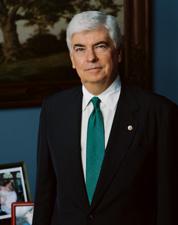 Sen. Christopher J. Dodd (D-CT)
Legislative Activity
Stay on top of the latest movement without scrolling through every action
Senate amendment submitted
May 11, 2010
View full timeline
Senate amendment submitted
May 11, 2010
Roll call votes on amendments in Senate: Amendment SA 3938 agreed to in Senate by Yea-Nay Vote. 63 - 36. Record Vote Number: 139.
May 11, 2010
Senate amendment proposed (on the floor): Amendment SA 3938 proposed by Senator Dodd to Amendment SA 3739.(consideration: CR S3497-3509; text: CR S3497)
May 11, 2010
Senate amendment agreed to: Amendment SA 3938 agreed to in Senate by Yea-Nay Vote. 63 - 36. Record Vote Number: 139.
May 11, 2010
Amendment SA 3938 proposed by Senator Dodd to Amendment SA 3739. (consideration: CR S3497-3509; text: CR S3497) To require the Secretary of the Treasury to conduct a study on ending the conservatorship of Fannie Mae and Freddie Mac, and reforming the housing finance system.
May 11, 2010
Amendment SA 3938 agreed to in Senate by Yea-Nay Vote. 63 - 36. Record Vote Number: 139.
May 11, 2010
Votes
1 roll call on this amendment
Text
Proposed
RESTORING AMERICAN FINANCIAL STABILITY ACT OF 2010--Continued

The PRESIDING OFFICER. The Senator from Arizona.

Amendment No. 3839 to Amendment No. 3739

Mr. McCAIN. Mr. President, I call up amendment No. 3839 and ask for
its immediate consideration and ask to set aside pending amendments.
The PRESIDING OFFICER. The clerk will report.
The legislative clerk read as follows:

The Senator from Arizona [Mr. McCain], for himself, Mr.
Shelby, Mr. Gregg, Mr. Bennett, Mr. Crapo, Mr. Corker, Mr.
Burr, Mrs. Hutchison, and Mr. Roberts, proposes an amendment
numbered 3839 to amendment No. 3739.

Mr. McCAIN. Mr. President, I ask unanimous consent that the reading
of the amendment be dispensed with.
The PRESIDING OFFICER. Without objection, it is so ordered.
The amendment is as follows:
(The text of the amendment is printed in the Record of May 5, 2010,
under ``Text of Amendments.'')
Mr. McCAIN. Mr. President, before we continue, I know the
distinguished chairman of the Banking Committee and the manager of the
bill want us to move forward. I understand that. As we speak, I am
compiling a list of those who want to speak on the amendment on this
side. I assure him we will try to get a time agreement completed as
soon as possible. I ask my colleagues on this side of the aisle who
want to speak on this amendment to call the cloakroom so we can get
that done.
Mr. President, I ask unanimous consent that Senators Burr, Hutchison,
and Roberts be added as cosponsors of this amendment.
The PRESIDING OFFICER. Without objection, it is so ordered.
Mr. McCAIN. Mr. President, I apologize to my colleagues for giving
them false information a couple of days ago. It is not $125.9 billion
that we are now pouring into Fannie and Freddie; it is up to $145
billion that is now being poured in--$145 billion. I remind my
colleagues again that last Christmas Eve at 7 p.m. was when the
Treasury Department decided to lift the cap, which had been at $400
billion. It is now up--$145 billion. Here we are addressing financial
regulatory reform and not looking at $5 trillion of toxic assets that
have already spent $145 billion off budget. It is off budget.
Incredible.
My distinguished friend from Connecticut pointed out yesterday--he
says I want a little revisionist history. He says the House financial
committee passed bipartisan legislation. It stalled in the committee
over here despite the support for it. The Republican-controlled
committee then passed a bill and never filed it, never brought it up
for a vote here on the floor of the Senate in 2005. That was my friend
Senator Dodd's statement yesterday.
The fact is--a little revisionist history--on April 1, 2004, the
Senate Banking Committee passed the bill, the Federal Housing
Enterprise Regulatory Reform Act. All 12 Republicans voted for it. All
Democrats, including the distinguished chairman, voted against it,
according to the Record. So neither bill was taken on the floor
because, as we know, we don't move forward with legislation if it is
blocked by the other side.
Then Senator Dodd went on to say: I became chairman of the Banking
Committee in 2007. We arrived at 2008. We had a significant number of
hearings. In the summer of 2008, the Banking Committee passed a
comprehensive bill--et cetera, et cetera. The Housing and Economic
Recovery Act was finally enacted on July 30, 2008. Just 39 days later,
Fannie Mae and Freddie Mac were placed into conservatorship.
I remind Senator Dodd that back in 2006, there was a group of us, in
response to an inspector general's report, who said we need to fix it
and fix it now, and that was blocked by the other side.
Senator Dodd said: If you think the market took a plunge last
Thursday, adopt the McCain amendment. It is a reckless amendment.
What is reckless is the status quo. What is reckless is to totally
ignore $5 trillion in toxic assets, already $145 billion of the
taxpayers' money being spent. It is reckless for us to go to the
American people and say we are fixing the problem that caused the
financial meltdown and yet we are ignoring Fannie and Freddie. We are
ignoring the trillions of dollars of toxic assets. And don't worry, we
will address it later on. That is what the distinguished chairman is
going to say--we will address this later on. Later on? Later on? When
we have this already done? And it is not on budget. Remarkable.
What the amendment says is that the conservatorship has to end in 24
months. We will give them 2 years to figure all this out. It is
reckless, in my view, to say we are not addressing these trillions of
dollars in toxic assets, the hemorrhaging of $145 billion already of
taxpayers' dollars, on which there is no expert who believes we will
ever see a return.
Finally, I would like to quote the Wall Street Journal editorial of
this morning that says, ``$145 Billion and Counting. Fannie and Freddie
lose it all for you.''
The editorial says:

These efforts to support the Obama anti-foreclosure program
resulted in a doubling of loan modifications compared to the
previous--

Let me start from the beginning.

Fannie Mae yesterday announced its 11th consecutive
quarterly loss--$11.5 billion--and asked for another $8.4
billion in taxpayer assistance.

They lost that. They are asking for $8.4 billion. That puts us well
over $150 billion.

Fannie Mae is the Cal Ripken of bad real-estate deals,
reliably pouring taxpayer money into the housing market.
Granted, Fannie faces tough competition from its toxic twin,
Freddie Mac, which last week announced its own request of
another $10.6 billion from taxpayers.
Once the checks from the Treasury clear, Fan and Fred will
have consumed a combined $145 billion in taxpayer cash, and
the end is nowhere in sight. Both companies warned of further
losses triggering more government assistance, which is now
unlimited after a 2009 Treasury decision.
The losses are unlimited because the companies are now run
by the government not to make money, by deliberately
subsidizing housing. In yesterday's press release, CEO Mike
Williams didn't even pretend that he's running a profit-
making business. ``In the first quarter, we continued to
serve as a leading source of liquidity to the mortgage
market, and we made solid progress in our ongoing effort to
keep people in their homes,'' he said. These efforts to
support the Obama anti-foreclosure program resulted in a
doubling of loan modifications compared to the previous
quarter.
Ramping up modifications makes perfect sense in the upside-
down world of Fannie Mae. The company also announced that
most of the loans it modified in the first three quarters of
2009 had gone delinquent again within six months.

Does anyone get that? Most of the loans that were modified--at the
cost of $100-and-some billion of taxpayers money--have gone under
again, have gone delinquent again within 6 months.
The Wall Street Journal goes on:

Talk about an exciting business opportunity. In case anyone
still hasn't gotten the joke, the company also clarified
yesterday that its directors ``are not obligated to consider
the interests of the company'' unless the government tells
them to do so.
The real joke is that the Obama Administration and Senator
Chris Dodd have collaborated on a financial regulatory reform
bill that includes no reform of Fan or Fred. Senators should
rectify this embarrassment as early as today by voting for
John McCain's amendment to end this most costly of all
bailouts.

My question to the distinguished chairman is, even if he doesn't
accept any of the statements I made, is it true that there are
trillions of dollars in toxic assets and, if so, what are we going to
do about it and when? If not on this bill, where?
The cynicism out there amongst the American people is at the highest
level

[[Page S3497]]

I have ever seen it in the many years I have been privileged to serve.
To go to the American people and say we are going to take measures
which will prevent another worldwide fiscal meltdown and we are not
going to address trillions of dollars in toxic assets we have already
poured $145 billion into--they lifted the cap on Christmas Eve at 7
p.m, so they think it is going to be in excess of $400 billion over
time, and nothing in this piece of legislation, nothing in it has
anything to do with Fannie Mae or Freddie Mac. Don't be surprised at
the cynicism of the American people.
I want to tell the manager, because he was not here, that I am trying
to get a list of speakers, get time agreements and give him a time
agreement at least on this side as soon as possible.
I yield the floor.
The PRESIDING OFFICER. The Senator from Connecticut.

Amendment No. 3938 to Amendment No. 3739

Mr. DODD. I see my colleagues here. Let me say to my friend from
Arizona, what I am going to do is call up an amendment that will be a
side-by-side arrangement. I will not ask for any time on this, and I
appreciate him getting back so we can get a time certain.
I call up amendment No. 3938.
The PRESIDING OFFICER. Is there objection? The clerk will report the
amendment.
The assistant editor of the Daily Digest read as follows:

The Senator from Connecticut [Mr. Dodd] proposes an
amendment numbered 3938 to amendment No. 3739.

Mr. DODD. I ask unanimous consent to dispense with the reading of the
amendment.
The PRESIDING OFFICER. Without objection, it is so ordered.
The amendment is as follows:

(Purpose: To require the Secretary of the Treasury to conduct a study
on ending the conservatorship of Fannie Mae and Freddie Mac, and
reforming the housing finance system)

On page 1455, after line 25, insert the following:

SEC. 1077. DEPARTMENT OF THE TREASURY STUDY ON ENDING THE
CONSERVATORSHIP OF FANNIE MAE, FREDDIE MAC, AND
REFORMING THE HOUSING FINANCE SYSTEM.

(a) Study Required.--
(1) In general.--The Secretary of the Treasury shall
conduct a study of and develop recommendations regarding the
options for ending the conservatorship of the Federal
National Mortgage Association (in this section referred to as
``Fannie Mae'') and the Federal Home Loan Mortgage
Corporation (in this section referred to as ``Freddie Mac''),
while minimizing the cost to taxpayers, including such
options as--
(A) the gradual wind-down and liquidation of such entities;
(B) the privatization of such entities;
(C) the incorporation of the functions of such entities
into a Federal agency;
(D) the dissolution of Fannie Mae and Freddie Mac into
smaller companies; or
(E) any other measures the Secretary determines
appropriate.
(2) Analyses.--The study required under paragraph (1) shall
include an analysis of--
(A) the role of the Federal Government in supporting a
stable, well-functioning housing finance system, and whether
and to what extent the Federal Government should bear risks
in meeting Federal housing finance objectives;
(B) how the current structure of the housing finance system
can be improved;
(C) how the housing finance system should support the
continued availability of mortgage credit to all segments of
the market;
(D) how the housing finance system should be structured to
ensure that consumers continue to have access to 30-year,
fixed rate, pre-payable mortgages and other mortgage products
that have simple terms that can be easily understood;
(E) the role of the Federal Housing Administration and the
Department of Veterans Affairs in a future housing system;
(F) the impact of reforms of the housing finance system on
the financing of rental housing;
(G) the impact of reforms of the housing finance system on
secondary market liquidity;
(H) the role of standardization in the housing finance
system;
(I) how housing finance systems in other countries offer
insights that can help inform options for reform in the
United States; and
(J) the options for transition to a reformed housing
finance system.
(b) Report and Recommendations.--Not later than January 31,
2011, the Secretary of the Treasury shall submit the report
and recommendations required under subsection (a) to the
Committee on Banking, Housing, and Urban Affairs of the
Senate and the Committee on Financial Services of the House
of Representatives.

Mr. DODD. I realize people want to be heard, but I again urge my
colleagues, if we can--every amendment has great value. There are about
60 amendments. At some point we have to draw the line, so I urge people
to use as little time as necessary--all the time they think they need,
but if we can get to a point where we can vote up or down on these two
amendments, I would appreciate it very much.
The PRESIDING OFFICER. The Senator from Georgia.
Mr. CHAMBLISS. Mr. President, first of all, I thank the chairman for
allowing us to debate this amendment this afternoon. I think this is
one of the most critical amendments that certainly we have talked about
to date, and moving forward, unless we address the issue of the GSEs,
as I am going to talk about in a minute, I am not sure we have
accomplished anything in this bill.
For all of the potential unintended consequences in this financial
regulatory restructuring package, at least one will be entirely
intentional--failing to address Freddie Mac and Fannie Mae.
Despite the general theme of the increased ``overreaching''
regulatory power of this legislation, a glaring example of something
that was actually left out is a substantive attempt to address one of
the most significant causes of the financial crisis--reform of the
government sponsored eniterprises, or GSEs, such as Freddie Mac and
Fannie Mae.
It has been highlighted from this floor that recent market volatility
and a faulty trading construct in our financial markets are
illustrations that the bill before us is needed now more than ever.
Specifically, the sudden significant drop throughout certain exchanges
last week has been pointed to as evidence of the necessity for greater
regulation of our markets.
However, when news broke last week that Freddie lost $8 billion in
the first quarter and would yet again be knocking on the taxpayer's
door for a $10.6 billion bailout--another bailout after both Fannie and
Freddie had already received $126 billion in taxpayer dollars--I failed
to hear calls for reform from the other side.
And just today it was announced that Fannie Mae will ask for another
$8.4 billion after posting a loss of $11.5 billion for its first
quarter. Shouldn't these entities' repeated failures serve as ample
evidence that the future of these ``bailout behemoths'' must be
addressed?
Apparently, this administration feels differently, and has for some
time. In fact, while it was busy cutting backroom deals over the health
care bill and making noise that a government takeover of health care
would reduce the deficit, in the quiet of night on Christmas Eve
another deal was made--only this one didn't make it out of the
backroom.
At the eleventh hour, after the Senate had finished its vote that
holiday eve, the administration pledged to the mortgage its current
giants unlimited financial, assistance--by lifting $400 billion cap on
emergency aid without even seeking congressional approval.
How can we have a serious conversation about overhauling our
financial regulatory structure, yet ignore two entities that have
exposed the taxpayers to more than $5 trillion in risk as of today. As
the Wall Street Journal put it recently, ``Reforming the financial
system without fixing Fannie and Freddie is like declaring a war on
terror and ignoring al Qaeda.''
Many have suggested that now is not the time to restructure these
giants; that they will have to be addressed later, indicating that due
to the comprehensive nature of their needed reforms, any attempt to
address the problems of Freddie and Fannie here would more than double
the size of the current financial regulatory reform bill.
Where were these legislative ``size standards'' when this body was
debating health care? That bill was more than 2,000 pages long.
Apparently, while we can address too big to fail, these government
sinkholes have become too big to legislate.
The fact is that the number of pages in a bill is not the reason
Freddie and Fannie are ignored here. And it is not for a lack of
understanding the problem. There has been no shortage of hearings on
GSEs, in both the House and Senate. The housing policies of this and
previous administrations have chained the taxpayers to a self-
perpetuating financial illness. Policies such

[[Page S3498]]

as the Community Reinvestment Act, or CRA, which forces banks to make
loans to otherwise unqualified borrowers set the stage for Fannie and
Freddie to buy up these bad loans on the secondary mortgage market.
Such backward policies exacerbated the causes of the financial
crises. Why would a bank not make these loans knowing they could turn
around and sell them to the government? Especially when regulators were
encouraging such practices? As a result, Fannie Mae, Freddie Mac and
the Federal Housing Administration, or more specifically, the taxpayer,
now own or guarantee about half of all outstanding residential
mortgages.
It is time we address this enormous problem, the McCain amendment
does that and I urge my colleagues to support it.
Mr. President, I yield the floor.
The PRESIDING OFFICER. The Senator from Georgia.
Mr. ISAKSON. Mr. President, in deference to the chairman, I will be
brief. But I come because I feel compelled today because of the two
amendments this body will be dealing with: one is the McCain amendment
and another amendment later in the day dealing with underwriting. So I
will save the remarks on that for when those amendments are pending.
I agree with Senator Chambliss, and I commend Senator McCain. I come
from a lifetime in the real estate business. So what I talk about, I do
understand its cause and effect in the marketplace. We cannot have
responsible reform of financial services and leave out Freddie Mac and
Fannie Mae.
One of the reasons that, along with Senator Conrad, I created the
Financial Markets Crisis Commission--which is now meeting, by the way,
and will report back at the end of December--is I knew there were
pervasive and redundant failures in the system that brought about what
became a cataclysmic collapse.
I understand the chairman has been under great pressure to bring this
legislation forward, and I have great respect for the chairman and
appreciate his work. I wish we had waited until the Financial Markets
Crisis Commission reported, but we have not. So let me just for a
second address Freddie and Fannie and the McCain amendment.
Freddie and Fannie filled the void the savings and loans created when
they failed in the late 1980s. There are a lot of people who will hear
this speech who will remember savings and loan days. Those were when
savings and loans associations were chartered to make home loans. With
the exception of FHA and VA, they basically made them all. There were a
few players but not too many.
Those entities, by the way, those savings and loans, had 100 percent
risk retention of every loan they made because their depositors put in
money for the sole purpose of getting a preferred rate of interest and
for mortgage loans to be made to generate the income. But they went
under. They went under because of a lot of factors. One was the Federal
Government changing in midstream the rules under which they operated
which caused them to collapse.
Freddie and Fannie immediately filled that void. They did a great job
for a long period of time by creating a secondary market for capital to
be formed, put into mortgages, the mortgage be securitized, and the
securities traded. It worked for a long time.
It worked, quite frankly, until a couple of things happened. One,
until the government all of a sudden told Fannie it started having to
own a certain percentage of what it called ``affordable loans,'' which
later became known as subprime loans. In fact, Fannie Mae became the
purchaser of record for the first subprime securities that were created
to meet the congressional mandate to end up having these affordable
loans, which made a market for those securities which subsequently were
sold around the world.
So I wanted to commend the Senator from Arizona. What he brings
before us is important. I do not know how we can leave Freddie and
Fannie out and talk about real financial services reform in the United
States of America. If anything, they need to be a critical part of it.
I recognize this legislation portends there will be a 2-year wind-
down unless they improve. Then there will be a liquidation at some
point in time. But let me tell you what is going to happen if nothing
happens. At some point in time, Freddie and Fannie will have to be
liquidated and a new entity will have to be created that will fill the
void when that liquidation takes place. We are going to have the
mortgage money in this country one way or another because America would
not be America without it.
But we cannot tend to have a black hole and an entity that can be
used for political purposes, or was used for political purposes, to
create a market for securities that ultimately fails and breaks down
the financial market.
I commend the Senator from Arizona. I associate myself with the
remarks of the other Senator from Georgia. I thank the distinguished
Banking Committee chairman for his time.
I yield back my time.
The PRESIDING OFFICER. The Senator from New Hampshire.
Mr. GREGG. Mr. President, I wish to rise also and first I want to
associate myself with the words from the Senator from Georgia. He is
absolutely correct in his history of how Freddie and Fannie got started
and what their purpose was and the fact that they are a great idea that
went wrong, unfortunately--or went ``awry'' would be a better term, not
wrong. The concept remains a good idea.
I rise to support Senator McCain's proposal because what he is
suggesting is a way out of a very deep and dark hole of debt for our
Nation and our American taxpayers, which is being generated by the
legacy and the present activities of Freddie Mac and Fannie Mae.
Part of this amendment in which I played a role primarily is the
issue of bringing on-budget and, therefore, into the light of day just
how much the American taxpayers owe as a result of the situation that
has occurred in those two businesses. It is estimated that the American
taxpayer will end up picking up somewhere around $400 to $500 billion
in costs as a result of the activities of Freddie and Fannie.
As far as the American taxpayer knows, this will be something that
comes out of the sky. I mean, nobody is aware of it. Nobody is thinking
about it. Nobody is talking about it. But these are actual debts that
are going to get put on our books and which will affect our credit
worthiness as a nation and which all Americans will have to pay back.
Why is this going to happen? It is going to happen because during the
halcyon days of taking on debt, or taking on obligations in the area of
mortgages which were not properly underwritten--and there will be a
later amendment by Senator Corker which I will support in the area of
underwriting--but which were not properly underwritten and which were
securitized and basically insured, for all intents and purposes, by
Freddie and Fannie, we ended up with a situation where they own a lot
of paper which does not have the value it is supposed to have and which
is not being paid back at the rate at which it was supposed to be paid
back.
Unfortunately, there was a tacit understanding that grew up in the
markets that the American taxpayer was going to stand behind that
paper. It was never explicit, but it became tacit, and people expected
that. Then when the actual event occurred, as these defaults started to
accelerate, it became real and the American taxpayer is now having to
stand behind all of this debt.
It is certainly going to come as a shock to most Americans that they
owe approximately $\1/2\ trillion--$\1/2\ trillion--because of very bad
decisions that were made by a group of people who were underwriting and
basically securitizing these loans.
Why did that happen? Well, there will be a lot of recrimination on
this subject. But the basic reason was that the Congress decided that
Americans should own houses whether they could afford the houses or
whether the houses sustained the value of their loans, Americans should
be able to go out and buy houses. So a lot of houses were sold which
did not have the underlying value necessary to support the loans which
were made on them, and which the person who bought the house and took
out the mortgage did not have the income over the extended period of
time of that loan to pay it back. Everybody knew it at the time the

[[Page S3499]]

house was bought. Everybody knew it at the time the mortgage was made.
But they figured: Well, appreciation will always occur in real estate
prices. So that will not bother us with the value of the house. Well,
maybe this person who got the loan for the house, maybe their income
will increase, or when the reset day occurs on that mortgage they will
be able to take care of it in some way.

So nobody faced up to the problem at the time, and literally
millions, millions of homes were purchased under that basic scenario.
That is what caused the implosion, basically, of our financial markets
back in late 2008, and Freddie and Fannie are a large part of that
implosion. But a lot of the initiative for that came from the Congress,
basically asserting that people should be able to get those types of
loans, and pushing Freddie and Fannie from using what had been very
standard and traditional underwriting standards in the 1990s into much
more aggressive standards as they moved into the early 2000 period.
As a result, we had this proliferation of loans which simply did not
have the underlying value and did not have the capacity to be repaid.
They were all securitized by Freddie and Fannie. So now the American
taxpayer ends up with this huge bill.
I think we have an obligation as a Congress to at least be honest
with the American taxpayer on this and tell them this is how big the
bill is. And it is huge. It is huge.
So this bill is now hidden in the drawer under the Federal accounting
system where we do not even acknowledge that it exists under the
Federal budget, even though we know we owe it, even though we know it
is going to be put on the books of the Federal Government, even though
we know the American taxpayer is going to have to end up picking this
up in the long run. We do not even acknowledge it. It is stuck in some
drawer somewhere in Washington.
Well, that should not happen any longer. We just had an amendment
about transparency with the Federal Reserve. Everybody voted for it.
Everybody voted for the transparency amendment on the Federal Reserve.
This is the transparency amendment on Freddie and Fannie. This
amendment will tell the American taxpayer just how much they really do
owe. It will bring on-budget the issue of the debts of these two
corporations, which are now the obligations of the Federal Government
and therefore the American taxpayer. Absolutely last to be done.
I thank the Senator from Arizona for including in his amendment this
language which brings this on-budget the way it should be. It opens the
light of day so that the American taxpayer can understand just how much
risk has been piled on their backs, how much debt has been piled on
their backs as a result of the irresponsible activity, which in large
part was initiated by this Congress over the years, forcing out loans
and pushing a public policy that these loans should be made.
Secondly, I congratulate the Senator from Arizona for bringing
forward an idea, a proposal for how we unwind this situation and how we
get out of this situation by putting us on a path, a path toward
basically decoupling Freddie and Fannie from the American taxpayer,
having those two organizations no longer be dependent on the American
taxpayer and having the American taxpayer no longer having to pick up
the debts of mistakes made by those two corporations, even when those
mistakes were caused, to some significant degree, by the Congress
taking actions which were inappropriate--or which were bad policy, not
necessarily inappropriate, but definitely bad policy.
So I congratulate the Senator from Arizona. I think this is a good
amendment. As has been said, how can we take up financial reform if we
do not take up the single biggest entity, the single biggest two
entities, when combined the single biggest entity, that affects the
financial markets relative to real estate lending in this country,
which is what caused the downturn and the crisis at the end of 2008.
We cannot do it. We cannot claim we have done financial reform if we
do not take on and address this issue. I understand that the
administration said: Well, we will do it next year. Well, we do not
have time. It needs to be done now. We need to address this now. It is
a critical issue, and it is at the essence of whether we can get our
house right and our ducks in the correct order relative to financial
reform.
If we do not straighten out Freddie and Fannie and its relationship
to the Federal Government, and specifically its relationship to the
American taxpayer, we really have not done anything to solve the long-
term problems of how we get our fiscal house in order because that
issue of how to make real estate loans in this country is at the
essence of how we correct the financial structure of this country.
This amendment, coupled with the amendment that is coming from
Senator Corker on the issue of underwriting, are the two key amendments
to this bill which address the two elements which are not addressed but
which have to be addressed if we are going to have effective,
comprehensive, lasting, and meaningful reform.
I yield the floor.
The PRESIDING OFFICER. The Senator from Arizona.
Mr. McCAIN. Mr. President, for the information of the manager, I have
the following speakers: Senator Coburn for 10 minutes, Senator DeMint
for 10 minutes, Senator Thune for 10 minutes. I have not been able to
nail down Senator Shelby as to how much time he will take. I would like
to sum up for 5 minutes. There will be no more speakers on my side
other than those.
Mr. DODD. Mr. President, I can't do the math that fast. I don't know
what that amounted to, but if we add 15 minutes for myself--why don't I
ask for 20 and then I will yield back. I will take maybe 10. I don't
have any requests for speakers at this time, but I may want to leave
space in case others may want to be heard. If we could calculate what
the time is, find out about Senator Shelby, and then lock down the
time. I don't need any additional time for a side-by-side. I will use
15 minutes. As soon as we get a number on that, we will let our
colleagues know.
I thank my colleague from Arizona.
The PRESIDING OFFICER. The Senator from Oklahoma.
Mr. COBURN. Mr. President, I wish to spend a few minutes kind of
general talking. I wish to give an example because this is a very big
bill with a lot of hard work by the Banking Committee and their staffs.
I want Members to compare this bill to a loved one who gets pneumonia.
They go to the doctor and they have a cough and a fever and chills.
They feel terrible. Think about it. If you would take your loved one to
the doctor and the answer you would get is: I think I can take care of
that. I can give you something for the cough that will suppress the
cough and I will give you something to take care of the fever and I
will give you a little something to take care of the pain in your
chest. You go on home. You come back if you don't get better. Of
course, 2 days later your loved one ends up in the hospital with
raging, now bilateral pneumonia and sepsis, bacteria in the blood. This
bill is kind of like that. It is kind of like a doctor treating
symptoms instead of the real disease.
The real disease was Congress. The real disease was poor underwriting
standards, actually no underwriting standards. The real disease was
Fannie Mae and Freddie Mac, and the real disease was the rating
agencies that haven't been controlled effectively by this proposed
legislation. This legislation does nothing for the real disease. It
treats a lot of symptoms. It grows government gigantically. It will
create more bureaucrats and rules than we can shake a stick at. But it
does not fix the underlying problem.
When people dispute that, ask the following question: If you are at
home, working and paying your mortgage, guess what. The reason we are
not fixing Fannie Mae and Freddie Mac is so you can continue to pay
more taxes so Freddie Mac can solve those mortgage problems through
your tax dollars and other people not being responsible for theirs.
That is what is going on here. That is why you are going to see $500
billion in additional losses with Fannie Mae and Freddie Mac, because
we are going to get them to keep going until we have satisfied all
this, not doing the hard work, not recognizing that we are actually
going to need $5 or $600 billion more in taxes or we are going to
borrow that to take care of this problem.

[[Page S3500]]

So everybody who is out there today who is working hard, paying the
mortgage, and keeping up is going to get to pay extra because we are
not going to fix Fannie Mae and Freddie Mac in this bill.
That is why this amendment is so important. We decided in this
country a long time ago that we were going to set forth a policy to
help people own homes, except we overdid it. We created incentives that
would bring out the worst nature in people. If you don't believe that,
look at Long Beach Mortgage, where 90 percent of the mortgages they
wrote prior to them folding were totally fraudulent. Where was the
oversight? There wasn't any--the Office of Thrift Supervision, but we
didn't oversee the Office of Thrift Supervision. We created the symptom
and a set of incentives and now we want to leave them right there.
This underlying bill does not address the three main diseases that
caused the problems we have. Congress genuflects and redirects any
criticism from us to the greedy banks or the greedy loan originators,
but they never say anything about us not doing oversight. They never
say anything about us not reforming Fannie and Freddie when we knew
what was coming in terms of their losses and also the financial
difficulties they had. We have a bill that doesn't fix it--a lot of
hard work, a lot of good intentions, but it doesn't fix the core
problems so they will not occur in the future.
As the Senator from New Hampshire said, if you combine strong
underwriting standards and transparency associated with limiting the
loss the American taxpayer is going to take on with Fannie Mae and
Freddie Mac, you will do something. But the way the bill is now, we
will have created big theatrics. Everybody will shake hands and holler
and dance around when the bill passes, except the dirty little story
will be that we didn't fix the real disease. When that loved one in ICU
with double pneumonia and sepsis dies, we go after the person who
didn't fix it, who should have fixed it, who had the knowledge to fix
it, and we say: You are liable.
Well, we are liable. We ought to be fixing this. The very fact is we
are not.
The McCain amendment is a commonsense amendment. I understand the
reservations. They don't want another $400 billion of recognized debt.
They don't want to account for the losses that are continuing to flow,
$20 billion so far in the first quarter of this year, out of those two
institutions. The Senator from New Hampshire way underestimated the
cost to the American taxpayer and what it will ultimately be by not
fixing this.
My appeal to the chairman of the committee is to seriously look, give
us good answers on why we are not fixing Fannie Mae and Freddie Mac.
What are the real reasons we are not fixing that? What are the real
reasons we are not creating strong, transparent underwriting standards
so the problem doesn't occur in the future? What is the real reason?
What is the real reason we don't hold accountable the rating agencies
and take away the conflict of interest thoroughly--not partially but
thoroughly--from the rating agencies?
The rating agencies are supposed to be a check. Had they been doing
their jobs, we wouldn't have had all these securities sold that were
worthless or were nonperforming. But they don't do their job. We didn't
do our job. Fannie Mae and Freddie Mac didn't do their job. Yet we are
not going to address the core issues that created the setup and
framework we are now experiencing as an economy. To me, that creates a
tremendous amount of liability on our part. We ought to have to be in
explanation of every ounce of our being on why we don't fix the real
disease that caused this problem.
I yield the floor.
The PRESIDING OFFICER. The Senator from Connecticut.
Mr. DODD. Mr. President, let me speak for 5 minutes. I ask the Chair
to inform me when I have done so.
First, let me notify my colleagues, we don't have a time agreement
yet, but I hope we will shortly on the McCain amendment and the
amendment I will offer as a side-by-side on this issue.
I ask unanimous consent to have printed in the Record letters from
the National Association of Home Builders and the National Association
of REALTORS, both of which oppose the McCain amendment.
There being no objection, the material was ordered to be printed in
the Record, as follows:

National Association of

Home Builders,

Washington, DC., May 6, 2010.
Hon. John McCain,
U.S. Senate, Washington, DC.
Dear Senator John McCain: On behalf of the 175,000 members
of the National Association of Home Builders (NAHB), I am
writing to express our strong concerns with an amendment
offered by Senator John McCain (R-AZ) dealing with the future
of the housing Government Sponsored Enterprises (GSEs),
Fannie Mae and Freddie Mac.
Fannie Mae and Freddie Mac have been, and remain, critical
components of the U.S. housing finance system. NAHB is
working with Congress to craft a thoughtful approach to the
future of these institutions, as well as the future of the
housing finance system itself. However, we remain concerned
about how to get from the current structure to a future
arrangement without undermining ongoing financial rescue
efforts and disrupting the operation of the overall housing
finance system. Any changes should be undertaken with extreme
care and with sufficient time to ensure that U.S. home buyers
and renters are not placed in harm's way, and that the
mortgage funding and delivery system operate efficiently and
effectively as a new system is put in place.
NAHB is concerned that the provisions in the McCain
amendment, if the GSEs are deemed viable, dealing with
portfolio limitations, loan limit repeals and escalating
mandatory down payments would greatly limit the GSEs' ability
to participate in the secondary housing market and lead the
housing market into recovery. Moreover, NAHB is concerned
that the McCain amendment could effectively end the current
housing finance delivery system without offering a thoughtful
replacement.
Again, NAHB has strong concerns with the impact the McCain
amendment would have on the current housing finance system,
and urges the Senate to address the future of Fannie Mae and
Freddie Mac in a thoughtful and deliberative manner.
Best regards,
Joseph Stanton,
Senior Vice President and Chief Lobbyist, Government Affairs
____

National Association of

Realtors,

Washington, DC, May 6, 2010.
U.S. Senate,
Washington, DC.
Dear Senator: On behalf of more than 1.1 million members of
the National Association of REALTORS<sup>'</sup> (NAR)
involved in residential and commercial real estate as
brokers, sales people, property managers, appraisers,
counselors, and others engaged in all aspects of the real
estate industry, I respectfully request that you oppose the
Corker-Gregg-Isakson (#3834) and the McCain-Shelby-Gregg
(#3839) amendments to S. 3217, the Restoring American
Financial Stability Act of 2010.

corker-gregg-isakson amendment

The Corker-Gregg-Isakson (#3834) amendment replaces the
risk retention provisions of S. 3217, Title VII, Subtitle D,
(b) Credit Risk Retentions--with a study on the feasibility
of risk retention requirements for financial institutions and
implements residential mortgage underwriting standards that
include a mandatory 5% down payment for all mortgages. As our
nation continues to recover from the worst economic downturn
since the Great Depression, REALTORS<sup>'</sup> are
cognizant that lax underwriting standards brought us to this
point, and must be curtailed. However, we caution that
swinging the pendulum too far in the opposite direction may
reverse our fragile recovery.
Based on data from NAR's 2009 Profile of Home Buyers and
Sellers, 11% of all home purchasers surveyed had downpayments
of 5% or less. When considering only first-time homebuyers,
the percentage utilizing a downpayment below 5% increase to
18%. Improving underwriting to ensure that the consumer has
the ability to repay their obligation is in the best interest
of everyone, but eliminating the possibility for some
creditworthy consumers to buy a home will have significant
detrimental ramifications for American families, the housing
sector an those businesses that support it.

McCain-Shelby-Gregg Amendment

The McCain-Shelby-Gregg (#3839) amendment, which creates
Title XII to S. 3217, places Fannie Mae and Freddie Mac on
the fast track to dissolution. REALTORS<sup>'</sup> believe
that reform of these institutions that have played a pivotal
role in the evolution of the U.S. housing market is
necessary; however now is not the time for drastic action,
especially considering their current role in stabilizing the
housing market, and that the McCain-Shelby-Gregg amendment
does not offer a replacement to fill the enormous gap that
the shuttered GSEs will leave.
As NAR mentioned in our testimony before the House
Financial Services Committee, March 23rd, 2010, on the
``Future of the Housing Finance'', the transition of these
organizations to their new form must be conducted in a
fashion that is the least disruptive to the marketplace and
ensures mortgage capital continues to flow to all markets in
all market conditions. The establishment of aggressive
timetables for the GSEs to return to

[[Page S3501]]

profitability, prior to the full recovery of our nation's
economy and housing market, pre-disposes them to failure, and
will cause significant angst for homebuyers and the nation's
housing markets.
Furthermore, the requirements that this amendment places on
Fannie Mae and Freddie Mac, when they become viable, will
effectively prohibit them from participating in the secondary
mortgage market.
First, the aggressive reduction of their portfolio will
prevent them from being an effective buffer during future
economic downturns. A key element of NAR's recommendation for
the restructure of the GSEs is that their portfolios should
only be large enough to support their business needs and
ensure a stable supply of mortgage capital when necessary
because of insufficient private investment. The requirements
established in this amendment would thwart the GSEs' ability
to be an effective buffer.
Second, the amendment repeals all increases to loan limits,
both permanent and temporary. The loan limits would return
to: $417,000. Moreover, the GSEs would be prohibited from
purchasing homes that had prices over the median-home price,
for properties of the same size, for the area in which the
property was purchased. This would reduce loan limits to less
than $100,000 in some areas, less than half the current FHA
floor.
NAR advocated for the increase of the loan limits for high
cost areas and is actively advocating that the current limits
be made permanent in order to ensure that creditworthy
homebuyers have access to affordable capital. The housing
market remains fragile, and private capital has not returned
to either the mortgage or MBS markets to the extent that is
needed to support the housing industry. Reducing the GSEs'
loan limits to the suggested levels will significantly limit
the ability of homebuyers to obtain mortgage funding
throughout the country, and damage the business sectors
supported by mortgage finance.
Third, the amendment establishes an escalating mandatory
down payment percentage that REALTORS<sup>'</sup> believe
unfairly and unnecessarily denies the opportunity to many
families who have the potential to succeed as homeowners.
Beginning 1-year after the 24-month assessment period, the
minimum down payment requirement will be 5%. 2-years out, the
downpayment will be 7.5%. After three years, the downpayment
will be 10% for conventional-conforming loans.
The removal of flexible downpayment options will
significantly reduce the ability of creditworthy consumers to
purchase a home. As mentioned with regard to the Corker-
Gregg-Isakson amendment, a 5% downpayment requirement
excludes 11% of all current homebuyers and 18% of all current
first-time homebuyers, based on NAR's most recent homebuyers
survey. Increasing the downpayment requirement to 10% would
exclude nearly 25% of all current creditworthy borrowers, and
up to 37% of current creditworthy first-time homebuyers.
Underwriting standards have already been corrected and loans
are only available for borrowers who can afford them. There
is no reason to over-correct by imposing higher downpayment
requirements.
As we have seen, without the GSEs, the current crisis would
have been even more catastrophic for the housing market and
the overall economy, as virtually no activity would have
occurred within the housing sector because little private
capital would have been available. REALTORS<sup>'</sup>
support reforming our housing finance system, and the GSEs.
However, taking a measured approach is critical to ensuring
that our economic recovery remains viable.
I appreciate the opportunity to share with you the views of
more than 1.1 million real estate practitioners and
respectfully request that you oppose the McCain-Shelby-Gregg
(#3839) and the Corker-Gregg-Isakson (#3834) amendments to S.
3217, the Restoring American Financial Stability Act of 2010.
Sincerely,

Vicki Cox Golder, CRB,

2010 President,
National Association
of Realtors<sup>'</sup>.

Mr. DODD. I say this with all due respect, but the McCain amendment
says that in 24 months we get rid of Fannie and Freddie. I don't call
that reform. They are just getting rid of something. What are the
implications of just getting rid of Fannie and Freddie? The fact is,
Fannie Mae and Freddie Mac, at this juncture, account for 96.5 percent
of all funding for all mortgages today. The amendment could undermine
the supply without establishing any alternative, and there is no
alternative. It just says in 24 months you get rid of Fannie and
Freddie. That is a wonderful conclusion, except for the fact that what
you get for that--and I don't make up these numbers--is higher interest
rates on mortgages, declining values in properties, the possibility of
eliminating the 30-year fixed rate mortgage, which only exists because,
frankly, we have had the Fannie Mae and Freddie Mac mortgage program.
This program needs to be fixed. There is no question about it. We
need an alternative housing financing system. That is without question.
But this amendment doesn't offer any. It just says get rid of the one
we have.
As the letter from the National Association of REALTORS reads:

[It] places Fannie Mae and Freddie Mac on a fast track to
dissolution. REALTORS believe that reform of these
institutions, that have played a pivotal role in the
evolution of the U.S. housing market, is necessary; however,
now is not the time for drastic action. Especially,
considering the current role in stabilizing the housing
market. [The McCain] amendment does not offer a replacement
to fill the enormous gap that the shuttered GSEs will leave.

That is what we are being asked to do. In the letter from the
National Association of Home Builders, they write:

Fannie Mae and Freddie Mac have been, and remain, critical
components of the U.S. housing finance system. However, we
remain concerned about how to get from the current structure
to a future arrangement without undermining ongoing financial
rescue efforts and disrupting the operation of the overall
housing financing system. Any changes should be undertaken
with extreme care and with sufficient time to ensure that
U.S. home buyers and renters are not placed in harm's way,
and that the mortgage funding and delivery system operate
efficiently and effectively as a new system is put in place.

We have to do this carefully. It was the housing problems that got us
into this mess. It was not Fannie and Freddie. It was this notion of a
deregulated environment that occurred. All the problems emerged in the
unregulated sector--unregulated brokers, unregulated mortgage
companies. They were luring people into mortgages they could not
afford, with no documentation, no background checks whatsoever. That is
the genesis of this whole issue. Read a new book, ``The Big Short,'' if
you want a good read about the genesis of this problem. I should not be
in the business of promoting books, but that book will lay out what
happened. Fannie and Freddie contributed to the problem further out,
but the problem began in a totally unregulated environment, an
unregulated environment that was promoted by the Chairman of the
Federal Reserve and his advocates and supporters over the years. That
is the origin of the mess that got us into this. Today there is no
backup. If 96.5 percent of mortgages are backed by these two
institutions right now, what replaces it? There isn't any with this
amendment. We are left in a free fall. Who gets hurt? Average
Americans. Clearly, we have to step up. Our amendment that we will
offer as a substitute demands within 6 months a plan be laid out. There
are a lot of different ideas on how to do it. We have had a lot of
hearings and discussions on what ought to replace the present housing
financing system. But I don't know of anyone who has come to one single
conclusion on what the best alternative is. Some have advocated a
public utility concept. That has very attractive features to it and is
one I would be inclined to be supportive of. There are other ideas on
how to do this, but to just eliminate it altogether, without an
alternative, at a time when we are just beginning to get back on our
feet, housing values are beginning to creep up, housing sales are
beginning to move forward?
Again, if we leave this sector of the economy with the kind of
disruption created by this amendment, then we could fall right back
into a recession. We have lost 8.5 million jobs, 7 million homes have
been lost, 4 million homes today are underwater in the United States,
and 250,000 have been seized in the first 3 months of this year. If we
want to contribute to that, if that is what our goal is in this bill,
to decide on a whim and offering an amendment just to strike these two
entities that exist with all their problems, that this is the way to
deal with the housing problem, it would be a drastic mistake to make,
having an amendment such as this be adopted. That is the reason I feel
strongly about it. That does not, in any way, take a backseat to the
notion we have to come up with an alternative housing financing system.
That is absolutely certain. This amendment does not do that. It just
gets rid of the present one without replacing it with anything. That is
not the way to engage in the kind of reform that is needed.
I think my 5 minutes have expired.
The PRESIDING OFFICER. The Senator from Arizona.
Mr. McCAIN. Mr. President, before I yield to Senator Thune, in
response to Senator Dodd's statement, I am incredulous that we would
somehow believe Fannie and Freddie were not among the prime reasons for
this financial meltdown.
Peter Wallison, who is a fellow in financial policy studies at the
American

[[Page S3502]]

Enterprise Institute and is a leading expert on banking and securities
regulation, has written extensively about this issue and says:

The roots of the financial crisis date back to 1993, when
Fannie Mae and Freddie Mac--

With the encouragement, by the way, of Members of Congress, including
the passage of the Community Reinvestment Act, which basically forced
people to give home loan mortgages to people who could never pay them
back--he goes on to say--

began stocking up on subprime mortgage assets and other risky
loans while reporting them as prime. The agencies' conflict
of interest between lending to low-income borrowers and
minimizing risk-taking activity may be to blame for their
behavior, however, it is certain that the government's
failure to properly regulate the enterprises has created one
of the worst policy disasters in history.
On Christmas Eve, when most Americans' minds were on other
things, the Treasury Department announced it was removing the
$400 billion cap from what the administration believes will
be necessary to keep Fannie Mae and Freddie Mac solvent. This
action confirms that the decade-long congressional failure to
more closely regulate these two government-sponsored
enterprises (GSEs) will rank for U.S. taxpayers as one of the
worst policy disasters in our history.

That is the view of most economists. How in the world someone as
knowledgeable as the distinguished chairman of the committee does not
recognize this is one of the prime reasons for the failure, this is one
of the prime reasons why 48 percent of the homes in Arizona are
underwater, where people are throwing keys in the middle of the living
room floor because they cannot afford to make the payments.
The enablers were Fannie Mae and Freddie Mac--the enablers of all
this. Time after time, this Congress--this Congress--put pressure on
them to increase their home loan mortgages to people who could never
afford to pay their mortgages. We know that is the cause of it, and how
the Senator from Connecticut can somehow allege that Fannie and Freddie
were not--as Mr. Wallison says, the ``action confirms that the decade-
long congressional failure to more closely regulate these two
government-sponsored enterprises will rank for U.S. taxpayers as one of
the worst policy disasters in our history.''
This morning, Mr. Wallison is quoted as saying:

Right now we have a consensus that something needs to be
done. The sensible thing to do is to put Congress in a
position where they have to act within a certain period of
time.

That is what this amendment does. They have to act in a certain
period of time. The Senator wants to know who should be making home
loans? Community banks. Community banks should be making home loans to
people. They should be able to extend lines of credit to small
businesses. But the main thing is, it should not be given to a
government-sponsored enterprise to keep it in business, where the
hundreds of billions of taxpayer dollars being spent is unlimited.
I yield the floor. Senator Thune, I believe, has 10 minutes.
The PRESIDING OFFICER (Mrs. Gillibrand). The Senator from South
Dakota.
Mr. THUNE. Madam President, I thank my colleague from Arizona for
yielding me time.
I would say Fannie Mae and Freddie Mac is a pox on all of us. But
shame on us if we do not try to do something in this legislation to
address this issue. What the McCain-Shelby-Gregg amendment does is
responsible. It does allow for a wind-down of this conservatorship.
But, as the Senator from Arizona has pointed out, it goes squarely at
what I think most economists argue was a huge contributor to the
meltdown we experienced a couple years ago: the runaway lending and
irresponsible lending practices that were involved with the plight we
now see with Freddie Mac and Fannie Mae, where they have, up until, I
think, this last quarter--or taking the last quarter combined, it is
about $145 billion now that the taxpayers are on the hook for.
As the Senator from Arizona pointed out, last Christmas Eve the
administration lifted the cap. There was a $400 billion cap on the
amount of taxpayer assistance that could be provided to these two
institutions. But now that cap has been lifted. Imagine the scale and
dimension of what we are talking about, when we already have $145
billion of taxpayer exposure. We assume it could be as much as $400
billion. But just in case, the administration lifts the cap because it
could go well beyond that, which suggests, if history is any
indication, it will go well beyond that.
What this does is say we need to exercise some responsibility with
regard to the regulation of all the financial institutions in this
country. What the Senator from Connecticut, in his bill, does--with the
financial services regulation reform bill--is to attempt to get at what
contributed, in many respects, to the meltdown we experienced a couple
years ago. But it ignores perhaps, as has been pointed out by the
Senator from Arizona, one of the biggest contributors to that problem;
that is, these two toxic institutions, Freddie Mac and Fannie Mae.
The administration has said they need time to come up with a plan.
The side-by-side that is going to be offered by the Democrats is going
to be a study. We are going to study this for about 6 months. I think
their argument is, it would be dangerous to rush the process. I think
the contrary is true. I believe it is dangerous to ignore this problem
any longer. We cannot afford to wait so more taxpayer money can be
lost, can be wasted in trying to keep these two entities afloat.
As I said before, last week we were informed that Freddie Mac needs
an additional $10.6 billion in taxpayer funds due to an $8 billion loss
in the first quarter of 2010. Since September of 2008, that brings the
taxpayers' invoice for Freddie Mac to $61.3 billion.
Fannie Mae reported a first quarter loss of more than $13 billion,
needing $8.4 billion from the government, putting their bill to the
American taxpayers at $83.6 billion.
So the grand total of taxpayer loss from these two entities since
their takeover in 2008 is a whopping $145 billion.
The losses racked up by Freddie Mac and Fannie Mae exceed--exceed--
the government's losses on AIG, General Motors, and Chrysler. Yet the
current legislation in the Senate is completely silent on these two
entities. That is outrageous. We cannot continue to funnel unlimited
amounts of taxpayer money into Freddie and Fannie and have no plan to
end this siphon.
In a time when we are faced with crushing debt and out-of-control
deficits, we are willing to turn a blind eye to a $145 billion problem,
which is going to only magnify over time. Last Christmas Eve, the
administration lifted the cap of $400 billion, which is what initially
was put in place that would limit the amount of taxpayer exposure. But
what we are now saying is that may not be enough. Yet we do nothing--
nothing--in this legislation to remedy this problem.
Obviously, the administration knew there was more bad news ahead when
they decided to lift the cap on government assistance on Christmas Eve
of last year. The Obama administration decided that taxpayers could
afford unlimited funding for Freddie and Fannie rather than keep a $400
billion cap on assistance in place. It is frightening they believe that
$400 billion is not going to be enough--unlimited funding may not be
enough. Who knows where this ends.
That is why I think it is important right now that we deal with this
issue, and the McCain-Shelby-Gregg amendment does it in a responsible
way by winding down and providing a timeline. It sets a 30-month date
out there by which this conservatorship has to be wound down.
If you look at what the current exposure is in terms of Freddie and
Fannie, they own or guarantee over 30 million home loans, worth about
$5.5 trillion. The CBO estimates that Freddie and Fannie could cost the
taxpayers as much as $380 billion through 2020. As I said before, my
assumption is that because we lifted--``we,'' the administration
lifted--the cap on the $400 billion of exposure, the assumption is, it
is going to go much higher than that. So I think we have to ask
ourselves this fundamental question: Is this the direction in which we
want to continue heading or is it time to change course?

The time to change course is now while we are debating a bill that is
designed to address the very problems we encountered a couple years
ago. Freddie and Fannie, as the Senator from Arizona said, were at the
very heart, the very core of that issue.
According to a recent Washington Post article, with the government's

[[Page S3503]]

conservatorship of Freddie and Fannie and the increase in FHA and VA
loans, the government backed nearly 97 percent of home loans in the
first quarter of 2010. Madam President, 97 percent of loans are backed
by the U.S. Government. Is this where we want to end up? Is this where
we want to head? Is this the best course for our housing market? Is
this the role the Federal Government should be taking when it comes to
housing in this country?
I firmly believe it is time we change course. I think there is great
value--we all agree there is great value--in home ownership and helping
families achieve the American dream of owning their own homes. But we
have to bring personal responsibility back into the conversation. We
need to go back to a time when families saved up money to make a
downpayment on a house. They went to their banks. They provided the
necessary documentation to prove they could pay back their loans, and
they bought a house that was within their budgets. Buying and owning a
home should be a goal people work to achieve, not a government mandate
funded by the taxpayers. That essentially is what we have created.
So I believe it is about time to take responsibility for our actions.
My constituents in my State who bought houses they could afford and
paid their bills on time want to see Congress start taking some
responsibility. I believe the McCain-Shelby-Gregg amendment does just
that. It shows our commitment to getting our fiscal house in order in
Washington, DC.
As I said, it is a sound plan for winding down the government
backstop to Freddie Mac and Fannie Mae. It mandates that
conservatorship will end in 30 months or less. Freddie Mac and Fannie
Mae will have to reduce their portfolios by 10 percent each year, and
if they are not viable enough to exist after the 30 months they will be
liquidated. If they are a viable company after the 30 months, they
would only enjoy their Federal GSE status for another 3 years.
The amendment repeals the affordable housing goals that persuaded the
two entities to enter into the subprime loan business in the first
place, which I believe was the slippery slope that got us into all the
problems, all the troubles we are facing today.
It creates new underwriting requirements on loans purchased by
Freddie and Fannie. Freddie and Fannie will have to reduce their
mortgage assets by more than 50 percent within 2 years and increase
their capital reserves. It repeals the temporary increase in the
conforming loan limit, returning it to $417,000. The two would have to
pay State and local taxes, register with the SEC, and pay a fee to the
government to repay their debts to the taxpayer.
These are all responsible reforms. Contrary to the assertions that
have been made by the other side, this amendment is the correct way to
proceed in dealing with these two giant institutions that have lost
their way and are costing the taxpayers literally billions and billions
and billions of dollars every quarter that passes that we do not take
steps to fix this problem.
The amendment would reinstate the $400 billion cap that the
administration lifted in December so the taxpayers know for certain
they are not going to be on the hook for unlimited financial support.
The amendment establishes a new special inspector general at the GAO
to investigate and report to Congress on these two entities. Freddie
and Fannie would be included in the Federal budget until their
conservatorship has ended, which is the fiscally responsible thing to
do when we all know they do, in fact, have an impact on our budget and
on our debt.
As I said, I have heard the arguments on the other side of the aisle,
and I think they are ignoring the clear will of the American people.
The American people get this. They know why we are where we are. They
are sick and tired of subsidizing the mistakes of Freddie Mac and
Fannie Mae. We need to put an end to the taxpayer bailout.
I think it is important to the credibility of our economy and our
credibility with the American taxpayers--but it is important to the
credibility of the markets and to our economy--that they understand we
are serious about solving this problem. That is why the McCain-Shelby-
Gregg amendment is the correct way to proceed. We are going to have a
vote on that very soon, and I hope we will not leave this subject, that
we will not dispose of this financial services regulation reform bill
without addressing this very important topic.
To suggest for a minute, as the other side has, that somehow we can
do a study, we can put this off for 6 months--and who knows. By the
time they complete the study, they will have to think about the results
of that study and formulate a plan, and that will take another 6 months
or a year. Every single month, every single quarter that goes by, we
continue to hemorrhage more and more money at the cost of billions and
billions of dollars to the American taxpayers. They have had enough. We
should say we have had enough and we are going to bring some
discipline. This amendment does that, and I hope my colleagues will
support it.
I yield the remainder of my time.
Madam President, I suggest the absence of a quorum.
The PRESIDING OFFICER. The clerk will call the roll.
The bill clerk proceeded to call the roll.
Mr. SHELBY. Madam President, I ask unanimous consent that the order
for the quorum call be rescinded.
The PRESIDING OFFICER. Without objection, it is so ordered.
Mr. SHELBY. Madam President, as part of the debate on the McCain-
Shelby-Gregg amendment, I wish to take this opportunity this afternoon
to discuss the history of Fannie Mae and Freddie Mac from my
perspective. By doing this, I want to emphasize past Republican
attempts at regulating and reforming these institutions, while also
discussing their role in the financial crisis.
The government-sponsored enterprises that we call Fannie Mae and
Freddie Mac were key players in the collapse of the U.S. housing
market. Their multitrillion dollar portfolios gave them the purchasing
power to drive markets. In addition, false presumptions about their
housing finance expertise and their connections to the government gave
them further power to influence the housing market. And let us not
forget the GSEs' nationwide lobbying and public affairs apparatus that
was designed to keep reformers at bay and their supporters flush with
cash.
When the GSEs began to buy subprime securities, other firms,
including most of the Wall Street banks, took this as a signal that
subprime mortgage securities were safe and worthwhile investments. In
effect, Fannie Mae and Freddie Mac placed the Good Housekeeping ``Seal
of Approval'' on these risky instruments. As a result, the rest of the
market engaged in this practice, and the race to the bottom began.
Ultimately, the GSEs' collapse lit a wildfire that burned throughout
the financial markets.
Due to their miscalculations, Fannie Mae and Freddie Mac have been
placed in conservatorship and have already cost the taxpayers well over
$100 billion. Just last week, we learned that the GSEs will need
another $20 billion in taxpayer assistance for their losses during the
previous quarter.
This did not have to happen. For years, the warning signs were
flashing, and Republicans made multiple attempts to adopt the necessary
reforms. Unfortunately, those efforts were opposed by Democrats in the
Senate Banking Committee and ultimately caused the many efforts put
forth by Republicans to stall in the Senate.
In 2003, as chairman of the Banking Committee at that time, I held
multiple hearings on proposals for improving the regulation of the
GSEs. I wish to read a portion of my opening statement from one of
those hearings. I quote from that time:

The enterprises are large institutions. Collectively,
Fannie Mae and Freddie Mac carry $1.6 trillion in assets on
their balance sheets and have outstanding debt of almost $1.5
trillion. The Federal Home Loan Bank System is not far
behind, with combined assets of over $780 billion and
outstanding advances to member institutions of $495 billion.
Due to the importance of the housing GSEs' mission, and the
size of their assets, I believe that the enterprises require
a strong, credible regulator.

I further read from the statement then:

I remain concerned that the current regulatory structure
for housing the GSEs is neither strong nor credible.

[[Page S3504]]

At this same hearing, it became apparent that the two parties had
very different perspectives regarding the need for reform. One of my
Democratic colleagues noted--and it is in the record:

There is an old expression, if it ain't broke, don't fix
it. I think some of us here in the Senate believe that when
we try to fix things that aren't really broken, we can end up
doing more harm than good.

Notwithstanding the mindset on the other side of the aisle, my
Republican colleagues and I persevered, and we remained engaged in the
effort to reform the GSEs by holding numerous hearings and closely
tracking the GSEs' activities at that time.
We decided those who believed ``things aren't really broken'' were
wrong. In the face of strong Democratic opposition and a relentless
lobbying campaign by the GSEs and their supporters, we proceeded with a
markup of the Federal Housing Enterprise Regulatory Reform Act of 2004.
I wish to again read portions of my brief opening statement from that
markup which lays out the issues and the responses we crafted to
address the problems of the GSEs then:

This afternoon the committee will consider S. 1508, a bill
to address regulation of the housing GSEs.
Today, we are faced with the most important decisions
considered by this committee in years--determining the
strength, independence and credibility of regulation of our
nation's Government Sponsored Housing Enterprises. The
strength, independence and credibility of this regulatory
system have tremendous implications for the future health and
vitality of our housing markets, our capital markets, and the
economy as a whole.

I continue to quote the statement:

Freddie Mac and Fannie Mae currently have $1.7 billion debt
outstanding. To provide some perspective, our nation's
Treasury debt in the hands of the public stands at just over
$4 trillion. The Federal Home Loan Bank System has also grown
significantly since the 1990s and has a vastly expanded
membership base.
Its current regulator is not up to the task of providing
adequate oversight of its significant role.

My statement continued:

Fannie Mae is the second largest financial institution in
the United States. Freddie Mac is fourth. Their debt is held
by foreign central banks, insurance companies, money center
banks and community banks. Because of the interest rate risk
these GSEs must manage, they have an extensive network of
derivative contracts. Should one of these institutions
encounter significant financial difficulty it could make the
S&L crisis pale by comparison.

I was here speaking as an early member of the Banking Committee, as
was Senator Dodd, during the bailout of the S&Ls. And it was no pretty
matter. It ended up costing the taxpayers at least $130 billion.
I continue:

This experience has only reaffirmed my resolve to ensure
such a debacle never revisits the taxpayer. And, quite
simply, the real truth is we cannot afford a crisis of the
magnitude a failing GSE would pose.
I approach this markup today with a firm appreciation of
the gravity and relevance of what we do here today. I state
again, as I have before--I support the housing missions of
the GSEs. Home ownership is the primary source of wealth for
many Americans. It fosters strong communities and promotes
stability for children and families.
But, and I believe there is consensus in this Committee on
this one point at least, they are not well-regulated and,
therefore, pose significant risk to the taxpayer and the
markets they serve.
To be clear: they are not well-regulated because the
regulatory structures and authorities that Congress created
are insufficient and weak by design.
And that is what the draft before us is all about.
Reaffirming the important mission of GSEs, creating a
regulator that has all the tools and independence that other
first class financial regulators require, and protecting the
taxpayer. These are the guiding principles that animate the
draft that I have put forth before the Banking Committee
today.

Unfortunately for the taxpayers of this country, politics got in the
way of advancing credible public policy then. Apparently, the Democrats
felt it was better to block necessary change, adhere to the status quo,
and ignore the risk to the financial system, all while leaving the
taxpayers fully exposed.
We, the same Republicans who have been characterized by Democrats as
being pro-Wall Street and antiregulation throughout this process, were
trying to create a stronger regulator, raise capital standards, reduce
risk taking, and put in place a resolution regime that would limit
taxpayer exposure in the event of a firm failure.
That was a number of years back. I wish to revisit the words of one
of my then-Democratic colleagues who made the following statement--and
it is in the record--as we debated the merits of the Republican GSE
reform bill at that time:

Lord only knows where the economy would be today if it were
not for the stability of the housing market in the midst of
so much turbulence and the ability of Americans to draw down
some of their home equity to engage in consumer purchases.

Then, as we stood on the precipice of a housing and financial
meltdown, my Democratic colleagues were opposing more regulation and
promoting more consumer spending. As if that were not bad enough, we
were encouraging homeowners to raid the home's equity to finance their
purchases. And look where it brought us.
Another Democrat took issue with the fact that we attempted to give
the regulator the power to place a GSE into receivership:

Receivership, first, it does not have to be in the bill,
but, second, to allow a regulator who may not like this
institution to then sort of dole out little pieces of it one
way or another and weaken the fundamental structure of Fannie
and Freddie easily leads to its demise.

I am not sure whether my colleagues then understood the basic concept
behind establishing an orderly resolution process, but I hope the
lesson has now been learned. Ironically, Democratic opposition to
strong reform actually produced the exact outcome my colleague feared.
When reform stalled in the face of Democratic objections, investors
once again viewed Fannie Mae and Freddie Mac as ``too big to fail.''
They were confident that Congress and the U.S. Government would never
allow them to go under. This, of course, gave the GSEs a significant
financing cost advantage which led to their explosive growth and
excessive risk taking.
Finally, and most telling, one of my Democratic colleagues was
concerned about how Wall Street might interpret the regulatory changes
that Republicans were advocating, stating:

It is a fact that just mere speculation about the prospects
of some provisions in the bill is sending shock waves through
Wall Street.

Really?
When Wall Street became concerned that our legislation at that time
would provide a stronger regulator, require higher capital standards,
mandate less risk taking, and establish a well-designed resolution
regime, the Democrats came to Wall Street's rescue, not the
Republicans.
When the choice was between Main Street and Wall Street, the
Democrats made it absolutely clear whose side they were on. They chose
Wall Street, and Wall Street ultimately paved the road that led to this
collapse.
I ask unanimous consent to have printed in the Record a copy of the
recorded vote of the proceedings of that day in the Senate Banking
Committee. That result was a party-line vote with all 12 Republicans
voting for GSE reform and all Democrats opposing it.
There being no objection, the material was ordered to be printed in
the Record, as follows:

Markup of S. 1508, the Federal Housing Enterprise Regulatory Reform Act
of 2004

The Committee met, pursuant to notice, at 2:10 p.m., in
room SD-538, Dirksen Senate Office Building, Senator Richard
Shelby (Chairman of the Committee) presiding.
Present: Senators Shelby, Bennett, Allard, Enzi, Hagel,
Santorum, Bunning, Crapo, Sununu, Dole, Chafee, Sarbanes,
Dodd, Johnson, Reed, Schumer, Bayh, Carper, Stabenow, and
Corzine.

STATEMENT OF CHAIRMAN RICHARD SHELBY

Chairman Shelby. The Committee will come to order.
This afternoon, the Committee will consider S. 1508, a bill
to address the regulation of the housing GSEs. I will start
by acknowledging the original cosponsors of this bill--
Senator Hagel, Senator Sununu, and Senator Dole--and I want
to commend them for their dedication and their work,
originally, and including putting together what we have
today.
Today, we are faced with the most important decisions
considered by this Committee in years; that is, determining .
. .
I now move and ask a roll call vote on the original bill,
the substitute. Call the roll.
The Clerk. Mr. Chairman?
Chairman Shelby. Aye.
The Clerk. Mr. Bennett?
Senator Bennett. Aye.
The Clerk. Mr. Allard?
Chairman Shelby. Aye, by proxy.
The Clerk. Mr. Enzi?

[[Page S3505]]

Senator Enzi. Aye.
The Clerk. Mr. Hagel?
Senator Hagel. Aye.
The Clerk. Mr. Santorum?
Chairman Shelby. Aye, by proxy.
The Clerk. Mr. Bunning?
Senator Bunning. Aye.
The Clerk. Mr. Crapo?
Chairman Shelby. Aye, by proxy.
The Clerk. Mr. Sununu?
Senator Sununu. Aye.
The Clerk. Mrs. Dole?
Chairman Shelby. Aye, by proxy.
The Clerk. Mr. Chafee?
Senator Chafee. Aye.
The Clerk. Mr. Sarbanes?
Senator Sarbanes. No.
The Clerk. Mr. Dodd?
Senator Dodd. No.
The Clerk. Mr. Johnson?
Senator Sarbanes. No, by proxy.
The Clerk. Mr. Reed?
Senator Reed. No.
The Clerk. Mr. Schumer?
Senator Sarbanes. No, by proxy.
The Clerk. Mr. Bayh?
Senator Bayh. No.
The Clerk. Mr. Miller?
Chairman Shelby. Aye, by proxy.
The Clerk. Mr. Carper?
Senator Carper. No.
The Clerk. Ms. Stabenow?
Senator Stabenow. No.
The Clerk. Mr. Corzine?
Senator Corzine. No.
The Clerk. Chairman, the ayes are 12, the nays 9.
Chairman Shelby. The bill is adopted.

Mr. SHELBY. Madam President, that was not the end of the story,
though. More than 1 year later, we tried again to pass these important
reforms. The Banking Committee held more hearings leading to the markup
of S. 190, the Federal Housing Enterprise Regulatory Reform Act of
2005. I will not read my entire statement from this markup, but I will
read a part of it that describes the commonsense steps that we were
attempting to take with our newest effort to pass then GSE reform. I
quote from that markup:

My legislation creates a new regulator with combined
oversight for both the safety and soundness and the housing
mission of Fannie Mae, Freddie Mac, and the Federal Home Loan
Bank System.
The new regulator will have general regulatory authority
over all housing GSEs, including enhanced authority over
capital requirements, and enforcement and prompt corrective
action authorities that are comparable to those of the bank
regulatory agencies.
Among other enhanced regulatory authorities, the bill we
will consider today includes clear direction on portfolio
review for compliance with safety and soundness, mission and
systemic risk.
Under this proposal, the enterprises are permitted to hold
those assets which promote the enterprises' mission in the
housing market.
The bill also transfers the product review function from
HUD to the new regulator and creates a two-tier approval
process through which the enterprises must receive approval
prior to offering any new product.
The bill also establishes new criteria for approval of a
product that will ensure the enterprises remain focused on
their statutory mission of facilitating a secondary mortgage
market.
The new regulator will also have the power to conduct an
orderly resolution of a failing or insolvent GSE through a
receivership process. This clear and definitive process for
dealing with a troubled enterprise is a critical tool for the
credibility and strength of a new regulator.

Madam President, unfortunately, the Democrats did not share my view
of increasing regulations on the GSEs, and their comments during the
second attempt to pass meaningful reforms are telling. One of my
Democratic colleagues stated then, ``When the sink is leaking, you do
not tear down the house, especially if the house has served you well.''
Another recalled a critique he read of the bill before the markup,
which claimed, ``It is like trying to cure the common cold with
chemotherapy.''
In fact, at one hearing, one of my Democratic colleagues expressed an
interest in hearing how the roles of the GSEs might be increased, when
he explained:

I am not only interested in hearing about the role GSEs
currently play in the mortgage market, I am also interested
in how their commitment to home ownership and affordable
housing can be expanded.

In the end, the result of our 2005 markup was the same as our 2004
markup--a strict party-line vote with all 11 Republicans supporting the
reforms and all 9 Democrats opposing them. Unfortunately, the Democrats
once again sided with Wall Street and the special interests by
rejecting GSE reform and any attempt to move the legislation beyond the
Banking Committee.
Madam President, I ask unanimous consent to have printed in the
Record a copy of that recorded vote in the Banking Committee.
There being no objection, the material was ordered to be printed in
the Record, as follows:

Markup of the Nominations of Hon. Christopher Cox, To Be Chairman, U.S.
Securities and Exchange Commission; Hon. Roel C. Campos, To Be
Commissioner, U.S. Securities and Exchange Commission; Annette L.
Nazareth, To Be Commissioner, U.S. Securities and Exchange Commission;
John C. Dugan, To Be Comptroller, Office of the Comptroller of the
Currency; Hon. John M. Reich, To Be Director, Office of Thrift
Supervision; and Martin J. Gruenberg, To Be Member and Vice-Chairman,
Federal Deposit Insurance Corporation, and of S. 705, Meeting the
Housing and Service Needs of Seniors Act of 2005; H.R. 804, To Exclude
From Consideration as Income Certain Payments Under the National Flood
Insurance Program; S. 1047, The Presidential $1.00 Coin Act of 2000;
and S. 190, The Federal Housing Enterprise Regulatory Reform Act of
2005

The question is on reporting the Committee print of S. 190
as amended here to the full Senate.
The Clerk will call the roll.
The Clerk. Chairman Shelby.
Chairman Shelby. Aye.
The Clerk. Mr. Bennett.
Senator Bennett. Aye.
The Clerk. Mr. Allard.
Chairman Shelby. Aye by proxy.
The Clerk. Mr. Enzi.
Chairman Shelby. Aye by proxy.
The Clerk. Mr. Hagel.
Chairman Shelby. Aye by proxy.
The Clerk. Mr. Santorum.
Senator Santorum. Aye.
The Clerk. Mr. Bunning.
Senator Bunning. Aye.
The Clerk. Mr. Crapo.
Senator Crapo. Aye.
The Clerk. Mr. Sununu.
Senator Sununu. Aye.
The Clerk. Mrs. Dole.
Senator Dole. Aye.
The Clerk. Mr. Martinez.
Senator Martinez. Aye.
The Clerk. Mr. Sarbanes.
Senator Sarbanes. No.
The Clerk. Mr. Dodd.
Senator Dodd. No.
The Clerk. Mr. Johnson.
Senator Sarbanes. No by proxy.
The Clerk. Mr. Reed.
Senator Reed. No.
The Clerk. Mr. Schumer.
Senator Sarbanes. No by proxy.
The Clerk. Mr. Bayh.
Senator Sarbanes. No by proxy.
The Clerk. Mr. Carper.
Senator Carper. No.
The Clerk. Ms. Stabenow.
Senator Sarbanes. No by proxy.
The Clerk. Mr. Corzine.
Senator Sarbanes. No by proxy.
The Clerk. Mr. Chairman, the yeas are 11, the nays nine.
Chairman Shelby. S. 190 as amended is ordered reported to
the full Senate.

Mr. SHELBY. I would like to point out another bit of irony right now.
Many of my colleagues who recently complained about the process
regarding consideration of this bill were some of the same people who
took every measure to block all consideration of GSE reform. Actions
have consequences, and in this particular instance, they were almost
immediate. As soon as it was apparent that GSE reform was dead, Fannie
Mae and Freddie Mac took steps to dramatically increase their risk.
The Government Accountability Office, GAO, detailed this in a
September 2009 report. The GAO discovered that in 2004 and 2005, the
enterprises:

. . . embarked on aggressive strategies to purchase
mortgages and mortgage assets with questionable underwriting
standards. For example, they purchased a large volume of what
are known as Alt-A mortgages, which typically did not have
documentation of borrowers' incomes and had higher loan-to-
value ratios or debt-to-income ratios.
Furthermore, purchases of private-label MBS increased
rapidly as a percentage of retained mortgage portfolios from
2003 to 2006. By the end of 2007, the enterprises
collectively held more than $313 billion in private-label
mortgage-backed securities, of which $94 billion was held by
Fannie Mae and $218.9 billion held by Freddie Mac.

Recently, Daniel Mudd, Fannie Mae's former chief operating officer
and chief executive officer, testified:

While the market was changing, Fannie Mae struggled to meet
aggressively increasing HUD goals. The goals were extremely
challenging, increased significantly every year, and
permitted no leeway to account for the challenging lending
environment. Certain mortgages that may not have met our
traditional standards could not be ignored.

While Mr. Mudd may be correct that these mortgages aided their
ability to meet their HUD goals, it also should be

[[Page S3506]]

noted that the GAO in this same report did not see these purchases as a
benefit to their mission, stating:

The rapid increase in the enterprises' mortgage portfolios
and the associated interest-rate risk did not result in a
corresponding benefit to the achievement of their housing
mission.

Ultimately, this increased risk played a significant role in the
demise of Fannie Mae and Freddie Mac.
I would like to read one final section of that 2009 GAO report here
this afternoon.

According to the Federal Housing Finance Administration,
while these questionable mortgage assets accounted for less
than 20 percent of the enterprises' total assets, they
represented a disproportionate share of credit-related losses
in 2007 and 2008.
For example, by the end of 2008, Fannie Mae held
approximately $295 billion in Alt-A loans, which accounted
for about 10 percent of the total single-family mortgage book
of business. Similarly, Alt-A mortgages accounted for nearly
half of Fannie Mae's $27.1 billion in credit losses of its
single-family guarantee book of business in 2008.
At a June 2009 congressional hearing, former OFHEO Director
James Lockhart said that 60 percent of the triple-A rated
private label MBS purchased by the enterprises had since been
downgraded to below investment grade. He also stated that
investor concerns about the extent of the enterprises'
holdings of such assets and the potential associated losses
compromised their capacity to raise needed capital and issue
debt at acceptable rates.

Madam President, we all know what happened once they were unable to
raise capital, but let's also remember the consequences that followed
our failure to properly regulate Fannie Mae and Freddie Mac.
Charles Duhigg of the New York Times, part of a group of journalists
who produced ``The Reckoning,'' a series that explored the roots of the
financial crisis, wrote in 2008 that:

The ripple effect of Fannie's plunge into riskier lending
was profound. Fannie's stamp of approval made shunned
borrowers and complex loans more acceptable to other lenders,
particularly small and less sophisticated banks.

James Lockhart supported this conclusion in his testimony before the
Financial Crisis Inquiry Commission on April 9 of this year when he
observed that the GSEs:

. . . indirectly encouraged lower standards by purchasing
private label securities. They also encouraged lower
standards by not aggressively pursuing the obligations to
repurchase mortgages if they did not comply with the
enterprises' underwriting requirements.

Madam President, during the debate on this bill before us, we have
heard numerous times that we need to have a tighter grip on Wall Street
to prevent those large Wall Street firms from harming small businesses
on Main Street.
If only my Democratic colleagues had been less concerned with Wall
Street's reaction in 2004 and 2005, perhaps we could have protected not
only those less sophisticated smaller banks on Main Street but also the
millions of consumers caught up in the resulting inflated housing
market and the millions of taxpayers who have had to foot the bill for
the resulting debacle. Instead, the stalling of this legislation by
Democrats at that time ended any attempts of meaningful GSE reform
until mid-2008, when Fannie Mae and Freddie Mac were already in serious
trouble.
The simple truth is that we didn't act when we could have effected
real change. Republicans were ready to enact real reform and--
unfortunately for the taxpayer--Democrats were not. Let's not make the
same mistake again here today.
The McCain-Shelby-Gregg GSE amendment takes several important steps
to reform the GSEs. It provides transparency to the conservatorships of
the GSEs by establishing much needed investigative oversight. It also
requires Fannie Mae and Freddie Mac to be included in the Federal
budget as long as they are in conservatorship or receivership status.
It reestablishes taxpayer protections that were abolished by the Obama
administration last Christmas Eve, and it requires that Congress be
involved in any decision to spend additional resources to stabilize the
housing markets. Finally, it establishes a definite end to the ongoing
conservatorships of Fannie Mae and Freddie Mac and paves a responsible
path forward by refocusing their efforts, installing proper safeguards,
and untangling the U.S. taxpayer from this mess.
I urge my Democratic colleagues to ignore Wall Street and the special
interests lobbying against this amendment. Join the Republicans in
doing something good for the American taxpayer--support the McCain-
Shelby-Gregg amendment.
I yield the floor, and I suggest the absence of a quorum.
The PRESIDING OFFICER. The clerk will call the roll.
The bill clerk proceeded to call the roll.
Mr. DODD. Madam President, I ask unanimous consent that the order for
the quorum call be rescinded.
The PRESIDING OFFICER. Without objection, it is so ordered.
Mr. DODD. Madam President, I ask unanimous consent that the only
debate remaining on the pending Dodd and McCain amendments be 20
minutes, with 10 minutes accorded to each amendment; that upon the use
or yielding back of time, the Senate proceed to vote in relation to the
Dodd amendment No. 3938, to be followed by a vote in relation to the
McCain amendment No. 3839, with no amendment in order to either
amendment prior to the vote; further, that upon disposition of the
amendments described above and as if in executive session, the Senate
proceed to executive session and proceed to vote on confirmation of the
following nominations in the order listed: Executive Calendar No. 704
and 729; that upon confirmation, the motions to reconsider be
considered made and laid upon the table, any statements relating to the
nominees be printed in the Record, the President be immediately
notified of the Senate's action, and the Senate then resume legislative
session; that after the first vote in this sequence, the remaining
votes be limited to 10 minutes each.
The PRESIDING OFFICER. Is there objection?
Without objection, it is so ordered.
Mr. DODD. Well, Madam President, let me now proceed with my time. I
know my colleague from Arizona will come over to be heard.
Let me emphasize again to my colleagues that the McCain amendment is
opposed by the National Association of Realtors, the homebuilders, and
the credit unions for the simple reason that the amendment doesn't do
anything except end Fannie Mae and Freddie Mac. That is hardly reform.
It replaces it with nothing, so we end up in a free fall in this
country when it comes to providing affordable mortgages for middle-
income families.
Granted, Fannie Mae and Freddie Mac need to be reformed, and the
amendment we will vote on first off--that I will be proposing--in fact
requires that the administration, by January, submit a specific plan
that would call for how to reform Fannie Mae and Freddie Mac and what
to replace it with in a housing financing system. Not to have a housing
financing system, just to leave us without one altogether, as we would
achieve with the McCain amendment, just eliminating Fannie Mae and
Freddie Mac with no replacement within the year, is hardly what we need
to do at this time.
We have been through a lot. This problem began in the housing market,
in an unregulated segment of our economy. For years, the previous
administration and others advocated a totally unregulated market.
Because of those attitudes, we ended up where we did--with brokers and
mortgage companies that were providing mortgages to people without any
documentation, without any underwriting standards whatsoever, and we
ended up, of course, with 7 million homes lost, 4 million underwater
today, and 250,000 seized just in the last number of months, since the
outset of this year.
The McCain amendment would actually leave us in a very fragile
situation, and that is the point the homebuilders, the realtors, and
the credit unions are making in their strong opposition to this
amendment.
Our amendment lays out a timeframe in which the administration would
have to submit a specific set of plans so we could then, in the next
Congress, move forward.
As my colleague from New Hampshire has pointed out, the issue of
replacing and coming up with an alternative housing finance system is
very complex. There are a lot of different ideas out there about which
plan ought to replace the one we have working today. Obviously that is
something the Congress will have to consider.

[[Page S3507]]

I mentioned earlier Fannie Mae, Freddie Mac, and the FHA together
account for 96.5 percent of the funding for mortgages today. The McCain
amendment would undermine this supply without establishing a reasonable
alternative. It is irresponsible public policy at a very uncertain
time. As Senator Gregg said earlier, on the debate in the Wall Street
reform bill the GSE issue is ``too complex to do in this bill.''
The McCain amendment would require the Federal Housing Finance Agency
to either end the conservatorship of Fannie and Freddie or disband
them, put them into receivership within 2 years. That is all. The
amendment poses no alternative to Fannie Mae and Freddie Mac. It would
totally privatize the mortgage market other than FHA.
We have had some experience with how the housing market behaves when
it is completely privatized. It is called subprime and exotic mortgage
markets. As we know, it was this unregulated market, fanned by Wall
Street, that pushed out those irresponsible mortgages that they knew
people could not afford which led to our current problems. With a still
fragile housing market in dangerous times, the McCain amendment would
push us back into this downward spiral.
The amendment would do the following. It results in an increase in
mortgage rates for home buyers and homeowners. Try to explain that as
you go back to your States, if this amendment were adopted. It reduces
the availability of mortgage credit in communities across our country,
including communities with relatively low-cost housing. This would
result in reductions in existing housing values at a time when the
housing market is just starting to recover some value.
Further, this amendment would reduce the availability of mortgage
credit to first-time home buyers, to low- and moderate-income families
seeking to buy or refinance a home by eliminating housing goals. It
goes on by delaying or to put home ownership out of reach to many
families. It raises the minimum downpayment requirements to 10 percent.
A minimum 10 percent for families starting out, with better
underwriting standards, that kind of criterion excludes a lot of young
families starting out who wish to buy their first home. It reduces the
availability of mortgage credit for affordable rental housing by
eliminating the housing goals, and it undermines the efforts to get
loan modifications and affordable refinances to homeowners trying to
save their homes.
Last, it results in the potential elimination of a 30-year fixed rate
prepayable mortgage.
This last point is something I do not think most Americans are aware
of. We are the only country in the world that provides a 30-year fixed
rate mortgage for families. That is the source of wealth creation for
most Americans. It is not buying stocks on Wall Street or getting
involved in fancy credit default swaps and over-the-counter derivatives
and all of this casino gambling that goes on. Average Americans
accumulate wealth when they can afford to buy a home and hold on to
that property, watching equity increase. That equity provides a source
of income for retirement years, helps provide for the college education
of their kids, and equity in a neighborhood provides stability for that
neighborhood and strengthens communities. If you eliminate the 30-year
fixed rate mortgage, you have dealt a huge blow to working families in
this country. I do not think we want to look like Europe when it comes
to home mortgages, and that is how we will end up if the McCain
amendment is adopted.
For all of those reasons, as I said, homebuilders, realtors, and
credit unions oppose this amendment.
Reform of the GSEs--everyone agrees we need to make that reform.
However, the homebuilders say in their letter to Senator McCain:

. . . we remain concerned about how to get from the current
structure to future arrangements without . . . disrupting the
operation of the overall housing finance system. Any changes
should be undertaken with care. . . .

I agree. We should keep in mind that the Congress created a strong
new regulatory regime for Fannie Mae and Freddie Mac in 2008. Their
regulator is maintaining strong oversight of these enterprises, while
they continue to provide crucial assistance to the housing market.
Longer term reform of Fannie and Freddie would require a thoughtful
reconsideration of the structure of the whole housing finance system.
This will require hearings about exactly what structure we want to put
in place to finance housing in this country. This will require hearings
with many stakeholders and others involved in the serious discussions
to determine what that system ought to be.
To wipe out the present system--I have to tell you a quick story. It
may seem unrelated to the subject at hand.
Many years ago, when I was the ripe old age of 22, I was a Peace
Corps volunteer in the Dominican Republic and I went to one of the
mountain villages near the border of Haiti and I asked the people what
they thought their needs were. They said, What do you think we need to
do, of this young American. I looked over at the old schoolhouse they
had, one room, made of palm wood with a dirt floor. I said I think you
need a new school. They said that is a pretty good idea. We agree with
you. What should we do first? I said, first tear down the old school.
It was my first project. For the next 2 years they had no school in
town. It took that long. We didn't know where to build the school. We
didn't know where the property was, we didn't have the materials, so we
gathered in people's homes to become the school. In effect, that is
what the McCain amendment is going to do.
I made a mistake at age 22. Before deciding to build what you are
going to have, don't tear down what you have without knowing what you
are going to replace it with. Eventually we got a school built in that
town, but they went through a rough 2 years because this young American
didn't understand that while the old school wasn't great and it was in
desperate need of repair, tearing it down and leaving them with no
school left that little community without the ability to have a decent
place to house and teach their kids. That analogy applies here because
what the McCain amendment does is tear down without building anything
in its place.
Again, I will take a back seat to no one. Democrats should have done
a better job. Republicans--I listen to my colleague from Alabama talk
about the history of Fannie and Freddie. Believe me, I have an
alternative history. But we can go back and forth on that endlessly.
Let's suffice to say this: We all should have done a better job at this
and finger pointing doesn't get us anywhere. We are not in the business
of trying to rewrite history today, we are trying to see to how best to
ensure the coming generation will never have to go through what this
generation has. What we are offering here is a specific idea of how to
get us to that new plan of housing finance. You don't get there by
eliminating what we have today and putting everything else at risk as a
result of what is included in this amendment.
Under our amendment, the Treasury specifically is told not ``may''
but it ``shall'' do following things: Come up and tell us how we are
going to wind down and liquidate Fannie and Freddie; the privatization
of the two GSEs; the breakup of the GSEs into small companies; and
other options that may be available.
This is a tough study. This isn't one to kind of paint this over; it
demands a report back, ``shall,'' how specifically we can do this in a
time certain. It is not perfect. I wish I had some magical reform to
offer everyone today.
We have looked at this for weeks and months and there is a
significant debate over what that housing financing system ought to be.
I can't tell you with any certainty what is the best idea at this
juncture. I know this much, to tear down what we have and replace it
with nothing would be the height of irresponsibility. It would put our
country's economy into a tailspin, in my view, at the very time we are
beginning to come out of our difficulties--290,000 new jobs created in
the last month alone. In the last previous months, 121,000 more than we
anticipated. Housing starts are picking up, values are picking up
again. Why at this very hour would we step back?
For all those reasons, I say respectfully, the McCain amendment I
hope will be rejected by our colleagues and our substitute amendment
will be supported.

[[Page S3508]]

I yield the floor.
The PRESIDING OFFICER (Mr. Kaufman). The Senator from Arizona.
Mr. McCAIN. Mr. President, I have been around this body for a long
time. I have seen the side-by-sides. This is one of the classics that
we have seen time after time. If you don't like a tough amendment, then
have one that requires a study. Let's study the problem. And the
purpose of this amendment as stated, and I quote from the amendment:

To require the Secretary of the Treasury to conduct a study
on ending the conservatorship of Fannie Mae and Freddie Mac
and reforming the housing finance system.

Reforming the housing finance system--I thought reforming the housing
finance system was part of the deal here. I had no idea we were not
going to reform the housing finance system when we advertised this
legislation to the American people as to assure them that there would
never be another financial meltdown which was caused by the housing
finance system.
What does the side-by-side amendment do? It will require the
Secretary of Treasury to conduct a study. Do you mean to tell me the
Secretary of Treasury, after the greatest financial meltdown in history
since the Great Depression, has to conduct a study? He has to conduct a
study to figure out why we have just spent $145 billion, lifted the
$400 billion cap at 7 p.m. on Christmas Eve? The system cries out for
reform now. As is stated by literally every expert in America, it was
the housing meltdown, abetted by the enablers Fannie and Freddie, that
caused the financial meltdown. So we are doing nothing about it except
asking the Secretary of Treasury to conduct a study. Remarkable.
Remarkable.
Again I want to quote from the Wall Street Journal that says it well
enough. It says:

This action confirms the decade-long congressional failure
to more closely regulate these two government-sponsored
enterprises will rank for U.S. taxpayers as one of the worst
policy disasters in our history.

One of the worst policy disasters in our history, and we are doing
nothing about it except conduct a study. That ought to do it.
I am not calling for the abolition of Fannie and Freddie. I am
calling for them to stop being in the government trough. I am saying
that Fannie and Freddie ought to be doing their job in competition with
everybody else who finances home loan mortgages in America. The history
of these organizations is replete with enabling by the Congress of the
United States--including, by the way, incredible compensation for the
so-called people who were supervising these organizations as they went
into the tank--one of them $93 million for a year or two of supervising
going farther and farther into toxic assets.
All I can say is if we pass this legislation without this amendment,
do not look the American people in the eye and say we have reformed the
financial system in America. Do not look the American people in the eye
and say we will never again have a financial collapse in this country.
Do not say we are going to turn off the spigot of Federal tax dollars--
already $145 billion.
Why did the Treasury lift the cap of $400 billion that we were going
to spend to help with these toxic assets of Fannie and Freddie if they
didn't think it was going to be more than $400 billion?
So what are we doing in response? Sitting by and watching hundreds of
billions of dollars of the taxpayers' money being used to bail out
these two government-sponsored enterprises to the great cost of the
American taxpayer. Again I say to my colleagues: Don't wonder why the
American people are fed up. Don't wonder why the American people are in
virtual peaceful revolt, when we continue to pour good money after bad,
to the tune of hundreds of billions of dollars, without reforming the
institutions that caused it. We are not fulfilling our responsibilities
to the American taxpayers.
I am asking my colleagues, don't vote for another study. If you are
going to vote against my amendment, fine, but let's not continue this
charade and vote for another study.
I yield to the Senator from Alabama what time remains.
The PRESIDING OFFICER. The Senator from Alabama.
The PRESIDING OFFICER. The Senator from Alabama.
Mr. SHELBY. Mr. President, how much time is remaining?
The PRESIDING OFFICER. There is 4 minutes 30 seconds remaining.
Mr. SHELBY. Mr. President, earlier today in the Senate I spoke about
the past actions or, rather, inactions of this body that led us to the
current situation with Fannie Mae and Freddie Mac. I now will take just
a few minutes to discuss the current status of these institutions as
Senator McCain has mentioned. I will also explain the specifics of the
McCain-Shelby-Gregg amendment and why I believe we must adopt it.
Since September of 2008, we have had to spend more than $150 billion
to bail out these GSEs. By some estimates, this amount exceeds the
total cost of the savings and loan bailouts that occurred in the late
1980s and early 1990s. Let me repeat that. Bailing out the GSEs has now
cost as much or more than the entire savings and loan crisis, and it is
continuing.
Having spent such considerable amounts of taxpayer dollars, one would
think that the GSEs would be topic No. 1 as we consider financial
reform. Unfortunately, that is not the case. As recently reported by
Gretchen Morgenson, a Pulitzer Prize writer of the New York Times:

Freddie [has] warned that its credit losses were likely to
continue rising throughout 2010.

Even more troubling, while the GSEs have considerable legacy problems
associated with the older loans in their portfolios, they are being
used by the Obama Administration to take on additional risks.
On Christmas Day of last year, the Obama administration announced it
would relax important taxpayer protections at GSEs, and it would prop
them up with unlimited taxpayer funding. That is exactly what they are
doing today.
The administration took this step so it would have the flexibility to
continue its efforts to support the housing market. Some now are
questioning those efforts. In the New York Times piece I mentioned, Ms.
Morgenson quotes Dean Baker, codirector of the Center for Economic and
Policy Research, who noted:

I do not understand why people are not talking about it
[referring to Freddie's losses] . . . it seems to me the most
fundamental question is, have they on an ongoing basis been
paying too much for loans ever since they went into
conservatorship?

This begs the question of why the GSEs would overpay at this point.
What is to be gained? Ms. Morgenson posits a rather compelling theory:

Mr. Baker's concern that Freddie may be racking up losses
by overpaying for mortgages derives from his suspicion that
the government might be encouraging it to do so as a way to
bolster the operations of mortgage lenders.

I hope not. In the past, those huge piles of money that have
consistently been spent found their way into the pockets of Democratic
operatives such as Frank Raines, Jim Johnson, Jamie Gorelick, Tim
Howard, and President Obama's Chief of Staff, Rahm Emanuel. Now similar
piles are floating around, not necessarily to Democrats but certainly
on behalf of their pet initiatives.
The only constant in either scenario has been the taxpayer has been
stuck with footing the bill. I believe this afternoon this must end. It
is finally time to protect the taxpayer. The McCain-Shelby-Gregg
amendment will do that.
The PRESIDING OFFICER. The Senator from Connecticut.
Mr. DODD. All time has expired, I hope.
The PRESIDING OFFICER. The Senator from Arizona has 1 minute
remaining.
Mr. DODD. I think it is safe to say we can yield back our time.
I ask for the yeas and nays on the Dodd amendment.
The PRESIDING OFFICER. Is there a sufficient second?
There appears to be a sufficient second. The question is on agreeing
to the Dodd amendment.
The clerk will call the roll.
The bill clerk called the roll.
Mr. DURBIN. I announce that the Senator from West Virginia (Mr. Byrd)
is necessarily absent.
The PRESIDING OFFICER. Are there any other Senators in the Chamber
desiring to vote?

[[Page S3509]]

The result was announced--yeas 63, nays 36, as follows:

[Rollcall Vote No. 139 Leg.]

YEAS--63

Akaka
Baucus
Bayh
Begich
Bennet
Bingaman
Boxer
Brown (MA)
Brown (OH)
Burris
Cantwell
Cardin
Carper
Casey
Collins
Conrad
Dodd
Dorgan
Durbin
Feinstein
Franken
Gillibrand
Hagan
Harkin
Inouye
Johanns
Johnson
Kaufman
Kerry
Klobuchar
Kohl
Landrieu
Lautenberg
Leahy
Levin
Lieberman
Lincoln
McCaskill
Menendez
Merkley
Mikulski
Murkowski
Murray
Nelson (NE)
Nelson (FL)
Pryor
Reed
Reid
Rockefeller
Sanders
Schumer
Shaheen
Snowe
Specter
Stabenow
Tester
Udall (CO)
Udall (NM)
Voinovich
Warner
Webb
Whitehouse
Wyden

NAYS--36

Alexander
Barrasso
Bennett
Bond
Brownback
Bunning
Burr
Chambliss
Coburn
Cochran
Corker
Cornyn
Crapo
DeMint
Ensign
Enzi
Feingold
Graham
Grassley
Gregg
Hatch
Hutchison
Inhofe
Isakson
Kyl
LeMieux
Lugar
McCain
McConnell
Risch
Roberts
Sessions
Shelby
Thune
Vitter
Wicker

NOT VOTING--1

Byrd

The amendment (No. 3938) was agreed to.
Mr. INOUYE. I move to reconsider and to lay that motion on the table.
The motion to lay on the table was agreed to.

Vote on Amendment No. 3839

The PRESIDING OFFICER. The question is on agreeing to amendment No.
3839.
Mr. McCAIN. I ask for the yeas and nays.
The PRESIDING OFFICER. Is there a sufficient second?
There appears to be a sufficient second.
The clerk will call the roll.
The bill clerk called the roll.
Mr. DURBIN. I announce that the Senator from West Virgina (Mr. Byrd)
is necessarily absent.
The PRESIDING OFFICER. Are there any other Senators in the Chamber
desiring to vote?
The result was announced--yeas 43, nays 56, as follows:

[Rollcall Vote No. 140 Leg.]

YEAS--43

Alexander
Barrasso
Bayh
Bennett
Bond
Brown (MA)
Brownback
Bunning
Burr
Chambliss
Coburn
Cochran
Collins
Corker
Cornyn
Crapo
DeMint
Ensign
Enzi
Feingold
Graham
Grassley
Gregg
Hatch
Hutchison
Inhofe
Isakson
Johanns
Kyl
LeMieux
Lugar
McCain
McConnell
Murkowski
Risch
Roberts
Sessions
Shelby
Snowe
Thune
Vitter
Voinovich
Wicker

NAYS--56

Akaka
Baucus
Begich
Bennet
Bingaman
Boxer
Brown (OH)
Burris
Cantwell
Cardin
Carper
Casey
Conrad
Dodd
Dorgan
Durbin
Feinstein
Franken
Gillibrand
Hagan
Harkin
Inouye
Johnson
Kaufman
Kerry
Klobuchar
Kohl
Landrieu
Lautenberg
Leahy
Levin
Lieberman
Lincoln
McCaskill
Menendez
Merkley
Mikulski
Murray
Nelson (NE)
Nelson (FL)
Pryor
Reed
Reid
Rockefeller
Sanders
Schumer
Shaheen
Specter
Stabenow
Tester
Udall (CO)
Udall (NM)
Warner
Webb
Whitehouse
Wyden

NOT VOTING--1

Byrd

The amendment (No. 3839) was rejected.
The PRESIDING OFFICER. The majority leader is recognized.
Mr. REID. Mr. President, I have spoken to the distinguished
Republican leader. It is my understanding we are going to do these two
judges by voice vote, and following that, it is my understanding the
two managers have worked out an arrangement to have a couple more
amendments voted on within the next half hour or 45 minutes.

____________________