To amend the Internal Revenue Code of 1986 to extend the time for closing on a principal residence eligible for the first-time homebuyer credit.
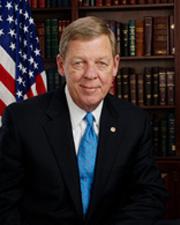 Sen. Johnny Isakson (R-GA)
Legislative Activity
Stay on top of the latest movement without scrolling through every action
Senate amendment not agreed to: Amendment SA 4351 under the order of 6/16/10, not having achieved 60 votes in the affirmative, not agreed to in Senate by Yea-Nay Vote. 45 - 52. Record Vote Number: 192.
June 16, 2010
View full timeline
Senate amendment not agreed to: Amendment SA 4351 under the order of 6/16/10, not having achieved 60 votes in the affirmative, not agreed to in Senate by Yea-Nay Vote. 45 - 52. Record Vote Number: 192.
June 16, 2010
Roll call votes on amendments in Senate: Amendment SA 4351 under the order of 6/16/10, not having achieved 60 votes in the affirmative, not agreed to in Senate by Yea-Nay Vote. 45 - 52. Record Vote Number: 192.
June 16, 2010
Senate amendment proposed (on the floor): Amendment SA 4351 proposed by Senator Isakson, previously submitted to SA 4301, notwithstanding the impendency of a motion to concur in the House amendment to the Senate amendment to H.R. 4213 with an amendment (SA 4369), by Unanimous Consent .(consideration: CR S4969-4971; text: S4970)
June 16, 2010
Amendment SA 4351 proposed by Senator Isakson, previously submitted to SA 4301, notwithstanding the impendency of a motion to concur in the House amendment to the Senate amendment to H.R. 4213 with an amendment (SA 4369), by Unanimous Consent . (consideration: CR S4969-4971; text: S4970) To amend the Internal Revenue Code of 1986 to extend the time for closing on a principal residence eligible for the first-time homebuyer credit.
June 16, 2010
Amendment SA 4351 under the order of 6/16/10, not having achieved 60 votes in the affirmative, not agreed to in Senate by Yea-Nay Vote. 45 - 52. Record Vote Number: 192.
June 16, 2010
Proposed amendment SA 4351 under the order of 6/16/10, not having achieved 60 votes in the affirmative, was withdrawn in Senate. (consideration: CR S4971)
June 16, 2010
Amendment SA 4351, previously proposed notwithstanding the impendency of the motion to concur in the House amendment to the Senate amendment to the bill (H.R. 4213), is considered to have been proposed to and incorporated into amendment SA 4369, pursuant to the order of 6/15/2010.
June 16, 2010
Senate amendment submitted
June 15, 2010
Votes
1 roll call on this amendment
Text
Proposed
AMERICAN JOBS AND CLOSING TAX LOOPHOLES ACT OF 2010--Continued

The ACTING PRESIDENT pro tempore. The Senator from Maryland is
recognized.
Mr. CARDIN. Mr. President, I ask unanimous consent that the Senate
proceed to a period of debate only until 3:30 p.m., with no amendments
or motions in order during this time, and that the time be equally
divided and controlled between the leaders or their designees, with
Senators permitted to speak therein for up to 10 minutes each, and that
the order for recognition for Senator Baucus remain in effect.
The ACTING PRESIDENT pro tempore. Is there objection? Without
objection, it is so ordered.
Mr. CARDIN. Mr. President, before I suggest the absence of a quorum,
I ask that the time be equally divided between the majority and the
minority.
The ACTING PRESIDENT pro tempore. Without objection, it is so
ordered.
Mr. CARDIN. Mr. President, I suggest the absence of a quorum.
The ACTING PRESIDENT pro tempore. The clerk will call the roll.
The legislative clerk proceeded to call the roll.
Mr. BROWN of Ohio. Mr. President, I ask unanimous consent that the
order for the quorum call be rescinded.
The ACTING PRESIDENT pro tempore. Without objection, it is so
ordered.
Mr. BROWN of Ohio. Mr. President, the Senate will soon vote on the
American Jobs Act--a critical bill that would create jobs and help
expand small businesses. It would close the tax loopholes that allow
far too many large corporations to move jobs overseas. In doing so, it
would establish, conversely, tax incentives for American small
businesses so they can create jobs in America. We have seen for too
many years--and the Presiding Officer, in New Mexico, has seen too many
jobs in Albuquerque, Santa Fe, as I have in Cleveland and other cities,
move overseas because of trade agreements and bad tax law.
The Senate, we hope, is close to voting on extending unemployment
insurance and COBRA subsidies through the extenders bill. Far too many
Republicans seem to look at unemployment insurance as welfare.
Unemployment insurance is what it is called--insurance. When you have a
job, you pay into the unemployment fund. When you are laid off through
no fault of your own, you can receive help from that insurance fund. It
is as simple as that.
We cannot forget why we are in this untenable position of needing to
help small businesses and workers and strengthen the public programs
that help Americans find new jobs. We are here because of reckless Wall
Street practices brought on by unprecedented greed that has created a
crippling recession.
I rise to discuss the Wall Street reform bill, as it is now being
negotiated in the conference committee, for a few moments.
Last week, David Wessel noted in the Wall Street Journal--the paper
of record for finance, if you will--that when surveyed by the
newspaper, leading economists suggested the prevailing belief that the
Senate bill didn't go far enough to address the issue of banks being
too big to fail.
During the Senate debate, I put forward a proposal with Senator
Kaufman, of Delaware, that would have addressed the problem by capping
the size of megabanks.
Evidence backs up what has been abundantly clear in the last 2 years:
Megabanks pose a greater risk and threat to our economy than smaller
ones because of the heightened volatility of their assets and
activities. Only 15 years ago, the largest six banks in the United
States--their total assets were added up to be about 17 percent of GDP.
Fifteen years ago, the combined assets of the six largest banks made up
17 percent of gross domestic product. Today, their combined assets make
up about 63 percent of the GDP.
Our proposal would have limited the size of bank holding companies at
$1 trillion and investment banks at $400 billion. Mr. President, $1
trillion is $1,000 billion. I can't believe people in

[[Page S4968]]

this institution would defend, as so many did, that that is not a bank
that is too big. Too big to fail, as people as conservative as Alan
Greenspan, who is as much to blame for all of this--for the
government's total failure during the Bush years to regulate Wall
Street--even he said too big to fail is simply too big. Only from the
rarefied heights of a glass or ivory tower does $\1/2\ trillion appear
too limited. Remember, Lehman Brothers had more than $600 billion in
assets and liabilities when it failed and sent the markets into a
tailspin.
We can all agree that our financial system should never again be on
the brink of total collapse and that taxpayers should never have to
foot the bill for the mess created by Wall Street. If we want to
prevent bailouts, we have to prevent banks from becoming so big that
bailouts are necessary. Why wouldn't big banks behave in a risky way
when they suspect a bailout will be given? That is why we must not rely
on a reactive approach to risks that can undermine our economy.
Instead, we must be much more proactive to prevent those risks from
ever recurring.
On June 3, Richard Fisher, the president of the Dallas Fed, explained
in an important speech why we need to address the size of the
megabanks. He said:

Ending the existence of ``too big to fail'' institutions is
certainly a necessary part of any regulatory reform effort
that could succeed in creating a stable financial system. It
is the most sound response of all. If we are to neutralize
the problem, we must force these institutions to reduce their
size.

This isn't some far-left or far-right economist; this isn't some bomb
thrower; this is Richard Fisher, the president of the Dallas Fed,
emphasizing that too big to fail is, in fact, too big.
The Brown-Kaufman amendment wasn't adopted into the Wall Street
reform bill that passed this body. Yet I continue to believe that it is
essential if we want to prevent giant institutions from driving down
the economy. But it is not the only proposal that would address the
instability created by the megabanks.
There are several other amendments and issues in the House or Senate
bills that I would briefly like to address.
First, the Merkley-Levin amendment ending proprietary trading.
Because of Republican obstruction, we were denied the opportunity to
vote on that proposal to end the reckless Wall Street gambling called
proprietary trading. Opponents of this, particularly from across the
aisle, went to such great pains to avoid a vote because I think they
knew it had strong support.
The Merkley-Levin amendment would strengthen the Volcker rule in
Senator Dodd's Wall Street reform bill. It would have barred banks and
their affiliates from engaging in proprietary trading, which, in
layman's language, is the ``casino gambling'' that has banks selling
products to clients with one hand, while betting against the products
and their clients with the other hand. That can happen only on Wall
Street.
Too many Wall Street banks used their proprietary trading operations
to get rich at the expense of their own clients. When those risky bets
go bad, American taxpayers are footing the bill. Lehman Brothers' risky
bets led to the largest bankruptcy in our Nation's history. Soon
thereafter, other Wall Street banks, which also engaged in reckless
proprietary trading, brought our economy to the brink of collapse. It
is time for Congress to end this self-serving practice where the
conflicts of interest are obvious--and dangerous.
Second, Senator Lincoln's amendment on derivatives. Remember that the
five biggest banks control 97 percent of the banking industry's
derivatives holdings--five banks, 97 percent. I support Agriculture
Committee Chairwoman Lincoln's proposal, which would separate
derivatives dealing from lending at commercial banks.
This provision is important for the same reason as the Merkley-Levin
amendment. Sprawling financial institutions increase their lucrative
operations at the expense of other more fundamental and traditional
banking activities.
Right now, megabank speculation is detracting from their primary job:
consumer and small business lending. The fact is, too many banks in New
Mexico, Ohio, and all over are simply refusing to lend now. They are
not lending the way our economy needs them to do it. This is part of
the reason.

The latest report by the Congressional Oversight Panel of TARP,
chaired by Elizabeth Warren, looked at how TARP recipients are lending
to small businesses. It found that between 2008 and 2009, Wall Street
lending portfolios have shrunk by 4 percent, with their small business
loan portfolios shrinking by 9 percent. Over the same period, banks'
securities holdings increased by almost 23 percent. Traditional lending
by the biggest banks, which received 81 percent of government bailout
funds, has declined. At the same time, lending to small businesses from
medium-size banks, which received 11 percent of the bailout, increased.
Taxpayer-funded assistance, in other words, should not support a
bank's gambling, but it should support sound economic growth.
Third, Senator Collins' amendment on capital standards was adopted in
the Senate bill. It would require the Nation's largest banks to meet,
at a minimum, the same capital standards imposed on smaller banks.
Under current law, regulators can often permit large financial
institutions to follow more permissive capital standards, while smaller
banks are held to a different standard. Capital standards applied
equally to all banks would help reduce the risk presented by financial
institutions as they grow in size or engage in reckless banking
behavior. The principle behind this amendment is sound. Regulators
should be empowered to apply and enforce capital standards equally and
responsibly--regardless of a bank's size.
Fourth, the amendment Representative Paul Kanjorski offered is a
provision in the House bill that directs regulators to take action
against any financial company that ``poses a grave threat to the
financial stability or economy of the United States.'' The grave threat
of a large financial institution results from excessive leverage,
exposure to other risky institutions, or unstable sources of credit.
Because of this provision, Federal regulators could apply stricter
prudential standards, limit mergers and acquisitions, and force the
selloff of business units and assets.
Finally, there is a provision offered by Jackie Speier in the House
which would impose a statutory 15-to-1 leverage ratio on systemically
risky banks. Combining this with Senator Collins' new capital rule is
essential. We tried something like this amendment as part of our larger
amendment, with Senator Kaufman, in the breaking up of the largest five
or six or seven banks.
Placing limits on these banks' leverage--meaning their assets
relative to their debt--is critical to ending taxpayer bailouts. They
cannot just leverage and leverage, in ratios like Lehman Brothers did,
at 30 and 40 to 1. Four of the five largest investment banks were
leveraged 30, 35, or 40 to 1 at the time of the financial crisis. That
means their assets far outbalanced their ability to cover the debt.
According to the Kansas City Fed, the 20 biggest banks are more
highly leveraged than community banks. Because the megabanks are bigger
than ever before, bailing them out would cost taxpayers even more than
they paid this time.

It is unfair. More important, it is dangerous. The current
distortions in the market give privileged, large banks a clear funding
advantage. Their implicit government backing is worth up to $34 billion
annually. That is Wall Street welfare where large financial
institutions continue to receive cheaper rates--maybe 75 basis points
is what most economists say--compared to smaller banks.
As the Wall Street reform bill heads into conference, we should not
dilute it to appease Wall Street. Wall Street lobbyists are all over
this institution--all over the House, all over the Senate. They have
already had too much impact on this bill. They have had almost total
influence with Republicans. Frankly, they have had too much influence
with my political party, too--the Democrats.
We should keep our eye on the ball by stopping financial crises
before they start.
I yield the floor. I suggest the absence of a quorum.

[[Page S4969]]

The ACTING PRESIDENT pro tempore. The clerk will call the roll.
The assistant editor of the Daily Digest proceeded to call the roll.
Mr. SESSIONS. Mr. President, I ask unanimous consent that the order
for the quorum call be rescinded.
The ACTING PRESIDENT pro tempore. Without objection, it is so
ordered.

Elena Kagan Nomination

Mr. SESSIONS. Mr. President, I want to speak briefly on the
President's nomination of Elena Kagan to the Supreme Court. The more we
examine her record, the more concerns there are that her legal
judgments might be infected by her very liberal political views.
We see strong evidence of that in Ms. Kagan's memos as a clerk on the
Supreme Court. In her work as Domestic Policy Adviser in the White
House for President Clinton, we see those strong political views. We
see strong evidence of this during her time as dean of Harvard Law
School.
Perhaps to some in the elite progressive circles of academia it is
acceptable to discriminate against the patriots who fight and die for
our freedoms, but the vast majority of Americans, I think, correctly
know that such behavior is wrong. It has an arrogance about it and,
really, it is not ethical.
When Dean Kagan became dean in 2003, she inherited a policy of full,
equal access for the military. But she reversed that policy in clear
open defiance of Federal law. She kicked the military out of the campus
recruitment office as our troops, at that very moment, risked their
lives in two wars overseas.
Some have recently attempted to defend this conduct by arguing that
she deigned to speak with the student veterans to discuss whether they
would coordinate a sort of second-class system for the recruiters who
would come on campus to seek young men and women to serve as JAG
officers. This all happened after she had defied the law and had shut
down those official channels of recruitment at the official recruiting
office. But the Harvard Student Veterans Association plainly expressed
to Ms. Kagan in a letter to the entire law school that they lacked the
resources to take the place of the campus office now closed to the
military.
The letter reads in part:

Given our tiny membership, meager budget, and lack of any
office space, we possess neither the time nor the resources
to routinely schedule campus rooms or advertise extensively
for outside organizations, as is the norm for most recruiting
events.

But Ms. Kagan was unmoved. Instead of welcoming the military
recruiters on campus, she punished them, relegating them to second-
class status, even leading student veterans to arrange recruiter
meetings off campus. In fact, Dean Kagan's public comments contributed
to a hostile on-campus environment for both recruiters and student
veterans alike. In fact, she said she ``abhorred'' the military's
recruitment policy--blaming soldiers for the decisions of lawmakers--
the Congress--and the President. She called it a ``moral injustice of
the first order,'' and participated in a student protest opposing
military recruiting on campus.
Stunningly, she expressed sympathy for students and faculty for whom
she said ``the military's presence on campus feels alienating.'' Those
alienated by the military's presence were not the ones who needed the
sympathy, they needed a history lesson. They had the freedom to
complain and protest from the safety of Harvard's campus because of the
blood and sacrifice of the men and women who wear our uniform.
If you talk to student veterans who were on campus during 2004 and
2005, you will learn many of them felt exploited. Here were people who
had just returned from battles in Iraq, dodging enemy gunfire, and they
were supposed to quietly hustle the military recruiters through the
back door and provide political cover for Dean Kagan.
In a report for NPR, one student veteran who was there summed it up
this way:

Getting us to carry her water on military recruitment
through the back door was a bridge too far. I came to view
her as a very smooth political person.

Ms. Kagan said her mistreatment of the military was justified by her
view that don't ask, don't tell was a ``moral injustice of the first
order.'' But don't ask, don't tell was created and implemented by
President Clinton. Where was her outrage during the 5 years she served
in the Clinton White House? Why would she blame the military? They
didn't pass the rule. It was Congress and the President.
So Ms. Kagan didn't take a stand in Washington when she was here,
where the policy was adopted, but waited until she got to Harvard and
then stood in the way of hard-working military recruiters who had
nothing to do with establishing the policy.
Now information has come to light suggesting that Ms. Kagan may even
have been less morally principled in her approach than has been
portrayed. Around the same time that Dean Kagan was campaigning to
exclude military recruiters--citing what she saw as the evils of don't
ask, don't tell--Harvard University accepted $20 million from a member
of the Saudi Royal family to establish a center for ``Islamic Studies''
and Sharia law. An Obama State Department report concerning Saudi
Arabia and the Sharia law concept noted:

Under Shari'a as interpreted in [Saudi Arabia] sexual
activity between two persons of the same gender is punishable
by death or flogging.

Ms. Kagan was perfectly willing to obstruct the military, which has
liberated countless Muslims from the hate and tyranny of Saddam Hussein
and the Taliban, but it seems she was willing to sit on the sidelines
as Harvard created a center funded by--and dedicated to--foreign
leaders presiding over a legal system that would violate what would
appear to be her position. She fought the ability of our own soldiers
to access campus resources but not those who spread the oppressive
tenets of Sharia-type law.
Perhaps her response was guided by campus politics, but certainly Ms.
Kagan lacks any experience as a judge or as a lawyer, and not much as a
scholar of law. She hasn't written much. Much of her career has been
spent actively engaged in liberal politics not legal practice, and
there are serious questions as to whether she would be able to set
aside that political agenda that has defined so much of her career. I
think that is the test we try to give a fair evaluation of this
nominee.
So these are important issues, and she will have an opportunity to
discuss her views. I expect many Americans will be listening closely,
but it will be important that any nominee to the Supreme Court be able
to assure with great confidence the American people--and this Senate--
that if confirmed, he or she would be faithful to the law, to serve
under the Constitution, and not above it, and not have their political
agenda infect their rulings, which must be nonpolitical.
I thank the Chair, and I yield the floor.
The ACTING PRESIDENT pro tempore. The majority leader is recognized.
Mr. REID. Mr. President, I appreciate my friend from Alabama wrapping
up his speech.

Amendments Nos. 4344 and 4351

Mr. President, notwithstanding the pendency of a motion to concur, I
ask unanimous consent that it be in order for the Senate to now
consider the Reid amendment No. 4344 in its current form and the
Isakson amendment No. 4351; that the amendments be debated concurrently
until 2:45 p.m.; that at 2:45 p.m., the Senate proceed to vote in
relation to the Reid amendment, to be followed by a vote in relation to
the Isakson amendment; that each amendment be subject to an affirmative
60-vote threshold; that if the amendment achieves that threshold, then
it be agreed to and the motion to reconsider be laid upon the table;
that if they do not achieve the threshold, then they be withdrawn; that
no amendment be in order to either amendment; that if either amendment
is agreed to, then once the Baucus motion to concur has been made, the
amendment be considered incorporated in the motion to concur.
I further ask there be 4 minutes between the two votes equally
divided.
The ACTING PRESIDENT pro tempore. Without objection, it is so
ordered.
Amendments Nos. 4344 and 4351 are as follows:

[[Page S4970]]

Amendment No. 4344

(Purpose: To amend the Internal Revenue Code of 1986 to extend the time
for closing on a principal residence eligible for the first-time
homebuyer credit)

At the appropriate place, insert the following:

SEC. --. FIRST-TIME HOMEBUYER CREDIT.

(a) In General.--Paragraph (2) of section 36(h) is amended
by striking ``paragraph (1) shall be applied by substituting
`July 1, 2010' '' and inserting ``and who purchases such
residence before October 1, 2010, paragraph (1) shall be
applied by substituting `October 1, 2010' ''.
(b) Conforming Amendment.--Subparagraph (B) of section
36(h)(3) is amended by inserting ``and for `October 1, 2010'
'' after ``for `July 1, 2010' ''.
(c) Effective Date.--The amendments made by subsections (a)
and (b) shall apply to residences purchased after June 30,
2010.
(d) Offset.--
(1) Disallowance of deduction for punitive damages.--
(A) In general.--Section 162(g) (relating to treble damage
payments under the antitrust laws) is amended--
(i) by redesignating paragraphs (1) and (2) as
subparagraphs (A) and (B), respectively,
(ii) by striking ``If'' and inserting:
``(1) Treble damages.--If'', and
(iii) by adding at the end the following new paragraph:
``(2) Punitive damages.--No deduction shall be allowed
under this chapter for any amount paid or incurred for
punitive damages in connection with any judgment in, or
settlement of, any action. This paragraph shall not apply to
punitive damages described in section 104(c).''.
(B) Conforming amendment.--The heading for section 162(g)
is amended by inserting ``Or Punitive Damages'' after
``Laws''.
(2) Inclusion in income of punitive damages paid by insurer
or otherwise.--
(A) In general.--Part II of subchapter B of chapter 1
(relating to items specifically included in gross income) is
amended by adding at the end the following new section:

``SEC. 91. PUNITIVE DAMAGES COMPENSATED BY INSURANCE OR
OTHERWISE.

``Gross income shall include any amount paid to or on
behalf of a taxpayer as insurance or otherwise by reason of
the taxpayer's liability (or agreement) to pay punitive
damages.''.
(B) Reporting requirements.--Section 6041 (relating to
information at source) is amended by adding at the end the
following new subsection:
``(h) Section To Apply to Punitive Damages Compensation.--
This section shall apply to payments by a person to or on
behalf of another person as insurance or otherwise by reason
of the other person's liability (or agreement) to pay
punitive damages.''.
(C) Conforming amendment.--The table of sections for part
II of subchapter B of chapter 1 is amended by adding at the
end the following new item:
``Sec. 91. Punitive damages compensated by insurance or
otherwise.''.
(3) Effective date.--The amendments made by this subsection
shall apply to damages paid or incurred after December 31,
2011.

Amendment No. 4351

(Purpose: To amend the Internal Revenue Code of 1986 to extend the time
for closing on a principal residence eligible for the first-time
homebuyer credit)

At the appropriate place, insert the following:

SEC. --. FIRST-TIME HOMEBUYER CREDIT.

(a) In General.--Paragraph (2) of section 36(h) is amended
by striking ``paragraph (1) shall be applied by substituting
`July 1, 2010' '' and inserting ``and who purchases such
residence before October 1, 2010, paragraph (1) shall be
applied by substituting `October 1, 2010' ''.
(b) Conforming Amendment.--Subparagraph (B) of section
36(h)(3) is amended by inserting ``and for `October 1, 2010'
'' after ``for `July 1, 2010' ''.
(c) Effective Date.--The amendments made by this section
shall apply to residences purchased after June 30, 2010.
(d) Transfer of Stimulus Funds.--Notwithstanding section 5
of the American Recovery and Reinvestment Act of 2009, from
the amounts appropriated or made available and remaining
unobligated under division A of such Act (other than under
title X of such division A), the Director of the Office of
Management and Budget shall transfer from time to time to the
general fund of the Treasury an amount equal to the net
decrease in revenues resulting from the enactment of
subsections (a) and (b).

Mr. REID. Mr. President, my friend from Georgia is here, so I will be
very quick. In fact, he can take 3 of the 4 minutes between the votes.
The home buyer credit has been wildly successful in stimulating home
purchases. I have heard from a number of Nevadans who have met the
April 30 deadline for having a binding contract for a home--and not
only Nevadans but all over the country--but are very concerned they
will not be able to close their transaction by the end of this month.
The failure to meet the June 30 deadline is not the fault of the home
purchaser. Banks, title companies, and closing agents are swamped as a
result of the success of this program. Many home buyers are stuck
waiting for banks to make decisions on short sales. Unfortunately, the
banks making these decisions feel no sense of urgency, leaving home
buyers powerless to meet the current deadlines. They simply don't care,
as has been shown during this entire period of time. The banks don't
care about the home buyers or the homeowners.
My amendment extends the deadline for 3 months. This will give the
homeowners time and the home buyers time to close their home purchases.
My amendment is fully offset by disallowing a tax deduction for
punitive damages paid in connection with a judgment or settlement.
Mr. DODD. Mr. President, I wanted to take a few minutes today to
speak in support of the amendment offered by my dear friend and
colleague from Nevada, Harry Reid. I am proud to be cosponsoring this
important amendment. Last November we passed, with bipartisan support,
an amendment that extended the very successful first time homebuyer tax
credit and expanded it to the ``move up buyer.'' My good friend from
Georgia, Senator Isakson was instrumental in crafting this extended and
expanded tax credit and I want to commend him for all the work he has
done on this issue. Under that legislation, which we worked on
together, homebuyers who were eligible for the credit had to sign a
binding contract for their new home by April 30 and close by June 30 to
receive the credit.
As of April, the Internal Revenue Service estimates that 2.6 million
Americans have used the credit. The National Realtors Association
reported that home sales rose by 6 percent between March and April this
year as Americans clamored to qualify for the credit. That increase
marked the third consecutive month that home sales grew. And that is
exactly what this legislation was intended to do--spur home sales and
bring the housing market back to life.
There are between 55,000 and 75,000 eligible homebuyers who entered
into contracts to purchase a principal residence by April 30, but who
will not get the benefit of the homebuyer tax credit because they do
not close by June 30. There are a variety of reasons this might occur:
the seller is unable to secure a timely approval from their lender for
sales related to distressed properties; recent natural disasters have
damaged the property; or the homebuyer has experienced delays in the
processing of their Federal mortgage program application.
This amendment would extend the closing date deadline from June 30 to
September 30 so that these eligible homebuyers can still claim the
credit. I want to make very clear that this amendment does not extend
the credit to new applicants--they must still meet all the eligibility
requirements and be under contract by April 30. This amendment just
gives them more time to close the deal.
At the end of the day, this amendment is really about fairness for
the thousands of homebuyers who might be ineligible for the credit
simply because it is taking longer than usual to complete their
paperwork. It is simply unfair to allow homeowners who played by the
rules to lose this credit due to administrative challenges beyond their
control. I also want to note that this provision is fully paid for by
denying corporations the ability to deduct punitive damages from their
taxable income. Once again, I thank the majority leader and his staff
for crafting this fiscally responsible amendment to help homebuyers. I
urge all my colleagues to vote for this amendment.
The ACTING PRESIDENT pro tempore. The Senator from Georgia.
Mr. ISAKSON. Mr. President, I will be brief. This deals with two
amendments, and both do the same thing, except for the way in which
they are paid for.
I appreciate very much Senator Reid's interest in this as the leader.
I have worked on this issue, as everybody knows, for a long time. We
passed unanimously in the Senate last year a home buyer tax credit
which ended on April 30 for contract date. Unfortunately, because of
the backlog of appraisals and the current FDIC regulation, a lot of
people who qualified for the credit are not going to be able to

[[Page S4971]]

close by the end of June, and they will lose the credit because we put
a June 30 closing date as the deadline for closing the credit earned by
the contract of April 30.
Both amendments merely move that June 30 date to the end of
September, which gives another 90 days to close the transaction that
has already been under contract for 60 days. It ensures Americans they
will get what the Senate promised them in terms of the tax credit, if
they in fact performed and qualified prior to April 30.
The difference in the two amendments is the pay-for. One is doing
away with the deductibility of punitive damages, which is Senator
Reid's. The other is mine, which takes it from the unspent $50 billion
in stimulus money. And the pay-for, by the way, in both cases, is not a
lot of money in the scheme of things. It is a lot of money to me and
you, but it is $140 million and not $50 billion.
So I would certainly appreciate support for the Isakson amendment,
and I appreciate the support of Senators Dodd and Reid. I yield back
the remainder of my time, and I ask for the yeas and nays on the Reid
amendment.
The ACTING PRESIDENT pro tempore. Is there a sufficient second? There
appears to be a sufficient second.
The question is on agreeing to amendment No. 4344.
The clerk will call the roll.
The legislative clerk called the roll.
Mr. DURBIN. I announce that the Senator from West Virginia (Mr. Byrd)
and the Senator from Virginia (Mr. Warner) are necessarily absent.
Mr. KYL. The following Senator is necessarily absent: the Senator
from Kansas (Mr. Roberts).
The PRESIDING OFFICER. (Mr. Merkley). Are there any other Senators in
the Chamber desiring to vote?
The result was announced--yeas 60, nays 37, as follows:

[Rollcall Vote No. 191 Leg.]

YEAS--60

Akaka
Baucus
Bayh
Begich
Bennet
Bingaman
Boxer
Brown (OH)
Burris
Cantwell
Cardin
Carper
Casey
Collins
Conrad
Dodd
Dorgan
Durbin
Ensign
Feingold
Feinstein
Franken
Gillibrand
Gregg
Hagan
Harkin
Inouye
Johnson
Kaufman
Kerry
Klobuchar
Kohl
Landrieu
Lautenberg
Leahy
LeMieux
Levin
Lieberman
Lincoln
McCaskill
Menendez
Merkley
Mikulski
Murray
Nelson (FL)
Pryor
Reed
Reid
Rockefeller
Sanders
Schumer
Shaheen
Specter
Stabenow
Tester
Udall (CO)
Udall (NM)
Webb
Whitehouse
Wyden

NAYS--37

Alexander
Barrasso
Bennett
Bond
Brown (MA)
Brownback
Bunning
Burr
Chambliss
Coburn
Cochran
Corker
Cornyn
Crapo
DeMint
Enzi
Graham
Grassley
Hatch
Hutchison
Inhofe
Isakson
Johanns
Kyl
Lugar
McCain
McConnell
Murkowski
Nelson (NE)
Risch
Sessions
Shelby
Snowe
Thune
Vitter
Voinovich
Wicker

NOT VOTING--3

Byrd
Roberts
Warner
The PRESIDING OFFICER. On this vote, the yeas are 60, the nays are
37. Under the previous order requiring 60 votes for the adoption of the
amendment, the amendment is agreed to.
Mr. DURBIN. I move to reconsider the vote and to lay that motion on
the table.
The motion to lay on the table was agreed to.

Amendment No. 4351

The PRESIDING OFFICER. Under the previous order, there is 4 minutes
equally divided on the Isakson amendment No. 4351.
The Senator from Georgia.
Mr. ISAKSON. Mr. President, this is a tax credit extension, as with
the previous amendment, but with a different pay-for. The previous was
deductibility of punitive damages. This one is from the stimulus money.
Both accomplish the same thing, which is allowing Americans who
qualified for the tax credit by contracting by April 30 to close by
September 30 rather than by June 30. The reason we are pushing it
forward is because FDIC rules, regulatory rules and appraisal rules,
are forcing closings taking as long as 120 days. This doesn't give
anybody a credit who hasn't already earned it. It just allows them to
take advantage of it by protracting the closing date so they would have
enough time to close. I urge a positive vote on the Isakson amendment.
The PRESIDING OFFICER. Who yields time in opposition?
The Senator from Montana.
Mr. BAUCUS. Mr. President, I oppose this amendment. Recovery act
money works. It adds to reducing unemployment. It adds to the economy.
It is very productive. It is helpful. It makes no sense to cut back
recovery dollars that work, that help our economy. I, therefore,
strongly oppose the amendment.
Mr. ISAKSON. I ask for the yeas and nays.
The PRESIDING OFFICER. Is there a sufficient second?
There appears to be a sufficient second.
All time is yielded back. The question is on agreeing to the
amendment.
The clerk will call the roll.
The assistant legislative clerk called the roll.
Mr. DURBIN. I announce that the Senator from West Virginia (Mr. Byrd)
and the Senator from Virginia (Mr. Warner) are necessarily absent.
Mr. KYL. The following Senator is necessarily absent: the Senator
from Kansas (Mr. Roberts).
The PRESIDING OFFICER. Are there any other Senators in the Chamber
desiring to vote?
The result was announced--yeas 45, nays 52, as follows:

[Rollcall Vote No. 192 Leg.]

YEAS--45

Alexander
Barrasso
Bayh
Bennett
Bond
Brown (MA)
Brownback
Burr
Chambliss
Coburn
Cochran
Collins
Conrad
Corker
Cornyn
Crapo
Dorgan
Ensign
Enzi
Graham
Grassley
Gregg
Hatch
Hutchison
Inhofe
Isakson
Johanns
Klobuchar
LeMieux
Lincoln
Lugar
McCain
McConnell
Murkowski
Nelson (NE)
Nelson (FL)
Risch
Sessions
Shelby
Snowe
Thune
Vitter
Voinovich
Webb
Wicker

NAYS--52

Akaka
Baucus
Begich
Bennet
Bingaman
Boxer
Brown (OH)
Bunning
Burris
Cantwell
Cardin
Carper
Casey
DeMint
Dodd
Durbin
Feingold
Feinstein
Franken
Gillibrand
Hagan
Harkin
Inouye
Johnson
Kaufman
Kerry
Kohl
Kyl
Landrieu
Lautenberg
Leahy
Levin
Lieberman
McCaskill
Menendez
Merkley
Mikulski
Murray
Pryor
Reed
Reid
Rockefeller
Sanders
Schumer
Shaheen
Specter
Stabenow
Tester
Udall (CO)
Udall (NM)
Whitehouse
Wyden

NOT VOTING--3

Byrd
Roberts
Warner
The PRESIDING OFFICER. On this vote, the yeas are 45, the nays are
52.
Under the previous order requiring 60 votes for adoption of this
amendment, the amendment is withdrawn.
Mr. REID. Mr. President, I move to reconsider the vote, and I move to
lay that motion on the table.
The motion to lay on the table was agreed to.
Mr. REID. Mr. President, I ask unanimous consent that debate be
extended until 4:30 under the same conditions and limitations of the
previous order; further, that during this period, any quorum calls be
equally divided.
The PRESIDING OFFICER. Without objection, it is so ordered.
Mr. REID. Mr. President, I suggest the absence of a quorum, and I ask
that the time during this quorum call be equally divided.
The PRESIDING OFFICER. Without objection, it is so ordered.
The clerk will call the roll.
The legislative clerk proceeded to call the roll.
Mrs. HUTCHISON. Mr. President, I ask unanimous consent that the order
for the quorum call be rescinded.
The PRESIDING OFFICER (Mr. Franken). Without objection, it is so
ordered.

Amendment No. 4333

Mrs. HUTCHISON. Mr. President, I rise today to speak on the Thune
amendment. This is the Republican alternative. Of course, we now know
the Baucus package did not get the 60 votes required to go forward and,
therefore, we are now looking at the Republican substitute and waiting
for a new bill to come from Senator Baucus.
I think it is so important that our Senate say to the American people

[[Page S4972]]

that we know the debt being created in this country is unsupportable.
Our bailouts have skyrocketed, our spending, our borrowing, now
taxing--it is more than the American people can stand.
Our national debt now tops $13 trillion. Since President Obama took
office 18 months ago the debt has grown by over $2.4 trillion. The
President's budget shows there is no end in sight. It doubles the
national debt in 5 years and triples it in 10.
In order to sustain this current spending level, the Federal
Government is being forced to borrow 40 cents for every dollar it
spends this year. The Federal Government is spending 67 percent more
than it is earning. This is similar to a household that earns $62,000
but spends $105,000.
From whom are we borrowing that money? We owe China over $900
billion, Japan nearly $800 billion. Every household in America knows
what it is like to set a budget. They know what the income is, and they
know how to stick with it. It involves setting priorities, making tough
decisions, and discipline.
The bill we are debating on the Senate floor today includes important
policies that are national priorities, and I support many of them.
However, it is time that the Federal Government does what every other
household does; that is, pay for our priorities.
Here is what the Thune amendment does. It extends the expiring
unemployment provisions until November, the expired tax provisions,
including the local and State sales tax deduction through the end of
the year. So we know that any of the expired tax cuts that people have
been counting on that have been in place for several years would go
through the end of this year so people would know that is at least one
stabilizing force on which they can count.
It drops the job-killing tax increases in the Baucus substitute. The
Thune amendment proves that government can make the tough choices. The
Thune amendment is paid for. According to CBO, it cuts taxes by $26
billion, it cuts spending by over $100 billion, and it reduces the
deficit by $68 billion over the next 10 years. It shows the American
people that this Senate is serious about stopping the deficit spending
we have seen in the last 18 months.
Spending cuts in the Thune amendment: one, it rescinds the
unobligated stimulus funds; two, it imposes a 5-percent, across-the-
board cut in government spending for all Federal agencies except the
Veterans' Administration and the Department of Defense; three, it
freezes for 1 year Federal employee salaries, including, of course,
Congress. It is very important that our Federal employees have the same
kinds of restrictions that most Americans are feeling right now. It is
a freeze, not a cut, in Federal employee salaries. It requires the
selling of $15 billion of unneeded and unused government property.
I believe the doctor fix that we have done in a patchwork way year
after year since the balanced budget amendment is now another patch.
Medicare pays doctors in a fundamentally broken way. It has become an
access-to-care crisis for our seniors. Too many seniors are unable to
find a doctor who takes Medicare because the Federal Government has
proven time and again that it is an unreliable business partner. We
need a long-term solution so that the best and brightest in our country
will choose medicine for their career and will choose to serve Medicare
patients. Medicare is supposed to make seniors comfortable that they
will be able to get medical care, but so many Medicare patients cannot
find good doctors; they can't go to the doctors they want to see
because the doctors have just said: I have had enough.
In Texas, over 60 percent of our counties are considered health
professional shortage areas. The number of medical school graduates
choosing primary care has dropped 50 percent since 1997. Fifteen
medical specialties have reported physician workforce shortages, and we
could face a physician shortage of more than 150,000 physicians in the
next 15 years.
The Thune amendment provides over 2 years of a positive update for
our Medicare physicians paid for by the kind of tort reform that has
saved Texas doctors so much. The tort reform has brought down insurance
premiums in Texas and we have increased our number of doctors since
tort reform was enacted.
We could do the same thing at the Federal level, and then the many
counties I hear about from my colleagues all over our country that
don't have a primary care physician or don't have an OB-GYN physician
would be able to start seeing an influx of medical personnel back into
the practice of medicine.
We can do something good for America. We can show America that
Congress understands that this debt is unsustainable, if we pass the
Thune amendment. It is essential that we pass an amendment that will
pay for the extension of unemployment insurance, that will not have any
more deficit spending and not increase taxes.
We need to continue the cutting of taxes so that our businesses will
feel they can hire people, so that we will have an economy that can be
sustained without sending more and more money to the Federal
Government, which is growing bigger and bigger. We need business to
grow, to hire people, to get our economy going again so that all of the
sectors, including retail as well as manufacturing, will survive in our
country.
It is my hope we can pass the Thune amendment. It is fully paid for,
it will not have deficit spending, and it will cut taxes rather than
increase taxes on businesses. That is the alternative that we think is
important for America to see.
Mr. President, I yield the floor, and I suggest the absence of a
quorum.
The PRESIDING OFFICER. The clerk will call the roll.
The assistant editor of the Daily Digest called the roll.
Mr. BAUCUS. I ask unanimous consent that the order for the quorum
call be rescinded.
The PRESIDING OFFICER. Without objection, it is so ordered.

Motion to Concur with Amendment No. 4369

(Purpose: In the nature of a substitute)

Mr. BAUCUS. Mr. President, pursuant to the previous order, I move to
concur in the House amendment to the Senate amendment to the bill with
an amendment I send to the desk.
The PRESIDING OFFICER. The clerk will report.
The assistant legislative clerk read as follows:

The Senator from Montana [Mr. Baucus] proposes an amendment
numbered 4369 to the House amendment to the Senate amendment
to H.R. 4213.

Mr. BAUCUS. I ask unanimous consent that reading of the amendment be
dispensed with.
The PRESIDING OFFICER. Without objection, it is so ordered.
(The amendment is printed in today's Record under ``Text of
Amendments.'')
Mr. BAUCUS. Mr. President, this is a new substitute amendment. We
voted on an earlier version today. This is a new one. It still
addresses many of the same issues as the last substitute, but it is
smaller. It has fewer dollars involved and it is more paid for. The
majority of this amendment is now offset. Most of the dollars spent in
this amendment are offset, not by a lot but still the majority--more
than half. All of the amendment is offset except for two matters: the
unemployment insurance and the aid to the States under Medicaid; that
is, the safety net provisions are not offset--those two. Everything
else is offset. That means we do pay for changes to how doctors are
compensated under Medicare. That is paid for. We do pay for all the
changes to the tax laws. They are paid for as well.
We also made changes to the provisions regarding S corporations and
carried interest. I will have more to say about those tomorrow, but
suffice it to say that the S corp changes address some of the
administrative concerns and burdens some Senators had as we were
attempting to stop the abuses of some professional S corps, the abuses
they have been conducting. Frankly, they have been paying themselves a
very small salary. These are professional corporations primarily. Then
they pay themselves dividends. Because dividends are not wages, they
avoid payroll taxes. They avoid the FICA tax and avoid paying the
Medicare tax. That is something we are trying to stop. The substitute
still addresses that abuse but in a way that is less burdensome to bona
fide S corporations. The carried interest provisions generally soften
some of the provisions that were contained in the substitute.

[[Page S4973]]

The bottom line is that we listened. Several Senators had some
concerns about the earlier substitute. We heard those Senators, and we
have adjusted the amendment accordingly.
We believe this amendment can provide a path forward. We believe this
amendment can complete our work on this bill. We believe this amendment
can help to enact into law help to people who need help, the
unemployed, and States under Medicaid and also help create jobs our
constituents are demanding. The tax provisions will have that effect.
I very much hope that when we get to the substitute amendment vote,
we will get the necessary votes to pass it. I am looking for something
above 60, north of 60, so we can move forward to other measures.
I suggest the absence of a quorum.
The PRESIDING OFFICER. The clerk will call the roll.
The assistant bill clerk proceeded to call the roll.
Mr. KAUFMAN. Mr. President, I ask unanimous consent that the order
for the quorum call be rescinded.
The PRESIDING OFFICER (Mr. Begich). Without objection, it is so
ordered.
Mr. KAUFMAN. Mr. President, I ask unanimous consent to speak as in
morning business for up to 20 minutes.
The PRESIDING OFFICER. Without objection, it is so ordered.

Financial Reform

Mr. KAUFMAN. Mr. President, it has only been 2 years since we had an
extremely painful financial crisis that almost brought down our entire
economy.
To try to address the root cause of the crisis, we are currently
nearing completion of a long and arduous process to develop a
comprehensive financial reform bill.
The world is watching to see how strong a bill this Congress will
produce, and we need to show leadership. Yet I fear that instead of
putting in place strong structural reforms as a model for other
nations, we are deferring too much to the discretion of regulators who
have failed in the past, and to international negotiations--currently
underway in Basel, Switzerland--that have all too often resulted in
global standards that were the lowest common denominators.
Capital flows easily across borders, and so the United States needs
to provide leadership and then produce harmonized global standards.
Instead, I fear we are doing the opposite. We have hollowed out our
national response so that we can negotiate with a free hand on the
global stage--after Congress showed the world that we lack the
political resolve to impose hard measures.
This is why we have heard a common refrain that statutory
requirements on capital or other prudential standards will tie
regulators' hands during these international negotiations. We heard it
before on the Brown-Kaufman amendment to restrict the size, leverage,
and risk of our megabanks. Now we hear it on the Collins amendment.
Senator Collins's commonsense provision would ensure that bank
holding companies and systemically significant nonbank financial
institutions are subject to capital and leverage requirements as
stringent as those that insured depository institutions face under
existing prompt corrective action regulations. This provision would
raise the capital bar for our largest financial institutions, requiring
them to hold more committed and reliable forms of capital; namely,
common equity and retained earnings. As my colleagues will recall, it
passed by a voice vote during the Senate debate.
Now there is the threat that the Collins amendment might be
eliminated for the sake of ``international negotiations.'' Mr.
President, I fear this is a recipe for a global race to the bottom for
two reasons: First, a tepid response by the United States may also
undermine other countries' consideration of tough reform measures. For
example, the U.K. is studying whether to break up their megabanks. But
some in the U.K. have suggested that since the United States isn't
taking this preemptive action, the U.K. would not do it either.
Second, some countries' regulators appear to be wedded to the status
quo, and we are only reinforcing the impression that tough measures are
not needed. Remarkably, only weeks before the European Government and
the IMF cobbled together an almost $1 trillion bailout of European
megabanks, one French Government official stated:

The situation is completely different here, and the system
that was in place has not worked badly and does not need to
be overhauled.

Regulators from Germany, France, and Japan, among others, are opposed
to having a leverage requirement and a more strict definition of what
constitutes capital.
Leaving aside the opposition of many countries to the very concept of
a leverage capital requirement, there are those who still indicate that
the quantitative requirement must be set through the Basel
negotiations. In fact, Treasury Secretary Geithner said:

By the end of this year, we will negotiate an international
consensus on the new ratios.

Why does it strengthen our negotiating hand for the Congress to have
failed to enact hard rules? Moreover, it is tougher to imagine how we
can set a number on leverage when we don't even have an agreement on
how to measure leverage, since the United States follows GAAP
accounting standards while the rest of the world follows IFRS. It is
unlikely we will have uniformity, or even harmonization of those rules,
for many years--if we ever will at all. While the accounting standard
issue is often overlooked, it should go without saying that it is a
more basic and first-order problem.
Most important, for what are we negotiating? The history of
international capital standards is that of colossal failures--Basel I,
Basel II, and now Basel III. Instead, we have a sovereign banking
failure and should be establishing a sovereign solution.
If other countries want to permit banks to become risky and fail--
such as what Europe may be facing due to the European debt crisis--let
them learn the hard lessons America has already learned.
Let me briefly review the history of the Basel accords, which should
stiffen the resolve of the conference negotiators to include measures
that will prevent another financial crisis caused by U.S. megabanks.
The Basel I Accord was a crude apparatus that established numerical
requirements for the amount of capital that banks need to set aside
based upon how risky the assets on their balance sheets were perceived
to be. Different types of loans and assets were lumped into risk
buckets. Some received lower risk weights, while others received higher
risk weights. However, those weightings were arbitrary determinations
that did not even take into account basic risks--most notably credit
risk--associated with loans and other financial assets that banks hold.
Under the Basel I system, a bond issued by a blue chip AAA company
such as Johnson & Johnson would have had a much higher risk weight than
a subprime stated-income loan, a loan to Greece, or a loan to Lehman
Brothers. Not surprisingly, banks were able to easily game--or
arbitrage--these capital requirements in a way that generally increased
their risk profile. Banks were able to cherry-pick high-risk, and
therefore, high-return assets that had low capital requirements because
of the risk bucket in which they were placed. Banks also got around the
Basel I requirements by shifting more assets off their balance sheets.
The Basel II Accord, which was agreed to in 2004, was the culmination
of several years of negotiations. While it was intended to address the
flaws of Basel I by making capital requirements more risk sensitive, it
actually created bigger problems.
Most notably, the accord's complexity and sophistication masked a
deregulatory philosophy that sought to make determinations on capital
adequacy dependent on the judgments of rating agencies and,
increasingly, the banks' own internal models. By outsourcing their
regulatory responsibilities to the banks that they were supposed to
regulate, bank regulators were making an implicit admission that the
size and complexity of the megabanks had exceeded their comprehension.
Unfortunately, complex capital standards that rely upon banks' own
internal models pose serious problems for any democratic nation that
prizes accountability and transparency, such as the United States. In
his book ``Banking on Basel,'' Federal Reserve

[[Page S4974]]

Governor Daniel Tarullo provides an exhaustive account of the Basel II
capital accord that specifically questions the accord's decision to
base capital standards on the internal ratings of banks. Tarullo
indicates that the ``very complexity of the [accord's] approach gives
banks more opportunities to manipulate, or make mistakes during,
calculation of their capital ratios.''
Even more troubling, Governor Tarullo noted it would also be nearly
impossible for any independent auditor or examiner to identify failures
and forbearance on the part of regulators. To that point, he states
``it may be extremely difficult for an independent entity such as the
Government Accountability Office to reconstruct the series of decisions
and judgments that went into the creation and supervisory assessment of
the credit risk model.'' Given that, how will we in Congress be able to
hold either the megabanks or their regulators accountable?
By virtually all accounts, the Basel II Accord was a complete
failure. The Basel Committee itself estimated that it reduced capital
for some banks by as much as 29 percent, at a time in which regulators
should have been ramping up capital and other prudential requirements
upon banks.
By trying to tie capital requirements to so-called risked-based
measurements, the Federal Reserve--the main driver of the Basel
process--apparently hoped to eliminate the basic leverage requirement.
In fact, former Fed Governor Susan Bies told banks that ``the leverage
ratio down the road has got to disappear.'' Fortunately, despite the
Fed's objections, Basel II has not been implemented in the United
States, in large part due to concerns that it would disadvantage
smaller community banks that did not have the resources and wherewithal
to make investments in supposedly advanced risk models.

It was, however, applied to European banks. Unconstrained by a basic
leverage capital ratio, many of these banks went on to arbitrage the
Basel requirements by gorging on AAA-rated bonds backed by subprime
mortgages, not to mention the sovereign debt of highly indebted
Eurozone countries such as Greece and Spain. The result has been
hundreds of billions of dollars of losses followed by both explicit and
implicit bailouts by EU governments.
The accord was also effectively applied to investment banks such as
Lehman Brothers and Goldman Sachs, which had precarious and explosive
business models that utilized overnight funding to finance illiquid
inventories of assets. These institutions were nominally regulated by
the SEC, which had no track record to speak of with respect to ensuring
the safety and soundness of financial institutions. The Commission
allowed these investment banks to leverage a small base of capital over
40 times--I repeat, over 40 times--into asset holdings that, in some
cases, exceeded $1 trillion.
Of course, in the wake of the most recent crisis, the same failed
regulators now tell us that, this time, they have learned their lesson
and will develop a new agreement that will address the deficiencies of
the last one. But what reasons do we have for thinking that will be
true?
Assistant Treasury Secretary Michael Barr notes that regulators are
now pushing for new global capital standards that will be ``more
robust, higher and better quality, less pro-cyclical, and include
global agreement on a leverage ratio.'' But the megabanks are already
developing new ways to arbitrage as well as weaken the global capital
standards to which Secretary Barr refers. In other words, they are
finding ways to gut and go around the rules before they are even
finalized.
What is more, many of the regulators involved in the discussions
inspire little confidence. Christian Noyer, the governor of the Bank of
France and the new chairman of the Bank of International Settlements,
the entity that oversees the Basel rulemaking process, indicated, that
the new rules ``shouldn't undermine the business model of banks which
have perfectly withstood the crisis.'' Given that the same Bank of
International Settlements estimates that eurozone banks have two-thirds
of the exposures to the most fiscally imperiled European countries--
Greece, Ireland, Portugal and Spain--it is not clear to which banks
Governor Noyer is referring.
As the Financial Times notes, France, Germany and Japan are ``more
attached to the preeminence of the current risk-based approach and
wants the leverage ratio to have a much less important role in
governing banks' balance sheets.'' In effect, they are pushing for the
status quo of Basel II, which has been an unmitigated disaster. After
the multiple trillions of dollars worth of public funds expended on
megabank bailouts, it seems amazing that many regulators would like to
maintain a system where the largest banks effectively regulate
themselves.
But U.S. regulators are not immune to the defense of the existing
regime. As the Wall Street Journal reports, ``some U.S. government
officials are fighting what they view as an anti-American proposal that
would prevent banks from counting as part of their capital cushion a
specific type of security favored by U.S. banks known as a trust-
preferred security.'' In other words, we have unnamed U.S. regulators
that are fighting against Senator Collins' amendment in international
negotiations.
The current state of international capital negotiations gives little
comfort to those who would like to see fundamental structural reforms
to address the problem of too big to fail.
I am in favor of international negotiations to harmonize financial
regulatory standards. However, these negotiations should not preclude
the Congress from setting statutory floors. They should never result in
the abdication of our sovereign powers and responsibilities.
I, therefore, agree with the sage thoughts of former Federal Reserve
Chairman Paul Volcker when he said that while ``good things may come
out of the Basel process, ``it is not structural change.'' In his view,
and in mine, we need to do both.
Instead of trusting our financial stability solely to unelected
financial guardians, in this country and abroad, Congress should
legislate structural and fundamental reforms that preemptively address
the persistent problem of too big to fail. Senator Collins' provision
is but one example of that. There is also Senator Lincoln's proposal to
require swap dealers to be spun off and separately capitalized from
insured depository institutions; a strong Volcker Rule ban on
proprietary trading at banks, as proposed by Senators Merkley and
Levin.
Without transparency and accountability, a democracy cannot function.
That is why we still need the statutory standards on the leverage as
well as the size of these megabanks. While some technocrats may say
that they are blunt tools, I say that that is precisely the point. They
will not only provide a sorely needed gut check that ensures that
regulators do not miss the forest for the trees when assessing the
capital adequacy of a financial institution, they will also provide a
basic means to ensure accountability in the performance of government
officials.
We cannot--we cannot--afford another meltdown and the American
people--and, indeed, the rest of the world--are looking to Congress to
take steps to ensure that that does not happen. By adopting these
fundamental reforms and preemptive measures, Congress will go a long
way towards protecting the American people from future bailouts. It
will also be providing global leadership, demonstrating to the rest of
the world that fundamental reform of our financial system does not rest
upon the decisions of unelected technocrats whose grand designs brought
our financial system to the brink.
Mr. President, I yield the floor.
The PRESIDING OFFICER. The Senator from Georgia.
Mr. CHAMBLISS. Mr. President, I rise tonight to express my concern
with how Congress continues to address this package of so-called
extenders. This is a debate we have had on multiple occasions this
year, and once again we find ourselves discussing how to enact a short-
term extension of items such as emergency unemployment benefits,
reauthorization of the National Flood Insurance Program, the Federal
Medicaid matching rate, FMAP, and the Medicare doc fix.
This is a difficult debate for many of us. Times are tough across the
country, as well as in my home State of Georgia where the unemployment
rate is 10.4 percent. During a time of economic hardship, I do not
believe we

[[Page S4975]]

should allow provisions, such as the extension of emergency
unemployment benefits, to expire. But I do believe that when we extend
these programs, we should do so in a responsible fashion. Congress
should find a way to pay for those extensions.
That is where there is disagreement on this issue--not whether
Congress should pass an extenders package but whether it should be paid
for.
Even though the need for these extensions comes as no surprise, we
again find ourselves in a position where the majority has proposed
extending these programs without finding the money to fund them.
Just 2 weeks after our Federal debt topped $13 trillion--let me say
that one more time; $13 trillion is owed by the United States of
America today--we are now poised to vote on another proposal that would
spend money this country simply does not have.
That number, $13 trillion, is so big that it is difficult to
comprehend. But what it boils down to is $42,000 of debt for every
single citizen of the United States of America.
The public debt has risen by $2.4 trillion in the 500 days since the
current administration took office. That is an average of $4.9 billion
per day. We are now borrowing 43 cents of every dollar we spend. But
still we are continuing to spend.
Estimates show that $4.8 trillion of the $9 trillion in debt that
America will accrue over the next decade will be from interest. That is
$4.8 trillion that could be better used on national defense or returned
to taxpayers to pay for other necessities. Instead, future generations
will be forced to pay higher taxes to foot the bill for Congress's out-
of-control spending.
With much of our national debt being held by other nations, such as
China, this is also an issue of national security. Just as with our
energy and food supply, we put our Nation in a more vulnerable position
when we disproportionately rely on other countries.
It is a matter of great concern that our Nation is in deep debt to
foreign countries that often do not share our positions on domestic or
international policy matters. While our global economy ensures that
there will be foreign investment in our debt, this sustained, exploding
debt guarantees that we provide leverage to our creditors. At some
point, we have to say enough is enough and make some tough decisions
about spending beyond our means. Again, we can pass an extenders
package without recklessly adding to the cost of our Federal debt.
Earlier this year, this body voted to give the rule known as pay-go
the force of law. And yet virtually every piece of legislation that we
have considered between then and now has fallen short of this
standard. Talking about fiscal responsibility and restraint while
spending recklessly is hypocrisy of which the American people will
surely take notice, and they have taken notice. States as well are
being left in the fiscal lurch.

By not shoring up the Federal Medicaid matching rate, my State of
Georgia will have a $370.5 million hole in its budget. We have had to
make sacrifices at home. My legislature has had to make very difficult,
hard, and tough decisions with respect to trying to find reductions in
spending at the State level to come up with a fiscally responsible, and
balanced budget that they are required to have under our State
constitution.
We know States are facing huge challenges, relying as they do on
money promised from the Federal Government. But we all need to keep in
mind that we are borrowing virtually every cent of that money. It is
time we get serious about this Nation's precarious fiscal situation. We
can no longer afford to burden our grandchildren with insurmountable
debt.
Recently, we witnessed what happens when a nation does not live
within its means. The economic crisis in Greece was caused by years of
unbridled spending and failure to implement fiscal reforms. This
recklessness left Greece badly exposed when the global economic
downturn appeared. This pattern should serve as a wake-up call to every
one of us that spending must be controlled.
Retirement programs such as Medicare and Social Security are on the
verge of bankruptcy. In March of this year, reports emerged that Social
Security is set to pay out more in benefits than it receives in payroll
taxes this year--a threshold the program was not expected to cross
until at least 2016. By some estimates, the program will no longer be
able to pay retirees full benefits by the year 2037.
Instead of trying to place programs such as Social Security on more
stable footing, we spent more than a year debating a health care bill
that will create even more costly entitlement programs, the true price
tag of which is yet to be seen.
The original proposal that was debated and voted on earlier today,
advanced by the majority, increased spending by $126 billion, which
included more than $70 billion in new taxes and increased the deficit
by $79 billion over the next 10 years. Thank goodness the votes were
not there to proceed with that underlying bill.
Now, according to the chairman of the Finance Committee, we have a
new bill. While it is smaller in dollars, according to the comments
made by the chairman of the Finance Committee earlier tonight--he says
also that the majority of the amendment is offset, which means it is
still not paid for.
We have an opportunity tomorrow to take a step toward responsibility
and restraint by paying for this extenders package. I am a cosponsor of
the amendment introduced by the Senator from South Dakota, Mr. Thune,
which would extend the same programs as the House-passed version of
this legislation. But unlike that version, the Thune amendment pays for
those programs instead of adding their cost to the Federal debt. It
also cuts taxes by $26 billion, cuts spending by more than $100
billion, and, according to the CBO, reduces the deficit by $55 billion.
It does this through spending cuts and the use of unobligated stimulus
funds.
The Thune amendment does away with the harmful tax increases on long-
term investment that are part of the underlying bill. These taxes on
carried interest would almost certainly serve to discourage capital
investment, increase borrowing costs associated with starting or
growing businesses, and hurt real estate and stock prices, all at a
time when our economy is extremely vulnerable. The real estate and
venture capital arena--two segments of our economy that are vital to
sustained job growth--would be especially hard hit by these taxes on
long-term investments.
Many Americans need the programs in this bill to be extended, but we
must be sure we extend them in a responsible way, and that is why I
urge my colleagues to strongly consider the Thune amendment as we
debate it tomorrow and vote in favor of the Thune amendment.
I yield the floor.
I suggest the absence of a quorum.
The PRESIDING OFFICER. The clerk will call the roll.
The assistant editor of the Daily Digest proceeded to call the roll.
Mr. REID. Mr. President, I ask unanimous consent that the order for
the quorum call be rescinded.
The PRESIDING OFFICER. Without objection, it is so ordered.

Cloture Motion

Mr. REID. Mr. President, I send a cloture motion to the desk.
The PRESIDING OFFICER. The Cloture motion having been presented under
rule XXII, the clerk will report the motion.
The legislative clerk read as follows:

Cloture Motion

We, the undersigned Senators, in accordance with the
provisions of rule XXII of the Standing Rules of the Senate,
hereby move to bring to a close debate on the motion to
concur in the House amendment to the Senate amendment to H.R.
4213, the American Workers, State, and Business Relief Act of
2010, with the Baucus amendment No. 4369.

Harry Reid, Max Baucus, Patrick J. Leahy, Jeanne Shaheen,
Byron L. Dorgan, Sherrod Brown, Edward E. Kaufman, Daniel K.
Akaka, Christopher J. Dodd, Jeff Bingaman, Robert P. Casey,
Jr., Jack Reed, Barbara A. Mikulski, Roland W. Burris, Jon
Tester, Daniel K. Inouye, Tom Harkin.

Mr. REID. I ask unanimous consent that the mandatory quorum be
waived.
The PRESIDING OFFICER. Without objection, it is so ordered.

____________________