To prohibit the use of funds provided in the bill.
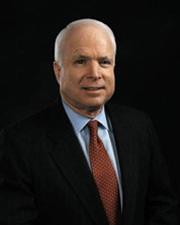 Sen. John McCain (R-AZ)
Legislative Activity
Stay on top of the latest movement without scrolling through every action
Senate amendment not agreed to: Amendment SA 593 not agreed to in Senate by Yea-Nay Vote. 32 - 63. Record Vote Number: 86.
March 9, 2009
View full timeline
Senate amendment not agreed to: Amendment SA 593 not agreed to in Senate by Yea-Nay Vote. 32 - 63. Record Vote Number: 86.
March 9, 2009
Roll call votes on amendments in Senate: Amendment SA 593 not agreed to in Senate by Yea-Nay Vote. 32 - 63. Record Vote Number: 86.
March 9, 2009
Considered by Senate. (consideration: CR S2874, S2895-2898, S2900)
March 9, 2009
Amendment SA 593 not agreed to in Senate by Yea-Nay Vote. 32 - 63. Record Vote Number: 86.
March 9, 2009
Senate amendment proposed (on the floor): Amendment SA 593 proposed by Senator McCain.(consideration: CR S2861-2864; text: CR S2861)
March 6, 2009
Amendment SA 593 proposed by Senator McCain. (consideration: CR S2861-2864; text: CR S2861) To prohibit the use of funds provided in the bill.
March 6, 2009
Senate amendment submitted
March 2, 2009
Votes
1 roll call on this amendment
Text
Proposed
OMNIBUS APPROPRIATIONS ACT, 2009

The ACTING PRESIDENT pro tempore. Under the previous order, the
Senate will resume consideration of H.R. 1105, which the clerk will
report.
The legislative clerk read as follows:

A bill (H.R. 1105) making omnibus appropriations for the
fiscal year ending September 30, 2009, and for other
purposes.

Pending:

Ensign amendment No. 615, to strike the restrictions on the
District of Columbia Opportunity Scholarship Program.

The ACTING PRESIDENT pro tempore. The Senator from Illinois.

Amendment No. 615

Mr. DURBIN. Mr. President, I rise to speak in reference to an
amendment which I believe will be included in the list of amendments by
the Republican side. It relates to the DC voucher program. Senator John
Ensign of Nevada is offering an amendment that will be part of our
consideration on Monday or Tuesday relative to the future of the DC
voucher program. The DC voucher program was created 5 years ago at a
time when the Republicans were in control of the White House and of
Congress. What they offered to the District of Columbia was an offer
they couldn't refuse, a substantial amount of money--I believe it was
$14 million--for the public schools of the District, another $14
million for the public charter schools, and about $14 million to create
a DC voucher program. The theory behind the DC voucher program is that
they would award this Federal money to families with children in
voucher schools, private schools, not public schools. They could use
this money to pay for tuition to send their children to these schools.
This is the first of its kind where the Federal Government would
directly provide money to parents to send children to private schools.
It is an experiment. It was described as such. It was initiated 5 years
ago when the Republicans were in control. It came through the
Appropriations Committee. Senator Mike DeWine of Ohio was one of its
strong proponents.
We considered several amendments in the committee. I came to this
with mixed feelings but skepticism, mixed feelings because I am not an
opponent of private education. My wife and I sent our three children to
Catholic schools. That was our choice. We continued to pay our property
taxes to support public schools. I have openly supported public school
referenda in my community. I have done everything in my State to make
sure there was adequate funding for public schools, but we made a
personal family decision, based on a number of circumstances, to send
our children to the local Catholic schools. That was our decision at
our expense. I have no prejudice against private education. If I
entrusted my children to it, I certainly believe in it.
But the question always came up in my mind: Who should pay for it. We
were prepared as a family to pay for it. It was an extra sacrifice we
were prepared to bear.
The argument behind DC voucher schools is that some families can't or
won't bear that burden of the cost of private education. So they should
have direct Federal subsidy, Federal payments to defray or defer any
cost of tuition. That was the theory behind it.
My skepticism had a lot to do with the fact that I think our first
obligation is to the public school system. The DC public school system
is struggling. Credit the new Mayor, Mr. Fenty; he has hired Michelle
Rhee, an extraordinarily talented young woman, to be chancellor of DC
schools, and she is intent on improving the quality of the public
schools. That is something we should invest in, something we should
support.
The debate 5 years ago was interesting. I offered three amendments.
The first amendment said that any building used as a school under the
DC voucher program had to pass the life safety code, had to be
inspected as being safe for children to go to school. I guess one could
say it goes back to 50 years ago, my memory of the terrible Our Lady of
Angels fire at the school in Chicago that killed so many children and
nuns in the building and led to changes and stricter enforcement of the
life safety code for school structures in Illinois.
My goal in the DC voucher program was to establish at least a
comparable standard for the safety of buildings used for DC voucher
students as buildings used as public schools. I don't think that is
unreasonable. Every parent should have the peace of mind that their
child is safe in that building.
I offered the amendment in the Appropriations Committee. It was
defeated by those who argued we could not restrict or hamper DC voucher
schools. As a consequence, they wanted to defeat my amendment.
Incidentally, a GAO study, in November of 2007, on the DC voucher
program showed the sites of some of the schools and specifically noted
that two of the schools operated without a certificate of occupancy as
private day schools--just what I feared.
These are buildings--one looks like a private residence, the other
like a commercial building--that do not look like schools at all, and
they did not pass the basic standards for health and life safety that
we require of schools in the District of Columbia. So my amendment was
defeated.
The second amendment I offered said teachers in the DC voucher
schools had to have a college degree. Now, that is a basic requirement
of any teacher in public schools in DC or most States in

[[Page S2857]]

the Union. The amendment was defeated, and the argument was made: No,
no, no. DC voucher schools have to be ``creative.'' We have to open
this to people who do not have college degrees to teach.
Well, I am afraid of the mischief that would result from that, but my
amendment was defeated.
The third amendment I offered said DC voucher schools had to have the
same test administered in terms of student achievement as the DC Public
Schools so at the end of the day we could compare performance and
output. Are the kids in voucher schools doing better or worse than the
kids in DC Public Schools? If they are not doing any better, it
challenges the premise of this DC voucher program. My amendment was
defeated, rejected. ``People in the DC voucher schools should not be
restricted to the kind of achievement tests they offer.''
Now, those three amendments, I thought, waved three red flags: the
buildings did not have to be as safe as public schools, the teachers do
not have to have college degrees, and the schools would not be
subjected to the same achievement tests. Now, that does not say to me
the people creating the DC voucher program had a lot of confidence in
what they were doing. They just wanted to make their point of
establishing a DC voucher program.
So 1,700 students now in Washington, DC, have benefited from this
voucher program and are at private schools. Some are Catholic schools;
some are not. Some are private. There are a wide variety of them. Some,
they say, are world-class schools, and others, frankly, are not.
Now, here we are coming up on the fifth anniversary of the passage of
this legislation and, in fact, the program was supposed to expire. It
was an experimental program. The authorization ended.
Well, I faced that when I wrote this appropriation for this year and
said: I will tell you what I will do. I will extend the life of the DC
voucher program 1 additional year, and in that additional year, I think
we should have two things occur. First, the Committee on Homeland
Security and Governmental Affairs, under Senator Joe Lieberman's
chairmanship, should have a hearing and consider reauthorization
legislation. What will be the next phase of the DC voucher program?
What requirements will we impose on these schools in the next
reauthorization? How are they doing? What mistakes were made?
I can tell you, the Government Accountability Office, in their survey
back in 2007, found some serious issues in terms of the DC voucher
program. The Washington Scholarship Fund, the group that runs the
program, was a small operation, until they were given the
administration of this program. The Government Accountability Office
said they did not believe they were fully prepared to handle a program
with millions of dollars.
The GAO also had serious concerns about the accounting and check-
writing process. Is it legitimate for us to ask questions about whether
taxpayers' dollars, subsidies to parents for DC vouchers, are being
spent appropriately? Well, I hope so. Accountability should be demanded
of all of us in all programs. But those who are for the voucher program
apparently do not want to go through this kind of investigation. Well,
I do not believe that is a right approach.
The GAO said the processes are not integrated for accounting and
check writing, and the WSF--at the time in November 2007--had to set up
a new system. They had concerns with information security. The
Washington Scholarship Fund used temporaries for data entry, had
inadequate password security--the list goes on and on. Some of these
things are easily corrected. Others go to the heart of the
administration of this program.
There were programmatic concerns too. On average, the Government
Accountability Office found that students met income requirements, but
less than 50 percent came from ``in need of improvement schools.'' See,
the idea was these kids would leave schools that were not good-
performing schools and go into voucher schools. Well, it turns out over
half the kids were in schools that were doing a good job, at least by
the standards of public education. So that raised a question on the
program.
They also noted students are clustered in a small number of schools.
Mr. President, 16 out of 60 schools enrolled 60 percent of the voucher
students. In 7 schools, over 50 percent of the students enrolled
received vouchers. So it was a handful of schools that were really the
subject of the voucher program.
The Washington Scholarship Fund is supposed to conduct site
inspections and look at the financial stability of the school. Based on
the information provided to the GAO at the time of this report, it is
unclear whether they conducted these thorough site visits.
So we said to the Lieberman committee--and, incidentally, Senator
Lieberman is favorably disposed toward this program. I do not recommend
it to him or refer it to him or suggest he consider it believing he is
prejudiced against it. He is not. He wants to support it, but he wants
to make sure it is running well.
So we include a provision: Keep the program alive for another year.
Protect all the students in the program. In the meantime, we should
have an authorization. The committee should investigate how it is being
managed and decide what the future will be. What will the next 5 years
look like?
The legislation that created this said to the Department of
Education, specifically: The Secretary may make grants under this
section for a period of not more than 5 years to the Washington
Scholarship Fund. We extended it for 1 year. They knew creating the DC
voucher program it was a 5-year program. We gave them an additional
year so they could review this program and see how effective it might
be.
Now, there is a second part I put in this legislation which
apparently rankles some on the other side. Here is what it says: The
Washington Government, the DC City Council, has to vote to continue the
voucher program. How unreasonable is that?
I heard this morning on NPR Senator Ensign say: Well, we know they
are opposed to it, so we want to take away local control of this school
program. I have not heard that very often from the Republican side nor
from the Democratic side. I would not want to live in a political
jurisdiction where someone imposed a program on families and students
without asking whether it was a reasonable thing to do, and in this
case, whether the DC Public School System should, in fact, absorb a
voucher program.
But on the Republican side of the aisle, most of whom voted against
the idea of giving DC voting rights in Congress, want to impose this.
This is their laboratory. This is where they want to have their
experiment on voucher schools, and they do not want close scrutiny.
They do not want an investigation. They do not want a reauthorization.
They want to continue this program indefinitely, funding millions of
dollars into a program that has been found to have significant
deficiencies.
Until this bill that is before us today, there was no requirement
that teachers in DC voucher schools have college degrees, but I put
that requirement in the law. I lost that issue 5 years ago, and I think
it is only reasonable we have that requirement today. So for the next
year they are going to have to have teachers with college degrees, and
the buildings have to be inspected. What is wrong with that? Would
anyone want to send their kids to a school building that is dangerous
or potentially dangerous? Apparently, some do. They want us to step
away, not to have any scrutiny or any oversight over these school
buildings. I am not one of those, and I could not in good conscience
allow this program to continue without having that requirement.
Now, I will be honest with you. I backed off of the achievement test
requirement after speaking to Chancellor Rhee. I said: Why don't they
have the same test?
She said: They should. But if you are only going to allow this
program to continue under the law for 1 year, and it is uncertain what
happens after that, don't impose on them the costs of changing
achievement tests. It costs millions of dollars. So let them stay with
the current achievement test, even though they cannot be compared to DC
Public School students with that achievement test.
So I deferred that, saying: Why impose a $2 or $3 million cost on
them? Let the authorization committee decide whether that ought to be
the case. I will certainly argue for it.

[[Page S2858]]

So now we have the Republicans saying: We do not want the program
investigated. We do not want it reauthorized. We do not want the people
of the District of Columbia to have any say as to whether it will be
part of their public school system. That is the Republican position. I
think it is unfair. I think it is unwise. I think it is bad policy.
If this program is good, it will stand on its own feet. If it is a
program that needs improvement, let's make the improvement. If it is a
program that has failed, let's move on and try something that will
succeed. We are talking about the lives of children.
I might also say, Chancellor Rhee, I think, comes to her job with the
DC Public Schools with a fresh, positive attitude. We need to make sure
all the kids in DC, whether they are in voucher schools or not, have a
high-quality education. The same goes for my State of Illinois and the
State of Virginia. That is our first obligation. So that is where we
stand today.
The Ensign amendment is going to be offered. At that time, we will
have a chance to debate it even further. But we have funded the program
through the next school year. Senator Lieberman has given his word to
me and those who support the program on the other side that he will
have a timely hearing so we can get on with this review and
reauthorization in a reasonable way.
Two separate studies by the Department of Education have clearly
demonstrated that the Washington voucher program has no statistically
significant impact on student academic achievement. We knew this
program was going to expire in 5 years. We need to ask whether the
money might be better spent on some other approach, whether it is in
the DC Public Schools or into charter schools. It is time we take time
for careful and deliberate consideration of this program.
For those who have written in several publications: Durbin is just
out to kill this program, I had a chance to do that, and I did not. I
extended the program beyond its authorization for an additional year,
gave them adequate funds to continue serving the students who are
currently in the program, with the understanding, at least in the bill,
that we would take the time to carefully study the DC voucher program.
For those who believe in the voucher program, do not be afraid. Do
not be afraid to step forward and let people take a look at what has
happened. Let's see what the successes and failures of this program
have been and then decide how to go forward. I think that is a critical
objective we can achieve.

Omnibus Appropriations

Mr. President, I would like to say one other word about the pending
legislation, the omnibus bill. I have listened to so many speeches on
this floor about earmarks. I made a point yesterday in television
interviews back in Illinois to make it clear what I was talking about
in terms of projects coming back to our State that were earmarks.
I do not think I can be any more transparent about earmarks. What we
do in my offices is to put on our official Web site every request I
make for earmarked funds, congressionally directed spending from
appropriations bills. For every single request, I indicate who is going
to be the recipient, how much money was asked for, what is the nature
of the request, and clearly make a statement that I have no conflict of
interest involved in making the request. I think that is required by
law, and it is certainly a valuable requirement.
Then we go through the process of the Appropriations Committee
choosing those earmarks they can put into a bill. At the end of the
day, we not only send out press releases in terms of those projects
that have been approved, we make it clear, so people know, start to
finish, every step of the way.
So when I was on the news yesterday, I said to some of the local
newscasters: The word ``earmark'' has such a negative connotation, but
the word ``earmark'' should be remembered in this context: I have
millions of dollars in this bill that will go to communities in the
suburbs of Chicago that have been dealing with serious flooding
problems for decades. We have made significant progress. I worked with
Mayor Tony Arredia in Des Plaines, IL, before he gave up the office
recently, and we protected many parts of his community that used to be
regularly, annually devastated by floods--earmarks in appropriations
bills for flood control.
The metropolitan area and sanitary district has this deep tunnel that
we put money into by earmark year after year after year, so that storm
water can be collected there and will not run off to integrate with the
sanitary sewer system and will not cause degradation of Lake Michigan
and rivers and tributaries nearby. That is one area.
The second area I focused on in the earmarks has been transportation.
There are specific earmarks in this bill for the expansion of the
Chicago Transit Authority and other transit systems in our area. They
are struggling to survive with the recession. We are trying to make
sure passengers do not have to pay outrageous amounts of money for them
to continue to be successful in their operation.
Another earmark: $4 million in this bill goes for the Chicago
shoreline on Lake Michigan. When they surveyed the people of Chicago a
few years ago and asked: What is the most important thing we have in
our city that you are proudest of, they said: Lake Michigan,
overwhelmingly. And they should. It is a beautiful expanse of water.
Aside from the scenery and the beauty of it, it is part of the Great
Lakes, one of the greatest sources of drinking water supplies in the
world.
So what we have done is to address a 100-year-old shoreline that was
crumbling and falling apart. I sat down with Mayor Daley. We entered
into an agreement with the Army Corps of Engineers. With this
agreement, the city put money up-front. We came in with money on the
Federal side. We have reduced the overall cost of the project and
accelerated by years--as you drive along that lakefront, you can see
they are building a modern lakefront that will serve us for decades to
come. It is an earmark. It is an earmark in the bill.
When I hear people come to the floor saying: This is an outrage that
all these earmarks are in the bill, I think to myself: There is nothing
outrageous about this. We bragged about it. We have had press
conferences about it. The people of our city think it is money well
spent.

There is money in here as well going to hospitals to buy critical
equipment. It is all listed--every single hospital, every single
dollar--whether it is for research, cancer research, Alzheimer's
research at universities, for example, or if it is buying critical
equipment for hospitals that many times don't have the resources to do
so. I try to help them out if I can. I think that is part of my job.
I listened to these overall criticisms of earmarks and I don't doubt
that pouring through the thousands that may be in here, we are going to
find some that are questionable. That is natural. One Congressman and
one Senator may think something is important to his district, his
community, his State; others may question it. That is part of the
process. They should be questioned. But at the end of the day, to say
that when you take 1 percent of this bill and allow Members of Congress
to zero in on specific issues in their States, in their districts, that
there is something inherently evil, wicked, criminal or wrong with it,
it is not the case.
I wish to salute Senator Inouye, who is our chairman of the
Appropriations Committee, for what he and Congressman David Obey, the
House Appropriations Committee chairman, agreed to do, which is to
dramatically cut back the overall cost of earmark projects. Under the
Republican leadership a few years ago, about 4 to 5 percent of an
appropriations bill would be earmarked. They have brought it down to
just over 1 percent. The goal is 1 percent. I don't think that is
unreasonable, that 1 percent of the spending bill would be
congressionally directed in a transparent and open process; otherwise,
what happens, we give the money to the agency downtown and they decide
where to spend it. It isn't as if the money would not be spent; oh, it
will be spent, but it may not be spent as effectively or for projects
that are as valuable as many of us who represent these areas believe.
We could have given the money to the Army Corps of Engineers for the
Lake Michigan shoreline. I can say what would have happened. It would
have cost more, there would have been

[[Page S2859]]

less local contribution, and it would have taken many more years to get
started. We avoided all that with the earmark process. I know there is
going to be a lot of debate--some even this morning on this--but my
feeling is we are reaching the right balance of disclosure,
transparency, and limiting the number of earmark projects so the
taxpayers can have confidence that, at the end of the day, there is a
process here and the scrutiny that there should be when it comes to
taxpayers' dollars. At the end of the day, some of my colleagues will
never be satisfied. They just will not be satisfied until every earmark
is removed. I hope that doesn't happen. I think we can make the process
better.

U.S. Economy

Mr. President, I also wish to say a word about the state of our
economy today, if I can, and set it apart in the Record because this is
a historic anniversary week. As you may know, 76 years ago this week,
exactly, on March 4, 1933, the President, Franklin Roosevelt, took the
oath of office for the first time. He faced an America broken to its
knees--not by a war or an invasion but by a depression which had broken
the confidence of a proud nation.
It is hard for many people today to even imagine how frightened
Americans were the day after he became President. Jonathan Alter, a
news analyst for Newsweek, who comes from Chicago, recently wrote a
book about the transition and beginning of the F.D.R. Presidency called
``The Defining Moment.'' He sketched the picture very well. He said at
that time America has experienced its gravest crisis since the Civil
War.
The American economic system had gone into a state of shock. Days
before the F.D.R. inauguration, the New York Stock Exchange suspended
trading indefinitely and the Chicago Board of Trade bolted its doors
for the first time since it opened in 1848. In the 3 years since the
crash of the stock market, 16 million jobs had disappeared in 1933 and
business investment had dropped 90 percent. America's official
unemployment rate was 25 percent. In some areas, it went as high as 80
percent when it came to adult men. More than 5,000 banks had failed.
People who were unlucky enough to put their money in them had lost
everything.
The great economist, John Maynard Keynes, was asked by a reporter at
the time if there was any precedent for what happened to the world
economy. He replied: Yes. It lasted for 400 years. It was called the
Dark Ages.
In his first inaugural address, Franklin Roosevelt told a shaken
nation: ``Only a foolish optimist can deny the dark realities of the
moment.'' But then he went on to reassure America and said: ``The only
thing we have to fear is fear itself--'' that famous phrase--
``nameless, unreasoning, unjustified terror which paralyzes needed
efforts to convert retreat into advance.''
F.D.R. said we needed to abandon the failed ideas that led us into
economic crisis and try something new and bold. The Federal Government,
the President said, will treat the task of economic recovery ``as we
would treat the emergency of a war.''
What America needed, the new President said, was ``action, and action
now'' to put Americans back to work and restore strength to our economy
and rebuild people's faith in the future. He assured us: ``This is no
unsolvable problem if we face it wisely and courageously.''
Where are we today, 76 years later, 76 years after F.D.R. took that
oath of office on March 4, 1933? Another new President has inherited
the worst economic crisis since that historic day in 1933. This crisis
is not another Great Depression, thank the Lord, but it is grave. It is
dangerous. It is unlike any crisis we have seen in our lifetime. Sadly,
it appears to be getting worse at this moment. America lost more jobs
last year than at any time since World War II. Manufacturing is at a
28-year low. Many businesses can't borrow or make payroll. Many workers
and retirees are seeing their life savings disappear. People have seen
the values of their homes and retirement plans plummet, and a large and
growing number of Americans are uncertain and anxious about the future.
President Obama, sworn into office on January 20 of this year, has
been in office a little over 6 weeks. He has made it clear we need to
act and act quickly; otherwise, he says, the recession could linger on,
unemployment could continue to grow, we could lose a generation of
promise and potential as millions of Americans have to forgo college
and a chance to train for jobs of the future. We could lose our
competitive edge in the world if we don't act. In short, an already bad
situation could get worse. He proposed to Congress, soon after he was
sworn in, the American Recovery and Reinvestment Act--the most sweeping
in history.
Similar to Franklin Roosevelt and Abraham Lincoln--another President
who inherited a major economic crisis during the Civil War--this
President has said we must put our American house in order, put
Americans back to work, and invest in America's future. He has said the
American Recovery and Reinvestment Act represents not just new policy
but new thinking; a new approach to meeting our most urgent challenges.
It will save or create 3 million to 4 million jobs over the next 2
years while investing in priorities such as health care and education.
It enables us to rebuild America's crumbling infrastructure--the roads,
the bridges, the schools.
The economic recovery plan also includes help for States. My State of
Illinois is in deep debt. We are hoping this recovery plan will help
them get through this difficult period. Also, it has a tax cut for most
working families. Ninety-five percent of them will receive this tax cut
as soon as next month. It is a smart plan that invests in things that
work. Congress, the President, and respected economists agree now is
not the time to create new bureaucracies and new Government agencies.
We should use existing programs wherever possible to make sure the
recovery funds are invested quickly and efficiently to stabilize this
economy. We are relying on experienced and knowledgeable Government
professionals, but as most of us know, there is no playbook you can
pick up at the library or find on a Web site. We are trying to make
wise decisions based on economic experience.

I think this program we passed is a start, but the bill before us is
equally important. This bill continues the function of Government. This
bill allows many Federal agencies to continue with funding that is
necessary so they can perform valuable services. If we don't pass this
bill, we will reduce the amount of money that is being spent by these
agencies at a time when our economy needs the spending to create the
jobs to move us forward.
We are going to lose about $1 trillion in purchasing of goods and
services this year. The American Recovery and Reinvestment Act, along
with this piece of legislation, will try to provide some jump-start to
this economy, a catalyst for more economic recovery and growth, which
is something we desperately need.
There is more that is needed as well. Next week I am going to, after
we finish this bill, be talking about the housing crisis we face. I
have been pushing for 2 years for a change in the bankruptcy law to
allow the courts, as a last resort, to rewrite a mortgage. Last night,
that measure passed in the House of Representatives. I hope we can take
it up. We are in the process of working out the details of our Senate
version now, and I hope that by next week we will be prepared to
present it to our colleagues. We need their help. Some of them were
skeptical when I last offered it. Many Democrats voted against it. They
said: Well, we think this can work itself out. Some of those same
Members have come to me since and said it didn't work. We thought the
voluntary approach was what was needed; it didn't do the job. There are
too many foreclosures. It is not only hurting the lives of those who
lose their homes but the people who live next door.
I think it was Secretary Geithner who used the analogy at a hearing
this week of someone who lives next door to a man who smokes in bed.
Well, because of that unwise conduct, the man's house catches fire, and
because of that fire in a closely packed neighborhood it endangers all
the houses nearby. Now, you can shake your finger and say you never
should have smoked in bed or you can pitch in and try to put out that
fire because, if you don't, it could affect your home too. The same
thing is happening here. Whether

[[Page S2860]]

the right decisions were made at the outset, whether people borrowed
when they shouldn't have, whether people were the victims of predatory
lending, that will eventually work itself out and we will know more
about it; but in the meantime, we need to stabilize this housing
market.
I listen to some of the great sources of information in America and
one of them is Jon Stewart with the ``Daily Show.'' He had a program
earlier this week that was a classic. It involved a fellow named
Santelli who, on a CNBC cable show, went into this what he called
himself, a rant over the idea that we would help people facing mortgage
foreclosure. He was critical of the wisdom of these people in entering
into mortgages when they should have known better, making guesses about
their economic future that turned out to be so wrong. Mr. Stewart, in a
style which I find very entertaining and amusing, then proceeded to
replay the statements made by economists on CNBC who downplayed the
thought of a recession, who suggested that many of the great banking
houses that have failed were going to do fine. He tried to make the
point that even some of the people who were screaming at those who
entered into mortgages they shouldn't have entered into got it all
wrong when they tried to analyze the economy and give advice to
America.
People do make mistakes. They should be allowed to recover from those
mistakes in a situation where continued mortgage foreclosures could
jeopardize housing markets and the value of everyone's home for years
to come. That issue will come up before us next week. I look forward to
it.
At this point, I yield the floor and suggest the absence of a quorum.
The ACTING PRESIDENT pro tempore. The clerk will call the roll.
The legislative clerk proceeded to call the roll.
Mr. REID. Mr. President, I ask unanimous consent that the order for
the quorum call be rescinded.
The ACTING PRESIDENT pro tempore. Without objection, it is so
ordered.

Cloture Motion

Mr. REID. Mr. President, I send a cloture motion to the desk.
The ACTING PRESIDENT pro tempore. The cloture motion having been
presented under rule XXII, the Chair directs the clerk to read the
motion.
The legislative clerk read as follows:

Cloture Motion

We, the undersigned Senators, in accordance with the
provisions of rule XXII of the Standing Rules of the Senate,
hereby move to bring to a close debate on H.R. 1105, the
Omnibus Appropriations Act.
Harry Reid, Daniel K. Inouye, Bernard Sanders, Tom Udall,
Patrick J. Leahy, Ron Wyden, Christopher J. Dodd,
Benjamin L. Cardin, Mark R. Warner, John D. Rockefeller
IV, Debbie Stabenow, Patty Murray, Richard Durbin,
Edward E. Kaufman, Jim Webb, Mark Begich, Byron L.
Dorgan, Carl Levin, Dianne Feinstein, Roland W. Burris.

Mr. REID. Mr. President, I ask unanimous consent that the mandatory
quorum be waived.
The ACTING PRESIDENT pro tempore. Without objection, it is so
ordered.
Mr. REID. Mr. President, I ask unanimous consent that the list of
amendments in this agreement be the only first-degree amendments
remaining in order to H.R. 1105; that no amendment be in order to any
of the listed amendments prior to a vote in relation thereto; that the
amendments must be offered and debated Friday, March 6; Monday, March
9; or Tuesday, March 10; further, that upon disposition of the
amendments and the Senate has voted on a motion to invoke cloture on
H.R. 1105 and cloture having been invoked, all postcloture time be
considered yielded back, the bill be read a third time, and the Senate
proceed to vote on passage of the bill.
Here is the finite list of amendments: Ensign amendment No. 615,
which is pending; Vitter amendment No. 621; Sessions amendment No. 604;
McCain amendment No. 593--he is in the Chamber now waiting to offer
that amendment--Thune amendment No. 662; Barrasso amendment No. 637,
which I understand he will offer on Monday; Enzi amendment No. 668; Kyl
amendment No. 631; Kyl amendment No. 629; Kyl amendment No. 630; Kyl or
designee amendment--we have a copy of the proposal--Cornyn amendment
No. 673; and Bunning amendment No. 665.
The ACTING PRESIDENT pro tempore. Without objection, it is so
ordered.
Mr. REID. Mr. President, I have spoken with the Republican
leadership, and we are going to try to have four of these votes
starting at 5:30 on Monday evening.

Unanimous Consent Agreement--Continuing Resolution

Mr. REID. Mr. President, I ask unanimous consent that if and when the
Senate receives from the House a joint resolution which provides for
the continuation of Government funding until March 11, 2009, if it is
identical to the measure which is at the desk, it be considered read
three times, passed, and the motion to reconsider be laid upon the
table; that if it is not identical, then this order be null and void.
The ACTING PRESIDENT pro tempore. Without objection, it is so
ordered.
Mr. REID. This will get us teed up to work next week. I made my
statement this morning. The Senate is the body that it is. It is
sometimes difficult for even those of us who serve here to fully
comprehend. But I think this Congress has reached a point in time where
we are working together, when adversaries work together. It doesn't
mean we always agree, but I think we all have the end in mind to try to
help the country and move legislation forward.
I appreciate the work of my leadership, Senator Durbin. He spent the
evening with me last night. We finished about midnight. He is such a
good friend. I appreciate the conversation I had with Senator McConnell
and the many conversations I have had with Senator Kyl.
Everyone is working in good faith, and this Senate agreement
indicates that.
The ACTING PRESIDENT pro tempore. The Senator from Arizona.
Mr. KYL. Mr. President, I ask unanimous consent to lay aside the
pending amendment for the purpose of calling up three amendments.
The ACTING PRESIDENT pro tempore. Without objection, it so ordered.

Amendment No. 631

Mr. KYL. Mr. President, the first Kyl amendment is numbered 631.
The ACTING PRESIDENT pro tempore. The clerk will report the
amendment.
The legislative clerk read as follows:

The Senator from Arizona [Mr. Kyl] proposes an amendment
numbered 631.

Mr. KYL. Mr. President, I ask unanimous consent that further reading
of the amendment be dispensed with.
The ACTING PRESIDENT pro tempore. Without objection, it is so
ordered.
The amendment is as follows:

(Purpose: To require the Secretary of State to certify that funds made
available for reconstruction efforts in Gaza will not be diverted to
Hamas or entities controlled by Hamas)

On page 942, between lines 14 and 15, insert the following:

gaza reconstruction

Sec. 7093.  None of the funds appropriated or otherwise
made available by this Act may be made available to aid
reconstruction efforts in Gaza until the Secretary of State
certifies that none of such funds will be diverted to Hamas
or entities controlled by Hamas.

Amendment No. 629

Mr. KYL. Mr. President, the next amendment I would like to call up is
amendment No. 629.
The ACTING PRESIDENT pro tempore. The clerk will report the
amendment.
The legislative clerk read as follows:

The Senator from Arizona [Mr. Kyl] proposes an amendment
numbered 629.

Mr. KYL. I ask unanimous consent that further reading of the
amendment be dispensed with.
The ACTING PRESIDENT pro tempore. Without objection, it is so
ordered.
The amendment is as follows:

(Purpose: To provide that no funds may be used to resettle Palestinians
from Gaza into the United States)

On page 942, between lines 14 and 15, insert the following:

prohibition on use of funds for resettlement into united states of
palestinians from gaza

Sec. 7093.  None of the funds appropriated or otherwise
made available by this Act may be made available to resettle
Palestinians from Gaza into the United States.

Amendment No. 630

Mr. KYL. Mr. President, the third amendment is numbered 630.

[[Page S2861]]

The ACTING PRESIDENT pro tempore. The clerk will report the
amendment.
The legislative clerk read as follows:

The Senator from Arizona [Mr. Kyl] proposes an amendment
numbered 630.

Mr. KYL. I ask unanimous consent that further reading of the
amendment be dispensed with.
The ACTING PRESIDENT pro tempore. Without objection, it is so
ordered.
The amendment is as follows:

(Purpose: To require a report on counter-smuggling efforts in Gaza)

On page 942, between lines 14 and 15, insert the following:

report on counter-smuggling efforts in gaza

Sec. 7093.  Not later than 90 days after the date of the
enactment of this Act, the Secretary of State, in
consultation with the Director of National Intelligence,
shall submit to Congress a report on whether additional funds
from Foreign Military Financing assistance provided annually
to the Government of Egypt could be expended--
(1) to improve efforts by the Government of Egypt to
counter illicit smuggling, including arms smuggling, across
the Egypt-Gaza border; and
(2) to intercept weapons originating in other countries in
the region and smuggled into Gaza through Egypt.

Mr. KYL. Mr. President, until Senator McCain arrives, let me briefly
describe these three amendments.
Amendment No. 630 requires a report on countersmuggling efforts in
Gaza. Within 90 days of the enactment of the Act, the Secretary of
State, in consultation with the Director of National Intelligence,
shall submit a report to Congress on whether additional funds from our
military foreign financing assistance, provided annually to the
Government of Egypt, could be expended, No. 1, to improve efforts by
the Government of Egypt to counter illicit smuggling, including arms
smuggling across Egypt and the Gaza border, and No. 2, to intercept
weapons originating in other countries in the region and smuggled into
Gaza through Egypt. This amendment requires a report to ensure the
Egyptian Government can be even more effective in dealing with this
difficult problem.
Amendment No. 629 is a prohibition on the use of funds in this bill
for resettlement into the United States of Palestinians from Gaza.
There has been a suggestion that perhaps that might be permitted, and
we simply want to make it clear that will not be permitted with any
funds in this bill.
Finally, related to Gaza reconstruction, amendment No. 631 provides
that none of the funds available in this bill may be made available to
aid reconstruction efforts in Gaza until the Secretary of State
certifies that none of such funds will be diverted to Hamas or entities
controlled by Hamas. The reason for that, of course, is that in
providing money to people in Gaza, it is very difficult to ensure that
money doesn't go to terrorists, and we want the Secretary of State to
ensure that doesn't happen. That is what this amendment would provide.
Mr. President, that is the explanation of these three amendments, and
I now yield to my colleague from the State of Arizona, Senator McCain.
The ACTING PRESIDENT pro tempore. The Senator from Arizona.

Amendment No. 593

Mr. McCAIN. Mr. President, I call up amendment No. 593, which is at
the desk, and I ask unanimous consent for its consideration,
understanding that under a previous unanimous consent agreement the
vote on the amendment will be on Monday.
The ACTING PRESIDENT pro tempore. Without objection, the pending
amendment is set aside.
The clerk will report the amendment.
The assistant legislative clerk read as follows:

The Senator from Arizona [Mr. McCAIN] proposes an amendment
numbered 593.

Mr. McCAIN. Mr. President, I ask unanimous consent that further
reading of the amendment be suspended.
The ACTING PRESIDENT pro tempore. Without objection, it is so
ordered.
The amendment is as follows:

(Purpose: To prohibit the use of funds provided in the bill)

At the appropriate place, insert the following:

SEC _. PROHIBITION ON THE USE OF FUNDS.

None of the funds in this Act may be used for any project
listed in the statement of managers that is not listed and
specifically provided for in this Act.

Mr. McCAIN. Mr. President, this amendment is very simple and
straightforward. It would prohibit funds to be spent on the thousands
of earmarks that are listed in the statement of managers but that are
not included in the bill text.
We have seen a remarkable evolution over the past number of years
here in the Senate and House as to how we do business, and I think
there is no greater example of it than what we are considering and
have, fortunately, not passed. This is the legislation. In itself, it
is 1,122 pages. You can thumb through it anywhere, and you will find
moneys to be spent on various projects, none of which--or very few of
which have ever been authorized or examined by the committees that have
jurisdiction. That in itself is interesting.
This is a funding mechanism to keep the Government in business. It
also happens to be an 8-percent increase in spending over last year. It
also happens that the majority, the Democrats on the majority side last
year, chose not to pass these appropriations bills because they knew,
or expected, that they would have a larger majority in the Senate and
House and they would be able to increase spending, which is exactly
what happened--an 8-percent increase.
Here on the other side of my desk is ``statement of managers.'' That
statement of managers is 1,844 pages. Guess what it is filled with. The
same earmarks and porkbarrel projects that are in the bill itself. The
statement of managers used to basically just be a statement of the
managers of the bill saying this is a bill that is being put forward
and the reasons for it, the rationale for it. It used to be just a few
pages. Now it is 1,844 pages. Remarkable. And guess what it is filled
with. It contains part of the 9,000 earmarked porkbarrel projects in
this bill, none of which have been authorized--or very few have been
authorized, let me put it that way. I am sure there are some funds in
here that have been authorized. But the earmarks in it are exactly
that: they are unauthorized projects.
What does that mean to the average citizen? They hear about earmarks
and pork, but they do not really understand what it means. Well, the
way the Congress is supposed to work is, there are two parts to
legislating. One is to review legislative proposals--both policy and
funding by committees--and they say: OK, we will authorize this
project, we will authorize $1.7 million for a honey bee factory in
Weslaco, TX. I don't particularly think that is necessary, but at least
it is authorized. And then it is supposed to go to the appropriating
committee, and they figure out how much money there is and then they
appropriate the money. That system is completely broken. It is
completely short-circuited. Now we have bills this size, statements of
managers this size, and no one has ever seen or heard of many of these
projects until it appears on the Members' desks. The system is
completely broken.
So when I hear my colleagues stand up and defend these ``porkbarrel
projects,'' when they defend $300,000 for the Montana World Trade
Center, which may be necessary, why didn't they ask for it to be
authorized because of the need and then compete with all other projects
that are necessary and that Members of the Senate and the House believe
are necessary for their districts or States?
Mr. President, 20 or 25 years ago, I can tell my colleagues, an
earmark was an unusual event. It was an unusual occurrence. But the
evil grew and grew and grew. Like any other evil, it grew and grew and
grew, so that now we are presented with legislation such as this, with
9,000 of them. And I can guarantee you that none of my colleagues fully
read this bill or the statement of managers. Now, some people say:
Well, it is not very much. It is not very much. Well, our estimates are
that it is about $8 billion. Now, $8 billion to the average citizen is
a fairly good sum of money.
Another egregious pattern of behavior which has crept into this is
that there are policy changes that are put in, again fundamental
changes in policy written in, which, of course, the Senate does not
then have an opportunity to debate. One example is to do away with the
voucher system in the Washington, DC, school system. Another one has
been noted this morning

[[Page S2862]]

in the Washington Post, called ``Truck Stop.''
When we signed a free-trade agreement with Mexico--I believe it was
14 years ago--part of the deal was that Mexican trucks, provided they
met all the safety standards and all the requirements, would be able to
come into the United States, with reciprocal access to each other's
markets. Thanks to the influence of the unions and others, there is an
amendment in this bill that basically kills that. Now, you can take
either side of that issue. Maybe there are a lot of Americans saying--
even though these Mexican trucks are inspected, even though they meet
the safety standards, even though we promised in the North American
Free Trade Agreement that they would have access to our markets--maybe
we shouldn't do that. But should we be doing it in an appropriations
bill, in a bill this thick, in a statement of managers this thick?
Should we be making policy changes in here?
By the way, I will talk a little more about this later on, but the
Mexican Government is in an existential threat with the drug cartels in
Mexico. Phoenix, AZ, has now become the kidnapping capital of America.
There is violence on the south side of our border which is spilling
over onto our side of the border. The President of Mexico, President
Calderon, has staked everything on taking on the drug cartels, and the
corruption he is fighting is at the highest levels of Government. So
what have we done in this appropriations bill? We have just sent a
signal to the Mexicans that we are not going to keep our agreements
with them. We are not going to stand by our solemn pledges to them.
And, by the way, we are going to do it in an obscure provision in one
of these either 1,122 pages or 1,844 pages.
So I hope the American people and our colleagues understand what it
is that is so badly broken here. They say: How in the world do we--when
unemployment today is at 8.1 percent and people can't afford their
health insurance premiums, are losing their jobs, are being moved out
of their homes--afford $951,000 for Sustainable Las Vegas; how do we
afford $819,000 for catfish genetics research in Alabama?
You will note that there are always locations associated with these
earmarks. I had a discussion with a Member of Congress about one of the
provisions having to do with tattoo removal--tattoo removal--because it
helps when combating gangs. Maybe tattoo removal needs to be funded,
but, of course, this earmark was directed to a specific geographic part
of the country. So while the American people are suffering under the
worst recession since the Great Depression, we here in Congress not
only are doing business as usual, we are wasting taxpayer money at an
incredible rate, and these 9,000 earmark projects are part of that.
By the way, there are also 13 projects in this bill, which total
approximately $9 million, that were the result of the efforts of an
outfit called PMA. PMA is a lobbying group, the head of which was a
former staff member in the U.S. Congress, and PMA has been raided and
shut down by the FBI. They are under active investigation for
corruption, and they were ``listed'' as those responsible for these 13
projects. We can't even take those out. We can't even take those out.
It is really remarkable. On Thursday, the media reported that in
discussions with Majority Leader Reid, Speaker Pelosi took the position
that if a single amendment to this omnibus bill was made by the Senate,
she would refuse to resubmit the bill as amended to the House but
would, instead, put the rest of the Federal Government under a
continuing resolution for the remainder of the year.
I think we should be on a continuing resolution as we have been and
examine each one of these appropriations bills individually, debate
them, and decide what various appropriations should be and how they
should be funded and what the priorities are.
By the way, we also have proved that we can pass another continuing
resolution because we just did. The insistence that not a single change
could be made or it would shut down the Government and jeopardize even
the most essential Government services was high drama at its best, used
to sway Members to oppose even the most commonsense proposals, such as
insisting contracting be fair and subject to open competition and
restricting funding that was achieved through a lobbyist organization.
By the way, it is my understanding that last year this same
organization, PMA, which has shut its doors, was raided by the FBI. The
home of the head of it was raided by the FBI, and last year they got
$300 million worth of earmarks in an appropriations bill.
What I am saying is, this system has become a corrupt practice. That
is why we have former Members of Congress now residing in Federal
prison. That is why we have continuing indictments of people who were
involved in the Abramoff scandal, which all had to do with obtaining
these earmarks in appropriations bills which were not authorized and
nobody knew anything about. We even had a situation last year where a
couple of items were put into an appropriations bill after the
President signed it--after the President signed the bill. They were
inserted. Investigation of that is still going on.
It seems to be the Speaker's position that the Senate should have no
voice in a $410 billion appropriations bill that funds every agency in
the Federal Government other than Defense, Homeland Security, and the
Department of Veterans Affairs. I have been deeply disappointed by many
things this new Congress and this new administration have begun. After
all the campaign promises of changing the culture of Washington,
bringing hope for a new era, bridging differences between people,
parties, and ideology, what we have actually seen and what has been
delivered to the American people is far different: first, in the $1.2
trillion stimulus bill and now in this massive $410 billion
appropriations bill, which would, in a normal year, be the largest
appropriations bill the Congress would pass. There has been no serious
effort at bipartisanship. There is no serious effort to hear opposing
views, to have an honest debate, to balance carefully the policy
implications of our actions. We should engage in serious debate and
vote on amendments without the false threat of a shutdown of the
Federal Government or an out-of-the-hand rejection of all amendments.
The President has said, and the Director of the Office of Management
and Budget has said, this bill is last year's business. This bill is to
fund the functions of Government this year--not last year, this year.
To say somehow that this is ``last year's business'' because we are
voting on funding for the operations of Government for this year is
disingenuous at best.
I have talked to Members on both sides. I have talked to people who
said: Yes, we need to do something about this earmarking, and we would
like to sit down and do something about it. We would like to reduce it.
That is like saying you would like to reduce any other evil. You want
to eliminate it.
There is a simple way, I say to my friends who say they are unhappy
with the way this explosion of earmarking and porkbarrel spending is
taking place. There is one simple solution: Authorize it. Send it
through the authorizing committees. Then, if I have a problem with the
Buffalo Bill Historical Center in Cody, WY, for which I am going to
spend $190,000 of our taxpayers' dollars, then fine. I may not like it,
but at least we will have gone through a process of scrutiny, of
proposal, of authorization, and the Buffalo Bill Historical Center
would be in competition with other proposals for other historical
centers throughout the country if they are needed.
Maybe we need to improve blueberry production and efficiency in
Georgia. It is $209,000 to improve blueberry production and
efficiency--in Georgia. Maybe not in Maine, maybe not other places
where blueberries are grown, but in Georgia.
We want to spend $400,000 for copper wire theft prevention efforts. I
would like to prevent copper wire theft as well, but maybe it should
happen across the country. And I am sure the Alaska PTA needs $238,000,
but so do PTAs all over this country. Why should we earmark $238,000
for the Alaska PTA? The list goes on and on.
As some of my colleagues may know, I have begun to twitter. We have
been tweeting for the last week with ``Top Ten Earmarks,'' every day.
We could go on for days and days. I would like to mention some of them.
We began last Friday.

[[Page S2863]]

No. 10 was $1.7 million for a honeybee factory in Weslaco County, TX;
$300,000 for the Montana World Trade Center; $870,000 for wolf breeding
facilities in North Carolina and Washington; No. 7 was $332,000 for the
design and construction of a school sidewalk in Franklin, TX; No. 6 is
$1 million for Mormon cricket control in Utah; No. 5 was $650,000 for .
. . management in North Carolina and Mississippi; No. 4, $2.1 million
for the Center for Grape Genetics in New York; No. 3 was $6.6 million
for termite research in New Orleans; No. 2 was $2 million for the
promotion of astronomy in Hawaii; and No. 1, on our first day, was $1.7
million for pig odor research in Iowa.
Yesterday, the Chicago Tribune had an editorial entitled ``Whoa.'' It
goes on to say:
The Obama administration and Democratic leaders of the
House and Senate are blowing the lid off of spending
restraint. But they're finally meeting some resistance within
their own party.
Sen. Evan Bayh (D-Ind.), in an essay published Wednesday in
The Wall Street Journal, ripped a spending bill passed by the
House last week as ``a sprawling $410 billion compilation of
nine spending measures that lacks the slightest hint of
austerity from the federal government or the recipients of
its largesse.''
He said he will vote against it, and he urged President
Barack Obama to veto it if it passes the Senate. We second
that motion.
Politico.com reported Tuesday that 15 senators--14
Democrats and one independent--met behind closed doors this
week to share concerns over the cost and reach of Obama's
proposed $3.55 trillion budget for 2010.
House Speaker Nancy Pelosi, Senate Majority Leader Harry
Reid and the Obama team are pushing a gaudy expansion of
deficit spending.
A $787 billion ``stimulus'' package. A $410 billion
spending bill. A $3.55 trillion budget.
Their reasoning: we need to do this in response to the
economic crisis. But it's sure sounding like business as
usual in Washington. When in doubt, spend. When not in doubt
. . . spend.
The $410 billion bill hikes discretionary spending by 8
percent and includes at least 8,570 earmarks worth $7.7
billion. ``Such increases might be appropriate for a nation
flush with cash or unconcerned with fiscal prudence, but
America is neither,'' wrote Bayh. ``Families and businesses
are tightening their belts to make ends meet--and Washington
should too.''
The Obama folks have tried to dismiss this huge spending
bill as a little cleanup work. ``Last year's business,'' said
Chief of Staff Rahm Emanuel.
Last year's business? No, this is the nation's business
right now. We're going to borrow this money right now and
carry the debt for decades.
The administration says Obama will sign this bill.
Hopefully, enough Democrats like Evan Bayh will join
Republicans in the Senate to put the brakes on this. Let
everyone catch their breath and rethink this spending spree.
Right now, Democratic leaders look like they're getting dizzy
from all the dollars they think they have to throw around.

What we should be doing is not passing this legislation now. Go back
to the drawing board. Go through the appropriations bills and authorize
them as necessary and figure out how much we need to spend rather than
have a bill that is like this and like this, which nobody has read.
Also, if the Congress goes ahead and passes this bill, then the
President should veto it. The President should abide by the commitment
he made in the campaign, the debate in Oxford, MS. The President of the
United States, then-candidate Senator Obama, stated it clearly. He
said: I will go line by line through these bills, and I will veto the
ones and scrub the ones that are not necessary.
The President, then-Senator Obama, made a commitment to the American
people. He can keep that commitment by vetoing this pork-laden bill.
The list goes on and on of these projects. I mentioned the 13
projects of PMA.
I want to return to something that is very disturbing, and that is
the provision concerning free trade with Mexico. I would again like to
quote from the Washington Post editorial today that says ``Truck
Stop,'' entitled ``Congress Flashes a Yellow Light on Free Trade With
Mexico.''

President Obama seems to have resolved, for now, an
incipient dispute with Canada over ``Buy American'' rules in
the stimulus package. The law would have hurt Canadian steel
exports to the United States, but, at the White House's
insistence, Congress appended language that blunted the worst
protectionist consequences. Now, however, Congress has turned
on Mexico, the United States' other partner in the North
American Free Trade Agreement. A $410 billion omnibus
spending bill contains a provision that would pretty much
kill any chance that long-haul freight trucks from Mexico
could operate in the United States, as had been promised
under NAFTA.
Economically, giving U.S. and Mexican trucks reciprocal
access to each other's markets makes a lot of sense.
Currently, Mexican rigs can drive in only a small zone on the
U.S. side of the border, where they must offload their goods
onto U.S. trucks. The process wastes time, money and fuel,
harming the U.S. environment and raising the cost of Mexican
goods to U.S. consumers. Yet access for Mexican trucks has
been bitterly resisted by U.S. interests, most notably the
Teamsters union--which claims that poorly regulated trucks
from south of the border would be a menace on U.S. highways.
In an effort to disprove that, the Bush administration
promoted a pilot project under which Mexican trucks, screened
by U.S. personnel, could operate freely within the United
States. The Mexican trucks compiled a safety record
comparable to that of American rigs. Mexican participation
was limited, however, because of the political uncertainty.
And safety was always a smokescreen for the Teamsters' real
concern--economic turf--anyway. Now the Democratic majority
on the Hill has slipped into the omnibus bill a provision
killing the program. The provision seems certain to survive,
given that the president supported such a measure when he was
a senator; his transportation secretary, Ray LaHood, backed
it as a member of the House.
When the U.S. economy needs all the help it can get, this
legislation perpetuates inefficiency and invites Mexican
retaliation against U.S. exports. To a world looking for
signs that Democratic rule in Washington would not mean
revived protectionism, this can only be a disappointment.

So you not only have these earmarks that are in the thousands, you
not only have companies that are under FBI raids and shut down by the
Government, adding porkbarrel projects, but you also have policy
provisions in the bill which can damage relations with a country we
need good relations with, given the fact that the drugs we are creating
a demand for flow through their country.
As I mentioned earlier, the Mexican Government, under the courageous
leadership of President Calderon, is in an existential struggling with
the drug cartels. He needs to win. He needs to win for a variety of
reasons, including the direct effect the flow of drugs from Colombia
and other places, through Mexico into the United States, has and the
damage it does to our young people and others who are using drugs.
This amendment, as I stated, simply says that all these provisions,
which are in 1,884 pages, some thousands of earmarks that are in the
``statement of managers,'' not be prohibited from being spent because
they are not included in the bill here. It is a pretty straightforward
amendment. I hope my colleagues will approve it.
Finally, I would like to say again, if the President of the United
States wants to fulfill his promise to the people of this country if
this bill is passed, he will veto the bill and he will send it back and
tell us to clean it up. These are tough times in America. These are
tough times. We cannot afford to do business as usual in the Senate and
the House of Representatives. It is time the President led, veto this
bill, if we pass it, and let's get down to the business of saving the
taxpayers' dollars, rather than the profligate spending spree we have
been on for so long which has mortgaged our children's futures and has
committed generational theft.
I yield the floor.
Mr. DORGAN. Mr. President, on Wednesday, the Senate voted on an
amendment offered by my colleague from Oklahoma, Senator Coburn. The
amendment would have cut funding for thirteen congressionally directed
projects. Eight of these projects are from the Energy and Water
Development section of the bill.
Senator Coburn claimed these projects were included at the request of
a firm that is under investigation. But every project named in his
amendment was included in this bill at the specific written request of
a Member of Congress.
In fact, thanks to reforms we made in the last Congress, anyone can
go online and see exactly who requested these projects and where the
funding is going. We have gone to great lengths to make the process as
transparent as possible. Members of Congress who request funding for
projects also have to file a letter with the Appropriations Committee
to certify that they and their family members have absolutely no
financial interest in the earmark.
Let me be clear, I did not personally sponsor any of these projects.
In fact, all of the projects in the Energy and Water Development
section of

[[Page S2864]]

the bill that were targeted by Senator Coburn's amendment were included
by the House in their version of the fiscal year 2009 Energy and Water
Development appropriations bill. The Senate also carried one of the
eight in our version of the bill.
So while I did not sponsor any of these projects, I find these
projects are consistent with the work performed by the Department of
Energy, and I saw no reason to eliminate them.
Let me briefly describe the sorts of projects that we are talking
about.
One of the projects would provide $951,000 for the direct methanol
fuel cell. This type of fuel cell has the potential to meet low power
needs, less than 1 kilowatt, with increased performance and improved
storage ability.
Another project is focused on solar energy, providing $951,000 to
improve the efficiency of home windows, with the same goal--reducing
net energy consumption.
As I said, every project on this list was requested by one or more
Members of Congress. The process is fully transparent and the Members
of Congress who requested this funding are fully accountable. That is
why I opposed the Coburn amendment.
I suggest the absence of a quorum.
The PRESIDING OFFICER (Mr. Begich.) The clerk will call the roll.
The assistant legislative clerk proceeded to call the roll.
Mr. WARNER. I ask unanimous consent that the order for the quorum
call be rescinded.
The PRESIDING OFFICER. Without objection, it is so ordered.

____________________