To require that the Government prioritize all obligations on the debt held by the public in the event that the debt limit is reached.
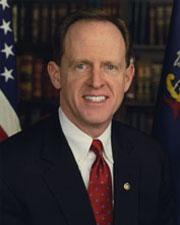 Sen. Patrick J. Toomey (R-PA)
Legislative Activity
Stay on top of the latest movement without scrolling through every action
Roll call votes on amendments in Senate: Motion to table amendment SA 112 agreed to in Senate by Yea-Nay Vote. 52 - 47. Record Vote Number: 28.
March 1, 2011
View full timeline
Roll call votes on amendments in Senate: Motion to table amendment SA 112 agreed to in Senate by Yea-Nay Vote. 52 - 47. Record Vote Number: 28.
March 1, 2011
Considered by Senate. (consideration: CR S1030, S1044-1046, S1050-1051; text as modified: CR S1045)
March 1, 2011
Motion to table amendment SA 112 agreed to in Senate by Yea-Nay Vote. 52 - 47. Record Vote Number: 28.
March 1, 2011
Senate amendment proposed (on the floor): Amendment SA 112 proposed by Senator Vitter for Senator Toomey.
February 28, 2011
Senate amendment submitted
February 28, 2011
Amendment SA 112 proposed by Senator Vitter for Senator Toomey. (consideration: CR S952-953; text: CR S952) To require that the Government prioritize all obligations on the debt held by the public in the event that the debt limit is reached.
February 28, 2011
Votes
1 roll call on this amendment
Text
Modified
PATENT REFORM ACT OF 2011--Continued

The PRESIDING OFFICER. The Senator from Pennsylvania.
Mr. TOOMEY. Mr. President, it is a great privilege and honor for me
to be able to represent the big, wonderful, diverse Commonwealth of
Pennsylvania in the Senate. Pennsylvania is a wonderful State. It has a
terrific range of great attributes. It has big, bustling cities such as
Philadelphia and Pittsburgh at opposite ends; has all throughout the
Commonwealth beautiful, historical boroughs such as Emmaus and
Gettysburg. We go from the banks of the Delaware all the way to the
shores of Lake Erie.
In a State this big, of course, we have a wide range of very vital
industries. We have old industries that we have had for a long time and
are still very important employers: agriculture, coal, steel, and many
others. We are a big manufacturing State, manufacturing goods of all
kinds. We have a huge service sector, especially in the fields of
education, medicine, finance, tourism, and many others. We have some
relatively new and very exciting industries in our Commonwealth that I
am very hopeful will lead to an acceleration of job growth soon. I am
thinking in particular of the natural gas and the Marcellus shale. I am
thinking of the life sciences, all across the Commonwealth, especially
in greater Philadelphia and greater Pittsburgh as well as in points in
between. The medical device sector and pharmaceutical industries are
offering some of the most exciting opportunities for economic growth
anywhere in the Commonwealth.
So when I think about the diversity and the strength of our
Commonwealth, I am convinced that Pennsylvania's best days are ahead of
us.
That said, despite all of the underlying strengths and advantages we
have, we have an economy that is struggling. We have job creation that
is far too slow. As I said repeatedly throughout my campaign for the
Senate seat and as I have said since then, I think there are two vital
priorities that we need to focus on first and foremost here in
Washington. The first is economic growth and the job creation that
comes with it, and the second is restoring fiscal discipline to a
government that has lost all sense of fiscal discipline. These two, of
course, are closely related. We will never have the kind of job growth
we need and we deserve until we get our fiscal house in order.
But I look at them as separate issues. I think they should be at the
top of our priority list. I am absolutely convinced we can have
terrific economic growth, terrific job growth. We can have the
prosperity we have been looking for.
In fact, it is actually inevitable if the Federal Government follows
the right policies, remembering first and foremost that prosperity
comes from the private sector, it does not come from government itself,
but that government creates an environment in which the private sector
can thrive and create the jobs we so badly need. I would argue that the
government does that by doing four things and doing them well.
The first is to make sure we have a legal system that respects
property rights, because the clear title and ownership and ability to
use private property is the cornerstone of a free enterprise system.
It requires, second, that the government establish sensible
regulations that are not excessive, because excessive regulation--and
frankly we have seen a lot of excessive regulation recently--too much
regulation always has unintended consequences that curb our ability to
create the jobs we need.
A third thing a government always needs to do is provide a stable
currency, sound money, because debasing one's currency is the way to
ruin, not the way to prosperity.
Fourth, governments need to live within their means. They cannot be
spending too much money and they cannot have taxes at too high a level.
It is so important that government spending remain limited and,
frankly,

[[Page S1035]]

much less than we have today, for several reasons. One, of course,
government spending is the political allocation of capital rather than
the allocation of free people and a free economy. The political
allocation is always less efficient than that of men and women engaging
in free enterprise.
Secondly, the reason too much spending is problematic is because it
ultimately always has to be paid for with higher taxes. Higher taxes
clearly impede economic growth and prevent job creation. They do that
in many ways, not the least of which is diminishing the incentives to
make investments, to take risks, to launch new enterprises, to hire new
workers.
I would argue that of these four priorities, the government is not
doing such a great job. The failure is most egregious when it comes to
the level of spending that has recently developed in this town. The
recent surge in spending amounts to about a 25-percent increase in the
size of the government virtually overnight.
The government is now spending--this Federal Government alone--fully
25 percent of our entire economic output. Frankly, this huge surge in
spending has not worked. The unemployment rate has stayed near to 10
percent, our deficits are now over $1\1/2\ trillion in a single year.
That is more than 10 percent of our entire economy.
Of course, when you run annual deficits where you are spending more
than you bring in, that shortfall is made up for with new borrowings.
So we have been adding to our debt at what I think is an alarming pace.
I would argue that this mounting debt is already today costing us job
growth. It is costing us jobs because it creates a tremendous
uncertainty in our economic future when we are not on a sustainable
fiscal path. That uncertainty itself discourages entrepreneurs and job
creators from doing the kinds of things we need.
The risks are very real. History is replete with examples of
countries that have accumulated too much debt. Frankly, it never ends
well. Very often it leads to very high rates of inflation. It can lead
to much higher interest rates, which can have a crippling effect on job
growth. It can even lead to financial disruptions which can be very
harmful, as we have recently seen.
With the recent acceleration in the size of our deficits and the
increase in our debts, we are now rapidly closing in on the statutory
limit to the amount of money that the Federal Government is permitted
to borrow under law. That is an amount of over $14 trillion, but the
truth is we are rapidly closing in on that limit. We will get there
fairly soon.
The administration has suggested that we ought to, here in Congress,
vote to raise that limit with no conditions attached. I have to tell
you I think it is a very bad idea. This brings to mind the case of a
family that is routinely living beyond their means. They routinely are
spending more than their income and making up for the difference by
running up to the limit on their credit cards. When this family reaches
the limit on all of the credit cards they have, who thinks it is a good
idea to give them another credit card?
I think most folks in Pennsylvania think it is probably time to
reexamine the spending and look at the real problem that has gotten the
family in this situation. I think that is where we are as a government.
I think we need to fundamentally reexamine the spending we have been
engaged in.
I will say clearly, I think failure to raise the debt limit promptly
upon reaching it is not optimal and it would be very disruptive. I hope
that does not come to pass. But I happen to think the most
irresponsible thing we could do is simply raise this debt limit and run
up even more debt without making changes to the problems that got us
into this fix.
Specifically what I think we need to do is have real cuts in
spending--now, not later, not at some distant hypothetical point in
time in the future but now. That is one.
Second, I think we need real reform in the spending process, reform
in the way Congress goes about its business, because the process is
part of what has gotten us here.
I wish to see a balanced budget amendment, one with real teeth, one
that requires our books to be balanced, one that limits the total
spending to a reasonable percentage of our economy, and one that makes
it harder to raise taxes. I think that would be a very good
development. But that will take several years, at best, if we can get
that implemented. Of course, all of the States have to agree.
In the meantime, I would hope we could have statutory spending caps,
limits to how much the Federal Government can spend, and a mechanism
that would redress the problem if for some reason we exceeded those
limits.
As we have had this debate over whether we should attach these
conditions to raising the debt limit, some have suggested this is a
very dangerous discussion to have, because failure to immediately raise
the debt limit, some have suggested, amounts to a default on our
Treasury securities, on the borrowings we have already incurred.
That is not true. I think it is irresponsible to suggest that. The
fact is the ongoing revenue from taxes that will be collected whether
or not we immediately raise the debt limit--the ongoing revenue is more
than 10 times all the money needed to stay current on our debt service.
In fact, in the last 20 years, there have been four occasions when we
have reached the debt limit without immediately raising it, and we
never defaulted on our debt. This country never will. So I do not think
we should have a discussion about something that is not going to
happen. But since some in the administration have raised the specter of
a default, I have introduced legislation that would clearly take that
risk off the table entirely. My bill is called the Full Faith and
Credit Act. It simply says, in the event we reach the debt limit
without having raised it, it instructs the Treasury to make sure the
debt service is the top priority. This guarantees that we would not
default on our Treasuries, we would not create a financial crisis of
any kind, and maybe, more importantly, it would be a great reassurance
to the millions of Americans who have lent this government their money,
the millions of Americans who hold Treasury bonds in their IRAs, their
401(k)s, their pension plans.
The retirees who live in Allentown, PA, who have lived modestly,
saved money, and with their retirement savings have invested in the
U.S. Treasury, I think those folks deserve the peace of mind of knowing
that the first priority is going to make sure we honor the obligations
and stay current on our debts.
I want to take a moment to thank Senator Vitter, because yesterday he
came down to the floor and introduced my legislation as an amendment to
the current patent reform bill. I hope we will be able to soon pass my
amendment. I hope we will soon get to a vote here on the Senate floor.
The real reason is, I want to remove this false specter of a default on
our debt, so we can have an honest debate over how we are going to get
spending under control--what kind of spending cuts we are going to have
right now, and what kind of reforms we are going to make to the process
going forward.
I do not think we can kick this can down the road anymore. We have
been doing that for a long time. As I said earlier, it never ends well
when governments continue taking on too much debt. Nobody here that I
know wants to see a government shutdown. Nobody wants to see the
disruption that would come from failing to raise the debt limit at some
point. But nor can we proceed with business as usual.
All across Pennsylvania I hear every day when I am back home how
important it is that this government learn to live within its means as
Pennsylvania businesses and families have done.
Let me close by saying I still remain absolutely convinced we can
have a terrific economic recovery. We can have a booming economic
growth and the tremendous job creation that goes with it. It is
overdue, but it can still arrive if we pass the kind of policies that
create the right environment.
I am convinced the 21st century will be another great American
century and Pennsylvania will be at the forefront.
I yield the floor.
The PRESIDING OFFICER. The Republican leader.
Mr. McCONNELL. Mr. President, I want to extend my congratulations to
the Senator from Pennsylvania for his initial speech, including his
comments about his important amendment, which is actually pending to
the patent bill

[[Page S1036]]

which hopefully we will have an opportunity to vote on in the very near
future.
I yield the floor.
Mr. ALEXANDER. Mr. President, I suggest the absence of a quorum.
The PRESIDING OFFICER. The clerk will call the roll.
The assistant bill clerk proceeded to call the roll.
Mr. LEAHY. Mr. President, I ask unanimous consent that the order for
the quorum call be rescinded.
The PRESIDING OFFICER. Without objection, it is so ordered.
Mr. LEAHY. Mr. President, I am soon going to ask for a vote on the
Leahy-Grassley-Kyl managers' amendment. It resolves a number of issues
in the bill, including fee diversion and business method patents
damages, venue issues. Senators Coburn, Schumer, Bennet, Whitehouse,
Coons, and others worked with us on those issues. I would like to vote
on that and then go to the amendment offered yesterday by Senator
Bennet on satellite patent offices, with a modification, as well as the
modified amendment offered by Senator Kirk and Senator Pryor on
ombudsman. If we can do that, we can get much of this finished. But
while I am waiting for the--just so everybody will know, I am going to
ask for a vote on that very soon. But I am waiting for the ranking
member to come back.
I see the distinguished senior Senator from Minnesota, and I yield to
her.
Ms. KLOBUCHAR. Mr. President, first, I commend Chairman Leahy and the
entire Judiciary Committee for their work on this bill. The chairman
has endured so many ups and downs and different versions, and we would
not be here today if not for him.
I rise to speak in support of the America Invents Act, a bill to
overhaul our patent system, which plays such a critical role in our
economy. It is one of the main reasons America has been able to
maintain its competitive edge.
The Commerce Department estimates that up to 75 percent of the
economic growth in our Nation since World War II is due to
technological innovation--innovation made possible by a patent system
that protects the rights to that innovation.
I have seen the importance and success of the patent system firsthand
in Minnesota, which has brought the world everything from the pacemaker
to the Post-it note. In Minnesota, we know how important the patent
system is to our economy. We rank sixth in the Nation in patents per
capita and have the second highest number of medical device patents
over the last 5 years. Companies such as 3M, Ecolab, and Medtronic are
well-known leaders in innovation, but Minnesota also supports
innovative small businesses such as NVE Corporation and Arizant
Healthcare. We are now first per capita, in fact, for Fortune 500
companies in our State, and that is in large part because of
innovation. So many of these companies started small, invented
products, and got patents which were protected. People weren't copying
their products, and they were able to grow and produce jobs in our
country.
Having a patent system that works for small business is particularly
critical to creating jobs in America. But our patent laws haven't had a
major update since 1952. The system is outdated and has become a burden
on our innovators and entrepreneurs. Because of these outdated laws,
the Patent and Trademark Office faces a backlog of over 700,000 patent
applications and too often issues low-quality patents. One of these
700,000 patents may be the next implantable pacemaker or new therapy
for fighting cancer, but it just sits in that backlog.
Our current system also seems stacked against small entrepreneurs. I
have spoken to small business owners and entrepreneurs across our State
of Minnesota who are concerned with the high cost and uncertainty of
protecting their inventions. For example, under the current system,
when two patents are filed around the same time for the same invention,
the applicants must go through an arduous and expensive process called
an interference to determine which applicant will be awarded the
patent. Small inventors rarely, if ever, win interference proceedings
because the rules for interference are often stacked in favor of
companies with deep pockets. This needs to change.
Our current patent system also ignores the realities of the
information age in which we live.
In 1952, back when the patent bill came about, the world wasn't as
interconnected as it is today. There was no Internet. People didn't
share information the way they do in this modern age. They had party
telephone lines then. In 1952, most publicly available information
about technology could be found in either patents or scientific
publications. So patent examiners only had to look to a few sources to
determine if the technology described in a patent application was both
novel and nonobvious.
Today, as we all know, there is a vast amount of information readily
available everywhere you look.
It is unrealistic to believe a patent examiner would know all of the
places to look for this information, and even if the examiner knew
where to look, it is unlikely he or she would have the time to search
all of these nooks and crannies. The people who know where to look are
the other scientists and innovators who also work in the field. But
current law doesn't allow participation by third parties in the patent
application process despite the fact that third parties are often in
the best position to challenge a patent application. Without the
benefit of this outside expertise, an examiner might grant a patent for
technology that simply isn't a true invention--it is simply not an
actual invention--and these low-quality patents clog the system and
hinder true innovation.
Our Nation can't afford to slow innovation anymore. While China is
investing billions in its medical technology sector, we are still
bickering about regulations. While India encourages invention and
entrepreneurship, we are still giving our innovators the runaround,
playing a game of red light/green light with the R&D tax credit.
America can no longer afford to be a country that churns money and
shuffles paper, a country that consumes, imports, and spends its way
through huge trade deficits. We need to be a nation that makes things
again, that invents stuff, that exports to the world, a country where
you can walk into any store on any street in any neighborhood, purchase
the best goods, and be able to turn it over and see the words ``Made in
the USA.''
In the words of New York Times columnist and Minnesota native Tom
Friedman, we need to be focusing on ``nation building in our own
Nation.'' Well, as innovators and entrepreneurs across Minnesota have
told me, our country needs to spawn more of them. The America Invents
Act would do just that.
First, the American Invents Act increases the speed and certainty of
the patent application process by transitioning our patent system from
a first-to-invent system to a first-inventor-to-file system. This
change to a first-inventor-to-file system will increase predictability
by creating brighter lines to guide patent applicants and Patent Office
examiners. By simply using the filing date of an application to
determine the true inventor, the bill increases the speed of the patent
application process, while rewarding novel, cutting-edge innovations.
To help guide investors and inventors, this bill allows them to
search the public record to discover with more certainty whether their
idea is patentable, helping eliminate duplication and streamlining the
system. At the same time, the bill still provides a safe harbor of a
year for inventors to go out and market their inventions before having
to file for their patents. This grace period is one of the reasons our
Nation's top research universities, such as the University of
Minnesota, support this bill. The grace period protects professors who
discuss their inventions with colleagues or publish them in journals
before filing their patent application. The grace period will encourage
cross-pollination of ideas and eliminate concerns about discussing
inventions with others before a patent application is actually filed.
Moreover, this legislation helps to ensure that only true inventions
receive protection under our laws. By allowing third parties to provide
information to the patent examiner, the America Invents Act helps
bridge the information gap between the patent application and existing
knowledge.
The legislation also provides a modernized, streamlined mechanism for
third parties who want to challenge recently issued, low-quality
patents that

[[Page S1037]]

should never have been issued in the first place. Eliminating these
potentially trivial patents will help the entire patent system by
improving certainty for both users and inventors.
The legislation will also improve the patent system by granting the
U.S. Patent and Trademark Office the authority to set and adjust its
own fees. Allowing the Office to set its own fees will give it the
resources to reduce the current backlog and devote greater resources to
each patent that is reviewed to ensure higher quality patents.
The fee-setting authority is why IBM, one of the most innovative
companies around--by the way, the host of the ``Jeopardy''-winning
Watson--well, the IBM facility there that actually developed Watson was
in Rochester, MN. In fact, IBM, which has its facilities in Rochester
and the Twin Cities, as well as many other places in this country, was
granted a record 5,896 patents in 2010. IBM supports this bill. It
allows the Patent Office to set its own fees and run itself like a
business, and that is good for companies such as IBM, as well as for
small entrepreneurs.
Mr. President, as chair of the Subcommittee on Competitiveness,
Innovation, and Export Promotion, I have been focused on ways to
promote innovation and growth in the 21st century. Stakeholders from
across the spectrum agree that this bill is a necessary step to ensure
that the United States remains a world leader in developing innovative
products that bring prosperity and happiness to those in our country.
Globalization and technological advancement have changed our economy.
This legislation will ensure that our patent system truly rewards
innovation in the 21st century. Our patent system has to be as
sophisticated as those who are inventing these products and those who
at times are trying to steal their ideas. That is what this is about.
I yield the floor.
The PRESIDING OFFICER. The Senator from Vermont is recognized.

Amendment No. 121, as Modified

Mr. LEAHY. Mr. President, we have the Leahy-Grassley managers'
amendment at the desk. I have a modification to it. I ask that the
amendment be so modified.
The PRESIDING OFFICER. The amendment will be so modified.
The amendment, as modified, is as follows:

On page 1, strike line 5, and insert the following: ``
`America Invents Act' ''.
On page 9, line 8, strike ``1 year'' and insert ``18
months''.
On page 32, strike line 12 and all that follows through
page 35, line 2, and insert the following:

SEC. 4. VIRTUAL MARKING AND ADVICE OF COUNSEL.

On page 37, line 1, strike ``(b)'' and insert ``(a)''.
On page 37, line 20, strike ``(c)'' and insert ``(b)''.
On page 38, line 3, strike ``(d)'' and insert ``(c)''.
On page 38, line 13, strike ``(e)'' and insert ``(d)''.
On page 57, strike lines 17 through 23, and insert the
following:
``(b) Preliminary Injunctions.--If a civil action alleging
infringement of a patent is filed within 3 months of the
grant of the patent, the court may not stay its consideration
of the patent owner's motion for a preliminary injunction
against infringement of the patent on the basis that a
petition for post-grant review has been filed or that such a
proceeding has been instituted.''.
On page 59, strike lines 13 through 19.
On page 59, line 20, strike ``(g)'' and insert ``(f)''.
On page 65, line 21, strike ``18 months'' and insert ``1
year''.
On page 66, line 3, strike ``18 months'' and insert ``1
year''.
On page 66, lines 4 and 5, strike ``and shall apply only to
patents issued on or after that date.'' and insert ``and,
except as provided in section 18 and in paragraph (3), shall
apply only to patents that are described in section
2(o)(1).''.
On page 66, line 8, after the period insert the following:
``During the 4 year period following the effective date of
subsections (a) and (d), the Director may, in his discretion,
continue to apply the provisions of chapter 31 of title 35,
United States Code, as amended by paragraph (3), as if
subsection (a) had not been enacted to such proceedings
instituted under section 314 (as amended by subsection (a))
or under section 324 as are instituted only on the basis of
prior art consisting of patents and printed publications.''.
On page 69, line 2, strike ``18 months'' and insert ``1
year''.
On page 69, line 14, strike ``18 months'' and insert ``1
year''.
On page 74, line 22, strike ``18 months'' and insert ``1
year''.
On page 75, line 16, strike ``18 months'' and insert ``1
year''.
On page 75, line 22, strike ``18 months'' and insert ``1
year''.
On page 76, line 5, strike ``18 months'' and insert ``1
year''.
On page 77, strike line 23 and all that follows through
page 78, line 6.
On page 78, line 7, strike ``(b)'' and insert ``(a)''.
On page 78, line 20, strike ``(c)'' and insert ``(b)''.
On page 79, strike lines 1 through 17, and insert the
following:
(1) In general.--The Director shall have authority to set
or adjust by rule any fee established, authorized, or charged
under title 35, United States Code, and the Trademark Act of
1946 (15 U.S.C. 1051 et seq.), notwithstanding the fee
amounts established, authorized, or charged thereunder, for
all services performed by or materials furnished by, the
Office, provided that patent and trademark fee amounts are in
the aggregate set to recover the estimated cost to the Office
for processing, activities, services, and materials relating
to patents and trademarks, respectively, including
proportionate shares of the administrative costs of the
Office.
On page 79, lines 19-21, strike ``filing, processing,
issuing, and maintaining patent applications and patents''
and insert: ``filing, searching, examining, issuing,
appealing, and maintaining patent applications and patents''.
On page 86, between lines 8 and 9, insert the following:
(i) Reduction in Fees for Small Entity Patents.--The
Director shall reduce fees for providing prioritized
examination of utility and plant patent applications by 50
percent for small entities that qualify for reduced fees
under section 41(h)(1) of title 35, United States Code, so
long as the fees of the prioritized examination program are
set to recover the estimated cost of the program.
On page 86, line 9, strike ``(i)'' and insert ``(j)''.
On page 91, between lines 14 and 15, insert the following:
(b) No Provision of Facilities Authorized.--The repeal made
by the amendment in subsection (a)(1) shall not be construed
to authorize the provision of any court facilities or
administrative support services outside of the District of
Columbia.
On page 91, line 15, strike ``(b)'' and insert ``(c)''.
On page 91, line 23, strike ``under either subsection'' and
all that follows through ``shall certify'' on page 92, line
2.
On page 92, line 7, before the semicolon insert the
following: ``, not including applications filed in another
country, provisional applications under section 111(b), or
international applications filed under the treaty defined in
section 351(a) for which the basic national fee under section
41(a) was not paid''.
On page 92, between lines 7 and 8, insert the following:
``(3) did not in the prior calendar year have a gross
income, as defined in section 61(a) of the Internal Revenue
Code (26 U.S.C. 61(a)), exceeding 3 times the most recently
reported median household income, as reported by the Bureau
of Census; and''.
On page 92, strike lines 8 through 25.
On page 93, line 1, strike ``(3) has not assigned, granted,
conveyed, or is'' and insert ``(4) has not assigned, granted,
conveyed, and is not''.
On page 93, lines 4 and 5, strike ``has 5 or fewer
employees and that such entity has'' and insert ``had''.
On page 93, line 7, strike ``that does'' and all that
follows through line 11, and insert the following:
``exceeding 3 times the most recently reported median
household income, as reported by the Bureau of the Census, in
the calendar year preceding the calendar year in which the
fee is being paid, other than an entity of higher education
where the applicant is not an employee, a relative of an
employee, or have any affiliation with the entity of higher
education.''.
On page 93, strike lines 12 through 17, and insert the
following:
``(b) Applications Resulting From Prior Employment.--An
applicant is not considered to be named on a previously filed
application for purposes of subsection (a)(2) if the
applicant has assigned, or is under an obligation by contract
or law to assign, all ownership rights in the application as
the result of the applicant's previous employment.
``(c) Foreign Currency Exchange Rate.--If an applicant's or
entity's gross income in the preceding year is not in United
States dollars, the average currency exchange rate, as
reported by the Internal Revenue Service, during the
preceding year shall be used to determine whether the
applicant's or entity's gross income exceeds the threshold
specified in paragraphs (3) or (4) of subsection (a).''.
On page 94, between lines 18 and 19, insert the following:
(c) Rule of Construction.--Nothing in this section shall be
construed to imply that other business methods are patentable
or that other business-method patents are valid.
On page 94, line 19, strike ``(c)'' and insert ``(d)''.
On page 103, between lines 11 and 12, insert the following:
``(c) Derivative Jurisdiction Not Required.--The court to
which a civil action is removed under this section is not
precluded from hearing and determining any claim in such
civil action because the State court from which such civil
action is removed did not have jurisdiction over that
claim.''.

[[Page S1038]]

On page 103, line 12, strike ``(c)'' and insert ``(d)''.
On page 105, between lines 22 and 23, insert the following:

SEC. 18. TRANSITIONAL PROGRAM FOR COVERED BUSINESS-METHOD
PATENTS.

(a) References.--Except as otherwise expressly provided,
wherever in this section language is expressed in terms of a
section or chapter, the reference shall be considered to be
made to that section or chapter in title 35, United States
Code.
(b) Transitional Program.--
(1) Establishment.--Not later than 1 year after the date of
enactment of this Act, the Director shall issue regulations
establishing and implementing a transitional post-grant
review proceeding for review of the validity of covered
business-method patents. The transitional proceeding
implemented pursuant to this subsection shall be regarded as,
and shall employ the standards and procedures of, a post-
grant review under chapter 32, subject to the following
exceptions and qualifications:
(A) Section 321(c) and subsections (e)(2), (f), and (g) of
section 325 shall not apply to a transitional proceeding.
(B) A person may not file a petition for a transitional
proceeding with respect to a covered business-method patent
unless the person or his real party in interest has been sued
for infringement of the patent or has been charged with
infringement under that patent.
(C) A petitioner in a transitional proceeding who
challenges the validity of 1 or more claims in a covered
business-method patent on a ground raised under section 102
or 103 as in effect on the day prior to the date of enactment
of this Act may support such ground only on the basis of--
(i) prior art that is described by section 102(a) (as in
effect on the day prior to the date of enactment of this
Act); or
(ii) prior art that--

(I) discloses the invention more than 1 year prior to the
date of the application for patent in the United States; and
(II) would be described by section 102(a) (as in effect on
the day prior to the date of enactment of this Act) if the
disclosure had been made by another before the invention
thereof by the applicant for patent.

(D) The petitioner in a transitional proceeding, or his
real party in interest, may not assert either in a civil
action arising in whole or in part under section 1338 of
title 28, United States Code, or in a proceeding before the
International Trade Commission that a claim in a patent is
invalid on any ground that the petitioner raised during a
transitional proceeding that resulted in a final written
decision.
(E) The Director may institute a transitional proceeding
only for a patent that is a covered business-method patent.
(2) Effective date.--The regulations issued pursuant to
paragraph (1) shall take effect on the date that is 1 year
after the date of enactment of this Act and shall apply to
all covered business-method patents issued before, on, or
after such date of enactment, except that the regulations
shall not apply to a patent described in the first sentence
of section 5(f)(2) of this Act during the period that a
petition for post-grant review of that patent would satisfy
the requirements of section 321(c).
(3) Sunset.--
(A) In general.--This subsection, and the regulations
issued pursuant to this subsection, are repealed effective on
the date that is 4 years after the date that the regulations
issued pursuant to paragraph (1) take effect.
(B) Applicability.--Notwithstanding subparagraph (A), this
subsection and the regulations implemented pursuant to this
subsection shall continue to apply to any petition for a
transitional proceeding that is filed prior to the date that
this subsection is repealed pursuant to subparagraph (A).
(c) Request for Stay.--
(1) In general.--If a party seeks a stay of a civil action
alleging infringement of a patent under section 281 in
relation to a transitional proceeding for that patent, the
court shall decide whether to enter a stay based on--
(A) whether a stay, or the denial thereof, will simplify
the issues in question and streamline the trial;
(B) whether discovery is complete and whether a trial date
has been set;
(C) whether a stay, or the denial thereof, would unduly
prejudice the nonmoving party or present a clear tactical
advantage for the moving party; and
(D) whether a stay, or the denial thereof, will reduce the
burden of litigation on the parties and on the court.
(2) Review.--A party may take an immediate interlocutory
appeal from a district court's decision under paragraph (1).
The United States Court of Appeals for the Federal Circuit
shall review the district court's decision to ensure
consistent application of established precedent, and such
review may be de novo.
(d) Definition.--For purposes of this section, the term
``covered business method patent'' means a patent that claims
a method or corresponding apparatus for performing data
processing operations utilized in the practice,
administration, or management of a financial product or
service, except that the term shall not include patents for
technological inventions. Solely for the purpose of
implementing the transitional proceeding authorized by this
subsection, the Director shall prescribe regulations for
determining whether a patent is for a technological
invention.
(e) Rule of Construction.--Nothing in this section shall be
construed as amending or interpreting categories of patent-
eligible subject matter set forth under section 101.

SEC. 19. TRAVEL EXPENSES AND PAYMENT OF ADMINISTRATIVE
JUDGES.

(a) Authority to Cover Certain Travel Related Expenses.--
Section 2(b)(11) of title 35, United States Code, is amended
by inserting ``, and the Office is authorized to expend funds
to cover the subsistence expenses and travel-related
expenses, including per diem, lodging costs ,and
transportation costs, of non-federal employees attending such
programs'' after ``world''.
(b) Payment of Administrative Judges.--Section 3(b) of
title 35, United States Code, is amended by adding at the end
the following:
``(6) Administrative patent judges and administrative
trademark judges.--The Director has the authority to fix the
rate of basic pay for the administrative patent judges
appointed pursuant to section 6 of this title and the
administrative trademark judges appointed pursuant to section
17 of the Trademark Act of 1946 (15 U.S.C. 1067) at not
greater than the rate of basic pay payable for Level III of
the Executive Schedule. The payment of a rate of basic pay
under this paragraph shall not be subject to the pay
limitation of section 5306(e) or 5373 of title 5.''.

SEC. 20. PATENT AND TRADEMARK OFFICE FUNDING.

(a) Definitions.--In this section, the following
definitions shall apply:
(1) Director.--The term ``Director'' means the Director of
the United States Patent and Trademark Office.
(2) Fund.--The term ``Fund'' means the public enterprise
revolving fund established under subsection (c).
(3) Office.--The term ``Office'' means the United States
Patent and Trademark Office.
(4) Trademark act of 1946.--The term ``Trademark Act of
1946'' means an Act entitled ``Act to provide for the
registration and protection of trademarks used in commerce,
to carry out the provisions of certain international
conventions, and for other purposes'', approved July 5, 1946
(15 U.S.C. 1051 et seq.) (commonly referred to as the
``Trademark Act of 1946'' or the ``Lanham Act'').
(5) Under secretary.--The term ``Under Secretary'' means
the Under Secretary of Commerce for Intellectual Property.
(b) Funding.--
(1) In general.--Section 42 of title 35, United States
Code, is amended--
(A) in subsection (b), by striking ``Patent and Trademark
Office Appropriation Account'' and inserting ``United States
Patent and Trademark Office Public Enterprise Fund''; and
(B) in subsection (c), in the first sentence--
(i) by striking ``To the extent'' and all that follows
through ``fees'' and inserting ``Fees''; and
(ii) by striking ``shall be collected by and shall be
available to the Director'' and inserting ``shall be
collected by the Director and shall be available until
expended''.
(2) Effective date.--The amendments made by paragraph (1)
shall take effect on the later of--
(A) October 1, 2011; or
(B) the first day of the first fiscal year that begins
after the date of the enactment of this Act.
(c) USPTO Revolving Fund.--
(1) Establishment.--There is established in the Treasury of
the United States a revolving fund to be known as the
``United States Patent and Trademark Office Public Enterprise
Fund''. Any amounts in the Fund shall be available for use by
the Director without fiscal year limitation.
(2) Derivation of resources.--There shall be deposited into
the Fund on or after the effective date of subsection
(b)(1)--
(A) any fees collected under sections 41, 42, and 376 of
title 35, United States Code, provided that notwithstanding
any other provision of law, if such fees are collected by,
and payable to, the Director, the Director shall transfer
such amounts to the Fund, provided, however, that no funds
collected pursuant to section 9(h) of this Act or section
1(a)(2) of Public Law 111-45 shall be deposited in the Fund;
and
(B) any fees collected under section 31 of the Trademark
Act of 1946 (15 U.S.C. 1113).
(3) Expenses.--Amounts deposited into the Fund under
paragraph (2) shall be available, without fiscal year
limitation, to cover--
(A) all expenses to the extent consistent with the
limitation on the use of fees set forth in section 42(c) of
title 35, United States Code, including all administrative
and operating expenses, determined in the discretion of the
Under Secretary to be ordinary and reasonable, incurred by
the Under Secretary and the Director for the continued
operation of all services, programs, activities, and duties
of the Office relating to patents and trademarks, as such
services, programs, activities, and duties are described
under--
(i) title 35, United States Code; and
(ii) the Trademark Act of 1946; and
(B) all expenses incurred pursuant to any obligation,
representation, or other commitment of the Office.
(d) Annual Report.--Not later than 60 days after the end of
each fiscal year, the Under Secretary and the Director shall
submit a report to Congress which shall--

[[Page S1039]]

(1) summarize the operations of the Office for the
preceding fiscal year, including financial details and staff
levels broken down by each major activity of the Office;
(2) detail the operating plan of the Office, including
specific expense and staff needs for the upcoming fiscal
year;
(3) describe the long term modernization plans of the
Office;
(4) set forth details of any progress towards such
modernization plans made in the previous fiscal year; and
(5) include the results of the most recent audit carried
out under subsection (f).
(e) Annual Spending Plan.--
(1) In general.--Not later than 30 days after the beginning
of each fiscal year, the Director shall notify the Committees
on Appropriations of both Houses of Congress of the plan for
the obligation and expenditure of the total amount of the
funds for that fiscal year in accordance with section 605 of
the Science, State, Justice, Commerce, and Related Agencies
Appropriations Act, 2006 (Public Law 109-108; 119 Stat.
2334).
(2) Contents.--Each plan under paragraph (1) shall--
(A) summarize the operations of the Office for the current
fiscal year, including financial details and staff levels
with respect to major activities; and
(B) detail the operating plan of the Office, including
specific expense and staff needs, for the current fiscal
year.
(f) Audit.--The Under Secretary shall, on an annual basis,
provide for an independent audit of the financial statements
of the Office. Such audit shall be conducted in accordance
with generally acceptable accounting procedures.
(g) Budget.--The Fund shall prepare and submit each year to
the President a business-type budget in a manner, and before
a date, as the President prescribes by regulation for the
budget program.
On page 105, line 23, strike ``SEC. 18.'' and insert ``SEC.
21.''.
At the end, add the following:

SEC. 22. BUDGETARY EFFECTS.

The budgetary effects of this Act, for the purpose of
complying with the Statutory Pay-As-You-Go-Act of 2010, shall
be determined by reference to the latest statement titled
``Budgetary Effects of PAYGO Legislation'' for this Act,
submitted for printing in the Congressional Record by the
Chairman of the Senate Budget Committee, provided that such
statement has been submitted prior to the vote on passage.

Mr. LEAHY. Mr. President, we are prepared to go to a rollcall vote on
this right now. I don't see the ranking member. As a courtesy, I am
willing to wait a few more minutes before calling for the vote. While
we are waiting for my friend, the distinguished Senator from Iowa, I
will note that what we are talking about is bipartisan legislation; it
is supported by both business and labor.
People ask whether Congress can work together and whether, with all
the problems facing America, Republicans and Democrats can come
together to get work done, make things work, and do things that can
make America stronger and more competitive in the world. This is a bill
that does that. That is why we have a broad group of cosponsors in both
parties across the political spectrum. It enables us to actually do
something.
We have a decades-old patent system, which may have made sense in the
time when you had patents that might not be superseded by new
inventions for years. Now they can be superseded the day they come in.
That is why we have 700,000 patents applications waiting to be
processed. It is also why countries such as China and others are
beginning to surpass us in their innovation, because we have been slow
to catch up. We are in a situation where we are unable to compete with
the rest of the industrialized nations. Their patent laws are ahead of
ours. So this is a case where we in America have a chance to catch up.
We do it without adding a cent to the deficit, but we also create jobs.
Every major manufacturer in this country and inventors have said this
is where we will create jobs.
I look at it, of course, with the point of view that my little State
of Vermont on a per capita basis has more patents than any other State.
We even had more than some States larger than ours. The distinguished
Presiding Officer comes from a State that has spent a great deal of
time and effort on innovation and is one of the leaders in the number
of patents, especially in the high-tech area, in this country. But the
patents don't help us compete unless we are able to move with them. We
in Vermont have a long history of innovation and invention. The first
patent in the United States was signed by George Washington after being
cleared by Thomas Jefferson and granted to a Vermonter.
Mr. President, I suggest the absence of a quorum.
The PRESIDING OFFICER. The clerk will call the roll.
The legislative clerk proceeded to call the roll.
Mr. LEE. Mr. President, I ask unanimous consent the order for the
quorum call be rescinded.
The PRESIDING OFFICER (Mr. Franken). Without objection, it is so
ordered.
Mr. LEE. Mr. President, I rise to speak on an issue that is very
important to me. The immediate subject I am going to address is an
amendment I am going to propose to our pending patent reform
legislation. This amendment calls upon the Senate to get the sense of
the Senate that we need a balanced budget amendment to the U.S.
Constitution.
As I prepared for this day, I reviewed the maiden speeches of a
number of Senators who served in this august body, and I have seen a
consistent theme in the speeches that have been given over the course
of the last 50 or 60 years. Over and over, they address spending. These
issues have spilled over, Congress after Congress, until the point we
have reached today, the point at which our national debt stands at an
astounding figure, close to $15 trillion.
As I like to say, $15 trillion is a lot of money. A lot of people do
not make $15 trillion in a whole year. Even when you divide $15
trillion by 300 million Americans, you are left with a figure of about
$50,000 a head. This is not an inconsequential number.
This is not a problem any of us created. It is a problem each of us
inherited. Yet it is a problem I think none of us wants to leave to our
successors. It is a problem that requires us to do something different
than we have done in the past, and by this I mean I think we need
procedural, structural, and indeed constitutional reform. We need to
put Congress in a straitjacket because we have been unwilling or unable
in the past to make the difficult spending decisions that have to be
made.
In the past, there has been a great debate between, on the one hand,
some Republicans who have been unwilling to cut some programs, to
consider in any context cuts in the area of, say, national defense; you
have had others, perhaps from the other party, who have been unwilling
to consider any cuts to any entitlement program. But we are now faced
with a scenario in which both sides of the aisle can understand that
our perpetual deficit spending habit places in jeopardy every single
aspect of the operations of the Federal Government.
To paint one scenario, I would like to point out that the budget
projections produced by the White House just a couple weeks ago
predicted, based on a fairly optimistic set of projections, that over
the next 10 years we will acquire enough new debt that, when added to
our existing debt, will cause us to be spending almost $1 trillion
every single year just on interest on our national debt. To put that in
perspective, $1 trillion is more than we currently spend on Social
Security in an entire year. It is more than we currently spend on
Medicare and Medicaid combined in an entire year. It is significantly
more than we spend on national defense in any year. This $1 trillion
number is one that could actually be much larger if some of these
projections turn out not to be correct.
We now face a moment when both liberals and conservatives,
Republicans and Democrats, regardless of what they most want to protect
in their Federal Government, have to realize that what we most want to
protect is placed in grave jeopardy by our current spending practices.
I am troubled by the fact that as we approach debate surrounding a
continuing resolution this week, a continuing resolution that is likely
to operate for just a few weeks to keep the Government funded, we are
still talking about adding, on an annualized basis, to our national
debt at a rate exceeding $1.5 trillion a year. I think the American
people deserve better. I know they demand better.
Some of the things we saw in the 2010 election cycle portend
something much greater for what we are going to see in the 2012
election cycle. The polls support the fact that what we can see from
the 2010 election cycle is that Americans want Congress to balance its
budget. They want us to do something more than just talking about it.
They want us to put ourselves in a straitjacket.

[[Page S1040]]

Benjamin Franklin used to say: He will cheat without scruple who can
without fear. I think the congressional corollary to that might be that
Congress, which can continue to engage in perpetual deficit spending,
will continue to do so unless or until they are held accountable by the
people or required by that Congress to put itself in a straightjacket.
That is the straightjacket we need. That is why I am proposing this
amendment so, at a minimum, before this patent reform legislation,
which I support wholeheartedly, moves forward, we can all agree as
Members of this body that we need a constitutional amendment to keep us
from doing what is slowly killing the economy of the United States and
gradually mounting a severe challenge, an existential threat to every
Federal program that currently exists.
I invite each of my colleagues to vote for and support this amendment
and to support S.J. Res. 5, a constitutional amendment I have proposed
that would put Congress in this type of straitjacket.
Here is, in essence, what S.J. Res. 5 says: If adopted by Congress by
the requisite two-thirds margins in both Houses and approved by the
States, three-fourths of them as required by article V of the
Constitution, it would tell Congress it may not spend more than it
receives in a given year, it may not spend more than 18 percent of GDP
in a year, it may not raise taxes, and it may not raise the national
debt ceiling without a two-thirds supermajority vote in both Houses of
Congress. That is the kind of permanent binding constitutional measure
I think we need in order to protect the government programs we value so
highly and upon which 300 million Americans have come to depend, in one
way or another.
I urge each of my colleagues to support this amendment and to support
S.J. Res. 5.
I yield the floor and suggest the absence of a quorum.
The PRESIDING OFFICER. The clerk will call the roll.
The assistant editor of the Daily Digest proceeded to call the roll.
Mr. KYL. I ask unanimous consent that the order for the quorum call
be rescinded.
The PRESIDING OFFICER. Without objection, it is so ordered.
Mr. KYL. Mr. President, I rise today to speak on the Patent Reform
Act of 2011, which I understand will be retitled as the ``America
Invents Act.''
When this bill was marked up in the Judiciary Committee in 2007 and
again in 2009, I voted against it, and I submitted minority views to
the committee report for the bill. In the 2009 committee report,
Senators Russ Feingold and Tom Coburn joined me in identifying a set of
issues that we felt needed to be addressed before the bill was ready
for consideration by the full Senate. Chief among these were concerns
about the bill's system of postissuance administrative review of
patents. Senior career staff at the Patent Office had expressed deep
misgivings about the office's ability to administer this system. In
response, at the conclusion of the 2009 mark up, Chairman Leahy pledged
to invite the Patent Office to work with the committee to address these
concerns and to try to develop a system that the office would be able
to administer.
Chairman Leahy carried through on his pledge and held those meetings
later that year. As a result, important changes were made to the bill,
eventually resulting in a managers' amendment that was announced in
2010 by Chairman Leahy and then-Ranking Member Sessions. The 2010
managers' amendment, which is also the basis of the present bill,
substantially addressed all of the concerns that Senators Feingold and
Coburn and I raised in the 2009 Minority Report. As a result, I became
a cosponsor of that amendment, and am proud to cosponsor and support
the bill that is before us today.
I will take a few moments today to describe the key changes that led
to the 2010 breakthrough on this bill. But first, I would like to
address an important aspect of the bill that has recently become the
subject of some controversy. This is the bill's change to a first-
inventor-to-file patent system.
About two-thirds of the present bill has never been controversial and
has been included in all of the various iterations of this bill ever
since the first patent reform act was introduced in 2005 by Mr. Lamar
Smith, who was then the chairman of the House Intellectual Property
Subcommittee. Mr. Smith's 2005 bill, H.R. 2795, included the following
proposals: it switched the United States from a first-to-invent patent
system to a first-inventor-to-file system. The Smith bill enacted
chapter 32 of title 35, creating a first-window, post-grant opposition
procedure. It authorized third parties to submit and explain relevant
prior art to the Patent Office with respect to an application before a
patent is issued. The Smith bill amended the inventor's oath, and
expanded the rights of assignees to prosecute a patent application
under section 118. And it also eliminated subjective elements from the
patent code, and included the first proposal for creating derivation
proceedings. All of these elements of Mr. Smith's original 2005 bill
are retained in the bill that is before us today, and are, in fact, the
most important parts of the bill. And, until recently, these provisions
had not proven controversial.
After the announcement of the 2010 managers' amendment, however,
members of the Judiciary Committee began to hear more from critics of
the bill's move to a first-to-file system. Under current law's first-
to-invent system, a patent applicant or owner has priority against
other patents or applications, or against invalidating prior art, if he
conceived of his invention before the other inventor conceived of his
invention or before the prior art was disclosed. Under the first-to-
file system, by contrast, the same priority is determined by when the
application for patent was filed. Whichever inventor files first has
priority, and third-party prior art is measured against the filing
date, and is invalidating if it disclosed the invention before the date
when the application was filed, rather than the date when the invention
was conceived.
In commentary that was published on Sunday, February 27, Mr. Gene
Quinn, the writer of the IP Watchdog Web site, made some worthy points
about the present bill's proposed move to a first-to-file system.
Responding to critics of first to file, Mr. Quinn first noted that: in
practical effect, we already have a first inventor to file system. For
example, since the start of fiscal year 2005 on October 1, 2004, there
have been over 2.9 million patent applications filed and only 502
Interferences decided. An Interference Proceeding occurs when multiple
inventors file an application claiming the same invention, and is the
hallmark of a first to invent system . . . . On top of the paltry 502
Interferences over nearly 7 years, a grand total of 1 independent
inventor managed to demonstrate they were the first to invent, and a
grand total of 35 small entities were even involved in an Interference.
In other words, as Mr. Quinn notes, although the first-to-invent
system is supposed to help the little guy, over the last seven years,
only one independent inventor has managed to win an interference
contest and secure the benefits of the first to invent system. And
again, this is out of nearly 3 million patent applications filed over
this period.
Mr. Quinn's comments also debunk the notion that an interference
proceeding is a viable means of securing first-to-invent rights for
independent and other small inventors. He notes that:

On top of this, the independent inventors and small
entities, those typically viewed as benefiting from the
current first to invent system, realistically could never
benefit from such a system. To prevail as the first to invent
and second to file, you must prevail in an Interference
proceeding, and according to 2005 data from the AIPLA, the
average cost through an interference is over $600,000. So
let's not kid ourselves, the first to invent system cannot be
used by independent inventors in any real, logical or
intellectually honest way, as supported by the reality of the
numbers above. . . . [F]irst to invent is largely a ``feel
good'' approach to patents where the underdog at least has a
chance, if they happen to have $600,000 in disposable income
to invest on the crap-shoot that is an Interference
proceeding.

Obviously, the parties that are likely to take advantage of a system
that costs more than half a million dollars to utilize are not likely
to be small and independent inventors. Indeed, it is typically major
corporations that invoke and prevail in interference proceedings. The
very cost of the proceeding alone effectively ensures that

[[Page S1041]]

it is these larger parties that benefit from this system. In many
cases, small inventors such as start ups and universities simply cannot
afford to participate in an interference, and they surrender their
rights once a well-funded party starts such a proceeding.
Mr. Quinn's article also responded to critics who allege that the
present bill eliminates the grace period for patent applications. The
grace period is the one-year period prior to filing when the inventor
may disclose his invention without giving up his right to patent. Mr.
Quinn quotes the very language of this bill, and draws the obvious
conclusion:

Regardless of the disinformation that is widespread, the
currently proposed S. 23 does, in fact, have a grace period.
The grace period would be quite different than what we have
now and would not extend to all third party activities, but
many of the horror stories say that if someone learns of your
invention from you and beats you to the Patent Office, they
will get the patent. That is simply flat wrong.

Mr. Quinn is, of course, referring to the bill's proposed section
102(b). Under paragraph (1)(A) of that section, disclosures made by the
inventor, or someone who got the information from the inventor, less
than 1 year before the application is filed do not count as prior art.
And under paragraph (1)(B), during the 1-year period before the
application is filed, if the inventor publicly discloses his invention,
no subsequently disclosed prior art, regardless of whether it is
derived from the inventor, can count as prior art and invalidate the
patent. This effectively creates a ``first to publish'' rule that
protects those inventors who choose to disclose their invention. An
inventor who publishes his invention, or discloses it at a trade show
or academic conference, or otherwise makes it publicly available, has
an absolute right to priority if he files an application within one
year of his disclosure. No application effectively filed after his
disclosure, and no prior art disclosed after his disclosure, can defeat
his application for patent.
These rules are highly protective of inventors, especially those who
share their inventions with the interested public but still file a
patent application within a year. These rules are also clear,
objective, and transparent. They create unambiguous guidelines for
inventors. An inventor who wishes to keep his invention secret must
file an application promptly, before another person discloses the
invention to the public. And an inventor can also share his invention
with others. If his activities make the invention publicly available,
he must file an application within a year, but his disclosures also
prevents any subsequently disclosed prior art from taking away his
right to patent. The bill's proposed section 102 also creates clear
guidelines for those who practice in a technology. To figure out if a
patent is valid against prior art, all that a manufacturer needs to do
is look at the patent's filing date and figure out whether the inventor
publicly disclosed the invention. If prior art disclosed the invention
to the public before the filing date, or if the inventor disclosed the
invention within a year of filing but the prior art predates that
disclosure, then the invention is invalid. And if not, the patent is
valid against a prior-art challenge.
Some critics of the first-to-file system also argue that it will be
expensive for inventors because they will be forced to rush to file a
completed application, rather than being able to rely on their
invention date and take their time to complete an application. These
critics generally ignore the possibility of filing a provisional
application, which requires only a written description of the invention
and how to make it. Once a provisional application is filed, the
inventor has a year to file a completed application. Currently, filing
a provisional application costs $220 for a large entity, and $110 for a
small entity.
One of Mr. Quinn's earlier columns, on November 7, 2009, effectively
rebuts the notion that relying on invention dates offers inventors any
substantial advantage over simply filing a provisional application. As
he notes:

If you rely on first to invent and are operating at all
responsibly you are keeping an invention notebook that will
meet evidentiary burdens if and when it is neces-
sary to demonstrate conception prior to the conception of the
party who was first to file. . . .
[Y]our invention notebook or invention record will detail,
describe, identify and date conception so that others skilled
in the art will be able to look at the notebook/record and
understand what you did, what you knew, and come to the
believe that you did in fact appreciate what you had. If you
have this, you have provable conception. If you have provable
and identifiable conception, you also have a disclosure that
informs and supports the invention. . . . [And] [i]f the
notebook provably demonstrates conception, then it can be
filed as a provisional patent application at least for the
purpose of staking a claim to the conception that is detailed
with enough specificity to later support an argument in a
first to invent regime.

In other words, the showing that an inventor must make in a
provisional application is effectively the same showing that he would
have to make to prove his invention date under the first-to-invent
system. A small inventor operating under first-to-invent rules already
must keep independently-validated notebooks that show when he conceived
of his invention. Under first-to-file rules, the only additional steps
that the same inventor must take are writing down the same things that
his notebooks are supposed to prove filing that writing with the Patent
Office, and paying a $110 fee.
Once the possibility of filing a provisional application is
considered, along with this bill's enhanced grace period, it should be
clear that the first-to-file system will not be at all onerous for
small inventors. And once one considers the bill's clean, clear rules
for prior art and priority dates, its elimination of subjective
elements in patent law, its new proceeding to correct patents, and its
elimination of current patent-forfeiture pitfalls that trap legally
unwary inventors, it is clear that this bill will benefit inventors
both large and small.
Allow me to also take a moment to briefly describe the concerns that
Senators Feingold and Coburn and I raised in our 2009 Minority Report,
and how the present bill addresses those concerns.
Senators Feingold and Coburn and I proposed that the bill impose a
higher threshold showing for instituting an inter partes, or post-grant
review. This had long been a top priority for the Patent Office, both
under the previous administration and under the current one. The Patent
Office made clear that a higher threshold is necessary to weed out
marginal challenges and preserve the office's own resources, and that a
higher threshold would also force parties to front-load their cases,
allowing these proceedings to be resolved more quickly. The present
bill imposes higher thresholds, requiring a reasonable likelihood of
invalidity for inter partes review, and more-likely-than-not invalidity
for post-grant review.
Senators Feingold and Coburn and I also recommended that the Patent
Office be allowed to operate inter partes reexamination as an
adjudicative proceeding, where the burden of proof is on the challenger
and the office simply decides whether the challenger has met his
burden. The present bill makes this change, repealing requirements that
inter partes be run on an examinational model and allowing the PTO to
adopt an adjudicative model.
The 2009 Minority Report also recommended that the bill restrict
serial administrative challenges to patents and require coordination of
these proceedings with litigation. We also called for limiting use of
ex parte reexamination to patent owners, noting that allowing three
different avenues for administrative attack on patents invites serial
challenges. The present bill does coordinate inter partes and post-
grant review with litigation, barring use of these proceedings if the
challenger seeks a declaratory judgment that a patent is invalid, and
setting a time limit for seeking inter partes review if the petitioner
or related parties is sued for infringement of the patent. The present
bill does not, however, bar the use of ex parte reexamination by third
parties. The Patent Office and others persuaded me that these
proceedings operate reasonably well in most cases and are not an undue
burden on patent owners. The present bill does, however, impose limits
on serial challenges that will also restrict the use of ex parte
reexamination. The bill's enhanced administrative estoppel will
effectively bar a third party or related parties from invoking ex parte
reexamination against a patent if that third party has already employed
post-grant or inter partes review against that patent.

[[Page S1042]]

Also, the bill allows the Patent Office to reject any request for a
proceeding, including a request for ex parte reexamination, if the same
or substantially the same prior art or arguments previously were
presented to the Office with respect to that patent.
Senators Feingold and Coburn and I also recommended that the PTO be
allowed to delay implementation of post-grant review if the office
lacks the resources to implement that new proceeding. The present bill
includes a number of safeguards that are the product of discussions
with the PTO. Among other things, the present bill authorizes a ramp-up
period, allowing the office to limit the number of proceedings that can
be implemented during the first 4 years after the new proceeding
becomes effective.
The 2009 Minority Report also recommended that treble damages be
preserved as a meaningful deterrent to willful or calculated
infringement of a patent. The present bill does so, eliminating the
restrictive three-buckets approach and broad safe harbors that appeared
in the bill in 2009. The report also recommended that the bill remove
subjective elements from patent law, such as the various deceptive-
intent elements throughout the code and the patent-forfeiture
doctrines. The present bill effectively makes both changes. In fact,
the 2007 bill had already been modified in mark up to eliminate the
patent forfeiture doctrines, a point elucidated in that year's
committee report and confirmed by a review of the relevant caselaw.
This last point should also help address a question that Mr. Quinn
raised in his column on Sunday regarding proposed section 102(b)'s use
of the word ``disclosure,'' and whether it covers public use or sale
activities of the inventor. I would have thought that the meaning of
the word would be clear: a disclosure is something that makes the
invention available to the public--the same test applied by section
102(a) to define the scope of relevant prior art. And ``available to
the public'' means the same thing that ``publicly accessible'' does in
the context of a publication. Subject matter makes an invention
publicly accessible or available if an interested person who is skilled
in the field could, through reasonable diligence, find the subject
matter and understand the invention from it. Obviously, Congress would
not create a grace period that is narrower in scope than the relevant
prior art. Thus for example, under this bill, any activity by the
inventor that would constitute prior art under section 102(a)(1) would
also invoke the grace period under section 102(b)(1). As a result, the
inventor would be protected against his own activities so long as he
files within a year, and under the bill's ``first to publish''
provisions, he would also be protected by any other person's disclosure
of the invention, regardless of whether he could prove that the other
person derived the invention from him.
The present bill is the product of almost a decade of hard work,
including three Judiciary Committee mark ups, and the untold hours of
work by Mr. Smith and other members of the House of Representatives
that led to the introduction of the Patent Reform Act of 2005, the
foundation of today's bill. This is a bill that will protect our
heritage of innovation while updating the patent system for the current
century. It will fix problems with current administrative proceedings,
create new means for improving patent quality, and will generally move
us toward a patent system that is objective, transparent, clear, and
fair to all parties. I look forward to the Senate's passage of this
bill and its enactment into law.
I ask unanimous consent that Mr. Gene Quinn's columns of February 27,
2011, and November 7, 2009, with corrections of a few typos and
enhancements of punctuation, be printed in the Record.
There being no objection, the material was ordered to be printed in
the Record, as follows:

Senate To Vote on Patent Reform, First To File Fight Looms

(By Gene Quinn, President & Founder of IPWatchdog, Inc., Feb. 27, 2011)

It appears as if the time has finally arrived for an up or
down vote on patent reform in the United States Senate. It
has been widely reported that the full Senate will take up
patent reform upon returning from recess this week, and it is
now believed by many on the inside that the Senate will take
up patent reform on Monday, February 28, 2011, the first day
back. Some are even anticipating that the Senate will vote on
patent reform bill S. 23 late in the day on Monday, February
28, 2011. See ``Crunch Time: Call Your Senators on Patent
Reform.'' That would seem exceptionally quick, particularly
given the rancorous issues and Amendments still to be
presented, but nothing will surprise me.
As we get closer to a vote in the Senate the rhetoric of
those for and against patent reform is heating up to a fever
pitch. The big fight, once again, is over first to file, with
battle lines drawn that run extremely deep. Senator Diane
Feinstein (D-CA) is expected to file an Amendment stripping
the first to file provisions, which could be supported by
Senate Majority Leader Harry Reid (D-NV).
Before tackling the first to file issue I would like to
point out that regardless of whether first to file is
supported or opposed, everyone, and I do mean everyone,
unanimously agrees that the USPTO should be allowed to keep
the fees it collects to reinvest in the agency and to do the
work promised. An overwhelming majority also seem to support
giving the USPTO fee setting authority. Fee setting authority
is present in S. 23 (see Section 9) and Senator Tom Coburn
plans to introduce an Amendment that would once and for all
eliminate fee diversion and let the USPTO keep the fees it
collects. So while there is argument about first to file,
hopefully we won't lose sight of the fact that most everyone
is on the same team relating to fixing the USPTO.
With respect to first to file, in practical effect, we
already have a first inventor to file system. For example,
since the start of fiscal year 2005 on October 1, 2004, there
have been over 2.9 million patent applications filed and only
502 Interferences decided. An Interference Proceeding occurs
when multiple inventors file an application claiming the same
invention, and is the hallmark of a first to invent system
because it is possible in the United States to file a patent
application second and then be awarded the patent if the
second to file can demonstrate they were the first to invent.
On top of the paltry 502 Interferences over nearly 7 years a
grand total of 1 independent inventor managed to demonstrate
they were the first to invent, and a grand total of 35 small
entities were even involved in an Interference. A small
entity can be an independent inventor, university, non-profit
or a company with 500 or fewer employees. Thus, we have a de
facto first to file system and the ``first to invent'' system
that supposedly favors independent inventors is
overwhelmingly dominated by large companies with over 500
employees. See chart below.

--------------------------------------------------------------------------------------------------------------------------------------------------------
2005         2006         2007         2008         2009         2010        2011*        Total
--------------------------------------------------------------------------------------------------------------------------------------------------------
Filings.........................................       381797       417453       468330       496886       486499       509367       153997      2914329
Allowances......................................       151077       162509       184376       182556       190122       233127        93390      1197157
Interferences decided...........................           96          107           95           74           63           50           17          502
Junior party winners............................           18           15           21           25           14           17            3          113
Small entity winners............................            7            2            3            6            1            5            1           25
Independent Inventor winners....................            0            0            1            0            0            0            0            1
Small Entity losers.............................            1            2            2            2            1            2            0           10
--------------------------------------------------------------------------------------------------------------------------------------------------------

On top of this, the independent inventors and small
entities, those typically viewed as benefiting from the
current first to invent system, realistically could never
benefit from such a system. To prevail as the first to invent
and second to file you must prevail in an Interference
proceeding, and according to 2005 data from the AIPLA the
average cost through an interference is over $600,000. So
let's not kid ourselves, the first to invent system cannot be
used by independent inventors in any real, logical or
intellectually honest way, as supported by the reality of
the numbers above. So first to invent is largely a ``feel
good'' approach to patents where the underdog at least has
a chance, if they happen to have $600,000 in disposable
income to invest on the crap-shoot that is an Interference
proceeding.
I will acknowledge, however, that one of the best arguments
I have seen against first to file was prepared by Hank
Nothhaft, President & CEO of Tessera and a frequent
contributor to IPWatchdog.com. In his op-ed in The Hill Hank
concludes by asking: ``Why risk that by weakening the
incentives for startups?'' As I can point to the fact that we
have a de facto first to file system already, Hank and others
can say--so why the need for change? I readily acknowledge
that the small ``c'' conservative thing to do, which I
normally promote, would be to do nothing

[[Page S1043]]

and keep the status quo. That is a fine argument, but it
would keep the USPTO devoting precious resources on a complex
Interference system that really mirrors a first to file
system anyway. Of course, if patent reform gives the USPTO
fee setting authority and an end to fee diversion, then the
resources problem isn't nearly the concern and Congress could
layer on responsibilities for the Patent Office and Team
Kappos could deliver and still reduce the backlog.
Some others who challenge the first to file changes in the
patent reform bill say the Interference analysis above is
misplaced because first to file is not about whether the
first to invent will obtain the patent. As illogical as that
sounds, they have a point. Notice, however, that the
Interference data does clearly demonstrate there is no need
whatsoever for a first to invent system in the United States.
Thus, many who challenge the first to file system don't seem
to question that first to file is acceptable, but they do not
like the loss of the familiar 12 month grace period.
The truth is, however, that relying on a 12 month grace
period is extremely dangerous, but it does have its place. As
Bryan Lord correctly explains in ``Crunch Time: Call Your
Senators on Patent Reform,'' many start-up companies rely on
the grace period, which is critical ``to companies that rely
upon external collaborations or have comparatively limited
resources.'' There is absolutely no argument with the fact
that a grace period does factor into the equation for small
businesses and start-up companies that are strapped for cash
and already need to make choices about how much, and which,
innovations to protect. I also like Lord's questioning the
rush to harmonize. I always like to point out that
harmonization is fine, but why can't we do what makes for a
good system and not just what everyone else does. Let's
harmonize what the world does better and let's lobby the
world to adopt what our system clearly gets right.
Having said all of this, there is absolutely no reason why
we cannot move from a first to invent system to a first
inventor to file system that would still retain a real and
substantial grace period and still retain the right for
patent applicants to swear behind references to demonstrate
an earlier date of invention, at least with respect to pieces
of prior art that are not the progeny of earlier filed patent
applications.
Regardless of the disinformation that is widespread, the
currently proposed S. 23 does, in fact, have a grace period.
The grace period would be quite different than what we have
now and would not extend to all third party activities, but
many of the horror stories say that if someone learns of your
invention from you and beats you to the Patent Office, they
will get the patent. That is simply flat wrong.
As it stands now, the currently proposed 102 in S. 23 says,
in relevant part:

Sec. 102. CONDITIONS FOR PATENTABILITY; NOVELTY

(a) Novelty; Prior Art.--A person shall be entitled to a
patent unless--
(1) the claimed invention was patented, described in a
printed publication, or in public use, on sale, or otherwise
available to the public before the effective filing date of
the claimed invention; or
(2) the claimed invention was described in a patent issued
under section 151, or in an application for patent published
or deemed published under section 122(b), in which the patent
or application, as the case may be, names another inventor
and was effectively filed before the effective filing date of
the claimed invention.
(b) Exceptions.--
(1) Disclosures made 1 year or less before the effective
filing date of the claimed invention.--A disclosure made 1
year or less before the effective filing date of a claimed
invention shall not be prior art to the claimed invention
under subsection (a)(1) if--
(A) the disclosure was made by the inventor or joint
inventor or by another who obtained the subject matter
disclosed directly or indirectly from the inventor or a joint
inventor; or
(B) the subject matter disclosed had, before such
disclosure, been publicly disclosed by the inventor or a
joint inventor or another who obtained the subject matter
disclosed directly or indirectly from the inventor or a joint
inventor.
Looking at the proposed 102(b), it becomes clear that
despite the claims of critics, there is a grace period within
S. 23. I find it sad, yet amusing, that some who challenge
the bill simply refuse to quote 102(b), and even outright
claim ``there is no grace period.'' Obviously, there is a
grace period.
The proposed 102(b) seeks to eliminate from the universe of
prior art disclosures made by the inventor or which owe their
substance to the inventor. So if the inventor discloses his
or her invention less than a year before filing a patent
application, the patent can still be awarded. If someone
learns of the invention from the inventor and discloses less
than a year before filing a patent application, the patent
can likewise still be awarded. What is notably missing here
are several things. First, a definition for ``disclosure.''
Second, an exception that applies to third-party activities
where the third party acted without learning of information
from the inventor but yet did not file a first application
themselves. So the grace period set up by proposed 102(b)
excepts disclosures (whatever they are) made by or through an
inventor less than 1 year before the inventor files, but does
not extend to disclosures (whatever they are) made by others
less than 1 year before the inventor files.
The proposed 102(b) is a departure from the current law of
novelty. Nevertheless, it is simply wrong to claim there is
no grace period in an attempt to manipulate independent
inventors, small businesses and others to support elimination
of first to file.
In any event, under the current 102(b), a patent applicant
is entitled to a patent unless--the invention was patented or
described in a printed publication in this or a foreign
country or in public use or on sale in this country, more
than one year prior to the date of the application for patent
in the United States . . .
Under current 102(b) an inventor can create their own bar
to patentability as a result of activity such as publication,
public use in the U.S. or sale in the U.S. if it occurs more
than 1 year before a U.S. patent application is filed. A bar
can likewise be created if a third party, either known or
unknown to the inventor, engages in the same activity more
than one year before a U.S. patent application is filed. What
this necessarily means, and has long been interpreted to
mean, is that a patent can be awarded so long as the
invention has not been patented, published, on public use in
the U.S. or on sale in the U.S. for more than 1 year. The
current 102(b) provides a solid grace period that applies
across the board, the proposed 102(b) does not.
Independent inventors and start-ups are rightly concerned
about whether they will be able to enjoy a grace period
relative to third party activities. They are rightly
concerned to wonder whether the term ``disclosure'' in 102(b)
would mean that the exception applied to their own public use
or sale activities, which is anything but clear. Inventors
and start-ups are also rightly concerned about whether they
will be able to swear behind and prove prior inventorship
relative to prior art not associated with an earlier filed
patent application. In short, I see no reason why we cannot
have a first inventor to file system that does away with
Interference proceedings, awards patents to the first
inventor who files a patent application, but which also
preserves a 12 month grace period under current law.
Of course, if first to file as stated in 102(b) becomes the
law of the land, it will encourage independent inventors to
do exactly what they should do, which is file patent
applications earlier in the process. I hear the most
ridiculous strategies from independent inventors who almost
universally don't understand the requirements to prove they
were the first to invent, see ``Much Ado About Nothing,'' so
a simpler system that they can understand will no doubt
benefit them. Small businesses and start-ups should likewise
file earlier in the process, and frankly that is why there is
so much opposition to first to file.
Small businesses and start-up companies do need a grace
period to try and figure out what to pursue, and the proposed
grace period should keep much of the law in its place [but]
will not be as widespread as currently enjoyed. While
resources are always limited with start-ups, I think they
incorrectly argue that there is an over-burdensome cost in
terms of both money and time associated with filing
provisional patent applications to preliminarily protect
rights. In fact, I have offered to demonstrate just how the
preparation and filing of streamlined provisional patent
applications can be accomplished to many of those making the
argument that it is too costly and time consuming to prepare
quality provisional patent applications. As yet I have had no
takers. So if cost and time are such concerns, why aren't
they willing to consider a better, faster, cheaper way?
I think Bryan Lord's call to reach out to your Senators is
absolutely the right thing to do. Get involved and be heard!
____

Much Ado About Nothing Over First To File

(By Gene Quinn, President & Founder of IPWatchdog, Inc., Nov. 7, 2009)

Just about 24 hours ago I posted an article relating to my
changing position with respect to first to file, and already
there is something of a firestorm. I understand there are
those who feel I have abandoned them and adopted a naive view
of the world. But excuse me for recognizing the new tone and
identifiable actions taking place at 600 Dulany Street. Yes,
I have been an ardent supporter of first to invent for years,
but I have been questioning my views for some time, as I
speak with attorneys, inventors and others. Then several
things recently caused me to realize the benefits of first to
file for the independent inventor community, and then I heard
USPTO Director David Kappos explain that in 2007 only 7 cases
were decided in favor of an individual who invented first and
filed second. Kappos explained, ``we already have a de facto
first to file system.'' All this arguing for 7 cases? Cases
where once the rule changes, behaviors will change to the
point where some, perhaps most, or even all of those 7 cases
will never happen again because everyone will know they need
to file rather than wait. On top of that, it is inarguably
good, correct, legally sound and business-appropriate advice
to file sooner rather than later.
In a spirited comment chain associated with the
aforementioned first to file article many supporters of first
to invent are coming out in force, and they don't even
realize they are making arguments that hardly support their
position and in fact support the

[[Page S1044]]

exact opposite position. I would like to address several
here.
First, it seems that many believe it is not appropriate to
file provisional patent applications because many of the
applications that are filed are inadequate and insufficient.
It has been brought up that an appropriate and good
provisional patent application needs to be identical to a
nonprovisional patent application, perhaps without having
been spell-checked. Obviously this is a gross overstatement
of the law, and not correct. It is true that a provisional
patent application needs to be as complete as a
nonprovisional patent application in terms of disclosure, but
nothing more. There are no formalities that need to be met,
and it is the substance that matters. Nonprovisional patent
applications exalt form over substance in large part, but a
good provisional patent application needs to focus on
substance. Whatever someone of skill in the art would
understand to be described and disclosed has been described
and disclosed. So those who think they need to write a
nonprovisional patent application and file it as a
provisional are overstating, don't understand the law or have
not developed a sophisticated strategy. But don't vilify
those who do understand the law, business realities and have
developed fundamentally sound strategies.
Second, there seems to be a belief that first to invent can
be relied upon while provisional patent applications are
inappropriate to rely upon if an invention matters. But what
exactly does this mean? If you rely on first to invent and
are operating at all responsibly you are keeping an invention
notebook that will meet evidentiary burdens if and when it is
necessary to demonstrate conception prior to the conception
of the party who was first to file. You are also keeping an
invention record that will demonstrate diligence as well, but
let's focus on the substance of what is in the notebook or
record for a moment. Appropriate notebooks and/or invention
records will be able to identify conception and when it
occurs. Of course you never want to box yourself in when you
present evidence to say a date certain was the date of
conception, but you had better have an appropriate record for
if and when it does matter, as it did in Oka v. Youssefyeh,
where the senior party and junior party both were able to
prove the same date of conception. Ultimately the Federal
Circuit said any ties go to the senior party, so it is not
fanciful to identify an oddball fact pattern where actual
dates matter. Here is a real case, and given the extremely
limited number of interference proceedings even one case is a
statistically relevant sample.
Now, if you are relying on first to invent and keeping the
records that you should be keeping, your invention notebook
or invention record will detail, describe, identify and date
conception so that others skilled in the art will be able to
look at the notebook/record and understand what you did, what
you knew, and come to the believe that you did in fact
appreciate what you had. If you have this, you have provable
conception. If you have provable and identifiable conception,
you also have a disclosure that informs and supports the
invention. It is pure folly to suggest that a provisional
patent application, albeit perhaps not as formally structured
as a nonprovisional patent application, is a waste of time
but also believe that the cryptic notes of an engineer or
scientist are superior and even preferable. If the notebook
provably demonstrates conception then it can be filed as a
provisional patent application at least for the purpose of
staking a claim to the conception that is detailed with
enough specificity to later support an argument in a first to
invent regime.
Finally, let me address the matter of what gets included in
a typical invention notebook or invention record. It is
almost unbelievable for me to hear patent attorneys state
that they prefer the notes of inventors, scientists and
engineers with respect to detailing and describing conception
over a provisional patent application. Every patent attorney
and patent agent knows the level of detail that is provided
by inventors, even those who work for large corporations. The
invention disclosures are as a rule laughably inadequate. One
paragraph passes for a ``complete'' explanation of the
invention. The truth is that patent attorneys are typically
given very little from an inventor at the beginning of the
process. In fact, inventors give such little information that
at times the true inventor on the patent application that is
actually filed should really be the patent attorney, not the
inventor. That is obviously not always the case, but this is
the big joke in the patent attorney community. Getting
information from inventors is a little like herding cats.
They are creative and they understand their invention, and
they seem to universally believe that cryptic information
ought to suffice. Remember, the goal is not to explain the
invention so that the inventor understands, the goal is to
explain the invention so that those who are not the
inventor understand.
It borders on the absurd to prefer cryptic invention notes
and invention records over provisional patent applications
that are drafted by an attorney or agent who understands the
legal requirements for providing an enabling disclosure that
also satisfies the written description requirement. It also
strikes me as particularly odd to say that those with nothing
more than an idea will not have any time to figure out the
particulars required to describe their invention. Why exactly
are we worried that those without an invention may be
impacted by first to file? They are already negatively
impacted under first to invent because they have not yet
invented and have no conception.
Most are undoubtedly familiar with the 80-20 rule, which
goes something like this--it takes 20% of the time to
complete 80% of the project, and the remaining 20% of the
project takes 80% of the time to complete. That is true
certainly with respect to software, which is my area of
expertise, and it is true for many other areas of invention.
It also happens to be true for writing patent applications as
well, at least if you think outside the box and adopt a
business friendly approach to writing patent applications,
mining inventions, and identifying open space that can be
filed. I realize that somewhere between 70-80% of patent
attorneys and patent agents start by writing the claims, and
then write the specification. I do it the other way, and I
can't for the life of me understand those who write claims
first. It is not wrong, just a different approach, but not
the way I think.
I write text and then translate into claim language, which
I find much easier to do. By doing this, and starting with a
thorough patent search, patentability assessment, some
mapping, and working with the inventor to continually refine
understanding of what is most unique compared with the prior
art, I am able to identify the base target, describe it in
English, layer on specifics that take the form of alternative
embodiments and versions and ultimately create an
extraordinarily detailed specification that will support a
multitude of claims. To do this takes about 20% of the time.
The remaining 80% of the time is spent explaining how hip
bone 15 is connected to thigh bone 18, writing sets of
claims, and going back to continue to expand upon the
disclosure to continually mine new areas and expand scope. I
do not support filing crappy provisional patent applications,
and it doesn't mean that a provisional patent application
cooperatively created between inventor and patent attorney is
``easy to get around'' or at all inferior compared to an
invention notebook or invention record.
Stop looking at first to file as a curse. It is an
opportunity for inventors, small businesses and start-ups
that are willing to see opportunity rather than obstacles.
Venture capitalists who are savvy and willing to explore new
methods and models for protecting early-stage technologies
will be handsomely rewarded. Savvy independent inventors,
closely held businesses and businesses that are ordered to
take direction from venture capitalists or lose funding will
clean up, and clean up big. And for crying out loud, when
only 7 cases out of nearly 500,000 applications a year change
as a result of first to file versus first to invent, there is
no way that first to file will cripple the economy or cost
jobs.

Mr. KYL. I would urge my colleagues to fully participate in this
debate, come to the floor with any questions or comments they have, and
at the end of this process Chairman Leahy will finally be rewarded with
a bill that will bear his imprimatur and support, a bill that will be
extraordinarily important to the future well-being of the people of the
United States of America.
Mr. LEAHY. Mr. President, the Senator has been involved in this right
from the beginning. We have worked at having a bill that would be in
the best interests of the Senate under both Republicans and Democrats
across the political spectrum. We have worked very closely together.
We run the risk of countries in Asia and Europe out-innovating the
United States, and the patent systems in other countries are well ahead
of us. If we want to compete, as I know the Senator from Arizona does,
and I know I do, we want to have the best tools to compete. I believe
Americans can compete with any country in the world, but they should at
least have the tools to do it and be able to play--it becomes almost a
clich, but we have to play on a level playing field. This will allow us
to do that.

I compliment the Senator from Arizona for the way he has worked in
his constant efforts in the committee, the public meetings, but that is
the tip of the iceberg; it is the hundreds of hours of behind-the-
scenes working to reach where we are. So I hope sometime in the next
few minutes or so we can at least vote on the managers' package and
then get going with the bill, because this is something that can be
voted on, can be passed. We have been working, as the Senator from
Arizona knows, very closely with our counterparts in the other body. I
know Chairman Smith would like to move quickly. We could have a bill on
the President's desk in a relatively short time.
I thank the Senator for his kind words.
Mr. KYL. I thank the chairman of the committee.
The ACTING PRESIDENT pro tempore. The Senator from Louisiana.

Amendment No. 112

Mr. VITTER. Madam President, I ask for regular order on the Vitter
amendment.

[[Page S1045]]

The ACTING PRESIDENT pro tempore. The amendment is now pending.
Mr. LEAHY. Madam President, I thought the amendment pending is the
managers' amendment.
The ACTING PRESIDENT pro tempore. The Senator from Louisiana has just
called for the regular order with respect to his amendment.

Amendment No. 112, As Modified

Mr. VITTER. Madam President, I now send a modification to the desk.
The ACTING PRESIDENT pro tempore. The amendment is so modified.
The amendment, as modified, is as follows:

At the appropriate place, insert the following:

SEC. ___. FULL FAITH AND CREDIT ACT.

(a) Short Title.--This section may be cited as the ``Full
Faith and Credit Act''.
(b) Prioritize Obligations on the Debt Held by the
Public.--In the event that the debt of the United States
Government, as defined in section 3101 of title 31, United
States Code, reaches the statutory limit, the authority of
the Department of the Treasury provided in section 3123 of
title 31, United States Code, to pay with legal tender the
principal and interest on debt held by the public shall take
priority over all other obligations incurred by the
Government of the United States.
(c) Prioritize Payment of Social Security Benefits.--
Notwithstanding subsection (b), in the event that the debt of
the United States Government, as so defined, reaches the
statutory limit, the authority described in subsection (b)
and the authority of the Commissioner of Social Security to
pay monthly old-age, survivors', and disability insurance
benefits under title II of the Social Security Act shall be
given equal priority over all other obligations incurred by
the Government of the United States.

Mr. VITTER. Madam President, I will be happy to explain the context
to the chairman of the committee.
This modification simply merges what was previously a separate Toomey
amendment and a separate Vitter amendment. We had hoped to have votes
on those as a first-degree and second-degree amendment. That wasn't
possible, so this is a merged amendment. Let me explain what this
amendment does.
The basis of this amendment is Senator Toomey's Full Faith and Credit
Act. It is very important. It simply says if we ever as a country reach
our debt ceiling, then even if we go beyond the debt ceiling, we will
use all the tools available to the Treasury Secretary to continue for
as long as possible to pay to make good on U.S. debt, we are not going
to immediately default on U.S. debt.
There have been a lot of scare tactics, in my opinion, suggesting
that if we ever reach that day of bumping up against our statutory debt
ceiling, the very next day, the very next hour, the United States would
default on its debt--not make good on our obligations of the U.S.
Treasury. That isn't true. It doesn't have to be true. This important
reform will ensure that it is not true. We get far more revenue into
the U.S. Treasury than has to be spent simply to service the debt. So
the underlying Toomey bill, which is the heart of this amendment, says
we will make good on those obligations. They will be the top priority.
The original Vitter amendment, which is now merged together with the
Toomey amendment, says the exact same thing with regard to Social
Security payments. I am sure we would all agree that seniors on fixed
incomes depend on their Social Security checks. So the Vitter part of
this now merged Toomey-Vitter amendment says we will honor Social
Security payments in the same status as debt payments and we will use
Federal revenues first for those purposes before we do anything else.
What that means is, if we ever do bump up on the debt ceiling, we would
not stop Social Security checks the next day. We would not stop Social
Security checks the next month. We could have many weeks--probably a
few months--honoring all of those commitments in the areas of Social
Security and debt on U.S. Treasury notes.
So that is the purpose of this now merged Toomey-Vitter amendment. We
are not suggesting that it is necessarily a good idea to bump up the
debt ceiling. We are saying, Let's all take a deep breath, let's not
use scare tactics, let's not use hysteria, and let's plan ahead.
What we hope will be the outcome is that we will not only deal with
the debt ceiling in a responsible way, but before that, we will also
deal with our underlying fiscal crisis in a responsible way. We will
make real and serious budget reforms to get on a fiscally sustainable
path which we are clearly not on right now.
This morning Senator Toomey and I were in the Banking Committee
hearing where Chairman Ben Bernanke of the Federal Reserve testified.
Chairman Bernanke said again, as he has numerous times over the last
year and more, that the fiscal path we are on as a Federal Government
is completely unsustainable. He also said that is the single biggest
long-term threat to our economy, and he also said while it is a long-
term problem, it could manifest itself in serious negative consequences
in the short term. So this could rattle our economy and even begin to
create an economic crisis--who knows when--possibly in the short term.
So the clock is ticking and we need serious budget reform, and this
combined Toomey-Vitter amendment would take the hysteria out of the
discussion and hopefully urge us to take concrete action on that
serious budget reform before it is too late.
With that, I wish to yield to my distinguished colleague from
Pennsylvania.
Mr. LEAHY. Madam President, before he does that, would the Senator
yield for a question?
Mr. VITTER. Yes.
Mr. LEAHY. The Senator from Louisiana has been talking about
amendment No. 112. Does that mean you are withdrawing 113?
Mr. VITTER. Yes. We will be seeking a single vote on the amendment,
as modified.
Mr. LEAHY. So am I correct that amendment No. 113 is withdrawn?
The ACTING PRESIDENT pro tempore. It is not withdrawn at this time.
Mr. VITTER. First of all, as I understand it, it has been modified,
so it has become----
Mr. LEAHY. You modified No. 112. I didn't know what you wanted to do
with amendment No. 113.
Mr. VITTER. If I could yield to my colleague from Pennsylvania, I
think he can help answer the question. But to clarify from my point of
view, we are seeking a vote--a single vote, which I think we are very
close to locking in--on the new modified amendment, which is a
combination of the separate Vitter and Toomey amendments.
Mr. TOOMEY. Madam President, I thank my colleague for yielding. I
would say that as soon as we can work out the specifics with the staff,
that is exactly the intention that Senator Vitter and I came to. So a
single vote on the merger of two amendments.
I would take a moment to thank Senator Vitter for his help. Senator
Vitter was kind enough to offer the text of my legislation as an
amendment to the patent reform bill. What he is adding is suggesting
that the legislation should require the Treasury to prioritize not only
the debt service so we can avoid under all circumstances a default by
the U.S. Government, but also making sure Social Security payments get
the priority they deserve.
The fact is, in the unlikely--and I would say certainly unfortunate--
event that we were to reach the debt limit without having raised it,
the Federal Government would still take in more than enough revenue to
pay all of the interest service on the debt and all Social Security
benefits. It is entirely manageable from an operational and functional
point of view. Total revenue to the government from taxes alone is on
the order of 70 percent of all expected expenditures. Debt service is
only about 6 percent.
I appreciate the help of the Senator from Louisiana. By combining
this, what we do--if we can pass this legislation, which I hope we
will--is take off the table the specter of a default. We can take off
the table the specter of any senior citizen not getting their Social
Security payment. What we can then do is have an honest discussion
about how are we going to reform a process that has gotten us into this
fix--gotten us to the point where we are running a deficit of 10
percent of GDP, where our total debt is screaming toward totally
unsustainable levels.
I can tell my colleagues, the folks in Pennsylvania know very well we
cannot continue living beyond our means as this government has been. I
see this as a very constructive, important opportunity to begin to have
this discussion about how we are going to get this process under
control.

[[Page S1046]]

I appreciate the help from Senator Vitter, and I yield.
Mr. VITTER. Madam President, I thank my distinguished colleague.
Again, this amendment, as modified, simply says that if we were ever to
reach the statutory debt limit for the Federal Government, then revenue
coming in would go first to service two things: Social Security checks
and interest on the Federal debt. So that would not be put in jeopardy
for months down the line.
The purpose of this amendment is to try to take, quite frankly, some
of the scare tactics and some of the hysteria out of the debate and to
urge us to act. None of us wants to bump up on the debt ceiling. None
of us is advocating that. What we are advocating is to take action now,
real serious budget reform, to put us on a more fiscally sustainable
path. We need to do that now. That is why we came to the floor with
these concerns on the patent bill. We need to do that now. We need to
act now. We need to get on a fiscally sustainable path now. The clock
is ticking, as Chairman Bernanke reminded us before the Banking
Committee this morning.
With that, I look forward to locking in a vote on this matter, and in
the consent that establishes that, we will be happy to withdraw the
other amendment and simply have one vote on the now combined Toomey-
Vitter amendment.
With that, I suggest the absence of a quorum.
The ACTING PRESIDENT pro tempore. The clerk will call the roll.
The bill clerk proceeded to call the roll.
Mr. COBURN. Madam President, I ask unanimous consent that the order
for the quorum call be rescinded.
The ACTING PRESIDENT pro tempore. Without objection, it is so
ordered.
Mr. COBURN. Madam President, I wish to thank the chairman of the
committee for his work on this patent bill. I still have a few small
problems with it, but I am extremely grateful for his consideration of
our amendment. Most people don't understand there are no tax dollars
taken from the general fund for the Patent Office. It is all fees paid
when you file a patent or a trademark or a copyright. Unfortunately,
over the last 10, 15 years, $800 million of those fees have not been
left at the Patent Office. They have been taken and used somewhere
else. So when you pay a fee for a patent, that money isn't going to pay
for the examination of the patent.
Right now, we find ourselves with 718,000 patents waiting for first
action. If I file a patent today, what we will see is that 26 months
from now my patent will have first action--the first reading by an
examiner.
If we want to create jobs and stay on top of the world in terms of
innovation, we cannot allow that process to continue. So what the
amendment does is say we are not going to take the money people use to
pay for a patent application and spend it somewhere else; we are
actually going to spend it on patent applications. That is what it was
set up for.
Quite frankly, it is immoral to take money for a specific purpose for
advantaging an American company or inventor or a university and not
apply that money for the intended purpose under the statute. Although
this is controversial, most Americans would think, if you are paying
$10 on a toll road, the money is going to keep the toll road up. Yet we
haven't been doing that with the Patent Office.
We are in trouble not because of our Patent Office but because we
have not enforced intellectual property rights owned by Americans
around the world. So as we work on getting a patent bill and blending
it with whatever the House passes, it is as important--again, I thank
the chairman because he was kind enough to have a hearing on the
intellectual property for us, in terms of its enforcement.
There are two key points for American innovation to bring jobs to
America. One is when you get a good idea and have an ability to get it
patented and can defend the patent. The other side of that is to
enforce that patent throughout the world with our own Justice
Department, in terms of our State Department and in terms of the
intellectual property rights.
It is amazing how much of our intellectual property is being stolen
by China today. I wish to relate a conversation I had with their
Secretary of Commerce--their equivalent to ours--in China 3 years ago.
I asked him about intellectual property rights. He was bold in his
statement to say: We are not going to honor them. We are a developing
nation and you would not have honored them either--even though they are
a signatory to the World Trade Organization. It is important we
understand whom we are dealing with--people who will cheat and steal
intellectual property from America. Fixing the patent apparatus will
help us get there, but it is just as important to have tough laws on
our books that create sanctions on nations that do not honor
intellectual property.
Again, this is a simple, straightforward, moral response to an
immoral act: collecting fees for something and not spending it on that,
which has put us behind the curve. This will bring us back. We have a
wonderful new Director, over the last 18 months, in the Patent Office.
It is being run better than ever. They are catching up. But last year
we took $53 million of the fees that were for patents and spent it
elsewhere. What this amendment does is stop that.
It may come to a time in this bill that we allow the Patent Office to
set their fees. It will come to a time when we have to say: Wait a
minute. You are charging too much. You have to be more efficient.
We don't do anything with oversight. We still have the oversight
capability of all the Appropriations Committees. We have the ability to
change this in the future in terms of their fee setting. If we do the
proper oversight, we will spring forward with tremendous new technology
that is protected and enable that capital expenditure that was spent to
get that technology to flourish in terms of American jobs.
Again, I thank the chairman. He worked with me judiciously. It has
been a pleasure to work with him. I thank him for his efforts on my
behalf and that of the American inventors in this country.
Mr. LEAHY. Madam President, the Senator raised some questions with
me, both in committee and out of the committee, with respect to each
other's positions. I appreciate his work in the committee to expedite
getting the bill out of the committee. Like him, I believe it is
extraordinarily important to level the playing to allow American
innovators to compete in the world and within our country. I compliment
the Senator and, as he knows, I have included his proposal in the
managers' amendment because I thought it was a good proposal.
Madam President, I ask unanimous consent that the time until 5 p.m.
be for debate on the Leahy-Grassley amendment No. 121, as modified,
which I believe is pending, and the Vitter for Toomey amendment No.
112, as modified, en bloc, and divided between the two leaders or their
designees; that upon the use or yielding back of time, the Senate
proceed to a vote in relation to the Leahy-Grassley amendment No. 121,
as modified; that upon disposition of the Leahy-Grassley amendment, the
Senate vote in relation to the Vitter for Toomey amendment No. 112, as
modified; that the motions to reconsider be considered made and laid
upon the table with no intervening action or debate; and that there be
no amendments in order to any of the amendments listed in this
agreement prior to the vote; further, that the Vitter amendment No.
113, as modified, be withdrawn.
The ACTING PRESIDENT pro tempore. Without objection, it is so
ordered.
Mr. LEAHY. Madam President, I suggest the absence of a quorum, and I
ask unanimous consent that the time be charged equally.
The ACTING PRESIDENT pro tempore. Without objection, it is so
ordered. The clerk will call the roll.
The assistant bill clerk proceeded to call the roll.
Mr. LEAHY. Madam President, I ask unanimous consent that the order
for the quorum call be rescinded.
The ACTING PRESIDENT pro tempore. Without objection, it is so
ordered.
The Senator from Iowa.
Mr. GRASSLEY. Madam President, I would like to express my strong
support for Senator Coburn's proposal to

[[Page S1047]]

end Patent and Trademark Office fee diversion. It is a commonsense,
entrepreneur friendly solution to many of the problems plaguing the
Patent and Trademark Office.
Over the years, we have heard numerous complaints from constituents
about the long time it takes the Patent and Trademark Office to review
patent applications and render a final disposition. It is my
understanding that in most cases, it takes almost 3 years for the
Patent and Trademark Office to make a final decision on an application
which can be costly to the applicant.
We have also heard from Patent and Trademark Office officials about
the difficulties that have arisen because of their lack of control over
the agency's funding model. There are 1.2 million patent applications
currently pending at the Patent and Trademark Office but not enough
resources to tackle the workload. The patent application backlog
situation, while improving, is still a significant problem.
Senator Coburn's proposal strikes at the heart of both of these
concerns by creating a revolving fund at the Treasury Department where
patent and trademark fees that are paid to the Patent and Trademark
Office are directly allocated back to the office. That way those funds
can be utilized in a fashion most beneficial to inventors, small
businesses, and academic institutions.
At his confirmation hearing in 2009, Patent and Trademark Office
Director David Kappos told the Judiciary Committee that one of the most
immediate challenges facing the office was ``the need for a stable and
sustainable funding model.'' The financial crisis affecting the Patent
and Trademark Office is a direct result of its current funding
structure. The Patent and Trademark Office receives no taxpayer funds--
it is solely funded by patent and trademark user fees. Yet, those fees
are not deposited within the Patent and Trademark Office. They are
instead diverted to the Treasury Department, forcing the Patent and
Trademark Office to ask for funds generated by their own office to be
appropriated back to them.
The Patent and Trademark Office often requests lower than the amount
generated by patent and trademark fees, which results in any extra fees
being diverted by Congress to address ``general revenue purposes.'' In
fact, since 1992, Congress has diverted more than $750 million from the
Patent and Trademark Office.
For example, as recent as 2007, 12 million user-fee generated dollars
were diverted from the Patent and Trademark Office for ``other
purposes.'' With 1.2 million patent applications pending--735,000 of
which are simply waiting for a patent examiner to take a first action--
it is clear that the Patent and Trademark Office is in dire need of
those funds. I believe those fees belong to the Patent and Trademark
Office and are needed by their offices to make the patent and trademark
process more accessible and efficient for America's innovators.
By ending fee diversion and allowing the Patent and Trademark Office
to structure its own funding model, resources would be directly
allocated to areas of most concern for both the Patent and Trademark
Office and American innovators. The Coburn proposal does both, and
ensures that the ever expanding backlog of unexamined patent
applications and the timeframe for actual examination would be
addressed in an efficient manner. It is time for Congress to take
action and allow the Patent and Trademark Office to control the user
fees that we think they deserve so they can effectively serve our
Nation's inventors and small businesses.
Madam President, I suggest the absence of a quorum.
The ACTING PRESIDENT pro tempore. The clerk will call the roll.
The assistant bill clerk proceeded to call the roll.
Mr. GRASSLEY. Madam President, I ask unanimous consent that the order
for the quorum call be rescinded.
The ACTING PRESIDENT pro tempore. Without objection, it is so
ordered.
Mr. GRASSLEY. I ask unanimous consent that the quorum call be equally
charged to both sides.
The ACTING PRESIDENT pro tempore. Without objection, it is so
ordered.
Mr. GRASSLEY. I suggest the absence of a quorum.
The ACTING PRESIDENT pro tempore. The clerk will call the roll.
The assistant bill clerk proceeded to call the roll.
Mrs. BOXER. Madam President, I ask unanimous consent that the order
for the quorum call be rescinded.
The ACTING PRESIDENT pro tempore. Without objection, it is so
ordered.

Members' Pay

Mrs. BOXER. Madam President, I think the managers are aware that I am
going to make a unanimous consent request shortly on a bill that deals
with Members' pay in the event of a government shutdown. I have been
told we are waiting to see--there is apparently one objection on the
Republican side. If we can clear it, then this will be passed. If not,
then I will be back later to make the same request.
I say to my friend from Vermont and my friend from Iowa that I
support the managers' package. It is terrific. One of the things in
there is a Coburn-Boxer amendment that would keep the patent fees in
the Patent Office. I am so glad the chairman sees it that way because
we have such a tremendous backlog.
I will be happy to yield to my friend.
Mr. LEAHY. Madam President, I wish to ask a question about the
proposal that the Senator from California will make on pay, which is
fine with me. Can we not have an alternative in the bill that we give
the money to charity so somebody would actually see it? This would be
one one-hundred thousandth of 1 percent, according to the Treasury. The
last time we had a shutdown, I just voluntarily gave $4,000, $5,000 to
charity. Would it not make a lot more sense, and actually people might
get some benefit from it, especially places such as homeless shelters?
They are going to be hurt by a government shutdown. Why not do
something where they would get the money directly?
Mrs. BOXER. That is a good idea. The reason I have done it this way
is because I am trying to say that we in the Senate and in the House
have an obligation to keep the government running, and we should be
treated just like other Federal employees. That is the simplicity of
this legislation. We cannot force a Member to give money to charity.
Mr. LEAHY. We could, actually, by saying either return it to the
Treasury or give an equal amount to charity and file with the Secretary
of the Senate to which charity they gave it.
Mrs. BOXER. Again, that is treating us differently than other Federal
employees. That would be a tax writeoff.
Mr. LEAHY. Not if one gives the full amount.
Mrs. BOXER. It is a tax writeoff to give to charity. All I am saying
is that is certainly another option if my friend wanted to change it.
I just think it is simple. We just want to be treated the same as
other Federal employees, and that is how I have structured it.
I spoke about this issue this morning. I wrote this bill with the
support of Casey, Manchin, Tester, Nelson of Nebraska, Bennet, Warner,
Wyden, Coons, Harkin, Hagan, Menendez, Stabenow, Merkley, and
Rockefeller. There is a growing consensus that we want to avoid a
shutdown at any cost. I am hoping we will avoid it. There could come a
moment where it is forced upon us. There are lots of stories--who will
get the blame for this, that, and the other. To me, that is not
important. What is important to me is that we sacrifice--we in the
Senate and in the House as well.
I am hopeful that if we get this done and send this over to Speaker
Boehner that he will get it through his body over there, and we can get
this done and send it to the President. It impacts the President too.
We say the President cannot get paid either because the deal is we have
to work with the President to come up with a compromise.
Senator Leahy has a good suggestion. Some people might like that
option better. I believe this should be kept very simple; that in the
case of a government shutdown we are treated the same way as other
Federal employees. The reason we have to do this is Members of Congress
and the President are paid by separate statute rather than by the
annual appropriations process. We have to pass a separate statute on
this issue. It is a very simple bill.

[[Page S1048]]

Again, I hope we never have to come to this, where we have any type
of a shutdown. Maybe this bill will make some colleagues who believe
they will be protected from sacrifice realize it is painful. It is
painful for a lot of people. Certainly, it would be painful if somebody
on Social Security or disability cannot get their payment. It is
painful if veterans who are on disability do not get their check. It is
certainly painful if a citizen is planning a trip and cannot get a
passport. It is painful if Superfund sites cannot be cleaned up. It is
painful if there is, God forbid, an oil well explosion because we did
not have people there to inspect the oil well.
For our business people who are government contractors it is painful
if they do not get paid. Export licenses must be granted, and our
troops should be paid. So there is no reason why we should shut down
this government, and I am very hopeful we will have unanimous consent
to do it.

I have a parliamentary inquiry to ask the Chair: Is it true that we
no longer have secret objections here; that a person has to identify
themselves if they are objecting?
The ACTING PRESIDENT pro tempore. There are provisions that address
people objecting to unanimous consent requests.
Mrs. BOXER. So would I be correct if I said that if someone objects,
we would know who that individual is so we can speak with that
individual? You said there are provisions. Could you be more specific
about that?
The ACTING PRESIDENT pro tempore. If the Senator will hold for a
minute.
Mrs. BOXER. Certainly.
The ACTING PRESIDENT pro tempore. We will get the provision and read
it to you.
Mr. LEAHY. While the Senator is waiting for that, if I might ask the
Senator a question.
Article 2 of the Constitution says:

The President shall, at stated times, receive for his
services, a compensation, which shall neither be increased
nor diminished during the period for which he shall be
elected.

Would the Senator's amendment be constitutional under that provision?
And remember that we voted to increase the pay of the President when
President Clinton--if I could have the attention of the Senator--
Mrs. BOXER. I know this issue, yes.
Mr. LEAHY. Between the time when President Clinton was in office, but
it did not take effect until President George W. Bush came in and it
doubled the salary for President Bush but not President Clinton. How do
you, by statute, change, even for a matter of days, a Presidential
salary? Doesn't it violate article 2 of the Constitution?
Mrs. BOXER. We did check this with legal counsel, and they told us
that the legislation, as drafted, does not increase or diminish the
annual salary of the President. It withholds pay during a shutdown or
failure to raise the debt ceiling.
There are definitely standing questions, and we are told that only
the President would be able to challenge this legislation in a court of
law.
Mr. LEAHY. But you are saying that even though it goes directly
against the Constitution, which says his compensation shall neither be
increased nor diminished during the period for which he shall be
elected, that unless he objected--well, by the same token, why couldn't
we raise the pay of a President unless he objected?
Mrs. BOXER. Well, I will repeat what I said. This legislation--
Mr. LEAHY. It seems to be a total violation of the Constitution.
Mrs. BOXER. This legislation, as drafted, does not increase or
decrease the salary. If you withhold it, and if the President felt that
was a violation, he himself would have to challenge it.
Mr. LEAHY. But we have some responsibility in this body to actually
pass laws that are constitutional. It would, if there were a shutdown,
and if upon a per-diem basis his salary was decreased, why isn't that
de facto a violation of the Constitution?
Mrs. BOXER. Because we are not changing--diminishing--his salary.
Mr. LEAHY. Of course you are.
Mrs. BOXER. It is only in the case of an extraordinary event--a
government shutdown.
Mr. LEAHY. The Constitution doesn't say anything about an
extraordinary event.
Mrs. BOXER. The Senator may oppose it.
Mr. LEAHY. That is not my question.
Mrs. BOXER. I will repeat. We don't diminish, we withhold it during a
period of a government shutdown or a failure to raise the debt ceiling.
There is a reason we do it. It is very rare we have a government
shutdown, but, in my view, and in the view of the cosponsors, this is a
major function of our body and of the President--to avert a government
shutdown. We don't think it is fair to treat some people differently
than others. If other Federal employees are going to get their pay cut
and your Social Security recipients don't get their checks, we think
the Congress and the President ought to have a bite taken out of their
pay as well.
Mr. LEAHY. I don't disagree with anything the Senator is saying, but
how do you get--it would be like reducing a judge's salary. The
Constitution specifically prohibits that. You say it is not reducing,
but of course it is. If you say we are shut down 5 days, take whatever
percentage 5 days of the President's annual salary is, you withhold
it--you are not going to give it back when the government comes back
into service--you have decreased his salary.
I am not suggesting not doing it for the Congress, but I don't see
how--I am not sure what kind of example we set if we pass a piece of
legislation which on the face of it violates the Constitution. I am not
talking about Members of Congress. As I said, the last time we had a
shutdown I took whatever was my amount and added it to the thousands
and thousands of dollars I give every year to charity. I added it to
that. But in this case, you go against article 2 by decreasing the
President's salary.
Mrs. BOXER. No, we do not.
Mr. LEAHY. Of course you do.
Mrs. BOXER. We are not changing a penny of the President's pay. What
we are saying is, in the event of a government shutdown, he will be
treated the same way other Federal employees are treated and be treated
in the same way we are treated. He can determine if he wants to
challenge this in a court of law.
We hope we don't ever face this. So we are not in any way changing
his salary. We hope never to have to use this.
Mr. LEAHY. So is the Senator saying we set the right example by
passing a bill which, on the face of it, violates the Constitution, but
it is okay unless somebody challenges it?
Mrs. BOXER. No, I am not. I will reiterate again what I said, which
is this: We do not increase or decrease the President's pay.
Mr. LEAHY. You just cut it for those days.
Mrs. BOXER. Can I finish? I let you talk. Now I think I have a turn.
I don't have a legal degree, my friend has. It is common sense. It
seems to me it is a question of fairness. Those of us who are
responsible for keeping this government open--
The ACTING PRESIDENT pro tempore. The Senator's time has expired.
Mrs. BOXER. Then I will finish this thought.
We are responsible to keep this government open. If we fail to do
that, we ought to be punished.
I am going to make a unanimous consent request at this time, and I
understand there is an objection.
I suggest the absence of a quorum.
The ACTING PRESIDENT pro tempore. The clerk will call the roll.
Mrs. BOXER. Madam President, I ask unanimous consent that the order
for the quorum call be rescinded.
The ACTING PRESIDENT pro tempore. Without objection, it is so
ordered.
Mrs. BOXER. Madam President, I have just been told a Republican
colleague objects to this. I don't understand why. I don't think it is
a constitutional objection. I don't know the reason.
The ACTING PRESIDENT pro tempore. The Senator is out of time.
Mrs. BOXER. Madam President, I ask unanimous consent to make my
request.
The ACTING PRESIDENT pro tempore. The Senator from Louisiana.
Mr. VITTER. On behalf of Senator Coburn, I object.
The ACTING PRESIDENT pro tempore. Objection is heard.

[[Page S1049]]

Mrs. BOXER. Madam President, I suggest the absence of a quorum.
The ACTING PRESIDENT pro tempore. The Senator does not have enough
time under her control to suggest the absence of a quorum.
The Senator from Louisiana.
Mr. VITTER. Madam President, I rise in strong support of the Toomey-
Vitter amendment, which we will vote on in the series of two votes
starting at 5 p.m. The idea behind the Toomey-Vitter amendment is very
simple. It says if we ever reach the debt ceiling, the government, as a
top first priority, will use revenue to pay two things: first, proper
interest payments on our U.S. Government debt; and secondly, Social
Security checks to seniors.
The motivation behind this amendment is simple. First, those two
things should be legitimately a top priority. No one should want the
U.S. Government to default on its debt and no one should want the
immediate stoppage, or the stoppage at any time, of Social Security
checks to seniors. So first, it is legitimate to rank those two
functions as an absolute top priority.
The second motivation behind this amendment is to take some of these
scare tactics and hysteria out of this debate. Too many people, in my
opinion, have been saying if we ever reach the debt ceiling, the next
day all Social Security checks will stop and all payments will stop on
U.S. Treasury bills--on government debt. That is not true. There is no
reason it has to be true. This amendment, when passed into law, will
ensure it is not true. It will ensure we look at this situation with
focus and calmness and not hysteria and scare tactics.
The goal, I am certain--and I know it is for Senator Toomey, my
distinguished colleague from Pennsylvania--is not that we not default
on our debt and not that we reach the debt ceiling, but it is that we
take strong, responsible action well ahead of any threatened event to
put us on a fiscally sustainable path.
Just this morning, both Senator Toomey and I were in a hearing of the
Senate Banking Committee and the witness--the only witness--was Ben
Bernanke, Chairman of the Board of Governors of the Federal Reserve. He
said very clearly several things directly pertinent to this discussion.
First, he said we are on a fiscally unsustainable path. Our budget
situation is absolutely unsustainable. Second, he said that is the
biggest long-term threat to our economy--the biggest threat. Third, he
said that although it is a long-term problem, it could create a short-
term crisis. It could create a crisis that could hit immediately, at
any time. So we need to act and we need to act strongly.
Madam President, I yield time to the distinguished Senator from
Pennsylvania.
The ACTING PRESIDENT pro tempore. The Senator from California.
Mrs. BOXER. Madam President, I want say I object to the Vitter-Toomey
bill. I am not going to pay China before I pay people.
The ACTING PRESIDENT pro tempore. The Senator has no time. The
Senator's time has expired.
Mrs. BOXER. I ask unanimous consent that the Homeland Security and
Governmental Affairs Committee be discharged from--
The ACTING PRESIDENT pro tempore. The Senator's time has expired.
Mrs. BOXER. I ask unanimous consent to speak to make a unanimous
consent request.
Mr. VITTER. Madam President, I think I control the floor and I yield
to the Senator from Pennsylvania.
The ACTING PRESIDENT pro tempore. Is there objection to the Senator's
request for unanimous consent to make a unanimous consent request?
Mr. VITTER. I object.
The ACTING PRESIDENT pro tempore. Objection is heard.
Mrs. BOXER. I want an answer, please, to my question: Can people
object to a unanimous consent request without saying who they are, No.
1? And No. 2, what is the parliamentary procedure here?
The ACTING PRESIDENT pro tempore. The Senator from Louisiana objected
to the unanimous consent request on behalf of the Senator from
Oklahoma, Senator Coburn. The Senator from Louisiana objected to the
extension of the unanimous consent request for additional time on his
own behalf.
Mrs. BOXER. So it is the Senator from Oklahoma, Senator Coburn, who
objects to the bill we have that would say we don't get paid in the
case of a shutdown; is that correct? Senator Coburn is objecting to
that?
The ACTING PRESIDENT pro tempore. That is the Chair's understanding.
All time remaining is under control of the minority.
Mrs. BOXER. Thank you.
The ACTING PRESIDENT pro tempore. The Senator from Pennsylvania.
Mr. TOOMEY. Madam President, I wish to thank Senator Vitter for
yielding his time and for his help on this effort. I want to be very
clear. First, I am not aware of anybody in this body or anybody I know
who wants to see a government shutdown. I am not aware of anybody who
wants to see the disruption that would result from failing to raise the
debt ceiling at the appropriate time. But I also feel strongly it is
critical we take this opportunity to begin to address the structural
problems we have.
The fact is we have a burden of debt right now that is costing us
jobs in this country today. The uncertainty it creates, the cost of
financing this, the question of whether and for how long we can roll
this over, the extent to which inflation becomes a problem, all of
these risk factors are already weighing on our economy and our ability
to create jobs now. For the future, it is an even bigger risk.
Senator Vitter and I have taken this step so we can have an honest
discussion about how we are going to bring this spending under control
and the process reforms we are going to make so we can hopefully get
off this unsustainable path and get on a sustainable trajectory for the
economic growth we need. That is ultimately what this measure is all
about. It simply says that in the event we reach the debt limit without
having raised it first--and let's face it, we have been there before.
This has happened in the past. In the last 20 years, it has happened on
several occasions. So it is entirely possible that, despite the best
efforts of those of us who want to avoid it, it could happen again.
If it were to happen again, we want to make sure that we have no
default on our debt, that interest is paid, and that Social Security
checks go to the recipients as they should. There will be plenty of
resources from ongoing tax revenue to make sure that happens, and
anything less would be very irresponsible.
I urge my colleagues to vote in favor of this amendment.

Damages Language

Mrs. FEINSTEIN. Madam President, I commend the chairman of the
Judiciary Committee for his hard work in putting together this
managers' amendment and building consensus for this bill. Part of the
managers' amendment strikes most of section 4 of the bill, relating to
damages. As the chairman knows, I worked very hard on the
``gatekeeper'' damages language in this section of the bill. That
language represented a compromise between high-technology companies,
many located in my State of California, which believed that the law
relating to patent damages needed reform, and other interests,
including universities, biotech, pharmaceutical companies, and small
inventors, who were greatly concerned that the preferred solution of
the high-technology companies, namely apportionment of damages, would
be destructive to the value of patents. However, since then, the courts
have further developed the law relating to damages, so I understand
that the chairman proposes to now strike the gatekeeper damages
language from the bill.
Mr. LEAHY. Yes, the Senator is correct. I thank her for her hard work
in putting together the gatekeeper damages language with Senator
Specter and myself in committee last Congress. It was instrumental in
helping to move this bill forward. However, as the Senator from
California recognizes, the courts have advanced the law regarding
damages since then. For example, in Uniloc USA, Inc. v. Microsoft
Corp., decided just this year, the Federal Circuit held that expert
testimony regarding a ``rule of thumb'' for allocating profits between
a patent user and a patent owner did not meet the Daubert test for
expert testimony, and was inadmissible. And in Lucent Technologies
Corp. v. Gateway, Inc., the

[[Page S1050]]

Federal Circuit found that no rational jury could have concluded a
``tiny feature of one part of a much larger software program with
numerous features . . . appear[ing] to account for the overwhelming
majority of consumer demand'' was worth an 8% royalty.'' This
represented a new, greater level of review for jury damages assessment.
In light of cases like these, it no longer appears necessary for this
bill to contain language regarding the assessment of damages.
Mrs. FEINSTEIN. Yes, many businesses in my State agree. I also
believe that if the bill remains silent on damages, as the managers'
amendment would do, that no harm will be done to the value of patents,
which is so important for encouraging innovation. Is it the chairman's
intention, in future discussions with the House of Representatives, to
continue to have the bill remain silent on damages?
Mr. LEAHY. Yes, it is. The courts have been making good progress in
developing the law in this area, and I do not believe patent reform
legislation should interfere with this progress. Should the House
propose or pass some language on damages, I will certainly consult with
the Senator from California to obtain her views on that language.
Mrs. FEINSTEIN. I thank the chairman, very much, for his
consideration.
The PRESIDING OFFICER (Mr. Casey). All time has expired.
Mr. LEAHY. Mr. President, I ask for the yeas and nays on the Leahy-
Grassley-Kyl, et al., managers' amendment.
The PRESIDING OFFICER. Is there a sufficient second?
There is a sufficient second.
The question is on agreeing to the amendment.
The clerk will call the roll.
The legislative clerk called the roll.
Mr. DURBIN. I announce that the Senator from Hawaii (Mr. Akaka) is
necessarily absent.
The PRESIDING OFFICER. Are there any other Senators in the Chamber
desiring to vote?
The result was announced--yeas 97, nays 2, as follows:

[Rollcall Vote No. 27 Leg.]

YEAS--97

Alexander
Ayotte
Barrasso
Baucus
Begich
Bennet
Bingaman
Blumenthal
Blunt
Boozman
Boxer
Brown (MA)
Brown (OH)
Burr
Cantwell
Cardin
Carper
Casey
Chambliss
Coats
Coburn
Cochran
Collins
Conrad
Coons
Corker
Cornyn
Crapo
DeMint
Durbin
Ensign
Enzi
Feinstein
Franken
Gillibrand
Graham
Grassley
Hagan
Harkin
Hatch
Hoeven
Hutchison
Inhofe
Inouye
Isakson
Johanns
Johnson (SD)
Johnson (WI)
Kerry
Kirk
Klobuchar
Kohl
Kyl
Landrieu
Lautenberg
Leahy
Lee
Levin
Lieberman
Lugar
Manchin
McCain
McCaskill
McConnell
Menendez
Merkley
Moran
Murkowski
Murray
Nelson (NE)
Nelson (FL)
Paul
Portman
Pryor
Reed
Reid
Risch
Roberts
Rockefeller
Rubio
Sanders
Schumer
Sessions
Shaheen
Snowe
Stabenow
Tester
Thune
Toomey
Udall (CO)
Udall (NM)
Vitter
Warner
Webb
Whitehouse
Wicker
Wyden

NAYS--2

Mikulski
Shelby

NOT VOTING--1

Akaka

The amendment (No. 121) was agreed to.
Mr. LEAHY. Mr. President, I move to reconsider the vote.
Mr. BAUCUS. I move to lay that motion on the table.
The motion to lay upon the table was agreed to.
The PRESIDING OFFICER. The Senator from Montana.
Mr. BAUCUS. Mr. President, I ask unanimous consent for 1 minute
equally divided for each side to explain this next amendment.
The PRESIDING OFFICER. Without objection, it is so ordered.
Mr. BAUCUS. Mr. President, the next amendment is Vitter amendment No.
112, which potentially says the United States must pay its interest
debt and Social Security benefits before it makes any other government
obligations. I think that is a bad idea. That would bring economic
chaos to our country. If we default, we default.
Just because the bondholders in China would get priority over our
troops overseas or get priority over tax refunds does not mean we are
not in default. Besides, it is bad policy anyway. This amendment would
bring chaos. If we were ever to get to the point of being unable to
raise our debt, it would bring chaos to pay the Chinese bondholders
first before we pay anybody else. That is the wrong thing to do.
I do not think we want to get into a situation where we are going to
tell the American people they are second to foreign investors. I
strongly urge that this amendment be defeated. At the appropriate time
I will move to table the amendment.
The PRESIDING OFFICER. The Senator from Pennsylvania.
Mr. TOOMEY. Mr. President, if I can take the minute to rebut my
colleague, first of all, it is true it would be very disruptive and
there would be some chaos if we had a shutdown or if we eventually
failed to raise the debt limit. This amendment, of course, does not
cause that. This amendment, in fact, is designed precisely to prevent
the kind of chaos that might otherwise ensue by simply ensuring that
under no circumstances whatsoever would the United States Government
default on its debt.
I think we all agree that the last thing we should ever tolerate
would be a situation in which the United States Government would
default on our debt. The chaos that would result from that would be
devastating. So this is an amendment that says, in the event the debt
limit is not raised when we reach it--and, by the way, we have been
there before, so it is not inconceivable--that we would make sure we,
under no circumstances, would default on the debt.
Because Senator Vitter offered a modification to this amendment,
essentially the merger of these amendments ensures that Social Security
payments would also go out. By the way, there is more than sufficient
revenue from ongoing taxes to ensure that could be done. So in the
interests of avoiding the chaos of an actual default, I think this
absolutely should occur.
By the way, I think it is also important to note that a majority of
all of the debt issued by this government is held by Americans. They
are held by senior citizens who live in Allentown, PA, and who have
saved their whole life and invested that savings in U.S. Treasury
securities.
I think it is very important that we send the message to them that
even if we are not able to get our work done and raise the debt limit,
as I hope we will at the appropriate time, we certainly would not
default on the debt they hold.
I yield the floor.

Vote on Amendment No. 112

Mr. BAUCUS. Mr. President, I move to table the Vitter-Toomey
amendment No. 112, as modified, and ask for the yeas and nays on my
motion to table.
The PRESIDING OFFICER. Is there a sufficient second?
There appears to be a sufficient second.
The question is on agreeing to the motion.
The clerk will call the roll.
The assistant legislative clerk called the roll.
Mr. DURBIN. I announce that the Senator from Hawaii (Mr. Akaka) is
necessarily absent.
The PRESIDING OFFICER. Are there any other senators in the Chamber
desiring to vote?
The result was announced--yeas 52, nays 47, as follows:

[Rollcall Vote No. 28 Leg.]

YEAS--52

Baucus
Begich
Bennet
Bingaman
Blumenthal
Boxer
Brown (OH)
Cantwell
Cardin
Carper
Casey
Conrad
Coons
Durbin
Feinstein
Franken
Gillibrand
Hagan
Harkin
Inouye
Johnson (SD)
Kerry
Klobuchar
Kohl
Landrieu
Lautenberg
Leahy
Levin
Lieberman
Manchin
McCaskill
Menendez
Merkley
Mikulski
Murray
Nelson (NE)
Nelson (FL)
Pryor
Reed
Reid
Rockefeller
Sanders
Schumer
Shaheen
Stabenow
Tester
Udall (CO)
Udall (NM)
Warner
Webb
Whitehouse
Wyden

NAYS--47

Alexander
Ayotte
Barrasso
Blunt
Boozman
Brown (MA)
Burr
Chambliss
Coats
Coburn
Cochran
Collins
Corker
Cornyn
Crapo

[[Page S1051]]

DeMint
Ensign
Enzi
Graham
Grassley
Hatch
Hoeven
Hutchison
Inhofe
Isakson
Johanns
Johnson (WI)
Kirk
Kyl
Lee
Lugar
McCain
McConnell
Moran
Murkowski
Paul
Portman
Risch
Roberts
Rubio
Sessions
Shelby
Snowe
Thune
Toomey
Vitter
Wicker

NOT VOTING--1

Akaka

The motion was agreed to.
Mr. LEAHY. I want to thank all Senators for supporting adoption of
the Leahy-Grassley-Kyl managers' amendment. This consensus amendment is
a compromise that resolves a number of the key outstanding issues in
the bill, including fee diversion, business method patents, damages and
venue. I want to take a moment to discuss the importance of these
provisions.
First, the provisions in this managers' amendment that end fee
diversion from the PTO are supported by all corners of the patent
community. Today, users fund 100 percent of the PTO's operations. The
PTO does not take a dime of taxpayer money. For all of the improvements
that this legislation makes to our patent system, the Patent Office
will always be hindered if it cannot retain the funds it generates to
more adequately plan for its future. Today, as we ask our Patent Office
to unleash the best in innovation from our businesses, our Patent
Office does not have the funding to do the same for itself. Ending fee
diversion will better equip the patent office with the resources to
tackle the complexities of the 21st century.
Second, the managers' amendment creates a temporary proceeding at the
Patent Office to reexamine certain business method patents. I
appreciate the work that Senator Schumer has done on this issue, and
the provisions included in the managers' amendment represents a middle-
ground that bridges a divide on this issue between the financial and
tech communities that reside in all of our States.
Third, the managers' amendment strikes provisions on damages and
venue. Removing these provisions addresses recent concerns voiced by
certain Members of the House, and raised by the high-tech community.
Finally, this managers' amendment wraps in Senator Bennet's
previously offered amendment to provide a 50-percent reduction in fees
for small business accelerated patent applications at the PTO, as well
as some technical amendments. This break for small businesses, which
drive innovation and create jobs, will better enable them to compete
with the demands of the 21st century.
As we return to the America Invents Act, I encourage any Senator who
has a germane amendment to come and debate it now. This is bipartisan
legislation that our economy desperately needs. It will allow the PTO
to function, and our inventors and innovators to flourish. If any other
Senators have amendments, this is the time. We need to move on to other
pressing matters as soon as we complete work on this bill.
Mr. BENNET. Mr. President, I would like to speak briefly on my
amendment to strike the damages and venue provisions from this
legislation. I thank the chairman and committee for working with my
office on this important amendment and incorporating it into the
managers' amendment.
I know the committee has been working tirelessly to address concerns
with this bill, and I applaud their efforts for trying to build
consensus.
As I discussed yesterday, I believe a well-functioning patent system
is critical for our economic growth. The reforms in this legislation
will promote innovation and create jobs.
In my State alone, nearly 20,000 patent applications have been
granted between the years 2000 and 2009. These applications have
created the foundation for our clean energy economy and emerging tech
and bio industries.
Small inventors start new Colorado companies, and more established
companies are able to expand their operations in a very competitive,
knowledge-based economy.
An efficient and high-quality U.S. Patent and Trademark Office is
essential to maintaining American leadership in innovation. The
improvements to the patent system in this bill will help us grow new
industries and will help cure the backlog and delay that has stunted
the ability of inventors to patent their ideas.
Right now, the average pendency period for a patent application is 36
months. That is unacceptable if we are to compete with the rest of the
world. This doesn't even account for those patents that have been tied
up in years of litigation after they are granted.
This is why we need to ensure that patent owners have certainty.
Consistency, uniformity, and fairness are essential to innovation.
Prolonged litigation and legal uncertainty only serve to stifle the
incentive to innovate. We need clarity and efficient review by the
courts to make sure we don't have a system where patents are tied up
for years. Likewise, we also need to make sure there is a fair outcome
where there is an infringement. Those whose rights are infringed have
every right to take their case to court and receive the appropriate
damages.
This is why I introduced my amendment on damages and venue. We need
more certainty for patent owners, and I think portions of the bill may
not do enough in this regard, in the face of litigation. In fact, the
venue and damages portions of the bill may actually generate more
uncertainty, not less.
The Federal Circuit Court of Appeals has made significant progress on
damages and venue issues. The courts are moving in the right direction,
and I believe it is wiser to allow this process to run its course than
to add a new layer of laws that could only serve to confuse patent
litigants. So in my view, congressional intervention on damages and
venue is not needed at this time.
I would like to close by again thanking the chairman for his
leadership and willingness to take into account the views of others on
these important issues.
The PRESIDING OFFICER. The Senator from California is recognized.

____________________