To limit suspicious activity reporting requirements to requests from law enforcement agencies, and for other purposes.
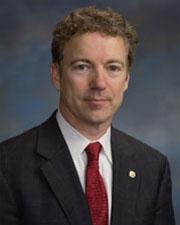 Sen. Rand Paul (R-KY)
Legislative Activity
Stay on top of the latest movement without scrolling through every action
Roll call votes on amendments in Senate: Motion to table amendment SA 365 agreed to in Senate by Yea-Nay Vote. 91 - 4. Record Vote Number: 83.
May 26, 2011
View full timeline
Roll call votes on amendments in Senate: Motion to table amendment SA 365 agreed to in Senate by Yea-Nay Vote. 91 - 4. Record Vote Number: 83.
May 26, 2011
Senate amendment proposed (on the floor): Amendment SA 365 proposed by Senator Paul to Amendment SA 347.
May 26, 2011
Amendment SA 365 proposed by Senator Paul to Amendment SA 347. (consideration: CR S3400-3401; text: CR S3400) To limit suspicious activity reporting requirements to requests from law enforcement agencies, and for other purposes.
May 26, 2011
Motion to table amendment SA 365 agreed to in Senate by Yea-Nay Vote. 91 - 4. Record Vote Number: 83.
May 26, 2011
Proposed amendment SA 365, not having 60 votes in opposition to the motion to table, was withdrawn in Senate. (consideration: CR S3401)
May 26, 2011
Senate amendment submitted
May 25, 2011
Votes
1 roll call on this amendment
Text
Proposed
SMALL BUSINESS ADDITIONAL TEMPORARY EXTENSION ACT OF 2011--Continued

Mr. WYDEN. Mr. President, I ask unanimous consent that Senator
Sessions be recognized to speak for up to 20 minutes for debate only.
The PRESIDING OFFICER (Mr. Brown of Ohio). Without objection, it is
so ordered.
The Senator from Alabama.

The Budget

Mr. SESSIONS. Mr. President, we had an unfortunate series of votes
last night, in my opinion, because it was all arranged by our
leadership in the Senate to have a series of votes to do nothing. That
is unfortunate because the United States of America, and the Senate are
proceeding with an idea that they do not have to have a budget. In
fact, the majority leader, Senator

[[Page S3373]]

Reid, said it would be foolish to pass a budget. And as one of the
staffers said, on background: Well, if we pass a budget, we will have
to tell people how much we are going to raise their taxes and talk
about spending reductions, and that will not be popular.
What did they do? One of the most incredible things I have ever seen
in the Senate. Did they express regret that they could not pass a
budget, that they would not state for the American people a vision for
spending and the financial future of America? No. What did they do?
They have the majority in the Senate. They called up the budget passed
by the House of Representatives, which is a really historic budget, an
honest budget that deals fairly and objectively with the challenges we
are facing, reduces spending, actually was able to reduce some taxes,
and proposed, a decade out, that the Congress confront Medicare because
it is going broke. So what did they do? They called up that budget. Did
they call it up to amend it? Did they call it up to offer us a chance
to debate it and offer amendments and fix anything anybody did not like
about it? No. That was not what was done. They brought it up only with
the most limited debate before all four votes. They stacked all four
votes on four different budgets and projections and just voted them
down. They voted down every budget that was offered.
I have on my desk in my office the President's budget. It is four
volumes, hundreds of pages, and it lays out a budget. Every President
submits budgets. They have a 500-person Office of Management and Budget
staff. Every year, they produce a budget. The law requires them to
produce a budget. This is the Code, the United States Code Annotated,
and in this is the law that says a President should submit a budget and
the date by which he should do it. It says the U.S. Senate should
commence markup in the Budget Committee by April 1 and the Congress
should pass a budget by April 15. Last I heard, April 15 is long since
passed.
How do you get a budget out of committee and to the floor of the
Senate? What are we supposed to do by April 1? The chairman is supposed
to call a markup, and he is supposed to bring up the budget he
proposes, offer it to the Budget Committee. It is open for amendment,
change, and debate, then it is voted on. A budget should then come out
of the committee to the floor of the Senate. It has expedited
procedures, but you are allowed to offer amendments, and there is 50
hours of debate--not too much. It does not require the normal 60 votes
we have to have for legislation here; it only requires a majority, 50
votes.
That is basically designed, frankly--when the people wrote the Budget
Act back in the 1970s--to allow the majority party to be able to pass a
budget because there were too many filibusters of budgets and no
budgets were getting passed. If you have the majority in the Senate, at
least you should be able to produce a budget. So it provides the
Democratic majority--the 53 Democratic Senators they have--the
opportunity to produce a budget on a partisan basis if it cannot be
done on a bipartisan basis. So the normal process is, you work with
your colleagues on the other side of the aisle, and if you think a good
agreement can be made in a bipartisan fashion, you do so and move a
bipartisan budget.
I remember last year when Senator Gregg, our Republican ranking
member, talked about his conversation with Senator Conrad, and he said:
He is not letting me see the budget. It is going to be produced the
next morning. What that means is, he is going to produce a partisan
budget. He does not want our opinion. He is not going to show us what
is in his budget until the day of the mark-up.
So this year, we wrote--all the Republican members; I am the ranking
member now--we asked the Budget chairman to show us his mark 72 hours
before the mark-up because he had not consulted with us and it appeared
he was going to produce a partisan budget. Actually, he told me the
date the hearing would commence to mark up his budget, but he did
decline to give us any advance notice or opportunity to see what was in
it.
All I am saying is that the procedure is set up realistically under
the Budget Act to allow the majority party to meet its responsibility
to pass a budget. They do not need a single Republican vote to pass a
budget. I think it is better if you can get a bipartisan agreement.
Oftentimes in the past, there have been. But since budgets represent
visions for America, oftentimes in recent years they have gone on
pretty much a party line but not 100 percent. That is what I would say.
So the President submitted his budget, and it was roundly criticized
around the country, and I was a very severe critic of it. So we offered
that budget last night. That was one of the four budgets that was
offered. We brought it up. It is the only Democratic budget to be
produced. I believe the Progressive Caucus produced one in the House,
but, of course, it did not pass. It had a lot of tax increases, a lot
of spending increases in it. It had no chance whatsoever of being
passed. The American people sent us a message last year that they want
us to get spending under control. They want us to reduce the size and
scope of government. That is what they asked us to do.
So the President's budget came up last night, and, 97 to 0, every
Democrat voted against the President's budget. Well, they should
because it was unacceptable. I have referred to it as the most
irresponsible budget in the history of our country because we are in a
deeper financial hole than we have ever been. That is just a fact, and
it is not a short-term, little problem; it is a problem that is getting
worse in the years to come.
So the American people have come to the conclusion that we need to
change the trajectory of debt that we are piling on year after year,
month after month, day after day, by the billions--trillions, really.
The President's budget, as scored by the Congressional Budget Office,
would produce uncontrolled debt year after year after year, in amounts
never before contemplated in our country, making the debt trajectory of
our current baseline spending worse, not better.
I was under the impression everybody understood we had to change and
get better. I thought, when we came in with this Congress, the debate
would be over how much to change in the right direction, how much could
we do to reduce the deficits, put us on the right path. Not the
President's budget, which made things worse.
According to the Congressional Budget Office, which analyzed his
budget and scored it, as we say, the lowest single deficit that budget
would produce is $748 billion, the lowest deficit to be produced under
his 10-year budget. President Bush was criticized for spending. The
highest budget deficit he had was $450 billion. That was the highest
President Bush had, and he was criticized for that by many of my
Democratic colleagues quite vociferously.
President Obama is now heading to his third trillion dollar budget
deficit. This year, it is going to be $1.5 trillion, it looks like
three times the size of President Bush's highest deficit. As I said,
the lowest deficit they are projecting is $748 billion, and then it
starts going back up again. In his 10th year, according to the
Congressional Budget Office, the deficit will be $1.2 trillion.
It is an indefensible, irresponsible budget. I am stunned that it was
presented here. It has been widely criticized, as well it should be. So
it was voted down last night.
If you are going to vote down something, should you not offer
something in its place? That is what the fiscal commission that
President Obama appointed said. That was their rule. That is what they
promoted publicly: If you oppose a budget, you should offer your own.
And, in fact, after Congressman Ryan, who served on the fiscal
commission with Mr. Bowles and Senator Simpson, the cochairmen, he
produced a budget. They gave him great credit. They said it was honest
and courageous, and it faced the challenges of America, and it deserved
respect, and then said: Anybody who does not agree with that should
show what they would do.
So yesterday afternoon, we had the spectacle of Democratic Senators
hammering and complaining about the Ryan budget, which in my opinion is
the most historic and responsible budget to be produced in decades. No,
it is not perfect. It is perfectly acceptable to believe that it ought
to be amended.

[[Page S3374]]

But it was a historic, honest attempt at dealing with the fiscal
challenges we face, and would put us on a financial path to solvency
and stability and eliminate the risk we are facing. We probably should
do more to reduce spending than he proposed. But it was courageous and
bold and honest and without gimmicks. I thought a very impressive
document. I looked forward to debating parts of it in our Budget
Committee.
So what did we have last night? Yesterday? They just brought it up
and every Democratic Member voted it down. And why? Because he had the
gumption to actually suggest that for people 55 and younger, we should
begin to create a Medicare system that would be solvent and effective
and save Medicare, because the trustees have reduced the year again at
which it goes insolvent. Senator Reid and Senator Schumer had cleverly
thought up this theory and were explicit about it. Their theory was
they would not bring up their own budget. They would not tell the
American people how much they wanted to increase their taxes. They
would not tell the American people they were going to cut anything,
because they might make someone unhappy and be unpopular. They would
just call up the Ryan budget and attack Republicans as wanting to kill
Medicare, and produce nothing in response. They do not have any plan to
fix the situation we are in.
I am disappointed about that. It is unthinkable that we would be
recessing and going home for a week without commencing markup hearings
in the Budget Committee to produce a budget that we are required by law
to produce. It is unthinkable we would do that.
I will be presenting to the majority leader a letter today from
Senators on our side of the aisle--large numbers of Senators have
signed it, saying, we do not need to go home until we have confronted
this problem, and you have shown us how we are going to move forward to
meet our statutory responsibility to pass a budget.
I think that is reasonable. That is what we are going to be asking
today. I am not going to vote to go home without having met our duty.
We call up our young men and women in uniform. We say: You will go to
Iraq for a year. They say: Well, I would rather not go. It is in your
contract. You signed up. You have to go. It is your duty. And they say,
yes, sir, and they go.
Many of them have lost lives and limbs and we ought to remember them
this Memorial Day. But Do not we have a duty here? I think we do. I
think we have a duty to the United States of America to produce a
budget, whether or not it is law. But it is law in the United States
Code. That is our duty. We do not need to be going home until we
fulfill it, and we have a plan to go forward with it. I want to say
this is not a little bitty matter with me. We are not going to have
four votes--as we did yesterday--and then the majority leader is going
to say, see, it is foolish to produce a budget. I told you we could not
produce a budget. We are not going to fool with having a budget this
year.
It has been 757 days since the Senate has had a budget, because the
majority leader did not bring up a budget last year either. Does
anybody have any wonder about why we are going to have a $1.5 trillion
deficit this year, why 40 cents of every dollar we spend is borrowed?
We spend $3.7 trillion and we take in only $2.2 trillion.
Experts and financial wizards all over the world are telling us, what
are you doing in the United States? You are about to threaten the
world's most prominent economy. It could have worldwide ramifications.
Our debt to GDP compares with Portugal and Spain, almost as high as
Greece. It will be 100 percent by September 30 of this year.
And we are going away without a budget again. The people who have
asked to be given a leadership responsibility in the Congress cannot
even comply with the Budget Act. They refuse to stand before the
American people and say what they want to tax, what they want to spend,
what they want to cut--because it would not be popular. It would be
foolish.
I do not think so. It is not acceptable. You asked to be the leader
of this Congress. You asked to be the President of the United States.
You have a responsibility to submit a responsible budget, an honest
budget, a fact-based budget, a budget the American people have an
opportunity to understand, to read and study before we vote. And if the
American people find we have cast a bad vote, they can cast a good vote
to throw some people out of Congress.
They threw some people out last fall. It does not look like we have
gotten the message--Business as usual. We are in denial. We do not have
to change. Oh, no, you cannot cut this spending program. What do you
mean you cannot cut spending programs? Give me a break. The Alabama
Governor, Dr. Bentley, had to announce a 15-percent reduction in
discretionary spending. Why? He did not have the money. Is that
something we have forgotten in Washington--when you do not have money,
you should not spend it?
Well, you say, it is all because of this economy, or something else.
Look, under President Obama, nondefense discretionary spending in 2
years went up 24 percent. We are going broke. We are increasing
spending on all the government programs. On an average, in the last 2
years that is 12 percent a year. You know, the value of your money will
double in 10 years if your interest is 7 percent. At 12 percent, I
guess the size of government would increase and double in 6 years.
Great scott. No wonder people are upset with us. We have been
spending incredibly recklessly. Also the 12 percent I mentioned--24
percent in 2 years--that does not include the stimulus package, the
almost $900 billion stimulus package that was thrown out the door with
almost no oversight. It was just designed to spend. And do you
remember, it was supposed to stimulate the economy.
We probably have had the slowest ever rebound from a recession. It
has been a very shaky recovery. They will say, well, we should have
spent more. But Rogoff and Reinhart, the professors, tell us, when your
debt gets as high as that of the United States, then you begin to show
a decline in growth. One percent of GDP growth is reduced when your
debt reaches 90 percent of GDP. We reached that this year, and we will
go over 100 percent by September 30.
This is the budget that the President has submitted to us. He has a
large staff over there. They maintain it. A large number of them have
been there for many years. The President submitted to us a budget. It
was rejected yesterday 97 to 0. It confirms the fact that we do not
have a legitimate budget before us. The President's budget has been
rejected utterly. The Democrats have refused to produce one.
They say: Why don't you have a mark-up and offer your budget? I
cannot call a mark-up. The chairman calls the mark-up. The majority
leaders confer and tell the chairmen when to call a mark-up. They
decided not to call a budget mark-up. We do not have an opportunity to
go to the Budget Committee and pass a budget.
We had such tremendous interest, and a lot of the new people who got
elected to the Senate last fall wanted to be on the Budget Committee.
They traveled their States. They had heard from their people all over
their States that they wanted us to control spending. They wanted to be
on the committee. It was the committee which had more interest and more
people pushing to be on it than any other committee. We finally
selected a fabulous group of people to serve on the committee. And now
we do not meet. Now we are not even going to mark up a budget. What a
disappointment for those new Members coming here with vim and vigor and
ready to do something about the future of the Republic.
You know, one of the things that was interesting about the
President's budget is how much praise it got from our Democratic
colleagues who voted it down last night when it came out. This is what
Senator Schumer said about it: ``This is a responsible proposal. I
believe this approach should have bipartisan support.'' Senator Bill
Nelson: ``I personally think the President's budget is a step in the
right direction.'' Senator Max Baucus: ``The President's budget
strengthens our economy.'' Senator Ben Cardin: ``President Obama has
given us a credible blueprint.'' Senator Tom Carper: ``The President's
budget is an important step forward.'' Senator Frank Lautenberg:
``President Obama's budget presents a careful evaluation of what our
Nation needs.''

[[Page S3375]]

They all voted no last night. You know, with friends like that, you
do not need enemies, as they like to say. But what about Mr. Erskine
Bowles, the man President Obama chose to serve as chairman of the debt
commission? Mr. Bowles talked about the budget. He was rather stunned
actually when it came out. It came out I think on Friday. On Sunday,
Mr. Bowles said: ``It comes nowhere close to where they will have to go
to avoid a fiscal nightmare.''
Can you imagine? This is the man President Obama chose to head the
deficit commission, and he hammered this budget.
He said it is nowhere close, and it is nowhere close to doing what we
have to do. So I believe what we went through yesterday was a sham, a
mockery, a joke, and had no meaning. It was nothing but politics,
nothing but an avoidance of responsibility to help provide leadership.
We all know some serious choices have to be made, and I will close
with these thoughts. We are going to need a partnership in the Senate
between our parties. There are going to be some tough choices which
have to be made. In my view, we simply cannot continue at our rate of
spending. It has to be reduced. But we have people in denial, who don't
think it has to be reduced. But when your lowest deficit in 10 years is
projected to be $740 billion, and this year's will be the highest in
the history of the Republic, $1.5 trillion or more--how do we get
there?
We are going to have to make some choices. I have saluted the Gang of
Six, who have tried. Apparently, they have fallen on hard times and the
prospects aren't good for that. Now the Vice President is meeting.
There is some excuse, they say, that we don't have to do our business
openly and before the public and stand and be accounted for because
that would not work. People are afraid to make tough choices and
decisions in public.
I believe the American people are not happy with us. I know they are
not happy with us. Seventy percent of them believe this country is on
the wrong track, and the biggest part of that, surely, is our fiscal
management. They know this debt cannot be sustained. So we need to do
something. The best way to do it is to follow the regular order, follow
the legally constituted method of budget processing. Let's have a
Budget Committee meeting, and if the Gang of Six has ideas, let's have
them brought up in the Budget Committee and vote on them. If Vice
President Biden wants to send something over, I am glad to hear it. If
the President wants to send his people over to defend this budget that
has been rejected 97 to zero, let them do it.
I will tell you what he and his Budget Director, Mr. Lew, said--can
you believe it? They said this budget will allow us to live within our
means and not spend money we don't have. That is the way they promoted
this budget. It was rejected last night. If it caused us to live within
our means and allowed us to pay down our debt then I would vote for it.
It did not come close to that. Yet the President talked about it all
over the country, and his staff ran around saying this budget will
allow us to live within our means. That is totally inaccurate, and that
is irresponsible. What the President should have done, and what our
Democratic leaders have to help us with, is go to the American people
and, with clarity, without equivocation, say we cannot continue. We
must tell them big changes have to be made, and we are so sorry this
country has gotten in the shape we are in. We must say that we are
going to make some changes, and we urge you to help us stick together
and do it. We must do this to put the country on the right path.
But what do we have? We have Congressman Ryan, in the Republican
House, who had the temerity, the courage, the discipline, and the sense
of duty sufficient to pass a budget that would actually do what needs
to be done. They called it up and attacked it with everything they had,
but they will not produce anything of their own.
It cannot be denied that this is a failure of leadership. I believe
the process and path we are on now is dangerous; it is not public, it
is secret. They tried to produce a secret plan on comprehensive reform
of immigration. The American people heard about it, and down it went.
They tried to negotiate in secret this health care reform bill. They
were able to hold their votes on a straight party-line vote--60 to 40--
but the American people were not happy with the process or results and
a lot of people who participated in that spectacle didn't come back
after this last election.
That is not the path we are hearing from our constituents. Our
constituents are saying: You work for us. We want to see you publicly
stand and defend the values we believe in. If you don't do so, we are
going to hold you accountable. I think that is democracy in America,
and that is healthy. I don't think there is anything wrong with it. I
respect the American people who are watching Congress and demanding
that we change the trajectory we are on.
I believe strongly that we need to do better. I believe strongly that
this Congress should have in play and commit before we recess--or not
recess--a plan to deal with the financial crisis our Nation faces. When
we do that, we can feel like we are fulfilling our duty both in law and
morally to the people who have given us the honor of serving in this
body.
I yield the floor and suggest the absence of a quorum.
The PRESIDING OFFICER. The clerk will call the roll.
The assistant legislative clerk proceeded to call the roll.
Mr. KIRK. Mr. President, I ask unanimous consent that the order for
the quorum call be rescinded.
The PRESIDING OFFICER. Without objection, it is so ordered.

Resignation of Dominique Strauss-Kahn

Mr. KIRK. Mr. President, last week, I spoke on the floor regarding
the resignation of Dominique Strauss-Kahn, who is managing director of
the International Monetary Fund, due to the serious criminal charges he
is now facing in New York.
Mr. Strauss-Kahn has since resigned, but it appears he will now
receive at least a $250,000 taxpayer-funded severance pay package from
the IMF and may be eligible for further undisclosed amounts in annual
IMF retirement benefits.
Since the United States is the largest contributor to the IMF, we now
face the potential share scenario where the American taxpayer is partly
underwriting severance payments and retirement packages to a man who is
pending a criminal conviction as a felon.
This is clearly unacceptable, and it is my hope that the U.S.
executive director to the IMF, Meg Lundsager, advocates that no future
benefits pass to Mr. Dominique Strauss-Kahn, if he is convicted of the
crimes with which he is charged.
As you know, the IMF is spearheading efforts to manage a very wide
and deep European debt crisis. Despite my reservations about U.S.
taxpayer bailouts for Greece, Ireland, and Portugal, the institution
does play a very critical role in financial leadership. I think it
needs to set an example, especially with regard to its now-disgraced
leader.
Mr. Strauss-Kahn has failed to live up to the expectations of his
institution and what the American taxpayers support.

State Bailouts

Mr. President, the U.S. Treasury is scheduled to borrow over $1.4
trillion this year, and we have a scheduled interest payment of over
$220 billion. We will pay more in interest this year than we do for the
cost of the U.S. Army. I am very concerned about this situation and
also an underreported financial situation developing in American
States. The situations in my home State of Illinois and the State of
California are the most dire. I would regret any attempt by these
States to seek a Federal bailout. To defend the full faith and credit
of the United States, I think we should move forward with a resolution
that I introduced with a number of other Senators, S. Res. 188, that
expresses the sense of the Senate that we should have no Federal
bailout for the States.
This is an issue that has concerned the Senate once before. In the
1840s, we faced a funding crisis of the States. The Senate wisely
advised then-Secretary of the Treasury Daniel Webster to seek or report
on any discussions that he might have had that could have led to
guaranteeing State debt. It was the Senate's express resolution that
prevented Treasury Secretary Webster from bailing out the State's

[[Page S3376]]

debt. The crisis at the time was even reflected in Charles Dickens'
famous book ``A Christmas Carol,'' in which Scrooge was described as
someone who was less than wealthy because he had overinvested in what
were called United States sovereigns. In fact, the phrase in the
``Christmas Carol'' is ``not worth a United States sovereign'' because
of the spend-thrift policies of many State governments at the time.
The Senate at that time took the correct action to prevent the spend-
thrift actions of several States from contaminating and ruining the
credit rating of the United States itself.
Our credit rating is already under stress with reports, especially by
Standard & Poors, that we may face a loss in the AAA credit rating
invented to symbolize the strength of the United States if we don't
change the spending course soon. A way to accelerate the loss of a AAA
credit rating is to guarantee or somehow bail out spend-thrift States
such as Illinois or California.
In Illinois, we have a very courageous State treasurer who just took
office and made a clear statement. Treasurer Dan Rutherford has told
the leaders of my own State they need to stop borrowing, they need to
stop spending. He is seeking no Federal bailout for his State. The
State situation is quite dire.
By one estimate, the revenues and pensions of the State of Illinois
are the worst funded in America. Less than 40 percent of the pensions,
by one estimate, have been funded. With this type of track record, you
could see a situation in which California or Illinois, in a crisis,
would seek a bailout from the Senate and from the House. I think we
should repeat the wise precedent set in the 1840s, the advice we sent
to Treasury Secretary Daniel Webster to set a clear marker for our own
Treasury Secretary to make sure there is no bailout for the States. To
protect our credit rating, I think this action is necessary, especially
to reassure the credit rating agencies.
What would happen if we don't? Could we provide temporary benefits to
Illinois and California? We could. Could we underwrite their policies
of spend-thrift ways? We could. Would we accelerate a loss of the AAA
credit rating of the United States? We could. We are already seeing an
example of what happens when you drive your national economy off a
cliff. Many of us originally hailed from our long-time ancestors who
passed from Ireland, and recently the Irish Government finances
collapsed as they lost their credit rating. Because interest rates
spiked in that country so fast, 53 percent of mortgages in Ireland were
foreclosed in a short space of time after the loss of their credit
rating.
We need to act to protect the people of the United States from such
an economic fate. That is why we need to say no to any State bailouts,
why we need to cut spending in Washington, and why we need to make sure
that at all costs we defend the credit rating of the United States. It
is our sacred duty to make sure that what is befalling the people of
Greece and the people of Portugal and the people of Ireland, being
misruled by governments that said yes to every special interest
spending idea and no to their economic future, does not infect the
credit rating of the United States.
That is why this resolution is so needed, and that is why I am so
proud to submit it today in the full and complete historic financial
tradition of the Senate.
I yield the floor.
The PRESIDING OFFICER. The senior Senator from Oklahoma is
recognized.
Mr. INHOFE. Mr. President, I ask unanimous consent to speak as in
morning business for 10 minutes.
The PRESIDING OFFICER. Without objection, it is so ordered.
(The remarks of Mr. Inhofe pertaining to the introduction of S. 1085
are printed in today's Record under ``Statements on Introduced Bills
and Joint Resolutions.'')

Cote D'Ivoire

Mr. INHOFE. Mr. President, I have made four speeches on the floor in
the last month about the disaster, the catastrophe that is taking place
in a country in west Africa called Cote d'Ivoire. Cote d'Ivoire is a
country whose President, the legitimate President, I might add, is
Laurent Gbagbo, with his wife Simone. Someone named Alassane Quattara,
from the northern part of Cote d'Ivoire, with a rigged election, came
in; it was certified. It was all set up before we knew what was going
on.
That individual's name is Quattara. His death squads today, this very
moment as we speak, are roaming the streets of Abidjan in Cote
d'Ivoire. He is murdering and he is raping. Right now they have in
captivity Laurent Gbagbo, the legitimate President of Cote d'Ivoire. I
think they are in the process of perhaps killing him right now. We
don't know that. The State Department does not know it. No one knows
it.
We had a hearing. The State Department was totally without compassion
or concern over what is happening in the streets of Abidjan. We saw, we
witnessed on video, the helicopters coming through and destroying that
city. We have friends there right now who tell us that even today the
death squads of Alassane Quattara are roaming the streets murdering
people. No one can say within 10,000 people how many people they
murdered.
My concern is it is too late to do anything about that. They rigged
the election. I documented it. I sent the documentation to the State
Department. They paid no attention to it. France was behind the whole
thing. France wants to have as much control as they can of west Africa.
They conned the United Nations into it and our State Department went
along with it.
What is happening right now is so inhumane. I wish I had the pictures
I showed before. The beautiful First Lady, Simone Gbagbo, is a
beautiful lady, and they took her into captivity, pulled her hair out
by the roots, and ran through the streets of Abidjan, holding up her
hair in their hands. They are murdering everyone who is a friend of
that administration.
Well, I have one plea right now. There are a lot of options on what
they can do. They can murder the President and First Lady--and they are
considering that now. They are trying to consider some way to make it
look like suicide. I don't know what they are doing. The State
Department doesn't know what they are doing. Unfortunately, the State
Department doesn't even care what they are doing.
One of the options would be to allow the President and the First Lady
and some who are close to go to another country in Sub-Saharan Africa
and be able to stay in that country. We have already located host
countries to allow that to take place.
So I am making an appeal right now. I can't get the Secretary of
State to talk to me about it. I can't get anyone else but just a
handful of people, but we need to do something and do something now--
today. If we wait until after this recess, I would almost say their
blood will be on the hands of the State Department because we can do
something about it now. All we have to do is encourage the new,
illegitimately elected President of Cote d'Ivoire--Alassane Ouattara--
and his administration to give an opportunity for another state to host
these two individuals. Quite frankly, I think that would be a very
smart thing politically for him to do because with the other two
options, we all know what happens. We know what martyrs are, and that
is what would happen.
So this is, I guess, a final appeal to anyone who is sensitive to the
torturing, raping, and murdering that is going on today to join me in
encouraging the State Department, the United Nations, France, and
Alassane Ouattara to turn over President and Mrs. Gbagbo to a host
country for their asylum.
With that, I yield the floor.
The PRESIDING OFFICER (Mrs. Hagan). The Senator from Florida.

Oil Speculation

Mr. NELSON of Florida. Madam President, we have all heard the phrase
``drill, baby, drill.'' Well, it is interesting that the pro-oil
company folks think that all of our answers have to do with drilling
because, lo and behold, we have actually increased our domestic
production. Let me quote from a Reuters story from May 25:

Crude oil production, especially in the deep waters of the
Gulf of Mexico, increased by 334,000 barrels per day between
2005 and 2010, which also cut into foreign oil purchases.

As a matter of fact, the article goes on to say:

[[Page S3377]]

Imports of crude and petroleum products accounted for 49.3
percent of the U.S. oil demand last year, down from the high
of 60.3 percent in 2005. It also marked the first time since
1997 that America's foreign oil addiction fell under the 50
percent threshold.

Now, that is worth noting. That is really something because the trend
is reversing. Maybe it is that we are getting more energy conscious.
Maybe it is that we are expending less gasoline in our vehicles because
of the higher miles-per-gallon standards. Maybe we are remembering to
turn off the lights when we leave the room. Maybe we are being a lot
more sensitive to how vulnerable we are because we depend--as we have
in the past--on upwards of 60 to 70 percent of our daily consumption
from foreign shores, places such as Nigeria and the Persian Gulf and
Venezuela.
Now, I have just named three very unstable parts of the world that
could, at any moment, cut off that production. So maybe America is
finally waking up to the fact that, lo and behold, we have to be
concerned about our energy sources and not depend so much on foreign
production.
The mantra ``drill, baby, drill'' implies that if we just continue to
drill--in places where we can drill domestically--that is going to
solve our problem. But that ignores the fact that it takes about 10
years to take an oilfield and get it into production. So that doesn't
solve our problem now as we are facing these high gas prices. That is
what I want to talk about, the high gas prices.
We ought to drill where we should. A lot of people do not know that
of the 37 million acres that are leased in the Gulf of Mexico only 7
million are drilled. There are 37 million acres leased in the Gulf of
Mexico, but only 7 million of those 37 million acres are drilled. So
let's do drill, baby, drill. Let's drill on all those leases, those 30
million acres in the gulf and elsewhere that are existing leases and
that haven't been drilled.
But it is not the world oil market and the U.S. consumption that is
causing these gas prices to go up. There are other factors, and I want
to talk about that as well. It is true there are new demands on oil
consumption from burgeoning countries such as China and India, and that
causes more oil to be consumed from the world marketplace. But remember
what I just cited; that the United States is lowering its consumption
of imported oil. So that is clearly not a factor affecting the price of
oil worldwide or the price at the pump we pay for the refined gasoline.
No, there is another reason. That reason happens to be the
speculators who are out there running up the price on commodity
exchanges for oil futures contracts. Those prices run up until they are
ready to dump them, and then suddenly they go down.
I want to call the attention of the Senate to a New York Times story
from May 24--just a couple of days ago--entitled ``U.S. Suit Sees
Manipulation of Oil Trades.'' Let me quote from the article.

The suit says that in early 2008 they tried to hoard nearly
two-thirds of the available supply of a crucial American
market for crude oil, then abruptly dumped it and improperly
pocketed $50 million.

So the Federal commodities regulators filed a civil lawsuit against
two obscure traders in Australia and California and three American and
international firms. This was in the context of 3 years ago, in 2008,
when oil prices had surged past $100 a barrel. There were those
suspicions then that traders had manipulated the market, and that
ultimately has led to a number of commentaries and investigations.
Well, the regulators at the Commodity Futures Trading Commission have
now filed this suit, and they are looking into the fraud being utilized
in these oil and gas markets, particularly the commodity futures
markets.
In the past months, I have come to the Senate floor several times to
discuss the net result of all of this, which is what we pay at the
pump, and how it directly links to these oil speculators and the game
they play in running up the price of oil. Using the data from the
Commodity Futures Trading Commission and price data from the Energy
Information Administration, we have shown on this floor in speech after
speech--until I am blue in the face--the direct link between the rising
level of speculators and their speculation in our energy markets and
the skyrocketing oil and gas prices.
When the top executives of the five largest oil companies in the
United States testified a week ago in our Senate Finance Committee on
what role speculation played in the oil markets, I asked them to please
explain why gas prices are remaining so high when oil prices have begun
to fall. Madam President, you should have heard the mumbling around
that followed. The truth is, speculators, whether they are active
traders or passive investors, have hijacked our oil markets in recent
years, and the American people are the ones who are suffering the
consequences because the price of that gas goes up when we pump it into
our cars.
Oil prices are set in futures markets, such as those regulated by the
Commodity Futures Trading Commission. Futures contracts--meaning we buy
a contract of oil at a specified price to be delivered at a future
date--allow oil producers to lock in prices on their future output.
Those contracts also allow large consumers of fuel, such as airlines,
to lock in a price as a hedge against inflation and that future price
swinging way up.
The futures markets were intended to bring actual producers and real
consumers of oil together, and, in doing so, the supply would match the
demand. Speculators then were allowed to play a limited role to ensure
there was sufficient liquidity in the market. But then here is what
happens--and this is what happened back in 2008 when the price of gas
went so high. Speculators constitute now anywhere from two-thirds to 80
percent of the market. They are no longer a bit player, they are the
main player, and this is what we need to end.

In last year's financial reform bill, we directed the Commodity
Futures Trading Commission to set hard limits on the speculative
positions. We gave them a deadline of last January 21. Now we are here
months past the deadline, but the CFTC has not yet finalized a rule.
Why should they do this? If you are a legitimate user of oil--say, an
airline--you have every reason to want to hedge against the price of
that oil going way up, so you buy a contract for delivery of oil at a
specified price at a future date. But if you are a speculator--buying
and selling oil futures contracts, having no intention to use the oil,
having only to put as a downpayment a bare percentage of the total
contract price--you can manipulate that price upwards by buying and
selling those contracts. This is exactly what happened back in 2008. It
is what is happening again, as we have seen the price of a barrel of
oil go up and up.
We passed the law last year. The Commission has the authority. We
should not have to pass another law that requires them to do it, but if
the CFTC cannot get the job done, then we are going to have to. That is
the bottom line.
The American people are outraged. Here America is lowering its
consumption of oil, here America is lowering its imports of oil, here
we are getting more energy conscious, and yet the price of gas keeps
going up. It is time to put an end to this.
I yield the floor, and I suggest the absence of a quorum.
The PRESIDING OFFICER. The clerk will call the roll.
The bill clerk proceeded to call the roll.
Mr. McCAIN. Madam President, I ask unanimous consent that the order
for the quorum call be rescinded.
The PRESIDING OFFICER. Without objection, it is so ordered.
The Senator from Arizona is recognized.
Mr. McCAIN. I thank the Chair.
Mr. President, in a few minutes my colleague from Maryland, Senator
Cardin, will be introducing a bill which I am a cosponsor of, along
with a large bipartisan group of our colleagues. I wish to emphasize at
the outset that some may characterize this legislation as anti-Russian.
In fact, I believe it is pro-Russian. It is pro the people of Russia.
It is pro the people who stand up for human rights and democracy in
that country which, unfortunately, seems to be sadly deprived of.
This legislation, as my colleague and friend Senator Cardin will
describe, requires the Secretary of State, in consultation with the
Secretary of the Treasury, to publish a list of each person whom our
government has reason

[[Page S3378]]

to believe was responsible for the detention, abuse, or death of Sergei
Magnitsky; participated in efforts to conceal the legal liability for
these crimes; committed those acts of fraud that Magnitsky uncovered;
is responsible for extrajudicial killings, torture, or other gross
violations of human rights committed against individuals seeking to
expose illegal activities in Russia or exercise other universally
recognized human rights.
Second, the individuals on that list would become the target of an
array of penalties, among them, ineligibility to receive a visa to
travel. They would have their current visas revoked, their assets would
be frozen that are under U.S. jurisdiction, and U.S. financial
institutions would be required to audit themselves to ensure that none
of these individuals are able to bank excess funds and move money in
the U.S. financial system.
I guess the first question many people will be asking is who was
Sergei Magnitsky? Who was this individual who has aroused such outrage
and anger throughout the world? He was a tax attorney. He was a tax
attorney working for an international company called Hermitage Capital
that had invested in Russia. He didn't spend his life as a human rights
activist or an outspoken critic of the Russian Government. He was an
ordinary man. But he became an extraordinary champion of justice,
fairness, and the rule of law in Russia where those principles,
frankly, have lost meaning.
What Sergei Magnitsky did was he uncovered a collection of Russian
Government officials and criminals who were associated with the Russian
Government officials who colluded to defraud the Russian state of $230
million. The Russian Government in turn blamed the crime on Heritage
Capital and threw Magnitsky in prison in 2008.
Magnitsky was detained for 11 months without trial. Russian
officials, especially from the Interior Ministry, pressured Magnitsky
to deny what he had uncovered--to lie and to recant. He refused. He was
sickened by what his government had done and he refused to surrender
principle to brute power.
As a result, he was transferred to increasingly more severe and more
horrific prison conditions. He was forced to eat unclean food and
water. He was denied basic medical care as his health worsened. In
fact, he was placed in even worse conditions until, on November 16,
2009, having served 358 days in prison, Sergei Magnitsky died. He was
37 years old.
Sergei Magnitsky's torture and murder--let's call it what it really
was--is an extreme example of a problem that is unfortunately all too
common and widespread in Russia today: the flagrant violations of the
rule of law and basic human rights committed by the Russian Government
itself, along with its allies.
I note the presence of my colleague and lead sponsor of this
important legislation. I hope in his remarks perhaps my friend from
Maryland would mention the latest in the last few days which was the
affirmation of the incredible sentence on Mr. Mikhail Khodorkovsky and
his associate which is, in many ways, tantamount to a death sentence;
again, one of these blatant abuses of justice and an example of the
corruption that exists at the highest level of government.
I wish to say again I appreciate the advocacy of my colleague from
Maryland and his steadfast efforts on behalf of human rights in Russia,
Belarus, and other countries. It has been a great honor to work with
him and for him in bringing this important resolution to the floor of
the Senate.
I ask unanimous consent that at the appropriate time, the Senator
from Maryland and I be allowed to engage in a colloquy.
The PRESIDING OFFICER. Without objection, it is so ordered.
The Senator from Maryland.
Mr. CARDIN. Mr. President, let me thank Senator McCain, not just for
taking time for this colloquy concerning Mr. Magnitsky but for his
longstanding commitment to justice issues, human rights issues, and the
values the United States represents internationally.
We have had a long, proud, bipartisan, and, most importantly,
successful record of promoting basic American values such as democratic
governance and the rule of law around the world. Engaging the countries
of the Eastern Bloc in matters such as respect for human rights was
critical to winning the cold war. We will never know how many lives
were improved and even saved due to instruments such as the Helsinki
Final Act and the Jackson-Vanik amendment. These measures defined an
era of human rights activism that ultimately pried open the Iron
Curtain and brought down the Wall. Thankfully, the cold war is over and
we have a stronger relationship, both at the governmental and societal
levels, with countries in Eastern Europe. But, sadly, internationally
recognized rights and freedoms continue to be trampled and, in many
cases, with absolute impunity.
With the possibility of Russia's accession to the World Trade
Organization, and the Presidents of the United States and Russia
meeting in France, ours is a timely discussion.
Last week, I joined my distinguished colleague, the Senator from
Arizona, and 14 other Senators from both parties to introduce the
Sergei Magnitsky Rule of Law Accountability Act--a broad bill to
address what the respected watchdog Transparency International dubbed a
``systematically corrupted country'' and to create consequences for
those who are currently getting away with murder.
Actions always speak louder than words. The diplomatic manner of
dealing with human rights abuses has frequently been to condemn the
abusers, often publicly, with the hope that these statements will be
all they need to do. They say oh, yes, we are against these human
rights violations. We are for the rule of law. We are for people being
able to come forward and tell us about problems and be able to correct
things. They condemn the abusers, but they take no action. They think
their words will be enough. Well, we know differently. We know what is
happening today in Russia.
We know the tragedy of Sergei Magnitsky was not an isolated episode.
This is not the only time this has happened. My colleague from Arizona
mentioned the Mikhail Khodorkovsky case. Mr. Khodorkovsky is today in
prison with even a longer sentence. Why? Because he had the courage to
stand up and oppose the corrupt system in Russia and something should
be done about it. That is why he is in prison, and that is wrong.
So it is time we do something about this and that we make it clear
that action is needed. For too long, the leaders in Russia have said we
are going to investigate what happened to Sergei Magnitsky. We think it
is terrible he died in prison without getting adequate medical care. As
Senator McCain pointed out, here is a person whose only crime was to
bring to the proper attention of officials public corruption within
Russia. As a result of his whistleblowing, he was arrested and thrown
in jail and died in jail. He was tortured. That cannot be allowed, to
just say, Oh, that is terrible. We know the people who were
responsible. In some cases they have been promoted in their public
positions. Well, it is time for us to take action. That is why we have
introduced this legislation.
While this bill goes far beyond the tragic experiences of Sergei
Magnitsky, it does bear his name, so let me refresh everyone's
recollection with some of the circumstances concerning his death. I
mention this because some might say, why are we talking about one
person? But as the Soviet dictator Joseph Stalin said, ``One death is a
tragedy; one million is a statistic.'' I rarely agree with Dictator
Stalin, but we have to put a human face on the issue. People have to
understand that these are real people and real lives that have been
ruined forever as a result of the abuses within Russia.
Sergei was a skilled tax lawyer who was well known in Moscow among
many Western companies, large and small. In fact, he even did some
accounting for the National Conference on Soviet Jewry. Working at the
American law firm of Firestone Duncan, Sergei uncovered the largest
known tax fraud in modern Russian history and blew the whistle on the
swindling of his fellow citizens by corrupt officials. For that he was
promptly arrested by the subordinates of those he implicated in the
crime. He was held under torturous conditions in detention for nearly a
year without trial or

[[Page S3379]]

visits from family. He developed severe medical complications which
went deliberately untreated, and he died on November 16, 2009, alone in
an isolation cell while prison doctors waited outside his door. Sergei
was 37 years old. He left behind a wife, two sons, a dependent mother,
and so many friends.
Shortly after his death, Philip Pan of the Washington Post wrote:

Magnitsky's complaints, made public by his attorneys as he
composed them, went unanswered while he lived. But in a
nation where millions perished in the Soviet gulag, the words
of the 37-year-old tax lawyer struck a nerve after he died .
. . his descriptions of the squalid conditions he endured
have been splashed on the front pages of newspapers and
discussed on radio and television across the country, part of
an outcry even his supporters never expected.

I think Senator McCain and I would agree, there is a thirst for
democracy around the world. People in Russia want more. They want
freedom. They want accountability. They want honest government
officials. They are outraged by what happened to Sergei Magnitsky.
I would point out just last week I met with a leader of the Russian
business community who came here and traveled at some risk, I might
say. Just visiting me was a risk. We have people from Russia who are
being questioned because they come and talk to us. But he said to me
that what happened here needs to be answered by the Russian
authorities. He understands why we are introducing this legislation.
A year after his death, and with no one held accountable, and some of
those implicated even promoted and decorated, The Economist noted:

At the time, few people outside the small world of Russian
investors and a few human-rights activists had heard of Mr.
Magnitsky. A year later, his death has become a symbol of the
mind-boggling corruption and injustice perpetrated by the
Russian system, and the inability of the Kremlin to change
it.

Regrettably, we know Sergei's case, egregious as it is, is not
isolated. Human rights abuses continue unpunished and often unknown
across Russia today.
To make this point more clear, let's look at another example far
outside the financial districts of Moscow and St. Petersburg in the
North Caucasus in southern Russia where Chechen leader, Ramzan Kadyrov,
condones and oversees massive violations of human rights, including
violations of religious freedom and the rights of women. His militia
also violates international humanitarian laws. As of this April, the
European Court of Human Rights has ruled against Russia in 186 cases
concerning Chechnya, most involving civilians.
So Sergei Magnitsky's case is not an isolated case of abuse by the
Russian authorities. There has been a systematic effort made to deny
people their basic human rights, including one individual, Natalia
Estemirova, who personally visited my office at the Helsinki
Commission. She was a courageous human rights defender who was brutally
assassinated.
So it is time for Russia to take action. But we cannot wait; we need
to take action.
Mr. McCAIN. Will the Senator yield for a question?
Mr. CARDIN. I yield back to my colleague.
Mr. McCAIN. First, I thank my colleague from Maryland for a very
eloquent and, I think, very strong statement, to which I can add very
little. But isn't it true, I ask my friend, that this Magnitsky case
and the Khodorkovsky case, which I would like for us to talk a little
bit more about, are not isolated incidents?
In other words, this is the face of the problem in Russia today. As
the Senator mentioned, in its annual index of perceptions of
corruption, Transparency International ranked Russia 154th out of 178
countries--perceived as more corrupt than Pakistan, Yemen, and
Zimbabwe. The World Bank considers 122 countries to be better places to
do business than Russia. One of those countries is Georgia, which the
World Bank ranks as the 12th best country to do business.
In other words, isn't it true in the Magnitsky case, it is what has
been taking place all across Russia, including this incredible story of
Khodorkovsky, who was one of the wealthiest men in Russia, one of the
wealthiest oligarchs who rebelled against this corruption because he
saw the long-term consequences of this kind of corruption and was
brought to trial, convicted, and then, when his sentence was completed,
they charged him again?
Talk about a corrupt system, isn't it true that Vladimir Putin said
he should ``sit in jail,'' and we now know that the whole trial was
rigged, as revealed by people who were part of the whole trial? In
other words, isn't it true, I would ask my friend from Maryland, that
what we are talking about is one human tragedy, but it is a tragedy
that is unfolding throughout Russia that we do not really have any
knowledge of? And if we allow this kind of abuse to go on unresponded
to, then, obviously, we are abrogating our responsibilities to the
world; isn't that true?
Mr. CARDIN. I say to Senator McCain, you are absolutely right. This
is not isolated. Magnitsky is not an isolated case of a lawyer doing
his job on behalf of a client and being abused by the authorities. We
have a lot of examples of lawyers trying to do their jobs and being
intimidated and their rights violated.
But in Mr. Khodorkovsy's case, we have a business leader who was
treated the same way just because he was a successful business leader.
Even worse, he happened to be an opponent of the powers in the Kremlin.
So we are now seeing, in Russia, where they want to quell opposition
by arresting people who are just speaking their minds, doing their
business legally, putting them in prison, trying them, and in the
Khodorkovsky case actually increasing their sentences the more they
speak out against the regime.
That is how authoritarian they want to be and how oppressive they are
to human rights. But I could go further. If one is a journalist in
Russia, and they try to do any form of independent journalism, they are
in danger of being beaten, being imprisoned, being murdered. It is very
intimidating. The list goes on and on.
Mr. McCAIN. Could I ask my colleague, what implications, if any, does
the Senator from Maryland believe this should have on the Russian entry
into the World Trade Organization?
Mr. CARDIN. Well, it is very interesting, I say to Senator McCain. I
just came from a Senate Finance Committee hearing, and we were talking
about a free-trade agreement. I am for free-trade agreements. I think
it makes sense. It is funny, when a country wants to do trade with the
United States, they all of a sudden understand they have to look at
their human rights issues.
I think all of us would like to see Russia part of the international
trade community. I would like to see Russia, which is already a member
of a lot of international organizations, live up to the commitments
they have made in joining these international organizations.
But it is clear to me that Russia needs to reform. If we are going to
have business leaders traveling to Russia in order to do business, I
want to make sure they are safe in Russia. I want to make sure they are
going to get the protection of the rule of law in Russia. I want to
make sure there are basic rights that the businesspeople in Russia and
the United States can depend upon.
So, yes, I understand that Russia would like to get into the WTO. We
have, of course, the Jackson-Vanik amendment that still applies. I
understand the origin of that law, and I understand what needs to
change in order for Russia to be able to join the World Trade
Organization.
But I will tell you this: The best thing that Russia can do in order
to be able to enter the international trade regime is to clean up its
abuses in its own country, to make clear it respects the rule of law;
that businesspeople will be protected under the rule of law and
certainly not imprisoned and tortured, as in the cases of Mr.
Khodorkovsky and Mr. Magnitsky. We do not want to see that type of
conduct.
If Russia would do that, if they would reform their systems, then I
think we would be a long way toward that type of integration and trade.
Mr. McCAIN. I thank my colleague from Maryland for an eloquent
statement about the situation as regards

[[Page S3380]]

Russia. I thank him, and I can assure my colleague from Maryland that,
as we speak, this will provide--and this legislation which he has
introduced, will provide--some encouragement to people who in Russia
now, in some cases, have lost almost all hope because of the corruption
of the judicial system, as well as other aspects of the Russian nation.
We all know that no democracy can function without the rule of law;
and if there are ever two examples of the corruption of the rule of
law, it is the tragedy of Sergei Magnitsky and, of course, Mr.
Khodorkovsky, who still languishes in prison; who, in his words,
believes he--by the extension of his prison sentence--may have been
given a death sentence.
So I thank my colleague from Maryland.
Mr. CARDIN. Will my colleague yield for just one final comment?
I think the Senator is right on target as to what he has said. I
appreciate the Senator bringing this to the attention of our colleagues
in the Senate.
I will respond to one other point because I am sure my colleague
heard this. Some Russian officials say: Why are we concerned with the
internal affairs of another country? I just want to remind these
Russian officials, I want to remind my colleagues here, that Russia has
signed on to the Helsinki Final Act. They did that in 1975, and they
have agreed to the consensus document that was issued in Moscow in 1991
and reaffirmed just last year with the heads of state meeting in
Astana, Kazakhstan, just this past December. I am going to quote from
that document:

The participating States--

Which Russia is a participating state--

emphasize that issues relating to human rights, fundamental
freedoms, democracy and the rule of law are of international
concern, as respect for these rights and freedoms constitutes
one of the foundations of international order. They
categorically and irrevocably declared that the commitments
undertaken in the field of the human dimension are matters of
direct and legitimate concern to all participating States--

The United States is a participating state--

and do not belong exclusively to the internal affairs of the
State concerned.

Mr. McCAIN. That was a statement by the Government of Russia?
Mr. CARDIN. That was a statement made by the 56 states of the OSCE at
a meeting of the Heads of State, which happens about every 10 years. It
just happened to have happened last year. Russia participated in
drafting this statement. Russia was there, signed on to it, and said:
We agree on this. It is a reaffirmation as to what they agreed to in
1991 in Moscow where we acknowledged that it is of international
interest, and we have an obligation and right to question when a member
state violates those basic human dimension commitments. Russia clearly
has done that. We have not only the right but the obligation to raise
that, and I just wanted to underscore that to my colleagues.
I say to Senator McCain, your comments on the Senate floor are so
much on point. I think people understand it. They understand the basic
human aspect to this. But sometimes they ask: Well, why should America
be concerned? Do we have a legitimate right to question this? Russia
signed the document that acknowledges our right to challenge this and
raise these issues.
I thank my colleague for yielding.
Mr. McCAIN. I thank my colleague from Maryland, and I hope we would
get, very rapidly, another 98 cosponsors.
I suggest the absence of a quorum.
The PRESIDING OFFICER. The clerk will call the roll.
The legislative clerk proceeded to call the roll.
Mr. REED. Madam President, I ask unanimous consent that the order for
the quorum call be rescinded.
The PRESIDING OFFICER. Without objection, it is so ordered.

The Budget

Mr. REED. Madam President, we have been engaged in a very important
debate on our budget over the last few days, and this debate will
continue over the next several weeks, indeed, for probably several
months. It is not a new debate. Like past debates, at the heart of it
are important programs to middle-income Americans, such as Medicare,
Medicaid, and Social Security. In some quarters, they are under attack.
This does not have to be the case.
In the 1990s, Democratic majorities in the House and the Senate, with
a Democratic President, were able to deal with this issue of deficits
while preserving these programs and strengthening, indeed, in many
cases, these programs. We were able to also provide the kind of
economic growth that generated job creation, not just increased GDP or
increased profits on Wall Street, but jobs on Main Street.
Much of these efforts were, frankly, undone, beginning in 2000 with
tax cuts that did not, as advertised, produce the kind of private
employment growth that was necessary for our economy, that shifted the
burden to middle-income taxpayers, while giving the wealthiest
Americans extraordinary relief and unfunded entitlement programs, such
as Medicare Part D and two major conflicts, none of which were paid
for.
So now we, once again, face a situation where we have a significant
deficit, and we need to address it. President Obama has begun that
process with the same commitment to maintaining Medicare, Medicaid, and
Social Security, not without reforms and strengthening, but making sure
that middle-income Americans and all Americans can have access to these
vital programs.
We have taken significant steps in the long run to reform our health
care system with the Affordable Care Act.
We hope that act is implemented efficiently and effectively so we can
begin to realize long-term savings to bend the proverbial cost curve of
our health programs, not just our Federal health care programs but our
health care costs across the board that are borne by private insurers
as well as private programs.
In fact, ironically, it seems to me that one of the major
accelerators of the Medicare Program is the fact that so many
Americans--about 40 million--do not have access to consistent quality
health care now. Yet, when they turn 65, by right they have access to a
panoply of services. I have had discussions with doctors, and they will
tell me that they say several times a day to their new Medicare
patients: I wish I saw you 10 years ago because I would not have to
apply the expensive diagnostic and treatment. I could have done
something much easier, much less costly if you had coverage and access.
So that is one of the long-term efforts we have underway, but we have
to do a lot more to go ahead and deal with the issues before us.
We have seen Republican budget proposals, but frankly I do not think
they strengthen the middle class here in the United States, nor do they
provide the kind of sensible investment that will lead to job creation
and provide the opportunities that are necessary for succeeding
generations in America. I think they are more dedicated to an
ideological commitment to simply reduce taxes, and that is something
that has to be tested and should be tested in the history of the last
several years. That was the same argument that was made in 2001, that
such tax cuts would generate huge growth in private employment, unleash
huge economic forces here in the United States, and frankly, over the
last 10 years, that has not been the case.
So I think we have to be sensible. I think we have to address the tax
reforms and tax reductions to middle-income Americans, not continue to
favor the richest Americans, when it comes to tax proposals. So much of
what the Republican budget seems to do is continue what they started in
2001--huge relief for the wealthiest Americans. But it is increasingly
putting the burden on Middle America. In fact, it has been estimated
that under the Republican budget, individuals making over $1 million
would receive an average tax cut of $125,000 a year. That is a huge cut
relative to whatever a working, middle-income American might receive.
One of the other aspects of this budget is the impact it would have
on Medicare. Medicare is central to every family in the country. In
fact, look around at not just someone who is earning a wage hour by
hour, but look at the small businessperson, a man or a woman. Their
retirement plan rests on the assumption that they will have access to
Medicare. The Republican's proposal, as I understand it, essentially

[[Page S3381]]

ends that for individuals who are about 55 years old or younger. Well,
in the next 10-plus years or so, they are going to have to come up with
a lot of money to pay for the Medicare they assumed they would receive
automatically when they retire at 65. That is not just the wage earner,
the hourly worker who goes in there; that is the small businessperson
whose postretirement plan rests fundamentally on Medicare and them
being able to buy a supplemental health care plan to that.
So these are fundamental and, in fact, earth-shattering proposals, in
my view.
Currently, seniors on traditional Medicare pay approximately $1,700
in annual premiums. They are charged a limited amount for every
hospital stay, have a reasonable deductible for every major procedure
and treatment, and pay copays for services and prescription drugs. They
are even able to buy, as I alluded to, these Medigap plans so they can
supplement what Medicare provides with additional resources, and these
supplemental plans are very affordable. On average, Medicare then
spends $11,762 on every senior, and that is just an average.
But this would all change, and it would inject a huge amount of
uncertainty if the budget that is proposed by Republicans, that is
still being debated by the Republicans, that is still being supported
in many cases by Republicans is in any way enacted.
In the year 2022, under the proposal, if the Republican budget were
enacted, every senior who becomes eligible for what we now call
Medicare would be given $8,000 to address all their health care needs
and then sent to the marketplace to buy health care private insurance.
Now, I guess I have reached a point in my life where I can reflect
and remember that as a youngster in the 1950s, there was, in
practically every one of my friends' homes, a grandparent who was there
because they didn't have access to Medicare or Medicaid.
They were in a hospital bed in the living room or in some other room.
They were being cared for by typically the mother, who was also trying
to care for youngsters such as myself and my contemporaries. The reason
was, regardless of how much money you have, at some point, insurance
companies will not sell you insurance. You are old. You had health
experiences prior to that. You are a bad risk, and they are not in the
business of insuring bad risks. That was, as much as anything, the
genesis of Medicare--the recognition that the private health care
market would not, regardless of the ability to pay, provide adequate
coverage. And I think we have forgotten that.
When the Congressional Budget Office, a nonpartisan organization,
looked at the proposal, they essentially concluded that with this
$8,000 transfer to a senior in lieu of traditional Medicare, the senior
would be on the hook for an additional $12,500 in health care costs. In
fact, it would likely result in some seniors not even getting health
care insurance at all, not being able to afford it or at some point,
particularly as they aged, getting to the point where no one would
write them health care insurance because of the obvious health risks
they were.
So this is a plan that I don't think comports with the reality of
Americans who have already planned to have access to Medicare and also
the reality that what is proposed--an $8,000 transfer payment to an
insurance company--would be inadequate to provide the kind of minimum
coverage we should be providing to our seniors.
We have had examples before where particular Republicans would
propose that they had a new, novel way to provide private health care
insurance in lieu of traditional Medicare. When Medicare Advantage was
established in 2003, seniors had the option of enrolling in private
health insurance plans that were argued by their advocates as being
cost-effective, as putting pressure on the public health care plan
known as Medicaid. Madam President, 60,000 seniors in my State of Rhode
Island enrolled. Private Medicare Advantage plans sell consumers on
additional benefits and smaller copays. They went out--very
selectively, I suspect--recruiting seniors in a way that they hoped
attracted the healthiest seniors, not the sickest seniors, to lower
their costs. However, in reality, most of these plans tended to cost
more than traditional Medicare as the smaller copays were largely
offset by higher monthly premiums.
So there are those who are still seriously proposing this Republican
approach to Medicare. I think it will be a mistake. I think it would
reduce access to health care coverage for seniors. I do not think the
private market will jump up with $8,000. I do not think you will see
that Congresses in the future will escalate the cost of these vouchers
or transfers to private insurance companies in any way that would be
commensurate to the real cost seniors would face.
As a result, I think this proposal will do serious harm to health
care and particularly to the middle-income American who, regardless of
whether they are running a small business or working for an hourly
wage, will now face the prospect of the great uncertainty, the great
unknown of no adequate health care coverage when they reach 65. We will
go back in time to the period of my youth where, quite frankly, seniors
did not have the kind of health care coverage they have today and I
believe the kind of health care coverage they deserve.
With respect to Medicaid, there are also proposals here and the
thought that Medicaid is just a program for children and poor
Americans. But, frankly, if you look at the statistics, there are
26,000 seniors in my State who are on Medicaid, principally because of
nursing home care. And we have to ask ourselves, if these plans to
provide block grants to States are enacted under the Republican
proposal, whether those seniors still can maintain themselves in these
nursing facilities, whether the costs will be so great on the States
that they will be unable to keep up the level of effort, the level of
support they are today.
What seems to be inherent in all of those proposals is not savings
but shifting costs, not reforming the system to be more efficient and
more effective but simply shifting the cost onto seniors, shifting the
cost onto particularly middle-income Americans.
So, I am pleased that we did not accept these Republican budget
proposals, which are the wrong way to address our budget issues.
I yield the floor.
The PRESIDING OFFICER (Mr. Coons). The Senator from Indiana.
Mr. COATS. Mr. President, I wish to thank the Senator from North
Dakota for allowing me to go first. I will be relatively brief.
I have spoken on the floor on a number of occasions regarding my
frustration about the Senate not spending enough time debating what I
think is the key, essential issue and challenge facing us, probably
greater than any other challenge facing this body in a long time. My
frustration only grew yesterday as we voted down four budget proposals.
You know, it has been 757 days since we have passed a budget in this
body, and so far, no budget has been proposed this year out of the
Budget Committee for us to examine. The President offered up a budget
earlier this year that would have spent more, taxed more and borrowed
more. It was voted down last night in what I think probably was a
historic vote. I did not go back and check the records, but I am not
aware of any budget that has ever been presented by the executive
branch to the Congress for approval that has not received at least some
votes.
The vote last evening was 97 to 0 against the President's budget. It
is almost unthinkable that a President--the executive branch--would
send a budget to the floor to be debated and voted upon and not achieve
one vote. I think what it tells us is that, obviously, that budget was
not designed to gain any kind of bipartisan support. But it didn't even
obtain any partisan support.
It was not taken seriously, at a time when we need to have in front
of us a serious budget to debate and vote on. As I said, there have
been 757 days without a budget before us. You cannot run a company, a
family, or run anything, unless you prepare a budget and avoid going
into debt. That is where we are today.
Republicans did come forward with three proposals. Unfortunately, all
of those were voted down. You can argue that none of those three were
sufficient

[[Page S3382]]

to garner enough support. All three received a significant level of
support--particularly two of them. Yet there were not enough votes to
pass this body. So while the House has passed a budget, which we voted
on yesterday, but unfortunately fell short, these are the only
proposals we have had in front of us to debate. These are the only
proposals we have had to vote on and set the structure for how we are
going to spend the taxpayers' money.
So here we are now approaching the month of June, 5 months into the
current calendar year, and 9 months into the fiscal year, and we still
don't have a handle on how we are going to spend the taxpayers' money,
what restrictions and restraints we will put on that, and how we can
live within our means.
This is the debate this Congress should undertake, and it has not
been undertaken. Many of us have come to the floor in situations such
as this where we have asked for some time to speak, but the issue
itself has not been put before us. We know there are negotiations going
on relative to how to put a plan into place, but we are a long way from
that.
I am here once again to try to urge my colleagues to work together
and try to achieve a result--or at least a product on which we can have
serious debate to determine the future of how we are going to spend the
taxpayers' dollars in a responsible way. The most important factor we
have to address is the need, in my opinion, to rein in Washington's
excessive spending. The bottom line is that government spending is out
of control. The public understands this. I think the response in 2010
to those of us who were running in all the elections sent an
unmistakable, long, loud, easily understood signal: We have too much
government, we cannot afford the government we have, and we cannot
continue to add even more government, which pushes us deeper into debt.
Nearly $1.4 trillion of our spending is discretionary spending that
requires us to borrow money. That borrowed money increases our debt
obligation reinforcing the need to rein in our spending. This is
something we should debate, something that is part of the
responsibility of the Congress and Senate. When we are talking about
addressing a national debt of over $14 trillion, we need to get
serious. A little nick here, a little nick there in spending reductions
will not solve the problem. We need to look at the larger picture. We
are staring down $14.3 trillion in debt. Credit ratings by Standard &
Poor's have downgraded the outlook for the U.S. debt, with a negative
warning. Economic growth is sputtering across the country. Unemployment
remains high, and States are dipping deeper into the red, zeroing in on
billions--which is a lot of money, but it is only a minuscule amount
compared to the trillions we are saddled with in debt that we ought to
be addressing. It is time for Congress and the administration to stop
ignoring the obvious. The rapid growth of mandatory spending is
endangering our financial future.
I point to this chart on my left. It simply points out the dramatic
growth that has occurred and will continue to occur over the years in
the future. It doesn't take a mathematician--although the math is
pretty simple--when you spend $3.7 trillion a year and take in $2.2
trillion, that leaves you with a big deficit. But it doesn't take a
mathematician or anybody with any sophistication in economics to
understand that if we stay on the current path, we are going to
continue to see this line escalate. This red on here is red ink. It is
net interest we will owe. What does that mean? It means that to
continue borrowing in order to finance what we are doing, we are going
to have to pay larger and larger rates of interest to the lenders
because of the risks associated with our potential inability to pay
back the loans we have taken.
This flow of red ink, this red tide--if we don't address this, it is
going to make it difficult for Americans to buy cars, pay their
mortgages, purchase homes, and buy groceries. The prices of products
will go higher because the interest rates will go higher. We are
running ourselves into a desperate situation. I think everyone
understands that. I think it has been made clear to the American
people.
We don't have to spin this whole message here in order to convince
the American people we don't have a problem. We do, and they understand
that. That is what 2010 was all about. We cannot continue to go forward
in 2011 without providing any basis of a real solution to assure the
financial world and the people that we are taking steps in order to
address this.
I think there is a consensus--and if anybody doesn't understand this,
they haven't looked at the problem--that we could tax Americans to
death, we can cut discretionary spending by massive amounts, and we
won't begin to address the problem we have, unless we address the
massive amount of spending on mandatory programs. We don't have control
over mandatory programs in terms of budgeting; they are simply there,
and if you are eligible, you get to draw from the program. All of that
is fine, if you have money to do it. But we are running out of money to
pay those recipients who are continuing to receive benefits from these
entitlement programs. Unless we address those, we are not going to
solve the problem.
Let's take a couple of these, and let's look at Medicare. Everybody
says this is a political nonstarter. If you dare talk about it, you are
going to get zinged in the next election, and you will be characterized
as taking away benefits from the elderly, when the plans that have been
put forward don't do anything of the sort. Nevertheless, it is
important to understand the dimensions of the problem we are facing
from this one entitlement. Over the next 10 years, Medicare spending--
spending on this one entitlement--is expected to double.
A few weeks ago, the Medicare trustees announced that the hospital
trust fund would be exhausted by 2024--5 years earlier than estimated
in last year's report. Who knows what next year's report is going to
tell us.
The bottom line is this program is going to go broke. Failing to
restructure Medicare jeopardizes the medical benefits of present and
future elderly Americans. So rather than terminating Medicare, as has
been charged but is not true, rather than destroying Medicare, which
has been charged but is not true, what we are trying to do is find a
way to restructure it in a way that Medicare will be viable and solvent
so benefits will be available for future retirees.
When Medicare was first enacted in 1967, the program cost $2.5
billion. At that time, Congress predicted that the program would cost
$12 billion by 1990. That wasn't the case. We underestimated it just a
bit--by $86 billion, which is more than just a bit. When it starts at
$2.5 billion, and you project it will be $12 billion, and you ended up
being off on that estimate by $86 billion, you have to start asking
yourself some questions. You have to start thinking that maybe we got
this formula wrong, or maybe our assumptions didn't turn out as we
thought they were going to on the cost of Medicare.
Today, Medicare is roughly $494 billion, with approximately $89.3
trillion in total unfunded liabilities. These are staggering numbers.
They are numbers beyond our ability to comprehend. These numbers are
beyond our ability to sustain.
There is no possible way on Earth, no matter how fast or how hard we
grow, that we can reach solvency in the Medicare Program without any
action. Why? Because after World War II, soldiers came home, and people
had deferred having families, and the so-called baby boom generation
was born. It has moved through our entire history, over the last 60
years or so, like a pig moves through a python. Early on, there was a
rush to provide housing for soldiers and their families. There was a
massive infusion of money into baby cribs and the need for hospitals
and doctors and nurses to deliver children.

A few years later, all of a sudden, we had to build a massive number
of new elementary schools. As this baby boom has moved through their
lifespan, we have seen dramatic impacts on the economy--many of them
positive. But the colleges that had to be expanded and built, and
universities and training facilities, and the education that had to be
provided, the employment that needed to be provided--all of this has
had a dramatic impact on our economy. We have known for decades that
eventually the pig moving through the python was going to reach the
point of

[[Page S3383]]

retirement, and when it reached the point of retirement, it was going
to have an enormous impact on our finances.
Instead of anticipating this coming and putting into place structural
plans that would accommodate the needs, legitimate needs of those for
retirement income and benefits, we have instead ignored this reality.
We have pushed it down the road. Nobody wanted to touch it. Election
after election, it was said we better postpone that debate for the next
election because it is too hot to deal with now. Well, it is all coming
undone. We are at the point almost of no return.
The proposals that have been put forward--you may not agree with
every portion of them, and I don't. But the House brought to us a
budget plan. You have to give Paul Ryan a great deal of credit for the
extraordinary amount of work and effort he put into it. Maybe you don't
like all of it, but it is at least a plan to debate, modify, and
adjust; it is something that gives us an opportunity to start down the
path of paying off our debt, of maintaining solvency for the Medicare
Program.
That is what we ought to be debating instead of saying we are into
another cycle of ``gotcha,'' and you have touched the third rail. You
made the decision to put Medicare in play and go to the public and tell
them we are going to take away their health care benefits when they
retire. The opposite is true. We are trying to save that for those who
are retiring. We are trying to look at ways to restructure the program
so it doesn't break Medicare, or break our entire economy.
Today, the average man is living into his 70s, and an average woman
into her 80s, or even 90s. As a result, more elderly Americans are on
Medicare than originally anticipated. The Federal Government can no
longer continue with business as usual. It is time for some honesty for
the American people. Washington is promising to deliver benefits it
can't afford. We can no longer nickel and dime doctors and hospitals
and force them to pay for the care Washington promised elderly
Americans. More and more doctors are forced to turn away Medicare
patients. The American Medical Association revealed that 17 percent of
the more than 9,000 doctors surveyed are forced to limit the number of
Medicare patients they accept. And among primary care physicians, this
rate is 31 percent. Why? Because we don't have the money to reimburse
them for the cost it takes to provide that care.

The American Osteopathic Association said 15 percent of its members
refused Medicare and 19 percent declined to accept new Medicare
patients. Physicians and hospitals in my home State of Indiana are
feeling the pain from the Congress's inaction as well. Hospitals such
as Deaconess Clinic in Evansville, IN, say one-third of their patients
are on Medicare. When hospitals and doctors are not receiving the
necessary compensation for services conducted on one-third of their
patients, it has a devastating impact on their businesses.
If we don't reform Medicare, we lose Medicare. Let me repeat that. If
we don't take steps to reform Medicare, we lose Medicare. If we don't
restructure the program, more patients will lose the care they
desperately need.
Mr. President, a very prominent figure--a leader of this country--
made this statement:

Almost all of the long-term deficit and debt that we face
relates to the exploding costs of Medicare and Medicaid.
Almost all of it. That is the single biggest driver of our
Federal debt. And if we don't get control over that we can't
get control over our Federal budget.

That defines, in a very basic statement, exactly the challenge that
is before us. It gives us the warning we need to heed, and it should
spur us into action.
Let me repeat that statement once again.

Almost all of the long-term deficit and debt that we face
relates to the exploding costs of Medicare and Medicaid.
Almost all of it. That is the single biggest driver of our
Federal debt. And if we don't get control over that we can't
get control of our Federal budget.

That statement was made by President Barack Obama. It was not made by
a Republican. It was not made by an editorial piece in the Wall Street
Journal. It was not made by a tea party leader or advocate. It was made
by our current President. Our President has said we cannot sustain what
we are doing, and we have to address it or it is going to take down our
whole budget.
I think that is true--it has been backed up by analysts who have
looked at this whole situation, left, right, nonpolitical, political,
whatever. Why then are we not going forward with addressing this very
question? That is what people sent us here to do in 2010. That is what
they are asking us to do now. Yet we are acting as if this statement by
the President of the United States has nothing to do with what we need
to do, that we can simply ignore this and go forward and just cut a
little here and cut a little there but we can't touch the
entitlements--we can't touch Medicare.
The papers are full today with headlines saying that the results of
the New York special congressional race was because the people have
been scared--well, they didn't say ``scared,'' but that it was people
saying ``don't cut our Medicare.'' What it should have said is, those
people who are saying ``don't cut our Medicare'' are basically saying
``keep mine going until this thing runs out. I am afraid I might live
too long, and then I won't have benefits at the end.'' But for sure our
kids won't have it, for sure our grandchildren won't have it because at
its current rate, as the President of the United States has
acknowledged, it is unsustainable.
So we have two options here. We can continue with the status quo--we
can quibble over how much to cut from our discretionary spending, or
that portion of the budget which we have control of--and continue
ignoring the entitlement programs or we can make a commitment and have
the political will to fulfill that commitment by saving those programs
through some sound restructuring. This does not mean current recipients
of Medicare are going to be knee-capped or have their benefits dropped.
This does not mean that even those nearing retirement are going to face
that prospect. What it does mean is, if we don't put the structural
reforms in now to address the future problems, we are going to lose the
whole program. The gravest threat to Medicare is doing nothing. If we
do nothing, not only will Medicare collapse but so will our fiscal
house.
In the papers today, a former President--another Democrat, Bill
Clinton--has urged his fellow Democrats not to ``tippy-toe around''
Medicare. Continuing that quote, he said the program ``is part of a
whole health-care system that has a toxic effect on inflation.'' He
went on to say, ``We've got to deal with these things.''
Mr. President, I am here not to criticize the Democrats for putting
us in this situation. I think we all bear some responsibility. The
country does not want us to point fingers at each other, and they do
not want us to use this as a political advantage for the 2012 election.
They want us to do the right thing, which they all know needs to be
done, and I believe they will reward us and recognize us for at least
having the courage to step forward and address a real problem that I
think everyone now understands and recognizes.
So whether it is the Paul Ryan plan coming out of the House, whether
it is a Democratic budget plan coming out of the Budget Committee,
whether it is some other plan coming out between the negotiations that
are going on--or should go on--between the executive branch and the
congressional branch, this is something we have to do. We have simply
got to put aside our partisanship and concerns and worry about the 2012
elections and rise above politics. We did that in 1983 when we
restructured Social Security. We had a Republican President, a
Democratic House leader, and members of the Democratic congressional
committee and Senate committee--the political people--all stood
together and said: This rises above the election. It is too important
not to address it.
We can just take this one issue and say: Let's take this out of
politics. Let's stand together as Republicans and Democrats, along with
the President, and do what is right for the country.
The bottom line is that no matter what we do here, if the President
doesn't support us in this effort, it will not succeed. He has the veto
pen, and he has the ability to lead or not lead. So I guess, as I have
before, I am calling on the President and saying this important issue
can only be successful

[[Page S3384]]

if he will engage and lead us and be part of this effort to solve a
problem that affects every living American and those yet to be born in
this country. It dramatically affects our future but sooner than any of
us, I believe, think. It affects our economy and our ability to grow.
All of this has to be coupled with pro-growth policies. We can't cut
our way out of all this. We can help restructure, we can help make cuts
where necessary, and we can help our economy grow by putting policies
in place that will stimulate the economy. That combination, put
together in a package, is what we need to support. And I am hoping we
will put politics aside for this one issue that is so important to the
future of our country.
Mr. President, I have probably said more than I needed to say at this
particular point in time. I appreciate the opportunity and again thank
the Senator from North Dakota for agreeing to let me go forward here.
As chairman of the Budget Committee, I know he is fully cognizant and
aware of these issues and is working to try to address them also. I
hope we can work together to find a solution to this very urgent
problem.
With that, I yield the floor.
The PRESIDING OFFICER. The Senator from North Dakota.
Mr. CONRAD. Mr. President, I want to thank the Senator from Indiana
for his thoughtful presentation. There are parts of it with which I
disagree, but the overall theme of what he has said is undeniably true.
I believe our country is in deep trouble. At the end of this year, we
will have a debt that is 100 percent of the gross domestic product of
the United States. We have had two of the leading economists in this
country tell us, after a review of 200 years of economic history, that
when a country reaches a gross debt of more than 90 percent of its GDP,
its future economic prospects are diminished. And that is where we are.
So I agree with the Senator from Indiana that this is the time. We must
find a way to come together to craft a plan that deals with this debt
threat.
Five years ago, the ranking Republican on the Budget Committee,
Senator Gregg, and I came up with the concept of a commission. That
effort led to the commission that was in place last year, and it came
up with a recommendation to reduce the debt $4 trillion over the next
10 years, and 11 of 18 commissioners supported it. Senator Gregg and I
both supported it. We had five Democrats, five Republicans, and one
Independent. That is the only bipartisan plan that has emerged from
anywhere. But we needed 14 of 18 to agree for it to come to a vote in
Congress.
There were many parts of that plan I didn't like. I would have gone
further than that plan. I proposed to the commission that we have a $6
trillion plan of debt reduction because we could balance the budget in
10 years with that kind of plan. But it was a step in the right
direction. It was a big step in the right direction. So I supported it,
along with the other 10 commissioners who did.
I want to say to the Senator from Indiana that I respect the
presentation he just made because, in larger terms, it says what has to
be said. We all have to be truth-tellers. However uncomfortable the
truth is, we have to be truth-tellers. I believe the truth is that when
the revenue is the lowest it has been in 60 years as a share of GDP and
spending is the highest it has been in 60 years as a share of GDP, we
have to work both sides of the equation. We are going to have to cut
spending, and I believe we are going to have to raise revenue.
None of it is very popular. If you ask the American people, they will
say to you: Well, yes, get the deficit and debt under control, but
don't touch Social Security, don't touch Medicare, and don't touch
defense. And by the way, just those three are about 80 percent of
Federal spending if you add up all the mandatory programs and add up
defense. That is about 80 percent of Federal spending. And if you ask
the American people, they say: Don't touch any of them. On the revenue
side, they say: Don't touch that. Well, do you know what is left?
Twenty percent of Federal spending.
If you start asking them questions about the elements of that 20
percent, they reject every one except one--foreign aid. They say: Yes,
cut foreign aid. A majority supports that. The problem is that is only
1 percent of the budget. Here we are borrowing 40 cents of every dollar
we spend, and even if we eliminate all foreign aid, it does not make a
material difference.
The other thing the American people support by a majority--the only
other thing--is taxing the wealthy. Let me just say that I believe the
wealthy are going to have to pay somewhat more. But that won't solve
our problem because to solve the problem, you would have to have a top
rate of 70 to 80 percent on corporations and individuals. What would
that do to the competitive position of the United States?
So I believe we all are going to have to be truth-tellers, and before
we are done, we are going to have to find a way to come together. I was
part of that effort on the commission. I was part of that effort in
this group of six, which is now a group of five because one of our
members left. And there is this other effort under way that is a
leadership effort with the White House being involved. At the end of
the day, the White House has to be at the table.
What Senator Gregg and I had recommended was that the Secretary of
the Treasury be the chairman of the commission and the head of OMB be
one of the 18 members. That wasn't adopted by the Congress. We got 53
votes in the Senate for our proposal, but 53 votes doesn't pass things
around here. You have to have 60. You have to have a supermajority. So
here we are.
Let me just say again that I thank the Senator for his thoughtful
presentation because that is what it is going to take. We are going to
have to be brave. We are going to have to show some political courage
here to do what is right for our country. So I appreciate the
thoughtful remarks of the Senator from Indiana.
Let me make a brief review in response to some of what I have heard
this morning because I have heard some things with which I strenuously
disagree that I believe require a response. We all agree we are on an
unsustainable path. We are borrowing 40 cents of every dollar. That
cannot be continued.
As I indicated earlier, this is a 60-year look at the spending and
revenue of the United States. We can see the spending line is the red
line; the green line is the revenue line. The spending of the United
States as a share of national income is the highest it has been in 60
years. The revenue is the lowest it has been in 60 years.
Some of our colleagues say it is just a spending problem. Factually,
I reject that. The facts show it is not just a spending problem--
although it is clear we do have a spending problem. When spending is
the highest it has been in 60 years, clearly we have a spending
problem. But as this chart reveals, revenue is the lowest it has been
in 60 years. So, clearly, we have a revenue problem as well.
Yesterday we voted on the package that came from the House of
Representatives. The package that came from the House Budget Committee
was passed by the House of Representatives. Even though that package
was defeated overwhelmingly and on a bipartisan basis here yesterday,
again this morning we had colleagues come and talk about what a great
package it was. I do not believe it was a great package. I think it was
a terrible package, and here is why--and now I am quoting former
economic adviser to President Reagan, one of President Reagan's
economic advisers, Mr. Bartlett. He said, about the House Republican
plan, the following:

Distributionally, the Ryan plan is a monstrosity. The rich
would receive huge tax cuts while the social safety net would
be shredded to pay for them. Even as an opening bid to begin
budget negotiations with the Democrats, the Ryan plan cannot
be taken seriously. It is less of a wish list than a
fairytale utterly disconnected from the real world, backed up
by make-believe numbers and unreasonable assumptions. Ryan's
plan isn't even an act of courage; it's just pandering to the
tea party. A real act of courage would have been for him to
admit, as all serious budget analysts know, that revenues
will have to rise well above 19 percent of GDP to stabilize
the debt.

This is a former economic adviser to President Reagan commenting on
the House Republican plan that we rejected on a bipartisan basis here
yesterday.
Why does he say it is a monstrosity? He says it because even though
revenue is the lowest it has been in 60 years,

[[Page S3385]]

the first thing the Republican budget from the House did was cut taxes
further, an overwhelming tax cut for the wealthiest among us after they
already enjoyed very significant tax reductions over the last decade.
In fact, the plan that came from the Republican House would have
given those who have over $1 million of income a year on average a tax
cut of over $192,000. For those who are as fortunate as to earn over
$10 million a year, the plan they sent over here would have given them
on average a tax cut of $1,450,000. That is a fact. That is just a
fact.
Does that make any sense at all when the revenue of this country is
the lowest it has been in 60 years, that the first thing you do is dig
the hole deeper, give another $1 trillion of tax cuts going to the
wealthiest among us? It makes no sense.
It did not end there because the plan from the House also would
permit a scam that is occurring to continue. The scam I am referring to
relates to this little building down in the Cayman Islands, Ugland
House. This little five-story building down in the Cayman Islands
claims to be the home of 18,857 companies. Really, 18,000 companies are
doing business out of this little five-story building down in the
Cayman Islands? Please. Mr. President, 18,000 companies are not doing
business out of this little five-story building down in the Cayman
Islands. The only business that is going on is monkey business, and the
monkey business that is going on is avoiding the taxes they
legitimately owe to the United States.
You wonder why big companies making billions of dollars a year can
announce they owed no taxes to the United States--none? It is because
they are operating out of Ugland House down in the Cayman Islands where
there are no taxes, and they show their profits in their companies down
in the Cayman Islands.
When I was tax commissioner in my State I found a company that
reported all of their earnings down in the Cayman Islands. They did
business all across the country, but amazingly enough none of those
companies showed any profits in the United States. They showed all
their profits in the Cayman Islands where, happily, there are no taxes.
The Republican budget plan said: That is fine. Keep doing it.
That is not fine. It is not fair. We know from our own Permanent
Committee on Investigations in the Senate that these offshore tax
havens are proliferating. Here is a quote from our Senate Homeland
Security and Governmental Affairs Permanent Subcommittee on
Investigations:

Experts have estimated that the total loss to the Treasury
from offshore tax evasion alone approaches $100 billion per
year, including $40 to $70 billion from individuals and
another $30 billion from corporations engaging in offshore
tax evasion. Abusive tax shelters add tens of billions of
dollars more.

The Republican plan from the House says: No problem. Keep on doing
it. In fact, we will go you one more. We will give you more tax cuts
for the wealthiest among us.
I tell you, that plan cannot stand scrutiny. At the same time it
says: You know, because we have the lowest revenue in 60 years, and
because we are going to give even more tax preferences, more tax
credits, more tax schemes to the wealthiest among us, we are not going
to be able to keep Medicare.
I have heard colleagues say that these Draconian cuts to Medicare
that are in the House plan are a way of saving Medicare. You don't save
Medicare by destroying it. That is what the House plan does, make no
mistake. It ends Medicare as we know it. Why do I say that? Let me just
show you what it does.
Right now, under traditional Medicare, the individual pays 25 percent
of their health care costs. That is how it works today. You pay about
25 percent. A senior citizen eligible for Medicare pays about 25
percent of their costs. Under the House Republican budget plan that
they passed and sent to the Senate that we defeated yesterday by a
bipartisan vote, they would increase what the individual pays from 25
percent to 68 percent, and they claim they are saving Medicare. It
doesn't look to me like they are saving it. It looks to me like they
are completely undoing it.
When we add it all up, what is most striking is that the House
Republican plan, although it gives massive tax cuts to the wealthiest
among us, another $1 trillion of tax cuts, even though it shreds
Medicare and completely undermines Medicaid, which would mean another
34 million people do not have health care coverage in this country
because they completely undo the coverage for health care passed last
year so 34 million people are not going to have health care as a result
of their plan--even with all of that and the other dramatic cuts--by
the way, they cut support for energy programs to reduce our dependence
on foreign energy, they cut that 57 percent; they cut education almost
20 percent--even after all that you would think at least they got the
debt under control? No.
Amazingly enough their plan, according to their own numbers, would
add $8 trillion to the debt. Wow. They shred Medicare, they cut
education dramatically, they cut almost 60 percent of the funding for
energy to reduce our dependence on foreign energy--they cut that 57
percent, and they still add $8 trillion to the debt. That is a good
plan? I don't think so. I don't think that is a plan that can stand
much scrutiny.
We also heard a lot of complaints from the other side that we have
not gone to markup on the budget in the Senate. That is true. The
reason we have not is because something is going on in this town that
is very unusual. There are high-level bipartisan talks going on with
the White House on what the budget plan should be to deal with our
debt. This is something I have encouraged for years.
This year I have repeatedly called for a summit to deal with our
debt, to get a plan in place to cut spending, and, yes, to raise
revenue--hopefully without raising taxes but by eliminating tax
expenditures, tax loopholes, this kind of scam we have just talked
about of offshore tax havens and abusive tax shelters. That bipartisan
leadership effort that is underway deserves a chance to succeed. If
they reach a conclusion, they may need a budget resolution. They may
need us to have a markup in the Budget Committee to implement their
plan.
Some do not want to wait, they do not want a bipartisan agreement.
But we simply must have a bipartisan agreement if there is to be any
chance for success.
The House is controlled by the Republicans. The Senate is controlled
by the Democrats. There is a Democrat in the White House. The only
possible way that a plan is actually passed into law and implemented is
if we work together. I did it for all last year on the President's
commission. I have done it for months of this year with three
Democrats, three Republicans, spending hundreds of hours trying to come
up with a bipartisan plan to implement the recommendations of the
committee. So I don't take a back seat to anybody with respect to being
serious about trying to get a plan to get our debt under control
because it is a fundamental threat to the economic security of the
United States.
But here is what the Republican leader himself said about the effort
that is underway, the bipartisan leadership effort:

[T]he discussions that can lead to a result between now and
August are the talks being led by Vice President Biden . . .
that's a process that could lead to a result, a measurable
result. . . . And in that meeting is the only Democrat who
can sign a bill into law; in fact, the only American out of
307 million of us who can sign a bill into law. He is in
those discussions. That will lead to a result. That is why we
have not gone to a budget markup, because we have the
patience to wait for the outcome of these bipartisan
leadership talks. The top Republicans are represented in the
Senate, the top Republicans in the House are represented, as
are the Democrats in the Senate and the House, led by the
White House.

The Republican leader said this as well about the talks:

We now have the most important Democrat in America at the
table. That's important. He is the only one of the 307
million of us who can actually sign a bill into law. And I
think that's a step in the right direction. And the Biden
group is the group that can actually reach a decision on a
bipartisan basis. And if it reaches a decision, obviously we
will be recommending it to our members.

That is the point. Why would we go to a partisan budget markup and
refuse to wait for the leadership negotiation that is underway to
succeed, when we know if they do succeed in all likelihood they will
need us to do a budget

[[Page S3386]]

markup to implement what they decide?
I have the patience. I have spent 5 years working, first, with
Senator Gregg, the ranking Republican on the Budget Committee, then
with all 18 members of the fiscal commission, now with the group of
six--three Democrats and three Republicans--trying to put together a
plan to implement what the commission recommended to get our debt under
control.
I have the patience to wait a few more weeks to see if the combined
leadership of this country, Republican and Democrat, working with the
President of the United States, can come up with a plan to get our debt
under control. We should all have that patience. We should all hope
they succeed. But we are not going to be sitting and waiting. While we
are hoping for a successful outcome, this Senator will continue to work
with Republicans and Democrats to come up with a bipartisan plan to
meet our debt threat. All of us have that obligation. All of us have
that responsibility.
I thank the Chair and yield the floor.
The PRESIDING OFFICER. The Senator from Iowa.
Mr. GRASSLEY. Would the Chair inform me when I have spoken for 5
minutes.
The PRESIDING OFFICER. The Senator will be notified.

Free Trade

Mr. GRASSLEY. Mr. President, I have been a long-time supporter of
free trade. I believe it is always a good thing when American
businesses, manufacturers, and farmers have more market access for
their products.
I have also been a longtime supporter of specific free trade
agreements that are waiting to be acted on by the Congress: the South
Korea, Colombia, and Panama agreements. We have had too many years of
talking about being long-time supporters of free trade agreements. Yet
we have not had an opportunity to back up our talk with votes because
we can't vote until the President presents them to Congress.
The time to present these free trade agreements is long overdue. The
administration needs to stop moving the goal posts every time we are
about to kick the ball through.
Take the Panama agreement as an example. The United States and Panama
reached an agreement in principle in December of 2006. However,
congressional Democrats expressed concern regarding certain labor
issues that existed in Panama at the time. The Bush administration
negotiated a deal with the congressional Democrats who had newly taken
over the Congress in an agreement that was announced on May 10, 2007.
As a result, then-President Bush addressed the labor issues in the
trade agreement that the United States signed with Panama in late June
of 2007.
If there were a big news conference on May 10, 2007 that there has
been an agreement reached, wouldn't one think these agreements would be
passed by now? Not so 4 years later.
Despite the fact that the demands made by congressional Democrats
were incorporated in the signed trade deal, congressional Democrats
would not allow a vote on the agreement. Instead, they moved the goal
posts by demanding more changes be made by the Panamanian Government.
After President Obama took office, the trade issue was sidelined.
Along with others, I made a case that trade agreements needed to be a
part of America's economic recovery effort. I got an opportunity to
make the case directly to the President in December of 2009. Then in
January 2010, the President said in a message to Congress that he
wanted to double exports within the next 5 years. That is a very worthy
goal.
Well, it is pretty hard to double exports and help employers create
jobs while ignoring these trade agreements. Supporters of free trade
and the jobs supported by trade average about 15 percent above the
national average. We are talking about good jobs, so there are reasons
to keep the pressure on.
Finally, after many months of waiting, the trade ambassador went back
to work to get the Panamanian Government to agree to meet the
additional demands set out by congressional Democrats in the Obama
administration. The ambassador also set out to gain further commitment
from South Korea and Colombia.
The Panamanian Government has addressed the additional demands by
making the necessary amendments to their laws. The additional concerns
the administration had with the South Korean and Colombian deals were
addressed as well. Earlier this May, Ambassador Kirk indicated all
three trade agreements were ready for Congress to consider. But the
Obama administration decided to move the goal posts once again. Instead
of moving these agreements forward for swift approval to help the
economy move along and the swift approval which I believe they will
receive when they get a vote, the administration now has another
requirement: approval of trade adjustment assistance.
While U.S. manufacturers and businesses and farmers risk losing more
and more market share in these countries, Democrats keep coming up with
reasons for holding up these trade agreements by moving the goal posts.
There is simply no reason to keep on moving the goal posts. The
administration has said these three trade agreements are ready. One of
the best things we can do right now for U.S. businesses, farmers, and
workers is to implement these trade agreements which will give a much-
needed boost to our economy.
I am not suggesting we do nothing on trade adjustment assistance,
because I support that 40-year-old program, but reaching an agreement
on that program should not be used as another excuse for moving the
goal posts. All three of the pending trade agreements need to be sent
to Congress without further delay.
I yield back the remainder of my time, and I yield the floor.
The PRESIDING OFFICER (Mr. Sanders). The Senator from Oregon.
Mr. WYDEN. Mr. President, the Senate is preparing to pass another 4-
year extension of the USA PATRIOT Act. I have served on the
Intelligence Committee for over a decade and I wish to deliver a
warning this afternoon. When the American people find out how their
government has secretly interpreted the PATRIOT Act, they are going to
be stunned and they are going to be angry. They are going to ask
Senators: Did you know what this law actually permits? Why didn't you
know before you voted on it? The fact is anyone can read the plain text
of the PATRIOT Act. Yet many Members of Congress have no idea how the
law is being secretly interpreted by the executive branch because that
interpretation is classified. It is almost as if there are two PATRIOT
Acts, and many Members of Congress have not read the one that matters.
Our constituents, of course, are totally in the dark. Members of the
public have no access to the secret legal interpretations, so they have
no idea what their government believes the law actually means.
I am going to bring up several historical examples to try to
demonstrate what this has meant over the years. Before I begin, I wish
to be clear I am not claiming any of the specific activities I discuss
today are happening now. I am bringing them up because I believe they
are a reminder of how the American people react when they learn about
domestic surveillance activities that are not consistent with what they
believe the law allows. When Americans learn about intelligence
activities that are consistent with their understanding of the law,
they look to the news media, they follow these activities with
interest, and often admiration. But when people learn about
intelligence activities that are outside the lines of what is generally
thought to be the law, the reaction can get negative and get negative
in a hurry.

Here is my first example. The CIA was established by the National
Security Act of 1947 and the law stated that the agency was ``forbidden
to have law enforcement powers or internal security functions.''
Members of the Congress and legal experts interpreted that language as
a clear prohibition against any internal security function under any
circumstances. A group of CIA officials had a different interpretation.
They decided that the 1947 law contained legal gray areas that allowed
the CIA to monitor American citizens for possible contact with foreign
agents. They believed this meant they could secretly tap Americans'
phones, open their mail, and plant listening devices in their homes,
among other

[[Page S3387]]

things. This secret legal interpretation led the CIA to maintain
intelligence files on more than 10,000 American citizens, including
reporters, Members of Congress, and a host of antiwar activists.
This small group of CIA officials kept the program and their ``gray
area'' justification to the program a secret from the American people
and most of the government because, they argued, revealing it would
violate the agency's responsibility to protect intelligence sources and
methods from unauthorized disclosure. Did the program stay a secret? It
didn't. On December 22, 1974, investigative reporter Seymour Hersh
detailed the program on the front pages of the New York Times. The
revelations and the huge public uproar that ensued led to the formation
of the Church Committee. That committee spent nearly 2 years
investigating questionable and illegal activity at the CIA. The Church
Committee published 14 reports detailing various intelligence abuses
which, in addition to illegal domestic surveillance, included programs
designed to assassinate foreign leaders. The investigation led to
Executive orders reining in the authority of the CIA and the creation
of the House and Senate Intelligence Committees.
In 1947, President Harry Truman and his top military and legal
advisers secretly approved a program named PROJECT SHAMROCK. PROJECT
SHAMROCK authorized the Armed Forces Security Agency and its successor,
the NSA, to monitor telegraphs coming in and out of the United States.
At the outset of the program, companies were told that government
agents would only read ``those telegrams related to foreign
intelligence targets,'' but as the program grew, more telegrams were
sent and received by Americans and they were read. During the program's
30-year run, the NSA analysts sometimes reviewed as many as 150,000
telegrams a month.
While the Ford administration said it made all pertinent information
about PROJECT SHAMROCK available, the Senate Intelligence Committee and
the Justice Department had kept the program secret from the public.
They argued that public disclosure was both unjustified and dangerous
to national security, and it avoided Congress's questions regarding the
legality of the program by stating that the telegrams present somewhat
different legal questions from those posed by domestic bugging and
wiretapping. That program didn't stay secret either.
The newly formed Senate Intelligence Committee ultimately disclosed
the PROJECT SHAMROCK program on November 6, 1975, arguing that public
disclosure was needed to build support--build support--for a law
governing NSA operations. The resulting public uproar led to a
congressional investigation. The NSA's termination of PROJECT SHAMROCK
and the passage of the Foreign Intelligence Surveillance Act of 1978,
which attempted to subject domestic surveillance to a process of
warrants and judicial review.
Years later, during the Reagan administration, senior members of the
National Security Council secretly sold arms to Iran and used the funds
to arm and train Contra militants to topple the Nicaraguan Government.
Selling arms to Iran violated the official U.S. arms embargo against
Iran and directly funding the Contras was illegal under the Boland
amendment. That was the one Congress passed to limit U.S. Government
assistance to the Contras.
But the officials at the National Security Council were convinced
they knew better. They were convinced that violating the embargo and
illegally supporting the Contra rebels would help free American
hostages and help fight communism in Nicaragua. Instead of engaging in
a public debate and trying to convince the Congress and the public they
were right, they secretly launched an arms program and hid it from the
Congress and the American people. How did that work out for them?
The New York Times published a story of these activities on November
25, 1987. A joint congressional committee was launched to investigate
the Iran Contra affair with televised hearings for over a month. The
House Foreign Affairs Committee and the House and Senate Intelligence
Committees held their own hearings. The first Presidential commission
investigating the National Security Council was launched. Multiple
reports were published documenting the administration's illegal
activities, and the Nicaraguan Government sued the United States.
Dozens of court cases were filed and National Security Council
officials--including two National Security Advisers--faced multiple
indictments.
Finally, following the terrorist attacks of September 11, 2001, a
handful of government officials made the unilateral judgment that
following U.S. surveillance law, as it was commonly understood, would
slow down the government's ability to track suspected terrorists.
Instead of working with the Congress, instead of coming to the Congress
and asking to revise or update the law, these officials secretly
reinterpreted the law to justify a warrantless wiretapping program that
they hid from virtually every Member of the Congress and the American
people.
It is not clear how long they thought they could hide a large,
controversial national security program of this nature, but they kept
it so secret that even when it yielded useful intelligence,
classification restrictions sometimes prevented the information from
being shared with officials who could have used it.
I was a member of the Senate Intelligence Committee at this point--a
relatively new member--but the program and the legal interpretations
that supported it were kept secret from me and virtually all of my
colleagues.
Again, did that program stay secret? The answer is no. After several
years, the New York Times published a story uncovering the program. The
resulting public uproar led to a divisive congressional debate and a
significant number of lawsuits. In my view, the disclosure also led to
an erosion of public trust that made many private companies more
reluctant to cooperate with government inquiries.
As most of my colleagues will remember, Congress and the executive
branch spent years trying to sort out the details of that particular
program and the secret legal interpretation--the secret legal
interpretation--that was used to justify it. In the process of doing
so, Congress also attempted to address an actual surveillance issue. I
think all my colleagues who were here for that debate would agree those
issues could have been resolved far more easily, far less
contentiously, if the Bush administration had simply come to the
Congress in the first place and tried to work out a bipartisan solution
to them rather than, in effect, trying to rewrite the law in secret.
When laws are secretly reinterpreted this way, the results frequently
fail to stand up to public scrutiny. It is not surprising, if you think
about it. The American law-making process is often cumbersome, it is
often frustrating, and it is certainly contentious. But over the long
run, this process is a pretty good way to ensure that our laws have the
support of the American people, since those that do not will actually
get revised or repealed by elected lawmakers who follow the will of our
constituents. On the other hand, when laws are secretly reinterpreted
behind closed doors by a small number of government officials--and
there is no public scrutiny, no public debate--you are certainly more
likely to end up with interpretations of the law that go well beyond
the boundaries of what the American people are willing to accept.
Let me make clear that I think it is entirely legitimate for
government agencies to keep some information secret. In a democratic
society, of course, citizens rightly expect their government will not
arbitrarily keep information from them, and throughout our Nation's
history Americans have vigilantly guaranteed their right to know. But
Americans do acknowledge certain limited exceptions to the principle of
openness. We know, for example, that tax officials have information
about all of us from our tax returns. But the government does not have
the right or the need to share this information openly. This is
essentially an exception to protect personal privacy.
Another limited exception exists for the protection of national
security. The U.S. Government has an inherent responsibility to protect
our people from threats. To do this effectively, it almost always
requires some measure of secrecy. I do not expect General Petraeus to
publicly discuss the details of every troop movement in Afghanistan any
more than early Americans

[[Page S3388]]

expected George Washington to publish his strategy for the Battle of
Yorktown. By the same token, American citizens recognize that their
government may sometimes rely on secret intelligence collection methods
in order to ensure national security, in order to ensure the safety of
the American people, and they recognize that these methods can often be
more effective when specifics are kept secret.
But while Americans recognize that government agencies sometimes rely
on secret sources and methods to collect intelligence information,
Americans also expect these agencies will cooperate at all times within
the boundaries of publicly understood law.
I have served on the Senate Intelligence Committee for a decade, and
I do not take a backseat to anybody when it comes to protecting what
are essential sources and methods that are needed to keep the American
people safe when intelligence is being gathered. But I do not believe
the law should ever be kept secret. Voters have a right and a need to
know what the law says and what their government thinks the text of the
law means. That is essential so the American people can decide whether
the law is appropriately written and they are in a position to ratify
or reject the decisions their elected officials make on their behalf.
When it comes to most government functions, the public can directly
observe the government's actions and the typical citizens can decide
for themselves whether they support or agree with the things their
government is doing. Certainly, in my part of the world, American
citizens can visit the national forests and decide whether they think
the forests are appropriately managed. When they drive on the
interstate, they can decide for themselves whether those highways have
been properly laid out and adequately maintained. If they see someone
punished, they can decide for themselves whether the sentence was
appropriate, whether it was too harsh or too lenient.
But Americans generally cannot decide for themselves whether
intelligence agencies are operating within the law. That is why the
U.S. intelligence community evolved over the past several decades. The
Congress set up a number of watchdog and oversight mechanisms to ensure
that the intelligence agencies follow the law rather than violate it.
That is why the Senate and House each have a Select Intelligence
Committee. It is also why the Congress created the Foreign Intelligence
Surveillance Court. It is why Congress created a number of statutory
inspectors general to act as independent watchdogs inside the
intelligence agencies themselves. All these oversight entities were
created at least in part to ensure that intelligence agencies carry out
all their activities within the boundaries of publicly understood law.
But the law itself must always be public. Government officials must
not be allowed to fall into the trap of secretly reinterpreting the law
in a way that creates a gap between what the public believes the law
says and what the government secretly claims it says. Anytime that
happens, it seems to me there is going to be a violation of the public
trust. Furthermore, allowing a gap of this nature to develop is simply
shortsighted. Both history and logic should make it clear--and that is
why I brought these examples to the floor of the Senate--that secret
interpretations of the law will not stay secret forever and, in fact,
often come to light pretty quickly. When the public eventually finds
out that government agencies have been rewriting surveillance laws in
secret, the result, as I have demonstrated, is invariably a backlash
and an erosion of public confidence in these government agencies.
I believe this is a big and growing problem.
Our intelligence and national security agencies are staffed by many
talented and dedicated men and women. The work they do is very
important, and for the most part, they are extraordinarily
professional. But when members of the public lose confidence in these
agencies, it does not just undercut morale, it makes it harder for
these agencies to do their jobs. If you ask the head of any
intelligence agency, particularly an agency that is involved in
domestic surveillance in any kind of way, he or she will tell you that
public trust is the coin of the realm, it is a vital commodity, and
voluntary cooperation from law-abiding Americans is critical to the
effectiveness of our intelligence agencies.

If members of the public lose confidence in these government agencies
because they think government officials are rewriting surveillance laws
in secret, it is going to make those agencies less effective. As a
member of the Intelligence Committee, I do not want to see that happen.
I wish to wrap up now with one last comment; that is, as you look at
these statutes, and particularly the ones I have outlined--where you
have so many hard-working lawyers and officials at these government
agencies--I wish to make it clear I do not believe these officials have
a malicious intent. They are working hard to protect intelligence
sources and methods and for good reason. But sometimes they can lose
sight of the differences between the sources and methods, which must be
kept secret, and the law itself, which should not. Sometimes they even
go so far as to argue that keeping their interpretation of the law
secret is actually necessary because it prevents our Nation's
adversaries from figuring out what our intelligence agencies are
allowed to do.
I can see how it might be tempting to latch onto this ``Alice in
Wonderland'' logic. But if the U.S. Government were to actually adopt
it, then all our surveillance laws would be kept secret because that
would, obviously, be even more useful. When Congress passed the Foreign
Intelligence Surveillance Act in 1978, it would have been useful to
keep that law secret from the KGB so Soviet agents would not know
whether the FBI was allowed to track them. But American laws should not
be public only when government officials think it is convenient. They
ought to be public and public all the time. The American people ought
to be able to find out what their government thinks those laws mean.
Earlier this week, I filed an amendment, along with my colleague from
the Intelligence Committee, Senator Mark Udall, and that amendment
would require the Attorney General to publicly disclose the U.S.
Government's official interpretation of the USA PATRIOT Act. The
amendment specifically states that the Attorney General should not
describe any particular intelligence collection programs or activities
but that there should be a full description of ``the legal
interpretation and analysis necessary to understand the . . .
Government's official interpretation'' of the law.
This morning, Senator Mark Udall and I--and we had the help of
several colleagues: Senator Merkley, Senator Tom Udall--reached an
agreement with the chair of the Intelligence Committee, Senator
Feinstein. She is going to be holding hearings on this issue next
month.
Senator Mark Udall and I, as members of the committee, will be in a
position to go into those hearings and the subsequent deliberations to
try to amend the intelligence authorization. If we do not get results
inside the committee, because of the agreement today with the
distinguished chair of the Intelligence Committee, Senator Feinstein,
and the majority leader, Senator Reid, we will be in a position to come
back to this floor and offer our original amendment this fall.
We are going to keep fighting for openness and honesty. As of today,
the government's official interpretation of the law is still secret--
still secret--and I believe there is a growing gap, as of this
afternoon, between what the public believes that law says and the
secret interpretation of the Justice Department.
So I plan to vote no this afternoon on this legislation because I
said some time ago that a long-term reauthorization of this legislation
did require significant reforms. I believe when more Members of
Congress and the American people come to understand how the PATRIOT Act
has actually been interpreted in secret, I think the number of
Americans who support significant reform and the end of secret law--the
end of law that is kept secret from them by design--I think we will see
Americans joining us in this cause to ensure that in the days ahead, as
we protect our country from the dangerous threats we face, we are also
doing a better job of being sensitive to individual liberty.

[[Page S3389]]

Those philosophies, those critical principles are what this country is
all about. And we are going to stay at it, Senator Udall and I and
others, until those changes are secured.

I yield the floor.
The PRESIDING OFFICER. The Senator from Colorado.
Mr. UDALL of Colorado. Mr. President, I rise today in conjunction
with my colleague from Oregon to discuss what is before us here on the
floor, which is the extension of the PATRIOT Act.
I rise as well to express my opposition to the extension of the three
most controversial provisions in the PATRIOT Act which are before us
here today. The process by which we have considered these provisions
has been rushed. I believe we have done a disservice to the American
people by not having a fuller and more open debate about these
provisions.
Along with Senator Wyden, I want to acknowledge the difficult
position the leader of the Senate, Senator Reid, has been in. I want to
thank him for trying to find an agreement to vote on more amendments.
We were very close to reaching that agreement, but even in that
context, the debate we have had on this bill has been insufficient.
If you look at what we are about to approve, it is a one-page bill
which just changes the dates in the existing PATRIOT Act. This is a
lost opportunity.
As a member of the Intelligence Committee, I can tell you that what
most people--including many Members of Congress--believe the PATRIOT
Act allows the government to do--what it allows the government to do--
and what government officials privately believe the PATRIOT Act allows
them to do are two different things. Senator Wyden has been making that
case. I want to make it as well.
I cannot support the extension of the provisions we are considering
today without amendments to ensure there is a check on executive branch
authority. I do not believe the Coloradans who sent me here to
represent them would accept this extension either. Americans would be
alarmed if they knew how this law is being carried out.
I appreciate the Intelligence Committee chairwoman, Dianne Feinstein,
working with us to hold hearings in the committee to examine how the
administration is interpreting the law. I believe that is a critical
step forward. However, that addresses only the overarching concern. I
still have concerns about the individual provisions we are considering
today.
We just voted to invoke cloture to cut off debate on the 4-year
extension of provisions that give the government wide-ranging authority
to conduct wiretaps on groups and individuals or collect private
citizens' records. I voted no because the debate should not be over
without a real chance to improve these authorities. I recently
supported a 3-month extension so the Senate could take time to debate
and amend the PATRIOT Act. We were promised that debate, but that
opportunity is literally slipping through our hands. I would like to
stay here and continue making the case to the American people that this
bill should and could be improved.
While a number of PATRIOT Act provisions are permanent and remain in
place to give our intelligence community important tools to fight
terrorism, the three controversial provisions we are debating, commonly
known as roving wiretap, ``lone wolf,'' and business records, are ripe
for abuse and threaten Americans' constitutional freedoms.
I know we must balance the principles of liberty and security. I
firmly believe terrorism is a serious threat to the United States, and
we must be sharply focused on protecting the American people. In fact,
with my seats on the Senate Armed Services Committee and the Senate
Intelligence Committee, much of my attention is centered on keeping
Americans safe both here and abroad. I also recognize that despite
Osama bin Laden's death, we still live in a world where terrorism is a
serious threat to our country, our economy, and to American lives. Our
government does need the appropriate surveillance and antiterrorism
tools to achieve these important goals. However, we need to and we can
strike a better balance between protecting our national security and
the constitutional freedoms of our people. Let me give you an example.
This debate has failed to recognize that the current surveillance
programs need improved public oversight and accountability.
I know Americans believe we ought to only use PATRIOT Act powers to
investigate terrorists or espionage-related targets. Yet section 215 of
the PATRIOT Act, the so-called business records provision, currently
allows records to be collected on law-abiding Americans without any
connection to terrorism or espionage. If we cannot limit investigations
to terrorism or other nefarious activities, where do they end?
Coloradans are demanding that in addition to the review of the
Foreign Intelligence Surveillance Court, we place commonsense limits on
government investigations and link data collection to terrorist or
espionage-related activities. If--or I should say when--Congress passes
this bill to extend the PATRIOT Act until 2015, it will mean that for 4
more years the Federal Government will have access to private
information about Americans who have no connection to terrorism without
sufficient accountability and without real public awareness about how
these powers are used.
Again, I underline that we all agree the intelligence community needs
effective tools to combat terrorism, but we must provide these tools in
a way that protects the constitutional freedoms of our people and lives
up to the standard of transparency that democracy demands.
Again, as a member of the Intelligence Committee, while I cannot say
how this authority is being used, I believe it is ripe for potential
abuse and must be improved to protect the constitutionally protected
privacy rights of individual innocent American citizens. Toward that
goal, I have worked with my colleagues to come up with commonsense
fixes that can receive bipartisan support. For example, Senator Wyden
and I filed an amendment that would require the Department of Justice
to disclose the official legal interpretation of the provisions of the
PATRIOT Act. This would make sure the Federal Government is only using
those powers in ways the American people believe they are authorizing
them to.
While I believe our intelligence practices should be kept secret, I
do not believe the government's official interpretation of these laws
should be kept secret. This is an important part of our oversight
duties, and I look forward to working with Chairwoman Feinstein in the
Intelligence Committee to ensure this oversight occurs.
I have also filed my own amendments to address some of the problems I
see with the roving wiretap, ``lone wolf,'' and business record
provisions. For example, I joined Senator Wyden in filing an amendment
designed to narrow the scope of the business records materials that can
be collected under section 215 of the PATRIOT Act. And I just
highlighted some of the problems with that provision. Our amendment
would still allow enforcement agencies to use the PATRIOT Act to obtain
investigation records, but it would also require those entities to
demonstrate that the records are in some way connected to terrorism or
clandestine intelligence activities.
Today, law enforcement currently can obtain any kind of records. In
fact, the PATRIOT Act's only limitation states that such information
has to be related to ``any tangible thing.'' That is right. As long as
these business records are related to any tangible thing, the U.S.
Government can require businesses to turn over information on their
customers, whether or not there is a link to terrorism or espionage. I
have to say that I just do not think it is unreasonable to ask that our
law enforcement agencies identify a terrorism or espionage
investigation before collecting the private information of law-abiding
American citizens.
These amendments represent but a few of the reform ideas we could
have debated this week. But without further debate on these issues,
this or any other administration, whether intentionally or
unintentionally, can abuse the PATRIOT Act. And because of the need to
keep classified material classified, Congress cannot publicly fulfill
our oversight responsibilities on behalf of the American people.
So, as I started out my remarks, I plan to vote against the
reauthorization of these three expiring provisions

[[Page S3390]]

because we fail to implement any reforms that would sensibly restrain
these overbroad provisions. In the nearly 10 years since Congress
passed the PATRIOT Act, there has been very little opportunity to
improve this law, and I, for one, am very disappointed that we are once
again being rushed into approving policies that threaten the privacy--
which, under one definition, is the freedom to be left alone--of the
American people. It is a fundamental element and principle of freedom.
The bill that is before us today, in my opinion, does not live up to
the balanced standard the Framers of our Constitution envisioned to
protect both liberty and security, and I believe it seriously risks the
constitutional freedoms of our people. By passing this unamended
reauthorization, we are ensuring that Americans will live with the
status quo for 4 more long years. I am disappointed and I know that
many of our constituents would be disappointed if they were able to
understand the implications of our inaction on these troubling issues.
As I close, I just want to say there is a gravitational pull to
secrecy that I think we all have as human beings. It is hard to resist
it. And the whole point of the checks and balances our Founders put in
place was to ensure that power couldn't be consolidated and that power
abused, again whether intentionally or unintentionally. We would all
like to be king for a day. We all have ideas about how we could make
the world a better place. But we know the dangers in giving that much
power to one person or one small group of people.
Ben Franklin put it so well. I can't do justice to his remarks and
the way he stated them, but to paraphrase him, he said that a society
that would trade essential liberty for short-term security deserves
neither. And our job as Senators is to ensure that we actually enjoy
both of those precious qualities, security and liberty.
This is an important vote today. This is an important undertaking. I
know we can, through the leadership of Senator Wyden and many of us who
care deeply about this, ensure that the PATRIOT Act keeps faith with
the principles we hold dear.
I yield the floor, and I suggest the absence of a quorum.
The PRESIDING OFFICER. The clerk will call the roll.
The legislative clerk proceeded to call the roll.
Mr. REID. Madam President, I ask unanimous consent that the order for
the quorum call be rescinded.
The PRESIDING OFFICER (Mrs. McCaskill). Without objection, it is so
ordered.
Mr. REID. I appreciate everyone's patience. We are working toward the
end, but we are not there yet.
I ask unanimous consent that it be in order for Senator Paul to offer
two amendments en bloc and no other amendments be in order: Amendment
No. 363, firearm records, and amendment No. 365, suspicious activity
reports; that there be 60 minutes of debate prior to votes in relation
to the amendments, with the time equally divided between Senator Paul
and the majority leader or their designees; that neither Paul amendment
be divisible; that upon the use or yielding back of time, the majority
leader or his designee be recognized for a motion to table; if there
are not at least 60 votes in opposition to a motion to table the above
amendments, the amendments be withdrawn; further, upon disposition of
the two Paul amendments, amendment No. 348 be withdrawn; that all
remaining time postcloture be yielded back and the Senate proceed to
vote on adoption of the motion to concur in the House amendment to S.
990 with amendment No. 347; that no points of order or motions be in
order other than those listed in this agreement and budget points of
order and applicable motions to waive.
The PRESIDING OFFICER. Is there objection?
The Senator from Vermont,
Mr. LEAHY. Madam President, reserving the right to object, I ask
unanimous consent that the agreement be modified to include the Leahy-
Paul amendment with the same time for debate and a vote under the usual
procedures.
The PRESIDING OFFICER. Is there objection?
Mr. REID. Madam President, I propounded this unanimous consent
request: I would comment to my friend, the chairman of the Judiciary
Committee, this amendment he has suggested has bipartisan support. He
has worked very hard on this. It is an amendment that we hope sometime
the content of which can be fully brought before the American people
because it is something that is bipartisan and timely. I would hope we
can get consent to include his amendment.
The PRESIDING OFFICER. The minority leader.
Mr. McCONNELL. I object to the Leahy request.
The PRESIDING OFFICER. Objection is heard.
Is there any remaining objection to the request of the leader?
Mr. LEAHY. Madam President, I suggest the absence of a quorum.
The PRESIDING OFFICER. The Senator does not have the floor. The
leader has the floor.
Mr. REID. I note the absence of a quorum.
The PRESIDING OFFICER. The clerk will call the roll.
The legislative clerk proceeded to call the roll.
Mr. REID. Madam President, I ask unanimous consent that the order for
the quorum call be rescinded.
The PRESIDING OFFICER. Without objection, it is so ordered.
Mr. REID. Madam President, I renew my request.
The PRESIDING OFFICER. Is there objection?
Mr. LEAHY. Madam President, reserving the right to object, I would
first ask unanimous consent that an editorial in today's Washington
Post in favor of my amendment be printed in the Record.
There being no objection, the material was ordered to be printed in
the Record, as follows:

[From the Washington Post, May 25, 2011]

A Chance to Put Protections in the Patriot Act

Congress appears poised to renew important counterterrorism
provisions before they are to expire at the end of the week.
That much is welcome. But it is disappointing that lawmakers
may extend the Patriot Act measures without additional
protections meant to ensure that these robust tools are used
appropriately.
The Patriot Act's lone-wolf provision allows law
enforcement agents to seek court approval to surveil a non-
U.S. citizen believed to be involved in terrorism but who may
not have been identified as a member of a foreign group. A
second measure allows the government to use roving wiretaps
to keep tabs on a suspected foreign agent even if he
repeatedly switches cellphone numbers or communication
devices, relieving officers of the obligation of going back
for court approval every time the suspect changes his means
of communication. A third permits the government to obtain a
court order to seize ``any tangible item'' deemed relevant to
a national security investigation. All three are scheduled to
sunset by midnight Thursday.
House and Senate leaders have struck a preliminary
agreement for an extension to June 2015 and may vote on the
matter as early as Thursday morning. This agreement was not
easy to come by. Several Republican senators originally
wanted permanent extensions--a proposition rebuffed by most
Democrats and civil liberties groups. In the House,
conservative Tea Party members, who worried about handing the
federal government too much power, earlier this year bucked a
move that would have kept the provisions alive until
December. Congressional leaders were forced to piece together
short-term approvals to keep the tools from lapsing.
The compromise four-year extension is important because it
gives law enforcement agencies certainty about the tools'
availability. But the bill would be that much stronger if
oversight and auditing requirements originally included in
the version from Sen. Patrick J. Leahy (D-Vt.) were permitted
to remain. Mr. Leahy's proposal, which won bipartisan
approval in the Senate Judiciary Committee, required the
attorney general and the Justice Department inspector general
to provide periodic reports to congressional overseers to
ensure that the tools are being used responsibly. Mr. Leahy
has crafted an amendment that includes these protections, but
it is unlikely that the Senate leadership will allow its
consideration.
At this late hour, it is most important to ensure that the
provisions do not lapse, which could happen as a result of a
dispute between Senate Majority Leader Harry M. Reid (D-Nev.)
and Sen. Rand Paul (R-Ky.) over procedural issues. If time
runs out for consideration of the Leahy amendment, Mr. Leahy
should offer a stand-alone bill later to make the reporting
requirements the law.

Mr. LEAHY. Madam President, further reserving the right to object, I
find it extremely difficult--and I have

[[Page S3391]]

great respect for Senator Paul as a cosponsor of my amendment--that one
more time we have a case where we could have two amendments on the
Republican side and we have one that is cosponsored by both Republicans
and Democrats on this side, but we can't go forward with it. We have
two amendments that have not gotten any committee hearings. We have one
on this side that has been voted on by a bipartisan majority,
Republicans and Democrats, twice out of committee, twice on the floor,
and that can't go forward.
It is my inclination to object further. I realize the difficulty that
would put my friend from Nevada in, so I will not object. But I do feel
this ruins the chances to make the PATRIOT Act one that could have had
far greater bipartisan support, and we have lost a wonderful chance.
But I understand we have to do what the Republicans want in this bill,
so I will withdraw my objection.
The PRESIDING OFFICER. Is there objection?
Without objection, it is so ordered.
Mr. REID. Madam President, in this editorial to which the chairman of
the Judiciary Committee refers, there are four very strong paragraphs
indicating why his amendment is important and necessary. But in keeping
with the kind of Senator we have in the senior Senator from Vermont--
the final paragraph is also quite meaningful and it is meaningful
because that is the kind of Senator we have from Vermont by the name of
Pat Leahy. This is the last paragraph:

At this late hour, it is most important to ensure that the
provisions do not lapse, which would happen as a result of a
dispute between Senate Majority Leader Harry Reid and Senator
Rand Paul over procedural issues.

Here is the final sentence, which demonstrates why Pat Leahy is a
friend of the United States and is a legend in the Senate:

If time runs out for consideration of the Leahy amendment,
Mr. Leahy should offer a stand-alone bill later to make the
reporting requirements the law.

So I appreciate very much Senator Leahy being his usual team player.
Mr. LEAHY. Madam President, if the Senator would yield for a moment,
he referred to that last line that this should be offered as a
freestanding bill. I assure the leader it will be offered as a
freestanding bill and I hope it is one that, because of bipartisan
support, could be brought up at some point for a vote.
Mr. REID. Madam President, this is an extremely important plateau we
have reached. It has been very difficult for everyone. But now this
bill can go to the President of the United States if these amendments
are defeated, which I hope they are. It will go to the President
tonight before the deadline of this bill, so this bill will not lapse.
Even though the Senator from Kentucky, Mr. Paul, and I have had some
differences, what we have done on this legislation has at least helped
us understand each other, which I appreciate very much, and I
appreciate his working with us. It has been most difficult for him and
for me.
The PRESIDING OFFICER. Who yields time?
The Senator from Kentucky.
Mr. PAUL. I am pleased today to come to the floor of the Senate to
talk about the PATRIOT Act. I am pleased we have cracked open the door
that will shed some light on the PATRIOT Act. I wish the door were open
wider, the debate broader and more significant, but today we will talk
a little bit about the constitutionality of the PATRIOT Act.
I was a cosponsor of Senator Leahy's amendment, and I think it would
have gone many great steps forward to make sure we have surveillance on
what our government does. It would have authorized audits by the
inspector general to continue to watch over and to make sure government
is not invading the rights of private citizens, and I do support that
wholeheartedly.
Jefferson said if we had a government of angels, we wouldn't have to
care or be concerned about the power that we give to government.
Unfortunately, sometimes we don't have angels in charge of our
government. Sometimes we can even get a government in charge that would
use the power of government in a malicious or malevolent way, to look
at the banking records of people they disagree with politically, to
look at the religious practices of people they disagree with. So it is
important that we are always vigilant, that we are eternally vigilant
of the powers of government so they do not grow to such an extent that
government could be looking into our private affairs for nefarious
reasons.
We have proposed two amendments that we will have votes on today. One
of them concerns the second amendment. I think it is very important
that we protect the rights of gun owners in our country, not only for
hunting but for self-protection, and that the records of those in our
country who own guns should be secret. I don't think the government,
well intentioned or not well intentioned, should be sifting through
millions of records of gun owners. Why? There have been times even in
our history in which government has invaded our homes to take things
from us. In the 1930s, government came into our households and said
give us your gold. Gold was confiscated in this country in 1933. Could
there conceivably be a time when government comes into our homes and
says, We want your guns?
People say that is absurd. That would never happen. I hope that day
never comes. I am not accusing anybody of being in favor of that, but I
am worried about a government that is sifting through millions of
records without asking: Are you a suspect; without asking, are you in
league with foreign terrorists? Are you plotting a violent overthrow of
your government? By all means, if you are, let's look at your records.
Let's put you in jail. Let's prosecute you. But let's not sift through
hundreds of millions of gun records to find out whether you own a gun.
Let's don't leave those data banks in the hands of government where
someday those could be abused.
What we are asking for are procedural protections. The Constitution
gave us those protections. The second amendment gives us the right to
keep and bear arms. The fourth amendment is equally important. It gives
us the right to be free of unreasonable search. It gives us the right
to say that government must have probable cause. There must be at least
some suspicion that one is committing a crime before they come into
one's house or before they go into one's records, wherever one's
records are. The Constitution doesn't say that one only has protection
of records that are in one's house. One should have protection of
records that reside in other places. Just because one's Visa record
resides with a Visa company doesn't make it any less private. If we
look at a person's Visa bill, we can find out all kinds of things about
them. If we look at a person's Visa bill, we can find out what doctors
they go to; do they go to a psychiatrist; do they have mental illness;
what type of medications do they take.
If someone looked at my Visa bill, they could tell what type of books
or magazines I read. One of the provisions of the PATRIOT Act is called
the library provision. They can look at the books someone checks out in
the library. People say, well, still, a judge has to sign these
warrants. But we changed the standard. The standard of the fourth
amendment was probable cause. They had to argue, or at least convince a
judge, that you were a suspect, that you were doing something wrong.
Now the cause or the standard has been changed to relevance. So it
could be that you went to a party with someone who was from Palestine
who gives money to some group in Palestine that may well be a terrorist
group. But the thing is, because I went to a party with them, because I
know that person, am I now somehow connected enough to be relevant?
They would say, Well, your government would never do that. They would
never go to investigate people. The problem is, this is all secret. So
I do not know if I have been investigated. My Visa bill sometimes has
been $5,000. Sometimes we pay for them over the phone, which is a wire
transfer. Have I been investigated by my government? I do not know. It
is secret.

What I want is protection. I want to capture terrorists, sure. If
terrorists are moving machine guns and weapons in our country,
international terrorists, by all means, let's go after them. But the
worst people, the people we want to lock up forever--the people all of
us universally agree about: people who commit murder, people who commit
rape--we want to lock them up and

[[Page S3392]]

throw away the book, and I am all with you. But we still have the
protections of the fourth amendment.
If someone is running around in the streets of Washington tonight--at
4 in the morning--and we think they may have murdered someone, we will
call a judge, and we will get a warrant. Just because we believe in
procedural protections, just because we believe in the Constitution
does not mean we do not want to capture terrorists. We just want to
have some rules.
I will give you an analogy. Right now, you have been to the airport.
Most of America has been to the airport at some point in time in the
last year or two. Millions of people fly every day. But we are taking
this shotgun approach. We think everyone is a terrorist, so everyone is
being patted down, everyone is being strip-searched. We are putting our
hands inside the pants of 6-year-old children. I mean, have we not gone
too far? Are we so afraid that we are willing to give up all of our
liberty in exchange for security? Franklin said: If you give up your
liberty, you will have neither. If you give up your liberty in exchange
for security, you may well wind up with neither.
Because we take this shotgun approach, we take this approach that
everyone is a potential terrorist, I think we actually are doing less
of a good job in capturing terrorists because if we spent our time
going after those who were committing terrorism, maybe we would spend
less time on those who are living in this country, children and
otherwise, frequent business travelers, who are not a threat to our
country. Instead of wasting time on these people, we could spend more
time on those who would attack us.
I will give you an example--the Underwear Bomber. For goodness'
sakes, his dad reported him. His dad called the U.S. Embassy and said:
My son is a potential threat to your country. We did nothing. He was on
a watch list. We still let him get on a plane. He had been to Nigeria.
He had been to Yemen twice. For goodness' sakes, why don't we take half
the people in the TSA who are patting down our children and let's have
them look at the international flight manifest of those traveling from
certain countries who could be attacking us? For goodness' sakes, why
don't we target whom we are looking at?
My other amendment concerns banking records. Madam President, 8
million banking records have been looked at in our country--not by the
government. They have empowered your bank to spy on you. Every time you
go into your bank, your bank is asked to spy on you. If you make a
transaction of more than $5,000, the bank is encouraged to report you.
If the bank does not report you, they get a large fine, to the tune of
$100,000 or more. They could get 5 years in prison. They are
overencouraged. The incentive is for the bank to report everyone. So
once upon a time, these suspicious-activity reports were maybe 10,000
in a year. There are now over 1 million of these suspicious-activity
reports.
Do I want to capture terrorists? Yes. Do I want to capture terrorists
who are transferring large amounts of money? Yes. But you know what.
When we are wasting time on 8 million transactions--the vast majority
of these transactions being by law-abiding U.S. citizens--we are not
targeting the people who would attack us.
Let's do police work. If there are terrorist groups in the Middle
East and we know who they are, let's investigate them. If they have
money in the United States or they are transferring it between banks,
by all means, let's investigate them. But let's have some
constitutional protections. Let's have some protections that say you
must ask a judge for a warrant.
Some have said: How would we get these people? Would we capture those
who are transferring weapons? We would investigate. We have all kinds
of tools, and we have been using those tools.
Others have said: Well, we have captured these people through the
PATRIOT Act, and we never could have gotten them. The problem with that
argument is that it is unprovable. You can tell me you captured people
through the PATRIOT Act and I can believe you captured them and you
have prosecuted them, but you cannot prove to me you would not have
captured them had you asked for a judge.
We have a special court. It is called the FISA Court. The FISA Court
has been around since the late 1970s. Not one warrant was ever turned
down before the PATRIOT Act. But they say: We need more power. We need
more power given to these agencies, and we do not need any
constitutional restraint anymore.
But my question is, the fourth amendment said you had to have
probable cause. You had to name the person and the place. Well, how do
we change, get rid of probable cause and change it to a standard of
relevance? How do we do that and amend the Constitution without
actually amending the Constitution? These are important constitutional
questions. But when the PATRIOT Act came up, we were so frightened by
9/11 that it just flew through here. There were not enough copies to be
read. There was one copy at the time. No Senator read the PATRIOT Act.
It did not go through the standard procedure.
Let's look at what is happening now. Ten years later, you would think
the fear and hysteria would have gotten to such a level that we could
go through the committee process. Senator Leahy's bill went to
committee. It was deliberated upon. It was discussed. It was debated.
It was passed out with bipartisan support. It came to the floor with
bipartisan support. But do you know why it is not getting a vote now?
Because they have backed us up against a deadline.
There have been people who have implied in print that if I hold up
the PATRIOT Act and they attack us tonight, then I am responsible for
the attack. There have been people who have implied that if some
terrorist gets a gun, then I am somehow responsible. It is sort of the
analogy of saying that because I believe you should get a warrant
before you go into a potential or alleged murderer's house, somehow I
am in favor of murder.
I am in favor of having constitutional protections. These arose out
of hundreds of years of common law. They were codified in our
Constitution because we were worried. We were incredibly concerned
about what the King had done. We were concerned about what a far
distant Parliament was doing to us without our approval. We were
concerned about what James Otis called writs of assistance. Writs of
assistance were pieces of paper that were warrants that were written by
soldiers. They were telling us we had to house the British soldiers in
our houses, and they were giving general warrants which meant: We are
just going to search you willy-nilly. We are not going to name the
person or the place. We are not going to name the crime you are accused
of.
If a government were comprised of angels, we would not need the
fourth amendment. What I argue for here now is protections for us all
should we get a despot, should we someday elect somebody who does not
have respect for rights. We should obey rules and laws.
Is this an isolated episode we are here talking about, the PATRIOT
Act, and that there is an insufficient time, that it is a deadline:
Hurry, hurry; we must act. It is not an isolated time.
We have had no sufficient debate on the war with Libya. We are now
encountered in a war in Libya, so we now have a war in which there has
been no congressional debate and no congressional vote. But do you know
what they argue. They say it is just a little war. But you know what.
It is a big principle. It is the principle that we as a country elect
people. It is a principle that we are restrained by the Constitution,
that you are protected by the Constitution, and that if I ask the young
men and women here today to go to war and say we are going to go to
war, there darn well should be a debate in this body. We are abdicating
those responsibilities.

We are not debating the PATRIOT Act sufficiently. We are not having
an open amendment process. It took me 3 days of sitting down here
filibustering, but I am going to get two amendment votes. I am very
happy and I am pleased we came together to do that. I wish we would do
more. I wish Senator Leahy's bill was being voted on here on the floor.
I wish there were a week's worth of debate.
The thing is, we come here to Washington expecting these grand
debates. I have been here 4 months. I expected

[[Page S3393]]

that the important questions of the day would be debated back and
forth. Instead, what happens so often is the votes are counted and
recounted and laboriously counted. When they know they can beat me or
when they know they can beat somebody else, then they allow the vote to
come to the floor. But some, like Senator Leahy's bill--I am suspicious
that it is not going to be voted on because they may not be able to
beat it. I support it.
So the question is, Should we have some more debate in our country?
We have important issues pressing on us. I have been here for 4 months,
and I am concerned about the future of our country because of the debt
burden, because of this enormous debt we are accumulating. But are we
debating it fully? Are we talking about ways we could come together,
how Republicans and Democrats, right and left, could come together to
figure out this crisis of debt? No. I think we are so afraid of debate
but particularly with the PATRIOT Act.
The thing with the PATRIOT Act is that it is so emotional because
anyone who stands up, like myself, and says we need to have protections
for our people, that we should not sift through the records of every
gun owner in America, looking and just trolling through records--
interestingly, we have looked at 28 million electronic records, when
the inspector general looked at this--28 million electronic records. We
have looked at 1,600,000 texts. If you said to me: Well, they asked a
judge, and they thought these were terrorists, I do not have a problem.
The judge gives them a warrant, and they look at these text messages or
electronic records. But do you want them trolling through your
Facebook? Do you want them trolling through your e-mails? Do you want a
government that is unrestrained by law?
This ultimately boils down to whether we believe in the rule of law.
So often we give lipservice to it on our side and the other side, and
everybody says: We believe in the Constitution and the rule of law.
When you need to protect the rule of law is when it is most unpopular.
When everybody tells you that you are unpatriotic or you are for
terrorism because you believe in the Constitution, that is when it is
most precious, that is when it is that you need to stand up and say no.
We can fight. We can preserve our freedoms. We are who we are because
of our freedoms and our individual liberty. If we give that up, we are
no different from those whom we oppose. Those who wish to destroy our
country want to see us dissolved from within. We dissolve from within
when we give up our liberties. We need to stand and be proud of the
fact that in our country it is none of your darn business what we are
reading. It is none of your business where we go to see a doctor, what
movie we see, or what our magazines are. It is nobody's business here
in Washington what we are doing. If they think it is the business of
law enforcement, get a warrant. Prove to somebody--at least have one
step that says that person is doing something suspicious.
The thing is, these suspicious-activity reports--8 million of them
have been filed in the last 8 years. The government does not have to
ask for this; it is sort of like they have deputized the banks. The
banks have now become sort of like police agencies. The banks are
expected to know what is in the Bank Secrecy Act. They are expected to
know thousands of pages of regulations. But do you know what they tell
your bank. If you do not report everybody, if you do not report these
transactions, we will fine you, we will put you in jail, or we will put
you out of business.
That is a problem. It is a real problem that that is what has come of
this. I think we need to have procedural protections.
Madam President, if at this point there is a request from the Senator
from Illinois to yield for a question or a comment, I would be happy
to, if it is about the PATRIOT Act.
OK. The amendments I will be proposing will be about two things, and
we will have votes on them. We have been given the time to debate,
which I am glad we fought for. We will basically be given a virtually
insurmountable hurdle. This will be maybe the first time in recent
history I remember seeing this, but they will move to table my
amendments. In order for me to defeat the tabling motion, I will have
to have 60 votes. It is similar to the votes we have when you have to
overcome a cloture vote or you have to overcome a filibuster. But we
really are not having any vote where there is a possibility of me
winning. There is really a forgone conclusion. The votes are counted in
advance.
I am proud of the fact that I fought for, though, and we got some
debate on the floor and that maybe in bringing this fight, the country
will consider and reconsider the PATRIOT Act. But we need to have more
debate. Senator Leahy's bill needs to be fully debated and needs to
come out. Maybe when there is not a deadline, maybe it will come
forward. Maybe we can have some discussion.
But I guess most of my message is that we should not be fearful. We
should not be fearful of freedom. We should not be fearful of
individual liberty. And they are not mutually exclusive. You do not
have to give up your liberty to catch criminals. You can catch
criminals and terrorists and protect your liberty at the same time.
There is a balancing act. But what we did in our hysteria after 9/11
was we did not do any kind of balancing act. We just said: Come and get
it. Here is our freedom, come and get it. We do not care whether there
is review in Congress. We do not care whether there is to be an
inspector general looking at this.
One of my colleagues today reported: Well, there is no evidence those
8 million banking investigations are bothering or doing anything to
innocent people. Well, there is a reason for there being no evidence:
They are secret. You are not told if your bank has been spying on you.
If your bank has put in a suspicious-activity report, you are not
informed of that.
So the bottom line is, just because there is no complaint does not
mean there have not been abuses. There is something called national
security letters. These are written by officers of the law, by FBI
agents. There is no review by judges. There have been 200,000 of these.
There has been an explosion of these national security letters, and we
do not know whether they are being abused because they are a secret.
In fact, here is how deep the secret goes. When the PATRIOT Act was
originally passed, you were not allowed to tell your lawyer. If the
government came to you with an FBI agent's request, you could not even
tell your lawyer. This, is very disturbing. They finally got around to
changing that. But you know what. If I had an Internet service, if I am
a server and they come to me with a policeman's request, and they say:
Give us your records--if I tell anyone other than my attorney, I can go
to jail for 5 years.
What we have is a veil of secrecy. So even if the government is
abusing the powers, we will never know. How much time remains?
The PRESIDING OFFICER. The Senator has 8 minutes remaining.
Mr. PAUL. Does the Senator from Illinois wish to interject?
Mr. DURBIN. I understand there is time on the other side as well.
The PRESIDING OFFICER. There is 28 minutes on the majority side.
Mr. DURBIN. I would like to speak on the majority's time.
Mr. PAUL. I will finish up then. As we go forward on these, I would
hope there would be some deliberation and that the vote, as it goes
forward, people will think about that we need to balance our freedoms
with our security. I think we all want security. Nobody wants what
happened on 9/11 to happen again.
But I think we do not need to simplify the debate to such an extent
that we simply say we have to give up our liberties. For example, I
cannot tell you how many times people have come up to me in Washington,
unelected officials, and said: We could have gotten Moussaoui, the 19th
hijacker, if we had the PATRIOT Act.
The truth is, we did not capture Moussaoui because we had poor police
work. Ask yourself: Did we fire anybody after 9/11? We gave people gold
medals. We gave them medals of honor for their intelligence work after
9/11. To my knowledge, not one person was fired.
Do you think we were doing a good job before 9/11? We had the 19th
hijacker in prison, in custody for a

[[Page S3394]]

month before 9/11. We had his computer. When they looked at Moussaoui's
computer 4 days after 9/11 or the day after 9/11, they connected all of
the dots to most of the hijackers and to people in Pakistan.
Why did we not look at his computer? Was it because we did not have
the prerogative? They did not ask. An FBI agent in Minnesota wrote 70
letters to his superiors saying: Ask for a warrant. His superiors did
not ask for a warrant. Do you think we should have done something about
that after 9/11?
We gave everybody in the FBI and the CIA medals. We gave the leaders
medals for meritorious service, and no one blinked an eye. What did we
do? We passed the PATRIOT Act and said: Come and take our liberties.
Make us safe. But to make us safe, we should not give up our rights to
protect what we read, to protect what we view, to protect where we go
and who we associate with. We should not allow governments to troll
willy-nilly through millions of records.
You have heard of wireless wiretaps. A lot of these things are
unknown because they are so secret that nobody knows. Even many of us
do not even know the extent of these things. But I can tell you, there
is a great deal of evidence that we were looking at millions of records
and that millions of innocent U.S. citizens are having their records
looked at.
Now, are we doing anything? Are we imprisoning innocent folks? No, I
do not think we are doing that. I think they are good people. I think
the people I have met in the FBI, the people I have met in our
government want to do the right thing. But what I am fearful of is that
there comes a time when we have given up these powers--for example, the
constitutional discussion over war.
If we say: Well, Libya is just a small war. We do not care. We say
Congress has no say in this. What happens when we get a President who
decides to send 1 million troops into war and we simply say: Who cares.
You know, we let the President do whatever he has to do because he has
unlimited powers.
We fought a war, we fought long and hard to restrict--we wanted an
Executive that was bound by the chains of the Constitution. We wanted a
Presidency, an executive branch that was bound by the checks and
balances. That is what our Constitution is about. It is about debate.
Debate is important. Amendments are important. Bringing forward
something from committee that would have reformed the PATRIOT Act is
incredibly important, to have those debates on the floor of the Senate.
That is why there is a certain amount of disappointment to having
arrived in Washington and to see the fear of debate of the
Constitution, and that we need to be debating these things. We need to
have full amendments.
Can there be any excuse why the inspector general should not be
reviewing other agencies of government to find out if our rights are
being trampled upon.
So I would ask, in conclusion, as these amendments come forward, that
people think about it. Think about our constitutional protections. But
do not go out and say the Senator from Kentucky does not want to
capture terrorists or the Senator from Kentucky wants people to have
guns and to attack us because the thing is, we can have reasonable
philosophical debates about this, but we need to be having an open
debate process. We need to talk about the constitutional protections,
the provisions that protect us all, and we need to be aware of that.
I tell people: You cannot protect the second amendment if you do not
believe in the fourth amendment. You cannot protect the second
amendment if you do not believe in the first amendment. It is all
incredibly important.
I hope as we go forward on this vote, and even though I will likely
fail, because of the way the rules are set up on the vote, I hope as we
go forward that at least somebody will begin to discuss this, somebody
will begin to discuss where we should have some constitutional
restraint; that Senator Leahy will have a chance to bring his bill
forward, and that there will be a full and open debate.
I hope we have cracked the door open and I have been a small part of
that.
I yield back my time.
The PRESIDING OFFICER (Ms. Klobuchar.) The Senator from Illinois.
Mr. DURBIN. Madam President, it is my understanding that we have a
consent that will allow Senator Paul to offer two amendments, and then
we will go to final passage on this reauthorization of the PATRIOT Act.
The PRESIDING OFFICER. That is correct.
Mr. DURBIN. I will oppose the amendments offered by Senator Paul, and
then oppose the reauthorization of the PATRIOT Act. I would like to
explain in my remarks why.
I voted for the PATRIOT Act in the year 2001. In fact, there was only
one Senator on the floor--who no longer serves--who voted against it.
It was a moment of national crisis. We were told then by the Bush
administration they needed new authorities to make certain that America
would be safe and never attacked again.
I want to salute Senator Patrick Leahy, as well as his counterparts
on both sides of the aisle, who worked night and day to put together a
bipartisan version of this PATRIOT Act and had the good sense to
include in it a sunset. We knew we were writing a law with high emotion
over what had happened to our country. We wanted to make sure it was a
good law, but we made certain it would be temporary in nature, for the
most part, and we would return and take another look at it. I cannot
vote for an extension, a long-term extension, of the PATRIOT Act
without additional protections included for the constitutional rights
of our American citizens.
It is worth taking a moment to review the history. The PATRIOT Act
was passed 10 years ago--almost 10 years ago--while Ground Zero was
still burning. Congress responded and passed it with an overwhelming
bipartisan vote. It was a unique moment in our history. But even then
we were concerned enough to put a sunset and to do our best to review
it in the future to determine whether it went too far when it came to
our freedoms. I voted for it, but I soon realized that it gave too much
power to government without enough judicial and congressional
oversight.

So 2 years after the PATRIOT Act became law, I joined a bipartisan
group of Senators in introducing the SAFE Act, legislation to reform
the PATRIOT Act. The SAFE Act was supported by advocates from the left
and right, from the ACLU to the American Conservatives Union.
Progressive Democrats and very conservative Republicans came together
across the partisan divide understanding Americans can be both safe and
free.
We wanted to retain the expanded powers of the PATRIOT Act but place
some reasonable limits to protect constitutional rights. When he joined
the Senate in 2005, Senator Barack Obama became a cosponsor of our SAFE
Act. Here is what he said as a Senator:

We don't have to settle for a PATRIOT Act that sacrifices
our liberties or our safety. We can have one that secures
both.

I agree with then-Senator Obama. In 2006, the first time Congress
reauthorized the PATRIOT Act, some reforms from the SAFE Act were
included in the bill, and I supported it. However, many key protections
from the SAFE Act were not included, so there are still significant
problems.
The FBI is still permitted to obtain a John Doe roving wiretap that
does not identify the person or the phone that will be wiretapped. In
other words, the FBI can obtain a wiretap without telling a court who
they want to wiretap or where they want to wiretap.
In garden variety criminal cases, the FBI is still permitted to
conduct sneak-and-peak searches of a home without notifying the
homeowner about the search until a later time. We now know the vast
majority of sneak-and-peak searches take place in cases that do not
involve terrorism in any way.
A national security letter, or NSL, is a form of administrative
subpoena issued by the FBI. We often hear NSLs compared to grand jury
subpoenas. But unlike a grand jury subpoena, a national security letter
is issued without the approval of a grand jury or even a prosecutor.
And unlike the grand jury subpoena, the recipient of an NSL is
subjected to a gag order at the FBI's discretion.
The PATRIOT Act also greatly expanded the FBI's authority to issue

[[Page S3395]]

NSLs. An NSL now allows the FBI to obtain sensitive personal
information about innocent American citizens, including library
records, medical records, gun records, and phone records even when
there is no connection whatsoever to a suspected terrorist or spy.
The Justice Department's inspector general concluded that this
standard ``can be easily satisfied.'' This could lead to government
fishing expeditions that target innocent people.
For years we have been told there is no reason to be concerned about
this broad grant of power to the FBI. In 2003, then-Attorney General
Ashcroft testified to our committee that librarians raising concerns
about the PATRIOT Act were ``hysterics'' and that ``the Department of
Justice has neither the staffing, the time, nor the inclination to
monitor the reading habits of Americans.'' But we now know the FBI has,
in fact, issued national security letters for the library records of
innocent people.
For years we were told the FBI was not abusing this broad grant of
power. But in 2007, the Justice Department's own inspector general has
concluded the FBI was guilty of ``widespread and serious misuse'' of
the national security letter's authority and failed to report these
abuses to Congress and the White House.
The inspector general reported that the number of national security
letter requests has increased exponentially from about 8,500 the year
before enactment of the PATRIOT Act to an average of more than 47,000
per year, and even these numbers were significantly understated.
We can be safe and free. I think it is important that the measure
that passed the Senate Judiciary Committee should have been on the
Senate floor. It included an amendment which I offered with Senator
Leahy and other provisions which I think are an improvement over the
current bill before us.
I will say one quick word about the amendment by Senator Paul. I do
not believe it is in our Nation's best interests to exempt gun records
from terrorist investigations. For goodness' sake, when we are dealing
with people--terrorists using guns--searching the records to make
certain that we know the source of those guns and whether there are any
other threats to this Nation is reasonable to do.
These should not be so sacred and sacrosanct that we do not ask the
hard questions when our Nation's security is at risk. I would agree
with him that we ought to make certain there is a connection between
that request for gun record information and a suspected terrorist or
spy. But to say these records cannot be asked for under the PATRIOT Act
goes too far. That is why I will oppose his amendment.
I yield the floor.
The PRESIDING OFFICER. The Senator from Georgia is recognized.
Mr. CHAMBLISS. I rise to speak in opposition to Amendment No. 365,
Senator Paul's amendment concerning suspicious activity reports, or
what is referred to as SARS.
This amendment would prevent the Department of Treasury from
requiring any financial institution to submit a suspicious activity
report unless law enforcement first requests the report. If this
amendment should become law, it will effectively take away one of the
government's main weapons in the battle against money laundering and
other financial crimes.
It will also negatively impact our efforts to detect and follow the
flow of funds to and from international terrorists. It is important to
remember that SARS are essentially tips from third-party financial
institutions concerning suspicious transactions. Because law
enforcement is not watching the financial transaction of every American
on a daily basis 24/7, they often have no idea that a person is even
engaged in a financial crime until they receive a suspicious activity
notification from a financial institution. In a sense, SARs are not
much different than the tips that law enforcement often receives from
anonymous sources. These tips or leads can often form the basis for
initiating investigations that can be used to neutralize criminal or
terrorist activities.

The problem with this amendment is that it would require the
government to look into a crystal ball in order to figure out when they
should request a SAR. With this logic, we should only allow law
enforcement to act on an anonymous tip unless they ask for the tip to
be reported first. If a law enforcement or intelligence officer doesn't
get a tip about suspicious activity, how in the world is he going to
know when it occurred in the first place? The answer here is simple:
They will likely never know it occurred until the criminal activity has
occurred, and maybe it will even go undetected.
Look, for example, at the 9/11 hijackers. There was a minimum of 12
to 13 of those individuals who came into and out of the United States
over a period of time. Money was transferred to and from those
individuals over a period of time. Under the requirements pre-PATRIOT
Act, there was no suspicious activity detected. But after the enactment
of the PATRIOT Act, there would be reason now for any financial
institution to suspect the potential for suspicious activity from those
transfers of moneys.
That is exactly why we did what we did in the PATRIOT Act, and that
is one of the reasons why we have not seen a subsequent direct attack
on U.S. soil from individuals who had been in the United States and
have received money through transfers, or whatever it may be. Let's
don't forget that section 215 business records cannot be obtained in an
arbitrary manner. There has to be, first of all, a determination that
there is some international connection between the individual whose
account has been deemed suspicious by the financial institution, and
also there has to be some follow-on procedure to determine that there
is reason for the government to get hold of the financial records of
this individual.
In my mind, this amendment would put law enforcement in an
unacceptable and unreasonable position. At the same time we are asking
them to pursue swindlers and money launderers more aggressively, we
need to preserve the requirement that financial institutions report
suspicious activities. We need to follow up on these leads not just
from a criminal law enforcement perspective but from a national
security perspective as well.
Since 9/11, I have been involved with the Intelligence Committee all
of those years. We do extensive oversight on this particular provision
in the PATRIOT Act, as well as other provisions. We have hearings on
this from time to time, and we require the law enforcement officials to
come in and talk to us about what they are doing. To my knowledge,
there has never been one complaint or abuse that has been shown from
the use of this particular provision. This particular provision is
working exactly the way we intended it to work. It is a valuable tool
for our law enforcement.
Let me speak also about amendment No. 363, which is Senator Paul's
amendment concerning firearms records. Simply put, this amendment would
make it more difficult for national security investigators to prevent
an act of terrorism inside the United States. The amendment would
prohibit the use of a FISA business records court order to obtain
firearms records in the possession of a licensed firearms importer,
manufacturer, or dealer. Instead, national security investigators could
only obtain such records through a Federal grand jury subpoena during
the course of a criminal investigation or with a search warrant issued
by a Federal magistrate upon a showing of reasonable cause to believe
that a violation of Federal firearms laws has occurred. That might not
always be possible.
For example, before MAJ Nidal Hasan began his deadly assault against
innocent military and civilian personnel at Fort Hood, TX, in November
2009, there was no evidence that he had violated any criminal or
Federal firearms laws. Thus, the FBI could not have relied on title 18
to obtain information about Hasan's purchase of the firearms used in
the attack.
As we have since learned, however, there was likely enough
intelligence information to open a preliminary investigation on Hasan
because of his contacts with a known al-Qaida member in Yemen, and seek
a section 215 order for information about his gun purchases. I don't
understand why we would take this tool away from national security
investigators, especially, here again, where there has been no
indication of any abuse of this authority with respect to firearms or
other sensitive records.

[[Page S3396]]

Congress has conducted extensive oversight of the PATRIOT Act and
FISA authority, and there have been no reports of any widespread abuse
or misuse, and no reports that the government has ever used these
authorities to violate second amendment rights.
Moreover, the protections detailed in section 215 ensure that second
amendment rights are fully respected in the use of this authority.
Unlike in criminal investigations where a Federal grand jury may issue
a subpoena for firearms records, any request for records under section
215 must first be approved by the Foreign Intelligence Surveillance
Court. As with all other section 215 records, the court must find that
such records are relevant to an authorized national security
investigation. This means the FBI cannot use this authority in a
domestic terrorism investigation, nor can the FBI randomly decide to
see whether an ordinary citizen or even a vocal advocate of the second
amendment owns a firearm.
There are two additional oversight safeguards that are built into the
section 215 process. First, each request for these sensitive records by
the FBI can only be approved by one of three high-level FBI officials--
the Director, the Deputy Director, or the Executive Assistant Director
for National Security.
Second, there are also specific reporting requirements that are
designed to keep Congress informed about the number of orders issued
for these types of sensitive records.
One of the big lessons we learned after the 9/11 terrorist attacks
was that we needed to make sure national security investigators had
access to investigative tools similar to those that have long been
available to law enforcement. Section 215 of the PATRIOT Act addresses
that need. It provides an alternative way to obtain business records,
including firearms records, in situations where there may be a national
security threat but not yet a criminal investigation or violation.
I have long been a strong supporter of the second amendment. There is
nobody in this body who has a better voting record on the second
amendment than I do. Probably nobody here owns as many guns as I own,
but I use them for legal and lawful purposes. I will work with the
National Rifle Association and any citizen group to make sure that
neither this law nor any Federal law is misused to infringe on the
second amendment rights of any law-abiding citizen. But this particular
amendment would harm legitimate national security investigations.
I want to take a minute to read a letter I received from Chris Cox,
executive director of the National Rifle Association:

Dear Senator Chambliss: Thank you for asking about the
National Rifle Association's position on a motion to table
amendment No. 363 to the PATRIOT Act. The NRA takes a back
seat to no one when it comes to protecting gun owners' rights
against government abuse. Over the past three decades, we
fought successfully to block unnecessary and intrusive
compilation of firearms-related records by several Federal
agencies, and will continue to protect the privacy of our
members and all American gun owners.
While well-intentioned, the language of this amendment, as
currently drafted, raises potential problems for gun owners,
in that it encourages the government to use provisions in
current law that allow access to firearms records without
reasonable cause, warrant, or judicial oversight of any kind.
Based on these concerns, and the fact that the NRA does not
ordinarily take positions on procedural votes, we have no
position on a motion to table amendment No. 363.

For those reasons, I intend to vote against both of these amendments.
While I appreciate the intent and the emotion with which my friend
Senator Paul comes to the floor to advocate, we need to make sure we
get these extensions in place immediately, so we have no gap in the
coverage available to our intelligence community, and that we continue
to give them the tools they need to protect America and protect
Americans.
The PRESIDING OFFICER. The Senator from Delaware is recognized.
Mr. COONS. Madam President, I ask unanimous consent that the Senate
proceed to the consideration of S. 1114, a short-term one-month PATRIOT
Act sunset extension bill, which is currently at the desk; that the
bill be read the third time, and passed; that the motion to reconsider
be laid upon the table, with no intervening action or debate.
The PRESIDING OFFICER. Is there objection?
Mr. CHAMBLISS. I object.
The PRESIDING OFFICER. Objection is heard.
Mr. COONS. I am disappointed my unanimous consent request was not
agreed to. I wish to explain my action here today. The comments I am
about to give are an explanation of a vote I intended to take later
today.
As Senator Chambliss said just before me, the powers of the PATRIOT
Act are too important for us to risk their expiration as this body
considers whether to amend them or revise them. I could not agree more.
I offered a 1-month extension in order that this body may take the
time that is needed and deserved to seriously debate and conduct
oversight over the PATRIOT Act. This is a significant piece of national
security legislation that I believe is worthy of further consideration
and debate.
Law enforcement agencies--Federal, State, and local--work day in and
day out to protect all of us from real threats that go largely unknown
and unnoticed by most Americans. I want law enforcement to have all the
appropriate tools in their toolbox to accomplish this goal.
Unfortunately, there are also, in my view, legitimate concerns about
the legislation on which we are about to vote--concerns that my
colleagues and I, including the occupant of the chair, on the Judiciary
Committee, reviewed and addressed in detail, and in a bill ultimately
passed, S. 193, which forms the core of the Leahy-Paul amendment of
which I am a cosponsor. We put those provisions before this Chamber. I
am disappointed we don't have consent to move forward in order to have
time to debate these reforms to the PATRIOT Act. As Americans, the
choice between liberty and safety is not one or the other. We expect
and demand both. Balancing the two responsibly requires careful
consideration to each.
We must be cognizant of our Nation's very real enemies who intend to
do us harm, just as they did on September 11. It was awareness of this
danger in the world that motivated this Congress, as we have heard in
previous speeches, to enact the PATRIOT Act, nearly 10 years ago now,
in the wake of those attacks. A grave new threat called for bold new
authorities. Though I was not then in the Senate, I likely too would
have voted for its passage.
But this body's passage of that act did not amount to a permanent
choice of security over liberty. Because of the broad scope of the new
authorities in the PATRIOT Act, the bipartisan drafters of the bill
insisted upon placing key sunset provisions in the bill to ensure that
Congress periodically reviewed how they were being used and assessed
whether they were still essential to our security.
Even in the unnerving weeks after
9/11--an extraordinary time in the history of this Congress and this
Nation--the authors of the PATRIOT Act knew that the powers they were
granting needed to be monitored.
Sunsets are critical to ensuring that the PATRIOT authorities are not
abused by the government. They are critical.
It's because of sunsets that every 4 years, the FBI must return to
Congress and justify its use of the PATRIOT Act overall and three
provisions in particular: the roving wiretap, the lone wolf authority,
and Sec. 215 orders, which allow the government to demand virtually any
document or other evidence pertaining to an individual from a third
party.
Sunsets only work, however, if we in Congress have the innate courage
to ask the difficult questions when they arise. If, instead, Congress
shies away from the tough debate and simply extends the sunsets for
another 4 years, we surrender our responsibility to consider whether
specific provisions should be amended, reauthorized, or allowed to
expire.
If the proposed 4-year extension passes without amendment, it will
have been 9 years before Congress votes on reforms to PATRIOT--9 years.
What is the point of having sunsets in this bill if we are going to
ignore our oversight responsibilities?
Regretfully, I cannot support any measure that extends controversial
and searching PATRIOT authorities until 2015 if this body does not
first consider whether the act is in need of amendment. And so I must.

[[Page S3397]]

The Judiciary Committee did exactly what it is supposed to do and has
worked for months on improving the PATRIOT Act ahead of this deadline.
It was a difficult, bipartisan debate but the bill we produced is
strong and deserved to be considered by the full body. Chairman Leahy
deserves credit for crafting a set of commonsense, responsible
amendments.
In each of the last two Congresses, the Judiciary Committee reported
a bipartisan PATRIOT reauthorization bill. In each case, the bills
would have made important revisions to PATRIOT without compromising
national security. Also in each case, the bills were reported out in
plenty of time for this full body to consider them. In each case, no
floor action was taken until such a late hour that meaningful debate
over the expiring provisions has been precluded.
The Judiciary-reported bill, S. 193, which forms the basis of the
Leahy-Paul amendment, deserves consideration. It deserves consideration
because our serious consideration of reforms sends the strong message
that the PATRIOT authorities are not a blank check, that we in Congress
are watching closely to make sure that the use of PATRIOT is consistent
with our shared national respect for individual liberty and freedom.
The Leahy-Paul amendment also deserves consideration because the last
5 years have shown us that substantive revisions to PATRIOT are called-
for and, indeed, necessary. I would like to speak briefly about just
one necessary change, those to the national security letter program.
National security letters, or NSLs are administrative subpoenas that
allow the government to demand subscriber information from third
parties without even having to go to a judge. These orders are also
extraordinary in that they prohibit recipients from telling anyone of
their existence.
In 2007 and 2008, the Department of Justice inspector general found
massive abuses in the NSL Program, with tens of thousands of NSLs
issued for purposes that had nothing to do with national security.
Further, in 2008, a court found that the gag order in each NSL was
unconstitutional.
Plainly, NSLs are in need of revision, both to bring them in line
with the Constitution and to guard against abuses that have nothing to
do with national security. I support legislation that would require
that DOJ maintain sufficient internal guidelines to ensure that NSLs
are only issued when the agents issuing them state facts that show
relevance to national security. I also favor amending the gag order so
that any recipient can immediately challenge it in court.
These simple reforms as well as the others contained in the Leahy-
Paul amendment, do not make our Nation more vulnerable to attack. That
is why, in 2010, the Attorney General and the Director of National
Intelligence sent a letter to Congress expressing the view that
legislation almost identical to Leahy-Paul ``strikes the right balance
by both reauthorizing these essential national security tools and
enhancing statutory protections for civil liberties and privacy in the
exercise of these and related authorities.''
These reforms make our Nation more secure because they strengthen our
place in the world as the cradle of liberty.
I don't want to repeal the PATRIOT Act, but at this moment we have a
choice, and a chance--our last chance for 4 years--we can push forward
with a bill that does nothing to improve PATRIOT--nothing to factor in
everything that is changed in the last 5 years, or we can vote down
this long-term extension, vote for a short-term extension and move to
debate of the reforms that the Judiciary Committee has already worked
up.
The PATRIOT Act is important to our national security, but I cannot
support the abdication of Congress's role in strengthening it.
If I might, in summation, simply say this: If we were today to pass a
4-year extension, without amendment or revision, it will have been 9
years that Congress does not act in any substantive way on the
amendments. I join Senator Leahy in intending to vote ``no'' today, not
because I believe the PATRIOT Act is fundamentally flawed or because I
believe the United States doesn't face real enemies, but because I
think this Congress has not taken seriously its very real oversight
responsibilities, its need to strike that balance. The Judiciary
Committee did that hard work. For this Congress to not amend this bill
with the simple balanced and reasonable amendment offered in the Leahy-
Paul amendment, I believe I am compelled to strike the balance between
security and liberty on the side of liberty today, by saying this body
has failed to act and to appropriately conduct thorough oversight of
this bill before we send it 4 years into the future.
I yield the floor.
Mr. LEVIN. Madam President, how much time is left?
The PRESIDING OFFICER. There is 5\1/2\ minutes.
Mr. LEVIN. I thank the Chair.
Madam President, I rise in opposition to the amendment of Senator
Paul, No. 365. This amendment would effectively wipe out a critical
tool used against terrorists and drug traffickers. I want to explain
exactly what these suspicious activities reports are and why they are
so essential to the FBI and other law enforcement people.
First of all, who uses them? FBI, organized crime units, drug
trafficking task forces, border security, Secret Service, State and
local police, and the intelligence community all use these SARs.
Second, what are they used for? There was a report from the GAO in 2009
which said the following: How are SARs used? They gave a number of
examples:
The FBI includes SAR data in its Investigative Data Warehouse to
identify:

financial patterns associated with money laundering, bank
fraud, and other aberrant financial activities.

Second, Organized Crime Drug Enforcement Task Force's Fusion Center
combines SAR data with other data to:

produce comprehensive integrated intelligence products and
charts.

Third, the IRS uses SARs to identify:

financial crimes, including individual and corporate tax
frauds and terrorist activities.

We received a letter just today from the Attorney General of the
United States strongly opposing this amendment of Senator Paul, and
this is what the Attorney General says:

SARs are a critical tool for our national security and law
enforcement professionals. SARs are used to alert
intelligence and law enforcement personnel to issues that
warrant further investigation and scrutiny. The purpose of
the SAR regime is to require financial institutions to report
on suspicious activities based on information that is solely
within their possession. Prior to the filing of a SAR, our
law enforcement and intelligence analysts often are not aware
that a particular bank account or individual may be
associated with criminal activity or may be engaged in
activities that pose a threat to national security, such as
the funding of terrorist activities.

Then the Attorney General goes on:

Conditioning the filing of SARs upon a request from law
enforcement would undermine this purpose. By definition, SARs
are designed to alert law enforcement to information not
otherwise within its possession.

The Paul amendment, No. 365, is very short, but what it does is say
you must have a request of an appropriate law enforcement agency for
the report before there is a requirement to file a suspicious activity
report. As the Attorney General points out in his letter, that would
totally undermine the purpose of the SAR requirement.
Finally, the Attorney General points out the following:
How much time do I have remaining, Madam President?
The PRESIDING OFFICER. The Senator has 2 minutes 12 seconds.
Mr. LEVIN. I thank the Chair.
The Attorney General further points out:

It is also important to note that SARs themselves are
confidential under law (i.e., not available to the public)
and cannot be used as evidence. They contain information
that, if used by law enforcement personnel, must be further
investigated and proven before adverse action is taken. The
reports are only made available to law enforcement,
intelligence, and appropriate supervisory agencies under
applicable authorities and are subject to the protections of
Federal law.

Madam President, I ask unanimous consent to have printed in the
Record a copy of the letter from the Attorney General.
There being no objection, the material was ordered to be printed in
the Record, as follows:

[[Page S3398]]

Office of the

Attorney General,

Washington, DC, May 26, 2011.
Hon. Harry Reid,
Hon. Mitch McConnell,
U.S. Senate, Washington, DC.
Dear Leaders Reid and McConnell: I understand that Senator
Paul may offer an amendment today to S. 990 which would
modify Section 5318(g)(1) of Title 31, United States Code, to
allow for the issuance of Suspicious Activity Reports
(``SARs'') by financial institutions ``only upon request of
an appropriate law enforcement agency. . . .'' I write to
express the Department's serious concerns about such an
amendment.
SARs are a critical tool for our national security and law
enforcement professionals. SARs are used to alert
intelligence and law enforcement personnel to issues that
warrant further investigation and scrutiny. The purpose of
the SAR regime is to require financial institutions to report
on suspicious activities based on information that is solely
within their possession. Prior to the filing of a SAR, our
law enforcement and intelligence analysts often are not aware
that a particular bank account or individual may be
associated with criminal activity or may be engaged in
activities that pose a threat to national security, such as
the funding of terrorist activities.
Conditioning the filing of SARs upon a request from law
enforcement would undermine this purpose. By definition, SARs
are designed to alert law enforcement to information not
otherwise within its possession. By placing the onus on law
enforcement to request information--about which it is
unaware--this amendment would take away from law enforcement
a critical building block of financial investigations and
terrorist financing intelligence. In this way, the proposed
amendment would severely undermine the usefulness of the SAR
regime, and eliminate an effective tool in the fight against
financial fraud and, critically, terrorism.
It is also important to note that SARs themselves are
confidential under law (i.e., not available to the public)
and cannot be used as evidence. They contain information
that, if used by law enforcement personnel, must be further
investigated and proven before adverse action is taken. The
reports are only made available to law enforcement,
intelligence, and appropriate supervisory agencies under
applicable authorities and are subject to the protections of
Federal law.
In sum, the current SARs regime is critical to our national
security and law enforcement activities, while also
respectful of the privacy interests of Americans.
For these reasons, I urge that the amendment not be
adopted.
Sincerely,
Eric H. Holder, Jr.,
Attorney General.

Mr. LEVIN. Madam President, the Paul amendment would throw out the
window a legitimate and useful law enforcement tool. It has worked
effectively. Three courts have said it is constitutional. I hope the
Paul amendment is tabled, and I thank the Presiding Officer.
Mr. JOHNSON of South Dakota. Madam President, suspicious activity
reports, or SARs, are just what they seem--reports by banks and other
financial institutions when they come across obviously suspicious
activity by one of their customers. They have been, and continue to be,
valuable lead information for law enforcement in investigating and
prosecuting terrorism, major money laundering offenses, and other
serious crimes.
The Bank Secrecy Act authorizes Treasury to require financial
institutions to report suspicious activity to law enforcement. In
response, the Treasury Department has created an extensive and
effective system for banks, casinos, securities firms, money service
businesses, and other financial institutions to file SARs that are
regularly reviewed by law enforcement.
SARs are used by the FBI, organized crime units, drug trafficking
task forces, border security, Secret Service, State and local police,
and more. They have enabled the prosecution of a great number of
serious crimes over the years.
Law enforcement agencies use SAR data daily to fight terrorist
financing, money laundering, drug trafficking, corruption, financial
fraud, mortgage fraud, and illicit money flows of all types. A 2009 GAO
report gave these examples of how SARs are used:

FBI includes SAR data in its Investigative Data Warehouse
to identify ``financial patterns associated with money
laundering, bank fraud, and other aberrant financial
activities.'' It uses SAR data to investigate ``criminal,
terrorist, and intelligence networks.''
The Organized Crime Drug Enforcement Task Force's Fusion
Center combines SAR data with other data to ``produce
comprehensive integrated intelligence products and charts.''
The IRS uses SARs to identify ``financial crimes, including
individual and corporate tax frauds, and terrorist
activity.''
The Secret Service uses SAR data to ``map and track trends
in financial crimes.''

Sharply restricting current law and longstanding practice, this
amendment would only authorize the reporting of SARs after a law
enforcement agency makes a specific request of a bank, money service
business, or other entity, which would in turn require a demonstration
that suspicious activity already exists, rendering a SARS filing moot.
It would basically turn SARs reporting upside down by requiring law
enforcement to establish the basis for an investigation before
requesting a SAR, rather than relying upon a SAR to initiate or
supplement an investigation that would then lead to a search warrant or
subpoena.
So instead of being used as leads, flagging drug or terrorism-related
or money laundering activity for law enforcement, under the amendment
SARSs would simply confirm suspicious activity. That would severely
degrade their value, which is to make law enforcement aware of
potential criminal activity.
If the United States were to disable its SAR reporting system by
requiring individual requests for SAR reports, it would invite the
worst of criminals to misuse U.S. financial institutions for their
schemes, knowing their activities would not automatically be reported
to law enforcement. It makes no sense, especially in a context where
there is no serious claim that these legal authorities have been
misused.
How does the system work now, as a practical matter? Let's say a drug
dealer comes into a bank with $9,000 in cash and the cash reeks of
marijuana. Under current law, the teller is trained to flag that
transaction, and compliance officers in the bank's back office would
assess it and likely file a SAR, to be examined by law enforcement.
Let's say that the same person does this in four or five banks in
town that same afternoon, with the same amounts, structured to be just
below reporting limits, reeking of marijuana. Now he is effectively
laundered almost $50,000 in one day. I would say we at least want to
know about that, and the system now enables that. Under this amendment,
that would all go by the boards.
Let's say the person is a terrorist conspirator or arms proliferator.
Same scenario, only this time with a twist--a series of large
structured cash deposits in a series of banks here on the same day,
that are then the next day wired to the same overseas account in
Pakistan or Afghanistan or Iraq, withdrawn by a coconspirator there,
and used to buy IEDs to hit U.S. troops.
Would we not want those transactions at least flagged by responsible
bank officials and assessed for patterns? I think so, and I think my
colleagues will agree.
If the thresholds in this amendment were implemented, very few SARs
would be filed because there would be no reason for law enforcement to
request that SARs be filed after identifying suspicious activity by
other means. Law enforcement would instead obtain a search warrant to
obtain all relevant information--i.e., the underlying bank records--
from the financial institution.
The amendment would also cause the United States to be in
noncompliance with international anti-money laundering and terrorist
financing standards--for instance, the recommendations of the Financial
Action Task Force, FATF, which require suspicious activity reporting
when a financial institution has reasonable grounds to suspect criminal
activity.
This is a very serious problem. For years other countries have looked
to us for guidance and best practices on these issues. This amendment
would make the United States an outlier bank secrecy jurisdiction.
SARs themselves do not unreasonably impinge on personal privacy. The
reports are confidential and cannot be used as evidence. They contain
allegations that must be further investigated and proven before adverse
action is taken by law enforcement.
The reports are only made available to law enforcement, intelligence,
and appropriate supervisory agencies under applicable authorities and
are subject to the protections of the Federal Privacy Act.

[[Page S3399]]

I urge my colleagues to oppose this unwise and ill-conceived
amendment.
Mr. UDALL of New Mexico. Mr. President, today's vote to extend
expiring provisions of the so-called PATRIOT Act is not the first time
Congress has extended the sunset provisions, nor will it be the last.
In 2006, the USA PATRIOT Improvement and Reauthorization Act was passed
and, among other things, extended until December 2009 the three
provisions we are discussing today. When those provisions were set to
expire, a 3-month extension was included in the Department of Defense
Appropriations Act. Three months later, Congress passed a 1-year
extension until February 2011. As that deadline loomed, and without
sufficient time to have a real debate, we passed the extension that
expires at midnight tonight.
Immediately after the terrorist attacks of 9/11, it may have been
understandable that our emotions made it unlikely that we would have a
rationale and deliberative debate about the PATRIOT Act. But at the
time, as I voted against the bill, I said on the House floor that ``the
saving grace here is that the sunset provision forces us to come back
and to look at these issues again when heads are cooler and when we are
not in the heat of battle.''
But that hasn't happened. Each time a sunset date nears, we hear a
lot of highly charged rhetoric from Members in both parties and in both
Chambers of Congress about how devastating it will be to our national
security if we let the PATRIOT Act expire. I find this to be deeply
disturbing because it demonstrates that 10 years after the attacks on
9/11 we are still using fear to prevent an open and honest debate.
Let's put this rhetoric aside and discuss the facts. First, the
PATRIOT Act is not about to expire. Three provisions of the law are set
to expire, but the vast majority of the authorities contained in the
law will remain unchanged.
Two of the expiring provisions were enacted as part of the PATRIOT
Act. Section 206 of the act amended FISA to permit multipoint, or
``roving,'' wiretaps. Section 215 enlarged the scope of materials that
could be sought under FISA to include ``any tangible thing.'' It also
lowered the standard required before a court order may be issued to
compel their production. The third provision was enacted in 2004 as
part of the Intelligence Reform and Terrorism Prevention Act, IRTPA.
This provision changed the rules regarding the types of individuals who
may be targets of FISA-authorized searches. Also known as the ``lone
wolf'' provision, it permits surveillance of non-U.S. persons engaged
in international terrorism without requiring evidence linking those
persons to an identifiable foreign power or terrorist organization.
Let's also be clear about what would happen if these provisions did
expire. The two provisions from the PATRIOT Act that amended FISA
authorities would read as they did before the PATRIOT Act was passed in
2001. That means they would not be revoked completely but instead would
be more limited in scope. And what would happen if the ``lone wolf''
provision expired? Not much. In the 7 years since its enactment, it is
never been used.
Even if the provisions expire, they contain exceptions for ongoing
investigations, and the government can continue to use those provisions
beyond the sunset date. This is what a recent CRS report says about
this:

A grandfather clause applies to each of the three
provisions. The grandfather clauses authorize the continued
effect of the amendments with respect to investigations that
began, or potential offenses that took place, before the
provision's sunset date. Thus, for example, if a non-U.S.
person were engaged in international terrorism before the
sunset date of May 27, 2011, he would still be considered a
``lone wolf'' for FISA court orders sought after the
provision has expired. Similarly, if an individual is engaged
in international terrorism before that date, he may be the
target of a roving wiretap under FISA even after authority
for new roving wiretaps has expired.

Those are pretty broad exceptions, and I am fairly confident that our
ability to protect the Nation would continue even if the three
provisions expire. So let's put the hyperbole aside and not stoke
irrational fears for political expediency.
I am very disappointed that we couldn't have a candid debate and an
opportunity to vote on several amendments. With a decade of hindsight,
more voices from very different places on the political spectrum agree
that the entire law bears scrutiny and debate. We should no longer
neglect our duty to review the full scope of a law with such serious
constitutional challenges before rushing to reauthorize it, again.
Mr. GRASSLEY. Madam President, I support a clean reauthorization of
the expiring provisions of the USA PATRIOT Act and against Senator
Paul's amendment on firearms records. Over the years, I have always
supported and defended the second amendment. I have consistently voted
to ensure that the Federal Government does not limit the constitutional
rights of the millions of American gun owners. I cannot support the
amendment offered today by Senator Paul because it will damage the
prospects of ensuring that critical national security laws are not
reauthorized and could potentially hurt the second amendment rights of
American citizens. In fact, the National Rifle Association said today
in a vote alert, ``While well-intentioned, the language of this
amendment as currently drafted raises potential problems for gun
owners, in that it encourages the government to use provisions in
current law that allow access to firearms records without reasonable
cause, warrant or judicial oversight of any kind.''
Senator Paul's amendment actually removes protections from firearms
owners. Currently, under the PATRIOT Act, in order to obtain firearms
records, investigators must first go through a rigorous application
process and then seek a Federal judge's approval. Senator Paul's
amendment would remove this judicial review.
If Senator Paul's amendment became law and removed judicial review,
investigators would then use a grand jury subpoena in order to obtain
the records. A grand jury subpoena is a process that has neither a
rigorous approval process, nor judicial review. Thus, Senator Paul's
amendment, while intending to protect second amendment rights, actually
backfires in that effort.
First, let's talk about the rigorous approval process that controls
whether firearms records can be obtained under the PATRIOT Act. And
remember, this process does not exist under criminal law when using a
grand jury subpoena. To obtain gun records under the PATRIOT Act, a
section 215 order is used. The use of section 215 orders has been
reviewed by the Department of Justice Office of Inspector General,
which issued a report in March 2007 that outlined the existing process;
that is, the 10 layers of review before it is even sent to a Federal
judge are as follows:
No. 1, the FBI field agent.
No. 2, the FBI field office supervisor.
No. 3, the field office's Special Agent in Charge.
No. 4, the field office's District Counsel.
No. 5, it is then forwarded to FBI headquarters, where it is reviewed
by a National Security Law Branch lawyer.
No. 6, the National Security Law Branch Supervisor.
No. 7, the request is then sent to the Department of Justice's Office
of Intelligence for review by a lawyer.
No. 8, if the request survives these seven approvals, the request is
sent back to the field office for an accuracy review.
No. 9, the request is then approved by an Office of Intelligence
supervisor.
No. 10, then one of the three highest ranking officials in the FBI
must personally approve the request, either the Director, the Deputy
Director, or the Executive Assistant Director for National Security.
After approval by the field office, the FBI's National Security Law
Branch, the DOJ's Office of Intelligence, the field office again, and
finally by one of the three highest officials of the FBI, then an
Office of Intelligence lawyer presents the application package to the
court for approval.
A federally appointed district judge, serving on the Foreign
Intelligence Surveillance Court, FISA, reviews the request and holds a
hearing. At this hearing, the court can ask questions and make any
changes the independent judge deems appropriate. If approved, the
signed order is then returned to the FBI field office to be served by
the agent.
This is a very long process, and it takes, on average, over 140 days
to get

[[Page S3400]]

a section 215 order. It requires 11 separate approvals before any
records could be obtained. Yet Senator Paul's amendment will completely
eliminate this investigative tool. A section 215 order provides greater
protections of second amendment rights than the alternative, which is a
grand jury subpoena as part of a criminal investigation.
The alternative method of obtaining firearms records is a grand jury
subpoena. It is rarely used as an alternative in the national security
context. First, investigators must have a criminal nexus before it can
seek a grand jury subpoena. This means there must be either criminal
activity or a Federal firearms violation. Sometimes, when investigating
terrorism, no criminal nexus exists. Senator Paul's amendment would
prevent obtaining gun records in foreign intelligence investigations
that have no criminal nexus.
More often, a suspected terrorist comes across our radar long before
he ever does anything that would rise to the level of a criminal
violation. Senator Paul's amendment would mean that the FBI could not
get information that a suspected terrorist is legally buying firearms
until after he actually takes the shot or does something else criminal.
At this point, it is too late to prevent an act of terrorism from
occurring.
It does not make any sense to allow criminal investigators access to
firearms records but prohibit terrorism investigators the same access.
That scenario is why we in Congress acted to amend the law following 9/
11. This is simply another attempt to rebuild ``the wall'' between
intelligence and criminal law that caused the failure connecting the
dots prior to 9/11.
Remember, these sorts of records are crucial to the early stages of a
terror investigation. It allows the government to connect the dots.
This authority can only be used with prior approval from a Senate-
confirmed, lifetime-appointed, independent, article 3, Federal district
court judge. I am not sure how many more times I need to repeat the
fact, that records are only provided after judicial review.
Those who claim that there are no controls have not read or have not
understood the law.
I trust an independent judge who can, and will, say no if legal
requirements are not met, if a request appears to over-reach, or if the
law does not allow it.
Judicial review is one very important safeguard in place every time a
section 215 order is requested, which is the tool to request firearms
records. This safeguard is over and above those that exist in criminal
cases. A vote for the Paul amendment is a vote to take away this
judicial review.
No judge reviews a grand jury subpoena before it is issued. Yet, in
more serious, national security cases, to obtain firearms records, a
judge must approve the request and issue an order. That means it is
more difficult to obtain records with a section 215 order in a national
security case than it is in a less serious criminal case with a grand
jury subpoena.
I don't know why we insist on making it harder to investigate acts of
terrorism than to investigate fraud and illegal drugs.
Section 215 orders offer more protection than what the Constitution
requires. The Supreme Court, in U.S. v. Miller, has held that business
records, such as banking deposit slips or car rental records or
firearms records, are not subject to fourth amendment protections
because the customer has no reasonable expectation of privacy in
documents that are in the possession of third parties.
The constitutional argument that a section 215 order is an
unreasonable search in violation of the fourth amendment is completely
contrary to what the Supreme Court has been saying for over 35 years.
Thus, section 215 orders offer greater protection than what the
Constitution requires.
There are no reported abuses of section 215 orders. And if this tool
was being abused, people know that I would be eager to hold
investigators accountable.
In fact, I will pledge to work with all groups and supporters of the
second amendment, such as the National Rifle Association, to ensure
that PATRIOT Act authorities are not used to circumvent existing
prohibitions on obtaining U.S. citizen gun records. I support the goal
Senator Paul is trying to achieve, namely protecting the constitutional
rights of all gun owners. However, his amendment goes too far.
I urge my colleagues to oppose amendment 363 and support a clean
extension of the expiring PATRIOT Act authorities.
Mr. REID. Madam President, although the PATRIOT Act is not a perfect
law, it provides our intelligence and law enforcement communities with
crucial tools to keep our homeland safe and thwart terrorism. While I
am disappointed we were not able to include any of the sensible
oversight and civil liberties protections included in the bill reported
by the Judiciary Committee with bipartisan support, I strongly support
the Senate's effort to ensure that these important authorities do not
expire.
The raid that killed Osama bin Laden also yielded an enormous amount
of new information that has spurred dozens of investigations yielding
new leads every day. Without the PATRIOT Act, investigators would not
have the tools they need to follow these new leads and disrupt
terrorist plots, putting our national security at risk.
Finally, we have worked expeditiously to pass this legislation to
reauthorize these critical intelligence tools. If for some reason this
bill is not enacted before May 27 and there is a brief lapse in the
authorities, there should be no doubt that it is Congress's intent that
this bill reauthorizes the authorities in their current form and does
so until June 2015.
How much time remains, Madam President?
The PRESIDING OFFICER. There is 1 minute 22 seconds.
Mr. REID. Who controls that time?
The PRESIDING OFFICER. The time is controlled by the majority, and
the Senator from Kentucky controls 2 minutes 22 seconds.
Mr. PAUL. Madam President, I am happy to yield back the remainder of
my time.
Mr. REID. I yield back the majority time.

Amendments Nos. 363 and 365 to Amendment No. 347

Mr. REID. Madam President, I move to table the pending amendment, and
I ask for the yeas and nays.
The PRESIDING OFFICER. The clerk will report the amendments en bloc.
The legislative clerk read as follows:

The Senator from Kentucky [Mr. Paul] proposes en bloc
amendments numbered 363 and 365.

The amendments are as follows:

Amendment No. 363

(Purpose: To clarify that the authority to obtain information under the
USA PATRIOT Act and subsequent reauthorizations does not include
authority to obtain certain firearms records)

At the appropriate place, insert the following:

SEC. __. FIREARMS RECORDS.

Nothing in the USA PATRIOT Act (Public Law 107-56; 115
Stat. 272), the USA PATRIOT Improvement and Reauthorization
Act of 2005 (Public Law 109-177; 120 Stat. 192), the USA
PATRIOT Act Additional Reauthorizing Amendments Act of 2006
(Public Law 109-178; 120 Stat. 278), or an amendment made by
any such Act shall authorize the investigation or procurement
of firearms records which is not authorized under chapter 44
of title 18, United States Code

Amendment No. 365

(Purpose: To limit suspicious activity reporting requirements to
requests from law enforcement agencies, and for other purposes)

At the appropriate place, insert the following:

SEC. __. SUSPICIOUS ACTIVITY REPORTS.

Section 5318(g)(1) of title 31, United States Code, is
amended by inserting before the period at the end the
following: ``, but only upon request of an appropriate law
enforcement agency to such institution or person for such
report''.

Mr. REID. Madam President, I move to table amendment No. 363 and ask
for the yeas and nays.
The PRESIDING OFFICER. Is there a sufficient second?
There appears to be a sufficient second.
The question is on agreeing to the motion.
Mr. REID. Madam President, I am not sure I was heard earlier. I ask
unanimous consent that this vote be 15 minutes and the rest 10 minutes.
The PRESIDING OFFICER. Without objection, it is so ordered.
The clerk will call the roll.

[[Page S3401]]

The legislative clerk called the roll.
Mr. DURBIN. I announce that the Senator from Connecticut (Mr.
Blumenthal), the Senator from New Jersey (Mr. Menendez), and the
Senator from New York (Mr. Schumer) are necessarily absent.
I further announce that, if present and voting, the Senator from New
Jersey (Mr. Menendez) and the Senator from New York (Mr. Schumer) would
each vote ``yea.''
Mr. KYL. The following Senators are necessarily absent: the Senator
from Kansas (Mr. Roberts) and the Senator from Florida (Mr. Rubio).
The PRESIDING OFFICER. Are there any other Senators in the Chamber
desiring to vote?
The result was announced--yeas 85, nays 10, as follows:

[Rollcall Vote No. 82 Leg.]

YEAS--85

Akaka
Alexander
Ayotte
Begich
Bennet
Bingaman
Blunt
Boozman
Boxer
Brown (MA)
Brown (OH)
Burr
Cantwell
Cardin
Carper
Casey
Chambliss
Coats
Coburn
Cochran
Collins
Conrad
Coons
Corker
Cornyn
Crapo
Durbin
Feinstein
Franken
Gillibrand
Graham
Grassley
Hagan
Harkin
Hatch
Hoeven
Hutchison
Inhofe
Inouye
Isakson
Johanns
Johnson (SD)
Johnson (WI)
Kerry
Kirk
Klobuchar
Kohl
Kyl
Landrieu
Lautenberg
Leahy
Levin
Lieberman
Lugar
Manchin
McCain
McCaskill
McConnell
Merkley
Mikulski
Murkowski
Murray
Nelson (NE)
Nelson (FL)
Portman
Pryor
Reed
Reid
Risch
Rockefeller
Sanders
Sessions
Shaheen
Snowe
Stabenow
Thune
Toomey
Udall (CO)
Udall (NM)
Vitter
Warner
Webb
Whitehouse
Wicker
Wyden

NAYS--10

Barrasso
Baucus
DeMint
Enzi
Heller
Lee
Moran
Paul
Shelby
Tester

NOT VOTING--5

Blumenthal
Menendez
Roberts
Rubio
Schumer
The PRESIDING OFFICER. On this vote, the yeas are 85, the nays are
10. Under the previous order, 60 votes not having been cast in
opposition to the motion to table, the amendment is withdrawn.
The majority leader.

Amendment No. 365

Mr. REID. Is amendment No. 365 pending?
The PRESIDING OFFICER. That is the pending amendment.
Mr. REID. Madam President, I move to table the pending Paul amendment
No. 365, and I ask for the yeas and nays.
The PRESIDING OFFICER. Is there a sufficient second?
There appears to be a sufficient second.
The question is on agreeing to the motion.
The clerk will call the roll.
The assistant legislative clerk called the roll.
Mr. DURBIN. I announce that the Senator from Connecticut (Mr.
Blumenthal), the Senator from New Jersey (Mr. Menendez), and the
Senator from New York (Mr. Schumer) are necessarily absent.
I further announce that, if present and voting, the Senator from New
Jersey (Mr. Menendez) and the Senator from New York (Mr. Schumer) would
each vote ``yea.''
Mr. KYL. The following Senators are necessarily absent: the Senator
from Kansas (Mr. Roberts) and the Senator from Florida (Mr. Rubio).
The PRESIDING OFFICER. Are there any other Senators in the Chamber
desiring to vote?
The result was announced--yeas 91, nays 4, as follows:

[Rollcall Vote No. 83 Leg.]

YEAS--91

Akaka
Alexander
Ayotte
Barrasso
Baucus
Begich
Bennet
Bingaman
Blunt
Boozman
Boxer
Brown (MA)
Brown (OH)
Burr
Cantwell
Cardin
Carper
Casey
Chambliss
Coats
Coburn
Cochran
Collins
Conrad
Coons
Corker
Cornyn
Crapo
Durbin
Enzi
Feinstein
Franken
Gillibrand
Graham
Grassley
Hagan
Harkin
Hatch
Hoeven
Hutchison
Inhofe
Inouye
Isakson
Johanns
Johnson (SD)
Johnson (WI)
Kerry
Kirk
Klobuchar
Kohl
Kyl
Landrieu
Lautenberg
Leahy
Levin
Lieberman
Lugar
Manchin
McCain
McCaskill
McConnell
Merkley
Mikulski
Moran
Murkowski
Murray
Nelson (NE)
Nelson (FL)
Portman
Pryor
Reed
Reid
Risch
Rockefeller
Sanders
Sessions
Shaheen
Shelby
Snowe
Stabenow
Tester
Thune
Toomey
Udall (CO)
Udall (NM)
Vitter
Warner
Webb
Whitehouse
Wicker
Wyden

NAYS--4

DeMint
Heller
Lee
Paul

NOT VOTING--5

Blumenthal
Menendez
Roberts
Rubio
Schumer
The PRESIDING OFFICER. Under the previous order, 60 votes not having
been cast in opposition to the motion to table, the amendment is
withdrawn.
Under the previous order, amendment No. 348 is withdrawn.
All postcloture time is yielded back.
The question is on agreeing to the motion to concur with amendment
No. 347 to the House amendment to S. 990.
The yeas and nays have been ordered, and the clerk will call the
roll.
The legislative clerk called the roll.
Mr. DURBIN. I announce that the Senator from Connecticut (Mr.
Blumenthal), the Senator from New Jersey (Mr. Menendez), and the
Senator from New York (Mr. Schumer), are necessarily absent.
I further announce that, if present and voting, the Senator from New
Jersey (Mr. Menendez) and the Senator from New York (Mr. Schumer) would
each vote ``yea.''
Mr. KYL. The following Senators are necessarily absent: the Senator
from Kansas (Mr. Roberts) and the senator from Florida (Mr. Rubio).
The PRESIDING OFFICER (Mr. Franken). Are there any Senators in the
Chamber desiring to vote?
The result was announced--yeas 72, nays 23, as follows:

[Rollcall Vote No. 84 Leg.]

YEAS--72

Alexander
Ayotte
Barrasso
Bennet
Blunt
Boozman
Boxer
Brown (MA)
Burr
Cardin
Carper
Casey
Chambliss
Coats
Coburn
Cochran
Collins
Conrad
Corker
Cornyn
Crapo
DeMint
Enzi
Feinstein
Gillibrand
Graham
Grassley
Hagan
Hatch
Hoeven
Hutchison
Inhofe
Inouye
Isakson
Johanns
Johnson (SD)
Johnson (WI)
Kerry
Kirk
Klobuchar
Kohl
Kyl
Landrieu
Levin
Lieberman
Lugar
Manchin
McCain
McCaskill
McConnell
Mikulski
Moran
Nelson (NE)
Nelson (FL)
Portman
Pryor
Reed
Reid
Risch
Rockefeller
Sessions
Shaheen
Shelby
Snowe
Stabenow
Thune
Toomey
Vitter
Warner
Webb
Whitehouse
Wicker

NAYS--23

Akaka
Baucus
Begich
Bingaman
Brown (OH)
Cantwell
Coons
Durbin
Franken
Harkin
Heller
Lautenberg
Leahy
Lee
Merkley
Murkowski
Murray
Paul
Sanders
Tester
Udall (CO)
Udall (NM)
Wyden

NOT VOTING--5

Blumenthal
Menendez
Roberts
Rubio
Schumer
The motion was agreed to.

Vote Explanation

Mr. MENENDEZ. Mr. President, I was unavoidably detained for rollcall
vote No. 82, a vote on the motion to table the Paul amendment No. 363
related to firearm records. Had I been present, I would have voted
``yea'' to the motion to table the amendment.
Mr. President, I was also unavoidably detained for rollcall vote No.
83, a vote on the motion to table the Paul amendment No. 365 related to
suspicious activity reports. Had I been present, I would have voted
``yea'' to the motion to table the amendment.
Mr. President, further I was unavoidably detained for rollcall vote
No. 84, adoption of the motion to concur in the House amendment to S.
990 with the Reid amendment #347, PATRIOT Act extension. Had I been
present, I would have voted ``yea.''
Mr. BLUMENTHAL. Mr. President, I was unavoidably absent during
today's vote to extend three expiring provisions of the PATRIOT ACT,
due to my son's college graduation. I voted to extend these provisions
earlier this year when this legislation was before the Senate Judiciary
Committee. Had I been able to attend today's vote, I would have voted
again with the majority to extend these provisions.
Additionally, I would have voted to table amendment No. 363, which
would have prohibited the use of any PATRIOT Act authorities to
investigate or procure records relating to firearms. I would also have
voted to table

[[Page S3402]]

amendment No. 365, which would have sharply curtailed existing rules
that help the Treasury track the financial activities of terrorists.
The PRESIDING OFFICER. The majority leader.
Mr. REID. Mr. President, there will be no more votes today. That was
the last vote for this week. We will have a vote on the Monday we get
back in the evening at around 5 o'clock.

____________________