S.Amdt. 4135Senate114th Congress (2015-2017)
S.Amdt. 4135
Sponsored by 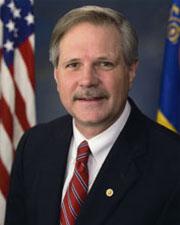 Sen. John Hoeven (R-ND)
Sen. John Hoeven (R-ND)Submitted May 24, 2016
Legislative Activity
Stay on top of the latest movement without scrolling through every action
Floor
Latest Action
Senate amendment submitted
May 24, 2016
View full timeline
Floor
Senate amendment submitted
May 24, 2016
Floor
Senate amendment submitted
May 24, 2016
Text
Submitted
SA 4135. Mr. HOEVEN submitted an amendment intended to be proposed by
him to the bill S. 2943, to authorize appropriations for fiscal year
2017 for military activities of the Department of Defense, for military
construction, and for defense activities of the Department of Energy,
to prescribe military personnel strengths for such fiscal year, and for
other purposes; which was ordered to lie on the table; as follows:

At the end of subtitle I of title X, add the following:

SEC. 1097. REPORT ON THE INTEGRATION OF DEPARTMENT OF DEFENSE
UNMANNED AIRCRAFT INTO THE NATIONAL AIRSPACE
SYSTEM.

(a) In General.--Not later than 180 days after the date of
the enactment of this Act, the Secretary of Defense, in
coordination with the Administrator of the Federal Aviation
Administration, shall submit to Congress a report on how the
Department of Defense will ensure the safe integration of its
unmanned aircraft with any civilian unmanned aircraft system
traffic management system that may be part of the national
airspace system after such date of enactment.
(b) Elements.--The report required by subsection (a) shall
include the following:
(1) An assessment of--
(A) the potential for civilian unmanned aircraft traffic
below 400 feet above sea level to affect the safety of
military training routes, special use airspace, and airport
terminal operating areas;
(B) the potential for civilian unmanned aircraft traffic
above 400 feet above sea level, whether operating legally or
illegally, to affect military training routes and special use
airspace; and
(C) the technology the Department of Defense employs to
provide unmanned aircraft operators with airspace situational
awareness and the degree to which that technology could
enable the Department of Defense to comply with current and
expected future safety requirements in the United States
national airspace system.
(2) A description of--
(A) the cases in which unmanned aircraft of the Department
of Defense may need to be interoperable with any civilian
unmanned aircraft system traffic management system that may
be part of the national airspace system after the date of the
enactment of this Act; and
(B) the efforts of the Department of Defense efforts to
coordinate with the Federal Aviation Administration and the
National Aeronautics and Space Administration on--
(i) research, development, testing, and evaluation of
concepts, technologies, and systems required to ensure that
unmanned aircraft systems of the Department of Defense meet
civilian technical and safety standards; and
(ii) the development of technology and standards for any
civilian unmanned aircraft system traffic management system
that may be part of the national airspace system after such
date of enactment.
(3) A strategy for ensuring that the unmanned aircraft of
the Department of Defense are interoperable with any civilian
unmanned aircraft system traffic management system that may
be part of the national airspace system after such date of
enactment.
(c) Definitions.--In this section, the terms ``unmanned
aircraft'' and ``unmanned aircraft system'' have the meanings
given those terms in section 331 of the FAA Modernization and
Reform Act of 2012 (Public Law 112-95; 49 U.S.C. 40101 note).
______