Amendment sought to assert the Government Accountability Office's investigatory powers over the intelligence community and require the Director of National Intelligence to ensure that GAO personnel are provided with access to certrain information in possession by the intelligence community.
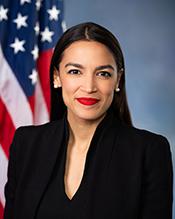 Rep. Alexandria Ocasio-Cortez (D-NY)
Description
An amendment numbered 25 printed in Part B of House Report 117-205 to assert the Government Accountability Office's investigatory powers over the intelligence community. Requires the Director of National Intelligence to ensure that GAO personnel are provided with access to information in possession by the intelligence community that the Comptroller General determines necessary for analysis, evaluation, or investigation requested by the relevant committee of Congress.
Legislative Activity
Stay on top of the latest movement without scrolling through every action
Roll call votes on amendments in House
December 9, 2021 • 3:46 PM
View full timeline
Roll call votes on amendments in House
December 9, 2021 • 3:46 PM
House amendment offered
December 9, 2021
Amendment failed by House: On agreeing to the Ocasio-Cortez amendment (A004) Failed by the Yeas and Nays: 196 - 233 (Roll no. 438).
December 9, 2021 • 3:46 PM
House amendment not agreed to: On agreeing to the Ocasio-Cortez amendment (A004) Failed by the Yeas and Nays: 196 - 233 (Roll no. 438).
December 9, 2021 • 3:46 PM
House amendment offered/reported by: Amendment (A004) offered by Ms. Ocasio-Cortez.(consideration: CR H7611-7613, H7615; text: CR H7612)
December 9, 2021 • 2:30 PM
Amendment (A004) offered by Ms. Ocasio-Cortez. (consideration: CR H7611-7613, H7615; text: CR H7612)
December 9, 2021 • 2:30 PM
The previous question was ordered on the amendment (A004) pursuant to the rule.
December 9, 2021 • 2:41 PM
On agreeing to the Ocasio-Cortez amendment (A004) Failed by the Yeas and Nays: 196 - 233 (Roll no. 438).
December 9, 2021 • 3:46 PM
Votes
1 roll call on this amendment
Text
Offered
{time}  1230
PROTECTING OUR DEMOCRACY ACT

Mrs. CAROLYN B. MALONEY of New York. Madam Speaker, pursuant to House
Resolution 838, I call up the bill

[[Page H7563]]

(H.R. 5314) to protect our democracy by preventing abuses of
presidential power, restoring checks and balances and accountability
and transparency in government, and defending elections against foreign
interference, and for other purposes, and ask for its immediate
consideration.
The Clerk read the title of the bill.
The SPEAKER pro tempore (Ms. Stansbury). Pursuant to House Resolution
838, an amendment in the nature of a substitute consisting of the text
of Rules Committee Print 117-20, modified by the amendment printed in
part A of House Report 117-205, is adopted and the bill, as amended, is
considered read.
The text of the bill, as amended, is as follows:

H.R. 5314

Be it enacted by the Senate and House of Representatives of
the United States of America in Congress assembled,

SECTION 1. SHORT TITLE.

This Act may be cited as the ``Protecting Our Democracy
Act''.

SEC. 2. ORGANIZATION OF ACT INTO DIVISIONS; TABLE OF
CONTENTS.

(a) Divisions.--This Act is organized into divisions as
follows:
(1) Division A--Preventing Abuses of Presidential Power.
(2) Division B--Restoring Checks and Balances,
Accountability, and Transparency.
(3) Division C--Defending Elections Against Foreign
Interference.
(4) Division D--Severability.
(b) Table of Contents.--The table of contents of this Act
is as follows:

Sec. 1. Short title.
Sec. 2. Organization of Act into divisions; table of contents.

DIVISION A--PREVENTING ABUSES OF PRESIDENTIAL POWER

TITLE I--ABUSE OF THE PARDON POWER PREVENTION

Sec. 101. Short title.
Sec. 102. Congressional oversight relating to certain pardons.
Sec. 103. Bribery in connection with pardons and commutations.
Sec. 104. Prohibition on presidential self-pardon.

TITLE II--ENSURING NO PRESIDENT IS ABOVE THE LAW

Sec. 201. Short title.
Sec. 202. Tolling of statute of limitations.

TITLE III--ENFORCEMENT OF THE FOREIGN AND DOMESTIC EMOLUMENTS CLAUSES
OF THE CONSTITUTION

Sec. 301. Short title.
Sec. 302. Definitions.
Sec. 303. Prohibition on acceptance of foreign and domestic emoluments.
Sec. 304. Civil actions by Congress concerning foreign emoluments.
Sec. 305. Disclosures concerning foreign and domestic emoluments.
Sec. 306. Enforcement authority of the Director of the Office of
Government Ethics.
Sec. 307. Jurisdiction of the Office of Special Counsel.

DIVISION B--RESTORING CHECKS AND BALANCES, ACCOUNTABILITY, AND
TRANSPARENCY

TITLE IV--ENFORCEMENT OF CONGRESSIONAL SUBPOENAS

Sec. 401. Short title.
Sec. 402. Findings.
Sec. 403. Enforcement of congressional subpoenas.
Sec. 404. Compliance with congressional subpoenas.
Sec. 405. Rule of construction.

TITLE V--REASSERTING CONGRESSIONAL POWER OF THE PURSE

Sec. 500. Short title.

Subtitle A--Strengthening Congressional Control and Review To Prevent
Impoundment

Sec. 501. Strengthening congressional control.
Sec. 502. Strengthening congressional review.
Sec. 503. Updated authorities for and reporting by the Comptroller
General.
Sec. 504. Advance congressional notification and litigation.
Sec. 505. Penalties for failure to comply with the Impoundment Control
Act of 1974.

Subtitle B--Strengthening Transparency and Reporting

Part 1--Funds Management and Reporting to the Congress

Sec. 511. Expired balance reporting in the President's budget.
Sec. 512. Cancelled balance reporting in the President's budget.
Sec. 513. Lapse in appropriations--Reporting in the President's budget.
Sec. 514. Transfer and other repurposing authority reporting in the
President's budget.
Sec. 515. Authorizing cancellations in indefinite accounts by
appropriation.

Part 2--Empowering Congressional Review Through Nonpartisan
Congressional Agencies and Transparency Initiatives

Sec. 521. Requirement to respond to requests for information from the
Comptroller General for budget and appropriations law
decisions.
Sec. 522. Reporting requirements for Antideficiency Act violations.
Sec. 523. Department of Justice reporting to Congress for
Antideficiency Act violations.
Sec. 524. Publication of budget or appropriations law opinions of the
Department of Justice Office of Legal Counsel.

Subtitle C--Strengthening Congressional Role in and Oversight of
Emergency Declarations and Designations

Sec. 531. Improving checks and balances on the use of the National
Emergencies Act.
Sec. 532. National Emergencies Act declaration spending reporting in
the President's budget.
Sec. 533. Disclosure to Congress of presidential emergency action
documents.
Sec. 534. Congressional Designations.

TITLE VI--SECURITY FROM POLITICAL INTERFERENCE IN JUSTICE

Sec. 601. Short title.
Sec. 602. Definitions.
Sec. 603. Communications logs.
Sec. 604. Rule of construction.

TITLE VII--PROTECTING INSPECTOR GENERAL INDEPENDENCE

Subtitle A--Requiring Cause for Removal

Sec. 701. Short title.
Sec. 702. Amendment.
Sec. 703. Removal or transfer requirements.

Subtitle B--Inspectors General of Intelligence Community

Sec. 711. Independence of Inspectors General of the Intelligence
Community.
Sec. 712. Authority of Inspectors General of the Intelligence Community
to determine matters of urgent concern.
Sec. 713. Conforming amendments and coordination with other provisions
of law.

Subtitle C--Congressional Notification

Sec. 721. Short title.
Sec. 722. Change in status of Inspector General offices.
Sec. 723. Presidential explanation of failure to nominate an Inspector
General.

TITLE VIII--PROTECTING WHISTLEBLOWERS

Subtitle A--Whistleblower Protection Improvement

Sec. 801. Short title.
Sec. 802. Additional whistleblower protections.
Sec. 803. Enhancement of whistleblower protections.
Sec. 804. Classifying certain furloughs as adverse personnel actions.
Sec. 805. Codification of protections for disclosures of censorship
related to research, analysis, or technical information.
Sec. 806. Title 5 technical and conforming amendments.

Subtitle B--Whistleblowers of the Intelligence Community

Sec. 811. Limitation on sharing of intelligence community whistleblower
complaints with persons named in such complaints.
Sec. 812. Disclosures to Congress.
Sec. 813. Prohibition against disclosure of whistleblower identity as
reprisal against whistleblower disclosure by employees
and contractors in intelligence community.

TITLE IX--ACCOUNTABILITY FOR ACTING OFFICIALS

Sec. 901. Short title.
Sec. 902. Clarification of Federal Vacancies Reform Act of 1998.

TITLE X--STRENGTHENING HATCH ACT ENFORCEMENT AND PENALTIES

Sec. 1001. Short title.
Sec. 1002. Strengthening Hatch Act enforcement and penalties against
political appointees.

TITLE XI--PROMOTING EFFICIENT PRESIDENTIAL TRANSITIONS

Sec. 1101. Short title.
Sec. 1102. Ascertainment of successful candidates in general elections
for purposes of presidential transition.

TITLE XII--PRESIDENTIAL AND VICE PRESIDENTIAL TAX TRANSPARENCY

Sec. 1201. Presidential and Vice Presidential tax transparency.

DIVISION C--DEFENDING ELECTIONS AGAINST FOREIGN INTERFERENCE

TITLE XIII--REPORTING FOREIGN INTERFERENCE IN ELECTIONS

Sec. 1301. Federal campaign reporting of foreign contacts.
Sec. 1302. Federal campaign foreign contact reporting compliance
system.
Sec. 1303. Criminal penalties.
Sec. 1304. Report to congressional intelligence committees.
Sec. 1305. Rule of construction.

TITLE XIV--ELIMINATING FOREIGN INTERFERENCE IN ELECTIONS

Sec. 1401. Clarification of application of foreign money ban.
Sec. 1402. Requiring acknowledgment of foreign money ban by political
committees.
Sec. 1403.  Prohibition on contributions and donations by foreign
nationals in connections with ballot initiatives and
referenda.

[[Page H7564]]

DIVISION D--SEVERABILITY

TITLE XV--SEVERABILITY

Sec. 1501. Severability.

DIVISION A--PREVENTING ABUSES OF PRESIDENTIAL POWER

TITLE I--ABUSE OF THE PARDON POWER PREVENTION

SEC. 101. SHORT TITLE.

This title may be cited as the ``Abuse of the Pardon Power
Prevention Act''.

SEC. 102. CONGRESSIONAL OVERSIGHT RELATING TO CERTAIN
PARDONS.

(a) Submission of Information.--In the event that the
President grants an individual a pardon for a covered
offense, not later than 30 days after the date of such pardon
the Attorney General shall submit to the chairmen and ranking
minority members of the appropriate congressional
committees--
(1) all materials obtained or produced by the prosecution
team, including the Attorney General and any United States
Attorney, and all materials obtained or prepared by any
investigative agency of the United States government,
relating to the offense for which the individual was so
pardoned; and
(2) all materials obtained or produced by the Department of
Justice in relation to the pardon.
(b) Treatment of Information.--Rule 6(e) of the Federal
Rules of Criminal Procedure may not be construed to prohibit
the disclosure of information required by subsection (a) of
this section.
(c) Definitions.--In this section:
(1) The term ``appropriate congressional committees''
means--
(A) the Committee on the Judiciary of the House of
Representatives and the Committee on the Judiciary of the
Senate; and
(B) if an investigation relates to intelligence or
counterintelligence matters, the Permanent Select Committee
on Intelligence of the House of Representatives and the
Select Committee on Intelligence of the Senate.
(2) The term ``covered offense'' means--
(A) an offense against the United States that arises from
an investigation in which the President, or a relative of the
President, is a target or subject;
(B) an offense under section 192 of title 2, United States
Code; or
(C) an offense under section 1001, 1505, 1512, or 1621 of
title 18, United States Code, provided that the offense
occurred in relation to a Congressional proceeding or
investigation.
(3) The term ``pardon'' includes a commutation of sentence.
(4) The term ``relative'' has the meaning given that term
in section 3110(a) of title 5, United States Code.

SEC. 103. BRIBERY IN CONNECTION WITH PARDONS AND
COMMUTATIONS.

Section 201 of title 18, United States Code, is amended--
(1) in subsection (a)--
(A) in paragraph (1), by inserting ``, including the
President and the Vice President of the United States,''
after ``or an officer or employee or person''; and
(B) in paragraph (3), by inserting before the period at the
end the following: ``, including any pardon, commutation, or
reprieve, or an offer of any such pardon, commutation, or
reprieve''; and
(2) in subsection (b)(3), by inserting ``(including, for
purposes of this paragraph, any pardon, commutation, or
reprieve, or an offer of any such pardon, commutation, or
reprieve)'' after ``corruptly gives, offers, or promises
anything of value''.

SEC. 104. PROHIBITION ON PRESIDENTIAL SELF-PARDON.

The President's grant of a pardon to himself or herself is
void and of no effect, and shall not deprive the courts of
jurisdiction, or operate to confer on the President any legal
immunity from investigation or prosecution.

TITLE II--ENSURING NO PRESIDENT IS ABOVE THE LAW

SEC. 201. SHORT TITLE.

This title may be cited as the ``No President is Above the
Law Act''.

SEC. 202. TOLLING OF STATUTE OF LIMITATIONS.

(a) Offenses Committed by the President or Vice President
During or Prior to Tenure in Office.--Section 3282 of title
18, United States Code, is amended by adding at the end the
following:
``(c) Offenses Committed by the President or Vice President
During or Prior to Tenure in Office.--In the case of any
person serving as President or Vice President of the United
States, the duration of that person's tenure in office shall
not be considered for purposes of any statute of limitations
applicable to any Federal criminal offense committed by that
person (including any offenses committed during any period of
time preceding such tenure in office).''.
(b) Applicability.--The amendments made by subsection (a)
shall apply to any offense committed before the date of the
enactment of this section, if the statute of limitations
applicable to that offense had not run as of such date.
(c) Rule of Construction.--Nothing in this section may be
construed to preclude the indictment or prosecution of a
President or Vice President, during that President or Vice
President's tenure in office, for violations of the criminal
laws of the United States.

TITLE III--ENFORCEMENT OF THE FOREIGN AND DOMESTIC EMOLUMENTS CLAUSES
OF THE CONSTITUTION

SEC. 301. SHORT TITLE.

This title may be cited as the ``Foreign and Domestic
Emoluments Enforcement Act''.

SEC. 302. DEFINITIONS.

In this title:
(1) The term ``emolument'' means any profit, gain, or
advantage that is received directly or indirectly from any
government of a foreign country, the Federal government, or
any State or local government, or from any instrumentality
thereof, including payments arising from commercial
transactions at fair market value.
(2) The term ``person holding any office of profit or trust
under the United States'' includes the President of the
United States and the Vice-President of the United States.
(3) The term ``government of a foreign country'' has the
meaning given such term in section 1(e) of the Foreign Agents
Registration Act (22 U.S.C. 611(e)).

SEC. 303. PROHIBITION ON ACCEPTANCE OF FOREIGN AND DOMESTIC
EMOLUMENTS.

(a) Foreign.--Except as otherwise provided in section 7342
of title 5, United States Code, it shall be unlawful for any
person holding an office of profit or trust under the United
States to accept from a government of a foreign country,
without first obtaining the consent of Congress, any present
or emolument, or any office or title. The prohibition under
this subsection applies without regard to whether the
present, emolument, office, or title is--
(1) provided directly or indirectly by that government of a
foreign country; or
(2) provided to that person or to any private business
interest of that person.
(b) Domestic.--It shall be unlawful for the President to
accept from the United States, or any of them, any emolument
other than the compensation for his or her services as
President provided for by Federal law. The prohibition under
this subsection applies without regard to whether the
emolument is provided directly or indirectly, and without
regard to whether the emolument is provided to the President
or to any private business interest of the President.

SEC. 304. CIVIL ACTIONS BY CONGRESS CONCERNING FOREIGN
EMOLUMENTS.

(a) Cause of Action.--The House of Representatives or the
Senate may bring a civil action against any person for a
violation of subsection (a) of section 303.
(b) Special Rules.--In any civil action described in
subsection (a), the following rules shall apply:
(1) The action shall be filed before the United States
District Court for the District of Columbia.
(2) The action shall be heard by a three-judge court
convened pursuant to section 2284 of title 28, United States
Code. It shall be the duty of such court to advance on the
docket and to expedite to the greatest possible extent the
disposition of any such action. Such action shall be
reviewable only by appeal directly to the Supreme Court of
the United States. Such appeal shall be taken by the filing
of a notice of appeal within 10 days, and the filing of a
jurisdictional statement within 30 days, of the entry of the
final decision.
(3) It shall be the duty of the Supreme Court of the United
States to advance on the docket and to expedite to the
greatest possible extent the disposition of any such action
and appeal.
(c) Remedy.--If the court determines that a violation of
subsection (a) of section 303 has occurred, the court shall
issue an order enjoining the course of conduct found to
constitute the violation, and such of the following as are
appropriate:
(1) The disgorgement of the value of any foreign present or
emolument.
(2) The surrender of the physical present or emolument to
the Department of State, which shall, if practicable, dispose
of the present or emolument and deposit the proceeds into the
United States Treasury.
(3) The renunciation of any office or title accepted in
violation of such subsection.
(4) A prohibition on the use or holding of such an office
or title.
(5) Such other relief as the court determines appropriate.
(d) Use of Government Funds Prohibited.--No appropriated
funds, funds provided from any accounts in the United States
Treasury, funds derived from the collection of fees, or any
other Government funds shall be used to pay any disgorgement
imposed by the court pursuant to this section.

SEC. 305. DISCLOSURES CONCERNING FOREIGN AND DOMESTIC
EMOLUMENTS.

(a) Disclosures.--Section 102(a) of the Ethics in
Government Act of 1978 (5 U.S.C. App.) is amended by adding
at the end the following:
``(9) Any present, emolument, office, or title received
from a government of a foreign country, including the source,
date, type, and amount or value of each present or emolument
accepted on or before the date of filing during the preceding
calendar year.
``(10) Each business interest that is reasonably expected
to result in the receipt of any present or emolument from a
government of a foreign country during the current calendar
year.
``(11) In addition, the President shall report--
``(A) any emolument received from the United States, or any
of them, other than the compensation for his or her services
as President provided for by Federal law; and
``(B) any business interest that is reasonably expected to
result in the receipt of any emolument from the United
States, or any of them.''.

[[Page H7565]]

(b) Rule of Construction.--Nothing in the amendments made
by this section shall be construed to affect the prohibition
against the acceptance of presents and emoluments under
section 303.

SEC. 306. ENFORCEMENT AUTHORITY OF THE DIRECTOR OF THE OFFICE
OF GOVERNMENT ETHICS.

(a) General Authority.--Section 402(a) of the Ethics in
Government Act of 1978 (5 U.S.C. App.) is amended--
(1) by striking ``(a) The Director'' and inserting ``(a)(1)
The Director''; and
(2) by adding at the end the following new paragraph:
``(2) The Director shall provide overall direction of
executive branch policies related to compliance with the
Foreign and Domestic Emoluments Enforcement Act and the
amendments made by such Act and shall have the authority to--
``(A) issue administrative fines to individuals for
violations;
``(B) order individuals to take corrective action,
including disgorgement, divestiture, and recusal, as the
Director deems necessary; and
``(C) bring civil actions to enforce such fines and
orders.''.
(b) Specific Authorities.--Section 402(b) of such Act (5
U.S.C. App.) is amended--
(1) by striking ``and'' at the end of paragraph (14);
(2) by striking the period at the end of paragraph (15) and
inserting ``; and''; and
(3) by adding at the end the following new paragraph:
``(16) developing and promulgating rules and regulations to
ensure compliance with the Foreign and Domestic Emoluments
Enforcement Act and the amendments made by such Act,
including establishing--
``(A) requirements for reporting and disclosure;
``(B) a schedule of administrative fines that may be
imposed by the Director for violations; and
``(C) a process for referral of matters to the Office of
Special Counsel for investigation in compliance with section
1216(d) of title 5, United States Code.''.

SEC. 307. JURISDICTION OF THE OFFICE OF SPECIAL COUNSEL.

Section 1216 of title 5, United States Code, is amended--
(1) in subsection (a)--
(A) in paragraph (4), by striking ``and'' at the end;
(B) in paragraph (5) by striking the period and inserting
``; and''; and
(C) by adding at the end the following:
``(6) any violation of section 303 of the Foreign and
Domestic Emoluments Enforcement Act or of the amendments made
by section 305 of such Act.''; and
(2) by adding at the end the following:
``(d) If the Director of the Office of Government Ethics
refers a matter for investigation pursuant to section 402 of
the Ethics in Government Act of 1978, or if the Special
Counsel receives a credible complaint of a violation referred
to in subsection (a)(6), the Special Counsel shall complete
an investigation not later than 120 days thereafter. If the
Special Counsel investigates any violation pursuant to
subsection (a)(6), the Special Counsel shall report not later
than 7 days after the completion of such investigation to the
Director of the Office of Government Ethics and to Congress
on the results of such investigation.''.

DIVISION B--RESTORING CHECKS AND BALANCES, ACCOUNTABILITY, AND
TRANSPARENCY

TITLE IV--ENFORCEMENT OF CONGRESSIONAL SUBPOENAS

SEC. 401. SHORT TITLE.

This title may be cited as the ``Congressional Subpoena
Compliance and Enforcement Act''.

SEC. 402. FINDINGS.

The Congress finds as follows:
(1) As the Supreme Court has repeatedly affirmed, including
in its July 9, 2020 holding in Trump v. Mazars, Congress's
``power of inquiry--with process to enforce it--is an
essential and appropriate auxiliary to the legislative
function''. Congress's power to obtain information, including
through the issuance of subpoenas and the enforcement of such
subpoenas, is ``broad and indispensable''.
(2) Congress ``suffers a concrete and particularized injury
when denied the opportunity to obtain information necessary''
to the exercise of its constitutional functions, as the U.S.
Court of Appeals for the District of Columbia Circuit
correctly recognized in its August 7, 2020 en banc decision
in Committee on the Judiciary of the U.S. House of
Representatives v. McGahn.
(3) Accordingly, the Constitution secures to each House of
Congress an inherent right to enforce its subpoenas in court.
Explicit statutory authorization is not required to secure
such a right of action, and the contrary holding by a divided
panel of the U.S. Court of Appeals for the District of
Columbia Circuit in McGahn, entered on August 31, 2020, was
in error.

SEC. 403. ENFORCEMENT OF CONGRESSIONAL SUBPOENAS.

(a) In General.--Chapter 85 of title 28, United States
Code, is amended by inserting after section 1365 the
following:

``Sec. 1365a. Congressional actions against subpoena
recipients

``(a) Cause of Action.--The United States House of
Representatives, the United States Senate, or a committee or
subcommittee thereof, may bring a civil action against the
recipient of a subpoena issued by a congressional committee
or subcommittee to enforce compliance with the subpoena.
``(b) Special Rules.--In any civil action described in
subsection (a), the following rules shall apply:
``(1) The action may be filed in a United States district
court of competent jurisdiction.
``(2) Notwithstanding section 1657(a), it shall be the duty
of every court of the United States to expedite to the
greatest possible extent the disposition of any such action
and appeal. Upon a showing by the plaintiff of undue delay,
other irreparable harm, or good cause, a court to which an
appeal of the action may be taken shall issue any necessary
and appropriate writs and orders to ensure compliance with
this paragraph.
``(3) If a three-judge court is expressly requested by the
plaintiff in the initial pleading, the action shall be heard
by a three-judge court convened pursuant to section 2284, and
shall be reviewable only by appeal directly to the Supreme
Court of the United States. Such appeal shall be taken by the
filing of a notice of appeal within 10 days, and the filing
of a jurisdictional statement within 30 days, of the entry of
the final decision.
``(4) The initial pleading must be accompanied by
certification that the party bringing the action has in good
faith conferred or attempted to confer with the recipient of
the subpoena to secure compliance with the subpoena without
court action.
``(c) Penalties.--
``(1) Cases involving government agencies.--
``(A) In general.--The court may impose monetary penalties
directly against each head of a Government agency and the
head of each component thereof held to have knowingly failed
to comply with any part of a congressional subpoena, unless--
``(i) the President instructed the official not to comply;
and
``(ii) the President, or the head of the agency or
component thereof, submits to the court a letter confirming
such instruction and the basis for such instruction.
``(B) Prohibition on use of government funds.--No
appropriated funds, funds provided from any accounts in the
Treasury, funds derived from the collection of fees, or other
Government funds shall be used to pay any monetary penalty
imposed by the court pursuant to this paragraph.
``(2) Legal fees.--In addition to any other penalties or
sanctions, the court shall require that any defendant, other
than a Government agency, held to have willfully failed to
comply with any part of a congressional subpoena, pay a
penalty in an amount equal to that party's legal fees,
including attorney's fees, litigation expenses, and other
costs. If such defendant is an officer or employee of a
Government agency, such fees may be paid from funds
appropriated to pay the salary of the defendant.
``(d) Waiver.--Any ground for noncompliance asserted by the
recipient of a congressional subpoena shall be deemed to have
been waived as to any particular information withheld from
production if the court finds that the recipient failed in a
timely manner to comply with the applicable requirements of
section 105(b) of the Revised Statutes of the United States
with respect to such information.
``(e) Rules of Procedure.--The Supreme Court and the
Judicial Conference of the United States shall prescribe
rules of procedure to ensure the expeditious treatment of
actions described in subsection (a). Such rules shall be
prescribed and submitted to the Congress pursuant to sections
2072, 2073, and 2074. This shall include procedures for
expeditiously considering any assertion of constitutional or
Federal statutory privilege made in connection with testimony
by any recipient of a subpoena from a congressional committee
or subcommittee. The Supreme Court shall transmit such rules
to Congress within 6 months after the effective date of this
section and then pursuant to section 2074 thereafter.
``(f) Definition.--For purposes of this section, the term
`Government agency' means any office or entity described in
section 105 and 106 of title 3, an executive department
listed in section 101 of title 5, an independent
establishment, commission, board, bureau, division, or office
in the executive branch, or other agency or instrumentality
of the Federal Government, including wholly or partly owned
Government corporations.''.
(b) Clerical Amendment.--The table of sections for chapter
85 of title 28, United States Code, is amended by inserting
after the item relating to section 1365 the following:

``1365a. Congressional actions against subpoena recipients.''.

SEC. 404. COMPLIANCE WITH CONGRESSIONAL SUBPOENAS.

(a) In General.--Chapter 7 of title II of the Revised
Statutes of the United States (2 U.S.C. 191 et seq.) is
amended--
(1) by adding at the end the following:

``SEC. 105. RESPONSE TO CONGRESSIONAL SUBPOENAS.

``(a) Subpoena by Congressional Committee.--Any recipient
of any subpoena from

[[Page H7566]]

a congressional committee or subcommittee shall appear and
testify, produce, or otherwise disclose information in a
manner consistent with the subpoena and this section.
``(b) Failure to Produce Information.--
``(1) Grounds for withholding information.--Unless required
by the Constitution or by Federal statute, no claim of
privilege or protection from disclosure shall be a ground for
withholding information responsive to the subpoena or
required by this section.
``(2) Identification of information withheld.--In the case
of information that is withheld, in whole or in part, by the
subpoena recipient, the subpoena recipient shall, without
delay provide a log containing the following:
``(A) An express assertion and description of the ground
asserted for withholding the information.
``(B) The type of information.
``(C) The general subject matter.
``(D) The date, author, and addressee.
``(E) The relationship of the author and addressee to each
other.
``(F) The custodian of the information.
``(G) Any other descriptive information that may be
produced or disclosed regarding the information that will
enable the congressional committee or subcommittee issuing
the subpoena to assess the ground asserted for withholding
the information.
``(c) Definition.--For purposes of this section the term
`information' includes any books, papers, documents, data, or
other objects requested in a subpoena issued by a
congressional committee or subcommittee.''.
(b) Clerical Amendment.--The table of contents for chapter
7 of title II of the Revised Statutes of the United States is
amended by adding at the end the following:

``105. Response to congressional subpoenas.''.

SEC. 405. RULE OF CONSTRUCTION.

Nothing in this title may be interpreted to limit or
constrain Congress' inherent authority or foreclose any other
means for enforcing compliance with congressional subpoenas,
nor may anything in this title be interpreted to establish or
recognize any ground for noncompliance with a congressional
subpoena.

TITLE V--REASSERTING CONGRESSIONAL POWER OF THE PURSE

SEC. 500. SHORT TITLE.

This title may be cited as the ``Congressional Power of the
Purse Act''.

Subtitle A--Strengthening Congressional Control and Review To Prevent
Impoundment

SEC. 501. STRENGTHENING CONGRESSIONAL CONTROL.

(a) In General.--The Impoundment Control Act of 1974 (2
U.S.C. 681 et seq.) is amended by adding at the end the
following:

``prudent obligation of budget authority and specific requirements for
expiring budget authority

``Sec. 1018.  (a) Special Message Requirement.--With
respect to budget authority proposed to be rescinded or that
is set to be reserved or proposed to be deferred in a special
message transmitted under section 1012 or 1013, such budget
authority--
``(1) shall be made available for obligation in sufficient
time to be prudently obligated as required under section
1012(b) or 1013; and
``(2) may not be deferred or otherwise withheld from
obligation during the 90-day period before the expiration of
the period of availability of such budget authority,
including, if applicable, the 90-day period before the
expiration of an initial period of availability for which
such budget authority was provided.
``(b) Administrative Requirement.--With respect to an
apportionment of an appropriation (as that term is defined in
section 1511 of title 31, United States Code) made pursuant
to section 1512 of such title, an appropriation shall be
apportioned--
``(1) to make available all amounts for obligation in
sufficient time to be prudently obligated; and
``(2) to make available all amounts for obligation, without
precondition (including footnotes) that shall be met prior to
obligation, not later than 90 days before the expiration of
the period of availability of such appropriation, including,
if applicable, 90 days before the expiration of an initial
period of availability for which such appropriation was
provided.''.
(b) Clerical Amendment.--The table of contents of the
Congressional Budget and Impoundment Control Act of 1974 set
forth in section 1(b) of such Act is amended by adding after
the item relating to section 1017 the following:

``1018. Prudent obligation of budget authority and specific
requirements for expiring budget authority.''.

SEC. 502. STRENGTHENING CONGRESSIONAL REVIEW.

(a) In General.--The Impoundment Control Act of 1974 (2
U.S.C. 681 et seq.), as amended by section 501(a), is further
amended by adding at the end the following:

``reporting

``Sec. 1019.  (a) Apportionment of Appropriations.--
``(1) In general.--Not later than 90 days after the date of
enactment of this section, the Office of Management and
Budget shall complete implementation of an automated system
to post each document apportioning an appropriation, pursuant
to section 1513(b) of title 31, United States Code, including
any associated footnotes, in a format that qualifies each
such document as an Open Government Data Asset (as defined in
section 3502 of title 44, United States Code), not later than
2 business days after the date of approval of such
apportionment, and shall place on such website each document
apportioning an appropriation, pursuant to such section
1513(b), including any associated footnotes, already approved
for the fiscal year, and shall report the date of completion
of such requirements to the Committees on the Budget and
Appropriations of the House of Representatives and Senate.
``(2) Explanatory statement.--Each document apportioning an
appropriation posted on a publicly accessible website under
paragraph (1) shall also include a written explanation by the
official approving each such apportionment (pursuant to
section 1513(b) of title 31, United States Code) of the
rationale for the apportionment schedule and for any
footnotes for apportioned amounts.
``(3) Special process for transmitting classified
documentation to the congress.--The Office of Management and
Budget or the applicable department or agency shall make
available classified documentation referenced in any
apportionment at the request of the chair or ranking member
of any appropriate congressional committee or subcommittee.
``(4) Department and agency report.--Each department or
agency shall notify the Committees on the Budget and
Appropriations of the House of Representatives and the Senate
and any other appropriate congressional committees if--
``(A) an apportionment is not made in the required time
period provided in section 1513(b) of title 31, United States
Code;
``(B) an approved apportionment received by the department
or agency conditions the availability of an appropriation on
further action; or
``(C) an approved apportionment received by the department
or agency may hinder the prudent obligation of such
appropriation or the execution of a program, project, or
activity by such department or agency;
and such notification shall contain information identifying
the bureau, account name, appropriation name, and Treasury
Appropriation Fund Symbol or fund account.
``(b) Approving Officials.--
``(1) Delegation of authority.--Not later than 15 days
after the date of enactment of this section, any delegation
of apportionment authority pursuant to section 1513(b) of
title 31, United States Code that is in effect as of such
date shall be submitted for publication in the Federal
Register. Any delegation of such apportionment authority
after the date of enactment of this section shall, on the
date of such delegation, be submitted for publication in the
Federal Register. The Office of Management and Budget shall
publish such delegations in a format that qualifies such
publications as an Open Government Data Asset (as defined in
section 3502 of title 44, United States Code) on a public
internet website, which shall be continuously updated with
the position of each Federal officer or employee to whom
apportionment authority has been delegated.
``(2) Report to congress.--Not later than 5 days after any
change in the position of the approving official with respect
to such delegated apportionment authority for any account is
made, the Office shall submit a report to the Committees on
Appropriations of the House of Representatives and the
Senate, the Committees on the Budget of the House of
Representatives and the Senate, and any other appropriate
congressional committee explaining why such change was
made.''.
(b) Clerical Amendment.--The table of contents of the
Congressional Budget and Impoundment Control Act of 1974 set
forth in section 1(b) of such Act, as amended by section
501(b), is further amended by adding after the item relating
to section 1018 the following:

``1019. Reporting.''.

SEC. 503. UPDATED AUTHORITIES FOR AND REPORTING BY THE
COMPTROLLER GENERAL.

(a) Section 1015 of the Impoundment Control Act of 1974 (2
U.S.C. 686) is amended--
(1) in subsection (a), in the matter following paragraph
(2), by striking the last sentence; and
(2) by adding at the end the following:
``(c) Review.--
``(1) In general.--The Comptroller General shall review
compliance with this part and shall submit to the Committees
on the Budget, Appropriations, and Oversight and Reform of
the House of Representatives, the Committees on the Budget,
Appropriations, and Homeland Security and Governmental
Affairs of the Senate, and any other appropriate
congressional committee of the House of Representatives and
Senate a report, and any relevant information related to the
report, on any noncompliance with this part.
``(2) Information, documentation, and views.--The President
or the head of the relevant department or agency of the
United States shall provide information, documentation, and
views to the Comptroller General, as is determined by the
Comptroller General to be necessary to determine such
compliance, not later than 20 days after the date on which
the request from the Comptroller General is received, or if
the Comptroller General determines that a shorter or longer
period is appropriate based on the specific circumstances,
within such shorter or longer period.
``(3) Access.--To carry out the responsibilities of this
part, the Comptroller General shall also have access to
interview the officers, employees, contractors, and other

[[Page H7567]]

agents and representatives of a department, agency, or office
of the United States at any reasonable time as the
Comptroller General may request.''.
(b) Section 1001 of the Impoundment Control Act of 1974 (2
U.S.C. 681) is amended--
(1) in paragraph (3), by striking the ``or'' at the end of
the paragraph;
(2) in paragraph (4), by striking the period at the end and
inserting a semicolon; and
(3) by adding at the end the following:
``(5) affecting or limiting in any way the authorities
provided to the Comptroller General under chapter 7 of title
31, United States Code.''.

SEC. 504. ADVANCE CONGRESSIONAL NOTIFICATION AND LITIGATION.

Section 1016 of the Impoundment Control Act of 1974 (2
U.S.C. 687) is amended to read as follows:

``suits by comptroller general

``Sec. 1016.  If, under this chapter, budget authority is
required to be made available for obligation and such budget
authority is not made available for obligation or
information, documentation, views, or access are required to
be produced and such information, documentation, views, or
access are not produced, the Comptroller General is expressly
empowered, through attorneys of the Comptroller General's own
selection, to bring a civil action in the United States
District Court for the District of Columbia to require such
budget authority to be made available for obligation or such
information, documentation, views, or access to be produced,
and such court is expressly empowered to enter in such civil
action, against any department, agency, officer, or employee
of the United States, any decree, judgment, or order which
may be necessary or appropriate to make such budget authority
available for obligation or compel production of such
information, documentation, views, or access. No civil action
shall be brought by the Comptroller General to require budget
authority be made available under this section until the
expiration of 15 calendar days following the date on which an
explanatory statement by the Comptroller General of the
circumstances giving rise to the action contemplated is filed
with the Speaker of the House of Representatives and the
President of the Senate, except that expiration of such
period shall not be required if the Comptroller General finds
(and incorporates the finding in the explanatory statement
filed) that the delay would be contrary to the public
interest.''.

SEC. 505. PENALTIES FOR FAILURE TO COMPLY WITH THE
IMPOUNDMENT CONTROL ACT OF 1974.

(a) In General.--The Impoundment Control Act of 1974 (2
U.S.C. 681 et seq.), as amended by section 502(a), is further
amended by adding at the end the following:

``penalties for failure to comply

``Sec. 1020.  (a) Administrative Discipline.--An officer or
employee of the Executive Branch of the United States
Government violating this part shall be subject to
appropriate administrative discipline including, when
circumstances warrant, suspension from duty without pay or
removal from office.
``(b) Reporting Violations.--
``(1) In general.--In the event of a violation of section
1001, 1012, 1013, or 1018 of this part, or in the case that
the Comptroller General issues a legal decision concluding
that a department, agency, or office of the United States
violated this part, the President or the head of the relevant
department or agency as the case may be, shall report
immediately to Congress all relevant facts and a statement of
actions taken. A copy of each report shall also be
transmitted to the Comptroller General and the relevant
inspector general on the same date the report is transmitted
to the Congress.
``(2) Contents.--Any such report shall include a summary of
the facts pertaining to the violation, the title and Treasury
Appropriation Fund Symbol of the appropriation or fund
account, the amount involved for each violation, the date on
which the violation occurred, the position of any individuals
responsible for the violation, a statement of the
administrative discipline imposed and any further action
taken with respect to any officer or employee involved in the
violation, a statement of any additional action taken to
prevent recurrence of the same type of violation, and any
written response by any officer or employee identified by
position as involved in the violation. In the case that the
Comptroller General issues a legal decision concluding that a
department, agency, or office of the United States violated
this part and the relevant department, agency, or office does
not agree that a violation has occurred, the report provided
to Congress, the Comptroller General, and relevant inspector
general will explain its position.''.
(b) Clerical Amendment.--The table of contents of the
Congressional Budget and Impoundment Control Act of 1974 set
forth in section 1(b) of such Act, as amended by section
502(b), is further amended by adding after the item relating
to section 1019 the following:

``1020. Penalties for failure to comply.''.

Subtitle B--Strengthening Transparency and Reporting

PART 1--FUNDS MANAGEMENT AND REPORTING TO THE CONGRESS

SEC. 511. EXPIRED BALANCE REPORTING IN THE PRESIDENT'S
BUDGET.

Section 1105(a) of title 31, United States Code, is amended
by adding at the end the following:
``(40) for the budgets for each of fiscal years 2023
through 2027, a report on--
``(A) unobligated expired balances as of the beginning of
the current fiscal year and the beginning of each of the
preceding 2 fiscal years by agency and the applicable
Treasury Appropriation Fund Symbol or fund account; and
``(B) an explanation of unobligated expired balances in any
Treasury Appropriation Fund Symbol or fund account that
exceed the lesser of 5 percent of total appropriations made
available for that account or $100,000,000.''.

SEC. 512. CANCELLED BALANCE REPORTING IN THE PRESIDENT'S
BUDGET.

Section 1105(a) of title 31, United States Code, as amended
by section 511, is further amended by adding at the end the
following:
``(41) for the budgets for each of fiscal years 2023
through 2027, a report on--
``(A) cancelled balances (pursuant to section 1552(a)) for
the preceding 3 fiscal years by agency and Treasury
Appropriation Fund Symbol or fund account;
``(B) an explanation of cancelled balances in any Treasury
Appropriation Fund Symbol or fund account that exceed the
lesser of 5 percent of total appropriations made available
for that account or $100,000,000; and
``(C) a tabulation, by Treasury Appropriation Fund Symbol
or fund account and appropriation, of all balances of
appropriations available for an indefinite period in an
appropriation account available for an indefinite period that
do not meet the criteria for closure under section 1555, but
for which either--
``(i) the head of the agency concerned or the President has
determined that the purposes for which the appropriation was
made have been carried out; or
``(ii) no disbursement has been made against the
appropriation--

``(I) in the prior year and the preceding fiscal year; or
``(II) in the prior year and which the budget estimates
zero disbursements in the current year.''.

SEC. 513. LAPSE IN APPROPRIATIONS--REPORTING IN THE
PRESIDENT'S BUDGET.

Section 1105(a) of title 31, United States Code, as amended
by section 512, is further amended by adding at the end the
following:
``(42) a report on--
``(A) any obligation or expenditure made by a department or
agency affected in whole or in part by any lapse in
appropriations of 5 consecutive days or more during the
preceding fiscal year for which amounts were not available;
and
``(B) with respect to any such obligation or expenditure--
``(i) the amount so obligated or expended;
``(ii) the account affected;
``(iii) an explanation of the Antideficiency Act exception
or other legal authority that permitted the department or
agency, as the case may be, to incur such obligation or
expenditure; and
``(iv) an explanation of any change in the application of
any Antideficiency Act exception for a program, project, or
activity from any explanations previously reported on
pursuant to this paragraph.''.

SEC. 514. TRANSFER AND OTHER REPURPOSING AUTHORITY REPORTING
IN THE PRESIDENT'S BUDGET.

Section 1105(a) of title 31, United States Code, as amended
by section 513, is further amended by adding at the end the
following:
``(43) for the budget for fiscal year 2023, a report on--
``(A) any transfer authority or other authority to
repurpose appropriations provided in a law other than an
appropriation act; and
``(B) with respect to any such authority, the citation to
the statute, the list of departments or agencies covered, an
explanation of when such authority may be used, and an
explanation on any use of such authority in the preceding 3
fiscal years.''.

SEC. 515. AUTHORIZING CANCELLATIONS IN INDEFINITE ACCOUNTS BY
APPROPRIATION.

(a) In General.--Subchapter IV of chapter 15 of title 31,
United States Code, is amended by inserting after section
1555 the following:

``SEC. 1555A. CANCELLATION OF APPROPRIATIONS AVAILABLE FOR
INDEFINITE PERIODS WITHIN AN ACCOUNT.

``Any remaining balance (whether obligated or unobligated)
from an appropriation available for an indefinite period in
an appropriation account available for an indefinite period
that does not meet the requirements for closure under section
1555 shall be canceled, and thereafter shall not be available
for obligation or expenditure for any purpose, if--
``(1) the head of the agency concerned or the President
determines that the purposes for which the appropriation was
made have been carried out; and
``(2) no disbursement has been made against the
appropriation for two consecutive fiscal years.''.
(b) Clerical Amendment.--The table of sections for
subchapter IV of chapter 15 of title 31, United States Code,
is amended by inserting after the item relating to section
1555 the following:

``1555a. Cancellation of appropriations available for indefinite
periods within an account.''.

[[Page H7568]]

PART 2--EMPOWERING CONGRESSIONAL REVIEW THROUGH NONPARTISAN
CONGRESSIONAL AGENCIES AND TRANSPARENCY INITIATIVES

SEC. 521. REQUIREMENT TO RESPOND TO REQUESTS FOR INFORMATION
FROM THE COMPTROLLER GENERAL FOR BUDGET AND
APPROPRIATIONS LAW DECISIONS.

(a) In General.--Subchapter II of chapter 7 of title 31,
United States Code, is amended by adding at the end the
following:

``SEC. 722. REQUIREMENT TO RESPOND TO REQUESTS FOR
INFORMATION FROM THE COMPTROLLER GENERAL FOR
BUDGET AND APPROPRIATIONS LAW DECISIONS.

``(a) If an agency receives a written request for
information, documentation, or views from the Comptroller
General relating to a decision or opinion on budget or
appropriations law, the agency shall provide the requested
information, documentation, or views not later than 20 days
after receiving the written request, unless such written
request specifically provides otherwise.
``(b) If an agency fails to provide the requested
information, documentation, or views within the time required
by this section--
``(1) the Comptroller General shall notify, in writing, the
Committee on Oversight and Reform of the House of
Representatives, Committee on Homeland Security and
Governmental Affairs of the Senate, and any other appropriate
congressional committee of such failure; and
``(2) the Comptroller General is hereby expressly
empowered, through attorneys of the Comptroller General's own
selection, to bring a civil action in the United States
District Court for the District of Columbia to require such
information, documentation, or views to be produced, and such
court is expressly empowered to enter in such civil action,
against any department, agency, officer, or employee of the
United States, any decree, judgment, or order which may be
necessary or appropriate to require such production.
``(c) Nothing in this section shall be construed as
affecting or otherwise limiting the authorities provided to
the Comptroller General in section 716 of this title.''.
(b) Clerical Amendment.--The table of sections for
subchapter II of chapter 7 of title 31, United States Code,
is amended by inserting after the item relating to section
721 the following:

``722. Requirement to respond to requests for information from the
Comptroller General for budget and appropriations law
decisions.''.

SEC. 522. REPORTING REQUIREMENTS FOR ANTIDEFICIENCY ACT
VIOLATIONS.

(a) Violations of Section 1341 or 1342.--Section 1351 of
title 31, United States Code, is amended--
(1) by striking ``If'' and inserting ``(a) If'';
(2) by inserting ``or if the Comptroller General determines
that an officer or employee of such entity violated section
1341(a) or 1342,'' before ``the head of the agency'';
(3) by striking ``the Comptroller General'' and inserting
``the Comptroller General and the Attorney General''; and
(4) by adding at the end the following:
``(b) Any such report shall include a statement of the
provision violated, a summary of the facts pertaining to the
violation, the title and Treasury Appropriation Fund Symbol
of the appropriation or fund account, the amount involved for
each violation, the date on which the violation occurred, the
position of any officer or employee responsible for the
violation, a statement of the administrative discipline
imposed and any further action taken with respect to any
officer or employee involved in the violation, a statement of
any additional action taken to prevent recurrence of the same
type of violation, a statement of any determination that the
violation was not knowing and willful that has been made by
the entity filing the report, and any written response by any
officer or employee identified by position as involved in the
violation. In the case that the Comptroller General issues a
legal decision concluding that section 1341(a) or 1342 was
violated and the entity filing the report, does not agree
that a violation has occurred, the report provided to the
President, the Congress, and the Comptroller General will
explain its position.''.
(b) Violations of Section 1517.--Section 1517 of title 31,
United States Code, is amended--
(1) by inserting ``or if the Comptroller General determines
that an officer or employee of such entity violated
subsection (a),'' before ``the head of the executive
agency'';
(2) by striking ``the Comptroller General'' and inserting
``the Comptroller General and the Attorney General''; and
(3) by adding at the end the following:
``(c) Any such report shall include a statement of the
provision violated, a summary of the facts pertaining to the
violation, the title and Treasury Appropriation Fund Symbol
of the appropriation or fund account, the amount involved for
each violation, the date on which the violation occurred, the
position of any officer or employee responsible for the
violation, a statement of the administrative discipline
imposed and any further action taken with respect to any
officer or employee involved in the violation, a statement of
any additional action taken to prevent recurrence of the same
type of violation, a statement of any determination that the
violation was not knowing and willful that has been made by
the entity filing the report, and any written response by any
officer or employee identified by position as involved in the
violation. In the case that the Comptroller General issues a
legal decision concluding that subsection (a) was violated
and the entity filing the report does not agree that a
violation has occurred, the report provided to the President,
the Congress, and the Comptroller General will explain its
position.''.

SEC. 523. DEPARTMENT OF JUSTICE REPORTING TO CONGRESS FOR
ANTIDEFICIENCY ACT VIOLATIONS.

(a) Violations of Sections 1341 or 1342.--Section 1350 of
title 31, United States Code, is amended--
(1) by striking ``An officer'' and inserting ``(a) An
officer''; and
(2) by adding at the end the following:
``(b)(1) If a report is made under section 1351 of a
violation of section 1341(a) or 1342, the Attorney General
shall promptly review such report and investigate to the
extent necessary to determine whether there are reasonable
grounds to believe that the responsible officer or employee
knowingly and willfully violated such section 1341(a) or
1342, as applicable. If the Attorney General determines that
there are such reasonable grounds, the Attorney General
diligently shall investigate a criminal violation under this
section.
``(2) The Attorney General shall submit to Congress and the
Comptroller General on or before March 31 of each calendar
year an annual report detailing separately for each reporting
entity--
``(A) the number of reports under section 1351 transmitted
to the President during the preceding calendar year;
``(B) the number of reports reviewed in accordance with
paragraph (1) during the preceding calendar year;
``(C) without identification of any individual officer or
employee, a description of each investigation undertaken in
accordance with paragraph (1) during the preceding calendar
year and an explanation of the status of any such
investigation; and
``(D) without identification of any individual officer or
employee, an explanation of any update to the status of any
review or investigation previously reported pursuant to this
subsection.''.
(b) Violations of Section 1517.--Section 1519 of title 31,
United States Code, is amended--
(1) by striking ``An officer'' and inserting ``(a) An
officer''; and
(2) by adding at the end the following:
``(b)(1) If a report is made under section 1517(b) of a
violation of section 1517(a), the Attorney General shall
promptly review such report and investigate to the extent
necessary to determine whether there are reasonable grounds
to believe that the responsible officer or employee knowingly
and willfully violated such section 1517(a). If the Attorney
General determines that there are such reasonable grounds,
the Attorney General diligently shall investigate a criminal
violation under this section.
``(2) The Attorney General shall submit to Congress and the
Comptroller General on or before March 31 of each calendar
year an annual report detailing separately for each reporting
entity--
``(A) the number of reports under section 1517(b)
transmitted to the President during the preceding calendar
year;
``(B) the number of reports reviewed in accordance with
paragraph (1) during the preceding calendar year;
``(C) without identification of any individual officer or
employee, a description of each investigation undertaken in
accordance with paragraph (1) during the preceding calendar
year and an explanation of the status of any such
investigation; and
``(D) without identification of any individual officer or
employee, an explanation of any update to the status of any
review or investigation previously reported pursuant to this
subsection.''.

SEC. 524. PUBLICATION OF BUDGET OR APPROPRIATIONS LAW
OPINIONS OF THE DEPARTMENT OF JUSTICE OFFICE OF
LEGAL COUNSEL.

(a) Schedule of Publication for Final OLC Opinions.--Each
final opinion issued by the Office of Legal Counsel of the
Department of Justice (final OLC opinion) shall be made
available on its public website in a manner that is
searchable, sortable, and downloadable in its entirety as
soon as is practicable, but--
(1) not later than 30 days after the opinion is issued or
updated if such action takes place on or after the date of
enactment of this Act;
(2) not later than 1 year after the date of enactment of
this Act for an opinion issued on or after January 20, 1993;
(3) not later than 2 years after the date of enactment of
this Act for an opinion issued on or after January 20, 1981,
and before or on January 19, 1993;
(4) not later than 3 years after the date of enactment of
this Act for an opinion issued on or after January 20, 1969,
and before or on January 19, 1981; and
(5) not later than 4 years after the date of enactment of
this Act for all other opinions.
(b) Exceptions and Limitation on Public Availability of
Final OLC Opinions.--
(1) In general.--A final OLC opinion or part thereof may be
withheld only to the extent--
(A) information contained in the opinion was--
(i) specifically authorized to be kept secret, under
criteria established by an Executive order, in the interest
of national defense or foreign policy;

[[Page H7569]]

(ii) properly classified, including all procedural and
marking requirements, pursuant to such Executive order;
(iii) the Attorney General determines that the national
defense or foreign policy interests protected outweigh the
public's interest in access to the information; and
(iv) put through declassification review within the past
two years;
(B) information contained in the opinion relates to the
appointment of a specific individual not confirmed to Federal
office;
(C) information contained in the opinion is specifically
exempted from disclosure by statute (other than sections 552
and 552b of title 5, United States Code), if such statute--
(i) requires that the material be withheld in such a manner
as to leave no discretion on the issue; or
(ii) establishes particular criteria for withholding or
refers to particular types of material to be withheld;
(D) information in the opinion includes trade secrets and
commercial or financial information obtained from a person
and privileged or confidential whose disclosure would likely
cause substantial harm to the competitive position of the
person from whom the information was obtained;
(E) the President, in his or her sole and nondelegable
determination, formally and personally claims in writing that
executive privilege prevents the release of the information
and disclosure would cause specific identifiable harm to an
interest protected by an exception or the disclosure is
prohibited by law; or
(F) information in the opinion includes personnel and
medical files and similar files the disclosure of which would
constitute a clearly unwarranted invasion of personal
privacy.
(2) Determination to withhold.--Any determination under
this subsection to withhold information contained in a final
OLC opinion shall be made by the Attorney General or a
designee of the Attorney General. The determination shall
be--
(A) in writing;
(B) made available to the public within the same timeframe
as is required of a formal OLC opinion;
(C) sufficiently detailed as to inform the public of what
kind of information is being withheld and the reason
therefore; and
(D) effective only for a period of 3 years, subject to
review and reissuance, with each reissuance made available to
the public.
(3) Final opinions.--For final OLC opinions for which the
text is withheld in full or in substantial part, a detailed
unclassified summary of the opinion shall be made available
to the public, in the same timeframe as required of the final
OLC opinion, that conveys the essence of the opinion,
including any interpretations of a statute, the Constitution,
or other legal authority. A notation shall be included in any
published list of final OLC opinions regarding the extent of
the withholdings.
(4) No limitation on freedom of information.--Nothing in
this subsection shall be construed as limiting the
availability of information under section 552 of title 5,
United States Code or construed as an exemption under
paragraph (3) of subsection (b) of such section.
(5) No limitation on relief.--A decision by the Attorney
General to release or withhold information pursuant to this
title shall not preclude any action or relief conferred by
statutory or regulatory regime that empowers any person to
request or demand the release of information.
(6) Reasonably segregable portions of opinions to be
published.--Any reasonably segregable portion of an opinion
shall be provided after withholding of the portions which are
exempt under this section. The amount of information
withheld, and the exemption under which the withholding is
made, shall be indicated on the released portion of the
opinion, unless including that indication would harm an
interest protected by the exemption in this paragraph under
which the withholding is made. If technically feasible, the
amount of the information withheld, and the exemption under
which the withholding is made, shall be indicated at the
place in the opinion where such withholding is made.
(c) Method of Publication.--The Attorney General shall
publish each final OLC opinion to the extent the law permits,
including by publishing the opinions on a publicly accessible
website that--
(1) with respect to each opinion--
(A) contains an electronic copy of the opinion, including
any transmittal letter associated with the opinion, in an
open format that is platform independent and that is
available to the public without restrictions;
(B) provides the public the ability to retrieve an opinion,
to the extent practicable, through searches based on--
(i) the title of the opinion;
(ii) the date of publication or revision; or
(iii) the full text of the opinion;
(C) identifies the time and date when the opinion was
required to be published, and when the opinion was
transmitted for publication; and
(D) provides a permanent means of accessing the opinion
electronically;
(2) includes a means for bulk download of all final OLC
opinions or a selection of opinions retrieved using a text-
based search;
(3) provides free access to the opinions, and does not
charge a fee, require registration, or impose any other
limitation in exchange for access to the website; and
(4) is capable of being upgraded as necessary to carry out
the purposes of this section.
(d) Definitions.--In this section:
(1) OLC opinion.--The term ``OLC opinion'' means views on a
matter of legal interpretation communicated by the Office of
Legal Counsel of the Department of Justice to any other
office or agency, or person in an office or agency, in the
Executive Branch, including any office in the Department of
Justice, the White House, or the Executive Office of the
President, and rendered in accordance with sections 511-513
of title 28, United States Code, and relating to--
(A) subtitles II, III, V, or VI of title 31, United States
Code;
(B) the Balanced Budget and Emergency Deficit Control Act
of 1985;
(C) the Congressional Budget and Impoundment Control Act of
1974; or
(D) any appropriations Act, continuing resolution, or other
provision of law providing or governing appropriations or
budget authority.
(2) Final olc opinion.--The term ``final OLC opinion''
means an OLC opinion that--
(A) the Attorney General, Assistant Attorney General for
the Office of Legal Counsel, or a Deputy Assistant Attorney
General for the Office of Legal Counsel, has determined is
final; or
(B) is cited in another Office of Legal Counsel opinion.

Subtitle C--Strengthening Congressional Role in and Oversight of
Emergency Declarations and Designations

SEC. 531. IMPROVING CHECKS AND BALANCES ON THE USE OF THE
NATIONAL EMERGENCIES ACT.

(a) Requirements Relating to Declaration and Renewal of
National Emergencies.--Title II of the National Emergencies
Act (50 U.S.C. 1621 et seq.) is amended by striking sections
201 and 202 and inserting the following:

``SEC. 201. DECLARATIONS OF NATIONAL EMERGENCIES.

``(a) Authority To Declare National Emergencies.--With
respect to Acts of Congress authorizing the exercise, during
the period of a national emergency, of any special or
extraordinary power, the President is authorized to declare
such a national emergency by proclamation. Such proclamation
shall immediately be transmitted to Congress and published in
the Federal Register.
``(b) Specification of Provisions of Law To Be Exercised
and Reporting.--No powers or authorities made available by
statute for use during the period of a national emergency
shall be exercised unless and until the President specifies
the provisions of law under which the President proposes that
the President or other officers will act in--
``(1) a proclamation declaring a national emergency under
subsection (a); or
``(2) one or more Executive orders relating to the
emergency published in the Federal Register and transmitted
to Congress.
``(c) Prohibition on Subsequent Actions if Emergencies Not
Approved.--
``(1) Subsequent declarations.--If a joint resolution of
approval is not enacted under section 203 with respect to a
national emergency before the expiration of the period
described in section 202(a), or with respect to a national
emergency proposed to be renewed under section 202(b), the
President may not, during the remainder of the term of office
of that President, declare a subsequent national emergency
under subsection (a) with respect to the same circumstances.
``(2) Exercise of authorities.--If a joint resolution of
approval is not enacted under section 203 with respect to a
power or authority specified by the President under
subsection (b) with respect to a national emergency, the
President may not, during the remainder of the term of office
of that President, exercise that power or authority with
respect to that emergency.
``(d) Effect of Future Laws.--No law enacted after the date
of the enactment of the Congressional Power of the Purse Act
shall supersede this title unless it does so in specific
terms, referring to this title, and declaring that the new
law supersedes the provisions of this title.

``SEC. 202. EFFECTIVE PERIODS OF NATIONAL EMERGENCIES.

``(a) Temporary Effective Periods.--
``(1) In general.--Unless previously terminated pursuant to
Presidential order or Act of Congress, a declaration of a
national emergency shall remain in effect for 20 session
days, in the case of the Senate, and 20 legislative days, in
the case of the House, from the issuance of the proclamation
under section 201(a) (not counting the day on which the
proclamation was issued) and shall terminate when that period
expires unless there is enacted into law a joint resolution
of approval under section 203 with respect to the
proclamation.
``(2) Exercise of powers and authorities.--Unless the
declaration of national emergency has been terminated
pursuant to Presidential order or Act of Congress, any
emergency power or authority made available under a provision
of law specified pursuant to section 201(b) may be exercised
pursuant to a declaration of a national emergency for 20
session days, in the case of the Senate, and 20 legislative
days, in the case of the House, from the issuance of the
proclamation or Executive order (not counting the day on
which such proclamation or Executive order was issued). That
power or authority may not be exercised after that period
expires unless there is enacted into law a joint resolution
of approval under section 203 approving--
``(A) the proclamation of the national emergency or the
Executive order; and

[[Page H7570]]

``(B) the exercise of the power or authority specified by
the President in such proclamation or Executive order.
``(b) Renewal of National Emergencies.--A national
emergency declared by the President under section 201(a) or
previously renewed under this subsection, and not already
terminated pursuant to subsection (a) or (c), shall terminate
on the date that is one year after the President transmitted
to Congress the proclamation declaring the emergency or the
enactment of a previous renewal pursuant to this subsection,
unless--
``(1) the President publishes in the Federal Register and
transmits to Congress an Executive order renewing the
emergency; and
``(2) there is enacted into law a joint resolution of
approval renewing the emergency pursuant to section 203
before the termination of the emergency or previous renewal
of the emergency.
``(c) Termination of National Emergencies.--
``(1) In general.--Any national emergency declared by the
President under section 201(a) shall terminate on the
earliest of--
``(A) the date provided for in subsection (a);
``(B) the date provided for in subsection (b);
``(C) the date specified in an Act of Congress terminating
the emergency; or
``(D) the date specified in a proclamation of the President
terminating the emergency.
``(2) Effect of termination.--Effective on the date of the
termination of a national emergency under paragraph (1)--
``(A) any powers or authorities exercised by reason of the
emergency shall cease to be exercised;
``(B) any amounts reprogrammed, repurposed, or transferred
under any provision of law with respect to the emergency that
remain unobligated on that date shall be returned and made
available for the purpose for which such amounts were
appropriated; and
``(C) any contracts entered into under any provision of law
relating to the emergency shall be terminated.

``SEC. 203. REVIEW BY CONGRESS OF NATIONAL EMERGENCIES.

``(a) Joint Resolution of Approval Defined.--In this
section, the term `joint resolution of approval' means a
joint resolution that does not have a preamble and that
contains only the following provisions after its resolving
clause:
``(1) A provision approving one or more--
``(A) proclamations of national emergency made under
section 201(a);
``(B) Executive orders issued under section 201(b)(2); or
``(C) Executive orders issued under section 202(b).
``(2) A provision approving a list of all or a portion of
the provisions of law specified by the President under
section 201(b) in the proclamations or Executive orders that
are the subject of the joint resolution.
``(b) Procedures for Consideration of Joint Resolutions of
Approval.--
``(1) Introduction.--After the President transmits to
Congress a proclamation declaring a national emergency under
section 201(a), or an Executive order specifying emergency
powers or authorities under section 201(b)(2) or renewing a
national emergency under section 202(b), a joint resolution
of approval may be introduced in either House of Congress by
any member of that House.
``(2) Committee referral in the senate.--In the Senate, a
joint resolution of approval shall be referred to the
appropriate committee.
``(3) Consideration in senate.--In the Senate, the
following shall apply:
``(A) Committee referral.--A joint resolution of approval
shall be referred to the appropriate committee or committees.
``(B) Reporting and discharge.--If the committee to which a
joint resolution of approval has been referred has not
reported it at the end of 10 calendar days after its
introduction, that committee shall be discharged from further
consideration of the resolution and it shall be placed on the
calendar.
``(C) Proceeding to consideration.--Notwithstanding Rule
XXII of the Standing Rules of the Senate, when a committee to
which a joint resolution of approval is referred has reported
the resolution, or when that committee is discharged under
subparagraph (B) from further consideration of the
resolution, it is at any time thereafter in order to move to
proceed to the consideration of the joint resolution, and all
points of order against the joint resolution (and against the
motion to proceed to the consideration of the joint
resolution) are waived. The motion to proceed shall be
debatable for 4 hours evenly divided between proponents and
opponents of the joint resolution of approval. The motion is
not subject to amendment, or to a motion to postpone, or to a
motion to proceed to the consideration of other business. A
motion to reconsider the vote by which the motion is agreed
to or disagreed to shall not be in order. If a motion to
proceed to the consideration of a joint resolution of
approval is agreed to, the joint resolution shall remain the
unfinished business of the Senate until disposed of.
``(D) Floor consideration.--There shall be 10 hours of
consideration on a joint resolution of approval, to be
divided evenly between the proponents and opponents of the
joint resolution. Of that 10 hours, there shall be a total of
2 hours of debate on any debatable motions in connection with
the joint resolution, to be divided evenly between the
proponents and opponents of the joint resolution.
``(E) Amendments.--No amendments shall be in order with
respect to a joint resolution of approval in the Senate.
``(F) Motion to reconsider vote on passage.--A motion to
reconsider a vote on passage of a joint resolution of
approval shall not be in order.
``(G) Appeals.--Points of order and appeals from the
decision of the Presiding Officer shall be decided without
debate.
``(4) Consideration in house of representatives.--In the
House of Representatives, the following shall apply:
``(A) Reporting and discharge.--If any committee to which a
joint resolution of approval has been referred has not
reported it to the House within seven legislative days after
the date of referral such committee shall be discharged from
further consideration of the joint resolution.
``(B)(i) Proceeding to consideration.--Beginning on the
third legislative day after each committee to which a joint
resolution of approval has been referred reports it to the
House or has been discharged from further consideration
thereof, it shall be in order to move to proceed to consider
the joint resolution of approval in the House. All points of
order against the motion are waived. Such a motion shall not
be in order after the House has disposed of a motion to
proceed on the joint resolution of approval. The previous
question shall be considered as ordered on the motion to its
adoption without intervening motion. The motion shall not be
debatable. A motion to reconsider the vote by which the
motion is disposed of shall not be in order.
``(ii) Motion.--A motion to proceed to the consideration of
a joint resolution of approval of an Executive order
described in subsection (a)(1) or a list described in
subsection (a)(2) shall not be in order prior to the
enactment of a joint resolution of approval of the
proclamation described in subsection (a)(1) that is the
subject of such Executive order or list.
``(C) Consideration.--The joint resolution of approval
shall be considered as read. All points of order against the
joint resolution of approval and against its consideration
are waived. The previous question shall be considered as
ordered on the joint resolution of approval to final passage
without intervening motion except two hours of debate equally
divided and controlled by the sponsor of the joint resolution
of approval (or a designee) and an opponent. A motion to
reconsider the vote on passage of the joint resolution of
approval shall not be in order.
``(5) Coordination with action by other house.--
``(A) In general.--If, before the passage by one House of a
joint resolution of approval of that House, that House
receives from the other House a joint resolution of approval
with regard to the same proclamation or Executive order, then
the following procedures shall apply:
``(i) The joint resolution of approval of the other House
shall not be referred to a committee.
``(ii) With respect to a joint resolution of approval of
the House receiving the joint resolution--

``(I) the procedure in that House shall be the same as if
no joint resolution of approval had been received from the
other House; but
``(II) the vote on passage shall be on the joint resolution
of approval of the other House.

``(iii) Upon the failure of passage of the joint resolution
of approval of the other House, the question shall
immediately occur on passage of the joint resolution of
approval of the receiving House.
``(B) Treatment of legislation of other house.--If one
House fails to introduce a joint resolution of approval under
this section, the joint resolution of approval of the other
House shall be entitled to expedited floor procedures under
this section.
``(C) Application to revenue measures.--The provisions of
this paragraph shall not apply in the House of
Representatives to a joint resolution of approval which is a
revenue measure.
``(6) Treatment of veto message.--Debate on a veto message
in the Senate under this section shall be 1 hour evenly
divided between the majority and minority leaders or their
designees.
``(c) Rule of Construction.--The enactment of a joint
resolution of approval under this section shall not be
interpreted to serve as a grant or modification by Congress
of statutory authority for the emergency powers of the
President.
``(d) Rules of the House and Senate.--This section is
enacted by Congress--
``(1) as an exercise of the rulemaking power of the Senate
and the House of Representatives, respectively, and as such
is deemed a part of the rules of each House, respectively,
but applicable only with respect to the procedure to be
followed in the House in the case of joint resolutions
described in this section, and supersedes other rules only to
the extent that it is inconsistent with such other rules; and
``(2) with full recognition of the constitutional right of
either House to change the rules (so far as relating to the
procedure of that House) at any time, in the same manner, and
to the same extent as in the case of any other rule of that
House.

[[Page H7571]]

``SEC. 204. EXCLUSION OF CERTAIN NATIONAL EMERGENCIES
INVOKING INTERNATIONAL EMERGENCY ECONOMIC
POWERS ACT.

``(a) In General.--In the case of a national emergency
described in subsection (b), the provisions of the National
Emergencies Act, as in effect on the day before the date of
the enactment of the Congressional Power of the Purse Act,
shall continue to apply on and after such date of enactment.
``(b) National Emergency Described.--
``(1) In general.--A national emergency described in this
subsection is a national emergency pursuant to which the
President proposes to exercise emergency powers or
authorities made available under the International Emergency
Economic Powers Act (50 U.S.C. 1701 et seq.), supplemented as
necessary by a provision of law specified in paragraph (2).
``(2) Provisions of law specified.--The provisions of law
specified in this paragraph are--
``(A) the United Nations Participation Act of 1945 (22
U.S.C. 287 et seq.);
``(B) section 212(f) of the Immigration and Nationality Act
(8 U.S.C. 1182(f)); or
``(C) any provision of law that authorizes the
implementation, imposition, or enforcement of economic
sanctions with respect to a foreign country.
``(c) Effect of Additional Powers and Authorities.--
Subsection (a) shall not apply to a national emergency or the
exercise of emergency powers and authorities pursuant to the
national emergency if, in addition to the exercise of
emergency powers and authorities described in subsection (b),
the President proposes to exercise, pursuant to the national
emergency, any emergency powers and authorities under any
other provision of law.''.
(b) Reporting Requirements.--Section 401 of the National
Emergencies Act (50 U.S.C. 1641) is amended by adding at the
end the following:
``(d) Report on Emergencies.--The President shall transmit
to Congress, with any proclamation declaring a national
emergency under section 201(a) or any Executive order
specifying emergency powers or authorities under section
201(b)(2) or renewing a national emergency under section
202(b), a report, in writing, that includes the following:
``(1) A description of the circumstances necessitating the
declaration of a national emergency, the renewal of such an
emergency, or the use of a new emergency authority specified
in the Executive order, as the case may be.
``(2) The estimated duration of the national emergency, or
a statement that the duration of the national emergency
cannot reasonably be estimated at the time of transmission of
the report.
``(3) A summary of the actions the President or other
officers intend to take, including any reprogramming or
transfer of funds and any contracts anticipated to be entered
into, and the statutory authorities the President and such
officers expect to rely on in addressing the national
emergency.
``(4) In the case of a renewal of a national emergency, a
summary of the actions the President or other officers have
taken in the preceding one-year period, including any
reprogramming or transfer of funds, to address the emergency.
``(e) Provision of Information to Congress.--The President
shall provide to Congress such other information as Congress
may request in connection with any national emergency in
effect under title II.
``(f) Periodic Reports on Status of Emergencies.--If the
President declares a national emergency under section 201(a),
the President shall, not less frequently than every 3 months
for the duration of the emergency, report to Congress on the
status of the emergency and the actions the President or
other officers have taken and authorities the President and
such officers have relied on in addressing the emergency.''.
(d) Conforming Amendments.--
(1) National emergencies act.--Title III of the National
Emergencies Act (50 U.S.C. 1631) is repealed.
(2) International emergency economic powers act.--Section
207 of the International Emergency Economic Powers Act (50
U.S.C. 1706) is amended by adding at the end the following:
``(c) In this section, the term `National Emergencies Act'
means the National Emergencies Act, as in effect on the day
before the date of the enactment of the Congressional Power
of the Purse Act.''.
(e) Effective Date; Applicability.--
(1) In general.--Except as provided in paragraph (2), this
section and the amendments made by this section shall take
effect upon enactment and apply with respect to national
emergencies declared under section 201 of the National
Emergencies Act on or after that date.
(2) Applicability to renewals of existing emergencies.--
When a national emergency declared under section 201 of the
National Emergencies Act before the date of the enactment of
the Congressional Power of the Purse Act would expire or be
renewed under section 202(d) of that Act (as in effect on the
day before such date of enactment), that national emergency
shall be subject to the requirements for renewal under
section 202(b) of that Act, as amended by subsection (a).

SEC. 532. NATIONAL EMERGENCIES ACT DECLARATION SPENDING
REPORTING IN THE PRESIDENT'S BUDGET.

Section 1105(a) of title 31, United States Code, as amended
by section 514, is further amended by adding at the end the
following:
``(44)(A) a report on the proposed, planned, and actual
obligations and expenditures of funds (for the prior fiscal
year, the current fiscal year, and the fiscal years for which
the budget is submitted) attributable to the exercise of
powers and authorities made available by statute for each
national emergency declared by the President, currently
active or in effect during the applicable fiscal years.
``(B) Obligations and expenditures contained in the report
under subparagraph (A) shall be organized by Treasury
Appropriation Fund Symbol or fund account and by program,
project, and activity, and include--
``(i) a description of each such program, project, and
activity;
``(ii) the authorities under which such funding actions are
taken; and
``(iii) the purpose and progress of such obligations and
expenditures toward addressing the applicable national
emergency.
``(C) Such report shall include, with respect to any
transfer, reprogramming, or repurposing of funds to address
the applicable national emergency--
``(i) the amount of such transfer, reprogramming, or
repurposing;
``(ii) the authority authorizing each such transfer,
reprogramming, or repurposing; and
``(iii) a description of programs, projects, and activities
affected by such transfer, reprogramming, or repurposing,
including by a reduction in funding.''.

SEC. 533. DISCLOSURE TO CONGRESS OF PRESIDENTIAL EMERGENCY
ACTION DOCUMENTS.

(a) In General.--Not later than 30 days after the
conclusion of the process for approval, adoption, or revision
of any presidential emergency action document, the President
shall submit that document to the appropriate congressional
committees.
(b) Documents in Existence Before Date of Enactment.--Not
later than 15 days after the date of the enactment of this
Act, the President shall submit to the appropriate
congressional committees all presidential emergency action
documents in existence before such date of enactment.
(c) Definitions.--In this section:
(1) Appropriate congressional committees.--The term
``appropriate congressional committees'', with respect to a
presidential emergency action document submitted under
subsection (a) or (b), means--
(A) the Committee on Homeland Security and Governmental
Affairs, the Committee on the Judiciary, and the Select
Committee on Intelligence of the Senate;
(B) the Committee on Oversight and Reform, the Committee on
the Judiciary, and the Permanent Select Committee on
Intelligence of the House of Representatives; and
(C) any other committee of the Senate or the House of
Representatives with jurisdiction over the subject matter
addressed in the presidential emergency action document.
(2) Presidential emergency action document.--The term
``presidential emergency action document'' refers to--
(A) each of the approximately 56 documents described as
presidential emergency action documents in the budget
justification materials for the Office of Legal Counsel of
the Department of Justice submitted to Congress in support of
the budget of the President for fiscal year 2018; and
(B) any other pre-coordinated legal document in existence
before, on, or after the date of the enactment of this Act,
that--
(i) is designated as a presidential emergency action
document; or
(ii) is designed to implement a presidential decision or
transmit a presidential request when an emergency disrupts
normal governmental or legislative processes.

SEC. 534. CONGRESSIONAL DESIGNATIONS.

(a) Repeal of Overseas Contingency Operations/Global War on
Terrorism Designation.--Section 251(b)(2)(A) of the Balanced
Budget and Emergency Deficit Control Act of 1985 (2 U.S.C.
901(b)(2)(A)) is amended--
(1) in the subparagraph heading, by striking ``; overseas
contingency operations/global war on terrorism''; and
(2) by striking ``that--'' and all that follows through the
period at the end and inserting the following: ``that the
Congress designates as emergency requirements in statute, the
adjustment shall be the total of such appropriations in
discretionary accounts designated as emergency
requirements.''.
(b) Effective Date.--The amendments made by subsection (a)
shall take effect on the later of October 1, 2021 or the date
of enactment of this Act.

TITLE VI--SECURITY FROM POLITICAL INTERFERENCE IN JUSTICE

SEC. 601. SHORT TITLE.

This title may be cited as the ``Security from Political
Interference in Justice Act of 2020''.

SEC. 602. DEFINITIONS.

In this title:
(1) Communications log.--The term ``communications log''
means the log required to be maintained under section 603(a).
(2) Covered communication.--
(A) In general.--The term ``covered communication'' means
any communication relating to any contemplated or ongoing
investigation or litigation conducted by the Department of
Justice in any civil or criminal matter (regardless of
whether a civil action or criminal indictment or information
has been filed); and

[[Page H7572]]

(B) Exceptions.--The term does not include a communication
that is any of the following:
(i) A communication that involves contact between the
President, the Vice President, the Counsel to the President,
or the Principal Deputy Counsel to the President, and the
Attorney General, the Deputy Attorney General, or the
Associate Attorney General, except to the extent that the
communication concerns a contemplated or ongoing
investigation or litigation in which a target or subject is
one of the following:

(I) The President, the Vice President, or a member of the
immediate family of the President or Vice President.
(II) Any individual working in the Executive Office of the
President who is compensated at a rate of pay at or above
level II of the Executive Schedule under section 5313 of
title 5, United States Code.
(III) The current or former chair or treasurer of any
national campaign committee that sought the election or seeks
the reelection of the President, or any officer of such a
committee exercising authority at the national level, during
the tenure in office of the President.

(ii) A communication that involves contact between an
officer or employee of the Department of Justice and an
officer or employee of the Executive Office of the President
on a particular matter, if any of the President, the Vice
President, the Counsel to the President, or the Principal
Deputy Counsel to the President, and if any of the Attorney
General, the Deputy Attorney General, or the Associate
Attorney General have designated a subordinate to carry on
such contact, and the person so designating monitors all
subsequent communications and the person designated keeps the
designating person informed of each such communication,
except to the extent that the communication concerns a
contemplated or ongoing investigation or litigation in which
a target or subject is one of the following:

(I) The President, the Vice President, or a member of the
immediate family of the President or Vice President.
(II) Any individual working in the Executive Office of the
President who is compensated at a rate of pay at or above
level II of the Executive Schedule under section 5313 of
title 5, United States Code.
(III) The current or former chair or treasurer of any
national campaign committee that sought the election or seeks
the reelection of the President, or any officer of such a
committee exercising authority at the national level, during
the tenure in office of the President.

(iii) A communication that involves contact from or to the
Deputy Counsel to the President for National Security
Affairs, the staff of the National Security Council, and the
staff of the Homeland Security Council that relates to a
national security matter, except to the extent that the
communication concerns a pending adversary case in litigation
that may have national security implications.
(iv) A communication that involves contact between the
Office of the Pardon Attorney of the Department of Justice
and the Counsel to the President or the Deputy Counsels to
the President relating to pardon matters.
(v) A communication that relates solely to policy,
appointments, legislation, rulemaking, budgets, public
relations or affairs, programmatic matters, intergovernmental
relations, administrative or personnel matters, appellate
litigation, or requests for legal advice.
(3) Immediate family.--The term ``immediate family of the
President or Vice President'' means those persons to whom the
President or Vice President--
(A) is related by blood, marriage, or adoption; or
(B) stands in loco parentis.

SEC. 603. COMMUNICATIONS LOGS.

(a) In General.--The Attorney General shall maintain a log
of covered communications.
(b) Contents.--A communications log shall include, with
respect to a covered communication--
(1) the name and title of each officer or employee of the
Department of Justice or the Executive Office of the
President who participated in the covered communication;
(2) the topic of the covered communication; and
(3) a statement describing the purpose and necessity of the
covered communication.
(c) Oversight.--
(1) Periodic disclosure of logs.--Not later than January 30
and July 30 of each year, the Attorney General shall submit
to the Office of the Inspector General of the Department of
Justice a report containing the communications log for the 6-
month period preceding that January or July.
(2) Notice of inappropriate or improper communications.--
The Office of the Inspector General of the Department of
Justice shall--
(A) review each communications log received under paragraph
(1)(A); and
(B) notify the Committee on the Judiciary of the House of
Representatives and the Committee on the Judiciary of the
Senate if the Inspector General determines that a covered
communication described in the communications log--
(i) is inappropriate from a law enforcement perspective; or
(ii) raises concerns about improper political interference.
(d) Rule of Construction.--Nothing in this section may be
construed to limit the valid written assertion by the
President of presidential communications privilege with
regard to any material required to be submitted under this
section.

SEC. 604. RULE OF CONSTRUCTION.

Nothing in this title may be construed to affect any
requirement to report pursuant to title I of this Act, or the
amendments made by that title.

TITLE VII--PROTECTING INSPECTOR GENERAL INDEPENDENCE

Subtitle A--Requiring Cause for Removal

SEC. 701. SHORT TITLE.

This subtitle may be cited as the ``Inspector General
Independence Act''.

SEC. 702. AMENDMENT.

The Inspector General Act of 1978 (5 U.S.C. App.) is
amended--
(1) in section 3(b)--
(A) by striking ``An Inspector General'' and inserting
``(1) An Inspector General'';
(B) by inserting after ``by the President'' the following:
``in accordance with paragraph (2)''; and
(C) by inserting at the end the following new paragraph:
``(2) The President may remove an Inspector General only
for any of the following grounds (and the documentation of
any such ground shall be included in the communication
required pursuant to paragraph (1)):
``(A) Documented permanent incapacity.
``(B) Documented neglect of duty.
``(C) Documented malfeasance.
``(D) Documented conviction of a felony or conduct
involving moral turpitude.
``(E) Documented knowing violation of a law or regulation.
``(F) Documented gross mismanagement.
``(G) Documented gross waste of funds.
``(H) Documented abuse of authority.
``(I) Documented inefficiency.''; and
(2) in section 8G(e)(2), by adding at the end the following
new sentence: ``An Inspector General may be removed only for
any of the following grounds (and the documentation of any
such ground shall be included in the communication required
pursuant to this paragraph):
``(A) Documented permanent incapacity.
``(B) Documented neglect of duty.
``(C) Documented malfeasance.
``(D) Documented conviction of a felony or conduct
involving moral turpitude.
``(E) Documented knowing violation of a law or regulation.
``(F) Documented gross mismanagement.
``(G) Documented gross waste of funds.
``(H) Documented abuse of authority.
``(I) Documented inefficiency.''.

SEC. 703. REMOVAL OR TRANSFER REQUIREMENTS.

(a) Reasons for Removal or Transfer.--Section 3(b) of the
Inspector General Act of 1978 (5 U.S.C. App.), as amended by
section 702, is further amended--
(1) in paragraph (1), by striking ``reasons'' and inserting
``substantive rationale, including detailed and case-specific
reasons,''; and
(2) by inserting at the end the following new paragraph:
``(3) If there is an open or completed inquiry into an
Inspector General that relates to the removal or transfer of
the Inspector General under paragraph (1), the written
communication required under that paragraph shall--
``(A) identify each entity that is conducting, or that
conducted, the inquiry; and
``(B) in the case of a completed inquiry, contain the
findings made during the inquiry.''.
(b) Reasons for Removal or Transfer for Designated Federal
Entities.--Section 8G(e) of the Inspector General Act of 1978
(5 U.S.C. App.) is amended--
(1) in paragraph (2), by striking ``reasons'' and inserting
``substantive rationale, including detailed and case-specific
reasons,''; and
(2) by inserting at the end the following new paragraph:
``(3) If there is an open or completed inquiry into an
Inspector General that relates to the removal or transfer of
the Inspector General under paragraph (2), the written
communication required under that paragraph shall--
``(A) identify each entity that is conducting, or that
conducted, the inquiry; and
``(B) in the case of a completed inquiry, contain the
findings made during the inquiry.''.

Subtitle B--Inspectors General of Intelligence Community

SEC. 711. INDEPENDENCE OF INSPECTORS GENERAL OF THE
INTELLIGENCE COMMUNITY.

(a) In General.--The National Security Act of 1947 (50
U.S.C. 3001 et seq.) is amended by adding at the end the
following new title:

``TITLE XII--MATTERS REGARDING INSPECTORS GENERAL OF ELEMENTS OF THE
INTELLIGENCE COMMUNITY

``Subtitle A--Inspectors General

``SEC. 1201. INDEPENDENCE OF INSPECTORS GENERAL.

``(a) Removal.--A covered Inspector General may be removed
from office only by the head official. The head official may
remove a covered Inspector General only for any of the
following grounds:
``(1) Documented permanent incapacity.
``(2) Documented neglect of duty.
``(3) Documented malfeasance.
``(4) Documented conviction of a felony or conduct
involving moral turpitude.

[[Page H7573]]

``(5) Documented knowing violation of a law or regulation.
``(6) Documented gross mismanagement.
``(7) Documented gross waste of funds.
``(8) Documented abuse of authority.
``(9) Documented Inefficiency.
``(b) Administrative Leave.--A covered Inspector General
may be placed on administrative leave only by the head
official. The head official may place a covered Inspector
General on administrative leave only for any of the grounds
specified in subsection (a).
``(c) Notification.--The head official may not remove a
covered Inspector General under subsection (a) or place a
covered Inspector General on administrative leave under
subsection (b) unless--
``(1) the head official transmits in writing to the
appropriate congressional committees a notification of such
removal or placement, including an explanation of the
documented grounds specified in subsection (a) for such
removal or placement; and
``(2) with respect to the removal of a covered Inspector
General, a period of 30 days elapses following the date of
such transmittal.
``(d) Report.--Not later than 30 days after the date on
which the head official notifies a covered Inspector General
of being removed under subsection (a) or placed on
administrative leave under subsection (b), the office of that
Inspector General shall submit to the appropriate
congressional committees a report containing--
``(1) a description of the facts and circumstances of any
pending complaint, investigation, inspection, audit, or other
review or inquiry, including any information, allegation, or
complaint reported to the Attorney General in accordance with
section 535 of title 28, United States Code, that the
Inspector General was working on as of the date of such
removal or placement; and
``(2) any other significant matter that the office of the
Inspector General determines appropriate.
``(e) Rule of Construction.--Nothing in this section shall
be construed to prohibit a personnel action of a covered
Inspector General otherwise authorized by law, other than
transfer or removal.
``(f) Definitions.--In this section:
``(1) Administrative leave.--The term `administrative
leave' includes any other type of paid or unpaid non-duty
status.
``(2) Appropriate congressional committees.--The term
`appropriate congressional committees' means--
``(A) the congressional intelligence committees; and
``(B) the Committee on Oversight and Reform of the House of
Representatives and the Committee on Homeland Security and
Governmental Affairs of the Senate.
``(3) Head official.--The term `head official' means--
``(A) with respect to the position of a covered Inspector
General that requires appointment by the President, by and
with the advice and consent of the Senate, the President; and
``(B) with respect to the position of a covered Inspector
General that requires appointment by a head of a department
or agency of the Federal Government, the head of such
department or agency.''.
(b) Definition.--Section 3 of such Act (50 U.S.C. 3003) is
amended by adding at the end the following new paragraph:
``(8) The term `covered Inspector General' means each of
the following:
``(A) The Inspector General of the Intelligence Community.
``(B) The Inspector General of the Central Intelligence
Agency.
``(C) The Inspector General of the Defense Intelligence
Agency.
``(D) The Inspector General of the National Reconnaissance
Office.
``(E) The Inspector General of the National Geospatial-
Intelligence Agency.
``(F) The Inspector General of the National Security
Agency.''.
(c) Clerical Amendments.--The table of sections at the
beginning of the National Security Act of 1947 is amended by
adding after the items relating to title XI the end the
following new items:

``TITLE XII--MATTERS REGARDING INSPECTORS GENERAL OF ELEMENTS OF THE
INTELLIGENCE COMMUNITY

``SUBTITLE A--INSPECTORS GENERAL

``Sec. 1201. Independence of Inspectors General.''.

SEC. 712. AUTHORITY OF INSPECTORS GENERAL OF THE INTELLIGENCE
COMMUNITY TO DETERMINE MATTERS OF URGENT
CONCERN.

(a) Determination.--
(1) In general.--Title XII of the National Security Act of
1947, as added by section 711, is amended by inserting after
section 1201 the following new section:

``SEC. 1203. DETERMINATION OF MATTERS OF URGENT CONCERN.

``(a) Determination.--Each covered Inspector General shall
have sole authority to determine whether any complaint or
information reported to the Inspector General is a matter of
urgent concern. Such determination is final and conclusive.
``(b) Foreign Interference in Elections.--In addition to
any other matter which is considered an urgent concern
pursuant to section 103H(k)(5)(G), section 17(d)(5)(G) of the
Central Intelligence Agency Act of 1949 (50 U.S.C.
3517(d)(5)(G)), or other applicable provision of law, the
term `urgent concern' includes a serious or flagrant problem,
abuse, violation of law or Executive order, or deficiency
relating to foreign interference in elections in the United
States.''.
(2) Clerical amendment.--The table of sections at the
beginning of the National Security Act of 1947 is amended by
inserting after the item relating to section 1201, as added
by section 711, the following new item:

``Sec. 1203. Determination of matters of urgent concern.''.
(b) Conforming Amendments.--
(1) Intelligence community.--Section 103H(k)(5)(G) of the
National Security Act of 1947 (50 U.S.C. 3033(k)(5)(G)) is
amended by striking ``In this paragraph'' and inserting ``In
accordance with section 1203, in this paragraph''.
(2) Central intelligence agency.--Section 17(d)(5)(G) of
the Central Intelligence Agency Act of 1949 (50 U.S.C.
3517(d)(5)(G)) is amended by striking ``In this paragraph''
and inserting ``In accordance with section 1203 of the
National Security Act of 1947, in this paragraph''.
(c) Reports on Unresolved Differences.--Paragraph (3) of
section 103H(k) of the National Security Act of 1947 (50
U.S.C. 3033(k)) is amended by adding at the end the following
new subparagraph:
``(C) With respect to each report submitted pursuant to
subparagraph (A)(i), the Inspector General shall include in
the report, at a minimum--
``(i) a general description of the unresolved differences,
the particular duties or responsibilities of the Inspector
General involved, and, if such differences relate to a
complaint or information under paragraph (5), a description
of the complaint or information and the entities or
individuals identified in the complaint or information; and
``(ii) to the extent such differences can be attributed not
only to the Director but also to any other official,
department, agency, or office within the executive branch, or
a component thereof, the titles of such official, department,
agency, or office.''.
(d) Clarification of Role of Director of National
Intelligence.--Section 102A(f)(1) of such Act (50 U.S.C.
3024(f)(1)) is amended--
(1) by redesignating subparagraph (B) as subparagraph (C);
and
(2) by inserting after subparagraph (A) the following new
subparagraph:
``(B) The authority of the Director of National
Intelligence under subparagraph (A) includes coordinating and
supervising activities undertaken by elements of the
intelligence community for the purpose of protecting the
United States from any foreign interference in elections in
the United States.''.

SEC. 713. CONFORMING AMENDMENTS AND COORDINATION WITH OTHER
PROVISIONS OF LAW.

(a) Intelligence Community.--Paragraph (4) of section
103H(c) of the National Security Act of 1947 (50 U.S.C.
3033(c)) is amended to read as follows:
``(4) The provisions of title XII shall apply to the
Inspector General with respect to the removal of the
Inspector General and any other matter relating to the
Inspector General as specifically provided for in such
title.''.
(b) Central Intelligence Agency.--Paragraph (6) of section
17(b) of the Central Intelligence Agency Act of 1949 (50
U.S.C. 3517(b)) is amended to read as follows:
``(6) The provisions of title XII of the National Security
Act of 1947 shall apply to the Inspector General with respect
to the removal of the Inspector General and any other matter
relating to the Inspector General as specifically provided
for in such title.''.
(c) Other Elements.--
(1) In general.--Title XII of the National Security Act of
1947, as added by section 711, is further amended by
inserting after section 1203, as added by section 712(a), the
following new section:

``SEC. 1205. COORDINATION WITH OTHER PROVISIONS OF LAW.

``No provision of law that is inconsistent with any
provision of this title shall be considered to supersede,
repeal, or otherwise modify a provision of this title unless
such other provision of law specifically cites a provision of
this title in order to supersede, repeal, or otherwise modify
that provision of this title.''.
(2) Clerical amendment.--The table of sections at the
beginning of the National Security Act of 1947 is amended by
inserting after the item relating to section 1203, as added
by section 713, the following new item:

``Sec. 1205. Coordination with other provisions of law.''.

Subtitle C--Congressional Notification

SEC. 721. SHORT TITLE.

This subtitle may be cited as the ``Inspector General
Protection Act''.

SEC. 722. CHANGE IN STATUS OF INSPECTOR GENERAL OFFICES.

(a) Change in Status of Inspector General of Office.--
Paragraph (1) of section 3(b) of the Inspector General Act of
1978 (5 U.S.C. App.) is amended--
(1) by inserting ``, is placed on paid or unpaid non-duty
status,'' after ``is removed from office'';
(2) by inserting ``, change in status,'' after ``any such
removal''; and
(3) by inserting ``, change in status,'' after ``before the
removal''.
(b) Change in Status of Inspector General of Designated
Federal Entity.--Section 8G(e)(2) of the Inspector General
Act of 1978 (5 U.S.C. App.) is amended--
(1) by inserting ``, is placed on paid or unpaid non-duty
status,'' after ``office'';

[[Page H7574]]

(2) by inserting ``, change in status,'' after ``any such
removal''; and
(3) by inserting ``, change in status,'' after ``before the
removal''.
(c) Exception to Requirement to Submit Communication
Relating to Certain Changes in Status.--
(1) Communication relating to change in status of inspector
general of office.--Section 3(b) of the Inspector General Act
of 1978 (5 U.S.C. App.), as amended by section 702(1), is
further amended--
(A) in paragraph (1), by striking ``If'' and inserting
``Except as provided in paragraph (4), if''; and
(B) by adding at the end the following:
``(4) If an Inspector General is placed on paid or unpaid
non-duty status, the President may submit the communication
described in paragraph (1) to Congress later than 30 days
before the Inspector General is placed on paid or unpaid non-
duty status, but in any case not later than the date on which
the placement takes effect, if--
``(A) the President determines that a delay in placing the
Inspector General on paid or unpaid non-duty status would--
``(i) pose a threat to the Inspector General or others;
``(ii) result in the destruction of evidence relevant to an
investigation; or
``(iii) result in loss of or damage to Government property;
``(B) in the communication, the President includes--
``(i) a specification of which clause the President relied
on to make the determination under subparagraph (A);
``(ii) the substantive rationale, including detailed and
case-specific reasons, for such determination;
``(iii) if the President relied on an inquiry to make such
determination, an identification of each entity that is
conducting, or that conducted, such inquiry; and
``(iv) if an inquiry described in clause (iii) is
completed, the findings of that inquiry.
``(5) The President may not place an Inspector General on
paid or unpaid non-duty status during the 30-day period
preceding the date on which the Inspector General is removed
or transferred under paragraph (1) unless the President--
``(A) determines that not placing the Inspector General on
paid or unpaid non-duty status would--
``(i) pose a threat to the Inspector General or others;
``(ii) result in the destruction of evidence relevant to an
investigation; or
``(iii) result in loss of or damage to Government property;
and
``(B) on or before the date on which the placement takes
effect, submits to the Committee in the House of
Representatives and the Committee in the Senate that has
jurisdiction over the Inspector General involved, the
Committee on Oversight and Reform of the House of
Representatives, and the Committee on Homeland Security and
Governmental Affairs of the Senate, a written communication
that contains the following information--
``(i) a specification of which clause under subparagraph
(A) the President relied on to make the determination under
such subparagraph;
``(ii) the substantive rationale, including detailed and
case-specific reasons, for such determination;
``(iii) if the President relied on an inquiry to make such
determination, an identification of each entity that is
conducting, or that conducted, such inquiry; and
``(iv) if an inquiry described in clause (iii) is
completed, the findings of that inquiry.''.
(2) Communication relating to change in status of inspector
general of designated federal entity.--Section 8G(e) of the
Inspector General Act Inspector General Act of 1978 (5 U.S.C.
App.), as amended by section 702(2), is further amended--
(A) in paragraph (2), by striking ``If'' and inserting
``Except as provided in paragraph (4), if''; and
(B) by adding at the end the following:
``(4) If an Inspector General is placed on paid or unpaid
non-duty status, the head of a designated Federal entity may
submit the communication described in paragraph (2) to
Congress later than 30 days before the Inspector General is
placed on paid or unpaid non-duty status, but in any case not
later than the date on which the placement takes effect, if--
``(A) the head determines that a delay in placing the
Inspector General on paid or unpaid non-duty status would--
``(i) pose a threat to the Inspector General or others;
``(ii) result in the destruction of evidence relevant to an
investigation; or
``(iii) result in loss of or damage to Government property;
``(B) in the communication, the head includes--
``(i) a specification of which clause under subparagraph
(A) the head relied on to make the determination under such
subparagraph;
``(ii) the substantive rationale, including detailed and
case-specific reasons, for such determination;
``(iii) if the head relied on an inquiry to make such
determination, an identification of each entity that is
conducting, or that conducted, such inquiry; and
``(iv) if an inquiry described in clause (iii) is
completed, the findings of that inquiry.
``(5) The head may not place an Inspector General on paid
or unpaid non-duty status during the 30-day period preceding
the date on which the Inspector General is removed or
transferred under paragraph (2) unless the head--
``(A) determines that not placing the Inspector General on
paid or unpaid non-duty status would--
``(i) pose a threat to the Inspector General or others;
``(ii) result in the destruction of evidence relevant to an
investigation; or
``(iii) result in loss of or damage to Government property;
and
``(B) on or before the date on which the placement takes
effect, submits to the Committee in the House of
Representatives and the Committee in the Senate that has
jurisdiction over the Inspector General involved, the
Committee on Oversight and Reform of the House of
Representatives, and the Committee on Homeland Security and
Governmental Affairs of the Senate, a written communication
that contains the following information--
``(i) a specification of which clause under subparagraph
(A) the head relied on to make the determination under such
subparagraph;
``(ii) the substantive rationale, including detailed and
case-specific reasons, for such determination;
``(iii) if the head relied on an inquiry to make such
determination, an identification of each entity that is
conducting, or that conducted, such inquiry; and
``(iv) if an inquiry described in clause (iii) is
completed, the findings of that inquiry.''.
(d) Application.--The amendments made by this section shall
apply with respect to removals, transfers, and changes of
status occurring on or after the date that is 30 days after
the date of the enactment of this Act.

SEC. 723. PRESIDENTIAL EXPLANATION OF FAILURE TO NOMINATE AN
INSPECTOR GENERAL.

(a) In General.--Subchapter III of chapter 33 of title 5,
United States Code, is amended by inserting after section
3349d the following new section:

``Sec. 3349e. Presidential explanation of failure to nominate
an Inspector General

``If the President fails to make a formal nomination for a
vacant Inspector General position that requires a formal
nomination by the President to be filled within the period
beginning on the date on which the vacancy occurred and
ending on the day that is 210 days after that date, the
President shall communicate, within 30 days after the end of
such period, to Congress in writing--
``(1) the reasons why the President has not yet made a
formal nomination; and
``(2) a target date for making a formal nomination.''.
(b) Clerical Amendment.--The table of sections for chapter
33 of title 5, United States Code, is amended by inserting
after the item relating to 3349d the following new item:

``3349e. Presidential explanation of failure to nominate an Inspector
General.''.
(c) Effective Date.--The amendment made by subsection (a)
shall take effect on the date of the enactment of this Act
and shall apply to any vacancy first occurring on or after
that date.

TITLE VIII--PROTECTING WHISTLEBLOWERS

Subtitle A--Whistleblower Protection Improvement

SEC. 801. SHORT TITLE.

This title may be cited as the ``Whistleblower Protection
Improvement Act of 2021''.

SEC. 802. ADDITIONAL WHISTLEBLOWER PROTECTIONS.

(a) Investigations as Personnel Actions.--
(1) In general.--Section 2302(a)(2)(A) of title 5, United
States Code, is amended--
(A) in clause (xi), by striking ``and'' at the end;
(B) by redesignating clause (xii) as clause (xiii); and
(C) by inserting after the clause (xi) the following:
``(xii) for purposes of subsection (b)(8)--
``(I) the commencement, expansion, or extension of an
investigation, but not including any investigation that is
ministerial or nondiscretionary (including a ministerial or
nondiscretionary investigation described in section 1213) or
any investigation that is conducted by an Inspector General
of an entity of the Government of an employee not employed by
the office of that Inspector General; and
``(II) a referral to an Inspector General of an entity of
the Government, except for a referral that is ministerial or
nondiscretionary; and''.
(2) Application.--The amendment made by paragraph (1) shall
apply to any investigation opened, or referral made, as
described under clause (xii) of section 2302(a)(2)(A) of
title 5, United States Code, as added by such paragraph, on
or after the date of enactment of this Act.
(b) Right to Petition Congress.--
(1) In general.--Section 2302(b)(9) of title 5, United
States Code, is amended--
(A) in subparagraph (C), by striking ``or'' at the end;
(B) in subparagraph (D), by adding ``or'' after the
semicolon at the end; and
(C) by adding at the end the following:
``(E) the exercise of any right protected under section
7211;''.
(2) Application.--The amendment made by paragraph (1) shall
apply to the exercise of any right described in section
2302(b)(9)(E) of title 5, United States Code, as added by
paragraph (1), occurring on or after the date of enactment of
this Act.

[[Page H7575]]

(c) Prohibition on Disclosure of Whistleblower Identity.--
(1) In general.--Section 2302 of title 5, United States
Code, is amended by adding at the end the following:
``(g)(1) No employee of an agency may willfully communicate
or transmit to any individual who is not an officer or
employee of the Government the identity of, or personally
identifiable information about, any other employee because
that other employee has made, or is suspected to have made, a
disclosure protected by subsection (b)(8), unless--
``(A) the other employee provides express written consent
prior to the communication or transmission of their identity
or personally identifiable information;
``(B) the communication or transmission is made in
accordance with the provisions of section 552a;
``(C) the communication or transmission is made to a lawyer
for the sole purpose of providing legal advice to an employee
accused of whistleblower retaliation; or
``(D) the communication or transmission is required or
permitted by any other provision of law.
``(2) In this subsection, the term `officer or employee of
the Government' means--
``(A) the President;
``(B) a Member of Congress;
``(C) a member of the uniformed services;
``(D) an employee as that term is defined in section 2105,
including an employee of the United States Postal Service,
the Postal Regulatory Commission, or the Department of
Veterans Affairs (including any employee appointed pursuant
to chapter 73 or 74 of title 38); and
``(E) any other officer or employee in any branch of the
Government of the United States.''.
(2) Application.--The amendment made by paragraph (1) shall
apply to any transmission or communication described in
subsection (g) of section 2302 of title 5, United States
Code, as added by paragraph (1), made on or after the date of
enactment of this Act.
(d) Right to Petition Congress.--
(1) In general.--Section 7211 of title 5, United States
Code, is amended to read as follows:

``Sec. 7211. Employees' right to petition or furnish
information or respond to Congress

``(a) In General.--Each officer or employee of the Federal
Government, individually or collectively, has a right to--
``(1) petition Congress or a Member of Congress;
``(2) furnish information, documents, or testimony to
either House of Congress, any Member of Congress, or any
committee or subcommittee of the Congress; or
``(3) respond to any request for information, documents, or
testimony from either House of Congress or any Committee or
subcommittee of Congress.
``(b) Prohibited Actions.--No officer or employee of the
Federal Government may interfere with or deny the right set
forth in subsection (a), including by--
``(1) prohibiting or preventing, or attempting or
threatening to prohibit or prevent, any other officer or
employee of the Federal Government from engaging in activity
protected in subsection (a); or
``(2) removing, suspending from duty without pay, demoting,
reducing in rank, seniority, status, pay, or performance or
efficiency rating, denying promotion to, relocating,
reassigning, transferring, disciplining, or discriminating in
regard to any employment right, entitlement, or benefit, or
any term or condition of employment of, any other officer or
employee of the Federal Government or attempting or
threatening to commit any of the foregoing actions protected
in subsection (a).
``(c) Application.--This section shall not be construed to
authorize disclosure of any information that is--
``(1) specifically prohibited from disclosure by any other
provision of Federal law; or
``(2) specifically required by Executive order to be kept
secret in the interest of national defense or the conduct of
foreign affairs, unless disclosure is otherwise authorized by
law.
``(d) Definition of Officer or Employee of the Federal
Government.--For purposes of this section, the term `officer
or employee of the Federal Government' includes--
``(1) the President;
``(2) a Member of Congress;
``(3) a member of the uniformed services;
``(4) an employee (as that term is defined in section
2105);
``(5) an employee of the United States Postal Service or
the Postal Regulatory Commission; and
``(6) an employee appointed under chapter 73 or 74 of title
38.''.
(2) Clerical amendment.--The table of sections for
subchapter II of chapter 72 of title 5, United States Code,
is amended by striking the item related to section 7211 and
inserting the following:

``7211. Employees' right to petition or furnish information or respond
to Congress.''.

SEC. 803. ENHANCEMENT OF WHISTLEBLOWER PROTECTIONS.

(a) Disclosures Relating to Officers or Employees of an
Office of Inspector General.--Section 1213(c) of title 5,
United States Code, is amended by adding at the end the
following:
``(3) If the information transmitted under this subsection
disclosed a violation of law, rule, or regulation, or gross
waste, gross mismanagement, abuse of authority, or a
substantial and specific danger to public health or safety,
by any officer or employee of an Office of Inspector General,
the Special Counsel may refer the matter to the Council of
the Inspectors General on Integrity and Efficiency, which
shall comply with the standards and procedures applicable to
investigations and reports under subsection (c).''.
(b) Retaliatory Referrals to Inspectors General.--Section
1214(d) of title 5, United States Code, is amended by adding
at the end the following:
``(3) In any case in which the Special Counsel determines
that a referral to an Inspector General of an entity of the
Federal Government was in retaliation for a disclosure or
protected activity described in section 2302(b)(8) or in
retaliation for exercising a right described in section
2302(b)(9)(A)(i), the Special Counsel shall transmit that
finding in writing to the Inspector General within seven days
of making the finding. The Inspector General shall consider
that finding and make a determination on whether to initiate
an investigation or continue an investigation based on the
referral that the Special Counsel found to be retaliatory.''.
(c) Ensuring Timely Relief.--
(1) Individual right of action.--Section 1221 of title 5,
United States Code, is amended by striking ``section
2302(b)(8) or section 2302(b)(9)(A)(i), (B), (C), or (D),''
each place it appears and inserting ``section 2302(b)(8),
section 2302(b)(9)(A)(i), (B), (C), (D), or (E), section
2302(b)(13), or section 2302(g),''.
(2) Stays.--Section 1221(c)(2) of title 5, United States
Code, is amended to read as follows:
``(2) Any stay requested under paragraph (1) shall be
granted within 10 calendar days (excluding Saturdays,
Sundays, and legal holidays) after the date the request is
made, if the Board determines--
``(A) that there is a substantial likelihood that protected
activity was a contributing factor to the personnel action
involved; or
``(B) the Board otherwise determines that such a stay would
be appropriate.''.
(3) Appeal of stay.--Section 1221(c) of title 5, United
States Code, is amended by adding at the end the following:
``(4) If any stay requested under paragraph (1) is denied,
the employee, former employee, or applicant may, within 7
days after receiving notice of the denial, file an appeal for
expedited review by the Board. The agency shall have 7 days
thereafter to respond. The Board shall provide a decision not
later than 21 days after receiving the appeal. During the
period of appeal, both parties may supplement the record with
information unavailable to them at the time the stay was
first requested.''.
(4) Access to district court; jury trials.--
(A) In general.--Section 1221(i) of title 5, United States
Code, is amended--
(i) by striking ``(i) Subsections'' and inserting ``(i)(1)
Subsections''; and
(ii) by adding at the end the following:
``(2)(A) If, in the case of an employee, former employee,
or applicant for employment who seeks corrective action from
the Merit Systems Protection Board based on an alleged
prohibited personnel practice described in section
2302(b)(8), section 2302(b)(9)(A)(i), (B), (C), (D), or (E),
section 2302(b)(13), or section 2302(g), no final order or
decision is issued by the Board within 180 days after the
date on which a request for such corrective action has been
duly submitted to the Board, such employee, former employee,
or applicant may, after providing written notice to the
Special Counsel and the Board and only within 20 days after
providing such notice, bring an action for review de novo
before the appropriate United States district court, and such
action shall, at the request of either party to such action,
be tried before a jury. Upon filing of an action with the
appropriate United States district court, any proceedings
before the Board shall cease and the employee, former
employee, or applicant for employment waives any right to
refile with the Board.
``(B) If the Board certifies (in writing) to the parties of
a case that the complexity of such case requires a longer
period of review, subparagraph (A) shall be applied by
substituting `240 days' for `180 days'.
``(C) In any such action brought before a United States
district court under subparagraph (A), the court--
``(i) shall apply the standards set forth in subsection
(e); and
``(ii) may award any relief which the court considers
appropriate, including any relief described in subsection
(g).''.
(B) Application.--
(i) The amendments made by subparagraph (A) shall apply to
any corrective action duly submitted to the Merit Systems
Protection Board, during the five-year period preceding the
date of enactment of this Act, by an employee, former
employee, or applicant for employment based on an alleged
prohibited personnel practice described in section
2302(b)(8), 2302(b)(9)(A)(i), (B), (C), or (D), or
2302(b)(13) of title 5, United States Code, with respect to
which no final order or decision has been issued by the
Board.
(ii) In the case of an individual described in clause (i)
whose duly submitted claim to the Board was made not later
than 180 days before the date of enactment of this Act, such
individual may only bring an action before a United States
district court as described in section 1221(i)(2) of title 5,
United States Code, (as added by subparagraph (A) if that
individual--

[[Page H7576]]

(I) provides written notice to the Office of Special
Counsel and the Merit Systems Protection Board not later than
90 days after the date of enactment of this Act; and
(II) brings such action not later than 20 days after
providing such notice.

(d) Recipients of Whistleblower Disclosures.--Section
2302(b)(8)(B) of title 5, United States Code, is amended by
striking ``or to the Inspector General of an agency or
another employee designated by the head of the agency to
receive such disclosures'' and inserting ``the Inspector
General of an agency, a supervisor in the employee's direct
chain of command up to and including the head of the
employing agency, or to an employee designated by any of the
aforementioned individuals for the purpose of receiving such
disclosures''.
(e) Attorney Fees.--
(1) In general.--Section 7703(a) of title 5, United States
Code, is amended by adding at the end the following:
``(3) If an employee, former employee, or applicant for
employment is the prevailing party under a proceeding brought
under this section, the employee, former employee, or
applicant for employment shall be entitled to attorney fees
for all representation carried out pursuant to this section.
In such an action for attorney fees, the agency responsible
for taking the personnel action shall be the respondent and
shall be responsible for paying the fees.''.
(2) Application.--In addition to any proceeding brought by
an employee, former employee, or applicant for employment on
or after the date of enactment of this Act to a Federal court
under section 7703 of title 5, United States Code, the
amendment made by paragraph (1) shall apply to any proceeding
brought by an employee, former employee, or applicant for
employment under such section before the date of enactment of
this Act with respect to which the applicable Federal court
has not issued a final decision.
(f) Extending Whistleblower Protection Act to Certain
Employees.--
(1) In general.--Section 2302(a)(2)(A) of title 5, United
States Code, is amended in the matter following clause
(xiii)--
(A) by inserting ``subsection (b)(9)(A)(i), (B), (C), (D),
or (E), subsection (b)(13), or subsection (g),'' after
``subsection (b)(8),''; and
(B) by inserting after ``title 31'' the following: ``, a
commissioned officer or applicant for employment in the
Public Health Service, an officer or applicant for employment
in the commissioned officer corps of the National Oceanic and
Atmospheric Administration, and a noncareer appointee in the
Senior Executive Service''.
(2) Conforming amendments.--Section 261 of the National
Oceanic and Atmospheric Administration Commissioned Officer
Corps Act of 2002 (33 U.S.C. 3071) is amended--
(A) in subsection (a)--
(i) by striking paragraph (8); and
(ii) by redesignating paragraphs (9) through (26) as
paragraphs (8) through (25), respectively; and
(B) in subsection (b), by striking the second sentence.
(3) Application.--
(A) In general.--With respect to an officer or applicant
for employment in the commissioned officer corps of the
National Oceanic and Atmospheric Administration, the
amendments made by paragraphs (1) and (2) shall apply to any
personnel action taken against such officer or applicant on
or after the date of enactment of the National Oceanic and
Atmospheric Administration Commissioned Officer Corps
Amendments Act of 2020 (Public Law 116-259) for making any
disclosure protected under section 2302(8) of title 5, United
States Code.
(B) Exception.--Subparagraph (A) shall not apply to any
personnel action with respect to which a complaint has been
filed pursuant to section 1034 of title 10, United States
Code, and a final decision has been rendered regarding such
complaint.
(g) Relief.--
(1) In general.--Section 7701(b)(2)(A) of title 5, United
States Code, is amended by striking ``upon the making of the
decision'' and inserting ``upon making of the decision,
necessary to make the employee whole as if there had been no
prohibited personnel practice, including training, seniority
and promotions consistent with the employee's prior record''.
(2) Application.--In addition to any appeal made on or
after the date of enactment of this Act to the Merit Systems
Protection Board under section 7701 of title 5, United States
Code, the amendment made by paragraph (1) shall apply to any
appeal made under such section before the date of enactment
of this Act with respect to which the Board has not issued a
final decision.

SEC. 804. CLASSIFYING CERTAIN FURLOUGHS AS ADVERSE PERSONNEL
ACTIONS.

(a) In General.--Section 7512 of title 5, United States
Code, is amended--
(1) in paragraph (4), by striking ``and'' at the end; and
(2) by striking paragraph (5) and inserting the following:
``(5) a furlough of more than 14 days but less than 30
days; and
``(6) a furlough of 13 days or less that is not due to a
lapse in appropriations;''.
(b) Application.--The amendment made by subsection (a)
shall apply to any furlough covered by such section 7512(5)
or (6) (as amended by such subsection) occurring on or after
the date of enactment of this Act.

SEC. 805. CODIFICATION OF PROTECTIONS FOR DISCLOSURES OF
CENSORSHIP RELATED TO RESEARCH, ANALYSIS, OR
TECHNICAL INFORMATION.

(a) In General.--Section 2302 of title 5, United States
Code, as amended by section 802(c)(1), is further amended by
adding at the end the following:
``(h)(1) In this subsection--
``(A) the term `applicant' means an applicant for a covered
position;
``(B) the term `censorship related to research, analysis,
or technical information' means any effort to distort,
misrepresent, or suppress research, analysis, or technical
information; and
``(C) the term `employee' means an employee in a covered
position in an agency.
``(2)(A) Any disclosure of information by an employee or
applicant for employment that the employee or applicant
reasonably believes is evidence of censorship related to
research, analysis, or technical information--
``(i) shall come within the protections of subsection
(b)(8)(A) if--
``(I) the employee or applicant reasonably believes that
the censorship related to research, analysis, or technical
information is or will cause--
``(aa) any violation of law, rule, or regulation; or
``(bb) gross mismanagement, a gross waste of funds, an
abuse of authority, or a substantial and specific danger to
public health or safety; and
``(II) such disclosure is not specifically prohibited by
law or such information is not specifically required by
Executive order to be kept classified in the interest of
national defense or the conduct of foreign affairs; and
``(ii) shall come within the protections of subsection
(b)(8)(B) if--
``(I) the employee or applicant reasonably believes that
the censorship related to research, analysis, or technical
information is or will cause--
``(aa) any violation of law, rule, or regulation; or
``(bb) gross mismanagement, a gross waste of funds, an
abuse of authority, or a substantial and specific danger to
public health or safety; and
``(II) the disclosure is made to the Special Counsel, or to
the Inspector General of an agency or another person
designated by the head of the agency to receive such
disclosures, consistent with the protection of sources and
methods.
``(3) A disclosure shall not be excluded from paragraph (2)
for any reason described under subsection (f)(1) or (2).
``(4) Nothing in this subsection shall be construed to
imply any limitation on the protections of employees and
applicants afforded by any other provision of law, including
protections with respect to any disclosure of information
believed to be evidence of censorship related to research,
analysis, or technical information.''.
(b) Repeal.--
(1) In general.--Section 110 of the Whistleblower
Protection Enhancement Act of 2012 (Public Law 112-199) is
hereby repealed.
(2) Rule of construction.--Nothing in this section shall be
construed to limit or otherwise affect any action under such
section 110 commenced before the date of enactment of this
Act or any protections afforded by such section with respect
to such action.

SEC. 806. TITLE 5 TECHNICAL AND CONFORMING AMENDMENTS.

Title 5, United States Code, is amended--
(1) in section 1212(h), by striking ``or (9)'' each place
it appears and inserting ``, (b)(9), (b)(13), or (g)'';
(2) in section 1214--
(A) in subsections (a) and (b), by striking ``section
2302(b)(8) or section 2302(b)(9)(A)(i), (B), (C), or (D)''
each place it appears and inserting ``section 2302(b)(8),
section 2302(b)(9)(A)(i), (B), (C), (D), or (E), section
2302(b)(13), or section 2302(g)''; and
(B) in subsection (i), by striking ``section 2302(b)(8) or
subparagraph (A)(i), (B), (C), or (D) of section 2302(b)(9)''
and inserting ``section 2302(b)(8), subparagraph (A)(i), (B),
(C), (D), or (E) of section 2302(b)(9), section 2302(b)(13),
or section 2302(g)'';
(3) in section 1215(a)(3)(B), by striking ``section
2302(b)(8), or 2302(b)(9)(A)(i), (B), (C), or (D)'' each
place it appears and inserting ``section 2302(b)(8), section
2302(b)(9)(A)(i), (B), (C), (D), or (E), section 2302(b)(13),
or section 2302(g)'';
(4) in section 2302--
(A) in subsection (a)--
(i) in paragraph (1), by inserting ``or (g)'' after
``subsection (b)''; and
(ii) in paragraph (2)(C)(i), by striking ``subsection
(b)(8) or section 2302(b)(9)(A)(i), (B), (C), or (D)'' and
inserting ``section 2302(b)(8), section 2302(b)(9)(A)(i),
(B), (C), (D), or (E), section 2302(b)(13), or section
2302(g)''; and
(B) in subsection (c)(1)(B), by striking ``paragraph (8) or
subparagraph (A)(i), (B), (C), or (D) of paragraph (9) of
subsection (b)'' and inserting ``paragraph (8), subparagraph
(A)(i), (B), (C), or (D) of paragraph (9), or paragraph (13)
of subsection (b) or subsection (g)'';
(5) in section 7515(a)(2), by striking ``paragraph (8),
(9), or (14) of section 2302(b)'' and inserting ``paragraph
(8), (9), (13), or (14) of section 2302(b) or section
2302(g)'';
(6) in section 7701(c)(2)(B), by inserting ``or section
2302(g)'' after ``section 2302(b)''; and
(7) in section 7703(b)(1)(B), by striking ``section
2302(b)(8), or 2302(b)(9)(A)(i), (B), (C), or (D)'' and
inserting ``section 2302(b)(8), section 2302(b)(9)(A)(i),
(B), (C), (D), or (E), section 2302(b)(13), or section
2302(g)''.

[[Page H7577]]

Subtitle B--Whistleblowers of the Intelligence Community

SEC. 811. LIMITATION ON SHARING OF INTELLIGENCE COMMUNITY
WHISTLEBLOWER COMPLAINTS WITH PERSONS NAMED IN
SUCH COMPLAINTS.

(a) In General.--Title XII of the National Security Act of
1947, as added by section 711, is further amended by
inserting after section 1205, as added by section 713(c), the
following new subtitle:

``Subtitle B--Protections for Whistleblowers

``SEC. 1223. LIMITATION ON SHARING OF INTELLIGENCE COMMUNITY
WHISTLEBLOWER COMPLAINTS WITH PERSONS NAMED IN
SUCH COMPLAINTS.

``(a) In General.--It shall be unlawful for any employee or
officer of the Federal Government to knowingly and willfully
share any whistleblower disclosure information with any
individual named as a subject of the whistleblower disclosure
and alleged in the disclosure to have engaged in misconduct,
unless--
``(1) the whistleblower consented, in writing, to such
sharing before the sharing occurs;
``(2) a covered Inspector General to whom such disclosure
is made--
``(A) determines that such sharing is necessary to advance
an investigation, audit, inspection, review, or evaluation by
the Inspector General; and
``(B) notifies the whistleblower of such sharing before the
sharing occurs; or
``(3) an attorney for the Government--
``(A) determines that such sharing is necessary to advance
an investigation by the attorney; and
``(B) notifies the whistleblower of such sharing before the
sharing occurs.
``(b) Whistleblower Disclosure Information Defined.--In
this section, the term `whistleblower disclosure information'
means, with respect to a whistleblower disclosure--
``(1) the disclosure;
``(2) confirmation of the fact of the existence of the
disclosure; or
``(3) the identity, or other identifying information, of
the whistleblower who made the disclosure.''.
(b) Technical and Clerical Amendments.--
(1) Transfer.--The National Security Act of 1947 (50 U.S.C.
3001 et seq.) is amended as follows:
(A) Section 1104 is--
(i) transferred to title XII of such Act, as added by
section 711;
(ii) inserted before section 1223 of such Act, as added by
this section; and
(iii) redesignated as section 1221.
(B) Section 1106 is--
(i) amended by striking ``section 1104'' each place it
appears and inserting ``section 1221'';
(ii) transferred to title XII of such Act, as added by
section 711;
(iii) inserted after section 1223 of such Act, as added by
this section; and
(iv) redesignated as section 1225.
(2) Clerical amendments.--The table of sections at the
beginning of the National Security Act of 1947 is amended--
(A) by striking the items relating to section 1104 and
section 1106; and
(B) by inserting after the item relating to section 1205
the following new items:

``SUBTITLE B--PROTECTIONS FOR WHISTLEBLOWERS

``Sec. 1221. Prohibited personnel practices in the intelligence
community.
``Sec. 1223. Limitation on sharing of intelligence community
whistleblower complaints with persons named in such
complaints.
``Sec. 1225. Inspector General external review panel.''.
(c) Definitions.--Section 3 of such Act (50 U.S.C. 3003),
as amended by section 711, is further amended by adding at
the end the following new paragraphs:
``(9) The term `whistleblower' means a person who makes a
whistleblower disclosure.
``(10) The term `whistleblower disclosure' means a
disclosure that is protected under section 1221 of this Act
or section 3001(j)(1) of the Intelligence Reform and
Terrorism Prevention Act of 2004 (50 U.S.C. 3341(j)).''.
(d) Conforming Amendment.--Section 5331 of the Damon Paul
Nelson and Matthew Young Pollard Intelligence Authorization
Act for Fiscal Years 2018, 2019, and 2020 (division E of
Public Law 116-92; 50 U.S.C. 3033 note) is amended by
striking ``section 1104 of the National Security Act of 1947
(50 U.S.C. 3234)'' and inserting ``section 1221 of the
National Security Act of 1947''.

SEC. 812. DISCLOSURES TO CONGRESS.

(a) In General.--Title XII of the National Security Act of
1947, as added by section 711, is further amended by
inserting after section 1225, as designated by section
811(b), the following new section:

``SEC. 1227. PROCEDURES REGARDING DISCLOSURES TO CONGRESS.

``(a) Guidance.--
``(1) Obligation to provide security direction upon
request.--Upon the request of a whistleblower, the head of
the relevant element of the intelligence community, acting
through the covered Inspector General for that element, shall
furnish on a confidential basis to the whistleblower
information regarding how the whistleblower may directly
contact the congressional intelligence committees, in
accordance with appropriate security practices, regarding a
complaint or information of the whistleblower pursuant to
section 103H(k)(5)(D) or other appropriate provision of law.
``(2) Nondisclosure.--Unless a whistleblower who makes a
request under paragraph (1) provides prior consent, a covered
Inspector General may not disclose to the head of the
relevant element of the intelligence community--
``(A) the identity of the whistleblower; or
``(B) the element at which such whistleblower is employed,
detailed, or assigned as a contractor employee.
``(b) Oversight of Obligation.--If a covered Inspector
General determines that the head of an element of the
intelligence community denied a request by a whistleblower
under subsection (a), directed the whistleblower not to
contact the congressional intelligence committees, or
unreasonably delayed in providing information under such
subsection, the covered Inspector General shall notify the
congressional intelligence committees of such denial,
direction, or unreasonable delay.
``(c) Permanent Security Officer.--The head of each element
of the intelligence community may designate a permanent
security officer in the element to provide to whistleblowers
the information under subsection (a).''.
(b) Clerical Amendment.--The table of sections at the
beginning of the National Security Act of 1947 is amended by
inserting after the item relating to section 1225, as added
by section 811(b), the following new item:

``Sec. 1227. Procedures regarding disclosures to Congress.''.
(c) Conforming Amendment.--Section 103H(k)(5)(D)(i) of the
National Security Act of 1947 (50 U.S.C. 3033(k)(5)(D)(i)) is
amended by adding at the end the following: ``The employee
may request information pursuant to section 1227 with respect
to contacting such committees.''.

SEC. 813. PROHIBITION AGAINST DISCLOSURE OF WHISTLEBLOWER
IDENTITY AS REPRISAL AGAINST WHISTLEBLOWER
DISCLOSURE BY EMPLOYEES AND CONTRACTORS IN
INTELLIGENCE COMMUNITY.

(a) In General.--Paragraph (3) of subsection (a) of section
1221 of the National Security Act of 1947, as designated by
section 811(b)(1)(A), is amended--
(1) in subparagraph (I), by striking ``; or'' and inserting
a semicolon;
(2) by redesignating subparagraph (J) as subparagraph (K);
and
(3) by inserting after subparagraph (I) the following:
``(J) a knowing and willful disclosure revealing the
identity or other personally identifiable information of such
employee or such contractor employee without the express
written consent of such employee or such contractor employee
or if the Inspector General determines such disclosure is
necessary for the exclusive purpose of investigating a
complaint or information received under section 8H of the
Inspector General Act of 1978 (5 U.S.C. App. 8H); or''.
(b) Applicability to Detailees.--Such subsection is amended
by adding at the end the following:
``(5) Employee.--The term `employee', with respect to an
agency or a covered intelligence community element, includes
an individual who has been detailed to such agency or covered
intelligence community element.''.
(c) Private Right of Action for Unlawful Disclosure of
Whistleblower Identity.--Subsection (d) of such section is
amended to read as follows:
``(d) Enforcement.--
``(1) In general.--Except as otherwise provided in this
subsection, the President shall provide for the enforcement
of this section.
``(2) Private right of action for unlawful, willful
disclosure of whistleblower identity.--In a case in which an
employee of an agency, or other employee or officer of the
Federal Government, takes a personnel action described in
subsection (a)(3)(J) against an employee of a covered
intelligence community element as a reprisal in violation of
subsection (b) or in a case in which a contractor employee
takes a personnel action described in such subsection against
another contractor employee as a reprisal in violation of
subsection (c), the employee or contractor employee against
whom the personnel action was taken may bring a private
action for all appropriate remedies, including injunctive
relief and compensatory and punitive damages, against the
employee or contractor employee who took the personnel
action, in a Federal district court of competent jurisdiction
within 180 days of when the employee or contractor employee
first learned of or should have learned of the violation.''.

TITLE IX--ACCOUNTABILITY FOR ACTING OFFICIALS

SEC. 901. SHORT TITLE.

This title may be cited as the ``Accountability for Acting
Officials Act''.

SEC. 902. CLARIFICATION OF FEDERAL VACANCIES REFORM ACT OF
1998.

(a) Eligibility Requirements.--Section 3345 of title 5,
United States Code, is amended as follows:
(1) In subsection (a)--
(A) in paragraph (1), by adding at the end before the semi-
colon the following: ``, but, and except as provided in
subsection (e), only if the individual serving in the
position of first assistant has occupied such position for a
period of at least 30 days during the 365-day period
preceding the date of the death, resignation, or beginning of
inability to serve''; and

[[Page H7578]]

(B) by striking subparagraph (A) of paragraph (3) and
inserting the following:
``(A) the officer or employee served in a position in such
agency for a period of at least 1 year preceding the date of
death, resignation, or beginning of inability to serve of the
applicable officer; and''.
(2) By adding at the end the following:
``(d) For purposes of this section, a position shall be
considered to be the first assistant to the office with
respect to which a vacancy occurs only if such position has
been designated, at least 30 days before the date of the
vacancy, by law, rule, or regulation as the first assistant
position. The previous sentence shall begin to apply on the
date that is 180 days after the date of enactment of the
Accountability for Acting Officials Act.
``(e) The 30-day service requirement in subsection (a)(1)
shall not apply to any individual who is a first assistant
if--
``(1)(A) the office of such first assistant is an office
for which appointment is required to be made by the
President, by and with the advice and consent of the Senate;
and
``(B) the Senate has approved the appointment of such
individual to such office; or
``(2) the individual began serving in the position of first
assistant during the 180-day period beginning on a
transitional inauguration day (as that term is defined in
section 3349a(a)).''.
(b) Qualifications.--Section 3345(b) of title 5, United
States Code, is amended by adding at the end the following:
``(3) Any individual directed to perform the functions and
duties of the vacant office temporarily in an acting capacity
under subsection (a)(2) or (f) shall possess the
qualifications (if any) set forth in law, rule, or regulation
that are otherwise applicable to an individual appointed by
the President, by and with the advice and consent of the
Senate, to occupy such office.''.
(c) Application to Individuals Removed From Office.--
Paragraph (2) of section 3345(c) of title 5, United States
Code, is amended by inserting after ``the expiration of a
term of office'' the following: ``or removal (voluntarily or
involuntarily) from office''.
(d) Vacancy of Inspector General Positions.--
(1) In general.--Section 3345 of title 5, United States
Code, as amended by subsection (a)(2), is further amended by
adding at the end the following:
``(f)(1) Notwithstanding subsection (a), if an Inspector
General position that requires appointment by the President
by and with the advice and consent of the Senate to be filled
is vacant, the first assistant of such position shall perform
the functions and duties of the Inspector General temporarily
in an acting capacity subject to the time limitations of
section 3346.
``(2) Notwithstanding subsection (a), if for purposes of
carrying out paragraph (1) of this subsection, by reason of
absence, disability, or vacancy, the first assistant to the
position of Inspector General is not available to perform the
functions and duties of the Inspector General, an acting
Inspector General shall be appointed by the President from
among individuals serving in an office of any Inspector
General, provided that--
``(A) during the 365-day period preceding the date of
death, resignation, or beginning of inability to serve of the
applicable Inspector General, the individual served in a
position in an office of any Inspector General for not less
than 90 days; and
``(B) the rate of pay for the position of such individual
is equal to or greater than the minimum rate of pay payable
for a position at GS-15 of the General Schedule.''.
(2) Application.--The amendment made by paragraph (1) shall
apply to any vacancy first occurring with respect to an
Inspector General position on or after the date of enactment
of this Act.
(e) Testimony of Acting Officials Before Congress.--Section
3345 of title 5, United States Code, as amended by subsection
(d)(1), is further amended by adding at the end the
following:
``(g)(1) Any individual serving as an acting officer due to
a vacancy to which this section applies, or any individual
who has served in such capacity and continues to perform the
same or similar duties beyond the time limits described in
section 3346, shall appear, at least once during any 60-day
period that the individual is so serving, before the
appropriate committees of jurisdiction of the House of
Representatives and the Senate.
``(2) Paragraph (1) may be waived upon mutual agreement of
the chairs and ranking members of such committees.''.
(f) Time Limitation for Principal Offices.--Section 3346 of
title 5, United States Code, is amended--
(1) in subsection (a), by inserting ``or as provided in
subsection (d)'' after ``sickness''; and
(2) by adding at the end the following:
``(d) With respect to the vacancy of the position of head
of any agency listed in subsection (b) of section 901 of
title 31, or any other position that is within the
President's cabinet and to which this section applies,
subsections (a) through (c) of this section and sections
3348(c), 3349(b), and 3349a(b) shall be applied by
substituting `120' for `210' in each instance.''.
(g) Exclusivity.--Section 3347 of title 5, United States
Code, is amended--
(1) by redesignating subsection (b) as subsection (c); and
(2) by inserting after subsection (a) the following:
``(b) Notwithstanding subsection (a), any statutory
provision covered under paragraph (1) of such subsection that
contains a non-discretionary order or directive to designate
an officer or employee to perform the functions and duties of
a specified office temporarily in an acting capacity shall be
the exclusive means for temporarily authorizing an acting
official to perform the functions and duties of such
office.''.
(h) Reporting of Vacancies.--
(1) In general.--Section 3349 of title 5, United States
Code, is amended--
(A) in subsection (a)--
(i) by striking ``immediately upon'' in each instance and
inserting ``not later than 7 days after'';
(ii) in paragraph (3), by striking ``and'' at the end;
(iii) in paragraph (4), by striking the period at the end
and inserting ``; and''; and
(iv) by adding at the end the following:
``(5) notification of the end of the term of service of any
person serving in an acting capacity and the name of any
subsequent person serving in an acting capacity and the date
the service of such subsequent person began not later than 7
days after such date.''; and
(B) in subsection (b), by striking ``immediately'' and
inserting ``not later than 14 days after the date of such
determination''.
(2) Technical corrections.--Paragraphs (1) and (2) of
subsection (b) of such section 3349 of such title are amended
to read as follows:
``(1) the Committee on Homeland Security and Governmental
Affairs of the Senate;
``(2) the Committee on Oversight and Reform of the House of
Representatives;''.
(i) Vacancies During Presidential Inaugural Transitions.--
Subsection (b) of section 3349a of title 5, United States
Code, is amended to read as follows:
``(b) Notwithstanding section 3346 (except as provided in
paragraph (2) of this subsection) or 3348(c), with respect to
any vacancy that exists on a transitional inauguration day,
or that arises during the 60-day period beginning on such
day, the person serving as an acting officer as described
under section 3345 may serve in the office--
``(1) for no longer than 300 days beginning on such day; or
``(2) subject to subsection 3346(b), once a first or second
nomination for the office is submitted to the Senate, from
the date of such nomination for the period that the
nomination is pending in the Senate.''.

TITLE X--STRENGTHENING HATCH ACT ENFORCEMENT AND PENALTIES

SEC. 1001. SHORT TITLE.

This title may be cited as the ``Hatch Act Accountability
Act''.

SEC. 1002. STRENGTHENING HATCH ACT ENFORCEMENT AND PENALTIES
AGAINST POLITICAL APPOINTEES.

(a) Investigations by Office of Special Counsel.--Section
1216 of title 5, United States Code, as amended by section
307, is amended--
(1) in subsection (c), by striking ``(1),''; and
(2) by adding at the end the following:
``(e)(1) In addition to the authority otherwise provided in
this chapter, the Special Counsel--
``(A) shall conduct an investigation with respect to any
allegation concerning political activity prohibited under
subchapter III of chapter 73 (relating to political
activities by Federal employees); and
``(B) may, regardless of whether the Special Counsel has
received an allegation, conduct any investigation as the
Special Counsel considers necessary concerning political
activity prohibited under such subchapter.
``(2) With respect to any investigation under paragraph (1)
of this subsection, the Special Counsel may seek corrective
action under section 1214 and disciplinary action under
section 1215 in the same way as if a prohibited personnel
practice were involved.
``(f)(1) Notwithstanding subsection (b) of section 1215,
consistent with paragraph (3) of this subsection, if after an
investigation under subsection (d)(1) the Special Counsel
determines that a political appointee has violated section
7323 or 7324, the Special Counsel may present a complaint to
the Merit Systems Protection Board under the process provided
in section 1215, against such political appointee.
``(2) Notwithstanding section 7326, a final order of the
Board on a complaint of a violation of section 7323 or 7324
by a political appointee may impose an assessment of a civil
penalty not to exceed $50,000.
``(3) The Special Counsel may not present a complaint under
paragraph (1) of this subsection--
``(A) unless no disciplinary action or civil penalty has
been taken or assessed, respectively, against the political
appointee pursuant to section 7326; and
``(B) until on or after the date that is 90 days after the
date that the complaint regarding the political appointee was
presented to the President under section 1215(b),
notwithstanding whether the President submits a written
statement pursuant to paragraph (4) of this subsection.
``(4)(A) Not later than 90 days after receiving from the
Special Counsel a complaint recommending disciplinary action
under section 1215(b) with respect to a political appointee
for a violation of section 7323 or 7324, the President shall
provide a written statement to the Special Counsel on whether
the President imposed the recommended disciplinary action,
imposed another form of disciplinary action and the nature of
that disciplinary action, or took no disciplinary action
against the political appointee.

[[Page H7579]]

``(B) Not later than 14 days after receiving a written
statement under subparagraph (A) of this paragraph--
``(i) the Special Counsel shall submit the written
statement to the Committee on Oversight and Reform of the
House of Representatives and the Committee on Homeland
Security and Governmental Affairs of the Senate; and
``(ii) publish the written statement on the public website
of the Office of Special Counsel.
``(5) Not later than 14 days after the date that the
Special Counsel determines a political appointee has violated
section 7323 or 7324, the Special Counsel shall--
``(A) submit a report on the investigation into such
political appointee, and any communications sent from the
Special Counsel to the President recommending discipline of
such political appointee, to the Committee on Oversight and
Reform of the House of Representatives and the Committee on
Homeland Security and Governmental Affairs of the Senate; and
``(B) publish the report and such communications on the
public website of the Office of Special Counsel.
``(6) In this subsection, the term `political appointee'
means any individual, other than the President and the Vice-
President, employed or holding office--
``(A) in the Executive Office of the President, the Office
of the Vice President, and any other office of the White
House, but not including any career employee; or
``(B) in a confidential, policy-making, policy-determining,
or policy-advocating position appointed by the President, by
and with the advice and consent of the Senate (other than an
individual in the Foreign Service of the United States).''.
(b) Clarification on Application of Hatch Act to EOP and
OVP Employees.--Section 7322(1)(A) of title 5, United States
Code, is amended by inserting after ``Executive agency'' the
following: ``, including the Executive Office of the
President, the Office of the Vice President, and any other
office of the White House,''.

TITLE XI--PROMOTING EFFICIENT PRESIDENTIAL TRANSITIONS

SEC. 1101. SHORT TITLE.

This title may be cited as the ``Efficient Transition Act
of 2021''.

SEC. 1102. ASCERTAINMENT OF SUCCESSFUL CANDIDATES IN GENERAL
ELECTIONS FOR PURPOSES OF PRESIDENTIAL
TRANSITION.

(a) In General.--Section 3(c) of the Presidential
Transition Act of 1963 (3 U.S.C. 102 note) is amended--
(1) by striking ``The terms'' and inserting ``(1) The
terms''; and
(2) by adding at the end the following:
``(2) The Administrator shall make the ascertainment under
paragraph (1) as soon as practicable after the general
elections.
``(3) If the Administrator does not make such ascertainment
within 5 days after such elections, each eligible candidate
for President and Vice President shall be treated as if they
are the apparent successful candidate for purposes of this
Act until the Administrator makes the ascertainment or until
the House of Representatives and the Senate certify the
results of the elections, whichever occurs first.''.
(b) Regulations.--Not later than 270 days after the date of
enactment of this Act, the Administrator of General Services
shall promulgate regulations that establish standards and
procedures to be followed by the Administrator in making any
future determination regarding ascertainment under section
3(c) of the Presidential Transition Act of 1963, as amended
by subsection (a).

TITLE XII--PRESIDENTIAL AND VICE PRESIDENTIAL TAX TRANSPARENCY

Sec. 1201. Presidential and Vice Presidential tax transparency.

SEC. 1201. PRESIDENTIAL AND VICE PRESIDENTIAL TAX
TRANSPARENCY.

(a) Definitions.--In this section--
(1) The term ``covered candidate'' means a candidate of a
major party in a general election for the office of President
or Vice President.
(2) The term ``major party'' has the meaning given the term
in section 9002 of the Internal Revenue Code of 1986.
(3) The term ``income tax return'' means, with respect to
an individual, any return (as such term is defined in section
6103(b)(1) of the Internal Revenue Code of 1986, except that
such term shall not include declarations of estimated tax)
of--
(A) such individual, other than information returns issued
to persons other than such individual; or
(B) of any corporation, partnership, or trust in which such
individual holds, directly or indirectly, a significant
interest as the sole or principal owner or the sole or
principal beneficial owner (as such terms are defined in
regulations prescribed by the Secretary of the Treasury or
his delegate).
(4) The term ``Secretary'' means the Secretary of the
Treasury or the delegate of the Secretary.
(b) Disclosure.--
(1) In general.--
(A) Candidates for president and vice president.--Not later
than the date that is 15 days after the date on which an
individual becomes a covered candidate, the individual shall
submit to the Federal Election Commission a copy of the
individual's income tax returns for the 10 most recent
taxable years for which a return has been filed with the
Internal Revenue Service.
(B) President and vice president.--With respect to an
individual who is the President or Vice President, not later
than the due date for the return of tax for each taxable
year, such individual shall submit to the Federal Election
Commission a copy of the individual's income tax returns for
the taxable year and for the 9 preceding taxable years.
(C) Transition rule for sitting presidents and vice
presidents.--Not later than the date that is 30 days after
the date of enactment of this section, an individual who is
the President or Vice President on such date of enactment
shall submit to the Federal Election Commission a copy of the
income tax returns for the 10 most recent taxable years for
which a return has been filed with the Internal Revenue
Service.
(2) Failure to disclose.--If any requirement under
paragraph (1) to submit an income tax return is not met, the
chairman of the Federal Election Commission shall submit to
the Secretary a written request that the Secretary provide
the Federal Election Commission with the income tax return.
(3) Publicly available.--The chairman of the Federal
Election Commission shall make publicly available each income
tax return submitted under paragraph (1) in the same manner
as a return provided under section 6103(l)(23) of the
Internal Revenue Code of 1986 (as added by this section).
(4) Treatment as a report under the federal election
campaign act of 1971.--For purposes of the Federal Election
Campaign Act of 1971, any income tax return submitted under
paragraph (1) or provided under section 6103(l)(23) of the
Internal Revenue Code of 1986 (as added by this section)
shall, after redaction under paragraph (3) or subparagraph
(B)(ii) of such section, be treated as a report filed under
the Federal Election Campaign Act of 1971.
(c) Disclosure of Returns of Presidents and Vice Presidents
and Certain Candidates for President and Vice President.--
(1) In general.--Section 6103(l) of the Internal Revenue
Code of 1986 is amended by adding at the end the following
new paragraph:
``(23) Disclosure of return information of presidents and
vice presidents and certain candidates for president and vice
president.--
``(A) In general.--Upon written request by the chairman of
the Federal Election Commission under section 1201(b)(2) of
the Protecting Our Democracy Act, not later than the date
that is 15 days after the date of such request, the Secretary
shall provide copies of any return which is so requested to
officers and employees of the Federal Election Commission
whose official duties include disclosure or redaction of such
return under this paragraph.
``(B) Disclosure to the public.--
``(i) In general.--The chairman of the Federal Election
Commission shall make publicly available any return which is
provided under subparagraph (A).
``(ii) Redaction of certain information.--Before making
publicly available under clause (i) any return, the chairman
of the Federal Election Commission shall redact such
information as the Federal Election Commission and the
Secretary jointly determine is necessary for protecting
against identity theft, such as social security numbers.''.
(2) Conforming amendments.--Section 6103(p)(4) of such Code
is amended--
(A) in the matter preceding subparagraph (A) by striking
``or (22)'' and inserting ``(22), or (23)''; and
(B) in subparagraph (F)(ii) by striking ``or (22)'' and
inserting ``(22), or (23)''.
(3) Effective date.--The amendments made by this subsection
shall apply to disclosures made on or after the date of
enactment of this Act.

DIVISION C--DEFENDING ELECTIONS AGAINST FOREIGN INTERFERENCE;
PROHIBITING CAMPAIGNS FROM PAYING SPOUSE OF CANDIDATE

TITLE XIII--REPORTING FOREIGN INTERFERENCE IN ELECTIONS

SEC. 1301. FEDERAL CAMPAIGN REPORTING OF FOREIGN CONTACTS.

(a) Initial Notice.--
(1) In general.--Section 304 of the Federal Election
Campaign Act of 1971 (52 U.S.C. 30104) is amended by adding
at the end the following new subsection:
``(j) Disclosure of Reportable Foreign Contacts.--
``(1) Committee obligation to notify.--Not later than 1
week after a reportable foreign contact, each political
committee shall notify the Federal Bureau of Investigation
and the Commission of the reportable foreign contact and
provide a summary of the circumstances with respect to such
reportable foreign contact. The Federal Bureau of
Investigation, not later than 1 week after receiving a
notification from a political committee under this paragraph,
shall submit to the political committee, the Permanent Select
Committee on Intelligence of the House of Representatives,
and the Select Committee on Intelligence of the Senate
written or electronic confirmation of receipt of the
notification.
``(2) Individual obligation to notify.--Not later than 3
days after a reportable foreign contact--
``(A) each candidate and each immediate family member of a
candidate shall notify the treasurer or other designated
official of the principal campaign committee of such

[[Page H7580]]

candidate of the reportable foreign contact and provide a
summary of the circumstances with respect to such reportable
foreign contact; and
``(B) each official, employee, or agent of a political
committee shall notify the treasurer or other designated
official of the committee of the reportable foreign contact
and provide a summary of the circumstances with respect to
such reportable foreign contact.
``(3) Reportable foreign contact.--In this subsection:
``(A) In general.--The term `reportable foreign contact'
means any direct or indirect contact or communication that--
``(i) is between--

``(I) a candidate, an immediate family member of the
candidate, a political committee, or any official, employee,
or agent of such committee; and
``(II) an individual that the person described in subclause
(I) knows, has reason to know, or reasonably believes is a
covered foreign national; and

``(ii) the person described in clause (i)(I) knows, has
reason to know, or reasonably believes involves--

``(I) an offer or other proposal for a contribution,
donation, expenditure, disbursement, or solicitation
described in section 319; or
``(II) coordination or collaboration with, an offer or
provision of information or services to or from, or
persistent and repeated contact with, a covered foreign
national in connection with an election.

``(B) Exceptions.--
``(i) Contacts in official capacity as elected official.--
The term `reportable foreign contact' shall not include any
contact or communication with a covered foreign national by
an elected official or an employee of an elected official
solely in an official capacity as such an official or
employee.
``(ii) Contacts for purposes of enabling observation of
elections by international observers.--The term `reportable
foreign contact' shall not include any contact or
communication with a covered foreign national by any person
which is made for purposes of enabling the observation of
elections in the United States by a foreign national or the
observation of elections outside of the United States by a
candidate, political committee, or any official, employee, or
agent of such committee.
``(iii) Exceptions not applicable if contacts or
communications involve prohibited disbursements.--A contact
or communication by an elected official or an employee of an
elected official shall not be considered to be made solely in
an official capacity for purposes of clause (i), and a
contact or communication shall not be considered to be made
for purposes of enabling the observation of elections for
purposes of clause (ii), if the contact or communication
involves a contribution, donation, expenditure, disbursement,
or solicitation described in section 319.
``(C) Covered foreign national defined.--
``(i) In general.--In this paragraph, the term `covered
foreign national' means--

``(I) a foreign principal (as defined in section 1(b) of
the Foreign Agents Registration Act of 1938 (22 U.S.C.
611(b)) that is a government of a foreign country or a
foreign political party;
``(II) any person who acts as an agent, representative,
employee, or servant, or any person who acts in any other
capacity at the order, request, or under the direction or
control, of a foreign principal described in subclause (I) or
of a person any of whose activities are directly or
indirectly supervised, directed, controlled, financed, or
subsidized in whole or in major part by a foreign principal
described in subclause (I); or
``(III) any person included in the list of specially
designated nationals and blocked persons maintained by the
Office of Foreign Assets Control of the Department of the
Treasury pursuant to authorities relating to the imposition
of sanctions relating to the conduct of a foreign principal
described in subclause (I).

``(ii) Clarification regarding application to citizens of
the united states.--In the case of a citizen of the United
States, subclause (II) of clause (i) applies only to the
extent that the person involved acts within the scope of that
person's status as the agent of a foreign principal described
in subclause (I) of clause (i).
``(4) Immediate family member.--In this subsection, the
term `immediate family member' means, with respect to a
candidate, a parent, parent-in-law, spouse, adult child, or
sibling.''.
(2) Effective date.--The amendment made by paragraph (1)
shall apply with respect to reportable foreign contacts which
occur on or after the date of the enactment of this Act.
(b) Information Included on Report.--
(1) In general.--Section 304(b) of such Act (52 U.S.C.
30104(b)) is amended--
(A) by striking ``and'' at the end of paragraph (7);
(B) by striking the period at the end of paragraph (8) and
inserting ``; and''; and
(C) by adding at the end the following new paragraph:
``(9) for any reportable foreign contact (as defined in
subsection (j)(3))--
``(A) the date, time, and location of the contact;
``(B) the date and time of when a designated official of
the committee was notified of the contact;
``(C) the identity of individuals involved; and
``(D) a description of the contact, including the nature of
any contribution, donation, expenditure, disbursement, or
solicitation involved and the nature of any activity
described in subsection (j)(3)(A)(ii)(II) involved.''.
(2) Effective date.--The amendment made by paragraph (1)
shall apply with respect to reports filed on or after the
expiration of the 60-day period which begins on the date of
the enactment of this Act.

SEC. 1302. FEDERAL CAMPAIGN FOREIGN CONTACT REPORTING
COMPLIANCE SYSTEM.

(a) In General.--Section 302 of the Federal Election
Campaign Act of 1971 (52 U.S.C. 30102) is amended by adding
at the end the following new subsection:
``(j) Reportable Foreign Contacts Compliance Policy.--
``(1) Reporting.--Each political committee shall establish
a policy that requires all officials, employees, and agents
of such committee to notify the treasurer or other
appropriate designated official of the committee of any
reportable foreign contact (as defined in section 304(j)) not
later than 3 days after such contact was made.
``(2) Retention and preservation of records.--Each
political committee shall establish a policy that provides
for the retention and preservation of records and information
related to reportable foreign contacts (as so defined) for a
period of not less than 3 years.
``(3) Certification.--
``(A) In general.--Upon filing its statement of
organization under section 303(a), and with each report filed
under section 304(a), the treasurer of each political
committee (other than an authorized committee) shall certify
that--
``(i) the committee has in place policies that meet the
requirements of paragraphs (1) and (2);
``(ii) the committee has designated an official to monitor
compliance with such policies; and
``(iii) not later than 1 week after the beginning of any
formal or informal affiliation with the committee, all
officials, employees, and agents of such committee will--

``(I) receive notice of such policies;
``(II) be informed of the prohibitions under section 319;
and
``(III) sign a certification affirming their understanding
of such policies and prohibitions.

``(B) Authorized committees.--With respect to an authorized
committee, the candidate shall make the certification
required under subparagraph (A).''.
(b) Effective Date.--
(1) In general.--The amendment made by subsection (a) shall
apply with respect to political committees which file a
statement of organization under section 303(a) of the Federal
Election Campaign Act of 1971 (52 U.S.C. 30103(a)) on or
after the date of the enactment of this Act.
(2) Transition rule for existing committees.--Not later
than 30 days after the date of the enactment of this Act,
each political committee under the Federal Election Campaign
Act of 1971 shall file a certification with the Federal
Election Commission that the committee is in compliance with
the requirements of section 302(j) of such Act (as added by
subsection (a)).

SEC. 1303. CRIMINAL PENALTIES.

Section 309(d)(1) of the Federal Election Campaign Act of
1971 (52 U.S.C. 30109(d)(1)) is amended by adding at the end
the following new subparagraphs:
``(E) Any person who knowingly and willfully commits a
violation of subsection (j) or (b)(9) of section 304 or
section 302(j) shall be fined not more than $500,000,
imprisoned not more than 5 years, or both.
``(F) Any person who knowingly and willfully conceals or
destroys any materials relating to a reportable foreign
contact (as defined in section 304(j)) shall be fined not
more than $1,000,000, imprisoned not more than 5 years, or
both.''.

SEC. 1304. REPORT TO CONGRESSIONAL INTELLIGENCE COMMITTEES.

(a) In General.--Not later than 1 year after the date of
enactment of this Act, and annually thereafter, the Director
of the Federal Bureau of Investigation shall submit to the
congressional intelligence committees a report relating to
notifications received by the Federal Bureau of Investigation
under section 304(j)(1) of the Federal Election Campaign Act
of 1971 (as added by section 1301(a) of this Act).
(b) Elements.--Each report under subsection (a) shall
include, at a minimum, the following with respect to
notifications described in subsection (a):
(1) The number of such notifications received from
political committees during the year covered by the report.
(2) A description of protocols and procedures developed by
the Federal Bureau of Investigation relating to receipt and
maintenance of records relating to such notifications.
(3) With respect to such notifications received during the
year covered by the report, a description of any subsequent
actions taken by the Director resulting from the receipt of
such notifications.
(c) Congressional Intelligence Committees Defined.--In this
section, the term ``congressional intelligence committees''
has the meaning given that term in section 3 of the National
Security Act of 1947 (50 U.S.C. 3003).

[[Page H7581]]

SEC. 1305. RULE OF CONSTRUCTION.

Nothing in this title or the amendments made by this title
shall be construed--
(1) to impede legitimate journalistic activities; or
(2) to impose any additional limitation on the right to
express political views or to participate in public discourse
of any individual who--
(A) resides in the United States;
(B) is not a citizen of the United States or a national of
the United States, as defined in section 101(a)(22) of the
Immigration and Nationality Act (8 U.S.C. 1101(a)(22)); and
(C) is not lawfully admitted for permanent residence, as
defined by section 101(a)(20) of the Immigration and
Nationality Act (8 U.S.C. 1101(a)(20)).

TITLE XIV--ELIMINATING FOREIGN INTERFERENCE IN ELECTIONS

SEC. 1401. CLARIFICATION OF APPLICATION OF FOREIGN MONEY BAN.

(a) Clarification of Treatment of Provision of Certain
Information as Contribution or Donation of a Thing of
Value.--Section 319 of the Federal Election Campaign Act of
1971 (52 U.S.C. 30121) is amended by adding at the end the
following new subsection:
``(c) Clarification of Treatment of Provision of Certain
Information as Contribution or Donation of a Thing of
Value.--For purposes of this section, a `contribution or
donation of money or other thing of value' includes the
provision of opposition research, polling, or other non-
public information relating to a candidate for election for a
Federal, State, or local office for the purpose of
influencing the election, regardless of whether such
research, polling, or information has monetary value, except
that nothing in this subsection shall be construed to treat
the mere provision of an opinion about a candidate as a thing
of value for purposes of this section.''.
(b) Clarification of Application of Foreign Money Ban to
All Contributions and Donations of Things of Value and to All
Solicitations of Contributions and Donations of Things of
Value.--Section 319(a) of such Act (52 U.S.C. 30121(a)) is
amended--
(1) in paragraph (1)(A), by striking ``promise to make a
contribution or donation'' and inserting ``promise to make
such a contribution or donation'';
(2) in paragraph (1)(B), by striking ``donation'' and
inserting ``donation of money or other thing of value, or to
make an express or implied promise to make such a
contribution or donation,''; and
(3) by amending paragraph (2) to read as follows:
``(2) a person to solicit, accept, or receive (directly or
indirectly) a contribution or donation described in
subparagraph (A) or (B) of paragraph (1), or to solicit,
accept, or receive (directly or indirectly) an express or
implied promise to make such a contribution or donation, from
a foreign national.''.
(c) Enhanced Penalty for Certain Violations.--
(1) In general.--Section 309(d)(1) of such Act (52 U.S.C.
30109(d)(1)), as amended by section 1303, is further amended
by adding at the end the following new subparagraph:
``(G)(i) Any person who knowingly and willfully commits a
violation of section 319 which involves a foreign national
which is a government of a foreign country or a foreign
political party, or which involves a thing of value
consisting of the provision of opposition research, polling,
or other non-public information relating to a candidate for
election for a Federal, State, or local office for the
purpose of influencing the election, shall be fined under
title 18, United States Code, or imprisoned for not more than
5 years, or both.
``(ii) In clause (i), each of the terms `government of a
foreign country' and `foreign political party' has the
meaning given such term in section 1 of the Foreign Agents
Registration Act of 1938, as Amended (22 U.S.C. 611).''.
(2) Effective date.--The amendment made by paragraph (1)
shall apply with respect to violations committed on or after
the date of the enactment of this Act.

SEC. 1402. REQUIRING ACKNOWLEDGMENT OF FOREIGN MONEY BAN BY
POLITICAL COMMITTEES.

(a) Provision of Information by Federal Election
Commission.--Section 303 of the Federal Election Campaign Act
of 1971 (52 U.S.C. 30103) is amended by adding at the end the
following new subsection:
``(e) Acknowledgment of Foreign Money Ban.--
``(1) Notification by commission.--Not later than 30 days
after a political committee files its statement of
organization under subsection (a), and biennially thereafter
until the committee terminates, the Commission shall provide
the committee with a written explanation of section 319.
``(2) Acknowledgment by committee.--
``(A) In general.--Not later than 30 days after receiving
the written explanation of section 319 under paragraph (1),
the committee shall transmit to the Commission a signed
certification that the committee has received such written
explanation and has provided a copy of the explanation to all
members, employees, contractors, and volunteers of the
committee.
``(B) Person responsible for signature.--The certification
required under subparagraph (A) shall be signed--
``(i) in the case of an authorized committee of a
candidate, by the candidate; or
``(ii) in the case of any other political committee, by the
treasurer of the committee.''.
(b) Effective Date; Transition for Existing Committees.--
(1) In general.--The amendment made by subsection (a) shall
apply with respect to political committees which file
statements of organization under section 303 of the Federal
Election Campaign Act of 1971 (52 U.S.C. 30103) on or after
the date of the enactment of this Act.
(2) Transition for existing committees.--
(A) Notification by federal election commission.--Not later
than 90 days after the date of the enactment of this Act, the
Federal Election Commission shall provide each political
committee under such Act with the written explanation of
section 319 of such Act, as required under section 303(e)(1)
of such Act (as added by subsection (a)).
(B) Acknowledgment by committee.--Not later than 30 days
after receiving the written explanation under subparagraph
(A), each political committee under such Act shall transmit
to the Federal Election Commission the signed certification,
as required under section 303(e)(2) of such Act (as added by
subsection (a)).

SEC. 1403. PROHIBITION ON CONTRIBUTIONS AND DONATIONS BY
FOREIGN NATIONALS IN CONNECTIONS WITH BALLOT
INITIATIVES AND REFERENDA.

(a) In General.--Section 319(a)(1)(A) of the Federal
Election Campaign Act of 1971 (52 U.S.C. 30121(a)(1)(A)) is
amended by striking ``State, or local election'' and
inserting the following: ``State, or local election,
including a State or local ballot initiative or referendum''.
(b) Effective Date.--The amendment made by this section
shall apply with respect to elections held in 2022 or any
succeeding year.

TITLE XV--PROHIBITING CAMPAIGNS FROM PAYING SPOUSE OF CANDIDATE

SEC. 1501. PROHIBITING USE OF CAMPAIGN FUNDS TO COMPENSATE
SPOUSES OF CANDIDATES; DISCLOSURE OF PAYMENTS
MADE TO SPOUSES; DISCLOSURE OF PAYMENTS TO
SPOUSES AND FAMILY MEMBERS.

(a) Prohibition; Disclosure.--Section 313 of the Federal
Election Campaign Act of 1971 (52 U.S.C. 30114) is amended by
adding at the end the following new subsection:
``(d) Prohibiting Compensation of Spouses; Disclosure of
Payments to Spouses and Family Members.--
``(1) Prohibiting compensation of spouses.--Notwithstanding
any other provision of this Act, no authorized committee of a
candidate or any other political committee established,
maintained, or controlled by a candidate of an individual
holding Federal office (other than a political committee of a
political party) shall directly or indirectly compensate the
spouse of the candidate or individual (as the case may be)
for services provided to or on behalf of the committee.
``(2) Disclosure of payments to spouses and immediate
family members.--In addition to any other information
included in a report submitted under section 304 by a
committee described in paragraph (1), the committee shall
include in the report a separate statement of any payments,
including direct or indirect compensation, made to the spouse
or any immediate family member of the candidate or individual
involved during the period covered by the report.
``(3) Immediate family member defined.--In this subsection,
the term `immediate family member' means the son, daughter,
son-in-law, daughter-in-law, mother, father, brother, sister,
brother-in-law, sister-in-law, or grandchild of the candidate
of individual involved.''.
(b) Conforming Amendment.--Section 313(a)(1) of such Act
(52 U.S.C. 30114(a)(1)) is amended by striking ``for
otherwise'' and inserting ``subject to subsection (d), for
otherwise''.

SEC. 1502. IMPOSITION OF PENALTY AGAINST CANDIDATE OR
OFFICEHOLDER.

(a) In General.--Section 309 of the Federal Election
Campaign Act of 1971 (52 U.S.C. 30109) is amended by adding
at the end the following new subsection:
``(e) In the case of a violation of section 313(d)
committed by a committee described in such section, if the
candidate or individual involved knew of the violation, any
penalty imposed under this section shall be imposed on the
candidate or individual and not on the committee.''.
(b) Prohibiting Reimbursement by Committee.--Section 313(d)
of such Act (52 U.S.C. 30114(d)), as added by section
1501(a), is amended--
(1) by redesignating paragraph (3) as paragraph (4); and
(2) by inserting after paragraph (2) the following new
paragraph:
``(3) Prohibiting reimbursement by committee of penalty
paid by candidate for violations.--A committee described in
paragraph (1) may not make any payment to reimburse the
candidate or individual involved for any penalty imposed for
a violation of this subsection which is required to be paid
by the candidate or individual under section 309(e).''.

SEC. 1503. EFFECTIVE DATE.

The amendments made by this title shall apply with respect
to compensation and payments made on or after the date of
enactment of this Act.

DIVISION D--SEVERABILITY

TITLE XV--SEVERABILITY

SEC. 1501. SEVERABILITY.

If any provision of this Act or any amendment made by this
Act, or the application of

[[Page H7582]]

a provision of this Act or an amendment made by this Act to
any person or circumstance, is held to be unconstitutional,
the remainder of this Act, and the application of the
provisions to any person or circumstance, shall not be
affected by the holding.

The SPEAKER pro tempore. The bill, as amended, is debatable for one
hour equally divided and controlled by the chair and ranking minority
member of the Committee on Oversight and Reform, or their respective
designees.
The gentlewoman from New York (Mrs. Carolyn B. Maloney) and the
gentleman from Kentucky (Mr. Comer) each will control 30 minutes.
The Chair recognizes the gentlewoman from New York.

General Leave

Mrs. CAROLYN B. MALONEY of New York. Madam Speaker, I ask unanimous
consent that all Members may have 5 legislative days in which to revise
and extend their remarks and include extraneous materials on H.R. 5314,
the Protecting Our Democracy Act.
The SPEAKER pro tempore. Is there objection to the request of the
gentlewoman from New York?
There was no objection.
Mrs. CAROLYN B. MALONEY of New York. Madam Speaker, I yield myself
such time as I may consume.
Madam Speaker, I rise today in strong support of H.R. 5314, the
Protecting Our Democracy Act. This sweeping package of reforms would
restore integrity, accountability, and transparency to our government.
The landmark reforms in this bill would protect against future
abuses, no matter who is President. This includes preventing abuses of
the President's pardon power and requiring the President and Vice
President to disclose their tax returns.
This bill includes many provisions that have bipartisan support. For
example, the bill includes a provision based on a bill previously
introduced by Representative Darrell Issa to make it easier for
Congress to enforce subpoenas.
The bill would strengthen protections for inspectors general by only
allowing an IG to be removed for specific documented causes. This
reform passed the House with a bipartisan vote in June as part of a
bill I introduced to increase the independence of inspectors general,
and it passed the House with overwhelming bipartisan support in 2007.
This bill also includes the bipartisan Whistleblower Protection
Improvement Act, which I was proud to introduce. These provisions would
strengthen protections for whistleblowers who are retaliated against
for reporting waste, fraud, and abuse.
These reforms would provide whistleblowers the long overdue right to
challenge retaliation in court. It would also prohibit agencies from
launching retaliatory investigations and disclosing a whistleblower's
identity; and it would make clear that no Federal employee, including
the President or Vice President of the United States, may interfere
with or retaliate against a whistleblower for sharing information with
Congress.
The Protecting Our Democracy Act would also protect the government
from political interference by strengthening the Hatch Act.
Just last month, the independent Office of Special Counsel found that
13 senior Trump administration officials, including top White House
aides and Cabinet members, broke the law by using their official
government position to campaign for President Trump.
This legislation would also limit who can be named an acting official
and for how long. I thank Representative Katie Porter for her
leadership on these reforms which are included in her bill, the
Accountability for Acting Officials Act.
The reforms in this bill have broad support from over 150 groups,
including the Brennan Center For Justice and the Project On Government
Oversight.
My colleagues from across the aisle continue to claim that this bill
is about punishing former President Trump, but this is simply not true.
While this bill addresses issues that were highlighted by past
abuses, it is not about the past. It is about the future of our
democracy, and it will strengthen our democracy.
Madam Speaker, I strongly urge all of my colleagues, both Democrats
and Republicans, to vote for the Protecting Our Democracy Act, and I
reserve the balance of my time.
Mr. COMER. Madam Speaker, I yield myself such time as I may consume.
Madam Speaker, the bill the majority has titled the Protecting Our
Democracy Act does nothing to protect anything but the swamp.
Right now, the American people are trying to prepare for the holidays
with the highest inflation rate in 30 years. They are struggling to
keep their gas tanks full, put food on the table, and heat their homes.
They are worried about rising crime in their communities. They are
concerned their children have suffered while their classrooms were
closed but the borders are wide open to illegal immigrants and deadly
drugs.
Democrats are ignoring these real issues facing Americans today.
Instead, Democrats want to talk about former President Trump, even
though a Democrat has occupied the White House for nearly a year. This
is not what the American people want for Christmas.
The Democrats' playbook is about as predictable as a Hallmark
Christmas special. We have all seen this movie.
The bill before us today is based on political fiction, and it is the
latest attempt to resurrect Democrats' sham investigations of the past.
This bill unconstitutionally disrupts the separation of powers among
the branches of government by diminishing the executive branch and
ignoring the judicial branch.
For example, the legislation interferes with the President's pardon
power, a power completely vested with the President. But this bill
gives Congress access to sensitive White House deliberations and
communications about pardons. What legislative purpose does that serve?
Congress has no authority to evaluate the President's pardon power.
This bill also overrides the judicial branch by attaching partisan
definitions to constitutional language that the Supreme Court has
already spoken to. It would change the definition of an emolument to
fit failed Democrat legal theories and indulge certain Members' false
conspiracy theories--Members like, I don't know, Madam Speaker, Adam
Schiff.
Rewriting this technical constitutional term would keep any
businessperson who has conducted business outside the U.S. from running
for President. That would mean no Hunter Biden at the top of the ticket
in 2024.

Democrats appear to think the skill set for running a business would
not be helpful to the Federal Government. Maybe that is why Democrats'
only solution to any problem is to throw American taxpayer dollars at
it and not to engage in serious government reform efforts.
Democrats only want career politicians--or even better, career
bureaucrats--to be able to serve as elected officials. Similarly,
Democrats are determined to make the Federal Government run as
inefficiently as possible by allowing incompetent or dishonest Federal
employees to keep their jobs.
The so-called whistleblower protections in the bill are so expansive
that if a Federal employee, even a bad or ineffective one, claims they
are a whistleblower, they are almost immune from scrutiny.
The Committee on Oversight and Reform has great respect for
whistleblowers. We need them to conduct true oversight. They serve an
essential role in evaluating waste, fraud, and abuse in the Federal
Government. But sometimes Federal employees attempt to claim they are
whistleblowers to shield themselves from scrutiny for poor performance.
We should not make it impossible to vet whistleblowers' claims and
their work.
Further, the policy in the Democrats' bill to entrench inspectors
general is another policy that reduces the efficiency of the Federal
Government and another example of the legislative branch intruding on
the operations of the executive branch.
Madam Speaker, it is Christmastime. Instead of fixing the many
problems created by President Biden, like the supply chain, energy,
border, and economic crises, Democrats have decided to take up a sham
bill and deliver a lump of coal to the American people.
Instead of spending time on Democrats' favorite obsession, President
Trump, we should instead take on the issues facing Americans today.

[[Page H7583]]

Madam Speaker, I reserve the balance of my time.
Mrs. CAROLYN B. MALONEY of New York. Madam Speaker, I yield 1\1/2\
minutes to the gentlewoman from Connecticut (Ms. DeLauro), the
distinguished chair of the Committee on Appropriations.
Ms. DeLAURO. Madam Speaker, I thank the gentlewoman for her
leadership, alongside Chairman Schiff, on this very important
legislation.
Madam Speaker, the previous administration played fast and loose with
the American people's hard-earned tax dollars. And just as seriously,
it exposed dangerous faults in our democratic institutions that, if
left unaddressed, will erode the American people's trust in our
democracy.
That is why I am proud to be a cosponsor of the Protecting Our
Democracy Act, which restrains Presidents from abusing the public
trust.
Of particular importance to me as chair of the Appropriations
Committee, this bill will ensure that every President, regardless of
party, will be subject to the Congress' constitutional power of the
purse.
It will strengthen congressional control and review over funding to
ensure that Federal dollars are being used as directed by the Congress.
It will require the Office of Management and Budget to publish how it
apportions the appropriations provided by the Congress to executive
agencies.
Finally, the Protecting Our Democracy Act will increase reporting to
Congress on the executive branch's compliance with the Impoundment
Control Act and the Antideficiency Act, two bedrock laws that were
enacted to protect Congress' appropriations power.
The American people deserve a voice in how their money is spent.
Through their duly elected Representatives in the Congress, the
Protecting Our Democracy Act gives the American people that voice.
Madam Speaker, I strongly urge support for this important piece of
legislation.
Mr. COMER. Madam Speaker, I yield 1 minute to the gentleman from
Arkansas (Mr. Crawford).
Mr. CRAWFORD. Madam Speaker, I thank the gentleman for his
leadership.
Madam Speaker, I rise today to oppose this insane piece of
legislation House Democrats are proposing.
This bill is yet another further attempt by the chairman of the House
Permanent Select Committee on Intelligence, Adam Schiff, to
retroactively attack President Trump, even after the Democrats' Russian
collusion allegations have been repeatedly debunked.
I want to specifically bring attention to Title XIII of this
ridiculous bill. This provision requires employees, officials, and
agents of a Presidential campaign to report foreign national contact
and/or contributions to the FEC and to the FBI. The FBI is then
required to provide notice to the campaign and to the House Permanent
Select Committee on Intelligence, or HPSCI, as we call it.
Sound familiar? The FBI would be required to work with HPSCI on
counterintelligence investigations into political candidates. What
could possibly go wrong?
This provision is designed to further the Democrat-led FBI scheme
against Republican Presidential candidates, just as they did with
President Trump.
Here's how it would work: First, if a foreign government contacts a
Republican campaign, the Republican campaign, in compliance with the
proposed law, reports the contact to the FBI. Then the FBI notifies
HPSCI Democrats, and somehow the media miraculously finds out about it
and runs story after story about the Republican campaign colluding with
the foreign government.

{time}  1245

The SPEAKER pro tempore. The time of the gentleman has expired.
Mr. COMER. Madam Speaker, I yield the gentleman an additional 30
seconds.
Mr. CRAWFORD. Lather, rinse, repeat. I am not sure if anyone has told
Chairman Schiff and House Democrats yet, but Donald Trump is,
unfortunately, no longer President. Time to stop living in the past.
The clear intent of this bill is to weaponize the Federal Government
bureaucracy against Republican candidates. If this legislation becomes
law, Madam Speaker, don't be surprised if we see Russian hoaxes every 2
years.
Mrs. CAROLYN B. MALONEY of New York. Madam Speaker, I yield 1\1/2\
minutes to the gentleman from the great State of Oregon (Mr. DeFazio),
the distinguished chair of the Committee on Transportation and
Infrastructure.
Mr. DeFAZIO. Madam Speaker, this bill does not look back.
Yes, we saw the abuses of Donald Trump over using the 1976 National
Emergency Act in ways that it had never ever been used before to move
money around to things because he couldn't get it appropriated through
a Republican Senate and a Republican House. He couldn't get it done, so
he moved the money around.
Anybody who works in the House of Representatives or the Senate
should be insulted that you want to empower a President--what about if
Joe Biden starts doing that? Don't you want to have these tools? Or any
other future President of either party?
This isn't about Donald Trump. It is about the Trump era, which
exposed things that need to be fixed, and this law does that.
Subpoena power--our subpoenas should be enforceable, whether they are
from a Democratic Congress or a Republican Congress. They are not.
The Department of Justice needs to have a firewall between the White
House and the Department of Justice. You can't have the President
calling up the Department of Justice, telling them to prosecute people
or make stuff up. Any President of any party shouldn't be able to do
that.
Then the President embargoed, stopped money that Congress, a
Republican Congress, had sent for Ukraine. Just stopped it. But
apparently, on the other side of the aisle, they feel like their job is
to be handmaidens in case Trump comes back.
They don't want to put in the protections now when Joe Biden is
there, who they carry on about as abusive all the time. Why not put in
the protections now? Because you want Donald Trump to be able to come
back and continue these sorts of abuses.
Mr. COMER. Madam Speaker, I yield 1\1/2\ minutes to the gentleman
from Utah (Mr. Stewart).
Mr. STEWART. Madam Speaker, there is so much in this bill to be
concerned about.
For the last 5 years, as a member of the House Intelligence
Committee, I lived through the Russian hoax, I lived through
impeachment 1, I lived through impeachment 2, all of which are great
examples of provisions in this bill that harm our democracy. Let me
talk about just one of them.
Tucked into this bill's provisions are elements which will rewrite
the very nature of our democracy, whittling down the meaning of
government for the people and by the people.
The President of the United States is elected by the people to run
the executive branch. The President, by design, is accountable to the
people. But among the many failures in this bill before us today are
new sections which would severely restrict the ability of the President
to remove senior government employees. This will have the effect of
empowering these senior officials with the ability to paralyze a
President whose policies they may not agree with, which we saw again
and again during the Russian hoax, during impeachment 1, and during
impeachment 2. This sets a dangerous precedent that will create a
permanent bureaucratic resistance to the duly elected President.
The danger of these provisions will also set in motion a precedent to
weaponize the entire intelligence community bureaucracy by allowing
anonymous individuals to paralyze a President without any
accountability. If you don't think it is going to happen, I refer you
back to the Russian investigation hoax, to impeachment 1, and to
impeachment 2. This guarantees more of this collusion.
Madam Speaker, I urge my colleagues to vote against this bill.
Mrs. CAROLYN B. MALONEY of New York. Madam Speaker, I yield 1\1/2\
minutes to the gentlewoman from the great State of California (Ms.
Lofgren), the distinguished chairwoman of the Committee on House
Administration.
Ms. LOFGREN. Madam Speaker, I want to highlight an important element
of reform that came out of work

[[Page H7584]]

a while ago from the House Administration Committee.
Most Americans believe that if a foreign adversary reaches out to
interfere in our elections, the campaign ought to report that to law
enforcement. Instead, as we saw in the previous administration,
campaign officials welcomed and, in some cases, even solicited foreign
assistance for political activities. This bill creates a duty to report
illicit offers of campaign assistance from foreign governments to law
enforcement.
It also clarifies what is a thing of value. It includes information
sought or obtained for political advantage, like opposition research.
It ensures that individuals engaging in misconduct with foreign
actors to influence our elections would be held accountable. It also
ensures that foreign money cannot influence our politics through State
and local ballot initiatives and referenda, closing a loophole that
recently was created by the FEC.
Now, it is astounding to hear criticism of the idea that the FBI
should be notified when a foreign adversary is trying to corrupt our
elections. We all know that that should happen.
To distrust our law enforcement agencies when it comes to protecting
our country from this kind of attack--which is what it is--from a
foreign adversary is shocking. Support this bill.

Mr. COMER. Madam Speaker, I yield 1 minute to the gentlewoman from
Illinois (Mrs. Miller).
Mrs. MILLER of Illinois. Madam Speaker, I rise today in opposition to
H.R. 5314.
Bringing H.R. 5314 to the House floor this week shows that the
Democrats' priority is partisan politics, not policies that will
directly benefit the American people.
If Democrats were serious about bipartisan reforms, they wouldn't be
pushing a bill like H.R. 5314. This bill is nothing but a continuation
of the Democrats' obsession with President Trump. He lives rent free in
their heads.
This bill incorporates several unnecessary ``reforms'' that are
nothing but an attempt to validate House Democrats' baseless
investigation of the Trump administration.
It is a huge red flag that H.R. 5314 was referred to nine committees
and not one Democrat-led committee has held a hearing or a markup on
the legislation. This legislation is being pushed through without
proper order, and I oppose it.
Mrs. CAROLYN B. MALONEY of New York. Madam Speaker, I yield 2 minutes
to the gentleman from the great State of California (Mr. Schiff), the
distinguished chair of the Permanent Select Committee on Intelligence.
Mr. SCHIFF. Madam Speaker, I rise in support of the Protecting Our
Democracy Act. I am very proud to sponsor this legislation, and I am
grateful for the partnership of many chairs and Members who contributed
to the effort, as well as the leadership of Speaker Pelosi.
Our system was founded upon a respect for the rule of law and a
carefully constructed balance of power among the three branches. That
system has, throughout history, been tested. Just as, after Watergate,
Congress worked to pass reforms like campaign finance laws and new
ethics rules, so we must now examine the cracks in the democratic
foundation and address them.
That is precisely what this bill does. It will prevent Presidential
abuses of power, ensure the independence of our justice system, and
reinforce the system of checks and balances.
Specifically, among other things, it would prevent corruption or
misuse of the pardon power. It would ensure that Congress may exercise
its constitutionally mandated oversight responsibilities and enforce
subpoenas in a timely manner. It protects whistleblowers and expands
the independence of inspectors general. It reestablishes Congress'
power of the purse.
This bill has garnered support from groups across the political
spectrum because it is not about politics; it is about the survival of
our democratic system of government. Many of the reforms included in
this package are sponsored and supported by Republicans as well as
Democrats.
I urge all of my colleagues in Congress to support the Protecting Our
Democracy Act. The day that we were sworn into office, we made a sacred
pledge of allegiance and loyalty to the United States. This bill places
our oath to democracy and the Constitution above party politics. This
is a moment and a vote when we have the opportunity to fulfill that
oath.
Mr. COMER. Madam Speaker, I was hoping the chairman of the
Intelligence Committee was going to present the evidence of Russian
collusion during his time, but apparently not.
I yield 1 minute to the gentleman from Wisconsin (Mr. Fitzgerald).
Mr. FITZGERALD. Madam Speaker, I rise today in opposition to H.R.
5314. The bill is simply another political attack by the Democrats on
President Trump. It also destroys the separation of powers between the
President and Congress.
I introduced an amendment to the bill to require Congress to be
notified when the AG terminates a special counsel, but unfortunately,
the Rules Committee failed to adopt it.
My colleagues on the other side of the aisle spent the last several
years peddling bogus allegations that President Trump colluded with
Russia. Now the Durham investigation has proved these allegations were
a sham that wasted years of time and resources, and now we know the
Clinton campaign paid Fusion GPS to draft the dossier as opposition
research.
Fusion GPS relied on information from Igor Danchenko, a Russian who
worked at the Brookings Institution. Mr. Danchenko based his
information on tales from Chuck Dolan, a public relations executive who
worked for the Hillary Clinton campaign in the past. The whole scheme
was a vicious circle that began and ended with the Clinton campaign.
We cannot have a bill that works to prevent overreach by one branch
of government. I urge my colleagues to oppose the bill.
Mrs. CAROLYN B. MALONEY of New York. Madam Speaker, I yield 1\1/2\
minutes to the gentleman from the great Commonwealth of Kentucky (Mr.
Yarmuth), the distinguished chairman of the Committee on the Budget.
Mr. YARMUTH. Madam Speaker, democracy is not static. It is not self-
effectuating. It requires a concerted effort to keep and a willingness
to stand up against those who would seek to undermine it.
The bill before us reaffirms our commitment to democracy,
transparency, accountability, and a strong system of checks and
balances.
Our Founders knew that the power of the purse would be fundamental to
the separation of powers and to our democratic government itself, and
they explicitly gave that power to Congress, the branch most responsive
to the will of the people.
However, over the past few decades, the executive branch has
encroached on our constitutional spending authority, and dangerous
precedents have been set. Presidents and agencies of both parties have
pushed the boundaries, seeking more control of spending powers. The
previous administration's disregard for the rule of law and contempt
for institutional norms made even more clear the need for laws that can
withstand a lawless executive.
The commonsense reforms in this landmark legislation will restore
Congress' central role in funding decisions, increase executive
transparency, and add teeth to our budget laws. None of these
provisions or the many others in this legislation is partisan. After
all, this bill was introduced during the Trump administration, and it
is being advanced during the Biden administration. It is solely about
shoring up the separation of powers and maintaining the rule of law.
Therefore, I encourage my colleagues on both sides to uphold our
sworn duty to defend the Constitution and vote ``yes'' on the
Protecting Our Democracy Act.
Mr. COMER. Madam Speaker, I yield 1 minute to the gentleman from
California (Mr. McClintock).
Mr. McCLINTOCK. Madam Speaker, setting aside the Democrats' neurotic
obsession with all things Donald Trump, this measure has many
provisions that would receive bipartisan support if the bill's author
were so inclined.
But when we speak of protecting democracy, we need to remember what
democracy is. It is the process by which the sovereign people, through

[[Page H7585]]

elections, decide who will control and direct the powers that we
entrust to our government.
``The executive power shall be vested in a President of the United
States of America.'' If the executive branch begins to operate
independently of the President, the will of the people is thwarted and
democracy is diminished.
For example, the Tenure of Office Act limited the President's
authority to remove Cabinet officers, a dangerous concept ultimately
repealed by the Congress and repudiated by the Supreme Court.
Provisions in this bill, such as those that interfere with Presidential
appointments, cross that very bright constitutional line.

{time}  1300

Mrs. CAROLYN B. MALONEY of New York. Madam Speaker, I yield 2 minutes
to the gentleman from New York (Mr. Nadler), the distinguished chairman
of the Committee on the Judiciary.
Mr. NADLER. Madam Speaker, I rise in strong support of the Protecting
Our Democracy Act.
Transparency and accountability are the bedrock of our democratic
system. They are the essential guardrails that protect against
unchecked executive power. Unfortunately, the Trump administration
exposed certain vulnerabilities in the fabric of our democracy by
engaging in conduct that was once unthinkable, and like the reforms
enacted post-Watergate, we must now act to prevent similar abuses from
a future President.
Although many of these provisions were informed by our experience
with the prior administration, they are pointedly not anti-Trump
measures. Rather, they are forward looking, and they protect against
the abuses by future Presidents of any party. Importantly, many of them
are also based on proposals that have bipartisan support.
I am especially proud of the provisions in this bill that fall within
the Judiciary Committee's jurisdiction.
These include requiring an expedited, streamlined process for
enforcing Congressional subpoenas in court. This would prevent an
administration from stonewalling Congressional oversight and then
evading accountability for years while the courts resolve the issue.
To address abuses of the clemency power, the bill requires additional
transparency, and it reaffirms that abuses of the clemency power can
form the basis of a bribery scheme and that self-pardons are
prohibited.
It pauses the statute of limitations on Federal offenses during a
President and Vice President's term in office to ensure that they can
be held accountable for criminal conduct just like any other American.
And it addresses improper communications between the White House and
the Department of Justice, an all too common occurrence under the last
administration.
Madam Speaker, when the Nation's Founders wrote the Constitution,
after having just fought a war against a tyrant, they stood fast to a
key principle, that the executive must not be a king and must instead
be accountable to Congress, to the people, and ultimately, to the rule
of law. It is vital that we reassert this important principle.
The Protecting Our Democracy Act would restore these and other checks
and balances that are so fundamental to our democracy.
I urge all Members to support this vital legislation.
Mr. COMER. Madam Speaker, I yield 4 minutes to the gentleman from
Illinois (Mr. Rodney Davis), the ranking member of the House
Administration Committee.
Mr. RODNEY DAVIS of Illinois. Madam Speaker, I thank my good friend,
the gentleman from Kentucky, for yielding. The bill we are debating
here today, the so-called Protecting Our Democracy Act, is another
attempt by the outgoing majority to relitigate many of the Democrats'
sham investigations. Many of the bill's provisions are unnecessary and
recycled attempts to take away individual States' sovereignty. If we
were really here to talk about protecting our democracy, then we would
focus on the importance of voter rolls list maintenance to ensure only
eligible citizens are able to vote in Federal elections.
Congress passed the bipartisan National Voter Registration Act in
1993. That is almost 30 years ago. This law requires States to conduct
regular list maintenance to ensure their voter rolls are kept up to
date. This simple, commonsense requirement is incredibly important for
voter confidence in our entire election process and its outcomes.
However, the Biden DOJ refuses to enforce it. Instead, Progressives
focus on defunding the police and embracing lawlessness, keeping our
economy and Capitol shut down while ignoring the science, labeling
concerned parents as extremist threats, and weaponizing the DOJ to go
after them, and pursuing reckless, unnecessary spending that is driving
the inflation every single American feels in their pocketbook.
If Democrats were really focused on protecting our democracy, the
Biden Justice Department would investigate States like California where
the number of registered voters far exceeds the number of adults in the
State. Senator Alex Padilla, a newly appointed Senator from the State
of California, knew about the problem and refused to address it when he
was Secretary of State in California during the last election cycle.
Republicans care about election integrity because our constitutional
republic means nothing if our citizens don't have faith in our
elections.
When everyday Americans hear more and more reports of individuals on
active voter rolls who have moved to another State, died, or are
noncitizens, it frustrates them because it calls into question whether
their valid vote actually counts. One eligible person, one whole non-
diluted vote.
It is so frustrating because the fix is so simple, but Democrats
refuse time and time again to address this problem. It is common sense
and has been Federal law for decades that only eligible Americans
should be on our voter rolls.
Republicans want every eligible voter who wants to vote to exercise
that right. Democrats dilute your vote, but Republicans restore it.
I am here today to talk about protecting our democracy, and I think
the only way to do that is to make sure Americans know our elections
have integrity.
So today, I am calling on the radical Biden Justice Department to do
the right thing and enforce Federal law across the board. Stop
investigating parents that want to be involved in their children's
education. Stop supporting efforts to defund our men and women in blue
resulting in the lawlessness that we see ravaging our great country.
Focus on what really matters. Protect our democracy, protect our
vote, and ensure States like California conduct voter roll list
maintenance so that voters know only eligible American citizens are
able to vote.
Madam Speaker, I include in the Record a report from the Department
of Justice IG detailing the DOJ's official policy not to enforce
Federal voter list maintenance requirements.

[From the U.S. Department of Justice, Office of the Inspector General,
March 2013]

A Review of the Operations of the Voting Section of the Civil Rights
Division

V. Enforcement of the National Voter Registration Act (NVRA)

In this section we review the Voting Section's history of
enforcing the National Voter Registration Act, the so-called
motor-voter law. Enacted in 1993, the NVRA has. two primary
purposes: to increase the number of eligible citizens who
register to vote in federal elections and to protect the
integrity of the electoral process. 42 U.S.C. 1973gg(b).
Critics have alleged that CRT leadership during the prior
administration favored enforcement of the list-maintenance
(electoral integrity) provisions because those provisions
purportedly are more strongly supported by Republicans and
remove more potential Democratic voters from the rolls.
Conversely, critics of the current CRT leadership allege that
it has neglected the electoral integrity provisions of the
NVRA in favor of enforcing the voter access provisions,
because these provisions purportedly are supported by
Democratic constituencies and lead to the registration of
more voters who are likely to support Democrats. Without
opining on the underlying political assumptions, we examine
both of these allegations in this section.

A. Data Regarding Enforcement Trends in NVRA Cases

Figure 3. 7 below displays the number of NVRA enforcement
actions initiated by the Voting Section on an annual basis
since January 1995, when the statute became effective in most
states. Figure 3. 7 is broken down by actions that enforced
the statute's list-maintenance provision (Section 8(a)(4)),
actions

[[Page H7586]]

that enforced the voter registration provisions (Sections 5,
6, 7, and the improper purging paragraphs of Section 8), and
actions that brought both types of claims.
The most noteworthy trend in the Department's enforcement
of the NVRA relates to the statute's voter list-maintenance
provision, Section 8(a)(4). In the 17 years since the statute
became effective, the Department has asserted list-
maintenance claims on 7 occasions, 6 of which occurred in a
3-year span between 2004 and 2007. According to Hans von
Spakovsky, CRT leadership initiated an effort to enforce
Section 8's list-maintenance provision in late 2004. Von
Spakovsky told the OIG that he recommended to Division
leadership exploring those cases because he believed that the
Department had never conducted a systematic review of states'
list-maintenance compliance in the 10 years since the NVRA
became effective. This effort ultimately resulted in the
filing of a complaint alleging list-maintenance claims in
2005 and 2006. According to witnesses involved in the four
other matters involving list-maintenance claims brought
between 2004 and 2007, those claims arose when the Section
obtained evidence suggesting a failure to comply with the
list-maintenance provision during the course of ongoing
investigations into other voting-related matters.

B. Enforcement of the NVRA during 2001-2008

We received allegations that the only NVRA cases that
Division leadership wanted to pursue during this period were
Section 8(a)(4) list-maintenance claims, at the expense of
cases to protect or increase voter registration under other
provisions of the NVRA. Critics further alleged that the
Division's leadership was particularly focused on bringing
such list-purging cases in political swing states and large
Democratic jurisdictions. The Division's leadership denied
any such focus and identified several cases approved by
Division leadership to controvert the suggestion that NVRA
enforcement decisions were driven by a partisan agenda. We
examined the entire range of NVRA cases pursued during
January 2001 to January 2009 in order to address this issue.
From January 2001 through January 2009, the Department was
involved in 12 NVRA enforcement matters, summarized in Table
3.2.
As reflected in Table 3.2, the Voting Section began filing
list-maintenance cases in 2004. As noted above, von Spakovsky
confirmed that Division leadership initiated an effort in
2004 to enforce Section 8's list-maintenance provision on a
systemic basis. Von Spakovsky told the OIG that he
recommended exploring those cases because he believed the
Department had never conducted a systematic review of states'
list-maintenance compliance in the 10 years since the NVRA's
enactment.
Division leadership directed the Voting Section to conduct
the research effort, to review the census data and voter
registration data for all 50 states to determine which states
had more people registered to vote than the voting-age
population, as reflected in the census data. Based on the
results of this research, the Section sent letters to 12
states, stating that the Section's review of relevant data
indicated that the state may not be complying with Section
8's list-maintenance provision and requesting information on
their efforts to remove ineligible voters from their
registration lists.
Von Spakovsky told the OIG that some of the targeted states
responded to the Department's letter, explained why there was
a discrepancy in the data, and established that they were
complying with the NVRA's list-maintenance requirements. He
also stated that a number of states failed to show that they
were in compliance with Section 8(a)(4) and that the Section
proceeded toward enforcement actions against those non-
compliant states.
Division leadership approved the filing of two complaints
as a result of this enforcement initiative. In November 2005,
the Section filed a lawsuit against the state of Missouri
alleging both improper purging and failure-to-purge
violations. In June 2006, the Section filed a complaint
against Indiana alleging that the state failed to conduct
list purging as required by Section 8(a)(4). The Indiana case
was resolved by a settlement agreement, but the Missouri case
continued until early 2009, when the Division voluntarily
dismissed the case.
In 2006 and 2007, Division leadership approved three
additional complaints containing Section 8(a)(4) list-
maintenance claims, against the States of Maine and New
Jersey and the City of Philadelphia. According to the Voting
Section attorney supervising those efforts, these complaints
did not arise out of the enforcement initiative described
above. Instead, the complaints were brought as a result of
investigations under the Help America Vote Act (HAVA) that
uncovered evidence of both HAVA and NVRA violations. The
Section ultimately settled the lawsuits with Maine, New
Jersey, and Philadelphia. In each settlement agreement, the
jurisdiction agreed to implement specific steps to satisfy
its list-maintenance obligations.
In August 2007, Voting Section Chief John Tanner initiated
a program to enforce Section 7 of the NVRA, requiring states
to provide voter registration opportunities in public
assistance and disability offices. Section attorneys reviewed
federal Election Assistance Commission (EAC) data to identify
states that were not meeting Section 7's requirements and
discovered 18 states that reported registering 0 voters in
offices providing public assistance over the previous 2-year
period. Following further investigation, the Section entered
into settlement agreements with Arizona and Illinois to
resolve Section 7 violations.
In 2007 and 2008, Voting Section teams reviewed EAC data
and census information to identify states that might not be
in compliance with the NVRA'sSection 8(a)(4) list-maintenance
requirements. The teams identified states in which a
significant percentage of the counties or electoral
jurisdictions had more registered voters than voting-age
population. The teams recommended to Division leadership that
the Voting Section initiate investigations into the states
that failed to meet the relevant criterion. The states that
were the subject of these recommendations included some
states that historically have consistently favored one party
in presidential elections as well as political ``swing
states.'' The 2007 recommendation was approved and the
Section later issued requests for information to the relevant
states. Ultimately, however, no further enforcement action
was taken arising out of this effort. The investigations that
were proposed in late November 2008 were never approved by
either the outgoing or the incoming administrations.

C. Enforcement of the NVRA during 2009-2012

1. Division Leadership Declines To Act on Voting Section
Proposal for Section 8 Investigation
In February 2009, shortly after the new administration took
office, the Voting Section submitted a memorandum to Division
leadership requesting approval to initiate investigations
into the list-maintenance procedures of a State (``State
E''). According to the State E memorandum, voter-registration
data indicated that roughly 22 percent of State E's counties
had more registered voters than either the voting-age
population or the citizen voting-age population. The
memorandum stated that the Section had been alerted to State
E's potential list-maintenance failures in connection with an
unrelated Section 5 investigation. We were told that the
Section never received a response from Division leadership to
the proposal memorandum.
2. Drafting of NVRA Guidance
In the spring of 2009, a few months after the inauguration
of the new administration, the Department commenced an effort
to draft public guidance concerning the requirements of NVRA
Section 7. Samuel Hirsch, who joined the Department in March
2009 as a Deputy Associate Attorney General and led the NVRA
guidance effort, described the project as rewriting the NVRA
in plain terms and posting it on the CRT website to assist
those running state governmental offices in complying with
the NVRA's requirements. Hirsch told the OIG the original
scope of the NVRA guidance project was limited to Section 7
because the administration believed that Section 7 had been
somewhat ignored by state government officials. According to
Hirsch, there was a sense in the administration that NVRA
Section 8 and other provisions were working fairly well,
but that Section 7 ``was slipping through the cracks.''
DAAG Julie Fernandes and AAG Thomas Perez became involved
in the NVRA guidance project after they joined the Department
in July and October 2009, respectively. According to
Fernandes, she expressed concern to Hirsch that the project
was limited to Section 7 and proposed broadening the guidance
to include other NVRA provisions, such as Sections 5 and 8.
Perez also told the OIG that in early 2010 he instructed that
the guidance include a discussion of all NVRA provisions,
including the list-maintenance provisions. Hirsch told the
OIG that he did not oppose expanding the guidance to include
Section 8, but stated that he may have been opposed to
holding up the release of the Section 7 guidance while
preparing the Section 8 segment. The Division ultimately
posted guidance concerning NVRA Sections 5, 6, 7, and 8 on
its website in June 2010.
3. Comments by DAAG Julie Fernandes Regarding NVRA
Enforcement at a November 2009 Section Meeting
DAAG Julie Fernandes told the OIG that she urged Voting
Section Chief Christopher Coates to hold section-wide
meetings shortly after she joined the Department in July
2009. As a result, the Voting Section held several brown-bag
lunches. In addition to the September meeting at which
Section 2 enforcement was discussed as outlined above,
another session devoted to NVRA matters was held on November
10, 2009.
At some point during the November meeting, the discussion
turned to the enforcement of the NVRA's voter list-
maintenance provision in Section 8. Witnesses who recalled
Fernandes's statements uniformly remembered that she said
something to the effect that she was more interested in
pursuing cases under NVRA Section 7 than Section 8 because
Section 8 does not expand voter access. Witnesses'
recollections of the context of Fernandes's statements, her
precise wording, and the meaning of her comments, however,
varied widely.
Thirteen witnesses told the OIG that Fernandes stated that
she ``did not care about'' or ``was not interested'' in
pursuing Section 8 cases, or similar formulations. For
instance, Chris Herren, who was later promoted by current
Division leadership to Section Chief, told the OIG that
Fernandes made a controversial and ``very provocative''
statement at this brown bag lunch. In particular, Herren
stated that Fernandes stated

[[Page H7587]]

something to the effect of ``[Section 8] does nothing to help
voters. We have no interest in that.'' Herren told the OIG
that he winced when he heard Fernandes's response because he
believed it would raise a controversy. Two other Section
attorneys took handwritten notes at the meeting, both of
which quoted Fernandes saying that she did not ``care'' about
Section 8.
Ten attorneys who attended the meeting told the OIG that
they interpreted Fernandes's comments to be a clear directive
that Division leadership would not approve Section 8 list-
maintenance cases in the future. One Section attorney told
the OIG that he understood Fernandes's statements to mean
that proposing a Section 8 case would be futile and that he
believed proposing Section 8 could be detrimental for the
attorneys.
Seven Voting Section attorneys told the OIG, however, that
they did not believe Fernandes said that the Division would
not enforce Section 8 of the NVRA. Among these were three
Deputy Chiefs who told the OIG that they believed Fernandes
meant that Section 7 cases would be prioritized over Section
8 matters, but that they did not construe her statement to
mean that Section 8 cases would not be approved. Those
attorneys who were generally identified as being more
conservative tended to recall that Fernandes took the more
extreme position, while those generally identified as being
more liberal tended to recall her statements as being more
limited.
Fernandes told the OIG that she did not recall exactly what
she said at the November brown bag lunch regarding
enforcement of Section 8 of the NVRA. She said that she and
the Section staff discussed the NVRA and what their approach,
goals, and strategy should be. She said that she talked about
how Division leadership is interested in creating equal
opportunity for minority voters. Fernandes further told the
OIG that she talked about wanting the Section to focus on
voter access, which would involve NVRA Sections 5, 7, and 8,
all of which are in the vein of ensuring that jurisdictions
have a fair and accessible process for all voters. She stated
that she recalled being asked about Section 8 and that her
response included something to the effect that Division
leadership's focus is on the provisions of the NVRA
pertaining to voter access.
With respect to the comments attributed to her that she did
not care about enforcing Section 8, Fernandes told the OIG
that she did not think she said the words ``don't care''
about enforcing Section 8 because that is not her position.
Fernandes denied saying that she or Division leadership had
no interest in pursuing Section 8 cases. Fernandes said that
she believed her comment about not caring was in the context
of how to determine what jurisdictions they should target for
enforcement, given that she believed there is widespread
noncompliance with the NVRA.
Fernandes noted that the list-maintenance provision of
Section 8 requires jurisdictions to employ reasonable, non-
discriminatory measures to ensure that people who are
eligible can vote and those who are ineligible cannot.
Therefore, Fernandes stated, she does not care whether a
jurisdiction's voter list is big, but rather whether it has a
list-maintenance program that does not work. She explained
that the fact that a jurisdiction's voter list is too big
means that the Section may want to inquire about the
jurisdiction's list-maintenance program, but that alone would
not justify bringing a lawsuit.
Roughly one year later, in September 2010, allegations
concerning Fernandes's comments at the brown bag lunch
regarding NVRA enforcement surfaced in news media. Fernandes
and other Division leadership personnel assisted other
Department officials in preparing talking points to address
the allegations and Fernandes stated in one of the relevant
e-mails: ``If we are o.k. with having priorities, we should
say that we have a priority on the enforcement of the NVRA,
with a focus on the parts of the statute that require states
to provide voter registration opportunities in a variety of
settings.''
4. Approval of List-Maintenance Investigations
In September 2009, the Section submitted a memorandum to
DAAG Fernandes requesting authority to initiate formal
investigations into the list-maintenance procedures of eight
states. The recommendation was based on the Section's review
of an EAC report that contained voting-related data from each
of the 50 states covering the period from November 2006 to
November 2008. A Deputy Section Chief supervised a team of
Section attorneys that reviewed the EAC report for anomalous
entries, particularly states that reported that throughout
the 2-year period they did not remove any voters from their
rolls due to death or that they had not issued any voter-
removal notices related to citizens who were believed to have
moved out of the state. The team identified eight states that
met one of those criteria, four of which reported removing
zero ineligible voters from their rolls over the 2-year
period for any reason, including death, change of address,
disqualifying criminal conviction, or mental incapacity.
The team presented the relevant data in its memorandum to
DAAG Fernandes and stated that the information suggested that
the eight states in question were not fulfilling their list-
maintenance obligations under Section 8. As a result, the
team recommended initiating formal investigations of the
states in question and directing inquiries to relevant state
officials.
Fernandes told the OIG that, after receiving the proposal
for the Section 8 investigations, she told Section Chief
Coates that he needed to ``hold off' because she was not
ready to decide whether this was the proper approach for NVRA
enforcement. Fernandes told the OIG that she believed the
Section's NVRA work when she became DAAG in July 2009 was
disorganized and that its process for evaluating NVRA matters
was ``random, unstrategic, [and] not very well thought-out.''
She said that Division leadership and Voting Section
management were therefore engaged in a process of identifying
what their NVRA enforcement strategy should be by reviewing
where the Section had focused its enforcement efforts in the
past, determining which areas had been neglected, and
developing an analytical model to bring NVRA cases.
According to Fernandes, she and Division leadership
believed that the NVRA enforcement efforts from January 2001
through January 2009 had focused on Section 8's list-
maintenance cases, largely to the exclusion of the voter-
registration provisions in Section 7, which she believed had
been underenforced and neglected. While we found no evidence
that she examined any data to support this belief, it was
consistent with what we found to be the prevailing belief
about the prior administration's efforts in this area.
Fernandes stated further that she believed the way to
``rectify this imbalance was to determine what Section 7
efforts were in process, whether they were being performed
correctly, and whether the Section should expand its Section
7 enforcement further. Fernandes stated that her supervisors
were pressuring her to move forward on Section 7 enforcement
and that she received a clear message that they viewed
enforcing Section 7 as a higher priority than Section 8. She
told the OIG that she believed she had to ``scratch the
Section 7 itch before turning to Section 8 matters and that
her supervisors would have criticized her if she had approved
Section 8 efforts first. She also noted that there was
significant criticism of the Department from civil rights
groups that their Section 7 enforcement efforts had been
inadequate, saying they had gotten--and continued to get--
``beat up all the time by [their] lefty friends not doing
enough on Section 7.''

Mr. RODNEY DAVIS of Illinois. This is a report from the DOJ's IG. It
takes this many pages to tell the American voter that they are not
going to enforce Federal law in ensuring that States actually provide
and exercise the required voter list maintenance. This is an affront to
election integrity in our great country, and it needs to end today.
Let's protect our democracy, and let's work together to make that
happen.
Mr. COMER. Madam Speaker, may I inquire how much time I have
remaining?
The SPEAKER pro tempore (Ms. Clark of Massachusetts). The gentleman
from Kentucky has 15\3/4\ minutes remaining.
Mr. COMER. Madam Speaker, I reserve the balance of my time.
Mrs. CAROLYN B. MALONEY of New York. Madam Speaker, I yield myself
such time as I may consume.
I include in the Record a letter of support for the Protecting Our
Democracy Act listing over 150 organizations supporting this important
legislation. We have widespread support across this Nation.
October 6, 2021.

Over 150 Organizations Send Joint Letter Urging Congress To Pass the
Protecting Our Democracy Act

Dear Members of Congress: The undersigned organizations, on
behalf of the millions of Americans our groups collectively
represent, write to urge you to support and pass the
Protecting Our Democracy Act.
For decades, congressional authority has been undermined by
the executive branch, diminishing the ability of Congress to
fulfill its constitutional duties, to protect the rule of
law, and to hold all presidents accountable for overreaches
and abuses of power. The last time Congress passed
significant reform to protect our democracy from abuses of
executive power was after the Watergate scandal. The time has
come for new guardrails to reassert Congress' role as a
coequal branch of government.
Today, lawmakers on both sides of the aisle and in both
chambers have an interest in restoring the checks and
balances entrusted to them in our Constitution. The
Protecting Our Democracy Act would do just that by restoring
the powers the Founders vested in the legislative branch to
serve as a check on the executive without infringing upon the
president's constitutional powers.
Among other reforms, this historic bill would:
Strengthen Congress's ability to oversee the executive
branch by fortifying congressional subpoena power by
providing expedited consideration of subpoena enforcement by
courts, so the executive branch cannot run out the clock on
congressional oversight;
Ensure inspectors general are qualified and empowered to
hold federal agencies accountable without fear of reprisal by
requiring the

[[Page H7588]]

president to have ``good cause'' for removing an inspector
general and enhancing reporting requirements when there is a
vacancy;
Ensure whistleblowers can continue shining light on
corruption and abuses of power that betray the public trust
by enhancing protections against retaliation, providing legal
defenses for whistleblowers against civil and criminal
liability, and allowing whistleblowers to have their day in
court;
Reinforce Congress's constitutional powers over spending
and the power of the purse by requiring the Office of
Management and Budget to make public basic information about
the management of federal funds, and reporting to Congress to
ensure those funds are spent in accordance with the law;
Prevent political interference with the U.S. Department of
Justice by putting a permanent, statutory requirement in
place that will ensure transparency and accountability
related to their communications with the White House;
Strengthen the Hatch Act to protect federal agencies from
being used for political purposes and ensure senior political
appointees are held accountable under the law the same way
other federal employees are.
Prevent abuse of the president's pardon power by increasing
transparency of the pardon process, prohibiting self-pardons
by the president, and clarifying that pardons are ``official
acts'' for the purposes of federal bribery statute;
Provide for enforcement of the domestic and foreign
Emoluments Clauses of the Constitution, to prevent a
president from profiting from payments by foreign or domestic
governments; and
Secure our elections from foreign interference, by ensuring
political campaigns are informed of the laws banning foreign
interference and are prepared to comply and report any
attempts of foreign interference.
In this perilous moment for our republic, we believe it
should be a top priority for this Congress to repair our
democracy, including ensuring that no future president is
permitted to abuse the power of their office.
If enacted, the Protecting Our Democracy Act would protect
against future presidential abuses of power, restore the
integrity of our democratic institutions, and ensure
transparency from the chief executive.
Given the urgency of this crisis and for these reasons, we
call on you to swiftly pass this critical legislation.
Sincerely,
20/20 Vision, Academics Stand Against Poverty,
Accountability Lab, Affiliation of Christian Engineers,
American Federation of Teachers (AFT), American Oversight,
American-Arab Anti-Discrimination Committee (ADC), Animals
Are Sentient Beings, Inc., Arab American Institute (AAI),
Asian Law Alliance, Asian Pacific American Labor alliance,
AFL-CIO, Bend the Arc: Jewish Action, Beyond Pesticides,
Blacks in Law Enforcement of America, Blue Wave Postcard
Movement, Brave New Films, Brennan Center for Justice.
Campaign Legal Center, Center for American Progress, Center
for Common Ground, Center for International Environmental
Law, Center for International Policy, Center for Media and
Democracy, Center for Progressive Reform, Citizens for
Responsibility and Ethics in Washington, Clean Elections
Texas, Coalition of Labor Union Women, AFL-CIO, Columbia
Legal Services, Common Cause, Communications Workers of
America, Community Research, Community Science Institute,
Concerned Citizens for Nuclear Safety, Constitutional
Alliance, Consumer Action, Corruption kills, Council for a
Livable World, CovertAction Magazine.
Demand Progress, DemCast USA, Democracy 21, Democracy Fund
Voice, Democracy Matters, Demos, Disaster Accountability
Project, Eco-Justice Collaborative, End Citizens United//Let
America Vote Action Fund, Equal Justice Society, Equal Rights
Advocates, Essential Information, Faith in Public Life, Fix
Democracy First, Fix the Court, Food & Water Watch,
Franciscan Action Network, Free Speech Coalition, Inc., Free
Speech For People.
Geos Institute, Global Integrity, Government Accountability
Project, Government Information Watch, Green Delaware,
Greenpeace USA, Hanford Challenge, Heart of America NW, Hip
Hop Caucus, Human Environmental and Leadership Prevalent
Center (HELP Center), Indivisible, Information Trust,
Institute for Constitutional Advocacy and Protection,
Georgetown Law, International Association of Whistleblowers,
Iowa Citizens for Community Improvement, Iowa Institute for
Public Accountability, Keep Our Republic, Kentucky
Environmental Foundation, Kentucky Resources Council, Inc.
League of United Latin American Citizens (LULAC), League of
Women Voters of the United States, Mainers for Accountable
Leadership, Michiganders for Fair and Transparent Elections,
Mid-Ohio Valley Climate Action, MoneyOutVA, Mormon Women for
Ethical Government, MoveOn, Muslim American Law Enforcement
Association (MALEA), National Center for Health Research,
National Council for Occupational Safety and Health, National
Education Association, National Employment Law Project,
National Organization for Women, National Security
Counselors, National Voter Corps, National Whistleblower
Center/Whistleblower Network News, National Workrights
Institute, Network for Environmental & Economic
Responsibility of United Church of Christ, NETWORK Lobby for
Catholic Social Justice.
New American Leaders Action Fund, New Moral Majority,
Niskanen Center, No More Guantanamos, Northwest Immigrant
Rights Project, Open The Government, Our Bodies Ourselves,
Pax Christi USA, People For the American Way, People's Parity
Project, PRESS4WORD2020, Professional Managers Association,
Project Blueprint, Project On Government Oversight (POGO),
Protect All Children's Environment, Protect Democracy, Public
Citizen, Public Employees for Environmental Responsibility,
Public Justice Center.
Republicans for the Rule of Law, Rock the Vote,
RootsAction.org, S.T.O.P.--The Surveillance Technology
Oversight Project, Secure Elections Network, Senior
Executives Association, SIECUS: Sex Ed for Social Change,
Sierra Club, SocioEnergetics Foundation, Sojourners, Stand Up
America, Stand Up Republic, Strategies for Justice, BWMP LLC,
Sustainable Energy & Economy Network, T'ruah: The Rabbinic
Call for Human Rights, The Digital Democracy Project, The
Ecotopian Society, The National Air Disaster Foundation, The
National Vote, The Press Freedom Defense Fund of First Look
Institute.
The Rutherford Institute, The Shalom Center, The Signals
Network, The Workers Circle, Transparency International--U.S.
Office, Truckers Justice Center, Tully Center for Free
Speech, Un-PAC, Union of Concerned Scientists, Unitarian
Universalists for Social Justice, UNITED SIKHS, Voices for
Progress, Vote Vets, Washington Lawyers' Committee for Civil
Rights and Urban Affairs, Washington Office on Latin America
(WOLA), WESPAC Foundation, Inc., Whistleblowers of America,
Win Without War, Women's Action for New Directions (WAND),
Women's International League for Peace and Freedom US,
Workplace Fairness, Worksafe, X-Lab.
Mrs. CAROLYN B. MALONEY of New York. Madam Speaker, I yield 1 minute
to the gentleman from the great State of Illinois (Mr. Danny K. Davis),
the distinguished chair of the Committee on Ways and Means Subcommittee
on Worker and Family Support.
Mr. DANNY K. DAVIS of Illinois. Madam Speaker, I thank the chair for
yielding me time.
I rise in strong support of H.R. 5314, Protecting Our Democracy Act.
Democracy generates the notion and the idea that people will get and
be engaged, involved, heard, and have their wishes met.
I agree with my colleague from Illinois when he said voters all over
the country vote for us and they send us here. They vote for our
colleagues in the Senate and send them there. We make laws. Then they
expect those laws to be adhered to. No one is above them. No President.
And we are not obsessed with the former President, but we are
obsessed with the idea and the hope that we will never have another
administration like that one. And that is what this legislation is
designed to do.
Madam Speaker, I urge support of this legislation.
Mr. COMER. Madam Speaker, I yield 2 minutes to the gentleman from
Florida (Mr. Donalds).
Mr. DONALDS. Madam Speaker, I thank the gentleman for yielding.
Madam Speaker, I rise today to express my firm opposition to the
Protecting Our Democracy Act, otherwise known as PODA.
I don't have much time to get into a bunch of the provisions, but
there are many troubling provisions that the American people should be
fully aware of.
First, PODA empowers the GSA to provide highly sensitive information
intended only for the President-elect to the nonvictor if the GSA
administrator doesn't certify election results within 5 days. This
would result in an explicit conflict of interest, and there is no
reason for this political-based decision. It just simply doesn't make
any sense, Madam Speaker.
Secondarily, PODA directly targets President Trump--and I know our
colleagues on the other side of the aisle say it doesn't expressly go
after President Trump, but it does--over his refusal not to disclose
his tax records by requiring a Presidential candidate to submit their
income tax returns for the prior 10 years within 15 days of their
nomination.
Now, Madam Speaker, the whole purpose of looking at tax returns,
quite frankly, is to see if you are in violation of tax law. There is a
certain thing called a tax lien, and so if the IRS wants to yield a tax
lien against an individual, that is clear proof to the American people
that there is an issue with a nominee for the highest office in the
land not abiding by tax law in the United States.
This is completely politically motivated, specifically against
President Trump.

[[Page H7589]]

Last but not least, Madam Speaker, PODA massively expands FEC's
jurisdiction, thereby continuing the Democrats' ongoing trend of heavy-
handed Federal involvement and intrusion into State rights.
I have heard on this floor, being down here for a few minutes, about
the desire for Congress to want to be able to have more leverage to
hold the executive accountable. One thing Congress should be doing is
stop actually yielding so much rulemaking and regulatory authority to
the alphabet soup of agencies and Congress actually doing that work
here, as opposed to creating a bill which is obviously targeted with
one President in mind and trying to create a new rubric here in
Congress.
Secondarily, and I think if we can look at some of the metrics
associated with where the United States is right now versus where the
United States was at the same time 4 years ago, it is without question
what a successful administration looks like, one that actually always
followed the law, was in constant standing with the law, as opposed to
an administration who issues mandates that are unconstitutional that
the Federal courts, as we speak, are undermining every single day.
This is a bad bill. I urge Members to vote ``no'' on this bill.
The SPEAKER pro tempore. The time of the gentleman has expired.
Mr. COMER. Madam Speaker, I yield an additional 30 seconds to the
gentleman from Florida.
Mr. DONALDS. Madam Speaker, if you want to hold the executive
accountable, if we want to increase Congress' role in parity with the
executive there are far more things that we should be doing instead of
this bill. We should be voting ``no.''
Mrs. CAROLYN B. MALONEY of New York. Madam Speaker, I yield 1\1/2\
minutes to the gentleman from Virginia (Mr. Connolly), the chair of the
Subcommittee on Government Operations of the Committee on Oversight and
Reform.
Mr. CONNOLLY. Madam Speaker, I thank my friend, the distinguished
chairwoman of the Oversight and Reform Committee for yielding.

We just heard obfuscation on the floor of the House hoping that
people watching will be distracted from the purpose of this bill, which
is to counter the systematic voter suppression that is occurring in
Republican-controlled States all over America.
Instead of enshrining the right to vote and enabling it, Republicans
want to suppress it, they want to narrow it, they want to make it
harder for you to vote. Because that is how they win elections,
apparently.
This bill, the Protecting Our Democracy Act, led by Mr. Schiff would
counter that, would enshrine and protect that sacred franchise, which
is what America was founded to be.
I also want to highlight an amendment to the bill I provided. On
October 21, President Trump signed Executive Order No. 13957 to
undermine the merit system protection of our Federal workforce by
requiring agency heads to reclassify policy-determining, policymaking,
or policy-advocating positions.
At OMB, the Office of Management and Budget, this meant 80 percent of
its workforce could suddenly be fired or eligible to be fired by the
executive.
The Preventing a Patronage System Act preserves congressional
prerogative by freezing that executive branch ability to unilaterally
remove classes of Federal employees and restore the civil service as a
nonpartisan entity.
I'm proud to support and cosponsor this bill. I urge its passage.
Mr. COMER. Madam Speaker, I yield myself such time as I may consume.
It is disappointing that my friend from Virginia would spew
disinformation about what States are doing. Every State is making it
easier to vote but harder to cheat, and he knows that.
Madam Speaker, I reserve the balance of my time.

{time}  1315

Mrs. CAROLYN B. MALONEY of New York. Madam Speaker, I yield 1\1/2\
minutes to the gentlewoman from Texas (Ms. Jackson Lee), the
distinguished chair of the Committee on the Judiciary Subcommittee on
Crime, Terrorism, and Homeland Security.
(Ms. JACKSON LEE asked and was given permission to revise and extend
her remarks.)
Ms. JACKSON LEE. Madam Speaker, I thank the chairwoman for her
leadership.
Madam Speaker, it is not about President Trump but it is about his
behavior. But it is overall about the sanctity of democracy and the
recognition that behaviors result in the final destination that
challenges the very core of democracy. January 6, 2021, when Members
duly sworn to take an oath to defend this Nation and to uphold the
Constitution were cowering on the floor.
I stand with enormous support for the Protecting Our Democracy Act.
Why? Because the Nation needs it and the world is watching. I stand to
avoid the abuse of the pardon powers that existed clearly in the last
administration. Need I give a long list of examples? Generals and best
friends; or then enforcement of the foreign and domestic emolument
clauses; the horrors of a hotel where many went to pay money into the
coffers of a President of the United States or enforcement of
Congressional subpoenas, the very authority that can protect democracy,
reasserting Congressional power of the purse when dollars were
manipulated and friends got a lot of dollars.
So I am believing that this is imperative, security from political
interference injustice. I might think a noose hanging in the front to
insist that Vice President Pence be arrested or hung might be an
interference. I do want to acknowledge the amendment that I offered,
very quickly.
The SPEAKER pro tempore. The time of the gentlewoman has expired.
Mrs. CAROLYN B. MALONEY of New York. Madam Speaker, I yield an
additional 30 seconds to the gentlewoman.
Ms. JACKSON LEE. The amendment indicates that violation by
officeholders be treated as a violation of oath of office for purposes
of ineligibility to hold public office under the 14th Amendment.
And so the collective actions, not a person, but if your actions
suggest that you are violating democracy, you should not ever run
again.
Madam Speaker, I look forward to this amendment becoming law, and I
look forward to this bill becoming law because we must protect
democracy. The Constitution says that we have been created to create a
more perfect union. I insist that we create a more perfect union.
Support this great legislation.
Mr. COMER. Madam Speaker, I reserve the balance of my time.
Mrs. CAROLYN B. MALONEY of New York. Madam Speaker, I yield 1 minute
to the gentleman from Illinois (Mr. Quigley).
Mr. QUIGLEY. Madam Speaker, I thank the chairwoman for yielding.
The reforms in this bill have been needed for a long time. It is just
that the previous administration only brought out those needs in sharp
relief. This legislation will bolster accountability, ensure that
elected officials use their offices to serve the American people, not
for personal gain.
James Madison wrote, ``If angels were to govern men, neither external
nor internal controls on government would be necessary.'' If we haven't
noticed, we are down a few angels.
``You must first enable the government to control the governed,'' he
wrote, ``and in the next place oblige it to control itself.'' How he
knew.
Madam Speaker, this bill is not about looking back, it is about
learning from our mistakes of the past to prevent future abuses of
power. I urge support for this bill.
Mr. COMER. Madam Speaker, I reserve the balance of my time.
Mrs. CAROLYN B. MALONEY of New York. Madam Speaker, I yield 1 minute
to the gentlewoman from New Mexico (Ms. Leger Fernandez), the
distinguished chair of the Committee on Natural Resources and
Subcommittee on Indigenous Peoples of the United States.
Ms. LEGER FERNANDEZ. Madam Speaker, our democracy is precious and it
must be protected. The last administration did test and attack it. We
know we must take action against tyranny. Tyranny battered our doors on
January 6, and on this floor today, we are going to fight back and
strengthen our democracy. This act restores accountability, ensures no
one--no one, not even, and more importantly, never the President--is
above the law.

[[Page H7590]]

Foreign governments are interfering in our elections. The last
President welcomed and clamored for interference in his bid for
reelection. This bill in contrast protects whistleblowers, it roots out
corruption, it prevents Presidential abuses of power to keep our system
of checks and balances sound.
These principles are not partisan, they are simply American. There is
nothing more American than voting for a bill to protect our democracy
and the future of our Nation.
Madam Speaker, I stand and I ask all my colleagues to stand with our
Constitution.
Mr. COMER. Madam Speaker, I yield 3 minutes to the gentleman from
Illinois (Mr. Rodney Davis).
Mr. RODNEY DAVIS of Illinois. Madam Speaker, I thank my friend from
Kentucky for yielding.
Madam Speaker, our most basic duty of the Federal Government should
be protecting the right for our citizens to vote, but we are not doing
everything we can to protect that. A disturbing trend across the
country is that more and more States and localities are allowing
noncitizens to vote. Furthermore, many States are conducting elections
that rely on wildly outdated voter lists, many of which include these
noncitizens.
In some States, such as California, the voter rolls are so outdated
that they have more registered voters than people who reside in the
State. This creates a potential for our citizens' votes to be diluted.
LA County had over 1.5 million ineligible people on their voter rolls.
A suit filed by a nonpartisan watch dog alleged that LA County had 112
percent of its adult citizens registered to vote.

Under pressure, California and LA County finally agreed to clean up
their voter rolls in 2019. Unfortunately, when then-California
Secretary of State Alex Padilla appeared before my committee in 2020,
he could not confirm that many of those ineligible people had actually
been removed from California's unmaintained voter rolls. I do not have
a lot of faith that California is doing everything it can to protect
the integrity of our elections.
And then there is New York City, which just decided to allow nearly a
million noncitizens to vote in city elections. New York can make its
own bad decisions, but it is our job to ensure that we protect Federal
elections. Common sense will tell you that combining noncitizens and
eligible American voters on the same voter rolls is ripe for abuse.
I will also use a final example from my home State of Illinois. In
Illinois, noncitizens cannot vote, and if they do, they face major
legal consequences and could be deported. But in 2016, Illinois'
automatic voter registration program mistakenly registered to vote more
than 500 noncitizens who had done the right thing by checking the box
stating that they are not citizens on their driver's license
application. However, several of these noncitizens voted in the 2018
and 2019 elections.
This does nothing to bolster voter confidence in our elections; in
fact, it does the opposite.
Not only does this undermine the integrity of our elections, the
mistake by Illinois could have had dire consequences for these
individuals, and it could be prevented if States were being forced to
maintain accurate voter rolls. Whether intentional or not, we know this
is happening. It is undermining the integrity of our elections.
This amendment would simply ensure those who are noncitizens who do
not have the right to vote in Federal elections are removed from
States' voter rolls. As someone who has attended many citizenship
ceremonies as a Member of Congress, it is unthinkable that we have
States undermining what it means to be a citizen of this great country.
My office has helped many immigrants go through the legal process to
become American citizens, and there is nothing better than seeing them
raise their right hand and swear to support and defend our
Constitution; to swear to bear arms in defense of this Nation; to swear
allegiance to this great country.
The SPEAKER pro tempore. The time of the gentleman has expired.
Mr. COMER. Madam Speaker, I yield an additional 30 seconds to the
gentleman.
Mr. RODNEY DAVIS of Illinois. Madam Speaker, there is nothing better
than to think that their vote, something they worked hard to get, the
right to vote on something that they worked hard to get the right to do
is being undermined. That is unthinkable.
Let's pass this amendment to ensure only citizens are voting in our
elections and prevent States from putting noncitizens at risk of
intentionally or unintentionally breaking the law and illegally voting
in our elections.
We will offer this solution as a motion to recommit. If we adopt the
motion to recommit, we will instruct the Committee on Oversight and
Reform to consider an amendment to ensure States remove noncitizens
from their voter rolls as part of a regular comprehensive list
maintenance program.
Madam Speaker, I ask unanimous consent to insert the text of the
amendment in the Record immediately prior to the vote on the motion to
recommit.
The SPEAKER pro tempore. Is there objection to the request of the
gentleman from Illinois?
There was no objection.
Mrs. CAROLYN B. MALONEY of New York. Madam Speaker, I yield 1 minute
to the gentleman from Rhode Island (Mr. Cicilline), the distinguished
chair of the Committee on the Judiciary, Subcommittee on Antitrust,
Commercial and Administrative Law.
Mr. CICILLINE. Madam Speaker, the blatant and corrupt actions that we
saw during the Trump administration demand that Congress take action to
prevent any future President or administration officials from
committing these same abuses of power.
Our laws have to be equipped to protect the Office of the Presidency
and hold anyone privileged enough to hold that office accountable for
their actions.
The Protecting Our Democracy Act will prevent Presidential abuse,
restore our system of checks and balances, strengthen accountability,
and protect our elections.
I am proud that this package includes one of my pieces of
legislation, the White House Open Data Act, which will make White House
visitor logs and salary information easily accessible and available to
the public. The Presidency demands integrity and transparency. The
Protecting Our Democracy Act gives us the tools to defend and protect
our democracy; our most sacred responsibility.
Madam Speaker, I thank Chairman Schiff for his leadership, and I
thank Chairwoman Maloney. Let's all stand up today, vote for democracy,
protect the right to vote so that the world, when they watch this,
knows that America remains committed and renews today its commitment to
a great democracy.
Mr. COMER. Madam Speaker, may I inquire how much time is remaining?
The SPEAKER pro tempore. The gentleman from Kentucky has 9\1/2\
minutes remaining.
Mr. COMER. Madam Speaker, I yield 1 minute to the gentleman from
North Carolina (Mr. Bishop).
Mr. BISHOP of North Carolina. Madam Speaker, I thank the gentleman
from Kentucky for yielding.
I was just sitting on the floor and it occurred to me, as I listened
to the debate, that the point just has to be made that the majority is
so obsessed with Donald Trump that they will run roughshod over the
Constitution to continue to try to persecute him.

Do they not see that they twice-impeached him and the court of
impeachment twice acquitted him?
Do they defer to the decision of our constitutional process in terms
of what was just characterized that the President did? Or do they
stubbornly override that and continue to pursue him endlessly, despite
what our processes and constitutional provisions require and provide
for?
What about the provision requiring Presidents, who the Constitution
specifies the qualifications for office, that they be required to
submit private tax returns in order to pursue that office? Perhaps, if
you'd like it, if it is a tradition to do so, for you to impose it by
law means you disregard the Constitution of the United States.
To what end will you go? To what end will you go to prevail?
Mrs. CAROLYN B. MALONEY of New York. Madam Speaker, I yield 1 minute
to the gentlewoman from Pennsylvania (Ms. Dean).

[[Page H7591]]

Ms. DEAN. Madam Speaker, I thank the chairwoman for yielding.
Madam Speaker, speaking of running roughshod, no President--
Republican or Democrat--is above the law, but some have tried to be.
The previous President and his sad followers ignored subpoenas,
punished whistleblowers, and invited foreign interference in our
elections. Congress--Republicans and Democrats--must act to protect our
democracy from any future reckless Presidents, which is why the
Protecting Our Democracy Act is crucial. This bill will strengthen our
institutions against future Presidents who seek to abuse their power.
January 6 showed us that Presidential abuse can find its way to a
joint session of Congress in a deadly way--140 police officers injured;
several police officers dead; desecration; trauma. That is why the work
of the Select Committee to Investigate the January 6th Attack on the
United States Capitol is so critical. Their subpoenas cannot be
ignored.
My Congressional Subpoena Compliance and Enforcement Act, which is
included in this bill, will standardize and streamline the process so
that no one can ignore a subpoena with impunity.
The previous President's abuses reveal the dangerous fault line.

{time}  1330

Mr. COMER. Madam Speaker, I reserve the balance of my time.
Mrs. CAROLYN B. MALONEY of New York. Madam Speaker, I yield 1 minute
to the gentlewoman from California (Ms. Porter), the distinguished
chair of the Committee on Natural Resources Subcommittee on Oversight
and Investigation.
Ms. PORTER. Madam Speaker, I introduced the Stop Foreign Interference
in Ballot Measures Act to ban foreign contributions to State and local
ballot initiatives and referenda. I am proud that my bill is part of
the Protecting Our Democracy Act.
Foreign interference in our politics ranges from social media
disinformation paid for by our adversaries to dictators bankrolling
lobbying on Capitol Hill. Current law permits billions of dollars of
foreign influence in ballot initiatives. Last year, over $750 million
was spent in California alone.
We prohibit foreign contributions to candidates because it protects
our national security. That same rationale should apply to foreign
contributions to ballot initiatives and referenda. That is why we must
pass my bill.
Money and politics distort the will of the American people. It
advantages special interests and limits the power of regular Americans.
When that money is supplied by foreign countries and adversaries, it
puts our democracy and our national security at risk.
Mr. COMER. Madam Speaker, I reserve the balance of my time.
Mrs. CAROLYN B. MALONEY of New York. Madam Speaker, I yield 1 minute
to the gentlewoman from North Carolina (Ms. Ross), the distinguished
vice chair of the Committee on the Judiciary Subcommittee on the
Constitution, Civil Rights, and Civil Liberties.
Ms. ROSS. Madam Speaker, I rise today as a proud cosponsor of the
Protecting Our Democracy Act, which ensures that our government remains
of, by, and for the people.
I also rise in support of my amendment, which would establish a task
force within the Department of Justice to investigate and prosecute, in
collaboration with State and local governments, threats to election
officials.
Poll workers in my home State of North Carolina and their families
have been subjected to harassment, violent threats, and intimidation,
all exacerbated by baseless conspiracies like stop the steal.
We suffered critical shortages of poll workers during the 2020
elections, and over one-quarter of counties in North Carolina had
understaffed polling sites. Threats to election officials are threats
to our democracy and must be stopped.
Madam Speaker, I urge my colleagues to support poll workers, the
democratic process, my amendment, and the bill.
Mr. COMER. Madam Speaker, I reserve the balance of my time.
Mrs. CAROLYN B. MALONEY of New York. Madam Speaker, I yield 1 minute
to the gentlewoman from California (Ms. Eshoo), the distinguished chair
of the Committee on Energy and Commerce Subcommittee on Health.
Ms. ESHOO. Madam Speaker, I thank Congresswoman Maloney for her
special leadership. I am so proud of my classmate.
Madam Speaker, as we gather here on the floor, it really is a somber
day here at the Capitol with the remains of the former majority leader
of the Senate, Senator Robert Dole. He was a man who fought for our
democracy, paid for it in terms of the injuries that he sustained
during the war, and came to Congress to defend our democracy.
That is what we are doing here on the floor of the House. We are
working to protect our democracy. I am proud that my legislation is
included in this. Let me say a few words about it.
Since Watergate, Presidential candidates and Vice Presidential
candidates voluntarily put their tax returns out to the public. In
2016, there were two that were running, one on each side, that did not
do that. I observed it. I was upset about it. I wrote legislation on
it.
The SPEAKER pro tempore. The time of the gentlewoman has expired.
Mrs. CAROLYN B. MALONEY of New York. Madam Speaker, I yield such time
as she may consume to the gentlewoman from California.
Ms. ESHOO. Madam Speaker, what this legislation does is make it a
requirement for those who seek the Presidency and the Vice Presidency
to put out to the public their tax returns. Why? Tax returns contain
vital information: whether a candidate has paid any taxes, what assets
they own, how much they have borrowed, who they borrowed it from, have
they taken advantage of tax loopholes of offshore tax shelters, whether
they have foreign bank accounts, and if they have made charitable
contributions.
Truth and transparency need to be a part of the democratic process. I
am very proud and grateful that my legislation is contained in a bill
that overall is called the Protecting Our Democracy Act.
Madam Speaker, all colleagues should vote for this because we raised
our hands and pledged to protect our democracy and defend it against
all enemies, foreign and domestic.
Mrs. CAROLYN B. MALONEY of New York. Madam Speaker, I thank my
colleague. We came to Congress together, and I thank her for her
outstanding leadership in this body and her beautiful statement today.
Madam Speaker, may I inquire how much time remains.
The SPEAKER pro tempore. The gentlewoman has 3\1/4\ minutes
remaining.
Mrs. CAROLYN B. MALONEY of New York. Madam Speaker, I have no further
speakers. I am prepared to close, and I reserve the balance of my time.
Mr. COMER. Madam Speaker, I yield myself the balance of my time.
Madam Speaker, wow, I heard Donald Trump's name mentioned at least a
dozen times by my colleagues across the aisle. I am sincerely glad that
the Democrats spent so much time investigating the President for
wrongdoing. I am glad that they issued subpoenas investigating the
President for wrongdoing. I am very happy that, in all the
investigations conducted by the Intelligence Committee and Oversight
and Reform Committee, they did not find one ounce of wrongdoing
committed by President Trump.

I am also happy that they investigated President Trump's children. I
think that is fair game. I can promise the American people that very
soon there will be that type of oversight for the Biden administration
and the President's son, Hunter, who is in the news almost on a daily
basis for things that just don't add up. They just don't look good.
That oversight is coming. The American people can count on that.
Madam Speaker, after nearly a year in power, it is time for Democrats
to actually start governing and abandon their obsession with Donald
Trump.
H.R. 5314 is full of bad policy that diminishes the power of the
executive branch and entrenches Washington bureaucrats making law based
on false conspiracy theories of the bill's sponsor.
The bill has not proceeded through regular order and is a
Frankenstein's monster stitched together from various committees'
jurisdictions, while other whole portions have never undergone
committee review at all.
There has been no attempt to seriously vet these substantial changes,

[[Page H7592]]

minimal cooperation with the minority, and no apparent path for the
bill in the Senate.
In other words, Madam Speaker, H.R. 5314 is a messaging bill to
bolster the fundraising efforts of Democrat Members in preparation for
the 2022 midterms. The Democratic Party should try governing instead.
Madam Speaker, I urge my colleagues to oppose this bill and oppose
this reckless legislation. I yield back the balance of my time.
Mrs. CAROLYN B. MALONEY of New York. Madam Speaker, I yield myself
the balance of my time.
Madam Speaker, I would like to point out to my very good friend and
colleague, Mr. Comer, that President Trump is no longer President. This
bill is not about President Trump. If anyone, it is about President
Biden and our future Presidents and having more oversight,
accountability, and transparency.
Now, addressed in this bill are past abuses that have occurred. This
is not about the past; it is about the future. It is about the future
of our democracy and the strength of our democracy.
Democrats are not standing alone. The reforms in this bill have broad
support from over 150 outstanding groups, including the Brennan Center
for Justice, the Project On Government Oversight, and many others. I
have included that list in the Record.
Madam Speaker, the Protecting Our Democracy Act is a historic package
of prodemocracy reforms to create or strengthen guardrails and prevent
the abuse of executive power. Many of the provisions in our bill have
broad bipartisan support and have literally been authored by
Republicans.
You yourself at the Rules Committee said that the President should
release his taxes. You said that.
These are issues that both sides of the aisle should be supporting.
It is time for Congress to restore our authorities as a coequal branch
of power.
Madam Speaker, this is about the future, the strengthening of our
democracy, and I urge strong support from all of my colleagues. I urge
my colleagues on the other side of the aisle to join us in
strengthening democracy and urge them to vote with Republicans for this
very important reform bill.
Madam Speaker, I yield back the balance of my time.
Mr. PASCRELL. Madam Speaker, our government is not a piggy bank to be
pilfered and pillaged by public servants. Trump appointees abused their
public office to line their pockets and corruptly retain power. The
crime spree by Trump and his stooges is the worst corruption ever in
our government.
According to a recent Office of Special Counsel report, they made a
mockery of the law. They exploited Hatch Act gaps or ignored it
altogether.
My amendment in the en bloc is based on the Political CRIMES Act. I
thank Congressmam Mike Quigley and Senator Elizabeth Warren for their
leadership. The amendment enhances the underlying provisions and gives
the Hatch Act sharper teeth.
The amendment ensures political appointees cannot get away with
crimes. It requires disclosure of investigations. It cracks down on
subpoena evaders. It allows the Special Counsel to continue
investigations after government service concludes. Offenders like
Kellyanne Conway and Stephen Miller, and those masquerading as public
servants like Ivanka Trump and Jared Kushner, violated the Hatch Act
without major consequence. No longer.
The amendment also expands the fines for violations. For the first
time, repeat violators can be held criminally liable. This is real
accountability.
Most important, it extends the law to the President and Vice
President when conducting official duties on federal property.
You fix a leaky roof in the sun. Not in a storm. With dark clouds
ahead, we must protect our democracy.
I am glad my amendment was included, and for the Presidential tax
return transparency provisions in the bill. Trump and his enablers
refused to follow the law. For 981 days--longer than the siege of
Leningrad--our tax return request was illegally blocked by a tag-team
of the Trump Department of Justice and a Trump-appointed judge.
Now that the Biden administration will comply with the law, the
returns should be sent to Congress.
I urge passage of my amendment and passage of the underlying bill.
Mr. THOMPSON of Mississippi. Madam Speaker, I rise in support of H.R.
5314, the ``Protecting Our Democracy Act,'' spearheaded by my friend
and colleague on the Select Committee to Investigate the January 6th
Attack on the United States Capitol, Adam Schiff.
This bill bolsters congressional oversight authority and the
important powers vested in Congress by Article I of the Constitution.
It also includes a host of other good-government measures to make our
entire government more ethical and more accountable to the people we
serve.
As chairman of both the Committee on Homeland Security and the Select
Committee to Investigate the January 6th Attack on the United States
Capitol, I know firsthand how important congressional oversight is to
our legislative process. And I have seen how dedicated the forces
aligned against representative democracy are.
Protecting our democracy is protecting our homeland, and protecting
our homeland means protecting our democracy.
I am particularly supportive of title IV of this bill, which amends
the United States Code to reaffirm the House's right to enforce its
subpoenas through civil suits in Federal court. The title would also
expedite consideration of those suits in the courts and enhance
penalties for noncompliance with congressional subpoenas.
While I firmly believe the House already possesses the ability to
seek civil enforcement of its subpoenas, some recent court decisions
have questioned it. This bill leaves no room for such doubt.
Almost a century ago, the U.S. Supreme Court said that Congress needs
information to govern wisely and effectively, and it must often seek
out others--often by compulsion--to obtain it. To effectively exercise
our legislative duties, the Constitution implicitly grants enforcing
processes.
Madam Speaker, this bill furthers our ability as legislators to do
our job wisely and effectively. I encourage my colleagues to join me in
voting for the ``Protecting Our Democracy Act.''
Ms. JACKSON LEE. Madam Speaker, thank you for this opportunity to
discuss briefly the Jackson Lee Amendment No. 17 to Rules Committee
Print 117-20, the Protecting Our Democracy Act (H.R. 5314), introduced
by Congressman Schiff of California, the Chair of the House Permanent
Select Committee on Intelligence.
This Jackson Lee amendment improves the bill and strengthens an
important guardrail in the pillars upholding and protecting our
democracy by providing that any person who, having previously taken an
oath as an officer of the United States, as a member of a State
legislature, or as an executive or judicial officer of any State, is
finally convicted of violating laws prohibiting foreign interference in
American elections, specifically section 304(j) of the Federal Election
Campaign.
The Protecting Our Democracy Act is a sweeping package of reforms to
prevent presidential abuses and to restore the Constitutional system of
checks and balances.
Madam Speaker, the actions of the past Administration revealed
serious vulnerabilities in our democratic systems--vulnerabilities that
can and will be exploited again if we do not act urgently to address
them.
The Protecting Our Democracy Act will take immediate steps to
safeguard and strengthen our democracy so no future president--
regardless of political party--can act as if they are above the law.
And it will restore the accountability and transparency of our
institutions so that the American people can have confidence in our
government's ability to address the challenges we face.
Let me briefly highlight some of the important provisions of this
vitally important legislation that should be enthusiastically supported
by all Members.

TITLE I--ABUSE OF THE PARDON POWER PREVENTION

The Abuse of the Pardon Prevention Act is designed to deter abuses of
the pardon power, first, by requiring transparency in circumstances
where the President uses that power for potentially self-serving
purposes or in a manner that could undermine the functions of Congress.
And second, by amending the federal bribery statute to make explicit
that offering or granting a pardon or commutation may serve as the
basis for finding criminal culpability under the statute.
Finally, the Abuse of the Pardon Prevention Act makes explicit that a
president may not issue a self-pardon.

TITLE II--ENSURING No PRESIDENT Is ABOVE THE LAW

The No President is Above the Law Act would suspend the statute of
limitations for any federal offense committed by a sitting president or
vice president, whether it was committed before or during their terms
in office and thus ensure that presidents and vice presidents can be
held accountable for criminal conduct just like every other American
and not use their offices as a shield to avoid legal consequences.

[[Page H7593]]

TITLE III--ENFORCEMENT EMOLUMENTS CLAUSES OF THE FOREIGN AND DOMESTIC
EMOLUMENTS CLAUSES

Madam Speaker, the Foreign Emoluments Clause of the Constitution
prohibits federal officers from receiving ``presents'' or
``emoluments'' from foreign nations unless Congress first provides its
consent, while the Domestic Emoluments Clause bars the President from
receiving any emoluments from the United States government or from any
state government.
The Foreign and Domestic Emoluments Enforcement Act codifies these
foundational anti-corruption provisions and provides enhanced
enforcement mechanisms for Congress and for entities within the
Executive Branch.

TITLE IV--ENFORCEMENT OF CONGRESSIONAL SUBPOENAS

The Congressional Subpoena Compliance and Enforcement Act reinforces
Congress's Article I powers by strengthening its tools to enforce
lawfully issued subpoenas.
First, the bill affirms the House's and Senate's authority to enforce
their subpoenas through civil suits and provides expedited processes
for these actions, as well as enhanced penalties for noncompliance.
Second, it specifies the manner in which subpoena recipients must
comply, including by creating an express requirement to testify and
produce subpoenaed information and, to the extent any information is
withheld, to produce a detailed log describing the basis for non-
compliance.

TITLE V--REAsSERTING CONGRESSIONAL POWER OF THE PURSE

Madam Speaker, in drafting the Constitution, the Framers built checks
and balances into the foundation of our democracy to protect against
monarchy.
Vesting Congress with the power to make funding decisions--the
``power of the purse''--is a critical component of that founding
principle.
Congress has crafted longstanding, foundational laws to protect its
authority like the Antideficiency Act (ADA) and the Impoundment Control
Act (ICA) to prevent federal agencies from misusing federal funds.
But over time, Presidents and Executive Branch agencies have pushed
the boundaries of these and other laws designed to prevent executive
overreach, exploiting secrecy and limitations on enforcement to push
their own agenda.
That is why as a member of the Budget Committee, I am very pleased
that the reforms embodied in the Congressional Power of the Purse Act
are incorporated in the legislation before us and will help Congress
reclaim its Constitutional spending authority and safeguard our
nation's separation of powers.
Specifically, the Act would restore Congress' central role in funding
decisions by preventing the President from effectively rescinding funds
without congressional approval; requiring the Office of Management and
Budget (0MB) to release funding at least 90 days before it expires,
whether or not the funding is part of a Presidential rescission or
deferral request; and closing a budget law loophole that essentially
lets the President unilaterally block the spending of enacted
appropriations designated as emergency.
The Act would put an expiration date on Presidential declarations of
national emergencies and any special executive authorities triggered by
those declarations; declarations would expire unless Congress extends
them.
The Act would increase transparency in the Executive Branch by
requiring OMB to make apportionments (legally binding documents that
make funding available to agencies to spend) publicly available and to
publish the positions of officials with delegated apportionment
authority; requiring the DOJ Office of Legal Counsel (OLC) to publish
opinions instructing agencies on budget and appropriations law;
requiring the Executive Branch to make public amounts and explanations
of cancelled or expired fund balances, and amounts and legal
justifications of obligations incurred by agencies during a lapse in
their appropriations; and requiring the Executive Branch to report
violations of the ICA and ADA identified by the Government
Accountability Office (GAO) to Congress.
The Act would also add enforcement mechanisms to budget law and deter
lawbreaking by strengthening and expediting GAO's ability to obtain
information from agencies to assess compliance with budget or
appropriations law; expediting GAO's ability to sue agencies to release
funds being impounded in violation of the ICA; authorizing
administrative discipline for officials found to have violated the ICA,
including suspension without pay or termination of employment; and
requiring the DOJ to review reports of ADA violations and investigate
whether a violation occurred knowingly and willfully.

TITLE VI--SECURITY FROM POLITICAL INTERFERENCE IN JUSTICE

Since Watergate, every Administration has issued guidance limiting
contact between the White House and DOJ in order to limit political
interference in criminal and civil enforcement matters.
Unfortunately, in recent years we have seen numerous instances where
that norm was ignored.
The Security from Political Interference in Justice Act seeks to help
ensure that these norms are followed in the future, by requiring that
the Attorney General (AG) maintain a log of certain designated contacts
between the White House and DOJ that is to be shared with the DOJ
Inspector General (IG) on a semi-annual basis, with an additional
requirement that the IG share any inappropriate or improper contacts
with the House and Senate Judiciary Committees.

TITLE VII--PROTECTING INSPECTOR GENERAL INDEPENDENCE

The Inspector General Independence Act would protect Inspectors
General (IGs) from being removed by the President based on political
retaliation.
President Trump removed or replaced numerous IGs in what appeared to
be retaliation for investigating misconduct of his own Administration.
The Inspector General Independence Act would only allow an IG to be
removed for a limited number of causes and would require that the
President, before removing the IG, provide Congress with documentation
of the cause.

TITLE VIII--PROTECTING WHISTLEBLOWERS

The Whistleblower Protection Improvement Act would strengthen the law
to ensure that federal employees who blow the whistle on waste, fraud,
and abuse are protected from retaliation.
The Whistleblower Protection Improvement Act would clarify that no
federal official may interfere with a federal employee's ability to
share information with Congress.
This measure would also limit disclosure of a whistleblower's
identity, prohibit retaliatory investigations, expand whistleblower
protections to all noncareer appointees in the Senior Executive
Service, and provide access to jury trials for whistleblowers.

TITLE XII--PRESIDENTIAL AND VICE PRESIDENTIAL TAX TRANSPARENCY

Title XII requires sitting presidents and vice presidents and major
party candidates for the presidency and vice-presidency to publicly
disclose their 10 most recent federal income tax returns.

TITLE XIII--FOREIGN INTERFERENCE IN ELECTIONS

Title XIII of the Act requires political campaigns, parties, and
political committees like political action committees (PACs) and Super
PACs to report attempts by foreign governments, foreign political
parties, and their agents to influence our elections to the Federal
Election Commission (FEC) and Federal Bureau of Investigation (FBI).
It requires the FBI to report on these notifications annually to the
congressional intelligence committees.
It also requires campaigns to establish compliance mechanisms.
It ensures violations of these foreign contact reporting requirements
can incur criminal or civil liability.
Title XIV of the Act works to eliminate foreign interference in U.S.
elections by making clear that the Federal Election Campaign Act
prohibits the acceptance of opposition research, polling, and other
non-public information relating to a candidate for federal, state, or
local office by foreign governments and political parties for the
purpose of influencing an election.
It provides for enhanced criminal penalties for violations of this
prohibition.
It ensures that members and employees of political campaigns will be
on notice of this prohibition by requiring the FEC to provide a written
explanation of the prohibition to political campaigns, and for
campaigns to certify their receipt and understanding of the
explanation.
Last, the legislation extends the ban on foreign national
contributions to federal, state, and local elections to include ballot
initiatives and referendums.
Madam Speaker, I believe this excellent legislation would be even
stronger had Jackson Lee Amendment No. 17 been made in order.
This Jackson Lee amendment would improve the bill and strengthen an
important guardrail in the pillars upholding and protecting our
democracy by providing that any person who, having previously taken an
oath as an officer of the United States, as a member of a State
legislature, or as an executive or judicial officer of any State, is
finally convicted of violating laws prohibiting foreign interference in
American elections, specifically section 304(j) of the Federal Election
Campaign Act of 1971 (as added by section 1301(a)), section 304(b)(9)
of such Act (as added by section 1301(b)), or section 302(j) of such
Act (as added by section 1302), shall be deemed to have given aid and
comfort to the enemies of the United States for purposes of
ineligibility to hold public office under section of the Fourteenth
Amendment to the Constitution of the United States.
This concern is particularly salient when there is clear, convincing,
and overwhelming evidence of interference by a hostile foreign

[[Page H7594]]

power to secure victory for its preferred candidate.
Madam Speaker, there is compelling reason for the Congress to pass
the Protecting Our Democracy Act by overwhelming margins in the House
and Senate to send a clear message to the world that unlike the
immediately previous Administration, the current President and his
Administration is determined and resolute in taking effective action to
deter and prevent interference by foreign powers in American elections.
Let us remember that the Intelligence Community Assessment (``ICA'')
of January 2017 assessed that Russian President Vladimir Putin ordered
an influence campaign in 2016 aimed at the US presidential election in
which Russia's goals were to undermine public faith in the US
democratic process, denigrate Democratic presidential candidate and
implacable foe of Vladimir Putin, former Secretary of State Hillary
Clinton, facilitate the election of Vladimir Putin's preferred
candidate, Donald J. Trump.
Russia's interference in the election processes of democratic
countries was not new but a continuation of the ``Translator Project,''
an ongoing information warfare effort launched by Vladimir Putin in
2014 to use social media to manipulate public opinion and voters in
western democracies.
But instead of supporting the unanimous assessment of the U.S.
Intelligence Community, the 45th President attacked and sought to
discredit and undermine the agencies and officials responsible for
detecting and assessing Russian interference in the 2016 presidential
election as well as those responsible for investigating and bringing to
justice the conspirators who committed crimes against the United States
our law enforcement.
And to add shame to insult and injury, at a meeting in Helsinki,
Finland, rather than embracing the conclusions of the U.S. Intelligence
Community, the 45th President of the United States sided with Russian
President Vladimir Putin in heaping scorn on the IC's assessment
regarding Russian interference and called the U.S. Justice Department
investigation into Russia's interference led by Special Counsel Robert
Mueller ``the greatest political witch hunt in history.''
As the Mueller Report concluded, ``The Russian government interfered
in the 2016 presidential election in sweeping and systematic fashion.''
In his only public remarks made since he was appointed at his
farewell press conference held at the Department of Justice on May 29,
2017, Special Counsel, Robert Mueller reiterated the ``central
allegation of our indictments--that there were multiple, systematic
efforts to interfere in our election'' and that ``allegation deserves
the attention of every American.''
Madam Speaker, American elections are to be decided by American
voters free from foreign interference or sabotage, and that is why any
person who having previously taken an oath to preserve and protect the
Constitution of the United States, knowingly and willingly acts to aid,
abet, or facilitate foreign interference in an American election can,
should, and must be deemed to have given aid and comfort to the enemies
of the United States for purposes of ineligibility to hold public
office under section 3 of the Fourteenth Amendment to the Constitution
of the United States.
I urge all members to join me in voting to pass H.R. 5314, the
Protecting Our Democracy Act.
Thank you.
The SPEAKER pro tempore. All time for debate has expired.
Each further amendment printed in part B of House Report 117-205 not
earlier considered as part of the amendments en bloc pursuant to
section 3 of House Resolution 838, shall be considered only in the
order printed in the report, may be offered only by a Member designated
in the report, shall be considered as read, shall be debatable for the
time specified in the report equally divided and controlled by the
proponent and an opponent, may be withdrawn by the proponent at any
time before the question is put thereon, shall not be subject to
amendment, and shall not be subject to a demand for division of the
question.
It shall be in order at any time after debate for the chair of the
Committee on Oversight and Reform or her designee to offer amendments
en bloc consisting of further amendments printed in part B of House
Report 117-205, not earlier disposed of. Amendments en bloc shall be
considered as read, shall be debatable for 20 minutes equally divided
and controlled by the chair and ranking minority member of the
Committee on Oversight and Reform or their respective designees, shall
not be subject to amendment, and shall not be subject to a demand for
division of the question.

Amendments En Bloc No. 1 Offered by Mrs. Carolyn B. Maloney of New York

Mrs. CAROLYN B. MALONEY of New York. Madam Speaker, pursuant to House
Resolution 838, I offer amendments en bloc.
The SPEAKER pro tempore. The Clerk will designate the amendments en
bloc.
Amendments en bloc No. 1 consisting of amendment Nos. 1, 2, 4, 5, 6,
8, 9, 10, 11, 12, 13, 14, 15, 16, 17, 18, 19, 20, 21, 22, 23, 24, 26,
27, 28, 29, 30, 31, 32, 33, and 34, printed in part B of House Report
117-205, offered by Mrs. Carolyn B. Maloney of New York:

Amendment No. 1 Offered by Ms. Adams of North Carolina

Page 155, strike lines 10 through 19, and insert the
following:
(4) Treatment as a report filed under the federal election
campaign act of 1971.--Section 304(a)(11) of the Federal
Election Campaign Act of 1971 (52 U.S.C. 30104(a)(11)) is
amended by adding at the end the following:
``(E) An income tax return filed under the Protecting Our
Democracy Act of 2021 shall be filed in electronic form
accessible by computers and shall be treated as a report
filed under and required by this Act for purposes of
subparagraphs (B) and (C), except that if it would require
considerable, extensive, and significant time for the
Commission to make redactions to such a return, as required
under section 1201(b)(3) of the Protecting Our Democracy Act
of 2021 or subparagraph (B)(ii) of section 6103(l)(23) of the
Internal Revenue Code of 1986, the Commission may make the
return available for public inspection more than 48 hours
after receipt by the Commission, but in no event later than
30 days after receipt by the Commission.''.

Amendment No. 2 Offered by Mr. Aguilar of California

Page 175, insert after line 18 the following (and
redesignate the succeeding provisions accordingly):

DIVISION D--PROTECTING ELECTION OFFICIALS

TITLE XV--PROTECTING ELECTION OFFICIALS FROM DISCLOSURE OF PERSONALLY
IDENTIFIABLE INFORMATION

SEC. 1501. SHORT TITLE.

This title may be cited as the ``Election Officials
Protection Act''.

SEC. 1502. REQUIRING STATES TO MAINTAIN LIST OF ELECTION
OFFICIALS PROTECTED FROM DISCLOSURE OF
PERSONALLY IDENTIFIABLE INFORMATION.

(a) Requirement.--Title III of the Help America Vote Act of
2002 (52 U.S.C. 21081 et seq.) is amended by inserting after
section 303 the following new section:

``SEC. 303A. MAINTENANCE OF LIST OF ELECTION OFFICIALS
PROTECTED FROM DISCLOSURE OF PERSONALLY
IDENTIFIABLE INFORMATION.

``(a) In General.--The office of the chief State election
official of a State shall establish a program under which the
office shall maintain a list of election officials whose
personally identifiable information is protected from
disclosure and kept confidential under the Election Officials
Protection Act.
``(b) Eligibility for Participation in Program.--
``(1) Contents of application.--An election official is
eligible to be a program participant in the program
established under this section if the official submits to the
office of the chief State election official an application,
at such time and in such form as the official may require,
which contains the following information and assurances:
``(A) Documentation showing that the applicant is to
commence service as an election official in the State or is
currently serving as an election official in the State.
``(B) A sworn statement that the applicant fears for his or
her safety or the safety of his or her family, or the safety
of the minor or incapacitated person on whose behalf the
application is made, due to his or her service as an election
official.
``(C) Any police, court, or other government agency records
or files that show any complaints of alleged threats or acts
of violence against the applicant.
``(D) The signature of the applicant and of any individual
or representative of any office designated in writing who
assisted in the preparation of the application, and the date
on which the applicant signed the application.
``(E) Such other information and assurances as the chief
State election official may require.
``(2) Period of participation.--Upon filing a properly
completed application under this subsection, the chief State
election official shall certify the applicant as a program
participant for a period of 4 years following the date of
filing, unless the applicant's participation in the program
is terminated before that date as provided under subsection
(d).
``(c) Additional Notice to Program Participants.--The
office of the chief State election official shall provide
each program participant a notice in clear and conspicuous
font that contains all of the following information:
``(1) The program participant may create a revocable living
trust and place his or her real property into the trust to
protect his or her residential street address from disclosure
in real property transactions.

[[Page H7595]]

``(2) The program participant may obtain a change of his or
her legal name to protect his or her anonymity.
``(3) A list of contact information for entities that the
program participant may contact to receive information on, or
receive legal services for, the creation of a trust to hold
real property or obtaining a name change, including county
bar associations, legal aid societies, State and local
agencies, or other nonprofit organizations that may be able
to assist program participants.
``(d) Termination of Participation.--
``(1) Grounds for termination.--The chief State election
official may terminate a program participant's participation
in the program for any of the following reasons:
``(A) The program participant submits to the chief State
election official written notification of withdrawal, in
which case the participation shall be terminated on the date
of receipt of the notification.
``(B) The program participant's certification term has
expired and the participant did not complete an application
for renewal of the certification.
``(C) The chief State election official determines that
false information was used in the application process to
qualify as a program participant or that participation in the
program is being used as a subterfuge to avoid detection of
illegal or criminal activity or apprehension by law
enforcement.
``(D) The program participant fails to disclose a change in
the participant's status as an election official.
``(2) Appeal.--Except in the case of a termination on the
grounds described in subparagraph (A) of paragraph (1), the
chief State election official shall send written notification
of the intended termination to the program participant. The
program participant shall have 30 business days in which to
appeal the termination under procedures developed by the
chief State election official.
``(3) Notification of local offices.--The chief State
election official shall notify in writing the appropriate
local election officials, county clerks, and local recording
offices of the program participant's termination of
participation in the program. Upon receipt of this
termination notification, such officials, clerks, and
offices--
``(A) shall transmit to the chief State election official
all appropriate administrative records pertaining to the
program participant; and
``(B) shall no longer be responsible for maintaining the
confidentiality of the program participant's record.
``(4) Treatment of records.--
``(A) Confidentiality.--Upon termination of a program
participant's certification, the chief State election
official shall retain records as follows:
``(i) Except as provided in subparagraph (B), any records
or documents pertaining to a program participant shall be
held confidential.
``(ii) All records or documents pertaining to a program
participant shall be retained for a period of three years
after termination of certification and then destroyed without
further notice.
``(B) Exception for termination based on false information
or subterfuge.--In the case of a termination on the grounds
described in subparagraph (C) of paragraph (1), the chief
State election official may disclose information contained in
the participant's application.
``(e) Definitions.--
``(1) Election official.--In this section, an `election
official' with respect to a State is any individual,
including a volunteer, who is authorized by the State to
carry out duties relating to the administration of elections
for Federal office held in the State.
``(2) Member of the immediate family.--In this section, the
term `member of the immediate family' means, with respect to
an individual, a spouse, domestic partner, child, stepchild,
parent, or any blood relative of an individual who lives in
the same residence as the individual.
``(3) Personally identifiable information.--The term
`personally identifiable information' means, with respect to
any individual--
``(A) a home address, including a primary residence or
vacation home address;
``(B) a home, personal mobile, or direct telephone line to
a private office or residence;
``(C) a personal email address;
``(D) a social security number, driver's license number, or
voter registration information that includes a home address;
``(E) a bank account or credit or debit card information;
``(F) property tax records or any property ownership
records, including a secondary residence and any investment
property at which the individual resides for part of a year;
``(G) birth and marriage records;
``(H) vehicle registration information;
``(I) the identification of children of the individual
under the age of 18;
``(J) the date of birth;
``(K) directions to a home of the individual or a member of
the immediate family of the individual;
``(L) a photograph of any vehicle including the license
plate or of a home including an address of the individual or
member of the immediate family of the individual;
``(M) the name and location of a school or day care
facility attended by a child of the individual or by a child
of a member of the immediate family of the individual; or
``(N) the name and location of an employer of the
individual or a member of the immediate family of the
individual.''.
(b) Conforming Amendment Relating to Enforcement.--Section
401 of such Act (52 U.S.C. 21111) is amended by striking
``and 303'' and inserting ``303, and 303A''.
(c) Clerical Amendment.--The table of contents of such Act
is amended by inserting after the item relating to section
303 the following:
``Sec. 303A. Maintenance of list of election officials protected from
disclosure of personally identifiable information.''.
(d) Effective Date.--The amendments made by this section
shall take effect September 1, 2022.

SEC. 1503. PROHIBITING PERSONS FROM MAKING INFORMATION ON
PROGRAM PARTICIPANTS AVAILABLE.

(a) Requirements for Persons Receiving Requests From
Program Participants.--If any person, including a business or
association and a local government or other public entity,
receives a written request from an individual who is a
program participant under the program established by a State
under section 303A of the Help America Vote Act of 2002
(hereafter referred to as a ``program participant'') or the
agent of a program participant to not disclose the
participant's personally identifiable information--
(1) such person may not knowingly post or publicly display
the participant's personally identifiable information on the
Internet, including on any website or subsidiary website
controlled by such person;
(2) such person may not knowingly transfer for
consideration the participant's personally identifiable
information to any other person, including a business or
association, through any medium;
(3) if the participant or the agent of the participant
includes information in the written request to indicate that
the disclosure of the participant's personally identifiable
information would cause or threaten to cause imminent great
bodily harm to the participant or a member of the immediate
family of the participant, such person may not knowingly
transfer without consideration the participant's personally
identifiable information to any other person, including a
business or association, through any medium; and
(4) if, prior to receiving the request, such person
publicly displayed the participant's personally identifiable
information on the Internet on any website or subsidiary
website controlled by such person, such person shall remove
the information from such websites not later than 72 hours
after receiving the request.
(b) Enforcement.--
(1) Action for injunctive or declaratory relief.--A program
participant who is aggrieved by a violation of subsection (a)
or subsection (b) may bring an action seeking injunctive or
declaratory relief in any court of competent jurisdiction. If
the court grants injunctive or declaratory relief, the person
responsible for the violation shall be required to pay the
participant's costs and reasonable attorney's fees.
(2) Action for damages.--
(A) In general.--A program participant who is aggrieved by
a violation of subsection (a) or subsection (b) may bring an
action for damages in any court of competent jurisdiction.
(B) Damages.--A prevailing plaintiff in an action described
in subparagraph (A) shall, for each violation, be awarded
damages in an amount determined by the court, except that
such amount--
(i) may not exceed 3 times the actual damages to the
plaintiff; and
(ii) may not be less than $10,000.
(c) Definitions.--In this section, the terms ``member of
the immediate family'' and ``personally identifiable
information'' have the meaning given such terms in section
303A of the Help America Vote Act of 2002.
(d) Severability.--If any provision of this section, or the
application of a provision of this section to any person or
circumstance, is held to be unconstitutional, the remainder
of this section, and the application of the provisions of
this section to any person or circumstance, shall not be
affected by the holding.

amendment no. 4 offered by mr. cicilline of rhode island

Add at the end of part 1 of subtitle B of division B the
following new section:

SEC. 516. WHITE HOUSE EMPLOYEE INFORMATION.

Not later than 90 days after the date of the enactment of
this Act and updated not less frequently than annually
thereafter, the Executive Office of the President shall make
available on a publicly available website in an easily
searchable and downloadable format the following information:
(1) The annual salary of each White House employee, which
shall be updated quarterly, and the following:
(A) The number of employees who are paid at a rate of basic
pay equal to or greater than the rate of basic pay then
currently paid for level V of the Executive Schedule of
section 5316 of title 5 and who are employed in the White
House Office, the Executive Residence at the White House, the
Office of the Vice President, the Domestic Policy Staff, or
the Office of Administration, and the aggregate amount paid
to such employees.
(B) The number of employees employed in such offices who
are paid at a rate of basic pay which is equal to or greater
than the

[[Page H7596]]

minimum rate of basic pay then currently paid for GS-16 of
the General Schedule of section 5332 of title 5, United
States Code, but which is less than the rate then currently
paid for level V of the Executive Schedule of section 5316 of
such title and the aggregate amount paid to such employees.
(C) The number of employees employed in such offices who
are paid at a rate of basic pay which is less than the
minimum rate then currently paid for GS-16 of the General
Schedule of section 5332 of title 5, United States Code, and
the aggregate amount paid to such employees.
(D) The number of individuals detailed under section 112 of
title 3, United States Code, for more than 30 days to each
such office, the number of days in excess of 30 each
individual was detailed, and the aggregate amount of
reimbursement made as provided by the provisions of section
112 of such title.
(E) The number of individuals whose services as experts or
consultants are procured under chapter 2 title 3, United
States Code, for service in any such office, the total number
of days employed, and the aggregate amount paid to procure
such services.
(2) The most recent financial disclosure statement for each
White House employee filed pursuant to the Ethics in
Government Act of 1978 (5 U.S.C. App.), which shall be
updated annually.

amendment no. 5 offered by ms. clark of massachusetts

Page 9, insert after line 12 the following:

SEC. 203. CONTRACTS BY THE PRESIDENT, THE VICE PRESIDENT, OR
A CABINET MEMBER.

(a) Amendment.--Section 431 of title 18, United States
Code, is amended--
(1) in the section heading, by inserting ``the President,
the Vice President, a Cabinet Member, or a'' after
``Contracts by''; and
(2) in the first undesignated paragraph, by inserting ``the
President, the Vice President, or any member of the
Cabinet,'' after ``Whoever, being''.
(b) Table of Sections Amendment.--The table of sections for
chapter 23 of title 18, United States Code, is amended by
striking the item relating to section 431 and inserting the
following:

``431. Contracts by the President, the Vice President, a Cabinet
Member, or a Member of Congress.''.

amendment no. 6 offered by mr. cohen of tennessee

Page 6, strike lines 17 through 20, and insert the
following:
(A) an offense against the United States that arises from
an investigation in which the target or subject is--
(i) the President;
(ii) a relative of the President;
(iii) any member or former member of the President's
administration;
(iv) any person who worked on the President's presidential
campaign as a paid employee; or
(v) in the case of an offense motivated by a direct and
significant personal or pecuniary interest of any individual
described in clause (i), (ii), (iii), or (iv), any person or
entity;
Page 7, beginning on line 5, strike ``has the meaning'' and
all that follows through ``Code.'', and insert the following:
`` means any family member, up to a third degree relation to
the President, or a spouse thereof.''.

amendment no. 8 offered by mr. connolly of virginia

Add at the end the following (and update the table of
contents accordingly):

TITLE XVI--PREVENTING A PATRONAGE SYSTEM

SEC. 1601. LIMITATIONS ON EXCEPTION OF COMPETITIVE SERVICE
POSITIONS.

(a) In General.--No position in the competitive service (as
defined under section 2102 of title 5, United States Code)
may be excepted from the competitive service unless such
position is placed--
(1) in any of the schedules A through E as described in
section 6.2 of title 5, Code of Federal Regulations, as in
effect on September 30, 2020; and
(2) under the terms and conditions under part 6 of such
title as in effect on such date.
(b) Subsequent Transfers.--No position in the excepted
service (as defined under section 2103 of title 5, United
States Code) may be placed in any schedule other than a
schedule described in subsection (a)(1).

amendment no. 9 offered by mr. correa of california

Page 57, after line 19, insert the following (and update
the table of contents accordingly):

SEC. 525. TREATMENT OF REQUESTS FOR INFORMATION FROM MEMBERS
OF CONGRESS.

Section 552(d) of title 5, United States Code, is amended
by inserting ``, or any member thereof,'' after ``Congress''.

amendent no. 10 offered by mr. correa of california

At the end of part 1 of subtitle B of title V, add the
following new section:

SEC. 516. MACHINE-READABLE FORMAT REQUIRED FOR AGENCY
REPORTS.

Any report required to be submitted to Congress by an
executive agency shall be submitted in machine-readable
format, unless each committee of Congress to whom the report
is submitted waives the requirement.

amendment no. 11 offered by ms. delbene of washington

Page 157, beginning on line 15, strike ``FOREIGN
INTERFERENCE'' and insert ``FOREIGN INTERFERENCE;
CYBERSECURITY GUIDANCE FOR CAMPAIGNS''.
Page 175, insert after line 18 the following:

TITLE XV--CYBERSECURITY GUIDANCE FOR CAMPAIGNS

SEC. 1501. ISSUANCE OF CYBERSECURITY GUIDANCE AND BEST
PRACTICES FOR CAMPAIGNS BY FEDERAL ELECTION
COMMISSION.

(a) In General.--Section 311 of the Federal Election
Campaign Act of 1971 (52 U.S.C. 30111) is amended by adding
at the end the following new subsection:
``(g) Issuance of Cybersecurity Guidance and Best
Practices.--
``(1) Issuance.--In consultation with the Directory of the
National Institute of Standards and Technology, the Director
of the Cybersecurity and Infrastructure Security Agency of
the Department of Homeland Security, and such other offices
of the government as the Commission considers appropriate,
the Commission shall issue--
``(A) guidance for political committees and vendors on
cybersecurity risks, including threats to the databases of
such committees; and
``(B) best practices for political committees to protect
their databases from such threats.
``(2) Updates.--The Commission shall regularly issue
updated versions of the guidance and best practices described
in paragraph (1).''.
(b) Deadline.--The Federal Election Commission shall issue
the first guidance and best practices under section 311(g) of
the Federal Election Campaign Act of 1971, as added by
subsection (a), not later than 6 months after the date of the
enactment of this Act.

amendment no. 12 offered by ms. foxx of north carolina

Add at the end of title VII of division B the following new
subtitle (and update the table of contents accordingly):

Subtitle D--Inspector General for the Office of Management and Budget

SEC. 731. INSPECTOR GENERAL FOR THE OFFICE OF MANAGEMENT AND
BUDGET.

(a) Establishment of Office.--Section 12 of the Inspector
General Act of 1978 (5 U.S.C. App.) is amended--
(1) in paragraph, (1) by inserting ``the Director of the
Office of Management and Budget,'' after ``means'' ; and
(2) in paragraph (2), by inserting ``the Office of
Management and Budget,'' after ``means''.
(b) Special Provisions Concerning the Inspector General of
the Office of Management and Budget.--The Inspector General
Act of 1978 (5 U.S.C. App.) is amended by adding after
section 8N the following new section:

``SEC. 80. SPECIAL PROVISIONS CONCERNING THE INSPECTOR
GENERAL OF THE OFFICE OF MANAGEMENT AND BUDGET.

``The Inspector General of the Office of Management and
Budget shall only have jurisdiction over those matters that
have been specifically assigned to the Office under law.''.
(c) Appointment.--Not later than 120 days after the date of
the enactment of this Act, the President shall appoint an
individual to serve as the Inspector General of the Office of
Management and Budget in accordance with section 3(a) of the
Inspector General Act of 1978 (5 U.S.C. App.).

amendment no. 13 offered by ms. foxx of north carolina

Page 25, insert after line 7 the following:

SEC. 406. ENFORCEMENT OF REQUESTS FOR INFORMATION FROM
CERTAIN COMMITTEES OF CONGRESS.

For purposes of remedying any failure to comply with a
request under section 2954 of title 5, United States Code,
section 1365a of title 28, United States Code (as added by
section 403), and section 105 of the Revised Statutes of the
United States (as added by section 404) shall apply to such a
request.

amendment no. 14 offered by mr. gallego of arizona

At the end of division A, insert the following:

TITLE IV--ACCOUNTABILITY IN ACCESS TO CLASSIFIED INFORMATION

SEC. 401. TRANSPARENCY IN ACCESS TO CLASSIFIED INFORMATION
DURING PRESIDENTIAL TRANSITIONS.

The Presidential Transition Act of 1963 (3 U.S.C. 102 note)
is amended in section 3(f) by adding at the end the
following:
``(3) Not later than 10 days after submitting an
application for a security clearance for any individual, and
not later than 10 days after any such individual is granted a
security clearance (including an interim clearance), each
eligible candidate (as that term is described in subsection
(h)(4)(A)) or the President-elect (as the case may be) shall
submit a report containing the name of such individual to the
Committee on Oversight and Reform of the House of
Representatives, the Committee on Homeland Security and
Governmental Affairs of the Senate, the Permanent Select
Committee on Intelligence of the House of Representatives,
and the Select Committee on Intelligence of the Senate.''.

SEC. 402. TRANSPARENCY IN FAMILY ACCESS TO CLASSIFIED
INFORMATION.

(a) In General.--Not later than 10 days after submitting an
application for a security clearance for any covered
individual,

[[Page H7597]]

and not later than 10 days after any covered individual is
granted a security clearance (including an interim
clearance), the President or head of the applicable agency
shall submit a written notice of such application or approval
(as the case may be) to the Committee on Oversight and Reform
of the House of Representatives, the Committee on Homeland
Security and Governmental Affairs of the Senate, the
Permanent Select Committee on Intelligence of the House of
Representatives, and the Select Committee on Intelligence of
the Senate.
(b) Covered Individual Defined.--In this section, the term
``covered individual'' means a spouse, child, or child-in-law
(including adult children and children-in-law) of the
President.

amendment no. 15 offered by mr. golden of maine

Page 14, insert after line 8 the following (and redesignate
provisions accordingly):

(b) Reporting Requirements Related to Spouses and Dependent
Children.--Section 102(e)(1) of the Ethics in Government Act
of 1978 (5 U.S.C. App.) is amended--
(1) in the matter preceding subparagraph (A), by inserting
after ``paragraphs (1) through (5)'' the following: ``and
paragraphs (9) through (11)''; and
(2) by inserting after subparagraph (F) the following:
``(G) In the case of items described in paragraphs (9) and
(10) of subsection (a), all information required to be
reported under these paragraphs.
``(H) In the case of items described in paragraph (11)(A)
of subsection (a), any such items received by spouse or
dependant child of the President other than items related to
the President's services as President provided for by Federal
law, and in the case of items described in paragraph (11)(B)
of subsection (a), all information required to be reported
under that paragraph.''.

amendment no. 16 offered by mr. issa of california

Page 175, insert after line 18 the following (and
redesignate the succeeding provisions accordingly):

DIVISION D--SECURITY CLEARANCES OF EMPLOYEES OF MEMBER OFFICES

TITLE XV--DETERMINATION OF NUMBER OF EMPLOYEES WITH SECURITY CLEARANCES

SEC. 1501. EXCLUSION OF EMPLOYEES WITH EXISTING SECURITY
CLEARANCES FROM DETERMINATION OF LIMIT ON
NUMBER OF EMPLOYEES OF HOUSE MEMBER OFFICES
PERMITTED TO HAVE CLEARANCES.

For purposes of any Rule or regulation of the House of
Representatives which limits the number of employees of the
office of a Member of the House (including a Delegate or
Resident Commissioner to the Congress) who are permitted to
have security clearances, an employee of the office who has a
valid security clearance which the employee obtained prior to
becoming an employee of the Member's office shall not be
included in the determination of the number of employees of
the office who have security clearances.

SEC. 1502. EXERCISE OF RULEMAKING AUTHORITY.

This title is enacted by Congress--
(1) as an exercise of the rulemaking power of the House of
Representatives, and as such it is deemed a part of the rules
of the House of Representatives, and it supersedes other
rules only to the extent that it is inconsistent with such
rules; and
(2) with full recognition of the constitutional right of
the House of Representatives to change the rules (so far as
relating to the procedure of the House) at any time, in the
same manner, and to the same extent as in the case of any
other rule of the House.

amendment no. 17 offered by mr. kilmer of washington

Page 157, beginning on line 15, strike ``FOREIGN
INTERFERENCE'' and insert ``FOREIGN INTERFERENCE; HONEST
ADS''.
Page 175, insert after line 18 the following (and
redesignate the succeeding provisions accordingly):

TITLE XV--HONEST ADS

SEC. 1501. SHORT TITLE.

This title may be cited as the ``Honest Ads Act''.

SEC. 1502. PURPOSE.

The purpose of this title is to enhance the integrity of
American democracy and national security by improving
disclosure requirements for online political advertisements
in order to uphold the Supreme Court's well-established
standard that the electorate bears the right to be fully
informed.

SEC. 1503. SENSE OF CONGRESS.

It is the sense of Congress that--
(1) the dramatic increase in digital political
advertisements, and the growing centrality of online
platforms in the lives of Americans, requires the Congress
and the Federal Election Commission to take meaningful action
to ensure that laws and regulations provide the
accountability and transparency that is fundamental to our
democracy;
(2) free and fair elections require both transparency and
accountability which give the public a right to know the true
sources of funding for political advertisements in order to
make informed political choices and hold elected officials
accountable; and
(3) transparency of funding for political advertisements is
essential to enforce other campaign finance laws, including
the prohibition on campaign spending by foreign nationals.

SEC. 1504. EXPANSION OF DEFINITION OF PUBLIC COMMUNICATION.

(a) In General.--Paragraph (22) of section 301 of the
Federal Election Campaign Act of 1971 (52 U.S.C. 30101(22))
is amended by striking ``or satellite communication'' and
inserting ``satellite, paid internet, or paid digital
communication''.
(b) Treatment of Contributions and Expenditures.--Section
301 of such Act (52 U.S.C. 30101) is amended--
(1) in paragraph (8)(B)(v), by striking ``on broadcasting
stations, or in newspapers, magazines, or similar types of
general public political advertising'' and inserting ``in any
public communication''; and
(2) in paragraph (9)(B)--
(A) by amending clause (i) to read as follows:
``(i) any news story, commentary, or editorial distributed
through the facilities of any broadcasting station or any
print, online, or digital newspaper, magazine, blog,
publication, or periodical, unless such broadcasting, print,
online, or digital facilities are owned or controlled by any
political party, political committee, or candidate;''; and
(B) in clause (iv), by striking ``on broadcasting stations,
or in newspapers, magazines, or similar types of general
public political advertising'' and inserting ``in any public
communication''.
(c) Disclosure and Disclaimer Statements.--Subsection (a)
of section 318 of such Act (52 U.S.C. 30120) is amended--
(1) by striking ``financing any communication through any
broadcasting station, newspaper, magazine, outdoor
advertising facility, mailing, or any other type of general
public political advertising'' and inserting ``financing any
public communication''; and
(2) by striking ``solicits any contribution through any
broadcasting station, newspaper, magazine, outdoor
advertising facility, mailing, or any other type of general
public political advertising'' and inserting ``solicits any
contribution through any public communication''.

SEC. 1505. EXPANSION OF DEFINITION OF ELECTIONEERING
COMMUNICATION.

(a) Expansion to Online Communications.--
(1) Application to qualified internet and digital
communications.--
(A) In general.--Subparagraph (A) of section 304(f)(3) of
the Federal Election Campaign Act of 1971 (52 U.S.C.
30104(f)(3)(A)) is amended by striking ``or satellite
communication'' each place it appears in clauses (i) and (ii)
and inserting ``satellite, or qualified internet or digital
communication''.
(B) Qualified internet or digital communication.--Paragraph
(3) of section 304(f) of such Act (52 U.S.C. 30104(f)) is
amended by adding at the end the following new subparagraph:
``(D) Qualified internet or digital communication.--The
term `qualified internet or digital communication' means any
communication which is placed or promoted for a fee on an
online platform (as defined in subsection (k)(3)).''.
(2) Nonapplication of relevant electorate to online
communications.--Section 304(f)(3)(A)(i)(III) of such Act (52
U.S.C. 30104(f)(3)(A)(i)(III)) is amended by inserting ``any
broadcast, cable, or satellite'' before ``communication''.
(3) News exemption.--Section 304(f)(3)(B)(i) of such Act
(52 U.S.C. 30104(f)(3)(B)(i)) is amended to read as follows:
``(i) a communication appearing in a news story,
commentary, or editorial distributed through the facilities
of any broadcasting station or any online or digital
newspaper, magazine, blog, publication, or periodical, unless
such broadcasting, online, or digital facilities are owned or
controlled by any political party, political committee, or
candidate;''.
(b) Effective Date.--The amendments made by this section
shall apply with respect to communications made on or after
January 1, 2022.

SEC. 1506. APPLICATION OF DISCLAIMER STATEMENTS TO ONLINE
COMMUNICATIONS.

(a) Clear and Conspicuous Manner Requirement.--Subsection
(a) of section 318 of the Federal Election Campaign Act of
1971 (52 U.S.C. 30120(a)) is amended--
(1) by striking ``shall clearly state'' each place it
appears in paragraphs (1), (2), and (3) and inserting ``shall
state in a clear and conspicuous manner''; and
(2) by adding at the end the following flush sentence:
``For purposes of this section, a communication does not make
a statement in a clear and conspicuous manner if it is
difficult to read or hear or if the placement is easily
overlooked.''.
(b) Special Rules for Qualified Internet or Digital
Communications.--
(1) In general.--Section 318 of such Act (52 U.S.C. 30120)
is amended by adding at the end the following new subsection:
``(e) Special Rules for Qualified Internet or Digital
Communications.--
``(1) Special rules with respect to statements.--In the
case of any qualified internet or digital communication (as
defined in section 304(f)(3)(D)) which is disseminated
through a medium in which the provision of all of the
information specified in this section is not possible, the
communication shall, in a clear and conspicuous manner--
``(A) state the name of the person who paid for the
communication; and

[[Page H7598]]

``(B) provide a means for the recipient of the
communication to obtain the remainder of the information
required under this section with minimal effort and without
receiving or viewing any additional material other than such
required information.
``(2) Safe harbor for determining clear and conspicuous
manner.--A statement in qualified internet or digital
communication (as defined in section 304(f)(3)(D)) shall be
considered to be made in a clear and conspicuous manner as
provided in subsection (a) if the communication meets the
following requirements:
``(A) Text or graphic communications.--In the case of a
text or graphic communication, the statement--
``(i) appears in letters at least as large as the majority
of the text in the communication; and
``(ii) meets the requirements of paragraphs (2) and (3) of
subsection (c).
``(B) Audio communications.--In the case of an audio
communication, the statement is spoken in a clearly audible
and intelligible manner at the beginning or end of the
communication and lasts at least 3 seconds.
``(C) Video communications.--In the case of a video
communication which also includes audio, the statement--
``(i) is included at either the beginning or the end of the
communication; and
``(ii) is made both in--

``(I) a written format that meets the requirements of
subparagraph (A) and appears for at least 4 seconds; and
``(II) an audible format that meets the requirements of
subparagraph (B).

``(D) Other communications.--In the case of any other type
of communication, the statement is at least as clear and
conspicuous as the statement specified in subparagraph (A),
(B), or (C).''.
(2) Nonapplication of certain exceptions.--The exceptions
provided in section 110.11(f)(1)(i) and (ii) of title 11,
Code of Federal Regulations, or any successor to such rules,
shall have no application to qualified internet or digital
communications (as defined in section 304(f)(3)(D) of the
Federal Election Campaign Act of 1971).
(c) Modification of Additional Requirements for Certain
Communications.--Section 318(d) of such Act (52 U.S.C.
30120(d)) is amended--
(1) in paragraph (1)(A)--
(A) by striking ``which is transmitted through radio'' and
inserting ``which is in an audio format''; and
(B) by striking ``By radio'' in the heading and inserting
``Audio format'';
(2) in paragraph (1)(B)--
(A) by striking ``which is transmitted through television''
and inserting ``which is in video format''; and
(B) by striking ``By television'' in the heading and
inserting ``Video format''; and
(3) in paragraph (2)--
(A) by striking ``transmitted through radio or television''
and inserting ``made in audio or video format''; and
(B) by striking ``through television'' in the second
sentence and inserting ``in video format''.

SEC. 1507. POLITICAL RECORD REQUIREMENTS FOR ONLINE
PLATFORMS.

(a) In General.--Section 304 of the Federal Election
Campaign Act of 1971 (52 U.S.C. 30104), as amended by section
1301(a)(1), is further amended by adding at the end the
following new subsection:
``(k) Disclosure of Certain Online Advertisements.--
``(1) In general.--
``(A) Requirements for online platforms.--An online
platform shall maintain, and make available for online public
inspection in machine readable format, a complete record of
any request to purchase on such online platform a qualified
political advertisement which is made by a person whose
aggregate requests to purchase qualified political
advertisements on such online platform during the calendar
year exceeds $500.
``(B) Requirements for advertisers.--Any person who
requests to purchase a qualified political advertisement on
an online platform shall provide the online platform with
such information as is necessary for the online platform to
comply with the requirements of subparagraph (A).
``(2) Contents of record.--A record maintained under
paragraph (1)(A) shall contain--
``(A) a digital copy of the qualified political
advertisement;
``(B) a description of the audience targeted by the
advertisement, the number of views generated from the
advertisement, and the date and time that the advertisement
is first displayed and last displayed; and
``(C) information regarding--
``(i) the average rate charged for the advertisement;
``(ii) the name of the candidate to which the advertisement
refers and the office to which the candidate is seeking
election, the election to which the advertisement refers, or
the national legislative issue to which the advertisement
refers (as applicable);
``(iii) in the case of a request made by, or on behalf of,
a candidate, the name of the candidate, the authorized
committee of the candidate, and the treasurer of such
committee; and
``(iv) in the case of any request not described in clause
(iii), the name of the person purchasing the advertisement,
the name and address of a contact person for such person, and
a list of the chief executive officers or members of the
executive committee or of the board of directors of such
person, and, if the person purchasing the advertisement is
acting as the agent of a foreign principal under the Foreign
Agents Registration Act of 1938, as amended (22 U.S.C. 611 et
seq.), a statement that the person is acting as the agent of
a foreign principal and the identification of the foreign
principal involved.
``(3) Online platform.--For purposes of this subsection,
the term `online platform' means any public-facing website,
web application, or digital application (including a social
network, ad network, or search engine) which--
``(A) sells qualified political advertisements; and
``(B) has 50,000,000 or more unique monthly United States
visitors or users for a majority of months during the
preceding 12 months.
``(4) Qualified political advertisement.--For purposes of
this subsection, the term `qualified political advertisement'
means any advertisement (including search engine marketing,
display advertisements, video advertisements, native
advertisements, and sponsorships) that--
``(A) is made by or on behalf of a candidate; or
``(B) communicates a message relating to any political
matter of national importance, including--
``(i) a candidate;
``(ii) any election to Federal office; or
``(iii) a national legislative issue of public importance.
``(5) Time to maintain file.--The information required
under this subsection shall be made available as soon as
possible and shall be retained by the online platform for a
period of not less than 4 years.
``(6) Safe harbor for platforms making best efforts to
identify requests which are subject to record maintenance
requirements.--In accordance with rules established by the
Commission, if an online platform shows that the platform
used best efforts to determine whether or not a request to
purchase a qualified political advertisement was subject to
the requirements of this subsection, the online platform
shall not be considered to be in violation of such
requirements.
``(7) Penalties.--For penalties for failure by online
platforms, and persons requesting to purchase a qualified
political advertisement on online platforms, to comply with
the requirements of this subsection, see section 309.''.
(b) Rulemaking.--Not later than 120 days after the date of
the enactment of this Act, the Federal Election Commission
shall establish rules--
(1) requiring common data formats for the record required
to be maintained under section 304(k) of the Federal Election
Campaign Act of 1971 (as added by subsection (a)) so that all
online platforms submit and maintain data online in a common,
machine-readable and publicly accessible format;
(2) establishing search interface requirements relating to
such record, including searches by candidate name, issue,
purchaser, and date; and
(3) establishing the criteria for the safe harbor exception
provided under paragraph (6) of section 304(k) of such Act
(as added by subsection (a)).
(c) Reporting.--Not later than 2 years after the date of
the enactment of this Act, and biannually thereafter, the
Chairman of the Federal Election Commission shall submit a
report to Congress on--
(1) matters relating to compliance with and the enforcement
of the requirements of section 304(k) of the Federal Election
Campaign Act of 1971, as added by subsection (a);
(2) recommendations for any modifications to such section
to assist in carrying out its purposes; and
(3) identifying ways to bring transparency and
accountability to political advertisements distributed online
for free.

SEC. 1508. PREVENTING CONTRIBUTIONS, EXPENDITURES,
INDEPENDENT EXPENDITURES, AND DISBURSEMENTS FOR
ELECTIONEERING COMMUNICATIONS BY FOREIGN
NATIONALS IN THE FORM OF ONLINE ADVERTISING.

Section 319 of the Federal Election Campaign Act of 1971
(52 U.S.C. 30121), as amended by section 1401(a), is further
amended by adding at the end the following new subsection:
``(d) Responsibilities of Broadcast Stations, Providers of
Cable and Satellite Television, and Online Platforms.--
``(1) Responsibilities described.--Each television or radio
broadcast station, provider of cable or satellite television,
or online platform (as defined in section 304(k)(3)) shall
make reasonable efforts to ensure that communications
described in section 318(a) and made available by such
station, provider, or platform are not purchased by a foreign
national, directly or indirectly. For purposes of the
previous sentence, a station, provider, or online platform
shall not be considered to have made reasonable efforts under
this paragraph in the case of the availability of a
communication unless the station, provider, or online
platform directly inquires from the individual or entity
making such purchase whether the purchase is to be made by a
foreign national, directly or indirectly.
``(2) Special rules for disbursement paid with credit
card.--For purposes of paragraph (1), a television or radio
broadcast station, provider of cable or satellite television,
or online platform shall be considered to have made
reasonable efforts under such paragraph in the case of a
purchase of the availability of a communication which is made
with a credit card if--

[[Page H7599]]

``(A) the individual or entity making such purchase is
required, at the time of making such purchase, to disclose
the credit verification value of such credit card; and
``(B) the billing address associated with such credit card
is located in the United States or, in the case of a purchase
made by an individual who is a United States citizen living
outside of the United States, the individual provides the
television or radio broadcast station, provider of cable or
satellite television, or online platform with the United
States mailing address the individual uses for voter
registration purposes.''.

SEC. 1509. INDEPENDENT STUDY ON MEDIA LITERACY AND ONLINE
POLITICAL CONTENT CONSUMPTION.

(a) Independent Study.--Not later than 30 days after the
date of enactment of this Act, the Federal Election
Commission shall commission an independent study and report
on media literacy with respect to online political content
consumption among voting-age Americans.
(b) Elements.--The study and report under subsection (a)
shall include the following:
(1) An evaluation of media literacy skills, such as the
ability to evaluate sources, synthesize multiple accounts
into a coherent understanding of an issue, understand the
context of communications, and responsibly create and share
information, among voting-age Americans.
(2) An analysis of the effects of media literacy education
and particular media literacy skills on the ability to
critically consume online political content, including
political advertising.
(3) Recommendations for improving voting-age Americans'
ability to critically consume online political content,
including political advertising.
(c) Deadline.--Not later than 270 days after the date of
enactment of this Act, the entity conducting the study and
report under subsection (a) shall submit the report to the
Commission.
(d) Submission to Congress.--Not later than 30 days after
receiving the report under subsection (c), the Commission
shall submit the report to the Committee on House
Administration of the House of Representatives and the
Committee on Rules and Administration of the Senate, together
with such comments on the report as the Commission considers
appropriate.
(e) Definition of Media Literacy.--The term ``media
literacy'' means the ability to--
(1) access relevant and accurate information through media;
(2) critically analyze media content and the influences of
media;
(3) evaluate the comprehensiveness, relevance, credibility,
authority, and accuracy of information;
(4) make educated decisions based on information obtained
from media and digital sources;
(5) operate various forms of technology and digital tools;
and
(6) reflect on how the use of media and technology may
affect private and public life.

amendment no. 18 offered by mr. lynch of massachusetts

Page 157, beginning on line 15, strike ``FOREIGN
INTERFERENCE'' and insert ``FOREIGN INTERFERENCE; PROHIBITING
USE OF DEEPFAKES IN CAMPAIGNS''.
Page 175, insert after line 18 the following (and
redesignate the succeeding provisions accordingly:

TITLE XV--PROHIBITING USE OF DEEPFAKES IN ELECTION CAMPAIGNS

SEC. 1501. PROHIBITION ON DISTRIBUTION OF MATERIALLY
DECEPTIVE AUDIO OR VISUAL MEDIA PRIOR TO
ELECTION.

(a) In General.--Title III of the Federal Election Campaign
Act of 1971 (52 U.S.C. 30101 et seq.) is amended by adding at
the end the following new section:

``SEC. 325. PROHIBITION ON DISTRIBUTION OF MATERIALLY
DECEPTIVE MEDIA PRIOR TO ELECTION.

``(a) In General.--Except as provided in subsections (b)
and (c), a person, political committee, or other entity shall
not, within 60 days of a election for Federal office at which
a candidate for elective office will appear on the ballot,
distribute, with actual malice, materially deceptive audio or
visual media of the candidate with the intent to injure the
candidate's reputation or to deceive a voter into voting for
or against the candidate.
``(b) Exception.--
``(1) Required language.--The prohibition in subsection (a)
does not apply if the audio or visual media includes--
``(A) a disclosure stating: ``This _____ has been
manipulated.''; and
``(B) filled in the blank in the disclosure under
subparagraph (A), the term `image', `video', or `audio', as
most accurately describes the media.
``(2) Visual media.--For visual media, the text of the
disclosure shall appear in a size that is easily readable by
the average viewer and no smaller than the largest font size
of other text appearing in the visual media. If the visual
media does not include any other text, the disclosure shall
appear in a size that is easily readable by the average
viewer. For visual media that is video, the disclosure shall
appear for the duration of the video.
``(3) Audio-only media.--If the media consists of audio
only, the disclosure shall be read in a clearly spoken manner
and in a pitch that can be easily heard by the average
listener, at the beginning of the audio, at the end of the
audio, and, if the audio is greater than 2 minutes in length,
interspersed within the audio at intervals of not greater
than 2 minutes each.
``(c) Inapplicability to Certain Entities.--This section
does not apply to the following:
``(1) A radio or television broadcasting station, including
a cable or satellite television operator, programmer, or
producer, that broadcasts materially deceptive audio or
visual media prohibited by this section as part of a bona
fide newscast, news interview, news documentary, or on-the-
spot coverage of bona fide news events, if the broadcast
clearly acknowledges through content or a disclosure, in a
manner that can be easily heard or read by the average
listener or viewer, that there are questions about the
authenticity of the materially deceptive audio or visual
media.
``(2) A radio or television broadcasting station, including
a cable or satellite television operator, programmer, or
producer, when it is paid to broadcast materially deceptive
audio or visual media.
``(3) An internet website, or a regularly published
newspaper, magazine, or other periodical of general
circulation, including an internet or electronic publication,
that routinely carries news and commentary of general
interest, and that publishes materially deceptive audio or
visual media prohibited by this section, if the publication
clearly states that the materially deceptive audio or visual
media does not accurately represent the speech or conduct of
the candidate.
``(4) Materially deceptive audio or visual media that
constitutes satire or parody.
``(d) Civil Action.--
``(1) Injunctive or other equitable relief.--A candidate
for elective office whose voice or likeness appears in a
materially deceptive audio or visual media distributed in
violation of this section may seek injunctive or other
equitable relief prohibiting the distribution of audio or
visual media in violation of this section. An action under
this paragraph shall be entitled to precedence in accordance
with the Federal Rules of Civil Procedure.
``(2) Damages.--A candidate for elective office whose voice
or likeness appears in a materially deceptive audio or visual
media distributed in violation of this section may bring an
action for general or special damages against the person,
committee, or other entity that distributed the materially
deceptive audio or visual media. The court may also award a
prevailing party reasonable attorney's fees and costs. This
paragraph shall not be construed to limit or preclude a
plaintiff from securing or recovering any other available
remedy.
``(3) Burden of proof.--In any civil action alleging a
violation of this section, the plaintiff shall bear the
burden of establishing the violation through clear and
convincing evidence.
``(e) Rule of Construction.--This section shall not be
construed to alter or negate any rights, obligations, or
immunities of an interactive service provider under section
230 of title 47, United States Code.
``(f) Materially Deceptive Audio or Visual Media Defined.--
In this section, the term `materially deceptive audio or
visual media' means an image or an audio or video recording
of a candidate's appearance, speech, or conduct that has been
intentionally manipulated in a manner such that both of the
following conditions are met:
``(1) The image or audio or video recording would falsely
appear to a reasonable person to be authentic.
``(2) The image or audio or video recording would cause a
reasonable person to have a fundamentally different
understanding or impression of the expressive content of the
image or audio or video recording than that person would have
if the person were hearing or seeing the unaltered, original
version of the image or audio or video recording.''.
(b) Criminal Penalties.--Section 309(d)(1) of the Federal
Election Campaign Act of 1971 (52 U.S.C. 30109(d)(1)), as
amended by section 1303, is further amended by adding at the
end the following new subparagraph:
``(G) Any person who knowingly and willfully commits a
violation of section 325 shall be fined not more than
$100,000, imprisoned not more than 5 years, or both.''.
(c) Effect on Defamation Action.--For purposes of an action
for defamation, a violation of section 325 of the Federal
Election Campaign Act of 1971, as added by subsection (a),
shall constitute defamation per se.

amendment no. 19 offered by mr. sean patrick maloney of new york

Insert after section 202 the following:

SEC. 203. FORFEITURE OF BENEFITS FOR FORMER PRESIDENTS
CONVICTED OF A FELONY.

The Act entitled ``An Act to provide retirement, clerical
assistants, and free mailing privileges to former Presidents
of the United States, and for other purposes'', approved
August 25, 1958 (commonly known as the ``Former Presidents
Act of 1958''; 3 U.S.C. 102 note), is amended--
(1) in subsection (a), by striking ``Each former
President'' and inserting ``Subject to subsection (h), each
former President'';
(2) in subsection (f), by striking paragraph (2) and
inserting:
``(2) who has not been impeached by the House of
Representatives and convicted by

[[Page H7600]]

the Senate pursuant to the impeachment.''; and
(3) by adding at the end the following new subsection:
``(h)(1) If a former President is finally convicted of a
felony for which every act or omission that is needed to
satisfy the elements of the felony is committed during or
after the period such former President holds the office of
President of the United States of America, or was finally
convicted of such a felony while holding such office--
``(A) no monetary allowance under subsection (a) may be
provided to such former President;
``(B) no funds may be obligated or expended under
subsection (g) with respect to such former President except
to the extent necessary to maintain the security of such
former President, as determined by the Director of the Secret
Service; and
``(C) such former President shall repay any amounts
received under subsection (a) during the period beginning on
the date on which such former President is initially
convicted of the felony and ending on the date such former
President is finally convicted of the felony.
``(2) The term `finally convicted' means a conviction--
``(A) which has not been appealed and is no longer
appealable because the time for taking an appeal has expired;
or
``(B) which has been appealed and the appeals process for
which is completed.''.

amendment no. 20 offered by mr. mcgovern of massachusetts

Page 59, line 18, insert ``substantially'' before ``the
same''.
Page 60, after line 8, insert the following:
``(e) Limitations.--
``(1) In general.--Any emergency powers invoked by the
President pursuant to a national emergency declared under
this section shall relate to the nature of, and may be used
only to address, that emergency.
``(2) Authorization or funding withheld.--No authority
available to the President during a national emergency
declared under this section may be used to provide
authorization or funding for any program, project, or
activity for which Congress, on or after the date of the
events giving rise to the emergency declaration, has withheld
authorization or funding.''.
Page 62, line 17, insert ``, including a joint resolution
of termination defined in section 203,'' before ``terminating
the emergency''.
Page 62, line 17, strike ``; or'' and insert a semicolon.
Page 62, line 19, strike the period at the end and insert
``; or''.
Page 62, after line 19, insert the following:
``(E) the date provided for in section 204.''.
Page 64, after line 3, insert the following (and
redesignate the subsequent subsections accordingly in the
matter proposed to be added as section 203 of the National
Emergencies Act):
``(b) Joint Resolution of Termination Defined.--In this
section, the term `joint resolution of termination' means a
resolution introduced in the House or Senate to terminate--
``(1) a national emergency declared under this Act; or
``(2) the exercise of any authorities pursuant to that
emergency.''.
Page 64, line 5, insert ``and Joint Resolutions of
Termination'' after ``Approval''.
Page 64, strike lines 14 through 16 (relating to the matter
proposed to be added as a paragraph (2)) and redesignate the
subsequent paragraphs accordingly.
Page 67, beginning line 17, strike ``a motion'' and insert
``another motion''.
Page 63, beginning line 10, through page 71, line 7,
(relating to the matter proposed to be added as section 203
of the National Emergencies Act), insert ``or joint
resolution of termination'' after ``joint resolution of
approval'' each place it appears (except for page 68, line 2,
and page 68, line 6).
Page 71, after line 7, insert the following:

``SEC. 204. BAR ON PERMANENT EMERGENCIES.

``(a) In General.--Any national emergency declared by the
President under section 201(a), and not otherwise terminated,
shall automatically terminate on the date that is 5 years
after the date of its declaration.
``(b) Emergencies Already in Effect.--Any national
emergency declaration that remains in force as of the date of
the enactment of this section and--
``(1) has been in effect for 3 years or fewer as of such
date, shall automatically terminate on the date that is 5
years after the date of the enactment of this section; or
``(2) has been in effect for more than 3 years as of such
date, shall automatically terminate on the date that is 2
years after the date of the enactment of this section.
``(c) Effect of Termination.--If a national emergency
declaration terminates pursuant to this section, no emergency
may subsequently be declared based on substantially the same
circumstances.''.
Page 71, line 8, strike ``Sec. 204.'' and insert ``Sec.
205.''.

amendment no. 21 offered by ms. ocasio-cortez of new york

At the end of title X, add the following:

SEC. 1003. INCLUDING EXECUTIVE OFFICE OF THE PRESIDENT UNDER
LIMITATION ON NEPOTISM IN THE CIVIL SERVICE.

Section 3110(a)(1)(A) of title 5, United States Code, is
amended by inserting ``, including the Executive Office of
the President'' after ``Executive agency''.

amendment no. 22 offered by ms. ocasio-cortez of new york

Insert after section 1002 the following:

Subtitle B--Strengthening Ethics Enforcement and Penalties for Federal
Executive Employees

SEC. 1011. ETHICS PLEDGE.

Every appointee in every executive agency appointed on or
after January 20, 2021, shall sign, and upon signing shall be
contractually committed to, the following pledge upon
becoming an appointee:
``I recognize that this pledge is part of a broader ethics
in government plan designed to restore and maintain public
trust in government, and I commit myself to conduct
consistent with that plan. I commit to decision-making on the
merits and exclusively in the public interest, without regard
to private gain or personal benefit. I commit to conduct that
upholds the independence of law enforcement and precludes
improper interference with investigative or prosecutorial
decisions of the Department of Justice. I commit to ethical
choices of post-Government employment that do not raise the
appearance that I have used my Government service for private
gain, including by using confidential information acquired
and relationships established for the benefit of future
clients.
``Accordingly, as a condition, and in consideration, of my
employment in the United States Government in a position
invested with the public trust, I commit myself to the
following obligations, which I understand are binding on me
and are enforceable under law:
``(1) Lobbyist Gift Ban.--I will not accept gifts from
registered lobbyists or lobbying organizations for the
duration of my service as an appointee.
``(2) Revolving Door Ban; All Appointees Entering
Government.--I will not for a period of 2 years from the date
of my appointment participate in any particular matter
involving specific parties that is directly and substantially
related to my former employer or former clients, including
regulations and contracts.
``(3) Revolving Door Ban; Lobbyists and Registered Agents
Entering Government.--If I was registered under the Lobbying
Disclosure Act, 2 U.S.C. 1601 et seq., or the Foreign Agents
Registration Act (FARA), 22 U.S.C. 611 et seq., within the 2
years before the date of my appointment, in addition to
abiding by the limitations of paragraph 2, I will not for a
period of 2 years after the date of my appointment:
``(A) participate in any particular matter on which I
lobbied, or engaged in registrable activity under FARA,
within the 2 years before the date of my appointment;
``(B) participate in the specific issue area in which that
particular matter falls; or
``(C) seek or accept employment with any executive agency
with respect to which I lobbied, or engaged in registrable
activity under FARA, within the 2 years before the date of my
appointment.
``(4) Revolving Door Ban; Appointees Leaving Government.--
If, upon my departure from the Government, I am covered by
the post-employment restrictions on communicating with
employees of my former executive agency set forth in section
207(c) of title 18, United States Code, and its implementing
regulations, I agree that I will abide by those restrictions
for a period of 2 years following the end of my appointment.
I will abide by these same restrictions with respect to
communicating with the senior White House staff.
``(5) Revolving Door Ban; Senior and Very Senior Appointees
Leaving Government.-- If, upon my departure from the
Government, I am covered by the post-employment restrictions
set forth in sections 207(c) or 207(d) of title 18, United
States Code, and those sections' implementing regulations, I
agree that, in addition, for a period of 1 year following the
end of my appointment, I will not materially assist others in
making communications or appearances that I am prohibited
from undertaking myself by--
``(A) holding myself out as being available to engage in
lobbying activities in support of any such communications or
appearances; or
``(B) engaging in any such lobbying activities.
``(6) Revolving Door Ban; Appointees Leaving Government to
Lobby.--In addition to abiding by the limitations of
paragraph 4, I also agree, upon leaving Government service,
not to lobby any covered executive branch official or non-
career Senior Executive Service appointee, or engage in any
activity on behalf of any foreign government or foreign
political party which, were it undertaken on January 20,
2021, would require that I register under FARA, for the
remainder of the Administration or 2 years following the end
of my appointment, whichever is later.
``(7) Golden Parachute Ban.--I have not accepted and will
not accept, including after entering Government, any salary
or other cash payment from my former employer the eligibility
for and payment of which is limited to individuals accepting
a position in the United States Government. I also have not
accepted and will not accept any non-cash benefit from my
former employer that is provided in lieu of such a prohibited
cash payment.
``(8) Employment Qualification Commitment.--I agree that
any hiring or other employment decisions I make will be based
on the candidate's qualifications, competence, and
experience.

[[Page H7601]]

``(9) Assent to Enforcement.--I acknowledge that title XVI
of the Protecting Our Democracy Act, which I have read before
signing this document, defines certain of the terms
applicable to the foregoing obligations and sets forth the
methods for enforcing them. I expressly accept the provisions
of that title as a part of this agreement and as binding on
me. I understand that the terms of this pledge are in
addition to any statutory or other legal restrictions
applicable to me by virtue of Federal Government service.''.

SEC. 1012. DEFINITIONS.

For purposes of this title and the pledge set forth in
section 1101 of this title:
(1) ``Executive agency'' shall include each ``executive
agency'' as defined by section 105 of title 5, United States
Code, and shall include the Executive Office of the
President; provided, however, that ``executive agency'' shall
include the United States Postal Service and Postal
Regulatory Commission, but shall exclude the Government
Accountability Office.
(2) ``Appointee'' shall include every full-time, non-career
Presidential or Vice-Presidential appointee, non-career
appointee in the Senior Executive Service (or other SES-type
system), and appointee to a position that has been excepted
from the competitive service by reason of being of a
confidential or policymaking character (Schedule C and other
positions excepted under comparable criteria) in an executive
agency. It does not include any person appointed as a member
of the Senior Foreign Service or solely as a uniformed
service commissioned officer.
(3) ``Gift''--
(A) shall have the definition set forth in section
2635.203(b) of title 5, Code of Federal Regulations;
(B) shall include gifts that are solicited or accepted
indirectly, as defined in section 2635.203(f) of title 5,
Code of Federal Regulations; and
(C) shall exclude those items excluded by sections
2635.204(b), (c), (e)(1) and (3), and (j) through (l) of
title 5, Code of Federal Regulations.
(4) ``Covered executive branch official'' and ``lobbyist''
shall have the definitions set forth in section 1602 of title
2, United States Code.
(5) ``Registered lobbyist or lobbying organization'' shall
mean a lobbyist or an organization filing a registration
pursuant to section 1603(a) of title 2, United States Code,
and in the case of an organization filing such a
registration, ``registered lobbyist'' shall include each of
the lobbyists identified therein.
(6) ``Lobby'' and ``lobbied'' shall mean to act or have
acted as a registered lobbyist.
(7) ``Lobbying activities'' shall have the definition set
forth in section 1602 of title 2, United States Code.
(8) ``Materially assist'' means to provide substantive
assistance but does not include providing background or
general education on a matter of law or policy based upon an
individual's subject matter expertise, nor any conduct or
assistance permitted under section 207(j) of title 18, United
States Code.
(9) ``Particular matter'' shall have the same meaning as
set forth in section 207 of title 18, United States Code, and
section 2635.402(b)(3) of title 5, Code of Federal
Regulations.
(10) ``Particular matter involving specific parties'' shall
have the same meaning as set forth in section 2641.201(h) of
title 5, Code of Federal Regulations, except that it shall
also include any meeting or other communication relating to
the performance of one's official duties with a former
employer or former client, unless the communication applies
to a particular matter of general applicability and
participation in the meeting or other event is open to all
interested parties.
(11) ``Former employer'' is any person for whom the
appointee has within the 2 years prior to the date of his or
her appointment served as an employee, officer, director,
trustee, or general partner, except that ``former employer''
does not include any executive agency or other entity of the
Federal Government, State or local government, the District
of Columbia, Native American tribe, any United States
territory or possession, or any international organization in
which the United States is a member state.
(12) ``Former client'' is any person for whom the appointee
served personally as agent, attorney, or consultant within
the 2 years prior to the date of his or her appointment, but
excluding instances where the service provided was limited to
speeches or similar appearances. It does not include clients
of the appointee's former employer to whom the appointee did
not personally provide services.
(13) ``Directly and substantially related to my former
employer or former clients'' shall mean matters in which the
appointee's former employer or a former client is a party or
represents a party.
(14) ``Participate'' means to participate personally and
substantially.
(15) ``Government official'' means any employee of the
executive branch.
(16) ``Administration'' means all terms of office of the
incumbent President serving at the time of the appointment of
an appointee covered by this title.
(17) ``Pledge'' means the ethics pledge set forth in
section 1011 of this title.
(18) ``Senior White House staff'' means any person
appointed by the President to a position under sections
105(a)(2)(A) or (B) of title 3, United States Code, or by the
Vice President to a position under sections 106(a)(1)(A) or
(B) of title 3.
(19) All references to provisions of law and regulations
shall refer to such provisions as are in effect on January
20, 2021.

SEC. 1013. WAIVER.

(a) The Director of the Office of Management and Budget
(OMB), in consultation with the Counsel to the President, may
grant to any current or former appointee a written waiver of
any restrictions contained in the pledge signed by such
appointee if, and to the extent that, the Director of OMB
certifies in writing:--
(1) that the literal application of the restriction is
inconsistent with the purposes of the restriction; or
(2) that it is in the public interest to grant the waiver.
Any such written waiver should reflect the basis for the
waiver and, in the case of a waiver of the restrictions set
forth in paragraphs (3)(B) and (C) of the pledge, a
discussion of the findings with respect to the factors set
forth in subsection (b) of this section.
(b) A waiver shall take effect when the certification is
signed by the Director of OMB and shall be made public within
10 days thereafter.
(c) The public interest shall include, but not be limited
to, exigent circumstances relating to national security, the
economy, public health, or the environment. In determining
whether it is in the public interest to grant a waiver of the
restrictions contained in paragraphs (3)(B) and (C) of the
pledge, the responsible official may consider the following
factors--
(1) the government's need for the individual's services,
including the existence of special circumstances related to
national security, the economy, public health, or the
environment;
(2) the uniqueness of the individual's qualifications to
meet the government's needs;
(3) the scope and nature of the individual's prior lobbying
activities, including whether such activities were de minimis
or rendered on behalf of a nonprofit organization; and
(4) the extent to which the purposes of the restriction may
be satisfied through other limitations on the individual's
services, such as those required by paragraph (3)(A) of the
pledge.

SEC. 1014. ADMINISTRATION.

(a) The head of every executive agency shall, in
consultation with the Director of the Office of Government
Ethics, establish such rules or procedures (conforming as
nearly as practicable to the agency's general ethics rules
and procedures, including those relating to designated agency
ethics officers) as are necessary or appropriate to ensure--
(1) that every appointee in the agency signs the pledge
upon assuming the appointed office or otherwise becoming an
appointee;
(2) that compliance with paragraph (3) of the pledge is
addressed in a written ethics agreement with each appointee
to whom it applies, which agreement shall also be approved by
the Counsel to the President prior to the appointee
commencing work;
(3) that spousal employment issues and other conflicts not
expressly addressed by the pledge are addressed in ethics
agreements with appointees or, where no such agreements are
required, through ethics counseling; and
(4) that the agency generally complies with this title.
(b) With respect to the Executive Office of the President,
the duties set forth in subsection (a) shall be the
responsibility of the Counsel to the President.
(c) The Director of the Office of Government Ethics shall--
(1) ensure that the pledge and a copy of this title are
made available for use by agencies in fulfilling their duties
under subsection (a);
(2) in consultation with the Attorney General or the
Counsel to the President, when appropriate, assist designated
agency ethics officers in providing advice to current or
former appointees regarding the application of the pledge;
and
(3) in consultation with the Attorney General and the
Counsel to the President, adopt such rules or procedures as
are necessary or appropriate--
(A) to carry out the foregoing responsibilities;
(B) to authorize limited exceptions to the lobbyist gift
ban for circumstances that do not implicate the purposes of
the ban;
(C) to make clear that no person shall have violated the
lobbyist gift ban if the person properly disposes of a gift
as provided by section 2635.206 of title 5, Code of Federal
Regulations;
(D) to ensure that existing rules and procedures for
Government employees engaged in negotiations for future
employment with private businesses that are affected by the
employees' official actions do not affect the integrity of
the Government's programs and operations; and
(E) to ensure, in consultation with the Director of the
Office of Personnel Management, that the requirement set
forth in paragraph (6) of the pledge is honored by every
employee of the executive branch; and
(4) in consultation with the Director of OMB, report to the
President on whether full compliance is being achieved with
existing laws and regulations governing executive branch
procurement lobbying disclosure. This report shall include
recommendations

[[Page H7602]]

on steps the executive branch can take to expand, to the
fullest extent practicable, disclosure of both executive
branch procurement lobbying and of lobbying for Presidential
pardons. These recommendations shall include both immediate
actions the executive branch can take and, if necessary,
recommendations for legislation; and
(5) provide an annual public report on the administration
of the pledge and this title.
(d) The Director of the Office of Government Ethics shall,
in consultation with the Attorney General, the Counsel to the
President, and the Director of the Office of Personnel
Management, report to the President on steps the executive
branch can take to expand to the fullest extent practicable
the revolving door ban set forth in paragraph (5) of the
pledge to all executive branch employees who are involved in
the procurement process such that they may not for 2 years
after leaving Government service lobby any Government
official regarding a Government contract that was under their
official responsibility in the last 2 years of their
Government service. This report shall include both immediate
actions the executive branch can take and, if necessary,
recommendations for legislation.
(e) All pledges signed by appointees, and all waiver
certifications with respect thereto, shall be filed with the
head of the appointee's agency for permanent retention in the
appointee's official personnel folder or equivalent folder.

SEC. 1015. ENFORCEMENT.

(a) The contractual, fiduciary, and ethical commitments in
the pledge provided for herein are solely enforceable by the
United States pursuant to this section by any legally
available means, including debarment proceedings within any
affected executive agency or judicial civil proceedings for
declaratory, injunctive, or monetary relief.
(b) Any former appointee who is determined, after notice
and hearing, by the duly designated authority within any
agency, to have violated his or her pledge may be barred from
lobbying any officer or employee of that agency for up to 5
years in addition to the time period covered by the pledge.
The head of every executive agency shall, in consultation
with the Director of the Office of Government Ethics,
establish procedures to implement this subsection, which
procedures shall include (but not be limited to) providing
for fact-finding and investigation of possible violations of
this title and for referrals to the Attorney General for
consideration pursuant to subsection (c) of this section.
(c) The Attorney General is authorized--
(1) upon receiving information regarding the possible
breach of any commitment in a signed pledge, to request any
appropriate Federal investigative authority to conduct such
investigations as may be appropriate; and
(2) upon determining that there is a reasonable basis to
believe that a breach of a commitment has occurred or will
occur or continue, if not enjoined, to commence a civil
action against the former employee in any United States
District Court with jurisdiction to consider the matter.
(d) In any such civil action, the Attorney General is
authorized to request any and all relief authorized by law,
including but not limited to:
(1) such temporary restraining orders and preliminary and
permanent injunctions as may be appropriate to restrain
future, recurring, or continuing conduct by the former
employee in breach of the commitments in the pledge he or she
signed; and
(2) establishment of a constructive trust for the benefit
of the United States, requiring an accounting and payment to
the United States Treasury of all money and other things of
value received by, or payable to, the former employee arising
out of any breach or attempted breach of the pledge signed by
the former employee.

SEC. 1016. GENERAL PROVISIONS.

(a) If any provision of this title or the application of
such provision is held to be invalid, the remainder of this
title and other dissimilar applications of such provision
shall not be affected.
(b) Nothing in this title shall be construed to impair or
otherwise affect--
(1) the authority granted by law to an executive department
or agency, or the head thereof; or
(2) the functions of the Director of the Office of
Management and Budget relating to budgetary, administrative,
or legislative proposals.
(c) This title shall be implemented consistent with
applicable law and subject to the availability of
appropriations.
(d) This title is not intended to, and does not, create any
right or benefit, substantive or procedural, enforceable at
law or in equity by any party against the United States, its
departments, agencies, or entities, its officers, employees,
or agents, or any other person.

amendment no. 23 offered by ms. ocasio-cortez of new york

Page 17, insert after line 9 the following (and conform the
table of contents accordingly):

SEC. 308. RULEMAKING FOR ETHICS REQUIREMENTS FOR LEGAL
EXPENSE FUNDS.

(a) In General.--Not later than 1 year after the date of
enactment of this Act, the Director of the Office of
Government Ethics shall finalize a rule establishing ethics
requirements for the establishment or operation of a legal
expense fund for the benefit of the President, the Vice
President, or any political appointee (as such term is
defined in section 1216 of title 5, United States Code)
consistent with the requirements of subsection (b).
(b) Limitations on Acceptance of Certain Payments.--A legal
expense fund described in subsection (a) may not accept any
contribution or other payment made by--
(1) an individual who is a registered lobbyist under the
Lobbying Disclosure Act of 1995 (2 U.S.C. 1601 et seq.); or
(2) an agent of a foreign principal.
In the case of any such contribution being made, the legal
expense fund shall take appropriate remedial action and the
Director of the Office of Government Ethics may assess a fine
against the individual or agent. For purposes of this
section, the term ``agent of a foreign principal'' has the
meaning given such term under section 1 of the Foreign Agents
Registration Act of 1938, as amended (2 U.S.C. 611).

amendment no. 24 offered by ms. ocasio-cortez of new york

Page 17, after line 9, insert the following:

SEC. 308. LIMITATIONS AND DISCLOSURE OF CERTAIN DONATIONS TO,
AND DISBURSEMENTS BY, INAUGURAL COMMITTEES.

(a) Requirements for Inaugural Committees.--Title III of
the Federal Election Campaign Act of 1971 (52 U.S.C. 30101 et
seq.) is amended by adding at the end the following new
section:

``SEC. 325. INAUGURAL COMMITTEES.

``(a) Prohibited Donations.--
``(1) In general.--It shall be unlawful--
``(A) for an Inaugural Committee--
``(i) to solicit, accept, or receive a donation from a
person that is not an individual; or
``(ii) to solicit, accept, or receive a donation from a
foreign national;
``(B) for a person--
``(i) to make a donation to an Inaugural Committee in the
name of another person, or to knowingly authorize his or her
name to be used to effect such a donation;
``(ii) to knowingly accept a donation to an Inaugural
Committee made by a person in the name of another person; or
``(iii) to convert a donation to an Inaugural Committee to
personal use as described in paragraph (2); and
``(C) for a foreign national to, directly or indirectly,
make a donation, or make an express or implied promise to
make a donation, to an Inaugural Committee.
``(2) Conversion of donation to personal use.--For purposes
of paragraph (1)(B)(iii), a donation shall be considered to
be converted to personal use if any part of the donated
amount is used--
``(A) to fulfill a commitment, obligation, or expense of a
person that would exist irrespective of the responsibilities
of the Inaugural Committee; or
``(B) to benefit the personal business venture of the
President or Vice President of the United States, the
Inaugural Committee, or an immediate family member of such
individuals.
``(3) No effect on disbursement of unused funds to
nonprofit organizations.--Nothing in this subsection may be
construed to prohibit an Inaugural Committee from disbursing
unused funds to an organization which is described in section
501(c)(3) of the Internal Revenue Code of 1986 and is exempt
from taxation under section 501(a) of such Code.
``(b) Limitation on Donations.--
``(1) In general.--It shall be unlawful for an individual
to make donations to an Inaugural Committee which, in the
aggregate, exceed $50,000.
``(2) Indexing.--At the beginning of each Presidential
election year (beginning with 2028), the amount described in
paragraph (1) shall be increased by the cumulative percent
difference determined in section 315(c)(1)(A) since the
previous Presidential election year. If any amount after such
increase is not a multiple of $1,000, such amount shall be
rounded to the nearest multiple of $1,000.
``(c) Disclosure of Certain Donations and Disbursements.--
``(1) Donations over $1,000.--
``(A) In general.--An Inaugural Committee shall file with
the Commission a report disclosing any donation by an
individual to the committee in an amount of $1,000 or more
not later than 24 hours after the receipt of such donation.
``(B) Contents of report.--A report filed under
subparagraph (A) shall contain--
``(i) the amount of the donation;
``(ii) the date the donation is received; and
``(iii) the name and address of the individual making the
donation.
``(2) Final report.--Not later than the date that is 90
days after the date of the Presidential inaugural ceremony,
the Inaugural Committee shall file with the Commission a
report containing the following information:
``(A) For each donation of money or anything of value made
to the committee in an aggregate amount equal to or greater
than $200--
``(i) the amount of the donation;
``(ii) the date the donation is received; and
``(iii) the name and address of the individual making the
donation.
``(B) The total amount of all disbursements, and all
disbursements in the following categories:
``(i) Disbursements made to meet committee operating
expenses.
``(ii) Repayment of all loans.

[[Page H7603]]

``(iii) Donation refunds and other offsets to donations.
``(iv) Any other disbursements.
``(C) The name and address of each person--
``(i) to whom a disbursement in an aggregate amount or
value in excess of $200 is made by the committee to meet a
committee operating expense, together with date, amount, and
purpose of such operating expense;
``(ii) who receives a loan repayment from the committee,
together with the date and amount of such loan repayment;
``(iii) who receives a donation refund or other offset to
donations from the committee, together with the date and
amount of such disbursement; and
``(iv) to whom any other disbursement in an aggregate
amount or value in excess of $200 is made by the committee,
together with the date and amount of such disbursement.
``(d) Violation.--A violation of this section may be
enforced pursuant to the practice and procedure described
under section 309 of the Federal Election Campaign Act of
1971 (52 U.S.C. 30109).
``(e) Rule of Construction.--Nothing in this section may be
construed to limit the authority of a Federal agency to
enforce a Federal law with respect to an Inaugural Committee.
``(f) Definitions.--For purposes of this section:
``(1)(A) The term `donation' includes--
``(i) any gift, subscription, loan, advance, or deposit of
money or anything of value made by any person to the
committee; or
``(ii) the payment by any person of compensation for the
personal services of another person which are rendered to the
committee without charge for any purpose.
``(B) The term `donation' does not include the value of
services provided without compensation by any individual who
volunteers on behalf of the committee.
``(2) The term `foreign national' has the meaning given
that term by section 319(b).
``(3) The term `immediate family member' means a parent,
parent-in-law, spouse, adult child, or sibling.
``(4) The term `Inaugural Committee' has the meaning given
that term by section 501 of title 36, United States Code.''.
(b) Confirming Amendment Related to Reporting
Requirements.--Section 304 of the Federal Election Campaign
Act (52 U.S.C. 30104) is amended--
(1) by striking subsection (h); and
(2) by redesignating subsection (i) as subsection (h).
(c) Conforming Amendment Related to Status of Committee.--
Section 510 of title 36, United States Code, is amended to
read as follows:

``Sec. 510. Disclosure of and prohibition on certain
donations

``A committee shall not be considered to be the Inaugural
Committee for purposes of this chapter unless the committee
agrees to, and meets, the requirements of section 325 of the
Federal Election Campaign Act of 1971.''.
(d) Effective Date.--The amendments made by this section
shall apply with respect to Inaugural Committees established
under chapter 5 of title 36, United States Code, for
inaugurations held in 2025 and any succeeding year.

amendment no. 26 offered by ms. omar of minnesota

Page 122, line 23, insert before ``a commissioned officer''
the following: ``a fellow or intern at an agency,''.

amendment no. 27 offered by mr. pascrell of new jersey

Add at the end of section 1002 the following:
(c) Criminal Penalty.--
(1) In general.--Subchapter III of chapter 73 of title 5,
United States Code, is amended by adding after section 7326
the following:

``Sec. 7328. Criminal penalty for Hatch Act violations

``(a) In General.--Any person who knowingly violates
section 7323 or 7324 shall be fined $50,000 (notwithstanding
section 3571(e) of title 18), or imprisoned for not more than
1 year, or both. Notwithstanding section 3571(e) of title 18,
for each violation after the first, the fine applicable under
this section shall be double the amount of the fine assessed
for the previous violation.
``(b) Attorney Fees.--A court may assess against the United
States reasonable attorney fees and other litigation costs
reasonably incurred in any case under this section in which
an employee has established, by a preponderance of the
evidence, that a superior ordered or otherwise coerced the
employee into taking any act that resulted in a violation of
such section 7323 or 7324.''.
(2) Clerical amendment.--The table of sections of such
subchapter is amended by inserting after the item relating to
section 7326 the following:

``7328. Criminal penalty for Hatch Act violations.''.
(3) Training.--After an individual's first violation of
section 7323 or 7324 of title 5, United States Code, such
individual shall be provided training by the employing agency
on how to avoid subsequent violations of either such section.
Insert after section 1002 the following:

SEC. 1003. DISCLOSURE OF HATCH ACT INVESTIGATIONS FOR CERTAIN
POLITICAL EMPLOYEES.

Section 1216 of title 5, United States Code, is amended by
adding at the end the following:
``(d)(1) With respect to any investigation of an allegation
of prohibited activity under subsection (a)(1) against a
political employee, not later than 14 days after the Special
Counsel makes a final determination under such investigation
with respect to whether a violation occurred, the Special
Counsel shall--
``(A) publish, on the Office of Special Counsel's website,
such determination and a report on that determination; and
``(B) submit such report to the Committee on Oversight and
Reform of the House of Representatives and the Committee on
Homeland Security and Governmental Affairs of the Senate.
``(2) In this subsection, the term `political employee'
means any individual occupying any of the following positions
in the executive branch of Government (including an
individual carrying out the duties of a position described in
paragraph (1) in an acting capacity):
``(A) Any position required to be filled by an appointment
by the President by and with the advice and consent of the
Senate.
``(B) Any position in the executive branch of the
Government of a confidential or policy-determining character
under schedule C of subpart C of part 213 of title 5, Code of
Federal Regulations.
``(C) Any position in or under the Executive Office of the
President.
``(D) Any position in or under the Office of the Vice
President.
``(E) Any position in the Senior Executive Service that is
not a career appointee, a limited term appointee, or a
limited emergency appointee (as those terms are defined in
section 3132(a)).''.

SEC. 1004. CLARIFICATION ON CANDIDATES VISITING FEDERAL
PROPERTY.

(a) In General.--Section 7323 of title 5, United States
Code, is amended by adding at the end the following:
``(d) Nothing in this section or section 7324 shall be
construed to prohibit an employee from allowing a Member of
Congress or any other elected official from visiting Federal
facilities for an official purpose, including receiving
briefings, tours, or other official information.''.
(b) Technical and Conforming Amendments.--Such section 7323
is further amended--
(1) in subsection (a)(1), by striking ``his'' and inserting
``the employee's''; and
(2) in subsection (c)--
(A) by striking ``he'' and inserting ``the employee''; and
(B) by striking ``his'' and inserting ``the employee's''.

SEC. 1005. APPLYING HATCH ACT TO PRESIDENT AND VICE PRESIDENT
WHILE ON FEDERAL PROPERTY.

(a) In General.--Subchapter III of chapter 73 of title 5,
United States Code, as amended by section 1002(c), is further
amended by redesignating section 7326 as section 7327 and by
inserting after section 7325 the following:

``Sec. 7326. Limitations on political activity of president
and vice president while on White House grounds

``Notwithstanding section 7322(1), the prohibitions on
political activity under section 7323(a) and section 7324
shall apply to the President and Vice President while the
President and Vice President are on or in any part of the
White House and White House grounds that is regularly used in
the discharge of official duties.''.
(b) Clerical Amendment.--The table of sections of such
subchapter, as amended by section 1002(c), is fruther amended
by striking the item relating to section 7326 and inserting
the following:

``7326. Limitations on political activity of President and Vice
President while on Federal property
``7327. Penalties''.

SEC. 1006. GRANTING THE OFFICE OF SPECIAL COUNSEL RULEMAKING
AUTHORITY.

Notwithstanding any other law, rule, or regulation, the
Office of Special Counsel shall have exclusive authority to
promulgate regulations with respect to authority granted to
the Office under the Hatch Act.

SEC. 1007. GREATER ACCOUNTABILITY FOR POLITICAL APPOINTEES.

Section 1204(c) of title 5, United States Code, is amended
by adding at the end the following: ``Notwithstanding the
previous sentences, in the case of contumacy or failure by an
individual to obey a subpoena issued under subsection
(b)(2)(A) or section 1214(b) with respect to an investigation
into any violation of section 7323 or 7324, the Board may
issue an order requiring that individual to appear at any
designated place to testify or to produce documentary or
other evidence.''.''.

SEC. 1008. INVESTIGATING FORMER POLITICAL EMPLOYEES.

Notwithstanding any other provision of law, the Office of
Special Counsel may continue an investigation of a violation
of section 7323 or 7324 of title 5, United States Code, of an
individual who is a former employee but only if such
investigation commenced while the individual was an employee.
In this section, the term ``employee'' has the meaning given
that term in section 7322(1) of such title.

SEC. 1009. GAO REVIEW OF REIMBURSABLE POLITICAL EVENTS.

Not later than 60 days after the date of enactment of this
Act, the Comptroller General shall submit to Congress a
report on reimbursable political events held at the White
House or on the White House grounds during the period
beginning on January 1, 1997, and

[[Page H7604]]

ending on the date of enactment of this Act. Such report
shall include the following:
(1) Whether, during such period, the requirements in annual
appropriations Acts with respect to reimbursable political
events have been followed, including the requirements under
the heading ``Executive Residence At the White House--
Reimbursable Expenses'' in division D of Public Law 116-6.
(2) An assessment of what constitutes a political event
during such period.
(3) Whether an event that was not classified as a political
event during such period should have been classified as such
an event.
(4) A review of any payment made by a political entity
under the terms of such requirements.
(5) Recommendations for Congress on--
(A) a definition for the term ``political event''; and
(B) how to assess whether administrations are following
such requirements and how to hold administrations accountable
if such requirements are not followed.

amendment no. 28 offered by mr. phillips of minnesota

Add at the end the following:

SEC. __. PROHIBITION ON USE OF FEDERAL PROPERTY FOR POLITICAL
CONVENTIONS.

(a) In General.--Chapter 29 of title 18, United States
Code, is amended by inserting after section 611 the
following:

``Sec. 612. Prohibition on use of Federal property for
certain political activities

``(a) A convention of a national political party held to
nominate a candidate for the office of President or Vice
President may not be held on or in any Federal property.
``(b) Any candidate or the authorized committee of the
candidate under the Federal Election Campaign Act of 1971
which was responsible for a convention in violation of
subsection (a) shall be subject to an assessment of a civil
penalty equal to the fair market value of the cost of the
convention or $50,000, whichever is greater, or imprisoned
not more than five years, or both.
``(c) In this section, the term `Federal property' means
any building, land, or other real property owned, leased, or
occupied by any department, agency, or instrumentality of the
United States, including the White House grounds and the
White House (including the Old Executive Office Building, the
West Wing, the East Wing, the Rose Garden, and the Executive
Residence, but not including the second floor of the
Executive Residence).''.
(b) Clerical Amendment.--The table of sections for such
chapter is amended by inserting after the item relating to
section 611 the following:

``612. Prohibition on use of Federal property for certain political
activities.''.
(c) Application.--
(1) In general.--This Act and the amendments made by this
Act shall apply to any convention described in section 612(a)
of title 18, United States Code, as added by subsection (a),
occurring on or after the date of enactment of this Act.
(2) Travel.--Nothing in this Act or the amendments made by
this Act shall be construed to limit or otherwise prevent the
President or Vice President from using vehicles (including
aircraft) owned or leased by the Government for travel to or
from any such convention.

amendment no. 29 offered by mr. phillips of minnesota

Page 175, insert after line 18 the following (and
redesignate the succeeding provisions accordingly):

DIVISION D--RANKED CHOICE VOTING

TITLE XV--ASSISTANCE FOR TRANSITION TO RANKED CHOICE VOTING

SEC. 1501. SHORT TITLE.

This title may be cited as the ``Voter Choice Act''.

SEC. 1502. ASSISTANCE FOR TRANSITION TO RANKED CHOICE VOTING.

(a) In General.--Title V of the Help America Vote Act of
2002 (52 U.S.C. 21121 et seq.) is amended by adding at the
end the following:

``Subtitle B--Ranked Choice Voting Program

``SEC. 511. RANKED CHOICE VOTING PROGRAM.

``(a) Definition of Ranked Choice Voting System.--For
purposes of this subtitle, the term `ranked choice voting
system' means a set of election methods which allow each
voter to rank contest options in order of the voter's
preference, in which votes are counted in rounds using a
series of runoff tabulations to defeat contest options with
the fewest votes, and which elects a winner with a majority
of final round votes in a single-winner contest and provides
proportional representation in multi-winner contests.
``(b) Program.--The Commission shall establish a program
under which the Commission--
``(1) provides technical assistance to State and local
governments that are considering whether to make, or that are
in the process of making, a transition to a ranked choice
voting system for Federal, State, or local elections; and
``(2) awards grants to States and local government to
support the transition to a ranked choice voting system,
including through the acquisition of voting equipment and
tabulation software, appropriate ballot design, the
development and publication of educational materials, and
voter outreach.
``(c) Rules for Grants.--
``(1) Selection of grant recipients.--To the extent
possible, the Commission shall award grants under subsection
(b)(2) to areas that represent a diversity of jurisdictions
with respect to geography, population characteristics, and
population density.
``(2) Award limitation.--The amount of any grant awarded
under subsection (b)(2) shall not exceed 50 percent of the
cost of the activities covered by the grant.

``SEC. 512. AUTHORIZATION OF APPROPRIATIONS.

``(a) In General.--In addition to any funds authorized to
be appropriated to the Commission under section 210, there
are authorized to be appropriated to carry out this subtitle
$40,000,000 for fiscal year 2022.
``(b) Availability of Funds.--Amounts appropriated pursuant
to the authorization under this section shall remain
available, without fiscal year limitation, until expended.''.
(b) Conforming Amendments.--
(1) Section 202(6) of the Help America Vote Act of 2002 (52
U.S.C. 20922) is amended by striking ``the Help America Vote
College Program under title V'' and inserting ``the programs
under title V''.
(2) Title V of the Help America Vote Act of 2002 (52 U.S.C.
21121 et seq.) is amended by striking the matter preceding
section 501 and inserting the following:

``TITLE V--ELECTION ASSISTANCE PROGRAMS

``Subtitle A--Help America Vote College Program''.

(3) Section 503 of such Act (52 U.S.C. 21123) is amended by
striking ``title'' and inserting ``subtitle''.
(4) The table of sections of the Help America Vote Act of
2002 is amended--
(A) by striking the item relating to title V and inserting
the following:

``TITLE V--ELECTION ASSISTANCE PROGRAMS

``Subtitle A--Help America Vote College Program'';

and
(B) by inserting after the item relating to section 503 the
following:

``Subtitle B--Ranked Choice Voting Program

``Sec. 511. Ranked choice voting program.
``Sec. 512. Authorization of appropriations.''.

amendment no. 30 offered by mr. quigley of illinois

Add at the end the following:.....................................

SEC. __. IMPROVING ACCESS TO INFLUENTIAL VISITOR ACCESS
RECORDS.

(a) Definitions.--In this section:
(1) Covered location.--The term ``covered location''
means--
(A) the White House;
(B) the residence of the Vice President; and
(C) any other location at which the President or the Vice
President regularly conducts official business.
(2) Covered records.--The term ``covered records'' means
information relating to a visit at a covered location, which
shall include--
(A) the name of each visitor at the covered location;
(B) the name of each individual with whom each visitor
described in subparagraph (A) met at the covered location;
and
(C) the purpose of the visit.
(b) Requirement.--Except as provided in subsection (c), not
later than 90 days after the date of enactment of this Act,
the President shall establish and update, every 90 days
thereafter, a publicly available database that contains
covered records for the preceding 90-day period, on a
publicly available website in an easily searchable and
downloadable format.
(c) Exceptions.--
(1) In general.--The President shall not include in the
database established under subsection (b) any covered
record--
(A) the posting of which would implicate personal privacy
or law enforcement concerns or threaten national security;
(B) relating to a purely personal guest at a covered
location; or
(C) that reveals the social security number, taxpayer
identification number, birth date, home address, or personal
phone number of an individual, the name of an individual who
is less than 18 years old, or a financial account number.
(2) Sensitive meetings.--With respect to a particularly
sensitive meeting at a covered location, the President
shall--
(A) include the number of visitors at the covered location
in the database established under subsection (b);
(B) post the applicable covered records in the database
established under subsection (b) when the President
determines that release of the covered records is no longer
sensitive; and
(C) post any reasonably segregable portion that is not
covered by an exception described in subsection (c) of any
such excepted record on the website described under
subsection (b).

amendment no. 31 offered by mr. raskin of maryland

Page 9, after line 2, insert the following (and redesignate
the following subsections accordingly):
``(d) Delay in Trial or Other Legal Proceedings.--In the
case of an indictment of any person serving as President or
Vice President of the United States, a trial or other legal
proceeding with respect to such indictment may be delayed at
the discretion of a court of competent jurisdiction to the
extent that ongoing criminal proceedings

[[Page H7605]]

would interfere with the performance of the defendant's
duties while in office.
``(e) Burden of Proof.--With respect to an exercise of
discretion under subsection (d), the burden of proof shall be
on the defendant to demonstrate that an ongoing criminal
proceeding would pose a substantial burden on the defendant's
ability to fulfill the duties of the defendant's office.''.

amendment no. 32 offered by ms. ross of north carolina

Page 9, insert after line 12 the following:

SEC. 203. LIMITATION ON NONDISCLOSURE AGREEMENTS.

The President may not require an officer or employee of the
Executive Office of the President to enter into a
nondisclosure agreement that is not related to the protection
of classified or controlled unclassified information as a
condition of employment or upon separation from the civil
service.

amendment no. 33 offered by ms. ross of north carolina

Page 176, insert after line 3 the following (and conform
the table of contents accordingly):

DIVISION E--PROTECTING ELECTION OFFICIALS

TITLE XVI--DOJ TASK FORCE

SEC. 1601. ELECTION OFFICIALS SECURITY TASK FORCE.

The Attorney General shall establish a task force, to be
headed by the head of the Civil Rights Division of the
Department of Justice, for purposes of studying threats or
acts of violence against the people responsible for ensuring
the integrity of Federal and State elections in the United
States, and their families, and to provide expertise and
resources for the identification, investigation, and
prosecution of the persons responsible for such threats and
acts, including by making referrals for criminal
prosecutions. The task force shall include representatives
from the following:
(1) The Federal Bureau of Investigation.
(2) The United States Marshals Service.
(3) The Cybersecurity and Infrastructure Security Agency of
the Department of Homeland Security.
(4) State and local prosecutors and election officials.
(5) The Election Assistance Commission.
(6) Elections officials associations.

amendment no. 34 offered by ms. scanlon of pennsylvania

Page 86, line 12, strike ``January 30 and July 30 of each
year'' and insert ``January 30, April 30, July 30, and
October 30 of each year''.
Page 86, beginning on line 16, strike ``the 6-month period
preceding that January or July'' and insert ``the 3-month
period preceding that January, April, July, or October''.
The SPEAKER pro tempore. Pursuant to House Resolution 838, the
gentlewoman from New York (Mrs. Carolyn B. Maloney) and the gentleman
from Kentucky (Mr. Comer) each will control 10 minutes.
The Chair recognizes the gentlewoman from New York.

{time}  1345

Mrs. CAROLYN B. MALONEY of New York. Madam Speaker, several
amendments offered would increase transparency of White House
operations and personnel.
The amendment offered by Congressman   Mike Quigley would require the
President to publicly release White House visitor logs with certain
exceptions.
The amendment offered by Congressman   David Cicilline would require
the White House to publicly release salary information and financial
disclosure statements for White House employees.
The amendment offered by Congressman Bill Pascrell would further
strengthen the Hatch Act by increasing penalties for employees who
knowingly break the law and use their position for partisan political
activity. This amendment would also allow the Office of Special Counsel
to continue investigations into former political employees after they
leave Federal office.
The amendment offered by Congresswoman Alexandria Ocasio-Cortez would
direct the Office of Government Ethics to establish ethics requirements
on the establishment or use of legal expense funds for the President,
Vice President, or any political appointee.
The amendment offered by Congressman Gerry Connolly would protect the
civil service by preventing any position in the Federal competitive
service from being reclassified outside of merit system principles.
Employment in the Federal workforce should be based on an individual's
knowledge, skills, and abilities, not political connections.
This package of amendments will bring accountability and transparency
to our government. These reforms are critical for preserving and
strengthening our democratic institutions.
Madam Speaker, I urge all of my colleagues on both sides of the aisle
to vote ``yes'' on this package of amendments, and I reserve the
balance of my time.
Mr. COMER. Madam Speaker, I rise to oppose the amendments en bloc.
This protecting the swamp act is full of bad policy and disregards
regular order. H.R. 5314 is designed purely for Democrats to talk about
all of their failed conspiracy theories about the former President. In
fact, this bill looks more like a fundraising campaign than an effort
to provide legislative solutions.
My Democratic colleagues should be working with Republicans to
address and solve the problems President Biden and his administration
have created for the American people, not pushing through hyperpartisan
legislation.
While this en bloc package of amendments has several legitimate, good
ideas, there are too many that make this bad bill worse. While
commonsense proposals such as strengthening minority rights for
Oversight and Reform Committee members, Freedom of Information Act
reform, and an inspector general for the Office of Management and
Budget are perfectly reasonable solutions for the House to consider,
most of the amendments in this bloc make a very bad bill much worse.
Overall, these amendments entrench and slow down the Federal
bureaucracy, intrude on the executive branch's powers, and strip a duly
elected President of the ability to effectively manage the executive
branch.
I am not sure if Democrats' distrust of the executive branch is
because of their hatred for the former President or their lack of faith
in the current President. Either way, Republicans should not support
attempts to degrade the Office of the President.
The few good amendments in this bloc proposed by Republicans are
simply drowned out by bad policy. If Democrats were serious about
engaging with Republicans, then they should have worked with us through
the normal legislative process during which we could have effectively
vetted these measures in the committees of jurisdiction.
Americans are struggling with the highest inflation in 30 years,
worried about the safety of their communities, and eager to get their
children back to school. The majority is flatly ignoring the American
people to instead talk about former President Trump. These amendments
offered by Democrats in this package only move this bill further away
from addressing the immediate concerns of Americans.
Madam Speaker, I urge my colleagues to vote ``no,'' and I reserve the
balance of my time.
Mrs. CAROLYN B. MALONEY of New York. Madam Speaker, I yield 1\1/2\
minutes to the gentleman from the great State of California (Mr.
Correa), who is the distinguished chairman of the Committee on Homeland
Security Subcommittee on Oversight, Management, and Accountability.
Mr. CORREA. Madam Speaker, I thank Congresswoman Maloney for yielding
me time.
My first amendment, No. 9, will strengthen the ability of Congress to
do our job of oversight of the executive branch. It closes a loophole
in the Freedom of Information Act that effectively lets Federal
agencies ignore congressional requests for information.
Amendment No. 10 will require all congressionally mandated reports to
be transmitted to Congress in a machine-readable format. It is a
commonsense way to search and find information within thousands of
pages of reports.
These two amendments are about the government, and they are about
transparency. Our government should not have anything to hide. Both of
these are supported by the Project On Government Oversight.
Madam Speaker, I urge an ``aye'' vote on en bloc No. 1 and to support
amendments No. 9 and No. 10.
Mr. COMER. Madam Speaker, I yield 3 minutes to the gentlewoman from
North Carolina (Ms. Foxx), who is the ranking member of the Education
and Labor Committee.
Ms. FOXX. Madam Speaker, I thank my colleague for yielding time.
Madam Speaker, I rise in support of my two amendments in this en bloc
package.
The alleged purpose of this bill is to ``protect our democracy by
preventing

[[Page H7606]]

abuses of Presidential power, restoring checks and balances and
accountability and transparency in government.''
My amendments, in fact, do exactly that and would create an office of
inspector general, IG, at the Office of Management and Budget, OMB.
Pursuant to the Inspector General Act of 1978, this independent,
nonpartisan inspector general would prevent and detect waste, fraud,
and abuse at OMB.
The underlying bill is a Democrat attempt to relitigate yesterday's
issues. But today, Americans are being assailed from all sides. They
are facing a Democrat President on a spending binge that is tearing
this country apart. Inflation sits at a 30-year high. Gas prices are
skyrocketing out of control, and now an even more reckless socialist
and amnesty agenda is in the works.
My two amendments will truly bring accountability and transparency to
the executive branch and protect the statutory authorities of Congress.
Last week, news broke that 40 percent or more of the $700 billion
spent on unemployment benefits for COVID-19 relief went to fraud. That
is nearly the size of the defense budget. An IG at OMB would be able to
root out this kind of fraud, waste, and abuse and save taxpayers'
dollars. The Biden administration should welcome having an OMB
inspector general with the same enthusiasm they talk about transparency
and accountability.
My second amendment will help protect the rights of the minority and
allow the Oversight and Reform Committee to easily acquire documents
from the executive branch so that we can uphold true oversight.
I look forward to working with the majority to obtain the information
required by law from the administration pursuant to these Rule of 7
requests. I appreciate that Democrats agree on some level that we need
rigorous oversight of the executive branch.
My only question is: Where have they been for the last 11 months?
I am also profoundly disappointed that Democrats chose to load up
this en bloc package with amendments that entrench bureaucracy,
hamstring Presidential appointments, and micromanage Presidential
powers. This bill is supposed to restore transparency and
accountability, but many of the amendments in this package move it in
the opposite direction.
Mrs. CAROLYN B. MALONEY of New York. Madam Speaker, I yield 1\1/2\
minutes to the gentleman from the great State of Tennessee (Mr. Cohen),
who is the distinguished chair of the Committee on the Judiciary
Subcommittee on the Constitution, Civil Rights, and Civil Liberties.
Mr. COHEN. Madam Speaker, I thank the gentlewoman for yielding me the
time.
Madam Speaker, my subcommittee works on issues concerning civil
rights and civil liberties, and we have had hearings on the pardon
power. The pardon power is something I have been interested in since
the 1970s when a Democratic Governor of Tennessee abused the pardon
power, and I stood up against him. I have stood up against this
previous President, Trump, who abused the pardon power even more. He
gave pardons to his family, to people who were administration
officials, to people who worked on his campaign, and to people who lied
to the Justice Department and to the FBI because they were protecting
the President from the impeachment articles that were lodged against
him and which would have shown his contravention of the Constitution.
I have listened to the debate here some. It is astonishing to me.
There is nothing more important in this government and this Congress
than protecting democracy, and democracy was threatened by Donald
Trump. This bill, which Adam Schiff has sponsored with many cosponsors,
protects democracy. It puts checks and balances on the President.
No person should have unfettered power, and the President tried to
use the pardon power to take care of people who took care of him, to
shut them up so they wouldn't testify against him: Roger Stone, Mike
Flynn, you name it, Madam Speaker, down to Paul Manafort.
He pardoned people who lied, who grifted, who dealt with the Russians
and who were part of the conspiracy to take over the election by
communicating with Kilimnik and getting information out there in the
social media to beat Hillary Clinton and elect Donald Trump, the most
disgusting Presidency in the history of this country.
That is why this bill is so important, to protect our democracy and
save us from abuses by a future President who doesn't have limitations
on him.
Madam Speaker, I pledge allegiance to the flag and hope all of us do.
I support this bill.
Mr. COMER. Mr. Speaker, they say this bill is not about President
Trump, but every speaker mentioned President Trump multiple times.
Mr. Speaker, I yield 1\1/2\ minutes to the gentleman from Florida
(Mr. C. Scott Franklin).
Mr. C. SCOTT FRANKLIN of Florida. Mr. Speaker, I thank Ranking Member
Comer for yielding.
Mr. Speaker, I rise today in opposition to this legislation and the
en bloc package, particularly amendment No. 29. This amendment would
continue Democratic attempts to federalize elections.
My colleagues on the other side of the aisle like to call us
Republicans seditionists, yet here they are again attempting to violate
the Constitution and our democratic republic by injecting the Federal
Government into State elections.
I would like to remind the Democrats that Article I, Section 4 of the
Constitution reads: ``The times, places, and manner of holding
elections for Senators and Representatives shall be prescribed in each
State by the legislature thereof''--not by Congress.
Our country is struggling with out-of-control inflation, supply chain
shortages, rampant crime, and a crisis on our southern border. Yet,
Democrats are focused on violating the Constitution for their own
political gain.
When H.R. 1 was passed earlier this Congress, we had assumed that the
Democrats were done trying to take election powers away from the
States. As it turns out, they were just getting started.
Mr. Speaker, at what point are we going to start focusing on the real
issues facing this country? At what point are the Democrats going to
realize that America doesn't want out-of-control spending, open
borders, and rampant crime?

The Founding Fathers were clear that the States are the primary
managers of elections. We must address the real problems facing the
American people and stop stripping States of their constitutional
authorities.
Mrs. CAROLYN B. MALONEY of New York. Mr. Speaker, I yield 1\1/2\
minutes to the gentlewoman from the great State of North Carolina (Ms.
Adams). Dr. Alma Adams is the distinguished chairwoman of the Committee
on Education and Labor Subcommittee on Workforce Protections.
Ms. ADAMS. Mr. Speaker, I want to thank the gentlewoman for yielding.
Mr. Speaker, I rise today in support of my amendment to ensure
transparency in our elections.
The American people have a right to know whether a candidate for
President or Vice President has unethical foreign entanglements or
compromising debts that can be leveraged against their administration--
or worse.
My amendment requires the Federal Election Commission, FEC, to make
an income tax return publicly available within 48 hours after receipt
of return. In cases where a return requires extensive redactions, the
Federal Election Commission may make the return available after 48
hours but no later than 30 days after receipt of return.
Only a full release of tax returns can ensure that our President and
Vice President are working for us, the American people, not anybody
else.
Mr. Speaker, I urge my colleagues to vote ``yes'' on this amendment
and ``yes'' on H.R. 5314.
Mr. COMER. Mr. Speaker, I yield the balance of my time to the
gentleman from Ohio (Mr. Jordan), who is the ranking member of the
House Judiciary Committee.
Mr. JORDAN. Mr. Speaker, I thank the gentleman for yielding.
Mr. Speaker, Americans want safer streets, affordable gas, and
freedom. Instead, Democrats give us record crime levels, record
inflation, and another

[[Page H7607]]

bill attacking President Trump sponsored by the guy who spent years
misleading the Congress and, more importantly, the country on the
Trump-Russia investigation, on the Mueller investigation, and on
impeachments.

{time}  1400

Remember when the sponsor of the bill said that his office didn't
meet with the whistleblower? Found out that wasn't true.
Remember when the sponsor of the bill told us that we would hear from
the whistleblower during impeachment; we would actually have real
process instead of having hearings and depositions in the basement in
the bunker of the Capitol?
Remember when the sponsor told us this: There was more than
circumstantial evidence that President Trump colluded with Russia? That
turned out to be false. Bob Mueller said it was false. Everyone knew it
was false.
In fact, it was such baloney, even The Washington Post has had to
retract and change things from stories because they said, oh, yeah,
yeah, there was a lot of false information in that dossier that they
used to go spy on President Trump's campaign.
And I think this is important to understand. The sponsor of this
legislation wasn't just any Member of Congress, Mr. Speaker. He wasn't
just any chairman of a committee in Congress. He was the chairman of
the Intelligence Committee, the committee that gets additional
information from anyone else in the country, making those claims that
were not accurate.
So maybe, instead of having another bill that attacks President Trump
because Democrats are afraid he is going to run and he is going to win
in 2024, so they want to do everything they can to attack him--maybe
instead of another bill attacking President Trump, we should actually
focus on things that the American people care about.
You know, you can attack President Trump all you want. I know one
thing: A year ago, the border was secure. It sure was. A year ago,
cities were safe, safer than they are today. A year ago, we didn't have
a 31-year high inflation. We actually had wages going up, real wages. A
year ago, we didn't have a Department of Justice, attacking moms and
dads, putting a label, a designation, a threat tag on parents who
simply go to school board meetings and speak out against a racist,
hate-America curriculum. No, we didn't have that a year ago.
But you guys can keep attacking the President all you want; not
addressing the issues that the American people care about. We are going
to speak about the issues they care about. We are going to try to do
everything we can to slow down your crazy agenda that is driving up the
price of everything. And we are going to speak out against and do
everything we can to make sure the Department of Justice quits
attacking parents.
God bless the whistleblower that came forward and gave us the
information sent from the Counterterrorism Division of the FBI. We
could be dealing with that issue today. We could be holding the
Attorney General accountable, the Justice Department accountable for
what they are doing.
No, no, no. We are going to attack President Trump again. Democrats,
that is the only thing they can do because they can't talk about
anything else.
I hope we defeat this bill.
Mr. COMER. Mr. Speaker, I yield back the balance of my time.
Mrs. CAROLYN B. MALONEY of New York. Mr. Speaker, I yield 1\1/2\
minutes to the gentlewoman from the great Commonwealth of Pennsylvania
(Ms. Scanlon), the distinguished vice chair of the Committee on House
Administration.
Ms. SCANLON. Mr. Speaker, if the last few years have taught us
anything, it is that we cannot take our democratic institutions for
granted. And to protect them in the future, we must codify many of the
rules of the road for good government which have been trampled in
recent years by those more interested in personal power than the public
good.
That is why I rise in support of the Protecting Our Democracy Act,
which would limit future abuses of Presidential powers, strengthen our
system of checks and balances, and protect against foreign interference
in our elections.
I am proud to offer my amendment to this important piece of
legislation which would increase the frequency with which the inspector
general of the Department of Justice must report to Congress any
improper communications between the Department of Justice and the White
House.
We all should be concerned about the threat it poses to our country
when the occupant of the White House, whether it is Nixon, whether it
is Trump, or whether it is anyone else, when they treat the Department
of Justice as their own personal law firm, using taxpayer dollars to
advance personal or political ambitions, or to block the investigation
of corruption.
We are learning more every day about the heroic public servants in
the Department of Justice and elsewhere who raised their voices to push
back against misconduct in the White House. My amendment would make it
easier for these individuals to alert Congress to misconduct and allow
us to better protect our democracy.
I urge my colleagues to do their patriotic duty to protect our
Constitution, and to support both my amendment and the underlying bill.
Mrs. CAROLYN B. MALONEY of New York. Mr. Speaker, I yield 1 minute to
the gentlewoman from the great State of California (Ms. Pelosi), the
distinguished and effective Speaker of the House.
Ms. PELOSI. Mr. Speaker, I thank the gentlewoman for yielding, and I
congratulate her on her great leadership chairing an important
committee of the House, and thank her for bringing this legislation to
the floor today.
Mr. Speaker, I thank Mr. Adam Schiff for his leadership in putting
this legislation together, and I will get to that in a moment.
But first, I just want to say how proud we are today. Every day that
we serve in this House, a House of the people, is a privilege. No
matter what honors others may bestow on us in this House, whether we
are Speaker, or leader, or whip, or whatever, nothing, no honor is
greater than to be able to step on the floor and say that we speak for
the people of our district; that they have chosen us to come here, as
was intended by our Founders.

Mr. Speaker, 245 years ago, in an act of daring that would redefine
the world, our Founders--imagine the courage they had--declared their
independence from an oppressive monarch. They said: ``We hold these
truths to be self-evident, that all men are created equal, that they
are endowed by their Creator with certain unalienable rights, that
among these are life, liberty and the pursuit of happiness.'' The
pursuit of happiness was written into the founding document.
And they continued:

Whenever any form of government becomes destructive of
these ends, it is the people's duty to throw off such
government, to provide new guards for their future security.

They were speaking about England.
Our Founders would then forge those guards for our own government,
the democratic institutions enshrined in the Constitution which, for
nearly 2-1/2 centuries, have safeguarded the security and well-being of
the American people.
But, disturbingly, the last administration saw our democracy in
crisis, with a rogue President who trampled over the guardrails
protecting our Republic.
Now, Congress has the solemn responsibility and opportunity to
safeguard our democracy, ensuring that past abuses can never be
perpetrated by any President, of any party.
The Protecting Our Democracy Act ensures the strength and survival of
a democracy of, by, and for the people, defending the rule of law,
revitalizing our system of checks and balances, and restoring our
democratic institutions.
Thank you to Chairman Adam Schiff and the chairs of the committees of
jurisdiction, Judiciary being one of those, the Committee on Oversight
and Reform, another, and many cosponsors for their leadership on this
transformative package of democracy reforms which will put in place
essential safeguards to prevent any President from abusing the public
trust, no matter what his or her party is.
This legislative package is sweeping and future-focused, looking to
the future, designed to restate the rule of law now and for generations
to come.

[[Page H7608]]

Our chairs have crafted a robust reforms package that can stand up to
and prevent attempts to undermine our democracy including: The abuse of
pardon power, abuse of office for personal enrichment, the solicitation
of foreign assistance in our elections, retaliatory attacks on
whistleblowers and inspectors general, politicization of the tools of
justice, and contempt of Congress' oversight powers on behalf of the
American people, including our lawful subpoena power and the power of
the purse.
These steps ensure that no one, not even a President, is above the
law.
During the Constitutional Convention, one of our Founders, George
Mason, asked: ``Shall any man be above justice? Above all shall that
man be above it, who can commit the most extensive injustice?''
In his great wisdom, George Mason knew that the injustice committed
by the President erodes the rule of law, the very notion, the idea of
fair justice, which is the bedrock of our democracy. And if we allow a
President to be above the law, we surely do so to the peril of our
Republic.
Addressing Presidential abuse, therefore, goes to the very heart, the
very survival of our democracy. We are a democracy; three coequal
branches government, each a check and balance on the other that cannot
be undermined. Otherwise, we are a monarchy, and that is what we chose
not to be.
Let me close by recalling another scene from that Constitutional
Convention. On its final day, as our Constitution was adopted, Benjamin
Franklin was greeted by folks as he descended the steps from
Independence Hall. People know this story. Children in school learn it.
The people asked, what do we have, a republic or a monarchy? Benjamin
Franklin responded, ``A republic, if you can keep it.''
This was the vision of our Founders, and we are grateful to them for
it. This is what our men and women in uniform defend, freedom, our
democracy, and we are grateful to them for it.
This is what we owe our children as we go forward, to meet their
aspirations to live in the United States of America, with liberty and
justice for all. And we are responsible it.
May we be worthy of the vision of our Founders, the sacrifice of our
men and women in uniform, and the aspirations of our children.
The Congress--as Article I, the first branch of government--will
uphold our solemn duty to keep our Republic by passing the bill, for
the people.
I say this with great appreciation to all who worked so hard to put
this together. I support this bipartisan amendment that is on the floor
right now, and I thank those who worked together in a bipartisan way to
put that forward, and I hope that we can have a successful day for the
people, again, honoring our Founders, our men and women in uniform, and
for the children.
Mrs. CAROLYN B. MALONEY of New York. Mr. Speaker, the amendments
contained in this package will help ensure that the executive branch is
accountable to the American people. This package includes amendments
that were offered by both Democrats and Republicans.
These amendments bolster the many reforms in the Protecting Our
Democracy Act that will protect against future abuses by the executive
branch. I urge my colleagues on both sides of the aisle to vote ``yes''
on this package of amendments, and I yield back the balance of my time.
The SPEAKER pro tempore (Mr. Tonko). Pursuant to House Resolution
838, the previous question is ordered on the amendments en bloc offered
by the gentlewoman from New York (Mrs. Carolyn B. Maloney).
The question is on the amendments en bloc.
The question was taken; and the Speaker pro tempore announced that
the ayes appeared to have it.
Mr. COMER. Mr. Speaker, on that I demand the yeas and nays.
The SPEAKER pro tempore. Pursuant to section 3(s) of House Resolution
8, the yeas and nays are ordered.
Pursuant to clause 8 of rule XX, further proceedings on this question
are postponed.

Amendments En Bloc No. 2 Offered by Mrs. Carolyn B. Maloney of New York

Mrs. CAROLYN B. MALONEY of New York. Mr. Speaker, pursuant to House
Resolution 838, I offer amendments en bloc.
The SPEAKER pro tempore. The Clerk will designate the amendments en
bloc.
Amendments en bloc No. 2 consisting of amendment Nos. 3 and 7,
printed in part B of House Report 117-205, offered by Mrs. Carolyn B.
Maloney of New York:

amendment no. 3 offered by mr. burgess of texas

Strike title II.

amendment no. 7 offered by mr. comer of kentucky

Page 1, strike line 1 and all that follows and insert the
following:

SECTION 1. SHORT TITLE.

This Act may be cited as the ``Inspector General Stability
Act''.

SEC. 2. REMOVAL OR TRANSFER OF INSPECTORS GENERAL; PLACEMENT
ON NON-DUTY STATUS.

(a) In General.--The Inspector General Act of 1978 (5
U.S.C. App.) is amended--
(1) in section 3(b)--
(A) by inserting ``(1)(A)'' after ``(b)'';
(B) in paragraph (1), as so designated--
(i) in subparagraph (A), as so designated, in the second
sentence--

(I) by striking ``reasons'' and inserting the following:
``substantive rationale, including detailed and case-specific
reasons,''; and
(II) by inserting ``(including to the Committee on Homeland
Security and Governmental Affairs of the Senate, the
Committee on Oversight and Reform of the House of
Representatives, and any other congressional committee that
has jurisdiction with respect to that Inspector General)''
after ``Houses of Congress''; and

(ii) by adding at the end the following:
``(B) If there is an open or completed inquiry into an
Inspector General that relates to the removal or transfer of
the Inspector General under subparagraph (A), the written
communication required under that subparagraph shall--
``(i) identify each entity that is conducting, or that
conducted, the inquiry; and
``(ii) in the case of a completed inquiry, contain the
findings made during the inquiry.''; and
(C) by adding at the end the following:
``(2)(A) Subject to the other provisions of this paragraph,
only the President may place an Inspector General on non-duty
status.
``(B) If the President places an Inspector General on non-
duty status, the President shall communicate in writing the
substantive rationale, including detailed and case-specific
reasons, for the change in status to both Houses of Congress
(including to the Committee on Homeland Security and
Governmental Affairs of the Senate, the Committee on
Oversight and Reform of the House of Representatives, and any
other congressional committee that has jurisdiction with
respect to that Inspector General) not later than 15 days
before the date on which the change in status takes effect,
except that the President may submit that communication on
the date on which the change in status takes effect if--
``(i) the President has made a determination that the
continued presence of the Inspector General in the workplace
poses a threat described in any of clauses (i) through (iv)
of section 6329b(b)(2)(A) of title 5, United States Code; and
``(ii) in the communication, the President includes a
report on the determination described in clause (i), which
shall include--
``(I) a specification of which clause of section
6329b(b)(2)(A) of title 5, United States Code, the President
has determined applies under clause (i) of this subparagraph;
``(II) the substantive rationale, including detailed and
case-specific reasons, for the determination made under
clause (i);
``(III) an identification of each entity that is
conducting, or that conducted, any inquiry upon which the
determination under clause (i) was made; and
``(IV) in the case of an inquiry described in subclause
(III) that is completed, the findings made during that
inquiry.
``(C) The President may not place an Inspector General on
non-duty status during the 30-day period preceding the date
on which the Inspector General is removed or transferred
under paragraph (1)(A) unless the President--
``(i) has made a determination that the continued presence
of the Inspector General in the workplace poses a threat
described in any of clauses (i) through (iv) of section
6329b(b)(2)(A) of title 5, United States Code; and
``(ii) not later than the date on which the change in
status takes effect, submits to both Houses of Congress
(including to the Committee on Homeland Security and
Governmental Affairs of the Senate, the Committee on
Oversight and Reform of the House of Representatives, and any
other congressional committee that has jurisdiction with
respect to that Inspector General) a written communication
that contains the information required under subparagraph
(B), including the report required under clause (ii) of that
subparagraph.
``(D) For the purposes of this paragraph--
``(i) the term `Inspector General'--
``(I) means an Inspector General who was appointed by the
President, without regard to whether the Senate provided
advice and consent with respect to that appointment; and

[[Page H7609]]

``(II) includes the Inspector General of an establishment,
the Special Inspector General for Afghanistan Reconstruction,
the Special Inspector General for the Troubled Asset Relief
Program, and the Special Inspector General for Pandemic
Recovery; and
``(ii) a reference to the removal or transfer of an
Inspector General under paragraph (1), or to the written
communication described in that paragraph, shall be
considered to be--
``(I) in the case of the Special Inspector General for
Afghanistan Reconstruction, a reference to section 1229(c)(6)
of the National Defense Authorization Act for Fiscal Year
2008 (Public Law 110-181; 122 Stat. 379);
``(II) in the case of the Special Inspector General for the
Troubled Asset Relief Program, a reference to section
121(b)(4) of the Emergency Economic Stabilization Act of 2008
(12 U.S.C. 5231(b)(4)); and
``(III) in the case of the Special Inspector General for
Pandemic Recovery, a reference to section 4018(b)(3) of the
CARES Act (15 U.S.C. 9053(b)(3)).''; and
(2) in section 8G(e)--
(A) in paragraph (1), by inserting ``or placement on non-
duty status'' after ``a removal'';
(B) in paragraph (2)--
(i) by inserting ``(A)'' after ``(2)'';
(ii) in subparagraph (A), as so designated, in the first
sentence--

(I) by striking ``reasons'' and inserting the following:
``substantive rationale, including detailed and case-specific
reasons,''; and
(II) by inserting ``(including to the Committee on Homeland
Security and Governmental Affairs of the Senate, the
Committee on Oversight and Reform of the House of
Representatives, and any other congressional committee that
has jurisdiction with respect to that Inspector General)''
after ``Houses of Congress''; and

(iii) by adding at the end the following:
``(B) If there is an open or completed inquiry into an
Inspector General that relates to the removal or transfer of
the Inspector General under subparagraph (A), the written
communication required under that subparagraph shall--
``(i) identify each entity that is conducting, or that
conducted, the inquiry; and
``(ii) in the case of a completed inquiry, contain the
findings made during the inquiry.''; and
(C) by adding at the end the following:
``(3)(A) Subject to the other provisions of this paragraph,
only the head of the applicable designated Federal entity
(referred to in this paragraph as the `covered official') may
place an Inspector General on non-duty status.
``(B) If a covered official places an Inspector General on
non-duty status, the covered official shall communicate in
writing the substantive rationale, including detailed and
case-specific reasons, for the change in status to both
Houses of Congress (including to the Committee on Homeland
Security and Governmental Affairs of the Senate, the
Committee on Oversight and Reform of the House of
Representatives, and any other congressional committee that
has jurisdiction with respect to that Inspector General) not
later than 15 days before the date on which the change in
status takes effect, except that the covered official may
submit that communication on the date on which the change in
status takes effect if--
``(i) the covered official has made a determination that
the continued presence of the Inspector General in the
workplace poses a threat described in any of clauses (i)
through (iv) of section 6329b(b)(2)(A) of title 5, United
States Code; and
``(ii) in the communication, the covered official includes
a report on the determination described in clause (i), which
shall include--
``(I) a specification of which clause of section
6329b(b)(2)(A) of title 5, United States Code, the covered
official has determined applies under clause (i) of this
subparagraph;
``(II) the substantive rationale, including detailed and
case-specific reasons, for the determination made under
clause (i);
``(III) an identification of each entity that is
conducting, or that conducted, any inquiry upon which the
determination under clause (i) was made; and
``(IV) in the case of an inquiry described in subclause
(III) that is completed, the findings made during that
inquiry.
``(C) A covered official may not place an Inspector General
on non-duty status during the 30-day period preceding the
date on which the Inspector General is removed or transferred
under paragraph (2)(A) unless the covered official--
``(i) has made a determination that the continued presence
of the Inspector General in the workplace poses a threat
described in any of clauses (i) through (iv) of section
6329b(b)(2)(A) of title 5, United States Code; and
``(ii) not later than the date on which the change in
status takes effect, submits to both Houses of Congress
(including to the Committee on Homeland Security and
Governmental Affairs of the Senate, the Committee on
Oversight and Reform of the House of Representatives, and any
other congressional committee that has jurisdiction with
respect to that Inspector General) a written communication
that contains the information required under subparagraph
(B), including the report required under clause (ii) of that
subparagraph.
``(D) Nothing in this paragraph may be construed to limit
or otherwise modify--
``(i) any statutory protection that is afforded to an
Inspector General; or
``(ii) any other action that a covered official may take
under law with respect to an Inspector General.''.
(b) Technical and Conforming Amendment.--Section 12(3) of
the Inspector General Act of 1978 (5 U.S.C. App.) is amended
by inserting ``except as otherwise expressly provided,''
before ``the term''.

SEC. 3. CHANGE IN STATUS OF INSPECTOR GENERAL OFFICES.

(a) Change in Status of Inspector General of Office.--
Paragraph (1) of section 3(b) of the Inspector General Act of
1978 (5 U.S.C. App.) is amended--
(1) by inserting ``, is placed on paid or unpaid non-duty
status,'' after ``is removed from office'';
(2) by inserting ``, change in status,'' after ``any such
removal''; and
(3) by inserting ``, change in status,'' after ``before the
removal''.
(b) Change in Status of Inspector General of Designated
Federal Entity.--Section 8G(e)(2) of the Inspector General
Act of 1978 (5 U.S.C. App.) is amended--
(1) by inserting ``, is placed on paid or unpaid non-duty
status,'' after ``office'';
(2) by inserting ``, change in status,'' after ``any such
removal''; and
(3) by inserting ``, change in status,'' after ``before the
removal''.
(c) Exception to Requirement to Submit Communication
Relating to Certain Changes in Status.--
(1) Communication relating to change in status of inspector
general of office.--Section 3(b) of the Inspector General Act
of 1978 (5 U.S.C. App.), as amended by section 2(1), is
further amended--
(A) in paragraph (1), by striking ``If'' and inserting
``Except as provided in paragraph (4), if''; and
(B) by adding at the end the following:
``(4) If an Inspector General is placed on paid or unpaid
non-duty status, the President may submit the communication
described in paragraph (1) to Congress later than 30 days
before the Inspector General is placed on paid or unpaid non-
duty status, but in any case not later than the date on which
the placement takes effect, if--
``(A) the President determines that a delay in placing the
Inspector General on paid or unpaid non-duty status would--
``(i) pose a threat to the Inspector General or others;
``(ii) result in the destruction of evidence relevant to an
investigation; or
``(iii) result in loss of or damage to Government property;
``(B) in the communication, the President includes--
``(i) a specification of which clause the President relied
on to make the determination under subparagraph (A);
``(ii) the substantive rationale, including detailed and
case-specific reasons, for such determination;
``(iii) if the President relied on an inquiry to make such
determination, an identification of each entity that is
conducting, or that conducted, such inquiry; and
``(iv) if an inquiry described in clause (iii) is
completed, the findings of that inquiry.
``(5) The President may not place an Inspector General on
paid or unpaid non-duty status during the 30-day period
preceding the date on which the Inspector General is removed
or transferred under paragraph (1) unless the President--
``(A) determines that not placing the Inspector General on
paid or unpaid non-duty status would--
``(i) pose a threat to the Inspector General or others;
``(ii) result in the destruction of evidence relevant to an
investigation; or
``(iii) result in loss of or damage to Government property;
and
``(B) on or before the date on which the placement takes
effect, submits to the Committee in the House of
Representatives and the Committee in the Senate that has
jurisdiction over the Inspector General involved, the
Committee on Oversight and Reform of the House of
Representatives, and the Committee on Homeland Security and
Governmental Affairs of the Senate, a written communication
that contains the following information--
``(i) a specification of which clause under subparagraph
(A) the President relied on to make the determination under
such subparagraph;
``(ii) the substantive rationale, including detailed and
case-specific reasons, for such determination;
``(iii) if the President relied on an inquiry to make such
determination, an identification of each entity that is
conducting, or that conducted, such inquiry; and
``(iv) if an inquiry described in clause (iii) is
completed, the findings of that inquiry.''.
(2) Communication relating to change in status of inspector
general of designated federal entity.--Section 8G(e) of the
Inspector General Act Inspector General Act of 1978 (5 U.S.C.
App.), as amended by section 2(2), is further amended--
(A) in paragraph (2), by striking ``If'' and inserting
``Except as provided in paragraph (4), if''; and
(B) by adding at the end the following:
``(4) If an Inspector General is placed on paid or unpaid
non-duty status, the head of a designated Federal entity may
submit the communication described in paragraph (2) to
Congress later than 30 days before the Inspector General is
placed on paid or unpaid non-duty status, but in any case not
later than the date on which the placement takes effect, if--

[[Page H7610]]

``(A) the head determines that a delay in placing the
Inspector General on paid or unpaid non-duty status would--
``(i) pose a threat to the Inspector General or others;
``(ii) result in the destruction of evidence relevant to an
investigation; or
``(iii) result in loss of or damage to Government property;
``(B) in the communication, the head includes--
``(i) a specification of which clause under subparagraph
(A) the head relied on to make the determination under such
subparagraph;
``(ii) the substantive rationale, including detailed and
case-specific reasons, for such determination;
``(iii) if the head relied on an inquiry to make such
determination, an identification of each entity that is
conducting, or that conducted, such inquiry; and
``(iv) if an inquiry described in clause (iii) is
completed, the findings of that inquiry.
``(5) The head may not place an Inspector General on paid
or unpaid non-duty status during the 30-day period preceding
the date on which the Inspector General is removed or
transferred under paragraph (2) unless the head--
``(A) determines that not placing the Inspector General on
paid or unpaid non-duty status would--
``(i) pose a threat to the Inspector General or others;
``(ii) result in the destruction of evidence relevant to an
investigation; or
``(iii) result in loss of or damage to Government property;
and
``(B) on or before the date on which the placement takes
effect, submits to the Committee in the House of
Representatives and the Committee in the Senate that has
jurisdiction over the Inspector General involved, the
Committee on Oversight and Reform of the House of
Representatives, and the Committee on Homeland Security and
Governmental Affairs of the Senate, a written communication
that contains the following information--
``(i) a specification of which clause under subparagraph
(A) the head relied on to make the determination under such
subparagraph;
``(ii) the substantive rationale, including detailed and
case-specific reasons, for such determination;
``(iii) if the head relied on an inquiry to make such
determination, an identification of each entity that is
conducting, or that conducted, such inquiry; and
``(iv) if an inquiry described in clause (iii) is
completed, the findings of that inquiry.''.
(d) Application.--The amendments made by this section shall
apply with respect to removals, transfers, and changes of
status occurring on or after the date that is 30 days after
the date of the enactment of this Act.

SEC. 4. PRESIDENTIAL EXPLANATION OF FAILURE TO NOMINATE AN
INSPECTOR GENERAL.

(a) In General.--Subchapter III of chapter 33 of title 5,
United States Code, is amended by inserting after section
3349d the following new section:

``Sec. 3349e. Presidential explanation of failure to nominate
an Inspector General

``If the President fails to make a formal nomination for a
vacant Inspector General position that requires a formal
nomination by the President to be filled within the period
beginning on the date on which the vacancy occurred and
ending on the day that is 210 days after that date, the
President shall communicate, within 30 days after the end of
such period, to Congress in writing--
``(1) the reasons why the President has not yet made a
formal nomination; and
``(2) a target date for making a formal nomination.''.
(b) Clerical Amendment.--The table of sections for chapter
33 of title 5, United States Code, is amended by inserting
after the item relating to 3349d the following new item:

``3349e. Presidential explanation of failure to nominate an Inspector
General.''.
(c) Effective Date.--The amendment made by subsection (a)
shall take effect on the date of the enactment of this Act
and shall apply to any vacancy first occurring on or after
that date.

The SPEAKER pro tempore. Pursuant to House Resolution 838, the
gentlewoman from New York (Mrs. Carolyn B. Maloney) and the gentleman
from Kentucky (Mr. Comer) each will control 10 minutes.
The Chair recognizes the gentlewoman from New York.

{time}  1415

Mrs. CAROLYN B. MALONEY of New York. Mr. Speaker, I rise in
opposition to these amendments.
Together, these amendments would gut the bill and strike everything
in this important package of reforms.
The Protecting Our Democracy Act would make the government more
transparent and accountable to the American people.
Provisions in this bill have been supported by both Democrats and
Republicans. For example, my Whistleblower Protection Improvement Act
in Title VII is a bipartisan bill. Many of the reforms in this bill
stem from efforts by prior administrations of both parties to enhance
executive power.
Democrats and Republicans in Congress should unite in reasserting
congressional authority.
Representative Burgess' amendment would strike important reforms in
the bill which would ensure that Presidents and Vice Presidents can be
held accountable for criminal conduct just like every other American.
Representative Comer's amendment would strike every section of the
bill, including reforms to strengthen whistleblower laws that encourage
Federal employees to report government waste, fraud, and abuse.
The amendment would strike protections against Federal agencies'
misuse of government funds. The amendment would strike the provision in
the bill that would require the President and Vice President to
disclose their tax returns.
The sponsor of this amendment, Representative Comer, said at the
Rules Committee recently, just 2 days ago, that he supports that very
reform. Yet, his amendment would remove it from the bill.
These amendments are not a serious attempt at addressing the
protections in this bill. They are simply a messaging tool that will
gut the Protecting Our Democracy Act.
My colleagues from across the aisle continue to claim that this bill
is about punishing former President Trump. But Joe Biden is our
President now, and these bold, good-government reforms will impact his
administration as well as future Presidents of both parties.
It is not about the past. It is about the future and the
strengthening of our democracy. I strongly urge a ``no'' vote on this
package of amendments, and I reserve the balance of my time.
Mr. COMER. Mr. Speaker, I yield myself such time as I may consume.
Mr. Speaker, I rise to support the amendments en bloc.
In this package is my amendment, the IG Stability Act, which clearly
shows where we should be able to come together and pass bipartisan
inspector general reforms.
Inspectors general play a critical role in rooting out fraud, waste,
and abuse in the Federal Government. They help Congress, and especially
the House Committee on Oversight and Reform, in conducting oversight of
executive branch offices and Federal agencies.
Yet, just like in every profession, occasionally there have been
either poor performers or those who have acted outside their mandates.
With respect to poor performers, we had, in my opinion, a very poor
performing Election Assistance Commission IG, and she resigned after we
started calling for her to do her job. In those situations, the
President should have the flexibility to remove an inspector general.
The Democrats' proposal would dramatically limit the President's
authority to remove an inspector general for dereliction of duty or
undermining the policies of a duly elected President.
My amendment mirrors bipartisan language in the Senate which requires
a detailed rationale to be provided to Congress prior to the removal of
an IG. This ensures Congress has adequate oversight of the removal of
an IG without preventing a President from removing an IG who is
undermining them.
Further, my amendment would help remedy the ongoing concern about IG
vacancies, which has been a recurring problem in Republican and
Democrat administrations. My amendment requires the President to notify
Congress if they fail to fill a vacancy and provide a written
explanation with a target date for nomination.
This amendment ensures that the IG community is adequately staffed to
conduct nonpartisan oversight over Federal agencies.
This provision has already passed the House this year as part of the
bipartisan Inspector General Protection Act, H.R. 23. Yet, the
Democrats are now putting this commonsense, bipartisan amendment in an
en bloc designed to fail. Why? They are not interested in real reform;
they are just interested in messaging, messaging campaigns for the 2022
midterm elections, which by all accounts aren't looking very bright for
my friends across the aisle.
This amendment and Mr. Burgess' amendment should be accepted, not
shoved aside. I encourage support of

[[Page H7611]]

this amendment, and I reserve the balance of my time.
Mrs. CAROLYN B. MALONEY of New York. Mr. Speaker, I yield 3 minutes
to the gentleman from New York (Mr. Nadler), the distinguished chair of
the Committee on the Judiciary.
Mr. NADLER. Mr. Speaker, I rise in strong opposition to this en bloc
amendment, and particularly to the Burgess amendment.
The Burgess amendment would strike one of the most important
provisions in the bill, one that ensures that a sitting President or
Vice President can be held accountable for their actions, just like
every other American.
This provision is necessary in order to close a dangerous loophole in
the law created by DOJ policy, most recently embodied in the legal
opinion by the Office of Legal Counsel, which holds that a President
cannot be criminally prosecuted during his or her term in office.
Under current law, throughout the entire period that a President is
presumed by some to be immune from prosecution, the statute of
limitations continues to run on any offenses he or she may have
committed. Since most Federal criminal offenses carry a 5-year statute
of limitations, a President who is not prosecuted while in office for a
crime he or she may have committed could end up evading justice
altogether if the statute of limitations runs out before their term is
over, particularly if they are elected to a second term.

Allowing complete immunity from criminal prosecution merely because
of the office a person holds would make a mockery of the rule of law.
It is a maxim of our system of justice that no man is immune from the
law, that no man can be a judge in his own case.
Statutes of limitations are an important element of criminal law. As
a general matter, they provide a necessary balance between protecting
defendants from delay and allowing prosecutors adequate time to
investigate and charge cases. But the law has also long recognized that
certain limited exceptions to this general rule are necessary. The case
of a sitting President, whose prosecution is barred under Justice
Department policy, fits comfortably among such exceptions.
It is necessary, therefore, to simply pause the statute of
limitations to ensure that the Presidency is not a get-out-of-jail-free
card. We must not strike this essential provision, because every
person, no matter his or her title or office, must be held accountable
under our laws.
I urge strong opposition to this amendment.
Mr. Speaker, I want to mention one other thing. We have heard our
friends across the aisle talk about Donald Trump, and they say that
former President Trump did nothing wrong. Democrats, by and large, say
he did a lot of things wrong. But that is irrelevant to this debate.
This bill has nothing to do with President Trump any more than the
post-Watergate reforms had to do with Richard Nixon. Richard Nixon's
conduct taught us certain lessons, and Donald Trump's conduct taught us
certain lessons. The legislation before us is the result of those
lessons.
The SPEAKER pro tempore. The time of the gentleman has expired.
Mrs. CAROLYN B. MALONEY of New York. I yield as much time as he may
consume to the gentleman.
Mr. NADLER. Mr. Speaker, those lessons are for us to use to protect
the future. That is what this legislation is about, to protect the
future from a President, of any party, who may violate the law, who may
aggrandize power. That is what this is about: the future, not the past.
So when I hear our Republican friends talk about Donald Trump and
talk about how he wasn't convicted, et cetera, it is irrelevant. We are
talking about the future, not the past. For the future, it is necessary
to pass this bill, and for the future, it is necessary to defeat this
en bloc amendment.
Mr. COMER. Mr. Speaker, again, they say it is not about Donald Trump,
but every speaker on that side of the aisle spent a significant
percentage of their time talking about Donald Trump.
Mr. Speaker, I yield 3 minutes to the gentleman from Texas (Mr.
Burgess).
Mr. BURGESS. Mr. Speaker, I do intend to speak on my amendment to
H.R. 5314, but I do have to reference the remarks recently made by the
Democratic Speaker of the House on her testimony.
Look, it is no news flash that Democrats dislike the former
President. Democrats dislike President Trump. The news flash is they
really fear the former President, and that is what this legislation is
all about, because their fear is so intense and so overreaching and so
preoccupying in their lives, they can think of nothing else.
I do want to thank my friend from Kentucky for including me in this
en bloc discussion. I think the amendments that Mr. Comer and I are
offering are an important addition to this bill, the so-called
Protecting Our Democracy Act.
Title II of this bill extends the statute of limitations for offenses
allegedly committed by a sitting President or a Vice President for the
duration of their tenure and any period of time preceding their tenure
in office. While we can agree with the title of the section, ``No
President is Above the Law,'' this section further sets our President
and Vice President apart.
Under current law, elected officials, President and Vice President,
may be investigated for alleged commissions of crimes, and any
information can then be brought before Congress where Congress can then
choose to remove that official from office via impeachment.
We know how facile our Democratic majority has been with the tool of
impeachment in the past 2 years. If impeached and removed from office,
that individual, the President or Vice President, would then be open to
prosecution to the fullest extent of the law, well within the statute
of limitations, just like every other American.
Additionally, Title II is very likely unconstitutional, as the Sixth
Amendment's speedy trial clause protects the accused against
unreasonable delays between an indictment and a trial. Extending the
statute of limitations in Title II of this bill would only further
politicize the Presidency and Vice Presidency, further politicize the
impeachment process, which the Democrats have elevated to a high art,
and make holders of those offices the targets of politically motivated
investigations during and after their terms.
For those reasons, I urge support of this amendment and support of
Mr. Comer's amendment.
Mrs. CAROLYN B. MALONEY of New York. Mr. Speaker, I am prepared to
close, and I reserve the balance of my time.
Mr. COMER. Mr. Speaker, I yield back the balance of my time.
Mrs. CAROLYN B. MALONEY of New York. Mr. Speaker, I yield myself such
time as I may consume for closing.
The underlying bill is about the future, the future of our democracy.
It is about strengthening our democracy. These amendments would gut the
underlying bill, the Protecting Our Democracy Act.
I support the bill, because it includes reforms, such as curbing the
abuse of the pardon power, increasing penalties for political
appointees who violate the Hatch Act, strengthening whistleblower
protections and IG protections, and it would require the President and
Vice President to reveal their taxes, among other reforms.
Mr. Speaker, I urge my colleagues to vote ``no'' on this package of
amendments, and I yield back the balance of my time.
The SPEAKER pro tempore. Pursuant to House Resolution 838, the
previous question is ordered on the amendments en bloc offered by the
gentlewoman from New York (Mrs. Carolyn B. Maloney).
The question is on the amendments en bloc.
The question was taken; and the Speaker pro tempore announced that
the noes appeared to have it.
Mr. COMER. Mr. Speaker, on that I demand the yeas and nays.
The SPEAKER pro tempore. Pursuant to section 3(s) of House Resolution
8, the yeas and nays are ordered.
Pursuant to clause 8 of rule XX, further proceedings on this question
are postponed.

{time}  1430

Amendment No. 25 Offered by Ms. Ocasio-Cortez

The SPEAKER pro tempore. It is now in order to consider amendment No.
25 printed in part B of House Report 117-205.

[[Page H7612]]

Ms. OCASIO-CORTEZ. Mr. Speaker, I have an amendment at the desk.
The SPEAKER pro tempore. The Clerk will designate the amendment.
The text of the amendment is as follows:

At the end of subtitle B of title VIII add the following:

SEC. 814. GOVERNMENT ACCOUNTABILITY OFFICE AUDITS AND
INVESTIGATIONS.

(a) Amendment.--Title V of the National Security Act of
1947 (50 U.S.C. 3091 et seq.) is amended by adding at the end
the following new section:

``SEC. 513. GOVERNMENT ACCOUNTABILITY OFFICE ANALYSES,
EVALUATIONS, AND INVESTIGATIONS.

``(a) In General.--The Director of National Intelligence
shall, to the extent consistent with due regard for the
protection from unauthorized disclosure of classified
information relating to sensitive intelligence sources and
methods, ensure that personnel of the Government
Accountability Office designated by the Comptroller General
are provided with access to all information in the possession
of an element of the intelligence community that the
Comptroller General determines is necessary for such
personnel to conduct an analysis, evaluation, or
investigation of a program or activity of an element of the
intelligence community that is requested by a committee of
Congress with jurisdiction over such program or activity.
``(b) Confidentiality.--(1) The Comptroller General shall
maintain the same level of confidentiality for information
made available for an analysis, evaluation, or investigation
referred to in subsection (a) as is required of the head of
the element of the intelligence community from which such
information is obtained. Officers and employees of the
Government Accountability Office are subject to the same
statutory penalties for unauthorized disclosure or use of
such information as officers or employees of the element of
the intelligence community that provided the Comptroller
General or officers and employees of the Government
Accountability Office with access to such information.
``(2) The Comptroller General shall establish procedures to
protect from unauthorized disclosure all classified and other
sensitive information furnished to the Comptroller General or
any representative of the Comptroller General for conducting
an analysis, evaluation, or investigation referred to in
subsection (a). Such procedures shall be established in
consultation with the Director of National Intelligence and
the congressional intelligence committees.
``(3) Before initiating an analysis, evaluation, or
investigation referred to in subsection (a), the Comptroller
General shall provide the Director of National Intelligence
and the head of each relevant element of the intelligence
community with the name of each officer and employee of the
Government Accountability Office who has obtained appropriate
security clearance and to whom, upon proper identification,
records and information of the element of the intelligence
community shall be made available in conducting such
analysis, evaluation, or investigation.
``(4) Any analysis, evaluation, or report prepared pursuant
to this provision shall be unclassified but may include a
classified annex, which shall be submitted to the
congressional intelligence committees and, consistent with
the protection of intelligence sources and methods, to the
requesting committee with jurisdiction over the program or
activity that is the subject of the report.''.
(b) Clerical Amendment.--The table of sections at the
beginning of the National Security Act of 1947 is amended by
inserting after the item relating to section 512 the
following new item:

``Sec. 513. Government Accountability Office analyses, evaluations, and
investigations.''.

The SPEAKER pro tempore. Pursuant to House Resolution 838, the
gentlewoman from New York (Ms. Ocasio-Cortez) and a Member opposed each
will control 5 minutes.
The Chair recognizes the gentlewoman from New York.
Ms. OCASIO-CORTEZ. Mr. Speaker, since its creation in 1921, the
Government Accountability Office has had the purview to conduct
oversight of all Federal agencies with the goal of reducing waste,
fraud, and abuse and holding accountable bad actors.
However, and unfortunately, most of our intelligence agencies today
are not fully cooperative with the GAO, pointing to an outdated and
vague 1988 Department of Justice opinion.
My amendment would allow the GAO to act as a check on this behavior--
not creating new powers, but restoring the power Congress always
intended the GAO to have.
This amendment is welcomed by many in the intelligence community who
want to protect their important work and resources from abuse,
particularly after the last Presidency we just endured.
This amendment was drafted in partnership with the community, and I
am proud to have the support of Representative Adam Schiff, who serves
as the chairman of the House Permanent Select Committee on
Intelligence. In fact, many of my colleagues have already taken a stand
in support of this legislation because, in 2010, the House passed a
virtually identical amendment.
Mr. Speaker, I reserve the balance of my time.
Mr. COMER. Mr. Speaker, I rise in opposition to this amendment.
The SPEAKER pro tempore. The gentleman from Kentucky is recognized
for 5 minutes.
Mr. COMER. Mr. Speaker, I must say that the GAO plays an important
role in the legislative branch, but with matters of national security,
we must ensure protocols are followed to prevent unauthorized
disclosures of national security information. With this amendment, it
is unclear whether those protocols are being met, creating a potential
national security risk.
Further, the House Intelligence Committee already has the authority
to task GAO, when necessary and appropriate, to conduct reviews of the
intelligence community and to ensure GAO receives appropriate
information from the intelligence community. The House Intelligence
Committee has done this several times in the past, making this
amendment moot.
Again, this is why we needed to go through regular order on the
various bills stitched together in the underlying bill. The committees
need to have an opportunity to vet bills, including amendments such as
these, before they come to the floor of the House. That is how we
ensure good bills are passed.
Mr. Speaker, I reserve the balance of my time.
Ms. OCASIO-CORTEZ. Mr. Speaker, I yield 1 minute to the gentlewoman
from New York (Mrs. Carolyn B. Maloney), the chairwoman of the House
Oversight Committee.
Mrs. CAROLYN B. MALONEY of New York. Mr. Speaker, I rise in support
of this amendment and thank the gentlewoman from New York (Ms. Ocasio-
Cortez) for her leadership in offering it. This amendment would clarify
the Government Accountability Office's authority to investigate the
intelligence community.
As Congress' watchdog, GAO helps to improve Federal Government
performance and ensure accountability for the American people. GAO has
the tools and expertise to ensure that classified information is
treated with appropriate care and confidentiality. They have been doing
that for decades.
For example, as part of its audit work, GAO is authorized to examine
highly sensitive tax return information. Strict protocols are followed
to protect that information while still enabling GAO to carry out its
important legislative and oversight responsibilities.
This amendment includes important safeguards to balance the
protection of sensitive information with the need for oversight of the
intelligence community.
Mr. Speaker, I urge a strong ``yes'' vote on this amendment.
Mr. COMER. Mr. Speaker, I reserve the balance of my time.
Ms. OCASIO-CORTEZ. Mr. Speaker, I yield 1 minute to the gentleman
from California (Mr. Schiff), the chairman of the House Intelligence
Committee.
Mr. SCHIFF. Mr. Speaker, I rise in support of Representative Ocasio-
Cortez's amendment.
The GAO's expertise and technical capacity are critical to Congress'
oversight. This amendment by the gentlewoman from New York (Ms. Ocasio-
Cortez) gives GAO access to important information in the IC's
possession that is necessary for the conduct of GAO's responsibilities
while also ensuring the protection of sensitive sources and methods. It
strikes the right balance between security, transparency, and needed
oversight.
It also imposes confidentiality restrictions; clarifies that GAO
officers and employees, like their IC colleagues, are subject to
penalties for unauthorized disclosure; and requires the Comptroller
General to consult with the Director of National Intelligence to
establish protections against such unauthorized disclosures.
In sum, the amendment will enhance congressional oversight of the IC
in a manner that protects our national security. I want to thank my
colleague for offering it. I urge a ``yes'' vote.

[[Page H7613]]

Mr. COMER. Mr. Speaker, every time Chairman Schiff rises to speak on
a bill about intelligence and security and holding the President
accountable, I get excited, hoping that we are going to hear about that
evidence of collusion and all the other investigations that were
conducted in this House over the past year.
Mr. SCHIFF. Will the gentleman yield?
Mr. COMER. I yield to the gentleman from California.
Mr. SCHIFF. Let me ask the gentleman, are you aware, just by way of
illustration, that the President's campaign chairman, Paul Manafort,
secretly met with an agent of Russian intelligence and provided
Russian intelligence with internal campaign polling data as well as
strategic insights about their strategy in key battleground States? Are
you aware of that?

Mr. COMER. I think everyone is aware of every bit of information that
you all have tried to peddle over the past 4 years.
Mr. SCHIFF. Let me ask you, are you aware, while the Trump campaign
chairman was providing internal polling data, that Kremlin intelligence
was leading a clandestine social media campaign to elect Donald Trump?
Are you aware of that?
Mr. COMER. I think we see every day. Facebook just announced that
Russia was trying to do a Facebook campaign in Ukraine, if I remember
reading that correctly.
Mr. Schiff, would you yield to a question from me?
Mr. SCHIFF. Would you like me to go on?
Mr. COMER. Would you yield to a question?
Mr. SCHIFF. Well, I am asking you. You asked me to present you with
some of the information.
Mr. COMER. I think it is great. Are you aware of President Biden's
son Hunter's art dealings?
Mr. SCHIFF. If you would like me to continue.
Mr. COMER. Are you aware of the President's son's dealings in Congo
with the cobalt mine? Are you aware of the dealings in Ukraine?
Mr. SCHIFF. To get to the gentleman's question, I am aware of
President Trump's son meeting secretly in Trump Tower in New York with
the Russian delegation with the purpose of receiving dirt on Hillary
Clinton, which the Russian delegation represented was part of the
Russian Government's effort to help elect Donald Trump in 2016.
I am aware that Donald Trump, Jr., said in response to that Russian
offer of dirt on Donald Trump's opponent that he would ``love it,''
suggested the best time would be in late summer, and had a secret
meeting in Trump Tower. When asked about that secret meeting, both the
President and his son lied about it. Are you aware of those facts?
Mr. COMER. I think that everyone has seen all the information, again,
that you all have peddled. I am curious if you would like to take a
wager on which President's child, which President's son, at the end of
the day, once we have the gavel, will be the greatest security risk to
our Nation, Hunter Biden or--
Mr. SCHIFF. I am happy to continue to outline the contacts between
the Trump campaign and Russia, their solicitation of Russian help in
the election, the former President's effort to coerce Ukraine into
helping him cheat in the election. I would be happy to go chapter and
verse if you would like me to use your time that way.
Right now, though, the subject of this amendment is to allow the
General Accountability Office, the GAO, to help Congress oversee
aspects of the intelligence community, but if you are more interested--
Mr. COMER. I reclaim my time. They spent a lot of time, a lot of
time, a lot of effort, a lot of tax dollars on trying to peddle a lot
of wrongdoing in the previous administration.
This bill is all about the previous administration. Every speaker on
their side of the aisle has mentioned Donald Trump's name numerous
times, every speaker. It is time for the majority party to focus on
governing and get over their obsession with Donald Trump.
Mr. Speaker, I yield back the balance of my time.
Ms. OCASIO-CORTEZ. Mr. Speaker, overall, the Protecting Our Democracy
Act will do much to address the weaknesses that were exposed in light
of the last administration and exploited during President Trump's
Presidency.
I am proud to have four other amendments being included today that
address nepotism, codify the Biden ethics pledge, and regulate defense
funds as well as inaugural committees. I hope my colleagues will also
see the value in protecting our Intelligence Committees from abuse and
vote to include this amendment in the POD Act.
Mr. Speaker, I yield back the balance of my time.
The SPEAKER pro tempore. Pursuant to House Resolution 838, the
previous question is ordered on the amendment offered by the
gentlewoman from New York (Ms. Ocasio-Cortez).
The question is on the amendment.
The question was taken; and the Speaker pro tempore announced that
the ayes appear to have it.
Mr. COMER. Mr. Speaker, on that I demand the yeas and nays.
The SPEAKER pro tempore. Pursuant to section 3(s) of House Resolution
8, the yeas and nays are ordered.
Pursuant to clause 8 of rule XX, further proceedings on this question
are postponed.

Announcement by the Speaker Pro Tempore

The SPEAKER pro tempore. Proceedings will resume on questions related
to H.R. 5314 previously postponed.
Votes will be taken in the following order:
Amendments en bloc No. 1;
Amendments en bloc No. 2;
Amendment No. 25;
A motion to recommit, if offered;
The question on passage of the bill, if ordered.
The first electronic vote will be conducted as a 15-minute vote.
Pursuant to clause 9 of rule XX, remaining electronic votes will be
conducted as 5-minute votes.

Amendments En Bloc No. 1 Offered by Mrs. Carolyn B. Maloney of New York

The SPEAKER pro tempore. Pursuant to clause 8 of rule XX, the
unfinished business is the question on the adoption of amendments en
bloc No. 1, printed in part B of House Report 117-205, on which further
proceedings were postponed and on which the yeas and nays were ordered.
The Clerk will redesignate the amendments en bloc.
The Clerk redesignated the amendments en bloc.
The SPEAKER pro tempore. The question is on the amendments en bloc
offered by the gentlewoman from New York (Mrs. Carolyn B. Maloney).
The vote was taken by electronic device, and there were--yeas 218,
nays 211, not voting 4, as follows:

[Roll No. 436]

YEAS--218

Adams
Aguilar
Allred
Auchincloss
Axne
Barragan
Bass
Beatty
Bera
Beyer
Bishop (GA)
Blumenauer
Blunt Rochester
Bonamici
Bourdeaux
Bowman
Boyle, Brendan F.
Brown (MD)
Brown (OH)
Brownley
Bush
Bustos
Butterfield
Carbajal
Cardenas
Carson
Carter (LA)
Cartwright
Case
Casten
Castor (FL)
Castro (TX)
Chu
Cicilline
Clark (MA)
Clarke (NY)
Cleaver
Clyburn
Cohen
Connolly
Cooper
Correa
Costa
Courtney
Craig
Crist
Crow
Cuellar
Davids (KS)
Davis, Danny K.
Dean
DeFazio
DeGette
DeLauro
DelBene
Delgado
Demings
DeSaulnier
Deutch
Dingell
Doggett
Doyle, Michael F.
Escobar
Eshoo
Espaillat
Evans
Fletcher
Foster
Frankel, Lois
Gallego
Garamendi
Garcia (IL)
Garcia (TX)
Golden
Gomez
Gonzalez, Vicente
Gottheimer
Green, Al (TX)
Grijalva
Harder (CA)
Hayes
Higgins (NY)
Himes
Horsford
Houlahan
Hoyer
Huffman
Jackson Lee
Jacobs (CA)
Jayapal
Jeffries
Johnson (GA)
Johnson (TX)
Jones
Kahele
Kaptur
Keating
Kelly (IL)
Khanna
Kildee
Kilmer
Kim (NJ)
Kind
Kirkpatrick
Krishnamoorthi
Kuster
Lamb
Langevin
Larsen (WA)
Larson (CT)
Lawrence
Lawson (FL)
Lee (CA)
Lee (NV)
Leger Fernandez
Levin (CA)
Levin (MI)
Lieu
Lofgren
Lowenthal
Luria
Lynch
Malinowski
Maloney, Carolyn B.
Maloney, Sean
Manning
Matsui
McBath
McCollum
McEachin
McGovern
McNerney
Meeks
Meng
Mfume
Moore (WI)
Morelle
Moulton
Mrvan
Nadler
Napolitano
Neal
Neguse
Newman
Norcross
O'Halleran
Ocasio-Cortez
Omar
Pallone
Panetta
Pappas
Pascrell
Payne
Perlmutter
Peters
Phillips
Pingree
Pocan
Porter
Pressley
Price (NC)

[[Page H7614]]

Quigley
Raskin
Rice (NY)
Ross
Roybal-Allard
Ruiz
Ruppersberger
Rush
Ryan
Sanchez
Sarbanes
Scanlon
Schakowsky
Schiff
Schneider
Schrader
Schrier
Scott (VA)
Scott, David
Sewell
Sherman
Sherrill
Sires
Smith (WA)
Soto
Spanberger
Speier
Stansbury
Stanton
Stevens
Strickland
Suozzi
Swalwell
Takano
Thompson (CA)
Thompson (MS)
Titus
Tlaib
Tonko
Torres (CA)
Torres (NY)
Trahan
Trone
Underwood
Vargas
Veasey
Vela
Velazquez
Wasserman Schultz
Waters
Watson Coleman
Welch
Wexton
Wild
Williams (GA)
Wilson (FL)
Yarmuth

NAYS--211

Aderholt
Allen
Amodei
Armstrong
Arrington
Babin
Bacon
Baird
Balderson
Banks
Barr
Bentz
Bergman
Bice (OK)
Biggs
Bilirakis
Bishop (NC)
Boebert
Bost
Brady
Brooks
Buchanan
Buck
Bucshon
Budd
Burchett
Burgess
Calvert
Cammack
Carey
Carl
Carter (GA)
Carter (TX)
Cawthorn
Chabot
Cheney
Cline
Cloud
Clyde
Cole
Comer
Crawford
Crenshaw
Curtis
Davidson
Davis, Rodney
DesJarlais
Diaz-Balart
Donalds
Duncan
Dunn
Ellzey
Emmer
Estes
Fallon
Feenstra
Ferguson
Fischbach
Fitzgerald
Fitzpatrick
Fleischmann
Fortenberry
Foxx
Franklin, C. Scott
Fulcher
Gaetz
Gallagher
Garbarino
Garcia (CA)
Gibbs
Gimenez
Gonzales, Tony
Gonzalez (OH)
Good (VA)
Gooden (TX)
Gosar
Granger
Graves (LA)
Graves (MO)
Green (TN)
Greene (GA)
Griffith
Grothman
Guest
Guthrie
Hagedorn
Harris
Harshbarger
Hartzler
Hern
Herrell
Herrera Beutler
Hice (GA)
Higgins (LA)
Hill
Hinson
Hollingsworth
Hudson
Huizenga
Issa
Jackson
Jacobs (NY)
Johnson (LA)
Johnson (OH)
Johnson (SD)
Jordan
Joyce (OH)
Joyce (PA)
Katko
Keller
Kelly (MS)
Kelly (PA)
Kim (CA)
Kinzinger
Kustoff
LaHood
LaMalfa
Lamborn
Latta
LaTurner
Lesko
Letlow
Long
Loudermilk
Lucas
Luetkemeyer
Mace
Malliotakis
Mann
Massie
Mast
McCarthy
McCaul
McClain
McClintock
McHenry
McKinley
Meijer
Meuser
Miller (IL)
Miller (WV)
Miller-Meeks
Moolenaar
Mooney
Moore (AL)
Moore (UT)
Mullin
Murphy (NC)
Nehls
Newhouse
Norman
Nunes
Obernolte
Owens
Palazzo
Palmer
Pence
Perry
Pfluger
Posey
Reed
Rice (SC)
Rodgers (WA)
Rogers (AL)
Rogers (KY)
Rose
Rosendale
Rouzer
Roy
Rutherford
Salazar
Scalise
Schweikert
Scott, Austin
Sessions
Simpson
Smith (MO)
Smith (NE)
Smith (NJ)
Smucker
Spartz
Stauber
Steel
Stefanik
Steil
Steube
Stewart
Taylor
Tenney
Thompson (PA)
Tiffany
Timmons
Turner
Upton
Valadao
Van Drew
Van Duyne
Wagner
Walberg
Walorski
Waltz
Weber (TX)
Webster (FL)
Wenstrup
Westerman
Williams (TX)
Wilson (SC)
Wittman
Womack
Young
Zeldin

NOT VOTING--4

Gohmert
Murphy (FL)
Reschenthaler
Slotkin

{time}  1519

Messrs. LUCAS, WALBERG, and JOYCE of Ohio changed their vote from
``yea'' to ``nay.''
So the en bloc amendments were agreed to.
The result of the vote was announced as above recorded.

Members Recorded Pursuant to House Resolution 8, 117th Congress

Baird (Walorski)
Barragan (Gallego)
Bass (Brownley)
Buchanan (Waltz)
Courtney (Hayes)
Crist (Soto)
Cuellar (Green (TX))
DeFazio (Brown (MD))
Fallon (Gooden)
Fulcher (Johnson (OH))
Garamendi (Sherman)
Granger (Cole)
Guthrie (Barr)
Hagedorn (Carl)
Hice (GA) (Greene (GA))
Higgins (NY) (Connolly)
Huffman (Levin (CA))
Kim (CA) (Pfluger)
Kirkpatrick (Stanton)
Lawson (FL) (Evans)
Lesko (Miller (WV))
Loudermilk (Fleischmann)
Mfume (Evans)
Moore (UT) (Carl)
Napolitano (Correa)
Nehls (Cawthorn)
Newman (Garcia (IL))
Payne (Pallone)
Posey (McHenry)
Rush (Quigley)
Sires (Pallone)
Smith (NJ) (Van Drew)
Smith (WA) (Kilmer)
Speier (Thompson (CA))
Strickland (Meng)
Swalwell (Gomez)
Underwood (Casten)
Veasey (Neguse)
Wilson (FL) (Hayes)
Young (Spartz)

Amendments En Bloc No. 2 Offered by Mrs. Carolyn B. Maloney of New York

The SPEAKER pro tempore. Pursuant to clause 8 of rule XX, the
unfinished business is the question on the adoption of amendments en
bloc No. 2, printed in part B of House Report 117-205, on which further
proceedings were postponed and on which the yeas and nays were ordered.
The Clerk will redesignate the amendments en bloc.
The Clerk redesignated the amendments en bloc.
The SPEAKER pro tempore. The question is on the amendments en bloc
offered by the gentlewoman from New York (Mrs. Carolyn B. Maloney).
This will be a 5-minute vote.
The vote was taken by electronic device, and there were--yeas 211,
nays 218, not voting 4, as follows:

[Roll No. 437]

YEAS--211

Aderholt
Allen
Amodei
Armstrong
Babin
Bacon
Baird
Balderson
Banks
Barr
Bentz
Bergman
Bice (OK)
Biggs
Bilirakis
Bishop (NC)
Boebert
Bost
Brooks
Buchanan
Buck
Bucshon
Budd
Burchett
Burgess
Calvert
Cammack
Carey
Carl
Carter (GA)
Carter (TX)
Cawthorn
Chabot
Cheney
Cline
Cloud
Clyde
Cole
Comer
Crawford
Crenshaw
Curtis
Davidson
Davis, Rodney
DesJarlais
Diaz-Balart
Donalds
Duncan
Dunn
Ellzey
Emmer
Estes
Fallon
Feenstra
Ferguson
Fischbach
Fitzgerald
Fitzpatrick
Fleischmann
Fortenberry
Foxx
Franklin, C. Scott
Fulcher
Gaetz
Gallagher
Garbarino
Garcia (CA)
Gibbs
Gimenez
Gohmert
Gonzales, Tony
Gonzalez (OH)
Good (VA)
Gooden (TX)
Gosar
Granger
Graves (LA)
Graves (MO)
Green (TN)
Greene (GA)
Griffith
Grothman
Guest
Guthrie
Hagedorn
Harris
Harshbarger
Hartzler
Hern
Herrell
Herrera Beutler
Hice (GA)
Higgins (LA)
Hill
Hinson
Hollingsworth
Hudson
Huizenga
Issa
Jackson
Jacobs (NY)
Johnson (LA)
Johnson (OH)
Johnson (SD)
Jordan
Joyce (OH)
Joyce (PA)
Katko
Keller
Kelly (MS)
Kelly (PA)
Kim (CA)
Kinzinger
Kustoff
LaHood
LaMalfa
Lamborn
Latta
LaTurner
Lesko
Letlow
Long
Loudermilk
Lucas
Luetkemeyer
Mace
Malliotakis
Mann
Massie
Mast
McCarthy
McCaul
McClain
McClintock
McHenry
McKinley
Meijer
Meuser
Miller (IL)
Miller (WV)
Miller-Meeks
Moolenaar
Mooney
Moore (AL)
Moore (UT)
Mullin
Murphy (NC)
Nehls
Newhouse
Norman
Nunes
Obernolte
Owens
Palazzo
Palmer
Pence
Perry
Pfluger
Posey
Reed
Reschenthaler
Rice (SC)
Rodgers (WA)
Rogers (AL)
Rogers (KY)
Rose
Rosendale
Rouzer
Roy
Rutherford
Salazar
Scalise
Schweikert
Scott, Austin
Sessions
Simpson
Smith (MO)
Smith (NE)
Smith (NJ)
Smucker
Spartz
Stauber
Steel
Stefanik
Steil
Steube
Stewart
Taylor
Tenney
Thompson (PA)
Tiffany
Timmons
Turner
Upton
Valadao
Van Drew
Van Duyne
Wagner
Walberg
Walorski
Waltz
Weber (TX)
Webster (FL)
Wenstrup
Westerman
Williams (TX)
Wilson (SC)
Wittman
Womack
Young
Zeldin

NAYS--218

Adams
Aguilar
Allred
Arrington
Auchincloss
Axne
Barragan
Bass
Beatty
Bera
Beyer
Bishop (GA)
Blumenauer
Blunt Rochester
Bonamici
Bourdeaux
Bowman
Boyle, Brendan F.
Brown (MD)
Brown (OH)
Brownley
Bush
Bustos
Butterfield
Carbajal
Carson
Carter (LA)
Cartwright
Case
Casten
Castor (FL)
Castro (TX)
Chu
Cicilline
Clark (MA)
Clarke (NY)
Cleaver
Clyburn
Cohen
Connolly
Cooper
Correa
Costa
Courtney
Craig
Crist
Crow
Cuellar
Davids (KS)
Davis, Danny K.
Dean
DeFazio
DeGette
DeLauro
DelBene
Delgado
Demings
DeSaulnier
Deutch
Dingell
Doggett
Doyle, Michael F.
Escobar
Eshoo
Espaillat
Evans
Fletcher
Foster
Frankel, Lois
Gallego
Garamendi
Garcia (IL)
Garcia (TX)
Golden
Gomez
Gonzalez, Vicente
Gottheimer
Green, Al (TX)
Grijalva
Harder (CA)
Hayes
Higgins (NY)
Himes
Horsford
Houlahan
Hoyer
Huffman
Jackson Lee
Jacobs (CA)
Jayapal
Jeffries
Johnson (GA)
Johnson (TX)
Jones
Kahele
Kaptur
Keating
Kelly (IL)
Khanna
Kildee
Kilmer
Kim (NJ)
Kind
Kirkpatrick
Krishnamoorthi
Kuster
Lamb
Langevin
Larsen (WA)
Larson (CT)
Lawrence
Lawson (FL)
Lee (CA)
Lee (NV)
Leger Fernandez
Levin (CA)
Levin (MI)
Lieu
Lofgren
Lowenthal
Luria
Lynch
Malinowski
Maloney, Carolyn B.
Maloney, Sean
Manning
Matsui
McBath
McCollum
McEachin
McGovern
McNerney
Meeks
Meng
Mfume
Moore (WI)
Morelle
Moulton
Mrvan
Nadler
Napolitano
Neal
Neguse
Newman
Norcross
O'Halleran
Ocasio-Cortez
Omar
Pallone
Panetta
Pappas
Pascrell
Payne
Perlmutter
Peters
Phillips
Pingree
Pocan
Porter
Pressley
Price (NC)
Quigley
Raskin
Rice (NY)
Ross
Roybal-Allard
Ruiz
Ruppersberger
Rush
Ryan

[[Page H7615]]

Sanchez
Sarbanes
Scanlon
Schakowsky
Schiff
Schneider
Schrader
Schrier
Scott (VA)
Scott, David
Sewell
Sherman
Sherrill
Sires
Smith (WA)
Soto
Spanberger
Speier
Stansbury
Stanton
Stevens
Strickland
Suozzi
Swalwell
Takano
Thompson (CA)
Thompson (MS)
Titus
Tlaib
Tonko
Torres (CA)
Torres (NY)
Trahan
Trone
Underwood
Vargas
Veasey
Vela
Velazquez
Wasserman Schultz
Waters
Watson Coleman
Welch
Wexton
Wild
Williams (GA)
Wilson (FL)
Yarmuth

NOT VOTING--4

Brady
Cardenas
Murphy (FL)
Slotkin

{time}  1532

Mr. TAKANO, Ms. LEE of California, and Mr. HUFFMAN changed their vote
from ``yea'' to ``nay.''
Messrs. GALLAGHER, NEHLS, CAWTHORN, and Ms. VAN DUYNE changed their
vote from ``nay'' to ``yea.''
So the en bloc amendments were rejected.
The result of the vote was announced as above recorded.
Stated for:
Mr. ARRINGTON. Mr. Speaker, I was reported as no, but I intended to
vote yes. Had I been present, I would have voted ``yea'' on rollcall
No. 437.

Members Recorded Pursuant to House Resolution 8, 117th Congress

Baird (Walorski)
Barragan (Gallego)
Bass (Brownley)
Buchanan (Waltz)
Courtney (Hayes)
Crist (Soto)
Cuellar (Green (TX))
DeFazio (Brown (MD))
Fallon (Gooden)
Fulcher (Johnson (OH))
Garamendi (Sherman)
Granger (Cole)
Guthrie (Barr)
Hagedorn (Carl)
Hice (GA) (Greene (GA))
Higgins (NY) (Connolly)
Huffman (Levin (CA))
Kim (CA) (Pfluger)
Kirkpatrick (Stanton)
Lawson (FL) (Evans)
Lesko (Miller (WV))
Lofgren (Jeffries)
Loudermilk (Fleischmann)
Mfume (Evans)
Moore (UT) (Carl)
Napolitano (Correa)
Nehls (Cawthorn)
Newman (Garcia (IL))
Payne (Pallone)
Posey (McHenry)
Porter (Wexton)
Reschenthaler (Meuser)
Rush (Quigley)
Sires (Pallone)
Smith (NJ) (Van Drew)
Smith (WA) (Kilmer)
Speier (Thompson (CA))
Strickland (Meng)
Swalwell (Gomez)
Underwood (Casten)
Veasey (Neguse)
Wilson (FL) (Hayes)
Young (Spartz)

Amendment No. 25 Offered by Ms. Ocasio-Cortez

The SPEAKER pro tempore. Pursuant to clause 8 of rule XX, the
unfinished business is the question on amendment No. 25, printed in
part B of House Report 117-205, on which further proceedings were
postponed and on which the yeas and nays were ordered.
The Clerk will redesignate the amendment.
The Clerk redesignated the amendment.
The SPEAKER pro tempore. The question is on the amendment offered by
the gentlewoman from New York (Ms. Ocasio-Cortez).
This will be a 5-minute vote.
The vote was taken by electronic device, and there were--yeas 196,
nays 233, not voting 4, as follows:

[Roll No. 438]

YEAS--196

Adams
Aguilar
Allred
Auchincloss
Barragan
Bass
Beatty
Bera
Beyer
Bishop (GA)
Blumenauer
Blunt Rochester
Bonamici
Bourdeaux
Bowman
Boyle, Brendan F.
Brown (MD)
Brown (OH)
Brownley
Bush
Butterfield
Carbajal
Cardenas
Carson
Carter (LA)
Case
Casten
Castor (FL)
Castro (TX)
Chu
Cicilline
Clark (MA)
Clarke (NY)
Cleaver
Clyburn
Cohen
Connolly
Cooper
Correa
Costa
Courtney
Crist
Crow
Cuellar
Davids (KS)
Davis, Danny K.
Dean
DeFazio
DeGette
DeLauro
DelBene
DeSaulnier
Deutch
Dingell
Doggett
Doyle, Michael F.
Escobar
Eshoo
Espaillat
Evans
Fletcher
Foster
Frankel, Lois
Gallego
Garamendi
Garcia (IL)
Garcia (TX)
Gomez
Gonzalez, Vicente
Green, Al (TX)
Grijalva
Harder (CA)
Hayes
Higgins (NY)
Himes
Horsford
Hoyer
Huffman
Jackson Lee
Jacobs (CA)
Jayapal
Jeffries
Johnson (GA)
Johnson (TX)
Jones
Kahele
Kaptur
Keating
Kelly (IL)
Khanna
Kildee
Kilmer
Kim (NJ)
Kind
Kirkpatrick
Krishnamoorthi
Kuster
Langevin
Larsen (WA)
Larson (CT)
Lawrence
Lawson (FL)
Lee (CA)
Leger Fernandez
Levin (CA)
Levin (MI)
Lieu
Lofgren
Lowenthal
Lynch
Malinowski
Maloney, Carolyn B.
Maloney, Sean
Manning
Massie
Matsui
McBath
McCollum
McEachin
McGovern
McNerney
Meeks
Meng
Mfume
Moore (WI)
Morelle
Moulton
Mrvan
Nadler
Napolitano
Neal
Neguse
Newman
Norcross
Ocasio-Cortez
Omar
Pallone
Panetta
Pascrell
Payne
Perlmutter
Peters
Phillips
Pingree
Pocan
Porter
Pressley
Price (NC)
Quigley
Raskin
Rice (NY)
Ross
Roybal-Allard
Ruiz
Ruppersberger
Rush
Ryan
Sanchez
Sarbanes
Scanlon
Schakowsky
Schiff
Schneider
Scott (VA)
Scott, David
Sherman
Sires
Smith (WA)
Soto
Speier
Stansbury
Stanton
Stevens
Strickland
Suozzi
Swalwell
Takano
Thompson (CA)
Thompson (MS)
Titus
Tlaib
Tonko
Torres (CA)
Torres (NY)
Trahan
Underwood
Vargas
Veasey
Velazquez
Wasserman Schultz
Waters
Watson Coleman
Welch
Williams (GA)
Wilson (FL)
Yarmuth

NAYS--233

Aderholt
Allen
Amodei
Armstrong
Arrington
Axne
Babin
Bacon
Baird
Balderson
Banks
Barr
Bentz
Bergman
Bice (OK)
Biggs
Bilirakis
Bishop (NC)
Boebert
Bost
Brady
Brooks
Buchanan
Buck
Bucshon
Budd
Burchett
Burgess
Bustos
Calvert
Cammack
Carey
Carl
Carter (GA)
Carter (TX)
Cartwright
Cawthorn
Chabot
Cheney
Cline
Cloud
Clyde
Cole
Comer
Craig
Crawford
Crenshaw
Curtis
Davidson
Davis, Rodney
Delgado
Demings
DesJarlais
Diaz-Balart
Donalds
Duncan
Dunn
Ellzey
Emmer
Estes
Fallon
Feenstra
Ferguson
Fischbach
Fitzgerald
Fitzpatrick
Fleischmann
Fortenberry
Foxx
Franklin, C. Scott
Fulcher
Gaetz
Gallagher
Garbarino
Garcia (CA)
Gibbs
Gimenez
Gohmert
Golden
Gonzales, Tony
Gonzalez (OH)
Good (VA)
Gooden (TX)
Gosar
Gottheimer
Granger
Graves (LA)
Graves (MO)
Green (TN)
Greene (GA)
Griffith
Grothman
Guest
Guthrie
Hagedorn
Harris
Harshbarger
Hartzler
Hern
Herrell
Herrera Beutler
Hice (GA)
Higgins (LA)
Hill
Hinson
Hollingsworth
Houlahan
Huizenga
Issa
Jackson
Jacobs (NY)
Johnson (LA)
Johnson (OH)
Johnson (SD)
Jordan
Joyce (OH)
Joyce (PA)
Katko
Keller
Kelly (MS)
Kelly (PA)
Kim (CA)
Kinzinger
Kustoff
LaHood
LaMalfa
Lamb
Lamborn
Latta
LaTurner
Lee (NV)
Lesko
Letlow
Long
Loudermilk
Lucas
Luetkemeyer
Luria
Mace
Malliotakis
Mann
Mast
McCarthy
McCaul
McClain
McClintock
McHenry
McKinley
Meijer
Meuser
Miller (IL)
Miller (WV)
Miller-Meeks
Moolenaar
Mooney
Moore (AL)
Moore (UT)
Mullin
Murphy (NC)
Newhouse
Norman
Nunes
O'Halleran
Obernolte
Owens
Palazzo
Palmer
Pappas
Pence
Perry
Pfluger
Posey
Reed
Reschenthaler
Rice (SC)
Rodgers (WA)
Rogers (AL)
Rogers (KY)
Rose
Rosendale
Rouzer
Roy
Rutherford
Salazar
Scalise
Schrader
Schrier
Schweikert
Scott, Austin
Sessions
Sewell
Sherrill
Simpson
Smith (MO)
Smith (NE)
Smith (NJ)
Smucker
Spanberger
Spartz
Stauber
Steel
Stefanik
Steil
Steube
Stewart
Taylor
Tenney
Thompson (PA)
Tiffany
Timmons
Trone
Turner
Upton
Valadao
Van Drew
Van Duyne
Vela
Wagner
Walberg
Walorski
Waltz
Weber (TX)
Webster (FL)
Wenstrup
Westerman
Wexton
Wild
Williams (TX)
Wilson (SC)
Wittman
Womack
Young
Zeldin

NOT VOTING--4

Hudson
Murphy (FL)
Nehls
Slotkin

{time}  1543

Mr. BROWN of Maryland changed his vote from ``nay'' to ``yea.''
So the amendment was rejected.
The result of the vote was announced as above recorded.

Members Recorded Pursuant to House Resolution 8, 117th Congress

Baird (Walorski)
Barragan (Gallego)
Bass (Brownley)
Buchanan (Waltz)
Courtney (Hayes)
Crist (Soto)
Cuellar (Green (TX))
DeFazio (Brown (MD))
Fallon (Gooden)
Fulcher (Johnson (OH))
Garamendi (Sherman)
Granger (Cole)
Guthrie (Barr)
Hagedorn (Carl)
Hice (GA) (Greene (GA))
Higgins (NY) (Connolly)
Huffman (Levin (CA))
Kim (CA) (Pfluger)
Kirkpatrick (Stanton)
Lawson (FL) (Evans)
Lesko (Miller (WV))
Lofgren (Jeffries)
Loudermilk (Fleischmann)
Mfume (Evans)
Moore (UT) (Carl)
Napolitano (Correa)
Newman (Garcia (IL))
Payne (Pallone)
Posey (McHenry)
Porter (Wexton)
Reschenthaler (Meuser)
Rush (Quigley)
Sires (Pallone)
Smith (NJ) (Van Drew)
Smith (WA) (Kilmer)
Speier (Thompson (CA))
Strickland (Meng)
Swalwell (Gomez)
Underwood (Casten)
Veasey (Neguse)
Wilson (FL) (Hayes)
Young (Spartz)

=========================== NOTE ===========================

December 9, 2021, on page H7615 (third column), the following
appeared: Baird (Walorski) Barragan (Gallego) Bass (Brownley)
Buchanan (Waltz) Courtney (Hayes) Crist (Soto) Cuellar (Green
(TX)) DeFazio (Brown (MD)) Fallon (Gooden) Fulcher (Johnson (OH))
Garamendi (Sherman) Granger (Cole) Guthrie (Barr) Hagedorn (Carl)
Hice (GA) (Greene (GA)) Higgins (NY) (Connolly) Huffman (Levin
(CA)) Kim (CA) (Pfluger) Kirkpatrick (Stanton) Lawson (FL) (Evans)
Lesko (Miller (WV)) Lofgren (Jeffries) Loudermilk (Fleischmann)
Mfume (Evans) Moore (UT) (Carl) Napolitano (Correa) Nehls
(Cawthorn) Newman (Garcia (IL)) Payne (Pallone) Posey (McHenry)
Porter (Wexton) Reschenthaler (Meuser) Rush (Quigley) Sires
(Pallone) Smith (NJ) (Van Drew) Smith (WA) (Kilmer) Speier
(Thompson (CA)) Strickland (Meng) Swalwell (Gomez) Underwood
(Casten) Veasey (Neguse) Wilson (FL) (Hayes) Young (Spartz)

The online version has been corrected to read: Baird (Walorski)
Barragan (Gallego) Bass (Brownley) Buchanan (Waltz) Courtney
(Hayes) Crist (Soto) Cuellar (Green (TX)) DeFazio (Brown (MD))
Fallon (Gooden) Fulcher (Johnson (OH)) Garamendi (Sherman) Granger
(Cole) Guthrie (Barr) Hagedorn (Carl) Hice (GA) (Greene (GA))
Higgins (NY) (Connolly) Huffman (Levin (CA)) Kim (CA) (Pfluger)
Kirkpatrick (Stanton) Lawson (FL) (Evans) Lesko (Miller (WV))
Lofgren (Jeffries) Loudermilk (Fleischmann) Mfume (Evans) Moore
(UT) (Carl) Napolitano (Correa) Newman (Garcia (IL)) Payne
(Pallone) Posey (McHenry) Porter (Wexton) Reschenthaler (Meuser)
Rush (Quigley) Sires (Pallone) Smith (NJ) (Van Drew) Smith (WA)
(Kilmer) Speier (Thompson (CA)) Strickland (Meng) Swalwell (Gomez)
Underwood (Casten) Veasey (Neguse) Wilson (FL) (Hayes) Young
(Spartz)

========================= END NOTE =========================

The SPEAKER pro tempore. Pursuant to House Resolution 838, the
previous question is ordered on the bill, as amended.
The question is on the engrossment and third reading of the bill.

[[Page H7616]]

The bill was ordered to be engrossed and read a third time, and was
read the third time.

Motion to Recommit

Mr. RODNEY DAVIS of Illinois. Mr. Speaker, I have a motion to
recommit at the desk.
The SPEAKER pro tempore. The Clerk will report the motion to
recommit.
The Clerk read as follows:

Mr. Rodney Davis of Illinois moves to recommit the bill
H.R. 5314 to the Committee on Oversight and Reform.
The material previously referred to by Mr. Rodney Davis of Illinois
is as follows:
Add at the end of division C the following:

TITLE XV--REMOVAL OF NONCITIZENS FROM VOTING ROLLS

SEC. 1501. CLARIFYING AUTHORITY OF STATES TO REMOVE
NONCITIZENS FROM VOTING ROLLS.

(a) Authority Under Regular Removal Programs.--Section
8(a)(4) of the National Voter Registration Act of 1993 (52
U.S.C. 20507(a)(4)) is amended--
(1) by striking ``or'' at the end of subparagraph (A);
(2) by redesignating subparagraph (B) as subparagraph (C);
and
(3) by inserting after subparagraph (A) the following new
subparagraph:
``(B) the registrant's status as a noncitizen of the United
States; or''.
(b) Conforming Amendment Relating to Ongoing Removal.--
Section 8(c)(2)(B)(i) of such Act (52 U.S.C.
20507(c)(2)(B)(i)) is amended by striking ``(4)(A)'' and
inserting ``(4)(A) or (B)''.

The SPEAKER pro tempore. Pursuant to clause 2(b) of rule XIX, the
previous question is ordered on the motion to recommit.
The question is on the motion to recommit.
The question was taken; and the Speaker pro tempore announced that
the noes appeared to have it.
Mr. RODNEY DAVIS of Illinois. Mr. Speaker, on that I demand the yeas
and nays.
The SPEAKER pro tempore. Pursuant to section 3(s) of House Resolution
8, the yeas and nays are ordered.
This is a 5-minute vote.
The vote was taken by electronic device, and there were--yeas 212,
nays 217, not voting 4, as follows:

[Roll No. 439]

YEAS--212

Aderholt
Allen
Amodei
Armstrong
Arrington
Babin
Bacon
Baird
Balderson
Banks
Barr
Bentz
Bergman
Bice (OK)
Biggs
Bilirakis
Bishop (NC)
Boebert
Bost
Brady
Brooks
Buchanan
Buck
Bucshon
Budd
Burchett
Burgess
Calvert
Cammack
Carey
Carl
Carter (GA)
Carter (TX)
Cawthorn
Chabot
Cheney
Cline
Cloud
Clyde
Cole
Comer
Crawford
Crenshaw
Curtis
Davidson
Davis, Rodney
DesJarlais
Diaz-Balart
Donalds
Duncan
Dunn
Ellzey
Emmer
Estes
Fallon
Feenstra
Ferguson
Fischbach
Fitzgerald
Fitzpatrick
Fleischmann
Foxx
Franklin, C. Scott
Fulcher
Gaetz
Gallagher
Garbarino
Garcia (CA)
Gibbs
Gimenez
Gohmert
Gonzales, Tony
Gonzalez (OH)
Good (VA)
Gooden (TX)
Gosar
Granger
Graves (LA)
Graves (MO)
Green (TN)
Greene (GA)
Griffith
Grothman
Guest
Guthrie
Hagedorn
Harris
Harshbarger
Hartzler
Hern
Herrell
Herrera Beutler
Hice (GA)
Higgins (LA)
Hill
Hinson
Hollingsworth
Hudson
Huizenga
Issa
Jackson
Jacobs (NY)
Johnson (LA)
Johnson (OH)
Johnson (SD)
Jordan
Joyce (OH)
Joyce (PA)
Katko
Keller
Kelly (MS)
Kelly (PA)
Kim (CA)
Kinzinger
Kustoff
LaHood
LaMalfa
Lamborn
Latta
LaTurner
Lesko
Letlow
Long
Loudermilk
Lucas
Luetkemeyer
Mace
Malliotakis
Mann
Massie
Mast
McCarthy
McCaul
McClain
McClintock
McHenry
McKinley
Meijer
Meuser
Miller (IL)
Miller (WV)
Miller-Meeks
Moolenaar
Mooney
Moore (AL)
Moore (UT)
Mullin
Murphy (NC)
Nehls
Newhouse
Norman
Nunes
Obernolte
Owens
Palazzo
Palmer
Pence
Perry
Pfluger
Posey
Reed
Reschenthaler
Rice (SC)
Rodgers (WA)
Rogers (AL)
Rogers (KY)
Rose
Rosendale
Rouzer
Roy
Rutherford
Salazar
Scalise
Schweikert
Scott, Austin
Sessions
Simpson
Smith (MO)
Smith (NE)
Smith (NJ)
Smucker
Spartz
Stauber
Steel
Stefanik
Steil
Steube
Stewart
Taylor
Tenney
Thompson (PA)
Tiffany
Timmons
Turner
Upton
Valadao
Van Drew
Van Duyne
Wagner
Walberg
Walorski
Waltz
Weber (TX)
Webster (FL)
Wenstrup
Westerman
Williams (TX)
Wilson (SC)
Wittman
Womack
Young
Zeldin

NAYS--217

Adams
Aguilar
Allred
Auchincloss
Axne
Barragan
Bass
Beatty
Bera
Beyer
Bishop (GA)
Blumenauer
Blunt Rochester
Bonamici
Bourdeaux
Bowman
Boyle, Brendan F.
Brown (MD)
Brown (OH)
Brownley
Bush
Bustos
Butterfield
Carbajal
Cardenas
Carson
Carter (LA)
Cartwright
Case
Casten
Castor (FL)
Castro (TX)
Chu
Cicilline
Clark (MA)
Clarke (NY)
Cleaver
Clyburn
Cohen
Connolly
Cooper
Correa
Costa
Courtney
Craig
Crist
Crow
Cuellar
Davids (KS)
Davis, Danny K.
Dean
DeFazio
DeGette
DeLauro
DelBene
Delgado
Demings
DeSaulnier
Deutch
Dingell
Doggett
Doyle, Michael F.
Escobar
Eshoo
Espaillat
Evans
Fletcher
Foster
Frankel, Lois
Gallego
Garamendi
Garcia (IL)
Garcia (TX)
Golden
Gomez
Gonzalez, Vicente
Gottheimer
Green, Al (TX)
Grijalva
Harder (CA)
Hayes
Higgins (NY)
Himes
Horsford
Houlahan
Hoyer
Huffman
Jackson Lee
Jacobs (CA)
Jayapal
Jeffries
Johnson (GA)
Johnson (TX)
Jones
Kahele
Kaptur
Keating
Kelly (IL)
Khanna
Kildee
Kilmer
Kim (NJ)
Kind
Kirkpatrick
Krishnamoorthi
Kuster
Lamb
Langevin
Larsen (WA)
Larson (CT)
Lawrence
Lawson (FL)
Lee (CA)
Lee (NV)
Leger Fernandez
Levin (CA)
Levin (MI)
Lieu
Lofgren
Lowenthal
Luria
Lynch
Malinowski
Maloney, Carolyn B.
Maloney, Sean
Manning
Matsui
McBath
McCollum
McEachin
McGovern
McNerney
Meeks
Meng
Mfume
Moore (WI)
Morelle
Moulton
Mrvan
Nadler
Napolitano
Neal
Neguse
Newman
Norcross
O'Halleran
Ocasio-Cortez
Omar
Pallone
Panetta
Pappas
Pascrell
Payne
Perlmutter
Peters
Phillips
Pingree
Pocan
Porter
Pressley
Price (NC)
Quigley
Raskin
Rice (NY)
Ross
Roybal-Allard
Ruiz
Ruppersberger
Rush
Ryan
Sanchez
Sarbanes
Scanlon
Schakowsky
Schiff
Schneider
Schrader
Schrier
Scott (VA)
Scott, David
Sewell
Sherman
Sherrill
Sires
Smith (WA)
Soto
Spanberger
Speier
Stansbury
Stanton
Stevens
Strickland
Suozzi
Swalwell
Takano
Thompson (CA)
Thompson (MS)
Titus
Tlaib
Tonko
Torres (CA)
Torres (NY)
Trahan
Trone
Vargas
Veasey
Vela
Velazquez
Wasserman Schultz
Waters
Watson Coleman
Welch
Wexton
Wild
Williams (GA)
Wilson (FL)
Yarmuth

NOT VOTING--4

Fortenberry
Murphy (FL)
Slotkin

Underwood

{time}  1556

So the motion to recommit was rejected.
The result of the vote was announced as above recorded.
Stated against:
Ms. UNDERWOOD. Mr. Speaker, had I been present, I would have voted
``nay'' on rollcall No. 439.

Members Recorded Pursuant to House Resolution 8, 117th Congress

Baird (Walorski)
Barragan (Gallego)
Bass (Brownley)
Buchanan (Waltz)
Courtney (Hayes)
Crist (Soto)
Cuellar (Green (TX))
Fallon (Gooden)
Fulcher (Johnson (OH))
Garamendi (Sherman)
Granger (Cole)
Guthrie (Barr)
Hagedorn (Carl)
Hice (GA) (Greene (GA))
Higgins (NY) (Connolly)
Huffman (Levin (CA))
Kim (CA) (Pfluger)
Kirkpatrick (Stanton)
Lawson (FL) (Evans)
Lesko (Miller (WV))
Lofgren (Jeffries)
Loudermilk (Fleischmann)
Mfume (Evans)
Moore (UT) (Carl)
Napolitano (Correa)
Nehls (Cawthorn)
Newman (Garcia (IL))
Payne (Pallone)
Posey (McHenry)
Porter (Wexton)
Reschenthaler (Meuser)
Rush (Quigley)
Sires (Pallone)
Smith (NJ) (Van Drew)
Smith (WA) (Kilmer)
Speier (Thompson (CA))
Strickland (Meng)
Swalwell (Gomez)
Veasey (Neguse)
Wilson (FL) (Hayes)
Young (Spartz)

=========================== NOTE ===========================

December 9, 2021, on page H7616 (third column), the following
appeared: Baird (Walorski) Barragan (Gallego)Bass (Brownley)
Buchanan (Waltz)Courtney (Hayes)Crist (Soto) Cuellar (Green (TX))
DeFazio (Brown (MD)) Fallon (Gooden)Fulcher (Johnson (OH))
Garamendi (Sherman)Granger (Cole)Guthrie (Barr) Hagedorn (Carl)
Hice (GA) (Greene (GA)) Higgins (NY) (Connolly)Huffman (Levin
(CA))Kim (CA) (Pfluger) Kirkpatrick (Stanton)Lawson (FL) (Evans)
Lesko (Miller (WV)) Lofgren (Jeffries)Loudermilk
(Fleischmann)Mfume (Evans)Moore (UT) (Carl) Napolitano
(Correa)Nehls (Cawthorn)Newman (Garcia (IL))Payne (Pallone) Posey
(McHenry)Porter (Wexton)Reschenthaler (Meuser)Rush (Quigley) Sires
(Pallone) Smith (NJ) (Van Drew)Smith (WA) (Kilmer) Speier
(Thompson (CA))Strickland (Meng)Swalwell (Gomez) Underwood
(Casten) Veasey (Neguse)Wilson (FL) (Hayes) Young (Spartz)

The online version has been corrected to read: Baird (Walorski)
Barragan (Gallego)Bass (Brownley) Buchanan (Waltz)Courtney
(Hayes)Crist (Soto) Cuellar (Green (TX)) Fallon (Gooden)Fulcher
(Johnson (OH)) Garamendi (Sherman)Granger (Cole)Guthrie (Barr)
Hagedorn (Carl) Hice (GA) (Greene (GA)) Higgins (NY)
(Connolly)Huffman (Levin (CA))Kim (CA) (Pfluger) Kirkpatrick
(Stanton)Lawson (FL) (Evans) Lesko (Miller (WV)) Lofgren
(Jeffries)Loudermilk (Fleischmann)Mfume (Evans)Moore (UT) (Carl)
Napolitano (Correa)Nehls (Cawthorn)Newman (Garcia (IL))Payne
(Pallone) Posey (McHenry)Porter (Wexton)Reschenthaler (Meuser)Rush
(Quigley) Sires (Pallone) Smith (NJ) (Van Drew)Smith (WA) (Kilmer)
Speier (Thompson (CA))Strickland (Meng)Swalwell (Gomez) Underwood
(Casten) Veasey (Neguse)Wilson (FL) (Hayes) Young (Spartz)

========================= END NOTE =========================

The SPEAKER pro tempore. The question is on the passage of the bill.
The question was taken; and the Speaker pro tempore announced that
the noes appeared to have it.
Mr. LaTURNER. Mr. Speaker, on that I demand the yeas and nays.
The SPEAKER pro tempore. Pursuant to section 3(s) of House Resolution
8, the yeas and nays are ordered.
This is a 5-minute vote.
The vote was taken by electronic device, and there were--yeas 220,
nays 208, not voting 6, as follows:

[Roll No. 440]

YEAS--220

Adams
Aguilar
Allred
Auchincloss
Axne
Barragan
Bass
Beatty
Bera
Beyer
Bishop (GA)
Blumenauer
Blunt Rochester
Bonamici
Bourdeaux
Bowman
Boyle, Brendan F.
Brown (MD)
Brown (OH)
Brownley
Bush
Bustos
Butterfield
Carbajal
Cardenas
Carson
Carter (LA)
Cartwright
Case

[[Page H7617]]

Casten
Castor (FL)
Castro (TX)
Chu
Cicilline
Clark (MA)
Clarke (NY)
Cleaver
Clyburn
Cohen
Connolly
Cooper
Correa
Costa
Courtney
Craig
Crist
Crow
Cuellar
Davids (KS)
Davis, Danny K.
Dean
DeFazio
DeGette
DeLauro
DelBene
Delgado
Demings
DeSaulnier
Deutch
Dingell
Doggett
Doyle, Michael F.
Escobar
Eshoo
Espaillat
Evans
Fletcher
Foster
Frankel, Lois
Gallego
Garamendi
Garcia (IL)
Garcia (TX)
Golden
Gomez
Gonzalez, Vicente
Gottheimer
Green, Al (TX)
Grijalva
Harder (CA)
Hayes
Higgins (NY)
Himes
Horsford
Houlahan
Hoyer
Huffman
Jackson Lee
Jacobs (CA)
Jayapal
Jeffries
Johnson (GA)
Johnson (TX)
Jones
Kahele
Kaptur
Keating
Kelly (IL)
Khanna
Kildee
Kilmer
Kim (NJ)
Kind
Kinzinger
Kirkpatrick
Krishnamoorthi
Kuster
Lamb
Langevin
Larsen (WA)
Larson (CT)
Lawrence
Lawson (FL)
Lee (CA)
Lee (NV)
Leger Fernandez
Levin (CA)
Levin (MI)
Lieu
Lofgren
Lowenthal
Luria
Lynch
Malinowski
Maloney, Carolyn B.
Maloney, Sean
Manning
Matsui
McBath
McCollum
McEachin
McGovern
McNerney
Meeks
Meng
Mfume
Moore (WI)
Morelle
Moulton
Mrvan
Nadler
Napolitano
Neal
Neguse
Newman
Norcross
O'Halleran
Ocasio-Cortez
Omar
Pallone
Panetta
Pappas
Pascrell
Payne
Pelosi
Perlmutter
Peters
Phillips
Pingree
Pocan
Porter
Pressley
Price (NC)
Quigley
Raskin
Rice (NY)
Ross
Roybal-Allard
Ruiz
Ruppersberger
Rush
Ryan
Sanchez
Sarbanes
Scanlon
Schakowsky
Schiff
Schneider
Schrader
Schrier
Scott (VA)
Scott, David
Sewell
Sherman
Sherrill
Sires
Smith (WA)
Soto
Spanberger
Speier
Stansbury
Stanton
Stevens
Strickland
Suozzi
Swalwell
Takano
Thompson (CA)
Thompson (MS)
Titus
Tlaib
Tonko
Torres (CA)
Torres (NY)
Trahan
Trone
Underwood
Vargas
Veasey
Vela
Velazquez
Wasserman Schultz
Waters
Watson Coleman
Welch
Wexton
Wild
Williams (GA)
Wilson (FL)
Yarmuth

NAYS--208

Aderholt
Allen
Amodei
Armstrong
Arrington
Bacon
Baird
Balderson
Banks
Barr
Bentz
Bergman
Bice (OK)
Biggs
Bilirakis
Bishop (NC)
Boebert
Bost
Brady
Brooks
Buchanan
Buck
Bucshon
Budd
Burchett
Burgess
Calvert
Cammack
Carey
Carl
Carter (GA)
Carter (TX)
Cawthorn
Chabot
Cheney
Cline
Cloud
Clyde
Cole
Comer
Crawford
Crenshaw
Curtis
Davidson
Davis, Rodney
DesJarlais
Diaz-Balart
Donalds
Duncan
Dunn
Ellzey
Emmer
Estes
Fallon
Feenstra
Ferguson
Fischbach
Fitzgerald
Fitzpatrick
Fleischmann
Foxx
Franklin, C. Scott
Fulcher
Gaetz
Gallagher
Garbarino
Garcia (CA)
Gibbs
Gimenez
Gohmert
Gonzales, Tony
Gonzalez (OH)
Good (VA)
Gooden (TX)
Gosar
Granger
Graves (LA)
Graves (MO)
Greene (GA)
Griffith
Grothman
Guest
Guthrie
Hagedorn
Harris
Harshbarger
Hartzler
Hern
Herrell
Herrera Beutler
Hice (GA)
Hill
Hinson
Hollingsworth
Hudson
Huizenga
Issa
Jackson
Jacobs (NY)
Johnson (LA)
Johnson (OH)
Johnson (SD)
Jordan
Joyce (OH)
Joyce (PA)
Katko
Keller
Kelly (MS)
Kelly (PA)
Kim (CA)
Kustoff
LaHood
LaMalfa
Lamborn
Latta
LaTurner
Lesko
Letlow
Long
Loudermilk
Lucas
Luetkemeyer
Mace
Malliotakis
Mann
Massie
Mast
McCarthy
McCaul
McClain
McClintock
McHenry
McKinley
Meijer
Meuser
Miller (IL)
Miller (WV)
Miller-Meeks
Moolenaar
Mooney
Moore (AL)
Moore (UT)
Mullin
Murphy (NC)
Nehls
Newhouse
Norman
Nunes
Obernolte
Owens
Palazzo
Palmer
Pence
Perry
Pfluger
Posey
Reed
Reschenthaler
Rice (SC)
Rodgers (WA)
Rogers (AL)
Rogers (KY)
Rose
Rosendale
Rouzer
Roy
Rutherford
Salazar
Scalise
Schweikert
Scott, Austin
Sessions
Simpson
Smith (MO)
Smith (NE)
Smith (NJ)
Smucker
Spartz
Stauber
Steel
Stefanik
Steil
Steube
Stewart
Taylor
Tenney
Thompson (PA)
Tiffany
Timmons
Turner
Upton
Valadao
Van Drew
Van Duyne
Wagner
Walberg
Walorski
Waltz
Weber (TX)
Webster (FL)
Wenstrup
Westerman
Williams (TX)
Wilson (SC)
Wittman
Womack
Young
Zeldin

NOT VOTING--6

Babin
Fortenberry
Green (TN)
Higgins (LA)
Murphy (FL)
Slotkin

{time}  1607

Ms. WATERS changed her vote from ``nay'' to ``yea.''
So the bill was passed.
The result of the vote was announced as above recorded.
A motion to reconsider was laid on the table.

Members Recorded Pursuant to House Resolution 8, 117th Congress

Baird (Walorski)
Barragan (Gallego)
Bass (Brownley)
Buchanan (Waltz)
Courtney (Hayes)
Crist (Soto)
Cuellar (Green (TX))
Fallon (Gooden)
Fulcher (Johnson (OH))
Garamendi (Sherman)
Granger (Cole)
Guthrie (Barr)
Hagedorn (Carl)
Hice (GA) (Greene (GA))
Higgins (NY) (Connolly)
Huffman (Levin (CA))
Kim (CA) (Pfluger)
Kirkpatrick (Stanton)
Lawson (FL) (Evans)
Lesko (Miller (WV))
Lofgren (Jeffries)
Loudermilk (Fleischmann)
Mfume (Evans)
Moore (UT) (Carl)
Napolitano (Correa)
Nehls (Cawthorn)
Newman (Garcia (IL))
Payne (Pallone)
Posey (McHenry)
Porter (Wexton)
Reschenthaler (Meuser)
Rush (Quigley)
Sires (Pallone)
Smith (NJ) (Van Drew)
Smith (WA) (Kilmer)
Speier (Thompson (CA))
Strickland (Meng)
Swalwell (Gomez)
Underwood (Casten)
Veasey (Neguse)
Wilson (FL) (Hayes)
Young (Spartz)

____________________