Amendment sought to establish an Office of Climate Resilience.
What it does: Adds SECTION 53__. CLIMATE RESILIENCE at the end of title LIII of division E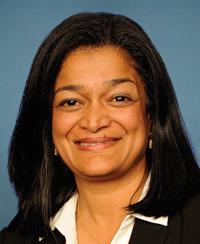 Rep. Pramila Jayapal (D-WA)
Description
An amendment numbered 392 printed in Part A of House 117-405 to establish an Office of Climate Resilience.
What it changes
1 change to H.R. 7900
We couldn't match these changes to the text of H.R. 7900, so they're shown as written.
Adds SECTION 53__. CLIMATE RESILIENCE at the end of title LIII of division E
Adds a sectionInserted: SECTION 53__. CLIMATE RESILIENCE.
Inserted: (a) Office of Climate Resilience.--
Inserted: (1) Establishment.--Not later than 60 days after the date of enactment of this Act, the President shall establish an Office of Climate Resilience (hereinafter referred to as the "Office") within the White House.
Inserted: (2) Director.--
Inserted: (A) Appointment.--The President shall appoint a Director of the Office.
Inserted: (B) Term.--The Director shall serve for a period of 5 years.
Inserted: (C) Termination.--The President may terminate the Director prior to the end of the term described in subparagraph (B) for issues with performance.
Inserted: (3) Purpose.--The purpose of the Office shall be to use information from all sectors involved in climate resilience, including frontline community experience, scientific expertise, and labor organization input to coordinate Federal actions to support a climate resilient nation and operate as a Secretariat.
Inserted: (4) Functions.--The Office shall--
Inserted: (A) convene the necessary Federal and external stakeholders to inform and develop a national climate resilience action plan;
Inserted: (B) revise the plan described in subparagraph (A) every 5 years, or more frequently if determined necessary by the Director based on science;
Inserted: (C) support Federal agencies in developing and revising agency-specific climate resilience actions plans and compile such plans into a Federal Government climate resilience action plan;
Show 107 more inserted paragraphsShow less
Inserted: (D) coordinate with other Federal activities related to climate resilience, including efforts made by the National Environmental Justice Advisory Council and the White House Environmental Justice Advisory Council; and
Inserted: (E) evaluate the effectiveness of the national climate resilience action plan in achieving a climate resilient nation through annual assessments and annual reporting to Congress.
Inserted: (5) Staffing.--
Inserted: (A) In general.--The Director of the Office shall appoint staff to organize the activities of and provide support for the members of the Climate Resilience Equity Advisory Board established under section 5 of this Act, the interagency working group, and the Climate Resilience Task Force.
Inserted: (B) Additional employees.--The Director may hire other employees as needed to exercise and fulfil the function and purpose of the Office.
Inserted: (b) Climate Resilience Equity Advisory Board.--
Inserted: (1) Establishment.--Not later than 6 months after the date of enactment of this Act, the Director of the Office of Climate Resilience shall establish a Climate Resilience Equity Advisory Board (herein after referred to as the "Advisory Board").
Inserted: (2) Purpose.--The purpose of the Advisory Board shall be to advise and make recommendations to the Office of Climate Resilience to ensure that the knowledge, experiences, and priorities of frontline communities are incorporated into Federal climate resilience efforts.
Inserted: (3) Functions.--The Advisory Board shall--
Inserted: (A) participate in the planning process to develop a national climate resilience action plan, including by advising and making recommendations to the interagency workgroup, Climate Resilience Task Force, and labor, worker, and workforce development stakeholders to ensure that--
Inserted: (i) the knowledge, lived experiences, and priorities of frontline communities are incorporated into the strategies, actions, and projects proposed in the national climate resilience action plan and agency climate resilience plans; and
Inserted: (ii) climate resilience jobs and training opportunities prioritize and are accessible to frontline communities;
Inserted: (B) advise and make recommendations to the Office of Climate Resilience on ongoing climate resilience activities; and
Inserted: (C) collaborate with, advise, and make recommendations to the Center for the Climate Resilience Workforce on the activities of such Center.
Inserted: (4) Membership.--
Inserted: (A) In general.--Members of the Advisory Board shall be representatives of frontline communities.
Inserted: (B) Application process.--The Director of the Office shall develop an application process and criteria that, at minimum, shall require applicants for the Advisory Board to provide--
Inserted: (i) letters of support from 3 individuals who are members of the community they represent, highlighting the qualifications and relevant lived, volunteer, or paid work experience the individual possesses to serve on the Advisory Board; and
Inserted: (ii) demographic information about the community represented by the individual including data on population size, income, race, education level, geographic location, and health, climate, and environmental risks faced.
Inserted: (C) Size of board.--
Inserted: (i) In general.--The Advisory Board shall be comprised of not less than 12 members that provide diverse and fair representation of frontline communities.
Inserted: (ii) Additional members.--The Director may select additional members representing frontline communities for the Advisory Board on an interim or permanent basis.
Inserted: (D) Term.--
Inserted: (i) In general.--A member shall serve on the Advisory Board for a term of 3 years.
Inserted: (ii) Term limit.--A member may serve on the Advisory Board for not more than 2 terms.
Inserted: (5) Compensation.--The Director of the Office shall establish guidelines and a process for providing compensation to individuals who would otherwise not be able to participate or who would experience financial hardship without such compensation.
Inserted: (6) Public participation and transparency.--The Board shall make every effort, consistent with applicable law, including section 552 of title 5, United States Code, and section 552a of title 5, United States Code, to maximize public participation and transparency, including making the advice of the Board publicly available in electronic form, including video streaming, on the website of the Office.
Inserted: (7) Applicability of law.--Section 14(a)(2) of the Federal Advisory Committee Act (5 U.S.C. App.) shall not apply to the Advisory Committee.
Inserted: (c) Definitions.--In this section:
Inserted: (1) Climate resilience.--The term "climate resilience"--
Inserted: (A) means the ability and capacity of social, economic, and environmental systems, organized as natural ecosystems and human communities, to anticipate, prepare for, adapt to, respond to, and recover from hazardous events, trends, or disturbances related to climate change; and
Inserted: (B) includes the ability to engage in an iterative process of--
Inserted: (i) assessing how climate change will create new, or alter current climate related risks, and how such risks are distributed within and across natural ecosystems and human communities, including--
Inserted: (I) for human communities, risks shall be assessed by geography, race, ethnicity, socioeconomic status, health and other demographic and social factors, as applicable; and
Inserted: (II) for natural ecosystems, risks shall be assessed by geography, species and ecosystem services, as applicable;
Inserted: (ii) identifying human populations, animal and plant species, ecosystem services and habitats that face disproportionate risks and impacts of climate change, including--
Inserted: (I) for human populations, identifying risks due to historic and ongoing systemic racism, economic inequity, and environmental degradation and pollution; and
Inserted: (II) for natural species and ecosystem services, identifying risks due to environmental degradation, pollution and other anthropogenic impacts;
Inserted: (iii) working to address the root causes that lead the entities identified in clause (ii) to be disproportionately vulnerable to the risks and impacts of climate change; and
Inserted: (iv) prioritizing the natural species, ecosystem services and human populations identified in clause (ii) in taking steps to--
Inserted: (I) mitigate climate change by addressing its causes and impacts to the greatest extent possible as quickly as possible;
Inserted: (II) prepare for and adapt to the unavoidable impacts of climate change by ensuring that effective risk reduction and management and adaptation strategies can be implemented and maintained; and
Inserted: (III) recover from and rebuild after climate disasters in ways that minimize future risks and increase the ability of natural ecosystems and human communities to face future risks with less harm.
Inserted: (2) Co-operative.--The term "co-operative" has the meaning given such term in section 1381 of the Internal Revenue Code of 1986.
Inserted: (3) Community of color.--The term "community of color" means a census block group or series of geographically contiguous blocks in which the population of any of the following categories of individuals, individually or in combination, comprises 30 percent or more of the population of persons in the census block group or series of geographically contiguous blocks:
Inserted: (A) Black.
Inserted: (B) African American.
Inserted: (C) Asian.
Inserted: (D) Pacific Islander.
Inserted: (E) Other non-white race.
Inserted: (F) Hispanic.
Inserted: (G) Latino.
Inserted: (H) Linguistically isolated.
Inserted: (4) Director.--The term "Director" means the director of the Office of Climate Resilience established under section 1 of this Act.
Inserted: (5) Frontline community.--The term "frontline community" means--
Inserted: (A) a community or population that, due to systemic racial or economic injustice, has been made vulnerable to experience disproportionate exposure to environmental hazards, including--
Inserted: (i) a low-income community;
Inserted: (ii) a community of color; and
Inserted: (iii) a Tribal or indigenous community;
Inserted: (B) a community that has been primarily economically dependent on fossil fuel industries; and
Inserted: (C) a community or population that is vulnerable or systematically disadvantaged and therefore has a higher likelihood of being impacted by environmental and climate injustice and inequitable climate actions, including--
Inserted: (i) linguistically isolated communities;
Inserted: (ii) individuals with limited English proficiency;
Inserted: (iii) immigrants and refugees;
Inserted: (iv) individuals with limited mobility;
Inserted: (v) individuals who are ill;
Inserted: (vi) vulnerable elderly populations;
Inserted: (vii) children, youth, and pregnant women;
Inserted: (viii) individuals with disabilities;
Inserted: (ix) LGBTQ+ individuals;
Inserted: (x) institutionalized populations;
Inserted: (xi) individuals living in isolated rural areas;
Inserted: (xii) unhoused populations; and
Inserted: (xiii) workers whose job requires such worker to work outdoors.
Inserted: (6) Labor organization.--The term "labor organization" has the meaning given such term in section 2(5) of the National Labor Relations Act (29 U.S.C. 152(5)).
Inserted: (7) Labor, worker, and workforce development stakeholders.--The term "labor, worker, and workforce development stakeholders" shall include--
Inserted: (A) individuals who are members of populations facing barriers to employment who have shown leadership in addressing such barriers;
Inserted: (B) worker-driven entities dedicated to ensuring collective worker voice and representation, including--
Inserted: (i) labor unions;
Inserted: (ii) worker centers; and
Inserted: (iii) worker associations;
Inserted: (C) organizations that advocate for improvement to worker rights and working conditions, including organizations that work to expand collective bargaining, raise worker wages, improve workplace safety, reduce and end discrimination and increase workplace equity;
Inserted: (D) individuals and organizations, including potential employers, that possess knowledge of the jobs, skills, and occupations that pertain to climate resilience work, in order to inform workforce and training needs; and
Inserted: (E) entities with proven track records in designing and participating in workforce development and training programs resulting in higher wages and improved job security for workers, including--
Inserted: (i) community colleges;
Inserted: (ii) nonprofit organizations; and
Inserted: (iii) joint labor management partnerships.
Inserted: (8) Low-income community.--The term "low-income community" means any census block group in which 30 percent or more of the population of such block group are individuals with an annual household income equal to, or less than, the greater of--
Inserted: (A) an amount equal to 80 percent of the median income of the area in which the household is located, as reported by the Department of Housing and Urban Development; and
Inserted: (B) 200 percent of the Federal poverty line.
Inserted: (9) Non-profit organization.--The term "non-profit organization" means an organization under section 501(c)(3) of the Internal Revenue Code of 1986.
Inserted: (10) Population.--The term "population" means a census block group or series of geographically contiguous blocks representing certain common characteristics, including race, ethnicity, national origin, income-level, health disparities, or other public health or socioeconomic attributes.
Inserted: (11) Populations facing barriers to employment.--The term "populations facing barriers to employment" means populations that have faced systemic barriers to employment, significant, systemic job losses, or chronic underemployment or insecure employment due to failed economic policies, including--
Inserted: (A) undocumented individuals;
Inserted: (B) individuals with criminal records;
Inserted: (C) individuals who are formerly incarcerated;
Inserted: (D) deindustrialized communities; and
Inserted: (E) demographic populations with unemployment levels higher than the national average.
Inserted: (12) State.--The term "State" includes each of the several States, the District of Columbia, the Commonwealth of Puerto Rico, the Virgin Islands of the United States, the Commonwealth of the Northern Mariana Islands, the Federated States of Micronesia, the Republic of the Marshall Islands, the Republic of Palau, and the territories and possessions of the United States.
Inserted: (13) Tribal or indigenous community.--The term "Tribal or indigenous community" means a population of people who are members of--
Inserted: (A) a federally recognized Indian Tribe;
Inserted: (B) a State recognized Indian Tribe;
Inserted: (C) an Alaskan Native or Native Hawaiian community or organization; and
Inserted: (D) any other community of indigenous people located in a State.
Inserted: (14) Worker center.--The term "worker center" means a non-profit organization or a co-operative that--
Inserted: (A) has as one if its primary goals the improvement of worker rights, workplace safety, wages, working conditions, or employment access, or the promotion of enhanced worker voice; and
Inserted: (B) which has some kind of formal mechanism by which workers who stand to benefit from these improvements may directly participate in organizational decision-making.
Original wording
At the end of title LIII of division E of the bill, add the following:
Read automatically from the Congressional Record. Check the original before relying on it.
As printed
At the end of title LIII of division E of the bill, add the following:
SECTION 53__. CLIMATE RESILIENCE.
(a) Office of Climate Resilience.--
(1) Establishment.--Not later than 60 days after the date of enactment of this Act, the President shall establish an Office of Climate Resilience (hereinafter referred to as the “Office”) within the White House.
(2) Director.--
(A) Appointment.--The President shall appoint a Director of the Office.
(B) Term.--The Director shall serve for a period of 5 years.
(C) Termination.--The President may terminate the Director prior to the end of the term described in subparagraph (B) for issues with performance.
(3) Purpose.--The purpose of the Office shall be to use information from all sectors involved in climate resilience, including frontline community experience, scientific expertise, and labor organization input to coordinate Federal actions to support a climate resilient nation and operate as a Secretariat.
(4) Functions.--The Office shall--
(A) convene the necessary Federal and external stakeholders to inform and develop a national climate resilience action plan;
(B) revise the plan described in subparagraph (A) every 5 years, or more frequently if determined necessary by the Director based on science;
(C) support Federal agencies in developing and revising agency-specific climate resilience actions plans and compile such plans into a Federal Government climate resilience action plan;
(D) coordinate with other Federal activities related to climate resilience, including efforts made by the National Environmental Justice Advisory Council and the White House Environmental Justice Advisory Council; and
(E) evaluate the effectiveness of the national climate resilience action plan in achieving a climate resilient nation through annual assessments and annual reporting to Congress.
(5) Staffing.--
(A) In general.--The Director of the Office shall appoint staff to organize the activities of and provide support for the members of the Climate Resilience Equity Advisory Board established under section 5 of this Act, the interagency working group, and the Climate Resilience Task Force.
(B) Additional employees.--The Director may hire other employees as needed to exercise and fulfil the function and purpose of the Office.
(b) Climate Resilience Equity Advisory Board.--
(1) Establishment.--Not later than 6 months after the date of enactment of this Act, the Director of the Office of Climate Resilience shall establish a Climate Resilience Equity Advisory Board (herein after referred to as the “Advisory Board”).
(2) Purpose.--The purpose of the Advisory Board shall be to advise and make recommendations to the Office of Climate Resilience to ensure that the knowledge, experiences, and priorities of frontline communities are incorporated into Federal climate resilience efforts.
(3) Functions.--The Advisory Board shall--
(A) participate in the planning process to develop a national climate resilience action plan, including by advising and making recommendations to the interagency workgroup, Climate Resilience Task Force, and labor, worker, and workforce development stakeholders to ensure that--
(i) the knowledge, lived experiences, and priorities of frontline communities are incorporated into the strategies, actions, and projects proposed in the national climate resilience action plan and agency climate resilience plans; and
(ii) climate resilience jobs and training opportunities prioritize and are accessible to frontline communities;
(B) advise and make recommendations to the Office of Climate Resilience on ongoing climate resilience activities; and
(C) collaborate with, advise, and make recommendations to the Center for the Climate Resilience Workforce on the activities of such Center.
(4) Membership.--
(A) In general.--Members of the Advisory Board shall be representatives of frontline communities.
(B) Application process.--The Director of the Office shall develop an application process and criteria that, at minimum, shall require applicants for the Advisory Board to provide--
(i) letters of support from 3 individuals who are members of the community they represent, highlighting the qualifications and relevant lived, volunteer, or paid work experience the individual possesses to serve on the Advisory Board; and
(ii) demographic information about the community represented by the individual including data on population size, income, race, education level, geographic location, and health, climate, and environmental risks faced.
(C) Size of board.--
(i) In general.--The Advisory Board shall be comprised of not less than 12 members that provide diverse and fair representation of frontline communities.
(ii) Additional members.--The Director may select additional members representing frontline communities for the Advisory Board on an interim or permanent basis.
(D) Term.--
(i) In general.--A member shall serve on the Advisory Board for a term of 3 years.
(ii) Term limit.--A member may serve on the Advisory Board for not more than 2 terms.
(5) Compensation.--The Director of the Office shall establish guidelines and a process for providing compensation to individuals who would otherwise not be able to participate or who would experience financial hardship without such compensation.
(6) Public participation and transparency.--The Board shall make every effort, consistent with applicable law, including section 552 of title 5, United States Code, and section 552a of title 5, United States Code, to maximize public participation and transparency, including making the advice of the Board publicly available in electronic form, including video streaming, on the website of the Office.
(7) Applicability of law.--Section 14(a)(2) of the Federal Advisory Committee Act (5 U.S.C. App.) shall not apply to the Advisory Committee.
(c) Definitions.--In this section:
(1) Climate resilience.--The term “climate resilience”--
(A) means the ability and capacity of social, economic, and environmental systems, organized as natural ecosystems and human communities, to anticipate, prepare for, adapt to, respond to, and recover from hazardous events, trends, or disturbances related to climate change; and
(B) includes the ability to engage in an iterative process of--
(i) assessing how climate change will create new, or alter current climate related risks, and how such risks are distributed within and across natural ecosystems and human communities, including--
(I) for human communities, risks shall be assessed by geography, race, ethnicity, socioeconomic status, health and other demographic and social factors, as applicable; and
(II) for natural ecosystems, risks shall be assessed by geography, species and ecosystem services, as applicable;
(ii) identifying human populations, animal and plant species, ecosystem services and habitats that face disproportionate risks and impacts of climate change, including--
(I) for human populations, identifying risks due to historic and ongoing systemic racism, economic inequity, and environmental degradation and pollution; and
(II) for natural species and ecosystem services, identifying risks due to environmental degradation, pollution and other anthropogenic impacts;
(iii) working to address the root causes that lead the entities identified in clause (ii) to be disproportionately vulnerable to the risks and impacts of climate change; and
(iv) prioritizing the natural species, ecosystem services and human populations identified in clause (ii) in taking steps to--
(I) mitigate climate change by addressing its causes and impacts to the greatest extent possible as quickly as possible;
(II) prepare for and adapt to the unavoidable impacts of climate change by ensuring that effective risk reduction and management and adaptation strategies can be implemented and maintained; and
(III) recover from and rebuild after climate disasters in ways that minimize future risks and increase the ability of natural ecosystems and human communities to face future risks with less harm.
(2) Co-operative.--The term “co-operative” has the meaning given such term in section 1381 of the Internal Revenue Code of 1986.
(3) Community of color.--The term “community of color” means a census block group or series of geographically contiguous blocks in which the population of any of the following categories of individuals, individually or in combination, comprises 30 percent or more of the population of persons in the census block group or series of geographically contiguous blocks:
(A) Black.
(B) African American.
(C) Asian.
(D) Pacific Islander.
(E) Other non-white race.
(F) Hispanic.
(G) Latino.
(H) Linguistically isolated.
(4) Director.--The term “Director” means the director of the Office of Climate Resilience established under section 1 of this Act.
(5) Frontline community.--The term “frontline community” means--
(A) a community or population that, due to systemic racial or economic injustice, has been made vulnerable to experience disproportionate exposure to environmental hazards, including--
(i) a low-income community;
(ii) a community of color; and
(iii) a Tribal or indigenous community;
(B) a community that has been primarily economically dependent on fossil fuel industries; and
(C) a community or population that is vulnerable or systematically disadvantaged and therefore has a higher likelihood of being impacted by environmental and climate injustice and inequitable climate actions, including--
(i) linguistically isolated communities;
(ii) individuals with limited English proficiency;
(iii) immigrants and refugees;
(iv) individuals with limited mobility;
(v) individuals who are ill;
(vi) vulnerable elderly populations;
(vii) children, youth, and pregnant women;
(viii) individuals with disabilities;
(ix) LGBTQ+ individuals;
(x) institutionalized populations;
(xi) individuals living in isolated rural areas;
(xii) unhoused populations; and
(xiii) workers whose job requires such worker to work outdoors.
(6) Labor organization.--The term “labor organization” has the meaning given such term in section 2(5) of the National Labor Relations Act (29 U.S.C. 152(5)).
(7) Labor, worker, and workforce development stakeholders.--The term “labor, worker, and workforce development stakeholders” shall include--
(A) individuals who are members of populations facing barriers to employment who have shown leadership in addressing such barriers;
(B) worker-driven entities dedicated to ensuring collective worker voice and representation, including--
(i) labor unions;
(ii) worker centers; and
(iii) worker associations;
(C) organizations that advocate for improvement to worker rights and working conditions, including organizations that work to expand collective bargaining, raise worker wages, improve workplace safety, reduce and end discrimination and increase workplace equity;
(D) individuals and organizations, including potential employers, that possess knowledge of the jobs, skills, and occupations that pertain to climate resilience work, in order to inform workforce and training needs; and
(E) entities with proven track records in designing and participating in workforce development and training programs resulting in higher wages and improved job security for workers, including--
(i) community colleges;
(ii) nonprofit organizations; and
(iii) joint labor management partnerships.
(8) Low-income community.--The term “low-income community” means any census block group in which 30 percent or more of the population of such block group are individuals with an annual household income equal to, or less than, the greater of--
(A) an amount equal to 80 percent of the median income of the area in which the household is located, as reported by the Department of Housing and Urban Development; and
(B) 200 percent of the Federal poverty line.
(9) Non-profit organization.--The term “non-profit organization” means an organization under section 501(c)(3) of the Internal Revenue Code of 1986.
(10) Population.--The term “population” means a census block group or series of geographically contiguous blocks representing certain common characteristics, including race, ethnicity, national origin, income-level, health disparities, or other public health or socioeconomic attributes.
(11) Populations facing barriers to employment.--The term “populations facing barriers to employment” means populations that have faced systemic barriers to employment, significant, systemic job losses, or chronic underemployment or insecure employment due to failed economic policies, including--
(A) undocumented individuals;
(B) individuals with criminal records;
(C) individuals who are formerly incarcerated;
(D) deindustrialized communities; and
(E) demographic populations with unemployment levels higher than the national average.
(12) State.--The term “State” includes each of the several States, the District of Columbia, the Commonwealth of Puerto Rico, the Virgin Islands of the United States, the Commonwealth of the Northern Mariana Islands, the Federated States of Micronesia, the Republic of the Marshall Islands, the Republic of Palau, and the territories and possessions of the United States.
(13) Tribal or indigenous community.--The term “Tribal or indigenous community” means a population of people who are members of--
(A) a federally recognized Indian Tribe;
(B) a State recognized Indian Tribe;
(C) an Alaskan Native or Native Hawaiian community or organization; and
(D) any other community of indigenous people located in a State.
(14) Worker center.--The term “worker center” means a non-profit organization or a co-operative that--
(A) has as one if its primary goals the improvement of worker rights, workplace safety, wages, working conditions, or employment access, or the promotion of enhanced worker voice; and
(B) which has some kind of formal mechanism by which workers who stand to benefit from these improvements may directly participate in organizational decision-making.
Legislative Activity
Stay on top of the latest movement without scrolling through every action
House amendment offered
July 14, 2022
View full timeline
House amendment offered
July 14, 2022
Amendment failed by House: On agreeing to the Jayapal amendment (A030) Failed by the Yeas and Nays: 207 - 219 (Roll no. 337).
July 14, 2022 • 2:22 PM
Roll call votes on amendments in House
July 14, 2022 • 2:22 PM
House amendment not agreed to: On agreeing to the Jayapal amendment (A030) Failed by the Yeas and Nays: 207 - 219 (Roll no. 337).
July 14, 2022 • 2:22 PM
House amendment offered/reported by: Amendment (A030) offered by Ms. Jayapal.
July 14, 2022 • 12:03 AM
Amendment (A030) offered by Ms. Jayapal. (consideration: CR H6451-6454; text: CR H6451-6452)
July 14, 2022 • 12:03 AM
The previous question was ordered on the amendment (A030) pursuant to the rule.
July 14, 2022 • 12:14 AM
On agreeing to the Jayapal amendment (A030) Failed by the Yeas and Nays: 207 - 219 (Roll no. 337). (consideration: CR H6594-6595)
July 14, 2022 • 2:22 PM
Votes
1 roll call on this amendment