S.Amdt. 2000Senate118th Congress (2023-2025)
S.Amdt. 2000
Sponsored by 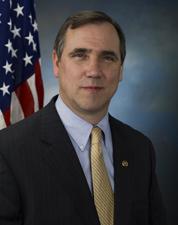 Sen. Jeff Merkley (D-OR)
Sen. Jeff Merkley (D-OR)Submitted May 2, 2024
Legislative Activity
Stay on top of the latest movement without scrolling through every action
Floor
Latest Action
Senate amendment submitted
May 2, 2024
View full timeline
Floor
Senate amendment submitted
May 2, 2024
Floor
Senate amendment submitted
May 2, 2024
Text
Submitted
SA 2000. Mr. MERKLEY (for himself, Mr. Kennedy, and Mr. Marshall)
submitted an amendment intended to be proposed by him to the bill H.R.
3935, to amend title 49, United States Code, to reauthorize and improve
the Federal Aviation Administration and other civil aviation programs,
and for other purposes; which was ordered to lie on the table; as
follows:

At the appropriate place, insert the following:

SEC. ___. PROHIBITION ON EXPANSION OF FACIAL RECOGNITION
TECHNOLOGY.

(a) In General.--Section 44901 of title 49, United States
Code, as amended by section 642, is further amended by adding
at the end the following new subsection:
``(n) Prohibition on Expansion of Facial Recognition
Technology.--
``(1) Definitions.--In this subsection:
``(A) Administration.--The term `Administration' means the
Transportation Security Administration.
``(B) Administrator.--The term `Administrator' means the
Administrator of the Transportation Security Administration.
``(C) Airport.--The term `airport' has the meaning given
such term in section 47102.
``(D) Identity verification.--The term `identity
verification' means the confirmation of the identity of a
protected individual before admittance to the sterile area of
the airport.
``(E) Partner program.--The term `partner program' means a
program that a protected individual has opted-into that is--
``(i) a program of a State or territory of the United
States that provides a digital identification or digital
driver's license; or
``(ii) a program of an air carrier operated in partnership
with a Trusted Traveler Program to enable flight check-in,
airport security screening, or aircraft boarding.
``(F) Protected individual.--The term `protected
individual' means an individual who is not an employee or
contractor of the Administration.
``(G) Screening location; sterile area.--The terms
`screening location' and `sterile area' have the meanings
given those terms in section 1540.5 of title 49, Code of
Federal Regulations.
``(H) Trusted traveler program.--The term `Trusted Traveler
Program' means an opt-in program that is--
``(i) Global Entry;
``(ii) the PreCheck Program;
``(iii) SENTRI; or
``(iv) NEXUS.
``(2) Limited expansion; privacy for protected
individuals.--
``(A) In general.--Except as provided in subparagraphs (B),
(C), and (D), the Administrator may not, for any purpose,
capture, collect, store, or otherwise process biometric
information with respect to a protected individual.
``(B) Limitation on expansion.--The Administrator may not
expand the use of facial recognition technology or facial
matching software to, or implement facial recognition
technology or facial matching software that requires
comparison against a database of photos at, any airport in
which such technology or software was not in use prior to the
date of the enactment of this subsection.
``(C) Use of technology for verification of documents.--The
Administrator may use technology to process, capture, scan
and receive data from an identification document containing a
photograph of an individual to access secure flight data,
authenticate the pre-screening status of a protected
individual, or verify the accuracy of the identification
document.
``(D) Use at airports.--The Administrator may use facial
recognition technology or facial matching software to perform
identity verification--
``(i)(I) beginning on the date that is 30 days after the
date of the enactment of this subsection, at any airport
where facial recognition technology or facial matching
software was in use prior to the date of enactment of this
subsection; and
``(II) at any airport after May 30, 2027; and
``(ii) so long as, beginning on the date that is 30 days
after the date of the enactment of this subsection and
thereafter, the Administrator--

``(I) conducts identity verification without using facial
recognition technology or facial matching software as the
default form of identification;
``(II) provides each protected individual, at the request
of the protected individual, with the option to choose
between identity verification with or without facial
recognition or facial matching software;
``(III) notifies each protected individual of such option
via simple and clear signage, spoken announcements, or other
accessible notifications;
``(IV) ensures equal ability for protected individuals to
choose either identification option;
``(V) does not subject protected individuals who elect not
to use facial recognition technology or facial matching
software to discriminatory treatment, additional screening
requirements, less favorable screening conditions, or other
unfavorable treatment; and
``(VI) ensures that protected individuals enrolling in a
Trusted Traveler Program are given clear and conspicuous
notice of, and provide affirmative and express consent to,
the storage, use, and sharing of their biometric information,
including how such biometric information will be stored,
used, shared, or otherwise processed.

``(E) Notification guidelines.--A notification posted or
distributed in accordance with subparagraph (B)(ii)--
``(i) shall clearly state that participation in facial
recognition screening is optional and describe the specific
steps passengers should take to select either identification
option; and
``(ii) may not encourage passengers to choose one option
over the other for identity verification.
``(3) Data minimization of protected individuals.--
Beginning on the date that is 30 days after the date of the
enactment of this subsection, in processing biometric
information with respect to a protected individual, the
Administrator may not, except as provided in paragraph (4)--
``(A) share outside of the Transportation Security
Administration any biometric information collected through
the use of facial recognition technology or facial matching
software;
``(B) store biometric information for longer than is
necessary to complete identity verification of an individual,
and not more than 12 hours; or
``(C) compare the image of a protected individual against
anything other than the photo identification document
provided by the individual.
``(4) Data minimization for partner programs.--Beginning on
the date that is 30 days after the date of the enactment of
this subsection, in processing biometric information with
respect to a protected individual who seeks identity
verification under a Trusted Traveler Program or a partner
program, the Administrator may not, except to the extent
necessary to operate a Trusted Traveler Program or a partner
program--
``(A) share outside of the Transportation Security
Administration any biometric information collected through
the use of facial recognition technology or facial matching
software;
``(B) store biometric information for longer than is
necessary to complete identity verification of an individual,
and not more than 12 hours; or
``(C) compare the image of a protected individual against
anything other than the photo identification document
provided by the individual.
``(5) Disposal of facial biometrics.--Not later than 90
days after the date of the enactment of this subsection, the
Administrator shall dispose of any biometric information,
including images and videos, collected, or stored by the
Administration prior to such date of enactment that, if
collected or stored on or after such date of enactment, would
violate this subsection.
``(6) GAO report on use of facial recognition technology.--
``(A) In general.--Not later than 1 year after the date of
the enactment of this subsection, and annually thereafter,
the Comptroller General of the United States shall audit the
use of facial recognition technology and facial matching
software by the Administration, and submit to Congress a
report that includes--
``(i) a recommendation on the circumstances, if any, in
which the utilization of facial recognition technology or
facial matching software is cost effective for the purposes
of reducing the number of individuals who access sterile
areas using illegitimate identification documents;
``(ii) a summary of the impact of the use of facial
recognition technology on employment levels and experiences
of transportation security officers of the Administration,
airline employees, and airport employees;
``(iii) an assessment of the occurrence of false positive
and false negative facial identification matches of
individuals;
``(iv) a comparison of the number of false identification
documents detected at airports using facial recognition
technology or facial matching software at screening locations
and the number of such documents detected at airports not
using such technology or software;
``(v) a summary of the methodology and results of any
testing performed by the Comptroller General in relation to
the efficacy of the use of facial recognition technology or
facial matching software by the Administration, including any
research on bias, disaggregated by age, race, ethnicity to
the extent practicable, and sex, the different technologies
used by the Administration, and efforts to minimize the bias
in operations of the Administration; and
``(vi) recommendations of restrictions and guidelines that
should be enacted to protect individual privacy, civil
rights, and civil liberty interests.
``(B) Form.--A report submitted under subparagraph (A)
shall be submitted in unclassified form but may include a
classified annex.
``(C) Rule of construction; protection of personal
information.--Nothing in this paragraph shall be construed to
authorize or require the unauthorized disclosure of the
personal information of protected individuals, and the report
required by this paragraph shall be released in a manner that
protects personal information from unauthorized use or
unauthorized disclosure.''.
(b) Amendments to Aviation and Transportation Security
Act.--The Aviation and Transportation Security Act (Public
Law 107-71; 115 Stat. 597) is amended--
(1) in section 109(a)(7) (49 U.S.C. 114 note) by inserting
``, subject to the restrictions of section 44901(n) of title
49, United States Code,'' after ``technologies''; and

[[Page S3367]]

(2) in section 137(d)(3) (49 U.S.C. 44912 note), by
inserting ``, subject to the restrictions of section 44901(n)
of title 49, United States Code,'' after ``biometrics''.
(c) Additional Modifications With Respect to Air
Transportation Security.--Section 44903 of title 49, United
States Code, is amended--
(1) in subsection (c)(3), by inserting ``, subject to the
restrictions of section 44901(n),'' after ``other
technology'';
(2) in subsection (g)(2)(G), by inserting ``, subject to
the restrictions of section 44901(n),'' after
``technologies''; and
(3) in subsection (h)(4)(E), by inserting ``, subject to
the restrictions of section 44901(n),'' after ``technology''.

____________________