S.Amdt. 2465Senate118th Congress (2023-2025)
S.Amdt. 2465
Sponsored by 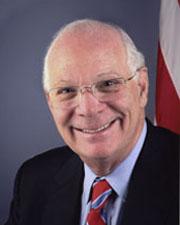 Sen. Benjamin L. Cardin (D-MD)
Sen. Benjamin L. Cardin (D-MD)Submitted July 11, 2024
Legislative Activity
Stay on top of the latest movement without scrolling through every action
Floor
Latest Action
Senate amendment submitted
July 11, 2024
Text
Submitted
SA 2465. Mr. CARDIN submitted an amendment intended to be proposed by
him to the bill S. 4638, to authorize appropriations for fiscal year
2025 for military activities of the Department of Defense, for military
construction, and for defense activities of the Department of Energy,
to prescribe military personnel strengths for such fiscal year, and for
other purposes; which was ordered to lie on the table; as follows:

At the appropriate place, insert the following:

DIVISION F--DEPARTMENT OF STATE AUTHORIZATION ACT FOR FISCAL YEAR 2025

SEC. 9001. SHORT TITLE; TABLE OF CONTENTS.

(a) Short Title.--This division may be cited as the
``Department of State Authorization Act for Fiscal Year
2025''.
(b) Table of Contents.--The table of contents for this
division is as follows:

DIVISION F--DEPARTMENT OF STATE AUTHORIZATION ACT FOR FISCAL YEAR 2025

Sec. 9001. Short title; table of contents.
Sec. 9002. Definitions.

TITLE I--WORKFORCE MATTERS

Sec. 9101. Commemorating the 100th anniversary of the Rogers Act;
creation of the Department of State.
Sec. 9102. Workforce modernization efforts.
Sec. 9103. Training float of the Department of State for Civil and
Foreign Service personnel.
Sec. 9104. Competitive local compensation plan.
Sec. 9105. Language incentive pay for civil service employees.
Sec. 9106. Strategy for targeted recruitment of civil servants.
Sec. 9107. Electronic medical records.
Sec. 9108. Options for comprehensive evaluations.
Sec. 9109. Portability of professional licenses.
Sec. 9110. Expanding opportunities for Department-paid student
internship program.
Sec. 9111. Career intermission program adjustment to enhance retention.
Sec. 9112. Professional counseling services.
Sec. 9113. Assignment process modernization.
Sec. 9114. Report on modifying consular tour and first tours
requirements.
Sec. 9115. Comprehensive policy on vetting and transparency.
Sec. 9116. Efficiency in employee survey creation and consolidation.
Sec. 9117. Flexibility for personnel returning from overseas
assignments with domesticated pets.
Sec. 9118. Emergency exceptions for government-financed air
transportation.
Sec. 9119. Per diem allowance for newly hired members of the Foreign
Service.
Sec. 9120. Termination of residential or motor vehicle leases and
telephone service contracts for members of the Foreign
Service.
Sec. 9121. Needs-based childcare subsidies enrollment period.
Sec. 9122. Comptroller General report on Department traveler
experience.
Sec. 9123. Quarterly report on global footprint.
Sec. 9124. Report on former Federal employees advising foreign
governments.
Sec. 9125. Job share and part-time employment opportunities.
Sec. 9126. Expansion of special rules for certain monthly workers'
compensation payments and other payments for personnel
under chief of mission authority.

TITLE II--ORGANIZATION AND OPERATIONS

Sec. 9201. State-of-the-art building facilities.
Sec. 9202. Presence of chiefs of mission at diplomatic posts.
Sec. 9203. Periodic Inspector General reviews of chiefs of mission.
Sec. 9204. Special Envoy for Sudan.
Sec. 9205. Special Envoy for Belarus.
Sec. 9206. National Museum of American Diplomacy.
Sec. 9207. Authority to establish Negotiations Support Unit within
Department of State.
Sec. 9208. Periodic briefings from Bureau of Intelligence and Research.
Sec. 9209. Restrictions on the use of funds for solar panels.
Sec. 9210. Responsiveness to Congressional Research Service inquiries.
Sec. 9211. Mission in a box.
Sec. 9212. Report on United States Consulate in Chengdu, People's
Republic of China.
Sec. 9213. Personnel reporting.
Sec. 9214. Support co-location with allied partner nations.
Sec. 9215. Streamline qualification of construction contract bidders.

TITLE III--INFORMATION SECURITY AND CYBER DIPLOMACY

Sec. 9301. Supporting Department of State data analytics.
Sec. 9302. Realigning the Regional Technology Officer Program.
Sec. 9303. Measures to protect Department devices from the
proliferation and use of foreign commercial spyware.
Sec. 9304. Report on cloud computing in Bureau of Consular Affairs.
Sec. 9305. Information technology pilot projects.
Sec. 9306. Leveraging approved technology for administrative
efficiencies.
Sec. 9307. Office of the Special Envoy for Critical and Emerging
Technology.

TITLE IV--PUBLIC DIPLOMACY

Sec. 9401. Africa broadcasting networks.
Sec. 9402. United States Agency for Global Media.
Sec. 9403. Extension of authorizations to support United States
participation in international fairs and expos.
Sec. 9404. Research and scholar exchange partnerships.
Sec. 9405. Waiver of physical presence requirement for children of
Radio Free Europe/Radio Liberty employees.

TITLE V--DIPLOMATIC SECURITY

Sec. 9501. Secure Embassy Construction and Counterterrorism Act
requirements.
Sec. 9502. Congressional notification for Serious Security Incidents.
Sec. 9503. Notifications regarding security decisions at diplomatic
posts.
Sec. 9504. Counter-intelligence investigations of Special Immigrant
Visa applicants at Critical Human Intelligence Threat
Posts.
Sec. 9505. Security clearance suspension pay flexibilities.
Sec. 9506. Modification to notification requirement for security
clearance suspensions and revocations.
Sec. 9507. Department of State domestic protection mission.

[[Page S4786]]

TITLE VI--UNITED STATES AGENCY FOR INTERNATIONAL DEVELOPMENT

Sec. 9601. Personal service agreement authority for the United States
Agency for International Development.
Sec. 9602. Crisis operations and disaster surge staffing.
Sec. 9603. Education allowance while on military leave.
Sec. 9604. Inclusion of USAID in the pet transportation exception to
the Fly America Act.

TITLE VII--OTHER MATTERS

Sec. 9701. Authorization of appropriations to promote United States
citizen employment at the United Nations and
international organizations.
Sec. 9702. Amendment to Rewards for Justice program.
Sec. 9703. Passport automation modernization.
Sec. 9704. Concurrence provided by chiefs of mission for the provision
of Department of Defense support to certain Department of
Defense operations.
Sec. 9705. Extension of certain payment in connection with the
International Space Station.
Sec. 9706. Support for congressional delegations.
Sec. 9707. Electronic communication with visa applicants.
Sec. 9708. Electronic transmission of visa information.
Sec. 9709. Modification to transparency on international agreements and
non-binding instruments.
Sec. 9710. Inclusion of cost associated with producing reports.
Sec. 9711. Extraterritorial offenses committed by United States
nationals serving with international organizations.
Sec. 9712. Extensions.

SEC. 9002. DEFINITIONS.

In this division:
(1) Administrator.--The term ``Administrator'' means the
Administrator of the United States Agency for International
Development.
(2) Appropriate congressional committees.--The term
``appropriate congressional committees'' means the Committee
on Foreign Relations of the Senate and the Committee on
Foreign Affairs of the House of Representatives.
(3) Department.--The term ``Department'' means the
Department of State.
(4) Secretary.--The term ``Secretary'' means the Secretary
of State.
(5) USAID.--The term ``USAID'' means the United States
Agency for International Development.

TITLE I--WORKFORCE MATTERS

SEC. 9101. COMMEMORATING THE 100TH ANNIVERSARY OF THE ROGERS
ACT; CREATION OF THE DEPARTMENT OF STATE.

Congress recognizes and honors those who have served, or
are presently serving, in the diplomatic corps of the United
States, in commemorating the 100th Anniversary of the Act
entitled, ``An Act for the reorganization and improvement of
the Foreign Service of the United States, and for other
purposes'' (43 stat. 140, chapter 182), commonly known as the
``Rogers Act of 1924'', which on May 24, 1924, established
what has come to be known as the Foreign Service. Today, the
Department of State includes more than 13,000 Foreign Service
personnel working alongside more than 11,000 civil service
personnel and 45,000 locally engaged staff at more than 270
embassies and consulates.

SEC. 9102. WORKFORCE MODERNIZATION EFFORTS.

The Secretary should prioritize efforts to further
modernize the Department, including--
(1) making workforce investments, including increasing
wages for locally employed staff and providing other non-cash
benefits, and hiring up to 100 new members of the Foreign
Service above projected attrition to reduce overseas
vacancies and mid-level staffing gaps;
(2) utilizing authorities that allow the Department to
acquire or build and open new embassy compounds quicker and
at significantly less cost to get diplomats on the front
lines of strategic competition; and
(3) modernizing legacy systems and human resource
processes.

SEC. 9103. TRAINING FLOAT OF THE DEPARTMENT OF STATE FOR
CIVIL AND FOREIGN SERVICE PERSONNEL.

(a) In General.--Not later than 90 days after the date of
the enactment of this Act, the Secretary shall develop and
submit to the appropriate congressional committees a strategy
to establish and maintain a ``training float'' by January 1,
2027, to allow for a minimum of 8 percent and up to 10
percent of members of the Civil and Foreign Service to
participate in long-term training at any given time. The
strategy shall include--
(1) a proposal to ensure that personnel in the training
float remain dedicated to training or professional
development activities;
(2) recommendations to maintain, and an assessment of the
feasibility of maintaining, a minimum of 8 percent of
personnel in the float at any given time; and
(3) any additional resources and authorities needed to
maintain a training float contemplated by this section.
(b) Monitoring.--For any established training float, not
later than 120 days after enactment of this Act, the
Secretary shall ensure that personnel in such training float
remain dedicated to training or professional development
activities.

SEC. 9104. COMPETITIVE LOCAL COMPENSATION PLAN.

(a) Sense of Congress.--It is the sense of Congress that--
(1) the effectiveness and stability of United States
foreign missions are linked to the dedication and expertise
of locally employed staff; and
(2) ensuring competitive compensation packages benchmarked
against the local market is essential not only to retain
valuable talent but also to reflect a commitment to
employment practices abroad.
(b) Authorization of Appropriations.--There is authorized
to be appropriated $47,500,000 for fiscal year 2025 to
support implementation of a global baseline for prevailing
wage rate goal for Local Compensation Plan positions at the
75th percentile.

SEC. 9105. LANGUAGE INCENTIVE PAY FOR CIVIL SERVICE
EMPLOYEES.

The Secretary and Administrator may provide special
monetary incentives to acquire or retain proficiency in
foreign languages to civil service employees who serve in
domestic positions that require critical language skills. The
amounts of such incentives should be similar to the language
incentive pay provided to members of the Foreign Service
under the Foreign Service pursuant to section 704(b)(3) of
the Foreign Service Act of 1980 (22 U.S.C. 4024(b)(3)).

SEC. 9106. STRATEGY FOR TARGETED RECRUITMENT OF CIVIL
SERVANTS.

Not later than 180 days after the date of the enactment of
this Act, the Secretary shall submit to the appropriate
congressional committees a strategy for targeted and
proactive recruitment to fill open civil service positions,
focusing on recruiting from schools or organizations, and on
platforms targeting those with relevant expertise related to
such positions.

SEC. 9107. ELECTRONIC MEDICAL RECORDS.

(a) Sense of Congress.--It is the sense of Congress that--
(1) Foreign Service personnel at the Department serve with
distinction in austere places and under challenging
conditions around the world with limited healthcare
availability;
(2) the use of paper medical records, which require Foreign
Service personnel to carry files containing protected health
information from post to post, limits the availability of
their health information to Department medical personnel
during critical health incidents;
(3) electronic medical records are necessary, particularly
as the Department opens new embassies in the South Pacific,
thousands of miles from the nearest Department medical
officer, who may not have access to up-to-date personnel
medical files;
(4) the lack of electronic medical records is even more
important for mental health records, as the Department only
has a small number of regional medical officer psychiatrists
and relies heavily on telehealth for most Foreign Service
personnel; and
(5) due to the critical need for electronic medical
records, it is imperative that the Department address the
situation quickly and focus on secure commercially available
or other successful systems utilized by public and private
sector organizations with a track record of successfully
implementing large-scale projects of this type.
(b) Electronic Medical Records Requirement.--Not later than
December 31, 2027, the Secretary shall have fully implemented
an electronic medical records process or system for all
Foreign Service personnel and their Eligible Family Members
that eliminates reliance on paper medical records and
includes appropriate safeguards to protect personal privacy.
(c) Report on Implementation.--
(1) In general.--Not later than 180 days after the date of
the enactment of this Act, and every 180 days thereafter, the
Secretary shall submit to the appropriate congressional
committees a report on the progress made towards meeting the
requirement under subsection (b).
(2) Elements.--The report required under paragraph (1)
shall include the following elements:
(A) An updated timeline for implementation.
(B) An estimated completion date.
(C) The amounts expended to date on the required electronic
medical records system.
(D) The estimated amount needed to complete the system.
(3) Termination of requirement.--The reporting requirement
under paragraph (1) shall cease upon notification to the
appropriate congressional committees that electronic medical
records have been completely implemented for all Foreign
Service personnel.

SEC. 9108. OPTIONS FOR COMPREHENSIVE EVALUATIONS.

(a) In General.--Not later than 180 days after the date of
the enactment of this Act, the Secretary shall submit to the
appropriate congressional committees a report on options for
integrating 360-degree reviews in personnel files for
promotion panel consideration.
(b) Evaluation Systems.--The report required by subsection
(a) shall include--
(1) one or more options to integrate confidential 360-
degree reviews, references, or

[[Page S4787]]

evaluations by superiors, peers, and subordinates, including
consideration of automated reference requests; and
(2) other modifications or systems the Secretary considers
relevant.
(c) Elements.--The report required by subsection (a) shall
describe, with respect to each evaluation system included in
the report--
(1) any legal constraints or considerations;
(2) the timeline required for implementation;
(3) any starting and recurring costs in comparison to
current processes;
(4) the likely or potential implications for promotion
decisions and trends; and
(5) the impact on meeting the personnel needs of the
Foreign Service.

SEC. 9109. PORTABILITY OF PROFESSIONAL LICENSES.

(a) In General.--Chapter 9 of the Foreign Service Act of
1980 (22 U.S.C. 4081 et seq.) is amended by adding after
section 908 (22 U.S.C. 4088) the following new section:

``SEC. 909. PORTABILITY OF PROFESSIONAL LICENSES.

``(a) In General.--In any case in which a member of the
Foreign Service or the spouse of a member of the Foreign
Service has a covered United States license and such member
of the Foreign Service or spouse relocates his or her
residency because of an assignment or detail to a location
that is not in the jurisdiction of the licensing authority
that issued the covered license, such covered license shall
be considered valid at a similar scope of practice and in the
discipline applied for in the jurisdiction of such new
residency for the duration of such an assignment or detail if
such member of the Foreign Service or spouse--
``(1) provides a copy of the member's notification of
assignment to the licensing authority in the jurisdiction in
which the new residency is located;
``(2) remains in good standing with--
``(A) the licensing authority that issued the covered
license; and
``(B) every other licensing authority that has issued to
the member of the Foreign Service or spouse a license valid
at a similar scope of practice and in the discipline applied
in the jurisdiction of such licensing authority; and
``(3) submits to the authority of the licensing authority
in the new jurisdiction for the purposes of standards of
practice, discipline, and fulfillment of any continuing
education requirements.
``(b) Interstate Licensure Compacts.--If a member of the
Foreign Service or spouse of a member of the Foreign Service
is licensed and able to operate in multiple jurisdictions
through an interstate licensure compact, with respect to
services provided in the jurisdiction of the interstate
licensure compact by a licensee covered by such compact, the
member of the Foreign Service or spouse of a member of the
Foreign Service shall be subject to the requirements of the
compact or the applicable provisions of law of the applicable
State and not this section.
``(c) Covered License Defined.--In this section, the term
`covered license' means a professional license or
certificate--
``(1) that is in good standing with the licensing authority
that issued such professional license or certificate;
``(2) that the member of the Foreign Service or spouse of a
member of the Foreign Service has actively used during the
two years immediately preceding the relocation described in
subsection (a); and
``(3) that is not a license to practice law.''.
(b) Clerical Amendment.--The table of contents in section 2
of the Foreign Service Act of 1980 is amended by inserting
after the item relating to section 908 the following new
item:

``Sec. 909. Portability of professional licenses.''.

SEC. 9110. EXPANDING OPPORTUNITIES FOR DEPARTMENT-PAID
STUDENT INTERNSHIP PROGRAM.

(a) In General.--Section 9201 of the Department of State
Authorization Act of 2022 (22 U.S. 2737) is amended--
(1) in subsection (b)(2)(A), by inserting ``or have
graduated from such an institution within the six months
preceding application to the Program'' after ``paragraph
(1)'';
(2) in subsection (c), by inserting ``and gives preference
to individuals who have not previously completed internships
within the Department of State and the United States Agency
for International Development'' after ``career in foreign
affairs''; and
(3) by adding at the end the following subsections:
``(k) Work Hours Flexibility.--Students participating in
the Program may work fewer than 40 hours per week and a
minimum of 24 hours per week to accommodate their academic
schedules, provided that the total duration of the internship
remains consistent with program requirements.
``(l) Mentorship Program.--The Secretary and Administrator
are authorized to establish a mentoring and coaching program
that pairs Foreign Service or Civil Service employees with
interns who choose to participate throughout the duration of
their internship.''.

SEC. 9111. CAREER INTERMISSION PROGRAM ADJUSTMENT TO ENHANCE
RETENTION.

(a) Authority to Extend Federal Employee Health Benefit
Coverage.--The Secretary and Administrator are authorized to
offer employees the option of extending Federal Employee
Health Benefit coverage during pre-approved leave without pay
for up to 3 years.
(b) Responsibility for Premium Payments.--If an employee
elects to continue coverage pursuant to subsection (a) for
longer than 365 days, the employee shall be responsible for
100 percent of the premium (employee share and government
share) during such longer period.

SEC. 9112. PROFESSIONAL COUNSELING SERVICES.

(a) In General.--The Secretary shall seek to increase the
number of professional counselors, including licensed
clinical social workers, providing services for employees
under chief of mission authority. These positions may be
filled under Limited Non-Career Appointment terms.
(b) Employment Targets.--Not later than 180 days after the
date of the enactment of this division, the Secretary shall
seek to employ not fewer than 4 additional professional
counselors, including licensed clinical social workers, in
the Bureau of Medical Services to work out of regional
medical centers abroad.

SEC. 9113. ASSIGNMENT PROCESS MODERNIZATION.

(a) In General.--Not later than 18 months after the date of
the enactment of this Act, the Secretary shall modernize the
Foreign Service bidding process, and specifically implement
the following elements:
(1) A stable-pair matching, preference-ranking system for
non-directed Foreign Service employees and hiring bureaus,
allowing for a more strategic alignment of workforce and
resources.
(2) Incorporation of lessons learned from the previous
stable-pair matching bidding pilot framework referred to as
``iMatch'', but applied more expansively to include non-
directed assignments up through FS-01 positions, taking
advantage of efficiency benefits such as tandem assignment
functionalities.
(3) Mechanisms to ensure transparency, efficiency,
effectiveness, accountability, and flexibility in the
assignment process, while maintaining equal opportunities for
all officers.
(4) An independent auditing process to ensure adherence to
established rules, effectiveness in meeting the Department's
needs, and prevention of bias or manipulation, including
through the use of protected categories in making assignment
decisions.
(b) Consideration of Certain Promotion Issues.--In parallel
with assignment process modernization efforts, the Secretary
shall--
(1) assess whether any point systems tied to promotion
incentives should consider service in hard-to-fill or
critical positions; and
(2) assess whether the practice of dividing the assignment
process into winter and summer cycles is necessary or
efficient compared to stable matching processes.
(c) Reporting and Oversight.--Not later than 18 months
after the date of the enactment of this Act, the Secretary
shall provide the appropriate congressional committees a
report on the implementation of the assignment process under
this section, including--
(1) data on match rates, including in filling critical or
priority positions, officer and hiring office satisfaction,
and the impact on tandem placements;
(2) recommendations for further modifications to the
bidding process;
(3) an overview of the strategy used to communicate any
changes to the workforce; and
(4) results of analysis into additional transparency
efforts, including those described in subsection (a)(3).

SEC. 9114. REPORT ON MODIFYING CONSULAR TOUR AND FIRST TOURS
REQUIREMENTS.

(a) In General.--Not later than 180 days after the date of
the enactment of this Act, the Secretary shall submit to the
appropriate congressional committees a report that evaluates
the feasibility of--
(1) reducing, removing, and adding flexibility to the
directed consular tours requirements for non-consular-coned
generalist members of the Foreign Service; and
(2) requiring that first tours for members of the Foreign
Service be assigned in the National Capital Region.
(b) Elements.--The report required under subsection (a)
shall include a description of resources required to
implement the changes described in such subsection, a
timeline for implementation, and an assessment of the
benefits and consequences of such changes, including any
obstacles.

SEC. 9115. COMPREHENSIVE POLICY ON VETTING AND TRANSPARENCY.

(a) Comprehensive Policy on Vetting and Transparency.--Not
later than one year after the date of the enactment of this
Act, the Secretary shall develop a consistent and enhanced
vetting process to ensure that individuals with substantiated
claims of discrimination or harassment against them, to
include when administrative or disciplinary actions are
taken, are not considered for assignments to senior positions
or promotions to senior grades within the Foreign Service.
(b) Elements of Comprehensive Vetting Policy.--Following
the conclusion of any investigation into an allegation of
discrimination or harassment, the Office of Civil Rights,
Office of Global Talent Management, and other offices with
responsibilities related to the investigation reporting
directly to the Secretary shall jointly or individually
submit a written summary of any findings of substantiated
allegations, along with a summary of findings to the
committee responsible for assignments to senior positions

[[Page S4788]]

prior to such committee rendering a recommendation for
assignment.
(c) Response.--The Secretary shall develop a process for
candidates to respond to any allegations that are
substantiated and presented to the committee responsible for
assignments to senior positions.
(d) Annual Reports.--Not later than one year after the date
of the enactment of this Act, and annually thereafter for 5
years, the Secretary shall submit to the Department workforce
and the appropriate congressional committees a report on the
number of candidates confirmed for senior diplomatic posts
against whom there were substantiated allegations described
in subsection (a).
(e) Senior Positions Defined.--In this section, the term
``senior positions'' means Chief of Mission, Deputy Assistant
Secretary, Deputy Chief of Mission, and Principal Officer
(i.e., Consuls General) positions.

SEC. 9116. EFFICIENCY IN EMPLOYEE SURVEY CREATION AND
CONSOLIDATION.

(a) Sense of Congress.--It is the sense of Congress that
employee surveys are crucial for understanding the needs and
concerns of the workforce, and are most effective when they
are strategically designed, collected, and the results
transparent where possible.
(b) Consolidated Resource Requirement.--The Department
shall provide a consolidated resource of survey methods, best
practices, and a repository of survey data to avoid survey
fatigue, minimize duplicating surveys, increase confidence in
survey data, and facilitate data-informed decision-making.
(c) Timing.--The Secretary should determine the overall
timing and administration of mandated surveys to ensure
maximum participation and robust data sets.

SEC. 9117. FLEXIBILITY FOR PERSONNEL RETURNING FROM OVERSEAS
ASSIGNMENTS WITH DOMESTICATED PETS.

(a) Flexibility for Personnel Returning From Overseas
Assignments With Domesticated Pets.--Not later than 90 days
after the date of the enactment of this Act, the Director of
the Centers for Disease Control and Prevention, in
consultation with the Secretary of State and other relevant
heads of Federal agencies, shall make a determination whether
to amend section 71.51 of title 42, Code of Federal
Regulations (or successor regulations), to provide greater
flexibility for employees of the Department, USAID, and other
United States Government officials under chief of mission
authority whose official duties require such employee to
reside outside the United States for a minimum of one year
and are seeking to return to the United States with a
domesticated dog from a country that has a high risk of dog-
maintained rabies virus variant, specifically to provide
that--
(1) if vaccinated against a dog-maintained rabies virus
variant (DMRVV) outside of the United States, the
domesticated pet shall not be required to obtain a serologic
titer test from a Centers for Disease Control-approved
laboratory; and
(2) if vaccinated against DMRVV outside of the United
States or vaccinated on arrival in the United States, the
domesticated pet may complete the mandatory confinement
period at the home of the Federal employee owner of the pet,
rather than at a United States airport with a CDC quarantine
station or a CDC-registered animal care facility, on the
condition that such confinement is otherwise in compliance
with section 71.51 of title 42, Code of Federal Regulations
(or successor regulations).
(b) Justification.--If the Director of the Centers for
Disease Control determines not to amend section 71.51 of
title 42, Code of Federal Regulations (or successor
regulations), as described in subsection (a), the Director,
not later than 10 days after the date of making such
determination, shall submit to the appropriate congressional
committees a justification with a description of the relevant
scientific analysis, as to why such regulations were not
modified.

SEC. 9118. EMERGENCY EXCEPTIONS FOR GOVERNMENT-FINANCED AIR
TRANSPORTATION.

(a) Reducing Hardship for Foreign Service Employees in
Emergencies.--Notwithstanding subsections (a) and (c) of
section 40118 of title 49, United States Code, the Department
and USAID are authorized to pay for the transportation by a
foreign air carrier (as that term is defined in section 40102
of such title) of Department and USAID personnel and any in-
cabin or accompanying checked baggage or cargo if--
(1) such Federal personnel is traveling as a direct result
of an approved emergency under sections 901 and 904 of the
Foreign Service Act of 1980 (22 U.S.C. 4081, 4084) in
addition to officially ordered or authorized departures; and
(2) the transportation is from a place--
(A) outside the United States to a place in the United
States;
(B) in the United States to a place outside the United
States; or
(C) outside the United States to another place outside the
United States.
(b) Limitation.--In cases of emergency visitation travel,
the amount that would otherwise have been paid to such an air
carrier is less than the cost of transportation on the
applicable foreign carrier, the Department personnel may pay
the difference of such amount.

SEC. 9119. PER DIEM ALLOWANCE FOR NEWLY HIRED MEMBERS OF THE
FOREIGN SERVICE.

(a) Per Diem Allowance.--
(1) In general.--Except as provided in paragraph (2), any
newly hired Foreign Service employee who is in initial
orientation training, or any other training expected to last
less than 6 months in the Washington, D.C. area before
transferring to the employee's first assignment overseas or
domestically outside the Washington, D.C. area shall, for the
duration of such training, receive a per diem allowance at
the levels prescribed under subchapter I of chapter 57 of
title 5, United States Code.
(2) Limitation on lodging expenses.--A newly hired Foreign
Service employee may not receive any lodging expenses under
the applicable per diem allowance pursuant to paragraph (1)
if that employee--
(A) has a permanent residence in the Washington, D.C., area
(not including government-supplied housing during such
orientation training or other training); and
(B) does not vacate such residence during such orientation
training or other training.
(b) Definitions.--In this section--
(1) the term ``per diem allowance'' has the meaning given
such term in section 5701 of title 5, United States Code; and
(2) the term ``Washington, D.C., area'' means the
geographic area within a 50-mile radius of the Washington
Monument.

SEC. 9120. TERMINATION OF RESIDENTIAL OR MOTOR VEHICLE LEASES
AND TELEPHONE SERVICE CONTRACTS FOR MEMBERS OF
THE FOREIGN SERVICE.

Section 907 of the Foreign Service Act of 1980 ( 22 U.S.C.
4087) is amended by striking ``Service who are posted abroad
at a Foreign Service post'' and inserting ``Foreign Service
who are posted in the United States or posted abroad''.

SEC. 9121. NEEDS-BASED CHILDCARE SUBSIDIES ENROLLMENT PERIOD.

Not later than 90 days after the date of the enactment of
this Act, the Department and USAID shall--
(1) issue and maintain guidance on how to apply for any
program authorized under section 630 of the Treasury and
General Government Appropriations Act, 2002 (Public Law 107-
67; 115 Stat. 552); and
(2) consider using maximum flexibilities to accept
applications throughout the year or in accordance with
Qualifying Life Event changes (as defined by the Federal
Employees Health Benefits Program (FEHB)).

SEC. 9122. COMPTROLLER GENERAL REPORT ON DEPARTMENT TRAVELER
EXPERIENCE.

(a) In General.--Not later than 18 months after the date of
the enactment of this Act, the Comptroller General of the
United States shall conduct a review and submit to the
appropriate congressional committees a report on the effect
of section 40118 of title 49, United States Code (commonly
referred to as the ``Fly America Act'') on Department
travelers.
(b) Elements.--The report required under subsection (a)
shall include an analysis of the extent to which the Fly
America Act--
(1) disproportionately impacts Department personnel;
(2) impacts travelers, including their ability to find
suitable flights and the ability to complete their travel in
a timely and effective manner;
(3) increases or decreases costs to the United States
Government;
(4) produces overly burdensome restrictions in times of
urgent travel such as Emergency Visitation Travel and
Ordered/Authorized Departure; and
(5) a description of other relevant issues the Comptroller
General determines appropriate.

SEC. 9123. QUARTERLY REPORT ON GLOBAL FOOTPRINT.

(a) In General.--Not later than 90 days after the date of
the enactment of this Act, and every 90 days thereafter for 5
years, the Secretary shall submit to the appropriate
congressional committees a report on the global footprint of
the Department.
(b) Elements.--The report required under subsection (a)
shall include, for each diplomatic post--
(1) the number and type of Department employees assigned to
the post; and
(2) the number of allocated positions that remain unfilled.
(c) Form.--The report required under subsection (a) shall
be submitted in classified form.

SEC. 9124. REPORT ON FORMER FEDERAL EMPLOYEES ADVISING
FOREIGN GOVERNMENTS.

(a) In General.--Not later than 90 days after the date of
the enactment of this Act, and annually thereafter for 3
years, the Secretary shall submit to the appropriate
congressional committees a report that identifies former
United States Government senior officials who have been
approved by the Secretary to advise foreign governments.
(b) Form.--The report required under paragraph (1) shall be
submitted in unclassified form, but may include a classified
annex.

SEC. 9125. JOB SHARE AND PART-TIME EMPLOYMENT OPPORTUNITIES.

(a) In General.--The Secretary shall establish and publish
a Department policy on job share and part-time employment
opportunities. The policy shall include a template for job
sharing arrangements, a database of job share and part-time
employment opportunities, and a point of contact in the
Bureau of Global Talent Management.
(b) Workplace Flexibility Training.--The Secretary shall
incorporate training on workplace flexibility, including the
availability of job share and part-time employment
opportunities, into employee

[[Page S4789]]

onboarding and every level of supervisory training.
(c) Annual Report.--Not later than 1 year after the date of
the enactment of this Act, and annually thereafter for the
following 5 years, the Secretary shall submit to the
appropriate congressional committees a report on workplace
flexibility at the Department, including data on the number
of employees utilizing job share or part-time employment
arrangements.

SEC. 9126. EXPANSION OF SPECIAL RULES FOR CERTAIN MONTHLY
WORKERS' COMPENSATION PAYMENTS AND OTHER
PAYMENTS FOR PERSONNEL UNDER CHIEF OF MISSION
AUTHORITY.

Section 901 of title IX of division J of the Further
Consolidated Appropriations Act, 2020 (22 U.S.C. 2680b) is
amended--
(1) in subsection (e)--
(A) in paragraph (1), in the matter preceding subparagraph
(A)--
(i) by striking ``of a'' and inserting ``of an''; and
(ii) by striking ``January 1, 2016'' and inserting
``September 11, 2001'';
(B) in paragraph (2), by striking ``January 1, 2016'' and
inserting ``September 11, 2001''; and
(C) in paragraph (3), in the matter preceding subparagraph
(A), by striking ``January 1, 2016'' and inserting
``September 11, 2001''; and
(2) in subsection (h)(1)--
(A) in subparagraph (A), by striking ``January 1, 2016''
and inserting ``September 11, 2001''; and
(B) in subparagraph (B), by striking ``January 1, 2016''
and inserting ``September 11, 2001''.

TITLE II--ORGANIZATION AND OPERATIONS

SEC. 9201. STATE-OF-THE-ART BUILDING FACILITIES.

The Secretary should use existing waiver authorities to
expedite upgrades and critical maintenance for the Harry S.
Truman Federal Building, with the goal of having at least 85
percent of construction and upgrades completed by December
31, 2027.

SEC. 9202. PRESENCE OF CHIEFS OF MISSION AT DIPLOMATIC POSTS.

(a) Requirement for Arrival at Diplomatic Post Within 60
Days.--
(1) In general.--The Secretary shall require that to be
eligible for payment of travel expenses for initial arrival
at the assigned post, a chief of mission must arrive at the
post not later than 60 days after the date on which the chief
of mission was confirmed by the Senate.
(2) Exceptions.--The restriction under paragraph (1) shall
not apply to a chief of mission who arrives later than 60
days after confirmation by the Senate if the delay was caused
by one or more of the following:
(A) A flight delay that was outside of the control of the
chief of mission or the Department.
(B) A natural disaster, global health emergency, or other
naturally occurring event that prevented the chief of mission
from entering the country of the assigned post.
(C) Delay or refusal by the government of the host country
to accept diplomatic accreditation.
(D) Family or medical emergency.
(E) Extenuating circumstances beyond the control of the
chief of mission.
(3) Waiver.--The Secretary may waive the requirement under
paragraph (1) upon a determination that extenuating
circumstances warrant such a waiver and upon submission of a
brief description of the determination to the appropriate
congressional committees.
(4) Notification required.--Not later than 90 days after
the date of the enactment of this Act, and in each case that
a chief of mission arrives at an assigned post more than 60
days after confirmation, the Secretary shall submit to the
appropriate congressional committees a report identifying any
chief of mission who arrived at the assigned post more than
60 days after confirmation by the Senate, and includes a
description of the justification.
(b) Notifications on Departures of Chiefs of Mission.--
Beginning on April 1, 2025, for 5 years, the Secretary shall
notify the appropriate congressional committees of any chief
of mission who has permanently departed from the assigned
post within 90 days of the departure.

SEC. 9203. PERIODIC INSPECTOR GENERAL REVIEWS OF CHIEFS OF
MISSION.

(a) In General.--Beginning on April 1, 2025, and for a 3-
year period thereafter, the Inspector General of the
Department of State shall conduct management reviews of
chiefs of mission, charge d'affaires, and other principal
officers assigned overseas during inspection visits, when
those officers have been at post more than 180 days.
(b) Disposition.--Reviews conducted pursuant to subsection
(a) shall be provided to the rating officer for formal
discussion as part of the performance evaluation process. The
management review shall remain in the employee's personnel
file unless otherwise required by law. The subject of a
review conducted pursuant to subsection (a) shall have the
opportunity to respond to and comment on the review, and the
response shall be included in the employee's file for
promotion panel review.
(c) Notification Requirement in Case of Serious Management
Concerns.--The Inspector General of the Department of State
shall notify the Secretary, the Deputy Secretary, and the
appropriate congressional committees within 30 days of any
review in which serious management concerns are raised and
substantiated, and which is not otherwise submitted as part
of the periodic inspection or report.

SEC. 9204. SPECIAL ENVOY FOR SUDAN.

(a) Establishment.--The President shall, with the advice
and consent of the Senate, appoint a Special Envoy for Sudan
at the Department (in this section referred to as the
``Special Envoy''). The Special Envoy shall report directly
to the Secretary and should not hold another position in the
Department while holding the position of Special Envoy.
(b) Duties.--The Special Envoy shall--
(1) lead United States diplomatic efforts to support
negotiations and humanitarian response efforts related to
alleviating the crisis in Sudan;
(2) be responsible for coordinating policy development and
execution related to ending the conflict and a future path to
national recovery and democratic transition in Sudan across
all bureaus in the Department and coordinating with
interagency partners; and
(3) consult regularly with the appropriate congressional
committees, and keep such committees fully and currently
informed on the status of diplomatic efforts and
negotiations.
(c) Staffing.--
(1) In general.--The Secretary shall ensure that the
Special Envoy is staffed with personnel approved by the
envoy, including through reassignment of positions
responsible for issues related to Sudan that currently exist
within the Department, encouraging details or assignment of
employees of the Department from regional and functional
bureaus with expertise relevant to Sudan, or through request
for interagency details of individuals with relevant
experience from other United States Government departments or
agencies, including the Department of Treasury.
(2) Briefing requirements.--Not later than 90 days after
the date of the enactment of this Act, the Department should
brief the appropriate congressional committees on the number
of full-time equivalent positions supporting the Special
Envoy and the relevant expertise and duties of any employees
of the Department serving as detailees.
(d) Sunset.--The position of the Special Envoy for Sudan
shall terminate on the date that is 5 years after the date of
the enactment of this Act.

SEC. 9205. SPECIAL ENVOY FOR BELARUS.

Section 6406(d) of the Department of State Authorization
Act of 2023 (division F of Public Law 118-31; 22 U.S.C. 5811
note) is amended to read as follows:
``(d) Role.--The position of Special Envoy--
``(1) shall only exist while United States diplomatic
operations in Belarus at the United States Embassy in Minsk,
Belarus are suspended; and
``(2) shall oversee the operations and personnel of the
Belarus Affairs Unit.''.

SEC. 9206. NATIONAL MUSEUM OF AMERICAN DIPLOMACY.

Title I of the State Department Basic Authorities Act of
1956 is amended by adding after section 64 (22 U.S.C. 2735a)
the following:

``SEC. 65. NATIONAL MUSEUM OF AMERICAN DIPLOMACY.

``(a) Activities.--
``(1) Support authorized.--The Secretary is authorized to
provide, by contract, grant, or otherwise, for the
performance of appropriate museum visitor and educational
outreach services and related events, including--
``(A) organizing programs and conference activities;
``(B) creating, designing, and installing exhibits; and
``(C) conducting museum shop services and food services in
the public exhibition and related physical and virtual space
utilized by the National Museum of American Diplomacy.
``(2) Recovery of costs.--The Secretary of State is
authorized to retain the proceeds obtained from customary and
appropriate fees charged for the use of facilities, including
venue rental for events consistent with the activities
described in subsection (a)(1) and museum shop services and
food services at the National Museum of American Diplomacy.
Such proceeds shall be retained as a recovery of the costs of
operating the Museum, credited to a designated Department
account that exists for the purpose of funding the Museum and
its programs and activities, and shall remain available until
expended.
``(b) Disposition of Documents, Artifacts, and Other
Articles.--
``(1) Property.--All historic documents, artifacts, or
other articles acquired by the Department of State for the
permanent museum collection and determined by the Secretary
of State to be suitable for display by the National Museum of
American Diplomacy shall be considered to be the property of
the United States Government and shall be subject to
disposition solely in accordance with this subsection.
``(2) Sale, trade, or transfer.--Whenever the Secretary of
State makes a determination described in paragraph (3) with
respect to a document, artifact, or other article described
in paragraph (1), taking into account considerations such as
the Museum's collections management policy and best
professional museum practice, the Secretary may sell at fair
market value, trade, or transfer such document, artifact, or
other article without regard to the requirements of subtitle
I of title 40, United States Code. The

[[Page S4790]]

proceeds of any such sale may be used solely for the
advancement of the activities described in subsection (a)(1)
of the National Museum of American Diplomacy and may not be
used for any purpose other than the acquisition and direct
care of the collections of the Museum.
``(3) Determinations prior to sale, trade, or transfer.--
The determination described in this paragraph with respect to
a document, artifact, or other article described in paragraph
(1) is a determination that--
``(A) the document, artifact, or other article no longer
serves to further the mission of the National Museum of
American Diplomacy as set forth in the collections management
policy of the Museum;
``(B) the sale at a fair market price based on an
independent appraisal or trade or transfer of the document,
artifact, or other article would serve to maintain or enhance
the Museum collection; and
``(C) the sale, trade, or transfer of the document,
artifact, or other article would be in the best interests of
the United States.
``(4) Loans.--In addition to the authorization under
paragraph (2) relating to the sale, trade, or transfer of
documents, artifacts, or other articles described in
paragraph (1), the Secretary of State may--
``(A) loan the documents, artifacts, or other articles to
other institutions, both foreign and domestic, for repair,
study, or exhibition when not needed for use or display by
the National Museum of American Diplomacy; and
``(B) borrow documents, artifacts, or other articles from
other institutions or individuals, both foreign and domestic,
for activities consistent with subsection (a)(1).''.

SEC. 9207. AUTHORITY TO ESTABLISH NEGOTIATIONS SUPPORT UNIT
WITHIN DEPARTMENT OF STATE.

(a) Sense of Congress.--It is the sense of Congress that--
(1) there is a need for the United States Government to
maintain a permanent institutional hub for technical
expertise, strategic advice, and knowledge management in
negotiations, mediation, and peace processes in order to
prioritize and invest in diplomacy;
(2) the United States plays a role in enabling and
supporting peace processes and complex political
negotiations, the success of which is essential to stability
and democracy around the world;
(3) the meaningful engagement of conflict-affected
communities, particularly women, youth, and other impacted
populations, is vital to durable, implementable, and
sustainable peace;
(4) negotiation requires a specific technical and
functional skillset, and thus institutional expertise in this
practice area should include trained practitioners and
subject matter experts;
(5) such skills should continue to be employed as the
United States Government advises and contributes to peace
processes, including those where the United States plays a
supporting role or is led by multilateral and international
partners; and
(6) training programs for United States diplomats should
draw upon this expertise and United States lessons learned to
help equip diplomats with skills to respond to peace
processes and complex political negotiations, and how to
request support.
(b) Negotiations Support Unit.--Section 1 of the State
Department Basic Authorities Act (22 U.S.C. 2651a) is amended
by adding at the end the following new subsection:
``(p) Negotiations Support Unit.--
``(1) Authority to establish.--The Secretary of State may
establish within the Department of State a unit to be known
as the `Negotiations Support Unit' responsible for carrying
out the functions described in paragraph (2), as appropriate.
``(2) Functions.--The functions described in this paragraph
are the following:
``(A) Serving as a permanent institutional hub and resource
for negotiations and peace process expertise and knowledge
management.
``(B) Advising the Secretary of State, other relevant
senior officials, members of the Foreign Service, and
employees of the Department of State on the substance,
process, and strategy of negotiations, mediation, peace
processes, and other complex political negotiations from
strategy and planning to implementation.
``(C) Supporting the development and implementation of
United States policy related to complex political
negotiations and peace processes, including those led by
multilateral and international partners.
``(D) Advising on mediation and negotiations programs to
implement United States policy.
``(E) Supporting training for Foreign Services Officers and
civil servants on tailored negotiation and mediation skills.
``(F) Working with other governments, international
organizations, and nongovernmental organizations, as
appropriate, to support the development and implementation of
United States policy on peace processes and complex political
negotiations.
``(G) Any additional duties the Secretary of State may
prescribe.
``(3) Authorization of appropriations.--There is authorized
to be appropriated $5,000,000 for fiscal year 2025 for the
establishment of the Negotiations Support Unit under
paragraph (1).''.

SEC. 9208. PERIODIC BRIEFINGS FROM BUREAU OF INTELLIGENCE AND
RESEARCH.

(a) In General.--Not later than 30 days after the date of
the enactment of this Act, and at least every 90 days
thereafter at a minimum for the next 3 years, the Secretary
shall offer to the appropriate congressional committees a
briefing on--
(1) any topic requested by one or more of the appropriate
congressional committees;
(2) any topic of current importance to the national
security of the United States; and
(3) any other topic the Secretary considers necessary.
(b) Location.--The briefings required under subsection (a)
shall be held at a secure facility that is suitable for
review of information that is classified at the level of
``Top Secret/SCI''.

SEC. 9209. RESTRICTIONS ON THE USE OF FUNDS FOR SOLAR PANELS.

The Department may not use Federal funds to procure any
solar energy products that were manufactured in the Xinjiang
Uyghur Autonomous Region of the People's Republic of China or
other regions in the country, which are known to be produced
with forced labor.

SEC. 9210. RESPONSIVENESS TO CONGRESSIONAL RESEARCH SERVICE
INQUIRIES.

(a) Findings.-- The Congressional Research Service is
charged with rendering effective and efficient service to
Congress and responding expeditiously, effectively, and
efficiently to the needs of Congress.
(b) Responses.--The Secretary and Administrator shall
ensure that for any inquiry or request from the Congressional
Research Service related to its support of Members of
Congress and congressional staff--
(1) an initial answer responsive to the request is sent
within 14 days of receipt of the inquiry;
(2) a complete answer responsive to the request is sent
within 90 days of receipt of the inquiry, together with an
explanation as to why the request was delayed; and
(3) Congressional Research Service staff shall be treated
as congressional staff for any informal discussions or
briefings.

SEC. 9211. MISSION IN A BOX.

(a) Findings.--Congress makes the following findings:
(1) Increasing the United States' global diplomatic
footprint is imperative to advance United States' national
security interests, particularly in the face of a massive
diplomatic expansion of our strategic competitors.
(2) Opening or re-opening diplomatic missions, often in
small island nations where there is no United States
Government presence, but one is needed to advance United
States strategic objectives.
(3) Diplomatic missions should be resourced and equipped
for success upon opening to allow diplomats to focus on
advancing United States national interests in-country.
(4) The United States can and should move more swiftly to
open new diplomatic missions and provide United States
diplomats and locally employed staff with a workplace that
meets locally appropriate quality, safety, and security
standards.
(5) To do this, the Department must streamline and support
the process of opening new posts to identify efficiencies and
removing obstacles that are unduly complicating the opening
of new diplomatic missions, particularly in small island
states and similarly situated locations.
(b) Report to Congress.--
(1) In general.--Not later than 120 days after the date of
the enactment of this Act, the Secretary shall submit to
appropriate committees of Congress a report on how the
Department is creating a ``mission in a box'' concept to
provide new such diplomatic missions the needed resources and
authorities to quickly and efficiently stand up and operate a
mission from the moment United States personnel arrive, or
even before the opening of a new mission, particularly in
small island nations.
(2) Elements.--The report required under paragraph (1)
shall include--
(A) a list of authorities and processes related to the
opening of new diplomatic missions;
(B) a list of authorities and processes related to the
opening of new diplomatic missions that the Department can
waive to expediently stand up new diplomatic missions;
(C) essential functions that each new diplomatic mission
should be able to carry out independently upon opening;
(D) a description of functions that another post or support
center will need to carry out to support the new mission;
(E) a list of essential equipment that should be provided
to each new diplomatic mission, the approval of which should
be handled prior to or shortly after the opening of the new
diplomatic mission, including arrangements for basic office
equipment, vehicles, and housing;
(F) the number of recommended locally engaged staff and
United States direct hires resident in-country;
(G) the number of non-resident support staff who are
assigned to the new diplomatic mission, such as from another
post or regional support center;
(H) a description of how medical and consular support
services could be provided;
(I) procedures for requesting an expansion of the post's
functions or physical platform after opening, should that be
needed;
(J) any other authorities or processes that may be required
to successfully and quickly stand up a new diplomatic
mission, including any new authorities the Department may
need;

[[Page S4791]]

(K) a list of incentives, in addition to pay differentials,
being considered for such posts; and
(L) a description of any specialized training, including
for management and security personnel supporting the
establishment of such new embassies that may be required.
(c) Senior Official to Lead New Embassy Expansion.--
(1) Designation.--The Secretary shall designate an
assistant secretary-level senior official to expedite and
make recommendations for the reform of procedures for opening
new diplomatic missions abroad, particularly in small island
states.
(2) Responsibilities.--The senior official designated
pursuant to paragraph (1) shall be responsible for proposing
policy and procedural changes to the Secretary to--
(A) expediting the resourcing of new diplomatic missions by
waiving or reducing when possible mandatory processes
required to open new diplomatic missions, taking into account
the threat environment and circumstances in the host country;
(B) when necessary, quickly adjudicating within the
Department any decision points that arise during the planning
and execution phases of the establishment of a new mission;
(C) ensuring new missions receive the management and
operational support needed, including by designating such
support be undertaken by another post, regional support
center, or Department entities based in the United States;
and
(D) ensuring that the authorities provided in the Secure
Embassy Construction and Counterterrorism Act of 1999 (title
VI of division A of appendix G of Public Law 106-113), as
amended by the Secure Embassy Construction and
Counterterrorism Act of 2022 (section 9301 of Public Law 117-
263; 136 Stat. 3879), are fully utilized in the planning for
all new diplomatic missions.
(d) New Diplomatic Mission Defined.--In this section, the
term ``new diplomatic mission'' means any bilateral
diplomatic mission opened since January 1, 2020, in a country
where there had not been a bilateral diplomatic mission since
the date that is 20 years before the date of the enactment of
this Act.
(e) Sunset.--The authorities and requirements of this
section shall terminate 5 years after the date of the
enactment of this Act.

SEC. 9212. REPORT ON UNITED STATES CONSULATE IN CHENGDU,
PEOPLE'S REPUBLIC OF CHINA.

Not later than 90 days after the date of the enactment of
this Act, the Secretary shall submit to the appropriate
congressional committees a report on the effect of the
suspension of operations at of the United States Consulate
General in Chengdu, People's Republic of China, on July 27,
2020, on diplomatic and consular activities of the United
States in Southwestern China, including the provision of
consular services to United States citizens, and on relations
with the people of Southwestern China, including in areas
designated by the Government of the People's Republic of
China as autonomous.

SEC. 9213. PERSONNEL REPORTING.

Not later than 60 days after the date of the enactment of
this Act, and at least every 120 days thereafter for 5 years,
the Secretary shall submit to the appropriate congressional
committees a report--
(1) describing the on-board personnel levels, hiring, and
attrition of the Civil Service, Foreign Service, eligible
family members, locally employed staff, and contractor
workforce of the Department, on an operating unit-by-
operating unit basis; and
(2) including a status update on progress toward fiscal
year hiring plans for Foreign Service and Civil Service.

SEC. 9214. SUPPORT CO-LOCATION WITH ALLIED PARTNER NATIONS.

The Secretary, following consultation with the appropriate
congressional committees, may alter, repair, and furnish
United States Government-owned and leased space for use by
the government of a foreign country to facilitate co-location
of such government in such space, on such terms and
conditions as the Secretary may determine, including with
respect to reimbursement of all or part of the costs of such
alteration, repair, or furnishing. Reimbursements or advances
of funds pursuant to this section may be credited to the
currently applicable appropriation and shall be available for
the purposes for which such appropriation is authorized.

SEC. 9215. STREAMLINE QUALIFICATION OF CONSTRUCTION CONTRACT
BIDDERS.

Section 402 of the Omnibus Diplomatic Security and
Antiterrorism Act of 1986 (22 U.S.C. 4852) is amended--
(1) in subsection (a)--
(A) by inserting ``be awarded'' after ``joint venture
persons may'';
(B) by striking ``bid on'' both places it appears; and
(C) in paragraph (1), by striking ``$10,000,000'' and
inserting ``$25,000,000''; and
(2) in subsection (c)--
(A) in paragraph 1, by striking ``two'' and inserting
``three''; and
(B) in paragraph (2)--
(i) in subparagraph (D), by striking ``at a United States
diplomatic or consular establishment abroad'' and inserting
``on a Federal contract abroad'';
(ii) by striking subparagraphs (E) and (G);
(iii) by redesignating subparagraph (F) as subparagraph
(E); and
(iv) in subparagraph (E), as redesignated by clause (iii),
by striking ``80'' [both places it appears] and inserting
``65''.

TITLE III--INFORMATION SECURITY AND CYBER DIPLOMACY

SEC. 9301. SUPPORTING DEPARTMENT OF STATE DATA ANALYTICS.

There is authorized to be appropriated for the Department
of State for fiscal year 2025 $3,000,000 for bureaus to hire
Chief Data Officers through the ``Bureau Chief Data Officer
Program'', consistent with section 6302 of the Department of
State Authorization Act of 2023 (division F of Public Law
118-31; 22 U.S.C. 2651a note).

SEC. 9302. REALIGNING THE REGIONAL TECHNOLOGY OFFICER
PROGRAM.

Section 9508(a)(1) of the Department of State
Authorizations Act of 2022 (division I of Public Law 117-263;
22 U.S.C. 10305(a)(1)) is amended by inserting ``, and shall
be administered by the Bureau for Cyberspace and Digital
Policy'' before the period at the end.

SEC. 9303. MEASURES TO PROTECT DEPARTMENT DEVICES FROM THE
PROLIFERATION AND USE OF FOREIGN COMMERCIAL
SPYWARE.

(a) Definitions.--In this section:
(1) Covered device.--The term ``covered device'' means any
electronic mobile device, including smartphones, tablet
computing devices, or laptop computing device, that is issued
by the Department for official use.
(2) Foreign commercial spyware; spyware.--The terms
``foreign commercial spyware'' and ``spyware'' have the
meanings given those terms in section 1102A of the National
Security Act of 1947 (50 U.S.C. 3232a).
(b) Protection of Covered Devices.--
(1) Requirement.--Not later than 120 days after the date of
the enactment of this Act, the Secretary shall--
(A) issue standards, guidance, best practices, and policies
for Department and USAID personnel to protect covered devices
from being compromised by foreign commercial spyware;
(B) survey the processes used by the Department and USAID
to identify and catalog instances where a covered device was
compromised by foreign commercial spyware over the prior 2
years and it is reasonably expected to have resulted in an
unauthorized disclosure of sensitive information; and
(C) submit to the appropriate congressional committees a
report on the measures in place to identify and catalog
instances of such compromises for covered devices by foreign
commercial spyware, which may be submitted in classified
form.
(2) Notifications.--Not later than 60 days after the date
on which an element of the Department becomes aware that a
covered device was compromised by foreign commercial spyware,
the Secretary, in coordination with relevant agencies, shall
notify the appropriate congressional committees of the facts
concerning such targeting or compromise, including--
(A) the location of the personnel whose covered device was
compromised;
(B) the number of covered devices compromised;
(C) an assessment by the Secretary of the damage to the
national security of the United States resulting from any
loss of data or sensitive information; and
(D) an assessment by the Secretary of any foreign
government or foreign organization or entity, and, to the
extent possible, the foreign individuals, who directed and
benefitted from any information acquired from the compromise.

SEC. 9304. REPORT ON CLOUD COMPUTING IN BUREAU OF CONSULAR
AFFAIRS.

Not later than 90 days after the date of the enactment of
this Act, the Secretary shall submit to the appropriate
congressional committees a report on the status of the Bureau
of Consular Affairs adoption of cloud-based products and
services as well as options to require enterprise-wide
adoption of cloud computing, including for all consular
operations.

SEC. 9305. INFORMATION TECHNOLOGY PILOT PROJECTS.

Not later than 180 days after the date of the enactment of
this Act, the Chief Information Officer of the Department of
State should, in consultation with the Assistant Secretary of
the Bureau of Consular Affairs, prioritize information
technology systems with high potential to accelerate the
passport renewal processes, reduce processing times, and
reduce dependency on legacy systems.

SEC. 9306. LEVERAGING APPROVED TECHNOLOGY FOR ADMINISTRATIVE
EFFICIENCIES.

The Secretary and Administrator shall ensure appropriate
and secure technological solutions are authorized and
available for employee use, where feasible, to promote
technological fluency in the workforce, including the
integration of secure tools in the evaluation process to
ensure performance management standards while maximizing
efficiency.

SEC. 9307. OFFICE OF THE SPECIAL ENVOY FOR CRITICAL AND
EMERGING TECHNOLOGY.

(a) Establishment.--The Secretary shall establish an Office
of the Special Envoy for Critical and Emerging Technology
(referred to in this section as the ``Office''), which shall
be located within the Bureau for Cyberspace and Digital
Policy.
(b) Leadership.--
(1) Special envoy.--The Office shall be headed by a Special
Envoy for Critical and Emerging Technology, who shall--
(A) be appointed by the President, by and with the advice
and consent of the Senate; and
(B) have the rank and status of ambassador; and

[[Page S4792]]

(C) report to the Ambassador-at-Large for Cyberspace and
Digital Policy.
(c) Membership.--The Office may include representatives or
expert detailees from other key Federal agencies or research
and technology-focused fellowship programs, as determined by
the Special Envoy for Critical and Emerging Technology and
with the consent of the Ambassador-at-Large for Cyberspace
and Digital Policy, in coordination with appropriate senior
officials of such agencies.
(d) Purposes.--The purposes of the Office shall include--
(1) establishing, in coordination with relevant bureaus,
offices and other Federal agencies, an interagency security
review process for proposals regarding United States
Government-funded international collaboration on critical and
emerging technologies and associated research;
(2) establishing and coordinating an interagency strategy
to facilitate international cooperation with United States
allies and partners regarding the development, use, and
deployment of critical and emerging technologies and
associated standards and safeguards for research security,
intellectual property protection, and illicit knowledge
transfer;
(3) facilitating technology partnerships with countries and
relevant political and economic unions that are committed
to--
(A) the rule of law and respect for human rights, including
freedom of speech, and expression;
(B) the safe and responsible development and use of
critical and emerging technologies and the establishment of
related norms and standards, including for research security
and the protection of sensitive data and technology;
(C) a secure internet architecture governed by a multi-
stakeholder model instead of centralized government control;
(D) robust international cooperation to promote open and
interoperable technological products and services that are
necessary to freedom, innovation, transparency, and privacy;
and
(E) multilateral coordination, including through diplomatic
initiatives, information sharing, and other activities, to
defend the principles described in subparagraphs (A) through
(D) against efforts by state and non-state actors to
undermine them;
(4) supporting efforts to harmonize technology governance
regimes with partners, coordinating on basic and pre-
competitive research and development initiatives, and
collaborating to pursue such opportunities in certain
critical and emerging technologies;
(5) coordinating with other technology partners on export
control policies for certain critical and emerging
technologies, including countering illicit knowledge and data
transfer related to certain critical and emerging technology
research;
(6) conducting diplomatic engagement, in coordination with
other bureaus, offices, and relevant Federal departments and
agencies, with allies and partners to develop standards and
coordinate policies designed to counter illicit knowledge and
data transfer in academia related to critical and emerging
technology research;
(7) coordinating with allies, partners, and other relevant
Federal agencies to prevent the exploitation of research
partnerships related to certain critical and emerging
technologies;
(8) sharing information regarding the threat posed by the
transfer of certain critical and emerging technologies to
authoritarian governments, including the People's Republic of
China and the Russian Federation, and the ways in which
autocratic regimes are utilizing technology to erode
individual freedoms and other foundations of open, democratic
societies; and
(9) collaborating with private companies, trade
associations, and think tanks to realize the purposes
described in paragraphs (1) through (8).
(e) Report.--Not later than 1 year after the date of the
enactment of this Act, and annually thereafter for the
following 5 years, the Secretary, in coordination with the
Director of National Intelligence and the heads of other
relevant Federal agencies, as appropriate, shall submit to
the appropriate congressional committees an unclassified
report, with a classified index, if necessary, regarding--
(1) the activities of the Office related to paragraphs (1)
through (9) of subsection (d), including any cooperative
initiatives and partnerships pursued with United States
allies and partners, and the results of such activities,
initiatives, and partnerships;
(2) the activities of the Government of the People's
Republic of China, the Chinese Communist Party, and the
Russian Federation in sectors related to certain critical and
emerging technologies and the threats they pose to the United
States; and
(3) an inventory of all international research and
development programs for critical and emerging technologies
funded by the Department or USAID that include participation
by institutions or organizations that are affiliated with, or
receive support from, the Government of the People's Republic
of China or the Government of the Russian Federation.
(f) Critical and Emerging Technologies.--In this section,
the term ``critical and emerging technologies'' means the
technologies listed on the critical and emerging technologies
list published by the National Science and Technology Council
(NSTC) at the Office of Science and Technology Policy, as
amended by subsequent updates to the list issued by the NSTC.

TITLE IV--PUBLIC DIPLOMACY

SEC. 9401. AFRICA BROADCASTING NETWORKS.

Not later than 180 days after the date of the enactment of
this Act, the Chief Executive Officer of the United States
Agency for Global Media shall submit to the appropriate
congressional committees a report on the resources and
timeline needed to establish within the Agency an
organization the mission of which shall be to promote
democratic values and institutions in Africa by providing
objective, accurate, and relevant news and information to the
people of Africa and counter disinformation from malign
actors, especially in countries in which a free press is
banned by the government or not fully established, about the
region, the world, and the United States through uncensored
news, responsible discussion, and open debate.

SEC. 9402. UNITED STATES AGENCY FOR GLOBAL MEDIA.

Section 306 of the United States International Broadcasting
Act of 1994 (22 U.S.C. 6205) is amended--
(1) by redesignating subsections (f) and (g) as subsection
(g) and (h), respectively; and
(2) by inserting after subsection (e) the following new
subsection:
``(f) Suspension and Debarment of Grantees.--
``(1) In general.--Subject to paragraphs (2) and (3), a
grantee may not be debarred or suspended without consultation
with the Chief Executive Officer and a three-fourths majority
vote of the Advisory Board in support of such action.
``(2) Suspension.--
``(A) Criteria for suspension.--A grantee may not be
suspended unless the Advisory Board determines that the
criteria described in section 513.405 of title 22, Code of
Federal Regulations, have been met.
``(B) Suspending official.--The Advisory Board shall
collectively serve as the suspending official (as described
in section 513.105 of title 22, Code of Federal Regulations).
``(3) Debarment.--
``(A) Criteria for debarment.--A grantee may not be
debarred unless the Advisory Board determines that one or
more of the causes described in section 513.305 of title 22,
Code of Federal Regulations, has been established.
``(B) Debarring official.--The Advisory Board shall
collectively serve as the debarring official (as described in
section 513.105 of title 22, Code of Federal Regulations).''.

SEC. 9403. EXTENSION OF AUTHORIZATIONS TO SUPPORT UNITED
STATES PARTICIPATION IN INTERNATIONAL FAIRS AND
EXPOS.

Section 9601 of the Department of State Authorizations Act
of 2022 (division I of Public Law 117-263; 136 Stat. 3909) is
amended in subsection (b), by striking ``fiscal years 2023
and 2024'' and inserting ``fiscal years 2023, 2024, 2025,
2026, and 2027''.

SEC. 9404. RESEARCH AND SCHOLAR EXCHANGE PARTNERSHIPS.

(a) Sense of Congress.--It is the sense of Congress that--
(1) it is in the strategic interest of the United States to
strengthen relations with Sub-Saharan African states to
promote shared interests in the areas of--
(A) democracy and good governance;
(B) education and human capital;
(C) trade and economic development;
(D) science and technology;
(E) biodiversity, food, and agriculture; and
(F) the preservation and management of natural resources,
including critical minerals; and
(2) historically Black colleges and universities (referred
to in this section as ``HBCUs'') have a long history of--
(A) cultivating diaspora relations with Sub-Saharan African
states; and
(B) developing innovative solutions to some of the world's
most pressing challenges.
(b) Strengthened Partnerships.--The Secretary and the
Administrator should seek to strengthen and expand
partnerships and educational exchange opportunities,
including by working with HBCUs, which build the capacity and
expertise of students, scholars, and experts from Sub-Saharan
Africa in key development sectors.
(d) Technical Assistance.--The Administrator is authorized
to--
(1) provide technical assistance to HBCUs to assist in
fulfilling the goals of this section, including in developing
contracts, operating agreements, legal documents, and related
infrastructure; and
(2) upon request, provide feedback to HBCUs, to the maximum
extent practicable, after a grant rejection from relevant
Federal programs in order to improve future grant
applications, as appropriate.

SEC. 9405. WAIVER OF PHYSICAL PRESENCE REQUIREMENT FOR
CHILDREN OF RADIO FREE EUROPE/RADIO LIBERTY
EMPLOYEES.

Section 320(c)(1) of the Immigration and Nationality Act (8
U.S.C. 1431(a)(1)) is amended--
(1) in subparagraph (A), by striking ``or'' at the end; and
(2) by adding at the end of the following:
``(C) residing abroad as a result of employment with Radio
Free Europe/Radio Liberty; or''.

TITLE V--DIPLOMATIC SECURITY

SEC. 9501. SECURE EMBASSY CONSTRUCTION AND COUNTERTERRORISM
ACT REQUIREMENTS.

(a) Report.--Not later than 60 days after the date of the
enactment of this Act, the

[[Page S4793]]

Secretary shall prescribe new guidance and requirements
consistent with the Secure Embassy Construction and
Counterterrorism Act of 1999 (title VI of division A of
appendix G of Public Law 106-113), as amended by the Secure
Embassy Construction and Counterterrorism Act of 2022
(section 9301 of Public Law 117-263; 136 Stat. 3879) and
submit to the appropriate congressional committees a report
detailing such guidance and requirements, including the
impact of implementation on United States diplomatic
facilities and construction projects.
(b) Consequence for Noncompliance.--If the Secretary fails
to meet the requirement under subsection (a) no Federal funds
appropriated to the Department shall be used for official
travel by senior staff in the executive office of the
Diplomatic Security Service, including the Assistant
Secretary for Diplomatic Security, until such time as the
Secretary meets the requirement.
(c) Waiver.--The Secretary may waive the restriction in
subsection (b) to meet urgent and critical needs if the
Secretary provides written notification to the appropriate
congressional committees in advance of travel.

SEC. 9502. CONGRESSIONAL NOTIFICATION FOR SERIOUS SECURITY
INCIDENTS.

Section 301(a) of the Omnibus Diplomatic Security and
Antiterrorism Act of 1986 (22 U.S.C. 4833(a)), is amended--
(1) by redesignating paragraphs (2) and (3) as paragraphs
(3) and (4), respectively;
(2) by inserting after paragraph (1) the following new
paragraph:
``(2) Initial congressional notification.--The Secretary
shall notify the Committee on Foreign Relations of the Senate
and the Committee on Foreign Affairs of the House of
Representatives not later than 8 days after a possible
Serious Security Incident has taken place. Such notification
shall include a preliminary description of the incident, of
an incident described in paragraph (1), including any known
individuals involved, when and where the incident took place,
and the next steps in the investigation.''; and
(3) in paragraph (4), as redesignated by paragraph (1) of
this section, by striking ``paragraph (2)'' and inserting
``paragraph (3)''.

SEC. 9503. NOTIFICATIONS REGARDING SECURITY DECISIONS AT
DIPLOMATIC POSTS.

Section 103(c) of section 103 of the Omnibus Diplomatic
Security and Antiterrorism Act of 1986 (22 U.S.C. 4802(c)) is
amended--
(1) by redesignating paragraphs (1) and (2) as
subparagraphs (A) and (B), respectively;
(2) by striking ``The Secretary'' and inserting ``(1) The
Secretary''; and
(3) by adding at the end the following new paragraph:
``(2) The Secretary of State shall notify the appropriate
congressional committees within 10 days of any decision to
retain authority over or approve decisions at an overseas
post, including the movement of personnel.''.

SEC. 9504. COUNTER-INTELLIGENCE INVESTIGATIONS OF SPECIAL
IMMIGRANT VISA APPLICANTS AT CRITICAL HUMAN
INTELLIGENCE THREAT POSTS.

(a) In General.--The Secretary shall require all principal
officers who are stationed at a Critical Human Intelligence
Threat Post, before recommending any employee or honorably
retired former employee of the United States Government
abroad for special immigrant status, to ensure that such
employees have been subject to an in-depth counter
intelligence investigation conducted by the Regional Security
Office (RSO) assigned to such post and the Department's
Office of Counterintelligence (DS/DO/CI).
(b) Effect of Derogatory Counter-intelligence
Information.--If an investigation conducted pursuant to
subsection (a) reveals derogatory counter-intelligence
information about an employee--
(1) a principal officer described in subsection (a) should
not recommend such employee receive special immigrant status;
and
(2) if applicable, the employee's security certification at
such post shall be adjudicated by the RSO not later than 30
days after the conclusion of such investigation.

SEC. 9505. SECURITY CLEARANCE SUSPENSION PAY FLEXIBILITIES.

Section 610(c)(6) of the Foreign Service Act of 1980 (22
U.S.C. 4010(c)(6)) is amended by striking ``paragraph 1(B)''
and inserting ``this subsection''.

SEC. 9506. MODIFICATION TO NOTIFICATION REQUIREMENT FOR
SECURITY CLEARANCE SUSPENSIONS AND REVOCATIONS.

Section 6710(a)(2) of the Department of State Authorization
Act of 2023 (division F of Public Law 118-31; 22 U.S.C. 2651a
note) is amended by striking ``revocation on'' and all that
follows through ``or revocation'' and inserting ``revocation
on--
``(A) the present employment status of the covered official
and whether the job duties of the covered official have
changed since such suspension or revocation;
``(B) the reason for such suspension or revocation;
``(C) the investigation of the covered official and the
results of such investigation; and
``(D) any negative repercussions for the Department of
State, the United States Government, or the national security
of the United States as a result of the actions for which the
security clearance was suspended or revoked.''.

SEC. 9507. DEPARTMENT OF STATE DOMESTIC PROTECTION MISSION.

(a) Definitions.--In this section:
(1) Appropriate committees of congress.--The term
``appropriate committees of Congress'' means--
(A) the Committee on Foreign Relations of the Senate;
(B) the Select Committee on Intelligence of the Senate;
(C) the Committee on the Judiciary of the Senate;
(D) the Committee on Commerce, Science, and Transportation
of the Senate;
(E) the Committee on Foreign Affairs of the House of
Representatives;
(F) the Permanent Select Committee on Intelligence of the
House of Representatives;
(G) the Committee on the Judiciary of the House of
Representatives; and
(H) the Committee on Transportation and Infrastructure of
the House of Representatives.
(2) Budget.--The term ``budget'' means the budget for a
fiscal year submitted by the President to Congress pursuant
to section 1105(a) of title 31, United States Code.
(3) Covered facility or asset.--The term ``covered facility
or asset'' means any facility or asset that--
(A) the Secretary, in coordination with the Federal
Aviation Administration, identifies as high-risk and a
potential target for unlawful unmanned aircraft activity with
respect to potentially impacted airspace, through a risk-
based assessment;
(B) is located in the United States (including the
territories and possessions of the United States);
(C) directly relates to the security and protective
missions of the Department, including missions that are
consistent with--
(i) section 37 of the State Department Basic Authorities
Act of 1956 (22 U.S.C. 2709); and
(ii) the Omnibus Diplomatic Security and Antiterrorism Act
of 1986 (22 U.S.C. 4801 et seq.); and
(D) is limited to a specified period at a static location
with respect to the fulfillment of personal protection
responsibilities under--
(i) section 37(a)(3) of the State Department Basic
Authorities Act of 1956 (22 U.S.C. 2709); or
(ii) paragraph (1)(D), (2)(B)(vii), or (2)(B)(viii) of
section 103(a) of the Omnibus Diplomatic Security and
Antiterrorism Act of 1986 (22 U.S.C. 4802(a)).
(4) Electronic communication; intercept; oral
communication; wire communication.--The terms ``electronic
communication'', ``intercept'', ``oral communication'', and
``wire communication'' have the meanings given such terms in
section 2510 of title 18, United States Code.
(5) Personnel.--The term ``personnel'' means officers,
employees, and contractors of the Department who--
(A) have assigned duties involving the safety, security, or
protection of personnel, facilities, or assets; and
(B) have been trained and certified to perform such duties,
including training to counter unmanned aircraft threats and
mitigate risks in the national airspace.
(6) Risk-based assessment.--The term ``risk-based
assessment'' includes an evaluation of--
(A) threat information specific to a covered facility or
asset; and
(B) with respect to potential impacts on the safety and
efficiency of the national airspace system and the needs of
law enforcement and national security at each covered
facility or asset identified by the Secretary--
(i) the potential effects on manned aircraft and unmanned
aircraft systems, aviation safety, airport operations,
infrastructure, and air navigation services related to the
use of any system or technology for carrying out the actions
described in subsection (c)(1);
(ii) options for mitigating any identified impacts to the
national airspace system related to the use of any system or
technology, including minimizing when possible the use of any
technology that disrupts the transmission of radio or
electronic signals, for carrying out the actions described in
subsection (c)(1);
(iii) the potential consequences of the impacts of any
actions described in subsection (c)(1) to the national
airspace system and infrastructure if such actions are not
mitigated;
(iv) the ability to provide reasonable advance notice to
aircraft operators, consistent with the safety of the
national airspace system and the needs of law enforcement and
national security;
(v) the setting and character of any covered facility or
asset, whether located in a populated area or near other
structures, whether the facility is open to the public, and
whether the facility is also used for nongovernmental
functions, and any potential for interference with wireless
communications or for injury or damage to persons or
property, or invasion of privacy interests; and
(vi) the potential consequences to national security,
public safety, or law enforcement if threats posed by
unmanned aircraft systems are not mitigated or resolved.
(7) Unmanned aircraft; unmanned aircraft systems.--The
terms ``unmanned aircraft'' and ``unmanned aircraft system''
have the meanings given such terms in section 44801 of title
49, United States Code.
(b) Authority.--
(1) In general.--Subject to paragraph (2) and
notwithstanding any other provision of

[[Page S4794]]

law, the Secretary may authorize appropriate Department
personnel, including personnel and contractors of the Bureau
of Diplomatic Security responsible for the safety, security,
or protection of personnel, facilities, or assets, to take
such actions described in subsection (c)(1) that are
necessary to mitigate a credible threat (as defined by the
Secretary, in consultation with the Federal Aviation
Administration) that an unmanned aircraft system or unmanned
aircraft poses to the safety or security of a covered
facility or asset.
(2) Contractor eligibility.--Contractors authorized
pursuant to paragraph (1) to take actions described in
subsection (c)(1)--
(A) shall be directly contracted by the Department;
(B) shall operate at a facility that is owned or leased by
the Federal Government;
(C) may not conduct inherently governmental functions; and
(D) shall be trained and certified by the Department as
meeting guidance and regulations established by the
Department.
(c) Actions Described.--
(1) In general.--The actions described in this paragraph
are--
(A) detecting, identifying, monitoring, and tracking
unmanned aircraft systems or unmanned aircraft without prior
consent, including by means of intercept or other access of a
wire communication, an oral communication, or an electronic
communication used to control the unmanned aircraft system or
unmanned aircraft;
(B) warning the operator of an unmanned aircraft system or
unmanned aircraft, including by passive or active means and
direct or indirect physical, electronic, radio, and
electromagnetic means;
(C) disrupting control of an unmanned aircraft system or
unmanned aircraft, without prior consent, including by
disabling the unmanned aircraft system or unmanned aircraft
by intercepting, interfering, or causing interference with
wire, oral, electronic, or radio communications used to
control the unmanned aircraft system or unmanned aircraft;
(D) seizing, exercising control of, or otherwise
confiscating an unmanned aircraft system or unmanned
aircraft; and
(E) using reasonable force to disable, damage, or destroy
an unmanned aircraft system or unmanned aircraft.
(2) Research, testing, training, and evaluation.--
(A) In general.--Notwithstanding sections 32, 1030, and
1367 of title 18, United States Code, chapters 119 and 206 of
such title 18, section 705 of the Communications Act of 1934
(47 U.S.C. 605), and section 46502 of title 49, United State
Code, the Secretary shall conduct research, testing, training
on, and evaluation of, any equipment, including electronic
equipment, to determine its capability and utility before
using any such technology for any action described in
paragraph (1).
(B) Eligible personnel.--Personnel, including contractors,
who are not responsible for the safety, security, or
protection of people, facilities, or assets may engage in
research, testing, training, and evaluation activities
pursuant to this section.
(C) Coordination.--The Secretary shall coordinate
procedures governing research, testing, training, and
evaluation for carrying out any provision in this section
with the Administrator of the Federal Aviation Administration
before initiating such activities so the Administrator may
ensure such activities do not adversely impact or interfere
with safe airport operations, navigation, air traffic
services, or the safe and efficient operation of the national
airspace system.
(d) Forfeiture.--Any unmanned aircraft system or unmanned
aircraft described in subsection (b)(1) seized by the
Secretary is subject to forfeiture to the United States
pursuant to chapter 46 of title 18, United States Code.
(e) Rulemaking.--The Secretary and the Secretary of
Transportation, in consultation with the Assistant Secretary
of Commerce for Communications and Information--
(1) may prescribe regulations to carry out this section;
and
(2) shall issue guidance in the respective areas of each
Secretary to carry out this section.
(f) Coordination.--
(1) Developing required actions.--The Secretary, in
coordination with the Administrator of the Federal Aviation
Administration and the Assistant Secretary of Commerce for
Communications and Information, shall develop the actions
described in subsection (c)(1).
(2) Prior coordination.--The Secretary shall coordinate
with the Administrator of the Federal Aviation Administration
before initiating any action authorized under this section to
ensure such action does not adversely impact or interfere
with safe airport operations, navigation, air traffic
services, or the safe and efficient operation of the national
airspace system.
(3) Guidance and regulations.--The Secretary shall
coordinate the development of guidance and regulations under
subsection (e) with--
(A) the Federal Aviation Administration;
(B) the Federal Communications Commission; and
(C) the National Telecommunications and Information
Administration.
(4) Preservation of safe air travel.--Before issuing any
guidance pursuant to subsection (e) or otherwise implementing
this section, the Secretary shall coordinate with the
Administrator of the Federal Aviation Administration to
ensure such guidance or implementation is designed to
preserve--
(A) safe airport operations, navigation, and air traffic
services; and
(B) the safe and efficient operation of the national
airspace system.
(g) Privacy Protection.--The regulations prescribed and the
guidance issued pursuant to subsection (e) shall ensure
that--
(1) the interception or acquisition of, access to, or
maintenance or use of, communications to or from an unmanned
aircraft system under this section is conducted in accordance
with the First and Fourth Amendments to the United States
Constitution and applicable provisions of Federal law;
(2) communications to or from an unmanned aircraft system
are intercepted, acquired, or accessed only to the extent
necessary to support the actions described in subsection (c);
(3) records of such communications are maintained only for
as long as necessary, and in no event more than 180 days,
unless the Secretary determines the maintenance of such
records--
(A) is necessary to investigate or assist in the
prosecution of a violation of law;
(B) is necessary to directly support an ongoing security,
law enforcement, or national defense operations; or
(C) is required under Federal statue, regulation, or for
the purpose of litigation; and
(4) such communications are not disclosed outside the
Department unless such disclosure--
(A) is necessary to investigate or assist in the
prosecution of a violation of law;
(B) would support the Department of Defense, a Federal law
enforcement, intelligence, or security agency, or a State,
local, Tribal, or territorial law enforcement agency;
(C) would support the enforcement activities of a
regulatory agency of the Federal Government in connection
with a criminal or civil investigation of, or any regulatory,
statutory, or other enforcement action relating to, an action
described in subsection (c);
(D) is between the Department and a Federal, State, local,
Tribal, or territorial law enforcement agency in the course
of a security or protection operation of either agency or a
joint operations of such agencies; or
(E) is otherwise required by law.
(h) Budget.--The Secretary shall submit to Congress, as a
part of the budget presentation documents for each fiscal
year beginning after the date of the enactment of this Act, a
consolidated funding display that--
(1) identifies the funding source for the actions described
in subsection (b)(1) within the Department; and
(2) is in unclassified form, but may contain a classified
annex.
(i) Assistance and Support.--
(1) Facilities and services of other agencies and non-
federal entities.--
(A) In general.--The Secretary may use, solicit, or accept
from any other Federal agency, or any other public or private
entity, supplies, services, or funds to facilitate or take
the actions described in subsection (c), with or without
reimbursement and notwithstanding any provision of law that
would prevent such use or acceptance.
(B) Agreements.--In carrying out the security and
protective missions of the Department, the Secretary may
enter into agreements with other executive agencies and
appropriate officials of other non-Federal public or private
agencies or entities, to the extent necessary and proper to
carry out the Secretary's responsibilities under this
section.
(2) Mutual support.--Upon the request of an agency or
department conducting a mission specified in section 210G of
the Homeland Security Act (6 U.S.C. 124n), section 130i of
title 10, United States Code, or section 4510 of the Atomic
Energy Defense Act (50 U.S.C. 2661), the Secretary may
provide support or assistance in fulfilling the requesting
agency's or department's roles and responsibilities for such
mission--
(A) when exigent circumstances exist;
(B) that is limited to a specified period and location;
(C) the costs of which remain within available resources;
(D) that is carried out on a reimbursable or
nonreimbursable basis; and
(E) that is coordinated with the Federal Aviation
Administration.
(j) Semiannual Briefings.--Not later than 6 months after
the date of the enactment of this Act and semiannually
thereafter until the date that is 3 years after such date of
enactment, the Secretary and the Secretary of Transportation
shall jointly provide a briefing to the appropriate
committees of Congress regarding the activities carried out
pursuant to this section, which--
(1) shall include a description of--
(A) policies, programs, and procedures to mitigate or
eliminate impacts of such activities to the National Airspace
System;
(B) instances in which actions described in subsection
(c)(1) have been taken;
(C) the guidance, policies, or procedures established to
address privacy, civil rights, and civil liberties issues
implicated by the actions authorized under this section and
any changes or subsequent efforts that would significantly
affect privacy, civil rights, or civil liberties;
(D) how the Secretary and the Secretary of Transportation
have informed the public as

[[Page S4795]]

to the possible use of authorities under this section;
(E) how the Secretary and the Secretary of Transportation
have engaged with Federal, State, and local law enforcement
agencies to implement and use such authorities; and
(F) the impact of the authorities granted under this
section on lawful operator access to national airspace and
unmanned aircraft system integration into the national
airspace system; and
(2) shall be in unclassified form, but may be accompanied
by an additional classified briefing.
(k) Rule of Construction.--Nothing in this section may be
construed--
(1) to vest in the Secretary any authority of the Secretary
of Transportation or the Administrator of the Federal
Aviation Administration under title 49, United States Code;
and
(2) to vest in the Secretary of Transportation or the
Administrator of the Federal Aviation Administration any
authority of the Secretary.
(l) Sunset Provision.--The authority provided under
subsection (b) shall terminate on the date that is 3 years
after the date of the enactment of this Act.

TITLE VI--UNITED STATES AGENCY FOR INTERNATIONAL DEVELOPMENT

SEC. 9601. PERSONAL SERVICE AGREEMENT AUTHORITY FOR THE
UNITED STATES AGENCY FOR INTERNATIONAL
DEVELOPMENT.

Section 636(a) of the Foreign Assistance Act of 1961 (22
U.S.C. 2396(a)) is amended by adding at the end the following
new paragraph:
``(17) employing individuals or organizations, by contract,
for services abroad for purposes of this Act [and title II of
the Food for Peace Act], and individuals employed by contract
to perform such services shall not by virtue of such
employment be considered to be employees of the United States
Government for purposes of any law administered by the Office
of Personnel Management (except that the Administrator of the
United States Agency for International Development may
determine the applicability to such individuals of section 5
of the State Department Basic Authorities Act of 1965 (22
U.S.C. 2672) regarding tort claims when such claims arise in
foreign countries in connection with United States operations
abroad, and of any other law administered by the
Administrator concerning the employment of such individuals
abroad), and such contracts are authorized to be negotiated,
the terms of the contracts to be prescribed, and the work to
be performed, where necessary, without regard to such
statutory provisions as relate to the negotiation, making,
and performance of contracts and performance of work in the
United States.''.

SEC. 9602. CRISIS OPERATIONS AND DISASTER SURGE STAFFING.

Section 625 of the Foreign Assistance Act of 1961 (22
U.S.C. 2385) is amended by adding at the end the following
new subsection:
``(k) Crisis Operations and Disaster Surge Staffing.--(1)
The United States Agency for International Development is
authorized to appoint and employ personnel in the excepted
service using funds authorized to be appropriated or
otherwise made available under the heading `Transition
Initiatives' in an Act making appropriations for the
Department of State, Foreign Operations, and Related Programs
to carry out the provisions of part I and chapter 4 of part
II of this Act of and section 509(b) of the Global Fragility
Act of 2019 (title V of division J of Public Law 116-94) to
prevent or respond to foreign crises and contexts with
growing instability;
``(2) Funds authorized to carry out such purposes may be
made available for the operating expenses and administrative
costs of such personnel and may remain attributed to any
minimum funding requirement for which they were originally
made available.
``(3) The Administrator of the United States Agency for
International Development shall coordinate with the Office of
Personnel Management on implementation of this subsection.''.

SEC. 9603. EDUCATION ALLOWANCE WHILE ON MILITARY LEAVE.

Section 908 of the Foreign Service Act of 1980 (22 U.S.C.
4088) is amended by inserting ``or United States Agency for
International Development'' after ``A Department''.

SEC. 9604. INCLUSION OF USAID IN THE PET TRANSPORTATION
EXCEPTION TO THE FLY AMERICA ACT.

Section 6224(a)(1) of the Department of State Authorization
Act of 2023 (division F of Public Law 118-31; 22 U.S.C.
4081a) is amended, in the matter preceding subparagraph (A)--
(1) by striking ``the Department is'' and inserting ``the
Department and the United States Agency for International
Development (USAID) are''; and
(2) by striking ``Department personnel'' and inserting
``Department and USAID personnel''.

TITLE VII--OTHER MATTERS

SEC. 9701. AUTHORIZATION OF APPROPRIATIONS TO PROMOTE UNITED
STATES CITIZEN EMPLOYMENT AT THE UNITED NATIONS
AND INTERNATIONAL ORGANIZATIONS.

(a) In General.--The President should direct United States
departments and agencies to, in coordination with the
Secretary --
(1) fund and recruit Junior Professional Officers for
positions at the United Nations and related specialized and
technical organizations; and
(2) facilitate secondments, details, and transfers to
agencies and specialized and technical bodies of the United
Nations.
(b) Authorization of Appropriations.--There is authorized
to be appropriated an additional $20,000,000 for each of the
fiscal years 2025 through 2031 for the Secretary to support
Junior Professional Officers, details, transfers, and interns
that advance United States interests at multilateral
institutions and international organizations, including to
recruit, train, and host events related to such positions,
and to promote United States citizen candidates for
employment and leadership positions at multilateral
institutions and international organizations.
(c) Availability.--Amounts appropriated pursuant to
subsection (a) shall remain available until expended.
(d) Congressional Notification.--Not later than 15 days
prior to the obligation of funds authorized to be
appropriated under this section, the Secretary shall submit
to the appropriate congressional committees and the Committee
on Appropriations of the Senate and the Committee on
Appropriations of the House of Representatives a notification
outlining the amount and proposed use of such funds.

SEC. 9702. AMENDMENT TO REWARDS FOR JUSTICE PROGRAM.

Section 36(b) of the State Department Basic Authorities Act
of 1956 (22 U.S.C. 2708(b)) is amended--
(1) in paragraph (13), by striking ``; or'' and inserting a
semicolon;
(2) in paragraph (14), by striking the period at the end
and inserting ``; or''; and
(3) by adding at the end the following new paragraph:
``(15) the restraining, seizing, forfeiting, or
repatriating of stolen assets linked to foreign government
corruption and the proceeds of such corruption.''.

SEC. 9703. PASSPORT AUTOMATION MODERNIZATION.

The Act entitled ``An Act to regulate the issue and
validity of passports, and for other purposes'', approved
July 3, 1926 (44 Stat. 887, 22 U.S.C. 211a), is amended--
(1) by inserting ``and through the use of Department of
State electronic systems,'' after ``the insular possessions
of the United States,''; and
(2) by striking ``person'' and inserting ``entity''.

SEC. 9704. CONCURRENCE PROVIDED BY CHIEFS OF MISSION FOR THE
PROVISION OF DEPARTMENT OF DEFENSE SUPPORT TO
CERTAIN DEPARTMENT OF DEFENSE OPERATIONS.

(a) Notification Required.--Not later than 30 days after
the date on which a chief of mission provides concurrence for
the provision of support by the Department of Defense to
entities or individuals engaged in facilitating or supporting
operations of the Department of Defense within the area of
responsibility of the chief of mission, the Secretary of
State shall notify the appropriate congressional committees
of the provision of such concurrence.
(b) Annual Report Required.--Not later than January 31 of
each year, the Secretary shall submit to the appropriate
congressional committees a report that includes the
following:
(1) A description of any support described in subsection
(a) that was provided with the concurrence of a chief of
mission during the calendar year preceding the calendar year
in which the report is submitted.
(2) An analysis of how the support described in paragraph
(1) complements diplomatic lines of effort of the Department
of State, including--
(A) Nonproliferation, Anti-terrorism, Demining, and Related
Programs (NADR) and associated Anti-Terrorism Assistance
(ATA) programs;
(B) International Narcotics Control and Law Enforcement
(INCLE) programs; and
(C) Foreign Military Sales (FMS), Foreign Military
Financing (FMF), and associated training programs.

SEC. 9705. EXTENSION OF CERTAIN PAYMENT IN CONNECTION WITH
THE INTERNATIONAL SPACE STATION.

Section 7(1) of Public Law 106-178 (50 U.S.C. 1701 note) is
amended, in the undesignated matter following subparagraph
(B), by striking ``December 31, 2025'' and inserting
``December 31, 2030''.

SEC. 9706. SUPPORT FOR CONGRESSIONAL DELEGATIONS.

(a) Sense of Congress.--It is the sense of Congress that--
(1) congressional travel is essential to fostering
international relations, understanding global issues first-
hand, and jointly advancing United States interests abroad;
and
(2) only in close coordination and thanks to the dedication
of personnel at United States embassies, consulates, and
other missions abroad can the success of these vital trips be
possible.
(b) In General.--The Secretary shall reaffirm to all
diplomatic posts the importance of Congressional travel and
shall require all such posts to support congressional travel
by members and staff of the appropriate congressional
committees fully, by making such support available on any day
of the week, including Federal and local holidays and, to the
extent practical, requiring the direct involvement of mid-
level or senior officers.
(c) Exception for Simultaneous High-level Visits.--The
requirement under subsection (a) does not apply in the case
of a simultaneous visit from the President, the

[[Page S4796]]

First Lady or First Gentleman, the Vice President, the
Secretary of State, or the Secretary of Defense.
(d) Training.--The Secretary shall require all designated
control officers to have been trained on supporting
congressional travel at posts abroad prior to the assigned
congressional visit.

SEC. 9707. ELECTRONIC COMMUNICATION WITH VISA APPLICANTS.

Section 833(a)(5)(A) of the International Marriage Broker
Regulation Act of 2005 (8 U.S.C. 1375a(a)(5)(A)) is amended
by adding at the end the following new clause:
``(vi) Mailings under this subsection may be transmitted by
electronic means, including electronic mail. The Secretary of
State may communicate with visa applicants using personal
contact information provided to them or to the Secretary of
Homeland Security by the applicant, petitioner, or designated
agent or attorney.''.

SEC. 9708. ELECTRONIC TRANSMISSION OF VISA INFORMATION.

Section 222 of the Immigration and Nationality Act (8
U.S.C. 1202) is amended by adding at the end the following
new subsection:
``(i) Electronic Transmission.--Notwithstanding any other
provision of the immigration laws (as such term is defined in
section 101(a)(17) of this Act (8 U.S.C. 1101(a)(17)), all
requirements in the immigration laws for communications with
visa applicants shall be deemed satisfied if electronic
communications are sent to the applicant using personal
contact information at an address for such communications
provided by the applicant, petitioner, or designated agent or
attorney. The Secretary of State shall take appropriate
actions to allow applicants to update their personal contact
information and to ensure that electronic communications can
be securely transmitted to applicants.''.

SEC. 9709. MODIFICATION TO TRANSPARENCY ON INTERNATIONAL
AGREEMENTS AND NON-BINDING INSTRUMENTS.

Section 112b of title 1, United States Code, as most
recently amended by section 5947 of the James M. Inhofe
National Defense Authorization Act for Fiscal Year 2023
(Public Law 117-263; 136 Stat. 3476), is further amended--
(1) by redesignating subsections (h) through (l) as
subsections (i) through (m), respectively; and
(2) by inserting after subsection (g) the following new
subsections:
``(h)(1) If the Secretary is aware or has reason to believe
that the requirements of subsection (a), (b), or (c) have not
been fulfilled with respect to an international agreement or
qualifying non-binding instrument, the Secretary shall--
``(A) immediately bring the matter to the attention of the
office or agency responsible for the agreement or qualifying
non-binding instrument; and
``(B) request the office or agency to provide within 7 days
the text or other information necessary to fulfill the
requirements of the relevant subsection.
``(2) Upon receiving the text or other information
requested pursuant to paragraph (1), the Secretary shall--
``(A) fulfill the requirements of subsection (a), (b), or
(c), as the case may be, with respect to the agreement or
qualifying non-binding instrument concerned--
``(i) by including such text or other information in the
next submission required by subsection (a)(1);
``(ii) by providing such information in writing to the
Majority Leader of the Senate, the Minority Leader of the
Senate, the Speaker of the House of Representatives, the
Minority Leader of the House of Representatives, and the
appropriate congressional committees before provision of the
submission described in clause (i); or
``(iii) in relation to subsection (b), by making the text
of the agreement or qualifying non-binding instrument and the
information described in subparagraphs (A)(iii) and (B)(iii)
of subsection (a)(1) relating to the agreement or instrument
available to the public on the website of the Department
within 15 days of receiving the text or other information
requested pursuant to paragraph (1); and
``(B) provide to the Majority Leader of the Senate, the
Minority Leader of the Senate, the Speaker of the House of
Representatives, the Minority Leader of the House of
Representatives, and the appropriate congressional
committees, either in the next submission required by
subsection (a)(1) or before such submission, a written
statement explaining the reason for the delay in fulfilling
the requirements of subsection (a), (b), or (c), as the case
may be.''.

SEC. 9710. INCLUSION OF COST ASSOCIATED WITH PRODUCING
REPORTS.

(a) Estimated Cost of Reports.--Beginning on October 1,
2026, and for the next three fiscal years, the Secretary
shall require that any report produced for external
distribution, including for distribution to Congress, include
the total estimated cost of producing such report and the
estimated number of personnel hours.
(b) Annual Total Cost of Reports.--Not later than 90 days
after the end of each fiscal year, beginning with fiscal year
2025, and for the next three fiscal years, the Secretary
shall submit to the appropriate congressional committees an
annual report listing the reports issued for the prior fiscal
year, the frequency of each report, the total estimated cost
associated with producing such report, and the estimated
number of personnel hours.

SEC. 9711. EXTRATERRITORIAL OFFENSES COMMITTED BY UNITED
STATES NATIONALS SERVING WITH INTERNATIONAL
ORGANIZATIONS.

(a) Jurisdiction.--Whoever, while a United States national
or lawful permanent resident serving with the United Nations,
its specialized agencies, or other international organization
the Secretary has designated for purposes of this section and
published in the Federal Register, or while accompanying such
an individual, engages in conduct, or conspires or attempts
to engage in conduct, outside the United States that would
constitute an offense punishable by imprisonment for more
than 1 year if the conduct had been engaged in within the
special maritime and territorial jurisdiction of the United
States, shall be subject to United States jurisdiction in
order to be tried for that offense.
(b) Definitions.--In this section:
(1) Accompanying such individual.--The term ``accompanying
such individual'' means--
(A) being a dependent or family member of a United States
national or lawful permanent resident serving with the United
Nations, its specialized agencies, or other international
organization designated under subsection (a);
(B) residing with such United States national or lawful
permanent resident serving with the United Nations, its
specialized agencies, or other international organization
designated under subsection (a); and
(C) not being a national of or ordinarily resident in the
country where the offense is committed.
(2) Serving with the united nations, its specialized
agencies, or other international organization as the
secretary of state may designate.--The term ``serving with
the United Nations, its specialized agencies, or other
international organization as the Secretary of State may
designate'' under subsection (a) means--
(A) being a United States national or lawful permanent
resident employed as an employee, a contractor (including a
subcontractor at any tier), an employee of a contractor (or a
subcontractor at any tier), an expert on mission, or an
unpaid intern or volunteer of the United Nations, including
any of its funds, programs or subsidiary bodies, or any of
the United Nations specialized agencies, or of any
international organization designated under subsection (a);
and
(B) being present or residing outside the United States in
connection with such employment.
(3) United states national.--The term ``United States
national'' has the meaning given the term ``national of the
United States'' in section 101(a)(22) of the Immigration and
Nationality Act (8 U.S.C. 1101(a)(22)).
(c) Rules of Construction.--Nothing in this section shall
be construed to limit or affect the application of
extraterritorial jurisdiction related to any other Federal
law.

SEC. 9712. EXTENSIONS.

(a) Passport Fees.--Section 1(b)(2) of the Passport Act of
June 4, 1920 (22 U.S.C. 214(b)(2)) shall be applied by
striking ``September 30, 2010'' and inserting ``September 30,
2026''.
(b) USAID Civil Service Annuitant Waiver.--Section
625(j)(1)(B) of the Foreign Assistance Act of 1961 (22 U.S.C.
2385(j)(1)(B)) shall be applied by striking ``October 1,
2010'' and inserting ``September 30, 2026''.
(c) Overseas Pay Comparability and Limitation.--
(1) In general.--The authority provided under section 1113
of the Supplemental Appropriations Act, 2009 (Public Law 111-
32; 123 Stat. 1904) shall remain in effect through September
30, 2026.
(2) Limitation.--The authority described in paragraph (1)
may not be used to pay an eligible member of the Foreign
Service (as defined in section 1113(b) of the Supplemental
Appropriations Act, 2009 (Public Law 111-32; 123 Stat. 1904))
a locality-based comparability payment (stated as a
percentage) that exceeds two-thirds of the amount of the
locality-based comparability payment (stated as a percentage)
that would be payable to such member under section 5304 of
title 5, United States Code, if such member's official duty
station were in the District of Columbia.
(d) Inspector General Annuitant Waiver.--The authorities
provided under section 1015(b) of the Supplemental
Appropriations Act, 2010 (Public Law 111-212; 124 Stat.
2332)--
(1) shall remain in effect through September 30, 2026; and
(2) may be used to facilitate the assignment of persons for
oversight of programs in Somalia, South Sudan, Syria,
Venezuela, and Yemen.
(e) Security Review Committees.--The authority provided
under section 301(a)(3) of the Omnibus Diplomatic Security
and Antiterrorism Act of 1986 (22 U.S.C. 4831(a)(3)) shall
remain in effect for facilities in Afghanistan and shall
apply to facilities in Ukraine through September 30, 2026,
except that the notification and reporting requirements
contained in such section shall include the appropriate
congressional committees, the Committee on Appropriations of
the Senate, and the Committee on Appropriations of the House
of Representatives.
______