Mr. Speaker, reserving the right to object. Mr. Speaker, in a democratic institution, when we have nothing else, the only protections that remain for individual Members and for the constituents that…
Mr. Speaker, reserving the right to object.
Mr. Speaker, in a democratic institution, when we have nothing else, the only protections that remain for individual Members and for the constituents that we represent lie in the normal processes of the House. We have just passed a bill in which 90 percent of the dollars contained in that bill were dollars that were never debated on their merits on the House floor. For the last year, this House has engaged in a process of refusing to allow the democratic process that is fundamental to this Nation to manifest itself on the floor of this institution. And as a result, we have never had an opportunity to debate the wisdom of, for instance, cutting the first responders below the President's budget or doing a number of other outrageous things that happened in this bill tonight.
Because I take my institutional responsibilities seriously, I, in the end, most reluctantly voted for the bill that just passed, despite the fact that I am outraged by the process that produced it; I am outraged by the rigidity with which the White House has dealt with these issues; I am outraged that the White House, especially the Office of Management and Budget, have seemed to have determined that it is their way or the highway on all occasions.
I am used to give-and-take and I have had a cooperative relationship, not necessarily a loving relationship, but a cooperative relationship with virtually every President I have served under, including this President's father, and I want to have the same kind of relationship with the White House under these circumstances. But now we are being asked to provide for consideration of a motion tonight which, under the Rules of the House, ought to be brought up tomorrow; and we are being asked to pass a continuing resolution which gives the President more time to consider the very items that we were given no time whatsoever to consider on this floor today. I find that double standard both interesting and quaint and outrageous.
And so I have great respect for the job the gentleman has tried to do, but there are two ways to handle massive legislation like this on the House floor. One is to try to work out differences; and in working out those differences, it is important that one keeps to his or her word. Secondly, the other way to deal with it is just to ram the other side. And in too many instances, including the conference that took place, the full conference that took place the night before last, issues were rammed rather than working out an honest give-and-take arrangement.
So, in my view, if this body believes that the President needs more time to continue to study the document which we were not allowed to study before we voted on it, I am only the ranking Democrat on the committee and I have no idea of the impact of dozens of provisions in this bill; and I simply want to say that because of that, I think that the White House ought to have to exist under the same conditions that we have been forced to exist under. If we have to consider legislation without having an understanding of what is in it, and incidentally I know that Mr. Daniels, the OMB director, told his staff that he was going to be in charge of the conference.
Now, if he has not told the President of the United States what is in this bill, it is a little late, because they have imposed this product on us. So with all due respect, if the House wants to consider a continuing resolution, then it ought to do so under the regular processes of the House by bringing it up tomorrow.
Now, that is going to inconvenience me in a major way. I know it is going to inconvenience a number of my colleagues. But once in a while we have to put duty ahead of convenience, and I to intend to do so in this instance.
Now, under my reservation, I am happy to yield to the gentleman from Florida.
Mr. Speaker, perhaps it should be.
Continuing under my reservation, I yield to the gentleman from Massachusetts.
Mr. Speaker, continuing under my reservation, let me just address one bill: the Labor, Health and Human Services and Education bill. That is really the guts of what we do domestically each year.
Now, we have a right to have issues like that debated. We have seen a strategy for the entire previous year which denied the minority the opportunity to even address the substantive issues related to education and health care, worker protection and the like, because there was a conscious strategy on the part of the majority to deny this House the opportunity to even consider those bills until after the election, because they were devoted to a budget resolution which made no sense and did not reflect what even majority party members would vote for after the election was over. So we were asked for a year to frustrate the ability of this institution to consider those major issues; and then after the election, it is all dumped into this pile, and we are told to vote for it, up or down. That is a fundamental abuse of this institution.
We are in the minority. We do not expect to win votes. You are in the majority; you won it fair and square, I honor you for it, and that means that you have a right to run this institution. But you have to run it in a way, if you are true to the traditions of this place, you need to run this institution in a manner which gives both you and us an opportunity to exercise our responsibilities. We have been denied that opportunity for an entire year. And that means that we cannot fulfill our fundamental responsibility as a minority, which is to offer alternatives on appropriation bills if we do not like the product you bring to the floor. And if you have the votes, you win. If you do not have the votes, then you do not. The problem is, we have never been able to figure out who had the votes, because we have never been able to vote.
So, under those circumstances, we have engaged in a charade for a year, and this is the product of the charade. And there is a lot of garbage in this pile, and I am telling my colleagues that a lot of people who voted for it are going to wish they had not voted for it, and there is a lot of garbage that would not be in this pile if we had been able to consider these bills on an individual basis.
So all I am saying is, after we have seen this total abuse of process for now over a year, we are now asked, once again, to forgo the right of the minority to notice on an issue, again for the convenience of the very people who put us through this in the process. I do not believe in the Bridge on the River Kwai syndrome. I do not believe in cooperating with people who are abusing the process by which this institution is supposed to run. So despite that fact, I have given my cooperation in many instances, as the gentleman knows, procedurally.
But it is very simple tonight. If you want a continuing resolution, I want us to get back to the normal processes, and I want us to deal with people on the basis of those normal processes; and that means that the normal process is if you really want a CR, come in tomorrow and pass it. But I do not intend to give unanimous consent request to consider it tonight.
I yield to the gentleman from Florida.
Mr. Speaker, continuing under my reservation, I would simply say that I think the gentleman has been totally open. I fully agree with that. The problem has not been him.
The problem has been that while he has tried to keep the process open, we have been denied our fundamental right as a minority to even offer amendments to the products that your committee has produced, and then all of the deals are made behind closed doors. If anyone attended the conference two nights ago, one of our members asked Senator Stevens, he said, what is the process by which we are going to determine the outcome of the items that are still open in conference? And the response he got from the chairman of the conference was, the same process that was used to consider the items that are already closed. That process was simply a process in private where decisions were made by the majority.
Now, in the end, the majority is going to win most of these; I understand that. But we have a right to have honest differences considered, and at least we have the right to have those honest differences addressed in full view of the public and the press so that the public can determine which argument has the better of it, but they have been denied this time and time again, and we are fed up.
I am fed up with it. So I am going to, at every opportunity, take full advantage of whatever rights we have on the floor to try to see to it that we never have happen again in this institution this kind of nonsense because of the denial of the regular legislative process over the course of many months.
So I most regretfully suggest, if the gentleman wants to extend a courtesy to the White House that the majority would not extend to its own Members
and to us, then by all means, I am ready to consider that tomorrow, but not tonight.
Mr. Speaker, if the gentleman does not have any further questions, I regretfully object.
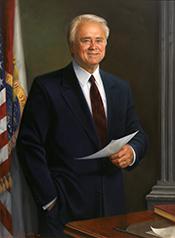 Rep. C. W. Bill Young (R-FL)