Mr. Speaker, I am on the floor tonight because recently we remembered the 60th anniversary of D-Day, World War II. We remembered, we had Memorial weekend, Memorial Day, and then we had the funeral of…
Mr. Speaker, I am on the floor tonight because recently we remembered the 60th anniversary of D-Day, World War II. We remembered, we had Memorial weekend, Memorial Day, and then we had the funeral of President Reagan. I think we all remember the price of freedom from those who served in World War II and in all of our wars; and certainly Mr. Reagan led this great Nation as we tried to create freedom for other countries, and he certainly distinguished himself in that way.
I am here tonight to talk about what I consider a real threat to the morality of America, and that is that the spiritual leaders of this great Nation are prohibited from expressing their first amendment rights to speak out on the moral and political issues of the day.
Many people know the history of this. Some do, some do not. The history is that from the beginning of this great Nation, until 1954, a spiritual leader could speak in his church, synagogue, or mosque on any issue of the day and not feel that there would be any retribution from the Internal Revenue Service. Well, one might say, what do you mean the Internal Revenue Service? Well, in 1954, Lyndon Baines Johnson, a United States Senator, offered an amendment on a revenue bill going through the Senate that was never debated. In fact, the Republican majority accepted Senator Johnson's amendment on unanimous consent, so there were no hearings, no debate, or anything. And basically what Mr. Johnson was trying to do at that time was the H.L. Hunt family in Texas was adamantly opposed to his reelection, and they had a couple of 301 think tanks, and so he wanted to quiet those think tanks. So, therefore, he put an amendment on a revenue bill going through the Senate that was never debated.
The unintended consequences of Mr. Johnson's amendment was and is the fact that churches that are 501(c)(3)s are prohibited from having any type of sermons that might be interpreted as being political at all. I do not know how one can uphold the teachings in the Bible if one does not talk about certain moral issues of the day.
This Nation was built on Judeo-Christian principles; and if this Nation is going to remain strong, then it must remember the Judeo- Christian principles that are the foundation of this great Nation.
The reason I wanted to come to the floor tonight, Mr. Speaker, is the fact that the bishop of Colorado Springs issued a pastoral letter to all of the Catholics in his diocese, and I will submit this entire letter for the Record.
The reason I bring this tonight to the floor is that the Bishop Sheridan of Colorado Springs has a responsibility to the teachings of Jesus Christ as well as the teachings of the Pope. Being a Catholic leader, he does feel very strongly about the pro-life issue; he does feel very strongly about stem cell research; he does feel strongly about euthanasia, the protection of our elderly. So he issued this pastoral letter reminding the Catholics in his diocese that in this year's election they should look carefully at those running for political office.
Now, he did not mention Democrat or Republican, he did not mention anything of that nature or the name of the candidates. But what he did was to issue this pastoral letter. And then Barry Lynn, who is the leader of the Americans for Separation of Church and State, noted in his letter of complaint to the Internal Revenue Service that Bishop Sheridan used ``code words.'' Code words like pro-choice, pro-life, liberal, conservative, Democrat or Republican.
Mr. Speaker, this bothers me in this great Nation that we would have an agency that because of the Johnson amendment is to enforce the law, but this was not part of the Johnson amendment. There is nothing in the Johnson amendment that talks about code words. That was an administrative decision by the Internal Revenue Service that if you as a religious leader, whether you be Protestant, Catholic, Jew, or Muslim, if you have these types of sermons and you might mention these words like pro-life or pro-choice, then you could have your 501(c)(3) status jeopardized.
Mr. Speaker, I am of the firm belief that this Nation, I do not believe that
my colleagues on either side of the aisle, whether they are religious or nonreligious, believe that we should have code words that someone who is speaking from the heart, speaking from the Bible might get themselves in trouble because they are advocating what the church stands for, what their religion stands for.
So, Mr. Speaker, I tonight want to work toward my close by saying that I hope that we as a legislative body will look seriously at this issue. I do not know if the House will bring this bill up that I introduced, H.R. 235; but I believe sincerely that prior to 1954, every preacher in this country, every rabbi in this country, every priest in this country, every cleric in this country had the right to speak on these issues and to speak based on the Constitution and based on the teachings of their religion.
So, Mr. Speaker, with that, I would like to say that I hope that the men and women who have worn the uniform for this Nation, those who have given their lives for this Nation, I believe sincerely that they believe that our spiritual leaders in this great Nation do have freedom of speech; but when it comes to the moral and political issues of the day, they do not have freedom of speech. So I hope that again the leadership of both parties will work with me to restore that freedom of speech. It only means that a minister or a priest or a rabbi or a cleric, if they choose to talk about these issues, may do so.
I close by asking God to please bless our men and women in uniform and their families and please, God, bless America.
A Pastoral Letter to the Catholic Faithful of the Diocese of Colorado
Springs on the Duties of Catholic Politicians and Voters
Dear Brothers and Sisters in Christ: This coming November
we Americans will participate in one of the most important
national elections in recent history. The president, senators
and congressmen who are placed in office by our votes will
serve at a time in which issues that are critical to the very
survival of our civilization will be at the top of the
political agenda. As we prepare for these elections I
consider it my duty as your bishop to write to you about
these matters so that you might go to the polls this fall
with a well-informed conscience.
The Church teaches that ``man has the right to act in
conscience and in freedom so as personally to make moral
decisions.'' Often we hear people claim that they are making
decisions in accord with conscience even when those decisions
defy the natural law and the revealed teachings of Jesus
Christ. This is because of a widespread misunderstanding of
the very meaning of conscience. For many, conscience is no
more than personal preference or even a vague sense or
feeling that something is right or wrong, often based on
information drawn from sources that have nothing to do with
the law of God.
The right judgment of conscience is not a matter of
personal preference nor has it anything to do with feelings.
It has only to do with objective truth. ``Conscience must be
informed and moral judgment enlightened. A well-formed
conscience is upright and truthful. It formulates its
judgments according to reason, in conformity with the true
good willed by the wisdom of the Creater. The education of
conscience is indispensable for human beings who are
subjected to negative influences and tempted by sin to prefer
their own judgment and to reject authoritative teachings.''
All people have a grave obligation to form their
consciences by adhering to the truth, precisely as that truth
is found in the natural law and in the revelation of God. As
Catholics we have the further obligation to give assent to
the doctrinal and moral teachings of the Church because ``to
the Church belongs the right always and everywhere to
announce moral principles, including those pertaining to the
social order, and to make judgments on any human affairs to
the extent that they are required by the fundamental rights
of the human person or the salvation of souls.'' In other
words, as people who profess the Catholic faith, we must
``have the mind of Christ'' in every judgment and act.
Among the many distortions and misrepresentations that
prevail in the current debates about the relationship between
religion and the social order (politics) is the assertion
that faith and policies are to the kept separated. This,
apparently, is based upon the American doctrine of the
separation of church and state. In fact, the wall that
separates church and state is the safeguard against both the
establishment of a state religion and the imposition or
sectarian religious beliefs and practices, such as particular
denominational forms of worship or theological tenets. In no
way does the American doctrine of separation of church and
state even suggest that the well-formed consciences of
religious people should not be brought to bear on their
political choices.
The Second Vatican Council was abundantly clear on this
matter. ``Nor, on the contrary, are they any less wide of the
mark who think that religion consists in acts of worship
alone and in the discharge of certain moral obligations, and
who imagine they can plunge themselves into earthly affairs
in such a way as to imply that these are altogether divorced
from the religious life. This split between the faith which
many profess and their daily lives deserves to be counted
among the more serious errors of our age. Long since, the
Prophets of the Old Testament fought vehemently against this
scandal and even more so did Jesus Christ Himself in the New
Testament threaten it with grave punishments. Therefore, let
there be no false opposition between professional and social
activities on the one part, and religious life on the
other.''
When Catholics are elected to public office or when
Catholics go to the polls to vote, they take their
consciences with them. Pope John Paul II has consistently
taught this as, for example, when he said that those who are
directly involved in lawmaking bodies have a ``grave and
clear obligation to oppose'' any law that attacks human life.
The Congregation for the Doctrine of the Faith has declared
that, ``in this context, it must be noted also that a well-
formed Christian conscience does not permit one to vote for a
political program or an individual law which contradicts the
fundamental contents of faith and morals.'' Anyone who
professes the Catholic faith with his lips while at the same
time publicly supporting legislation or candidates that defy
God's law makes a mockery of that faith and belies his
identity as a Catholic.
In November we will once again have the privilege of
exercising our most precious right as citizens--the right to
vote. Our choices will be made from among an array of
candidates who take a variety of positions with regard to
many important issues. In the midst of what could be a
difficult and confusing exercise it is very important to
remember that not all issues are of equal gravity. As men and
women of good will we strive to achieve true justice for all
people and to preserve their rights as human beings. There
is, however, one right that is ``inalienable'', and that is
the RIGHT TO LIFE. This is the FIRST right. This is the right
that grounds all other human rights. This is the issue that
trumps all other issues.
The November elections will be critical in the battle to
restore the right to life to all citizens, especially the
unborn and the elderly and infirm. As a result of the pro-
life efforts of countless Americans the number of abortions
performed in our country is now declining for the first time
since the appalling Supreme Court decision of 1973 that made
it ``legal'' to kill our children. We cannot allow the
progress that has been made to be reversed by a pro-abortion
President, Senate or House of Representatives. Neither can we
permit illicit stem cell research that makes use of aborted
babies. Any movement to promote and legalize euthanasia must
be halted. Our votes have the power to stop these
abominations.
There must be no confusion in these matters. Any Catholic
politicians who advocate for abortion, for illicit stem cell
research or for any form of euthanasia ipso facto place
themselves outside full communion with the Church and so
jeopardize their salvation. Any Catholics who vote for
candidates who stand for abortion, illicit stem cell research
or euthanasia suffer the same fateful consequences. It is for
this reason that these Catholics, whether candidates for
office or those who would vote for them, may not receive Holy
Communion until they have recanted their positions and been
reconciled with God and the Church in the Sacrament of
Penance.
In recent months another issue has reached the level of our
legislatures. It is so-called ``same-sex marriage.'' Those
who now promote this deviancy often present it as a human
right denied homosexual persons and thus illegally
discriminating against them. But, in fact, no one has a right
to that which flies in the face of God's own design. Marriage
is not an invention of individuals or even of societies.
Rather it is an element of God's creation. It is God who
created us male and female. It is God who joined man and
women so that they could be fruitful and multiply and fill
the earth. Every civilization known to mankind has understood
marriage as the union of a man and a woman for
the procreation and rearing of children. And yet now, in
21st century America, there are those who would want us to
believe that all people of all times have been mistaken
about the true nature and purpose of marriage. No one can
simply redefine marriage to suit a political or social
agenda.
Once again, we must be clear about this matter. The future
of our world depends upon the strength of the family, the
basic unit of society. The future of the family depends on
the state of marriage. The family--father, mother and
children--reflects the nature of God Himself, who is a
communion of selfless and self-giving love. For this reason
marriage and family life cannot be whatever we want them to
be. They are only and always as God has created them. As in
the matter of abortion, any Catholic politician who would
promote so-called ``same-sex marriage'' and any Catholic who
would vote for that political candidate place themselves
outside the full communion of the Church and may not receive
Holy Communion until they have recanted their positions and
been reconciled by the Sacrament of Penance.
The Church never directs citizens to vote for any specific
candidate. The Church does,
however, have the right and the obligation to teach clearly
and fully the objective truth about the dignity and rights of
the human person. These teachings, in turn, must inform the
consciences of voters. ``By its intervention in this area,
the Church's Magisterium does not wish to exercise political
power or eliminate the freedom of opinion of Catholics
regarding contingent questions. Instead, it intends--as is
its proper function--to instruct and illuminate the
consciences of the faithful, particularly those involved in
political life, so that their actions may always serve the
integral promotion of the human person and the common good.''
Dear friends in Christ, I exhort you with all my heart to
take courage and proclaim the Gospel of Life to those who
will stand for elected office this fall. It is by your
prayers and by your votes that politicians who are
unconditionally pro-life and pro-family will serve our
country. Conversely, if our voices remain silent or if, God
forbid, we vote contrary to our informed consciences, we will
see our country led down a short path to ruin. We want
freedom for all, but there can be no freedom without truth.
In the words of our Holy Father: ``When freedom is detached
from objective truth it becomes impossible to establish
personal rights on a firm rational basis; and the ground is
laid for society to be at the mercy of the unrestrained will
of individuals or the oppressive totalitarianism of public
authority.''
Let us all pray for those politicians who claim to be
Catholic yet continue to oppose the law of God and the rights
of persons that, by the grace of God, they will be converted
once again to the full and authentic articulation and
practice of the faith.
Finally, I wish to affirm my brother bishops who have
proclaimed the truth of these critical matters and who have
admonished those Catholic politicians who place themselves at
odds with the truth of God. May that truth which is the
foundation of genuine freedom prevail in our country.
Given at the Chancery on this first day of May 2004, the
Feast of St. Joseph the Worker.
Most Reverend Michael J. Sheridan,
Bishop of Colorado Springs.
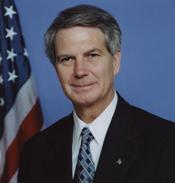 Rep. Walter B. Jones (R-NC)