H.R. 2681House108th Congress (2003-2005)In Committee
Higher-Risk Impaired Driver Act
Sponsored by 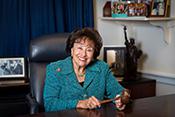 Rep. Nita M. Lowey (D-NY)
Rep. Nita M. Lowey (D-NY)Introduced July 9, 2003
Legislative Activity
Stay on top of the latest movement without scrolling through every action
HouseCommittee
Latest Action
Referred to the Subcommittee on Highways, Transit and Pipelines.
July 10, 2003
View full timeline
HouseIntro Referral
Introduced in House
July 9, 2003
HouseIntro Referral
Referred to the House Committee on Transportation and Infrastructure.
July 9, 2003
HouseCommittee
Referred to the Subcommittee on Highways, Transit and Pipelines.
July 10, 2003
Bill Text
Latest available legislative text
Introduced in HouseIssued July 9, 2003
        [Congressional Bills 108th Congress]
[From the U.S. Government Publishing Office]
[H.R. 2681 Introduced in House (IH)]

108th CONGRESS
1st Session
H. R. 2681

To amend title 23, United States Code, to increase penalties for
individuals who operate motor vehicles while intoxicated or under the
influence of alcohol.

_______________________________________________________________________

IN THE HOUSE OF REPRESENTATIVES

July 9, 2003

Mrs. Lowey (for herself, Mr. Boehlert, Ms. Roybal-Allard, and Ms.
Norton) introduced the following bill; which was referred to the
Committee on Transportation and Infrastructure

_______________________________________________________________________

A BILL

To amend title 23, United States Code, to increase penalties for
individuals who operate motor vehicles while intoxicated or under the
influence of alcohol.

Be it enacted by the Senate and House of Representatives of the
United States of America in Congress assembled,

SECTION 1. SHORT TITLE.

This Act may be cited as the ``Higher-Risk Impaired Driver Act''.

SEC. 2. FINDINGS.

The Congress finds the following:
(1) Of the total 42,850 people who died in motor vehicle
traffic crashes in the United States during 2002, alcohol-
related traffic deaths accounted for 42 percent--preliminary
data shows that 17,970 people died in these crashes.
(2) Alcohol-related traffic fatalities in the United States
have been rising since 1999.
(3) About one-third of all drivers arrested or convicted of
driving under the influence are repeat offenders.
(4) A report released by the alcohol industry showed that
58 percent of alcohol-related traffic fatalities in 2001
involved drivers with a blood alcohol concentration level of
.15 percent and above.
(5) Research funded by the alcohol industry has concluded
that repeat offenders of alcohol-impaired driving laws and
first offenders with high blood alcohol concentration (BAC)
levels are at greatest risk of committing a subsequent drunk
driving offense.
(6) It should be the policy of the federal government,
among other aims, to target these repeat offenders and high BAC
level offenders to help reduce the risk of fatality due to
alcohol-impaired driving.

SEC. 3. INCREASED PENALTIES.

(a) In General.--Chapter I of title 23, United States Code, is
amended by adding at the end the following:
``Sec. 165. Increased penalties for higher risk drivers for driving
while intoxicated or driving under the influence
``(a) Definitions.--In this section, the following definitions
apply:
``(1) Blood alcohol concentration.--The term `blood alcohol
concentration' means grams of alcohol per 100 milliliters of
blood or the equivalent grams of alcohol per 210 liters of
breath.
``(2) Driving while intoxicated; driving under the
influence.--The terms `driving while intoxicated' and `driving
under the influence' mean driving or being in actual physical
control of a motor vehicle while having a blood alcohol
concentration above the permitted limit as established by each
State.
``(3) License suspension.--The term `license suspension'
means the suspension of all driving privileges.
``(4) Motor vehicle.--The term `motor vehicle' means a
vehicle driven or drawn by mechanical power and manufactured
primarily for use on public highways but does not include a
vehicle operated solely on a rail line or a commercial vehicle.
``(5) Higher-risk impaired driver law.--
``(A) The term `higher-risk impaired driver law'
means a State law that provides, as a minimum penalty,
that an individual described in subparagraph (B)
shall--
``(i) receive a driver's license suspension
for not less than 1 year, including a complete
ban on driving for not less than 90 days and
for the remainder of the license suspension
period and prior to the issuance of a
probational hardship or work permit license, be
required to install a certified alcohol
ignition interlock device;
``(ii) have the motor vehicle driven at the
time of arrest impounded or immobilized for not
less than 90 days and for the remainder of the
license suspension period require the
installation of a certified alcohol ignition
interlock device on the vehicle;
``(iii) be subject to an assessment by a
certified substance abuse official of the State
that assesses the individual's degree of abuse
of alcohol and assigned to a treatment program or impaired driving
education program as determined by the assessment;
``(iv) be imprisoned for not less than 10
days, have an electronic monitoring device for
not less than 100 days, or be assigned to a
DUI/DWI specialty facility for not less than 30
days;
``(v) be fined a minimum of $1,000, with
the proceeds of such funds to be used by the
State or local jurisdiction for impaired
driving related prevention, enforcement, and
prosecution programs, or for the development or
maintenance of a tracking system of offenders
driving while impaired;
``(vi) if the arrest resulted from
involvement in a crash, pay court-mandated
restitution to the victims of the crash;
``(vii) be placed on probation by the court
for a period of not less than 2 years;
``(viii) if diagnosed with a substance
abuse problem, during the first year of the
probation period referred to in clause
(vii), attend a treatment program for a period of 12 consecutive months
sponsored by a State certified substance abuse treatment agency and
meet with a case manager at least once each month; and
``(ix) be required by the court to attend a
victim impact panel, if such a panel is
available.
``(B) An individual referred to in subparagraph (A)
is an individual who--
``(i) is convicted of a second or
subsequent offense for driving while
intoxicated or driving under the influence
within a minimum of 5 consecutive years;
``(ii) is convicted of a driving while
intoxicated or driving under the influence with
a blood alcohol concentration of 0.15 percent
or greater;
``(iii) is convicted of a driving-while-
suspended offense if the suspension was the
result of a conviction for driving under the
influence; or
``(iv) refuses a blood alcohol
concentration test while under arrest or
investigation for involvement in a fatal or
serious injury crash.
``(6) Special dui/dwi facility.--The term `special DUI/DWI
facility' means a facility that houses and treats offenders
arrested for driving while impaired and allows such offenders
to work and/or attend school.
``(7) Victim impact panel.--The term `victim impact panel'
means a group of impaired driving victims who speak to
offenders about impaired driving. The purpose of the panel is
to change attitudes and behaviors in order to deter impaired
driving recidivism.
``(b) Withholding of Funds.--
``(1) Fiscal year 2008.--On October 1, 2007, if a State has
not enacted or is not enforcing a higher-risk impaired driver
law, the Secretary shall withhold 2 percent of the amount
required to be apportioned for Federal-aid highways to the
State on that date under each of paragraphs (1), (3), and (4)
of section 104(b).
``(2) Fiscal year 2009.--On October 1, 2008, if a State has
not enacted or is not enforcing a higher-risk impaired driver
law, the Secretary shall withhold 4 percent of the amount
required to be apportioned for Federal-aid highways to the
State on that date under each of paragraphs (1), (3), and (4)
of section 104(b).
``(3) Fiscal year 2010.--On October 1, 2009, if a State has
not enacted or is not enforcing a higher-risk impaired driver
law, the Secretary shall withhold 6 percent of the amount
required to be apportioned for Federal-aid highways to the
State on that date under each of paragraphs (1), (3), and (4)
of section 104(b).
``(4) Fiscal year 2011.--On October 1, 2010, and on October
1 of each year thereafter, if a State has not enacted or is not
enforcing a higher-risk impaired driving law, the Secretary
shall withhold 8 percent of the amount required to be
apportioned for Federal-aid highways to the State on that date
under each of paragraphs (1), (3), and (4) of section
104(b).''.
<all>