H.R. 3364House108th Congress (2003-2005)In Committee
To authorize appropriate action if the negotiations with the People's Republic of China regarding China's undervalued currency and currency manipulation are not successful.
Sponsored by  Rep. Sue Wilkins Myrick (R-NC)
Rep. Sue Wilkins Myrick (R-NC)Introduced October 21, 2003
Legislative Activity
Stay on top of the latest movement without scrolling through every action
HouseCommittee
Latest Action
Referred to the Subcommittee on Trade.
October 27, 2003
View full timeline
HouseIntro Referral
Introduced in House
October 21, 2003
HouseIntro Referral
Referred to the House Committee on Ways and Means.
October 21, 2003
Floor Debate
1 memberWhat members said about H.R. 3364 on the floor
Floor Debate
1 memberWhat members said about H.R. 3364 on the floor
1 Democrat
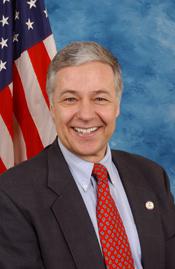
Rep. Michael H. MichaudD-ME-2 · Jun 26, 2003
Mr. Speaker, I ask unanimous consent that my name be removed as cosponsor of H.R. 2407.
Bill Text
Latest available legislative text
Introduced in HouseIssued October 21, 2003
        [Congressional Bills 108th Congress]
[From the U.S. Government Publishing Office]
[H.R. 3364 Introduced in House (IH)]

108th CONGRESS
1st Session
H. R. 3364

To authorize appropriate action if the negotiations with the People's
Republic of China regarding China's undervalued currency and currency
manipulation are not successful.

_______________________________________________________________________

IN THE HOUSE OF REPRESENTATIVES

October 21, 2003

Mrs. Myrick (for herself and Mr. Spratt) introduced the following bill;
which was referred to the Committee on Ways and Means

_______________________________________________________________________

A BILL

To authorize appropriate action if the negotiations with the People's
Republic of China regarding China's undervalued currency and currency
manipulation are not successful.

Be it enacted by the Senate and House of Representatives of the
United States of America in Congress assembled,

SECTION 1. FINDINGS.

Congress makes the following findings:
(1) The currency of the People's Republic of China, the
yuan, is artificially pegged at a level significantly below its
market value. Economists estimate the yuan to be undervalued by
between 15 percent and 40 percent or an average of 27.5
percent.
(2) The undervaluation of the yuan makes exports from the
People's Republic of China less expensive for foreign consumers
and makes foreign products more expensive for Chinese
consumers. The effective result is a significant subsidization
of China's exports and a virtual tariff on foreign imports,
leading the People's Republic of China to enjoy significant
trade surpluses with its international trading partners. The
United States trade deficit with China has widened from
$57,000,000,000 in 1998 to $103,000,000,000 in 2002, resulting
in an aggregate deficit with China of over $396,000,000,000 for
that 5-year period.
(3) China's undervalued currency and the United States
trade deficit with the People's Republic of China is
contributing to significant United States job losses and
harming United States businesses. In particular, the United
States manufacturing sector has lost over 2,600,000 jobs since
March 2001, which accounts for approximately 90 percent of the
total United States job losses.
(4) The Government of the People's Republic of China has
intervened in the foreign exchange markets to hold the value of
the yuan within an artificial trading range. China's foreign
reserves are estimated to be over $345,000,000,000 as of June
2003, and have increased at a level higher than that of any
other country.
(5) China's undervalued currency and the Chinese
Government's intervention in the value of its currency violates
the spirit and letter of the world trading system of which the
People's Republic of China is now a member.
(6) The Government of the People's Republic of China has
failed to promptly address concerns raised by the United States
and the international community regarding the value of its
currency.
(7) Article XXI of the GATT 1994 (as defined in section
2(1)(B) of the Uruguay Round Agreements Act (19 U.S.C.
3501(1)(B)) allows a member of the World Trade Organization to
take any action which it considers necessary for the protection
of its essential security interests. Protecting the United
States manufacturing sector is essential to the security
interests of the United States.

SEC. 2. NEGOTIATIONS AND CERTIFICATION REGARDING THE CURRENCY VALUATION
POLICY OF THE PEOPLE'S REPUBLIC OF CHINA.

(a) In General.--Notwithstanding the provisions of title I of
Public Law 106-286 (19 U.S.C. 2431 note), on and after the date that is
180 days after the date of enactment of this Act, unless a
certification described in subsection (b) has been made to Congress,
there shall be imposed a rate of duty of 27.5 percent ad valorem on any
article that is the growth, product, or manufacture of the People's
Republic of China and is imported directly or indirectly into the
United States, in addition to any other duty that would otherwise apply
to such article.
(b) Certification.--The certification described in this subsection
means a certification by the President to Congress that the People's
Republic of China is no longer manipulating the rate of exchange
between its currency and the United States dollar for purposes of
preventing an effective balance of payments and gaining an unfair
competitive advantage in international trade. The certification shall
also include a determination that the currency of the People's Republic
of China is valued in accordance with accepted market-based trading
policies.
(c) Negotiations.--Beginning on the date of enactment of this Act,
the Secretary of the Treasury, in consultation with the United States
Trade Representative, shall begin negotiations with the People's
Republic of China to ensure that the People's Republic of China adopts
a process that leads to a market-based system of currency valuation.
<all>