Waiving points of order against the conference report to accompany the bill (H.R. 2) to provide for reconciliation pursuant to section 201 of the concurrent resolution on the budget for fiscal year 2004.
Legislative Activity
Stay on top of the latest movement without scrolling through every action
Motion to reconsider laid on the table Agreed to without objection.
May 23, 2003 • 12:07 AM
View full timeline
Introduced in House
May 22, 2003
The House Committee on Rules reported an original measure, H. Rept. 108-129, by Mr. Reynolds.
May 22, 2003
Rule provides for consideration of the conference report to H.R. 2.
May 22, 2003 • 10:36 PM
Placed on the House Calendar, Calendar No. 49.
May 22, 2003
Considered as privileged matter. (consideration: CR H4706-4716)
May 22, 2003 • 10:38 PM
DEBATE - The House proceeded with one hour of debate on H. Res. 253.
May 22, 2003 • 10:38 PM
On ordering the previous question Agreed to by the Yeas and Nays: 221 - 205 (Roll no. 224). (text: CR H4706)
May 23, 2003 • 12:07 AM
Passed/agreed to in House: On agreeing to the resolution Agreed to by voice vote.
May 23, 2003 • 12:07 AM
On agreeing to the resolution Agreed to by voice vote.
May 23, 2003 • 12:07 AM
Motion to reconsider laid on the table Agreed to without objection.
May 23, 2003 • 12:07 AM
Voting History
1 vote recorded • Roll call available
Floor Debate
24 membersWhat members said about H.Res. 253 on the floor
 TSTMR
TSTMR BLD
BLD RCB
RCB HR+19
HR+19
Floor Debate
24 membersWhat members said about H.Res. 253 on the floor
Madam President, because of the circumstances, I really don't have a prepared statement. I wish to outline for the Senate how we intend to proceed. We have been working for some time trying to obtain…
Madam President, because of the circumstances, I really don't have a prepared statement. I wish to outline for the Senate how we intend to proceed. We have been working for some time trying to obtain a process by which we could proceed to act on the 11 appropriations bills for the fiscal year 2003 which were not completed by the end of the last Congress.
I commend my good friend from West Virginia and his staff for assistance in working with us to work out this procedure. These bills that will soon be included in an omnibus amendment to
this continuing resolution are familiar to the Senate. We worked on them throughout the last year. And I wish to say that to the best of my knowledge the components of this bill, except for one portion, were worked on on a bipartisan basis by the staffs of the 11 subcommittees that handled these 11 bills. I can't say that there has been total agreement on the part of anybody as to what we have done, but we have proceeded to reduce the 11 bills that were involved to the amount of the President's request, which was $750.5 billion, plus an amount that is represented by a budget request for the fire items that are included in the bill of $825 million. In doing so, we come down considerably in many of these bills.
But I point out to the Senate that the Government has been operating under the CRs that have been passed since October 1. All of the agencies affected by these bills have been operating on the basis of the 2002 appropriations level--the enacted level of funds for those agencies. If we do not finish these bills now, they will continue to act under the 2002 level until obviously we do something to take us down to the end of this fiscal year.
I have taken the position that the sooner we can enact these 11 bills the better off all the agencies are, and the better off the Congress is because our job is to turn to the requirements of the law to deal with the fiscal year 2004 bills through the budget process and through the consideration of the 13 bills that we have in the Appropriations Committee through the individual subcommittees and get them done this year--God willing--according to the normal schedule and before September 30. We cannot do that if we labor over these bills intensively for a period of time.
I am pleased to say that everyone concerned has been very cooperative, and, above all, the members of the Appropriations Committee on both sides of the aisle have worked hard to get us where we are today.
The amendment that I will soon present contains not only that portion that I mentioned in terms of a series of bills but it contains the Agriculture, Rural Development, Food and Drug Administration, and Related Agencies appropriations for fiscal year 2003. It provides budget authority for Agriculture, rural development, and the nutritional programs.
There is in this bill $670.4 million--more than the President's request--and more than $1.1 billion more than 2002.
I have a whole series of highlights on this bill. I don't want to take the time of the Senate to outline the individual ones. We will do that as we proceed on the bill. There are definitely needs for the programs for each of these items.
The second bill we have is the Commerce, State, Justice and related agencies appropriations bill. Again, this is the recommendation of the subcommittee as adjusted by the process I just outlined. It is approximately $2.5 billion above the 2002 enacted funding level.
These, of course, are a series of highlights. I may later ask to put them all in the Record as part of my opening statement. I want to review these outlines later. I do not make that request now.
We also have the District of Columbia appropriations bill. It makes appropriations for the District of Columbia. It is an item that is substantially higher than the President's request. It is a total of $512 million in discretionary budget authority for the District of Columbia.
We have the energy and water appropriations bill. It recommends $26.164 billion for 2003. It exceeds the President's request by $649 million, and it exceeds the 2002 level by $900 million.
We have the foreign operations bill among the 11 included in this amendment. This bill is $221 million below the President's request. It is also below the fiscal year 2002 level by $73.5 million.
The Department of the Interior bill provides $19.18 billion in total discretionary budget authority--an increase of $641 million over the enacted level of 2002. It is $36 million over the President's budget request for 2003.
The Labor-Health and Human Services bill deals with the President's request, which was $131.9 billion. This bill as recommended by my amendment will be $131.3 billion. The details will be in the items that I will put in the Record.
On the Department of Transportation and related agencies, we recommend $64.6 billion for 2003. This is $9.4 billion more than the President's request of $55.2 billion. I do not have a figure above the 2002 level. I will put it in the Record later.
We have the Treasury and general government appropriations bill. This provision is in the bill at $34.5 billion. The President's request was $34.2 billion, and the 2002 level was $32.8 billion. This is another area where it is above the President's request.
The last section is the section that deals with items that have been added to the 13 bills. One is to fund the election reform bill that was enacted in the last Congress. The maximum authorized level for that program for 12 months for fiscal 2003 was $2.35 billion. For the remainder of the bill, this amendment that I offer will fund election reform at $1.5 billion.
For drought relief, we have set a target of $3.1 billion. The provisions of the bill as presented by the Agriculture Committee and others will adjust the mandatory programs in order to provide relief for the drought that has occurred.
We also have a provision dealing with Medicare adjustments, dealing with physicians' payments and payments for rural hospitals. The total amount would be $1.6 billion. These items would be offset by a 1.6- percent across-the-board cut on the other 11 bills.
We have done our best to present to the Senate--I have, working with the members of the committee and their staffs--a bill to meet the requirements of the administration, to meet the requirements of the agencies, and to present a bill that can be taken to conference and worked out with the House in conference.
Madam President, I point out, the House has not passed any bills. The House has passed this continuing resolution, to give us a House-passed bill, to return this bill to the House for their consideration. We are hopeful that the House will enact its own version and send it to conference. As has been outlined already by the unanimous consent agreement that is in place, we will seek a conference with the House at the earliest possible time.
I urge Senators to consider the problem we face, and that is the problem of catching up with the bills we should have enacted last year. I point no fingers as to reasons we did not. The Senate Appropriations Committee, under the chairmanship of Senator Byrd, did report out all the bills. We were prepared to act, but circumstances at that time made it impossible for us to pass those bills.
Under the circumstances now, we cannot afford the process of passing separate bills, facing vetoes or veto threats, and having bills go back and forth between the Houses. If we are going to catch up and start the process of dealing with the 2004 appropriations, as is our duty in this new Congress, we must put these requests of the past, for the remainder of this fiscal year, in place. We must pass this amendment or something similar to it as soon as is possible, as soon as the Congress can agree and the President will concur with our actions.
I will say, I have discussed this at length with the Office of Management and Budget. I cannot say they approve of what we are doing, but I can say they approve of the fact that we are doing something. So that is what I am asking the Senate to do tonight, to start the process of doing something on these accumulated items that must be faced by this Congress as quickly as possible.
Madam President, I ask unanimous consent to have printed in the Record summaries from which I read partially.
Madam President, again, I thank my friend from West Virginia for his courtesy. I know that while I have been working on these other matters, my friend has had a very erudite statement prepared, and I am prepared to listen to it.
I thank the Chair.
Mr. President, I believe under the unanimous consent request that now is the time for me to offer my amendment.
Amendment No. 1
Mr. President, there is an amendment at the desk.
Mr. President, I ask unanimous consent that further reading of the amendment be dispensed with.
The Senator from West Virginia has an amendment to offer. I thank him for his comments. We are in substantial agreement, except in the conclusion. We both feel that the Government of the United States should not operate under a continuing resolution. What it means is that our agencies are not moving forward in 2003 at the rate actually requested by the President in 2001 for the fiscal year 2002.
Times have changed. They have changed considerably. Each of these agencies are subject to new laws that were passed both in 2001 and 2002 with regard to the programs that they administer. They cannot do those new programs without new money.
As the Senator from West Virginia said, they are currently operating on autopilot. I am an old pilot and autopilot is a wonderful thing to have, but it doesn't know how to change course unless someone turns the dials. Autopilot cannot take you off or land you. It only continues on the course that it is on. It will fly right into a mountain if you don't change the course. There is a mountain ahead of us, which is the mountain of unfulfilled commitments in the Federal Government, which both the President and Congress have made and changes that were made since the President first conceived the budget of 2002.
I do believe that the Senator is right. I would have joined him last year in proceeding as we did with the bill as reported. But it is different now. We are ready to start a new Congress. We, hopefully, will have our organization resolution soon, and we will be working toward complying with the laws that we work under--the Budget Act--and the requirement that we pass 13 appropriations bills for 2004.
We cannot get there if we pass these bills separately. As I said before, we
will face the prospect of disagreement with the House and endless conferences on 11 bills, and possibilities of vetoes and motions to override, and all the time it will take. Mr. President, it will be June before we get down to the business of this Congress if we do not follow the recommendation to proceed that has been made now by me on behalf of the President and on behalf, I believe, of all the members of our committee.
We have differences on what should be in the bill, but the main thing is that we should proceed. I await the offering of the Senator's amendment. I know pretty well what is in it, and I regret that I cannot join him this year in supporting it.
Is the amendment now pending before the Senate, Mr. President?
I yield to the Senator from West Virginia.
Amendment No. 2
Mr. President, I suggest the absence of a quorum.
Mr. President, I ask unanimous consent that the order for the quorum call be rescinded.
Mr. President, the distinguished Senator from West Virginia, Mr. Byrd, presented a chart showing the major elements of the $5 billion homeland security package. Eventually, this homeland security money, since it is money that people involved in that area want, we will address not only this year, in this 2003 bill, not only in the 2004 bill, but out into 2005. This Homeland Security Department has not even formed yet, as we know. There are several components in the existing Government that will be transferred into homeland security, and they have funding in this amendment I have offered.
For instance, Senator Byrd wants to add to this amendment I have offered $1.4 billion for State and local assistance to combat terrorism, but we already have spread throughout the 11 bills $2.2 billion to deal with the same concepts. We have money for first responder radio equipment. We have money for emergency planning and training.
Last year, I supported this money that Senator Byrd wants in his amendment for this bill--in a series of bills, as a matter of fact. The problem we face now is, should we continue to operate at the 2002 level until we can find an agreement with the President as to the amounts Senator Byrd wants to add to the President's request or should we move forward through the way we allocated money in the bill for the various elements of homeland security in the existing Departments? The money we put in the existing Departments will be transferred to Homeland Security as that Department is formed.
Senator Byrd wants to put up an additional $1.8 billion for border security. Again, in the period ahead we will spend money like that, but in these bills already is a total of $4.3 billion, and we are looking at a period of less than 8 months to spend that money.
I have presented the amendment that is before the Senate now because we want to find a way to work with the President to close the books on the 2003 appropriations. We cannot do that if we continue to battle with the administration and try to give them money beyond what they believe is necessary.
At the time we were looking at this last year, we thought the Homeland Security Department would have been created before September 30 of last year. We wanted to put up money so it would be there for the Homeland Security Department to be transferred to start spending in October. This money would be started to be spent in late February or March.
I am trying to make a point. Take airport security; Senator Byrd wants an additional $720 million. We have already appropriated substantial monies that are in the supplemental from last year for airport security. We have tried to fund the needs of the Transportation Security Administration. We already have an additional $374 million in these separate portions of the amendment I have offered.
I am trying to emphasize the fact that we do not need to give this Department of Homeland Security more money beyond what has been asked.
On nuclear and energy security, I do not disagree with the statements that have been made about the needs for additional money. In this amendment I have offered is $1.650 billion for that function. Senator Byrd wants to add another $296 million. I understand he is trying to fully fund the estimated needs of homeland security for the future, which is a laudable goal, but we are trying to stay within some sort of budget constraint.
As I said, let's finish the job of getting the books closed on how much the agencies have to spend in the remainder of fiscal year 2003.
On Federal law enforcement with the FBI, Senator Byrd wants to add $212 million to the $1.2 billion already in the bill. I am urging the Senate to listen in terms of the concepts we have worked out. Stop this battle with the President over how much is needed for the agency that has not even been established yet. The various components of that agency, the Homeland Security Department, will have enough money coming into this new Department to fully fund whatever they can do by the time they get organized as a Department.
I urge the Senate to oppose the amendment offered by the Senator from West Virginia--not because he is not right at estimating the future needs of homeland security--because we believe we are right in saying, let's fund now the money that can be spent before the end of this fiscal year, be spent before September 30. I am confident we have sufficient moneys in this amendment that we have offered in the 11 separate sections which would normally be separate appropriations bills, enough money to deal with the problems of homeland security.
Beyond that, I remind the Senate the President still has some money left from the $20 billion we gave him after 9/11. If there are any defects here, he has more than $5 billion in that account and can allocate it if it is necessary to establish Homeland Security so long as it is working toward establishing the facilities and entities we need to prevent further repetition of the catastrophe of September 11.
I hope the Senate will listen. To adopt the Byrd amendment will be to prolong the conference. If it was in a bill that would go to the President, he would veto it. Then where are we? Maybe I am too pragmatic about this, but it is time to get this job done. The amendment I have offered will get the job done. There will still be some differences with the House. As a matter of fact, there will still be some differences with the administration because we have increased some items that they do not want to see increased and we have decreased some they do not want decreased. But overall, we are within the total limit and parameters of the requests of the President.
I hope tomorrow the Senate will be looking at this. There will be further debate tomorrow morning. The leader will, of course, state what the procedure will be. We expect a vote sometime around noon or soon thereafter on the Byrd amendment. I am hopeful that the Senate will work with us to try and understand my job now is to get this amendment to conference.
As I told the Senate Members, the House has not passed any of these bills. It passed some of them last year. We did not act on them. We passed some last year and they did not act on them. We are trying to restart the 2003 conference and there will be an overall conference on all 11 bills at one time if the Senate will give us the support to pass this bill and take it to conference.
There will be individual differences as far as amendments are concerned. As a matter of fact, there are some things in this amendment I personally would change, but they have been brought here by the work of the subcommittee chairmen and ranking Members of the individual areas covered by these bills. I think it is the best course to follow, to take this amendment to conference, to go to the House and say, let's get these 11 bills finished so the agencies will know for certain the money they have. Even the homeland security bill was not passed when we originally contemplated passing the appropriations to fund it.
I am confident we have done the best we can under the circumstance. Again, I do not criticize Senator Byrd. Eventually, we will spend more than $5 billion in addition to what we have in the amendment before the Senate. However, we do not need it now. I sat through all the hearings that have been mentioned, that Senator Byrd had on the needs for homeland security across the Nation. I remember going to small towns in my State when the mayor told me they needed a new fire truck. They needed a new fire truck? They have never had a fire truck. There is not anyone in the country that does not want some of this homeland security money. The question is, what is needed now to go on with the job and protect the country. I believe our amendment does it.
I send to the desk a statement prepared by the individual subcommittees that goes along with 11 components of this bill. Had we had the meetings of
the separate subcommittees and reported separate bills, we would have prepared 11 reports. Instead, I am submitting for the Record to be printed the overview and summary of each of the components so there will be no question in the future of what is intended by the provisions of the amendment I have offered if it is enacted. I ask unanimous consent it be printed in the Record.
Mr. Speaker, by direction of the Committee on Rules, I call up House Resolution 253 and ask for its immediate consideration. Mr. Speaker, for the purpose of debate only, I yield the customary 30…
Mr. Speaker, by direction of the Committee on Rules, I call up House Resolution 253 and ask for its immediate consideration.
Mr. Speaker, for the purpose of debate only, I yield the customary 30 minutes to the gentleman from Texas (Mr. Frost), the ranking member of the Committee on Rules, pending which I yield myself such time as I may consume. During consideration of this resolution all time yielded is for the purpose of debate only.
Mr. Speaker, House Resolution 253 is an appropriate rule providing for 1 hour of debate for consideration of the conference report accompanying H.R. 2, the Jobs and Growth Reconciliation Act of 2003.
The rule waives all points of order against the conference report and against its consideration.
Mr. Speaker, taxes now claim a greater share of the median two-income family's budget than food, clothing, housing, and transportation combined. That just is not right. Families need the flexibility to dedicate their hard-earned resources towards their most pressing concerns. While some may need more money to help pay off their debts, others may need extra money to pay tuition for their child or to invest for their retirement.
The same can be said for small business owners, the entrepreneurial backbone of America. They should be empowered to allocate their resources however they see fit, whether it be hiring more employees, reinvesting, or expanding their business in order to create jobs.
The point is, people should be making decisions on how to best spend their hard-earned dollars, not the government, nor should government punish them with job-killing, unfair taxes.
Today's legislation is not just about tax relief; it is about creating jobs and stimulating the economy. The fact is jobs do not create themselves. And we, in this Congress, have both the ability and responsibility to help create those jobs. Through his consistent and immediate attention to growth and prosperity for working Americans, the President has once again guided Congress to foster job creation and ease the outrageous tax burden on working Americans. Under his direction, we will be helping countless Americans achieve a greater parity in the Tax Code and realize the fulfillment of employment.
No one knows the current job struggle like my constituents and fellow New Yorkers across the State. For my part of the State, which never shared in the economic boom of the 1990s, job growth remains the number one priority. And this type of positive impact is what this and so many other parts of our country need.
On average, over 30,000 new jobs will be created in New York every year for the next 5 years. Instead of an unemployment check, these workers will get a paycheck that they want and they deserve.
The bill recognizes that we cannot create employees if we do not work with employers to create jobs. For example, small businesses will have an option of immediately deducting up to $100,000 in expenses, a significant increase over the current $25,000 deductions. Because most small businesses pay taxes as individuals, accelerating the top rate reduction means lower taxes for small business owners. This means that millions of entrepreneurs will have more money to spend on employees, supplies, or expansion efforts.
The conference report also drastically reduces the dividend tax burden, making stocks more valuable and increasing expected rates of return. By lowering the rates of dividend and capital gains, people will be more willing to invest because they will pay less tax on the returns to their investments.
What this bill also recognizes is the need for an immediate infusion of direct aid to States facing dire fiscal crises. Budget shortfalls and sharply rising Medicaid costs have crippled local governments, restricted access to vital services, such as health care, that our constituents greatly rely on.
By coupling State relief with tax relief and job creation, we can alleviate the strain on State revenues, and further stimulate the economy with direct aid to our States and localities that need it most.
Whether creating jobs, relieving the tax burden, increasing investment, or fostering State and local stability, this bill acknowledges the need for all-encompassing approaches to growing the economy.
Mr. Speaker, former President Ronald Reagan once said the current Tax Code is a daily mugging. This is not what our political science teachers meant by participation in government. Let us not rob the American people of their hard-earned money. This country was founded upon individuals who stretched their imaginations, fostered ingenuity, and broke their backs for freedom and justice. Americans throughout history have not toiled resiliently just to fork over all their earnings to the Federal Government. This was not the intent of our forefathers, nor should it be ours now.
Mr. Speaker, I urge my colleagues to join me in supporting this rule as well as the underlying legislation.
Mr. Speaker, I reserve the balance of my time.
Mr. Speaker, I yield myself such time as I may consume.
Mr. Speaker, my memory serves that at the time, had we not done the tax cuts that we passed in 2001, we might have been in a deeper recession, a slower economy. And, quite frankly, that was part of the stimulus that has moved us to a shallow recession. In moving forward with this tonight, my hope is the economic stimulus will continue to advance.
Quite frankly, I think the Republican agenda, led by our President, has done the job, and I am hoping that we can continue moving on that agenda. I will be happy to take that record to the voters of this land and let them make a decision.
Mr. Speaker, I yield such time as he may consume to the gentleman from California (Mr. Dreier), the distinguished chairman of the Committee on Rules.
Mr. Speaker, I yield myself such time as I may consume.
Mr. Speaker, we are getting to the heart of it. The heart of it is that the left is filing in here to talk about we need bigger government and more spending. We need more of that central Federal Government.
And the debate will happen after this rule is passed of those who want to see a tax cut, those who want to put that money back in the American people's pocket. And then we will begin to look at some of the facts in this debate.
Mr. Speaker, a married couple with two children, an income of $40,000 will see their taxes decline under the Jobs and Growth Tax Relief Act of $1,133 in 2003. That is a decline of 96 percent.
In 2003, 91 million taxpayers will receive on average a tax cut of $1,126 under the Jobs and Growth Act of 2003. And 68 million women will see their taxes decline on average by $1,338; 45 million married couples will receive an average tax cut of $1,786; 34 million families with children will benefit from an average tax cut of $1,549; 6 million single women with children will receive an average tax cut of $558; 12 million elderly taxpayers will receive an average tax cut of $1,401; 23 million small business owners will receive tax cuts averaging $2,209; 3 million individuals and families will have their income tax liability completely eliminated by this act.
I will repeat that again. Mr. Speaker, 3 million individuals and families will have their income tax liability completely eliminated by this act. Half of the tax relief package in 2003 is directed to the child tax credit, expanding a 10 percent bracket eliminating the marriage penalty, accelerating the marginal rate cuts, and ensuring that middle-class families do not face AMT. Ten million seniors will receive some type of dividend income, will be able to make their golden years more secure by keeping more of what their dividend income is.
When I have this vote cast for this rule and then when I vote on the underlying legislation, I am happy to take those facts back to my district and stand before my constituents. Do Americans want more Federal Government and bureaucrats creating programs, or do they want that money in their pocket for them to make that decision?
I yield to the gentleman from Vermont.
For a point of a question.
Mr. Speaker, I also saw a poll that says that the American people want a tax cut. And, quite frankly, as the President traveled the country in the week that we were on recess, he raised the polling numbers for that tax cut by 10 percent.
Mr. Speaker, I yield myself such time as I may consume.
I stated a number of facts of how many millions of Americans benefit from this plan. I realize it was my party that started the graphs and bringing those very scientific presentations before us. I respect listening to the gentleman as he brought some of those today, but there are two important messages that I know I have been taught and trained by my constituents when I go home each week that is drilled into my graph of my mind and my views here.
One is: Keep and create jobs. That is what this bill does.
The other is: Tax cut now. That is what we are going to have the opportunity to vote on.
There is going to be a great debate after this rule on the Thomas tax bill that he will present, but the reality is, at the end of the day, we are going to pass that legislation and we are going to help people go back to work.
We have also done some important things with the unemployment insurance today. We are moving forward. It is a good Bush agenda. It is an agenda that the American people want, and they are going to have it.
Mr. Speaker, I reserve the balance of my time.
Mr. Speaker, I yield myself such time as I may consume.
This is not a new debate for me. I came from the New York legislature. I listened to liberals every day tell me how government was going to solve all of New Yorkers' problems. I will not go through all those facts of the millions and millions of Americans that benefit from this bill as I cited earlier, but I want to remind my colleagues of one simple fact: A married couple with two children and an income of $40,000 will see their taxes decline under the Jobs and Growth Tax Relief Reconciliation Act of 2003 by $1,133 in 2003. It is a decline of 96 percent.
Mr. Speaker, I reserve the balance of my time.
Will the gentleman yield?
Mr. Speaker, I yield 1\1/2\ minutes to the gentleman from
Kentucky (Mr. Fletcher), my good friend and classmate.
Mr. Speaker, I yield myself such time as I may consume.
I cannot speak for the gentleman's constituency as a whole, but I know there is one constituent down there who wants a tax cut.
Mr. Speaker, I reserve the balance of my time.
Mr. Speaker, I yield myself such time as I may consume.
We are nearing the end of our hour debate on the rule, and we have heard a number of different viewpoints. But I want to remind the colleagues as they look at the rule that gives us an opportunity to move forward on a tax cut and also a $20 billion stimulus to our States and localities. The child credit increases our child credit to $1,000 for 2003 and 2004. Families will receive a child credit check this year for up to $400 per child. It accelerates the expansion of the 10 percent bracket for 2003. The marriage penalty relief begins in 2003, individual rate cuts where we accelerate the 2006 individual rate cuts scheduled to 2003. The individual increase of AMT exemptions where that will be increased by an amount of $4,500 for single persons and $9,000 for joint filers.
But I look at jobs and small businesses. I have come up through the elected route of legislative bodies from county to county to State, our Federal Government. All of my working adult life I have been a small businessman. When I go back home to those Chambers of Commerce and, yes, it will not be Waco, Texas, or Crawford, Texas. It is going to be Clarence, New York, or Amherst or Batavia, Greece. I am going to talk about the fact that in small business that they have the opportunity to expense at $100,000 versus $25,000. Not because I thought so, but because they told me, as small businessmen and women, that is what they needed. That is what they needed to first retain their jobs, that is what they needed to grow jobs.
And, by gosh, the Congress heard them, the President heard them, and there is a new law of the land that this Congress will enact tonight. That small business expensing increases the amount that they can expense from $25,000 to $100,000.
Some of you are going to go home to the Chambers of Commerce, and I hope, as they get a chance to look at that, you can answer the question: ``You are right. I have heard your call across the America, and I am going to do that $100,000 expensing in the vote I cast here tonight.''
And in dividends and capital gains, I hear all this class warfare on the rich. Where I come from and in that real estate business I owned for 25 years, I knew a lot of working men and women that built a little capital gains in that second property they owned or the double that they rented out up the street,
and they just want an opportunity to have that money come back to them versus the government gobbling it up for more government programs to give you a solution of how to spend the money versus sending it back to the American people.
This debate is, as we pass the rule and moving on to the debate, we will hear a lot from the left. We will hear a lot from those who cast that 1993 vote to have the largest tax increase in America's history defend it then and then defend it tonight. But, Mr. Speaker, I do not care how we cut it. The American people want to create jobs and jobs growth, and they know tax cuts are the route to get there.
Mr. Speaker, I reserve the balance of my time.
Mr. Speaker, we are going to pay for it by giving it back to the American people. Will there be deficits? There are deficits.
Mr. Speaker, I yield myself such time as I may consume.
Mr. Speaker, I believed when I voted for a $726 billion tax decrease, for tax cuts, that we would have moved our economy even faster. I believed it when I did $550 billion. I am supporting $350 billion with the other things we are doing today for an economic stimulus package because I believe it will create jobs, and those jobs and earning power will more than keep our country running, if we do not let the big spenders in Congress spend our money.
Mr. Speaker, I yield myself the balance of my time.
Mr. Speaker, my two posters are really simple, as I said before: Create and Keep Jobs and Tax Cuts Now.
I want to say that this is not a partisan thing. It is either you believe that bigger government and more government spending is how we solve our problems in America, or you believe it is the people's money and you give it back to them. It is important to really note that in the bipartisan aspect of reality, either you believe one or the other. As President Kennedy said, it is a paradoxical truth that tax rates are too high today and tax revenues are too low, and the soundest way to raise the revenues in the long run is to cut the tax rates now.
Mr. Speaker, if we move ahead on this rule and we move ahead on the underlying legislation, we are going to do just that; and that is what America wants, that is what they deserve. And I think in every poll in America that has been cited in every different direction here, the bottom line is the people, and I go home every week and I know, want to create jobs, and they are going to do it by our cutting taxes, and that is what we are going to do.
Mr. Speaker, let us have a tax cut.
Mr. Speaker, I have no further requests for time, I yield back the balance of my time, and I move the previous question on the resolution.
Mr. President, I ask unanimous consent that the order for the quorum call be rescinded. Mr. President, I rise to support the amendment offered by the distinguished chairman, perhaps ranking member,…
Mr. President, I ask unanimous consent that the order for the quorum call be rescinded.
Mr. President, I rise to support the amendment offered by the distinguished chairman, perhaps ranking member, depending on the time of the month in January of this year, of the Senate Appropriations Committee. He has led the fight in the Senate on these issues dealing with homeland security, an extremely important subject for this Senate.
I wish to talk about why his amendment is a very important choice for us to make. This is, after all, about making choices. It is not a case that there is not the money to do one thing or the other; it is a matter of making the choices of what the right things are for this country's future. Emerson once said that common sense is genius dressed in work clothes. Common sense with respect to homeland security to me is to understand that post-9/11, we are in an urgent situation to protect our country at home. We are prosecuting the war against terrorists here and abroad, and we have an urgent requirement to protect our homeland.
The head of the CIA just a couple months ago said to the Nation that we are as vulnerable today to a terrorist attack as we were on September 10, the day before that devastating terrorist attack on our Nation. The head of the CIA said: We are as vulnerable today as we were the day before that devastating attack.
If that is the case, then the question is, What more do we need to do and how soon must we do it to give a measure of assurance to the American people that we are doing everything possible to thwart those terrorists who would attack our country?
I wish to talk about a couple areas of homeland security that my colleague, Senator Byrd, has spoken about previously and spoke about again this evening, and addresses in his amendment. I wish to talk about the security of our country's ports.
I come from a State that does not have any ports. North Dakota is not surrounded by oceans, so we do not have ports. I did recently tour one of our large ports in this country. That follows on the heels of a tour I did several years previous. I was curious as to what kind of security exists in America's ports.
I know we get 5.7 million containers coming into this country every year stacked on container ships. These 5.7 million containers pull up to a dock at 2 miles an hour, then are offloaded on to 18-wheel trucks, and they motor off to the rest of the country. I also know of the 5.7 million containers that come into our country every year, 100,000 of them are inspected, 5.6 million are not.
One asks the question: We spend a lot of money and time talking about an antiballistic missile program or a missile defense system to protect against an incoming ballistic missile or a ballistic missile traveling 10 or 15,000 miles an hour. So we spend $8 billion creating a ballistic missile defense system.
How much money do we spend protecting against the threat of a ship with a container carrying a weapon of mass destruction coming to a dock at 2 miles an hour at one of America's major ports in America's major cities? The answer is we do not spend nearly enough.
I recently, with the Customs Service and others, toured one of our country's major ports. This is a port that gets a great deal of freight and commerce from Asia. I was very impressed with the men and women who worked there. I was very impressed with what they do there. I took a look at their x-ray technology in which they x-ray containers that are on an 18-wheel truck, having been taken from the deck of a ship. This technology is remarkable. What they are doing at the Customs Service is extraordinary, but they are desperately short of funds. They are incapable, in my judgment, of assuring the American people that of these 5.7 million containers reaching America's ports, they are able to inspect a sufficient number to give us a measure of confidence that terrorists will not use these containers with which to attack our country.
We might all remember the story about a fellow who was a suspected terrorist who actually put himself in one of those large containers. In that container, he included a heater, a cot, water supply, a GPS system, a computer--he had all the comforts of home locked with him in a container, shipping himself from the Middle East to Canada, presumably then to go from Canada into the United States.
If someone decides to ship a weapon of mass destruction in a container aimed at this country with only 2 percent of the containers being inspected at our docks, how confident are we that we have the homeland security and homeland protection we need and deserve at this point?
Senator Byrd includes in this amendment the resources that are necessary to add to that measure of confidence, to create more inspections, to provide more security at America's ports, and that is important.
He also in this amendment deals with the issue of border security. I do represent a State that has a long and common border with the country of Canada. Just a couple of months ago, there were concerns across our country about five men, suspected terrorists, who apparently entered the U.S. through Canada. We did not know who they were. We did not know where they entered our country. We did not know what they planned to do. But there was a national manhunt for five men from those parts of the world from which terrorists have originated who entered our country, and we were searching for these individuals. Apparently they were never found.
The point is, they were supposed to have entered our country through Canada. How would one do that? Along the border between the United States and Canada, we have a great many ports of entry where we have very little security, as a matter of fact. Prior to our Appropriations Committee adding some money in the last year and a half, at many ports of entry in North Dakota, when the ports of entry closed because they are open only a certain portion of the day, at the end of the day, at 9 o'clock or 10 o'clock at night, they put up an orange rubber cone, and that was the security to keep terrorists out of this country or to keep out those who are not supposed to enter this country.
The polite ones who enter this country illegally say they would get out of the car, remove the cone, drive into this country, and replace the orange cone. Those not so polite would shred that cone at 60 or 70 miles an hour, with nothing to stop them.
We changed some of that at ports of entry, but we have a 4,000-mile border. There is not a ghost of a chance that the Border Patrol and others who are required to provide the security on this country's northern border can possibly do all that is necessary to keep terrorists from entering our country.
Despite that, we have the Immigration Service, the Customs Service, the Border Patrol, and others doing heroic work, but they need more resources. They are short of money. And that also is included in Senator Byrd's proposal.
Last July in Congress, we on the Appropriations Committee passed by a wide margin a supplemental appropriations bill that included $2.5 billion for homeland defense, port security, as I mentioned, the security of nuclear plants in our country, airport security, cyber security, and training for police and fire personnel, the first responders for any terrorist attack. Yet the President decided he would not use that $2.5 billion. He blocked it, and this amendment restores much of those funds.
I know earlier today we had people come to the Chamber and talk about those who want to spend money. There are those who say this is all about spending money. This is a rather small amount compared to what we did for Defense, for example, in this year.
The President asked for and we agreed to increase Defense spending nearly $45 billion in this year. We face some very significant challenges in Iraq, North Korea, terrorists. We call on young men and women in this country to put on their uniform and, in a moment's notice, be called up, put on a ship or airplane and shipped to the farthest points of the world to protect our country. We increased that spending in a very significant way.
Just a year ago--in fact, a year ago this week--I was in central Asia. I was in Afghanistan and Uzbekistan and toured those areas where our young men and women--American soldiers--were defending our liberty and freedom.
I do not think anyone will ever want to shortchange them in what we do to spend money to protect them, and I commend Senator Byrd, Senator Stevens, and Senator Inouye for their leadership in making certain we make that investment. But it is not only with respect to this Nation's defense that we must make investment. We also must make those investments in our homeland security. If we fail to do that, there will be a time, after some additional national tragedy as a result of a terrorist attack, when we will ask the question: Why did we not plug that hole? Why did we not add those resources? Why did we not have those additional inspections?
We can avoid all of that if we simply make wise and prudent investments in homeland security in this legislation. I prefer we not be required to spend any money on homeland security. I prefer we live in a world in which there is not a terrorist threat, in which those who have evil in their hearts, such as Saddam Hussein and others, would not exist and we would live in peace and harmony and not have to worry about protecting our homeland. But the attacks of 9/11, which killed thousands of innocent Americans, by those holed up in caves in the mountains of Afghanistan plotting the murder of innocent people tell us we can never again be sure that that kind of world will exist.
We must understand that terrorists want to do damage to this country and kill innocent Americans. As a result,
we simply must have adequate homeland security and adequate protection. That is all this amendment offered by Senator Byrd does.
We will have an opportunity to discuss other issues with respect to the omnibus bill. Although I have been talking about homeland security, I fully agree with Senator Stevens and Senator Byrd that we should handle these appropriations bills this way. It is the only way we can solve this issue of getting the eleven bills done, getting to a conference, getting them to the President, and getting them signed. So there is no disagreement about that. Senator Byrd and Senator Stevens are absolutely correct. This is what we should do. We should do it this month and get these priorities funded. But as I say that, the question is: What priorities? What choices?
I have not yet seen the entire amendment or the entire omnibus bill that has been offered. I expect I will be able to review some of it this evening and perhaps tomorrow. But this is significant legislation. I know what part of it is. Chairing one of the subcommittees on appropriations, I know what is in that subcommittee. With Senator Campbell and me working closely together, I know what is in that particular part, but the rest of it I am not aware of, and I think most Members would not be aware of the specific provisions. We need to work together in the coming days to make sure the choices we make in terms of priorities are the right choices.
I will have a lot to say on a couple of other issues, but I want to specifically say to Senator Byrd, I think this amendment makes eminent good sense. It is an important amendment, an urgent amendment, and represents one of our first priorities: Making the right investment for homeland security.
There is a part in this omnibus bill that deals with disaster legislation, drought relief, for farmers. I do not know this for sure, but my understanding is the money for that actually comes out of the agricultural spending base, which in my judgment should not happen. Second, it is only about half the size of what is needed.
By a very wide margin, we passed last year a $5.9 billion disaster relief bill for drought relief for a major part of the country's agricultural producers. That is about what we need. In my judgment, we are going to have to amend this provision.
My understanding also is that in order to get part of this money, there is an across-the-board reduction, and I believe there are certain areas where we cannot do across-the-board reductions. Having said all of that, we need to debate those amendment by amendment. This first amendment is an important amendment. As Senator Byrd said, and let me hasten to say as well because I serve on this committee, the leadership of Senator Stevens is exemplary. I am proud to be on this committee, whether under his leadership or Senator Byrd's. Our differences in choices with respect to both the White House and those who support this amendment are not meant to be disrespectful but are an assertive difference, representing what we believe to be an urgent priority.
There is no greater priority than to make sure we have done what we can do to thwart the efforts of terrorists to attack this country, and in a number of areas we are markedly and substantially deficient in homeland security investment. We have known that for some long while. This is the time to correct it. It is not spending, it is an investment, just as it is an investment in this country when we make the kind of appropriations we need to make for defense. We have done that. Now we need to make the same judgment with respect to homeland security.
I yield the floor, and I suggest the absence of a quorum.
Madam President, first, I thank my esteemed colleague and dear friend, Senator Ted Stevens, for his characteristic courtesy, and for his friendship, and for the cooperation he has shown to me over…
Madam President, first, I thank my esteemed colleague and dear
friend, Senator Ted Stevens, for his characteristic courtesy, and for his friendship, and for the cooperation he has shown to me over many years of working together.
I thank him for joining with me, last year, in reporting out of our committee all appropriations bills before the close of July.
I thank all of the Republican members as well as the Democratic members of my committee who voted unanimously to report those 13 bills out of the Appropriations Committee, without a single vote cast against those bills.
I am sorry that the situation has developed, as it has, when I must oppose the distinguished Senator's amendment. I always do whatever I have to do to meet my own conscience and to deal with requirements that are incumbent upon me as the chairman of the committee or as the ranking member of the committee, whichever is my role at the particular time.
I do not like to be in a position of differing with my friend from Alaska, but there are times when we do have to differ. In this case, I find myself at odds with him, but I want to say here that it is only for the purposes of advancing this bill. It certainly does not cut across our friendship, as far as I am concerned, when I have to differ with Senator Stevens, and differ with him vigorously. He is still my friend.
I understand what he has to do, as he sees his responsibilities. And I have to do what I have to do as I see my responsibilities. Our friendship is unaffected. I want to assure him of that, as far as I am concerned.
Last July, almost 6 months ago, the Senate Appropriations Committee completed action on all 13 of our appropriations bills, each on a bipartisan unanimous vote. These bills restored essential funding for programs that the President proposed to cut.
We provided $1.1 billion more than the President requested for veterans medical care. We restored the $8.6 billion cut proposed by the President in highway funding. The President proposed only a 1 percent increase for education programs. He would have turned the No Child Left Behind bill into another unfunded mandate. Our bill provided a 6 percent increase for education, including key funding to reduce class size.
We included sufficient funding to keep Amtrak operating. We restored over $1 billion of cuts that the President proposed for State and local law enforcement programs.
We fully funded the President's proposed increases for homeland security programs, but we provided the funds through existing programs that our Nation's fire and police organizations support. We provided a significant increase for the Securities and Exchange Commission in order to investigate corporate fraud. We provided $400 million for election reform.
Now this White House believes that these increases represent wasteful and unnecessary spending. Last year this White House worked with the House Republican leadership to slow the appropriations process down. The House has not passed a regular appropriations bill in nearly 6 months.
Let me repeat that. The House of Representatives has not passed a regular appropriations bill in nearly 6 months.
The domestic agencies of the Government are now operating under the sixth--the sixth--continuing resolution, which expires on Friday, January 31.
My friend, Senator Ted Stevens--who is the very able ranking minority member of the Appropriations Committee, who will soon succeed me as chairman of the Senate Appropriations Committee, and who has already succeeded me as President pro tempore of the Senate--and I worked together to produce those 13 bi-partisan bills last summer. Each of those 13 appropriations bills was reported by the Senate Appropriations Committee with a unanimous vote--not a single vote cast against any one of the 13 appropriations bills.
After the election, however, the President indicated his determination to limit discretionary spending to the arbitrary figure of $751.3 billion. This level will necessitate cuts of $9.8 billion from 11 of the bills approved last July. After providing for modest increases for homeland security programs, the substitute that Senator Stevens is forced to offer provides for a virtual freeze in all other domestic spending.
I oppose the $9.8 billion cut that is contained in the substitute. The needs of the American people for homeland security, for education, for transportation, for veterans, for public health, and for other programs have not gone away. The needs are still there as plain as ever.
I am not being critical of my colleague, Senator Stevens. I am not being critical of the chairman of the House Appropriations Committee, Mr. Young of Florida. However, the President has now thrown down the gauntlet and is insisting on a $9.8 billion reduction, resulting in cuts in priority programs designed for what? Designed to defend our homeland, to educate our children, to improve our transportation systems, and strengthen our law enforcement programs.
I am extremely disappointed, not with Senator Stevens or the other members of the Senate Appropriations Committee or my friend, the chairman of the House Appropriations Committee, Mr. Young, or his ranking member, Mr. Obey, but with this administration, with this White House and its lack of vision and knowledge regarding the needs of the people of this country.
With great fanfare, the President signed numerous authorization bills this year that would increase spending demands for many of these same important programs. Last January he signed the No Child Left Behind Act with great fanfare. The President signed the No Child Left Behind Act which had passed the Senate 87 to 10 and which endorsed additional resources in important education programs for our children. Last May, the President, Mr. Bush, signed a border security bill with great fanfare, which had passed the Senate 97 to nothing, which authorized strengthening glaring and dangerous weaknesses in our border security. Last July, President Bush signed the Sarbanes-Oxley Act which had passed the Senate 89 to nothing, and which addressed shameful corporate fraud that bilks innocent people. In October, Mr. Bush signed the election reform bill with great fanfare which had passed the Senate 92 to 2 to help State governments overhaul the Nation's outdated and corruptible electoral system. In November, President Bush signed legislation which had passed the Senate 95 to nothing to improve security at our ports.
Yet in order to reduce our bills by $9.8 billion, the omnibus legislation that we will consider this week will cut education by $1.5 billion. It will cut homeland security programs by $1 billion, including cuts of $627 million for border security, $23 million from port security and $132 million from first responder funds. It will cut Securities and Exchange Commission funding below the levels in Senator Hollings' bill by $94 million.
This omnibus legislation will reduce Head Start funding by $202 million. It will reduce job training by $534 million. It will reduce low income home energy assistance by $300 million.
The new omnibus bill will cut Amtrak funding by $374 million, a level that will result, I am told, in the termination of Amtrak service.
In addition, the bill includes 1.6 percent across the board cut on all domestic programs. This represents a $435 million cut in the National Institutes of Health. It represents a $182 million cut to Education for the Disadvantaged. It represents a $372 million cut in Veterans Medical Care. On top of these cuts, every homeland security initiative in this package is reduced by 1.6 percent. This is no way to govern. We must move forward on this legislation. As much as I chafe about these mindless cuts, we cannot allow the domestic agencies of our government to continue operating on automatic pilot for the rest of the fiscal year. The people elected us to make choices about how we invest their tax dollars. There will be amendments offered in the coming days to restore some of the cuts contained in the substitute to be offered by Senator Stevens for homeland security, for education, and for other worthy programs. I urge Members to consider these amendments carefully and to ponder the impact of the reductions in this bill.
These should not be up or down party-line votes. When the Congress
passed, with broad bi-partisan votes, and President Bush signed, authorization bills for homeland security, for port security, for border security, for investigating corporate fraud, and for No Child Left Behind, we all recognized that these programs required adequate resources. We did not vote to address these critical problems with rhetoric alone. We have heard plenty of rhetoric. We collectively decided that these were real problems that needed real solutions. To solve these problems requires resources, not empty promises. I urge every Member to reflect on their support of these authorization bills as they decide how to vote on amendments that will be offered in the coming days. Let's make the rhetoric match the resolve.
While I oppose the $9.8 billion in cuts which are being required by the administration as the price to move these bills, I recognize that an even worse alternative is to fail in our duty to enact appropriation bills and allow the United States Government to operate without sufficient funding for the remainder of this fiscal year. I believe my colleague, Senator Stevens, is of a similar frame of mind. He is doing what he sees as his duty. He is a good soldier. He has my profound empathy.
This is the U.S. Senate. We are 100 Senators who have taken an oath of office to protect and defend the Constitution of the United States. We serve with Presidents. We don't serve under any President, I have served with 11 Presidents, not under any President. The votes that we will take on this important legislation, especially those relating to the defense of our homeland and the education of our children, are not about politics. They are about doing what is right and what was promised to the people of this country.
I ask unanimous consent that a summary of the $9.8 billion of cuts contained in the substitute compared to the fiscal year 2003 bills reported last July by unanimous vote in the full Appropriations Committee, be printed in the Record.
Mr. President, I send to the desk an amendment.
Mr. President, I ask unanimous consent that further reading of the amendment be dispensed with.
Mr. President, this Nation faces a turning point as we are challenged once again by the threat of attack on our shores. We know that terrorists live among us. Yet we do not know where they will strike, or when, or how they will strike. With endless warnings in mind, and with a clear realization of our many homeland security gaps, it is time that Congress invest the necessary resources in homeland security to match its rhetoric and to match the rhetoric of this administration. So I have offered an amendment that would accomplish three goals:
First, it would restore the $1 billion in reductions in homeland security initiatives made from the original committee-passed appropriations bills and for which every member of the Appropriations Committee voted--every member, 29 members of the Appropriations Committee, with 15 Democrats and 14 Republicans.
Second, it would restore much of the $2.5 billion in emergency homeland security funds that passed this Congress overwhelmingly in the summer of last year, but which was rejected by this White House.
Finally, this amendment would fund the priorities that Congress has found so necessary and that President Bush has signed into law. This amendment would fund the Airport Security Act that created the Transportation Security Administration and placed rigorous, new safety standards on the Nation's airports. This amendment would fund the border security authorization bill that passed the Senate by a vote of 97 to 0 and that President Bush signed into law last May. This amendment would fund the port security authorization bill that passed the Senate by a vote of 95 to 0 and that President Bush signed into law last November.
These dollars address our Nation's most critical needs. These funds would help to shore up our Nation's defenses and save lives at home.
The Congress has voted to create the Department of Homeland Security, but that Department is months--if not years--away. I read in the Washington Post today about the slowdown in the fulfillment of that dream, but that Department is months--if not years--away from being a strong defense against terrorist attacks. There are many details to be worked out. We cannot wait to address gaps in our Nation's defenses while this new Department is organized. Terrorists will not wait to attack. We cannot afford delay. I urge my colleagues to support this amendment.
I ask unanimous consent that a summary of the amendment be printed in the Record at this point so that all Senators, members of the press, and the people at large may read on tomorrow the contents of the amendment.
Mr. President, I yield the floor.
Mr. President, I ask unanimous consent that the order for the quorum call be rescinded. Mr. President, Senator Byrd has offered an amendment. I would like to address that amendment. Senator Byrd has…
Mr. President, I ask unanimous consent that the order for the quorum call be rescinded.
Mr. President, Senator Byrd has offered an amendment. I would like to address that amendment.
Senator Byrd has been an advocate, for many months now, of doing something to properly fund homeland security. One member of our caucus referred to it as hometown security. The Senator from Nebraska, Mr. Nelson, referred to it as hometown security, and that is really what it is. It is to make sure the cities and towns in our States have the protection that is necessary as a result of the terrible events of September 11.
The bill I am interested in is part of S. 11 from the Energy and Water Subcommittee. For the next half hour or so, I will be the chairman of that committee. That will change sometime this evening.
Senator Domenici and I have had a longtime relationship on this subcommittee. I have been chairman; he has been chairman; we really have worked extremely well together. He has been, from my perspective, extremely good to work with. He is an absolute expert on numbers, having been the chairman of the Budget Committee and having been so long with the Appropriations Committee. It has been a pleasure to work with him.
But Senator Domenici, I am sure, recognized that this bill, our bill, should have more money--more money as it relates to homeland security. During last year's consideration of the supplemental spending bill for homeland security, when we were in the majority, we included hundreds of millions of dollars for nuclear security, funding that had been requested by the administration and by the Department of Energy but was rejected by the Office of Management and Budget. During final negotiations on that supplemental, we agreed to provide funding for these activities on a contingency basis. In essence, we provided the money but gave the President the opportunity to accept it or not. He decided not to accept it. I think that is really wrong. I am disappointed and sorry that is the case. I believe it was unreasonable that the President declined to request emergency funding for nuclear security for which his own Department of Energy was screaming. We didn't invent this. This came from his own Department of Energy.
So this evening Senator Byrd has offered it again and is making another effort to give this administration the funds they need to keep nuclear and other deadly material safe and secure in this country. As always, I am grateful to Senator Byrd for his leadership in this area.
The bill Senator Domenici and I have brought to the floor for many years is a big bill, approximately $24- or $25 billion, and it is all discretionary. It is the only subcommittee in which the money is discretionary, all of it. It has many important components. Tonight we are only going to talk about that part relating to nuclear security.
This amendment provides $25 million to enhance the safety and security of nuclear and other materials at the Department of Energy Office of Science Laboratories, nationwide; another $25 million for the National Nuclear Security Administration, to enhance security during the transport of nuclear weapons and materials nationwide; and $35 million for construction and renovation activities of the National Center for Combating Terrorism, again funding that the Department of Energy asked the White House to provide.
Again, we didn't dream it up, saying this would be great for New Mexico because they have a lot of things goings on there, or Nevada, or Idaho, or Mississippi, where a lot of these activities take place. The Department of Energy came forward with this recommendation. Again, the White House refused the recommendation that its own Department brought forward.
We are also requesting $90 million for increased safeguards and security needs throughout the nuclear weapons complex. Funding is provided for explosive detection equipment, protective force support, hardened perimeter barriers, and consolidation of special nuclear materials and complex-wide security improvements. A minimum of $25 million is provided for cybersecurity activities.
Just reading this off should give every person within the sound of my voice pause. Why have we been asked this by the Department of Energy? We have been asked to do this because we need safeguards throughout the nuclear weapons complex that are not now there.
Funding is provided for explosive detection equipment. We don't have that
equipment. I hate to say it here on the Senate floor, but we don't. We are lacking.
Protective force support. That means we don't have enough people making sure the materials are safe, that the facilities are safe.
Hardened perimeter barriers. It seems to me, if we have been told by the Department of Energy that we should have hardened perimeter barriers, that means that what we have now is inadequate.
Consolidation of special nuclear materials, and complex-wide security improvements.
Also, $56 million is provided for the Defense Environmental Administration Restoration and Waste Management Program at the Department of Energy to enhance safeguards and security at nuclear and weapons cleanup sites at Savannah River in South Carolina, Hanford in Washington, Idaho, and in Tennessee.
Mr. President, you, as a new Senator, did not come and say: Senator Domenici, Senator Reid, will you give us some money for Oak Ridge, in Tennessee? You didn't do that. The Department of Energy recognized there were needs at that very important facility, important for this country, and that is why Senator Byrd has stuck in this amendment before this body, $56 million, part of which would go to Oak Ridge to make sure there is enhancement of safeguards and security at nuclear weapons cleanup sites, at this facility and these facilities.
There is $14 million for the Defense Facilities Closure Projects, the program at DOE, to enhance the safeguard and security of these sites nationwide.
The amendment also provides $25 million for the National Infrastructure Simulation and Analysis Center in New Mexico and $25 million for the National Energy Laboratory to conduct critical infrastructure assessments at critical energy supply facilities nationwide.
The funds provided in the Byrd amendment for nuclear safety are critical for ensuring the safety of the American people in the post-9/ 11 era. I don't expect the White House to take my word for it. They should, however, listen to their own Department of Energy. I did, and the nuclear safety language in the Byrd amendment reflects what we were told, what they said was needed.
We also have some new information that has come out. We have a report that has been done, and we know there are some Nuclear Regulatory Commission employees who worry that safety training requirements for the nuclear facilities are outdated and ``leave the security of the nuclear sites . . . vulnerable to sabotage.''
Should we not go forward with this work? Yes, we should. It is extremely important that we provide this money. If there were ever an emergency need in the history of this country, it would be to take care of the nuclear facilities.
They have inadequate security guards. One security company is working at one facility and another, which has the lowest bid, at another facility. It simply is not the way to do business.
All over America we have 101 nuclear powerplants. There are workers who are questioning the safety of these facilities. A recent survey commissioned by the NRC found that a third of its employees question the agency's commitment to safety, and almost one-half say they are afraid to speak up at the NRC. Employees who are designated to protect these plants from terrorists and others are afraid to speak up for fear they will get fired or their jobs will be changed or they will be transferred.
According to the survey conducted by an outside firm, these people complained that the NRC is influenced by the nuclear industry and that its regulatory powers have atrophied. The poll was based on surveys completed by one-half of the agency's employees. The most dramatic findings came up when pollsters sorted responders by rank. Although almost 90 percent of the agency's executive-level employees answered favorably on the questions regarding the Commissions's commitment to safety, less than two-thirds of those in the midlevel ranks answered that they were afraid.
The study said those differences point to the political influence of the nuclear industry. NRC officials declined comment.
We should be very concerned about workers at the NRC who are afraid to come forward and say: We do not have proper safety standards, and we are afraid to come forward and tell our own bosses what is wrong. Why? Because they are so driven by the nuclear power industry.
It has been nearly a year since the President warned us in his last State of the Union Address how vulnerable our nuclear facilities are. But the NRC has still not taken any clear steps to secure the safety and security of our Nation's nuclear powerplants. That is not acceptable.
We know the inspector general of the NRC paints a very bleak picture of their safety and security. A few days ago, the NRC's inspector general released a survey of the employees. I have talked about that to some extent.
This amendment is a very important amendment if we are concerned--I know everyone is concerned--about the safety and security of our nuclear-generating facilities.
Senator Byrd is to be commended for asking us to support him in making sure that we have adequate resources to protect our nuclear facilities.
I repeat what I said earlier when I talked about some of the things that the Department of Energy has said is so important. If we ignore them, and if the administration ignores them, it is simply not right.
This money enhances the safety and security of nuclear and other materials. It will enhance security during the transport of nuclear weapons and materials. There is money for construction and renovation activities of the National Center for Combating Terrorism; for increased safeguards and security needs throughout the nuclear weapons complex. Funding is provided for explosive detection equipment, protective force support, hardened perimeter barriers, consolidation of special nuclear materials, and complex-wide security improvements.
I see the Senator from Washington is on the floor. There is $56 million, as I have mentioned, for the Defense Environmental Restoration and Waste Management Program to enhance safeguards and security at nuclear and weapons cleanup sites, such as the one at Hanford in Washington. I would place it throughout our complex.
There is money for the Defense Facilities Closure Projects Program to enhance safeguards and security at these sites. This is important. If we pass the Byrd amendment for no other reason--and there are lots of other reasons to talk about--money is provided in my subcommittee of appropriations for making our nuclear weapons facilities throughout the country and our nuclear powerplants throughout our country safe and secure. They are not safe and secure now. That should be of concern for every American.
Show 8 more

Mr. Speaker, I yield myself such time as I may consume. (Mr. FROST asked and was given permission to revise and extend his remarks.) Mr. Speaker, here we are again, at quarter to eleven, the shades…
Mr. Speaker, I yield myself such time as I may consume.
(Mr. FROST asked and was given permission to revise and extend his remarks.)
Mr. Speaker, here we are again, at quarter to eleven, the shades of darkness have fallen, and we have to ask ourselves a question, at least I do: Is the other side not particularly competent? Is that why we are here this late at night, as we always are on major pieces of legislation? Or have
they intentionally put us here late at night so no one will watch this on television, so the American public will not know what is going on?
I will complete my statement, and then my friend, the chairman, will have plenty of time to respond.
I understand, but my friend will have plenty of time to speak.
Mr. Speaker, it is more than a coincidence that the major pieces of legislation that this Congress does are always done late at night when not very many people are watching. Tonight, Mr. Speaker, the House will pass and send to the Senate the ``Leave No Millionaire Behind Tax Act.'' Yet at the same time around the country millions of Americans are looking for work.
This country is still suffering from the second Bush recession in just over a decade, the third Republican recession in the past 20 years. The Federal deficit is spiraling even higher. The public debt is growing. Every penny of this tax bill have will to be borrowed. But Republicans in Washington, from the President on down, are busy patting themselves on the back for successfully pulling off another rip-off of the Federal Treasury.
Make no mistake, that is all this conference report is, a welfare package for the very wealthy and a big fat bill for future generations. When you borrow money, you generally have to pay it back. This conference report is the latest attempt to give the average American's Social Security payments and their Medicare payments to a small elite group of very wealthy individuals.
Republicans have argued among themselves about how much this bill costs, but it hardly matters because they are basically making up numbers at this point. After all, the Senate Republicans attached a number to their tax bill last week and then had to admit it was $70 billion too low. And this week House the majority leader, the gentleman from Texas (Mr. DeLay), was in the newspapers bragging about how easy it is to fudge the numbers to make their tax plan look less expensive than it really is.
They can fudge the numbers to pay for a tax bill, but they will not extend unemployment benefits to every American who continues to look for work with no success. They can fudge the numbers to pay for a tax cut, but they kick 1.4 million veterans to the curb and out of the VA health system. They can fudge the numbers to pay for a tax cut, but they cannot hide a record $400 billion deficit.
Mr. Speaker, since George W. Bush became President, some 2.7 million Americans have lost their jobs. Unemployment is the highest it has been since the last Bush administration, and only Herbert Hoover lost more jobs than George W. Bush has. Of course, President Bush still has a year and a half to go to top the Great Depression President in this contest.
Mr. Speaker, the stock market is down. Republicans have driven America's deficit so high that the Bush administration's own Treasury Department has twice asked to raise the debt limit so they can borrow more money. Not only does the administration need to borrow more money, they want to borrow nearly a trillion dollars, the largest increase in the history of the debt limit. This is not a record to be proud of, Mr. Speaker. This is not a record to run for reelection on, Mr. Speaker. It is a record of shame.
After all, 2 years ago, the Republican majority in the House did not sell their economic package as a budget buster. But they were wrong. And they are wrong today. The ``Leave No Millionaires Behind Act'' will not create jobs or stimulate the economy, any more than Part I did 2 years ago. But it will drive this country deeper into debt, raising the debt tax on all Americans to pay for more tax breaks for the richest few. The true cost of this particular bill is closer to a trillion dollars than to any fake numbers Republicans trot out today.
That trillion dollars is about what the administration and the Republican leadership want us to raise the public debt by so they will not have to face up to the failed economic policies before the next election. The Republican leadership wants to force that record-setting debt limit increase through the Congress, along with this tax bill, while they skip town and leave millions of Americans who cannot find work in the lurch. This is reprehensible behavior, Mr. Speaker, but certainly not behavior that surprises Democrats one little bit.
We have a responsibility to govern with the needs of the present and the future in mind. This tax bill thinks of neither the present nor the future in a responsible manner. What the President and the Republican leadership are advocating is a failed economic paradigm that will borrow against the future to pay a few millionaires today, and the Republican Party does not have a clue how they are going to pay this money back and keep this government solvent.
That is why we have to defeat this rule and this conference report. Until someone makes President Bush and the Republicans stop ruining the economy, they will keep raiding ordinary taxpayers to pay for more tax breaks for the wealthiest of the wealthy. This is just wrong, Mr. Speaker. You know it and I know it.
Mr. Speaker, I reserve the balance of my time.
Mr. Speaker, I yield myself such time as I may consume.
Mr. Speaker, I have been listening to the gentleman from California (Mr. Dreier), who has a very interesting description of the bill.
I have a table here, table 5.1, ``Conference Agreement on Jobs and Growth
Tax Relief Reconciliation Act of 2003.'' This table has some very interesting information in it. An American who makes a million dollars or more would get $93,530 of tax cuts on the average. If you make between $20,000 and $30,000 a year, you get $15 a month. If you make between $30,000 and $40,000 a year, you get a little bit less than $30 a month. Let me just comment, the gentleman is trying to say this is a wonderful thing for people in the lower income brackets.
I suggest to Members that the great spread here of $93,530 for the millionaires and $15 a month for the fellow or woman making between $20,000 and $30,000 and less than $30 for the family of between $30,000 and $40,000, I am not sure what the gentleman is trying to say here.
I yield to the gentleman from California.
Reclaiming my time, I am just proposing that we not try and tell them they are getting a really good deal here, that they are getting a really big tax cut, because the people who are getting the really big tax cut are the folks who are the millionaires, and the average folks out there are just getting a little bit.
Mr. Speaker, I yield 3 minutes to the gentleman from Florida (Mr. Hastings).
(Mr. HASTINGS of Florida asked and was given permission to revise and extend his remarks.)
Mr. Speaker, I yield myself 30 seconds.
I have been listening to the gentleman from New York and, of course, he offers a false choice. He says, do you want tax cuts or do you want bigger government? The people that I talk to do not want a government that puts them in debt. They do not want their children and grandchildren to be paying, having to bail out the country for this tax cut that is being passed this year because of the size of the debt that this is causing. No, they do not necessarily want bigger government, but they do not want that debt hanging over their children and grandchildren for several generations.
Mr. Speaker, I yield 4 minutes to the gentleman from South Carolina (Mr. Spratt).
Mr. Speaker, I yield 3 minutes to the gentleman from Vermont (Mr. Sanders).
Mr. Speaker, I yield myself 15 seconds.
The gentleman makes a very interesting point. Of course, that is sunset almost immediately. They may get that for a year or two, and then it is sunset.
I do not have enough time, but I just observed that the gentleman says, oh, we are going to do this thousand dollars, but they take it away in the next year or two.
Mr. Speaker, I yield 2 minutes to the gentleman from Washington (Mr. McDermott).
(Mr. McDERMOTT asked and was given permission to revise and extend his remarks.)
Mr. Speaker, I yield 1 minute to the gentleman from Washington (Mr. Inslee).
(Mr. INSLEE asked and was given permission to revise and extend his remarks.)
Mr. Speaker, may I inquire about the time remaining?
Mr. Speaker, I yield 2 minutes to the gentleman from Texas (Mr. Edwards).
Mr. Speaker, I yield myself 15 seconds.
Is the gentleman talking about the multimillionaire who lives in Crawford, Texas? I think that is who he was talking about. I do recall that the net worth of the resident in Crawford, Texas, is somewhere around $15 to $20 million.
Mr. Speaker, I yield 1 minute to the gentleman from Tennessee (Mr. Tanner).
Mr. Speaker, I yield 1 minute to the gentleman from Texas (Mr. Stenholm).
Mr. Speaker, I yield 2 minutes to the gentleman from California (Mr. Sherman).
(Mr. SHERMAN asked and was given permission to revise and extend his remarks.)
Mr. Speaker, I yield myself the balance of my time.
Mr. Speaker, if the previous question is defeated, I will offer an amendment to the rule. My amendment will allow the House to consider H.R. 2156, a bill introduced by the gentleman from New York (Mr. Rangel) that would require the administration and the Congress to do something about the budget disaster their economic policies are creating.
The Rangel bill attempts to avert the train wreck Republican economic policies are steering us towards. His bill would permit a temporary debt limit increase of $375 billion, on the condition that the administration and Congress come up with a serious plan to balance the budget by the year 2008. The Rangel bill would give the Republicans the opportunity to show some real leadership on economic issues.
Mr. Speaker, let me make it very clear that a ``no'' vote on the previous question will not keep the House from considering the conference agreement. What a ``no'' vote will do is allow the House to consider the Rangel balanced budget proposal as a separate bill. However, a ``yes'' vote on the previous question will prevent the House from taking up this responsible proposal.
Mr. Speaker, the debt tax is not a tax we can repeal or sunset. This vote is the only opportunity the House will have to show some real economic leadership and consider the Rangel balanced budget plan. I urge a ``no'' vote on the previous question.
Mr. Speaker, I ask unanimous consent that the text of H.R. 2156 be printed in the Record immediately before the vote on the previous question.
Mr. Speaker, I object to the vote on the ground that a quorum is not present and make the point of order that a quorum is not present.

Mr. President, I rise this evening in strong support of the homeland security amendment that was offered earlier this evening by Senator Byrd. I am pleased that I had the opportunity to work closely…
Mr. President, I rise this evening in strong support of the homeland security amendment that was offered earlier this evening by Senator Byrd. I am pleased that I had the opportunity to work closely with Senator Byrd on the details of the amendment because it impacts the security of our transportation system.
Before I start, I wish to align myself with the very thoughtful and important remarks of the Senator from North Dakota made earlier regarding the northern border. Senator Dorgan has brought some real attention to the northern border issues that are so important to my home State of Washington. This work must continue despite the President's cuts to the border security initiative that the Senate previously approved.
This amendment represents months of work on behalf of Senator Byrd and the Appropriations Committee. Senator Byrd, as chairman of the Appropriations Committee, convened a series of hearings last spring to discuss homeland security needs. We heard from numerous Cabinet Secretaries, including Secretary Powell, Secretary Rumsfeld, and Secretary Mineta. Several respective national security experts gave us very valuable testimony. We also heard from several Governors, including Governor Locke from Washington State. Mayors appeared before the Appropriations Committee as did fire chiefs, health department officials, and water and sewer authorities.
Senator Byrd and the Appropriations Committee worked very hard to identify real needs for homeland security. The Byrd homeland security amendment is in large part the result of those hearings and our continued efforts to work with the true first responders.
Homeland security is an enormous task. We all know this. It is going to be enormously expensive. We all know this. Sadly, the administration has not requested adequate funding for homeland security needs throughout our country. The President refused to spend homeland security money previously approved in a bipartisan fashion by this Congress.
The bill before us today, at the President's insistence, makes further cuts in homeland security funding.
Homeland security is about our entire country. However, I must tell you that this issue is tremendously important to Washington State. Already, thanks to an alert Customs agent, we arrested a terrorist suspect crossing into Washington State with explosive materials.
We are an international State with vulnerabilities in our ports, our rail and highway infrastructure, and our international airports.
We are a trade State with an economy that is closely linked to the world. We have significant military assets, nuclear facilities, and many popular tourist-gathering points. My State is aggressively moving forward to protect Washingtonians. We need a partner in the President and the Federal Government. Unfortunately, the underlying bill does not address all of our homeland security needs. Homeland security should not be an unfunded mandate.
As a nation, we are working hard to close the security gaps that still exist. We know the transportation systems are a frequent target of terrorist attack. In fact, when you look at the worldwide statistics, one-third of terrorist attacks that take place around the world target transportation systems, including aircraft, highways, rail systems, subways, commercial ships, and ferries.
As many have observed, our security is only as strong as our weakest link. This amendment offered by Senator Byrd will help strengthen some of our weakest links in port security, aviation, and mass transit.
Let me start with port security. We have a lot of work to do to protect our Nation's ports. As my colleagues will recall, we passed the Maritime Transportation Security Act 95 to 0. That act puts new requirements on our ports. However, effectively no funds have been provided to our Nation's port authorities to implement those new requirements, which will cost billions of dollars.
The underlying bill that we are looking at this evening, provides very little money to enhance port security. So I am really, pleased that the Byrd amendment would dramatically increase the security funds available to our ports.
I ask Senators to reflect for a moment on what a terrorist incident in our Nation's ports would mean to our Nation's economy.
Just look at what happened this past fall, when West Coast dockworkers were locked out of their jobs. It is estimated that the lockout cost our economy $1 billion a day.
A terrorist attack on our ports--or an attack carried out through our cargo container system--would undermine our Nation's confidence in the hundreds of thousands of containers that crisscross our country every single day.
And beyond the human toll--an attack on, or through, our ports would have a dramatic economic impact and could bring the flow of commerce to a dead stop.
It is not enough just to pass an authorization bill saying that we have better secured our ports. We have to actually provide the resources to make our ports more secure.
The Byrd amendment boosts--by almost half a billion dollars--the amount of grant money available to our public port authorities. I commend the Senator for his vision and leadership on this critical challenge.
Another way to secure our ports is through Operation Safe Commerce, an initiative that I started in last year's emergency supplemental appropriations bill. This TSA initiative was launched with the cooperation of the Customs Service. For the first time, it provides us a mechanism to track containers from their point of origin to their point of destination. As a result, we will have much better information about where the container came from, what is in it, and whether or not it requires either x-ray or further inspection.
With the initial funding that we provided for this initiative--and the $30 million that is included in the underlying bill--we have had to limit these grants to the three major container ports in our country. Those three ports take in roughly three-quarters of all the containers entering the United States. With the additional funding provided under Senator Byrd's amendment, we will be able to greatly expand the number of ports that can participate in this important initiative.
Finally, as I talk about port security, I want to talk about the new demands being placed on our Coast Guard. For a long time I have been very concerned that these new homeland security requirements mean the Coast Guard isn't getting adequate resources--or paying adequate attention--to its traditional missions, such as search and rescue, fisheries enforcement, and marine environmental protection.
In order to get the Coast Guard the kind of assets it needs to conduct port security, Senator Byrd's amendment includes sufficient funds to boost the Coast Guard's inventory of coastal patrol boats. These are the ideal platform for the Coast Guard's homeland security mission. Unfortunately the Coast Guard has not been able to buy enough of them, in part because of other major contract obligations that are outstanding.
We cannot continue to burden the Coast Guard with additional missions without providing them with the resources and the tools they need to do their job. I am pleased the Byrd amendment provides these resources.
Another weak link this amendment will address concerns mass transit. I think we should all recognize that the majority of fatalities resulting from transportation terrorist incidents have been in the area of mass transit, specifically from buses.
The challenge in securing our mass transit systems is daunting. By their very nature, transit systems are designed to be open and accessible and to accommodate many people in a very short period of time. It is a real challenge, but we have to address it.
The amendment that Senator Byrd has offered states that we are not going to shrink away from this vulnerability. It says we will better protect the millions of citizens who commute to their jobs every day. The $300 million included in this amendment will make a serious downpayment and get our Nation's transit systems focused on mechanisms that will simultaneously protect their passengers without clogging our transit systems.
I commend Senator Byrd for recognizing this vulnerability and for addressing it.
Finally, I want to talk about aviation security. I commend the Senator for including an additional $250 million for our Nation's airports.
As my colleagues know, the Aviation Transportation Security Act mandated that we check all passengers' checked baggage for explosives. Just a few weeks ago, the Transportation Security Administration met that deadline. But the truth is, there is a huge amount of construction that needs to be done to transition our Nation's airports from the interim explosive detection solutions to more permanent and efficient systems to check all bags for explosives.
From the very first day that this requirement was put into law, the Transportation Security Administration has consistently refused to request adequate funds to compensate the airports for these costs. They have consistently underestimated the true costs to implement these massive retrofits in order to leave our airports ``holding the bag'' for these costs.
The amendment offered by Senator Byrd provides an extra $200 million--over and above the $250 million included in the underlying bill--to more accurately reflect the real cost of this initiative in fiscal year 2003.
We will be paying the cost to implement the Transportation Security Act for many years to come. Our airports do not have easy access to the kind of resources that will be needed to make
these very necessary investments. The airlines--which the airports depend on for rates and charges--are almost uniformly in serious financial difficulty. Many airports have already extended about as many bonds as they can currently afford to pay off. So this amendment would provide very critical support.
I am proud of the progress this amendment makes in adequately funding port security, mass transit, and aviation security. I commend Chairman Byrd for this amendment, and I urge all my colleagues to support it.
We cannot let the protection of the American people be ignored because an OMB director--a few blocks down the road--has said that discretionary spending will not exceed a certain arbitrary figure.
We have serious security needs in this country, and this amendment will help us meet them.
Mr. President, I yield the floor.

Mr. Speaker, I yield myself such time as I may consume. Mr. Speaker, this, I hope, is going to be an evening and a day that we will all remember as legislators. It is true that the majority tries…
Mr. Speaker, I yield myself such time as I may consume.
Mr. Speaker, this, I hope, is going to be an evening and a day that we will all remember as legislators. It is true that the majority tries desperately hard to bring these bills up in the middle of the night so that sunshine will never see what it is.
It is also true, it is also true that conferences do not mean what they used to mean. It means after a dozen Republicans get together in some room somewhere and decide what they want to do, they then come around and pass out a paper and ask you to sign it.
So I have been accustomed to that on the Committee on Ways and Means. But guess what, a lot of Democrats on this side have been saying forget all of this $726 billion and $550 billion and $300 billion. This is all a game they are playing, and they said that this bill was so full of gimmicks, that the Republicans were trying to fool the American people because we said that this was really a trillion dollar tax cut. And my friends over there started booing and saying this was so unfair and that we were just distorting the numbers.
Well, there is one person in this House that when he says something, people do not point their finger at him. They say the man makes a lot of sense. He is a straight shooter, and he is respected by both sides of the aisle.
Now, I do not normally read statements, but since it involves the Speaker of this great House, I thought it might start off the debate on a high level rather than wait for just the heavy people to come down at the end of debate and start talking about how we should salute the flag and do the right thing. And this is a bill that we have worked on and we have done it within the budget.
Now, it says here that House Speaker Hastert told the Congress Daily Thursday that the final package incorporates key features of the House- passed bill and positions Congress to pass much greater tax relief in the near future. The $350 billion number takes us through the next 2 years basically, Hastert said. Hastert, meaning the Speaker of this august body. But it also could end up being a trillion dollar tax bill because the stuff, that is what the chairman was working with, because the stuff is extendable.
That is the fight we are going to have, and it is not a bad fight to have. This goes on and says, Congressional Journal, Hastert said the final package is front loaded and will boost the economy in the short term but it includes nearly all of the content of the House's original bill. Now, I do not know how far in debt you guys want to take us, but listen, because this is important stuff. This is history-making stuff.
Now, this is what the Speaker said about this bill. That at the end of the day it is not 350, it is not 550, it is not 726. It is a trillion. But guess what? It gets better, to show you just how deep they would want to get us in the hole. I never knew they hated Social Security and Medicare that badly. But at the so-called conference, there was a period of time that I was the only Democrat there on the House side beside the minority leader. The chairman came in later. And so there was opening statements made before the conference report was just passed around to sign. And our distinguished majority leader said, while we are doing this bill and you have done a lot of good work on it and praised the Republican leadership and the House and Senate, he said, before this year is over we will be coming back to pick up the rest of it to make certain we get another trillion.
Now, I mention these names because the only thing that they did not mention was that they were going to borrow the money in order to give the rich these tax cuts, and they want to stick the rest of society with paying the interest on the money that they are borrowing at the expense of the Social Security system. I am so happy and pleased that at the end of this day that we do not have to point fingers and say that it is gimmicks that you are doing or you are trying to hoodwink the people because if the Speaker said it, and you applauded it, so therefore I do not have any apprehensions; and if the majority leader came back and said, you are coming back to raid us again and
you applaud that, well, thank God for your honesty in what you are doing.
And one day somebody is going to ask, when this deficit just grew, when the programs were collapsing, when people were just paying more interest on the debt than all of the programs that we have together, all of the discretionary programs, they may ask, and just what were you doing when this happened, when you shifted the responsibility for paying taxes to the working people that do not have the exclusions that you provided today?
So to the Republican leadership, thank you for making our day. I thank the Speaker for being so honest and saying what these people have done; and to the leader, come back again for the next trillion dollars and maybe some day soon the American people can see what you are doing to them.
Mr. Speaker, I reserve the balance of my time.
Mr. Speaker, I yield 2\1/2\ minutes to the gentleman from California (Mr. Stark), an outstanding, hard-working member of the Committee on Ways and Means.
(Mr. STARK asked and was given permission to revise and extend his remarks.)
Mr. Speaker, I yield 2 minutes to the gentleman from South Carolina (Mr. Spratt), the ranking member on the House Committee on the Budget.
Mr. Speaker, I yield 2 minutes to the gentleman from Michigan (Mr. Levin), the senior member of the Committee on Ways and Means.
Mr. Speaker, I yield 1 minute to the gentleman from North
Dakota (Mr. Pomeroy), a member of the Committee on Ways and Means.
Mr. Speaker, I yield 2 minutes to the gentleman from Washington (Mr. McDermott), a member of the Committee on Ways and Means.
(Mr. McDERMOTT asked and was given permission to revise and extend his remarks.)
Mr. Speaker, I yield 15 seconds to the gentleman from Washington (Mr. Baird).
Mr. Speaker, I yield 2 minutes to the gentlewoman from Ohio (Mrs. Jones).
Mr. Speaker, I yield 3 minutes to the gentleman from Maryland (Mr. Hoyer), the Democratic whip of the House.
Mr. Speaker, I yield 1 minute to the gentlewoman from Connecticut (Ms. DeLauro), the head of the Democratic Steering Committee.
Mr. Speaker, I yield 1 minute to the gentleman from Mississippi (Mr. Taylor).
Mr. Speaker, I would like to agree with the gentleman from Louisiana. It certainly did go down because they stole the money out of the Social Security trust fund in order to make it go down. So he scores there.
Mr. Speaker, I yield 1 minute to the gentleman from Texas (Mr. Turner), the ranking member of the Select Committee on Homeland Security.
Mr. Speaker, I yield 1 minute to the gentleman from Virginia (Mr. Moran).
Mr. Speaker, I yield 5 seconds to the gentleman from Virginia (Mr. Moran).
Mr. Speaker, I yield 1 minute to the gentleman from New Jersey (Mr. Pascrell).
Mr. Speaker, I yield 1 minute to the gentleman from Illinois (Mr. Emanuel).
Mr. Speaker, I yield myself such time as I may consume.
There is a whole lot to this bill I did not see, but if that wife is going to benefit from the marriage penalty and she is not working, this is an exciting tax bill.
Mr. Speaker, I yield 1 minute to the gentlewoman from Texas (Ms. Jackson-Lee).
(Ms. JACKSON-LEE of Texas asked and was given permission to revise and extend her remarks.)
Mr. Speaker, I yield myself such time as I may consume.
It is really great if someone can get in the 15-percent bracket and not have a job. The IRS is really working overtime.
But I know you are not really trying to take care of these people. Basically, this is a Republican plan that came
long before the gentleman became chairman of the committee. It has very, very little to do with taxes. It is just the Republican belief that the Federal Government should not be in the business of providing service to American citizens, that they should just take care of national defense and to provide the wealth and protection for the investors. And for those people who are less fortunate, they should rely on local and State governments. For that reason, we find this enormous increase in taxes for working people that work in our cities and work in our States.
We also find our charitable organizations in deep trouble as the Federal Government will be providing less assistance to them in Medicaid and Medicare. And even our heroic veterans who come home will find that the benefits will be sharply reduced for them. Leave No Child Behind? Take a look at the budget and see how many people are left behind.
We know that some of these programs have been described as ``third rails.'' We do not want to touch them. Leave Social Security alone. But at the end of the day, when we see that you borrowed all of the money that you can and that our great Nation is now paying interest on the debt that you have caused not only tonight but you promise that you will come back again and again and again and we will find ourselves in more debt, we will be okay, those of us in this Chamber. But what about our children and our children's children? Do we not owe it to them to at least provide the same type of America that our fathers and grandfathers provided for us?
What happened with the surplus that we have? How did we have such a tremendous swing from $5 trillion there with our hopes and our dreams where we could do something? What do you leave us with now? A deficit as far as we can see, programs that we will never be able to initiate? And what will you say? The money is just not there?
You say that this tax bill is going to create jobs. Why do we not pull the Record about what you said the last time you came with a $1 trillion tax bill and find out where are the jobs that you promised then?
We know there is a philosophical difference between Republicans and Democrats. We believe the people should be served, and not just the investor class.
Is it class warfare? You bet your life. But you declared it against the working people.

Mr. Speaker, will the gentleman yield? I just wanted to respond to the query that was put forth. Mr. Speaker, I rise in strong support of this rule, and I rise to say that this has been a great day…
Mr. Speaker, will the gentleman yield?
I just wanted to respond to the query that was put forth.
Mr. Speaker, I rise in strong support of this rule, and I rise to say that this has been a great day for us. We have been able to pass out, in a bipartisan way, with an overwhelming vote, a spectacular defense authorization bill. We have been able to deal with one of the most pressing needs out there by extending unemployment benefits to those who are really hurting. And now we are dealing with what truly is the number one priority for us economically, and that is we are going to be putting into place a measure which is designed to create jobs and increase economic growth in this country.
I am looking at the clock. It is now 6 minutes before 11 p.m. Now, I know my friend from Texas has described this as the dead of night. But I have to say that it is 6 minutes before 8 p.m. in California, and I suspect that there may even be a broader audience following the debate at this hour across the Nation than there might be at noon following a debate that takes place here in the House of Representatives.
I also have to say that I know there are Members on both sides of the aisle who are anxious for us to complete our work and get this done so that we can create jobs for the American people, which is what this measure is going to do.
Now, I am very proud to be a Republican, and by virtue of being a Republican, I was born to cut taxes. And I am proud, I am proud of the fact that we are putting this measure into place. The ``Leave No Millionaires Behind Act'' was a great line that I heard. I thought that was very creative. But if we are using it on the model of ``No Child Left Behind,'' I guess it should be broadly bipartisan. And, frankly, this is a measure which cuts taxes for virtually everyone who pays taxes.
I yield to the gentleman from Vermont.
Reclaiming my time, Mr. Speaker, I thank my friend for his question. And what I will say is that, frankly, as we look at the numbers, 1 percent of the American people provide 37 percent of the tax revenues that are paid in this country, and 5 percent of the American taxpayers provide over 52 percent of the tax revenues.
But what I wanted to say, Mr. Speaker, and I will say it again, is that this measure will cut taxes for virtually every American who pays taxes. And I am so excited about the fact that it cuts taxes not only for those job creators by dramatically increasing expensing for small businesses, by bringing about the kind of increased depreciation which is very important and necessary, but also I am enthused about cutting the top rate on the capital gains tax.
I am very privileged to have worked for years and years and years here. In fact, I have a bipartisan bicameral Zero Capital Gains Tax Caucus. And guess what? This measure creates a zero capital gains, and not for those who are in the highest income tax brackets, not for those who are out there creating huge numbers of jobs, but this measure will, in the year 2008, establish a zero capital gains tax rate for whom? For those who are in the 10 percent tax bracket and those who are in the 15 percent tax bracket. And, Mr. Speaker, it also provides a zero tax in the year 2008 for those who have dividend income. And there are many Americans who fall in that category.
So we are achieving, with passage of this measure, a zero capital gains rate for those who are at the lowest end of the economic spectrum. And, yes, we are, in fact, cutting it for those in the higher end as well. We are cutting it from 20 percent to 15 percent.
We also know, as we look at the broad cross-section of the American people who are going to be benefitted by this expanding and making permanent the marriage tax penalty, that that relief is very, very important. Also expanding the child credit up to $1,000, another very important provision, will be helpful to middle-income wage earners in this country. So while I hear this measure described by my friend from Texas as only benefiting millionaires, that is an absolutely preposterous description of this very important legislation.
I also have to say, Mr. Speaker, that I am very proud of the fact that we have stepped forward, acknowledging that there are real challenges that our States are facing. My State of California has, tragically, a $38.2 billion deficit. And what is it that we do in this measure? We step up to the plate and provide $20 billion in assistance for those States that have come to us and talked about the very important needs that they face.
So, Mr. Speaker, I am convinced that we have done the right thing. We are going to lay the groundwork to provide a tax-defined effort to create jobs and growth in this country. This measure deserves strong bipartisan support. The President of the United States stood here at the Capitol this morning and said he looks forward to signing this bill.
While it is not exactly what we wanted from the beginning, we have said that we are excited about the fact that the argument has been over what the size of the tax cut will be, because we know that when our friends on the other side of the aisle were in the majority the debate was so often over what the size of the tax increase would be.
Mr. Speaker, we have all heard the lines about the desire to keep these dollars in the pockets of the American people because they have earned them. We all know that is the case; but we also have to realize that these proposals which have come forward from the other side of the aisle to increase taxes, which is the proposal that we had last week that came from that side, would do nothing to create jobs and encourage economic growth.
In fact, as my friend from New York has so eloquently said, it would have exacerbated the economic challenges that we face. The downturn began in the last two quarters of the year 2000. That was before President Bush was elected President of the United States. Since that time this Nation has faced all three of the factors that the President outlined in his campaign that indicated that he possibly would have to lead into deficit spending: war, recession, national emergency.
No one needs to have September 11 redefined for them. We all lived through that right here in the Capitol; and tragically, many of us lost friends on that day. We also have just gone through a war liberating the people of Iraq, and we know it has been very costly.
We also know, as we have looked at this deficit, the real problem is the fact that we have seen a slow economy. How is it that we are going to generate the revenues to deal with these very important priorities that we have? It is to generate a flow of revenues that we need.
I yield to the gentleman from Tennessee.
That is a very good question. I think what I have basically said was this downturn began in the last two quarters of 2000. I did not say whose economy this is or is not. I would say we are all in this together as the American people. We all together stood outside the Capitol as Members of Congress following the tragedy of September 11. We all have been faced with the war with Iraq, and we have all been faced with a downturn that began in the last two quarters of 2000, and we are struggling to emerge. We are struggling to get this economy back on track.
That is why the measure that we passed in 2001 which the gentleman from New York (Mr. Reynolds) was talking about did play a role in mitigating the economic downturn. Virtually every economist indicated had we not passed that measure, the problems would have been worse than they are today. I believe that passage of this measure will go a long way towards creating the kind of revenue flow that we need. As I was saying, every single time we have cut the top rate on capital gains, we have seen an increase in the flow of revenues to the Federal Treasury.
We saw it when John F. Kennedy did it and when Ronald Reagan did it. We doubled the flow of revenues to the Treasury during the 1980s when Ronald Reagan brought about that reduction. In fact, we saw a 500 percent increase in the flow of revenues when the top rate on capital gains was reduced from 28 to 20 percent in 1981.
Unfortunately, in the 1986 tax bill, we saw that rate go back up. That 500 percent increase in the flow of revenues that came by unleashing that potential that was there, unfortunately we saw a diminution of it once we increased that rate.
Mr. Speaker, I am convinced that we are going to observe a dramatic increase in the flow of revenues to the Federal Treasury once we put into place this measure that cuts for most Americans the rate from 20 to 15 percent, and for those in the 10 to 15 percent bracket, reduces it to a great big zero.
When I think about those at the lower end of the spectrum, I think about those individuals who are starting their businesses, maybe have a home that has appreciated, they want to be able to have the chance to create jobs and get onto that first rung of the economic ladder.
This measure is designed to create the opportunity for people to do just that. This is a very good start. It is a good piece of legislation. I am very proud of the work that has been done by the gentleman from California (Mr. Thomas) and the Committee on Ways and Means, our colleagues in the other body, and of course President Bush in providing stellar leadership for this, as well as Speaker Hastert who has constantly pushed in the direction of trying to reduce that burden.
Mr. Speaker, I would like to ask my friend, does he propose that that American who is earning between $20,000 and $40,000 a year, does he propose that they receive a $93,000 tax cut? Is that what the gentleman is proposing?
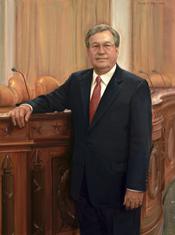
Mr. Speaker, pursuant to House Resolution 253, I call up the conference report on the bill (H.R. 2) to provide for reconciliation pursuant to section 201 of the concurrent resolution on the budget…
Mr. Speaker, pursuant to House Resolution 253, I call up the conference report on the bill (H.R. 2) to provide for reconciliation pursuant to section 201 of the concurrent resolution on the budget for fiscal year 2004, and ask for its immediate consideration.
Mr. Speaker, I yield myself such time as I may consume.
Mr. Speaker, at the beginning of the debate, I do want to thank the staffs, the majority staff, the minority staff, and the institutional staffs for something that has to happen before the Members can stand before the Speaker and the House in the Chamber and the American people and debate measures in front of us; that is, do an enormous amount of paperwork, double-checking to make sure that what is the desire of the House and Senate actually is produced in the document.
It happens on every bill that comes up. It especially happens on a very difficult and complex conference report, and I do want to acknowledge the tremendous service that our staffs perform for us on a daily basis.
Mr. Speaker, I also want to say that, as is the wont of legislative bodies, one of the easier ways to gain enough votes to pass a measure is to tend to listen to what people believe are either their needs or wants, collect that in an amalgam, and move forward.
It is my real pleasure to tell the Members of the House that if they have read the text, they will search in vain for any particular provision that is attributed to any particular Member of either body. In the vernacular, this is a clean bill.
I say that because it is very difficult to get people to look from the individual to the collective. That is, when we are talking about reducing something like people's taxes, it is oftentimes very, very difficult to look to the larger, more fundamental societal needs.
And I know we will have a very vigorous and healthy debate on this issue, and everyone will use numbers on both sides. All I request is primarily out of my friends on the other side of the aisle, and listening to the debate that went on on the rule, one individual would stand up and say this was less filling because it only was going to last for 3 years and then it was going to disappear. Only to be followed by another speaker who said this really tastes great because it is going to cost a trillion dollars, and it is going to last an entire decade.
Now, really, I do not care whether you feel it is less filling and it is only going to last 3 years or it tastes great and it is going to last for a decade; but for those of us who also want to participate, you ought to pick one way or the other. When you are arguing on both sides of the same argument, it is a little difficult to really shed light for the American people what this is all about.
If someone is going to watch this debate and they have a child under 17, there is one irrefutable fact. In calendar year 2003, $14 billion is going to be sent to those Americans with children under 17. They are going to be sent checks. They are going to be sent by the middle of July and by August. They will have that money in their hands. If they have children, one single aspect of this aspect of this bill, and we will go on and debate a number of other aspects, this bill puts money in Americans' hands immediately.
Mr. Speaker, I reserve the balance of my time.
Mr. Speaker, I yield myself 10 seconds.
Mr. Speaker, what I really heard in that quote, which I did not hear after it was said, was the Speaker said, And we are really going to have to fight for it because that is exactly what occurs.
We want to help Americans by letting them keep their own money and we are going to have to fight you to do it, because you want to hang on to their money just as hard as you can.
Mr. Speaker, I yield 2 minutes to the gentleman from Iowa (Mr. Nussle), the chairman of the Committee on the Budget, a member of the Committee on Ways and Means.
Mr. Speaker, it is my pleasure to yield 2 minutes to the gentleman from Wisconsin (Mr. Ryan), a member of the Committee on Ways and Means.
And, Mr. Speaker, my colleagues have a very limited playing deck. I am surprised this early in the debate they have already played the class warfare card.
Mr. Speaker, it is now my pleasure to yield 2 minutes to the gentleman from Illinois (Mr. Weller), a member of the Committee on Ways and Means.
Mr. Speaker, I yield myself 10 seconds.
I said they had very few cards in the deck. We may see several come up during the debate, but they just played the class warfare card once again.
Mr. Speaker, it is my pleasure to yield 2 minutes to the gentleman from Arizona (Mr. Hayworth), a valued member of the Committee on Ways and Means.
Mr. Speaker, might I inquire of the remaining time on either side?
Mr. Speaker, it is my pleasure to yield 2 minutes to the gentleman from Texas (Mr. Brady), a member of the Committee on Ways and Means.
Mr. Speaker, I yield 2 minutes to the gentlewoman from Washington (Ms. Dunn), a very responsible member of the Washington delegation and a member of the Committee on Ways and Means.
Mr. Speaker, I yield 1 minute to the gentleman from Michigan (Mr. Camp) for the purpose of a colloquy.
Mr. Speaker, will the gentleman yield?
Mr. Speaker, I would tell the gentleman, the goal of this bill, and other bills we will pursue in the future, is to promote economic growth. Increasing retirement savings will promote economic growth by contributing to our Nation's capital stock. Of course we will monitor the way in which annuity sellers adjust to the new, more efficient financial product market conditions that H.R. 2 will create. As we proceed, we can determine whether adjustments are justified.
Mr. Speaker, I yield myself 15 seconds in case there are any students actually out there in the audience. I believe, if anyone wants to check an almanac, the election of 1960 resulted in the election of President Kennedy with less than 50 percent of the vote and there was some concern about whether or not a recount would reduce that. The argument that somehow there was a significant wave of votes simply is not accurate any more than most of the structures.
Mr. Speaker, prior to yielding 2 minutes to the gentleman from Louisiana (Mr. McCrery), I yield myself 10 seconds. I am just concerned that if people are really worried about not having enough taxes, I understand you can voluntarily write a check to the Treasury and at least you will feel real good about making sure that more of your money stays in Washington.
Mr. Speaker, now another view from the State of Connecticut. It is my pleasure to yield 2 minutes to the gentlewoman from Connecticut (Mrs. Johnson), the chairwoman of the Subcommittee on Health of the Committee on Ways and Means.
Mr. Speaker, it is my pleasure to yield such time as he may consume to the gentleman from Louisiana (Mr. McCrery).
Mr. Speaker, it is my pleasure to yield 2 minutes to the gentleman from Ohio (Mr. Portman), a member of the Committee on Ways and Means.
Mr. Speaker, I yield myself 30 seconds.
I really do wish some Members, and we do not often do this, although we vote on it every day, would read the Congressional Record, especially the day that we debated the tax bill in this House for the first time. Because included in that Congressional Record was a historic first. The bipartisan Joint Committee on Taxation analyzed this tax bill, and they said it was going to create jobs, more than 900,000 jobs over the next several years. Read it.
Mr. Speaker, I yield 2\1/2\ minutes to the gentleman from Georgia (Mr. Collins), a member of the Committee on Ways and Means.
Mr. Speaker, I yield myself 1 minute.
I do so try to explain to some folks here apparently that currently in the Tax Code, if we have two people in the 15-percent bracket, their combined tax obligation, and they are both single, is less than two people in the same tax bracket that are married. There is no requirement under current law that they both work. One cannot work and one can work. But when they are married, they are filing a joint return. In filing a joint return, they actually pay more in taxes than they do with two single returns.
And I make this statement with some shock and awe that the ranking member of the tax writing committee apparently does not understand that.
Mr. Speaker, it is my pleasure to yield the balance of my time to the gentleman from Texas (Mr. DeLay), the majority leader.
Mr. Speaker, I believe the gentleman understands that when President Reagan became President, under the Constitution the purse strings are controlled by the House of Representatives, and the Democrats were in control of the House.

Mr. Speaker, I have tried to review the provisions of this conference report, so far as that has been possible in the very brief time available. I did so in the hope that I would find it enough of an…
Mr. Speaker, I have tried to review the provisions of this conference report, so far as that has been possible in the very brief time available. I did so in the hope that I would find it enough of an improvement over the bill the House passed by the House earlier this month that I would be able to support it.
Regrettably, however, I have decided that it does not meet that test.
I do think the conference report is better than the House-passed bill in several respects. I am especially glad to note that, unlike the House bill, it provides for giving Colorado and the other States some much-needed assistance with meeting Medicaid costs and paying for other services. And it also includes some other things I support, including the refundable increase in the child credit and the elimination of the ``marriage penalty'' aspects of the income tax.
However, these good features of the conference report are outweighed by its major shortcomings.
For one thing, the aid to the states comes with a price--a number of States will lose some State revenue as a result of the depreciation and small business expensing provisions, due to linkages between federal and state tax codes. In fact, according to one estimate I have seen, if those provisions are extended and remain in effect through 2013, States will lose an estimated $15 billion over the decade as a result of the provisions.
Further, even the child-credit provisions could be better. The conference report evidently drops a Senate provision that was targeted on working families with children with incomes in the $10,000 to $30,000 range. This jettisoned Senate provision would have benefited 11.9 million low-income children and their families--one of every six children in the Nation. As it is, data compiled by the Urban Institute- Brookings Institution Tax Policy Center show that while under the Senate bill 18 percent of married and head-of-household filers with children would have received no tax cut in 2003, under the conference report that will rise to 29 percent. To put it another way, married filers with two children and incomes between $10,500 and $21,325 will receive no tax cut under the conference agreement--although all such households would have received a tax cut under the Senate bill.
And, like the House-passed bill, the conference report will do little to increase jobs in the near future.
The Urban Institute-Brookings Institution Tax Policy Center estimates that 36 percent of all U.S. households would receive no tax cut whatsoever in 2003 under the conference agreement, and 53 percent of households would receive a tax cut of $100 or less. They also say the average tax cut in 2003 for households in the middle of the income spectrum, i.e., the middle fifth of Households, would be $217. Based on this, it seems clear that the conference report, being so focused on high-income filers, is likely to be limited effectiveness in boosting the economy in the near term. That's because high-income households are likely to spend a smaller share of their tax cuts than households of more modest means--and only if tax cuts are spent will they boost the economy in the near term.
On the other hand, it seems beyond dispute that the conference report will lead to a very large increase in the federal deficit and thus to a very large, long-term increase in the national debt.
So, like the House-passed bill, it does too little to address the real needs of the economy and the country, and it does too much to make our budgetary problems worse.
Just as they did when the House debated its bill, its supporters are reciting from the White House's cue cards that say it will create jobs. They know that is what the American people want to hear--because we need to begin to make up for the millions of jobs that have disappeared over the last two years.
But I am not persuaded, because no analysis I have seen--whether by the Congressional Budget Office, Federal Reserve Chairman Alan Greenspan, or any other expert--supports the claim that enacting this conference report will help put very many people back to work anytime soon.
On the other hand, there is no doubt about how the bill will affect the Federal budget--it will throw it further out of balance and lead to much deeper deficits.
Like the House-passed bill, the conference report includes many gimmicks that cloak its true cost. Every provision in the bill but one is designed to expire between the end of 2004 and the end of 2008. More provisions expire at earlier points in time than under either the House or Senate bills. If the provisions scheduled to terminate in a few years are extended--and I am confident that the bill's supporters will be pushing for that--its total cost will be much greater that the amounts its supporters have claimed.
In fact, according to one estimate I have seen, if the bill's provisions (except the one providing relief through the Alternative Minimum Tax) ultimately are extended, the cost
through 2013 will be $810 billion to $1.06 trillion, depending on how one measures the cost of extending the bill's business depreciation tax cut.
But even if I were to suspend my disbelief and take it at face value, I would think the cost of the conference report--in terms of the deficit and the debt--exceeded its benefits.
As I said when the House first considered this tax bill, I think we need to take deficits seriously--as Chairman Greenspan reminded us again earlier this week, and as was earlier spelled out by Peter G. Peterson, President of the Concord Coalition, to the Committee on Financial Services.
As Mr. Peterson put it, ``A future of mounting deficits is a cause for grave concern. Mounting deficits can slow and even halt the steady growth in material living standards that has always nourished the American Dream. When such deficits are incurred in order to fund a rising transfer from young to old, they also constitute an injustice against future generations . . . This policy, after all, constitutes an explicit decision by today's adults to collectively shift the current cost of government from themselves to their children and grandchildren.''
In other words, by leading to deeper deficits and bigger debts, this bill would do just what President Bush, in his State of the Union address, said we should not do--instead of meeting today's challenges, it would simply create new problems for our children.
I don't think that is sound policy--especially when a better alternative is available. That is why I objected to the Republican leadership's refusal to allow the House to consider the alternative developed by Representative Rangel.
That alternative included very meaningful tax cuts. It included an increase in the child tax credit to $800 per child, an immediate expansion of the 10-percent tax-rate bracket to levels that under the 2001 tax will would be reached in 2008, and immediate elimination of the ``marriage penalty'' aspect of the income tax. It also included investment tax credits for small businesses, such as business expensing up to $75,000 and bonus depreciation. Those cuts would immediately put money into the pockets of middle-income Americans, who are the people most likely to spend it promptly, boosting consumer demand and thus helping set the stage for an increase business investment needed to meet that demand.
The alternative also had other important provisions to respond to the immediate needs of our country and the American people, including a provision to create a permanent, revenue-neutral corporate tax deduction to encourage American manufacturing companies to expand their operations, as well as a new tax incentive to provide a tax credit of up to $2,400 to businesses that hire people who now are unemployed.
And, just as important as everything else, the alternative was fiscally responsible--fully paid for over 10 years. So, it would have added as many as a million new jobs without adding anything to the deficit.
Mr. Speaker, I still don't know why the Republican leadership refused to let the House even consider that alternative. Instead, they insisted on pushing through a bill that I could not support. And, unfortunately, this conference report, while better, is not enough better to deserve enactment. So, I must vote ``no.''

Madam Speaker, I move to suspend the rules and agree to the resolution (H. Res. 558) welcoming the accession of Bulgaria, Estonia, Latvia, Lithuania, Romania, Slovakia, and Slovenia to the North…
Madam Speaker, I move to suspend the rules and agree to the resolution (H. Res. 558) welcoming the accession of Bulgaria, Estonia, Latvia, Lithuania, Romania, Slovakia, and Slovenia to the North Atlantic Treaty Organization (NATO), and for other purposes, as amended.
Madam Speaker, I ask unanimous consent that all Members may have 5 legislative days within which to revise and extend their remarks and include extraneous material on H. Res. 558, as amended.
Madam Speaker, I yield myself such time as I may consume.
Madam Speaker, this Member is extremely pleased to offer this resolution welcoming the accession to NATO membership of seven Central European democracies: Bulgaria, Estonia, Latvia, Lithuania, Romania, Slovakia and Slovenia.
Yesterday, these seven nations became America's newest allies when their prime ministers presented Secretary of State Powell with their instruments of accession. Secretary Powell recalled their struggle for freedom and promised that ``by joining NATO's bond of collective security, Article 5 and all, you will remain free.''
Later, President Bush yesterday publicly welcomed their leaders to the alliance on the south lawn of the White House. In his remarks, the President noted, ``The countries we welcome today were friends before they were allies, and they were allies in action before becoming allies by treaty.''
The decision to admit former communist nations from Central and Eastern Europe, Madam Speaker, into the Atlantic Alliance, is one of the great successes of American and Alliance foreign policy since the end of the Cold War. It is a bipartisan success promoted by Republicans and Democrats in the Congress and by both the Clinton and Bush administrations. It is also a success in which the House of Representatives has played an important role.
Since 1994, the House has repeatedly declared its support for NATO enlargement and the fundamental role of NATO in transatlantic security. We recognize that throughout its history NATO has succeeded not only in keeping its MEMBERS free, but in extending that freedom to new lands that have long yearned for freedom's blessings.
Already, the three nations that joined NATO in 1999, Poland, Hungary and the Czech Republic, have been contributing to the Alliance and its operations in Bosnian and Herzegovina, Kosovo and Afghanistan. Furthermore, Poland has been a major contributor to Operation Iraqi Freedom and currently commands a multinational force in south central Iraq.
The current round of enlargement, the fifth in NATO's history, will further erase the dividing lines across Europe that were drawn at Yalta and will further extend the zone of peace and security in the North Atlantic region.
Bulgaria, Estonia, Latvia, Lithuania, Romania, Slovakia, and Slovenia are already contributing to the Alliance, with each of these new allies contributing to one or more of NATO's ongoing operations. In addition, six of them have forces on the ground in Iraq.
That is far from their only contribution. Last year as president of the NATO Parliamentary Assembly, this Member traveled to all seven of these countries; and after those visits, this Member is confident that they and their membership will reinvigorate the Alliance. In fact, the new vigor is already being felt.
Because the citizens of these new MEMBER countries have recent memories of living under oppressive dictatorships, they are especially committed to NATO and its collective defense guarantee.
Having fought so long and hard to gain their freedom, they know how precious freedom is and how fundamentally important the defense of freedom remains. They have pledged that they are ready to defend their freedom and ours, and we are very fortunate to be able to call them our allies.
In addition to noting the accomplishments of the incoming NATO members and welcoming their accession to the Alliance, this resolution also reaffirms the support of the House for the process of NATO enlargement and for keeping NATO's doors open.
Finally, this resolution expresses our support for the remaining candidates for NATO membership, at this point, Albania, Croatia, and Macedonia.
To ensure that the enlargement process continues after the accession of the seven new members, the resolution recommends that the leaders of the NATO nations at this summer's Istanbul Summit ``should agree to review the enlargement process, including the applications of Albania, Croatia and Macedonia, at a summit meeting to be held no later than 2007.''
This language is consistent with the language of the relevant communique from the 1999 Washington Summit at which Alliance leaders welcomed Poland, Hungary, and the Czech Republic to NATO membership. That communique called for a summit meeting to review the enlargement process to be held ``no later than 2002,'' that is, 3 years after that summit.
Scheduling a 2007 enlargement summit would also establish a 5-year cycle for NATO enlargement. Three nations
received invitations in 1997 at Madrid, and seven nations were invited in 2002 in Prague. This Member believes that this is a reasonable timetable, one that gives NATO time to incorporate the seven new members, while absolutely ensuring that the three remaining candidates are not forgotten and that they have met the necessary requirements to be full-fledged partners in NATO.
Madam Speaker, yesterday was a historic day for America's seven newest allies as they joined the most successful Alliance in history and thereby secured the freedom that they had fought so hard to gain. This Member urges his colleagues to vote for this resolution in order to welcome these countries to NATO and to ensure that NATO's door remains open to Bulgaria, Estonia, Latvia, Lithuania, Romania, Slovakia and Slovenia, and probably to countries to follow.
Madam Speaker, I reserve the balance of my time.
Madam Speaker, I yield myself such time as I may consume for a brief set of comments, and I want to thank the gentleman for his outstanding statement and for his generous remarks directed toward this Member.
I would say to the gentleman with respect to Iraq and with respect to Afghanistan, the two subjects that the gentleman addressed towards the remaining part of his time, I certainly am in absolute agreement. The gentleman will recall, of course, that the House and the Senate have both expressed their view that NATO should take a larger role in Iraq and that, in fact, we should call upon the resources of the United Nations where appropriate. I am sure the gentleman is concerned about the lack of resources from NATO countries being directed towards Afghanistan at this critical time.
Madam Speaker, it is now my pleasure to yield time shortly to the distinguished gentleman from Illinois (Mr. Shimkus), who is a graduate of the U.S. Military Academy and who had the experience of being an infantry officer in a combat unit stationed on the Czechoslovakian border before, in fact, the Wall came down and before we moved to now admit, some 3 or 4 years ago, the Czech Republic to NATO. The gentleman has taken an outstanding interest and involvement in the NATO Parliamentary Assembly as a rapporteur or co-rapporteur on a number of important reports for the Defense and Security committee and, I might also say, he has a special interest in our Baltic neighbors who are, by actions yesterday, joining NATO.
Madam Speaker, I yield such time as he may consume to the gentleman from Illinois (Mr. Shimkus).
(Mr. SHIMKUS asked and was given permission to revise and extend his remarks.)
Madam Speaker, I want to thank the gentlewoman from Texas (Ms. Jackson-Lee) for her kind
remarks and knowledgeable comments. I thank my colleague from California (Mr. Lantos) again for his continued interest and leadership in this subject area.
Madam Speaker, I urge all Members to support this resolution. I have no further requests for time, and I yield back the balance of my time.
Mr. Speaker, I rise in support of the conference report on H.R. 2, the Jobs and Economic Growth Reconciliation Tax Act of 2003. This bill is a responsible effort to address the economic needs and…
Mr. Speaker, I rise in support of the conference report on H.R. 2, the Jobs and Economic Growth Reconciliation Tax Act of 2003. This bill is a responsible effort to address the economic needs and concerns of all Americans. This bill is a dramatic improvement over the tax legislation previousl considered by the House, which I opposed. It is more targeted to help American workers and families now and it is lower in cost and more fiscally responsible.
This bill will provide $330 billion in tax relief to American taxpayers and $20 billion in fiscal aid to the States. More than 272,000 households in Delaware will receive tax relief and hundreds of millions of dollars will be pumped into the Delaware economy to create jobs. To complement this effort, at my urging, Congress has also just voted to extend unemployment benefits for an additional 13 weeks bringing another $16.5 million to our State and much needed relief to Delawareans looking for work.
The final agreement is a fair compromise that reduced the overall cost of the legislation to a level that is fiscally responsible. This final tax relief legislation meets the key tests that I urged the House and Senate to achieve.
First, I urged that this tax relief be better targeted to provide an immediate boost to the economy. The final compromise will provide immediate relief to working Americans to put more money in their pockets now to help strengthen the economy this year. As soon as this legislation is enacted, American workers will have fewer taxes withheld from their paychecks, giving 88,000 Delaware households more money for the daily needs of their families. In addition, this bill will increase the child tax credit from $600 to $1,000 giving 77,000 Delaware families with dependent children a rebate check this summer of up to $400 per child. This additional disposable income spent by families will in turn help our businesses, communities and the economy this year.
The legislation will provide tax relief to all working Americans. It speeds the reduction in tax rates for all Americans to give them more income as soon as possible. By expanding the 10 percent tax bracket immediately, this legislation will benefit 212,000 Delaware households, including low and moderate income workers by taxing the first $14,000 of income for couples and $7,000 for single people at a lower 10 percent rate. In addition, it accelerates relief from the marriage penalty tax to 105,000 Delaware marriaged couples.
The bill will help small businesses by immediately increasing the amount they can deduct for new equipment and other expenses. That will encourage business owners to buy equipment now and make other investments that will build their businesses and create new jobs.
The tax relief provisions in this revised legislation are geared to have the most immediate impact in the next 2 years. I had urged that these changes be made to help boost the economy now without adding unnecessary long-term costs to our government.
Second, the final bill also recognizes that there are other pressing needs in our Nation
that must be addressed in addition to tax relief. This compromise will provide our states with financial assistance that will support programs to help individuals in need. Most states, including my home State of Delaware, are experiencing difficult budgetary times that has caused them to limit spending on important programs. This legislation will provide $20 billion in aid to the States over the next 2 years. This aid includes $10 billion for essential government services, of which Delaware is estimated to receive $50 million, and $10 billion specifically for Medicaid, the federal-state partnership to provide important medical care to low-income individuals. Delaware's share of the Medicaid funds could be as high as $28 million. This $78 million in aid to Delaware was not included in the original House-passed bill and I am pleased it was added in this final version.
Third, I had urged that the original proposal to eliminate the double taxation of dividends be modified to have a greater immediate economic stimulus and to limit the impact of this tax cut on the federal budget deficit. This issue has been addressed. I opposed the original proposal to eliminate the taxation of dividends because I did not believe we could afford the original $395 billion cost of that single proposal at this time. This compromise would not eliminate the tax on dividends, but it would reduce the rates on capital gains and dividends through 2008. This will provide an incentive for investment, at a much lower cost than the original proposal. With new investment in business ventures, new jobs will be created.
Finally, I am pleased that the cost this final legislation has been significantly reduced from earlier proposals and represents a more fiscally responsible effort to provide tax relief to create jobs and strengthen our economy. This was a top priority for me because I am a strong advocate of balancing the federal budget, and I believe that any effort to stimulate the economy must be weighed against other needs and the importance of returning the federal budget to balance. I opposed the original House Budget Resolution which called for $750 billion in tax relief because I did not believe it was affordable at a time when we have critical new national security requirements and other needs. That budget plan called for a $750 billion tax cut as well as unfair and unsustainable reductions in important programs like health care, education and the environment. I opposed those and was pleased that the final budget plan did not include those cuts. I also opposed the first tax relief bill passed by the House because its cost of $550 billion was still too great for our current budget limits. In response to the concerns expressed by me and others in the Senate and House, a fair compromise has been reached that will provide $330 billion in tax relief to all working Americans, as well as $20 billion in direct aid to the States.
Some of the tax relief in this bill is temporary, to stimulate the economy now and reduce the long-term cost of the legislation. Those provisions are part of the compromise and are certainly not a perfect solution. Some argue that if future Congresses extend these provisions, the long-term costs of the tax relief to the government are far higher. The sunsets act as a budget trigger that will force Congress to revisit these issues with new information and debate the best course of action on whether to extend the tax cuts beyond the years contained in this bill.
Earlier this month, I called on Congress to put together a bill that would provide tax relief now to individual Americans, families and small businesses in a fiscally responsible manner. I stressed that a package could be assembled that did not exceed $350 billion. Those tests have been met. As I stated, effective governing requires careful decisions and painful compromises. All of us involved in the debate have had to make compromises. That effort has produced a bill that will return more of their hard-earned money to working Americans, create jobs for unemployed Americans, and help our state governments meet the budget challenges they are facing. I am proud to have worked hard to ensure that this bill fairly addresses the need to provide tax and financial relief now, while recognizing that we must not jeopardize our efforts to maintain fiscal responsibility in our government in the future. This bill is a fair effort to meet those tests and I support its passage to help all Americans and our nation.
Show 11 more
Mr. President, I ask unanimous consent that the order for the quorum call be rescinded. Mr. President, I understand we are now on the Byrd amendment to the appropriations measure before us; is that…
Mr. President, I ask unanimous consent that the order for the quorum call be rescinded.
Mr. President, I understand we are now on the Byrd amendment to the appropriations measure before us; is that correct?
I thank the Presiding Officer.
First, I thank Senator Byrd for offering this important amendment which provides much-needed funding for our homeland security.
Secondly, I thank Senator Byrd for including funding in his amendment to help States implement the President's plan for inoculating our first responders against the smallpox virus. A month ago, on December 13, President Bush announced his policy for vaccinating U.S. citizens against smallpox. He had a tough decision to make, and I support that decision.
That same day, the Government began inoculating 500,000 armed services personnel and other Government officials working overseas, people who are most likely to encounter the smallpox virus.
The second phase involves inoculating on a voluntary basis first responders and health care workers across the United States against smallpox. It is estimated that up to about 10 million Americans may fall into this category. Senator Specter and I have worked with the administration and Senators Byrd and Stevens since the events of September 11 to provide sufficient funds to produce the smallpox vaccine necessary to inoculate every American against smallpox if that becomes necessary. That money has been appropriated, and I understand the production of vaccine is well underway and that sufficient vaccine will be available by the end of the year. That was a good first step.
It is one thing to produce the vaccine, but the administration of the vaccine also costs money. That financial burden will fall on our State and local public health departments. Local public health departments will absorb the costs of the needles and personnel to administer the vaccine. But then again, personnel and equipment and needles only represent a part of the cost to local health departments. That is because the smallpox vaccination is a far more resource-intensive activity than any other type of vaccination activity.
For example, costs include specialized training for the vaccinators. You cannot just have someone off the street doing the vaccinating; they have to be specially trained. And since we have not administered the smallpox vaccine for a number of years, people would have to be trained. There would also have to be prevaccination screening for individuals to make sure you don't have something else that might interfere with the vaccination. It will also include postvaccination monitoring because it is estimated that 1,000 out of every 1 million vaccinated will experience a serious adverse effect. Then you add to those costs the cost of extra security for the vaccine.
I have received estimates from those involved in public health that the cost of administering the vaccine to State and local health departments under the President's plan may be $85 a person, or $850 million to inoculate 10 million first responders and health care personnel.
The amendment before us--the Byrd amendment--includes that $850 million appropriated to HHS for distribution to the States for this first 10 million first responders' vaccination.
When I first saw this figure of $85 a person, I thought that was pretty expensive. I remember when I was a kid and got my smallpox vaccination in school. They lined you up, and the public health nurse gave you your vaccination. I cannot believe it costs, in equivalent dollars, $85 to get that vaccination. So I think we here on the Appropriations Committee and on the Oversight Committee and those at Health and Human Services under Secretary Thompson really need to look at this and to make sure these estimates are valid estimates.
Again, I know that, as I said, there are other things we have to do, such as prescreening and training of inoculators; there has to be postvaccination monitoring and safety. There are other considerations that perhaps we didn't have maybe 50 years ago when I got my smallpox vaccination.
I do think we are going to have to be careful stewards of the public's money to make sure we are getting our money's worth and to make sure every dime is accounted.
Some may say we have already provided significant new funding to State and local health departments since the events of September 11, and that is true. Senator Specter and I and the Appropriations Committees have worked hard to provide those funds, and those funds were sorely needed because we had let our public health departments stagnate over the years.
The money we provided over the last couple of years was just to begin to repair the benign neglect of our public health system, to upgrade public health monitoring, to increase the lab capacity in our State labs to identify possible bioterrorism agents, to improve communications between CDC, the Centers for Disease Control and Prevention, health departments, and other health providers. That was just a few of the needed improvements that, again, had been consigned to benign neglect over the years.
I guess what I am saying is, we should not put a stop to those improvements by forcing our local public health departments to use those funds to administer the smallpox vaccine. We are making strides in this country to bring our public health resources back up to where they should be. We should not be robbing those resources to administer the smallpox vaccine.
Local health departments are concerned that the financial burden of administering the smallpox vaccine will force them to make cuts in other areas. For example, Dr. Floyd Novak, president of the New York State Association of County Health Officials and the commissioner of health of the county that includes Syracuse, said, according to an article in the New York Times:
We have to transfer staff from other functions to do this.
It just cannot be absorbed as business as usual. We need more
resources.
Dr. Novak said his department would conduct 221 fewer screening tests for breast and cervical cancer and 835 fewer pediatric dental examinations, among other lost services, in the 2 months when vaccinations are to be performed. That is why the amendment we have before us is so crucial.
The Byrd amendment we are considering includes funds not only for smallpox vaccinations but also for other important homeland security needs, and it means that Dr. Novak in New York and other county health officials throughout the United States will not have to stop the important functions of breast and cervical cancer screening, pediatric dental examinations, and other functions we sorely need, in order to conduct the smallpox vaccinations.
I urge my colleagues to support this much-needed amendment. Of the $5 billion amendment that Senator Byrd has proposed, $850 million will go to make sure we have the needed resources to inoculate the 10 million estimated first responders--police, fire, emergency personnel, guardsmen, and others who will be our first responders in this country. These resources would, indeed, ensure we can do that without
robbing or stopping the other needed services of our public health departments.
Mr. President, I yield the floor, and I suggest the absence of a quorum.
Mr. Speaker, I have to wonder if our good friend from New York, when he tells his constituents about their benefits, will tell them that the child tax credit will expire in 2004, that the 10 percent…
Mr. Speaker, I have to wonder if our good friend from New York, when he tells his constituents about their benefits, will tell them that the child tax credit will expire in 2004, that the 10 percent bracket expansion will expire in 2004, that the AMT exemption and that the marriage penalty negation provision will expire in a year. We give with one hand and take away almost immediately with the next. The sun rises and the sun sets.
Let me dispel, first of all, one myth about this tax bill, the myth that the President is putting out that this is an itty-bitty tax bill. $350 billion by itself would not be itty-bitty, particularly when you have a deficit as we do. But this is not a $350 billion tax bill. If you assume, as we must, that these sunsets are a sham, and why should we not, because the architects of this bill are all saying, they will be extended, we just put them in there to shoehorn this thing into the budget. If you assume that, then this is what this total tax cut will be, not $350 billion but, in the next 10 years, $1 trillion. That is the result. And since the budget is now in deficit, all of this amount, all $1 trillion, will go to the bottom line and will swell the deficit. That means we will have a deficit this year, a record deficit of $425 billion and the deficit will hover in that range, ratcheted at that range, of 3 to $400 billion for as far out as we forecast.
But we do not stop here. Because Republicans have told us, proudly, that they are going to make tax cuts an annual event. If you look in their budget, you will see there are more unreconciled tax cuts still on the back burner yet to be brought forward. If you look in the President's budget, you will see that there are a lot of tax cuts left on the cutting room floor waiting there for next round.
Here are three known tax cuts that are yet to come off the agenda.
First of all, we all know the tax cuts passed in 2001 have to be made permanent, will be made permanent by the majority if it stays the majority in this House. That will cost 6 to $650 billion in revenues.
Second, there is another 2 to $300 billion of various tax cuts lying on the cutting room floor waiting for the next round.
Third, there is the alternative minimum tax. We all know that politically it has to be fixed in the next 10 years or else 25 million Americans are going to pay much higher taxes than they now pay. They will pay the alternative minimum tax. The cost of fixing it is reasonably 650 to $680 billion.
If you add all of these tax cuts together and make a few modest adjustments for the likely cost of defense and homeland security and Medicare/prescription drugs, here are the results. I have got a piece of paper. I am going to leave it here on the desk. We have calculated them on this sheet of paper. If anybody takes exception with them, come down here and refute it.
Here are the results per our reckoning of what is going to happen to the budget.
First, from 2004 until 2013, deficits will total, get this, deficits will total $3.959 trillion. Without Social Security, deficits will total $6.527 trillion. Debt held by the public will increase from $3.5 trillion to $7.9 trillion. Total statutory debt will go up to $14 trillion.
You can overlook and dispute a lot of these facts, but there are two facts you cannot dispute. They will not go away.
First of all, 77 million baby boomers are marching to their retirement, and they are going to double the number of beneficiaries on Social Security and Medicare, and those programs will not sustain their benefits in their current situation.
Secondly, what you sow, our children and their children are going to reap. They will have to support the underfunded Social Security program, the underfunded Medicare program, and they will have to bear the burden of $14 trillion in statutory debt that you are incurring as you move down this path tonight. That is the course you choose. That is the moral decision you make tonight if you vote for these tax cuts.
If you do it in the name of creating jobs, I do not think this is going to create that many jobs, with one exception, I will grant you. It is going to create a lot of jobs for tax lawyers and accountants. This bill will be a bonanza for those who specialize in tax avoidance; and the real cost, believe me, is going to be beyond calculation.
Mr. Speaker, I include the following for the Record:
[GRAPHIC] [TIFF OMITTED] TH22MY03.003
Mr. Speaker, when the President sent his budget up this year, OMB sent with it a message in which they said that the surplus of $5.6 trillion, which they projected just 2 years ago, was a mistake; that now, from 2002 through 2011, they revised downward that surplus from $5.6 trillion to $2.4 trillion. They made an egregious mistake.
We warned our colleagues then not to bet the budget on a blue sky estimate, but they did not take our warning. Now you can blame that on 9/11, you can blame that on this sluggish economy, you can blame it on lots of things, but tonight the buck stops here. The blame rests right there in the well of this House and these meters where you push your card. Because tonight, when you vote for a trillion dollars in tax relief, it goes straight to the bottom line. There is nothing to offset it. It creates a deficit this year which will be a record deficit in the fiscal history of this country, $425 billion, and the deficit stays ratcheted in that range for as far out as we forecast.
Those are the consequences of the policy choices you make tonight. You cannot blame it on 9/11. You cannot blame it on the economy. It will be attributed to what you do tonight, unless some economic miracle happens as a result.
Here is a chart in which we have calculated this tax cut, the tax cuts to come, other likely actions to be taken, Medicare, prescription drugs, a bit more for defense; and we think it is a fair and honest and even conservative statement. I will leave it here for anybody to refute, but this is what we see as a consequence of what you are doing tonight.
We foresee deficits of $3.959 trillion over the next 10 years. Back out Social Security, and those deficits come to $6.527 trillion, a consequence of what you are doing tonight. The debt of this country today, held by the public, is at about $3.5 trillion, $3.6 trillion. This will increase it to $7.9/11 trillion. The total statutory debt will go up to $14 trillion.
That is the course you choose to take tonight if you vote for this tax cut. You cannot blame it on the economy. You cannot blame it on 9/ 11. You can only blame it on yourself.
Mr. Speaker, this has been a real interesting debate. It certainly laid out clearly the differences between the two parties, and I appreciate that. I think it is good for America, to lay out the…
Mr. Speaker, this has been a real interesting debate. It certainly laid out clearly the differences between the two parties, and I appreciate that. I think it is good for America, to lay out the differences between the two parties.
But one of the things I noticed in the debate is the differences in interpretation of history. Let me just start by saying, the gentleman from Maryland laid out the history all the way back from Jack Kennedy's time. I would just as soon do it in my time in the legislative body.
The gentleman talked about the fact that Ronald Reagan cut taxes in 1981 and the deficits went through the roof. The problem was there was a Democrat Senate, a Democrat House, and they spent $2 for every $1 cut in taxes; and the deficits went through the roof.
I yield to the gentleman from California.
Mr. Speaker, reclaiming my time, following this history, I did not hear all the claims of the born-again deficit hawks about deficits during those periods of time. They just wanted to keep spending money.
Then, I have to admit, I voted against President Bush's tax increase. Do you know what happened after Bush's tax increase? We had a recession that cost him his election.
I can always remember who won that election and came in, never talking about balancing the budget, who was not a born-again deficit hawk like those we have seen tonight. It was a President that wanted to keep spending it. So he passed another tax increase in 1993. Now, that one I voted against too. I am very proud of that.
The problem was for this side of the aisle, as the American people did not like all the spending in 1993 and 1994, they did not like the vision laid out for the American people, so they gave the Republicans the responsibility of being in the majority in the House of Representatives.
The born-again deficit hawks say that the 1993 increase gave them surpluses. I do not remember it that way. What I remember was we came in and we told the American people in the Contract with America that we would balance the budget. We did. We had the Balanced Budget Act of 1997. None of you born-again deficit hawks voted for that, if I remember, or some did. I take that back, some of you did. The vast majority of you did not, and told us that there would be just horrible things; we will not be able to spend any more, crying, tears coming down your faces, We cannot spend anymore; we cannot spend any more.
Yet we balanced the budget and deficits were going down, and the debt went down, because we paid off over $1 trillion on the debt on our children.
Now, for the first time in my legislative career, when George W. Bush took over, revenues to the government actually turned down. Revenues had been going up ever since I have been in the legislative body. But for the first time the revenues actually turned down, which created the problem that we face.
Now, if you would have worked with us, you new budget deficit hawks, and made permanent that tax cut in 2001, maybe we would not be losing the jobs that you quote that we are losing, and if those tax cuts would have been implemented immediately, rather than stretching them out, we would have had a better economy than we find now. So we have to come back to the well.
What is really interesting to me is the ranking member was very concerned about the fact that there is a conspiracy out there, that this is not the only tax cut that there is going to be this year.
There is no conspiracy. We are very, very proud of the fact that this House of Representatives has passed tax cuts every year we have been in the majority. Every year. And do you know what? In 8\1/2\ years there has not been a Federal increase in taxes in this country. That is even more meaningful. And do you know what? This year, this ain't the end of it. We are going to have some more, because our budget says we can do $1.3 trillion in tax relief for the American people, and you bet we are coming back with more tax cuts.
So there has been a lot of talk in this Chamber about this bill and what it would do to the government. In fact, one Member of the other side of the aisle said cutting taxes hurts the government. I heard her say that, cutting taxes hurts the government.
But the American people want to know what this bill will do for them, because we are here for them. And do you know what? We have an answer to that. The jobs and growth package will create more than 1 million new jobs. It is not as large as some of us wanted; but I remind you, it is just the first step.
At any rate, the proof is in the policy, not the price tag. As many of you know, I used to be a small businessman; and I know, as you do, that tax relief for small business means expansion, and to most small businesses, that means one thing, hiring new people.
The accelerated rate reductions will increase the purchasing and hiring power of millions of small businesses this year. Add the expensing and depreciation reforms, and you are looking at the circulation of billions of dollars, this year; and these billions of dollars will be in the hands of small business men and women responsible for creating over 70 percent of all new jobs.
Now, the $500 increase in the child tax credit invested over the course of 18 years could actually enable a high
school senior to look at colleges instead of want-ads. The dividend and capital gains reforms will help steady the stock market and encourage new investment at the very moment that working Americans will start taking home, start taking home, more of what they earn.
Economist Lawrence Kudlow said this today about this package. He said it would contribute mightily to the rebuilding of capital and wealth that was decimated in the nearly 3-year stock market plunge, 3 long years.
In that time, the American people have faced unprecedented challenges; but they have persevered, and now they are poised to fuel an unprecedented recovery. Interest rates and inflation remain low, anxiety about the war in Iraq have been eased and consumer confidence is on the rise. All the American people need right now is the opportunity that they deserve, not the government, that they deserve. They deserve that opportunity to get this economy going again.
So I urge my colleagues to do the right thing. Pass this jobs and growth package and give Americans that chance.

Mr. Speaker, I rise in strong opposition to H.R. 2, the so-called Jobs Growth Tax Act. This legislation embraces President Bush's failed economic policies that have damaged the economy. This…
Mr. Speaker, I rise in strong opposition to H.R. 2, the so-called Jobs Growth Tax Act. This legislation embraces President Bush's failed economic policies that have damaged the economy. This legislation is in fact a job killing package put forth by the Republican job killing machine that has already cost our country over 2 million jobs and $7 trillion.
When President Bush first came to office to promote his $1.2 trillion tax cut he promised that it would create jobs and help strengthen our economy. Now 2 years later, it is clear that the President has failed to deliver on his promises. The numbers prove that his economic policies have completely failed our country.
Since President Bush came to office we have lost 2.7 million private sector jobs. Illinois has lost over 109,000 jobs since Bush took office--93,000 from the Chicago area. Nationwide, the number of people who have been out of work for 6 months or more has tripled under the President's leadership.
Our State and local governments are paying the price for the President's failures. States budget shortfalls are expected to reach as high as $80 billion in 2004. In Illinois the figure is $5 billion, it may actually be higher. State and local governments have been forced to raise sales and property taxes to keep their schools open and to pay for the most basic of services. Working families and seniors are forced to pay more in taxes to pay for Republican tax cuts.
When President Bush took office we had a $5.6 trillion 10-year surplus. We now have a $2 trillion deficit over the same period of time. According to CBO, the President's tax cut not the war on terrorism accounts for the growth in deficit.
Corporate greed and conflicts of interest have hurt our economy. Approximately $4.6 trillion in stock market wealth has evaporated since President Bush took office. Many workers and retirees have lost all their savings. Meanwhile, politically connected CEO's have escaped with billions. Corporate fraud and greed have undermined confidence in our financial markets.
Given all of these facts, it should come as no surprise that consumer confidence is at its lowest level in a decade. It should also come as no surprise that the chairman of SEC, Secretary of the Treasury, and director of the OMB have all stepped down.
So how do the President and Republican leaders in Congress respond to this crisis? By proposing more of the same failed policies that put us in this predicament in the first place. It is often said that insanity is defined as doing the same thing over and over again and hoping for a different result.
History has proven time and time again that the Republican tax plan will do nothing to help those who really need it and it will fail to give the economy the immediate boost it needs. The proposal to lower taxes on dividends will only generate nine cents of stimulus for every dollar spent. This is a sham growth package. It will cost us in dollars and in jobs.
Over 400 economists oppose cutting taxes on dividends, including many Nobel laureates. Republicans and Democrats alike have criticized the proposal to lower taxes on dividends. Former Federal Reserve Chairman Volker and former Treasury Secretaries Peter G. Peterson and Robert Rubin have called the
proposal to reduce taxes in dividends, ``ill-logical'' and ``not useful for short-term fiscal stimulus . . . nor would (the tax cuts) spur long-term economic growth.''
Meanwhile this legislation fails to embrace policies that will stimulate the economy. For example, extending unemployment produces at least $1.73 of spending for every dollar spent. But this plan provides no aid for the unemployed who have exhausted their benefits. In contrast, the Democratic alternative, which the Republican majority did not allow us to debate a few weeks ago an alternative that would include $27 billion for extending unemployment. Our plan would create 1 million jobs over 10 years without increasing debt.
This conference report does little to help working families. According to the Wall Street Journal, 53 percent of taxpayers would get less than $100. This legislation provides only $20 billion for the States over the next 2 years. When this bill was passed a few weeks ago, House Democrats wanted to provide $44 billion in State aid for health care, education, infrastructure improvements and homeland security. Once again, we were denied an opportunity to vote on our plan, and the American people will pay the price.
The Republican plan does nothing to close corporate loopholes. Corporate taxes are only 1.3 percent of GDP. This is the lowest they have been since the early 1980s. Last year, less than half of actual total corporate profits were subject to corporate income tax. CSX, under Treasury Secretary Snow's leadership, paid no Federal income taxes on its $934 million in profits; instead it got a tax rebate of $164 million. And Secretary Snow will benefit from this legislation to the tune of $100,000.
This conference report is yet another reckless plan to cut taxes for the rich and do nothing for the rest. It is class warfare with the Bush class waging war against the middle class.
This ill-conceived plan will place more of a burden on working families who are struggling to make ends meet to pay for housing, prescription drugs, and other necessities. I agree with my Republican colleague, Steve LaTourette, who recently said, ``Nobody in my district is screaming for tax cuts, they are screaming for a prescription drug benefit.'' In the 9th Congressional District my constituents will tell you they want jobs and prescription drug coverage any day over tax cuts for the wealthiest Americans.
I would like to remind my colleagues on the other side of the aisle, that you cannot have it both ways. By spending money on tax cuts for the wealthiest 1 percent of earners and tax dodging corporations we will raise the debt and have less money to pay for prescription drugs, veterans' health, and keeping Social Security solvent.
I urge all my colleagues to vote against this conference report and to instead support the Democratic plan to create jobs and spur economic growth. Democrats want to help our economy by putting money in the hands of people that will spend it. I urge all my colleagues to oppose this conference report.
Madam Speaker, it is a wonderful day. Actually, the great day was yesterday, and it is an honor to be here on the floor with the gentleman from Nebraska (Chairman Bereuter) and the gentleman from…
Madam Speaker, it is a wonderful day. Actually, the great day was yesterday, and it is an honor to be here on the floor with the gentleman from Nebraska (Chairman Bereuter) and the gentleman from California (Ranking Member Lantos), who have become great friends in this battle. It is a battle that I have really been fortunate to join, really at the closing of it. It is an important step forward to President Bush's goal and others within the administration's goal of a Europe whole, free, and at peace.
It was great at the ceremonies yesterday when, on the lawn, on the east lawn, not only was the current administration there, but representatives of previous administrations: the Honorable Jean Kirkpatrick was there, the Honorable Madeleine Albright was there, Sandy Berger was there. So it really shows that NATO enlargement is really something that has lasted the test of time.
At a time in our country where there seems to be great divisiveness, one unifying aspect is NATO enlargement. I am proud to be a Member of the House where I think all enlargements, actually, the momentum has always started, I think from the Madrid enlargement to even this most recent round. I think the other body gets a lot of credit because of their votes, but we do not want to shy away or take a second seat to anybody in our position and our push for NATO enlargement.
I have enjoyed the relationship with the American citizens who still have a great respect and honor for their ethnic heritage and their home countries. These American citizens, who have fought in our wars and have given their lives for freedom and democracy, really ask their government to do a simple thing and help return that type of stability, peace, and freedom to their home countries, the countries of their birth, the countries of their forefathers. NATO does that.
The North Atlantic Treaty Organization brings a collective self- defense mission to again address that area of a Europe whole and free, so it is just a very important and exciting day. So I appreciate the resolution, because we should be part of the celebratory aspect and make sure that we are on record saying a job well done.
There is still much work to go before us, as both the gentleman from Nebraska (Chairman Bereuter) and the gentleman from California (Mr. Lantos) have mentioned. But we are going to be much stronger as a united world, united under basic principles of freedom and democracy and the rule of law when we address totalitarian regimes than we would be to continue to have a fractured environment in Europe.
We know what these new entrants are already doing. Actually, they have come through the membership action plan, which was not an easy task. When we have these democracies move from a centralized market economy to a free market economy, that creates a lot of stress on the way that the government used to provide services. These governments had to decide whether they needed to move aggressively with large parts of their dollars to transform themselves to be prepared to enter NATO. That is not easy, when you are changing from a system where the government is providing for all of the basic needs and now you are taking money away to increase the ability for self-defense. So they need to be applauded. They have gone through the process of reform in the military, in the economy, the rule of law; and the membership action plan really helped do that.
Now they have also come to the forefront in the war on international terrorism. I know a lot of folks understand that it is important what they have given after September 11, their involvement in Afghanistan and for many their involvement in Iraq; and it is not a small task to ask these new emerging democracies to send their sons and daughters overseas for a cause of freedom, peace, and security in the world.
So this is really appropriate that we do this. Bulgaria is focused on engineers and mine-sweepers; Romania on unmanned aerial vehicles and mountain troops; Slovakia, nuclear, biological, and chemical defense units; Slovenia, mountain warfare troops; Estonia, military divers and mine countermeasures; Latvia, explosive ordnance disposal; and Lithuania, Bulgaria, Latvia, Slovakia, and Slovenia will provide special operations forces.
So they are going to be additive to NATO. But where they are really going to be more additive, actually a multiplier, is really their heart and soul. These countries still have the scars of totalitarian regimes. They still hurt as they look at what has occurred to their countries over the decades. They bring an understanding of the cause for freedom and democracy. That is a message that sometimes those of us who have experienced and benefited from democratic governance for many years, we sort of take for granted and forget. Not after September 11, of course. But they are reenergizing NATO. They are bringing their commitment, their heart and soul.
I wholly applaud, really, the international community, the United States for our leadership, and really the membership countries for saying, this is the right thing to do at the right time. The world will be stronger and more at peace because of the most historical organization in the history of the world that has kept the peace for over 50 years, the North Atlantic Treaty Organization. I am honored to have the chance to be on the floor to recognize them. I look forward to their added power as we move forward in this very dangerous and difficult time in this world.

Mr. Speaker, our economy is on the ropes, with unemployment rising, investments eroding, and families feeling increasingly insecure about their futures. We have serious problems. But they will not be…
Mr. Speaker, our economy is on the ropes, with unemployment rising, investments eroding, and families feeling increasingly insecure about their futures. We have serious problems. But they will not be solved by wrong remedies.
I will vote against this bill tonight for two reasons: First, it is bad tax policy and questionable politics. And second, it is reckless and irresponsible fiscal policy, and we can't afford it.
Basic principles of tax policy include certainty and fairness.
This bill isn't certain. It undermines rational tax planning or responsible budgeting. It shoehorns a size ten tax cut into a size three budget. That may be impressive acrobatics, with enough twists and turns to rival a pretzel. But it's bad policy, as even the sponsors candidly acknowledge.
To fit under the budget caps, the bill has more sunsets than a Florida vacation: now you see the tax break; now you don't. Here for two years; gone tomorrow. Every provision but one in the bill expires between 2004 and 2008, sinking beneath the horizon.
Taxpayers are confused now by our Tax Code. This adds complexity. Indeed, it's complexity on stilts. How can taxpayers plan with disappearing provisions? They can't. That's an antigrowth policy.
One thing is certain, however. The bill invites tax shelters. It's a bonanza for them. The Senate's curb on tax shelter abuses by corporations vanished in the conference. And loophole hunters will surely shift income from wages to capital gains when possible to take advantage of lower rates.
Nor is the bill fair. Look at the numbers. Over half of the tax cuts go to the wealthiest five percent of taxpayers. Almost two-thirds goes to the top 10 percent. But the bottom 60 percent of taxpayers get only 8 percent of the tax cuts, averaging less than $100 a year over the next 4 years.
An Urban-Brookings Institution Tax Policy Center analysis shows that 36 percent of all U.S. households would receive no tax cut at all in 2003 under the conference bill, and 53 percent of households would receive a tax cut of $100 or less.
For households in the middle of the income spectrum--the middle fifth of households--the average tax cut in 2003 would be $217. But taxpayers with incomes about $1 million a year would average over $90,000. That's not fair.
Someone once said that you need to set a banquet table for the rich to get a few crumbs for the poor. This isn't even a few crumbs.
The child credit increases from $600 to $1,000 in the bill. But the refundable part of the child tax credit, targeted to working families with incomes between $10,000 and $30,000, isn't accelerated. Twelve million low-income children and their families--one of every six children in the Nation--were dropped by the conferees.
Fair? Here's what the Center for Budget and Policy Priorities said: ``The final agreement is, in fact, tilted against lower-income working families with children. The conference agreement accelerates all of the child tax credit and marriage penalty relief provisions of the 2001 tax-cut legislation that benefit middle- and upper-income families, while failing to accelerate either of the child tax credit and marriage penalty relief provisions enacted in 2001 that are targeted on low- and moderate-income working families. The consequence is that low-income working families--the very group most likely to spend rather than save any tax-cut dollars they receive--are largely left out of the legislation.''
There was also case to be made for eliminating the double taxation of dividends--also good tax policy, if we could afford it. But this bill skipped that, too.
So it is bad tax policy, lacking fairness or certainty, and missing the reforms and balance so essential to good legislation.
And I will vote against this bill also because it's irresponsible fiscal policy.
I think America knows we're borrowing money to pay for this, that it deepens our budget deficit, that it risks our future. And the polls reflect that. So America understands.
But our citizens may not realize how reckless this tax cut really is. President Bush proposed a $726 billion tax cut over 10 years. We couldn't afford that since our surpluses have evaporated. But this bill will cost far, far more. It's a Trojan Horse of hidden costs.
This bill is advertised as costing $350 billion, less than half of Mr. Bush's cuts. But if the bill's provisions, except the Alternative Minimum Tax brief relief, are extended, as all observers seem to expect, the cost through 2013 will be $807 billion to $1.06 trillion. And we clearly can't afford that--deficits as far as the eye can see, as we hand the bill to our children and grandchildren.
Mr. Speaker, the goals originally set for this bill are noble, and needed: jobs, growth, tax relief. Unfortunately, the result in this conference bill fall short. There are measures we could have passed that would have provided the right balance and the right help. But this isn't one of them. Instead, it is the height of fiscal folly.
And so, Mr. Speaker, this bill is bad tax policy, bad fiscal policy, unfair, and unwise. It helps those who don't need help. It hurts those who do. And we can't afford it.
I urge my colleagues to vote no on H.R. 2.
Mr. Speaker, I rise in strong opposition to this Republican tax bill that will add a trillion dollars to the national debt, raise interest rates and will do nothing to create jobs, build schools,…
Mr. Speaker, I rise in strong opposition to this Republican tax bill that will add a trillion dollars to the national debt, raise interest rates and will do nothing to create jobs, build schools, expand health care or jump-start our Nation's economy. The American people deserve better. The Democratic plan will responsibly create one million jobs and provide for a strong economic recovery and a prosperous America.
Let me state that I strongly support some provisions of this bill. The child tax credit increase to $1,000 has been a priority of mine, and the marriage penalty relief, expanding the lowest tax bracket and some of the small business incentives are good public policy. But, although I strongly support these provisions, they cannot overcome the fundamental flaws of this bill.
Mr. Speaker, too many people in my home state are hurting. More than 129,000 North Carolina workers have lost their jobs in the past 2 years. The Raleigh News and Observer reported this morning that as many as 60 percent of North Carolina families do not make enough money to meet even basic living standards. The story cites a report titled, ``Working Hard Is Still Not Enough'' that describes an economy split between well-paid, well-educated workers on the one hand, and low-paid, low-skilled workers on the other. We need a responsible plan to jump- start the economy now, create new jobs and provide for prosperity for hard-working Americans.
One of my first votes as a Member of this House was to put the federal government on the path to a balanced budget. I am very proud that the fiscal discipline we demonstrated in my first term helped to balance the budget for the first time in generation and contributed to the economic strength of the 1990s that included 22 million new jobs created and the greatest migration of American families from poverty to the middle class in our nation's history. Unfortunately, the record of the last several years has been a dramatic movement in the wrong direction. We've lost nearly 3 million jobs since the beginning of 2001, and a million people have fallen out of the middle class and into poverty. We can do better, and the American people deserve better than that sorry record.
I have joined my Democratic colleagues in support of a better plan. The fiscally responsible Rebuilding America Through Jobs Act will provide real help to those who have lost their jobs, help families weather this economic storm and jump-start the economy to create new jobs and generate greater prosperity for all Americans.
Specifically, the Democratic bill will continue and expand extended unemployment benefits for nine months, providing 26 weeks of federal benefits for dislocated workers. It expands the work opportunity tax credit to give up to a $2,400 credit to employs for hiring long-term unemployed workers. It increases the child tax credit and expands the number of families receiving the credit. It accelerates the marriage penalty relief and the widening of the 10 percent tax rate bracket to allow more taxpayers to pay at the lower rate.
The Democratic bill provides $18 billion in assistance to the states for Medicaid and provides $26 billion for homeland security, transportation infrastructure and education. It expands to $75,000 for 2 years the amount of new investments small businesses can deduct from their taxes, allows all firms an accelerated bonus depreciation of 50 percent for 12 months and reduces the corporate tax rate by 3.5 percentage points. And the Democratic bill maintains fiscal responsibility by suspending future tax cuts for the wealthiest few in this country.
Mr. Speaker, with the national debt spiraling out of control, the first step Congress should take is to stop the hemorrhaging. Today the national debt stands at $6.4 trillion, and this Republican tax bill will immediately add $350 billion to that debt. That $350 billion could be used to hire 32,369 teachers in my state or provide health care to 921,620 North Carolina children. Today's Charlotte Observer called the tax bill ``as Texans might say, all hat and no cattle.''
Finally, Mr. Speaker, as leaders of our national government, our job is to honor the values of the American people by being responsible stewards of our society, nurturing our children and building a stronger America. This bill fails on all counts. It is a massively irresponsible giveaway of the public treasury. It leaves our children and grandchildren a crushing national debt that condemns them to endless struggle. And it handcuffs our ability to address national priorities like providing national security, protecting the homeland, building quality schools, providing health care for our families and creating jobs for American workers.
America deserves better. I urge my colleagues to vote against this bill.
Well, Mr. Speaker, here we are back at the rubber- stamp Congress. Bring the bill out, rubber-stamp it and go on home. The American people have to understand, these guys are bringing out $1 trillion…
Well, Mr. Speaker, here we are back at the rubber- stamp Congress. Bring the bill out, rubber-stamp it and go on home. The American people have to understand, these guys are bringing out $1 trillion worth of tax cuts and say that you are going to get 1 million jobs out of that. That is $1 million for every job you are going to get. The bill was dropped on the desk out here at 9:20. So we have had just about 2 hours to look at how they are spending $1 trillion.
The gentleman from New York stands up here and very confidently says, da-da-da-da, we're going to get a thousand for this and a thousand for that and all this kind of stuff. Not a soul on this floor knows whether that is right or wrong. Nobody has had any time to look at this bill. You do not want anybody to have any time to look at this bill, because if they did they would find out just how fraudulent it is.
The theory behind it, that is, give the money to the rich and they will go out and invest. The people at the bottom buy most of the stuff that the people at the top make. If the people at the bottom have no money and no job, you could have given a payroll tax holiday and given the money to the people on the bottom. They would spend every nickel of it.
But no. You are going to give it to the top, and then you are going to pray, please, Lord, have them invest and create a new job for some poor person in my district. The million that you left on the table in the last bill, in the bill on unemployment insurance, when you would not take care of the people who were unemployed, you would not give them any money there, you would not give them any money with a tax break, you are going to give them $325 if they make 30,000 bucks. That is a fraud. It will not work, and the American people know it. That is why the Wall Street poll looks the way it looks. You try to fool them. You can fool them once in a while, but after a while it really does not work.
Mr. Speaker, well, here we are, one more time, rubber- stamping whatever the President says he wants.
They come out here with a 43-page bill and 302 pages of explanations, and there is not a soul in here who knows what is in it. Let me tell Members what is here. You are spending a trillion dollars, which is almost exactly what is estimated as the shortfall in Social Security and Medicare. You are going to come back after this break, and you are going to privatize Medicare. We know what you are going to do.
What is nice for the American people about this rubber-stamp Congress out of White House, the junta gets its orders, they bring it to the Committee on Ways and Means or Committee on Rules, and zoom, out it comes. The American people are getting a clear, unadulterated picture of what the Republicans are all about. Every single Member comes from a State where they are cutting their State budget. They are cutting the living daylights out of their budget. If you are from Texas, it is 275,000 kids who will not have health care. In my State, they threw 60,000 people off of health care programs. Every State in the Union is doing that.
The estimated cost of that, $100 billion. That is what States are cutting out of their budget. No, you cannot give that money to them. You give them $20 billion, and I know you are going to stand up and say $20 billion is better than nothing. Yes, it is better than nothing, but it is not going to fix the problem.
When some kid is sick in the State of Washington, and they now have waiting lists in Medicaid, and you are a mother with your kid in the waiting room, maybe you will get into the hospital and maybe you will not, then you have to ask yourself, is this the country that you and I believe in? Is this the common good? I say it is not. You really ought to be ashamed of what you are doing because what you are doing is sticking it to the kids of this country. The President says Leave No Child Behind. My God, not only in education are you leaving them behind, you are leaving them behind in the hospitals and the environment and everywhere else in this society. Vote ``no.''
Mr. Speaker, this job-killer bill will lead to a continuation of the Bush recession. We are told we need to end the double taxation of corporate income, but one-third of corporate income earned by…
Mr. Speaker, this job-killer bill will lead to a continuation of the Bush recession. We are told we need to end the double taxation of corporate income, but one-third of corporate income earned by U.S. corporations is not even subject to corporate tax because of the loopholes in that tax. But, of course, their new provision applies to foreign corporations. Their income is not even taxed once.
We are told this is going to encourage investment in new issues of corporate stock. But it is a temporary provision, so who is going to buy corporate stock, just to find the taxes go up on the dividends? But if it does encourage investment, it will encourage investment of American capital in foreign corporations issuing stock. Those foreign corporations are paying 12 cents an hour to their employees and stealing our jobs.
We are told the low zero percent rate or 5 percent rate will apply to working families. But working families, if they own stock at all, own it in their 401(k) plans that are unaffected by this bill. In fact, when the dividend income is paid out, it is subject to a high rate of tax. The big beneficiaries of that zero percent rate will be rich kids with trust funds earning $10,000 or $20,000 of dividend income and paying zero percent tax.
The corporate tax rate, once you move the corporation to the Bahamas, zero percent.
Individual income taxes on dividends from the Bahamas corporation, 15 percent.
Individual income tax when the stock is held by a trust for rich kids, zero percent.
Knowing that working families are paying about 30 percent tax, FICA and income tax, on their wages--priceless.
There are some things campaign contributions just can't buy. For everything else, there is RepubliCard. Accepted at the finest country clubs in the Bahamas.
And you will want to get the Deficit Express Card, now that the Senate has increased the credit limit by another $981 billion. The Deficit Express Card: Do not leave the House without it.
Mr. Speaker, this job-killer bill will lead to a continuation of the Bush recession.
We are told we need to end the double taxation of corporate income, but one-third of corporate income earned by U.S. corporations is not even subject to corporate tax because of the loopholes in that tax. But, of course, their new provision applies to foreign corporations. Their income is not even taxed once.
We are told this is going to encourage investment in newly issued corporate stock. But the dividend exclusion provision is a temporary provision, so who is going to buy corporate stock, just to find the taxes go up on the dividends? But if it does encourage investment, it will encourage investment of American capital in foreign corporations issuing stock. Those foreign corporations are paying 12 cents an hour to their employees and stealing American jobs.
We are told the low zero percent rate or 5 percent rate on dividend income will apply to working families. But working families, if they own stock at all, own it in their 401(k) plans, and those plans are unaffected by this bill. In fact, even if we pass this bill, when the dividend income is paid out of a 401(k) it will be subject to a high rate of tax. The big beneficiaries of the 5 percent or zero percent rate on dividend, will be rich kids with trust funds earning $10,000 or $20,000 of dividend income and paying virtually no tax.
The corporate tax rate, once you move the corporation to the Bahamas, zero percent.
Individual income taxes on dividends from the Bahamas corporation, 15 percent.
Individual income tax when the stock is held by a trust for rich kids, zero percent.
Knowing that working families are paying about 30 percent tax, FICA and income tax, on their wages--Priceless.
There are some things campaign contributions just can't buy. For everything else, there is Republicard. Accepted at the finest country clubs in the Bahamas.
And you will want to get the Deficit Express Card, now that the Senate has increased the credit limit by another $981 billion. The Deficit Express Card: Do not leave the House without it.

Mr. Speaker, will the gentleman yield? Mr. Speaker, my friend says it cuts taxes for almost everybody. The last tax proposal the gentleman brought up here gave as much in tax breaks to the richest…
Mr. Speaker, will the gentleman yield?
Mr. Speaker, my friend says it cuts taxes for almost everybody. The last tax proposal the gentleman brought up here gave as much in tax breaks to the richest one-tenth of 1 percent, those people who are millionaires, as to the bottom 89 percent
of the people. Does my friend think that is fair?
I thank my friend for yielding. I appreciate that.
Here is my question. The Wall Street Journal poll today showed massive opposition to this tax proposal and that more than half of the American people, 55 percent, said they would prefer the government to spend more money on health care coverage. The people want health care. They want Social Security.
Can my friend respond to that?
But he is still losing. The polls are very clear. The people want health care and Social Security.
I thank my friend for yielding me this time.
Mr. Speaker, this bill is a fraud. It will do devastating harm to this country. It is an embarrassment that the Republican leadership brings it up, and it should be defeated.
Mr. Speaker, point number one. This bill is grossly unfair. My Republican friends, it is not the millionaires and billionaires who are struggling. It is the middle class. It is working families who are struggling. Yet your bill gives $93,000 a year in tax breaks to the millionaires, but 36 percent of the American people get nothing, and 53 percent of the households would receive a tax cut of under $100. So the people who need the help get nothing; the millionaires get the lion's share.
Number two. When you give hundreds of billions of dollars in tax breaks, you endanger the middle class. This will lead to drastic cutbacks in education, in Medicare, in Medicaid, in Head Start, in the programs that working families depend upon. Shame. Cutting back on education and Head Start to give tax breaks to billionaires.
Number three. What a legacy to leave to our children and grandchildren. The national debt now is almost $6 trillion, huge debt payments every single year. Your tax breaks for the rich will drive the national debt up by several trillion dollars. What a gift to give to our grandchildren.
Fourth point. You talk about creating jobs. That is what you told us 2 years ago when you brought forth your tax breaks for the rich. You told America it was going to create jobs. In the last 2 years, we have lost 2 million jobs after your tax breaks for the rich. This proposal will do nothing more. If you want to create decent-paying jobs, build affordable housing. Protect workers right now who will lose their jobs at the State and city levels. Tax breaks for the rich do not create jobs.
Lastly, and maybe most importantly, the American people are seeing through this fraud. The Wall Street Journal/NBC poll says today nearly two-thirds, 64 percent, of the people who were polled said there were better ways to boost the economy than tax cuts. Only 29 percent said tax cuts were the answer. These guys say, big government, terrible, terrible.
What you are really saying is you do not want the elderly to have prescription drugs. You do not want the kids to have an education. That is what you mean when you rant and rave against the government.
But here is what the people say. Fifty-five percent said they would prefer the government to spend more money on providing health care coverage, compared to 36 percent who said no.

Madam Speaker, I join my colleagues in strong support of House Resolution 558, welcoming the accession of Bulgaria, Estonia, Latvia, Lithuania, Romania, Slovakia, and Slovenia to the North Atlantic…
Madam Speaker, I join my colleagues in strong support of House Resolution 558, welcoming the accession of Bulgaria, Estonia, Latvia, Lithuania, Romania, Slovakia, and Slovenia to the North Atlantic Treaty Organization.
During my tenure in Congress, I have had considerable interaction with the leaders of these countries, as well as the opportunity to witness the transitions which have occurred. For several of our new NATO allies I first encountered as one-party communist states, as Warsaw Pact adversaries and as ``captive nations.'' As Chairman of the Helsinki Commission, I have closely monitored their human rights performance and encouraged their democratic development. The transition for some has been particularly difficult, particularly with the effects of regional conflicts, political or economic crises. Throughout, their peoples have been our friends. Now, they become our allies.
While we must congratulate these countries, first and foremost, on the progress which brought them to this historic point, we can also take some credit for the investments we decided to make, through the human resources and bilateral assistance which planted the democratic ideals that now have triumphed. In my view, the returns on those investments have been notable.
In addition to these seven new NATO members, the resolution before the House also encourages the three members of the Adriatic Charter to continue their efforts toward eventual NATO membership. I particularly want to comment on Croatia. That country has had a particular challenge since 1990. As Yugoslavia fell apart and Croatia asserted its independence, the country faced not only the challenges of democratic transition but of surviving the Yugoslav conflict. From 1991 to 1995, significant portions of the country were destroyed or occupied. The conflict in neighboring Bosnia led to massive inflows of refugees. Croatia itself was vulnerable to those leaders with highly nationalist and less than democratic instincts.
While all of this slowed their transition, Croatia has rapidly moved--especially since 2000--to meet their democratic potential. In the last elections, a smooth transition in government took place, and we have a bilateral relationship which continues to strengthen over time. In addition, Croatia has become a key contributor to stability in a part of Europe where stability is highly fragile.
It is my hope, Madam Speaker, that we recognize this progress as Croatia seeks membership in NATO. Once Croatia meets the criteria for membership, the invitation to join should be extended. I would hope that the upcoming Istanbul summit will make this clear and mandate an assessment of Croatia's progress in this regard. It would be wrong and counter to U.S. interests to leave Croatia or any other country otherwise qualifying for NATO membership waiting unnecessarily.
I believe that taking this action would also encourage its Adriatic Charter partners, Albania and Macedonia, in meeting the criteria for membership more quickly. Rather than abandon its partners, Croatia will help them make progress as well. Albania and Macedonia are also good friends of the United States and would benefit from this encouragement. Ultimately, Bosnia and Herzegovina and Serbia and Montenegro would benefit as well, all in the interest of European security and, therefore, U.S. security interests.
Bill Text
2 versions available
        [Congressional Bills 108th Congress]
[From the U.S. Government Publishing Office]
[H. Res. 253 Engrossed in House (EH)]

In the House of Representatives, U.S.,

May 23 (legislative day, May 22), 2003.
Resolved, That upon adoption of this resolution it shall be in order to
consider the conference report to accompany the bill (H.R. 2) to provide for
reconciliation pursuant to section 201 of the concurrent resolution on the
budget for fiscal year 2004. All points of order against the conference report
and against its consideration are waived. The conference report shall be
considered as read. The previous question shall be considered as ordered on the
conference report to final adoption without intervening motion except: (1) one
hour of debate equally divided and controlled by the chairman and ranking
minority member of the Committee on Ways and Means; and (2) one motion to
recommit. The yeas and nays shall be considered as ordered on the question of
adoption of the conference report. Clause 5(b) of rule XXI shall not apply to
the conference report.
Attest:

Clerk.