Providing for consideration of the bill (H.R. 4) to reauthorize and improve the program of block grants to States for temporary assistance for needy families, improve access to quality child care, and for other purposes.
Legislative Activity
Stay on top of the latest movement without scrolling through every action
Motion to reconsider laid on the table Agreed to without objection.
February 13, 2003 • 10:56 AM
View full timeline
Introduced in House
February 12, 2003
The House Committee on Rules reported an original measure, H. Rept. 108-9, by Ms. Pryce (OH).
February 12, 2003
Placed on the House Calendar, Calendar No. 5.
February 12, 2003
Rule provides for consideration of H.R. 4 with 2 hours of general debate. Previous question shall be considered as ordered without intervening motions except motion to recommit with or without instructions. Measure will be considered read. Specified amendments are in order.
February 12, 2003 • 5:37 PM
Considered as privileged matter. (consideration: CR H465-471)
February 13, 2003 • 10:03 AM
DEBATE - The House proceeded with one hour of debate on H. Res. 69.
February 13, 2003 • 10:05 AM
The previous question was ordered without objection.
February 13, 2003 • 10:56 AM
Passed/agreed to in House: On agreeing to the resolution Agreed to by voice vote.(text as passed House: CR H465-466)
February 13, 2003 • 10:56 AM
On agreeing to the resolution Agreed to by voice vote. (text as passed House: CR H465-466)
February 13, 2003 • 10:56 AM
Motion to reconsider laid on the table Agreed to without objection.
February 13, 2003 • 10:56 AM
Floor Debate
24 membersWhat members said about H.Res. 69 on the floor
DP FPS
FPS LMS
LMS JAB
JAB RP+19
RP+19
Floor Debate
24 membersWhat members said about H.Res. 69 on the floor
Mr. Speaker, by direction of the Committee on Rules, I call up House Resolution 69 and ask for its immediate consideration. Mr. Speaker, for the purpose of debate only, I yield the customary 30…
Mr. Speaker, by direction of the Committee on Rules, I call up House Resolution 69 and ask for its immediate consideration.
Mr. Speaker, for the purpose of debate only, I yield the customary 30 minutes to the gentlewoman from New York (Ms. Slaughter), pending which I yield myself such time as I may consume. During consideration of this resolution, all time yielded is for the purpose of debate only.
Mr. Speaker, House Resolution 69 is an appropriate and fair rule providing for the consideration of H.R. 4, the Personal Responsibility, Work, and Family Promotion Act of 2003.
This rule provides for a total of 2 hours of general debate in the House with 50 minutes equally divided and controlled by the chairman and the ranking minority member of the Committee on Ways and Means, 40 minutes equally divided and controlled by the chairman and the ranking member of the Committee on Education and the Workforce, and finally, 30 minutes equally divided and controlled by the chairman and the ranking minority member of the Committee on Energy and Commerce.
After general debate, the rule makes in order two substitute amendments: the substitute amendment offered by the gentleman from Ohio (Mr. Kucinich), the gentlewoman from California (Ms. Lee), the gentleman from Massachusetts (Mr. McGovern), and the gentleman from California (Mr. Lantos); and the substitute amendment offered by the gentleman from Maryland (Mr. Cardin), the gentleman from Wisconsin (Mr. Kind), and the gentlewoman from California (Ms. Woolsey), both of which are printed in the report of the Committee on Rules and debatable for 40 minutes each, equally divided and controlled by a proponent and an opponent.
The rule waives all points of order against consideration of the bill, as well as against the amendments printed in the report. Finally, the rule permits the minority to offer a motion to recommit, with or without instructions.
Mr. Speaker, 7 years ago many of us stood in this very Chamber surrounded by skeptical glares and wary eyes as we began debate on the historic welfare reform package. The day was August 1, 1996. It was also payday for many Americans. And on that day, 14 million welfare recipients cashed a paycheck for which they had not worked.
Mr. Speaker, 14 million people received money from the American taxpayers in exchange for no work, no questions asked, no strings, no requirements, no obligation to produce or demonstrate the slightest bit of productivity to our communities and to our society. Such was the nature of our welfare system 7 years ago.
Now, this may have seemed unfair to the taxpayers; but it was doubly unfair to the welfare recipients trapped in generational cycles of poverty and hopelessness. But on that day in 1996, Congress passed one of the most historic reform bills ever, one that truly made the American dream a reality for millions of Americans previously without hope. But these reforms were not passed without a fight.
There were claims that the landmark plan would drive poor families into the streets. And there were shouts that children would be left starving, and cries that single mothers would be forced to neglect their families. But now, 7 years later, we see a very different picture of what welfare reform has done. The predictions of doom and gloom have not been realized. Quite to the contrary, welfare caseloads have fallen from 14 million to 5 million. Over 3 million children have been lifted out of poverty.
Black child poverty rates have hit a record low, and the poverty rate among Hispanics has seen its largest decrease in history. In addition to these tremendous statistics, perhaps the biggest achievement of welfare reform is the way in which these reforms have promoted self- sufficiency and empowered so many men and women.
Welfare reform has given Americans a chance to work and the means to do it by placing a high value on the contributions of each and every person in society. It assumes that every person has some talent, some knowledge, some skill, some individual uniqueness to contribute. It assumes that each man and woman who is physically and mentally capable can and should be, even in the slightest discernible way, a productive part of our communities.
The benefits are twofold. Not only are our communities strengthened by the additional contributions, but these men and women, who were formerly trapped in a cycle of dependency, have now established a real sense of accomplishment and independence. Today we have a tremendous opportunity to build on these successes.
As I proceed to describe this legislation, I expect it will sound very familiar. That is because less than a year ago in this very Chamber this Congress approved the same plan, updated simply for time.
While I have the honor and distinction of introducing this legislation on behalf of the House, it is really the gentleman from California (Chairman Thomas), the gentleman from Louisiana (Chairman Tauzin), the gentleman from Ohio (Chairman Boehner), the gentleman from California (Mr. McKeon), the gentleman from California (Mr. Herger), and many others who have worked long hours to craft a bill that empowers individuals, protects children, and strengthens families.
Their committees have vetted this language over and over in dozens of hearings and markups. After already exhausting the committee process last year, we have brought this plan straight to the floor at the commencement of the new Congress, as the first major piece of legislation out of the hopper. That is how strongly we believe in this plan. The reforms of 1996 have expired. They expired September last year. We cannot afford to wait.
First of all, this package provides $16.6 billion for the Temporary Assistance of Needy Families, commonly known as TANF, as a block grant, which was created in the 1996 reform. Funding this block grant goes directly to State-designed programs to help move more welfare recipients into productive jobs. Yet 58 percent of welfare recipients are not participating in work activities yet, and that is not acceptable.
It continues to cost taxpayers money, but worse still, it stifles the recipients' ability to achieve true self-sufficiency. Therefore, this package calls for increasing the work-related activity requirements from the current 50 percent to 70 percent by fiscal year 2008.
Next, this plan offers parents and families the tools and resources they need to secure a job, achieve independence and strengthen families. By providing access to reliable, high-quality child care, recipients will have peace of mind knowing that their child is safe as they train for, find, and keep a stable job.
Children are our future, and we cannot settle for second-rate care. So in addition to the $4.8 billion funding already in place, this package provides an extra $2 billion. With these dollars comes greater flexibility for States, which will now be able to transfer 50 percent of their share of TANF to child care instead of the current 30 percent.
We all know that training and education are the backbone of advancing
one's professional opportunities. So while 24 of the 40 hours must be spent in actual work, the remaining 16 hours may be defined by States and can include training and education. And up to 4 months during a 24- month period can be counted towards State work requirements if the individual is engaged in education or training that will lead to work.
Finally, the plan gives unprecedented flexibility to States by establishing broad, new State flex authority that is enthusiastically supported by our Nation's governors, and it will really give them the tools they need.
Mr. Speaker, welfare recipients do not want a handout. They do not want a life-style of dependence. They do not want a system that offers only a one-way ticket to poverty. American families want to live the American dream. They want the chance to build strong and prosperous lives and they want to offer brighter futures to their loved ones. Therefore, it is my hope that we can silence the grumbles that echoed through this Chamber back in 1996 and build on the successes we have had thus far.
Fostering independence through work, empowering families and lifting more Americans out of poverty are at the core of this reform package, just as they were in 1996. The empirical evidence of the past 7 years quite adequately demonstrates the success so far.
So let us tune out the protests. The shouts, cries and pleas of the naysayers in 1996 were myths then and they are myths now.
To my colleagues who may hesitate to support this rule for partisan reasons, I invite you to take a good look at where we were 7 years ago and where we have come today. You will find hundreds of children and families in each of your districts that are better off now than they were 7 years ago. They are working. They are proud. They are teaching their children about the dignity of having a job and the honor of providing for a family.
Mr. Speaker, a check in the mail every month will not teach responsibility, it will not build confidence, and it will not break the cycle of dependency and poverty. But it will if they have a job. It will provide a sense of accomplishment, a sense of accomplishment for a job well done. And it will provide the means to achieve the American dream. A check in the mail for a hard month's work will open up the doors of opportunity and offer all Americans an endless supply of pride and self-worth for generations to come.
I urge this body to adopt this rule and approve H.R. 4.
Mr. Speaker, I reserve the balance of my time.
Mr. Speaker, I am very pleased to yield such time as he may consume to the gentleman from California (Mr. Dreier), the very distinguished chairman of the Committee on Rules.
(Mr. DREIER asked and was given permission to revise and extend his remarks.)
Mr. Speaker, I reserve my time.
Mr. Speaker, I yield myself such time as I may consume just to respond briefly, because child care is very important to me too. I think it is probably one of the most important pieces of this legislation.
This bill gives the governors in every State the ability to shift more of the TANF funding into child care. We not only put an additional $2 billion more into child care, we allow the governors to take the TANF funds and spend from 30 percent, which is the maximum allowed now, to now 50 percent of the TANF funds can shift into child care.
So it is very important that this body understands the funds are there, and it is within the purview of the governors to allow it to be spent for child care. I think that that extra flexibility is very important, and we are happy to have provided that.
I yield to the gentleman from Maryland.
Mr. Speaker, reclaiming my time, the governors will be allowed to use the funds that the Federal Government is giving them to provide for child care, and that is a good thing.
Mr. Speaker, I reserve the balance of my time.
Mr. Speaker, I yield myself such time as I may consume.
Mr. Speaker, in response, the fact that this bill did not go through the committee process is totally unfounded. This bill was vetted and there were hearings held and there were committee markups, both in the House and the Senate. There were task forces. There was so much work done on this bill, and it took so long; we passed it with bipartisan, very wide bipartisan support, and we sent it to the other body. There was no action at that time.
Mr. Speaker, we cannot afford to waste that amount of time again. We have to get this done. It has already expired. We need to reauthorize the welfare reform provisions and improve upon them. So much success has happened, we need to continue the momentum and allow the families, the children, the men and women, to rise out of poverty, give them the tools that they need; and that is exactly what this bill does.
Mr. Speaker, I reserve the balance of my time.
Mr. Speaker, I yield myself such time as I may consume.
Mr. Speaker, in closing, I ask my colleagues just to look back at the welfare reforms of 1996 and to remind them how far we have come, how far the poverty-stricken people in this Nation have come.
Today, we will find children and families in every one of our districts better off now than they were 7 years ago. We have reduced the welfare rolls. They continue to drop even in these tough times. Our welfare rolls are continuing to drop, even as unemployment may rise.
H.R. 4 builds on these efforts to further protect our children, to strengthen our families, to increase States' flexibility, and to continue the decline in poverty.
Mr. Speaker, it has often been said that the best social program is a job. This legislation provides the needed tools for them to move from welfare to work. There is no reason to stall any longer. This bill has expired. We cannot let it go any longer. We need to pass this rule today, we need to pass this bill today. Stall tactics are over.
Today is the day. We have a very important thing to do for this country, and we should get on with it. I urge my colleagues to support this rule and the underlying legislation.
Mr. Speaker, I have no further requests for time, I yield back the balance of my time, and I move the previous question on the resolution.
The previous question was ordered.
Mr. Chairman, I rise in strong opposition to this so- called Personal Responsibility, Work and Family Promotion Act. It is sort of an anti-Christian, egalitarian, rich-folks welfare bill. They are…
Mr. Chairman, I rise in strong opposition to this so- called Personal Responsibility, Work and Family Promotion Act. It is sort of an anti-Christian, egalitarian, rich-folks welfare bill. They are going to pay for the tax cut by impacting the least powerful people in our community.
In 1964, Lyndon Johnson declared a war against poverty. Well, today my Republican colleagues and the President have declared a war against the poor and against all successful social programs in this country. My Republican colleagues in the House, led by President Bush, want to gut the poverty programs. The Republicans propose to privatize Medicaid, destroy Head Start, eliminate housing subsidies for the poor and make it impossible for low-income families to get the earned income tax credit.
But the real hotshots in the Republican Party have dreamed this one up. Not only will they make it difficult for adults. You know, Ronald Reagan created their welfare cheat years ago in his mind, when it was still working, and he had an African American woman in a white ermine cape in an El Dorado Cadillac. And my friend from California has heard this story time and time again. Now the Republicans have come up with a new welfare cheat. It is a little kid in second grade. I have one. Let me show you a picture. Here is one. It is my son. He is in second grade.
Now, he does not get subsidized lunches at school, Mr. Chairman, but you know what the Republicans will do, they will wait until these kids get in the cafeteria line for their subsidized lunch, and they will say, Sonny, go home and get a tax return from your parents, because we are kicking you out of the school lunch program.
That is how they will save money to do away with the inheritance tax. They will beat up on little children and call them welfare cheats.
It is that kind of arrogant, obscene statement in programs that will impact the poor and the helpless in our country. And this TANF legislation is the first legislation in the program to reduce the impoverished in our country to begging.
For example, there is no job training after the first 24 hours out of 40 hours of work. There is a requirement that traps poor people in welfare or in poverty. In Alabama, Oregon, Louisiana, Mississippi, Wyoming and Texas, anyone who works 24 hours a week at minimum wage would be ineligible for any welfare programs at all.
Right now, three out of four families in our country are eligible for child care under State rules, but they cannot get it. That is why both of our Democratic alternatives provide substantial increase in child care funding over the next 5 years.
Finally, and here is perhaps the most arrogant of all, the Republicans, who consider themselves experts in family law and marriage, waste $300 million to promote a marriage program inspired by their blind allegiance to the Holy Rollers of the Christian right. These arrogant Republicans are suggesting we take this money and train people to get married. Now with 60 percent of the women on welfare having at one point been victims of domestic violence, the Republican agenda that coerced poor people into marriage virtually guarantees tragic consequences across our country.
Marriage programs completely ignore the real barriers that prevent many from pulling themselves out of poverty. If you want to truly motivate healthy marriages, then they would support both Democratic bills, because we address the underlying causes of
marital instability, which in most cases is poverty.
The Democratic bills make poverty reduction an explicit goal of welfare. It gives States the tools to help families move from welfare to work and it provides State financial incentive to reduce child poverty, not kick children off the school lunch program and let them starve. It lets them live in stable families, have families that have the income and the support for decent healthy, progressive lives in this country.
I urge Members to oppose H.R. 4 and support both Democratic alternatives.
Mr. Chairman, I rise today to insert into the Congressional Record this letter from the Consortium for Citizens with Disabilities.
I urge my colleagues to read this letter, which provides important reasons why they should vote against H.R. 4, the Personal Responsibility, Work, and Family Promotion Act of 2003.
This letter suggests needed changes to the TANF law that would help many welfare recipients with barriers to work to get and maintain employment.
I urge my colleagues to vote for the Democratic alternative welfare reauthorization that includes many of these important changes.
Consortium for Citizens
with Disabilities,
February 11, 2003.
Dear Representative: The Consortium for Citizens with
Disabilities (CCD) is a coalition of national consumer,
advocacy, provider and professional organizations
headquartered in Washington, DC. We work together to advocate
for national public policy that ensures the self
determination, independence, empowerment, integration and
inclusion of children and adults with disabilities in all
aspects of society. The CCD TANF Task Force seeks to ensure
that families that include persons with disabilities are
afforded equal opportunities and appropriate accommodations
under the Temporary Assistance for Needy Families block
grant. We are very concerned that the provisions in H.R. 4
will greatly harm, rather than help, families in which there
is an adult or a child with disabilities. We are writing to
urge you to vote ``no'' on H.R. 4, the ``Personal
Responsibility, Work, and Family Promotion Act of 2003.''
Some argue that those who are concerned about the needs of
people with disabilities should welcome the emphasis in H.R.
4 upon higher work participation rates and increased hours of
work, because then states will be required to work with
parents with disabilities. Unfortunately, the exact opposite
is true. It is important to understand that, without some
flexibility, higher work requirements for states and for
families will prevent states from helping move families with
disabilities from welfare to work--at a pace that works best
for the individual family and will have long-term benefits.
If states face more rigid rules on rates and hours of
participation, sanction rates will climb and people with
disabilities and their families will continue to be heavily
represented in their numbers.
Over 40 percent of TANF recipients have a disability, yet
this important fact is largely unknown. In July 2002, GAO
reported that overall, 44 percent of TANF recipients have
impairments or are caring for a child with impairments,
compared with 15 percent of the non-TANF population. Many
face multiple barriers. GAO also reported that, in eight
percent of TANF families, there is both a parent and a child
with disabilities, compared to only one percent in non-TANF
families. Also in July 2002, the HHS Office of the Inspector
General agreed with GAO's findings.
What should this mean for TANF reauthorization? The
problems facing TANF parents with disabilities are
significant. But, just because a person has a disability
which may be a barrier to work, this does not mean that she
cannot work. With appropriate services and supports,
including accommodations in state policies and procedures and
in the work place, most parents with disabilities should be
able to work and would very much like the opportunity to so.
While their policies vary, many states have taken some steps
to help families with disabilities. Comgress must encourage
states to continue to develop their programs to serve people
with disabilities--both adults and children--on TANF. We are
very concerned that H.R. 4 does not do this.
Listed below are the key components that people with
disabilities need in TANF reauthorization.
1. Permit states to determine how long a family will need
rehab services and allow participation in rehab services to
meet the full weekly work requirement for as long as the
state determines the family needs. HR 4 provides that only
three months of rehabilitative services can be counted as
work activity. After three months, a person with a disability
must climb a steep mountain of 24 hours of work before the
state will get credit for providing her with any additional
rehabilitative services. This is a formula for failure. To
suggest that this will work because 16 hours of
rehabilitative services can still be provided misses the
point: people with disabilities and other barriers often are
going to need intensive help--including mental health
treatment, training that accommodates their learning
disabilities, substance abuse treatment, services that
address other
barriers--before any other work activity will be appropriate.
Many times, this help will take in excess of a year to result
in good, long-lasting outcomes. This will not be possible
under HR 4.
2. Protect families with barriers from unnecessary and
inappropriate sanctioning. The 1996 law requires states to
impose sanctions where a parent ``refuses'' to comply with a
state work requirement. Unfortunately, many of those who are
being sanctioned cannot comply--they are not refusing to
comply, they simply cannot because of a disability or other
barrier, or may not even understand what is being required of
them. Efforts to increase the number of hours of required
work activity and states' overall work participation rates
are likely to harm these same families. Without strong
protections against inappropriate sanctioning, it is likely
that the number of inappropriate sanctions will increase.
States should be required to have procedures that review a
family's circumstances prior to the imposition of a sanction
and determine whether modifications are needed to the
requirements so that the family is better able to comply.
Fairness dictates that all states have such basic policies.
HR 4 does not include this protection.
3. Permit states to exempt parents caring for a child with
a disability from the work requirement and time limit. States
should have the option to exempt from the work requirement
and time limit parents caring for a child with a disability
if caring for the child prevents the parent from meeting the
state's work requirement. Some states already do this.
Appropriate, safe child care for children with disabilities
is very difficult to find. In many areas, it is non-existent.
The medical needs of some children require frequent medical
visits and care. If the need for such care becomes
unnecessary, parents then can be brought more fully into the
program with their allotted time for receipt of benefits
still intact.
4. For the previous provisions to be effective in helping
families move from welfare to work and avoid inappropriate
sanctioning, states must have screening and assessment
policies and procedures that identify a family's barriers and
the steps needed to assist the family to move to greater
independence. Assessments should be done by qualified
personnel. Because all later decisions hinge on the quality
of the assessments, it is important that they be done by
qualified personnel. Family self-sufficiency plans developed
without meaningful assessments are all too likely to be
ineffective, wasting state and federal resources and
preventing families from receiving the assistance needed to
move successfully from welfare to work.
As a result of all of the concerns raised above, we urge
you to vote ``NO'' on H.R. 4. We also urge you to raise
concerns about how families with disabilities will fare under
this bill and to suggest that changes be made before the bill
leaves conference.
For further information, please contact members of the
Consortium for Citizens with Disabilities (CCD) TANF Task
Force, including any of the co-chairs: Laurel Stine, Bazelon
Center for Mental Health Law, 202-467-5730,
[email protected]; Donna Meltzer, Association of University
Centers on Disability, 301-593-8549, [email protected]; and
Sharon McDonald, National Alliance to End Homelessness, 202-
638-1526, ext. 109, [email protected].
Thank you for considering our concerns.
Sincerely,
Adapted Physical Activity Council.
American Association on Mental Retardation.
American Association of People with Disabilities.
American Network of Community Options and Resources.
Association of Maternal and Child Health Programs.
Association for Persons in Supported Employment.
Association of University Centers on Disabilities.
Bazelon Center for Mental Health Law.
Brain Injury Association of America.
Council for Exceptional Children.
Council of State Administrators of Vocational
Rehabilitation.
Learning Disabilities Association of America.
National Alliance to End Homelessness.
National Association of Developmental Disabilities
Councils.
National Association of Protection and Advocacy Systems.
National Association of School Psychologists.
National Association of Social Workers.
National Mental Health Association.
National Respite Coalition.
NISH--creating employment opportunities for people with
severe disabilities.
Research Institute for Independent Living.
Spina Bifida Association of America.
The Arc of the United States.
United Cerebral Palsy.
Mr. Speaker, I thank the gentlewoman from Ohio for yielding me the customary 30 minutes, and I yield myself such time as I may consume. (Ms. SLAUGHTER asked and was given permission to revise and…
Mr. Speaker, I thank the gentlewoman from Ohio for yielding me the customary 30 minutes, and I yield myself such time as I may consume.
(Ms. SLAUGHTER asked and was given permission to revise and extend her remarks.)
Mr. Speaker, in 1996 a sweeping welfare reform initiative was enacted and authorized for 5 years. Temporary assistance to needy families replaced guaranteed welfare checks with a new work requirement, placed a lifetime limit on the benefits recipients could receive, and removed most legal immigrants from eligibility for welfare.
The program was up for reauthorization last year. The reauthorization legislation passed the House with a rule that allowed only one substitute amendment. The bill was reported out of the Senate Finance Committee, but was never considered by the full Senate.
We are here today to consider the rule for the Personal Responsibility, Work and Family Protection Act of 2003. Mr. Speaker, the underlying bill impacts millions of vulnerable Americans, yet the process for consideration of the bill has muzzled meaningful debate and barred serious consideration of alternatives and amendments.
In the 108th Congress, not a single committee with jurisdiction over this legislation has considered H.R. 4. Five committees had jurisdiction over the legislation: Ways and Means, Education and the Workforce, Energy and Commerce, Agriculture and Financial Services. There are over 50 new Members of Congress, not here in the 107th Congress when we began the process, and none of them have had the opportunity to consider and vote on the legislation in committee.
The Republican leadership rushed welfare reauthorization to the House floor. Instead of allowing the Congress and these committees to examine, debate and discuss this important piece of legislation, the majority has opted to bar the full House from considering 22 amendments and to allow us to consider only two substitute amendments.
Because the committee process was skipped, my Democratic colleagues and I asked for an open rule so that, at the very least, the full House could consider the many issues brought up in the dozens of amendments filed with the Committee on Rules. There are too many issues that deserve full discussion and debate. The two substitute amendments that are in order under the rule cannot fully address these issues.
The gentleman from New Jersey (Mr. Andrews) offered a very important amendment. It called for a temporary suspension of time limits on TANF benefits to individuals that reside in a metropolitan statistical area where the unemployment rate exceeds 7 percent. But the Committee on Rules, along partisan lines, ruled it out of order.
And the rule voted out of committee on party lines allows for only 2 hours to debate this reform bill. No committees have looked at the bill, and the full House only has 2 hours to debate it. The rule does not give Members the opportunity to address fully the inadequacies of this legislation, the grave changes to the program and the growing needs of Americans living in poverty. The rule bars any meaningful debate and prohibits consideration of important amendments affecting the elderly, parents and children.
Mr. Speaker, too many people are drowning in a sea of poverty. Welfare-to-Work should not merely toss the poorest Americans a life preserver to help them float along, with their heads barely above the poverty level.
The Catholic Family Center in Rochester, New York, provides an example of how the 1996 welfare reforms are failing. The center is doing a great job getting the women in their program off welfare and into work, but the average starting salary of the women is $6.82 an hour, far less than the $17.66 that a Rochester-area single parent with two preschoolers must earn to provide the basic necessities.
H.R. 4 does nothing to close the gap and does not give these hard- working parents who are trying hard to work and care for their families the chance to succeed. We need to do more for our most vulnerable friends and neighbors.
I can tell you that in my district the need for assistance is growing. In Monroe County, New York, applications for welfare assistance were up 17 percent in the year 2001. Requests for emergency housing placements rose by 25 percent from 2000 to 2001. And a program helping the homeless reported that 20,000 more homeless men, women and children were served in the fall of 2001 than during the same period of the year 2000.
The underlying bill fails to meet this growing need and fails to address the most fundamental goal of welfare reform, moving recipients into real jobs and out of poverty. While caseloads have fallen over 50 percent nationally since 1996, a good thing, the poverty rate has decreased only 13 percent over the same period.
If scores of those who have moved off the welfare rolls during a period of economic expansion remain dependent on food stamps, WIC and other public assistance, what are they going to do now that the economy is in recession and the States are in financial crisis? Are recipients going to be forced to try to work and raise their children without the education, training or child care that is necessary to move to real independence? In fact, in the State of New York, almost half the families that move off welfare are still living in poverty. This is not success. Governors, mayors, State legislators, welfare directors and poverty experts all say the same thing, that the bill is a step in the wrong direction.
We all know that education is key to moving out of poverty, yet this legislation eliminates vocational education from the list of activities that count as a work-related activity. What message does this send to Americans who seek a career in the building trades?
The bill even hurts poor children. Access to quality child care is an essential part of helping families to get off welfare and improving the odds that children arrive at kindergarten ready to learn. The Congressional Budget Office has reported that the new work requirement, increasing by 33 percent the amount of time that recipients participate in work activities, will require $8 billion to $11 billion in new child care funding over 5 years. However, the bill only provides $2 billion. What are the financially strapped States supposed to do about a $9 billion gap in child care funding? Where are these children going to go while their parents work 33 percent more hours?
This welfare reauthorization bill also demands more from States without providing any increased funding. It is estimated that unfunded mandates in this bill will cost my State more than $1 billion over 5 years. Nationwide, the estimated cost of unfunded mandates is $11 billion. You can see my State is impacted tremendously.
How can we shift this huge financial burden onto New York and the other States, especially now that the economy is in recession and States across the country are facing huge budget shortfalls? How do these unfunded mandates lift people out of poverty and help them get a job and give them hope?
Mr. Speaker, there is a better way, one that maintains State flexibility, one that focuses on real work and one that seeks to help families escape poverty. My Democratic colleagues and I support strong work requirements that will move people into real jobs. We believe that States should have the flexibility to determine the best mix of services and activities to move them towards self-sufficiency.
We want to provide welfare recipients with access to vocational training so they can find some good jobs. And we support providing the necessary resources particularly for quality child care to help families leave welfare for work. This measure utterly fails to do that.
Mr. Speaker, I would like to share some wisdom with you from the people of the 28th District of New York. In an editorial, published last fall in the Buffalo News, wrote the following about welfare reauthorization:
The goal of welfare reform should not simply be to trim the
welfare rolls. It should be to break the cycle of poverty
that puts people on welfare in the first place. Reduced
government expenses are a nice benefit, but reducing poverty
is the key to long-term success for the program and for the
people who have relied upon it. Education and training offer
far better chances not only to land jobs but to keep them.
Increased child care assistance is a necessary adjunct in
breaking the multigenerational cycle of welfare entitlement,
as well as a humanitarian move that should come naturally to
a rich nation that nonetheless is home to impoverished
children.
That was from the Buffalo News, September 15, 2002. I urge my colleagues to voted against this rule.
Mr. Speaker, I reserve the balance of my time.
Mr. Speaker, I yield 2 minutes to the gentleman from Massachusetts (Mr. McGovern).
Mr. Speaker, I yield 4 minutes to the gentleman from Florida (Mr. Hastings).
Mr. Speaker, I yield 3 minutes to the gentleman from Michigan (Mr. Levin).
(Mr. LEVIN asked and was given permission to revise and extend his remarks.)
Mr. Speaker, I yield 2 minutes to the gentleman from Maryland (Mr. Wynn).
Mr. Speaker, I yield 2 minutes to the gentlewoman from Texas (Ms. Jackson-Lee).
Mr. Speaker, I yield 3 minutes to the gentleman from Washington (Mr. McDermott).
Mr. Speaker, I yield myself such time as I may consume.
Mr. Speaker, in response to my good friend from Ohio, the author of this bill, I cannot imagine any legislature in the country saying we are not going to put this through the committee system this year because we talked about it last year.
Times have changed tremendously since last year. Unemployment rolls have risen, people are being thrown out of work on a daily basis. In my district, I am told that even temporary jobs are almost impossible to find. But that is only one portion of it. Many, many parts of this bill needed to be debated again this year in light of the new realities.
I agree with my colleagues who spoke before me: It is a shame and it is a blot on this Congress that we would bring a bill of this magnitude, affecting the lives of so many Americans, without going through a single one of the five committees that had jurisdiction over it.
I hope this is not a symbol of things to come. If it is, then the legislature has declared itself to be unnecessary. I cannot imagine much that will come up here this year that we probably did not discuss in years past.
Mr. Speaker, I yield back the balance of my time.
Mr. Chairman, I yield myself such time as I may consume. Mr. Chairman, the 1996 welfare reform law that we are reauthorizing today has been an unprecedented success, one of the most important pieces…
Mr. Chairman, I yield myself such time as I may consume.
Mr. Chairman, the 1996 welfare reform law that we are reauthorizing today has been an unprecedented success, one of the most important pieces of social policy since the civil rights legislation of the 1960s. We transformed the welfare system from a permanent
entitlement system that tolerated government dependence to a temporary assistance program which helps people earn a new start, find a job and become self-sufficient.
Today, with the Personal Responsibility, Work and Family Promotion Act, we are prepared to build on that success. This bill marks the beginning of a second phase of reform that will help even more Americans find productive jobs.
The colleagues on the other side of the aisle may say, The system is working, why fix it? Why argue with success? Here is why. Welfare caseloads have fallen dramatically since 1966; but as this chart shows, some 58 percent of TANF recipients still are not working for benefits, according to the Department of Health and Human Services.
The bottom line is approximately 2 million families remain on welfare rolls today, and we need to do something about it. Over the last 2 years, the Committee on Education and the Workforce has held five hearings on the success of welfare reform and the new challenges that we face today. Last year our committee approved a bill introduced by the gentleman from California (Mr. McKeon), the Working Toward Independence Act, which is now part of this overall bill which is before us today.
It strengthens work requirements to ensure that we move welfare recipients on the path to self-reliance. As Connecticut Governor John Rowland has said, ``The most compassionate way to break the cycle of poverty, dependency, and hopelessness is through work.''
The bill requires welfare recipients to participate in work activities 40 hours a week. But within these new requirements, there is significant flexibility for States and recipients themselves. Welfare families will have 16 hours a week to pursue education and job-training opportunities. They can also attend school full-time for up to 4 months over a 2-year period. This measure also increases the percentage of welfare families in each State that must be engaged in work-related activities, currently at 50 percent, moving to 70 percent by 2008.
Some have questioned whether States can meet these new requirements, suggesting that we are setting the bar too high. But I agree with what President Bush said, ``If it brings dignity into someone's life, it is not too high of a goal.'' And remember, the bill gives States 5 years to comply with the new work requirements.
The bill also includes significant funding increases for child care, boosting spending for the Child Care and Development Block Grant by $2 billion over the next 5 years.
In addition to this new money, it is important to remember that States have half the case loads that they had in 1996, which means that they have twice as much money available to spend on work programs, child care, transportation and other services that are necessary in order to help move people from a life of dependency toward the mainstream of American society.
H.R. 4 also incorporates key elements of President Bush's Good Start, Grow Smart plan to improve early childhood education. It encourage States to address the cognitive needs of young children so they are developmentally prepared to enter school.
Finally, the bill includes a promising new plan to empower States and localities to develop innovative solutions to help keep needy families working towards independence. It would give States and local agencies the opportunity to coordinate certain welfare and workforce development programs and improve their efficiency and their ability to help move people from welfare to work.
Mr. Chairman, in closing I would like to echo the sentiments of President Bush when he said that no level of despair should be acceptable in our society. With this bill we are going to help some of the most vulnerable members of our society to help them achieve independence and self-sufficiency, and I urge Members to support the bill.
Mr. Chairman, I reserve the balance of my time.
Mr. Chairman, I yield 2 minutes to the gentleman from Texas (Mr. Sam Johnson), the chairman of the Subcommittee on Employer- Employee Relations.
Mr. Chairman, I yield 3 minutes to the gentleman from California (Mr. McKeon), the chairman of the Subcommittee on 21st Century Competitiveness.
Mr. Chairman, I am pleased to yield 2 minutes to the gentlewoman from Illinois (Mrs. Biggert), a valued member of our committee.
Mr. Chairman, I am pleased to yield 2 minutes to the gentleman from Delaware (Mr. Castle), chairman of the Subcommittee on Education Reform.
Mr. Chairman, I am pleased to yield 2 minutes to the gentleman from Virginia (Mr. Tom Davis), the chairman of the Committee on Government Reform.
(Mr. TOM DAVIS of Virginia asked and was given permission to revise and extend his remarks.)
Mr. Chairman, I yield 2 minutes to the gentleman from Georgia (Mr. Kingston), a member of our leadership team.
Mr. Chairman, I yield 1 minute to the gentleman from South Carolina (Mr. Wilson), a valued member of our committee.
Mr. Chairman, I yield 1 minute to the gentleman from Nebraska (Mr. Osborne), a valued member of the committee.
Mr. Chairman, I yield myself the balance of my time.
The success of the 1996 welfare reform law is beyond dispute. Even the New York Times has called it an ``obvious success.'' The debate today has been about how to build on that success and how to put even more Americans on the path to self-reliance.
While it is true that the 1996 reforms significantly reduced welfare caseloads, we still have a lot of work to do. A majority of TANF recipients today are still not working for their benefits.
The Personal Responsibility, Work and Family Promotion Act builds upon the best aspects of the 1996 welfare reform law. It strengthens work requirements, enhances flexibility for States and localities, and it does so while providing States with significantly more funding for child care, which is crucial for welfare families transitioning into the workforce.
President Bush stated that no level of despair should be acceptable in our society. With this new legislation we help some of the most vulnerable members of our society achieve independence and self- sufficiency.
I urge my colleagues today to support the welfare reform law, H.R. 4.
Mr. Chairman, I claim the time in opposition to the amendment offered by the gentleman from Ohio (Mr. Kucinich).
Mr. Chairman, I yield myself such time as I may consume.
For our colleagues who have listened to the debate today on the reauthorization of H.R. 4, the welfare reform law, I probably do not have to remind my colleagues that the sounds of the debate, the points that have been made, were all made in 1996. Members on our side of the aisle and, frankly, half the Members on the Democrat side of the aisle who supported the 1996 welfare reform law were confident that we could help move people from a life of dependency, despair and hopelessness to a life where they do have hope, they do have opportunity and can move into the mainstream of American society.
As my colleagues have seen over the course of this debate, the 1996 welfare reform law has been a tremendous success, even to the point where the New York Times called it an obvious success.
The substitute that is before us today undermines every major 1996 welfare reform law improvement, reversing recent historic gains in work, independence, family flexibility and in funding. I think it hurts our most vulnerable recipients. I think we create a costly new entitlement with the substitute that we have before us. It undermines work requirements and goes back and creates the same kind of dependency that we saw prior to 1996.
Yes, work is not something that most people would prefer to do, but the most important thing we did in 1996 was to encourage people to work, to encourage them to put their foot on the first rung of the economic ladder, and we agreed that we would provide assistance to help them up that ladder, whether it was transportation, whether it was child care, education, training to help them along while allowing them to keep their government-paid medical insurance; and what the program being offered here as a substitute to our bill would do would be to create the same kind of dependency.
People would leave work and go back to welfare under the proposal that we have before us because one of the provisions in the substitute says that if a person is not earning at least 250 percent above the average poverty rate, they are entitled to go back on to TANF. There are a lot of working Americans and hard-working Americans who do not earn 250 percent above the poverty rate.
We do not want to create the kind of dependency that we had before. We have a great success. There is no reason to turn tail and throw in the towel when, in fact, we have helped 9 million American families move from welfare to work, increased their dignity and gave them the hope of a lifetime to be in the mainstream of American society.
We should reject the substitute offered by my colleague from Ohio.
Mr. Chairman, I reserve the balance of my time.
Mr. Chairman, I yield 3 minutes to the gentleman from Pennsylvania (Mr. English), one of the real promoters of the original 1996 welfare reform law.
Mr. Chairman, I am pleased to yield 1 minute to the gentlewoman from Tennessee (Mrs. Blackburn).
Mr. Chairman, I yield 2 minutes to the gentleman from Georgia (Mr. Isakson), a valued member of the Committee on Education and the Workforce.
Mr. Chairman, no one can deny that welfare programs have undermined America's moral fabric and constitutional system. Therefore, all those concerned with restoring liberty and protecting civil…
Mr. Chairman, no one can deny that welfare programs have undermined America's moral fabric and constitutional system. Therefore, all those concerned with restoring liberty and protecting civil society from the maw of the omnipotent State should support efforts to eliminate the welfare state, or, at the very least, reduce Federal control over the provision of social services. Unfortunately, the misnamed Personal Responsibility, Work, and Family Promotion Act (H.R. 4) actually increase the unconstitutional Federal welfare state and thus undermines personal responsibility, the work ethic, and the family.
H.R. 4 reauthorizes the Temporary Assistance to Needy Families (TANF) block grant program, the main Federal welfare program. Mr. Speaker, increasing Federal funds always increases Federal control, as the recipients of the funds must tailor their programs to meet Federal mandates and regulations. More importantly, since Federal funds represent resources taken out of the hands of private individuals, increasing Federal funding leaves fewer resources available for the voluntary provision of social services, which, as I will explain in more detail later, is a more effective, moral, and constitutional means of meeting the needs of the poor.
H.R. 4 further increases Federal control over welfare policy by increasing Federal mandates on welfare recipients. This bill even goes so far as to dictate to States how they must spend their own funds! Many of the new mandates imposed by this legislation concern work requirements. Of course, Mr. Speaker, there is a sound argument for requiring recipients of welfare benefits to work. Among other benefits, a work requirement can help a welfare recipient obtain useful job skills and thus increase the likelihood that they will find productive employment. However, forcing welfare recipients to work does raise valid concerns regarding how much control over one's life should be ceded to the government in exchange for government benefits.
In addition, Mr. Chairman, it is highly unlikely that a ``one-size- fits-all'' approach dictated from Washington will meet the diverse needs of every welfare recipient in every State and locality in the Nation. Proponents of this bill claim to support allowing States, localities, and private charities the flexibility to design welfare-to- work programs that fit their particular circumstances. Yet, this proposal constricts the ability of the States to design welfare-to-work programs that meet the unique needs of their citizens. I also question the wisdom of imposing as much as $11 billion in unfunded mandates on the States at a time when many States are facing a fiscal crisis.
As former Minnesota Governor, Jesse Ventura pointed out, in reference to this proposal's effects on Minnesota's welfare-to-welfare work program, ``We know what we are doing in Minnesota works. We have evidence. And our way of doing things has broad support in the State. Why should we be forced by the Federal Government to put our system at risk?'' Why indeed, Mr. Speaker, should any State be forced to abandon its individual welfare programs because a group of self-appointed experts in Congress, the Federal bureaucracy, and inside-the-beltway think tanks have decided there is only one correct way to transition people from welfare to work?
Mr. Chairman, H.R. 4 further expands the reach of the Federal Government by authorizing approximately $10 million for new ``marriage promotion'' programs. I certainly recognize how the welfare state has contributed to the decline of the institution of marriage. As an ob-gyn with over 30 years of private practice, I know better than most the importance of stable, two parent families to a healthy society. However, I am skeptical, to say the least, of claims that government education programs can fix the deep-rooted cultural problems responsible for the decline of the American family.
Furthermore, Mr. Chairman, Federal promotion of marriage opens the door for a level of social engineering that should worry all those concerned with preserving a free society. The Federal Government has no constitutional authority to promote any particular social arrangement; instead, the founders recognized that people are better off when they form their own social arrangements free from Federal interference. The history of the failed experiments with welfarism and socialism shows that government can only destroy a culture; when a government tries to build a culture, it only further erodes the people's liberty.
H.R. 4 further raises serious privacy concerns by expanding the use of the ``New Hires Database'' to allow States to use the database to verify unemployment claims. The New Hires Database contains the name and social security number of everyone lawfully employed in the United States. Increasing the States' ability to identify fraudulent unemployment claims is a worthwhile public policy goal. However, every time Congress authorizes a new use for the New Hires Database it takes a step toward transforming it into a universal national database that can be used by government officials to monitor the lives of American citizens.
As with all proponents of welfare programs, the supporters of H.R. 4 show a remarkable lack of trust in the American people. They would have us believe that without the Federal Government, the lives of the poor would be ``nasty, brutish and short.'' However, as scholar Sheldon Richman of the Future of Freedom Foundation and others have shown, voluntary charities and organizations, such as friendly societies that devoted themselves to helping those in need, flourished in the days before the welfare state turned charity into a government function.
Today, government welfare programs have supplemented the old-style private programs. One major reason for this is that the policy of high taxes and the inflationary monetary policy imposed on the American people in order to finance the welfare state have reduced the income available for charitable giving. Many over-taxed Americans take the attitude toward private charity that ``I give at the (tax) office.''
Releasing the charitable impulses of the American people by freeing them from the excessive tax burden so they can devote more of their resources to charity, is a moral and constitutional means of helping the needy. By contract, the Federal welfare state is neither moral or constitutional. Nowhere in the Constitution is the Federal Government given the power to level excessive taxes on one group of citizens for the benefit of another group of citizens. Many of the founders would have been horrified to see modern politicians define compassion as giving away other people's money stolen through confiscatory taxation. In the words of the famous essay by former Congressman Davy Crockett, this money is ``Not Yours to Give.''
Voluntary charities also promote self-reliance, but government welfare programs foster dependency. In fact, it is the self-interests of the bureaucrats and politicians who control the welfare state that encourage dependency. After all, when a private organization moves a person off welfare, the organization has fulfilled its mission and proved its worth to donors. In contrast, when people leave government welfare programs, they have deprived Federal bureaucrats of power and of a justification for a larger amount of taxpayer funding.
In conclusion, H.R. 4 furthers Federal control over welfare programs by imposing new mandates on the States which furthers unconstitutional interference in matters best left to State, local governments, and individuals. Therefore, I urge my colleagues to oppose it. Instead, I hope my colleagues will learn the lessons of the failure of the welfare state and embrace a constitutional and compassionate agenda of returning control over the welfare programs to the American people through large tax cuts.
Show 8 more
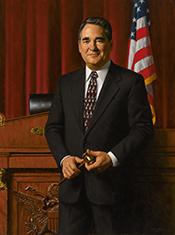
Mr. Chairman, I yield myself such time as I may consume. Mr. Chairman, I rise today in strong support of H.R. 4, the Personal Responsibility, Work and Family Promotion Act of 2003. This bill does a…
Mr. Chairman, I yield myself such time as I may consume.
Mr. Chairman, I rise today in strong support of H.R. 4, the Personal Responsibility, Work and Family Promotion Act of 2003. This bill does a number of things that are very important to the Committee on Energy and Commerce that I chair. It contains an extension of
funding for the abstinence-only education, and also reauthorizes transitional medical assistance, and I want to speak to both of these issues briefly.
The 1996 welfare reform law included a permanent appropriation of $50 million over 5 years for abstinence-only education under title V of the Social Security Act. With tight State budgets and a requirement that States must match every 4 Federal dollars with 3 of their own, it is noteworthy that almost every State in the Union has now participated in this block grant program. The high rate of State interest suggests that abstinence-only education is indeed one of the ways to address the terrible problems of teen pregnancy and sexually transmitted diseases in our society.
Last year, my friend and colleague, the gentleman from Florida (Mr. Bilirakis), the chairman of our Subcommittee on Health, held a hearing on abstinence-only education. It was an eye opener.
At that hearing we learned that problems stemming from increased sexual activity among teens has not abated at all in this country. Even though teen birth rates have declined, we still have the highest teen birth rates of any industrialized nation in the world, and sexually transmitted diseases have grown dramatically. Every day in America, 10,000 young people contract a sexually transmitted disease, 2,400 become pregnant, and 55 contract HIV.
When we were growing up in the 1960s, there were really only two sexually transmitted diseases that were of a real concern. Now we are aware of more than 25, and the diseases that are primarily affecting young people today are now the viral diseases, such as human papillomavirus, herpes and chlamydia.
Mr. Chairman, these viral diseases cannot be cured. They are incurable sexually transmitted diseases. Chlamydia, for example, a major cause of infertility in young women, is asymptomatic in up to 85 percent of the cases. That means for 85 percent of the young women contracting this sexually transmitted disease, which is incurable, they may lose their opportunity ever to bear a child, ever to become a mother, ever to experience the joys and the tremendous rewards of motherhood.
One of the other things we learned was that 50 percent of the sexually active young women between the ages of 18 and 22 are now infected with the papillomavirus, or HPV. Now, this is a virus, again we learn, that most young women do not realize they have, because again it is asymptomatic in most cases. But what we have learned about it is that it is a precursor, it is one of the incurable diseases that often leads to cervical cancer. And guess what else we learned? We learned that there is no evidence whatsoever that condoms reduce the sexual transmission of this infection.
These statistics are terrifying. But they show that the safer sex model has not solved all of these problems despite more than 20 years of a variety of education programs aimed at promoting condom or contraception use.
Mr. Chairman, I urge my colleagues, for the sake of these young men and women in our society who are being infected by these incurable diseases, many of which will cause them incredible damage in their lives, and they are not aware, that we extend the abstinence-only education programs under H.R. 4. H.R. 4 simply maintains the status quo, extends the level of funding of $50 million each year through the year 2008.
New research is beginning to suggest that abstinence-only education can effectively address the prevalence of sexually transmitted diseases among young people and the proportion of births occurring to unmarried mothers. We must continue indeed that effort begun in 1996 and support abstinence-only education programs that empower students to choose abstinence for themselves, while receiving the relevant facts and information that would make them want to make that choice.
The 1996 welfare reform law also included a critical work support for former welfare recipients called transitional medical assistance.
Former welfare recipients typically enter low-wage jobs that do not offer private health insurance coverage or offer coverage with very expensive premiums. Transitional medical assistance extends up to a year of Medicaid coverage to these individuals and their families. This is the bridge of health care coverage that helps take young people out of welfare and into the workforce with adequate medical coverage in the bridge years.
There is strong bipartisan support for this assistance, which provides a valuable incentive for people to move off of welfare into work, and this 1 year reauthorization of transitional medical assistance will have a 5-year cost of $355 million.
Because funding was not included, Mr. Chairman, in the last year's budget resolution, we had to find the money to pay for it, so H.R. 4 includes a limited offset to do so.
We recognize the Medicaid budget difficulties many States are currently experiencing and important functions that are funded with Medicaid administrative costs, and for that reason, the offset included in H.R. 4 is merely a partial adjustment that lasts for only 2 years and pays for the 1-year extension of this important program.
Before 1996, common costs for administering food stamps, Medicaid and welfare were often charged to the AFDC program, the predecessor of the TANF program. These common costs have been included in the calculation of each State's TANF funds. The offset reduces Federal reimbursement for Medicaid administrative costs to reflect the portion of these costs that are already included in the TANF block grants the States receive.
In effect, this offset for the 2-year period deals with a problem we already corrected in the food stamp program in 1998, this double reimbursement for administrative costs. This is a partial adjustment that lasts for only 2 years and then phases out.
I urge my colleagues to vote in favor of H.R. 4, which indeed responsibly pays for the 1-year reauthorization of transitional medical assistance. I know there are many in this room who would like us to extend it for longer than a year. We simply have problems funding it in this bill at this time.
We recognize the careful balance we have achieved between the offset and this 1-year reauthorization, and commit ourselves to revisiting the issue again next year so that this important program can be continued.
I urge Members to join me in full support of this important legislation.
Mr. Chairman, I yield 3 minutes to the gentleman from Florida (Mr. Bilirakis), the chairman of the Subcommittee on Health.
Mr. Chairman, I am pleased to yield 2 minutes to the gentleman from the great State of Florida (Mr. Stearns), the distinguished chairman of the Subcommittee on Commerce, Trade and Consumer Protection.
(Mr. STEARNS asked and was given permission to revise and extend his remarks.)
Mr. Chairman, I am pleased to yield 2 minutes to the distinguished gentleman from the great State of Michigan (Mr. Upton), the chairman of the Subcommittee on Telecommunications.
(Mr. UPTON asked and was given permission to revise and extend his remarks.)
Mr. Chairman, I yield myself such time as I may consume.
Mr. Chairman, welfare reform passed by this Congress, signed so reluctantly by Bill Clinton, has been an unmitigated success. It was built on one premise. You do not love people by condemning them to a lifetime of poverty and dependence. You love them by giving them a chance for independence and self-dignity.
Mr. Chairman, I yield the remainder of my time to the gentleman from South Carolina (Mr. DeMint) who will close for this side.
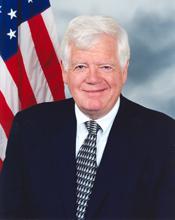
Mr. Speaker, I thank the gentlewoman for yielding me time. Mr. Speaker, I am not going to talk about the bill. I am going to talk about the process, because that is what is really wrong with what…
Mr. Speaker, I thank the gentlewoman for yielding me time.
Mr. Speaker, I am not going to talk about the bill. I am going to talk about
the process, because that is what is really wrong with what happened here.
When we organized the Committee on Ways and Means, I asked the chairman in open committee whether we would have hearings on this bill. The chairman said that is what he wanted. But it is pretty clear that this House is being run by a politburo run by the gentleman from Texas (Mr. DeLay).
The gentleman from Texas (Mr. DeLay) obviously told the chairman of the Committee on Ways and Means, which is supposed to be the most powerful committee in Congress, you cannot have hearings on this; we are dealing with this on the floor without any discussion, no debates.
Now, if this were a good rule and you made it an open rule and let us put any amendments forward we wanted to, if we could have the debate out here in public, that would be okay. But you closed that off, as well as having any kind of public discussion in the committee system.
Now, this Congress, I am sure, is going to do more and more of that, because it is clear what you are trying to do is run stuff through here so quickly that we will be out of town when some war begins, and there will not be any Members of Congress around here. You will have done all the business, you will not have any hearings anyplace, and you will simply pass the legislation over to the Senate and go home. That is a travesty on the process that has been in place in this country for 200 years.
This is not a minor little bill. This is not ``shall we name the post office in Oologah, Oklahoma, after Will Rogers?'' This is about what we do with the poor people of this country. And for Members elected not to have an opportunity to debate amendments and discuss the issue, I know what they are going to say when we get out here with the regular bill; they are going to say we did it last year.
Listen, things have continued down the drain. We have got higher and higher unemployment, and more and more of us are facing problems in State legislatures that cannot respond to this.
The President has made no proposal to deal with the problems of the States in dealing with people who are on welfare, who are in trouble, kids. The President says, ``Leave no child behind.'' Well, I guess he means they can go to school on an empty stomach. That is okay with him. Okay, that is good. But why not have a kid with a stomach with some food in it so he can pay attention to the books?
But if we had this debate and we had all these amendments put out here and we argued about whether you could actually get 30 hours of work, or should you count training or whatever, all those issues would then make it very clear what you are doing to poor people. You do not care whether they have a livable wage; just shove them off the rolls and leave them out there. And when we start to get the kids, we are going to get the kids from the programs in every State that deal with child abuse. People are going to say, these parents are not taking care of these children. We have to take those children away from them.
It will be created by a bill that never had a hearing. Shame on the Republican leadership.
Mr. Chairman, my remarks should not be taken as any kind of a statement about the Committee on Ways and Means, because we had nothing to do with this. But I remember the verse in the Bible where they were asking Christ how you would know if you were really a good Christian, and he said, well, it is how you take care of the least of these, meaning the poor people and the sick and all of the rest. This bill is an absolute travesty. Nobody wants to talk about it.
Now, let me tell my colleagues what Republicans say. Mark Schweiker, the
former Republican Governor of Pennsylvania said, ``Meeting the work requirements in the House bill would require us to dismantle much of our time-tested and effective welfare program and replace it with costly programs with little utility. These changes, including significant new child care costs, would cost the taxpayers of Pennsylvania more than $300 million.'' That is a Republican Governor talking.
Or we could take the Republican Senate chairman in Iowa. Her name is Mary Cramer. She said, ``We are concerned that the proposals such as the legislation passed by the House will restrict Iowa's successful efforts to provide training to welfare recipients and meet the needs of local businesses. We urge you not to take a step backwards and further restrict education and training options.''
I could go on like this. Anybody outside the Beltway, outside of the office of the gentleman from Texas (Mr. DeLay), knows that this bill is not going to make it better; it is going to make it worse.
Now, I have a whole long list of things. The GOP will say today that welfare reform has been a great success. If that is, why have 41 out of the 47 States said, the Republican plan would force fundamental change in their current welfare program? Why are we changing it if it is not broken? What is the point? The point is to squeeze poor people.
We heard earlier that child poverty has fallen dramatically because of welfare reform. No, that is not what everyone else who is an economist says. It is a good economy, and it has been the earned income tax credit, and we still are forcing families, with a family of three living on $2,500 a quarter. Now, that is 70 percent of the Federal poverty line. We call that success? That is what we are being led to believe out here, that we have a success and we ought to squeeze them more. They got too much. That family of three with $10,000 for a year ought to be squeezed some more.
We will also hear, and we did hear, that this bill gives more flexibility because we allow States to define 16 of the 40 required work hours in the bill. This bill increases the current law direct-work requirement from 20 to 24 hours and eliminates job search. Looking for a job does not count anymore; you only get credit for working. So if you have a job making $6 an hour and you spend a little bit of time out looking for a job, you do not get any credit whatsoever for that.
The CBO estimates that the paperwork involved in this is going to be a cost of $6.2 billion over the next 5 years. So we will pay for $6.2 billion worth of paperwork; but we will not think about the people, because we need to pass the committee, we need to get it right out here and get it passed because TANF expired on March 31. What they did not say when they came out on the floor was, the Senate Republicans included a 6-month extension of the current law through September 30 in the Omnibus Appropriation Act we are about to take on.
Now, that extension is supported by the National Governors Conference, so Republican legislators are going out and sticking their thumb in the eye of Republican Governors.
Now, if the House negotiators would withdraw their objections to that extension, we would have plenty of time for thoughtful consideration of their program. We would have the next 6 months to think about it. The thing I really like best is, we had plenty of debate last year so we do not need to debate it this year, as though, if you discussed it in 1941, it is good enough; we do not need to discuss it again, right?
Well, do things change? Did we have a new Congress elected in November? We have got new people here. Some of these people have never, ever considered these issues, a lot of them. There has been no public debate whatsoever, and we passed last year's bill on a party line vote, and no attempt was made to work it out with the minority then. This is more of the same. This is just rubber-stamping George Bush's proposals, and the gentleman from Texas (Mr. DeLay) leads the politburo, and he keeps sending things up here.
Mr. Chairman, I rise in opposition to H.R. 4, and I do so with extreme disappointment today. As one that worked awfully hard in 1996 with both sides of the aisle in coming up with a welfare reform…
Mr. Chairman, I rise in opposition to H.R. 4, and I do so with extreme disappointment today.
As one that worked awfully hard in 1996 with both sides of the aisle in coming up with a welfare reform bill, working with my own State, working with the providers of welfare, working with the recipients of welfare, working with the business community, we came up with a good compromise bill.
Now, I am disappointed that we are taking the same bill that was passed last year, without legislative input, and bringing the same bill up today without committee action and the nonrecognition that the economy has changed since last year.
Mr. Chairman, H.R. 4 would severely restrict the flexibility of States such as Texas to continue the activities that have been successful in their welfare reform bills. According to CBO, it will cost Texas $688 million over 5 years to pay for the Washington-mandated policies in this bill. Texas cannot afford these enormous expenses at the same time that we face a $9.9 billion budget shortfall and a sagging economy that continues to reduce State revenue. This will force Texas to drastically cut back on basic services or raise taxes, and they are not going to do that. It would be the height of arrogance for me to stand here in Washington and vote to require Texas to increase taxes or cut spending on other programs to implement policies that the Texas legislature has already considered and rejected in favor of other policies which have been proven to work.
Vote down H.R. 4; support the Cardin substitute. It will be much better for the State of Texas and other States.
Mr. Speaker, I rise in opposition to this tax and spend bill before us today. This bill will force States to increase taxes to pay for the increased spending necessary to meet the costs of the bill's unfunded mandates.
The Republican bill would impose mandates that would force States to change their existing welfare programs. Welfare reform has been a success in Texas and across the country in large part because of the State flexibility. I do not understand why the majority wants to force States to scrap the programs that have produced this success in order to comply with a Washington-knows-best approach. The States and folks at the local level know what works and what doesn't work in their local communities. They do not need Washington telling them how to run things.
According to a survey conducted by the National Governor's Association, 41 out of 47 States who responded would have to significantly alter their welfare program in order to comply with the requirements of the bill. This will require a costly redirection of resources. States will have to dismantle effective programs that have met the individual needs of their citizens.
For example, Texas's program helped them achieve a 61 percent reduction in welfare recipients since 1996. The Texas welfare program establishes time-limited benefits and requires welfare recipients to participate in work activities. The Texas Workforce Commission (TWC) oversees the Choices employment program, as well as child care, through a system of 28 local workforce development boards. The Department of Human Service is responsible for client eligibility determinations.
If the bill proposed by the majority passes, Texas will have to dismantle this successful program. They would have to drastically scale back its vocational education program which has been successful in matching welfare recipients with business needs, and implement a subsidized wage program that the State previously rejected as being ineffective. Texas would have to end its current practice of levying a reduction in cash benefits in order to comply with the mandate that States terminate assistance completely for families out of compliance with work requirement.
The Republican plan proposes radical waivers and block grant options what would affect the basic structure of the Food Stamp Program. It puts at risk the Program's effectiveness as a work support for families leaving cash assistance, ignores the considerable flexibility States currently have to run the program, and would undermine essential protections for the program's vulnerable clients. Congress instead should maintain the Food Stamp Program structure affirmed in last year's bipartisan farm bill reauthorization.
The Republican bill would create an unfunded mandate of $8 billion over 5 years according to the Congressional Budget Office to meet the work requirements in the bill. CBO estimated that if States actually meet the 40 hour work requirement with meaningful, structured requirements instead of self-reported activities, the unfunded mandate would increase to $11 billion. For Texas, the equates to a sum of up to $668 million over 5 years. Texas cannot absorb these costs. Faced with a $9.9 billion budget shortfall, and now a sagging economy that continues to reduce state revenue, the State will have no other option than to explore alternative ways to fund the government. This will mean cutting back on basic services or raising taxes.
In would be the height of arrogance for me to stand here in Washington and vote to require Texas to increase taxes or cut spending on other programs to implement policies that the Texas legislature has already considered and rejected in favor of other policies which have been proven to work. Many other States will face the same problem, as they face an $85 billion combined budget shortfall.
Republicans do not often like the term ``unfunded mandate'' because States would have the option of terminating current, nonmandatory services like child care to working families to cover the additional costs, rather than
spending new State dollars. However, child care is a necessary component of a welfare-to-work program, and terminating these programs are not a real option for States who want to help working families afford child care.
The Democratic substitute increases funding to States for child care assistance to match the CBO estimate of increased child care costs resulting from the work requirements in the Democratic substitute. The Democratic bill provides an additional $11 billion for mandatory child care over 5 years.
The Democratic plan focuses on moving welfare recipients into work and keeping them employed. The majority talks about their bill being tougher on work because of the 40 hour work requirement, but the reality is that 16 hours of that work is in unsupervised, unstructured activities that are not defined and could include helping children with homework or other self-reported activities. On the core work requirements, the Democratic substitute matches the Republican bill with 24 hours of work. More importantly, the Democratic substitute provides a credit for moving welfare recipients into employment, whereas the Republican bill allows States to reduce the work participation requirements simply by reducing the caseload for any reason.
The Democratic plan aims to equip welfare recipients with the knowledge and skills necessary to escape from poverty and welfare, and into a paying job, while the Republican bill does not. The Democratic plan allows for education and training to count toward the participation rate for up to 24 months, while the Republican plan limits them to 4 months. Republican plan eliminates vocational education from the list of work-related activities that count toward the State's participation rate--for the first 24 hours a week.
If you want States to be able to continue succeeding at the necessary job of helping folks get back to work, vote no on H.R. 4.
Mr. Chairman, I yield myself such time as I may consume. This important legislation before us today, H.R. 4, the Personal Responsibility Work and Family Promotion Act of 2003, builds on the many…
Mr. Chairman, I yield myself such time as I may consume.
This important legislation before us today, H.R. 4, the Personal Responsibility Work and Family Promotion Act of 2003, builds on the many successes of the historic 1996 welfare reform law. H.R. 4 will help even more people transition from welfare to work and know the dignity of collecting a paycheck instead of a welfare check.
As my colleagues may recall, before 1996 the Nation's welfare program actually encouraged dependence with recipients staying on the rolls for an average of 13 years. The program discouraged work, and caseloads reached record levels with some 5 million families and 14 million recipients dependent on benefits by 1994.
Since the 1996 changes, work has increased, incomes are higher, child poverty has been reduced, and families are more self-reliant. Welfare caseloads are down more than 50 percent and have continued to decline even over the past 2 years as unemployment rates have risen. Nearly 3 million children have been lifted from poverty, and poverty rates for African American children and families headed by single mothers have reached all-time lows.
We must continue to build on this record of success. We can do that by passing H.R. 4. This legislation fulfills the President's call to further improve the welfare system by encouraging even more welfare recipients to work. It would protect children and strengthen families by promoting healthy marriages, and it would allow States increased flexibility in operating their welfare programs.
The welfare program needs our immediate attention since it has been on life support since October 1 of 2002. Permanent reauthorization of this program is vitally important to States and the families and individuals this program serves.
I urge all Members to vote in support of H.R. 4.
Mr. Chairman, I reserve the balance of my time.
Mr. Chairman, I yield myself 30 seconds.
Mr. Chairman, just to respond, it is important that we move now. We had more than 20 hearings on this legislation last year. The legislation actually expired September 30 of 2002. We are now 6 months on life support.
The gentleman from Washington (Mr. McDermott) mentioned that the reason the welfare rolls have dropped is because of prosperity. I would remind the gentleman that we are in a recession now. And even though we are in a recession, the welfare rolls, even since 2000, have dropped some 7 percent.
Mr. Chairman, I reserve the balance of my time.
Mr. Chairman, I yield myself such time as I may consume.
Mr. Chairman, I would like to remind my good friend from California, who is talking about Christian programs and how much poverty is affected by our current welfare bill and the new one, our own State of California poverty rates by the latest Census have gone down since the 1996 bill by 1,031,000.
Mr. Chairman, I reserve the balance of my time.
Mr. Chairman, I yield 5 minutes to the gentleman from Florida (Mr. Shaw), the original chairman of the committee that put out the 1996 welfare reform.
Mr. Chairman, I yield three minutes to the gentleman from Florida (Mr. Miller).
Mr. Chairman, I yield myself such time as I may consume.
I would like, just in response to the gentleman from Maryland, the CBO has indicated that there will not be any unfunded mandates. I have a letter in front of me. Because of the broad flexibility afforded States under the TANF program to structure the program and determine benefits, the new requirements of H.R. 4 would not be intergovernmental mandates.
Mr. Chairman, I yield 3 minutes to the gentleman from Ohio (Mr. Portman), a key player in welfare reform on the Committee on Ways and Means.
Mr. Chairman, I yield 3 minutes to the gentlewoman from Connecticut (Mrs. Johnson), another important member of our Committee on Ways and Means.
Mr. Chairman, do I have the right to close?
Mr. Chairman, I reserve the balance of my time to close.
Mr. Chairman, I yield myself such time as I may consume to respond to my friend from Texas that when we started welfare reform back in 1996, the average amount of money that was available for each family was slightly less than $7,000. Today, that amount, because we block granted it, the average amount that is available for each family today is about $16,000. More than double. Also in this bill we have $2 billion that is for additional child care.
And just to the State of the gentleman from Texas (Mr. Doggett), that will amount to some $370 million of additional child care, just for the State of Texas.
Mr. Chairman, I yield 2 minutes to the gentleman from Michigan (Mr. Camp), a key member of our Subcommittee on Human Resources.
Mr. Chairman, I yield myself the balance of my time.
Sometimes, when I listen to the debate on the other side, I wonder if we are talking about the same legislation. We are seeing in the area of child care some $2 billion more that is being placed into this legislation than was in the 1996 bill.
Again, since we keep hearing about unfunded mandates, I again have a letter in front of me from the Congressional Budget Office indicating that there are no unfunded State mandates.
But let us go over the incredible successes of the 1996 bill and where we go here in our new legislation. Child poverty has fallen since 1996 by nearly 3 million children who have been lifted up out of poverty. The black child poverty rate is now at a record low. More parents are working today than ever before in welfare. Employment by mothers most likely to go on welfare rose by 40 percent between 1995 and 2000. Dependents fell by unprecedented levels. Welfare caseloads fell by 9 million during this period of time, from 14 million recipients in 1994 to just 5 million today. Yet there is much that needs to be done.
Even though we have more people working than before, there are still 58 percent of recipients who are not working or who are not receiving training or who are not involved at all. Too many families are breaking up. It is tough enough to raise children with two parents, let alone just one. We still have 2 million families that remain dependent on welfare that we want to address.
What our new legislation would do is that we allow for more parents to be able to work and, therefore, be able to receive benefits. States will continue to receive the record Federal welfare and child care funds, despite since 1995, a nearly 60 percent reduction in rates. This means that average allotment per family will go from less than $7,000 in 1995 to some $16,000 today. And there are funds in here to help encourage and to help give counseling to encourage that every child has two parents at home. So we recognize this.
Again, of all the legislation that I have been involved with in 16 years, I feel this has been the most successful. And what we are doing in this current legislation, H.R. 4, is building on these incredible successes of the last 5 years and continuing them.
I urge the strong, overwhelming support of this body on H.R. 4.
Mr. Chairman, I yield back the balance of my time.
I thank the gentleman for yielding me this time. I have a statement which I will submit, Mr. Chairman, for the record. I would just like to say that I am in very strong support of this legislation.…
I thank the gentleman for yielding me this time. I have a statement which I will submit, Mr. Chairman, for the record.
I would just like to say that I am in very strong support of this legislation. Welfare reform goes back a long time in this country, well before Congress actually got too involved in it. It goes back to the States in the 1980s in which a number of States came forward and said they could do something about welfare reform. Finally, in the Family Support Act of 1988, the Federal Government got involved.
Again, in 1996, we passed welfare reform legislation. We debated it last year and passed a bill, and now here we are again on the floor. Virtually every time we have done this, every single time, the opposition to it has gotten up and said, We can't do this. It's impossible. You can't get this much out of people. You can't get blood out of a stone.
This is a human issue. If you go back into the jurisdictions where we all live and you see what they have done with welfare reform, if you see the opportunities that we have given to people who in many instances now are living middle-class lives because of a middle-class income, you see the real circumstances of what we can do to help people. There has been no social program that has uplifted people more in this country in a true sense of giving them an opportunity as America allows you to have as has welfare reform.
This legislation continues a lot of the support systems which are necessary, including the educational components, the day care components, the transportation components in the things that have to be done.
I too believe that we need to refine this somewhat. I am a little concerned about the transitional medical assistance in terms of Medicaid continuations. I do worry about transportation. We all worry about day care a little bit.
I think there needs to be sufficient flexibility at the State and local levels to carry out what needs to be done in welfare reform, but I believe this legislation has the basic parameters which will allow this to happen, and I believe this is the next extension of what we have to do in the Congress to allow the States across America to continue their welfare reform programs.
I, for one, believe it can be done. I grant you, the economy is not what I would like to see either, but I believe that it can be done sufficiently to help a lot of people, and then you will see all of those people whom I have seen who will say, Thank you for giving me the opportunity; I am able to help my family now.
I support the legislation. I hope we all can support the legislation.
The 1996 welfare reform law replaced a broken system with one of the most successful government programs in recent history.
As Governor, I promoted work as the ladder to opportunity. Former recipients told me that they needed help breaking away from welfare dependency, but once they found their place in the workforce, they were able to create better lives for their families.
For that reason, I was proud to make work the foundation of the 1996 reform. Today, national data confirms our success. Caseloads are down. Household incomes are up.
Welfare recipients now appreciate the value of work. We provide time and assistance, but understand that welfare cannot be an open-ended entitlement--or a way of life. We help those on assistance, but do not allow them to become passive dependents on the welfare system.
Today's legislation strengthens and embraces these goals.
In particular, H.R. 4 recognizes the education needs of children and includes my language to increase funding for quality initiatives, such as teacher training. H.R. 4 also provides historic funding levels for child care. Both mandatory and discretionary programs, now appropriated at $4.8 billion, will grow by $2 billion.
Yet, these programs are only part of a larger picture. States spend TANF grants on child care--either directly or through funding transfers. And Congress supports child care through other programs like Head Start. Recent estimates show that annual child care funding exceeds $18 billion--a significant investment, by any measure.
This bill also contains language from a bill I introduced, ``The Child Support Fairness and Tax Refund Intercept Act,'' to help custodial spouses collect past due child support even if their child is no longer a minor. A Wilmington, Delaware woman, Lisa McCave, was owed several thousands of dollars in past due child support. The Federal Government discovered that the father was about to receive several thousand dollars in a tax refund. However, because her son was no longer a minor, the IRS could not intercept that money for her. She had to work two jobs to raise her son and put him through college, while he waited out the clock until his son was no longer a minor so he could enjoy his tax refund. Thanks to Lisa McCave's willingness to step forward and ask for justice, millions of parents in the future will be able to intercept tax returns to pay the child support owed them, even if their child is no longer a minor.
With all the improvements to our welfare system contained in this bill, I believe there are a few issues we should continue to review. I appreciate the one year extension of Transitional Medical Assistance, a program that provides continued health coverage for former welfare recipients, but I hope we can extend and simplify this authorization for five years as the President's FY 04 budget recommends--and do so in a way that does not effect Medicaid administrative funds. I have introduced legislation with Congressman Levin to extend this valuable program, and I look forward to working with the Senate and the President to accomplish this goal.
Also, it is my hope that we can reinstate the state flexibility provisions and give our Governors the ability to find innovative ways to meet and exceed the goals of this legislation. State waivers were critical to Delaware's success in the past and they are critical to our continued success in the future.
Finally, education is important to reducing unplanned pregnancies and achieving independence for working men and women. Abstinence education is an important part of this effort. Yet, the language in H.R. 4 provides an overly simple solution to a complex problem. In my opinion, we cannot restrict access to basic health information if we are to promote responsibility.
In conclusion, I support H.R. 4--the beginning of our efforts this year to create the next generation of welfare success stories.
Mr. Speaker, I rise in strong support of this rule. Before I begin, I cannot help but think of one of Thomas Jefferson's great lines, the author of our Declaration of Independence. I have got to sort…
Mr. Speaker, I rise in strong support of this rule. Before I begin, I cannot help but think of one of Thomas Jefferson's great lines, the author of our Declaration of Independence. I have got to sort of extrapolate from that when Thomas Jefferson said two thinking men, and in this case it is two women, but he said, ``Two thinking men can be given the exact same set of facts and draw different conclusions.''
Mr. Speaker, I sat and listened to the very eloquent remarks by my good friend from Ohio, the author of this legislation who chairs our Republican Conference, and I listened to the equally eloquent remarks from my friend from the 28th District of New York who just entered that editorial in the Record, and I said that just to let her know I was listening very, very carefully.
It is to me very difficult to believe that we are talking about the same piece of legislation and the same kind of program. We obviously in this country are faced with serious economic challenges. There are people who are hurting out there. We know that. But as I listened to the reports of the failure of welfare reform, I am reminded that it was a bipartisan piece of legislation. I say it was bipartisan because clearly at the end of the day, after two tries, on the third, President Clinton proudly signed and embraced welfare reform in 1996.
We enjoyed strong economic growth through the 1990s. Many people tried to make the claim that the only reason we saw the success of welfare reform is that we were dealing with a strong, vibrant, growing economy; when in fact I looked at and talked with the gentleman from California (Mr. Herger), the chairman of the subcommittee on Ways and Means that deals with this, and he pointed out that during the 1980s, when we saw an equally strong economy, we witnessed a 25 percent increase in the numbers on the welfare rolls.
We saw strong, bold economic growth during the Reagan years, as we know, yet the numbers of people getting into what my friend from Ohio appropriately described as that generational cycle of dependence continued to grow more and more. And then during the 1990s we again saw strong economic growth, but at the same time we saw implementation of the welfare reform legislation and we have seen tremendous improvement.
We all know that an economic downturn began in the third and fourth quarters of the year 2000. We also know that we suffered tremendously from the tragedy of September 11, 2001. What we found, Mr. Speaker, was that during that period of time, we obviously witnessed a recession. We saw two quarters of negative economic growth. That was last year.
But then the gentleman from California (Mr. Herger) reported to us that even during that period of time, we saw a 10 percent reduction in the numbers on welfare, meaning that we have been able to very boldly encourage and move people out of that generational cycle of dependence.
If we look at this measure and the steps that are being taken to ensure that those who are truly in need are not going to be suffering, it is very, very impressive. We obviously provide a caveat which allows those parents with children who are in need an opportunity to have consideration for that. We allow in this measure an opportunity for those who are suffering from drug addiction to have an opportunity to deal with that need. We clearly are providing States with flexibility. That is something they said they needed. In my State of California, we have extraordinary extremes from one end to the other. So to provide that opportunity for flexibility is very important.
As we look at the structure of the rule for consideration of this, I am somewhat struck with the arguments that were made by my friend from New York. She said that they advocated an open rule, and it is true that an open rule was moved up in the Committee on Rules last night when we pursued this bill; and if an open rule had been made in order, these very thoughtful substitutes, one of which has come forward from the gentleman from Ohio (Mr. Kucinich), my very good friend, and I am happy he is offering it in the name of our late former colleague, Patsy Mink, from Hawaii, and the other substitute which was made in order under this rule is being offered by the gentleman from Maryland (Mr. Cardin), a member of the Committee on Ways and Means. I said when I announced that we would be considering this measure that we lean towards making substitutes in order, and we have provided waivers and protections so that those substitutes are, in fact, in order. So that is why we clearly should have, I believe, strong bipartisan support for this rule.
Mr. Speaker, we have had story after story told of the families who may not be making as much money today while they are working as they were when they were receiving welfare, and yet they have a level of dignity and pride in what it is that they are doing that makes them happier and more fulfilled. We obviously want to ensure that they have an opportunity to make many times, many times what they were making when they were on welfare and we believe that if we can put into place President Bush's program for economic
growth, we can get this economy going so that we can take this number that we have today which was at one point 12 million and because of the success of welfare reform has dropped down to 5 million; and we can, I believe, bring that number even lower.
People talk about compassionate government and the fact that we need, as we look at legislation like this, to demonstrate compassion. And I would remind my colleagues of something that is oft said and that is the level of compassion of the government should not be based on the number of people who are on welfare, but instead on the number of people who do not need to be on welfare. And that is really what we are trying to do with this legislation; and I hope very much that we can move ahead, pass this rule, make sure that we consider these substitutes, which I believe are very well intentioned but need to be defeated, and then pass this very important legislation that the gentlewoman from Ohio (Ms. Pryce) has offered to us.

Mr. Speaker, I thank the gentlewoman for yielding me this time. Mr. Speaker, this Congress is starting off on the wrong foot. Welfare reauthorization reform is an important issue. It affects the…
Mr. Speaker, I thank the gentlewoman for yielding me this time.
Mr. Speaker, this Congress is starting off on the wrong foot. Welfare reauthorization reform is an important issue. It affects the lives of millions of people, and it deserves thoughtful and careful deliberation. Unfortunately, Mr. Speaker, the majority does not agree. The course of those millions of lives will now be determined by a handful of Republican leaders and their staffers, nobody else. That is just wrong and it is not how a democratic body is supposed to function. Welfare reauthorization is important, but the legislative process is important too. And it should not be simply tossed away like yesterday's newspaper.
In addition to trying to finish last year's work today halfway through February, this body is now abandoning the committee system that has served this House for over 200 years. Sure the majority has allowed for two substitutes, and I suppose we should be very grateful; but let me remind my colleagues that this bill was referred to five committees. How many of those committees held a hearing on this bill in the 108th Congress? Zero. How many of those committees marked up this bill? Zero. Over 50 new Members of this body, Republican and Democrat, were denied the opportunity to shape this debate. Do their views not matter? Do we not want their input and their expertise? Could we not have scheduled hearings and markups during these last few weeks when our own schedule here in this Congress has been virtually nonexistent? And I should also add, Mr. Speaker, that the omnibus appropriations bill that we are going to deal with later today includes language that will extend the current welfare program until September of this year. I believe that that gives us ample time to do this right, to let the committees work their will.
Mr. Speaker, the chairman of the Committee on Education and the Workforce testified on this bill yesterday before the Committee on Rules, and in the process he said that he is a fan of the committee system. It is too bad his leadership does not agree with him. Mr. Speaker, I want to say to my colleagues on the other side of the aisle that the committee work matters, that Members who serve in this House matter, that the people of this country matter, and this is not the way for us to do the people's business.
Mr. Chairman, I thank the gentlewoman for yielding me this time, and I rise in support of the Kucinich-Lee-McGovern-Lantos substitute and remind my colleagues that welfare reform is about lifting people out of poverty.
Mr. Chairman, I rise in support of the Kucinich-Lee-McGovern-Lantos amendment. This amendment, dedicated to the late Congresswoman Patsy Mink, is a strong substitute that will change the course of welfare as we know it, and, in the process, help millions of Americans leave welfare for good.
The 1996 welfare reform bill did what it was designed to do--trim the welfare rolls. Low-income people who received cash assistance left welfare because they were able to find jobs and because the economy was good.
Others left welfare because their benefits expired. But the goal of trimming the welfare rolls was reached, allowing some to claim welfare reform has been fully successful.
But I believe this law should do more than just trim the welfare rolls. The goal of the welfare program should be to help low-income individuals achieve true self-sufficiency. Welfare should enable low- income individuals and families to pursue the training and education they need to get good jobs so they can leave public assistance permanently and provide economic security for their families.
The Kucinich-Lee-McGovern-Lantos amendment will achieve this goal.
Look at the details. The extra $2 billion for child care included in the Republican bill is simply not enough to provide for adequate child care for parents. Our amendment would provide $20 billion more for child care--an increase of $18 billion over the Republican proposal.
Additionally, the current work requirements would be maintained, so people could continue to receive assistance while they train for a job that will keep them off welfare. And under this substitute, legal immigrants--people who pay taxes and fight in our armed forces--would be eligible for help.
This body has the moral obligation to provide a safety net for the people of this country who need one. We cannot forget about the low- income people in this country, especially in this time of economic uncertainty.
States across the country are facing record budget deficits, and in the process are slashing programs like Medicaid and other social services. Now, more than ever, the Federal Government must provide for those people who need help.
Members of this body only have to look to the gentlewoman from California, Ms. Woolsey, to see what happens when a mother on welfare can get the child care she needs. Yesterday, Ms. Woolsey testified before the Rules Committee.
She told the Committee that she wouldn't be here today as a member of this House if it weren't for welfare and for her mother, who took care of her children while she was working.
The gentlewoman from California made the point that people on welfare--women in particular--will not be able to focus on job training and, ultimately, self-sufficiency, if they can't find safe, affordable places for their kids. Ms. Woolsey was able to concentrate on her job, move off welfare and become a successful, self-sufficient woman. We can duplicate her success story with the passage of this amendment.
Mr. Chairman, nobody wants to be on welfare. People want to earn a paycheck, not a welfare check. but we have a moral responsibility to help people move off of welfare into productive work.
Our substitute does just that.
I urge my colleagues to support our effort to change the goal of this program to one of self-sufficiency. It's the right thing to do.
Mr. Chairman, I rise today in support of the Democratic substitute to H.R. 4, which reauthorizes welfare reform. H.R. 4 is a step in the wrong direction. It replaces State flexibility with unfunded…
Mr. Chairman, I rise today in support of the Democratic substitute to H.R. 4, which reauthorizes welfare reform. H.R. 4 is a step in the wrong direction. It replaces State flexibility with unfunded mandates, it promotes make-work at the expense of wage-paying employment, and does nothing to help families escape poverty when they leave welfare for work. I worked closely, however, with representatives Cardin, and Woolsay, in crafting a Democratic substitute that better assists the States in moving families from welfare to work and I am pleased to be a lead sponsor of this legislation.
Furthermore, as co-chair of the New Democratic Coalition, I am satisfied that our substitute incorporated many of the new Democrats' suggestions based on the principle of ``work first.''
The successful welfare legislation passed in 1996 was one of the signature New Democrat initiatives and succeeded where previous attempts to reform welfare failed.
Welfare reform, however, now faces its stiffest test since its enactment. The roaring 90's--the decade during which more than 22 million new jobs were created--are long gone. Our economy today is stagnating. The unemployment rate and welfare rolls are up. An estimated 8.6 million Americans are out of work, including 166,000 in my home State Wisconsin.
Adding insult to injury, the States, which took responsibility under the 1996 law for administering assistance programs, are in the grips of their worst fiscal crisis in 50 years. They are being forced to cut back services--services that provided critical supports for welfare recipients and the working poor and, as many recipients reach the five- year benefits limit, States increasingly will find themselves providing very basic supports for their citizens through food programs and homeless shelters.
Unfortunately, our changing economic fortune has not stopped the House leadership from pushing welfare reform legislation that fails to help those who are struggling to make end meets and imposes even more unfunded mandates on the States.
The GOP plan, for example, would drastically increase the number of house that mothers with young children will be required to work, without a corresponding increase in child care funds. In fact, House leadership would freeze funding for welfare and child care at current levels, even though the Congressional Budget Office estimates that implementing the new work requirements will cost the States an additional $8 billion to $11 billion over five years. In Wisconsin alone, this would add another $89 million to our State's projected $3.2 billion budget deficit.
Thus, the Democratic substitute is a better alternative that places welfare recipients on the path to independence from public assistance by preparing them for good paying, private-sector jobs. Our alternative reform provides the States with flexibility and freedom to be innovative in moving families from welfare to work and empowering individuals to become self-sufficient.
Currently, the most promising State programs that help welfare recipients obtain and advance in a job, combine a ``work first'' approach with supplements training and education. Our plan helps these States by providing employment credits and allowing them to count education and training towards their participation rate for up to 24 months. Finally, our plan combines heightened work requirements with an addition $2.2 billion per year in childcare funding to ensure that families transitioning off of welfare can afford to work.
In addition to the Democratic Substitute, I offered two amendments during Rules Committee yesterday, which, unfortunately, were not accepted by the House leadership and were kept from being debated on the floor today.
The first amendment was an employment credit that I offered with Congressman Levin. Currently, States have the option of taking advantage of the caseload reduction credit that rewards States with credit against its participation rate just for moving people off welfare. Our amendment, however, would have replaced the caseload reduction credit with an employment credit, thus, rewarding States for moving people into jobs, with a bonus for moving them into high paying jobs. Last year, even the Administration's plan eliminated the caseload reduction credit and replaced it with its own employment credit.
The second amendment I offered gave States incentives to put fathers to work. It rewarded States with a credit towards its worker participation rate if they worked with fathers to increase their employment and pay child support. While very little research exists about marriage and its direct benefit to children, substantial research shows a working father most effectively improves children's emotional and financial well-being.
Again, I am pleased to have sponsored the Democratic substitute with Representatives Cardin and Woolsey. Our alternative is a step forward in the right direction. Today, while facing a stagnant economy coupled with unprecedented budget deficits, our welfare reform legislation ensures that families are strengthened, companies well served, and individual futures improved. By building on our past success, we can continue to help millions of Americans once and for all gain a foothold on the first rung of the career ladder.
Mr. Chairman, I urge my colleagues to oppose H.R. 4 and support the Democratic substitute offered by Representatives Cardin, Woolsey and myself. Finally, I regret that this legislation was pushed through the House so quickly without any consideration from the committees of jurisdiction. Acting with such haste completely ignored the process and shut out all our new Members. Such an important issue should have received more thought and consideration.
Show 11 more
Mr. Chairman, I ask unanimous consent to revise and extend my remarks. I rise today in opposition to H.R. 4 and in support of the Cardin- Kind-Woolsey substitute amendment. In its current state, this…
Mr. Chairman, I ask unanimous consent to revise and extend my remarks.
I rise today in opposition to H.R. 4 and in support of the Cardin- Kind-Woolsey substitute amendment.
In its current state, this bill will not only put great strains on the families and individuals we set out to protect in every other aspect of life, but adds unbearable strains on States that already suffer from shortfalls and unfunded mandates. These new requirements could cost states up to $11 billion over the next 5 years. in addition to the $50 to $70 billion in shortfalls estimated by the National Conference of State Legislators.
It is important that we write and support laws that have positive effects on our nation's families. Now, while Florida's efforts at welfare reform are by no means perfect, it has at least recognized that a well-trained adult is a self-sufficient adult. Instead of focusing on keeping participants busy for precisely 40 hours per week while they are on welfare, Florida and other States have recently placed a greater emphasis on structuring programs that provide the types of activities needed to move participants into paid employment and off of welfare, like training programs and educational incentives. Also, Florida determined that providing
supports to low-income families, such as child care and transportation assistance, before they resort to welfare, is an essential part of work-based welfare reform. By increasing work program costs for families on welfare, a 40-hour requirement would limit the resources states have to help other low-income working families stay off of welfare.
The bill would reduce the flexibility states now have to tailor work activities to the individual needs of parents and families. In particular, States would have less ability to place recipients in vocational education programs because such activities generally would not count toward the first 24 hours of participation required of parents. The bill also would limit significantly States' ability to engage recipients in activities designed to address various barriers to employment--such as physical, mental, and learning disabilities, domestic violence, and substance abuse--because these activities would not count for the bulk of the mandated hours of participation.
I wonder how many children will continue to be alone or with inadequate care while parents are forced to increase their hours of work. In the State of Florida and throughout this country, we have issues in our child protective services, because many poor or near poor parents are working and children are left to fend for themselves. While this bill fosters and promotes marriages by giving States grants for research, technical assistance and promotional activities, it diverts $200 million from current bonus to States. All while hurting the single parent trying to make a living and care for their family without any additional programs.
We should have looked at this reform from the point of view of both the family and States in implementing change. We cannot use the carrot and the stick approach and not allow the States the flexibility to administer this Federal program.
States will be required to have 70 percent of their welfare caseload working within the next 5 years, up from the current work participation rate of 50 percent while keeping TANF block grants at $16.5 billion annually for the next 5 years.
Section 8 housing vouchers for low-income families will be replaced with a block grant program. These vouchers were targeted to welfare recipients for whom housing assistance is critical to obtaining or retaining employment. HUD provided 50,000 vouchers at a cost of $283 million. The program allowed families to rent apartments near available jobs, transportation or childcare. The vouchers were targeted to families who are currently receiving, are eligible for, or have left the welfare roll within the last 2 years.
But, instead, this bill fails at every turn:
Instead of increasing access to education and training, this bill requires that such activities would count for up to 24 months against a State's participation requirement.
Instead of increasing mandatory funding for child care by $11 billion over the next 5 years, and restoring the Social Services Block Grant funding to $2.8 billion per, this bill will cost states $11 billion over the next 5 years, and still sacrifice support services that would allow parents to maintain working hours.
Instead of removing barriers to serving legal immigrants, including the current ban on States providing Federally funded TANF benefits to immigrant families, the bar on serving pregnant women and children under Medicare, and the bar on disabled children under SSI, this bill retains the discriminatory restrictions despite bipartisan support for removing them.
Instead of providing States with the flexibility to tailor programs to their clients, while maintaining some minimum level of support, this bill takes away the ability to help people how they need to be helped, all the while saying that Federal agencies can choose not to help them at all by implementing a superwaiver overriding most Federal laws related to low-income programs.
We had an opportunity today to help the hardest to help find a way to self-sufficiency. Instead, we have forced States to go deeper into fiscal crisis or cut programs that could actually aid reform. Webster's defines reform as improvement by alteration, correction of errors, or removal of defects. I don't think there will be a picture of this legislation by definition.

Mr. Chairman, I rise in strong support of H.R. 4. Mr. Chairman, welfare reform in the past did not work. We did not have it. It was welfare under the old system. We did not have reform. We passed…
Mr. Chairman, I rise in strong support of H.R. 4.
Mr. Chairman, welfare reform in the past did not work. We did not have it. It was welfare under the old system. We did not have reform. We passed welfare reform then; and President Clinton, after a couple of vetoes, ended up signing the bill, and we established a base to get our States out of the trouble that they were in.
Last year, this House passed a bipartisan proposal to again move the process forward, but there were some in the other body who chose not to take that legislation up. This year, we are acting a little quicker.
There are two very important components of this legislation. One is the abstinence-only education which provides $50 million each year to the States under a matching program. It does not take away from other programs, it works, and we have seen teen pregnancy rates drop dramatically in those States that have used it. In my State, a 40 percent drop.
The second thing that we did was we removed the incentive for people to stay on welfare in lots of ways. Primarily what we did, though, through TMA, transitional medical assistance, we are able to say to those folks that were on welfare and knew that by taking a job they would lose their Medicaid for themselves and their kids, that that is not going to happen, that we provided the transition so that those families could take a job, get into the workforce, move up the ladder, that they would not lose that provision that would otherwise have taken away their health insurance. We changed that. TMA is in this bill, it was the bill that we helped write in our subcommittee, it was done, and it is part of this legislation. I urge my colleagues to support it and move the bill again to the other body so that we can see this legislation reach the President's desk.
Mr. Chairman, I rise in strong support of H.R. 4, legislation reauthorizing the very successful 1996 welfare reform act. As a senior member of the House Energy and Commerce Committee and the Education and the Workforce Committee, two of the three House committees with jurisdiction over welfare reform, I have worked closely with my colleagues to further strengthen this legislation so that more families can know the benefits of personal responsibility, work, and stronger family units.
I'd like to focus today on two key components of the 1996 law that I have taken the lead on--the reauthorization of the Transitional Medical Assistance program and the Title V abstinence education block grant program.
One of the greatest disincentives to leaving the welfare rolls is the lost of Medicaid coverage for oneself and one's family. H.R. 4 reauthorizes the Transitional Medical Assistance program, which will ensure that individuals leaving welfare for employment have guaranteed health care coverage for up to one year.
H.R. 4 also reauthorizes the Title V abstinence education program at the current funding level of $50 million a year. When we passed welfare reform, we emphasized work and personal responsibility. We have made great strides in promoting work, but too many of young people's dreams are still being cut short by poor personal decisions that dramatically affect the course of their lives. Teen birth rates have been failing, but nearly \1/2\ million teens in this country give birth each year--a rate higher than those of most industrialized nations. And 8,519 births are to girls under the age of 15. We know that out-of-wedlock births and teen births take a high toll--on the child, the teen mother, and our society as a whole.
Further, sexually transmitted diseases have reached epidemic proportions, placing the health and very lives our young people in serious peril. In the 1960s, one in 47 sexually active teens was infected with a sexually transmitted disease. Today, one in four is infected.
It is important to note that State participation in the Title V abstinence education program is voluntary, and this is not free money to the States. States have to match every 4 federal dollars they receive with three dollars of their own. Yet today, 49 of the 50 states are participating.
Anyone who doesn't think abstinence education works has only to examine my State of Michigan's record. The State began its own program in 1993--the Michigan Abstinence Partnership program. One reason that it works so well is its emphasis on involving entire communities-- parents, teachers, health professionals, youth leaders, youth organizations, and community leaders--in developing programs tailored to their unique needs. Michigan's teen pregnancy rates have dropped 40 percent in the targeted group of 15-17 year olds, and for the last several years, Michigan has been one of up to five states rewarded by the Department of Health and Human Services for achieving the largest decrease in their ratios of out-of-wedlock to total births while also experiencing a reduction in their abortion rates.
Abstinence education programs are much more than ``just say no'' programs. They are positive, motivational programs that give young people the information and inspiration they need to think of their futures and abstain not only from sexual activity but also from drug and alcohol use.
Mr. Chairman, President Bush got it exactly right when he said that abstinence is not just about saying no to sex, it is about saying yes to a happy, healthier future.
Mr. Chairman, I thank the gentleman from Ohio (Mr. Kucinich) for his leadership and for his sponsorship and cosponsorship of this amendment. First, Mr. Chairman, let me just say today we are offering…
Mr. Chairman, I thank the gentleman from Ohio (Mr. Kucinich) for his leadership and for his sponsorship and cosponsorship of this amendment.
First, Mr. Chairman, let me just say today we are offering this Mink substitute amendment not only as a tribute to our dear friend and former colleague, Congresswoman Patsy Mink, but also as the real comprehensive reauthorization alternative to the underlying Republican bill before us today.
I want to first send a special hello and a thank you to Patsy Mink's daughter Wendy who really helped craft the legislation; and I am delighted, as I know Patsy would be, that so many of her colleagues, I believe we have, what, close to a hundred, 105 colleagues have cosponsored this amendment today and are here to support it.
Mr. Chairman, Patsy Mink recognized that the real way we measure the success of welfare reform is to look at the quality of a family's life after they have left welfare. Patsy would ask, Are the families earning sufficient funds to really take their families out of poverty? Are they becoming self-sufficient? Today, the answer to that question is no, but we have the chance with this amendment to change the answer to that question by adopting the Mink substitute. In doing so, we would provide people on welfare the chance to get the education and the training they need, the child care that they need, and the time that they need to pull their families out of poverty.
Mr. Chairman, the Mink substitute provides strong poverty-alleviation provisions that would also take the country, our country, in the right direction in eliminating the racial and economic disparities that plague the current system.
A recent study conducted by the National Association of Social Workers found that black applicants were more likely than white applicants to be subjected to preemployment tests, that 55 percent of African American applicants were interviewed for 5 minutes or less while white applicants had interviews of 10 minutes or longer. Former white recipients earned significantly higher wages than African Americans and Hispanics. So this bill puts us in the right direction to end those outrageous economic and racial disparities.
Mr. Chairman, I have some personal experience with what we are talking about. I know education must be counted toward the work requirement, as this bill does. Had I been forced to drop out of college while on public assistance, I probably would not be here today. So I feel very responsible for protecting that same chance for other people who are striving toward the same goal.
That is why I urge all of my colleagues to support this amendment. The vital changes to the law that it contains have, really, the very awesome power to lift many out of poverty so that they can succeed at whatever careers they choose, even the United States Congress.
Specifically, this amendment adjusts the current block grant amount for inflation for future years and increases the child care development block grant by $20 billion over the next 5 years. It retains the current work requirement at 30 hours a week while removing the 12-month time limit for education, which is so important.
Also, the Mink amendment includes legal, mind you legal, immigrants who currently go off and fight for our country but cannot receive these vital benefits. That is wrong. That is wrong. We must correct that, Mr. Chairman.
Patsy Mink said it has always been the high principle of Congress to say families count first, the responsibilities of families to nurture their own children. She said, We want to put them at the top, as the emphasis of this new authorization should be, caring for children, allowing parents to stay home to care for their small children and giving them support to build their families' economic future through education. Patsy said that education must count and be equivalent to work.
I want to close by remembering our beloved Congresswoman Patsy Mink. She had a vision and we must remember her vision today. She had a real vision that is detailed in this legislation. This amendment does provide a voice for the voiceless, empowerment and self-sufficiency for the poor, and a chance at education, building strong families and a better life. It is truly about family values, Mr. Chairman.
So I urge a ``yes'' on the Mink substitute, which is the Kucinich- Lee-McGovern and Lantos amendment.
Mr. Chairman, I yield 2 minutes and 10 seconds to the gentlewoman from New York (Ms. Velazquez), a great leader on many issues, our ranking member on the Committee on Small Business.
Mr. Chairman, I yield 3 minutes to the gentleman from New York (Mr. Owens), a great educator and Mr. Education, as we call him.
Mr. Chairman, I yield such time as he may consume to the gentleman from Massachusetts (Mr. McGovern.)
(Mr. McGOVERN asked and was given permission to revise and extend his remarks.)
Mr. Chairman, I yield 1 minute to the gentleman from Maryland (Mr. Cummings), the Chair of the Congressional Black Caucus and a great leader.
Mr. Chairman, I yield 1 minute to the gentleman from Illinois (Mr. Davis).
(Mr. DAVIS of Illinois asked and was given permission to revise and extend his remarks.)

Mr. Speaker, I want to, though this is the debate on the rule, emphasize the difference here. It is too bad no effort was made in subcommittee or full committee this time around to try to forge a…
Mr. Speaker, I want to, though this is the debate on the rule, emphasize the difference here. It is too bad no effort was made in subcommittee or full committee this time around to try to forge a bridge over these differences.
What are the differences? It is not the value of work. It is not the linkage of welfare to work. No. The difference is whether the emphasis in the Republican bill will be as, to people who are remaining on welfare, they work, or getting people off of welfare into work. And the difference is whether people working should remain in poverty or whether it should be an emphasis on people working out of poverty. And this is a major difference; and it is seen, for example, in the way the Republicans give credit to the States against the required participation rate because of caseload reduction instead of people moving into employment.
It also is shown in terms of the reduction in flexibility for the States to use vocational ed and other techniques,
other approaches, so that people move out of poverty into true independence. And here is the reason the challenge matters so much. We do not have the exact data, but a huge proportion of people who have moved off of welfare into work remain in poverty. The average for people who have moved off of welfare into work is $2,500 a quarter or $10,000 a year. It is also shown in the lack of child care money in the Republican bill, also in the lack of adequate health care. So these are important differences.
So this is not a battle of 1995 and 1996. We worked, a number of us, very hard to craft a welfare bill that paid adequate attention to health care and to day care, though it had other problems remaining in it. No. This is a question of where we go from here and whether we are going to tailor a system that gives the States the flexibility, the inducement, and the mothers the opportunity to move from welfare to work, out of poverty into true independence. That is the difference.
So I am proud to be supporting the Cardin bill, and I hope that all the Democrats will vote for it; and I regret that the Republicans made no effort at all to see if we could put this together in this year.
Mr. Chairman, I yield myself such time as I may consume.
Mr. Chairman, the real issue before us is where we go from here. We can analyze where we were in 1995 and 1996. Many of us worked hard to bring about a welfare reform that linked welfare-to-work and provided child care and also provided health care. After those ingredients were placed into the bill, and it was a struggle, many of us voted for the welfare reform bill, despite serious inadequacies, especially as to legal immigrants and as to food stamps.
Where do we go from here? It is said a paycheck is dignity. Yes, a paycheck that provides people with a living wage and that moves them out of poverty is the true ticket of dignity. The problem with the bill that has been brought before us, and there are many procedural issues that have been raised, such as the failure to go through the committee process in this session; but the problem is that the emphasis in the Republican bill is not moving people off of welfare into productive work, but two problems: emphasizing those who are on welfare working, rather than moving people from welfare to work and people moving from welfare to work, though they remain in poverty. Those are the two flaws.
We can do much better. Our challenge now is whether people can move from welfare to work out of poverty and into true independence, and that is what the Cardin substitute does. That is what the Thomas bill or whatever it is called fails to do, and there has been no effort at all at any point before this session or during this session to try to bridge these differences.
The reason it is so important is because large numbers, we are not sure exactly the number, but this is clear: huge numbers of people who move from welfare to work remain in poverty. The majority earn $2,500 a quarter, $10,000 a year.
So the Republican bill fails in terms of accomplishing that goal of moving people out of poverty. So they tailor the bill so that the incentive to the States is not to get people into productive work, but to reduce caseloads no matter how it is done.
There are other problems with it. The flexibility of the States to help move people out of welfare into work and out of poverty has been reduced and their ability to use training education. There is inadequate day care money, and I want to emphasize this very briefly. There is an increase in the Republican bill, but it is discretionary money; and CBO has said it is $7.5 billion less than necessary to meet the new requirements in this bill.
We can do much, much better with State flexibility, with the right emphasis on not only welfare to work, but welfare to work that moves people out of poverty.
These differences are important distinctions. They are important differences that will lead to different results for mothers, for their children, and for our Nation; and this House is now forfeiting the chance if it passes the Republican bill to accomplish these results.
Mr. Chairman, I reserve the balance of my time.
Mr. Chairman, I offer an amendment in the nature of a substitute. Mr. Chairman, I yield myself such time as I may consume. Mr. Chairman, today I am here to offer an amendment in the form of a…
Mr. Chairman, I offer an amendment in the nature of a substitute.
Mr. Chairman, I yield myself such time as I may consume.
Mr. Chairman, today I am here to offer an amendment in the form of a substitute to H.R. 4. I am offering the Patsy Mink Memorial TANF Reauthorization Act with my colleagues, the gentlewoman from California (Ms. Lee), the gentleman from Massachusetts (Mr. McGovern), the gentleman from California (Mr. Lantos), the gentlewoman from Texas (Ms. Eddie Bernice Johnson), the gentleman from Illinois (Mr. Davis), the gentlewoman from the District of Columbia (Ms. Norton), the gentlewoman from California (Ms. Millender-McDonald), the gentlewoman from Michigan (Ms. Kilpatrick), the gentleman from New York (Mr. Owens), and the gentlewoman from the Virgin Islands (Mrs. Christensen).
Throughout her life, Patsy Mink was a dedicated advocate for women, children and families everywhere. She was a seasoned policymaker who targeted failings in the status quo with real solutions.
As a speaker at a conference on poverty, Patsy criticized TANF restrictions on education saying, ``Right now we cut welfare recipients off from education and job training after only 1 year. It is like saying that all poor mothers are worth are minimal schooling and skills and minimal wages.'' Patsy Mink said, ``We need to treat women on welfare the same way we treat all women, with respect, dignity and rights we all cherish for ourselves.''
Well, the Mink substitute does just that. It provides real opportunities for families in poverty and backs every provision with adequate time and funding. TANF's current work requirements tell the poor, get a job, any job, regardless of what it pays.
The Mink substitute allows recipients to prepare themselves and earn the qualifications so that they can get a living-wage job and permanently move out of poverty. It ensures that recipients are screened by trained professionals and have access to treatment for domestic violence, substance abuse or disabilities.
The Mink substitute lifts the time limits on education and removes State caps on the number of people pursuing education. This will mean that people can earn a degree instead of taking a couple of classes. It expands the definition of work to include all kinds of education. This ensures recipients can build the qualifications they need. In the last year, industries that have placed more than half of TANF recipients have reduced job openings, and this is in areas like retail and service industries, for example, by 20 percent.
Low-income women face an unemployment rate of 12.3 percent. TANF recipients need the time and opportunity to build new skills; otherwise, there will not be a job for them to go to.
When people find a job, they need adequate work supports so they can continue working. The Mink substitute guarantees child care to TANF recipients who are engaged in a work activity and for 2 years to those who leave TANF if their income is below 250 percent of poverty. It also provides $20 billion in mandatory child care funding which will provide child care for an additional 2 million children. There is no reason to support anything less than the necessary amount. If we demand that all mothers go to work, we must provide them with the same opportunities to do so.
Today, on the floor, I have heard a lot of my colleagues say that TANF is successful and that it is working. I hope that for the sake of this country my colleagues would understand that this is 2003, not 2000, and that the people of this Nation are experiencing a serious recession.
Our government from the Census Bureau to the Department of Labor has reported increasing figures of poverty, unemployment, TANF caseloads, and requests for emergency food and shelter for the last 2 years. We cannot bury our heads in the sand and call it compassion.
The truth is TANF, as a safety net program, is not working. The economy was working a few years ago; now it is not. Now we need a safety net, and those in poverty need better opportunities. The Mink bill recognizes this reality.
In talking about her life and legacy, Patsy Mink once said, ``My career in politics has been a crucible of challenges and crises where in the end the principles to which I was committed prevailed.'' It is my hope that Patsy is right and that the principles of equality, justice, and opportunity prevail with the passage of this legislation.
Support the Mink substitute. Celebrate her life and her purpose by supporting the Mink substitute.
Mr. Chairman, I reserve the balance of my time.
Mr. Chairman, I yield such time as she may consume to the gentlewoman from California (Ms. Lee) because she understands that the poor depend on Members of Congress to reduce poverty and reduce unemployment.
Mr. Chairman, I ask unanimous consent to yield the balance of my time to the gentlewoman from California (Ms. Lee) for purposes of continuing this debate.
Mr. Chairman, I thank the gentleman from California for yielding the time, and for her great work on the effort to make this bill a better bill. Mr. Chairman, since the implementation of TANF,…
Mr. Chairman, I thank the gentleman from California for yielding the time, and for her great work on the effort to make this bill a better bill.
Mr. Chairman, since the implementation of TANF, California has tripled the number of welfare recipients who are today working. Cash aid has decreased by 45 percent and caseloads have declined more than 40 percent. H.R. 4 will not help California or any other State continue to make such progress.
The gentlewoman from California (Ms. Woolsey) and the others who have worked on this substitute are offering a good measure. The substitute calls for tough, real work requirements that move welfare recipients into meaningful employment. The substitute gives States flexibility to create programs that prioritize efficiency over the majority's one- size-fits-all model.
The substitute gives States the resources needed to enact these new tougher mandates, unlike the majority's bill that provides $11 billion in unfunded mandates that no State can afford. It will cost California alone $2.5 billion over the next 5 years.
The substitute balances tough work requirements with financial resources that are necessary to move people into working jobs.
Mr. Chairman, I urge all my colleagues to support the Cardin-Woolsey- Kind substitute.
Mr. Chairman, I rise today in support of strong, meaningful welfare reform.
I was not a member of this body when welfare reform was first debated in 1996. But, the changes that came about as a result of that debate have brought significant and positive developments to my home state of California.
Under TANF, California has tripled the number of welfare recipients working and their average monthly earnings have significantly increased. Cash aid has decreased by 45 percent and caseloads have declined more than 40 percent.
These are the types of results that the 1996 reforms intended our states to achieve and we must build upon them in a way that will continue to bring people out of poverty and into meaningful employment.
Unfortunately, the bill that we debate today places unrealistic expectations on both our states and our welfare recipients. Worse, it calls for the enactment of work requirements that cannot be met without enhancing childcare, job training and transportation benefits--but minimal funds are provided for these support services.
Tough work requirements are a critical component of any welfare reform legislation and I strongly support strengthening our current provisions. But, I cannot support a plan that shifts a disproportionate financial responsibility onto our states simply because the federal government has squandered our surplus.
The underlying legislation contains approximately $11 billion in unfunded mandates--costs that our states will have to bear alone in order to comply with these new provisions. These mandates will cost California almost $2.5 billion--a tremendous hit particularly at a time when the state is struggling with a budget shortfall of $35 billion.
Mr. Chairman, as evidenced by the Cardin/Kind/Woolsey substitute, we can balance tougher work requirements with the financial resources necessary to truly move people from welfare to work.
This substitute calls for tough, real work requirements that move welfare recipients into meaningful employment.
This substitute gives states the flexibility to create programs that prioritize efficiency over the majority's ``one-size-fits-all'' model. Flexibility has enabled California to implement individual responsibility plans following job search and job preparation activities.
We have been very successful in placing people into work first, rather than wasting both funds and time to develop plans for individuals who have already attained employment.
These innovative approaches are supported by this substitute, which encourages states to implement sensible reforms and to tailor their programs to the needs of their beneficiaries--combining though work requirements with vocational training or ESL education.
Finally, this substitute gives states the resources they need to enact these new, tougher mandates--providing the $11 billion in additional child care funding that CBO has indicated states will need in order for recipients to meet these new work requirements. By preventing unfunded mandates and promoting flexibility, this substitute ensures universal engagement and continued success in transitioning people from welfare into gainful employment.
I urge all of my colleagues to support this substitute, which will build upon the accomplishments our states have already achieved.
Mr. Chairman, today we are considering critically important legislation to reauthorize the Temporary Assistance for Needy Families, TANF, block grant program for another five years. This is an…
Mr. Chairman, today we are considering critically important legislation to reauthorize the Temporary Assistance for Needy Families, TANF, block grant program for another five years. This is an incredibly important task made even more so in light of the difficult economic circumstances our country is currently facing. In light of the fact that there are over 8 million Americans out of work. And in light of the fact that nearly all of the states are facing serious fiscal crises.
Unfortunately, I believe that H.R. 4 fails to take into consideration the particularly difficult times facing some of the most vulnerable individuals in our society and those becoming increasingly more vulnerable in these times of economic uncertainty. Now is not the time to impose more restrictions and costs on states and TANF recipients, yet that is precisely what H.R. 4 does. And it does so without providing any additional funding, which does not fit my definition of compassionate conservativism.
Seven years ago, when TANF was created to replace the AFDC program, the bill was funded at $16.5 billion per year. Today we are considering a bill that not only provides only the exact same amount of money as the 1996 welfare reform bill, disregarding inflation, but also increases TANF recipients' required work hours from 30 hours to 40 hours a week. According to the Congressional Budget Office, this provision alone will cost the states $8 to $11 billion over the next five years, and will cost my home state of New Mexico an estimated $100 million to implement the work participation requirements. These additional mandates that lack the funds to accompany them will exacerbate already dire fiscal crises in the states. The combined 2002- 2005 state budget gap is projected to be $189 billion. Add the additional costs associated to implement the work requirements and the states are staring a combined budget gap of $200 billion right in the face.
In addition, H.R. 4 also fails to help working mothers with the increasing cost of childcare. Though the bill does include $1 billion in new mandatory child care funding--the only new funding in this legislation--this amount is not nearly enough to help cover the additional child care funds that states would need to implement the child care provisions in H.R. 4. New Mexico alone would require an additional $50 million over 5 years to implement the childcare provisions of this legislation.
I do strongly support, however, the substitute legislation being offered by Mr. Cardin, and Mr. Kind, and Ms. Woolsey. Not only does this legislation strengthen current work requirements and provide states with the flexibility and freedom to innovate, but also provides sufficient funding necessary to help states with additional requirements.
The substitute being offered today increases work participation rates from its current level of 50 percent by 5 percent a year to reach 70 percent by 2007. It increases the number of work-focus activity hours from 20 to 24 hours, and provides states the option of increasing the number of required hours of work from 30 hours to 40 hours a week if they so desire. However, unlike H.R. 4, the substitute provides the states with the resources necessary to meet these changes. The Cardin- Kind-Woolsey substitutes provides inflationary increases for the TANF block grant, which equals an additional $6 billion over five years, as well as an additional $11 billion for mandatory childcare funding over five years to meet the requirements.
Mr. Chairman, as President Franklin Delano Roosevelt once said, and which is engraved on a wall at the FDR memorial not 15 minutes walking distance from here, ``The test of our progress is not whether we add more to the abundance of those who have much, it is whether we provide enough for those who have too little.'' Today, as we consider this legislation to provide a safety net for our great country's poorest and most vulnerable population, as the income disparity between the rich and poor continues to grow, this quote from a great man and great leader should resonate loudly throughout the chambers of the capitol and throughout the land. We need to help provide opportunities for people to get out of poverty and off of TANF. H.R. 4 does not do this, but instead imposes unfunded mandates on states. H.R. 4 focuses on caseload reductions, not poverty reduction, which should be the true standard by which a successful welfare program should be measured.
I urge my colleagues to vote against H.R. 4 and support the Cardin- Kind-Woolsey substitute.

Mr. Chairman, I yield myself such time as I may consume. Mr. Chairman, as a Member of Congress who has actually been on welfare, let me tell Members, I know the pitfalls of H.R. 4. I know the…
Mr. Chairman, I yield myself such time as I may consume.
Mr. Chairman, as a Member of Congress who has actually been on welfare, let me tell Members, I know the pitfalls of H.R. 4. I know the pitfalls of the Republican welfare bill.
I also know what we have learned since we passed welfare reform in 1996. We learned that we have to make changes. We learned that we cannot send people to work and keep them in poverty forevermore. We learned that we have to do a better job in helping the families that need that safety net.
In this economy with fewer jobs and a greater waiting list for child care, we know that we have a lot of work to do because people are returning to welfare in this bad economy. But the most important thing that we learned from 1996 is that it is not so hard to get people off welfare, but it is very hard to get them out of poverty. So if we want to keep individuals off the welfare rolls, particularly in a weaker economy, the economy we have today under President Bush, we have to work very hard; otherwise we have failed because welfare moms, those who have moved from welfare, have moved into permanent poverty.
Today more than one-fifth of the families that have left welfare since 1996 have come back onto the rolls and 39 States have reported a greater caseload increase for the last quarter.
This country needs welfare that gives States the flexibility they need to get families out of poverty and into real work, work that pays a livable wage, work that a mother can sustain her family on.
H.R. 4 will push more low-income parents into low-paying workfare jobs while making it almost impossible for them to get a real education, the kind of education they need to get good jobs, jobs that will keep them off welfare forevermore.
While increasing the hours of work, the Republican bill does not provide the child care support that is necessary to sustain those families. We have a Democratic substitute. Our substitute enables States to give welfare recipients the support, the services they need so that they can go forward, become skilled, educated, and get jobs which will keep them off of welfare forever.
I am the perfect example of what a good education, child care resources, good health, and actually being a little bit assertive did not hurt at all, what a difference that makes to a family. I was on welfare for 3 years even though I was working. We cannot take those services away from moms if we expect them to be able to take care of their families now and into the future.
Mr. Chairman, I reserve the balance of my time.
Mr. Chairman, I yield 2 minutes to the gentlewoman from Ohio (Mrs. Jones).
Mr. Chairman, I yield 2 minutes to the gentleman from Massachusetts (Mr. Tierney).
Mr. Chairman, I yield myself such time as I may consume.
I would like to just make one remark before I yield time to the ranking member of the Committee on Education and the Workforce, and that is that 20 States right now have a waiting list for child care, not just for welfare moms, but for the working poor and working families in general. We must not forget that.
Mr. Chairman, I yield 2 minutes to the gentleman from California (Mr. George Miller), the ranking member of the Committee on Education and the Workforce.
Mr. Chairman, I yield 2 minutes to the gentleman from Illinois (Mr. Davis), a new member of the Committee on Education and the Workforce.
Mr. Chairman, I would like to just say that a lot of good things came out of the Clinton economy, and we can all be glad for what happened with that, but that economy is not the same.
Mr. Chairman, I yield 2 minutes to the gentleman from New Jersey (Mr. Andrews).
(Mr. ANDREWS asked and was given permission to revise and extend his remarks.)
Mr. Chairman, I yield 2 minutes to the gentleman from Michigan (Mr. Kildee), one of the leaders in education.
Mr. Chairman, I yield 1 minute to the gentleman from Texas (Mr. Hinojosa), a valued member of the Committee on Education and the Workforce.
(Mr. HINOJOSA asked and was given permission to revise and extend his remarks.)
Mr. Chairman, I yield 1 minute to the gentleman from Texas (Mr. Green).
Mr. Chairman, I yield 1 minute to the gentleman from New York (Mr. Crowley).
(Mr. CROWLEY asked and was given permission to revise and extend his remarks.)
Mr. Chairman, I yield 1 minute to the gentleman from California (Mr. Thompson).
(Mr. THOMPSON of California asked and was given permission to revise and extend his remarks.)
Mr. Chairman, I rise in strong support of H.R. 4, the Personal Responsibility, Work, and Family Promotion Act of 2003. The welfare reform law of 1996 is a resounding success. The welfare rolls have…
Mr. Chairman, I rise in strong support of H.R. 4, the Personal Responsibility, Work, and Family Promotion Act of 2003.
The welfare reform law of 1996 is a resounding success. The welfare rolls have been cut in half, the number of welfare recipients working for pay has more than doubled, the employment rate of single mothers has nearly doubled, and child poverty has reached a 25-year low. Millions of families have been freed from the shackles of government dependency. They are holding their heads up high as they earn a living, care for themselves and their families, and improve the future for their children.
Today we have the opportunity to help more families escape from the vicious cycles of poverty and despair. I am a proud cosponsor of H.R. 4, which continues the truly compassionate policy of providing a hand- up instead of just a hand-out. By coupling temporary financial assistance with opportunities for higher education and vocational skills training, more families will achieve financial independence and improve their quality of life. As the saying goes, you can give a man a fish and feed him for a day, or teach a man to fish and feed him for a lifetime.
H.R. 4 also continues the landmark program which has dramatically lowered teenage pregnancies in our nation. This program provided $250 million over five years for states to educate teenagers about abstaining from sex until marriage and remaining faithful afterwards. From 1994 to 2000, the number of unwed teenagers who became pregnant fell from 46.6 to 39.6 per thousand. The abstinence movement profoundly influenced this trend.
Newsweek magazine recently reported that ``more than one-third of U.S. high schools teach abstinence until marriage and 700 abstinence programs spread the sex-can-wait gospel in all 50 states.'' The majority of these programs are a result of the 1996 welfare reform law. Their success can be measured by new Federal data revealing that virginal teenagers now outnumber sexually-active ones. The Youth Risk Behavior survey found that the number of teenagers who say they have never had sexual intercourse rose by 10 percent between 1991 and 2001. We must improve upon this success to give more teenagers the positive message of abstinence until marriage.
There is a great need for this message. According to the Centers for Disease Control and Prevention, three million teenagers contract a sexually-transmitted disease each year, and over half of high-school seniors lose their virginity before graduation. This is a tragedy of epic proportions. Thousands of young women are sterile for life after contracting the sexually-transmitted disease Chlamydia. Many will enter marriage without knowing they cannot conceive children.
Abstinence until marriage education will save millions of teenagers from the heartache of infertility, the pain of having an incurable STD, the regret of giving too much of themselves too soon, and the anguish of being sexually abused. Many abstinence programs help teenagers protect themselves from sexual abuse by teaching them to recognize emotional blackmail and inappropriate sexual pressure.
Failed ``comprehensive sex education'' and misleading ``abstinence plus'' programs have for too long given teenagers the message that ``anything goes'' as long as a contraceptive is used. These destructive programs have done incalculable damage by failing to inform teenagers about the full risks of STDs, the failure rates of contraceptives, and the strong emotional bonds formed during intercourse. Authentic abstinence education programs give teenagers the full truth: there is no contraceptive for a broken heart, and no guaranteed protection against pregnancy or STDs except abstinence until marriage and fidelity afterwards.
Presdient Bush has rightly said that ``for children to realize their dreams, they must learn the value of abstinence. We must send them the message that of the many decisions they will make in their lives, choosing to avoid early sex is one of the most important. We must stress that abstinence isn't just about saying no to sex; it's about saying yes to a happier, healthier future.''
I am proud that H.R. 4 continues this commitment to our children. I urge my colleagues to join me in supporting this legislation to help lift more families out of poverty and protect more teenagers from the dangers of sexual activity outside of marriage.

Mr. Chairman, today, we are debating the re- authorization of the welfare program. It is a repeat of the debate we had last Congress, when Republican ideology prevented a common-sense…
Mr. Chairman, today, we are debating the re- authorization of the welfare program. It is a repeat of the debate we had last Congress, when Republican ideology prevented a common-sense reauthorization. I believe that we have a responsibility to help families transition into the workforce and provide essential support to make work play. The Cardin substitute will do that. Regrettably, the Republican bill will not.
Two provisions within this re-authorization are in the jurisdiction of the Committee on Energy and Commerce: transitional medical assistance (TMA) and abstinence-only education. The Republican versions are inadequate; the Cardin substitute fixes both.
First, TMA is a program that provides health insurance coverage for families leaving welfare to go back to work. It is a program that makes good sense. Individuals moving off welfare often wind up in jobs that do not offer health insurance coverage or find that employer-sponsored coverage is too costly on the family's limited budget. TMA allows these families to keep their health insurance coverage in Medicaid so that getting a job doesn't mean losing health coverage. The Republican bill, however, only extends this program for one year; many of us prefer making this common-sense program permanent, as the Cardin substitute provides. In addition, the Republican bill does not include the simplifications that would help families get coverage and keep coverage. These provisions were in the President's budget this year, and are in the Cardin substitute. They should also be in H.R. 4, but they are not.
Of added concern, Republicans would cut other parts of the Medicaid program in order to pay for this extension. For some reason, Republicans believe the only way they can afford to help working families is if they cut other
parts of safety net programs that truly allow the poor to work. This is illogical and I oppose it.
Second, the bill extends the Title V abstinence-only sex education program, but locks states into an inflexible curriculum; it is controversial, and rights to. The Cardin substitute to this bill provides states with the flexibility to offer programs that are best suited to the needs and desires of their citizens and to ensure that Federal funds are spent on effective programs that provide medically accurate information. State flexibility allows each state to use Federal funds to support the abstinence-based comprehensive sex education program it determines will be most effective in protecting its young people's health. Many leading public and private sector health experts, including the National Institutes of Health, the American Medical Association, the American Academy of Pediatrics, and the American Public Health Association, recommend school-based comprehensive sex education programs, yet states are unable to fund these types of programs with Federal dollars.
The Cardin substitute also contains a requirement that Title V programs provide information that is determined to be ``medically accurate'' by leading medical, psychological, psychiatric, and public health organizations. Some abstinence-only programs are actually harmful to teenagers because they provide incomplete, inaccurate, and misleading information with regard to contraceptives, pregnancy, and sexually transmitted diseases. Depriving teens of medically accurate information will not protect them; it will only make them more vulnerable.
The Cardin substitute also requires Title V programs be based on models that have demonstrated effectiveness in reducing teen pregnancies or the transmission of sexually transmitted diseases or HIV/AIDS, and calls for a comparative evaluation of programs so policymakers can determine the relative merits of abstinence-only programs versus comprehensive school-based, age-appropriate, sex education curricula. Advocates of abstinence-only programs oppose any realistic and objective look at those programs, apparently content to waste Federal dollars in the name of ideology.
The Cardin substitute maintains state flexibility, helps welfare recipients to find real work, helps families escape poverty, removes the sunset on TMA, and makes important changes in the abstinence education provisions. I support it.
Mr. Chairman, I yield myself 2\3/4\ minutes. Mr. Chairman, we should pass a welfare reform bill that is realistic about what people need to transition from welfare to good, paying, lasting jobs. It…
Mr. Chairman, I yield myself 2\3/4\ minutes.
Mr. Chairman, we should pass a welfare reform bill that is realistic about what people need to transition from welfare to good, paying, lasting jobs. It is in no one's best interest to see people transition from welfare to work and back onto welfare. If we underinvest in job training and child care and other support services, we are setting welfare reform up for failure and wasting money.
The Democrat bill invests in permanent change. The Republican bill does not. From a public policy perspective, from a fiscal perspective, the Democratic bill makes sense.
Transitional medical assistance is a program that provides health coverage for families leaving welfare. Individuals moving off welfare wind up in jobs that do not offer health coverage, or if it is offered, it is simply too expensive. Transitional medical assistance allows these families to keep Medicaid coverage so that getting a job does not mean giving up one's health insurance.
The Republican bill only extends the TMA program for 1 year. There is no logic for that. It is temporary assistance, not a temporary program. The Democratic bill is up front about this and makes transitional Medicaid assistance permanent.
Of added concern, Republicans would cut other parts of Medicaid in order to pay for this extension. It makes no sense to take coverage from some people so that others can keep it. It is illogical.
The second provision extends title V abstinence-only sex education, but locks States into a inflexible curriculum. It is controversial and rightly so. The President and House Republicans' message on welfare for years has been loud and clear, States need greater flexibility. But when it comes to another critically important program, abstinence education, Republicans are unwilling to afford the States the same flexibility. Let me make that clear.
The substitute bill we are offering today supports abstinence education.
No one disputes the benefits of teaching abstinence. Under our substitute, if a State chooses to continue its abstinence-only education program, it can. But our substitute offers States the right, the States' rights, if you will, the right to develop an education program that teaches abstinence and comprehensive contraception.
Our substitute requires any curriculum funded with Federal dollars to be scientifically and medically accurate. On that, again my Republican friends fall far short.
The Democratic substitute requires Federal dollars fund only programs proven to be effective in delaying sex. It requires a report to Congress comparing abstinence-only education to programs that teach about abstinence and contraceptives. We should listen to the needs of parents and children; 80 percent of them support abstinence and contraceptive education for their children.
Mr. Chairman, I yield 1\1/2\ minutes to the gentlewoman from California (Mrs. Capps), a registered nurse.
Mr. Chairman, I yield 1\1/2\ minutes to the gentleman from Texas (Mr. Stenholm).
(Mr. STENHOLM asked and was given permission to revise and extend his remarks.)
Mr. Chairman, I yield such time as he may consume to the gentleman from New Jersey (Mr. Holt).
Mr. Chairman, I yield 1\1/2\ minutes to the gentleman from Washington (Mr. Inslee), who establishes his health care credentials very well.
(Mr. INSLEE asked and was given permission to revise and extend his remarks.)
Mr. Chairman, I yield 1\1/2\ minutes to the gentlewoman from California (Ms. Watson), and I am reminded that Governor Davis has talked about the inflexibility and mandates of the Republican plan.
Mr. Chairman, I yield 1\1/2\ minutes to the gentleman from Tennessee (Mr. Ford).
Mr. Chairman, I yield 1\1/2\ minutes to the gentleman from California (Mr. Baca).
(Mr. BACA asked and was given permission to revise and extend his remarks.)
Mr. Chairman, how much time remains?
Mr. Chairman, I yield 2 minutes to the gentlewoman from the District of Columbia (Ms. Norton).
Mr. Chairman, does the gentleman from Louisiana (Mr. Tauzin) have the right to close?
Mr. Chairman, I yield 1\1/2\ minutes to the gentlewoman from Illinois (Ms. Schakowsky) who is a new member of the Committee on Energy and Commerce.
Bill Text
Latest available legislative text
        [Congressional Bills 108th Congress]
[From the U.S. Government Publishing Office]
[H. Res. 69 Reported in House (RH)]

House Calendar No. 5
108th CONGRESS
1st Session
H. RES. 69

[Report No. 108-9]

Providing for consideration of the bill (H.R. 4) to reauthorize and
improve the program of block grants to States for temporary assistance
for needy families, improve access to quality child care, and for other
purposes.

_______________________________________________________________________

IN THE HOUSE OF REPRESENTATIVES

February 12, 2003

Ms. Pryce, from the Committee on Rules, reported the following
resolution; which was referred to the House Calendar and ordered to be
printed

_______________________________________________________________________

RESOLUTION

Providing for consideration of the bill (H.R. 4) to reauthorize and
improve the program of block grants to States for temporary assistance
for needy families, improve access to quality child care, and for other
purposes.

Resolved, That at any time after the adoption of this resolution
the Speaker may, pursuant to clause 2(b) of rule XVIII, declare the
House resolved into the Committee of the Whole House on the state of
the Union for consideration of the bill (H.R. 4) to reauthorize and
improve the program of block grants to States for temporary assistance
for needy families, improve access to quality child care, and for other
purposes. The first reading of the bill shall be dispensed with. All
points of order against consideration of the bill are waived. General
debate shall be confined to the bill and shall not exceed two hours,
with 50 minutes equally divided and controlled by the chairman and
ranking minority member of the Committee on Ways and Means, 40 minutes
equally divided and controlled by the chairman and ranking minority
member of the Committee on Education and the Workforce, and 30 minutes
equally divided and controlled by the chairman and ranking minority
member of the Committee on Energy and Commerce. After general debate
the bill shall be considered for amendment under the five-minute rule.
The bill shall be considered as read. No amendment to the bill shall be
in order except those printed in the report of the Committee on Rules
accompanying this resolution. Each such amendment may be offered only
in the order printed in the report, may be offered only by a Member
designated in the report, shall be considered as read, shall be
debatable for the time specified in the report equally divided and
controlled by the proponent and opponent, and shall not be subject to
amendment. All points of order against such amendments are waived
except that the adoption of an amendment in the nature of a substitute
shall constitute the conclusion of consideration of the bill for
amendment. At the conclusion of consideration of the bill for amendment
the Committee shall rise and report the bill to the House with such
amendments as may have been adopted. The previous question shall be
considered as ordered on the bill and amendments thereto to final
passage without intervening motion except one motion to recommit with
or without instructions.

House Calendar No. 5

108th CONGRESS

1st Session

H. RES. 69

[Report No. 108-9]

_______________________________________________________________________

RESOLUTION

Providing for consideration of the bill (H.R. 4) to reauthorize and
improve the program of block grants to States for temporary assistance
for needy families, improve access to quality child care, and for other
purposes.

_______________________________________________________________________

February 12, 2003

Referred to the House Calendar and ordered to be printed