Mr. Speaker, pursuant to House Resolution 735, I call up the conference report on the bill (H.R. 4613) making appropriations for the Department of Defense for the fiscal year ending September 30,…
Mr. Speaker, pursuant to House Resolution 735, I call up the conference report on the bill (H.R. 4613) making appropriations for the Department of Defense for the fiscal year ending September 30, 2005, and for other purposes.
Mr. Speaker, I yield myself such time as I may consume.
We will not take a great deal of time of our colleagues in the House. Following the tradition of the ranking member of the full committee and my colleague, the gentleman from Pennsylvania (Mr. Murtha), we certainly want to extend our great thanks to all of our colleagues and staff.
Mr. Speaker, it is my great privilege to present to the House the conference agreement on fiscal year 2005 Defense appropriations bill.
My colleagues, one month ago--exactly to this day--the House passed its version of this bill, with overwhelming support. The Senate followed suit shortly afterwards, and like the House, the other body showed nearly unanimous support for this bill.
And here we are tonight, with this conference report. We present a bipartisan Defense bill, targeted at supporting our men and women in the Defense Department and intelligence community, at a most critical time in the Nation's history.
It is during a time of war.
It is during a time of challenge for our Nation and freedom-loving people everywhere.
And it is during a time when our country, once again, must take on the mantle of leading the world community.
This is as the United States has done before--as it must do today; and as it must continue to do in the future.
The President, and this Congress, understand this challenge. The President asked us to consider this bill--the largest Defense bill, in terms of dollars, in our Nation's history. In recognition of this, as I mentioned on a bipartisan basis both the House and the Senate moved this bill late last month into conference. And now we will soon be asking the House, and the other body, to send this final product to the President.
Mr. Speaker, I must say this conference agreement is an even better bill than passed the House. I truly believe that. I can say that because of the tremendous work done by the Members of the conference committee on both sides of the Capitol.
Mr. Speaker, we would not be here tonight without the leadership and experience of my colleague from Pennsylvania, Mr. Murtha.
And we would not be here without the experience, skill, and tenacity of the leaders of the Senate Defense Subcommittee, my friends, the senior Senators from Alaska and Hawaii.
The support and counsel of our chairman, Bill Young, and our ranking Member David Obey have also been invaluable at every step of the process. As has been the support of all the Members of the Defense subcommittees--both sides of the aisle, on both sides of the Capitol. I personally want to thank, and acknowledge, all of them.
I must pay tribute to our staffs--especially Sid Ashworth and Charlie Houy, who lead the Senate staff, and our subcommittee staff, led by Kevin Roper and David Morrison. Many thanks also to the full committee staff, Jim Dyer, John Blazey, Dale Oak, Therese McAuliffe, and John Scofield.
This bill reflects our best, collective judgment on how to meet those many challenges and demands confronting the Nation.
What does this bill do? We provide over $416 billion to support our Defense and intelligence communities; most importantly it supports the ongoing operations in Iraq and Afghanistan, and the global war on terrorism; it supports our troops who are on the front lines--it fully funds the pay raise, as well as the military pay, benefits, and medical programs; this bill increases funding to support the overall readiness of DoD forces worldwide; and it increases funding for intelligence.
Looking ahead, this bill also supports major equipment and research needs. For example--we provide over $1.6 billion over the budget request--to help restock and accelerate production of those items being used by our Army and Marine Corps in Iraq--ammunition; trucks; helicopters; and armored vehicles.
This bill also fully supports the President's objective of, later this year, initially fielding a missile defense to protect the United States. We also fund missile defenses for our troops in the field.
It continues production of major platforms such as the Virginia class submarine, the C-17, and V-22 transport aircraft, and the F/A-18 and F/ A-22 fighters.
And this bill increases funding to support ``military transformation''.
Mr. Speaker, most importantly, this bill puts first and foremost our men and women in uniform, especially those on the front lines. In that regard, as you all know, the President asked that we include in this bill some $25 billion to help defray the ongoing costs of our operations in Iraq and Afghanistan. We have done just that--and shaped these funds in a way to provide our deployed forces with the funds they need to meet their most immediate demands.
Mr. Speaker, in summary, this is a bill that I am very, very proud of. And it is one that each and every Member of the House can take pride in also. It deserves your overwhelming support.
Now, if the House would indulge me, I want to thank a few people. Under the rules of our conference, this is the last Defense appropriations bill that I will have the privilege of bringing before the House as chairman. It has been a remarkable and rewarding experience. I want to thank my subcommittee members--on my side, Dave Hobson, Henry Bonilla, George Nethercutt, Duke Cunningham, Rodney Frelinghuysen, Todd Tiahrt, and Roger Wicker.
On the other side of the aisle, Norm Dicks, Martin Sabo, Peter Visclosky, and Jim Moran.
I want to also accord special thanks to the ranking Member of the full committee, Dave Obey, and of course, to my predecessor, our full committee chairman Bill Young, who has set a standard that I try every day to emulate. And of course, I must acknowledge my partner, our former chairman, the gentleman from Pennsylvania, Jack Murtha. I also must recognize the terrific staff that I've gotten to know pretty well over the past few years.
Chairman Young, and Jim Dyer, the chief clerk of the full committee, you've really done a great job in putting together a great team for us on the subcommittee; Alica Jones, Doug Gregory, Betsy Phillips, Paul Juola, Steve Nixon, Leslie Albright, Greg Lankler, Sarah Young, Paul Terry, Kris Mallard, Sherry Young, Kevin Jones, Callie Michael, and Linda Muir in our computer shop who provides us with so much support.
The same goes for our minority staff, David Morrison and Bill Gnacek. I must thank Carl Kime, of my personal office, who watches this bill for me and does an outstanding job. And, of course, all of the staff in my congressional office for their support and contributions.
I'd be remiss if I didn't mention those committee staff who have moved on to other endeavors, but who made significant contributions while they were with us. They include John Shank, Greg Dahlberg, Dave Kilian, Trish Ryan, Tina Jonas, Dave Norquist, Greg Walters, and Celia Alvarado.
And I cannot let this moment pass without mentioning Letitia White, formerly of my personal staff, who worked so hard on this bill for many years.
Finally, I must mention the clerk of the subcommittee, Kevin Roper, who pulls all this together. And for whom this conference may be the ``last time around'' as well.
Thank you so much. My colleagues, I thank all of you for your help, and for the privilege of serving with you.
At this point, Mr. Speaker, I would like to insert for the record a summary of the conference agreement.
[GRAPHIC] [TIFF OMITTED] TH22JY04.001
[GRAPHIC] [TIFF OMITTED] TH22JY04.002
[GRAPHIC] [TIFF OMITTED] TH22JY04.003
[GRAPHIC] [TIFF OMITTED] TH22JY04.004
[GRAPHIC] [TIFF OMITTED] TH22JY04.005
[GRAPHIC] [TIFF OMITTED] TH22JY04.006
Mr. Speaker, I yield back the balance of my time.
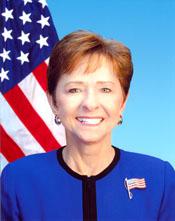 Rep. Sue Wilkins Myrick (R-NC)