Mr. Speaker, I yield myself such time as I may consume. Mr. Speaker, I would just like to concur with the chairman of our distinguished committee, and thank the gentleman from Arkansas (Mr. Ross) and…
Mr. Speaker, I yield myself such time as I may consume.
Mr. Speaker, I would just like to concur with the chairman of our distinguished committee, and thank the gentleman from Arkansas (Mr. Ross) and the gentleman from Texas (Mr. Hall) for bringing forth this most important piece of legislation, and from the bottom of my heart I want to thank especially those members who worked tirelessly for us in the Clerk's office and recognize Mr. Trandahl and Gigi Kelaher and the distinguished Mr. Paul Hayes and so many members who come here day in and day out and carry on these duties, considering the lateness of the hour.
Mr. Speaker, I rise today in support of a resolution that aims to support the very core of our democracy: voting. The resolution, H. Res. 796, recognizes efforts to promote greater civic awareness in this country.
With this in mind, it is important to reference the words that embody our democratic right that are written in the Constitution. This document establishes that ``citizens of the United
States shall not be denied or abridged their right to vote on account of race, color, or previous condition of servitude; on account of sex; by reason of failure to pay any poll tax or other tax; and on account of age for those 18 years of age and older.''
This election is arguably one of the most important in our Nation's history. It is too important to sit on the sidelines. I call on all citizens to participate in our democracy by casting a ballot on November second. I would also urge citizens to think about other ways they can use their civic spirit to assist their communities. For example, maybe they could volunteer to drive other voters to the polls or donate their time to assist at local polling places. The friendly, dedicated individuals that help us as we head to the polling booth are often taken for granted. However, the pool of these volunteers has been severely reduced over the years. This year, millions of poll workers are needed on Election Day.
These volunteers are the backbone of the election process, sometimes working up to 16-hour days with little, if any pay. In most cases, volunteers are needed for such long hours simply because there are not enough of them. In addition, the majority of those who do volunteer to be poll workers continue to be older citizens. We need to inspire a younger generation of poll workers to continue to carry the torch of democracy.
I call on colleges and universities to offer college credit to students who serve as poll workers, and corporations to offer paid leave to employees who volunteer as poll workers. Voters should go to the Election Assistance Commission's Web site at www.eac.gov, to learn how they can become poll workers in their state.
Yesterday, I sent a letter to 43 presidents of public and private higher education institutions in my home state of Connecticut. I reminded these academic leaders that the Higher Education Act Amendments of 1998 require that they make a good-faith effort to distribute voter-registration materials to their students prior to elections. I urged them to review their compliance with this federal law.
For many students, the first time they have the opportunity to vote is during their college career. Therefore, it is imperative that institutions of higher learning do all they can to help young people get into the habit of voting while they are young.
States can do their part by offering better training to poll workers. Many of the problems associated with this year's primaries have been attributed to poor poll worker training. I hope we do not see a repeat of these mistakes during the general election.
Several newspapers have reported that there are a record number of new voters registered for this coming election. I urge election officials to be mindful of these first-time voters so they will have the opportunity to participate in the election process without a repeat of past frustrations, or misinterpretation of voting laws, including the Help America Vote Act.
I am extremely concerned about voter intimidation, and I ask all citizens to be mindful of voters who may be denied their right to vote at the polls. Should an eligible voter be afraid to cast a ballot, I urge them to call the Department of Justice's Civil Rights Division or civil rights groups to ensure these circumstances are documented.
These concerns are not unwarranted. In South Dakota's June 2004 special election, Native American voters were prevented from voting after they were challenged to provide photo IDs, which they were not required to present under State or Federal law. In 2003 in Philadelphia, voters in African-American areas were systematically challenged by men carrying clipboards, driving a fleet of some 300 sedans with magnetic signs designed to look like law enforcement insignia. These are just two examples in a report by the NAACP and the People for the American Way Foundation.
Our Nation has certainly tried to respect the democratic wishes of the framers of our Constitution through ongoing efforts to ensure that all citizens are inspired to vote. Voting is a powerful act. The simple act of pulling a lever, or checking a box or touching a screen indicates to policy makers that the voices of those they represent must not be ignored. It also gives citizens an instant sense of community, and that alone is certainly worth recognizing and supporting.
I urge my colleagues to support this resolution and to continue to expand voter participation.
[From the San Jose Mercury News, Oct. 5, 2004]
Poll Watchers To Ensure Every Vote Counts
(By L.A. Chung)
Nancy Frishberg remembers helping her father register
people to vote when Adlai Stevenson mounted his second doomed
campaign against Dwight D. Eisenhower. She was ``clean for
Gene'' in 1968, before Hubert Humphrey beat Eugene McCarthy
for the Democratic nomination.
In other words, the Redwood City woman is familiar with
being on the losing side of presidential campaigns. Even so,
her belief in the democratic process was undiminished until
she heard the infamous reports about voter disenfranchisement
in 2000 and problems during the primaries this year.
So Frishberg, 55, has decided to become a poll monitor Nov.
2. She and about 19,000 others have signed up with the
Election Protection Coalition, a nonpartisan group, to fan
out across the country to watch for problems at the polls.
``I'm trained as a scientist and in observational
research,'' said Frishberg, a linguist and contributor to
Stanford's Human-Computer Interface program. ``The difference
here is I'm willing to intervene.'' That means alerting the
coalition's network of lawyers, who will file injunctions if
there are violations. She's spending her own money to fly to
Phoenix, one of the cities where past problems at the polls
have been identified. Her commitment comes, she says, from
her intensely non-partisan desire that every vote counts.
Bigger than expected ``We've been stunned by the amount of
energy we're seeing,'' said Michael Kieschnick, president of
Working Assets, a socially progressive company that is
recruiting volunteers for the coalition. The country may be
highly polarized, but the coalition has been attracting
people who are primarily concerned about the integrity of the
election.
``It's not who won or lost in Florida,'' Kieschnick said,
referring to the state that has come to symbolize problems at
the polls. Rather, ``for the first time, people realized not
all the votes get counted--and which ones get counted
sometimes depends on elected officials. People looked in the
mirror of Florida and didn't seem to like that.''
Working Assets, a long-distance and credit card services
company, has worked hard to promote voter registration,
Kieschnick said. But more new voters means more potential
problems--from learning where to vote to figuring out how to
work the various voting machines. Plus, there were troubling
reports of election officials who seemed ready to make it
harder for new voters.
The secretary of state in Ohio, for example, just retreated
from his directive last month that voter registration forms
must be printed on 80-pound paper stock, potentially
disenfranchising those who had filled out forms on lighter
paper. He also faces a lawsuit challenging state guidelines
that would prevent voters from casting provisional ballots if
they mistakenly went to the wrong polling places.
Keeping the trust in fact, election experts predict a huge
number of provisional ballots, which could determine a close
race.
We're not at the point where we want overseas election
monitors to come. That's something Jimmy Carter and Sen.
Richard Lugar have done from the Phillipines to South Africa.
Still, the outpouring of volunteers for the Election
Protection Coalition is important and useful. At least 35
cities in nine states --Arizona, Colorado, Florida, Illinois,
Michigan, New Mexico, Ohio, Pennsylvania and Wisconsin--will
be monitored. In each place there was some kind of trigger--
past voting rights violations, accusations of voter
intimidation or problems with people going to the polls and
finding their names don't appear.
``In no case are we predicting there will be a problem,''
Kieschnick said. ``In all these cases there is some reason to
believe the odds are higher that there could be problems.''
I'm just hoping that Frishberg and other volunteers are
surprised at what they find in the field. Pleasantly
surprised.
That would be the bigger victory for democracy in these
times.
Mr. Speaker, I yield back the balance of my time.
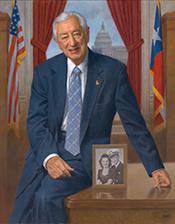 Rep. Ralph M. Hall (D-TX)