FAST Act
A bill to amend title 23, United States Code, to provide State and local authorities a means by which to eliminate congestion on the Interstate System.
Also known as Freeing Alternatives for Speedy Transportation Act
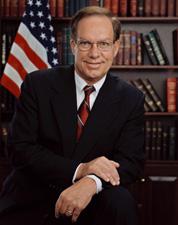 Sen. Wayne Allard (R-CO)
Legislative Activity
Stay on top of the latest movement without scrolling through every action
Read twice and referred to the Committee on Environment and Public Works. (text of measure as introduced: CR S9125)
July 9, 2003
View full timeline
Introduced in Senate
July 9, 2003
Sponsor introductory remarks on measure. (CR S9123-9125)
July 9, 2003
Read twice and referred to the Committee on Environment and Public Works. (text of measure as introduced: CR S9125)
July 9, 2003
Floor Debate
4 membersWhat members said about S. 1384 on the floor

Floor Debate
4 membersWhat members said about S. 1384 on the floor
Mr. President, as the month of August nears and the remaining summer days dwindle, many Americans are turning their attention to the highway as they plan family vacations and road trips, setting…
Mr. President, as the month of August nears and the remaining summer days dwindle, many Americans are turning their attention to the highway as they plan family vacations and road trips, setting…
Mr. President, I rise today to introduce the Reforestation Tax Act of 2003, and I am pleased to be joined by Senators Lincoln, Smith, Breaux, Miller, Chambliss, Pryor, Collins, Landrieu, Shelby and…
Mr. President, today I rise in support of fairness for rural America and introduce the Rural Universal Service Equity Act of 2003. Universal service is a decades old Federal program intended to keep…
Mr. President, I rise today to introduce the American Veterans Disabled for Life Commemorative Coin Act of 2003. This bill will authorize the Secretary of the Treasury to mint a commemorative coin…
Bill Text
Latest available legislative text
        [Congressional Bills 108th Congress]
[From the U.S. Government Publishing Office]
[S. 1384 Introduced in Senate (IS)]

108th CONGRESS
1st Session
S. 1384

To amend title 23, United States Code, to provide State and local
authorities a means by which to eliminate congestion on the Interstate
System.

_______________________________________________________________________

IN THE SENATE OF THE UNITED STATES

July 9, 2003

Mr. Allard introduced the following bill; which was read twice and
referred to the Committee on Environment and Public Works

_______________________________________________________________________

A BILL

To amend title 23, United States Code, to provide State and local
authorities a means by which to eliminate congestion on the Interstate
System.

Be it enacted by the Senate and House of Representatives of the
United States of America in Congress assembled,

SECTION 1. SHORT TITLE.

This Act may be cited as the ``Freeing Alternatives for Speedy
Transportation Act'' or the ``FAST Act''.

SEC. 2. INTERSTATE SYSTEM.

(a) In General.--Subchapter I of chapter 1 of title 23, United
States Code, is amended by adding at the end the following:
``Sec. 165. FAST fees
``(a) Establishment.--The Secretary shall establish and implement
an Interstate System FAST Lanes program under which the Secretary,
notwithstanding sections 129 and 301, shall permit a State, or a public
or private entity designated by a State, to collect fees to finance the
expansion of a highway, for the purpose of reducing traffic congestion,
by constructing 1 or more additional lanes (including bridge, support,
and other structures necessary for that construction) on the Interstate
System.
``(b) Eligibility.--To be eligible to participate in the program, a
State shall submit to the Secretary for approval an application that
contains--
``(1) an identification of the additional lanes (including
any necessary bridge, support, and other structures) to be
constructed on the Interstate System under the program;
``(2) in the case of 1 or more additional lanes that affect
a metropolitan area, an assurance that the metropolitan
planning organization established under section 134 for the
area has been consulted during the planning process concerning
the placement and amount of fees on the additional lanes; and
``(3) a facility management plan that includes--
``(A) a plan for implementing the imposition of
fees on the additional lanes;
``(B) a schedule and finance plan for construction,
operation, and maintenance of the additional lanes
using revenues from fees (and, as necessary to
supplement those revenues, revenues from other
sources); and
``(C) a description of the public or private
entities that will be responsible for implementation
and administration of the program.
``(c) Requirements.--The Secretary shall approve the application of
a State for participation in the program after the Secretary determines
that, in addition to meeting the requirements of subsection (b), the
State has entered into an agreement with the Secretary that provides
that--
``(1) fees collected from motorists using a FAST lane shall
be collected only through the use of noncash electronic
technology;
``(2) all revenues from fees received from operation of
FAST lanes shall be used only for--
``(A) debt service relating to the investment in
FAST lanes;
``(B) reasonable return on investment of any
private entity financing the project, as determined by
the State;
``(C) any costs necessary for the improvement, and
proper operation and maintenance (including
reconstruction, resurfacing, restoration, and
rehabilitation), of FAST lanes and existing lanes, if
the improvement--
``(i) is necessary to integrate existing
lanes with the FAST lanes;
``(ii) is necessary for the construction of
an interchange (including an on- or off-ramp)
from the FAST lane to connect the FAST lane
to--
``(I) an existing FAST lane;
``(II) the Interstate System; or
``(III) a highway; and
``(iii) is carried out before the date on
which fees for use of FAST lanes cease to be
collected in accordance with paragraph (6); or
``(D) the establishment by the State of a reserve
account to be used only for long-term maintenance and
operation of the FAST lanes;
``(3) fees may be collected only on and for the use of FAST
lanes, and may not be collected on or for the use of existing
lanes;
``(4) use of FAST lanes shall be voluntary;
``(5) revenues from fees received from operation of FAST
lanes may not be used for any other project (except for
establishment of a reserve account described in paragraph
(2)(D) or as otherwise provided in this section);
``(6) on completion of the project, and on completion of
the use of fees to satisfy the requirements for use of revenue
described in paragraph (2), no additional fees shall be
collected; and
``(7)(A) to ensure compliance with paragraphs (1) through
(5), annual audits shall be conducted for each year during
which fees are collected on FAST lanes; and
``(B) the results of each audit shall be submitted to the
Secretary.
``(d) Apportionment.--
``(1) In general.--Revenues collected from FAST lanes shall
not be taken into account in determining the apportionments and
allocations that any State or transportation district within a
State shall be entitled to receive under or in accordance with
this chapter.
``(2) No effect on state expenditure of funds.--Nothing in
this section affects the expenditure by any State of funds
apportioned under this chapter.''.
(b) Conforming Amendment.--
(1) The analysis for subchapter I of chapter 1 of title 23,
United States Code, is amended by inserting after the item
relating to section 164 the following:

``165. FAST fees.''.
(2) Section 301 of title 23, United States Code, is amended
by inserting after ``tunnels,'' the following: ``and except as
provided in section 165,''.

SEC. 3. TOLL FEASIBILITY.

Section 106 of title 23, United States Code, is amended by adding
at the end the following:
``(i) Toll Feasibility.--The Secretary shall select and conduct a
study on a project under this title that is intended to increase
capacity, and that has an estimated total cost of at least $50,000,000,
to determine whether--
``(1) a toll facility for the project is feasible; and
``(2) privatizing the construction, operation, and
maintenance of the toll facility is financially advisable
(while retaining legal and administrative control of the
portion of the applicable Interstate route).''.
<all>