Temporary Federal Aviation Administration Reauthorization Act of 2003
Legislative Activity
Stay on top of the latest movement without scrolling through every action
Read the second time. Placed on Senate Legislative Calendar under General Orders. Calendar No. 282.
September 17, 2003
View full timeline
Introduced in Senate
September 16, 2003
Introduced in the Senate. Read the first time. Placed on Senate Legislative Calendar under Read the First Time.
September 16, 2003
Read the second time. Placed on Senate Legislative Calendar under General Orders. Calendar No. 282.
September 17, 2003
Floor Debate
20 membersWhat members said about S. 1618 on the floor
 BLD
BLD BB
BB MC
MC TL
TL FRL+15
Floor Debate
20 membersWhat members said about S. 1618 on the floor
Will the Senator yield for a question? Mr. President, I ask the Senator from Missouri if he would add my name as a cosponsor to the amendment. Mr. President, the Bond-Mikulski amendment described by…
Will the Senator yield for a question?
Mr. President, I ask the Senator from Missouri if he would add my name as a cosponsor to the amendment.
Mr. President, the Bond-Mikulski amendment described by the Senator from Missouri makes a great deal of sense to me. It seems to me that keeping our promise to our veterans is also a part of national security and national defense. We have a very serious problem in the VA health care system. It is going to grow worse, not better, and we need to add these resources.
As we know, the number of people who have been wounded in Iraq and are going to come back home and justifiably lay claim to the health care they were promised in our VA system, we must provide the funding for that.
I think all of us in this Chamber have had the experience of visiting with veterans with respect to their experience in the VA health care system. They will tell us of seeing the posters of Uncle Sam pointing at them saying, Uncle Sam wants you, and on the bottom of the poster it said, free health care for life.
Many of our veterans have experienced something substantially less
than that when they come home from having served our country, and that is why I think it is very important for us to provide the funding that is needed in the VA health care system.
I recall one day being at a town meeting and a man named Thor came up to me. He had served in the Air Corps in the Second World War, had fought for this country, had done all that his country had asked of him, many years ago. Now he was without much income, in his late seventies, and he was having all kinds of health problems, some of it related to his service in the Second World War. He was not able to get the help he needed.
The day he came to the meeting I held, he told me he was having trouble with his teeth and could not eat. He had false teeth. His teeth did not fit. They were cutting his mouth and he could not get new teeth from the VA system. At age 75 or 80 years of age, having served in the Second World War, done for this country what this country asked him to do, now living in very low-income circumstances, he should not have to beg VA to get new teeth. That ought not be the way it happens.
I happened to get him new teeth because I had a friend who was a dentist. He talked to some people who run a laboratory and he was able to get a new set of teeth. But we ought to take care of these needs more systematically. We ought to fund the VA health care system to provide for the needs of these veterans. It is a promise we have made and, in my judgment, a promise we ought to keep. So I am pleased to add my name as a cosponsor to the Bond-Mikulski amendment.
Amendment No. 1826
Mr. President, I send an amendment to the desk and ask for its immediate consideration.
Mr. President, I ask unanimous consent that the reading of the amendment be dispensed with.
I offer this amendment on behalf of myself and Senators Durbin and Landrieu. This amendment is identical to that which I offered in the Appropriations Committee, and which lost on a 15-to-14 vote. It is the identical language. So my colleagues on the Appropriations Committee, at least, will be acquainted with the provisions and the specific language of this amendment.
My colleague spoke earlier today about the goals we share for Iraq-- our country's objectives in the Middle East and around the world. We all want the Iraqi people to have a better country and to be able to control their own destiny. We all want to foster a democracy in Iraq, in which the Iraqi people are free to make their own decisions, could build a model economy with a market system that works, one that provides an expansion of economic opportunity and jobs for the Iraqi people--all of us would aspire to have that happen.
Some of my colleagues, however, have said this can only happen if you inevitably link the two pieces of the appropriations request sent to us by the President, the $87 billion which includes the amount of money for the defense needs, which is some $66 billion, and the $20-plus billion for the reconstruction of Iraq. They say it must remain a single piece of legislation, inextricably linked, that cannot in any way be taken apart because one part makes the other work.
I suppose it is like a loose thread on a cheap suit. You pull the thread and the arm falls off, so you can't take any part of this and adjust it or change it. That is what we are told.
I believe there are pieces of this legislation that can be changed, and I think changed for the better, in ways that will still accomplish the goals the President and we have for the country of Iraq, but that will also help the American taxpayer.
At the outset, let me say that I believe that the portion of the request relating to our military is important and is urgent, and this Congress will enact it very quickly. I don't think America sends its sons and daughters to war and then decides it will not fund that which is necessary for them to carry out their mission. That would be unforgivable. We have a responsibility to do that, and we will do that.
The second portion of this request, dealing with the reconstruction of Iraq, is a different story. I think there are a couple of aspects to remember about that.
First, the infrastructure of the country of Iraq was deliberately not targeted by the American military attack. The attack, which was called Shock and Awe, which most of us saw on television, did not target electric generation facilities, the electric grid, roads, bridges, dams. It deliberately did not target those. As a result of that, we do not have a country in which their infrastructure has been devastated by carpet bombing of the type that happened in some places during World War II.
Second, many of the reconstruction items in the 20-plus billion request by the administration are not urgent. I will describe that in some detail.
Third, the cost of the reconstruction effort need not, and ought not, to be borne by the American taxpayer. If the United States was the only possible source of funding for reconstruction, that would be one thing. But that is not the case. The fact is that Iraq has a wealth of oil reserves, and Iraq can easily use those resources to finance its own reconstruction. My amendment would help construct a mechanism for the Iraqis to do exactly that.
My amendment simply proposes that there be established an Iraq Reconstruction Finance Authority, in Iraq, by the Governing Council of Iraq, working with the Coalition Provisional Authority. The Governing Council of Iraq is made up of Iraqis. They would create an Iraq Reconstruction Finance Authority. That authority would securitize or sell securities against the value of future oil that will be pumped in Iraq. Iraq has the second largest reserves of oil in the world and has substantial capability to pump a dramatic amount of oil in order to raise ample funds to reconstruct Iraq.
Simply, my amendment says let Iraqi oil pay for the reconstruction of Iraq, not the U.S. taxpayer. And let Iraqis use that Iraqi oil revenue to reconstruct Iraq. This has nothing to do with the United States grabbing part of the resources that belong to the people of Iraq. On the contrary, my amendment says that the Iraqi people, through the Governing Council of Iraq, should use Iraqi oil revenue to reconstruct the country of Iraq. It is very simple. It is not hard to understand.
Some believe that if we followed this approach, we would be accused of grabbing Iraqi oil. They will say: You attacked Iraq because you wanted their oil.
That can't be the case because there is nothing here that would put American hands on Iraqi oil. It would be Iraqis in the country of Iraq using Iraqi oil to reconstruct Iraq. It simply relieves the burden of $21 billion from the shoulders of the American taxpayers, which is what is proposed by the administration for the reconstruction of Iraq. It says instead of having the U.S. taxpayers borrow the money, or the Federal Government borrow the money or pay taxes to reconstruct Iraq, Iraqis can use their oil resources to do that.
Ambassador Bremer said that by July of next year, Iraq will be pumping 3 million barrels of oil per day. That is $160 billion of net export value of oil for the country of Iraq in 10 years. They can easily sell securities against that future production of oil and use that to reconstruct Iraq.
As I indicated, this is the second largest oil reserve in the world. This is not a small resource. This is liquid gold under the sands of Iraq. When they pump it and sell it to a world that needs oil, they will have $16 billion a year. And Iraq could obtain immediate funding for reconstruction by selling securities, or obtaining loans, backed by that future revenue stream.
The concept of securitizing these oil reserves has been endorsed by a number of sources and experts. The endorsement comes from a number of corners of thought. The President and Chairman of the Export-Import Bank, Philip Merrill, has said he supports that concept of using Iraqi oil for reconstruction. In fact, the Export-Import Bank used a similar approach for Russian oil and gas after the fall of the Soviet Union, which was credited with helping to stabilize the industry's finances and restoring Russia's infrastructure in the early 1990s.
Mr. Merrill, the head of the Export-Import Bank says: What we want to do is securitize this flow of oil.
Now, when Ambassador Bremer appeared before the Appropriation Committee, he said that this approach wouldn't work. Ambassador Bremer said you can't have Iraq securitize its oil, or use future sales of oil to reconstruct Iraq, because Iraq owes a lot of money. It has foreign debt. Ambassador Bremer said the foreign debt was owed to Russia, France, and Germany.
After that hearing, I did a little research. It turns out that the largest foreign debt owed by Saddam's regime was not to Russia, France, and Germany.
The largest foreign debt of the Saddam regime was owed to the Saudis, and the Kuwaitis, and the other Gulf Countries. The two largest single creditors, by far, are Saudi Arabia and Kuwait. Saddam's regime also owed some money to Russia, Japan, France, and Germany, that is true, but the largest foreign debt was owed to the Saudis and the Kuwaitis.
I just don't understand the Ambassador's contention that Iraqi oil must be sold right away in order to pay off the Saudis and the Kuwaitis. First of all, Saddam Hussein and his henchmen owed this money. Saddam Hussein ran the country of Iraq, and he engaged in strategies and policies that resulted in these debts. Ambassador Bremer suggested that some successor government in Iraq will inherit the debt. My question is, Why? Why not say to the Saudis and the Kuwaitis: You are owed a lot of money by Saddam Hussein and his henchmen. Find them, and collect it from them.
The Iraqi people ought not have to bear the burden of Saddam Hussein's debt. It doesn't make any sense to me. This man is gone. His government no longer exists. And Iraq is sitting on top of an enormous oil resource.
But we are told now that the American taxpayer should pay to reconstruct Iraq, because Iraqi oil revenues need to be immediately turned over to the Saudis and the Kuwaitis to settle Saddam's debts.
I am sorry. It doesn't add up to me. It doesn't work for me. I don't understand the perversity of a strategy that says the American taxpayer shall bear the burden so that Iraq's assets can be free to pay the Saudis and the Kuwaitis past foreign debt.
Does this make sense to anybody? If you answer, yes, we think this makes sense, the American taxpayers will pay the bill, and Iraqi oil will pay the Saudis, then I am sorry, you need to go back and do some remedial training someplace. You are not thinking straight.
Now, there are those who argue that the current Iraqi Governing Council is not a duly elected government, and has no standing to do anything with Iraq's oil.
But on Friday, Ambassador Bremer said the following:
The Iraqis are perfectly ready now to accept a lot of
responsibility, and they are doing that. There are Iraqi
ministers running all 25 ministries. . . . They are making
policy in every ministry. They are responsible for the
budgets of their ministry. They've got to spend the money.
They can move the money around within their budget. They have
great latitude. And they are now operating ministries.
The Governing Council of Iraq is made up of Iraqis. They are running Iraq's Oil Ministry, among others. It seems to me that they have the capability to securitize future Iraq oil revenues and pay this reconstruction cost.
Is the Governing Council of Iraq somehow less legitimate than Saddam Hussein's government? To anyone who argues that the Governing Council of Iraq cannot enter into debt on behalf of Iraq, I ask this: Do you think that Saddam's regime was a duly elected government?
In 1995, Saddam ran for President of Iraq unopposed, and he won 99.96 percent of the vote. That's right. Less than four one-hundredths of one percent of the voters voted against Saddam.
In August of 2000, Saddam Hussein ran again for President. He ran unopposed. This time, the official reelection count was better. With 100-percent voter turnout, he received 100 percent of the vote. That was the official result announced by the Iraqi government.
In that election, there were no polling booths. Voters were required to hold their ballot over their heads as the approached the ballot box, so that everybody could see how they voted. When they voted, they had to parade past 28 portraits of Saddam Hussein, and they had to hold these ballots over their heads so they could demonstrate how they voted.
Was that a duly constituted government? I don't think so. The Iraq Governing Council is much more legitimate than the Saddam regime, in my estimation. Why would anyone argue with that? Who wants to come to the Senate floor and say that the debts incurred by Saddam's regime are legitimate, but securities that would be issued by the current Governing Council would not be legitimate?
I ask that again because I think it is important.
Why would anyone argue that the massive debts run up by Saddam Hussein's government are legitimate and payable, but securities issued by the current government of Iraq's Governing Council against future oil revenues with which they could reconstruct Iraq would somehow not be legitimate? It doesn't make any sense.
Until a few months ago, the Administration was telling everyone that Iraq's oil would allow the Iraqis to pay for their own reconstruction.
Let me show what Mr. Ari Fleischer at the White House said about this. He was the President's spokesperson. He said in February of this year:
And Iraq, unlike Afghanistan, is a rather wealthy country.
Iraq has tremendous resources that belong to the Iraqi
people. And so there are a variety of means that Iraq has
to be able to shoulder much of the burden of their own
reconstruction.
He is, of course, talking about Iraqi oil, the second largest oil reserve in the world.
Shortly after that time, Mr. Wolfowitz, the Deputy Secretary of Defense, said:
. . . the oil revenues of that country could bring in
between $50 and $100 billion over the course of the next two
or three. . . . We're dealing with a country that can really
finance its own reconstruction, and relatively soon.
That is the administration speaking. They say Iraq can finance its own reconstruction, and relatively soon, because it has massive oil resources.
Defense Secretary Donald Rumsfeld, in March of this year, said:
I don't believe that the United States has the
responsibility for reconstruction, in a sense. . . . And the
funds can come from those various sources I mentioned: frozen
assets, oil revenues and a variety of other things.
That is the Secretary of Defense saying the American taxpayer is not going to have to pay for the reconstruction of Iraq.
Vice President Cheney, on national television in March of this year, said:
In Iraq we have a nation that's got the second largest oil
reserves in the world, second only to Saudi Arabia. It will
generate billions of dollars a year in cashflow in the
relatively near future, and that flow of resource obviously
belongs to the Iraqi people and needs to be put to use by the
Iraqi people. And that will be one of our major objectives.
This administration has said time and time and time again that the reconstruction of Iraq will be done with Iraqi oil.
Let me describe a ``Nightline'' program with Ted Koppel and Mr. Natsios, head of USAID, the lead reconstruction agency in our country.
Mr. Koppel: I understand that more money is expected to be
spent on this than was spent on the entire Marshall plan for
the rebuilding of Europe after World War II.
Mr. Natsios: No. This doesn't even compare. The Marshall
plan was $97 billion. This is $1.7 billion.
Mr. Koppel: I mean, you talk about 1.7. You are not
suggesting the rebuilding of Iraq is going to be done for
$1.7 billion?
Mr. Natsios: Well, in terms of the American taxpayers'
contribution, I do. This is for the U.S. The rest of the
rebuilding of Iraq will be done by other countries that have
already made pledges: Britain, Germany, Norway, Canada and
Iraqi oil revenues. They are going to get $20 billion in
revenues but the American part of this will be $1.7 billion.
Again, this is the lead person on the reconstruction of Iraq speaking last March.
Mr. Koppel: I understand. But as far as reconstruction
goes, the American taxpayer will not be hit for more than
$1.7 billion no matter how long the process takes?
Mr. Natsios: That is our plan, and that is our intention.
Over and over and over again, Mr. Natsios said exactly the same thing.
It is strange that not many months later all of those folks-- Secretary Rumsfeld, Vice President Cheney, Deputy Secretary Wolfowitz, Mr. Natsios--all said the same thing. And now there is this eerie silence from those folks who told the American taxpayer, you won't have to pay for this, Iraqi oil will pay for it.
Now they send up a $21 billion request to say to the American taxpayer, you will pay for this. And, by the way, you can't change any element of this, because this all fits together like a puzzle; take out one piece and you destroy the puzzle.
Now, in Ambassador Bremer's request, part of the nearly $21 billion involves items that are clearly not related to any damage caused by our military action:
$1 billion to rehabilitate power distribution networks that
were in a highly deteriorated condition before the war.
This has nothing to do with the war. It is just 20 years of devastation by Saddam Hussein's government.
$50 million to rectify the actions of the former regime and
reconnect the Euphrates River to 30 villages and 100 farms.
That is an irrigation water project and has nothing to do with the war.
There is $50 million to restore a marsh and rectify some of the environmental tragedies ``of the past 25 years''; $50 million for water projects in Basra, a ``long neglected city''; $125 million to restore railroad tracks that suffered from ``severe neglect over time.''
There are a whole series of things like that, that on their face are not a result of the war and in many cases not particularly urgent. Here is a pretty symbolic item: $1.6 million requested to build museums and memorials. I have never heard of an urgent request for a museum. I have heard of important requests for museums, but I have never heard of a request for a museum that is urgent or an emergency. I am wondering if there is anyone in our country who thinks that the building of a new museum in Iraq is an emergency.
Many have mentioned, and I did in the Appropriations Committee, some of the expenditures: For a 4-week business course for executives, $10,000 per student. That 1-month catchup course in business is double the monthly cost of going to Harvard Business School.
There is $55 million for computer training, $330 a month for half-day courses; $1,500 per student for a 6-month second language English course; $9 million to study ZIP Codes for the postal service in Iraq; $100 million for 2,000 garbage trucks; $4 million to start telephone area codes.
The fact is, many of these items are not an emergency and not urgent. And the American taxpayer should not have to pay for any of this, because Iraq has the resources to pay for its own reconstruction. Yet we have this piece of legislation that we are told is not separable, it comes as one piece; pull a string on the cheap sweater and the arm comes out; take one piece out and it destroys the rest. That is nonsense.
When you look at the $66 million requested by the Pentagon to support our troops, no question: We need to do that, and we need to do that now. But when you look at the $21 billion with respect to reconstruction, in my judgment, that can be done by having Iraqis securitize Iraqi oil, and using that financing for the reconstruction of their own country.
I said when I started, everyone has the same ultimate objective. I want not just Iraqi people, I want people around this world, to have opportunity and hope, to live free, to live in circumstances where they have an economy in their country that expands and produces jobs and opportunity.
There is a hopelessness and helplessness in many parts of the world. One-half of the population of the world lives on less than $2 a day. One-half have never made a telephone call; 150 million have no access to potable water that is healthy and is of good quality; 150 million kids are not in school. This is a big, challenging world.
We are focused now on the country of Iraq. I want things to go well in Iraq. I want our soldiers to be safe. I want them to be able to come home as soon as possible. I want the Iraqi people to come through this experience believing their country has turned a corner and they can live in freedom and have some hope and have the opportunity to make a good future for themselves.
But as we do all of that, we have some responsibilities at home. We need to be able to deal with those. We are lucky to be Americans, lucky to be alive now and to live in what I think is the greatest country in the world, but we have a lot of challenges. We have huge homeland security issues right here at home.
The plain fact is, we have had major studies done, most notably the Hart-Rudman study by two of our former colleagues for the Council of Foreign Relations. That study says we are dangerously unprepared. In fact, that is the title of the study. We have a lot of things to do at home to make sure we are prepared to protect our country against another attack by terrorists. We can't just write a blank check for Iraq's reconstruction, and say spend whatever you need, let's spend $9 million for new ZIP Codes and buy pickup trucks and build prison beds at $50,000 a bed in Iraq. We have urgent needs here, in this country, and we do not have infinite resources.
With respect to the country of Iraq, our country ought to be supportive. We ought to be helpful. We ought to aspire to have the same kind of future for the folks in Iraq that we want for ourselves; that is, a future of hope. But that does not mean the American taxpayer ought to bear the burden of solving problems created by Saddam Hussein when he borrowed money from Saudi Arabia, Kuwait, Russia, France, Germany, and others. It does not mean we ought to bear that burden. Those debts ought to be forgiven or restructured. Iraqis ought to be able to use their oil resource to pay for the reconstruction of Iraq right now. Very simple.
Sometimes we get so rigid in this political process, we do not hear each other; we talk past each other. The discussion about this in the committee came down to this: the President says it has to be this way now, and therefore it must be this way and we cannot consider another way. I offered two amendments in the Appropriations Committee. The first amendment, identical to the one I am offering today on the Senate floor, was that there should be created an Iraq Reconstruction Finance Authority. They should borrow money against future Iraq oil and reconstruct Iraq. It is the burden of Iraqi oil, not the burden of the American taxpayer, to reconstruct Iraq.
That amendment lost by a vote of 15 to 14, though at least one of my colleagues on the other side of the aisle expressed support for the concept, and said he might consider this approach on the Senate floor.
So I offered a second amendment in the Appropriations Committee, which said that instead of providing a 20 billion-plus dollar grant, we should extend Iraq a loan. That is not something I prefer, because I think Iraqis can finance their reconstruction by securitizing their oil. But it is a better approach than just extending a grant.
I lost that second amendment as well, by a vote of 15 to 14. I understand that a number of my colleagues on both sides of the aisle are interested in this concept.
So we will have these debates in the Senate. I expect that we will vote on
the amendment I offered today, once we return. My hope is we can find a bipartisan way to agree on something that shows common sense.
Most of us know little about Iraq. But Iraq is not a desperately impoverished country. Iraq sits on top of the largest reserves imaginable. The oil reserves exist under that sand. There is only one country that has larger reserves. That is Saudi Arabia. Iraq has great capability to invest in itself and build and grow and provide opportunity for the Iraqi people.
Even as we aspire to have that happen, we had better look inward a bit in this country and ask ourselves where we are headed. We are facing record Federal budget deficits. This year, we also had the largest trade deficit in the history of this country, by far.
The combined budget and trade deficit is very close to $900 billion. Yet people walk around here as if it is ``Hear no evil, see no evil, speak no evil.'' It is as if none of this exists.
All of this money we are talking about today, $87 billion--all of it is borrowed against our children's futures. Why?
The President wants to have it all: We need tax cuts. We need increased military spending. We need increased homeland security spending, and, at the same time, $87 billion now for Iraq, on top of the $79 billion earlier this year.
Someone, someday, in some way, pays the cost of that. That cost comes with a lower standard of living in this country if we do not get our fundamentals in order. You just cannot keep doing this.
Mathematics is taught the same way from Maine to California. There is only one way to add and subtract.
What we require, I think, is a bit of backbone from Republicans and Democrats, this President and the Congress, to stand up and take a look at what we are facing, our budget deficits, our trade deficits, our long-term future economic health, and decide we have to put things back on track. That is important for this country.
Yes, I care about Iraq, as do my colleagues. Yes, we should be concerned about the reconstruction of Iraq. But that is a burden that Iraqis can bear, by using their vast oil resources. It is not a burden that ought to be borne by the American taxpayer.
The Senate will not be in session next week. But I will seek to have a vote on this amendment when we return.
I thank my colleagues. I yield the floor and suggest the absence of a quorum.
Mr. President, I am going to send an amendment to the desk in a moment. Before I do, I wanted to give the Senate an update on what is happening with the fires in California, and pay a very special…
Mr. President, I am going to send an amendment to the desk in a moment. Before I do, I wanted to give the Senate an update on what is happening with the fires in California, and pay a very special tribute to a fallen firefighter. As of 3 p.m.
today, the fires in California have consumed more than 722,000 acres, or roughly 1,100 square miles. Many of these acres are on public lands. Many are on private lands. More than 2,600 homes have been destroyed, 20 people have been killed, and there are more than 12,000 firefighters battling the flames. These firefighters are very brave. I will show you one of them right now.
I rise with a very heavy heart to pay tribute to a fallen California firefighter. It is an honor for me to do this, but it is a very sad moment for me to do this.
Steven L. Rucker, a fire apparatus engineer from Novato, CA, was just 38 years old. Novato, CA is nowhere near southern California. Novato, CA is in the northern part of our State, in the San Francisco Bay area. But Steven Rucker and others from his fire department risked their lives and, indeed, Steven gave his life, to help our southern California communities. Steven Rucker comes from my home county, a county where I was a supervisor for 6 years before I went to the House of Representatives, in the early 1980s.
He was killed on Wednesday, October 29, at 12:30 p.m., when his unit was overwhelmed by flames as they battled on foot to protect a home threatened by the Cedar Fire in San Diego County.
I want to show you a picture of some of the firefighters and what they are up against. Have you ever seen a more telling picture of what these firefighters are up against, standing close to these flames in air that is so polluted it is beyond description?
Steve fell. He was nicknamed ``the Ruckster'' by his friends and colleagues. He grew up in Freemont, CA, in the San Francisco Bay Area. He was the youngest of four children. After completing paramedic training in Contra Costa, Mr. Rucker went on to realize his childhood dream of becoming a firefighter in Novato. In his 11 years with the Novato Fire Protection District, Mr. Rucker wore the badge and his honor proudly. His car carried a license plate that read ``Fire Ruck.'' He was known for organizing toy drives and children's events for Christmas and for Easter.
Steve Rucker is a true example of why we call firefighters heroes. He bravely and selflessly risked his life time and time again trying to protect the homes of families he didn't even know in a community far from where he lived. Tragically, he has fallen in one of those battles. It is easy to see why we mourn his loss and why his friends and family are so proud of him.
I send my sincere condolences to his family, to his wife, and their two young children, the communities of Novato which mourns his loss, and all of the firefighters who had the honor of serving with Mr. Rucker over these years. I know they are devastated by this tremendous loss, and I know the loss is reverberating through the fire lines. I know how hard it is for them to cope with this.
In this time of crisis in California, we must carry on, and we will. We always have. People say to me even here in the Senate: Your State always has some kind of crisis, some kind of problem. Why do so many people live there? What draws them there? I always explain that you need to be there to understand the beauty of our State. You need to be there to understand it. You need to be there to understand the incredible diversity of our people. In politics, we reason from one side to the other. Diversity? We have every one. The beauty of our State holds us all together. It has brought us to that State.
We will carry on, but we are not going to forget Steve. We are also not going to forget Doug MacDonald. I send my prayers to Fire Captain Doug MacDonald who is a 17-year veteran of that Novato Fire District. Captain MacDonald suffered severe burns and injuries when he went back into the fire to search for his missing colleague, Steve Rucker. Captain MacDonald is in critical condition at the San Diego Burn Center. We pray and pray that he will come home soon. I know his wife and his two children are with him.
It says something about Captain MacDonald, and it says something about the Novato Fire Department, that Captain MacDonald, a 17-year veteran, went back and risked his own life to save Steve Rucker. It says a lot about Steve Rucker in that he would inspire people to risk their lives to save him. These firefighters are extraordinary heroes.
Yesterday, I was so proud that the Senate overwhelmingly passed my amendment to ensure that those first responders, those firefighters, will receive the best health care available to minimize their injuries when they fight in such natural disasters--fires.
I thank the President at this time. He has now declared Riverside County a Federal disaster area. This is now our fifth county, and we have been asking him to do this. We are very glad he has done this because even though we know in Riverside we have had less loss of homes and property, we have homeowners there who will need the help that such a declaration will bring.
Before I send my amendment to the desk, I wish to make one more point. We still have fires burning out of control in my State. We still need help, particularly in the San Diego area. We now need, according to Deputy Chief Arta, 26 type I strike teams, we need 48 type III strike teams, we need 2 strike teams of dozers, and we need 15 hand crews at the Cedar Fire in San Diego.
For the Paradise Fire--and my understanding is that these fires are about 5 miles apart and the big issue is to stop them from joining. At that Paradise Fire, we need 31 engine strike teams, we need 9 type III strike teams, and we need 33 hand strike crews.
I mention this because we still have work to do to wrap our arms around this. We need this help now. We needed it 2 days ago. We have asked everyone who could help us with this--particularly our FEMA Director who is working hard with us to get this equipment--to get these people to help our 12,000 firefighters.
I want to look at Steve one more time, our firefighter, our 38-year- old firefighter, from Novato, CA, in Marin County, who traveled miles and miles with his colleagues in that department to help people far away from where he lived. In his name, please send the help to 12,000 firefighters. We need to help them. We need to cut through all of the bureaucracy and all of the excuses. We need to get the help there in San Diego.
Look at what is happening. Look at what it looks like. We need help. We are getting a little help from the weather--a little bit of a change, but not enough of a change, in our State. We really do not get the heavy rains in November. In San Diego and Riverside, they do not get that much. We are getting some moist air in from the ocean. That is good. We need more help.
We need to be strong, and we need to get this help. We need to see the end date when we will have these fires 100 percent contained.
This bill that we are working on today does more than current law to prevent this kind of tragedy from happening. It doesn't do as much as I would like. Senator Leahy wrote a bill which I was proud to co-author that did much more than this bill in front of us. But this bill in front of us is more than current law. It certainly does more than the House bill, which does, in essence, in my view after I have looked at it, hardly anything at all to help these communities--hardly anything at all.
We have an opportunity to make this bill even better.
Then Senator Bingaman got a couple of amendments through. I thank Senator Wyden for helping get some of these amendments through, Senator Cochran for supporting some of our amendments, and my colleagues on the other side.
Amendment No. 2043
(Purpose: To increase the minimum percentage of funds allocated for
authorized hazardous fuel reduction projects in the wildland-urban
interface)
I send an amendment to the desk and ask that it be read and considered.
This is a very straightforward amendment. In the underlying bill, 50 percent of the funds are allocated to help communities that are close to areas that are high risk for fire. These are high-risk communities. We have these in our State. We have them up and down the west coast. We
have them in the western part of our country. Frankly, we have them in a number of communities. We need to get on top of things before we see this kind of fire. The way to do this is to take as much of the resources as we can and go to these communities--whether they are large or small, it does not matter--and work with them.
In April, Governor Gray Davis, our outgoing Governor, declared several counties that are now burning disaster areas because of the bark beetle. We asked the President to please declare an emergency, a disaster, so we could spend what it would take to get rid of those dying trees that sat out there. We knew they were waiting to burn. We predicted--I hate to say this; there were 12 of us in the bipartisan letter, the two California Senators and a bipartisan team from the House--we predicted in almost an eerie way that we would have uncontrollable fires if we did not have this disaster declared. It did not happen.
Now we have a chance. A lot of my constituents will not have that chance. But now we will have a future chance to protect communities that are at risk by taking funds in this bill, the majority of them, and putting them toward these communities.
I will show a couple of other pictures. The first photo shows what it looks like before the fire engulfs the community. This photo shows what we are dealing with--dreams gone. I have lived in the same house for 38 years in a hillside community. Every time I look at one of these families, I know how I would feel if I lost my home of 38 years with all of my memories--yes, we would move on; we would move ahead, but it is very difficult. Whoever said your home is your castle is right. It does not matter if it is one bedroom or one room or a mansion. It does not matter; your home is your castle. When you are home, this is your domain. This is your place. This is the place for your family.
You lose your home, you lose a sense of order. You lose a sense of security. You lose a sense of peace. This is a very hard time for my State.
What would this amendment do? I hope it is voted on, and I hope we pass it. It would help protect communities from wildfire by directing 70 percent of the funds for wildfire prevention in the wildland/urban interface; in other words, where the wildland and the urban areas interface, where communities face the greatest risk from wildfire.
The amendment happens to be consistent with what the President recommended in his budget for fiscal year 2003. We did not pick this number out of the hat in any way, shape, or form. We actually have precedent for this number.
I ask unanimous consent to have printed in the Record the USDA Forest Service fiscal year 2003 President's budget.
Now, if we pass this amendment, we are coming up with a stronger bill because it is just common sense that the real purpose behind this bill should be protection of our people. That is the real purpose. It should not be to make it easier for big loggers to go deep into the forest and take out old-growth trees. I know we protect them in here but not as far as I would want to. The real purpose of this should be to protect our communities. As I said, the House-passed bill certainly did not do that.
We will hear a lot of talk from the House side, and I encourage my colleagues, Senator Cochran, Senator Wyden, Senator Feinstein, Senator Crapo, and the others to stand strong for the Senate bill because the House bill would do nothing--I say this sincerely--to help us. It would not have helped in our circumstance. I will explain why.
The House bill fails to emphasize and prioritize removal of flammable vegetation. This is chaparral. This is not what the House bill deals with. The House bill deals with trees. It also does not allow for projects on non-Federal land where many areas are burning. I don't have the exact stats, but we are looking at maybe 50-50 here on Federal land and non-Federal land. Clearly, if we just have a bill that focuses on Federal land, we are missing a lot of other land and our communities could burn.
The bill Senator Wyden, Senator Feinstein, and Senator Cochran worked on does not have that prohibition. We need to have a bill that deals with the chaparral, that deals with this vegetation that is going up in smoke, and that does not just deal with the large trees.
The Senator from Nevada is here. There is certainly a lot of growth like this in his State, including in Lake Tahoe as well.
I ask unanimous consent Senator Reid of Nevada be added as a cosponsor of my amendment.
The House bill fails to focus the limited resources for wildfire prevention projects near at-risk communities where these resources are needed the most. We can see the communities right around here. Many are not that populated, but they are communities that would qualify in the underlying bill. In my amendment, more funds would go here.
By not focusing its resources near at-risk communities, the House- passed bill keeps homes, businesses, and communities in this wildland/ urban interface area in harm's way. In other words, where the beautiful wildlands meet the suburban-urban communities, that is where we have our problems. This is what we have been talking about. This is what Senator Leahy and I have been talking about and why we know we need more funding.
By the way, we have much more funding in that bill. The bill before the Senate is a compromise. It is not enough. It is better, certainly, than
where we are, and it is much better than the House bill which actually, to be honest, again, would do absolutely nothing, absolutely nothing to help us in this type of circumstance.
Now, in the bill before us, that I am amending, we know hazardous fuels reduction projects on non-Federal lands would qualify for the funding. This is important. I thank the authors for that. Additionally, the underlying bill emphasizes the thinning and removal of small- diameter trees for wildfire prevention and seeks to implement standards that protect old-growth trees.
Then it says at least 50 percent of the funds should go to these at- risk communities. This is where I am trying to strengthen it and say it ought to be 70 percent. Again, I think this bill is getting better.
I was so happy to tell my firefighters we are going to take care of their health. I was happy to tell my communities that the EPA, if this bill becomes law, will monitor the toxins in the air, not the usual pollutants that we follow, but the toxins that are in the air from these fires. So I am happy about that.
Again, I hope this amendment will be adopted. I really do not know what the end result will be, but clearly, if you increase the percentage of the funds that you can spend in these communities that are at risk, common sense tells you we will not have the type of fires we are seeing in California today.
We cannot waste our resources. We do not have enough resources. In this bill, therefore, the 70 percent ought to be directed here. So we believe there are strong arguments why we need to focus a greater percentage on these high-risk communities.
We believe there is precedent setting for this, given the President's request.
Mr. President, I am so hopeful we will get agreement on this amendment because, again, it will make this a far better bill.
I yield the floor at this time, and I ask for the yeas and nays.
Mr. President, I want to respond to my friend with great respect because we do not change a thing about your bill, except change the percentage of 50 to 70. We leave you all the flexibility. If a community says they think it is important to go inside the forest to protect a watershed, to protect the supply of water, or there is bark beetle infestation, that is not a problem. The fact is, we just say that the communities ought to have 70 percent of this rather than 50 percent.
I say to my friend, who is going to show us pictures here--I don't know if he was present--12 of us, in April, wrote the President about the severe danger. We named three of the four counties that are up in smoke. We begged him to declare a disaster, we begged him.
I want you to know who signed that letter: Senator Feinstein and I, Congressman Jerry Lewis, Congresswoman Mary Bono, and the San Diego delegation--Republicans and Democrats.
We saw this coming a mile away. The importance of this bill is because we do not know what future Presidents might do. We may have the same trouble in the future, and they just don't pay too much attention to it. We can't get our needs taken care of.
This bill is very important, but if we don't take that money and spend it where the people are, then, to me, we have not learned a lesson from these California fires.
I thank my colleague very much. I am disappointed we cannot agree. I understand, but I am disappointed. I hope we will have a good vote for expending funds where the people are because that is what we need to do.
Will the Senator yield?
The Senator is talking about my vote.
Well, the Senator is talking about me.
Well, I think that is fairly rude, but I will wait for my time.
Mr. CRAIG addressed the Chair.
That is all right. That is OK.
Mr. President, the 70-percent number was taken out of President Bush's own budget request. This is not an arbitrary figure. It is a figure that was put in his budget. We have put it in the Record.
I don't want to talk about 5 years ago. But I will be happy to discuss the forest plans I have supported, because they always dealt with what the problem is, which is making sure we get rid of the brush, we get rid of the infestation, and we don't use this as a way to say the only way to have a healthy forest is to cut down every tree, particularly old growth. Then you don't have any forest. That is not my idea of healthy forests.
I don't have to go 5 years to prove where I have been. I ask unanimous consent to print in the Record this letter, dated April 24, 2003.
It reads:
We are writing you today to encourage your swift approval
of California Governor Gray Davis' request of a Presidential
emergency declaration--
Not just for San Bernardino--
for Riverside, San Bernardino, and San Diego counties
relative to the high threat of forest fire in these regions.
We knew that. The people knew that. We were trying to get help. We said:
Due to the drought conditions and the infestation by the
bark beetle, our national forests have been met with an
unprecedented danger as the bark beetle has attacked over
451,000 acres of trees in these three counties. Because of
the unique urbanization in and around the forests, this
infestation has created a tinder box of such magnitude that
the loss of life and resources would be incomprehensible
should fire break out.
This is uncanny.
Most of the affected trees are on or adjacent to federal
lands, making this crisis well beyond the ability of state
and local authorities to manage. Therefore, it is critical
that the federal government help provide financial assistance
for infested tree removal from public and private lands, as
well as assist with other mitigation measures.
So we didn't just limit it to removal of the bark beetle. We called for other mitigation measures. We said:
Now that the State of California has requested a federal
emergency disaster declaration, your help at this juncture
remains critical and would make a positive impact in those
areas of Southern California.
We close with this:
Mr. President, we appreciate the various burdens being
placed upon you--
Because this was at the time we were at war with Iraq--
In these challenging days. However, we urge you to consider
this matter as expeditiously as possible since these areas
are in need of immediate federal assistance.
I say to my colleagues, please, let's not stand up here and point fingers at each other. The fact is, this is a bipartisan group of colleagues begging for help, recognizing the fact that near at-risk communities we have work to do. I am happy this bill is before us today. I am thrilled at that. I thank my friends for helping me protect the health of firefighters and the children and the elderly there, as they did yesterday.
All I am saying is: Please, I don't change one word of your brilliant legislation. I don't take a word. I just say, take it up to 70 percent for the communities that live near these at-risk areas.
I will close by reading the people who signed this letter. By the way, it is a beautiful representation of California politics, from the most liberal to the most conservative. Signing this letter: Jerry Lewis, Mary Bono, Barbara Boxer, Dianne Feinstein, David Dreier, Duncan Hunter, Joe Baca, Ken Calvert, Randy Duke Cunningham, Darrell Issa, Bob Filner, and Susan Davis.
This isn't the time to have a finger-pointing argument, while I just lost a firefighter because no one declared this a disaster. That was the way it went. Please, let's not do that. Why don't we use this opportunity to come together across party lines, as my colleagues did with the underlying bill, and just realize that this fire says something to us. What it says to us is that these at-risk communities need more attention.
I guarantee you, if you support this, and we have a bill that really carries out what President Bush said should be the case--70 percent of the money being used at these communities--we will have made a great leap forward.
I hope we won't have a circumstance where we are going: What did you do 7 years ago and 10 years ago and 5 years ago and 4 years ago.
I will tell you what I did. I have been saying we have to clear brush around these communities. We have to clear trees, dead and dying trees in these forests. We have to thin. We have to go after the chaparral. We have a lot of work to do. Let's meet somewhere in the middle between those people who want to see more aggressive logging of old-growth trees. I respect your view. I don't attack you. I just don't agree with you. I don't think that is the answer to protecting our communities. The answer is helping us near these at-risk communities.
With that, I yield the floor.
Mr. President, this week, as the California wildfires continue to rage, scorching more than 720,000 acres of land, destroying more than 2,600 homes, and taking the lives of at least 20 people, we have learned the costs of not taking the proper steps to protect our vulnerable communities and forests.
Last April, I wrote to the President and asked him to declare three of our southern counties disasters areas due to bark beetle infestation. There were 12 of us from both parties who asked for fuels reduction to ease our dangerous situation. Unfortunately, that disaster designation did not happen.
In July, I introduced a bill with Senator Leahy, the Forestry and Community Assistance Act, that would have helped protect our forest and communities from wildfires. The bill would have authorized funding for wildfire prevention projects including thinning, cutting of dense underbrush, and prescribed burning.
The Leahy-Boxer bill would have authorized $1.25 billion for wildfire prevention projects on National Forest System lands, $1.25 billion for projects on Bureau of Land Management lands, and $2.5 billion for projects on tribal, private and State lands. The bill would have required that 85 percent of the funds be given to wildfire prevention projects within one-half mile of communities that are at risk for wildfire, and projects that are necessary to protect a municipal water supply system.
That is the bill I wish we were passing today. We are passing a bill that is far weaker, but it is better than the House bill.
It explicitly authorizes projects that protect at-risk communities, watersheds, and lands with insect infestation.
The bill also provides that 50 percent of the funds authorized for wildfire prevention projects be used toward at-risk communities. Unfortunately, my amendment to increase this percentage to 70 percent failed.
Of particular significance to California, the bill directs the Department of Agriculture to conduct a program encouraging systematic information gathering on insect pests that have caused large-scale damage to forests, including the bark beetle.
Also, I am pleased that the Senate passed my amendment requiring the National Institute for Occupational Safety and Health, NIOSH, to monitor the long-term health conditions of firefighters who fought in my area declared a Federal disaster.
I am also pleased the Senate passed my amendment requiring that the Environmental Protection Agency, EPA, monitor the emission of hazardous pollutants in the air in disaster areas. The provision requires that the EPA accomplish this by providing each of its regional offices with a mobile air pollution monitoring network, and publish its findings on EPA's website daily until the danger has subsided.
This bill could have been made better if we had passed several amendments that I supported. These included: a Bingaman amendment to allow the Forest Service to borrow funds from the General Treasury for firefighting once its funds have been expended. Currently, once the Forest service depletes its funds, it must borrow from other accounts within the Forest Service's budget to pay for firefighting; the Murray amendment to ensure old growth trees on all lands are protected; the Cantwell amendment to require that in undertaking efforts to prevent wildfires, all possible alternatives be considered; and the Harkin amendment to sunset the legislation after 5 years, allowing Congress to review how well the program is doing.
Despite the fact that I wanted a stronger bill, I have decided to support the bill before us, because, while not perfect, it will help make our communities safer.
Mr. President, I call up amendment No. 2038, as modified. Mr. President, I ask unanimous consent that the reading of the amendment be dispensed with. Mr. President, I ask unanimous consent that…
Mr. President, I call up amendment No. 2038, as modified.
Mr. President, I ask unanimous consent that the reading of the amendment be dispensed with.
Mr. President, I ask unanimous consent that Senator Jeffords be added as a cosponsor to the amendment.
I thank the Chair.
Mr. President, I know the hour is already late for some Members. I believe we have had much time to discuss this legislation, but I do believe there are a couple of important amendments that are still yet to come that raise issue that are important for Members to understand. I am concerned that the underlying bill amends the National Environmental Policy Act, a benchmark statute that has been on the books since 1969. Because this is an important act, I believe I must stand up and offer this amendment.
I take great pride in the fact that I sit at the desk of Senator Henry M. Jackson who served as chairman of the Senate Interior Committee for many years. He was the prime sponsor and mover behind the National Environmental Policy Act, a landmark piece of national legislation that sets the tone for how our environment should be treated as we review the work of Federal agencies' actions.
I know my colleagues from California, Oregon, and Idaho are trying to move forward on hazardous fuel reduction projects. I am asking them to consider the impact of the major changes that bill proposes to make to the National Environmental Policy Act process with respect to hazardous fuels reduction projects. In addition, the bill before us leaves the door open for further changes in the National Environmental Policy Act in other areas besides hazardous fuel reduction, and that concerns me.
First of all, I really do believe that at the heart of this problem associated with hazardous fuels reduction is funding. It was the case in 2000 when we had a lot of fires throughout the West, and the Western Governors Association came together and said: Let's fund a hazardous fuel reduction account. The problem with the current practice is that Congress provides money for hazardous fuels reduction projects, but the funds are taken out of these accounts and used to fight fires, and the projects are not funded. In addition, we are not providing enough funding for hazardous fuels reduction projects.
I estimate that we need approximately $1 billion a year to do adequate hazardous fuel reduction in wildland-urban interface areas. Unfortunately,
the President's budget request for this fiscal year included approximately $300 million for this purpose.
I think all of my colleagues can agree that we have to come together to authorize and appropriate adequate resources to prevent fires ahead of time. We should not short-fund hazardous fuels reduction and take those limited resources to fight fires when they happen.
I applaud my colleagues for their leadership on this issue, particularly the Senator from Oregon, and for putting this legislation forward.
My colleagues on both sides of the aisle are also trying to bring up the fact that they think it is important that hazardous fuel reduction projects proceed smoothly. That is why I would like to point out to my colleagues that the Forest Service does provide categorical exclusions for hazardous fuels projects. According to the U.S. General Accounting Office, sixty percent of projects in 2001-2002 received categorical exclusions. These projects did not require the agency to prepare an environmental impact statement (EIS) or an environmental assessment.
A second group, about 34 percent, has been approved via environmental assessments, which are much shorter than an EIS.
Only 6 percent of the projects have had to go through the full EIS process.
These figures are outlined in an October 2003 GAO report that clearly shows that the National Environmental Policy Act has not held up progress on hazardous fuel reduction. What has held up progress is the failure to provide adequate funding in this area.
So I ask my colleagues why should we change the National Environmental Policy Act, a landmark piece of Federal legislation that has protected the environment since 1969?
Some of my colleagues have suggested that the law's requirement that the Forest Service consider alternatives has delayed hazardous fuels reduction projects. However, numerous court cases have held that in some circumstances two or three action alternatives are adequate to comply with NEPA. Specifically, the Ninth Circuit held that in the cases of Friends of Southeast's Future v. U.S. Forest Service and the Muckleshoot Indian Tribe v. U.S. Forest Service, that two or three alternatives, in addition to the preferred alternative and the no- action alternative, will satisfy NEPA.
The case law does not say that 30 different alternatives must be considered, or 10 different alternatives, or 7 different alternatives, or 6 different alternatives, or even five different alternatives. It is saying that in certain cases, two or three can be adequate.
I think my colleagues are well intentioned. However, I have real concerns about the proposed change to the National Environmental Policy Act, that has been on the books since 1969. The bill before us would limit the number of alternatives to: one, the proposal for hazardous fuel reduction; two, the alternative of doing nothing or; a third alternative, which is the only real alternative. In the case of a proposed fuel reduction project in the Northwest, someone could propose taking no action because we do not have to do that hazardous fuel reduction, and then someone else says, maybe here is an alternative.
Well, my concern is that we are throwing the baby out with the bathwater. If only 6 percent of these cases really have not had the categorical exemption of not having to go through an EIS and only three percent are ending up in court, then the National Environmental Policy Act is not the cause of the holdup.
Washington State has been the subject of many forest fires and many tragedies, most recently the tragic Thirty-mile fire in 2001. Much of eastern Washington is under condition class 2 and condition class 3, and, therefore, could be subject to this bill. My concern is that if a city wants to propose an alternative, it might be precluded from offering an alternative that would address concerns over the impact of the hazardous fuels reduction project on water quality.
So I would say to my colleagues, let us fund the hazardous fuels reduction account. Let us move forward to promote healthier forests. If we truly see that the National Environmental Policy Act delays project, even though only 3 percent of hazardous fuels projects have ever reached court, then let us come back and change the law.
I am truly concerned with the proposed change to the National Environmental Policy Act. What will stop other legislative proposals from coming to the Senate floor to change the National Environmental Policy Act in other areas? Are Members who are going to support this underlying language ready to stop at hazardous fuel reduction, or do they want to change NEPA all across the board?
For example, say one's community has to consider a proposal to build a new gas pipeline. Pipeline safety has been an issue of great controversy in the State of Washington, which had a pipeline explosion several years ago that killed several people. What if only one alternative was considered for the route of a gas pipeline going through one's State? I want to make sure the current law says reasonable alternatives are considered so that no community, no citizen, no organization with standing is left out in the cold.
That is what Henry M. Jackson was thinking about when he wrote the National Environmental Protection Act. He thought about making sure the public had a chance to participate in the process. He wanted to make sure they had the ability to have the issues that they wanted to be addressed and considered.
The Forest Roads Working Group, an organization that has operated with the blessing of the Bush Administration, along with other organizations, has raised similar concerns. These organizations have expressed their support for the public to have a say and to retain the ability to participate in the decision-making process.
I know my colleagues want to move forward on a plan that will make all communities more secure, that will make our forests more healthy. I applaud them for that, but I also hope Members will stop and think about the statistics that GAO has outlined. This dispute is not fundamentally about the EIS process and the number of alternatives. The Forest Service has the ability to proceed via categorical exemptions. It can develop an EIS when it needs to analyze complex proposals. If we start changing NEPA with respect to hazardous fuels projects, where are we going to stop?
I urge my colleagues not to change legislation that has been one of the landmark pieces of environmental law that this body saw fit to pass in 1969, but rather to keep that legislation intact and fund hazardous fuel reductions.
I yield the floor.
Mr. President, I rise today to thank the distinguished chairman and ranking member of the Senate Agriculture Committee, Senators Cochran and Harkin, for including in the managers' package an amendment I filed on the issue of wildland firefighter safety. My heart goes out to my colleagues from California and the people they represent. In Washington, we are well acquainted with catastrophic wildfires and the threat they pose to local communities. Our thoughts are with the people of California, as well as with the families of the firefighters on the job--including crews from my State who are on their way south to join in the effort.
The men and women who fight fires on our public lands serve our Nation bravely. Since 1910, more than 900 wildland firefighters have lost their lives in the line of duty. Before the California fires, I believe the toll was 26 individuals this year alone.
And this morning, we were faced with the news of the first firefighter death
from the California blazes--an 11-year veteran named Steven Rucker, who perished while trying to save a home. He leaves behind a wife and two children.
As I have read the press accounts and listened to the stories my colleagues have told about the loss of life in California over these past few days, I cannot help but recall a recent tragedy in my State of Washington. On July 10, 2001, near Winthrop in Okanogan County, in the midst of the second worst drought in the history of our State, the Thirtymile Fire burned out of control. Four courageous young firefighters were killed. Their names: Tom Craven, 30 years old; Karen FitzPatrick, 18; Jessica Johnson, 19; and Devin Weaver, 21.
Sadly, as subsequent investigations revealed, these young men and women did not have to die. In the words of the Forest Service's own report on the Thirtymile Fire, the tragedy ``could have been prevented.'' We know that firefighting is a dangerous job. But despite its inherent danger, we have a responsibility to ensure that no preventable tragedy like Thirtymile Fire ever happens again.
I would like to thank my colleague Senator Bingaman, the distinguished ranking member of the Senate Energy Committee, as well as Senator Wyden, who was then chair of the Subcommittee on Public Lands and Forests. In the wake of the Thirtymile Fire, they agreed to convene hearings on precisely what went wrong that tragic day. We heard from the grief-stricken families. In particular, the powerful testimony of Ken Weaver--the father of one of the lost firefighters-- put into focus precisely what's at stake when we send these men and women into harm's way. I can think of no worse tragedy for a parent than confronting the loss of a child, especially when that loss could have been prevented by better practices on the part of Federal agencies.
At the Senate Energy Committee hearing, we also discussed with experts and the Forest Service itself ways in which we could improve the agency's safety performance. And almost a year to the day after those young people lost their lives, we passed a bill--ensuring an independent review of tragic incidents such as Thirtymile that lead to unnecessary fatalities.
Based on subsequent briefings by the Forest Service, revisions to the agency's training and safety protocols, and even based on what I have heard when I have visited with firefighters over the past two years, I do believe the courage of those families to stand up and demand change has had a positive impact on the safety of the young men and women who today are battling blazes as wildland firefighters. Yet, I believe there is more that Congress can do to express our commitment. Today I offer a modest amendment that will take a few more steps in that direction.
My amendment does three simple things.
First, it will require the Secretaries of Agriculture and Interior to track the funds the agencies expend for firefighter safety and training.
Today, these sums are lumped into the agencies' ``wildfire preparedness'' account. But as I have discussed with various officials in hearings before the Senate Energy and Natural Resources Committee, it is difficult for Congress to play its rightful oversight role-- ensuring that these programs are funded in times of wildfire emergency, and measuring the agencies' commitment to these programs over time-- without a separate break-down of these monies.
Second, it will require the Secretaries to report to Congress annually on the implementation and effectiveness of its safety and training programs. I assure my colleagues who have not spent time dwelling on this issue, that the maze of policy statements, management directives and curricula changes associated with Federal firefighter training is dizzying and complicated.
The agencies have a responsibility to continually revise their policies in the face of new science and lessons learned on the fire line. Meanwhile, this body has the responsibility to ensure needed reforms are implemented. As such, I believe that Congress and the agencies alike would benefit from an annual check-in on these programs. I would also hope that this would serve as a vehicle for an ongoing and healthy dialogue between the Senate and agencies on these issues.
Third, it would stipulate that Federal contracts with private firefighting crews require training consistent with the training of Federal wildland firefighters. It would also direct those agencies to monitor compliance with this requirement. This is important not just for the private contractor employees' themselves but for the Federal, State and tribal employees who stand shoulder-to-shoulder with them on the fire line.
This is actually quite a complex issue about which many of us are just beginning to learn. With the severity of fire seasons throughout the country over the past 2 years--and notwithstanding the Clinton administration's efforts to hire a significant number of new firefighters as part of the National Fire Plan--the number of private contract crews hired by the agencies to help with fire suppression has tripled since 1998. According to Oregon Department of Forestry estimates, the number of contract crews at work has grown from 88 to 1998 to 300 this year, with 95 percent based in the Pacific Northwest. In general, these contract crews have grown up in former timber communities and provide important jobs, especially given the fact the agencies themselves do not at this juncture have the resources to fight the fires entirely on their own. And many of these contractors have been in operation for a decade or more and boast stellar safety records.
Nevertheless, as the number of--and need for--contractors has grown, there are more and more tales of unscrupulous employers that take advantage of workers and skirt training and safety requirements. This is a growing concern for U.S. Forest Service employees and state officials. This summer, the Seattle Times wrote a detailed feature on the issue, quoting internal Forest Service memos as well as evidence from the field.
Among the contractor practices cited in the article: Breaking safety rules and failing to warn other crews on the fire line; falsifying or forging firefighting credentials and ignoring training requirements; hiring illegal immigrants that cannot understand fire line commands-- and committing various labor abuses; and rotating a single crew from fire to fire for 50 straight days--while Federal firefighters are not allowed to work more than 14 or 21 days in a row.
The article quoted from a November 2002 memo written by Joseph Ferguson, a deputy incident commander for the Forest Service: ``If we don't improve the quality and accountability of this program, we are going to kill a bunch of firefighters . . . Although there were two or three good to excellent crews on each fire, that was offset by 20 to 30 that were hardly worth having,'' Ferguson added. ``It was apparent that training for most of these crews had been done poorly or not at all.''
Paul Broyles, who heads a safety committee for the National Interagency Fire Center added that private crews he has seen have varied from ``fantastic to a he[ck] of a lot less than good and some were real safety concerns.'' He noted that while state government and feds were trying to crack down on violations associated with documentation, ``the assumption is, where there's one problem, there's probably more.''
This provision is a modest beginning in addressing the challenges posed by integrating private and Federal contract crews--and doing it in a manner that maximizes everyone's safety on the fire line. I understand that the Federal and State agencies are already attempting to push contractors in this direction, and this provision will bolster that momentum.
I had also hoped to include in this amendment a provision that would direct the General Accounting Office to conduct a study of the impacts of the President's outscourcing initiative on wildland firefighter safety. Unfortunately, that provision was opposed by my colleagues on the other side of the aisle.
Now, let me be clear. I oppose the Bush administration's outsourcing initiative. And if I had my way, I would simply declare that this initiative would not apply to the firefighting agencies. However, at the very least, I hope my colleagues will agree that we should take a close look at how outsourcing will affect the ability of
our Federal agencies to do their job when it comes to fighting wildfires and their ability to do it safely.
According to the Forest Service Council, which represents 20,000 Forest Service employees across the Nation, some 40 percent of these workers serve dual functions.
Likened to the Reserve or National Guard, they call it the ``militia'' approach--where qualified employees that perform other jobs for much of the year are dispatched as ``first responders'' on wildland fires.
From a military perspective in Iraq, we have seen the importance of the National Guard and Reserve in supporting our military efforts. No one here in Congress would contemplate outsourcing the Guard and Reserve.
I hope my colleagues would recognize that it is completely unclear how the outsourcing initiative, with its emphasis on contracting out certain types of jobs, would impact the need for Forest Service employees to perform these collateral duties. I am concerned that the outsourcing initiative will seriously erode the agencies' capacity to fight fires--just as the sponsors of this bill argue these fires are becoming most intense.
Likewise, I have serious concerns that it will disrupt the chain of command on the fire line, especially in instances in which the Forest Service could lose some of its most experienced firefighters as a result of outsourcing. These are my concerns.
While I understand that there were objections on the other side of the aisle to including the GAO study provision--and we have thus removed it from this amendment, to move forward on the other important provisions--I guess we are lucky that such a study does not actually require legislation. I plan to work with a number of my colleagues to request just such a report form the GAO, because I believe it is important we thoroughly understand the way outsourcing would impact Federal agencies' ability to fight fires and fight them safely.
And so I hope my colleagues will support this simple amendment. Ultimately, the safety of our Federal firefighters is a critical component of how well prepared our agencies are to deal with the threat of catastrophic wildfire.
Congress owes it to the families of those brave firefighters we send into harm's way to provide oversight of these safety and training programs.
We owe it to our Federal wildland firefighters, their families and their State partners, and to future wildland firefighters.
My amendment will provide this body with the additional tools it needs to do the job. I thank my colleagues for supporting this amendment.
administrative review process
Mr. President, this is an important piece of legislation that has been in the process all year now. As we know, the aviation industry has had its difficulties since the events of 9/11 and the Iraq…
Mr. President, this is an important piece of legislation that has been in the process all year now. As we know, the aviation industry has had its difficulties since the events of 9/11 and the Iraq war. Aviation across the board has struggled to comply with additional security requirements and to become economically viable again. A lot of changes are happening in the industry.
But Congress certainly has not been insensitive to the needs of this industry. We passed legislation to be of assistance in, I guess, 6 weeks after the 9/11 events, and then earlier this year additional assistance was provided to the airline industry as a result of losses they were experiencing and expected to experience as a result of the war in Iraq.
But they need the broader long-term Federal Aviation Administration reauthorization. I consider this legislation to be the third leg of the stool to give the aviation industry, as a whole, an opportunity to get up and running, to provide service to the American people, and to, frankly, see blue skies again. That is why this legislation is very important.
If we do not extend this FAA reauthorization, there are certain parts of the program that will either be deferred or will have to shut down. So it is not insignificant that we are up against the wall in terms of extending the Federal Aviation Administration legislation.
I emphasize, too, that this is not just about the agency. This is about an important part of our economy. We are very mobile in America. Transportation is such an important part of our economy. Americans are flying all over the country, as we speak, on airlines and in general aviation. They are in our airports. It is an important part of our economy. It creates hundreds of thousands of jobs, when it is allowed to function as it should. So we need to get this legislation passed.
It is, in my opinion, about safety in the aviation industry at our airports, in general aviation, with the airlines. We need to make sure the money is there for the aviation program, for the security that needs to be put in place on the airplanes, in the airports, on the perimeters. This is very important legislation. It is part of our overall homeland security program.
I remind my colleagues that H.R. 2115, the FAA reauthorization bill, is a 4-year $60 billion bill. This is a huge piece of legislation. We need to get it done.
I would like to point out to my colleagues some of the impacts we see as a result of this industry and what it means. First, aviation generates more than $900 billion in GDP every year. Over the life of this bill, the legislation is expected to create approximately 665,000 jobs; $14.2 billion in airport grant funding would create these 665,000 jobs. There would be 162,000 jobs in 2004 alone; $14.2 billion will be used for security, safety, and capacity projects at airports; $13.3 billion would be to modernize the air traffic control system, and $500 million for the Essential Air Service program.
This is an important piece of legislation. A lot of money is involved. It is not just about the big airports; this is about the smaller airports. We do have good programs included here, including the Essential Air Service, and also a program that allows communities to be involved and participate with some funding of their own.
We have had an experimental program in place now for the last couple years. This would extend that small community Essential Air Service program. A number of communities around the country are very much interested in having that opportunity.
It also provides new opportunities for flights out of Reagan National Airport, 8 new flights inside and 12 new flights outside the perimeter. So this is very important legislation in terms of the airports.
For the first time we actually make sure the regional airlines get some assistance. When we passed the big legislation back in 2001, the regional airlines were sort of left out. So we would get that done.
It provides for cost-effective programs that could save the taxpayers
$173 million per year. It has a huge impact on States all over the country. I would like to show a chart to give you some idea of the amount of money and the amount of jobs that would be affected by this legislation. I have the list here. It is too small probably for most of you to see, but I will just pick a couple of them: Alaska, $522 million, 24,000-plus jobs.
I see the Senator from Georgia, a very important terminal in Atlanta, one of the most important in the country, $162.6 million; 7,722 jobs; a smaller State, North Dakota, $59.2 million, 2,814 jobs.
The list is here. If you want to see how your State would be affected with dollars and jobs, we have the information for you.
The question would be, Why has this taken so long? We passed it back in May in the Senate. It passed the House. We went to conference. We worked out an agreement on good legislation. But it did include some language that became controversial. It did say there would not be privatization of the air traffic control system, but it identified 69 sites in medium and small communities where contract hours could be considered or could be actually put into place. So there was a criticism about that.
After trying to work it out in a variety of ways, we went back to conference and took that language out. So we basically went back to the status quo. We don't say there won't be privatization of the air traffic control system, and there won't be. We didn't say that, well, these 69 contract areas might be considered for contract hours. We took both of those out, thinking, well, we are ready to go now.
Strangely enough, that was not acceptable, either. So we have been working in a bipartisan way to try to come up with some solution that would satisfy both parties, all parties, and how this could be handled.
Senator McCain, Senator Hollings, Senator Rockefeller, Senator Dorgan, and I sent a letter to the FAA Administrator, Marion Blakey, last week saying we thought it would be appropriate to have a 1-year moratorium on any effort of privatization. We have been working with the administration on that issue since that time.
The administration, I believe, is willing to make a commitment to not go forward for 1 year, for a moratorium, while GAO does a study of the impact of privatization, and also so the Commerce Committee, chaired by the Senator from Arizona, can have hearings on that matter. But they want to be able to go forward with those things that are already underway.
The net result for the air traffic controllers and for other unions within the FAA would be a 1-year moratorium. However, where there is an ongoing A-76 study, that would not be stopped. Now I am being told maybe even that is not enough. I ask, how much is enough?
This is very important legislation that affects the economy of the country and this industry. Are we going to let 1 or 2 groups decide we will not have this $60 billion bill unless they get some guarantee on something that is not going to happen, anyway? I don't believe that is reasonable. I think we need to go forward and have this vote. Let the American people see who wants to be of assistance to aviation, who really wants to have safety in the skies.
Let me say to all of my colleagues on both sides of the aisle, be careful how you vote because this legislation provides funds for security at airports. It changes who pays for the security costs and where that money would go. The AIP, airport improvement program, which was used for $500 million in security costs over the last couple of years would not continue to be used for that purpose. It would go back to being used for what it was originally intended--improvements at terminals, runways, and aprons, but there would be a dedicated line of money that would go to security. If you vote against this legislation, and it continues to drag out indefinitely, and we don't get these security funds to the proper place they are supposed to go-- particularly the airports--if we have another instance at an airport, or with the airline industry, I would not want to be on record voting against this very important legislation that has been developed over a long period of time, in a bipartisan way.
Yes.
Mr. President, I say to the distinguished chairman of the subcommittee he has put his finger right on the heart of the problem. There are funds that would not go out for security and airport improvement if we don't pass this legislation. The alternative would just be to extend the current law for, I don't know, 6 months. The Senator is right that in that case the status quo is in place. As a matter of fact, any privatization efforts that might be underway or they want to do in that period could go forward. We had worked it out where we had language both in the conference report and in a letter that would say there would not be privatization of the air traffic control system.
Finally, even other parts of the FAA would get a 1-year moratorium. This is the classic example of where my colleagues in the Senate-- Democrats--seem to be hopelessly pursuing where the last rose lingers. We have a whole bouquet in this bill. It is good for the American people. It is going to be good for the industry and it will create jobs. We are looking for this one last thorny rose we can claim and say, well, we got it done. I note the House has already passed this legislation and we are, I assume, sometime in the next month going to complete our session of this year. We need to get this done. It would be very positive for the industry and for the Congress for us to go ahead and complete this action.
The Senator is absolutely right. The alternative, if we don't pass this legislation, is the status quo, which would allow the administration to do whatever they please in terms of privatization under legislation Congress has previously passed.
I will make one other note. On this idea of contract towers, there are mixed emotions on both sides of the aisle. It is not a Republican or Democrat thing. But there have been hundreds of these contractors put into place. Usually, they are supported by local congressmen and senators--and, by the way, it is an idea that really exploded and was used extensively during the Clinton administration. I am not being critical. In many cases, it makes common sense. In many communities, if you don't have the contract towers, you would not have anything.
For the life of me, I cannot understand why we haven't been able to bring this to conclusion. I think it is time to vote and see who is for getting this legislation done and who wants to preserve the status quo, I guess, or have nothing, which would hold up funds to the tune of billions for security and improvements at our airports.
Since the chairman is here, and I know Senator Lautenberg is waiting
to speak, I will reserve the remainder of my time. We will claim more time after Senator Lautenberg has had a chance to speak.
I yield the floor.
Mr. President, on the time of the Senator, I am glad to respond.
I will give the Senator a direct answer. Senator Stevens indicated that is what he wanted. I understand there are extenuating circumstances with those two areas in Alaska. That varies from State to State. In some States, they want contract towers for a particular site, and in others not. I agree with the Senator on that. I think we should not have excluded them.
Mr. President, for the sake of a flow back and forth, I yield 5 minutes of our remaining time to the chairman of the full committee.
I yield 5 minutes to the Senator from Arizona.
Mr. President, before he leaves the Chamber, I thank the Senator from West Virginia for his work on the Commerce Committee, and specifically for his work and his cooperation on the development of this legislation, both at the subcommittee and full committee level and here in the Chamber of the Senate, and also for the tone of his remarks. He wants to get this done and that is the attitude we should all have. In fact, that has been my goal. I am trying to find a way we can get a bill completed that has $60 billion in it, billions of dollars for security for our airports and for the airline industry as a whole and that the President will sign.
Is this about trying to win the point--the congressional position will prevail and the President's position will prevail? How about finding a position we can both live with? That is, fortunately or unfortunately, how it works sometimes in a legislative body. That has always been my attitude. I am not interested in making statements. We came here to get things done. We need to get this legislation completed. That is why we have been working feverishly to try to come to a conclusion.
With regard to contract towers, we have one in Tupelo, MS. It works fine.
I believe the record will show that the Senator from New Jersey has over the years supported the concept of contract towers. As a matter of fact, when he was chairman of the Transportation Appropriations Subcommittee, in 1994, the number of contract towers grew from 14 in 1987 to 59 at the end of 1994--an increase of 300 percent while he was subcommittee chairman.
I repeat again something I said: This is not a Republican idea. I am not even sure it is a Democrat idea. But it is an idea that was used effectively during Democratic administrations and Republican administrations.
The 1994 Senate report says:
In light of the recent recommendations in the ``Report of
the National Performance Review'' which calls for converting
level I control towers to contract operations, the Committee
has provided an additional $1 million above the amount
requested for this program.
That was in the Transportation Appropriations Subcommittee report in 1994.
Here is the most important language from the subcommittee chairman, Senator Lautenberg.
The Committee believes this public/private sector program
(contract towers) has provided significant safety and
economic benefits to smaller communities at a reduced cost to
the Federal Government since its inception in 1982. The
Committee urges FAA to expand the programs where appropriate.
Now, all of a sudden, contract towers are something really heinous. What is the difference in 1994 and 2003? We have done a lot more--I think over 200 of them. I think most of them work just fine.
I do not know. We are doing a little revisionist history here.
I emphasize this: There is no language in this conference report that would identify contract towers for Alaska, in or out. We took that out. It is not here.
We also had language in the conference report that said we would not have privatization of the air traffic control system.
Declare victory? Oh, no. That was a problem because it didn't apply to all parts and all unions involved in FAA.
That is what this is really all about. It is about making sure that every one of the unions that are involved in the Federal Aviation Administration are excluded.
Again, we are, I guess, looking for the perfect here. All the talk is about air traffic controllers, but as a matter of fact, it involves the Federal Flight Weather Service people, it involves maintenance, it involves everybody.
We can't have privatization of any part of the FAA, would be the attitude of some. I just do not understand that language here.
So it is very important that we realize what is actually in this conference
report and what is not. My guess is, Can you accept victory? Can you accept victory? The administration has said they will put it in writing; they would have supported it in legislation; no privatization of air traffic control systems.
I ask the Senator from New Jersey. He addressed a question to me. I address a question to the Senator from New Jersey. Will he accept a commitment of a 1-year moratorium of no privatization of the air traffic controllers?
That is my point.
Mr. President, I reserve the remainder of my time.
On my time, I ask the Senator from Mississippi just one question, if the Senator is available. I want to put a question to him. Can the Senator tell me why Congressman Young from Alaska fought so…
On my time, I ask the Senator from Mississippi just one question, if the Senator is available. I want to put a question to him.
Can the Senator tell me why Congressman Young from Alaska fought so hard to take two of his airports off of the privatization possibility?
Take a short minute, if you will.
Mr. President, it is apparent the Congressman from Alaska wants to make sure his people are safe when they are in and out of that airport. He doesn't want to be privatized, and neither do I, or most of the people in the Chamber.
I have great respect for the Senator from Mississippi. He and I will agree on lots of things. When we don't, they are usually deep disagreements. We all want the system to function. The Senator from Arizona certainly understands aviation and how the system operates, but he said something in his remarks that really struck me. No matter what happens, this program is going to get funded. It is going to get funded regardless of the action we take tonight. Why it is that the President of the United States and his people decided to delay implementation of this reauthorization, I will never know. This is kind of like a Custer's last stand: We are going to teach you Democrats something.
Don't teach us; teach the American people how you care about them, about their safety. Why, suddenly, are we so concerned about going commercial? We took roughly 28,000 baggage handlers and said, you know what. The private sector can't handle them. They mess up all the inspections. They are terrible. We have to get them in Government hands where we know things can be properly operated. But when it comes to the FAA, the people who responded so heroically when the tragedy of 9/11 struck our country, no, then we want to put security on the cheap. We want them to be operated by Acme Air, or whoever else it is.
The aviation industry has had a lot of difficulty. Much of that is because our country had an overwhelming tragedy strike us on 9/11, and so our citizens were afraid to travel. They were afraid to get up in an airplane. Now they don't have to worry so much, except for shoulder- guided missile launchers and except for terrorists constantly trying to break through. And now, to make life easier, we are going to take the FAA, the most well-trained group in the country, people who are on the job 24/7, constantly, they are always there when we need them, regardless of weather, regardless of what else happens--when those airplanes struck the Trade Towers, we are now talking about my neighborhood.
I saw the Trade Towers from my apartment house. I didn't see them that day because I happened not to be there, but I notice their absence. It is very clear. The people in the tower at Newark--I know those guys and the ladies. I know them well. I have been up in that tower many times. I used to be commissioner of the Port Authority of New York and New Jersey. I know what goes on in towers. I know we used to gauge rainfall with a pail outside. It wasn't that long ago. The fact is, they could see the buildings burning, and when the order came to take safer action, they did.
We are going to soon be voting cloture on the FAA conference report, and it would have passed except for the fact there was an insert put in after neither House had a Democrat in the conference--neither the Senate nor the House of Representatives, neither had a Democrat in the conference. Nevertheless, we are now suddenly delivered a program that includes a recommendation from the White House, which neither body acted upon, and when we voted overwhelmingly to preserve the no- privatization view.
On June 24, 2002, just in the aftermath of 9/11, the President signed an Executive order. So this issue has been in the works for some time. We don't have to talk about who is delaying the movement of the reauthorization bill. There it is. June 4, 2002: Section 1 of this Executive order:
The first sentence of that order is amended by deleting ``
. . . an inherently governmental function.''
That is what the President of the United States said on June 4, 2002, not too many months after 9/11 took place.
We took up the FAA bill in June. The Senate spoke loudly and clearly: No privatization. The House also spoke loudly: No privatization. But in the conference, the prohibitions disappeared. Conference leaders simply dropped all the language dealing with privatization.
Why did the Members of the conference, sitting behind closed doors, ignore the mandates for safety and security of our aviation system? If you ask them, they say the White House said we had to; so the order. Both Houses of Congress were clear. Both Houses spoke on the issue. Both Houses said no privatization of air traffic controllers. But in the conference, that commitment disappears. Why? Apparently in this Congress, we pass bills in both Houses, and then the White House writes the conference report.
It is presented graphically on this chart. House bill: No privatization. Senate bill: No privatization of air traffic controllers. White House position: Silence on privatization. Conference bill: Silence on privatization. That is a coverup. What that means is they can go ahead and do it any time they want to.
In this Congress, if the House and Senate agree on something and you throw it out and allow the White House to write whatever they want, we don't usually respond favorably to that happening. The stakes are high because the safety and security of our families, our friends, and our neighbors are at stake. The clearest evidence of this is how our air traffic control system performed on September 11, 2001.
The first airplane struck one of the Trade Towers at 8:45 a.m. This chart shows what the skies looked like at that time. The little light green areas represent airplanes. You can barely see the ground. This was 1 hour, and it was even more crowded than that. The order came out to get the airplanes out of the sky, get them on the ground, get people safely to someplace where they could call their families and let them know what was happening.
One hour later, 5,000 airplanes were taken out of the sky, directed to land at destinations that were not originally planned, and the picture looks like this chart. It is a lot safer. If my family was flying, I would have been very happy to hear they landed someplace, whether it was in Wyoming or Arizona--anyplace else besides New Jersey. I would have just been happy to know they were on the ground.
My State suffered major losses. Almost 700 people--691, to be exact-- from New Jersey lost their lives that day in the World Trade Center attack. We are very sensitive to safety. We know this hits home. This is no academic exercise for us. We know there are families tortured by the loss of a father or mother or brother or sister. My oldest daughter lost her best friend in that World Trade Center. They worked together at one financial firm. My daughter went to law school, and this lady went to a place called Kantor Fitzgerald. They lost 700 of their 1,000 employees.
These acts of terror utilizing our aviation system introduced a new era of fear for the U.S. travelers.
September 11 also highlighted the heroic act of many public employees who did their jobs, as they do every day, with skill, courage, and professionalism. Emergency responders, rescuers, firefighters, police officers, and other government employees aided people out of the burning buildings. We heard of a historic incident where a couple of policemen and firemen went into the buildings knowing very well their lives were at stake. Unfortunately, they were right; their lives were at stake, but they tried to save others.
As our aviation system was both under attack and being used as a means of attack, it was the air traffic controllers who protected the tens of thousands of Americans aboard aircraft at that time. The snapshots we have seen tell us the picture quite precisely. Within an hour of the time that the flights were ordered to the ground, the Nation's air traffic controllers made unbelievable progress. We saw that in the chart. Within an hour, numbers of those planes--huge numbers--were successfully grounded.
I repeat, almost 5,000 aircraft were guided safely to the ground in a matter of hours, a tremendous feat. All parts of the system worked well, worked together, and worked safely to bring home those traveling by plane that day. This included roughly 15,000 air controllers, 6,000 technicians, and 2,800 flight service station employees.
These people acted bravely and professionally. So why does President Bush want to honor these heroes of 9/11 by firing them? I do not get that at all. The administration plans to privatize our air traffic control system.
I heard the distinguished Senator from Mississippi say there are no plans, no, but just take away the safeguards and anything one wants can be done. This conference report allows them to do exactly that. It is a bad idea, truly disrespectful to the thousands of September 11 heroes and disrespectful to all of those who worry about air travel when they read about shoulder-fired weapons and even worse.
It is no coincidence that this important section of the FAA bill was omitted without any Democratic input or debate. The American people do not want safety and security on the cheap. They want air traffic control to remain essentially a Government safety function, as it was before President Bush signed that Executive order in 2002. That is why the Senate voted on June 12 of this year--I remind my colleagues who are in the Chamber, talking about who should vote for what--I want everybody in this Chamber to feel like they can look in the mirror and answer the question: What was the best thing I did for the safety and the safeguarding of our airplanes and our passengers? That is to make sure this system stays intact.
The Senate voted on June 12, a vote of 56 to 41--we do not have 56 on this side--to ban this privatization. I remind my colleagues that safety and security are not partisan issues. Eleven of my Republican colleagues voted for safety and security. This conference report on the FAA is not the first conference report produced on this bill. Conferees produced an original conference report that was downright strange.
How much time do we have remaining on our side?
For starters, it exempted the State of Alaska. Of course, that has something to do with the fact the chairman of the House Transportation Committee is from Alaska. He did not want his airports privatized. He was very specific.
He said: Of course, the criticism of myself is that I exempted the State of Alaska, and here is the reason for that. One, he describes Juneau Field itself to be going under Capstone next year so it would not be eligible to be contracted out. The Merrill Field is a real complex issue. He winds up saying that the airplanes take off right toward my hotel room every morning. I look out and there is one coming right at me. It is an interesting experience and I want to make sure everything is done right in that field.
He does not want Acme air controllers to be there perhaps in the middle of a labor dispute or something like that. He wants to know that the tried and trusted hand of the FAA as it is presently composed continues. If he thinks that exempting Alaska is a good idea, let the other States have an exemption, too. The other 49 should just as well be exempt.
If the Chair would let me know when we have 10 minutes, I would like to turn that time over to the Senator from West Virginia.
Privatizing the air traffic control system is a bad idea for many reasons. We should heed the lessons of other countries that tried this already: Canada, Australia, and the United Kingdom. All of these attempts resulted in failures.
We should heed the lessons of the blackouts we experienced in the Northeast this summer that shut down six major airports. Our air traffic control system guided stranded flights safely to the ground.
I do not think it can be any clearer that air traffic control is a vital Government safety and security function.
I sense my colleague from West Virginia would like to use his 10 minutes now.
I yield the time with unanimous consent that I regain it and turn it over to my friend from West Virginia.
Mr. President, I am sorry, but there was a unanimous consent that was agreed to that the time would be turned back, and I just want to make sure we divide it up properly. So I would like to be able to recover the time and then just make a decision to hear our chairman of the subcommittee. How much time is remaining on our side?
I yield up to 10 minutes to the Senator from West Virginia.
If the Senator from Mississippi would read that infamous letter we are talking about, it says no actual privatization will take place.
My goodness, we couldn't privatize it within a year if we started today. That letter doesn't say what it is purported to say.
Unfortunately, certain Senate conferees to the FAA bill decided to remove all barriers to privatizing our national air traffic control system. But both the Senate and the House voted to put these barriers in the bill as a response to President Bush's actions, including the issuance of an Executive order, to move towards privatizing air traffic control. And the President feels so strongly about privatizing that he has forced conference leaders not to take any actions in the bill. And this is not agreeable to those of us concerned about the safety impacts of the President's plan. To my dismay, this ideological crusade by the White House has held up passage of the legislation for over 3 months, and I am disappointed that some of my colleagues are willing to sacrifice safety for this zeal to privatize.
Between 1994 and 2000, the FAA did contract out 130 small FAA towers. These were ``level I towers''--generally with less than 25 operations per hour and operating under ``visual flight rules''--that is, without radar equipment. I also note that the current list of 219 towers constitutes a small fraction of overall air traffic in the United States. While exploring ways to modernize air traffic control equipment for the entire national system, the Clinton administration proposed a Federal corporation to take over air traffic operations. While I initially was willing to consider this proposal, it was rapidly determined to be a poor idea, and the President eventually made the determination that air traffic control is an inherently governmental function. So during reauthorization of the FAA bill in 1996 and 2000, we agreed to FAA management reforms, to give FAA the flexibility it needs to act as a better manager, not privatization. In the end, the President and the Congress agreed that air traffic control is an inherently governmental function, and recognized that it was not wise to pursue privatization. Unfortunately, the Bush administration reversed the Clinton administration's executive order last year, reclassifying air traffic control functions so that privatization could proceed. And this was after September 11. In summary, the Clinton administration did not support privatization, while the Bush administration does support privatization.
I say to Senator Reid, this may be hard to believe, but the Bush administration issued their Executive order after September 11. I find that especially troubling in light of the incredible and even heroic performance by the Federal employees of our Nation's air traffic control system on September 11. The security of the Nation's airlines became so important that we felt the need to federalize baggage screening. But somehow, this administration still wants to privatize the air traffic control system.
Show 8 more
I thank the Chair. Mr. President, I ask unanimous consent that I be allowed to continue as in morning business. Mr. President, I ask unanimous consent that the Senate proceed to the immediate…
I thank the Chair. Mr. President, I ask unanimous consent that I be allowed to continue as in morning business.
Mr. President, I ask unanimous consent that the Senate proceed to the immediate consideration of Calendar No. 282, S. 1618, a 6-month extension of the FAA authorization; that the bill be read a third time, passed, and the motion to reconsider be laid upon the table, without intervening action or debate.
Mr. President, I reclaim the floor. I am disappointed that my Republican colleagues objected to this request because the future of our aviation system is an extremely important matter.
On Tuesday just past, the authorization for the Federal Aviation Administration expired under its previous authorization, called Air-21, and we are struggling to get something done that can pass both Houses and serve the public, as they should be, in aviation.
My UC request was to pass a 6-month extension of all aviation programs so we can continue this critical airport improvement program without any interruption.
The continuing resolution that the majority brought to the floor last week intentionally omitted funding for certain important airport construction programs under the Airport Improvement Program. It is $3.4 billion for fiscal year 2004. The fiscal year is now 3 days old.
I think it is irresponsible to allow this critical funding to lapse in the current economy. Job loss is at an all-time high, and the preliminary U.S. Census Bureau data shows that transportation construction is down 8.7 percent from this time last year. Withholding any part of the $3.4 billion in construction projects makes this problem even worse.
Why did we need to consider a continuing resolution for aviation programs at all? The Senate passed a bill reauthorizing FAA programs on June 12 of this year. The House passed it before then. But we cannot get a bill passed because since that time, Republican leaders, at the behest of the President, have decided to wage an ideological battle over privatizing our air traffic control system rather than doing what the public wants and needs.
I suggest the White House leave its ideological debates at the Heritage Foundation. Let us pass an FAA bill. The public wants safe skies--and I agree with them--not cutbacks in safety, not cutbacks in security.
The biggest problem the White House created in the FAA conference report is overprivatizing our air traffic control system. Despite clear language prohibiting this in both the House and Senate versions of the bill, conference leaders ignored the clear mandates and bowed to the will of the ideologues in the White House.
In all of my years of serving in this Chamber, I have never seen such disregard by conference leaders of a clear safety mandate by colleagues in both Chambers. A bipartisan majority in the Senate voted 56 to 41 for an amendment that I offered to prevent privatization of our air traffic control system. We voted to heed the lessons gleaned from the attacks of September 11, the lessons of our Space Shuttle Program, the Shuttle Columbia disaster, and the experiences of our foreign counterparts to avoid making the same mistakes that will end up costing our society more.
September 11, 2001, was a most tragic day, perhaps the most tragic in our history, when America's invincibility was pierced. Almost 3,000 people were killed. In my State of New Jersey, nearly 700 people lost their lives in the terrorist attacks.
As my colleagues know, Transportation Secretary Mineta ordered all aircraft in U.S. airspace grounded that day. It was a massive undertaking in just a few hours. Some 5,000 planes were guided to safe harbor, and our air traffic control system managed that unprecedented effort flawlessly.
I show on this chart what happened on September 11, 2001. At 8:30 in the morning, the skies looked like this to those who were watching the scopes in the towers in the FAA: All of these little green stars, symbols, depict an airplane. The sky was filled. If we look at the northeast corner of our country, including New York and New Jersey, we almost cannot see the black portion of the map because the traffic was so heavy at 8:30 in the morning on that fateful day.
At 9:45, after the attack had begun, we start to see a lessening. There is much more of the map visible.
At 10:45, an hour later, look what happened: Those thousands of airplanes with passengers in every one of them, almost 5,000 airplanes in the sky at that time, and the FAA had to jump in and the controllers had to exercise their best judgment because they had to direct these airplanes to a safe landing place regardless of what their original destination was. We see a totally different picture. There are very few spots where we see airplanes in the sky.
The terrorists crippled our aviation system, and it was the FAA, our heroes, who managed this terrible task that day because they knew what their responsibilities were and they jumped to it. We didn't know whether there were going to be other planes brought down that morning, but the FAA did its job. The Secretary ordered the planes out of the sky, and people were able to touch down in almost every case safely. The cases that did not were those that were suicidally brought down by maniacs.
On September 11, those who operated our Federal air traffic system demonstrated great heroism and dedication. Air traffic controllers across the Nation performed heroically as they guided the thousands of aircraft out of the sky. Technicians who certify and maintain the high- tech equipment kept it operating reliably throughout the crisis, and flight service station controllers talked directly to the pilots to let them know what was happening and to tell them the best places they could look to for a quick, safe landing.
In my home State, from the tower at Newark International Airport, the air traffic controllers could see the World Trade Center burning in front of their eyes. As they worked to return Americans to the ground safely, they knew that people were dying in front of them.
In the aftermath of these tragic events, the American people demanded private baggage screeners becoming Federal employees. But it seems backward to me that the administration, who quickly got on the problem with the baggage handlers because the private side was not handling it well, put them into Government hands--I believe 28,000 was the total number--and they still want to contract out the air traffic control system to the lowest bidder. It is one thing to assure ourselves that the baggage that goes aboard these airplanes is free of explosives and damaging material, I agree with that, but it is worse to ignore the fact that airplanes full of people, perhaps my grandchildren, my children, other people's children and their families, are in those airplanes. Do we not want the best that we can get in safety and protection for our people? I think so.
The risks of privatizing highly technical and complex operations speak for themselves. On February 1 of this year, our country suffered another tragedy. The Space Shuttle Columbia tragically exploded over the skies of Texas, and we lost some of the most courageous Americans on that day. Immediately after that accident, it was our air traffic control system that worked flawlessly to guide aircraft around the falling debris.
Following this disaster, the Columbia Accident Investigation Board, led by ADM Harold Gehman, published its findings. The board found that crosscutting and a drive for ever-greater efficiency at NASA--a pioneer in Government privatization--had eroded NASA's ability to assure mission safety.
Now, if safety lapses can lead to the Columbia Shuttle accident and the failure to guarantee the safe return of our brave astronauts from mission STS-107, just how much are we willing to gamble on the safety of the 2 million Americans who travel in our skies every day?
The lessons of privatization are hard learned and should not be ignored. Other countries have tried this already and they have paid the price. Australia, Canada, and Great Britain all have privatized systems that did not live up to the promised benefits of privatization. Just to clear the air, privatization means that these tasks will be handed over to companies whose mission it is to make a profit and who will try to do the job at the cheapest prices.
A member of Parliament of the British House of Commons named Gwyneth Dunwoody said this:
The privatization of the United Kingdom's air traffic
control system was a grave mistake, and one that the United
States can still avoid making. British air traffic
controllers are among the best in the world, and they fought
tooth and nail to keep ATC in the public sector.
The public sector means in government.
They insisted that the sale of the national air traffic
services would lead to a collapse in morale, the unwise
introduction of inadequate and unreliable equipment, and an
increasing danger of catastrophic accidents. The Government
did not listen and went ahead. They were wrong and the air
traffic controllers were right.
Costs have gone up and safety has gone down since Great Britain adopted privatization. Near misses have increased by 50 percent and delays have increased by 20 percent. Do we want to risk near misses in the skies over America? Do we want to take a chance because we can buy security on the cheap? I do not think so, and I am going to do whatever I can to prevent that from happening.
The British Government has already had to bail out the privatized air traffic control company twice. When is this administration going to take off the ideological blinders from its eyes and learn the lessons taught to our British friends?
President Bush himself should be quite familiar with the importance of our air traffic control workforce. Last month, on September 10, the day before the second-year anniversary of the most tragic attack on our soil, the President traveled to a fundraiser in Florida. As Air Force One, the President's airplane, approached for a landing, air traffic controllers noticed an unidentified car on the runway that Air Force One was attempting to land on. Disaster was avoided because of the quick reaction of those air traffic controllers in Jacksonville.
Despite these lessons, the administration has pushed hard to privatize through the contract tower program which has been beneficial to many small airports across the country. Most of these 200 or so small airports would not otherwise have an air traffic control tower.
There are many more. Some 4,000 small airports exist that could use this program, but the administration wants to use the program to privatize some of the busiest airports in the country. Examples of some of the busiest airport towers: They want to privatize the eighth busiest airport in the country, Van Nuys, CA, almost a half a million flight operations in 2002; the 18th most busy, the Denver Centennial Airport in Colorado, over 400,000 flight operations in 2002. In fact, those two airports are busier than Washington Dulles, which was 23rd with 392,000 flight operations in the year 2002. We look at Arizona, the 24th busiest airport, Phoenix/Deer Valley Municipal Airport, 390,000 flight operations in 2002. The list goes on. We are looking at the 50 busiest airports in the country.
Some may notice that two airports were dropped out of the list, both in the State of Alaska. Now, why is Alaska exempted? The chairman of the Transportation Committee in the House of Representatives is Congressman Young. He is chairman of the committee because he has seniority. Well, he made sure that the two Alaskan airports that were listed for privatization were taken off the list. They are smart in Alaska. They know they have to fight to protect themselves. They are a long distance from the mainland, but they are smart enough to exempt themselves from this dangerous privatization scheme.
I do not believe the safety of every other airport in our national aviation system is any less important than the safety at Alaska's airports.
The White House interfered in our process and altered language in the FAA conference bill so they would be explicitly allowed to privatize some of the busiest air traffic control towers in the world. It is for this reason that I and many of my colleagues are not going to agree. We are not going to accept any FAA reauthorization conference report without language prohibiting privatization of our air traffic control system. I am going to fight until the will of the Senate is heeded. Others have pledged to do the same thing.
I want to make clear to my colleagues that we passed legislation to prevent privatization of the air traffic control system. It was bipartisan. There were 11 Republicans and the remainder Democrats who passed that bill.
The system is made up of many important parts, including the air traffic controllers themselves, those who run the towers, the technicians who have the responsibility to certify that the equipment is working, and the flight service station controllers who communicate directly with the pilots as they make their way to their destination.
As FAA conference leaders did not abide by the will of both the Senate and the House to prohibit privatizing our air traffic control systems, my colleague, Senator Rockefeller, the ranking member of the Commerce Committee's Subcommittee on Aviation, and I, introduced S. 1618. It is the Temporary Federal Aviation Administration Reauthorization Act of 2003. This legislation extends funding for reauthorization for all aviation programs, including the AIP program, for 6 months, and it also addresses the immediate safety and security needs while FAA conference leaders work with us to go back and fix the problems they created for themselves in the FAA conference report.
But, unfortunately, my unanimous consent request to pass this extension was objected to by the majority. In the meantime, our Government operates under a continuing resolution that means we couldn't get our work done in time, that as fiscal year 2003 ended we were not prepared, though we knew a year in advance that the new fiscal year was going to start with October 1, 2003. I find it outrageous that the Republican leadership in Congress would effectively punish our economy with further job losses in order to afford the opportunity to the White House to wage their ideological battles.
I am appalled they would intentionally zero out the Airport Improvement Program, again, the program that keeps updating our airports across the country. It is over $3 billion. I am appalled they would intentionally zero that out, zero out the opportunity to put Federal funds in there for airport construction programs, to muscle their plan through the Congress. It is not going to happen.
Our economy cannot stand to lose any more jobs, and using a continuing resolution to cancel a program which will provide $3.4 billion in AIP funding is just irresponsible.
I hope when we get this bill up my colleagues will work with us so we can do the right thing.
I yield the floor.
Mr. President, I ask unanimous consent that the order for the quorum call be rescinded. Mr. President, I ask unanimous consent to speak as in morning business for up to 15 minutes. I thank the…
Mr. President, I ask unanimous consent that the order for the quorum call be rescinded.
Mr. President, I ask unanimous consent to speak as in morning business for up to 15 minutes.
I thank the Presiding Officer.
Call for Appointment of Special Counsel
Mr. President, I take the floor again today, as I said I would do every day, until this matter is resolved, until the individual or individuals who leaked the name of a CIA undercover agent to the press are identified and prosecuted to the full extent of the law.
So I take the floor again today to again recap what has gone on, and also to ask the President to become more fully engaged in finding out who did this.
As I said earlier this week on the floor, President Bush can resolve this matter, literally in an hour, by calling his senior staff members in the Oval Office and asking them one by one if they were involved. It would be very simple. Call them in and ask them: Were you involved in this, yes or no?
Bear in mind, the Washington Post story on Sunday--this is when it all came out in the open--reported a senior administration official revealed two other ``senior White House officials'' had leaked the undercover CIA agent's identity to six reporters before the so-called Novak column ran in July. So again, a whistleblower in the White House revealed--and this is according to the Washington Post--a senior administration official. In the Post on September 28, last Sunday, they quoted the senior official who said:
Clearly, it was meant purely and simply for revenge, the
senior official said of the alleged leak.
It was purely and simply for revenge against Mr. Wilson, obviously. So we know now a whistleblower in the White House, a senior administration official--we don't know who--revealed two other senior White House officials had leaked the undercover CIA agent's identity to six reporters prior to the Novak column running in July 14. Someone was pretty busy in the White House calling six reporters. And the senior administration official said it was ``purely and simply for revenge.''
Why doesn't Mr. Bush simply call them into the Oval Office and ask them one by one: Were you involved in these leaks? We know at least three of these senior administration officials know the full story. We know now at least three senior administration officials know the full story. The odds are many more know the story as well, that there was some talk around the White House back in July about doing this. I find it hard to believe some low-ranking individual called six reporters without having this cleared at the highest echelons in the Bush administration. Obviously, we know there are three. There may be more.
Mr. Bush could resolve this matter literally by lunchtime if he were to call the senior officials in the Oval Office, lay down the law, and get some answers.
I was driving in to work this morning and I heard on the radio that the President is flying to Wisconsin this morning for yet another fundraiser. People have their priorities, I guess. I think our priority should be getting to the bottom of this as soon as possible and finding out who made these leaks, not flying off for yet another fundraiser in Wisconsin.
Again, instead of a serious, straightforward approach, the President now is trying to make light of the matter. He was joking and laughing about it yesterday with some foreign journalists.
I refer to a story that appeared in the Washington Post this morning, Friday, October 3. Headline: ``Justice to Begin Leak Interviews Within Days.'' I will have more to say about that. I will quote directly from the article in the paper this morning:
As pressure built on his aides,
--regarding finding who leaked this information--
Bush joked about the matter. During a roundtable discussion
with reporters for African news organizations, he was asked
about three reporters in Kenya who were detained this week in
what some journalists saw as an effort to intimidate them
into revealing sources. The detention drew a condemnation
from the International Federation of Journalists which
complained that the government has been harassing and
brutalizing journalists.
"I'm against leaks,'' Bush said, to laughter. ``I would
suggest all governments get to the bottom of every leak of
classified information.'' Turning to the reporter who asked
the question, Martin Mbugua of the Daily Nation, Kenya's
largest daily newspaper, Bush said ``By the way, if you know
anything, Martin, would you please bring it forward and help
solve the problem.''
I guess I find this remarkable, a matter as serious as this, disclosing the identity of an undercover agent in the midst of our war on terrorism, where we have to rely upon good intelligence, we have to rely upon the security of these individuals, and to let them know that at no time, now or in the future, will they be outed, which could do serious harm not only to them but to their sources and to others. Rather than approaching this in that serious manner, the President is joking about the matter as if this is ha-ha, some kind of a lighthearted little diversion from his fundraising activities.
I will say this: This is not a laughing matter. The President may take it lightly, but I don't believe our intelligence agencies, nor do I believe those of us here in the Congress will take it lightly either. And neither do the American people take it lightly.
This is a deadly serious matter of national security. The President of the United States should make it his personal business to resolve it as soon as possible. In fact, I would suggest the President should publicly commend the individual who told the Washington Post last Sunday about the leak, promise to protect that whistleblower's job, give that person a certificate of merit
for being truthful and honest and helping to expose those who may have leaked this information, rather than joking about it with foreign journalists and asking them if they know anything about it, would they please help him out.
I understand from today's news reports that the Justice Department has set a deadline for White House documents related to the matter. That is great. But I still don't understand why it has taken at least 2 months for them to request this information since exposing the identity of an undercover CIA agent is a violation of Federal law punishable with up to 10 years in prison. Also I believe it goes further than just releasing classified information.
This is an issue, as I said, about compromising the safety of our undercover agents and the investigative efforts to prevent future threats to the United States. Again, let me just go back to this timeline.
On July 6, former Ambassador Joseph Wilson's op ed appears in the New York Times, questioning President Bush's assertion that Iraq had sought uranium from Niger.
On July 14, Robert Novak publishes a column saying ``senior administration officials'' have identified Wilson's wife as ``an agency operative of weapons of mass destruction.''
On July 24, Senator Schumer calls on the FBI director to open a criminal investigation based on that call.
In late July, the FBI notified Senator Schumer they sent an ``inquiry'' to the CIA.
Then it appears that nothing happens for 2 months.
On September 23, the Attorney General says he and CIA Director Tenet sent a memo to the FBI requesting an investigation.
So in July the FBI says they sent an inquiry to the CIA. In September the Attorney General says they sent a memo to the FBI requesting an investigation. On September 26, the Department of Justice officially launches its investigation.
But interestingly, it took 4 days after that official launch for the Justice Department to call White House Counsel Gonzales and notify him of the official investigation and to tell them to preserve documents, phone logs, et cetera.
Today, October 3, according to the newspaper, we understand the Attorney General wants to quickly move the investigation along. Again, I don't understand why it took President Bush and Attorney General Ashcroft so long to get moving on this investigation, when they appeared to move so quickly in wanting to question our congressional Intelligence Committees last year for allegedly leaking ``classified information.'' In fact, the FBI was coming down, as Senator Durbin said on the floor, asking them to take lie detector tests. But now we don't seem to be moving very rapidly in trying to get to the bottom of this real--not alleged, but real--leak of classified information.
I have other concerns as well, and that has to do with the clear conflict of interest Mr. Ashcroft has with this administration.
I refer to this chart. There was a story in the newspaper about the close connections Mr. Ashcroft has had with senior White House officials. This chart kinds of shows it. We have Attorney General Ashcroft, then Mr. Karl Rove, senior assistant to the President, who was a paid consultant for Ashcroft for Governor in 1984. Mr. Rove was a paid consultant for Ashcroft for Governor in 1988. Mr. Rove was a paid consultant for Ashcroft for the Senate in 1994. Today, he is political director and senior advisor to President Bush.
Then there is Jack Oliver. He was campaign manager for Mr. Ashcroft in 1994. Mr. Oliver was deputy chief of staff in Senator Ashcroft's office in the Senate. Mr. Oliver now is a deputy finance chair for the Bush-Cheney reelection team for 2004. Now we understand that, with these connections, these people so high up in the administration, such as the Attorney General--President Bush is his boss. The Attorney General says he can do the investigation. Give me a break. That is why we need a special counsel. That is why the American people see this as an inherent conflict of interest, with all of these people so closely tied together. That is why we need an appointed special counsel.
Some argue this is purely politics, that we are blowing this incident out of proportion. Well, what makes this so serious is this administration released its classified information for revenge to punish those who told the truth at the risk of national security and the safety of others.
I have been hearing all of these spins coming out of the White House about Mr. Wilson and politics, and so I was looking at this and I wanted to get to the bottom of it. I looked at this and I saw the spin coming out of the White House and the Republican Party. Here is Mr. Gillespie, RNC chair:
The fact is that Ambassador Wilson is not only a, you
know--a former foreign service officer, former ambassador, he
is himself a partisan Democrat who is a contributor and
supporter of Senator Kerry's Presidential campaign.
That is Ed Gillespie, RNC chair, on September 30.
Then, here is the former RNC communication director, Cliff May. He said:
Wilson is no disinterested career diplomat--he's a pro-
Saudi, leftist partisan with an ax to grind. And too many in
the media are helping him and allies grind it.
What are the facts. The fact is we found out Mr. Wilson has given money to the Presidential campaign of Senator John Kerry. But he also contributed money to George Bush during the 2000 election. GOP Representative Ed Royce, a Republican from California, received $1,000 from Wilson between 2000 and 2001. I don't know Mr. Wilson; I never met him in my life, but it looks as though he is one of those independents who gives to both sides depending on who he thinks is best qualified. The fact is former President Bush--the first President Bush--praised Wilson for his courageous leadership when he was Ambassador in Baghdad in 1990. He praised him for his courageous leadership, saying:
What you are doing day in and day out under the most trying
conditions is truly inspiring. Keep fighting the good fight.
You and your stalwart colleagues are always in our thoughts
and prayers.
Yet spokesmen for the Republican Party want to make Mr. Wilson some leftist partisan with an ax to grind. No, don't get to the bottom of it, you see. Don't find out who leaked it. Attack Mr. Wilson's character. Have we seen this before? We sure have.
So, again, this is no laughing matter. Quite frankly, I just don't understand the President joking lightheartedly about this, but he did. The President needs to take it seriously. The American people take it seriously; we take it seriously. He can take care of it very quickly, as I said, by calling in those senior advisors and asking them, one by one, if they have knowledge of this. Mr. Ashcroft can hardly investigate his own boss, with all of the connections he has. He can hardly be asked to investigate.
That is why under ``recusals'' in the Department of Justice Resource Manual it says:
If a conflict of interest exists because a United States
Attorney has a personal interest in the outcome of the matter
or because he/she has or had a professional relationship with
parties or counsel. . . . Where there is the appearance of a
conflict of interest, the United States Attorney should
consider a recusal.
I can think of no better example of an appearance of a conflict of interest, nor where the U.S. Attorney has had a professional relationship with parties or counsel. They should recuse themselves. That is what the Attorney General should do, and he should appoint a special counsel to proceed further to investigate this matter to find out who leaked it.
I will close with this. As I said yesterday, it is not just the person or two persons who leaked this to six reporters; how did these individuals get that classified information? Who gave that to them? Did it come from the NSC? Is that now politicized? Did it come from the CIA? Did someone in the White House request this kind of classified information in order to put it out?
That is why I said yesterday, and I repeat again today, there is a cancer growing on this administration, and the best way to get rid of a cancer is to excise it. The best way to excise it is for the President himself to get involved, for the Attorney General to recuse himself, appoint a special counsel, and let's get to the bottom of this, not in a matter of weeks or months but in the next few days.
Nothing less will suffice for those brave men and women working all over the globe to get the intelligence and the information we need to fight global terrorism and to reassure them that this will never happen again.
Mr. President, I yield the floor.
Mr. President, I wish to speak briefly. I understand the Senator from North Dakota is also going to speak. I want to talk on this piece of legislation but, more importantly, on the overall approach…
Mr. President, I wish to speak briefly. I understand the Senator from North Dakota is also going to speak. I want to talk on this piece of legislation but, more importantly, on the overall approach we take toward fighting terrorism as a nation.
First off, as to this bill, which is obviously an extraordinarily expensive bill--over $80 billion, much of which goes to support our forces in Iraq, which is absolutely critical, and some of which goes to assisting in the rebuilding of Iraq--many of my colleagues and others have questioned the dollars going to the rebuilding of Iraq and whether that is an appropriate way to spend American tax dollars. I think, however, we have to look at this issue not from the standpoint of whether it is benefiting Iraq but whether it is benefiting us, the American people.
I don't think there is any question but that it benefits the American people. Our purpose here is to defeat terrorism. Our purpose here is to undermine the capacity of those people who would use violence against Americans and against our system and against our Nation. We learned from 9/11, regrettably, that there are, unfortunately, groups out there who subscribe to what is known as Muslim fundamentalism, who are willing to pervert the Muslim faith, and who wish to pursue actions of violence against us as a nation, and against Americans as people, simply because we exist. For whatever reasons, they see us as their enemies, and there are a variety of reasons, which I will not go into. They obviously have the capacity and have shown their willingness to do us damage and harm. We have to respond to that.
Fortunately, we have a President who understands this--understands it in a way that I think many of us don't fully appreciate. I happen to, however, greatly admire it. The fact is, in President Bush we have someone who is very focused on the issue of protecting the United States and all Americans, defeating the threat of terrorism, and finding terrorists and bringing them to justice before they can do us harm. As part of that effort, there is a philosophy that I think is very appropriate that we are pursuing as a nation, which is that we will go out and find the terrorists before they can find us. We will kick over the rocks under which they hide and bring them to justice in whatever manner is appropriate--before they can get out from underneath the rocks under which they hide and plan to attack us. The basic theory is to cause the terrorists to worry about where they are going to sleep tonight rather than to be thinking about whom they are going to attack tomorrow.
It requires an aggressive international policy, but it is a policy directed at protecting us, Americans, across our Nation, giving us a better opportunity of avoid another 9/11, another attack on our country on our soil. As part of that effort, we have replaced a dictatorial, repressive, genocidal, maniacal regime in Iraq, a regime which clearly represented a threat to its neighbors and was a breeding ground for terrorists and a potential, if not real, supporter of those who would do us harm in the United States.
The strategy of the war was brilliantly executed by our military, our men and women. We have to admire their courage, their expertise, and the manner in which they comported themselves in Iraq. Their success militarily is in large part due to the fact that we are willing to spend our national treasury to support them, and we must continue to do that. That is what this supplemental is about.
So supporting our troops with the dollars they need and the equipment they require is a given. There is no one in this body who would question that.
The second part is the rebuilding of Iraq. Why is that important to us as a nation? Well, if we are going to undermine the fundamentalist Muslim terrorist threat, we must undermine their breeding ground, where they are able to recruit, and their philosophy for recruitment.
We have been extremely successful as a nation so far, I believe, in pursuing a tactical war against terrorists, and we can continue this tactical war and we will probably have to continue it for years to come. By that I mean finding the terrorists, following the dollars, tracking them down, using our expertise, our intelligence capability, and our military to neutralize their ability to attack us--whether it is in Afghanistan, Iraq, Buffalo, or Seattle--finding them before they can do us harm, eliminating their resources and sources of resources, and working an international coalition of law enforcement agencies and military forces that is capable of doing them physical harm before they can do us physical harm.
That is a tactical approach. It is one that is being pursued with great aggressiveness at all sorts of different levels--internationally, of course, and obviously in Iraq and Iran, but across the globe, such as in the Philippines and India and Pakistan, and domestically with the creation of the Homeland Security Department and the restructuring of our own domestic law enforcement community.
But that is tactical. That means you find the individual or the cell, you find the group of fundamentalist terrorists who are gathered together, you get the information on where they are, you disrupt them and, if you can bring them to justice, you do. That is tactical. That is not going to resolve the problem for us because, regrettably, no matter how you look at this, if you are honest about it, there is a cultural and a religious issue involved.
There are a billion people in this world who subscribe to the Muslim faith. It is a strong and good faith with an incredible history. But if only 1 percent of those billion people are attracted to the perversion of that faith and follow a Muslim fundamentalist view of the world-- terrorist view of the world--that is 10 million people. That is potentially 10 million people who want to do us physical harm. Hopefully, it is not that high.
So if we are to pursue a lasting resolution of this issue, a tactical approach will keep us, hopefully, safer, but it will not resolve the underlying problem. We need much more of a strategic approach, something that looks at the forces which create the threat and undermines those forces. That is where the issue of addressing the reconstruction of Iraq comes in. There are a variety of ways we can address people who are members of the Muslim faith, especially in the Middle East and show them that we, as a nation, are not a threat to them but are actually an avenue of opportunity. But today those options don't really exist in the Middle East.
If we can prove to people who subscribe to the Muslim faith and might
be attracted to a fundamentalist terrorist approach that democracy works and is a great option for them, the market-oriented approach works and there is great opportunity for them, that education that encompasses the expansion of the mind relative to not only Western values, but Eastern values, and the issues of especially science and its potentials is of great value, then we will have created an opportunity for people to take a different look at what we stand for as a nation and say: Maybe rather than being a threat, you are an avenue of opportunity.
That is where Iraq comes in. If we are able to settle Iraq over the next 3 to 5 years in a way which allows it to grow as a democracy, in a way which allows it to grow as a market economy, in a way which allows its people, especially its children, to attend schools which teach a variety of values and especially the opportunities which come from quality education, if we are able to produce such an Iraq, it will be a shining light in the middle of the Middle East. It will be a place that people can look to and say, My goodness, democracy does work; market economies do mean more prosperity for my family and me; balanced education is a good thing. We will have set up a natural magnet to attract a positive view of these forces which have done so much for us as a nation and for the West, specifically democracy, market economies, and education.
Today that does not exist really in the Middle East, but this is our opportunity, an unintended consequence possibly of this war in Iraq, but clearly a potential consequence of significant and positive opportunity to create an Iraq, one of the larger nations in the Middle East and one of the wealthier nations in the Middle East, a nation with exceptional history and with a people who have historically been extraordinarily productive, to create a nation which realizes the dreams of freedom, opportunity, economic well-being, and education, which most people in the world subscribe to and desire, and that is why stabilizing Iraq is so important. If we accomplish that, we will fundamentally undermine the philosophy of the Muslim fundamentalists and their message to the Middle Eastern population, which is that America is a threat, an enemy, and that Americans must be destroyed and our culture must be attacked.
It will benefit us Americans in our country; it will benefit us in New Hampshire; it will benefit us in New York; it will benefit us in Pennsylvania; it will benefit us in California to have a nation in the Middle East which is a viable option to the threat and the message of fundamental Islam that goes to this whole strategic issue.
As we pursue our fight against terrorism, we have to have a two-track approach, in my mind. One is tactical, which I outlined. That is what we are doing in Afghanistan, obviously, and in Iraq with our military. It is what we are doing in working to break up the money in the European countries and to find the cells in the United States, and what we have to continue to pursue aggressively through the Department of Homeland Security, the FBI, and the CIA.
At the same time, we need to have a strategic track. It has to go beyond just reconstructing an Iraq and making it a democratic nation. It has to go to messaging. It has to go to communication. It has to go to education. We need to spend significant thought on planning and probably treasury on the issue of a strategic approach to set up different initiatives which will have the effect of undermining the capacity of the Muslim fundamentalists to recruit and to make their case against America by communicating more effectively throughout the Middle East and also across other Muslim nations in the southeast, such as the Philippines and Indonesia, and Pakistan, by creating initiatives which encourage market-oriented approaches, which encourage leaders who subscribe to democracy, which encourage leaders who subscribe to education.
It has to be more than just a haphazard exercise. It actually has to be a structured exercise. It is much more difficult, much less tangible than a tactical approach, but it needs the same type of attention and energy.
We are not doing that right now as a nation. We are certainly not doing that as a government, in my opinion, and we as a Congress should be thinking about how we can do this.
As we move down this road, I believe this is something to which we have to pay significant attention, but clearly, one step in this exercise of a strategic approach is to assist in the creation of a democratic, market-oriented nation in the middle of the Middle East, specifically Iraq, which subscribes to the teaching of its young a value system which is consistent with the beliefs of freedom and democracy and market forces. That is why it is so imperative that we make this investment in Iraq. It is not about protecting them. It is not about rebuilding Iraq, although that is certainly an outcome of it. It is about creating an opportunity to undermine the sources which breed the fundamentalist Islamic movement and, thus, lessening the threat against Americans and our culture.
Mr. President, I yield the floor.
Mr. President, we have all heard the expression many times--``A picture is worth a thousand words.'' If that is so, I don't think there is any question that the pictures of the wildfires in…
Mr. President, we have all heard the expression many times--``A picture is worth a thousand words.'' If that is so, I don't think there is any question that the pictures of the wildfires in California are speaking volumes and they have had a dramatic impact on all of the us in the Congress and around the country .The fires continue to burn out West, and the toll continues to mount. The amount of forest land up in flames, the homes destroyed, the lives lost and the people forever changed by what they have experienced will never be known. One thing that is very clear, however, is the importance of taking every possible step to ensure that we minimize this kind of frightening destruction in the future.
It is bad enough that we have had to witness the devastation in California--and I would be remiss if I didn't take a moment to express our appreciation and our gratitude to the brave people who are fighting the fires there without regard for their own safety. They are true American heroes, and we will be keeping them in our prayers.
Take that feeling that comes from seeing all that destruction and despair in California and imagine that you were seeing the reality of a threat that faces you every day of your life. Imagine you wake up every day filled with the fear of knowing that your home, your job, your family, your heritage, and your community could be wiped out in a heartbeat. Imagine the commitment you would have to protecting your family and your cherished possessions, only to be told that you can't do much about it because somebody, far away, whose home is not facing the same kind of threat has decided you aren't worth the effort.
You might think I am exaggerating the problem, but the fact is there are more than 100 million acres of Federal forests lands that now exist under an unnaturally high risk of catastrophic wildfires and large scale insect and disease outbreaks because of unhealthy forest conditions.
For years now, we have been trying everything we can to reduce the risk and make our forests safer and more fire resilient. Every time we have tried, we have had the same response: more environmental reviews, more litigation, and more trees that increase instead of reduce the threat to the land around them.
We now have the images to confirm that our concerns were not fairy tales. We were not just speaking as alarmists, but as people faced with a very real threat.
This situation is particularly acute in western forests where more than 60 years of aggressive fire suppression programs have removed fire as a mitigating factor in maintaining forest health. As a result of these well-meaning efforts, many of our forests suffer from an unnatural accumulation of vegetation on the forest floors. Dense undergrowth, combined with increasingly taller layers of intermediate vegetation have turned western forests into deadly time bombs.
Unlike healthy fires of the past that thinned out the underbrush and left the large trees to grow larger, modern wildfires quickly climb the dense vegetation like a ladder until they top out at the uppermost, or crown, level of the forest and race out of control as catastrophic fires. Because of their high speed and intense heat, these ``crown fires'' leave an almost sterile environment in their wake. After a crown fire, nothing is left behind; no trees, no wildlife, and no habitat to speak of--with few microorganisms left to rebuild the soil.
Vegetation manipulation, including timber harvest, is therefore necessary to restore our forests, particularly in the West, to conditions that are more resistant to catastrophic disturbances and that are within acceptable ranges of variability. Scientific studies, including the Sierra Nevada Ecosystem Project, SNEP, report, state that timber harvest is a tool that can be used to enhance overall forest resilience to disturbance. The SNEP report states, for example, that ``logging can serve as a tool to help reduce fire hazard when slash is treated and treatments are maintained.'' If conducted on a large enough scale and in a controlled manner, timber harvests can restore our national forests to a point where fire can be returned as a healthy part of the environment.
However, any proposal that prohibits all forms of commercial timber harvest, regardless of the objective, indiscriminately removes an efficient and valuable tool from land managers for restoring forest conditions to a more resilient and sustainable state.
I am tired of sawmills and timber harvesting being seen as ogres. I had a brainstorming session with employees of Wyoming Sawmills and talked about healthy forests. I found them all to be concerned people who can increase the amount of expertise that is used in forest management and can do it in a way that helps our forest managers save money. These employees showed me what can be done with scrub trees in making innovative composite construction housing materials. I am talking about using small trees and stems that were once considered junk trees and were stacked in the forests and burned.
Using the innovative approach developed by Wyoming Sawmills employees is good stewardship. It would be wrong to accuse them of wanting to clear cut the forests. They know what healthy thinning is, and they know what a forest should look like. They know that their livelihood relies on good practices.
So far we have been lucky in that some of our most dangerous areas in Wyoming have not yet caught fire. One area I am particularly concerned about is just east of Cody on Wyoming's Shoshone National Forest. It lies just next to Yellowstone National Park. It provides crucial habitat to wolves, grizzlies, whooping cranes, elk, bison, mule deer and other animals that spend part of their lives in Yellowstone National Park. The area is also home to a very severe pine beetle infestation that threatens to ignite and cause extreme damage to the park, the forest and surrounding communities.
Other areas in Wyoming have not been as fortunate. I heard a report just a few weeks ago that a number of significant Native American archeological sites no longer exist in Wyoming's Wind River Mountains. When a fire swept through them earlier this year, it didn't just destroy habitat, but it also took some of the last remaining examples of wikiups and wooden sheep traps that were built by Wyoming's Sheepeater Indians. Their handiwork that reflected their place in our history is now gone and only exists in a few pictures that were fortunately taken before the fires swept it all away.
For me, this is an issue that has its roots back in the days when I was a Boy Scout. At the time, I was working on one of the requirements for the rank of First Class that had to be reached if I were to earn my Eagle Scout Award. To be successful, I had to start a campfire with no more than two matches. I got to be very good at starting campfires and was well known for winning
water boiling contests at scout camporees. There are a number of tricks people develop in starting campfires, and I had my own system that helped me win, but no matter who you are or what your trick might be, there are three basic elements to every fire: oxygen, fuel, and heat.
Oxygen comes from the air and is readily available. Fuel is found in the wood, particularly dry wood that burns easily when enough heat is applied. Heat comes from a spark, a match, or possibly just friction. The best way to apply enough heat to start a successful campfire is to properly organize the wood in a way that allows the flames to climb up from the bottom of the firepit where you put the smaller, quick-burning sticks and tinder--to the larger, longer burning logs in much the same way as someone would climb a ladder, one rung at a time.
To start a successful fire, I began by carefully putting my wood shavings at the bottom of the fire--this would be my light tinder or first rung of the fire ladder. I then built a small tee-pee of sticks over my tinder as my second rung, and then added larger and larger sticks until I had my largest pieces of wood on top where they could draw the heat from the flames of the intermediate sticks below them. If I did everything correctly, I could start my fire and get a can of water to boil before anyone else did.
You might wonder what this little story of mine has to do with the current state of our national forests.
If we were to head out into the forest right now, and we took a good look around at the density of the ground all around us, we would see that they are laid out just like the campfires I was trained to build and start when I was a Boy Scout. At the bottom of every forest lies a collection of small, dried-out bushes, leaves and fallen bark. Over this pile of tinder is the next rung of the forest fuels ladder which is made up of small to intermediate trees. These intermediate trees are then crowded in below the larger and older trees that make up the top rung or crown of the forest fuels ladder.
This problem wasn't always as bad as it is now. There was a time when Mother Nature and the Native Americans took care of thinning our forests by regularly starting wildfires. Because the fuel loads weren't allowed to grow as dense as they are today, the fuel ladder didn't reach all the way up to the big trees. Fires would burn up the tinder and thin out the intermediate and dead and dying trees. This promoted biodiversity, kept the intensity of the forests down and, in times of drought the competition for limited water resources was dramatically less than it is today. We now have forests that historically have had 40 or 50 tree stems per acre that are now over 200 stems per acre. This is a 300-percent increase. We aren't able to use widespread fire anymore because of the danger it presents to homes, as you are seeing right now in California.
When a fire starts in forests this dense, it quickly climbs the fuel ladder and races out of control. These crown fires are all but impossible to stop. The heat generated from all rungs burning at once sterilizes the soil and leaves nothing but desolation in its wake. This is only made worse with the added factor of drought. By adding to the mix stands of dead trees that are as dry and volatile as the tinder on the forest floor you can just imagine the threat this kind of fire could have on the forests and their surrounding communities.
It is a much better conservation practice, therefore, to step in and duplicate the effect historic, healthy fires had on our forests by using what is called mechanical thinning. This is a practice where our land management agencies can hire experienced timber companies to remove the dense underbrush and carry out the smaller and intermediate trees, thereby leaving a forest that is healthier, more biodiverse, more fire resilient and with a better mix of older and younger trees.
The alternative is to allow Mother Nature to step in and conduct one of her catastrophic clear cuts, and when Mother Nature does a clear cut, she doesn't respect riparian zones or raptor nesting sites, or homes.
Clearly that is a scenario we must make every effort to prevent.
As we do, just imagine how you would feel if you were here today while your family was back home, living in a house that stood in the shadow of one of those forests that is ready to explode in a blaze of flames.
Unfortunately, you don't have to imagine what that would be like anymore. We have seen what it would be like in the pictures of the fires that continue to threaten southern California.
What we have to do now is work toward a goal we should all support-- ensuring no one else has to face another wildfire blazing out of control through their homes and neighborhoods because of a policy we could have but did not change.
I move to lay that motion on the table. The motion to lay on the table was agreed to. Mr. President, I object. As we move forward on the Healthy Forests legislation, it is my understanding we have…
I move to lay that motion on the table.
The motion to lay on the table was agreed to.
Mr. President, I object.
As we move forward on the Healthy Forests legislation, it is my understanding we have worked with all those interested here.
I will not object.
Mr. President, we have reviewed this amendment. We don't find it objectionable. We are prepared to accept it.
Mr. President, I rise to oppose the proposed amendment from the Senator from California, not because I disagree with her point that we need to make sure we adequately protect the wildland/urban interface, but because the bill, as it is currently drafted, not only adequately provides for that but provides even broader flexibility so we can, in addition, protect the watersheds, the water quality for communities. It will actually allow communities to have a greater input into the management decisions relating to the forests that surround them.
The amendment would require that 70 percent of all of the money that is provided in this bill for fuels reduction be expended in the wildland/urban interface. The bill, as drafted, provides that not less than 50 percent of the funds will be allocated for projects in the wildland/urban interface.
Nothing in the bill, as drafted, would prohibit our forest managers from doing exactly what the Senator from California says she thinks they ought to do, if that is the right decision. On the other hand, our bill follows the recommendations of the Western Governors' Association, which allows communities to make proposals to the Forest Service about how the forests in their communities should be managed.
Frankly, the opportunity for communities to say they would like to see management reach out a little further than just a quarter of a mile around their homes, into the forest in general, or into the watershed, so they can protect their watershed as well as their homes, is an opportunity that we believe is one that should be maintained for our communities and for the flexibility of our forest managers.
Now, let me repeat. Nothing in the bill, as drafted, would stop the Forest Service from expending not only 70 percent but even more than 70 percent on the wildland/urban interface if it is determined that is the best place for the allocation of these resources.
What the bill says is, no less than 50 percent must be allocated, but it does not prohibit any allocation above 50 percent if the Forest Service and the affected communities can reach an agreement.
The issue here is one of flexibility. Very often, in Washington, as we put together legislation--whether it be over forests or any other issue--one of the tendencies is for us to try to determine every situation around the country and how best to manage it.
The problem here is, not every circumstance is the same around the country. The need is not the same throughout every forest that will need to be treated. In some forests, I am confident that far more than 70 percent of the resources would go to the wildland/urban interface. In other forests, for example, the one I talked about yesterday, which surrounds Elk City, the residents there are very concerned that the entire watershed is threatening to them, and their one route of exit from their community is threatened along an entire corridor. They would need to seek protection along the entire exit corridor to literally safely protect their lives if they needed to evacuate.
It is because the situation in Elk City is very different from the situation in Los Angeles and different from the situation in other communities which have forest environments that our bill seeks to preserve the flexibility that we need to be able to manage these funds adequately.
I encourage all Senators to reject this amendment and to move forward with the provisions as we have provided them, which, again, gives the Forest Service the flexibility to not have to be bound by the cookie- cutter solutions that we often want to put in place in Washington and have the flexibility to be able to manage as the communities and the fire and forest experts know would be the best way to approach it.
Mr. President, I intend to move to table, so if anybody wants to debate before I do that, I will look around and see if someone wants to speak. I wish to make two quick comments about the debate before I move to table the amendment.
First, it has been suggested the intent of those who want to keep the bill the way it is is to allow cutting of old-growth forests. That is simply not the case. First of all, as everyone who has focused on this bill knows, we have provisions in the bill that protect old growth in the forests.
Second, the fact is, as I will say again, the bill gives communities and the Forest Service managers the flexibility to make the decisions about where the fuel reduction will be most effective to preserve and protect our forests and the people who live near the forests. Certainly, our focus on the Western Governors' proposal and the protection of communities is what we ought to be doing in this legislation.
Mr. President, I move to table the amendment and ask for the yeas and nays.
Mr. President, before I make a motion to table, I thank my colleague, Blanche Lambert Lincoln, for her efforts in protecting our forests in this bill against insect infestation. She has been working very hard and very closely with us in building this compromise.
This legislation does a tremendous job of making sure we can address insect infestations throughout our forests. It is a well-crafted compromise. And the legislation will be a significant benefit to our national forests.
With that, Mr. President, I move to table this amendment and ask for the yeas and nays.
Mr. President, I join with my colleague from Oregon in opposing this amendment. Let me make a couple of quick points.
First of all, if the Senator from Washington is concerned about the issue of funding, we increase by 80 percent the funding provided for fuel load induction.
With regard to process, the process in this bipartisan amendment will require the agencies work together in collaboration with the public to develop proposed projects.
It will allow the communities to develop community protection fire plans to help land management agencies better understand their individual needs.
It requires the agency to publish a notice of each proposed hazardous fuel reduction project authorized under the act.
It requires the agency to hold public meetings to describe the project and take the public comments on the project.
It requires a NEPA analysis of two action alternatives and one no- action alternative.
It requires the agency to facilitate a predecisional protest process once the project analysis has been completed, and then the publication of a final decision notice.
Finally, it allows the public to pursue a case in the courts if, after all of that, they still do not support the outcome of the decisionmaking process.
Because of this, I believe it is very important that we do not continue to increase the cost and the bureaucracy surrounding the management of these decisions. Therefore, I oppose the proposed amendment.
Mr. President, I move to table this amendment. I ask for the yeas and nays.
Mr. President, I will be very brief. I know Members are here waiting for a vote. I also have to rise in opposition to the amendment. When we first began crafting the legislation in the Agriculture Committee, of which I chaired the Forestry Subcommittee, our first thought was to have no limit on time and no limit on acreage because, frankly, this is a good bill and it provides good management techniques we ought to utilize until we can devise better ones for our forests.
However, in the compromise through the negotiation process, as we were working to make this a strong bipartisan bill and bring it together, we agreed to a 20 million acre cap. I believe that 20 million acre limit is very modest compared to the risk we face. We need to put a perspective on this. The fact is the estimates are that there are 100 million acres at risk in America today, and this bill has a 20 million acre limit.
If anything, we need to be talking about how to consider whether we need to expand the application of this bill rather than to retract it or put more limits on it because we have worked in a bipartisan fashion to put together a good compromise that is going to be good for our forests and good for the people who live near the forests.
I conclude by also thanking those who worked with us to make this truly a bipartisan effort: The chairmen of the two committees, the Agriculture Committee, Senator Cochran, and the Energy Committee, Senator Domenici; my colleague from Idaho, who is the chairman of the Forestry Subcommittee on the Energy Committee, and Senator Lincoln, who is the ranking member on my subcommittee who worked so closely with me to draft the first piece that became the underlying language from which we then built this compromise. She has worked very hard and very effectively to make this all happen; Senator Feinstein and Senator Wyden, who came in and worked with us, with a true and sincere interest to make this a true and strong bipartisan effort; Senator McCain and Senator Kyl from Arizona, who became involved; Senator Baucus and Senator Burns from Montana; and Senator Thomas from Wyoming--all of whom were very integral in working to help make this a broad, successful, bipartisan effort. I am sure I have left some out.
The reason I go through this is to, once again, reiterate how this is the way people in America want the political process to work. They want us to find common ground and build good commonsense solutions to issues that cross party lines and get to the issue on principle rather than on partisanship or personal attacks. That is what this bill is about.
As I move to table this last amendment, I will announce that we will then be going forward after that with a managers' amendment and to final passage. I think tonight we are going to have a very big victory for America.
Yes, I yield.
I believe we could.
I move to table the Harkin amendment and ask for the yeas and nays.
Mr. President, I ask unanimous consent that the Senate proceed to the immediate consideration of Calendar No. 282, S. 1618, the 6-month extension of the FAA authorization; that the bill be read three…
Mr. President, I ask unanimous consent that the Senate proceed to the immediate consideration of Calendar No. 282, S. 1618, the 6-month extension of the FAA authorization; that the bill be read three times, passed, and the motion to reconsider be laid upon the table, without intervening action or debate.
Mr. President, if I can obtain the floor, not to bring up an amendment, but rather to have a few minutes to explain what it is that I would like to do. I ask if the Senator from Mississippi, someone with whom I have worked closely on several issues related to this, will enable me, by unanimous consent, to have up to 10 minutes to talk about the issue.
Mr. President, I had been recognized. I respect the viewpoint of the Senator from Mississippi, but I disagree with it, and I would like to talk about the mission I see in front of us and withdraw my request that the bill be read three times and passed. I want to discuss what we think is coming over soon from the House.
Contrary to the remarks my friend and colleague from Mississippi made, in terms of his objection, I agree totally that we do not want to hold up the funding of this bill. I want to get the money invested. We have to take care of the requirements of our aviation needs. While we want to make sure we get these funds on their way, we want to make sure we don't throw a blanket opportunity out there to terminate 23,000 loyal, hard-working, safety-oriented employees from the FAA control system; that is, those in the towers, those who are service operators, those who are technicians, because we have a system that has been so safe.
We handle over 700 million airline passengers a year. The numbers are incredible. We saw them, when our FAA controllers were called upon on 9/11, bring 5,000 airplanes out of the sky safely. They got everybody on the ground when it looked as if total chaos was raining on our society.
What I propose to do is say let's just have a 6-month extension, not permit the commercialization of the FAA system to take it away from Government hands. I see this as the fifth branch of the military. We are relying on them 24/7. Without a question of doubt, we need those people in their positions.
We are facing a time within the next 10 years when over 10,000 FAA controllers will be retiring; 23,000 jobs are at stake, and we are going to say they are going into commercial hands--Acme Air Service, or whoever it is.
There is something else that is taking place here. We see a vote coming in the House that looks as if it may carry. Do you know how the votes were obtained? Not on substance but on excluding particular airports from going into private hands and securing votes. That means if you happen to live in one of those areas that is not protected by the sale of a vote, your family could be getting onto an airplane and perhaps not have it handled as perfectly as it could. I know I want my kids and my grandchildren protected to the best of our ability. We have seen it done year after year in the United States with our FAA controllers, with our air control system.
I urge we have a chance to vote on whether we can extend this authorization, have time for discussion to permit the funding and the other elements of the bill. But let's have a serious review. This suddenly has come up as a change in the conference report as a result of a decision by the administration to suddenly change the rules. They want to move toward privatizing the U.S. air traffic control system, but 11 Republican Senators joined me and the remainder of the Democrats, and we had 56 votes in favor of keeping the system in Government hands.
We just recently took the baggage screeners from private hands, from commercial hands, and put them into Government hands. We thought it was a good move. That was 28,000 people. We transferred them over to the Government so we can control them. Those people control the baggage that is going aboard. These people control 700 million lives that fly each and every year. We quickly are saying discard that, forget that, we have our deals, we have our airports protected. We have two in Alaska protected. We have others in other States that are protected and we will worry about the safety later. That is wrong.
I hope people across the country recognize what is happening, that we are putting this on the sale block, that it is part of a scheme to have Government privatized--over 850,000 is the mark--and it should not be done on the backs of safety. That is the issue.
I appreciate the Senator from Mississippi, a very knowledgeable and longtime Government servant, a man who has been responsible for lots of good things, but 71 percent of the Americans who were polled who were asked the question about what they think we ought to be doing with the FAA about keeping it in Government hands or going private with it, 71 percent of the people across this country--and I want everybody to hear it--our constituents, agree we ought to keep the FAA in Government hands.
I am not saying we are going to extend it a long time. I am saying, give
us a chance to review it. Let us take it up and have a discussion about it and not simply have something jammed through the House and us be like the second body, here it is, take it or leave it. I would like to see if we can talk to the 11 Senators who voted with us the last time and see if they will vote with us another time. I think it is reasonable in the interest of safety.
I just received a letter dated today. It is signed by a representative of the Consumers Union of the Public Citizens Congress Watch, Consumer Federation of America. It is addressed to me:
Senator Lautenberg: We commend you for your leadership and
strong opposition to the most recent version of the FAA
authorization conference report. The new conference report
does not restore the original House and Senate language
prohibiting privatization of air traffic control services.
Instead, the report leaves the door open for future
privatization attempts going against the will of the American
people and jeopardizing the safety of our skies.
The letter goes on. I ask unanimous consent that this letter be printed in the Record.
I hope we can test the will of the Senate and test the determination of the American people to have it done in a way that satisfies them and their families.
A reference was made by the distinguished Senator about what might happen if there was an accident, a crash, as a result of not having facilities up to snuff because of the bill not being passed.
I will say if we look at the record in the U.K. and Canada about what happened after they turned those operations to business hands, to private hands, we will see that the number of near-misses went up substantially in the U.K. That means near-misses in the air.
Many times I sit in the second seat on a small airplane and I want to tell my colleagues something, to find out where another airplane is at the last moment is a life-remembering event.
In Great Britain, since privatization, near-misses of crashes or other problems have increased by 50 percent.
There is something new of which I think we ought to be fully aware, and that is that the space between airplanes is being narrowed in the interest of taking more airplanes into the sky. This is no time to be saying, turn over our safety function, the maintenance function, to private hands, to Acme Air Service.
I do not ask for a lot, but I ask for it on behalf of the American people, 71 percent of whom said they want to keep these services in Government hands because they know Government can manage it best. I want to be able to bring up an amendment and have it voted upon. I am asking for a 6-month extension, and that is it. Give us a chance to reason in a more comfortable time frame. Right now, there is enormous pressure to conclude our business so we can go home, but I do not want to go home in an airplane that I do not think is the safest place I can possibly be, or my kids flying with me on a vacation or my grandchildren flying with me on a vacation over the Christmas holiday not feeling like we had the best possible people in the towers watching us in our flight.
I hope we will reconsider where we are and have a chance to discuss this at length.
I suggest the absence of a quorum.
Will the Senator yield for a question?
Mr. President, I ask for no more than 5 minutes to conclude my remarks in response to the Senator from Mississippi.
I thank the Senator from Idaho.
What I want to ask the Senator from Mississippi--he said: People know when things get in government hands, they are in worse shape. What are we doing with the baggage screeners? We transferred 28,000 of those folks, took them off the line, gave them a raise in pay, took them away from the private handlers and said, No, we want to know our baggage is being thoroughly inspected.
I also remind the Senator in the CR which looms directly in front of us, there is no provision for increased funding for the aviation bill.
When we see what is happening in southern California, our hearts go out to them. The air is full of smog. There is smoke all over the place. You need people on the ground who know exactly how to direct those flights to make sure they travel at appropriate intervals.
When we had the hurricane on the east coast, we had to make sure we were conscious of the fact that weather changes were looming in front of us. This is a different world than we used to know. What a time it would be to turn all of this over to private hands.
Security on the cheap? I know the Senator from Mississippi doesn't really think that is a good idea. But, on the other hand, that is what is going to be happening.
I thank the Senator from Idaho, who is very kind, and my good friend from New Mexico, for their indulgence for these last few remarks.
I yield the floor.
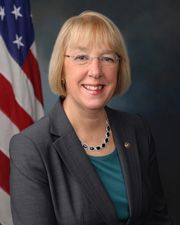
Mr. President, I have an amendment, No. 2030, at the desk. I call that amendment up, please. I ask unanimous consent that the reading of the amendment be dispensed with. Mr. President, as all of us…
Mr. President, I have an amendment, No. 2030, at the desk. I call that amendment up, please.
I ask unanimous consent that the reading of the amendment be dispensed with.
Mr. President, as all of us know, the Senate right now is debating the Healthy Forests bill, and I believe we need to do more in this bill to help protect America's old-growth forests.
Old-growth forests are stands of trees that have tremendous historic and cultural value.
I think we need to work hard to clarify a few parts of this bill so that Federal agencies do not misinterpret congressional intent in protecting historic and ecologically important resources.
This evening I am offering a perfecting amendment that will close two loopholes in this bill to ensure that our old-growth forests get the protection they deserve.
Before I turn to the details of my amendment, I want to comment on the horrible devastation we are seeing in California from wildfires. Like all Americans, I have been watching the shocking news coverage. My thoughts and my prayers are with everyone who has been affected. My brother is a firefighter. So I appreciate the sacrifices that are made by these brave men and women.
In my home State of Washington, we have been touched by terrible losses in recent years, including four young firefighters who died in the Thirtymile Fire on July 10, 2001, at Okanogan County.
It is clear that we have to take smart, responsible steps in this bill to reduce the dangerous fuel loads in our forests.
While it is too soon to draw any final conclusions about the fires in California, I think the fires highlight two challenges that ought to be a part of this debate.
First, it is clear that we don't have enough money in the budget to address our firefighting and fire prevention needs. In fact, today the Forest Service is borrowing from its fuel reduction accounts to pay for firefighting operations; that is, robbing Peter to pay Paul. The money reserved for fuel reduction, if it is used wisely, helps to prevent fires in the first place. The current budget is inadequate, and we are going to pay a greater price down the road if we don't address the resource issue.
Second, because the funds are limited, we have to do a better job of prioritizing how we spend the money that we do have. Specifically, we need to give a higher priority to those vulnerable lands in areas where wildlands and urban lands intersect. Those are spots where people and property are threatened.
If we address the hazards there--and if we educate homeowners--we will have a bigger impact with our limited funds.
I am looking for an aggressive plan to reduce the fuel loads in our forests, especially in the urban/wildland areas where people and property are endangered.
Old-growth forests are important for many reasons.
First of all, they represent ecosystems that are unique in nature. These forests are made up of a complex web of plants and animals, and climate and ecological conditions that are extremely different from what is found in younger or plantation forests. Certain animals and plants only live within these old-growth ecosystems.
If we are going to maintain a diverse species, we have to protect their habitat. Old-growth forests also have the cleanest drinking water, they provide structures for good salmon habitat, and they mitigate the effects of flooding and global warming.
Finally, these forests have great historic, recreational, and spiritual value which is important to all of us.
Hiking through an old-growth forest is truly a remarkable experience. I invite any of my colleagues who have not had that kind of experience to come to my State or to another State with a lot of old growth and have that kind of experience. You will understand why those of us who speak out on this floor are so passionate about this issue. In fact, in our old-growth forests perhaps is the only place where you can feel transported back hundreds of years and see what the very first explorers saw when they encountered these cathedral forests. They are a part of our history, and we cannot afford to lose them. Unfortunately, we have already lost many of these unique lands.
Old growth used to sweep across the Pacific Northwest, but recent studies estimate that old growth makes up between 10 and 18 percent of the lands in the Pacific Northwest and a mere 3 percent of lands nationwide. There is very little left today. We have to do all we can to ensure their survival.
I want to recognize my colleagues from Oregon and California who made this bill better by including an old- growth section in title I. As a result, this bill is now much better than what the President and the House first proposed.
But as I read the provisions, I saw two loopholes that we should close.
First of all, the bill lets the Forest Service and the BLM treat dangerous forests, and it provides protection for old-growth stands. Old growth can still be treated. It just has to be treated in a way that protects its unique character.
But if an area has insect infestations or is subject to trees being blown over, then the old-growth stands lose all of their protection. That is a big loophole. Any forest could be subject to strong winds that knock down trees. Any forest could experience insect infestation. Any forest could be subject to disease. Almost any forest could be damaged by an ice storm. It is just one of those things that happen. An old-growth forest could be drastically altered in ways that destroy its unique characteristic.
The underlying bill has a massive loophole in it that threatens old- growth forests and subjects them to unrestrained thinning. My amendment would simply close that loophole by making those lands subject to old- growth protection. My amendment, importantly, allows treatment of old growth. I know that is a concern to other Senators here on the Senate floor. It still allows treatment of old growth. It still must protect characteristics that we all recognize as important.
There is a second loophole that my amendment addresses. This bill has a fine directive to protect the integrity of old-growth stands. That is section 102, subparagraph (e)(2). I think we all can accept that standard. But I am concerned that it won't be carried out because it relies on forest management plans to be implemented.
Here is the problem with that. If the forest has a management plan that is less than 11 years old, that plan will not need to be updated to meet the new standards. That is a big loophole. It could mean that forests with relatively recent management plans don't have to enact the protections we are calling for in the bill. Fortunately, there is an easy way to close that loophole. It involves just changing four words in the bill.
My amendment does two things.
First of all, it ensures that all hazardous fuel reduction projects on Federal lands will protect old-growth forests.
Second, my amendment ensures that the old-growth standard in the bill applies to all Federal forests--not just those with older management plans.
I thank all of my colleagues and their staff who have worked very hard on this legislation.
The chairman and ranking members of the Energy Committee and the Agriculture Committee have been tireless on this bill.
My western colleagues from Idaho, Montana, Oregon, and California have all been looking after the best interests of their States and their constituents. I thank them all, and I appreciate their consideration of my amendment.
Old growth makes up just a fraction of our remaining public lands today. Many of these stands of trees are older than our Union. They are older than the settlement of the West. Some are older than Columbus' arrival in the New World.
We would not be doing our duty here on the floor of the Senate if we didn't do everything we could to protect them for future generations.
The amendment I am offering this evening will strengthen the protection in the underlying bill.
I ask unanimous consent that Senator Boxer and Senator Reid of Nevada be added as cosponsors.
Mr. President, I do not want to prolong this debate. I know
the managers have been here all day long and they want to move to a vote on this amendment.
Let me simply respond to my colleagues from the South and tell them that I understand insect infestation is a key concern in national and private forests.
I know my colleagues from the South face significant insect and disease issues. We certainly face them in the Pacific Northwest. However, I strongly believe we do not need to abandon the old-growth protections in this bill. The bill already allows old-growth stands to be treated for hazardous conditions. They simply must be treated in a manner to protect the old-growth characteristics.
Again, I know in most of the Nation 3 percent of the land is old growth. In the Pacific, it is 18 percent. It is a tremendous part of our heritage. It is something of which I think all of us should be very proud.
We need to be careful we do not take steps this evening with this bill that undo the heritage most of us are very proud of in this country.
With that, Mr. President, I yield the floor. I know my colleague from Idaho wants to move forward with a vote on this matter.

Mr. President, I thank my colleague from North Dakota who has an amendment and a longer statement. I ask unanimous consent that he be recognized after me to offer his amendment. Mr. President, is…
Mr. President, I thank my colleague from North Dakota who has an amendment and a longer statement. I ask unanimous consent that he be recognized after me to offer his amendment.
Mr. President, is there an amendment pending?
I ask unanimous consent that amendment be temporarily set aside so that I may offer an amendment.
Mr. President, I send an amendment to the desk on behalf of myself and Senator Mikulski and ask that it be immediately considered.
Mr. President, I ask unanimous consent that the reading of the amendment be dispensed with.
Mr. President, this is an amendment that Senator Mikulski and I believe is very important to provide adequate funding for medical care for the Veterans Affairs Department. This amendment provides $1.3 billion in emergency funding for the Department of VA medical care account which truly is an emergency.
This amendment addresses the medical care needs of returning servicemembers from Iraq and Afghanistan who will require medical care service from the VA.
As many of my colleagues know, the VA cannot currently keep up with the demand of the current veteran population, as illustrated by the tens of thousands of veterans who have been told to wait at least 6 months to get an appointment. Even more distressing is the fact that many of them may have to wait up to 2 full years, and that is unacceptable. If the VA cannot currently help those who are in the system, how will they be able to help those veterans returning from Iraq and Afghanistan?
In the legislation before us today, we have provided emergency funds for the Department of Defense to fight these wars and reconstruction funds to ensure that we win the peace, we secure the peace and bring our troops home. I support these funds. They are vitally needed. I hope we can get them approved when we return. However, I believe we also need to ensure that when
our troops do return home, the Government will be there to treat their medical care needs. If we are willing to provide emergency funding to fight the wars, we must be willing to provide emergency funding to meet the medical care needs to treat the injuries and the wounds suffered by our valiant heroes in the wars. In other words, we must ensure that there is a continuum of care for our service members from basic training to deployment to discharge.
Let me illustrate the current pressing and urgent needs for these emergency funds. According to a September 2, 2003, Washington Post article, the number of service members wounded in action in Iraq totals 1,124 since the war began in March. This Post article states:
The rising number and quickening pace of soldiers being
wounded on the battlefield have been overshadowed by the
number of troops killed since President Bush declared an end
to major combat operations May 1.
USA Today, in this past Wednesday's edition, has reported that at least seven times as many men and women have been wounded in battle as those killed in battle. This is a copy of that article, and it is entitled ``Trip Home is Just Start of Road Back.''
I am not going to offer these articles for the Record but I would refer those publications to my colleagues who are interested. We know the wounded are arriving in Washington every week. I point out these numbers do not include military men and women who are returning from Afghanistan and other parts of the world after fighting the war on terrorism.
According to the VA, some of our returning service men and women are currently being served through VA-DOD sharing agreements. Others, such as PVT Jessica Lynch, of whom we all know a great deal, are being discharged and turning to the VA for specialized services. This level of demand for VA services has not been foreseen or anticipated.
Further, we know that overall demand for VA medical care is not going to lessen. We have already seen the VA medical care system being overwhelmed by the staggering increase in demand for its medical services. Since 1996, the VA has seen a 50-percent increase in growth, or 2 million patients in total users of the medical care system. Moreover, enrollments have increased by some 3.1 million since 1999 alone, and the VA projects that its enrollments will grow by another 2 million patients from a current level of 7 million to 9 million in 2009. This is a historic and unprecedented increase in the level of service.
Again, I urge my colleagues to support these emergency funds. At a time of war with thousands of injured troops returning from battle, it is clearly an emergency to include these funds. It is our moral responsibility to ensure that we provide adequate resources to the VA to meet the vital medical needs of our veterans. If these emergency funds are not included in the bill, the VA will have enormous difficulties in treating veterans returning from Iraq and Afghanistan, due to the current backlog of veterans waiting for care. Without those funds, those waiting veterans will wait longer for medical care and the VA will be forced to deny medical care to another 585,000 veterans. I cannot accept these outcomes. I do not believe my colleagues will accept these outcomes. This is medical care they have earned through the risk of life and limb, and all too often their long-term health.
I ask my colleagues to think about our service members who have already returned from service, our service members who are continuing to serve and those who want to serve. If we do not provide these funds, what kind of message does this send to those currently fighting overseas and those who will be sent overseas?
I hope my colleagues agree with me that we want to tell these men and women that we will not turn our backs on them and that we will keep our promises to them.
I thank the Chair and I thank my colleague.
Yes.
I would be happy to do so. I ask unanimous consent that Senator Dorgan be added as a cosponsor.
I believe there will be others who wish to do so. I thank the Chair and I thank my colleague from North Dakota.
Mr. President, I rise in support of the Bond-Mikulski amendment. This amendment is simple and straightforward. It would add $1.3 billion to the Iraq and Afghanistan supplemental for veterans' medical care.
Our men and women serving in Iraq and Afghanistan have my steadfast support, and so do those men and women who fought before them. Our veterans need to know that America is with them, and that we owe them a debt of gratitude. Congress should show that gratitude with deeds, not just words. That means making our troops and our veterans a priority in the Federal checkbook.
As the ranking member on the VA-HUD Appropriations Subcommittee, my guiding principle for the VA budget is that promises made to our veterans must be promises kept. I believe this means no membership fees or toll charges on veterans to get health care or prescription drugs, and no waiting lines for veterans to get medical care or to get their claims processed.
Under a law passed after the Persian Gulf war, VA must give priority to returning troops for immediate medical care. The Veterans Programs Enhancement Act of 1998 requires VA to provide 2 years of medical care benefits for returning servicemembers. This law was originally passed to meet the medical care needs of veterans who served in the first Persian Gulf war. The law applies to servicemembers who are in Iraq now.
But the VA medical care system is under tremendous stress. During August, I traveled to VA clinics across Maryland. I saw dedicated staff providing quality medical care. But they are stretched to the limit.
Nationally, there are over 100,000 veterans waiting longer than 6 months to see a VA doctor. Some veterans are waiting as long as 2 years. The wait for specialty care like spinal cord injury care, blind rehab, and prosthetics can be even worse. The Blinded Veterans Association tells us that there are 2,600 veterans waiting up to 1 year for admission into a blind rehab center.
Our veterans didn't stand in waiting lines when they were called up to serve our country. They shouldn't have to stand in line or pay toll charges to get the medical care they deserve. The Bond-Mikulski amendment is necessary to keep our promises to our Nation's veterans by ensuring that soldiers returning from war, and the veterans who fought before them, will get the medical care they deserve.
The President's budget proposed a new $250 annual membership fee for veterans, and increased copayments for veterans' prescription drugs and visits to the doctor. Senator Bond and I have worked together on a bipartisan basis this year to reject these proposals. This funding will ensure VA has the resources necessary to meet the needs of our veterans and returning troops.
I thank Senator Bond and urge my colleagues to support this amendment.
Show 11 more

Mr. President, I appreciate the passion by which the Senator from California approaches this issue. I would like to have her attention for a few moments because she is most sincere in what she says.…
Mr. President, I appreciate the passion by which the Senator from California approaches this issue. I would like to have her attention for a few moments because she is most sincere in what she says.
Forest scientists--not a year ago--5 years ago, were pleading with us to create activity in our forests and in San Bernardino to stop a catastrophic fire that was going to happen someday. Yet this Senate-- and my guess is, the vote of the Senator from California--denied those kinds of actions, a more interactive approach and active thinning and cleaning.
We have been talking about forest health on the floor of this Senate not for 1 year, not for 2 years, not for 3 years, but 5 years. Why?
No, I won't yield at this point.
I will not yield at this moment.
No, I will not yield.
Let me complete my thought, Senator, and then I will be happy to yield to you.
I have been in the San Bernardino and so have you. For 15 years that forest has gone relatively untouched.
So I appreciate the Senator's passion. What we have tried to strike here is a balance.
The picture I am demonstrating is not unlike the picture the Senator from California brought. Why aren't the trees burned around the homes that are gone? The reason they are not is because 60-mile-an-hour winds spread fire in many instances a mile or a half a mile beyond where the fire is burning. Embers fell on the roof of the shake roof homes in California, and the homes are gone because the trees in the immediate area stand.
So when the Senator from Oregon and this Senator from Idaho and the other Senator from California were trying to strike a balance, we knew that reaching out as far as we possibly could was where we needed to go, along with recognizing that the urban interface was critical.
We believe we have struck that kind of balance. We want to sustain that balance. The money goes where the people exist.
Let me reference another fire that occurred in early summer. The Senator from California witnessed it, as we all did. It was called Summer Haven on the mountain above Tucson. Summer Haven had been treated. Thinning and cleaning had gone on around that little urban enclave interface. But the community no longer exists today. It burned up in a wildfire. Why? Because the fire started down the canyon in areas that had not been thinned and cleaned, and it swept up the canyon, burned out the areas that had been thinned and cleaned, and took out all the homes.
The point I am making--and I will be happy to respond to a question from the Senator from California--is that we tried to strike a balance. We need to go where the people are. And California cries out for that at this moment.
I hope the Senator will continue to work with us. It isn't just happening on the San Bernardino. Tens of thousands of acres are dead and dying in the Sierras. The Tahoe Basin is in trouble. The Senator from Nevada attempted to address that along with us a few years ago. We are beginning to try to get some active management there. It is a tragedy waiting to happen again. It is happening in thousands of acres of forested lands across this country.
That is why we are trying to strike the balance. Not only do we have bug kill in the urban interface; we have it out there in lands that we have agreed, under a certain process and procedure, we might try to treat. That is my point. That is why I think you can be arbitrary here and have good logic for that arbitrariness. The Senator from California is arbitrary, as are we. She has a set of logic. I am trying to suggest that in a 60-mile-an-hour firestorm, fires do not listen to borders. They do not react to them.
Now if the Senator from California has any questions, I would be more than happy to respond.
I yield the floor.
I move to lay that motion on the table.
The motion to lay on the table was agreed to.
Mr. President, there is no question that what the Senator from Iowa has talked about, the limitations that are built within the legislative process, are there.
He is the reigning member of a full committee that has a forestry subcommittee. I am chairman of another forestry subcommittee. We are going to monitor very closely this bill, if it becomes law. Probably we are 6 to 8 months away from regulation writing alone that will hit the ground and become active. So already we will probably have an operative life of only 4 years, if the amendment of the Senator from Iowa were to become law.
Our job is oversight. The Senator's job is oversight. Because this is a controversial issue, it is incumbent upon us to make sure we monitor it closely. Many of our forest experts across the country who look at the magnitude of the problem of forest health today are going to suggest that even if we can reach our cap limits within 5 years, the public and the resource will cry out that we continue for years to come in a thinning and cleaning process.
So I would hope our colleagues would join in sustaining the bipartisan compromise that is reflected in the legislation that is before us this evening.
Before I close, and because this appears to be the last amendment, I want to make one more comment in the way of an article that was written in the San Jose Mercury News by Paul Rogers and Josh Susong. It appeared, apparently, today. Let me read, very briefly, the first page of this article. I will ask that the entire article be put in the Record.
The dateline is: Lake Arrowhead, CA:
The oil industry had the Exxon Valdez. Nuclear power had
Three Mile Island.
Wednesday, with flames menacing one of Southern
California's most beloved mountain resorts, Lake Arrowhead in
the San Bernardino Mountains risked becoming forestry's
equivalent--a disaster so overwhelming it could change U.S.
environmental policy for decades to come.
The area, filled with overgrown, diseased and dying trees,
has gained a reputation in recent years as one of the worst
examples of forest mismanagement in the West.
If much of Lake Arrowhead or nearby Big Bear Lake ends up
burning, fire experts said it could prompt rapid changes,
including congressional orders for much more logging to thin
the nation's overgrown forests. . . .
Well, we are already responding. This article is actually behind, and we are responding with the kind of bipartisan compromise that is before us tonight. But the article goes on to say:
Flames destroyed more than 300 homes near Lake Arrowhead
Wednesday--
That is yesterday--
with no end in sight.
Forests there would have burned naturally every 20 years,
said [a Forest Service expert]. . . . Areas that historically
had 50 trees per acre now have 500 [trees per acre].
Well, the article goes on and on, but here is something that it talked about. And, of course, we have not seen the evening news tonight because fires are still burning in the Lake Arrowhead, San Bernardino forest areas.
It says:
Fire crews worked desperately to stop the advance as it
moved toward 44,000 homes, 2,000 businesses and 80,000
outbuildings--property with an assessed value of $8 billion.
``This may be a landmark event. This fire could take out
20,000 homes in the next day or two,'' said . . . a professor
of earth sciences at the University of California-Riverside.
And the article goes on and on.
Mr. President, I ask unanimous consent that the article be printed in the Record.
Mr. President, what we are about to conclude tonight is a 3- to 4-year effort on the part of many folks of good will on both sides of the aisle to bring some modicum of change. This is not a giant leap forward. This is a cautious, careful step to assure that we can begin to address our forests that are overgrown, that are diseased, that are now caught up in the scenario of wildfire, as we see it playing itself out in southern California today.
Without a doubt this is a national emergency and a national crisis. We are being asked to spend upwards of $1.2 billion a year of taxpayers' money simply to put the fires out, let alone the cleanup and the restoration and the saving of watersheds and wildlife habitat.
So I would hope we could continue this process and monitor it closely. My last hope is that the work tonight can go to the President's desk, can become law, and we can say we, once again, have become reasonable and responsible stewards of our forested lands.
I yield the floor.
As I told Senator Bingaman, I agree that this is a serious issue and I have been working hard on resolving the problem myself. I appreciate the concerns of Senator Baucus and McCain and thank them for not offering their amendment. This issue will be my top priority once we finish the healthy forests bill. I pledge to work with Senator Baucus, Senator McCain and the Chairmen and Ranking Members of all the relevant committees to find a workable solution.
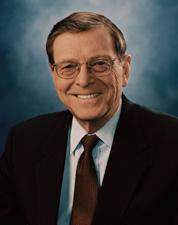
Mr. President, may I ask the Senator from Wyoming a question. Were you going to offer an amendment? I wonder if I might have 5 minutes following the Senator from Wyoming. I ask unanimous consent that…
Mr. President, may I ask the Senator from Wyoming a question.
Were you going to offer an amendment?
I wonder if I might have 5 minutes following the Senator from Wyoming.
I ask unanimous consent that I follow him for 5 minutes.
Mr. President, while what is going on in Russia may be some of the worst news that could beset the free world, including our country, because of the acquisition of majority control of the third largest oil company by the Government of Russia in one sweep today, who knows what that means in terms of oil production and stability. But I rise because, on the other hand, while that bad news is occurring, the announcement today as to the status of the American economy is about the best news we have had in 20 years.
Today it was announced that the economy grew by 7.2 percent in July. That is July, August, September, that quarter. It has been almost 19 years. Not since 1984 has this economy seen such GDP growth. This news was not unexpected. Many have been saying--certainly I have--for some time the policies we have adopted, specifically the tax reductions, would result in this kind of event being announced now or very close to now.
In addition, this was reflected in the morning numbers today which showed personal consumption was at 6.6 percent. Interestingly, since consumption makes up 70 percent of the economy, growth accounted for by consumption would on its own have resulted in the economy growing 4.6 percent all by itself. Equally, if not more importantly, the long-term business investment grew by 11.1 percent in this quarter.
To me, this suggests we will continue to see this growth well into the future as businesses rebuild their investments and their inventories and retool their factories. Government spending, which accounted for most of the growth in earlier parts of this year, was not that important. It represented only 1.4 percent.
Maybe lost in this big news is what really matters, and that is, with reference to growth, the Department of Labor reported initial claims for unemployment declined by 5,000 just this week, affirming a downward trend in unemployment. So the news is good on the home front. The numbers released today indicate a ramp-up to recovery and growth in this quarter and in quarters ahead. Policies we put into place are beginning to take hold.
I commend all of those who have been part of that and commend our President as our leader for asking for most of the tax cuts and other items that have caused this growth to occur.
Still, we have a lot more work to do. We must do more to help create jobs and bring economic recovery to all of our citizens.
We cannot rest therefore on these reports today. We must continue to work toward reducing the cost of doing business in this country in such areas as health care, energy, and litigation costs. We need to remove barriers to investment and economic growth so employers can create new jobs.
Our work here in the Congress must go on with renewed dedication. Today we see first hand the effects of the President's economic policies. But such results should encourage all of us to work even harder to bring economic recovery to the doorstep of every American.
Mr. President, we are wrapping up this bill. I think everyone knows that it essentially came from the Agriculture Committee of the
Senate. Many of us thought it was going to the Energy and Natural Resources Committee, but it was ruled that it belonged more in the jurisdiction of Agriculture. I feel very good about the results. I am very pleased with Chairman Thad Cochran's efforts and those of the Agriculture Committee, in a bipartisan manner, producing this bill and then further negotiations to even make it better.
I am not so sure had it been sent to the Energy and Natural Resources Committee, where in years past we would have thought it should go, that we would have produced as good a bill. With the amendments that have come forth because of efforts after the bill came out of committee, it is truly remarkable that we were able to achieve this. It is almost as if the problem couldn't possibly have existed so long because of the way it has worked out. It is like an overwhelming number of Senators have come to the realization that it is time to fix a broken set of management tools for the forests of our country.
I think we have fixed them. I can tie this into the pending amendment by saying, it certainly isn't anything you are going to fix in 5 years. So for those who might have in mind that we have this bill for 5 years and then we start over, we are probably going to need 15 or 20 years of effort under this bill, with plenty of resources, to get the forests of America back where they should be. Where they ought to be is they ought to be beautiful forests, but they ought not be so susceptible to burning down. We all know that.
It is just incredible that it has taken so long to get where we are. I know what Senator Craig read into the Record a while ago from the newspaper in California because I read it a while ago. Whoever wrote it is right on. This horror that we lived through was no accident. It is the result of not doing what we ought to do because certain groups in this country didn't want it to be done--plain and simple.
They know who they are and the people know who they are. It happens that every time we turn around and talk about them, there is an excuse now that they really didn't do it; They weren't really against this; They were for fixing the forests all along; They have been for modifying our laws for decades; right?
Well, that just isn't true. We have finally come around, but it surely has taken a long time.
Anybody looking at this Nation on this one would have a real complaint about the slowness of the democratic process. Because it wasn't all of a sudden that this problem came upon us; it has been around. It has been up and down, through the hills, burning the mountains. It leaves millions of acres dry, pieces of wood standing in the air that have been infested. And then still there are people going to court, groups saying, don't cut them down.
These fires cut them down. These fires make them disintegrate. They don't even burn down; they just go poof and there goes a tree. That is about how it goes.
I have seen it. I had one that was bad. Three hundred fifty homes burned down. Probably with the number of homes and the damage, it was the second largest one. But it paled in comparison to this one.
Frankly, before these forests that are dead and should have already been cut down, before it finishes in California, there will be no room for excuses. There is going to be a whole bunch of people who will want it all solved next week, in particular those who have been in the way of fixing it. They are going to be saying: Why isn't it fixed?
We are going to have to pour in three times as much money, in my estimation, as we have been putting in. I don't know if we can find the manpower to put in the Bureau of Land Management and the forests to do the kind of work we have to do. I am not sure we can. It is such a huge job to clean up these forests that I am not sure, if you put down a timeline and said, here is where we ought to be, we would get there. We are going to have to contract it out. We will have to have all kinds of approaches to get in there and just take out all that stuff that is all over the bottom of the forests, under the trees, just waiting to burn. That is no easy job.
For those who are so worried that we were going to log the forests to death, they have watched them burn to death. We were not going to log them to death so we watched them burn to death. That is what happened.
It is high time we fix it. I don't know if I will be a conferee. Maybe they will all be off the Agriculture Committee. If I am, I can pledge that I am in a hurry. I have a lot to do, but I am in a hurry.
Everybody who goes to this conference ought to be in a hurry, not only in a hurry to get a bill but in a hurry to get a bill that can clear the Senate and get the President to sign in the shortest period of time. That is what we ought to be worried about next. It isn't so good to get this done and be at it 6 months and then find that the President doesn't like what we have done because we have changed things so much.
I thank not only Chairman Cochran but I thank the staff of the Agriculture Committee. They have been tremendous. We have had the luxury of working with them from our staff. But I can tell you, had it been assigned, we couldn't have done it any better with the full staff. And they have done it.
I thank the Chair and yield the floor.
Mr. President, this is all odd, perplexing. I am grateful to my colleague from New Jersey for that. But I am still perplexed. This is all kind of odd to me. We could, I think, pass this whole thing,…
Mr. President, this is all odd, perplexing.
I am grateful to my colleague from New Jersey for that. But I am still perplexed. This is all kind of odd to me.
We could, I think, pass this whole thing, the entire authorization bill. The chairman of the full committee and Senator Hollings and Senator Lott, both of whom have spoken here, myself, the ranking member on the Aviation Subcommittee, and Byron Dorgan--we wrote to FAA Administrator Blakey and made a reasonable request, asking for an extension on a certain part of this for a period of a year. We might get that in the next 7 or 8. We might very well get it. The language didn't appear to be quite proper at the time.
We do have the President's statement. As the Senator from New Jersey pointed out, he specifically deleted ``an inherently governmental function'' when it referred to air traffic performance-based organizations.
I want to support the FAA conference report. I think virtually everybody in the Senate would want to do it. It includes a lot of things that are very important to me for West Virginia. West Virginia is not at the center. We are not exactly a hub of jet aviation, but we are served by many good airlines that do their best to help us. We all know the issue of privatizing the air traffic control system has held this whole thing up for months. It is perplexing, because it does not seem to me to be that big an issue. Yet if we are simply to accede to it, in language which is potentially very vague, we have no idea what might happen.
That is why we sent this letter--my good friend and chairman, and I, and the chairman of the full committee--to try to get this extended for a year so we could look at it and go ahead and pass the rest of all this.
But we have not gotten the letter. We still have 7\1/2\ minutes, if I read the clock correctly. It could come in. Then we could all vote for the entire conference report. But short of getting that letter and that commitment, which we all signed on a bipartisan basis, then I think we have to vote against cloture because it is entirely a matter of employees being accountable to the public who maintain the airplanes, who are the service stations that send them from one place to another. That is accountability to the public. It is not accountability to the bottom line. It is not a matter of contracting out. This is fundamental safety.
If you ever go out to Herndon, VA, as I have, and you see the latest technology and you see all the airplanes in the air at any given moment in the United States of America, you can hardly see the country. There are airplanes everywhere and they are all traveling. They have to be guided. A lot of them are general aviation. Some of them are not, obviously.
The inability of Congress to resolve this issue has created a very significant uncertainty for our airports in particular. These are hard times for aviation. I don't think it is the right time to add more trouble in their life, more uncertainty in their life, less predictability in their life, and the worry about less safety in their life.
Last week we did attempt to resolve the main issue that held this up. As I indicated, Senators McCain, Hollings, Lott, Dorgan, and myself did send the FAA Administrator a very straightforward, honest letter and we requested the FAA impose a 1-year moratorium on the actual contracting out of any air traffic control functions, including flight service stations, which provide enormously important information to pilots. You can't do without them.
I have a little community in my State called Elkins, WV, which is currently not served by commercial aviation, but it does have a critically important flight service station that handles traffic for a significant part of the Washington, DC metropolitan area that is at risk of being contracted out--and will be.
Flight service stations such as these are absolutely vital security links in our Nation's air traffic control system and they have to be protected from privatization.
I come from a private enterprise background, and that has been pointed out to me humorously, or not, but you just can't fool around with public safety. You can't do it. Police officers are not contracted out. I guess they are in Iraq, but they are not in this country. They are public servants. Or you hire a private guard if you want to, something of that sort, but basically, protection of public life and public passage is in the hands of the Federal Government. And it should be. It has always been there. People trust it. If you took it away, or parts of it away, people would be stunned. I think they would be stunned.
This Senator can only support cloture if the administration has made a strong commitment to hold off any changes to the management of the air traffic control system for a year. And we have still 4 minutes to get that letter. Then we will vote for the conference report and I will happily do so because I agree with the Senator from Mississippi, there are lots of good things in it. But safety, unfortunately, is one of those things you cannot compromise.
The Senator from Arizona spoke about Air Force One and Air Force Two. I have never had any doubt they are well cared for. But there is a lot of other general aviation that may not be quite as well tended to, and we have to worry about that.
I don't think the conference report is going to pass the Senate if this letter doesn't arrive. It is not just a case of where the perfect is the enemy of the good but, rather, it is a fundamental debate over the future of aviation and security. It is a huge subject. Aviation is an enormous employer, creating enormous economic activity in our country.
This is not the process we should have to use for the FAA conference report. I would be the first to say that. It grieves me. This legislation has always enjoyed bipartisan support.
I want to set the record straight for 1 second and then I will be finished, on how this came about. When the Senate debated, as has been said by the Senator from New Jersey, we debated this important bipartisan bill. We had a bipartisan majority of Senators express serious concerns over the executive branch's future plans for the safety management of the air traffic control system as a whole. As the Senator indicated, we voted 56 to 41 to impose restrictions on the administration's proposal precisely to avoid the very outcome of the conference report we are now facing, which is allowing the administration to privatize functions of the air traffic control system.
I will not get into the House of Representatives. They also had voted to impose these safety restrictions. In the end, the majority of conferees--we were never invited to be a part of, I was never invited be a part of, but I have become accustomed to that because I was part of the Medicare conference and I wasn't part of that, so my threshold of expectations was low. But we had the will of both Chambers being expressed. Unfortunately, the conferees bent to the desire of the administration.
Congress has clearly spoken on its concerns over air traffic control privatization. Let us use next year to develop policies and make the system more secure, more safe, and more efficient. I urge my colleagues to reject cloture unless we get a letter in the next minute and a half which commits to this protection which I think we all want.
This is an enormous subject. I deeply regret we have come to this point. There is no reason we should have, but we have. Assuming that letter will not come, I will have to ask my colleagues to vote against cloture.
Mr. President, reserving the right to object, and further, parliamentary inquiry, I was under the impression the Senator from New Jersey was going to offer an amendment, but he propounded instead…
Mr. President, reserving the right to object, and further, parliamentary inquiry, I was under the impression the Senator from New Jersey was going to offer an amendment, but he propounded instead this unanimous consent request.
Further reserving the right to object, Mr. President, we have a Federal Aviation Administration conference report that is due for consideration in the House maybe today or early next week. That issue will be coming to the floor of the Senate, I presume, shortly thereafter. It is a 4-year, $60 billion bill that is critical for our airlines, our airports, for general aviation, and for security in aviation. It reminds me of this Healthy Forests bill. A week ago, there were objections to the Healthy Forests bill. This week, with half the State of California on fire, all of a sudden we are going to get this Healthy Forests legislation.
I urge my colleagues to look seriously at this legislation and what it means for this great industry in our country, an important part of our economy--aviation--and for security in aviation before we just say we are going to go with the status quo. If a week from now or a month from now there is an explosion in an airport or a plane is driven into a twin tower somewhere, I would not want to be the one who is not passing this huge FAA reauthorization extension.
Further reserving the right to object, I don't like all that is in this bill either. I am not an advocate of some of the provisions that are in this bill or not in this bill. I am not even necessarily an advocate of privatization. But to threaten to kill this major legislation with an extension over that one issue is very dubious action.
I, with great pleasure, object to this unanimous consent request.
Reserving the right to object.
If there is going to be a unanimous consent request, I ask that there be an equal amount of time, if needed, for the other side.
Mr. President, I ask unanimous consent that the order for the quorum call be rescinded.
Mr. President, I realize we need to get back to amendments on this legislation so we can complete Healthy Forests so I will try to be brief, but I have to respond to some of the things that were said.
First, the Senator from New Jersey and I have talked about this issue and about this legislation in the past. He knows that I was in hopes we could work out something in this area, but now we are talking about not going forward with the conference report and doing a 6-month extension for what is not in a bill.
We were told there was a problem with the language that was in the bill because it said, by the way, there cannot be any private takings of air traffic controllers. That was in the conference report, that there would be 69 medium and smaller airports that would be subject to possible contract towers. We were told that is a problem. The people did not like the contract tower concept. Others did not like the prohibition, by the way, on privatization of the air traffic controllers. So the conference took those two provisions out.
Basically, the conference says in that area you just had a 6-month extension, extend the current law. What are you gaining? There are a lot of things that are in this bill that make a huge difference that will not go forward if we do not pass the conference report: $60 billion, money that is needed for security in our airports; funds for the first time, over $100 million, that would go to the regional airlines, airport security, expansion, and improvement. We let $500 million go from the airport improvement fund into airport security. This legislation says, no, you cannot do any more of that. The security funds will have to come from other fees, but airport improvement money will go to improve the airports.
It has to do with general aviation, and we have some significant language in there for them. Manufacturers of airplanes from Kansas and Washington and parts suppliers all over America, all of that would be put on hold.
We are behind the curve already. Does anybody really think the airports are secure and that the airlines are secure, and that we have done all we need to do? I am not that critical of TSA. I think they are working hard and I think it is better, but we have a long way to go.
Then we are going to put a timeout on this huge, important part of our infrastructure? We want to create jobs. How about improving our airports and our air service and all the concessionaires that are involved in the airports, all the people who lost their jobs after 9/11 in the aviation industry? If we do that and do the highway bill, we are talking about thousands of jobs in America.
Also, the Senator is suggesting that we have no privatization in FAA at all, not just air traffic controllers but I guess the flight weather service people, the maintenance people, the service people.
Now, I am not particularly an advocate--in the past I have not been-- of privatization of air traffic controllers. But some of these? Maintenance service not even being possible to consider for the private sector? It is almost as if the private sector is incompetent; the
Federal Government can do it better. I do not think that is usually the case. I think most American people think when the Federal Government does it it gets worse and more expensive.
Then there is one other point. The President of the United States is not going to sign a bill that says there cannot be any privatization anywhere anytime in the FAA. We have tried to be accommodating, to go back to the conference and take out what we thought was the offending language.
If I could, let me complete, and then I will yield for a question, although we prolong this agony, which is not going to achieve anything right now.
If we took out the 69 contract towers, there are a lot of places in America which wouldn't have a tower. In fact, that is bipartisan. The idea of contract towers, I can tell you, came from a Democrat, a well- known one in a previous administration. I thought it made sense.
I don't understand. If we cannot have 100 percent purity, we don't want this bill. We don't want $60 billion. Aviation is about more than just the guy in the air traffic control tower. It is about security on the ground.
I plead with my colleagues to think this through. We are not pulling back and saying we are going to privatize. In fact, there is a letter from the Secretary of Transportation, Norm Mineta--not your basic every-day, run-of-the-mill Republican, a Democrat--the Secretary of Transportation, says we are not going to privatize air traffic controllers.
We are fighting ghosts here. If we don't watch it, we will be creating ghosts. We will talk more about this when this conference report comes up. But I plead with my colleagues. I talked about this with my colleagues. I tried to make sure it was bipartisan. It passed the Senate overwhelmingly. There have been some changes made from that, obviously. But if we leave here this year having not passed a Federal Aviation Administration bill or an Energy bill or a Healthy Forests bill, heaven help us when our constituents get hold of us.
I yield the floor.

Mr. President, the Senator from Washington has made a number of extremely important points, points with which I certainly agree. Having served as chair of the forestry subcommittee and now ranking…
Mr. President, the Senator from Washington has made a number of extremely important points, points with which I certainly agree. Having served as chair of the forestry subcommittee and now ranking minority member, I can tell my colleagues the Senator from Washington is absolutely right with respect to her concern about adequate funding. For example, the bill from the other body provided no funding for the thinning projects. This legislation increases funding 80 percent. So her point with respect to making sure there is funding is dead on correct, and I think not only that point but other points she has made are correct.
In spite of that, I do have to oppose the amendment tonight, and I want to take a couple of moments to say why.
First, let me stress how important public participation was to me and to the other Senators who are involved in putting together this bipartisan compromise. If there is one thing, just one, that I want to stand for in my career in public service, it is the right of citizens to participate. That is why I have open community meetings in all my counties. It is why I have sidewalk office hours. It is why, as so many Senators, I try to make myself available as widely and extensively as I can.
So I come tonight to say with respect to this key issue, this key question of public participation, not one current opportunity for public involvement would be lost under this compromise. I say that again. Not one current opportunity for public comment would be lost under this proposal.
There are three alternatives that people would be part of examining and, in fact, the public would have a right to come forward and offer their own. It
seems to me that that gives us a chance to keep the greatness of the National Environmental Policy Act, a statute more than 30 years old, while at the same time allowing us to deal with some of the concerns such as the unnecessary redtape and paperwork.
This proposal in the legislation we are considering cuts the alternatives from five, to nine, essentially to three. I am of the view that, while it is appropriate to have a host of these alternatives under the National Environmental Policy Act, when, say, the Federal Government is building a road, which is a broad purpose concern, I think when you are talking about this area and projects that are narrowly drawn, limited in where they can occur and how, it is appropriate to try to boil down the NEPA alternatives to the three that we have offered in this legislation.
Mr. President, the Senator from Washington makes the argument that, in effect, the Senate will be starting down a slippery slope. I would just say to the Senator from Washington, I am convinced that because there are good people in the Senate, such as the Senator from Washington, that will not be the case. If someone comes forward and tries, for example, to unravel the National Environmental Policy Act, or even apply what we are doing in this area to every area, there will be opposition from a whole host of Senators, including this one. Nobody is talking about doing this in a host of other areas. We are talking about saying in this one area where we have been told by, for example, the Governors, it is not just a question of spending more money, it is a question of how you spend the money, I think this compromise strikes a reasonable balance.
I urge my colleagues to support this compromise. The compromise is dramatically different than the approach the other body takes with respect to the National Environmental Policy Act. The other body basically kicks the public out by predetermining the National Environmental Policy Act alternatives. What is offered in the compromise preserves all opportunities for public input and appeal, while making sure that we deal with the paperwork and some of the unnecessary redtape.
I urge my colleagues to support what is in the compromise because not one current opportunity for public comment would be lost, and all of us want to make sure that on an issue that citizens care so strongly about their right to be heard is preserved. This compromise does that.
I yield the floor.
Thank you, Mr. President. The hour is late. I am going to be very brief.
I am opposed to this amendment. This is not an unlimited bill. It has a 20-million-acre cap. Suffice it to say, we are going to have a lot of oversight in both the Agriculture Committee and the Energy and Natural Resources Committee.
But I also thank the Senator from Iowa with respect to how he has handled this legislation. He has been exceptionally kind and helpful to me. He has had differences of opinion with me on this issue. I thank him for all of his cooperation.
Suffice it to say, Mr. President and colleagues, the West has been watching the last few days, and in a particularly contentious area, the Senate has been able to find an awful lot of common ground. Even on some of the amendments that we have had--the question of the urban interface funding initiative, whether it should be 50 percent or 70 percent--these are areas where reasonable people can differ. It is awfully easy to polarize on this issue, to drive people into rival camps, and to a great extent the Senate has avoided this.
So what is important tonight as we deal with this last substantive amendment--and then we have a couple of procedural matters, colloquies, and that sort of thing to finish--is that we recognize how important it is to get this bipartisan compromise to the President's desk.
The bill that the Senate will pass tonight is the one that I believe ought to become law, and it is absolutely critical that it be the one to get to the President so it can become law.
So I hope Senators will continue to work together on a bipartisan basis and make sure the Senate compromise does not unravel.
In addition to the Senator from Iowa, who has been so helpful throughout this process so we could expedite it, Senator Cochran from Mississippi, since the days that we spent those long hours in his office, Senator Craig, Senator Domenici, Senator Crapo, and others, a lot of people thought we would never get to this night.
One person who did was the senior Senator from California who I have been so honored to have had on my subcommittee over the years. We wouldn't be on the floor tonight without the senior Senator from California who consistently, when we bumped up against an issue where we couldn't bring people together, it was the Senator from California who broke the gridlock. I want the Senate to know how much this body should appreciate the contribution of Senator Feinstein. This Senator does in particular.
I yield the floor.
Could the Senator from Mississippi confirm that with respect to section 105(c)(3), it would be the Agriculture Committee's intent that if the agency fails or is unable to make information timely available during the administrative review process, the court should evaluate whether the administrative review process was inadequate for claims or issues to which the information is material?
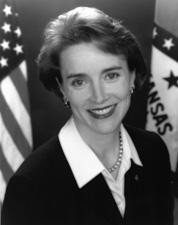
Mr. President, I compliment my colleague, Senator Murray, from the great State of Washington and the great job she does on behalf of her State. I appreciate all the hard work she has put into looking…
Mr. President, I compliment my colleague, Senator Murray, from the great State of Washington and the great job she does on behalf of her State. I appreciate all the hard work she has put into looking toward this amendment and others.
I hope in my opposition to this amendment I can at least provide some comfort that we have looked at trying to make sure the old growth in this Nation is protected. I rise today to oppose this amendment that would apply old-growth restrictions to insect and disease treatments, as well as to clean up after severe weather events. Part of why I do that is, simply, our forests are very different across this land. We want to make sure everyone is participatory in what we are doing in protecting and keeping healthy our forest lands.
Insects do not care about the size of the tree. In fact, as many scientists
have stated for years, they prefer older trees that are in poor health. Old growth, as I said, is very relative. In these older stands where trees are stressed for water and nutrients, insects will go after both large and small trees. The idea is to allow forest managers to go there and remove the problem trees, reducing the density of the stressed stands to immediately address the insect or disease problem which in our forests in the South are our most common and immediate problem. Insect and disease treatments are vastly different from preparing for a potential fire somewhere down the road.
I join my colleague from Washington in sending our prayers and thoughts to all of those who are valiantly fighting the wildfires in California and the families and the communities that are affected by those.
Fighting against an insect or disease outbreak is not like preparing for a fire. It is exactly like fighting a slow-moving wildfire. You would not ask firefighters to only fight a fire in certain sections of the forest, would you, and require them to skip around certain stands in the forest? It would seem ludicrous to do that. You could not effectively fight a fire that way.
That simple logic is why Chairmen Cochran and Domenici, and Senators Crapo, Craig, Feinstein, Wyden, McCain, Kyl, and myself, have worked hard to craft some compromise language. We ensure that when our forest managers treat and prevent the spread of insect and disease outbreaks or attempt to clean up after a severe weather event, they do not have their hands tied to only treating a certain portion of the forest. Managers must be able to treat all of the forest or we are all just going to watch the forests die--both inside old-growth stands and throughout all of the forests of this Nation.
Forests in my State of Arkansas and throughout the country are being affected by unprecedented and catastrophic outbreaks of insect and disease. Whether it is the southern pine beetle in the Southeast, the sudden oak death in California, or the red oak borer in Arkansas, this Nation's public and private forests are under attack.
In Idaho, the Douglas-fir bark beetle is another predator of our forests. This beetle seldom attacks trees that are less than 12 inches in diameter. These bugs like large trees, optimally 24 inches in diameter and larger.
In this case, to prevent or mitigate an infestation, in many circumstances it is absolutely necessary to remove some of the larger trees in order to treat the insect outbreak. The larger trees have been devastated.
The southern United States and the Rocky Mountain West are currently experiencing outbreaks of bark beetles, including the southern pine beetle and the spruce beetle at levels unprecedented in historical times. As Senator Murkowski demonstrated earlier, over 90 percent of the spruce trees have been killed in Alaska's Kenai Peninsula. In the Southwest, the pinion pines have suffered severe mortality. The Lake Arrowhead region is a horrifying example of where forest managers were unable to address the overdense stand conditions in a timely manner.
Right now, on the San Bernardino National Forest, over 230,000 acres, half of the forest land, have more than 40-percent tree mortality because of an outbreak of western pine beetle. This is a case in point where forest managers were unable to actively treat the area and it resulted in a massive insect infestation and right now is at a very high risk of catastrophic wildfires, as well.
In my home State of Arkansas, the red oak borer is attacking older, living oak trees at unprecedented magnitudes. Again, older growth is relative to the forest that you are talking about. This outbreak is rampant throughout the oak forests of Arkansas, Missouri, and Oklahoma affecting roughly one-third of the interior highlands.
The red oak borer complex is the greatest threat to the oak component in the interior highlands in recent history. This is from a native insect never before considered anything other than a minor pest or concern to the forests. These are insects that have been there forever. This is not something new that has just been introduced to our forests.
It is essential that we allow the Forest Service the flexibility it needs to attack this overwhelming problem wherever it happens throughout our forests.
This legislation is about forest health. We have done everything in working to bring about compromises in good conscience that are going to protect the health of our forests. It is about restoring forests to more resilient ecosystems, making these systems less susceptible to disturbances such as wildfire, insects, disease, and invasive species.
In my mind, reducing the flexibility to address these forest health issues will eventually destroy the very trees we have been trying so hard to protect. If we do not enable our forest managers to proactively address insect and disease outbreaks wherever they happen and before they become extensive, you can be sure insects such as the Douglas-fir bark beetle will be certain that there are no old-growth forests to protect.
I urge my colleagues to oppose this amendment and to remember one of the most critical parts when we are talking about old growth; that is, this is the first statutory protection for old growth that we have ever seen. There are protections throughout this bill for old growth, many focusing on smaller trees, but without a doubt, making sure the protections for old growth are there and recognizing this is the first time we have had statutory protection for old growth.
I encourage my colleagues to take a good look at this and to defeat this amendment and rest assured that we have done everything we can in this compromise to make sure we will protect that old growth, particularly with the statutory language we have but ensure the flexibility that we can also protect and save our forests.
I yield the floor.
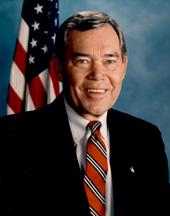
Mr. President, the FAA conference report before us this evening is critical because it provides funding for crucial safety, security and capacity projects at airports across the country. I strongly…
Mr. President, the FAA conference report before us this evening is critical because it provides funding for crucial safety, security and capacity projects at airports across the country.
I strongly believe that all Senators should support this cloture vote--especially since it includes provisions to strengthen our Nation's air service. However, a handful of Members on the other side of the aisle have held this measure up due to inaccurate claims that the administration wants to privatize our air traffic control system. I would like to take a few minutes to set the record straight.
The objective of the FAA contract tower program is to reduce costs to the Federal Government by contracting out the operation of low-activity towers while providing a safe and efficient service to users of the National Airspace System. Without the contract tower program, many smaller airports would be left with no air traffic control services.
Since 1982, the FAA has used the contract tower program to provide air traffic control services at low activity Visual Flight Rules towers across the country.
In 1994, the Program was expanded to include the conversion of FAA Level 1 Visual Flight Rule towers to contract operations. This expansion was included in Vice President Gore's National Performance Review and supported by Congress. The Department of Transportation's Inspector General has publicly stated how important the contract tower program is. This program makes sense because it allows the FAA to realign its resources in a more efficient and effective manner; it has a better safety rate than FAA towers; and, it saves taxpayer dollars.
All contract controllers are certified by FAA, and contract tower facilities are monitored on a regular basis by the agency. Additionally, the vast majority of contract controllers are former FAA and military controllers. All contract controllers are subject to the same training requirements and operating rules and procedures.
Presently, the FAA is operating 219 contract towers at airports throughout the continental United States, Alaska, Hawaii, Guam, and Puerto Rico. The Contract Tower program cost for FY 2002 was $73.5 million. This program results in annual savings of over $54 million.
A recent audit by the Inspector General at the Department of Transportation validated the cost savings, and found that contract towers operate as safely and efficiently as FAA towers. Contract tower locations are evaluated by the FAA under the same requirements as FAA staffed towers.
Contract towers are staffed at the levels required under current contracts. Contracts are required to submit monthly staffing reports-- which provides verification that they are in compliance with their FAA approved staffing plans.
Several audits have commended the FAA's Contract Tower program for oversight of contractors and strict monitoring of controller staffing levels.
According to Department of Transportation Inspector General Kenneth Mead, the contract tower program provides ``cost-effective services that are comparable to the quality and safety of FAA-operated towers.'' Additionally, the National Transportation Safety Board--NTSB--supports the contract tower program.
I find it hard to believe that a handful of Democrats know more than NTSB or the inspector general when it comes to aviation safety.
There are many aspects of our Nation's aviations system. Nothing in the FAA Conference Report would allow for privitization. Simply put, under this bill the FAA would continue to exercise the authority it has had since 1982.
A number of my colleagues have implied that this bill is an attempt to contract out the job of Enroute Control Centers. Enroute controllers are responsible for directing traffic across the United States--the Contract Tower Program has nothing to do with these positions.
At Congressional hearings this year, DOT's inspector general stated that with the sharp decline in revenues to the aviation trust fund and the most recent projections of the federal deficit, the FAA needs the flexibility to ensure VFR towers are conducted in the safest and most cost-effective manner possible.
Wyoming's busiest commercial airport--Jackson Hole--operates under a contract tower. The Jackson Airport handles over 63 percent of Wyoming's commercial air traffic.
For those who question the safety of contract towers, I would like to point out that Vice President Cheney and President Bush both use contract towers when they fly to their respective home States. If the contract towers are safe enough for the President and Vice President--I believe they are safe enough for the American public.
I would like to quote Senator Lautenberg's floor statement during consideration of the fiscal year 1994 Department of Transportation and Related Agencies Appropriations Act on October 4, 1993. He said:
The use of contract towers is an example of how we can
reduce the costs of Government services and achieve savings
over the long run. FAA estimates that the use of a contract
control tower saves $200,000 annually because of the
flexibility available in scheduling controller working hours
around changes in air traffic activity levels.
I ask unanimous consent that the Talon News article by Jeff Gannon dated September 23, 2003 be printed in the Record.
Mr. President, I hope my colleagues and the American public see that under the Clinton administration the Contract Tower Program was okay but it's not today--under a Republican administration.
This conference report includes many important provisions for our aviation system. It includes billions in funding for the Airport Improvement Program; provides continuation of the Essential Air Service and Small Community Air Service programs; funds FAA operations, air traffic control facilities and equipment; extends War Risk Insurance to March 2008; and it provides streamlining for airport capacity, safety and security projects.
Secretary Norman Mineta has stated that ``passage of this legislation offers millions of American travelers the assurance that the Nation's aviation system will remain the safest, most efficient and most competitive in the world.'' The facts speak for themselves. The Contract Tower Program provides cost effective, quality and safe air traffic control services to smaller airports.
I urge my colleagues to support cloture on this important bill.
Mr. President, I want to take just a few moments of the Senate's time to discuss a provision included in the manager's amendment that will authorize acquisition of open space in the Highlands Forest…
Mr. President, I want to take just a few moments of the Senate's time to discuss a provision included in the manager's amendment that will authorize acquisition of open space in the Highlands Forest that runs through New York, Pennsylvania, Connecticut and my state of New Jersey.
First of all, I express my great appreciation to the managers of this bill, Senators Cochran and Harkin, for agreeing to include this amendment. I also recognize and congratulate Congressman Rodney Frelinghuysen for his success in getting an identical version of this bill passed unanimously by the House Resources Committee yesterday. Congressman Frelinghuysen and I have worked together closely on this matter, and I know he has worked hard for many years on behalf of the Highlands and has played a key role in bringing needed conservation funds to the area.
The amendment included in the managers' package is a modified version of S. 999, the Highlands Stewardship Act, which I introduced earlier this year with Senators Lautenberg, Schumer, Clinton, Dodd, Lieberman and Specter. The goal of this bipartisan legislation is to preserve one of the last open space treasures in our densely populated region, the Appalachian Highlands Forest.
The Highlands region stretches from northwestern Connecticut, across the lower Hudson River valley in New York, through my State of New Jersey and into east-central Pennsylvania. It encompasses more than two million acres of forest, farms, streams, wetlands, lakes and reservoirs. It also includes such historic sites as Morristown National Historic Park, where George Washington had headquarters during the American Revolution, and the United States Military Academy at West Point.
The value of the natural, recreational and scenic resources of the Highlands cannot be overstated. In a study of the New York-New Jersey Highlands region alone, the Forest Service found that 170 million gallons are drawn from the Highlands aquifers daily, providing quality drinking water for over 11 million people. 247 threatened or endangered species live in the New Jersey-New York Highlands region, including the timber rattlesnake, wood turtle, red-shouldered hawk, barred owl, and great blue heron. According to the U.S. Forest Service, over 14 million people visit the NY-NJ Highlands for outdoor recreation, more than Yellowstone National Park and our most heavily visited natural treasures.
But the values and benefits of the Highlands are not limited to the four states that share them. A 1992 study and recent update by the United States Forest Service describes the Highlands as a region of ``national significance''--one that is within 2 hours of travel for 1 in 9 Americans.
Unfortunately, the supply of federal, state, local and private money that has gone to protect the Highlands over the years has not kept pace with development in the area. According to the Forest Service, more than 25,000 acres of forest and farm land in the New York and New Jersey sections of the Highlands have been lost annually to development between 1995 and 2000, and nearly 300,000 acres of land critical to future water supplies remain unprotected.
I represent the most densely populated state in the country. The pressures we face from development are intense. In New Jersey, the Highlands region lies in close proximity to New York City and is valued for housing development. New York, Connecticut and Pennsylvania face similar development pressures. We need to do more to protect this national treasure.
The amendment that I hope the Senate will approve today is modeled after the successful federal-state partnership used to protect much of Sterling Forest, a crown jewel of the Highlands. The legislation would facilitate similar conservation partnerships to protect critical treasures threatened by sprawl throughout the region. The amendment would enable us to build upon the legacy of Sterling Forest, but it will take a strong commitment and partnership between the Highlands states and the Federal Government to safeguard this region.
The amendment calls on the governors of the four states to recommend conservation projects within certain threatened areas identified by the Forest Service. It also would authorize $100 million over the next 10 years for easements or acquisition of land within those areas. As in the preservation of Sterling Forest, the money would come from the Federal side of the Land and Water Conservation Fund.
I would note that the land and water conservation fund generally is not used for open space acquisitions in my state and the other Highlands states. That is because the fund only can support acquisitions to expand existing Federal parks, forests and recreation areas. While this works well for states with a significant amount of federal parks and forests, it does not help states like New Jersey with comparatively less Federal land. This amendment would help to make sure that New Jersey and the other Highlands states get their fair share of open space funding.
The only land to be acquired would be land owned by people who want to sell. This amendment would not force anyone to sell, nor interfere with any other property right. Nor would the amendment interfere with any local zoning ordinance or local government land use plan. Nor would it create any new federal ownership or management responsibilities. Title to the land or easement purchased would belong to the state where it is located.
Finally, the amendment is designed to conserve land that has been identified as having a high conservation value by the Forest Service and which is not currently protected from development under any existing law. This is land that serves as the habitat for animals, or provides a source for water supplies, or that is simply unusual in its natural beauty.
In conclusion, the Highlands are a national treasure, and it is critical that they be preserved. I again thank the managers for their cooperation, and their support of this legislation.
I send an amendment to the desk and ask for its immediate consideration. Mr. President, I permitted the reading of the amendment to show how simple it is, one sentence. Basically, this amendment…
I send an amendment to the desk and ask for its immediate consideration.
Mr. President, I permitted the reading of the amendment to show how simple it is, one sentence. Basically, this amendment provides for a 5-year authorization to title I of the bill. Currently, this bill is drafted as permanent law, which means these provisions continue in perpetuity. I don't believe that should be the case.
This amendment is very reasonable and should not be controversial. It is consistent with past policy on authorizations. For example, the Wyden-Feinstein bill and others introduced in the past several months have always wisely provided for a 5-year timeline. Why this bill does not have a 5-year timeline eludes me.
Most of our major authorizing bills include a specified term of years; for example, the 2002 farm bill, the Agriculture Committee child nutrition bill, which expires every 5 years, the Transportation bill, and on and on with many others. This is particularly true of legislation that attempts to legislate a different approach than what is historical practice or that is controversial in some way. Again, those both apply here.
We are legislating a different approach than what has been historical practice. It is, obviously, somewhat controversial. In doing so, this 5-year timeframe provides a structured mechanism for Congress to review the effectiveness of this new approach. I believe it is the prudent thing to do.
The bill we are debating today would significantly change how we manage millions of acres of public land. It alters the National Environmental Public Act, NEPA, as we have discussed. As we all know, the bill changes the judicial review process in addressing hazardous fuel cases. It changes the Forest Service appeals process as well. It provides well-intended protections for old growth. But these may be lacking in some key respects. And the bill involves actions that will affect public safety and protecting communities throughout the country from wildfire risk.
These are significant changes. It makes perfect sense that Congress will want to review the impact and effectiveness of the legislation after an initial period of 5 years. Indeed, I believe it is our responsibility to do so.
Currently, the legislation's authorities can be used on 20 million acres. That is a cap, and I assume some may argue that is an effective limitation on the bill. Yet this could take much longer than 5 years at the current rate of hazardous fuels reduction.
In fiscal year 2002, the Forest Service reduced fuels on 2.2 million acres of land. If we just keep that process up, you can see that the 20 million acres would not be reached for, well, a minimum of 10 years.
Now, some would argue that simply because we have a cap, that is why we should not include a 5-year authorization. Yet if all is going well, and the agencies have not yet treated the full 20 million acres, certainly the Congress can extend the authorization beyond its initial 5-year period.
We do that all the time. We come here all the time to extend authorizing bills. But it does give the relevant committees a chance to take a look at it and to see whether tweaking needs to be done or whether it needs to be reauthorized for that period of time. It sort of forces us to do our responsibility; that is, to review legislation periodically. Moreover, we can make improvements when the time comes.
Now, again, some will argue that this acreage cap is an effective authorization or a sunset, but it is not. It is simply a cap on acreage, nothing more. So I think adding the 5-year authorization to this bill is a fairly conservative, reasonable, appropriate step to take in line with much of what we do around here in terms of the length of time of legislation.
I know many of us, even those who will ultimately vote for the bill's passage, would be comforted to know in several years' time there will be an opportunity to review its impact, discuss it, and perhaps make improvements.
So, again, I urge my colleagues to support this amendment and kind of keep it in line with most other types of legislation of this nature that we pass around here.
Mr. President, I yield the floor.
Mr. President, I wish to close out my amendment. There were a lot of speeches, but not too many on my amendment.
I would like to bring it back a little bit, anyway. I again point out that the pending amendment is one that basically says we are going to authorize it, but we are going to authorize it for a period of time.
I say to my good friend from Oregon--and he is my good friend--I know he and others worked so hard on this bill and got a good compromise. I understand that, but I don't think that putting a time on this bill violates any compromise. As I pointed out, earlier bills have had a 5- year time limit.
I know my friend from Idaho talked about monitoring, the fact we monitor bills. Of course, we monitor bills. There is that old saying: Nothing focuses one's attention like the hangman's noose. When you find that something is expiring, that is when a committee starts to act, review, and get into it, perform its responsibilities.
It is in that nature I have offered this amendment. I don't think it does anything to hurt the bill or change it. It doesn't change one thing in the bill. All it says is at some point down the track, 5 years--I picked 5 years because that was in earlier bills--the appropriate committee--in this case the Agriculture Committee--will reauthorize it.
Sometimes a reauthorization goes through by unanimous consent. That may be the case with this bill. I don't know. Maybe if this bill works as everyone says it will, it might go by unanimous consent or maybe we will want to change something. At least it will force the committee to do something at that time, and that is in the nature of why I offered this amendment.

Mr. President, I, of course, am also happy about the growth of the domestic product last quarter. It is very important. But before we get too elated over this economic news, we have to also…
Mr. President, I, of course, am also happy about the growth of the domestic product last quarter. It is very important. But before we get too elated over this economic news, we have to also understand that in addition to the need for growth for corporate America, we need job growth.
Last month we lost 46,000 jobs. During the years this man has been President, President Bush, we have lost over 3 million jobs.
I would hope the next quarter, in addition to having good domestic product growth, we also would have job growth. People in Nevada and around the country are more concerned about J-O-B than G-D-P.
The Senator from California is here. She is ready to offer her amendment. She offered two very important amendments yesterday.
I have spoken with Senator Cochran and the Senator from Idaho, who is now managing the bill. It is my understanding that the Senator from New Jersey is here.
Mr. President, what is the unanimous consent request?
Mr. President, I ask unanimous consent the Senator from New Mexico be recognized for the purpose of offering an amendment. Following that, the Senator from California, Senator Boxer, be recognized to offer her amendment.
Mr. President, I compliment the Senator from California for this amendment, and the people who have joined with her, as indicated in the letter, are certainly headed in the right direction. What the Senator from California has stated is we should direct this very important legislation toward people. That is what this amendment is directed toward--toward people, communities, and areas.
Take, for example, this terrible tragedy in California we see every time we turn on the television set. If there had been hazardous fuel treatment around populated areas, some of these fires may have happened, but most of them would not have happened. This amendment is good for the firefighters. It is certainly good for the people who live in these communities.
As generous and as rich as we are in this country, there is not enough money to take down all the dead and dying trees and other trees that need to be taken down to have good forest health. We simply don't have enough money. But certainly we have enough money to take care of the populated areas of our country, and that is why the Senator from California says we have a limited amount of money, so let's put most of it toward protecting people. That is what this amendment does.
I hope this very reasonable amendment which is directed toward people is adopted. It is important.
I again applaud the Senator from California for bringing this to the attention of the Senate, and I am happy to be a cosponsor of this amendment.
I announce that the Senator from North Carolina (Mr. Edwards), the Senator from South Carolina (Mr. Hollings), the Senator from Massachusetts (Mr. Kerry), and the Senator from Connecticut (Mr. Lieberman) are necessarily absent.
I also announce that the Senator from Nebraska (Mr. Nelson) is attending a family funeral.
I further announce that, if present and voting, the Senator from Massachusetts (Mr. Kerry) would vote ``nay.''
Mr. President, I move to reconsider the vote.
I announce that the Senator from North Carolina (Mr. Edwards), the Senator from South Carolina (Mr. Hollings), the Senator from Massachusetts (Mr. Kerry) and the Senator from Connecticut (Mr. Lieberman) are necessarily absent.
I also announce that the Senator from Nebraska (Mr. Nelson) is absent attending a family funeral.
I further announce that, if present and voting, the Senator from Massachusetts (Mr. Kerry) would vote ``no.''
Mr. President, as far as we know on this side, there are two more amendments to be offered. If there are more, Senators should come forward and tell us. The amendments remaining are an amendment by the Senator from Washington, Ms. Cantwell, and the Senator from Iowa, Mr. Harkin, has an amendment. As far as we know, those are the only two amendments.
When these amendments are disposed of, we will go to final passage, as far as I know.
I announce that the Senator from New York (Mrs. Clinton), the Senator from North Carolina (Mr. Edwards), the Senator from South Carolina (Mr. Hollings), the Senator from Massachusetts (Mr. Kerry), the Senator from Connecticut (Mr. Lieberman), and the Senator from West Virginia (Mr. Rockefeller), are necessarily absent.
I also announce that the Senator from Nebraska (Mr. Nelson) is absent attending a family funeral.
I further announce that, if present and voting, the Senator from Massachusetts (Mr. Kerry) and the Senator from West Virginia (Mr. Rockefeller) would each vote ``nay.''
Senator Harkin has the last amendment, we are told, and then we can go to third reading. Everyone should understand the regular order following final passage of this. We go to the Foreign Operations appropriations bill.
Will the Senator yield?
Can we voice-vote the managers' package?
I announce that the Senator from New York (Mrs. Clinton), the Senator from North Carolina (Mr. Edwards), the Senator from South Carolina (Mr. Hollings), the Senator from Massachusetts (Mr. Kerry), the Senator from Wisconsin (Mr. Kohl), the Senator from Connecticut (Mr. Lieberman), are necessarily absent.
I also announce that the Senator from Nebraska (Mr. Nelson) is absent attending a family funeral.
I further announce that, if present and voting the Senator from Massachusetts (Mr. Kerry) would vote ``nay.''
I announce that the Senator from North Carolina (Mr. Edwards), the Senator from South Carolina (Mr. Hollings), the Senator from Massachusetts (Mr. Kerry), and the Senator from Connecticut (Mr. Lieberman) are necessarily absent.
I also announce that the Senator from Nebraska (Mr. Nelson) is absent attending a family funeral.
I further announce that, if present and voting, the Senator from Massachusetts (Mr. Kerry) would vote ``nay.''
Will the Senator yield for a question? Mr. President, I thank Senator Lott for all the work he did as chairman of the subcommittee on this issue. I know we don't have a great deal of time. Is the…
Will the Senator yield for a question?
Mr. President, I thank Senator Lott for all the work he did as chairman of the subcommittee on this issue. I know we don't have a great deal of time. Is the Senator aware in this bill we have $14.2 billion for security and safety for AIP, $13 billion to modernize the air traffic control system, $31 billion to operate--the list goes on and on. There are billions of dollars, including drastically needed improvements in security and essential air service.
I note the Senator from West Virginia, as long as I have been on the committee, has sought money for essential air service. We also have environmental provisions. These are all being held up on one issue on which we have tried to reach some kind of compromise.
My question to the Senator from Mississippi is this: Let's suppose we don't achieve cloture and we don't have 60 votes on this bill. What do the opponents gain by that? It seems to me what they gain is sooner or later we are going to extend the existing programs, which allows further privatization of the towers and other aspects of our air traffic control system, which is what they are fighting against. Yet they will lose. Is this some kind of a statement being made or is this reality? Is there anybody who believes we are going to shut down the air traffic control system, shut down aviation in America if we don't pass this bill? Either existing law will be extended or we are going to pass this bill. Is that the Senator's assessment? I think our colleagues ought to know what the consequences of this vote will be if we fail to achieve cloture.
First, when Air Force One takes the President down to his ranch in Texas, guess what. Horrors, the plane lands at an airport with a contract tower. When the Vice President travels to Jackson Hole, WY, his plane lands at an airport with a contract tower. Perhaps the safety concerns that always surrounds a President and Vice President have been waived in this case.
One of the most respected men in Washington is Ken Mead. He is the inspector general of the Department of Transportation. He did a study on the issue of contract towers. I ask unanimous consent that his letter and that of the Professional Air Traffic Controllers Organization be printed in the Record.
He says:
Since 1998, we have conducted audits of various aspects of
the Contract Tower Program and have found consistently that
the program works well. We found that contract towers provide
cost-effective services that are comparable in quality and
safety to FAA-operated towers.
The difference is it saves $170 million a year for the taxpayers. By the way, I hope the Senator from New Jersey can get over the Alaska issue. This is a fairly big bill. In all deep sympathy, I hope he can get over two towers in Alaska as we consider this serious issue.
The process was not perfect. We probably should not have put this provision in in conference. We did so at the urging of the administration because there was the threat of a veto by the administration. Ever since then, we have tried to reach some kind of an agreement. We have agreed to have it language neutral. We have agreed there would be a year-long moratorium while GAO and other studies are conducted.
The Senator from Mississippi and I have spent literally hundreds of hours trying to reach some accommodation to avoid a veto by the President of the United States who flat out said that--guaranteed in writing that we would have a veto--and at the same time try to satisfy the legitimate concerns because of the position of Senator Lautenberg and others who voted for the measure to which Senator Lautenberg referred.
It seems to me we should have been able to come to some kind of an agreement, including the commitment that we got from the administration, or at least we would have held to, for an all-out moratorium.
Now, if the Senator from New Jersey prevails on this vote, we have previous authorization and privatization will go on. So the Senator from New Jersey may feel great about it but the fact is that with the compromises we offered, he would have been far better off. Instead, we worry about two towers in Alaska.
The point is, we have tried. We have tried to address this issue, which is a very small part of very large legislation, that has to do with aviation security; it has to do with airports; it has to do with all kinds of things. It is a massive bill and we are hung up on this one aspect for which there is a refusal to compromise on the part of the Senator from New Jersey, and I regret it. I deeply regret it because we may lose this vote, although I hope Members realize the consequences of the loss of this vote. Believe me, we are not going to shut down aviation in the United States of America over this issue. We are not going to allow that to happen. It is far too important to all of America's citizens.
Again, I hope my colleagues will pay attention to the letter from Ken Mead, the inspector general of the Department of Transportation, that says clearly that the contract-operated towers are safe consistently, they are cost effective, and their quality and safety is comparable to FAA-operated towers.
I reserve the remainder of Senator Lott's time.
Bill Text
Latest available legislative text
        [Congressional Bills 108th Congress]
[From the U.S. Government Publishing Office]
[S. 1618 Placed on Calendar Senate (PCS)]

Calendar No. 282
108th CONGRESS
1st Session
S. 1618

To reauthorize Federal Aviation Administration Programs for the period
beginning on October 1, 2003, and ending on March 31, 2004, and for
other purposes.

_______________________________________________________________________

IN THE SENATE OF THE UNITED STATES

September 16, 2003

Mr. Rockefeller (for himself, Mr. Hollings, Mr. Lautenberg, and Mr.
Nelson of Florida) introduced the following bill; which was read the
first time

September 17, 2003

Read the second time and placed on the calendar

_______________________________________________________________________

A BILL

To reauthorize Federal Aviation Administration Programs for the period
beginning on October 1, 2003, and ending on March 31, 2004, and for
other purposes.

Be it enacted by the Senate and House of Representatives of the
United States of America in Congress assembled,

SECTION 1. SHORT TITLE; TABLE OF CONTENTS.

(a) Short Title.--This Act may be cited as the ``Temporary Federal
Aviation Administration Reauthorization Act of 2003''.
(b) Table of Contents.--The table of contents for this Act is as
follows:

Sec. 1. Short title; table of contents.
Sec. 2. Amendments to title 49, United States Code.
Sec. 3. Applicability.
TITLE I--AIRPORT AND AIRWAY IMPROVEMENTS

Subtitle A--Funding of FAA Programs

Sec. 101. Airport planning and development and noise compatibility
planning and programs.
Sec. 102. Air navigation facilities and equipment.
Sec. 103. Federal Aviation Administration operations.
Sec. 104. Funding for aviation programs.
Sec. 105. Agreements for operation of airport facilities.
Sec. 106. Flexible funding for nonprimary airport apportionments.
Subtitle B--AIP Modifications

Sec. 121. Apportionments to primary airports.
Sec. 122. Temporary increase in government share of certain aip project
costs.
Subtitle C--Miscellaneous

Sec. 141. Midway Island airport.
Sec. 142. Marshall Islands, Micronesia, and Palau.
Title II--AIRLINE SERVICE IMPROVEMENTS

Sec. 201. Essential air service authorization.
Sec. 202. Small community air service.
Sec. 203. Hold harmless provision for essential air service.
Title III--AVIATION SECURITY

Sec. 301. Crew training.
Sec. 302. CAPPS2.
Sec. 303. Report on passenger prescreening program.
Sec. 304. Flight training.
Sec. 305. Prohibition on air traffic control privatization.
Title IV--AVIATION RESEARCH

Sec. 401. Authorization of appropriations.
Title V--EXTENSION OF AIRPORT AND AIRWAY TRUST FUND EXPENDITURE
AUTHORITY

Sec. 501. Extension of expenditure authority.
Sec. 502. Technical correction to flight segment.D23/

SEC. 2. AMENDMENTS TO TITLE 49, UNITED STATES CODE.

Except as otherwise expressly provided, whenever in this Act an
amendment or repeal is expressed in terms of an amendment to, or a
repeal of, a section or other provision, the reference shall be
considered to be made to a section or other provision of title 49,
United States Code.

SEC. 3. APPLICABILITY.

Except as otherwise specifically provided, this Act and the
amendments made by this Act shall apply only to fiscal years beginning
after September 30, 2003.

TITLE I--AIRPORT AND AIRWAY IMPROVEMENTS

Subtitle A--Funding of FAA Programs

SEC. 101. AIRPORT PLANNING AND DEVELOPMENT AND NOISE COMPATIBILITY
PLANNING AND PROGRAMS.

(a) Authorization.--Section 48103 is amended--
(1) by striking ``September 30, 1998,'' and inserting
``September 30, 2003,''; and
(2) by striking ``shall be--'' and all that follows through
``Such'' and inserting ``$1,700,000,000 for the period
beginning on October 1, 2003, and ending on March 31, 2004.
Such''.
(b) Obligational Authority.--Section 47104(c) is amended by
striking ``September 30, 2003,'' and inserting ``September 30, 2004,''.

SEC. 102. AIR NAVIGATION FACILITIES AND EQUIPMENT.

Section 48101 is amended--
(1) in subsection (a) by striking ``title:'' and all that
follows and inserting ``title $1,569,000,000 for the period
beginning on October 1, 2003, and ending on March 31, 2004,.'';
and
(2) by striking subsections (b), (d), and (e) and
redesignating subsection (c) as subsection (b).

SEC. 103. FEDERAL AVIATION ADMINISTRATION OPERATIONS.

(a) In General.--Section 106(k)(1) is amended to read as follows:
``(1) Salaries, operations, and maintenance.--There is
authorized to be appropriated to the Secretary of
Transportation for salaries, operations, and maintenance of the
Administration $3,795,500,000 for the period beginning on
October 1, 2003, and ending on March 31, 2004. Such sums shall
remain available until expended.''.
(b) Authorized Expenditures.--Section 106(k)(2) is amended--
(1) by striking subparagraphs (A) and (B) and subparagraphs
(F) through (I);
(2) by redesignating subparagraphs (C), (D), and (E) as
subparagraphs (A), (B), and (C), respectively;
(3) in subparagraphs (A), (B), and (C) (as so redesignated)
by striking ``fiscal years 2000 through 2003'' and inserting
``the period beginning on October 1, 2003, and ending on March
31, 2004,''; and
(c) Airline Data and Analysis.--There is authorized to be
appropriated to the Secretary of Transportation, out of the Airport and
Airway Trust Fund established by section 9502 of the Internal Revenue
Code of 1986 (26 U.S.C. 9502), $1,895,500 for the period beginning on
October 1, 2003, and ending on March 31, 2004, to gather aviation data
and conduct analyses of such data in the Bureau of Transportation
Statistics of the Department of Transportation.

SEC. 104. FUNDING FOR AVIATION PROGRAMS.

(a) In General.--Chapter 481 is amended by adding at the end the
following:
``Sec. 48114. Funding for aviation programs
``(a) Authorization of Appropriations.--
``(1) Airport and airway trust fund guarantee.--
``(A) In general.--The total budget resources made
available from the Airport and Airway Trust Fund for
the period beginning on October 1, 2003, and ending on
March 31, 2004, pursuant to sections 48101, 48102,
48103, and 106(k) of title 49, United States Code,
shall be equal to the level of receipts plus interest
credited to the Airport and Airway Trust Fund for that
fiscal year. Such amounts may be used only for aviation
investment programs listed in subsection (b).
``(B) Guarantee.--No funds may be appropriated or
limited for aviation investment programs listed in
subsection (b) unless the amount described in
subparagraph (A) has been provided.
``(2) Additional authorizations of appropriations from the
general fund.--In the period beginning on October 1, 2003, and
ending on March 31, 2004, if the amount described in paragraph
(1) is appropriated, there is further authorized to be
appropriated from the general fund of the Treasury such sums as
may be necessary for the Federal Aviation Administration
Operations account.
``(b) Definitions.--In this section:
``(1) Total budget resources.--The term `total budget
resources' means the total amount made available from the
Airport and Airway Trust Fund for the sum of obligation
limitations and budget authority made available for a fiscal
year for the following budget accounts that are subject to the
obligation limitation on contract authority provided in this
Act and for which appropriations are provided pursuant to
authorizations contained in this Act:
``(A) 69-8106-0-7-402 (Grants in Aid for Airports).
``(B) 69-8107-0-7-402 (Facilities and Equipment).
``(C) 69-8108-0-7-402 (Research and Development).
``(D) 69-8104-0-7-402 (Trust Fund Share of
Operations).
``(2) Level of receipts plus interest.--The term `level of
receipts plus interest' means the level of excise taxes and
interest credited to the Airport and Airway Trust Fund under
section 9502 of the Internal Revenue Code of 1986 for a fiscal
year as set forth in the President's budget baseline projection
as defined in section 257 of the Balanced Budget and Emergency
Deficit Control Act of 1985 (Public Law 99-177) (Treasury
identification code 20-8103-0-7-402) for that fiscal year
submitted pursuant to section 1105 of title 31, United States
Code.
``(c) Enforcement of Guarantees.--
``(1) Total airport and airway trust fund funding.--It
shall not be in order in the House of Representatives or the
Senate to consider any bill, joint resolution, amendment,
motion, or conference report that would cause total budget
resources in a fiscal year for aviation investment programs
described in subsection (b) to be less than the amount required
by subsection (a)(1)(A) for such fiscal year.
``(2) Capital priority.--It shall not be in order in the
House of Representatives or the Senate to consider any bill,
joint resolution, amendment, motion, or conference report that
provides an appropriation (or any amendment thereto) for fiscal
year 2004 for Research and Development or Operations if the sum
of the obligation limitation for Grants-in-Aid for Airports and
the appropriation for Facilities and Equipment for such fiscal
year is below the sum of the authorized levels for Grants-in-
Aid for Airports and for Facilities and Equipment for such
fiscal year.''.
(b) Conforming Amendment.--The analysis for chapter 481 is amended
by adding at the end the following:

``48114. Funding for aviation programs.''.
(c) Repeal.--Section 106 of the Wendell H. Ford Aviation Investment
and Reform Act for the 21st Century (49 U.S.C. 48101 note) is repealed.

SEC. 105. AGREEMENTS FOR OPERATION OF AIRPORT FACILITIES.

Section 47124 is amended--
(1) in (b)(3) by--
(A) in the paragraph heading by striking ``pilot'';
(B) by striking ``pilot'' each place it appears;
and
(C) in subparagraph (E) by striking ``$6,000,000
per fiscal year'' and inserting ``$3,250,000 for the
period beginning on October 1, 2003, and ending on
March 31, 2004,''; and
(2) in subsection (b)(4)(C) by striking ``$1,100,000.'' and
inserting ``$1,500,000.''.

SEC. 106. FLEXIBLE FUNDING FOR NONPRIMARY AIRPORT APPORTIONMENTS.

(a) Project Grant Agreements.--Section 47108(a) is amended by
inserting ``or 47114(d)(3)(A)'' after ``under section 47114(c)''.
(b) Allowable Project Costs.--Section 47110 is amended--
(1) in subsection (b)(2)(C) by striking ``of this title''
and inserting ``or section 47114(d)(3)(A)'';
(2) in subsection (g)--
(A) by inserting ``or section 47114(d)(3)(A)''
after ``of section 47114(c)''; and
(B) by striking ``of project'' and inserting ``of
the project''; and
(3) by adding at the end the following:
``(h) Nonprimary Airports.--The Secretary may decide that the costs
of revenue producing aeronautical support facilities, including fuel
farms and hangars, are allowable for an airport development project at
a nonprimary airport if the Government's share of such costs is paid
only with funds apportioned to the airport sponsor under section
47114(d)(3)(A) and if the Secretary determines that the sponsor has
made adequate provision for financing airside needs of the airport.''.
(c) Waiver.--Section 47117(c)(2) is amended to read as follows:
``(2) Waiver.--A sponsor of an airport may make an
agreement with the Secretary of Transportation waiving the
sponsor's claim to any part of the amount apportioned for the
airport under sections 47114(c) and 47114(d)(3)(A) if the
Secretary agrees to make the waived amount available for a
grant for another public-use airport in the same State or
geographical area as the airport, as determined by the
Secretary.''.
(d) Terminal Development Costs.--Section 47119(b) is amended--
(1) by striking ``or'' at the end of paragraph (3);
(2) by striking the period at the end of paragraph (4) and
inserting ``; or''; and
(3) by adding at the end the following:
``(5) to a sponsor of a nonprimary airport, any part of
amounts apportioned to the sponsor for the fiscal year under
section 47114(d)(3)(A) for project costs allowable under
section 47110(d).''.

Subtitle B--AIP Modifications

SEC. 121. APPORTIONMENTS TO PRIMARY AIRPORTS.

(a) In General.--Section 47114(c)(1) is amended by adding at the
end the following:
``(F) Special rule for fiscal year 2004.--
Notwithstanding subparagraph (A) and the absence of
scheduled passenger aircraft service at an airport, the
Secretary may apportion in the period beginning on
October 1, 2003, and ending on March 31, 2004, to the
sponsor of the airport an amount equal to the amount
apportioned to that sponsor in fiscal year 2002 or
2003, whichever amount is greater, if the Secretary
finds that--
``(i) the passenger boardings at the
airport were below 10,000 in calendar year 2002
or 2003;
``(ii) the airport had at least 10,000
passenger boardings and scheduled passenger
aircraft service in either calendar year 2000
or 2001; and
``(iii) the reason that passenger boardings
described in clause (i) were below 10,000 was
the decrease in passengers following the
terrorist attacks of September 11, 2001.''.
(b) Special Rule for Transitioning Airports.--Section 47114(f)(3)
is amended--
(1) in the paragraph heading by striking ``airorts'' and
inserting ``airports''; and
(2) in subparagraph (B) by striking ``fiscal years 2000
through 2003'' and inserting ``fiscal year 2004''.

SEC. 122. TEMPORARY INCREASE IN GOVERNMENT SHARE OF CERTAIN AIP PROJECT
COSTS.

Notwithstanding section 47109(a) of title 49, United States Code,
the Government's share of allowable project costs for a grant made in
the period beginning on October 1, 2003, and ending on March 31, 2004,
under chapter 471 of that title for a project described in paragraph
(2) or (3) of that section shall be 95 percent.

Subtitle C--Miscellaneous

SEC. 141. MIDWAY ISLAND AIRPORT.

(a) Funding to Secretary of the Interior for Midway Island
Airport.--The Secretary of Transportation may enter into a reimbursable
agreement with the Secretary of the Interior for the purpose of funding
airport development, as defined in section 47102(3) of title 49, United
States Code, at Midway Island Airport for the period beginning on
October 1, 2003, and ending on March 31, 2004, from amounts available
in the discretionary fund established by section 47115 of such title.
The maximum obligation under the agreement for any such fiscal year
shall be $2,500,000.

SEC. 142. MARSHALL ISLANDS, MICRONESIA, AND PALAU.

Section 47115 is amended by adding at the end the following:
``(j) Marshall Islands, Micronesia, and Palau.--For the period
beginning on October 1, 2003, and ending on March 31, 2004, the
sponsors of airports located in the Republic of the Marshall Islands,
Federated States of Micronesia, and Republic of Palau shall be eligible
for grants under this section and section 47116.''.

TITLE II--AIRLINE SERVICE IMPROVEMENTS

SEC. 201. ESSENTIAL AIR SERVICE AUTHORIZATION.

Section 41742 is amended--
(1) in subsection (a)(2)--
(A) by striking ``$15,000,000 for each fiscal
year'' and inserting ``$38,500,000 for the period
beginning on October 1, 2003, and ending on March 31,
2004,''; and
(B) by inserting before the period at the end ``of
which not more than $6,000,000 may be used for the
marketing incentive program for communities and for
State marketing assistance'';
(2) by adding at the end of subsection (a) the following:
``(3) Authorization for additional employees.--In addition
to amounts authorized under paragraphs (1) and (2), there are
authorized to be appropriated such sums as may be necessary for
the Secretary of Transportation to hire and employ 4 additional
employees for the office responsible for carrying out the essential air
service program.''; and
(3) by striking subsection (c) and redesignating subsection
(d) as subsection (c).

SEC. 202. SMALL COMMUNITY AIR SERVICE.

Section 41743 is amended by inserting after ``2003'' the following
``, and $17,500,000 for the period beginning on October 1, 2003, and
ending on March 31, 2004,''; and
(5) in subsection (f) by striking ``pilot''.

SEC. 203. HOLD HARMLESS PROVISION FOR ESSENTIAL AIR SERVICE.

(a) In General.--Where a determination of highway mileage affects
eligibility for essential air service subsidies under title 49, United
States Code, the Secretary of Transportation shall consider all
commonly traveled highway routes. Where the choice of a route can
affect eligibility, the Secretary shall use the route that preserves
the subsidy in making that determination.
(b) Application to Certain Terminations.--Subsection (a) applies
to--
(1) any determination made after the date of enactment of
this Act; and
(2) any determination made with respect to any formerly
eligible place terminated from the essential air service
program in the 2-year period prior to that date.

TITLE III--AVIATION SECURITY

SEC. 301. CAPPS2.

(a) In General.--The Under Secretary for Border and Transportation
Security of the Department of Homeland Security shall not implement, on
other than a test basis, the computer assisted passenger prescreening
system (commonly known as and in this section referred to as
``CAPPS2'') until the Under Secretary provides to Congress a
certification that--
(1) a procedure is established enabling airline passengers,
who are delayed or prohibited from boarding a flight because
CAPPS2 determined that they might pose a security threat, to
appeal such determination and correct information contained in
CAPPS2;
(2) the error rate of the Government and private data bases
that will be used to both establish identity and assign a risk
level to a passenger under CAPPS2 will not produce a large
number of false positives that will result in a significant
number of passengers being mistaken as a security threat;
(3) the Under Secretary has demonstrated the efficacy and
accuracy of all search tools in CAPPS2 and has demonstrated
that CAPPS2 can make an accurate predictive assessment of those
passengers who would constitute a security threat;
(4) the Secretary of Homeland Security has established an
internal oversight board to oversee and monitor the manner in
which CAPPS2 is being implemented;
(5) the Under Secretary has built in sufficient operational
safeguards to reduce the opportunities for abuse;
(6) substantial security measures are in place to protect
CAPPS2 from unauthorized access by hackers or other intruders;
(7) the Under Secretary has adopted policies establishing
effective oversight of the use and operation of the system; and
(8) there are no specific privacy concerns with the
technological architecture of the system.
(b) GAO Report.--Not later than 90 days after the date on which
certification is provided under subsection (a), the Comptroller General
shall submit a report to the Committees on Appropriations of the House
of Representatives and the Senate, the Committee on Transportation and
Infrastructure of the House of Representatives, and the Committee on
Commerce, Science and Transportation of the Senate that assesses the
impact of CAPPS2 on the issues listed in subsection (a) and on privacy
and civil liberties. The report shall include any recommendations for
practices, procedures, regulations, or legislation to eliminate or
minimize adverse effect of CAPPS2 on privacy, discrimination, and other
civil liberties.

SEC. 303. REPORT ON PASSENGER PRESCREENING PROGRAM.

(a) In General.--Within 90 days after the date of enactment of this
Act, the Secretary of Homeland Security, after consultation with the
Attorney General, shall submit a report in writing to the Senate
Committee on Commerce, Science, and Transportation and the House of
Representatives Committee on Transportation and Infrastructure on the
potential impact of the Transportation Security Administration's
proposed Computer Assisted Passenger Prescreening system, commonly
known as CAPPS2, on the privacy and civil liberties of United States
citizens.
(b) Specific Issues To Be Addressed.--The report shall address the
following:
(1) Whether and for what period of time data gathered on
individual travelers will be retained, who will have access to
such data, and who will make decisions concerning access to
such data.
(2) How the Transportation Security Administration will
treat the scores assigned to individual travelers to measure
the likelihood they may pose a security threat, including how
long such scores will be retained and whether and under what
circumstances they may be shared with other governmental,
nongovernmental, or commercial entities.
(3) The role airlines and outside vendors or contractors
will have in implementing and operating the system, and to what
extent will they have access, or the means to obtain access, to
data, scores, or other information generated by the system.
(4) The safeguards that will be implemented to ensure that
data, scores, or other information generated by the system will
be used only as officially intended.
(5) The procedures that will be implemented to mitigate the
effect of any errors, and what procedural recourse will be
available to passengers who believe the system has wrongly
barred them from taking flights.
(6) The oversight procedures that will be implemented to
ensure that, on an ongoing basis, privacy and civil liberties
issues will continue to be considered and addressed with high
priority as the system is installed, operated, and updated.

SEC. 304. FLIGHT TRAINING.

(a) In General.--Section 44939 is amended to read as follows:
``Sec. 44939. Training to operate certain aircraft
``(a) Waiting Period.--A person operating as a flight instructor,
pilot school, or aviation training center or subject to regulation
under this part may provide training in the operation of any aircraft
having a maximum certificated takeoff weight of more than 12,500 pounds
to an alien (as defined in section 101(a)(3) of the Immigration and
Nationality Act (8 U.S.C. 1101(a)(3))) or to any other individual
specified by the Secretary of Homeland Security only if--
``(1) that person has first notified the Secretary that the
alien or individual has requested such training and submitted
to the Secretary, in such form as the Secretary may prescribe,
the following information about the alien or individual:
``(A) full name, including any aliases used by the
applicant or variations in spelling of the applicant's
name;
``(B) passport and visa information;
``(C) country of citizenship;
``(D) date of birth;
``(E) dates of training; and
``(F) fingerprints collected by, or under the
supervision of, a Federal, State, or local law
enforcement agency or by another entity approved by the
Federal Bureau of Investigation or the Secretary of
Homeland Security, including fingerprints taken by
United States Government personnel at a United States
embassy or consulate; and
``(2) the Secretary has not directed, within 30 days after
being notified under paragraph (1), that person not to provide
the requested training because the Secretary has determined
that the individual presents a risk to aviation or national
security.
``(b) Interruption of Training.--If the Secretary of Homeland
Security, more than 30 days after receiving notification under
subsection (a) from a person providing training described in subsection
(a), determines that the individual presents a risk to aviation or
national security, the Secretary shall immediately notify the person
providing the training of the determination and that person shall
immediately terminate the training.
``(c) Notification.--A person operating as a flight instructor,
pilot school, or aviation training center or subject to regulation
under this part may provide training in the operation of any aircraft
having a maximum certificated takeoff weight of 12,500 pounds or less
to an alien (as defined in section 101(a)(3) of the Immigration and
Nationality Act (8 U.S.C. 1101(a)(3))) or to any other individual
specified by the Secretary of Homeland Security only if that person has
notified the Secretary that the individual has requested such training
and furnished the Secretary with that individual's identification in
such form as the Secretary may require.
``(d) Expedited Processing.--Not later than 60 days after the date
of enactment of this section, the Secretary shall establish a process
to ensure that the waiting period under subsection (a) shall not exceed
5 days for an alien (as defined in section 101(a)(3) of the Immigration
and Nationality Act (8 U.S.C. 1101(a)(3))) who--
``(1) holds an airman's certification of a foreign country
that is recognized by an agency of the United States, including
a military agency, that permits an individual to operate a
multi-engine aircraft that has a certificated takeoff weight of
more than 12,500 pounds;
``(2) is employed by a foreign air carrier that is
certified under part 129 of title 14, Code of Federal
Regulations, and that has a security program approved under
section 1546 of title 49, Code of Federal Regulations;
``(3) is an individual that has unescorted access to a
secured area of an airport designated under section
44936(a)(1)(A)(ii); or
``(4) is an individual that is part of a class of
individuals that the Secretary has determined that providing
aviation training to presents minimal risk to aviation or
national security because of the aviation training already
possessed by such class of individuals.
``(e) Training.--In subsection (a), the term `training' means
training received from an instructor in an aircraft or aircraft
simulator and does not include recurrent training, ground training, or
demonstration flights for marketing purposes.
``(f) Nonapplicability to Certain Foreign Military Pilots.--The
procedures and processes required by subsections (a) through (d) shall
not apply to a foreign military pilot endorsed by the Department of
Defense for flight training in the United States and seeking training
described in subsection (e) in the United States.
``(g) Fee.--
``(1) In general.--The Secretary of Homeland Security may
assess a fee for an investigation under this section, which may
not exceed $100 per individual (exclusive of the cost of transmitting
fingerprints collected at overseas facilities) during fiscal years 2003
and 2004. For fiscal year 2005 and thereafter, the Secretary may adjust
the maximum amount of the fee to reflect the costs of such an
investigation.
``(2) Offset.--Notwithstanding section 3302 of title 31,
any fee collected under this section--
``(A) shall be credited to the account in the
Treasury from which the expenses were incurred and
shall be available to the Secretary for those expenses;
and
``(B) shall remain available until expended.
``(h) Interagency Cooperation.--The Attorney General, the Director
of Central Intelligence, and the Administrator of the Federal Aviation
Administration shall cooperate with the Secretary in implementing this
section.
``(i) Security Awareness Training for Employees.--The Secretary
shall require flight schools to conduct a security awareness program
for flight school employees to increase their awareness of suspicious
circumstances and activities of individuals enrolling in or attending
flight school.''.
(b) Procedures.--
(1) In general.--Not later than 60 days after the date of
enactment of this Act, the Secretary of Homeland Security shall
promulgate an interim final rule to implement section 44939 of
title 49, United States Code, as amended by subsection (a).
(2) Use of overseas facilities.--In order to implement
section 44939 of title 49, United States Code, as amended by
subsection (a), United States Embassies and Consulates that
possess appropriate fingerprint collection equipment and
personnel certified to capture fingerprints shall provide
fingerprint services to aliens covered by that section if the
Secretary requires fingerprints in the administration of that
section, and shall transmit the fingerprints to the Secretary
or other agency designated by the Secretary. The Attorney
General and the Secretary of State shall cooperate with the
Secretary of Homeland Security in carrying out this paragraph.
(3) Use of united states facilities.--If the Secretary of
Homeland Security requires fingerprinting in the administration
of section 44939 of title 49, United States Code, the Secretary
may designate locations within the United States that will
provide fingerprinting services to individuals covered by that
section.
(c) Effective Date.--The amendment made by subsection (a) takes
effect on the effective date of the interim final rule required by
subsection (b)(1).
(d) Report.--Not later than 1 year after the date of enactment of
this Act, the Secretary of Homeland Security shall submit to the Senate
Committee on Commerce, Science, and Transportation and the House of
Representatives Committee on Transportation and Infrastructure a report
on the effectiveness of the activities carried out under section 44939
of title 49, United States Code, in reducing risks to aviation security
and national security.

SEC. 305. PROHIBITION ON AIR TRAFFIC CONTROL PRIVATIZATION.

(a) In General.--The Secretary of Transportation may not authorize
the transfer to a private entity or to a public entity other than the
United States Government of--
(1) the air traffic separation and control functions
operated by the Federal Aviation Administration on the date of
enactment of this Act; or
(2) the functions related to certification of national
airspace systems and services operated by the Federal Aviation
Administration on the date of enactment of this Act
(b) Limitations.--
(1) Contract towers.--Subsection (a) shall not apply to a
Federal Aviation Administration air traffic control tower
operated under the contract tower program on the date of
enactment of this Act or to any expansion of that program under
section 47124(b)(3) or 47124(b)(4) of title 49, United States
Code.
(2) Software.--Subsection (a)(2) shall not apply to the
development or modification of software.
(c) Flight Service Stations.--
(1) In general.--Within 1 year after the date of enactment
of this Act, the Secretary shall transmit to the Senate
Committee on Commerce, Science, and Transportation and the
House of Representatives Committee on Transportation and
Infrastructure a report on the Federal Aviation
Administration's plan to revamp the flight service station
program. The report shall include--
(A) an analysis of the impact of the plan on costs,
effectiveness, and the need for redundancies in the
program;
(B) a comparison of the existing costs of the
program with alternatives;
(C) workforce needs (including any necessary
transition period); and
(D) space needs.
(2) Limitation.--The Secretary of Transportation may not
authorize the transfer to a private entity or to a public
entity other than the United States Government of the flight
service station program or any component thereof until the
report required by paragraph (1) has been transmitted to the
Congress and the Congress has authorized any such proposed
transfer.

TITLE IV--AVIATION RESEARCH

SEC. 401. AUTHORIZATION OF APPROPRIATIONS.

Section 48102(a) of title 49, United States Code, is amended--
(1) by striking ``to carry out sections 44504'' and
inserting ``for conducting civil aviation research and
development under sections 44504'';
(2) by striking ``and'' at the end of paragraph (7);
(3) by striking the period at the end of paragraph (8) and
inserting a semicolon; and
(4) by adding at the end the following:
``(9) for the period beginning on October 1, 2003, and
ending on March 31, 2004, $173,158,500, including--
``(A) $32,500,000 for Improving Aviation Safety;
``(B) $12,000,000 for Weather Safety Research;
``(C) $13,750,000 for Human Factors and Aeromedical
Research;
``(D) $15,000,000 for Environmental Research and
Development, of which $10,000,000 shall be for research
activities related to reducing community exposure to
civilian aircraft noise or emissions;
``(E) $3,500,000 for Research Mission Support;
``(F) $750,000 for carrying out subsection (h) of
this section;
``(G) $21,400,000 for Advanced Technology
Development and Prototyping;
``(H) $15,150,000 for Safe Flight 21;
``(I) $45,400,000 for the Center for Advanced
Aviation System Development;
``(J) $4,833,500 for Airports Technology-Safety;
and
``(K) $3,875,000 for Airports Technology-
Efficiency.''.

TITLE V--EXTENSION OF AIRPORT AND AIRWAY TRUST FUND EXPENDITURE
AUTHORITY

SEC. 501. EXTENSION OF EXPENDITURE AUTHORITY.

(a) In General.--Paragraph (1) of section 9502(d) of the Internal
Revenue Code of 1986 (relating to expenditures from Airport and Airway
Trust Fund) is amended--
(1) by striking ``October 1, 2003,'' and inserting
``October 1, 2004,'', and
(2) by inserting before the semicolon at the end of
subparagraph (A) the following: ``or the Federal Aviation
Administration Reauthorization Act of 2003''.
(b) Conforming Amendment.--Paragraph (2) of section 9502(f) of the
Internal Revenue Code of 1986 is amended by striking ``October 1,
2003'' and inserting ``October 1, 2004''.

SEC. 502. TECHNICAL CORRECTION TO FLIGHT SEGMENT.

(a) Special Rule.--Section 4261(e)(4) of the Internal Revenue Code
of 1986 is amended by adding at the end the following new subparagraph:
``(D) Special rule for amounts paid for domestic
segments beginning after 2002.--If an amount is paid
during a calendar year for a domestic segment beginning
in a later calendar year, then the rate of tax under
subsection (b) on such amount shall be the rate in
effect for the calendar year in which such amount is
paid.''.
(b) Effective Date.--The amendment made by subsection (a) shall
take effect as if included in the provisions of the Taxpayer Relief Act
of 1997 to which they relate.D23/
Calendar No. 282

108th CONGRESS

1st Session

S. 1618

_______________________________________________________________________

A BILL

To reauthorize Federal Aviation Administration Programs for the period
beginning on October 1, 2003, and ending on March 31, 2004, and for
other purposes.

_______________________________________________________________________

September 17, 2003

Read the second time and placed on the calendar